ROTARY CLUB OF MANILA JOURNALISM AWARDS
2006 National Newspaper of the Year 2011 National Newspaper of the Year 2013 Business Newspaper of the Year 2017 Business Newspaper of the Year 2019 Business Newspaper of the Year 2021 Pro Patria Award PHILIPPINE STATISTICS AUTHORITY 2018 Data Champion
BusinessMirror
www.businessmirror.com.ph
A broader look at today’s business
n
Tuesday, September 1, 2026 Vol. 21 No. 322
EJAP JOURNALISM AWARDS
BUSINESS NEWS SOURCE OF THE YEAR
(2017, 2018, 2019, 2020, 2021) DEPARTMENT OF SCIENCE AND TECHNOLOGY
2018 BANTOG MEDIA AWARDS
P25.00 nationwide | 2 sections 20 pages | 7 DAYS A WEEK
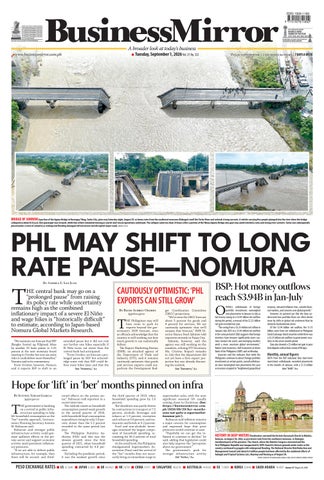
BRIDGE OF SORROW A portion of the Agana Bridge in Barangay Tibag, Tarlac City, gives way Saturday night, August 29, as heavy rains from the southwest monsoon (Habagat) swell the Tarlac River and unleash strong currents. A vehicle carrying five people plunged into the river when the bridge
PHL MAY SHIFT TO LONG RATE PAUSE—NOMURA
collapsed at about 8:32 p.m. One passenger was rescued, while four others remained missing as search-and-rescue operations continued. The collapse came less than 24 hours after a portion of the Ninoy Aquino Bridge also gave way amid relentless rains and strong river currents. Tarlac was subsequently placed under a state of calamity as widespread flooding damaged infrastructure and disrupted major roads. NONOY LACZA
T
By Andrea E. San Juan
HE central bank may go on a “prolonged pause” from raising its policy rate while uncertainty remains high as the combined inflationary impact of a severe El Niño and wage hikes is “historically difficult” to estimate, according to Japan-based Nomura Global Markets Research. “We maintain our forecast that BSP [Bangko Sentral ng Pilipinas] hikes by another 25 basis points to 5.25 percent at the next monetary board meeting in October but now see some risks it could deliver more thereafter,” Nomura said in its commentary. From October, however, Nomura said it expects BSP to shift to an
extended pause but it did not rule out further rate hikes especially if El Niño turns out worse than the central bank had anticipated. “From October, we forecast a prolonged pause by BSP but acknowledge some risk that BSP could deliver more hikes later and that the See “Nomura,” A2
CAUTIOUSLY OPTIMISTIC: ‘PHL EXPORTS CAN STILL GROW’ By Bless Aubrey Ogerio
T
@blessogerio
HE Philippines may still have room to push its exports beyond the government’s 2026 forecast, even as officials acknowledge that the country is still working out how much growth it can realistically deliver. The Export Marketing Bureau (EMB), an attached agency of the Department of Trade and Industry (DTI), said it remains cautiously optimistic that goods and services exports could outperform the Development Bud-
get Coordination Committee (DBCC) projections. “We’ve seen the DBCC forecast about 3 percent for goods and 4 percent for services. We are cautiously optimistic that we’ll surpass that forecast,” EMB Director Bianca Pearl Sykimte told reporters recently in Pasay City. Sykimte, however, said the agency was still working on the numbers, echoing DTI Secretary Ma. Cristina Roque’s remarks in July that the department did not yet have a firm export projection but was already discussing the outlook. See “Exports,” A2
BSP: Hot money outflows reach $3.94B in Jan-July
O
VERALL withdrawals of foreign portfolio investments outweighed new placements in January to July as hot money swung to a $3.94-billion net outflow during the period, a reversal of the $2.25-billion net gain recorded last year. “The swing from a $2.25-billion net inflow in January-July 2025 to a $3.94-billion net outflow in the same period of 2026 suggests that foreign investors have become significantly more cautious toward risk assets and emerging markets amid a more uncertain global environment,” Ruben Carlo Asuncion, chief economist at Union Bank of the Philippines (UBP) said on Monday. Asuncion said this indicates that while the Philippines continues to attract foreign portfolio investments at certain points, overall withdrawals have outweighed new placements this year as investors respond to “heightened geopolitical
tensions, elevated inflation risks, volatile financial markets, and concerns over global growth.” However, he pointed out that the data underscored how portfolio flows are often driven more by shifts in global risk sentiment than by domestic fundamentals alone. Of the $3.94 billion net outflow, the $1.73 billion came from net withdrawal in Philippine Stock Exchange-listed securities while there was a $2.21 billion net outflow in government securities in the seven-month period. Data also showed a $3-million net gain in peso time deposits with at least a tenor of 90 days.
Monthly, annual figures
DATA from the BSP indicated that short-term investment withdrawals exceeded placements in the months of January, with a $1.13-billion See “BSP,” A2
Hope for ‘lift’ in ‘ber’ months pinned on infra By Justine Xyrah Garcia
T
@jxrgarcia
HE government is banking on a revival in public infrastructure spending to help lift household consumption as the “ber” months approach, Socioeconomic Planning Secretary Arsenio M. Balisacan said. Balisacan said stronger public infrastructure activity could generate spillover effects in the private sector and support economic activity amid persistent inflationary pressures. “If we are able to deliver public infrastructure, for example, then there will be second- and third-
round effects on the private sector,” Balisacan told reporters in a recent interview. The outlook comes as household consumption posted weak growth in the second quarter of 2026, with household final consumption expenditure rising by only 2.8 percent, slower than the 5.2 percent recorded in the same period last year. The Philippine Statistics Authority (PSA) said this was the slowest growth since the first quarter of 2021, when household spending contracted by 4.8 percent. Excluding the pandemic period, it was the weakest growth since
the third quarter of 2010, when household spending grew by 2.6 percent. The slowdown was partly driven by contractions in transport at 7.5 percent, alcoholic beverages and tobacco at 1.9 percent, recreation and culture at 0.8 percent, and restaurants and hotels at 0.2 percent. Food and non-alcoholic beverages remained the largest component of household spending, accounting for 36.3 percent of total household spending. At the retail level, the Philippine Amalgamated Supermarkets Association (Pasa) said the arrival of the “ber” months does not necessarily bring an immediate surge in
supermarket sales, with the next significant seasonal lift usually coming closer to Christmas. (See: https://businessmirror.com. ph/2026/08/29/ber-monthssoon-not-quite-a-supermarketbonanza-yet/). Balisacan said inflation remains a major concern for consumption and expressed hope that price pressures would continue to ease. “Hopefully we can get the inflation to continue to decline,” he said, adding that legislation could also help improve the “perception about our government.” The government’s push for stronger infrastructure activity See “Infra,” A2
HISTORY IN DEEP WATERS Floodwaters surround the historic Barasoain Church in Malolos, Bulacan, on August 30, 2026, as persistent rains from the southwest monsoon, or Habagat, inundated parts of the province. The church, where the Malolos Congress convened and the First Philippine Republic was inaugurated in 1899, found its historic grounds under water as the country continued to grapple with widespread flooding. The National Disaster Risk Reduction and Management Council said about 8.4 million people had been affected by the combined effects of habagat and Tropical Cyclones Luis, Maymay and Neneng as of August 30.
PHOTO COURTESY OF BARASOAIN CHURCH-OUR LADY OF MOUNT CARMEL PARISH
PESO EXCHANGE RATES n US 61.7640 n JAPAN 0.3876 n UK 84.0423 n HK 7.8799 n CHINA 9.1911 n SINGAPORE 48.6178 n AUSTRALIA 44.4330 n EU 71.9859 n KOREA 0.0448 n SAUDI ARABIA 16.4507 Source: BSP (August 28, 2026)