




By Andrea E. San Juan
THE number of Philippine businesses dealing with global trade has continuously dwindled through the years due to inadequate budgets, shifts to the domestic market, and, lately, the uncertainty stemming from protectionist policies such as the Washington-imposed reciprocal tariffs.
“I know that through the years, it’s been going down. Because there was a time we were counting like 6,000. About two months ago, it was only about 4,000. So through the years, it’s declining,” Philippine Exporters Confederation Inc. (Philexport) Vice President Ma. Flordeliza C. Leong told the BusinessMirror on the sidelines of the recent United Portusers Confederation of the Philippines Inc.’s 3rd Partners’ Forum.
“We know that during the pandemic, for example, a lot closed in Cebu. Many of them,” she also told this newspaper.
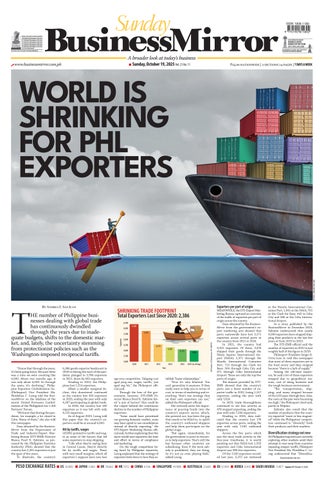
Data obtained by the BusinessMirror from the Department of Trade and Industry-Export Marketing Bureau (DTI-EMB) Director Bianca Pearl R. Sykimte, as processed by the Philippine Statistics Authority (PSA), showed that the country lost 2,261 exporters in just the span of five years.
To illustrate, the country’s
6,386 goods exporter headcount in 2020 or during the start of the pandemic plunged to 5,784 exporters in 2021, down by 602 exporters. Heading to 2022, the Philippines lost 1,214 exporters.
Albeit a smaller marginal decline, this downtrend continued as the country lost 263 exporters in 2023, ending the year with only 4,307 participating in global trade. In 2024, the country lost 182 exporters as it was left with only 4,125 exporters.
As of August 2025, Leong told this paper that the country’s exporters could be at around 4,000.
Hit by tariffs, wages LEONG pointed to tariffs and wages as some of the factors that led some exporters to stop shipping.
“Like what they’re saying here in Central Luzon, they’re directly hit by tariffs and wages. Those with very small margins, which all exporters I suppose have now kasi

nga very competitive. Talagang cost agad yung ano, wages, tariffs, ’yun agad ang hit,” the Philexport official said.
Through the lens of the government, however, DTI-EMB Director Bianca Pearl R. Sykimte listed “a mix of factors” that could be the culprit behind the continuous decline in the number of Philippine exporters.
“Some would have prioritized our growing domestic market, some may have opted to use consolidators instead of directly exporting,” the DTI-Export Marketing Bureau official said, further explaining that this move would save exporters the time and effort in terms of compliance and marketing.
On the tough competition being faced by Philippine exporters, Leong explained that the strategy of exporters boils down to how they es-
tablish “buyer relationships.”
“Now it’s very bilateral. You can’t generalize it anymore. If they really want to help you in terms of cost, in terms of marketing and everything. That’s one strategy that on their own exporters can use,” added the Philexport official.
She stressed anew the importance of pouring funds into the country’s exports sector, which, she pointed out, has been the gap that needs to be filled in, to uplift the country’s outbound shippers and help them participate on the global stage.
“But again, immediately, for the government to pour in resources to help exporters. That’s still the key because other countries are subsidizing. Even if the term subsidy is prohibited, they are doing. So it’s not an even playing field,” added Leong.
MEANWHILE, the DTI-Export Marketing Bureau captured an overview of the traffic of exporters per port of origin across the country.
Data obtained by the BusinessMirror from the government’s export marketing arm showed that ports nationwide have lost 2,171 exporters across several ports in the country from 2021 to 2024.
In 2021, the country had 9,331 exporters. Of these, 3,476 shipped their goods through the Ninoy Aquino International Airport (NAIA); 2,371 through the Manila International Container Port; 713 through the Clark Air Base; 504 through Cebu City and 471 through Cebu International Airport. These are only the top five ports of origin.
The dataset provided by DTIEMB showed that the country’s ports saw a lower number of exporter traffic in 2022, losing 1,517 exporters, ending the year with only 7,814. In 2023, trade thoroughfares continued to see less activity as 478 stopped exporting, ending the year with only 7,336 exporters.
Heading to 2024, data indicated that the country lost 176 exporters across ports, ending the year with only 7,160 outbound shippers.
Across the five ports which saw the most trade activity in the four-year timeframe, it is worth pointing out that NAIA lost 1,535 exporters and Cebu International Airport saw 386 less exporters.
Of the 7,160 exporters recorded last year, 2,372 are stationed
tional Airport.
In a story published by the BusinessMirror in December 2023, Sykimte underscored that nearly 4,000 exporters have stopped shipping their products in the last five years or from 2019 to 2023. The DTI-EMB official said the number of exporters in 2022 is just roughly half of the figure in 2018.
Philexport President Sergio R. Ortiz-Luis Jr. told this newspaper that most of these exporters are in the food sector and they stopped because “there is a lack of supply.”
Among the old-time exporters, he said a lot of these exporters stopped due to geopolitical reasons, cost of doing business and the tough business environment.
“The transportation, shipping…and many stopped because of the LGU pass-through fees. Also, the costs at the pier were becoming too high,” the Philexport chief said, partly in Filipino.
Sykimte also noted that the number of products that the country exported “more or less stagnated” while the Philippines’ competitors continued to “diversify” both their products and their markets.
Diversification strategy not new AS Philippine exporters are currently exploring other markets amid their attempt to veer away from countries imposing steeper tariffs, Philexport Vice President Ma. Flordeliza C. Leong underscored that “Diversifica-
By Sheikh Saaliq | The Associated Press
NEW
DELHI—From
the Andes to the Himalayas, a new wave of protests is unfolding across the world, driven by generational discontent against governments and anger among young people.
This week, Madagascar’s President Andry Rajoelina was forced out of power and out of the country after a military mutiny, the culmination of weeks of demonstrations led by young protesters referring to themselves as “Gen Z Madagascar.”
The rage against the political establishment in the Indian Ocean island country mirrors other recent protests across the world, in countries like Nepal, the Philippines, Indonesia, Kenya, Peru and Morocco. These protests have been sparked by specific grievances but are driven by long-simmering issues like widening inequality, economic uncertainty, corruption, and nepotism of leaders.
But they have one thing in common: Mostly leaderless, they are made up primarily of young people who brand themselves as “Gen Z,” defined as those born
roughly between 1996 and 2010 — the first generation to grow up entirely in the internet age.
“What connects these youthled protests is a shared sense that traditional political systems aren’t responsive to their generation’s concerns, whether that’s corruption, climate change, or economic inequality. Protest then becomes the logical outlet when institutional channels feel blocked,” said Sam Nadel, director of Social Change Lab, a UK-based nonprofit that researches protests and social movements.
Protesters take cues from each other THOUGH their specific demands differ, most of these protests have been sparked by government overreach or neglect. Some have also confronted harsh treatment by security forces and brutal repression. In Morocco, a leaderless collec-
tive called Gen Z 212 — named after Morocco’s dialing code — has taken to the streets to demand better public services and increased spending on health and education. In Peru, protests over a pension law exploded into broader demands, including action to tackle rising insecurity and widespread corruption in the government. In Indonesia, deadly protests have erupted over lawmakers’ perks and the cost of living, forcing the president to replace key economic and security ministers.
The most widely recognized movement to be dubbed as a “Gen Z” protest was a deadly uprising in Nepal that culminated with the resignation of the prime minister in September. Protesters drew inspiration from successful anti-government movements elsewhere in South Asia — Sri Lanka in 2022 and Bangladesh in 2024 — which led to the ouster of incumbent regimes.
In Madagascar in turn, protesters say they were particularly inspired by the movements in Nepal and Sri Lanka. The protests began against regular water and electricity cuts but quickly morphed into wider discontent, as demonstrators called for the president and other ministers to step down. On Wednesday, Madagascar’s military coup leader said he is “taking the position of president.”


Uniting behind a manga pirate flag ACROSS multiple countries, a singular pop culture symbol has emerged: a black flag showing a grinning skull and crossbones wearing a straw hat. The flag comes from a cult Japanese manga and anime series called “One Piece,” which follows a crew of pirates as they take on corrupt governments.
In Nepal, protesters hung the same flag on the gates of the Singha Durbar, the seat of the Nepalese government, and on ministries, many of which were torched in protests. It was also hoisted by crowds in Indonesia, the Philippines, Morocco and Madagascar.
Last week in the Peruvian capital, Lima, 27-year-old electrician David Tafur stood with the same flag in San Martín Square, now the stage for weekly protests.
“We’re fighting the same battle — against corrupt officials who, in our case, are also killers,” he said, recalling that President Dina Boluarte’s government held on to power since December 2022 despite more than 500 protests and the deaths of 50 civilians.
“In my case, it’s outrage over abuse of power, corruption, the deaths,” Tafur said, referring to the sharp rise in murders and extortion plaguing the South American country since 2017, amid new laws that have weakened ef-
forts to fight crime. Boluarte had been under investigation for months over various allegations including bribery and involvement in a deadly crackdown on protesters in 2022. She was replaced last week by interim President José Jerí.
Tafur said that wasn’t enough.
“The president is an ally of Congress and has to go,” he said.
Harnessing social media for mobilization and awareness MANY significant protests in the past, like Occupy Wall Street in 2011, the Arab Spring between 2010 and 2012, and the 2014 Umbrella Revolution in Hong Kong, have been led by younger people.
While they also used the internet and social media for mass mobilization, the “Gen Z” protesters are taking it to another level.
“Digital platforms are powerful tools for information sharing and building connections, but the most effective movements often combine digital mobilization with traditional in-person organizing, as we’ve seen in these recent protests,” said Nadel from Social Change Lab.
Days before the deadly protests began in Nepal, the government announced a ban on most social media platforms for not complying with a registration deadline. Many young Nepalese viewed it
as an attempt to silence them and began accessing social media sites through virtual private networks to evade detection.
Over the next few days, they used TikTok, Instagram and X to spotlight the lavish lifestyles of politicians’ children, highlighting disparities between Nepal’s rich and poor, and announce planned rallies and venues. Later, some of them also used the gaming chat platform Discord to suggest who to nominate as an interim leader for the country.
“Whatever movement happens, whether against corruption or injustice, it spreads through digital media. The same happened in Nepal. The changes that took place after the Gen Z protests in Nepal spread globally through digital platforms, influencing other countries as well,” said protester Yujan Rajbhandari.
He said the protests in Nepal awakened not only the youth but also other generations.
“We realized that we are global citizens and the digital space connects us all and plays a powerful role across the world,” Rajbhandari said.
Associated Press journalists Franklin Briceño in Lima, Peru, and Niranjan Shrestha in Kathmandu, Nepal, contributed to this report.
Continued from A1 tion has been the strategy for the longest time.”
“It’s not new,” Leong also pointed out.
“It’s in the Philippine Export Development Plan. But it is not easy, especially for small exporters, because you need money for product development, for market intelligence, for marketing, for promotion. You need money, which they don’t have,” added the industry leader.
At a Senate hearing on October 13, Senator Imee Marcos pressed Trade officials, including Trade and Industry Secretary Cristina A. Roque, on what are the immediate solutions that the agency will roll out as Washington is becoming more protectionist, hence prompting Philippine exporters to increase their prices on goods bound for the United States.
“That market access takes time
to develop, it’s not gonna happen overnight. In the meantime, exporters are reeling. You can see that many are already losing their jobs. What’s to be done about that?” the lawmaker said, partly in Filipino. She noted that there are no subsidies in place to assist affected exporters.
To which, Roque quickly replied: “We are strengthening also the local market; this is also what’s attractive to foreign investments that are coming in, aside from strengthening the foreign trade service corps in the DTI offices all over the world.”
Senator Marcos emphasized that market development is a “medium- to long-term process,” further pressing the trade officials: “What is the immediate solution because the problem is really urgent as thousands are losing their jobs?” Roque, however, pointed out
that Philippine exporters already know what to do despite the headwinds.
“They’re used to doing exports, so we just have to find other markets like Europe,” Roque said. She also noted that for longtime exporters, “It’s actually easy for you to penetrate other markets.” The senator described the budget of the country’s Trade department as “business as usual,” lamenting the seeming nonchalance. “Konting-konti lang ang pinagkaiba nung last year at ngayon. Ano ang gagawin natin? Ang problema ngayon nasaan ’yung plano kapag nangyari ito [There’s hardly any difference between last year and this year. The problem is, where’s the plan when the worst happens]?” Marcos said. (See: https:// businessmirror.com.ph/2025/10/13/ no-ready-help-for-phl-exporters-toamerica/)
Editor: Angel R. Calso
October 19, 2025

By Dina Bass, Rachel Metz and Mark Bergen
IN June, French president Emmanuel Macron held an exclusive dinner at the Élysée Palace with a special guest: Nvidia’s Jensen Huang. Wine glasses clinked in honor of a deal his company had just unveiled with Mistral, the leading French artificial intelligence startup, to develop France’s largest data centers.
Huang, dressed in a black t-shirt amid the Parisian suits, paused the celebrations for a brief warning about AI. “The problem in Europe and in France is: You are too slow,” Huang teased the attendees, according to Eléonore Crespo, an AI entrepreneur at the dinner. “It’s like your wine. You wait for it to age, to be perfect.”
Many European leaders are now working to prove Huang wrong. The continent, long known as more of a tech regulator than an innovator, is moving with renewed urgency to claim its piece of the global AI boom. Europe’s scarce tech giants, SAP SE and ASML Holding NV, have in recent weeks committed billions of euros to homegrown AI startups and services tailored to the bloc. Heads of state, from Macron to British Prime Minister Keir Starmer, have made splashy pledges to invest in massive data centers they cast as critical to national security and growth.
Europe’s push mirrors efforts around the world, from Canada to South Korea to the Middle East, where governments are frantically marshalling resources to avoid ceding too much of the AI market to the US and China. Across Europe, there are fears that a failure to invest heavily in AI locally will mean losing talent and abandoning yet another tech revolution to Silicon Valley, according to interviews with more than two dozen policymakers and technology executives. Increasingly, officials also worry Europe risks being overly reliant on a handful of large American companies, with its access to a vital technology vulnerable to Donald Trump’s trade war and whims. In Brussels, there are serious conversations about a so-called “kill switch”—a fear that Trump could force US companies to turn off services if that furthers his agenda.
But Europe, like most regions, has yet to prove it has the technical and financial wherewithal to credibly rival the US and China in every — or any — corner of the AI industry. Many see potential for European firms to sell AI-powered applications, cloud services and military tech. However, there are significant doubts about whether the continent’s sluggish economies can or should compete in the costly global battle to develop the advanced computing chips or cuttingedge large language models that underpin AI software.
Those debates are becoming more pronounced as governments simultaneously tout the importance of domestic
AI efforts while leaning on US firms, including Nvidia and OpenAI, to prop them up. In September, for example, Starmer hosted Huang and other US tech luminaries to announce more than £31 billion ($41 billion) worth of AI spending pledges—a move that prompted immediate criticism that the UK was handing over critical keys to the US.
“At this moment, Europe is so dependent that we don’t have much bargaining power,” said Alexandra Geese, a European parliamentarian from Germany who advocates shedding as much US tech as possible. “You become a colony.”
Made in Europe
CRESPO, the entrepreneur, is a poster child of sorts for Europe’s emerging AI sector and its limitations. Her startup, Pigment, offers AI tools for financial planning to rival an iconic American product: Microsoft Excel. During dinner gatherings and foreign trips, Macron has promoted Pigment as a future tech leader, driving “a new wave of customers,” she said, including large French and British businesses that are on their way to signing deals. But to compete with US products, Crespo relies on American tech — namely models from OpenAI, which counts Microsoft as its biggest backer.
“You are not going to be able to wait 10 years for a technology to be developed in Europe to say, ‘Oh, now we are sovereign,’” she said.
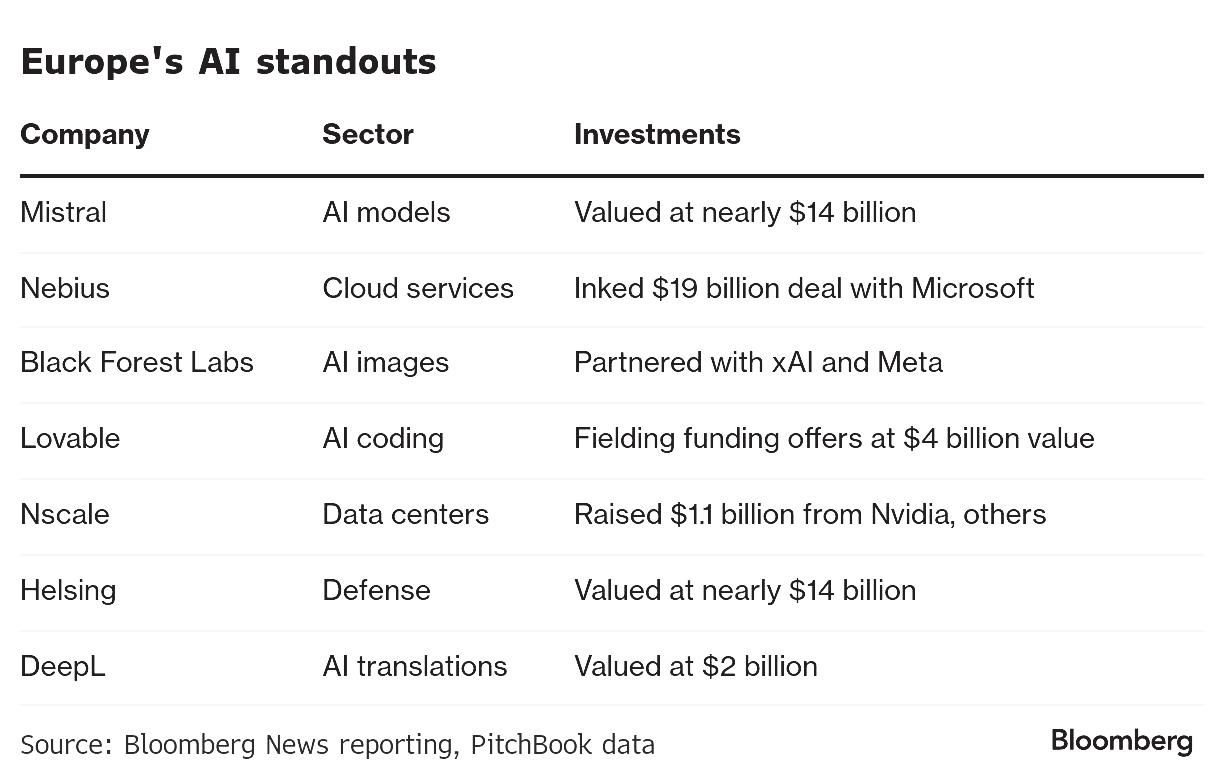
Nvidia’s Huang has been a relentless crusader for “sovereign AI,” a squishy, catchall term that typically means each country owns and controls the necessary data, chips and data centers to support AI. The idea has caught on in Europe, albeit sometimes in a confused way. In September, SAP announced a “sovereign” effort to offer “AI solutions that are built in Germany, for Germany,” by partnering with San Francisco-based OpenAI. Increasingly, however, European companies are racing to prove local players can fill in the gaps. Nebius, an Amsterdam-based AI cloud provider, signed a contract with Microsoft Corp. worth as much as $19 billion. Black Forest Labs, a German startup making AI image-generation tools, has partnered with Elon Musk’s xAI and Meta Platforms Inc. And Mistral recently raised funds from ASML and other investors at an €11.7 billion valuation, cementing it as Europe’s top AI model maker. These firms are vying to
reduce the need for US tech and ensure the continent doesn’t miss out on AI the way it did with online search, e-commerce, social media, smartphones and cloud computing. “Essentially what we are living through is the trauma of a lot of the regional leaders analyzing their histories and going, ‘We don’t want a repeat of that,’” said Anjney Midha, a partner at Andreessen Horowitz and board member of Mistral and Black Forest Labs.
In a sign of the times, several newcomers have entered the AI chips market, a notoriously challenging field dominated by Nvidia. These companies argue the provenance of AI hardware is as vital as the data being processed or the models created. Nations without their own semiconductor firms or workforces “risk becoming a vassal state,” said Walter
Goodwin, founder and CEO of Fractile, a British chips startup. The push for homegrown alternatives has gained momentum due to concerns about Trump. In April, after the White House announced its first wave of global tariffs, the rhetoric in Europe intensified. The EU released its plan to become a “global leader” in AI, which includes subsidies for chips and large data centers, or “gigafactories.” Clara Chappaz, then France’s digital minister, gave a speech about cloud computing, calling on Europeans to “work as a pack” in a “world of predators.”
There is growing distrust in Europe, not only over tariffs but about the privacy and security of American services. A law passed in Trump’s first term, the Cloud Act, enables US law enforcement to request data from abroad.
In June, Microsoft executive Anton Carniaux made waves when he told a French Senate inquiry he “cannot guarantee” information on French citizens would be protected if the US government demanded it. The executive said the company tries to fight these requests and there are no instances of this happening to a European customer. Still, Benjamin Revcolevschi, the CEO of French provider OVH Cloud, said this wasn’t the first admission from a US firm. “There will be others.”
An emerging “Eurostack” political movement has argued that European entities should be required by law to purchase homegrown tech services. Geese, the German politician and a Eurostack proponent, believes that relying on less advanced alternatives to ChatGPT or Microsoft Azure is worth the
technological independence. “We’re going to get there,” she said. “It’s not that we’re stupid. It’s just less investment.” Macron, who has tussled with Trump over tariffs and Europe’s digital sovereignty, has done more than most to prop up local options. He’s pledged to spend €109 billion on data centers and equipment and regularly promotes startups like Mistral and Pigment.
In July, Macron brought several French entrepreneurs, including Crespo and Mistral’s Arthur Mensch, on a diplomatic trip to the UK. Despite its fractious exit from the bloc in 2020, the UK has kept knitting partnerships on critical technologies—including AI— with some of its European neighbors. Peter Kyle, a British
See “AI,” A5

BBy Ruth Carson, Naomi Tajitsu & Masaki Kondo
ENEATH the surface of the short-term ups and downs of financial markets, a longer-term repricing of multiple assets may be underway as investors seek to protect themselves from the threats posed by runaway budget deficits.
While a fresh round of tariff threats between the US and China stole the headlines Friday and sent traders scurrying from riskier assets and into bonds, money managers have been increasingly discussing a phenomenon known as the “debasement trade.”
Those who believe in it are pulling away from sovereign debt and the currencies they are denominated in, fearful their value will be eroded over time as governments avoid tackling their massive debt burdens and even seek to add to them.
Further fuel is coming from speculation that central banks will face increasing political pressure to hold down interest rates to offset what governments owe—and in the process fan inflation by continuing to crank out cash.
Just last week, Japan’s yen and its bonds were hit by waves of selling as stimulusfriendly Sanae Takaichi took a step toward becoming prime minister. Another round of political turmoil in France over its finances jolted the euro, and a looming budget in the UK is unnerving a gilt market still scarred by the 2022 selloff that swept Prime Minister Liz Truss from power.
While the dollar has risen in recent weeks despite the US government shutdown, it’s still weaker over the course of this year after President Donald Trump’s trade war and taxcut plans earlier sent it into the deepest tailspin since the early 1970s. His America First break with the global order and assault on the Federal Reserve’s independence have also sown doubts about whether Treasuries will continue to fully enjoy their
status as the world’s main riskfree asset—underpinning longterm bond yields.
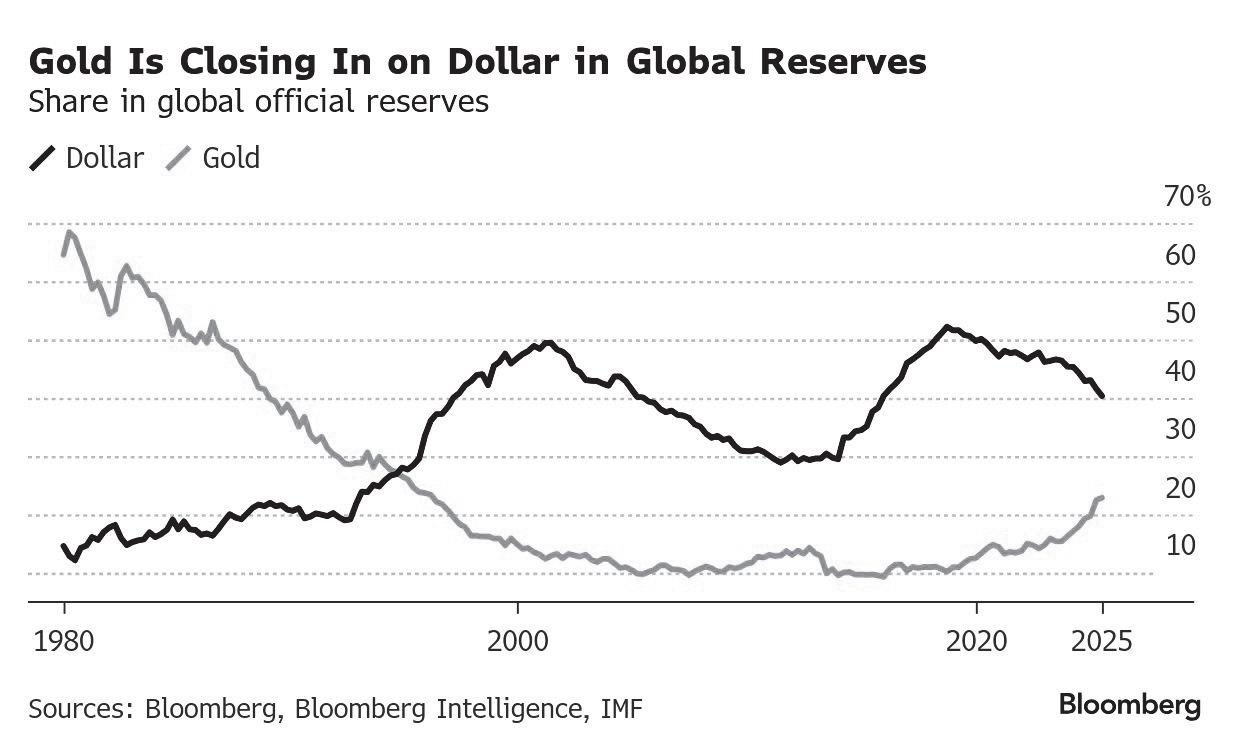
On the other side of the debasement trade, precious metals are benefiting from their traditional haven status and cryptocurrencies are rallying again, this time due to their purported function as a refuge from the impacts of government policy. Gold is up over 50% this year and recently surpassed a record $4,000 per ounce, while silver surged to an all-time high.
And while cryptocurrencies posted steep drops after Trump’s latest tariff threats spooked sentiment, Bitcoin is still up more than 20% this year and hit an all-time high.
Stephen Miller says he’s never seen as big a shift away from currencies and Treasuries into alternatives during his four decades of working in markets. The former head of fixed-income at BlackRock Inc. in Australia reckons it may just be the start.
“The debasement trade still has some way to run,” said Miller, who is now a consultant at GSFM, a unit of Canada’s CI Financial Corp. “US Treasuries just aren’t the unimpeachable safe harbor asset that they once may have appeared and it’s a phenomenon repeated across other bond markets.”
Billionaires Ray Dalio and Ken Griffin have captured headlines by suggesting that gold may be safer than the dollar. The head of the Canada Pension Plan Investment Board thinks US Treasuries are also at risk of losing their haven status. And the author and hedge-fund advisor Nassim Taleb says the ballooning US deficit is sowing the seeds of a debt crisis it appears virtually impossible to
avoid.
“The world is seeing a deterioration not just in the inflation-adjusted value of their currencies amid slowing activity, but also a deterioration in the stability of government,” said Calvin Yeoh, who helps run the Merlion Fund at Blue Edge Advisors in Singapore and has been buying gold.
The term debasement dates back to when rulers such as King Henry VIII and Nero diluted or debased their gold and silver coins with cheaper metals such as copper.
There are plenty of doubts that the world is seeing a modern-day version, especially since there are multiple factors behind the surge in gold and Bitcoin. Moreover, premature warnings of an imminent debt crisis have been issued off and on ever since the Global Financial Crisis.
The freezing of Russian assets after its invasion of Ukraine highlighted the vulnerability of foreign currency holdings to external sanctions, increasing the allure of the yellow metal. Central banks have also been increasing their gold stockpiles to diversify their reserves.
And the crypto world is no stranger to purely momentumdriven booms and busts: The argument that Bitcoin functions as a harbor was undercut when it tumbled during the postpandemic inflation surge along with other speculative assets and again in recent days as it swooned after increased trade tensions.
For all their recent wobbles, the greenback, euro and yen still dominate trade to banking systems and remain the anchor
for trillions of dollars in daily transactions. Government debt also underpins collateral frameworks and the plumbing of the world’s financial system.
The surging US stock market also challenges the view, given foreigners will need dollars to trade, and despite Trump’s destabilizing shifts overseas investors have continued to increase their holdings of US Treasuries.
“Whoever thinks currencies and bonds are replaceable with bitcoin and gold needs a reality check,” said Shoki Omori, Tokyobased chief desk strategist at Mizuho Securities Co., one of Japan’s biggest brokerages.
Omori thinks markets are just witnessing a “momentum trade,” in which more and more investors pile into a seemingly winning trade regardless of fundamentals.
“Debasement seemed a pretty rational way to describe the extraordinary market moves
of recent months. But now that we’ve got a nice moniker for the trading regime we have been in, it’s perhaps a sign that everyone is skewed too much one way and we’re due some volatility and a shake-out,” said Bloomberg’s Mark Cudmore, Executive Editor for Markets Live.
But there are also solid reasons why investors are having the debate over debasement, even if it ultimately proves an academic one that doesn’t upend the market status quo.
Strategists at Eurizon SLJ Capital Ltd. reckon governments have become “addicted to deficit spending” thanks to the flood of cheap money witnessed in the financial crisis and pandemic as central banks slashed interest rates and hoovered up bonds.
“If the reserve managers continue to divest from not just the dollar but all fiat monies, gold could continue to march higher,” the Eurizon strategists wrote last week. “If central banks’ gold holdings match those of dollars, all else being equal, gold could reach $8,500. Why not?”
At Andromeda Capital Management, Alberto Gallo says as debts rise and populations age, the “process of monetary debasement” will accelerate as it’s easier for politicians to embrace that than ignite growth or impose austerity. He sees central banks risk being roped into the effort.
“Policymakers are toying with ideas of monetary reform, be it gold reserve revaluation, bank deregulation or changing
“The world is seeing a deterioration not just in the inflation-adjusted value of their currencies amid slowing activity, but also a deterioration in the stability of government,” said Calvin Yeoh, who helps run the Merlion Fund at Blue Edge Advisors in Singapore and has been buying gold. The term debasement dates back to when rulers such as King Henry VIII and Nero diluted or debased their gold and silver coins with cheaper metals such as copper.
central bank targets,” Gallo said in a report. “The end results are likely entrenched inflation, further fiat currency depreciation, higher long-end rates and positive risk-free risky-asset correlations.” In the US alone, where the Fed has kept rates elevated to cool inflation by restraining growth, Trump moved fiscal policy in the opposite way with tax-cuts that are projected to add to the already nearly $2 trillion deficit. Debt could be almost double the size of gross domestic product by 2050, the Government Accountability Office warned in February. Trump and his administration have also campaigned for the Fed to slash rates, in part because officials argue doing so would lower the cost of debt, and are testing the limits of the bank’s independence by trying to oust Governor Lisa Cook. The shifting trade war, the US government shutdown and the president’s use of the Justice Department to target his domestic foes have underscored worries about political dysfunction and unpredictability.
In France, investor angst rose again after Prime Minister Sebastien Lecornu became the country’s fifth prime minister to resign in two years amid stalemate over the budget. Last week ended with him being reappointed.
As for Japan, Takaichi’s potential elevation to the premiership comes as the collapse of the decades-old ruling coalition increases doubt about the outlook. The prostimulus lawmaker’s victory in her party’s recent leadership election raises the prospect of slower rate hikes at a time inflation remains well above the central bank’s target. Against such a backdrop, some still see room for the debasement trade to extend.
“This is how much the world has changed and it could be a sign that digital assets are becoming a more trusted source of value in the current environment,” said Kathleen Brooks, research director at XTB Ltd. in London. “We do not see this coming to an end any time soon.” Bloomberg News






NBy Alastair Gale
EA r the Japanese city of Nagoya, Takumi Yamaguchi pulls on a motorcycle helmet and sprints along an asphalt track before releasing a drone that looks like a 6-foot-long model airplane. It crashes shortly after takeoff.
Yamaguchi’s startup, AirKamuy, can afford such mishaps because it makes cheap, mass-produced drones—out of cardboard, of all things. He sets off another test run, which goes much better. The drone buzzes around an artificial island not far from Nagoya’s main airport before returning for a landing. Engineers will gather data from the flights to adjust the device before producing the final model. If all goes well, Japan’s Ministry of Defense will buy
these so-called origami drones for missions that could include surveillance and swarm attacks in which the device would carry small bombs.
Like many younger Japanese, Yamaguchi, 29, says he feels the need to do more to protect his country, which has long been attached to the ideal of pacifism. Concern is rising about China seizing nearby Taiwan, as well as threats from a volatile North Korea and a belligerent Russia, just to Japan’s north. “We’re surrounded by these problems,” he says.
In many other countries, Yamaguchi’s startup would be unremarkable. Venture capital money is pouring into drones because they’ve been so successful in the Ukraine war. But risk-averse Japan has long had few startups and a taboo against the defense industry,
including severe restrictions on arms exports. After its defeat in World War II, the country renounced the right to wage war and even maintain a military, adopting a US-written “peace constitution” that’s remained unchanged to this day.
By the 1970s, Japan had, in fact, rebuilt its military, now one of Asia’s largest and best equipped. But it’s called the Self-Defense Forces, or SDF, and is more strongly associated with helping out during the country’s frequent earthquakes and other natural disasters.
Only a handful of Japanese contractors supply weapons and other equipment to the SDF, which also imports weapons from the US. As recently as 2017, the Science Council of Japan, representing scholars advising the government, issued a statement expressing opposition
to military- research programs. But opinion surveys show public support growing for a stronger defense. The new leader of the ruling Liberal Democratic Party, Sanae Takaichi, is a security hawk who’s called for more military spending, as have fast-growing smaller rightleaning political parties. Takaichi, who’s set to become prime minister, has also pledged to make a new push to amend the constitution to state Japan’s right to have a military. In 2022 the government said it would lift defense spending from an informal cap of 1% of gross domestic product to 2% over five years. Japan has also been under pressure from the US, its only security treaty ally, to rely less on American protection. Billions of dollars
Japan. . .
Continued from A4
have been earmarked to pay for new equipment, such as long-range missiles to deter potential aggressors and military satellites to monitor enemies, as well as to help build a stronger domestic defense industrial base.
Interest is also growing in a once- languishing eight-yearold government program to support research initiatives that could contribute to national defense. Although the program’s budget remains small—¥11.4 billion ($77.1 million)—134 private companies filed applications this year through June, up from the recent low of 49 in all of 2021.
In October 2024, Japan started the Defense Innovation Science and Technology Institute, modeled on US Department of Defense agencies that seek to use emerging technologies to bolster national security.
The Defense Ministry is also playing a role in helping startups connect to venture capitalists. “It is crucial to build a mutually beneficial relationship with startups,” says Rumiko Ichikawa, principal senior coordinator at the Defense Ministry’s Acquisition, Technology and Logistics Agency.
In a landmark for defense exports, Australia announced in August that it would buy a fleet of warships from a Japanese consortium led by
Continued from A3
cabinet secretary, said the two countries have discussed pooling supercomputing resources and other partnerships. He’s also adopted Macron’s boosterism. Still, last month, when the UK unveiled major investment plans on AI infrastructure, it wasn’t with French firms. It was with Nvidia, OpenAI and Microsoft.
Coming up short
FOR all the activity, Europe’s public and private investments are dwarfed by the US. The largest US tech firms are set to spend $344 billion this year, largely on data centers for AI. The EU’s long-term AI investment plan calls for spending about $100 billion less than that in total.
At a buzzing AI conference in Paris this summer, Paul Bloch, the president of Nvidia partner DataDirect Networks, brought up the EU’s plan to

Mitsubishi Heavy Industries Ltd. It would be just the second major defense export deal Japan has secured since World War II—possible only because of a special exemption from an array of restrictions on exporting weapons overseas, including a prohibition on lethal military equipment.
In part because these rules limit possible markets, private money remains relatively scarce. Total funding for all startups in Japan last year reached $5.3 billion, 2.5% of the amount in the US, according to Japan Investment Corp., one of the country’s sovereign wealth funds. Japan’s VC industry mostly consists of firms owned by financial institutions or other big
businesses. Many VC funds have internal restrictions on investments in companies working on military- related technology. “The venture capital environment is weak in Japan,” says Kousuke Saito, an international security specialist at Sophia University in Tokyo. “But defense innovation is very expensive.”
The Japanese government is pushing for products with both civilian and military applications. Such dualuse products might include autonomous navigation systems that can guide cars or missiles, or even materials such as high-strength fibers usable in clothes or fighter aircraft.
The Tokyo VC firm Coral Capital has invested in two dual-use companies:
Oceanic Constellations, a sea-drone maker, and Ookuma Diamond Device, which produces energyefficient semiconductors from diamonds that could have defense applications. “We know it will take time to get people here educated on defense tech,” says James Riney, Coral’s chief executive officer and founding partner. Japan’s strengths in advanced engineering and technology could give it a competitive advantage in the defense startup sector, he says.
Another startup, ElevationSpace, is developing reusable modules to transport payloads to orbiting space stations. The technology could help defend against hypersonic weapons. Chief Operating Officer

spend €20 billion subsidizing data centers it calls gigafactories. “It seems like a lot,” he told the audience. “It’s really not.”
Whether there’s enough capital to compete is unclear. Economic growth is sluggish across Europe. Macron has just set up France’s third government since September, and that too is at risk of collapse over concerns about debt. And there are simply no European tech
But Europe, like most regions, has yet to prove it has the technical and financial wherewithal to credibly rival the US and China in every— or any—corner of the AI industry. Many see potential for European firms to sell AI-powered applications, cloud services and military tech. However, there are significant doubts about whether the continent’s sluggish economies can or should compete in the costly global battle to develop the advanced computing chips or cutting-edge large language models that underpin AI software.
companies with the financial muscle of US firms like Microsoft, Amazon.com Inc. and Alphabet Inc.’s Google. The limits of Europe’s AI push can be seen in France. Scaleway, a cloud provider from telecom billionaire Xavier Niel, has invested €3 billion, most of it in AI data centers, and secured more than five thousand advanced chips, according to Aude Durand, deputy CEO of Niel’s Iliad Group—a tidy sum, but far less than American rivals. Durand said Europe’s political geography also makes it difficult to expand. “Every time you open a new market, there’s new regulation, there’s new constraints,” she said.
“It’s not as easy as in the US.”
Even Europe’s top software company, SAP, can’t keep pace with the US investment
frenzy. The firm, whose market cap is about a tenth of Microsoft and Google, said it would allocate €20 billion for sovereign services over the long term, a tenfold jump from its promised figure a year before. “The world changed,” explained Thomas Saueressig, an SAP executive. But that amount is less than some US tech firms spend in a quarter. SAP has also wavered on its approach to sovereign AI. Christian Klein, SAP’s CEO, began the year calling for a replica of Stargate, the $500 billion infrastructure project Trump announced with OpenAI. “Europe needs it the most,” Klein told CNBC in January.
But in an August op-ed, Klein called the EU plan to subsidize large centers and chips “a misguided solution to
Kazunari Miyamaru came up with the idea after studying aerospace engineering at the National Defense Academy of Japan. “Japan and allied countries need to work together to react to new types of air threats,” says Miyamaru, who adds that he’s approached the Defense Ministry and France’s MBDA Missile Systems Services SAS, Europe’s largest missile maker.
Yamaguchi, the origamidrone maker, studied aeronautical engineering in college in Nagoya. In 2022 he was working in a division of Mizuho Bank Ltd. that provides financial support for startups. A client who was passionate about using drones for mountain rescues invited him to take part in a contest on the northern island of Hokkaido that sought to find which unmanned devices could find a target the fastest. Yamaguchi was hooked and decided to set up his own company. His parents expressed concerns about job security; the cultural preference for stable employment at an established company has stymied startup culture.
AirKamuy was originally formed as a venture to make drones to help find missing people in the mountains. Kamuy means “God” in the language of the Ainu ethnic group, who live mostly in Hokkaido. The company name also nods to the idea of a drone saving a lost person. After a meeting with Defense
the wrong problem.” Instead, he said Europe should stick to its strengths: focusing on promoting AI software and applications. European data centers, even if run by a local operator, will still need equipment from Silicon Valley and Asia, Klein said. “The hardware train has left the station,” he wrote.
There are signs others in Europe agree. Last quarter, Nvidia attributed $20 billion in annual sales to sovereign AI purchases. Britain’s new supercomputer, in Bristol, is being built in partnership with Nvidia. The company also had deals with cloud projects in Germany and Italy.
Europe isn’t ready to give up completely on building up its own infrastructure. Despite Klein’s position, the German government has endorsed the gigafactory plan, arguing that local cloud operators should be involved. The Schwarz Group, Germany’s largest retailer, is planning to invest €11 billion into its nascent cloud service over the coming years and is bidding to develop one of the EU gigafactories. Unlike in chips, that market has more room for competition.
Macron also selected a British provider, Fluidstack, to develop a gigawatt supercomputing facility, with hopes to break ground on the data center—the startup’s first—early next year. CEO César Maklary, a native of France, said his firm’s nimbleness and AI-first focus can help it beat US cloud giants.
“We’re deciding today what our future looks like. If we are handing the keys to nonsovereign companies, there’s always a potential risk,” he said. “There’s a French saying: You’re always better served by yourself.” With assistance from Benoit Berthelot, Gian Volpicelli and Christina Kyriasoglou/Bloomberg
Ministry officials at a drone exhibition several months later, the company pivoted to work on national security—along with civilian—applications.
In May, AirKamuy announced it had raised ¥100 million through the issuance of shares to three Japan-based funds, as well as loans from one commercial bank and the staterun Japan Finance Corp. Yamaguchi says about two-thirds of the venture firms he approached turned him down, some of them citing internal restrictions on investing in defense-related businesses.
The company’s main drone, the AirKamuy 150, is made of rain-resistant cardboard and designed to be manufactured at a low cost on a large scale. Yamaguchi says the drone’s price would likely start at $2,000, compared with millions of dollars for the high-end reconnaissance devices used by the US military and others. About 500 of the origami drones can be flat-packed into a regular shipping container, and they offer flight times of more than two hours, far longer than most devices. The company is in talks with the Defense Ministry about a contract, he says.
In August the agency said it was seeking more than $2 billion in its budget for the fiscal year starting in April to procure fleets of air, sea-surface and underwater drones. It said it would look at both foreign and local sources. After the recent test flight, Yamaguchi takes off his motorcycle helmet, a safety precaution to avoid injury from the drone’s front-mounted propeller during launch. The work is challenging; still, he expects to have the product ready in the spring. “We have had various failures,” he says. “But the accumulation of lessons from that process is important.” Gale reports from Bloomberg’s Tokyo bureau/Bloomberg Markets










By Joey Cappelletti & Seung Min Kim The Associated Press
Donald Trump is showing little urgency to broker a compromise that would end the government shutdown, even as Democrats insist no breakthrough is possible without his direct involvement.
Three weeks in, Congress is at a standstill. The House hasn’t been in session for a month, and senators left Washington on Thursday frustrated by the lack of progress. Republican leaders are refusing to negotiate until a short-term funding bill to reopen the government is passed, while Democrats say they won’t agree without guarantees on extending health insurance subsidies.
For now, Trump appears content to stay on the sidelines. He spent the week celebrating an Israel-Hamas ceasefire deal he led, hosted a remembrance event for conservative activist Charlie Kirk and refocused attention on the RussiaUkraine war. Meanwhile, his administration has been managing the shutdown in unconventional ways, continuing to pay the troops while laying off other federal employees.
Asked Thursday whether he was willing to deploy his dealmaking background on the shutdown, Trump seemed uninterested.
“Well, look, I mean, all we want to do is just extend. We don’t want anything, we just want to extend, live with the deal they had,” he said in an exchange with reporters in the Oval Office. Later Thursday, he criticized Democratic health care demands as “crazy,” adding, “We’re just not going to do it.”
Spokesperson Karoline Leavitt told Fox News that Democrats must first vote
to reopen the government, “then we can have serious conversations about health care.”
Senate Majority Leader John Thune echoed that approach before leaving for the weekend, saying Trump is “ready to weigh in and sit down with the Democrats or whomever, once the government opens up.” Still, frustration is starting to surface even within Trump’s own party, where lawmakers acknowledge little happens in Congress without his direction.
Leaving the Capitol on Thursday, GOP Sen. Lisa Murkowski said, “We’re not making much headway this week.” For things to progress, Murkowski acknowledged Trump may need to get more involved: “I think he’s an important part of it.”
“I think there are some folks in his administration that are kind of liking the fact that Congress really has no role right now,” she added. “I don’t like that. I don’t like that at all.”
Trump has not been slowed by the shutdown WHILE Congress has been paralyzed by the shutdown, Trump has moved rapidly to enact his vision of the federal government.
He has called budget chief Russ Vought the “grim reaper,” and Vought has taken the opportunity to withhold billions of dollars for infrastructure projects and lay off thousands
of federal workers, signaling that workforce reductions could become even more drastic.
At the same time, the administration has acted unilaterally to fund Trump’s priorities, including paying the military this week, easing pressure on what could have been one of the main deadlines to end the shutdown.
Some of these moves, particularly the layoffs and funding shifts, have been criticized as illegal and are facing court challenges. A federal judge on Wednesday temporarily blocked the administration from firing workers during the shutdown, ruling that the cuts appeared politically motivated and were carried out without sufficient justification.
And with Congress focused on the funding fight, lawmakers have had little time to debate other issues.
In the House, Johnson has said the House won’t return until Democrats approve the funding bill and has refused to swear in Rep.-elect Adelita Grijalva. Democrats say the move is to prevent her from becoming the 218th signature on a discharge petition aimed at forcing a vote on releasing documents related to the sex trafficking investigation into Jeffrey Epstein.
So far, the shutdown has shown little impact on public opinion.
An AP-NORC poll released Thursday found that 3 in 10 US adults have a “somewhat” or “very” favorable view of the Democratic Party, similar to an AP-NORC poll from September. Four in 10 have a “somewhat” or “very” favorable view of the Republican Party, largely unchanged from last month.
Democrats want Trump at the table; Republicans would rather he stay out
SENATE Minority Leader Chuck Schumer and House Democratic Leader Hakeem Jeffries have said Republicans have shown

little seriousness in negotiating an end to the shutdown.
“Leader Thune has not come to me with any proposal at this point,” Schumer said Thursday. Frustrated with congressional leaders, Democrats are increasingly looking to Trump.
At a CNN town hall Wednesday night featuring Rep. Alexandria Ocasio-Cortez and Sen. Bernie Sanders, both repeatedly called for the president’s involvement when asked why negotiations had stalled.
“President Trump is not talking. That is the problem,” Sanders said.
Ocasio-Cortez added that Trump should more regularly “be having congressional leaders in the White House.”
Democrats’ focus on Trump reflects both his leadership style—which allows little to happen in Congress without his approval—and the reality that any funding bill needs the president’s signature to become law.
This time, however, Republican leaders who control the House and Senate are resisting any push for Trump to intervene.
“You can’t negotiate when somebody’s got a hostage,” said South Dakota Sen. Mike Rounds, who added that Trump getting involved would allow Democrats to try the same tactic in future legislative fights.
Trump has largely followed that guidance. After previously saying he would be open to negotiating with Democrats on health insurance subsidies, he walked it back after Republican leaders suggested he misspoke. And that’s unlikely to change for now. Trump has no plans to personally intervene to broker a deal with Democrats, according to a senior White House official granted anonymity to discuss private conversations.
The official added that the only stopgap funding bill that Democrats can expect is the one already on the table.
“The President is happy to have a conversation about health care policy, but he will not do so while the Democrats are holding the American people hostage,” White House spokesperson Abigail Jackson said Thursday.
A product of the Congress Trump has molded IN his second term, Trump has
taken a top-down approach, leaving little in Congress to move without his approval.
“What’s obvious to me is that Mike Johnson and John Thune don’t do much without Donald Trump telling them what to do,” said Democratic Sen. Mark Kelly of Arizona.
His hold is particularly strong in the GOP-led House, where Speaker Mike Johnson effectively owes his job to Trump, and relies on his influence to power through difficult legislative fights. When Republicans have withheld votes on Trump’s priorities in Congress, he’s called them on the phone or summoned them to his office to directly sway them. When that doesn’t work, he has vowed to unseat them in the next election. It’s led many Democrats to believe the only path to an agreement runs through the White House and not through the speaker’s office. Democrats also want assurances from the White House that they won’t backtrack on an agreement. The White House earlier this year cut out the legislative branch entirely with a $4.9 billion cut to foreign aid in August through a legally dubious process known as a “pocket rescission.” And before he even took office late last year, Trump and ally Elon Musk blew up a bipartisan funding agreement that both parties had negotiated.
“I think we need to see ink on paper. I think we need to see legislation. I think we need to see votes,” said Ocasio-Cortez. “I don’t accept pinky promises. That’s not the business that I’m in.” Both parties also see little reason to fold under public pressure, believing they are winning the messaging battle.
“Everybody thinks they’re winning,” Murkowski said. “Nobody is winning when everybody’s losing. And that’s what’s happening right now. The American public is losing.”
The Associated Press reporter Mary Clare Jalonick contributed to this report.
VENEZUELA’S ambassador to the United Nations accused the US of killing innocent people in the Caribbean, citing local reports that two of the men in the latest boat bombing were Trinidadian fishermen.
“People from different countries— Colombia, Trinidad, etc.—are suffering the effects of these massacres,” Ambassador Samuel Moncada told reporters at the UN on Thursday, while holding up the cover story of local Trinidadian newspaper Guardian on the deaths.
The comments reflect Venezuela’s effort to rally international outcry over the US boat strikes, which the Trump administration has said are designed to disrupt a route used by “narcoterrorists” shipping drugs from Venezuela to the US. The bombings have ignited debate over whether the US has the right to kill people in international waters without a legal process, and with little public information about who has been targeted.
In Trinidad and Tobago, people in one fishing village told the Guardian that two local men who were supposed to return from Venezuela never showed up and lost
contact—leading them to conclude that they were killed by US bombs. There’s no additional evidence to support their claim, and the Defense Department, the State Department, the White House and the Trinidadian government didn’t respond to requests for comment from Bloomberg. Colombians were also killed in a recent strike, according to the country’s president, Gustavo Petro. A Venezuelan told the New York Times her husband, also a fisherman, left for work one day and never came back, presumably a bombing victim. Whether the suspicions about the Trinidadian fisherman are correct or not, the mystery surrounding individuals who disappear in Caribbean waters is becoming a source of tension in the US battle against drug trafficking in the region—even in places like Trinidad where the government has been supportive of President Donald Trump’s military campaign.
“Anyone who’s fishing is staying very close to shore. We are not venturing far off shore,” said Gary Aboud, head of Trinidadian NGO Fishermen and Friends of the Sea. “Anyone can be murdered at any time and there’s no explanation that we can get.”
Lynette Burnley said she believes her nephew, Chad Joseph, 26, was one of those killed in a US attack days ago. He’d
been in Venezuela about three months and had been in constant contact with his family up until boarding a boat earlier this week, Burnley said. Since then, his family hasn’t been able to reach him.
While Joseph’s family assumes he was killed in the strike, no government official has been able to confirm it, Burnley added. “Everyone is worried about him and they’re worried about his family here, because everyone knows each other,” she said in a telephone interview.
“Nobody wants to take their boats out now—everyone is scared about what’s happening out there.”
A Reuters reporter posted on social media late Thursday that the US had struck another boat in the Caribbean, and that there were survivors this time. The reporter said he was seeking more information.
The strikes reveal potential risks facing Caribbean islands getting caught up in the rising US offensive against Venezuela and its socialist leader, Nicolás Maduro. The Venezuelan president condemned Trump’s authorization of covert CIA operations in the country on Thursday, calling it an “immoral” and “desperate” attempt at regime change.
Some islands, such as Trinidad and the US territory Puerto Rico, are providing
logistical support for the massive military deployment in the region, and the Trump administration is asking others to do the same. Yet as the White House considers escalating its offensive to targets inside Venezuela, economically vulnerable islands with longstanding ties to Caracas are increasingly uneasy over the US actions and perceptions of complicity.
Trinidadian Prime Minister Kamla PersadBissessar has been an outspoken supporter of the US military action. Early on, she said drug traffickers should be eliminated “violently” and rejected Colombian President Petro’s call for her country to help recover the bodies of people killed in the strikes. Petro has said that Colombians were killed in a previous US strike.
Persad-Bissessar has since toned down her remarks. On the sidelines of the US General Assembly meeting in New York last month, she met with US Secretary of State Marco Rubio and came away with a renewed US license to import Venezuelan gas that is critical for her nation’s economy.
Calls to Trinidad’s defense department and the prime minister’s office weren’t immediately returned. The foreign ministry didn’t immediately reply to an email seeking comment, nor did the panCaribbean organization Caricom.
Opposition leaders in Trinidad are
questioning Washington’s offensive, echoing concerns expressed by US scholars and non-governmental organizations. “It is with a level of concern that I have noted reports that two Trinidad and Tobago citizens may have been killed in a military strike on a boat,” former prime minister Stuart Young said in a text message. “Whilst I am supportive of the fight against criminality and narco-trafficking I am a believer in due process of the law.”
The head of the US Southern Command, Admiral Alvin Holsey—who is stepping down at year end—visited Grenada and the twin-island nation of Antigua and Barbuda this week. Antigua and Barbuda “has no interest in hosting any military assets,” Prime Minister Gaston Browne said in an interview ahead of the visit. Grenada’s government said it’s considering a US request to set up a radar system at its airport.
The US military already has forwardoperating positions in Dutch-controlled Curacao and Aruba. The White House has declared that the US is in a “non-international armed conflict” with drug cartels and recently canceled diplomatic engagement with Caracas, according to people familiar with the matter. The Trump administration has a $50 million bounty on Maduro,
who remains in power despite years of US sanctions that the first Trump administration ratcheted up by targeting the nation’s oil industry.
Venezuela’s relations with Caribbean islands run deep. Maduro’s late predecessor Hugo Chavez cemented ties through subsidized oil supply and refining deals in places like Jamaica and the Dominican Republic. Informal trade and smuggling between Venezuela and the islands are brisk, according to people familiar with the relations.
The two men who were reported killed in the latest attack were well-known fishermen who never had any trouble with the law, according to a local restaurant owner, who declined to give their name for fear of being targeted by authorities. Tensions were running high in the village, the person said, as people often travel to Venezuela to trade fuel or plantains for other goods.
Aboud, the fishing leader, agreed such trips are commonplace. “Many of our boys even go to Venezuela and buy shrimp, fish, honey, wild meat, even goats, sheep and donkeys because they get orders from the farmers,” he said. With assistance from Magdalena Del Valle, Courtney McBride, Eric Martin, Lauren Dezenski, Alex Newman and Derek Wallbank/Bloomberg

By John Eiron R. Francisco
THE Commission on Higher Education
(CHED) disclosed its plan to continue supporting the Department of Science and Technology’s Balik Scientist Program (DOST-BSP), which seeks to enhance the country’s higher education and research initiatives.
“We in CHED are committed to sustaining this momentum,” said CHED Chairperson
Dr. Shirley C. Agrupis during the 11th BSP Convention with the theme “‘Balik Scientists in Action: Real-world Impact, Powered by Filipino Minds” in Pasay City on October 3. “Balik” is a Filipino word for returning.
Agrupis underscored that the impact of the BSP should “ripple across all higher education institutions [HEIs],” ensuring that the advantages of global expertise are shared nationwide rather than limited to a few institutions.
“To do this, CHED is working hand in hand with the DOST, and our partner institutions, to ensure that returning scientists are fully integrated into teaching, mentoring, and research programs that directly address our country’s most urgent challenges,” she emphasized.
The CHED chief said the initiative is part of Commission’s Achieve Agenda, which prioritizes human capital development, research, and innovation.
“It is very vital that we give priority to the centralized, one nation human capital development plan. We cannot close the STEM [science, technology, engineering and mathematics] gap unless we align education with national priorities,” Agrupis said. ‘Filipino expertise can be harnessed’
“ THE achievements of our Balik Scientists—in fields as diverse as vaccine development, coastal engineering, aquaculture, renewable energy, and biotechnology—show how Filipino expertise can be harnessed to solve our most urgent challenges,” Science

Secretary Reneto U. Solidum Jr said during the convention.
Balik Scientists presented their works during the event.
Dr. Angelo Bañares, who is engaged with the University of Mindanao (UM) and Pampanga State Agricultural University, specializes in metabolic engineering and synthetic biology, with key research focused on microbial engineering for the production of high-value chemicals and the development of biosensors for dynamic regulation of engineered metabolic pathways. His work in UM deals with metabolic engineering of microbes for the conversion of used plastic to glycolic acid that is used for cosmetics like exfoliating agents.
Meanwhile, Balik Scientist Rev. Fr. Nicanor Austriaco, OP, PhD, currently hosted by the University of Santo Tomas, is involved in local vaccine and biotech research ecosystem, including the development of a Covid-19 oral vaccine from probiotic yeast. He is currently a member of the Private Sector Advisory Council-Healthcare that is directly advising President Ferdinand Marcos Jr. on drug or vaccine pipelines, Balik Nurse
Program, and Universal Healthcare reforms.
For his part, Balik Scientist Dr. Joemel Quisumbing is engaged in Modeling Framework for Sustainable Cage Aquaculture and Coastal Pollution Control. It is a comprehensive tool that integrates social, environmental, and technological aspects to promote sustainable cage aquaculture and coastal pollution control, addressing research gaps for ecosystem-based aquaculture decision-making.
Bridging the science gap
ACCORDING to DOST Undersecretary Dr. Leah J. Buendia, for Research and Development, the country continues to face challenges in strengthening its science, technology, and human resource capacity.
Citing the Philippine Development Plan 2023–2024, Buendia said the Philippines has fewer than 174 researchers per million population, ranking 84th out of 132 countries.
Buendia noted that this gap highlights the need for programs that expand the pool and improve the capabilities of human resources in science, technology, and innovation, as these strengthen knowledge creation within the country’s innovation ecosystem.
As of September 2025, the BSP has engaged 697 Filipino scientists, with a total of 933 completed engagements nationwide.
Buendia said the program recorded a significant increase in Balik Scientists’ participation in 2019, but declined during the pandemic years of 2020 and 2021.
However, she added that the program has since regained momentum, with the number rising in 2022 and peaking again in 2023.
From January to September this year, 44 BSP engagements have been approved with more applications still being processed through DOST’s three sectoral councils: the Philippine Council for Agriculture, Aquatic and Natural Resources Research and Development, the Philippine Council for Health Research and Development, and the Philippine Council for Industry, Energy, and Emerging Technology Research and Development.
Buendia said the Industry, Energy, and Emerging Technologies sector accounts for the largest share of engagements at 43.3 percent, followed by Agriculture at 29.2 percent, and Health at 27.5 percent.
These collaborations, she added, support key areas—such as food security, public
ALOCALLY designed battery electric ferry will begin operations along the Pasig River in November this year as part of efforts to expand sustainable transport options and enhance disaster mobility in Metro Manila.
health, biomedical research, and medical technologies—reflecting the program’s responsiveness to national priorities.
Since its inception in 2007, the BSP has built a network of over 164 host institutions across the country.
“The academe remains the largest partner group, with universities and higher education institutions hosting the majority of our engagements,” Buendia said, noting that this underscores the vital role of universities in research, training, and mentoring the next generation of scientists.
She added that the program also partners with DOST agencies, other government offices, and private industries to bridge research and practical applications, bringing innovations closer to communities and markets.
The BSP has established a nationwide presence, with 109 host institutions and 555 engagements in Luzon, 31 host institutions and 96 engagements in the Visayas, and 24 host institutions with 80 engagements in Mindanao. The National Capital Region recorded the highest number of engagements at 387, followed by Region 4A with 73 and Region 6 with 48.
Buendia said efforts are ongoing to strengthen the BSP’s reach in regions with fewer engagements through orientations and needs assessment activities.
These, she added, would allow scientists and host institutions to build connections not only within the country but also with international partners.
“To our Balik scientists, thank you very much. Your passion, your dedication embody the spirit of balik puso [heart], balik Pilipinas, balik scientists,” Buendia said partly in Filipino, noting that they have proven that no long distance can weaken a Filipino heart for service, and no challenge is too great when powered by collaboration.
Building scientists
AGRUPIS pointed out that CHED is working with DOST, industry, and universities “to produce
the right number of scientists, right number of engineers, and researchers to meet our urgent needs in food security, renewable energy, health, and digital innovation.”
She cited the Bagong Pilipinas Merit Scholarship Program, which encourages top graduates to pursue priority programs, and CHED’s Harmonized Sustainable Development Goals-based Research and Innovation Agenda, which directs research toward solving real-world problems.
“Under our Achieve Agenda, CHED is committing to strengthening the research ecosystem in all our universities, so that innovation serves both local communities and the nation,” she said. To attract more young Filipinos to STEM, Agrupis said CHED is creating pathways that make science “attractive and accessible”— from scholarships and flexible learning options to specialized programs that address regional needs.
“This is where the Balik Scientist Program proves the value of global linkages. They bring home expertise, networks, and opportunities. CHED has the funding to espouse the way forward of the DOST Balik Scientist Program,” she said. She noted that CHED is expanding partnerships with universities and research centers abroad to strengthen international collaboration while maintaining strong ties with local institutions.
“These priorities on human capital development, research for national progress, lifelong learning, and internationalization are not abstract,” Agrupis said. “They are the levers that will allow us to build a critical mass of scientists, empower our universities, and ensure that the brilliance of Filipino minds is not only recognized abroad but fully realized at home.”
“We cannot delay,” she pointed out. “The future of Philippine higher education and research depends on how boldly we act today to nurture talent and empower scientists to lead.”
It is designed to carry up to 40 passengers and three crew members, with a five-ton capacity, and can travel up to 45 kilometers at 8 knots on a single charge.
The ferry, which is powered by solarassisted battery technology, can be fully recharged within two to three hours and is capable of continuous three-hour trips,
Developed by researchers from the University of the Philippines Diliman, the M/B Dalaray, or “flow of current,” was recently introduced at Plaza Mexico in Intramuros, Manila.
Tmaking it suitable for short daily routes across the Pasig River network.
The project is funded by the Department of Science and Technology (DOST) through the Philippine Council for Industry, Energy, and Emerging Technology Research and Development (PCIEERD).
Since 2014, DOST has invested over P962.6 million in electric vehicle research and related technologies.
Science Secretary Renato Solidum Jr. said the ferry aligns with the agency’s Smart and Sustainable Communities Program, which helps local governments apply science-based tools for resilience and inclusive urban planning.
Solidum added that the vessel can also support emergency transport in case of major earthquakes, noting that the Metro Manila Earthquake Impact Reduction
judiciary addresses challenges in agri-biotech commercialization
By Clement Dionglay
HE commercialization of biotech crops in the Philippines is influenced by regulatory frameworks, public perceptions, and, crucially, the judiciary, when their commercial release is challenged by those opposing the technology. While regulations serve as a cornerstone, their efficacy can be affected by public opposition and legal challenges.
To bridge this gap, strategic communication of the benefits and safety of biotechnology is essential for successful product delivery, especially when navigating the legal landscape and in fostering agricultural biotechnology regulation that prioritizes poverty alleviation, food security, sustainability, and social progress.
To address the critical challenges hindering the commercialization of biotech products in the Philippines, the International Service for the Acquisition of Agri-biotech Applications (ISAAA) Inc., in collaboration with Bayer AgriScience Inc., held a workshop titled “The Future of Food and Law: A Workshop on Agricultural Biotechnology for the Philippine Judiciary.”
The workshop, held at a hotel in Manila on September 25, brought together more than 100 representatives from the Supreme Court, Philippine Judicial Academy, the Court of Appeals, regulators, academics, scientists and researchers, public and private technology developers, and communicators. They analyzed current challenges and obstacles and develop proactive strategies to prevent setbacks in delivering biotech products to Filipino farmers and consumers.
Crucial role of judiciary
FORMER secretary of the Department of
Agriculture and current ISAAA Board Chairman Dr. William D. Dar emphasized the benefits of biotech crops, citing the success of Bacillus thuringiensis (Bt) corn, which has significantly increased productivity and reduced poverty among smallholder Filipino farmers.
Dar cited the crucial role of the judiciary in the commercialization of biotech crops in the Philippines, saying: “Your role in this discourse is crucial. As the guardians of our Constitution, your decisions have the power to shape an environment that either enables or hinders innovation.”
In a stirring appeal, he urged the workshop participants: “Let us collectively work to secure a future where no Filipino goes hungry.”
Justice Selma P. Alaras, Associate Justice of the Court of Appeals, welcomed the workshop participants and highlighted the judiciary’s role in navigating the legal and ethical complexities of biotechnology.
Alaras explained that the judiciary shares parallel goals, sentiments, fears, and outlook in building an optimistic hope for the future, and this hope propels the judiciary to perform its vital role.
She urged the participants to listen, communicate, and collaborate to address public concerns and foster innovation.
“Bridge the gap. Talk with each other. Accept, give, negotiate, settle, or compromise. Harmonize,” she said.
Agri-biotechnology landscape in Southeast Asia, the Philippines
ISAAA Inc. Executive Director Dr. Rhodora Romero-Aldemita discussed the global status of biotech crop approvals, focusing on widely cultivated crops, recent approvals, and those pending development. She highlighted biotech crops’ vital
role in sustainability, food security, and climate change.
Aldemita also updated participants on gene editing in agriculture and the current regulatory landscape for gene-edited crops.
Dr. Abraham Manalo, assistant professor at the University of the Philippines Diliman, discussed the agricultural biotechnology landscape in the Philippines, focusing on the adoption and economic impact of biotech crops.
He highlighted the commercialization of Bt corn, the first biotech crop in the country, and its substantial growth and positive effects on local agriculture and smallholder incomes.
Manalo also introduced other approved biotech crops, such as Bt cotton, Bt eggplant, and Malusog Rice (Golden Rice).
Philippine biosafety regulations for GM, gene-edited crops
REIMOND S. CORONA , project senior technical specialist at the National Committee on Biosafety of the Philippines (NCBP), discussed the country’s biosafety regulations for genetically modified (GM) and gene-edited crops.
He outlined the timeline of these regulations, focusing on the evaluation processes
and the significance of risk assessment by the Joint Assessment Group.
Additionally, he covered the determination process for plant breeding innovations and the requirements for obtaining biosafety permits.
Farmer decision-making on adoption of biotech corn in PHL
DR Clarisse M. Gonzalvo, assistant professor at the College of Development Communication, University of the Philippines Los Baños (UPLB), presented her research on factors influencing the adoption of biotech corn among Filipino farmers after the 2015 Supreme Court ban on GMOs.
She identified a mix of economic, informational, and personal factors that encouraged many farmers to persist with the crop despite legal uncertainties.
Gonzalvo said that future policies should involve farmers as partners and promote a just transition to sustainable farming practices.
Lessons, insights from the Philippine Bt eggplant case
ATTY. Damcelle T. Cortes, assistant professor at the College of Public Affairs and Development in UPLB, presented her


study on the interaction between science and courts in the first Bt eggplant case in the Philippines.
She reviewed the environmental lawsuit from 2012 to 2016, including decisions from the Court of Appeals and the Supreme Court.
Cortes highlighted knowledge gaps between courts and scientists, concluding that while communication is important, it must be supported by legal frameworks to effectively mediate the interaction between science and law, especially in cases of alleged rights violations.
JENNY A. PANOPIO , biotech consultant at CropLife Philippines, highlighted the mission and stewardship programs of CropLife Asia, which represents the plant science industry.
She emphasized the importance of stewardship in protecting innovation and managing crop protection products throughout their lifecycle, including responsible resource use and risk mitigation initiatives.
Recommendations from the courts
THE workshop participants were tasked with answering questions on legal frameworks and judicial processes, as well as legal and procedural issues, and public policy and future directions. Their recommendations are summarized as follows:
To improve the judiciary’s grasp of agricultural biotechnology, a strategy focused on expert-led training is essential, including workshops and seminars for judges and lawyers, with Mandatory Continuing Legal Education credit to boost participation. It was added that creating a Reference Manual on Scientific Evidence and establishing a database of scientific experts for judicial consultation are crucial. The judiciary is vital in shaping agri -
cultural biotechnology policy by protecting and tempering innovations through scientific evidence. The Writ of Kalikasan is a key legal tool that helps balance dangers and benefits to protect the environment.
To expedite the commercialization of biotech crops in the Philippines, outdated laws must be amended and regulations harmonized to streamline approval processes. The judicial system should be improved by simplifying court access and enhancing legal professionals’ understanding of scientific matters through expert guidance and technical training.
To ensure the scientifically sound application of the precautionary principle, the Supreme Court must revisit its rules and enhance judicial training. This principle should shift from outright prohibition to a risk-based response that considers potential harm. To support environmental rights and address climate change and food security, Congress should establish a comprehensive national law on agricultural biotechnology and biosafety. This framework needs updated guidelines, dedicated research funding, and a collaborative public campaign to integrate scientific, legal, and socio-ecological aspects. To promote biotech crop commercialization, it is essential to enact legislation that protects stakeholder rights and regulates biotechnology products.
Additionally, incorporating science and biotechnology into educational curricula will enhance public and professional understanding. Lastly, government subsidies are needed to support sector growth. By implementing these reforms, streamlining regulations, and ensuring judicial access to scientific expertise, the workshop agreed that the Philippines can leverage
to tackle
and

Tagle takes titular post in Albano–assigned to highest-ranking cardinals
CARDINAL Luis Antonio Tagle took his titular post in the diocese of Albano in Italy on October 11, marking a significant step as a cardinal bishop.
The suburbicarian diocese of Albano, one of seven historic sees surrounding Rome, has traditionally been assigned to the Church’s highest-ranking cardinals.
While the title is conferred on a cardinal, the diocese continues to have its own resident bishop and administration.
The appointment of Tagle to Albano followed a historic turn earlier this year. The title had briefly been assigned to Cardinal Robert Prevost, who was scheduled to take possession on May 10 but was elected as Pope Leo XIV on May 8.
The titular church remained vacant until it was formally assigned to the Filipino cardinal and pro-prefect of the Vatican’s Dicastery for Evangelization on May 24.
Tagle was elevated to the rank of cardinal bishop by Pope Francis in 2020, joining the Church’s highest order of cardinals. At that time, he retained his titular church of San Felice da Cantalice a Centocelle, as there were not enough suburbicarian dioceses available.
With his assumption of Albano, Tagle succeeds the current pontiff in the historic role of cardinal bishop of the diocese.
The ceremony at the Albano Cathedral, according to the Pontificio Collegio Filippino (PCF), was presided over by diocesan bishop Vincenzo Viva and
attended by local clergy and lay faithful.
Tagle was accompanied by a large group of Filipinos, including members of his family, residents of the PCF, and members of the Filipino community in Italy. Two other cardinals, three bishops, and about a hundred priests concelebrated the Mass.
The event carried double significance due to a recent Filipino ecclesiastical anniversary and a notable date in the Church calendar. Just days earlier, on October 7, the PCF celebrated the 64th anniversary of its inauguration.
The PCF, a key institution for Filipino diocesan priests studying in Rome, was blessed and inaugurated by Pope St. John XXIII in 1961—whose feast day also falls on October 11.
PCF Rector Fr. Gregory Ramon Gaston said the ties between the Filipino college and the Diocese of Albano date back to the college’s foundation.
He said it was Cardinal Giuseppe Pizzardo, then cardinal bishop of Albano and prefect of the Sacred Congregation of Seminaries and Universities, who laid the cornerstone of the new collegeseminary, dedicated to Our Lady of Peace and Good Voyage.
“This historical fact means that the cardinal bishop of Albano played a direct, foundational role in establishing the Collegio Filippino,” Gastons said. CBCP News

SAYING that the country is “lost” due to corruption, a Catholic archbishop on Thursday appealed for an “eruption of conscience” that would renew honesty, mercy, and solidarity among the people.
Speaking during Mass for the pontifical coronation of the original image of the Virgen sang Barangay at the San Sebastian Cathedral in Bacolod City, Archbishop Victor Bendico of Capiz said the nation is “lost amid corruption that continues to wound our institutions.”
He also lamented a “moral decay that poisons even our leaders” and a “culture of lies and indifference” that has dulled the Filipino people’s sense of right and wrong.
“There must be an eruption from within us, not of lava and destruction, but of grace and conversion—the eruption of conscience, of honesty, of mercy, of solidarity,” Bendico said in his homily. He likened the country’s turmoil to the natural calamities that frequently strike the Philippines, saying they “echo the turbulence within our souls and communities.”
The archbishop pointed out that true renewal must come through faith, repentance, and a return to God.
He emphasized that the
coronation of the Virgen sang Barangay was “not merely a ceremony of gold and jewels,” but a “proclamation of faith” and a “call to mission.”
“To crown Mary is to acknowledge her as our queen— not of power, but of love; not of dominion, but of compassion,” he said.
Archbishop Charles Brown, apostolic nuncio to the Philippines, led the canonical coronation of the original icon of the Virgen sang Barangay during the Mass. Bendico urged the faithful to live out their devotion by transforming their communities into “barangays of faith, hope, and love,” where Christ is made present through Mary’s intercession.
He also paid tribute to members of the Barangay sang Birhen movement who, for 75 years, have carried the image of the Blessed Mother from home to home.
“You are the living hands and feet of the Blessed Mother,” Bendico said. “Through your tireless service, the rosary

continues to echo in our barangays, keeping the flame of devotion alive through generations.”
Pope Leo XIV approved the Bacolod diocese’s petition for the canonical coronation of the image of the Virgen sang Barangay through a decree dated September 12, issued by the Dicastery for Divine Worship and the Discipline of the Sacraments.
The pontifical crowning took place on the image’s feast day, nearly seven months after the icon receivedepiscopal coronationon March 25.
Bendico reminded the
faithful that the pontifical coronation marks not an end, but a new beginning for the Church in Bacolod.
“The crown we place upon Mary is also a mission placed upon us—to make Christ reign in our barangays, in our workplaces, in our government, and in our hearts,” he added.
“May this crowned image remind us that holiness is possible, that renewal is near, and that hope, like grace, erupts quietly and powerfully when we allow Mary to lead us back to her Son,” he also said. Roy Lagarde/CBCP News
THE Diocese of Ávila in Spain reported on August 28, 2024, that the body of St. Teresa of Ávila, a doctor of the Church, was still incorrupt after her death on October 4, 1582— almost five centuries ago.
“Today the tomb of St. Teresa was opened and we have verified that it is in the same condition as when it was last opened in 1914,” said the postulator general of the Discalced Carmelite order, Father Marco Chiesa of the Carmelite Monastery of Alba de Tormes, where the remains of the revered Spanish saint rest.
Father Miguel Ángel González, the Carmelite prior of Alba de Tormes and Salamanca of the Diocese of Ávila, explained how the procedure was carried out:
“The community of Discalced Carmelite mothers together with the postulator general of the order, the members of the ecclesiastical tribunal, and a small group of religious moved the reliquaries with stringency and solemnity to the place set up for study. We did it singing the Te Deum with our hearts full of emotion.”
The diocese explained that the event took place as part of the canonical recognition of the remains of St. Teresa of Ávila, requested from the Vatican on July 1, 2024, by

the bishop of Salamanca, Luis Retana, with authorization granted by Pope Francis through the Dicastery for the Causes of Saints.
The process of studying the body, the heart, an arm, and a hand, the latter of which is preserved in the Spanish town of Ronda and has been taken to Alba de Tormes for research, took place from August 28 to 31, 2024.
The diocese said that, in order to get to the body of St. Teresa, the marble slab of the sepulcher was first removed. Then—in the room set up for the studies and now only in the presence of the scientific medical team and the members of the ecclesiastical court—the silver coffin was opened.
The tribunal is made up of the Carmelite provincial of the Iberian Province of St. Teresa
of Jesús in Spain, Father Francisco Sánchez Oreja; González; and the superior of the Daughters of Charity of Alba de Tormes, Sister Remigia Blázquez Martín.
The silver coffin was opened with the help of the goldsmiths Ignacio Manzano Martín and Constantino Martín Jaén, who will also be present on the last day of the work.
The Diocese of Ávila also revealed that 10 keys were used to open the tomb:
“The three that are kept in Alba de Tormes, the three that the Duke of Alba lent them, and the three that the father general [a Discalced Carmelite] keeps in Rome, in addition to the king’s key. Three of these keys are to open the outer grille, three are to open the marble tomb, and the other four are to open the silver coffin.”

Chiesa pointed out that the images preserved from the 1914 examination are in black and white, so “it is difficult to make a comparison,” although “the parts uncovered, which are the face and the foot, are the same as they were in 1914.”
“There is no color, there is no skin color, because the skin is mummified, but you can see it, especially the middle of the face,” he noted. “The expert doctors can see Teresa’s face almost clearly.”
3 stages of the process
THE first stage was the opening and recognition which took place up until August 31, 2024. In this phase, a team led by Dr. José Antonio Ruiz de Alegría from Madrid took photos and X-rays as well as properly cleaned the reliquaries.
The second stage took place
in laboratories in Italy for a few months and resulted in various scientific conclusions. Finally, as a third stage, some interventions were proposed to better preserve the remains.
Before the final closure, a time was set aside so the relics of St. Teresa could be venerated.
The 1914 opening
THE previous opening of the tomb of St. Teresa of Jesús took place from August 16 to 23, 1914. At that time the Diocese of Ávila stated that the body remained “completely incorrupt,” as occurred at the opening in 1750. According to Carmelite Father Daniel de Pablo Maroto, the tomb was opened in 1914 because the superior general of the Discalced Carmelites, Father Clemente de los Santos, wanted to take advantage
of his visit to Spain to see the bodies of the founding saints: St. John of the Cross in Segovia and St. Teresa in Alba de Tormes.
The study conducted in 2024 with the remains of St. Teresa of Ávila was similar to that carried out in 1991 with those of St. John of the Cross in Segovia on the occasion of the fourth centenary of his death. Who was St. Teresa of Ávila?
THE website of the general curia of the Discalced Carmelites explains that they recognize as their mother and founder St. Teresa of Jesús, also known as St. Teresa of Ávila, the first woman to become a doctor of the Church, who wanted to “preserve the continuity of Carmel” with the desire that “a new style of religious life would be born,” always “in fidelity to the Church.”
Born in Spain in 1515, St. Teresa of Ávila was also a mystic and writer of Jewish descent, recognized both for her contribution to Catholic spirituality and to Spanish literature.
A famous saying of hers is: “Let nothing trouble you, let nothing frighten you. Everything passes, God does not change. Patience achieves everything. Whoever has God lacks for nothing. God alone is enough.”

Editor: Lyn Resurreccion


By Jonathan L. Mayuga
COUNTRIES worldwide has been celebrating World Migratory Bird Day (WMBD) holidays since its launching in 2006 to encourage the worldwide conservation of migratory birds and their environments.
The Philippines is among the countries that as been observing the WMBD. This year, the Biodiversity Management Bureau of the Department of Environment and Natural Resources (DENR-BMB) spearheaded the country’s celebration on October 11. With the theme “Shared Spaces: Creating Bird-Friendly Cities and Communities,” the event held at the Las Piñas Parañaque Wetland Park (LPPWP) was highlighted by the inauguration of a new Bird Hide donated by the Megawide Foundation PH.
The Bird Hide gives bird watchers, photographers and researchers a perfect spot to quietly appreciate the park’s “visitors” during the migration season.
The LPPWP along Roxas Boulevard is a protected area and one of the country’s Ramsar Sites, or wetland of international importance.
It hosts hundreds of thousands of migratory birds that frequent the Philippines through the East Asia-Australasia Flyway, a major route for over 50 million migratory waterbirds travelling between the Arctic Circle, and Australia and New Zealand.
It is considered a vital ecosystem supporting a vast number of species and benefiting millions of people through its wetlands, crucial for agriculture, fisheries, and ecotourism.
Wetlands along the flyway, including those of the Philippines, provide critical ecosystem services to nearly 200 million people and support livelihoods.
Urgent need for action
THIS year’s WMBD theme underscores the importance of designing and managing urban environments that support both birds and people, a global campaign organized by the United Nations and international partners. The campaign kicked off with
this year’s first migratory birds’ peak day on May 10.
The campaign urges collective efforts to secure the future of migratory birds in and around urban environments amid alarming bird population declines because of various threats—including bird collisions, light pollution, and bird mortality caused by free-roaming pets.
Other mentioned threats are unbridled development that cause habitat loss and fragmentation, and household pesticides and invasive species.
According to BirdLife International, 49 percent of all bird species—including migratory birds—are declining globally, and about one in eight species is threatened with extinction.
A 2024 study published in Global Ecology and Biogeography reported that four in five of the world’s bird species are unable to thrive in human-dominated environments.
Toward bird-friendly cities and communities
GOVERNMENTS businesses, and individuals need to create bird-friendly cities and communities, including support for birdfriendly urban planning, by minimizing the destruction of important bird habitats in urban development.
Planting native plants provides food and shelter for birds, and supports pollinators like bees and butterflies, which are essential to biodiversity.
To prevent collisions, window films or patterned glass should be used to reduce bird-window collisions, and reduction of artificial light at night to protect migrating birds.
The global campaign also promotes organic farming methods to control pests, and help protect insects and clean water that birds rely on.
“Millions of migratory birds around the world spend a key part of their life cycles within cities and other built communities—whether for breeding, feeding or as a stop along their migratory pathways,” said Amy Fraenkel, executive secretary of the Convention on the Conservation of


Migratory Species of Wild Animals.
“Nature does not end at the city limit; we share our urban and community spaces with a hugely diverse range of wild species of birds. Ensuring that our cities and communities are developed and maintained in a manner that supports migratory birds is not only vital for their survival, but also benefits people in countless ways,” Fraenkel said.
For her part, Jennifer George, chief executive of the East Asian-Australasian Flyway Partnership, said: “World Migratory Bird Day underscores the critical concept of ‘Shared Spaces’—the interconnected habitats within our communities and across the globe. Places that both people and migratory birds rely on for survival, development, recreation, and agriculture. A delicate balance.”
“Witnessing the recent loss of vital roosting trees in my own community served as a stark reminder of our capacity to disrupt these essential ecosystems. This raises a fundamental question: where will these birds now find refuge? Let us raise awareness of these shared spaces,” George said.
The Philippines’ programs
THE Philippines protects migratory birds and their habitats through various programs. There are several laws that protect the environment- friendly visitors.
Besides the LPPWP, there are 10 other
Ramsar Sites in various parts of the country, which are supposed to provide a haven for migratory birds.
These are Olango Island Wildlife Sanctuary in Cebu, Naujan Lake National Park in Oriental Mindoro, Tubbataha Reefs Natural Park in Palawan, Agusan Marsh Wildlife Sanctuary in Agusan del Sur, Puerto Princesa Subterranean River National Park in Palawan, Negros Occidental Coastal Wetlands Conservation Area, Sasmuan Pampanga Coastal Wetlands in Pampanga, Sibugay Weland Nature Reserve in in Zamboanga Sibugay, and Del Carmen Mangrove Reserve in Siargao Island Protected Landscape and Seascape.
The country’s over 240 protected areas also provide a haven for these visiting birds.
Hunting, illegal wildlife trade UNFORTUNATELY, legal protections remain “only on paper,” said Emerson Sy, a conservation advocate.
Hunting, trapping, and harvesting birds for trophy and illegal wildlife trade persist.
“Winter visitors such as the Japanese sparrowhawk, Chinese sparrowhawk, and grey-faced buzzard are commonly poached and trafficked in the Philippines,” Sy said.
Alex Tiongco of Raptorwatch Network Philippines said the ecosystem function of raptors that migrate to the Philippines to escape the cold winter in October and

November is threatened by hunting.
“There are a total of 13 raptors that frequent the country between October and November,” Tiangco told the Business Mirror in a phone interview on October 16.
He said there are six endemic raptors in the country, 12 residents, 13 migratory raptors, and four mixed migrants and residents.
These raptors, he said, face various threats along their way to the various migratory bird sites all over the country.
Raptor species, with the smallest the size of a pigeon, play an important ecosystem function during their migration.
“They eat insects, rats, and snakes, and are very helpful. Little do farmers know that these raptors are helping their farms,” he said partly in Filipino.
Tiangco pointed out the need to raise awareness on the importance of the raptors so the farmers could continue to benefit from their existence.
“SOME birds were born to travel. Around
a fifth—some 2,000 of 11,000 described species—are migratory species,” said Gregg Yan, executive director of Best Alternatives.
“Like people, some birds take ‘international flights’ to find greener pastures for feeding and breeding areas—especially when their home countries get colder,” Yan told the BusinessMirror via Messenger on October 15.
Yan said migration comes with inherent risks.
“Imagine traveling thousands of kilometers only to find that the vast swamp that once readily offered food and shelter has been drained and turned into a subdivision. It’s like knocking out a gas station along a long-distance route. The best thing to do is to ensure that these ‘gas stations’ and ‘pit stops’ are properly protected.” he said.
Besides the Ramsar sites, Yan added Candaba swamp in Pampanga among migratory birds’ pit stops in the country.
“These birds help keep pests like insects under control, while pollinating plants and helping disperse tree seeds worldwide,” Yan said.
INTERNATIONAL biodiversity expert
Theresa Mundita S. Lim underscored that the Philippines, situated along the East Asian-Australasian Flyway, hosts numerous wetlands that serve as vital stopover and wintering habitats for migratory waterbirds traveling between their breeding and nonbreeding grounds.
“Recognizing its ecological significance, the country has long been at the forefront of international efforts to protect these habitats,” Lim, a former DENR-BMB director and executive director of the Asean Centre for Biodiversity, told the BusinessMirror via Messenger on October 16. She noted that in 2017, the Philippines hosted the 12th Meeting of the Conference of the Parties to the Convention on Migratory Species (CMS COP 12) in Manila, the first CMS COP ever held in Asia.
Championing habitat conservation
DURING the meeting, the Philippines introduced and successfully championed a resolution on the conservation of coastal habitats as key ecosystems supporting migratory species.
“The resolution was based on the urgent need to address the rapid degradation of coastal and marine ecosystems—such as mangroves, seagrasses, and tidal flats— that serve as critical feeding and resting sites for migratory birds. These habitats not only sustain biodiversity but also provide essential ecosystem services, such as protection from storm surges and support for fisheries,” she explained.
Lim pointed out that the adoption of the resolution paved the way for the creation of the World Coastal Forum, a global platform designed to foster dialogue, coordination, and cooperative action for the sustainable management of coastal ecosystems.
“It underscored the Philippines’ leadership at that time in advocating naturebased, ecosystem-level approaches that integrate biodiversity conservation with climate resilience, food security, and human well-being,” she said.
ABOUT 15 million deaths could be avoided each year and agricultural emissions could drop by 15 percent if people worldwide shift to healthier, predominantly plant-based diets, according to the EAT-Lancet Commission, which brought together scientists worldwide to review the latest data on food’s role in human health, climate change, biodiversity and people’s working and living conditions.
Their conclusion: Without substantial changes to the food system, the worst effects of climate change will be unavoidable, even if humans successfully switch to cleaner energy.
“If we do not transition away from the unsustainable food path we’re on today, we will fail on the climate agenda. We will fail on the biodiversity agenda. We will fail on food security. We’ll fail on so many pathways,” said study co-author Johan Rockström, who leads the Potsdam Institute for Climate Impact Research.
Key points from the latest report:
A ‘PLANETARY health diet’ could avert 15 million deaths every year
The first EAT-Lancet report proposed a “planetary health diet” centered on grains, fruits, vegetables, nuts and legumes.
The update maintains that to improve their health while also reducing global warming, it’s a good idea for people to eat one serving each of animal protein and dairy per day while limiting red meat to about once a week.
This particularly applies to people in developed nations who disproportionately contribute to climate change and have more choices about the foods they eat.
The dietary recommendations were based on data about risks of preventable diseases like Type 2 diabetes and cardiovascular disease, not environmental criteria.
Human and planetary health happen to be in alignment, the researchers said.
Rockström said it may seem “boring” for an analysis to reach the same conclusion six years later, but he finds this reassuring because food science is a rapidly moving
The commission’s first report in 2019 was regarded as a “really monumental landmark study” for its willingness to take food system reform seriously while factoring in human and environmental health, said Adam Shriver, director of wellness and nutrition at the Harkin Institute for Public Policy and Citizen Engagement.
field with many big studies and improving analytics.
Food is one of the most deeply personal choices a person can make, and “the health component touches everyone’s heart,” Rockström said.
While tackling global challenges is complicated, what individuals can do is relatively straightforward, like reducing meat consumption without eliminating it altogether.
“People associate what they eat with identity” and strict diets can scare people off, but even small changes help, said Emily Cassidy, a research associate with climate science nonprofit Project Drawdown. She wasn’t involved with the research.
Our food choices could push the planet past a tipping point
THE researchers looked beyond climate change and greenhouse gas emissions to factors

including biodiversity, land use, water quality and agricultural pollution—and concluded that food systems are the biggest culprit in pushing Earth to the brink of thresholds for a livable planet.
The report is “super comprehensive” in its scope, said Kathleen Merrigan, a professor of food systems at Arizona State University who also wasn’t involved with the research.
It goes deep enough to show how farming and labor practices, consumption habits and other aspects of food production are interconnected—and could be changed, she said.
“It’s like we’ve had this slow awakening to the role of food” in discussions about planetary existence, Merrigan said.
Changing worldwide diets alone could lead to a 15 percent reduction in greenhouse gas emissions from agriculture, because the production of meat, particularly red meat, requires releasing a lot of planet-warming gases, researchers concluded.
Increased crop productivity, reductions in food waste and other improvements could bump that to 20 percent, the report said.
Cassidy said that if the populations of high- and middle-income countries were to limit beef and lamb consumption to about
one serving a week, as recommended in this latest EAT-Lancet report, they could reduce emissions equal to Russia’s annual emissions total.
Incorporating justice in an unequal world MEANWHILE the report concludes that nearly half the world’s population is being denied adequate food, a healthy environment or decent work in the food system.
Ethnic minorities, Indigenous peoples, women and children and people in conflict zones all face specific risks to their human rights and access to food.
With United Nations climate talks around the corner in November, Rockström and other researchers hope leaders in countries around the world will incorporate scientific perspectives about the food system into their national policies. To do otherwise “takes us in a direction that makes us more and more fragile,” he said. “I mean both in terms of supply of food, but also
By Tim Reynolds
entire Heat coaching staff.
“I understand the expectations and the responsibility of this position,” Spoelstra said.
If he didn’t understand, Heat players crashed the news conference to make sure he understood. Heat captain Bam Adebayo has been part of the last two Olympic gold medal wins for the US, and he and many other teammates were waving small American flags and chanted “U-S-A!” much to Spoelstra›s delight. Adebayo has said he wants to play in the 2027 World Cup and 2028 Olympics as well.
“Spo’s a genius,” Adebayo said.
Spoelstra worked his way through the USA Basketball ranks, first as the coach of the select team that helped the Olympic team that Gregg Popovich coached to gold at the Tokyo Games in 2021, then as an assistant under Steve Kerr for the World Cup in 2023 and the Paris Games in 2024.
His ties to USA Basketball extend even beyond that; Spoelstra went to multiple camps with Olympic teams when Heat players like Dwyane Wade, LeBron James and Chris Bosh were part of US rosters.
Heat CEO Nick Arison and virtually the
“Coach Spoelstra represents everything we strive to be,” Hill said. Spoelstra decided to take the job only
after seeing how much USA Basketball welcomes family; he had his kids with him in Paris. Making commitments for both the summer of 2027 and summer of 2028—always busy times for kids— wouldn’t have happened if his family couldn’t be along for the ride.
“The culture of family within USAB is simply remarkable,” Spoelstra said. “The experience that we had as a family at the Olympics will be memories that we’ll have for the rest of our lives. So, I couldn’t be more thrilled about this opportunity, and I’m really looking forward to the challenge.”
Also not lost on Spoelstra: He’s the first Filipino-American who will have this role.
“That’s America, right?” Spoelstra said.
Spoelstra has been with the Heat for more than 30 years now, starting in the video room—he actually was hired shortly before the franchise brought Riley in to lead the basketball operations in September 1995—on his way to becoming head coach. He›s been with the Heat for all three of their NBA titles, the last two coming with him as head coach, and is generally considered a lock for enshrinement one day in the Naismith Memorial Basketball Hall of Fame.
“I’m so grateful for the opportunity of these 30 years to work for the Heat,” Spoelstra said.
Spoelstra will become the 17th different coach to take the US men into an Olympics.
Of the previous 16, 14 led the team to at least one gold medal.
Spoelstra was believed to be under consideration when Hill—in what was his first major decision as managing director of the men’s national team, the position he took after Jerry Colangelo helped the Americans win four consecutive Olympic gold medals in that role—hired Kerr in December 2021 for that World Cup and Olympic cycle.
Hill made that decision with Spoelstra in mind for this Olympic cycle, even orchestrating that he spend some time with Popovich after the Tokyo Games to plant some seeds.
“It worked out,” Hill said.
Spoelstra knew shortly after Kerr’s hiring that he was going to be part of the coaching staff for the 2023 World Cup and 2024 Olympics. He indicated that USA Basketball might take a little time before finalizing his group of assistants, and Hill said it may go into next year.
“We’ve just talked loosely about it, but really no specifics yet,” Spoelstra said. “We’ll start with the initial conversations about the pool of candidates and then also the staff, then start to talk loosely about the logistics of the World Cup.”


TEN of the finest golfers from the Philippines are set to bring national pride to the fairways when they join a host of major champions and big names for the inaugural International Series Philippines presented by BingoPlus at Sta. Elena Golf Club from October 23 to 26.
Three-time Asian Tour champion Miguel Tabuena leads the charge in the event presented by BingoPlus that includes former world No.1 Dustin Johnson, 2011 Masters champion Charl Schwartzel and 2010 Open champion Louis Oosthuizen.
The 31-year-old Tabuena, who finished seventh and second in the 2024 and 2023 Asian Tour Order of Merit races, has two T5 finishes to his name this season and looked in good touch last time out on The International Series with a T11 at the Jakarta International Championship.
Justin Quiban has also shown some good form this season— following his career-best 54th on the Asian Tour Order of Merit last season, his 2025 campaign got off to a good start with a top-20 finish in the Smart Infinity Philippine Open and a T10 at the star-studded International Series India presented by DLF.
“It’s pretty exciting to be back home for The International Series, though a bit nerve-wracking with many friends coming to support,” Quiban said. “I play at Sta. Elena quite often when I’m home, so it feels familiar.”
“Having big names like Dustin Johnson in the field will definitely draw more fans to come out and support local players—it is going
to be great for Philippine golf. It’s been a while since the Asian Tour returned here, and I’m excited to see how my game stacks up against the best,” he added.
Sean Ramos, Aidric Chan, Carl Jano Corpus, Angelo Que, Keanu Jahns, Rupert Zaragosa, Clyde Mondilla and Perry Bucay will also be flying the flag for the Philippines in a dynamic lineup of proven performers and rising talent that will take on some of the biggest names in world golf.
Ramos earned his Asian Tour card last year, and continues to impress on The International Series, where he finished tied-22nd at International Series Morocco and tied-19th at the Jakarta International Championship last time out.
“It is really exciting—probably the biggest golf event ever held in the Philippines,” Ramos said. “To be able to play in it, and to do so on home soil, feels very special. I’ve been preparing by playing at Sta. Elena over the past few weeks to get familiar with the course and the greens.”
Two of the country’s most promising young golfers—cousins Aidric Chan and Carl Jano Corpus— secured their spots through the Asian Development Tour where they currently sit second and third on the Order of Merit. Both players showcased their potential by claiming a victory each in back-to-back ADT events in Morocco earlier this season.
Veteran stars Que, Jahns and Zaragosa earned their berths via top
finishes on the Philippine Golf Tour Order of Merit, while Bucay—the country’s highest-ranked amateur on the WAGR—will make his debut in an International Series event.
The field also welcomes Mondilla, invited by presenting partner BingoPlus as part of its efforts to grow the game domestically—a four-time winner on the Philippine Golf Tour in 2017, has long been one of the nation’s most consistent performers.
The International Series Philippines is one of nine elevated events on the Asian Tour schedule this season that provide players from around the world a pathway into LIV Golf through the season-long Rankings race.


THE Philippine Basketball Association (PBA) has evolved over the past five decades into something far greater than just a basketball league.
For generations of fans, the PBA has become a tradition, a part of everyday life and for aspiring players, it has become a dream to chase the pinnacle of basketball in the country.
And for the Philippines itself, it stands as an institution, a formative and enduring part of the nation’s culture and passion for the game.
The PBA has created stars and legends, produced unforgettable moments and built communities that transcend the court and as it continues to thrive, the league marked a new milestone in its storied journey.
Last October 4 and 5, the Philippines’ premier basketball league welcomed its historic 50th season in style, a golden celebration honoring its fans, its heroes, and its legacy.
Giving back to fans
THE PBA would not be where it is today without its legions of fans— whether they’re Dugong San Miguel, a member of the Barangay or part of the Tropa, the fans are part of the PBA family, and they’re the ones who keep the league going strong.
That’s why the recent Saturday’s Fans Day festivities were a way for the league to show its unending gratitude.
Held at the historic Smart Araneta Coliseum in Cubao, fans were treated to a Meet and Greet with some of the PBA’s brightest stars, as well as a surprise performance from the PBA All-Star Band featuring PBA stars June Mar Fajardo, Japeth Aguilar, Raymond Almazan, Ricci Rivero and Keith Datu.
The day culminated in a thrilling fireworks display that lit up the Quezon City sky.
Pinoy hoops legacy
THAT night was a celebration of the PBA’s stars and legends as the league’s 50 Greatest Players and Hall of Fame inductees were honored at the PBA Fellowship Night, which took place at the Meralco Theater in Ortigas.

Among the greats who graced the event were the likes of Romeo Frank, Danny Basilan, Felix Flores, Angelito “Amang” Ladores, Jimmy Manansala, Woodrow Balani, Manny Victorino, Rudolph Klutch, Danny Florencio, Marlou Aquino, Bong Hawkins, Hector Calma, Jojo Lastimosa, Gerry Esplana and Elmer Cabahug.
Undeniable icons like Atoy Co, Benjie Paras and Alvin Patrimonio were also some of the night’s most notable attendees.
The PBA Fellowship Night was also a way to recognize and give thanks to the league’s often unheralded stars, including former production staff, media and referees.
Performances by Gary Valenciano, Martin Nievera, Bituin Escalante and Mitoy Yonting with The Draybers made a memorable night even more special, as the event played out like a heartwarming
reunion for the PBA family.
Honoring Excellence ON Sunday, the best players of the previous season got their turn in the limelight, as the annual Leo Awards honored those whose performances stood out during the PBA’s 49th Campaign.
June Mar Fajardo, who’s already considered one of the best to ever play in the league, continued to make history as he claimed his recordsetting ninth PBA Most Valuable Player award.
The honor placed him in a different stratosphere as the only player to win the prestigious award more than four times in his career.
While Fajardo continues to add to his legacy, freshman RJ Abarrientos is just starting to build his as the Barangay Ginebra San Miguel ace captured the first of what should be many individual accolades after being named Season 49’s Rookie of the Year. The five best players from last season were named to the PBA First Mythical Team. The marquee name, of course, was Fajardo, who was joined by Robert Bolick, CJ Perez, Arvin Tolentino and Calvin Oftana. Fajardo was also named to the league’s All-Defensive Team, along with Glenn Khobuntin, Zavier Lucero, Stephen Holt, and Joshua Munzon.
Speaking of Munzon, the Titan Maxx star was also named Most Improved Player, while Rain or Shine’s Gian Mamuyac took home the Sportsmanship Award.
Closing out with ‘Clasico’ SUNDAY night marked the start of the 50th season and fans got to witness an opening day concert featuring the likes of Randy Santiago, K Brosas, Mitoy Yonting, Ana Ramsey, Carmela Lorzano, Mike Hanopol, Jett Pangan, Quest, Sam Coloso and Cueshé, who performed the official theme song for the new season.
To put a bow on an incredible opening weekend and to officially get the PBA’s golden season underway, two of the league’s most decorated and most popular franchises faced off. Barangay Ginebra San Miguel took on the Magnolia Chicken Timplados Hotshots in what’s known as the Manila Clasico, the PBA’s equivalent of a rivalry game.
Under the brightest of lights and in the presence of the PBA’s Greatest Players, Hall of Famers, and the Board of Governors, Ginebra and Magnolia put on a show as always. In the end, it was Magnolia who came away with an 80-73 win for the first W of the PBA Season 50 Philippine Cup. The PBA’s Solid Weekend wasn’t just a spectacle—it was a statement— that after 50 years, the league still knows where it comes from, and who it plays for.
Beyond the hardwood, the trophies, and the legends, the PBA has always been about the fans. And as the league steps into its next chapter, one thing remains certain—the game stays solid because of the fans whose passion never fades.


MINIATURE HEROES: What collecting big-headed football figures revealed to me about fan culture

OCTOBER 19, 2025 | soundstrip.businessmirror@gmail.com
Story by Reine Juvierre S. Alberto
For someone who already spent 25 years in music, singer-songwriter Ebe Dancel is not in a rush to achieve milestone after milestone—he’s just there, still in awe of the craft.
In an interview with SoundStrip, Ebe shared that despite spending a good amount of time in the industry, the simple joy of writing songs and performing in a crowd keeps him going.
“Just two weeks ago, I was able to write a new song. I sent it to my manager, who is also my producer, Rico Blanco,” he shared, smiling.
“And then he said, ‘No notes. This is good.’ You know, you hope to have those days when you can still write new songs,” he said in a mix of English and Filipino.
For Ebe, every show is also a reminder of why he stayed. “Each show, big or small, is always a different experience because your audience is always different, especially in the province,” he quipped. “The audience in Bicol is different, the audience in Tarlac is different. Seeing people enjoy, seeing people have fun, hearing

Publisher :
T. Anthony C. Cabangon
Lourdes M. Fernandez
Editor-In-Chief :
Concept :
Aldwin M. Tolosa
Y2Z Editor : SoundStrip Editor : Group Creative Director : Graphic Designers :
Jt Nisay
Edwin P. Sallan
Eduardo A. Davad
Niggel Figueroa
Chow Jarlego
Contributing Writers :
Tony M. Maghirang
Rick Olivares
Jingo Zapata
Reine Juvierre S. Alberto
John Eiron R. Francisco
Ica Hontiveros-Cheng
Ana Zoe V. Davad
Justine Xyrah Garcia
Ginger Franz S. Ocampo
Trixzy Leigh Bonotan
Bless Aubrey Ogerio
Photographers :
Bernard P. Testa
Nonie Reyes
Y2Z & SOUNDSTRIP are published and distributed free every Sunday by the Philippine Business Daily Mirror Publishing Inc. as a project of the
The Philippine Business Mirror Publishing, Inc., with offices on the 3rd Floor of Dominga Building III 2113 Chino Roces Avenue corner
Dela Rosa Street, Makati City, Philippines. Tel. Nos. (Editorial) 817-9467; 813-0725. Fax line: 813-7025
Advertising Sales: 893-2019; 817-1351,817-2807. Circulation: 893-1662; 814-0134 to 36. www.businessmirror.com.ph
the songs live is always a great motivator for me to keep doing it.”
Staying true, not trendy
In an age where virality and algorithms dictate the music industry’s rhythm, Ebe remains unfazed about staying relevant.
Although his music catalog saw a resurgence in streaming, led by the viral revival of “Burnout,” which surpassed 100 million streams on Spotify—a rare feat for an OPM track from the 2000s—the timeless resonance in his songs keeps him humbled.
“‘Burnout’ is a big part of who I am as a musician,” he shared. “Whether it’s the Sugarfree version, or the 3D (Danao, Dancel, Dumas) version, or the one I recorded by myself, it doesn’t really matter. I’m just grateful that the song I wrote resonates to this day, to a generation that probably wasn’t even born yet when I wrote it 25 years ago.”
His poignant lyrics that continue to haunt and heal at the same time pierce through generations, speaking to both longtime listeners and younger fans discovering his work anew online.
“My focus has always been on songwriting and performing well,” he commented, “[Tha]t means handling your instrument well, singing well, singing properly—I even went to a vocal coach to improve my singing.”
He recalled how, early in his career, relevance was never demanded of him. “I was lucky when I joined [because] I wasn’t required to be relevant. They just



told me, ‘whatever you’re doing now, just keep on writing songs.’”
Surrounded by an encouraging environment, Ebe never felt out of place. “Sometimes you think, because all the kids are playing now, you don’t know where your place is — until you step on stage and feel like everything’s still the same. Everything’s still familiar,” he mused.
Another sold-out concert
Ebe is set to return to a bigger stage to mark his 25-year career, with tickets to Ebe Dancel with The Manila String Machine: The Repeat sold out after just one day.
The one-night-only concert will take place on November 15, 2025, at the New Frontier Theater to revisit Ebe’s greatest hits accompanied by a 20-piece orchestra led by musical director Chino David.
It’s not his first time performing with an orchestra — his first was back in 2005, with the Manila Symphony Orchestra during his Sugarfree days.
“Whenever the opportunity allows, I really want an orchestra with me,” he said. “We did it in 2020, we’re doing it again now. Sugarfree did it a few times. During my time with 3D, we had 8-piece, 16-piece orchestras.”
The reason is simple: his songs leave room for strings to breathe. “There’s a lot of space for my songs to enter the orchestra, to elevate the experience,” he explained. “After five years, we’re doing it again.”
Dreams fulfilled
At 25 years in, Ebe doesn’t measure success by fame or numbers. “In those terms, I feel like I’m already ‘over

quota.’ I’ve already overachieved,” he said. He remembered how modest his early dreams were: “When I was starting out, we just wanted to do a demo so we could play in small bars and do front acts for Eraserheads and Rivermaya. And now, I actually share the stage with them sometimes. To that point, I’m already over-fulfilled.”
The production of Sugarfree’s debut album Sa Wakas was in collaboration with Rico Blanco, while Eraserheads’ Buddy Zabala and Raymund Marasigan have also worked on producing Dramachine.
“I’m still hoping to create something new from time to time in terms of songs. That’s still the goal — to reach many corners of the Philippines and the world,” Ebe said. Beyond the spotlight, Ebe also worked behind the scenes as an artist and repertoire manager for Widescope Entertainment, discovering new talent and signing established ones as well.
However, he found himself at a crossroads. “My health was suffering. I had to pick one—and I chose what I’ve been doing for the past 25 years,” he shared. Still, his commitment to nurturing the next generation of musicians has not waned. “Anytime someone approaches me, I’m open. If younger musicians come and ask for advice, I won’t turn them away.”
After all these years, Ebe’s fire is still burning. “I’m still hoping to create something new from time to time in terms of songs. That’s still the goal — to reach many corners of the Philippines and the world.”
If he ever performs in a festival attended by 10,000 people and he sees two people happy to see him sing, Ebe said, “That’s already fulfilling for me. That gives me enough juice to keep doing it.”
Story and photos by Vincent Peter Rivera
The scale of Cup of Joe’s success is nothing short of cosmic. Not long ago, performing at the Smart Araneta Coliseum was simply a shared ambition. Now, they are not only here but have turned that dream into a multi-night triumph: a three-day, sold-out concert run for “Stardust.”
From October 10 to 12, the five-member alternative pop band—featuring Gian Bernardino (Lead Vocals), Raphaell Ridao (Lead Vocals), Gabriel Fernandez (Lead Guitar), CJ Fernandez (Rhythm Guitar), and Xen Gareza (Keyboards)—commanded the iconic “Big Dome” stage, taking fans on an unforgettable interstellar journey.
The Project Stardust: A musical journey
The Stardust concert was not merely a performance; it was an immersive, emotionally charged storyline that took the audience on a galactic quest.
During the first day, the narrative began with a mysterious figure, immediately revealed as Senator Kiko Pangilinan, who entrusted the five-man band with a critical mission: “Project: Stardust.” Their task was to save the crumbling universe, planet by planet, by healing them through the power of their music.
This interstellar journey was mapped across five distinct emotional worlds.
They first unlocked Planet Crimson, which responds to sounds of euphoria and grandeur, performing powerful anthems like “Silakbo,” “Sinderela,” “Tataya,” and “Wag Na Lang.”
Next, they transported the audience to Planet Ivory, a world that resonates with warmth and bright frequencies, where they delivered heartfelt tracks like “Mananatili,” “Ikaw Pa Rin Ang Pipiliin Ko,” “Tingin” (featuring Janine Teñoso), “Hulaan”
(also with Janine Teñoso), and “Misteryoso.”
The quest continued to the Pink Planet, whose inhabitants cherish nostalgia, myths, and legends. Here, the band brought back favorites like “Estranghero,” a passionate mash-up of “Sagada,” “Nag-Iisang Muli,” and “Hayaan,” before welcoming OPM legend Gloc-9 for an electrifying version of Bagsakan.They concluded this segment with a surprise, emotional rendition of the Goo Goo Dolls classic, Iris.
Their descent into Planet Emerald tapped into deep vulnerability and solace, featuring soul-stirring performances of “Hinga,” “Kanelang Mata,” “Bubog,” “Lahat ng Bukas” (with OPM artist Keanna Mag), and “Pahina.”
Finally, they confronted the perils of Planet Azure, a place filled with the darkness and danger of helplessness, tackling powerful songs like “Bagyo,” “Sandali,: and of course, their mega-hit, “Multo.”
The universal mission reached its triumphant conclusion with the encore, Patutunguhan, proving their music truly saved the day.
More than just a concert
Beyond a sold-out spectacle, the Stardust concert’s final night was a powerful evening of record-breaking achievement.
Cup of Joe was officially recognized by the Smart Araneta Coliseum for an unprecedented feat: becoming the first Filipino band in history to achieve five sold-out shows in the Big Dome within a single year.



This momentous plaque served as a testament to their massive popularity and the deep connection they share with their consistently growing fanbase.
The celebration continued with an acknowledgment of their artistic dominance. During the final show, Billboard Philippines publisher Anne Bernisca and managing editor Jason Caballa presented the band with a plaque recognizing their biggest song to date, “Multo.”
At the time of the award, “Multo” had held the coveted No. 1 spot on the Philippines Hot 100 and Top Philippine Songs charts for an unrivaled 27 straight weeks—the most by any artist since the charts were established.
This history-making achievement firmly established Cup of Joe as a powerhouse in the modern OPM landscape.
A legacy built on their shared universe
Another profound impact of the concert was its power to serve as a testament to Cup of Joe’s musicality and artistic growth. The six emotional planets were not just creative backdrops; they were powerful symbols of how the band’s songs resonate with the universal human experience, touching listeners who are navigating different emotions and battles in their lives.
Their music has evolved into a boundless force—a motivation, a consolation, a mood booster, and a source of healing among others—attracting an ever-growing audience because of its profound relatability and universal appeal.

The band’s evolution over their artistry is mirrored in this journey. They transformed from young artists still discovering their sound and genre into the powerhouse they are today, integrating diverse musical influences and collaborative spirits.
Not only that, their genuine, down-to-earth personalities shine through, allowing them to effortlessly carry entire segments—from cracking jokes and quickwitted lines that guarantee an uproar from the crowd, to even owning their sponsor acknowledgments and turning them into charming, signature “Cup of Joe” moments.
This ability to be completely themselves is undoubtedly a key reason for their massive relevance and popularity among the younger generation.
As the spectacular concert drew to a close, the final question lingered: What, truly, does “Stardust” represent?
Does it pertain to the loyal Joewahs, the dedicated fanbase that acts as a mass of distant stars, lighting up the band’s skies and constantly reminding them of how far they’ve come? Or does it represent the five members themselves—the dreamers and storytellers who continuously attract and connect with people who need their music for inspiration and healing?
The truth is, both of them are Stardust. Together, they are a cosmic force that forges a unique universe founded on music, powerful narratives, and genuine connection. Their unprecedented success, capped by a sold-out three-day run at their dream venue, proves that, perhaps, everything was already foretold by the stars and had been aligned all along.
By David Cook Nottingham Trent University
IF you ever visit my office, you’ll be greeted by a crowd of tiny footballers frozen in mid-stride.
These are Corinthian football figures–the big-headed, plastic, caricature miniatures that once filled the shelves of 1990s stores and the pursuits of football-mad kids like me.
For me, what began as a childhood hobby has evolved into something more meaningful. In my academic life, it is now a lens through which I explore how communities co-create value, preserve culture and sustain brand legacies long after the original companies disappear.
Corinthian Marketing Ltd, the firm behind these figures, ceased operations several years ago. Yet the brand lives on. Not through corporate revival, but through the passion of collectors.
Fan-led online communities, social media content, websites and even a convention to celebrate the figures’ 30th anniversary have helped restore prominence. Many collectors buy, sell and trade figures with one another. Some go to great lengths to catalogue and showcase their collections.
A handful of more artistically minded fans even repaint them into different retro kits or sculpt and 3D-print new ones. This grassroots revival is more than nostalgia–it’s a form of co-creation.
In my doctoral study and subsequent work I have explored the concept of creating shared value (CSV). It’s an outlook originally advanced by Michael

Porter, often considered the father of modern business strategy, and Mark Kramer, a social impact strategist focused on social change. CSV encourages organizations to generate both economic and social value through collaborative engagement. It has gained traction in a variety of contexts, where value is increasingly understood as emerging from networks of people rather than isolated firms.
The Corinthian collector community exemplifies this. This community has reenergized and evolved a brand without any formal commercial backing, demonstrating how value can be cultivated and shared through community-led action.
THIS co-creation is deeply emotional. The
figures tap into powerful memories— from family holidays spent hunting for rare finds in unfamiliar shops to negotiating swap deals with school friends between (and sometimes during) lessons. They also evoke the thrill of watching childhood footballing heroes in action.
Their exaggerated features and iconic kits aren’t just design quirks—they’re symbolic anchors for identity. Recent research shows that emotional branding and brand love are key drivers of consumer loyalty, especially when products evoke personal and cultural meaning.
In my own research, I have examined how emotional engagement fosters brand attachment, particularly in sport where fans form lasting bonds with teams, players and merchandise.
I still remember the thrill of stumbling upon my first ever figure on a trip to the local corner shop–rightback Warren Barton in England’s iconic Euro 96 kit. While Barton only ever made three appearances for England and didn’t even make the final Euro 96 squad–and the model itself isn’t worth anything monetarily – it represents the beginnings of my passion for collecting, and remains the most treasured piece in my collection.
Collecting is in itself a form of shared value creation. It generates cultural and emotional value, not just economic. The act of curating a collection, trading with others and preserving football history contributes to a broader ecosystem of fandom and identity. In CSV terms, this reflects the idea of “value in context” – where meaning is derived through interaction, not passive consumption.
If you’re part of a collector community like the Corinthian Collector’s Club, you’re not just helping to shape
how a brand is remembered and talked about, you’re actively reviving and reinvigorating it. This kind of involvement is what research calls “actor engagement”: the process of investing time, emotion, and creativity into shared platforms that keep a brand’s legacy alive.
What’s striking is how this mirrors the dynamics I have studied in sport sponsorship. In my research, I have explored how sponsors and event hosts co-create value with other stakeholder groups such as fans—not just through advertising, but by enabling meaningful interactions, such as educational initiatives or reducing plastic waste.
Similarly, Corinthian collectors have taken on the role of sustaining and evolving brand meaning, not through corporate strategy, but through dedicating their energy, sharing information, and taking collective action. In both cases, value is co-created through relationships—whether that be between brands and fans, products and memories, or communities and culture.
The Corinthian story shows that even in the absence of the very company that founded the product themselves, shared value can flourish when people care enough to keep it alive.
In a world increasingly dominated by digital platforms and ephemeral content, these little plastic figures can remind us that tangible artefacts still matter. They offer lessons in emotional branding, community cultivation and the enduring power of nostalgia. And they show that real, resonant value can be created not only by commercial organisations, but by the people who love what those companies once offered. The Conversation
By Orville Tan
MARY never imagined that at nearly 80, she’d end up gushing about a Korean boy band. During lockdown, bingewatching Korean dramas became her lifeline.
“They got me through it,” she says with a warm smile. Then came BTS. “Finding something new to love at my age feels like a gift,” she laughs.
Then I read about Elisa, 58, a newly retired woman who devours K-dramas. “I thought I was too old for this,” she says, “but these stories have so much heart. They’re about family and growth... and there’s hardly any sex or violence.”
Elisa is far from alone. From Manila to Manhattan, women in their 50s and beyond are falling into the Korean Wave with the enthusiasm of teenagers, as recently covered by Prof. David A. Tizzard in his opinion piece for The Korea Times, titled “Why mid-life women are falling in love with Korea.”
Comforting
K-DRAMAS often feel like a warm hug. Watching these characters face hardship and still find kindness can be uplifting if you’ve been through hard times yourself. When I asked Elisa what she loved most, she said it’s the way problems get solved by community and kindness: family and neighbors come together, elders are respected, and love wins out. It’s a comforting message, a reminder of the values we grew up with.
And, oh, the beauty. K-dramas can be breathtaking with rolling hills and stylish cityscapes on one screen, but it’s not just pretty pictures. There’s beauty in everyday decency, too. These shows find humor in simple moments and treat romance with a gentle, old-fashioned charm. (Yes, fans freely admit they love the attractive actors and those catchy KPop tunes, with a bit of eye candy and a sweet melody that brighten anyone’s day.)
From Screen to Community
For many grandmas and aunts, finding KPop or
K-drama means finding a new circle of friends. During quarantine, Ana’s daughter-in-law introduced her to Crash Landing on You
“It became our thing,” she said, testifying to the saying that a family that watches together stays together, even across generations.
Outside the home, tita fan clubs meet for easy bibigo tteokbokki, Korean fried chicken and drama marathons, squealing over K-drama heartthrobs. Online, older fans join friendly forums and apps made for all ages. “ Walang pakialaman ‘yan kung matanda na. Fans lang naman tayo dito, ‘di ba?”
For many of these fans, the next step is to bring their enthusiasm into real-world fan projects. FanFlare, a Philippine-born fan platform, has quietly become a favorite place to do that. It helps groups of all ages organize charity drives, put up birthday billboards, and support artists in transparent, well-managed campaigns.
The K-Wave Knows No Age
I READ about a 76-year-old American K-drama fan who started a YouTube channel. When

his favorite singer IU toured the U.S., she invited him backstage. The photo of that grinning grandfather with the pop star went viral. It’s proof that in this fandom, age really is just a number.
Even in Korea, a new “grey pop” generation is emerging: stylish grandparents dancing to K-pop on social media, or older women modeling fashion trends. They might have silver hair, but as one dancing grandfather says, “I feel 25 inside.” It’s a powerful reminder: pop culture has no expiration date.
Never Too Late to Catch the Wave SO, what does this all mean? Seeing grandmothers fangirling is both quietly powerful as it is contagious. Who doesn’t yearn for stories that move us and music that lifts us? Truly, it’s never too late to find joy.
“Finding something new to love at my age feels like a gift,” Mary said. Like a wave carrying anyone willing to surf it, the Korean pop boom shows that joy and belonging can come at any age.