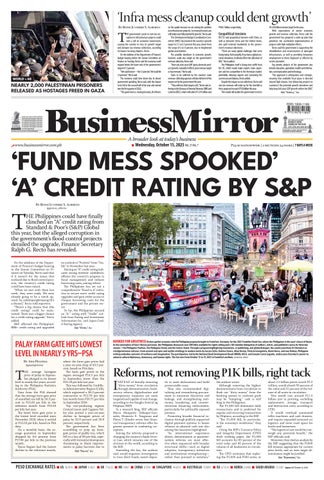
& Poor’s (S&P) Global this year, but the alleged corruption in the government’s flood control projects derailed the upgrade, Finance Secretary Ralph G. Recto has revealed.
On the sidelines of the Department of Finance’s budget hearing to the Senate Committee on Finance on Tuesday, Recto said that if it weren’t for the issues that surfaced due to flood control projects, the country’s credit rating could have been raised.
“When we met with them last week, they were ready. We were already going to be a notch upward. So, nakakapanghinayang [It’s a shame],” Recto told reporters.
“There’s a big chance that [the credit rating] could be maintained. There was a bigger chance for a credit rating upgrade,” Recto added.
S&P affirmed the Philippines’ BBB+ credit rating and upgraded
its outlook to “Positive” from “Stable” in November last year. Having an “A” credit rating indicates strong investor confidence, affirms the country’s progress in fiscal management and reduces borrowing costs, among others.
The Philippines has set out a comprehensive “Road to A” initiative to secure more credit rating upgrades and gain wider access to cheaper borrowing costs for the government and the private sector.
So far, the Philippines secured an “A-” rating with “Stable” outlook from Rating and Investment Information Inc. and Japan Credit Rating Agency.
By Reine Juvierre S. Alberto
THE government’s push to root out corruption in infrastructure projects could take a toll on economic momentum, causing the country to miss its growth target and dampen tax revenue collections, according to Finance Secretary Ralph G. Recto.
On the sidelines of the Department of Finance’s budget hearing before the Senate Committee on Finance on Tuesday, Recto said the economy could expand below the lower end of the government’s target of 5.5 percent.
“We could miss it—the 5.5 percent. We could hit 5.4 percent,” Recto said.
The economy could slow down due to slower government spending, Recto said, with the impact to be felt in the second half of the year and extend into the first quarter of 2026.
“The good news is, moving forward, all of that is
on the upside because we are solving the problem [on infrastructure projects]. So moving forward, you will realize your full potential for growth,” Recto said.
The Development Budget Coordination Committee (DBCC) has lowered the country’s growth target to 5.5 to 6.5 percent this year, down from the range of 6 to 8 percent, due to heightened global uncertainties.
The possible slowdown in economic growth, however, could also weigh on the government’s revenue collection, Recto said.
“Once you miss your GDP (gross domestic product) growth, naturally it affects your revenue target or tax revenues,” Recto said.
Taxes to be collected by the country’s main revenue-collecting agencies will also fall short of the targets set by the government this year.
“They will miss their targets a bit,” Recto said, referring to the Bureaus of Internal Revenue (BIR) and Customs (BOC), which will collect P3.219 trillion and
P958.7 billion, respectively.
Geopolitical tensions
RECTO said geopolitical tensions with China, as well as between China and the United States, also spell external headwinds to the government’s revenue collections.
“There are many global challenges that we’re facing today. And naturally, if you have a global economic slowdown, it will also affect the collections of BOC,” Recto added.
The Philippines itself is facing new tariffs from the US, which would make exports more expensive and less competitive in the American market, potentially reducing exports and worsening the current account balance, Recto added.
Despite the impact on tax collections, Recto said non-tax revenues will make up for the shortfall as this is projected to reach P350 billion this year. This would still enable the government to hit its
P4.520 trillion revenue target for the year.
With expectations of slower economic growth and revenue collection, Recto said the government has prepared a catch-up plan that prioritizes the accelerated implementation of projects with high multiplier effects. Recto said the government is supporting the rehabilitation and reconstruction of damaged infrastructure, as well as providing temporary employment to those displaced or affected by recent calamities.
Top priority projects of the government also include education, agriculture, health and information, communications and technology. “Our approach is anticipatory and strategic, ensuring that available fiscal space is directed toward high-impact, fast-disbursing projects to counteract the potential growth slowdown and help keep
TBy Ada Pelonia @adapelonia
ber plunged to its lowest level in nearly five years, according to the Philippine Statistics Authority (PSA).
Data from the PSA showed that the average farm gate price of unmilled rice fell by 30.5 percent to P15.60 per kilo in the reference month from P22.43 per kilo last year. The latest farm gate price is the lowest level recorded since November 2020, when it settled at P15.03 per kilo, based on PSA data. On a monthly basis, the average quotation in September dropped by 8.6 percent from P17.06 per kilo in the previous month. Ilocos Region had the fastest decline in the reference month,
where the farm gate prices had a year-on-year drop of 43.5 percent, based on PSA data. The farm gate prices in the region averaged P14.3 per kilo in September, lower than the P25.29 per kilo last year. This was followed by Cordillera Administrative Region (CAR), which registered a 38.2-percent contraction to P12.79 per kilo last month from P20.71 per kilo in September 2024.
Top rice-producing regions Central Luzon and Cagayan Valley also posted a year-on-year decline in farmgate prices of palay by 32.9 percent and 36.8 percent, respectively. The government has been scrambling to prop up farmgate prices of paddy rice, which fell to a low of P8 per kilo, especially with torrential downpours threatening to blunt improvements in palay harvests due to
INSTEAD of literally removing “dirty money” from circulation through demonetization, banksecrecy reform, digitalization and transparency measures are more targeted and capable of real change, according to the Bangko Sentral ng Pilipinas (BSP).
In a research blog, BSP officials Maria Margarita Debuque-Gonzales, Mamerto E. Tangonan and Eloisa T. Glindro wrote that financial transparency reforms offer far greater promise in combating corruption.
Among the reforms proposed is changing the country’s Bank Secrecy Law, which remains one of the strictest in the world, according to the BSP.
Amending the law, the authors said, would empower investigators to trace illicit funds, match depos-
its to asset declarations and build prosecutable cases. They also recommended digitalizing and streamlining procurement to minimize discretion and leakage, and strengthening antimoney laundering and counterterrorism financing enforcement, particularly for politically exposed persons.
Promoting broader financial inclusion through publicly supported digital payment systems to lessen reliance on physical cash was also among the measures highlighted.
“As international experience shows, denomination or paymentsystem reforms are most effective when sequenced with broader structural shifts—such as digital adoption, transparency initiatives and institutional strengthening— rather than pursued in isolation,”
the authors wrote. Although removing the highest denominations from circulation to flush out “dirty money” from the banking system to confront graft may be “tempting,” cash is still king in the Philippines.
The P1,000 bill dominates daily transactions and is preferred for regular and recurring transactions by Filipinos, according to the BSP.
“The P1,000 bill, in particular, is the economy’s workhorse,” they said.
Citing the BSP’s Currency Policy and Integrity Department (CPID) draft working paper, the P1,000 bill accounts for 83 percent of the total value and 40 percent of the volume of all banknotes in circulation.
The CPID estimates that replacing the P1,000 and P500 notes, or
about 2.5 billion pieces worth P2.2 trillion, would absorb 93 percent of the value and 51 percent of the volume of all notes in circulation. This would cost around P11.5 billion just in printing, excluding replacement, storage, transport and destruction costs, according to CPID. It would overload automated teller machines and cash drawers, and require expanded armored car logistics and more vault space for banks and businesses.
“The logistical cost would far outweigh any potential benefit,” the BSP officials said.
Moreover, they cited an analysis by the BSP suggesting that the P1000 bill remains appropriate for current price levels, and an even larger denomination might be justified.
By Reine Juvierre S. Alberto
Dalisay, Philippine
See “Infra,” A2
Fund…
The country also holds a “Baa2” rating with “Stable” outlook from Moody’s Ratings.
Recto said that the issue, which has slowed government disbursements and triggered investigations into flood control projects, raised red flags on governance.
“If I were in their shoes, ganun din [I’d react the same way] Governance eh. We have to improve on that,” Recto said.
The Finance chief said during the hearing that “raising revenues is no joke,” with the DOF tasked to collect P4.520 trillion in revenues this year.
“That’s why we at the DOF will never tolerate corruption or wasteful spending,” Recto stressed.
Despite the setback, Recto said the flood control controversy is the start of a cleanup, although it cast a shadow on public spending.
“We only see upside over the next few months. The President himself is the whistleblower of this controversy. And his message is clear: We will never turn a blind eye to corruption,” Recto said.
The controversy may have revealed that not all capital expenditures were translating into growth, but now the government is plugging those leaks and reallocating funds to high-impact investments, including education, healthcare, agriculture and digitalization.
“So, on the part of the DOF, we commit to protect every peso of our taxpayers’ money by ensuring that their taxes are spent on the right things, at the right price, by the right agency and at the right time,” Recto said.
DTI adopts TC rates for imported cement
By Andrea E. San Juan @andreasanjuan
THEDepartment of Trade and Industry (DTI) will slap a safeguard duty on imported cement amounting to P14 per 40-kg bag or P349 per metric ton of Ordinary Portland Cement Type 1 and Blended Cement for a period of three years.
Trade and Industry Secretary Cristina A. Roque announced on Tuesday the agency will adopt the Tariff Commission’s (TC) recommendation to impose the said amount.
With the tariff on imported cement, Roque said in a statement: “The imposition of the safeguard duty will be subjected to dynamic monitoring and review to ensure that prices remain stable and supply stays sufficient to cover demand at any given time.”
DTI, meanwhile, explained that the TC’s recommended safeguard duty rate represents only 3 to 4 percent of prevailing retail prices. Moreover, the Trade department as-
sured consumers that the added cost will not be passed on to them as the safeguard duty “applies solely to imported cement.”
Instead, the agency pointed out that the safeguard measure is intended to level the playing field between domestic manufacturers and importers.
In addition, DTI noted that the excess cash bond paid by importers or the difference between the provisional and final duty assessed will be refunded once the corresponding Department Order is issued.
Supply guarantee MEANWHILE, in light of the recent
earthquakes that have severely affected several areas across the country, Roque underscored the importance of ensuring “adequate and affordable” supply of cement nationwide.
“The DTI will closely monitor the implementation and impact of the safeguard measure on cement prices to prevent any unwarranted price adjustments and to ensure that the duties remain at levels necessary to address the serious injury suffered by the domestic industry,” the agency said in its statement.
Roque also noted that the agency will “actively regulate” the effects of safeguard tariffs to maintain a “balanced” environment where both local manufacturers and cement importers can adapt, compete, and thrive, particularly during period of calamities or supply disruptions.
The Trade department also reaffirmed that the safeguard measure is “temporary, designed to restore fair competition and ensure that consumer welfare is maintained.”
Last week, local cement manufacturers asked the government to raise the safeguard duty on imported cement to P600 per metric ton (MT) to make the local industry competitive.
“We had been hoping for [safeguard duty] of P600 per ton. This is higher than the provisional [duty] of P400,” Cement Manufacturers Association of the Philippines (CEMAP) Executive Director Renato Baja told reporters in an interview on Thursday.
‘Infra
mess cleanup could dent growth’
Continued from A1
In climate…
Continued from A16
tourism and fisheries losses.
Food Insecurity: Reef fisheries supply essential protein to more than 150 million people. Their collapse would severely impact nutrition and local economies.
Disaster Risk: Healthy reefs reduce wave energy by up to 97 percent, acting as natural buffers against storm surges and sea-level rise.
Even under the most optimistic climate scenarios, the report finds that coral reefs are “virtually certain” (>99% probability) to tip.
Preserving any functional reef systems would require reversing global warming to below 1.2°C— and ideally to 1°C.
SEA’s Climate Frontline
THE report highlights Southeast Asia’s broader vulnerabilities, affecting over 600 million people.
In Vietnam, the Mekong Delta— responsible for half the country’s rice production—is under severe threat from rising seas. This poses a direct risk to Philippine food security, as the Philippines imports over 80 percent of its rice from Vietnam, with the bulk sourced from the Mekong region. Any disruption from flooding, saltwater intrusion, or monsoon instabil-
As to the P349 per MT safeguard duty recommended by the Tariff Commission in its final report, Baja said this is “not enough.” (See: https://businessmirror.com. ph/2025/10/09/governmenttold-hike-safeguard-duty-oncement-imports/)
In its report published on September 30, the Tariff Commission recommended a specific duty of P349/ MT as the definitive safeguard measure to be imposed on importations of Ordinary Portland Cement Type 1 and Blended Cement.
Two weeks ago, consumer group United Filipino Consumers and Commuters (UFCC) argued that extending the period of imposition of the P16 tariff per 40-kilo bag on imported blended cement will only jack up prices of local cement, which could undermine competition and burden Filipino consumers.
“The Department Order 25-01 was signed by the Secretary on February 20, 2025. It will take effect for 200 days, so if we count the 200 days, any moment now the 6-7 months or 200 days period will end. So now, we hear that the cartels have an appeal to continue this,” UFCC President Rodolfo B. Javellana Jr. told reporters in Filipino during the consumer group’s protest in front of the building of the Department of Trade and Industry (DTI) in Makati City last September 29. (See: https://businessmirror. com.ph/2025/09/30/dti-tolddont-extend-%e2%82%b116tariff-on-imported-cement/)
assumptions,” Recto said.
“We only see upside over the next few months as the major government cleanup concerning the flood control controversy will lead to stronger institutions, better governance and faster growth,” he added.
ity could impact supply chains and drive-up domestic prices.
Meanwhile, coastal megacities like Bangkok, Ho Chi Minh City, and Jakarta face increasing risks of inundation and infrastructure collapse.
The potential collapse of AMOC adds further concern. Its destabilization could disrupt tropical monsoons, threatening water access and agricultural productivity across Asia.
Monsoon disruption: Over 3 billion people in South and Southeast Asia depend on monsoon systems. A weakened AMOC could reduce rainfall and undermine rice production.
Sea-level rise: Melting polar ice sheets are nearing tipping points that could lock in meters of sea-level rise. For Small Island Developing States (SIDS), including parts of the Philippines, this could mean permanent uninhabitability.
Adaptation limits
THE report warns that tipping points may generate changes so abrupt and widespread that adaptation becomes unfeasible, ineffective, or prohibitively costly.
These “adaptation tipping points” result in residual loss and damage—harms that cannot be avoided, adapted to, or recovered from.
Responding effectively will require expanding Loss and Damage mechanisms to reflect the systemic, irreversible nature of tipping point impacts. This includes rethinking financial instruments, insurance models, and legal responsibilities, while ensuring affected communities receive support beyond what adaptation alone can deliver.
During the 2020 pandemic, withdrawals of P1,000 notes hit P1.3 trillion, showing public reliance on cash as a safe asset.
“Eliminating this denomination could disrupt liquidity, particularly for households and small firms that remain outside the formal financial system,” they said. Retiring high-value notes may appear as a “clean break with the past” by removing “tainted” money from circulation, but it is “deceptive,” the authors added.
“As seen in some developing economies, sudden demonetization can erode confidence in the central bank and fuel suspicion of political motives,” they noted. In developing economies where institutional trust still needs to be nurtured, credibility is hard to regain once lost, they added.
Palace has no stand yet DESPITE the BSP’s opposition to the proposal to “demonetize” P1,000 and P500 bills, Malacañang has yet to rule out the said measure. Palace Press Officer Claire Castro said the Marcos administration is still open to the proposal made by Former Finance Secretary Cesar V. Purisima to phase out said bills and make P200 the highest circulating bill.
Purisma claimed the measure will discourage corrupt officials from moving large amounts of illicit cash. Legislative hearings on the raging flood-control fund anomalies have unearthed practices of physically withdrawing boxes of cash, loading them on to ordinary cars and stocking them in mini-warehouses or even condo units of syndicate cohorts.
“So, we will study it, because if it is not good and has a negative effect [on the public], we will study it to balance the pros and cons of what is being suggested.” she said in Filipino in a press briefing Tuesday.
BSP Governor Eli M. Remolona, Jr. earlier expressed his reservation on the measure since it will cause inconvenience the public, when it comes to using bills. Currently, BSP mandates banks to report transactions, which involve P500,000 or more.
Castro said the economic managers will still look into the matter.
“I will first ask the DOF [Department of Finance] [about the] question so that the answer is more detailed,” she said.
Reine Juvierre S. Alberto with Samuel P. Medenilla
Palay farm gate hits lowest level in nearly 5 yrs
poor grain quality.
President Marcos earlier imposed a temporary ban on foreign rice shipments for 60 days starting September 1, as industry sources claimed that the unabated entry of cheaper imports pulled down the farmgate price.
Agriculture Secretary Francisco Tiu Laurel also announced that the government will extend the import ban until the end of 2025. He added that Marcos is considering restoring the 35-percent rice tariff, which was slashed to 15 percent in July 2024 as part of the government’s effort to bring down retail prices.
“If the tariff hike is approved, well and good,” Tiu Laurel said. “But if not, our fallback plan—already supported by the President— is to allow importation only in January, and suspend it again from February to April to protect the next harvest.”
The DA chief also noted that Marcos would issue an executive order that would set a floor price for unmilled rice, which he said should be P17 per kilo for wet palay.
DOJ turns over 5 more flood-control project related cases to Ombudsman
By Joel R. San Juan @jrsanjuan1573 & Jovee Marie N. Dela Cruz @joveemarie
THE Department of JusticeNational Prosecution Service (DOJ-NPS) has turned over to the Office of the Ombudsman five more cases against officials from the Bulacan’s First District Engineering Office of the Department of Public Works and Highways and several contractors in connection with alleged ghost flood-control projects.
At a press briefing Prosecutor
General Richard Anthony Fadullon said the cases involve malversation under Article 217 of the Revised Penal Code, falsification by public officers under Article 171 of the RPC, perjury under Article 183 of the RPC, and Section 3e of Republic Act 3019 or the Anti-Graft and Corrupt Practices Act.
Fadullon said the cases were referred to the Ombudsman for further evaluation after the DOJ found sufficient evidence to proceed with the preliminary investigation.
“With the turnover of these cases we will just await instructions from the Office of the Ombudsman as to whether or not we can proceed with the preliminary investigation of these cases,” Fadullon said.
Fadullon assured the public that there would be more cases to be turned over to the Ombudsman but asked for patience as there are processes to follow to ensure strong cases against
those involved in the multi-billion anomalous flood control and infrastructure projects. “It doesn’t mean that this ends here. There are more to come, but there is what we call a process that needs to be done wherein we make sure that there is evidence before filing a case,” Fadullon said.
Former Justice Secretary and now Ombudsman Jesus Crispin Remulla also said that more pieces of evidence are still being gathered with regard to the alleged participation of high-ranking government officials and lawmakers in the latest corruption scandal.
It can be recalled that on September 29, the Independent Commission for Infrastructure (ICI) turned over an interim report to the Ombudsman recommending the prosecution of resigned Ako Bicol Rep. Zaldy Co and 17 other individuals for criminal and administrative charges in connection with the P289.5 million anomalous flood control project in Naujan, Oriental Mindoro,
Aftershocks continue to rock quake-hit towns
By Jonathan L. Mayuga @jonlmayuga
AFTERSHOCKS of the 6.9 magnitude earthquake on September 30 near Bogo City, Cebu, and the 7.4 and 6.8 magnitude doublet earthquakes near Manay, Davao Oriental, on October 10, continue to rock the two coastal towns, the Philippine Institute of Volcanology and Seismology (Phivolcs) reported.
Since Day 1, Phivolcs said it has recorded a total of 12,079 aftershocks attributed to the Cebu earthquake. Of these, a
total of 2,139 were plotted and 46 were felt.
The magnitude of these aftershocks ranged from 1 to 5.8.
In the doublet earthquakes near Manay, Phivolcs said it has so far recorded 1,303 aftershocks, of which 618 were plotted and 18 were felt. The magnitudes of these aftershocks range from 1.2 to 5.8.
In Manay, Davao Oriental, three strong aftershocks were recorded on Monday morning.
The first occurred at exactly
implemented by the DPWH.
Among the charges recommended against Co and other DPWH officials were violation of the provisions of Republic Act No. 3019 or the Anti-Graft and Corrupt Practices Act, malversation of public funds under Article 217 of the Revised Penal Code (RPC) in relation to Article 171 of the RPC or falsification of public documents by a public officer.
ICI recommendation
THE ICI also recommended the filing of administrative charges against the said individuals for violation of Sections 4(a), 7 (a) and (b) of the Code of Conduct and Ethical Standards for Public Officials and Employees and other possible violations of Civil Service Rules and Regulations.
The ICI told the Ombudsman that it would submit further evidence in support of its recommendation within 15 days.
The recommendation stemmed from the inspection conducted by DPWH Secretary Vince Dizon of the project that was undertaken by Sunwest, Inc., the construction company being linked to the family of Co.
The project involves the construction of a road dike along MagAsawang Tubig River.
The Commission on Audit has also submitted five fraud audit reports to the Ombudsman covering five anomalous flood-control projects amounting to P341 million which also involves Bulacan’s first district engineering office.
The fraud audit report covers flood-control projects undertaken by three construction firms identified as Wawao Builders,St. Timothy Construction Corporation and SYMS Construction Trading.
Based on the reports, the flood control projects were listed as complete but were found to be in -
existent, incomplete, substandard and lacking required documents.
The DPWH has also charged more than 20 public works officials, personnel and private contractors before the Ombudsman with graft and malversation of public funds for their alleged involvement in the multi-billion anomalous flood control projects in the country.
The respondents were specifically charged with violation of Republic Act No. 3019 or the AntiGraft and Corrupt Practices Act; Article 217 of the Revised Penal Code or Malversation of Public Funds in relation to Articles 171 of the Revised Penal Code; and Republic Act No. 9184 or the Government Procurement Reform Act.
The subject of the complaint were five flood control-projects in Bulacan such as the construction of slope protection in barangay Namayan, Malolos City; construction of pumping station and flood gate in barangay Atlag, Malolos; construction of pumping station and flood gate in barangay Sto. Rosario, Hagonoy; construction of flood control structure in Maycapiz-Talilip River; and construction of reinforced concrete river wall in Purok 4, barangay Piel, Baliuag City.
The complaint said the DPWH’s Internal Audit Service (IAS) inspection conducted from August 13 to August 20, 2025 revealed a “consistent pattern of fraudulent misrepresentation falsification, collusion and blatant disregard” of Commission on Audit regulations across multiple contracts in order to effect the release of payments to the contractors despite non-performance or insufficient performance of the project.
Romualdez appears at ICI AS he testified before the Independent Commission for Infrastructure
(ICI), former Speaker Ferdinand Martin G. Romualdez maintained that he had nothing to hide and was ready to fully cooperate in uncovering the truth behind the allegations related to the national budget process.
“I am here to cooperate fully and help uncover the truth. I have nothing to hide, and there is nothing that should be hidden,” Romualdez said.
He clarified that although he was not part of the bicameral conference committee that finalized the budget, he was willing to share any information that could help shed light on the issues being investigated.
“While I was not part of the bicameral conference committee, whatever I know, I will share,” Romualdez said.
“My purpose is to clarify the issues and share whatever information I can that may help the Commission in its work.”
The Leyte lawmaker stressed that his appearance before the ICI reflected his long-standing belief in transparency and accountability, adding that his only goal was to help ensure that the truth prevails.
“I have always believed in transparency and accountability, and that’s why I am here today—to do my part in ensuring that the truth comes out,” he stated.
Romualdez emphasized that he had no hesitation about facing the inquiry, stressing that he would cooperate in every way possible to hasten the proceedings.
“I am willing to do anything that will help speed up the investigation, because like every Filipino, I want the truth to be established without delay,” he said.
“At the end of the day, it is evidence—not political noise or unfounded accusations—that will reveal what really happened,” Romualdez said.
PHL files protest over dangerous moves by Chinese ships to block PCG, BFAR
THE Department of Foreign Affairs (DFA) has lodged a diplomatic protest against China over the October 12 ramming and water cannon attack on a Philippine fisheries vessel near Pagasa Island in the West Philippine Sea.
Foreign Affairs Secretary Ma. Theresa Lazaro confirmed, during Senate deliberations on the DFA’s proposed 2026 budget, that the protest was filed Tuesday morning.
With this latest filing, the Marcos administration has now submitted 246 diplomatic protests against China since 2022, including 48 in 2025 alone.
The National Maritime Council had earlier condemned the harassment by the China Coast Guard and Chinese maritime militia of the BRP Datu Pagbuaya, a Bureau of Fisheries and Aquatic Resources (BFAR) vessel deployed in the area to assist Filipino fishermen in the area.
‘Dangerous maneuvers’ CHINESE ships, including those from the Peoples Liberation ArmyNavy (PLAN), performed dangerous maneuvers against Philippine ships in an effort to block the distribution of subsidies to Filipino fishers near Bajo de Masinloc and Escoda Shoal on Monday, the Coast Guard (PCG) said.
Commo. Jay Tarriela, PCG spokesperson for the West Phil -
ippine Sea, said PCG as well as Bureau of Fisheries and Aquatic Resources ships were deployed for the mission.
Tarriela said that in the vicinity of Bajo de Masinloc off Zambales, PCG ships BRP Teresa Magbanua and BRP Cape San Agustin, alongside the M/V Mamalakaya and six Bfar patrol boats, conducted the distribution despite “significant challenges.”
“Philippine government vessels encountered dangerous maneuvers and blocking actions from 11 China Coast Guard [CCG] ships and 11 Chinese Maritime Militia vessels, one Peoples‘ Liberation Army Navy (PLAN) helicopter, and three PLAN vessels, delaying the delivery process,” Tarriela said.
For the first time, he said, the PCG documented a CCG radio challenge claiming that the presence of Philippine fishing boats could damage their “environmental reserve.”
“In response, the PCG firmly asserted that Bajo de Masinloc is an integral part of the Philippine archipelago, and only the Philippine government holds the authority to designate environmental protection areas in these waters,” Tarriela said.
On the same day near Escoda Shoal, Tarriela said 10 CCG vessels, 10 Chinese maritime militia vessels, one PLAN helicopter, two
Pampanga civil society: Don’t change the people, change the law
By Ashley J. Manabat
NGELES CITY—Civil so -
Aciety leaders here and in the province of Pampanga expressed support for the holding of a constitutional convention and junked the idea of snap elections.
The leaders mae the call in the wake of the multi-billion peso scandal involving flood-control projects.
They noted that despite mounting evidence of corruption, bloated budgets, substandard infrastructure, and contracts awarded to politically connected companies, no major national figure has advanced a clear reform agenda.
In August, Deputy Speaker Ronaldo Puno called for a Constitutional Convention (Con-Con) to revise the 1987 Constitution. In his privileged speech, the Antipolo lawmaker said a Con-Con was “the most prudent, transparent, and participatory mechanism to address enduring ambiguities and procedural deficiencies in the Charter.”
“Today, I submit to this august Chamber that while the provisions of our Constitution are noble in aspiration, certain provisions are marked by ambiguity and procedural deficiency. These deficiencies do not merely complicate interpretation. They obstruct reform, hinder effective governance and erode public trust,” Puno said.
Civil society groups in this city and in Pampanga said it echoes what local reform advocates have long argued that structural change is needed.
Two reform paths have gained traction in Pampanga. The Pinoy Gumising Ka Movement, led by businessman and civic leader Ruperto Cruz, has long pushed for a Con-Con to rewrite the Constitution and dismantle what he described as a “deeply flawed” political system. Meanwhile, Alexander Cauguiran, co-convenor of the Concerned Citizens of Pampanga advocates for an interim caretaker reform government that would cleanse state institutions before any credible Charter reform can occur.
PLAN ships, and one high-speed response boat (HSRB) attempted to obstruct the aid mission.
“Undeterred, the PCG’s BRP Melchora Aquino and BRP Cabra, supported by five Bfar patrol boats, relied on exceptional seamanship to ensure the safe delivery of supplies,” he added.
Tarriela added that the mission was completed at 7pm on Monday.
“The mission,” he said, “reached more than 50 fishing boats in Bajo de Masinloc and over 40 in Escoda Shoal, providing an estimated 120,000 liters of fuel oil, more than 600 grocery packs, and facilitated the sale of 30 tons of fresh fish catch to the government by local fishermen.”
“This aid underscores the Philippine government‘s unwavering commitment to bolstering the livelihoods of its fisherfolk in traditional fishing grounds within the West Philippine Sea,” he added.
The PCG Commandant, Adm. Ronnie Gil Gavan said, “My top priority is to safeguard their livelihoods from any interference by the CCG and to ensure their rights as Filipinos are never suppressed by external bullying.”
“We stand firmly with President Marcos in defending every square inch of our sovereign territory against any foreign power,” he added.
Though differing in strategy, both movements agree that real reform will not emerge from the same political machinery that enabled systemic corruption.
Cruz argued that attempts to push reform through Congress or the executive branch are futile because the current system is designed to protect entrenched political and economic interests.
“What’s painful is that we are still electing the same lawmakers and lawbreakers,” Cruz said. “They know the way out. And that is also the reason why they will never truly fix the system or reform the structure.”
Cruz rejected proposals for a Constitutional Assembly (ConAss) in which current lawmakers amend the Constitution themselves. Cruz said such a process would only “prolong the problem.” He also proposed redirecting funds from the party-list system and the Sangguniang Kabataan to support a citizen-led Con-Con. He also argued that both mechanisms have been co-opted by dynasties and political operators.
Cruz called for more aggressive anti-corruption legislation including life imprisonment without presidential pardon for graft, perpetual disqualification for plunder and economic sabotage, and the
www.businessmirror.com.ph
‘SALN disclosure not enough, pass FOI bill now’
ABy Jovee Marie N. dela Cruz @joveemarie
S transparency should not end with the disclosure of Statements of Assets, Liabilities, and Net Worth (SALNs), a House leader urged the immediate passage of the long-delayed Freedom of Information (FOI) bill, which has been pending in Congress for nearly three decades.
Las Piñas Rep. Mark Anthony Santos, an assistant majority leader, made a statement after the Office of the Ombudsman vowed to restore public access to the Statements of
PCG.
. .
Continued from A4
Underwater structures at Bajo?
THE Navy (PN), meanwhile, said the military has received reports of underwater structures in Bajo de Masinloc.
“We have received reports of certain structures underwater, which we are verifying,” said Rear Adm. Roy Vincent Trinidad, the Navy’s spokesman for the WPS. However, he said the Navy is checking if these are new installations, because in 1997, China supposedly attempted to build a steel structure in Bajo de Masinloc, which
was blown up by Filipino forces.
“Prior to that, there were also reports of building blocks that were reported in Bajo de Masinloc,” Trinidad said.
“Upon further checking, these were blocks that were installed previous to all the escalation in Bajo de Masinloc during the time of the presence of US bases when Bajo de Masinloc was still used as a bombing range by the US Air Force, the US Navy, and I believe by the Philippine Air Force,” he explained.
US slams China’s ‘dangerous’ actions
WASHINGTON has denounced China’s
Assets, Liabilities, and Net Worth (SALN) of government officials.
Santos said both initiatives are key to strengthening transparency, accountability, and public trust in the government.
“Transparency should not stop with the disclosure of SALNs,” Santos said. “The people have the right to access information about how their government operates and how public funds are spent. The FOI bill will empower citizens to hold their leaders accountable.”
Pending in Congress for over three decades, the FOI bill institutionalizes the people’s constitutional right to access information
recent confrontation with a Philippine government vessel near Pagasa Island in the West Philippine Sea, calling the incident “dangerous” and “destabilizing” to regional peace and security.
Thomas Pigott, principal deputy spokesperson of the US State Department, issued the statement following reports that the Chinese Coast Guard rammed and deployed water cannons against a BFAR vessel conducting routine patrols near Pagasa Island.
“These provocative actions undermine regional stability and violate China’s obligations to resolve maritime disputes peacefully,” Pigott said.
on matters of public concern. It mandates all government agencies to release records, contracts, and transactions upon request, subject to reasonable exceptions.
Santos emphasized that the FOI bill would complement the Ombudsman’s move to reopen access to SALNs, creating a more comprehensive framework for transparency and integrity in public service.
Earlier, the Las Piñas lawmaker also called on the Department of Public Works and Highways (DPWH) to enforce a strict “onestrike policy” against personnel involved in corruption or irregularities. He said decisive action is necessary to regain public trust and ensure that infrastructure
The US official affirmed Washington’s commitment to the Philippines under the 1951 Mutual Defense Treaty, specifically invoking Article IV, which covers armed attacks on Philippine public vessels, aircraft, and armed forces—including coast guard units—anywhere in the South China Sea.
The Philippine government has accused China of deliberately ramming BRP Datu Pagbuaya and using water cannons while the Bfar was anchored near Pagasa Island. Beijing, meanwhile, claims the Philippine ship entered waters under Chinese jurisdiction and acted “recklessly.”
The incident adds to the growing list of confrontations in the contested maritime
funds are properly spent.
He said swift, decisive action is needed to restore public trust and ensure infrastructure funds are spent properly.
“Restoring public access to SALNs is a major victory for transparency, but it should only be the beginning,” Santos added. “We must go further by enacting the FOI law so that transparency becomes the rule, not the exception.”
He also urged his fellow lawmakers to prioritize the measure in this 20th Congress.
The current proposed FOI bill in the House, House Bill 2897, is authored by Reps. Edgar R. Erice of Caloocan, Adrian Michael A. Amatong of Zamboanga del
region, where China’s expansive claims clash with the Philippines’ efforts to assert sovereign rights over its exclusive economic zone.
The West Philippine Sea remains a strategic corridor for global trade and a flashpoint for regional security.
The latest encounter also comes just days ahead of the Association of Southeast Asian Nations Summit in Kuala Lumpur, where Southeast Asian leaders are expected to meet with counterparts from dialogue partners—including US President Donald Trump and Chinese Premier Li Qiang—to discuss regional security, economic cooperation, and maritime stability.
“It’s time to deliver on a promise that has been delayed for far too
said. “Passing the FOI Bill will show that this Congress is serious about good governance
The timing of the incident is likely to sharpen diplomatic focus the ongoing negotiations between ASEAN and China for the Code of Conduct in the South China Sesa. Washington reiterated its support for Manila’s position and urged all parties to uphold the 2016 arbitral ruling and the United Nations Convention on the Law of the Sea (Unclos) in resolving disputes.
‘Continued water cannon use by CCG unacceptable’ A RANKING Navy (PN) officer said the continued use of water cannons by Chinese
See “PCG,” A6
Norte, Arlene J. Bag-ao of Dinagat Islands, Jaime R. Fresnedi of Muntinlupa, Cielo B. Lagman of Albay, Alfonso V. Umali Jr. of Oriental Mindoro, and Leila de Lima of Mamamayang Liberal. In the Senate, the counterpart FOI bill has been filed by Sen. Francis “Kiko” Pangilinan. Senate President Vicente Sotto III also refiled an FOI bill (“People’s Freedom of Information Act of 2025”) as well.
long,” Santos
Wednesday, October 15, 2025
of basic sectors, not political dynasties,” Cauiguiran said.
Continued from A4
abolition of executive sessions in legislative hearings.
“Every hearing should be in plenary,” Cruz said. “We have too many laws. The problem is we do not have enough implementers.”
Cauguiran, meanwhile, warned that any Con-Con formed under current political conditions is vulnerable to elite capture.
“What will be the composition? That’s the problem. Similar to ConAss, the powers that be will call the shots. My position is not simply between Con-Ass and Con-Con, the commission that will recommend changes to the Constitution must be independent and representative
Continued from A4
10 a.m. The aftershock determined to be magnitude 5.6. At exactly 10:19 a.m., another strong aftershock occurred with a magnitude of 4.7. Another aftershock with a magnitude of 4.9 rocked Manay anew. It was magnitude 4.9.
Cauguiran proposed a transitional caretaker government to serve as a bridge from the present crisis to a reformed political order. He said that without cleaning up state institutions and restoring public trust, constitutional reform efforts, however well-intentioned, would be futile.
“The caretaker government is a bridge from the present, after having accomplished its immediate task, to the future,” said Cauiguiran.
“[This is] just my proposal instead of a snap election, that will just change the personalities involved but the old system remains. There must be a radical change,” he added.
Aftershocks such as these can cause further damage and endanger lives, as they can cause buildings that already sustained damage to collapse, Phivolcs said. Phivolcs said aftershocks happen when the rocks start to adjust. Generally, aftershocks weakens in time but sometimes, they also generate strong tremors, the agency added. With Manuel Cayon
Puno had similarly warned of how vague constitutional provisions have undermined the rule of law and cited controversy around the word “forthwith” in the impeachment process which he said had enabled procedural deadlock and undermined accountability.
“A single ambiguous word can become the justification for legislative inaction, procedural manipulation or worse, the erosion of accountability itself,” Puno said.
Puno stressed that his proposal was “not a call to discard the Constitution” but to “complete and correct it.” A Con-Con would be free from conflicts of interest faced by sitting lawmakers and would allow for clearer, more representative, and forward-looking provisions
SALN.
Continued from A5
and the people’s right to know.”
The original author of the Freedom of Information (FOI) Bill in Congress is the late Rep. Ernesto “Ernie” Ruffa of Bulacan, who first filed it in the 8th Congress (1987–1992)
that speak plainly to all citizens. Though Puno’s call stands out as one of the few from within Congress, civil society leaders say the momentum for reform must come from outside. Cauguiran cautioned that the administration will likely attempt to defuse public outrage by filing selective cases against public works officials and a few local politicians where cases that may drag on for years without meaningful resolution.
“Their goal is to manage unrest, not to address the root issues. Ayuda here, elections there—then nothing changes,” Cauguiran said.
Cruz also said that even if a Con-Con is convened, public vigilance is essential to prevent it from being co-opted.
following the ratification of the 1987 Philippine Constitution.
The FOI Bill was intended to operationalize Article III, Section 7 of the Constitution, which guarantees the people’s right to information on matters of public concern.
Since then, several versions have been refiled in every Congress— among the more prominent later
“People will have to vote for the Con-Con. So while they frame it, we also have to see it while they are on it,” Cruz said. “We are only prolonging the agony if we think lawmakers alone will give us the solution.”
Both Cruz and Cauguiran reject the idea that elections alone will resolve the crisis, especially in a system where alleged plunderers are allowed to run and win office without consequence.
“Don’t change the people, change the law,” Cruz said. “We’ve tried changing the people before. Impeachment after impeachment. It didn’t work.”
“The fight against corruption should not stop in the streets,” Cauguiran added. “It must be structural.”
authors and champions were Rep. Lorenzo “Erin” Tañada III (Quezon)—principal author and long-time FOI advocate during the 14th and 15th Congresses by Party-list Reps. Walden Bello of Akbayan, and Teodoro Casiño and Neri Colmenares of Bayan Muna—co-authors and vocal supporters during the Aquino administration.
maritime forces against Philippine ships going about their lawful mandate is unacceptable.
“We have mentioned many times that water cannons are used by ships out at sea to help fight fires, not to endanger lives. This is an unacceptable maritime practice by the Chinese Coast Guard [CCG] of using the water cannons to intimidate other claimant countries in the South China Sea,” Trinidad said.
“Again, so long as their presence will remain there, the potential for escalation, due to their coercive, aggressive actions will remain,” he said.
In wake of China’s latest harassment against Bureau of Fisheries and Aquatic Resources (BFAR) ships in Pagasa Island, Trinidad said the PN has contingency plans for all purposes. He made this comment when asked on what the Armed Forces (AFP) plans to do following the proximity of Sunday’s incident which was placed at 1.6 to 1.8 nautical miles from Pagasa Island.
“The AFP thrives on plans. We have contingency plans for almost any eventuality. So, whether this, we don’t go into the details of these plans but everything has been factored in and we could respond appropriately,” Trinidad noted. Malou Talosig-Bartolome, Jane Magturo and Rex Anthony Naval
Wage board OKs ₧50 to ₧80 daily pay increase in CL
By Justine Xyrah Garcia
MINIMUM wage earners in Central Luzon
will receive a P50 to P80 daily pay increase by the end of October, the National Wages and Productivity Commission (NWPC) announced on Tuesday.
Under Wage Order RBIII-26, the Regional Tripartite Wages and Productivity Board (RTWPB) approved a P50 increase for workers in the nonagriculture, agriculture, and retail and service sectors in Bataan, Bulacan, Nueva Ecija, Pampanga, Tarlac, and Zambales.
The hike will be released in two tranches—P20 upon effectivity and another P30 on April 16.
With this adjustment, the daily minimum wage for non-agriculture workers in these provinces will rise from P550 to P600, while those in the agriculture sector will see their pay increase from P520 to P570.
Workers in the retail and service sector, meanwhile, will receive a higher rate of P540 to P590 per day.
In Aurora province, nonagriculture and agriculture workers will each receive a P60 increase bringing their new daily wages to P560 and P545, respectively.
Those in the retail and service sector will receive the biggest adjustment, with an P80 increase that will raise their pay from P435 to P515 per day.
The RTWPB said the adjustment was based on prevailing regional conditions, including the rise in the Consumer Price Index from 131.1 in October 2024 to 132.6 in August 2025.
The board also cited the 2023 poverty threshold in Region III, pegged by the Philippine Statistics Authority (PSA) at P528 for a family of five, and the region’s 6.5-percent economic growth in 2023 to 2024.
“The Board deemed it just to increase the daily minimum wage, considering the need to restore the purchasing power of the workers’ wages; to progressively close the minimum wagepoverty threshold gap in the region; and to ensure equitable distribution of the fruits of economic growth between workers and employers,” the RTWPB-III said.
Aside from private sector workers, domestic workers (kasambahays) in Central Luzon will also benefit from a P500 monthly increase, bringing the new minimum wage for kasambahays to P6,500.
The new rate covers all domestic workers, whether they live in or outside their employers’ homes, including househelp, nannies (yayas), cooks, gardeners, and laundry workers.
Both wage orders will take effect on October 30.
Economy DAR chief seeks support for farmers amid drop in farmgate price of palay
By Jonathan L. Mayuga @jonlmayuga
AGRARIAN Reform Secretary
Conrado M. Estrella III has called on lawmakers and government agencies to rally behind farmers amid the steep drop in the farmgate price of palay.
Estrella pitched the proposal for the government to directly buy palay from the farmers at a reasonable price for them to cope with the economic hardship.
“Our palay farmers are the backbone of our food security. This caucus is not just a meeting—it is a call to action. We are appealing to all national government agencies, including government-owned and
Gatchalian to
By Butch Fernandez @butchfBM
S-controlled corporations [GOCCs], to rally behind our farmers and directly procure their produced rice,” Estrella said in a statement.
Estrella issued the same appeal when he addressed participants of a Special Caucus initiated by the agency to provide support to rice farmers.
The Special Caucus held recently at the DAR Central Office
CSC:
EN. Sherwin Gatchalian urged the Civil Service Commission to review the entire government workforce and take the cudgels up for contractual and job order employees who remain unqualified for permanent positions.
brought together top national leaders and key stakeholders to safeguard the livelihoods of palay farmers.
Among those in attendance were Agriculture Secretary Francisco Tiu Laurel Jr., Speaker Faustino Dy III, National Food Authority (NFA) Administrator Larry Lacson, House Committee on Agriculture chairman Rep. Mark Enverga, House Agrarian Reform Committee Chairperson Rep. Eleanor Bulut-Begtang, Senate Committee on Agriculture, Food and Agrarian Reform chairman Sen. Francis Pangilinan, and other members of the House of Representatives, and local government executives from rice-producing provinces.
During the caucus, Estrella emphasized the critical need for solidarity across all sectors.
The caucus follows an initial meeting last week with President Marcos during which the group raised the plight of palay farmers
and discussed potential interventions. Following a series of dialogues with other concerned officials, the caucus announced that it will formally submit a recommendation to the chief executive urging him to issue a policy statement requiring all government institutions, including GOCCs, to procure locally produced rice.
This proposed directive aims to create immediate demand for local palay harvests, offer price stability, and ensure government-led support for the agricultural sector.
Dy expressed full legislative support for emergency interventions to ensure fair farmgate prices.
“We must protect the dignity of our farmers. We will continue to push for policies and budget support that ensure fair farmgate prices and national food security,” Dy said.
For his part, Pangilinan emphasized “the caucus is geared
towards policy announcement for the national government agencies (NGAs), GOCCs, and LGUs to only purchase rice that is locally produced.
The DAR said the initiative underlines the government’s commitment to upholding the welfare of farmers’ communities and ensuring that no farmer is left behind during the peak of harvest. The caucus also identified immediate measures to stabilize palay prices, including bulk procurement by government agencies and institutional buyers, mobilization of post-harvest facilities, and coordination with the NFA to boost buying capacity.
Also present during the meeting were Gov. Dakila Carlo Cua of Quirino province and president of the Governors League of the Philippines, Gov. Rodito Albano of Isabela, and Mayor Inno Dy of Echague, Isabela, and president of the Mayors League of the Philippines.
Take up cudgels for job order, contractual employees
During the hearing on the CSC’s proposed 2026 budget, Gatchlian who chairs the Committee on Finance noted that while unfilled positions in the government continue to increase, the number of job order and contract of service workers is also on the rise.
Currently, there are a combined 919,868 job order and contractual employees in the entire government bureaucracy, accounting for about a third of the total government workforce.
“Counterintuitive iyon. Dapat i -fill up ‘ ang authorized positions para may security of tenure
that will improve morale, will also make them eligible kung makapasa sila sa examination, at makakakuha pa sila ng benefits,” Gatchalian said.
The CSC explained that these workers are outside the CSC’s jurisdiction, with the DBM and COA overseeing them, and that the three agencies are discussing possible benefits and longer terms for these workers.
“The CSC should take the cudgels up for the job order and contractual employees. The government functions as one. If you need a law, we will support, or maybe an executive order would suffice,” said Gatchalian.
Marcos aims to complete ₧27.5-B farm-to-market bridges program
PBy Samuel P. Medenilla @sam_medenilla
RESIDENT Marcos wants to fast-track the completion of the P27.7-billion Farmto-Market Bridges Development Program (FMBDP) within his term, Malacañang said. The project, which was approved by the Economy and Development Council in June, aims to build at least 300 bridges from 2026 to 2029.
“Of course, before he ends his term; he wants it to be completed before the end of his term,” Palace Press Officer Claire Castro said in Filipino on Tuesday.
When asked when the FMDBP would be rolled out, she said, “before the end of Christmas season.”
The said bridges will be located in 52 provinces with “strong agricultural potential but limited road connectivity, the Department of Agriculture said.
Marcos included the FMBDP in his presentation to farmers during the inauguration of the P500million Union Water Impounding Dam in Cagayan on Tuesday.
He also discussed the implementation of the Rice Competitiveness Enhancement Fund (RCEF) mechanization program as well as the completion of the new dam as part of the efforts of his administration to boost the country’s agricultural productivity.
The President said the Union Water Impounding Dam, he said, was proof that the government can complete a flood control infrastructure, which also provides irrigation, within a short period.
“This means we have proven that it is possible to create good flood control that is effective.
As long as the construction is done properly, the design is done
properly, and the implementation is done properly, we will not see any problems,” Marcos said in Filipino in his speech during the opening of the dam.
The dam, which was completed in 14 months by the Department of Public Works and Highways (DPWH) and the National Irrigation Administration (NIA), features a sluice gate system to regulate river flow.
It is expected to irrigate up to 3,600 hectares, and benefit more than 1,000 farmers in seven barangay.
While in Cagayan, Marcos also inspected the almost complete Camalaniugan Bridge linking Aparri and Camalaniugan town— the longest cable-stayed bridge in Cagayan Valley.
Upon its completion, the travel time between two towns will be reduced from one hour to 20 minutes and benefit 6,000
travelers a day.
The construction of the bridge started in May 2020 and is expected to be completed by September 30, 2025 but construction was stopped during the Covid 19 shutdown.
“We are looking at one of the most beautiful bridges that we have created in the Philippines.
And I’m happy to note that it was done as well in time and it was done properly,” Marcos said when he inspected the bridge.
“The design was done locally. Kahit parang ginaya ‘iyong mga tulay sa ibang bansa, talagang ito lahat galing sa atin [It may look like the bridges in other countries but this is really ours],” he added, emphasizing that Filipino engineers are capable of world-class design and execution.
The President also highlighted the bridge’s integrated flood control systems, saying it reflects
what proper infrastructure should look like.
He commended local officials, led by Cagayan Gov. Edgar Aglipay, for vigilantly monitoring the project to ensure it did not fall into the trap of incomplete or ghost infrastructure.
An additional P260.2 million is still needed to complete the remaining works, with full completion expected by January 2026.
Marcos, however, expressed hope that the bridge could be opened to the public “by Christmas.”
Once operational, the bridge will serve as an alternate route to
the old Magapit Suspension Bridge and cut travel time between Aparri and Ballesteros from one hour to just 20 minutes, benefiting over 6,000 commuters daily. With PNA
A8 Wednesday, October 15, 2025
Nearly 2,000 Palestinian prisoners released as hostages freed in Gaza
By Sam Metz & Jalal Bwaitel The Associated Press
BEITUNIA, West Bank—Cheers erupted among Palestinians on Monday as Israel released nearly 2,000 prisoners under a Gaza ceasefire agreement that saw them exchanged for Israeli hostages freed by Hamas.
Large crowds greeted the freed prisoners in Beitunia in the Israelioccupied West Bank and in Khan Younis in Gaza, flashing V-forvictory signs as they descended from International Committee of the Red Cross buses. In Beitunia, they were given traditional keffiyeh scarves as a show of nationalist pride. Some were lifted onto people’s shoulders. Others sank into chairs, exhausted.
“It was an indescribable journey of suffering—hunger, unfair treatment, oppression, torture and curses—more than anything you could imagine,” said Kamal Abu Shanab, a 51-year-old from the West Bank town of Tulkarem who was released after more than 18 years in prison. His face was gaunt. He said he lost 139 pounds (59 kilograms) in prison.
“We don’t recognize him. He’s not the person we knew. Our uncle doesn’t look like our uncle,” said his niece, Farah Abu Shanab.
A military court in 2007 convicted Abu Shanab of “military trainings, voluntary manslaughter and membership in an unrecognized organization,” according to Israel’s list of exchanged prisoners. He was arrested that year during an Israeli raid targeting members of the armed wing of Fatah, the political party that runs the Palestinian Authority in the West Bank.
Those freed include around 1,700 of the several thousand Palestinians that Israeli troops seized
from Gaza during the two-year war and have held without charge.
Also, among those released were 250 Palestinians sentenced to prison terms, most of them convicted for deadly attacks on Israelis dating back decades, as well as others convicted on lesser charges, according to Israel’s Justice Ministry. Of those, Israel exiled 154, sending them to neighboring Egypt, where officials said they will be sent to third countries. The rest were returning to homes in east Jerusalem, the West Bank and Gaza.
A profound moment THE releases have powerful resonance on both sides.
For Israelis, they’re deeply painful, since some of those released were convicted over attacks that killed civilians and soldiers. For Palestinians, the issue of prisoners is politically charged. Nearly everyone has a friend or family member who has been jailed by Israel, particularly young men.
While Israel views the prisoners as terrorists, many Palestinians consider them as freedom fighters resisting a decades-long Israeli military occupation. Reports from the UN, rights groups and detainees detailing conditions while held— including isolation, beatings, insufficient food and illness—have made prisoners prominent symbols of their people’s political struggle. Israel says it adheres to its prison standards under law and investigates any reports of violations.
In Khan Younis, thousands of people cheered and celebratory gunfire rang in the air. The freed Palestinians filed out wearing gray jumpsuits and entered the hospital for medical examinations.
Israeli forces detained thousands of Palestinians during the war in raids on shelters and hospitals and at checkpoints stopping families as they fled their homes amid military operations.
Families often had no idea their relatives had been detained, and it often took months to determine if they were in Israeli custody, if confirmation came at all. Most were held under laws passed in Israel at the start of the war that allowed Palestinians to be detained for months as “unlawful combatants” without judicial review or access to lawyers.
Monday’s release still leaves about 1,300 Palestinians from Gaza in Israeli custody, according to a count of detainees in September by the Israeli human rights group HaMoked.
Warnings not to celebrate CELEBRATIONS in the West Bank occurred despite Israeli warnings against doing so. A flier circulated saying anyone supporting what it called “terrorist organizations” risked arrest.
Palestinians gathered on hills
overlooking Ofer Prison. An armored Israeli vehicle drove up and fired tear gas and rubber bullets. As drones buzzed overhead, the crowd scattered.
Israel’s military did not respond to questions.
Who is on the list
ACCORDING to a list issued by Hamas, the Gaza detainees freed include two women, six teenagers under 18 and around 30 men over 60.
The list of 250 convicted prisoners freed, ranging in age from 19 to 64, includes 159 affiliated with Fatah, and 63 associated with Hamas. The remainder are unaffiliated or belong to other groups.
Many were arrested in the early 2000s, which saw the Second Intifada break out, a Palestinian uprising fueled by anger over continued Israeli occupation despite years of peace talks. Palestinian armed groups carried out attacks that killed hundreds of Israelis, and the Israeli military killed several thousand Palestinians.
Some were convicted in military trials that rights advocates say often lack due process. Others have been incarcerated for months or years without trial in what is known as administrative detention. Israel says the practice, widely criticized by Palestinians and
human rights groups, is needed to prevent attacks and avoid sharing sensitive intelligence.
The Hamas list did not include roughly half a dozen highestprofile prisoners, including Marwan Barghouti, Hassan Salameh, Ahmed Saadat and Abbas AlSayyed. Barghouti is widely seen as a potential successor to Palestinian President Mahmoud Abbas.
A list of released prisoners issued by Israel includes the following:
Raed Sheikh
A 51-YEAR-OLD Palestinian police officer and Fatah member, Sheikh was sentenced to multiple life terms in 2000 for his role in the killing of two Israeli soldiers who were attacked by a mob at a West Bank police station, including one thrown from the station’s window.
Mahmoud Issa
A 57- YEAR-OLD Hamas commander imprisoned for life in 1993—before the Oslo interim peace accords—Issa was among those convicted of kidnapping and killing a 29-year-old Israeli border police officer that year. Much of his more than three decades behind bars were spent in solitary confinement, conditions that have made him a symbol among prisoners’ rights advocates.
Shamasneh brothers
The two brothers—56-yearold Mohammed and 62-year-old Abdel Jawad Shamasneh—were sentenced in 1993 to multiple life terms for their role in a stabbing attack that killed Israeli hitchhikers whose bodies were later found in a Jerusalem riverbed in 1990 during the first Palestinian intifada.
Iyad Fatafta
A 47-YEAR-OLD Fatah member
serving a life sentence, Fatafta was one of two men convicted of murder for stabbing American tourist Kristine Luken and a friend who was hiking with her and survived.
The Associated Press writer Lee Keath in Cairo contributed to this report.
Editor: Angel R. Calso
Malaysia, US push for expanded Thailand-Cambodia ceasefire deal
KUALA LUMPUR, Malaysia—Malaysia and the US are facilitating efforts to secure an expanded ceasefire agreement between Thailand and Cambodia that they hope will be signed during a Southeast Asian summit later this month, Malaysia Foreign Minister Mohamad Hasan said Tuesday. Thailand and Cambodia engaged in five days of combat in late July that killed dozens of people and displaced more than 260,000. They agreed to a ceasefire only after mediation by Malaysia’s Prime Minister Anwar Ibrahim and pressure from US President Donald Trump, who threatened to withhold trade privileges unless they agreed on a truce.
Tensions have remained high since the truce, particularly after Thai soldiers were injured by land mines in August while patrolling a buffer zone between the countries. Thailand accused Cambodia of laying new mines in violation of the ceasefire, which the government in Phnom Penh has strongly denied.
Thailand Prime Minister Anutin Charnvirakul has said Phnom Penh must accept four conditions. They include removal of heavy weapons from the border, land mine clearance, assistance to curb cross-border crime and management of sensitive border zones to avoid further conflicts.
Mohamad said ongoing negotiations aim to broaden the ceasefire to include land mine clearance and withdrawal of heavy weapons. He expressed optimism that an agreement could be signed during the Association of Southeast Asian Nations summit Oct. 26-28, which is expected to draw some two dozen global leaders.
Trump is scheduled to attend the conference in Malaysia’s capital, Kuala Lumpur, on Oct. 26 and hopes to witness the signing of the Kuala Lumpur Accord between Thailand and Cambodia, Mohamad said.
Asean includes Brunei, Cambodia, Laos, Indonesia, Malaysia, Myanmar, the Philippines, Thailand, Vietnam and Singapore.
Russian airstrikes target Kharkiv hospital; Zelenskyy to seek advanced US weapons
KBy Illia Novikov
The Associated Press
YIV, Ukraine—Russian forces launched powerful glide bombs and drones against Ukraine’s second-largest city in overnight attacks, hitting a hospital and wounding seven
people, an official said Tuesday, as Ukrainian President Volodymyr Zelenskyy prepared to travel to Washington and ask US President Donald Trump for more American military help.
The Russian attack on Kharkiv in Ukraine’s northeast hit the city’s main hospital, forcing the evacua -
tion of 50 patients, regional head Oleh Syniehubov said. The attack’s main targets were energy facilities, Zelenskyy said, without providing details of what was hit.
“Every day, every night, Russia strikes power plants, power lines, and our (natural) gas facilities,” Zelenskyy said on Telegram.
Russian long-range strikes on its neighbor’s power grid are part of a campaign since Moscow launched a full-scale invasion in February 2022 to disable Ukraine’s power supply, denying civilians heat and running water during
See “Airstrikes,” A12
A PALESTINIAN prisoner makes the victory sign after being released from an Israeli prison as part of a ceasefire deal between Israel and Hamas, upon his arrival in the West Bank city of Ramallah, Monday, Oct. 13, 2025. AP/MAJDI MOHAMMED
Egypt’s president says Trump’s Middle East proposal is ‘last chance’ for peace in region
By Fay Abuelgasim & Sarah El Deeb
The Associated Press
SHARM EL SHEIKH, Egypt—The Egyptian president told a summit of world leaders Monday that US President Donald Trump’s Mideast proposal represents the “last chance” for peace in the region and reiterated his call for a two-state solution, saying Palestinians have the right to an independent state.
The summit in Egypt’s Red Sea resort town of Sharm el-Sheikh was aimed at supporting the ceasefire reached in Gaza, ending the Israel-Hamas war and developing a long-term vision for governing and rebuilding the devastated Palestinian territory.
The gathering appeared designed to rally international support behind the Trump vision for putting an end to the war. Egyptian leader Abdel Fattah el-Sissi, the co-chair of the summit, told Trump “only you” can bring peace to the region.
Trump’s plan holds out the possibility of a Palestinian state, but only after a lengthy transition period in Gaza and a reform process by the internationally recognized Palestinian Authority. Israeli Prime Minister Benjamin Netanyahu opposes Palestinian independence. Trump made no mention of a two-state solution at the summit.
In his own address to the summit, Trump called for a new era of harmony in the Middle East, saying that the region has “a once-ina-lifetime chance to put the old feuds and bitter hatreds behind us.” He urged leaders “to declare that our future will not be ruled by the fights of generations past.”
Israel and Hamas came under pressure from the United States,
Arab countries and Turkey to agree on the first phase of the ceasefire deal negotiated in Qatar through mediators. It began Friday.
On Monday, Trump, el-Sissi, the Qatari emir and the Turkish president signed a document. Trump said the document spelled out “a lot of rules and regulations and lots of other things, and it’s very comprehensive.” The document was not shared with journalists in the room or made public.
The summit unfolded soon after Hamas released 20 remaining living Israeli hostages and Israel started to free hundreds of Palestinians from its prisons, crucial steps under the ceasefire. But major questions remain over what happens next, raising the risk of a slide back into war.
More than 20 world leaders attended the summit, including King Abdullah of Jordan, the French president and the British prime minister.
A Turkish government official said Turkey launched “a diplomatic initiative” to prevent Israeli Prime Minister Benjamin Netanyahu from attending the meeting, and after other countries backed the effort, Netanyahu decided not to come.
The official would not confirm Turkish media reports that Turkish President Recep Tayyip Erdo -
gan’s plane circled over the Red Sea as Erdogan threatened to boycott the meeting and that the plane landed only after it became clear that Netanyahu would not arrive. The official spoke on condition of anonymity in line with government rules.
Earlier, Iraqi Prime Minister Mohammed Shia al-Sudani had warned Egyptian and US officials that he would withdraw from the summit if Netanyahu attended, according to the state-run Iraqi News Agency.
Netanyahu’s office announced that he would not attend, citing a Jewish holiday.
Israel has rejected any role in Gaza for the internationally backed Palestinian Authority, whose leader, Mahmoud Abbas, was in Sharm el-Sheikh.
A new page
EL-SISSI’S office said the summit aimed to “end the war” in Gaza and “usher in a new page of peace and regional stability” in line with Trump’s vision.
Directly tackling the issues in depth was unlikely at the gathering, which lasted only about three hours and was mostly ceremonial.
During the summit, world leaders lined up one by one to have their photos taken with Trump, who smiled and gave a thumbs-up to photographers. Then el-Sissi welcomed Trump, invited him to the stage and asked him to join world leaders “who love peace.”
Before Trump arrived in Egypt from Israel, Egyptian Air Force jets escorted Air Force One for a spin above the resort.
Egyptian Foreign Minister Badr Abdelatty said the success of Trump’s vision for Mideast peace will depend on his continued commitment to the process, including applying pressure to the parties and deploying military forces as part of an international contingent expected to carry out peacekeeping duties in the next phase.
“We need American engagement, even deployment on the ground, to identify the mission, task and mandate of this force,” Abdelatty told The Associated Press.
Under the first phase, Israeli troops pulled back from some parts of Gaza, allowing hundreds of thousands of Palestinians in Gaza to return home from areas they were forced to evacuate. Aid
groups are preparing to bring in large quantities of aid kept out of the territory for months.
In separate remarks, Pakistani Prime Minister Shehbaz Sharif praised Trump’s efforts to promote peace in several parts of the world. Pakistan, he said, had nominated him for a Nobel Peace Prize for his role in helping ease tensions between India and Pakistan.
Critical challenges ahead
THE next phase of the deal will have to tackle disarming Hamas, creating a post-war government for Gaza and handling the extent of Israel’s withdrawal from the territory. Trump’s plan also stipulates that regional and international partners will work to develop the core of a new Palestinian security force.
Abdelatty said the international force needs a U.N. Security Council resolution to endorse its deployment.
He said Hamas will have no role in the transitional period in Gaza. A 15-member committee of Palestinian technocrats, with no affiliation with any Palestinian factions and vetted by Israel, will govern day to day affairs in Gaza.
The committee would receive support and supervision from a “Board of Peace” proposed by Trump to oversee the implementation of the phases of his plan, Abdelatty said.
“We are counting on Trump to keep the implementation of this plan for all its phases,” he told AP.
Another major issue is raising funds for rebuilding Gaza. The World Bank, and Egypt’s postwar plan, estimate reconstruction and recovery needs in Gaza at $53 billion. Egypt plans to host an early recovery and reconstruction conference for Gaza in November.
Roles for other countries
TURKEY, which hosted Hamas political leaders for years, played a key role in bringing about the ceasefire agreement.
Jordan, alongside Egypt, will train the new Palestinian security force.
Germany, one of Israel’s strongest international backers and top suppliers of military equipment, was represented by Chancellor Friedrich Merz. He has expressed concern over Israel’s conduct of the war and its plan for a military takeover of Gaza.
British Prime Minister Keir Starmer, who also attended, has he said will pledge 20 million British pounds ($27 million) to help provide water and sanitation for Gaza and that Britain will host a three-day conference on Gaza’s reconstruction and recovery.
Iran, a main backer of Hamas, did not attend. The Islamic Republic finds itself at one of its weakest moments since its 1979 revolution. Iranian officials have portrayed the ceasefire deal as a victory for Hamas.
The deal, however, has underlined Iran’s waning influence in the region and revived concerns over possible renewed conflict with Israel as Iran struggles to recover from the 12-day war between the two countries in June.
El Deeb reported from Cairo. Associated Press Writer Suzan Fraser in Ankara, Turkey, contributed to this report.
Gaza ceasefire brings hope, challenges: Hostages and prisoners freed, but future remains unclear
By Melanie Lidman, Samy Magdy & Wafaa Shurafa
The Associated Press
ERUSALEM—Israel and Hamas moved ahead on a key first step of the tenuous Gaza ceasefire agreement on Monday by freeing hostages and prisoners, raising hopes that the US-brokered deal might lead to a permanent end to the two-year war that ravaged the Palestinian territory.
But thornier issues such as whether Hamas will disarm and who will govern Gaza—and the question of Palestinian statehood—remain unresolved, highlighting the fragility of an agreement that for now only pauses the deadliest conflict in the history of Israel and the Palestinians.
For Israelis, the release of the 20 remaining living hostages brought elation and a sense of closure to a war many felt they were forced into by Hamas, although many pledged to fight on for the return of deceased hostages still in Gaza. But with the living hostages freed, the urgency with which many were driven to call for an end to the war will likely diminish, easing pressure on Israeli Prime Minister
Benjamin Netanyahu to advance the next phases of the agreement.
Four deceased hostages were returned to Israel on Monday, and another 24 are supposed to be turned over as part of the first phase of the ceasefire, which also requires Israel to allow a surge of food and other humanitarian aid into Gaza.
While there was an outburst of joy in Gaza for prisoners returning from Israel and hope that the fighting may wind down for good, the torment drags on for war-weary Palestinians. Gaza has been decimated by Israeli bombardment; there is little left of its prewar economy, basic services are in disarray and many homes have been destroyed. It remains unclear who will pay for reconstruction, a process that could take years.
Israel says the deal achieves its war objectives
US President Donald Trump traveled to the region to celebrate the deal. In an address to Israel’s parliament, he urged lawmakers to seize a chance for broader peace in the region. In Egypt, he and other world leaders gathered to set the trickier parts of the deal into motion.
Netanyahu, who according to his
office did not join the meeting in Egypt because of a Jewish holiday, told parliament that he was committed to the agreement, saying it “ends the war by achieving all our objectives.” Israel had said it would not end the war until all the hostages were freed and Hamas was defeated.
Critics accused Netanyahu of allowing the war to drag on for political reasons, which he denied.
The war began with Hamas’
Oct. 7, 2023, attack, when militants killed 1,200 people and took 251 captives. Israel’s retaliatory campaign killed more than 67,000 people, according to Gaza’s Health Ministry, which does not differentiate between combatants and civilians in its count. The ministry is part of the Hamas-run government. Its figures are seen as a reliable estimate by the UN and many independent experts.
The war has rippled across the Middle East, with conflict erupting between Israel and the Lebanese Hezbollah, Iranian-backed rebels in Yemen and Iran itself.
Israel is elated by the return of the living hostages ISRAELIS watched with jubilation in public screenings attended by thousands as the 20 living hostages, all male, reunited with their families. Crowds broke into cheers, as tears of joy streamed down relieved faces.
“You are alive! Two arms and two legs,” said Zvika Mor, upon seeing his son Eitan for the first time in two years.
When Bar Kupershtein was reunited with his family, his father,
Tal, who uses a wheelchair after a car accident and stroke, fulfilled a promise to himself by standing up for a few minutes to embrace his freed son.
Unlike previous releases, Hamas held no ceremonies for the captives before freeing them. Instead, families received video calls from masked militants who allowed them a first glimpse at their loved ones before they came home.
The plight of the hostages had widespread support in Israel, where thousands would join the families for weekly protests demanding Israel secure their release.
PRESIDENT Donald Trump and other world leaders pose for
photo during
VUCCI
Wall Street soars as Trump eases tariff tensions, S&P 500 gains 1.6% in strong market rebound
By Stan Choe AP Business Writer
NEW YORK—And back up goes Wall Street. US stocks rallied Monday after President Donald Trump said “ it will all be fine,” just days after he sent the market reeling by threatening much higher tariffs on China.
The S&P 500 jumped 1.6% in its best day since May and recovered just over half its drop from Friday. The Dow Jones Industrial Average climbed 587 points, or 1.3%, and the Nasdaq composite leaped 2.2%.
“Don’t worry about China,” Trump said on his social media platform Sunday. He also said that China’s leader, Xi Jinping, “doesn’t want Depression for his country, and neither do I. The U.S.A. wants to help China, not hurt it!!!”
It was a sharp turnaround from the anger Trump displayed on Friday, when the S&P 500 tumbled to its worst drop since April after he accused China of “ a moral disgrace in dealing with other Nations.”
Trump pointed to “an extremely hostile letter” from China describing curbs to exports of rare earths, which are materials used in the manufacturing of everything from personal electronics to jet engines. Trump said at the time that he may place an additional 100% tax on imports from China starting on Nov. 1. For its part, China urged the United States to resolve differences through negotiations instead of threats. “We do not want a tariff war but we are not afraid of one,” the Commerce Ministry said in a statement posted online. Hours later, Trump posted his less confrontational talk about China on Truth Social. The backtrack
in anger, which also came before trading began on Wall Street, raised hopes that the world’s two largest economies could find a way to allow global trade to continue smoothly.
The down-and-up moves for the market echoed its manic swings during April. That’s when Trump shocked investors with his “Liberation Day” announcement of worldwide tariffs, only to eventually relent on many to give time to negotiate trade deals with other countries.
If this time ends up similarly, potentially even after a sharp drop for stock prices, subsiding trade tensions and uncertainty could allow for a rolling recovery to continue into 2026, according to Morgan Stanley strategists led by Michael Wilson. To be sure, the US stock market may have been primed for a drop. It was already facing criticism that prices had shot too high following a torrid 35% run for the S&P 500 from a low in April. The index, which dictates the movements for many 401(k) accounts, is still near its all-time high set last week.
Not only did Trump’s backdown from tariffs help stocks soar since April, so did expectations for several cuts to interest rates by the Federal Reserve to help the economy. Critics say the market looks too
expensive now after prices rose much faster than corporate profits. Worries are particularly high about companies in the artificialintelligence industry, where pessimists hear echoes of the 2000 dot-com bubble that imploded.
Broadcom jumped 9.9% for one of Monday’s biggest gains in the S&P 500 after announcing a collaboration with OpenAI. Broadcom will help develop and deploy custom AI accelerators that the maker of ChatGPT will design. For stocks broadly to look less expensive, either prices need to
China retaliates against US shipbuilding probe, bans dealings with Hanwha Ocean subsidiaries
By Chan Ho-Him AP Business Writer
HONG KONG—China’s
Commerce Ministry
said Tuesday it was banning dealings by Chinese companies with five subsidiaries of South Korean shipbuilder Hanwha Ocean in the latest swipe by Beijing at US President Donald Trump’s effort to rebuild the industry in America.
The ministry also announced that it was investigating a probe by Washington into China’s growing dominance in world shipbuilding, and threatened more retaliatory measures. It said the US probe endangers China’s national security and its shipping industry and cited Hanwha’s involvement in the investigation.
The US Trade Representative launched the Section 301 trade investigation in April 2024. It determined that China’s strength in the industry was a burden to US businesses.
“China just weaponized shipbuilding,” said Kun Cao, deputy chief executive at consulting firm Reddal. “Beijing is signaling it will hit third-country firms that help Washington counter China’s maritime dominance.” International shipping and shipbuilding have yet another area of friction between Washington and Beijing. Each side has imposed new port fees on each other’s vessels that took effect on Tuesday.
South Korea and the US have been building closer ties in shipbuilding in response to China’s dominance as the world’s largest shipbuilder.
In late 2024, Hanwha Ocean acquired the Philly Shipyard in Pennsylvania for $100 million.
THE
It announced in August that it plans to invest $5 billion in new docks and quays as part of its support for US efforts to restore globally competitive shipbuilding capacity.
Last year, Hanwha Ocean secured contracts with the US Navy to perform maintenance, repair and overhaul work for US naval vessels.
The company said via email that “Hanwha Ocean is aware of the announcement made by the Chinese government and is closely reviewing its potential business impact on the company.”
Hanwha Ocean’s shares traded in South Korea fell as much as over 8% on Tuesday, closing 5.8% lower.
In a statement to The Associated Press, South Korea’s Foreign Ministry said the Seoul government was assessing how the sanctions might affect the Hanwha companies and related South Korean industrial sectors.
The ministry said it will “communicate with relevant ministries, industry representatives and the Chinese side to minimize damages resulting from these measures.”
The sanctioned entities are Hanwha Shipping LLC, Hanwha Philly Shipyard Inc., Hanwha Ocean USA International LLC, Hanwha Shipping Holdings LLC and HS USA Holdings Corp.
A truce in the trade war between the world’s two biggest economies appears to have unraveled after US President Donald Trump threatened a new 100% tariff on imports from China, expressing frustration over new Chinese export controls on rare earths.
The escalation of antagonisms raised doubts over whether Trump and Chinese leader Xi Jinping will go ahead with a meeting planned for late this month. But Beijing said on Tuesday that China and the US held working-level talks on Monday
and have maintained communication.
China said its new port fees would apply to ships owned by US companies or other entities or individuals, those operated by US entities including those having a US stake of 25% or more, vessels flying a US flag and vessels built in the United States, mirroring in many aspects the US’s port fees on Chinese ships.
US businesses represents just 2.9% of world fleet ownership by capacity and 0.1% of global shipbuilding tonnage. Trump has vowed to help rebuild the industry as part of his broader push to expand US-based manufacturing.
China accounts for more than half of all new shipbuilding, with South Korea at about 30% and Japan just over a tenth of the total.
Hanwha Ocean said in May that it was withdrawing from a joint venture in China.
fall, or companies’ profits need to rise.
That’s raising the stakes for the upcoming earnings reporting season, with big US companies lined up to say how much profit they made during the summer. JPMorgan Chase, Johnson & Johnson and United Airlines are some of the big names on the calendar this coming week.
Fastenal tumbled 7.5% for the largest loss in the S&P 500 after the maker of fasteners and safety supplies reported a profit for the latest quarter that was slightly
weaker than analysts expected. All told, the S&P 500 rose 102.21 points to 6,654.72. The Dow Jones Industrial Average climbed 587.98 to 46,067.68, and the Nasdaq composite rallied 490.18 to 22,694.61. At Bank of America, strategist Savita Subramanian is optimistic that S&P 500 companies can deliver a bigger overall profit than analysts expected. Besides reports showing a resilient US economy, she also pointed in a BofA Global Research report to how the US dollar’s weakening against other currencies boosts the value of big US companies’ sales made overseas. In stock markets abroad, indexes edged higher in Europe following losses in Asia, which had their first opportunity to react to Trump’s threat from Friday of additional tariffs on China. Stocks fell 1.5% in Hong Kong and 0.2% in Shanghai. China reported its global exports rose 8.3% in September from a year earlier, the strongest growth in six months and further evidence that its manufacturers are shifting sales from the United States to other markets.
AP Business Writers Matt Ott and Elaine Kurtenbach contributed.
Nations meet to consider regulations to drive a green transition in shipping
By Jennifer Mcdermott & Sibi Arasu The Associated Press
THE world’s largest maritime nations are gathering in London on Tuesday to consider adopting regulations that would move the shipping industry away from fossil fuels to slash emissions.
If the deal is adopted, this will be the first time a global fee is imposed on planetwarming greenhouse gas emissions. Most ships today run on heavy fuel oil that releases carbon dioxide and other pollutants as it’s burned.
Nations are meeting at the International Maritime Organization headquarters through Friday. The Trump administration unequivocally rejects the proposal and has threatened to retaliate if nations support it, setting the stage for a fight over the climate deal.
In April, IMO member states agreed on the contents of the regulatory framework. The aim is to adopt it at this meeting.
That would be a major win for the climate, public health, the ocean and marine life, said Delaine McCullough at the Ocean Conservancy.
For too long, ships have run on crude, dirty oil, she said.
“This agreement provides a lesson for the world that legally-binding climate action is possible,” McCullough, shipping program director for the nonprofit environmental advocacy group, said.
Shipping emissions have grown over the last decade to about 3% of the global total as trade has grown and vessels use immense amounts of fossil fuels to transport cargo over long distances.
Here’s what to know:
The regulations would set a pricing system for gas emissions
THE regulations, or “Net-zero Framework,” sets a marine fuel standard that decreases, over time, the amount of greenhouse gas emissions allowed from using shipping fuels. The regulations also establish a pricing system that would impose fees for every ton of greenhouse gases emitted by ships above allowable limits, in what is effectively the first global tax on greenhouse gas emissions.
There’s a base-level of compliance for the allowable greenhouse gas intensity of fuels. There’s a more stringent direct compliance
target that requires further reduction in the greenhouse gas intensity.
If ships sail on fuels with lower emissions than what’s required under the direct compliance target, they earn “surplus units,” effectively credits.
Ships with the highest emissions would have to buy those credits from other ships under the pricing system, or from the IMO at $380 per ton of carbon dioxide equivalent to reach the base level of compliance. In addition, there’s a penalty of $100 per ton of carbon dioxide equivalent to reach direct compliance. Ships that meet the base target but not the direct compliance one must pay the $100 per ton penalty, too.
Ships whose greenhouse gas intensity is below a certain threshold will receive rewards for their performance.
The fees could generate $11 billion to $13 billion in revenue annually. That would go into an IMO fund to invest in fuels and technologies needed to
TRADERS James Bodner, foreground, and Chris Lagana work on the floor of the New York Stock Exchange, Monday, Oct. 13, 2025. AP/RICHARD DREW
Kaimana Hila at the Philly Shipyard in Philadelphia, on March
Madagascar president flees as military unit joins widespread anti-government protests
By Sarah Tetaud & Gerald Imray
The Associated Press
ANTANANARIVO, Madagascar—Madagascar
President Andry Rajoelina said he has fled the country in fear for his life following a military rebellion but did not announce his resignation in a speech broadcast on social media late Monday from an undisclosed location.
Rajoelina has faced weeks of Gen Z-led anti-government protests, which reached a pivotal point on Saturday when an elite military unit joined the protests and called for the president and other government ministers to step down. That prompted Rajoelina to say that an illegal attempt to seize power was underway in the Indian Ocean island and leave the country.
“I was forced to find a safe place to protect my life,” Rajoelina said in his late-night speech, which was also meant to be shown on Madagascar television but was delayed for hours after soldiers attempted to take control of the state broadcaster buildings, according to the president’s office.
The speech was ultimately broadcast on the presidency’s official Facebook page but not on national TV. They were Rajoelina’s first public comments since the CAPSAT military unit turned against his government in an apparent coup and joined thousands of protest
ers rallying in a main square in the capital, Antananarivo, over
the weekend.
Rajoelina called for dialogue “to find a way out of this situation” and said the constitution should be respected. He did not say how he left Madagascar or where he was, but a report claimed he was flown out of the country on a French military plane.
A French Foreign Ministry spokesperson declined to comment on that report. Madagascar is a former French colony and Rajoelina reportedly has French citizenship, which has been a source of discontent for some Madagascans for years.
The anti-government protests began on Sept. 25 over chronic water and electricity outages but have snowballed into wider discontent with Rajoelina and his government.
It is the most significant unrest in the island nation of 31 million people off the east coast of Africa since Rajoelina himself first came to power as the leader of a transitional government following a 2009 military-backed coup.
The same elite CAPSAT military unit that rebelled against
Rajoelina was prominent in him first coming to power in 2009. Elite unit claims to control the military RAJOELINA hasn’t identified who was behind this attempted coup, but the CAPSAT unit has said it now controls all the armed forces in Madagascar and has appointed a new officer in charge of the military, which was accepted by the defense minister in Rajoelina’s absence.
CAPSAT appears to be in a position of authority and also has the backing of other military units, including the gendarmerie security forces.
A commander of CAPSAT, Col. Michael Randrianirina, said the army had “responded to the people’s calls” but denied there was
a coup. Speaking at the country’s military headquarters on Sunday, he told reporters that it was up to the Madagascan people to decide what happens next, and if Rajoelina leaves power and a new election is held.
Randrianirina said his soldiers had decided to stand with protesters and had exchanged gunfire with security forces who were attempting to quell weekend protests, and one of his soldiers was killed. But there was no major fighting on the streets, and soldiers riding on armored vehicles and waving Madagascar flags were cheered by people in Antananarivo.
The US Embassy in Madagascar still advised American citizens to shelter in place because of a “highly volatile and
unpredictable” situation. The African Union urged all parties, “both civilian and military, to exercise calm and restraint.”
Weeks of protests
MADAGASCAR has been shaken by three weeks of deadly antigovernment protests that were initially led by a group calling itself “Gen Z Madagascar.”
The United Nations says the demonstrations left at least 22 people dead and dozens injured and criticized Madagascan authorities for a “violent response” to what were largely peaceful protests in the early days of the movement. The government has disputed the number of deaths.
The demonstrators have brought up a range of issues, including poverty and the cost of
living, access to tertiary education, and alleged corruption and embezzlement of public funds by government officials, as well as their families and associates.
Civic groups and trade unions also joined the protests, which resulted in nighttime curfews being enforced in Antananarivo and other major cities. Curfews were still in effect in Antananarivo and the northern port city of Antsiranana.
The Gen Z protesters who started the uprising have mobilized over the internet and say they were inspired by the protests that toppled governments in Nepal and Sri Lanka.
History of political crises
MADAGASCAR has had several leaders removed in coups and has a history of political crises since it gained independence from France in 1960.
The 51-year-old Rajoelina first came to prominence as the leader of a transitional government following the 2009 coup that forced then-President Marc Ravalomanana to flee the country and lose power. Rajoelina was elected president in 2018 and reelected in 2023 in a vote boycotted by opposition parties.
Madagascar’s former prime minister under Rajoelina and one of the president’s closest advisers have also fled the country and arrived in the nearby island of Mauritius in the predawn hours Sunday, the Mauritian government said. Mauritius said it was “not satisfied” that the private plane had landed on its territory.
Imray reported from Cape Town, South Africa. Associated Press writer John Leicester contributed to this report from Paris.
China and the US have long collaborated in ‘open research’; some in Congress say that must change
By Didi Tang & David Klepper The Associated Press
WASHINGTON—For many years, American and Chinese scholars worked shoulder to shoulder on cutting-edge technologies through open research, where findings are freely shared and accessible to all. But that openness, a long-standing practice celebrated for advancing knowledge, is raising alarms among some US lawmakers.
They are worried that China— now considered the most formidable challenger to American military dominance—is taking advantage of open research to catch up with the US on military technology and even gain an edge. And they are calling for action.
“For far too long, our adversaries have exploited American colleges and universities to advance their interests, while risking our national security and innovation,” said Sen. Tom Cotton, an Arkansas Republican and chair of the Senate Intelligence Committee. He has introduced legislation to put new restrictions on federally funded research collaboration with academics at several Chinese institutions that work with the Chinese military, as well as institutions in other countries deemed adversarial to US interests.
The House Select Committee on the Chinese Communist Party makes it a priority to protect American research, having accused Bei -
jing of weaponizing open research by converting it into a “pipeline of foreign talent and military modernization.”
The rising concerns on Capitol Hill threaten to unravel deep, two-generations-old academic ties between the countries even as the world’s two largest economies are moving away from each other through tariffs and trade barriers. The relationship has shifted from engagement to competition, if not outright enmity.
“Foreign adversaries are increasingly exploiting the open and collaborative environment of US academic institutions for their own gain,” said James Cangialosi, director of the National Counterintelligence and Security Center, which in August issued a bulletin urging universities to do more to protect research from foreign meddling.
The House committee released three reports in September alone. They targeted, respectively, Pentagon-funded research involving military-linked Chinese scholars; joint US-China institutes that train STEM talent for China; and visa policies that have brought military-linked Chinese students to Ph.D. programs at American universities. The reports recommend more legislation to protect US research, tighter visa policies to vet Chinese students and scholars and an end to academic partnerships that could be exploited to boost China’s military powers.
Deep ties between Chinese and US research
MORE than 500 US universities and institutes have collaborated with Chinese military researchers in recent years, helping Beijing develop advanced technologies with military applications, such as anti-jamming communications and hypersonic vehicles, according to a report by the private US intelligence group Strider Technologies.
Despite efforts in recent years by the US government to set up guardrails to prevent such collaboration from boosting China’s military capabilities, the practice is still prevalent, according to Strider, based in Salt Lake City, Utah.
The report identified nearly 2,500 publications produced in collaboration between US entities and Chinese military-
affiliated research institutes in 2024 on STEM research, which includes physics, engineering, material science, computer science, biology, medicine and geology. While the number peaked at more than 3,500 in 2019, before some new restrictive measures came into effect, the level of collaboration remains high, the report said.
This collaboration not only facilitates “potential illicit knowledge transfer,” but supports China’s “state-directed efforts to recruit top international talent, often to the detriment of US national interests,” the report said. Foreign countries can exploit American research by stealing secrets for use in military and commercial settings, by poaching talented researchers for foreign companies and universities and by recruiting students and
researchers as potential spies, authorities say.
Fostering a climate of robust academic research takes funding and long-term support. Stealing the fruits of that labor, however, can be as easy as hacking into a university network, hiring away researchers or coopting the research itself. That’s why, authorities say, it’s so tempting for American adversaries looking to take advantage of US institutions and research.
The most recent threat assessment report from the Department of Homeland Security highlights concerns that American adversaries—and China specifically—seek to illicitly acquire US technology. Authorities say China aims to steal military and computing technology that might give the US an advantage, as well as the latest commercial innovations.
Industry seeks a balance
ABIGAIL COPLIN , assistant professor of sociology and science, technology and society at Vassar College, said there are already guardrails for federally funded research to protect classified information and anything deemed sensitive.
She also said open research goes both ways, benefiting the US as well, and restrictions could be counterproductive by driving away talents.
“American national security interests and economic competitiveness would be better served by
continuing—if not increasing— research funding than they are by implementing costly research restrictions,” Coplin said. Arnie Bellini, a tech entrepreneur and investor, also said efforts to protect US research risk stifling progress if they go too far and prevent US colleges or startups from sharing information about new and emerging technology. Keeping up with China will also require big investments in efforts to protect innovation, said Bellini, who recently donated $40 million to establish a new cybersecurity and AI research college at the University of South Florida. Bellini said it’s imperative to encourage research and development without giving secrets away to America’s enemies. “In the US, it is a reality now that our digital borders are under siege—and businesses of every size are right to be concerned,” Bellini said. According to Department of Justice figures, about 80% of all economic espionage cases prosecuted in the US involve alleged acts that would benefit China. Some members of Congress have pushed to reinstate a Department of Justice program created during the first Trump administration that sought to investigate Chinese intellectual espionage. The so-called “China Initiative” ended in 2022 after critics said it failed to address the problem even as it perpetrated racist stereotypes about Asian American academics.
SOLDIERS are welcomed by crowds assembling for a ceremony honoring the demonstrators who lost their lives during the recent antigovernment protests in Antananarivo, Madagascar, Sunday, Oct. 12, 2025. AP/MAMYRAEL
A12 Wednesday, October 15, 2025
Ombudsman officially gives public access to SALNs of govt officials
TAirstrikes. . .
the bitter winter.
By Joel R. San Juan @jrsanjuan1573
HE Office of the Ombudsman has formally reopened to public access the statements of assets, liabilities, and net worth (SALNs) of government officials and called on other branches of the government to align their practices with this new policy.
In a statement read by Assistant Ombudsman Jose Dominic Clavano IV, the Ombudsman said the new policy is guided by a simple principle: “The public has a legitimate right to know how those in government acquire and manage their wealth.”
“As the Ombudsman has emphasized, transparency is the name of the game. At a time when trust in institutions is tested, the best way to rebuild confidence is through openness
backed by concrete access to information,” the statement read.
The Ombudsman also urged all agencies that keep official copies of SALNs such as the Civil Service Commission, the Office of the President, Congress, the Judiciary, and local government units—to do the same.
“Consistency across institutions is key; selective transparency only breeds suspicion,” the Ombudsman said.
On Tuesday, Ombudsman Je -
sus Crispin Remulla issued a new memorandum circular providing guidelines on public access to SALNs filed with his office.
The new circular effectively rescinded Memorandum Circular No. 1 issued by former Ombudsman Samuel Martires which restricted public’s access to SALNs of elected officials.
Under the Memorandum Circular No.1 issued by Martires, SALNs were only to be released if the request was made by the government official concerned, or his or her representative; if it was legally ordered by the court in relation to a pending case; and if it was made through the Office of the Ombudsman’s field investigation office for the purpose of a fact-finding probe.
However, under the new memorandum circular SALNs filed with the Ombudsman will be made available to the public for inspection and reproduction after they have been processed and recorded into the official repository but not earlier than 10 working days after the final submission deadline from all government agencies.
It also requires agency heads to
collect and submit SALNs of their personnel to the Ombudsman, along with a summary report, by May 31 every year, without a grace period except in cases of force majeure or other meritorious grounds.
A request for a copy of SALN must be filed with any public assistance and corruption prevention office (PACPO) at the central office of the Ombudsman or any public assistance corruption prevention bureau’s sectoral offices which will then be forwarded to the appropriate office within the Ombudsman.
The circular added that all requests for SALNs must be made by filling up the prescribed request form and that the requesting party must present two identification cards.
The circular also said that a request for SALN may be denied based on the following reasons: If the Ombudsman is not the official repository; the requested SALN is not on file; the request is for an unauthorized commercial purpose; the requesting party has a derogatory record of misuse; the request is linked to a pending case to influence or harass; there is evidence of extortion or safety
threats; the identity of the requesting party is fictitious; or the purpose is contrary to law, morals or public policy.
“All requests shall be acted upon within a reasonable period,” the circular stated.
Likewise, under the new guidelines, the Ombudsman will redact or omit sensitive personal details from any SALN copy released to the public to protect the privacy of the declarant and their family.
These include the complete home address, names, and birth details of minor children, signatures, and government-issued identification numbers of the declarant and their spouse.
For those who intend to use the SALN for media reports or for public dissemination, the requesting party is required to submit a copy or accessible link of their published work to the Ombudsman within five calendar days from.
“Non-submission of the required output may be considered a violation of the requesting party’s undertaking and shall be a ground for denying future SALN requests from the same individual or organization.”
Survey: Filipinos demand accountability in ghost flood control corruption probe
By Claudeth Mocon-Ciriaco @claudethmc3
WHILE the probe of the Independent Commission for Infrastructure (ICI) is still ongoing, the call to hold corrupt officials and contractors accountable emerges as the dominant national sentiment with a clear majority of Filipinos expresses outrage and frustration over corruption in government infrastructure projects, particularly those involving flood control, based on the latest Tugon ng Masa (TNM) Survey of OCTA Research focused on Probe on Corruption in Government Infrastructure Projects.
The survey conducted from September 25 to 30, 2025, using faceto-face interviews, also showed that 8 in 10 Filipinos support President Ferdinand Marcos decision to expose corruption, viewing it as a necessary step toward restoring public trust.
The top five outcomes that adult Filipinos hope to achieve from the investigation of ICI, tasked to investigate flood control corruption within the last 10 years are:
n Holding corrupt officials and contractors accountable (68 percent)
n Recovery of lost or misused
The fate of the hostages was a central driver of a movement in Israel to end the war. Many Israelis viewed Netanyahu’s twin goals of freeing the captives and defeating Hamas as incompatible.
Israeli Defense Minister Israel Katz said any delay by Hamas in retuning the remaining bodies of deceased hostages would be viewed as a violation of the ceasefire deal.
Israel frees some 1,900 Palestinian prisoners LARGE crowds greeted freed prisoners in Beitunia in the Israelioccupied West Bank and in Khan
public funds (58 percent)
n Imprisonment of those proven guilty (58 percent)
n Ensuring efficient implementation of quality flood control projects (41 percent)
n Strengthening transparency and monitoring of government infrastructure projects (34 percent)
Support is strongest in the National Capital Region with 85 percent and among Class ABC (82 percent), underscoring a broad and urgent public demand for justice and institutional accountability.
The recovery of lost or misused public funds ranks second, alongside the imprisonment of those proven guilty—both viewed as critical steps to restore public trust in government, according to the survey with 1,200 male and female probability respondents aged 18 and above. This survey has a ±3 percent margin of error at a 95 percent confidence level.
Support for fund recovery is a majority sentiment across most groups, except in Mindanao (49 percent) and Class E (43 percent), where it is slightly lower.
Meanwhile, imprisonment for offenders garners consistent majority backing across demographics, indicating the public’s strong desire for punitive consequences
Younis in Gaza. The prisoners flashed V-for-victory signs as they descended from buses that took them either to the West Bank, Gaza or into exile.
“Praise be to God, our Lord, who has honored us with this release and this joy,” said Mahmoud Fayez, who was returned to Gaza after being detained early last year in an Israeli raid on the main Shifa Hospital.
The prisoners include 250 people serving life sentences for convictions in attacks on Israelis, in addition to 1,700 seized from Gaza during the war and held without charge.
The fate of the prisoners is a sensitive issue in Palestinian society, where almost everyone knows
against corruption.
Likewise, Filipinos expect concrete reforms, including the efficient implementation of quality flood control projects and enhanced transparency and monitoring systems to prevent future misuse of funds.
“Taken together, these findings reveal a clear and uncompromising public mandate: Filipinos demand not only the exposure of wrongdoing but also decisive action, justice, and longterm reform to safeguard the integrity of public institutions and infrastructure programs,” the survey said.
Strong national support for greater transparency and accountability AN overwhelming 83 percent of adult Filipinos expressed agreement with Marcos’ decision to publicly expose corruption in government flood control projects, even if it may have political consequences for him. This reflects strong national support for greater transparency and accountability in the handling of public funds.
Only 3 percent disagreed, while 13 percent remained ambivalent on the issue.
Across major geographical areas, support for the President’s stance is highest in the National Capital Region (91 percent), fol -
or is related to someone who has been imprisoned by Israel. They are viewed by Palestinians as freedom fighters.
Trump celebrates the deal in Israel and Egypt IN his Knesset speech, Trump told Israeli lawmakers their country must now work toward peace.
“Israel, with our help, has won all that they can by force of arms,” Trump said. “Now it is time to translate these victories against terrorists on the battlefield into the ultimate prize of peace and prosperity for the entire Middle East.”
His speech was briefly interrupted when two Knesset members staged a protest and were
lowed closely by Balance Luzon (90 percent). Agreement is somewhat lower in the Visayas (64 percent) and Mindanao (78 percent), where ambivalence is more pronounced, reaching 24 percent and 16 percent, respectively.
Taken together, these results, according to the survey, indicates a strong reservoir of public goodwill and trust for the President’s decision to confront corruption head-on. “The findings suggest that sustained transparency and follow-through on reforms could further strengthen public confidence in government integrity and leadership.”
Outrage towards corruption
Most adult Filipinos or 60 percent reported feeling anger or outrage when they think about corruption in government, particularly in projects such as flood control initiatives.
This strong emotional response highlights the public’s continued frustration over the misuse of public funds in infrastructure programs and may suggest declining confidence in the integrity of public institutions.
Meanwhile, 30 percent expressed fear or anxiety, reflecting concern about the impact of corruption on government performance and service delivery.
subsequently removed from the chamber. One held up a small sign reading, “Recognize Palestine.”
In Egypt, President Abdel-Fattah el-Sissi and Trump attended a summit with leaders from more than 20 countries on the future of Gaza and the broader Middle East. Palestinian leader Mahmoud Abbas, who administers parts of the West Bank, also attended.
Despite Trump’s optimism, many thorny issues remain AMONG the most difficult issues left to resolve is Israel’s insistence that a weakened Hamas disarm. Hamas refuses to do that and wants to ensure Israel pulls its troops completely out of Gaza. So far, the Israeli military has
The Ukrainian leader urged foreign countries to help blunt Russia’s long-range attacks by providing more air defense systems for the country, which is almost the size of Texas and hard to defend from the air in its entirety.
“We are counting on the actions of the US and Europe, the G7, all partners who have these systems and can provide them to protect our people,” Zelenskyy said. “The world must force Moscow to sit down at the table for real negotiations.”
Zelenskyy is due to meet with Trump in Washington on Friday. The talks are expected to center on the potential US provision to Ukraine of sophisticated longrange weapons that can hit back at Russia.
Trump has warned Moscow that he may send Tomahawk cruise missiles for Ukraine to use. Such a move, previously ruled out by Washington for fear of escalating the war, would deepen tensions between the United States and Russia.
But it could provide leverage to help push Moscow into negotiations after Trump expressed frustration over Russian President Vladimir Putin’s refusal to budge on key aspects of a possible peace deal.
Another 9 percent reported feelings of sadness or disappointment.
Across major geographical areas, anger or outrage remains the dominant emotion, though it is somewhat lower in Mindanao (46 percent) compared to the Visayas (63 percent), Balance Luzon (64 percent), and NCR (59 percent).
Across age groups, the majority of adult Filipinos expressed anger or outrage over corruption in government projects—an emotion especially pronounced among younger Filipinos, particularly Gen Z and millennials.
In contrast, this sentiment is slightly lower at 44 percent among those aged 65 to 74.
Feelings of fear or anxiety range from 18 percent among those aged 55–64 to 45 percent among those aged 65–74.
Meanwhile, sadness or sorrow varies between 2 percent and 14 percent, lowest among the youngest group (18–24) and peaking among respondents aged 55–64 and 75 and above.
“Overall, the findings highlight a strong emotional mandate for reform, with the public expressing both moral outrage and deep apprehension toward corruption in government projects—signaling a growing demand for accountability, transparency, and decisive government action.”
withdrawn from much of Gaza City, the southern city of Khan Younis and other areas. Troops remain in most of the southern city of Rafah, towns of Gaza’s far north, and along the length of Gaza’s border with Israel.
The future governance of Gaza remains unclear. Under the US plan, an international body will govern the territory, overseeing Palestinian technocrats running day-to-day affairs. Hamas has said Gaza’s government should be worked out among Palestinians.
The plan envisions an eventual role for Abbas’ Palestinian Authority—something Netanyahu has long opposed—but it requires the authority to undergo reforms. The plan calls for an Arab-led
Tomahawks would sharpen Ukraine’s ability to fight back against Russia, though its longrange attacks are already taking a toll on Russian oil production, Ukrainian officials and foreign military analysts say. Its strikes using newly developed long-range missiles and drones are causing significant gas shortages in Russia, according to Zelenskyy.
A10
Concerns over biofuels produced from food crops HEAVY fuel oil, liquefied natural gas and biodiesel will be dominant for most of the 2030s and 2040s, unless the IMO further incentivizes green alternatives, according to modeling from Transport and Environment, a Brussels-based environmental nongovernmental organization.
The way the rules are designed essentially make biofuels the cheapest fuel to use to comply, but biofuels require huge amounts of crops, pushing out less profitable food production, often leading to additional land clearance and deforestation, said Faig Abbasov, shipping director at T&E. They are urging the IMO to promote scalable green alternatives, not recklessly promote biofuels produced from food crops, Abbasov said. As it stands now, the deal before the IMO won’t deliver net-zero emissions by 2050, he added. Green ammonia will get to a price that it’s appealing to ship owners in the late 2040s— quite late in the transition, according to the modeling. The NGO also sees green methanol playing an important role in the long-term transition.
international security force in Gaza, along with Palestinian police. Israeli forces would leave areas as those forces deploy. About 200 US troops are in Israel to monitor the ceasefire.
The plan also mentions the possibility of a future Palestinian state, another nonstarter for Netanyahu.
Magdy reported from Cairo and Shurafa from Deir al-Balah, Gaza Strip. Associated Press writers Josef Federman in Truro, Massachusetts; Bassem Mroue in Beirut; Jalal Bwaitel and Sam Metz in Ramallah, West Bank; Sam Mednick in Tel Aviv, Israel, and Elena Becatoros in Athens, Greece, contributed to this report.
DepEd, PHIVOLCS join forces to ensure science-based class suspension decisions
THE Department of Education (DepEd) is strengthening coordination with the Philippine Institute of Volcanology and Seismology (PHIVOLCS) to ensure that class suspension decisions are guided by scientific data, localized risk assessments, and safety standards, following the recent earthquakes that struck parts of Cebu and Davao Oriental.
Education Secretary Juan Edgardo “Sonny” Angara said that the partnership aims to balance the protection of learners and personnel with the Department’s goal of sustaining education amid disasters and emergencies.
“ Sa usapin ng kalamidad, bukod sa maagap, dapat eksakto rin ang kilos. Kaya mahalaga ang pakikipag-ugnayan sa PHIVOLCS para ang bawat desisyon, mula sa pagsuspinde ng klase hanggang sa pagpapatuloy ng pag-aaral, ay nakabatay sa siyensya at hindi sa pangamba ,” Angara said, noting that the move is in line with the directive of President Ferdinand Marcos.
“ Nang makita ko mismo ang pinsala ng lindol sa Cebu at Davao Oriental, mas nauunwaan natin gaano kahalaga ang tamang datos at koordinasyon. Sa tulong ng PHIVOLCS, masisiguro nating ang bawat hakbang ng DepEd ay mabilis, ligtas, at may batayang siyentipiko,” he added.
To enhance disaster readiness, PHIVOLCS, led by Department of Science and Technology (DOST) Secretary Renato Solidum Jr., and DepEd discussed the need to ensure that schools located near fault lines are “over-engineered” to withstand strong earthquakes.
DepEd, likewise, expressed the need for specialized partnership with PHIVOLCS for training programs that would build the capacity of regional and field offices to assess building integrity and manage appropriate response actions during earthquakes.
The Department also proposed the establishment of a DepEd Command Center in coordination with PHIVOLCS, which could serve as a monitoring hub for disaster response and early warnings.
DepEd said personnel can be trained to use checklist-based procedures that trigger automatic alerts once certain safety conditions are met—ensuring faster and more coordinated responses during emergencies.
Finally, both DepEd and PHIVOLCS committed to strengthening coordination in releasing science-based advisories and information materials to ensure public trust and prevent misinformation during crises.
Continuity of learning
MEANWHILE , Angara emphasized that preparedness must go hand in hand with the continuity of learning.
Under DepEd Order No. 22, s. 2024 or the Revised Guidelines
on Class and Work Suspension in Schools During Disasters and Emergencies, the authority to suspend classes rests with the Local Chief Executive (LCE), Schools Division Superintendent (SDS), and school heads. DepEd stressed that decisions must be based on PHIVOLCS advisories, field conditions, and the readiness to resume learning as soon as possible.
DepEd also cited DepEd Order No. 21, s. 2015, which tasks Regional Offices to monitor prevention, mitigation, and preparedness measures, ensuring that learning continues even when schools are affected by natural hazards.
DepEd reiterated that preventive suspensions should activate learning continuity plans such as modular, online, or take-home learning while safety inspections are ongoing.
Balance public safety with learning continuity
WHILE DepEd respects the authority of the local governments to suspend classes in the interest of public safety, it reminded that extended suspensions can “disrupt” learning and affect students’ development.
Also, DepEd strongly encourages local governments to periodically assess whether the suspension is still necessary for public safety.
Dennis E. Legaspi, Chief Media Relations Officer, said that the responsibility of extending class suspensions must be exercised with “balance and prudence.”
“While caution is important, extended suspensions can disrupt learning and affect students’ development. Every decision should reflect both care for safety and commitment to learning continuity,” he said
The DepEd Central Office will also be coordinating with the respective Schools Division Offices to ensure that alternative delivery modes are deployed to affected learners.
“We will ensure that learning continuity is prioritized at all costs,” Legaspi added.
The provincial government of Laguna announced the suspension of face-to-face classes in all public and private schools from October 14 to 31, 2025.
Learners will observe alternative learning modes.
In a Facebook Live broadcast on Saturday, Governor Sol Aragones said, they are preparing for a potential “worst-case scenario,” following the series of earthquakes that struck different parts of the country.
The decision, Aragones said, was reached following an emergency consultation local government units (LGUs) and other concerned agencies, as a precaution against potential seismic activity along the West Valley Fault (WVF).
The WVF runs through Bulacan, Rizal, Metro Manila, Cavite, and Laguna. Claudeth S. Mocon-Ciriaco
54 Pasig families get units in new NHA project
By Bless Aubrey Ogerio
ABOUT 54 families in Pasig City received
DOTr urges European investors to bankroll big transport projects
By Lorenz S. Marasigan @lorenzmarasigan
THE Philippines is stepping up efforts to establish itself as a “vital investment hub” for big ticket transportation projects, with a Cabinet official courting European investors to help bankroll the country’s infrastructure drive.
Speaking before members of the European Union–Association of Southeast Asian Nations (EU-Asean) Business Council,
Acting Transportation Secretary Giovanni Lopez said the Department of Transportation (DOTr) is expediting the rollout of major infrastructure projects.
“We are filled with optimism that the EU-Asean Business Council sees the boundless opportunities in the Philippines that will drive our economic growth and address the social needs of our people,” he said.
Lopez said the government is committed to partnering with foreign investors across all trans -
port sectors—aviation, railways, maritime, and road.
During the meeting, Lopez outlined several areas where the Philippines hopes to collaborate with European investors, including coordination with the Department of Public Works and Highways (DPWH) on railway infrastructure projects, stricter implementation of air, seaport, and road transport regulations, and the Public Transport Modernization Program.
The government is also pro -
PHL, Brunei sign MOU to enhance agri-fisheries cooperation and trade
TBy Ada Pelonia @adapelonia
HE Philippines and Brunei
forged an agreement that would strengthen cooperation in agriculture and fisheries and boost trade.
The memorandum of understanding (MOU) signed between the Department of Agriculture (DA) and Brunei’s Ministry of Primary Resources and Tourism outlines collaboration on research, exchange of expertise, and market access promotion between the neighboring countries.
According to the DA, the MOU would take effect once both parties confirm compliance with their respective domestic procedures through diplomatic channels.
The agreement also comes at a
time when bilateral trade tips in favor of Brunei, which had a $224 million trade surplus in 2024.
Under the MOU, areas of cooperation include livestock and poultry development, disease prevention, high-yield crop technologies, and downstream processing in agriculture and fisheries.
The DA noted that capacitybuilding efforts, such as joint training, technical visits, and the sharing of publications, studies, and technical data were also underscored in the MOU.
Both nations also committed to facilitating agrifood investment and trade through information sharing, especially in sanitary and phytosanitary standards and market access requirements.
The MOU also provides a framework for policy coordination and
knowledge exchange, according to the agency.
The agreement employs mechanisms for protecting intellectual property, handling research outcomes, and maintaining confidentiality of shared information.
“This agreement reflects the shared goals of the Philippines and Brunei, good neighbors in Southest Asia, to strengthen agri-fisheries systems and enhance food security through collaboration, innovation, and responsible development,” Agriculture Secretary Francisco Tiu Laurel Jr. said.
Both nations recognized that the MOU highlights long-standing diplomatic and economic ties, while laying the groundwork for mutually beneficial cooperation in the face of regional and global food system challenges.
Bam pushes thorough check of school buildings’ structural integrity amid serial quakes, storms
ABy Butch Fernandez @butchfBM
S local government units in some areas call for a “pause” from face-to-face schooling amid serial disasters and spreading viral infections, can the “break” be used to check the structural integrity of schools?
This question was raised on Tuesday after the Department of Education (DepEd) gave an initial assessment of how much it would cost to repair and rebuilds public schools damaged by recent earthquakes in the south: P4 billion.
Senator Bam Aquino questioned whether public schools can withstand strong earthquakes, and will file a resolution seeking to assess the readiness of public school buildings across the country in the event of strong earthquakes, following recent tremors in various areas.
tee on Basic Education, speaking mostly in Filipino.
Aquino emphasized the importance of ensuring the safety and structural integrity of school buildings, especially after the admission of former Department of Public Works and Highways (DPWH) Assistant District Engineer Brice Hernandez that all infrastructure projects in Bulacan from 2019 to the present were substandard, including classrooms.
“ Kapag ang pondo sa mga paaralan ay kinurakot at binudol, pinapahamak ang mga estudyante sa bagyo at lindol. Huwag nating isugal ang buhay ng ating mga kababayan Mas mabuting matiyak ang kahandaan at kaligtasan ng ating mga school building laban sa mga pagyanig ,” he stressed.
structural integrity.
Aside from examining the structural soundness and safety of public school buildings, Aquino said his planned probe will also look into the extent of the damage caused by recent earthquakes and the measures being implemented by concerned agencies to ensure that affected schools can safely resume classes.
The inquiry will also tackle measures to strengthen disaster preparedness and resilience in schools, including regular safety inspections, the regular conduct of earthquake drills and evacuation protocols, and the placement of earthquake emergency kits.
moting Public-Private Partnership schemes for transport projects and advancing road safety measures as part of its comprehensive strategy to address the social and economic needs of commuters.
“From across our transportation sectors—aviation, railways, maritime and road—the DOTr is a committed partner of the EUAsean Business Council to help us achieve President Marcos’ goal of improving the lives of commuters,” Lopez said.
PHL, Aussie troops take part in month-long ‘Kasangga’ drills
By Rex Anthony Naval
PHILIPPINE Army (PA) and Australian Army troops are now taking part in the month-long “Kasangga” 2025-02 which aims to beef up the interoperability and territorial defense capabilities of the two services.
In a statement on Tuesday, PA spokesperson Col. Louie Demaala said the exercise took place at the Combat Readiness Training Area in Camp Jamindan, Capiz on Oct. 13.
“A total of 171 PA soldiers from the 3rd Infantry Division and 90 Australian Army troops are participating in the exercise that bolsters interoperability of both armies,” he added.
Participating troops from both Armies trained together on mortar gunnery, combat stress debriefing and medical response, coastal defense, missile survivability and drone operations on Monday.
Exercise Kasangga, which means “ally” or “partner” in Filipino, challenges the participating troops’ skills and expertise while enhancing their knowledge of each other’s tactics, techniques and procedures, Dema-ala said.
“Conducting the said exercise outside of the traditional training areas in Luzon sends a clear message about the Army’s commitment to strengthen its operations in areas of strategic importance to regional stability,” the PA spokesperson.
10th ID hard at work in HADR missions in Davao Region
Certificates of Unit Allocation (CUAs) from the National Housing Authority (NHA) during the inauguration of the Manggahan Residences Phase 3B in Barangay Sta. Lucia. The project, located along the East Bankment area, is part of the NHA’s ongoing resettlement program for informal settler families living along the Manggahan Floodway and other high-risk zones in the city. NHA general manager Joeben Tai said construction of the remaining buildings will be fast-tracked to provide more families with safe and quality housing. “This is just the beginning. Rest assured that we will complete the construction of these residential buildings as soon as possible so that all our qualified beneficiaries can move into their safe and quality new homes,” Tai said in Filipino. Phase 3B is the first of seven planned residential buildings under the Manggahan Residences expansion. The newly completed structure covers a 1,450-square-meter area, with each housing unit measuring about 24 square meters. Beneficiaries were identified through a series of validation processes conducted by the NHA, Local Inter-Agency Committee and Beneficiary Selection, Awards and Arbitration Committee meetings since 2018. The Manggahan Residences Phase 3 project was launched with a groundbreaking ceremony on August 8.
It’s important to know how ready and structurally strong our schools are when severe earthquakes strike, for the students, teachers, parents and people who work in schools,” said Aquino, chairperson of the Senate Commit -
[If funds meant for schoolbuildings are stolen and shortcuts used, students are put at risk from storms and quakes. Let’s not gamble with the lives of our people. It’s better to make sure that school buildings are ready for disasters].
Aquino added that he will push for an additional budget for the inspection and assessment of public school buildings to ensure their
Ang ating mga paaralan ay dapat maging ligtas na kanlungan sa oras ng sakuna, hindi karagdagang panganib. Panahon na para tiyaking matatag at handa ang ating mga estudyante at mga guro sakaling tumama ang malakas na lindol ,” he pointed out.
[Our schools should be havens for safety in times of disasters, not additional sources of danger. It’s time to make sure they stay strong for our learners and teachers in case a strong quake strikes.]
PSA: Carpentry costs drop slows building material price growth
ADECLINE in carpentry material prices tempered the overall increase in construction costs in Metro Manila
It is located adjacent to the completed Phase 1 and Phase 2 buildings and can be accessed via Eastbank Road and the Ortigas Avenue Extension.
THE Philippine Army (PA) on Tuesday said troopers from its 10th Infantry Division (ID) are helping the government with its ongoing humanitarian assistance and disaster response (HADR) efforts in the quake-battered Davao Region.
“Troops from 10ID’s brigades and battalions, including CAFGU Active Auxiliaries, have been deployed to Davao Oriental, Davao de Oro, Davao del Norte, and parts of Agusan del Sur to assist local disaster risk reduction and management offices in search, rescue, relief, and clearing operations; evacuation of patients; and providing support to hospital staff,” PA spokesperson Col. Louie Dema-ala said in a statement. In particular, troops of the 66th Infantry Battalion worked hand in hand with partner agencies in the nighttime distribution of relief packs to families affected by the tremors. Dema-ala added that Army HADR, in light of the threat of continued earthquakes, are closely coordinating with the Office of Civil Defense Region 11, local government units, and other government agencies to ensure the safety, immediate relief, and rehabilitation of affected communities. Rex Anthony Naval
Rising plate waste in PHL: A threat to food security and sustainability
FOR a country that has been relying on imports to fill shortfalls in domestic output and grappling with high prices, the Philippines can be considered a paradox when it comes to food waste. In a statement on the results of the 2023 National Nutrition Survey (NNS) it published on its website on July 3, the Department of Science and Technology-Food and Nutrition Research Institute (DOST-FNRI) said food waste remains a significant issue in the Philippines. Based on the results of the NNS, there was a notable increase in plate waste in 2023, with households discarding an average of 53 grams more food per day compared to 2018-2019.
Dr. Eva A. Goyena, Senior Science Research Specialist at DOST-FNRI, explained that common cooking and preparation habits contribute significantly to this issue, making food wastage a persistent problem in many homes. Goyena said the survey focused on plate waste, which refers to food left uneaten that could still have provided nutrients but was thrown away or given to pets. She said the increase in plate waste is concerning as it does not account for total food waste, such as spoiled or rotten food.
The agency found that despite being a staple food, rice, vegetables and fish were among the wasted foods. These items are usually imported by the Philippines, particularly rice, which is bought in huge quantities by traders. Additionally, DOST-FNRI said rural households were found to waste more food than their urban counterparts, particularly rice, corn, and vegetables.
The report of the United Nations Environment Program last year, which indicated that food waste declined compared to the 2021 level, showed that a significant quantity of produce is still being discarded by households. The 2024 edition of UNEP’s food waste index showed that each Filipino household threw away an estimated 26 kilograms of food per year or a total of 2.954 million tons for all households. The figure is lower than its estimate of 86 kilograms per capita or a total of 9.33 million tons in 2021, when UNEP said it had “very low confidence” in the estimate.
The figures for food wasted by retail institutions and by food service companies are higher compared to households in the 2024 edition, at 44 kilograms per capita and 40 kilograms per capita, respectively. UNEP said, however, that it had “very low confidence” in these estimates. “Very low confidence” means that the Philippines had no identified estimates and the UN unit had to extrapolate the figure.
What’s clear in these findings, however, is that the Philippines has a long way to go in terms of reducing food waste. The government and the private sector must step up efforts to raise awareness on this issue, particularly since the country continues to import rice and other food items in huge quantities. (See, “PHL rice imports to breach 4MMT in ’25,” BusinessMirror , August 4, 2025). The Philippines is paying foreign farmers in dollars for food that eventually ends up in landfills.
Innovative solutions
MMark Villar
THE BUILDER
ODERN technology and innovative solutions are our partners in economic development and we should embrace them. They are indispensable if we want to make the economy robust and move forward.
The construction industry, in particular, supports our nation’s progress, creating the essential physical assets—from roads and power plants to subways and homes—that drive our economy and provide millions of jobs.
However, to truly harness the sector’s potential and ensure that every peso invested in public works yields maximum benefit, we should address the issues of delay and waste that have eroded public trust.
The industry is at a crossroads, with new technologies offering potential for improvement in efficiency, safety, sustainability and transparency.
Persistent challenges like project delays, quality issues and financial shortage in public works slow down essential nation-building efforts. To speed up our infrastructure development while ensuring every peso of public funds is spent wisely, we should embrace innovative solutions.
I firmly believe that adopting modern, data-driven approaches is the key to overcoming these obstacles. One such powerful tool is the use of Unmanned Aerial Vehicles (UAVs),
T. Anthony C. Cabangon
Lourdes M. Fernandez Jennifer A. Ng Vittorio V. Vitug
Lorenzo M. Lomibao Jr., Gerard S. Ramos Lyn B. Resurreccion, Dennis D. Estopace Angel R. Calso, Dionisio L. Pelayo Ruben M. Cruz Jr.
Eduardo A. Davad Nonilon G. Reyes
D. Edgard A. Cabangon Benjamin V. Ramos Aldwin Maralit Tolosa
Rolando M. Manangan
BusinessMirror is published daily by the Philippine Business Daily Mirror Publishing, Inc., with offices on the 3rd floor of Dominga
JAPANESE
or drones, for site surveillance, surveys and monitoring. This technology is not just about making construction more efficient —it is about establishing an unwavering standard of accountability and fundamentally transforming how we manage and monitor our public infrastructure projects.
We have filed Senate Bill No. 1438, or the “Government Construction Project Transparency and Accountability Act of 2025.” The measure seeks to harness modern technology by mandating drone monitoring for all national government construction projects before any payments are processed.
Our proposal—applicable to agencies like the Department of Public Works and Highways (DPWH), Department of Transportation (DOTR) and the Bases Conversion and Development Authority (BCDA)—will empower citizens with tangible evidence of project progress and ensure that government expenditures correspond directly to actual, verified accomplishments.
It requires independent, accredited third-party entities to conduct
By Alice French & Mia Glass
equities dropped as the collapse of the nation’s ruling coalition and another flare-up in US-China trade tensions sapped risk appetite after a three-day weekend.
The Topix Index was down 1.4 percent as of 11:30 a.m. on Tuesday, with the Nikkei 225 dropping 1.2 percent. Tech companies and banks contributed most to declines on the broader Topix.
Japanese government bonds look vulnerable to more bearish sentiment this week, with a fluid political backdrop complicating the outlook for fiscal policy. Long-maturity JGB yields rose, with the 30-year jumping 5 basis points amid concerns over government spending. Yields on shorter-dated debt declined, reflecting lower odds of a near-time interest rate hike by the central bank.
The yen—which rallied Friday before sliding during Asian trading on Monday—remains exposed to cross-
currents that have seen it generally weaken in choppy trading over the last six months. It declined about 0.1 percent versus the dollar on Tuesday morning in Tokyo.
Equities investors who drove the Nikkei 225 and Topix stock gauges to fresh record highs on Thursday are now assessing the fallout from the ruling Liberal Democratic Party’s loss of its coalition partner, Komeito, less than a week after Sanae Takaichi took over as leader of the LDP.
Just hours after the rupture of the 26-year alliance in Japan, President Donald Trump announced higher US tariffs on China, sparking a slump on Wall Street and a drop in Asian shares on Monday.
“The knee-jerk reaction to all the
aerial documentation through UAVs, providing high-resolution geotagged imagery, video footage and orthomosaic mapping of projects. The data will be uploaded to a centralized public transparency portal accessible to citizens.
Under our proposal, payments cannot be processed without the required drone verification documentation. Contractors and government personnel who submit or approve falsified monitoring data face penalties under the Anti-Graft and Corrupt Practices Act.
By establishing this system of independent documentation uploaded to a public portal, and penalizing any falsified data, the initiative will not only transform project management but also strengthen the foundation of trust between the government and the public.
The bill directs relevant agencies to set accreditation standards for monitoring entities within 60 days of enactment. The Department of Science and Technology (DOST) and Department of Information and Communications Technology (DICT) will provide technical support in drafting the implementing rules and regulations.
We need innovative solutions like this to tackle our infrastructure challenges. The Metro Manila Subway project, for example, uses state-ofthe-art tunnel boring machines to build a 33-kilometer, 17-station underground line that will run from Valenzuela City to Parañaque City, ending at Bicutan Station in Taguig City with a spur line at the Ninoy Aquino International Airport (NAIA) Terminal 3 in Pasay City.
We thank the Japanese govern-
Japanese government bonds look vulnerable to more bearish sentiment this week, with a fluid political backdrop complicating the outlook for fiscal policy. Longmaturity JGB yields rose, with the 30-year jumping 5 basis points amid concerns over government spending. Yields on shorter-dated debt declined, reflecting lower odds of a near-time interest rate hike by the central bank.
events over the weekend is a negative one,” UK-based Japan equity analyst Pelham Smithers wrote in a note. “Not only do we need to be thinking about who the next prime minister is, but we also need to be thinking about China 100 percent trade tariffs,” he said.
Shares of globally-exposed tech firms were among the worst hit on Tuesday, with Sony Group Corp. and
ment for supporting this project, which requires expertise and modern solutions to build our first modern subway system.
By adopting innovative solutions, the construction industry will move toward a future that is more efficient, data-driven, safer and world-class. The construction sector remains a key component of our economy, as the latest Labor Force Survey (LFS) reflects a strong labor market performance.
The Philippine Statistics Authority (PSA) reported last week that the national unemployment rate eased to 3.9 percent in August 2025 from 4.0 percent in the same period last year, thanks to the addition of 942,000 jobs over a 12-month period.
Data from the PSA showed that construction added 540,000 jobs— the most of any subsector—in August 2025, proving that it remains a key component of our economy and a major enabler of growth in other sectors.
Embracing modern technology, as demonstrated by landmark projects like the Metro Manila Subway, will bring us closer to our goal of having world-class infrastructure.
By adopting new technologies, we will not only expedite our infrastructure development but also forge a stronger foundation of trust between the government and the people, proving that our commitment to national progress is both innovative and beneficial to all.
For feedback e-mail to senatormarkvillar@ gmail.com or visit our web site: https://markvillar. com.ph
Hitachi Ltd. falling more than 2 percent. Banks were also weak as traders reasoned that domestic political instability will make it harder for the Bank of Japan to raise its policy rate. “A political crisis basically forces the BOJ onto the sidelines,” said Smithers. Overnight index swaps indicate a roughly 12 percent chance of a rate hike this month, compared with around 63 percent at the start of October.
JGBs may receive some “modest positive spillover” from risk aversion on US-China tension, but they will struggle to outperform given elevated uncertainty over Japan’s fiscal policy, according to Homin Lee, senior macro strategist at Lombard Odier Singapore. Tuesday is just the first in a series of tests for the JGB market, already grappling with yields at multi-decade highs. An auction of 20-year bonds on Wednesday will provide a gauge of demand after recent patchy sales. See “Japan,” A15
Silver hits all-time high as London squeeze sparks market havoc
By Sybilla Gross, Yihui Xie & Mark Burton
SILVER prices touched an all-time high near $53 an ounce, as a historic short squeeze in London added momentum to a rally that’s been fueled by surging demand for safe-haven assets.
Spot prices rose as much as 1 percent to $52.8983 an ounce in London, surpassing a peak set in January 1980 on a now-defunct contract overseen by the Chicago Board of Trade—when the billionaire Hunt brothers attempted to corner the market. Gold also climbed to another record high, building on eight straight weeks of gains.
Concerns about a lack of liquidity in London have sparked a worldwide hunt for silver, with benchmark prices soaring to near-unprecedented levels over New York. That’s prompting some traders to book cargo slots on transatlantic flights for silver bars—an expensive mode of transport typically reserved for gold—to profit off higher prices in London. The premium was at about $1.15 an ounce in early trading on Tuesday— down from a spread of $3 last week. Silver lease rates—which represent the annualized cost of borrowing metal in the London market—have been persistently high this year, but surged to more than 30 percent on a one-month basis on Friday. That’s creating eye-watering costs for those looking to roll over short positions. A jump in demand from India in recent weeks has drawn down the supply of available bars to trade in London, following a rush to ship metal to New York earlier this year after worries that the metal could be hit with US tariffs sparked large dislocations between the two trading hubs.
While precious metals were officially exempt from levies in April, traders remain on edge ahead of the conclusion of the US administration’s so-called Section 232 probe into critical minerals—which includes silver, as well as platinum and palladium. The investigation has revived fears the metals could be swept up in new tariffs, exacerbating market tightness.
The silver market “is less liquid and roughly nine times smaller than gold’s, amplifying price moves,” Goldman Sachs Group Inc. analysts wrote in a note. “Without a central bank bid to anchor silver prices, even a temporary pullback in investment flows could trigger a disproportionate correction, as it would also unwind the London tightness that drove much of the recent rally.”
The four main precious metals have surged between 56 percent and 81 percent this year, in a rally that’s dominated commodity mar-
Vishnu Varathan, head of macro research, Asia ex-Japan fixed-income at Mizuho Securities, expects downward pressure on the nation’s bonds, pushing yields higher.
“Worries of debt value being eroded are bound to pressure JGB yields higher, led by the long end,” he wrote in a note. “The notoriety of ‘revolving door’ politics, with all the associated risk of policy/fiscal setback risks, is ostensibly seeping through.” This scenario would potentially ripple into European and US debt markets, which have been affected in recent months by rising yields in Japan.
Investors are also likely to be peppered with a steady flow of political catalysts over the coming days as the LDP, Komeito and other political parties mull potential alliances and who to support as Japan’s next prime minister.
On top of this comes a policy decision from the Bank of Japan on Oct. 30. While bets for an interest rate hike have declined amid the political turmoil, the BOJ is being
Why the need for state witnesses when the evidence is already clear
Concerns about a lack of liquidity in London have sparked a worldwide hunt for silver, with benchmark prices soaring to near-unprecedented levels over New York. That’s prompting some traders to book cargo slots on transatlantic flights for silver bars—an expensive mode of transport typically reserved for gold—to profit off higher prices in London. The premium was at about $1.15 an ounce in early trading on Tuesday—down from a spread of $3 last week.
kets. Gold’s advance has been underpinned by central-bank buying, rising holdings in exchange-traded funds, and rate cuts by the Federal Reserve. Demand for havens has also been aided by recurrent US-China trade tensions, threats to the Fed’s independence, and a US government shutdown.
“There seems to be no good reason to fight the trends in both gold and silver,” said Shyam Devani, an investor in Singapore. “It has become clearer the trends have accelerated, and are likely to continue because the underlying issues of weak governments, poor budgetary positions, confusion on monetary policies all conspire to push up both gold and silver higher.”
On Monday analysts at Bank of America Corp. hiked their endof-2026 price target for silver from around $44 an ounce to $65, citing persistent market deficits, elevated fiscal gaps and lower interest rates.
Investors were also weighing the outlook for the Fed’s monetary easing path ahead of the central bank’s next interest-rate decision later this month. Philadelphia’s Fed Bank President Anna Paulson on Monday signaled she favors two more quarterpoint cuts this year as policy should look through the impact of tariffs in consumer price increases. Lower borrowing costs then to benefit precious metals, which don’t pay interest. Spot gold was up 0.7 percent at $4,140.82 an ounce at 10:04 a.m. in Singapore, after climbing 2.3 percent on Monday. The Bloomberg Dollar Spot Index was flat, after gaining about 1 percent last week. Silver was up 0.9 percent, while platinum and palladium jumped. Bloomberg
challenged by inflation that is higher than its target. Still, some investors are sanguine about the political ructions. There won’t be another market shock like in August last year, according to Neil Newman, head of strategy at Astris Advisory Japan.
“The golden rule for Japan is buy on a down day, sell on an up day and don’t chase anything,” he said. Richard Kaye, co-head of Japan equity strategy at Comgest Asset Management, sees a negative day Tuesday but a picture that gradually gets brighter in the months ahead.
“By the end of 2025, I believe realism will prevail once again. I expect trade friction to ease soon,” he said, adding that concerns over Japan’s fiscal deficit may also ease. “I expect the rebound in domestic demand-related and small-cap stocks to continue. Supported by these sectors, I anticipate the Nikkei 225 will maintain a strong performance from year-end through next year.”
This story was produced with the assistance of
With assistance from Momoka Yokoyama, Abhishek Vishnoi, Ruth Carson, Aya Wagatsuma, Kentaro Tsutsumi and Umesh Desai/Bloomberg
IMAKE SENSE
N the ongoing congressional investigations on ghost projects and substandard infrastructure supposedly funded by the Department of Public Works and Highways (DPWH), one question keeps coming up: Do we need state witnesses to pin down the guilty?
Frankly, I think this debate is unnecessary. Why the fuss over state witnesses when the evidence is already staring us in the face?
If a project was allocated funds, documented, and paid for—but never implemented on the ground— then it is not only a ghost project; it is a crime that leaves behind visible emptiness. The absence of a project where one was intended to be built serves as proof—no state witness is needed. Likewise, if a road, bridge, or flood control structure was supposedly completed but has already crumbled, cracked, or eroded long before its expected lifespan, that’s evidence enough. Engineers can measure, test, and certify that the work was substandard. The documents, the site, and the results speak louder than any testimony. So why should we give those involved an escape route by turning them into state witnesses? If we keep doing this, we only embolden more crooks in government and the private sector— because they know they can always talk their way out later. The picture, as they say, already speaks for itself.
Empowering citizens: Evidence in the palm of our hands SPEAKING of pictures, I recall a proposal that I and former Senate President and now Chief Presidential Legal Adviser Juan Ponce Enrile have long advocated and frequently discussed in our radio/TV program
Dito sa Bayan ni Juan We proposed that ordinary citizens be allowed to take photos of those dumping garbage into esteros, rivers, and other waterways—and that these photos be made admissible as evidence in court. Enforcement agencies can then use the images to immediately identify, fine, and apprehend violators.
To make this more effective, we also suggested that a portion of the fine collected go to the citizen who took the picture. This way, people are empowered to help clean their own communities while discouraging violators who know that “anyone with a cellphone camera” could catch them in the act.
In a nation where almost everyone carries a smartphone, this is not only practical but powerful.
The real cause of flooding: Clogged waterways, not lack of funds ALONGSIDE citizen enforcement, Senator Enrile and I have long advocated another urgent need: to clear our rivers and esteros of illegal obstructions—makeshift structures, informal settlements, and business establishments that block natural waterways.
Each rainy season, we pour billions into flood control projects that either fail or become corruption magnets. Yet, the simplest and most effective solution lies in clearing the waterways. Do a cadastral survey if
necessary. Let’s recover our rivers.
On this, I’m glad I share common ground with San Miguel Corporation Chairman and CEO Ramon S. Ang, who recently emphasized that before we spend another peso on new flood control projects, the government must first unclog our drainage systems. Even the most advanced flood control infrastructure won’t work if garbage and illegal structures choke the flow of water.
In his view—and mine—the real solution is not more spending, but more political will.
Accountability without excuses
IF we are serious about curbing corruption in public works, let’s not complicate what’s simple. Ghost projects leave a void—a visible absence that proves wrongdoing. Substandard projects show their defects plainly and can be gauged in two ways: the parameters set in the contract and the quality of materials used.
In these cases, the paper trail exists: there’s the contractor, the proponent, and the approving authority. Identifying them does not require a confession—just diligent auditing.
Only in rare instances, when identifying the culprits would be impossible without material testimony, should the government even consider granting state witness protection. It should be the last resort. And even then, natural law should apply first—restitution must come before immunity.
Natural law tells us that moral right and wrong are discernible through reason.
For example—a car was hit by another vehicle and sustained dents and scratches. The two parties—using natural law—can already agree on the amount that needs to be paid without waiting for a court decision.
With due respect to legalese people, there are unwritten laws that are part of human nature.
So if someone steals public funds
through ghost or substandard projects, those assets must first be surrendered or forfeited before any talk of leniency—using natural law. As we know, the assets of some personalities linked to flood control scams have already been frozen. If these are unexplained wealth—and flaunted at that—then the government should have no difficulty reclaiming them.
There is nothing worse than seeing the very people who enriched themselves from public funds walk free, immune, and still living lavishly. Let the punishment fit the gravity of their acts—not only through the written law but also through natural justice. There is no point taking it easy on them when they have practically admitted to illegally pocketing the people’s money. They did not play by the rules, and yet we are being too careful to strictly adhere to written laws.
Leave the President out of it FINALLY, I urge the public not to drag President Ferdinand Marcos Jr. into this controversy. He was the one who ordered a full and transparent probe into these irregularities. The people are waiting for justice—let us give it to them swiftly.
A touch of Filipino humor STILL , even in times like these, Filipinos manage to find humor. A friend of mine, Richard B. Flores, who constructs mausoleums in memorial parks, told me with a smile: “In cemeteries, there are ghost projects too.”
I was startled and asked what he meant.
He said, “Well, there are ghosts of the departed lurking.” I laughed and replied, “Well, those are the better ghosts.” It was a brief moment of levity— but it reminded me that amid all our frustrations, we must never lose our sense of humor, even as we demand truth and justice.
PRC salutes BusinessMirror’s 20 years of excellence in business journalism and public service
MAIL
THE Philippine Red Cross (PRC) extends its warmest congratulations to Business-
Mirror as it celebrates its 20th founding anniversary.
Since its inception, BusinessMirror has firmly established itself as one of the country’s most respected sources of business news and in-depth reporting— championing not only economic insight but also shedding light on pressing social, political, and human interest stories. Your publication’s commitment to delivering credible and timely journalism has served the Filipino people well, fostering a more informed
and engaged society.
On behalf of the Philippine Red Cross, I would like to express our sincere gratitude for BusinessMirror’s support in promoting our humanitarian initiatives. Your platform has played a vital role in amplifying our efforts to alleviate human suffering, especially during times of national emergencies and crises.
The visibility and awareness you have helped generate have made a tangible impact in reaching those most in need.
As you mark this significant milestone, we salute your steadfast dedication to journalism and public service. May BusinessMirror continue to thrive and inspire, and may your team of journalists remain unwavering in their mission to report the truth with fairness, courage, and integrity.
Mabuhay kayo, and cheers to many more years of excellence in journalism!
Richard J. Gordon Chairman and CEO Philippine Red Cross
Taiwan urges insurers to give local firms billions in mandates
By Miaojung Lin, Chien-Hua Wan & Betty Hou
TAIWAN is calling on its assetrich life insurers to give billions of investment mandates to domestic money managers in a government push to turn the chipmaking economy into a regional financial hub.
Taipei’s top financial regulator expects insurers to move an initial NT$1 trillion ($32.6 billion) to local asset management firms, as the government builds out a new special wealth management zone in the southern city of Kaohsiung in an effort to compete with Singapore and Hong Kong.
Until recently, local regulations led Taiwan’s life insurers to mandate only a small part of their aggregated $1.2 trillion of funds to local asset managers, while a significant portion went to foreign firms. The majority of the rules restricting related-party transactions were relaxed last year.
“We should take back the right to manage assets in Taiwan,” Peng Jin-lung, chairman of the Financial
Supervisory Commission, said in an interview in Taipei on Thursday.
“Based on a rough estimate, around NT$1 trillion in assets should be transferred” to local managers in the near future, he said.
The regulator is seeking to double total assets booked in Taiwan to $2 trillion in six years, Peng said, stressing that it is a big challenge for the island’s financial sector.
Cathay Life Insurance, one of Taiwan’s largest insurers, is considering giving more mandates to its parent Cathay Financial Holding Co.’s asset management arm, according to people familiar, who requested not to be named because the matter is private.
The company is planning to fold its life insurance division’s investment team into the asset management arm within several years, the people added. Cathay Financial didn’t immediately respond to a Bloomberg request for comment.
The practice that the FSC is encouraging is not uncommon globally for insurers, said Serene Hsieh, analyst at Taiwan Ratings Corp. “Based
on the experience and long history of managing sizeable investment assets, we think Taiwan lifers have good capability to formulate investment mandates,” said Hsieh.
‘Financial shield’
THE move could help broaden Taiwan’s economy, which remains heavily dependent on manufacturing and advanced tech like semiconductors.
Redirecting the initial NT$1 trillion would serve as a cornerstone to draw in more assets, Peng said, adding that it signals the necessary scale to convince clients that Taiwan’s asset management industry can compete internationally.
To safeguard its relevance in the global economy amid increasing geopolitical pressure from China, the government is working to attract more foreign banks to its new wealth management zone by deepening integration with international financial markets.
China sees Taiwan as a part of its territory and hasn’t renounced the use of force to gain control of the
island. The government in Taipei rejects Beijing’s territorial claims. Peng said the move will add a “financial shield” to the existing “silicon shield,” the notion that Taiwan’s dominance in producing cuttingedge semiconductors will persuade governments around the world to come to the island’s defense in the event of a Chinese invasion. The global boom in artificial intelligence has fueled rapid wealth creation in Taiwan as company profits and Taipei-listed shares have surged. The island’s stock market has grown to become the eighth largest in the world in terms of market capitalization, a huge change from just 20 years ago, according to Peng. As part of the wealth-management push, regulators are also easing regulations, greenlighting new wealth products and loosening restrictions on banks. To assist the transition, Peng said the FSC is open to any potential new financial instruments, including derivativelinked and Bitcoin exchange traded funds. Bloomberg
Dr. Jesus Lim Arranza
Wednesday, October 15, 2025
2nd Front
BusinessMirror
PHL TOUTS DIGITAL TOOLS, LOW COSTS FOR MSME IN ASEAN
MANILA brings to the global stage its push for more accessible digital tools and lower costs to uplift micro, small and medium enterprises (MSMEs) across ASEAN.
In a statement on Tuesday, the Department of Trade and Industry (DTI) said the Philippine Trade and Investment Center (PTIC) in Geneva, under the Philippine Mission to the World Trade Organization (WTO), took center stage at the WTO Public Forum 2025 on September 17 and 18, 2025 as it championed the Philippines’ leadership in driving digital transformation and inclusive growth for micro, small, and medium enterprises (MSMEs) across ASEAN.
Manuel Teehankee, the Philippines’ Permanent Representative to the WTO, emphasized MSMEs’ “central role” in ASEAN’s economic resilience and global competitiveness.
“MSMEs form the backbone of our economies but challenges remain”, Teehankee said.
As such, he told the WTO Forum: “We must enable them to access digital tools, lower costs, and expand cross-border opportunities to thrive in the global marketplace.”
As a co-organizer of the high-level session “Beyond Borders: ASEAN’s Bold Paths to MSME Digitalization,” The DTI’s trade and investment office in Geneva positioned the Philippines as a “proactive regional advocate for innovation, interoperability, and digital inclusion.”
DTI said the session, which was held on the sidelines of the WTO’s largest an -
nual gathering of policymakers, industry leaders, and global stakeholders, was jointly organized with GCash.
A panel discussion which included Rowena Zamora, Chief Strategy Officer of Mynt (the operator of GCash), explored “strategies” to accelerate MSME adoption of digital solutions and strengthen cross-border interoperability, highlighting initiatives such as Project Nexus, a collaboration among the central banks of Indonesia, Malaysia, the Philippines, Singapore, and Thailand to link instant payment systems across borders.
Meanwhile, Teehankee also affirmed the Philippines’ commitment to accelerating MSME digitalization and its active role in advancing the ASEAN Digital Economy Framework Agreement (DEFA)—a landmark initiative to be concluded ahead of the Philippines’ Asean Chairship in 2026.
According to a blog post of World Economic Forum (WEF) in May 2025, the Asean DEFA is the world’s first regionwide digital economy agreement.
“ASEAN has taken a firm decision. In a world increasingly defined by digital transformation, it is stepping forward deliberately, ambitiously and in a united fashion,” WEF noted.
According to WEF, the ASEAN DEFA, currently under negotiation, represents a “pivotal moment” for the region.
“More than an economic pact, DEFA is a strategic blueprint for how our nearly 680 million people can access a digital future that is open, secure and inclusive,” it also noted. Andrea E. San Juan
Comelec eyes ₧1.3B more funds for Bangsamoro polls
By Justine Xyrah Garcia
THECommission on Elections is seeking an additional P1.3 billion to fund the Bangsamoro parliamentary elections next year, after over a billion pesos in preparatory expenses went to waste when the Supreme Court’s halted this year’s polls.
Comelec Chairman George Erwin M. Garcia said on Tuesday that the poll body will write to Senate Committee on Finance Chairman Sherwin Gatchalian to request the increase as senators begin deliberations on Comelec’s 2026 budget.
“We will try to convince Congress about what we still need now that the elections have been reset...Every postponement—whatever type of election—comes with a cost. When you reset one, some expenses are wasted, so you’ll have to ask for a new allocation.
We estimate we’ll need about P1.3 billion more,” Garcia told reporters in Pasay City. Garcia explained that about P1.2 billion worth of electionrelated spending was rendered useless when the Supreme Court declared unconstitutional the two laws that served as the legal basis for the polls.
To recall, the High Court voided Bangsamoro Autonomy Act (BAA) No. 77, or the Bangsamoro Parliamentary Redistricting Act of 2025, and BAA No. 58, or the Bangsamoro Parliamentary
In climate tipping point era, PHL risks heighten
By Malou Talosig-Bartolome
THE world has crossed into a dangerous new climate reality, with warming oceans triggering irreversible tipping points across critical Earth systems.
According to the newly released Global Tipping Points Report 2025, these changes are no longer distant threats—they are unfolding now, with profound implications for billions of people worldwide.
“As we head towards overshooting 1.5°C, new research indicates that other critical Earth system tipping points are closer than previously thought,” the report warns.
The study was authored by 160 scientists from 87 institutions
across 23 countries, led by Professor Timothy M. Lenton, Global Systems Institute, University of Exeter in England.
Among the most urgent findings: warm-water coral reefs have already surpassed their central thermal tipping point of 1.2°C. W.
Global temperatures now average 1.4°C above pre-industrial levels, fueling the fourth and most extensive coral bleaching event on record—impacting over 83 percent of reefs worldwide.
“Every fraction of additional warming increases the risk of triggering further damaging tipping points,” the report said.
Multiple earth systems at risk IN addition to coral reefs, the re -
port identifies several other Earth systems nearing or breaching their tipping thresholds:
Amazon Rainforest Dieback: Risk of shifting from carbon sink to source due to deforestation and warming.
Greenland and West Antarctic Ice Sheets: Melting could lock in meters of sea-level rise, threatening coastal cities and island nations.
Atlantic Meridional Overturning Circulation (AMOC): Weakening could disrupt global climate patterns and monsoons.
Boreal Forest Shift: Warming and drying may trigger large-scale dieback in northern forests.
Permafrost Thawing: Releases methane and CO₂, amplifying glob -
al warming in a feedback loop.
“These climate tipping point risks are interconnected and most of the interactions between them are destabilizing, meaning tipping one system makes tipping another more likely,” the report said.
Coral Triangle collapse FOR the Philippines, located at the heart of the Coral Triangle, the implications are existential. The region hosts the highest marine biodiversity globally and supports millions through reef-based fisheries, tourism, and coastal protection.
Economic Disruption: Coral reef degradation could cost the Coral Triangle region over $75 billion in
Districts Act of 2024, saying both violated the Bangsamoro Organic Law (BOL).
With no valid enabling law, the Comelec had no legal basis to push through with the parliamentary elections this year.
“Remember, we had already deployed equipment and based our preparations on BAA 58, which the Supreme Court later struck down,” Garcia said.
“We had deployed election paraphernalia, machines, ballot boxes, and transmission devices. We also entered into lease contracts for all those materials and we’re still obligated to pay for them even if the elections didn’t proceed.”
Asked whether the polls would push through before March 31, 2026, Garcia said the Comelec would “comply with the directive of the Supreme Court,” but emphasized that the timeline will depend on the actions of the Bangsamoro Transition Authority (BTA).
“Our compliance is anchored on the actions of the Bangsamoro Parliament, with all due respect. We can’t implement an election without the necessary law,” Garcia said.
The Supreme Court earlier ordered the BTA to determine, by October 30, 2025, the parliamentary districts for the first regular election of Members of Parliament in accordance with the BOL. However, Garcia said that based on Comelec’s dialogue with BTA members and other regional leaders, Congress must first pass a law setting the exact date of the Bangsamoro polls before the BTA can enact its own redistricting law.
“It’s a bit complicated, and we don’t want this issue to turn into a blame game among institutions. We have to coordinate closely because this is about peace,” Garcia said.
Despite the legal hurdles, Garcia assured the public that the Comelec is doing its best to comply with the Court’s directive to conduct the Bangsamoro parliamentary elections next year.
“March 31 is our working timeline and as far as the Comelec is concerned, we will proceed,” he said, adding that the poll body is also willing to assist in redistricting and amending the Bangsamoro Election Code if necessary.
Scam calls jump 80%, text-based scams dip
By Lorenz S. Marasigan
SCAM calls in the Philippines jumped by nearly 80 percent in the third quarter of 2025, even as text-based scams continued their dramatic decline, according to new data released Tuesday by anti-scam app Whoscall.
The global scam prevention platform recorded 62,390 scam calls from July to September 2025, representing a 78.44-percent increase from the 34,964 calls logged in the previous quarter.
Mel Migriño, Country Head and General Manager of Gogolook Philippines, the company behind Whoscall, said the spike signals a tactical shift by fraudsters who are increasingly impersonating banks, collection agencies, and telemarketing firms to target unsuspecting Filipinos.
“We see abuse on third-party brands—meaning those that are pretending to be a business identity, a bank, a collection agency, or even telemarketers,” she said in a press briefing on Tuesday. “That will continue to surge until we finish off this year.”
Filipinos, Migriño explained, love rewards and promos. Hence, scammers are mimicking legitimate promotional calls like credit card limit upgrades and rewards, following a spiel and “operating like a call center” to make their scams sound more believable to unsuspecting consumers.
Looking ahead to the final quarter of 2025, she expects scam calls to continue rising through the holiday season, driven by Filipinos’ appetite for rewards and loans during the “ber months.”
However, she does not anticipate figures reaching the levels seen in 2024.
“Maybe not the same figure as last year, when we were at six digits. It could breach potentially, but not to the point that it’s going to be like half a million—not as significant,” Migriño said.
Furthermore, scammers are now using AI in voice scams. According to Migriño, “less than 10 percent of total scam calls” were powered by AI.
Despite the quarterly surge, scam calls remain 62.24 percent lower year-on-year compared to 165,236
calls recorded in the third quarter of 2024, largely due to law enforcement raids on major scam hubs last year. Text scams decline MEANWHILE, SMS scams continued their downward trajectory. Whoscall detected 37,609 text scams in the third quarter of 2025, a 42.17 percent drop from 65,035 in the previous quarter and a staggering 97.71 percent decline year-on-year from the 1.6 million SMS scams recorded in the third quarter of 2024.
Migriño attributed the sharp decline in SMS scams to increased public awareness driven by a “wholeof-society approach” involving government agencies, law enforcement, and private sector partners.
“Filipinos now recognize that any SMS from an unknown number with a link is a text scam,” she said. “These collaborations are working.” Risky URLs, online gambling WHOSCALL also detected a 31.65-percent increase in risky URLs, rising from 18,735 in the second quarter to 27,510 in the third quarter. Most of these malicious links imitated loan offers or rewards from banks, jumping from 14,421 to 25,309 cases. However, online gambling URLs plummeted by 93.61 percent following a massive crackdown led by the Cybercrime Investigation and Coordinating Center (CICC).
CICC Executive Director Undersecretary Renato Paraiso said that while the numbers are encouraging, maintaining them will be the challenge.
“What’s important for me is not really the numbers—that 93 percent of online gambling has gone down. My joke is it’s easier to get an A than to maintain an A. So the pressure is on us,” Paraiso said. He also announced that CICC together with Scam Watch Pilipinas will launch educational campaigns about the “12 scams of Christmas” to help Filipinos navigate various fraud schemes expected to proliferate during the holiday season.
“We continue to urge the public to report scam incidents, as these serve as leads for further investigation and as the foundation for various initiatives that raise public awareness against online scams,” Paraiso said.
FINDING
Editor: Jennifer A. Ng
B1 Wednesday, October 15, 2025
FDC merges hospitality units
By VG Cabuag @villygc
THE board of Gotianun-led Filinvest Development Corp. (FDC) has approved the merger of several wholly-owned hospitality arms of the company to streamline its operations.
The merger is an internal corporate restructuring initiative intended to streamline the organizational and operational structure of the Filinvest Group’s hospitality business.
The said firms are Boracay Seascapes Inc., Dauin Seascapes Inc., Duawon Seascapes Resort Inc., Du-
maguete Cityscapes Inc., Gensan Cityscapes Inc., Mactan Seascapes Services Inc., Princesa Cityscapes Inc. and Zamboanga Cityscapes Inc. Filinvest Hospitality Corp. will be the surviving entity.
“The transaction only involves the consolidation of unlisted subsidiaries and no new shares of FDC will
be issued as a result of the merger. The transaction will be accounted for as a transaction between entities under common control and is expected to have no material financial effect on the consolidated group upon completion,” the company said in its disclosure. For the first half of the year, revenues of FDC’s hospitality group grew 7 percent to P2.2 billion.
FDC attributed this to higher occupancy, higher volume and spend per guest, as well as improved contributions from the food and beverage segment across its portfolio.
The company has seven hotels with 1,800 rooms, and two 18-hole golf courses situated in Filinvest Mimosa Plus Leisure City in Clark, Pampanga.
The company operates three homegrown brands: Crimson, Quest, and Timberland Highlands.
For the first half, FDC’s attributable net income jumped 34 percent to P7.43 billion from the previous year’s P5.54 billion, mainly driven by robust top line growth and improvements in gross and operating margins across most of the business segments.
The hospitality segment accounted for only 2 percent of the total or P204.9 million, a 33- percent increase from the same period last year.
“We sustained our strong growth momentum in 2024 to the first half of 2025. All our business units contributed to this performance despite several challenges. We are striving to deliver strong results for the entire year. We are harnessing the energy of the organization to continuously grow the business despite some headwinds,” FDC President and CEO Rhoda A. Huang said.
PCC clears Metanoia, Copper Smelting deal
THE Philippine Competition Commission (PCC) has approved the transaction between Singapore-based Metanoia South Pte. Ltd. (Metanoia) and Copper Smelting Investments, Ltd. (Copper Smelting), saying the transaction is unlikely to harm competition.
PCC said Metanoia is a newly in-
corporated entity registered in Singapore, while Copper Smelting is organized under the laws of the British Virgin Islands. After a Phase 1 review which is an initial 30-day evaluation to determine whether a merger or acquisition may substantially lessen competition, the PCC Mergers and Acquisitions Office assessed the trans-
action’s impact on the global supply of doré, a semi-pure alloy of gold and silver used in refining.
The country’s antitrust body said it found that the transaction is unlikely to harm competition, citing customers’ strong buying power, strict quality standards, and the limited production capacity of the
Asiabest suspends trading of shares
ASIABEST Group International Inc. (ABG) has called for a 10-day voluntary trading halt of its shares at the Philippine Stock Exchange (PSE) on “persistent calls” from its shareholders and market participants.
The company’s shares were suspended for trading starting on Tuesday through October 28.
Asiabest, which is transforming itself into an infrastructure company, is offering shares worth up to P24.66 billion.
The company is also acquiring the infrastructure and real estate companies of its chairman, Francis Lloyd Chua, for P15 billion.
“ABG has received calls from shareholders asking why a trading halt was not implemented, stressing that a short, orderly pause would allow full, transparent disclosure and proper price discovery,” the company said.
parties involved. According to PCC, its decision reflects the competitive dynamics of the global doré market.
“With no significant change in market power resulting from the transaction, the PCC’s clearance enables the parties to move forward while maintaining a level playing field for industry participants,” it said in a statement on Tuesday. Andrea E. San Juan
“Since our disclosures on the contemplated fold-in of Concrete Stone Corp., Industry Movers Corp. and Kabalayan (Housing Corp) via Premium Lands Corp., we have received persistent calls from shareholders and market participants for a short pause to ensure full transparency and proper price discovery.”
The specific concerns repeatedly raised include the basis of the company’s P150-million subscription into Concrete Stone, of 10 million
primary shares at a discounted price of P15 per share.
“How the price level relates to independent valuations, how it aligns with the integration plan, and how it impacts ABG’s post-transaction value. These concerns are echoed in public commentary that has amplified the risk of information asymmetry during this transition phase. In particular, recent market columns and commentary have characterized the situation as investors ‘flying blind’ on value until fuller materials are available, reinforcing investor calls for a short, orderly pause,” the company said.
“In the absence of the finalized valuations/appraisals and related supporting materials, continued trading risks mispricing of the trading of ABG shares and unequal access to material information. A temporary suspension will curb speculation until the Exchange can disseminate ABG’s complete submissions.” It said while independent appraisals and valuation reports are being finalized, continued trading risks mispricing and unequal access to material information.
In exchange for the three companies that will be folded into Asiabest, Chua’s Industry Holdings and Development Corp. and Premium Lands will subscribe to up to 600 million new Asiabest common shares at an issue price of P25 per share. VG Cabuag
DBM says funds for UAs like AICS OK
By Mary Jade Gale Jadormio Intern
AN additional P5 billion has been approved for release to sustain the Assistance to Individuals in Crisis Situations (AICS) program, which continues to support Filipinos in need. The budget allocation is expected to benefit around 411,188 Filipinos for the remainder of the year. The P5-billion allocations aim to address the budget deficiency under the “Protective Services for Individuals and Families in Difficult Circumstances” component of the Department of Social Welfare and Development. Under the AICS program, beneficiaries may receive financial assistance for medical, burial, transportation, education, food, and other essential needs during times of crisis.
The approved allotment and corresponding Notice of Cash Allocation are chargeable against the Fiscal Year 2025 General Appropriations Act (GAA).
The Budget Secretary Amenah F. Pangandaman justified the latest release for the AICS program as highlighting the importance of unprogrammed appropriations.
Pangandaman added that unprogrammed appropriations serve as fiscal buffers, enabling the government to respond swiftly to humanitarian needs and emergencies. According to the DBM, unprogrammed funds are duly authorized and approved by Congress under the GAA.
“Unprogrammed appropriations are not discretionary or secret funds,” the budget secretary said.
“These funds can only be accessed when there are excess or windfall revenues, new revenue measures, or valid loan agreements for foreign-assisted projects,” Pangandaman added.
Additionally, the budget chief emphasized that the DBM has no authority to introduce “insertions” into the national budget, noting that such changes typically occur only during Congress deliberations.
She also reiterated that under the Constitution, Congress retains the “power of the purse.”
Pangandaman said unprogrammed appropriations allow the government to support priority programs such as social protection, agriculture, education, health, and infrastructure while maintaining fiscal discipline.
She cited previous instances when the government utilized unprogrammed funds, including during the COVID-19 pandemic and in 2024, when such appropriations supported projects in social welfare, agriculture, and national defense modernization.
Meanwhile, Finance Secretary Ralph M. Recto acknowledged that unprogrammed funds play a vital role in emergency response but must remain limited and carefully justified.
“Frankly speaking, the unprogrammed funds shouldn’t be that big,” Recto told reporters last Tuesday. The finance chief said safeguards must be implemented to prevent abuse of such funds, like listing them as a line item as much as possible.
“Disasters can’t all be programmed because you never know when they will happen, that’s why they fall under unprogrammed funds,” the finance secretary said in Filipino.
He also noted there is no fixed rule governing the ideal size of unprogrammed appropriations.
“We used to set it at 5 percent before. But 5 percent is too big for the national government,” Recto explained.
Banking&Finance
ADB OKs loan for insurance industry
TBy Andrea E. San Juan @andreasanjuan
HE Asian Development Bank (ADB) has approved a $400 million policybased loan to support reforms to increase the efficiency of the Philippines’ insurance industry.
According to the ADB, the “Insurance Reform Program (IRP) Subprogram 1” supports “broader” financial sector development reforms in regulation and supervision, including greater intermediation of long-term credit for government infrastructure projects.
“It is designed to foster a more efficient, consumer-oriented, and technologically advanced insurance
market that strengthens climate risk management and disaster resilience,” the multilateral lender said through a statement.
Andrew Jeffries, ADB Country Director for the Philippines, was quoted in the statement as saying that the program is a “strategic investment” in the Philippines’s sustainable and inclusive economic future.
“By modernizing the regulatory framework, we are not only strengthening the insurance industry itself—we are building a critical line of protection for the nation, mobilizing long-term capital for development, and ensuring that the benefits of economic growth reach every Filipino entrepreneur and household,” added Jeffries.
According to the ADB, the program will be implemented in three “sequenced” subprograms, in close partnership with the Insurance Commission.
“It supports comprehensive reforms—including cutting-edge digitalization and climate finance—to enhance resilience, financial inclusion, and consumer trust,” read the statement.
According to the ADB, the program also “complements” the lender’s recent
GSIS members offered emergency loan
GOVERNMENT employees and pensioners affected by the twin earthquakes that struck Davao Oriental may tap their emergency loans offered by the Government Service Insurance System (GSIS). The GSIS assured its members and pensioners financial assistance, following the two consecutive earthquakes that struck the province.
GSIS President and General Manager Jose Arnulfo A. Veloso said the agency is monitoring the situation in Davao and is ready to help their pensioners recover from the disaster.
“Just as we did in Cebu, GSIS will ensure that our members and pensioners in Davao receive the support they need to recover quickly. Our priority is
to bring relief and security, especially in times of calamity,” Veloso said.
The pension fund has released more than P346 million in emergency loans to an estimated 12,000 members and pensioners in Cebu. Under the GSIS emergency loan program, members and pensioners who are residents or employees of the affected areas may borrow up to P40,000 if they have an existing emergency loan. While those who do not have existing loans may borrow up to P20,000.
The borrowed fund is payable within 36 months with a 6 percent annual interest rate, with the first payment due after three months.
Meanwhile, Veloso said the pension fund has been promptly processing
support for related reforms, such as parametric and indemnity insurance under the “Second Disaster Resilience Improvement” (SDRI) program, agriculture insurance under the “Climate Change Action” program (CCAP) and health insurance under the “Build Universal Health Care” (BUHC) program.
In a statement the ADB issued last January, the lender explained that the SDRI program “is a multiyear contingent disaster financing program with an option to replenish the facility twice, upon approval by the ADB Board.”
“Loan renewals are allowed if there will be unutilized amounts after the initial 5-year period,” the ADB added. That month the ADB announced the approval of a $500-million loan for the SDRI program.
Meanwhile, the CCAP “supports the Philippines in implementing its na -
emergency loan applications through their digital channels.
Members may apply through the GSIS Touch mobile app, GWAPS kiosks, or over-the-counter and their proceeds will be credited directly to their ATM cards.
The pension fund also said they are coordinating with local government units to look into insured government properties that may have been damaged to ensure swift processing of insurance claims and restoration of public services.
The emergency loan window of the GSIS will also be open in other areas hit by earthquake once they have been placed under a state of calamity. Mary Jade Gale Jadormio
GETTING a bad international press, the Philippines direly needs a good PR (public relations) campaign. Lame denials from the Department of Finance, side-stepping the issue and ranting will not do. The bashing came alongside the biggest corruption scandal exposed in the nation’s history. Or a trillion pesos in flood control projects alone. It matters not that government investment czar Frederick D. Go says the stock market dove only 1.6 percent and not 12 percent in three weeks when the scandal blew up. Bloomberg (September 30, 2025) postulates that our stock market underperformed beside Asia peers and reached a 5-month low. It said equity sell-offs are expected due to “potential economic fallout from the corruption scandal.” Numbers from the Philippine Stock Exchange Aggregate Company Financials dropped 2.2 percent year-todate (dated October 9, 2025).
An economist of a leading bank told its preferred clients last week that gross domestic product (GDP) growth rate this year will be compromised by the slack in government expenditure, an important GDP component. The 2025 budget usage has already been stalled, and the 2026 version will be severely
audited to constrain smooth flow. Underspending could become a fiscal virtue to stymie graft.
Gretchen Ho and Korea
EVEN individual Filipinos are not spared. The Gardermoen Airport authority in Oslo, Norway, refused to exchange 380 dollars to the local currency of a tourist, the mother of broadcast journalist Gretchen Ho, because of concerns of “corruption and money laundering” here. Manila responded saying Norway was unaware that the country had been delisted from the “grey list” for money laundering. The grey list is primarily to stop terrorist financing through money laundering. Why did the frontline men at the airport use the “corruption” issue?
Meantime, no less than the president of South Korea (Lee Jae Myung) has suspended the release of some P28-B worth of financing for the flagship project for modular steel bridges in the rural areas for fear of a corrupt deal. The DOF was correct in saying there is no actual South Korean loan as such; but it is precisely because it has been suspended before it took off. Isn’t this shameful?
American view and FDI NO less than the powerful US State Department, in its 2025 “Investment Climate Statement,” disclosed that corruption in the Philippines is “widespread and long-standing,” buttressed by weak law enforcement and politically
TEACHERS’ FEST
This Monday, October 6, 2025, photo shows teachers who won at a raffle held during a festival celebrating National Teachers Day. During this day, the China Bank Savings (CBS) Inc. turned over P11million worth of raffle prizes and commemorative items. According to CBS First Vice President Niel C. Jumawan, the bank continues to support the Department of Education partnership with programs to uplift the quality of public education and welfare of the teachers and learners across the country. NONIE REYES
weaponized institutions. That’s a surefire formula to discourage sovereign trust and stifle investment. This damaging red flag assessment by the most powerful nation on earth came on the heels of the mandate of the Independent Investigation for Infrastructure for a “hold departure” order for many big fish legislators, bureaucrats, and government contractors, infamously including its third-highest and fourthhighest elected officials: former Senate President and Speaker of the House, alongside four other senators.
That means they are all a “flight risk” facing potential court cases of billions in magnitude. The world knows our stink. Little wonder that the Asean Secretariat of the Unctad claimed that as of its latest record, the Philippines, with $8.9 billion in foreign direct investment, is less than half of Vietnam’s FDI of $18.5 billion, Indonesia’s $21.6 billion and Singapore’s $159.6 billion. This is an objective and clear barometer of how foreigners look at the Philippines as an investment destination. That “we have not heard” of any foreign investor leaving the country this year does not argue against our lack of attraction as an investment grade, globally.
Debt-to-GDP ratio and bribery THE internationally accepted debtto-GDP ratio is a metric that shows the ability of a country to pay its debt based on the growth of its economy
tional climate policies and delivering on its climate commitments, including its nationally determined contribution (NDC), which aims to reduce greenhouse gas (GHG) emissions by 75 percent by 2030 and scale up climate change adaptation.”
Finally, Subprogram 2 of the BUHC program “builds on government efforts to implement the three key reform areas of the Universal Health Care Act of 2019: sustainable financing and strategic purchasing; integrated delivery of quality health services; and, information management and performance accountability.”
According to the ADB, the IRP is its first dedicated insurance reform program, building on the bank’s ongoing support to the Philippine insurance industry and capital markets development since the late 1990s.
US bonds rally as trade war spurs safety bets
GOVERNMENT bonds rallied around the world as escalating trade tensions between the US and China stoked concern that economic growth will falter, prompting investors to seek the safest assets.
Yields on two-year US Treasuries fell as much as four basis points to 3.47 percent, near the lowest level since April, as trading resumed after a holiday. European government debt mirrored the moves, while gilts outperformed as rising UK unemployment fueled wagers on rate reductions.
After an apparent truce, the US and China are back to making tit-for-tat trade swipes. Market participants are fretting more about the potential impact on growth than how the protectionist measures will affect inflation.
It’s “right back to trade shenanigans, downside growth risks,” said Lauren van Biljon, senior portfolio manager at Allspring Global Investments, on Bloomberg TV. “There’s quite an aggressively priced US easing cycle and maybe the two-year is the best place to benefit from that.”
Markets tumbled on Friday as President Donald Trump announced new tariffs on China, in response to Beijing tightening export controls on rare earths. In the latest move, China sanctioned US units of a South Korean shipping giant.
Traders boosted wagers on US
through the GDP. The global rule of thumb for emerging economies like the Philippines is a debt-to-GDP ratio threshold of 60 percent, which the country already breached at the end of last year. Our GAA (national budget) targets total debt by the end of 2025 at P17.35 trillion from 2024’s P16.06 trillion, or a percentage hike of 8.09 percent. This percentage is HIGHER than the projected GDP growth rate of 5.5 percent (another red flag), and the latter may not even be attained due to the expected drop in the Government’s actual expenditure usage.
What will happen to our already precarious debt-to-GDP ratio by the end of this year? The predilection of the government to continue on a borrowing spree astounds common sense resulting from a perennial fiscal deficit over the years. In 2024, the Philippines had a P1.506-trillion deficit (earnings like taxes smaller than expenditure) and yet insisted on a gargantuan GAA of P5.768 trillion. The fiscal deficit is 5.90 percent of GDP; quite far from its ideal target of only 3.8 percent.
Why?
And only to realize now that the bloated budget only went into many ghost and substandard projects; inserted through sleight-of-hand or through the unprogrammed funds. This is the real financial tragedy.
Conclusion THERE’S still another addition to
interest-rate cuts, pricing close to 1.25-percentage points of reductions by the end of next year. Later Tuesday, speeches from Federal Reserve Chair Jerome Powell and other officials could give a crucial steer on the path forward for policy. The outlook has become tricky to gauge amid a US government shutdown and dearth of economic data.
Yields on 10-year German bonds dropped five basis points to 2.58 percent, the lowest level since July 4, while yields on 10-year UK bonds sank seven basis points to 4.58 percent, the lowest level since August 14. The moves show government bonds have retained their traditional role as a haven asset, even as concerns around deficits spur some money managers to pursue the so-called debasement trade. Its adherents are pulling away from sovereign debt—and the currencies they are denominated in—on concern their value will be eroded over time, opting instead for precious metals and cryptocurrencies.
Bitcoin fell as much as 3.75 percent to around $111,500 last Tuesday, Brent crude dropped toward $62 a barrel and US equity futures retreated. “The drop in equities and commodities is a clear sign of risk aversion,” said Kathleen Brooks, research director at XTB. “Money is instead moving into sovereign bonds.” Bloomberg News
the “cost of corruption” here. Business tycoon Manuel V. Pangilinan told the Financial Executives Institute of the Philippines (Finex) last week that these graft scandals could lead to the downgrading of the credit rating of the country. We know that, among others, such downgrade can result in higher interest rates (imagine its impact on a $137.63 billion total debt in 2024) and the exchange rate since we are on trade deficit (imports more than exports). Both are inflationary.
So, the Philippines is at a crucial crossroads now. Not only are citizens at the edge of their rage, not knowing the denouement of this struggle for national survival; but the whole world is perplexed that this once vibrant democracy and second-best nation in Asia (next to Japan) has managed to shoot itself into infamy before the eyes of the world. What the Marcos government and the people will do SOON in response to this real and perceived crisis will be the key to which road the Philippines will take at today’s crossroads. Quo Vadis, Philippines?
Show BusinessMirror
‘Tron: Ares’ tops the tills but falls short of expectations with $33.5 million debut
LOS ANGELES—Tron: Ares powered up the box office grid in the top spot this weekend, but Disney’s third entry in the sci-fi franchise fell short of expectations.
Despite some favorable reviews—including a three-out-of-four-star one from The Associated Press—the new Tron film starring Jared Leto, Greta Lee and Jeff Bridges earned $33.5 million, according to Comscore estimates on Sunday. The big-budget project, reported to cost around $150 million, arrived 15 years after Tron: Legacy opened to $44 million before grossing more than $400 million globally.
The latest chapter follows a battle between two powerful technology firms, Emcom and Dillinger, who face off against the same artificial intelligence
barrier. Both can generate physical creations using laser-based 3D printers—but each creation lasts only 29 minutes before collapsing into ash. was packed with action and nostalgia, but it wasn’t enough to draw big numbers across more than 4,000 theaters.
“It’s been tough for that franchise to gain traction for it to become a big mega franchise,” said Paul Dergarabedian, the senior media analyst for Comscore. He noted that the original Tron movie in 1982 initially struggled at the box office, but it ultimately grew a cult following.
Dergarabedian said the international numbers could play a key role toward the film’s profitability.
“It still topped the box office,” he said. “It picked a solid release date. All eyes are on a big Disney film that is a huge brand, known and has been around for decades.” It wasn’t the only new release that struggled Roofman, which starred Channing and Kirsten Dunst in the blue-collar dramedy about a construction worker trying to rebuild his life, opened in second place with a modest $8 million debut. Paul Thomas Anderson’s One Battle After came in third with $6.6 million. Gabby’s Dollhouse: The Movie held steady in fourth place with $3.3 million. The Netflix and DreamWorks family release—based on the popular preschool series— continues to perform well with younger audiences in its third weekend.
In fifth, Soul on Fire debuted with $3 million. The faith-based drama tells the true story of burn survivor and motivational speaker John O’Leary, featuring performances from Joel Courtney, William H. Macy and John Corbett. The Conjuring: Last Rites followed with $2.9 million, marking another steady entry in Warner Bros.’ long-running horror franchise.
In seventh, Demon Slayer: Kimetsu no Yaiba–Infinity Castle brought in $2.2 million, continuing the anime franchise’s strong theatrical momentum worldwide.
The Smashing Machine starring Dwayne Johnson as UFC legend Mark Kerr, added $1.7 million in eighth place. Rounding out the top 10 were The Strangers: Chapter 2 with $1.5 million and Good Boy with $1.3 million. After a couple big weekends last month, the box office has taken a hit in October—a month that Dergarabedian calls a bridge month between summer and holiday movie seasons. He said this month is perfect for films, like The Smashing Machine and After the Hunt, which releases October 17, to shine in their own way.
“If you’re a movie fan, particularly in the indie, art house, award season types of film, this is a great month,” he said. “Moviegoers should embrace the eclectic offerings out there on the big screen.” AP
TAKING BACK WHAT HE GAVE HER
THE powerful politician and the minor celebrity have been together for a while until the former dumped the latter. The minor celebrity likes to say that she caught him cheating but she’s just saving face. After all, she thought he would marry her. He simply grew tired of her. She was young when they met. She’s getting older now and no longer as interesting to him. Recently, the powerful man sent an emissary to retrieve the very expensive bags he gave her. People see this as a political move as these could be used against him in the future as eyes are on the minor celebrity, with people knowing she can’t afford those bags.
SETTING AFFAIRS IN ORDER
THE successful businesswoman sold part of her empire allegedly because she is sick and wanted to set her affairs in order. This is not the first time that the businesswoman became seriously sick. She’d been such before but recovered. This time, she is older and wiser so she wants her children to not have any money problems when she is gone. However, the conglomerate that purchased a stake in her business seems to have unsound practices such as not paying suppliers on time and not prioritizing the company’s clients. Because she is busy putting her affairs in order, the businesswoman seems unaware of this.
CONNECTIONS
THERE are rumors that a certain celebrity sought the help of an unsavory character in order to break into the international fashion scene. The said unsavory character is very much well-connected so the celebrity spent a lot of money for media mileage. Despite her popularity in the Philippines, the celebrity wants more, including international recognition. While her recent efforts have gotten a lot of attention here, she is still considered an unknown abroad.
MEDIA
TRAINING
THE starlet has apparently received the much-needed media training from her home network and she conducts herself with more grace in public than before. It’s important to remember that the starlet is very young and naive in terms of things related to her career. The starlet is actually a nice girl. Yes, she may have stumbled a few times but the network apparently believes that she is a good person and that’s why they gave her a another chance.
Savor independent and alternative films from Germany
SHANGRI-LA Plaza’s Red Carpet Cinema promises audiences a wider variety of films and viewing experiences to enjoy this October. Through its Culture in Focus campaign launched in July, Red Carpet Cinema has treated movie fans to local and global films that educate, engage, and spark meaningful conversation.
“When we began Culture in Focus, our intention was clear: to make Shangri-La Plaza a place where art isn’t just seen but deeply felt. A place where film, music and ideas can move us and bring people together,” says Arrianne M. Nadurata, senior
retail marketing manager at Shangri-La Plaza. Shangri-La Plaza’s Culture in Focus campaign kicked off October with Cinemalaya, the Philippines’ first and oldest independent film festival.
This was followed on October 10 with Gawad Alternatibo, the longestrunning independent film competition in Asia, heralding the year’s best works of Filipino filmmakers in animation, experimental, documentary, and short feature.
Now, from October 16 to 19, ShangriLa Plaza’s Red Carpet Cinemas treats
cinephiles to Kinofest, three days of carefully curated films from contemporary German cinema. All for free, the roster of movies ranges from controversial to cute. There’s Riefenstahl, the story of artist and Nazi propagandist Leni Riefenstahl; and Giants of La Mancha, which follows the adventures of Don Quixote heir, 11-year-old Alfonso, and his three imaginary musical rabbits in an attempt to save their town from a powerful storm.
Finally, as part of DAKILA’s (Philippine Collective for Modern Heroism) 20th anniversary celebration, the organization is
hosting a benefit screening and talkback of the film Quezon on October 18, 2 to 6 pm, at the Shang’s Red Carpet Cinema 4. The collective aims to promote the movie within their community and bring more audiences to cinemas to experience Quezon as an essential film for critical thinking. Follow the Shang’s Red Carpet Cinema for news on upcoming events like the International Silent Film Festival, Cine Europa, Japanese Film Festival, and Spring Film Festival in celebration of Chinese New Year. More information can be found at www.facebook.com/shangrilaplazaofficial.
Eugenia Last
life offers and how you can utilize the connections you make to get ahead in this dog-eat-dog world. It’s your turn to shine, so don’t regress when progress is the answer and the reward. ★★★
LEO (July 23-Aug. 22): Interact carefully with family, friends and associates. Pay attention, be intuitive and consider what others are going through before dominating the conversation or imposing your will. You’ll gain the most if you show compassion and offer suggestions and resources. Choose to charm your way into situations instead of pushing others to see things from your perspective. ★★★
VIRGO (Aug. 23-Sept. 22): Look at change from all sides. You may not like everything going on around you, but if you integrate what you can use into your daily routine or plans, you will discover how to make ends meet and reach your goals. Never say never, and you’ll be surprised by what you accomplish. ★★★
LIBRA (Sept. 23-Oct. 22): Observe, digest and go about your business. Reacting to something you cannot change is a waste of time, but building a solid and welcoming environment for you and those you love will fill your heart with joy. Practicality is the answer, not greed. ★★★★
SCORPIO (Oct. 23-Nov. 21): Say no to negativity and letting bias interfere with doing what’s right. Step back, rethink your actions and reassess how you want to proceed. Choose intelligence and common sense over ego, and you’ll gain insight into how you can turn situations in your favor. ★★
SAGITTARIUS (Nov. 22-Dec. 21): Tune in to what motivates your mind and stimulates your emotions. Take refuge in transforming your surroundings into your happy place and enjoying time in environments that make you feel alive. Turn your thoughts into actions, and be a forerunner for friends and family who have lost focus or need someone positive to set a good example. ★★★★★
CAPRICORN (Dec. 22-Jan. 19): Money and emotions will get you in trouble. Refresh your memory on the importance of maintaining peace of mind and having sufficient financial reserves, and buckle up for a smooth ride forward. Discipline is your strong point, so make it work for you, and find more affordable ways to satisfy your soul. Protect your assets. ★★★
Image
CURIOSITY, CREATIVITY, AND COLLABORATION
CONVERGE IN DESIGN
YOUNG creatives, art educators, and professional designers transformed the Benilde Design + Arts Campus Library Commons into an alchemist’s laboratory, where curiosity, creativity and collaboration converge.
Dubbed Alchemy of Ideas, the ongoing exhibition is a joint initiative of the Benilde Industrial Design Program and the Center for Campus Exhibitions (CCX) of the De La Salle-College of Saint Benilde (DLSCSB).
Anchored in Benilde Industrial Design’s commitment to Design Like No Other, the showcase serves as a living space of experimentation, transformation and excellence. It captures how diverse influences—culture, technology, and user insight—are distilled through design thinking into meaningful and human-centered solutions for realworld impact.
A diverse array of inspiring creations is on full display, from standout student works and capstone prototypes to toy designs, paper-engineered projects, material explorations, and furniture pieces—all contributed by the students and alumni.
Among the highlights of the show are the headturning hand-drawn concept sketches and murals by the professional artists and designers from the faculty department. Design innovations made in collaboration with industry partners are likewise on view.
The curatorial team is headed by a group of Benilde Industrial Design Program homegrown talents-turned educators and experts: lead curator and creative director Gabriel Lichauco, then program chairperson Romeo Catap Jr., and project coordinator and current chair Johann Mangussad. They worked with CCX under the leadership of its director Dindin Araneta.
“Industrial designers are solution-makers,” Catap shared in his opening remarks. “We know that industrial design is creating forms and functions from ideas and solutions.”
Alchemy of Ideas is on view until November 5, 2025, on the 8th Floor of the Benilde Design + Arts Campus. More information can be found at www. facebook.com/benilde.ccexhibitions.
Mini-meditations
By Cathy Bussewitz The Associated Press
When doing nothing is something
HAVE you ever found yourself guilty for taking a break? Perhaps you have spent a Sunday afternoon scrolling through your phone, only to feel uneasy because you were not making the most of your time. You tell yourself you should be reading, learning, cleaning, or doing something useful. The world today glorifies productivity so much that rest often feels like failure.
We live in an age where being busy has become a badge of honor and doing less is seen as laziness. But here is a secret many people forget: you do not have to be productive all the time to live a meaningful and successful life.
Staying away from the pressure to always be productive begins with recognizing that we are not machines. Our energy, creativity and focus have limits. Imagine a phone that is used nonstop without being charged. It might last a while, but sooner or later it will just turn off.
The same happens to us when we constantly push ourselves to do more without allowing time to recharge. It is important to understand that productivity is not a measure of self-worth. You are valuable even when you are not achieving or producing something visible.
One way to start recovering from this mindset is by redefining what productivity means to you. Instead of measuring your day by how much you accomplish, try asking yourself what truly matters. Did you have a meaningful conversation? Did you take care of yourself? Did you rest well? Sometimes, taking a nap, spending time with loved ones, or simply sitting in silence can be more productive for your well-being than ticking off 10 tasks from a to-do list. Productivity should serve your life, not the other way around.
It also helps to be mindful of what you consume online. Social media can make it seem like everyone is constantly doing something amazing like running marathons, launching businesses, or waking up at 5 am to meditate and journal. What we often forget is that people only share the highlights, not the ordinary or messy parts of their day. Comparing your daily reality to someone else’s curated moments is unfair and exhausting. The next time you feel that pressure,
remind yourself that rest, quiet moments, and even boredom have a place in a balanced life. Another helpful practice is to schedule rest as deliberately as you schedule work. Many people fill their calendars with meetings and deadlines but rarely block out time to do nothing. Try adding slow time to your day which could be a short walk without your phone, a few minutes of deep breathing, or simply sitting by the window with a cup of coffee. These small pauses help you reset and think clearly. Over time, you may notice that your creativity returns more naturally when you give your mind space to breathe. Learning to say no is another powerful skill. You do not have to accept every invitation, project, or opportunity that comes your way. It can feel uncomfortable at first, especially if you are used to saying yes out of habit or fear of missing out. But protecting your time and energy allows you to focus on what truly aligns with your goals and values. A full schedule does not always mean a fulfilling life. If you struggle to slow down, try practicing mindfulness. Pay attention to what you are doing at the moment, whether it is eating lunch, walking,
are a way to foster peace of mind at work
NEW YORK — The idea of meditating can be intimidating. Beginners may imagine sitting uncomfortably in silence while breathing deeply and scrubbing all thoughts from their minds. The prospect of trying those techniques at work may feel embarrassing.
But there are ways to bring short, inconspicuous sessions into the workday if you want to see if meditation can help you deal with challenging customers or reduce anxiety while preparing for a presentation. And experienced practitioners say there’s no right or wrong way to do it.
“Meditation is quite easy, as a matter of fact. I think there’s a stigma around it, that you have to be in complete silence, and you have to have some room setup, or do some chanting, or some serious breathing,” said Michelle Beyer, a wellness coach who owns the Brooklyn women’s gym Alana Life & Fitness. “There’s one-minute meditations you can do to make yourself feel great. Nobody will even know you’re doing them.” While there are different meditation techniques, many traditions encourage focusing on breathing to help calm the mind. When thoughts pop up, imagine letting them go. Practitioners say meditating before or at work helps them maintain focus, sit still and reduce stress.
“There is a calm that I am definitely missing when I have forgotten to do it for a few days,” said Brianna Healy, who meditates for 10 minutes daily before starting her job as assistant director of strategic initiatives and data solutions at Naropa University, a college in Boulder, Colorado, that is inspired by Buddhist principles. “I can always tell the difference in my demeanor.”
If you feel pressed for time, try fitting meditation sessions into breaks. You can set a timer and focus on
breathing while sitting at a desk, in a restroom, inside a vehicle or outside, Beyer said. Here are some easy mini-meditations to try out on the job: A pre-work pause. Commuters can consider getting to work a little early and taking a pause in their cars or a quiet location to decompress from getting out the door and to your destination, said Kathryn Remati, a meditation teacher and author of Befriend Yourself. If you only have a minute or two, that’s still enough time to try Remati’s instructions for a quick reset. Close your eyes and take a long, slow, deep breath to fill your tummy and lungs with air, she said. Hold the breath for a second, and then slowly breathe out like you’re blowing out a candle. “You’ll immediately
feel a shift and you’ll feel like a human again,” Remati said. While repeating that process, consider setting a positive intention, or goal, for the day. Instead of focusing on a to-do list, think about how you want behave towards others, she said. Picture your bliss. Visualization is another technique that experienced meditators use. Picture yourself succeeding at the challenges you’ll encounter that day. If there’s an upcoming deadline, envision yourself finishing the task 10 minutes early. Jumping for joy. Get specific like a movie director and imagine the colors in the room or the feeling of wind on your face, Remati said. Body scan. Another short meditation that can be done almost anywhere involves breathing deeply
or washing dishes. Notice the sounds, textures and smells around you. This simple act of being present trains your brain to stop rushing ahead to the next task. It reminds you that life happens in moments, not checklists. Finally, give yourself permission to rest without guilt. Rest is not a reward for productivity but a basic human need. Think of athletes and how they train hard, but they also rest intentionally because recovery is part of performance. You deserve the same kind of care. Rest is what allows you to show up as your best self in the long run.
So the next time you find yourself feeling restless for not doing enough, remember that your worth is not tied to your output. The laundry can wait. The email can wait. What cannot wait forever is your peace of mind. Doing nothing from time to time is not a waste but wisdom. When you allow yourself to rest, you are not falling behind, but rather you are catching up with yourself. In a world that constantly tells you to go faster, choosing to pause is an act of care. So breathe, slow down, and remember this truth. Sometimes, doing nothing is exactly what you need to move forward.
and mentally scanning your body for sensations, a technique popularized in the US by mindfulness practitioner Jon Kabat-Zinn. Depending on your location and comfort level, you can keep your eyes open or closed.
Inhale through the nose and out through the mouth. Start with your feet and work your way up, noticing any areas with pain, tightness, tingling, warmth or other sensations. Think about relaxing the muscles of any spots where there’s tension. Finger and thumb. Another discreet meditation technique is breathing deeply and joining your pointer finger to your thumb to form a circle. You can do this if you feel your stress level rising. “Say to yourself, whenever I put my finger and thumb together, I will be able to be peaceful and openminded,” Remati said.
If you’re in a meeting and start to feel resentful or left out, you can do it under the table, and no one will know, she added.
Inhaling in and humming out. One of Beyer’s favorite techniques is best done when there aren’t a lot of people nearby. Truck drivers can do it in traffic. You inhale, and then when you’re breathing out, you hum with your lips closed, she said.
“It’s going to immediately take down stress levels in the body and even in the mind,” Beyer said. “When you inhale and you focus on humming, then your brain is focused on that, not the ‘what ifs’ or the worries that like to take over when we feel stressed.”
Shoulder and jaw release. The shoulder and jaw release technique also may help relax the bodies of train passengers or drivers or stuck in traffic, Beyer said. To start, inhale through the nose and exhale through the mouth. Repeat that, and then on the third exhale, roll your shoulders back. Inhale a fourth time and then on the next exhale relax your tongue and jaw, Beyer said. Finally, inhale again, bring your attention to your hands and just let them hang heavy, she said. Then breathe in and out a sixth time.
PHOTO BY VADIM SHERBAKOV ON UNSPLASH
PHOTO
NHCP, NCCA conduct technical inspections of affected heritage sites in Cebu earthquake
The National Historical Commission of the Philippines (NHCP) and the National Commission for Culture and the Arts (NCCA) completed a rapid assessment and technical inspection of various heritage and historic sites in Northern Cebu following the devastating September 30, 2025, Magnitude 6.9 Earthquake.
A joint team led by NHCP Chair Ricky Jose accompanied by NHCP Executive Director Carminda Arevalo, NCCA-National Committee on Museums
Head Dr. Jose Eleazar Bersales, Cebu Archdiocesan Commission for the Cultural Heritage of the Church Chair Fr. Brian Brigoli, NHCP Historic Preservation Division Chief Ar. Reynaldo Lita, and technical experts from the NHCP, NCCA, and local partners visited affected heritage churches in the Northern Cebu area.
The team visited the San Fernando El Rey Parish in Liloan and the San Guillermo Parish in Catmon on October 4 where they discussed the conditions currently affecting the parish with Fr. Dennis Baricuatro, Parish Priest of the San Guillermo Parish. The team pushed through to Daanbantayan and Bantayan on October 5 where they met with Fr.
NHCP inspection in Cebu.
Edmar Marcellones, Parish Priest of the Saints Peter and Paul Parish in Bantayan, and with the Parish Pastoral Council (PPC) of the Archdiocesan Shrine of Santa Rosa de Lima, represented by Jinggo Valiente, PPC President, in Daanbantayan, Cebu. Apart from these, the NHCP team also visited a number of affected heritage structures in Cebu City alongside the Cebu Cultural and Historical Affairs Office on October 6.
During their inspections, the technical team documented the extensive damage sustained by the centuries-old churches following the earthquake. Jose earlier made a statement with media immediately following the earthquake where he emphasized that these churches highlight the historic skill and knowledge of Filipino builders whose names are often lost to history but whose
craft endure for generations. Apart from the structures, the team also documented damage sustained by movable heritage objects and archival materials in the affected sites. The reports from these inspections will form part of the coordinated response of the National Government, especially by the National Cultural Agencies, toward the possible restoration and rehabilitation of these national treasures. In the meantime, the NHCP at its sister agencies continue to help and support local stakeholders affected by the earthquake.
The NHCP is the national government agency mandated to promote Philippine history through its museums, research, and publications, and to preserve historical heritage through conservation and the marking of historic sites and structures.
RHEA Generics Supports Generics Awareness Month with DOH, Mercury Drug
GRamdam ng Bawat Pilipino,” the program placed the spotlight on the role of generic
medicines in everyday healthcare, stressing their affordability, tested effectiveness, and steady availability in the market. It also aimed to correct long-standing misconceptions, reminding patients that generics undergo the same rigorous standards as branded medicines and can provide the same relief and treatment outcomes.
The Department of Health expressed its full support for the event through a special video message. In the video, the DOH reaffirmed its decades-long advocacy of promoting access to affordable and quality medicines through the Generics Act of 1988 and the Cheaper Medicines Act of 2008. The agency also issued a clear call to action for Filipino patients to proactively ask their doctors and pharmacists about generic equivalents, stressing that informed choices empower communities and strengthen public health.
Sharing the industry perspective, Giezel Jane Sarmiento, Marketing Head of the Pharmaceutical Business Unit of PHILUSA Corporation, emphasized RHEA Generics’ commitment to the advocacy. “We are helping redefine what generics truly mean — from being seen as ‘second choice’ to becoming the world-class and trusted choice. At RHEA Generics, we believe no Filipino should ever have to choose between health and livelihood; quality healthcare should never be out of reach,” she added, citing the brand’s continuing efforts to build patient confidence in generic medicines.
To extend the celebration beyond awareness-building, RHEA Generics and Mercury Drug offered free clinics to serve Mercury Drug Suki patients and nearby communities with consultations and basic health services, such as free temperature checks, blood pressure monitoring, and screenings for blood sugar and cholesterol levels.
RHEA Generics has been a longstanding partner of the DOH in promoting the responsible use of generics. Strengthening this advocacy, the brand continues to expand its portfolio of molecules through its growing collaborations with leading global pharmaceutical companies.
By raising awareness on generics and making medical support available to the community, the event left a practical reminder that access to quality treatment is not only a national goal but a shared responsibility.
Golden Haven Pet Crematorium Now in Cebu
GOLDEN Haven proudly announces that its Pet Crematorium in Cebu City is now open and fully operational, extending compassionate memorial care for beloved pets to the Visayas region. Located at Golden Haven Memorial Park, Binaliw, Cebu City, this is the company’s first pet crematorium in the Visayas and its third nationwide. The facility provides a dignified and respectful way for fur parents to bid farewell to their cherished companions, reflecting Golden Haven’s commitment to offering meaningful and compassionate aftercare services.
“As fur parents, we understand that pets are truly family,” says Emy Lustado, VisMin Operations Head. “Golden Haven Pet Crematorium ensures that owners have a place and a service through which they can say goodbye with love, dignity, and respect.” With the opening of its Cebu facility, Golden Haven continues to uphold its Gold Standard in Memorial Care, providing world-class services not only for families but also for their loyal furbabies. For inquiries, visit Golden Haven Pet Crematorium Cebu at Golden Haven Memorial Park, Binaliw, Cebu City, or call (0999) 226 3731. To learn more about Golden Haven and its services, visit www.goldenhaven.com.ph.
Golden Haven Pet Crematorium now open in Cebu.
C. Yu, Design Director, Asya Design; Jericho Barcelon, AVP, Megaworld; Salvador S. Mendizabal Jr., Corporate Communications Manager, DMCI Homes; Winnie Lim, Filinvest Land FSVP and Chief Technical Planning Officer, Filinvest; Ar. Felino A. Palafox Jr, President, Founder and Principal Architect-Urban Planner, Palafox Associates; Ar. Gary Joseph Coscolluela, Partner, W.V. Coscolluela & Associates; Ar. Roy Villarosa, Partner Architect, R. Villarosa Architects Partners & Associates; Richard Anthony Simbulan, Partner, Pimentel Rodriguez Simbulan & Partners (PRSP); Ar. Jonn Aldo M. Ling, Senior Architect, JSLA Architects; Ar. Edward Tan, Principal Architect, Edward Co Tan + Architects (ECT+A); Shannan Golding, Head of Events, APAC, Hubexo; and Paolo Rellama, Data Partner Manager, Asia Pacific, Hubexo.
Hubexo Asia Awards 2025 Celebrates Two Decades of Excellence in the PHL
ON September 26, 2025, the highly anticipated Hubexo Asia Awards 2025 ceremony took place at Shangri-La The Fort, marking 20 years of recognising excellence in architecture and construction across Asia. Formerly known as the BCI Asia Awards, this prestigious event honoured the country’s most active architecture firms, developers, and contractors with the esteemed Top 10 Awards, in recognition of their outstanding contributions to the built environment. As part of the 20th anniversary celebration, the event also introduced the Elite Awards, a special recognition presented to architects and developers who have ranked in the Top 10 ten times or more over the past two decades. This honour reflects their enduring commitment to quality, innovation, and leadership in the industry.
These exceptional organisations have not only played a pivotal role in shaping the architectural and development landscape of the Philippines but have also consistently set new benchmarks that continue to inspire the built environment community across Asia.
The Hubexo Asia Awards 2025 winners are as follows:
Top 10 Architects 2025
• ASYA Design
• Casas + Architects,
Heroes Assemble at Okada Manila for a Supercharged Halloween Celebration
OKADA Manila, the six-time Forbes 5-star integrated resort, powers up the Halloween season with a lineup of events and offers until November 2, 2025. This year’s campaign, themed “Heroes and Villains,” promises unforgettable cosplay events, family adventures, and limited-time offers across dining, wellness, and stays.
At the heart of the celebration are two major events happening on October 25 and 26, 2025: on October 25, 2025, PLAY’s “Halloween Takeover” at Cove Manila (P2,888 for Child Pass and P688 for Adult Pass) transforms the iconic venue into a Halloween fantasyland with interactive game booths, and a fun trick-or-treat trail. Families can enjoy and entire day of entertainment, with exclusive cabana available for an elevated experience. Meanwhile on October 25 to 26, 2025, Cosmeet at Crystal Pavilion is a cosplaymeets-Halloween convention where heroes and villains collide, with fans showcasing neverbefore-seen costumes, joining competitions, and exploring immersive photo zones and booths. The excitement continues across the resort’s dining venues through “Feasts of Legends,” a showcase of Halloween-inspired flavors available from October 21 to November 2. Guests can indulge in hauntingly playful cakes (starting at P450) at The Pastry Shop and enjoy themed cocktails (starting at P420) and mocktails (starting at P250) across signature restaurants, each offering its own creative twist. From bold concoctions like the Tangerine Goblin at Red Spice to seasonal espresso blends (starting at P220) at the Lobby Lounge, dining at Okada Manila turns into a multisensory Halloween celebration, with Medley Buffet adding to the festivities through a themed dessert station, specialty drinks, and a fun Trick-or-Treat activity for families to enjoy together.
Preparing for your Halloween party look?
Guests can head to the Nail Art Studio at The Retreat Spa, where the exclusive Halloween Nail Inspiration collection offers limited-time nail art
Heroes Assemble at Okada Manila for a Supercharged Halloween Celebration designs that add a festive, spooky-chic touch perfect for completing your party-ready style. For adventure enthusiasts, Thrillscape presents the Zombie Escape challenge (starting at P796), an adrenaline-pumping adventure where guests outwit the undead in exchange for exclusive prizes. Meanwhile, adding to the festive excitement are resortwide promotions running from until November 2. At The PLAY Store, guests who spend a minimum of P2,000 from October 31 to November 2 can take on the Swing and Score game for a chance to win prizes. Over at The Gift Boutique, shoppers who spend at least P1,000 during the same period can enjoy the Treats for
in Cainta recently, where RHEA Generics, in support of the Department of Health (DOH) and in partnership with Mercury Drug, gathered healthcare leaders, advocates, and community members for a day dedicated to a timely cause. Carrying the theme “Ginhawang Generics,
Editor: Tet Andolong
BPOs continue to boost office space demand
By Rizal Raoul S. Reyes @brownindio
THE real-estate industry is one of the biggest beneficiaries of the growth of the business-process outsourcing industry (BPO).
According to Colliers Philippines, the BPO industry in 2025 is generally optimistic, with the BPO sector expected to remain a primary driver of office space demand, particularly outside of Metro Manila.
According to Colliers, there will be sustained demand from outsourcing firms. It added that BPO and outsourcing firms are always the sources of office space take-up.
In the first half of 2025, outsourcing firms were a main source of demand for office space nationwide, reaffirming their long-term confidence in the Philippines.
After a slowdown in demand in 2024, the office market, which is heavily influenced by BPO demand, is showing signs of recovery and renewed momentum, expecting a strong rebound in leasing activity in the first quarter of 2025.
“Colliers anticipates a more geographically diverse demand, with outsourcing firms expanding their operations and fueling growth in regional cities beyond Metro Manila, such as Cebu, Davao, Pampanga, Bacolod, and Iloilo,” it said. It mentioned Cebu experiencing a rebound driven by expansion from major BPO firms.
“In summary, Colliers projects that BPO companies will continue to be a stable and significant source of demand for the Philippine office market in 2025, with a notable shift toward expansion in key provincial hubs and a preference for high-quality, sustainable spaces,” Colliers said.
Meanwhile, TaskUs believes in the potential of Las Piñas City as a good BPO hub due to a combination of strategic location, a strong talent pool, and the ongoing expansion of the BPO industry outside of traditional central business districts.
Furthermore, TaskUs plans to expand its presence outside the National Capital Region for further growth and promote inclusivity.
Dean Van Ormer, Senior Vice President for Southeast Asia at TaskUs, told reporters in a recent press conference the opening of the Hiraya site fits into the company’s People-First ethos.
“One of the key decision crite -
Why expats prefer Makati CBD, Fort Bonifacio, and Ortigas Center
DESPITE a challenging condominium leasing market in Metro Manila, major business hubs such as Makati CBD, Fort Bonifacio, and Ortigas Center remain popular among expatriates.
These foreign employees are looking for exclusivity and connectivity; and the three major hubs are very popular as they house expansive office towers, high-end condominium units offering large cuts, upscale malls, as well as institutional facilities such as international schools and hospitals.
Expatriates and their families gravitate towards these business districts as they offer residential units that are a cut above the rest—offering hotel-like amenities and services, resort-like pools, quality furnishing, etc. These business districts also feature high-end malls housing popular local and foreign brands.
Dissecting the three major hubs
MAKATI CB, has one of the most competitive office, residential, and retail vacancies in the capital region. Even for the hospitality segment, business hotels and serviced apartments in Makati CBD continue to record impressive occupancies and growth in average daily rates post-covid. In fact there are foreign brands likely to open new accommodation facilities in Makati CBD in the next 2 to 3 years.
Fort Bonifacio enjoys its stature as the hub of large outsourcing and multinational corporations (MNCs) in the Philippines. The business district houses brands such as CocaCola, Wells Fargo, Samsung, among others. The presence of international schools and prominent healthcare facilities in Fort Bonifacio also makes the business district a preferred site by expatriates. The relocation of Phil -
ippine Stock Exchange also enticed equity firms to occupy office space in the business hub. Ortigas Center has seen its skyline redefined by new office buildings completed over the past three to four years. The business hub has one of the most competitive office and residential vacancies in Metro Manila. The presence of Asian Development Bank and San Miguel headquarters is a proof of Ortigas Center’s status as a prominent business district in the capital region. The business district also houses major tenants from non-outsourcing and traditional segments.
Prime spots for upscale to luxury residential projects OVER the past few years, we have also seen the launch and completion of new condominium projects in these business districts. Given the surging land values in these hubs, developers launched luxury to ultra luxury (at least P20 million per unit) projects. Interestingly, these expensive and expansive residential developments are recording brisk take up. Despite being priced between P50 million to P100 million per unit, these projects’ take up range between more than 50
percent to above 90 percent, almost sold out.
Colliers Philippines also doesn’t see a sizable addition to the three business districts’ ready for occupancy (RFO) condominium stock—unlike other locations that had sizable completion especially from 2017 to 2020. As of Q2 2025, the three business districts account for less than 3 percent of unsold ready for occupancy (RFO) condominium units in Metro Manila.
Overall, these solid demand drivers explain why Makati CBD, Fort Bonifacio, and Ortigas Center continue to thrive despite the emergence of other business districts and microtownships across the capital region.
Colliers encourages developers to remain cautious with their new launches in the three business districts—whether it’s office, residential, retail, or hotel development. Investors should be mindful of the enactment of the Condominium redevelopment Act which is still pending in Congress and the completion of major projects such as Metro Manila Subway and how these initiatives and public projects will affect land and property prices in the three major business hubs.
ria in choosing Las Piñas City as the location for our new site was our ‘People-First’ ethos,” said Van Ormer.
“Eighty percent [80 percent] of our Alabang-area teammates reside in the city or its immediate vicinity, and with access to major thoroughfares, proximity to Metro Manila, and the upcoming LRT-1 extension line, this site will eliminate lengthy commute times. Plus, with 14 colleges and universities nearby, our investment here will provide employment opportunities to a highly educated talent pool.”
Nonetheless, Ormer added TaskUS cannot disclose at this time the locations of their future expansion. “When you look at our history, we have accelerated and very fast growth over the last 17 years that we’ve operated in the Philippines,” Ormer pointed out.
Ormer said TaskUs sees AI as an empowering tool to help the employees to be able to give faster, more concise support to the cli -
ents. that we're supporting, being able to speed up tools, speed up information, and really give that benefit back to their clients.
Ormer said the Las Piñas site further strengthens TaskUs’ presence in the Philippines and supports the growing global demand for outsourced digital services.
Teammates at Hiraya will support global customers through expertise across multiple work types, including Customer Service, Sales, Technical Support, Non-Voice Operations, and Content Moderation.
At the moment, the site houses 700 teammates, which is expected to grow to 1500 by the end of 2025.
The site’s name, Hiraya, is derived from the Filipino word that means the fulfillment of hopes and dreams. “True to its name, Hiraya is the manifestation of our vision of a workspace where our teammates are not only excited to come every day but can also build their careers,” said Al Sese, Vice President of Operations at TaskUs.
“Hiraya is our first site with a Fili -
pino theme, seamlessly combining traditional design elements with modern facilities, including a day care center, dedicated rooms for new mothers, 24/7 access to clinics, areas for sessions with wellness and resiliency coaches, a gym, and a cafeteria.”
This year marks the 17th anniversary of TaskUs, which began in a single-room office in Cavite in 2008. The Philippines remains the company’s largest operations base, with more than 35,000 teammates across 11 sites.
As of June 30, 2025, TaskUs had a worldwide headcount of approximately 60,400 people across 30 locations in 13 countries, including the United States, the Philippines, and India. By focusing on a “people-first, tech-amplified” model, TaskUs not only mitigates the perceived threat of AI but actively uses it to create more meaningful, higherimpact roles for its growing workforce, such as those at the new Hiraya site.
Megaworld taps MREIT proceeds to expand malls, offices in Bacolod, Cebu, Palawan
MANILA, Philippines, October 13, 2025—Following the block sale of MREIT shares in July and September amounting to around P3.4 billion, property giant Megaworld is set to reinvest the proceeds to expand the offerings of its three township developments, namely The Upper East in Bacolod, The Mactan Newtown in Lapu-Lapu City, Cebu, and Paragua Coastown in San Vicente, Palawan.
These new offerings include new income-generating assets office towers, lifestyle malls, and hotels, among others.
Currently, Megaworld is developing a 34-hectare modern business and lifestyle district in the eastern part of Bacolod City, just within a location across the Bacolod City Government Center.
The township, which stands on a property that used to be the Bacolod-Murcia Milling Company sugar mill complex, has already completed the construction of three residential condominium towers and one office building, while two more residential developments, one office tower, and one hotel are under construction.
By next year, the company is set to
start constructing its lifestyle mall within the township.
In Lapu-Lapu City’s booming tourism coastline, the company is also developing a 30-hectare new business, lifestyle and tourism district with its beach that serves as a unique amenity for the entire township.
At present, four residential developments have already been completed while three more are under construction. The township is also home to five office towers and two hotels.
Two tourism-related facilities are also being constructed: the Mactan Expo, which is a standalone convention center, and the Mactan World Museum, a multi-level historical and cultural museum that commemorates the Spanish arrival to the Philippines in 1521 where Mactan Island played a significant part in its history.
In San Vicente, Palawan, the company is developing a 462-hectare eco-tourism community just along the country’s longest coastline.
Currently, Megaworld is building two hotels, two residential condominiums, a residential village, commercial districts, and nature parks inside the estate.
“These three provincial townships; while different in scale and themes, have huge potential for tourism, which will drive business into these localities. We hope to be able to expand our offerings that can generate more jobs and help boost tourism in these exciting destinations,” says Lourdes GutierrezAlfonso, president and CEO, Megaworld.
“We look forward to the new incomegenerating assets that will be part of the potential future assets of MREIT, particularly the new malls and offices that will be built. As we move closer to our one-million square meters of GLA target, we are already laying the groundwork for growth beyond that milestone. These projects will not only sustain MREIT's expansion pipeline but also enhance its long-term earnings visibility and shareholder value,” says Kevin L. Tan, chairman, MREIT Inc. Currently, MREIT’s portfolio comprises 24 prime office properties strategically located in five Megaworld townships: Eastwood City in Quezon City; McKinley Hill and McKinley West in Taguig; Iloilo Business Park in Iloilo City; and Davao Park District in Davao City.
HIRAYA gym
HIRAYA occupied site
HIRAYA pantry
Avaricio sets pace at LPGT Del Monte
HANELLE AVARICIO fired
Ca bogey-free 67 to set the pace in the International Container Terminal Services Inc. Del Monte Championship on Tuesday in Bukidnon. Playing Del Monte’s tight, tree-lined fairways for the first time, Avaricio started conservatively with seven pars. Finding her groove with driver and putter, Avaricio hit three straight birdies from No. 8, then added two more on Nos. 15 and 16 to finish at five-under in the P1 million championship.
The former Order of Merit winner holds a two-shot lead over defending champion Daniella Uy after 18 holes.
“I didn’t expect to have no bogeys today because it’s my first time here and the course is pretty tight,” said Avaricio, who has been fine-tuning her swing and putting after a rocky return to the Ladies
Philippine Golf Tour. Winner at Forest Hills, Avaricio is looking to get another win after finishing sixth at Negros Occidental. She skipped the Caliraya Springs and Bacolod legs.
“I can maintain this momentum,” she added.
“I’ll just try to keep the ball in play and keep giving myself birdie chances.”
Uy shot a 69, lamenting a bogey on the 17th that kept her from closing the gap. After a quiet front nine with one birdie and one bogey, she surged with four birdies on the back nine before faltering late.
“I was just trying to survive today and focus on the process,” said Uy, whose gritty round showed flashes of the form that won her this title two
years ago. “I hit a lot of fairways and greens, and luckily my putting worked today.” Uy, who also
finished seventh at Marapara, knows how quickly the leaderboard can shift.
“I just want to stay locked in on each shot—hit greens, read putts well, and take what the course gives me,” she said. Meanwhile, young pro Velinda Castil quietly reminded everyone why she’s one of the country’s rising stars.
The 17-year-old Bukidnon native, who turned pro at 15 after a runner-up finish here two years ago, posted a solid 70 with three birdies and one bogey.
CHANELLE AVARICIO starts conservative but finds her groove mid-round, ending the day at five-under. LPGT
THE 141-strong Philippine delegation carries a big fighting chance when it plunges into action in the Third Asian Youth Games set October 22 to 31 in Manama, Bahrain.
We’ll train and do our best to get a medal,” said boxer Leo Mhar Lobrido, one of two of the country’s flag bearers in the 10-day, 45-country quadrennial meet during the national team’s photo shoot on Monday at the Rizal Memorial Coliseum. Lobrido, a Bago City (Negros Occidental) native who turned 16 only last Friday, is one the nation’s top bet for a medal, most probably a gold, being a decorated internationalist after having won in the Fourth Greater Area Bay Youth Boxing Challenge Shenzhen, China, late last year.
Hi gh school volleyball star Harlene Serneche, the other Filipino flagbearer, is also optimistic that they will make the country proud.
We have potential and hopefully we’ll be competitive there,” said the 18-year-old incoming National University freshman also during the photo shoot that featured 30 athletes to rally support for the delegation led by Philippine Olympic Committee president Abraham “Bambol” Tolentino and the organization’s partners Avel Bacudio, Milo and Oishi.
Yes, this team has a strong fighting chance,” said Tolentino, adding the goal
is to match or surpass the gold medals won by taekwondo’s Pauline Lopez and golfer Mia Legaspi—along with three silver medals—in the games’ last edition in 2013 in Nanjing, China. Also in the photo shoot wearing classic uniforms designed by renowned Avel Bacudio were Pi Durden Wangkay and Lorainne Batalla (athletics), Jan Brix Ramiscal (Muay), siblings Charlie and Travis Ratcliff (MMA) and Rhose Alemndralejo (volleyball).
The volleyball team is composed of National University’s high school squad plus its talented new recruit Rhose Almendralejo, an 11th grader from Tay Tung High School in Bacolod City. “I t’s a big pressure for me because this is only the second time I’m competing outside the country,” Almendralejo said. “I hope to help the team and do well.”
Volleyball president Ramon “Tats” is the chef de mission of the Philippine team that will vie in 18 of the 26 sports in the Manama program. These are volleyball, teqball, golf, triathlon, mixed martial arts, taekwondo, muay, athletics, boxing, cycling, weightlifting, table tennis, badminton, wrestling, aquatics, jiu-jitsu, kurash and pencak silat.
Tolentino said that Bahrain is ready to host 4,250 athletes, 900 team and technical officials and 700 coaches in the games.
PROUDLY wearing Avel Bacudio’s signature design are (from
Pi Durden Wangkay and Lorainne Batalla (athletics), Jan Brix Ramiscal (Muay), Harlene Serneche (volleyball) and Leo Mhar Lobrido (boxing), siblings Charlie and Travis Ratcliff (MMA) and Rhose Alemndralejo (volleyball). POC PHOTO
Beach Pro Tour Challenge gets going in Nuvali
than just a campaign slogan. It’s a rallying cry of our 24-million Filipino youth to mount a leap of faith especially in these challenging times, and to explore and soar high in search for growth and development,” said GAP president Cynthia Carrion. Carrion, widely credited for the rise of Paris Olympic double gold medalist Carlos Edriel Yulo, was recently honored
THREE Philippines women’s pairs and two men’s tandems target spots in the main draw in the qualification matches for the Volleyball World 2025 Beach Pro Tour Challenge on Wednesday at the Nuvali Sands Court by the Ayala Land in the City of Santa Rosa in Laguna.
with a Lifetime Achievement Award at the Siklab Atleta Youth Awards.
“The slogan cultivates a positive mindset, encouraging people to believe in themselves and their abilities,” said Carrion. “This belief is essential for success in any endeavor, including the demanding sports of gymnastics.”
Fifi
Bibat fires 65 for one-stroke lead
SEEKING redemption after a string of lackluster finishes, Michael Bibat fired a bogey-free 65 to seize the first-round lead in the International Container Terminal Services Inc. Del Monte Championship on Tuesday in Bukidnon. Bibat, yet to win since ruling Eagle Ridge in 2022, came up with nines of 31-34 in hot, humid conditions for a one-stroke lead over Elee Bisera and Ha Taewon.
“I didn’t expect to shoot this low, but we played cautiously and avoided bogeys,” said Bibat, who credited his precision off the tee, sharp irons, and hot putter. “The goal was to lessen the mistakes—hit the fairways and greens—then be aggressive with the putter. I gave myself so many chances to make birdies.”
Despite the strong start, Bibat remained grounded: “Just don’t get ahead of myself in the next three rounds.”
Starting on No. 10, Bibat birdied two early holes, then caught fire on the front with four more, including three straight from No. 4. Birdie on the par-5 ninth nudged him past Bisera by one.
Bisera posted a 66, birdieing three of his last five holes to briefly tie Bibat before the latter’s closing birdie.
“My target was to shoot evenpar, but everything just clicked, from driving to my short game. But my putting was especially on point,” said Bisera, who birdied four straight from No. 8, dropped one on 13, then bounced back with birdies on 14, 16, and 18.
R onniel Rosales and Rancel Varga and Edwin Tolentino and Larry John Francisco kick off Alas Pilipinas’s campaign against foreign opponents at 9 a.m. as seeded athletes James Buytrago and Ran Abdilla drew a bye in the qualification round.
“It’s good that we are seeded in this
event and we do not need to play in the qualification that will keep us fresh in the main draw,” said Buytrago, who along with Abadilla clinched a bronze medal in the Cambodia 2023 Southeast Asian Games.
The specific pairings will be known only after the preliminary inquiry which was scheduled late afternoon Tuesday.
PBy Henry Empeño
OWERFUL shouts of “kiai” will reverberate across the Gameville Ball Park in Mandaluyong City on October 25 and 26 as shinai-wielding kendo practitioners vie for honors and rank upgrade in the Seventh Philippine National Kendo Tournament (PNKT).
Kristopher Inting, president of the United Kendo Federation of the Philippines (UKFP) which organized the event, said 145 kendokas from across the country will compete in “shiai” matches for individual and team awards, while 110 candidates will try for higher ranking through the “shinsa” official grading.
This will be the UKFP’s largest shinsa since the first one in 2022 and participants will contend to earn points for kyu (beginners) and dan (advanced) rankings.
Inting said competitors will come from the Cebu Kendo Club; Davao Kendo Club, Davao Kenyukai, and Davao Yushinkai in Davao City; IGA Kendo Club in Quezon City; Metro Kendo Club in Manila; Negros Shiseikan Kendo Club; and Tiger Kendo Club in Angeles City.
The event will also feature guest referees from Japan, Korea, Australia, the United States, and other ASEAN countries, underscoring the Philippines’ commitment to maintaining international standards of practice.
Ha threatened to steal the spotlight with a stunning 29 on the back nine, setting a new tournament record with five birdies and an eagle—surpassing Clyde Mondilla’s previous mark of 31. But bogeys on Nos. 3 and 5 stalled his momentum, and he settled for a 67, tying Ryan Monsalve and Chon Koo Kang for third.
“I had a feeling I would play well because I hit my best score just recently,” said Ha, referring to a nine-under practice round at Pradera Verde. “Today, my putting was better than usual— that’s why I shot a 29 on the back nine.”
“The front nine was tougher, and my putter didn’t hold up,” he added. Monsalve bounced back from an early bogey on No. 2 with six birdies in his last 13 holes, including all four par-5s. After that bogey on No. 2, I just focused on taking advantage of the scorable holes,” he said. A clutch par-save on No. 10 and a solid tee shot on the tough par-3 12th helped him stay on track. Kang also carded a 67, recovering from bogey-double bogey on Nos. 12 and 13 with three birdies in his final five holes. Keanu Jahns struggled early but surged late with back-to-back eagles on Nos. 6 and 9, plus a birdie in between, finishing at 68. He shares sixth spot with Jay Bayron, Jhonnel Ababa, Reymon Jaraula, and Negros Occidental leg winner Rupert Zaragoza, who rebounded from a bogey on No. 1 with five birdies in his last 11 holes.
Last September, the UKFP team made its mark at the three-day 13th ASEAN Kendo Tournament in Singapore, bagging silver for the men’s team, as well as the Fighting Spirit Award for both team and individual competitors. Inting said beyond the matches, PNKT highlights the spirit of “keiko”—continuous
is dedicated to spreading awareness of and promoting the development of kendo in the Philippines.
Kendo, known as the “way of the sword,” is a modern Japanese martial art famous for its use of shinai (bamboo swords) and bogu (protective armor). Kendo practitioners score points by using the sword to strike designated areas on an opponent’s armor.
with the Tigers clawing a 98-89 win over the Eagles who went limping, puffing and huffing in the end.
W hat hurt Ateneo the most was the fact that its former player, Forthsky Padrigao, did the most damage in a gold uniform instead of the Eagle’s patented blue.
Padrigao, who moved to UST three years ago after spending one year as Ateneo’s starting star guard, nailed a three that forged the game’s first overtime.
He’d continue backstopping UST in the next two overtimes, eventually finishing with 20 points, four rebounds, two assists and a steal in the tournament’s first triple overtime in the Final Four era.
All we needed to do was show our heart and grit and it paid off,” said Padrigao, who is aiming to help end UST’s title drought since 2006 in his last season. “Our respects are with Ateneo because they battled us for three overtimes.”
The battle seemed like an eternity so that if this were boxing, both boxers were trading punches in wild abandon—but no one would fall. Surrender was never an option.
E ach side clung on mere instinct in the energy-sapping contest that, by the time the game hit its third OT, the one with a fast-emptying tank—pitifully, Ateneo—eventually
dove into depths of deathly abyss. Ateneo’s import Divine Adili was no longer divine as he had exited on five fouls, big man Kymani Ladi succumbed
FILIPINO kendokas in action in the 13th ASEAN Kendo Tournament in Singapore last September. UKFP PHOTO
Chargers earn win No. 2.
Sharma scores 10 in the Akari Chargers’ 25-11, 22-25, 29-27, 17-25, 15-7 victory over Jen Nierva and the Chery Crossovers on Tuesday in the Premier Volleyball League reinforced conference. PVL