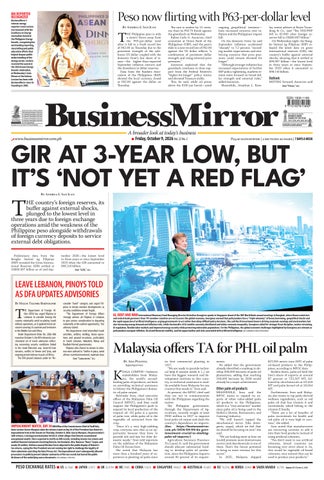
Peso now flirting with ₧63-per-dollar level
BM REPORTER RECOGNIZED
BusinessMirror’s veteran energy reporter Lenie Lectura was honored with the Excellence in Energy Journalism Award at the Philippine Energy Awards, recognizing her outstanding reporting, storytelling and public education efforts that helped deepen public understanding of the energy sector. Lectura received the award at the 2026 Asean Energy Awards celebration, at Wednesday’s Gala Dinner at the Galeon. Lectura has been with BusinessMirror since its founding in 2005.
By Andrea E. San Juan
T
HE Philippine peso is only a stone’s throw away from the P63-per-dollar level after it fell to a fresh record low of P62.90 on Thursday due to the persistent strength of the safehaven US dollar coupled with the domestic front’s fair share of issues—the higher-than-expected September inflation outturn and the drawdown in dollar reserves. Data from the Bankers Association of the Philippines (BAP) showed the local currency closed at P62.90 against the dollar on Thursday.
ROTARY CLUB OF MANILA JOURNALISM AWARDS
2006 National Newspaper of the Year 2011 National Newspaper of the Year 2013 Business Newspaper of the Year 2017 Business Newspaper of the Year 2019 Business Newspaper of the Year 2021 Pro Patria Award PHILIPPINE STATISTICS AUTHORITY 2018 Data Champion
The rate is weaker by 15 centavos than its P62.75 finish against the greenback on Wednesday. Ruben Carlo O. Asuncion, chief economist at Union Bank of the Philippines (UBP), said the peso’s slide to a new record low of P62.90 against the US dollar reflects “a combination of persistent dollar strength and rising external price pressures.” Asuncion explained that the greenback continues to draw support from the Federal Reserve’s “higher-for-longer” policy stance and elevated Treasury yields. This, he said, while oil prices above the $100 per barrel—amid
ongoing geopolitical tensions— have increased concerns over inflation and the Philippines’ import bill. On the domestic front, he said September inflation accelerated “sharply” to 7.2 percent, “exceeding market expectations and reinforcing concerns that price pressures could remain elevated for longer.” “Although stronger inflation has increased expectations of further BSP policy tightening, markets remain more focused on broad dollar strength and external risks,” added Asuncion. Meanwhile, Jonathan L. Rave-
las, senior adviser at Reyes Tacandong & Co., said “The USD/PHP fell to 62.900 after foreign reserves fell to US$99.997 billion.” On Wednesday night, the Bangko Sentral ng Pilipinas (BSP) released the latest data on gross international reserves (GIR), the country’s buffer against external shocks, showing that it settled at $99.997 billion—the lowest level in three years or since September 2023 when it amounted to $98.116 billion.
Outlook
MOVING forward, Asuncion said See “Peso,” A2
BusinessMirror A broader look at today’s business
EJAP JOURNALISM AWARDS
BUSINESS NEWS SOURCE OF THE YEAR
(2017, 2018, 2019, 2020, 2021) DEPARTMENT OF SCIENCE AND TECHNOLOGY
2018 BANTOG MEDIA AWARDS
GIR AT 3-YEAR LOW, BUT IT’S ‘NOT YET A RED FLAG’ www.businessmirror.com.ph
T
n
Friday, October 9, 2026 Vol. 22 No. 2
P25.00 nationwide | 2 sections 20 pages | 7 DAYS A WEEK
By Andrea E. San Juan
HE country’s foreign reserves, its buffer against external shocks, plunged to the lowest level in three years due to foreign exchange operations amid the weakness of the Philippine peso alongside withdrawals of foreign currency deposits to service external debt obligations. Preliminary data from the Bangko Sentral ng Pilipinas (BSP) revealed the Gross International Reserves (GIR) settled at US$99.997 billion as of end-Sep-
tember 2026—the lowest level in three years or since September 2023 when the GIR amounted to $98.116 billion. See “GIR,” A2
LEAVE LEBANON, PINOYS TOLD AS DFA UPDATES ADVISORIES By Malou Talosig-Bartolome
T
HE Department of Foreign Affairs (DFA) has urged Filipinos in Lebanon to consider leaving the country voluntarily amid escalating Israeli military operations, as it updated travel advisories covering 15 countries and territories in the Middle East and Africa. Under Department Order No. 2026-006 issued on October 5, the DFA released a synchronized set of travel advisories reflecting worsening security conditions linked to the Israel-Palestine war, Israel-US-Iran tensions, conflict in Yemen and Syria, and ongoing armed violence in parts of Africa. The DFA placed Lebanon under its “Re-
consider Travel” category and urged Filipinos to closely monitor developments as security conditions remain fragile. “The Department of Foreign Affairs strongly advises all Filipinos in Lebanon to give serious consideration to departing voluntarily at the earliest opportunity,” the advisory stated. The department cited intensified Israeli airstrikes, artillery shelling, drone operations and ground incursions, particularly in South Lebanon, Nabatieh, Bekaa and Baalbek-Hermel governorates. Filipinos who choose to remain in Lebanon were advised to “shelter in place, avoid all non-essential movement, maintain close See “Lebanon,” A2
AI, DEBT AND WAR International Monetary Fund Managing Director Kristalina Georgieva speaks in Singapore ahead of the IMF-World Bank annual meetings in Bangkok, where finance ministers
and central bank governors from 191 member-countries are set to assess the global economy. Georgieva warned that policymakers face a “triple whammy” of heavy borrowing, geopolitical shocks and the rapid expansion of artificial intelligence, urging governments to act rather than delay difficult policy decisions. She said the AI investment boom is driving corporate earnings and stock markets but also increasing energy demand and inflation risks, while the benefits of AI could be unevenly distributed and widen economic inequality. Georgieva called for stronger fiscal discipline, worker retraining, AI regulation, flexible labor markets and improved energy security while protecting vulnerable populations. For the Philippines, the global economic challenges highlighted by Georgieva are relevant as policymakers navigate inflation, fiscal and financial stability, and the opportunities and risks associated with artificial intelligence. IMF COMMUNICATIONS DEPARTMENT
Malaysia offers TA for PHL oil palm By Ada Pelonia
K
IMPEACHMENT WATCH, DAY 36 BIR Office of the Commissioner Chief of Staff Atty. Anne Loraine Garcia-Marquez takes the witness stand on Day 36 of Vice President Sara Duterte’s impeachment trial at the Senate on Thursday, October 8, 2026. Garcia-Marquez, the prosecution’s 26th witness, is being presented under Article II, which alleges that Duterte accumulated unexplained wealth. She is expected to testify on BIR records, including income-tax returns and audited financial statements involving Duterte, her husband, Atty. Manases “Mans” Carpio, and nearly 20 entities. Defense counsel Kristine Ferrer objected to the public display of Duterte’s tax returns, saying the Vice President was not waiving her right to challenge the legality of their submission and citing the Data Privacy Act. The impeachment court subsequently allowed prosecutors to publicly present tabular summaries of the tax records but barred the public disclosure of the underlying source documents. ROY DOMINGO / SPPA POOL
@adapelonia
UALA LUMPUR—Industry stakeholders from Malaysia, the world’s secondleading palm oil producer, are keen on providing technical assistance to bolster the Philippines’s domestic oil palm output. Belvinder Sron, chief executive officer of the Malaysian Palm Oil Council (MPOC), said they could support the Philippines’s push to expand its local production of the tropical oil. Oil palm is a species of palm tree, while palm oil is the vegetable oil extracted from the crop. “Since it’s a very high-yielding crop, everyone sees that as an opportunity because they have to provide oils and fats for their domestic needs,” Sron told reporters on the sidelines of the Malaysian Palm Oil Forum here. She noted that Malaysia has more than a hundred years of experience in planting oil palm since
its first commercial planting in 1917. “We are ready to provide technical help if anyone needs it [...] we have the biggest research and development institute in this country, so technical assistance is readily available from Malaysia for any country that needs it,” Sron said. At present, the MPOC chief said they are not in communication with the Philippines regarding the matter. The Philippine government, through the Department of Agriculture, recently sought at least P300 million in 2027 to improve local palm oil output and slash the country’s dependence on imports. (See: https://businessmirror. com.ph/2026/09/09/da-govtinvestment-crucial-to-slashingpalm-oil-imports/) Agriculture Secretary Francisco Tiu Laurel Jr. said the government should allocate substantial funding to develop palm oil production, since the Philippines imports around 90 percent of its require-
ments. He added that the government already identified a roadmap to develop 300,000 hectares of palm oil plantations, adding that reaching 100,000 hectares by 2028 would already be a major achievement.
Other palm oil products
MEANWHILE, Sron said the MPOC wants to expand its exports of other value-added palm oil products to the Philippines, which is a “very attractive” market since palm oil is being used in the HoReCa (Hotels, Restaurants, and Catering) industry. “We still haven’t tapped the oleochemical sector [like detergents, soaps], which we feel that we should be focusing on now,” she said. “We are looking more at how we [could] promote more downstream sectors and oleochemicals is one of them. That’s the future potential to bring in more revenue for this sector.” In 2025, Malaysia shipped
827,935 metric tons (MT) of palm oil-based products to the Philippines, according to MPOC data. Broken down, palm oil held the lion’s share of exports at around 87 percent or 722,507 MT, followed by oleochemicals at 63,418 MT and palm kernel oil at 18,044 MT. Furthermore, Sron said Malaysia also wants to tap palm-derived wellness ingredients, such as red palm oil that has vitamin A and tocotrienols, which belong to the vitamin E family. “There are a lot of benefits of palm tocotrienols for health and red palm oil is very high in carotene,” she added. Sron noted that manufacturers are extracting carotene to add it into their food products instead of using artificial colorants. “You don’t want to use artificial colorants, [since] countries are becoming very strict about it. So, this would be vegetable oil-based colorants, very natural that can be used to produce your products.”
PESO EXCHANGE RATES n US 62.7660 n JAPAN 0.3972 n UK 82.9704 n HK 7.9985 n CHINA 9.3610 n SINGAPORE 49.0627 n AUSTRALIA 43.6851 n EU 70.2916 n KOREA 0.0469 n SAUDI ARABIA 16.7193 Source: BSP (October 8, 2026)
News
BusinessMirror
A2 Friday, October 9, 2026
PHL policy… Continued from A9
wages, and some pick up in government spending, especially on education and health care, should lead to some “cyclical recovery.” In August, the PSA reported that the second quarter growth eased from 2.8 percent in the first quarter and was significantly below the 5.4-percent expansion recorded a year earlier. The latest GDP reading was the slowest since the first quarter of 2021, when the economy contracted by 3.8 percent. Excluding the pandemic period, it was the weakest growth recorded since the fourth quarter of 2009, when gross domestic product (GDP) expanded by 1.8 percent. The BSP has raised the key interest rate by a total of 75 basis points since the start of the conflict in the Middle East on February 28, delivering three separate quarterpoint rate hikes at the Monetary Board’s rate-setting meetings held on April 23, June 18, and August 27. For this year, the last two policy meetings of the Monetary Board (MB), the highest policy-making body of the central bank, are scheduled on: October 22 and December 17. The central bank’s most recent quarter-point rate hike in August was a “preemptive move” against the threat of El Niño which is expected to worsen in the fourth quarter and drive up food prices. (See: https://businessmirror.com. ph/2026/08/27/rate-hike-phlshield-vs-el-nino-inflation/)
www.businessmirror.com.ph
‘Electronics, minerals can push exports toward $100B’
T
By Bless Aubrey Ogerio
HE Philippines could push merchandise exports toward the $100-billion mark this year if the electronics and mineral sectors sustain their growth, although the target will also depend on United States trade policy. Philippine Exporters Confederation Inc. (Philexport) President Sergio R. Ortiz-Luis said the target is possible after merchandise exports reached a record $84.48 billion in 2025, up 15.3 percent from $73.27 billion in 2024. “For merchandise? Well, it’s very possible,” Ortiz-Luis said during the 52nd Philippine Business Conference and Expo (PBC&E) press conference in Taguig on Thursday. He identified electronics and minerals as the sectors that could provide much of the additional export growth needed to approach the $100-billion mark. “Hopefully, two sectors will help to meet $100 billion. Again, electronics is growing very fast. Plus, we hope the mineral sector. We hope the mineral
sector,” he said. Electronics already account for more than half of the country’s merchandise exports. The sector generated $45.89 billion in export earnings in 2025, equivalent to 54.3 percent of total exports, according to the Philippine Statistics Authority (PSA). Other manufactured goods followed with $6.15 billion, while other mineral products contributed $3.82 billion, or 4.5 percent of total exports. The $15.52-billion increase needed to move from last year’s record to $100 billion would therefore require continued growth in the country’s largest export sector, alongside a stronger contribution from minerals. Ortiz-Luis, however, said external trade policy remains a major un-
certainty, particularly US tariff policy under President Donald Trump. “So, we just hope that, you know, most of this target depends on how [US President Donald] Trump will execute his tariff plans again,” he said. The United States was the Philippines’s largest export market in 2025, accounting for $13.46 billion, or 15.9 percent of total merchandise exports. On the other hand, regarding export targets, the Philippine Chamber of Commerce and In-
dustry (PCCI) said these are not set by the private sector alone. It explained that export targets are developed jointly by government and the private sector through the Export Development Council, rather than through an independent private-sector projection. The government has set a broader goal of turning the Philippines into an “agile export powerhouse” by 2028 under the Philippine Export Development Plan (PEDP), which President Ferdinand R. Marcos Jr. outlined in 2023.
GIR at 3-year low, but… Continued from A1
The latest figure is 4.62 percent lower than the $104.846 billion recorded at end-August 2026. Year-on-year, the GIR fell by 8.31 percent from the $109.06 billion at end-September 2025. John Paolo R. Rivera, Senior Research Fellow at Philippine Institute for Development Studies (PIDS), said the three-year low figure of dollar reserves “reflects valuation adjustments, lower foreign investment holdings, and possible forex operations amid PHP weakness and global volatility.” Ruben Carlo Asuncion, chief economist at Union Bank of the Philippines (UBP), said the September decline in the country’s GIR was primarily driven by “factors identified by the BSP, namely, net foreign exchange operations, downward valuation adjustments on gold and foreign currencydenominated reserve assets, and National Government withdrawals of foreign currency deposits held with the BSP to service external debt obligations.”
GIR components
DATA showed that “other reserve assets” which include overnight investment—repo pool, due from/to brokers, accrued interest receivables, and investments under Asian Bond Fund (ABF) and Bank of International Settlements Investment Pool (BISIP), saw the biggest decline across GIR components. Other reserve assets plunged month-on-month to $9.998 billion, down 35.37 percent from $15.47 billion at end-August 2026. Gold also declined, by 6.73 percent, to $17.82 billion in endSeptember 2026, compared to the $19.11 billion as of end-August 2026. In contrast, Securities and Currency and Deposits under foreign currency reserves increased. Securities rose 0.62 percent to $64.44 billion while Currency and Deposits jumped 100.52 percent to $3.08 billion at end-September 2026. Asuncion said while exchange rate developments may have influenced reserve management operations, the decline in reserves cannot be attributed solely to peso weakness based on currently available data.
“The seventh consecutive yearon-year decline reflects a continued moderation in the country’s external buffers, although the current GIR level remains adequate by international standards, equivalent to 6.3 months of imports and about 3.2 times shortterm external debt on a residual maturity basis,” the UBP’s chief economist explained further.
Outlook
LOOKING ahead, Asuncion said reserve levels will likely continue to depend on the balance between foreign exchange operations, external debt payments, valuation movements in reserve assets. Michael L. Ricafort, chief economist at Rizal Commercial Banking Corp. (RCBC), said, however, that the country’s GIR could still be supported by the continued growth in the country’s “structural inflows from OFW remittances, BPO revenues, exports and relatively fast recovery in foreign tourism revenues as well as continued foreign investment inflows and investment portfolio inflows.” For his part, Jonathan L. Ravelas, senior adviser at Reyes Tacandong & Co., said: “The GIR decline bears watching, but it is not yet a red flag.” “The Philippines remains wellpositioned to withstand external shocks and the country’s external accounts continue to provide a solid source of support for reserve accumulation over the medium term,” added Ravelas. In a statement on Thursday, BSP said the latest GIR level provides “sufficient” foreign currency to meet the country’s import needs, service its external debt obligations, and serve as a buffer against external economic shocks. “It is equivalent to 6.3 months’ worth of imports of goods and payments for services and primary income. It can likewise cover about 3.2 times the country’s short-term external debt based on residual maturity,” the central bank also noted. Historical data from the Bankers Association of the Philippines (BAP) showed the Philippine peso hit successive record lows in September, with the lowest finish seen at P62.86 against the dollar on September 14.
Peso now flirting with… Continued from A1
UBP expects the peso “to remain volatile and generally biased toward weakness, with US interest rates, oil prices, geopolitical developments, and BSP policy signals likely to remain the key drivers of the exchange rate.” He pointed out that while ad-
ditional BSP rate hikes could help “temper” excessive volatility, their impact may be limited if global dollar strength persists. Ravelas said the peso is likely to remain under pressure in the near term, with trading expected within the 62.700 to 63.100 range.
Lebanon… Continued from A1
communication with the Philippine Embassy or the MWO, and comply strictly with the directives of local authorities.” The DFA also advised travelers to defer or cancel trips to Lebanon. Voluntary repatriation assistance remains available through the Philippine Embassy in Beirut and the Migrant Workers Office.
5 areas under highest warning level
THE DFA maintained its highest-risk classification for the Gaza Strip, Syria, Yemen, eastern Democratic Republic of the Congo and conflict-affected areas of Sudan. Filipinos were directed not to travel to these areas and to evacuate immediately if already present. In Gaza, the DFA warned that the territory remains a “critical and life-threatening humanitarian catastrophe” posing an “extreme and imminent risk to life.” For Syria, the advisory cited continuing armed conflict, terrorism, airstrikes and landmine hazards, while Yemen remains under a total travel prohibition because of ongoing hostilities, terrorist threats and attacks against shipping in the Red Sea and Gulf of Aden. The advisory also covers eastern DRC provinces of North Kivu, South Kivu and Ituri, where armed groups continue to operate, as well as Khartoum and the Darfur region in Sudan, where fighting between the Sudanese Armed Forces and the Rapid Support Forces continues.
Iraq, Libya, Burundi
ASIDE from Lebanon, the DFA advised Filipinos in Iraq, Libya, Burundi and parts of Sudan to reconsider travel and assess the need to remain in-country. In Iraq, authorities warned of continued security risks despite limited exemptions for returning overseas workers under the Balik-Manggagawa program. The DFA also reiterated concerns over illegal recruitment and trafficking of Filipino household workers into Iraq through third countries. For Libya, the department cited persistent militia activity, political fragmentation and a growing human trafficking problem involving Filipinos entering through Benghazi via the muwafaqa visa authorization system.
Increased caution in Israel, Iran
ISRAEL, Iran, the West Bank, selected regions of Ethiopia and South Sudan were classified under the DFA’s “Exercise Increased Caution” category. The advisory for Israel cited continuing threats from rockets, missiles and drones, particularly along the country’s northern border with Lebanon and Syria. The DFA reiterated that all non-essential travel should be deferred, including tourism, pilgrimages, internship programs, volunteer work, sports events and entertainment-related travel. In Iran, Filipinos were advised to avoid southern coastal provinces and border regions vulnerable to military activity and potential missile and drone attacks. The West Bank remains under heightened alert because of military operations, settler violence, demonstrations and movement restrictions in flashpoint areas such as Ramallah, Hebron, Nablus and Jenin.
Jordan: Lowest risk category
JORDAN was the only Middle Eastern destination placed under the DFA’s lowest advisory tier, “Exercise Normal Precautions.” The DFA said Jordan remains generally stable despite regional tensions, although travelers were advised to avoid military zones along the Syrian and Iraqi borders. Jordan hosts about 47,500 Filipinos, making it one of the largest Filipino communities in the Middle East outside the Gulf states.
Impact on OFWs
THE DFA said the advisories guide labor deployment policies implemented by the Department of Migrant Workers under Republic Act 11641. Countries under the highest-risk category remain subject to deployment bans, while labor deployment to destinations under lower advisory levels is subject to varying degrees of regulation and security monitoring. The department urged Filipinos overseas to register with Philippine embassies and maintain updated contact information to facilitate emergency assistance and possible repatriation efforts if security conditions deteriorate further.
Data from BAP showed the local currency hit an intraday low of P62.9 against the greenback while its strongest point within the trading session on Thursday was at P62.65 against the dollar. The last time the peso hit a new record low was on September 14 when it closed at P62.86 against the dollar. (See: https://businessmirror. com.ph/2026/09/14/peso-hitsn e w- l o w- o f-% E 2% 8 2% B16 286-%E2%82%B164-by-yearend/)
The Nation
www.businessmirror.com.ph
Friday, October 9, 2026
A3
NCDA: More than 6-M PWDs ‘missing’
W
By Joel R. San Juan
HILE only 2.8 million persons with disability are registered with the National Council on Disability Affairs (NCDA), at least 8.5 million are using PWD identification cards that entitle holders to certain discounts. The Department of Justice (DOJ) has expressed alarm over the situation because, Chief State Counsel Dennis Chan said, this irregularity has resulted in serious economic losses for the government
and private businesses. Chan said that the DOJ is now drafting a legal opinion to provide guidelines for the NCDA and the possible legal actions that business establishments may take against
Shootings thwarted with arrest of 53 ‘groomers’–Remulla By Jonathan L. Mayuga
I
NTERIOR Secretary Juanito Victor Remulla said on Thursday that the government continues to monitor activities that tend to incite violence in schools, victimizing innocent children. Remulla said that last week, authorities arrested 53 individuals, not minors, but with links to plans to carry out school shootings in South Cotabato alone. The arrests were made after the deadly shooting in Banga town. Interviewed on the sidelines of the First Metro Manila School Safety and Security Summit 2026 in Quezon City, Remulla said the suspects are not minors and that police interventions thwarted what he descr ibed as “active threats.” He told reporters that some of those arrested had firearms in their possession.
“We arrested 53 right after Banga. They are the ones who influence and the ones who planned to do it,” said Remulla. Remulla said the campaign to make schools safe is Priority No. 1, highlighting the importance of the summit. Various interventions of the DILG include deploying barangay watchmen in every school and one policeman outside schools to provide added security. Remulla declined to provide further details about the incident, citing its sensitivity because some of those being targeted are children who are being prodded to do violent acts using the internet. Stabbing and shooting incidents have prompted the DILG to recommend a review of the law governing illegal possession of firearms, including the protocol in safekeeping licensed firearms at home.
DILG to procure 1,500 fire engines next year
T
HE Department of the Interior and Local Government (DILG) is set to procure 1,500 fire trucks next year as part of the Bureau of Fire Protection’s modernization program, address the fire truck shortage and replace aging firefighting equipment. In procuring the fire trucks, the DILG said it is eyeing to save P9 billion, compared to the previous acquisition of the fire trucks with equally strong fire-fighting capacity. Interior Secretary Juanito Victor Remulla said some fire trucks currently in service have been operating for decades, underscoring the need to modernize the BFP fleet. “Across the country, we have fire trucks that are 40 years old, and were acquired in 1986,” Remulla said during the blessing and turnover of Unified 911 emergency response vehicles to different police units in Quezon province. Remulla said he and the BFP Officerin-Charge, Chief Supt. Wilberto Rico Neil Kwan Tiu, went to Korea to negotiate for a government-to-government agreement for the planned procurement. Under the arrangement, the cost of each fire truck is expected to go down from around P16 million to P10 million, translating to approximately P9 billion in government savings. “Whereas a fire truck previously cost P16 million, it is now only P10 million per unit. This eliminates corruption from the process. Our total savings amount to
1,500 [fire trucks] multiplied by six million pesos – resulting in P9 billion in savings for the BFP,” he said. The procurement forms part of the DILG’s broader push to strengthen public safety capabilities as communities and local economies continue to grow. In Quezon, Remulla noted that rapid economic growth must be matched by investments in emergency response and police mobility. “Now we can say that the new Quezon is the fastest-growing province in the entire Region 4A, so congratulations,” he said. To keep pace with this growth, the DILG is increasing police motorcycle mobility and expanding the use of drones for public safety operations, allowing authorities to respond faster and reach more communities. “My dream is that just like what I did in Cavite, the police will have more than enough vehicles. Everyone should have mobility.” Remulla said. He stressed that modern equipment alone is not enough, and that effective public safety ultimately depends on national agencies, uniformed services, and local governments working together. “We cannot achieve public safety if we act alone. The police cannot do it by themselves. The BFP cannot do it by themselves. We need to work together,” the he said. See “Fire,” A4
those using irregularly issued PWD IDs, including government officials and physicians responsible for the IDs issuance. Chan, however, reminded business establishments that prior verification of the validity of a PWD ID is not allowed under the law. “You have to extend the benefit already upon presentation of the ID. However, the business establishment concerned is not prevented from subsequently validating the authenticity of the ID,” Chan stressed. He said businesses may coordinate with the local government (LGU) that issued what is suspected to be a fake or irregularly issued PWD ID and check whether the legal requirements for its issuance were actually met.
The verification should include whether medical certification of the PWD was falsified or issued without basis. Once the ID is proven to be fake, Chan said business owners can take legal action against its user and the public officer or physicians who issued the medical certificate. “So, we, the Department of Justice is issuing this opinion to try and hopefully correct this behavior that some of the people are doing and thinking that they can get away with using PWD IDs,” Chan said. “This opinion will be coming out soon to help inform and educate not just the NCDA, the restaurant owners, but ultimately the general public on the use of these fake IDs,” he added.
It may be recalled that the DOJ has already issued a legal opinion in February 2025 on the use of PWD IDs. The DOJ noted that Republic Act 10754 or An Act Expanding the Benefits and Privileges of Persons with Disability and its implementing rules do not require verification of the PWD card as a prerequisite of the PWDs availment of their benefits and privileges. It said that the denial and withholding of PWD benefits and privileges by reason of unverified PWD ID card constitutes a violation of the rights of PWDs to avail of the benefits and privileges. Meanwhile, Justice Secretary Fredderick Vida said public officers responsible for issuing fake
PDW IDs may be charged for violation of Republic Act 3019 or the Ani-Graft and Corrupt Practices Act while physicians who will issue a medical certificate to a person with no disabilities may be held criminally liable for violation of the Revised Penal Code. Users of fake or irregularly-issued PWD IDs, on the other hand, may be charged with falsification of a public document or estafa. Vida also appealed to the people to “start living an honest life” while noting that any wrongdoing has its consequences. “No such thing as free lunch. Because of your deception, someone else is suffering. Because you’re taking advantage of the system, someone else is carrying the burden,” the Justice secretary added.
Impeach prosecution team: More gaps found in VP financial records By Jovee Marie N. dela Cruz
T
HE House of Representatives prosecution team on Thursday said it found annual gaps of more than P66 million to P98 million in allegedly undeclared assets after comparing financial records involving Vice President Sara Z. Duterte and her husband, lawyer Manases Carpio, with their Statements of Assets, Liabilities and Net Worth (SALNs) from 2022 to 2025. Impeac h ment adv i ser a nd spokesperson Ace Barbers said ba n k record s a nd test i mony showed that Duterte’s SALN declarations were not complete and truthful. “Bank records and testimony show that the SALN declarations are all false because material information was not fully and truthfully declared.” T he prosecution compared year-end bank balances, insurance and investment payments, and firearms attributed to Duterte and Carpio with their combined declarations under “Others” or “Various” in their SALNs. Its presentation identified alleged gaps of over P80 million in 2022, over P98 million in 2023, over P66 million in 2024 and over P70 million in 2025. The largest alleged gap was recorded in 2023, when the prosecution identified more than P71 million in bank balances, P35.9 million in insurance and investments, and more than P7 million in firearms. Duterte and Carpio reported less than P15 million under “Others” that year.
The prosecution said its computations remain subject to further validation by a financial analyst, who will present the analysis during the open trial. It also separately identified two properties owned by Carpio that its presentation marked as having no matching entries in the SALNs. The first was a Kembali Coast property in Samal purchased for P3,453,849 in 2018, which the presentation said had no matching entry from 2022 through 2025. The second was a 379-squaremeter property in Matina, Davao City, covered by a 2024 deed of absolute sale citing a P6-million price, with no matching entry in the 2024 and 2025 SALNs. The two properties had a combined acquisition price of more than P9.45 million. The prosecution said they were presented separately and were not included in its consolidated annual gaps. T he prosec ut ion a lso pre sented records from 29 accounts across eight banks: Land Bank of the Philippines, Asia United Bank, Philippine Savings Bank, Metropolitan Bank and Trust Company, Security Bank, Bank of the Philippine Islands, Philippine National Bank and BDO. Closed accounts were excluded from the count. Barbers said Duterte declared no cash on hand or cash in the bank in any of the four SALNs examined. “In all of VP Sara’s SALNs, she did not declare any cash on hand or cash in bank,” he said. The bank records showed alleged combined year-end balances
of about P59 million in 2022, P71 million in 2023, P22 million in 2024 and P39 million in 2025. The largest balances in 2023 included P32.1 million at BDO, P21.5 million at PNB and P7.8 million at BPI. The prosecution rejected the defense’s position that the bank deposits could have been included under “Other Personal Properties.” “Now, even if we assume all of VP Sara’s other personal properties in her SALN were cash, there is still a shortage and a large amount remains undeclared,” Barbers said. T he combined “Others” or “Various” entries for Duterte and Carpio amounted to less than P14 million in 2022, less than P15 million in 2023, less than P22 million in 2024 and less than P30 million in 2025. Compared with the bank balances alone, the prosecution calculated alleged differences exceeding P45 million in 2022, P56 million in 2023, P1 million in 2024 and P9 million in 2025. The prosecution also presented records from seven insurance and investment companies: FWD Life Insurance, Manulife, Pru Life UK, BPI AIA, Allianz PNB Life, BDO Life and BDO Securities. These showed insurance and investment amounts of P35.2 million in 2022, P35.9 million in 2023, P59.6 million in 2024 and P54.4 million in 2025. House prosecution spokesperson Zia Alonto Adiong said investment plans are considered assets and argued that the amounts were not ref lected in the couple’s SALNs. “We should remember that
these were not declared in their SALNs,” he said. BDO Securities accounted for the largest portion of the annual investment totals, with P16.9 million in 2022, P17 million in 2023, P29.6 million in 2024 and P29.7 million in 2025. The prosecution said the insurance and investment figures alone exceeded the corresponding “Others” entries in every year examined. The alleged differences were more than P21 million in 2022, P21 million in 2023, P38 million in 2024 and P25 million in 2025. When the bank balances, insurance and investments, and firearms were combined and compared with the amounts declared under “Others,” the prosecution calculated overall alleged asset gaps of approximately P80.2 million in 2022, P98.9 million in 2023, P66.6 million in 2024 and P70.4 million in 2025, based on the rounded figures in its presentation. “ The non-declaration of cash from 2022-2025 as shown in the table is a clear, willful, and deliberate attempt to conceal material information, not just an error or an omission,” Barbers explained. The prosecution said the alleged discrepancies support Article II of the impeachment complaint, which accuses Duterte of unexplained wealth and failure to truthfully disclose her assets. The defense has disputed the prosecution’s interpretation of the financial records and objected to treating the alleged balances as established ownership before it presents its evidence.
Think tank urges govt to diversify defense partnerships By Rizal Raoul Reyes
T
HE Philippines should leverage its defense partnership with France—and more broadly with the European Union—to diversify its defense partnerships and help uphold a rules-based order in the IndoPacific. “The Stratbase Institute looks forward to the effective implementation of the agreement and for the Philippines to be able to leverage this EU connection to diversify its defense partnerships to secure a rules-based international order in the Indo-Pacific,” said Stratbase President Victor Andres Manhit . In a statement on Thursday af-
ternoon, Manhit said the new and historic pact, the Philippines’ first with a European nation, would deepen defense cooperation and strengthen the two countries’ role in promoting security in the Indo-Pacific. In addition, he said, the agreement would allow both the Armed Forces (AFP) and the French armed forces scale up their joint exercises and military exchanges, and help both countries improve coordination in maritime security, humanitarian assistance, and disaster response. At the same time, it would also allow the AFP to gain exposure to North Atlantic Treaty Organization-standard systems, allowing the Philippines to better coor-
dinate with allies in real-world missions. T he S e n at e ’s conc u r re nce fol lowed t he approv a l of t he Status of Visiting Forces A g reement (Sov fa) by its Committee on Foreig n Relations in Se ptember. The agreement was signed by Defense Secretary Gilberto Teodoro Jr. and then French Minister for the Armed Forces and Veterans Catherine Vautrin in Paris on March 26, 2026. It provides a legal framework for a wider range of defense activities between the two countries. The pact is the Philippines’ sixth visiting forces agreement, following arrangements with the United States, Australia, Japan,
New Zealand and Canada. T he agreement also builds on years of growing PhilippineFrench defense engagement, including France’s participation in Balikatan, Exercise Sama-Sama and Kamandag, as well as the deployment of the French aircraft carrier Charles de Gaulle and accompanying naval forces to the Indo-Pacific in 2025. The new Sovfa, Manhit said, “marks another important milestone in the growing strategic a nd defense pa r t nership be tween the two countries, reflecting their shared commitment to strengthening regional security, upholding international law, and maintaining peace and stability in the Indo-Pacific.”
A4
Economy
Friday, October 9, 2026
www.businessmirror.com.ph
SRA: ’26-’27 crop year sugar production for domestic use M
DA seeks market linkage to hike farmers’ income, lower food cost
T
By Ada Pelonia
@adapelonia
HE Sugar Regulatory Administration (SRA) has officially allocated all sugar output produced in crop year 20262027 for domestic use. In a document sent to industr y stakeholders, SR A Administrator Pablo Luis A zcona said the SR A Board has approved c lassif y ing a l l out put of the sweetener this crop year as “B” or domestic market sugar. “All sugar mills, planters, traders, and other concerned parties are hereby advised and directed to ensure that all locally produced sugar for Crop Year 2026-2027 is
properly classified and quedanned as ‘B’ or domestic market sugar, consistent with the approved policy of the Sugar Board.” Despite this, the SRA noted that Sugar Order (SO) 1 for the current crop year continues to undergo “necessary procedural and administrative requirements” preparatory to its formal issuance and official release. Upon completion of the require-
ments, the regulatory agency said it will officially issue the SO 1. “The SRA appreciates the cooperation and continued support of the entire sugar industry as we collectively address the challenges confronting the sector and work toward a stable and sustainable Crop Year 2026-2027.” The agency’s move to classify all raw sugar output this year to “B” stemmed from a recent meeting with heads of sugar federations, millers, refiners and traders. Producers arrived at the decision after the SRA said it expects raw sugar production to slide to 1.662 million metric tons (MMT) in crop year 2026-2027, the lowest level in two decades. With this, the Philippines will have to forego the export of sugar to the United States under the tariff-rate quota (TRQ ) system for now as cane farms
are grappling with pest infestation and dry spells due to the E l Ni ño phe nome non . (See: https:// businessmirror.com. ph/2026/10/05/pest-droughthinde r-phl-f rom-f illing-u ssugar-quota/) Washington slaps a lower tariff on sugar exported by the Philippines to the US under the TRQ scheme. Azcona earlier said he received a request from the US Department of Agriculture (USDA) to fill the US quota with 147,000 metric tons (MT). However, given the projected “scarcity” of sugar this crop year due to the compounding effects of the red-striped soft scale insect (RSSI) infestation and El Niño, the agency noted that majority of the stakeholders said exporting sugar to the US under tight supply might be hard to explain to their constituents.
Groups renew call for decent jobs, higher pay By Mary Jade Jadormio
L
ABOR groups welcomed the improvement in the country’s employment situation in August but warned that stronger headline numbers do not necessarily mean Filipinos are finding stable, adequately paid work. The Trade Union Congress of the Philippines (TUCP) and the Sentro ng mga Nagkakaisa at Progresibong Mangagawa (Sentro) separately raised concerns over job quality, working hours and workers’ purchasing power following the latest Labor Force Survey (LFS). Employ ment rose to 49.79 million in August from 49.21 million in July, while unemployment eased to 5.3 percent from 6
percent, according to the Philippine Statistics Authority (PSA). Underemployment also declined to 11.9 percent from 12.9 percent in July, but remained above the 10.7 percent recorded a year earlier. Sentro said the composition of August’s employment gains warrants closer scrutiny, noting that unpaid family workers posted the largest increase by class of worker, followed by self-employed workers without employees and those working for private households. “An increase in the number of employed Filipinos does not necessarily mean an increase in the number of Filipinos finding stable, adequately paid jobs,” Sentro said. Average working hours also fell to 39.2 hours a week in August
from 41 hours a year earlier and 40.6 hours in July, prompting the labor group to question whether workers are getting enough work and income. Meanwhile, TUCP called on the government to develop a national employment creation masterplan focused on industries where the Philippines has a comparative advantage. “The gravest concern has always been the generation of adequate quality decent jobs,” TUCP said, arguing that job creation “cannot be left to the private sector alone.” The group said the government should align trade and investment policies with an employment strategy that identifies industries capable of generating stable jobs. TUCP also called for reforms that would make it easier for workers to form and join unions, limit assumption of jurisdiction
Fire. . . Continued from A3
On Wednesday, the BFP corrected on its official Facebook account alleged “fake news” about the government’s fire truck acquisitions. The clarification came as social media posts that went viral have slammed the Marcos administration for allegedly acquiring mini fire trikes, including ones that are powered by motorcycles, amounting to P10 million. Apparently, the BFP said this is falsely being spread by some netizens without verification. “Fire response vehicles come in different
and strengthen workers’ right to strike, while renewing discussions on security of tenure. Sentro, likewise, pressed for stronger economic interventions, including a P200 across-the-board national wage increase, industrial policy backed by public investment and a public employment program that provides productive work. The group said minimum wages remain below workers’ basic needs, particularly as prices continue to rise. Sentro also called for stronger protections for workers in informal, precarious and platformbased employment, many of whom it said remain vulnerable to inadequate work and income. Both groups said employment policy should focus beyond the number of Filipinos counted as employed, with greater attention to whether jobs provide sufficient income, working hours and security.
types and capacities, each designed to serve specific operational needs,” the BFP said. “BFP fire trucks are procured and operated by the Bureau of Fire Protection, with varying capacities and capabilities depending on operational requirements,” it said. On the other hand, the BFP said that local government “fire trikes,” are initiatives of local governments intended to augment and support BFP firefighters, particularly in communities where access and mobility may be challenging. “Understanding the difference helps promote accurate information and a better appreciation of how BFP and LGUs work together to enhance fire response and public safety,” the BFP said. Jonathan L. Mayuga
ARKET linkages should complement local production to raise farmers’ income and lower food costs for Filipino consumers, according to the Department of Agriculture (DA). During the launch of the Third Kadiwa Expo on Thursday, Agriculture Secretary Francisco Tiu Laurel Jr. said this year’s theme centered on agri-food hub facilities that boost efficiency in the value and market chain captures the importance of market linkages. “It’s not enough to just have a harvest, since it should be brought to the market,” Tiu Laurel said. He stressed the agency’s efforts in building mega food hubs in Clark, Tiaong, Camarines Sur, Naga, Cebu, Bukidnon, Zamboanga del Norte, and Iloilo, among others. The DA chief said this establishes a national network that connects production to consolidation, storage, processing, logistics, and consumers. “ [T h r o u g h t h i s , ] f a r m e r s can directly sell to consumers, which reduces the layers in the supply chain. Hopefully, this will raise farmers’ income while lowering consumer costs,” Tiu Laurel said. “In agriculture, every link matters. When every link works, everyone benefits,” he added. For Tiu Laurel, the Kadiwa makes a difference by being a market strategy. “It brings producers closer to consumers, cuts unnecessary layers in the value chain, opens wider markets, and gives our farmers and fisherfolks better opportunity to
earn fairer prices while giving Filipino families access to quality and affordable food,” he said. The expo will be held simultaneously with Agrilink, Foodlink, and Aqualink 2026, which will showcase the latest farm machinery, postharvest technologies, livestock and aquaculture solutions, crop innovations, food processing technolog ies, and agribusiness services. For Assistant Secretary Genevieve Velicaria-Guevarra, the joint events provide a strategic platform to connect producers with markets, technologies, and potential business partners. “As we rapidly ex pand the K adiwa, we are also strengthening our assistance to farmers’ cooperatives and associations to help them access bigger markets and improve their competitiveness.” “Kadiwa continues to reach more communities and create more opportunities for our agricultural producers to bring their products directly to consumers. Through our partnership with Agrilink, Foodlink, and Aqualink, we are bringing together market access, innovation, and enterprise development in one platform,” Guevarra said. The strategy builds on the expo last year, which generated P2 million in sales from 77 exhibitors representing FCAs, agri-entrepreneurs, government agencies, and private-sector partners. It aims to strengthen market access, improve farm incomes, and build stronger linkages bet ween agr icu ltura l producers and consumers, according to the DA. Ada Pelonia
Senate passes 4 bills on housing By Butch Fernandez @butchfBM
F
OUR housing measures hurdled final Senate approval on Thursday, advancing efforts to expand access to affordable housing and provide relief to Filipino families. The Senate approved on third reading Senate Bill 1992 that seeks to enhance the government’s capacity to implement socialized housing projects by improving and rationalizing land acquisition and utilization. This will basically amend the Urban Development and Housing Act. During plenary session, the chamber also passed Senate Bill 2508 or the Residential Emancipation for Calamity Survivors Act, Senate Bill 2507 or the Affordable and Decent Rental Housing Incentives Act, and Senate Bill 2503 or Rental Housing Subsidy Act. SBN 2508 seeks to ease the financial burden of qualified calamity survivors by condoning outstanding housing obligations, including principal, unpaid amortizations, interest, and penalties. The measure also provides for the exemption from estate tax of housing units awarded under calamity housing programs implemented by the National Housing Authority. SBN 2507, meanwhile, seeks to promote access to affordable and decent rental housing for poor and low-income households. The measure provides incentives for the development, construction, rehabilitation,
and operation of qualified rental housing. The third measure, SBN 2503, seeks to institutionalize a rental housing subsidy program and provide funding for its implementation. Taken together, the three measures address different aspects of housing affordability, from easing housing obligations for calamity survivors to encouraging the development of affordable rental housing and providing rental assistance to qualified beneficiaries. Meanwhile, Senate Bill 1992, seeking to enhance the government’s capacity to implement socialized housing projects, hurdled third reading. Voting 17-0-0, the measure got the chamber’s approval during its plenary session. The measure proposes amendments to Republic Act 7279, or the Urban Development and Housing Act of 1992, to strengthen the framework governing the acquisition and utilization of land for socialized housing. Under the bill, the government’s capacity to implement socialized housing projects would be enhanced by improving and rationalizing the processes involving land acquisition and utilization. The proposed amendments are intended to address issues involving the availability and use of land for socialized housing, with the broader objective of strengthening the government’s ability to carry out housing projects for qualified beneficiaries.
Friday, October 9, 2026
A5
DOE eyes ₧27B initial investments for microgrid development By Lenie Lectura @llectura
T
HE Microgrid Systems Act (MGSA), aimed at bringing reliable electricity to communities that remain beyond the reach of adequate power services, is expected to usher in as much as P27 billion in initial investments.
The Department of Energy (DOE) earlier published an initial list of unser ved and undeser ved areas.
It identified an initial 369 areas across 23 provinces that could benefit more than 101,468 unenergized
households. These are located in Antique, Basilan, Bohol, Cagayan, Camarines Norte, Camarines Sur, Cebu, Davao Occidental, Dinagat Islands, Eastern Samar, Lanao del Sur, Marinduque, Masbate, Negros Occidental, Northern Samar, Palawan, Quezon, Southern Leyte, Sulu, Surigao del Sur, Tawi-Tawi, Samar, and Zamboanga del Sur. The estimated total investment cost that maybe poured in by the micro-grid service providers may reach anywhere from P20 billion to P27 billion, the DOE said on Thursday. By providing the initial list ahead of competitive selection process (CSP) rounds, the DOE aims to give prospective investors early visibil-
ity to conduct technical assessments and plan investments. DOE Electric Power Industry Management Bureau (EMB) director Luningning Baltazar said the microgrid system is a primary solution to bridge the remaining electricity access gaps. Currently, the country sits at 95% household electrification, with a projection needing to reach 2.1 million more households by 2028. “Part of the solution would be the implementation of the microgrid. This is a system that has a generation component together with the distribution and this generation component must be a combination of a technology that will provide a reliable power to the communities,” Baltazar said. DOE Secretary Sharon Garin said
PHL, US rice industry groups sign MOU to reopen rice trade By Ada Pelonia @adapelonia
T
HE Philippines will reopen its rice trade with the United States following an industry-led agreement, targeting an annual purchase of 200,000 metric tons (MT) of the staple grain starting in 2028. The Philippine Rice Industry Stakeholders Movement (PRISM) inked a memorandum of understanding (MOU) with the USA Rice Federation (USA Rice) on Thursday, aimed at reopening and expanding trade in US rice to the country. Under the MOU, the US will supply 100,000
MT of bagged and/or bulk rice originating in the US in 2027. This figure increases to 200,000 MT per year beginning in 2028. PRISM and USA Rice said they intend to “work diligently” with their industry members and the government to facilitate this potential trade flow in a timely manner. Peter Bachmann, president and CEO of USA Rice, said rice has a “historic role” as part of the US-Philippine relationship. “So I was happy to sign this agreement here that recognizes our history and moves our industries forward,” Bachmann said. “This agreement encourages Filipino buyers to consider another reliable, high-
PHL, France sign work plan for potato imports By Mary Jade Jadormio
T
HE Philippines is opening a new source of table and seed potatoes from France after both countries signed a work plan governing their importation, according to the Department of Agriculture (DA). The agreement was signed during the 4th Philippines-France Joint Steering Committee on Agriculture and the 3rd Philippines-France Agricultural Forum held in Paris on Sept. 23 and 24. DA Secretary Francisco P. Tiu Laurel Jr. said stronger ties with France could provide the Philippines access to expertise, technology and investments needed to improve the farm sector. “Our partnership with France is important as we work to make Philippine agriculture more productive, competitive and resilient,” Tiu Laurel said. “Stronger cooperation means greater opportunities to bring in technology, knowledge and investments that can benefit our farmers and strengthen our food systems,” he added. Aside from potato trade, both sides identified animal health, food safety, dairy development, geographical indications, organic agriculture, development financing, and agricultural research and innovation as priority areas. The Bureau of Agricultural Research (BAR) also advanced discussions with France’s Directorate General for Education and Research
on joint agricultural research and innovation, including possible cooperation with the French Agricultural Research Centre for International Development (CIRAD). Potential areas of cooperation include mango and banana production, aquaculture, agroecology, climate resilience, sustainable landscapes and emerging agricultural technologies. The Bureau of Agriculture and Fisheries Standards (BAFS) pursued cooperation with French counterparts on organic agriculture, food safety and standards, focusing on certification, labeling, traceability and conformity assessment to help Philippine organic products meet European Union requirements and access the French market. Meanwhile, the Bureau of Animal Industry (BAI) discussed animal health issues affecting agricultural trade, including Highly Pathogenic Avian Influenza, African Swine Fever regionalization, Lumpy Skin Disease and changes to the European health stamp. France also signaled support for training Philippine veterinary personnel in biosecurity, transboundary animal disease control, border controls and risk-based inspection. The Philippine delegation also met with the Agence Française de Développement to explore possible support for climate-resilient agriculture, research and innovation, geographical indications, organic agriculture, and the marine and blue economy.
Marcos pays tribute to Virata’s ‘quiet dignity, discipline, and sense of duty’
P
RESIDENT Ferdinand R. Marcos Jr. paid his respects to Cesar E.A. Virata, the country’s former prime minister, who died last week at the age of 95, honoring him as a notable public servant who served in the government for over two decades. The Chief Executive with First Lady Louise “Liza” A. Marcos visited the wake of Virata at the Heritage Memorial Park last Wednesday just before he flew to Singapore for a five-day working visit. He recalled how Virata served with his father, former President Ferdinand E. Marcos Sr. as his finance minister and a member of the Monetary Board of the Bangko Sentral ng Pilipinas from 1970 to 1986 and prime minister from 1981 to 1986. Virata also became the dean of Business Administration of the University of the
Philippines in 1960. “I paid my final respects to former Prime Minister Cesar Virata, a man who devoted many years of his life to our country and worked alongside my father in public service,” Marcos said in a social media post. “I will remember him not only for the many years he gave to the nation, but for the quiet dignity, discipline and sense of duty with which he lived his life,” he added. Prior to his death, Virata was the Corporate Vice Chairperson of the Rizal Commercial Banking Corp. Marcos gave thanks to Virata’s lifetime of public service and extended his condolences to former Cabinet members of his father. “To the entire Virata family, the First Lady and I offer our deepest sympathies. Thank you for a lifetime of service, Prime Minister. Rest in peace,” he said. Samuel P. Medenilla
quality source of supply as they manage their reserves, and it potentially gives U.S. growers and millers renewed access to an important market at a time when we are in dire need of viable markets,” he added. For PRISM co-founder Rowena Del RosarioSadicon: “We are very happy to be working with the US rice industry to facilitate trade with the Philippines and look for the many ways our industries can work together. We see a future where our past history and current efforts can greatly benefit both industries.” Government data showed that the Philippines has not imported rice from the US since the Rice Tariffication Law (RTL) took
effect in 2019. Despite this, the organizations explained that the US was a major rice supplier to the Philippines from 1999 to 2007, particularly through cooperation with the National Food Authority (NFA). Before this, however, they added that US exporters supplied large volumes of rice for Philippine food security at various times in the 1960s, 1970s, and 1980s. “As the largest buyer of rice in the world, this agreement has great potential to help the Philippines manage their import needs by partnering with one of the key global origins for rice.”
DOLE probe finds ₧600K labor violations in M/V June Aster
M
ORE than P600,000 worth of labor-standard violations in the investigation into M/V June Aster, the vessel involved in a deadly fire off Coron, Palawan last month, were found by the Department of Labor and Employment (DOLE). Labor Secretary Francis N. Tolentino led the DOLE Lupong Pamagawa inquiry to examine the vessel’s compliance with labor and occupational safety and health standards following the incident that killed more than 70 passengers and crew members. The investigation found violations of General Labor Standards (GLS), including unpaid overtime, holiday and rest-day pay, night-shift differentials, service incentive leaves and wages, DOLE said. The vessel’s management was also found to have violated Occupational Safety and Health Standards (OSHS), with the investigation citing the absence of required safety programs, emergency response plans, safety committees
and trained safety officers. DOLE also found insufficient personal protective equipment (PPE) and failure to submit mandatory occupational safety and health reports. Tolentino said employers must comply with labor and safety requirements to protect workers and the public. “The focus should be on the families of those who died, the crew members who are still traumatized, and also on ensuring that your vessels, as well as other ships sailing in a prime tourist destination, are safe from harm and comply with safety regulations,” Tolentino said. The labor chief said the investigation should provide a clear accounting of what happened to the victims and ensure that vessels operating in tourist destinations comply with safety regulations. “Ships are built to carry people safely across the seas, not to become their final resting places,” Tolentino said.Mary Jade Jadormio
the microgrid policies support the development of power systems in geographically isolated and underserved communities, where decentralized energy solutions can bring reliable electricity to more Filipino households. Through microgrid development, we want to bring reliable and affordable electricity closer to communities that remain unserved, while giving capable investors a clear pathway to
help us deliver it,” Garin said. The initiative forms part of the DOE’s continuing implementation of the Revised Implementing Rules and Regulations of the MSAD Department Circular No. 2025-04-0007, which seeks to improve the efficiency, transparency, and investor responsiveness of the competitive selection framework for microgrid development .
A6
Friday, October 9, 2026
BusinessMirror
www.businessmirror.com.ph
Friday, October 9, 2026
A7
Small biz gain access to competitive electricity market as ERC cuts threshold to 100 kW By Rizal Raoul Reyes @brownindio
T
HE Energy Regulatory Commission (ERC) said its decision to lower the electricity contestability threshold to 100 kilowatts (kW) will hopefully open the country’s competitive electricity market to a much broader segment of Filipino businesses, enabling more enterprises to choose their electricity supplier and manage one of their largest operating costs more strategically. The new threshold, implemented on June 26, 2026, marks the latest phase of the Retail Competition and Open Access (RCOA) framework and is particularly significant for small and medium-sized enterprises that previously had limited access to the competitive electricity market. The development was highlighted on Thursday during a forum led by the ERC and COREnergy Inc., the retail electricity arm of Vivant Energy Under Phase 4 of RCOA, businesses with an average monthly demand of 100 to 499 kW can directly participate in the competitive market and choose their own Retail Electricity Supplier (RES), according to Atty. Chiara Angela Blanco, Chief of the Contestable Market Division of the ERC Energy Regulation Office. Blanco pointed out that businesses below when the 100-kW threshold may participate through the Retail Aggregation Program (RAP), which allows smaller establishments to pool their electricity demand and
participate collectively. She said the gradual reduction of the contestability threshold reflects the government’s continuing effort to broaden consumer participation in the electricity market. Moreover, Blanco said the threshold has fallen from 1 megawatt (MW) when RCOA was introduced in 2013, to 500 kW in 2020, and now to 100 kW. For the ERC, Blanco said the latest reduction represents more than a regulatory milestone. It expands the ability of Filipino businesses to make decisions about how they procure electricity. Furthermore, she also relayed the message of ERC Chairman Francis Saturnino C. Juan during the forum. “The lowering of the contestability threshold to 100 kilowatts is more than a regulatory milestone, it is a milestone for Filipino consumers,” Blanco said. “More Filipino electricity consumers are being given the opportunity to decide how they purchase their electricity. This is the power of choice,” she added. She said the significance of the change comes at a time when businesses are dealing with rising production costs, inf lation and changing consumer demand, making energy efficiency and cost management increasingly important to profitability. For enterprises spending hundreds of thousands of pesos every month on electricity, Blanco pointed out that having the ability to assess
competing supply options could provide another tool for managing operating expenses. “At COREnergy, we are proud to earn the trust of Phase 4 contestable customers, businesses that are spending upwards of P 500,000 every single month on electricity,” said Francis del Val, President of COREnergy during the open forum. “Our vision is bold: to empower customers to reach their maximum potential by driving their profitability, productivity, and performance, the COREnergy 3Ps,” he added. COREnergy currently serves 88 businesses across 144 accounts, representing 90.8 MW in peak capacity. Its portfolio includes standalone commercial and industrial users such as DEDON Manufacturing, JEG Tower and McDonald’s Philippines. McDonald’s Philippines has 36 restaurants in Cebu and Negros Occidental in the portfolio, including 32 smaller branches that entered the competitive market through RAP. The forum also featured Villa Escudero executives who shared their experience as a business working with COREnergy. Villa Escudero Director of Management Manuel Escudero, Commercial Property Management Division Head Danilo Escudero and Facilities Engineering Manager Kit Mark Bautista provided an on-the-ground perspective on how electricity procurement decisions can affect businesses with different operating models and energy requirements.
House prosecution flags mismatch between VP Sara’s SALN, BIR income records By Jovee Marie Dela Cruz @joveemarie
& Claudeth Mocon-Ciriaco @claudethmc3
T
HE House prosecution on Thursday flagged alleged discrepancies between Vice President Sara Z. Duterte’s declared wealth and the income reported by the Bureau of Internal Revenue (BIR) for her and her husband, lawyer Manases “Mans” Carpio, as the Senate impeachment court admitted the tax records as public documents. House prosecution counsel Erwin Matib said BIR records showed that Duterte and Carpio had a combined net income of P85.4 million from 2007 to 2025, while Duterte’s latest Statement of Assets, Liabilities and Net Worth (SALN) placed her net worth at about P98 million in 2025. “Vice President Sara and her husband’s income do not match their declared net worth,” Matib told the impeachment court. “Based on BIR records, their combined net income from 2007 to 2025 was P85.4 million. This cannot explain the increase in net worth that reached P98 million in Vice President Sara’s latest SALN,” he added. Duterte’s declared net worth rose from P7.25 million in 2007 to about P98 million in 2025, an increase of roughly P91.4 million, which the prosecution said exceeded the couple’s reported combined net income by about P6 million, even before accounting for living expenses and other expenditures. Matib also said the prosecution would seek to establish that Duterte received professional fees and other income aside from her government salary while serving as vice president, potentially violating constitutional restrictions on the practice of a profession by public officials. “Based on BIR records, Vice President Sara practiced her profession and received professional legal fees and other income apart from her salary as vice president,” Matib said. BIR official Atty. Anne Loraine C. Garcia-Marquez confirmed during direct examination that Duterte remained registered with the tax agency as a professional taxpayer, with legal activities listed as her
primary line of business. She said the classification covers legal consultations, court appearances, contract reviews and the preparation of legal documents. The BIR registration, however, does not by itself establish that Duterte actually practiced law while serving as vice president. The prosecution also cited audited financial statements showing that Duterte and Carpio had cash balances of about P21 million in 2022, P28 million in 2023, P15 million in 2024 and P13 million in 2025, which Matib alleged were not properly reflected in Duterte’s SALNs. The prosecution further questioned the reported transfer of Carpio’s shares in Cale88 Foods Corp., saying BIR records would be used to determine whether he retained an ownership interest in the company. “In short, the witness will show undeclared income and other assets, discrepancies between tax records and SALNs, and business interests and transactions that require explanation,” Matib said. Garcia-Marquez, chief of staff to BIR Commissioner Charito Martin R. Mendoza, confirmed that the agency submitted tax records involving Duterte, Carpio and identified business entities in compliance with subpoenas issued by the impeachment court. She said the BIR also prepared summaries based on annual income tax returns filed by the taxpayers. The Senate impeachment cour t separately ruled that the BIR records are public documents under Section 19, Rule 132 of the Rules of Evidence and may be treated as prima facie evidence of their authenticity. Presiding Officer Sen. Francis “Chiz” Escudero said the defense may still challenge the documents’ authenticity, execution and custody through crossexamination or the presentation of its own evidence. The ruling came after defense counsel Kristine Ferrer objected to the admission of the records, arguing that tax returns are private documents. Escudero rejected the objection, noting that the records were in the official custody of the BIR and had been submitted directly to the
impeachment court. The defense entered a continuing objection into the record. The prosecution’s allegations form part of Article II of the impeachment complaint, which concerns Duterte’s alleged unexplained wealth, asset-disclosure discrepancies and prohibited business interests.
‘Last-minute’
DEFENSE lead counsel Atty. Sheila Sison objected to a “last-minute” switching request by the prosecution to change the order of witnesses because one of their own lawyers, Matib, is ill. Sison manifested the defense’s objection during the 36th day of the trial after Bikol Saro party-list congressman Terry Ridon requested to call a forensic financial analyst Alexander Cabrera instead before a representative of Bureau of Internal Revenue (BIR) to the witness stand. “We object to this switching at the last minute. We prepared for the BIR witness. We expect that we would have at least been notified yesterday. We don’t know if this belated notice, ultra-belated notice, will suffice to afford the respondent the opportunity to prepare for their supposed forensic financial analyst,” Sison said. Sison argued it is unreasonable for the prosecution to ask them to adjust their strategy as she pointed out that the prosecution has a large team of at least 13 lawyers present, suggesting they have the resources to find a replacement to handle the BIR witness without disrupting the court’s schedule. The defense noted that they have prepared diligently for the BIR witness and that asking them to shift focus now would unfairly prejudice their position, especially since their own counsel team has remained consistent throughout the entire trial. “I supposed that they met over the scope of the direct examination of the BIR witness, and the two lead prosecutors of this article are present here today. And any one of them can take charge of the work left by one of their colleagues,” Sison said as she called on the prosecution to make the necessary adjustment instead of shifting the burden to the defense.
A8
The World BusinessMirror
Friday, October 9, 2026
In drought-stricken Sri Lanka, farmers watch wells empty
www.businessmirror.com.ph | Editor: Jeniifer A. Ng
Asian wheat buyers cut forward purchases as war whipsaws markets By Hallie Gu
By Eranga Jayawardena & Sibi Arasu
M
The Associated Press
A
EDIRIGIRIYA, Sri Lanka—When the decades-long civil war that forced Samantha Pushpakumara from his village in north-central Sri Lanka ended, he was finally able to return home to a life of farming that he thought would give his family a stable future. That was until the rains didn’t come. Sr i L ank a has been mired in drought for months, leading to severe water shortages that have left reservoirs dry and strained farming communities that depend on seasonal monsoons. Making matters worse, temperatures in many parts of the country have been higher than usual and high humidity has exacerbated the heat stress. “We feel like we are being hit from every side,” Pushpakumara said. “If there is no water and we have to give up farming, we will have nothing left to live on.” Climate experts say the lack of rain is likely due in part to a strong El Niño—a natural temporary warming of ocean waters that shifts weather patterns across the globe—combined with warmer temperatures driven partly by human-caused climate change. Sri Lanka receives rain from two main monsoon systems. The southwest monsoon, which runs roughly from May to September, normally supplies up to 30% of the country’s annual rainfall, but this year there has been little rainfall through late September. “We cannot say exactly whether it’s due to climate change, since we need more evidence. But these kinds of events are increasing in recent years,” said Gayana Krishanthi Hendawitharana, a climate scientist at Sri Lanka’s weather department. Recent showers have brought some relief to parts of the island. However, climate experts say scattered rain will not be enough to restore reservoirs and groundwater after months of dryness.
The country’s 74 reservoirs have hovered around one-third full in recent weeks, resulting in water rationing in many parts of the island. And it isn’t only humans feeling the impact. The drought has also diminished water and food sources for wildlife in the country’s forests. Authorities are using water tankers and underground pipes to replenish watering holes inside some wildlife reserves.
Fields without water IN Medirigiriya, one of the most affected areas, rice farming is central to life. Roads run between villages and broad paddy fields, while small vegetable plots sit beside homes. During wetter years, rain fills irrigation tanks, and water stored there is released through the cultivation seasons. This year, much of that landscape has been transformed. The ground is dusty and brown. Vegetable gardens that once provided food and income have withered. Across exposed tank beds, cattle search for fodder. In villages where household wells have failed, residents wait outside their homes with plastic barrels, bottles and jerrycans for water deliveries that are supplied for free by the Sri Lankan government and charities. On a recent day, a truck fitted with a large black tank pulled up along a dirt road, and families gathered around it with their containers. For Indika Nuwankumara, a father of three, the drought has driven him into huge debt. He said he’s struggling to repay a $1,500 loan he had taken for
INDIKA Nuwankumara searches for water in an irrigation tank that dried up due to drought in Medirigiriya, Sri Lanka, Sunday, September 13, 2026. AP PHOTO/ERANGA JAYAWARDENA farming. Without rain for four months, the rice, okra and eggplant he planted across his 8-acre (3.2-hectare) field have failed. “I made a loss and am now struggling to repay the loan,” he said. Nuwankumara said the intense heat has also made it harder to work in the fields. “The daytime heat is unbearable,” he said. “Even using an electric fan inside our houses is not helpful because it blows warm air.”
Shrinking pools THE search for water is also playing out inside Sri Lanka’s wildlife reserves such as Yala National Park in southeastern Sri Lanka. Elephants, deer, water buffaloes, crocodiles and many types of birds including peacocks and cranes are among the wildlife that normally frequent watering holes to drink or cool off from the searing heat. While the Menik River that supplies most of the 1,000-square-kilometer (386-square-mile) park still has flowing water, sections of the park have natural and artificial ponds that the animals drink from. Most of these have dried up. Wildlife officials say animals are suffering dehydration and heat stress. In the dry landscape on a recent day, spotted deer bent their heads toward muddy pools. Elephants crossed
parched ground and stood beside what remained of watering holes. In one area, hoses snaked across dusty earth near a small pool as wildlife workers tried to keep it supplied. At another site, a tanker backed toward a watering hole and released water onto the baked ground. Sri Lankan wildlife officials have said temperatures in affected areas have risen above 35 degrees Celsius (95 Fahrenheit), drying vegetation and leaving many natural water sources depleted. Back in Medirigiriya, Vidanaarachchige Wimalasuriya said he was able to harvest only six sacks of rice after borrowing money expecting to harvest at least 50 sacks. “The lack of water and excessive heat destroyed my crop,” he said. “I could not give the plants water when they needed it most.” He said only last year his home and field had been flooded. “Now we are facing drought,” he said. “I don’t know what is happening to our weather anymore.” Hemapala Mallika, a rice farmer in Medirigiriya, said the sparse rain they have received in recent weeks has done little to help. “The water disappears as quickly as water poured onto hot iron,” she said. “Even when we get a small spell of rain, it is not enough to soak the soil.”
‘Climate needs same urgency as defense spending’ By Ishika Mookerjee The Associated Press
A
CTION to curb emissions and bolster resilience to the impacts of extreme weather needs similar urgency to international efforts to lift defense investments, according to the head of next month’s annual global climate change conference. “The same responsibility, same de-
termination, we expect each and every country to show in climate action,” Murat Kurum, Turkey’s environment minister and president-designate of the COP31 summit, told reporters Thursday in Fiji at preparatory talks ahead of the November event. “What does it mean to spend 5 percent for defense if you don’t have a country to live on? What does it mean to defend it?” North Atlantic Treaty Organization na-
Bloomberg News
tions last year committed to spend at least 3.5 percent of national economic output on core defense programs, and as much as a further 1.5 percent on related areas by 2035. In contrast, the European Union has warned “there is no scope” for new climate finance commitments at COP31, according to a draft document seen by Bloomberg. The flow of finance to fund work to lower emissions or for climate adaptation projects is faltering as nations cut overall aid budgets, and following the withdrawal of the US from efforts focused on global warming. Spending on the issue by Germany, Europe’s biggest economy, fell last year and the nation missed a pledge on climate financing. Nations “must deliver on existing finance commitments,” and continue to advance a goal of delivering $1.3 trillion a year to developing countries by 2035, Simon Stiell, executive secretary of the United Nations Framework Convention on Climate Change, said at the Fiji event. “This is what COP31 can and must do, help convert promises into more real-world results,” Stiell said. “That depends on many factors, including scaling up, speeding up, and broadening access to affordable climate finance.” The Pre-COP talks in Fiji have won some new pledges, including for the Pacific Resilience Facility, a mechanism established last year to direct financing for climate and disaster projects to vulnerable nations in the region. Fiji’s government offered $10 million and will press nations at the COP talks to “get climate finance into the hands of the people
who really need it,” said Lynda Tabuya, the country’s minister for information, environment and climate change. The UK pledged $13 million to the Pacific facility, the Netherlands offered $1.12 million and Denmark and Ireland both doubled previous commitments, according to a statement. Australia, which previously pledged A$100 million ($70 million) to the resilience fund, made separate proposals this week totaling about A$10 million for renewable energy projects in the Pacific and to protect infrastructure in the region. However, the Pacific fund, which aims to build disaster preparedness without furthering the debt for participating countries, is yet to meet an initial target to win commitments of $500 million by the end of the year, and to hit a longer-term target for $1.5 billion. With limited prospects for major new climate financing, organizers of the COP31 talks are focusing on work to improve access for developing countries—including in the Pacific, Caribbean and Indian Ocean—to already existing funding, and will seek new support from development banks and other countries. “The countries that need the finance the most get it the least,” Australia’s Climate Change and Energy Minister Chris Bowen, who will serve as COP31 president of negotiations, said in Fiji. “That has got to change.” Bowen and Kurum on Tuesday led a delegation of dignitaries, including the heads of the Asian Development Bank and Green Climate Fund, to visit climate change-threatened Tuvalu in the western Pacific Ocean.
SIAN wheat millers are cutting forward commitments as prices soar, with Black Sea disruptions choking supplies from one of the world’s top exporting regions. Some millers in Southeast and South Asia are covering needs only through December or even closer to delivery, according to traders and processors. Typically, they buy as far as six months ahead. While buyers are hoping for the rally to ease, the strategy is also leaving them more exposed during a volatile period in the market. Southeast Asia consumes large quantity of wheat but produces little, making it the world’s second-largest importing region this season, according to the US Department of Agriculture. “Mills have generally become more conservative in their buying strategies, reducing forward commitments and limiting purchases to nearby requirements,” said Joe Sowers, regional vice president for South and Southeast Asia with US Wheat Associates. Russia and Ukraine have escalated attacks on inbound ships and each other’s port infrastructure in recent months, sharply curbing exports. That has increased reliance on alternative suppliers like Bulgaria and Romania, but those vital substitutes are now also under threat after ships were attacked in the countries’ economic zones. Wheat futures in Chicago surged more than 30 percent in the two months through August to the highest since February 2023, before plunging 13 percent in September. “If the current conflict persists much longer, or if another unforeseen variable emerges, prices could move higher very quickly,” Sowers said on the sidelines of the International Association of Operative Millers’ South-
east Asia Region conference in Kuala Lumpur. Ukraine’s grain exports this season have slumped 26 percent from a year earlier, while Russian wheat shipments plunged 75 percent in September. Together, the two countries account for more than a quarter of global wheat exports. The shortfall has sent Asian buyers scrambling for alternative supplies, often at higher premiums, while efforts to broker peace have yet to produce a breakthrough. “The uncertainty around the next Black Sea wheat shipment is creating a significant supply challenge for Sri Lankan mills,” Manoj Ekanayake, a senior milling professional from the South Asian nation, said at the same conference. Mills are drawing support from Southern Hemisphere harvests expected to reach the market in the coming weeks. India’s lifting of a wheat export ban in August has also added some supplies, with shipments to neighboring Bangladesh and Sri Lanka already resuming. “Fortunately, Asian wheat supplies are supporting us,” Ekanayake said, adding that origins “such as Canada and the US remain important for maintaining a diversified supply base.” Still, the global wheat market remains heavily dependent on the Black Sea, and reduced shipments risk exacerbating already elevated food costs. Russian grain and oilseed exports recovered after alternative routes emerged, but remain far below the level its main Black Sea ports can handle, according to Kpler. “With the current situation in the Black Sea, our hands are tied and our options are limited,” Jaynard Alejandrino, a mill manager in the Philippines, said on the sidelines of the conference. “We have to play it the right way, because one mistake can cost us a lot.”
Hurricane Isaias develops as oil producers shut in output By Lauren Rosenthal Bloomberg News
H
URRICANE Isaias has formed in the US Gulf, marking the first such cyclone in the Atlantic this year, with oil and gas producers shutting in wells and evacuating personnel as the storm tracks toward the coast. Isaias is packing top sustained winds of 75 miles (120 kilometers) per hour, and is about 460 miles south-southwest of the mouth of the Mississippi River, the US National Hurricane Center said in an advisory at 11:30 p.m. New York time. This Atlantic season has lagged well behind the usual pace, with the first hurricane normally developing in the second week of August. By Wednesday afternoon, offshore producers had already shut in roughly 25 percent of crude output and 16 percent of natural gas production through the region, according to the federal Marine Minerals Administration. Workers at eight platforms and two dynamically positioned rigs had also been evacuated. Forecasters are increasingly confident that the hurricane will land east of major energy assets off the coast of Louisiana and Texas around late Friday or early Saturday. But any shift westward would bring more offshore production and energy infrastructure into the storm’s path. Hurricane Isaias is poised to intensify quickly in the next day or so as it runs through near-record-warm water and moist air. Though the storm may weaken again, NHC forecaster Brad Reinhart wrote Wednesday that it’s on track to remain a dangerous hurricane at landfall. Florida Power & Light Company activated its emergency response plan Wednesday in preparation for significant storm surge and tornadoes in the Florida Panhandle. The utility said it will pre-position its own crews to respond to power outages and tap additional
personnel from other utilities and electrical contracting companies. The Midcontinent Independent System Operator, which serves about 45 million people, declared conservative operations in the Gulf Coast region through Oct. 10 at 6 p.m. New York time. The notice is meant to prepare the grid for stressed conditions. Isaias arrives at a precarious time for oil markets. Amid strain from the war in Iran, there’s little cushion for disruptions to diesel production, the workhorse fuel used by trucks, trains, industry and for heating. Barring a change in the storm’s track, Chuck Watson, a risk modeler with Enki Research, said the disruption to both oil and gas production would likely last no more than a week. Watson said effects from Isaias could extend eastward to Pensacola, Florida, and Eglin Air Force base in the western Florida panhandle before the storm collapses. If that comes to pass, potential damages and economic impacts may exceed $4.5 billion. The storm has already triggered the closure of Mexico’s largest gateway for fuel imports. The port of Tuxpan has been closed since late Monday afternoon. By Wednesday evening, hurricane watches and storm surge alerts had been posted from Mississippi to Florida. As much as 7 feet (2.1 meters) of water could push inland on top of high tide, the center said. Forecasters have warned that the risk of damaging winds is rising along the Florida Panhandle, southern Alabama and Mississippi. Heavy rains are expected to extend for miles, bringing a threat of urban flooding and isolated river flooding in the US Southeast. This Atlantic season there have been eight named storms, none of which became hurricanes. By early October, an average season typically has produced about 11 named storms, including five hurricanes and two major hurricanes.
www.businessmirror.com.ph
2nd Front Page BusinessMirror
PHL’S TRADE FREEDOM STANDS STILL—ANNUAL GLOBAL REPORT By Bless Aubrey Ogerio
T
@blessogerio
HE country’s freedom to trade internationally remained unchanged in the latest global economic freedom index, even as its overall score improved, leaving its tradefreedom ranking at 90th among 165 jurisdictions. The Philippines scored 7.16 out of 10 on freedom to trade internationally in 2024, the same score it recorded in 2023, according to the Fraser Institute’s 2026 Economic Freedom of the World Annual Report. The Canada-based institute defines the measure as the extent to which government policies limit people’s ability to exchange goods and services with individuals and businesses in other countries. The Philippines ranked 61st overall in the 2026 report, tied with Brunei Darussalam and Greece, based on 2024 data. This was one place lower than its 60th-place ranking in the previous edition, which used 2023 data. Despite the lower overall ranking, the country’s economic freedom score improved to 7.16 from 7.07. The report, released Tuesday, uses 2024 as the latest year for which reasonably comprehensive data are available. The country’s performance varied across the five areas measured by the index. It scored 7.86 in size of government, ranking 24th. This looks at the effects of government spending and tax rates on
economic freedom. The country scored 9.34 in sound money, also ranking 24th. This measures the extent to which monetary policies allow people to make economic decisions with relatively stable money. Legal system and property rights remained a weaker area, with the Philippines scoring 4.71 and ranking 103rd. This assesses the extent to which a jurisdiction’s legal system protects economic freedom. The country scored 6.75 in regulation, ranking 61st. This component measures the extent to which regulations that restrict entry into markets or interfere with voluntary exchange reduce economic freedom.
Open markets
THE Fraser Institute said greater openness to trade, stronger property rights and less burdensome regulations can give market-based mechanisms more room to operate and reduce reliance on direct bureaucratic intervention. “Economies with more open trade, more secure property rights, and less burdensome regulations will require smaller bureaucracies,” the institute said in its report. It added that open markets and stronger property rights allow competition, innovation, insurance and legal mechanisms to develop and interact, potentially addressing economic and environmental challenges at lower cost. The institute ranked Hong Kong as the world’s freest economy in 2024, followed by Switzerland and Singapore.
Friday, October 9, 2026 A9
PHL policy tradeoff complex: Rising inflation, low growth
T
By Andrea E. San Juan
HE Philippine economy’s policy trade-off is becoming more complex as the central bank is expected to hike policy rates further to combat inflation—which has peaked anew recently—amid a still-weak growth backdrop. In a commentary, the Bank of America (BofA) said “Policy tradeoffs [are] growing” as it sees “risks of [Bangko Sentral ng Pilipinas] BSP hiking policy rates further, despite weak growth, given its inflation mandate.” “At the same time, the government is balancing fiscal consolidation with measures to support households and growth, leaving deficit risks tilted to the upside,” added BofA. According to the second largest bank in the United States of America, the impact of high inflation and weak growth “does not make things easy for monetary policy.” Still, given the Bangko Sentral
ng Pilipinas’ (BSP) inflation mandate and extended period of inflation remaining above its target, the probability of more rate hikes in the future has risen, in the bank’s view.
Inflation
ON inflation, the bank said concerns are “squarely pointing to the upside.” Unlike its previous visit in August, BofA said oil prices have been “resurgent.” “We came away with a clear sense that BSP will need to increase its inflation projections higher, potentially for both 2026 and 2027, which are currently at 6.1 percent and 5.4 percent respectively,” BofA said.
The primary reason behind this expectation, the bank said, is the BSP’s underlying oil prices assumptions, which stand at $81 and $75 per barrel respectively. As such, if these assumptions are revised higher, inflation may see a “second wind,” thus potentially charging both the peak and averages to move higher, the bank pointed out. However, if energy prices come off in the next few weeks, then the need to raise the forecasts may not be material. BofA explained that one factor that supports the CPI (consumer price index) projections is that El Niño risks appears reasonably well priced in, and unless global rice prices “rise meaningfully,” then the bank said: “We do not see risks of that adding further to the inflation forecasts materially from here, as things stand.” On Tuesday, the Philippine Statistics Authority (PSA) announced that the country’s headline inflation surged back to 7.2 percent in September—matching the April print—which has so far been the peak of inflation for this year but the fastest rate since March 2023, when it reached 7.6 percent. Core inflation, which excludes
volatile food and energy items, also accelerated from 4.1 percent in August to 4.7 percent in September— the fastest since October 2023 when core inflation reached 5.3 percent.
Growth backdrop
MEANWHILE, the bank sees the Philippine economy’s GDP growth staying below 3-percent in 2026 as weak consumption and investment continue to weigh on domestic demand. “While government spending, remittances and wage increases should provide some support, exports remain the main growth buffer rather than a catalyst for recovery,” BofA said. In 2027, growth could improve “modestly” to 3.5 percent, but this depends on whether or not oil prices ease and global rates remain stable, the bank noted. Moreover, BofA said the outlook for 2027 could be better if the government’s plans to increase spending “keeps gaining momentum.” From a domestic demand perspective, it explained that consumption momentum remains weak mainly due to weak spending in the first half of the year, but steady remittances growth, increased minimum See “PHL Policy,” A2
PHL woos Singapore investors to bring tech, more capital By Reine Juvierre S. Alberto
T
A BRIGHTER WAY TO IRRIGATE An aerial view shows the Kapatiran Solar Pump Irrigation System drawing water from the AMRIS North Main Canal to irrigate 150 hectares of farmland in
Barangay Sampaloc, San Rafael, Bulacan, on Thursday, October 8, 2026. Powered by 115 solar panels with a total capacity of 60 kilowatts-peak, the system reduces the cost of pumping irrigation water by cutting annual electricity expenses by more than half, helping farmers lower production costs while providing a more reliable source of irrigation. The project is among the National Irrigation Administration’s efforts to expand solar-powered irrigation nationwide and reduce farmers’ dependence on conventional fuel-powered pumps. NONOY LACZA
DOTr names new busway corridors By Lorenz S. Marasigan
T
HE Department of Transportation (DOTr) has identified C-5, Quezon Avenue, and Ortigas-Aurora as the next corridors of the National Capital Region (NCR) Busway, and has found a foreign partner to fund a detailed feasibility study for the routes through a grant. Transportation Undersecretary Mark Steven Pastor said the C-5 corridor will span 45.6 kilometers with 88 identified bus stops, the Quezon Avenue corridor 26.24 kilometers with 62 stops, and the Ortigas-Aurora corridor 30.50 kilometers with 65 stops—for a combined 101.92 kilometers and 215 stops. The project, formally called High-Quality Bus Services (QBS) in Greater Metro Manila, seeks to expand the Edsa Busway into a metropolitan network linked with rail lines, terminals, and major activity centers. Transportation Undersecretary Mark Steven Pastor said this will let buses go beyond the main corridors to widen coverage, connectiv-
ity, and ridership while keeping high-capacity trunk routes efficient. He noted that the three corridors are already backed by an earlier study financed by the World Bank, but that study only covered structural aspects, prompting the agency to seek a more detailed assessment. “It’s also supported by a study already and the concern now is how to have the more detailed study, because our first study was only structural. It was financed by the World Bank. So now, we need a partner and we have already found one,” Pastor told reporters. “We’re just ironing out the terms of the foreign study, and we will have it finalized and rolled out eventually.” Pastor clarified that the financing for the study is “not a loan, it’s a grant.” He did not disclose the amount, noting only that the earlier study was also grant-funded. He said the new busways will still run on dedicated lanes like the Edsa Busway, but are expected to be more accessible to persons with disabilities (PWDs).
“We hope that it’s more improved. It’s still a dedicated lane, but it should be more PWDfriendly compared to the Edsa Busway, because we had to work around the existing configuration on Edsa,” Pastor said. “At least in these corridors, there are portions with wide sidewalks where we can put manlifts or elevators and so on.” Ridership projections for the new corridors are not yet available. Whether they will be bid out to the private sector or first run by the government, as with the Edsa Busway, has also not been decided. “That has yet to be finalized also. That’s included in the detailed feasibility study,” Pastor said.
Edsa Busway PPP still under evaluation
MEANWHILE, the planned public-private partnership (PPP) for the Edsa Busway still has no timeline, but Pastor noted that the DOTr has received the consultant’s reports and submissions, which have been turned over to the PPP Center for evaluation.
“After that, we will sit down with the PPP Center for the terms of reference and timelines also,” he said. While the PPP is pending, the agency is upgrading the Busway’s stations. Pastor said the House of Representatives’ version of the General Appropriations Bill includes P75 million for the NCR Busway. “We cannot wait for the private partner to improve the services. Our countrymen use the Edsa Busway every day. In fact, more than 200,000 per day. We need to give them the infrastructure they deserve,” he said. Pastor said ridership this year is expected to be higher than last year’s, citing the Kamuning Station, where ridership doubled after its infrastructure was improved. By the end of October, the DOTr will inaugurate four rehabilitated Edsa Busway stations: Monumento, Bagong Barrio, Guadalupe, and North Edsa. Three new stations at the Parañaque Integrated Terminal Exchange (PITX), Cubao, and Magallanes are under construction and are set for completion next year.
HE Philippines is wooing foreign investors in Singapore to pour more capital and bring technology and innovation to the country as it enters a period of stronger fundamentals with reforms in place to make doing business easier. Delivering his opening remarks at the 2026 Milken Institute Asia Summit, Finance Secretary Frederick D. Go said that the Philippines has never been better positioned to move forward despite many short-term challenges. Backed by stronger fundamentals, greater opportunities and a more competitive investment environment, Go said the private sector is key to sustaining this momentum. “For us to sustain this momentum, we need the private sector to bring capital, technology, innovation, and create jobs for our 120 million Filipinos,” Go, who also serves as the country’s investment czar, said. Go said the government has been strengthening its economic foundations through fiscal discipline and prudent spending, while pursuing reforms to make investments more predictable and less costly. The Philippine economy grew by an average of 5.8 percent in the first four years of the Marcos Jr. administration, driven by overseas Filipinos’ remittances, the business process outsourcing industry and exports, Go said. On the country’s fiscal position, the Finance chief said the current general government debt at 56.7 percent of gross domestic product (GDP) still provides “a lot” of headroom relative to the World Bank’s 70 percent debt-to-GDP threshold. Obtaining the upper-middle-income status from the World Bank would also support the country’s credit profile, access to financing and investor confidence. Beyond its macroeconomic fundamentals, Go said the Philippines now has the most open and liberal investment environment in its history. “We are implementing structural reforms to make it easier less costly and more predictable to do business in our country,” he said. “Through predictable
reforms and decisive steps, we are positioning the Philippines as a destination of choice for investments.” These reforms include the Create More Act, which offers fiscal incentives of up to 40 years; the updated PublicPrivate Partnership Code; the Investors’ Lease Act, which allows leases of up to 99 years; and the Green Lanes for Strategic Investments. The government has also enacted the Accelerated and Reformed Rightof-Way Act to streamline land acquisition for infrastructure projects, the Capital Markets Efficiency Promotion Act cut stock transaction taxes to 10 basis points from 60 basis points and the Enhanced Mining Fiscal Regime Act to encourage foreign direct investment in the mining sector. Another major initiative is the Luzon Economic Corridor, which seeks to position the Subic-Clark-ManilaBatangas route as a regional economic hub and strengthen supply chains. Its priority sectors include energy, transport, logistics, advanced manufacturing and digital infrastructure. The corridor was launched by the Philippines, the United States and Japan in 2024 and has since expanded to 13 participants, including Australia, Canada, Denmark, France, Italy, South Korea, Sweden, the United Kingdom, Spain and the European Union. Go is also seeking deeper cooperation and long-term investments in semiconductors and electronics, mineral processing, pharmaceuticals and medical devices, food and agriculture, steel, energy, particularly renewable energy, infrastructure and tourism with the 2026 Strategic Investment Priority Plan recently approved. Moreover, Go said the administration aims to secure 23 economic partnership agreements or trade agreements with various trading partners in the world. Investment interest has already been reflected in the approvals of the country’s investment promotion agencies, with total investments reaching P1.9 trillion for two consecutive years, he added. “A lot of the reforms that we have put in place in the last three years are paying off and are working,” Go said.
A10 Friday, October 9, 2026 • Editor: Angel R. Calso
Opinion BusinessMirror
www.news.businessmirror@gmail.com
editorial
The Luzon Economic Corridor: Security pacts can become economic development engines
F
OR a decade, the Philippines’ defense debates were trapped in a tired loop. When the Enhanced Defense Cooperation Agreement was signed in 2014, the commentary class split the country into two caricatures: the nationalist guarding the gates, or the pawn doing Washington’s bidding. Every joint exercise became a scandal, every agreement a suspected surrender. It was a binary that flattered commentators and columnists and served the country poorly. Today, the skeptics have run out of script. The alliance did not erode sovereignty—it compounded it: new EDCA sites in 2023, and Manila turning geopolitical attention into something no one predicted—economic leverage. The Luzon Economic Corridor is the proof. What began as a trilateral security dialogue among the Philippines, the United States, and Japan in early 2024 has swollen into a heavyweight coalition: G7 economies, the European Union, Canada, Denmark, Sweden, and the United Kingdom all lining up behind a single infrastructure blueprint. That is a vote of confidence, and it was earned by a country that learned to set terms rather than absorb pressure. This development shows the shift in what counts as power. Defense pacts guarantee survival, but deep-water ports, freight railways, semiconductor supply chains, and institutional foreign capital command attention. Security dialogues, it turns out, can be converted into a multibillion-dollar development engine—if someone does the unglamorous work. This represents the culmination of Executive Secretary Ralph Recto’s endeavors. As Finance Secretary, he translated diplomatic ambition into bankable reality: fiscal incentive reform, investor engagement, structural discipline. High diplomacy opens doors; someone must build the hallway. Without stable policy frameworks, foreign capital hits bureaucratic inertia and commitments stay on paper. The geography is equally persuasive. Stitching Subic, Clark, Metro Manila, and Batangas into one hyper-connected corridor targets the heart of Luzon—a region driving half of national GDP and handling most of its trade. Ports linked to airports, industrial hubs, and clean energy grids mean shorter logistics cycles, lower costs, high-value manufacturing jobs, and wealth that circulates beyond the usual urban bottlenecks. This is nation-building with an address. There’s a bold claim here: that the Luzon Economic Corridor could become President Marcos’s most enduring structural legacy. Opportunities backed by this alignment of global economies do not knock twice. Debating yesterday’s tropes while the rest of the region accelerates is a luxury the country cannot afford. Nation-building at this tier demands the state sustain momentum, the private sector commit serious capital, local governments clear the way, and the public embrace the long game. Rarely do national strategic interests, domestic economic priorities and global capital line up with this level of precision. The foundation is poured, the partners are at the table and the green light is flashing. It is time to stop questioning our seat at the high table and start driving the momentum forward. Since 2005
BusinessMirror A broader look at today’s business ✝ Ambassador Antonio L. Cabangon Chua Founder Publisher Editor in Chief Associate Editor News Editor
T. Anthony C. Cabangon Lourdes M. Fernandez Jennifer A. Ng Vittorio V. Vitug
Senior Editors
Lorenzo M. Lomibao Jr., Gerard S. Ramos Lyn B. Resurreccion, Dennis D. Estopace Angel R. Calso, Dionisio L. Pelayo
Online Editor
Ruben M. Cruz Jr.
Creative Director Chief Photographer
Eduardo A. Davad Nonilon G. Reyes
Chairman of the Board President Advertising Sales Manager Group Circulation Manager
D. Edgard A. Cabangon ✝ Benjamin V. Ramos Aldwin Maralit Tolosa Rolando M. Manangan
BusinessMirror is published daily by the Philippine Business Daily Mirror Publishing, Inc., with offices on the 3rd floor of Dominga Building III 2113 Chino Roces Avenue corner De La Rosa Street, Makati City, Philippines. Tel. Nos. (Editorial) 817-9467; 813-0725. Fax line: 813-7025. (Advertising Sales) 893-2019; 817-1351, 817-2807. (Circulation) 893-1662; 814-0134 to 36. E-mail: news.businessmirror@gmail.com
www.businessmirror.com.ph
Printed by BROWN MADONNA Press, Inc.–Sun Valley Drive KM-15, South Superhighway, Parañaque, Metro Manila MEMBER OF
Publishers Association of the Philippines Inc.
The dancing lights of the Manila Film Center tragedy Dennis Gorecho
Kuwentong Peyups
T
HE Manila Film Center is one of the most popular haunted locations due to the tragic 1981 construction accident that left numerous laborers entombed in wet cement.
The Center is a building located at the southwest end of the Cultural Center of the Philippines Complex in Pasay City. With the aim to put Manila alongside film hotspots like Cannes, the Center was built during the martial law period and was part of then First Lady Imelda Marcos’ obsession with creating new buildings, dubbed the “Edifice Complex.” The Center aimed to host the first Manila International Film Festival from January 18 to 29, 1982. Its construction started a mere three months before the scheduled festival. It was to house the 360-degree theater, official film archive as well as viewing rooms for the Board of Censors. A state-propaganda machine, it also became a symbol of the ruthlessness of the regime.
To complete the project fast, the Center was under accelerated construction within an impossible threemonth schedule using 4,000 workers working 24-hour shifts. When scaffolding on the sixth floor collapsed around 3:00 a.m. on November 17, 1981, at least 169 workers were killed. They were immediately buried under quick-drying wet cement, some allegedly still alive. A blanket of security was imposed by the Marcos dictatorship. Neither rescuers nor ambulances were allowed until 9 hours later. A media blackout ensued, with only seven declared dead on the scene; later reports put the toll at over 168. The festival pushed through with a total of 17 competing movies, with Ben Kingsley’s “Gandhi” as its inaugural film. The ghosts of the dead are said to haunt the premises that include ap-
With the aim to put Manila alongside film hotspots like Cannes, the Center was built during the martial law period and was part of then First Lady Imelda Marcos’ obsession with creating new buildings, dubbed the ‘Edifice Complex’.
paritions; hearing of phantom cries, moans, groans, and desperate voices echoing through the dark halls at night; bleeding walls; sudden drops in temperature; foul decaying odors backstage, and shadowy apparitions or mists moving through the structure like hands sticking out from under doors. The building still remains in a sorry state of disrepair, with broken glass panels and cracked, weed infested pavements, making the place incredibly spooky. The Manila Film Center tragedy is the centerpiece of Tanghalang Pilipino’s “Sayaw ng mga Ilaw,” a play by Juan Ekis based on the children’s short story by Cheeno Marlo Sayuno with music by Krina Cayabyab. Set in 1981, this touching story follows 9-year-old Laya who dreams of learning the Pandanggo-Oasiwas dance with her Ate Kala. But when her father, Tatay Ondeng, a construction worker at the Manila Film Center, never returns after the accident, their house grows dim—illuminat-
EU prepares import cap on Chinese hybrid cars to balance trade By Alberto Nardelli
T
HE European Union is preparing so-called safeguard measures that would limit imports of Chinese hybrid vehicles into the bloc in a bid to improve the trade relationship.
The European Commission, which handles trade matters for the EU, may impose the restrictions after Chinese-made hybrid sales surged in Europe, according to people familiar with the matter. They now make up a quarter of total sales, while the growth of imports of Chinese electric vehicles, which already face steep EU tariffs, has slowed. Safeguard measures allow the EU to restrict products from a sector if there’s been a surge of imports into the bloc. One way the commission can enforce this is through the use of tariff-rate quotas, which place a levy on imports above a certain volume. The cap proposed by the EU would be time-limited, the people said. The commission plans to use hybrids as a test case, which, if successful, could be replicated with other
sectors where the bloc sees trade imbalances, according to people familiar with the matter. The EU’s trade chief, Maros Sefcovic, will travel to Beijing later this week for talks with Chinese Commerce Minister Wang Wentao, and the bloc’s plans could change depending on how those discussions go, said the people, who spoke on the condition of anonymity. A key aim by the EU would be to keep the cap on hybrids low enough to avoid a retaliatory response from Beijing, said the people. A spokesperson for the commission declined to comment. The EU’s trade deficit with China exceeds €1 billion ($1.1 billion) a day, and the commission has been scrambling to harden its trade policy to defend European sectors falling
The EU’s trade deficit with China exceeds €1 billion ($1.1 billion) a day, and the commission has been scrambling to harden its trade policy to defend European sectors falling prey to Chinese imports. EU leaders will meet in mid-October to discuss the situation and possible new instruments they can use to strike back against China’s trade practices.
prey to Chinese imports. EU leaders will meet in mid-October to discuss the situation and possible new instruments they can use to strike back against China’s trade practices. The commission is scheduled to present by the end of the year a series of tools to address the trade imbalance and diversify the bloc’s supply chains. Brussels and Beijing launched negotiations earlier this year, with the EU setting an October deadline to unlock tangible results toward achieving a more balanced trade relationship. In addition to trade and invest-
ing a journey of hope, love, and collective resilience amid the shadows of Martial Law. The musical blends family grief, historical memory, and the search for light and hope amidst political turmoil. It is a musical that puts tragedy and social issues in the way of dancing. Three lighted tinghoy, or small oil lamps, are the defining props of the Pandanggo. The woman balances one on her head and one on the back of each hand while dancing waltzbased steps. Pandanggo sa Ilaw combines a lilting waltz rhythm with careful control. Its standard steps include the waltz and cross-waltz, waltz turns, sway-balance steps with a pointed foot, and a step-cross-steppoint pattern. These steps let the dancer travel, turn, and change direction while keeping her head and hands steady enough to support the lamps Technical challenge of the dance is keeping all three lamps level through turns, traveling steps, changes of direction, and low movements while maintaining balanced posture. The moving lights are often described as resembling fireflies at dusk. The original story, written by Sayuno and illustrated by Aaron Asis, was recently named a Best Read at the See “Gorecho,” A11
ment, negotiations have also focused on intellectual property rights, World Trade Organization reform and export controls where the bloc is seeking a fast-track application system to speed up China’s supply of critical raw materials. The bloc also wants China to improve access to its market by lowering trade barriers, as well as ease restrictions on goods including brandy, pork, and dairy products. Beijing has so far been open to discussing investments and boosting imports from the EU but has been reluctant to explore ways to tame its own exports. It is unclear whether Beijing will entertain proposals to cap shipments of hybrid vehicles, the people said. China previously opposed earlier talk of a voluntary cap on hybrid car exports. “These so-called voluntary export restrictions seriously violate WTO rules and run counter to the laws of the market economy and the principle of fair competition. China firmly opposes this,” a spokesperson for the Commerce Ministry said in a See “EU,” A11
Opinion BusinessMirror
www.news.businessmirror@gmail.com
Meth lab busts reveal Africa as a new frontier in global drug trade
The quiet confidence of leadership: Why Marcos deserves this moment
By Ruth Olurounbi
T
HE man stopped by the authorities at a Lagos airport on a Wednesday in mid-August said he’d come to Nigeria to open a restaurant. Drug-enforcement agents had a different story.
They’d spent months hunting the Mexican national suspected of having links to an industrial-scale methamphetamine lab secreted in the country’s southwest before catching him as he tried to flee, authorities said. He denied any role in manufacturing the drug. The arrest of Arturo Carrera Loaiza led them to a second suspected site in Ebonyi state 430 miles away— the fourth meth lab found in Nigeria in six months, and the third with alleged Mexican involvement. That’s more than the authorities dismantled in any previous year since the first one was discovered in the West African nation 15 years ago, according to the National Drug Law Enforcement Agency’s spokesman Femi Babafemi. Together, the busts point to a shift in the global meth trade: Africa is emerging from its traditional role as a trafficking corridor into a production base, generating proceeds that can help criminal groups acquire weapons and ammunition. “The broader significance is that we may be seeing a change from Africa being primarily a transit environment for the international drug trade toward parts of the continent becoming locations where criminal networks can establish and operate parts of the production chain itself,” said Ebunoluwa George Ojo-Ami, an intelligence manager at Agwe Global Group, a maritime risk consultancy and security firm. For decades, large-scale production has been concentrated in places including Mexico, Myanmar and parts of Europe. Now, as authorities tighten controls on major cartels and trafficking routes, some production is turning up thousands of miles away in Africa, where criminal groups can exploit weak enforcement, existing smuggling networks, graft and cheap labor. The drugs are largely destined for Europe, Oceania and Asia. “Criminal networks gravitate toward wherever governance, security or judicial capacity gaps are widest,” said Cheikh Ousmane Toure, the United Nations Office on Drugs and Crime representative in Nigeria. Beyond the lab in Ebonyi, other facilities have been uncovered in Imo, Oyo and Ogun states—close to maritime gateways that connect Africa’s most-populous nation to shipping routes across the Atlantic Ocean and beyond. The Ogun operation, hidden in a forest in southwest Nigeria, was by far the largest clandestine meth lab found in the country to date, according to the authorities. More than 2.4 tons of the drug and precursor chemicals valued at 480 billion naira ($361 million) were seized, and three Mexicans and seven Nigerians arrested. Africa offers a major opportunity for trafficking groups “looking for diversification in order to build up continuity and resilience,” said Ian
EU. . .
continued from A10
statement last month. China has asked the EU to loosen its own export controls but the bloc’s executive arm has pushed back against those demands, arguing that the area is a member state competency. Chinese automakers grabbed a record share of Europe’s car market in August, with brands including BYD Co. making up nearly 12 percent of total new-car sales in the region. They accounted for one in four sales of all hybrids—or one in three for hybrids with a plug. Chinese hybrid vehicles don’t cur-
Together, the busts point to a shift in the global meth trade: Africa is emerging from its traditional role as a trafficking corridor into a production base, generating proceeds that can help criminal groups acquire weapons and ammunition. Ralby, a fellow at the Center for International Maritime Security. At least three clandestine meth labs have also been disrupted in South Africa, with two involving Mexican nationals, compared with one last year, according to data compiled by Bloomberg from police and prosecutorial statements. In recent years, production facilities have also emerged in Kenya and Mozambique. Meth production isn’t tethered to a specific geography as it is a synthetic, making it easier for criminal networks to move locations. Its highly addictive nature also helps sustain demand. The shift in production can partially be attributed to the US’s campaign against groups including the Sinaloa Cartel and Cártel de Jalisco Nueva Generación, major producers and traffickers of meth. Heightened enforcement against criminal syndicates is forcing them to consider “where else they can turn to, and then they see Africa as one of those places,” Babafemi said. The Nigerian busts also show how US counter-narcotics efforts are extending beyond traditional trafficking corridors, with American agencies providing intelligence and other support to African authorities. Dagvin Anderson, the head of US Africa Command, told US lawmakers in May that over the past two years, the country had helped African governments uncover or alerted them to suspected drug operations. Of the 12 labs shut down, he said, 11 had Mexican cartel members on site. The expansion carries risks beyond the meth market. Babafemi said proceeds from illicit drugs in Nigeria can be used by criminal groups to acquire weapons and ammunition. Mexican criminal organizations also have experience in cocaine trafficking and processing, raising the prospect that an established presence in Nigeria could eventually extend to local production, said Andrew Cunningham, head of sector for crime, markets and precursors at the European Union Drugs Agency. Such a foothold could deepen the security risks for Nigeria already contending with terrorism, banditry, kidnappings and separatist violence. “It undermines the rule of law and can disrupt governance because there is so much money and there is organized crime involved,” Cunningham said. “It’s very disruptive and it corrodes the fabric of society.” Bloomberg
rently face the same steep EU tariffs as electric-vehicle imports from the country. Beijing has pushed to replace those levies with so-called price undertakings, a mechanism to control overall export volumes by setting minimum prices. Earlier this week, France and Germany proposed that the EU develop and adopt a new tool that could restrict access to the bloc’s single market in the event of a trade war. The EU’s two biggest economies also called on the bloc to launch new trade probes in critical areas such as chemicals. EU ambassadors will be briefed on the outcomes of this week’s meetings on Sunday, the people said. With assistance from Nectar Gan /Bloomberg
Friday, October 9, 2026 A11
Dr. Jesus Lim Arranza
MAKE SENSE
W
HEN I first read the headlines—critics calling President Ferdinand Marcos Jr. “insensitive” for attending the Formula One Singapore Grand Prix—I felt that familiar frustration that comes from watching good leadership get twisted into controversy. BAYAN and other groups were quick to pounce, framing the trip as a wealthy president indulging in luxury while ordinary Filipinos face rising oil prices, inflation, and the threat of El Niño. It is an easy narrative to sell. But it is also fundamentally wrong. Here is what the critics will not tell you: President Marcos is not spending your money on this trip. Apart from the plane fare for this fiveday working visit, Singapore Prime Minister Lawrence Wong is hosting him—dinner included. The invitation was extended; the hospitality is being provided. Yet the optics of a president at a Grand Prix event are too tempting for the opposition to resist, so they conveniently omit these facts and hope you will not notice. But I have been paying attention to what this president actually does, not just what his detractors say about him. Look at the months leading up to this Singapore trip. In September alone, Marcos was in New Delhi representing ASEAN at the BRICS Summit, advancing the Philippines-India Strategic Partnership with Prime Minister Narendra Modi. Before
that, he spent four days in Tokyo in May, securing defense and economic agreements that will outlast his presidency. These are not vacation photos. These are strategic moves in a complex geopolitical chess game where the Philippines must punch above its weight. And when was the last time you saw a president this present in the provinces? In September, he was in Samar recognizing our troops who brought stability to Eastern Visayas. He was in Pangasinan checking on school feeding programs and PhilHealth services—actual programs that put food in children’s mouths and medicine in workingclass hands. In July, he traveled to Maguindanao del Norte to deliver P3.4 billion in assistance and housing, and then to Davao to inspect earthquake-damaged hospitals and flood-affected farms.
Here is what the critics will not tell you: President Marcos is not spending your money on this trip. Apart from the plane fare for this five-day working visit, Singapore Prime Minister Lawrence Wong is hosting him—dinner included. The invitation was extended; the hospitality is being provided. Yet the optics of a president at a Grand Prix event are too tempting for the opposition to resist, so they conveniently omit these facts and hope you will not notice. This is not a president who has forgotten the poor. This is a president who is working in ways that do not always make the front pages but matter more than the noise. So yes, he is going to Singapore. Yes, there will be fast cars and glamour. And yes, he will sit with Prime Minister Wong and discuss trade, regional cooperation, and the Philippines’ role as ASEAN Chair—all while the event happens around them. That is what a working visit means. But here is the part I wish more people understood: Marcos can go to Singapore because things back home are under control. The critics want you to believe he is fleeing from crisis, that he is ignoring the threat of a “super El Niño.” But his administration has been preparing for months. The mechanisms are in place. The dry spell response is al-
ready mobilized. A leader who cannot trust his government to function in his absence for five days is not much of a leader at all. Marcos leaves with confidence because his team is doing its job. And can we acknowledge something human for a moment? This man works extraordinary hours. He carries the weight of 117 million Filipinos, navigates the South China Sea tensions, manages a post-pandemic economy, and still finds time to visit elementary schools and military camps. If he watches a race while discussing regional cooperation with his Singaporean counterpart, if he takes a breath in a region that values Philippine leadership, I fail to see the crime in that. Leadership is not about suffering for the optics of suffering. It is about competence, presence, and the quiet confidence to know that your house is in order. Marcos is demonstrating all three. The critics will always find something to criticize—that is their job. But my job, as a citizen paying attention, is to recognize when the narrative does not match the reality. The reality is this: The Philippines is being represented, the president is working, and everything back home is under control. That is worth defending. Dr. Jesus Lim Arranza is the Chairman Emeritus of the Federation of Philippine Industries and concurrent Chairman of the Anti-Smuggling and AntiIllicit Trade Committee.
Saudi tycoons built $9 billion fortune off water instead of oil By Alexander Sazonov, Omar El Chmouri & Laura Gardner Cuesta
S
AUDI Arabia vaulted into the ranks of the world’s rich nations by selling oil worldwide. Inside the kingdom, a group of business families have built a fortune of more than $9 billion by betting on an even more essential commodity: Water.
Their ACWA Power Co. got its start building a water and electricity plant to supply Mecca, Islam’s holiest place. But it has since expanded into one of the biggest desalination companies in the desert nations across the Gulf. The war has further underlined the Middle East’s reliance on desalination, with governments rushing to assure residents that they could ensure continued water supply even as some regional facilities came under attack at the peak of conflict. While Gulf infrastructure remains under threat as the conflict drags on, the breadth of ACWA’s facilities are expected to offer it some insulation. The Saudi company has been steadily adding water and power plants as well as renewable projects across the Middle East and beyond. ACWA has a market value of $34.9 billion. Saudi Arabia’s Abunayyan and Al Muhaidib families together own at least 26.3 percent, both directly and through their joint holding company, Vision Invest, based on filings and calculations by the Bloomberg Billionaires Index. The kingdom’s $905 billion Public Investment Fund is the biggest shareholder, controlling 44.2 percent. The bet on ACWA is among the big wealth-creation stories in the Saudi private sector, showing how large fortunes are being built through family-owned conglomerates aligned with national strategic priorities. Across the Gulf, local families may now be poised to benefit yet again as the regional conflict pushes governments to look inward and bolster
Gorecho. . .
continued from A10
9th National Children’s Book Awards by the National Book Development Board and the Philippine Board on Books for Young People. It was also included in the 2026 Honor List of the International Board on Books
domestic infrastructure from any potential shocks. Water desalination is a key driver of ACWA’s revenue growth and the long term contracts for such business “partially insulates ACWA from short-term economic downturn,” said Jefferies analyst Prateek Bhatnagar. Meanwhile, development of water desalination, clean energy and renewable infrastructure is also a key part of Saudi Arabia’s long-term plans, the analyst said. Last year, ACWA had one of Saudi Arabia’s largest ever rights issues. Its stock has seen sharp fluctuations with big declines in some years. Still, even Wall Street firms expect steady demand for water-related infrastructure. As countries worldwide grapple with extreme weather conditions and shortages of clean water, asset managers and private equity investors from BlackRock Inc. to EQT Corp. have poured money into water-related projects. In few places is the need higher than in the desert countries of the Middle East. About half of the world’s installed desalination capacity is spread across the six members of the Gulf Cooperation Council, including Saudi Arabia, Qatar and the United Arab Emirates, where tens of millions rely on treated water. But the war has thrown up new challenges, highlighting broad risks to vital facilities in the region. Kuwait and Bahrain reported strikes to desalination projects in their countries earlier this year. for Young People (IBBY). Onstage, “Sayaw ng mga Ilaw” becomes not only a story to be read, but one to be experienced through performance, dance and music. Rather than recounting the tragedy as a historical event alone, it was presented through the eyes of a child. Laya’s father disappears, leaving her family to contend with uncertainty
ACWA began development of the multi-billion dollar Shuaibah Independent Water and Power Project in 2005 shortly after the kingdom liberalized its utilities sector. Supplying water to Mecca, especially during the peak Hajj season, was both an issue of national security and religious duty.
“Since the outbreak of the conflict, certain Group facilities within the region have come under attack,” ACWA said in a June investor report, without providing details. Still, the company “maintains a robust operational framework to manage associated risks,” it said. Representatives for the three families and ACWA didn’t respond to request for comment. ACWA was founded by three dynasties in 2004. Mohammad Abunayyan, who holds the largest individual stake at ACWA Power, brought water-sector expertise from having worked with his father who helped pioneer the use of diesel-powered turbine pumps in irrigation, but the business faced setbacks including the Gulf War which severely upended the sector, Abunayyan said at a business event in 2009. That made him eager to diversify beyond irrigation. Tycoon Sulaiman Al Muhaidib, meanwhile, represented a diversified merchant family with holdings across food, real estate and other sectors. The third founder, Ahmad Al Rajhi also belonged to a major investment and industrial dynasty. The Al Rajhi clan held a 11.2 percent stake in ACWA through the Al Rajhi Holding Group at the time of the company’s 2021 IPO. During an internal while she holds on to her dream of learning the Pandanggo. The production uses the imagery of flickering lights and folk dancing to juxtapose beauty with the harsh political realities, media blackouts, and grief experienced by families during and immediately after the dictatorship. The musical tackles the Manila
restructuring in 2023, the group said it transferred ACWA shares to investment portfolios held by affiliated companies with the same shareholders as Al Rajhi Holding. The recipient companies weren’t named in the disclosure, and no Al Rajhi-affiliated entities have more recently appeared among ACWA Power’s substantial shareholders with stakes of 5 percent or more. An 11.2 percent holding would be worth about $3.9 billion at current prices. ACWA began development of the multi-billion dollar Shuaibah Independent Water and Power Project in 2005 shortly after the kingdom liberalized its utilities sector. Supplying water to Mecca, especially during the peak Hajj season, was both an issue of national security and religious duty. Fast forward to today and ACWA Power is a huge domestic and global player: It’s among the world’s largest private desalination companies and among the largest Saudi power producers. ACWA is also at the center of the kingdom’s drive to increase renewables in its energy mix. It recently got government approval for the exclusive right to export green hydrogen produced in Saudi Arabia to global markets. In 2024, the company started an expansion to China with a push into renewable energy projects, and it’s exploring opportunities to enter the US market. Bhatnagar, the analyst, said the company is relatively protected from security risks during the war because it operates a portfolio of more than 100 assets across multiple locations, with its geographic footprint gradually expanding beyond the Gulf into markets such as Morocco, Uzbekistan, Egypt and Turkey. “Thus, the potential impact on the overall portfolio is partially mitigated by diversification,” the analyst said. Bloomberg Film Center tragedy head-on while expanding it into a chronicle of a family’s shattering and political awakening. Peyups is the moniker of the University of the Philippines. Atty. Dennis R. Gorecho heads the Seafarers’ Division of the Sapalo Velez Bundang Bulilan Law Offices. For comments, e-mail info@ sapalovelez.com, or call 0908-8665786.
Sports BusinessMirror
A12 Friday, October 9, 2026
mirror_sports@yahoo.com.ph | Editor: Jun Lomibao
POSITIVES HOVER AT SENATE HEARING
NATIONAL team coach Tim Cone listen intently to resource speakers during the hearing. ROY DOMINGO
JB recovering from cardio issues–Cone
J
THE atmosphere at Thursday’s Senate Committee on Sports hearing for Senator Christoper Lawrence “Bong” Go’s Senate Resolution No. 674 kicks off potential reforms and added support for Philippine sports. ROY DOMINGO
S
ENATE post-evaluation hearings on sports have for several times in the past been marked but fireworks, but not on Thursday morning when committee head Senator Christoper Lawrence “Bong” Go put together sports leaders and athletes in a cool and positive-driven inquiry. “We called this meeting not to blame anybody, but to find a solution as we move forward,” Go said. “We’re here to listen and when necessary, to strengthen our laws and policies so that government support truly reaches the athletes who need it.” Go told Filipino reporters while in Nagoya two weeks ago that he’ll call for an inquiry on why the men’s basketball team, Gilas Pilipinas, wasn’t the country’s A team and was immediately eliminated and didn’t get to defend the gold medal. His call for an inquiry was strengthened when men’s volleyball team captain Bryan Bagunmas told a Philippine media pool interview about the hardships his teammate went through while in training. Both didn’t ignite fireworks, though one national sports association official tryied to spark a blaze but never did so in the hearing attended by Philippine Olympic Committee (POC) president Abraham Tolentino and Philippine Sports Commission (PSC) chairman Patrick Gregorio. Go was also joined in the hearing by Senators Pia Cayetano and Juan Miguel “Migz” Zubiri, both certified sports buffs and former athletes.
“We’re really beholden to our athletes, especially the medalists,” Philippine Olympic Committee president Abraham Tolentino told Go’s committee that tackled Senate Resolution No. 674 evaluating the Philippine delegation’s performance in Aichi and Nagoya intended to create measures to strengthen long-term support for national athletes in future international competitions. “We are very thankful to them for giving their best and for choosing to play for the
flag,” added Tolentino, who was in the hearing with gold medalist pole vaulter EJ Obiena, who broke his own games record, and taekwondo jin Jeus Derick Yape, as well as silver and bronze medalists and NSA leaders. In government funding issues, Tolentino said that the POC diligently advanced payments for relevant logistics for the games. “If we expect that there will be a delay in the PSC because of government regulations or red tape, we at the POC find ways to make sure that what the athletes’ needs will not be delayed, and that is our personal initiative,” he said. Gregorio said that the government is doing its best to provide the athletes all their needs—
foreign exposure, nutrition and foreign coaches during training and competition. “This is not just about you giving exactly what they need, but we must also provide what the very best are for the athletes. Because as what I said before, sports are always good news,” Gregorio said. “We really want to give the Filipino athletes the best for them. So, they can perform at their best.” The harmony between the POC and PSC was evident ahead of the Asian Games was evident, according to Karen Tanchanco Caballero, head of the sepak takraw association that posted a breakthrough one silver and one bronze medals in Nagoya. “Three weeks before we left [for Nagoya], the PSC has already given our athletes and officials their allowances,” she said. “The POC also delivered the
Yvon Bisera: China’s loss is Pueblo de Oro’s gain
D VISA issues forces Yvon Bisera to skip the Women’s China Open in favor of the Ladies Philippine Golf Tour leg in Cagayan de Oro City. LPGT PHOTO
AVAO’S Yvon Bisera is now focusing on the P1million ICTSI Pueblo de Oro Championship that starts Monday in Cagayan de Oro City. Bisera headlines a compact stellar field as she also sets out for a third victory for the season as she missed a chance for a second career overseas title because of visa issues for next week’s Women’s China Open on the China Ladies PGA Tour. The redirection puts the talented Filipina, runner-up at the Singapore Ladies Masters in June, right back on track in the domestic circuit organized by Pilipinas Golf Tournaments Inc. Bisera narrowly missing a follow-up to her breakthrough Thailand Ladies
Masters triumph last season and also contended strongly at the recent Kenda Tire Open of the Taiwan LPGA Tour, securing a ninth-place finish despite a costly second-round stumble. On the local scene, she barely snatched a third LPGT win of the season at Summit Point last month, finishing just one stroke behind Chanelle Avaricio. That razor-thin margin firmly establishes Bisera as the player to beat in this 54-hole sixth leg of the eight-leg circuit. Bisera faces fierce competition from reigning Order of Merit winner Sarah Ababa, alongside tour veterans Princess Superal and Daniella Uy, as well as former leg winners Tiffany Lee and Chihiro Ikeda.
Paglalunan, Licayan make major statements in Zentro jrs netfest
U
NRANKED Ella Mhae Paglalunan won two titles and fellow General Trias standout Raven Licayan copped a boys’ crown to sweep MVP honors in the Zentro Juniors Age-Group Championships at the Zentro and Pulilan Tennis Club courts in Bulacan recently. Paglalunan topped the girls’ 16-and-under singles division where she beat three seeded rivals and ruled the 14-and-under group to emerge as the lone double-gold medalist in the Group 2 tournament sanctioned by the Philippine Tennis Association and Universal Tennis Ranking. Paglalunan first disposed of Maxine Chua and Alexa Morales in the opening rounds, then routed No. 4 seed Michaela Suarez, 6-1, before scoring a 6-3 (ret.) victory over No. 2 Jan Cadee Dagoon in the semifinals. Paglalunan then capped her stunning
delegation kit ahead of time. They did their job. So, on behalf of my NSA, we went to Japan to do our job as well and that was to compete.” Also in attendance were Samahang Basketbol ng Pilipinas executive director Erika Dy, Philippine Basketball Association commissioner Willie Marcial and national team coach Tim Cone. Silver medalists Taichiana Mangin (taekwondo), Jean Claude Saclag (MMA), sepak takraw medalists, and Gilas Pilipinas women 3x3, as well as chef de mission Ricky Lim, Cynthia Carrion Norton (gymnastics), Rocky Samson (taekwondo) and Monico Puentebella (weightlifting) and PSC commissioners Olivia “Bong” Coo, Walter Torres and Fritz Gaston and executive director Atty. Guillermo Iroy. Josef Ramos
run with a 6-1, 6-0 demolition of No. 6 seed Lilith Rufino in the championship. She lived up to her top billing in the girls’ 14-and-under class, dropping just eight games in five matches, and completed the sweep with a 6-3, 6-2 victory over Rufino in the final. Licayan also emerged as a double finalist and one of the tournament’s two co-MVPs, securing the boys’ 12-and-under crown with a 6-2, 6-0 victory over Leonardo Manio III. Licayan, however, fell short in his bid for a second title after yielding to top seed Jan Caleb Villeno, 2-6, 6-4, 2-6, in the boys’ 14-and-under semifinals. Villeno went on to beat Juan Antonio Cablitas, 6-2, 6-1, for the championship. The two General Trias players’ MVP performances highlighted a week-long tournament that drew a maximum field of 256 entries across eight boys’ and girls’
The three-day championship field also features Martina Miñoza, Rev Alcantara, Gretchen Villacencio, Apple Fudolin, Velinda Castil, Eunhua Nam, Eva Miñoza, and Angela Mangana. Adding extra intrigue to the mix is amateur standout Ace Superal, who is thrilled to participate in a rare professional stint as she hones her game for upcoming domestic and international competitions. The other top Ladies Professional Golf Tour contenders are taking the international stage—Chanelle Avaricio, a two-leg winner this season, and multi-titled player Mafy Singson are competing at the Women’s China Open this Saturday.
USTIN BROWNLEE’S recovering not only injuries he sustained from his highintensity game, but also from other health issues bordering on his blood pressure and heart. “It’s different from an injury issue that you can fight or battle, but if when it becomes a health issue, you have to really step back and make sure everything will be alright,” Cone told the BusinessMirror on sides during Thursday’s Senate Committee on Sports hearing on the recent AichiNagoya 20th Asian Games. Cone was one of the resources speakers at the hearing for basketball alongside Philippine Basketball Association commissioner Willie Marcial and Samahang Basketbol ng Pilipinas executive director Erika Dy. “Health is more private than injury and that is something we cannot talk about further,” said Cone, adding his ever-reliable 6-foot-5 import at Ginebra and naturalized player at Gilas Pilipinas is on his way to recovery and could be visiting—not playing—in a few weeks time. Brownlee was not on the roster of the FIBA 2027 World Cup Asia Qualifiers and the Asian Games, and isn’t even Ginebra’s import in the ongoing Governors’ Cup. “That’s why he didn’t play, he’s not playing for Ginebra as well,” Cone said. “He will be here in the country in the next few weeks but not to play, but to see where he is right now.” “As of now, everything is going fine,” Cone added. With Brownlee, the Philippines stunned China and beat Jordan to regain the men’s 5x5 basketball crown at the Hangzhou Asian Games in 2023. Six-foot-10 Benny Boatwright’s naturalization, meanwhile, remains pending with his Philippine passport already being processed to make him available for the Asian Qualifiers fifth window against Syria on November 27 and Iran on November 29 in Seremban, Malaysia. “Benny is currently in China and we are hoping he arrives before the fifth window,” Cone said. Josef Ramos
Men of Spikers’ Turf also draw spotlight in PVL’s 10th season
T ELLA MHAE PAGLALUNAN and Raven Licayan display their trophies alongside coach Joel Evangelista (left) and host sponsor Zopia Morales during awards ceremony. PPS TROPHY age-group divisions, underscoring junior tennis’ continued growth and popularity. Troan Vytiaco, unseeded Cyrus Javier, Eilythia Comia and Dagoon were the other singles champion in the tournament, backed by ICON Golf & Sports and Palawan Group of Companies, the event marked the
resumption of the Palawan Pawnshop junior circuit following another successful swing through Mindanao in September. Vytiaco edged Anthony Cosca, 4-6, 6-1, 5-1, ret., for the boys’ 16-and-U title, while Javier stunned Cosca, 6-0, 6-2, in the boys’ 18-and-U final.
HE return of the Premier Volleyball League on Saturday will also usher in the Spikers’ Turf as the women’s league opens its 10th season with a grand opening at the SM Seaside Cebu Arena. Spikers’ Turf matches will be played in between PVL games on Tuesdays, Thursdays and Saturdays, giving fans a fuller volleyball experience while placing the country’s top male players in the same spotlight as their female counterparts. Cebuanos will be among the first to experience the new game-day setup when the league stages an opening-day triple-header. Capital1 takes on Choco Mucho at 1 p.m., followed by the Spikers’ Turf Invitational Conference clash between Alpha Insurance and Savouge at 3:30 p.m. and Creamline and Akari then close out the Cebu festivities at 6 p.m. The integration of the Spikers’ Turf into PVL playdates adds another dimen-
sion to an already significant landmarkseason campaign. Rather than simply returning to action, the PVL is expanding its game-day offering and creating a platform where men’s and women’s volleyball can share the same stage—and, potentially, attract an even broader following. For the PVL, the partnership strengthens its reach beyond Metro Manila and adds another layer to its effort to bring top-level volleyball closer to communities around the country. Saturday’s opener marks the PVL’s third visit to the province with each stop coming at a different venue. The league previously brought its games to the Minglanilla Sports Complex before moving to the University of San Jose-Recoletos and this time, it heads to the SM Seaside Cebu Arena, giving local fans a new setting from which to experience the country’s premier volleyball league organized by Sports Vision.
Companies BusinessMirror
Editor: Jennifer A. Ng
Friday, October 9, 2026
B1
STRAUSS GROWTH SLOWS DOE: 10 firms hurdle initial LEVI AFTER MARKETING BAGGY JEANS evaluation for gas auction L By Lenie Lectura
T
@llectura
HE Department of Energy (DOE) said 10 firms have successfully prequalified for its upcoming mid-merit gas capacity auction for gas-fired power generation. In an advisory posted at its website, the agency released a list of prequalified bidders following the evaluation of their bids. In all, the agency received 14 bid offers from 10 companies. Lopez-led First NatGas Power Corp., First Gen Ecopower Solutions Inc., First GAs Power Corp., and FGP Corp. nominated their 420-megawatt (MW) San Gabriel combined cycle power plant, 600-MW Santa Rita Maria natural-gas fired combined cycle power plant, 1,000-MW Sta. Rita natural gas-fired combined cycle power plant, and 500-MW San Lorenzo natural gas-fired combined cycle power plant, respectively. Excellent Energy Resources Inc. (EERI)—which is jointly owned by Meralco PowerGen Corp., Therma NatGas Power Inc., and San Miguel
Global Power Holdings Corp.—has offered the capacities of EERI Visayas plant, Iloilo combined cycle power plant, and Batangas combined cycle power plant Phase 2. Cordova Power Generation Corp. submitted three bid offers involving its Panay gas plant, Cebu gas plant, and Luzon gas plant. The other pre-qualified bidders are Panasia Energy Inc., for its Bataan combined cycle power plant; Therma Cebu Gas-To-Power Inc., for its Toledo gas-fired power project; Quezon Power Inc. for its combined cycle gas-fired turbine San Francisco power plant; and Vires Energy, for its Vires natural gas power project. Under the terms of reference (TOR), the gas auction will cover the capacity of new, expanded or upgraded, and existing uncontracted
natural gas fired facilities capable of supplying mid-merit capacity and the corresponding electricity generation to the grid using indigenous, blended, and/or non-indigenous natural gas as fuel. The auction seeks to secure a total of 3,840 MW for delivery between 2026 to 2031. For existing facilities, the capacity requirement for the Luzon auction is set at 1,400 MW for 2026 and 500 MW by 2027, with an awarded supply delivery period of 5 years to 10 years. For new-build facilities, the installation target for Luzon is 1,000 MW. For Cebu and Panay, the DOE has set an installation target of 440 MW for delivery in 2028 and 500 MW for delivery in 2031. The planned auction for new builds will begin in 2028 with 440 MW of liquified natural gas (LNG) mid-merit plants in the Visayas, specifically in Cebu and Panay. This will be followed in 2031 by 1,000 MW of new build gas plants in Luzon and an additional 500 MW in Cebu. For these new-build natural gas facilities, the supply delivery period is fixed at 20 years. In all, the total mid-merit target capacity set by the DOE is 3,840MW. “Expanded or upgraded existing
Bloomberry unveils new platform By VG Cabuag @villygc
B
LOOMBERRY Resorts Corp., the gaming arm of trillionaire Enrique K. Razon Jr., on Thursday launched the country’s first regulated live interactive entertainment platform that combines gaming, livestreaming and creatorled content. The company said the product, a new category in the gaming market, combines live entertainment, including original shows, digital personalities, and interactive experiences, with government-regulated gaming, in a single platform. The new platform called onlyfun. ph forms part of Bloomberry’s digital portfolio and is designed to tap the growing preference of Filipino consumers for mobile entertain-
FINED OVER AUDITS
ment, livestreaming and real-time interaction. The gaming platform combines online gaming with live shows hosted by digital personalities and streamers. Users can interact with hosts and other content while accessing gaming features within the same platform. Bloomberry said the service complements its core online gaming platform, while allowing the company to reach consumers looking for a more social and interactive form of digital entertainment. “As digital entertainment continues to reshape how Filipinos consume content, the launch reflects our mission to meet the demand of modern consumers for interactive, creatordriven media,” Kelvin Kuan, the company’s vice president and head of online gaming, said. Kuan said the platform seeks to
offer a locally tailored mix of gaming and live entertainment while maintaining responsible gaming safeguards. “By combining regulated gaming with live digital entertainment, we are delivering a fresh, locally tailored format that sets a new benchmark for online entertainment in the Philippines while upholding strict responsible gaming standards.” Bloomberry said it plans to gradually expand the platform by introducing more original interactive programs and features, as well as partnerships with additional hosts, content creators and streamers. The launch further expands Bloomberry’s presence beyond its traditional integrated resort operations as the company builds its position in the country’s growing regulated digital gaming market, the company said.
Deloitte LLP was hit with a more than £6 million ($7.9 million) fine by a UK regulator over the The Go-Ahead Group Ltd. The Financial Reporting Council (FRC) said on Thursday that Deloitte “failed to enquire sufficiently, failed to apply sufficient professional skepticism, and failed to evaluate the evidence indicating the existence of fraud risk factors,” when auditing subsidiaries of the transport group. The audits carried out between the 2016 and 2020 financial years didn’t meet the standards required by the FRC. The fine was reduced from £11 million for Deloitte’s cooperation and early admissions, the regulator said. The FRC said it also closed a separate probe of the 2021 financial year audits of the firm. Photo shows the Deloitte LLP signage. BLOOMBERG
natural gas facilities may participate in the auction for new build facilities, with respect to the incremental or additional capacity resulting from the expansion or upgrade, provided that such capacity is independent, separately measured, and covered by a dedicated metering facility and corresponding revenue meter,” the TOR also read. Existing facilities with existing power supply agreements (PSA), ancillary service procurement agreements (ASPA), or other legal commitments, that are already in commercial operation, may participate in the auction for existing facilities. DOE Secretary Sharon Garin reiterated the importance of the role of mid-merit technology in the power sector. She cited grid stability, which manages fluctuating power demands throughout the day; its use as transition fuel, which integrates natural gas smoothly alongside rising renewable energy shares; and demand coverage, which bridges gaps between steady baseload and sharp peak electricity needs. The DOE has set a virtual pre-bid conference on October 27.
EVI Strauss & Co. posted the slowest growth in its direct-to-consumer channels since late 2022 — in part due to a marketing misstep — while raising its full-year earnings outlook. Revenue generated from Levi’s own stores and website grew 2 percent in the third quarter ended August 30, a marked deceleration from the previous quarter’s 11 percent growth. Revenue of $1.6 billion in the period was in line with the average of estimates compiled by Bloomberg. Levi also raised its full-year guidance for earnings per share, excluding some items. “Our direct-to-consumer business overall did fall short of our expectations, and that was driven largely by softer traffic trends in both the US and Europe,” Chief Executive Officer Michelle Gass said in an interview. Shares in Levi Strauss fell as much as 2.1 percent in premarket trading on Thursday. The stock has declined 5.9 percent this year through Wednesday’s close, below the 14 percent gain of the Russell 1000 Index over the same period. In the US, part of the problem was Levi’s back-to-school adver-
tising that focused on baggy jeans rather than low-rise. “Our campaign was all about loose,” Gass said. “Now loose is still a very big and important part of our business, but a lot of the excitement and energy in the market was around low,” she added, referring to jeans that sit several inches below the waist. The company expects directto-consumer growth for the current quarter, which includes part of the key holiday season, to increase by a mid-single digit. Gass said performance has picked up after the company changed its marketing to focus on low-rise jeans. Levi has also reorganized merchandise in its stores to focus on the trend. Since becoming Levi’s CEO in 2024, Gass has focused on expanding the product selection at the namesake brand and prioritizing the company’s own sales channels. That strategy has been largely successful, with Levi raising its full-year outlook in both of the previous two quarters. The company expects to invest $60 million of tariff refunds back into the business this year, with $35 million coming in the fourth quarter. Bloomberg News
B2
Companies BusinessMirror
Friday, October 9, 2026
PSE STOCK QUOTATIONS
October 8, 2026
Net Foreign Stocks Bid Ask Open High Low Close Volume Value Trade (Peso) Buy (Sell) FINANCIALS
ASIA UNITED BDO UNIBANK BANK COMMERCE BANK PH ISLANDS CHINABANK CITYSTATE BANK EAST WEST BANK METROBANK PB BANK PHIL NATL BANK PSBANK RCBC SECURITY BANK UNION BANK BRIGHT KINDLE COL FINANCIAL FIRST ABACUS FERRONOUX HLDG MEDCO HLDG MANULIFE NTL REINSURANCE PHIL STOCK EXCH VANTAGE
46 111 10.16 93 49 12.5 9.96 60.05 6.95 73.8 50 20.2 61.15 21 0.48 1.52 0.39 3.7 0.098 2,580 1.19 206.2 1.28
46.4 111.1 10.7 93.05 49.2 13.7 9.97 60.3 6.98 74 51.4 21.5 61.55 21.05 0.5 1.53 0.5 3.99 0.108 2,620 1.21 208.8 1.29
46.5 111.4 10.62 95.6 48.8 13.02 10.06 61.55 6.98 75 51.45 21 61.35 21 0.51 1.54 0.5 3.65 0.1 2,600 1.2 204 1.29
46.5 112.9 10.7 95.6 49.5 13.02 10.06 61.55 6.98 75 51.45 21 62 21.05 0.51 1.55 0.5 3.99 0.1 2,600 1.24 208.8 1.29
46 110.5 10 93 48.8 13.02 9.96 60.05 6.92 73.25 50 20.55 61.05 20.5 0.5 1.48 0.5 3.65 0.1 2,600 1.19 204 1.27
46 111 10.7 93 49.2 13.02 9.96 60.05 6.95 73.8 51.4 21 61.55 21 0.5 1.52 0.5 3.8 0.1 2,600 1.19 206 1.29
19,400 9,389,300 96,400 3,203,850 285,300 100 223,900 5,189,200 12,000 309,550 190 12,400 138,750 25,700 13,000 92,000 2,000 7,000 20,000 5 1,936,000 6,760 548,000
896,660 1,045,157,778 1,012,388 300,346,270 14,024,125 1,302 2,238,441 314,382,122 83,262 22,803,631 9,723 259,905 8,529,353 536,985 6,520 139,030 1,000 26,840 2,000 13,000 2,342,920 1,381,990 698,620
105,980 -48,783,292 -86 -14,729,098 4,548,810 1,539,680 -178,095,709 76,300 5,185,737 -1,544 -43,650 1,933,625 -18,900 15,000 -120,000 1,018,540 -
INDUSTRIAL ACEN CORP 2.73 2.74 2.7 2.73 2.64 2.73 14,641,000 39,630,840 554,890 0.91 0.92 1.05 1.05 0.91 0.92 6,388,000 6,135,020 -244,340 ALSONS CONS 0.62 0.63 0.62 0.62 44,000 27,560 ALTERNERGY HLDG 0.63 0.63 ABOITIZ POWER 46.75 46.85 46.95 46.95 46.15 46.75 1,055,900 49,190,655 -8,518,120 RASLAG 1.12 1.14 1.09 1.16 1.09 1.14 265,000 303,520 -8,050 0.103 0.106 0.102 0.107 0.102 0.106 1,030,000 106,140 -7,140 BASIC ENERGY 4.51 4.53 4.59 4.64 4.51 4.51 42,000 191,540 -9,140 CITICORE RE FIRST GEN 20 20.1 20 20.2 19.6 20 847,200 16,872,947 -1,638,864 FIRST PHIL HLDG 89 89.5 89 89.5 87.5 89 170,640 15,104,815 2,555,667 MERALCO 128,018,460 415 419 418.6 423.8 410 415 308,290 17,001,548 31.85 31.9 32.2 32.9 31.05 31.85 3,674,600 116,680,835 -71,190,015 MANILA WATER 15.68 15.7 15.9 16 15.7 1,550,200 24,360,810 5,062,036 MAYNILAD 15.64 PETRON 2.25 2.2 2.25 2.27 2.2 2.25 648,000 1,435,380 -313,760 PETROENERGY 4.99 4.99 4.38 4.41 4.38 4.99 58,000 285,870 16 16.5 16.6 16.6 16.2 16.2 38,000 625,110 -423,040 PRYCE CORP 9.6 9.71 9.6 9.6 9.6 9.6 300 2,880 -1,920 REPOWER ENERGY 11 11.1 12.3 12.38 10.9 11 10,533,500 118,837,052 -35,158,212 SEMIRARA MINING SYNERGY GRID 21.9 22 22.3 22.45 21.9 22 706,500 15,619,260 1,773,910 SHELL PILIPINAS 7.98 8.08 7.94 8.13 7.94 8.08 467,800 3,760,208 -330,599 9.05 9.1 9 9.3 9 9.05 18,000 164,844 SPC POWER 1.13 1.14 1.14 1.14 1.13 1.14 9,993,000 11,355,300 -2,509,160 SP NEW ENERGY TOP LINE 1.65 1.65 1.64 1.64 1.64 1.65 195,000 321,210 20.15 18.46 18.4 18.4 18.4 18.4 1,200 22,080 1,840 VIVANT AXELUM 2.56 2.59 2.56 2.56 2.55 2.56 20,000 51,170 0.28 0.3 0.28 0.28 0.28 0.28 50,000 14,000 BALAI FRUITAS 32.4 32.85 32.9 33 32.4 32.85 578,700 19,009,040 -990,720 CENTURY FOOD DEL MONTE 3.09 3.41 3.3 3.3 3.21 3.3 26,000 85,710 3.35 3.36 3.4 3.4 3.35 3.36 1,101,000 3,703,910 -290,280 DNL INDUS 15.2 15.12 15.3 15.08 15.2 2,004,800 30,469,338 5,668,396 EMPERADOR 15.28 44.35 44.5 44.4 44.5 7,200 320,230 -35,540 SMC FOODANDBEV 44.5 44.5 0.425 0.475 0.415 0.47 0.41 0.465 1,190,000 526,250 3,750 ALLIANCE SELECT FRUITAS HLDG 0.66 0.66 0.65 0.66 0.65 0.65 28,000 18,220 -7,800 GINEBRA 216.8 216 216.4 216.8 211.4 216 18,910 4,065,356 635,004 139.7 141 141.4 139.5 139.9 493,170 69,036,786 3,110,956 JOLLIBEE 139.9 1.79 1.74 1.74 1.8 764,000 1,367,280 1,144,760 KEEPERS HLDG 1.8 1.8 LIBERTY FLOUR 21 21.95 22 22 22 22 500 11,000 5.44 5.84 5.44 5.44 5.44 5.44 100 544 MACAY HLDG 1.91 1.99 2.03 2.03 1.9 1.9 47,000 90,220 -5,700 MAXS GROUP 6.09 6.05 6.05 6.19 756,900 4,651,344 2,495,565 MONDE NISSIN 6.19 6.19 4.9 5.12 5.4 5.4 4.71 4.9 128,200 622,636 27,506 SHAKEYS PIZZA ROXAS AND CO 2.28 2.32 2.3 2.31 2.3 2.31 22,000 50,680 4.95 4.96 4.98 4.98 4.96 4.96 208,000 1,033,130 -268,140 RFM CORP 56.95 57 56.5 57.75 56.4 57 1,126,670 64,194,805 17,603,159 UNIV ROBINA 0.475 0.49 0.48 0.48 0.48 540,000 259,200 -4,800 VITARICH 0.48 ATN HLDG A 0.385 0.39 0.39 0.39 0.385 0.385 250,000 96,750 0.385 0.39 0.39 0.39 0.39 0.39 100,000 39,000 ATN HLDG B 58.9 58.9 52.95 58.9 58.9 58.9 10 589 CONCRETE 1.04 1.05 1.09 1.09 1.04 1.05 1,519,000 1,617,750 -11,970 CONCREAT HLDG 1.85 1.86 1.85 1.9 73,000 136,110 EEI CORP 1.9 1.9 MEGAWIDE 5.24 5.17 5.28 5.3 5.15 5.24 1,257,000 6,603,374 -107,503 PHINMA 14.52 14 14 14 14 14 100 1,400 1.87 1.87 1.87 1.89 6,000 11,320 1.89 1.89 CROWN ASIA 1.14 1.16 1.16 1.16 1.16 1.16 1,000 1,160 EUROMED 10.52 10.76 10.76 10.76 10.52 10.76 1,000 10,664 CONCEPCION GREENERGY 0.146 0.142 0.139 0.153 0.136 0.146 470,000 66,400 -11,120 INTEGRATED MICR 5.68 5.75 5.57 5.8 5.3 5.75 4,490,500 24,884,631 -5,274,114 3.11 3.15 3.15 3.25 2.82 3.11 8,283,000 5,036,180 IONICS 25,430,220 7.02 7.49 7.5 7.5 7.28 7.28 1,700 12,728 PANASONIC CIRTEK HLDG 1.1 1.11 1.13 1.15 1.04 1.11 7,687,000 8,394,750 52,920 STENIEL 1.99 1.85 1.9 1.9 1.9 1.9 43,000 81,700
Smart bullish on prospects for fraud prevention tools
S
By Lorenz S. Marasigan
PHIL. DEPOSITARY RECEIPTS ABS HLDG PDR GMA HLDG PDR
WARRANTS
AGI WARRANT
2.2 2.32 3.15 3.25 -
1.05
SM A L L, M ED I U M & EM E R G IN G
CTS GLOBAL HAUS TALK ITALPINAS LFM PROP MAKATI FINANCE XURPAS
0.33 1.36 0.55 0.02 1.86 0.191 97
-
1.09
1.05
1.05
1.05
1.05
36,000
37,800
-3,150
0.335 1.39 0.56 0.024 2.11 0.2
0.335 1.36 0.55 0.021 1.9 0.2
0.335 1.4 0.56 0.021 1.9 0.2
0.33 1.35 0.55 0.021 1.9 0.19
0.33 1.4 0.56 0.021 1.9 0.2
510,000 132,000 143,000 700,000 10,000 200,000
169,850 180,210 78,660 14,700 19,000 39,160
66,500 -1,360 -
EXHANGE TRADE FUNDS ATR FAMI ETF
-
97.5
97.65 98 97 97 3,870 376,830 9,755
@lorenzmarasigan
MART Communications Inc. expects its network-based fraud management business to post double-digit to triple-digit growth over the next three years, after it rolled out three new application programming interfaces (APIs) under its SmartSafe suite.
The new APIs let banks, fintech firms and other enterprises verify customers using signals from the mobile network. Josh Montecillo, AVP and head of Enterprise and International Wireless Product Management at PLDT Enterprise, said the growth would come off a small base, HOLDING & FRIMS ABACORE CAPITAL 0.295 0.3 0.295 0.305 0.29 0.295 2,290,000 674,800 -66,100 21.1 22.4 26.9 26.9 20 22.4 598,700 13,802,375 -5,864,820 ASIABEST GROUP as the service is still new. 530 533 535 540 526.5 530 517,790 274,925,960 -58,663,490 AYALA CORP ABOITIZ EQUITY 37.9 38.25 38.3 38.75 37.5 38.25 1,705,200 64,804,330 -1,687,525 ALLIANCE GLOBAL 8.88 8.9 8.81 8.94 8.81 8.88 300,900 2,661,312 -311,144 “Probably what I can share is that 16.08 16.92 16.92 16.92 100 1,692 ANSCOR 16.92 16.92 1.11 1.14 1.16 1.16 1.11 1.11 430,000 481,440 4,610 ANGLO PHIL HLDG for the next three years, we will be COSCO CAPITAL 7.36 7.32 7.35 7.38 7.3 7.33 197,100 1,444,704 -425,092 DMCI HLDG 7.16 7.17 7.27 7.27 7 7.16 5,470,600 38,898,023 -16,672,936 FILINVEST DEV 3.85 3.89 3.86 3.86 3.85 3.85 174,000 670,050 631,450 seeing a double-digit to triple-digit 0.27 0.295 0.3 0.3 0.3 0.3 40,000 12,000 -6,000 FORUM PACIFIC 418 420 427 427 417 418 125,540 52,564,214 30,150,734 GT CAPITAL HOUSE OF INV 3.4 4.8 4.81 4.81 4.8 4.8 2,000 9,610 growth for all the SmartSafe network 16.6 16.78 17.16 17.26 16.54 16.6 1,372,300 23,128,870 -7,954,522 JG SUMMIT 0.36 0.43 0.43 0.36 0.38 110,000 41,300 7,300 LODESTAR 0.38 APIs, just because it’s starting from a 4.9 4.9 4.77 4.9 214,000 1,047,120 -152,730 LOPEZ HLDG 4.91 4.91 15.26 15.44 15.22 15.56 1,517,500 23,321,948 7,337,388 LT GROUP 15.56 15.56 PACIFICA HLDG 1.3 1.3 0.97 1.3 1.3 1.3 3,000 3,900 very low base today,” Montecillo said 0.96 1.02 1.01 1.06 0.96 1.04 18,000 18,450 PRIME MEDIA 1.12 1.18 1.17 1.2 1.11 1.2 144,000 164,640 SOLID GROUP 520 522.5 516 528 514 522.5 638,590 331,163,415 44,979,645 SM INVESTMENTS at the launch Thursday. SAN MIGUEL CORP 61.1 61.5 59.9 67.45 59.9 61.5 231,260 14,306,117 -9,670,271 SEAFRONT RES 2.21 2.37 2.21 2.21 2.21 2.21 1,000 2,210 “It’s a new service, just like any PROPERTY ANCHOR LAND 3.06 3.54 3.06 3.06 3.05 3.05 8,000 24,420 3,060 service. It will really grow in the first 15.16 15.26 15.4 15.4 15.14 15.26 9,879,600 150,379,608 4,478,210 AYALA LAND 1.11 1.13 1.15 1.15 1.11 1.13 227,000 254,560 40,310 AYALA LAND LOG three years, depending on the marALTUS PROP 10.9 11 10.9 10.9 10.86 10.9 1,500 16,338 0.255 0.27 0.26 0.26 0.255 0.255 260,000 66,350 ARANETA PROP 36.7 36.8 36.95 36.95 36.65 36.8 659,000 24,256,195 -1,181,230 AREIT RT ket adoption.” 0.71 0.74 0.75 0.75 0.71 0.74 29,000 20,730 680 A BROWN CITYLAND DEVT 0.55 0.55 0.54 0.54 0.54 0.55 11,000 5,950 -4,330 CROWN EQUITIES 0.089 0.089 0.088 0.089 0.088 0.088 1,020,000 90,160 He said exact revenue projec1.95 1.98 1.95 1.97 1.95 1.95 150,000 292,570 -191,170 CEB LANDMASTERS 0.59 0.6 0.59 0.6 1,660,000 985,970 -5,400 CENTURY PROP 0.6 0.6 tions remain difficult to pin down 2.89 2.9 2.9 2.91 2.87 2.89 2,373,000 6,848,380 -4,403,740 CITICORE RT DOUBLEDRAGON 11.48 11.68 11.46 11.68 11.44 11.68 330,200 3,822,210 -120,590 DDMP RT 1.04 1.04 1.03 1.04 1.03 1.04 4,635,000 4,814,510 44,240 “mainly because the market is ever4.71 4.75 4.72 4.72 4.72 4.72 6,000 28,320 18,880 DM WENCESLAO 0.023 0.023 0.023 0.024 2,600,000 60,300 EVERWOODS 0.024 0.024 changing,” but likened the offering to 0.102 0.105 0.102 0.102 60,000 6,150 EMPIRE EAST 0.105 0.105 FILINVEST RT 2.84 2.84 2.82 2.83 2.82 2.83 193,000 546,220 -79,230 FILINVEST LAND 0.71 0.71 0.7 0.7 0.7 0.7 571,000 399,800 -9,120 Smart’s application-to-person (A2P) 0.61 0.63 0.64 0.64 0.63 0.63 655,000 416,850 GLOBAL ESTATE 2.44 2.67 2.67 2.67 2.44 2.44 4,000 9,990 KEPPEL PROP PNB HLDG 1.21 1.21 1.2 1.2 1.2 1.2 28,410,000 34,092,160 -200,300 SMS aggregator services, which he MEGAWORLD 151,766,040 2.16 2.17 2.18 2.18 2.15 2.16 69,968,000 1,944,690 MRC ALLIED 0.68 0.69 0.71 0.71 0.68 0.68 2,085,000 1,429,240 108,750 described as one of the fastest-grow13.4 13.46 13.36 13.44 13.32 13.4 561,400 7,507,920 -1,996,500 MREIT RT 0.1 0.101 0.1 0.1 0.1 0.1 320,000 32,000 OMICO CORP PRMIERE HORIZON 0.152 0.152 0.145 0.147 0.146 0.152 290,000 42,600 8,760 ing products of Smart’s enterprise PHIL ESTATES 0.4 0.405 0.4 0.4 0.4 0.4 600,000 240,000 5.02 5.4 PHIL RACING 0.91 0.97 0.99 0.99 0.91 0.91 220,000 211,470 PREMIERE RT wireless business. 0.97 1.05 1.06 1.06 1 1.05 13,000 13,560 1,000 PRIMEX CORP RL COMM RT 6.26 6.28 6.2 6.29 6.16 6.28 4,076,200 25,393,868 4,531,609 Montecillo said channel partners, ROBINSONS LAND 16.24 16.24 16.2 16.24 15.74 16.2 7,692,300 124,340,116 -94,019,972 0.106 0.107 0.107 0.107 0.107 0.107 60,000 6,420 PHIL REALTY 2.54 2.55 2.59 2.6 2.54 2.55 662,000 1,692,300 -84,120 ROCKWELL such as aggregators, banks and govSHANG PROP 2.77 2.88 2.72 2.95 2.72 2.9 303,000 860,520 481,600 STA LUCIA LAND 1.69 1.74 1.75 1.75 1.75 1.75 1,000 1,750 -1,750 SM PRIME HLDG 15.8 15.82 16.3 16.3 15.66 15.82 20,283,400 320,650,122 -275,335,984 ernment institutions would be cru0.385 0.385 0.38 0.4 170,000 65,000 -100 SUNTRUST RESORT 0.4 0.4 59 61.9 60 62 60 61.9 260 16,092 PTFC REDEV CORP cial in reaching those targets. SERVICES ABS CBN 2.51 2.54 2.53 2.53 2.5 2.5 158,000 396,360 “Adoption will be key in terms of 3.21 3.23 3.21 3.21 132,000 427,320 GMA NETWORK 3.25 3.25 0.53 0.55 0.55 0.57 0.53 0.54 6,819,000 3,734,540 486,980 DITO CME HLDG hitting those revenue projections. GLOBE TELECOM 1,516 1,539 1,531 1,550 1,511 1,516 78,615 120,153,905 -70,670,380 PLDT 120,599,245 1,110 1,111 1,139 1,139 1,111 1,111 107,875 -15,137,605 0.0057 0.0058 0.0059 0.0059 0.0056 0.0057 361,000,000 2,060,000 34,800 APOLLO GLOBAL But we’re seeing very, very optimis8.77 8.8 8.8 8.81 8.75 8.77 7,108,800 628,991 CONVERGE 62,533,303 DFNN INC 0.66 0.66 0.62 0.65 0.61 0.66 64,000 39,640 -5,860 ISLAND INFO 0.128 0.128 0.126 0.124 0.124 0.128 590,000 75,280 tic forecasts for the next three years 0.355 0.36 0.365 0.37 0.36 0.36 970,000 352,000 7,250 NOW CORP 0.115 0.115 0.115 0.116 2,300,000 264,510 TRANSPACIFIC BR 0.116 0.116 on this.” 0.85 0.87 0.85 0.84 0.85 159,000 135,010 -43,350 CHELSEA 0.85 CEBU AIR 21.55 22.2 21.3 22.6 21.3 22.2 418,200 9,141,575 -4,183,640 INTL CONTAINER 841.5 848.5 890 898 841.5 841.5 1,487,670 1,280,696,795 -326,374,080 He identified banks, financial 10.06 10.16 9.49 10.2 9.49 10.16 9,000 89,195 LBC EXPRESS
0.63 0.68 0.63 0.63 0.63 0.63 2,000 1,260 LORENZO SHIPPNG 3.3 3.4 3.3 3.29 3.3 469,000 1,553,360 -59,870 MACROASIA 3.64 METRO ALLIANCE 0.52 0.56 0.52 0.57 0.52 0.57 9,000 5,030 3.65 3.65 3.56 3.63 3.55 3.65 354,000 1,280,110 375,230 PAL HLDG 1.29 1.3 1.42 1.42 1.26 1.29 1,207,000 1,583,390 162,400 HARBOR STAR 1.39 1.52 1.39 1.39 1.39 1.39 3,000 4,170 ACESITE HOTEL BOULEVARD HLDG 0.029 0.03 0.03 0.03 0.029 0.029 11,300,000 328,400 0.9 0.94 0.9 0.9 0.9 0.9 18,000 16,200 -15,300 DISCOVERY WORLD PH RESORTS GRP 0.213 0.218 0.191 0.227 0.182 0.218 345,820,000 63,759,840 -377,160 0.435 0.435 0.435 0.435 0.435 80,000 34,800 WATERFRONT 0.465 13.8 14.24 13.9 14.38 13.6 14.24 4,400 60,930 -18,344 CENTRO ESCOLAR FAR EASTERN U 751.5 802.5 807.5 807.5 807.5 807.5 30 24,225 -16,150 IPEOPLE 7.13 7.1 7.12 7.13 7.12 7.12 7,900 56,305 -7,130 1.26 1.28 1.29 1.29 1.26 1.26 6,633,000 8,358,800 8,352,470 STI HLDG 1.05 1.1 1.07 1.07 1.05 1.05 1,409,000 1,481,980 29,400 BELLE CORP 1.92 1.94 1.92 1.92 1.92 4,488,000 8,655,640 -649,030 BLOOMBERRY 1.96 PACIFIC ONLINE 1.48 1.59 1.5 1.5 1.48 1.48 11,000 16,300 7.84 7.3 7.4 7.61 7.11 7.3 2,572,900 19,342,936 -2,893,453 DIGIPLUS 13.8 13.9 13.4 13.9 3,667,200 50,095,686 23,722,842 PHILWEB 13.9 13.9 7.2 8.5 8.5 8.5 100 850 BERJAYA 8.5 8.5 METRO RETAIL 1.04 1.06 1.04 1.05 1.04 1.05 26,000 27,050 7,290 PUREGOLD 40.05 40 40.5 40.75 39.9 40 1,587,800 63,518,440 -10,661,530 PHIL SEVEN CORP 29.6 30 29.95 33 29.95 30 110,700 3,396,530 -165,770 2.01 2.05 2.1 2.1 2 2.05 62,000 129,100 -56,050 SSI GROUP 0.76 0.78 0.81 0.82 0.76 0.76 75,000 58,860 720 UPSON INTL CORP WILCON DEPOT 5.48 5.5 5.56 5.56 5.48 5.5 234,200 1,285,508 -214,289 APC GROUP 0.1 0.101 0.1 0.1 0.1 0.1 630,000 63,000 1.67 1.8 1.67 1.67 1.67 1.67 4,000 6,680 IPM HLDG 0.231 0.23 0.231 0.23 0.231 20,000 4,610 -2,310 MEDILINES 0.233 MINING & OIL APEX MINING 16.32 16.4 16.96 16.96 16.32 16.32 2,879,800 47,562,104 -14,953,334 17.5 17.54 19.06 19.06 17.02 17.5 8,542,800 149,995,382 -16,444,752 ATLAS MINING BENGUET 6.3 6.4 6.3 6.4 6.3 6.4 83,100 527,140 1.97 2.15 2.19 2.19 2.18 2.18 4,000 8,740 4,380 CENTURY PEAK 0.305 0.315 0.32 0.32 0.32 0.32 40,000 12,800 -3,200 EC VULCAN 1.65 1.67 1.71 1.62 1.67 1,065,000 1,820,690 -269,920 FERRONICKEL 1.77 0.081 0.081 GEOGRACE 0.076 0.077 0.077 0.081 460,000 35,870 0.214 0.215 0.223 0.223 0.213 0.214 53,980,000 11,618,570 LEPANTO A 0.213 0.214 0.219 0.219 0.214 0.214 2,570,000 550,880 19,300 LEPANTO B 0.0081 0.009 0.009 0.009 0.009 0.009 50,000,000 450,000 MANILA MINING B 0.75 0.76 0.75 0.76 709,000 534,590 MARCVENTURES 0.76 0.76 NIHAO 0.5 0.51 0.51 0.51 0.5 0.5 392,000 196,070 3.86 3.87 3.91 3.94 3.82 3.87 1,830,000 7,067,140 -604,080 NICKEL ASIA 34.4 34.45 34.75 34.4 34.45 413,400 14,252,090 -2,341,370 OCEANAGOLD 34.75 0.52 0.55 0.57 0.57 0.51 0.52 122,000 64,220 ORNTL PENINSULA 10.86 10.88 11.12 11.12 10.68 10.86 4,753,900 51,300,992 -5,122,342 PX MINING UNITED PARAGON 0.0089 0.0091 0.0088 0.009 0.0088 0.0089 30,000,000 265,900 17,800 ENEX ENERGY 3.6 3.6 3.11 3.08 3.04 3.6 26,000 82,970 22,020 0.014 0.015 0.015 0.015 0.014 0.014 447,500,000 6,265,100 ORNTL PETROL A 0.014 0.015 0.015 0.015 0.014 0.014 116,200,000 1,626,900 ORNTL PETROL B PHILODRILL 0.0099 0.0097 0.01 0.01 0.0097 0.0097 55,000,000 534,320 2.84 2.85 2.89 2.94 2.84 2.85 601,000 1,727,810 -18,700 PXP ENERGY PREFFERED ACEN PREF A 985 1,000 985 985 985 985 20 19,700 1,028 1,030 1,028 1,030 1,026 1,030 310 318,450 -10,300 ACEN PREF B 2,360 2,460 2,460 2,460 2,460 2,460 10 24,600 -24,600 AC PREF AR AC PREF B3R 1,851 1,897 1,889 1,897 1,889 1,897 10 18,930 1,885 1,899 1,919 1,919 1,890 1,890 45 85,195 AC PREF B4R 485 499 485 490 485 490 320 155,800 ALCO PREF D 450 504 500 500 500 500 10 5,000 ALCO PREF G ALCO PREF H 505 510.5 510.5 510.5 510.5 510.5 40 20,420 5,105 BRN PREF A 98 99.6 99.6 99.6 99.6 99.6 580 57,768 102 103 103 103 103 103 200 20,600 BRN PREF C 23.5 27 25 27.5 25 27.1 115,000 3,070,030 CEB PREF 955 980 980 980 980 980 10 9,800 -9,800 CLI PREF A1 CLI PREF A2 986 1,005 1,005 1,005 1,005 1,005 5 5,025 97.5 99 99 99 99 99 50 4,950 CPG PREF B 93.1 93.1 93.1 93.5 4,840 451,008 93.5 93.5 DD PREF 94 96 96 96 96 96 200 19,200 EEI PREF B 1,908 1,943 1,908 1,908 1,908 1,908 15 28,620 GLO PREF ANV MWIDE PREF 7A 99 101.3 101.2 101.2 101.2 101.2 100 10,120 948 955 957.5 957.5 955 955 1,960 1,872,030 200,550 PCOR PREF 4B 965 992.5 992.5 992.5 992.5 992.5 10 9,925 PCOR PREF 4C 78.75 80.8 77.75 80.8 77.75 80.8 2,120 170,930 -9,330 SMC PREF 2L SMC PREF 2N 76.05 77 77 77 77 77 150 11,550 77.7 78 78.05 78.3 77.6 78 8,700 678,529 SMC PREF 2O 72.25 74.5 74.5 74.5 74.5 74.5 110 8,195 SMC PREF 2Q 74.6 76.5 74.5 74.5 74.5 74.5 130 9,685 SMC PREF 2R 73 74.95 74.8 74.95 74.8 74.95 200 14,977 SMC PREF 2S SMC PREF 2U 74.5 76 75 75 75 75 190 14,250 75.7 76.45 76.5 76.5 76.45 76.45 80 6,118 SMC PREF 2V 77 78.5 77 77 77 77 20 1,540 SMC PREF 2W 78.3 78.5 78.5 78.5 78.1 78.3 3,740 292,915 -219,240 SMC PREF 2X 7.6 7.66 7.47 7.47 7.47 7.47 800 5,976 TECH PREF B2D TOP PREF A1 99.85 99.95 99.9 99.95 99.9 99.95 700 69,962 100.2 100.3 100.3 100.3 100.1 100.3 1,430 143,370 -142,369 TOP PREF A2
www.businessmirror.com.ph
institutions, fintech companies, ecommerce, retail, logistics and government services as the industries best suited to the new APIs. The three new APIs are NetIdentity, which verifies whether a mobile identity matches the network’s records; GeoCheck, which confirms whether a subscriber is in the location expected for a transaction; and RoamStatus, which tells an enterprise whether a subscriber is roaming abroad. Menoi Balbedo, AVP at Smart, said the tools turn the mobile network into an added layer of security, running in the background without the extra steps required by one-time PINs (OTPs). “The credentials may be correct, the OTP may be correct, the device may be recognized, but the overall context isn’t really consistent,” Balbedo said, explaining the gap the APIs aim to fill. She said a bank could use number verification to detect whether a subscriber recently went through a SIM change or device swap, and then decide whether to allow a transaction, require another round of authentication, or hold it. Location checks, she said, could be used by ride-hailing firms and companies that need to confirm their personnel are at assigned sites, while roaming status could flag a transaction made in Paris when the account holder is in the Philippines.
Saudi tycoons built $9B fortune off water
S
AUDI Arabia vaulted into the ranks of the world’s rich nations by selling oil worldwide. Inside the kingdom, a group of business families have built a fortune of more than $9 billion by betting on an even more essential commodity: Water. Their ACWA Power Co. got its start building a water and electricity plant to supply Mecca, Islam’s holiest place. But it has since expanded into one of the biggest desalination companies in the desert nations across the Gulf. The war has further underlined the Middle East’s reliance on desalination, with governments rushing to assure residents that they could ensure continued water supply even as some regional facilities came under attack at the peak of conflict. While Gulf infrastructure remains under threat as the conflict drags on, the breadth of ACWA’s facilities are expected to offer it some insulation. The Saudi company has been steadily adding water and power plants as well as renewable projects across the Middle East and beyond. ACWA has a market value of $34.9 billion. Saudi Arabia’s Abunayyan and Al Muhaidib families together own at least 26.3 percent, both directly and through their
joint holding company, Vision Invest, based on filings and calculations by the Bloomberg Billionaires Index. The kingdom’s $905 billion Public Investment Fund is the biggest shareholder, controlling 44.2 percent. The bet on ACWA is among the big wealth-creation stories in the Saudi private sector, showing how large fortunes are being built through family-owned conglomerates aligned with national strategic priorities. Across the Gulf, local families may now be poised to benefit yet again as the regional conflict pushes governments to look inward and bolster domestic infrastructure from any potential shocks. Water desalination is a key driver of ACWA’s revenue growth and the long term contracts for such business “partially insulates ACWA from short-term economic downturn,” said Jefferies analyst Prateek Bhatnagar. Meanwhile, development of water desalination, clean energy and renewable infrastructure is also a key part of Saudi Arabia’s long-term plans, the analyst said. Last year, ACWA had one of Saudi Arabia’s largest ever rights issues. Its stock has seen sharp fluctuations with big declines in some years. Bloomberg News
“When we put together all these signals, the transaction becomes more powerful, stronger authentication, and that lowers fraud and give a greater trust for every digital interaction.” Kevin Henry, head of strategic engagement for Asia-Pacific (APAC) at the GSM Association (GSMA), said Smart is the first telco in the Philippines certified by the GSMA under its Open Gateway initiative and has the most certified APIs. “Certification is not the finish line. It is the foundation,” Henry said. “The real measure of success will be applications built on top of these capabilities.” Henry cited industry data showing account takeover-related fraud in the Philippines resulted in about P409 million in losses in 2024, with 70 percent of Filipinos reporting fraud attempts. He said the country ranks second globally for suspected digital fraud, citing global scam reports, and that phishing rates in the Philippines are 13.4 percent above the global rate. Henry noted that OTPs can be
MUTUAL FUNDS
intercepted, socially engineered or exploited through phishing, which is why proposed safeguards under the Anti-Financial Account Scamming Act include limiting the use of OTPs and other interceptable authentication methods. The GSMA official also urged the other two Philippine mobile operators to launch similar services so that every Filipino could benefit. He said Smart had told him it was working toward “federation” with Globe Telecom Inc., an arrangement that would let an enterprise buying the service from one operator reach customers of other operators as well. “You can’t do this alone,” Henry said. “Your next big job is actually getting them to launch like what you all have done. And then you will see developers, enterprises, everyone wants to come to your country.” Launched in February 2023, the GSMA Open Gateway initiative now counts 89 operator groups covering 303 operator networks, along with 84 channel partners, representing about 80 percent of mobile connections worldwide, according to Henry. October 8, 2026
NAV ONE YEARTHREE YEAR FIVE YEAR Y-T-D PER SHARE RETURN* RETURN STOCK FUNDS PRIMARILY INVESTED IN PESO SECURITIES (SHARES) ALFM GROWTH FUND, INC. -A202.08 -5.45% 0.26% -1.85% -2.69% -5.61% ATRAM ALPHA OPPORTUNITY FUND, INC. -A 2.1939 3.94% 14.85% 5.68% 4.68% 1.5% ATRAM PHILIPPINE EQUITY OPPORTUNITY FUND, INC. -A 2.699 -5.95% -0.72% -2.6% -4.48%-5.33% CLIMBS SHARE CAPITAL EQUITY INVESTMENT FUND CORP. -A 0.7452 1.22% 3.48% 0.02% N.A1.5% FIRST METRO CONSUMER FUND, INC. -A 0.4848 -14.83% -8.54% -9.36% N.A -12.82% FIRST METRO SAVE AND LEARN EQUITY FUND, INC. -A 4.1125 -7.28% -2.63% -4% -2.63% -5.95% FIRST METRO SAVE AND LEARN PHILIPPINE INDEX FUND, INC. -A 0.6109 -5.65% -2.61% -3.91% N.A-4.93% MBG EQUITY INVESTMENT FUND, INC. -A 64.97 -23.9% -9.33% -7.84% N.A -27.37% PAMI EQUITY INDEX FUND, INC. -A 39.917 -3.89% -0.9% -2.67% -2.4% -3.49% PHILAM STRATEGIC GROWTH FUND, INC. -A 423.49 -5.64% -0.16% -2.35% -2.51% -5.79% PHILEQUITY DIVIDEND YIELD FUND, INC. -A 1.5143 0.81% 9.46% 3.78% 1.67% -3.01% PHILEQUITY FUND, INC. -A34.2048 -0.27% 2.03% -0.42% -0.73% -0.66% N.A PHILEQUITY MSCI PHILIPPINE INDEX FUND, INC. -A 0.9076 3.42% 3.69% 0.37% 2.24% PHILEQUITY PSE INDEX FUND, INC. -A 4.3334 -2.76% 0.19% -1.61% -1.53% -3.05% PHILIPPINE STOCK INDEX FUND CORP. -A 712.41 -3.32% -0.22% -1.93% -1.71% -3.07% SOLDIVO STRATEGIC GROWTH FUND, INC. -A 0.6819 -1.67% 2.01% -0.97% -2.78% -2.88% SUN LIFE PROSPERITY PHILIPPINE EQUITY FUND, INC. -A 2.9835 -8.91% -2.33% -3.92% -3.23%-7.04% SUN LIFE PROSPERITY PHILIPPINE STOCK INDEX FUND, INC. -A 0.7978 -3.53% -0.65% -2.3% -1.98%-3.18% UNITED FUND, INC. -A3.48073.56% 5.24% 1.04% 0.19% 5.88% PRIMARILY INVESTED IN PESO SECURITIES (UNITS) COL EQUITY INDEX UNITIZED MUTUAL FUND, INC. -A 1.001 -3.16% -0.27% N.A N.A -3.09% COL STRATEGIC GROWTH EQUITY UNITIZED MUTUAL FUND, INC. -A 0.9998 -4.62% N.A N.A N.A -4.19% PHILEQUITY ALPHA ONE FUND, INC. -A 0.8619 -9.26% -4.55% -4.89% N.A -8.73% PHILIPPINE STOCK INDEX FUND CORP. -A 860.02 -3.27% -0.4% N.A N.A -2.98% EXCHANGE TRADED FUND (SHARES) ATR FAMI PHIL. EQUITY EXCHANGE TRADED FUND, INC. -A,C,1 97.2177 -3.03% -0.02% -1.62% -1.32%-2.79% PRIMARILY INVESTED IN FOREIGN CURRENCY SECURITIES (SHARES) ATRAM ASIAPLUS EQUITY FUND, INC. -B $1.2574 22.57% 17.07% 2.17% 3.2% 22.73% SUN LIFE PROSPERITY WORLD VOYAGER FUND, INC. -A $2.4932 14.88% 18.88% 7.28% 9.06% 12.09% PRIMARILY INVESTED IN FOREIGN CURRENCY SECURITIES (UNITS) N.A N.A N.A N.A PHILEQUITY GLOBAL FUND, INC. -A 1.0848 N.A BALANCED FUNDS PRIMARILY INVESTED IN PESO SECURITIES (SHARES) ATRAM PHILIPPINE BALANCED FUND, INC. -A 2.131 -0.21% 0.55% -0.65% -1% -0.43% ATRAM UNICAPITAL DIVERSIFIED GROWTH FUND, INC. -A 1.6909 4.39% 6.09% 0.35% -0.58%3.34% FIRST METRO SAVE AND LEARN BALANCED FUND, INC. -A 2.4424 -1.19% 0.11% -1.61% -0.65%-0.8% FIRST METRO SAVE AND LEARN F.O.C.C.U.S. DYNAMIC FUND, INC. -A 0.2244 -2.26% 6.04% 2.56% N.A-3.23% NCM MUTUAL FUND OF THE PHILS., INC. -A 1.9311 -0.56% 0.72% -0.36% 0.2% -3.57% PAMI HORIZON FUND, INC. -A3.6245 -2.54% 2% -0.27% -0.41% -4.37% PHILAM FUND, INC. -A15.308-4.14% 0.71% -1.43% -1% -4.38% SOLIDARITAS FUND, INC. -A2.0417 -2.18% 1.27% -0.18% -0.33% -2.79% SUN LIFE OF CANADA PROSPERITY BALANCED FUND, INC. -A 3.2973 -4.77% 0.2% -1.64% -1.34%-3.69% SUN LIFE PROSPERITY DYNAMIC FUND, INC. -A 0.8644 -5.86% -0.12% -1.05% -1.16% -5.08% PRIMARILY INVESTED IN PESO SECURITIES (UNITS) BPI WEALTH BUILDER MULTI-ASSET MUTUAL FUND, INC. -A 10.72 N.A N.A N.A N.A N.A SUN LIFE PROSPERITY ACHIEVER FUND 2028, INC. -A 0.9769 0.77% 2.14% -0.04% N.A -0.19% SUN LIFE PROSPERITY ACHIEVER FUND 2038, INC. -A 0.8257 -1.6% 0.63% -1.87% N.A -1.91% -1.92% SUN LIFE PROSPERITY ACHIEVER FUND 2048, INC. -A 0.7932 0.11% -2.41% N.A -2.22% PRIMARILY INVESTED IN FOREIGN CURRENCY SECURITIES (SHARES) COCOLIFE DOLLAR FUND BUILDER, INC. -A $0.03351 -2.19% 2% -2.19% -0.69% -2.3% PAMI ASIA BALANCED FUND, INC. -B $1.1529 -6.05% 11.16% 1.88% 2.05% -4.72% SUN LIFE PROSPERITY DOLLAR ADVANTAGE FUND, INC. -A $5.6885 8.56% 13.74% 4.16% 5.86%6.56% SUN LIFE PROSPERITY DOLLAR WELLSPRING FUND, INC. -A $1.2057 2.95% 8.35% 0.73% 2.33%1.88% BOND FUNDS PRIMARILY INVESTED IN PESO SECURITIES (SHARES) ALFM PESO BOND FUND, INC. -A 425.04 2.2% 3.21% 2.65% 2.55% 1.2% ATRAM CORPORATE BOND FUND, INC. -A 1.9913 2.28% 1.31% 0.66% 0.43% 1.67% COCOLIFE FIXED INCOME FUND, INC. -A 3.6002 1.29% 3.06% 2.12% 3.13% 0.01% EKKLESIA MUTUAL FUND, INC. -A 2.432 0.01% 2.82% 1.56% 1.45% -0.84% FIRST METRO SAVE AND LEARN FIXED INCOME FUND, INC. -A 2.4901 -2.37% 0.98% 0.49% 1.1%-3.07% PHILAM BOND FUND, INC. -A4.4786 -2.08% 2.24% 0.18% 0.73% -2.85% PHILAM MANAGED INCOME FUND, INC. -A 1.5448 2.66% 4.46% 3.23% 2.93% 1.63% PHILEQUITY PESO BOND FUND, INC. -A 4.3234 1.02% 2.89% 1.73% 2.07% 0.24% SOLDIVO BOND FUND, INC. -A1.1301 1.88% 2.84% 1.91% 1.77% 0.86% SUN LIFE OF CANADA PROSPERITY BOND FUND, INC. -A 3.4398 -2.55% 2.06% 1.51% 2.12% -2.85% SUN LIFE PROSPERITY GS FUND, INC. -A 1.8324 -1.95% 1.9% 1.09% 1.58% -2.76% CORPORATE DEBT VEHICLE (UNITS) ATRAM UNITIZED CORPORATE DEBT FUND 2 -A 1.0192 N.A N.A N.A N.A N.A PRIMARILY INVESTED IN FOREIGN CURRENCY SECURITIES (SHARES) ALFM DOLLAR BOND FUND, INC. -A $532 1.34% 2.82% 1.76% 1.93% 0.55% ALFM EURO BOND FUND, INC. -A Є221.73 -0.59% 1.67% 0.15% 0.47% -0.92% ATRAM TOTAL RETURN DOLLAR BOND FUND, INC. -B $1.0422 -3.44% 1.89% -2.52% -0.79% -3.05% FIRST METRO SAVE AND LEARN DOLLAR BOND FUND, INC. -A $0.0249 -5.68% 1.23% -0.78% -0.08%-6.04% PAMI GLOBAL BOND FUND, INC. -B $1.0451 -1.93% 8.24% 0.58% -0.53% -1.41% PHILAM DOLLAR BOND FUND, INC. -A $2.3577 -4.42% 3.2% -0.85% 0.35% -4.93% PHILEQUITY DOLLAR INCOME FUND, INC. -A $0.0626586 -2.47% 1.12% -0.02% 0.99% -2.78% SUN LIFE PROSPERITY DOLLAR ABUNDANCE FUND, INC. -A $2.8665 -2.11% 4% -1.59% -0.62%-2.25% MONEY MARKET FUNDS PRIMARILY INVESTED IN PESO SECURITIES (SHARES) AIB MONEY MARKET MUTUAL FUND, INC. -A 1.1904 2.75% N.A N.A N.A 2.06% ALFM MONEY MARKET FUND, INC. -A 153.26 4.08% 4.12% 3.22% 2.88% 2.95% FIRST METRO SAVE AND LEARN MONEY MARKET FUND, INC. -A 1.2286 3.44% 3.78% 3.08% N.A2.58% SUN LIFE PROSPERITY PESO STARTER FUND, INC. -A 1.5196 3.48% 3.6% 3% 2.77% 2.57% PRIMARILY INVESTED IN PESO SECURITIES (UNITS) ALFM MONEY MARKET FUND, INC. -A 117.41 4.04% 4.29% N.A N.A 3.04% PRIMARILY INVESTED IN FOREIGN CURRENCY SECURITIES (SHARES) SUN LIFE PROSPERITY DOLLAR STARTER FUND, INC. -A $1.1981 2.48% 3.29% 2.5% N.A 1.85% FEEDER FUNDS PRIMARILY INVESTED IN PESO SECURITIES (UNITS) ALFM GLOBAL MULTI-ASSET INCOME FUND, INC. -A 46.9274 2.55% 4.49% N.A N.A 1.77% MBG ASIA FRONTIER FEEDER UMF, INC. -B 1.791 N.A N.A N.A N.A N.A SUN LIFE PROSPERITY WORLD EQUITY INDEX FEEDER FUND, INC. -A 2.612 24.86% 25.16% 15.14% N.A20.36% SUN LIFE PROSPERITY WORLD INCOME FUND, INC. -A 1.18 7.54% 7.7% N.A N.A 5.76% PRIMARILY INVESTED IN FOREIGN CURRENCY SECURITIES (UNITS) ALFM GLOBAL MULTI-ASSET INCOME FUND, INC. -A $0.7792 -4.72% 1.35% -4.29% N.A -3.8% A - NAVPS AS OF THE PREVIOUS BANKING DAY. B - NAVPS AS OF TWO BANKING DAYS AGO. C - LISTED IN THE PSE. 1 - RENAMING WAS APPROVED BY THE SEC LAST AUGUST 27, 2026 (FORMERLY, FIRST METRO PHIL. EXCHANGE TRADED FUND, INC.) “While we endeavor to keep the information accurate, the Philippine Investment Funds Association (PIFA) and its members make no
warranties as to the correctness of the newspaper’s publication and assume no liability or responsibility for any error or omissions. You may visit http://www.
pifa.com.ph to see the latest NAVPS/NAVPU.”
www.businessmirror.com.ph
Banking&Finance BusinessMirror
BIR waives nearly ₧150M via one-time abatement
T
HE Bureau of Internal Revenue (BIR) waived P149.35 million in tax liabilities and penalties of micro taxpayers who availed of its one-time abatement program. A statement issued by the BIR on Thursday read that the P149.35 million abated consists of P28.24 million in basic taxes and P121.12 million in compromise penalties. The BIR, meanwhile, collected P42.32 million in abatement fees. A total of 2,379 micro taxpayers have filed 10,229 applications under the program, of which 8,464 applications have been approved as of October 3. The BIR noted the sharp increase in availment, with 1,027 micro taxpayers availing of the program in the latest 15-day period alone. Internal Revenue Commissioner Charlito Martin R. Mendoza said the rise is in line with improved efforts by BIR Revenue Regions and Revenue District Offices to reach qualified micro taxpayers in their
respective areas. The tax abatement program allows qualified micro taxpayers to settle covered liabilities arising from their open cases. Under the program, qualified micro taxpayers with covered basic taxes and/or penalties totaling not more than P80,000 for a taxable year may apply for abatement, subject to the prescribed conditions. Upon approval, the taxpayer pays an abatement fee of P5,000 per tax type per taxable year abated. The program covers qualified micro taxpayers with eligible delinquent accounts, tax assessments and open stop-filer cases. “The program remains available until December 31, 2026. I encourage our qualified micro taxpayers to approach their respective Revenue District Office and take advantage of this program,” Mendoza said. “The BIR is here to help you settle your obligations and clean up your tax records.” Reine Juvierre S. Alberto
F
A
By Reine Juvierre Alberto
@reine_alberto
FTER its executives met with government officials, private sector analysts and local investors in Manila last Monday, Bank of America (BofA) issued a report expressing optimism on government debt instruments. The BofA report pinned the reluctance of investors and banks to add bond exposure in their portfolio on their losses, due to pricing of rate hikes, to a widening fiscal deficit, a weaker peso and inflation risks. The BofA also noted the “difficulty in issuing local currency bonds this year has resulted in shortening of issuance tenors and higher reliance on foreign issuance.”
By Bless Aubrey Ogerio
Association World Octavio Peralta The third pillar—sustainable impact—brings the conversation squarely into the realm of leadership accountability. Associations today are increasingly expected to contribute to workforce development, industry standards, policy dialogue, and inclusive growth. Sustainability, in this context, is not about compliance checklists, but about legacy, i.e., what kind of institutions associations are building for the long term. AS14 will feature plenary discussions, focused spotlight sessions, and a leadership dialogue designed to keep the conversation strategic rather than operational. It will culminate with the “Ang Susi” Awards 2026, the PCAAE’s highest recognition for association excellence—an awards program that has over the years helped elevate standards and inspire peer learning across sectors. Ultimately, the question AS14 poses is one that association leaders can no longer defer: Are our associations merely keeping up or are we intentionally shaping the next generation of leadership, governance, and impact? As the PCAAE has consistently emphasized in past Summits and reform initiatives, the future of associations will not be defined by size or age, but by clarity of purpose, quality of leadership, and contribution to society. That is the leadership call AS14 places squarely before us. Should you w ish to know more about the Summit, please c l ic k : htt ps://www.pcaae.org / eventdetails/40173/14th-pcaae-associations-summit-as14 Octavio Peralta is the founder and volunteer CEO of the Philippine Council of Associations and Association Executives, the “association of associations.” The views he expressed herein do not necessarily reflect those of the BusinessMirror. E-mail: bobby@pcaae.org
B3
Bank of America bullish PHL bonds to lure investors in ’27
However, the report said certitude could come with an expected “reset” in 2027. “As risk budgets reset next year, growth weakness, a potential peak in inflation and index-inclusion inflows could provide support for duration,” the BofA said in a statement issued after the meeting last October 5. The weak growth outlook could support demand for longer-dated
Next-Gen associations: Why community, AI, and sustainable impact matter PHL women-led startups face ‘Series A’ funding gap OR more than a decade, the annual Associations’ Summit of the Philippine Council of Associations and Association Executives (PCAAE) has served as a barometer of how local associations are evolving: responding to changing member expectations, governance demands, and their expanding role in national development. On November 24, 2026, at the Asian Institute of Management (AIM), the PCAAE convenes its 14th Associations Summit (AS14) under the theme “Next-Generation Associations: Harnessing Community, AI, and Sustainable Impact.” The theme reflects, not a break from the past, but a deliberate continuation of reforms and conversations that the PCAAE has consistently championed. In previous summits, the PCAAE has placed strong emphasis on good governance, board–management relations, professionalism, and ethical leadership—issues I have written about in this column over the years. These conversations have helped reposition associations from being seen merely as membership organizations to being recognized as institutions with public value. AS14 builds on this foundation. The first pillar—community— speaks to a reality many associations now face. Membership numbers alone no longer define relevance. What matters is whether associations are able to build trust, foster participation, and create a sense of shared purpose among increasingly diverse and multi-generational members. In a fragmented environment, associations remain one of the few platforms capable of convening people around common goals. The second pillar—artificial intelligence—reflects a shift that associations can no longer ignore. AI is already reshaping how associations manage events, learning programs, communications, and even aspects of governance. Yet the PCAAE’s position, consistent with its governance advocacy, is clear: technology must remain human-centered, ethical, and aligned with mission, not treated as a shortcut or substitute for leadership judgment.
Editor: Dennis D. Estopace • Friday, October 9, 2026
P
HILIPPINE women-led startups face a funding hurdle when they move from seed financing to Series A, where investors demand stronger governance, compliance, financial performance and market traction, according to Kerubin Capital Pte. Ltd. Kerubin Capital Managing Director Tina de Cicco said the biggest disconnect in the startup funding pipeline occurs between seed funding and Series A, when ventures must transition to larger investment rounds. “’Series A’ is a bigger ticket, bigger funding capital. So that’s where we’re seeing a lot of disconnect,” de Cicco told reporters during a media roundtable in Makati last Wednesday. “Series A” is typically the first major funding round after seed financing, requiring startups to demonstrate that their business can support further growth. “When you go to a ‘Series A,’ when you look for bigger money, it’s a different ballgame. And we need to strengthen our founders,” de Cicco said. Women founders, she said, face an additional challenge because their businesses need to make a stronger case to venture capital investors at a stage where financial performance, governance and market traction receive greater scrutiny. Only about 3.6 percent of startup capital in the Philippines, Southeast Asia and globally goes to women-led enterprises, according to de Cicco. She said the figure has remained a concern for about a decade, although she declined to set a specific target for increasing the share. The 2X Global Standard, however, provides a potential benchmark of having women-led companies account for at least 30 percent of an investment fund’s portfolio.
Gender-smart investing
THE funding gap is one reason Kerubin Capital launched the “Gender-Smart Investing Directory and Map of the Philippines” on October 8, bringing
together investors, funds, accelerators, startups and policy organizations that apply a gender lens to capital. The platform was developed with “Investing in Women,” an initiative of Australia’s Department of Foreign Affairs and Trade, and is intended to make gender-smart investment opportunities easier to identify. Kerubin was established in 2021 as the gender-focused fund of the Manila Angel Investors Network, with support from “Investing in Women.” De Cicco said the directory’s value will ultimately depend on whether connections made through the platform result in actual financing. The platform relies partly on information voluntarily submitted by participants to track its impact and is free to access. Kerubin uses the “2X Global Standard” of London, United Kingdombased organization 2X Global Ltd. The standard, according to the company, considers female ownership, women’s representation in leadership and the workforce, and whether a company’s products or services disproportionately benefit women. Workplace practices and supply chains are also considered. An investment can qualify as gendersmart if it meets at least two of the criteria, de Cicco said. The framework also covers male-owned or male-led businesses when their products or services disproportionately benefit women. “If you are man-owned or man-led, but your product disproportionately affects women, then you are a gendersmart company,” she added. According to De Cicco, Southeast Asia remains an attractive market for long-term investors, particularly the Philippines, Indonesia and Vietnam, despite current economic pressures. “I’m not looking at the GDP [gross domestic product] this year or next year. I’m looking at the long play here,” she said. She also pointed to catalytic capital—funding designed to be more patient than conventional financing—as another potential source of support for businesses that create opportunities for women exporters and “solopreneurs.”
bonds if it reduces expectations for further monetary tightening, while foreign inflows following the Philippines’s inclusion in JP Morgan’s global bond indexes could provide an additional boost. Next year, the government aims to borrow a total of P3.3 trillion, of which 28 percent will be sourced externally. “Foreign investors see the ongoing bond quotation convention changes to ‘gross tax’ basis (instead of net of withholding tax) as a step in the right direction,” BofA said, noting that investors stated the need to deepen bond markets further to improve liquidity and reduce transaction costs. The Bureau of the Treasury said about $5 billion worth of Philippine bonds could be eligible for investment under the widely-tracked index. However, the expected foreign inflows into government bonds next year could fall short of projections due to expensive transaction
costs, high withholding tax, low index weight at 1.78 percent and persistent foreign exchange pressures, BofA said. Slower fiscal consolidation will also continue to weigh on bond issuances next year, the bank said, as the government also balances the need to support economic growth while also finding ways to increase tax collections. Deficit risks are tilted to the upside amid proposals to increase income tax exemptions and potentially introduce a tax amnesty program, BofA added. The Department of Finance aims to bring down the fiscal deficit to 5.1 percent of GDP in 2027 and further reduce it to 3.5 percent of GDP by 2030. Investors currently favor the front end of the yield curve, particularly around the 3-year tenor, where value is beginning to emerge despite concerns over issuance needs, market liquidity and persistent foreign exchange pressures.
BPI Wealth sees growth in AUM to hit 18% in ’26 By Andrea E. San Juan
D
ESPITE the volatility in the market, the wealth management arm of Bank of the Philippine Islands (BPI) is seeing around 17-percent to 18-percent growth in assets under management (AUM) this year— which has so far been driven by fixed income, particularly a diversified portfolio of global bonds. “When I checked the numbers, we’re running at about maybe 1415 percent year-to-date. And as we look towards the end of the year, it will probably close at around 1718 percent growth,” BPI WealthA Trust Corp. President and CEO Maria Theresa D. Marcial said at a briefing last Wednesday in Makati city. “That’s very interesting because despite the volatility in the market, what we have been espousing is for investors to continue with their investment path,” added Marcial. She said the clients of BPI Wealth are still putting on assets in different portfolios. “And we are seeing assets under management of BPI Wealth grow. So we hope to sustain that towards 2027, and even for the medium term,” added the head of BPI’s wealth management arm. Marcial said “the growth in AUM is a combination of [debt] flows plus growth in portfolios, which is what the return on investment would reflect.” For the first eight months of the year, she said, “I’ve seen flows into fixed income, particularly a diversified portfolio of global bonds.” She said products which give “income payout” have been “quite popular.” Marcial said BPI Wealth is still the largest trust entity, with P2.06 trillion trust assets as of end-June.
In terms of the customers, Marcial said the firm “serves” about 1.5 million Filipinos. Broken down, she said the largest segment or more than a million are retail customers that the wealth management arm of BPI serves through digital channels which include third-party partners such as GCash, Maya, among others. “So that’s the segment that’s growing fastest. I believe there’s more than a million in that segment,” the BPI Wealth’s President noted. The next segment which she said is “interesting to watch” is what the bank calls retail investors and mass affluent. “You know, as people become more informed about investment options. And as our retail investors move across life stages from little savings to more savings to even more savings. So, we are seeing rising affluence. So, there’s about 200,000 or 300,000 retail and mass affluent investors in our customer base today. So, that’s the second fastest growing segment,” added Marcial. The other segment is the private wealth clients which she said is also growing “as we expand coverage of high net worth customers.” “Not just a certain generation, but we’re moving towards the Next Gen and the next gen. So these past couple of years, we have expanded that number,” Marcial said. The customer segment with the slowest growth rate, she said, is the institutional segment. “So, that’s the slowest in number, but that’s because these are large tickets. These are corporations, institutions, and even small and medium enterprises that we continue to onboard—where we provide not just services for, for example, managing retirement funds,” she also noted.
Credit Information remits first-ever dividend of nearly ₧170M after 18 years
T
HE Credit Information Corporation (CIC) remitted P169.64 million to state coffers, its first-ever dividend contribution since 2008. In a statement last Thursday, the Department of Finance (DOF) said the state-run credit information provider’s remittance came amidst stronger financial and operational performance in recent years.
The CIC generated its highestever revenue at P459.37 million in 2025, while producing more than 28 million credit reports and recording 38 million credit report inquiries. The corporation acts as a central registry or central repository of credit information and provides access to standardized information on credit history and financial condition of borrowers.
“Our 2025 performance demonstrates the transformative impact of a trusted and inclusive credit information system,” CIC President and CEO Ben Joshua A. Baltazar was quoted in the statement as saying. “Through reliable credit information, we empower lenders to practice data-driven credit decisioning and accurate risk management, while enabling borrowers to gain
access to greater financial opportunities. This creates benefits that ripple across the entire economy,” Baltazar added. CIC’s remittance was made pursuant to Republic Act 7656, or the Dividend Law, which mandated government-owned or -controlled corporations (GOCCs) to remit at least 50 percent of their net earnings during the preceding year as dividends
to the national government. GOCC dividends are a major source of non-tax revenues used to finance government programs on infrastructure and socioeconomic development without the need for additional tax burdens. State-run corporations are expected to contribute a total of P147.15 billion in dividends to the national government this year, a
29 percent increase from a year ago. Of the amount, more than P140 billion has already been remitted, with the remaining balance expected by the end of the year. The DOF has requested GOCCs to increase their remittances to 75 percent in order to maximize nontax revenues and improve the government’s fiscal position. Reine Juvierre S. Alberto
B4
Relationships
Friday, October 9, 2026 • Editor: Gerard S. Ramos
BusinessMirror
businessmirror.lifestyle@gmail.com • www.businessmirror.com.ph
Why Filipino restaurants need to tell more local stories THE Buhi Cave Bar in Sheraton Cebu Mactan is a unique grotto-inspired beachfront bar carved into natural stone. PHOTO
TODAY’S HOROSCOPE By Eugenia Last
CELEBRITIES BORN ON THIS DAY: Brandon Routh, 47; Scott Bakula, 72; Tony Shalhoub, 73; Sharon Osbourne, 74. HAPPY BIRTHDAY: Positive changes can be put in play this year. A move will give you the creative boost you need to follow your heart’s desire and get exposed to people, situations and pastimes that make you more aware of your potential and how to use your skills to masterfully turn the life you want into a reality. You can dawdle and dream—or you can leap into action. The choice is yours to discover. Your numbers are 4, 10, 21, 26, 32, 37, 45.
ARIES (March 21-April 19): Put differences aside and look for the good in others. Arguing will get you nowhere, but living in harmony will help you rise to the top. If you volunteer your services, you’ll find people who share your values. Pool your resources and make a difference. Take a unique approach to relationships, socialization and positive lifestyle changes, and you’ll excel. ★★★
FROM MARRIOTT INTERNATIONAL
T
HERE is something rather encouraging about Marriott International’s latest foodand-beverage (F&B) report for Asia Pacific. It seems that the future of dining is not necessarily about expanding restaurant space, making these establishments more elaborate, or more intimidating. It is about making them more personal. “The Rise of Place,” Marriott’s Future of Food Asia Pacific report for 2027, points to the upcoming trends in the way people eat. These means smaller and more distinctive restaurants, more casual and intimate spaces, shorter fine-dining experiences, greater use of technology behind the scenes, and, most importantly, a growing appetite for food that tells us exactly where we are. In the case of the Philippines, the last point seems to be the direction we are moving as more chefs serve up dishes from their hometowns, created from local ingredients, and inspired by their home provinces or their grandmother’s recipes. According to the report, the country is developing a more confident culinary identity, with Manila increasingly recognized as a dining destination, and regional food cultures gaining greater attention. Chef Jordy Navarra of Toyo Eatery, for instance, specifically points to the Visayas region, including Bacolod and Iloilo, as places with strong food cultures that are becoming better understood and appreciated. I must admit that there is nothing more comforting and heartwarming than having a steaming bowl of La Paz Batchoy or Kansi, chomping down on a smokey Inasal na Pakpak ng Manok, and relishing an earthy and nutty Lumpiang Ubod from Silay. Navarro’s point is significant. For years, we keep waiting for international validation like our neighbors in Japan, Thailand and Vietnam, as one foreign chef after another points to Filipino food as “the next big thing.” Perhaps it’s time we stop waiting. Overall, the report identifies local signatures— distinct dishes and drinks strongly associated with a particular place—as recording the strongest increase in guest demand across Asia Pacific. In the Philippines, specifically, 40 percent of restaurants surveyed reported a higher demand for local signatures. More strikingly, 67 percent said authenticity of local signatures influences guest decisions. In other words, people want to know what makes a place “that place.” This is where we Filipinos have an enormous advantage, as we don’t have just one cuisine. We have hundreds of regional stories, local ingredients, cooking traditions, and food memories. There is Ilonggo, Negrense, Cebuano, Bicolano, Kapampangan, Ilocano, Muslim Filipino, to name a few, which are often vastly different from one another. The opportunity for us, therefore, is not to lump all these into one generic “Filipino” menu for tourists. Restaurants need to dig deeper, and chefs have to research more and perhaps rely on their own personal stories. Abba Napa of The Moment Group sees Filipino chefs and restaurateurs moving toward “fewer ideas on the plate, but more depth behind each one.” Thank
TAURUS (April 20-May 20): A change of heart will take you in a different direction. Make adjustments for the right reason; if anger is the driving force, take a moment and rethink your logic. Consider the time and cost involved before you walk away. Look inward and consider working on self-improvement instead of trying to change others. ★★★
GEMINI (May 21-June 20): Take the lead and venture into something that offers a creative or physical outlet. Put enthusiasm and imagination to work for you, and the outcome will help you bypass any negativity or interference you encounter. Putting more effort into making your space more convenient and cost-efficient will help free up time and money for more enjoyable pursuits. ★★★★★
CANCER (June 21-July 22): Pay attention to how you look and feel. Poor behavior will lead to stress and exhaustion. Back away from drama, and find a cozy spot where you can sort through your options. Negativity will not serve you well. Look for the good in every situation, and proceed with an upbeat and welcoming attitude. Peace and love are favored. ★★
LEO (July 23-Aug. 22): Don’t let the little things agitate you when you have so much more to gain by helping others and making a difference that will shape what comes next for you and for what and who you hold dear. Use your intelligence, not your brawn, to make your point heard. Choose a peaceful but clear path instead of physical battles. ★★★
goodness for that! Many chefs have spent too much time trying to prove how many techniques they can put into one dish, when sometimes the most powerful thing a chef can do is take one ingredient, one memory, or one regional tradition and tell its story exceptionally well. (Pwede ba, chefs, stop deconstructing the kare-kare, or “elevating” the lowly sisig by drizzling it with truffle oil!) Chef Ines Castañeda Matos of Roots in Siargao puts it even more beautifully: contemporary luxury is what is “real, authentic, endemic to a place.” Interestingly, the physical restaurant is changing, too. Across the region, 45 percent of properties report a growing preference for casual spaces. In the Philippines, 49 percent see greater preference for intimate and quiet dining spaces, while 37 percent report increased preference for more casual spaces. This makes sense. Dining out has become less about enduring a grand ceremony and more about having an experience that fits the occasion. This means a counter seat, a small dining room, a chef within view, a private room with friends. The report also sees a move toward shorter finedining experiences. The much-discussed “99-minute” menu is essentially an acknowledgment that diners have lives beyond the restaurant. Even Navarra notes that smaller, more focused concepts are thriving, and that guests are increasingly comfortable trusting a chef-led experience. I approve of this development. Fine dining should be memorable, not an endurance test. I was once invited to a 10-course dinner, which felt like 20, and I had to get up in the middle of the meal, go around to talk to friends sitting in other tables, then go down to the restaurant’s yard to walk off the dishes and drink I had earlier consumed. In the end, I remembered thoroughly enjoying just three dishes. (And honey, in this economy, who can still afford a P15,000 degustacion?) Unsurprisingly, as younger generations join the dining crowd, more are favoring non-alcoholic drinks.
In the Philippines, the report records a 77-percent increase in sales of alcohol-free beverages, alongside a 40-percent increase in sales of soft drinks and water. That suggests the local bars will have to stop treating the mocktail as an afterthought. (As a Gen-Xer though, it’s still wine or whisky for me!) Technology, meanwhile, is quietly making its presence felt in the kitchen. Artificial intelligence is being used around Asia Pacific to develop menus, implement marketing strategies, track guest behavior, improve staffing, and reduce food waste. But even as technology makes strides in the F&B industry, it should just remain in the background, as hospitality services will continue to be decidedly human. No robot server can replace the feeling of being welcomed into a restaurant, or the pleasure of being told a story of the dish placed before us, and discovering that the recipe was handed down by the chef’s lola, is a hometown tradition, or inspired by his favorite childhood memory. (See “Finding comfort food—and memories—at Tatung’s,” BUSINESSMIRROR, August 6, 2026.)
For Philippine restaurants and dining, therefore, the story is about becoming unapologetically “us”— Ilonggo or Ilocano, Batangueño or Caminguinon, Muslim or Spanish-Filipino, etc. We don’t have to imitate dishes in Tokyo, Singapore, or Bangkok or try to do a “Pinoy twist” on their food. And so the real luxury in Filipino dining will not be imported ingredients, famous foreign restaurant brands or Michelin-starred chefs, or increasingly elaborate presentations. Perhaps it will simply be knowing exactly where our food came from—and having someone tell us why it matters.
■ The report surveyed Marriott International F&B teams in 284 properties across 20 Asia Pacific markets: China, Hong Kong, India, Indonesia, Japan, Malaysia, New Zealand, the Philippines, Singapore, South Korea, Taiwan, Thailand, Vietnam, Cambodia, Maldives, Sri Lanka, Bangladesh, Fiji, and Guam. The survey was completed in July 2026.
VIRGO (Aug. 23-Sept. 22): Keep tabs on where your money goes. Don’t sign up for anything without knowing exactly what you are getting in return. Be aware of the latest scams and gimmicks so you can avoid loss. Pay more attention to conversations and how you look, and engage in talks that can influence your reputation and prospects. Romance is in the stars. ★★★
LIBRA (Sept. 23-Oct. 22): Spend time learning, researching and becoming more aware of people and situations that affect your perception and the decisions you make. Emotions will escalate to a point that can distort what you think and feel. Don’t act in haste if it will compromise your position or disrupt your plans. Choose a peaceful setting and relaxing plans. ★★★
SCORPIO (Oct. 23-Nov. 21): Proceed with caution. Negotiate on your own behalf. Leave nothing to chance. Show interest and curiosity, and ask questions that will help you make better decisions. Expect someone to embellish an offer and tempt you with perks that aren’t likely to transpire. Get what you want in writing or walk away. Being pampered is favored. ★★★
SAGITTARIUS (Nov. 22-Dec. 21): Join the pack, do your part and shoot for the stars. Focus your energy on getting ahead, making a difference and putting your time and money where they will have the greatest impact. Choose the path that makes you feel good about yourself and what you accomplish. What you do will reflect what you receive in return. ★★★★
CAPRICORN (Dec. 22-Jan. 19): Mixed emotions will leave you confused. Set reasonable goals and listen to what others say, but don’t believe everything you hear. Pay attention to what brings you joy and self-satisfaction, and adjust your day to suit your emotional and mental well-being. Let go of what you cannot control, and take responsibility for achieving the lifestyle you desire. ★★
AQUARIUS (Jan. 20-Feb. 18): Bet on yourself. Let go of what’s no longer working for you, and move on to what excites you most. A lifestyle change requires your input and following through with your plans. Don’t let anger hold you back or paralyze you from pursuing your dreams. Take control of your journey with a smile and a positive attitude. ★★★★★
PISCES (Feb. 19-March 20): Count your money before you make unnecessary purchases. Learn from experience, and invest more in yourself and what will help you reach your personal or professional goals. Discipline and completion are both required to turn your desires into something tangible. Updating your appearance will boost your confidence. ★★★ BIRTHDAY BABY: You are sensitive, accommodating and protective. You are imaginative and elaborate.
‘themeless week, puzzle 5’ BY KAREEM AYAS
The Universal Crossword • Edited by David Steinberg/Anna Gundlach/Jared Goudsmit/Andrian Johnson/Taylor Johnson ACROSS 1 “Everything OK?” 11 4,840 square yards 15 Event with no major speakers? 16 Place to mind your own business 17 Not artificial in the slightest 18 Shell competitor 19 Split ___ soup 20 Aniston from “Friends,” to friends 21 ___ Tar Pits 23 Form’s first section 25 Speaks hoarsely 27 Mechanical tooth 28 Pastrami, for one 31 ___ Schwarz (toy brand) 32 Grotesque creature 34 Shed tears 35 Shining example of a baked good? 38 Circle segment 39 Iams alternative 40 Gasless cars, for short 41 “Mm-hmm, sure it is” 43 “Forgot About ___” (2000 rap hit) 44 Jordanian city that was once named
Philadelphia 45 Animal that inspired the British term for a crosswalk 48 Hurdle for some HS seniors 51 Could 52 End of Wikipedia’s URL 55 Annoying sound from a faucet 56 Splashy art forms? 59 What Tarzan swings from 60 “Not right now” 61 Snoop ___ 62 Head games? DOWN 1 “NOW!” 2 Vex 3 “___ Enchanted” (2004 film) 4 Longing 5 Completely unrestrained 6 State 7 Nonverbal approval 8 Rowing implement 9 Squished circle 10 Boxing great Oscar ___ Hoya 11 Guru’s retreat
12 Grotto for gouda, perhaps 13 “The only tired I was, was tired of giving in” speaker 14 Mini-albums 22 Food preservation liquid 23 Deserving one star 24 Commercial battery? 26 Bump treated with a warm compress 27 Vacationing in the Outback, say? 29 Flair 30 Actress Minnelli 31 Powered-up Nintendo character who shoots flaming balls (even in underwater levels) 32 Food, informally 33 Shrek or Fiona 35 Poet Angelou 36 Provide your two cents 37 “Juno” actor Michael 42 Panama’s location? 43 Floor duster 46 Fix up, as a manuscript 47 Structures with haylofts 49 Take a dip
50 Novelist Hoag 52 Stench 53 ___ grrrl (‘90s feminist punk movement) 54 ___ about (travels aimlessly) 55 Box set unit 57 Sn on the periodic table 58 Brooding music genre
Solution to today’s puzzle:
www.businessmirror.com.ph • businessmirror.lifestyle@gmail.com
Show BusinessMirror
Editor: Gerard S. Ramos • Friday, October 9, 2026
DIRECTOR Aaron Sorkin on the set with actress Mikey Madison on the set of The Social Reckoning.
Aaron Sorkin hits refresh on Facebook in ‘The Social Reckoning’ By Jake Coyle The Associated Press NEW YORK—When Aaron Sorkin made 2010’s The Social Network, he had heard of Facebook, he said at the time, “the way I’ve heard of a carburetor.” Sixteen years later, he has a much deeper idea of what Mark Zuckerberg’s social media empire has become. “Back then, Facebook was a way to keep in touch with people you went to high school with. It’s something much different now,” Sorkin says. “The Social Network was about the invention of Facebook. Social Reckoning is about what it’s become and, in particular, Facebook’s role in the rise of extremism and divisiveness.” The Social Reckoning, which Sony Pictures will release October 9, is one of the most timely movies arriving in theaters this fall. Last week, Sony debuted the film’s trailer the same day that Meta, Facebook’s parent company, agreed to pay up to $18 billion in penalties over claims its platform endangered children. The Social Reckoning is poised to further scrutinize the social media behemoth at a time when Zuckerberg is under greater pressure than ever over the role Facebook plays in contemporary life and politics. “When you see this movie, No. 1, I want you to be entertained,” Sorkin said in a recent exclusive interview with The Associated Press while doing the final mix on the film. “No. 2, you should be alarmed when you see the movie. I think people will be.” The Social Reckoning is one of several films this fall that will take aim at the tech moguls who have helped remake American life. Alex Gibney will unveil his four-hour documentary on Elon Musk, Musk, on October 16. Luca Guadagnino’s Artificial dramatizes the saga of Sam Altman, the OpenAI chief executive. But The Social Reckoning, which Sorkin wrote and directed, is sure to cause a stir given not just its subject but the legacy of The Social Network. Often cited as among the best American movies of the century, the film—directed by David Fincher and written by Sorkin—did much to examine and mythologize the origins of Facebook. It is, Sorkin acknowledges, a lot to live up to. “To tell you the truth, I was hesitant,” Sorkin said. “I recognize the shadow that The Social Network casts. But I think what’s going to happen is, 10 minutes into the movie, you’ll have forgotten about that and be invested in this.” Sorkin began contemplating The Social Reckoning around 2019, the same time he wrote an op-ed in The New York Times addressed to Zuckerberg. It alleged Facebook—which had just announced it was no longer going to fact-check political ads—was responsible for “crazy lies pumped into the water supply that corrupt the most important decisions we make together.” Zuckerberg responded by quoting Sorkin’s own dialogue from The American President about free speech. “I read this, and I thought: it’s just impossible that Mark and the people around Mark don’t know the difference between an unpopular opinion and a lie,” Sorkin says. “And that kind of stayed with me.” Sorkin has since said he blames Facebook for the Capitol riot on January 6, 2021. Eventually, he was coaxed by Sony chief Tom Rothman and agent Ari Emanuel to wade back into one of his most beloved films. When The Social Network came out, it included a postscript note that was meant to be a shock to audiences—that Facebook then had 500 million users. It now has some 3 billion. According to a study by Pew Research, 38 percent of Americans get their news from Facebook. “I have a lot of empathy for wanting to build something, wanting to create something,” Sorkin says. “He has the kind of mind that can invent an entirely new social structure—one that he does feel comfortable in because he can sit at his keyboard. And it’s one that a lot of people feel a lot more comfortable in. There’s someone they can be at their keyboard that they can’t in not-digital life.” AP
Who deserves to wear the red crown?
P
AGEANTS these days are no longer about beauty alone, but about purpose, presence, and using one’s voice to affect and inspire others. There was this period in local pageantry that the tallest candidates with the most curvaceous bodies were the favored ones. Ladies who can parade in swimsuits to flaunt their 36-24-36 vital statistics and those who can sashay in their evening gowns with their statuesque figures are a shoo-in for the final spots. That was a time when advocacies and inspirational platforms were not familiar terms in pageantry. For a country like ours that is so immersed and involved in beauty pageants, any beauty competition from Miss Intramurals and Binibining Barangay to Miss Universe and Miss World, and even the sprouting of male beauty pageants over the last decade, would most likely draw attention and, to some extent, a following. That’s why when it was announced that GMA Pictures is coming up with a movie about a beauty
pageant so unlike other films involving beauty queens, there was immediate excitement and swift curiosity. Director Dominic Zapata explained that the project Red Crown is too special for him not to take on, because it gathers a bevy of real life and aspiring beauty queens in one narrative that combines glitz, ambition, glamor, and elements of mystery, suspense, even dark comedy. “It’s fresh, it’s exciting, it’s relevant. It shows how people are lured by different reasons just to get what they want, in this case not only the crown but the whopping P25 million cash prize at stake,” he explained. Most people still think that pageants are all about winning the crown. If P25 million is at stake, many will say that perhaps it is justified. But I think the movie will lead us to the realization that in the end, it is all about winning over oneself. If destiny brings you to centerstage and the crown gets to land on your head, remember that it will only stay there for the period of your reign before you pass it on to the next winner. That crown is temporary, your transformation is permanent. And during the quest for the crown, true colors come out, scheming strategies unravel, characters are redefined. Most candidates who aspire for the crown and the title forget that the elements of the universe will conspire for only one soul who is destined to be crowned the winner. It’s called destiny, and whether you are a man, a woman or a transgender, stepping onto a pageant stage will teach you priceless lessons that stay with you long after the pageant is over.
Precious and priceless realizations like the confidence you build comes from your preparation, not perfection. You learn about grace under pressure, and resilience after setbacks. And for some, they find out that winning is not everything. Like some of these members of the ensemble cast of Red Crown that acquired priceless lessons and extremely useful learnings after their individual experiences in both local and international pageants: Ariella Arida, Michelle Dee, Ahtisa Manalo, MJ Lastimosa, Gazini Granados, Herlene Budol, Yllana Marie Aduana, and Sharmaine Ruffa Gutierrez. I reckon that if beauty pageants were solely about everything physical and visual, whether natural or enhanced, then they will not be called beauty pageants, they should be labeled as pretty pageants. Nowadays, women (and men, too!) join pageants driven by a complex mix of social, psychological and personal motivations, including personal growth, the desire for external affirmation, attention, admiration, validation and recognition. It is perhaps why the “artista” cast of this movie including Sanya Lopez, Faith da Silva, Shuvee Entrata, AZ Martinez, and Ashley Ortega are still contemplating if they should take the risk and join a beauty pageant soon while they are still qualified. Because nowadays, all of them have come to know that one should be more than just beautiful to win the coveted crown. For now, being a candidate vying for the title of Queen of the Islands and the most attractive cash pot ever is enough for these actresses. Let’s wait and see when the movie opens sometime this month if any of them deserve to wear the elusive red crown.
GMA NETWORK SCORES 13 NATIONAL WINS AT 2026 ASIAN ACADEMY CREATIVE AWARDS FURTHER cementing its legacy of creative excellence, GMA Network programs and personalities emerged as National Winners at the 2026 Asian Academy Creative Awards (AACA). GMA Public Affairs earned multiple wins at the prestigious ceremony. The country’s highest-rating program, Kapuso Mo, Jessica Soho, took home Best News Program for its episode Tacloban School Shooting, while Biyahe ni Drew: Boracay Through the Eyes of the Locals, secured Best Lifestyle Program. In the documentary categories, The Atom Araullo Specials: Baby Maker won Best Documentary, while Reporters’ Notebook: Saving Babies earned Best Documentary Series. The critically acclaimed animated documentary film 58th, produced
by GMA Public Affairs and GMA Pictures, was recognized for Best Animation. Fresh from its successful Philippine screening, 58th is also gaining momentum in its bid for Best Documentary Feature Film at this year’s Oscars, with the Film Academy of the Philippines supporting the film’s campaign. Meanwhile, GMA News added to the network’s haul with Drawing on Water: The History of the West Philippine Sea, taking home Best Documentary History. More GMA entertainment programs and personalities were honored as National Winners, affirming the network’s commitment in delivering excellent content. Continuing its remarkable legacy, GMA Entertainment Group also claimed major victories with its high-
rating programs. GMA Network’s action drama series The Master Cutter, bannered by Dingdong Dantes, gained recognition for Best Promo or Trailer, showcasing its visually gripping and intense scenes. The country’s biggest reality singing competition, The Voice Kids Philippines, produced by GMA Network and ITV Studios, earned Best Adaptation of an Existing Format for its successful 2025 Grand Finale episode. Adding to the network’s string of wins, Stars on the Floor secured Best Music or Dance Program. Meanwhile, the country’s longestrunning gag show Bubble Gang took home Best Comedy, further cementing GMA Network’s strength in comedy and entertainment. Michael V. was named Best Actor
in a Comedy Role for the all-time favorite comedy sitcom Pepito Manaloto: Tuloy Ang Kwento. Capping off the network’s triumphs, Viu’s original romancedrama series Love, Siargao, headlined by Alden Richards and Nadine Lustre which airs on GMA, won Best Original Production by a Streamer. Nadine Lustre was also awarded Best Actress in a Leading Role. The Asian Academy Creative Awards is a leading regional platform that recognizes outstanding achievements and creative excellence across the Asia-Pacific content industry. National Winners will advance to the Grand Awards and Gala Finals in Singapore this December, where they will represent their respective countries on the regional stage.
B5
B6
Friday, October 9, 2026
Beware of fake “PhilHealth ID replacement’ text messages
T
he Philippine Health Insurance Corporation (PhilHealth) warns the public against a text message currently circulating that claims PhilHealth ID cards must be replaced and asks recipients to click a link to proceed. This message is FAKE. PhilHealth has no ID replacement process that is done through text messages or online links. Scammers can make a text appear to come from an official sender name, and their messages may even show up in the same thread as legitimate PhilHealth messages.
PhilHealth will never send text messages (1) containing links, (2) asking for your password, one-time pin (OTP), or bank and e-wallet details, or
(3) asking you to send money or pay any fee. The public is reminded to only transact through official PhilHealth channels: Local Health Insurance Offices (LHIOs) PhilHealth Member Portal (https:// m e m b e r i n q u i r y. p h i l h e a l t h . g o v. p h / member/) eGovPH Application (e.gov.ph) To report suspicious messages, contact the PhilHealth Action Center through any of the following official channels: Email: actioncenter@philhealth.gov.ph Facebook: @PhilHealthOfficial Landline: (02) 8662-2588 Smart Hotlines: 0998-857-2957 | 0968-865-4670 Globe Hotlines: 0917-127-5987 | 0917-110-9812
nubia turns up 10.10 with Music 2, Air Pro, exclusive deals
With 600 percent higher volume on nubia Music 2, the sleekness of nubia Air Pro, an entertainmentpacked ONIC Philippines LIVE, and exclusive 10.10 offers, nubia brings back the energy of #MakeItLouder for an even louder comeback.
T
HE music is back and nubia is turning it up again. This October, nubia brings the energy of its #MakeItLouder campaign back to the spotlight with 10.10 Volume Up: Make It Louder Again, bringing together music, entertainment, lifestyle, and exclusive deals for a louder 10.10 experience. At the center of the comeback is the nubia Music 2, delivering 600 percent higher volume, carrying forward nubia’s vision of making everyday entertainment more immersive and expressive. The nubia Music 2 carries the #MakeItLouder energy forward. Whether it’s playing music with friends, setting the mood, dancing along to a favorite track, or simply turning up the entertainment, nubia Music 2 brings
more sound into the moment. Joining it is the nubia Air Pro, a sleek lifestyle-focused smartphone with IP68, IP69, and IP69K ratings for dust and water resistance, designed to fit seamlessly into everyday movement, style, and content. From capturing moments and watching shows to keeping up with life on the go, nubia Air Pro gives users another way to experience the world through nubia. Together, these two smartphones take the #MakeItLouder story beyond simply turning up the volume. They represent a bigger idea: more sound, more entertainment, more experiences, and more reasons to turn it all the way up. The comeback won’t just happen on screen. On October 10, 2026, nubia
is bringing #MakeItLouderAgain to audiences through ONIC Philippines LIVE, turning the 10.10 celebration into a full-on experience of music, dance, entertainment, games, and exclusive offers. Audiences can expect an evening built for louder and bolder energy, packed with loud music, fun challenges, interactive activities, and ONIC Philippines moments that bring the spirit of Make It Louder back to life. The volume isn’t the only thing going up this 10.10. As part of the celebration, nubia is also bringing exclusive deals and freebies to selected smartphones while promo stocks last. Customers can buy one and get up to four Freebies, with offers featuring items such as the nubia Mini Fan, Cable, and Cooler. The 10.10 promo continues with additional VIU Philippines Premium Subscription, giving customers access to a lineup of series and dramas for watching at home, on the go, or wherever the next binge-worthy moment happens. With 10.10 Volume Up: Make It Louder Again, nubia isn’t simply bringing back a familiar campaign. It’s bringing back the energy that made #MakeItLouder stands out and turns up for a new generation of music, entertainment, lifestyle, and everyday experiences. nubia Music 2 brings the volume. nubia Air Pro brings the lifestyle. ONIC Philippines brings live entertainment. And 10.10 brings it all together. This October 10, get your playlist ready. Get your dancing shoes laced up. And get ready to watch, play, laugh, and make some noise. Because the music is back. And this time, nubia is making it louder… Again.
Rising in Bay, Laguna, The Upstate by Vista Manors earns recognition as Best Investment Property-Emerging Communities at the Dot Property and Lamudi Philippines Real Estate Awards 2026.
The Upstate by Vista Manors hailed as Best Investment Property in Emerging Communities
T
HE Upstate by Vista Manors has been named Best Investment Property in Emerging Communities at the Dot Property and Lamudi Philippines Real Estate Awards 2026, earning recognition for a condominium project in one of South Luzon’s fastest-growing corridors. The vertical village offers strategic proximity to key institutions and practical layouts, making it a prime condominium investment that meets current lifestyle priorities while securing long-term rewards for end-users and lessees. In real estate, a growth corridor is defined by interconnected economic activity, employment, mobility, and population that reinforce one another over time. Laguna remains the only Philippine province with a trillion-peso economy, posting a 2024 GDP of P1.08 trillion. It accounts for 33.10 percent of CALABARZON’s output, 40 percent of regional industrial GVA, and 9.90 percent of national industrial GVA. Reinforcing this foundation, CALABARZON grew 5.10 percent in 2025 to P3.44 trillion, employing 7.37 million people. Laguna recorded a 94.70 percent employment rate. The 2024 census recorded 3.69 million provincial residents and 69,802 in Bay, where Santo Domingo, home to The Upstate, emerged as the most populous barangay with 10,404 residents. Positioned along Manila South Road, Bay sits beside the academic and commercial hub of Los Baños. The nearby University of the Philippines Los Baños recorded 13,170 students in 2024, serving as a substantial institutional anchor.
This academic population, along with faculty and employees, drives steady demand for local accommodations. The Upstate offers studio and one-bedroom smarthome-ready units featuring a clubhouse, pool, gym, jogging paths, play areas, pocket gardens, and roof decks. These configurations present vibrant ownership opportunities. For Overseas Filipinos, these units serve as flexible assets, functioning as future retirement homes, housing for relatives, or passive leasing properties to build investment portfolios. Similarly, domestic professionals and entrepreneurs utilize them as primary residences or weekday addresses. For investors, these versatile properties unlock robust rental potential, attracting students, families, and professionals driven by the area’s strong regional mobility, proximity to major employment centers, academic institutions, and shortterm travel. The Best Investment Property in Emerging Communities award for The Upstate by Vista Manors highlights a condominium property entering a municipality as the area’s role continues to grow, pairing an evolving address with formats suited to end use, leasing, and portfolio diversification. As industry, institutions, employment, and education continue to shape Laguna’s trajectory, The Upstate offers buyers and investors an entry point into South Luzon’s relevance, supported by scale, occupancy drivers, and asset value. Know more about Vista Manors vertical villages nationwide. Visit www.vistamanors.com.ph and follow @ VistaManorsOfficial for news and offers.
Majority of Gen Zs, millennials in PHL report improved wellbeing—survey Sun Life Foundation’s Sun Pera-Aralan wins
H
ERBALIFE, a premier health and wellness company, community and platform, released new findings from its Asia Pacific Wellness Culture Survey 2026, revealing a generational shift in how wellness is defined and achieved across the region. The survey found that Gen Z and millennial consumers are adopting a more intentional and holistic approach to wellness, placing equal emphasis on physical, mental, emotional and social wellbeing. This holistic approach to wellness is also showing results, with more than half of younger consumers reporting tangible improvements in their personal wellbeing compared to three years ago. This shift reflects more than just a change in mindset; younger consumers are actively translating their wellness aspirations into action by embedding healthy lifestyle habits into their everyday lives. Nearly eight in 10 Gen Zs (79 percent) and millennials (76 percent) in the Philippines engage more often in wellness activities than they did three years ago, outpacing the country average of 74 percent. “Gen Zs and millennials truly stand out in the way they approach wellness – with intention and commitment. This can be seen through the growing popularity of run clubs and pickleball communities in the country where younger consumers actively seek opportunities to improve their health and connect with like-minded communities in recent years. Their commitment to wellness is not only driving positive outcomes in the near term but also laying the foundation for
them to lead healthier and more meaningful lives in the longer term,” said Kinki Lau, General Manager, Herbalife Philippines. Despite reporting stronger wellbeing outcomes compared to the older generations, Gen Z Filipinos continue to raise the bar for what better wellbeing looks like. Mental wellbeing or stress management (53 percent) and sleep quality (45 percent) rank among the top areas they hope to improve, followed by emotional wellbeing (40 percent) and nutrition (37 percent). These priorities are also far more than aspirational. Gen Z Filipinos are already taking action in the areas they consider most important, with 53 percent improving their sleep habits, with 47 percent making healthier food choices and reducing unhealthy habits, demonstrating a willingness to invest consistently in their long-term wellbeing over pursuing short-term health goals. At the same time, younger consumers are broadening the very definition of wellness. For Gen Z Filipinos, mental health has emerged as the top area where more support is needed (68 percent), surpassing physical health (62 percent) and emotional health (57 percent). In contrast, older generations such as Gen X and Boomer Filipinos continue to place greater emphasis on physical health. Together, these findings suggest that younger consumers are embracing holistic health. Rather than focusing on a single dimension, they are actively seeking the support and communities to sustain progress across their physical, mental and emotional health. For Gen Z Filipinos, wellness is
increasingly shaped by both their physical and digital environments. More than half of them said that social media had a positive impact on their physical (63 percent), mental (55 percent), and emotional wellbeing (58 percent) over the past 12 months. Their social circles (65%) and online communities (47%) also play an important role in helping them build and maintain healthier habits. Among Millennials, however, friends and family wield the strongest influence on their wellbeing, particularly on their emotional health (64 percent), with mental health (62 percent) following close behind. This contrast suggests that while both generations value community support, they engage with it in different ways. Gen Zs are more likely to draw motivation, information and encouragement from digital communities, while Millennials continue to rely more heavily on their personal networks. “The future of wellness will not be built through individual effort alone. Younger generations increasingly look to both their physical and digital communities for motivation, guidance and accountability as they work towards their health goals. In the Philippines, we see this being reflected through the increasing number of pickleball courts and club, which bring people together around shared wellness aspirations and experiences. Whether through fitness groups, wellness communities or online networks, these connections are helping to turn healthy intentions into lasting habits and making wellbeing a more integrated part of everyday life,” added Lau
silver at 2026 Marketing Excellence Awards
S
UN Pera-Aralan, Sun Life FinancialPhilippines Foundation, Inc.’s (Sun Life Foundation) flagship financial literacy program in collaboration with AHA! Behavioral Design, was recently recognized at the 2026 Marketing Excellence Awards with a Silver Award for Excellence in Financial Empowerment Marketing. Launched in 2019, Sun Pera-Aralan aims to help lessen the debt crisis among public school teachers. The program uses insights from behavioral science, combining an innovative budgeting tool called Peso Sobre, cash flow management learning sessions, learning resources, and peer networks to help make better money management habits part of everyday practice. Through these efforts, the program aims to help teachers strengthen their financial health. In 2025, Sun Pera-Aralan achieved its goal, reaching over 133,000 public school teachers across more than 2,300 schools in Metro Manila and CALABARZON. The program has also helped teachers build healthier financial habits, with 81 percent of Peso Sobre users reporting that they are able to stretch their budgets for the entire month and 90 percent reporting that they are able to save consistently. Its impact can be seen in teachers such as Maria Elena of Muntinlupa City, who has been able to build her savings, and Sharon of Quezon City, who credits Sun Pera-Aralan for helping her develop financial discipline.
“All that we have accomplished in Sun PeraAralan ties back to a simple dream: to empower our public school teachers by making financial literacy practical, relevant, and accessible,” said Joy Castillo, President of Sun Life Foundation. “We are honored to receive this recognition and are inspired to continue our work in promoting financial wellness and security among our fellow Filipinos.” “Sun Pera-Aralan shows that financial empowerment requires more than sharing knowledge. Change happens when programs are grounded in people’s lived realities and make healthier financial habits easier to do and continue,” said John Leinard Ramos, Principal and Chief Marketing Officer of AHA! Behavioral Design. “This is why, for us, behavior-centered solutions are so powerful: insights become practical action, and meaningful change can take hold and be sustained at scale.” As Sun Pera-Aralan enters its final stages of implementation, its focus has shifted to preparing school communities to carry the program forward by equipping them with the tools, support systems, and ownership needed to sustain healthier financial habits after the program concludes. As the philanthropic arm of Sun Life Philippines, the country’s first and longeststanding life insurance company, Sun Life Foundation helps uplift Filipino lives by supporting programs focused on health, education, and environmental sustainability.
Motoring BusinessMirror
Henry Ford Awards Best Motoring Section 2007, 2008, 2009, 2010 2011 Hall of Fame
www.businessmirror.com.ph
THE classic-looking, compact V23 Luxury AWD variant
Editor: Tet Andolong • Friday, October 9, 2026
THE boxy-designed, premium V27 Flagship AWD variant
iCAUR: Old-school grit, new-age power Story and photos by Randy S. Peregrino
T
HE iCAUR brand is poised for its upcoming official launch, and anticipation is already building with the arrival of two headline models—the V23 and V27. To set the stage, iCAUR Philippines recently organized a media preview and brief experiential drive of their top variants, giving us a closer look at what this new marque intends to bring to the market. For many, this was the first encounter with the brand’s electrified duo, but for us, it was a reunion of sorts. Last year, in Wuhu, China, we had the opportunity to witness and test these models. Now, seeing them on local roads, the impression is markedly different. The V23, with its compact yet capable stance, and the V27, with its premium range-extended character, represent two distinct approaches to electrification. Both models carry the brand’s distinct design language and technological intent, underscoring iCAUR’s determination to carve its own identity in the rapidly growing electrified automotive landscape.
ICAUR V23: COMPACT, CLASSICLOOKING, AND FULLY ELECTRIC
THE V23 enters the local EV scene with two distinct variants—the Classic RWD and the Luxury AWD. Its proportions are modest, measuring 4,220 mm long and 1,915 mm wide, but it stands upright at 1,845 mm tall. Ground clearance is generous—200 mm for the RWD and 210 mm for the AWD—hinting at versatility. Both variants feature automatic LED headlamps with height adjustment, DRLs, follow-me-home lighting, and rainsensing wipers. The Luxury AWD adds larger 21-inch wheels compared to the
Classic’s 19-inch set. The AWD has larger tires (265/45 R21), while the RWD sticks to 255/55 R19. Hidden door handles with illumination and acoustic front window glass further elevate the premium feel. Inside, the cabin offers faux leather upholstery with various color options. The driver’s seat is six-way power adjustable, while the passenger seat gets four-way power. The AWD variant adds front seat ventilation as standard. A 15.4-inch touchscreen dominates the dashboard and is paired with seven speakers. Convenience touches include keyless entry, walk-away auto lock, intelligent voice control, and wireless Apple CarPlay/Android Auto. The Classic RWD runs on a 100 kW (134 hp) permanent magnet synchronous motor, delivering 180 N-m of torque and a 0–100 km/h sprint in 11 seconds. It offers five drive modes (ECO, Comfort Sport, Individual, Slippery). Its 59.93 kWh LFP battery offers a 401 km range. The Luxury AWD, meanwhile, combines a 155-kW (208 hp) motor setup with 292 N-m of torque, cutting acceleration to 7.5 seconds. Drive modes increased to six, adding “Offroad” to its list. Its larger 81.8 kWh NMC battery extends range to 501 km. Both variants support CCS Type 2 charging, with DC fast charging times of 36 minutes (RWD) and 42 minutes (AWD) from 20–80 percent. Safety equipment includes four airbags, ISOFIX anchorage, manual child safety locks, and an anti-theft alarm system. Parking aids are comprehensive, with front and rear sensors, radar, and a rear-view camera. The CarLinko smartphone app adds remote connectivity features. Both variants include Advanced Driver Assistance Systems (ADAS) such as forward collision warning, lane departure warning, blind
spot detection, rear cross traffic alert, and rear collision warning. Stability systems are extensive, covering ESP, ABS, BAS, EBD, RSC, HAC, HDC, and TPMS. The AWD variant’s off-road mode further broadens its capability. We took the Luxury AWD variant for a short drive stint within Villar City. Quick acceleration was evident immediately, even with four adults onboard. Steering feedback was precise, and the adjustable regenerative braking added flexibility. Cabin space proved surprisingly conducive for urban driving, despite the model’s off-road leanings. Limited drive time meant we could not test every feature, but the AWD variant left a promising impression—balanced, responsive, and well-suited for both city and adventure. The V23, in both Classic RWD and Luxury AWD forms, positions itself as a compact EV with serious intent. The AWD variant, in particular, shows promise as a capable urban crossover with the muscle to handle more demanding terrain.
ICAUR V27: RANGE-EXTENDED REFINEMENT
THE V27 steps into the spotlight as a range-extended electric vehicle (REEV), offering long-distance range capability while retaining the electric drive experience. With the Classic RWD and Flagship AWD variants, the model positions itself as a premium alternative to fully electric models in the market. At 5,045 mm long and nearly 1,900 mm tall, the V27 carries a commanding boxy design. Its 1,976 mm width and 2,900 mm wheelbase translate into generous proportions. Both variants feature auto LED headlamps with height adjustment, DRLs, follow-me-home lighting, and rain-sensing wipers. The Flagship AWD
adds heated and memory mirrors, a panoramic sunroof, and larger 21-inch wheels than the Classic’s 19-inch set. Acoustic and insulated glass, a roof rack, and a rear-mounted spare tire with a hard cover further emphasize its rugged yet premium character. Cabin appointments lean toward comfort and sophistication. Leatherette seats are standard, with six-way power adjustment for the driver and passenger. The Flagship AWD adds driver seat memory and a welcome function. Rear seating is split 40:60, with a center armrest and cup holders. Infotainment is anchored by a 15.4-inch touchscreen, paired with either eight or fifteen Pioneer speakers depending on variant. Ambient lighting, damped grab handles, and a trunk-mounted 12V outlet add thoughtful touches. Dual-zone automatic air conditioning, rear vents, wireless phone charging, and 4G connectivity ensure convenience, while wireless CarPlay and Android Auto keep the system current. The Classic RWD variant combines permanent magnet synchronous motors with a 1.5T range extender, producing 185 kW (248 hp) and 300 N-m. The Flagship AWD pairs asynchronous front and permanent magnet synchronous rear motors, delivering 335 kW (449 hp) and 505 N-m. EV-only range is 95 km for the RWD and 150 km for the AWD, while combined range stretches to 1,000 km thanks to the 60-liter fuel tank. Battery capacities are 20.47 kWh and 34.31 kWh, respectively, and both support CCS Type 2 charging. DC fast charging from 20–80 percent takes just half an hour. Safety is comprehensive, with seven airbags in the Classic and eight in the Flagship. ISOFIX anchors, manual child locks, and anti-theft alarms are standard. The Flagship AWD adds
pretensioner and load-limiting seatbelts for both rows. CarLinko smartphone app integration, in-car Wi-Fi hotspot, and remote window opening extend convenience. For Advanced Driver Assistance Systems (ADAS), the V27 includes a 540-degree HD surround-view camera, front and rear parking sensors, and automatic emergency braking. It also includes adaptive cruise control, forward collision warning, lane departure warning, blind spot detection, and rear cross-traffic alert. The Flagship AWD further adds integrated cruise assist, lane change assist, emergency lane keeping, and automatic parking assist. Stability systems include ESP, ABS, BAS, EBD, RSC, HAC, HDC, and TPMS. Following the V23 test, the Flagship AWD V27 was next on the paved roads of Villar City. Acceleration was quick for its size, though not as immediate as the fully electric sibling. Its REEV setup delivered a more tamed and relaxed response, befitting its premium character. Steering feedback remained precise, but regenerative braking offered a milder bite. Cabin space and design stood out as high points, with comfort and convenience clearly prioritized. Passengers enjoy a refined environment, underscoring the model’s premium intent. Limited drive time meant not all features could be explored, but the AWD variant left a strong impression—composed, capable, and promising. The V27, in both Classic RWD and Flagship AWD forms, demonstrates how range-extended technology can deliver practicality without sacrificing refinement. The AWD variant, in particular, balances performance with composure, making it a compelling choice for premium comfort with long-haul assurance.
The issue of electric vehicles—yet again A RECENT Reuters news agency dispatch says Chinese automakers, such as BYD, continue to take a growing share of the global market. Over here, BYD has also been registering good sales results, especially on its electrified vehicles (EV). Happy for you, fellas. There is this so-called trend among local clients who now seem to favor EV over ICE (Internal Combustion Engine), which is triggered, in large part, by the continuous price spikes of fossil fuel. EVs, of course, do not use gasoline—a big deal on budget issues. n OVERALL PICTURE. But while that may be true, the overall picture of units sold of about 300,000-plus for the year thus far still shows that nearly 75 percent of units purchased are ICE vehicles. EVs are still way behind the equation. Meaning, EV sales performance is barely 25 percent of that 300k total vehicle sales as we go into the last three months of 2026. n MISLEAD. “We acknowledge that EV sales are growing, but let’s not mislead consumers,” said Sherwin Chua Lim, the senior vice president for marketing of Toyota Motor Philippines (TMP). “ICE vehicles still strongly dominate the market as they make up 75 percent of vehicle sales overall.” The tough-talking TMP bigwig, in a recent meeting with the motoring media, clarified that the seeming fondness for EVs appears to be over-hyped. “Toyota cares about every vehicle that we sell, including
EVs,” said Sherwin. “But we shouldn’t go for hype, please? Let the facts speak for themselves. ICE vehicles still lead—by a mile.” n ON TARGET. Sherwin is definitely on target as even in the US alone, America’s car officials repelled last week the invasion of Chinese EVs, according to a Nikkei report datelined New York that said: “US-China talks on Thursday and Friday did not result in any grand bargain to allow Chinese electric vehicles into the American market as some analysts had speculated...” There is no question that EVs are sound alternatives for mobility choices since, for one, they drastically cut budget woes besides them being environment-friendly as they don’t emit toxic fumes.
But, hey, hold your horses. The EV technology is still way too far from perfection, especially on charging systems, which, to put it bluntly, utterly lacks reliability—if not safety switches. Call me a KJ but I have friends who bought EVs and their common complaint is charging efficiency, not to mention instant availability of charging stations. Thus, given these issues, it will take more time before the EV revolution is completed. Sorry. n CAMPI AUGUST. The Chamber of Automotive Manufacturers of the Philippines Inc. (CAMPI) and the Truck Manufacturers Association Inc. (TMA) have reported combined sales of 29,611 units in August. Including estimates from other automotive brands, total Philippine industry sales reached 34,390 units. Elvin “The Big E” Luciano says that while the market recovery seen in June and July was dampened by the adverse August weather conditions, “CAMPI remains optimistic that demand will rebound as operating conditions normalize.” n DISRUPTION. “We are still optimistic that vehicle sales will bounce back over the next few months through year-end. The August dip appears to be a short-term disruption rather than a reversal of market momentum,” said CAMPI President Jose Maria “Jing” Atienza. Electrified vehicle sales continued to grow in 2026, with combined sales of Battery Electric Vehicles (BEVs), Plug-in Hybrid Electric Vehicles (PHEVs), and Hybrid Electric Vehicles (HEVs) estimated to reach 74,600 units year-to-date, more
than double the level recorded during the January-August 2025 period. In August, xEVs accounted for 34.5 percent of total industry sales, second only to April, when electrified vehicle market share peaked at 37.2 percent. “The continued growth in xEV adoption highlights the strong potential of the market,” Atienza added. Estimated year-to-date sales for the entire industry reached 300,550 units as of August, with 271,336 units coming from CAMPI-TMA member brands. Among CAMPI-TMA member brands, Toyota Motor Philippines Corp. (TMP) led August sales with 14,594 units. It was followed by Mitsubishi Motors Philippines Corp. (MMPC) with 3,570 units, Suzuki Philippines Inc. (SPI) 1,350 units, Honda Cars Philippines Inc. (HCPI) 1,097 units, and Ford Group Philippines Inc. (FGP) 930 units. Thank you for the heads-up, Elvin.
PEE STOP Nelda Castro reports that Mitsubishi Motors
Phils. received two awards recently in the 22nd Philippine Quill Awards, an illustrious body that recognizes exemplary corporate achievements through the years without fail. Mitsubishi’s first award was the “DRIVE: Developing Ready Industry Vehicle Experience” for “Excellence Award for Corporate Social Responsibility,” and the second was “Two Roads, One Destination: Paving the way for local HEV manufacturing in the Philippines” for “Merit Award under Government Relations and Public Affairs Category.” Cheers!
B7
B8
Friday, October 9, 2026
www.businessmirror.com.ph ASIAN TERMINALS INC./FACEBOOK
Remulla dumps issue with vice A mayor to governor of Isabela
Group opposes ‘rest day port protest’
By Jonathan L. Mayuga
L
@jonlmayuga
OCAL Government Sectary Juanito Victor Remulla on Thursday said he would refer the issue of a vice mayor who engaged barangay officials in a heated exchange during a Sangguniang Bayan session to the governor of Isabela.
Remulla said Isabela Governor Rodolfo Albano III will handle the matter involving Reina Mercedes Vice Mayor Jeryll Harold Respicio, who he initially suspected of using illegal drugs. After Respicio was cleared of
Drug use, Remulla referred the issue to Gov. Rodolfo Albano III, and said Respicio must be suffering from some “mental issues.” An outspoken critic of the Marcos administration, Respicio’s social media posts
often go viral because of the humorous way of expressing himself. The confrontation occurred during discussions on tobacco excise tax-funded projects and prompted police personnel to intervene. The incident was captured on a livestream that later circulated online. “Governor Albano is handling it. Parang wala sa sarili. Parang hindi halal,” Remulla said during a media interview. Remulla said the DILG is also looking into the circumstances involving police personnel who intervened during the confrontation. “He shouted at the policemen. But we are still investigating it. I’m leaving it to Governor Albano to handle it,” he said. Remulla, himself seemingly engaged the controversial vice mayor on social media when he issued a public statement that he will have the official tested for drug use, first, because of his
seemingly bizarre actions. This prompted Respicio, a lawyer and a certified public accountant, to challenge Remulla to subject themselves to a drug test. Respicio was later found to be negative of illegal drug use, prompting him to challenge Remulla to do the same and refund him of the expense he incurred amounting to P28,000. Pressed by reporters for comment, “congratulated” the vice mayor for not being into drugs, but added that the official may be suffering from mental health issues. Remulla also committed to reimburse Respicio for the drug test. Remulla said he will get the number of Respicio in the DILG file and send the money via the popular e-wallet platform GCash. But Remulla may not need to check on the number because in the latest verbal tussle between the two, Respicio has already posted the QR Code of his GCash number on his Facebook account, including the total amount of the money that need to be reimbursed.
GROUP of trucking and logistics companies nationwide bewailed the no-work protest targeting ports in Manila as “an irresponsible act that would harm the economy.” Rina Papa, vice president of Alliance of Concerned Truck Owners and Organizations (Actoo), said in a radio interview that her group stayed away from the so-called “Rest Day” weeklong protest that another trucking group and a group of customs brokers called for at the Port of Manila to bring attention to what the protesters said was lingering congestion caused by unclaimed empty shipping containers. “Going on strike, protesting are legitimate actions but this comes with responsibility,” Papa said in Filipino. “There’s a time for protests,” she said. “But it is not now.” She said she agreed with statements about the harmful impact of the protest action on the economy. “It’s true, that will really have a disruptive effect on the economy,” Papa said of the protest. She also noted what she described as “hypocrisy” of some leaders of the protest action, particularly some truckers themselves who, on paper, agreed to join the no-work protest. “It’s only on paper,” said Papa of the commitment of some trucking firms who declared support for the Rest Day protest. “Look at one of the trucking firm owners who declared support. His trucks were the busiest in cargo movements from Monday to Tuesday [the early days of the protest action],” said Papa. She did not identify the trucking company. “They declare a lot of things, but do another,” Papa said, referring to the continued trucking operations of some leaders of the Rest Day protest without identifying who they were. Other groups had also criticized the Rest Day protest, saying it would only
harm consumers through higher prices but achieve nothing. In earlier statements, CitizenWatch and Konsyumer at Mamamayan (KM) said the only impact of the protest was to disrupt the movement of essential goods that would only harm consumers. The groups, however, urged the government to address port congestion and other logistical challenges caused partly by empty containers unclaimed by foreign shipping companies. CitizenWatch and KM said while they recognized concerns raised by protesting truckers and brokers, these would not be solved by the Rest Day protest. Christopher Belmonte, CitizenWatch co-convenor, said while long queues, congestion and difficulties in returning empty containers were legitimate issues requiring government action, declaring a port strike would only harm consumers. “A ‘port holiday’ could create another burden for ordinary Filipinos who are already having a hard time. It will only disrupt the movement of food, medicine, fuel, and other essential goods,” Belmonte said. Louie Montemayor, KM convenor, agreed with the statement. “Operations need to continue while there are negotiations between the government, shipping lines, port operators, container depots and truckers,” said Montemayor. “There should be concrete reforms, accountability and certain deadlines,” he said in Filipino. Earlier, Papa said Actoo’s decision to stay away from the protest was not weakness on the group’s part. “We want clear, concrete, and grounded solutions to the problems faced by truckers and the entire logistics sector. We see no value in grandstanding or simply making noise without clear demands, direction, and a strategy for achieving results,” Papa had said.