Nuclear recycling hub could strengthen circular economy in PHL industries, experts say
By John Eiron R. Francisco
LOCAL scientists are optimistic that radiation-enabled recycling hubs will support Philippine industries in creating circular value chains by converting plastic waste into construction-grade materials for infrastructure projects.
Speaking at the recent International High-Level Forum on NUTEC Plastics in Pasay City, Jordan Madrid, a research specialist at the Philippine Nuclear Research Institute (PNRI), said the Post-radiation Reactive Extrusion of Plastic Wastes (PREx Plastic) Project has produced promising results.
Laboratory and pilot-scale tests showed that recycled plastics treated with radiation became significantly stronger, and the team has already conducted industrial-scale trials in partnership with Envirotech Waste Recycling Inc., a locally based company that collects single-use plastics from communities and businesses and turns them into items such as school chairs, furniture, and construction materials.
The PREx process mainly targets low-value plastics such as polyethylene and polypropylene, the type of plastics commonly discarded after use. When these plastics undergo electron beam irradiation, their mechanical properties improve substantially, Madrid explained.
He added that after processing, the recycled plastics can be deployed in real structures as durable products such as tiles, planks, boards, and bricks. Most importantly, he said, the team aims to ensure that at the end of these materials’ service life, they can be recycled again with minimal complications.
“We are really fortunate that our vision of converting plastic waste into construction materials without using additional chemicals and without using high temperature catalysts is being shared by our private company partner,” he said.
Winchester Lemen, president of EnviroTech Waste Recycling,
said tests conducted on the treated plastics confirmed measurable improvements in both flexural and compressive strength. Flexural strength, which measures how much a material can bend before breaking, remained consistently above 3,000 pounds per square inch (psi) in tests conducted from August 2024 to July 2025. In July 2025, it reached 3,491 psi, reflecting a 53-percent improvement compared with untreated plastic. Compressive strength, which indicates how much pressure a material can withstand before being crushed, also showed gains. Measurements ranged from 3,378 psi in June 2024 to a peak of 3,821 psi in February 2025, before settling at 3,653 psi in July 2025, roughly a 50 percent increase over the original plastic mix.
“The results obtained across a year of continuous testing are reproducible and consistent, ensuring a stable and higher value output,” Lemen said. “This is what industry needs, reliability, scalability, and a clear business case.”
He added that the technology transforms low-value plastics into premium-grade materials, opening new revenue streams, creating jobs in sorting and processing, and increasing income for waste pickers.
At the same time, he said, it could reduce emissions, ease pressure on landfills, and produce materials that can complement or even compete with virgin plastics, wood, and concrete.
“This demonstrates the type of circular economy discussed in international forums,” he said.
Yet, Madrid emphasized, “We are not replacing industrial practices. We are contributing to upgrading the existing industrial practices.”
‘Experimental Plastic House’ ON Tuesday morning, Science and Technology Secretary Renato U. Solidum Jr., PNRI Director Dr. Carlo Arcilla, and International Atomic Energy Agency (IAEA) Director General Rafael Mariano Grossi officially unveiled the PREx prototype house with dimensions of approximately 4800 × 5000 × 4000 mm at the PNRI grounds in Quezon City.
Madrid described the structure as “still experimental,” noting that it serves as a demonstration of how the material performs under real-world conditions, including exposure to weather and other environmental elements.
“But, basically, that will showcase how nuclear-enabled recycling can transform low-value plastic waste into building components,” he said.
Madrid added that the use of electron beam technology is not just environmentally significant but could also support industrial development. Early adoption, he said, allows countries to explore new manufacturing value chains for materials such as boards, tiles, planks, and other outdoor construction products that are more durable and sustainable.
He also highlighted that the rising demand for sustainable construction materials makes technologies like PREx valuable for providing recyclers with consistent quality and reliability for longterm projects.
“Plastic waste is a global problem, but solutions need to be local, scalable, and economically viable,” Madrid said, emphasizing the potential of turning discarded plastics into usable construction resources.
It is reported that the Philippines generates about 2.7 million metric tons of plastic waste annually, making it the world’s thirdlargest contributor to marine plastic pollution. Globally, plastic pollution amounts to roughly 20 million tons per year, equivalent to 2,000 garbage trucks dumped daily, yet only 9 percent of it is recycled. ( Read here: https://businessmirror.com.ph/2025/11/26/ plastic-pollution-hits-phl-devtblueprint/)
“Within this challenge lies a remarkable opportunity,” Madrid said. “Our goal at PNRI is to see plastic waste not as trash but
as feedstock for different manufacturing processes. That is what NUTEC Plastics is all about.” Lemen added, “PREx and NUTEC Plastics show that when science and industry join forces, we can transform the world’s most challenging waste into opportunity and value.”
NUTEC Plastics, an initiative launched by the IAEA, aims to help countries harness nuclear science to monitor and reduce plastic pollution. The Philippines is among nine pilot countries at the forefront of the program, leading global efforts in the plastics upcycling component of the NUTEC Plastics initiative.
Meanwhile, PNRI Director Dr. Carlo Arcilla, responding to questions about whether PREx could address the country’s housing challenges, said scaling remains a key hurdle. He explained that processing the materials requires specialized irradiation facilities.
“There is already one private facility, but more will be needed to integrate the materials into existing plastics markets,” Arcilla said. “If we can scale it up, it will benefit the industry.”
Solidum on circular economy mindset
SCIENCE and Technology Secretary Renato U. Solidum Jr. said the project is also part of a broader effort to shift mindsets at both the research and community levels.
“We work with cities, towns, and even provinces to develop smart and sustainable communities,” he said. “One key change is teaching people to see plastic not as waste, but as value. If you see plastic as money, you won’t throw it away.”
He added that the government is combining science, technology, and innovation with business strategies through the Science, Technology, and Innovation for Circular Economy framework. This approach, he said, involves close collaboration with the Philippine Chamber of Commerce and Industry, as well as small and medium enterprises, to ensure that research and development aligns with market needs.
“The hardest part is scaling new innovations, but getting the market perspective early makes it more viable,” Solidum said.
pellets being irradiated at PNRI's Electron Beam facility as part of the reprocessing and recycling technology. DOST-PNRI
SCIENCE and Technology Secretary Renato U. Solidum Jr., PNRI Director Dr. Carlo Arcilla, and International Atomic Energy Agency (IAEA) Director General Rafael Mariano Grossi officially unveil the Post-radiation Reactive Extrusion of Plastic Wastes (PREx) Prototype House at the PNRI grounds in Quezon City. DOST-PNRI
What to watch in commodities as US pushes Ukraine peace deal
By
FRESH efforts to end the war in Ukraine are putting renewed scrutiny on what will happen to the flow of multiple raw materials that have been upended by the near-four-year conflict.
Russia’s invasion sparked a reordering of oil, gas and agriculture flows. Whether commodities markets are about to reshuffle again in the next few months will be shaped by if the conflict is halted. There’s also no clarity how quickly and when sanctions against Moscow will be lifted and in what order. Russia would also need to stick to any deal.
Over the weekend, US and Ukrainian officials met in Geneva with both sides describing the talks as positive, although Russia said is yet to see a revised plan. Should the talks continue to progress — and President Trump himself said on Monday “don’t believe it until you see it” — there could be wide-reaching ramifications for the world’s raw material markets.
Oil prices dipped on Tuesday after ABC News — citing a US official — said that Ukraine had
largely accepted an agreement. After the report, Ukrainian President Volodymyr Zelenskyy said talks with the US were continuing. The White House subsequently signaled optimism, while warning that additional negotiations to address remaining sticking points would be necessary.
Several traders said they doubted a durable peace deal was imminent, suggesting that commodity markets are not yet fully factoring one in.
Here’s a rundown of how key commodities have been affected by the conflict, and what to look out for if a peace pact is reached.
Oil SWATHS of Russia’s oil and fuel flows are subject to heavy sanctions — with US restrictions on Moscow’s two largest producers mostly kicking in last week.
As a result, the country’s flagship crude is available to buy at some of its deepest discounts in years. Russian supplies are also building up at sea.
Still, since the conflict began, refiners in India, China and Turkey have bolstered their purchases of Russian barrels, helping keep the country’s oil flowing and topping up the Kremlin’s coffers.
Whether the latest sanctions have meaningfully dented that will become clearer in the coming weeks, but so far international prices haven’t reacted significantly to the curbs, suggesting little panic yet. Indian refiners and banks are also again warming to handling Russian supply, provided it’s from non-blacklisted sellers.
“Though the White House is clearly working hard to build support for the deal, we would remind our readers that we have had multiple false starts to date that have failed to produce a durable agreement,” RBC Capital Markets LLC analysts including Helima Croft wrote in a note to clients.
In contrast, diesel markets have been soaring, fetching some of their biggest premiums to crude in years, partly as a result of Ukrainian drone attacks on Russia’s refineries. A halt to the conflict would stop those strikes, potentially lifting the supply of fuel.
Metals
THE invasion initially sent prices for industrial metals including copper, nickel and aluminum soaring, as traders and manufacturers braced for a curtailment in Russian supplies.
While metals ultimately kept flowing, Russia has been sending a bigger proportion of them to China — leading to a major reordering in global trade flows.
That trend accelerated last year after the US and UK blocked sales of newly produced Russian metal on the London Metal Exchange, and the EU imposed trade restrictions on imports.
Lifting those restrictions could revive a vital sales channel for Russian producers — and a supply source for traders. At the same time it could also help to invigorate sales to western manufacturers who began self-sanctioning their Russian purchases when the war began.
In the gold market, a key question will be whether any peace deal affects the pace of central-bank buying.
Led by China, huge volumes were purchased after Washington took steps to limit Russia’s access to the world’s dollar-based financial system. The bullish case for gold is built in part on a belief that the buying spree will continue, meaning sentiment could deteriorate if they slow. Still, many in the industry view it as part of a longerrunning effort to break away from the US currency.
The treatment of frozen Russian assets could have implications for how developing economy central banks view the attractiveness of gold, which can’t be seized when stored domestically.
Gas
EUROPE’S reliance on Russian gas has declined sharply since the war began.
Until early 2022, Russia was by far the continent’s top gas supplier, accounting for 45% of its imports. That figure fell to 19% in 2024 — still ranking second — and is unlikely to rebound any time soon.
On Tuesday, an energy spokesperson for the European Commission said the bloc was still aiming to fully ban imports of Russian fossil fuels from 2027. That doesn’t mean there will be no impact on the region’s gas prices from any peace pact. The negotiations have already helped push Europe’s benchmark futures below €30 ($34.70) a megawatt-hour for the first time in over a year, aided by a combination of high imports and forecasts for milder winter weather. That price is higher than before the invasion but a fraction of the peaks seen in 2022.
“While peace in Ukraine does not equal Europe resuming Russian gas flows, overall European gas prices would still feel down-
side if Russian energy sanctions are lifted, and other global buyers can access Russian gas/LNG,” said Florence Schmit, an energy strategist at Rabobank.
Progress toward peace could affect global gas balances before new projects, mainly in the US, start from late 2026. If sanctions on Moscow are eased, countries outside Europe might feel more comfortable buying from Russia. That, in turn, could ease competition for buyers in Europe in other markets.
Agriculture
IN the initial aftermath of the conflict, Ukraine’s grain flows slumped as ships were blocked from lifting cargoes from its Black Sea ports. But after the initial dip, Kyiv managed to restore some supply to global markets. Russian crop exports, which not subject to sanctions, were unimpeded and the country continued to ship out its surplus.
For agricultural prices, a potential peace deal might soothe markets but would probably bring limited near-term change. The two nations still account for about 14% of the seaborne grains market, according to data from Clarkson Research Services Ltd., a unit of the world’s largest shipbroker. Alexander Karavaytsev of the International Grains Council says peace would offer “immediate operational benefits,” while longerterm gains hinge on easing structural constraints. Russia has largely maintained its exports and while Ukraine has also continued to export, it has suffered attacks on its railway network that could take time to repair, according to Andrey Sizov, head of consultancy
SovEcon.
Alex Longley, Priscila Azevedo Rocha, Pyotr Kozlov and Jack Ryan | Bloomberg
GAS transport pipes and processing infrastructure at a refinery in Poltava, Ukraine, in 2017. VINCENT MUNDY/BLOOMBERG
Editor: Angel R. Calso
Sunday, November 30,
Private equity firm PAG makes a big contrarian bet on China
By Dong Cao, Venus Feng & Jackie Cai
NO one could accuse private equity giant PAG of following the crowd.
While rivals like BlackRock Inc. and Carlyle Group have cut their exposure to China’s commercial real estate sector, and analysts have for years sounded the alarm about sluggish consumer confidence in the country, the firm has put together a complicated play on the nation’s biggest mall operator.
PAG has invested $2.8 billion into a company that manages malls developed by the struggling Dalian Wanda Group Co., a commercial real estate giant that became a symbol of debt-fueled expansion during the market’s boom years. But the firm didn’t stop there: This year, it followed its own investment by assembling a $6.3 billion private financing for a fund holding some of the malls, the biggest cross-border deal in China’s commercial real estate market since at least 2021, according to MSCI Research data and Bloomberg calculations.
The net result: PAG has turned what was initially a minority stake in an asset-light company into effective control of China’s biggest shopping mall operator.
“They negotiated a structure that worked in their favor by bringing down the valuation of their existing investment,” said Li Huan, co-founder of asset manager Forest Capital Hong Kong Ltd., who said the deal took “guts and brains.” Representatives for PAG and Wanda declined to comment.
Now, as the dust settles on the deal, rivals are trying to figure out what it means for a real estate sector that once generated staggering fortunes for tycoons and their foreign investors but has since become a long-term loser. Local property companies have defaulted on more than $130 billion of bonds since the crisis began. Distressed sales have soared. Office vacancy rates have ballooned as high as 40%.
PAG’s exposure to the value of Wanda’s malls is indirect, and executives at the firm see their investment as a consumption play, according to a person familiar with the matter. But the deal may offer an example of how foreign private equity funds can find value by negotiating with China’s struggling property giants. The twists and turns of the transaction also offer a warning of how complicated life can be for investors in China, where a long-awaited recovery in both consumption and real estate always seems to have to wait a little longer.
Since its initial investment four years ago, PAG—which manages more than $55 billion of assets—has endured coinvestors walking away, the mall management unit repeatedly failing to win approval for an initial public offering and downturns in both consumption and property prices.
This story on how PAG’s initial investment in a subsidiary of Wanda became a multiyear saga comes from interviews with more than a dozen sources with knowledge of the deal. Most spoke on condition of anonymity, since they aren’t authorized to speak
publicly about the transaction.
The big long WEIJIAN SHAN , PAG’s cofounder and executive chairman, cuts an unusual figure in the swashbuckling world of private equity. A soft-spoken former academic, he still dedicates part of his time to writing books and articles for publications such as Foreign Affairs.
He has also developed a reputation for being willing to invest against the crowd.
While working at private equity firm Newbridge Capital in the late 1990s, he helped shepherd the takeover of Korea First Bank in the wake of the Asian financial crisis. In 2004, he worked on the acquisition of Shenzhen Development Bank, helping turn around a lender saddled with bad debt at a time when many foreign funds were still wary of mainland China.
In China’s real estate crunch and consumption slowdown, the Hong Kong-based investor spotted another opportunity.
Dalian Wanda had embarked on breakneck expansion in the 2010s, splurging on luxury hotels, a Hollywood movie studio and even a Spanish soccer team. Its founder Wang Jianlin wanted to create China’s answer to Walt Disney Co.—combining shopping malls, theme parks and cinemas into a cultural and business goliath.
After a cash-crunch, Wanda took a U-turn. The company embarked on a series of asset disposals, selling theme parks to a local rival and ultimately offloading its stake in Legendary Entertainment, the Hollywood producer behind Dune. Wanda also doubled down on a pivot to an asset-light strategy, insulating its mall management division from a slide in real estate prices.
These moves gave the company an advantage over rivals who remained deeply exposed when a property crunch hit around five years ago. But Wanda still needed cash to weather the storm.
In 2021, PAG invested $2.8 billion into Zhuhai Wanda Commercial Management, China’s largest mall operator. That allowed the company to double its fundraising target as investors like Chinese technology giant Tencent Holdings Ltd. and US private equity firm Warburg Pincus also joined a funding round that ultimately reached around $6 billion.
The deal underscored “PAG’s conviction that domestic consumption will continue to be a cornerstone of China’s economic growth,” said Patrick Lui, chief investment officer at wealth and asset manager GRT Capital Management, where he focuses on private equity and private credit.
But the deal quickly ran into problems. China’s securities regulator repeatedly declined to give a greenlight to a planned initial public offering, closing the door on what seemed like a simple exit strategy for the investors. A planned assetbacked securitization by Dalian Wanda Commercial Management Group Co.—the parent of Zhuhai Wanda—was scrapped, ramping
up the funding pressure. Debt investors dumped dollar bonds sold at the group level, sending Wanda’s yields into distressed territory.
PAG and the other backers had the right to redeem their investments at an internal rate of return of 8% per year if the mall manager couldn’t list the unit at a good price by the end of 2023, said people familiar. When it asked for more time, many of its investors balked—setting off another round of negotiations.
PAG executives saw that even during the pandemic— when spending took a hit as consumers saved more and traveled less—Wanda’s malls still had a very high occupancy rate, said people familiar with the matter. That increased the appeal of re-investing, offering the firm a way to play a relatively resilient corner of Chinese consumption even amid wider gloom about spending in the country.
The firm led a consortium including Abu Dhabi Investment Authority and Mubadala Investment Co. that bought a 60% stake in Newland Commercial Management, a newly-formed holding company for Zhuhai Wanda, now with more than 500 malls under management. The deal was closed at around a third of the company’s valuation when PAG initially invested, according to a person familiar with the matter.
Wanda used the proceeds to redeem all of the shareholders from the previous funding round, including PAG, the person said.
Some investors decided to walk away. Warburg Pincus was among investors in the earlier round who sought an exit, while developer Country Garden sold its shares back to Wanda. Local PE fund Trustar and US alternative investment specialist Ares Management opted to reinvest, according to a press release at the time.
A crisis was delayed for Wanda, but the deal threw up another challenge: The sale of the mall management unit had created a tax obligation for the company, which was still weighed down by debt. How could the firm, which had already given up control of its crown jewel asset-light business, get value from its hundreds of malls despite the downturn in China’s real estate market?
The solution came earlier this year. PAG organized a move to back a fund acquiring a portfolio of malls from Dalian Wanda, with Sunshine Life Insurance Corp., returning investor Tencent and a vehicle backed by JD.com Inc. coming along for the ride. That gave the investors effective control of malls filled with tenants including jewelers, cinemas and foreign retailers like Adidas and Nike.
The deal was structured as a 45 billion yuan ($6.3 billion) fund. That was below earlier talk of a 50 billion yuan deal, while the deal was for 41 malls instead of the 48 approved by regulators. It had around 24 billion yuan of funding from banks and included a mezzanine tranche, a preference share tranche and a common equity portion, according to a person familiar with the matter.
While PAG itself didn’t participate in the private credit financing, Newland— now controlled by the PAG-led consortium—did, the person said. The company took part of the equity tranche, which provides support to mezzanine
and senior debt investors.
This structure is a classic way of encouraging conservative lenders to join financing for relatively risky assets. By splitting a deal into a series of tranches, with the top-level guaranteed to be paid back first in any potential default, those at the bottom of the pile are effectively providing a form of credit enhancement for more senior lenders.
Wanda is now mulling more mall sales to recoup cash, giving Newland and other investors another chance to increase their exposure, according to people familiar with the matter.
Survival before recovery AT a Bloomberg Weekend event in Hong Kong in June, Weijian
Shan struck a note of optimism about China’s battered property market—and expressed hope that an end to the downturn would ultimately boost consumption.
“The housing market is nearing the bottom or has bottomed up,” he said. “The conditions are much better today for stimulus measures to lift confidence and private consumption.”
There are already signs Beijing may be about to offer more help. In October, at a key political meeting, Chinese leaders said they wanted to “significantly” boost the share of consumption in the economy. Policymakers are also considering a slew of options
to ease the property downturn, including mortgage subsidies and bigger income tax rebates for borrowers.
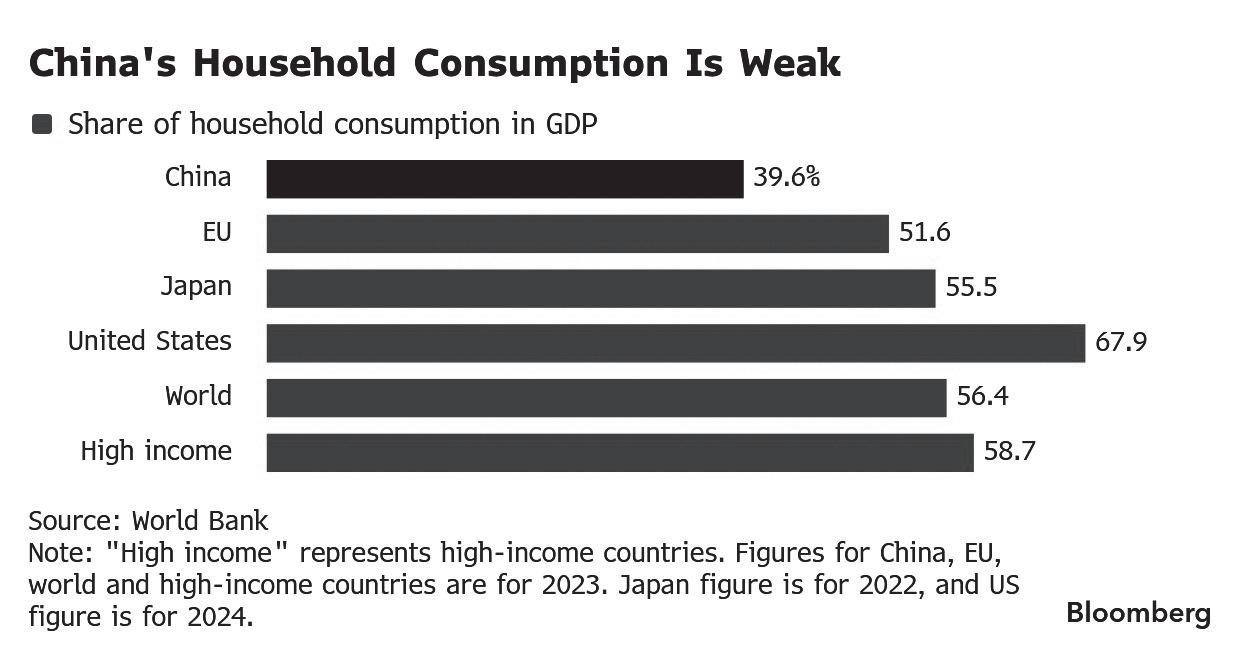
But spending in the country remains patchy. China has hit its longest slowdown in consumption growth since a post-Covid rebound lost steam four years ago, suggesting the limits of Beijing’s attempts to fuel spending through limited subsidies rather than broad reforms.
PAG’s ability to keep negotiating with Wanda was partly a function of the fact that the once-giant company, when facing the brink, appeared unusually willing to try almost any solution to survive. Its disposals of theme parks and cinema chains reversed what was once founder Wang Jianlin’s grand vision. Its sale of a majority stake in Zhuhai Wanda meant it lost control of a cash-cow. That flexibility helped PAG and other investors to get in. It may eventually give them a profitable way out, said Yao Yu, founder of Shenzhen-based credit research firm RatingDog.
“Over time, these assets could plausibly be sold back to Wang or aligned parties,” he said. “In restructuring, survival often precedes recovery.” With assistance from Emma Dong/Bloomberg
WEIJIAN SHAN, PAG’s co-founder and executive chairman. BLOOMBERG
Sunday, November 30, 2025
Russia tightens grip on Internet, disrupting daily life for citizens
By Dasha Litvinova The Associated Press
TALLINN,Estonia—When Russians look back at 2025, they might remember it as the year when the government took even tighter control of the Internet.
Credit cards that won’t buy a ticket on public transport. ATMs that don’t connect to a network. Messaging apps that are down. Cellphones that don’t receive texts or data after a trip abroad. Mothers of diabetic children even complain with alarm that they can’t monitor their kids’ blood glucose levels during outages.
The cellphone Internet shutdowns, ostensibly to thwart Ukrainian drone attacks, have hit dozens of Russian regions for months. Popular messaging apps also are restricted, with the government promoting a statecontrolled app seen by critics as a possible surveillance tool.
Although broadband and Wi-Fi internet access remain unaffected, Russians contacted by The Associated Press described digital disruptions to their daily lives. All spoke on condition of not being fully identified for their own safety.
Blackouts and ‘white lists’ are part of Russian strategy WIDESPREAD cellphone Internet shutdowns began in May and persisted through summer and into the fall.
In November, 57 Russian regions on average reported daily disruptions to cellphone links, according to Na Svyazi, an activist group monitoring shutdowns.
Authorities say these outages are designed to prevent Ukrainian drones from tapping mobile networks for navigation.
Kremlin spokesman Dmitry Peskov said they are “absolutely justified and necessary,” but analyst Kateryna Stepanenko of the Washington-based Institute for the Study of War
said they haven’t been effective in curbing the intensity of Ukraine’s drone attacks, “given the amount of strikes we’ve seen in recent months on Russian oil refineries.”
In many regions, only a handful of governmentapproved Russian websites and online services—designated as being on “white lists”—are available during connectivity blackouts.
What’s available on the “white lists” varies by provider and includes official websites, e-mail and social media platforms, two online markets, and the Russian search engine Yandex and its services. One provider offers access to a banking app, but others don’t. Authorities have promised to expand the lists.
Marina, who lives in the Pacific coast city of Vladivostok, described her anxiety when she discovered only one app for a government-controlled bank was working during a mobile Internet outage and she wondered what this meant for the future.
“For me, this is the scariest thing,” she said. “The loss of information, the loss of freedom, essentially, is the most depressing thing for me.”
In the Volga River city of Ulyanovsk, about 700 kilometers (435 miles) east of Moscow, one resident described how his credit card didn’t work when he tapped it on the payment terminal on a tram during an outage. He wasn’t carrying enough cash.
Families with diabetic children say they can’t monitor their children’s glucose levels via special apps when they are at school and cellphone Internet is
down. Mothers in social media posts explain that children often can miss the moment when their blood sugar levels change, requiring an intervention, and special apps allowed parents to see that remotely and warn them. Connection outages disrupt that.
Authorities have tried touting the joys of reconnecting with a technology-free lifestyle.
Internet regulatory agency Roskomnadzor posted a cartoon on social media showing two views of a young man: one in a dark apartment staring at his phone and another strolling happily in a park, carrying a cup of coffee and a book.
Going offline “doesn’t mean losing touch. Sometimes it means getting in touch with yourself,” the cartoon advised.
But the post mostly drew angry and sarcastic comments.
Restrictions set on SIM cards
ONE recent anti-drone restriction sets 24-hour “cooling periods” during which data and texts are blocked from SIM cards that were carried abroad or have been inactive for 72 hours. The
owner can unblock it via a link received by text message. Unblocking becomes impossible, however, if a SIM card is used in internetconnected appliances or equipment without interfaces for receiving text messages, like portable Wi-Fi routers, cars or meter boxes.
Lawmaker Andrei Svintsov noted that Russia has many electricity meters with SIM cards that transmit readings once a month.
“Does this mean they’ll all die? All the heating boilers will shut down, and all the Chinese cars will stop working? This is a massive problem, and I don’t know if the government is even aware of it,” he said.
Messaging apps are targeted OTHER restrictions targeted two popular messaging apps: WhatsApp, with about 96 million monthly users in October, and Telegram, with 91 million, according to media monitoring group Mediascope.
Authorities began restricting calls on these apps in August, supposedly to stop phone scams,
and are throttling them in some parts of Russia. Yelena, in the southern city of Krasnodar, recalled a time in October when Telegram wasn’t available at all, affecting the work of her and her colleagues.
Neither app is on the government “white list.”
On the list is Russian messaging service MAX.
Authorities actively promote it and since September the service is required to be preinstalled on all smartphones in Russia.
Critics see it as a surveillance tool as MAX openly declares it will share user data with authorities upon request.
Experts also say it doesn’t use end-to-end encryption.
State institutions, officials and businesses are being encouraged to move communications and blogs to MAX. Marina, the Vladivostok resident, said her employers are insisting on people using MAX, to little enthusiasm.
She said she doesn’t plan to install it, and neither do others contacted by the AP.
MAX developers boast of about 50 million users registering on the platform that
it says provides messaging and other services.
Mediascope said MAX had about 48 million monthly users in October, but only 18.9 million average daily users, which is far less than the average daily totals of 81 million for WhatsApp and 68 million for Telegram.
Russians shrug at restriction DENIS VOLKOV, director of the Levada Center, Russia’s top independent pollster, said many Russians regard the restrictions the same way they feel about the weather: Ultimately, you can do nothing about it.
The authorities’ strategy appears to be to make it difficult for average users to access “alternative content” so that they eventually stop seeking it, Volkov said. Those “who are not that interested will pick simpler channels and ways” to navigate the Internet, he said. That sentiment was echoed by the Ulyanovsk resident who said he uses a virtual private network to access some of the blocked websites and platforms, but VPNs also are routinely blocked, so he must install a new one every few months.
His tight circle of friends trade recommendations on VPNs, but he believes most people won’t make that much effort.
Mikhail Klimarev, executive director of the Internet Protection Society activist group, says the Internet is tied to too many economic activities to shut it totally.
“Groceries are being shipped to stores—this is being done via Internet, the ordering, the processing, and so on,” he said. “A truck is on the road, it is connected to an information system, maps, navigation, all of it.” But he forecasts more stifling of websites, VPNs and platforms including totally blocking messenger apps Telegram and WhatsApp and possibly other, unexpected measures.
“Honestly, I’m watching it all with raised eyebrows. They seem to have come up with everything already, and they’re still coming up with something more,” he said.
China expands school breaks to boost family travel and consumer spending
By Bloomberg News
UNTIL this year, only
a handful of cities in China allowed schools to go on a break each fall. But in recent months, at least 27 others have joined the list, with more possibly on the way.
From the eastern Zhejiang province to Sichuan in the southwest, officials are carving out days off in the hope that families use the chance to splurge on travel—or at least dispatch their children on school-organized trips. By freeing up time away from classes, authorities are pulling on a new lever in their quest to get households to spend more, and at little cost to cashstrapped local budgets. And if
the southern Chinese city of Foshan is any indication, China may not have to wait long for the payoff.
After Foshan introduced a three-day school vacation in November, calls to Guangzhou Comfort International Travel Co. came pouring in from families suddenly searching for an activity to occupy the time. Business was so brisk that the staff had to work overtime and breaks were slashed in half, stretching the Foshan branch’s resources to the point where it had to ask the travel agency’s Guangzhou headquarters for extra hands.
“We were indeed a bit flustered when we had to handle the policy of autumn breaks for the first time,” said Zheng
Zihua, who works at the agency.
“Our business was even hotter than the November before the pandemic.”
The number of travelers from Foshan surged more than 50% during the autumn break from a year ago, its data showed, of which more than three-quarters were families.
The latest change followed Beijing’s repeated calls on localities to adopt spring and autumn school holidays to
“improve the environment for consumption.” Under China’s current education system, students in primary, middle and high schools only get two vacations a year, in summer and winter.
Should Foshan’s policy spread nationwide, it could add almost $50 billion to annual consumption—equivalent to 0.7% of last year’s total retail sales—according to calculations by Bloomberg, based on the spending patterns seen during past holidays of similar length. Not all parents are on board, however, since adults in China get only a few days off a year and many worry about exhausting all of their paid leave options. Still, the effort has shown early dividends. According to the latest data from Trip. com provided to Bloomberg, hotel bookings from Zhejiang increased 68% than a year ago during the autumn break, while flight reservations rose 22%. Over in Sichuan, hotel bookings gained 92% from a year ago. Letting students go on recess also has the added advantage of sparing cost for local governments that often have to foot the bill for initiatives coming from Beijing.
A PUSH FOR CO-CREATED INNOVATION:
How science, communities meet at NSTW 2025
Story & photo by Bless Aubrey Ogerio
LAOAG CITY—The call to place communities at the center of scientific development set the tone as the National Science, Technology and Innovation Week (NSTW) 2025 opened in Ilocos Norte on November 18. And for Science Secretary Renato U. Solidum Jr.,the direction of national efforts in science and innovation must enable citizens to take an active role in shaping solutions that address their own local challenges.
“Can we make sure that our future farmers, youth, and entrepreneurs are not just beneficiaries, but active co-creators of progress? Let me put emphasis on cocreation because local knowledge drives better solutions,” Solidum said during the NSTW opening ceremony at the Centennial Arena in this city.
Engaging communities, he added, “ensures that solutions are context-specific, practical, and culturally appropriate rather than imposed from outside.”
The question, though, is answered, he said, “through smart, inclusive, and sustainable use of science, technology, and innovation.”
The science chief pointed out that programs across the country already demonstrate this direction.
The role of resilience in scientific planning was also emphasized, with Solidum saying it is “not a buzzword, but the backbone
of a sustainable future,” and that resilience should mean “bouncing forward, not just bouncing back.”
This year’s NSTW carries the theme “Siyensya, Teknolohiya at Inobasyon: Kabalikat sa Matatag, Maginhawa, at Panatag na Kinabukasan,” with a focus on building smart and sustainable communities as drivers of resilience and long-term development.
The celebration aims to broaden public appreciation of science and innovation, encourage participation among students, entrepreneurs, local governments, and industries, as well as highlight research and technologies that address national needs.
Programs and exhibitions during the week showcased initiatives under flagship efforts such as the Smart and Sustainable Communities Program, Small Enterprise Technology Upgrading Program (Setup), Community Empowerment through Science and Technology (CEST), and science-based tools for climate adaptation and disaster risk reduction.
Dialogue
IN a news briefing on November 19, Solidum said municipalities interested in participating in the Smart and Sustainable Communities Program must first demonstrate readiness and commitment.
“Well, it’s simple to define. The first is the willingness of the local government to really work with the DOST [Department of Science and Technology],” he said. Particularly, this includes working jointly with agency teams to
develop a technology roadmap.
“We needed people who are really interested. Because they can be smart and sustainable. But if there’s no interest, we don’t force them. It’s hard to talk about that,” he added.
Manila ranked fifth in Southeast Asia and 63rd globally in the 2025 Smart City Index of the International Society for Urban Informatics. Though the ranking represents a 19-spot drop from last year, the score remained nearly unchanged at 86.3 percent, reflecting evaluation under
expanded criteria.
On the other hand, discussions during the week also covered how to measure the long-term educational and economic outcomes of STEM-related competitions and activities. STEM is short for science, technology, engineering and mathematics.
Solidum noted that while measurable impact will take time, increasing participation in robotics, programming, artificial intelligence, and game development helps build foundational skills.
“In terms of transforming how
our youth would be able to use modern technologies like AI [artifical intelligence], the programming, I will teach that to the kids,” he said.
He noted further that e-sports and game development represent industries where the Philippines could expand employment opportunities through innovation and global collaboration.
Activities
EXHBITS aligned with NSTW’s pillars of wealth creation and wealth protection opened at the Laoag City Hall Auditorium on November 19, featuring research outputs, industrial technologies and tools developed by DOST agencies and research institutes.
Under the wealth creation pillar, exhibits included digital transformation solutions and technologies intended to strengthen micro, small and medium enterprises and competitiveness across industries.
The wealth protection exhibits focused on tools for climate and disaster risk reduction, such as flood early-warning systems, hazard mapping technologies, and community-based resilience programs. Besides exhibits, youth-centered activities formed another major component of the celebration.
The e-Games Development and Competition invited participants to design educational and socially relevant games grounded in STEM concepts and Filipino stories.
Entries were evaluated on innovation, technical execution, user
experience, and alignment with development themes.
Moreover, the RoboTECH Cup featured challenges including search-and-rescue, Internet of Things mobility, and automated trash collection and sorting, with participants required to design, build, and program robots to perform specific tasks simulating real scenarios.
Per the organizers, the competition highlighted how automation can support efficient and smart community systems.
Meanwhile, the Grassroots Innovation and Circular Economy (GICE) Expo in Batac City on November 21 showcased communitydeveloped technologies and products through the Best GICE Competition, and included the ceremonial turnover of the Grassroots Innovation for Inclusive Development Compendium Volume II.
Broader look NSTW, established through Proclamation 2214, is the country’s main annual platform for promoting science and innovation and for presenting research programs that respond to public needs.
Over the years, the event has evolved to highlight the role of science in sustainable and inclusive development.
As Solidum reiterated, the work ahead centers on ensuring that scientific advances translate into practical improvements in daily life: mobility, safety, education and livelihood.
“A nation cannot be smart if daily mobility is a struggle,” he said.
Science prizes spotlight homegrown breakthroughs at NSTW
By Bless Aubrey Ogerio
LAOAG CITY—Scientific research, enterprise technology upgrades and community innovations backed by public funding took center stage during the 2025 National Science, Technology and Innovation Week (NSTW) in Laoag City, Ilocos Norte, last week.
The celebration led by the Department of Science and Technology (DOST) brought together scientists, entrepreneurs, and community organizations.
The recognitions spanned major programs, namely the Community Empowerment through Science and Technology (CEST), the Small Enterprise Technology Upgrading Program (Setup) and the NSTW Outstanding Scientists awards. Scientific research honors announced
FIVE Filipino researchers were presented as this year’s outstanding contributors in the fields of basic and applied research, commercialization and science administration during the NSTW opening ceremony on November 18. Joseph Baconcillo of the Philippine Atmospheric, Geophysical and Astronomical Services Administration was awarded the Eduardo A. Quisumbing Medal as the 2025 Outstanding Research and Development Awardee for Basic Research.
His multi-year study, cited by the award body, provides new insights into
long-term climate trends and variability, strengthening disaster preparedness and seasonal forecasting efforts.
Andrew Montecillo of the University of the Philippines Los Baños (UPLB) received the Julian A. Banzon Medal for Applied Research for leading the country’s first genomic surveillance of major livestock and avian viruses. It is intended to support early detection and response to diseases that threaten food supply chains.
Meanwhile, two commercialization awards under the Gregorio Y. Zara Medal were also given this year. It was conferred to Dr. Violeta N. Villegas and her team also from the UPLB, for the study “A Papaya Revolution: The ‘Sinta’ Variety’s Commercial Triumph,” which documented how a locally developed papaya hybrid entered competitive markets. The team behind the proposed “Bio-N Technology,” from UPLB, was awarded for its microbial inoculant that was developed as an alternative to synthetic nitrogen fertilizers.
Further, National Institute of Health (NIH) Executive Director Eva Maria Cutiongco-De La Paz received the Dioscoro L. Umali Medal for Outstanding Science Administrator.
She was cited for strengthening the research ecosystem within the NIH and steering its programs toward measurable outcomes aligned with national health priorities. The awardees each received P200,000
cash prize, a medal and a plaque from the National Academy of Science and Technology.
Innovation in city jail earns community award
GENERAL Santos City Jail Male Dormitory was named this year’s Best CEST Community for integrating science- and technologybased interventions to improve daily conditions and livelihood prospects for persons deprived of liberty (PDLs).
Former warden and Jail Chief Insp.
Lucky Mer Natuel recounted how the facility partnered with DOST through the CEST program after years of encountering unsafe water and limited livelihood and education opportunities.
“We lacked equipment, water was unsafe and there was limited opportunity for education. We had no source of potable water,” Natuel said in Filipino, explaining the challenges that prompted the partnership.
“Through the partnership formed between BJMP [Bureau of Jail Management
and Penology] and DOST, it was indeed a partnership made from heaven, a noble partnership, we witnessed something truly human lives slowly reclaiming dignity,” he said.
Natuel added that the project empowered more than 600 PDLs across programs ranging from skills development to improved access to clean water.
“Science was felt, lived, and experienced even behind bars, proving that no one is indeed left behind,” he said.
The community received a P500,000 grand prize, a plaque of recognition, and an additional P30,000 for a special award in Sustainable Energy.
At the same time, Barangay Potrero in Malabon City and the municipality of Ramos in Tarlac were named first and second runners-up, receiving P300,000 and P200,000 respectively, along with additional special citations for sustainability and nutrition initiatives.
DOST figures showed that more than 2,170 communities have been supported through the CEST program since 2012 via livelihood technologies, capacity-building initiatives, consultancy support and other science-based interventions.
Enterprise tech upgrades recognized NATIONAL recognition was also given to local enterprises that successfully adopted technology through Setup, which helps micro, small and medium enterprises
(MSMEs) enhance production systems, adopt new equipment, and apply sciencebased processes.
This year, Llouisse and Ai Souvenir Shop from Eastern Visayas received the top honor under the Circle Award, highlighting its innovative approach to integrating circular economy principles in their operations. Cognitif Inc., based in Metro Manila, was recognized with the I-Ready Award for being the most Industry 4.0-ready enterprise, demonstrating advanced digital and automated processes. Meanwhile, Bauertek Farmaceutical Technologies Corp. from Region III was named the ICON Awardee for its outstanding
SCIENCE Secretary Renato U. Solidum Jr. speaks at the National Science, Technology and Innovation Week 2025 opening in Ilocos Norte on November 18.
Faith Sunday
A6 Sunday, November 30, 2025
Discalced Carmelites in PHL join call for accountability against corruption
THE Discalced Carmelite friars in the Philippines expressed their solidarity with the Trillion Peso March Movement in the call for accountability, transparency and justice against the rampant graft and corruption the country, and said they will join the prayer rally at the People Power Monument on November 30.
“We cannot remain silent when dishonesty and injustice rob our people of the services, resources, and opportunities rightfully theirs,” said Fr. Reynaldo V. Sotelo Jr., OCD, Provincial Superior of the Philippine Province of St. Teresa of Jesus, pointed out in a statement. He said the trillions lost to ghost projects, questionable transactions, and the misuse of public funds “are not merely administrative failures.”
“They signify a deep moral and spiritual crisis that corrodes trust, violates the dignity of the poor, and endangers the future of the nation. Corruption is a wound that bleeds from the very soul of society,” the OCD statement released on November 27 said. Sotelo quoted from Pope Leo XIV’s Apostolic Exhortation Dilexi Te (I have loved you): “The cry of the poor constantly challenges our lives, societies,
political and economic systems, and, not least, the Church…. If we remain unresponsive to that cry, the poor might well cry out to the Lord against us, and we would incur guilt and turn away from the very heart of God” (Dilexi Te, nos.8-9).
“These words pierce our hearts as Filipinos and as Carmelites. Indifference toward corruption is indifference toward Christ himself,
who became poor for our sake (cf. 2 Cor 8:9),” the priest added.
As disciples of Jesus Christ and heirs to the Teresian Carmelite tradition, he said the Carmelites are guided “to prophetically witness to Gospel values and accompany
Tondo Church is PHL’s 29th minor basilica
A16TH-CENTURY parish church in Manila’s Tondo district is the latest in the Philippines to be named a minor basilica.
The Archdiocesan Shrine and Parish of Santo Niño de Tondo is now the Minor Basilica of Santo Niño de Tondo.
The parish announced the Vatican’s decree on Monday, shortly after being notified by the Archdiocese of Manila of its elevation.
“This meaningful moment marks the official transmission of the Holy Father’s decree, an important step in the journey toward our new title as a Minor Basilica,” the shrine said.
“As we give thanks to God for this blessing, we now look forward to the next chapter in this grace-filled milestone,” it added.
Founded in 1572, the shrine is considered the first parish church in the Luzon region, with Tambobong (Malabon), Caloocan, Betis in Pampanga, and Calumpit in Bulacan as its early “vesitas.”
The church is also home to the secondoldest image of the Santo Niño in the country, after the Santo Niño de Cebu. Over the years, it has become a pilgrimage
site, drawing the faithful from near and far who seek spiritual renewal and an encounter with the Child Jesus.
A basilica is a church given special
recognition by the pope, often for its beauty, historical significance or importance to the faith.
A basilica is not required to be a cathedral—which derives from “cathedra,” the bishop’s chair—and most basilicas are not cathedrals, just as most cathedrals are not basilicas, though some churches hold both titles.
There are now 29 minor basilicas in the Philippines, according to the Association of Catholic Shrines and Pilgrimages of the Philippines, which keeps the list.
As a basilica, the shrine will receive an ombrellino, a yellow-and-red silk canopy, and a tintinnabulum, a bell mounted on a pole traditionally used during papal visits. Together, they symbolize its new status.
The basilica also gains the privilege of displaying the Vatican City coat of arms on its facade and the crossed keys of St. Peter on its furnishings and liturgical items.
Roy Lagarde/CBCP News
Vatican defends marriage as monogamous relationship
VATICAN—A new Vatican document defends marriage as a monogamous relationship amid the growing popularity of polyamory, and addresses the pastoral challenges caused by conversion to Catholicism of people in polygamous situations. The document “One Flesh: In Praise of Monogamy” was published in Italian by the Dicastery for the Doctrine of the Faith on November 25.
“Polygamy, adultery, or polyamory are based on the illusion that the intensity of the relationship can be found in the succession of partners,” the Vatican says.
To illustrate this metaphorically, the text cites the myth of Don Juan, an unbridled seducer whose womanizing leads him to hell, which demonstrates that “multiplying partners in a supposed total union means fragmenting the meaning of marital love.”
The text also draws on the writing of poets Walt Whitman, Pablo Neruda, Rabindranath Tagore, and Emily Dickinson, as well as philosophers like the Danish philosopher Søren Kierkegaard.
The document, signed by Pope Leo XIV, does not address the indissolubility of marriage or the purpose of procreation, but focuses on the unitive aspect of marriage.
“A communion of love and life shared by both spouses, a communion that is not oriented solely toward procreation, but also toward the integral good of both,” it says.
The text originated from a request
made during the Synod on Synodality for African bishops to prepare a statement on polygamy. African bishops themselves asked the Holy See for guidance on the issue, the dicastery said earlier this month.
In the November 25 document, the dicastery says it also wanted to provide a deeper reflection on monogamy in the face of growing “public forms of nonmonogamous unions—sometimes called ‘polyamory’”—in the West.
The Vatican’s doctrinal note emphasizes that “properly understood, monogamy is not simply the opposite of polygamy.”
Drawing from the teachings of St. Pope John Paul II, the Vatican affirms that “only monogamy guarantees that sexuality develops within a framework of recognizing the other as a subject with whom one shares one’s life entirely, a subject who is an end in himself and never a means to one’s own needs.”
It adds: “Sexual union, which involves the whole person, can treat the other as a person, that is, as a co-subject of love and not an object of use, only if it develops within the framework of a unique and exclusive belonging.”
“Those who give themselves fully and completely to the other can only be two,” the text states, after noting that in nonmonogamous relationships everyone “would be treated as means and not as persons.”
Sexuality: Total and open to life
THE text makes it clear that placing sexuality within the framework of a love that “unites
spouses in a single friendship” does not imply a “devaluation of sexual pleasure.”
Rather, “by orienting it toward self-giving, it is not only enriched but also enhanced.”
Thus, “sexuality is no longer the release of an immediate need, but a personal choice that expresses the totality of the person.”
The Vatican criticizes contemporary culture that reduces sexuality to consumption.
“Various problems have arisen from an excessive and uncontrolled pursuit of sex, or from the simple denial of its procreative purpose,” it says.
Therefore, the Vatican defends openness to life in sexual union as a form of expression of “conjugal charity,” without requiring that every act explicitly have that purpose.
On an anthropological level, the document insists that “the defense of monogamy is also a defense of the dignity of women,” since “the unity of marriage implies, therefore, a free choice on the part of the woman, who has the right to demand exclusive reciprocity.”
The document also addresses sexual violence, which it says proliferates on social media, and invites Catholics to provide education on “faithful and monogamous love.”
“Education in monogamy is not a moral restriction, but rather an initiation into the grandeur of a love that transcends immediacy,” it says.
Theological foundations and spiritual tradition
THE text offers a broad overview of the
Christian tradition that has upheld and reflected upon marital unity. It quotes popes and Church fathers, including St. John Chrysostom, who saw in marital unity an antidote to “unbridled sexual abandon, without love or fidelity.”
Citing the Catechism of the Catholic Church, the text also considers the challenges for those who, desiring to convert to the Catholic faith, must navigate complex family situations.
In addition to Africa, the document cites Asia, specifically India, where “monogamy has generally been the norm and has been considered an ideal in married life,” but polygamous relationships have also been present.
Africa’s Catholic bishops issued a document earlier this year with six pastoral guidelines for how to welcome people in polygamous situations into the Church, both while upholding Church teaching on marriage and not leaving women and children vulnerable to abandonment and poverty.
At the August 4 assembly of the Symposium of Episcopal Conference of Africa and Madagascar in Kigali, Rwanda, Archbishop Andrew Nkea Fuanya of Cameroon’s Bamenda Catholic Archdiocese clarified that during the deliberations at the Synod on Synodality, “polygamy was not brought up as an African concept to be approved. It was brought up as a challenge to Christian marriage in Africa.” Victoria Cardiel/Catholic News Agency via CBCP News
the people of God—especially the poor and the youth—with care and respect for all of God’s creation.”
Thus, the Carmelites stand for accountability and demand justice for every peso of the people’s money.
“Public office is a sacred trust; leadership is a moral responsibility,” he said, urging “those in authority to serve with integrity, conscience, and compassion, and “call on every Filipino to persevere in vigilance, solidarity, and moral renewal.”
In concrete expression of their solidarity, Sotelo said, “believing that prayer and action must go together,” the Carmelites will join the faithful in the Trillion Peso March Movement at the People Power Monument at the 10 a.m. Holy Mass on November 30.
“Our pursuit of truth and justice must be rooted in faith, and our faith must lead us to courageous love for our country,” he pointed out.
“With Mary, Our Lady of Mount Carmel, and our holy parents, St. Teresa of Jesus and St. John of the Cross, may we continue to pray and work for a Philippines built on truth, justice, and love, so that our nation may more clearly reflect the light and freedom of the Kingdom of God,” Sotelo said.
My faith and God’s grace
By Chairman Lee Man-hee
DURING the tragic fratricidal Korean War of 1950, I fought as a combat soldier on the front lines (Seventhh Division). When North Korea invaded the South, our country was completely unprepared for war, so they seized everyone they could and sent them to the front lines.
However, without the ability to defend ourselves, we were quickly pushed back to Daegu in the southern region. At this point, the United Nations (UN) forces entered the war and began advancing north.
Our forces fought on the front lines, while the UN forces were deployed on the second line. Because the war began when we were unprepared, more people died of hunger than from gunshot wounds.
I had been advancing for four days without food, then I collapsed in a field, unable to even speak. Just then, I was discovered by UN forces who were following behind me and they evacuated me to the Daegu Army Hospital where I was later discharged.
I then returned to my hometown and continued my farming as before. I built a hut in the field and lived there with my father doing farm work. At that time, I was grateful to have survived the front lines of war, so every night before bed, I offered up a prayer of thanks to God in heaven.
One night, while praying, a light brighter than sunlight enveloped me. Panicked, I ran to my room and woke my father, who was also startled by the light. This light visited me for three evenings, and this experience ultimately led me to faith.
I drew my own blood and made a pledge with it to God saying, “I will believe in You and be loyal to You.” This became the beginning of my faith. What I learned from God and Jesus was the Bible, primarily the Book of Revelation in the New Testament. Today, Jesus has removed all the seals on the Book of Revelation and he has opened it. He has given me this opened book to eat and has revealed to me the realities of this book, that is, the realities of Chapter 1 to 22 (Revelation 22:8). After revealing these things, Jesus instructed me to go and tell the churches (Revelation 22:16).
But many churches were unaware of the New Testament Book of Revelation, and neither wanted to hear it nor believe in it. However, for the sake of fulfilling my duty, I diligently shared what I saw and heard. God said that those who add to or take away from Revelation will not be able to enter heaven and will be cursed (receive plagues) (Revelation 22:18-19). Today, all believers should stand before the Bible and ask themselves whether they have added to or taken away from Revelation. God has said that those who believe and master this book, Revelation, will be saved, while those who do not believe and add to or take away from it will not be saved. As I have pledged after being guided by the great light, I will fulfill my duty to proclaim the prophecies and reality of Revelation and will remain faithful to God until the day that Revelation’s fulfillment is complete. This is the faith that I have promised and this is God’s
FR . Reynaldo V. Sotelo Jr., OCD, Provincial Superior of the Philippine Province of St. Teresa of Jesus, celebrates Mass. LYN RESURRECCION
THE Archdiocesan Shrine and Parish of Santo Niño in Tondo, Manila CBCP NEWS
CHAIRMAN Lee Man-hee leads Shincheonji Church of Jesus the Temple of the Tabernacle of the Testimony which is currently testifying about the fulfilled realities of the book of Revelation. He also leads the Heavenly Culture World Peace Restoration of Light, an international peace organization that promotes world peace through interfaith
education.
Editor: Lyn Resurreccion
Biodiversity Sunday
Sharks take center stage at COP20
Philippine conservation advocates call for stronger protection measures for endangered shark species at CITES meeting
By Jonathan L. Mayuga
THE 20th meeting of the Conference of the Parties (COP20) to the Convention on International Trade in Endangered Species of Wild Fauna and Flora (CITES) is gathering international and civil society organisations (CSO) in Samarkand, Uzbekistan.
Taking place from November 24 to December 5, CITES COP20 (2025) is reviewing 114 items related to international wildlife trade, such as proposals to list more marine species—including sharks and eels—and discussions on reopening trade for stockpiled ivory and saiga antelope horn.
Joining the event from the Philippines are leaders of civil society organizations and shark conservation advocates to push for stronger protection measures for at least 70 additional shark species facing extinction.
Stronger shark conservation, protection AT a rundown event of shark conservation advocates in the Philippines for the COP20, a network of environmental organizations and sustainabilityfocused businesses issued an urgent call to the government to support proposals protecting sharks and rays at the Uzbekistan conference.
Held during the 10th Anniversary of the Philippine Sustainability Movement in Manila on November 10, at least 25 CSO leaders, environmentalists, and conservation advocates signed a joint statement, commending the country’s leadership as a co-proponent to strengthen the protection of whale shark.
The group, however, urged the government, through the Bureau of Fish -
eries and Aquatic Resources (BFAR), to expand this commitment by supporting all additional shark and ray proposals at COP20.
“The science is clear. If the proposal discussions lead to a vote by the Parties, “vzoting ‘yes’ is a direct step toward fulfilling the objectives of our own National Shark, Ray, and Chimaera Conservation and Fisheries Management Plan. It is a vote for both our natural heritage and our sustainable blue economy,” the joint statement read.
Threatened shark species
THE proposals target some of the world’s most threatened species, including:
n The Oceanic whitetip shark, which remains heavily exploited despite existing protections n Manta and mobulid rays, whose populations have declined by over 80 percent globally n Wedgefish and giant guitarfish, identified as the most threatened marine fish families on Earth, with 17 of 18 species
Critically Endangered n Deep-water gulper sharks, sought for their valuable liver oil, leading to population crashes exceeding 80 percent n Smoothhound and tope sharks, whose inclusion would regulate 96 percent of the shark species fin species found in international trade
The group emphasized that supporting the proposals to strengthen their protection aligns with existing national laws that already protect many of these species, such as manta rays and wedgefish, within Philip -
pine waters.
By supporting the global CITES listings, the Philippines ensures its domestic conservation efforts are not undermined by unregulated international trade.
Tourist attraction
THE Philippines has taken pride and benefited economically from the iconic shark species that inhabit its waters, such as the whale sharks and thresher sharks, which are a major tourism attraction for the country.
The town of Donsol in Sorsogon, has become a major hub for whale shark interaction. The province has since become a model for responsible marine tourism.
Oslob, a coastal town in Cebu, is another significant whale shark tourism destination, albeit its practice has been criticized, specifically for feeding sharks that alter their behavior.
Bohol also promotes whale shark interaction as a tourism attraction.
Palawan, particularly the Tubbataha Reefs Natural Park, offers tourists the opportunity to encounter sharks in their natural habitat.
Threats to sharks
SHARKS and rays face a multitude of threats, including illegal and unreported trade, bycatch, and climate change, shark conservation advocates say.
Overexploitation—driven by international trade—for high-value products like fins, gill plates, and liver oil, however, is the most serious threat to their existence.
Dr. AA Yaptinchay of the Marine Wildlife Watch of the Philippines says overexploitation is systematically pushing critically endangered species
Gramma, the Galapagos tortoise of San Diego Zoo, dies at about 141
LOS ANGELES—After more than a century of munching on her favorite foods of romaine lettuce and cactus fruit, beloved Galapagos tortoise Gramma, the oldest resident of the San Diego Zoo, has died. Gramma was born in her native habitat and was estimated to be about 141 years old, zoo officials said. She died on November 20.
It’s not clear exactly when the tortoise arrived at the San Diego Zoo, but zoo officials said she came from the Bronx Zoo in either 1928 or 1931 as part of their first group of Galapagos tortoises.
As the world changed around her, she delighted visitors with her sweet, shy personality. She lived through two World Wars and 20 US presidents. Her care specialists affectionately called her “the Queen of the Zoo.”
She was suffering from bone conditions related to her old age that progressed recently before she was euthanized, the zoo said.
Many visitors commented on social media about getting to first visit Gramma when they were young, and being able to come back years later with their kids.
Cristina Park, 69, said one of her earliest memories from her childhood was going to the San Diego Zoo when she was 3 or 4 years old and riding on the back of a tortoise.
That’s no longer allowed, but the experience inspired her to keep a small desert
tortoise as a pet and learn more about tortoise conservation.
“Just how amazing it is that they managed to live through so much,” Park said. “And yet they’re still there.”
Galapagos tortoises can live for over 100 years in the wild, and close to double that in captivity.
The oldest known Galapagos tortoise was named Harriet, who lived at the Australia Zoo until the age of 175. She was collected from the Galapagos Islands in 1835, when she was just the size of a dinner plate, according to the zoo.
This means that she hatched somewhere around 1830, and she died in 2006.
Galapagos tortoises include 15 subspecies of tortoises from the islands, three of which were deemed extinct.
The rest are all vulnerable or critically endangered, according to the International Union for Conservation of Nature.
Concerted efforts have been made to breed these tortoises in captivity over the past several decades, with more than 10,000 juveniles released to the wild since 1965, according to the Galapagos Conservancy.
Jaimie Ding/Associated
Press
toward extinction.
“This direct pressure is exacerbated by the inherent biological vulnerability of these animals, as their slow growth and low reproductive rates make them unable to withstand current levels of commercial harvest,” Yaptinchay told the BusinessMirror via Messenger.
He added that acute pollution events like oil or molasses spills are significant threats to sharks and rays, particularly in critical coastal habitats like in Tañon Strait.
“These spills can cause direct mortality through poisoning and gill damage, while also degrading the coral reefs and mangroves that serve as essential nursery and feeding grounds for many species. For populations already pushed to the brink by overfishing, such localized catastrophe could deliver a devastating, irreversible blow to their recovery,” he said.
Exotic food?
IN the Philippines, “exotic animals” are considered a special delicacy.
Yaptinchay said that sharks and rays are targeted in the Philippines, mainly for their meat.
On the other hand, he said the fins are mostly exported to China for shark’s fin soup.
Manta ray gills are used in traditional Chinese medicine.
“Other parts are used, such as squalene oil from their liver, leather from their skin, and their cartilage is dried and ground as a nutritional supplement,” he said.
Even though sharks are feared as man-eaters, Yaptinchay said that out of the more than a thousand species of sharks and rays, only a few are real apex predators, but mostly prey
on other large marine animals, not humans.
“A handful of sharks are filter feeders, and the vast majority of them are mid-level predators feeding on reef fish and other smaller marine life, playing various important roles in different food webs and the whole marine ecosystem, even deep-sea habitats,” he explained.
In contrast, he said, humans are the ones preying on sharks and rays.
He believes that some Chinese restaurants serving shark’s fin dishes are the main problem, but meat utilization exceeds that in the Philippines.
This is the reason why shark conservation advocates are attending COP20 to present seven proposals involving shark trade regulation.
“If countries support these proposals until next week, an additional 70 species will be added or will have strengthened protection to the already 150 species found in the convention Appendices,” Yaptinchay said.
Prehistoric species, pet trade target
SOME shark species are believed to be prehistoric species, and they could live for more than 100 years or longer.
“Our planet currently has over 500 known shark species, ranging from the popular ‘Butanding’ or whale shark to the Greenland shark, which is known to live an incredible 500 years. Of the country’s 200 shark and ray species, only a few are protected under the Amended Fisheries Code,” environmentalist Gregg Yan, founder and executive director of Best Alternatives, told the BusinessMirror via Messenger.
Because sharks are elusive, they tend to become a prized catch to extreme aquarium hobbyists.
“Using expensive, state-of-the-art technology, public aquariums can keep even the largest shark species alive. In Japan, I was able to see aquaria that kept whale sharks and hammerhead sharks alive,” Yan narrated.
“Some marine aquarists try to keep sharks at home. Small, bottom-dwelling catsharks and juvenile blacktip sharks were once commonly sold even in Manila. These are now more commonly seen in Chinese restaurants, which sell live sharks the same way they sell live groupers or lobsters,” he pointed out.
According to Yan, most sharks kept in aquaria die quickly because, like most marine fish, providing their care requirements are difficult in the long run.
Best Alternatives proposed to switch to freshwater alternatives. He said there are freshwater fish called “sharks” in the aquarium hobby, though they are not true sharks. True freshwater sharks exist, but they are rare. An example would be the bull sharks that once inhabited Taal Lake, he said.
“These sharks—bala sharks, hammerhead sharks [a cousin of the cream dory people eat] and ruby sharks— look ‘shark-like’ and are commercially bred, meaning we don’t need to catch them from the wild, and we can keep them easily since they are accustomed to captive conditions. This is a best alternative since it shifts trade pressure away from marine sharks,” he said.
“However, the real killer of true sharks worldwide is a fishing phenomenon called bycatch, which kills far more sharks in a year than were caught in the entire history of the pet trade, but that’s another story,” he said.
Climate change office engage in tree growing to strengthen nature-based solutions
PAETE, Laguna–The Climate Change Commission (CCC), in partnership with the National Power Corp. (NPC) and the municipal government of Paete, Laguna, celebrated the 18th Global Warming and Climate Change Consciousness Week with a tree growing at the Caliraya-Lumot Watershed to strengthen nature-based solutions
Known as Net Zero Challenge (NZC), the initiative is part of the CCC’s continuing efforts to strengthen carbon offsetting and climate resilience, reflecting the urgency to continuously address the impacts of climate change, such as the recent and stronger typhoons.
NZC underscores the critical role of forests in safeguarding communities and supporting the country’s pathway toward climate resilience.
CCC Vice Chairperson and Executive Director Robert E.A. Borje emphasized the importance of stronger forest protection and restoration.
Borje’s message, delivered by CCC Deputy Executive Director Atty. Romell Antonio O. Cuenca, said in Filipino that amid the tragedies, the importance of forests resurfaced as protection against floods and landslide, significant carbon sink that
lower greenhouse gasses and lower the temperature of the atmosphere.
Started in August 2023, the NZC aims to plant more than 15,000 seedlings across 25 hectares at the Caliraya-Lumot Watershed in Paete, Laguna, by 2030 to align with the country’s commitment under the Paris Agreement to reduce greenhouse gas emissions and limit global warming.
A total of 400 seedlings of banaba, jackfruit, and acacia were planted during the event.
Borje emphasized this message, anchoring it on the vision of President Marcos Jr. for strengthened collaboration across all sectors.
He said the effective climate action could not be implemented just by one agency or one sector. “We need the whole-of-government and whole-ofsociety approach—from the national government, local government units, private sector, youth and communities,” Borge’s message said in Filipino.
NPC President Jericho Jonas B. Nograles reaffirmed the agency’s commitment to the initiative through a message delivered by NPC Division Manager Vincent B. Concio.
“We reaffirmed our strong commitment to this shared responsibility of being co-stewards of
nature. Today’s tree growing activity under the [NZC] in celebration of the 18th Global Warming and Climate Change Consciousness Week is more than a day’s gathering. It’s a call to action of a whole-of-society approach toward strengthening collaboration against the impacts of climate change,” Nograles’ message reads. The NZC is CCC’s carbon neutrality program that aims to contribute to global efforts to limit temperature rise to 1.5 degrees Celsius, as the reforestation of the 25 hectares at the Caliraya-Lumot Watershed is expected to sequester an estimated 75.5 metric tons of carbon dioxide. Present during the activity were representatives from the private sector, including Holcim Philippines Inc. and Ahunan Power Inc.; government agencies like Philippine Red Cross Region 4A, Department of Environment and Natural ResourcesProvincial Environment and Natural Resources Office, and Department of the Interior and Local GovernmentLaguna. The local government unit of Paete, Laguna, development partners, state universities and colleges, civil society organizations, and media partners, also participated in the tree growing initiative.
WHALE shark PHOTO BY JUERGEN FREUND
SMALL , bottom-dwelling coral and bamboo catsharks are occasionally offered for sale in marine pet trade. PHOTO BY GREGG YAN, BEST ALTERNATIVES
SOME freshwater fish also called “sharks” and are good alternatives to marine sharks, since they are mostly bred in captivity. In the photo is a freshwater hammerhead “shark,” not a real shark, known as cream dory in the market. PHOTO BY GREGG YAN, BEST ALTERNATIVES
Window goes ajar for Russian athletes
PHL masters bag 11 medals in HK athletics tourney
LTAUSANNE, Switzerland— Three figure skaters from Russia and Belarus, including an Olympic
medal prospect, were approved Thursday by the International Olympic Committee (IOC) to compete as neutrals at the Milan Cortina Winter Games in February. They include 18-year-old Adeliia Petrosian, who showed medal potential in the women’s singles event when winning an Olympic qualifying event in Beijing in September.
Petr Gumennik, the Russian singles champion, won the men’s event in Bejing two months ago and Viktoriia Safonova of Belarus was fourth behind
Petrosian. They also got approved neutral status, the IOC said.
The Beijing qualifying event was the first time Russians were allowed by the International Skating Union to compete at one of its figure skating events since the full military invasion of Ukraine started in 2022—just four days after the end of the Beijing Olympics
The IOC is doing its own vetting to approve Russian and Belarusian athletes for neutral status to compete at Milan Cortina, as it did before the 2024 Paris Summer Games.
To be eligible, individual athletes must not have actively supported the invasion of Ukraine nor have ties to Russian or Belarusian military and
state security agencies.
The figure skaters must also accept their individual invitation and sign a commitment to respect the Olympic Charter, the IOC said.
Petrosian is the latest star skater trained by coach Eteri Tutberidze, who was a controversial personality at the Beijing Olympics.
Russian judokas compete in Abu Dhabi
THE International Judo Federation (IJF) has decided to “reinstate full national representation” of Russian athletes at its competitions starting this weekend, despite the ongoing war in Ukraine.
The IJF executive committee voted
Han sparkles as Balinggao, Lim win big in Charity Cup
SUG HAN fired 37 points to
the
crown, while Raul Magpantay secured the seniors title with 34 points in the 2025 Chairman’s Charity Cup held recently at the Manila Southwoods Golf and Country Club’s Legends and Masters courses in Carmona, Cavite.
Lora Roberto also carded 37 points under the Modified Stableford scoring system to capture the ladies’ low gross trophy in the club’s premier member-guest tournament, backed by title sponsor San Miguel Corp. and presented by CSL Construction and Pro-Envirotek Inc. But the biggest winners of the event were Joseph Balinggao and
(M75),
in the
while also turning in commendable efforts in his other sprint events.
the Olympic charter by using an administrative land grab to incorporate regional sports bodies in occupied eastern Ukraine.
Russians will be allowed to compete at next year’s Milan-Cortina Winter Games but the IOC will maintain the system it used at the 2024 Paris Games, permitting them to compete only as individual neutral athletes.
Sergey Soloveychik, president of the Russian judo federation, praised what he called an “historic decision.”
“Thanks to the IJF for this longawaited, fair and courageous decision,” he added in a statement.
grand raffle draw that caps every staging of the Chairman’s Charity Cup.
Balinggao took home a Mitsubishi
XForce GLS 1.5E courtesy of Mitsubishi Motors, while Lim won a Toyota Rize E MT from Toyota Silang, Cavite. The hole-in-one prizes—raffled off after no player scored an ace—were also claimed by several lucky participants— Michael Lopez won a seven-night Mexican Riviera cruise for two, inclusive of airfare, from Royal Caribbean International and Baron Travel.
Other prize winners were Clarito Casano (brand-new Electric Golf Cart from MF Electric Golf Cart), Buboy Alvarez (Smart
Vogue Plus Ogawa Chair from Ogawa), Hector Caunan (brand-new GSM 4000 from Gransportivo), Ian Tambunting (six-day Mongolia Tour package for two from Rakso Air Travel & Tours), and Theody Pascual and Jayden Juco (four-day vacation package for two to Seoul, Korea with airfare from Arce Tours & Travel).
Meanwhile, individual division champions emerged from the threeday tournament, which drew another banner field were Men’s I: Karim Yu–40 points, Men’s II: Jojo Silverio–43 points, Men’s III: Gerald Kim–44 points, Men’s IV: Michael Lopez–44 points, Seniors I: Chang Myon Park–40 points, Seniors II: Rodolfo delos Reyes–40 points, Seniors III: Brian Park–43 points, Seniors IV: Jose Antonio Gonzalez–44 points, Ladies I: Claire Ong–39 points, Ladies II: Helga Rizza Visaya–40 points, and Ladies III: Sheila Mae Ibañez–39 points.
to allow Russian athletes to compete under their national flag, with their anthem and symbols, beginning with the 2025 Abu Dhabi Grand Slam.
“Athletes have no responsibility for the decisions of governments or other national institutions, and it is our duty to protect the sport and our athletes,” the federation said.
Following Russia’s full-scale invasion of Ukraine in February 2022, many athletes were banned from entering competitions.
The Russian Olympic Committee has been suspended since 2023 by the International Olympic Committee for breaking
Angel’s goal in SEAG De La Salle’s Angel Laude sets her sights on a podium finish as she plays in her third consecutive Southeast Asian Games in Thailand next month. The 24-year-old from Atimonan, Quezon, recently clinched Most Valuable Player honors in Season 88 of the University Athletic Association of the Philippines.
Lagac steals show in Olivarez juniors netfest
RICARDO LAGAC delivered a rousing display of grit and composure to rule the boys’ 16-and-under division, stunning top seed Krelz Gecosala in the final of the Mayor Edwin Olivarez National Junior Tennis Championships held recently in Sucat, Parañaque. Lagac surged through a gauntlet of seeded players—beating Casimir Briggs, shocking No. 2 Anthony Cosca, stopping No. 5 Karl Almiron, and routing sixth seed Anirudh Palanisamy—before capping his remarkable run with a dominant 6-1, 6-0 victory over Gecosala in the final at the Olivarez Sports Center. Riding the momentum, the 16-yearold unranked Cebuano also competed in the premier 18-and-under class and sustained his fiery form. He dispatched Jomar Maranga, ousted No. 4 and doubles partner Troan Vytiaco, stunned fifth-ranked Felizardo Lota III, and advanced to the championship after receiving a walkover from Palanisamy. Facing Almiron in the title duel, Lagac took the opening set, 6-3, stumbled in the second, 1-6, but regained his poise in the deciding set to carve out a thrilling 7-6(4) win in the tournament sanctioned by Philta and backed by Dunlop, Universal Tennis, Icon Golf & Sports and the long-running Palawan Pawnshop junior program spearheaded by president and CEO Bobby Castro.
allow me to share a short tribute about someone who made a mark in my unremarkable golfing journey: In Memoriam: Wigberto “Iggy” Clavecilla (January 14, 1948 – November 6, 2025)
Iggy Clavecilla was a legend in Philippine golf. He was among the most decorated amateurs to play the game and played competitive golf well into his senior years. He actually was the National Senior Champion six years in a row.
But to Atenean golfers in the mid 90s, he was Tito Iggy, our coach and mentor. He generously gave his time and coached the Ateneo College Golf Team, meeting us for weekly practice and in our tournaments. We’d see each other regularly after college, at Ateneo events and tournaments, as he was also one of the founders of the Ateneo Golf Foundation. The last time I saw him though was quite memorable. It was in 2014 or 2015, at the hotly contested Ateneo-La Salle Golf Classic, a yearly event for students and alumni of the rival schools. I approached Tito Iggy after I was mistakenly placed in the wrong division, which I won. Of course my win meant valuable points for Ateneo. He promptly accompanied me to the organizers and scoring committee so I can return the trophy and the corrections can be made.
Being competitive, Tito Iggy initially wanted the correction announced, to rub it in to our rivals that Ateneans value honesty more than winning. He eventually chose to let it go and not make a big deal of it in the spirit of camaraderie. (A few years prior, there was an issue of a player from La Salle who won using a different name and handicap. That quarrel between the schools resulted in the cancellation of the annual event for a couple of years.) During Tito Iggy’s wake, his golf set was displayed beside his urn. There was also a nice picture of him at an international tournament, being awarded a trophy by none other than Ernie Els. Behind Els and Tito Iggy was
ACTRESS Mary Mina, playing a priestess, lights the flame during a rehearsal ahead of the flame lighting for the Milan Cortina 2026 Winter Olympics, at the Ancient Olympia site, Greece, last week. AP
How to get through stressful holiday
NOVEMBER 30, 2025 | soundstrip.businessmirror@gmail.com
Get EN—MERSED
ENHYPEN’s first immersive concert in Manila
Story and photos by Bea
Rollo
Reigning as one of K-pop’s powerhouses, ENHYPEN, with no doubt, has now redefined an EN-Mersive experience, allowing fans to see their live performances with a groundbreaking leap into virtual reality (VR).
Manila pioneers and exclusively host “ENHYPEN VR CONCERT: IMMERSION” at Gateway Cineplex—marking the group’s first-ever VR concert event in the country and a major milestone for Filipino ENGENES (ENHYPEN’s fans).
Up close and personal feels “ENHYPEN VR CONCERT: IMMERSION” isn’t just a viewing—it’s truly an invitation into another dimension.
The experience begins with a mysterious call from ENHYPEN members—Jungwon, Heesung, Jay, Jake, Sunghoon, Sunoo, and NI-KI.
As fans enter an unfamiliar hallway, reality slowly dissolves into surreal scenes: an office
Publisher :
T. Anthony C. Cabangon
Lourdes M. Fernandez
Editor-In-Chief :
Concept :
Aldwin M. Tolosa
Y2Z Editor :
Jt Nisay
SoundStrip Editor :
Edwin P. Sallan
Eduardo A. Davad
Group Creative Director : Graphic Designers :
Contributing Writers :
Niggel Figueroa Chow Jarlego
Tony M. Maghirang Rick Olivares
Jingo Zapata
Reine Juvierre S. Alberto
John Eiron R. Francisco
Ica Hontiveros-Cheng
Ana Zoe V. Davad
Justine Xyrah Garcia
Ginger Franz S. Ocampo
Trixzy Leigh Bonotan
Bless Aubrey Ogerio
Photographers :
Bernard P. Testa Nonie Reyes
Y2Z & SOUNDSTRIP are published and distributed free every Sunday by the Philippine Business Daily Mirror Publishing Inc. as a project of the
The Philippine Business Mirror Publishing, Inc., with offices on the 3rd Floor of Dominga Building III 2113 Chino Roces Avenue corner
Dela Rosa Street, Makati City, Philippines. Tel. Nos. (Editorial) 817-9467; 813-0725. Fax line: 813-7025
Advertising Sales: 893-2019; 817-1351,817-2807. Circulation: 893-1662; 814-0134 to 36. www.businessmirror.com.ph
near their location for the “No Doubt” music video and so other locations that ENGENES will surely recognize in a snap.
With every transition, the viewer steps deeper into ENHYPEN’s world—eye-to-eye, heartbeatclose, at a close distance.
The future of concerts
With AMAZE VR’s cutting-edge technology, fans don’t just watch the concert—they interact with it. A hand-heart gesture, whichever type of aegyo you’d do, triggers a floating heart on the screen, while other advanced features allows viewers to look at exclusive messages and photocards for each member!
Moreover, since ENHYPEN’s 2020 debut, the group has stormed international charts—placing five albums in the Billboard 200 Top 10—and becoming the fastest K-pop boy group to perform at Coachella.
The “ENHYPEN VR CONCERT: IMMERSION” is exclusively played at Manila’s Gateway Cineplex through the Gateway Immersive Experience starting Nov. 20 until Dec 6.
So grab your popcorn and witness VR, cinema-scale visuals, and surround audio merge into a completely new form of entertainment— where concerts go beyond screens—VIP style. Tickets are available at the Gateway Immersive website and Ticketnet Online. So ENGENEs, your front row spot for an ENHYPEN concert awaits you just around the movie house corner.
ODE TO PINOY HIP-HOP
PLAYERTWO turns “Happy Accidents” into hip-hop magic
Story by Bea Rollo
INTRODUCING the new era of hip-hop music is more than a coincidence; we can call it “Happy Accidents”. Reigning from Davao’s pride is the alternative hiphop group PLAYERTWO’s latest sophomore album.
Delving into the coming-of-age stories translated into music, PLAYERTWO’s Ivo Impreso, Luke April, Wave P, Puhken, and Ven Villariza are ready to take over the road to stardom with their trendy beats and jams.
“I think we just wanna make volume two as good or like better than volume one parang chinallenge lang namin ‘yung sarili namin to make the best music that we can as a whole album and a complete project,” Luke said, looking back into “Happy Accidents” in the making.
“We just struck together words that rhyme and made it sound cool, pero in volume two, we took time in writing,” Ivo added.
PLAYERTWO’s Ode to Pinoy Hip-Hop
Paving the way to create sounds that fit their persona as a group, PLAYERTWO aimed to make their music known, an ode to their love and passion for the Filipino hip-hop music scene.
“More than just artists, we are at our core, rappers din and that’s our ode to hip-hop and hip-hop music, that’s the culture,” Ivo shared, revealing that the group stays rooted to their beginnings as rappers.
The group also dreamed of collaborating with OPM pillar artists such as Rey Valera and Gary V.
Fresh off the discography
All pumped up, PLAYERTWO launches their ninetrack album “Happy Accidents” for their fans at their album launch party. The crowd cheered and sang along to their new songs, including the crowd favorite “That’s My Baby”.
Kicking off the show for his opening act is artist Young Cocoa, electrifying the crowd with his songs “iboxxx” and “Raspberry,” which instantly hyped up the room.
Bringing out the it girl energy is another special guest, Illest Morena performing her hit songs highlighted by the song “Money”.
Back-to-back hit tracks
Apart from the well-thought-out songs in the album, PLAYERTWO’s members also shared each of their favorite hidden gems for “Happy Accidents”.
The top three of the members’ most mentions were “P2000”, which backs the sounds of old style hip-hop, “Fresh” with a very laid back
and chill vibe, and “For Life” to which the team describes as their group’s ride or die motto.
“It’s been a journey creating this album. It’s been spreading for like a year and a half because we’ve had trials and crises of identity--experimenting with sounds and what sounds fit us to highlight all our strengths and weaknesses,” Ivo revealed.
PLAYERTWO has been exploring its new chapter in musicality.
“As we are only three years old, we spent [a] hefty amount of time figuring out [and] experimenting with different styles,” he added.
The team has been excited to explore their genre of music and is grounded in their origin of hip-hop.
DELVING DEEPER ON LOVE
Sugarcane on debut EP, ‘Memory’
Story by Vincent Peter Rivera
While love songs are released every so often, a young OPM band is taking a distinctly different route to depict the complex and broad idea of love in a different light, unveiling new layers of affection with their authentic sound.
On November 21, 2025, the rising six-piece folkpop band Sugarcane officially released their debut extended-play (EP) titled, “Memory.”
During a media press conference, Froilan Bautista (drums) shared that their main goal for the EP was to define love, specifically exploring, “the different levels of love.”
“Common po kasi na [ang] nagagawang kanta is the normal love songs. Pero this time, we came with an approach na tamaan din namin ‘yung realistic side of love,” Froilan said.
Through the six songs in the EP, Sugarcane narrated the various facets of this theme, including “the exhaustion of holding on, the bittersweet ache of letting go, the intimacy of true connection, and the haunting pull of unresolved feelings,” according to their official media release.
To mark the debut, Sugarcane immediately hosted a special live showcase on the same day, which they called, “Hugot Hangouts.” The event featured a total running time of an hour and 30 minute show.
When asked about their emotions before the live performance, Cedric Angeles (vocals and guitar) expressed both gratitude and disbelief at the opportunity to promote their latest EP through a live showcase.
“Actually, hindi ko na-foresee na may ganitong event,” he confessed. “Sobrang ganda ng set design and lahat pinaghandaan talaga… iniisip ko kanina habang tinitignan ‘to, ‘Sa’min lahat ‘to?’”
Supporting this sentiment, keyboardist Luis Beato shared his happiness in finally witnessing their concepts come to life through the event, stating, “‘Yung mga elements na dina-drop namin sa EP, nakikita ko siya right now—‘yung lamps, the red
strings tapos ‘yung mga maliliit na bagay—ang magical sa feeling.”
Creative
Process
The creation of Sugarcane’s debut EP, “Memory,” spanned a focused six-month period. The foundation for the project was laid during a songwriting camp in Baguio, where the band collaborated closely with international producers, shaping the EP’s sound and overall message.
Cedric detailed their unique approach to composition, prioritizing music over lyrics.
He said: “Lagi naming inuuna ‘yung melody kasi mas madali para sa amin kapag may melody na, lalapatan nalang namin ng lyrics. Kapag lyrics kasi nauuna, ang hirap niyang i-adjust para pumasok siya sa gusto naming sound.”
With the help of the songwriting camp, the EP marked a significant shift in their writing methodology, moving from a core duo to involving every band member.
“Challenging siya [creating songs] kasi before, kami lang nagsusulat usually ni Carl [Guerzon (vocals, bass)] ng songs,” he admitted. “Pero sa EP na ‘to ininvolve namin lahat sa songwriting.”
This collaborative method became a moment of discovery for the group, with Cedric noting: “Kaya nakita namin, ‘Oh kaya mo pala magsulat ng lyrics, kaya mo palang gumawa ng melody nang sobrang ganda.’”
The shift in approach extended to the vocal arrangement as well. While Cedric has always been known as the main vocalist, the band made a conscious decision to highlight the diversity of their sound by letting Carl be the voice on the majority of
the EP’s songs.
Cedric explained. “We also wanted to highlight Carl’s voice. So, he is the vocalist on about four or five out of the six songs on the EP.”
As a result of this six-month and deeply collaborative process, Sugarcane delivered a six-piece EP that encapsulates the authentic narratives and raw emotions drawn from their personal experiences.
Beyond the romantic love
According to their press release, the Memory EP “showcases Sugarcane’s versatility, moving seamlessly between tender, introspective ballads and vibrant, upbeat arrangements.” But more than the songs the produced for this release, are the raw, realistic perspectives drawn from their personal experiences.
Froilan confirmed that the EP’s core inspiration stemmed from finding the commonalities in everyone’s own version of past and unrealized relationships.
“‘Yung naging hugot namin … ‘yung pag-accept sa fact na may mga relationship na hindi talaga meant to be and talagang tinadhana lang siyang maging memory.”
The theme of inevitable endings and acceptance is most starkly captured in the track “Pagbigyan,” which holds particular significance for the band.
Carl revealed the song’s highly personal genesis: “Ako, especially sa ‘Pagbigyan,’ about siya sa parents ko. ‘Yun ‘yung naging inspiration ko sa pagsulat ng lyrics,” he said. “Tungkol siya sa realistic na nagyayari sa ibang mag-asawa na hindi naman lahat ay may happy ending.”
Echoing this perspective, Cedric iterated that Carl’s personal experience was portrayed on the song’s music video.
“Pagbigyan” resonated strongly across the band. Flutist Ronamae Tiñola, Cedric, and Carl himself cited it as their personal favorite, with Guerzon noting its emotional weight due to it being “based on my childhood.”
Thus, the band hopes this depth resonates with their listeners, especially their fans, “Sugarfolks.” They intentionally wrote the EP so that “almost all people should be able to relate to each song.” Bautista summarized their goal: “We want our song to be part of their happy and sad life,” providing a deeper message that fans can use “in their down moments,
in their moments when they feel alone.”
Growing together, becoming closer The process of creating “Memory” did more than just produce music; it served as an opportunity for Sugarcane members to strengthen their bond and relationship. The new collaborative writing approach—which Cedric Angeles described as the band’s “first grit in writing songs”— required the band members to confront their differences.
Froilan explained the challenge: “Na-test ‘yung friendship namin. Different people, different kinds of personalities, and siyempre, hindi naman all the time same kami ng pananaw sa buhay”
However, he noted that accepting these differences was the key to their evolution: “Knowing our differences and understanding that we all have strengths and weaknesses... that’s why our relationship became stronger.”
Beyond strengthening their bond, the preproduction of the whole EP allowed them to uncover their talent for songwriting and to be more confident in their own talents after pushing beyond their comfort zones.
Furthermore, their work with The Ridleys on their title and focus track, “Memory” was a dream come true.
“Nakaka-startruck siya pero no’ng nakasama na namin sila, nawala ‘yung kaba kasi sobrang approachable sila,” Carl recalled. Cedric, then, followed it up by saying, “Feeling ko, part sila ng band.”
“‘Yung pinaka-favorite song ko dito sa EP is ‘yung “Memory” kasi may collaboration siya with The Ridley,” Frain Reyes (lead guitar) added. “Tsaka ‘yung The Ridleys kasi ano siya eh, parang siya ‘yung pinaka-kuya namin sa music industry. So we’re happy na maka-collab namin sila with this song.”
Luis also emphasized that working with the band allowed them to learn several things about songwriting and producing.
“Na-enlighten kami sa knowledge sa pagsusulat specially ‘yung forte ng The Ridleys ay English songs. So from there, marami kaming natutunan,” he stated. As the “Memory” EP finally came to life, it signaled not only a new era for the band but also an extension of their collective, honest experiences, symbolizing their growth and intentional treatment of their discography.
OPM band Sugarcane during their “Memory” EP launch live showcase.
How to get through stressful holiday gatherings? Act like a dull, gray rock
By Jaime Durache The Associated Press
THE holidays are a time of merriment, festivity—and, for many, tense family gatherings.
People think, “’How do I deal with relatives who, at times, are intrusive or trigger me or say things that are abusive?” said Mark Rapaport, presidentelect of the American Psychiatric Association.
When trying to defuse stressful family dynamics, some people use a strategy called “gray rocking.”
The point is to “act boring, like a gray rock,” said Samantha Whiten, a Maryland-based clinical psychologist. “You do not give difficult people any potential ammunition.”
Is gray rocking actually a smart way to survive the holiday season? Here’s what experts said.
When it can be helpful
THE gray rock method is perhaps best known as a tool for managing interactions with narcissistic, manipulative or otherwise toxic individuals. But it doesn’t have to be so extreme. It can be deployed “in any situation where you are trying to minimize conflict with somebody who you have to interact with,” Whiten said.
When gray rocking, you’re purposely making yourself uninteresting by politely offering short, non-committal responses rather than getting sucked into a high-drama exchange. The idea is to deprive the other person of the attention or reaction they want, prompting them to move on.
Imagine you’re invited to a holiday party with your whole family—including Uncle Bob ( Tito Boy or Tita Baby, if you will, in these parts—Ed.), who gets under your skin. You don’t want to skip the party outright; you just want to deescalate conversations with Bob so you can enjoy your evening. That’s where gray rocking might come in.
Maybe Bob corners you to talk politics. In previous years, you might have taken the bait and ended up in a shouting match. But when gray rocking, you’d sidestep conflict with a bland response, like, “Interesting opinion. How’s work?”
Rapaport said he’s not aware of published research on the technique’s efficacy, but said its objectives make sense.
“One of the keys in circumstances like this is not to emotionally engage,” he said.
And when gray rocking hurts
GRAY rocking can be helpful in a pinch. But particularly when practiced regularly, it can come at a cost to your emotional health and relationships, warned Darlene Lancer, a California-based marriage and family therapist.
“After a while, people get numb,” Lancer said. “They start shutting down to their own feelings of hurt or anger.”
The strategy can create distance between you and your loved ones.
“I don’t recommend it, really, in a relationship that you want to last and grow,” Lancer said. If you care about the long-term health of a relationship, “the ideal is always to be more authentic” and talk through your issues, she said. (And of course, if a relationship is truly harmful or dangerous, it may be best to leave it or limit contact.)
Even in the short-term, stonewalling someone may anger or upset them, particularly if they didn’t realize their comments bothered you in the first place, Rapaport added. Great Aunt Sally may think she’s just making friendly conversation when she asks, yet again, when you’re going to have kids, even if it feels like an attack to you.
Polite directness may get you further in these situations, Rapaport said.
“Sometimes you acknowledge it and say, ‘I hear what you want to talk about, but it’s not something I want to discuss at this time,’” he suggested.
Go in with a game plan
TO set yourself up for success at gray rocking, plan ahead. “People really do
You might also recruit similarly minded loved ones to help if things start to get heated, Rapaport suggested.
“Contact folks ahead of time and say, ‘Hey, if you see this happening with me, pull me away,’” he said.
Make sure to keep drug and alcohol consumption in check, since substances make it much harder to keep a level head.
‘Gray rocking can be helpful in a pinch… but it can create distance between you and your loved ones.’
well with having a specific goal,” Whiten said, so think about exactly how you’d like to handle difficult situations likely to arise at your gatherings. That way, when the moment comes, you can fall back on your plan instead of responding emotionally.
Consider which interactions tend to be hardest for you, and think of a few placid responses to keep in your back pocket. This can be as simple as responding to your mother’s unsolicited advice with a neutral comment like, “Thanks, I’ll think about it,” instead of snapping, Lancer said.
Finally, try to focus on the good— the people who you do want to see at the party—and channel a little empathy toward the difficult figures in your life, Rapaport said.
“These actions that trigger huge emotional responses in you may be a little less likely to do so because you’re thinking about their vulnerability, their weaknesses, their inability to know how to engage with others,” he said.
A little generosity of spirit can go a long way. It is the holidays, after all.
n Cover photo by Sandra on Pexels.com
MAYBE [a relative] corners you to talk politics. In previous years, you might have taken the bait and ended up in a shouting match. But when gray rocking, you’d sidestep conflict with a bland response, like, “Interesting opinion. How’s work?” AP ILLUSTRATION/PETER HAMLIN
STORMS, WEAK
PESO TO IMPACT NOV INFLATION
By Reine Juvierre S. Alberto
THE impact of inclement weather and weakening of the peso could push up commodity prices in November, according to the Bangko Sentral ng Pilipinas (BSP).
In its month-ahead inflation forecast, the BSP said it projects that November 2025 inflation will settle within the range of 1.1 to 1.9 percent. If inflation reaches 1.1 percent in November, this would be the slowest in four months since the 0.9 percent recorded in July. If it could hit 1.9 percent, this is the ninth-straight month that inflation remained below the BSP’s 2 to 4 percent inflation target range.
Confidence
undented
By Reine Juvierre S. Alberto
INVESTORS’ confidence in government securities remains unfazed by the corruption scandal surrounding flood control projects, according to National Treasurer Sharon P. Almanza, even as the economy sputters in the third quarter after a drop in public investments.
Speaking to reporters on the sidelines of the launch of Project Bayani: The Philippines’ Asset Tokenization Opportunity on Thursday, Almanza said the corruption scandal has not spilled over into the bond market yet.
“The government securities [GS] market is actually rallying. While the stock market is down, the GS market remains very robust,” Almanza said.
The Treasury benefited from the recent slump in the local stock market, as investors shifted to safer havens, such as Treasury bonds, in recent weeks.
Almanza said the government-issued bond yield spreads remain very tight compared to US Treasuries, while the country’s credit default swap levels are also at their highest.
“We haven’t seen any major widening of our spread,” the national treasurer added.
Almanza said she expects sentiment to hold as the government’s investigation progresses and those involved in corruption will be held accountable soon. “We’re really hoping that we’ll address some of the concerns of people, of our investors, that the system is working.”
Analysts from Fitch Ratings said that corruption-related protests and prolonged social unrest could affect investor confidence and borrowing costs (See: https://businessmirror.com.ph/2025/11/27/ unrest-slowdown-to-dampenconfidence/ ).
‘BSP’s cautious approach to AI reflects global stance’
By Dennis D. Estopace
XECUTIVES of an Indian tech-
Enology firm consider the local central bank’s stance on artificial intelligence (AI) as reflective of how many regulators across the world regard the technology.
“Based on our understanding of how regulators are looking at it across the globe, they are fundamentally banking on the key principles of lending rather than very specific guidelines on AI, but it would make a lot of sense to come up with specific guidelines.
DTI relies on tariff exemptions to sustain agri exports to US
By Andrea E. San Juan
THE Department of Trade and Industry (DTI) is banking on the tariff exemptions on some agricultural exports to the US to sustain the growth of the Philippines’ outbound shipments for the year.
“Upward price pressures for the month reflect in part the impact of inclement weather as prices of rice, fish, and fruits increased,” the Central Bank said. “Definitely
Trade and Industry Secretary Cristina A. Roque told reporters in an interview on Friday: “Definitely the zero tariff is really a win for the agriculture sector. So we really see this grow leaps and bounds, not just to the US but to other countries as well.”
Roque said this as preliminary data from the Philippine Statistics Authority (PSA) showed that Philippine exports continued to surge.
Based on PSA data, Philippine exports posted a five-month-high growth rate despite the steeper tariffs imposed by Washington as outbound shipments grew by 19.4 percent in October, adding $7.39 billion to the country’s exports pie this year.
In the January to October
2025 period, exports also grew by 13.8 percent, or amounting to $70.43 billion compared to the $61.90 billion in the 10-month period in 2024.
On November 14,2025, US President Donald Trump issued an Executive Order exempting key agricultural exports from reciprocal tariff.
Products include coconut, coffee, tea, tropical fruits and juices, cocoa, spices, bananas, oranges, tomatoes, beef and certain fertilizers.
Following this development, Philippine Exporters Confederation Inc. (Philexport) unveiled the Philippine agricultural exports to the US that will benefit from “more favorable” tariff conditions.
Based on 2024 data, these products include: coconut (copra) oil, both crude and other than crude, which Philexport said is the country’s top agricultural export to the US.
Other Philippine agricultural products are fruit juices; processed pineapples; desiccated coconuts;
prepared or preserved coconuts; bananas, other than pulp; dried guavas, mangoes and mangosteen; frozen tuna fillets; rice wafer products and confectionery products.
Roque explained to reporters in an interview on Friday: “For coconuts, there’s a lot of demand now, not just in the US but in so many other countries. So desiccated coconut, coconut water, coconut oil, and then we have pineapples,
mangoes, there’s a lot. So this is a win.”
Despite this recent win, however, the Philippines’ Trade chief said the government does not intend to slack off.
“Of course, we’re very aggressive in really pushing for exports and really strengthening the business sector. So, we don’t want to be lax,” Roque said.
On Friday, PSA data showed that even prior to the lifting of tariffs on key agricultural products to the US, coconut oil posted a 35.8-percent growth rate in the 10-month period this year.
As for the country’s export destinations, the United States remains to be the Philippines’ top export market, with $11.16 billion. This was followed by Hong Kong, where the Philippines shipped $10 billion in the January to October 2025 period.
Japan was the country’s third export market, as the Philippines was able to ship $9.72 billion worth of goods to this country in the 10-month period.
“I would use the word cautious as we have seen that, globally, AI has become an active conversation” in the banking sector, Intellect Design Arena Ltd. Chief Marketing Officer Mithu Gupta said during a news briefing on Thursday.
Gupta opted to use the word “cautious,” rather than “slow” in describing how regulators approach the use of AI technology in the banking sector.
“Cautiously they [central banks] are advising banks and all key players in the market to take a cautious approach where we are able to guarantee security, feasibility and triangulation of all three perspectives of data, the responsible handling of customer information,” specifically, added Gupta, who is also the head of Intellect Design Arena’s User Experience.
Her colleague, Brajesh Khandelwal, explained that the approach to AI comes with the pace of technological advancement.
“Many times the innovations are faster than the guardrails around these innovations. The technology comes first and the regulators respond,” Khandelwal, Intellect Design Arena’s executive vice president, said. “Until that time, the banks wonder what to do, what is acceptable and what is not acceptable.”
“So, before technology becomes visible, regulatory cannot be expected to come out with the guideline without seeing what is happening, what is working and what is not working.”
He believes the Bangko Sentral ng Pilipinas has set up an audit unit, “which is working with various banks in the region looking at various AI experience.”
The Intellect Design Arena executives flew in to the Philippines three days ago as it hosted a forum among bankers and members of financial institutions operating in the country to promote the company’s “Purple Fabric,” an enterprisegrade Open Business Impact AI platform.
According to Khandelwal, they saw a need for a platform layering to bridge the large language models. Such platform “brings the guardrails and allows banks to create digital exports and take care of enterprise needs.”
According to Gupta, the company has been investing for the last seven years in the PF platform, leading to the creation of the “PFCredit.” PFCredit, Khandelwal said, is used in boosting efficiency and improving how banks handle loans, from origination, sanctions, servicing, operations and collection.
“We see the space [for AI in lending as] expanding as banks start digital exports and start work on AI,” he added.
For now, Gupta said, bankers in the Philippines “are eyeing the low-hanging fruit to start with where they can experience high impact with cautious investment.”
National Treasurer Sharon P. Almanza: “While the stock market is down, the government securities market remains very robust.”
Mithu Gupta, Intellect Design Arena Ltd. Chief Marketing Officer: “Central banks are advising banks and all key players to take a cautious approach where we are able to guarantee security, feasibility and triangulation of all perspectives of data.”
“Another rate cut is being considered in December, as further monetary easing can help boost demand.”—BSP Governor Eli M. Remolona Jr.
DA, Bukidnon ink accord to build ₧1.97-B food hub
By Ada Pelonia
THE Department of Agriculture
(DA) forged an agreement with the provincial government of Bukidnon to build a P1.97- billion food hub as part of efforts to bolster the value chain in Northern Mindanao.
and
co
signed a Memorandum of Agreement (MOA) for the development of the Bukidnon Food Hub (BFH) in Manolo Fortich.
Located outside Cagayan de Oro City, dubbed Northern Mindanao’s commercial and logistics nerve center, the DA said the BFH will provide farmers and food producers with a direct, more efficient route to domestic and export markets.
“For a long time, Mindanao has been regarded as the land of promise,” Tiu Laurel was quoted in the statement as saying.
“This food hub that we will build in Bukidnon, a rich agricultural center, is a step toward the realization of that promise—not only for Mindanaoans but for the entire nation.”
The DA noted that the BFH
will be developed over the next three years on a 41-hectare site.
The agency said the complex will feature a post-harvest and processing infrastructure, including cold-storage and dry warehouses, dryers and dehydrators, an ice plant, and processing centers for various crops like corn, coffee, cacao, vegetables, and fruits.
It will also host a poultry dressing plant, wholesale foodmarket platforms, transport and handling bays, commercial spaces, water systems, standby power, and waste-treatment facilities.
With this, the DA said the BFH will strengthen market linkages, scale up agribusiness ventures, expand farmers’ access to credit, and raise overall productivity. It will also reduce intermediary layers, give farmers direct access to customers or end buyers, and improve supply-chain efficiency.
The facility will consolidate high-value crops and other key commodities from major producing towns and move them through fast, reliable connections to nearby ports and airport facilities, the DA said.
Cagayan de Oro hosts Laguindingan International Airport and the largest seaport in Southern Philippines, which the agency said makes the region a primary gateway for trade.
Tiu Laurel said the project
Storms, weak peso to impact Nov inflation
“Higher electricity and oil prices, as well as the depreciation of the peso, could also contribute to price pressures. These factors could be partially offset by lower prices of meat and vegetables,” it added.
would help reduce logistics costs, minimize post-harvest losses, stabilize supply chains, open new income streams for farmers, and generate jobs.
“This project is a game changer—a transformative investment that will strengthen Northern Mindanao’s agricultural competitiveness, support national food security goals, and spur privatesector investments,” he added.
Meanwhile, the DA chief also signed a letter of commitment with Misamis Oriental Gov. Juliet Uy to position the Misamis Oriental Provincial Development Complex as a food-processing center.
The DA said this will transform the former multibillion-peso tobacco processing facility into a scaled food-processing and innovation hub.
It added that this will be backed by an initial P500-million investment from the agency for a corn silo system, embryo culture for coconut, cold-storage facilities, and value-adding centers for highvalue crops, including a potatoprocessing line for the region.
Former Socioeconomic and Planning Secretary Dante B. Canlas said that no significant price shocks occurred in November that caused prices of goods and services to surge, except typhoons and the temporary weakening of the peso.
“If the expected modest inflation rate in November is realized, there is room for an interest rate cut in December to support output and job growth,” Canlas told the BusinessMirror Meanwhile, Ateneo de Manila University economist Leonardo A. Lanzona told BusinessMirror that the BSP’s inflation forecast is “relatively high” given that the economy may be experiencing stagflation or stagnation and inflation at the same time.
“This occurs as aggregate supply shifts downward due to the extreme weather conditions and the depreciation, resulting in higher imported inputs,” Lanzona explained.
Lanzona said there is a shift upwards in aggregate, causing the same quantity of goods to be priced higher. This offsets the decline aggregate demand, resulting in higher inflation, he added.
Lanzona said the Monetary Board, the BSP’s highest policymaking body, could deliver a rate
cut in December 11.
“The economy is on a slump. Hence, they will try to revive by decreasing rates, which they expect to increase aggregate demand and increase GDP,” Lanzona added.
“Unfortunately, the aggregate supply continues to shift upwards, this can trigger stagnation.”
The November 2025 inflation data will be released by the Philippine Statistics Authority (PSA) on December 5, 2025.
BSP Governor and Chairman of the Monetary Board Eli M. Remolona Jr. said another rate cut is being considered in December, as further monetary easing can help boost demand to support the economy.
Asked if the magnitude of the rate cut will likely be small, Remolona said yes, adding that a 50-basis point reduction is unlikely.
Should the Monetary Board cut interest rates by 25 basis points, this will bring down the total number of rate cuts to 200 basis points since the easing cycle began in August 2024.
The key policy rate currently stands at 4.75 percent, after the Monetary Board reduced the policy rate by 25 basis points last October 2025.
“Going forward, the BSP will continue to monitor evolving domestic and international developments affecting the outlook for inflation and growth in line with its data-dependent approach to monetary policy formulation,” the Central Bank said.
An example of this is the Philippines posting a “sharp” economic slowdown in the third quarter due to the decline in public investment, which dropped by 26 percent yearon-year after the Marcos Jr. administration announced a crackdown on corruption in the wake of protests over a corruption scandal involving abuses in flood prevention works. Investor confidence can falter amid political instability, leading to capital outflows, slower remittance inflows and supply-chain disruptions that hit exporters, according to the analysts.
country has a diversified economy with a strong record of high and stable growth. This reflects supportive policy dynamics and an improving investment climate.” — S&P
Standard & Poor’s (S&P) Global Ratings said a slowdown in public infrastructure investment could weigh on the Philippines’ near-term growth prospects. However, S&P said this is “temporary” and economic growth prospects remain strong.
“The country has a diversified economy with a strong record of high and stable growth. This reflects supportive policy dynamics and an improving investment climate,” S&P said.
The country’s medium-term GDP growth is projected at 6.2 percent over 2026 to 2028, driven by strong public and private consumption, coupled with sustained investments.
The government has made it easier for the public to invest in government-backed securities by improving access through digital platforms and lowering the minimum amount of investment.
“Cheap bonds are really revolutionary because those investors that are constrained by that limitation are now able to participate in our RTB and even in our regular auction,” Almanza said. “Access is very important because we are able to reach out to all users.”
Agriculture Secretary Francis-
Tiu Laurel Jr.
Bukidnon Gov. Rogelio Neil Roque
www.businessmirror.com.ph
More potable water now available
By Samuel P. Medenilla
WITH the inauguration of the Tunnel 5 of the Angat Water Transmission Improvement Project last Friday, President Marcos said more consumers in Metro Manila and its surrounding provinces will now have access to fresh water even during times of natural calamities.
Marcos led the inauguration of the project, which will carry over 1.6 billion liters of water every day to the decades-old Umiray–Angat–Ipo–La Mesa system increasing its transport capacity from six billion to almost eight billion liters daily.
The tunnel will augment the capacity of the said water system during times of droughts and other effects of climate change, which can reduce its water capacity.
“The existing tunnels can be repaired because there is a backup that can carry water. Those tunnels that were closed because they needed maintenance, we can now open them again, maybe there is still hope, maybe were can rehab[ilitate them] so we can still use them,” Marcos said in Filipino.
“This means that more families will have a continuous and reliable water supply in their homes,” he added.
During the ceremony held at the Metropolitan Waterworks and Sewerage System (MWSS) Compound in Norzagaray, Bulacan, the President highlighted the importance the project since 20 million people in Metro Manila, in Bulacan, parts of Cavite and Rizal rely on 90 percent of the water from the dam.
“These numbers show how important it is to keep the Angat system strong, reliable, and futureready,” Marcos said. He lauded the water concessionaires Maynilad and Manila Water, engineers, and workers, which contributed to the completion of the said initiative.
“This project reminds us that we can accomplish what – when the government and the private sector, and the local goverments are anchored on a shared vision,” Marcos said.
Among those who witnessed the unveiling of the initiative’s project marker at the Bigte Basin in Barangay Bigte, are Secretaries Vivencio Dizon of public works and Raphael Lotilla of environment, MWSS Administrator Leonor Cleofas, Maynilad Water Services Inc. President and Chief Executive Officer Ramoncito S. Fernandez, and Manila Water Company Inc. President and CEO Jose Victor Emmanuel A. De Dios.
PlanSmart tool to aid LGUs map safer, risk-aware development
ANEW digital tool that consolidates environmental, demographic, and hazard data for local planning has been introduced through the PlanSmart for Sustainable Human Settlements platform.
The system provides local governments with a single interface to collect, visualize, and analyze information for land-use and urban development planning.
PlanSmart was launched with the Department of Human Settlements and Urban Development (DHSUD), the Department of Science and Technology (DOST), the Department of Environment and Natural Resources (DENR) and the World Bank. “It’s about planning ahead, not just responding to disasters,” Housing secretary Jose Ramon Aliling said.
The platform is built on DOST’s GeoRiskPH system. Moreover, it can assist local governments in the semi-automatic preparation of Comprehensive Land Use Plans, a process that typically takes months for many local government units (LGUs).
The tool’s rollout forms part of reforms backed by the World Bank’s $500-million Disaster Risk Management and Climate Development Policy Loan with a Catastrophe Deferred Drawdown Option, approved in November 2023.
For its part, the DENR is set to supply datasets intended to support climate- and disaster-related components of local planning.
Moreover, Science Secretary Renato Solidum Jr. said the platform supports efforts to make the country “geospatiallyenabled,” adding that analyzing “data, time, and location together” can strengthen planning at the local level.
Training has begun with 28 LGUs from Regions II and III during a pilot session in Clark, Pampanga, under the DRREAL-TA Program (Disaster Risk Reduction Enhancement at the Local Level-Technical Assistance).
More than 200 LGUs are expected to participate nationwide.
‘₧500 for Noche Buena adequate but not for ostentatious parties’
THE Department of Trade and Industry on Friday said P500 is enough to buy products normally found on the tables of Filipino families during Noche Buena, but pointed out that this is not the ideal allocation for “ostentatious” Christmas celebrations.
“It’s actually basic Noche Buena handa that’s almost complete na rin ,” Trade and Industry Secretary Cristina A. Roque said at a press briefing on Friday, adding, “It’s a celebration that’s actually for those that just want ‘iyong regular na handa. Kasi not everybody wants to celebrate ‘yung ostentatious… ’yung sobra-sobra.”
Roque explained that the budget for Noche Buena would depend on the number of family members who would be joining the Noche
Buena celebration.
For a family of four, she said the P500 pesos is just enough.
“Meron na po itong Christmas ham na P170 and then ‘yung spaghetti which is the spaghetti noodles, P30; spaghetti sauce, P48.50.”
“For the macaroni salad, we have P40.95 for macaroni; the mayonnaise is P55 and the cheese is P56.50,” added Roque.
For fruit salad, Roque said the fruit cocktail costs P61.75 and allpurpose cream is P36.50. As for bread which is also found on the holiday tables of Filipinos, she said 10 pieces of Pinoy Pandesal costs P27.75.
“So this is a total of P526.95,” the Trade chief said.
Saturday, November 29, 2025
DBP sees lower net income in 2025
Reine Juvierre S. Alberto
Bt
STATE-RUN Development Bank of the Philippines (DBP) is expecting its net income to be less this year, compared to 2024, as it increases its provisions for non-performing loans (NPLs), according to its top official.
Speaking to reporters on the sidelines of a media event on Thursday night, DBP President and Chief Executive Officer
Michael O. de Jesus said he expects the bank’s net income to be “slightly less” than last year mainly due to the provisioning of its non-performing loans.
“Our objective is to make it 100 percent of our non-performing loan. Right now, we’re at about 95 percent,” De Jesus said.
De Jesus said a handful of borrowers—though limited in number—carry large exposures. NPLs due to delayed repayments could rise by about half a percentage
point, equivalent to around P1 billion to P2 billion, he estimated.
“That will affect the income by a few, maybe P1 billion to P2 billion, [as well],” de Jesus said. “Next year, we will recover. We expect a strong 2026.”
In 2024, DBP posted a 20 percent jump in its net income, which reached P7.1 billion. This is the highest recorded earnings in the past 10 years, driven primarily by its strong net core earnings.
Meanwhile, the scandal surrounding questionable flood control projects is creating delays or problems in government payments to contractors.
De Jesus said loan repayment issues “will have an effect” on the bank’s asset quality.
“Even the good contractors are having problems with their
receivables,” he said. “We expect to see some borrowers affected in terms of loan repayments because of what’s going on.”
With heightened scrutiny of infrastructure projects, de Jesus said DBP has tightened due diligence on its contractor clients.
“We’re very strict now—much stricter than ever,” he said. “We want to make sure there are no ghost projects, no questionable flood control projects.”
About 50 to 60 percent of DBP’s loan book is tied to infrastructure, such as roads, tourism facilities and agricultural infrastructure.
“I guess the whole environment is just in a wait and see… I guess there’s a lot of anxiety so people are waiting and seeing,” de Jesus added.
UP Diliman to build rental housing units inside university
By Bless Aubrey Ogerio
THE University of the Philippines (UP) Diliman will host the first rental housing project to be built inside the state university, with 321 units planned for faculty members, non-teaching personnel and long-time informal settler families on campus.
The project, to rise in Pook Marilag in Quezon City, was formalized on Thursday through a Memorandum of Agreement between UP and the Department of Human Settlements and Urban Development (DHSUD).
Phase 1 covers the construction of three four-story buildings using pre-fabricated residential clusters, with 107 units in each structure.
FL leads Christmas Tree lighting at Baguio Mansion
MBy Marilou Guieb
ALACANANG may be besieged by problems of corruption, destabilization moves and intriguing accusations of former congressman Zaldy Co, the latest of which implicated the First Lady herself, Liza Araneta Marcos, in allegations of corruption.
But in Baguio City, there was a respite, as the laughter of some 160 school children who came running towards the First Lady when she came to greet them at the Mansion, drowned for the evening the noise and despondency in Malacañang and of the nation.
The occasion was the lighting of the Christmas tree at the Mansion, graced by FL Liza Marcos, who arrived after six o clock in the evening of November 27, to brighten up the chilly evening. She didn’t disappoint, as the lighting came with a fantastic display of fireworks, singing of Christmas carols, and a revelry brought on by the Philippine Military Academy marching performances and the University of Baguio choral ensemble.
Liza Marcos was in a festive red dress who delightfully embraced the kids and mingled with Baguio folk. Grades 2 and 3 of Rizal Elementary School and Gibraltar Elementary School were treated to games, prizes and gifts that refreshed the atmosphere with their innocent laughter and squeals of excitement.
The Mansion House, is a historical landmark built in 1908 as the official summer residence of Philippine chief executives. Liza Marcos renovated the Mansion House and opened it to the public as a Presidential Museum on September 8, 2024. It operates as a public museum with guided tours from Tuesdays to Sundays.
The FL was escorted with an entourage of local officials, including Baguio Rep. Mauricio Domogan and his wife and Mayor Benjamin Magalong and his wife.
Moreover, the full development includes essential utilities, drainage systems, water tanks, designated access routes and 152 parking slots.
For its part, UP’s Office of Design and Planning Initiatives will provide construction management support to align the project with the university’s development standards.
The Marilag Residences Rental Housing Project will be developed through a design-and-build scheme.
DHSUD Secretary Jose Ramon Aliling said the project adds a rental option to the shelter program’s offerings, noting that some families prefer or require lease-based arrangements.
“May the Pook Marilag housing project, over time, not only be known as a building, but as a home of dreams, successes and new beginnings,” Aliling said in Filipino. Preparatory work for Phase 1 is set to begin following the agreement signing.
Govt expects to recover ₧200-M flood control ‘loot’; freeze air assets of Co
By Samuel P. Medenilla
THE government is expected to recover another P200 million and start freezing aircrafts of former Ako Bicol party-list nominee Elizaldy Co abroad in its ongoing campaign to confiscate assets, which were acquired through flood control project anomalies, President Marcos said.
Citing a report from the Department of Justice (DOJ), Marcos said that former Department of Public Works and Highways
(DPWH) Bulacan engineer Henry Alcantara is expected to return P300 million worth of kickbacks from flood control projects.
“The DOJ confirmed that Henry Alcantara has already returned P110 million to the government, and within two weeks will return another P200 million,” he said in Filipino in a video message posted in his social media account last Friday.
Alcantara returned the amount as he seeks inclusion in the Witness Protection Program (WPP).
Marcos said he also ordered the Department of Transportation (DOTr) and the Civil Aviation Authority of the Philippines (CAAP) to coordinate with officials from Singapore and Malaysia to prevent Co from accessing the aircrafts owned by his company, Misibis Aviation and Development Corporation, which are registered in both countries.
The Anti-Money Laundering Council (AMLC) already issued a
freeze order to P4-billion worth of assets of Co, which he allegedly gained through flood control project anomalies.
“So all movements and dispositions of these aircraft are now especially prohibited,” Marcos said.
Co, who is now a fugitive since he has a pending arrest warrant from the Sandiganbayan in connection to the P289.5-million road dike project mess in Oriental Mindoro, has yet to return to the country.
Marcos has vowed to bring back every “every peso, asset, and person” which are linked to flood control project irregularities.
“You cannot steal from the Filipino people and expect to hide or fly away on your private jets. You may have the money to run, but you cannot outrun the Republic of the Philippines,” he said.
Stronger police contingent to secure Nov. 30 rallies
By Rex Anthony Naval
THE acting National Police (PNP) chief, Lt. Gen. Jose Melencio Nartatez, on Friday, said a more “stronger security contingent” will be deployed to secure the scheduled anticorruption protests on November 30 to ensure the safety of all the participants.
This is to ensure that all mass actions remain peaceful, orderly, and free from attempts to incite violence or disrupt public safety.
Nartatez said the expanded deployment, which forms part of the 15,000-strong police presence, aims to guarantee quick response
capability rather than to intimidate protesters planning to attend the series of rallies this Sunday.
“The deployment is not about intimidation, it’s about readiness. We expect [a] large number of crowds in multiple activity areas so our personnel on the ground should be quick in responding to emergencies and even any violation of the law,” he said.
Nartatez also stressed that law enforcement presence does not mean aggressive action. He also added that the order for maximum tolerance still remains.
Around 8,800 police personnel from the National Capital Region Police Office and 6,200
police personnel from the Special Action Force and regional police offices will be deployed for the planned protests on Nov. 30, which includes major groups from organizers of the “Trillion Peso March” and “Baha sa Luneta” movements.
Major deployment areas include Luneta Park, People Power Monument, EDSA Shrine, sites around Malacañang, as well as the House of Representatives, Senate, and the Independent Commission for Infrastructure in Taguig.
Nartatez noted that while no specific or credible threat has been detected so far, proactive measures remain necessary.
The PNP is also gearing up for
possible infiltration attempts by groups seeking to cause unrest, similar to what happened during the Sept. 21 rally in Manila.
“Rest assured, we are coordinating closely with other agencies to prevent any attempt to hijack the peaceful intent of the rally,” Nartatez said.
To bolster transparency and accountability, Nartatez directed police ground commanders to finalize security coordination with protest organizers and partner agencies, require the use of body-worn cameras in all police engagements, and deploy human rights affairs officers across the activity areas.
ICC rules: Duterte to stay in detention
By Malou Talosig-Bartolome
THE Appeals Chamber of the International Criminal Court (ICC) has unanimously upheld the Pre-Trial Chamber’s decision to deny interim release for former Philippine President Rodrigo Duterte, rejecting all three grounds of appeal raised by his defense team.
This means thst Duterte will remain in ICC custody in The Hague while the Pre-Trial Chamber continues to determine if there is sufficient evidence to bring him to trial on allegations of crimes against humanity.
Presiding Judge Luz del Carmen Ibáñez Carranza delivered the judgment in open court Friday at 10:50 a.m. The Hague time (5:50 p.m. Philippine time). The announcement was livestreamed on the ICC’s official website, Facebook page, and YouTube channel.
Is the Ruling Final?
UNDER the Rome Statute, Appeals Chamber decisions are final “unless the Appeals Chamber orders a re-trial before the Trial Chamber.”
However, detention rulings under Article 60(2) are provisional in nature: Periodic Review: The Pre-Trial Chamber must review detention at least every 120 days.
Requests for Review: Detention can be reexamined at any time if requested by the detained person or the prosecutor.
Modification of Ruling: Under Article 60(3) and Rule 118(2), the Pre-Trial Chamber may modify its initial ruling if circumstances change or new factors arise.
Judges’ Reasoning
THE Appeals Chamber dismissed defense claims that the Pre-Trial Chamber relied on hypothetical risks and irrelevant evidence.
Risk Standard: Judges affirmed that the law requires assessing the possibility, not inevitability, of risks such as flight, obstruction, or further crimes.
Evidence Sources: The Chamber upheld the use of open sources— including media reports and NGO publications—in risk assessments.
Support Network: Duterte’s political influence, network of supporters, and recent re-election as mayor of Davao City were cited as relevant factors. Release Conditions: Proposed guarantees and humanitarian grounds were deemed insufficient to mitigate risks.
Case Background
DUTERTE faces allegations of crimes against humanity linked to thousands of killings during his anti-drug campaign. The ICC is still determining whether there is sufficient evidence to proceed to a full trial.
With Friday’s ruling, Duterte remains in ICC detention in The Hague while proceedings continue.
Malacañang has accepted the decision of the International Criminal Court (ICC) to junk the appeal of former President Rodrigo R. Duterte for his interim release.
“The International Criminal Court has already made its decision, and the Palace respects it,” Palace Press Officer Claire Castro said in statement to Palace reporters last Friday.
The Palace has maintained it will not interfere with the case of Duterte.
The ICC already junked the appeal of the former chief executive's for temporary freedom last October.
Duterte was arrested by the International Criminal Police Organization last March based on the arrest warrant issued by the ICC.
Duterte is currently facing crimes against humanity charges at the ICC for the killings of at least 6,000 drug suspects during his administration.
With Samuel P. Medenilla
Russia claims Ukraine is recruiting Pinoy ‘mercenaries’
THE Russian Foreign Ministry claimed on Thursday that a coordinated campaign is taking place in the Philippines to recruit Filipino citizens for combat duty in Ukraine, allegedly offering a monthly salary of P300,000 (US$5,000).
Maria V. Zakharova, Russian Foreign Ministry spokesperson, said the campaign involves representatives from the United States and the diplomatic facilities of Germany.
The German Ambassador to Manila, Andreas Michael Pfaffernoschke, strongly rejected the claim saying, “We strictly refuse and deny those baseless allegations.”
Pfaffernoschke told the B usiness M irror via text message that the German Embassy issues visas only for travel to Schengenmember countries, not for deployment
to Ukraine.
Ukraine had earlier denied hiring mercenaries, stressing that foreign citizens who joined their ranks are volunteer combatants.
The Ukrainian government said these foreign citizens “serve in Ukraine’s Defense Forces alongside Ukrainian servicemen and have the same rights, obligations, legal status, and pay.”
B usiness M irror is seeking comments from the Philippine Department of Foreign Affairs, as well as the US and Polish embassies in Manila.
“According to incoming reports, US officials have launched a recruitment campaign in the Philippines to recruit local citizens to fight on the side of the Ukrainian Armed Forces.
“The recruitment process is being
conducted by RMS International, a Floridabased American company specializing in security services,” the Russian Foreign Ministry spokesperson said.
She offered more details:
TARGETED Applicants: Former employees of Philippine security agencies and retired military personnel.
Compensation: Promised a monthly salary of about US$5,000 (almost P300,000).
Preparation: Combat training allegedly overseen by American instructors at a base in San Fernando, Pampanga, prior to deployment.
The ministry further alleged that recruits are funneled through a visa mechanism facilitated by the German
Embassy in Manila. Successful applicants are said to receive Schengen work visas listing Berlin-based private security companies as employers. From Germany, recruits are reportedly transferred to other European Union countries, including Poland, before being sent onward to Ukraine.
The spokesperson questioned the legitimacy of the visa process, accusing the German Embassy of issuing documents under “false motives and pretexts” based on unreliable information.They contrasted this alleged practice with the difficulties faced by Russian citizens applying for visas for non-political purposes such as tourism, education, or medical treatment.
Malou Talosig-Bartolome
PHL, India militaries conduct 2nd MCA in WPS
THE growing security ties between the Philippines and India was highlighted anew with conduct of the 2nd bilateral maritime cooperative activity (MCA) between naval and air units of the two nations in the West Philippine Sea (WPS) last Nov. 26.
In a statement Thursday night, the Armed Forces (AFP) called the training exercise a “milestone” in the growing maritime security partnership of the two nations.
“Conducted in one of the most strategically important maritime zones in the region, the activity aimed to deepen defense cooperation, enhance interoperability, and promote adherence to
Noche Buena. . .
international law and a rules-based order in the Indo-Pacific,” it added.
For the second bilateral MCA with India, the AFP deployed a formidable lineup of naval and air assets, including the guided missile frigate BRP Jose Rizal (FF-150), Philippine Air Force’ FA-50s, and a W-3A “Sokol” search and rescue helicopter.
The Indian Navy, meanwhile, showcased its capabilities through the participation of the INS Sahyadri (F-49), a modern guided missile frigate equipped with an onboard helicopter.
Throughout the engagement, both forces executed a series of coordinated maritime exercises designed to refine
tactical skills and strengthen joint response capabilities.
The activities covered communication exercises, and flag hoist drills, which honed visual and radio communication procedures between the two navies.
They also conducted officer of the watch maneuvers accompanied by a photo exercise with a fly by or low pass of FA-50s, demonstrating precise and cooperative maritime formation.
The activity was culminated by a steampast or passing exercise, symbolizing unity and shared commitment between the Philippines and India in safeguarding maritime domains.
“The successful conduct of the 2nd MCA
reflects the growing synergy between the AFP and the Indian Navy as both countries continue to expand defense cooperation. It also underscores their mutual commitment to maintaining peace, stability, and freedom of navigation in the region,” it added.
The first MCA between the Philippines and India took place last August.
“As maritime security challenges continue to evolve, both sides affirmed that such cooperative activities will remain a vital platform for strengthening regional defense posture and enhancing the capacity to respond to future contingencies at sea,” the AFP said. Rex Anthony Naval
UNHEARD ALARMS, UNSEEN RISKS: What the Hong Kong blaze revealed about high-rise safety
By David Rising & Chan Ho-Him
The Associated Press
HONG KONG firefighters found dozens more bodies Friday in an intensive apartment-by-apartment search of a high-rise complex where a massive fire engulfed seven buildings. The death toll in one of the city’s deadliest blazes rose to 128, and many remain unaccounted for.
First responders found that
to a renovation project at the complex.
the blaze but were unable to reach in the hours that the fire burned out of control, Derek Armstrong Chan, a deputy director of Hong Kong Fire Services, told reporters. It took firefighters some 24 hours to bring the fire under control, and it was not fully extinguished until Friday morning.
Even two days after the fire began, smoke continued to drift out of the charred skeletons of the buildings from the occasional flare-up.
Some 200 people remain unaccounted for, Secretary for Security Chris Tang told reporters. That includes 89 bodies that have not yet been identified. Yet more bodies might be recovered, authorities said, though crews have finished a search for anyone living trapped inside.
More than 2,300 firefighters and medical personnel were involved in the operation, and 12 firefighters were among the 79 people injured, Yeung said. One firefighter was also killed, he had said previously.
Katy Lo, 70, a resident of Wang Fuk Court, was not home when the fire started Wednesday. She rushed back roughly an hour later to see that the blaze had spread to her building.
“That’s my home.… I still can’t really believe what happened,” Lo said on Friday as she registered for government assistance for affected households. “This all still feels like a bad dream.”
The apartment complex of eight, 31-story buildings in Tai Po district, a suburb near Hong Kong’s border with mainland China, was built in the 1980s and had been undergoing a major renovation. It had almost 2,000 apartments and
RESIDENTS rest at a temporary shelter near the fire scene at Wang Fuk Court, a residential estate in the Tai Po district of Hong Kong’s New Territories, November 27, 2025. AP/CHAN LONG HEI
SMOKE rises after a fire broke out at Wang Fuk Court, a residential estate in the Tai Po district of Hong Kong’s New Territories on Wednesday, November 26 2025. AP/CHAN LONG HEI
AN aerial view of the burnt buildings after a deadly fire that started Wednesday at Wang Fuk Court, a residential estate in the Tai Po district of Hong Kong’s New Territories, Friday, November 28, 2025. AP/NG HAN GUAN
Editor: Gerard S. Ramos
Southeast Asia continues to see steady GMV growth in food delivery, with +14 percent and $22 billion in GMV (gross merchandise value) and +18 A6 Saturday, November 29, 2025
BusinessMirror
Redef ining mobile imaging: OPPO
IT can be daunting to launch a smartphone these days, given the fact that they have pretty much remained the same aesthetically since the launch of such a powerful mobile device in the early 2000s. Be it a value model, a midranger or a flagship, smartphones look alike.
The keyword here, of course, is “look”—because truly the best ones differentiate themselves with the not-so-little, not-so-inconsequentail extras they offer consumers.
Take the OPPO Find X9, the brand’s most advanced and refined flagship device to date that is now available across the Philippines.
The OPPO Find X9 is a most worthy successor to its predecessor, the Find X8, already a superior device in terms of raw specs even now a year after it was launched. That said, there are things the OPPO Find X9 does exceedingly better as it combines an even more exceptional camera system in a more “traditional” aesthetic (yes, some found the circular camera island of the Find X8 divisive), plus intuitive AI-powered tools, and next-level hardware performance. The OPPO Find X9 sets a new benchmark for mobile imaging and intelligent productivity.
DELIVERING A NEW STANDARD IN FLAGSHIP PHOTOGRAPHY
BANNERED by what the brand touts as its most powerful camera system to date, the OPPO Find X9 redefines smartphone photography through its continued partnership with legendary imaging company Hasselblad.
The OPPO Find X9 features the Hasselblad Master Camera System with three 50MP lenses for exceptional clarity, depth and dynamic range. It also debuts the industry’s first ultra-clear 50MP default shooting mode, delivering 8K-level detail across all lenses. With its 120x Super Zoom, the OPPO Find X9 captures distant subjects with clear detail, making it ideal for travel, events and everyday moments.
In plainspeak, that means the OPPO Find X9 allows you to no longer carry the extra weight of a free-standing bulky camera plus a tripod on your next holiday vacation here or in more wintry climes.
The LUMO Image Engine behind the OPPO Find X9’s shooters delivers cleaner detail, better contrast and accurate results in any lighting. Paired with OPPO’s True Color Camera, which interprets two million spectral pixels, the OPPO Find X9 produces photos with natural, lifelike colors.
Beyond its photography capabilities, content creators will no doubt be thrilled that the OPPO Find X9 can record 4K video at 120 FPS through its main
I STILL would rather eat in a restaurant than get food to-go so I guess I am not part of the main target market of the food delivery sector, which has truly grown in the last five years.
In the Southeast Asia Food and Grocery Trends 2023 report published by Grab, 9 out of 10 consumers surveyed said they prefer food and grocery brands with an integrated online-to-offline (O2O) experience. Grab Philippines’ Total Order Volume increased by 3.6x from 2021 to 2023. About 94 percent of Grab users said in the survey that they read reviews on the app while 60 percent pre-purchased vouchers online. More than half of people surveyed placed their orders digitally at tables in restaurants.
According to the newly released e-Conomy SEA 2025 Report by Google, Temasek, and Bain & Company, the Philippines outpaced other Southeast Asian countries with fastest-in-region expansion in Transport & Food Delivery (+20 percent).
enabling high-quality
with exceptional stability.
POWERING PRODUCTIVITY THROUGH INTELLIGENT DESIGN
THERE is much more to the OPPO Find X9 than imaging muscles. Equipped with an intelligent suite of AI-powered tools, the device is designed to help users stay organized, productive, and efficient throughout the day.
The groundbreaking AI Mind Space serves as a smart hub for tasks, notes and reminders, making it easy to capture and access information. This is complemented by ColorOS 16, which offers an intuitive interface for smooth, fast app and task switching.
The OPPO Find X9 introduces Gemini Live for real-time help with scheduling, research and content creation. For hybrid users, Apple Connect enables smooth integration with the Apple ecosystem for easier cross-platform work and communication.
Powered by the MediaTek Dimensity 9500, 16GB RAM, and 512GB storage, the OPPO Find X9 delivers smooth performance for editing, multitasking, and creative work. Its 7,025mAh silicon-carbon battery, with 80W SUPERVOOC wired charging and 50W AIRVOOC wireless charging, ensures reliable all-day power. Sure, powerbanks these days have become ubiquitous in modern life, but the OPPO Find X9 makes it easy to leave them out of your daily carryall. ELEVATING EVERYDAY EXPERIENCE WITH MODERN CRAFTSMANSHIP
THE OPPO Find X9 showcases OPPO’s commitment to blending technology with artistry. Its ultra-slim 7.99 mm design and premium finish offer a refined look and comfortable grip. Available in Titanium Grey and Space Black, it suits users who value both style and functionality.
The OPPO Find X9 (16GB + 512GB) is now officially available nationwide through OPPO’s official stores, e-commerce platform on Shopee and partner channels.
The OPPO Bundle Offers includes P1,000 off when purchased with the all-new OPPO Enco X3s earbuds. For Shopee users, the offers include: free DJI Osmo Mobile SE, P2000 OPPO product discount voucher, P1500 Shopee platform discount voucher, P200 Product Review GCash cashback, and 0 percent Interest Installment via SPayLater for 3 months.
More information about the OPPO Find X9 can be found at the OPPO Philippines official website (www. oppo.com/ph/ ) or the brand’s official social media pages on Facebook, YouTube, and TikTok.
add-on orders and group orders,” the report added.
Platforms, the report stated, are moving beyond delivery to derive value from in-restaurant dining.
The whole ecosystem benefits from this dining-in expansion.
The e-Conomy SEA 2025 Report said platforms will have more engagement and see increased app usage. They will also see monetization as they enjoy an expanded share of wallet and customer lifetime value, plus additional revenue streams from wallets, ads and commissions. Restaurants, meanwhile, will have growth (more customers and increased foot traffic), profitability (with higher margins in the absence of expensive delivery services), and having more interactive relationships with platforms beyond being logistics partners. For consumers, the benefits will be savings from the absence of delivery fees, convenience, and discovery in the form of curated lists and ratings of restaurants.
PHOTO FROM GOOGLE, TEMASEK, AND BAIN & COMPANY
BusinessMirror
Huawei MatePad 12 X (2026):
For every version of you
SOME mornings begin with a draft on my lap, a coffee that’s already gone cold, and a reminder buzzing on my wrist telling me I’m already 15 minutes late to an event. By noon, I’m answering messages from three different teams while reviewing press notes and trying to scribble ideas in the margins of a physical notebook I keep misplacing. Afternoons belong to the version of me who tries to doodle or color those mandalas whenever anxiety starts to creep in; nights belong to the tired commuter watching videos while waiting for a ride, or for that crowded MRT queue to thin out.
This is the kind of rhythm many professionals, students, freelancers, and creators live with—one that demands flexibility more than brute power. The old habit of switching between a laptop, a phone, a tablet, and a notebook isn’t just inconvenient; it slows the transitions our lives now require. And somewhere along the way, tablets faded into a role that revolved mostly around watching, scrolling, and occasionally reading.
But if 2025 has proven anything, it’s that tablets matter again, because work has changed, learning has changed, and the way we create is now threaded through constant shifts between roles.
It’s been two years since I last reviewed a Huawei device, so I was quite eager to see how much the new Huawei MatePad 12 X (2026) has improved. Huawei has been recognized by the IDC as the No. 1 tablet brand and this update has been framed as a versatile productivity tool that adapts to you rather than the other way around.
SHIFTING INTO WHATEVER YOUR WORKDAY NEEDS
HUAWEI presents the Huawei MatePad 12 X (2026) as a 4-in-1 all-round productivity tablet with a complete ecosystem right inside the box. The tablet ships with the Smart Magnetic Keyboard, the all-new M-Pencil Pro, and the Huawei Mouse—everything you need for a full workstation setup without any additional purchase. All accessories pair through NearLink technology, which replaces the usual Bluetooth delays with instant, seamless connections that behave like a native extension of the device.
Attaching the keyboard changes the entire posture of the Huawei MatePad 12 X (2026). What used to feel like tablet typing now resembles laptop work, thanks to comfortable key travel, larger keycaps, and over forty shortcut combinations that make long writing sessions smoother. And if you’re like me—someone who never fully got used to trackpads—adding the mouse makes it feel closer to a desktop workflow, where navigating spreadsheets, sliding between tabs, or adjusting layouts during online meetings feels far more precise.
The centerpiece of this transformation, however, is the M-Pencil Pro. This stylus finally behaves like a tool designed for writing, editing, sketching, annotating, and organizing ideas. With 16,384 pressure levels, strokes vary naturally depending on how lightly or firmly you press. Its new gestures change interactions in intuitive ways: pinching the barrel opens a radial menu of tools, rotating the stylus adjusts brush orientation, and double-tapping switches modes without breaking your flow. Precise haptic feedback adds a subtle vibration each time a gesture registers. The new Star Ring button at the end of the stylus also gives quick access to essential tools, letting you launch your preferred apps—most commonly Huawei Notes—with a single press so you can start writing the moment an idea arrives The stylus also comes with specialized tips— calligraphy, 2B, and felt-tip—so writers, students, and artists can choose a texture that fits their style. Even the Star Ring quick button helps speed up daily tasks by launching Huawei Notes instantly with a single press. Everything comes together on the new 3rd Gen Ultra-Clear PaperMatte Display, one of the
upgrades that has long been one of Huawei’s defining strengths. Unlike glossy tablets that reflect light from every direction, the Huawei MatePad 12 X (2026) uses nano-scale etching to reduce sparkle by up to 50 percent and eliminate most interference from harsh lighting. Under café lamps, classroom fluorescents, or even direct sun, the display stays matte, readable, and free from glare.
It combines this with a crisp 2800 × 1840 resolution, a smooth 144 Hz refresh rate, P3 color accuracy, and peak brightness up to 1,000 nits.
The surface is also anti-fingerprint and designed for reduced eye fatigue, supported by SGS and TÜV certifications. Paired with the M-Pencil Pro, the screen’s paper-like feel becomes even more noticeable during long writing or sketching sessions.
PRODUCTIVITY ON THE MOVE
THE shift from reader to worker happens the moment WPS Office 3.0 loads. Huawei positions the app as PC-level productivity software, and the interface supports that claim.
The full desktop toolbar, tabbed layout, and view panel create an environment that mirrors traditional office software. It supports forty-two file formats— including LaTeX documents, spreadsheets with formulas, and presentations with editable charts— making it easier to maintain accuracy across platforms. This familiarity is useful for people who switch between a laptop at the office and a tablet while mobile.
Multitasking feels natural because the Huawei MatePad 12 X (2026) can run up to three apps at the same time. One window can hold a document, another a research tab, and a third a messaging thread. The built-in app switcher keeps transitions quick, especially during meetings where information moves fast. Copying text or dragging images between apps feels intuitive and eliminates the awkwardness many tablets still struggle with.
During online meetings, the experience stays stable. You can keep your conference window open while using Huawei Notes on the other half of the screen. This is where the M-Pencil Pro shines. Handwriting flows naturally, and AI Handwriting Enhancement keeps your scrawls readable. Notes can also record audio via Note Replay, syncing your writing to specific timestamps—tap a line later and you’re taken to the exact moment that thought was discussed.
Templates, customized covers, and stickers help organize notebooks, while cross-page dragging keeps thoughts flexible when you’re brainstorming.
For someone like me who attends several briefings a week, this combination makes note-taking feel more organized and surprisingly enjoyable.
A STUDY COMPANION
WHILE my school days are long behind me, the Huawei MatePad 12 X (2026) is an excellent fit for students. Its 555-gram build and slim 5.9-millimeter frame make it easy to carry across campus. It’s durable enough to survive daily use yet light enough to forget in your bag. The ability to record lectures while jotting synced
notes helps students revisit difficult lessons, while the long battery life supports browsing, note-taking, video playback and research throughout a full school day.
A CANVAS FOR CREATIVES
THOSE in creative fields will immediately appreciate the Huawei MatePad 12 X (2026). GoPaint, which comes free with the tablet, serves as a full illustration environment capable of handling quick sketches and complex artwork. The 3D oil brush engine adds realistic texture and depth, making strokes behave more like traditional media.
The tablet’s updated 50-megapixel rear camera helps with document scanning, visual notes, and reference captures. Gestures through the M-Pencil Pro allow smooth shading, blending, and transitions between tools. Video editors will appreciate the pre-installed Filmora app, which includes a complimentary 30-day Pro access trial. Filmora supports stylus annotations, AI-powered editing, and keyboard shortcuts that make adjusting clips on the go much easier. Combined with the tablet’s display and stylus precision, it becomes a practical travel-friendly editing device.
MOMENTS OF REST MATTER TOO
ALL work eventually needs space to breathe, and the Huawei MatePad 12 X (2026) becomes a comfortable entertainment screen when you want to slow down. HDR Vivid support improves dynamic range, while the six-speaker Huawei Sound system fills rooms with warm, clear audio.
Watching videos feels immersive, especially on the smooth 144Hz display. The 10,100mAh battery powers through movie marathons, extended browsing, or a mix of streaming and reading. When it finally needs a recharge, the 66W SuperCharge technology brings it back to full in just over an hour.
FINAL WORD
WHAT makes the Huawei MatePad 12 X (2026) compelling is how its features combine to support the evolving demands of work, study, creativity, and rest. It behaves like a full workstation during deadlines, a reliable notebook when ideas come fast, a sketchpad for visual thinkers, a compact video editor for creators, and a cinema screen when you want to unwind. It’s for every version of you—whether you’re working, learning, creating, or resting, the Huawei MatePad 12 X (2026) offers a balance of power, comfort and thoughtful design that fits the pace of modern life.
The Huawei MatePad 12 X (2026) carries a preorder price of ₱37,999, available from November 27 to December 4, 2025. Early buyers also receive an impressive collection of freebies valued at ₱21,896, giving the full 4-in-1 experience straight out of the box. The bundle includes the Huawei Smart Magnetic Keyboard (₱9,999), PClevel WPS Office (₱1,999), the Huawei M-Pencil Pro (₱7,999), and the Bluetooth Mouse (₱1,899).
FILIPINOS practically run their entire lives on their phones— checking group chats, booking rides, and juggling a dozen errands in between. But even with everything going digital, paying with your phone can still slow you down—especially with QR codes. Scanning with your phone, waiting for SMS confirmation, or having cashiers take screenshots and double-check a QR payment? Suddenly, your quick stop turns into a waiting game. Touted as the No. 1 Digital Bank in the Philippines, Maya is changing that. As one of the first banks in the country to enable Google Pay for credit cards, Maya is putting next-generation payments directly in your hands. Yup, Android users can now tap and go by simply adding their Maya Credit Card to Google Wallet. Even better? Tap to Pay via the Maya app is coming soon, making paying faster and easier than ever. WHY TAP TO PAY JUST MAKES SENSE Life moves fast—commuting, grabbing coffee, running errands between meetings. And through all of that, your phone is always in your hand. So, it only makes sense for paying to keep up. It’s no wonder most prefer tapping with their credit cards. But there’s an even faster way to pay: Tapping with your phone. With Maya on Google Pay, your phone becomes your wallet. No digging through your bag, no fumbling for a card—just one motion and you’re done. Plus, you still get the rewards you love: Instant Maya Miles with your Maya Black Credit Card; and Cashback with your Landers Cashback
or Mastercard contactless is accepted globally No extra steps. No friction. Just fast, secure, tap-and-go payments—whether you’re buying coffee, catching a ride, or checking out at your favorite stores. To celebrate this new way to pay, Maya and Visa are giving your PickUp
Angel R. Calso
DSWD reports elderly aid, 4Ps gains in 2026 budget review
By Wilnard Bacelonia
THE Department of Social Welfare and Development (DSWD) highlighted significant advancements in social protection programs during the Senate’s review of its proposed 2026 budget on Monday. Notably, the DSWD emphasized the expanded pension support for senior citizens, reflecting a commitment to enhancing the well-being of this vulnerable group.
The department also reported higher graduation rates for beneficiaries of the Pantawid Pamilyang Pilipino Program (4Ps) and increased funding for youth rehabilitation centers, underscoring a comprehensive approach to social welfare that prioritizes the needs of senior citizens.
Sen. Pia Cayetano—sponsor of the agency’s budget—said the Senate-approved allocation would allow 663,460 additional seniors to receive pensions, raising total beneficiaries to 4.75 million under a proposed P58billion appropriation.
Cayetano also confirmed that around 1.4 million families have graduated from 4Ps between 2021 and 2025, with 1.8 million more households expected to undergo mandatory exit next year upon completing the seven-year maximum duration.
The transition to livelihood has also shown promising results.
Cayetano reported that 92 percent of Sustainable Livelihood Program (SLP) beneficiaries are former 4Ps households, demonstrating improved capacity for income generation beyond survival support.
Meanwhile, Sen. Erwin Tulfo com-
mended the Senate for increasing funding for Bahay Pag-asa centers —from P75 million in the House version to P275 million, including P200 million for the construction of five new regional facilities for children in conflict with the law.
On the Assistance to Individuals in Crisis Situations (AICS), the Senate maintained the P27-billion level in the National Expenditure Program, opting not to adopt the much higher House version.
Cayetano said the decision considered both the need for stronger institutional interventions and concerns over reports of beneficiaries receiving less than the full payout.
Safeguards are being implemented to ensure correct and transparent disbursement.
She added that despite these concerns, the need for direct assistance remains significant, especially after calamities such as Typhoons Tino and Uwan. The Senate is prepared to revisit the budget should crisisrelated needs rise in 2026.
Cayetano presented the full breakdown of the DSWD’s proposed 2026 budget: Office of the Secretary
‘HOY, tanda!” “Amoy lupa!” These words are piercing insults and revilements that every aged person dreads to hear.
That fear is probably one of the major reasons why sales of hair dyes continue to be high among seniors. I’m not just talking about senior women. Around 11 percent of older males, aged 50 to 64 admit that they color their hair on a regular basis— about every six to eight weeks.
And this same trepidation is what drives the ever-rising demand for face lifts among senior men and women, at least among those who can afford the surgical procedure. Many choose to combine a facelift with procedures like eyelid surgery or a brow lift for more complete facial rejuvenation.
Even in our circle of senior acquaintances, I see signs of gerascophobia, a fear of growing old, stemming from various factors, chiefly, negative stereotypes about aging and societal pressure to remain
youthful.
A friend of Aurit, my wife, celebrated her 70th birthday just over a month ago. Indeed, a milestone. A good reason to hold a party, to which we were invited. Much to my embarrassment, the “birthday girl” made a dramatic appearance, dressed as supposedly an 18-yearold debutante once again. That was the idea.
Meanwhile, another friend has been going “TikTok” crazy. She faithfully uploads daily short videos of herself, lip synching songs of bygone days, outfitted and heavily made up like a 19-year-old woman, at times in a dress that shows glimpses of her cleavage. She is 75!
Just this morning, a gaggle of women in their 70s passed by our table where my wife and I were having coffee and some snacks. They were in tight leotards like a bevy of giggly young school girls going to a dance class. They seemed to be still under the euphoric influence of the happy feel-good hormones like
—P224.5 billion; Council for the Welfare of Children—P202.6 million; Juvenile Justice and Welfare Council —P133 million; National Authority for Child Care—P747.5 million; National Commission of Senior Citizens —P3.6 billion; National Council on Disability Affairs—P187.2 million; National Anti-Poverty Commission —P369.4 million; Presidential Commission for the Urban Poor—P248.2 million; and National Commission on Indigenous Peoples—P1.7 billion.
“We just want to emphasize that this is the agency that stands at the forefront of our nation’s response when disasters strike, when families lose their livelihood, and when our most vulnerable citizens need urgent support,” she said.
Meanwhile, Sen. Francis Pangilinan pressed the DSWD to use the 2019 Sagip Saka Act to source part of its 2026 food program requirements directly from farmers and fisherfolk.
During the Senate deliberations, Pangilinan said the law, which he authored, empowers national government agencies and local government units to purchase agricultural and fishery products without public
bidding, ensuring higher income for producers and fresher food for beneficiaries.
With Executive Orders (EO) 101 and 102 and a Government Procurement Policy Board resolution now in place, he said DSWD can make significant direct purchases.
“With the EOs and with the GPPB resolution, I am assuming that the bulk of these purchases —not necessarily 100 percent but a significant amount of your budget for pork, fish, chicken, rice—could be purchased directly from farmers and fisherfolk organizations,” Pangilinan said.
As chairperson of the Senate Committee on Agriculture, Food, and Agrarian Reform, Pangilinan requested a detailed breakdown of commodities—rice, pork, chicken, vegetables, eggs and others—procured for the agency’s food programs.
Among the programs discussed were the P9.41-billion supplemental feeding budget, P3 billion in quick response funds, around P160 million for the Bangsamoro Umpungan sa Nutrisyon (BangUN), and P1.89 billion for the Walang Gutom Program. PNA
dopamine, oxytocin, endorphins, which could be triggered by physical activities like zumba dancing.
I know wrinkled grandmas who don’t want to be called lolas. Call me “mamu.”
How about that old sprightly grandmother who loves being called “sexy lola.” When someone told her to audition for an underwear ad for senior moms, she took the bait and even expressed willingness to pose for screen test. It turned out to be just a prank, albeit a cruel one.
What’s our term? Nagmumurang kamatis? Pilit na nagpapabata?
Call me killjoy. But these things leave me silently tutting or clicking my tongue to express a mixed sense of dismay, embarrassment and awkwardness. Many times, in frustration, I’ve told a friend who faithfully goes to an expensive barber shop to get his hair tinted jet black, why can’t we just embrace being old?
The gift of age is something earned by a very few. Most of us because of age do not have it yet. But even when it’s already theirs for the taking, some individuals refuse the gift. They don’t want to act their age. So, they keep going back to their youth, mentally dwelling in the self-deceiving illusion that doing so will somehow delay the passage of time.Yes, old age is here but let me feel and act young a little while longer.
DSWD and NCDA denounce negative depiction of PWDs in film ‘Ngongo’
THE Department of Social Welfare and Development (DSWD) and its attached agency, the National Council on Disability Affairs (NCDA), strongly condemn the ongoing production of the movie “Ngongo,” citing its use of derogatory and discriminatory language against persons with disabilities (PWDs).
“The DSWD condemns any depiction that disrespects persons with disabilities. Ang anumang uri ng diskriminasyon, sa pelikula man, sa media , o sa komunidad, ay hindi natin dapat pinapalampas (Any type of discrimination, in film, in media, or in the community should not be tolerated),” Assistant Secretary Irene Dumlao said in a statement on Friday.
The NCDA earlier released a statement expressing its “deep concern and strong condemnation” regarding the film’s title and the promotional materials circulating.
It said such a portrayal violates the principles of dignity, respect, and inclusion that are protected under the Magna Carta for Persons with Disabilities (Republic Act 7277), its amendment (RA 9442), and the United Nations Convention on the Rights of Persons with Disabilities.
“The NCDA firmly maintains that disability should never be exploited for entertainment value or comedic effect.
Media and creative industries play a crucial role in shaping public attitudes, and it is imperative that portrayals uphold human rights standards and support
As senior citizens, we are called into the exclusive order of eldership. It’s a respectable circle, and mind you very few can meet the criteria for membership. First, you have to be 60 years old at least.
Since I have moved from just being old and have fully embraced eldership, let me share my reflections on it.
Our Tagalog word for elder is “matanda.” The etymological word is “may tanda,” which is short for “may katandaan”.
By tradition, the title “matanda” should command deep respect,
evoke a sense of awe or reverence. Another equivalent term for it is apo,” with the accent on the first syllable, which in Ilocano and Pampango is uttered with utmost respect.
A “matanda” is a person who remembers, or “may natatandaan.”
Because he possesses a wealth of memories, he is rich in priceless knowledge. “Ang may natatandaan, mayroong kaalaman, at mayroong kaunawaan.” He/she knows more, knows better. That’s why we often hear the advice from our parents: “Makinig ka sa matatanda.” The wisdom of a “matanda” is earned only after years of hard and continuous struggle, going through pain and suffering and bucking the odds. Kilroy J. Oldster, a lawyer and author of “Dead Toad Scrolls” writes: “Youth has its merits, but living to a ripe old age is the true statement of value.” For this reason, old folks should not underestimate their value as “wisdom keepers.” Instead, they should take pride in the fact that they’ve earned the right to be respected. White hair and wrinkles should be considered a badge of honor, not something to hide from other people. Seeking superficial things like hair dyeing and face lifts will only make you a miserable elder, because you are only denying or delaying what is inevitable. Because some old folks behave and act in a way that is unworthy or undeserving of respect, young people sneer at us and have even coined mocking colloquial terms for those who are deemed old: “Thunders” or “Jurassic.” “Kagalang galang ” is now “kagulang gulang.” It hurts.
efforts toward a more inclusive Philippines,” the statement read. Echoing the NCDA’s position, Dumlao said the DSWD also denounces any form of media content that demeans or harms persons with disabilities, stressing that media representation is a critical part of the broader advocacy for inclusion.
“We call on the creative industry to recognize that respectful and accurate portrayal is a responsibility. Mahalaga ang representasyon at malaki ang papel ng media rito. Pero kung gagamitin natin ang kapansanan bilang biro, hindi lamang ito nakasasakit, pinapalakas pa nito ang maling paniniwala at pagtingin ng lipunan (Representation is important and the media has a big role in this. But if we use disabilities as a joke, it is not only offensive, but also reinforces the wrong beliefs and perspective of society),” the DSWD spokesperson said. She said the DSWD affirms its continued support for the NCDA in strengthening public awareness and promoting the rights and dignity of persons with disabilities.
Magkatuwang na naninindigan ang DSWD at NCDA na protektahan ang dignidad ng sektor ng ating persons with disabilities. Hindi dapat pinapayagan ang anumang anyo ng diskriminasyon sa anumang plataporma (The DSWD and the NCDA stand as one in protecting the dignity of the PWD sector. Any form of discrimination should not be allowed in any platform),” Dumlao said. PNA
If we want to bring back positive attributes of “matanda” we old folks should earn to deserve it. Only when we all start respecting and embracing our “ katandaan” and start being the wise elderly as we all should be. By the way, “lao” is a Chinese term for old man. It is considered an honorific title.
Let’s strive for something more than just passive eldership. Let’s do generative eldership.
This involves harvesting the wisdom of our life experience, sowing seeds, sharing stories, lessons and insights we’ve picked up along the way to inspire and enrich and empower others, and passing on a legacy to future generations. As generative elders, let’s use our last years to help leave the world a better place than we have found it. By doing so we help re-conceptualize old age positively not only for other seniors but more significantly for young people. Let us show that we are not just meant to be put in nursing homes, or being a dependent, draining valuable family resources. We are wisdom keepers, in the true tribal traditions. By being engaged in advocacies and productive activities, we help transform and revitalize the way other people think about aging.
Now more than ever, our beleaguered country needs the wise and humble guidance of the “matatanda”. We may not be able to lead but we can inspire, influence by getting our voices heard by pen or tongue or showing the way by our actions. Let’s show the young that we are not done yet.
SENATOR Pia Cayetano defends the budget of the Department of Social Welfare and Development during the plenary deliberation on November 24, 2025, at the Senate. Beside her is DSWD Secretary Rex Gatchalian. PNA PHOTO BY AVITO DALAN
Editor: Mike Policarpio
US expands Fulbright educ. collaborations in Mindanao
THE Philippine-American Educational Foundation (PAEF)—or the Fulbright Commission—has signed new partnerships that expand educational opportunities, foster cultural exchange, and promote American excellence in higher education across Mindanao.
The linkages are with the Mindanao Development Authority (MinDA) and Ateneo de Davao University (ADDU).
PAEF signed a memorandum of understanding (MoU) with MinDA to develop customized Fulbright scholarships for individuals from conflictaffected communities in Mindanao. Under the program, scholars will pursue advanced studies and professional development in the United States focused on energy and agriculture.
The foundation also signed an MoU with ADDU, as the agreement officially designates the latter as the host institution for a new exchange program called the Consortium for Study Abroad in the Philippines (CSAP). It will bring American students and faculty to the Philippines for cultural immersion and six-week academic courses in agriculture, rural development, engineering, and business.
“The Fulbright Program is not just a scholarship program in the Philippines—it is a cornerstone of post-war Philippine intellectual and leadership development, a symbol of the enduring US-Philippine partnership, and still the single most important academic exchange mechanism between the two countries after more than 75 years,” PAEF chair and US Embassy counselor for Public Affairs Jessica Simon said.
“This signing is more than a ceremonial act—it is a bold step toward empowering the people of Mindanao,” MinDA Secretary Leo Tereso Magno said. “Through this MoU, MinDA and the Fulbright Commission reaffirm a shared conviction: that education is the most powerful engine of peace, progress, and prosperity.”
“The CSAP aligns with [our] mission to advance research, innovation, and the formation of graduates committed to service and leadership,” said ADDU vice president for Higher Education Fr. Antonio Basilio SJ. “[We are] proud to support inclusive peace and development in Mindanao through academic excellence and community outreach.”
Established on March 23, 1948, the Philippine-American Educational Foundation is a non-profit, binational organization sponsored by the US
and Philippine governments. It is the oldest continuously active Fulbright commission in the world, and the oldest international scholarship in the Philippines. PAEF has awarded grants to more than 3,000 Filipinos and close to 1,000 Americans to pursue graduate degree study, teaching, and research in both countries.
Future Filipino educators trained RECENTLY, three American experts from the US Department of State’s English Language Fellows program trained 40 pre-service teachers from across the Philippines in ProjectBased Learning or PBL: a teaching method widely adopted in the US where students learn by focusing on real-world problem-solving through hands-on projects.
Organized by the US Embassy in Manila’s Regional English Language Office (RELO) and Mariano Marcos State University (MMSU) from October 22 to 26 in Batac, Ilocos Norte, the “Moving Ideas to Impact: A ProjectBased Learning Design Workshop” promoted PBL as a student-centered pedagogical approach. It is rooted in the American educational philosophy that education must be active and connected to real life.
By focusing on practical methodologies drawn from American educational standards, the workshop equipped the next generation of Filipino educators with knowledge and tools to shift from traditional, lecture-based instruction to leading innovative, student-centered classrooms that encourage research, analysis, creativity, collaboration, and curiosity at a young age.
“The success of this workshop is a clear demonstration of our nations’ shared dedication to building educational excellence,” said US Embassy RELO Officer Jeff McIlvenna. “By investing in these 40 pre-service teachers, we are strengthening our bilateral ties and ensuring that American innovations in education, like PBL, will multiply across Filipino classrooms and help improve learning among young Filipinos.”
At the end of the workshop, each participant crafted a CommunityConnected PBL Blueprint: a readyto-implement unit plan designed to
address a local challenge or opportunity within their home communities.
“Each participant leaves as a ‘multiplier of knowledge’ who will shape their own institutions, preparing the next generation to be globally competitive and community-engaged citizens,” McIlvenna added. “This focus on immediate, tangible impact ensures the teachers’ newly acquired skills are applied directly to address needs in the Philippine educational system and the local community.”
This initiative reinforces the enduring partnership between the US and the Philippines ahead of the 80th anniversary of the two countries’ bilateral relations, and the 250th anniversary of the former’s independence in 2026. US English language programs emphasize education as a key pillar of cooperation and innovation through the development of English language learning and effective communication skills in the next generation of educators and their students.
Filipino students complete educational trip to Germany
FILIPINO students aspiring to be diplomats, lawmakers, public servants, and catalysts for change recently participated in a two-week study visit in Germany, which cultivated their appreciation for diversity and gave them a new perspective on the essence of diplomacy and governance.
In collaboration with Städtetag Baden-Württemberg (Baden-Württemberg Association of Cities), and organized by the De La Salle-College of Saint Benilde (DLS-CSB) School of Diplomacy and Governance (SDG), the international immersion aimed to educate the group on the political, economic, and cultural aspects of life in this cosmopolitan country nestled in the heart of Europe.
Benilde’s Consular and Diplomatic Affairs/Diplomacy and International Affairs (CDA/DIA) chair Catherine Dee Samaniego, with faculty adviser Shiela Mae Sabalburo, led the 20-student delegation during their stops in Stuttgart, Ludwigsburg, Freiberg am Neckar, Esslingen, Heidelberg, Bietigheim-Bissingen, and Strasbourg in France.
“The program has bridged our understanding of the uniqueness of the Philippines and Germany. It also magnified our collective aspirations for a more peaceful, just, and humane society,” Samaniego noted.
“We hope that our students’ experiences in joining this study visit would encourage others to view ‘travel’ as something more than just another stamp on their passports, but as a pleasant reminder that there is so much more to discover about the world,” she added.
Knowing Germany better
THE participants had a formal encounter with the city administration officials of Ludwigsburg. They learned more on the city’s governance model, urban development priorities, and approaches to citizen engagement and transparency. They likewise immersed themselves in a guided tour of the baroque-style Ludwigsburg Palace.
The team visited the Social Democratic Party’s office where they met Nicolas Fink, a member of parliament who shed light on the relationship between state and municipal governance.
The Baden-Württemberg Association of Cities hosted a workshop, which covered topics such as the fundamentals of Germany’s federal political system, digitalization in
local government, and collaboration among public institutions and their constituents.
A visit to the Stuttgart City Council included an introduction to the structure, function, and key responsibilities of the decision-making body. Lucia Schanbacher, a council member and a communications expert, shared her valuable insights by pitching for dedicated climate-friendly infrastructure and fair access to mobility and housing. In Stuttgart, experts showed the city’s integration of environmental responsibility into urban planning and public infrastructure. Green mobility, energy-efficient architecture, and community engagement were likewise tackled during the tour. The students also dropped by the Stuttgart City Library, University of Public Administration and Finance Ludwigsburg, and Villa Reitzenstein. Heidelberg was another cultural highlight. Surrounded by the city’s rich academic heritage, cobblestone streets, and scenic riverside setting, the team explored the university town’s historic center and idyllic castle complex.
Shaping future leaders THE delegation paid a visit to Esslingen for the Schwörfest. a celebration. This vibrant celebration deeply rooted in local democratic tradition was an authentic experience of community life, volunteerism, and cultural identity in southern Germany. Jan Hambach, mayor of Freiberg am Neckar, welcomed the group with a talk on leadership, community work, and the future of small and mediumsized cities.
On the other hand, the participants’ day trip to the city of Strasbourg in France saw them stopping by the iconic cathedral and strolling around its charming old town, while taking in the unique mix of French and German influences. While in Strasbourg, they toured the European Parliament for an indepth view of the contributions of one of the European Union’s most important institutions.
“Our goal is to keep the knowledge and skills of our students relevant, up-to-date, and in line with our institutional mission-vision,” Samaniego stated. “The best way we can contribute to nation-building is by shaping our future leaders to lead with integrity, empathy, conviction, a strong sense of justice, compassion, and common sense.”
Why digital maturity is the next big leap for Philippine education
By Ryan Lufkin
Vice President of Global Academic Strategy at Instructure
AS the Philippines looks to the future of education and lifelong learning, the major challenge for institutions lies in shifting from technology adoption to digital maturity. Nearly every institution now uses digital tools. What distinguishes the institutions that are leaders from those lagging behind lies in their ability to align these tools with their institutional strategy, effectively integrate them into institutional processes, and prepare themselves to adapt to the future.
Last September, during CanvasCon Philippines, I had the opportunity to speak with university leaders and faculty members navigating this shift. What stood out was the urgency to
create more resilient, responsive, secure, and student-centered systems. So what does it take to become digitally mature?
We’re now in a different phase from when the pandemic forced institutions around the world to react quickly to deploy digital platforms. Today, institutions must build intentional, integrated ecosystems that support personalized, flexible, secure, and future-ready learning and teaching experiences.
Reimagining roles of data, AI
also leveraged to support data-driven decision-making, measure program impact, and personalize learning. And AI isn’t viewed as a replacement for educators, but as a tool that frees up their time, streamlines tasks, and enhances the human connections that define great teaching.
The institutions that are embedding AI into their digital strategies today are already seeing gains in efficiency and engagement.
agents to data and analytics.
Improving operational efficiency by using data to measure program and student performance.
Empowering research with access to the data needed to conduct meaningful studies and enable both local and international collaboration.
Innovating with a long-term vision by building infrastructure that can adapt to the technology landscape of the next decade.
Digital maturity doesn’t mean having more technology. It means using technology in a coordinated way, connecting platforms like learning management systems (LMS), data tools, and artificial intelligence (AI) in ways that enhance learning and simplify operations. This phase is all about ensuring better outcomes for students, freeing time for educators, and helping institutions stay relevant.
Foundations of digital maturity
ONE of the most significant shifts I’ve observed globally is how institutions are redefining the role of data and AI in education. In digitally mature systems, data is used for more than reporting. It’s
ACHIEVING digital maturity requires, among other things, a strong commitment to building an education model grounded in four pillars:
Optimizing the student experience by creating integrated processes and seamless experiences through system consolidation, like a single LMS that can orchestrate everything from AI
Path forward BY 2030, nearly 40 percent of workplace skills will have shifted, according to The Future of Jobs Report 2025 published by the World Economic Forum. While the demand for technical capabilities like AI, data science, and cybersecurity will continue to rise, human skills such as adaptability, empathy, and creativity will remain equally critical. For institutions in the Philippines, the next phase of evolution will require adopting a transformational mindset, led by a strategic roadmap toward digital maturity. It includes centralizing and managing data strategically and securely; leveraging existing resources while implementing change-management programs to support adoption; breaking down silos to align departments and bridge divides between groups, areas, and technologies; and automating repetitive tasks with AI to free up faculty time. As institutions across the Philippines move forward, what will matter most is using technology efficiently and in sync—adapting in real time to technological change and labor market needs, always with security, flexibility, and learner mobility at the core.
UNIVERSITY OF MINDANAO president Dr. Guillermo Torres (from left), MinDA executive director and assistant secretary Janet Lopoz, MinDA secretary Leo Tereso Magno, Philippine-American Educational Foundation chair and US Embassy counselor for Public Affairs Jessica Simon, PAEF executive director Julio Amador III, alongside MinDA deputy executive director and assistant secretary Romeo Montenegro sign the MinDA-PAEF partnership in Davao City.
ATENEO DE DAVAO UNIVERSITY director of the Ateneo Internationalization for Mindanao Romulo Vince Bueza (from left), ADDU vice president for Higher Education Fr. Antonio Basilio SJ, Simon and Amador III sign the PAEF-ADDU partnership.
A US Department of State English Language fellow facilitates a small group discussion with pre-service teachers.
LUFKIN
THE federal system was explained to the student delegates.
FROM EXPO TO EVERYDAY
A journey through discipline in Osaka
Story
by Joel C. Paredes
ON the final day of Expo 2025 in Osaka, Japan, I found myself retracing steps I had hoped to take 55 years earlier. My first visit to Japan in 1971 was just after the original Expo—a legendary event that promised a window into the future. This time, was determined not to miss the spectacle.
As the closing fireworks burst overhead, the mood shifted. Thousands of visitors surged toward the train station, eager to make their way home. At first glance, the scene seemed chaotic—an endless stream of people moving with urgency. Yet, what struck me most was the remarkable sense of order that prevailed.
Even elders like myself could move briskly and safely within the crowd. We were seamlessly integrated into the flow, carried along by a collective, disciplined movement.
For the entire ten-minute walk, police and government workers maintained a calm, efficient presence, guiding us precisely to our respective trains.
It was impossible not to compare this experience to similar situations in many developing countries, such as the Philippines, where such a mass exodus might easily devolve into a dangerous stampede. This observation—more than any futuristic exhibit or sleek shinkansen train—revealed the true engine behind Japan’s enduring status as a “First World” power.
My first day in Osaka became more than just a nostalgic revisit. It was a glimpse into how a technologically advanced nation sustains its progress across generations. The secret, I’m convinced, lies not merely in high-tech gadgets, but in a culture that actively shapes and supports the nation’s evolution.
Cultural Foundations
WHILE the Osaka Expo ‘70 once dazzled with promises of technological progress, today’s international exhibition was shadowed by the realities of climate change and shifting global priorities. The enduring strength of Japan, however, remains constant: its collective character driven by an internal system rooted in traditional cultural philosophies.
Communal responsibility entails adhering to queues, respecting space, and moving predictably—transforming a crowd from a collection of competing egos into a unified, efficient body. This can be traced to the Japanese concept of “Wa,” or group harmony, where individuals are taught to prioritize the smooth functioning of the collective over personal conve -
WITH ROOM TO GROW
nience or impulse. The Japanese, I found out, are also trained in the concept of “Gaman,” which emphasizes “enduring difficult or frustrating circumstances with patience and dignity.” Self-restraint prevents small frustrations from escalating into public outbursts or physical disorder.
They have also internalized the need to wait, follow instructions, and maintain their composure. The seamless exit from the Expo was a direct result of this internalization, where every individual understood their passive role in maintaining the security and efficiency of the whole. This discipline was evident throughout the days we spent in the Kansai region. In
Osaka, the smooth exit from the Expo was not just due to police guidance, but the internalization of the rule that every person must contribute to the collective order.
On the streets of nearby Kyoto, the old capital—which has lately been in the news for “overtourism”—there was a powerful sense of responsibility toward one’s community and environment. You can see cleanliness and waste sorting, and locals often volunteer to pick up trash in public areas.
Nurturing a Historic Past
WHILE successfully navigating modernization, Japan’s cultural appeal to both locals and foreign visitors is rooted in the integration of its ancient history, traditional
Clark Global City finds groove as MICE destination
Story
by Justine Xyrah Garcia
CLARK Global City has been many things over the last decade—a redevelopment story, an emerging business district, a weekend alternative to Manila, a work-in-progress skyline.
But in recent years, the 177-hectare estate inside the Clark Freeport Zone has started gaining a different identity, one shaped less by construction cranes and more by conference badges: a rising hub for meetings, incentives, conferences, and exhibitions (MICE), built on access, order, and a tourism ecosystem finally moving in the same direction.
The shift became undeniable when the World Travel Awards named Clark as Asia’s Leading Meetings and Conference Destination this year, the first time a Philippine city earned the title. For Clark Development Corporation (CDC) chairperson Atty. Agnes Devanadera, the win captured what many stakeholders on the ground already sensed: a district maturing through cooperation, not competition.
“What we are really having here is a development of the community. It’s not just a
community of investors, but rather a community of hearts,” she said, emphasizing how locators support one another through shared values.
She added that CDC actively promotes the services of companies operating in the area, finding ways for them to collaborate instead of working in isolation.
The recognition, which she described as “the Oscars of tourism,” highlighted what that collaboration has produced.
Clark Global City sits at the core of this momentum. Once envisioned as the next central business district of North Luzon, the estate now hosts corporate offices, restaurants, event spaces, fitness centers, and hotels—a compact but expanding environment where weekday business traffic meets weekend tourism movement.
Its wide roads and grid-like layout give it an advantage over traditional urban centers; movement here feels lighter, transitions smoother.
Part of Clark Global City’s appeal is structural. You can land at Clark International Airport (CRK) and be in the heart of the estate in as little as 14 minutes. No long transit, no congested roads. For delegates coming from abroad or from across the country, that ease is no
small advantage.
CRK’s new terminal—designed for 8 million passengers a year—handled 2.4 million passengers last year, a 20 percent increase from 2023.
As routes continue to expand, those numbers are expected to rise and Clark Global City is expected to be one of its key beneficiaries.
Growing hospitality landscape THE surrounding hospitality landscape has also grown with the district.
Clark and nearby areas now offer more than 3,000 rooms, a mix of business hotels and leisure properties that serve both weekday corporate travelers and weekend families.
The Freeport’s industries keep demand steady, while the tourism clusters around Clark absorb the spillover.
Among the hotels shaping this movement, Park Inn by Radisson Clark sits at a pivotal point.
The hotel marked its 10th anniversary, a milestone grounded in performance rather than nostalgia. It opened in 2015 with 150 rooms; by 2021, it expanded to 254 rooms, responding to a surge in demand long before the awards and recognition.
religion, and profound respect for nature. Its so-called “tourist” sites harmonize the spiritual, historical, and contemporary aspects of Japan.
A visit to Nara, for instance, amplifies Shinto-Buddhist principles and the harmony between humans and the divine in nature.
The Sika deer—believed to be protected as divine messengers of the Shinto deities associated with Kasuga Taisha Grand Shrine— reflect traditions dating back over a thousand years, embodying the Shinto belief in “kami,” or spirits residing in nature.
For locals, this represents a continuation of ancient, revered customs and a unique connection to their spiritual past. For visitors, the sight of hundreds of semi-tame
“bowing” deer roaming freely among magnificent Buddhist temples offers a visible, charming, and deeply interactive experience of Japan’s spiritual history. The deer also symbolize the country’s profound respect for the natural world.
Meanwhile, Kinkaku-ji—the “Golden Pavilion” in Kyoto—demonstrates how Japanese aesthetic principles and history create lasting appeal. Originally built in 1397 as a retirement villa for the powerful Shogun Ashikaga Yoshimitsu, it was converted into a Zen Buddhist temple upon his death. This transformation embodies the Buddhist theme of impermanence and the cycle of renewal, even though the current structure is a 1955 ‘s reconstruction.
The pavilion’s three floors incorporate distinct architectural styles—Shinden and Samurai—with the upper two tiers covered in gold leaf. This dazzling gold, set against the tranquil Kyōko-chi (mirror pond) and the surrounding Zen garden, represents a harmonious blend of nature, architecture, and luxury.
Westernization and Preservation IN the region, the old city of Kobe became a crucial gateway during the Meiji Restoration, a period of rapid Japanese modernization. Today, its appeal stems not only from its dynamic history as one of the first ports opened to foreign trade after 1868, resulting in a fascinating cultural blend. Despite adopting Western ideas, Kobe has diligently preserved its historical areas.
The Ijinkan district, for instance, features beautifully maintained Western-style mansions that once housed foreign residents. This has led to a distinctly international character, evident in its cuisine (such as Kobe beef and bakery goods), its foreign settlement area, and its general cosmopolitan atmosphere.
In preserving the old city, Kobe showcases Japan’s ability to embrace change and Western ideas without discarding its past.
The blending of the modern, international port city with the historical preservation of Western-style “old city” structures appeals to locals as a symbol of Japanese resilience and global integration.
Significant portions of the city were destroyed during the 1995 Great Hanshin Earthquake, but when it was rebuilt, Kobe continued to blend historical charm with contemporary development.
The Merchant Spirit PERHAPS the enduring popularity of Osaka’s central shopping districts, such as Shinsaibashi-suji and Dōtonbori, is a direct inheritance of its historical role as “The Nation’s Kitchen” and a dynamic hub of commerce.
During the Edo Period (1603–1868), Osaka was the premier economic center of Japan, far from the political center in Edo (presentday Tokyo). Such autonomy allowed for a robust, energetic merchant culture to flourish, focused on pragmatic commerce and a love for food—“eat until you drop.” Its shopping streets like Shinsaibashi-suji have been continuously operating as retail centers since the mid-18th century.
For locals, these areas represent the city’s proud identity—a culture built by merchants rather than samurai. For foreigners, visiting Osaka’s shopping districts means stepping into a vibrant, pedestrian-only environment that is both a historical shopping arcade and a modern, neon-lit wonderland of food, fashion, and entertainment.
To the casual observer, Japan often evokes an image of order, discipline, and a vibrant cultural tapestry. Yet, comparing it to the Philippines feels almost unfair—each nation having charted its own unique path of development and identity. What really matters, despite the modest or bustling atmosphere of its streets, is the sense of comfort that stands out to visitors—a feeling that makes even the unfamiliar feel like home.
According to Peggy Angeles, Executive Vice President of SM Hotels and Conventions Corp., occupancy numbers were consistently strong from the beginning.
“If they run 80 percent, that’s already low,” she said, pointing to years when the hotel regularly hit the 90 to 100 percent range. Those numbers, she added, justified the expansion even during the pandemic. Its location next to SMX Clark—the 4,000-square meters convention center beside the hotel—gives the district an advantage no marketing tagline can replicate: everything a delegate needs sits within one walkable loop. Meetings flow into dinners. Events spill onto café-lined streets. A work trip becomes a weekend without having to travel far. Park Inn by Radisson Clark General Manager Lorenzo Tang said the hotel wants to remain “part of the local community,” serving not only as a lodging option but as “one successful model for hospitality establishments within Clark.” After closing its first ten-year chapter, he said the next begins in 2026—a new phase shaped by the district’s broader tourism momentum, rising visitor numbers, and the continued build-up around Clark Global City. It is a transition informed by the same culture the hotel started with. As Tang recalled, guests “come here as guests” and often “leave us as friends,” a sentiment that has helped define Park Inn’s role in Clark’s maturing hospitality scene.
Tourism Editor: Edwin P. Sallan
& photos
& photos
CLARK Development Corporation (CDC) President and CEO Atty. Agnes Devanadera
PEGGY ANGELES, Executive Vice President of SM Hotels and Conventions Corp.
THE traditinal kimono remains a fashionable outfit, even for the younger generation.
KINKAKU-JI offers a glimpse of how nature blends in harmony with architecture and the opulence of a by-gone era in Kyoto.
The Philippine Pavillion on the Osaka Expo.
FOR the locals, Sika deer in Nara Park represent their unique connection to their spiritual past.
A RURAL village near the foot of the Higashiyama Mountain
DOTONBURI, historically Osaka's entertainment and theater center, remains a favorite destination known for its vibrant culture.
LOCAL residents in kyoto have managed to preserve their ancient streets leading to the temples, transforming them into a booming area for food and relaxation.
Editor: Angel R. Calso
Israeli forces kill 2 Palestinians who appeared to surrender in West Bank
By Megan Janetsky, Bassem Mroue & Julia Frankel The Associated Press
JERUSALEM—Israeli
forces
on Thursday killed a pair of Palestinian men in the occupied West Bank after they appeared to surrender to troops, drawing Palestinian accusations that the men were executed “in cold blood.” The Israeli military said it was investigating.
The killings, captured in videos shown on two Arab TV stations, came as Israel pressed ahead with its latest offensive in the West Bank, where the army has stepped up its activities over the past two years. Israel says it is cracking down on militants, but Palestinians and rights groups accuse Israel of using excessive force and say dozens of unarmed civilians have been killed.
Israel has been fighting on a number of fronts as a shaky ceasefire in Gaza moves forward. On Thursday, Israel carried out another round of airstrikes on suspected Hezbollah sites in southern Lebanon. Ongoing conflicts in the region have fueled concerns that unrest could spill over and undermine the fragile truce in Gaza.
A Palestinian-American teenager held in Israeli detention for nine months was also released on Thursday night. The 16-year-old emerged visibly thin and was embraced by his crying family.
Israeli forces accused of executing Palestinian men in West Bank
The Israeli military and national police announced they were opening an investigation into the deaths Thursday of the two men, who were shot by members of the border police, a special unit that often operates alongside the Israeli military.
In a video shown on Palestine TV, which has no sound, the two men come out of a garage holding their hands up and lifting their shirts to show they are not carrying explosives. They are ordered to the ground and kicked by one of the policemen. They are then ordered back to the garage. In a video shown by Egyptian TV station AlGhad, the men are ordered back to the entrance of the garage. As they are on the ground and surrounded by troops, gunshots are heard and the men slump down, apparently lifeless. At least one soldier is seen firing his weapon.
In a statement, the Israeli military said the two men were wanted militants in the northern town of Jenin who had thrown explosives and opened fire at troops.
It said that after the men surrendered and exited a building, “fire was directed toward the suspects.” It said was the incident was “under review” and would be referred “to the relevant professional bodies.”
Palestinians and human rights groups say such investigations yield few results, and Israeli troops are rarely prosecuted.
Israel’s far-right national security minister Itamar Ben-Gvir, who oversees the national police, praised the Israeli forces, saying they had acted “exactly as they are expected to—terrorists must die!”
In Ramallah, the Palestinian prime minister’s office accused Israel of executing the men “in cold blood.” It called the shooting “an outright extrajudicial killing in blatant violation of international humanitarian law.”
Palestinian authorities identified the men as AlMuntasir Abdullah, 26, and Yousef Asasa, 37, and said Israel had taken away their bodies.
The incident was reminiscent of the case of Elor Azaria—a soldier convicted of manslaughter in 2017 for fatally shooting an already wounded Palestinian attacker. That case deeply divided the nation, with nationalistic politicians defending the soldier. Azaria was released early from prison after serving a nine-month sentence. Escalation in the West Bank
THE shooting is part of a larger operation in a northeastern region of the West Bank. Israel’s military has detained more than 100 people since Tuesday in the town of Tubas, according to Abdullah al-Zaghari, spokesman for the advocacy group Palestinian Prisoners’ Club.
The military has said the operation was a response to “attempts to establish terrorist strongholds and construction of terror infrastructures in the area.” On Nov. 19, Palestinian attackers stabbed an Israeli to death and wounded three more at a West Bank intersection before being shot down by troops.
Israel’s military has scaled up military operations in the West Bank since the Oct. 7, 2023 Hamas attack, which triggered the war in Gaza.
The latest operation comes amid a rising tide of Israeli settler violence in the West Bank. Israeli leaders have played down the settler attacks as the work of a small minority. But Palestinians say the attacks are frequent, often in close proximity to Israeli troops, and the settlers are rarely punished.
Strikes on Lebanon ahead of the pope’s visit ISRAEL’S air force carried out another series of strikes in parts of southern Lebanon on Thursday. Israel says its ongoing strikes are aimed at preventing Hezbollah from rebuilding after a devastating war last year.
But the United Nations on Tuesday said Israel had killed at least 127 civilians, including children, in its strikes on Lebanon since the ceasefire came into effect one year ago. Things escalated earlier this week with a rare strike in Lebanon’s capital of Beirut, killing Hezbollah’s chief of staff.
On Thursday, Lebanese Prime Minister Nawaf Salam criticized Hezbollah for not disarming in a rare rebuke of the group, saying the Iran-backed militants have failed to deter Israeli airstrikes,
protect the Lebanese people or even safeguard the lives of its own leaders.
Pope Leo XIV is scheduled to visit the country on Sunday, when he will meet the crisis-hit nation’s political and religious leaders.
American teen released from Israeli jail MOHAMMED IBRAHIM , an American teenager held in Israeli custody for nine months, was released Thursday evening and immediately checked into a hospital, his uncle told the AP.
Visibly thin, head shaven and still in a grey jumpsuit, Ibrahim wiped tears away as he was embraced by family members shortly after his release in videos taken by the family. His father, Zaher Ibrahim, kissed his son and began to cry.
“He’s skinny and pale, his eyes are sunken in and he still has signs of scabies,” said Zeyad Kadur, the uncle.
The teen was visiting family in the West Bank with his parents when he was arrested at his family’s home at night for allegedly throwing rocks at Israeli settlers in the West Bank, according to the Council on American-Islamic Relations and several members of Congress. In an affidavit, Mohammed said he only confessed to stone-throwing after he was threatened by interrogators with a beating.
His family and lawyers said he was held in poor conditions, suffered a scabies infection and lost weight in jail.
Janetsky and Frankel reported from Jerusalem.
Pope Leo XIV encourages Turkey to be a force for peace on his first foreign trip
By Nicole Winfield, Suzan Fraser, Serra Yedikardes & Andrew Wilks The Associated Press
ANKARA, Turkey—Pope Leo
XIV encouraged Turkey to be a source of stability and dialogue in a world riven by conflict, as he opened his first foreign trip as pope on Thursday with a plea for peace amid efforts to end wars in Ukraine and Gaza.
The American pope emphasized a message of peace as he arrived in Ankara, welcomed on the tarmac by a military guard of honor and at the presidential palace by President Recep Tayyip Erdogan.
Speaking to Erdogan and the country’s diplomatic corps at a library in the palace complex, Leo praised Turkey’s historic role as a bridge between East and West, at the crossroads of religions and cultures.
“May Turkey be a source of stability and rapprochement between peoples, in service of a just and lasting peace,” he said, speaking in front of a giant globe. “Today, more than ever, we need people who will promote dialogue and practice it with firm will and patient resolve.”
Leo’s visit comes as Turkey, a country of more than 85 million people of predominantly Sunni Muslims, has cast itself as a key intermediary in efforts to end the conflicts in Ukraine and Gaza.
Ankara has hosted rounds of talks with Russia and with Ukraine
and offered to take part in the stabilization force in Gaza to help oversee a fragile ceasefire. Israel, which has had rocky relations with Turkey for years, accuses Ankara of supporting Hamas and has ruled out any role for Turkish troops in a stabilization force.
Leo didn’t cite the conflicts specifically, but he quoted his predecessor, Pope Francis, in lamenting that the wars ravaging the world today amount to a “third world war fought piecemeal,” with resources spent on armaments instead of fighting hunger and poverty and protecting creation.
After two world wars, “we are now experiencing a phase marked by a heightened level of conflict on the global level,” he said. “We must not give into this! The future of humanity is at stake.”
In his address, Erdogan said the Palestinian issue is central to achieving peace in the region and praised what he described as the Vatican’s “steadfast stance” on it.
Erdogan said immediate steps must be taken to strengthen the ceasefire reached in Gaza, protect
civilians and ensure the uninterrupted delivery of humanitarian aid.
A word about valuing women
THE speech was closely watched, since the first speech of any pope trip sets the tone for his visit. That’s all the more true for this first trip abroad for the first American pope, who will be delivering all his remarks in Turkey in English in a departure for the Italian-centric Vatican. It was thus significant that Leo also commented on the plight of women in Turkey.
“Women, in particular, through their studies and active participation in professional, cultural and political life, are increasingly placing themselves at the service of your community and its positive influence on the international scene,” Leo said.
“We must greatly value then the important initiatives in this regard, which support the family and the contribution that women make toward the full flowering of social life.”
Women’s rights activists continue to denounce Erdogan’s 2021 withdrawal from the Istanbul Convention, a landmark European treaty signed in Istanbul in 2011 to protect women from violence. Critics say the move weakened safeguards.
According to the advocacy group We Will Stop Femicide, 237 women have been killed in Turkey so far in 2025, most by husbands, partners, or relatives, while another 247 women were found dead under suspicious circumstances.
This week, Erdogan unveiled a new five-point plan to combat violence against women, including promoting a culture of respect, strengthening legal protections,
and rehabilitating perpetrators.
After Ankara, Leo heads to Istanbul for the meetings and prayers with Orthodox Christian leaders as well as representatives of Turkey’s majority Muslim community. He then travels to Lebanon on Sunday.
Historic anniversary
THE main impetus for Leo to travel to Turkey is to mark the 1,700th anniversary of the Council of Nicaea, an unprecedented gathering of at least 250 bishops from around the Roman Empire. It happened at a time when the Eastern and Western churches were still united. They split in the Great Schism of 1054, a divide precipitated largely by disagreements over the primacy of the pope.
The visit will also allow Leo to reinforce the church’s relations with Muslims. Leo is due to visit the Blue Mosque and preside over an interfaith meeting in Istanbul.
Asgın Tunca, a Blue Mosque imam who will be receiving the pope, said the visit would help advance Christian-Muslim ties and dispel popular prejudices about Islam.
“We want to reflect that image by showing the beauty of our religion through our hospitality—that is God’s command,” Tunca said.
Speaking to reporters on board his plane, Leo acknowledged the historic nature of his first foreign trip and said he has been looking forward to it because of what it means for Christians and for promoting peace in the world.
“And to invite all people to come together to search for greater unity, greater harmony, and to look for the ways that all men and women can truly be brothers and sisters in spite of differences, in spite of different religions, in spite of different beliefs.”
Leo also shared some more
light-hearted moments with reporters, noting that Thursday was Thanksgiving in the United States.
“To the Americans here, Happy Thanksgiving!” he said to the 80 or so reporters who are travelling aboard the papal plane. “It’s a wonderful day to celebrate.”
At least two journalists presented Leo with pumpkin pies. He was also gifted a baseball bat once owned by legendary White Sox player Nellie Fox, and a pair of White Sox-branded slippers and socks.
The latter gift was a reference to Leo’s quip last week that he only wears white socks, a play on words about his beloved Chicago baseball team.
Reaction in Turkey THOUGH support for Palestinians and for an end to the war in Ukraine is widespread in Turkey, for many, international politics is a secondary concern, as they face an ongoing cost-of-living crisis, owing to market turmoil induced by shake-ups in domestic politics. That could explain why Leo’s visit has largely escaped the attention of many in the country, at least outside the country’s small Christian community.
Fatma Cicek Geyik, a 57-yearold artist, said the visit would bring some joy but should not be exaggerated. She said Turkey is a land with a powerful history and she didn’t see the need to “elevate” others’ presence.
“He’s welcome, his visit will bring joy. But I don’t see it as something to exaggerate too much,” she said. “They will leave just as they came.”
Wilks and Yedikardes contributed from Istanbul.
Pope Leo XIV to call for Christian unity at historic location of the Nicene Creed
By The Associated Press
POPE Leo XIV marks a high point of his first foreign trip to Turkey with a pilgrimage to the site where early Christian church leaders met 1,700 years ago under the auspices of the Roman Emperor Constantine to host the Council of Nicaea. Leo will pray with Ecumenical Patriarch Bartholomew, spiritual leader of the world’s Orthodox Christians, at the site of the 325 AD gathering, now the town of Iznik, and sign a joint declaration in a show of Christian unity.
The unprecedented gathering of at least 250 bishops from around the Roman Empire during the first council established the first version of the Nicene Creed, a statement of faith that millions of Christians still
recite each Sunday. Eastern and Western churches were united until the Great Schism of 1054, a divide precipitated largely by disagreements over the primacy of the pope.
The American pope has emphasized a message of peace and a plea to help end wars in Ukraine and Gaza during his Nov. 27 to Dec. 2 trip to Turkey and Lebanon. On Thursday he met in the capital Ankara with President Recep Tayyip Erdogan and encouraged Turkey to be a source of stability and dialogue in a world riven by conflict.
Leo then travelled to Istanbul to carry not only his message of unity among Christians at Iznink, located southeast of the city, but also to reinforce the church’s relations with Muslims.
Leo also is due to visit the Blue Mosque
and preside over an interfaith meeting in Istanbul.
Here’s the latest:
Spanish couple try to draw pope’s attention A COUPLE from Spain arrived in Iznik early Friday morning and drew a large cross in the sand on the shores of Lake Iznik, hoping Pope
Leo XIV would spot it from his helicopter as he flew in for the commemoration marking 1,700 years since the first Council of Nicaea.
The symbolic act was short-lived, however, as security officials removed the couple and journalists from the area.
Irati Aguirre, 26, and Thomas Libeau, 32, traveled to Iznik to witness the pope’s historic visit to the town where he will join
Greek Orthodox Patriarch Bartholomew for prayers.
Iznik residents differ on papal visit
IZNIK resident Suleyman Bulut, 35, acknowledged his town’s deep historical and spiritual significance for Christians and said he had no issue with them coming to honor their heritage.
“Muslims (too) should go and visit places that belong to us in the rest of the world, in Europe,” he said.
But Hasan Maral, a 41-year-old shopkeeper, said he felt uncomfortable with Leo’s visit to the area Friday.
“The pope coming here feels contradictory to my faith,” he said.
Pope encourages Catholics in Turkey
POPE Leo XIV is encouraging Turkey’s Catholics to look to the future with hope despite their tiny numbers.
There are around 33,000 Catholics in Turkey, a nation of more than 85 million people, most of whom are Sunni Muslim.
Many of the Catholics are foreigners, including migrants, according to Vatican statistics.
Leo sought to bolster them in his remarks at Istanbul’s Cathedral of the Holy Spirit, saying the “logic of littleness is the church’s true strength.”
“It does not lie in her resources or structures, nor do the fruits of her mission depend on numbers, economic power or social influence,” he said.
Cheers and applause greet pope at Cathedral of the Holy Spirit
EXCITEMENT filled the exterior and interior of Istanbul’s Cathedral of the Holy Spirit as Pope Leo XIV arrived Friday. Worshippers applauded and cheered while the pontiff made his way down the aisle
“I am so excited, so happy to see the pope. This is the first time like I can say to have this opportunity, in Turkey of course, so, no words. With all my heart I am so happy,” said Debora Martina Da Silva, a political science student from Guinea Bissau who is studying in Turkey.
Elias Bogane, a 53-year-old tourist from Luxembourg, said he felt “blessed”
See “Pope,” A13
POPE Leo XIV, right, talks to Turkey’s President Recep Tayyip Erdogan during a meeting with authorities, members of the civil society and diplomats in the Presidential Palace’s national library, in Ankara, Turkey, Thursday, Nov. 27, 2025. YAVUZ OZDEN/DIA PHOTO VIA AP
Hong Kong apartment fire death toll soars to 128, search continues
By David Rising & Chan Ho-Him The Associated Press
HONG KONG—The
death toll from a fire in a Hong Kong residential complex has risen to 128 after more bodies were found in the blackened towers, authorities said.
Secretary for Security Chris Tang told reporters at the scene Friday that the search for victims was continuing and the numbers could still rise.
The fire at the Wang Fuk Court complex started Wednesday afternoon and was only fully extinguished Friday morning.
Dozens of people including firefighters were injured in the blaze.
Hong Kong firefighters combed through a high-rise apartment complex apartment-by-apartment Friday in a final attempt to find anyone alive after a massive fire engulfed seven of eight towers in one of the city’s deadliest blazes.
Crews were prioritizing apartments from which they received more than two dozen calls for assistance during the blaze but were unable to reach, Derek Armstrong Chan, a deputy director of Hong Kong Fire Services told reporters early Friday morning.
“Our firefighting operation is almost complete,” he said. The fire started midafternoon Wednesday in one of the Wang Fuk Court complex’s eight towers, jumping rapidly from one to the next as bamboo scaffolding covered in netting in place for renovations caught ablaze until seven buildings were engulfed.
It took more than 1,000 firefighters some 24 hours to bring the five-alarm blaze under control, and even nearly two days later, smoke continued to drift out of the charred skeletons of the buildings from the occasional flare-up.
The final search of the buildings was expected to be completed later Friday at which point officials have said they will officially end the rescue phase of their operation at the complex in Tai Po district, a northern suburb near Hong Kong’s border with mainland China. It was unclear how many people could possibly be inside the buildings, which had almost 2,000 apartments and some 4,800 residents. Hong Kong leader John Lee said early Thursday morning that officials had not been able to make contact with 279 residents.
“We will endeavor to force entry into all the units of the seven blocks concerned so as to ensure that there is no other possible casualties,” Chan said.
He said an updated figure on the number of missing people cannot be calculated until the search and rescue operation is complete.
The apartments from which a total of 25 unanswered
Continued from A12
to be visiting Turkey at the same time as the pope.
“It’s the first time I come here. For me it was something so special,” Bogane said.
Mateusz Zajdecki, a 21-year-old from Szczecin, Poland, said he regarded the pope’s visit as a chance for unity, prayer and spiritual reflection.
“I think his is very much important, even nowadays to just reflect on our faith, reflect on our spirituality, and just maybe get some results from it,” Zajdecki said.
Father Giuseppe Spoto from Matera, Italy, said the Christian community in Turkey is very small and can feel insignificant, but he believes the pope’s presence can encourage them to keep moving forward in their faith.
“Pope Leo can encourage Christianity and the small community that is here to go ahead, to walk in faith and to one day see the fruit that the lord can bring to this land,” he said.
Pope will open day at cathedral and nursing home
POPE Leo XIV is to start the second day of his tour of Turkey and Lebanon meeting bishops and other church officials at the Cathedral of the Holy Spirit, a 19th-century Baroque church in Istanbul’s Sisli district. He then is scheduled to visit a nearby nursing home run by the Little Sisters of the Poor, an order founded in France in the 1840s to care for poverty-stricken older people.
Leo to visit Council of Nicaea site
AFTER his stops at the cathedral and nursing home, the pope is set to take a short helicopter ride to Iznik, a town south of Istanbul known in Roman times as Nicaea. It was here that the Council of Nicaea was held in 325 AD to produce the Nicene Creed, a statement of faith that millions of Christians still recite each Sunday.
Leo will pray with Ecumenical Patriarch Bartholomew, spiritual leader of the world’s Orthodox Christians, at the site of the gathering, which is today marked by the ruins of the Basilica of Saint Neophytos, built some 50 years after the council.
After returning to Istanbul, he will hold a private meeting with bishops at the Apostolic Delegation, which serves as the Vatican’s consulate in the city.
rescue calls were received, which are being prioritized, were primarily on higher floors, where the fire was last to be extinguished, he said.
More than 70 people were injured in the blaze, including 11 firefighters, and about 900 people were housed in temporary shelters.
Most of the casualties were in the first two buildings to catch fire, Chan said.
The apartment complex housed many older people. It was built in the 1980s and had been undergoing a major renovation. Hong Kong’s anti-corruption agency said on Thursday it was investigating possible corruption relating to the renovation project.
Three men, the directors and an engineering
consultant of a construction company, have been arrested on suspicion of manslaughter, and police said company leaders were suspected of gross negligence.
Police have not identified the company where the suspects worked, but The Associated Press confirmed Prestige Construction & Engineering Company was in charge of renovations in the tower complex. Police have seized boxes of documents from the company, where phones rang unanswered Thursday.
Authorities suspected some materials on the exterior walls of the high-rise buildings did not meet fire resistance standards, allowing the unusually fast spread of the fire.
Police also said they found plastic foam
panels—which are highly flammable—attached to the windows on each floor near the elevator lobby of the one unaffected tower. The panels were believed to have been installed by the construction company but the purpose was not clear.
Authorities planned immediate inspections of housing estates undergoing major renovations to ensure scaffolding and construction materials meet safety standards.
The fire was the deadliest in Hong Kong in decades. A 1996 fire in a commercial building in Kowloon killed 41 people.
Researcher Shihuan Chen in Beijing contributed to this report.
Trump says one of the two National Guard members shot by Afghan national has died
By Josh Boak, Ben Finley, Anthony Izaguirre
& Alanna Durkin Richer
Thr Associated Press
WEST PALM BEACH, Florida—President
Donald Trump said that one of the two West Virginia National Guard members shot by an Afghan national near the White House had died, calling the
suspect, who had worked with the CIA in his native country, a “savage monster.”
As part of a Thanksgiving call with US troops, Trump announced that he had just learned that Specialist Sarah Beckstrom, 20, had died, while Staff Sgt. Andrew Wolfe, 24, was “fighting for his life.”
“She’s just passed away,” Trump said. “She’s no longer with us. She’s
looking down at us right now. Her parents are with her.”
The president called Beckstrom an “incredible person, outstanding in every single way.” The White House said he spoke to her parents after his remarks.
Trump used the announcement to say the shooting was a “terrorist attack” and criticized the Biden administration for enabling Afghans who worked with US forces during the Afghanistan War to enter the US. The president has deployed National Guard members in part to assist in his administration’s mass deportation efforts.
Trump brandished a print-out of a news photo of Afghan evacuees sitting on the floor of a military plane during the chaotic evacuation from Kabul in 2021 during his remarks. He suggested that the shooter was mentally unstable after the war and departure from Afghanistan.
“He went cuckoo. I mean, he went nuts,” the president said. “It happens too often with these people.”
The shooter worked with US forces in Afghanistan
THE suspect charged with the shooting is Rahmanullah Lakanwal, 29. The suspect had worked in a special CIA-backed Afghan Army unit before emigrating from Afghanistan, according to two sources who spoke to The Associated Press on condition of anonymity due to the sensitivity of the situation, and #AfghanEvac, a group that helps resettle Afghans who assisted the US during the two-decade war.
Trump blamed the asylum process in which Afghans who worked with US forces arrived by plane for being ineffective and failing to ensure people were properly vetted.
“We have no greater national security priority than ensuring that we have full control over the people that enter and remain in our country,” Trump said. “For the
most part, we don’t want them.”
Jeanine Pirro, the US attorney for the District of Columbia, declined to provide a motive for Wednesday afternoon’s brazen act of violence which occurred just blocks from the White House. The presence of troops in the nation’s capital and other cities around the country has become a political flashpoint.
Pirro said that the suspect launched an “ambush-style” attack with a .357 Smith & Wesson revolver. As of Thursday morning, the suspect faced charges of assault with intent to kill while armed and possession of a firearm during a crime of violence, but Pirro suggested the charges would be upgraded if one of the National Guard members died, as happened later on Thursday.
The rare shooting of National Guard members on American soil comes amid court fights and a broader public policy debate about the Trump administration’s use of the military to combat what officials cast as an out-of-control crime problem.
Trump issued an emergency order in August that federalized the D.C. police force and sent in National Guard troops. The order expired a month later. But the troops have remained in the city, where nearly 2,200 troops currently are assigned, according to the government’s latest update.
The guard members have patrolled neighborhoods, train stations and other locations, participated in highway checkpoints and been assigned to pick up trash and guard sports events. The Trump administration quickly ordered 500 more National Guard members to Washington following Wednesday’s shooting.
The suspect also was shot and had wounds that were not believed to be life-threatening, according to a law enforcement official who was not authorized to discuss the matter publicly and spoke to AP on
condition of anonymity.
Shooting raises questions about legacy of Afghanistan War
A RESIDENT of the eastern Afghan province of Khost who identified himself as Lakanwal’s cousin said Lakanwal was originally from the province and that he and his brother had worked in a special Afghan Army unit known as Zero Units in the southern province of Kandahar. A former official from the unit, who spoke on condition of anonymity because of the sensitivity of the situation, said Lakanwal was a team leader and his brother was a platoon leader.
The cousin spoke to The Associated Press on condition of anonymity for fear of reprisals. He said Lakanwal had started out working as a security guard for the unit in 2012, and was later promoted to become a team leader and a GPS specialist. Kandahar is in the Taliban heartland of the country. It saw fierce fighting between the Taliban and NATO forces after the US-led invasion in 2001 following the al-Qaida attacks on Sept. 11. The CIA relied on Afghan staff for translation, administrative and front-line fighting with their own paramilitary officers in the war.
Zero Units were paramilitary units manned by Afghans but backed by the CIA and also served in front-line fighting with CIA paramilitary officers. Activists had attributed abuses to the units. They played a key role in the chaotic US withdrawal from the country, providing security around Kabul International Airport as the Americans and withdrew from the country.
Lakanwal has been living in Bellingham, Washington, about 79 miles (127 kilometers) north of Seattle, with his wife and five children, said his former landlord, Kristina Widman.
On Wednesday night, Trump called for the reinvestigation of all Afghan refugees who had entered under the Biden administration. The director of US Citizenship and Immigration Services Joseph Edlow said in a statement that the agency would take additional steps to screen people from 19 “highrisk” countries “to the maximum degree possible.”
Edlow didn’t name the countries. But in June, the administration banned travel to the US by citizens of 12 countries and restricted access from seven others, citing national security concerns.
The Associated Press journalists Siddiqullah Alizai, Elena Becatoros, Konstantin Toropin, Seung Min Kim, Gary Fields, Safiyah Riddle, Matt Brown, Mike Balsamo, Eric Tucker, Jesse Bedayn, Evan Vucci, Nathan Ellgren, John Raby, Hallie Golden, Michael R. Sisak and John Seewer contributed.
CIA Director John Ratcliffe said in a statement that Lakanwal’s relationship with the US government “ended shortly following the chaotic evacuation” of US servicemembers from Afghanistan. Lakanwal entered the US in 2021 through Operation Allies Welcome, a Biden administration program that evacuated and resettled tens of thousands of Afghans after the US withdrawal from the country, officials said. Lakanwal applied for asylum during the Biden administration, but his asylum was approved under the Trump administration, #AfghanEvac said in a statement. The initiative brought roughly 76,000 people to the US, many of whom had worked alongside US troops and diplomats as interpreters and translators. It has since faced intense scrutiny from Trump and others over allegations of gaps in the vetting process, even as advocates say there was extensive vetting and the program offered a lifeline to people at risk of Taliban reprisals.
Trump slams program for Afghan refugees who battled the Taliban
By Jeffrey Collins The Associated Press
THE man accused of shooting two
National Guard members in Washington is one of about 76,000 Afghans brought to the United States after the chaotic withdrawal of the US from their country as the Taliban took over, authorities said.
The program, called Operation Allies Welcome, was created after the 2021 decision to leave Afghanistan following 20 years of American intervention and billions of dollars of aid.
Democratic President Joe Biden, who oversaw the withdrawal started by his predecessor—Republican President Donald Trump—said the US owed it to the interpreters and translators, the fighters and drivers and others who opposed the Taliban to give them a safe place outside of Afghanistan.
But others—including Trump and many Republicans—said the refugees were not properly vetted in a resettlement process they said was as chaotic and poorly planned as leaving the country to the Taliban.
“This individual—and so many others— should have never been allowed to come here. Our citizens and servicemembers deserve far better than to endure the ongoing fallout from the Biden Administration’s catastrophic failures,” CIA Director John Ratcliffe said.
Accused shooter worked with CIA before coming to US as refugee THE accused shooter, identified by law
enforcement officials as Rahmanullah Lakanwal, worked with the CIA “as a member of a partner force in Kandahar,” Ratcliffe said in a statement Thursday. It didn’t specify what Lakanwal did for America’s spy agency.
The Kandahar region in southern Afghanistan was in the Taliban heartland of the country and saw fierce fighting between the Taliban and NATO forces after the US-led invasion in 2001 following the al-Qaida attacks on Sept. 11. The CIA relied on Afghan staff for translation, administrative and front-line fighting with their own paramilitary officers in the war.
Little is known about Lakanwal’s four years in the US or why he drove across the country from his home in Bellingham, Washington, where a former landlord said he lived with his wife and five children.
Lakanwal was granted asylum in April under the Trump administration, according to #AfghanEvac, a group of veterans and others working to get Afghans who helped the US out of the country in exchange for their help.
Like all asylum seekers, he would have had to undergo fingerprinting and iris scans, a full background check and interview and a risk assessment, the organization said.
Operation Allies Welcome brought tens of thousands of Afghans to the US GROUPS that help resettle Afghans said the actions of one man shouldn’t reflect negatively on the tens of thousands who
have gone through the various legal pathways to resettling in the US and the others who find themselves in limbo after Trump suspended almost all resettlement programs for nations across the world when he took office in January.
“I don’t want people to leverage this tragedy into a political ploy,” said Shawn VanDiver, president of #AfghanEvac.
After leaving Afghanistan, tens of thousands of those seeking resettlement ended up in sprawling air-conditioned tent villages at military bases like Joint Base McGuire-Dix-Lakehurst in central New Jersey, Fort McCoy in Wisconsin or at Fort Bliss in Texas.
After months of health screenings and background checks many were resettled in established Afghan communities in northern Virginia and the surrounding Washington area, as well as Northern California and Texas. States where between 1,000 and 3,000 have settled include Arizona, New York, Florida, Georgia, Colorado, Nebraska and Pennsylvania, according to State Department data.
Trump stops aid for resettlement after taking office
TRUMP’S executive order shortly after taking office in January suspending federal funding for resettlement agencies made it tougher to help refugees with basic necessities like food and rent, handcuffing the mostly religious groups that help them.
The president, who has described
Afghanistan as “a hellhole on earth,” already planned to review every Afghan who entered the country under Operation Allies Welcome and reiterated that goal after Wednesday’s shooting.
“If they can’t love our country, we don’t want them,” Trump said in a message released on social media, adding that the shooting was “a crime against our entire nation.”
Trump administration wants to shut the door to most refugees TRUMP also used his message to attack refugees from Somalia who have settled in Minnesota, saying they are “ripping apart that once-great state.”
It’s part of this administration’s goal both to deport people in the country illegally and close the country to most refugees. Trump said he wants to remove anyone “who does not belong here or does not add benefit to our country.”
One of the Afghans who made it to the US was Mohammad Saboor, a father of seven children, worked as an electrician and A/C technician with international and US forces for 17 years. He resettled earlier this year in California and told The Associated Press he looked forward to sending his kids to school and giving back to the country that took his family in.
“I believe that now we can live in a 100% peaceful environment,” Saboor said. The Associated Press journalists Eric Tucker and Martha Bellisle contributed.
Human safari: Civilians in Kherson targeted by Russian drone attacks
By Hanna Arhirova The Associated Press
KHERSON, Ukraine—When Olena Horlova leaves home or drives through town outside the southern Ukrainian city of Kherson, she fears that she’s a target. She believes that Russian drones could be waiting on a rooftop, along the road or aiming for her car.
To protect herself and her two daughters, the girls stay indoors, and she stays alert—sometimes returning home at night along dark roads without headlights so as not to be seen.
After living through the occupation, refusing to cooperate with Russian forces and hiding from them, Horlova, like so many other residents, found that even after her town was liberated in 2022, the ordeal didn’t end.
Kherson was among the first places where Russian forces began using short-range, first-person view, or FPV, drones against civilians. The drones are equipped with livestreaming cameras that let operators see and select their targets in real time. The tactic later spread more than 300 kilometers (185 miles) along the right bank of the Dnipro River, across the Dnipropetrovsk, Kherson and Mykolaiv regions.
The United Nations’ Independent International Commission of Inquiry on Ukraine says the attacks leave little doubt about their intent. In an October report, the commission said that the attacks have repeatedly killed and wounded civilians, destroyed homes and forced thousands to flee, concluding that they amount to the crimes against humanity of murder and forcible transfer.
“We live with the hope that one day this will finally end,” Horlova said, her voice trembling. “What matters for us is a cease-fire, or for the front line to be pushed further away. Then it would be easier for us.”
Hunting those who survived
HORLOVA lives in Komyshany, a village just outside Kherson and only 4 kilometers (2½ miles) from the Dnipro River, where the level of intense attacks has remained the same, despite Ukrainian forces retaking the city from Russian occupation in November 2022— about nine months after Russia launched its full-scale invasion on Feb. 24 of that year.
But the war didn’t end there. Instead, it shifted into a phase in which the area has effectively become what locals and the military term a “human safari,” describing it as a testing ground where people are often the target of drone attacks.
Horlova says that FPVs often land on rooftops when their batteries run low and then wait out.
“When people, cars or even a cyclist appear, the drone suddenly lifts off and drops the explosive,” she said. “It’s gotten to the point where they even drop them on animals—cows, goats.”
She believes that civilians are hunted as “revenge” for the celebrations that broke out when Kherson was liberated.
The report from the Independent International Commission of Inquiry on Ukraine says the attacks have spread terror among civilians and violated their right to life and other fundamental human rights. Investigators found that Russian units on the occupied left bank of the Dnipro carried out the strikes and identified specific drone units, operators and commanders involved. They also noted that Russian Telegram channels routinely share videos of the attacks, often with mocking captions and threats of more.
The U.N. commission said that it examined Russian claims that Ukrainian forces had launched drone attacks on civilians in occupied areas, unable to conclude its investigation because it lacked access to the territory, couldn’t ensure witness safety and didn’t receive answers from Russian authorities.
Invisible dome
INTERCEPTIONS obtained by The Associated Press from the 310th Separate Marine Electronic Warfare Battalion show Russian FPV drones that appear to be hunting for vehicles. The videos capture drones flying low over roads and locking onto moving or parked cars—often pickups, supply vehicles, sedans and even clearly marked ambulances—before diving for a strike.
The commander of the 310th Battalion, which protects the skies over 470 kilometers (nearly 300 miles) of southern Ukraine, including Kherson, says at least 300 drones fly toward the city every day. In October alone, the number of drones that flew over Kherson was 9,000.
“This area is like a training ground,” said the battalion’s commander, Dmytro Liashok, a 16-year military veteran and one of Ukraine’s early pioneers in electronic warfare. “They bring new Russian crews here to gain experience before sending them elsewhere.” The AP couldn’t independently verify the claim.
Despite the sheer volume of drones—a figure that excludes other types of weapons like artillery and glide bombs—his forces manage to neutralize more than 90%, he said.
According to the U.N. human rights office, shortrange drone attacks have become the leading cause of civilian casualties near the front line. Local authorities say that since July 2024, more than 200 civilians have been killed and more than 2,000 wounded in three southern regions, with most victims being men. Nearly 3,000 homes have been damaged or destroyed.
During a surprise visit to Kherson in November,
Angelina Jolie described the constant overhead threat as “a heavy presence.”
“There was a moment when we had to pause and wait while a drone flew overhead,” she wrote on Instagram. “I was in protective gear, and for me it was just a couple of days. The families here live with this every single day.”
Human hunting
AT one of Kherson’s main hospitals treating drone victims, 70-year-old Nataliia Naumova is recovering after a strike by a Shahed drone, which carries a heavier explosive than FPV drones, left her with a blast injury to her left leg on Oct. 20.
She says the strike hit during the night as she waited at a school in the village of Inzhenerne,
where she had been temporarily sheltered, for an evacuation bus that was due to arrive the next morning.
“There were so many drones flying over us,” she said, adding that she rarely left home even after its windows were shattered and boarded up. “People there survive, not live. I never thought such a tragedy would happen to me.”
Dr. Yevhen Haran, the hospital’s deputy medical chief, says the injuries from drone strikes range from amputations to fatal wounds.
“It’s simply hunting for people. There’s no other name for it,” he said.
He says patients wounded in Russian attacks, including drone strikes, arrive at the hospital every day. Last month alone, it treated 85 inpatients and
105 outpatients with blast injuries, all from shelling and drone strikes. It’s also the only hospital in the area equipped to handle the most serious cases. Haran himself came under FPV drone fire on Aug. 26 while driving from nearby Mykolaiv with his wife. Rescuers stopped their car on the highway, warning that a drone was overhead.
“I pulled in behind them. The drone circled and, on the next pass, flew straight into their vehicle—the driver’s door,” he recalled. Shrapnel tore through the front car, while his, parked behind, shielded him.
He reached the hospital with a hypertensive crisis and was later treated for a concussion.
“Sometimes I still lose words and feel unsteady,” he said. “It all happened in less than 10 minutes.”
Putin sees US peace plan as starting point as he warns Ukraine’s army to withdraw
By Katie Marie Davies The Associated Press
UNITED STATES proposals to end the war between Russia and Ukraine offer a starting point for talks, Russian President Vladimir Putin said Thursday, as he told Ukrainian forces to pull back or be overrun by Russia’s bigger army.
“We need to sit down and discuss this seriously,” Putin told reporters at the end of a three-day visit to Kyrgyzstan. “Every word matters.”
He described US President Donald Trump’s plan as “a set of issues put forward for discussion” rather than a draft agreement.
“If Ukrainian troops withdraw from the territories they occupy, hostilities will cease. If they don’t withdraw, we will achieve this by force,” the Russian leader said.
Kremlin officials have had little to say so far about the peace plan put forward last week by Trump. Since Russia’s invasion
of its neighbor, Putin has shown no willingness to budge from his goals in Ukraine despite Trump’s push for a settlement.
Putin has previously demanded that Ukraine completely withdraw from the entirety of Donetsk, Luhansk, Kherson, and Zaporizhia regions before Russia considers any sort of “peace negotiations”—notably including areas of each of those oblasts that Russia does not occupy. He also wants to keep Ukraine from joining NATO and hosting any Western troops, allowing Moscow to gradually pull the country back into its orbit.
US special envoy Steve Witkoff is set to visit Moscow next week, the Kremlin says, while US Army Secretary Dan Driscoll, who in recent weeks has played a highprofile role in the peace efforts, may be heading to Kyiv.
The initial US peace proposals appeared heavily skewed toward Russian demands, but an amended version emerged from talks in Geneva on Sunday between American and Ukrainian officials. Sidelined European leaders, fearing for their own security amid Russian aggression, are angling for deeper involvement in the process.
Putin looks to outlast the West’s commitment, analysts say ANALYSTS say Putin is attempting to outwait the commitment of Western countries to supporting Ukraine’s war effort. Trump has previously signaled he could walk away from efforts to stop the fighting if there is no progress. European officials say Putin is stalling because Russia wants to grab more of Ukraine before accepting any deal.
Russian officials have claimed they have battlefield momentum in Ukraine, even though their slow progress has been costly in terms
of casualties and armor.
The Institute for the Study of War on Wednesday cast doubt on Russian claims that its invasion is unstoppable as it is still struggling to capture cities in the eastern Donetsk region.
“Data on Russian forces’ rate of advance indicates that a Russian military victory in Ukraine is not inevitable, and a rapid Russian seizure of the rest of Donetsk Oblast (region) is not imminent,” the Washington-based think tank said. “Recent Russian advances elsewhere on the front line have largely been opportunistic and exploited seasonal weather conditions.”
In the latest example of tension between Moscow and European
countries, Russia’s Foreign Ministry said Thursday that it had ordered the closure of Poland’s Consulate General in the eastern city of Irkutsk.
The tit-for-tat move follows the closure of Russia’s Consulate General in the Polish city of Gdansk in November. In a statement, the Russian Foreign Ministry said that Moscow would not “allow such actions to go unanswered.”
Poland announced the closure of the Gdansk consulate after a railway line close to Warsaw was sabotaged in mid-November. Polish Prime Minister Donald Tusk later said that two Ukrainian citizens working for Russia were suspected of carrying out the attack.
Long-range attacks continue THE diplomatic developments have come against a backdrop of continued fighting.
A 53-year-old man was killed in a Russian drone attack in Ukraine’s northern Sumy region, officials said Friday. Also, Russia attacked Ukraine’s Odesa and Dnipropetrovsk regions early Thursday, injuring three people and starting fires, local authorities said. Russia launched 142 drones at Ukraine overnight, according to Ukraine’s air force.
Meanwhile, Russian air defenses downed 118 Ukrainian drones overnight above various Russian regions and the Black Sea, the Russian Defense Ministry said. Ukraine’s army isn’t only under pressure on the battlefield.
Ukraine President Volodymyr Zelenskyy’s government is mired in a major corruption scandal and is short of money.
In a development offering some relief, Ukraine reached an agreement for the International Monetary Fund to provide $8.1 billion over four years, according to a statement by the institution. The money comes from a fund that helps countries facing mediumterm payment difficulties. But Ukraine’s state budget and military needs for 2026 and 2027 are estimated at $153 billion.
Sam McNeil contributed to this report from Brussels.
Deposed Guinea-Bissau President Embaló lands in Senegal as soldiers name junta head
By Chinedu Asadu & Assana Sambu The Associated Press
BISSAU, Guinea-Bissau—Soldiers in Guinea-Bissau on Thursday announced a new junta leader, cementing a forceful takeover of power that began after this week’s disputed presidential election and led to deposed President Umaro Sissoco Embaló departing for neighboring Senegal.
The military high command in the West African nation inaugurated Gen. Horta Inta-a as the head of the military government, which will oversee a one-year transition period, according to a declaration broadcast on state television.
Embaló, meanwhile, arrived in Senegal with a flight chartered by the Senegalese government which has been “in direct communication with all concerned Guinea-Bissau actors,” Senegal’s Ministry of Foreign Affairs said in a statement, as the country promised to work with partners to restore democracy in Guinea-Bissau.
Guinea-Bissau, one of the world’s poorest countries, has been dogged by coups and attempted coups since its independence from Portugal more than 50 years ago, including a coup attempt in October. The country of 2.2 million people is known as a hub for drug trafficking between Latin America and Europe, a trend that experts say has fueled its political crises.
Opposition calls for protests against coup HOURS after the opposition called for protests against the coup and to demand the publication of election results earlier scheduled for Thursday, the military authorities issued a statement banning
public protests and “all disturbing actions of peace and stability in the country.”
In an earlier statement, Inta-a, who was the army chief of staff until the coup and a close ally of the deposed president, said: “The inability of political actors to stem the deterioration of the political climate ultimately prompted the intervention of the armed forces.”
The military authorities earlier said Embaló and other prominent people arrested during the coup were in good health and would remain in custody. It was not immediately clear the terms of Embaló’s departure to Senegal.
The Chairperson of the African Union Commission Mahmoud Ali Youssouf condemned the coup, calling for unconditional release of Embal ó and other detained officials and for the respect of the electoral process.
West Africa’s regional bloc known as ECOWAS also held a virtual meeting of heads of state where it condemned the coup and Embalo’s “unlawful detention.”
“Our response will be firm, principled, and consistent with our history,” said Sierra Leone President Julius Maada Bio, who serves as ECOWAS chairman.
Several other countries including France condemned the coup and called for respect for the constitutional order.
The opposition, meanwhile, purported that Embaló had “fabricated” the coup to avoid an election defeat in Sunday’s closely contested presidential vote. The military takeover and the reported arrest of Embaló were manufactured to disrupt election results, according to his rival Fernando Dias, who, like Embaló, claimed to have won the vote.
The Associated Press could not independently verify the claims by Dias, a member of the Social Renewal Party.
Activities returned to normal in the capital Bissau on Thursday, with businesses and public transport gradually picking up.
The latest in a string of coups THE coup is the latest in a surge of military takeovers in West Africa, where democracy recently has been challenged by disputed elections that analysts say could embolden militaries.
It followed presidential and legislative elections which were held at a critical time for the African country as Embaló, a 53-year-old former army general, faced a legitimacy crisis. The opposition said his tenure had long expired and refused to recognize him as president.
The coup and past ones in Guinea-Bissau are tied to “how much (state) institutions have been undermined and weakened,” said Beverly Ochieng, a senior security analyst at the consultancy Control Risks. Under Embaló, she said, “the legislature was dissolved unilaterally, the judiciary was operating under capacity, and there were deep-seated sentiments around political influence.”
Gunshots rang out in the main city of Bissau on Wednesday just days after the tense presidential election, which Embaló and Dias both claimed to have won.
In a scene that has become familiar in the region, military officers appeared on state television and claimed they had seized power while the election commission’s office was sealed.
Asadu reported from Abuja, Nigeria.
RUSSIAN President Vladimir Putin attends the summit of the Collective Security Treaty Organization (CSTO) at the Administrative complex Yntymak-Manas Ordo, in Bishkek, Kyrgyzstan, Thursday, Nov. 27, 2025. ALEXANDER KAZAKOV, SPUTNIK, KREMLIN POOL
Tehran through new eyes: An AP journalist observes a transforming and troubled Iran
By Jon Gambrell The Associated Press
TEHRAN, Iran—As you enter Iran’s capital, it starts with only occasional glimpses—a passenger in a car speeding by or a pedestrian trying to leapfrog through Tehran’s notorious traffic. But as you reach the cooler heights of Tehran’s northern neighborhoods along the city’s sycamore-lined Vali-e Asr Street, they are almost everywhere, women with their brown, black, blonde and gray locks.
More and more, Iranian women choose to forgo the country’s mandatory headscarf, or hijab.
It was something unthinkable just a few years earlier in the Islamic Republic, whose conservative Shiite clerics and hardline politicians long pushed for strict enforcement of laws requiring women to cover their hair. But the 2022 death of Mahsa Amini and the nationwide protests that followed enraged women of all ages and views in a way few other issues have since the country’s 1979 Islamic Revolution.
“When I moved to Iran in 1999, letting a single strand of hair show would immediately prompt someone to tell me to tuck it back under my headscarf out of fear of the morality police taking me away,” said Holly Dagres, a senior fellow at the Washington Institute for Near East Policy. “To see where Iran is today feels unimaginable: Women and girls openly defying mandatory hijab.”
“Authorities are overwhelmed by the sheer numbers across the country and worry that if they crack down— at a delicate time marked by power blackouts, water shortages, and a rotten economy—they could spur Iranians to return to the streets.”
First trip to Iran in years
I RECEIVED a three-day visa from the government to attend a summit addressed by Iranian Foreign Minister Abbas Araghchi as tensions remain high over Tehran’s nuclear program. Access to reporting beyond the summit was limited, but the trip gave me my first look on the ground in Iran since my last visits in 2018 and 2019.
In those intervening years, I had watched from abroad in Dubai, United Arab Emirates, in my role overseeing the Associated Press’ coverage of Iran and the Gulf Arab states as Iran was roiled by protests over the economy and Amini’s death, the coronavirus pandemic and a 12-day war with Israel.
For the past 46 years, Iran’s rulers have imposed the hijab rule. At the strictest times, the police and the Basijis, the all-volunteer force of the paramilitary Revolutionary Guard, kept a close eye on women in the streets to ensure compliance.
Whenever the atmosphere felt laxer, many women pushed their scarves further and further back on their head—small challenges to the government on how much hair can you get away with showing. But they rarely dared to remove it.
More women choosing to go without the hijab WORKING remotely with my AP colleagues in Iran, I knew from their reporting, photographs and video footage from the streets on even unrelated assignments that women had begun to drop the hijab completely. But I didn’t fully understand the scale of that refusal until I saw it myself. Around Tajrish Square, at the foot of Tehran’s Alborz Mountains, one group of young girls who are required to wear the hijab to school immediately removed them after leaving in the afternoon. They darted between cars idling through traffic, laughing and carrying art projects. Women of all ages went uncovered at the Tajrish Bazaar and walking past the blue-tile domes of the Imamzadeh Saleh shrine. Two police officers on the street talked among themselves as the women past by unremarked.
At the luxury Espinas Palace Hotel, multiple women with their uncovered walked past the signs reading, “Please observe the Islamic hijab” with the black-andwhite outline of a woman in hijab.
A foreign diplomat’s wife attended a dinner for the summit without one. An Iranian woman in attendance briefly put one over her head while in discussion with a hotel staff member, then let it fall fully to her shoulders a moment later.
Those sites were in northern Tehran, an affluent area that is generally more liberal. But even in a more conservative southern district, an uncovered woman walked quickly down the street among others in the allencompassing black chador.
“All of my life I had to wear hijab, at school, at university, everywhere in public,” one Iranian woman who recently emigrated to Canada told me after I returned to Dubai, speaking on condition of anonymity for fear of reprisal.
“I always tried to follow the rules but it made me feel a lack of confidence … because I wore the hijab and I didn’t believe in that.”
Signs of the war could be seen too. I saw one apartment building, its top-floor apartment still in ruins from an Israeli strike as well.
Dissatisfaction simmers under the surface HARD-LINERS within Iran’s theocracy repeatedly have called for increased enforcement of the hijab laws. Iran’s
reformist President Masoud Pezeshkian has pushed to halt that, saying in September in an interview with NBC News that “human beings have a right to choose.”
Iran’s top authority, 86-year-old Supreme Leader Ayatollah Ali Khamenei, has so far left the hijab issue alone after this year’s war with Israel, which also saw the United States bomb Iranian nuclear enrichment sites. Also on hold is any change to Iran’s government-subsidized gasoline
prices, among the cheapest in the world, despite increasing economic pressure on the country as its rial currency trades at over 1 million to $1.
The reason likely rests in the widespread dissatisfaction of Iran’s people with its theocracy at the moment. Previous government actions on both issues led to nationwide protests and security force crackdowns that killed hundreds and saw thousands detained.
In recent days, Pezeshkian’s social affairs
adviser Mohammad-Javad Javadi-Yeganeh acknowledged data from an unpublished survey by the state-linked Iranian Students Polling Agency. The polling reportedly suggested widespread discontent with the government, something not previously acknowledged by officials who have repeatedly contended that the country came together during the 12-day war. Fear of another war breaking out permeates conversations across Tehran.
A18 | SAturdAy, November 29, 2025
mirror_sports@yahoo.com.ph
Editor: Jun Lomibao
Senator Bong Go pushes for NAS expansion in Visayas, Mindanao
ENATOR Christopher “Bong”
SGo—as vice chair of the Senate Finance Committee and sponsor of the proposed budget of Philippine Sports Commission (PSC)—reiterated his call that he has steadily advanced in recent years that the National Academy of Sports (NAS) must not remain only in Luzon.
Go stressed that grassroots sports development will stagnate if the system stays centralized, especially when local governments outside Luzon are prepared to host NAS branches using existing facilities.
Go began by referring to the legislative proposal he recently filed to decentralize the academy in accordance with the spirit of the law creating the academy.
“I filed a bill to regionalize the NAS,” he said.
He explained that while NAS is fully funded for its operations in their campus located in New Clark City in Pampanga, efforts must be made to expand its reach to promising student athletes from other provinces.
“In fact, there are additional finds for NAS operations of P294 million in the committee report and that includes a dormitory,” he said.
Go emphasized that regionalization does not require building entirely new structures, instead, existing facilities can be used to establish NAS programs beyond Luzon.
“I hope that my fellow senators would agree with me to bring the NAS to the Visayas and Mindanao,” he said.
To support this, Go cited the willingness expressed by local
governments in Mindanao
host equivalent NAS setups. May mga eskwelahan naman po ang LGUs sa Mindanao na willing na maglagay rin ng katulad ng sa NAS.”
During the deliberations, Senator Alan Cayetano responded by discussing the need for continuity in national sports programs. He stated that sectors such as the economy, infrastructure, and agriculture require sustained multi-year planning, and that sports development must be no different. Programs will not reach maturity if they are judged year by year or halted prematurely, the minority leader explained. Cayetano also brought up international hosting timelines, noting the importance of integrating the country’s sports development planning with upcoming events. He raised the question of when the Philippines would next host the Southeast Asian Games and pointed to the need to plan ahead in coordination with the Department of Education and the PSC, Go agreed. Go has long championed the welfare of Filipino athletes through a comprehensive, inclusive, and grassroots-oriented approach to sports development.
At the heart of this advocacy is the NAS, established under Republic Act No. 11470, which Go authored and cosponsored. Located in New Clark City, Capas, Tarlac, NAS offers a unique dualtrack system combining quality secondary education with a specialized sports curriculum, allowing young studentathletes to pursue academic excellence while developing their athletic talents.
To expand access to this model, Go filed Senate Bill No. 171, or the proposed National Academy of Sports Regional Expansion Act of 2025, seeking to establish regional NAS campuses nationwide, with particular focus on Visayas and Mindanao. These campuses will provide full scholarships and maintain the academic and athletic standards of the main campus to ensure equitable development of sports talent across the country.
Saint Benilde boots out Mapua; Letran in semifinals of NCAA 101
OLLEGE of St. Benilde edged out
Cdefending champion Mapua, 7472, at San Juan Arena on Friday, ending the Cardinals’ bid for baxk-toback titles in the National Collegiate Athletic Association basketball.
The Blazers led the Cardinals by as many as 18 points but the defending champions fought till the end.
“That looked like a game that we almost let slip away. Beating Mapua’s really something,” coach Charles Tiu said.
“Everybody was counting us out, there were naysayers from within and the fans. Nobody believed in our team so I told them, we have something to prove. The job’s not done.” St. Benilde held a 62-54 lead early in the fourth quarter before the Cardinals unloaded a 9-0 run capped off by a Cyrus Cuenco triple at the 5:51 mark of the fourth to take a 63-62 lead.
The Blazers regained control with a 10-1 rally coapped by a Shawn Umali triple to put Benilde up, 72-64, with 2:08 to go. With the Blazers up, 74-72, Mapua’s JC Recto had a chance to send the game to five extra minutes when he was fouled by Justine Sanchez with 5.5 to go, but he missed both freebies.
Raffy Celis led St. Benilde in scoring with 18 points and five rebounds, Ian Torres scored 12 and Tony Ynot added 11 points.
Recto finished with 18 markers and five boards.
Graduating guard and former Finals MVP Clint Escamis tallied three points and five boards before getting ejected in the third quarter due to a disqualifying foul.
Up next for the Blazers are the San Beda Red Lions in a best-of-three semifinals starting Tuesday.
Keanu-Mafy show at TCC
Jahns
Kconquers
EANU JAHNS validated his fast-rising status as the next big force in Philippine golf, overpowering seasoned campaigner Guido van der Valk with a commanding 3&2 victory to capture the International Container Terminal Services Inc. The Country Club Match Play Invitational title at TCC on Friday.
The win not only netted Jahns P280,000 but also underscored his status as the
Match Play, caps breakthrough season
dictated the early rhythm, the Dutch veteran soon discovered how daunting the task was against one of the tour’s longest and most explosive players.
Once Jahns settled in, the tide turned swiftly and decisively. Relying on his trademark power off the tee and a noticeably sharper putting stroke, the Fil-German birdied the par-5 second from 12 feet to square
winningest player at the close of the 10-stage Philippine Golf Tour, completing a remarkable end-season surge that included backto-back triumphs in Caliraya Springs and Bacolod last August.
Fresh from a lopsided 6&4 demolition of Reymon Jaraula in the semifinals, Jahns absorbed an early setback at the final—finding the water on the first hole—but quickly erased any doubts that the shaky start would derail him.
While van der Valk, himself coming off a confident 3&2 semis victory over Clyde Mondilla, briefly
the match, then seized the lead on No. 6—an advantage he guarded relentlessly.
At the turn, he held a tenuous 1-up edge, often too fragile for match play, yet it was clear he was tightening his grip on the duel.
Jahns opened the back nine with renewed aggression, capturing two of the first five holes to erect a threehole cushion, a margin he protected with the poise and patience of a player maturing rapidly into elite form. By the 16th green, the outcome was sealed, and the would-be champion finally dispatched a rival known for his consistency and familiarity with the demanding TCC layout.
said. “My putting was better—I read the greens well and holed more putts. I drove it great, and my irons were solid except for that first hole. After that, everything was okay.”
Jahns’s triumph also capped a breakthrough campaign highlighted by victories in Caliraya and Binitin, a season strong enough to challenge, albeit just short of toppling, Angelo Que for the coveted Order of Merit crown.
“Of course, this win means a lot,” he added. “I’m happy to finish the year with a
Hopefully I
into next
Van der Valk
for P200,000, while Mondilla claimed third place and P150,000 after a 5&4 rout of Reymon Jaraula in stroke-play scoring. Jaraula earned P120,000 for fourth. With three victories and a deepening mastery of both stroke play and match play, the powerhitting Jahns sees this as only the beginning. Even with his dominant season, he remains driven to become a more complete and more dangerous force in 2026.
“There’s still a lot
“They’ve beaten us twice already so I hope this time, kami naman... We have to look forward to San Beda, they’re a great team,” Tiu said.
Letran gains semis LETRAN snagged the last ticket to the Final four, defeating Arellano, 77-69.
The Knights overcame the Chiefs’ twice-to-beat advantage, setting up a best-of-three semifinal series against Group A topnotcher Perpetual Help.
“We struggled a little bit. Same mistakes na naman, we got outrebounded kaya di kami makabuwelo pero despite that, na-adjust namin
’yung dapat namin i-adjust.”
Jimboy Estrada top scored for Letran with 19 points, including three triples.
Kevin Santos had 15 points and eight rebounds. Jonathan Manalili came up with just three points but dished out 12 assists.
T-Mc Ongotan had a double-double of 23 points and 10 rebounds with four steals and three assists but to no avail. Anjord Cabotaje also scattered 18 points but to no avail.
The clash between Letran and the Altas begins on Tuesday at Araneta Coliseum.
BRACING for what she thought would be a grindit-out match, Mafy Singson walked away from the International Container Terminal Services Inc. The Country Club Match Play Invitational Final with a dominant 6&5 triumph over Martina Miñoza on Friday.
No one, including Singson herself, saw the outcome coming.
Struggling with her putting touch all week, Singson finally found her rhythm the moment she stepped onto the green—her first putt of the day was smooth, confident and dead-center as she set the tone.
From there, the cup seemed to widen for her, each putt falling with a kind of inevitability that slowly drained any hopes of a Miñoza comeback.
After birdieing the opening hole, Singson seized control by taking the fourth, sixth and the two holes that followed, storming to a commanding five-hole advantage at the turn.
Miñoza, known for her steadiness and resilience, kept searching for a spark but never found the momentum she needed and yielded the match after just 13 holes.
“I honestly thought we’d go the full 18,” said Singson, acknowledging her opponent’s normally sharp iron play and composed short game. “I didn’t
“Everything clicked today,” Jahns
Singson rolls to lopsided victory against Miñoza
expect to win by this margin, but my putts just kept going in.”
A stark contrast from the pressurefilled semifinal against Daniella Uy, where Singson had to dig deep for a nerve-wracking 1-up victory.
But despite the lopsided score in the final, Singson, who banked P280,000, refused to call it easy.
“It really wasn’t. But I was striking the ball well, and I felt good with my putting. The confidence was there right from the first hole,” she said.
That confidence, however, came with emotion simmering beneath the surface.
This win meant more to Singson than just another title. It was a victory she dedicated to her beloved grandfather, who passed away 40 days earlier. As soon as she closed out the match on the 13th, rain began to fall over the TCC course.
“As soon as I won, it rained,” she said, her voice cracking as she wiped away tears.
“I think it was him…showering me.”
Singson admitted she had been frustrated the previous month when she failed to win at Apo Golf—her home turf—where she had hoped to honor her grandfather. This time, she felt she made him proud.
Rock ‘N Roll run hits road from Km 0 past midnight
Lanticipated running spectacles, a testament to how deeply this fusion of sports, entertainment and culture resonates with the local community. The Rock ‘n’ Roll Running Series, featuring four race categories (5km,
Her victory at TCC also capped a two-win season, adding to her playoff triumph over Florence Bisera earlier at Eagle Ridge. For Singson, conquering the formidable TCC layout—something she had long struggled with—made the moment even sweeter.
“Winning here at TCC isn’t something everyone can say. So this really means a lot,” she said. Miñoza, meanwhile, looked forward to building on her performance after defeating last year’s Order of Merit champion Harmie Constantino in the semifinals.
But on this day, Singson was simply untouchable—overpowering with her long game, precise with her irons, and deadly with the putter. Miñoza received P200,000.
Constantino salvaged a measure of pride by stamping her class in the battle for third, routing Uy with a decisive 4&3 victory. Regaining her rhythm after a tough semis exit, Constantino controlled the match from the early holes and never allowed Uy to mount a serious charge. With the win, Constantino pocketed P150,000, while Uy settled for P120,000 after a gritty but challenging week.
MAFY SINGSON finds her rhythm the moment she stepped onto the green—her first putt of the day was smooth, confident and dead-center
SENATOR christopher “Bong”
the academy.
Wine Dine&
ULUWATU ON MY MIND
Dining in Bali is both filling and fulfilling
FOOD is a big reason why Bali is considered a top-notch tourist destination. Dining options here are aplenty and it offers a wide array of diverse menu fare that should satisfy those who prefer the tried and tested as well as those who are open to new and adventurous cuisines.
A part of Bali that island visitors tend to gravitate to is Uluwatu. Known for its breathtaking cliffside scenery, picturesque beaches and world famous surfing spots, it’s no surprise then that there are numerous bars and restaurants in key areas. During my recent visit to stay in Bali, stayed at Lyvin Melasti, a new boutique resort that offers cliff-top villas with private suites. Offering scenic ocean views, elegant furnishings and luxurious amenities, Lyvin Melasti also offers the perfect jump-off point to explore everything else that Uluwatu has to offer. And that includes three wonderful restaurants that have all left lasting impressions on me.
MASONRY
THIS restaurant specializes in Mediterranean-inspired dishes made with locally produced ingredients. As Head Chef Ben Cross is a Melbourne native, there’s also an unmistakable Australian twist to its largely adventurous menu. MASONRY has a very inviting vibe that begins with handcrafted aesthetics characterized by a minimalist interior made of concrete, stone, steel and wood punctuated by an exposed kitchen where all the good stuff is prepared. Being a steak lover, I just had to try
both the 48-Hour Slow Cooked Short Rib with chimichurri sauce and shallot glaze and the Westholme Wagyu + 5 striploin with Café de Paris, gravy and chives and being Filipino, matched them with their Pilaf Rice with fried garlic, turmeric, lime leaf and slow butter. I also tried their Wood-Fired Flat Bread (a must try here), Hummus and Octopus Carpaccio, all conspiring for an unforgettable dinner in a casual-elegant setting not very far from the beach. There’s also a nice concrete bar that offers refreshing spirits from beer, wine, cocktails and MASONRY’s own no-nonsense takes on popular favorites like sours, Martinis and in the case of a non-drinker like myself, good old fashioned Coke Zero. Oh, and it also helps that MASONRY is not very far from the beach in Uluwatu, too.
KALA
THE following day we had lunch at KALA, a stylish and minimal Greek-inspired restaurant in central Uluwatu just a stone’s throw away from Padang-Padang beach. Like MASONRY, it has an open kitchen, a seemingly popular dining concept in Uluwatu and perhaps in most of Bali. Although Greek and Mediterranean
cuisine are quite similar (flatbread and hummus, which both had, are staples in both restaurants), KALA’s menu is markedly a lot different than MASONRY. As Octopus dishes are very popular in Bali, I could not resist ordering the Grilled Octopus with baby potato and peperonata sauce. The dish is delicious in an out-of-this world way.
I love the spacious design that exudes a laid-back and relaxing tropical island vibe, perfect for long lunches and lazing on a weekend afternoon.
For my second main course, I went with KALA’s equally fantastic Beef Ribs with sweet chili barbecue sauce and oyster mushrooms. I have to admit that I’m slightly disappointed that KALA has no rice side dish in its menu so I carbo loaded with Spaghetti with Lemon Butter Sauce and parmesan cheese, a criminally underrated pasta dish that should be popular everywhere else.
Like MASONRY, KALA also offers a generous selection of spirits. I wish I could have stayed in Bali long enough to hang out here at night as there’s a DJ table, which the restaurant crew
Food Tripping in Boracay
Subo Boracay Calle Remedios, Station 3, Boracay Island After a relaxing session at Tirta Spa, we headed to Subo Boracay for dinner. Guests are asked to remove their shoes before entering, adding a warm, homely touch to the experience.
Subo Boracay, according to manager Ralph Ramirez, is housed in an old house transported from Nueva Ecija.
Squid Sisig (my personal favorite), Beef Caldereta, Chop Suey, Crispy Pata, and Chicken Barbecue. The Beef Caldereta was tender and flavorful, but the Squid Sisig stole the show with its perfect balance of sweet and mildly spicy sauce. During our island tours to Key Hole, Puka Beach, and Tirta Spa, we also enjoyed Kuya J’s famous Halo-Halo, ensuring we were well-fed throughout our stay.
Island Brewing Company next door, where craft beers are brewed on-site. Flavors range from Hibiscus Lager and New Zealand Pale Ale to Kiamoy Sour and Four Season. It’s a must-visit for craft beer enthusiasts.
says comes alive at least once a week. I can only enjoy the island party atmosphere here when that happens.
ARTISAN – BINGIN
ARITSAN-BINGIN is only one of three restaurants in Uluwatu bearing the Artisan brand. The industrial vibe of its interior is a delight to behold and its broad and equally diverse menu begins at breakfast. I started with small plates of Grilled Local Sardines with lemon, parsley and sea salt
staff are short. After dinner, we visited the Boracay
Pigout Bistro Boracay Beside Jonys Boutique Hotel, Station 1 Main Road Our final dinner in Boracay was at Pigout Bistro, a Filipino-owned restaurant offering a mix of seafood, comfort food, and Western dishes with a creative twist. Known as a “hole-inthe-wall” gem, Pigout Bistro is loved for its generous portions, fresh ingredients, and memorable flavors. We indulged in a variety of seafood, including Grilled Shrimps, Grilled Squid, and a Seafood Paella, all prepared with local ingredients that gave each dish a distinct Filipino flair. If you’re planning a trip to Boracay, these dining spots are definitely worth a visit. From traditional Filipino flavors to fresh seafood and creative fusion dishes, your taste buds are in for a treat.
IBy Bless Aubrey Ogerio
T has been proven one again that whisky is more than just a drink. Royal Salute, the storied Scotch brand whose youngest blend is aged 21 years, has finally landed in Manila. Its first-ever pop-up at Greenbelt 5 Fashion Center in Makati City invites both seasoned connoisseurs and curious newcomers to taste in unmistakably royal style.
Born in 1953 to mark Queen Elizabeth
II’s coronation, Royal Salute earned its name through a 21-gun salute, an honor echoed in the brand’s motto, “We begin where others end.”
“Whisky been around a long time. A lot are 12, 15, or 18 years old, and some go up to 21. With Royal Salute, we boldly say: when we say we begin where others end, we mean it,” Tony Atayde, Head of Marketing for Pernod Ricard Philippines & Indonesia Cluster, told the media in a roundtable interview.
“Royal Salute starts at 21 years old. There’s nothing younger. And the whiskies inside? 24, 26, 30 years old, all blended,” he added.
A legacy in every glass
FOR Atayde, the timing of the pop-up couldn’t be better. “Blended whisky still is the majority of the market, volume-wise.”
Yet, he added that two categories are fast-growing: single malts and tequila. The latter, which is the high-level sipping kind, is also taking a big leap, he said.
“But because blended scotch is highest in volume, and we’ve seen prestige whiskies growing, we felt it was time to give Royal Salute its
Anne Ruth Dela Cruz
Poolside view from Lyvin Melasti
Grilled Octopus
By Anne Ruth Dela Cruz
The 62 Gun Salute Royal Salute
Boodle Plate Grilled Shrimps Seafood Paella
of Kuya J
A LOVE LETTER IN EVERY CUP: THE WOMEN BEHIND APONI BAYOSA’S SINGLE-ORIGIN MISSION
By Rory Visco Contributor
IN the crowded world of Philippine coffee, where everyone talks about sustainability and community, a small Cordillera brand quietly built a different kind of reputation, one that’s rooted in ancestry, friendship, and a stubborn insistence on doing right by farmers.
For Fides Herrera-Lim, the woman behind Aponi Bayosa, a social enterprise she co-founded to honor her great-grandmother, Bayosa Ortega, and uplift local coffee farmers, coffee isn’t a business plan but something that’s personal. Herrera-Lim is Ibaloi, and her family’s story is woven into the history of the Cordillera. Her great-grandfather, Mateo Cariño, the first tribal leader of the Ibalois in Baguio, is honored with a statue in Luneta. The brand itself is named after her great-grandmother, Bayosa. “This is my story,” she says simply. “These are my people.”
Her path to coffee wasn’t obvious, at first. She had worked with another company when she found herself drawn toward a different side of the industry—not the cafés, but the communities. The more she visited farms, the more she
BEHIND every business are a series of gambles and risks—some small, others slightly bigger. Even a brand like Bebang Halo-Halo, with its snaking queues of enthusiastic customers, was built on extreme bets. Yet speak with its President and CEO Sam Karazi, and you’ll find there’s a method to the madness. After all, how else could a young business scale at such a pace and deliver astonishing returns in so short a time?
The road to Bebang’s success wasn’t all smooth. The brand’s journey is proof that you can, in fact, have too much success, especially at the nascent stages. It’s a good problem, but one that comes with its own birthing pains. Growth forces you to jump the gun, make big changes on the fly, and believe that you’ll figure it out along the way despite uncertainty.
A Viral Push
The first time the brand went viral, Karazi woke up to 5,000 cups of halo-halo sold out before 8:00 a.m. What now? he thought, blindsided by demand.
Just months earlier, Bebang had been a small Quezon City sari-sari type shop co-founded by Daymae Salumbides with recipes inspired by her grandmother, Lola Bebang. They’d only just moved to a bigger space along Shaw Boulevard when the popular Filipino cold dessert made more irresistible by its signature crushed iced milk and generous portions
THERE’S something about S’mores that brings people together—melting chocolate, toasted marshmallows, and moments that feel like home. This holiday season, Seattle’s Best Coffee and Ghirardelli are turning that warmth into a cup with the S’mores Collection Made with Ghirardelli. Each drink captures the comforting spirit of Christmas with rich chocolate indulgence and a touch of sweetness that feels like a cozy holiday hug. Starting November 2025, chocolate lovers can indulge in this limited-edition collection in Seattle’s Best Coffee stores nationwide and via GrabFood and FoodPanda. What Makes the S’mores Collection Special?
A Taste of Comfort – Inspired by the familiar joy of S’mores, each drink blends marshmallow sweetness, velvety chocolate, and bold coffee warmth for that fireside feeling—no campfire needed.
Premium Collaboration – Made with Ghirardelli’s signature chocolate and Seattle’s Best
and luxurious.
characters. “They all have their own personality,” she narrated to BusinessMirror. “They all have heart.”
realized who was often overlooked: indigenous women. Those encounters shifted her focus. “Indigenous women farmers,” she says. “It has to be that specific.”
The coffee flavor place APONI Bayosa produces single-origin beans in the truest sense of the term. Coffee from Atok comes only from Atok in Benguet; there’s no blending, no mixing of flavor profiles for convenience. The point is to let each community, each elevation, each farmer speak through the cup. “Apo ni Bayosa” is registered as its business name since the Department of Trade and Industry mandates the use of complete and grammatically correct Filipino terms when the name is in Tagalog or Filipino Herrera-Lim treats the coffees almost like
exploded in popularity.
Maintaining that purity, however, means paying the price the beans deserve. It also means keeping commitments even when it makes little financial sense. Years ago, when her husband, Leo Herrera-Lim, was assigned as Philippine Ambassador to Denmark, she faced closing her small Baguio café. Most people would have accepted that as a practical decision. But she struggled with one thought: if she stopped buying beans, the farmers would lose a fair buyer. “I felt so bad,” she lamented. “Who would pay them decently?”
A bond born in the highlands
THAT dilemma caught the attention of her close friend and business partner, Stella Longa-Sut-
ton. Herrera-Lim brought Sutton to Atok, and the visit changed something in her. She saw the farmers’ daily realities—the manual labor, the uncertainty, the pride. “It was like a love letter to them,” Sutton recalls. She tears up easily when she talks about it. “It was that personal for her. And eventually for me, too.”
When Herrera-Lim needed to leave, Sutton offered to step in. She kept the café running, handled the roasting and packing, and eventually they raised funds to buy a roaster for the farmers. “Small steps,” Herrera-Lim narrates, “but the farmers felt every one of them.”
This quiet advocacy unexpectedly widened the brand’s reach. Through diplomatic gift packs and Christmas baskets prepared for embassies, Aponi Bayosa found its way to an international audience, one that was genuinely surprised by the depth of flavor coming from Philippine beans.
| The high-stakes strategy behind
That’s when Karazi took his first big gamble.
“We didn’t have the capacity to serve 5,000 cups (at that time), so we had to basically refund everything, cancel all the orders, and shut down operations to figure out what we needed to do next,” he recalls. “If we didn’t do that, we’d destroy the business.”
For three days, the store shut operations.
This short pause allowed the team to rebuild its systems, outsource freezing, and stockpile enough ingredients for the next two weeks while assuring customers they’d be first in line once the store reopened. It was a lesson in scaling: viral fame needs to be supported by systems that can keep up.
But rather than slow momentum, the pause showcased the product’s staying power. Proof of concept had materialized and manifested itself despite setbacks. When something resonates that deeply, customers wait. With a promise to deliver products “frozen or your money back,” and a halo-halo made with generous helpings of premium ingredients and shaved milk instead of the usual ice and milk—which prevents flavor loss and enhances texture—it’s easy to see why.
Ironically, Karazi himself is allergic to dairy, but the fact that he’s never actually tried his products in full has become more of a boon than a disadvantage; it keeps him receptive to
Challenging old habits
ONE of the toughest battles they faced isn’t just production but also perception. Many Filipinos still believe imported coffee is automatically better, but Sutton shakes her head. “People from abroad taste our coffee and tell us how good it is. Why does it take foreigners to convince us of what we have?” She added that maybe now is also a good time to make more Filipinos aware of what we have because there’s so much pride now in everything Filipino. “Maybe it’s a good time to make them aware of what we actually have, what we
fer good local coffee at a
Bebang Halo-Halo’s explosive growth
customer feedback. When you cultivate that kind of balanced, objective relationship with your product and market, the result is a business that swiftly adapts to needs, meets demand, and still stays true to itself.
“Until now, even at the end of our peak season, people are lining up in front of our stores. Every time we open a store, so many people gather, celebrating Bebang expanding to their area. The response has been very encouraging for us as we open more branches,” the CEO shares.
First The Philippines, Soon, The World In just four years, Bebang has grown from a single neighborhood shop to more than 39 locations nationwide (as of this writing)—a pace that rivals far older food empires. “We thought we’d have 20 stores by the end of 2025, but the numbers changed very fast because of the demand. We’re basically scheduled to open around 53 this year,” Karazi shares. Now that the brand has proven itself locally, the business is setting its sights on inter-
every kind of Christmas craving.
Hot S’mores Ghirardelli – Cozy up with this comforting blend of Ghirardelli chocolate powder, rich espresso, and creamy marshmallow meringue, topped with a dark chocolate drizzle and crushed graham cracker. It’s Christmas warmth in a cup.
Iced S’mores Ghirardelli – A refreshing yet indulgent twist that combines bold espresso, Ghirardelli chocolate, and half and half over ice, finished with marshmallow meringue and a graham cracker crunch.
S’mores Javakula – A frozen holiday treat that blends Ghirardelli chocolate, marshmallow meringue, dark chocolate sauce, and graham cracker bits, perfect for cooling down while staying in the holiday spirit.
Make Your Holidays Sweeter
THE Seattle’s Best Coffee x Ghirardelli S’mores Collection is available for a limited ti me in all Seattle’s Best Coffee stores nationwide and via GrabFood and FoodPanda. Indulge in the rich, chocolatey comfort of the holidays—warm, bold, and oh-so-delightful with every sip of Seattle’s Best Coffee’s S’mores Collection.
Share your sweetest holiday moments with #SBCphSmoresGhirardelli! NO RISK, NO REWARD
national growth. “From an investor perspective, people want to put their money into something that has already proven itself,” he says. “We’re not selling something that hasn’t passed the proof-of-concept stage—with all the bells, whistles, and shining stars. We showed everyone there’s demand. We showed everyone the product is good. That’s what investors are looking for.”
Today, the number of franchisees eager to be part of Bebang’s growing vision continues to rise. There is a waitlist of partners resembling the queues that famously line Bebang stores. “Everyone reaching out to us now actually wants to franchise in Metro Manila,” Karazi discloses. “Outside Manila, we’re looking for seasoned investors who are already successfully operating five to 10 businesses.”
Beyond its strong track record—delivering ROI in less than half the usual time of larger brands—Bebang offers investors a chance to join something much bigger. “Our franchisees get a good business, but they also get a brand they can take pride in,” Karazi explains. “We’re not an imported concept—we’re a concept that’s grown from here, which we plan to introduce internationally.”
Dubai is the first stop, where there is a strong Filipino community present in a highly global market. “I always thought Bebang is very scalable internationally, not just because people outside want halo-halo, but because we made it in a way that will also appeal to international markets and Filipinos abroad,” the CEO expounds. “Filipinos will be our entry point; they’ll be our ambassadors in the beginning.”
He points to the success of other Asian dessert concepts as examples of what’s possible. “Because of the success of milk tea, bingsu, and similar concepts, I think we can do a lot better. I think our halo-halo is better than bingsu, if we present and market it properly to people who aren’t Filipino,” he says. “I’ve never met anyone from Malaysia, Singapore, or the Middle East who didn’t say that our product is a really good product.”
For Karazi, that appeal comes down to design as much as flavor. “We structure our product to meet certain standards,” he elaborates. “There should be the crunchy, the chewy, the creamy—every mouthful is a surprise.” It’s this precise sensory engineering and understanding of customer psychology that positions Bebang Halo-Halo to not only represent Filipino desserts abroad but also redefine how they’re perceived on the world stage.
Go Big Or Go Home
Evident in Karazi’s leadership style is a deep commitment to the “no risk, no reward” philosophy. For him, growth demands conviction: the courage to move fast, take bold bets, and invest as much as you hope to gain (sometimes, even more). So far, that mindset has delivered in spades.
With characteristic humility and candid humor, Karazi admits he started out “not knowing how to fry an egg, let alone run a food business.” Marketing and e-commerce systems have always been his greatest strengths, what he calls his “superpowers.” The rest of it? A rewarding, extemporaneous journey with its share of
bumps. “Every scar is like a learning curve, and you discover something new,” he ponders. Karazi understands that taking risks often means creating opportunities and trouble shooting if necessary. Case in point: malls were initially hesitant to grant him the prime locations he wanted for Bebang. Instead of settling for less than he envisioned, he made another bold move—redesigning the brand. This meant translating how Bebang elevates and modernizes a traditional Filipino frozen dessert into a visual language so compelling, it earned frontand-center placement. Today, its opulent greenand-gold storefronts—proudly Filipino in aesthetic and prominently positioned in major malls nationwide—show that his decision paid off. Rapid expansion also demands taking chances, not just on systems, but on people. Bebang could no longer operate like the small shop it once was: hiring five people through posters gave way to building a team of 600, including a dedicated food scientist, and establishing three offices.
By cultivating a work environment grounded in shared values and a collective standard of excellence, Karazi has built a team that helps the business scale sustainably. “You cannot choose how people are,” he says. “Sometimes we hire people for their skills, but culture matters. We want to make sure everyone fits.” Operational discipline, combined with streamlined production and a franchise-ready model, is why Bebang continues to flourish long after the viral buzz has faded.
The Resiliency Of Extremity Karazi is a man of extremes when it comes to business. We return to the title of this feature: no risk, no reward. And when you look at what motivates him to keep taking an undeniably Filipino, dessert empire to new heights—despite being Lebanese and allergic to dairy—it’s the thrill of it all, the adrenaline rush of solving problems and being quick on his feet, more so when he’s on the edge of a precipice.
“I love the process—the creative, building part,” he explains. “My biggest strength is in building something new. When things become routine, that’s when I empower my team to take over operations, so I can focus on the next big strategic move. I get a rush from solving the hard problems, from figuring out the next marketing campaign, from trying the bold idea that others are too afraid to touch.”
When many business owners long for easy sailing, Karazi thrives on the high-stakes challenges that come with rapid growth.
“I actually thrive when the pressure is on,” he says with full earnestness. “High-stakes situations don’t intimidate me—they make me work 10 times harder, 10 times more creative. When your back is against the wall, that’s when you find the real breakthrough. It’s stressful, sure, but when you push through and win, that feeling is everything. Promise!”
Karazi’s comfort with uncertainty has become the company’s greatest asset: a mindset that turns volatility into strategy and pressure into performance. By embracing the leap of faith that growth demands, he’s built more than a business—he’s created a brand that thrives on motion, momentum, and the courage to keep reinventing itself.
Aponi Bayosa coffee products
Stella Longa-Sutton and Fides Herrera-Lim with Aponi Bayosa products
Stella Longa-Sutton and Fides Herrera-Lim with Aponi Bayosa products
Wine Dine&
A TREAT FOR ALL
Indulge on Czaczacza’s newest baked creations
By Vincent Peter Rivera
INDULGING in a slice of pastry alongside your favorite cafe drink is, sometimes, the best way to enjoy the day. But nothing spoils the mood faster than biting into a dessert that’s either too sweet or too bland for your liking. Thankfully, there are several local cafes now offering a generous selection of baked products that cater to every preference—and Czaczacza is one of them.
Following the success of its 5th year anniversary on July 11, 2025, home-grown cafe and commissary Czaczacza doubled up the celebration by introducing a new line of baked creations—varying from cakes, sweet rolls, and classic Filipino desserts—providing new flavors of sweet treats for every demographic.
Chef Czarina Sevilla, one of the owners of the cafe, shared that finding the gap in the market was one of her main inspirations in launching the new set of pastries.
“Every time I create a menu, I always think, ‘What is it that we don’t have yet?’ Because, right now, whatever is trending, we replicate it,” Chef Czarina told BusinessMirror. “So for me, I want to know, what other flavors or variants can we share with the market? That’s where I always start.”
Aside from determining what’s lacking, she also mentioned that discovering her own taste, along with her family’s appreciation of baked treats, plays an important role in curating the next developments in Czaczacza, making every product more meaningful and personal to her.
Long-held dream
BUT before the local brand became what it is today, chefs Czarina and her husband Marvin Sevilla who is in charge of the shop’s savory menu, were once a wishful couple who held a dream for seven years of building the flagship branch of Czaczacza at Chanyungco Street in Marikina. Both working as employees for seven
years, their daily commute repeatedly took them past a specific spot in Marikina, which, at the time, was occupied by a clothing store.
“Those seven years, we’ve been passing [through commuting] by this [area] everyday,”
Chef Czarina recalled. She explained that alongside the location was a transportation hub: “This is where the jeep would drop its passengers. From Marikina to Concepcion, this is the drop off.” Immediately, the couple already saw the area’s potential, especially after 7 pm when finding transportation home became difficult. Czarina felt the location was being wasted on a ready-to-wear (RTW) shop.
“I said, ‘They put the wrong brand or they put the wrong business here in this spot,’” she stated. “Because this spot is surrounded by students, community, office, sports complex. So they don’t need RTW. They need food.” This realization made her dream clearer:
“I told him [Marvin], ‘When we have our restaurant, or cafe, or any concept that we dream of, we should start there, in that spot.’”
Fast forward to 2019, when the couple successfully launched their first venture, Avocadoria.ph, Czarina shared that their long-held dream truly began coming to life—all thanks to a business meeting.
“When we got a car, in December, we didn’t pass at the shortcut [their dream spot] anymore, we now passed through the main road. Marvin used Waze because he didn’t know [the way to the meeting’s location]. The app directed us to pass by here in the area,” Czarina said. As they drove through the area, the dream spot they had admired for years suddenly came into view again but now, with a new sign.
“There was a sign that said, ‘For Rent,’” she exclaimed. “I really believe that everything happened for a reason. That’s why we were directed to pass through here because our dream location before was [now] for rent.”
The Sevillas considered the opportunity as “God’s plan,” as the rest fell into place. The owner gave them the place after hearing their story.
“He awarded this location to us five years ago,” Czarina proudly stated. “This is all a part of our love story,” turning a beloved landmark from their commuter days into a flagship store of their growing business.
Now, Czaczacza is home to a wide array of menu offerings, served across two distinct concepts: the Taste of Czaczacza, which is the brand’s stand-alone store featuring savory foods, and the Czaczacza cafe, a mall kiosk focused on cakes, pastries, and drinks.
New creations for every occasion
WITH six successful branches already open alongside its flagship store, Czaczacza continues to expand its offerings with newly released creations. These treats are designed not just for indulgence, but to accompany any occasion and appeal to every demographic.
Among these is Czaczacza’s Brownie Cake (P1,600 for a whole cake), the brand’s unique take on a dedication cake, featuring a fudgy, dense brownie topped with chocolate ganache.
Chef Czarina explained: “Most of the time, the cakes that we buy in the market, if there’s a dedication cake, it’s like the chiffon, the usual, like the round cakes. So I thought, ‘there’s no one making a brownie cake.’ So that’s why I’m making a brownie cake with a twist.”
To truly personalize it, customers who purchase the Brownie Dedication Cake receive edible customized letters, allowing them to personally arrange the message on the cake, making the centerpiece sentimental and unique to their celebration.
Aside from a dedication cake, the brand has also introduced several large-format Slab Cakes, measuring 21 inches each, offering a distinct flavor experience. The “Titamisu” Slab Cake (P2,100/slab) is inspired by “titas” who prefer desserts that are not overly sweet, featuring an Espresso-soaked Tiramisu cake layered with mascarpone cream.
Meanwhile, the Czaczacza Chocola-cake (P2,300/slab) is designed to be deeply invigo-
rating, featuring a moist chocolate sponge with rich ganache.
“This is what will really wake you up when you are tired,” Chef Czarina emphasized.
The cake features an intricate, textural composition with four chocolate layers, ensuring the dessert offers varied texture and complex flavor.
Finally, the Strawberry Shortcake Slab Cake (P2,500/slab) is a classic Vanilla chiffon topped with fresh strawberries and cream.
To ensure quality, the brand prioritizes freshness, as Chef Czarina highlighted: “We don’t use preservatives. Even the strawberry inside, that is all homemade. All of it is fresh and from scratch.”
Meanwhile, Czaczacza also introduced the “Czinnamon Rolls,” cinnamon rolls that are available in eight flavors and inspired by Chef Czarina’s father whose favorite are cinnamon rolls.
“Why don’t you make a cinnamon roll so we don’t have to buy it from another store?” her father said, pushing Chef Czarina to fully bring the creation into life.
The collection is categorized into Classic flavors (Classic, S’mores) priced at P130 each, and Premium flavors (Red Velvet, Caramel Pili Praline, Pistachio, Chocolate, Biscoff, and Blueberry) priced at P150 each. Bulk options include a Box of 8 Classic rolls for P790 and a Box of 8 Premium rolls for P890.
For customers on the go, the Crunchy Bites are marketed as a convenient, non-bulky snack. Chef Czarina described them as the perfect treat: “So at least you can eat it while traveling. You can eat it anywhere. It’s not bulky.”
These are all built on a knafeh crunch base and come in three distinct varieties: the Pistachio Crunchy Bite (P650/box of 12), the Reese Crunchy Bite (P550/box of 12), and the Biscoff Crunchy Bite (P650/box of 12).
Finally, Czaczacza also offers a selection of jarred pastries that evoke nostalgic Filipino childhood memories with its reminiscent selections like the Meringue Kisses (P100/jar), Macaroons (P175/jar), Lengua De Gato (P160/jar), and Broas (P135/jar).
With these new delectable releases from Czaczacza, finding the perfect pair for your drink shouldn’t be a concern anymore. Whether they’re meant to accompany a moment of private indulgence, celebrate a special occasion, or simply offer a nostalgic taste of your earlier days, Czaczacza has a creation designed for your needs—meant to be a treat for all.
Starting November 22, all new products will be available in all Czaczacza locations.
Three decades of shaping celebrations through flavors, emotions, craftsmanship with Juan Carlo the Caterer
By Rory Visco Contributor
Tmemory, a performance, a small stage where flavors, emotions, and craftsmanship meet. This year, the beloved Filipino catering brand marks its 30th year, but it does so not just with fanfare, but with a quiet pride for the legacy that has shaped three decades of celebrations. Founder Engr. Alex Michael del Rosario still recalls the many summers he spent in the kitchen of his aunt, Cecilia “Lola Celi” del Rosario Pacumio. While most children of his age were out playing, he played with the sounds of chopping, simmering, and lively family chatter. That kitchen that was warm, fragrant, and always humming with life became his earliest culinary classroom.
“I grew up watching her cook with such grace,” he often says. “She made everything feel special.” During those childhood moments, he absorbed the values that would one day define his company: excellence, elegance, transparency, passion, and a deep appreciation not only for food, but for the people gathered around it. Years later, armed with those lessons, Alex and his wife, Teresita, made a life-changing decision by coming home from their stable jobs overseas and build a catering business, which they named after their son, Juan Carlo. From day one, they vowed that integrity would be the cornerstone of everything they did. “Integrity must equate to what we say we do,” Alex emphasizes. “We engage with our clients honestly. We want to deliver everything with passion and integrity.” They did not foresee that their modest
venture would someday serve heads of state, celebrities, embassies, and countless Filipino families. Yet what propelled them forward was never fame—it was purpose.
Every plate is a stage AT Juan Carlo, Alex avers that every dish is designed not just to satisfy, but to tell a story.
“We know today’s clients want food that is experiential,” says Juan Carlo del Rosario, now the company’s assistant vice president. “People are well-traveled and well-cultured. The dining experience has to speak to the imagination,” he enthused.
This ethos has led to some of the most unforgettable presentations in Philippine catering—desserts that erupt like Taal Volcano, cocktails served in Christmas ornaments, tablescapes that echo fashion houses, travel memories, or the intimacy of a couple’s love story.
But Juan Carlo was quick to remind people that behind each dazzling dish lies the unseen labor of an entire community.
“People only see the final plate that is beautifully curated and picture-perfect,” he explains. “But behind one dish are 17 departments and 1,250 people. It takes a literal village to make dream events a reality.”
This year’s anniversary theme, “Every Plate Is a Stage” is both a celebration and a revelation. It invites the public to look beyond the polished exterior and appreciate the choreography of talent, timing, and teamwork that makes the magic possible. The heart of tasteful celebrations FOR the Del Rosarios, food has always been a way of honoring stories of clients and in many ways, their own.
One couple asked for a menu inspired by their early dates in a Japanese restaurant; the team created a custom Asian fusion dish just for them. Another wanted a Christian Dior-themed
celebration, prompting the team to serve sparkling cocktails inside delicately crafted decorative balls. Some events even require specially designed waiter uniforms to match the theme.
“We don’t just cater,” Juan Carlo says. “We witness lives unfolding—from birthdays to weddings to christenings. They’re not just clients anymore; they’ve become family.”
That sense of family was poignantly tested during the pandemic. As there were zero events during that sad period with no definite end in sight, the Del Rosarios were quick to protect their employees through the launch of Juan Carlo Food to Go, where they built a culinary laboratory for skills and safety training, and ensure that their people remained supported during an industrywide crisis.
“When the owners care for their employees,” Alex says, “their employees care for the business.”
Three decades strong THE celebration of Juan Carlo the Caterer’s 30th anniversary is rooted in gratitude and propelled by a promise to keep elevating Filipino catering, keep delivering performances that delight and inspire, and uphold the values that shaped the brand from a small family dream into a national standard-bearer.
“Passion, hard work, and the drive to be at the heart of tasteful celebrations—that is our legacy,” Juan Carlo excitedly narrates.
By Anne Ruth Dela Cruz
In 1956, inside a quiet compound in San Juan, a grandmother who loved to cook unknowingly began what would become a multigenerational family legacy. Anna Lok started with nothing more than her passion, a small commissary, and a desire to serve comforting, home-cooked meals. She catered to schools, cooked for families, and built relationships long before food delivery apps, long before digital menus, and long before “online ordering” became part of everyday life.
Nearly 70 years later, that same love for food, family, and community is alive and thriving in FoodTray2Go.
FoodTray2Go, founded in 2018 by Anna’s granddaughter, Melanie, is the modern evolution of the family’s food business. What started as a commissary that fed students in nearby Chinese schools has transformed into a full-scale online food platform that now serves households, offices, corporate events, and celebrations all over Metro Manila. But at its core? It remains exactly what Anna began decades ago—a labor of love.
A Family SustainedLegacyThrough Time
“YOU don’t last 70 years if the food isn’t good,” Melanie said.
FoodTray2Go’s staying power comes from more than recipes; it comes from tradition, trust, and an unwavering commitment to quality. Anna, now 92, continues to personally oversee orders and ingredients. Her daughter Tess has been part of the commissary for 40 years.
Melanie’s sister recently joined the operations as well.
Three generations, one kitchen, and a shared mission: to serve good food that brings comfort to every table. But the family’s journey hasn’t been without challenges. When the pandemic struck, the commissary’s school-based operations dropped to zero. Catering stopped overnight. Yet amid uncertainty, FoodTray2Go became the lifeline.
Because Melanie had already built an online platform, even when everything was still partly manual, the business survived and even grew. Orders poured in. Families sought reliable food delivery. Companies needed individually packed meals. And FoodTray2Go stepped in.
“We could keep our staff, keep safety protocols tight, and keep serving people,” Melanie recalls. “That mattered to us.”
A Menu Built From Generations, Cultures, and Cravings MANY food brands build menus around trends.
Top favorites include Beef Salpicao, Chicken Teriyaki, Baked Cheesy Garlic Prawns, Baked
a corporate event—you think of us.” And customers do. Many of them return repeatedly, especially during the holidays. Built for Everyday Convenience and Big Celebrations ON regular days, customers can order even on the same day. But during peak holiday season, FoodTray2Go opens slots as early as November. Their Christmas offerings include around 50 curated dishes, everything customers love, from kare-kare to chicken cordon bleu, Filipino classics to premium party trays, and even themed meal packages to make ordering easier. FoodTray2Go also supports corporate events with individually packed meals, a service that grew significantly during the pandemic and continues to be in high demand.
Growing South, Growing Into the Future FROM their San Juan commissary, FoodTray2Go has expanded its reach all across Metro Manila. But Melanie knows the next chapter lies in expanding their physical footprint. Now living in the South with her husband and son—and with baby number two on the way—she is actively planning for a second commissary.
“We have so many customers in the South. They ask all the time when we’ll open here,” she says. “This time, we’re planning it carefully—especially the pick-up areas for riders. We learned a lot from experience.”
Lessons From a Modern Food Entrepreneur WHEN asked about what she has learned from managing and digitizing a decades-old family business, Melanie answers with honesty: “It’s perseverance. Nothing grows overnight. You build from scratch, you adjust, you learn. And you always focus on your mission—serving good food.” To this day, she continues to rebrand, modernize, and innovate while
It has been 30 years since a young boy stood beside his aunt
and that
in a
remains
And the company that bears
and
FoodTray2Go built theirs around real people: students who want variety every day, parents who grew up with Anna’s cooking, offices looking for hassle-free meals, and homes wanting dishes they can stock for the week. With over 200 dishes (and growing), the menu is a vibrant mix of Filipino, Chinese, Japanese, Korean, American, and Western favorites. There’s beef, chicken, seafood, pasta, noodles, vegetables, and desserts—something for every mood, every family member, every occasion.
cooking
plain
simple kitchen,
legacy
intact.
his son’s name continues to show that in life’s most meaningful moments—every plate and every story matters, and every celebration deserves a stage.
Three generations of food business owners: Tess Lok, Anna Lok and Melanie Lok Lobarte
Czaczacza’s slab cakes and jarred pastries.
From left are the newly released Crunchy Bites, Brownie Dedication Cake, and the Czinnamon Rolls.
Chicken Teriyaki Kare Kare Baked Cheesy Garlic Prawns
Gunita—Guava Sorbet with Calamansi and Lemon Zest
Pagsilang - U.S. Angus Rib Eye with Half Lobster Tail, Aligue-Saffron Risotto, Atchara Mustard Emulsion, and Tricolor Pepper Cream
Salinlahi - Smoked Duck Salad with Poached Pear, Native Mango Slaw, and Toasted Walnut Dressing
Wine Dine&
FINDING FLAVOR IN THE SOUTH
A Taste of BF’s Homegrown Treasures
TBy Rae Cay Contributor
HERE is something about the South that makes people linger—a slower rhythm, a tight-knit community, and a distinct flavor. Behind the many gates of BF Parañaque, all these elements come together through a vibrant collection of homegrown spots that, in true Southie fashion, have effortlessly made the neighborhood a treasure trove of good culinary finds.
A day in BF reveals more than just good food; it also tells the story of a community built on passion and purpose. From sunrise to sundown, you will see the neighborhood’s character unfold: warm, entrepreneurial, and proudly local. Let’s take a peek.
Hoody Cafe
350 Aguirre Avenue open from Wednesdays to Mondays, 7:30 am to 7 pm
Tucked away at the end of Aguirre Avenue sits Hoody Cafe, your neighborhood cafe that proves that healthy, delicious meals and high-quality coffee don’t necessarily have to be expensive. It also reminds you to pause every now and then to enjoy slow mornings.
While their classic Americano and Spanish Oat Latte are familiar favorites, it’s the Sunset Americano that awakens your senses—not because of the caffeine, but because this bright and citrusy take on black coffee, reminiscent of beautiful sunsets, gives you that boost you need when starting your day. Some would say it’s an acquired taste, but the Sunset Americano quickly wins regulars for its refreshing kick and playful character.
To pair, their vegan-friendly Oh Lily’s Chichig Burrito keeps things honest and satisfying. While it’s made with tofu, mushrooms, homemade sauces, and fresh vegetables, it’s filling enough to be considered a breakfast for champions, perfect for either a quick grab-andgo or a cozy brunch.
Behind Hoody Cafe are Janine Macapinlac, her brother Jay, and partner Albert Bedke, who turned a shared dream into a neighborhood gem. They have long envisioned a space that brings people together over comforting, healthy food and quality yet affordable coffee. The pandemic was a pivotal moment for the trio—the flavors they experimented with during this time have since become a cozy cafe built by family, for family, and for friends who have turned into family.
Hoody, short for “neighborhood,” is aptly named, as the cafe reflects that very purpose. Each cup and each dish served carry the trio’s personal touch, focusing on connection rather than mass appeal. In a community full of cafes, it can be a challenge to stand out but Hoody does so by blending in and being part of the community.
Luigi’s Pizza 345 Aguirre Avenue open from Tuesdays to Sundays, 12:00 PM to 8:00 PM.
Just across the street from Hoody is Luigi’s Pizza, slowly gaining recognition for their stonebaked specialty pizza that’s unapologetically authentic. If you’re the type to go for the basics, their bestselling Pepperoni Pizza sets the tone well, with the kind of crust that you would actually want to finish. On the other hand, their Bacon Teriyaki Pizza is something worth exploring, especially with the cheese-stuffed crust upgrade that Luigi himself swears by. Pizza for merienda is never complete without fries on the side, and Luigi’s French Fries is something you should definitely not sleep on. Crisp at the edges and tender at the center, each piece has a distinct flavor and a satisfyingly uneven crisp that only comes from being made by hand, not by a conveyor belt.
Beyond the food, owner Lu-
igi Erana’s story is one of passion turned purpose. While teaching English in Japan, he spent weekends perfecting his homemade pizza. Back home in Manila, this became useful when the pandemic’s lockdowns put everything on hold—except Luigi. What started as small online orders from home soon grew into a physical shop at the far end of Aguirre Avenue. Luigi is quick to admit that this humble pizza joint was never meant to be an Italian restaurant, but a small family-owned business run by a guy who absolutely loves pizza. That love shows, not only in the food he serves but also in the space itself where customers are encouraged to take a seat, grab a slice (and a sticker at the counter), play a couple of games, and feel at home. This is the kind of place that reminds you of Friday nights from your childhood, when a pizza box
on the table meant good company and a good evening ahead.
Little Bites Cupcakery
293 Academy One Building along Aguirre Avenue open from 9 am to 8 pm After a savory stretch through the far end of BF, Little Bites Cupcakery is where dessert takes center stage. Their signature Red Velvet Crinkles is undoubtedly a bestseller, but beyond the crinkles, this quaint cupcakery also has a few underrated gems such as the Red Velvet Cupcakes that started it all, the Chocolate Revel Bars that strike the right balance between chewy and crunchy, and the flavorful Mango Cake that is humble and familiar—just as homemade desserts should be.
This isn’t far from the truth, as Little Bites began in the home kitchen of Chef Charmaine “Cham” Niduaza. What started out as
something she loved doing for her family became an instant hit when her husband brought her cupcakes to work one day and orders started pouring in. This wave of encouragement led to a physical spot in 2011, with a name that captured her concept of bite-sized, shareable happiness.
Chef Cham’s biggest breakthrough came in 2012, with the help of her children. With her Red Velvet Cupcakes being a bestseller, she decided to turn this into a crinkle, but not without her kids’ suggestion to sandwich them with cream cheese frosting. By 2018, her home-based passion has blossomed into a neighborhood bakeshop in BF, offering custom cakes, cupcakes, and other baked treats; more than just a bakeshop, Little Bites serves as a reminder that big dreams can start from small kitchens—and that every little bite can bring a lot of joy.
101 Luna Resto x Cafe 199 Aguirre Avenue open daily from 7 am to 1 am
Just a stone’s throw away, 101 Luna captures what BF does best: good food, good company, and a good atmosphere. The menu celebrates comfort and indulgence, from their bestselling Lechon Kawali (LK) Sisig and Tofu Sisig, to the Buffalo Wings served with their signature blue cheese dip that regulars swear by. Cafe by day and restaurant by night, 101 Luna ensures that there is something for everyone who visits: like a Cheesy Baked Salmon for the solo diner, an Australian Ribeye Steak a couple can share on date night, and Kiddie Trooper Meals as a playful touch to keep kids happy
while grown-ups gather for longoverdue catch-ups over pitchers of cocktails, cups of coffee, or glasses of iced tea. Whether you’re winding down after a long work week or staying late for the stories, 101 Luna’s warm, lived-in energy makes it easy to linger long after dinner.
What is now a cafe was once a humble pop-up stall at the BF Saturday Market in 2017, serving only three family favorites: the Buffalo Wings, Korean Beef Pares, and Tia Aliw’s Spaghetti. For Ana Padilla, a self-taught cook who started at 32, cooking was never part of her career plan. However, guided by taste, memory, and a love for feeding others, Ana brought her family’s recipes to life one dish at a time. Ana came from a family of engineers, but when the pandemic hit and they had to move into a former restaurant space, this became an opportunity to turn her culinary hobby into something a little more full-time. By 2022, 101 Luna had opened with a rooftop bar, and two years later found itself in its current home. Until today, 101 Luna stays true to its roots: a family-run space rooted in shared meals and shared moments.
Littlehaus
376 El Grande Ave. open from Mondays to Thursdays at 9 am to 9 pm, Fridays from 9 am to 12 am, and Saturdays and Sundays from 1 pm to 12 am
Taking a quick detour from Aguirre, you’ll find Littlehaus tucked in a quiet little corner along El Grande. Starting with any of their basics such as the Matcha Latte, Spanish Latte, Hojicha Latte, or the Horchata will take you down a rabbit hole, as you will soon find yourself exploring the more adventurous side of their menu: from their Matcha Strawberry Latte and Biscoff Latte to the Horchata Banana and Hojicha Banana. Whether you’re a matcha or a coffee lover, this pet-friendly cafe will surely keep you coming back to the counter to discover more of their bold and aromatic drinks, having over 50 items on their menu.
Owner Marjorie Lu-Chua founded this cafe with one goal in mind: to never sacrifice quality drinks for an ambient, aesthetic space. With multiple cafes popping up all over the Metro, it has become a constant occurrence where cafes find themselves in a battle between their aesthetic and the quality of their drinks. Marjorie made sure that the cafe’s customers would never have to settle for less, influencing the growth of their menu and turning the cafe into a place for connection—with others, or even with oneself.
With a self-portrait studio on the second floor, card and board games you can play for free, and books and magazines you can read in peace, every corner tells the story of why Marjorie built this humble abode in the first place: it was never just about being another coffee shop, but about creating a space worth coming back for—a space you can call your second home.
Welcome home In BF Homes, food is not just food, but a reflection of the people behind it. From cafes built out of family kitchens to restaurants rooted in home recipes, each spot tells a story of passion turned purpose that started at home. These local gems all capture what makes the South special and remind us that goodness doesn’t have to be far, fancy, or fleeting. Sometimes, it’s right in your own neighborhood, waiting to be discovered. In the South, flavor is found not just in a cup or on a plate, but in the people who pour their heart into every sip and bite—proof that the best things in BF Homes will always feel a little like home.
Littlehaus at night (Photo from Rae Cay)
Hoody Cafe’s Sunset Americano Photo by Rae Cay
Co-owner Jay Macapinlac brewing coffee behind the bar at Hoody Photo by Hoody Cafe
101 Luna’s Tofu Sisig Photo from Ana Padilla
Little Bites’ famous Red Velvet Crinkles Photo from Little Bites’ Facebook page Little Bites Cupcakery along Aguirre Avenue in BF Homes
Inside Luigi’s Pizza Photo from Luigi Erana
Littlehaus’ Matcha Latte (Photo from Rae Cay)
Owner Luigi Erna Photo from Luigi Erana
Edited by Jose F. Lacaba
About Philippine history
Of heroes & villains in the eyes of Filipino filmmakers
By Psyche Roxas-Mendoza
AHUNDRED years from now, on 30 November 2125, how would Filipinos view our current set of political leaders?
Will they see them as heroes or villains?
If this year’s filmmakers are any gauge, the resulting perception may be a toss-up between infamy and the far-fetched possibility that perhaps, one of them did not exist at all.
Over the last decade, Philippine cinema has become a stage for shining a light on the lives of five longrecognized great men in our nation’s troubled history. There was Heneral Luna (released on September 9, 2015), about the life of General Antonio Luna, considered as the most brilliant military strategist during the FilipinoAmerican War.
This was followed on September 5, 2018, by Goyo: Ang Batang Heneral, a character study on General Gregorio del Pilar, who became a member of the Katipunan at age 20 and moved on to become the second-to-the-youngest general to join the Philippine Revolutionary Army against the Americans. December 25, 2023 saw the release of GomBurZa , focusing on the lives and martyrdom of three Filipino Catholic priests—Mariano Gomez, José Burgos, and Jacinto Zamora, when the Philippines was under Spain.
This year, it was the turn of first Filipino hero Lapulapu in Magellan,
released in the Philippines on September 10. And last October 15, Filipino theater goers had the option of viewing Quezon, a film on the life of first Philippine Commonwealth President Manuel L. Quezon.
RELATIVE VIEW Of the five films, no direct descendants of Antonio Luna, Gregorio del Pilar, Mariano Gomez, José Burgos, and Jacinto Zamora contested the films portraying their ancestors at the time these movies were shown.
The film, Heneral Luna, dominated the Luna Awards of the Film Academy of the Philippines and the 39th Urian Awards, winning a total of 17 awards.
Goyo, Ang Batang Heneral became a major award winner at the 37th Luna Awards, winning Best Motion Picture, Best Musical Score (Jerrold Tarog), and Best Sound (Albert Michael Idioma and Alex Tomboc).
But during a chance interview with the media, then Secretary of Transportation and Communications (DOTC) Jose Emilio Abaya—
a great-grandson of General Emilio Aguinaldo—disputed Heneral Luna ’s implication that Aguinaldo ordered the assassination of Luna.
“I don’t think he (Luna) was assassinated,” he told the media.
As reported in the press, Abaya’s reaction drew heavy public criticism and online bashing.
He later said that he wants his children to watch Heneral Luna to broaden their appreciation of Philippine history. “There are many versions, isinulat ang ating kasaysayan [our history was written] during the American time,” he told GMA news.
Still, the negative reaction from a descendant seems strongest in the movie Quezon, the final installment of the “Bayaniverse” trilogy, produced by TBA studios.
Directed by Jerrold Tarog, Quezon followed Heneral Luna and Goyo: Ang Batang General.
Enrique “Ricky” Quezon Avanceña, grandson of the late Commonwealth President, publicly confronted the filmmakers during the
October 23 Talk Back: Question and Answer session of Quezon, held at the Power Plant Cinemas inside the Power Plant Mall in Makati City.
In the video, Avanceña said, “Sinalaula ninyo ang alaala ng isang pamilya na nagbuwis ng buhay [You ruined the memory of a family that gave their lives…”
In a subsequent interview, aired over The Big News of One News, Avanceña said the movie, Quezon portrayed his grandfather in a very bad light. “ Wala namang pinakitang maganda. Hindi naman para pabanguhin siya o pagandahin siya. Sana nabalanse ng kaunti [They did not show the positive side. We are not looking to make my (grandfather) look good]. But it should have been balanced, somehow.” He added that during the Oct. 23 Question and Answer session after the film was shown, he said: “Is this (film) satire? They answered, ‘Yes.’ Wow, nagulat ako [I was shocked]. I would have thought they would have had more artistic and moral integrity to stand by their work. Pero hindi. Umpisa pa lang, may disclaimer agad [But no, from the start there was a disclaimer]. This is fiction, etc. Pagkatapos, yun, e satire naman pala [And then, they said it is a satire]. So, I really was not expecting because it’s coming across as a biopic. So, napa -research tuloy ako Ito pala ang [I researched. This is the] simple definition ng satire: The art of taking someone or something look ridiculous, raising laughter in order to embarrass, humble or discredit… Tapos, ang translation sa Tagalog [In Tagalog, it means], panunuya (satire). Avanceña further said: “ Siguro [Maybe], in today’s lingo, ang translation nyan, “Ikaw naman, hindi ka na mabiro, joke lang e [Can’t you take a joke. It’s just a joke]. So, pumutok na ako, sabi ko, bakit pa tayo magdidiskusyon dito, joke lang pala ito [I lost my temper and I said, why should we have a discussion, when all this is just a joke].”
Continued on page 2
QUEZON
Magellan
Heneral Luna
GOYO: Ang Batang Heneral
GOMBURZA
Tony&Nick
Of heroes & villains in the eyes of Filipino filmmakers
Continued from page 1
The following day, on Oct. 24, TBA Studios—producer of Quezon—posted this statement on their Facebook page:
“At the recent talkback session for the film, one of President Manuel L. Quezon’s descendants expressed his views on the movie. While we respect and understand his sentiments, we wish to reiterate that the film is grounded in verified historical accounts, including President Quezon’s own autobiography and other reputable sources.
While the film includes fictional elements for thematic purposes, the facts and details presented in the film are easily verifiable through public records, online research, or library resources. To support further learning, the production has released a Study Guide and Companion Book with a comprehensive list of the books and references used in the film’s research.
We encourage everyone to watch the movie so they can form their own opinions and join the ongoing conversation about the film, our history, and how it continues to resonate today.
We hope that #QUEZON can continue to inspire meaningful dialogue, reflection, and a deeper appreciation of our nation’s past.”
POSITIVE REACTION
THERE is at least one direct descendant who gave praises to one of the historical films.
According to Jesuit Communications (JesCom), Felicitas Silayan— a descendant of Fr. Jose Apolonio Burgos—visited their office on Oct. 27, 2023 to “voice her family’s full support” for their film, GomBurZa. At that time, the film was one of the entries to the 49th Metro Manila Film Festival (MMFF).
Directed by Pepe Diokno, GomBurza was produced by JesCom, MQuest Ventures, CMB Film Services, Pauline Mangilog-Saltarin, and Ernestine Tamana on a P50 million budget.
It went on to become the most awarded festival film for 2023, winning a total of seven awards: 2nd Best Picture, Best Director (Pepe Diokno), Best Actor (Cedrick Juan), Gatpuno Antonio J. Villegas Cultural Award, Best Cinematography (Carlo Mendoza), Best Production Design (Ericson Navarro), and Best Sound (Melvin Rivera and Louie Boy Bauson).
Awards notwithstanding, critics pointed out at least seven historical inaccuracies in GomBurZa. These included:
The presence of Jose Rizal and his older brother Paciano at the execution of the three priests. His -
torical records showed that Rizal was in Calamba, Laguna and his brother Paciano was in hiding to avoid Spanish authorities due to his close association with Padre Burgos. Neither were eyewitnesses to the execution.
Burgos as a University professor. While Burgos was a highly educated member of the Claustro de Profesores (an academic decisionmaking body) at the University of Sto. Tomas (UST), he did not hold a regular teaching position.
The “Viva el Castellano” incident. According to historical accounts, the professor had kept his peace, and the students carried on their shoulders their classmate, Felipe Buencamino, shouting “Long live Spanish, Down with Latin,” in support of reforms.
Padre Zamora’s gambling companion. A historian noted it would have been impossible for the university rector to be regularly gambling in secret without being reprimanded.
Depiction of the Recoletos Friars. The film’s portrayal of the Recoleto friars as eager to seize control of the Antipolo parish from the Filipino secular clergy has been described as a deviation from historical records and potentially misleading to viewers.
Some viewers pointed out that
the movie seemed to link the onset of liberalism in the Philippines with the First Spanish Republic, which was declared in 1873, a year after the executions. The air of liberalism actually flourished earlier, under Queen Isabella II.
Viewers noted an M14 rifle, a mid-20th century weapon, carried by one of the Spanish soldiers during the Cavite Mutiny scenes.
The director and production team attributed most of the historical lapses to creative liberties taken for dramatic effect and storytelling.
LAPULAPU WHO?
PERHAPS the most controversial interpretation on our country’s acclaimed heroes was made in Lav Diaz’ Magellan—the country’s official entry for Best International Feature Film at the 98th Academy Awards on March 16, 2026.
The film, running for two hours and 40 minutes, is considered one of the shortest films of Diaz, considered as a key figure in the “slow cinema” genre. His “slow” films include: Evolution of a Filipino Family (10 hours 25 minutes), Death in the Land of Encantos (9 hours), A Lullaby to the Sorrowful Mystery (8 hours and 9 minutes), Melancholia (7 hours and 30 minutes), A Tale of Filipino Violence (6 hours and 49 minutes), and
From What is Before (5 hours and 38 minutes).
An international co-production of film companies from Portugal, Spain, Philippines, and Taiwan, Magellan is framed from the angle of the Portuguese explorer Ferdinand Magellan, covering the final months of his life and journey.
The film’s main contention is that Lapulapu was not a person but a “wak-wak,” a mythical, man-eating creature whose existence was spread by Rajah Humabon to instill fear among his followers, inciting them to resist the Spanish colonizers.
Humabon is portrayed by Diaz as a more complex, active participant in resisting foreign invasion rather than just being a collaborator. It is Humabon who lures and challenges Magellan to a battle in Mactan. It is his warriors who ultimately attack and kill Magellan— not Lapulapu.
Lav Diaz explained that after researching on Magellan for seven years, he concluded that the historical evidence for a specific person named Lapulapu was insufficient— despite a mention of the name Lapulapu by foremost Italian scholar, and explorer Antonio Pigafetta.
Pigafetta is primarily known as the chronicler of the first-ever circumnavigation of the globe. He joined and was present in the expe -
dition led by Magellan that departed from Spain in 1519 and returned in 1522. Historians have openly challenged Diaz’ contention. Philippine national historical bodies strongly maintain that Lapu-Lapu was a real historical figure and the chieftain of Mactan. They added that Pigafetta, a direct eyewitness, explicitly names Lapulapu in his journal as the leader of the forces that killed Magellan.
INTERNATIONAL VIEW
MAGELLAN stars handsome, international actor Gael García Bernal as the Portuguese explorer. Bernal, a 2016 Golden Globe awardee for his role in the television series Mozart in the Jungle, gained international recognition for his roles in films like Amores Perros and Y tu mamá también, The Motorcycle Diaries, the Disney/Pixar film Coco the Marvel TV special Werewolf by Night, and the Nicole Kidman-starrer Holland If Magellan wins the Best Foreign Feature Film Oscar next year, the Philippines would earn a trophy for a movie whose lead actor is not a Filipino—a film that, in two hours and 40 minutes, completely erases the historical flesh-and-blood person of Lapulapu on the international film stage.
JERIC ROSALES as Commonwealth President Manuel Luis Quezon
JOHN ARCILLA as General Antonio Luna
PAULO AVELINO as General Gregorio del Pilar GAEL GARCÍA BERNAL as Ferdinand Magellan