Nomura: Slow scandal probe to spur rate cuts
A
SLOW resolution to the corruption scandal engulfing the country’s infrastructure sector may prompt the Bangko Sentral ng Pilipinas (BSP) to deliver additional policy rate cuts next year, according to Japanese think tank Nomura. “In terms of timing, we still pencil in a 25bp cut at BSP’s next meeting in December and another 25bp in Q1 2026 [i.e., a more frontloaded trajectory], as the corruption scandal
ROTARY CLUB OF MANILA JOURNALISM AWARDS
2006 National Newspaper of the Year 2011 National Newspaper of the Year 2013 Business Newspaper of the Year 2017 Business Newspaper of the Year 2019 Business Newspaper of the Year 2021 Pro Patria Award PHILIPPINE STATISTICS AUTHORITY 2018 Data Champion
is hitting the growth outlook materially and the widening output gap is likely to reinforce BSP’s dovish stance, which recently emphasized the need to turn more accommodative to boost domestic demand after the corruption scandal,” Nomura said in its latest brief. The Japan-based think tank said, however, that at this stage, it sees BSP sticking to 25bp increments as opposed to delivering 50bp in one go, given “currency weakness.”
Nomura also took into account its view of a Fed pause in December. “Still, we continue to see a risk of BSP delivering additional policy rate cuts next year, if the more ‘severe scenario’ materializes, including a delay in the enactment of the 2026 budget and/ or a slow resolution to the scandal,” Nomura also underscored. Apart from this, the think tank said a “necessary condition” for additional BSP cuts is (consumer price index) CPI
GREATNESS OF SPIRIT SHINES AT RM AWARDS
inflation remaining within the BSP’s 2 to 4 percent target, “which we expect to be the case in coming months.” In 2026, Nomura said it forecasts average CPI inflation of 2.8 percent, still below BSP’s latest forecast of 3.1 percent and well within its 2 to 4 percent target. As for the think tank’s take on the Philippine economy’s growth, it pointed out that it is maintaining its GDP
The 2025 Ramon Magsaysay Awardees received their respective Ramon Magsaysay Award medallion and certificates at the recent 67th Ramon Magsaysay Awards Presentation Ceremonies. In photo (L-R): Edgar O. Chua (RMAF Chairperson), Foundation to Educate Girls Globally represented by Board of Directors Chairperson Ujwal Thakar, Founder Safeena Husain and Gayatri Nair Lobo, Fr. Flaviano Antonio L. Villanueva, Shaahina Ali, and Francisco D. Magsaysay (grandson of President Ramon Magsaysay).
S “N,” A
CONTRIBUTED PHOTO
BusinessMirror
EJAP JOURNALISM AWARDS
BUSINESS NEWS SOURCE OF THE YEAR
(2017, 2018, 2019, 2020)
DEPARTMENT OF SCIENCE AND TECHNOLOGY
2018 BANTOG MEDIA AWARDS
A broader look at today’s business
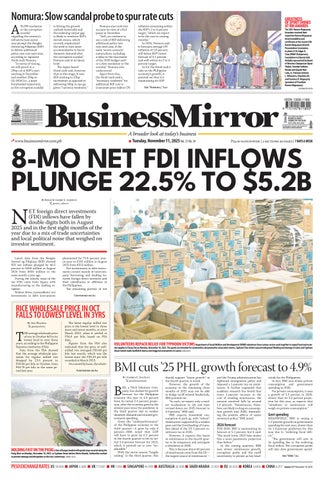
8-MO NET FDI INFLOWS PLUNGE 22.5% TO $5.2B www.businessmirror.com.ph
■
Tuesday, November 11, 2025 Vol. 21 No. 34
P. | | 7 DAYS A WEEK
B R J S. A @reine_alberto
N
ET foreign direct investments (FDI) inflows have fallen by double digits both in August 2025 and in the first eight months of the year due to a mix of trade uncertainties and local political noise that weighed on investor sentiment. Latest data from the Bangko Sentral ng Pilipinas (BSP) showed FDI net inflows plunged by 40.5 percent to $494 million in August 2025 from $830 million in the same month a year ago. During the month, most of the net FDIs came from Japan, with manufacturing as the leading recipient. Broken down, nonresidents’ net investments in debt instruments
plummeted by 73.8 percent yearon-year to $145 million in August 2025 from $553 million. Net investments in debt instruments consist mainly of intercompany borrowing and lending between foreign direct investors and their subsidiaries or affi liates in the Philippines. The remaining portion of net C A
RICE WHOLESALE PRICE IN OCT FALLS TO LOWEST LEVEL IN 3YRS B A P @adapelonia
T
HE average wholesale price of rice in October fell to its lowest level in over three years, according to the Philippine Statistics Authority (PSA). Data from the PSA showed that the average wholesale quotation for regular milled rice dropped by 22.6 percent to P34.68 per kilo in October, from P44.79 per kilo in the same period last year.
The latest regular milled rice price is the lowest level in three years and seven months, or since March 2022, when it settled at P34.6 per kilo, based on PSA data. Figures from the PSA also indicated that the price of wellmilled rice averaged P39.48 per kilo last month, which was the lowest since the P39.29 per kilo recorded in March 2023. On a monthly basis, the wholeC A
VOLUNTEERS REPACK RELIEF FOR TYPHOON VICTIMS
Department of Social Welfare and Development (DSWD) volunteers from various sectors work together to repack food and essential supplies in Pasay City on Monday, November 10, 2025. The goods are intended for communities devastated by consecutive storms, Typhoon Tino (which caused widespread flooding and damage in Cebu) and Typhoon Uwan (which made landfall in Aurora and triggered evacuations in Luzon). NONIE REYES
BMI cuts ’25 PHL growth forecast to 4.9% B A E. S J @andreasanjuan
B
HOLDING FAST ON THE PASIG
A line of barges loaded with goods stays secured along the Pasig River on Monday, November 10, 2025, as Typhoon Uwan batters Metro Manila. Authorities worked to prevent damage and disruptions to the city’s waterways. NONOY LACZA
MI, a Fitch Solutions Company, has slashed its growth forecast for the Philippine economy this year to 4.9 percent from its initial 5.4 percent projection, after the economy grew by the slowest pace since the pandemic in the third quarter due to weaker domestic demand and stunted government spending. Given the “underperformance” of the Philippine economy in the third quarter—it grew by only 4 percent—BMI noted that GDP will have to grow by 6.5 percent in the fourth quarter to hit its initial 5.4-percent forecast for 2025, which it pointed out is now “implausible.” With the storm season “largely ending” in the third quarter, this
should support “faster growth” in the fourth quarter, it noted. However, the growth of the economy in the remaining three months of 2025 may not be able to dodge tariff-related headwinds, BMI pointed out. “As such, we expect only a modest acceleration in Q4 and have revised down our 2025 forecast to 4.9 percent,” BMI said. BMI expects household consumption to pick up, with “robust” remittances supported by a weaker peso and the frontloading of transfers ahead of the US 1-percent remittance tax in 2026. However, it expects this boost in remittances in the fourth quarter to be temporary and anticipate a slowdown in 2026. This is because about 40 percent of remittances come from the US— the largest source of remittances—
and the Trump administration has tightened immigration policy and imposed a 1-percent tax on remittances. It further explained that academic research has found that every 1-percent increase in the cost of sending remittances, the amount remitted falls by around 1.6 percent. “Remittances, therefore, are likely to drag on consumption growth into 2026, diminishing the positive effects of easier monetary policy,” BMI noted.
2026 forecast
FOR 2026, BMI is maintaining its forecast at 5.2 percent, but it said: “The much lower 2025 base makes this a more pessimistic projection than before.” In the coming quarters, BMI sees slower remittances growth, corruption probe and the tariff uncertainty to persist as key head-
winds for the Philippines. In fact, BMI sees slower private consumption and government spending in 2026. For private consumption, it sees a growth of 3.3 percent in 2026, slower than its 3.6 percent projection for this year, as expects that “slowdown in remittances will weigh on private consumption.”
Govt spending
MEANWHILE, BMI is seeing a 1.2-percent growth on government spending for next year, slower than its 1.4-percent prediction for this year due to “widening fiscal deficit.” “The government will rein in its spending due to the widening fiscal deficit. The corruption probe will also slow government spendS “BMI,” A
PESO EXCHANGE RATES US 59.0450 ■ JAPAN 0.3840 ■ UK 777.6501 ■ HK 7.5930 ■ SINGAPORE 44.3599 ■ AUSTRALIA 38.3438 ■ SAUDI ARABIA 15.7454 ■ EU 68.2678 ■ KOREA 0.0406 ■ CHINA 8.2917 Source: BSP (November 10, 2025)