
ADB Philippines
Country Director Pavit Ramachandran outlines multilateral bank’s partnership strategy with Manila, to prevent socioeconomic, as well as environmental, fallout in transition to UMIC.
 By Cai U. Ordinario
TBILISI, Georgia—The Philippines’s transition to an upper middleincome country must not cause social and economic injustice, as well as environmental degradation, according to the Asian Development Bank (ADB).
In an interview, ADB Philippines Country Director Pavit Ramachandran told the BusinessMirror this is the overall objective of the 2024-2029 Country Partnership Strategy (CPS) that ADB is working on with the national government.
The strategy will focus on three pillars—human capital development, economic competitiveness and quality infrastructure, and nature-based solutions and disaster resilience. The CPS will also have three cross-cutting priorities, namely, digitalization, climate change, and the private sector.
“Now that the administration [wants] to become an upper middle-income country, and they’re tracking well in that direction mostly based on very sound macro fiscal fundamentals [and] growth is robust as you know, I think what is important is to ensure that this transition is inclusive, is sustainable and is resilient,” Ramachandran told this newspaper.
“[That is] our overarching objective in terms of moving to an upper income or a high middleincome country to make sure that this is anchored on sound fundamentals and to secure those foundations,” he added.
Ramachandran said the CPS is still being drafted and has not yet been approved by the ADB Board. Earlier, he said the CPS will be completed in the second semester of this year.
Demographic potential
IN terms of human capital, Ramachandran said the CPS aims to help the country tap its “nascent” demographic potential owing to its young and educated population.
This means, under this pillar, the ADB will help the country address educational challenges, in-
cluding learning poverty that was exacerbated by the lockdowns implemented to prevent the spread of Covid-19.
The National Economic and Development Authority (Neda) earlier estimated that the lockdowns imposed by the government are expected to cost the Philippine economy a total of P41.4 trillion in the next 40 years.
This includes human capital losses amounting to P15.528 trillion in the next 10 to 40 years. This is composed of education-related losses worth P11.025 trillion and health losses, P4.503 trillion (See: https://businessmirror.com. ph/2021/09/25/neda-pandemic-tocost-phl-economy-p41-4-trillion-intotal-losses-over-next-40-years/).
“We’ve had a long engagement
with some of these flagship social protection programs: the 4Ps (Pantawid ng Pamilyang Pilipino Program), Kalahi CIDSS, and now we’ll be working on the Walang Gutom, the food voucher program,” Ramachandran said.
“So we think that has to be the first priority just because everything will be premised on ensuring that right and [ensuring] human development,” he added.
Meanwhile, he said that while the existing CPS was focused on infrastructure development, this new CPS will still include infrastructure but will incorporate competitiveness in these projects.
Infrastructure, he said, will continue to be the second priority in ADB’s engagement with the Philippines in the next five years as this remains a “work in progress.”
The CPS will also be guided by the Philippine Development Plan and the AmBisyon2040, which outlines the country’s development priorities and goals, including those on infrastructure.
“The current CPS had a very strong focus on infrastructure [since] we engaged with the Build Build Build program almost from the outset and now with the Build Better More program,” Ramachandran said.
“I think the hallmark, if you like, of the current CPS [is] a number of flagship projects were supported under that. In the upcoming CPS we’ll continue that because we see this as very much a work in progress so we need to make sure that is continued,” he added.
Nature-based solutions
THE third pillar or green pillar is nature-based solutions and disaster resilience. Earlier, Ramachandran said this will focus on climate change-related efforts.
These efforts, Ramachandran earlier said, will include financing urban mobility, flood resilience, connectivity, and river basin projects.
The cross-cutting priorities, meanwhile, will include harnessing the digital transformation potential of the Philippines. Ramachandran said this will also be crucial in mainstreaming gender.
Climate-change efforts will also be embedded across the whole CPS. He said this will allow the country to meet its green ambitions.
Engaging the private sector is also another cross-cutting priority given the need for a whole-of-society approach to address the country’s development challenges in the medium term.




 By Cai U. Ordinario
BILISI, Georgia—Loneliness caused by their physical limitations, fewer children, and the changing lifestyles of children have inflicted pain on a third of senior citizens across Asia and the Pacific, according to the Asian Development Bank (ADB). In a recent briefing in this city on its latest Asian Development Policy Report that focused on aging in the region, ADB Chief Economist Albert Park said loneliness can be caused by a host of factors, and this highlights the need for governments to invest in areas such as health and community care strategies.
Based on the report, the share of older people showing elevated depressive symptoms in survey responses was 31 percent on average in the region. Seniors who exhibit these symptoms in the Philippines are mostly women rather than men.
“I think there’s many things going with the cause of loneliness. One thing is that people are just getting older and so you’re seeing more widowers and widowed people, and so people are more likely to spend more years living alone. And that’s going to be lonely. But I think also it is the changing nature of family relationships,” Park said in a briefing.
“Part of that is also demographics, that there are fewer kids. So fewer potential people to live with or to talk to, especially when they’re busy. We also, of course, live in modern societies, modern lifestyles, where sometimes kids are migrating away to work and older folks are spending and so that’s a big part of that,” he added.
During the briefing, ADB Senior Economist Aiko Kikkawa said many members of the older population also feel lonely because of their physical limitations or Activity of Daily Living (ADL) that are associated with aging, followed by the prevalence of diseases which are mostly non-communicable diseases.
In the Philippines, some 18 percent of seniors need help with daily routines such as food preparation. The ADB said that overall, functional impairment rises steeply for both genders in very old age, especially in Indonesia, Malaysia and the Philippines, indicating greater care needs for very old women.
“If the person loses the ability to walk, that really is the major cause. And you can’t do anything about it, right? So those physical conditions leading to loneliness, we find, is a major reason. And that’s why we feel that health is the most fundamental to all that well-being and all that reason,” Kikkawa said.
One-third of elderly Pinays IN the Philippines, the data showed nearly a third of women aged 80 and over feel elevated depressive symptoms. This is the highest as the percentage of women who feel lonely increased over time from just below 30 percent among those aged 60 to 64 years old.
However, based on the report, only about 20 percent of women aged 75 to 79 years old experience depressive symptoms.
The data showed, meanwhile, that among the 80 and over year olds, less than 30 percent of men experience depressive symptoms, while around 10 percent of those aged 60 to 65 years old experience loneliness.
Based on the data, ADB said the percentage of older people in Bangladesh with elevated depressive symptoms is 6 percentage points higher in urban areas than in rural areas, and in Malaysia 3

PESO EXCHANGE RATES n US 57.5840 n JAPAN 0.3746 n UK 72.1931 n HK 7.3694 n CHINA 7.9701 n SINGAPORE 42.5194 n AUSTRALIA 37.7981 n EU 61.7646 n KOREA 0.0422 n SAUDI ARABIA 15.3537 Source: BSP (May 3, 2024) A broader look at today’s business BusinessMirror EJAP JOURNALISM AWARDS BUSINESS NEWS SOURCE OF THE YEAR (2017, 2018, 2019, 2020) DEPARTMENT OF SCIENCE AND TECHNOLOGY 2018 BANTOG MEDIA AWARDS 2006 National Newspaper of the Year 2011 National Newspaper of the Year 2013 Business Newspaper of the Year 2017 Business Newspaper of the Year 2019 Business Newspaper of the Year 2021 Pro Patria Award PHILIPPINE STATISTICS AUTHORITY 2018 Data Champion www.businessmirror.com.ph n Saturday, May 4, 2024 Vol. 19 No. 200 P25.00 nationwide | 20 pages | 7 DAYS A WEEK Continued on A2 THE LONELY, LONELY YEARS PHL PROGRESS, BUT NOT AT THIS PRICE
T
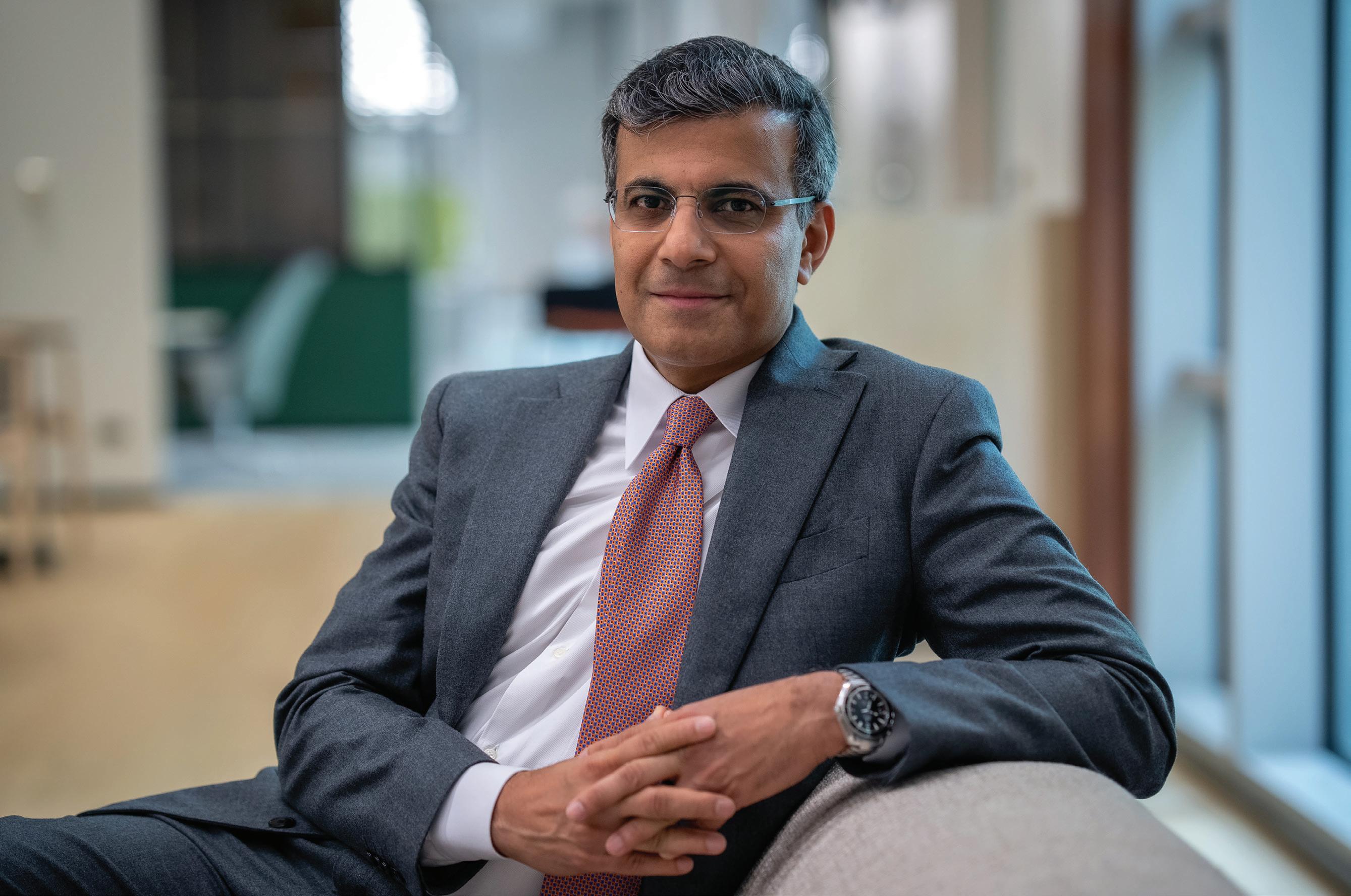
ADB Philippines Country Director Pavit Ramachandran ADB
IN this October 6, 2020, file photo, Brix and Jed Callapatia, Grade 9 and 7 students in Las Piñas, gather in a small alley to access a reliable internet signal for their school modules. The struggles with poor internet connectivity highlight the challenges faced in online classes due to the new blended learning system amid the coronavirus pandemic. NONIE REYES
ADB Chief Economist Albert Park and ADB Senior Economist Aiko Kikkawa participate in the Asian Development Policy Report press briefing held on May 2, 2024, in Tbilisi, Georgia. CAI ORDINARIO
Huawei secretly funds high-tech US research, awarding millions in prizes
By Kate O’Keeffe Bloomberg
HUAWEI Technologies Co., the Chinese telecommunications giant blacklisted by the US, is secretly funding cutting-edge research at American universities including Harvard through an independent Washingtonbased foundation.
Huawei is the sole funder of a research competition that has awarded millions of dollars since its inception in 2022 and attracted hundreds of proposals from scientists around the world, including those at top US universities that have banned their researchers from working with the company, according to documents and people familiar with the matter.
The competition is administered by the Optica Foundation, an arm of the nonprofit professional society Optica, whose members’ research on light underpins technologies such as communications, biomedical diagnostics and lasers.
The foundation “shall not be required to designate Huawei as the funding source or program sponsor” of the competition and “the existence and content of this Agreement and the relationship between the Parties shall also be considered Confidential Information,” says a nonpublic document reviewed by Bloomberg.
The findings reveal one strategy Shenzhen, China-based Huawei is using to remain at the forefront of funding international research despite a
web of US restrictions imposed over the past several years in response to concerns that its technology could be used by Beijing as a spy tool.
Applicants and university officials contacted by Bloomberg as well as one of the competition’s judges said they hadn’t known of Huawei’s role in funding the program until they were asked by a reporter. A cross-section of applicants interviewed by Bloomberg said they believed the money came from the foundation and not a foreign entity.
There are 11 opportunities on the Optica Foundation website listing “Early Career Prizes & Fellowships.” All but the Huawei-funded competition—which awards $1 million per year, or 20 times the next most-lucrative annual cash prize on the site—list individual and corporate financial contributors.
A Huawei spokesman said the company and the Optica Foundation created the competition to support global research and promote academic communication. The spokesman said Huawei’s name was kept private to keep the contest from being seen as promotional and that there was no ill intent.
Liz Rogan, Optica’s chief executive officer, said in a statement that some foundation donors “prefer to remain anonymous, including US donors” and that “there is nothing unusual about this practice.”
Rogan said the Huawei donation had been reviewed by outside legal counsel and won the approval of the foundation’s board. “We are completely transparent with the funding and support of the Foundation programs with the Optica Foundation Board, the Optica Board and staff,” she said.
The secretive effort in Washington stands in contrast with public initiatives by Huawei in several European countries. France and Germany, for example, are home to company-branded scientific hubs despite a European Commission recommendation that the company’s equipment be barred from member state networks over security risks.
Optica Foundation’s 2023 annual report acknowledges Huawei in a section listing “highest-level donors” who have given more than $1 million since the organization’s founding more than two decades ago. US tech giants Google and Meta Platforms Inc. are among those in the second-highest tier of donors who have given $200,000 or more.
The report does not specify when any of the donors gave money, what it was used for, or how much they gave.
Fearful of losing funding from federal sources including the Pentagon and National Science Foundation because of security concerns, many US universities have told researchers in recent years to cut ties with Huawei. Schools have also beefed up policies requiring academics to disclose foreign funding.
Within US rules
THE foundation’s secret funding ar -

rangement likely doesn’t violate US Commerce Department regulations blocking people and organizations from sharing technology with Huawei, said Kevin Wolf, a partner at Akin who specializes in export controls.
That’s because such rules don’t apply to the type of research the competition is soliciting—science that’s meant to be published, Wolf said. If Huawei were subject to Treasury Department sanctions, however, the activity probably wouldn’t be legal, he said.
Research security specialists said the lack of transparency underlying the arrangement nonetheless violates the spirit of university and US fundingagency policies requiring researchers to disclose whether they’re receiving foreign money.
They also said some of the resulting research is likely to have both defense and commercial relevance. Topics the Optica Foundation singles out in an online post as being “of interest” include “undersea and space-based solutions for the global communications grid” and “high-sensitivity optical sensors and detectors.”
“It’s a bad look for a prestigious research foundation to be anonymously accepting money from a Chinese company that raises so many national security concerns for the US government,” said James Mulvenon, a defense contractor who has worked on research security issues and co-authored a seminal book on Chinese industrial espionage.
Jeff Stoff, founder of the nonprofit Center for Research Security & Integrity, said funding the competition could effectively let Huawei influence “what research projects it would like to see without having to contract directly with academic institutions.” He said the company could use the arrangement to recruit talent by sponsoring applicants of interest and acquiring intellectual property from their research in the future.
Texas A&M University’s Chief Research Security Officer Kevin Gamache said the school had not known of Huawei’s involvement in the competition
before being contacted by Bloomberg.
The university then looked into the matter and learned that two of its researchers had applied for awards, both unaware of the source of the competition’s funding.
“We have processes that would identify and prevent associations with Huawei unless they were being heavily obfuscated like this,” Gamache said.
At least one applicant to the competition came from the Massachusetts Institute of Technology, which in 2019 said it would cease accepting new engagements with Huawei. An MIT spokeswoman declined to comment beyond pointing out the university’s policy.
Universities’ winners
THE Optica Foundation required universities whose researchers were awarded funding to accept the money on the winners’ behalf. Several of them, including Harvard, the University of Southern California, and Vanderbilt as well as The University of British Columbia and Wilfrid Laurier in Canada, declined to comment on whether they would take action in response to Bloomberg’s findings.
A Harvard spokesman said the university has a policy against working with Huawei.
Harvard physics professor Eric Mazur, who’s chairman of the Optica Foundation board that Optica’s CEO said had approved the Huawei arrangement, said in a statement: “As the Foundation grows and continues to explore avenues for broadening our programming, we are committed to ensuring clear transparency policies related to our funding sources.”
A spokesman for USC, which has had two winners over the past two years, said it follows US regulations on reporting foreign gifts and contracts.
“There were no indicators to suspect any foreign involvement at the time the payments were made, and we similarly have no such indications at present,” according to a statement provided by the spokesman.
USC engineering professor Alan
Willner, who has been a judge for the competition, didn’t respond to requests for comment.
A spokeswoman for the University of British Columbia said the school’s relationship is with the Optica Foundation and that neither the university nor its winning applicant had been aware at the time the prize was awarded that it was funded by a third party.
Representatives from Washington University in St. Louis and the University of Arizona, which has one of the top optics schools in the US, didn’t respond to repeated requests for comment about Huawei funding their winning applicants.
Huawei optical expert HUAWEI became a member of the foundation’s parent organization Optica in late 2021 right as it committed to sponsoring the competition, according to a person familiar with the matter. It plans to fund the event for a decade, according to the nonpublic documents reviewed by Bloomberg, which would mean awarding a total of $10 million based on past disbursements.
The foundation is currently accepting proposals for the 2024 application cycle, which runs through May 21, with plans to grant 10 winners $100,000 each for the third year in a row.
Huawei has one executive on the competition’s 10-person selection committee. The Hong Kong-based scientist, Xiang Liu, is Huawei’s Chief Optical Standards Expert, according to his LinkedIn profile.
In 2021 he published a book about 5G communications technology after spending more than seven years at Huawei’s US unit Futurewei, the profile says. Prior to earning a doctorate at Cornell, Liu studied at the Chinese Academy of Sciences’ Institute of Physics, which operates under the State Council of China.
When the Optica competition kicked off in 2022, Liu in a LinkedIn post thanked the foundation “for this great initiative” and said he would be serving on the selection panel. Chad Stark, Optica Foundation’s executive director and the signatory on the documents seen by Bloomberg, thanked Liu for sharing information about the competition. He didn’t acknowledge Huawei’s role as the sole funder.
Last month, Liu was advertised as a moderator of a virtual Optica session about “the cutting-edge technologies revolutionizing connectivity between data centers.” While Optica listed the panelists’ employers—all major US tech companies—in event marketing materials, it described Liu only as a fellow at Optica and another professional society.
Liu deferred questions to Huawei, and Stark didn’t respond to requests for comment.
points higher, but rates are higher in rural areas by 12 points in the PRC, 8 points in the Philippines, and 7 points in Vietnam.
“Urban-rural differences in depressive symptom rates are significant, particularly in Bangladesh, Malaysia, the Philippines, the PRC, and Vietnam,” the report stated.
Unfortunately, the report showed the region, including the Philippines, is not ready to face aging issues such as loneliness and healthcare. ADB noted that even if the country is not expected to start aging by 2050, investments are recommended.
This is especially the case given that much of the health concerns of seniors in the Philippines are noncommunicable diseases, which are preventable. Based on the report, some 58 percent of seniors in the country are diagnosed with an NCD.
Of these NCDs, the report said hypertension and diabetes are more prevalent in older women than men at 12 percentage points higher for hypertension in Indonesia and the Philippines, for example, and 11 points higher for diabetes in Bangladesh.
The ADB said the number of
people aged 60 and older in developing Asia and the Pacific is set to nearly double by 2050 to 1.2 billion—or about a quarter of the total population—significantly increasing the need for pension and welfare programs as well as healthcare services.
‘Silver dividend’ AT the same time, economies have an opportunity to reap a “silver dividend” in the form of additional productivity from older people, which could boost gross domestic product in the region by 0.9 percent on average.
According to the report, 40 percent of people over age 60 in Asia and the Pacific lack access to any form of pension—with women disproportionately affected, as they are more likely to do unpaid domestic work.
As a result, many older people in the region have no choice but to work well beyond retirement age to survive. Among those still working at age 65 or older, 94 percent work in the informal sector, which typically doesn’t provide basic labor protections or pension benefits.
“Asia and the Pacific’s rapid development is a success story, but it’s also fueling a huge demographic shift, and the pressure is rising,” Park said in a
statement on Thursday. “Governments need to prepare now if they’re going to be able to help hundreds of millions of people in the region age well. Policies should support lifetime investment in health, education, skills, and financial preparedness for retirement. Family and social ties are also important to foster healthy and productive populations of older people and maximize their contribution to society,” he explained.
The report recommends a wide range of policy measures to support healthy and economically secure aging. Among these are government-assisted health insurance and pension plans, improved health infrastructure, and free annual checkups and lifestyle evaluations.
Policy-makers should aim for universal healthcare coverage, while basic labor protections should be extended to older informal workers, according to the report.
By making mandatory retirement ages more flexible, helping older people stay healthy, and providing them with suitable work opportunities as well as lifelong learning and skills development, economies in the region can help older people stay productive longer.
BusinessMirror www.businessmirror.com.ph Saturday, May 4, 2024 A2 THE LONELY, LONELY YEARS Continued from A1 NewsSaturday
HUAWEI logo on a building in Vilnius, Lithuania, October 10, 2018. VADREAMS DREAMSTIME.COM
PHL-Sokor FTA ratification this year likely, says Marcos
RESIDENT Ferdinand R. Mar -
Pcos Jr. said he is confident the Philippine-South Korea Free Trade Agreement (FTA) will be ratified this year to boost trade between countries.
“I think so. I think we will get it done. I think we will get it ratified... it’s important to us,” Marcos said in an interview with Maeil Business Newspaper Chairman and Publisher Chang Dae-Whan in Malacañang on Thursday.
The Philippines-South Korea FTA was signed in September, but needs to be ratified by the Senate to take full effect.
Last month, the Department of Trade and Industry (DTI) said it expects the FTA to be ratified by midle of this year.
Once implemented, the agreement can give “Philippine products reduced tariff rates in the Korean market,” according to Marcos.
Among the Philippine products expected to benefit from the FTA and have better market access in South Korea are tropical fruits such as avocados, bananas and processed pineapples.
The agreement is expected to
benefit South Korea by removing the tariff for Korean cars and automobile parts entering the country.
Marcos said his administration is eyeing to negotiate a separate agreement to reduce the tariff for even more products.
“We are negotiating a separate future agreement with the Republic of Korea to encourage them to, perhaps take some, to allow some of our products to be included in the reduced tariff products; and also we hope that we can negotiate with Korea, with South Korea better terms and we get on [the] Asean [Association of Southeast Asia Nations]-Republic of Korea FTA,” the President said. Based on DTI’s latest data, overall trade between the Philippines and South Korea declined to US$12 billion last year from US$15.4 billion in 2022.
The decline is mostly attributed to the decrease in the country’s imports, which dropped to US$8.5 billion last year from US$12.3 billion in 2022.
Philippine exports to South Korea remain almost the same in the said period at US$3.5 billion in 2023 and US$3.1 billion in 2022. Samuel P. Medenilla
Senator Jinggoy pitches new pay hike for 1.9-M
By Butch Fernandez
THE chief of the Senate Labor committee is pushing for fresh pay hikes for nearly 2 million state workers, a day after hailing President Ferdinand Marcos Jr.’s call for another review of daily wage hikes by regional boards.
Sen. Jinggoy Estrada has filed a bill proposing a new round of increase in the take-home pay of an estimated 1.9 million government employees. His bill aims to provide a 10 to 46 percent adjustment in their salaries during the four-year implementation of the proposed measure.
Under Senate Bill 2611, the first tranche will grant government workers a 10-percent increase, followed by an 11-percent increase for the second tranche or second year of implementation; a 12-percent increase for the third tranche; and finally, a 13-percent increase on the fourth tranche.
This results in an overall 46-percent hike during the covered period of the proposed law.
Earlier, Estrada said that with no less than the President calling for a prompt review of minimum wage rates in all regions, the possibility of a new salary increase
state employees
for private workers is stronger.
“I strongly support taking a proactive approach towards ensuring fair compensation for our workers, especially in light of the rising cost of goods and basic necessities. It is essential to make timely adjustments to the minimum wage to safeguard the economic well-being of our labor force and promote social justice.”
A labor advocate, Estrada said the move “is a crucial step in supporting our workforce and ensuring that they receive the compensation they deserve.”
He assured the public the payhike bill for state workers would not be a stumbling block, projecting that “this won’t be a barrier in case the bill we are pushing for a P100 daily minimum wage increase” becomes a law.
“In the long run, if the Regional Tripartite Wage and Productivity Boards [RTWPBs] determine there is a supervening condition to issue a new wage order in certain regions, this would offer substantial relief to our countrymen who struggle to stretch their meager monthly pay to cover the growing expenses of their families,” Estrada added.
Navy officer: Defense improvements must be seen as good ‘investments’
By Rex Anthony Naval
EXPENSES for the country’s should be viewed positively as an “investment” for the country’s security, a ranking Philippine Navy(PN) official said on Thursday.
“We have to look at defense and security, not as an expense but as an investment,” PN spokesperson for the West Philippine Sea spokesperson Commodore Roy Vincent Trinidad said. He also emphasized that investments for the country’s defense should not stop. Trinidad made this comment when asked about the ongoing military modernization at the sidelines of National Security Cluster Communications of the “Bagong Pilipinas” Media Engagement and Workshop held at the Philippine Merchant Marine Academy (PMMA) in San Narciso, Zambales.
Reforms for trade, business PBBM priority for ‘legacy’
By Samuel P. Medenilla
PRESIDENT Ferdinand R. Marcos Jr. said he will prioritize laying down the necessary economic reforms to put the country on the “right path” in the next 50 years.
In an interview with Maeil Business Newspaper Chairman and Publisher Chang Dae-Whan in Malacañang on Thursday, the chief executive disclosed the legacy he wants to leave the country after the end of his term.
“I want to transform the different economic policies for greater investment, greater trade, so I guess my hope is that we would be able to transform the Philippines, so that the Philippines is now ready for the next 50 years. Put us on the right track,” Marcos said.
The county currently has investment-grade rating from credit rating agencies S&P Global Ratings, Moody’s, and Fitch and Group.
Marcos wants to improve this through proposed amendments of the economic provisions of the Constitution and the passage of new laws such as the Corporate Recovery and Tax Incentives for Enterprises to Maximize Opportunities for Reinvigorating the Economy (CREATE MORE) Act.
Enhancing the skills of the country’s workforce, he said, is also part of his administration’s efforts to make the Philippines more attractive to investors.
Such initiatives, Marcos noted, will help bring in more investments to the country and help achieve his
goal of ending involuntary hunger among Filipinos.
“When I was asked very early on after taking office, ‘What is your aspiration for the Philippines?’ It’s very simple, no one goes hungry, no more hungry Filipinos. And that’s what we are trying to do,” the President said.
A recent survey of the Social Weather Stations Inc. (SWS) revealed at least one out of 10 families in the country were suffering from involuntary hunger during the first quarter of the year.
Last month, Marcos issued Memorandum Circular (MC) No. 47, which instructed the Task Force on Zero Hunger to make its anti-hunger and poverty initiatives more sustainable through better coordination with stakeholders.
Filipino, US troops conduct HIMARS live-fire
By Rex Anthony Naval
ILIPINO and United States
FCorps units on Thursday successfully conducted a live-fire exercise at Campong Ulay in the coastal town of Rizal, Palawan, using the High Mobility Artillery Rocket System (HIMARS) and other key assets in a simulated coastal defense scenario. In a statement Friday, Combined
In the same workshop, it was learned that the AFP Modernization Rehorizon 3 will focus on the acquisition of skills and know-how in cyber defense, air interdiction, surface and sub-surface, missile defense, and support systems capabilities. These acquisitions will help in making the AFP more credible in defending against external threats.

Joint Information Bureau chief Lt.Col. John Paul Salgado said the precision and long-range hitting capabilities of this state-of-the-art artillery system demonstrated its importance in contemporary conflict scenarios.
“Following the HIMARS strike, Philippine Marines skillfully deployed a 105mm howitzer, adding another layer of firepower to the defensive maneuvers. This combined use of advanced
rocket systems and artillery demonstrates the PMC’s proficiency in employing diverse weaponry for effective coastal defense,” he added.
In order to simulate a rapid response situation, two landing craft air cushion (LCAC) vehicles were launched from a nearby amphibious vessel and joined the forces on the beach. This demonstrated the rapid deployment and mobility of maritime assets, essential for effective response and defense in coastal areas. Salgado said the successful execution of the coastal defense live fire exercise not only highlighted the proficiency of participating units but also affirmed the enduring commitment of the Philippines and the United States to uphold peace, security, and prosperity in the region.
Neda Board approves reforms in equipment supply, financing in UP-PGH Cancer Center
By Andrea E. San Juan
THE National Economic and Development Authority (Neda) Board has approved the updated parameters, terms and conditions (PTCs) for the University of the Philippines-Philippine General Hospital (UP-PGH) Cancer Center Project, which includes improvements in the equipment supply and financing to meet global best practice standards.
In a statement on Thursday, Neda said “several” significant changes have been incorporated into the project PTCs to align with the provisions of Republic Act No. 11966 or the Public-Private Partnership (PPP) Code of the Philippines, and its Implementing Rules and Regulations (IRR).
“These updates include improvements in the Annual Payment mechanism and equipment supply and financing, and requirements to meet recognized standards for global best practice,” Neda said.
The agency said the updated structure for the UP-PGH Cancer Center project ensures the facility will be designed in a way that enables PGH doctors to deliver patient care and teaching “more safely and efficiently and be responsive to evolutions in
technology and clinical practices.”
This project, initially approved in February 2023, sets up a new 300-bed cancer hospital within UPPGH’s Metro Manila campus, of which 150 beds will be dedicated to sponsored patients —aiming to serve underprivileged individuals—and the remaining 150 beds will cater to private self-paying patients in a dedicated wing.
According to Neda, the project will operate under a 30-year Build-Transfer-Operate (BTO) concession model.
“The selected private partner will design, finance, construct, and commission the hospital, and procure, maintain, and provide periodic replacement of medical and non-medical equipment,” Neda explained.
In addition, the private partner will oversee non-clinical services such as facility maintenance, management, cleaning, laundry and catering, and relevant commercial activities such as parking, food and beverage, and retail outlets.
The private partner, Neda noted, will be selected through an open, single-stage competitive tender based on the lowest first-year Annual Payment.
“Revenues from clinical services to private self-paying patients and
commercial activities will enable the private partner to lower the Annual Payment, making the project more affordable given the numerous health infrastructure projects that the government has to provide budgets for,” Neda said.
UP-PGH director Dr. Gerardo Legaspi said there are already four credible bidders in the tender process.
“Their feedback has been instrumental in refining the project parameters, terms and conditions. We hope this will make the process more competitive and attract additional bidders, leading to a project that stands a greater chance of attracting financing at a lower cost,” the
UP-PGH director also noted. When it was green-lit by Neda in February, the facility was projected to cost P6 billion and have 300 beds as well as contain outpatient care, cancer diagnostics, and facilities for chemotherapy, radiotherapy, and oncological surgery. Its revised terms and conditions raised its project cost to P9.49 billion to cover its built-up area, which was increased from 20 to 27 floors, and its procurement of cutting-edge technology and equipment. Socioeconomic Planning Secretary Arsenio M. Balisacan, who also serves as vice chairman of the Neda Board, said they expect the Cancer Center to be completed by the end of 2027 and will start operations by early 2028. (See: https://businessmirror.com.ph/2024/04/27/ neda-clears-new-icc-guidelinesfor-review-ok-of-ppp-projects/)
Saturday, May 4, 2024
A3 News BusinessMirror
www.businessmirror.com.ph
S. Korea to hire Pinoy caregivers; DMW sets May 9-10 registration
By Samuel P. Medenilla
SOUTH Korea is set to start recruiting Filipino “caregivers” next week under its Employment Permit System (EPS) arrangement with the Department of Migrant Workers (DMW).
In a statement on Friday, DMW announced the registration period for the 100 slots, which will be up for grabs for the scheme, will be from May 9 until May 10, 2024.
Successful applicants will be required to perform childcare as well
as daily tasks like cleaning and laundry, and providing support for pregnant women.
“It will directly benefit Korean families who need help caring for children, including infants, or who have pregnant women, single parents, or dual-income
couples,” DMW said.
Their minimum wage will be 9,860 Korean Won per hour, which is equivalent to P411.18 per hour as of April 30, 2024, and have a guaranteed 30 hours of work per week.
Application requirements and conditions
TO qualify for the program, applicants must present their Technical Education and Skills Development Authority (Tesda), NC II Caregiving Certificate and should be between 24 and 38 years old.
They should also have no history of drug addiction; criminal record; record of deportation from South Korea; have no color blindness or color weakness; and not be included in the EPS Job Roster, which will expire in April 2024.
Applicants with infectious diseases such as syphilis, tuberculosis, and hepatitis will also be barred from the registration.
Selected applicants must pass a Computer-based test, skills test, and interview at the DMW Main Office in Mandaluyong City. The examination fee is US$24.
They will also undergo comprehensive medical, psychological, language, and physical tests as well as pre-departure and post-arrival training sessions.
For additional details about the program, applicants may call DMW’s Pre-Employment and Government Placement Bureau’s (PEGPB) at +63 2 87221146 and +63 2 87221181.
The information can also be accessed at the PEGPB Facebook page at http:// www.facebook.com/pegpbinaction.
PHL, Cambodia finish draft of double taxation accord
By Reine Juvierre S. Alberto
THE Philippines and Cambodia have concluded the draft of a double taxation agreement (DTA) which aims to eliminate the burden of being taxed twice on the same source of income and prevent tax evasion and avoidance.
The Department of Finance (DOF) said in a statement on Friday that it convened with delegates from Cambodia for the third round of negotiations on the draft of Philippine-Cambodia Agreement.
The negotiations, which also seek “to protect Filipinos’ taxing rights and increase trade and investment across economic
borders,” were held at the Bureau of the Treasury from April 17 to 19, 2024.
According to the agreement, both countries committed to mitigate the burden of double taxation on individuals and businesses across the borders of Philippines and Cambodia.
This, the DOF explained, may encourage cross-border economic activities and might eliminate barriers to trade and investments in the countries.
The agreement outlines the taxation of income earned by citizens and residents of the Philippines and Cambodia, and details how each country’s tax administration shall impose and credit taxes paid in accordance

with the tax rules in both countries.
Finance Secretary Ralph G. Recto described the conclusion of the DTA as a “significant milestone” in strengthening both of the countries’ economic ties.
“Through this effort, we have not only complied with our commitment to completing the Asean DTA network, but the DOF and the [Bureau of Internal Revenue] BIR have also ensured that the taxing rights of Filipinos here and abroad are equitably preserved and protected,” Recto added.
Since 2018, negotiations on the DTA began in Manila and was followed through in Siem Reap, Cambodia in 2019, according to the DOF.
The Philippines expects to hold the signing of the DTA in October 2024 following the conclusion of the draft, the DOF added.
The Philippine delegation consisted of DOF Revenue Operations Group Assistant Secretaries Gerald Alan A. Quebral and Dakila Elteen M. Napao and Director Euvimil Nina R. Asuncion; and Bureau of Internal Revenue (BIR) Deputy Commissioner Marissa O. Cabreros, Assistant Commissioner Larry M. Barcelo, and Atty. Robbie M. Bañaga.
The delegation of Cambodia, on the other hand, was headed by Dr. Seng Cheaseth, the Director of Law, Tax Policy and International Tax Cooperation, General Department of Taxation, Ministry of Economy and Finance of Cambodia.



DOH leads interagency
probe on pharma’s multilevel marketing scheme with doctors
By Claudeth Mocon-Ciriaco
HEALTH Secretary Teodoro Herbosa has conducted a coordination meeting with officials of the Food and Drug Administration (FDA) and Professional Regulation Commission (PRC) following the Senate hearing on the alleged multilevel marketing (MLM) scheme involving BellKenz Pharma Inc., and some doctors.
FDA spokesperson Atty. Pamela Sevilla said the meeting on May 2 helped them identify which respective agencies should handle the investigation.
“And of course, initially we had to look further first as to what are the possible sanctions,” said Sevilla, adding that even before the matter became the subject of the Senate investigation [on April 30] and came out in the media, they were able to “identify which agencies or departments should be responsible in all possible violations” of those involved.
Sevilla explained that since what is involved is a multilevel marketing scheme, meaning, “quite a number of people will be involved,” they have to determine carefully what violations have been committed.
As of now, she said, they are encouraging the public to divulge any information about the multilevel marketing scheme and report it to the FDA.
“Not only Bell-Kenz but other similar cases, but pertaining to the Bell-Kenz case first, since it’s the highlight of the investigation,” she stressed.
Businessman
She declined to disclose to the media, adding that any revelations must be cleared with the “other legal teams of each depatment.”
During the coordination meeting, Herbosa was joined by FDA Director-General Samuel A. Zacate, and the PRC Board of Medicine led by Chair Zenaida L. Antonio. Also in attendance as resource organizations were the Philippine Medical Association (PMA) through its Commission on Ethics, and the Philippine Hospital Association (PHA).
The DOH said the Department, through the FDA and the DOH Public Health Ethics Committee (PHEC), as well as the PRC, agreed to form a Joint Committee for Investigation (JCI), to which they will also invite the Securities and Exchange Commission (SEC).
“It involves the SEC for it is a multilevel marketing...,” Sevilla explained. The DOH said the JCI will help reduce redundancy and expedite due process requirements regarding the many allegations aired at the Senate hearing, ensuring that the integrity of the medical profession is protected while holding accountable those found to have violated pertinent laws, rules, and regulations.
The JCI will also seek inputs and comments from professional bodies like the PMA and the Philippine Pharmacists Association (PPhA).
Legal advisers of the JCI are also looking into possible mechanisms to protect whistleblowers so that they may provide actionable information and evidence.
Cedric Lee surrenders to NBI after conviction; says he trusts legal system
By John Eiron R. Francisco
BUSINESSMAN Cedric Lee was taken into custody by the National Bureau of Investigation (NBI) shortly after a Taguig court convicted him, along with Deniece Cornejo and two others, guilty of serious illegal detention of television hostcomedian Vhong Navarro. Lee voluntarily surrendered himself to authorities, saying he preferred being in prison over hiding, as it would allow him to communicate with his loved ones and legal team. Despite his previous detention, Lee

remains confident that the truth will prevail through the legal process.
NBI director Atty. Medardo Dilemos confirmed that Lee surrendered after informing them of his decision. Lee underwent standard procedures of mugshot and fingerprinting upon surrendering.
The warrant for his arrest will be returned to the Taguig Regional Trial Court, which will issue a commitment order.
The court’s decision on Thursday found Lee, Cornejo, Ferdinand Guerrero, and Simeon Raz guilty of illegally detaining Vhong Navarro in 2014, sentencing them to reclusion perpetua, equivalent to up to 40 years of imprisonment.
The court concluded that the accused had conspired and orchestrated the abduction of Vhong Navarro with the intent of extorting money from him. Evidence of their collusion was evident from their actions leading up to, during, and following the crime. Navarro’s camp presented evidence at the trial that he suffered serious injury during his detention, The court also revoked the bail bond of the accused, citing their collective understanding of the crime’s commission.

BusinessMirror A4 www.businessmirror.com.ph Saturday, May 4, 2024 News
Time BusinessMirror Our
‘I’m dying, you’re not’: Those terminally ill ask more states to legalize physician-assisted death
By Jesse Bedayn The Associated Press/Report for America
DENVER—On a brisk day at a restaurant outside Chicago, Deb
Robertson sat with her teenage grandson to talk about her death. She’ll probably miss his high school graduation. She declined the extended warranty on her car. Sometimes she wonders who will be at her funeral.
Those things don’t frighten her much. She didn’t cry when she learned two months ago that the cancerous tumors in her liver were spreading, portending a tormented death.
But later, she received a call. A bill moving through the Illinois Legislature to allow certain terminally ill patients to end their own lives with a doctor’s help had made progress. Then she cried.
“Medical-aid in dying is not me choosing to die,” she says she told her 17-year-old grandson. “I am going to die. But it is my way of having a little bit more control over what it looks like in the end.”
That same conversation is happening beside hospital beds and around dinner tables across the country, as Americans who are nearing life’s end negotiate the terms with themselves, their families and, now, state lawmakers.
At least 12 states currently have bills that would legalize physicianassisted death. Eight states and Washington, D.C., already allow it, but only for their own residents. Vermont and Oregon permit any qualifying American to travel to their state for the practice. Patients must be at least 18 years old, within six months of death and be assessed to ensure they are capable of making an informed decision. Two states have gone in the opposite direction. Kansas has a bill to further criminalize those who help someone with their physician-assisted death. West Virginia is asking voters to enshrine its current ban into the state constitution.
That patchwork of laws has left Americans in most states without recourse. Some patients choose to apply for residency in a state where it’s legal. Others take arduous trips in the latestage throes of disease to die in unfamiliar places and beds, far from family, friends and pets.
It was late at night when Rod Azama awoke to his wife crawling on the floor, screaming. Pain from her cancer had punched through the heavy morphine dose.
“Let me die,” screamed his wife, Susan. As Rod rushed to hold her, the cries faded to repeated mumbles. “Heaven,” she said, again and again. Susan pieced through her life’s belongings—family heirlooms, photos, an antique spinning wheel—touching the memories a final time. Then she decided where their next lives would be.
She said goodbye to her constant sidekick, a small, fluffy Maltipoo named Sunny. Rod packed the dog’s favorite toy, a stuffed bunny, as a reminder for Susan, who had to leave Sunny behind. Then the two flew to Oregon. The issue is contentious. Opponents, including many religious groups and lawmakers, have moral objections with the very concept of someone ending their life. Even with safeguards in place, they argue, the decision could be made for the wrong reasons, including depression or pressure from family burdened by their caretaking.
“It’s normalizing suicide, and it’s incentivizing individuals to end their lives,” said Danielle Pimentel of Americans united for Life. Pimentel raised concerns that pain isn’t the top reason people choose an early departure, adding that policy should focus on bettering end-of-life care.
Two national organizations lobbying for the bills argue it’s about autonomy and compassion, some power over one’s preordained exit.
“It comes down to the right of an individual to control their own end of life decisions free from government intervention or religious interference,” said g oeff Sugerman, national campaign strategist Death with Dignity.
Even though it’s illegal in most states, a 2018 gallup poll showed more than two-thirds of Americans support physician-assisted death.
Only a small fraction of Americans nationwide, about 8,700, have used physician-assisted death since Oregon became the first state to legalize it in 1997, according to the advocacy group Compassion & Choices. Most are cancer cases; others include heart and respiratory diseases. A third of people prescribed the medication cocktail don’t end up using it.
gary Drake planned to. He began a Facebook post on Feb. 13 with “RIP.” The 78-year-old was referring to himself. He was off to Oregon, and wouldn’t be responding to any more messages and calls.
“I’m too busy and weak to do much more in this lifetime,” he wrote.
The jovial businessman from Florida had watched a close friend decline from late-stage lung cancer, driving him to and from chemotherapy, until his friend shot himself. When Drake received a diagnosis around Christmas that his own lung, bone and kidney cancer would end his life within six months, he didn’t deliberate long. He signed off on Facebook: “I love you all, say a prayer for me, and I’ll see you on the other side. Bon Voyage.”
The finality of the post prompted a flood of comments, as if he were attending his own funeral.
“I know my dad and george are waiting to have a drink with you,” someone wrote.
Less than three years ago Drake wouldn’t have had the option. Oregon’s residency requirement was rolled back in 2022 and Vermont’s ended last year, after successful federal lawsuits argued it was unconstitutional for states to deny the service to non-residents.
While debates to legalize the bills are playing out in Kentucky, Delaware, Maryland and Iowa, among others, the advocacy organization Compassion & Choices is using the courts to try to remove residency requirements.
“People are dying right now who don’t have the luxury for endless deliberation,” said Kim Callinan, CEO and president of the group.
While California has a bill before lawmakers that would allow out-of-staters to access the procedure, that provision in a Colorado bill was stripped out. Three states, including Colorado, have proposals to expand in-state access, such as allowing advanced practice registered nurses, not just doctors, to prescribe the medication.
As Robertson discussed the topic with her grandson over noodles, he got teary eyed. If it became legal in Illinois tonight, would his grandmother be gone tomorrow? How does it differ from suicides that left empty seats at his school? Robertson reassured him it would be the very last option as she embarks on a new chemo treatment. Then she explained the safeguards.
Typically, two doctors must confirm that a patient has six months to live. The patient must verbally request it twice with a waiting period that varies by state, and submit a written request with witnesses. At three meetings, a physician assesses the patient to ensure they are able to make an informed decision. The patient can be referred to a psychologist for an assessment if there are concerns.Patients must take the medication themselves. They lose consciousness within a few minutes and usually pass away within a few hours. Eventually the teenager met her eyes. “granny, I support whatever you choose to do,” he said.
Robertson was glad she had the conversation. “When you just think of the words ‘medical-aid dying,’ a 17-year-old gets stuck on the ‘dying’ part,” she said. Dr. Jess Kaan is no stranger to the controversy and fixation on the “dying” part. Living on the border between Oregon and Washington, she has worked on over 200 cases between the two states. A quarter of those traveled to Oregon. Bedayn is a corps member for the Associated Press/Report for America Statehouse News Initiative. Report for
Iloilo marks World Immunization Week with vax for senior citizens
By Perla Lena
ILOILO CITY—The Department of Health Western Visayas Center for Health Development (DH WV CHD) kicked off the observance of the World Immunization Week (WIW) on Tuesday by bringing health services for the elderly, children, and women who are residents of the municipality of Sta. Barbara, Iloilo.
“World Immunization Week 2024 aims to highlight the collective action needed to protect seniors, children, adults, and their communities from vaccine-preventable diseases, allowing them to live happier and healthier lives,” Health Education Promotion Officer III Ana Margarette P. Navarro said.
With the help of private partners, the event brought services, including routine and catch-up immunization for infants 0-12 months, pneumococcal vaccination for senior citizens, human papillomavirus (HPV) vaccination for girls 9-14 years old, cervical cancer screening, and dental services, among others.
Tricia Mae Cordero, Nurse V

under the National Immunization Program (NIP), said these vaccines are also available in rural health and barangay health centers.
“Currently, we have an ongoing catch-up immunization for our routine immunization,” she said.
She added that the WIW observance is one way of advocating for the safety and effectiveness of vaccines.
Among those who availed themselves of services are in-laws Dyan Solatorio and Emily Solatorio, who brought their one-and-a-halfmonth-old and five-month-old babies, respectively, to the municipal gymnasium for their routine immunization.
Doing the ‘loco’ after 60
ASEPT u A g ENARIAN and his wife suddenly ask their grandson where they can get a tattoo. The grandson gets freaked out. A tattoo, at your age? Are you both crazy? Over his objection, they still get tattooed and they’re now the coolest seniors in the community.
At 77, a woman decides to get a PhD in a university. Everyone in the family tells her she must be out of her mind. She obtains it anyway and is now the university’s oldest PhD graduate. Her granddaughter posts the achievement on social media. guess what, incredulous commenters are happy-crazy that she did it!
A grandma enters a beauty salon one morning and shows the haircutter a picture of a punk teener and tells her to give her the same mohawk hairstyle but in color pink. That night, the said grandma goes to the class reunion, wearing a leather jacket and sporting the mohawk look. Old classmates can’t believe what they’re seeing: what ever happened to the naturally sweet girl of yesteryear? Has she gone bananas? Who cares? She becomes an instant hit, the moment she walks in, the star of the night.
A 101-year-old Japanese man runs with young athletes in the 100-meter dash competition. He knows fully well he would finish last. He is there just for the adrenaline rush of running on that track. The moment he makes it to the finish line, the crowd roars in one collective euphoric moment, sharing the fulfillment of one man’s boyhood dream.
These are just a few stories that I have come across on news or on social media posts about senior citizens who have seemingly gone “wacko.”
I can add my personal encounter with a 68-year-old widower and
By Nick Tayag
retired marketing executive, who divided his possessions among his three children and donated the rest to charity. Why, I asked? He said he wanted to follow the words of the gospel literally: give up his riches, take up the cross, and follow Christ. gone bonkers? But no, his aura had a bright glow, and he looked so happy and fulfilled.
A senior who was wheelchair-bound became a dedicated social activist and ecowarrior until his recent passing. His crazed outcries against whale and dolphin killing made a difference in raising awareness about this inhuman practice.
The two said they wanted their children immunized to prevent diseases and become healthier.
Julia Padrita, 79 years old, accompanied her husband, 80 years old Reynaldo who availed himself of the pneumococcal vaccine.
She said she prioritized her husband as much as she wanted to avail herself of the vaccine because they are only allowed two slots per barangay. The other slot was availed by her sister-in-law.
“Our body needs this to protect us from getting sick with pneumonia,” she said.
croons Paul Simon in one of his songs.
As a golden ager, my version is: “Do The Loco, Feel More Alive.” At our age, you and I have all the right and the permission to go “loco.” Why not do the crazy to keep the inner fire burning?
There’s that old Beatle song “A Fool On The Hill” where a line goes “and he never listens to them/ he knows that they’re the fools.” Doing what you are really enthused to do is the most important thing.
Other people’s opinions should not matter to you.

Consider the story of a venerable old theologian in his 70s who talks and listens to trees as a part of his spiritual practice. As they say, trees have a message for us if only we would listen.
Naloloko ka na ba? (Have you gone crazy?) How many times I’ve heard people say that. What is deemed crazy can sometimes make a difference or bring about meaningful change.
Remember when as teenagers, we did crazy things for fun or just for the heck of it? In fact, I thought then that the dance song “Do the locomotion” was an encouragement to go “loco” as in crazy.
I confess that I did a lot of crazy things as a restless young man, which upset my elders and dismayed my mentors. But I charged all those incidents to experience because they made me grow up.
“Stay foolish,” urged the late Steve Jobs of Apple Company in a school commencement address. “Still crazy after all these years,”
As one life coach says: “As long as what we’re doing doesn’t hurt us or someone else, doesn’t conflict with our values, and we’re willing to accept whatever consequences come from that action, go for it! If others don’t like it...Well, too bad.” Being foolish or crazy doesn’t necessarily mean being stupid, reckless or irresponsible. What I’m talking about is good crazy, meaningful crazy. It’s about keeping alive a sense of playfulness, curiosity, eagerness and openness to new experiences to gain new insights, new learnings. It’s about giving free rein to your passion, to do unexpected things but are worthwhile because they give you joy, enrich your inner life and make you a more substantial person even as you advance in age.
For one, “staying foolish” means never considering oneself an expert but a fool in order to learn more.
Personally, I have been mulling over a course on Etymology, a subject I have been keen about.
A friend says, you’re too old, your young classmates will regard you as eccentric.
Here’s another offbeat idea. Why not bring together your retired musical friends and form a band. Me, a lolo in a rock band, you say. Why not?
It’s not too late to rock on. It will be a chance to limber up your fingers and sway your hips before arthritis gets to them. Your band can do worthwhile gigs like performing in
As part of cancer prevention, DOH made available the visual inspection using acetic acid, while the Family Planning Organization of the Philippines (FPOP) offers free pap smears as part of cervical cancer screening.
FPOP also offered screening for human immunodeficiency virus, conducted family planning lectures, and provided free contraceptives. Iloilo Provincial Health Office chief Dr. Maria Socorro Quiñon also expressed the support of the provincial government for the immunization program. PNA
fundraisers for your community or your alma mater. I know of a band consisting of old doctors, some retired, who play in hospitals to entertain patients, visitors and medical staff for free.
Itching to release your arrested talent as a songwriter/performer? Why not invest in your own small recording studio, lock yourself in and create original songs to your heart’s content. If they’re really good, you can even directly put them on Spotify and see if they will gain traction with listeners. One of my wife’s old students is doing exactly this kind of thing. He plays all the instruments, and does all the voices. He’s going bananas and having the fun of his life.
For crying out loud, why not learn to give way to your witty self and learn to be an outstanding stand-up comedian. Do your own vlog. I can already see the blurb: the amazing senior comedian who can barely stand-up. Why be a homebound lola for the rest of your days, playing mahjong all day long? Learn to be an accomplished chef to amaze the family or your guests. Who knows, there may be a niche reserved for you on a streaming platform. Here’s a crazy idea Mother Nature will be happy to recommend to you. Learn the art of creative upcycling of waste materials, such as plastic bottles, plastic straws and old clothes and scrap textiles. You can even profitably thrive in an emerging mini niche called sustainable fashion.
Yes, my fellow seniors, there’s a diverse array of “eccentric” things that we can do to infuse joy, inner satisfaction, passion or meaning into our lives. We might be raising eyebrows, but what we are doing is pure selflove, and just the right amount of crazy. So summon up that enthusiasm and throw yourself into your dream project of the moment. Proclaim your passions. Hold nothing back. Sing your heart out. By doing so, you enrich yourself with new experiences and new meanings that make you more alive and fulfilled in the last years of your expected lifespan. get up and do the “loco.”
www.businessmirror.com.ph
Editor: Angel R. Calso • Saturday, May 4, 2024 A5
my sixty-zen’s WORtH
America
nonprofit national service program that places journalists in local newsrooms to
undercovered
is a
report on
issues.
IloIlo Provincial Health office chief Dr. Maria Socorro Quiñon administers the pneumococcal vaccination to an elderly during the launching of the World Immunization Week in Sta. Barbara, Iloilo on April 23, 2024. The event brought services, including routine and catch-up immunization for babies 0-12 months, pneumococcal vaccination for the elderly, human papillomavirus vaccination for girls 9-14 years old, cervical cancer screening, and dental services, among others.
Photo courtesy of Doh WV chD
Sen. Estrada commends UP Law’s 3rd win in biggest moot court tilt
THE Senate recently commended students and coaches of the University of the Philippines (UP) College of Law who bagged the world championship in the 2024 Philip C. Jessup International Moot Court Competition.
Sen. Jinggoy Estrada, who filed Senate Resolution 1004, said UP Law’s success, which was borne out of rigorous training, grit, determination, and teamwork, deserves a citation from the Upper House as it brought pride and honor to the country.
“The historic triumph underscores the top-notch caliber of Filipino students and the high quality of legal education in the country, which can go head-to-head with the best and most brilliant minds around the world,” Estrada said.
“The team’s skillful display of wit, remarkable grasp of international law,
STUDENTS SPEAK
keen understanding of complexities of world affairs and the frameworks for the promotion of a rules-based global order signal a bright future for legal scholarship for the country,” he added. “The future lawyers’ exemplary [feat] serves as an inspiration for the younger generation to pursue excellence in their chosen field.”
For the senator, the latest feat of the UP College of Law is “truly remarkable, cementing their reputation as among the best of the best and underscoring their legacy of excellence in the international arena.” The landmark win comes nearly three decades

after their last triumph in the same competition.
The team is composed of Mary Regine Dadole, Pauline De Leon, Pauline Samantha Sagayo, Chinzen Viernes, and Ignacio Lorenzo Villareal, under the guidance of Prof. Marianne Vitug as coach, and Prof. Rommel Casis as advisor.
In another show of unparalleled
skill, Villareal also received the “Schwebel Award” for “Best Oralist” in the final round of the competition.
The “Jessup” is considered the world’s largest, oldest and most esteemed moot court competition which is held annually since 1960.
This year, close to 700 law schools in 100 countries and territories vied for the highly coveted title.
Improving the OJT process: Summa cum laudes weigh in
AS students approach their graduation day, internship is a final hurdle to overcome before they can finally don their togas and march to receive their diplomas.
However, these on-the-job training programs (OJTs) serve as crucial learning opportunities in obtaining hands-on experiences within their chosen fields, as they meet and network with industry experts in their prospective careers.
It can be said that OJTs can either make or break young graduates’ first foray into the working adult world. The latest batch of summa cum laudes from the De La SalleCollege of Saint Benilde offered tips to further improve the practicum process through their feedback for both the apprenticeship and the institutions:
Janelle Erica Y. Gan (Bachelor of Science in Architecture): As the OJT training serves as interns’ first impressions of their chosen industry, a foundational set of goals and objectives are key to guide them in maximizing their experiences. Providing supplementary learning programs, such as workshops and conferences, would further equip them with substantial knowledge regarding their work.
Finally, having access to networking and mentorship opportunities where interns receive sincere feedback and advice—especially from esteemed professionals whom they look up to in their respective fields— would definitely be motivational and influential for their professional growth.
Gabrielle Elijah G. Villareal (Bachelor of Arts in Governance and Public Affairs): When I think about OJT, I’d like to believe that it is the “heartbeat of learning.” It’s where knowledge meets action because of how it fuels the fire of our professional growth. Nevertheless, it illuminates our paths to success.
I served as an intern at the Malayan Insurance’s Legal Department. As a pre-law student, I gained invaluable exposure to real-world intricacies, fostering a nuanced understanding crucial for my future career.
To ensure every intern has an enhanced experience, I would suggest that OJT organizers and coordinators must provide: daily feedback and mentorship, integration and inclusivity, as well as diverse exposure in work tasks.




Monique Jericha Sy (Bachelor of Arts in Multimedia Arts (AB-MMA):
Reflecting on my internship experiences, I recommend OJT organizers first to present a clear introduction of the company objectives and assigned responsibilities to create attainable expectations, while nurturing a work environment centered on structured guidance and mentorship. Second, they should provide diverse tasks catered to the interns’ skills and capabilities to foster self-confidence, exploration, and holistic learning. And last, I recommend institutions to establish a constructive feedback culture in their work place to encourage interns to raise concerns, seek guidance, and improve their skills effectively, thus providing an overall rewarding experience.
John David S. Miranda (ABMMA): Integrating a longer period for orientation alongside the students’ courses (a term or two before their actual OJT programs) can increase their chances of getting into their most prioritized roles. Utilizing their major courses in the earlier terms to shape their perspectives of their prospective goals may also aid them in their search for future employers.
With these, OJT organizers can keep track of what roles students aim for and leverage on such with the jobs demand in the industry, while developing more immersions fit for the students.


Kathryn Eleasha T. Martinez (AB-MMA): I’m thankful for the opportunity to learn new technical skills, and experience firsthand the user interface/user experience design industry from seasoned international practitioners.
Since we were treated as full-time employees, it would have been great to have a designated mentor for the interns to maximize their learning potential by providing direct dynamic feedback, fostering a holistic work environment. Another recommendation is to have the interns engaged through regular check-ins, having an opportunity to build meaningful connections and gather prolific insights.
Last is to conduct the final evaluation together with co-interns to encourage self-growth and improve their skills resulting in a rewarding internship experience.
John Kelvin M. Lugtu (AB-MMA): A student’s internship is not just another academic need—it is a transformational journey that kick-starts one’s career.
My suggestions for OJT organizers: (1) Provide interns with reasonable tasks, with outputs that will truly be utilized by the firm, (2) consider their voices in thinking sessions to encourage dynamic collaboration, and (3) make certain to give substantial feedback on their tasks for the company. These will greatly help in making interns ready for their chosen


sector, while having the right amount of confidence and competence.
Julienne Renee M. Diona (ABMMA): Going through my OJT experience, there was this level of uncertainty and doubt as to how prepared I was for my internship hunting. I would suggest OJT coordinators to present aligned partner-companies for students’ respective courses and fields, review interns’ resumes, and provide lectures on ways to approach and nail interviews. These tips are not to spoon-feed future interns, but to create an open space for opportunities. This also awards them a professional “voice of reason” to guide them on ways they can better align themselves at work.
Sophia Isabel S. Carpio (Bachelor of Science in Business Administration major in Computer Applications): My first recommendation is to provide students a list of companies that are open for OJTs, so they can secure a slot. It will save a lot of time. This also avoids starting late, which leads to overtime to reach the required number of hours within the time frame.
Second is to advise students to search for companies a term before their OJT starts. Lastly, coordinators should advise students to take their OJT and thesis/capstone during separate terms. This will help them fully focus on their priorities and get enough sleep to stay healthy.
Editor: Mike Policarpio
UP, Palawan State U partner for public-service conference
FOR the first time, the University of the Philippines (UP) through its Padayon Public Service Office and Palawan State University will partner for the “5th Colleges and Universities Public Service Conference (CUPSCon5)” slated from August 28 to 30, 2024 at the PSU Main Campus in Puerto Princesa, Palawan.
For the fifth year, CUPSCON is the only academic conference that gives highlight to public service. It provides a platform to share best practices, innovative and collaborative approaches, plus discuss challenges and trends in public service. The event is expected to bring together participants from various private and public higher education institutions (HEIs), government agencies, local government units, civil-society organizations, and even the private sector.
This year’s theme: “Future of Public Service in the Fourth Industrial Revolution: Trends, Challenges, and Prospects” aims to initiate a conversation on integrating technological innovations and best practices into public service, extension projects, and community engagement programs. The conference also intends to create a vast network between HEIs, government, civil society, and the private sector.
Director Cherish Aileen A. Brillon of “Padayon” notes that the UP and PSU tie-up is a testament to the mission of both universities to forge impactful linkages:
“This year’s CUPSCON will have several ‘firsts:’ the first partnership between UP and a state university, the first time that there will be an award for ‘Best Conference Presentations,’ and the first time that a planned ‘Public Service Consortium for Higher Education Institutions’ will be presented to various stakeholders.”
For Vice President for Research, Development and Extension Marjorie A. Española of PSU, the collaboration reflects their university’s broader pledge to delivering “excellent strategies and sustainable public service by ensuring [relevant and responsive academic programs that are] able to adapt to the dynamic world.” She added: “Our institution passionately welcomes all collaborators who share our vision and values, as we all have also a shared obligation to continuously aim for broader environmental awareness, to lead by example in advocating for youth empowerment, [and] come up with practical solutions toward building a better and more sustainable future for all.”
CUPSCon was launched as a pioneering initiative by UP Padayon Public Service Office in 2015. It won a Silver Anvil at the 56th “Anvil Awards” of the Public Relations Society of the Philippines in 2021.
For inquiries and additional information, visit the UP Padayon Public Service Office Facebook page, or e-mail cupscon@up.edu.ph.
iACADEMY ranks high in 2024 real estate brokers’ board exam
iACADEMY has clinched the top six spots in the property practitioners’ board exam, proving its excellence as a leading institution for Real Estate Management learning.
With its overall performance, graduates dominated high spots as they ranked third, fourth with multiple students, eighth and ninth in the 2024 Real Estate Broker’s Licensure Exam.
To become a real estate professional, taking up the Real Estate Management (REM) course and passing the Real Estate Licensure Examination administered by the Professional Regulation Commission are needed.
The exam gauges the skills of aspiring real estate-service practitioners—including real estate brokers, appraisers, consultants, and salespersons.
Among schools that offer REM programs, iACADE MY currently tops its contemporaries. This is due to its unique learning techniques that follow their “Faculty-Framework-Focus” approach merging theoretical and practical activities to give students broad and enriching experiences that will guide them in their practice.
Competent academicians iACADEMY’s successful REM program could be mainly attributed to its faculty composed of seasoned industry practitioners adept in business, arts, and technology. They provide outstanding lectures, classroom management, and board-exam-designed assessment in the said course.
Attuned to the current times, their curriculum’s framework is always updated, while integrating the industry requirements in terms of soft and hard skills, and emerging technologies that students need to do well in the industry once they finish the program.
Here, students are trained on the development of critical think-

ing and problem-solving skills in class—critical for success in exams and real-world scenarios. Educators enforce a thorough and targeted preparation program with mock tests, review sessions, in-house reviews, as well as distribute study materials to better prepare students for the board exams.
What’s more, iACADEMY has an impressive student and alumni profile of professionals with superb backgrounds such as executives, accountants and lawyers who are taking up their second educational degrees. With a diverse pool of successful pros, students are assured of a great network and learning exchange.
“The theoretical strength is coupled with personal experiences from people driving the program,” said iACADEMY president Dr. Vanessa Tanco. “We take pride not just in the culture of excellence that is expected in any school, but the culture of care we give to the students to make sure they learn what matters—that is what sets us apart.”
A board topnotcher for both the real estate broker and appraiser exams, Dr. Tanco’s advice to aspirants is, “If you want to pass the board examination, go to other REM schools. But if you want to top the board examination, go to iACADEMY.”
Visit https://iacademy.edu.ph/ homev4/real_estate_management to learn more about iACADEMY’s REM program. Roderick L. Abad
Education BusinessMirror A6
Saturday, May 4, 2024
THE State University’s team triumphs in the “world’s largest, oldest and most esteemed moot court competition.” HTTPS://UPD.EDU.PH/
K ATHRYN ELEASHA T. M ARTINE z Jo HN K ELVIN M. LUGTU J ULIENNE R ENEE M. D I o NA So PHIA ISABEL S. C ARPI o G ABRIELLE ELIJAH G. V ILLAREAL Mo NI q UE J ERICHA S Y Jo HN DAVID S. M IRANDA
JANELLE ERICA Y. G AN
Tourism Editor: Edwin P. Sallan
HANN RESERVE
Elevating Central Luzon to global tourism prominence
By John Eiron R. Francisco
AS Tarlac gears up to cement its status as a premier leisure and entertainment destination, Hann Reserve emerges as a beacon of sustainable eco-tourism, poised to redefine luxury travel experiences in the region.
Chairman and Chief Executive
Officer of Hann Resorts, Dae Sik Han told the BusinessMirror that this project aims to elevate Clark as a standout destination on the global tourism map.
“We’re thrilled and proud to create a top-tier golfing experience that reflects Clark’s status as a premier leisure and entertainment hub,” he said.
With a strategic focus on environmental stewardship and community engagement, the Hann Reserve, the newest addition to Hann Resorts’ lineup located in New Clark City, Tarlac, promises not just a golfing paradise but a holistic sanctuary that celebrates the rich heritage and natural beauty of the region.
Tarlac is known for its historical significance, as it played a crucial role in the Philippine Revolution against Spanish colonization. It’s also known for its vast sugarcane fields, agriculture, and Mount Pinatubo, an active volcano.
Additionally, Tarlac is famous for its Hacienda Luisita, one of the largest sugar plantations in the country.
Now, as the soon-to-open luxury eco sanctuary expands over 450 hectares in the heart of New Clark City, travelers can anticipate a wide array of delights.
From the trio of exceptional 18hole championship golf courses to the luxurious accommodations provided by Accor and Marriott International, these offerings are sure to captivate even the most discerning visitors.
Add in PGA-affiliated player development facilities, clubhouses, premium villas, an international school, and a lush 10-hectare public
park, and you’ll discover the perfect formula for an unforgettable retreat surrounded by the splendor of nature.
Positive Community Impact W HEN asked on how the Hann Reserve will contribute to the local community, province, and region, the management emphasized the positive impact it would have.
With this new tourist destination, Han anticipates a surge in visitors to nearby attractions like ancestral churches, natural landmarks, and historical sites in Tarlac, thereby enhancing the region’s attractiveness to tourists and potentially stimulating the local economy.
Moreover, the partnership between Banyan Tree, one of the toptier hospitality brands in Asia, and Hann Resorts, which recently marked its groundbreaking ceremony, signifies Banyan Tree’s thrilling debut in the country to ensure an exceptional experience.
“We prioritize environmental
An autumn in Seoraksan
They say that the best time to visit South Korea is during spring (May to June) and autumn with its clear cool and crisp weather. It was already past spring so, for my first visit to the country, we decided to visit in October, the start of autumn (it extends up to the end of November).
During this season, many parts of Korea offer beautiful displays of fall foliage across its national parks, mountains, universities, palaces, parks and roads. Seeing beautiful autumn leaves in Korea is an absolute must and one of the first and most impressive places to see awe-inspiring and fiery autumn foliage in South Korea is in the 398.22 square kilometer Seoraksan National Park. From Seoul, it normally takes a little over two hours to get to Sokcho City, our jump-off point to the park but, since it was a weekend, the trip would take much longer. Sokcho is one of the country’s representative port cities and a rising tourist destination.
We rode on two cars, driven by our hosts, Korean nationals and long-time Philippine residents Mr. Injun Kim and Mr. Frank Kong (both from the Cebu Blue Ocean Academy, an e nglish language school in Mactan), for the 190-kilometer drive to the city which is located along the east coast. Due to South Korea’s mountainous terrain, along the way, we passed numerous tunnels (16 percent of the current expressways comprise long
tunnels defined as 3 kilometers, or more, in length). A stopover was made, for lunch, at Chungjung Sculpture Park, an interesting roadside attraction known for its uniquely handcrafted phallic art. At a restaurant here, we indulged on hearty galbitang (beef short rib soup) which, according to Imjun, is the Korean’s version of our famous native bulalo. Upon arrival at Sokcho City, we checked in at spacious and well-appointed Grand Deluxe Family Rooms at Lotte Resort Sokcho which is located on top of a hill with three sides having ocean views. The resort also features a water park, swimming pools, fitness center and restaurants. From our balcony, we had a wonderful ocean view of the e ast Sea, Sokcho City and its 2-kilometer long, wide and clean white sand beach, the 65-meter high Sokcho e ye (a giant Ferris Wheel) and, offshore, Jodo (or Cho-do) Island with its white-colored lighthouse.
The next day, after a Korean breakfast at New Seoul Kitchen, we again boarded our cars for the 10.8-kilometer drive to Seoraksan National Park which is listed, by the South Korean government, with UN e SCO as a tentative World h eritage Site. Again, since our visit was during a weekend, the park was packed with local and foreign tourists. After a long wait at a bus station, we boarded a bus (which leaves every ten minutes) bound for the park, a 20 to 25-minute drive away. At the bust stop across Kensington Stars h otel, we then had to walk, for about 10 minutes, to get to Sogongwon (translated as “small

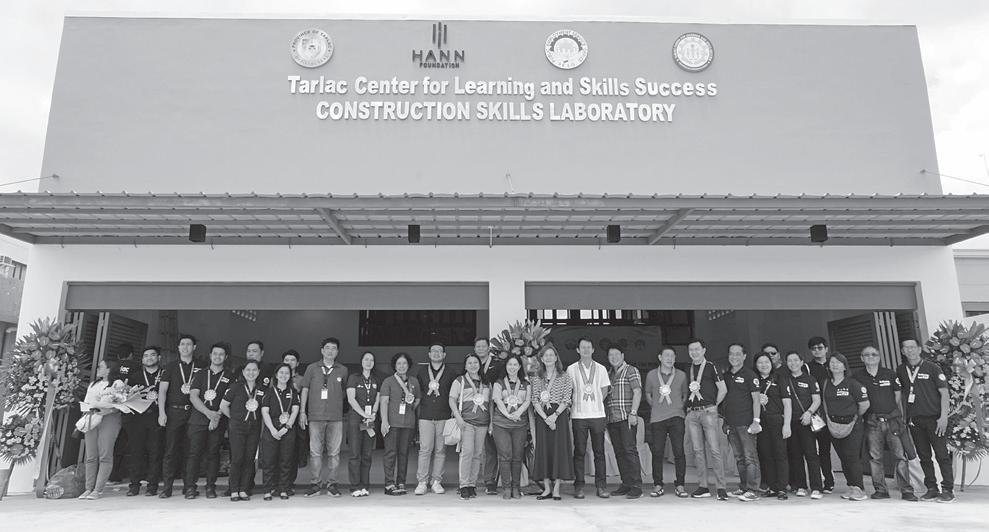
stewardship through thoughtful design, architecture, and sustainable building practices, while also respecting and preserving the cultural heritage of the region by safeguarding indigenous flora and fauna,” he said. Furthermore, known for its dedication to wellness and eco-consciousness, the Banyan Tree New Clark City will offer an oasis amid the stunning landscapes of Tarlac which assures visitors a unique and fulfilling stay.
Guests can savor luxurious pool villas, alfresco relaxation spots, acclaimed dining at venues like Saffron, and explore indigenous crafts at the Banyan Tree Gallery. Access to premium facilities such as a central pool and lush garden spa ensures a

memorable retreat.
On the other hand, Han emphasized that Banyan Tree’s presence in Clark signals a promising boost to tourism efforts under President Ferdinand “Bongbong” Marcos Jr.’s administration. As the first luxury hotel and resort in the Philippines, its introduction in New Clark City is poised to elevate tourism prospects and drive economic growth in the region and in the country.
Boosting Local
Economy
M EANWHILE , according to Han, once completed, the Hann Reserve is expected to generate job opportunities for approximately 20,000 to 30,000


individuals. This substantial employment potential highlights the scale and potential impact of the project on the local economy.
“As Hann Reserve progresses, it is expected to serve as a key catalyst for job creation, supporting economic growth and offering employment opportunities for a wide range of individuals within the community,” Han said.
Management stated that through the corporate responsibility arm, Hann Foundation Inc. (HFI), the company aims to promote courses like engineering and hospitality, offering tailored training programs to bridge the gap between education and employment.

park”), the entrance of the park with the most attractions and visitors.
One of the highlights of our visit was our exploration of Sinheungsa Temple (believed to be the oldest Korean Zen temple in the world), one of two Buddhist temples and cultural landmarks within the bounds of the national park (the other is Baekdamsa). The first structure that greeted us at the temple is the top heavy Iljumin Gate (or “One Pillar Gate”). After passing through this entry gate, we noticed the sharp, jagged rocks of the 1,708 meter high Mount Seoraksan (the third highest in the country) surrounding us on all sides as well as some of the most beautiful
scenery in South Korea as the park is one of the first and most impressive places to see and enjoy the beautiful autumn foliage hues featuring a brilliant palette of dazzling red, burning orange, lush green and rich yellow. After passing Iljumin, we soon came across the 14.6-meter (48-foot) high, 108-ton Great Unification Buddha, a gilt-bronze Buddha statue called “Tongil Daebul” on the right. The largest seated Buddha statue in the world, it cost 3.8 billion won (US$4.1 million) to erect. The construction started in 1987 and it was only finished in 1997 when the eyes were placed on the face. Serenely looking out on the amazing landscape of northern South Ko -

With thousands of islands, tourist destinations, and leisure properties in the country, have you checked off most of them, or is your travel bucket list growing longer over time? Surely, it’s bound to expand further, especially with the anticipated completion of a prestigious project in Tarlac–the Hann Reserve.
where
ting-edge
scholars can enhance their learning through hands-on application of their skills. Of course, every community has its Small Medium Enterprises (SME’s),and when asked if they’re still part of the plan even though it’s a luxury leisure property, Han mentioned that the growth of Hann Reserve is actually great news for small and medium-sized businesses in Tarlac. With more folks heading to New Clark City, there’ll be more customers, which means local shops can thrive. Tarlac’s renowned for its delectable cuisine, one-of-a-kind crafts made from lahar, and extensive sugar and rice plantations that can give to both visitors and locals plenty to discover and relish.
rea, it is less than 50 kilometers from the impenetrable border between North Korea and South Korea and represents the crucial wish of the Korean people for the reunification of the divided country. After crossing the h yeonsu-gyo Bridge, the long stone wall of the main temple grounds awaited us. We entered the temple through the rather boxy Cheonwangmun (or Sacheonwangmun) Gate which mark’s the entrance of the temple’s boundaries. It houses some excellent examples of the Four h eavenly Kings. To enter the main temple courtyard, we had to pass through the lowlying Boje-ru Pavilion, along a wooden building on stilts that acts as a screen that hides the rest of the inner portion of the temple grounds. Notable
BusinessMirror Tourism&Entertainment
A7 Saturday, May 4, 2024
Story & photos by Benjamin Locsin Layug
buildings within the temple are the Geukrakbo-jeon h all (the temple’s main hall), Myeongbu-jeon h all (Judgment h all) and Samseong-gak h all (a shamanic shrine hall). Within are numerous works of Buddhist art such as paintings, sculptures and tapestries. The temple also participates in the popular Temple Stay program which allows tourists, looking to experience Zen meditation and asceticism, to spend, for a fee, two or three days living the typical temple life of a Korean Buddhist monk. After our visit to Sinheungsa Temple, we proceeded to Seorak Cable Car Boarding Station for our scheduled 1 PM cable car ride. Also called Kwon Jinseong Cable Car, it was built in 1971 by Lee Ki-sub, a mountaineering enthusiast. Once on board the 50-pax cable car, we ascended at a relatively high speed, taking about 6 minutes to get to the two-storey Upper Cable Car Station. Inside the cable car, we enjoyed an open view of various famous attractions such as Ulsan Peak (ranked as the most popular hikes at Seoraksan National Park due to the unique rock formation and the fabulous views from the Rock) and Manmulsang Rocks. From the outdoor observation deck at the Upper Cable Car Station constructed at the edge of the mountain which is located 700 meters (2,297 feet) above sea level, we had a panoramic view of the valley, fascinating rock formations of the Gwongeumseong Fortress (also called Seoraksan Castle) Region and the Sogongwon Area, Seoraksan Mountain’s majestic scenery and downtown Sokcho to the northeast all the way to the e ast Sea. Chungjung Sculpture Park SEor Ak SAn national Park V IE w of Sokcho City from Lotte resort Sokcho g r EAt unification Buddha SEor Ak Cable Car With a sponsorship of P3.5 million, Hann
workshop,
equipment
selected scholarships for
facility
2020
outcome
TCLASS Con -
Skills
-
Foundation constructed the laboratory
provided necessary
and materials, and awarded
students. Construction of the program’s
began in
and was inaugurated in 2023. The
is the
struction
Laboratory—a cut
workshop
student-
BAnyAn tree hAnn reserve new Clark City tCLASS Construction Skills Laboratory Ch AIrm An and Chief Executive o fficer of hann resorts, Dae Sik han













BusinessMirror
ChatGPT and the role it plays in writing today

IF you’re a copywriter, you’ve probably been told once or twice or more by your boss or the client that your copy was unexciting or unimaginative. Sometimes, the client is a 25-year-old who doesn’t see writing as a skill or talent and has no respect for what you do. So they will turn to someone on their team (or they will do it themselves) who will use ChatGPT and they will come up with a copy that’s filled with words like “curate” and “hustle and bustle.”
There is nothing wrong with using ChatGPT. I think it is an exciting tool not just for writers but for students and professionals. Not everyone has a knack for writing and even seasoned writers need some help. ChatGPT is a natural language processing chatbot that allows the user to have human-like conversations to complete various tasks like composing emails and writing essays.
As a writer, I tried using ChatGPT a number of times. While I see it as helpful for non-writers, it’s not for me. I have been writing professionally since 1987. I am not saying I am better than those who use ChatGPT. My way is not necessarily better than theirs. When I write, I need to check facts and spelling. The free version of ChatGPT cannot search the Internet for information. Instead, it used the information it learned from training data to generate a response and this can leave room for error.
For writing copy, I personally find Chat GPT too verbose. But that’s me. As a journalist, my writing style is simple and straight to the point. A former editor once told me, “You aren’t writing for yourself. You’re writing to inform so think that you are writing it for people who don’t want to see big words.”
I have used Samsung’s Chat Assist, which can be found on Samsung phones with AI, to help give me summaries on subjects I do not fully understand. Chat Assist can show you tones such as professional, casual, social, polite, original, and even Emojify. It can also translate your message into different languages and fix your spelling and grammar.
As a mature person, I am not anti-ChatGPT. I do appreciate how it can help people with their writing because believe it or not, for some, writing an email can be a source of anxiety.
As someone who once made a living out of selling poems to students (I was a student badly in need of money), I understand that some people need help. It is not a source of shame to seek help for matters like

writing. But it is shameful to put down professional writers or anyone who is just doing their job just because ChatGPT exists and you know how to use it. I make a living from writing. I have done so for almost 40 years and I am offended to hear or read when someone says, “The writer does not seem to have a grasp of the subject.” Perhaps it would be better to say,
“Let me tell the writer how I want it done.”
Copywriting is not the same as writing for a newspaper or a magazine. In fact, I would say they are the opposite of each other. When you write for a newspaper, you state facts and support these facts with information. When you write copy, your goal is to piqué the interest of the person reading it. Your copy should sell the product/service/person or generate interest for it. So if you are comfortable using ChatGPT, go ahead and do it. Just make sure to make the final product your own. ChatGPT is there to help you do your job or accomplish your task.
NEW PHONE CASES, ACCESSORIES FROM SAMSUNG
SAMSUNG has collaborated with Sunnies
Studios, The Paper Bunny, and FINNS Bali for new accessories for your Galaxy devices. The new #SamsungXYou Out-of-Office collection accessories are part of a random Lucky Box gift set with every purchase of a Galaxy S24 series phone or Galaxy Buds2 Pro.
Hip trendy accessory and makeup brand Sunnies
Studios has designed a cool new phone case with matching animated wallpaper fit for the Samsung Galaxy S24, Galaxy S24+, and Galaxy S24 Ultra as well as a case for the Galaxy Buds2 Pro, a griptok, and a sticker sheet. Samsung also tapped Singaporean lifestyle brand The Paper Bunny, a brand promoting intentional living and positive sentiment through curated functional yet aesthetic clothing, accessories,
teeming with talented data practitioners
BY RIZAL RAOUL S. REYES
SAN Francisco, California-based data and artificial intelligence company Databricks is bullish on the Philippine market because of a young and dynamic population.
Cecily Ng, vice president and general manager for Databricks in Asean, told the press in a recent media interview that the country’s huge base of mobile phone users hold a lot of potential for the company because of the huge data that needs to be managed. “Given that the Philippines is an especially exciting market for us, that’s also why we are doing it better than you can see,” she said in an interview on the sidelines of the recently concluded Data Intelligence Day, the company’s first major event in the country held at Bonifacio Global City. Ng said the company was overwhelmed by the huge number of attendees of their event stressing that there’s a lot of great data practitioners
and lots of talents in the Philippines.
“The country can definitely in a way leapfrog because all these factors are coming together,” she said.
DATA INTELLIGENCE DAY
KICKS OFF IN THE PHILIPPINES
THE Manila Data Intelligence Day is part of a global tour with stops in more than 30 cities, with speakers from Aboitiz Data Innovation, Databricks, Maya, and PLDT.
“The Philippines is one of our key markets in the Asean region and we’re thrilled to see enterprise AI adoption gaining traction across various sectors. Today’s event is the first of our many future events in the country and we’re excited to be gathering so much local data and AI practitioners today to connect and learn from each other,” said Ng.
Ng said data-forward companies are leveraging the Databricks Data Intelligence Platform to optimize business operations, drive innovation
and stationery. You can get The Paper Bunny’s thoughtfully designed “Rest now, Reply later” wallpaper and phone case and their matching griptok and sticker sheets.
Established in Indonesia in 2010, FINNS Bali is a group of clubs, spas, centers, resorts, and more. You can get a beach-themed phone case and matching animated wallpaper or a griptock or keyring with a sticker sheet for your Galaxy S24 series phone. They also designed a cool aqua case that you can get with a purchase of a Galaxy Buds2 Pro.
Samsung also has an “Out of Office: Off to See the World” collection featuring two phone case styles and two key ring designs as well as a sticker sheet you can use to accessorize your travel essentials. Samsung Members also get the chance to access an exclusive phone case design with the plane ticket collage that says “Logging Off: Busy on Holiday.”
For Galaxy S24 series purchases, you can either score one of the four different phone case designs from the collections for your brand-new phone or receive a random set of three stickers and an accessory—keyring or griptok—to level up your accessories game as you travel around the world. If you’re a Samsung Member, you might even get the chance to get an exclusive phone case if you buy the Galaxy S24 Ultra.
Suit up your Galaxy Bud2 Pro as you can receive either a FINNS Bali or Sunnies Studios case along with a cute sticker sheet with every purchase.
You can also get a chance to win these accessories through participating in exciting giveaways. Stay tuned in on the latest news about these accessories and visit Samsung on Facebook.
You can get these bundles with every Samsung Galaxy S24 series phone or Galaxy Buds2 Pro purchase from April 27 to May 15, 2024 exclusively via www.samsung.com/ph. Learn more about the Galaxy S24 Series at /tinyurl.com/yw5tj434 ■
through predictive analytics and AI applications, and enhance decisionmaking. Built on a lake house architecture, the Databricks platform provides an open, unified foundation for all data and governance and is powered by a data intelligence engine that understands the uniqueness of each enterprise’s data.
“We have adopted the Databricks Data Intelligence Platform as our centralized data platform, integrating it with our diverse sources of data from different systems. Combined with our leading data management practices, this creates a world-class data architecture that generates meaningful insights and powers hyper-personalized experiences for our customers. As a pioneering fintech company in the country, our investment in AI spans various domains including machine learning, natural language processing, computer vision, and emerging areas such as generative AI. We are
committed to staying at the forefront of technological innovation to enhance our products and better serve our customers.” said Alfred Lo, group CTO at Maya.
“Aboitiz Data Innovation [ADI] is accelerating AboitizPower’s data science and AI capabilities to bolster power plants’ reliability and ensure a safe and resilient power grid, providing reliable and ample power supply to their users. With the Databricks Intelligence Platform, we are able to use data and AI to do predictive maintenance as well as demand and supply forecasting to better meet the needs of Aboitiz customers. We are excited to share our learnings and best practices at the Data Intelligence Day in Manila today,” said Dr. David R. Hardoon, CEO of Aboitiz Data Innovation Ng said Databricks looks forward to helping more Filipino customers use AI securely, with their own data, with the Data Intelligence Platform.
GLOBE broadens the reach of the Hapag Movement, its advocacy to alleviate involuntary hunger, as it teams up with US-based non-profit Project PEARLS opening up the program to a global audience.
Individuals and corporations from around the US may now donate to the Hapag Movement through Project PEARLS via www.globe.com.ph/globeofgood. Project PEARLS may issue companies and individuals required certificates for all donations received from around the US.
This partnership expands the Hapag Movement’s reach to the US, a critical donation funding source that is home to more than 4 million Filipino-Americans. Globe is calling on US-based individuals and businesses to support the cause.
“Our partnership with Project PEARLS is a significant step forward that will allow us to engage a wider community of donors in our fight against hunger,” said Yoly Crisanto, Globe chief sustainability and corporate communications officer. “With Project PEARLS’ expansive network, we can accelerate positive change and help more Filipino families in need.”
The Hapag Movement leverages technology and partnerships to drive collective action for sustainable development while empowering partner organizations. Since its launch in 2022, it has provided over 95,000 Filipinos with food packs and produced 2,662 livelihood training graduates, with 2,361 of them going on to start their small businesses.
“Joining forces with Globe is a dream come true for Project PEARLS,” said Melissa Villa, Project PEARLS founder and executive director.
“It signifies a monumental shift toward leveraging Globe’s technology to extend our reach and effectiveness.”
Founded in 2010, Project PEARLS is dedicated to ending poverty in the Philippines through education, empowerment, nutrition, nourishment, and healthcare initiatives. It supports communities in Metro Manila, Bulacan, Cavite, Zamboanga Sibugay, and Zambales through programs, such as scholarships for over 700 students, daily meals, a health clinic, literacy clubs, and women’s livelihood training.
The Philippines continues to grapple with widespread hunger. According to the latest Social Weather Stations survey, 12.6 percent of Filipino families reported experiencing involuntary hunger in December 2023, rising from 9.8 percent in September of the same year.
The Hapag Movement keeps gaining momentum in achieving key impact milestones. With Project PEARLS opening new avenues for international engagement, the movement progresses significantly toward its goal of uplifting underserved Filipino communities.
More information about the Hapag Movement is available at tinyurl.com/z8hu3t4u.
of summer. Whether you are a seasoned traveler or a casual tourist, the realme 12 5G ensures that your summer memories are as vibrant and enduring as the season itself. ■
A8 Saturday,
2024 • Editor:
www.businessmirror.com.ph
May 4,
Gerard S. Ramos
SAMSUNG has collaborated with Sunnies Studios, The Paper Bunny, and FINNS Bali for summer-themed accessories for its Galaxy devices. PHOTO COURTESY OF SAMSUNG PHILIPPINES CONTINUED FROM A9 Realme... Globe’s Hapag Movement reaches global audience with new international partner that there were still a few activities left for the day. The Mini Capsule now adds several more features including Charging & Battery Status, Data Usage, Step Tracking, Weather Notifications, Event Reminders and Music Playback Controls. There was still a yoga session, an awarding for the teams with the best photos and of course an afterdinner party. I checked my realme 12 5G’s battery and while I was already drained from all that driving, my phone still had an impressive 40 percent charge left. The realme 12 5G is equipped with a 5000mAh battery, designed to support even the most active users through a full day of intensive use. This capacity is ideal for users who engage in activities ranging from gaming and video streaming, and can easily keep up with a hectic travel itinerary. Complementing this battery capacity, the realme 12 5G supports 45W SUPERVOOC fast charging technology. This system allows the phone to recharge from zer0-percent to 50 percent in just 31 minutes and fully charging it in about 90 minutes.
the realme 12 5G
your side, summer trips
into seamless narratives
joy, discovery
connection.
sleek design
color options will match any of your OOTDs, while its capable cameras
long-lasting battery make it the great companion for anyone looking to capture and share the essence
With
by
transform
of
and
Its
and
and
PHL
BusinessMirror
Is the realme 12 5G your ultimate summer companion?

IT was one of those rare days when I found myself waking up at 5 am, stretching my legs, anticipating a fairly long drive to Zambales. Together with several media friends and influencers, we were invited by realme for a quick summer getaway to arguably the most picturesque resort in the region—Sundowners Beach Villas. Before reaching our destination, though, we just had a few stops to make.
We rendezvoused with our companions from Team Twilight Purple and Woodland Green for a quick breakfast at NLEX Lakeshore. Spotting our group was quite easy, as many were holding their realme 12 5G phones, busy capturing moments for their stories.
We then drove for about three hours to Megan’s Paradiso Beach Resort for a Pundaquit Boat Tour. The anticipation was palpable as we set out for what was supposed to be an exhilarating island-hopping adventure. We boarded three boats in groups of 15, and headed to our first island stop—Capones Island, which is known for its rugged terrain and picturesque shoreline.
Following a quick briefing from the realme events team, we were tasked to capture a scenic photo and a portrait shot to test out the cameras of the realme 12 5G.
The realme 12 5G has a 108MP main camera equipped with a Samsung HM6 sensor that excels in capturing high-resolution images under various lighting conditions and a 2MP secondary portrait lens. Whether you’re capturing the subtle textures of a sandy beach or the complex hues of a sunset, the camera ensures that every shot is galleryworthy. Since we were outdoors in extremely bright conditions, the photos we took had an exceptional level of detail and color accuracy.
What I found particularly useful about the realme 12 5G cameras is the 3x In-Sensor Zoom that allows you to capture clear images from afar without moving closer to your subject. This feature is invaluable in crowded settings like summer festivals or when capturing wildlife on a hike, where the natural environment or practical circumstances prevent close-up shots. Since it already was very hot and we had little time to explore the island, the 3x zoom allowed us to capture subjects that were a bit far and still retain the same quality.
In addition to the zoom capabilities, the realme 12 5G shines with its Portrait Mode, which utilizes the 108MP camera to create stunning portraits with a professional-grade bokeh effect. The camera’s software intelligently adjusts the depth of field, focusing on the subject while artistically blurring the background, thus highlighting the emotions of intimate moments with friends and family during your travels. It likewise supports Group Portrait Mode by taking full advantage of the 108MP camera and improved facial recognition to capture everyone’s faces clearly plus the Cinematic Bokeh Algorithm intelligently adjusts blurring and lighting to look more natural and textured.
Even though we were in an island, I was also able to play with several different filters using realme’s street mode. The realme 12 5G takes street photography to the next level as it collaborated with Claudio Miranda, an Oscar-winning cinematographer for several Master Portrait Filters. These filters are designed to enhance the artistic flair of your photographs, adding a cinematic quality that transforms ordinary urban scenes into striking compositions. Whether you’re capturing the dynamic energy of a cityscape or the quiet moments of day-to-day life, Street Mode lets you tell a compelling story with each photo.
Summer nights bring their own magic, and the realme 12 5G is adept at capturing it as we would find
out later in the day. The NightEye Engine helps with balancing shadows and highlights in the dark when taking photos for the best possible photo quality, allowing you to capture clear, vibrant images long after the sun has set. Planning a beach party under the stars? The realme 12 5G ensures that low-light conditions would not hinder your ability to preserve your night-time adventures.
For selfies, the realme 12 5G has a respectable 8MP Camera with a sensor size of ¼”, an FOV of 80° and an Aperture of f/2.0, and a focal length of 25mm.
As for video, it can only capture up to 1080p at 30fps but you get access to features like AI Beautification, Cinematic Bokeh, and real-time aperture adjustments to give your videos that “professional look,” perfect for sharing with friends or revisiting as vivid digital memories. Sadly, though it has no stabilization so make sure to keep still, or use a tripod for best results.


It was only fun for the first 15 minutes as we were still quite excited from all the photos we took at Capones and looking forward to the hiking activity.
But as we navigated against the current, waves churned into rough swells, and what began as water sprays turned into big splashes that drenched those of us who were sitting at the front of the boat. It actually felt more like we white water rafting.
By the 30-minute mark, we were soaked to the bone, looking like typhoon refugees rather than enthusiastic adventurers. Thankfully, my aqua bag proved its worth, sparing my belongings from a watery fate. With 15 of us on the boat, the seats began to feel cramped and my back and knees started to scream in protest.
At the one-hour mark we passed some patches
of land in the distance and with desperation setting in, I almost jumped if not for the scenes of The Shallows flashing through my mind.

still being able to use the realme 12 5G. It might not be waterproof, but it still has an IP54 Dust & Water Resistance which means it could survive splashes. What’s even better is that it has this “Rainwater Smart Touch” feature which allows you to use your phone even when your hands are wet. Since I had downloaded a few games on it, I was able to entertain myself and keep my mind off the painfully long boat ride. With its MediaTek Dimensity 6100+ 5G Chipset and 8GB of RAM, the realme 12 5G lets you play all your favorite games smoothly and handle multitasking with ease.


Finally arriving at Nagsasa Cove after what felt like an eternity, we were greeted by special lunch feast. But since we were all exhausted, what was supposed to be a festive lunch turned into the quietest boodle fight in history. Regaining a bit of energy, we were able to explore the island and appreciate its beauty, just like the design of the realme 12 5G.


Using a phone under bright sunlight can be quite challenging because of glare and limited screen brightness. But because the realme 12 5G’s 950nits Sunlight Display, its 6.72inch screen (1080 x 2400 FHD+ resolution) remained very visible and made it very easy to use, allowing me to check my photos immediately without the need to find a shade.
To access this feature just head to settings > Display & Brightness and turn on extra brightness. The 120hz refresh rate also made sure everything looked smooth to minimize eye strain.
With enough photos stored on the realme 12 5G’s 256GB internal storage, we headed to our next island. Nagsasa Cove is another popular destination in Zambales known for its charming scenery characterized by towering pine trees, pristine beaches and calm turquoise waters. It’s a favorite camping spot for travelers seeking tranquility and natural beauty, offering opportunities for activities like swimming, snorkeling and hiking. And while it looked quite exciting on paper, in hindsight it would have been better if we just chose a different island.
What was estimated to be just another 30-to-40-minute boat ride, took more than an hour—and felt much, much longer.


able to explore the island and appreciate its beauty, The realme 12 5G boasts an ultra-slim profile, measuring just 7.69mm in thickness, and weighing



The only thing that made the ride bearable was


The realme 12 5G boasts an ultra-slim profile, measuring just 7.69mm in thickness, and weighing only 188 grams. It draws its aesthetic inspiration from high-end watches, featuring a polished sunburst dial on its rear panel, which plays with light to create captivating patterns and highlights. This design choice reflects sophistication and attention to detail, characteristics valued in both traditional watchmaking and modern mobile technology. The inclusion of polished PVD edges adds a further touch of elegance, ensuring that the phone feels premium from every angle.











It features a boxier build with rounded corners, which not only enhances its visual appeal but also makes the device more comfortable to hold and the 3D Jubilee Bracelet pattern along the sides of the device not only adds an element of sophisticated design but also improves grip reducing the likelihood of accidental slips and drops. In terms of color, it is available in Twilight Purple and Woodland Green, these choices offering a touch of personality and uniqueness, and caters to users who appreciate a phone that reflects their personal style and taste.
watchmaking and modern mobile technology. The inclusion of polished PVD edges adds a further touch from every angle. of color, it is available in Twilight Purple and Woodland Green, these choices offering a touch users who appreciate a phone that reflects their personal style and taste.



THE country’s leading on-demand delivery platform, Lalamove has proudly reached the milestone of 1 million members in its Rewards Program. In celebration of this achievement, and the program’s second anniversary, the company is launching a 2 million LalaPoints giveaway in its dedication to making every delivery a rewarding experience for its loyal users. Customers can join the LalaPoints giveaway by becoming a Lalamove Rewards member, registering to participate in the giveaway through the app, and booking a delivery on or before May 8, 2024.
Joining the Lalamove Rewards program allows app users to collect LalaPoints, which they can swap for a variety of exciting rewards such as discounts from select lifestyle and dining partners and vouchers for upcoming Lalamove deliveries.
“The Lalamove Rewards program is a heartfelt way to thank our users and go beyond expectations,” said Djon Nacario, managing director of Lalamove Philippines. “With MSMEs as Lalamove’s top Rewards members, we recognize their aspirations to have cost-efficient operations through discounts and to feel rewarded for their everyday hard work with the
rewards they get. For us at Lalamove, it’s not just about delivering packages; it’s about delivering joy and satisfaction.”
The rapid expansion of Lalamove Rewards over the past two years underscores the program’s success in driving customer satisfaction and loyalty through what Lalamove’s users deem important in a delivery app, which is practicality.
“It’s been a game-changer for my part-time business,” said Mark S., a Lalamove Rewards member and owner of an online toy collectible store in Manila. “The points I earn on deliveries turn into real savings, and that’s invaluable.”
Lalamove Rewards became the users’ go-to for additional Lalamove promo vouchers for booking discounts. As the membership base increased, it also became the most redeemed reward along with practical day-to-day treats such as a discounted meal from a fastfood chain or coffee shop discounts.
The Lalamove Rewards Program offers a gateway to enhanced delivery experiences. By downloading the app and signing up, members can start collecting points, unlocking discounts, and accessing exclusive deals. For every P10 spent on bookings, Lalamove
Another feature that I discovered while island This feature allows you to assign a shortcut when either double tapping or double pressing the to vibrate/silent mode when you double tap, or immediately launch the camera with a capture those fleeting moments.
Another feature that I discovered while testing the realme 12 5G on the island was this new Dynamic Button. This customizable feature allows you to assign a shortcut when either double tapping or double pressing the Power button. So, you can assign it to switch to vibrate/silent mode when you double tap, or immediately launch the camera with a double press ensuring that you can quickly capture those fleeting moments.

It was already 7 pm when we arrived at Sundowners Beach Villas, and while I wanted to call it a day, the Mini Capsule
at Sundowners Beach Villas, and while I wanted to call it a day, the Mini Capsule
2.0 of the realme 12 5G alerted me

120hz refresh rate also made sure
rewards its users with 1 LalaPoint, making every peso count for more. More information about rewards program is available at www.lalamove.com/en-ph/rewards. A9 Editor: Gerard S. Ramos • Saturday, May 4, 2024 www.businessmirror.com.ph
SEE “REALME,” A8
SUNSHINE
Lalamove Rewards hits one million members
AND SNAPSHOTS:
AUSANNE, Switzerland—
LThe Refugee Team for the Paris Olympics will feature 36 athletes from 11 countries in 12 sports. They were picked from more than 70 scholarships, International Olympic Committee (IOC) president Thomas Bach said at the team announcement on Thursday.
Instead of competing under the Olympic flag, the refugees have their own emblem featuring a heart at its center, surrounded by arrows symbolizing how lost refugees can find their way back.
The team will be known under the acronym EOR from the French name Équipe Olympique des Réfugiés.
“Having our own emblem creates a sense of belonging, and empowers us to also stand for the population of more than 100 million people who share this same experience,” said Masomah Ali Zada of Afghanistan, the team chef de mission who competed in women’s cycling at the Tokyo Games. “I cannot wait to wear it proudly.”
A total of 23 men and 13 women will compete in athletics, badminton, boxing, breaking, canoeing, cycling, judo, shooting, swimming, taekwondo, weightlifting and wrestling at the Games starting on July 24.
Boxer Cindy Ngamba and Ethiopian runner Farida Abaroge are among the women. Kasra Mehdipournejad, an Iranian taekwondo athlete living in Germany, and shooter Edilio Francisco Centeno Nieves from Venezuela are among the men.
“My Olympic dream is coming true,” Mehdipournejad said.
On Tuesday, a third runner on the team was suspended for a positive doping test.
The refugee team was created by the IOC for the 2016 Olympics in Rio de Janeiro to allow athletes to keep competing, even if they have been forced to leave their home countries.
There were 10 athletes in Rio, with Syrian swimmer Yusra Mardini becoming the first to compete. Three years ago in Tokyo the number was 29 across 12 sports.
French officials, meanwhile, inaugurated on Thursday a huge water storage basin meant to help clean up the River Seine, set to be the venue for marathon swimming at the Paris Games and the swimming leg of the Olympic and Paralympic triathlons.
Sports minister Amélie
Oudéa-Castéra praised Paris’ ability “to provide athletes from all over the world with an exceptional setting on the Seine for their events.”
36 athletes on refugee team to Paris Olympics
that overwhelmed the city’s old sewers, causing a mix of rainwater and untreated sewage to flow into the Seine and leaving safety standards unmet.
The giant reservoir dug next to Paris’s Austerlitz train station aims to collect excess rainwater and prevent bacteria-laden wastewater from entering the Seine.

possible,” she said.
“We are on time,” the prefect of the Paris region, Marc Guillaume, said. “The beginning of the Games will coincide with water quality allowing competition. That’s a tremendous collective success.”
It can hold the equivalent of 20 Olympic swimming pools of dirty water that will now be treated rather than being spat raw through storm drains into the river.
Paris mayor Anne Hildago promised she would herself swim in the Seine before the Olympics—possibly alongside

Last year, swimming test events had to be canceled due to poor water quality. One reason was heavy rains

CEU slays NCAA giant San Beda
ENTRO Escolar University (CEU) saved its best for last and battered Marinerong Pilipino-San Beda, 78-56, in deciding Game 3 on Thursday night to earn the right to face back-toback defending champion EcoOil-La Salle in the Finals of the Philippine Basketball Association D-League Aspirants’ Cup at the Ynares Sports Arena in Pasig City. The Scorpions stormed to a 21-point advantage at the half and repelled a late rally by the Red Lions to complete the stunning triumph that many thought was a longshot. CEU spoiled a much-awaited title rematch between fancied La Salle and San Beda while making their third Finals appearance in the league—the
FRANZ RAY DIAZ captains the Scorpions to the lopsided victory.
Scorpions finished runner-up in the 2017 Foundation Cup and 2019 Aspirants’ Cup.
CEU and La Salle begin their best-of-three titular showdown on Monday at 7:30 p.m. also at the Ynares Sports Arena.
“Every time you beat a team like San Beda, it gives you that feeling…that they’re one of the top collegiate programs in the country and CEU is just outside of the UAAP [University Athletic Association of the Philippines] and the NCAA [National Collegiate Athletic Association],” CEU head coach Jeff Perlas said.

“It’s really a big morale-booster not just for the players but also for the entire CEU community,” he added. Team captain


TThe opening of the basin is the latest step toward a cleaner river and comes as part of a series of newly-built facilities, including a water treatment plant in Champignysur-Marne, east of Paris, that was inaugurated last month.
By Josef Ramos

Franz Ray Diaz scored 13 points in the first half to set the tone of the breakaway. He finished with a team-high 21 points along with three rebounds and four assists.
Abdul-Wahab Olusesi, on the other hand, repeatedly imposed himself in the middle for rebounds and dunks on the way to 15 points and 28 rebounds (nine offensive) and three blocks.
CEU also got solid contribution from Daniel Marcelo and Jerome Santos who tallied 14 and 10 points, respectively.
CEU won Game 1, 75 -71, but Marinerong Pilipino-San Beda bounced back in Game 2 to even the series forced the sudden death.
San Beda made a run in the third quarter but got no closer than 11 points at 41-52 as Olusesi took a breather.
Jomel Puno scored a game-high 23 points to show the way for San Beda but the only other Red Lion in doubledigit was Bryan Sajonia with 12.
as
During the Olympics, water will be tested at 3 a.m. each day to determine whether events can go ahead as planned. If results were not up to the standards, events could be delayed by a few days, organizers said.
The estimated cost of the cleanup efforts amount to 1.4 billion euros ($1.5 billion), paid by the state and local authorities.
“For more than 10 years already, we’ve seen a very significant improvement of the Seine water quality and our river’s fishes and wildlife are back,” Hidalgo said.
About 35 fish species are now living in the Paris section of the river, up from only three in the 1970s, when waters were extremely polluted due to nearby industrial activities.
For decades, the Seine was used ma inly as a waterway to transport goods and people or as a watery grave for discarded bicycles and other trash.
Swimming there has, with some exceptions, been illegal since 1923.
Paris officials are planning to open several bathing sites to the general public in the summer, starting from next year.
The River Seine also is to be at the heart of the grandiose opening ceremony for the Olympics that will see over 200 athletes’ delegations parade on more that 80 boats in central Paris. AP
Senator Go champions grassroots development in PRISAA summit
SENATOR Christopher “Bong” Go lauded the recent Private Schools Athletic Association (PRISAA) Sports Summit in Negros Island for supporting his advocacy to boost grassroots development.
“Your commitment to implement a national grassroots initiative on sports is a testament to your patriotism and our shared vision of nurturing the role of sports towards nation-building,” Go said in a video message played during the summit that his office and the Philippine Sports Commission (PSC) supported.
The summit—under the theme “Steadfast in Advancing and Sustaining Grassroots Sports Development for Excellence”—gathered 400 member schools and tackled basketball, badminton, beach volleyball, dance sport, chess, football, karatedo, swimming, table tennis, taekwondo, sepak takraw and volleyball.
Events were held at STI West Negros University, University of St. La Salle-Bacolod City, University of Negros Occidental-Recoletos, VMA Global College, Pohang Badminton Center and St. John’s Institute.
As chairman of the Senate Committee on Sports, Go emphasized his commitment to nurturing young talent through sports, aligning this effort with his broader advocacy to promote physical activities to avoid drug use among youth.
Benilde fun run sends a scholar to school

He highlighted the dual benefits of sports and their importance for physical and mental health.
Go was also instrumental in several legislative measures to strengthen the country’s sports sector—he authored and co-sponsored Republic Act No. 11470, which led to the establishment of the National Academy of Sports at New Clark City in Capas, Tarlac.
A government-run learning facility aimed at honing the skills of young athletes, NAS is a pivotal institution that integrates a special sports curriculum with secondary education, developed in partnership with the Department of Education and the PSC.
Go is also currently sponsoring Senate Bill No. 2514, also known as the proposed Philippine National Games Act—a bill, co-authored by Senate President Juan Miguel Zubiri and Majority Floor Leader Senator Joel Villanueva, that seeks to institutionalize a comprehensive national sports program starting at the grassroots level.
Acknowledging the need for substantial government support to athletes, Go has consistently advocated for increased funding for the PSC, being a vice chair
Olympic Training Center in Colorado Springs.
“I was a little bit off in my early days of sparring and training and felt awkward,” Paalam, 25, said. “I sort of was traumatized at first and avoided too much sparring, thinking I’ll be slammed again,” he said. “But today it’s no longer an issue.” Paalam and company will fly to Bangkok on Monday for the May 23 to June 3 qualifiers where the last four standing will earn tickets to Paris.


of the Senate Finance Committee.
“This is crucial for enhancing the training and competitiveness of Filipino athletes and developing programs to nurture emerging talents nationwide,” he said.

Go thanked coaches and parents for their unwavering support of the student-athletes saying their commitment plays a vital role in the athletes’ development and success.
“Notably, more than 80 percent of our national athletes and coaches hail from the provinces, with many world-class athletes originating from Mindanao,” Go said. “Our first Olympic gold medalist, Hidilyn Diaz, comes from a modest barangay, just an hour away from the city center of Zamboanga.”
Go urged the participants to train diligently and never give up on their dreams, hoping that among them could be future Olympians like Diaz.
“Thank you once again for opening your doors to the least privileged athletes by offering them a transformative and lifechanging opportunity,” “Mr. Malasakit” Go said.
Sports A10 Saturday, May 4, 2024 BusinessMirror mirror_sports@yahoo.com.ph | Editor: Jun Lomibao
C ARLO PAALAM is all locked and loaded for the final Olympic boxing qualifier in Bangkok later this month. “It’s no longer an issue,” Paalam told BusinessMirror on Friday referring to his right shoulder that was injured in Busto Arsizio qualifier in March that cost him a chance for a ticket to Paris— his second Olympic participation. Paalam’s shoulder was injured when he was slammed to the canvas by Mexico’s Andrey Bonilla during their men’s featherweight round of 32 bout. He won the fight but was retired in the second round of his round-of-16 fight against Turkmenistan’s Shukur Ovezov because of his aching shoulder. Featherweight Nesthy Petecio, who clinched silver in Tokyo 2020 like Paalam, and flyweight Aira Villegas were successful in the same Busto Arsizio qualifier and joined men’s light heavyweight Eumir Felix Marcial as qualifiers for Paris. “There’s still a little bit pain but I can punch now with a lot of power,” he said. “I’m ready.” Paalam opted to train at the
fellow Bangkok qualifier hopefuls
middleweight),
light
training
US
Teachers’ Camp facility in Baguio City instead of joining
Hergie Bacyadan (women
Rogen Ladon (men flyweight) and Criztian Pitt Laurente (men
welterweight) who underwent
camp last month at the
Paalam locked, loaded for final Paris qualifier
President Emmanuel Macron.
The new storage basin “guarantees” that water can be stored even during severe storms, and will help water levels to “return to normal as quickly
25-20, 25-19, 25-23
Chery
Jema and Royse show Jema Galanza provides the match-winner for Creamline—a fiveset 27-25, 23-25, 27-25, 26-24 nail-biter over Petro Gazz—while Royse Tubino rises high to the occasion this time in Choco Mucho’s
win over
Tiggo in the semifinals of the Premier Volleyball League All-Filipino Conference at the PhilSports Arena
in Pasig City Thursday night.
HE Benilde Fun Run 2024—a fundraiser to support scholars from marginalized sectors at the College of Saint Benilde—will be held at the SM Mall of Asia Grounds on May 19. It is organized in line with the commitment of the institution for more accessible BenildeanLasallian education to learners from diverse backgrounds. Registration is ongoing and will be open until Friday (May 10). Participants can run with their pets. Registration is pegged at P1,000 for 3K, P1,100 for 5K and P1,200 for 10K and the race kit includes a singlet, bib and timing chip. The gun start is at 4:55 a.m. and all finishers will receive a medal with cash prizes being awarded to the top three finishers of each category. The event is in celebration of the 35th anniversary of the De La Salle-College of Saint Benilde and is held in partnership with the De La Salle-College of Saint Benilde Alumni Association. All proceeds will benefit the scholars of the Benildean Hope Grant (BHG), which was created with the goal of inclusivity—BHG is a financial assistance in the form of full tuition and fees subsidy provided to the marginalized youth. It is awarded to
all qualified freshmen applicants endorsed by the college’s accredited partners, to include government agencies, non-government organizations and people’s organizations.
C
The
Tour de France champion Tadej Pogačar has been in dominant form this year and is the overwhelming favorite to win the Giro d’Italia that starts Saturday. AP
Giro favorite
two-time
PAALAM
SENATOR Christopher “Bong” Go’s grassroots advocacy gains support.
Editor: Angel R. Calso
Defense chiefs from US, Australia, Japan and Philippines vow to deepen cooperation
By Audrey Mcavoy The Associated Press
HONOLULU—Defense chiefs from the US, Australia, Japan and the Philippines vowed to deepen their cooperation as they gathered Thursday in Hawaii for their second-ever joint meeting amid concerns about China’s operations in the South China Sea.
The meeting came after the four countries last month held their first joint naval exercises in the South China Sea, a major shipping route where Beijing has long-simmering territorial dis -
Turkey halts all trade with Israel over military campaign
in Gaza
ANKARA, Turkey—Turkey on Thursday suspended all imports and exports to Israel citing the country’s ongoing military action in Gaza and vowed to continue to impose the measures until the Israeli government allows the flow of humanitarian aid to the region.
A Turkish Trade Ministry statement said “export and import transactions in relation to Israel have been stopped, covering all products.”
Turkish officials would coordinate with Palestinian authorities to ensure that Palestinians are not affected by the suspension of imports and exports, the ministry said.
The ministry described the step as the “second phase” of measures against Israel, adding that the steps would remain in force until Israel “allows an uninterrupted and sufficient flow of humanitarian aid to Gaza.”
Last month, Turkey—a staunch critic of Israel’s military actions—announced that it was restricting exports of 54 types of products to Israel, including aluminum, steel, construction products and chemical fertilizers. Israel responded by also announcing trade barriers.
Earlier on Thursday, Israel’s Foreign Minister Israel Katz accused Turkey of blocking Israeli imports and exports from Turkish ports.
Turkish President Recep Tayyip Erdogan “is breaking agreements by blocking ports for Israeli imports and exports,” Katz wrote on the social platform X. Katz said he had instructed officials to “immediately engage with all relevant parties in the government to create alternatives for trade with Turkey, focusing on local production and imports from other countries.”
Erdogan’s government, which suffered major setbacks in local elections in March, is faced with intense pressure at home to halt trade with Israel. Critics accuse the government of engaging in double standards by leveling strong accusations against Israel while pressing ahead with commercial relations.
Turkey recognized Israel in 1949. Under Erdogan, tensions have ebbed and flowed between the countries. The Turkish leader stepped up his criticism of Israel following its military offensive in Gaza, accusing it of carrying out war crimes and genocide. He has described the Hamas militant group, considered a terrorist organization by Israel, the United States and the European Union, as freedom fighters.
This week, Turkish Foreign Minister Hakan Fidan said Turkey had decided to join the legal case filed by South Africa against Israel at the International Court of Justice and would soon submit a formal request to intervene in the case.
South Africa filed a case at the ICJ accusing Israel of breaching the Genocide Convention with its military offensive against Hamas. Israel denies that its military campaign in Gaza amounts to a breach of the Genocide Convention. AP
putes with a number of Southeast Asian nations and has caused alarm with its recent assertiveness in the waters.
US Defense Secretary Lloyd Austin told reporters at a news conference after their discussion that the drills strengthened the ability of the nations to work together, build bonds among their forces and underscore their shared commitment to international law in the waterway.
Australian Defense Minister Richard Marles said the defense chiefs talked about increasing the tempo of their defense exercises.
“Today, the meetings that we have held represent a very significant message to the region and to the world about four democracies which are committed to the global
rules-based order,” Marles said at the joint news conference with his counterparts.
Austin hosted the defense chiefs at the US military’s regional headquarters, US Indo-Pacific Command, at Camp H.M. Smith in the hills above Pearl Harbor.
Earlier in the day, Austin had separate bilateral meetings with Australia and Japan followed by a trilateral meeting with Australia and Japan.
Defense chiefs from the four nations held their first meeting in Singapore last year.
The US has decades-old defense treaties with all three nations.
The US lays no claims to the South China Sea, but has deployed Navy ships and fighter jets in what it calls freedom of naviga -
tion operations that have challenged China’s claims to virtually the entire waterway. The US says freedom of navigation and overflight in the waters is in America’s national interest.
Aside from China and the Philippines, Vietnam, Malaysia, Taiwan and Brunei also have overlapping claims in the resource-rich sea. Beijing has refused to recognize a 2016 international arbitration ruling that invalidated its expansive claims on historical grounds.
Skirmishes between Beijing and Manila in particular have flared since last year. Earlier this week, Chinese coast guard ships fired water cannons at two Philippine patrol vessels off Scarborough Shoal, damaging both.
As China’s Xi Jinping visits Europe, Ukraine, trade and investment are likely to top agenda
By Christopher Bodeen The Associated Press
TAIPEI, Taiwan—Ukraine, trade and investment are expected to dominate Chinese leader Xi Jinping’s first trip to Europe in five years, as the Asian giant rebuilds its foreign relations after a prolonged absence during the Covid-19 pandemic.
Xi will start the tour in Paris on Monday, meeting with French President Emmanuel Macron, who has been stressing the idea of European strategic autonomy from the US.
On a visit to Beijing last year, Macron courted controversy by saying France would not necessarily always align with the US in foreign policy, an apparent reference to American support for the self-governing republic of Taiwan, which China claims as its own territory to be annexed by force if necessary.
After leaving France, Xi will visit Hungary and Serbia, both seen as China-friendly and close to Russian President Vladimir Putin, rebuffing Western criticism of his full-scale invasion of Ukraine.
Xi’s European visits will be closely followed in Washington for signs of diminishing support for its key foreign policy goals.
The Chinese leader will arrive in France just as Paris is putting the finishing touches on its preparations for hosting the Summer Olympics, an event in which China invests huge amount of national prestige.
France sees Xi’s visit, which officially marks 60 years of French-Chinese diplomatic relations, as an important diplomatic moment, and wants to focus on China’s broader relations with the EU. Macron invited European Commission President Ursula von der Leyen to the talks Monday.
It comes a month before Macron, who positions himself as the diplomatic leader of Europe, hosts Biden for a similar state visit.
It is also a sign of “the good vibes from Macron’s visit to China in April last year,” said Kerry Brown, professor of Chinese Studies and director of the Lau China Institute at King’s College London.
“This is a highly strategic visit to Europe by Xi. And in his itinerary you can divine the runes of Chinese policy on Europe now, bolstering the traditional links as far as possible, and reinforcing new ones,” Brown said.
Xi is also visiting Budapest, where Hungarian Prime Minister Viktor Orbán, in power for 14 years, is facing political challenges from the opposition over his authoritarian style.
Hungary has straddled a middle ground between its membership in the EU and Nato and an unusual openness to diplomatic and trade relationships with eastern autocracies such as Russia and China.
Orbán, a right-wing populist who has forged close ties with Russia, delayed Sweden’s entry into Nato for months. China has cited Nato expansion as provoking Russia to invade Ukraine.
Hungary is the first EU member to participate in Xi’s signature Belt and Road Initiative that seeks to build billions of dollars of roads, ports, power plants and other infrastructure across Asia, Africa and beyond.
Orbán was the only EU leader to attend a conference in Beijing on the BRI, which has been criticized for burying participating countries in debt and failing to deliver on promised investments, something that prompted Italy to drop out last year.
Despite that, Hungary’s government has deepened its economic ties with China, with the proliferation of Chinese electric vehicle (EV) battery factories across the country gaining the most attention. Near Debrecen, Hungary’s second-largest city, construction is underway of a nearly 550-acre, 7.3 billion euro ($7.9 billion) EV battery plant, Hungary’s largest-ever foreign direct investment. China has also invested heavily in infrastructure to link Hungary with its southern neighbor Serbia, Xi’s next stop on his European tour.
In 2014, Hungary and Serbia concluded an agreement with Beijing to modernize the railway between their capitals of Budapest and Belgrade, part of a Belt and Road plan to link up with the Chinese-controlled port of Piraeus in Greece, to the south, an entry point for Chinese goods to Central and Eastern Europe.
The more than $2 billion project is expected to be completed in 2026, after numerous delays.
In Serbia, Xi will hold talks with President Aleksandar Vucic, with whose government China has built strong relations.
The two countries have a long history of

friendship, particularly since 1999, when Nato bombed the Chinese embassy in Belgrade, killing three Chinese nationals, during the air war to end Serbia’s brutal crackdown on ethnic Albanian separatists in Kosovo.
The US apologized, saying faulty target selection was to blame, but the incident led to violent attacks on US diplomatic installations in China and fueled anti-American sentiment in both countries that endures to this day.
In 2022, shortly after the Russian assault on Ukraine, Serbia took semi-secret delivery of a sophisticated Chinese antiaircraft system flown in on six Chinese Air Force Y-20 transport planes. The arms delivery over the territory of at least two Nato member states, Turkey and Bulgaria, was seen by experts as a demonstration of China’s growing global reach.
China claims neutrality in the Ukraine conflict but Xi and Putin declared their governments had a “no limits friendship” before Moscow’s attack on Ukraine. China has refused to call the Russian assault an invasion and has been accused of bolstering Russia’s capacity to produce weapons and its military advantage against Ukraine, which is awaiting tens of billions in Western military aid.
A US military aid bill passed last week allots $61 billion for Ukraine, as well as $8 billion to counter Chinese threats in Taiwan and the Indo-Pacific, which China has condemned as a dangerous provocation.
China’s foreign ministry said the US position on Chinese defense trade with Russia was hypocritical when considered alongside the amount of military assistance Washington is providing to Kyiv.
China denies selling arms to Russia and the US says it has found no direct evidence of such. However, China does sell machine tools, microelectronics and other technology that Moscow in turn is using to produce missiles, tanks, aircraft and other weaponry for use in its war against Ukraine, according to a US assessment.
The Associated Press writers Angela Charlton in Paris and Justin Spike in Budapest, Hungary, contributed to this report.

The repeated high-seas confrontations have sparked fears of a larger conflict that could put China and the United States on a collision course. The US has warned repeatedly that it’s obligated to defend the Philippines— its oldest treaty ally in Asia—if Filipino forces, ships or aircraft come under an armed attack, including in the South China Sea. President Joe Biden’s administration has said it aims to build what it calls a “latticework” of alliances in the Indo-Pacific even as the US grapples with the IsraelHamas war and Russia’s ongoing invasion of Ukraine. Beijing says the strengthening of US alliances in Asia is aimed at containing China and threatens regional stability.

Saturday, May 4, 2024 A11 The World www.businessmirror.com.ph •
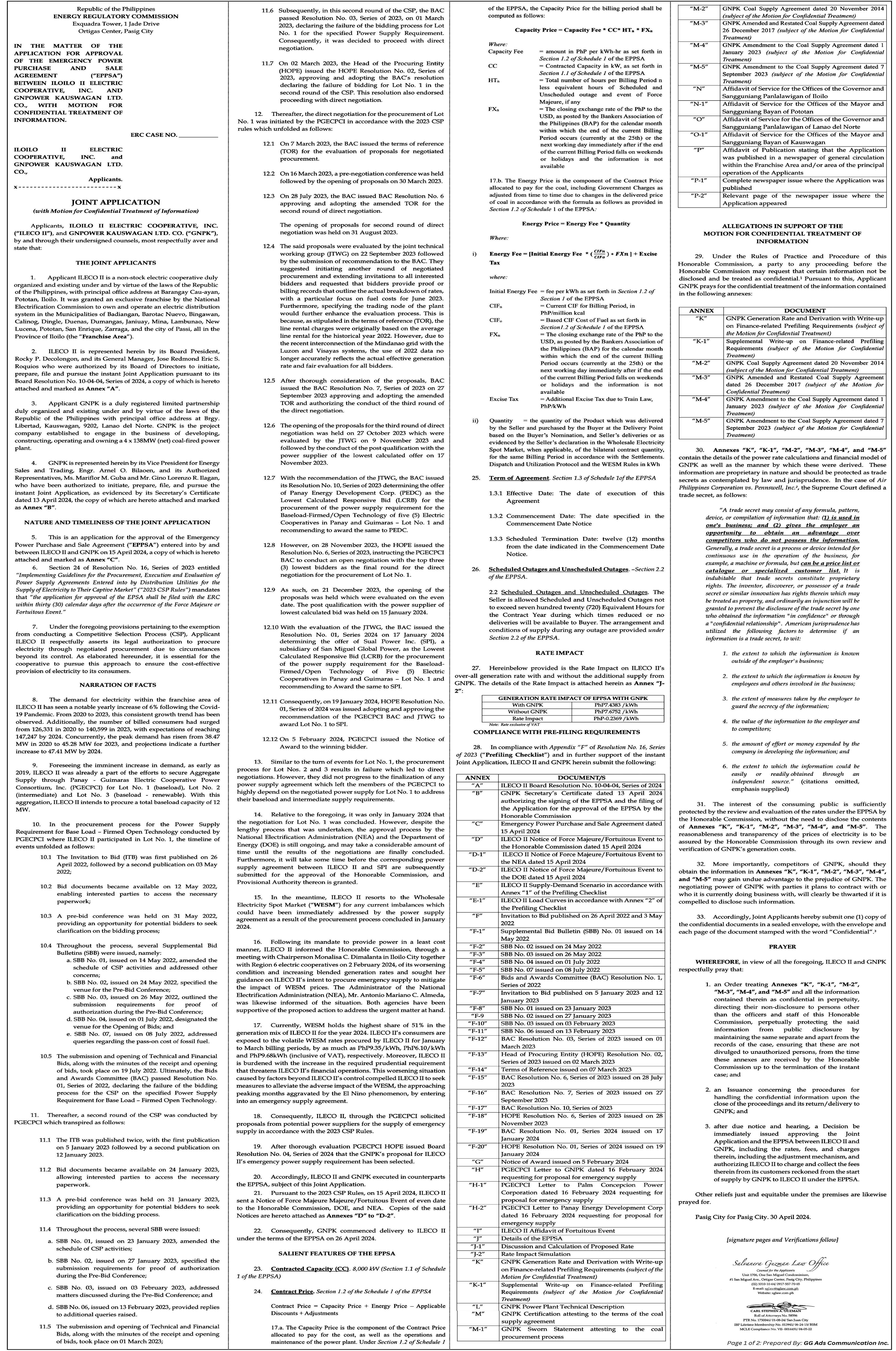

Send us Patriots: Ukraine’s energy plants seek air defenses against Russian attacks
By Jill Lawless The Associated Press
KYIV, Ukraine—At a Ukrainian power plant repeatedly hit by Russian aerial attacks, equipment department chief Oleh has a one-word answer when asked what Ukraine’s battered energy industry needs most: “Patriot.”
Ukrainian energy workers are struggling to repair the damage from intensifying airstrikes aimed at pulverizing Ukraine’s energy grid, hobbling the economy and sapping the public’s morale. Staff worry they will lose the race to prepare for winter unless allies come up with air-defense systems like the US-made Patriots to stop Russian attacks inflicting more destruction on already damaged plants.
“Rockets hit fast. Fixing takes long,” Oleh said in limited but forceful English.
The US has sent Ukraine some Patriot missile systems, and said last week it would give more after entreaties from President Volodymyr Zelenskyy.
The Associated Press on Thursday visited a plant owned by DTEK, the country’s biggest private energy supplier, days after a cruisemissile attack left parts of it a mess of smashed glass, shattered bricks
and twisted metal. The coal-fired plant is one of four DTEK power stations struck on the same day last week.
The AP was given access on the condition that the location of the facility, technical details of the damage and workers’ full names are not published due to security concerns.
During the visit, State Emergency Service workers in hard hats and harnesses clambered atop the twisted roof of a vast building, assessing the damage and occasionally dislodging chunks of debris with a thunderous clang.
Ukrainian Foreign Minister Dmytro Kuleba told Foreign Policy magazine that half of the country’s energy system has been damaged by Russian attacks.
DTEK says it has lost 80 percent of its electricity-generating capacity in almost 180 aerial attacks since the start of Russia’s full-scale invasion in 2022. It estimates that
repairing all the damaged plants would take between six months and two years—even if there are no more strikes.
Shift supervisor Ruslan was on duty in the operations room when the air alarm sounded. He sent his crew to a basement shelter but remained at his post when the blast struck only meters (yards) away. He rushed out to darkness, dust and fire. He said he wasn’t scared because “I knew what I needed to do”—make sure his team was OK and then try to help put out the flames.
Russia pummeled Ukraine’s energy infrastructure to devastating effect during the “blackout winter” of 2022-2023. In March it launched a new wave of attacks, one of which completely destroyed the Trypilska power plant near Kyiv, one of the country’s biggest.
Russian President Vladimir Putin has framed the attacks as retaliation for Ukrainian strikes on Russian oil refineries.
Oleh said the Russians are “learning all the time” and adapting their tactics. Initially they targeted transformers that distribute power; now they aim for the power-generating equipment itself, with increasing accuracy.
The Russians also are sending growing numbers of missiles and exploding drones to exhaust Ukraine’s air defenses, and striking the same targets repeatedly.
DTEK executive director Dmytro Sakharuk said in March that out of 10 units the company had repaired after earlier strikes, twothirds had been hit again.
More Russian missiles have been getting through in recent months as Ukraine awaited new supplies from allies, including a $61 billion package from the US that was held up for months by wrangling in Congress. It was finally approved in April, but it could be weeks or months before all the new weapons and ammunition arrives.
Ukraine’s energy firms have all but exhausted their finances, equipment and spare parts fixing the damage Russia has already wrought. The country’s power plants urgently need specialist equipment that Ukraine can no longer make at sufficient speed and scale.
Some 51 DTEK employees have been wounded in attacks since 2022, and three have been killed. Staff say they keep working despite the danger because they know how crucial their work is.
Machine operator Dmytro, who was on shift during the recent attack and took shelter in the basement, said that when he emerged, “my soul was bleeding when I saw the scale of the destruction.”
He thought of the many people who had poured heart and soul into building the mammoth power plant.
“This was destroyed in a few seconds, in an instant,” he said. Dmytro, who worked at Ukraine’s Zaporizhzhia nuclear power plant before it was seized by Russia, said he would continue to show up for work every day, “as long as I’m able.”
“It’s our duty towards the country,” he said.
As Hamas considers cease-fire offer, question hangs: Will Israel end war without the group’s destruction?
By Bassem Mroue & Lee Keath
The Associated Press
BEIRUT—Hamas is still considering the latest proposal for a cease-fire with Israel that the United States and other mediators hope will avert an Israeli attack on the Gaza town of Rafah. But chances for the deal are entangled with the question of whether Israel can accept an end to the war without reaching its stated goal of destroying Hamas.
The stakes in the cease-fire negotiations were made clear in a new UN report that said if the war in Gaza stops today, it will still take until 2040 to rebuild all the homes that have been destroyed by nearly seven months of Israeli bombardment and ground offensives in the territory. It warned that the impact of the damage to the economy will set back development for generations and will only get worse with every month fighting continues.
Hamas has insisted it won’t sign onto the deal without assurances that, if it eventually releases all its hostages, Israel will end its onslaught in Gaza and pull its troops out of the territory.
The proposal that US and Egyptian mediators have put to Hamas—apparently with Israel’s acceptance—sets out a three-stage process that will bring an immediate six-week cease-fire and partial hostage release but also negotiations over a “permanent calm” that includes some sort of Israeli withdrawal from Gaza, according to an Egyptian official.
If Israel does agree to end the war in return for a full hostage release, it would be a major turnaround.
Since Hamas’ bloody October 7 at-
tack stunned Israel, its leaders have vowed not to stop their bombardment and ground offensives until the militant group is destroyed. They also say Israel must keep a military presence in Gaza and security control after the war to ensure Hamas doesn’t rebuild.
Publicly at least, Israeli Prime Minister Benjamin Netanyahu continues to insist that is the only acceptable endgame.
He has vowed that even if a ceasefire is reached, Israel will eventually attack Rafah, which he says is Hamas’ last stronghold in Gaza. He repeated his determination to do so in talks Wednesday with US Secretary of State Antony Blinken, who was in Israel on a regional tour to push the deal through.
The deal’s immediate fate hinges on whether Hamas will accept uncertainty over the final phases to bring the initial six-week pause in fighting—and at least postpone what it is feared would be a devastating assault on Rafah, Gaza’s southernmost town where some 1.4 million Palestinians have taken refuge.
Egypt has been privately assuring Hamas that the deal will mean a total end to the war. But the Egyptian official said Hamas says the text’s language is too vague and wants it to specify a complete Israeli pullout from all of Gaza. The official spoke on condition of anonymity to talk about the internal deliberations.
The group is still studying the offer, senior Hamas official Osama Hamdan said in a message Thursday to The Associated Press. He did not confirm whether it would formally give an answer later in the day.
On Wednesday evening, Hamdan expressed skepticism, saying
the group’s initial position was “negative.” Speaking to Hezbollah’s Al Manar TV, he said talks were still ongoing but would stop if Israel invades Rafah.
Blinken hiked up pressure on Hamas to accept, saying Israel had made “very important” compromises.
“There’s no time for further haggling. The deal is there,” Blinken said Wednesday before leaving for the US.
Hanging over the negotiations is the threat of an Israeli attack on Rafah, which the US and UN have warned could be catastrophic for Palestinian civilians. After fleeing Israel’s assault elsewhere in Gaza, more than half the territory’s population has crowded into tent camps and other shelters in and around Rafah.
The United States, which has staunchly supported Israel throughout the war, has said it should not move on Rafah and has grown increasingly critical of the staggering toll borne by Palestinian civilians. American officials say they oppose a major offensive in Rafah but that if Israel conducts one, it must first evacuate civilians. Israel has said it is developing plans for a mass evacuation of civilians.
The Israel-Hamas war was sparked by the October 7 raid into southern Israel in which militants killed around 1,200 people, mostly civilians, and abducted around 250 hostages. Hamas is believed to still hold around 100 hostages and the remains of more than 30 others.
Since then, Israel’s campaign in Gaza has killed more than 34,000 Palestinians, according to local health officials. It has wreaked vast destruction and brought a hu -
manitarian disaster, with several hundred thousand Palestinians in northern Gaza facing imminent famine, according to the UN More than 80 percent of the population has been driven from their homes. The “productive basis of the economy has been destroyed” and poverty is rising sharply among Palestinians, according to the report released Thursday by the United Nations Development Program and the Economic and Social Commission for Western Asia. It said that in 2024, the entire Palestinian economy—including both Gaza and the West Bank— has so far contracted 25.8 percent. If the war continues, the loss will reach a “staggering” 29 percent by July, it said. The West Bank economy has been hit by Israel’s decision to cancel the work permits for tens of thousands of laborers who depended on jobs inside Israel.
“Every additional day that this war continues is exacting huge and compounding costs to Gazans and all Palestinians.… These new figures warn that the suffering in Gaza will not end when the war does,” said UNDP administrator Achim Steiner. He warned of a “serious development crisis that jeopardizes the future of generations to come.”
The report said at least 370,000 housing units in Gaza have been damaged, including 79,000 destroyed completely. After previous Israel-Hamas conflicts, housing was rebuilt at a rate of 992 units year. Even if Israel allows a fivefold increase of construction material to enter Gaza, it would take until 2040 to rebuild the destroyed houses without repairing the damaged ones, it said.
Keath reported from Cairo.
Saturday, May 4, 2024 A13 The World www.businessmirror.com.ph

5.
24.
ESTABLISHMENT / ADDRESS No. NAME OF FOREIGN NATIONAL , POSITION AND BRIEF DESCRIPTION QUALIFICATION AND SALARY RANGE ESTABLISHMENT / ADDRESS No. NAME OF FOREIGN NATIONAL , POSITION AND BRIEF DESCRIPTION QUALIFICATION AND SALARY RANGE ESTABLISHMENT / ADDRESS No. NAME OF FOREIGN NATIONAL , POSITION AND BRIEF DESCRIPTION QUALIFICATION AND SALARY RANGE ACTIVEPH BUSINESS CONSULTANCY INC. Room 202 Apc Building, Quezon Ave., Paligsahan, Quezon City 1. CHEN, TIANDE Assistant Consultant Brief Job Description: To guide clients through all procedures required and responsible for furnishing clients with relevant information. Basic Qualification: Bachelor’s Degree in Business Management. Excellent communication skills, verbal or written. Salary Range: Php 30,000 - Php 59,999 2. DANG THI CHUC Assistant Consultant Brief Job Description: To guide clients through all procedures required and responsible for furnishing clients with relevant information. Basic Qualification: Bachelor’s Degree in Business Management. Excellent communication skills, verbal or written. Salary Range: Php 30,000 - Php 59,999 3. CHEN, HONG-YU International Consultant Brief Job Description: To guide clients through all procedures required and responsible for furnishing clients with relevant information. Basic Qualification: Bachelor’s Degree in Business Management. Excellent communication skills, verbal or written. Salary Range: Php 30,000 - Php 59,999
GUO, QINGQING International Consultant Brief Job Description: To guide clients through all procedures required and responsible for furnishing clients with relevant information. Basic Qualification: Bachelor’s Degree in Business Management. Excellent communication skills, verbal or written. Salary Range: Php 30,000 - Php 59,999
4.
HU, YAOYUN Marketing Executive Brief Job Description: To guide clients through all procedures required and responsible for furnishing clients with relevant information. Basic Qualification: Bachelor’s Degree in Business Management. Excellent communication skills, verbal or written. Salary Range: Php 30,000 - Php 59,999 ANOC99 CORPORATION 5/f To 10/f Ayala Malls Manila Bay Building D., Macapagal Blvd. Cor. Aseana Street, Tambo, City Of Parañaque 6. AH YIN Burmese Customer Service Representative Brief Job Description: Managing incoming calls and customer service inquiries. Basic Qualification: Able to speak, read and write in Chinese and Burmese languages. Salary Range: Php 30,000 - Php 59,999 7. CHO CHO MON Burmese Customer Service Representative Brief Job Description: Managing incoming calls and customer service inquiries. Basic Qualification: Able to speak, read and write in Chinese and Burmese languages. Salary Range: Php 30,000 - Php 59,999 8. KAY ZIN YU Burmese Customer Service Representative Brief Job Description: Managing incoming calls and customer service inquiries. Basic Qualification: Able to speak, read and write in Chinese and Burmese languages. Salary Range: Php 30,000 - Php 59,999 9. LIN KHIN KHIN Burmese Customer Service Representative Brief Job Description: Managing incoming calls and customer service inquires. Basic Qualification: Able to speak, read and write in Chinese and Vietnamese languages. Salary Range: Php 30,000 - Php 59,999 10. THAN HTIKE OO Burmese Customer Service Representative Brief Job Description: Managing incoming calls and customer service inquiries. Basic Qualification: Able to speak, read and write in Chinese and Burmese languages. Salary Range: Php 30,000 - Php 59,999 11. WIN KHAING Burmese Customer Service Representative Brief Job Description: Managing incoming calls and customer service inquires. Basic Qualification: Able to speak, read and write in Chinese and Burmese languages. Salary Range: Php 30,000 - Php 59,999 12. HE, WENSHENG Chinese Customer Service Representative Brief Job Description: Managing incoming calls and customer service inquiries. Basic Qualification: Able to speak, read and write in Chinese language. Salary Range: Php 30,000 - Php 59,999 13. HE, YUNPENG Chinese Customer Service Representative Brief Job Description: Managing incoming calls and customer service inquiries. Basic Qualification: Able to speak, read and write in Chinese language. Salary Range: Php 30,000 - Php 59,999 14. HUANG, MEI Chinese Customer Service Representative Brief Job Description: Managing incoming calls and customer service inquiries. Basic Qualification: Able to speak, read and write in Chinese language. Salary Range: Php 30,000 - Php 59,999 15. LI, DENGKE Chinese Customer Service Representative Brief Job Description: Managing incoming calls and customer service inquires. Basic Qualification: Able to speak, read, and write in Chinese language. Salary Range: Php 30,000 - Php 59,999 16. LIU, YIPING Chinese Customer Service Representative Brief Job Description: Managing incoming calls and customer service inquires. Basic Qualification: Able to speak, read, and write in Chinese language. Salary Range: Php 30,000 - Php 59,999 17. MA, SISI Chinese Customer Service Representative Brief Job Description: Managing incoming calls and customer service inquires. Basic Qualification: Able to speak, read and write in Chinese and Vietnamese languages. Salary Range: Php 30,000 - Php 59,999 18. SHI, XIAOJIE Chinese Customer Service Representative Brief Job Description: Managing incoming calls and customer service inquires. Basic Qualification: Able to speak, read and write in Vietnamese language. Salary Range: Php 30,000 - Php 59,999 19. XIAO, NIAN Chinese Customer Service Representative Brief Job Description: Managing incoming calls and customer service inquiries. Basic Qualification: Able to speak, read, and write in Chinese language. Salary Range: Php 30,000 - Php 59,999
ELIZABETH Indonesian Customer Service Representative Brief Job Description: Managing incoming calls and customer service inquires. Basic Qualification: Able to speak, read and write in Chinese and Indonesian languages. Salary Range: Php 30,000 - Php 59,999 21. GIANG, A MANH Vietnamese Customer Service Representative Brief Job Description: Managing incoming calls and customer service inquiries. Basic Qualification: Able to speak, read and write in Chinese and Vietnamese languages. Salary Range: Php 30,000 - Php 59,999
HO, CAM NHOC Vietnamese Customer Service Representative Brief Job Description: Managing incoming calls and customer service inquiries. Basic Qualification: Able to speak, read and write in Chinese and Vietnamese languages. Salary Range: Php 30,000 - Php 59,999
HOANG VAN KIEM Vietnamese Customer Service Representative Brief Job Description: Managing incoming calls and customer service inquires. Basic Qualification: Able to speak, read and write in Vietnamese language. Salary Range: Php 30,000 - Php 59,999
20.
22.
23.
KHUC, NGOC HANH Vietnamese Customer Service Representative Brief Job Description: Managing incoming calls and customer service inquires. Basic Qualification: Able to speak, read and write in Chinese and Vietnamese languages. Salary Range: Php 30,000 - Php 59,999
LAM, HINH PHAT Vietnamese Customer Service Representative Brief Job Description: Managing incoming calls and customer service inquires. Basic Qualification: Able to speak, read and write in Chinese and Vietnamese languages. Salary Range: Php 30,000 - Php 59,999
LAO NGOC ANH Vietnamese Customer Service Representative Brief Job Description: Managing incoming calls and customer service inquires. Basic Qualification: Able to speak, read and write in Chinese and Vietnamese languages. Salary Range: Php 30,000 - Php 59,999 27. LE VAN NGUYEN Vietnamese Customer Service Representative Brief Job Description: Managing incoming calls and customer service inquires. Basic Qualification: Able to speak, read and write in Chinese and Vietnamese languages. Salary Range: Php 30,000 - Php 59,999 28. LE, THI MY DIEN Vietnamese Customer Service Representative Brief Job Description: Managing incoming calls and customer service inquires. Basic Qualification: Able to speak, read and write in Chinese and Vietnamese languages. Salary Range: Php 30,000 - Php 59,999 29. NGO, VAN NGOC Vietnamese Customer Service Representative Brief Job Description: Managing incoming calls and customer service inquires. Basic Qualification: Able to speak, read and write in Chinese and Vietnamese languages. Salary Range: Php 30,000 - Php 59,999 30. NGOC, THI LOAN Vietnamese Customer Service Representative Brief Job Description: Managing incoming calls and customer service inquires. Basic Qualification: Able to speak, read and write in Vietnamese language. Salary Range: Php 30,000 - Php 59,999 31. NGUYEN DUC HOAI Vietnamese Customer Service Representative Brief Job Description: Managing incoming calls and customer service inquires. Basic Qualification: Able to speak, read and write in Vietnamese language. Salary Range: Php 30,000 - Php 59,999 32. NGUYEN HOANG TU Vietnamese Customer Service Representative Brief Job Description: Managing incoming calls and customer service inquires. Basic Qualification: Able to speak, read and write in Vietnamese language. Salary Range: Php 30,000 - Php 59,999 33. NGUYEN HUY TUAN Vietnamese Customer Service Representative Brief Job Description: Managing incoming calls and customer service inquires. Basic Qualification: Able to speak, read and write in Vietnamese language. Salary Range: Php 30,000 - Php 59,999 34. NGUYEN MINH QUANG Vietnamese Customer Service Representative Brief Job Description: Managing incoming calls and customer service inquires. Basic Qualification: Able to speak, read and write in Vietnamese language. Salary Range: Php 30,000 - Php 59,999 35. NGUYEN THE VI Vietnamese Customer Service Representative Brief Job Description: Managing incoming calls and customer service inquires. Basic Qualification: Able to speak, read and write in Vietnamese language. Salary Range: Php 30,000 - Php 59,999 36. NGUYEN VAN LONG Vietnamese Customer Service Representative Brief Job Description: Managing incoming calls and customer service inquires. Basic Qualification: Able to speak, read and write in Vietnamese language. Salary Range: Php 30,000 - Php 59,999 37. NGUYEN, THI BE PHUONG Vietnamese Customer Service Representative Brief Job Description: Managing incoming calls and customer service inquires. Basic Qualification: Able to speak, read and write in Vietnamese language. Salary Range: Php 30,000 - Php 59,999 38. NGUYEN, THI NGA Vietnamese Customer Service Representative Brief Job Description: Managing incoming calls and customer service inquires. Basic Qualification: Able to speak, read and write in Vietnamese language. Salary Range: Php 30,000 - Php 59,999 39. NHAM VI LUONG Vietnamese Customer Service Representative Brief Job Description: Managing incoming calls and customer service inquires. Basic Qualification: Able to speak, read and write in Vietnamese language. Salary Range: Php 30,000 - Php 59,999 40. PHAM THI PHUONG LINH Vietnamese Customer Service Representative Brief Job Description: Managing incoming calls and customer service inquires. Basic Qualification: Able to speak, read and write in Vietnamese language. Salary Range: Php 30,000 - Php 59,999 41. TRIEU THI PHUONG Vietnamese Customer Service Representative Brief Job Description: Managing incoming calls and customer service inquiries. Basic Qualification: Able to speak, read, and write in Chinese and Vietnamese languages. Salary Range: Php 30,000 - Php 59,999 BRIGHT LUME IT SOLUTIONS INC. Unit 202 Erisha Condominium, 1142 P Ocampo Street, Barangay 757, Santa Ana, City Of Manila 42. WU, WEI Chinese Speaking Business Development Associate Brief Job Description: Conduct market research and identifying potential clients. Cultivate strong relationships with new clients, while maintaining existing client relationships. Able to manage multiple projects concurrently and meet deadlines. Basic Qualification: Bachelor’s degree holder. With experience in business management, finance computer/software and training, marketing/ sales or related field. Fluent in both written and verbal English and ChineseMandarin languages. Salary Range: Php 30,000 - Php 59,999 43. ZENG, XIAOHUI Chinese Speaking Data Analyst Brief Job Description: Manage master data, including creation, updates, and deletion and manage users and user roles. Provide quality assurance of imported data, working with quality assurance analysts if necessary. Process confidential data and information according to guidelines. Basic Qualification: Bachelor’s degree holder. With experience in business management, finance computer/software and training, marketing/ sales or related field. Fluent in both written and verbal English and ChineseMandarin languages. Salary Range: Php 30,000 - Php 59,999 44. CUI, HONGCHENG Chinese Speaking Software Developer Brief Job Description: Provide financial advice and assess financial risks. Develop sales and marketing strategy and improve financial operations. Basic Qualification: Bachelor’s degree holder. With experience in business management, finance computer/software and training, marketing/ sales or related field. Fluent in both written and verbal English and ChineseMandarin languages. Salary Range: Php 30,000 - Php 59,999 45. YEX NIMM Chinese Speaking Software Developer Brief Job Description: Provide financial advice and assess financial risks. Develop sales and marketing strategy and improve financial operations. Basic Qualification: Bachelor’s degree holder with experience in business management, finance, computer software and training, marketing, sales or related field and fluent in both written and verbal English and Chinese Mandarin languages. Salary Range: Php 30,000 - Php 59,999 BusinessMirror A6 www.businessmirror.com.ph A14 Saturday, May 4, 2024
25.
26.
61.
Brief
62.
Brief
63. LI, BANGKE Chinese
Brief
64. LI, JINGHENG Chinese Speaking Business Development Associate
Brief Job Description: Identify and maintain new business opportunities and existing partners.
65.
Brief
66.
Brief
67.
Brief
68.
Brief
69. LU, YONG Chinese Speaking Business Development Associate
Brief
and existing partners.
MU, FUJUN Chinese Speaking Business Development Associate
70.
Brief Job Description: Conducting market research and identifying potential clients. Basic
71. QI, CHANGSHENG Chinese Speaking Business Development Associate
Brief Job Description: Identify and maintain new business opportunities and existing partners.
72. ZHANG, CHANGJIANG Chinese Speaking Business Development Associate
Basic Qualification: With at least 6 months of work experience. With good verbal and written communication skills.
Salary Range: Php 30,000 - Php 59,999
Brief Job Description: Identify and maintain new business opportunities and existing partners. Basic Qualification: With at least 6 months of work experience. With good verbal and written communication skills. Salary Range: Php 30,000 - Php 59,999
73. ZHANG, MENG Chinese Speaking Business Development Associate
Brief Job Description: Identify and maintain new business opportunities and existing partners.
Brief
74.
ESTABLISHMENT / ADDRESS No. NAME OF FOREIGN NATIONAL , POSITION AND BRIEF DESCRIPTION QUALIFICATION AND SALARY RANGE ESTABLISHMENT / ADDRESS No. NAME OF FOREIGN NATIONAL POSITION AND BRIEF DESCRIPTION QUALIFICATION AND SALARY RANGE ESTABLISHMENT / ADDRESS No. NAME OF FOREIGN NATIONAL , POSITION AND BRIEF DESCRIPTION QUALIFICATION AND SALARY RANGE 46. ZHANG, XUETING Mandarin Speaking Helpdesk Support Specialist Brief Job Description: Provide first level contact and convey resolutions to customer issues. Escalate unresolved queries to the next level of support and track, route and redirect problems to correct resources. Basic Qualification: Bachelor’s degree holder. With experience in business management, finance computer/software and training, marketing/ sales or related field. Fluent in both written and verbal English and ChineseMandarin languages. Salary Range: Php 30,000 - Php 59,999 BRIGHTLEISURE MANAGEMENT INC. 10/f Newport Entertainment & C Bldg. Newport City, Manlunas, Barangay 183, Pasay City 47. IVAN YUDA TANNAVI Director For Host Operations Brief Job Description: Provides overall direction and guidance to the operational activities of the organization with the objective of maximizing growth and profitability as well as day-to-day leadership and management to all company operations functions under the department. Basic Qualification: Graduate of any 4 years course. Excellent verbal and written communication skills. Required language is Korean/Mandarin/ Japanese. Salary Range: Php 150,000 - Php 499,999 48. YOH KIEN SENG Director For PMO Brief Job Description: Responsible for planning and directing of all software development. Basic Qualification: 7 years of experience in software development and required language is Malaysian/Mandarin. Salary Range: Php 150,000 - Php 499,999 CEBGO, INC. Cebu Pacific Bldg., Domestic Road St., Barangay 191, Pasay City 49. CHOU, TZU-HSIANG a.k.a. CHOU, YANG Pilot Brief Job Description: Act as Second-in-Command (SIC) or Pilot-inCommand (PIC) of the aircraft for a safe, secure and efficient flight. Basic Qualification: College graduate. With ATR aircraft training and with at least 500 hours of total flight time. Salary Range: Php 60,000 - Php 89,999 50. PAING THET KYAW Pilot Brief Job Description: Act as Second-in-Command (SIC) or Pilot-inCommand (PIC) of the aircraft for a safe, secure and efficient flight. Basic Qualification: College graduate. With ATR aircraft training and with at least 500 hours of total flight time. Salary Range: Php 90,000 - Php 149,999 CLUVIT CORPORATION Unit 502-1 Proscenium, Estrella Drive Rockwell Center, Guadalupe Viejo, City Of Makati 51. KIM, MINHO Software Developer Brief Job Description: Develop, test and implement new software programs. Clearly and regularly communicate with the management and technical support colleagues. Basic Qualification: College graduate. With at least 3 years of work experience in a Software Development company. Salary Range: Php 30,000 - Php 59,999 CRONYX INC. 5-12, 15-19/f Royal Peak Tower A, 485 Quirino Avenue, Tambo, City Of Parañaque 52. CHAU THUY YEN Chinese Speaking Business Development Associate Brief Job Description: Identify and maintain new business opportunities and existing partners. Basic Qualification: With at least 6 months of work experience. With good verbal and written communication skills. Salary Range: Php 30,000 - Php 59,999 53. CHEN, MENGLING Chinese Speaking Business Development Associate Brief Job Description: Identify and maintain new business opportunities and existing partners. Basic Qualification: With at least 6 months of work experience. With good verbal and written communication skills. Salary Range: Php 30,000 - Php 59,999 54. CHEN, YONGZHI Chinese Speaking Business Development Associate Brief Job Description: Identify and maintain new business opportunities and existing partners. Basic Qualification: With at least 6 months of work experience. With good verbal and written communication skills. Salary Range: Php 30,000 - Php 59,999 55. CHEN, YUCHENG Chinese Speaking Business Development Associate Brief Job Description: Identify and maintain new business opportunities and existing partners. Basic Qualification: With at least 6 months of work experience. With good verbal and written communication skills. Salary Range: Php 30,000 - Php 59,999 56. CHI, ZUOWEI Chinese Speaking Business Development Associate Brief Job Description: Identify and maintain new business opportunities and existing partners. Basic Qualification: With at least 6 months of work experience. With good verbal and written communication skills. Salary Range: Php 30,000 - Php 59,999 57. GONG, HECHAO Chinese Speaking Business Development Associate Brief Job Description: Identify and maintain new business opportunities and existing partners. Basic Qualification: With at least 6 months of work experience. With good verbal and written communication skills. Salary Range: Php 30,000 - Php 59,999 58. HERMANTO Chinese Speaking Business Development Associate Brief Job Description: Correcting errors and organizing the information in a manner that will optimize swift and accurate capturing. Basic Qualification: Have excellent verbal and written communication skills and able to organize their work using tools. Salary Range: Php 30,000 - Php 59,999 59. HU, SHUAI Chinese Speaking Business Development Associate Brief Job Description: Identify and maintain new business opportunities and existing partners. Basic Qualification: With at least 6 months of work experience. With good verbal and written communication skills. Salary Range: Php 30,000 - Php 59,999 60. HUANG, XINGYAN Chinese Speaking Business Development Associate Brief Job Description: Identify and maintain new business opportunities and existing partners. Basic Qualification: With at least 6 months of work experience. With good verbal and written communication skills. Salary Range: Php 30,000 - Php 59,999
JIANG, JUNNAN Chinese Speaking Business Development Associate
Job Description: Identify and maintain new business opportunities and existing partners. Basic Qualification: With at least 6 months of work experience. With good verbal and written communication skills. Salary Range: Php 30,000 - Php 59,999
Chinese Speaking Business Development Associate
JIN, YE
Job Description: Identify and maintain new business opportunities and existing partners. Basic Qualification: With at least 6 months of work experience. With good verbal and written communication skills. Salary Range: Php 30,000 - Php 59,999
Speaking Business Development Associate
Job Description: Identify and maintain new business opportunities and existing partners.
Qualification: With at least 6 months of work experience. With good verbal and written communication skills. Salary Range: Php 30,000 - Php
Basic
59,999
59,999
Basic Qualification: With at least 6 months of work experience. With good verbal and written communication skills. Salary Range: Php 30,000 - Php
LIU, FENG Chinese Speaking Business Development Associate
Qualification: Have excellent verbal and written communication skills and able to organize their work using tools. Salary Range: Php 30,000
Php
Job Description: Conducting market research and identifying potential clients. Basic
-
59,999
Speaking Business Development Associate
LIU, MEIGE Chinese
Description:
maintain new business opportunities
existing
Qualification: With at least 6 months of work experience. With good verbal and written communication skills. Salary Range: Php 30,000
Php 59,999
Job
Identify and
and
partners. Basic
-
LIU, XIANGYU Chinese Speaking Business Development Associate
Job Description: Identify and maintain new business opportunities and existing partners. Basic Qualification: With at least 6 months of work experience. With good verbal and written communication skills. Salary Range: Php 30,000 - Php 59,999
LU, QIUMOU Chinese Speaking Business Development Associate
new business opportunities
Basic Qualification: With at least 6 months of work experience. With good verbal and written communication skills. Salary Range: Php 30,000 - Php 59,999
Job Description: Identify and maintain
and existing partners.
Qualification: Excellent written and verbal communication skills. Strong organization and project management skills.
Range:
Job Description: Identify and maintain new business opportunities
Basic
Salary
Php 30,000 - Php 59,999
Qualification: Have excellent verbal
written communication skills
able to organize their work using tools.
and
and
Salary Range: Php 30,000 - Php 59,999
least
communication
Php 59,999
Basic Qualification: With at
6 months of work experience. With good verbal and written
skills. Salary Range: Php 30,000 -
BRYAN EWE YI ZE Chinese Speaking Data Entry Clerk
Description: Correcting errors and organizing the information in a manner that will optimize swift and accurate
Basic Qualification: Have excellent verbal and written communication skills and able to organize their work using tools. Salary Range: Php 30,000 - Php 59,999 75. BUI BICH PHUONG Chinese Speaking Data Entry Clerk Brief Job Description: Correcting errors and organizing the information in a manner that will optimize swift and accurate capturing. Basic Qualification: Have excellent verbal and written communication skills and able to organize their work using tools. Salary Range: Php 30,000 - Php 59,999 76. CHEN, HUNG-PEI Chinese Speaking Data Entry Clerk Brief Job Description: Conducting market research and identifying potential clients. Basic Qualification: Have excellent verbal and written communication skills and able to organize their work using tools. Salary Range: Php 30,000 - Php 59,999 77. CU, NAM SON Chinese Speaking Data Entry Clerk Brief Job Description: Correcting errors and organizing the information in a manner that will optimize swift and accurate capturing. Basic Qualification: Have excellent verbal and written communication skills and able to organize their work using tools. Salary Range: Php 30,000 - Php 59,999 78. DO, PHUONG THAO Chinese Speaking Data Entry Clerk Brief Job Description: Conducting market research and identifying potential clients. Basic Qualification: Have excellent verbal and written communication skills and able to organize their work using tools. Salary Range: Php 30,000 - Php 59,999 79. HEIN THANT LWIN Chinese Speaking Data Entry Clerk Brief Job Description: Correcting errors and organizing the information in a manner that will optimize swift and accurate capturing. Basic Qualification: Have excellent verbal and written communication skills and able to organize their work using tools. Salary Range: Php 30,000 - Php 59,999 80. HOANG MAI ANH Chinese Speaking Data Entry Clerk Brief Job Description: Correcting errors and organizing the information in a manner that will optimize swift and accurate capturing. Basic Qualification: Have excellent verbal and written communication skills and able to organize their work using tools. Salary Range: Php 30,000 - Php 59,999 81. LI, YANG Chinese Speaking Data Entry Clerk Brief Job Description: Correcting errors and organizing the information in a manner that will optimize swift and accurate capturing. Basic Qualification: Have excellent verbal and written communication skills and able to organize their work using tools. Salary Range: Php 30,000 - Php 59,999 82. NGUYEN, THI HUONG Chinese Speaking Data Entry Clerk Brief Job Description: Gather data and capture the information into databases. Basic Qualification: Ability to concentrate for lengthy periods and with good verbal and written communication skills. Salary Range: Php 30,000 - Php 59,999 83. NHU, DINH QUAN Chinese Speaking Data Entry Clerk Brief Job Description: Correcting errors and organizing the information in a manner that will optimize swift and accurate capturing. Basic Qualification: Have excellent verbal and written communication skills and able to organize their work using tools. Salary Range: Php 30,000 - Php 59,999 84. NOMENJANAHARY, DANA ISMAEL Chinese Speaking Data Entry Clerk Brief Job Description: Correcting errors and organizing the information in a manner that will optimize swift and accurate capturing. Basic Qualification: With experience in computer aided design and with good verbal and written communication skills. Salary Range: Php 30,000 - Php 59,999 85. PHAM THI PHUONG Chinese Speaking Data Entry Clerk Brief Job Description: Correcting errors and organizing the information in a manner that will optimize swift and accurate capturing. Basic Qualification: Have excellent verbal and written communication skills and able to organize their work using tools. Salary Range: Php 30,000 - Php 59,999 86. VI VAN HA Chinese Speaking Data Entry Clerk Brief Job Description: Correcting errors and organizing the information in a manner that will optimize swift and accurate capturing. Basic Qualification: Have excellent verbal and written communication skills and able to organize their work using tools. Salary Range: Php 30,000 - Php 59,999 87. PHAM VAN QUYEN Chinese Speaking Graphic Designer Brief Job Description: Liaising with clients to determine their requirements, timescale and budget. Basic Qualification: Have excellent verbal and written communication skills and able to organize their work using tools. Salary Range: Php 30,000 - Php 59,999 88. TONG, WENXING Chinese Speaking Graphic Designer Brief Job Description: Liaising with clients to determine their requirements, timescale and budget. Basic Qualification: Have excellent verbal and written communication skills and able to organize their work using tools. Salary Range: Php 30,000 - Php 59,999 89. CHEN, SHIZHEN Chinese Speaking Program Designer Brief Job Description: Document all aspects of software, for ongoing maintenance and revisions. Basic Qualification: Have excellent verbal and written communication skills and able to organize their work using tools. Salary Range: Php 30,000 - Php 59,999 90. KYU KYU MYWE Chinese Speaking Program Designer Brief Job Description: Communicate overall design and approach to a team of programmers. Create flowcharts, diagrams, other models, and programming instructions to guide programming team. Basic Qualification: Have excellent verbal and written communication skills and able to organize their work using tools. Salary Range: Php 30,000 - Php 59,999 91. REN, ZHENGQIAO Chinese Speaking Program Designer Brief Job Description: Communicate overall design and approach to a team of programmers. Create flowcharts, diagrams, other models, and programming instructions to guide programming team. Basic Qualification: Have excellent verbal and written communication skills and able to organize their work using tools. Salary Range: Php 30,000 - Php 59,999 92. ZHAO, YAN Chinese Speaking Program Designer Brief Job Description: Collaborate with other IT specialists, technicians, etc., to deliver software solutions. Basic Qualification: Ability to concentrate for lengthy periods and with good verbal and written communication skills. Salary Range: Php 30,000 - Php 59,999 DYNAMIC STUDIO TECHNOLOGY INC. 5 To 10/f Platinum Tower Building, Aseana Ave. Cor. Fuentes Street, Baclaran, City Of Parañaque 93. TRAN, TRONG QUANG Chinese Speaking Admin Associate Brief Job Description: Responsible for providing overall administrative support to the team and he/ she will be assigned to the Chinese team. Basic Qualification: Have excellent verbal and written communication skills and able to organize their work using tools. Salary Range: Php 30,000 - Php 59,999 BusinessMirror A15 www.businessmirror.com.ph Saturday, May 4, 2024
Job
capturing.
110.
Brief
111. JOSHI, NEHA Customer
Brief
112. NURHAKMA BINTI JUHARI
Marketing Executive Chinese Speaking
Brief Job Description: Manages the execution of different marketing strategies for a company and developing efficient and intuitive marketing.
113. DAS, SAMIRAN Marketing Executive Indian Speaking
Brief Job Description: Manages the execution of different marketing strategies.
SHRESTHA, BIKASH Marketing Executive Nepali Speaking
Brief Job Description: Manages the execution of different marketing strategies.
115. HUYNH THUY NHI Product Executive Vietnamese Speaking
Brief
Brief
PAN, MEI-RONG Chinese Customer Service Representative
Brief
119.
ZHANG, WEI-JIN Chinese Customer Service Representative
Brief
120.
ESTABLISHMENT / ADDRESS No. NAME OF FOREIGN NATIONAL , POSITION AND BRIEF DESCRIPTION QUALIFICATION AND SALARY RANGE ESTABLISHMENT / ADDRESS No. NAME OF FOREIGN NATIONAL POSITION AND BRIEF DESCRIPTION QUALIFICATION AND SALARY RANGE ESTABLISHMENT / ADDRESS No. NAME OF FOREIGN NATIONAL , POSITION AND BRIEF DESCRIPTION QUALIFICATION AND SALARY RANGE 94. LIN LIN AUNG Chinese Speaking Business Development Associate Brief Job Description: Identify and maintain new business opportunities and existing partners. Basic Qualification: Have excellent verbal and written communication skills and able to organize their work using tools. Salary Range: Php 30,000 - Php 59,999 95. CHAU, THI KIM LINH Chinese Speaking Data Entry Clerk Brief Job Description: Correcting errors and organizing the information in a manner that will optimize swift and accurate capturing. Basic Qualification: Have excellent verbal and written communication skills and able to organize their work using tools. Salary Range: Php 30,000 - Php 59,999 96. CHENG, MING Chinese Speaking Data Entry Clerk Brief Job Description: Entering and updating information into relevant databases. Basic Qualification: Have excellent verbal and written communication skills and able to organize their work using tools. Salary Range: Php 30,000 - Php 59,999 97. XIE, YINGJIE Chinese Speaking Data Entry Clerk Brief Job Description: Correcting errors and organizing the information in a manner that will optimize swift and accurate capturing. Basic Qualification: Have excellent verbal and written communication skills and able to organize their work using tools. Salary Range: Php 30,000 - Php 59,999 98. ZHANG, ZHEYAN Chinese Speaking Data Entry Clerk Brief Job Description: Correcting errors and organizing the information in a manner that will optimize swift and accurate capturing. Basic Qualification: Have excellent verbal and written communication skills and able to organize their work using tools. Salary Range: Php 30,000 - Php 59,999 99. AEINT SHWE YI HTUT Chinese Speaking HR Associate Brief Job Description: Managing HR records including, resume, applicant logs, and employee forms. Basic Qualification: Have excellent verbal and written communication skills and able to organize their work using tools. Salary Range: Php 30,000 - Php 59,999 100. HU, TAO Chinese Speaking HR Associate Brief Job Description: Managing HR records including, resumes, applicant logs, and employee forms Basic Qualification: Have excellent verbal and written communication skills and able to organize their work using tools. Salary Range: Php 30,000 - Php 59,999 101. LAM, NGOC MAI Chinese Speaking Program Designer Brief Job Description: Document all aspects of software, for ongoing maintenance and revisions. Basic Qualification: Have excellent verbal and written communication skills and able to organize their work using tools. Salary Range: Php 30,000 - Php 59,999 102. LU, HONGZE Chinese Speaking Program Designer Brief Job Description: Document all aspects of software, for ongoing maintenance and revisions. Basic Qualification: Have excellent verbal and written communication skills and able to organize their work using tools. Salary Range: Php 30,000 - Php 59,999 103. SAN SAN WIN Chinese Speaking Program Designer Brief Job Description: Document all aspects of software, for ongoing maintenance and revisions. Basic Qualification: Have excellent verbal and written communication skills and able to organize their work using tools. Salary Range: Php 30,000 - Php 59,999 104. ZHANG, SHENGWEI Chinese Speaking Program Designer Brief Job Description: Document all aspects of software, for ongoing maintenance and revisions. Basic Qualification: Have excellent verbal and written communication skills and able to organize their work using tools. Salary Range: Php 30,000 - Php 59,999 EFDF LENDING CORP. 20th Floor, W Fifth Avenue Building, 5th Avenue, Bonifacio Global City, Fort Bonifacio, City Of Taguig 105. KALASHNIKOV, KIRILL General Manager Brief Job Description: Plan, organize, direct and control the daily operations of the Company. Assign weekly performance goals, quotas, sales targets and assure their completion. Basic Qualification: College graduate. With previous work experience in a similar role. Salary Range: Php 90,000 - Php 149,999 EVERLAND TRAVEL AND TOUR AGENCY CORP. Unit No. Sb-01 2/f Baclaran Bagong Milenyo Plaza Bldg, F.b. Harrison St., Cor Russel Ave, Barangay 76, Pasay City 106. MCKINNON, CALLUM IAIN Travel Consultant Brief Job Description: Ensuring that clients pay the deposit before commencing with bookings. Basic Qualification: Excellent verbal communication and customer service skills. Salary Range: Php 30,000 - Php 59,999 FAST RETAILING PHILIPPINES, INC. Sm Retail Headquarters, J. W. Diokno Blvd St. Sm Mall Of Asia Complex, Barangay 76, Pasay City 107. AKICHIKA, YUTAKA Store Manager Brief Job Description: Work in concert with all staff to execute management and business, achieving deep connection with the store/customer/regions. Basic Qualification: Must be a graduate of any bachelor’s degree and fluent in Japanese language. Salary Range: Php 150,000 - Php 499,999 108. SAKAI, YOSHITOMO Store Manager Brief Job Description: Work in concert with all staff to execute management and business, achieving deep connection with the store/customer/regions. Basic Qualification: Must be a graduate of any bachelor’s degree and fluent in Japanese language. Salary Range: Php 150,000 - Php 499,999 109. WANG, YING Store Manager Brief Job Description: Work in concert with all staff to execute management and business, achieving deep connection with the store/customer/regions. Basic Qualification: Must be a graduate of any bachelor’s degree and fluent in Japanese language. Salary Range: Php 150,000 - Php 499,999 GAMMA INTERACTIVE INC. 21/f Alphaland Makati Place, 7232 Ayala Ave. Cor. Malugay St., Bel-air, City Of Makati
NGUYEN, THI BAO TRAM Business Analyst Vietnamese Speaking
in
process improvement
terms of business analysis perspective.
old
above
analyst
Php 30,000 - Php 59,999
Job Description: Assist
the implementation of
initiatives in
Basic Qualification: 21 yrs.
and
with business
experience. Salary Range:
Speaking
Service Indian
Job Description: Employee shall perform the duties such as reports on a daily operations of call center activities. Basic Qualification: 21 yrs. old and above with customer service experience.
Range: Php 30,000 - Php 59,999
Salary
Basic Qualification: 21 yrs. old
executive
Range:
30,000
Php 59,999
and above with marketing
experience. Salary
Php
-
Basic
Salary
- Php 59,999
Qualification: With marketing executive experience.
Range: Php 30,000
114.
Basic Qualification:
marketing executive experience. Salary Range: Php 30,000
Php 59,999
With
-
Basic Qualification: 21 yrs. old and above
proven experience overseeing all elements. Salary Range: Php 30,000 - Php 59,999
MANAGEMENT, INC. 52/f Pbcom Tower, 6795 Ayala Ave. Cor. V.a. Rufino St., Bel-air, City Of Makati 116. CHANG, TSAI-PIN Chinese Customer Service Representative
Job Description: Assist in conducting testing and launching of new product.
with
GAO SHOU TECHNOLOGY
Job Description: Attracts potential customers by answering product and service questions and suggesting information about other products and services. Basic Qualification: Proficient in speaking, reading, and writing in English and their respective native language for the position applied for. Fluent in ChineseMandarin language is an advantage. Salary Range: Php 30,000 - Php 59,999 117. HUNG, YING-LIEN Chinese Customer Service Representative Brief Job Description: Attracts potential customers by answering product and service questions and suggesting information about other products and services Basic Qualification: Proficient in speaking, reading, and writing in English and their respective native language for the position applied for. Fluent in ChineseMandarin language is an advantage. Salary Range: Php 30,000 - Php 59,999
Job Description: Attracts potential customers by answering product and service questions and suggesting information
Qualification: Proficient in speaking, reading, and writing in English and their respective native language for the position applied for. Fluent in ChineseMandarin language is an advantage.
Range:
30,000
59,999
118. LO, YU-HUI Chinese Customer Service Representative Brief
about their products and services. Basic
Salary
Php
- Php
potential customers by answering product and service questions and suggesting information about their products
services.
Qualification: Proficient in speaking, reading, and writing in English and their respective native language for the position applied for. Fluent in ChineseMandarin language is an advantage.
Job Description: Attracts
and
Basic
Salary Range: Php 30,000 - Php 59,999
Proficient in speaking, reading, and writing in English and their respective native language for the position applied for. Fluent in ChineseMandarin language is an advantage. Salary Range: Php 30,000 - Php 59,999
TSAI, TSUNG-YU
Technical Support Representative Brief Job Description: Attracts potential customers by answering product and service questions and suggesting information about their products and services. Basic Qualification: Proficient in speaking, reading, and writing in English and their respective native language for the position applied for. Fluent in ChineseMandarin language is an advantage. Salary Range: Php 30,000 - Php 59,999 122. CHAI EE HWA Malaysian Customer Service Representative Brief Job Description: Attracts potential customers by answering product and service questions and suggesting information about their products and services. Basic Qualification: Proficient in speaking, reading, and writing in English and their respective native language for the position applied for. Fluent in ChineseMandarin language is an advantage. Salary Range: Php 30,000 - Php 59,999 123. ARAMRUENG, PICHET Thai Customer Service Representative Brief Job Description: Attracts potential customers by answering product and service questions and suggesting information about other products and services. Basic Qualification: Proficient in speaking, reading and writing in English and their respective native language for the position applied for. Fluent in Chinese/ Mandarin language is an advantage. Salary Range: Php 30,000 - Php 59,999 124. INWAN, NATTAPORN Thai Customer Service Representative Brief Job Description: Attracts potential customers by answering product and service questions and suggesting information about other products and services. Basic Qualification: Proficient in speaking, reading and writing in English and their respective native language for the position applied for. Fluent in ChineseMandarin language is an advantage. Salary Range: Php 30,000 - Php 59,999 125. RUENGCHAROEN, SUWANNEE Thai Customer Service Representative Brief Job Description: Attracts potential customers by answering product and service questions and suggesting information about other products and services. Basic Qualification: Proficient in speaking, reading, and writing in English and their respective native language for the position applied for. Fluent in ChineseMandarin language is an advantage. Salary Range: Php 30,000 - Php 59,999 126. HO THI HOAI DIEM Vietnamese Customer Service Representative Brief Job Description: Attracts potential customers by answering product and service questions and suggesting information about other products and services. Basic Qualification: Proficient in speaking, reading and writing in English and their respective native language for the position applied for. Fluent in Chinese/ Mandarin language is an advantage. Salary Range: Php 30,000 - Php 59,999 127. NGUYEN PHI KHANH Vietnamese Customer Service Representative Brief Job Description: Attracts potential customers by answering product and service questions and suggesting information about other products and services. Basic Qualification: Proficient in speaking, reading and writing in English and their respective native language for the position applied for. Fluent in ChineseMandarin language is an advantage. Salary Range: Php 30,000 - Php 59,999 128. NGUYEN THI DUNG Vietnamese Customer Service Representative Brief Job Description: Attracts potential customers by answering product and service questions and suggesting information about their products and services. Basic Qualification: Proficient in speaking, reading and writing in English and their respective native language for the position applied for. Fluent in ChineseMandarin language is an advantage. Salary Range: Php 30,000 - Php 59,999 129. PHAM TRAN THANH HA Vietnamese Customer Service Representative Brief Job Description: Attracts potential customers by answering product and service questions and suggesting information about other products and services. Basic Qualification: Proficient in speaking, reading and writing in English and their respective native language for the position applied for. Fluent in Chinese/ Mandarin language is an advantage. Salary Range: Php 30,000 - Php 59,999 130. THAI TRAN HAO Vietnamese Customer Service Representative Brief Job Description: Attracts potential customers by answering product and service questions and suggesting information about other products and services. Basic Qualification: Proficient in speaking, reading and writing in English and their respective native language for the position applied for. Fluent in Chinese/ Mandarin language is an advantage. Salary Range: Php 30,000 - Php 59,999 GIGA INFORMATION TECHNOLOGY AND SOFTWARE DEVELOPMENT INC. 31/f Pbcom Tower 6795 Ayala Ave., Cor. V.a. Rufino St., Bel-air, City Of Makati 131. ZHANG, GUOQIANG Chinese Account Specialist Brief Job Description: Prepares work to be processed by gathering sorting, organizing and recording data information and documents. Basic Qualification: Exceptional ability to provide technical support and resolve queries. Salary Range: Php 60,000 - Php 89,999 132. CLAUDIA TAMARA Indonesian Account Specialist Brief Job Description: Accounting hardware and software installations. Basic Qualification: Exceptional ability to provide technical support and resolve queries. Salary Range: Php 60,000 - Php 89,999 133. KENNY NG Indonesian IT Support Specialist Brief Job Description: Maintaining hardware and software installations. Basic Qualification: Exceptional ability to provide technical support and resolve queries. Salary Range: Php 60,000 - Php 89,999 GLARION TECHNOLOGIES CORPORATION 4th-11th Flr. Nexgen Tower, C4 Rd. Edsa Ext., Barangay 76, Pasay City 134. COTUDON, BUSSALAPON Customer Service Representative Brief Job Description: Supports customers by providing helpful information, answering questions, and responding to complaints. Basic Qualification: College graduate/level, preferably with customer service or sales experience, and fluent in Mandarin and basic English languages. Salary Range: Php 30,000 - Php 59,999 135. HOANG VAN DAO Customer Service Representative Brief Job Description: Supports customers by providing helpful information, answering questions, and responding to complaints. Basic Qualification: College graduate/level, preferably with customer service or sales experience, and fluent in Mandarin and basic English languages. Salary Range: Php 30,000 - Php 59,999 136. KANHAPHROM, SAOWALAK Customer Service Representative Brief Job Description: Supports customers by providing helpful information, answering questions, and responding to complaints. Basic Qualification: College graduate/level, preferably with customer service or sales experience, and fluent in Mandarin and basic English languages. Salary Range: Php 30,000 - Php 59,999
A6 www.businessmirror.com.ph A16 Saturday, May 4, 2024
Job Description: Attracts potential customers by answering product and service questions and suggesting information about their products and services. Basic Qualification:
121.
Chinese
BusinessMirror
153. WABUBINDJA,
Brief
154. ZHAO, LEI Digital Analyst
Brief Job Description: Gain insights into industry trends, explore
and long-term value opportunities.
155. CHOO WENG SENG Technical Specialist
Brief
156. PENG, JIAJUN Chinese Speaking Business Development Associate
Brief Job Description: Identify and maintain new business opportunities and existing partners.
157. HE, WEI Chinese Speaking Data Entry Clerk
Brief Job Description: Gathering invoices, statements, reports, personal details, documents and information from employees, other departments and clients. Basic Qualification:
158. LUC THI MINH HUONG Chinese Speaking Data Entry Clerk
Brief Job Description: Gathering invoices, statements, reports, personal details, documents and information from employees, other departments and clients.
159. THAM WENG YEE Chinese Speaking Data Entry Clerk
Brief Job Description: Gathering invoices, statements, reports, personal details, documents and information from employees, other departments and clients.
160. CAI, MENGLI Chinese Speaking Program Designer
Brief Job Description: Document all aspects of software for ongoing maintenance and revisions.
161. CHEN, JIE Chinese Speaking Program Designer
Brief Job Description: Document all aspects of software for ongoing maintenance and revisions.
162. JIN, WUNENG Chinese Speaking Program Designer
Brief Job Description: Communicate overall design and approach to a team of programmers. Create flowcharts, diagrams, other models, and programming instructions to guide programming team.
163. NGUYEN THI NGOC TRINH Chinese Speaking Program Designer
Brief
Brief
164.
Basic
Salary Range: Php 30,000 - Php 59,999
Basic Qualification: Have excellent verbal and written communication skills and able to organize their work using tools.
Salary Range: Php 30,000 - Php 59,999
Basic
Basic
ESTABLISHMENT / ADDRESS No. NAME OF FOREIGN NATIONAL , POSITION AND BRIEF DESCRIPTION QUALIFICATION AND SALARY RANGE ESTABLISHMENT / ADDRESS No. NAME OF FOREIGN NATIONAL POSITION AND BRIEF DESCRIPTION QUALIFICATION AND SALARY RANGE ESTABLISHMENT / ADDRESS No. NAME OF FOREIGN NATIONAL , POSITION AND BRIEF DESCRIPTION QUALIFICATION AND SALARY RANGE 137. KO KO WIN Customer Service Representative Brief Job Description: Supports customers by providing helpful information, answering questions, and responding to complaints. Basic Qualification: College graduate/level, preferably with customer service or sales experience, and fluent in Mandarin and basic English languages. Salary Range: Php 30,000 - Php 59,999 138. LA TUAN ANH Customer Service Representative Brief Job Description: Supports customers by providing helpful information, answering questions, and responding to complaints. Basic Qualification: College graduate/level, preferably with customer service or sales experience, and fluent in Mandarin and basic English languages. Salary Range: Php 30,000 - Php 59,999 139. LUU MINH TRI Customer Service Representative Brief Job Description: Supports customers by providing helpful information, answering questions, and responding to complaints. Basic Qualification: College graduate/level, preferably with customer service or sales experience, and fluent in Mandarin and basic English languages. Salary Range: Php 30,000 - Php 59,999 140. NATHA, KRITSANAPHONG Customer Service Representative Brief Job Description: Supports customers by providing helpful information, answering questions, and responding to complaints. Basic Qualification: College graduate/level, preferably with customer service or sales experience, and fluent in Mandarin and basic English languages. Salary Range: Php 30,000 - Php 59,999 141. NG XIAO QIAN Customer Service Representative Brief Job Description: Supports customers by providing helpful information, answering questions, and responding to complaints. Basic Qualification: College graduate/level, preferably with customer service or sales experience, and fluent in Mandarin and basic English languages. Salary Range: Php 30,000 - Php 59,999 142. NGUYEN, MANH THU Customer Service Representative Brief Job Description: Supports customers by providing helpful information, answering questions, and responding to complaints. Basic Qualification: College graduate/level, preferably with customer service or sales experience, and fluent in Mandarin and basic English languages. Salary Range: Php 30,000 - Php 59,999 143. NGUYEN, XUAN KIEN Customer Service Representative Brief Job Description: Supports customers by providing helpful information, answering questions, and responding to complaints. Basic Qualification: College graduate/level, preferably with customer service or sales experience, and fluent in Mandarin and basic English languages. Salary Range: Php 30,000 - Php 59,999 144. NONTAPASIRIKUL, NATHIDA Customer Service Representative Brief Job Description: Supports customers by providing helpful information, answering questions, and responding to complaints. Basic Qualification: College graduate/level, preferably with customer service or sales experience, and fluent in Mandarin and basic English languages. Salary Range: Php 30,000 - Php 59,999 145. SENG KHAM Customer Service Representative Brief Job Description: Supports customers by providing helpful information, answering questions, and responding to complaints. Basic Qualification: College graduate/level, preferably with customer service or sales experience, and fluent in Mandarin and basic English languages. Salary Range: Php 30,000 - Php 59,999 146. VU, THI MY Customer Service Representative Brief Job Description: Supports customers by providing helpful information, answering questions, and responding to complaints. Basic Qualification: College graduate/level, preferably with customer service or sales experience, and fluent in Mandarin and basic English languages. Salary Range: Php 30,000 - Php 59,999 147. WANNASIM, WATCHARA Customer Service Representative Brief Job Description: Supports customers by providing helpful information, answering questions, and responding to complaints. Basic Qualification: College graduate/level, preferably with customer service or sales experience, and fluent in Mandarin and basic English languages. Salary Range: Php 30,000 - Php 59,999 148. YAN SHOUK MAY Customer Service Representative Brief Job Description: Supports customers by providing helpful information, answering questions, and responding to complaints. Basic Qualification: College graduate/level, preferably with customer service or sales experience, and fluent in Mandarin and basic English languages. Salary Range: Php 30,000 - Php 59,999 149. YAN YONE KWN Customer Service Representative Brief Job Description: Supports customers by providing helpful information, answering questions, and responding to complaints. Basic Qualification: College graduate/level, preferably with customer service or sales experience, and fluent in Mandarin and basic English languages. Salary Range: Php 30,000 - Php 59,999 GOLDEN ARROW DIGITAL SOLUTION INC. 4/f 331 Bldg., Sen. Gil Puyat Ave., Bel-air, City Of Makati 150. SUTANTO, YOSEPH WILLYAS Indonesian Marketing Officer Brief Job Description: Develop a strategy for Digital Marketing Activities through various channels. Uncover, qualify, nurture and build the sales opportunity pipeline. Basic Qualification: College graduate. With previous work experience in a similar role. Salary Range: Php 30,000 - Php 59,999 GOLDEN TOPPER EQUITY HOLDINGS (PHILIPPINES) INC. 27th Flr. High Street South Corporate Plaza Tower 2, 26th Street, Cor. 9th Ave. Bonifacio Global City, Fort Bonifacio, City Of Taguig 151. LAI, SHENGHONG Mechanical Electrical Plumbing Manager Brief Job Description: Responsible for overseeing the planning, design, and implementation of MEP systems to ensure the meet specifications, budgets, and timelines. Basic Qualification: Excellent knowledge of building services discipline, technical guideline, and local government regulation. Salary Range: Php 90,000 - Php 149,999 HELLOCONNECT, INC. 7/f Inoza Tower, 40th St., Bonifacio Global City, Fort Bonifacio, City Of Taguig 152. ESTELLE, FOTSO DJOUGUELA Customer Care Specialist - French Speaker Brief Job Description: Being the first point of contact for customers, sharing our passion for delivering exceptional customer experiences at all opportunities. Basic Qualification: Must be fluent in French language. Above average English communication skills. Able to communicate to potential and existing customers in a highly positive manner. Salary Range: Php 30,000 - Php 59,999
DAVID USHINDI Customer Care Specialist - French Speaker
Job Description: Being the first point of contact for customers, sharing our passion for delivering exceptional customer experiences at all opportunities. Basic Qualification: Must be fluent in French language. Above average English communication skills. Able to communicate to potential and existing customers in a highly positive manner. Salary Range: Php 90,000 - Php 149,999
HUAWEI TECHNOLOGIES PHILS. INC. 53/f Pbcom Tower, 6795 Ayala Ave., Cor., V.a. Rufino St., Bel-air, City Of Makati
Basic Qualification: Proficient in speaking, reading and writing in Mandarin language. Salary Range: Php 90,000 - Php 149,999
mid
Basic Qualification: Proficient in Malaysian language. Salary Range: Php 30,000 - Php 59,999
Corporate Plaza Bldg., Macapagal Blvd. St., Zone 10, Barangay 76, Pasay City
Y Tower, Moa Complex, Coral Way Drive Cor. Macapagal, Barangay 76, Pasay City
Job Description: Responsible for understanding, designing, implementing and maintaining network infrastructure using Huawei equipment.
INFOVINE INC. 8th, 9th, 10th/f Aspire
9/f
Basic Qualification: Have excellent verbal and written communication skills and able to organize their work using tools. Salary Range: Php 30,000
Php 59,999
-
excellent
communication skills
able
Salary
Have
verbal and written
and
to organize their work using tools.
Range: Php 30,000 - Php 59,999
Qualification: Have excellent verbal and written communication skills and able to organize their work using tools.
Qualification: Have excellent verbal and written communication skills and able to organize their work using tools. Salary Range: Php 30,000 - Php 59,999
excellent
communication skills
able to
their work
Range:
Qualification: Have
verbal and written
and
organize
using tools. Salary
Php 30,000 - Php 59,999
excellent verbal
written communication skills
able to organize their work using tools.
Range:
Basic Qualification: Have
and
and
Salary
Php 30,000 - Php 59,999
excellent
written communication skills
able to organize their work using tools.
Job Description: Document all aspect of software, for ongoing maintenance and revisions. Basic Qualification: Have
verbal and
and
Salary Range: Php 30,000 - Php 59,999
QIU, SIMIN Chinese Speaking Program Designer
overall design
approach to a team
programmers. Create flowcharts, diagrams, other models,
programming instructions to guide programming team. Basic
Have excellent verbal and written communication skills and able to organize their work using tools. Salary Range: Php 30,000 - Php 59,999
WANG, YANUO Chinese Speaking Program Designer Brief Job Description: Documents all aspects of software, for ongoing maintenance and revisions. Basic Qualification: With at least 6 months of work experience. With good verbal and written communication skills. Salary Range: Php 30,000 - Php 59,999 166. WEI, ZHIHAO Chinese Speaking Program Designer Brief Job Description: Documents all aspects of software, for ongoing maintenance and revisions. Basic Qualification: Have excellent verbal and written communication skills and able to organize their work using tools. Salary Range: Php 30,000 - Php 59,999 167. YANG, LI-CIAN Chinese Speaking Program Designer Brief Job Description: Communicate overall design and approach to a team of programmers. Create flowcharts, diagrams, other models, and programming instructions to guide programming team. Basic Qualification: Have excellent verbal and written communication skills and able to organize their work using tools. Salary Range: Php 30,000 - Php 59,999 168. YU, FUYAN Chinese Speaking Program Designer Brief Job Description: Documents all aspects of software, for ongoing maintenance and revisions. Basic Qualification: With experience in computer aided design and with good verbal and written communication skills. Salary Range: Php 30,000 - Php 59,999 169. ZHOU, ZHICHENG Chinese Speaking Program Designer Brief Job Description: Communicate overall design and approach to a team of programmers. Create flowcharts, diagrams, other models, and programming instructions to guide programming team. Basic Qualification: Have excellent verbal and written communication skills and able to organize their work using tools. Salary Range: Php 30,000 - Php 59,999 170. ZHU, PENGFEI Chinese Speaking Program Designer Brief Job Description: Documents all aspects of software, for ongoing maintenance and revisions. Basic Qualification: Have excellent verbal and written communication skills and able to organize their work using tools. Salary Range: Php 30,000 - Php 59,999 INFRA TOWERS PHILIPPINES INC. Penthouse Unit 1, 2 & 4 35th Floor Eco Tower Building 32nd Street Corner 9th Avenue, Bonifacio Global City, Fort Bonifacio, City Of Taguig 171. WOODRUFF, PETER JACQUES Director Quality Assurance And Control Brief Job Description: Ensure that standards and safety regulations are observed, address and discuss issues and propose solutions with superiors. Basic Qualification: College graduate. With at least 6 months of work experience in the same field. Salary Range: Php 30,000 - Php 59,999 JIANGSU INTERNATIONAL CONSTRUCTION DEVELOPMENT CO., LTD CORP. Unit 25d 2/f Zeta Ii Bldg, 191 Salcedo St, San Lorenzo, City Of Makati 172. SONG, XIAOYONG Marketing Manager Brief Job Description: Responsible for market research, advertising, public relations, sales, and client service. Coordination of strategic business planning, including the development and implementation of a company marketing plan. Basic Qualification: Can speak, write and type in Mandarin language. Salary Range: Php 30,000 - Php 59,999 JPMORGAN CHASE BANK, N.A.- PHILIPPINE GLOBAL SERVICE CENTER (JPMORGAN CHASE & CO.; JPMCB PHILIPPINE GSC; AND JPMCB PGSC) 25f Jpmorgan Chase & Co Tower, 9th Avenue Cor. 38th St., Uptown Bonifacio, Fort Bonifacio, City Of Taguig 173. RATHOD, DHARMAPAL GIRISH KUMAR Fund Servicing Manager Brief Job Description: Proving operational service reporting, investment operations outsourcing, and compliance reporting service. Basic Qualification: College graduate. Salary Range: Php 150,000 - Php 499,999 KNW TECHNOLOGY INC. 103 Equinox Plaza, Sierra Madre, Highway Hills, City Of Mandaluyong 174. HA MANH TRI TOAN Business Analyst Brief Job Description: Receive and organize payments and post payments in computer system. Basic Qualification: Minimum of 3 years of experience in payment processing, accounting or similar field. Salary Range: Php 30,000 - Php 59,999 175. NGUYEN THI MY THANH Customer Service Representative - Vietnamese Speaking Brief Job Description: Deferring to management in instances of uncertainty. Basic Qualification: Fluent in speaking in Vietnamese language. Salary Range: Php 30,000 - Php 59,999 176. TRAN, THI THUONG Customer Service Representative - Vietnamese Speaking Brief Job Description: Deferring to management in instances of uncertainty. Basic Qualification: Graduate of 4 years college degree. Salary Range: Php 30,000 - Php 59,999 177. DO, THI THUY Payment Specialist Brief Job Description: Receive and organize payments, and post payments in computer system. Basic Qualification: Minimum of 3 years of experience in payment processing, accounting or similar field. Salary Range: Php 30,000 - Php 59,999 178. HUYNH, NGOC HOAI NHO Payment Specialist Brief Job Description: Receive and organize payments, and post payments in computer system. Basic Qualification: Minimum of 3 years of experience in payment processing, accounting or similar field. Salary Range: Php 30,000 - Php 59,999 179. NGUYEN, HOAI NGOC HIEP Payment Specialist Brief Job Description: Receive and organize payments, and post payments in computer system. Basic Qualification: Knowledge in payment system process and industry’s best practices. Salary Range: Php 30,000 - Php 59,999 180. NGUYEN, XUAN SANG Payment Specialist Brief Job Description: Receive and organize payments, and post payments in computer system. Basic Qualification: Knowledge in payment system process and industry’s best practices. Salary Range: Php 30,000 - Php 59,999 181. TRAN, DUC MINH Payment Specialist Brief Job Description: Receive and organize payments, and post payments in computer system. Basic Qualification: Knowledge in payment system process and industry’s best practices. Salary Range: Php 30,000 - Php 59,999 182. TRAN, VAN TIEN Payment Specialist Brief Job Description: Receive and organize payments, and post payments in computer system. Basic Qualification: Minimum of 3 years of experience in payment processing, accounting or similar field. Salary Range: Php 30,000 - Php 59,999 BusinessMirror A17 www.businessmirror.com.ph Saturday, May 4, 2024
Job Description: Communicate
and
of
and
Qualification:
165.
201.
202.
203.
207.
208.
ESTABLISHMENT / ADDRESS No. NAME OF FOREIGN NATIONAL , POSITION AND BRIEF DESCRIPTION QUALIFICATION AND SALARY RANGE ESTABLISHMENT / ADDRESS No. NAME OF FOREIGN NATIONAL POSITION AND BRIEF DESCRIPTION QUALIFICATION AND SALARY RANGE ESTABLISHMENT / ADDRESS No. NAME OF FOREIGN NATIONAL , POSITION AND BRIEF DESCRIPTION QUALIFICATION AND SALARY RANGE 183. TRUONG LE CAM TU Payment Specialist Brief Job Description: Receive and organize payments and post payments in computer system. Basic Qualification: Minimum of 3 years of experience in payment processing, accounting or similar field. Salary Range: Php 30,000 - Php 59,999 184. VU, HUU BINH Payment Specialist Brief Job Description: Receive and organize payments and post payments in computer system. Basic Qualification: Minimum of 3 years of experience in payment processing, accounting or similar field. Salary Range: Php 30,000 - Php 59,999 MAERSK GLOBAL SERVICE CENTRES (PHILIPPINES) LTD. Levels 6-8 North Wing, Estancia Offices, Capitol Commons, Meralco Ave., Oranbo, City Of Pasig 185. MEDINA ZAMBRANO, LINA MILANGELA Disputes Voice Coordinator - Spanish Speaker Brief Job Description: Understands the dispute process (Log and Resolve) and works with the global dispute system. Basic Qualification: Fluent in Spanish and English languages. Salary Range: Php 30,000 - Php 59,999 186. YAJURIS GUANIPA, VICTOR EMILIO Disputes Voice Coordinator - Spanish Speaker Brief Job Description: Understands the dispute process (Log and Resolve) and works with the global dispute system. Basic Qualification: Fluent in Spanish and English languages. Salary Range: Php 30,000 - Php 59,999 MIDEA CORP. Unit No. U-2 Flr. No. 8f Eighty One Newport Blvd. Bldg., Newport City, Barangay 183, Pasay City 187. OUYANG, WEN Technical Consultant (Mandarin Speaking) Brief Job Description: Develop and maintain internal error logs and provide support. Provide organizations with information technology support to operate more efficiently. Basic Qualification: Middle School Graduate. With ability to develop and maintain internal error logs and provide support. Salary Range: Php 30,000 - Php 59,999 NEO INCORPORATED North Tower Centrum Bldg., Aseana Avenue, Entertainment City, Baclaran, City Of Parañaque 188. AN, GENG Chinese Speaking Admin Associate Brief Job Description: Responsible for providing overall administrative support to the team and he/ she will be assigned to the Chinese team. Basic Qualification: With experience in computer aided design and with good verbal and written communication skills. Salary Range: Php 30,000 - Php 59,999 189. CHENG, KANG Chinese Speaking Admin Associate Brief Job Description: Responsible for providing overall administrative support to the team and he/ she will be assigned to the Chinese team. Basic Qualification: Have excellent verbal and written communication skills and able to organize their work using tools. Salary Range: Php 30,000 - Php 59,999 190. DING, WEI Chinese Speaking Admin Associate Brief Job Description: Identify and maintain new business opportunities and existing partners. Basic Qualification: Excellent written and verbal communication skills. With strong organization and project management skills. Salary Range: Php 30,000 - Php 59,999 191. HO KHAC NGUYEN Chinese Speaking Admin Associate Brief Job Description: Responsible for providing overall administrative support to the team and he/ she will be assigned to the Chinese team. Basic Qualification: Have excellent verbal and written communication skills and able to organize their work using tools. Salary Range: Php 30,000 - Php 59,999 192. LI, QI Chinese Speaking Admin Associate Brief Job Description: Responsible for providing overall administrative support to the team and he/ she will be assigned to the Chinese team. Basic Qualification: Have excellent verbal and written communication skills and able to organize their work using tools. Salary Range: Php 30,000 - Php 59,999 193. LI, ZHENKUI Chinese Speaking Admin Associate Brief Job Description: Responsible for providing overall administrative support to the team and he/ she will be assigned to the Chinese team. Basic Qualification: Have excellent verbal and written communication skills and able to organize their work using tools. Salary Range: Php 30,000 - Php 59,999 194. LUO, JIAHUI Chinese Speaking Admin Associate Brief Job Description: Responsible for providing overall administrative support to the team and he/ she will be assigned to the Chinese team. Basic Qualification: Have excellent verbal and written communication skills and able to organize their work using tools. Salary Range: Php 30,000 - Php 59,999 195. MYINT HLAING Chinese Speaking Admin Associate Brief Job Description: Responsible for providing overall administrative support to the team and he/ she will be assigned to the Chinese team. Basic Qualification: With experience in computer aided design and with good verbal and written communication skills. Salary Range: Php 30,000 - Php 59,999 196. PAN, CHENGJIN Chinese Speaking Admin Associate Brief Job Description: Responsible for providing overall administrative support to the team and he/ she will be assigned to the Chinese team. Basic Qualification: Have excellent verbal and written communication skills and able to organize their work using tools. Salary Range: Php 30,000 - Php 59,999 197. TANG, HAO-WEI Chinese Speaking Admin Associate Brief Job Description: Responsible for providing overall administrative support to the team and he/ she will be assigned to the Chinese team. Basic Qualification: Have excellent verbal and written communication skills and able to organize their work using tools. Salary Range: Php 30,000 - Php 59,999 198. TANG, YUANSHENG Chinese Speaking Admin Associate Brief Job Description: Responsible for providing overall administrative support to the team and he/ she will be assigned to the Chinese team. Basic Qualification: With experience in computer aided design and with good verbal and written communication skills. Salary Range: Php 30,000 - Php 59,999
WANG, XUE Chinese Speaking Admin Associate
Job Description: Responsible for providing overall administrative support to the team and he/ she will be assigned to the Chinese team. Basic Qualification: Have excellent verbal and written communication skills and able to organize their work using tools. Salary Range: Php 30,000 - Php 59,999
ZENG, LING Chinese Speaking Admin Associate
Job Description: Responsible for providing overall administrative support to the team and he/ she will be assigned to the Chinese team. Basic Qualification: With experience in computer aided design and with good verbal and written communication skills. Salary Range: Php 30,000 - Php 59,999
199.
Brief
200.
Brief
AYE NADI LWIN Chinese Speaking Business Development Associate
Job Description: Identify and maintain new business opportunities and existing partners. Basic Qualification: Excellent written and verbal communication skills. With strong organization and project management skills. Salary Range: Php 30,000 - Php 59,999
Brief
DING, YALIN Chinese Speaking Business Development Associate
Job Description: Identify and maintain new business opportunities and existing partners. Basic Qualification: Excellent written and verbal communication skills. With strong organization and project management skills. Salary Range: Php 30,000 - Php 59,999
Brief
FAN, LINXUE Chinese Speaking Business Development Associate Brief Job Description: Identify and maintain new business opportunities and existing partners. Basic Qualification: Excellent written and verbal communication skills. With strong organization and project management skills. Salary Range: Php 30,000 - Php 59,999
LAI NGOC HOAN Chinese Speaking Business Development Associate Brief Job Description: Identify and maintain new business opportunities and existing partners. Basic Qualification: Have excellent verbal and written communication skills and able to organize their work using tools. Salary Range: Php 30,000 - Php 59,999
LEI, JIAYING Chinese Speaking Business Development Associate Brief Job Description: Identify and maintain new business opportunities and existing partners. Basic Qualification: Have excellent verbal and written communication skills and able to organize their work using tools. Salary Range: Php 30,000 - Php 59,999
LI, ZHIGANG Chinese Speaking Business Development Associate Brief Job Description: Identify and maintain new business opportunities and existing partners. Basic Qualification: Excellent written and verbal communication skills. With strong organization and project management skills. Salary Range: Php 30,000 - Php 59,999
204.
205.
206.
MO, JIAWEI Chinese Speaking Business Development Associate
Job Description: Identify and maintain new business opportunities and existing partners. Basic Qualification: Excellent written and verbal communication skills. With strong organization and project management skills. Salary Range: Php 30,000 - Php 59,999
Brief
PHAN QUOC TIEP Chinese Speaking Business Development Associate Brief Job Description: Identify and maintain new business opportunities and existing partners. Basic Qualification: Excellent written and verbal communication skills. With strong organization and project management skills. Salary Range: Php 30,000 - Php 59,999
PHYO WAI Chinese Speaking Business Development Associate Brief Job Description: Identify and maintain new business opportunities and existing partners. Basic Qualification: Have excellent verbal and written communication skills and able to organize their work using tools. Salary Range: Php 30,000 - Php 59,999 210. SONG, GANYOU Chinese Speaking Business Development Associate Brief Job Description: Identify and maintain new business opportunities and existing partners. Basic Qualification: Excellent written and verbal communication skills. With strong organization and project management skills. Salary Range: Php 30,000 - Php 59,999 211. SUN, JIE Chinese Speaking Business Development Associate Brief Job Description: Identify and maintain new business opportunities and existing partners. Basic Qualification: Excellent written and verbal communication skills. With strong organization and project management skills. Salary Range: Php 30,000 - Php 59,999 212. SURIANO Chinese Speaking Business Development Associate Brief Job Description: Identify and maintain new business opportunities and existing partners. Basic Qualification: Excellent written and verbal communication skills. With strong organization and project management skills. Salary Range: Php 30,000 - Php 59,999 213. TAN, YANCHAO Chinese Speaking Business Development Associate Brief Job Description: Identify and maintain new business opportunities and existing partners. Basic Qualification: Have excellent verbal and written communication skills and able to organize their work using tools. Salary Range: Php 30,000 - Php 59,999 214. TRAN, THI DUYEN Chinese Speaking Business Development Associate Brief Job Description: Identify and maintain new business opportunities and existing partners. Basic Qualification: Have excellent verbal and written communication skills and able to organize their work using tools. Salary Range: Php 30,000 - Php 59,999 215. WU, YANPING Chinese Speaking Business Development Associate Brief Job Description: Collating and maintaining client information. Basic Qualification: Have excellent verbal and written communication skills and able to organize their work using tools. Salary Range: Php 30,000 - Php 59,999 216. CHEN, XIAOJIAN Chinese Speaking Data Entry Clerk Brief Job Description: Correcting errors and organizing the information in a manner that will optimize swift and accurate capturing. Basic Qualification: Ability to concentrate for lengthy periods. With good verbal and written communication skills. Salary Range: Php 30,000 - Php 59,999 217. CHIENG CUN PHUC Chinese Speaking Data Entry Clerk Brief Job Description: Correcting errors and organizing the information in a manner that will optimize swift and accurate capturing. Basic Qualification: Have excellent verbal and written communication skills and able to organize their work using tools. Salary Range: Php 30,000 - Php 59,999 218. DANG, THI MY Chinese Speaking Data Entry Clerk Brief Job Description: Gathering invoices, statements, reports, personal details, documents and information from employees, other departments and clients. Basic Qualification: Have excellent verbal and written communication skills and able to organize their work using tools. Salary Range: Php 30,000 - Php 59,999 219. DU, JIAXIANG Chinese Speaking Data Entry Clerk Brief Job Description: Gathering invoices, statements, reports, personal details, documents and information from employees, other departments and clients. Basic Qualification: Have excellent verbal and written communication skills and able to organize their work using tools. Salary Range: Php 30,000 - Php 59,999 220. LE KYINT YWIN Chinese Speaking Data Entry Clerk Brief Job Description: Correcting errors and organizing the information in a manner that will optimize swift and accurate capturing. Basic Qualification: Ability to concentrate for lengthy periods. With good verbal and written communication skills. Salary Range: Php 30,000 - Php 59,999 221. LE THANH MINH Chinese Speaking Data Entry Clerk Brief Job Description: Gathering invoices, statements, reports, personal details, documents and information from employees, other departments and clients. Basic Qualification: Have excellent verbal and written communication skills and able to organize their work using tools. Salary Range: Php 30,000 - Php 59,999 222. LE, THI HUONG LAN Chinese Speaking Data Entry Clerk Brief Job Description: Gathering invoices, statements, reports, personal details, documents and information from employees, other departments and clients. Basic Qualification: Have excellent verbal and written communication skills and able to organize their work using tools. Salary Range: Php 30,000 - Php 59,999 223. LI, JIAN Chinese Speaking Data Entry Clerk Brief Job Description: Gathering invoices, statements, reports, personal details, documents and information from employees, other departments and clients. Basic Qualification: Have excellent verbal and written communication skills and able to organize their work using tools. Salary Range: Php 30,000 - Php 59,999 224. LIM KOK LIANG Chinese Speaking Data Entry Clerk Brief Job Description: Correcting errors and organizing the information in a manner that will optimize swift and accurate capturing. Basic Qualification: Have excellent verbal and written communication skills and able to organize their work using tools. Salary Range: Php 30,000 - Php 59,999 225. LOC, VAN GIOI Chinese Speaking Data Entry Clerk Brief Job Description: Gathering invoices, statements, reports, personal details, documents and information from employees, other departments and clients. Basic Qualification: Have excellent verbal and written communication skills and able to organize their work using tools. Salary Range: Php 30,000 - Php 59,999 226. LOW YEE SOON Chinese Speaking Data Entry Clerk Brief Job Description: Gathering invoices, statements, reports, personal details, documents and information from employees, other departments and clients. Basic Qualification: Have excellent verbal and written communication skills and able to organize their work using tools. Salary Range: Php 30,000 - Php 59,999 227. PHAN DUY LUC Chinese Speaking Data Entry Clerk Brief Job Description: Correcting errors and organizing the information in a manner that will optimize swift and accurate capturing. Basic Qualification: Have excellent verbal and written communication skills and able to organize their work using tools. Salary Range: Php 30,000 - Php 59,999 228. SAM TAC MENH Chinese Speaking Data Entry Clerk Brief Job Description: Correcting errors and organizing the information in a manner that will optimize swift and accurate capturing. Basic Qualification: Have excellent verbal and written communication skills and able to organize their work using tools. Salary Range: Php 30,000 - Php 59,999 229. SHEN, LINYAN Chinese Speaking Data Entry Clerk Brief Job Description: Gathering invoices, statements, reports, personal details, documents and information from employees, other departments and clients. Basic Qualification: Have excellent verbal and written communication skills and able to organize their work using tools. Salary Range: Php 30,000 - Php 59,999 230. WANG, ZHIXIONG Chinese Speaking Data Entry Clerk Brief Job Description: Correcting errors and organizing the information in a manner that will optimize swift and accurate capturing. Basic Qualification: Have excellent verbal and written communication skills and able to organize their work using tools. Salary Range: Php 30,000 - Php 59,999 231. XIONG, ZHILIN Chinese Speaking Data Entry Clerk Brief Job Description: Gathering invoices, statements, reports, personal details, documents and information from employees, other departments and clients. Basic Qualification: Have excellent verbal and written communication skills and able to organize their work using tools. Salary Range: Php 30,000 - Php 59,999 BusinessMirror A6 www.businessmirror.com.ph A18 Saturday, May 4, 2024
209.
250.
Brief
251. PHAN LY BICH HONG Chinese Speaking Program Designer
Brief
252. TAN, DACHUN Chinese Speaking Program Designer
Brief Job Description: Document all aspects of software, for ongoing maintenance and revisions. Basic Qualification: With experience in computer aided design and with good verbal and written communication skills.
253. VU HAI LY Chinese Speaking Program Designer
Brief
254. YANG, JIHONG Chinese Speaking Program Designer
Brief Job Description: Communicate overall design and approach to a team of programmers.
255. ZHAO, QUANHAI
database services.
257. LUONG VAN THANG Vietnamese Customer Service
Brief Job Description: Customer support and data base services.
258. NGUYEN, THI HONG THAM Vietnamese Customer Service
Basic Qualification: Knowledgeable
Brief Job Description: Customer support and data base services. Basic Qualification: Knowledgeable in computer applications with good verbal and written communication skills.
259. NGUYEN, TRONG QUYEN Vietnamese Customer Service
Brief Job Description: Customer support and data base services.
260.
Salary Range: Php 30,000 - Php 59,999
Basic Qualification: Knowledgeable in computer applications with good verbal and written communication
ESTABLISHMENT / ADDRESS No. NAME OF FOREIGN NATIONAL , POSITION AND BRIEF DESCRIPTION QUALIFICATION AND SALARY RANGE ESTABLISHMENT / ADDRESS No. NAME OF FOREIGN NATIONAL POSITION AND BRIEF DESCRIPTION QUALIFICATION AND SALARY RANGE ESTABLISHMENT / ADDRESS No. NAME OF FOREIGN NATIONAL , POSITION AND BRIEF DESCRIPTION QUALIFICATION AND SALARY RANGE 232. CHENG, YANAN Chinese Speaking Graphic Designer Brief Job Description: Liaising with clients to determine their requirements, timescale and budget. Basic Qualification: Proven graphic designing experience. With good verbal and written communication skills. Salary Range: Php 30,000 - Php 59,999 233. XUE, HAIYING Chinese Speaking Graphic Designer Brief Job Description: Perform retouching and manipulation of images. Basic Qualification: Have excellent verbal and written communication skills and able to organize their work using tools. Salary Range: Php 30,000 - Php 59,999 234. ZHAO, MENGTING Chinese Speaking Graphic Designer Brief Job Description: Liaising with clients to determine their requirements, timescale and budget. Basic Qualification: Have excellent verbal and written communication skills and able to organize their work using tools. Salary Range: Php 30,000 - Php 59,999 235. DING, PENGCHENG Chinese Speaking Program Designer Brief Job Description: Communicate overall design and approach to a team of programmers. Create flowcharts, diagrams, other models, and programming instructions to guide programming team. Basic Qualification: With at least 6 months of work experience. With good verbal and written communication skills. Salary Range: Php 30,000 - Php 59,999 236. DINH, VAN NGHIEP Chinese Speaking Program Designer Brief Job Description: Document all aspects of software, for ongoing maintenance and revisions. Basic Qualification: Have excellent verbal and written communication skills and able to organize their work using tools. Salary Range: Php 30,000 - Php 59,999 237. FOO WAI YIP Chinese Speaking Program Designer Brief Job Description: Document all aspects of software, for ongoing maintenance and revisions. Basic Qualification: Have excellent verbal and written communication skills and able to organize their work using tools. Salary Range: Php 30,000 - Php 59,999 238. GUO, HONGHUA Chinese Speaking Program Designer Brief Job Description: Communicate overall design and approach to a team of programmers. Create flowcharts, diagrams, other models, and programming instructions to guide programming team. Basic Qualification: Have excellent verbal and written communication skills and able to organize their work using tools. Salary Range: Php 30,000 - Php 59,999 239. HOANG, THI THUC Chinese Speaking Program Designer Brief Job Description: Document all aspects of software, for ongoing maintenance and revisions. Basic Qualification: Have excellent verbal and written communication skills and able to organize their work using tools. Salary Range: Php 30,000 - Php 59,999 240. HUANG, JINMEI Chinese Speaking Program Designer Brief Job Description: Document all aspects of software, for ongoing maintenance and revisions. Basic Qualification: Have excellent verbal and written communication skills and able to organize their work using tools. Salary Range: Php 30,000 - Php 59,999 241. HUYNH THAO NHUNG Chinese Speaking Program Designer
Job Description: Communicate overall design and approach to a team of programmers. Create flowcharts, diagrams, other models, and programming instructions to guide programming team. Basic Qualification: Have excellent verbal and written communication skills and able to organize their work using tools. Salary Range: Php 30,000 - Php 59,999 242. LE THI LINH GIANG Chinese Speaking Program Designer Brief Job Description: Document all aspects of software, for ongoing maintenance and revisions. Basic Qualification: Have excellent verbal and written communication skills and able to organize their work using tools. Salary Range: Php 30,000 - Php 59,999 243. LEI, YANG Chinese Speaking Program Designer Brief Job Description: Document all aspects of software, for ongoing maintenance and revisions. Basic Qualification: Have excellent verbal and written communication skills and able to organize their work using tools. Salary Range: Php 30,000 - Php 59,999 244. LI, ZEFENG Chinese Speaking Program Designer Brief Job Description: Document all aspects of software, for ongoing maintenance and revisions. Basic Qualification: Have excellent verbal and written communication skills and able to organize their work using tools. Salary Range: Php 30,000 - Php 59,999 245. LUU VAN HUNG Chinese Speaking Program Designer Brief Job Description: Document all aspects of software, for ongoing maintenance and revisions. Basic Qualification: Have excellent verbal and written communication skills and able to organize their work using tools. Salary Range: Php 30,000 - Php 59,999 246. MU, WEI Chinese Speaking Program Designer Brief Job Description: Document all aspects of software, for ongoing maintenance and revisions. Basic Qualification: Have excellent verbal and written communication skills and able to organize their work using tools. Salary Range: Php 30,000 - Php 59,999 247. NGUYEN, THI HANG Chinese Speaking Program Designer Brief Job Description: Document all aspects of software, for ongoing maintenance and revisions. Basic Qualification: Have excellent verbal and written communication skills and able to organize their work using tools. Salary Range: Php 30,000 - Php 59,999 248. NGUYEN, THI HANH Chinese Speaking Program Designer Brief Job Description: Communicate overall design and approach to a team of programmers. Create flowcharts, diagrams, other models, and programming instructions to guide programming team. Basic Qualification: With at least 6 months of work experience. With good verbal and written communication skills. Salary Range: Php 30,000 - Php 59,999
NGUYEN, VAN HOANG Chinese Speaking Program Designer
Job Description: Collaborate with other IT specialists, technicians, etc., to deliver software solutions
Qualification: Have excellent oral and written communication skills and be able to organize their work using tools Salary Range: Php 30,000 - Php 59,999
Brief
249.
Brief
Basic
ON A PHUONG
Speaking Program Designer
Chinese
Job Description: Communicate overall design and approach to a team of programmers. Create flowcharts, diagrams, other models, and programming instructions to guide programming team. Basic Qualification: Have excellent verbal and written communication skills and able to organize their work using tools. Salary Range: Php 30,000 - Php 59,999
Job Description: Communicate overall design and approach to a team of programmers. Create flowcharts, diagrams, other models, and programming instructions to guide programming team. Basic Qualification: Have excellent verbal and written communication skills and able to organize their work using tools. Salary Range:
30,000
Php
- Php 59,999
Salary Range: Php 30,000 - Php 59,999
Qualification: With at least 6 months of work experience. With good verbal and written communication skills. Salary Range: Php 30,000 - Php 59,999
Job Description: Communicate overall design and approach to a team of programmers. Create flowcharts, diagrams, other models, and programming instructions to guide programming team. Basic
flowcharts, diagrams, other
Basic Qualification: With at least 6 months of work experience. With good verbal and written communication skills. Salary Range: Php 30,000 - Php 59,999
Create
models, and programming instructions to guide programming team.
Speaking Program Designer
Job Description:
with other IT specialists, technicians, etc., to deliver software solutions. Basic Qualification: Have excellent verbal and written communication skills and able to organize their work using tools. Salary Range: Php 30,000 - Php 59,999 NEW
CLUB88 CORPORATION Levels 7, 9, 10, 11 And 12 Sky Garage Bldg., Aseana Avenue, Entertainment City, Tambo, City Of Parañaque
Chinese
Brief
Collaborate
ORIENTAL
support
256. MAUNG MAUNG Myanmari Customer Service Brief Job Description: Customer
and
computer applications
good
written communication
Basic Qualification: Knowledgeable in
with
verbal and
skills. Salary Range: Php 30,000 - Php 59,999
in computer applications with good verbal and written communication skills. Salary Range:
30,000
Php
- Php 59,999
skills. Salary Range: Php 30,000 - Php 59,999
support
Basic Qualification: Knowledgeable in computer applications with good verbal and written communication skills. Salary Range: Php 30,000 - Php 59,999
PHAN VIET NGUYEN Vietnamese Customer Service Brief Job Description: Customer support and data base services. Basic Qualification: Knowledgeable in computer applications with good verbal and written communication skills. Salary Range: Php 30,000 - Php 59,999 262. ROAN VAN TIEP Vietnamese Customer Service Brief Job Description: Customer support and data base services. Basic Qualification: Knowledgeable in computer applications with good verbal and written communication skills. Salary Range: Php 30,000 - Php 59,999 NEW PBY CONSTRUCTION CORPORATION 21st Floor Menarco Tower, 32nd Street, Bonifacio Global City, Fort Bonifacio, City Of Taguig 263. LEI, XIANG Purchasing Assistant Brief Job Description: Review and analyze requisitions for equipment and supplies and place orders. Basic Qualification: Fluent in multiple languages, both verbal and written. Salary Range: Php 30,000 - Php 59,999 264. ZHANG, PENGZI Purchasing Assistant Brief Job Description: Review and analyze requisitions for equipment and supplies and place orders. Basic Qualification: Fluent in multiple languages, both verbal and written. Salary Range: Php 30,000 - Php 59,999 P-H-O-E-N-I-X PETROLEUM PHILIPPINES, INC. 15th Floor Udenna Tower Rizal Drive Corner, 4th Avenue, Bonifacio Global City, Fort Bonifacio, City Of Taguig 265. DUONG MINH TIEN Trading Analyst Brief Job Description: Support the supply team to achieve its mandate of ensuring continuous supply of products at the least cost. Tracks down market movement, and recommend pricing basis for each import parcel, timing of trigger pricing and/or need to push volumes. Basic Qualification: College graduate. With at least a year of work experience in trading and planning in the petroleum supply chain and logistics industry. Salary Range: Php 30,000 - Php 59,999 POWERCHINA PHILIPPINES CORPORATION Unit 2101 21/f Bdo Equitable Tower, 8751 Paseo De Roxas, Bel-air, City Of Makati 266. NGUYEN, DAI TAI Mandarin Project Planner Brief Job Description: The Mandarin Project Planner is responsible for planning and scheduling various workloads. Gathers and analyzes information to prepare status report. Evaluate current procedures and recommends changes to improve the efficiency of planning and scheduling of projects. Basic Qualification: In-depth understanding of construction procedures, materials and project management principles. Must have understanding in cost planning and contracts administration. Familiarity with construction/project management in Mainland China and the Philippines. Salary Range: Php 30,000 - Php 59,999 267. QIN, XIAOFEI Purchasing Assistant Brief Job Description: Review and analyze requisitions for equipment and supplies and place orders. Basic Qualification: Fluent in multiple languages, both verbal and written. Salary Range: Php 30,000 - Php 59,999 PRIME ENERGY RESOURCES DEVELOPMENT B.V. 17th-18th 19th & 20th Floor Asian Star Bldg, Asean Drive Filinvest, Alabang, City Of Muntinlupa 268. GANT, ERIC JAMES SNR Completions Manager Brief Job Description: Design and plan well completions for optimal production. Design well completion equipment based on reservoir data. Oversee equipment installation, testing and optimization. Basic Qualification: College graduate. With at least 8 years of work experience in drilling operations, with focus on advanced drilling engineering. Salary Range: Php 500,000 and above PROCTER & GAMBLE PHILIPPINES, INC. 10f Seven/neo, 5th Ave., Crescent Park West, Bonifacio Global City, Fort Bonifacio, City Of Taguig 269. JAIN, UTKARSH Corporate Market Strategy & Planning Director Brief Job Description: Manage trading funds at a corporate level for all sales activities. Ensure all sales processes and company resources are well-designed and followed. Basic Qualification: College graduate. With previous work experience in a similar role. Salary Range: Php 150,000 - Php 499,999 QUANHAO TECHNOLOGY CORPORATION Unit E104 Easyway, Metlive Mall, Macapagal Cor. Ext, Barangay 76, Pasay City 270. HU, JIANLEI Mandarin Speaking-IT Specialist Brief Job Description: Installing new software and hardware components. Regularly evaluating IT systems. Basic Qualification: Excellent in written and verbal communication in Mandarin language. With at least 1 year experience in IT. Salary Range: Php 30,000 - Php 59,999 271. ZHANG, HONGXIANG Mandarin Speaking- IT Specialist Brief Job Description: Installing new software and hardware components. Regularly evaluating IT systems. Basic Qualification: Excellent in written and verbal communication in Mandarin language. With at least 1 year experience in IT. Salary Range: Php 30,000 - Php 59,999 RRA ONE GLOBAL CONSULTANCY CORP. Blk 1 Lot 6 Progressive St., Lucky Homes Subd., Barangay 168, City Of Caloocan 272. LI, CHANGJIA Business Development Analyst Brief Job Description: Reporting findings and obtaining approval from senior management when required. Basic Qualification: At least college graduate, can speak, write and type in Mandarin and Vietnamese languages. Salary Range: Php 30,000 - Php 59,999 273. GU, JIAYU Chinese Speaking Business Development Associate Brief Job Description: Familiarizing yourself with all products and services offered by our company. Basic Qualification: At least college graduate. Salary Range: Php 30,000 - Php 59,999 274. JIANG, ZHAOXUN Chinese Speaking Business Development Associate Brief Job Description: Familiarizing yourself with all products and services offered by our company. Basic Qualification: At least college graduate. Salary Range: Php 30,000 - Php 59,999 275. MING, YUSHENG Chinese Speaking Business Development Associate Brief Job Description: Familiarizing yourself with all products and services offered by our company. Basic Qualification: At least college graduate. Salary Range: Php 30,000 - Php 59,999 276. ZHENG, LIANCHENG Finance Manager Brief Job Description: Perform financial duties including generating financial data. Basic Qualification: Can speak, write and type in Mandarin and Vietnamese languages. Salary Range: Php 30,000 - Php 59,999 277. LIU, XUAN Management Consultant Brief Job Description: Analyze financial data including expenditure reports, revenue data and employee reports. Basic Qualification: At least college graduate, can speak, write and type in Mandarin and Vietnamese languages. Salary Range: Php 30,000 - Php 59,999 278. CHEN, GUIWEN Mandarin Speaking Consultant Brief Job Description: Identifying and addressing problems. Basic Qualification: At least college graduate. Salary Range: Php 30,000 - Php 59,999 BusinessMirror A19 www.businessmirror.com.ph Saturday, May 4, 2024
PHAM HUU YEM Vietnamese Customer Service Brief Job Description: Customer
and data base services.
261.
298. VUONG, NGOC BICH Vietnamese Customer Service Representative
Brief Job Description: Attracts potential customers by answering product and service
WISHLAND
299. HONG, ILPYO Bilingual Marketing Staff
Brief
301.
302.
303.
304.
PARK, YOUNGKI Bilingual Marketing Staff
Brief Job Description: Conduct marketing activities. Create promotion of products and services offered by the company and track their success.
CHEN, DIAN Chinese Language Marketing Staff
Brief Job Description: Conduct marketing activities. Create promotion of products and services offered by the company and track their success.
CHEN, JINYONG Chinese Language Marketing Staff
Brief Job Description: Conduct marketing activities. Create promotion of products and services offered by the company and track their success.
CHEN, LEI Chinese Language Marketing Staff
Brief Job Description: Conduct marketing activities. Create promotion of products and services offered by the company and track their success.
305. CHEN, SHAOKE Chinese Language Marketing Staff
Brief Job Description: Conduct marketing activities. Create promotion of products and services offered by the company and track their success.
306. HU, SHENGCAN Chinese Language Marketing Staff
Brief Job Description: Conduct marketing activities. Create promotion of products and services offered by the company and track their success.
307. HU, SHENGHONG Chinese Language Marketing Staff
Brief
308.
ESTABLISHMENT / ADDRESS No. NAME OF FOREIGN NATIONAL , POSITION AND BRIEF DESCRIPTION QUALIFICATION AND SALARY RANGE ESTABLISHMENT / ADDRESS No. NAME OF FOREIGN NATIONAL POSITION AND BRIEF DESCRIPTION QUALIFICATION AND SALARY RANGE ESTABLISHMENT / ADDRESS No. NAME OF FOREIGN NATIONAL , POSITION AND BRIEF DESCRIPTION QUALIFICATION AND SALARY RANGE 279. LI, LING Mandarin Speaking Consultant Brief Job Description: Identifying and addressing problems. Basic Qualification: At least college graduate. Salary Range: Php 30,000 - Php 59,999 280. LIU, YAN Mandarin Speaking Consultant Brief Job Description: Identifying and addressing problems. Basic Qualification: At least college graduate. Salary Range: Php 30,000 - Php 59,999 281. LYU, YONGLE Marketing Consultant Brief Job Description: Develop and implement marketing strategy according to objectives and budget. Basic Qualification: At least college graduate, can speak, write and type in Mandarin and Vietnamese languages. Salary Range: Php 30,000 - Php 59,999 282. DING, ZHAOXIN Marketing Executive Brief Job Description: Conceive and develop efficient & intuitive marketing strategies. Basic Qualification: At least college graduate. Salary Range: Php 30,000 - Php 59,999 283. XUE, LI Marketing Executive Brief Job Description: Conceive and develop efficient & intuitive marketing strategies. Basic Qualification: At least college graduate. Salary Range: Php 30,000 - Php 59,999
LI, WEI Operation Supervisor Brief Job Description: Analyze business requirements and customer needs. Basic Qualification: At least college graduate. Salary Range: Php 30,000 - Php 59,999 285. SHI, JIAN Operation Supervisor Brief Job Description: Analyze business requirements and customer needs. Basic Qualification: At least college graduate. Salary Range: Php 30,000 - Php 59,999 286. ZHANG, BO Operation Supervisor Brief Job Description: Analyze business requirements and customer needs. Basic Qualification: At least college graduate. Salary Range: Php 30,000 - Php 59,999 SEEKTOP SERVICE MANAGEMENT INC. 25/f Alphaland Corporate Tower, 7232 Ayala Ave. Extn. Cor. Malugay St., Bel-air, City Of Makati 287. NGUYEN THU HANG Customer Relation Representative (Mandarin Translation) Brief Job Description: Handle service support calls, emails and chats related to inquiry from clients and/or customers through Mandarin to English language translation. Basic Qualification: Through and extensive fluency in Mandarin language and characters. Salary Range: Php 30,000 - Php 59,999 SKYLYNX TECH INC. 11/f Alphaland Corporate Tower 3, 7232 Ayala Ave. Extn. Cor. Malugay St., Bel-air, City Of Makati 288. LIEW KAH SHIONG Business Development Chinese Speaking Brief Job Description: Contacting potential clients to establish rapport and arrange meetings. Basic Qualification: 21 yrs. old and above with business development experience. Salary Range: Php 30,000 - Php 59,999 THERMOPOWER CONTROL CORPORATION #383 F., San Diego St., Viente Reales, City Of Valenzuela 289. LI, CHANGXIN Site Project Supervisor Brief Job Description: Provide quality control, ensuring construction work meets the set quality standards and specifications. Basic Qualification: College graduate. With previous work experience in a similar role. Salary Range: Php 30,000 - Php 59,999 290. LI, HUIXIONG Site Project Supervisor Brief Job Description: Provide quality control, ensuring construction work meets the set quality standards and specifications. Basic Qualification: College graduate. With previous work experience in a similar role. Salary Range: Php 30,000 - Php 59,999 VESSE E-COMMERCE INC. 20th Floor Two/neo Building, 3rd Avenue Corner, 28th Street, Bonifacio Global City, Fort Bonifacio, City Of Taguig 291. XU, JUNJIE Mandarin Speaking Finance Director Brief Job Description: Set up and oversee the company’s finance IT system. Basic Qualification: Have excellent verbal and written communication skills and able to organize their work using tools. Salary Range: Php 30,000 - Php 59,999 292. SUN, CHENGWEI Mandarin Speaking Live Stream Manager Brief Job Description: Collaborate with agencies and other vendor partners. Basic Qualification: Have excellent verbal and written communication skills and able to organize their work using tools. Salary Range: Php 30,000 - Php 59,999 VICCI BUSINESS CONSULTANCY CORP. 10/f Liberty Plaza, 102 H.v. Dela Costa St., Bel-air, City Of Makati 293. CHOU, CHIEN-WEI a.k.a. CHOU, CHAN-YU Customer Relation Representative (Mandarin Translation) Brief Job Description: Handles service support calls, emails and chats related to client’s inquiry. Basic Qualification: Fluent in English, Mandarin and any language. Salary Range: Php 30,000 - Php 59,999 VXI GLOBAL HOLDINGS B.V. (PHILIPPINES) Sm Cyberzone 2, Jupiter Cor. Zodiac Streets, Bel-air, City Of Makati 294. LEWIS, LORENZO Vice President For Client Services Brief Job Description: Oversees the entire client services team. Basic Qualification: Strong people management skill. Salary Range: Php 150,000 - Php 499,999 WANFANG TECHNOLOGY MANAGEMENT, INC. 6-9/f Tower 2 Double Dragon Plaza, Edsa Cor. Macapagal Ave., Barangay 76, Pasay City 295. DOAN VAN MUNG Vietnamese Customer Service Representative Brief Job Description: Attracts potential customers by answering product and service questions, and suggesting information about other products and services. Basic Qualification: Proficient in speaking, reading and writing in English and their respective native language for the position applied for. Salary Range: Php 30,000 - Php 59,999 296. NGUYEN THI THU TRANG Vietnamese Customer Service Representative Brief Job Description: Attracts potential customers by answering product and service questions and suggesting information about other products and services. Basic Qualification: Proficient in speaking, reading and writing in English and their respective native language for the position applied for. Salary Range: Php 30,000 - Php 59,999
NGUYEN THIEN Y Vietnamese Customer Service Representative Brief Job Description: Attracts potential customers by answering product and service questions and suggesting information about other products and services. Basic Qualification: Proficient in speaking, reading and writing in English and their respective native language for the position applied
Salary Range: Php 30,000 - Php 59,999
284.
297.
for.
information
Basic Qualification: Proficient in speaking, reading and writing in English and their respective native language for the position applied for. Salary Range: Php 30,000 - Php 59,999
questions, and suggesting
about other products and services.
SOFTWARE TECHNOLOGY INC. 28/f Techzone Condo Corp., 213 Buendia Ave., San Antonio, City Of Makati
Basic
Proficient in speaking in Korean language. Salary Range: Php 30,000 - Php 59,999
Job Description: Conduct marketing activities. Create promotion of products and services offered by the company and track their success.
Qualification:
Marketing Staff
Job Description: Conduct marketing activities. Create promotion of products and services offered by the company and track their success. Basic Qualification: Proficient in speaking in Korean
English languages. Salary Range: Php 30,000 - Php 59,999
300. KIM, JAEHYUN Bilingual
Brief
and
Basic
Proficient in speaking in Korean language. Salary Range: Php 30,000 - Php 59,999
Qualification:
in speaking in Mandarin language. Salary Range: Php 30,000 - Php 59,999
Basic Qualification: Proficient
in speaking in Mandarin language. Salary Range: Php 30,000 - Php 59,999
Basic Qualification: Proficient
Basic
in Mandarin language. Salary Range: Php 30,000
Php
Qualification: Proficient in speaking
-
59,999
Basic
Mandarin language. Salary Range: Php 30,000 - Php 59,999
Qualification: Proficient in speaking in
Basic
Mandarin language. Salary Range: Php 30,000 - Php 59,999
Qualification: Proficient in speaking in
Basic Qualification: Proficient in speaking in Mandarin language. Salary Range: Php 30,000 - Php 59,999
Job Description: Conduct marketing activities. Create promotion of products and services offered by the company and track their success.
WUFENG
Language Marketing Staff
Job Description: Conduct marketing activities. Create promotion of products and services offered by the company and track their success. Basic Qualification: Proficient in speaking in Mandarin language. Salary Range: Php 30,000 - Php 59,999 309. LIU, XIAOJUAN Chinese Language Marketing Staff Brief Job Description: Conduct marketing activities. Create promotion of products and services offered by the company and track their success. Basic Qualification: Proficient in speaking in Mandarin language. Salary Range: Php 30,000 - Php 59,999 310. TAN, HUAWEN Chinese Language Marketing Staff Brief Job Description: Conduct marketing activities. Create promotion of products and services offered by the company and track their success. Basic Qualification: Proficient in speaking in Mandarin language. Salary Range: Php 30,000 - Php 59,999 311. WANG, XIAOKANG Chinese Language Marketing Staff Brief Job Description: Conduct marketing activities. Create promotion of products and services offered by the company and track their success. Basic Qualification: Proficient in speaking in Mandarin language. Salary Range: Php 30,000 - Php 59,999 312. WANG, ZHONGWANG Chinese Language Marketing Staff Brief Job Description: Conduct marketing activities. Create promotion of products and services offered by the company and track their success. Basic Qualification: Proficient in speaking in Mandarin language. Salary Range: Php 30,000 - Php 59,999 313. XIE, XUAN Chinese Language Marketing Staff Brief Job Description: Conduct marketing activities. Create promotion of products and services offered by the company and track their success. Basic Qualification: Proficient in speaking in Mandarin language. Salary Range: Php 30,000 - Php 59,999 314. XU, JIA Chinese Language Marketing Staff Brief Job Description: Conduct marketing activities. Create promotion of products and services offered by the company and track their success. Basic Qualification: Proficient in speaking in Mandarin language. Salary Range: Php 30,000 - Php 59,999 315. YING, JIN Chinese Language Marketing Staff Brief Job Description: Conduct marketing activities. Create promotion of products and services offered by the company and track their success. Basic Qualification: Proficient in speaking in Mandarin language. Salary Range: Php 30,000 - Php 59,999 316. ZHANG, FAN Chinese Language Marketing Staff Brief Job Description: Conduct marketing activities. Create promotion of products and services offered by the company and track their success. Basic Qualification: Proficient in speaking in Mandarin language. Salary Range: Php 30,000 - Php 59,999 317. ZHANG, WANG Chinese Language Marketing Staff Brief Job Description: Conduct marketing activities. Create promotion of products and services offered by the company and track their success. Basic Qualification: Proficient in speaking in Mandarin language. Salary Range: Php 30,000 - Php 59,999 318. ZHANG, YOU Chinese Language Marketing Staff Brief Job Description: Conduct marketing activities. Create promotion of products and services offered by the company and track their success. Basic Qualification: Proficient in speaking in Mandarin language. Salary Range: Php 30,000 - Php 59,999 319. CHEN, YUCHANG Chinese Language Research Analyst Brief Job Description: Conduct research on design and development of products and services. Basic Qualification: Proficient in speaking in Mandarin language. Salary Range: Php 30,000 - Php 59,999 320. LIU, GUODONG Chinese Language Research Analyst Brief Job Description: Conduct research on design and development of products and services. Basic Qualification: Proficient in speaking in Mandarin language. Salary Range: Php 30,000 - Php 59,999 321. SONG, WENLONG Chinese Language Research Analyst Brief Job Description: Conduct research on design and development of products and services. Basic Qualification: Proficient in speaking in Mandarin language. Salary Range: Php 30,000 - Php 59,999 322. WANG, RUBIN Chinese Language Research Analyst Brief Job Description: Conduct research on design and development of products and services. Basic Qualification: Proficient in speaking in Mandarin language. Salary Range: Php 30,000 - Php 59,999 323. WU, CHUNLAI Chinese Language Research Analyst Brief Job Description: Conduct research on design and development of products and services. Basic Qualification: Proficient in speaking in Mandarin language. Salary Range: Php 30,000 - Php 59,999 324. YAN, QIANG Chinese Language Research Analyst Brief Job Description: Conduct research on design and development of products and services. Basic Qualification: Proficient in speaking in Mandarin language. Salary Range: Php 30,000 - Php 59,999 325. DO DIEU MINH TAM Vietnamese Language Research Analyst Brief Job Description: Conduct research on design and development of products and services. Basic Qualification: Proficient in speaking in Vietnamese language. Salary Range: Php 30,000 - Php 59,999 326. LAU, VONG KIU Vietnamese Language Research Analyst Brief Job Description: Conduct research on design and development of products and services. Basic Qualification: Proficient in speaking in Vietnamese language. Salary Range: Php 30,000 - Php 59,999 327. TANG, GIA HOA Vietnamese Language Research Analyst Brief Job Description: Conduct research on design and development of products and services. Basic Qualification: Proficient in speaking in Vietnamese language. Salary Range: Php 30,000 - Php 59,999 328. DANG DUC BINH Vietnamese Language Support Service Brief Job Description: Provide support services across technology programs and projects. Basic Qualification: Proficient in speaking in Vietnamese language. Salary Range: Php 30,000 - Php 59,999 329. NGO MINH NGOC Vietnamese Language Support Service Brief Job Description: Provide support services across technology programs and projects. Basic Qualification: Proficient in speaking in Vietnamese language. Salary Range: Php 30,000 - Php 59,999 *Date Generated: May 3, 2024 In the ad material of Notice of Filing of Application for Alien Employment Permits published on April 20, 2024, the position of CHOI, JIYEONG under the company HERNEL AESTHETIC CLINICS INC., should have been read as MARKETING MANAGER and not as published. Any person in the Philippines who is competent, able and willing to perform the services for which the foreign national is desired may file an objection at DOLE National Capital Region located at DOLE-NCR Building, 967 Maligaya St., Malate Manila, within 30 days after this publication. Please inform DOLE National Capital Region if you have any information on criminal offense committed by the foreign nationals. BusinessMirror A6 www.businessmirror.com.ph A20 Saturday, May 4, 2024
KUANG,
Chinese
Brief
