



Who else besides the groom do ‘June brides’ make happy? The people inside the billionpeso industry still waiting for its backbone.


By John Eiron R. Francisco
THE Philippine wedding industry’s flexible setup has driven it into a billion-peso sector, but industry professionals say the sector now needs institutional support to protect its gains and sharpen its regional edge.
One of the country’s premier event stylists and floral designers, Teddy Manuel, said he was initially surprised by the scale of the local wedding industry, noting how Filipinos’ deep-rooted culture of celebrations and weddings continues to fuel its growth.
In an exclusive interview with BusinessMirror, he described it as a “billion-peso industry” that supports a broad network of businesses, suppliers, creatives, and workers.
However, Manuel noted that despite the industry’s economic contribution, it remains largely independent and lacks dedicated institutional support, particularly during crises such as the Covid-19 pandemic, when many event-related livelihoods were heavily disrupted. He pointed out that while the government extended support and attention to sectors such as concerts, theater, film, and live entertainment, the wedding industry often operated on its own without a specific agency or department overseeing or representing its interests.
“Unlike globally, they’re protected or there’s a specific agency or department handling the social and corporate events industry,” Manuel said.
As an example, Manuel cited Mexico, where during a conference he observed that cities from Mexico City to Querétaro have tourism boards or designated government representatives handling weddingrelated initiatives that help regulate and promote the sector more effectively.
“That’s why they’re more organized, not controlled, but more regulated and more promoted,” he added.
Global picture ON the global front, data from Future Market Insights (FMI) showed that the destination wedding market is projected to reach about USD36.8 billion by 2025 and could grow to around USD68.2 billion by 2035, reflecting a compound annual growth rate (CAGR) of 6.4 percent over the period.
A report from Japan-based boutique research and strategy consulting firm B&Company noted that in Southeast Asia, Vietnam has emerged as a growing destination for luxury weddings, supported by its cultural heritage and relatively affordable high-end services. Unesco-listed sites such as Ha Long Bay–Cat Ba Archipelago and Hoi An Ancient Town are increasingly being used as settings for destination ceremonies.
The report also highlighted

improving ecosystem readiness in parts of Vietnam, particularly in Da Nang, where local authorities have been actively promoting wedding tourism through international conferences and familiarization trips involving wedding planners, venues, and service providers.
Demand remains strong from India, with many weddings hosting around 200 to 600 guests. Da Nang has become a key hub for this segment, consistently attracting
large-scale wedding planning delegations.
However, demand is also starting to diversify, with growing interest from high-income markets such as South Korea, Japan, and Western countries, as couples look for “exotic yet accessible” destinations across Southeast Asia.
“Vietnam is more like an option for foreign countries to have a wedding rather than the Philippines. So I never thought it would
happen to us,” Manuel said.
He said he initially believed the Philippines was next in line to gain global recognition in the destination wedding and events industry, citing the country’s pool of internationally recognized stylists, florists, and planners.
“We have the heart for what we do. We put our hearts into everything that we do,” Manuel said.
“And creatively, I believe we are on a par with our global and interna-
tional counterparts.”
He added that the Philippines also has strong natural advantages, including world-class landscapes, scenic destinations, beaches, and a wide range of venues suitable for events.
“It’s about time to get the support. Because we can do as much as we can to support the industry. But eventually, we really need the push to make it really global,” Manuel noted.
Imported flowers fill the gap WHILE the industry has long benefited from operational freedom and minimal regulation, Manuel noted that this “unseen” structure also leaves it vulnerable, stressing that a sector of its scale without formal recognition or support could face long-term risks if left unaddressed.
One of the challenges Manuel highlighted was the decline of local flower farms, which he said reflects broader vulnerabilities within the industry’s supply chain.
“Before, when I started, there were around five local farms in the Philippines producing [commercial cut] flowers. Nowadays, there’s almost none,” he said.
While the Philippines’ tropical climate allows a wide variety of flowers to thrive, Manuel said the country still depends heavily on imported commercial cut flowers—a high-value floriculture segment widely used by event stylists, florists, wedding planners, and retailers—as recurring typhoons make it difficult for local farmers to sustain flower farms and maintain steady production. Globally, Rabobank, a Dutch multinational banking and financial services firm, reports that the Netherlands continues to dominate the cut flower export market,
By Alastair Gale | Bloomberg
TENSION between the US and other NATO members is driving countries in Europe to consider collective defense that’s less reliant on America—yet the picture is much different in Asia.
The US has deepened military coordination with its allies in the Indo-Pacific over the last few years, moving more missile systems, fighter jets and other weaponry into the region. It has also expanded the scale and complexity of joint training to prepare for potential crises, such as a conflict over Taiwan.
Demands on the US military from the war against Iran have created some shortages in Asia, such as a Marine Corps Expeditionary Unit sent from Japan. US President Donald Trump’s transactional nature, including his recent remarks about arms sales to Taiwan being a “negotiating chip” with China, worries allies and partner countries globally.
But away from the political theater, US military deployments and operations in the western Pacific have grown steadily since the
first Trump administration. It’s all welcome in Tokyo, Seoul, Canberra and other capitals in the region that believe US military power is critical to counter the challenges from China and North Korea. Defense chiefs will look to hear more on that theme this weekend from US Defense Secretary Pete Hegseth, who is set to address the annual Shangri-La security conference in Singapore.
The Trump administration’s view that China is a far more direct challenge than Russia works in the favor of Washington’s Asian allies. Still, keeping the US engaged means making trade concessions, expanding defense budgets, and even praising the US leader.
“The European response is selfreliance and strategic autonomy,” said Evan Mederios, who served on the White House Security Council
during the Obama administration. “And you have the Asian response, principally Japan, South Korea and Australia, which is to double down on the alliance and pull the US closer.”
US plans to reduce troop levels in Germany have reinforced concerns in Europe about the US commitment to NATO. Angered by a lack of support from NATO for the US and Israeli war on Iran, Trump has publicly raised the possibility of withdrawal from the alliance.
French President Emmanuel Macron, one of the strongest advocates of strategic autonomy, is expanding its nuclear arsenal and has led calls for Europe to be better able to defend itself.
“The lesson we must draw is, let us no longer be dependent,” Macron said in April.
US allies in Asia haven’t been immune to Trump criticism, notably his complaints over military spending and treaties that oblige the US to defend them without a reciprocal commitment. The president has also said they should do more to protect shipping in the Strait of Hormuz.
But the contrast in the tone from the White House and Pentagon in recent months over European and Asian allies has been striking.
On a visit to Seoul in January, Pentagon policy chief Elbridge

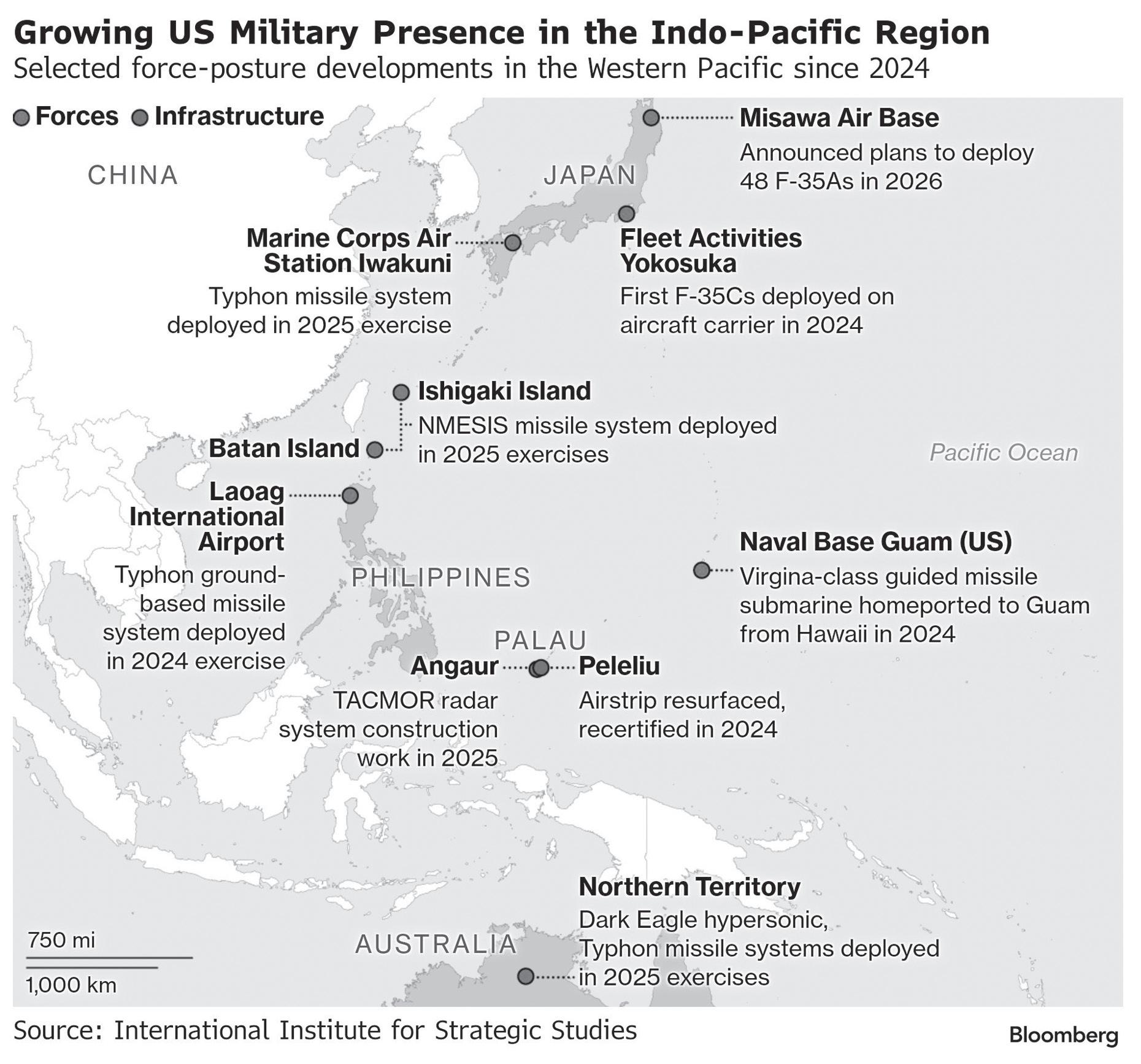
Colby described South Korea as a “model ally” after it said it would raise defense spending to 3.5% of gross domestic product. Trump has praised Australia’s defense investment plans and during a meeting with Japanese Prime Minister Sanae Takaichi in March, cited “tremendous support” from Japan “on everything.”
Admiral Samuel Paparo, commander of US Indo-Pacific Com-
mand, called allies in the region the “strategic center of gravity” at a security conference in Honolulu in January.
Those allies are becoming more willing to deploy around the region and not just assume the US will lead. For Japan that was evident in its first deployment of combat troops to the Philippines for the annual Balikatan exercise in March. South Korea and Austra-
lia, meanwhile, are working with the US to equip themselves with nuclear-powered submarines.
Over the last few years, the US has conducted about 110 joint exercises each year with its Indo-Pacific allies and partners, according to US Indo-Pacific Command. The forecast for this year is 112, according to a US military official, speaking on condition of anonymity because of the sensitivity of the matter.
Some of the biggest growth in joint exercises has come in Japan, where the US military has become more active along the south-west island chain that extends close to Taiwan. Over two weeks in September last year, around 19,000 Japanese and US Marine Corps personnel participated in an annual exercise known as Resolute Dragon, more than double the roughly 9,000 troops involved a year earlier.
Trump’s recent remarks about arms sales to Taiwan have generated fresh concern about the potential for a regional conflict that would almost certainly draw in nearby American allies like the Philippines and Japan. Yet dealing with such an outcome without the US remains unthinkable.
“American leadership is indispensable,” Filipino Defense Secretary Gilberto Teodoro Jr. said during a meeting with Hegseth at the Shangri-La conference last year.
Continued from A1 accounting for 52 percent of global exports. It is followed by Colombia at 15 percent, Ecuador at 9 percent, and Kenya at 7 percent. Meanwhile, Belgium, Ethiopia, Malaysia, Italy, Germany, and Israel hold smaller shares, ranging from 1 to 3 percent each.
A Food and Agriculture Organization (FAO) discussion paper on “Potential of Commercial Floriculture in Asia: Opportunities for Cut Flower Development” noted that Asia has a strong potential to become a leading region in global floriculture, with the capacity to rival or surpass Europe’s current dominance.
The paper said Asia’s advantage lies in both its growing export potential and rapidly expanding domestic demand, distinguishing it from traditional production centers in Africa, Europe, and Latin America.
It added that realizing this potential would require improved production systems, logistics networks, and coordinated marketing strategies, along with stronger institutional support through research, training, and supply chain development.
‘Sandari’s sustainable weddings’ THE decline in local production has also encouraged parts of the industry to adopt more sustainable practices, including the use of locally sourced materials and ecofriendly alternatives.
Manuel said suppliers and stylists are now reducing the use of floral foam and incorporating more locally sourced flowers and decor into wedding setups.
He admitted, however, that the Philippines still trails behind other countries where sustainable event practices have long been standard.
“I think globally, the Philippines is still behind because abroad they’ve been practicing sustainability for the last five to 10 years,” he said.
Manuel added that weddings still generate substantial waste, particularly from event materials
and excess buffet food, prompting suppliers to rethink more practical and cost-efficient approaches to celebrations.
“And now, of course, global geopolitical things are happening to us, so we need to be more practical and more cost-efficient,” he said.
Meanwhile, Mark Almazora, head of Club Ananda at Sandari Batulao Events Place in Nasugbu, Batangas, said in a Zoom interview with BusinessMirror that he also hopes to see sustainable weddings gain wider acceptance in the Philippines, noting that the concept has yet to be fully embraced locally.
“Lack of awareness. And maybe, more training and seminars for the live event suppliers so they can understand the concept of sustainable weddings,” Almazora said, adding that as a venue operator, they are also working to promote more sustainable practices in wedding events.
Despite perceptions of competition within the industry, he said collaboration among suppliers is already deeply embedded in the local events ecosystem.
“I think…our industry is like that…because it’s just us. We’re the only ones helping. We don’t have other support that we can get,” he said. “And I hope, of course, the government will notice us.”
‘Let’s celebrate’ AS part of the industry’s gradually embracing shift toward sustainable weddings, event stylist Teddy Manuel, together with prominent planners and designers such as Gideon Hermosa and Michael Ruiz, will mount an immersive installation showcasing more sustainable and thoughtful event setups at the Let’s Celebrate Expo on July 18 and 19, 2026, at SPACE at One Ayala in Makati City.
Manuel said the installation seeks to introduce fresh approaches to event styling while highlighting evolving trends that can be adapted into modern wedding setups.
“I just want to show them some new ways and means to approach the installation,” he said.
“Like the trends nowadays that we can incorporate in the setup.”
For the second edition of the expo, organizers have also partnered with the Spain Tourism Board, following last year’s collaboration with Switzerland Tourism.
Let’s Celebrate Expo curator and creator Marbee Go said the event is primarily designed for the local wedding market, particularly soon-to-weds in the Philippines, noting the continued importance of the segment across generations.
She said the expo also reflects how the industry has evolved, with shifting preferences from millennials to Gen Z couples, though all segments remain equally important in shaping the market.
“We always need to be updated. But then, this is our community,” Go said. “When we talk to other suppliers, our friends are photographers, videographers—all within one industry. So it keeps us, in a way, young.”
She said the goal is to create a platform that serves both the current market and future generations of clients and suppliers.
“We want to have something for everyone,” she said.
Mentoring the next wave
“EVEN if our theme is global, for me, I just really want to put good suppliers out for the local market,” Go said. “Of course, I’m interested in the global market for them to appreciate and to see how big we are.”
Go emphasized that many Filipino suppliers are not necessarily driven by fame or international recognition, but by their passion for the craft and the work itself.
She noted that local creatives continue to gain visibility through social media, although she believes breaking into the global market will take time and gradual progress.
At the same time, Go said established names in the industry are helping uplift emerging suppliers by mentoring and supporting younger creatives.
“Because I tell the big names, this is how you support the next generation,” she said.
Editor: Angel R. Calso

By Bloomberg News
IT started with a tax bill. Tom, a Beijing-based tech executive, had for years been trading overseas stocks without any backlash from local authorities. Chinese citizens buying and selling shares in foreign markets is officially illegal—besides a few permitted routes—but it’s also widespread. For many, the government’s inaction in closing loopholes for so long made it seem like these trades were within the spirit if not the letter of the law.
The first warning sign was when Chinese tax officials hit Tom with a 100,000 yuan ($14,750) bill for his gains on overseas stock trading. Soon after, regulators went much further: shutting down the very channels that allowed him and hundreds of thousands of others to trade abroad in the first place.
China has launched the biggest shake-up of its cross-border tax system in decades, threatening three popular brokers with at least $330 million of penalties, vowing stricter controls for banks and quietly ramping up pressure on the country’s richest people and the vehicles they use to hold overseas assets.
The shift has ramifications for everything from Hong Kong’s stock market—buttressed by demand from mainland China—to the hordes of law firms, financial advisers and investment funds that help Chinese citizens manage their money overseas. Officials have cracked down on trust structures favored by China’s ultra-wealthy. They’ve pushed back against so-called red-chip listings, which Chinese companies use to raise money overseas without direct oversight of local tax officials. They have effectively hiked taxes on private equity and venture capital firms backed by foreign investors.
The biggest jolt came last week when authorities moved against Futu Holdings Ltd., Up Fintech Holding Ltd.-owned Tiger Brokers and Long Bridge Securities Ltd. for allegedly operating on the mainland without a license. Regulators vowed to confiscate all “illegal gains” from their domestic and overseas entities. The shares
of Futu and Up Fintech plunged, fueling a selloff in other Chinese firms listed in the US.
Futu and Up Fintech said in public statements that they would cooperate with authorities. In response to questions from Bloomberg News, Long Bridge said it would comply with regulatory requirements and implement all so-called rectification measures.
Citic Securities estimates the clampdown could affect as much as HK$250 billion ($32 billion) of assets in Hong Kong, with up to HK$180 billion of those assets at Futu alone. Futu has also become a player in Hong Kong’s initial public offering market, where it has worked on more deals than any other firm this year, according to data compiled by Bloomberg.
The regulatory moves are already sending a chill through Hong Kong’s banking community, where firms with heavy exposure to mainland clients are tightening their checks and weighing up what steps they need to take to avoid falling foul of Beijing.
“Servicing wealthy Chinese clients offshore is now a much more complex and higher-risk business,” said Christopher Marquis, a professor of Chinese management at the University of Cambridge.
“Those actively working with wealthy Chinese will worry they could be the next Tiger Brokers, Futu or Long Bridge.”
China’s State Taxation Administration didn’t respond to a request for comment.
Cat and mouse
CHINESE citizens moving money overseas have for years played a game of cat and mouse with

regulators. The official limit on annual outflows is $50,000 per person, but citizens have used underground banks, cryptocurrencies and even fake imports to transfer more.
For years, Beijing has been tightening its grip on these outflows. In late May, Chinese officials took their boldest step yet.
The China Securities Regulatory Commission, the People’s Bank of China, the Ministry of Public Security and five other government bodies issued a joint plan pledging to dismantle unauthorized offshore investment services that target mainland investors. They warned that banks would face close scrutiny, and firms providing accounts for cross-border investors would have to toughen up their compliance.
Around 10 minutes after the joint statement, regulators announced the action against Futu, Up Fintech and Long Bridge—wiping out more than a quarter of Futu and Up Fintech’s market value in a single day of trading. (Long Bridge isn’t listed.) Hong Kong officials soon followed, saying they would toughen rules on accounts for mainland Chinese investors, flagging money laundering risks.
“Most of my peers, like the vast majority of clients, were completely unprepared for this news,” said Hongtao Sun, a partner at Enpact (Japan) Family Office, adding that many of his rivals had been downplaying the risk of a clampdown in order to keep business flowing.
Still, the warning signs had been flashing. The public crackdown followed a series of behindthe-scenes moves within China’s borders, where tax officials have become increasingly aggressive as they attempt to extract more revenues from the country’s wealthy.
In Beijing, Shanghai and Guangzhou, individuals have been told that investigations into their taxes could look back at least to 2018, people familiar said, requesting
not to be named because the matter is private.
The individuals being targeted are usually rich—often having more than $30 million in their accounts, the people said. They are typically people of Chinese origin who obtained foreign passports but later returned to live in China. Some of them used offshore trust structures to manage their wealth.
Those contacted are facing levies of up to 20% on investment gains, along with potential penalties for overdue payments, the people said. The final amounts are sometimes negotiable, they added.
There have been no official circulars on the matter but only private negotiations between the individuals and local tax officials, the people added. The tax officials have ramped up the pressure, in some extreme cases threatening to involve the police.
THIS sweeping tax drive comes at a critical moment for Chinese officials.
For years, local governments could rely on land sales as a major source of revenue, reducing their reliance on handouts from Beijing. But property-related revenues for local governments plunged 48% over the five years through 2025, and officials have been forced to search for new sources of funding.
There is an irony to Chinese officials trying to find ways to tax foreign assets to make up for the real estate slump: The property crunch has itself been a major reason why China’s rich want to shift their money overseas, given the broader damage it has done to confidence in the economy.
“Many friends of mine are trying to open offshore accounts and invest in US stocks,” said Luis, a consulting firm employee in Shanghai, who said he has traded through both Futu and Long Bridge. “What can someone like me do in China? Buy a home and
get 30 years of mortgage prison while home prices are plunging?”
Home prices in the country are down around a third from their peak levels in 2021, according to data from real estate agency Centaline Group. Some Wall Street analysts think the end of the slump is in sight, but the data still paints a bleak picture: The closest thing to good news is prices falling at a slower rate, rather than moving higher.
Chinese households, institutions and companies moved roughly $807 billion out of the country last year, the highest on record, according to estimates from the Institute of International Finance.
Chinese officials have made major progress in increasing the tax base. China’s personal income tax revenue jumped 11.5% from 2024 to a record 1.62 trillion yuan last year, official data shows. But this hasn’t been enough to make up the shortfall—and regulators have expanded their tax push to funds, trusts and other entities long favored by China’s mega-rich.
Authorities asked some offshore trust beneficiaries to detail information on their assets, including dividend income and profits from share disposals, people familiar have said.
They have also started imposing higher taxes on overseas investors in China’s Qualified Foreign Limited Partnerships, a popular fund structure that allows foreigners to buy onshore assets. No new law has been formally enacted. Instead, local tax authorities have quietly started to reinterpret existing tax laws.
Historically, foreign investors exiting deals through QFLP structures typically paid about a 10% withholding tax on capital gains—a relatively low and straightforward regime. Under the new approach, those same profits can now be taxed at 25% corporate income tax, more than double the headline rate, according to law firm DLA Piper.
In some cases, the shift is being applied retrospectively. Foreign investors are being asked to revisit prior years’ filings under the new interpretation, raising the prospect of significant back taxes and compliance risks.
THE long-term fall-out from China’s sweeping tax crackdown will depend in part on how the nation’s wealthiest citizens respond. Private bankers and lawyers offering estate planning and tax advice may enjoy a boom period—as long as they can figure out a way to soften
the blow.
But a degree of pain is inevitable. Some banks in Hong Kong have already moved to tighten their scrutiny of mainland clients opening savings and investment accounts in the city, placing a drag on one of their biggest client bases. Major Chinese lenders have suspended the opening of investment and wealth management accounts for mainland residents, people familiar said. Banks also raised the threshold for mainland applicants seeking savings accounts and tightened due diligence requirements, the people added. Hong Kong’s biggest banks have for years profited from their ability to attract Chinese money. BOC Hong Kong Holdings Ltd. reported a 21% surge in high-end crossborder customers in 2025. HSBC Holdings Plc saw a roughly 30% increase in Hong Kong customers since January 2023, with twothirds identifying as non-resident HSBC One customers.
Hong Kong’s appeal to mainland Chinese citizens has long been a trump card in its attempts to attract the mega-rich. The city has narrowly overtaken Switzerland to become the world’s largest cross-border wealth hub, according to a recent report by Boston Consulting Group.
The moves also reduce the already limited channels for mainland Chinese investors to buy overseas shares. Those with at least 500,000 yuan in their local brokerage accounts can buy Hong Kong-listed companies through the Stock Connect program. But to get exposure to other bourses, they purchase funds that participate in the so-called Qualified Domestic Institutional Investor program. That program is capped at a quota of $176 billion, a fraction of the country’s $25 trillion of household savings.
Chinese investors have been particularly attracted to the US stock market, where tech stocks— including a few national champions from China itself—have soared amid excitement about artificial intelligence.
For many Chinese, though, the potential returns are no longer worth it.
Zhuang, a wealthy Chinese investor, said he has doubled his money in the past year trading US stocks. But he is no longer willing to risk the ire of his country’s regulators. Zhuang has moved to dissolve his positions. He’ll put his money into China’s domestic A-share market instead. With assistance from Diana Li, Emma Dong and Pearl Liu/Bloomberg
By Heidi Taksdal Skjeseth
NORWAY is putting pressure on the European Union to remove a moratorium on new oil and gas drilling in the Arctic where almost two thirds of its petroleum resources lie. Norwegian politicians, civil servants, and environmental and industry lobbyists are increasingly visiting Brussels to influence EU institutions as the bloc gears up to unveil a new Arctic policy by the end of September. Norway, which never joined the EU, is Western Europe’s largest exporter of oil and gas, with production from the Norwegian Continental Shelf meeting roughly 30% of EU and UK gas demand. “Norway is very active and good at making its voice heard,” EU’s special envoy for the Arctic, Claude Veron-Reville, said in an interview in Brussels on Wednesday. “Nor -
way knows very well how to intervene, they are very well organized and very present,” she said. So far this year, 11 ministers have visited Brussels from Norway, on business ranging from the Arctic to trade and from energy to space.
The blockade of the Strait of Hormuz has handed Norway fresh arguments to persuade Brussels to drop the moratorium on new drilling in the Arctic, with the EU increasingly dependent on Norway’s gas exports.
The crux of the matter is climate and the environment. Critics argue that the Arctic region, which is warming three to four times faster than the global average, is more vulnerable to exploration activity and that more drilling risks the transition away from fossil fuels.
And the short term energy crisis is not a good reason to open up the Arctic for drilling, critics say.
The EU’s ban on new drilling, put in place in 2021, is in line with the bloc’s climate obligations, Veron-Reville said, adding that the decision to remove it is ultimately up to the EU member states. The EU defines the Arctic as the region above the polar circle.
Norway disagrees with what that definition means for drilling.
“There are no climate arguments for treating oil and gas produced north and south of a certain line differently,” Norway’s Foreign Minister Espen Barth Eide told Bloomberg. Eide said Norway’s

policy is also to refrain from drilling “up in the icy wasteland” because of environmental concerns, but that Norway has a substantial population and active petroleum activity in the Arctic.
Norway’s Arctic drilling operations are in the Barents Sea, which is situated above Norway’s northernmost coastline. Norway has also argued that warmer Gulf Stream waters make conditions there comparable to those further south on the shelf — a consequence of climate change driven in large part by emissions from the fossil industry.
While its oil and gas production is set to fall in the years ahead, Norway recently opened up 70 new blocks for exploration in the North Sea, Norwegian Sea and Barents Sea. An estimate by WWF shows it takes about 18 years from finding an oil and gas field to production start in the Barents Sea.
Investors are taking notice. A number of asset managers joined academics and climate groups defending the moratorium in an open letter to the European Commission Wednesday, urging the EU to “maintain and reinforce” protections against new fossil fuel infrastructure north of the Arctic Circle. The coalition said that expanded Arctic drilling risks “irreversible environmental damage,” exposing Europe to heightened security threats and risks locking in fossil fuel dependence beyond the EU’s 2050 net-zero target. Financial-sector signatories include Nordea Asset Management, Norway’s largest pension company KLP, Danish pension providers including Sampension, AkademikerPension and Velliv, as well as lenders including Triodos Bank and Cultura Bank. With assistance from Evelina Youcefi/Bloomberg
Sunday, May 31, 2026
By Harry Suhartono and Grace Sihombing
ECONOMISTS are increasingly doubting Indonesia’s robust growth narrative under President Prabowo Subianto, with the skepticism spilling over into a rare public debate over the reliability of the country’s economic data.
At a forum over the weekend in Jakarta, some of the country’s best-known economists openly questioned the credibility of the most recent data, which showed an unexpected 5.6% jump in gross domestic product, and warned it overstates the health of the economy. The event, hosted by Alliance of Indonesian Economists, was highly unusual in Indonesia, where economists rarely hold public press briefings to dispute data.
The discussion highlighted widening unease among academics and technocrats, as well as within banking and finance, over the reliability of official statistics, as well as broader concerns about policymaking under Prabowo’s administration.
The Government Communications Agency on Friday defended the data and the statistics office, officially known as Badan
Pusat Statistik, and disputed the economists’ interpretations of the figures.
“Scrutiny is welcome, but it should be based on careful reading of data,” GCA said in an emailed response to questions. The first quarter data “is supported by a broader set of real-sector signals.”
Questions about the data follow other moves by Prabowo that have eroded investor confidence and cast doubt on guardrails put in place since the Asian Financial Crisis.
The former general, who came to power in October 2024, has sought to take control of the country’s natural resources, created a sovereign wealth fund that reports directly to him and ousted officials seen as more fiscally conservative and investor-friendly.
Last week, Prabowo stunned traders and investors with an an -
nouncement that the wealth fund, Danantara, would take over exports of the country’s main commodities.
“In an era full of uncertainty like today, investors need certainty—including certainty about the accuracy of government data,” Wijayanto Samirin, a former adviser to senior government officials and academic, said during the economists’ forum. “Without it, trust will disappear, and economic crises often emerge because trust disappears.”
Several economists, publicly and privately, have questioned the accuracy of the recent official data. Two from the University of Indonesia published a report that called the latest GDP figures “questionable as a measure of economic health.”
The authors, Mohammad Ikhsan and Teuku Riefky, point to several anomalies in the data, leading on a disconnect between electricity use and manufacturing. They also flagged a 25-fold jump in the value of inventories, which “almost certainly does not reflect rational economic behavior.”
“If the electricity supply contracted, such manufacturing growth is difficult to justify on physical grounds,” they wrote, referring to the 1% decline in power activity compared to a 5% jump in manufacturing. “Logically, both cannot be correct.” The economists estimate 4.6% to 4.9% is “more re -
alistic” headline GDP figure.
The GCA said this interpretation is “too mechanical,” citing both a base effect year-onyear and increasing industrial reliance on independent power supplies not captured by official statistics.
The report also warned that temporary factors such as Eidrelated spending and government cash disbursements, as well as a “questionable” inventory adjustment may have inflated the headline figure, masking what it described as a weakening structural growth trend since 2022-2023.
The GCA attributed the surge in inventories to front-loading behavior. “Firms often adjust production and inventory positions ahead of major policy or tariff changes,” it said, an apparent reference to US tariffs.
This is the second time in less than a year that official Indonesia statistics have raised doubts. Last August, after quarterly data showed the country grew the fastest in two years, the statistics office invited a number of local economists to provide clarification on several components of the data, according to several attendees, who asked not to be identified as the meeting wasn’t public.
Of particular focus in that meeting was a sharp rise in gross fixed capital formation—basically, public and private investment in
physical assets like infrastructure and equipment. The economists said the meeting didn’t fully alleviate their concerns since only the government had access to the relevant data.
“It is normal and healthy for statistical authorities to engage with economists, analysts, and market participants to explain methodology and clarify unusual movements in the data.,” the GCA said. The BPS didn’t respond to requests for comment.
To be sure, economists and market watchers have voiced doubted over the reliability of Indonesia’s official data for years as headline growth has consistently come in around 5%, outside of the pandemic.
“That stability has long struck us as implausible, given Indonesia’s exposure to swings in global demand, commodity prices and policy cycles,” Gareth Leather, senior Asia economist at Capital Economics, wrote in a note earlier this month.
“Given the government’s shift towards more populist and interventionist policymaking, and its willingness to undermine the guardrails of macro orthodoxy under President Prabowo, we are cautious about taking the strong first quarter figures at face value,” Leather wrote in the note.
The International Monetary Fund, when asked for comment, said “Indonesia’s GDP statistics
and data provision are broadly adequate for surveillance. As in many countries, there remains room for improvement.”
Still, economists interviewed by Bloomberg said they are now turning to a much broader set of indicators—including vehicle sales, electricity consumption, tax receipts, credit growth and corporate revenues—to get a clearer reading on the economy.
The shift has been driven partly by Indonesia’s push to expand domestic nickel processing and build an electric-vehicle supply chain—a strategy that is far more capital- and energy-intensive than traditional householddriven growth.
Some analysts argue that means growth is becoming less broadbased and increasingly concentrated in commodity processing, downstream industries and government-backed projects.
A recent report by Indonesia’s statistics agency showed the country’s middle class has steadily shrunk since the pandemic, falling in 2024 to almost 48 million people, or about 17% of the population, from 57 million, or about 21%, in 2019.
Analysts say the trend reinforces concerns that headline growth is masking weaker purchasing power and rising economic insecurity among households that traditionally powered Indonesia’s consumer economy. Bloomberg News
By Thomas Adamson The Associated Press
PARIS—For nearly two centuries after France abolished slavery, the colonialera law that classified humans as property has remained quietly on the books.
On Thursday, the lower house of parliament voted to wipe it from French law.
The National Assembly voted 254-0—a rare show of unanimity—to adopt a bill repealing Code Noir, or Black Code, the 1685 decree King Louis XIV signed to govern slaves across France’s colonies.
The law turned human beings into chattel, allowing them to be worked, beaten, sold, raped and murdered. And the realization that France never formally did away with it left many aghast. Debate in the chamber turned raw on Thursday.
Steevy Gustave—a lawmaker descended from enslaved people on the Caribbean island of Martinique, now a French overseas department—told colleagues that the repeal was necessary, “but no vote alone can repair centuries of shattered lives.”
“We are not descendants of slaves,” he said, bursting into tears. “We are descendants of
human beings born free, then reduced to the worst—reduced to slavery.”
The code’s reach was total. Article 44 declared the enslaved “movable property”— assets a master could acquire like real estate.
Those who fled faced branding, the amputation of their ears, and even death. The word of an enslaved person counted for nothing.
Code Noir’s 60 articles “should never have survived the abolition of slavery” in the 19th century, President Emmanuel Macron said last week.
“The silence, even the indifference, that we have maintained for nearly two centuries toward this Black Code is no longer an oversight,” Macron said. “It has become a form of offense.”
Like French presidents before him, Macron stopped short of an apology.
France ran the third-largest slave trade, shipping about 1.4 million Africans to plantations whose sugar wealth built the French cities of Nantes and Bordeaux. The French empire later spanned four continents.
Others see the repeal as something more telling—a symptom, they argue, of a country that has yet to reckon fully with that past, one of many slow steps along the way.




Calls for France to face its past IN law, officially eliminating it is the easy part, observers say. Code Noir lost all authority in 1848, when France abolished slavery.
France didn’t relinquish its slave colonies: the four oldest—Guadeloupe, Martinique, French Guiana and Réunion—were made full French overseas departments in 1946. That means they’re governed from Paris like any other.
Their roughly 1.9 million people, most descended from the enslaved, are French citizens.
Despite being fully part of France, the overseas departments remain among its poorest territories. Unemployment runs roughly double the mainland rate, and more than three-quarters of households in the Indian Ocean territory of Mayotte live below the national poverty line.
Shocked to find the law wasn’t annulled
BEFORE he discovered the truth, the French lawmaker who put forward the proposal to repeal the law didn’t know it still existed.
Max Mathiasin, from Guadeloupe, had bought copies of the text over the years and left them on his shelf.
“As the great-great-grandson of people who were enslaved, I had never been able to read it in full,” he said. “This was made by human beings—against human beings.”
For him, the vote is “a way of restoring our ancestors, restoring our humanity” before a France whose motto is liberty, equality, fraternity. “It means living up to the Republican promise.”
That promise, he says, is still unkept at home.
“In Guadeloupe,” Mathiasin said, “in the most important positions, in the structures of the state, they are white.”
A colonial exception that never ended THE Foundation for the Memory of Slavery is chaired by a former prime minister, Jean-Marc Ayrault, and its deputy director is Pierre-Yves


Bocquet—both white men.
Bocquet calls Code Noir the birthplace of France’s “colonial exception”—the principle that the French Republic’s founding rights could be suspended for those under its rule.
The principle outlived the empire, he said: “Even today, we accept that people in the overseas territories can have fewer rights than in mainland France.”
France is hardly the only country still holding fragments of empire—the United Kingdom, the United States and the Netherlands still have overseas territories.
But what sets France apart, observers say, is that it made its slave colonies equal departments of the Republic, not dependencies it governs from afar.
The state insists that the overseas departments are France like anywhere else, even as the people who live there say they are treated as less.
Most major colonial powers, including Britain, Spain and Portugal, had laws governing slavery in their colonies. In each case, those laws fell away when slavery itself was abolished, leaving no single text to repeal.
France’s Code Noir was different, experts say: a single, named royal law that no one ever formally erased, even after France abolished slavery.
France is ‘still in a form of apartheid’
FOR Max Relouzat, 81, president of the Association for the Memory of Slaveries, the repeal matters, because so little else has.
His African ancestor had no name under the law, only a number and a registration code—the family that lived in Martinique was given the name Relouzat at emancipation, likely after Nelouzat, a village in the Auvergne region of central France.
What galls him, he said, is what the symbolism leaves untouched: systemic racism in France.
“Under the cover of departmentalization, a colonial system was maintained,” Relouzat said. “If the overseas departments are part of France, why is there a ministry for the overseas?”
In France, he said, “we are still today in a form of apartheid … a form of colonial continuity.”
‘Racism is the legacy of slavery itself’ FOR some who have fought longest, Thursday isn’t the milestone it appears.
For Florence Alexis, a slavery expert and daughter of the Haitian writer Jacques Stephen Alexis, the real turning point came 25 years



ago. In 2001, the Taubira law made France the first country to call the slave trade, and slavery, crimes against humanity.
“That is what changed my life,” Alexis said. For her, racism is the legacy of slavery itself, not of one edict.
“When I was a child at school, they called me the little monkey,” she said. “People made animal cries when I walked past—as they still do in football stadiums today.” Paris-born Élodie Léon, 29, whose family is from French Guiana, welcomes the repeal, but resents the delay.
“Symbolic neglect is also neglect,” she said.
“It shocks me,” said Muriel Jean-Baptiste, a Paris-born nurse whose parents are from Martinique. “A law that treated Black people as property was left sitting there.”
The history of reparations AT the Taubira law’s 25th anniversary on May 21, Macron floated the idea of reparations— something that France has long stayed away from addressing.
He called it “a question we must not refuse,” but one on which “we must not make false promises.”
He committed no money, instead defining repair first as truth-telling, education and historical work.
The wealthiest of France’s plantations were in Saint-Domingue, in the Caribbean, where the enslaved rose up and won independence in 1804 as Haiti. France then forced the freed to pay reparations for the loss of their masters— a debt cleared only in 1947. France isn’t alone. In the United States, federal reparations legislation has stalled for decades. California approved an apology, but no cash. But the timing of Macron’s latest speech was awkward. Two months earlier, France abstained

By Malou Talosig-Bartolome
NATIVE stingless bees are emerging as unlikely champions of biodiversity, food security, and women’s empowerment, as the Embassy of Slovenia in Manila and Filipino bee advocates launch a livelihood project that blends ecological science with grassroots economic development.
The initiative, unveiled on World Bee Day on May 20, seeks to commercialize the highly medicinal honey produced by stingless bees while training rural women in Camarines Norte to become beekeepers and entrepreneurs.
The project is a collaboration between the Embassy of the Republic of Slovenia, Project Bee Inspired Corp. (PBI), and the University of the Philippines Los Baños (UPLB) Bee Program.
A global day, a local pilot WORLD Bee Day, declared by the United Nations in 2017 upon Slovenia’s initiative, is meant to highlight the indispensable role of bees and other pollinators in ecosystems.
“Bees are indicators of the health of nature. They are crucial for food security and biodiversity,” Slovenian Ambassador to the Philippines Dr. Smiljana Knez said during the launch.
The Philippines, with its rich
tropical biodiversity, is a natural setting for such advocacy. Labo, the largest municipality in Camarines Norte, was chosen as the pilot site due to its abundance of coconut farms and forest resources.
About 60 percent of Labo’s land is devoted to coconut cultivation, a crop heavily dependent on pollination.
“If the pollinators get wiped out, we’re going to lose our coconut,” warned PBI president Anna A. Locsin.
Women at the center THIRTEEN women from Labo have been selected to undergo a year-long training program led by UPLB researchers. The project deliberately aligns with the UN International Year of Woman Farmer 2026, which aims to spotlight rural women’s contributions to food security and close gender gaps in agriculture. Locsin emphasized that women’s patience and meticulousness
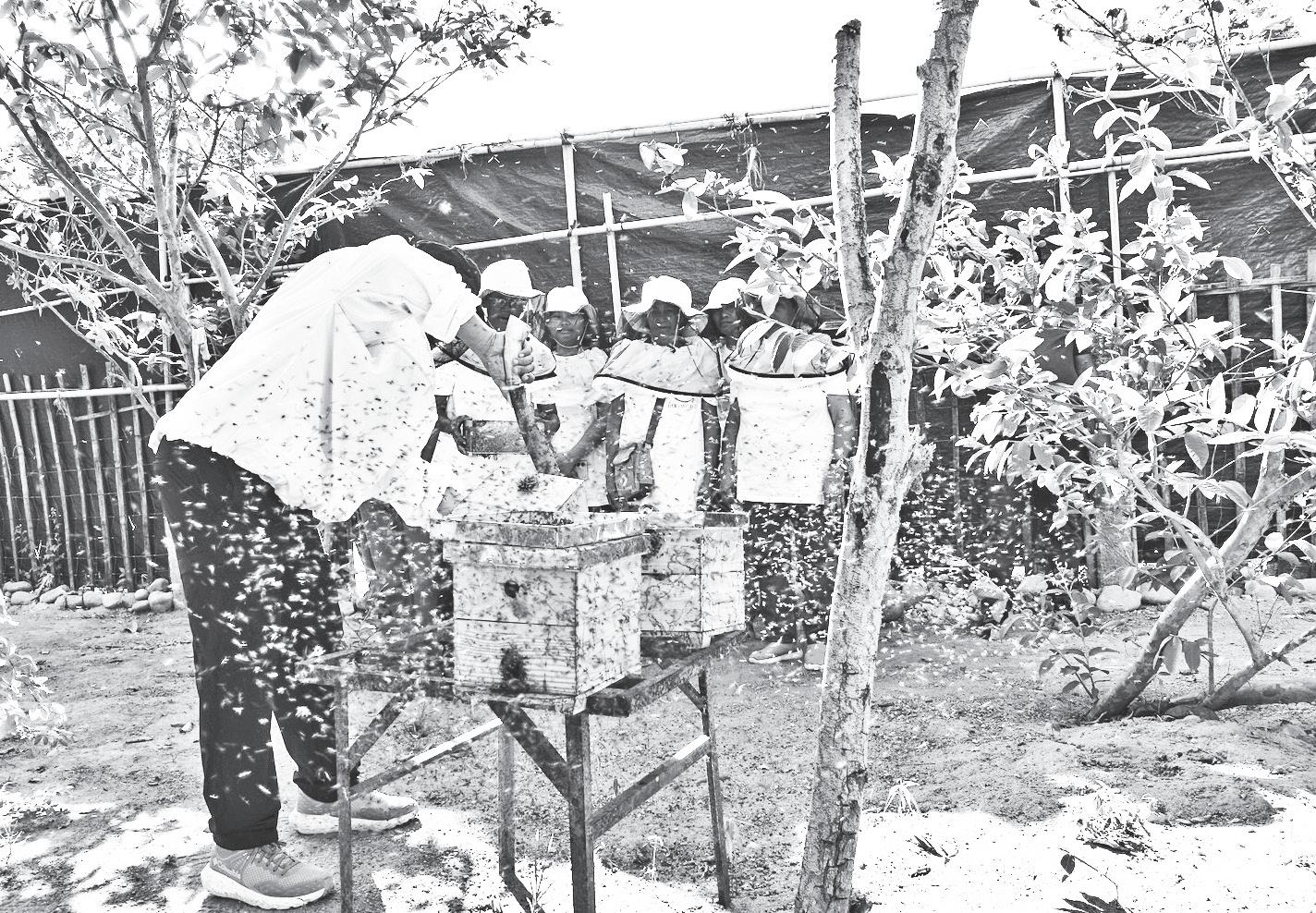
make them ideal beekeepers.
“They have the perseverance and what we call in Tagalog, pulido ang trabaho [refined work],” she said.
For many of the participants, beekeeping represents not just a livelihood but also recognition of their role in sustaining rural economies.
Science behind stingless bees UNLIKE the European honeybee, stingless bees, also known as meliponines, produce honey with unique properties. Laboratory tests have shown that stingless bee honey rivals, and in some aspects surpasses, New Zealand’s famed Manuka honey.
Dr. Cleofas R. Cervancia, Professor Emeritus and UPLB Bee Program Leader, explained: “Stingless bee honey has the highest clinical value, high antioxidant property,
and phenolics.”
Its low sucrose content—often below 1 percent—makes it particularly safe for diabetics.
By contrast, Codex standards allow up to 5 percent sucrose in European honeybee honey. This biochemical profile positions stingless bee honey as a premium health product with strong export potential.
From raw honey to value-added goods
WHILE raw honey already commands high prices—P1,500 to P5,000 per kilo—the project emphasizes value-added products.
Soaps, shampoos, lip balms, cider, and propolis-based goods can multiply income streams.
Propolis, a resinous substance collected by bees from trees, such as pili, mango, and avocado, is prized for its medicinal properties
AS antimicrobial resistance (AMR) continues to make traditional antibiotics less effective worldwide, the search for new antibacterial treatments has become increasingly urgent.
One promising solution is antimicrobial peptides (AMPs), small molecules that can kill bacteria.
To help accelerate their discovery, researchers at the University of the Philippines Diliman-College of Science have developed an artificial intelligence (AI) tool designed to accelerate the discovery of new antibacterial peptides, said UPD-CS in a news release.
Remmer Salas, Dr. Portia Mahal Sabido, and Dr. Ricky Nellas of the UPD-CS Institute of Chemistry developed ISCAPE (Interpretable Support Vector Classifier of Antibacterial Activity of Peptides against Escherichia coli). It is an AI-powered tool that helps experimentalists predict whether a peptide can kill or inhibit the growth of E. coli. The system requires only a Simplified Molecular-Input Line-Entry System (SMILES) string as input, making it simple

experimentalists predict whether a peptide can kill or inhibit the growth of the bacterium Escherichia coli. SALAS ET. AL., 2026
for researchers to evaluate candidate molecules.
“Traditionally, discovering antibacterial peptides means synthesizing many candidates and testing them one by one. This process is time-consuming,” Salas said. “We used AI to learn from existing data and identify patterns that distinguish active peptides from inactive ones.”
Unlike many AI tools, ISCAPE also shows which molecular features make a peptide effective. He noted that this helps researchers save time and resources. It reduces trial-anderror experiments and allows them to design better peptides more efficiently.
“ISCAPE helps address antimicrobial resistance by accelerating early-stage screening through data-driven peptide design,” Salas further explained. “It doesn’t replace laboratory experiments, but it makes discovery more efficient and helps researchers focus on the most promising candidates.”
The AI-powered model can be adapted to predict activity against bacteria other than E. coli.
However, it would need to be retrained using high-quality datasets specific to the bacterial strains of interest. The ISCAPE approach could also be applied to predict the activity of other bioactive peptides.
“Applying ISCAPE to other
biological targets requires wellcurated datasets with experimentally validated activity,” Salas added. “The model must then be retrained using the molecular features we identified as optimal for peptides.”
The team hopes the tool will help researchers design better antibacterial peptides more efficiently and contribute to the global fight against AMR.
ISCAPE is publicly available for other scientists. The web server can be accessed through Hugging Face Spaces. The training data and code for large-scale prediction are available on GitHub.
The chemists’ research paper, titled “Interpretable support vector classifier for reliable prediction of antibacterial activity of modified peptides against Escherichia coli,” was included in the Journal of Molecular Graphics and Modelling.
The international publication features papers on the use of computers in theoretical investigations of molecular structure, function, interaction, and design. It covers all aspects of molecular modeling and computational chemistry.
CAPE CANAVERAL, Florida—A dying star has never looked so lovely.
The Gemini North Telescope atop Hawaii’s tallest peak, Mauna Kea, captured the star in its last gasps. The image was released Thursday by the National Science Foundation’s NOIRLab, which operates the telescope. It’s actually a binary star system 1,500 light-years away, nicknamed the Crystal Ball Nebula because of the milky white, spherical cloud around it. A light-year is almost 6 trillion miles. This cloud of gas forms when a star sheds its outer layers near the end of its life. The exposed stellar core heats the cloud to tens of thousands of degrees, giving it an ethereal glow. Scientists believe one of the planetary nebula’s two orbiting stars—once bigger than our sun—gave up the ghost. Gemini North last year observed the nebula—formally known as NGC 1514—and the image was completed in color last week. Marcia Dunn, Ap Aerospace Writer

and global demand.
By teaching women to diversify beyond raw honey, project leaders hope to build resilience against market fluctuations and ensure long-term sustainability.
Tackling honey fraud
THE project also confronts a pressing industry challenge: honey adulteration. Recent isotope studies conducted with the Philippine Nuclear Research Institute revealed that 80 percent of honey sold in the Philippines is fake.
“We’re promoting it for health benefit, and yet you’re going to sell a diabetic honey made from pure sugar? How sad is that,” Locsin lamented.
By establishing best practices, securing certificates of analysis, and adhering to international standards, the Labo project aims to produce authentic honey capable of competing in global markets.
Seed funding of €1,800 from Slovenia’s Ministry of Foreign Affairs provides initial support, but advocates stress that credibility and certification are the true currency.
Education and youth engagement
BEYOND livelihood, the embassy is extending bee advocacy into classrooms.
Philippine Christian University-Dasmariñas is adopting Buzzing Futures, an interactive board game developed by the Slovenian Embassy in the Nordics and the UN Global Pulse.
The game challenges students to reflect on pollinators’ role in building resilient societies.
By engaging youth, the project hopes to cultivate a generation that values biodiversity and understands the economic stakes of pollinator decline.
A convergence of agendas THE stingless bee initiative sits at the intersection of several global and local agendas.
Biodiversity conservation: Protecting pollinators safeguards ecosystems and food crops.
Women’s empowerment: Training rural women addresses gender gaps in agriculture.
Food security: Coconut farming and other crops depend on pollination.
Market innovation: Stingless bee honey’s medicinal profile opens premium niches. Anti-fraud advocacy: Authentic honey production counters widespread adulteration.
Education: Youth engagement ensures long-term sustainability.
Looking ahead FOR the women of Labo, the project offers more than income. It represents recognition, agency, and a stake in biodiversity stewardship. For Slovenia, it is a continuation of its global bee diplomacy, linking ecological advocacy with development cooperation. For the Philippines, it is a chance to elevate a niche product into a global contender while protecting rural livelihoods. On World Bee Day, the buzz around stingless bees is more than symbolic. It is a reminder that small creatures can drive big change—bridging science, gender equity, and sustainability in one hive.
THE National Crop Protection Center of the University of the Philippines Los Baños (NCPC-UPLB) recently launched a program in a bid to combat the devastating impact of the widely invasive fall armyworm (Spodoptera frugiperda) on sugarcane in the Negros Region.
Locally known as “harabas,” the fall armyworm (FAW) infestation has affected nearly 1,000 hectares and 4,000 farmers, resulting in an estimated losses of P50.2 million. Besides FAW, other lepidopteran pests are also causing significant leaf damage to sugarcane. The program was led by and funded by the Philippine Council for Agriculture, Aquatic and Natural Resources Research and Development of the Department of Science and Technology (DOST-PCAARRD) to develop sustainable strategies against the pest. The program, “Harabust: Harnessing Adaptive Responses and Best Practices against Armyworms and Other Lepidopterous Insect Pests using Science and Technology,” has eight component projects that aims to:
1. Develop and test safer and more targeted insecticides, specifically for sugarcane;
2. Mass-produce biological control agents (BCAs) for sugarcane, corn, and onion, using natural predators and parasites to manage pest populations;
3. Enhance effectiveness of natural biological c ontrol agents by optimizing cultivation of the entomopathogenic fungus, Metarhizium rileyi;
4. Develop nucleopolyhedrovirus with increased virulence to S. frugiperda or FAW for integrated pest management (IPM) programs;
5. Create an extensive awareness campaign to educate farmers and other stakeholders on sustainable management techniques;
6. Evaluate trapping systems that use pheromones and light to monitor and control pest populations;
7. Optimize push-pull farming systems for sugarcane, a strategy that uses repellent plants and trap crops to protect the main crop; and
8. Study the biology and genetic diversity of other potential pests, such as the sugarcane semi-looper (Mocis frugalis), to proactively address future threats.
By integrating biological control, ecological approaches, targeted chemical interventions, and capacity building, Harabust aims to reduce dependence on conventional pesticides while strengthening long-term pest resilience in sugarcane production systems.
During the program’s inception meeting organized by DOST-PCAARRD’s Crops Research Division (CRD), NCPC Director and Program Leader Dr. Barbara L. Caoili emphasized the team’s commitment to delivering integrated S&T-based solutions toward improving the sugarcane industry’s situation.
CRD Director Leilani D. Pelegrina also commended the program team’s coordination and efforts, while also expressing DOST-PCAARRD’s commitment to providing technical and monitoring support to ensure its successful implementation.
Through Harabust, DOST-PCAARRD reinforces its strategic investment in safeguarding the country’s sugarcane industry and enhancing agricultural resilience.
With its holistic and environmentally conscious approach, the program is set to provide a long-term, robust and sustainable solution for managing insect pests in sugarcane.
The inception meeting was attended by key representatives from UPLB, the project leaders and staff under the program, representatives from UPLB’s
and
and
A6 Sunday, May 31, 2026

Editor: Lyn Resurreccion • www.businessmirror.com.ph
ISSION is not defined by geography but by everyday encounters at home, in communities and in society, Cardinal Jose Advincula of Manila said.
Celebrating the feast day Mass at San Felipe Neri Parish in Mandaluyong City on May 26, he said the call to evangelization is measured not in distance but in the lived realities of people within reach of daily life.
“We do not need to go far to become missionaries. Our homes, communities, churches, and society are filled with wounded hearts, people losing hope, and those searching for the light of Christ,”
Advincula said.
He urged Catholics to respond to that call not only through preaching, but through small acts of kindness, sincere concern and joyful service in ordinary situations.
The Manila archbishop said no special status or public recognition is required to share the Gospel effectively in today’s world.
“One does not need to be famous or powerful to make Jesus

known. Through simple goodness, sincere concern for others, and joyful service each day, we can bring the light of Christ to others,” Advincula said. He also pointed to St. Philip
Neri as a model of community renewal rooted in joy, reconciliation and compassion. The 16th-century priest is often referred to as the “Apostle of Rome.”
Advincula encouraged the faithful to follow the saint’s example by becoming instruments of healing in families and neighborhoods often marked by division, fatigue or indifference.
The parish marked the feast with outreach efforts for jeepney and tricycle drivers affected by rising fuel costs, combining material assistance with spiritual support.
About 100 drivers from Boni, Hulo and nearby barangays received grocery packs and rice worth P1,500 each, funded through parish donations and a community fun run initiative.
Norman Dequia/CBCP News
VATICAN CITY—Pope Leo XIV has issued a sweeping manifesto about safeguarding humanity in the era of artificial intelligence (AI), examining the many social areas that the technology is fundamentally reshaping.
Here are some excerpts from the 83-page document “Magnifica Humanitas” (Magnificent Humanity) released on Monday.
Democracy
LEO says that disinformation “found a powerful amplifier” with AI through the ability to “manipulate content, images and videos,” which exposes people to “biased or misleading perspectives.”
The pontiff said democracy is weakened when pragmatism, that is “what appears useful effective,” substitutes for truth.
“Indifference to the truth leads, slowly but surely, to a descent to totalitarianism,” Leo wrote.
Social media
LEO said that those who control digital platforms, including social media, have a power that “should be constantly guided by the pursuit of truth or respect for human dignity.”
The internet should be seen as “a setting in which inner freedom and critical thought can mature,’’ and not “an instrument of excessive distraction, homogenization or dominance.”
The backdrop is that communication not only transmits information but creates culture.
Labor
LEO said the workplace must be governed by “the protection of

Leo XIV is shown on a TV monitor (top, right) attending the presentation of his first encyclical, “Magnifica humanitas: On Safeguarding the Human Person in the Time of Artificial Intelligence,” (center) at the Vatican on May 25. AP/ALESSANDRA TARANTINO
employment opportunities and the irreplaceable role of the individual.”
He warned that “the pursuit of greater profits cannot justify choices that systematically sacrifice jobs, because the human person is an end, not a means, and the economic order must remain subordinate to human dignity and the common good.”
Leo also said governments must foster conditions that favor employment “since it is a primary good for families and for societies.”
War LEO said that AI “can only bring about conflict more quickly and render it more impersonal.”
He called for concrete criteria when making a decision to strike. That includes an identifiable chain of responsibility applying also to “those who design, train, authorize and employ technology,” and measures, so that target selection takes into account the difference
between combatants and noncombatants, and the impact on defenseless populations.
Non-negotiable requirements include guarantees of accountability and that deployment of lethal force cannot be automated.
Leo also called for a shared international framework “to curb the technological arms race and ensure robust protection for civilians.”
LEO noted that the world’s wealth “is increasingly concentrated in fewer hands, widening inequalities.” In the age of AI and robotics, it is no longer possible to rely solely on the “invisible hand’ of the market,” Leo wrote, urging politicians to orient policies toward “the common good” and to promote “dignified work, social inclusion and an equitable distribution of the benefits of innovation.”
LEO underlined the role of
digital networks—including online platforms, messaging systems, anonymous payment methods—in human trafficking, which he said “must be recognized as a contemporary form of slavery.”
He warned that failing to respond to or tolerating these practices risks complicity in “today’s sins, which are akin to those of the past when slavery was being concealed and justified.”
Environment
LEO also addressed the environmental costs of the data centers that are generating AI models, consuming “enormous amounts of energy and water, significantly influencing carbon dioxide emissions.”
As demands increase, especially for large language models, Leo called for the development of more sustainable technological solutions.
Youth impact
LEO called for an alliance among policymakers, educational institutions and families to help navigate the “culture of immediacy and hyperstimulation” created by digital media.
He also highlighted how AI amplifies the danger of predation on young people, and warned against having personal mobile devices at too young an age.
“Online phenomena such as grooming, blackmail and the sexual exploitation of minors are not uncommon, and are made more insidious by the use of fake profiles, algorithms that facilitate dangerous contact, and AI tools capable of manipulating images and videos,” the pope wrote. AP
Hajj pilgrims celebrate Eid al-Adha in soaring heat
MINA, Saudi Arabia— Huge crowds of pilgrims in Saudi Arabia threw pebbles at a pillar in a symbolic ritual on one of the final days of the Hajj in temperatures reaching over 107 degrees Fahrenheit (42 Celsius) as Muslims around the world on Wednesday started celebrating the Islamic holiday of Eid al-Adha.
Pilgrims in Mina chanted “Allahu akbar,” or “God is great,” in the ritual seen as a symbolic stoning of the devil. The act is also seen as rejecting evil and a commemoration of the Prophet Ibrahim’s rejection of temptation when the devil tried to dissuade him from submitting to God’s will.
The physically demanding Hajj is occurring in intense heat. Many pilgrims poured water over their heads to cool themselves or carried umbrellas.
Saudi authorities have highlighted the importance of drinking water and reducing direct exposure to sunlight. The National Center of Meteorology shared the high temperatures.
Aamar Shakur, a pilgrim from Pakistan, said he saw the pebble throwing as a symbol of confronting personal struggles in which he was “throwing the stone to my own devil.”
Crowds moved through the sprawling Jamarat complex after arriving from Muzdalifah, following a day of worship and prayer at Arafat on Tuesday.
The last days of the Hajj coincide with Eid al-Adha, or “Feast of Sacrifice,” marking the willingness of Ibrahim, known as Abraham to Christians and Jews, to sacrifice his son. During the holiday, Muslims typically slaughter sheep or cattle and distribute part of the meat to the poor.
The Hajj, one of the Five Pillars of Islam, is required once in a lifetime of every Muslim who can afford it and is physically able. Performed over several days, the Hajj can be a deeply moving spiritual experience and a chance to seek God’s forgiveness. Rituals on its final days also include circling the cube-shaped Kaaba.
The joyous occasion is subdued for some
The Hajj brings together Muslims of diverse races, ethnicities, languages and socioeconomic classes, creating a sense of unity for many. More than 1.5 million pilgrims have arrived from abroad, a Saudi official said.
This year’s Hajj takes place against the backdrop of a tenuous
ceasefire in the Iran war and related uncertainty throughout the region.
Eid al-Adha is typically joyous, marked with communal prayers, food and festive gatherings. In some places, though, conflicts and economic pressures are dampening festivities.
Lebanon is observing Eid alAdha amid a conflict between Israel and the Hezbollah militant group. Many displaced people are sheltering in tented settlements or public schools repurposed as shelters.
“There is no Eid for us. We are displaced, forced to leave our land, our homes, our livelihoods, while our memories are being destroyed,” said Rabee Khreis, who fled the village of Khiyam, where intense fighting has taken place.
A US-brokered ceasefire in the Israel-Hezbollah conflict appears more nominal by the day, complicating efforts at a broader peace.
‘Eid is only for the people who lost no one’ IN the Gaza Strip, where the IsraelHamas war has devastated the territory and displaced most of its people, Palestinians are observing a subdued Eid al-Adha under a fragile ceasefire and rampant suffering.
“This is not Eid...we’re dead,” said Mahmoud Saqer, a displaced man from Khan Younis.
In Khan Younis and Gaza City worshippers gathered for prayers amid destroyed buildings and with few signs of celebration.
“There’s no Eid. My children were killed,” said Ayda AlBanna, a displaced woman from Gaza City, who prayed with her granddaughter. “Eid is only for the people who lost no one.”
Israel’s military offensive in Gaza has killed more than 72,803 Palestinians, according to Gaza’s Health Ministry. The ministry, part of the Hamas-led government, maintains detailed casualty records that are seen as generally reliable by UN agencies and independent experts. It does not give a breakdown of civilians and militants.
Israel launched the offensive after Hamas-led militants killed some 1,200 people, mostly civilians, and took another 251 hostage on October 7, 2023.
While the heaviest fighting has mostly subsided since a fragile ceasefire took effect on October 10, deadly Israeli strikes have repeatedly disrupted the truce. Hamas and Israel have accused each other of violating the ceasefire. Baraa Anwer And Mariam Fam/
THE Catholic Church in the Philippines on recently launched a nationwide network of diocesan offices on women, strengthening efforts to coordinate ministries supporting women, families and vulnerable communities.
The event was held onsite at the headquarters of the Catholic Bishops’ Conference of the Philippines in Manila, while several diocesan representatives from other provinces joined online. Bishop Isabelo Abarquez, chairman of the CBCP Office on Women, said the initiative seeks to deepen collaboration among dioceses and develop more responsive pastoral programs based on local realities.
Speaking during the network’s national launch, he described the gathering as more
than an organizational meeting focused on reports, structures or administrative planning.
“This is not primarily a meeting of reports or programs, but a moment of encounter,” the bishop told diocesan representatives and Church workers attending the assembly.
“It is a moment to know one another, share experiences, strengthen communion, and clarify the mission entrusted to us by the Church,” he added.
The bishop linked the initiative to the Church’s broader synodal direction, emphasizing listening, participation and cooperation among bishops, clergy, religious workers and lay organizations.
He pointed out that women should not be treated merely as recipients of Church ministries, but as “active collaborators in the

mission of the Church.” Abarquez said the CBCP Office on Women promotes the dignity and vocation of women while addressing concerns affecting family life, children and vulnerable sectors.
He outlined key priorities for diocesan offices, including faith formation, leadership development, family and life advocacy, and pastoral accompaniment for women facing abuse or exploitation.
“The Church must not only teach, the Church must accompany,” Abarquez said while discussing pastoral care for women experiencing violence, trafficking and personal crises.
The bishop also urged diocesan leaders to strengthen parish-based ministries and coordinate closely with local clergy to ensure stronger support for women-focused programs and activities. He said dioceses should develop initiatives responding to their own pastoral realities instead of adopting uniform national programs that may not effectively address local concerns.
Abarquez cited a provincial survey in Samar identifying family breakdown above poverty as the leading concern, alongside violence against women, online exploitation and weakening moral values. The prelate said the network was organized after consultations showed many dioceses either lacked
limited coordination with the
or

Editor: Lyn Resurreccion

By Jonathan L. Mayuga
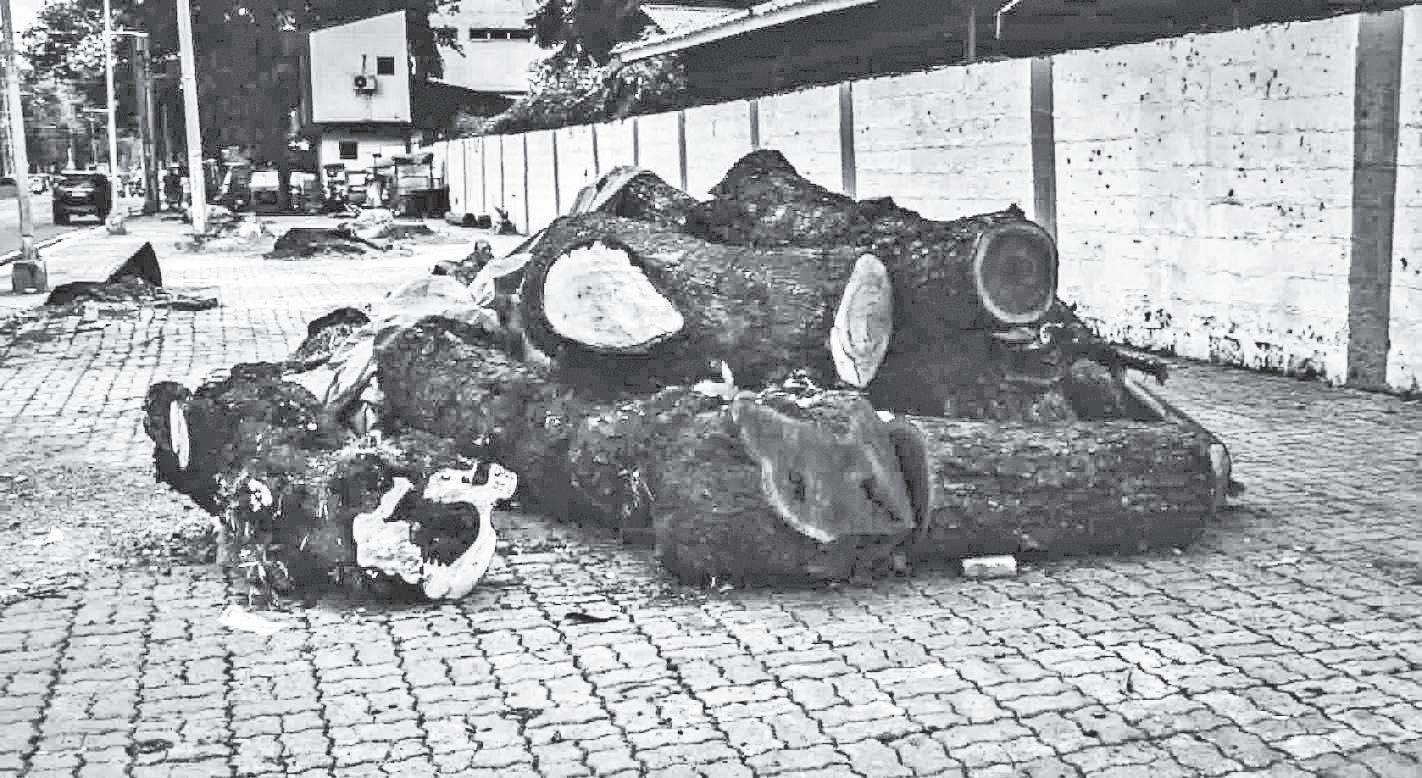
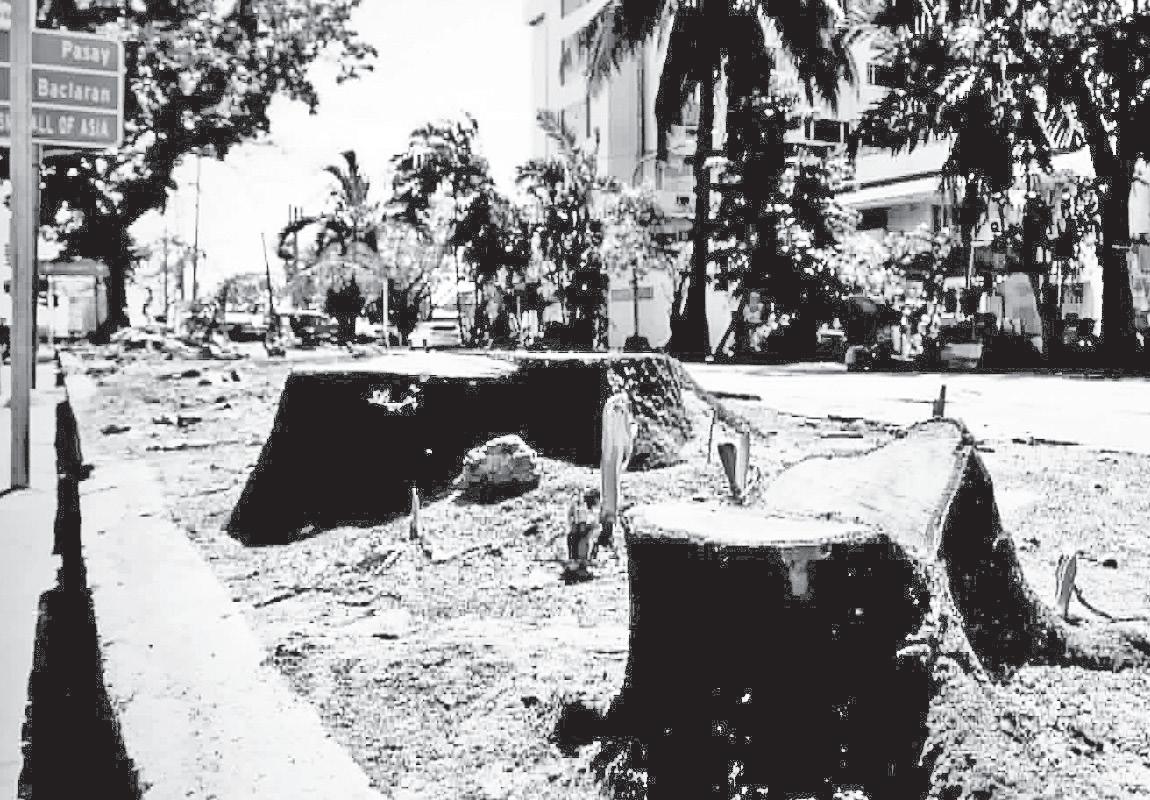
DECADES-OLD trees were felled along Quirino Avenue in Manila since May 16 to make way for the Southern Access Link Expressway (SALEx).
A project of San Miguel Corp. (SMC), through its infrastructure arm, SMC Infrastructure, SALEx is an elevated expressway segment designed to connect the Metro Manila Skyway Stage 3 to Roxas Boulevard.
An estimated 617 fully-grown trees along Quino Avenue were to be removed— either by earth-balling or worse, treecutting based on a permit issued by the Department of Environment and Natural Resources (DENR).
More than 200 trees have been felled. But the public clamor to stop the massacre of trees compelled the proponents to voluntarily stop the cutting—for now.
Not a numbers game
ASKED to weigh in, international biodiversity expert Theresa Mundita S. Lim said the reports on the cutting of trees along Quirino Avenue for the construction of the SALEx is a reminder that urban greening cannot be a simple numbers game of cutting trees in one area and planting replacements elsewhere.
“We recognize the need for infrastructure to support mobility and development. However, this must be balanced with science-based and forward-looking urban environmental planning,” said Lim, the immediate former Asean Centre for Biodiversity executive director.
Important ecosystem services
ACCORDING to Lim, trees, especially in cities, are not merely ornamental, as they provide shade, help reduce urban heat, improve air quality, absorb stormwater, support urban biodiversity, and contribute to the health and well-being of communities.
“This is why proper urban environmental planning is critical. We should not recommend the planting of trees today only to have them cut down a few years later because the areas were later identified for roads, bridges, expressways, or other infrastructure,” she explained.
“Equally important is the careful selection of tree species and vegetation. The appropriate native or climate-resilient species must be identified based on site conditions, available space, ecological value, root behavior, canopy size, maintenance needs, and suitability to the urban landscape,” Lim, a former DENR Biodiversity Management Bureau (BMB) director, said.
Most powerful natural allies
THE United Nations Environment Programme (UNEP) describes trees and forests as man’s “most powerful natural allies,” citing the essential ecological, economic, social, and health benefits they provide that help sustain life.
Trees regulate climate—absorb climate-warming carbon dioxide and store it in their roots and soil, while converting carbon dioxide into breathable clean
air—the oxygen.
Their leaves and bark also filter dangerous airborne pollutants like nitrogen oxides, ozone, ammonia, and particulate matter, significantly improving local air quality and human health.
As forests, they harbor the majority of terrestrial biodiversity, providing vital habitats, food, and shelter for species, thereby keeping biodiversity healthy.
Natural defense against calamity TREES and forests in the mountains also act as windbreakers, cushioning the impact of strong winds and otherwise powerful and life-threatening storms. Their roots also absorb water, regulating soil moisture, preventing soil erosion and flooding in lowlying areas as they act as natural sponges that recycle rainfall, filter drinking water, and help reduce urban runoff and extreme inland flooding.
Meanwhile, trees in beach forests and mangroves in coastal areas help prevent storm surges and sea level rise, protecting coastal communities from coastal flooding and coastal erosion.
“Trees are a core component of ‘ecosystem-based adaptation.’ For instance, mangroves absorb the destructive impact of storm surges and wave forces, protecting vulnerable coastal communities,” UNEP stated.
Food and medicine
CLOSE to home, trees provide wild food, fuelwood, and economic resources that sustain the daily livelihoods of billions of people, particularly those in extreme poverty. Fruit-bearing trees also help fight hunger and provide wildlife with food to sustain the cycle of life in the forest.
To upland farmers and communities,


trees in the forest are a valuable source of income, as they gather wood for fuel, fruits which they consume or sell to the market.
The benefits of trees extend to tourism, with their aesthetic value that wows visitors, while providing great benefits to mental and physical well-being, as “access to green spaces and urban trees helps reduce stress and anxiety, encourages physical activity, and fosters a stronger sense of community.”
Grossly undervalued
DESPITE the existence of Republic Act (RA) 11995, or the Philippine Ecosystem and Natural Capital Accounting System (Pencas) Act, the true value of a tree remains undervalued, as it is usually measured by the cost of timber, and not the services it provides.
In a Facebook post on March 17, 2011, the Forest Foundation Philippines (FFP) said a mature tree has an estimated ecological value of P5.1 million. This excludes the value of its fruits and minor products in industrial, medicinal, and beauty applications.
“Unfortunately, that same tree can also be sold for its timber for just P6,000 per cubic meter. This unwarranted undervaluation of a tree leads to its overexploitation as a limited resource,” FFP said.
According to the Foundation, a tree living for 50 years can increase soil fertility that would be valued at P1,593,750; recycle with P1,912,500 worth of water; provide P2,652,000 worth of air pollution management; generate P1,593,750 worth of oxygen; and provide a home for animals worth P1,593,768.
The same FB post was shared by the DENR-BMB.
Always the first to go DESPITE its intrinsic and ecosystem value, in
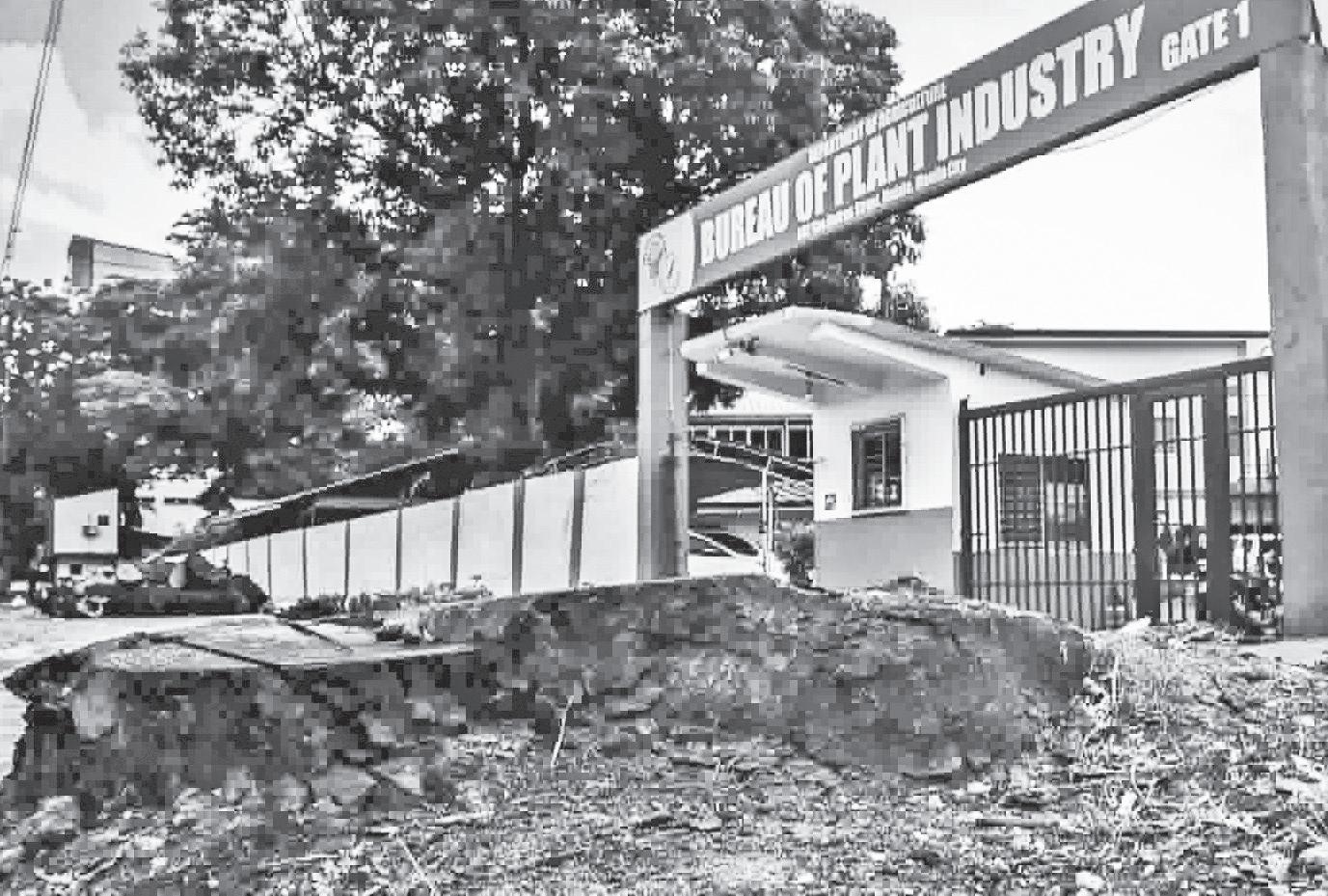
the name of development, trees are always the first to go.
In converting forest land for agricultural, residential, commercial, and industrial purposes, trees are sacrificed. They are cut down, and if fortunate, identified to be young and healthy for earth-balling for transfer to another location.
In road projects, areas are cleared of trees. In real estate development, they give way to houses, commercial buildings, or to industrial parks.
Is there no other way? Environmental advocates have been asking every time a tree has to be cut down.
A collateral damage?
IN Palawan, the country’s so-called last ecological frontier, environmental advocates said the situation is worse.
Trees in old-growth forests, or so-called ancient trees, are the subject of special tree-cutting permit applications by several mining companies targeting the minerals into the bowels of the earth. To extract minerals, forests are shaved and mountains are flattened.
Interviewed by the BusinessMirror via cellular phone, Atty. Grizelda Mayo-Anda of the Environmental Legal Assistance Center, said 218,000 trees would either be transferred through earth-balling, or worse, cut down to give way to mining.
“In Manila, there are hundreds of trees. It is worse here in Palawan because 218,000 ancient trees are threatened by mining,” she said.
In 2025 and 2026, Berong Nickel Mining Corp. requested to clear a total of 1,015 and 70,360 trees, respectively, in Barangay Apurawan, in the town of Aborlan.
Of these, 27,393 trees would be cut down, while 44,012 would be transferred
through earth-balling.
Ipilan Nickel Corp. likewise has special tree-cutting permits in 2025 and 2026 for a total of 60,359 trees. Of these, 25,711 are for earth-balling, while 36,648 are for cutting in Brooke’s Point.
Rio Tuba, on the other hand, had treecutting and earth-balling permits in 2024 for a total of 52,518 trees, while from total of 34,572 trees, 17,917 are for cutting, and 16,635 for earth-balling in 2026.
THE DENR, the agency mandated to protect the environment, issued statements on the tree-cutting on Quirno Avenue as well as in Palawan.
On May 19, the DENR National Capital Region (NCR) said the tree-cutting for the SALEx Project was covered by a special permit allowed under Presidential Decree 705, PD 953, and other forestry and environmental regulations, for infrastructure projects, public works, and other development activities.
Interviewed by the Business Mirror, DENR-NCR Regional Executive Director
Michael Drake Matias said most of the trees that were cut down along Quirino Avenue were “exotic” or nonnative trees.
He added that for every tree cut down by the proponent, 100 tree seedlings would be planted.
For SMC’s Skyway connector 50,700 trees were supposed to be planted.
“Some would be planted in Baseco, some in Intramuros,” he said.
He added that some of the current trees are either old enough or unhealthy for earth-balling, leaving the proponents no choice but to cut them down, maintaining that the “tree-cutting” permit is “above board.”
For the felling of trees in Palawan, particularly in the Berong Nickel Project, the DENR issued a statement on May 24, assuring that “no tree is authorized for removal without a strict legal basis, environmental safeguards, and long-term rehabilitation requirements.”
“Importantly, the cutting of trees in Berong will not occur in one instance. It will be implemented in phases, and each phase will proceed simultaneously with the planting of replacement trees to ensure continuous ecological recovery,” the DENR said.
Shared responsibility
ENVIRONMENTAL lawyer Gloria EstenzoRamos said despite poor air quality in Metro Manila, constant flooding, sizzling temperature, and an inadequate tree cover, the DENR allowed hundreds of trees to be cut.
“The DENR needs to implement its mandate and abide by the processes under Environmental Impact Assessment System Act together with local government units and other national agencies,” she said partly in Filipino via Messenger on May 26.
“Who can we trust amid the appalling refusal and gross failure of the DENR, local governments, and other agencies in protecting and conserving our natural life support system and communities?” she added.
Estenzo-Ramos said the duty is a shared responsibility of all. It is essential for Filipino citizens, especially the youth, to assert the state-guaranteed rights and assume the duties of a responsible steward of God’s creation in partnership with nongovernment organizations, academe, church, and other sectors.
Unsustainable development
JOHN LEO ALGO, national coordinator of Aksyon Klima, said the Skyway connector project is the very opposite of what sustainable development is. It will compromise many people in the near and long-term future to even higher flooding, temperature increase, and air pollution from even more traffic in the area, among other threats.
“We do not need more roads; we need a more efficient public transportation system to permanently reduce traffic. We do not need more trees sacrificed to fill corporations’ pockets. We need to increase tree cover and green spaces, especially in a hot, flood-prone area like this within Metro Manila,” he told the BusinessMirror via Messenger on May 22. Algo also slammed the national and local governments for catering to the desires of corporations.
“We need them [DENR] to make decisions that actually respond to the needs of the citizens. When the next flooding hits, when the air becomes even more polluted with increased traffic brought by SALEx, when it becomes too hot that people look for shade, this road or profits by that corporation from this endeavor will not address any of these concerns. At the national or local level, the government either just does not learn from its mistakes or simply ignores them,” he said.
USANZE, Rwanda—A guide called out to endangered golden monkeys with grunts and clicks to signal he posed no threat, a familiar sound in the mist-covered forests of Rwanda ’s Volcanoes National Park. Here in one of Africa’s most well-known parks, steep ridges and dense vegetation often obscure even the largest mountain gorillas—also endangered—and scientists are turning to new technology to detect and protect them.
Known as environmental DNA, or eDNA, the technology allows researchers to identify species using genetic material like fur or feces left in soil and water. This reduces the impact of human interaction during wildlife surveys that can leave researchers groping through the mist.
The technology, more often used in marine conservation work, was introduced by the African Wildlife Foundation in part -
nership with the Rwandan government. It aims to develop a list of all species in the country. That will help protect biodiversity that is threatened by climate change and population growth.
“We selected eDNA as a new technology to bring solutions and to complement existing methods used in ecological monitoring,” said the foundation’s country manager for Rwanda, Patrick Nsabimana.
Biodiversity monitoring for decades has relied on camera traps, which operate when animals trigger their sensors, and ranger observations.
But that is a challenge in rugged terrain such as the Virunga mountains that are central to Volcanoes National Park, which covers part of Rwanda, Uganda and Congo.
Insecurity in the border area also can limit ranger movement. Nsabimana said eDNA is a cost-effective monitoring approach in large ecosystems

researcher with the Dian Fossey Gorilla Fund that is also involved in the project.
He said a combination of traditional methods and new technology is needed to ensure all species are monitored. Because of steep ravines and mountainsides, “we are sure we were missing some species.”
Meanwhile, having a better sense of where endangered species are could help in patrolling against poachers, people with the project said.
The ability to generate a broad snapshot of biodiversity is critical for conservation, especially as Rwanda expands some of its national parks by rehabilitating previously agricultural land.
“We can see how species are colonizing these sites over time,” Tuyisingize said.
That allows conservationists to measure success by the return of rare or threatened species, and offers early warnings of invasive species.
But the eDNA technology is not without limitations. It cannot reliably estimate how many animals are present in an ecosystem. DNA can linger long after a species has left. Being able to process samples in Rwanda is also a challenge, as the project’s initial ones had to be sent to Europe for analysis. Joshua Newton, who conducted research on eDNA for Curtin University’s Trace and Environmental DNA Laboratory, said challenges also include having cold storage to preserve DNA samples and ensuring samples are not contaminated.
Data gaps are another issue. Africa has relatively limited genetic reference libraries, despite decades of conservation work on the continent, making it harder to match DNA samples to known species. Most genetic reference libraries come from Europe and America, said James Munyawera, a lab specialist with the Dian

Sports added to the LA program—including flag football, lacrosse and squash—will be competing for their place in Brisbane before having their showcase in 2028.
medal events being competed for at Los Angeles. “I know that not everyone will be happy,” Coventry acknowledged to ASOIF members Wednesday, adding “the goal is not to destroy any sport.”
Coventry also met with ASOIF members and assured them “we don’t have specific numbers” as targets for the sports and events program for Brisbane.
The most important metric shapes to be the number of venues needed as the IOC looks to manage costs for hosts.
“The cost and complexity comes

when you start adding additional venues for single purpose events,” Coventry told the AP. “That’s where we need to look and say: ‘How could we change that?’”
A major step toward streamlining the program for Brisbane and beyond is a June 24 meeting of the full IOC membership in Lausanne that should agree on a process for evaluating sports and events.
A list of sports at Brisbane could be confirmed in December, with a longer timeline into 2029 to confirm the detailed program of medal events.
The 36 sports in Los Angeles is up from just 26 at the 2012 London Olympics, and ASOIF President Ingmar De Vos later acknowledged, “It has grown too much and needs to be brought back into proportion.”
Sports at risk?
MODERN pentathlon has long been seen as vulnerable to losing its historic Olympic status, while canoe slalom has a very specific venue demand.
Sports added to the LA program—
including flag football, lacrosse and squash—will be competing for their place in Brisbane before having their showcase in 2028.
The 2036 Olympics hosting contest was paused by Coventry last year in the first big decision of her new presidency. Qatar is widely seen as a strong contender for a project likely to be spread in the Middle East region, which has been targeted during the conflict between the United States and Israel against Iran.
Los Angeles update ORGANIZING committee officials overseeing sports and venues came to Lausanne to update federation leaders ahead of a big week in Los Angeles.
Incumbent LA Mayor Karen Bass is trying to secure another term until beyond the Olympics, and there is the annual in-person visit by the IOC panel—known as “cocom” for coordination commission—overseeing games preparations. AP
Footgolf makes official debut at Caliraya Springs next month




PHILIPPINE baseball is stepping back into the spotlight with renewed vigor as the Philippine Sports Commission (PSC), Baseball Federation of Asia (BFA) and the Philippine Amateur Baseball Association (PABA) joined forces to restore the sport’s historic home and chart a bold future for the game. The milestone BFA Executive Committee Meeting—headed by its president Jeffrey Koo Jr.—recently in Manila marked the federation’s return to the Philippines 72 years after its founding in 1954 in Manila.
Hosted by PABA, the gathering brought together Asian baseball leaders, underscoring the country’s renewed momentum and commitment to strengthening ties across the region.
“The Philippines is a home to baseball. With the dynamic leadership of the new PABA and gamechanging support of PSC, things will get done sooner than later,” said PSC Chairman Patrick Gregorio, emphasizing the collaborative spirit.
“This new PABA moves fast.” The iconic Rizal Memorial Baseball Stadium (RMBS) is on track to reclaim its worldclass stature by October 2026, ahead of the Philippines’s hosting of the East Asia Baseball Cup in November. BFA officials, led by CEO Richard Lin and SecretaryGeneral HuaWei Lin, conducted a

Mover basketball and volleyball as a hybrid revolution is stepping onto Philippine fairways as Caliraya Springs Golf Club in Cavinti in Laguna prepares to host the country’s first-ever “footgolf” tournament on June 27. While traditional sports dominate national airwaves and golf rules the corporate world, football enjoys deep regional devotion, particularly in strongholds like Iloilo and Bacolod.
By merging the precision of golf with the raw kicking power of football, footgolf is uniquely positioned to tap into this regional fervor, offering an accessible new avenue for players.
The global phenomenon challenges players to kick a regulation football into a 21-inch cup in as few shots as possible.
Despite its worldwide popularity, dedicated physical courses in the Philippines have been nonexistent until now.
Recognizing their venue’s potential, Caliraya Springs golf director Gary Viajante, a former collegiate footballer, realized their Graham Marsh-designed course possessed the luxury of space to accommodate the fledgling sport.
Acushnet putter which was made of a soft metal, so the neck bent after impact. I was embarrassed then, and vowed to not do it again. It’s been almost 30 years since my college golf days, and I think I have managed to remain a calm, fun golf companion to my friends and competitors in the years since. I write about bad tempers in golf after recent news of an incident at The Country Club (TCC). First mentioned in Inquirer Golf, the said incident involved an accomplished golfer, Lucas Lorenzo, from the prominent golfing family.
First to come out was the announcement from TCC banning Lorenzo from the club premises after he was reported to have damaged a golf cart in anger. Lucas Lorenzo’s own statement on the issue and apology came soon after. Comments on social media ranged from those accepting his apology, to some saying the ban is deserved and that Lucas, as well as other siblings have had similar displays of entitlement and arrogance at other clubs in different instances.
While this issue may still evolve and grow or die with the passing of time, I would rather just share my thoughts and experience in dealing with anger issues on the golf course.
I try to remember the following when I try to avoid getting worked up on the course:
It is always a privilege to be playing the game I love. Yes, it is frustrating. Yes, some flightmates can be inconsiderate or lack proper etiquette. But I can always choose to appreciate being out on the course and enjoy my own game.
“The
I am not a professional, so I should manage my expectations. When my blood starts to boil after a three-putt or after making bogey from inside 100 yards, I remind myself that I do not do this for a living. Yes it’s nice to shoot under 80 even when


More children’s hospitals turn to furry caregivers to help kids heal
MAY 31, 2026 | soundstrip.businessmirror@gmail.com
Story by Angelique Cortez
Longtime fans, and even non-fans, are in for a nostalgic ride with the Philippines’ iconic poprock band Eraserheads as they revisit their journey in the documentary Eraserheads: Combo on the Run, which premiered on Netflix on May 30, 2026.
Since its initial release in 2025 and its successful theatrical run across North America in April 2026, the film has earned international recognition and an overwhelming reception from viewers worldwide.
Director and producer Maria Diane Ventura expressed her gratitude after the award-winning film set a new record as the widest theatrical release for a Filipino documentary in North America, describing the feat as “incredibly humbling.”
“To see a Filipino story resonate beyond our borders, and to feel that sense of identity and pride reflected, reminds me why I do this. This film is a love letter to the Filipinos,” Ventura said.
Days before its Netflix release, an exclusive screening of Eraserheads: Combo on the Run was held at Newport

Publisher :
Editor-In-Chief : Concept :
Y2Z Editor :
T. Anthony C. Cabangon
Lourdes M. Fernandez
Aldwin M. Tolosa
Jt Nisay
SoundStrip Editor : Group Creative Director : Graphic Designers :
Edwin P. Sallan
Eduardo A. Davad
Niggel Figueroa
Chow Jarlego
Contributing Writers :
Tony M. Maghirang
Rick Olivares
Jingo Zapata
Reine Juvierre S. Alberto
John Eiron R. Francisco
Patrick Villanueva
Ana Zoe V. Davad
Justine Xyrah Garcia
Ginger Franz S. Ocampo
Trixzy Leigh Bonotan
Bless Aubrey Ogerio
Photographers :
Bernard P. Testa
Nonie Reyes
Y2Z & SOUNDSTRIP are published and distributed free every Sunday by the Philippine Business Daily Mirror Publishing Inc. as a project of the
The Philippine Business Mirror Publishing, Inc., with offices on the 3rd Floor of Dominga Building III 2113 Chino Roces Avenue corner Dela Rosa Street, Makati City, Philippines. Tel. Nos. (Editorial) 817-9467; 813-0725.
Fax line: 813-7025
Advertising Sales: 893-2019; 817-1351,817-2807.
Circulation: 893-1662; 814-0134 to 36. www.businessmirror.com.ph
Ultra Cinema for members of the media. As a casual fan, my appreciation for the Eheads also deepened through the documentaries and stories made about them over the years. But what sets this film apart from the rest is how raw and honest it felt.
Often dubbed the Philippines’ own Fab Four, comparisons to The Beatles naturally followed—not only because of their cultural impact, but also because of the internal conflicts and painful breakup that fans have long speculated about. Their rise, fallout, and eventual reunions have become just as compelling as the music itself.
What made this award-winning documentary hit even harder was how deeply personal it was. In Combo on the Run, Ely Buendia, Raimund Marasigan, Buddy Zabala, and Marcus Adoro took the lead in telling their story—from their formative years in U.P. Diliman and the overwhelming fame that followed, to finally unpacking the emotional baggage and frictions that led to the band’s highly publicized breakup.
For the first time, the band members openly talked about the tensions that lingered after the group’s implosion in 2002, and why the idea of reuniting wasn’t as simple or celebratory as fans imagined.
As a fan who also got heartbroken from their demise, it felt like hearing stories you’ve wondered about for years, straight from the people who lived through them. Seeing them lower their guard and speak openly made the experience feel incredibly intimate and human.
It also helped that the members were interviewed separately, giving each the space to speak freely and revisit memories in their own way, without the pressure or awkwardness of being in the same room.
What stood out to me, though, was how their stories still naturally connected despite the different perspectives. Beyond the creative differences and fallout, you could still feel the ties that bind them together through the music they created—music that went on to transcend generations and even reach listeners far beyond the Philippines.
After the Eraserheads’ reunion concert Huling El Bimbo in 2022, which already felt like a fitting “last dance” for the band (this fangirl is secretly hoping for one more, though), the idea for the documentary finally took shape for Ventura. Witnessing that full circle moment firsthand pushed her to tell the band’s story beyond music and nostalgia.
Ventura, Buendia’s former partner, has seen the band’s long journey up close. She described creating the documentary as a “cathartic experience” for her.
“I think the band is ready to tell their story,” Ventura shared.
What makes the film especially moving is how openly vulnerable the members allowed themselves
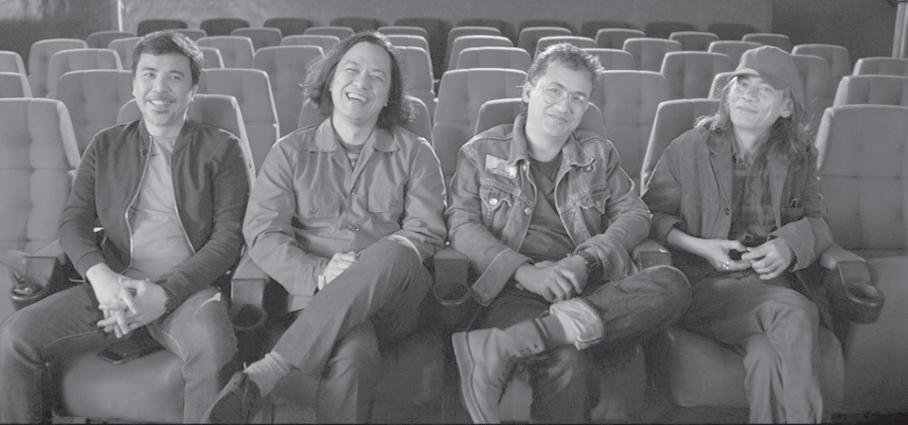

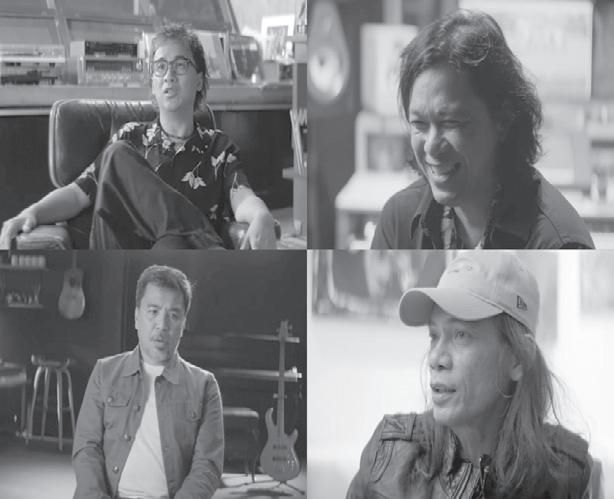
Screen capture from Eraserheads: Combo on the Run | The docu film streams on Netflix worldwide on May 30, 2026 in over 190 countries with a newly reworked edit featuring never-before-seen footage.
to be. Frontman Ely Buendia, who has stated that he viewed his Eheads bandmates more as professional colleagues than close friends, shared that the documentary finally pushed them to confront conversations they had long avoided.
“We would have never talked about this before. We’re not the type of people na ‘so, what do you feel about this?’,” Buendia told BusinessMirror during the talkback session following the exclusive screening.
For Buendia and Ventura, the film serves as the Eheads’ way of finally putting years of speculation and unanswered questions to rest. And as a fan, it surprisingly felt healing for me, too.
Buendia shared, “I think the band actually wanted to tell their story already dahil maraming haka-haka [speculations] of what had happened that it started becoming a shadow hanging over our heads. We just needed to tell the story and hope

people will finally understand.”
“Somehow our story can impart wisdom and knowledge to the next generation,” Buendia added.
Beyond the iconic soundtrack and the nostalgic trip, I found myself bawling towards the end of the film—not out of sadness, but relief and happiness. There was something deeply comforting about seeing the members finally acknowledge the pain and catch up after all these years.
In a way, it also felt like closure for the fans who carried the heartbreak of their breakup for decades. Because in the end, Combo on the Run isn’t just about revisiting the legacy of the Eraserheads—it’s about proving that even the most painful endings can still find their way back to healing.
Eraserheads: Combo on the Run begins streaming on Netflix starting May 30. Running time: 105 minutes. Four stars out of four.
Story by John Eiron R. Francisco
Sometimes, the most meaningful connections are found not in similarities of culture or language, but in shared experiences.
This became evident in the collaboration between Japanese soul singer Nao Yoshioka and Vietnamese singer-songwriter and producer My Anh, whose first joint single, “Pieces of Me,” explores themes of selfdiscovery, healing, and embracing one’s evolving identity.
Though they come from different countries and music scenes, both artists found themselves drawn to the same emotional wavelength—one shaped by their love for soul and R&B, and by the solitude that often accompanies pursuing an unconventional artistic path.
In an exclusive interview with BusinessMirror’s SoundStrip, My Anh shared how their contrasting backgrounds initially seemed like the most interesting part of their collaboration, only for deeper similarities to emerge as they got to know each other.
“The fact that we’re from different backgrounds, she’s from Japan and I’m from Vietnam, that itself was very interesting because our viewpoints must be different,” she said. “But I was surprised that we ended up having such similar experiences and emotions in our journey.”
She recalled how both of them carried the same mix of fear and excitement while pursuing music styles that sit outside the mainstream in their respective countries.
“I really appreciate Nao, and the fact that she shared her experience made me feel less alone,” My Anh said, adding that the Japanese artist had become “like a sister” to her.
For Nao Yoshioka, the collaboration carried a similarly personal weight. She recalled how, during the early stages of her career, she faced skepticism in Japan for singing soul music in English instead of following local expectations.
Despite the criticism, she remained committed to her artistic direction, eventually releasing six albums and building an international career. “I just kept pushing the path I always wanted to take,” Nao said.
However, she also acknowledged that success did not erase the feeling of solitude that came with pursuing a non-traditional path. Over time, she often wished for someone who could truly relate to her experience.
That sense of understanding finally emerged during her first virtual conversation with My Anh, where the two openly exchanged
stories about their struggles, fears, and creative journeys.
‘Pieces of Me’
Their collaboration, “Pieces of Me,” reflects those shared emotions. The song centers on self-discovery and the idea that identity is constantly shifting as people grow and evolve.
My Anh said the song ultimately embraces the reality that people will continue to lose and rediscover themselves throughout life—a realization she described as both terrifying and beautiful.
“When I realized that I am bound to lose myself again because I’m growing and evolving, it also made me realize that I have the power to create a new version of myself,” she explained. “That gives you so much power and choice.”
For the Vietnamese artist, the song carries a simple yet freeing message: life does not always need to be taken so seriously.
“We’re just a little piece of dust in the universe,” she said. “Just enjoy finding pieces of yourself here and there, and even losing pieces of yourself too. There’s so much beauty in that.”
Nao echoed the sentiment, admitting that she once lived in constant fear of failure and always pressured herself to become the “best version” of who she thought she should be.
“But it’s okay to fail. It’s okay to make mistakes,” she said. “We all mess up. We all experience miserable versions of ourselves. But the next morning comes, the sky is still



beautiful, and life continues no matter what.”
More than anything, Nao said she hopes people allow themselves to simply enjoy life—and to remember that they are never truly alone in their struggles.
Beyond the emotional connection they built, the collaboration also became a space for creative growth. Asked what they learned from each other during the process, both artists spoke about how their contrasting approaches to music challenged and inspired them.
My Anh shared that working closely with Nao pushed her to experiment vocally in ways she had never explored before.
“Musically, I learned so much because we have very different styles of singing,” she said. “She had production notes on how I should emphasize certain parts, and it was very different from the way I usually sing.”
Recording together in person, she added, became an essential part of shaping the song’s emotional depth, allowing them to exchange ideas organically instead of working remotely through isolated recordings.
Beyond music, however, My Anh said she was most inspired by Nao’s perseverance, patience, and unwavering passion for her craft.
“She’s like sunshine,” she said with a laugh. “She has such good vibes. She made me feel less alone. I felt like I’m still figuring things out, but I’m doing okay. It was a very healing experience for me.”
Meanwhile, both artists expressed openness to future collaborations and the possibility of performing together on stage.

By Laura Ungar The Associated Press
CINCINNATI—The first time 5-yearold Calvin Owens went outside in more than a month, he met up with his canine friend Hadley on a hospital patio.
Despite being tethered to equipment with wires and tubes, the little boy managed to stand up near his wheelchair long enough to toss her a ball. He smiled as she ran to fetch it. Caregivers cheered.
“Look how good you’re doing!” said Hadley’s handler, Schellie Scott.
Such small victories and moments of joy are common whenever Hadley or one of the other three facility dogs at Cincinnati Children’s Hospital show up. These furry caregivers aren’t the typical therapy dogs volunteers bring to hospitals to comfort patients. They are specially trained, full-time working dogs that provide emotional support during stressful procedures, motivate kids to move around and make hospitals seem less scary. And experts say their ranks are growing at children’s hospitals across the nation.
A mounting body of research shows that even short interactions with facility dogs can improve children’s overall wellbeing, decrease the pain they feel and reduce signs of stress, like cortisol levels and blood pressure.
“These dogs are making a real difference,” said Kerri Rodriguez, director of the Human-Animal Bond Lab at the University of Arizona. “They can provide a little bit of normalcy, a little bit of comfort, in a really stressful, sterile environment that kids might not feel comfortable in.”
How hospital facility dog programs work
ALTHOUGH no one tracks the number of facility dogs in children’s hospitals, Rodriguez points to the continual growth of the annual Facility Dog Summit, where handlers and other participants network and where attendance nearly doubled from 2024 to 2025. Other types of hospitals also have full-time dogs, but experts say children’s hospitals account for most of the expansion in programs. One large nonprofit, Canine Assistants in Georgia, has a specific children’s hospital initiative through which it has placed more than 80 dogs

nationally.
Dogs have been on the job for years at places such as Mount Sinai Kravis Children’s Hospital in New York, Norton Children’s in Louisville, Kentucky, and St. Louis Children’s Hospital. And new programs keep sprouting up. In March, Johns Hopkins Children’s Center in Maryland introduced its first two facility dogs.
Hospitals generally get the dogs from nonprofits. Organizations such as Canine Companions, where Cincinnati Children’s gets its dogs, breed, raise and train them, then place them with hospital staff members but still own them. Dogs and handlers live and work together.
Although hospitals don’t pay for the dogs, they’re responsible for costs such as food and veterinary care, which can add up, especially since most are larger breeds like Labradors or Golden Retrievers. Hospitals usually fundraise or seek grants to cover the costs.
EXPERTS say the benefits of these sorts of “animal-assisted therapies” are clear.
A 2022 study Rodriguez coauthored analyzed a survey conducted across 17 children’s hospitals. Pediatric health professionals described how facility dogs provided a comforting presence, built rapport, and normalized the hospital environment for children and families.
A 2021 study in the Journal of Pediatric Nursing concluded that animal- assisted therapies were beneficial for controlling pain and blood pressure in children and teens. Other research also found these therapies reduce anxiety and pain and can even improve heart and lung function.
Facility dogs are allowed in more sensitive areas of the hospital than volunteer dogs, and sometimes serve particular hospital units. Opal, one of two St. Louis dogs, splits her time between the pediatric behavioral health unit and the child protection program.
No matter where the dogs work, keeping them clean is key.

Hadley, in Cincinnati, is bathed twice a month because she works in the cancer and blood diseases area, where kids might have reduced immunity. She gets even more baths, or cleanings with special wipes, if she’s potentially exposed to germs. Handlers use leashes and balls that can be easily cleaned, and people must sanitize their hands before and after touching the dogs.
If a patient is in isolation, the dog stays outside the room. The one exception is if a dying child wants a dog to be close. In those cases, caregivers say concerns about germs are outweighed by the need to ease fears and provide comfort.
A day in the life of a hospital facility dog
HADLEY’S workday starts whenever her handler Scott—whose job as a child life assistant involves keeping patients’ lives as normal as possible—arrives at the hospital. Hadley mostly sees patients, but also gets breaks when she can just do what she wants.
On a recent morning, the Labradorgolden retriever mix raced around a grassy dog play area with her canine co-worker, Grover. While Grover is calm and chill, Hadley gets so excited she shakes her head to toss balls to herself.
“Hadley loves life,” Scott said. “Hadley lives big.”
Inside the hospital, the dogs get constant attention. For handlers, “it’s like being the assistant to a famous person,” joked Scott.
Signs of the dogs’ celebrity status are everywhere.
They appear on closed-circuit television shows filmed by the hospital and beamed into patient rooms. Photos of the dogs, themed for holidays or events, line the hallways. And there are mailboxes where kids can drop letters or pictures for the dogs and get replies.
Patients can also get trading cards for each dog with stats like breed and birthday, bandanas to decorate for their furry friend, or little stuffed dogs. Caregivers create books featuring the dogs to show kids about procedures or treatments

they’re about to undergo.
Kids hospitalized for long stretches get to know the dogs well.
Aspen Franklin, a 14-year-old fighting a life-threatening immune disorder, has been coming to the hospital since she was a toddler and was recently hospitalized for weeks. At times, Hadley has snuggled beside her in bed.
“She has a calming presence,” Aspen said. “That is a comfort to me.”
Like other facility dogs, Hadley also helps her family cope. When Aspen’s younger brother Emory donated his cells for her bone marrow transplant, Hadley spent time with him—and other visiting siblings.
Having Hadley around “is really nice because they’re away from their animals at home,” said their mom, Brittney Franklin, whose family has two dogs and a cat.
Franklin recently watched as Aspen painted with Hadley. The dog couldn’t go in her room so soon after her transplant, so Aspen dabbed colors on a small canvas and handed it to Scott, who put it in a plastic bag and smeared peanut butter on top. Just outside the room, Hadley eagerly licked it up. A piece of abstract art emerged.
Hadley’s next patient was Calvin, the little boy she met on the patio. Calvin has a rare, severe type of childhood arthritis and recently had a bone marrow transplant. Though he could only stand for a few moments at a time, he made the effort repeatedly to play with Hadley.
“He’s such a strong little man,” Scott said.
But Hadley does eventually tire. When that happens, she goes back to an office affectionately known as her lair, where she has treats, toys and a big dog bed.
Above the bed is a bulletin board covered with drawings, photos and notes. One, written on orange construction paper, contains a small, pink handprint and the words: “Thank you for being my BEST FRIEND.”
n Cover photo by Mikhail Nilov on Pexels.com
By
EVERY dish tells a story. At Textures by Tamayo’s, that story begins with childhood memories, family traditions, and a lifelong passion for food that eventually took chef Christopher Tamayo from a humble family catering business to the kitchens of NBA champions and back home again.
Now open in Tagaytay City, Textures by Tamayo’s offers more than an upscale dining experience.
It is the culmination of years of learning, hard work, and a desire to honor the legacy of the Tamayo family while introducing a fresh culinary concept inspired by Chef Chris’ experiences abroad.
The restaurant occupies what was once the Tamayo family’s vacation home, transforming a place filled with personal memories into a destination where guests can gather, celebrate, and share meaningful meals.
“There’s a new fine dining home in Tagaytay,” Chef Chris said, describing the restaurant as a space where the barriers often associated with fine dining are removed in favor of something more welcoming and personal.
Tribute to his parents FOR Chef Chris, the decision to build the restaurant in the family’s former home was intentional. More than a business venture, it is a tribute to his parents and the journey that brought their family to where they are today.
“The menu is actually reflected in my entire childhood,” he shared during the restaurant’s launch. “I wanted to give respect to my parents and their legacy.”
That legacy began with humble beginnings. Long before Chef Chris became a chef for professional athletes, he was already immersed in the family business. Growing up around Tamayo’s Catering, he spent countless hours helping in kitchens, observing events, and learning the value of hard work from an early age.
“I could literally say I grew up in the kitchen,” he recalled. “I’m 33, but I have 29 years of experience in the kitchen.”
Refined techniques
THOSE experiences would later shape the menu at Textures by Tamayo’s, where familiar flavors are elevated through refined techniques while remaining rooted in nostalgia.
Among the standout dishes is the Chicken Truffle Havarti, inspired by the chicken cordon bleu that helped make Tamayo’s Catering a well-known name. A tofu dish pays tribute to his mother’s favorite food, while the Bao Ko combines his love for Binondo-style bao and tacos into a creative fusion dish. Even the Cebu Lechon Express reflects cherished personal favorites, bringing together the flavors of lechon and Bicol Express in a playful yet sophisticated way. These dishes are tied together
by the philosophy behind the restaurant’s name.
During the media preview, guests were treated to a sampling of Textures by Tamayo’s current menu,



offering a glimpse into Chef Chris’ approach to flavor, technique, and texture. Each course reflected his belief that ingredients should complement rather than compete with one another, allowing their natural qualities to shine.
Standouts
AMONG the standouts were the Cognac-Pecorino Cabbage, which transformed the humble vegetable into a sophisticated dish layered with sweet, savory, and smoky notes, and the Bao-Kos Two Ways, a playful creation that blended familiar Asian flavors with contemporary presentation. The SichuanTsuyu Tofu likewise demonstrated the restaurant’s California-inspired philosophy, bringing together diverse culinary influences while maintaining balance and restraint.
Guests also sampled the Pumpkin Soup and Wild Mushroom Soup, both comforting yet refined, showcasing the kitchen’s ability to elevate simple ingredients through careful preparation and thoughtful flavor combinations.
The Arugula-Watermelon Salad provided a refreshing interlude, pairing the peppery bite of arugula with the natural sweetness of watermelon. By the time the main courses arrived, diners were already impressed by the range of flavors and textures presented throughout the meal.
The hearty Cebu Lechon Express highlighted Chef Chris’ playful take on Filipino comfort food, while the 10-ounce Pork Chop delivered richness and depth. Stealing much of the spotlight, however, was the Tomahawk Steak, whose tenderness and smoky character made it one of the evening’s most memorable dishes.

The meal concluded on a sweet note with the Kalamansi Tart, offering a bright citrus finish that balanced the richness of the preceding courses. Equally noteworthy were the restaurant’s fresh pasta creations, particularly the Black Truffle Cavatelli and Apple-Chestnut Agnolotti, both of which reflected Chef Chris’ appreciation for handmade pasta and his commitment to crafting dishes that are both comforting and refined.
Cooking as an orchestra FOR Chef Chris, texture is just as important as flavor. He describes cooking as an orchestra where every ingredient has a role to play. Rather than allowing one component to dominate, he seeks harmony among different textures and flavors, ensuring that each ingredient contributes to the overall experience.
“It’s like respecting the taste of each ingredient,” he explained. “I’m just trying to make them work together. It’s textures because there’s a different play on the different textures of each ingredient.”
That philosophy was shaped by his culinary education and profes-

sional experiences in the United States, including his years working with NBA players. While he is unable to discuss specific athletes or their dietary programs, he credits the experience with teaching him one of the most important lessons of his career: respecting ingredients and allowing them to shine.
“What really humbled me was learning to respect the taste of ingredients,” he said. “The sauce should be the sidekick, while the main ingredient should be the star.”
High-quality ingredients
THIS approach is evident throughout the menu, which draws inspiration from modern California cuisine. Influenced by California’s multicultural food scene, the concept embraces a variety of culinary traditions while focusing on fresh, high-quality ingredients and clean, vibrant flavors.
“California is a melting pot of cultures,” Chef Chris explained. “There are Japanese, Korean, Filipino, and many other influences. I didn’t want to be limited by one cuisine. If flavors work together, then we’ll make them work.” Freshness also plays a central
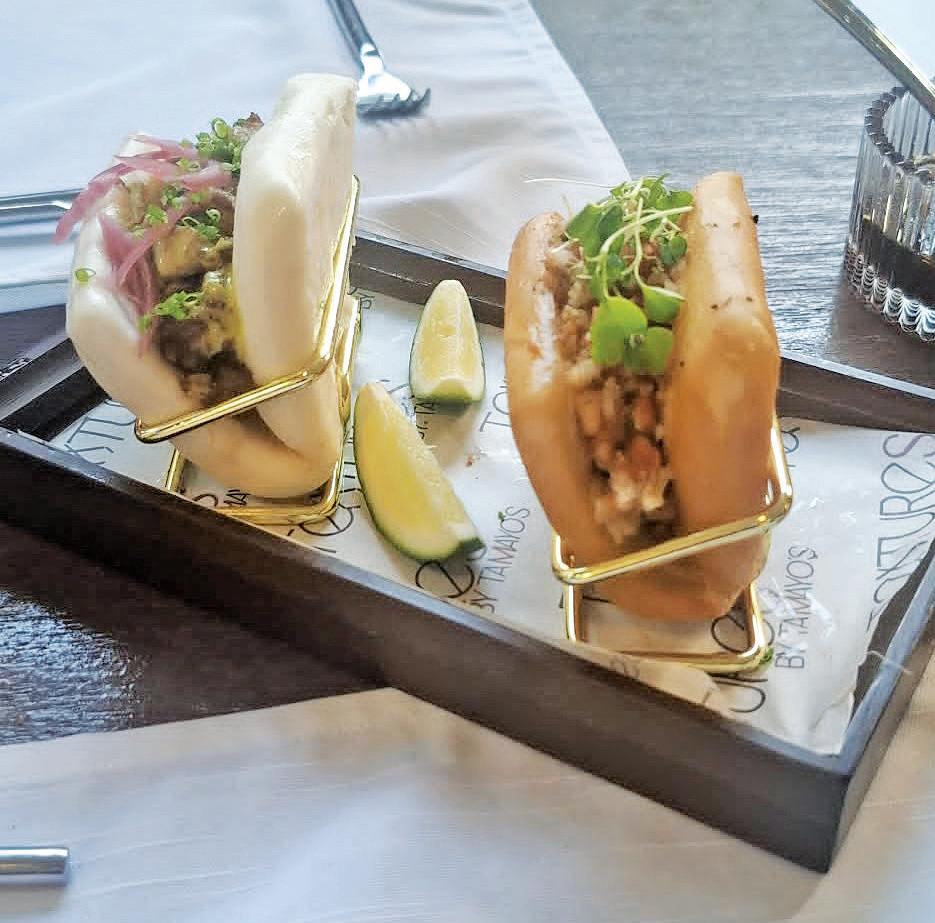



role in the dining experience. Many of the herbs and vegetables used by the restaurant are sourced directly from the property’s gardens and nearby farms. This commitment not only ensures quality ingredients but also supports local farmers and promotes a more sustainable food ecosystem.
The result is a menu that celebrates both global influences and local abundance, combining technical expertise with a deep appreciation for the ingredients themselves.
Despite its refined offerings, Chef Chris is determined to make Textures by Tamayo’s feel approachable.
“Fine dining should feel warm, welcoming, and shared around one table, where laughter is heard, stories are exchanged, and everyone feels at home,” he said.
A space for families, friends THAT sense of hospitality is per-
haps what sets the restaurant apart. While many fine dining establishments focus solely on exclusivity, Textures by Tamayo’s seeks to create a space where families and friends can enjoy elevated cuisine without sacrificing comfort and connection.
The opening of the restaurant is only the beginning of Chef Chris’s larger vision for the one-hectare property. Future plans include a glasshouse events venue, expanded farming areas, and a communityoriented village designed to showcase local entrepreneurs and small businesses.
For now, however, the focus remains on welcoming guests into a place that feels both new and familiar—a home where every dish carries a piece of Chef Chris Tamayo’s story. At Textures by Tamayo’s, diners are invited to experience more than exceptional food. They are invited to savor the textures of memory, family, and tradition, thoughtfully reimagined for a new generation.
Open from Wednesday to Sunday (11 am to 8:30 pm), Textures by Tamayo’s is located at 1975 Maglabe Drive, Barangay Asisan, Tagaytay City. The restaurant is now open to reservations through their booking platform (bit.ly/texturestagaytay). For more information, visit the restaurant’s official Facebook (facebook.com/p/Textures-byTamayos-61582417211175/) and Instagram (instagram.com/textures. tagaytay/).
By Bless Aubrey Ogerio
HINESE milk tea chain CHA-
CGEE is introducing something that asks people to slow down, even briefly.
On May 8, 2026, the company launched the BO·YA Jasmine Tieguanyin Tea series in the Philippines, expanding its BO·YA Jasmine lineup with a blend that leans heavily into floral depth and layered tea notes rather than outright sweetness.
The drink begins with a gentle jasmine aroma before the more distinct orchid-like character of Tieguanyin, which is a prized oolong tea variety, settles in. The result is a cup that feels softer and more complex.
The Tieguanyin tea base is sourced from the high-altitude gardens of Southern Fujian in China, while the jasmine flowers come from Hengxian in Guangxi, an area known globally for jasmine cultivation and fragrance quality.
For CHAGEE, the launch is also part of a broader attempt to bring tea culture into more everyday spaces for younger consumers increasingly looking for slower and more intentional experiences.
Story behind the newest blend THE BO·YA name itself draws from a story that has existed in Chinese culture for more than 2,000 years.
It tells of Boya, a musician whose music was deeply understood by only one listener, a woodcutter named Ziqi. Their friendship eventually became a symbol of genuine connection and quiet understanding.
That philosophy, according to CHAGEE Philippines general manager Christopher Tiong, is reflected in the newest tea blend.
“What makes it unique is the ‘Guanyin note,’ a lingering harmony of orchid-like fragrance, mellow sweetness, and a long-lasting aftertaste that’s distinct to Tieguanyin among the oolong tea family,” Tiong told BusinessMirror during the tea launch in Ortigas.
For Tiong, the appeal of the new BO·YA Jasmine Tieguanyin line lies in how it balances stronger roasted tea notes with a lighter floral finish.
The series is available in both milk tea and brewed tea formats. Prices start at P130 for the brewed tea and P159 for the milk tea variant.
Beyond the cup TEA may be one of the oldest beverages in the world, but brands like CHAGEE are betting that it still has room to evolve alongside modern lifestyles.
For Tiong, tea’s role extends beyond refreshment. “For generations, tea has been a symbol of connection,” he told this newspaper. “It brings people together and creates opportunities to pause, share conversations, and build meaningful moments of connection.”
“Whether shared with friends, colleagues, or even enjoyed alone for a quiet moment, it offers a simple way to refresh and recharge,” he added.
That balance between ritual and accessibility is one reason the new Jasmine Tieguanyin blend resonates with him personally. “Its layered floral aroma and smooth lingering finish make the experience feel intentional but still approachable enough for everyday moments,” Tiong said.
He added that tea continues to remain relevant because it adapts eas-

ily across generations and lifestyles.
“Tea is definitely going to remain relevant across generations and lifestyles, as it provides these small, but meaningful moments of connection that can make even the busiest days feel lighter and more
balanced,” he said. Meanwhile, CHAGEE Philippines tea master Philip Dee said tea often carries stories and craftsmanship that consumers rarely stop to notice. “Most people drink tea every day, and that is exactly

FOR 23 years, The Coffee Bean & Tea Leaf® Philippines has been part of everyday moments and meaningful connections shared over every cup. This year, CBTL Philippines marks its milestone anniversary with A Story in Every Cup, a special celebration running from May 26 to August 16, 2026, featuring limited-edition collectible tumblers, the return of its viral Dry Americano beverages, and a meaningful initiative that gives back to the community.
At the heart of the anniversary celebration is the launch of the 23rd Anniversary Collection, a trio of Philippine-exclusive tumblers inspired by Filipino stories, culture, and identity. Guests can redeem the limited-edition collection with just 12 stamps, making it even easier to bring home a meaningful keepsake from CBTL Philippines’ 23rd anniversary.
The collection features three unique tumbler designs: Lakbay, Talâ, and Pamana. Each represents stories rooted in Filipino experiences and values.
Lakbay, which means “journey,” captures snapshots of Filipino culture and landscapes, celebrating the beauty of travel and everyday discovery.
Talâ, inspired by the act of documenting memories and moments, reflects the stories and experiences shared through the years.
Meanwhile, Pamana, mean -

why we think it is worth pausing to understand it a little better,” Dee said in a statement.
“When you stop and look closely, what you find is extraordinary. Centuries of knowledge, farmers who understand their soil the way musicians understand their instruments, and a quiet kind of craft that most of the world never gets to see.”
For Dee, International Tea Day also serves as a reminder that tea is tied not only to consumption, but to culture and tradition. “It is an invitation for all of us to slow down, pay attention, and discover what has always been in the cup,” he said.
Where tea culture goes next PHILIPPINE tea culture may still be developing compared with neighboring Asian markets, but companies are already seeing signs of stronger interest among younger consumers.
According to Tiong, many Filipinos previously viewed tea simply as a beverage rather than a lifestyle experience.
“We are seeing more Filipinos embrace tea as part of their daily lifestyle,” he said. “Whether during merienda, after work, or as a simple intentional pause during a busy day, tea is becoming more than just a beverage.”
The growing interest has also pushed brands to create experiences around tea rather than focus only on selling drinks. For CHAGEE, that means introducing tea workshops that allow people to explore tea through guided tastings, aroma exploration and blending sessions.
“Beyond introducing tea, we aim to become part of every Filipino’s journey in discovering connection and creating shared moments over a cup of tea.”
ing “heritage” or “legacy,” pays tribute to the roots, traditions, and enduring connections that continue to shape the CBTL community today.
Adding to the celebration is the much-awaited return of the Dry Americano Series, featuring two fan-favorite flavors alongside an exciting new addition. First introduced last year, the Dry Americano quickly became a viral TikTok favorite for its bold espresso-forward profile paired with creamy indulgence — offering coffee lovers a refreshing twist on the classic Iced Americano.
Returning this year are the well-loved Dry Vanilla Americano and Dry Double Chocolate Americano, alongside the new Dry Hazelnut Chocolate Americano, a decadent blend of dark chocolate and hazelnut flavors topped with creamy half-and-half.
Guests can earn stamps from participating beverage purchases, including the Dry Americano Series, to complete the 12-stamp collection and redeem the anniversary tumblers.
Beyond the anniversary offerings, the celebration also supports a meaningful cause. Proceeds from the anniversary collection will help fund the U-Go Scholar Grant implemented by the Ayala Foundation, which supports young women from economically disadvantaged backgrounds in pursuing higher education.
For CBTL Philippines, the
POTATO Corner is bringing back its Free Upsize Promo from May 25 to June 10, 2026 (Mondays to Wednesdays only) in all stores nationwide, giving fans more of their favorite flavored fries at no extra cost. Here’s how the Free Upsize works: Guests who buy Giga Fries will get a FREE upgrade to Tera Fries, while those who purchase Tera Fries will enjoy a FREE upgrade to Tera Mix, making every order bigger and more satisfying. The promo will be available in-store during the promo period (May 25 to June 10, 2026, Mondays to Wednesdays only) and is perfect for sharing with friends and family or simply treating yourself to a bigger snack. Don’t miss the chance to make your


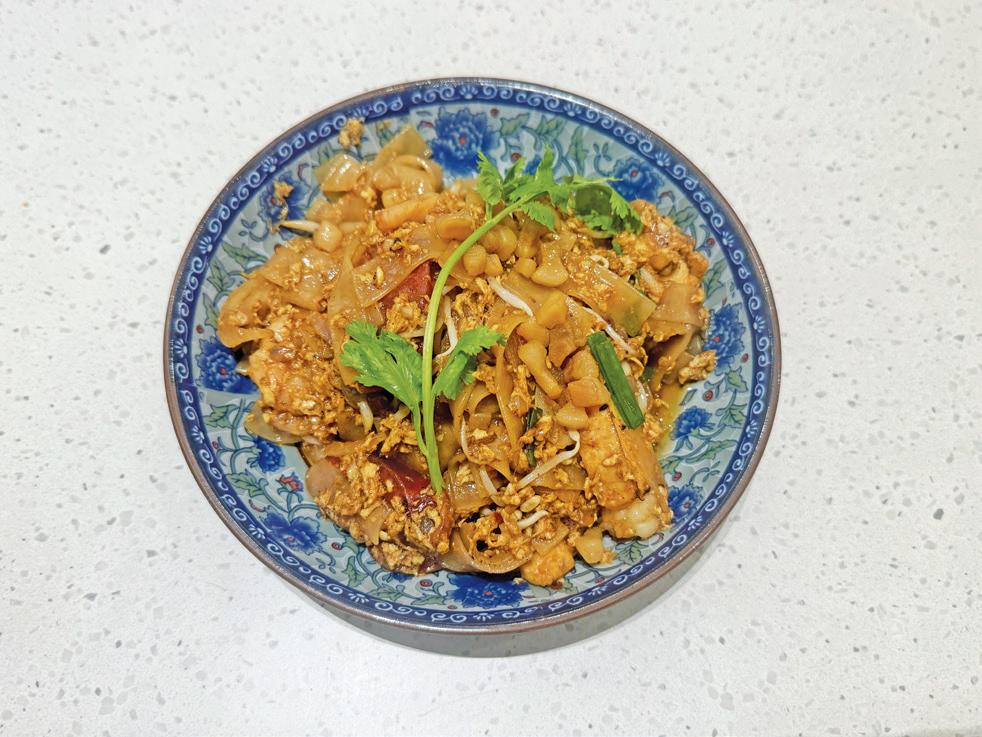

Justine Xyrah Garcia
SINGAPOREAN flavors have been slowly finding a foothold in Metro Manila, but in Ortigas, where lunch breaks are short and choices are often predictable, it’s still not something you stumble upon every day.
That’s what makes Kaokee Singaporean Kitchen’s arrival at SM Podium feel like a welcome change. Tucked on the fourth level, the new branch brings in the kind of hawker-style comfort food that’s easy to crave and even easier to come back to. Before even getting to the food, Kaokee’s story already explains why it resonates.
“I didn’t start Kaokee with a business plan in mind,” said founder Reagan Tan.
“During the pandemic, I was just cooking Hainanese chicken at home because I loved it. I shared it with my neighbors, word spread,
Tand before I knew it, the dish had taken on a life of its own. That unexpected journey led to our first branch, which we opened quietly, with no fanfare, just the food.”
Hawker culture THAT straightforward approach continues to define the brand. As travel resumed, the team went to Singapore to immerse themselves in hawker culture, learning from seasoned cooks and refining their menu through multiple iterations—nine versions in total—before settling on what is now served. Even one of their most popular items wasn’t part of the original plan.
“The kiosk was never meant to be the star, but people kept lining up and coming back,” Tan shared.
“The egg tarts took on a life of their own. Because of that, this new branch now has a dedicated takeout counter, something we never originally planned.”
The space itself reflects that

same balance between tradition and adaptation. Inspired by Singaporean kopitiams—everyday dining spots built around simple, comforting meals—the interiors reinterpret the concept into something more polished, fitting for a
mall setting without losing its casual feel.
The name Kaokee, which translates to “Stall Nine,” reinforces that connection to hawker culture, where identity is shaped by the food rather than branding.
“Stall Nine is not a name we chose to stand out,” Tan added. “It is a name we chose to stand among the hawkers who inspired us. We did not inherit a legacy. We earned ours.”
A quick guide to the standouts For those planning their first visit, there are a few dishes that immediately stand out and are easy recommendations.
The Crispy Shrimp Balls are a strong place to start. Light, crisp, and generous with actual shrimp. No filler, no shortcuts, just clean, briny flavor wrapped in a delicate crunch that makes it easy to reach for one after another without much thought.
The Char Kway Teow is another dish worth ordering, even for those who don’t usually go for it. There’s a distinct wok-fired smokiness that gives the noodles depth, while still keeping the dish balanced and not overly heavy. The mix of shrimp, squid, and pork comes together in a way that feels cohesive without be-
ing overpowering.
For something more indulgent, the Prawn Laksa delivers a rich, coconut-forward broth packed with flavor and generous in toppings. It leans slightly oily, but the depth and warmth of the dish make it easy to overlook.
The egg tarts are hard to skip. Softer and creamier than expected, with a slightly runny center, they lean into that custardy texture that makes them especially satisfying— and easy to keep coming back for.
An Iced Ying Yang Tea rounds everything out, with a strong tea flavor that isn’t drowned in sugar or milk, offering a refreshing balance to the richness of the meal.
The Ortigas opening marks Kaokee’s third branch, following its first location at Belamy House in Makati in 2024 and a second in San Juan.
Kaokee is part of the Mc Wilson Corporation portfolio, which also includes Gringo, Tatatito, Honeybon, and Tokyo Bubble Tea.
define Singapore’s vibrant food scene. For many diners, Hainanese Chicken Rice is often the first introduction to Singaporean cuisine. While undeniably iconic, the country’s culinary identity goes far beyond a single dish, shaped by generations of Chinese, Malay, and Indian influences.
Tiong Bahru Singapore Flavours introduces Filipino diners to flavors that go beyond the familiar. While its Hainanese Chicken Rice remains a well-loved staple on the menu, the restaurant also highlights specialties that reflect the variety of Singapore’s culinary heritage. At Tiong Bahru Singapore Flavours, “Taste Singapore, One Dish at a Time” comes to life through both longtime favorites and underrated gems. Among the restaurant’s menu standouts is the Laksa, a rich and aromatic noodle soup
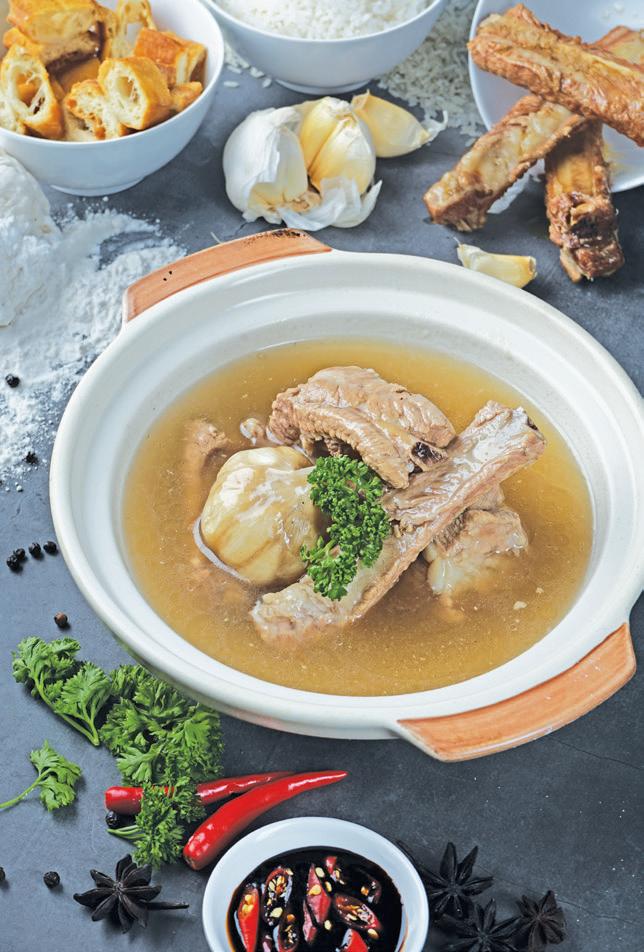


THROUGHOUT his extensive global culinary career, Chef Oliver “Oli” Buenviaje, who lists Sorsogon, Bicol as his place of birth, has been associated with Michelin multi-starred seafood restaurants of impeccable quality and renown. So it comes as no surprise that his homecoming to the Philippines would entail the modernizing and upgrade of the “dampa” dining concept. Set to open its doors in August 2026 at Gateway Mall 2, Araneta City; Seafood 8 by Olio’s promises to be game-changer, elevating how fresh seafood can be enjoyed in our dining landscape. Dampa is the original “market to table” food experience, where you select and buy raw, fresh seafood, as one would in a traditional wet market; and then have on-site kitchens prepare and cook the dishes according to your liking. Seafood 8 will elevate this concept, and bring the “dampa” to the Mall, where the crowds are on a regular basis, all days of the week. It’s planned as a 130-seater, with extensive aquarium displays for the live sea creatures, and beds of the fish, crustaceans, and shellfish on ice. One opts to grill, or fry, or
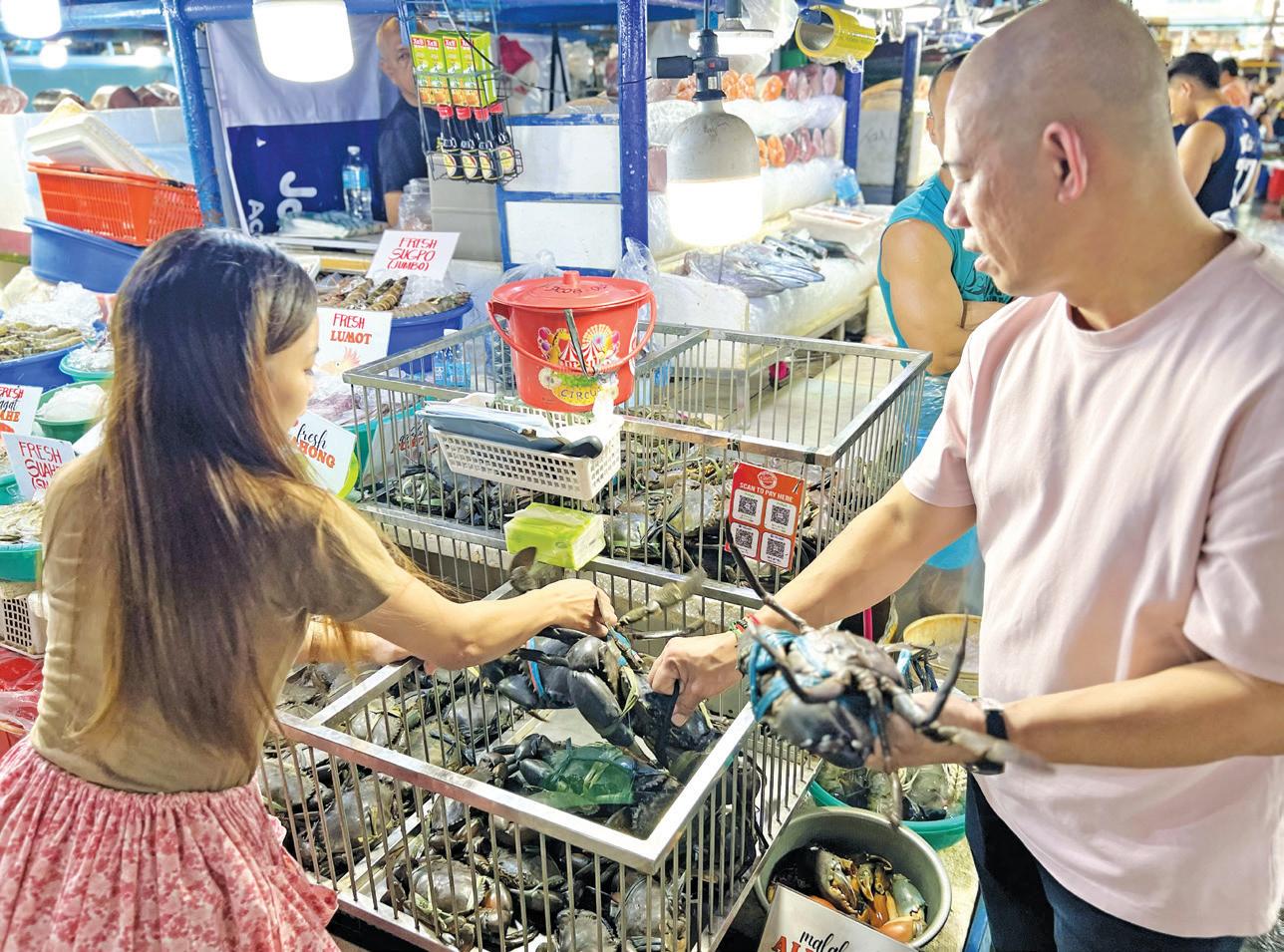
de France (MOF) in 1991. A stint with Alain Ducasse at his le Meurice in Paris followed. And Chef Oli vividly recalls being part of the team that would handle Ducasse at the Grand Prix Monaco. He reached the level of sous chef in three short years,
hotel, Burj Al Arab. This led to Chef Oli being invited to join Al Mahara, the famous seafood restaurant at the Burj. Subsequent stints saw Chef Oli at L’Normandie at the Mandarin Oriental Bangkok, the IFC Tower and Caprice at the Four Seasons
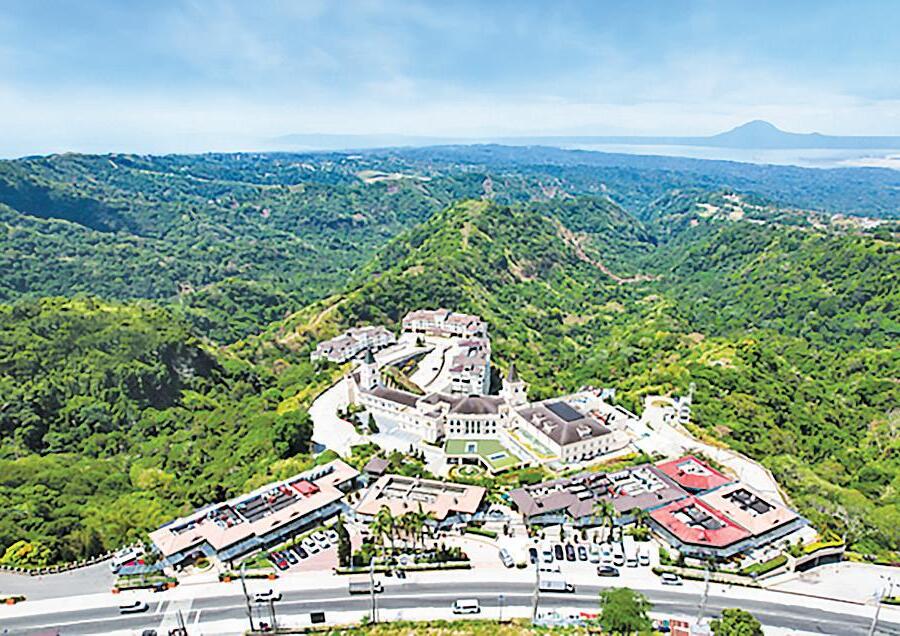

By Angelique Cortez Contributor
INEYARD traditions, coun-
Vtryside festivities, and panoramic views came together at Twin Lakes Hotel on May 9, 2026, as guests and residents gathered for the 2nd Grape Harvest Festival. It’s a celebration of the annual grape-picking tradition at the country’s first vineyard resort community nestled in the scenic hills of Laurel, Batangas. Twin Lakes, a master-planned lifestyle estate by Megaworld’s Global-Estate Resorts, Inc. (GERI), is transformed into a bustling vineyard escape for the occasion. More than 600 participants attended the festival, marking a significant increase from last year’s inaugural staging which welcomed around
SIESTA , the brand that redefined the local horchata scene in the Philippines, officially returns to its roots in the South with a dual-impact expansion: the opening of its newest branch in BF Homes, Paranaque, and the unveiling of its premier concept space, Ola by Siesta, at Alabang West Parade.
This two-pronged launch marks a significant milestone for the brand, bringing Siesta back to the community where it all began while simultaneously pushing the boundaries of the café experience.
THE relocation to BF Homes signifies a return to Siesta’s heritage, offering the neighborhood its signature horchata-centric menu in a familiar, welcoming setting.
Designed as a community-focused hub, this branch serves as a home for the brand’s loyal followers in the South. Guests can enjoy their favorite signature blends in a space that celebrates the neighborhood “siesta” culture, from Monday to Sunday, 10 am to 10 pm.
“Returning to the South is a full-circle moment for us. Siesta started in the South with a simple love for horchata that I would share with family and friends and seeing that passion grow into a dedicated concept space feels surreal. It’s incredibly special to bring it back to
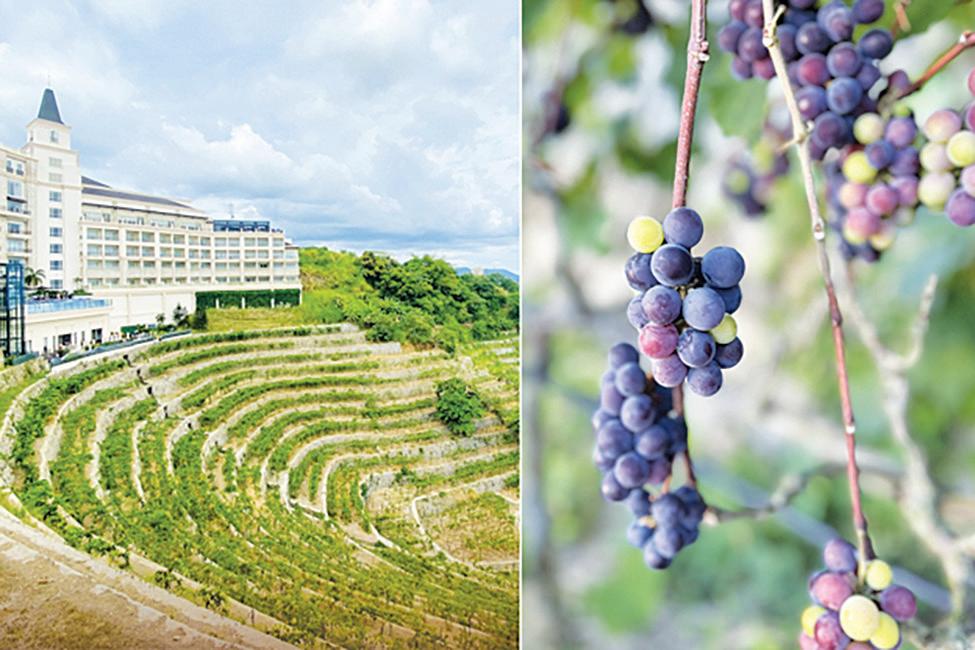

300 guests. Timed just ahead of Mother’s Day, the event became the ultimate weekend gathering for families celebrating together.
“What makes the Grape Harvest Festival at Twin Lakes special is how it allows guests and residents of our community to really immerse and experience the vineyard estate in a more meaningful way,” said Monica T. Salomon, President, GERI.
The vineyard experience CARVED on the hillside of Twin Lakes Hotel, the vineyard features 1,400 vines spread across 16 terraced rows. This year’s harvest yielded nearly 200 kilograms of grapes from three varieties: Brazilian Hybrid, Concord, and Red Cardinal. The grapes are grown under the guidance of vineyard experts,
thriving in the property’s cool climate and elevated terrain.
The event was exclusive to Twin Lakes residents and hotel guests who availed the Grape Harvest Festival Stay Package, while shoppers from Twin Lakes Shopping Village were also granted access upon meeting a minimum purchase requirement.
Beyond grape-picking, guests also enjoyed a curated vineyard experience throughout the day including grape stomping, wine tasting, painting and cookie decorating, an interactive photo booth, and a farmer’s market.
Wine and Dine OF course, no countryside celebration is complete without a delectable spread. After harvesting grapes
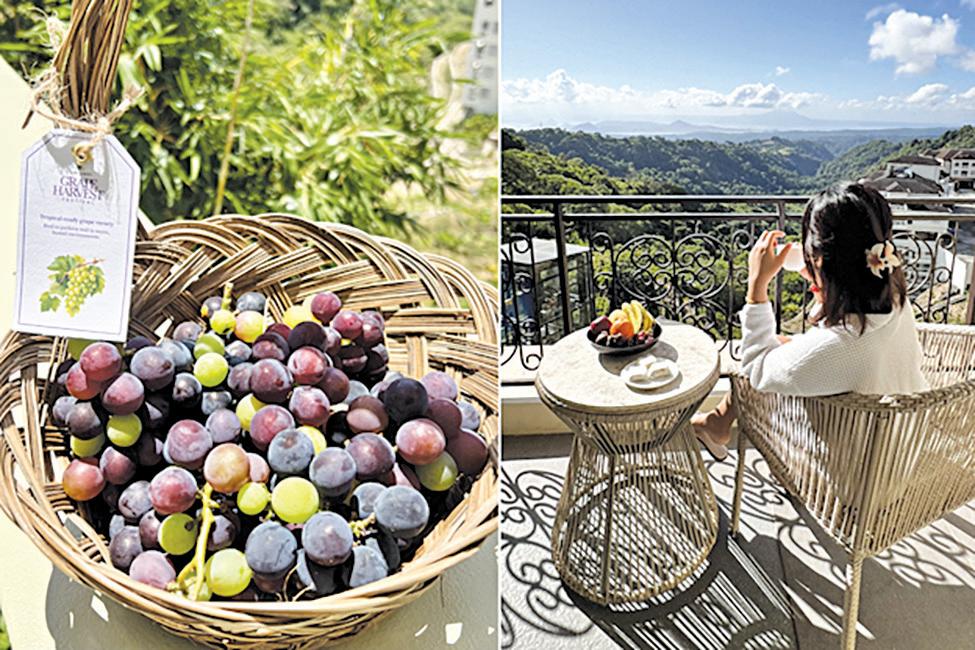
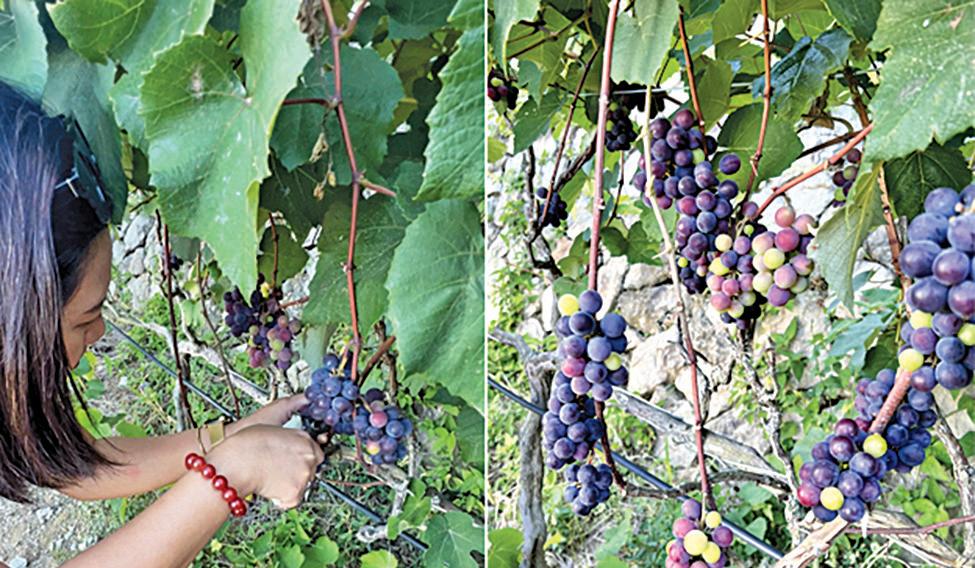
from the terraces, guests gathered at the Wine Gallery for an assortment of grape-inspired dishes and refreshments.
Attendees had their sweet tooth fixed with ice cream and cotton candy, while Kape Natividad offered locally brewed coffee for a comforting pickme-up. Guests also enjoyed selections from Barefoot Wines, with Sauvignon Cabernet, Sauvignon Blanc, and Pink Moscato flowing throughout the afternoon. One surprisingly delightful pairing stood out in particular: the Magnum ice cream bar with Pink Moscato, a refreshing combination that quickly became addictive.
The festivity culminated with a fireworks display and a dinner buffet at Twin Lakes Hotel, where fresh grapes were thoughtfully infused into several dishes. Standouts in-
cluded the Creamy Pumpkin Soup with Roasted Grapes and the Tosta de Salmon, both of which brought together rich flavors with subtle sweetness from the harvest.
During the Mother’s Day weekend, Twin Lakes Hotel also offered staycation packages, wellness activities, and family accommodation, alongside a dedicated Mother’s Day lunch buffet for celebrating guests.
“From harvesting grapes to spending the Mother’s Day weekend with family at Twin Lakes Hotel and the Shopping Village, the celebration has evolved into a countryside lifestyle experience that brings together food, leisure, nature, and community in a setting found nowhere else but here in Twin Lakes,” Monica added.
With its European-inspired ar-
chitecture and serene hillside setting, Twin Lakes Hotel offers a countryside escape that feels worlds away from the city. Mornings are greeted with picturesque views of Taal Lake and Volcano, with the vineyard adding to the property’s quiet charm. The Grape Harvest Festival beautifully completes the whole experience, bringing together wine culture, scenic landscapes, and leisurely living in a way rarely found in the country. Just a two-hour drive from Metro Manila, it’s a refreshing retreat that leaves you already looking forward to the next harvest season. For inquiries and reservations, guests may visit www.twinlakeshotel. com.ph or contact reser vations@twinlakeshotel.com.ph. For direct bookings, call +63 917 853 7468 or +63 917 846 1389.
where it all began,” says Paola Huyong, the visionary behind Siesta.
Ola by Siesta: An Experiential Horizon at Alabang West
New concept space
MEANWHILE, Ola by Siesta at Alabang West Parade serves as the brand’s new “concept space,” a fresh, experiential destination designed for tastemakers who value both aesthetic design and deep connection. The centerpiece of the Ola experience is the Horchata Tasting Flight, the first of its kind in the local café scene. By day, beginning May 16, 2026, Ola operates as a café with an evolving menu, then transforms into an intimate tasting-menu experience on weekend evenings.
Curated in collaboration with Chef Relynette Tan, this immersive offering pays tribute to the Philippines as a rice-growing country, showcasing locally sourced ingredients from various provinces to highlight the depth and complexity of the traditional rice drink.
Chef Rely’s appreciation for Latin cuisine deepened while working alongside Mexican, Guatemalan, Peruvian, Salvadoran, and Argentinian colleagues in kitchens across the United States.
Through these shared culinary experiences, she was introduced to flavors and dishes such as arepas, pupusas, mole, and many others —


inspirations that ultimately helped shape this contemporary interpretation of horchata.
Horchata Tasting Flight FROM Fridays to Sundays, starting at 6:00 pm, the Horchata Tast-

ing Flight debuts as an immersive journey through horchata’s evolution, told through carefully crafted pours, flavors, and traditions inspired by different cultures and eras. The experience features five

meticulously crafted drinks paired with a signature dessert, delivering a cohesive, thoughtfully curated flavor experience for every guest.
To keep the experience intimate and thoughtfully curated, each tasting flight is limited to a few guests per session.
While a dedicated reservation website is currently in development, those looking to secure a seat for this immersive experience can coordinate their schedules through Instagram.
“With the launch of the Horchata Tasting Flight, we wanted to create an experience that feels entirely new, one that invites guests to discover horchata in a
more thoughtful, immersive, and unexpected way,” shares Paola.
“More than simply serving a drink, we want to take our guests on a journey through different notes, textures, and interpretations of horchata. Ola is rooted in exploration and discovery, and we’re excited for the South community to experience what we’ve been creating.”
Whether visiting the community-focused BF branch or the sleek, experiential Ola by Siesta in Alabang, guests can expect the same commitment to elevated horchata. For updates, events, and exclusive drops, follow @SiestaHorchata and @OlabySiesta on Instagram.


May 31, 2026
Edited by Jose F. Lacaba


By Seymour B. Sanchez, Contributor
As the “Industrial Heart” of Metro Manila, Caloocan, Malabon, Navotas, and Valenzuela, collectively known as the CAMANAVA subregion, has been at the “edge” of the map of the Manila art scene for a long time. The area, through its artists, should not be limited by flood and traffic congestion.


of the four cities, from the salt/water of Navotas and Malabon to the steel and industrial sites of Caloocan and Valenzuela.
FOUR PILLARS OF THE NORTH
A CLOSER look at these four cities will reveal a unique texture of each location— Caloocan: “The Gateway and Historical Pulse” (Monumento/ history); Malabon: “The Heritage and Culinary Heart” (ancestral homes/river); Navotas: “The Coastal Lifeblood” (fisheries/sea); and Valenzuela: “The Industrial Engine” (manufacturing/ parks).
Being more than just a geographic cluster, the area is a landscape of water, labor, and a unique urban identity that often exists on the fringes of the national cinematic consciousness. CAMANAVA filmmakers have
usually focused on how the culture of the northern metropolis, particularly the rising tides of Malabon and the bustling fish ports of Navotas, shapes the way they tell stories.
Leading the pack is award-winning filmmaker Richard Soriano Legaspi, who has directed short films like Ambulancia (Ambulance), Kinulayang Kiti (Hand-Painted Feathers), and Pipo, to name a few.
Legaspi has been recognized for his Exemplary Performance in Visual Arts by the University of the East Caloocan, where he serves as a professor at the UE College of Fine Arts, Architecture, and Design (CFAD). He is also the curator of the Chua King Ha Galleries, Caloocan’s Outstanding Citizen Partner in Educational Program.
Legadspi was also honored with the Malabon Outstanding Citizen

Award and Gintong Parangal by the Malabon City for Arts, Culture and Community Service, and the Gawad Dr. Pio Valenzuela by the City Government of Valenzuela for his contributions to film. He also mentored student filmmakers and judged films in several editions of the Navoteño Film Festival organized by Navotas City.
AESTHETICS OF THE ORDINARY IN Ambulancia, an ambulance driver believes that a dying patient can be saved by running over stray animals on the streets. The film won the grand prize at the Viva-PBO Short Film Competition, the Miglior Montaggio Award at the 14th San Gio International Video Festival, Italy, and the Best Short Narrative at the Quisumbing-Escandor Film Festival for Health, all in 2008.
It also competed in Austria, Germany, Greece, Hungary, North Korea, Poland, South Korea, United Arab Emirates, and the United Kingdom.
On the other hand, Kinulayang Kiti tells the struggle of a young boy whose father was murdered in a labor rally. His last resort is to believe in a superstition that by placing live chicks on his father’s casket, their pecking will serve as stabs to the killer’s conscience.
The film won the Jury Prize at the Pandayang Lino Brocka Political and New Media Film Festival, Best Actress for Katherine Luna at the Doi Saket International Film Festival in Thailand, and Honorable Mention at the Gawad CCP para sa Alternatibong Pelikula at Video.
Continued on page 2
Sunday, May 31, 2026


Continued from page 1
Kinulayang Kiti was also part of the official selection at CineMaralita Film Festival, Cine Pambata Festival, AgitProp International Film Festival, International Panorama of Film and Video Patras in Greece, Jogja NETPAC-Asian Film Festival in Indonesia, Auburn International Film Festival in Sydney, Australia, Budapest International Short Film Festival in Hungary, Dubai International Film Festival in UAE, and Filipino American Film Festival in San Francisco, California, USA from 2009 to 2011. In Pipo, a boy dreams of having his family picture taken only to find out that what is more important is that he still has a loving family by his side more than anything else.
The short film won the Jury Prize at the ASEANnale Film and Multimedia Competition, Audience Prize at the GATFFEST Film Festival in Kingston, Jamaica, and Best Short Film at the SineBata Film Festival (Professional Category) in 2016. It likewise competed in Bangladesh, Brazil, Colombia, Germany, Greece, India, Italy, Japan, Malta, Mexico, Portugal, Russia, Slovenia, Taiwan, and the US.

Legaspi also helmed PamatidGutom (Hunger Pangs) and Panulukan (Crossroads). In Pamatid-Gutom, a mother, desperate to feed her child, takes part in the feeding program of the city mayor. Upon seeing the favorable response of the wife of the mayor to her child, she undertakes a disturbing gamble. A stark rendition of electoral politics in post-EDSA Philippines, the film won a production grant from Focus on the Global South-Philippines. Meanwhile, Panulukan is part of EngageMedia’s “Tech Tales: Films about Digital Rights in the AsiaPacific.”
In the film, a ride back to Manila becomes a journey to a divided nation. As the characters reveal themselves through social media, we learn if they will embrace the truth, or willingly drown in lies.
LABOR & THE INDUSTRIAL HO -
RIZON
SOME of Legaspi’s former students have trained their sights toward the “working” identity of Navotas and Valenzuela, the ports and the factories.
Others have looked at the resilience of families in Caloocan and
Malabon who have adapted their homes and livelihoods to the permanent presence of water.
Elvin Jay Macanlalay, a UE College of Fine Arts, Architecture and Design (CFAD) graduate and a queer interdisciplinary artist, directed two short documentaries in Caloocan City. One is about the jeepney drivers of Sangandaan and the other tackled the kids of Bagong Silang. He was recognized by the city as one of its outstanding citizens in 2019.
Di N’yo Ba Naririnig (Can’t You Hear?), a film shot with a mobile phone about the sentiments of jeepney drivers, won for Macanlalay the Golden Kinabalu for Best Documentary Film at the 13th Kota Kinabalu Film Festival in Malaysia and the Ani ng Dangal award.
Macanlalay’s other work, Between the Lines , depicts how a community takes care of children when the educational system fails them. It bagged the Best MegaCityShortDocs Award at the MegaCitiesShortDocs Festival in Paris and was screened during the 9th Semaine du Cinéma Positif Week at the Festival de Cannes 2024.
John Lanbert Rafols, together with fellow UE CFAD alumni Jay



Condeno and John Nico Nunag, documented the everyday life of workers in a corrugated iron factory in Yero, highlighting their struggles and the harsh conditions of their labor.
The documentary reveals the harsh conditions inside the factory, as workers scavenge through metal scraps without safety tools or hazard protections for. It won Best Short Documentary at the 21 Islands International Short Film Festival in New York, USA.
In addition, Luke Miraflor’s Limbo which vied at the Short Shorts Film Festival and Flickerfest International Short Film ASEAN Regional Competition, looks at a day in the life of a poor teenage boy in constant search of food and luck in Malabon.
A member of the Filipino Society of Cinematographers, Miraflor is also a product of UE CFAD and a fellow film educator like Legaspi, Macanlalay, and Rafols.
He also directed Ang Pagbabalik ni Max Buwaya (2025), a finalist in the 37th CCP Gawad Alternatibo short fiction category, and Clairvoyant (2021), which was featured at Interfilm Berlin and Bucheon International Fantastic Film Festival in South Korea. Malabon also honored Miraflor
with the Gintong Parangal for his significant contributions to Philippine cinema and for representing the country in numerous international film festivals.
Another notable UE CFAD student project, Isda, Lambat, Daang Paliit (Narrowing Roads) directed by Anjella Cruz, won the Gold Award in Cinematography at the FACINE 29: Filipino International Cine Festival.
The documentary, Cruz’s collaboration with Josh Carl Dela Rosa and Joyce Anne Castro, amplifies the marginalized sector during the pandemic, like Macanlalay’s work on jeepney drivers.
NARRATIVE OF THE TIDE OUTSIDE UE CFAD, other student filmmakers have also documented CAMANAVA stories.
Kwentong Barado, directed by University of Makati student Sarah Silva, dips its toes in flood-prone Malabon, as three men clear clogged waterways and confront the hidden consequences of everyday waste.
The new work, which competed in the documentary category of Piling Obrang Vidyo at the University of the Philippines last May 11, reveals


where trash truly ends up, and who pays the price for it.
Far Eastern University students Shayne Flores and Chelzea Mafae recently co-directed Sa Pagliit ng Dagat, a documentary on the mussel farmers of Little Samar in Navotas City. It won the Special Jury Prize at the Truth. Advocacy. Media (TAM) DokyuFest held last May 8 at the FEU Plaza. Similarly, Tabon Alon by Arianne Arcangel Prado also talks about the struggle and conviction of the mussel farmers of the city, as they fight to put an end to a reclamation project that has threatened to limit their way of life.
Other short films from the Navoteño Film Festival have also added to the stories of CAMANAVA, which flow through narrative veins that transcend time, bound by the umbilical connection of shared histories and lived experiences.
Like the Tullahan river that courses through cities, these stories shape who the filmmakers are—interwoven, resilient, and united as a collective storyteller.
CAMANAVA should not just be seen as a flood-prone zone, but a vibrant, essential source of Philippine culture and storytelling.