

‘WHITE HAT’ HACKERS WELCOME TO PARTNER WITH DICT TO EXPOSE GOVT VULNERABILITIES
By Lorenz S. MarasiganTHE Department of Information and Communications Technology (DICT) is open to partnering with “white hat” hackers to expose government vulnerabilities and reduce attacks to public systems.
However, the agency admonished the “hacktivists” against dumping data on the internet. “We are open to partnering with these individuals. But if your way of activism is dumping these data on the web, personally, I would doubt your intentions. If you are true to your intentions, then contact us directly,” DICT Spokesman Renato Paraiso Jr. said.
In an interview late Wednesday, Paraiso said the recent infiltration of the National Police’s Firearms and Explosives Office licensing systems was claimed by hacktivist “ph1ns.” However, the ICT department is “not ruling out other possibilities as well.”
“We have to validate the claim,” Paraiso said.
As of press time, the DICT is still assessing the impact of the hack; however, reports have shown that the hacker has said to have exploited the vulnerabilities of the FEO, gaining access to 1.5 terabytes of sensitive data.
“It was a shotgun approach. They tried to penetrate several systems and when they got a vulnerability, they targeted it for one to two months before they were able to access it,” Paraiso said.
The compromised data includes detailed personal information of hundreds of thousands of individuals—names, addresses, dates and places of birth, occupations, educational backgrounds, medical records, religion, and fam-

ily information. Additionally, financial transaction records such as names, transaction numbers, dates, pay slips, firearm registration status, and emails were leaked. The database contains 1,562,463 entries in the transactions table, affecting approximately 590,000 individuals.
The breach even had data entries related to high-profile political figures, including President Marcos and Vice President Sara Duterte.
Paraiso noted that the National Police’s cybersecurity system is not “off-the-rack.”
“The system of the PNP is not to be messed with, but even the most sophisticated system has vulnerabilities,” he said. “With technology ever evolving, what you procure now may be obsolete in six months—so we have to practice cyber hygiene like constant testing.”
Paraiso likened this to purchasing shoes.
“It has wear and tear,” he said. He noted that the attack is not


consistent with that of ransomware.
“It’s an exfiltration of data from that particular system. We don’t have any reason to believe that it was ransomware,” Paraiso said.
The hacker, “ph1ns,” claims in their X profile that they are the “DICT’s best friend.”
Just on Thursday, the hacker called on the National Police, citing another vulnerability.
“Dear PNP, your implementation of 2FA [two-factor authentication] for e-mails doesn’t work well. It is still possible to connect directly to the IMAP [Internet Message Access Protocol] and SMTP [Simple
Mail Transfer Protocol] servers using a mail client and bypass 2FA this way,” the hacker said. It appears that “ph1ns” is a hacktivist who exposes government vulnerabilities for correction.
Paraiso said the DICT is open to working with the likes of “ph1ns.” The caveat, however, is for them not to expose these vulnerabilities to the public. The government has been seeing a slew of digital attacks over the past few months. These include hacks on the systems of the Philippine Health Insurance Corp., the Congress, the Senate, and the Department of Education, among others.
Seven-hour talks in Geneva hotel highlight US-China struggle on AI
By Michelle Jamrisko & Augusta Saraiva | BloombergFOR seven hours at a Geneva hotel earlier this month, top US and Chinese officials locked into talks on collectively managing their biggest fears around artificial intelligence—while keeping up a cutthroat competition to dominate technology that promises to reshape the global economy.
Their meeting marked the first government discussions on AI between the US and China, with roughly nine officials from each side stressing a shared desire to prevent nightmare scenarios like a computer-triggered nuclear war. One ironic deviation from the script: The coffee machine at the venue broke as they discussed far more advanced technology. While the Geneva talks yielded no concrete agreements, the conversations were cordial and set the stage for continued engagement on safety and risks related to AI,
according to two Biden administration officials, who spoke on condition of anonymity to discuss diplomatic matters. For now, there’s no follow-up meeting scheduled, they said.
Chinese Foreign Ministry spokesman Wang Wenbin said after the meeting that China was “willing to strengthen exchanges and cooperation with the United States in the field of artificial intelligence, explore the use of artificial intelligence to empower sustainable development, and communicate on the next issue in

risk response.”
Even as the two sides seek to cooperate on artificial intelligence, the technology is also emerging as a new arena of rivalry for the world’s two largest economies—already at odds over Taiwan, wars in Ukraine and Gaza, and US-led export restrictions on semiconductor technology.
Conversations on AI are also playing out at the United Nations and in so-called “track two” group-
ings of private-sector participants from the US and China, with all of this activity endorsed from the very top. The bilateral dialogue was one of the highlighted US achievements out of the last in-person meeting between President Joe Biden and Chinese President Xi Jinping in California in November. Washington and Beijing are now jockeying to write the rules for AI governance, with each side portraying the other as a destabi-
lizing force as they court the Global South. In March, the US rallied support for a UN resolution aimed at promoting “safe, secure and trustworthy” AI systems worldwide, a months-long effort backed by more than 110 countries as cosponsors, including China. Beijing is now crafting its own proposal, intended to close gaps between rich and developing nations.
Though the US and Chinese efforts at the UN are non-binding and would do little to advance comprehensive regulation, they represent broader efforts to lead the global AI conversation. Biden initially highlighted the need to bring AI discussions to the UN and other multilateral forums when he spoke before the General Assembly in New York in September, while Chinese Foreign Minister Wang Yi announced his country’s push in March.
In Geneva, Biden administration officials raised concerns that China is misusing AI, including in ways that risk encroaching on human rights, while the Chinese delegation recited worries on export controls and outbound investment. The talks took place
the same day that the US announced a new swath of tariffs on a range of Chinese imports, including quadrupling the tariff rate for electric vehicles.
“The fact that Beijing still participated in the talks when the US had thoroughly telegraphed the tariff hike, to me, underscores China has its own concerns about the potential applications of AI,” said Jennifer Welch, chief geoeconomics analyst at Bloomberg Economics.
The US delegation made an extensive presentation of valuation measurements, transparency, and monitoring led by Elizabeth Kelly, director of the US Artificial Intelligence Safety Institute, the Biden administration officials said. One goal from the US side was to better understand how Chinese officials are planning AI regulations and gauging potential high-impact risks as well as day-to-day issues such as health care.
On the other side of the table was Yang Tao, the Chinese foreign ministry’s director-general of North American and Oceanian Affairs. His presence highlighted the
PESO EXCHANGE RATES US 58.2150 JAPAN 0.3709 UK 73.9331 HK 7.4554 CHINA 8.0383 SINGAPORE 43.0775 AUSTRALIA 38.4510 EU 62.9712 KOREA 0.0426 SAUDI ARABIA 15.5227 Source: BSP (May 24, 2024) Continued on A2 A broader look at today’s business EJAP JOURNALISM AWARDS BUSINESS NEWS SOURCE OF THE YEAR (2017, 2018, 2019, 2020, 2021) ) DEPARTMENT OF SCIENCE AND TECHNOLOGY 2018 BANTOG MEDIA AWARDS ROTARY CLUB OF MANILA JOURNALISM AWARDS 2006 National Newspaper of the Year 2011 National Newspaper of the Year 2013 Business Newspaper of the Year 2017 Business Newspaper of the Year 2019 Business Newspaper of the Year 2021 Pro Patria Award PHILIPPINE STATISTICS AUTHORITY 2018 Data Champion www.businessmirror.com.ph Sunday, May 26, 2024 Vol. 19 No. 222 P25.00 nationwide | 4 sections 28 pages | 7 DAYS A WEEK
SKYPIXEL DREAMSTIME.COM COFFEEMILL DREAMSTIME.COM
DICT Spokesman Renato Paraiso Jr.
Xiaohongshu: How a Chinese influencer platform became a $20-billion empire
By Venus Feng & Dong Cao BloombergTERESA Cheung fired up her Xiaohongshu app, turned on her camera and dazzled her nearly 1.8 million online followers over a seven-hour livestream.
One moment, she was demonstrating a palette of eyeshadow: “This color is called ‘Love Letter’,” she said in Mandarin, touting a dark berry-colored shade. The next, she was reciting an excerpt from the poem “A Valediction: of the Book” by John Donne in perfect English:
“Study our manuscripts, those myriads Of letters, which have past ‘twixt thee and me, Thence write our annals, and in them will be, To all whom love’s subliming fire invades, Rule and example found.”
By the end, the 60-year-old actress from Hong Kong had promoted dozens of beauty products, read some Shakespeare verses and become the first on the platform to top 100-million yuan ($13.8 mil-
lion) in sales in a single session.
Xiaohongshu Technology Co.—part Instagram, part Pinterest—has boomed in recent years as a combination of top influencers like Cheung, its artificial intelligence technology and soft marketing tactics make it a lifestyle bible for many of China’s high-income earners. It also created a $6-billion fortune for its co-founders, Charlwin Mao Wenchao and Miranda Qu Fang, according to the Bloomberg Billionaires Index. “Xiaohongshu is a powerful tool for brands wanting to enter the Chinese market or attracting Asian customers in the United States,” said Frost Li, founder of Loup.ai, an e-commerce solution provider that helps online retailers use AI to engage with customers. “They really double down on the view time and click-through rate.”
Founded in 2013, the company, whose name translates to “lit-


tle red book,” has defied the government’s crackdown on the tech industry. After venturing into the realm of live shopping, it hit $500 million in profit last year, beating peers including Weibo, the Chinese equivalent of X that has almost twice as many users.
Backed by heavyweight investors including Alibaba Group Holding Ltd., Tencent Holdings Ltd. and Singapore’s Temasek Holdings Pte, Xiaohongshu was valued at $20 billion in its last funding round in 2021. Mao and Qu own about 27 percent and 3 percent of the company, respectively, according to people familiar with the matter, who requested anonymity because the information is private.
While shares trading in the secondary market last year indicated a lower valuation, the Shanghaibased company has since shown better-than-expected business growth and China has eased its attitude toward tech. Next month, a mid-year shopping bonanza similar to Singles’ Day will test the app’s ability to attract buyers.
A Xiaohongshu representative didn’t respond to a request for comment.
Started as a shopping guide for Chinese tourists abroad, Xiaohongshu now counts 300 million monthly active users. Its success is based on what is known as “content seeding”: Key opinion leaders, also called KOLs, upload posts that often look like travel hacks or tips to help consumers with things such as finding the best makeup to match their skin tone or the right dress to land a finance job. The firm’s technology then tracks what content users spend time on and shows them similar posts when they return.
“The management team has spent time building up the quality of the user community,” said Cao Rui, senior analyst at Tianfeng Securities. “The posts are often relatable with daily life, and it has become a popular and unique search tool for consumers to look for beauty and lifestyle products.”
At a time of economic malaise, when many larger e-commerce incumbents are poaching price-
sensitive buyers, Xiaohongshu has become particularly appealing to marketers: Most of its users are young female professionals and about half were born after 1995. Almost 17 percent spend at least 3,000 yuan online every month, the biggest proportion among major Chinese social apps, according to data from Internet business intelligence service QuestMobile. More than 100,000 sales advisers and key fashion influencers post on Xiaohongshu regularly to market products, and luxury brands including Dior have set up online “malls” on the app to tap young wealthy customers.
Mao, 39, Xiaohongshu’s chief executive officer, was in the US when he thought of building an aggregator of lifestyle tips for tourists from the second-largest economy. The former Bain Capital consultant, who has an MBA from Stanford University, shared the idea with long-time friend Qu and convinced her to quit her job at a culture business to join forces. They earned backing from Chinese venture investor ZhenFund at the very beginning of the project, with other big-name investors, including Alibaba, GGV Capital and Tencent soon following.
The app quickly gained popularity outside of mainland China, with Hong Kong, Taiwan, the US and Malaysia now driving most of the traffic, according to an analysis from digital data intelligence firm Similarweb. In Hong Kong, where finance professionals commonly post about banker life and mainland tourists share their travel experiences, Xiaohongshu has become so ubiquitous that a lawmaker earlier this year went as far as warning the government itself is paying too much attention to what people say on the platform, giving the impression the app is “administering” the city.
While its e-commerce bets are paying off, Xiaohongshu’s long journey to an initial public offering has been anything but smooth. Qu, who manages strategic partnerships, business development and external affairs, said in a 2018 interview with Bloomberg the company was targeting a listing in two to three years—there’s still none on the horizon. China’s tech crackdown has since hindered growth at many Internet firms, while TikTok’s divest-or-ban ultimatum in the US could turn off global investors’ interest in the Asian nation’s social-media companies.
Competition in the e-commerce space is also intensifying. Many existing larger players—including Alibaba, JD.com Inc., PDD Holdings Inc. and ByteDance Ltd.’s Douyin, TikTok’s Chinese twin app—are leveraging AI to make shoppers spend more time on their platforms.
“Xiaohongshu has built up a relatively higher user loyalty than other platforms based on the uniqueness and branding of the KOLs,” said Tianfeng’s Cao. “It needs to maintain its differentiation in its e-commerce offerings to gain more market share.”
different priorities that the US and China had for the talks, according to Matt Sheehan, fellow at the Carnegie Endowment for International Peace who focuses on global technology issues and China.
“China appears to be treating this dialogue as one piece of managing the bilateral relationship, while the US is treating it as one piece of managing global AI risks,” Sheehan said.
US officials have stressed that the talks would not lead to deeper collaboration or research sharing with a country that’s seen as an adversary, especially when it comes to data security.
In the face of critics who question why the two sides should engage on sensitive issues at all, the Biden administration has insisted on pairing strategic competition with intensive diplomacy, featuring recent visits to China by officials including Secretary of
State Antony Blinken and Treasury Secretary Janet Yellen.
“Even if this dialogue fails to produce significant concrete steps I wouldn’t rush to label it a failure,” said Welch, who was China director at the National Security Council from May 2020 to April 2023. “In an era of intensifying strategic competition, there’s value to the two parties communicating to, at the very least, reduce misunderstandings and misperceptions.”
NewsSunday BusinessMirror www.businessmirror.com.ph Sunday, May 26, 2024 A2
Continued from A1 US-CHINA STRUGGLE ON AI
TIMON SCHNEIDER DREAMSTIME.COM
XIAOHONGSHU co-founder Miranda Qu Fang. QILAI SHEN/BLOOMBERG
Editor: Angel R. Calso
Trump or Biden? Either way, the US seems poised to preserve heavy tariffs on imports
By Paul Wiseman Ap Economics WriterWASHINGTON—As president, Donald Trump imposed a 25 percent tariff on foreign steel, which hurt Clips & Clamps Industries, a Michigan auto supplier—raising its materials prices, making it harder to compete with overseas rivals and costing it several contracts.
Jeff Aznavorian, the company president, thought he might enjoy some relief once Joe Biden entered the White House. Instead, Biden largely preserved Trump’s tariffs—on steel, aluminum and a mass of goods from China.
“It was a little surprising that an ideologically different administration would keep the policies so intact,’’ Aznavorian said, recalling how a previous Democratic president, Bill Clinton, had fought for freer trade. “That’s just so different from a 2024 Biden administration.’’
Trump and Biden agree on essentially nothing, from taxes and climate change to immigration and regulation. Yet on trade policy, the two presumptive presidential nominees have embraced surprisingly similar approaches. Which means that whether Biden or Trump wins the presidency, the United States seems poised to maintain a protectionist trade policy—a policy that experts say could feed inflation pressures.
Last week, in fact, Biden announced some new tariffs, on Chinese electric vehicles, advanced batteries, solar cells and other products, that he said would keep Beijing from flooding the United States with cheap imports.
The protectionist tilt of the two presidential contenders reflects the widespread view that opening the nation to more imports— especially from China—wiped out American manufacturing jobs and shuttered factories. It’s an especially potent political topic in the Midwestern industrial states that will likely decide who wins the White House.
“If you look at the election, it’s obvious,’’ said William Reinsch, a former trade official now at the Center for Strategic and International Studies. “Where are the deciding states? Pennsylvania, Michigan, Wisconsin—right there, you can see that trade is going to have an outsize role.’’
In their own ways, the two candidates have ditched a US commitment to relatively frictionless trade—low barriers and scant government interference—that were the bedrock of American policy for decades after World War II. The idea was that free trade would hold down costs and aid consumers and businesses across the world.
In recent years, though, the perception grew that while free trade benefited households and companies, it hurt workers, with American jobs falling victim to cheaper foreign labor.
“The once nearly unanimous Washington consensus on free trade is dead,” Robert Lighthizer, who was Trump’s lead trade negotiator, crowed in his 2023 book, “No Trade Is Free.’’ Yet like free trade, trade protectionism carries its own economic price. It can raise costs for households and businesses just as the nation is struggling to fully tame inflation. It tends to prop up inefficient companies. It spurs retaliation from other nations
against American exporters. And it typically sours relations with allies and adversaries alike.
Trump, who brazenly labeled himself “Tariff Man,’’ tried to pummel America’s trading partners with import taxes, vowing to shrink America’s trade deficits, especially with China.
He did pressure Mexico and Canada into rewriting a North American trade deal that Trump insisted had destroyed US manufacturing jobs. He also persuaded China to agree to buy more American farm goods. But his efforts didn’t revive the manufacturing base— factory jobs make up a smaller share of US employment than they did before his presidency—or shrink America’s trade deficits.
Trump has vowed more of the same in a second term. He’s threatening to impose a 10 percent tariff on all imports—and a 60 percent tax on Chinese goods.
“I call it a ring around the country,’’ Trump said in an interview with Time magazine.
Mark Zandi, chief economist at Moody’s Analytics, warns that the consequences would be damaging. Trump’s tariff plans, Zandi said, “would spark higher inflation, reduce GDP and jobs and increase unemployment, all else equal.”
A year after the import taxes were imposed, Zandi estimates, average consumer prices would be 0.7 percentage points higher than they would otherwise be. A report out Monday, from Kimberly Clausing and Mary Lovely of the Peterson Institute for International Economics, estimates that for families in the middle of the US income distribution, Trump’s tariff proposals would amount to a tax of at least $1,700 a year. For his part, Biden favors subsidizing such key industries as chipmaking and EV manufacturing to give them a competitive edge. It’s a stance that reflects worry that China’s rising military and technological might imperil America’s national security. As last week’s announcement showed, Biden isn’t averse to new tariffs, either. His top trade negotiator, Katherine Tai, has opened an investigation into Chinese trade practices in the shipbuilding industry, likely a prelude to imposing further sanctions on Beijing.
“The laissez-faire economic model of trade wasn’t working for the United States,’’ said Elizabeth Baltzan, a senior adviser to Tai.
“We want to correct for that. The measures you take in order to get a fairer (economy) may involve measures that could be labeled protectionist. But I think you have to ask what you’re protecting”—notably workingclass communities.
Dani Rodrik, a Harvard economist who was an early critic of the globalization of the 1990s and 2000s, views Biden trade policies more favorably than he does Trump’s approach. “Trump’s was knee-jerk and incoherent;
The protectionist tilt of the two presidential contenders reflects the widespread view that opening the nation to more imports— especially from China—wiped out American manufacturing jobs and shuttered factories. It’s an especially potent political topic in the Midwestern industrial states that will likely decide who wins the White House.

THE United States Steel Mon Valley Works Clairton Plant in Clairton, Pa., is shown on February 26, 2024. President Biden and Donald Trump agree on essentially nothing, from taxes and climate change to immigration and regulation. Yet on trade policy, the two presumptive presidential nominees have embraced surprisingly similar approaches. AP/GENE J.
there is little evidence that his trade restrictions on China did any good to workers or the middle class in the US,’’ Rodrik said.
By contrast, he said, “Biden’s approach is strategic and based on rebuilding US manufacturing capacity and investing in the green transition, so fundamentally strengthening the US economy rather than crass protectionism.”
Either way, a consensus formed in recent years that US trade policy had to change. Moving factories to low-wage countries like Mexico and China in the 1990s and early 2000s, critics say, fattened corporate profits and enriched executives and investors but devastated American factory towns that couldn’t compete with cheap imports.
David Autor, a leading economist at the Massachusetts Institute of Technology, and two colleagues concluded in a 2016 paper that from 1999 to 2011, cheap Chinese imports wiped out 2.4 million American jobs.
More recently, China’s rise as America’s No. 1 geopolitical rival has created a bipartisan effort to reduce America’s reliance on Beijing for supplies of everything from pharmaceuticals to “rare earth’’ minerals for electric cars and cellphones.
Though this sea change in policy may have started with Trump, discontent with free trade and with an increasingly combative China had been building for years. One of Trump’s first presidential acts was to dump a free trade agreement the Obama administration had negotiated with 11 Pacific Rim countries.
Then Trump really got going. He imposed taxes on foreign washing machines and solar panels. Next, he labeled steel and aluminum imports a threat to national security and hit them with tariffs.
Finally, he started perhaps the biggest trade war since the 1930s: He hammered $360 billion of Chinese products with tariffs for Beijing’s efforts to surpass US technological supremacy through illicit tactics, including cyber theft. China lashed back with retaliatory taxes of its own: It targeted American farmers, in particular, to try to hurt Trump’s constituency in rural America.
Did Trump’s tariff war achieve anything?
A study by Autor and colleagues at the University of Zurich, Harvard and the World Bank concluded that Trump’s import taxes failed in their goal to return jobs to the American heartland. The tariffs, the study found, “neither raised nor lowered US employment’’ where they were supposed to protect jobs.
Worse, the retaliatory taxes imposed by China and other nations on US goods had “negative employment impacts,’’ especially for farmers. These were only partly offset by billions in government aid that Trump bestowed on farmers to cushion their pain.
The Trump tariffs also damaged companies that relied on supplies that were affected by the tariffs. In Plymouth, Michigan, Clips & Clamps doesn’t even use much imported steel. Yet it was still hurt by the tariffs because they allowed American steel producers to raise their prices.
“Our raw material prices here in the United States tend to be 20 percent higher than Europe and Mexico and 40 percent to 60 percent higher than China,’’ Aznavorian said. His overseas rivals, he said, enjoy “significantly cheaper’’ costs.
If Trump’s trade war fizzled as policy, though, it succeeded as politics. Autor’s study found that support for Trump and Republicans running for Congress rose in the areas most exposed to the import tariffs—the industrial Midwest and manufacturing-heavy Southern states like North Carolina and Tennessee.
After entering office, Biden retained many of Trump’s trade policies and made no effort to revive Obama’s old Pacific Rim trade pact. He kept Trump’s steel and aluminum tariffs, while letting some trading partners avoid it until they reached a quota. He also retained China tariffs. Biden even turned up the heat on Beijing by restricting its access to advanced computer chips and the equipment to make them.
“Trade and national security have been combined into one thing,’’ Reinsch said. “This is the first time we’ve had an adversary that posed both an economic and a security challenge. The Soviet Union was a security challenge, but it was never an economic threat. Japan was an economic threat in the ‘80s, but it was never a security threat; they were an ally. China is both, and it’s been complicated trying to figure out how to deal with that.’’ Biden’s China policies are “grounded in national security,’’ said Peterson’s Lovely. “That
makes it harder to critique because national security is always this black box that only those with the highest security clearance get to see.’’
The Biden administration has rankled some US allies by offering subsidies to encourage US companies to manufacture goods in America. Under Biden’s 2022 Inflation Reduction Act, for instance, auto buyers can receive a $7,500 tax credit for purchasing an electric vehicle. But the credit applies only to EVs assembled in North America. And the full credit goes only to EVs in which at least 60 percent of battery
“It’s important that the United States develop its own clean energy sector, in collaboration with its allies and partners, thereby not becoming dependent on Chinese technologies,’’ said Wendy Cutler, a former US trade negotiator who is vice president of the Asia Society Policy Institute. “When trade is increasingly being weaponized, it’s important that the US does not become overly dependent on China for strategic products.’’
Biden’s initiatives—including incentives to produce green technology and computer chips in the United States—have spurred what looks like a surge of investment in manufacturing.
Karen Dynan of the Peterson Institute has reported that investment in US factories surged at an 80 percent annual rate in the JanuaryMarch period compared with the final three months of 2023, helping fuel the economy’s unexpectedly strong performance.
The United States seems unlikely to reverse its tilt toward protectionism anytime soon. China, struggling to revive its own economy, is trying to export its way out of trouble, threatening to overwhelm world markets with cheap EVs and other products.
As for Aznavorian, he hopes the US mends trade relations with its allies.
“We need friendly trade partners in order to compete against China,’’ he said. Yet when it comes to China and other US adversaries, Aznavorian said, he’s convinced that protectionist trade policies are “definitely here to stay.’’

Sunday,
26, 2024 A3 The World
May
parts are made in North America and 50 percent of the “critical minerals’’ used in the vehicle—like cobalt, copper
lithium—come
the United States
country
US has a free trade deal.
and
from
or a
with which the
PUSKAR
How 2 debunked accounts of sexual violence fueled a global dispute over Israel-Hamas war
By Tia Goldenberg & Julia Frankel The Associated PressJERUSALEM—Chaim
Otmazgin had tended to dozens of shot, burned or mutilated bodies before he reached the home that would put him at the center of a global clash.
Working in a kibbutz that was ravaged by Hamas’ October 7 attack, Otmazgin—a volunteer commander with ZAKA, an Israeli search and rescue organization—saw the body of a teenager, shot dead and separated from her family in a different room. Her pants had been pulled down below her waist. He thought that was evidence of sexual violence.
He alerted journalists to what he’d seen. He tearfully recounted the details in a nationally televised appearance in the Israeli Parliament. In the frantic hours, days and weeks that followed the Hamas attack, his testimony ricocheted across the world.
But it turns out that what Otmazgin thought had occurred in the home at the kibbutz hadn’t happened.
Some accounts are untrue
BEYOND the numerous and welldocumented atrocities committed by Hamas militants on October 7, some accounts from that day, like Otmazgin’s, proved untrue.
“It’s not that I invented a story,” Otmazgin told The Associated Press in an interview, detailing the origins of his initial explosive claim—one of two by ZAKA volunteers about sexual violence that turned out to be unfounded.
“I couldn’t think of any other option” other than the teen having been sexually assaulted, he said. “At the end, it turned out to be different, so I corrected myself.”
But it was too late.
The United Nations and other organizations have presented credible evidence that Hamas militants committed sexual assault during their rampage. The prosecutor for the International Criminal Court, Karim Khan, said Monday he had reason to believe that three key Hamas leaders bore responsibility for “rape and other acts of sexual violence as crimes against humanity.”
Though the number of assaults is unclear, photo and video from the attack’s aftermath have shown bodies with legs splayed, clothes torn and blood near their genitals.
However, debunked accounts like Otmazgin’s have encouraged skepticism and fueled a highly charged debate about the scope of what occurred on October 7—one that is still playing out on social media and in college campus protests.
Some allege the accounts of sexual assault were purposely concocted. ZAKA officials and others dispute that. Regardless, AP’s examination of ZAKA’s handling of the now debunked stories shows how information can be clouded and distorted in the chaos of the conflict.
As some of the first people on the scene, ZAKA volunteers offered testimony of
what they saw that day. Those words have helped journalists, Israeli lawmakers and UN investigators paint a picture of what occurred during Hamas’ attack. (ZAKA, a volunteerbased group, does not do forensic work. The organization has been a fixture at Israeli disaster sites and scenes of attacks since it was founded in 1995. Its specific job is to collect bodies in keeping with Jewish law.)
Still, it took ZAKA months to acknowledge the accounts were wrong, allowing them to proliferate. And the fallout from the debunked accounts shows how the topic of sexual violence has been used to further political agendas.
Israel points to sexual violence on October 7 to highlight what it says is Hamas’ savagery and to justify its wartime goal of neutralizing any repeated threat coming from Gaza. It has accused the international community of ignoring or playing down evidence of sexual violence claims, alleging anti-Israel bias. It says any untrue stories were an anomaly in the face of the many documented atrocities.
In turn, some of Israel’s critics have seized on the ZAKA accounts, along with others shown to be untrue, to allege that the Israeli government has distorted the facts to prosecute a war—one in which more than 35,000 Palestinians have been killed, many of them women and children, according to Gaza health officials.
A UN fact-finding team found “reasonable grounds” to believe that some of those who stormed southern Israel on October 7 had committed sexual violence, including rape and gang rape. But the UN investigators also said that in the absence of forensic evidence and survivor testimony, it would be impossible to determine the scope of such violence. Hamas has denied its forces committed sexual violence.
Body bags and rocket fire
ISRAEL was caught off guard by the ferocity of the October 7 assault, the deadliest in the nation’s history. About 1,200 people were killed and 250 taken hostage. It took days for the military to clear the area of militants. There were hundreds of bodies scattered across southern Israel, bearing various signs of abuse: burns, bullet holes, signs of mutilation, marks indicating bodies were bound. ZAKA volunteers weren’t used to dealing with so many bodies.
“You get dizzy at some point,” said Moti Bukjin, ZAKA’s spokesperson. “Some of the bodies are burned. Some are mutilated. Some of the bodies are decapitated. Every house has a story.”
Standard protocols for dealing with attacks, which Israel encountered frequently on a far smaller scale in the early 2000s, collapsed. There was confusion over


VOLUNTEERS from the ZAKA rescue service remove blood stains from a public bomb shelter on a road near the Israeli-Gaza border in the aftermath of the October 7 Hamas attack, November 20, 2023. Some allege the accounts of sexual assault were purposely concocted. Zaka officials and others dispute that. Regardless, AP’s examination of Zaka’s handling of the now debunked stories shows how information can be clouded and distorted in the chaos of the conflict. AP/OHAD
who was dead and who was taken captive, especially in the hard-hit communal farming villages and in the aftermath of the outdoor Nova music festival.
Authorities were concerned that remaining militants might snatch more bodies. ZAKA says it was instructed to gather the dead as swiftly as possible and send them for identification and quick burial, according to Jewish custom. ZAKA said it sent some 800 volunteers to southern Israel, arriving at the music festival late on October 7 and entering the kibbutzim two days later, according to Otmazgin.
For the first three days, many hardly slept at all. Accompanied by military escorts, volunteers went house to house, wrapping the bodies in white plastic bags on which they wrote the person’s gender, the house number where they were found and any other identifying details. Then they’d say the Jewish mourning prayer and load them into a truck, according to Tomer Peretz, who volunteered for the first time with ZAKA in the days following the attack.
As first responders worked, rocket fire from Gaza boomed overhead. Volunteers paused and crouched when air raid sirens blared. They used anything they could find to move bodies—even shopping carts. “We worked a minute and a half per body, from the moment we touch it to the moment it is on the truck,” said Otmazgin, commander of special units with ZAKA.
Peretz, a US-based artist, said the volunteers weren’t there to do forensic work; he thought the soldiers who cleared the houses of explosives beforehand were handling that process. But the Israeli military told the AP that the army did not do any forensic work in the wake of October 7.
Bukjin said police forensics teams were mostly focused on the southern cities of Sderot and Ofakim. Otmazgin said forensics workers were present in the kibbutzim but spread thin and could not follow standard—and painstaking—protocols because of the scale of the attack. He said forensics teams in the area mostly instructed ZAKA on how to help identify the bodies.
That means that bodies that might have shown signs of sexual assault could have eluded examination. Instead, they were loaded into body bags, sent to a facility to be identified and dispatched for quick burial.
“People seem to have expected that the aftermath of the attack would be like a movie, that immediately the police would come, that everything would be very sterile and very clean. People who don’t live in a war zone do not understand the horrific chaos that took place that day,” said Orit Sulitzeanu, the executive director of The Association of Rape Crisis Centers in Israel.
The group has spent months gathering evidence of sexual violence that occurred that day, sifting through many accounts emerging from the chaotic early days just after the attack. “Some of those stories that turned out not to be true were not lies,” she said. They were, she said, “mistakes.”
First account: Pants pulled down OTMAZGIN said he was the origin of one of two debunked stories by ZAKA volunteers about sexual assault.
He said he entered a home in Kibbutz Be’eri, one of the hardest-hit communities,
where nearly a tenth of the population of roughly 1,000 was killed, and found the body of a teenage girl separated from two of her relatives. Her pants, he said, were pulled down. He assumed that meant she had been sexually assaulted.
“They slaughtered her. They shot her in the head and her pants are pulled down to here. put that out there. Have someone give me a different interpretation,” he said then, showing an AP reporter a photo he took of the scene, which he had altered by pulling up the teenager’s pants.
Today, he maintains that he never said outright that the girl whose body he saw had been sexually assaulted. But his telling strongly suggested that was the case. Otmazgin says he told journalists and lawmakers details of what he’d seen and asked if they might have some other interpretation.
Nearly three months later, ZAKA found out his interpretation was wrong. After crosschecking with military contacts, ZAKA found that a group of soldiers had dragged the girl’s body across the room to make sure it wasn’t booby-trapped. During the procedure, her pants had come down.
Otmazgin said it took time to learn the truth because the soldiers who moved the body had been deployed to Gaza for weeks and were not reachable. He said he recognized that such accounts can cause damage, but he believes he rectified it by correcting his account months later.
A military spokesperson said he had no way of knowing what had happened to every body in the assault’s immediate aftermath. He spoke on condition of anonymity in line with military regulations.
Another account with details similar to Otmazgin’s but attributed to an anonymous combat medic has also come under scrutiny after emerging in international media, including in a story by the AP. But the medic did not disclose where he saw the scene.
The military would not make the medic available for further interviews, so it was not possible to reconcile the two accounts or verify the medic’s.
Second account: Everything was charred
YOSSI LANDAU, a longtime ZAKA volunteer, was also working in Be’eri when he entered a home that would produce the second debunked story. Landau would recount to global media what he thought he saw: a pregnant woman lying on the floor, her fetus still attached to the umbilical cord wrenched from her body.
Otmazgin was overseeing the other ZAKA workers when he said Landau frantically called him and others into the home. But Otmazgin did not see what Landau described. Instead, he saw the body of a heavy-set woman and an unidentifiable hunk attached to an electric cable. Everything was charred.
Otmazgin said he told Landau that his interpretation was wrong—this wasn’t a pregnant woman. Still, Landau believed his version, went on to tell the story to journalists and was cited in outlets around the world. Landau, along with other first responders, also told journalists he had seen beheaded children and babies. No convincing evidence had been publicized to back up that claim, and it was debunked
by Haaretz and other major media outlets.
Bukjin said it took some time for ZAKA to understand that the story was not true, then asked Landau to stop telling it. Otmazgin also told Landau to stop telling the story, but that wasn’t until about three months after the attack when ZAKA was wrapping up its work in the field. The United Nations said Landau’s claim was unfounded.
Otmazgin said it has been difficult to rein Landau in, both because he vehemently believes in his version and because there is no way to stop journalists from engaging with him directly. Both Otmazgin and Bukjin attributed Landau’s continued belief in the false account to him having been deeply traumatized by what he saw in the aftermath of October 7.
AP journalists attempted to reach Landau multiple times. While he answered initial inquiries, he was ultimately unreachable.
‘We’re not forensics workers’ ALMOST immediately after October 7, Israel began allowing groups of journalists to visit the ravaged kibbutzim. On the trips, journalists found ZAKA volunteers onsite to be some of the most accessible sources of information and some shared what they thought they saw, even though, as Bukjin notes, “we are not forensics workers.”
“They pretend to know, sometimes very naively, what happened to the bodies they are dealing with,” said Gideon Aran, a sociologist at Jerusalem’s Hebrew University who wrote a recent book on the organization.
Bukjin said that the group’s usual media protocols faltered and that volunteers, who he said typically were vetted by him before being interviewed, were speaking to journalists directly. “The information is wild, is not controlled right,” said Peretz, the first-time volunteer. He said he took photos and video of what he saw even though he was told not to and was interviewed repeatedly about what he witnessed.
Other first responders also offered accounts—of babies beheaded, or hung from a clothesline, or killed together in a nursery, or placed in an oven – which were later debunked by Israeli reporters.
ZAKA is a private civilian body made up of 3,000 mostly Orthodox Jewish volunteer workers. Beyond its work in Israel, the group has also sent teams to international incidents, including the 2011 earthquake and tsunami in Japan and the 2002 attacks in Mombasa, Kenya. As part of its role to ensure burial according to Jewish law, its volunteers scour crime scenes for remains in order to bury each body as completely as possible.
Aran, the sociologist, said October 7 was unlike anything the organization had previously witnessed. ZAKA’s main experience with victim identification before October 7 was limited to distinguishing militant attackers from their victims, not determining who was a victim of sexual assault, Aran said.
Debunked accounts vs. the evidence
AFTER un true accounts of sexual assault filtered into international media, the process of debunking them appeared, at times, to take center stage in the global dispute over the facts of October 7. On social media, accounts with hundreds of thousands of followers question the very occurrence of sexual violence.
The loud debate belies a growing body of evidence supporting the claim that sexual assault took place that day, even as its scope remains difficult to ascertain.
The UN team investigating sexual violence said it saw “credible circumstantial information which may be indicative of some forms of sexual violence, including genital mutilation, sexualized torture or cruel, inhuman and degrading treatment.”
That included photos and videos showing a minimum of 20 corpses with clothes that had been torn, revealing private body parts, and 10 bodies with indications of bound wrists and or tied legs. No digital materials showed sexual violence in real time, the report said.
The investigators described the accounts that originated with Otmazgin and Landau
to be “unfounded.” Regarding Otmazgin’s original account, they said the “crime scene had been altered by a bomb squad and the bodies moved, explaining the separation of the body of the girl from the rest of her family.”
Otmazgin said he publicly corrected himself after discovering what had transpired, including to the UN investigators he met. He showed the investigators—and later an AP reporter—photos and video, including one of a deceased woman who had a blood-speckled, flesh-colored bulb in her genital area, as well as several bodies of women with blood near their genitals and another who appeared to have small sharp objects protruding from her upper thigh and above her genitals.
More evidence is emerging as time goes by. A released hostage has described facing sexual violence in captivity in an account to The New York Times, and a man at the music festival said he heard a woman screaming she was being raped.
On Monday, releasing arrest warrants for top Hamas and Israeli officials, ICC Chief Prosecutor Karim Khan said that “there are reasonable grounds to believe that hostages taken from Israel have been kept in inhumane conditions, and that some have been subject to sexual violence, including rape, while being held in captivity.”
The UN report shines a light on the issues that have contributed to the skepticism over sexual violence. It said there was “limited crime scene processing” and that some evidence of sexual assault may have been lost due to “the interventions of some inadequately trained volunteer first responders.” It also said global scrutiny of the accounts emerging from October 7 may have deterred survivors from coming forward.
Pulling focus from the victims IN the fraught global discourse surrounding October 7 and the war it sparked, sexual violence has been a particular point of tension.
Israeli Prime Minister Benjamin Netanyahu, as well as prominent figures such as former US Secretary of State Hillary Clinton and top technology executive Sheryl Sandberg, have called out what they saw as global indifference toward Israeli women who were sexually assaulted in the attack.
Some critics of Israel’s war, meanwhile, have raised questions about the weight of the evidence, using debunked testimonies, including from ZAKA volunteers, to do so.
The site oct7factcheck.com, which says its aim is to combat “atrocity propaganda” that could “justify military or political actions,” has repeatedly challenged investigations in mainstream media about sexual violence.
The site, which is run by a loose coalition of tech industry employees supporting Palestinian rights, says it has not yet reached a conclusion on the occurrence of gender-based violence. It has alleged that ZAKA members are “behind many of the October 7 fabrications.” The site has also highlighted other debunked accounts, including about a baby found in an oven and a hostage giving birth in captivity.
Tariq Kenney-Shawa, a US policy fellow at Al-Shabaka, a Palestinian think tank, said a long history of what he calls Israeli disinformation and propaganda has fueled global skepticism over the claims. The debunked ZAKA stories, he said, contributed to the sense that Israel exaggerated accounts of atrocities committed by Hamas to dehumanize Palestinians as its military continues its deadly offensive.
“Skepticism of all claims made by the Israeli military, a military that is being investigated for genocide at The Hague, are not only justified but should be encouraged,” he said. “That’s why Palestinians, and much of the international community, are asking for thorough scrutiny.”
Dahlia Scheindlin, a commentator on Israeli affairs, said those downplaying the atrocities committed by Hamas have seized on the debunked ZAKA accounts as “ammunition” to show that Israel fabricates or that October 7 wasn’t so bad, rather than examining all the available evidence to build a more comprehensive picture of what happened.
Sunday, May 26, 2024 www.businessmirror.com.ph A4 The World BusinessMirror
ZWIGENBERG


MILESTONES made by the Philippines in terms of science and technology has become an inspiration for some neighboring countries that are just currently starting in developing their own genetically modified (GM) crops.
Despite the ongoing moratorium on GM crops—Bacillus thuringiensis (Bt) eggplant and Golden Rice—ordered by the Court of Appeals in Manila, farmers’ groups from the Pan-Pacific countries still pushed through with their plan to visit the Philippines to learn about developments made by Filipino scientists in
terms of biotechnology, CropLife Philippines said..
According to CropLife Philippines Executive Director Ramon Abadilla, this should be a wakeup call for the court to reverse its decision, given that other countries are recognizing the Philippines’ milestones borne through years of research and development.
DAVAO CITY—The Ateneo de Davao University (AdDU) Rocketry Team has made history as the first representative from the Philippines to pass the Flight Readiness Review (FRR) for the Spaceport America Cup 2024-Intercollegiate Rocket Engineering Competition, AdDU announced on its Facebook page.
The team’s rocket has been deemed fit for launch at the competition, spotlighting Filipino talent in the highly competitive global arena of aerospace engineering.
The Spaceport America Cup 2024 will be held from June 17 to 22 in New Mexico, USA.
It is the biggest intercollegiate rocket engineering competition in the world, drawing the brightest minds from universities across the globe to design, build, and launch their own rockets.
This year’s competition attracted nearly 200 teams from
“[The truth is], it’s ironic that other countries want to learn from us and yet, we do not trust the gains that we made through biotechnology and how it can positively address issues on food security, climate change and health,” Abadilla said.
“These are all supported by


PHL’s milestones in biotech inspire Pan-Pacific farmers despite moratorium

years of study. Our neighbors believe in us more than some of our own countrymen,” he added partly in Filipino.
The 50 delegates from the 17th Pan-Asia Farmers Exchange Program, made up of farmer-leaders, scientists, academic media, government officials and policy-
AdDU Rocketry Team set for Spaceport America Cup 2024


of
Forum marks 20th year of ‘Bt’ corn in PHL
INTERNATIONAL and Philippine-based research institutions and other stakeholders recently marked the two decades of use of Bt corn, or locally known as yellow corn, after its first commercial planting in the Philippines in 2003.
The Southeast Asian Regional for Graduate Study and Research in Agriculture (Searca) together with Bayer Crop Science in the Philippines led the “20 Years and Onward: Advancing the Future of Philippine Yellow Corn” Forum at a hotel in Makati City More than 160 attendees from public and private sectors attended the forum onsite and online, including from the academe, industry, business chambers, farmer groups, nongovernmental organizations, and the government.
The forum looked back at key enabling policies as well as the situation of the genetically modified (GM) Bacillus thuringiensis (Bt) corn across the value chain.
It also assessed the sector’s opportunities, challenges, and competitiveness; and discussed key actions and recommendations on how to ensure its continuous advancement amid the pressures arising from people’s consumption, supply chain issues, and the natural environment.
Director Gerald Glenn Panganiban of the Department of Agriculture-Bureau of Plant Industry (DA-BPI) highlighted in his message that the Philippines was among the first countries in Asia to adopt Bt corn and implement a regulatory framework on genetically engineered crops.
Policy as a solid ground
DR. Abraham Manalo, executive director of the Biotechnology Coalition of the Philippines (BCP), in his examination of the 20-year journey
of Bt corn, underlined the crucial role of policy in promoting the technology and supporting the growth of yellow corn over the years.
“Regulations should be stringent, sciencebased, but streamlined,” Manalo said.
“There should also be other policies to back up these regulatory issuances to allow a policy environment that is evidence-based. Yellow corn stands on solid ground today because of our regulations. But our continued battle cry is for safe and responsible use of modern biotechnology,” he added.,
Dr. Candido Damo of the DA-National Corn Program, in a video stream, shared that about 90 percent of yellow corn in the country is GM, noting that despite decreasing planting hectarage, yellow corn has significantly increased its yield over the years as farmers continued adopting the crop.
The government’s interventions to boost the industry include capacity-building, providing large-scale postharvest machinery and facilities to farmer organizations, providing quality seed and fertilizers, strengthening linkages with the livestock and poultry racers, and connecting farmers directly to the market.
Ramon Abadilla, executive director of CropLife Philippines, added that the private sector’s role is to ensure the quality and integrity of GM corn seeds by practicing strong stewardship, especially on farming, insect-resistance management, educating farmers on the proper use of their products, and gathering feedback from the market.
He also suggested that expanding the yellow corn value chain is an opportunity for farmers to have higher-value crops and convert corn not only for feeds but also for industry inputs, such as ethanol, hydrocarbon, and bioplastics.
Need for continued stewardship, regenerative future of biotech corn
THE challenges and opportunities affecting the industry were likewise identified.
Dr. Gabriel Romero, executive director of Philippine Seed Industry Association (PSIA), emphasized that stewardship of seeds is critical in maintaining the integrity of their environmental traits and allowing farmers to continually access high-quality planting materials.
He pointed out that seed companies and technology developers should include farmers in the consultation process to ensure they deliver what the farmers need.
Dr. Analiza Ramirez, of the Institute of Weed Science, Entomology and Plant Pathology of the University of the Philippines Los Baños (UPLB), for her part, said that stewardship should be a whole-of-nation approach to address the concerns on crop protection use.
Farmers are accountable for their crops; the government provides funding and policy support for the technology; and the academe and the industry partner to produce sciencebased innovations.
Meanwhile, Edwin Mapanao, president of the Philippine Association of Feed Millers Inc. (PAFMI), pointed out the importance of fostering partnerships among different stakeholders.
He suggested the need for strengthening the distribution network through consolidators and clustering so farmers can be easily linked to the industry.
Iiinas Lao, country commercial lead of Bayer Crop Science, said the future of corn farming is regenerative agriculture, which aims to increase
over 20 countries, making the qualification of the AdDU Rocketry Team a “truly remarkable achievement for the nation,” AdDU said.
The FRR is the culmination of months of rigorous preparation and dedication by the Team, which is now greenlit to participate in the 10k Commercial Off-the-Shelf category.
The Team’s entry, named SIBOL (Filipino for growth), is a high-powered rocket capable of carrying an 8.8-pound payload to an altitude of 10,000 feet, the university said.
The Team is part of AdDU’s larger Rocket Development Program, or Project Sugod, which means “moving forward,” in the hopes of ushering in a new era in Philippine aerospace engineering.
They also hope to attract sponsors in the near future, to help them further develop their homegrown technology.
productivity and income while renewing the environment.
Innovations such as Bayer’s Preceon Smart Corn System, which includes short-stature corn and digital farm insights, and modern breeding techniques will enable this future.
Meanwhile, Adriel Dave “Farmer AD” Alvarez, a farmer-leader and biotech advocate from Cebu, said: “Along with smallholder farmers, an effective agriculture development agenda of mid-and upper-strata farmers should also be prioritized.”
He also called for increased support for extension workers who will assist and train farmers and consolidators not only in farming and production but more on agribusiness, market, and linkages development.
“This is something we need in Philippine agriculture ecosystem. A vibrant yellow corn industry will happen if all stakeholders are getting their economic bottom line. Technology is maximized if farmers are able to access it and make profit out of their operations. Small-scale farming alone cannot do that,” he adds.
Searca Director Dr. Glenn Gregorio reaffirmed the Center’s support for the industry.
“The Center remains steadfastly committed to convening knowledge creation and utilization activities that guide the development of policy recommendations to sustain and advance the gains of agricultural innovations like yellow corn in an increasingly complex environment,” he stated.
“The next chapter for the Philippine corn industry will need collective action, a multistakeholder approach to expand what we have experienced in the past twenty years,” Gregorio added.
It was co-organized with the PSIA, UPLB Weed Science Society of the Philippines, BCP, National Corn Program, CropLife Asia and CropLife Philippines, PAFMI, and Philippines Partnership for Sustainable Agriculture.

makers, are in the country to visit biotech farms, research facilities, and seed processing plants to set benchmarks on stringent, science-based regulatory processes that ensure the safety of biotech crops for humans, animals, and the environment.
It can be recalled that scientists and academics came together at the heels of the court’s decision to debunk its basis and decry lack of proper representation of the scientific community in their deliberations since the claims of harm to human health has been resolved by research conducted in the past 30 years, CropLife said.

‘Atlantis’ project viable in automated greenhouse for lettuce and ‘tilapia’
‘PROJECT Atlantis” developed an aquaponic greenhouse farming using Internet of Things (IoT) and artificial intelligence (AI) to address the time-consuming task of tracking and regulating plant nutrients, water quality, and other parameters influencing the growth of vegetables, such as lettuce, and tilapia fish.
The project is a collaborative undertaking between Batangas State University (BatStateU) and Turbulent Drip Sales Inc. (TDSI), a private corporation in Tagaytay City notable for its greenhouse production of high value vegetables.
It is an innovative method and sustainable farming practice, which combines aquaculture and hydroponics under a greenhouse environment. The nutrients from the tilapia waste are used for growing lettuce.
“Through R&D [research and development], the typical waste generated in aquaculture are minimized and recirculated, making them available as nutrients for vegetable production,” said Science Secretary Renato U. Solidum Jr.
“This makes aquaponics farming operations sustainable and more efficient... This will enable our local farmers with viable options to grow vegetables and edible aquatic species exponentially, with limited reliance on harmful pesticides and practices” Solidum said.
“With the installation of Atlantis, one of our goals is to reduce the manual labor of cleaning and monitoring the aquaponics system from once a day to once a week,” said Project Leader Anton Louise De Ocampo of BatStateU during the demonstration of the innovation to representatives of Department of Science and Technology (DOST) and DOST-Philippine Council for Agriculture, Aquatic and Natural Resources Research and Development of (DOST-PCAARRD).
As the aquaponics control and monitoring system generates data and monitors acidity (pH) level, temperature, oxygen, and other parameters using various types of sensors installed in strategic areas of the greenhouse, where lettuce and tilapia are grown, agriculturists and farm owners can easily track the status of the system through the app being developed for the system, DOST-PCAARRD explained..

Using IoT and AI models, an electronic controller for the sensor system was developed and automated the function of some of the greenhouse operations onsite and offsite through a mobile application, it added.
This innovation was introduced to TDSI. It is more efficient and less time-consuming than the traditional method of growing fish and lettuce.
The project is funded by the DOSTCollaborative Research and Development to Leverage Philippine Economy Program, and monitored by the DOST-PCAARRD, through its Agricultural Resources Management Research Division (ARMRD).
“I am very hopeful about the project and feel very positive about it because it can help perfect our existing aquaponics system,” said TDSI owner Jose Emie Siojo during the project preterminal review in Tagaytay City.
Siojo expressed his anticipation on how the project can help their system transition into virtual monitoring of bacterial colony growth, and how ammonium can reduce the labor requirements of maintaining the aquaponics system.
The project is currently undertaking further tests and validation of the system on lettuce and fish. Full deployment, operationalization, optimization, and evaluation of the system have yet to be undertaken, the FOST-PCAARRD said
Science Sunday BusinessMirror Sunday, May 26, 2024 www.businessmirror.com.ph • Editor: Lyn Resurreccion A5 Mi
Farmers Exchange Program CROPLIFE PHILIPPINES PHOTO
THE participants in the 17th Pan-Asia Farmers Exchange Program CROPLIFE PHILIPPINES PHOTO THE participants in the 17th
Pan-Asia
THE Rocketry Team holds the highpowered rocket SIBOL that is capable of carrying an 8.8-pound payload to an altitude of 10,.000 feet. ADDU PHOTO ATENEO de Davao University’s SIBOL Rocket that is part
Sugod,”
ADDU PHOTO
AdDU’s larger Rocket Development Program, or “Project
which means “moving forward.”
BATSTATEU Project Leader Dr. Anton Louise De Ocampo briefs DOST and PCAARRD monitoring and evaluation team on the project Atlantis’s status and updates.
PHOTO FROM ARMRD, DOSTPCAARRD
BATSTATEU project team members orient PCAARRD and DOST on the mobile application for the monitoring and control of the aquaponics system.
Photo from ARMRD, DOST-PCAARRD PHOTO FROM ARMRD, DOSTPCAARRD

A6 Sunday, May 26, 2024
Faith Sunday
VATICAN CITY—The Vatican on May 17 overhauled its process for evaluating alleged visions of the Virgin Mary, weeping statues and other seemingly supernatural phenomena that have marked church history, putting the brakes on making definitive declarations unless the event is obviously fabricated.
The Vatican’s doctrine office revised norms first issued in 1978, arguing that they were no longer useful or viable in the internet age.
Nowadays, word about apparitions or weeping Madonnas travels quickly and can harm the faithful if hoaxers are trying to make money off people’s beliefs or manipulate them, the Vatican said.
The new norms make clear that such an abuse of people’s faith can be punishable canonically.
It said: “The use of purported supernatural experiences or recognized mystical elements as a means of or a pretext for exerting control over people or carrying out abuses is to be considered of particular moral gravity.”
The Catholic Church has had a long and controversial history of the faithful claiming to have had visions of the Virgin Mary, of statues purportedly weeping tears of blood and stigmata erupting on hands and feet mimicking the wounds of Christ.
When confirmed as authentic by church authorities, these otherwise inexplicable signs have led to a flourishing of the faith, with new religious vocations and conversions.
That has been the case for the
purported apparitions of Mary that turned Fatima, Portugal, and Lourdes, France, into enormously popular pilgrimage destinations.
Church figures who claimed to have experienced the stigmata wounds, including Padre Pio and Pope Francis’ namesake, St. Francis of Assisi, have inspired millions of Catholics even if decisions about their authenticity have been elusive.
Francis himself has weighed in on the phenomenon, making clear that he is devoted to the main church-approved Marian apparitions, such as Our Lady of Guadalupe, who believers say appeared to an Indigenous man in Mexico in 1531.
But Francis has expressed skepticism about more recent events, including claims of repeated messages from Mary to “seers” at the shrine of Medjugorje in BosniaHerzegovina, even while allowing pilgrimages to take place there.
“I prefer the Madonna as mother, our mother, and not a woman who’s the head of a telegraphic office, who sends a message every day at a certain time,” Francis told reporters in 2017.
The new norms reframe the

Pope Francis appoints Tagle as special envoy to US Eucharistic Congress
POPE Francis has appointed Cardinal Luis Antonio G. Tagle, pro-prefect of the Dicastery for Evangelization, as his special envoy to the National Eucharistic Congress in the United States, which will be celebrated in Indianapolis from July 17 to 21. The announcement was made on May 18 by the Vatican.
Tagle will celebrate the closing Mass of the 10th National Eucharistic Congress.
Calling the appointment “a gift to the Eucharistic Congress,” Archbishop Timothy P. Broglio, president of the US Conference of Catholic Bishops (USCCB), said that Tagle’s “deep passion for apostolic mission rooted in the Eucharist is sure to have an inspirational impact for everyone attending the Congress,” according to a USCCB news release.
Broglio also pointed out that Tagle knows the US well as he earned a doctorate in theology at the Catholic University of America in 1991.
This will be the first National Eucharistic Congress in over half a century and a pivotal event in the three-year National Eucharistic Revival, leading into the final year of the revival—the Year of Missionary Sending.
“The congress will give public witness to the Church’s core identity rooted in the Eucharist, and we pray that it will inspire a renewed sense of mission as we live out the gifts of unity and charity,” Broglio said in the USCCB statement. “May it be the catalyst for a continued deepening of our faith in the Real Presence.”
This weekend marks the beginning of the National Eucharistic Pilgrimages, consisting of four different routes beginning on opposite sides of the country and meeting in Indianapolis for the Congress in July. Collectively the four pilgrimage routes will traverse 6,500 miles, 27 states, and 65 dioceses while carrying Christ in the Eucharist. Zoe Romanowsky/Catholic News Agency via CBCP News


Vatican overhauls process for evaluating visions of Mary

Catholic Church’s evaluation process by essentially taking off the table whether church authorities will declare a particular vision, stigmata or other seemingly divinely inspired event supernatural.
Instead, the new criteria envisages six main outcomes, with the most favorable being that the church issues a noncommittal doctrinal green light, a so-called “nihil obstat.”
Such a declaration means there is nothing about the event that is contrary to the faith, and, therefore, Catholics can express devotion to it.
The bishop can take more cautious approaches if there are doctrinal red flags about the reported event.
The most serious envisages a declaration that the event isn’t supernatural or that there are enough red flags to warrant a public statement “that adherence to
this phenomenon is not allowed.”
The aim is to avoid scandal, manipulation and confusion, and the Vatican fully acknowledged the hierarchy’s own guilt in confusing the faithful with the way it evaluated and authenticated alleged visions over the centuries.
The most egregious case was the flip-flopping determinations of authenticity by a succession of bishops over 70 years in Amsterdam about the purported visions of the Madonna at the Our Lady of All Nations shrine.
Another similar case prompted the Vatican in 2007 to excommunicate the members of a Quebecbased group, the Army of Mary, after its founder claimed to have had Marian visions and declared herself the reincarnation of the mother of Christ.
The revised norms acknowledge the real potential for such abuses and warn that hoaxers will be held accountable, including with
canonical penalties.
The norms also allow that an event might at some point be declared “supernatural,” and that the pope can intervene in the process.
But “as a rule,” the church is no longer in the business of authenticating inexplicable events or making definitive decisions about their supernatural origin.
And at no point are the faithful ever obliged to believe in the particular events, said Argentine Cardinal Víctor Manuel Fernández, the head of the Vatican doctrine office.
“The church gives the faithful the freedom to pay attention” or not, he said at a news conference.
Despite the new criteria, he said the church’s past decision-making on alleged supernatural events— such as at Fatima, Guadalupe or Lourdes—remains valid.
“What was decided in the past has its value,” he said. “What was done remains.”
To date, fewer than 20 apparitions have been approved by the Vatican over its 2,000-year history, according to Michael O’Neill, who runs the online apparition resource The Miracle Hunter.
Neomi De Anda, executive director of the International Marian Research Institute at the University of Dayton, said the new guidelines represent a significant and welcome change to the current practice, while restating important principles.
“The faithful are able to engage with these phenomena as members of the faithful in popular practices of religion, while not feeling the need to believe everything offered to them as supernatural as well as the caution against being deceived and beguiled,” she said in an email.
Whereas in the past the bishop often had the last word unless Vatican help was requested, now the Vatican must sign off on every recommendation proposed by a bishop.
Robert Fastiggi, who teaches Marian theology at the Sacred Heart Major Seminary in Detroit, Michigan, and is an expert on apparitions, said at first glance that requirement might seem to take authority away from the local bishop.
“But I think it’s intended to avoid cases in which the Holy See might feel prompted to overrule a decision of the local bishop,” he said.
“What is positive in the new document is the recognition that the Holy Spirit and the Blessed Mother are present and active in human history,” he said.
“We must appreciate these supernatural interventions but realize that they must be discerned properly,” Fastiggi said.
He cited the biblical phrase that best applies: “Test everything, retain what is good.”
Vatican reaffirms Catholic Church is no threat to China’s
ROME—The Vatican made another big overture to China on May 21, reaffirming the Catholic Church poses no threat to Beijing’s sovereignty, and admitting that Western missionaries had made “errors” in past centuries in their zeal to convert the Chinese faithful.
The Vatican hosted the head of China’s bishops conference for an unprecedented, high-level commemoration of a landmark 1924 meeting in Shanghai that affirmed the need for foreign missionaries in China to give way to local church leaders.
The presence of Shanghai Bishop Joseph Shen Bin alongside the Vatican Secretary of state, Cardinal Pietro Parolin, at the Pontifical Urbaniana University was noteworthy.
It marked the first time in memory that a mainland bishop has been allowed by Beijing to participate in a public Vatican event as the keynote speaker. It was also significant given the controversy over Shen’s 2023 appointment.
Pope Francis in July was forced to recognize China’s unilateral appointment of Shen as bishop of Shanghai.
The appointment seemingly violated the Holy See’s 2018 accord with Beijing over bishop appointments.
Francis opened the conference with a video message in which he made no mention of recent troubles but instead pointed to the 1924 meeting in Shanghai as a turning point for Vatican-China relations.

The first and only Chinese church council, he said, recognized that the church in China must “increasingly have a Chinese face.”
“But the Council of Shanghai did not only serve to forget the erroneous approaches that had prevailed in previous times,” Francis said.
“The participants of the first Chinese Council looked to the future. And their future is our present,” the pope added.
It was a reference to the French, Italian and other Western missionary religious orders that evangelized China over the centuries but refused to cede leadership authority to local Chinese clergy.
Their attitudes helped fuel the anti-Western and anti-Christian sentiment behind the Boxer Rebellion, which aimed to rid China of foreign influences.
Shen in his remarks referred to the “superior” attitude of those
Western missionaries and their work to “protect foreign powers” through “unequal treaties” that China signed with various European nations over the centuries.
Speaking through an interpreter, Shen said the Catholic Church today must have a Chinese point of view, respect Chinese culture and develop alongside Chinese society.
He also noted that the pope has underlined that being a good Christian is an integral part of being a good citizen.
The Vatican has been working for years to try to improve relations with China that were officially severed over seven decades ago when the Communists came to power.
The aim is to unite the country’s estimated 12 million Catholics, who were divided into an official, state-recognized church and an underground church that stayed loyal to Rome.
Nicole Winfield/Associated Presssovereignty
Relations had long been stymied over China’s insistence on its exclusive right to name bishops as a matter of national sovereignty, while the Vatican insisted on the pope’s exclusive right to name the successors of the original Apostles.
The 2018 deal sought to find a middle ground, though the Vatican has flagged repeated violations and Rome has acknowledged it was a bad deal but the only one it could get.
It was signed at a time when China was tightening controls on all religions, especially Christianity and Islam, which are viewed as foreign imports and potential challengers to Communist authority.
Tuesday’s conference provided a venue for the Holy See to publicly admit to certain errors of the past, reaffirm its respect for a fully Chinese Catholic Church and insist that the Vatican poses no threat to it.
Parolin, who played a big role in the 2018 deal, recalled in his remarks that it is the universal role of the papacy that guarantees that the Catholic faith is not piloted by one particular nation or another.
The communion between the papacy and local churches, he said, “is the best guarantee of a faith that is subtracted from foreign political interests and is rooted firmly in the local culture and society.”
“Obedience to the pope not only doesn’t harm the love that one owes one’s country, but purifies it and renews it,” he added. Nicole Winfield/Associated Press
Editor: Lyn Resurreccion • www.businessmirror.com.ph
NOVAIS/POOL
VIA
POPE Francis in his popemobile (center) leaves at the end of a Mass where he canonized shepherd children Jacinta and Francisco Marto at the Sanctuary of Our Lady of Fatima on May 13, 2017, in Fatima, Portugal. PAULO
PHOTO
AP
CARDINAL Luis Antonio Tagle, pro-prefect of the Dicastery for Evangelization. CBCP NEWS
SHANGAI Bishop Joseph Shen Bin (left) shakes hands with Vatican Secretary of State, Cardinal Pietro Parolin during an international conference to celebrate “100 years since the Concilium Sinense: between history and the present” celebrating the First Council of the Catholic Church in China, organized by the Pontifical Urbaniana University, in Rome, on May 21. AP/ANDREW MEDICHINI
 Editor: Lyn Resurreccion


ABiodiversity Sunday
By Jonathan L. MayugaT around 9 a.m on May 21, a truckload of men armed with hammers and claw bar arrived in the Dahican beach
in Mati City, Davao Oriental.The men were not sent to build anything—they were to dismantle a facility put up by conservation advocates to save endangered marine turtles.
Armed with a demolition order issued by the local government unit (LGU) of Mati City, the men tore down the watch tower and a makeshift shelter that served as the headquarters of conservation advocates belonging to the Amihan sa Dahican-Balod sa Paglaom Inc.
The Amihan volunteers could do nothing but watch helplessly the tearing down the headquarters made ofscrap wood salvaged from those brought by the waves from the ocean.
The facility has been operating the turtle hatchery for more than two decades.
The structure was built with the help of the Department of Environment and Natural Resources (DENR) through a foreignassisted project, which bore witness to the partnership between Amihan and the DENRBiodiversity Management Bureau (BMB).
3,000 marine eggs at risk
IF it is of any consolation, the turtle eggs that were collected and transferred to the hatchery in the past two months were spared during the demolition.
According to members of Amihan, there were around 3,000 marine turtle eggs in the hatchery. The earliest date of hatching is on the second week of August.
“Last night, before the demolition, we were able to transfer eggs to the hatchery.Now it’s gone,” said Mark Bacalso, a board member of Amihan.
Ironically, the dismantling of the facility, took place on the eve of the International Day for Biodiversity.
“It’s sad.We were not able to do anything to stop them,” Bacalso told the B USINESS M IRROR during a telephone interview.
LGU order
WHILE the members of the group were saddened by the turn of events, they were not completely surprised.
On May 3, the Office of the Administrator of Mati City sent a letter addressed to Pedro G. Plaza Jr., president of Amihan sa Dahican, reminding the group toterminate its hatchery operations along the shoreline in Dahican.
The letter asked the group to dismantle the structure beside the hatchery “as previously communicated” through letters dated July 17, August 1, and November 2023.
The letter signed by City Administrator Alan E. Andrada, gave the group 15 days to vacate and dismantle the structure, and transfer to Menzi Information Center.


The letter gave no explanation or reason behind the order to stop operation and transfer.
However, the group was told earlier that the LGU was planning to use the area to promote tourism and for fish landing.
Plea ignored
PLAZA expressed dismay that the DENR in Mati, and in Davao Region, have ignored their plea for help and support.
The facility of Amihan is very close to the shoreline and is not within privately owned or titled land, giving them the impression that it is public land. hence, within the jurisdiction of the DENR.
As a partner in conservation, they were expecting the DENR to offer them some protection against threats of eviction.
“We were told by the DENR here in Mati that they can’t do anything because it is the LGU that has the authority, not them,” Bacalso said.
The group has written to the DENR’s Davao Oriental Office and DENR Regional Office in Davao to make their sentiments known, but to no avail.
While members of the group wanted
Resorts hold musical Earth Hour in Bohol
by Bernard L. Supetranto write a letter to the DENR Central Office to call the attention of Secretary Maria Antonia Yulo-Loyzaga, they were surprised that there was no email address in the website.They had to ask this writer for email addresses where they can send their appeal for help and support.
Order to stop operation, dismantle
THE City Administrator claimed in its letter that it has offered to assist in vacating and dismantling the facility to facilitate its transfer to a designated location.
However, Winston Plaza, another board member of Amihan, told the BusinessMirror that they are hesitant to accept the transfer because of the delicate process it entails.
“How can we accept the offer to transfer to that location when even scientists have determined that the current location of the hatchery is the best [place for it]?” Plaza said.
Private property
THE Menzi Information Center is located in a property leased by the LGU, with the contract about to expire in 2026.


Sad day for ‘pawikan’ conservation


“We are okay to transfer to another location along the Dahican beach.All we are asking is they should at least guarantee our stay,” says Plaza.
Bacalso added that the LGU should have made the offer and put it in writing, with a memorandum of agreement guaranteeing their tenure in the place where they will operate.
New LGU conservation partner?
HE lamented that over the past few months, Mati LGU, which facilitated the establishment of the Mati Watersports Association, has been “ghosting” the members of the Amihan.
“They have been holding public consultations and meetings without inviting us,” Bacalso saud. The same group, he said, has started to compete with Amihan in securing eggs, without proper training.
According to Plaza, they have received reports that there were offers for monetary rewards to finders of marine turtle eggs, which motivates untrained individuals to go for the prize money more than keeping the eggs safe for their transfer.

ground for endangered marine turtles, including the hawksbill and green turtle.
Plaza said it is the reason why they have planned to write a letter to the DENR and to Sen. Loren Legarda to declare the beach a critical habitat, if not a protected area.
When it is time for female marine turtles to lay their eggs, they go back to their place of birth to lay their eggs there.
It should be noted that of a batch of marine turtle eggs, only a handful survive and become sexually mature to reproduce.
Thus, this makes the species’ possible extinction if threats, such as destruction of habitats and nesting grounds will continue.
Proposed as turtles’ critical habitat
ACCORDING to the DENR BMB, the DENR Region 11 has proposed to declare the area as a critical habitat for marine turtles.
Based on a review by the bureau, the DENR Regional Office has been advised
to prepare documentary requirements for its declaration as critical habitat, as indicated in the DENR Memorandum Circular 2007-02, Guidelines on the Establishment and Management of Critical Habitat.
“We have yet to receive the complete documentary requirements from DENR Region 11,” it said.
Mati’s rich marine biodiversity
ACCORDING to the DENR-BMB, Mati has a rich marine biodiversity—such as four species of marine turtles, several species of marine mammals and fishes, lush seagrass beds and coral reefs, and wide, white sandy beaches.
Based on several years of continued monitoring, the site is an established nesting ground of marine turtles and a feeding ground of dugongs.
“The site can be a viable candidate to be declared a protected area, sanctuary, or critical habitat for marine turtles. However, a thorough assessment and consultation process involving the [LGU] and relevant stakeholders should be conducted,” the DENR BMB told the B USINESS M IRROR
Protection, conservation of wildlife
RIZZA ARACELI F. SALINAS, DENR BMB Veterinarian II, told the B USINESS M IRROR via email, that to date, conservation and protection of marine turtles and their habitats is incorporated under the Protection and Conservation of Wildlife Program of the BMB.
As of December 31, 2023, 428 marine turtle nesting sites were monitored by the DENR regional and field offices.
The DENR-BMB conducts training on marine turtle conservation and management.
It includes proper handling, tagging, and establishment and management of marine turtle hatcheries, as may be necessary. “Policies and manuals are also available that may serve as references for the effective management of marine turtle hatcheries. Inspection and evaluation of the facilities are likewise conducted to ensure suitability and proper operation,” she said.
Proper training
VOLUNTEERS, as well as or ganization staff/personnel, should undergo hands-on training on marine turtle conservation and management.
It includes proper handling, hatchery management, and data collection, among others, before they are allowed to take part in any activity on marine turtles.
She said the goal is to raise awareness and encourage active participation in protection and conservation activities.
“Proper handling of marine turtles and their eggs equates to increased/better hatching success. Proper data collection and analysis leads to effective management,” Salinas explained.

A7 Sunday, May 26, 2024
BusinessMirror Asean Champions of Biodiversity Media Category 2014
Marine turtle habitat
THE Dahican beach is a known marine turtle habitat.It can be considered a traditional nesting
hatchery dismantled on eve of Intl
for Biodiversity GREEN turtles in the waters near the biodiversity-rich Apo Island. PHOTOS BY DANNY OCAMPO BEFORE and after demolition: The Amihan sa Dahican-Balod sa Paglaom headquarters on Dahican Beach in Mati City, Davao Oriental. PHOTOS COURTESY OF AMIHAN SA DAHICAN
20-year-old marine turtle
Day
Story & photos
HE province of Bohol lived up to its distinction as the country’s first Unesco Global Geopark as its leading resorts held Earth Hour special events as part of their commitments to preserving the environment and the prestigious international status. Luxury Bellevue Resort led the individual property events with an intimate seaside buffet dinner titled “Love The Earth, A Lights Off Concert,” featuring the world-class music of homegrown groups Loboc Children’s Choir and Dimiao Children’s Rondalla, which performed well-loved ballads, folk songs and John Rutter compositions. Collaborating with the young talents is violinist George Bernard Supetran, founder and conductor of the Manila-based Ellinwood Chamber Orchestra. As part of its continuing commitment to Mother Earth, Bellevue General Manager Andrew Fernandes revealed their recent sustainability programs, which include the completion of its solar energy system for a source of renewable power. The property also enjoined its managers and selected guests to share their pledge for a new earth-friendly lifestyle. The five-star resort, which has been in the forefront of environmental protection and conservation initiatives in Bohol, is a recipient of the prestigious Asean Green Hotel Hall of Famr Award
Meanwhile, Loboc River Resort regaled its guests with a special poolside dinner buffet and musical presentations from Mother Theresa Choral and the Camayaan National High School to showcase the town’s rich cultural and natural heritage. Regarded as Bohol’s top river resort, the 35-room getaway is a model of sustainable tourism and environmental stewardship with the low-density development of its 14-hectare land area. It incorporates solar energy to reduce its carbon footprint, and is home to over a thousand wild ducks, numerous bird species, including the olive-backed sunbird and the Philippine hanging parrot, and the “Monkey Island” sanctuary. A leading industry stakeholder and a pillar of the local green movement, it offers close-to-nature recreational activities, such as kayaking and stand-up paddling at the verdant Loboc River, as well as boating in its lagoon, and nature interlude within the 3-hectare establishment. Best Western Plus (BWP) The Ivywall Resort held its own event, which was participated in by riders, the Bohol Loop, a motorcycle event which went around the province to showcase its tourist attractions and splendid road network. The international boutique brand welcomed Philippine Motorcycle Tourism Ambassadress and moto vlogger Jet Lee, and Sens. Ronald de la Rosa and JV Ejercito, who also pledged their support for the local and global environmental efforts through legislation. “Earth Hour is more than just a turning off of lights for one hour, it is a commitment to change beyond the hour; it symbolizes our collective pledge to live more sustainably and acknowledge our responsibility to our planet. Let us make every hour an Earth hour,” says BWP General Manager Doer Escoto. As guests feasted on an international buffet specially crafted by Chef Archie and were entertained by the Jam 403 band, the resort urged its guests and partners to reflect on their humble contribution to help save the planet. Doer, also president of the Bohol Association of Hotels Resorts and Restaurants, the largest group of industry players in the province, said its members are dedicated to sustainability by reducing carbon footprint, supporting community initiatives, and upholding environmental standards to preserve the integrity of the Unesco Global Geopark.
T
at the PHAsean Tourism Standards Awards and the TripAdvisor Traveler’s Choice Hall of Fame Award in Asia. The resort also held a plogging event, which combines jogging and picking up litter that drew in 1,164 volunteers cleaning up its 5-km beachfront.
LOBOC Children’s Choir pianist Kenshin Cal and violinist George Bernard Supetran
LOBOC Children’s Choi
Teresa
MOTHER
Chorale
Robot home plate umpires unlikely for 2025–MLB
NEW YORK—Major League Baseball (MLB) says robot home plate umpires are unlikely for 2025.
“We still have some technical issues,” MLB Commissioner Rob Manfred said Thursday at a news conference following an owners meeting. “We haven’t made as much progress in the minor leagues this year as we sort of hoped at this point. I think it’s becoming more and more likely that this will not be a go for ’25.”
MLB has been experimenting with the automated ball-strike system in minor leagues since 2019. It is being used at all Triple-A parks this year for the second straight season, the robot alone for the first three games of each series and a human with a challenge system in the final three.
“There’s a growing consensus in large part based on what we’re hearing from players that the challenge form should be the form of ABS if and when we bring it to the big leagues, at least as a starting point,” Manfred said. “I think that’s a good decision.”
After instituting a pitch clock in 2023, MLB slowed innovation this year, with only small rules adjustments.
“One thing we did learn with the changes that we went through last year: taking the extra time to make sure you have it right is definitely the best approach,” Manfred said. “I think we’re going to use that same approach here.” Manfred said discussions have not taken place with the players’ association on the shape of an automated strike zone. There is little desire to call the strike zone as defined in the rule book as a cube. The ABS currently calls strikes solely based on where the ball crosses the midpoint of the plate, 8.5 inches from the front and the back.
“We have not started those conversations because we haven’t settled on what we think about it,” Manfred said.
MLB’s meetings with players revealed a preference for a challenge system in order to continue to incentivize catcher framing skills.
“Originally we thought everybody was going to be wholeheartedly in favor of the idea if you can get it right every single time, that’s a great idea,” Manfred said. “One thing we’ve learned in these meetings is the players feel there could be other effects on the game that would be negative if you use it full-blown.

“Players feel that a catcher that frames is part of the—if you’ll let me use the word—art of the game, and that if in fact framing is no longer important, the kind of players that would occupy that position might be different than they are today,” Manfred said. “You could hypothesize a world where instead of a framing catcher who’s focused on defense, the catching position becomes a more offensive player. That alters people’s careers. Those are real, legitimate concerns that we need to think all the way through before we jump off that bridge.”
New uniform specs
JOHN SLUSHER, Nike’s executive vice president of global sports marketing, spoke to owners about the company’s much-criticized new uniforms, which will be altered for 2025.
MLB and Nike announced that uniforms will have larger lettering on the back of jerseys and individual pants customization will be available to all players beginning in 2025.
“I think they appropriately took responsibility for the issues with respect to the new uniforms and the rollout of those uniforms,” Manfred said. “It’s the first time the owners had had heard this directly from Nike. They had been consistent with me about taking responsibility.” Manfred said Nike said it will address “the letters, the non-customized pants, the sweat through and the lack of matching of the grays.”
Tackier Rawlings balls THE MLB has switched efforts to develop a tackier baseball and now is working with Rawlings, its supplier since 1977.
MLB had been collaborating with Dow Chemical.
“Dow has kind of cried uncle,” Manfred said. “They spent a ton of money and worked with us. They were great partners, had a lot of good ideas and we just were not able to come up with a ball that was playable. We’re now focusing our efforts on a tacky ball with the Rawlings people.” AP


A8

Baseball: A shelter for Venezuelan kids in soccer-mad Peru Sports
Editor: Jun Lomibao





LIMA, Peru—The crack of bat on ball and the sight of Venezuelan children running the bases on the soccer field turned baseball diamond on the outskirts of Peru’s capital are watched with confusion by locals accustomed to soccer.
The questioning looks don’t deter the young Venezuelans for whom baseball reinforces a strong bond with their embattled homeland. And there is no shortage of players with more than 1 million Venezuelans estimated to live in Lima, a city of about 10 million people.
Immigrants, mainly Venezuelans, have opened five baseball academies in Peru’s capital. One of them is the Astros, located on the northern edge of Lima and coached by Venezuelan Franklin López.
López believes his team had to leave one field in San Juan de Luringancho, Peru’s most populous district, because neighbors didn’t want the Venezuelans using it. When they arrived every Tuesday and Thursday to practice they would find the field mired in mud.
López doesn’t hide from his players that the road ahead of them will be bumpy if they want to play baseball in a soccer-mad country where the sport is virtually unknown.
“Here we improve by suffering,” the coach told his players as they wiped the sweat off their faces during a training session.
Of the more than 7 million Venezuelans who have left their homeland during the complex crisis that has marked President Nicolás Maduro’s 11-year presidency, more than 1.5 million went to neighboring Peru, most arriving after 2017 when then-President Pedro Pablo Kuczynski said they were “welcome” and would be paid for their work.
The migrants brought with them a passion for baseball, a sport in which Venezuela is a world powerhouse sending many players
to US Major League Baseball.
As the Venezuelan kids practiced baseball in Lima, many locals had no idea what they were doing.
“What is this sport?” a girl asked as she saw the youngsters playing.
Her mother answered: “It comes from another country.”
Baseball is not the sport of choice in Peru, which has produced soccer players like Teofilo Cubillas, Claudio Pizarro and Paolo Guerrero, and it was a top contender in women’s volleyball tournaments four decades ago.
But the passion for baseball burns among immigrants to Peru.
“There’s something in my heart that likes baseball,” said 8-yearold Dylams Yépez during a recent practice.
Born in the Caribbean city of Puerto La Cruz, he said his best memories of Venezuela are of sunny mornings with his father Raúl teaching him how to throw rocks into the sea like baseballs. The boy arrived in Lima two years ago and found the Astros shortly later.
His father, a taxi driver and leukemia survivor, bought him a baseball glove online because he couldn’t find any in local stores.
Venezuelan Deremi Becerra, 10, is
clear why he likes baseball.
“My father liked this sport,” Deremi said in his living room, which features two baseballs, a baseball cap, a picture of his father and small flags of Venezuela and Peru. His father died of Covid-19 in Lima three years ago.
Deremi’s grandmother Bertha González, 62, takes him to practice and watches him play from the stands, as she remembers watching Venezuelan baseball teams with her late son.
“We bought a couple of beers, fried bananas and started watching the matches,” she said. “I cheer for Los Tiburones de la Guaira, my
Different

Wade launches online community supporting transgender youth
IAMI BEACH, Florida— National Basketball Association (NBA) great Dwyane Wade was back in South Florida on Thursday to do battle again.
The Hall of Famer spent more than 14 seasons as a guard for the Miami Heat, winning three championships, having Miami-Dade County nicknamed “Wade County,” and he still leads the franchise in everything from points and rebounds to personal fouls. But the fight he outlined Thursday at The Elevate Prize Foundation’s Make Good Famous Summit, after receiving the nonprofit’s Elevate Prize Catalyst Award, may be the most personal of all.
“We’ve done so many great things here so it wasn’t easy to leave,” Wade told The Associated Press in an interview before the award ceremony. “But the community wasn’t here for Zaya, so
the community wasn’t here for us.”
Wade’s daughter, Zaya, who turns 17 next week, came out as transgender in 2020 in the midst of anti-trans legislation in Florida and other states that prompted many trans adults to flee the state. The Wade family sold their Florida home last year and moved to California.
In accepting the award, Wade shared it with Zaya and credited her with inspiring the creation of Translatable, a new online community designed to support transgender children and their families.
“The question was presented to her as, ‘If you have one thing that you want to see change in this community, what would it be?,’” Wade recalled. “And, for her, it goes right to parents. It goes right to the adults. It goes right to us. It’s not the kids. It’s us. And so she wanted to create a space that felt safe for parents
and their kids. That’s what Translatable is, and it’s her baby.”
Wade hopes Translatable, which is funded by the Wade Family Foundation, will provide a community to “support growth, mental health, and well-being, and that this space ignites more conversations leading to greater understanding and acceptance.” He said he will use the $250,000 in unrestricted funding that comes with The Elevate Prize Catalyst Award for Translatable.
Elevate Prize Foundation CEO Carolina Garcìa Jayaram said that after hearing Wade’s plans, her nonprofit made a separate additional donation to Translatable, which was built with support from the Human Rights Campaign and The Trevor Project.
“Dwyane Wade and what he represents speaks to the ethos of the whole foundation,” Jayaram told the
AP. “He is such a hero in the sports universe and even beyond basketball.
He’s been in the social justice space almost since the very beginning of his NBA career and most people don’t know that.”
Jayaram said that Wade felt empowered when Zaya came out as transgender in 2020 and it was “so deeply inspirational to us that we were just dying to be a part of what he’s building.”
The Elevate Prize Catalyst Award helps its winners, who have included actors Matt Damon and Michael J. Fox and Nobel Peace Prize Winner Malala Yousafzai, to amplify their philanthropic work by using the foundation’s resources and connections to inspire more donors and supporters.
and just blossom,” Robinson said.
Alexander Roque, executive director of the Ali Forney Center, which helps homeless LGBTQ+ youth, said Translatable comes at a critical time for transgender youth, with more than 500 pieces of anti-LGBTQ legislation introduced this year.
“Not all bills turn into law, but they’re all acts of hate that affect our kids in very devastating ways,” he said. “We know statistically that every time there’s an anti-LGBTQ bill in the media, there’s a 400 percent increase in calls to suicide hotlines by young people. We also know that we’re seeing a significant increase in unhoused LGBTQ youth because of family rejection. So to have someone of this celebrity so invested in the community, it’s helping to change the tide of what’s happening to our kids and perhaps one of the most hopeful moments in what I hope is a changing tide.”


Wade said his support of trans rights is a natural extension of being a parent and talked about how much he enjoys learning from Zaya in hourslong discussions at home.
Jayaram said she was struck by Wade’s devotion as a parent, but also commended his decision to launch Translatable in Florida, “a place where many might feel a sense of exclusion.”
“We understand that in this state that not everyone thinks the way some others think,” Wade said. “Like most things in life, once you get to know them, you have more ability to be understanding. And so if you don’t want to know them, then you stay ignorant in a sense.”
Comedian and “Everything’s Trash” actress Phoebe Robinson, who interviewed Wade as part of the summit, said that she admired Wade for being outspoken on numerous issues.
“In a time when people are so worried about saying anything because they are only thinking about their bottom line, I think the fact that he’s thinking about humanity first is amazing, really stressing the importance of connection and community to help protect people and help them grow
Dr. Michelle Forcier, a clinician at FOLX Health, which provides health services for LGBTQIA+ people nationally, said creating an online community for trans youth is a specific program that would be helpful.
“Youth are all about electronic and online communication, socialization, and communities,” she said. “So if you are trying to support youth it only makes sense to be a part of how youth feel most comfortable communicating.”
That this community comes from a celebrity ally makes it more impactful, Forcier said.
“The transgender and genderdiverse community does not have the deep pockets—including financial, political, and media resources—that the anti-transgender and anti-diversity political and advocacy community has,” she said. “To have a champion who shows up for some of our most vulnerable—transgender and genderdiverse youth and the families that care for them—that would be
and
BusinessMirror Grace and flexibility Poland s Emilia Heichel performs in the qualification round of ball exercise at the 40th European Rhythmic Gymnastics Championships in Papp Laszlo Budapest Sports Arena in Hungary on Thursday. AP
son supported the Leones del Caracas just like my grandson.”
family members
young Venezuelan players watch the action. The children compete in a league created
April
the five baseball academies. Each child pays
per month to be on the team, which are named after MLB teams or Venezuelan clubs.
recent game, the team
López,
named after the Houston Astros, faced off against the Cachorros, who were dressed in the Chicago Cubs red, blue and white uniform. AP ASTROS p ayers wait for the start their baseball game against the Cachorros in a public field in the San Juan de Lurigancho area on the outskirts of Lima. AP
Venezuelan accents can be heard as
of the
in
by
$24
In a
coached by
and
THE Major League Baseball has been experimenting with the automated ball-strike system in minor leagues since 2019 AP
M
a truly heroic act
possibly
the game entirely.” AP
change
SUNDAY, MAY 26, 2024 mirror_sports@yahoo.com.ph
s and the Manfred owners from ent s.” r ts l 1977. ting uncle ” ton us. ad a t were all that using llh HALL of Famer Dwyane Wade speaks after receiving the Elevate Prize Cata yst Award n Miami Beach AP


Use of Wegovy, other weightloss drugs soars among kids, young adults
BusinessMirror May 26, 2024
MAY 26, 2024
A’TIN ITO
SB19, BINI as P-pop’s best
SB19’s new single, ‘Moonlight,’ recorded in New York and mastered in England by international producers, puts the Filipino vocal group almost on equal footing with of one of its idols, BTS oup almost on footing with of one of its idols, BTS


Publisher :
Editor-In-Chief : Concept : Y2Z Editor :
T. Anthony C. Cabangon
Lourdes M. Fernandez
Aldwin M. Tolosa
Jt Nisay
SoundStrip Editor : Group Creative Director : Graphic Designers :
Edwin P. Sallan
Eduardo A. Davad
Niggel Figueroa
Anabelle O. Flores
Contributing Writers :
Tony M. Maghirang
Rick Olivares
Jill Tan Radovan
Reine Juvierre S. Alberto
John Eiron R. Francisco
Pocholo Concepcion
Francine Y. Medina
Rory Visco
Bea Rollo
Trixzy Leigh Bonotan
JPhotographers : SHAUN
Bernard P. Testa
Nonie Reyes
Y2Z & SOUNDSTRIP are published and distributed free every Sunday by the Philippine Business Daily Mirror Publishing Inc. as a project of the
The Philippine Business Mirror Publishing, Inc., with offices on the 3rd Floor of Dominga Building III 2113 Chino Roces Avenue corner Dela Rosa Street, Makati City, Philippines.
Tel. Nos. (Editorial) 817-9467; 813-0725.
Fax line: 813-7025
Advertising Sales: 893-2019; 817-1351,817-2807.
Circulation: 893-1662; 814-0134 to 36. www.businessmirror.com.ph


AY DURIAS must be beaming with pride. SB19, the Filipino male vocal group whose groundbreaking song “Mapa” he co-produced in 2021, has become the leading exponent of P-pop—the country’s answer to K-pop.
Composed of five members—Pablo, Josh, Stell, Ken, and Justin—who made the final cut from a talent search conducted in 2016 by Korean agency ShowBT Entertainment, SB19 has proven its credibility via an impressive body of work six years after its launch in 2018.
What makes SB19 great is not just its choreography-driven stage act and stunning videos, but, more importantly, its songs. From its debut album, Get in the Zone (2020), the group’s chief songwriter, Pablo, came up with two hit tracks, “Go Up” and “Alab (Burning). Never mind if its debut single, the ballad “Tilaluha,” didn’t take off. What matters is that SB19 didn’t quit (it almost did).
The turning point came with the release of the EP Pagsibol (2021), with two singles dropped in advance. The first one, “What?”, is a grand exercise in confidence building, whose lyrics ingeniously break the last syllable of some lines to sound like an OG Pinoy rap track: “Lahat ng aking basu-ra/Pupulutin, laging da-la/Kahit san pa ‘ko magpun-ta/ Lapat sa lupa aking mga pa-a…”
The song’s structure, composed of three movements, turns into one jawdropping cinematic piece in its video, with SB19’s members showing off their performing skills, and ending the track with a clever wordplay of its title to “What-a-wat”—apparently a nod to Pinoy pride even as the flags waving are

not the Philippine colors.
The second single, “Mapa,” is a masterpiece. A love letter addressed to the speaker’s mother (Ma) and father (Pa), the ballad has excellence written all over it, with a brilliant humming chorus (“Latara tara, latara tara…”) featuring main vocalist Stell, and a vow to always remember one’s roots, thus, “Mapa.”
This track helped make SB19 a superstar act, expanding its A’TIN fandom, selling out concerts here and abroad, and earning big bucks from product endorsements. (You now see the group’s image each time you open your GCash.)
Two years later, in 2023, SB19 released its second EP, Pagtatag, bannered by the single “Gento.” A wordplay on the Filipino name for gold (ginto), the song is written in what has emerged as the group’s trademark rap style—in this instance, highlighted by a burst of staccato lines. Its chorus harps on the value of perseverance and hard work: “Halukayin mo na parang gento/’Wag kang hihinto sa ordinary/ Kahig pa sige hanggang sa magdugo/Di ka basta-basta makakakita ng gento...”
And just last May 3, a new single dropped—credited, in order of billing,

to Ian Asher, SB19, and Terry Zhong. Asher is an up-and-coming American record producer whom SB19 met during the North American leg of the group’s Pagtatag! world tour. Zhong, a Chinese record producer, co-wrote the track with five other foreign artists.
An upbeat dance track, “Moonlight” was recorded in New York and mastered in England. It puts SB19 almost on equal footing with one of its idols, BTS.
BINI: SB19’s female counterpart MEANWHILE, another P-pop group, BINI, has likewise been making waves as SB19’s female counterpart. Composed of eight members—Aiah, Colet, Maloi, Gwen, Stacey, Mikha, Sheena, and Jhoanna—BINI, a contraction of the Filipino term for single lady (binibini), is blazing hot on Spotify and in the concert circuit.
It’s more popular than SB19 in terms of number of followers on Spotify: SB19 has 1.9 million monthly listeners, while BINI has 5.8 million. BINI’s top five songs on Spotify have these staggering hits: “Pantropiko,” 56.56 million; “Salamin, Salamin,” 38.49 million; “Karera,” 17.14 million; “Lagi,” 15.36 million; and “Na Na Na,” 14.99 million. I love the festive Eastern vibe in “Pantropiko” and sensibilities in “Karera” (“Sino bang nagsabi na kailangan kong mauna/Hindi naman ito karera, puwedeng magdahan-dahan/Sa bawat panibagong umaga/Ang pagsimula muli ay isang tagumpay na...”).
But though I find BINI’s vocals a tad too sweet-sounding, here’s hoping the girls stay long enough to mature as women artists in the scene.
BusinessMirror YOUR MUSI 2
BINI SB19 P H O T OS BY F AC E BOOK/ NS T AGRAM


LOLA AMOUR Lola Amour

BAND From Stop n Shop with Love



SURPRISES GALORE From Bandido Band, Lola Amour, St. Vincent, Laufey and more
THIS debut album traverses a number of musical genres displaying pop hooks that should rein in OPM fans right at the starting gate with the hot funky opener “Umiinit” then on to the hit single “Raining in Manila” and its sister-in-sad-vision, “If I Ever Come Back.” Dig deeper into the lyrics and a wealth of emotions comes up. Sample: “May kulang ba sa inyo na naiwan dito? /Aanhin ang ulan sa paraiso?” or “If I stay, will you go If I go, will you stay/I don’t know if I can keep going down this road.” Lola Amour’s never lost for words and music to herald their collective creativity.

LAUFEY Everything I Know About Love
THE band’s name is a throwback to the first generation of Pinoy rockers and Bandido band live up to the memory of their ‘70s spiritual elders taking on slow blues rock (“Intro”), bossa (“Coffee Shop Music”), pop-rock (“Enter Stuntman”) and even gospel (“Litter G?) with finesse. What’s surprising are the contemporary themes Bandido band slyly take on: the drug war (the hilarious “Isang Linggong Toke Hang”), culture of impunity (“Yakap”} and environmental disaster awaiting the next generation (“Intro”). Top shelf stuff all the way.

All Born Screaming
THE artist aka Arthur Miguel started making waves singing other people’s songs from Nexxus and Taylor Swift. Now, on his latest EP, Arthur is making his own mark on romantic love songs with wonderful turns of phrases such as “Nalibot na ang kalawakan, ‘Di ka pa rin sa akin/ Paikot-ikot sa kawalan, Pinipilit kang hanapin (“Isaoras”) and “Bakit mo ba pinipilit?
‚Di naman ikaw ang panalangin/ Bakit pa ba umiibig/ Kung sa panaginip lang kita katabi?” (“Maling Panahon”). On the whole though, it’s the electropop “Dati,” homing in on the Ace of Spades airspace, that will further brighten Arthur Miguel’s shining star.

LOOSE You Won’t Go Before You’re Supposed
ICELANDICCHINESE singer/songwriter Laufey recalls the jazz age circa of the early 20th century while also reprising the ageless topic of young love and its consequences to a modern audience. In the process, she openly channels her inspirations Ella Fitzgerald in “Dance With You,” trumpeter Chet Baker in “Just Like Chet” and the bossa nova greats in “Falling Behind.” Opener “Fragile” sets the mood of the entire album with its ush instrumentation, delicate piano twinkles, and Laufey’s lovely ethereal vocals. Laufey obviously stands on the shoulder of giants and she’s only giving that old music a modern burnish.
ARTPOP diva St. Vincent is figuratively on fire on the cover of her new album and true to that first impression, she’s firing on all cylinders on the music and themes on her latest release. This being a St. Vincent record, it’s packed with ideas about the emptiness of the online experience (“Big Time Nothing”), the last days prefigured in the absence of modern conveniences (“The Power’s Out”) and the passing of someone dear to her (“Sweetest Fruit”). She matches her songwriting skills with musicmaking that covers reggae, power pop, David Bowie, Prince, rock and everything in between. The album simply excels in its eclecticism.
THE album title is like a veiled threat because if you still go, somebody’s gonna knock something loose in you, most probably your pearly whites. That said, American metalcore quintet Knocked Loose is one of the hardest hitting best selling heavy bands to turn up this year. The hard and heavy part comes with their roots in hardcore and punk while the best seller half refers to reggaeton, smudges of friendly pop and melodic sludge metal in their heavy brew. Btw, the band challenged Taylor Swift to a feud recently. Beatdown Favorites: “Until Your Heart Stops,” “Blinding Faith” and “Suffocate.”
MAY 26, 2024 BUSINESS IC 4 3
BANDIDO
ARTHUR MIGUEL Mu
ST. VINCENT
KNOCKED
USE OF WEGOVY, OTHER WEIGHT-LOSS DRUGS SOARS AMONG KIDS, YOUNG ADULTS
By Jonel Aleccia The Associated PressAT 17, Israel McKenzie was so burdened by obesity that he stopped going to high school in person and was embarrassed to speak to people at his restaurant job.
“I was in a really da rk place,” says McKenzie, whose weight had cl imbed to 335 pounds on his 6-foot-1 f rame, despite repeated effor ts to d iet and exercise. “I had g iven up hope.”
But last yea r, t he weight-loss d rug Wegovy helped him shed 110 pounds in nine mont hs, mak ing t he rural Tennessee teen pa r t of a surge of adolescents and young adu lts using d iabetes and obesity med icat ions known as GLP-1 receptor agonists, new resea rc h shows.
Even as mi ll ions of older adu lts clamor for d rugs suc h as Ozempic and Wegovy, mont h ly use of t he med icat ions soa red in people aged 12 to 25. That’s accord ing to t he new analysis of d ispensing records f rom nea rly 94 percent of US reta i l pha r macies f rom 2020 to 2023
The repor t, pu bl i s hed i n t he jour nal JAMA on Wednesday, u sed t he IQVIA presc ript ion database to comp i le t he fir st look at t he nat ional uptake of GL P1 d ru gs among t h at age g roup. Nea rly 31,000 c hi ld ren aged 12 to 17 and more t h an 162,000 people aged 18 to 25 u sed t he med icat ions i n 202 3 alone, sa id D r Joyce Lee, a Un i ve r s ity of M ic hi gan ped i at ric i an and d i abetes expe r t w ho led t he resea rc h

med icat ion, if necessa r y.
‘We really need to think about the long-term safety’
IN McKenzie’s case, Jack prescribed t he weight-loss d rug Wegovy, whic h in late 2022 was approved for use in US c hi ld ren over age
“W hat it’s suggest ing is t hat it’s one of t he tools in t he toolbox and t here a re more prov iders prescribing t his med icat ion for
t he popu lat ion,” she sa id.
A near-600% increase
THE repor t shows t hat t he number of 12to 25-year-olds using any GLP-1 d rug—in-
clud ing older med icat ions first approved to treat d iabetes in 2005 and for weight loss in
2014—cl imbed f rom about 8,700 a mont h in 2020 to more t han 60,000 a mont h in
2023, a nea rly 600 percent increase. The rise occurred even as prescript ions of ot her d rugs among t hose pat ients fell by about 3 percent.
Those who received t he d rugs were just a f ract ion of young people who struggle w it h obesity, Lee noted. About 20 percent of US c hi ld ren and adolescents and about 42 percent of adu lts have t he c hronic d isease, accord ing to t he US Centers for Disease Control and Prevent ion.
In ea rly 2023, t he American Academy of Ped iatrics recommended t hat c hi ld ren and teens w it h obesity be evalu ated ea rly and
treated agg ressively, includ ing w it h surger y and med icat ion if wa rranted.
McKenzie, t he Tennessee teen, sa id he began ga ining weight five yea rs ago, during puber ty.
“I sta r ted t ur ning to food for all of my problems,” he sa id.
The extra weight made his ast hma worse and put him in danger of developing d iabetes, his doctor sa id. He tried to follow med ical adv ice by cutt ing out suga r y soda and snack foods and exercising more, but t he effor ts fa i led to make a d ifference.
“My old doctor told me t here was not hing he cou ld do,” he sa id. “He told me it was my fau lt.”
In ea rly 2023, McKenzie connected w it h Dr Joani Jack, a ped iatric obesity special ist at C hi ld ren’s Hospital at Erlanger in C hattanooga, Tennessee, who reg u la rly prescribes GLP-1 d rugs for k ids.
“I told him I’ve seen 10 ot her people just l i ke you today and we have lots of tools and treatment opt ions,” Jack sa id. Those typically include intensive behav ioral and nutrit ion inter vent ions combined w it h
It’s impor tant to understand t he surging use of t hese med icat ions in young people, Lee sa id. The d rugs a re meant for cont inuing use, so “we really need to t hink about t he long-ter m safety and effect iveness of t hese med icat ions for t his popu lat ion,” she sa id. In add it ion, t he d rugs a re expensive and often d ifficu lt to obta in, eit her because of supply problems or because t hey’re not covered by insurance.
Notably, gover nment-run Med ica id plans pa id for nea rly half of t he GLP-1 d rugs prescribed to 12- to 17-yea r-olds and about a qu a r ter of t hose used by people aged 18 to 25, t he resea rc h found. Commercial insurance covered ca re for nea rly 44 percent of t he younger k ids and about two-t hirds of t hose who were older Today, McKenzie says his ast hma is better and he looks for wa rd to interact ing w it h co-workers and f riends. “I have
Cover photo by John Diez on Pexels.com
A redefined experience with expanded space, new services
G
LOBAL appa rel reta i le r UNIQLO welcomes t he muc h -awa ited reopen i ng of its fir st-eve r store i n t he Phi l ippi nes at t he SM Mall of As i a. The rede fi ned store, w hic h h as u nde r gone extens i ve renovat ions and expans ion to o ff e r a new expe rience for c u stome r s, lau nc hed a week-long celebr at ion t h at i ncluded exclu s i ve o ff e r s, f reebies, and more.
Boast i ng a sales fl oor of a rou nd 3 ,000 s qu a re mete r s ac ross two fl oor s, t he store i s t he second i n t he Phi l ippi nes to hou se bot h t he UTMe! c u stom pri nt se r v ice and UNIQLO Co ff ee café, as well as feat uri ng
t he complete l i ne up of UNIQLO’s s i mple, hi g h - qu al ity L i feWea r collect ion.
UTme! i s a se r v ice t hrou g h w hic h
c u stome r s can c reate t he ir own g r aphic t-s hir ts w it h c u stom st icke r s and t he ir
own photos or a r twor k. At t he rede fi ned
UNIQLO SM Mall of As i a, t he extens i ve
UTme! des i gns on o ff e r w i ll be f ur t he r
au gmented by new a r twor k t h at i s ex-
clu s i ve to UNIQLO SM Mall of As i a. Ex-
clu s i ve des i gns for UNIQLO SM Mall of As i a i nclude a r twor k f rom Fi l ipi no a r ti sts Lloyd Zapanta, Aa ron Ama r, and St ud io D i alogo, as well as des i gns c reated
br ands A uro and Mana.
Anot he r exc it i ng add it ion to t he
i n pa r tne r s hip w it h fan-favorite local
UTme! des i gn collect ion i s D i sney M ickey Go Phi l ippi nes, t he fir st of its k i nd, lau nc hi ng exclu s i vely i n UNIQLO SM Mall of As i a. Feat uri ng M ickey Mou se wea ri ng Ba rong Tagalog and M ickey & Friends h ang i ng out i n f ront of a Jeepney, among ot he r s, t he des i gns o ff e r a c reat i ve take on M ickey & Friends, bri ng i ng beloved D i sney c h a r acte r s toget he r w it h u n iquely local aspects of Fi l ipi no c u lt ure. Cu stome r s can d i ve i nto t he v i br ant des i gns i nspired by icon ic Fi l ipi no symbols and phr ases f rom st reet c u lt ure i n Man i la and ot he r dest i nat ions i n t he Phi l ippi nes, class ic Fi l ipi no d i s hes, Pi noy pop c u lt ure, and more refe rences to Pi noy he ritage and c u lt ure.
Elsew he re i n t he store, c u stome r s w i ll be able to enjoy a break w it h t he UNIQLO Co ff ee café, w hic h feat ures a store-exclus i ve menu o ff e ri ng café class ics s uc h as Ame ricano and Café Latte co ff ees, as well as ref res hi ng beve r ages i nclud i ng Pass ion Fruit Tea and W hite Peac h Fruit Tea. To lea r n more about #Un iq loPH and #L i feWea r, c heck out www.uniqlo com/p h/ en/ and follow @u n iq lo on Facebook and @ u n iq lopho ffi c i al on Instag r am. ISRAEL MCKENZIE, 17, poses for a por trait in Chatt anooga, Tennessee on May 21, 2024. In 2023, the weightloss dr ug Wegov y helped him shed 110 pounds in nine months, mak ing him par t of what new researc h shows is a sharp surge in the use of powerf ul medications to treat diabetes and obesit y in adolescent s and young adult s. AP

12. More t han 6,000 k ids in t hat age g roup received Wegovy in 2023, t he new data show. More t han 7,600 received Ozempic, whic h is approved to treat d iabetes in adu lts, but can be used off -label in adolescents. Ot hers received older GLP-1 d rugs suc h as Saxenda and Tru l icity. McKenzie sa id he had no notable side effects f rom t he med icat ion, but Lee noted t hat some young people repor t nausea, vomit ing or const ipat ion, includ ing symptoms so serious t hat t hey stop t he d rugs.
a lot of self-confidence now, a lot more t han I used to,” he sa id. “It has c hanged ever yt hing.”
BusinessMirror MAY 26, 2024 4
Wine Dine&
ONE NIGHT IN BANGKOK THAILAND
By Brian K. Ong (@briankingong)TRAVELING back to Bangkok, Thailand, brought back many memories of temples, landscapes, beaches, and food. This time, work beckons. I have one night and two days to spare, and deciding what food to try has proven to be an ordeal. What should we try this time?
Much to my dismay, the weather is exactly like Manila—hot, humid, and feels like being ovenroasted. Be that as it may, this did not stop us from exploring one of the most popular cuisines worldwide—Thai cuisine.
Thai cuisine is a simple yet clever blend of East meets West influences, harmoniously combined into that je ne sais quoi. Sour, sweet, salty, bitter, and spicy flavors work together to make each dish come alive. Thai food, of course, varies depending on the area or region of Thailand the dish originates from.
Recognizing Women in Travel
THE reason we were in Bangkok was to attend Brand TD’s Inspiring Women in Travel (Asia) Awards 2024, or IWTA.
Brand TD, formerly Travel Daily Media of the Charlton Media Group has just concluded this year’s edition of IWTA, which highlighted and recognized women shining in the travel industry, which was held in the Intercontinental Bangkok. Hotel101 Group’s Head of Sales, Jamaica Puti, was one of the nominees in the Management Champion Award for the Hotel/ Hospitality category. Besides her, there were ten other Filipinas competing in various categories of the awards, now in its second year. Michelle Ho, the General Manager for the Philippines and Thailand at Klook, won the Positive Disruptor Award at the Inspiring Women in Travel (Asia) Awards. I say “Mabuhay!” to our Filipina leaders in the travel and hospitality scene.
NAHM
nahm, located at COMO Metropolitan Bangkok, is a One-Michelinstarred restaurant helmed by Chef Pim Techamuanvivit. For the past few years, it has consistently ranked among the top restaurants in Asia, appearing on the World’s and Asia’s 50 Best Restaurants lists, as well as
SBy Rory Visco ContributorUSTAINABILITY continues to be a byword in everyday life, be it in packaging materials or even food. That is why Novotel Manila Araneta City is proudly acting as one of the purveyors of the sustainability concept here in the Philippines. According to Novotel Manila Araneta City’s Executive Chef Massimiliano “Massi” Pauletto, collaboration is the key to sustainability. From waste reduction to planting, to growing either the cow or the chicken, other groups like in marketing, even politicians, should be involved together with associations.
“As a hotel, we felt the need to step in, that we want sustainability, we want to be plastic free, and we need to bring these values down to our ‘heartists’ (Novotel employees) so that when they become managers themselves or they go to other properties in other countries, they can take these values with them,” he said during the media conference that announced Novotel Manila’s recent triumph, where it was awarded as the region’s top performer in Food & Beverage (F&B) during the Accor Asia Awards 2023 held in Jakarta.

in the Michelin Guide. In 2014, it earned the top spot at Asia’s 50 Best Restaurants. nahm is known for using robustly flavored ingredients—garlic, shrimp paste, chilies, lemongrass— that meld together to create a sophisticated, balanced elegance in every dish. The menu includes curries, salads, relishes, soups, and stir-fries, often featuring traditional ingredients less commonly seen in modern Thai restaurants.
Chef Pim upholds this tradition while delivering surprising tastes and textures, expressing her personal style with exceptional ingredients acquired through close relationships with food producers across Thailand. To immerse ourselves in the best they had to offer, we opted for the Heritage Menu (3,400 Baht). The food is a modern take on traditional Thai fare, with strong, fresh flavors balancing hot and cold, sweet and salty.
The menu was made up of Pu Sorn Klin – Blue swimmer crab and pickled garlic on rice crackers with peanuts; Miang Nopakao – Miang of live river prawn, chicken, mango, and herbs served on a betel leaf; Yam Pak Yang Tawai – Leaves and fruits salad with tawai dressing and Ngob Talay – Grilled banana leaf packet of crab, prawn, and fish seasoned with red curry paste. Other dishes include Tom Yun Gung – Tom Yum of prawn, mushrooms, and chili jam or Tom Gati Gai – Chicken and green mango in savory coconut broth; Namprik Makrut Gung Yang – Namprik relish of wild prawn, makrut lime, sour fruits, and hairy eggplant served with stuffed bamboo shoot; Gang Pu Bai Cha Plu – Southern yellow curry of blue swimmer crab with betel loves and calamansi lime; Nuea Pad Piroth – “Angry Beef” stir-fried with wagyu beef, coconut shoots,

In terms of collaborating with associations, Chef Pauletto said there are now many associations in the Philippines that deal with sustainability for sourcing of seafoods, and they are making giant steps already. But are these enough already? He said not yet but these will be enough in the future. “Geopolitically, Asia needs to be independent and be able to support its food equity. As for the Philippines, it should be able to support its food requirements while it can.”
Emerging cuisine WHEN asked by BusinessMirror regarding emerging Philippine cuisine, Sam Tse, Director of Commercial Sales at Novotel Manila Araneta City, said that there is now a platform for Philippine cuisine to be known internationally. Though ours is still considered an emerging cuisine, he said the good thing about it is that it’s not yet known enough so there’s nowhere to go but up. “That is why Food Exchange Manila and the rest of our proper-





ties here, are always trying to collaborate. We have Sunday Brunch Buffet that highlights cuisine from the different provinces, not just the known ones like in Pampanga or from Rizal or wherever but we would like to feature all provinces as much as possible,” Tse
achievements, employee engagement, and impactful marketing efforts in the region, all of which were met with aplomb by Novotel Manila Araneta City.
Prominent Accor brand
ASIDE from winning as Best F&B, Novotel Manila Araneta City was also recognized as a prominent Accor brand in the Philippines, where it was also nominated in Best Loyalty Performance and Hotel of the Year among five key categories.
Aside from the awards ceremony, the event also gathered around 380 General Managers from Asia, plus key leaders from Accor’s global teams in the Middle East and Africa and Asia-Pacific. The attendees all shared valuable insights, actively engaged in discussions on how to further enhance guest experiences, brand loyalty, and on promoting women in leadership roles.
“It’s with great honor to be recognized by Accor as this year’s Best F&B performance not only in the Philippines but to the rest of the region. I give credit to all the Heartists for the creativity, dedication, and passion in providing guest experiences an extra mile during their stay and visit with us, the team truly exemplify Accor’s DNA in continuously building a longterm loyalty for all hotel guests and stakeholders,” Novotel Manila Araneta City cluster General Manager and Accor’s first Filipino woman leader, Maria Manlulu-Garcia, said.


and green peppercorns’ and Pad Pak Goot – Stir-fried young fiddlehead fern. For dessert, it’s everything coconut with the “Life Cycle of Coconut”
Big C Supercenter BEYOND the Michelin-starred finds, there are many food stalls and shopping mall delights to enjoy in Bangkok. There is something for every palate and budget. If Filipinos shop in Don Quijote in Japan for gifts to bring home to loved ones, Big C is probably its counterpart in Thailand. Filipinos who visit Thailand frequent Big C, one of the largest supermarket chains in the country, for their pasalubong buys. It is one of the top tourist shopping havens with its variety of Thai snacks and food finds. Here is what I found and bought to bring back home:
Nongshim x Jay Fai NONGSHIM partnered with renowned Thai Chef Jay Fai to launch its co-branded Shin Ramyun instant noodles, available exclusively in Thailand. The new Nongshim x Jay Fai range comprises two exciting flavors: Shin Ramyun Tom Yum and Shin Ramyun Tom Yum Stir Fry. This collaboration has generated significant consumer interest, merging the beloved Korean instant noodle brand with Jay Fai’s renowned culinary expertise, highlighting the flavors of Thailand. It represents a strategic localization move by Nongshim, aiming to expand its market reach within Thailand and attract foreign tourists. Both flavors are tasty, tangy, and bring a taste of Thailand home.
Nescafe Americano Zero Sugar ANOTHER Big C find is the Nescafé Americano Zero Sugar, a caféstyle ready-mixed coffee blended with finely ground roasted Arabica. Using Nescafé’s proprietary and unique technology, it captures the full-bodied flavor and aroma of freshly roasted coffee. The coffee is easy to prepare since it is cold soluble, making it a refreshing drink, especially this summer.
Kewpie Truffle Mayo JAPANESE brand Kewpie has a new flavored mayonnaise, the Kewpie Truffle Mayo, which highlights the mellow fragrance and taste of truffle. It is so addicting, suitable for dipping or topping a variety of foods, including anything fried—chicken nuggets, fries, fried chicken—as well as breads, burgers, and steaks. You name it, I must have probably tried it with almost anything and everything. It has no MSG and no artificial color added, and it comes in squeeze tube packaging, making it easy to use and carry. Another variant is Kewpie Cheddar Cheese, which I imagine would be another great accompaniment to almost anything.
Sunday,
2024 www.businessmirror.com.ph C1
Editor:
Anne Ruth Dela Cruz
|
May 26,
BusinessMirror
WHAT’S NEXT FOR FILIPINO FOOD? NOVOTEL ANSWERS
felt ecstatic
experiences by offering unique signature cuisines and services that are definitely not ordinary. Evaluation for the Accor Awards included innovation, reputable performance score (RPS), food safety standards, financial One of the many temples in Bangkok, Thailand. Nuea Pad Piroth Pu Sorn Klin Ngob Talay Miang Nopakao Namprik Makrut Gung Yang Tom Yun Gung Gang Pu Bai Cha Plu Yam Pak Yang Tawai Jamaica Puti, Hotel101 Group s Head of Sales Best Food and Beverage Performance 2023 Cluster General Manager Maria Manlulu-Garcia and Hote Manager Darwin Labayandoy with the Food and Beverage, Culinary and Banquets team
explained. The hotel
after being hailed as a top F&B performer, where it bested other Accor properties in the region. It is because the recognition validated Novotel Manila Araneta City’s firm and dedicated commitment to deliver exceptional F&B
Wine Dine&
What’s not to love about Baken
By Roderick L. Abad ContributorHO doesn’t love bacon?
WMany would fancy waking up not only to the aroma of freshly brewed coffee, but also the smell of smoky, crunchy bacon. This full pork-alicious meal with a sunny side up egg and fried rice or bread inarguably makes one’s day complete.
A “good mood” setter it is, no wonder some would still crave for more. The good thing is that Baken, the world’s first all-bacon snack brand, is now available online and over-the-counter.
“Everybody eats bacon. It’s like food that’s a universal language,” Baken Founder and CEO Rachel Carrasco told the BusinessMirror during their very own WE LOVE BACON event that happened on the opening day of the recent International Food Exhibition (IFEX) Philippines 2024 held at the World Trade Center in Pasay City.
A self-proclaimed bacon lover herself, she shared that she really grew up eating a lot of delicious pork meals. She said: “Being Pinoys, when we are in celebrations and we do our gatherings, it’s always with the spirit of indulgence.”
She was so obsessed with pork, specifically bacon, that she once braved a queue in a bacon cafe in Cape Town, South Africa in 2017 just to sample every bacon on the menu— from drinks to food offerings.
“That was really my first inspiration,” she recalled. This was how she got the idea of putting up her own bacon snack company that she has been running for five years already. “So we’re literally taking bacon as a meat, as a breakfast staple out of the breakfast routine. And we’re literally allowing you to enjoy it by elevating your meal and snack vibes.”

Baken’s journey
THE first three years of Baken’s journey was dedicated solely to research and development (R&D). With the help of her R&D team and partnerfood technicians, Carrasco came up with three deliciously quirky products: Original Real Bacon Crisps, Bacon Cookies, and Bacon Jam.
“We are the only meat snack as the entire range is made out of bacon,” she boasted. “It’s 100 percent real bacon.”
With no artificial substitutes, these gourmet snacks are made with a premium cut of pork that meets the rigorous fat-to-meat ratio standard and precise baking temperature to achieve the crispiness in a shelf stable environment. In fact, the OG crisps can last at least a year, while the cookies and jam for almost 12 and eight months, respectively.
The pork itself is brined with spices and seasonings to unleash flavor and moisture into the meat. Then, it’s cured and smoked to add a unique taste and color. Finally, it is cut, baked, and dusted with a secret spice mix.
Such a thorough process turns it into a boldly-flavored crispy bacon strip that’s instantly edible.
“We make our own bacon.
That’s our own formulation,” she


pointed out. “This one is readyto-eat bacon. So no cooking is required,” she said.
The Original Real Bacon Crisps are now the best-sellers for the brand, thanks to their smokey and salty tastes with a perfect crunchiness. Baken’s Bacon Cookies are yummy desserts fit for the sweet toothed, and the Bacon Jam is an all-round staple to a condiment cabinet.
Lovely experience
BAKEN’S WE LOVE BACON exhibition opened a new gastronomic world to participants. It featured a threetiered multisensory experience.
Guests first embarked on an educational journey at the Baken House, where they learned about the brand and its three main products
 By Roderick L. Abad Contributor


known for high quality, distinct flavor, and convenient packaging. It’s where the prestigious Katha Awards plaque recently won by the company was proudly displayed.
At the Baken Cafe, visitors sampled the versatility of the meat snack brand as ingredients were used to create new gourmet meals such as sandwiches, cookies, and appetizers. They also enjoyed playing with a claw machine installed at the sidelines of the cafe.
VIP guests, on the other hand, were hosted in an intimate space and treated with a delectable menu served on a charcuterie-style plate. In partnership with the team of Chef Chele Gonzalez who whipped up their culinary expertise, they were fortunate to bite on their limit-
ed-edition recipes that incorporated the brand’s three delectable snacks. The exclusive dishes included Bacon in a Glass, Bacon & Eggs, Bacon Bomb, Holy Baken!, and PB&B. Their last stop was the Baken Grocer where its products were displayed in a stylish pink-stickered vending machine. It showcased its visibility to potential traders and buyers in the exhibition.
What to expect THOUGH half-a-decade already in the business, Carrasco and her team continue to develop and grow the business to solidify its position in the meat snacking industry.
Being a premium brand in its category, she conceded that price point is a challenge in the domestic

market amid the unabated inflation hike. With the so-called “shrinkflation” on the rise, she bared that they currently reduce the sizes of their products so as to maintain, if not bring down their prices.
“We are now in the process of working on different pack sizes. We’re now doing a batch trial run on 50 grams and 25 grams. We think by Q4 [fourth quarter] of this year, they should be available in the market,” she said, adding the launch of new flavors for both the crisps and cookies during the same period, the extension of the shelf life of Bacon Jam to a year, and the upcoming new product for the food service industry.
Given that its manufacturing plant and R&D are in the Philippines, Baken is currently available locally through various retailers, such as Candid Coffee, One World Deli, Landers, and Terry Selection. Apart from here, the maverick Singapore-based entrepreneur shared that their meat snacks will soon be on sale online in Australia and Singapore via Lazada and shopbaken.com. They will also be available in export markets very soon.
“When we started the brand, what we wanted to do was really go global,” Carrasco said. “The idea is to perfect that playbook here so that we could then go to other regions as well.”


Sunday,
www.businessmirror.com.ph C2
May 26, 2024
BusinessMirror
MAK ER’S Mark® Bourbon recent y conc uded its Make Your Mark Bartending Competition which drew over 60 bartender participants nationwide, all v ying to be named the first Make Your Mark Grand Champion. The final stage of the competition was held in the brand s venue partner, Electric Garden in BGC, Taguig City. “Continuously making our mark here in the Phi ippines, we strive to strengthen our relationship with our patrons by offering new drinking experiences through the boldness and craftsmanship of our products. Maker’s Mark is a brand that believes in pursuing on y the best, and we are proud to provide our industry s rising stars with a platform to showcase their remarkab e skills through the brand s first-ever bartending competition in the Phi ippines,” said Brian Criso ogo Maker s Mark Channel Manager for On-Premise Philippines. Through a call for entries on social media 64 aspiring bartenders hailing from different bars and restaurants around the country took on the challenge to create the u timate Maker s Mark cocktail Recipe IN the first stage of competition participants were tasked to submit a recipe that incorporated a unique t wist on a classic cocktail using Maker ’s Mark. The Top 30 entries made it to stage t wo where participants had to up oad a photo or video of their creations on their social media pages to rally for likes and shares. Finally the Top 12 Bartenders convened at Electric Garden for the final showdown moderated by industry heav y weights, Jun Charoenloet of Beam Suntory Jericson Co of The Curator Coffee & Cocktails and Icy Mariñas of Drinks Mani a. For the first round the judges eva uated the cocktai s based on the following criteria: creativity, flavor presentation story and brand incorporation and sty e. Christian Jude Basog from The Vault Room Abby Leyte from Southbank Cafe & Lounge and Edward Reyes from The Spirits Library succeeded to the last round of the Grand Fina s. Mystery ngredients The top three fina ists were given a list of mystery ingredients such as fruits, different spreads, and random snacks that they had to incorporate into their cocktails. Christian Jude Basog emerged as the strongest contender with his creation, the Saulog a unique t wist on a whiskey sour. MAKER’S MARK® CELEBRATES NEW BREED OF PINOY BARTENDERS In his recipe he skillfully combined guava passionfruit fresh lemon juice, and map e syrup with Maker s Mark 46. Together, the ingredients added a ba ance of sweetness and sourness to the Maker ’s Mark 46’s flavors of oak and vanilla The judges praised Basog for infusing his persona ity into his performance and creating a drink that showcased the distinct flavors of Maker ’s Mark 46 while ensuring that each ingredient comp emented the others. He was crowned the first-ever Make Your Mark Grand Champion To create the best-tasting and boldest cocktails all participants used the smooth and sweet Maker s Mark Kentucky Straight Bourbon Whiskey known for its oak, vanilla and fruity essences; and the bo d and intense Maker’s 46 which exudes distinctive woody oak and carame aroma both aged to taste, not time. These are availab e on ine on Beam Suntory s officia store on Lazada, boozy.ph and boozeshop. ph and in-store at all S&R branches select outlets of SM Puregold and The Marketplace.
C OCKTAILS and parties are now more fun and exciting with the addition of a new variant of a coholic ready-to-drink (ARTD) beverage courtesy of two iconic global whiskey and soda brands. A year after the groundbreaking launch of the origina Jack Daniel’s and Coca-Co a ARTD product in the country this off shoot of the remarkable fusion of t wo internationallyrenowned flavors now comes with zero sugar. Coca- Cola Phi ippines and Brown-Forman Jack Daniel’s parent company have expanded their portfo io to meet the changing preferences of consumers. “Following the warm reception of the original Jack Daniel’s & Coca-Co a ARTD ast year, it became clear that there was a demand for the premium cocktail mix that uses our CocaCo a Zero Sugar variant drink ,” Coca- Cola Phi ippines Senior Director for Front ine Marketing Mark Jason Dee said during their kick off event he d at the Baked Studios in Makati City last May 2, 2024 “This new option meets the demand, reinforcing our dedication to innovation and satisfaction in the company s partnership with Jack Daniel’s. Together we del ver iconic drinks that turn into fan favorites around the wor d,” he added. For Coca-Cola Phi ippines President Tony Del Rosario this launch was not just about offering a new product. He said: “It s about fulfilling the evolving preferences of our consumers and reaffirming our commitment to setting industry standards. The Coca-Co a Company and BrownForman have continuous y raised the bar for responsible a cohol ready-to-drink beverages in the Philippines.” With their partnership Brown-Forman General Manager for Emerging Asia Sally Goh expressed excitement for the aunch of this new flavor of whiskey-cum-soda short y called “JackCoke “We aunched Jack and Coke just last year and here we are ready to embark on another exciting adventure with Jack Daniel’s and Coca- Cola Zero Sugar. We at Brown-Forman are truly grateful for this alliance with CocaCola. Together we are all about embracing new opportunities, enjoying and striving for excellence,” she noted. ‘Born Ready For More’ MIXING Jack Daniel’s Tennessee Whiskey with Coca-Co a Zero Sugar in a convenient form this premium ARTD is inspired by one of the wor d’s most popular branded “bar calls” or a cocktail ordered with specific brand names in topnotch bars and pubs worldwide. The product s packaging synergizes the iconic red Coca-Co a ogo written in its c assic Spencerian script with the bo d b ack Jack Daniel’s Old No.7 design symbolizing being born ready for more adventures. Adhering faithfully with the alcohol-responsib e marketing po icies and practices uphe d by the two g oba firms the design a so inc udes clear responsibi ity symbols promoting responsible consumption and the ega drinking age. Now avai ab e in 320 mL slim cans with a seven percent a cohol level, the Jack Daniel’s and Coca-Co a Zero Sugar premium cocktail drink is now availab e in convenience stores or supermarkets nationwide. Online purchasing options will soon be offered on Boozy.ph CokeBeverages.ph Shopee and Lazada for consumers who are 18 years old and above. “So it ’s a perfect option for those authentic go-getters those who embrace genuine enjoyment those without the pretense and those who are Born Ready For More,’” Dee said. “Just remember, Jack Daniel’s and Coca Cola Zero Sugar is all about embracing possibi ities and living ife to the fullest. So share a can of the new Jack Daniels and Coca Co a Zero Sugar with the peop e that you love or just meet as new friends and make some new memories together,” added Miss Universe 2015 Pia Wurtzbach the brand ambassador who graced the event. Pinning high hopes for a favorable market response to the sugar-free flavor of JackCoke COCKTAIL SCENE SWEETENED UP WITH NEW, SUGAR-FREE JACKCOKE IN CAN the top executive expects it to add “incremental” increase to their sales. “I cannot disclose specific figures. But I can definitely say it s part of our grow th agenda this year,” Dee stressed. “ We are confident that Jack Daniel’s and Coca- Cola Zero Sugar w ll become a hit in the market just as much as it s ast variant. THE Baken Cafe was a crowd-drawing booth during the Internationa Food Exhibition (IFEX) Philippines 2024 with ts iconic sweet pink heart frontage that reminds guests of their love for bacon CHEF Chele Gonza ez’s team whip up their culinary expertise to recreate Baken’s products nto new savory dishes. VIP guests sample the reimagined dishes by Chef Chele Gonza ez’s team using the Baken’s three products, as explained to them by Baken Founder and Chief Execut ve Officer Rachel Carrasco (leftmost) THE nnovative and exclusive dishes such as Bacon in a G ass, The Baken Flight Bacon & Eggs, Bacon Bomb, Holy Baken! and PB&B courtesy of Chef Chele Gonzalez’s team THE Original Real Bacon Crisps The top three fina ists with esteemed Judges and Maker s Mark Channe Manager. From eft are Brian Crisologo Maker s Mark Channe Manager, Abby John, John Reyes, Jon Charoenloet, Icy Mariñas, Jericson Co, Edward Reyes, and Christian Jude Basog EXECUTIVES of Coca-Co a Philippines and Brow n-For man, Jac k Danie l’s parent company, toge ther with the brand ambassador show off a can of the new l y-launc hed Jac k Danie l’s and Coca- Co la Zero Sugar. They are, from lef t, Brow n-For man Phi ippi nes /G uam Mar ke t Manager Mar k Huang, Brow n-For man Genera Manager for Emerging Asia Sall y Goh, Miss Uni verse 2015 Pia Wur tz bac h, Coca- Co a Philippi nes President Tony De Rosario, Coca-Co a Beverages Phi ippines Vice President for Commerce Chris Pesigan, and Coca-Cola Phi ippines Senior Direc tor for Frontline Marketing Mark Jason Dee. A BARISTA concocts Bacon in a Glass.
Wine Dine&
ELEVATING MEALS AT HOME WITH SM MARKETS
By Anne Ruth Dela CruzONE of the most frequent chores that a Mom does is to shop at a grocery store because she wants a pantry that is overflowing with food items. You never know when cravings will suddenly hit. So, moms like me spend a lot of time going through each and every aisle, checking out the new products and whether there are special offers at hand.
Since I live near an SM Mall, my go to grocery is the supermarket at SM City Bacoor. That’s where I purchase all my essential food and non-food items. But recently, I had the opportunity to visit the supermarket at SM Aura and what an experience it was. It was my first time there and I was amazed at the wide selection of items the supermarket offered. I also discovered that it has aisles dedicated to foreign brands with products that are actually priced competitively.
Global Flavors I really enjoyed browsing their aisles that had a full range of Korean and Japanese products that include noodles, dumplings and even personal care products.
But among my favorite discoveries is Signature SELECT® items
ranging from beverages, frozen goods, fruits and vegetables, and pastries. Filipino shoppers can enjoy almost 200 Signature Select items in select stores nationwide.
A brand from the US and exclusively carried by SM, Signature Select’s best sellers are Mixed Vegetables, Potatoes Criss Cut, Pizza Rolls Pepperoni, Brussel Sprouts, Broccoli Florets, Berry Mix and Raspberries. These items are a must for those who are always in a rush to prepare lunch or dinner.
Bringing Australian
flavors closer
ONE brand that is really making waves now is Coles, one of Australia’s most beloved supermarket chains. Coles offers its shoppers an authentic taste of Australia at very competitive prices. Coles products


range from cookies, chocolate bars, milk, Australian honey, coffee, tea and cereals to baking needs, condiments, hearty soups and tasty liquid stocks.
From an initial 50 stores, Coles is now exclusively available in all branches of SM Supermarket, SM Hypermarket, and Savemore, collectively known as SM Markets. Additionally, it has expanded its product line to over 300 items across different categories, bring-
By Roderick L. Abad Contributoring in new and exciting frozen goods, which features Coles Chocolate Lava Cake, Spinach Feta and Ricotta Roll, Margherita Pizza, Fish Cake and more.
As I went around to check out the Coles line of products, they are not only of excellent quality but are practical and budget friendly as well. Must tries are their Chicken Noodle Soup packet that can manage your hunger pangs in between meals, their line of frozen desserts,
and some novelty items such as Coles Ultimate Choco Chip Cookies, Muesli Summer Fruits, Chicken Noodle Soup packet, Almond and Full Cream Milk, Canned Asparagus Spears, and Pure Australian Honey Squeeze.
“Apart from Coles and Signature Select, we also carry other global items such as US brands Co Op, Organics, Kirkland, Dr. Pepper, and Kellog’s, as well as Korean brands Allgroo and Korean Street
under Lou et Lang, and European favorites like Gallo, El Corte Ingles, and Supervalu. All in all, SM Markets carries over 80,000 international products,” said Eva Marie G. Gatbunton, SM Supermarket AVP – Operations.
So, when you’re looking to cook something new and exciting for the family, make sure your pantry is always filled with these exceptional and competitively priced imported products at SM Markets.
 By Rory Visco Contributor
Sunday, May 26, 2024
C3
www.businessmirror.com.ph
BusinessMirror
OVERDOUGHS + Elait, under Caravan Food Group Inc., held a two-day Grand Opening to celebrate the aunch of their 2nd cafe in Metro Manila located in Ground Level, Circuit Lane, Aya a Malls Circuit. The cafe has a chic and modern design, fit to be a comfortable space to spend time in with goOD food. With its aesthetic looks and cozy feeling the sensation w ll surely make people re axed and enjoy the products offered by the cafe. The ce ebration on the 1st day May 3, 2024 began with a lunch gathering hosted by the Overdoughs Cafe for the guests with food items from the menu of the cafe itse f. This included a variety of pizza rice mea s pasta pastries and desserts. The new items of the cafe were introduced namely OD Chicken Rice Mea s OD Pizza in square cuts OD Pasta and their varieties. A specia tab e was a so set up to showcase all food and drinks items the cafe has to offer. Consecutively, the cafe was met with various content creators and esteemed instructors that specialize in education for the deaf. With their advocacy of bridging gaps, and breaking barriers with the deaf a private session was hosted by the brand through their ong-time running seminar, #TheGoODSign, with instructors from their partner school, the De La Salle - College of Saint Beni de School of Deaf and Applied Studies. Attendees were composed of content creators like Jazper Tiongson @SaanTayoPunta team, Mom Elvie Pascual, company employees, and much more. They were taught basic sign language including the alphabet and some phrases for communication. Through this deaf awareness seminar participants were made aware how to communicate and interact with the Deaf. The session a so high ighted the inclusion of deaf people in society proving they are just as capable of employment and they can enjoy activities just as much. For the 2nd day of the Grand Opening, the brand formally cut the ribbon which was led by Fred Reyes Francis Reyes, and Joseph Reyes the company s Chairman, CEO, and COO respective y. The day was a so graced with a forma blessing of the cafe on May 4, in ode to Our Lady Queen of the Apost es led by Fr. Benjie Jugueta from the Holy Cross Parish Makati. During his remarks he openly said “ang mga mahilig magkape, masarap magmahal” These words made a mark to everyone between the four corners of the cafe especially to the emp oyees as they share a common love for food and coffee and a common goa in providing good food and coffee for their customers. The two-day Grand Opening was indeed remarkable for everyone who attended as they had the chance to share similar passionate goa s and get to experience inclusivity in diversity. This will be the type of event the brand w ll be ooking forward to hosting again. Unveiling the Newest Overdoughs Cafe + Elait, the Deaf Friendly Store
T HIS summer season, Chowking sizzles with an upsized well-loved F lipino dessert and is warm y hailed for the return of its beefy goodness mea The leading Chinese quick service restaurant (QSR) chain presents its Halo-Halo Supreme in a new Salo-Salo Size a generous serving meant for sharing by four to six peop e when dining in at any of its branches nationwide or anywhere they prefer to bond with friends and loved ones with this sweet and creamy cooler. This icy dessert is fully loaded with an assortment of Sangkap from uscious leche flan to rich ube ha aya de ightfu red sago pandan jelly and the richest ube ice cream alongside other delightfu additions. And what better way to introduce and share the enlarged serving of Chowking’s Halo-Halo Supreme to the public than the Ha o-Ha o Land at SM Mall of Asia ast May 4, 2024 Guests were surprised with a specia performance by Multimedia Ido and Chinita Princess Kim Chiu. They were also treated to a sample of an immersive cube capturing all the fun and flavorful e ements of Chowking s Halo-Halo along with a DIY Halo-Halo Van. A follow through to the Halo-Halo Land event was a two-day leg in SM City Davao from May 18 to 19. ‘Braised’ the roof AFTER a decade of hiatus an iconic dish from Chowking has created a loud noise when the QSR announced its comeback. Last ordered from its menu in 2014, Chowking’s Braised Beef has the world wide web buzzing with its return since content creator Eatsplorations reminisced about it that sparked constant online requests that Chowking could not he p but gave in as shared by content creator MarkyBap (@markybap) This mouthwatering dish is made with the freshest and most tender beef, succu ent carrots, and greens all simmered in a rich flavorful sauce. It s perfect for everyday dining experience, whether during a quick yet delicious workday unch or a heartwarming meal for family gatherings. “We’re thrilled to bring back Braised Beef, a dish Filipinos have pined for online for years!” said Fran Leveriza-Maralit, brand director for Chowking. “This be oved dish is more than just a trip down memory lane it s a return of pure, savory deliciousness. We can t wait for Filipinos to experience (or re-experience) its timeless f avor that s sure to become a Chowking staple for many years to come!” Chowking offers bigger icy dessert, brings back beefy goodness meal
MCDONALD S Phi ippines has a lot to celebrate these days as it introduced the best new food items on the menu and celebrated the wonders of having the best store crew McDonald s Phi ippines created a Best-Ever Burger Experience with new and nosta gic sides to their already iconic burgers. Their star for this year in terms of best-ever burgers? The Doub e Cheeseburger! Nothing really gargantuan in terms of changes so they are hardly noticeable but they are there. The bun for examp e is indeed softer and has a distinct shiny g aze. This makes the bun moist, chewy and toastier to golden brown excellence. Even the cheese is melted using the right temperature so it s not at all gooey. The 100-percent beef patties the pride of every McDona d s burger is juicier because of a wider gap in the flattening grill, while the veggies are crisper and not soggy thanks to a policy of 60-percent reduction for stored vegetab es. For a more inspiring Filipino flavor profile, the Double Cheeseburger is paired with popu ar Pinoy faves back in the 80s and 90s that w ll certain y bring back memories. There s the Sweet Corn McShaker Fries that now comes with a sweet and sa ty taste and a well-defined sweet corn flavor. For those with the sweet tooth, McDonald’s has the chocolatey nutty, and sweet ChocNut Sundae and McCafe ChocNut Frappe. “We incorporated familiar F lipino flavors into our menu, knowing that we are not only catering to the Fi ipino palate but a so creating a shared experience across generations. With our Best-Ever Burgers and new nostalgic sides, we aim to create unforgettable moments and deliver feel-good experiences that keep our fans of all ages coming back for more,” explains Katrina Lee-Chua, Director for Marketing and Channe s. New summer brews FOR coffee lovers, you can rejoice as well as McDonald s recently unveiled its new McCafé Summer Brews to beat the scorching summer heat: McCafé Cereal Mi k and Toasted Coconut Iced Coffees now availab e in McDonald s stores nationwide. As the country continues to suffer from a record-breaking heat index the McCafé Summer Brews certainly give coffee lovers an ice-coo way to get their regular caffeine fix. Aside from iced coffee the McCafé Summer Brews have options for coffee floats and iced attes. Enjoy Iced Coffee with McCafé Toasted Coconut for that soothing tropical taste, every sip enhanced with hints of coconut-infused goodness. Meanwhile, McCafé Cereal Milk combines the kick of chilled coffee with the nostalgic taste of sweet creamy mi k eft behind after finishing a bowl of cereal The balance of bold espresso and rich whipped cream on the other hand takes center stage with the McCafé Cereal Mi k Iced Latte and McCafé Toasted Coconut Iced Latte de ivering new spins on a nostalgic favorite for more enjoyment. And each delicious ced Coffee flavor gets a boost with a scoop of soft-serve ice cream to create the perfect combination. Best service ASIDE from bringing top-notch food McDonald s also guarantees customers with the best service ever with their emp oyee engagement initiative called “Salamuch Crew ” This aims to encourage McDona d’s customers, crew, and managers to build and foster a culture of kindness by making how we say “thank you” more meaningful in expressing appreciation and gratitude. When asked by BusinessMirror if this program w ll translate into a better dining experience for McDonald s customers Adi Hernandez, Assistant Vice President for Corporate Re ations and Impact of McDonald s Philippines, said if their crew members receive a positive greeting from regu ar customers, the crew are even more motivated and inspired to serve. “It means there s already a connection between customer and crew member and that most ike y w ll equate to frequency or return visits which I think is the buy-back to the business, which was triggered by saying a simp e thank you.’” “To us, recognizing and thanking works both ways. When we serve our customers, we say thank you. With this initiative, we also want to hear how our customers thank our crew and perhaps appreciate the work that we and our frontliners do. Most of our crew are working students. Studying alone is difficult; studying and working is twice the difficu ty. We want our crew to find meaning in what they do and that meaning can come a so from customers who appreciate what they do,” exp ains Ben Marasigan, Vice President for Human Capita Group of McDonald s Phi ippines. McDonald’s Philippines gives Filipino fast-food fanatics a reason to celebrate Product showcase included the ikes of Chicken Parmigiana Rice Bow , Spanish Sty e Bangus Sardines Pasta, Spinach in Bechamel Pizza, OD Beignets, OD Fat Fries, The Good Coffee, and GO!RAW Drinks A se ection of Co es and Signature Select products for busy moms to choose from
Marvel and Disney-themed feasts at Hong Kong Disneyland

HENEVER people travel,
Wit’s always a given that they will talk a lot and even post on their social media pages about the most memorable places they’ve visited or pretty much the highlights of their itinerary.
Some, although not a lot, will also talk and post about the food they’ve sampled. In most cases, however, they’re not as highlighted as the places they visited. I can imagine that is often the case for visitors of Hong Kong Disneyland. With so many stunning attractions that they can see and personally experience, it’s quite understandable that grabbing a bite will likely take a backseat to eye candy when it comes to theme parks.
In my case, that has somewhat changed during my recent visit to Hong Kong Disneyland which was part of media familiarization tour hosted by travel booking platform, Klook. As part of the theme park’s new Marvel Super Heroes in Tomorrowland attraction of daytime and nighttime shows until June 10, 2024, Hong Kong Disneyland has also introduced its “superpowerinfused food and beverages” which, after sampling them, is something I now consider very much at par with the must-try rides in the park.
Since the sprawling land area of Hong Kong Disneyland often




el” quickly between battles, such as the Quantum Hot Dog, the Hulked-out Super Power Churro, and the new Spider- Man Popcorn Bucket, which will reveal the three different faces of Spider Man.
Fans who are extending their heroic adventures by staying at the resort hotels are also encouraged to take the challenge to try the enhanced Marvel-themed menu featuring the Marvel Heroes Mini Burger Skewers and the mightiest Ragnarok Medley at The Archivist at Disney’s Hollywood Hotel.
More than just their fancy packaging and other value-added “bonuses,” these Marvel-themed treats are also downright delicious. Yes, to say that they’re feasts not just for both the eyes and senses but also for the taste buds is an understatement.
Explorer’s ‘Semi-buffet’ by Lord Henry Mystic FANS of international cuisines will be surprised to learn that Hong Kong Disneyland has recently upgraded its “Explorer’s Semi-Buffet” menu at the Explorer’s Club Restaurant located at the theme park’s Mystic Point Inspired by Disney’s Lord Henry Mystic, the well-travelled globetrotter and Lord of Mystic Manner, the Explorer’s SemiBuffet’s all-new menu incorporates signature Moroccan style dishes, popular Italian cuisine, and dishes inspired by other exotic cultures.
With ingredients from China, India, Russia, Morrocco and Egypt, among many other places, the menu’s innovative international dishes will delight guests with appetizers, salads, main courses to desserts. Every dish reflects cultural influences across the globe, including Russian eggplant Caviar, Egyptian salad, Moroccan Lemon Cake, and more.
It’s a culinary journey that explores the rich diversity of the world’s cultures and among the specialty dishes that I personally sampled, there are several standouts.


Among them is the Morroccan lamb. Cooked in a traditional Moroccan cooking pot with a conical lid to keep all the fresh flavors in, this savory Moroccan dish has, in addition to the lamb, couscous, chickpeas, lemon, coriander and minted yogurt. Yummy and simply unforgettable.
The Italian-style Mushroom Lasagna is another must-try at the Explorer’s Semi-Buffet, Lasagna is said to be a personal favorite of Lord Henry Mystic and the chefs at Mystic Point took the taste up a notch by creating a vegetarian version, made with homemade pasta, sauteed mushrooms, truffles, fresh mozzarella, basil and a signature sauce. Pasta lovers and everyone who simply loves good food will be easily smitten by this.
There’s the Indian Butter Chicken which consists of marinated tandoori chicken with cucumber raita and Indian spices with curry sauce with tomatoes, butter sauce and spices. Together with homemade mango chutney, crispy papadam and biryani rice, these flavors will transport you straight to India.
And then there’s the Chinesestyle Pan-fried Salmon which is cooked with Shaoxing wine combined with soy sauce and ginger. Served with a soba noodle salad and wok-fried vegetables, this novel salmon dish is not be missed here.
Other worthy “explorations” here at the Explorer’s Semi-Buffet include the Morroccan Beef Kebabs, the Spice-Crusted Sea Bass, Hainanese Chicken, Russian Mimosa Salad, Russion Eggplant Caviar and Morroccan Fruits and Nuts Truffle.
All told, food is something I’ll never take for granted again whenever I travel. Neither should you, at least in this case. Make these dining treats an integral part of your next trip to Hong Kong Disneyland and don’t forget to book
ets to
with
Sunday, May 26, 2024 www.businessmirror.com.ph C4 Wine Dine& BusinessMirror
land HIGHLY recommended for starters is the Iron Man Burger Combo at Starliner Diner. Guests can now enjoy brand-new Coca-Cola No Sugar (that’s Coke Zero as we know it) in limited pack designs featuring Marvel Super Heroes with the burger combo or purchase at outdoor vending cart around the park. More than just a gastronomic treat, guests can also enjoy an immersive Augmented Reality experience with fans’ favorite Marvel Super Heroes by scanning the QR code on the package. There’s also the Avengers’
involves lengthy walks in between rides, it’s always a good idea to fuel up with these series of Marvelthemed treats all around the resort. Marvel-themed treats at Hong Kong Disney
Sipper with Super Soda, featuring interchangeable Iron Man, Captain America, and Spider-Man icons. Keep an eye out for some on-thego treats that can help you “refu-
your tick-
Disneyland
Klook.
W HEN we think or hear about the City of Biñan, ocated almost t wo hours away from Metro Manila t wo things immediately come to mind: Puto and L atik t wo famous local delicacies that offer a look into the city ’s cu ture and history. But if your visit to this city inc udes tasting their leveled- up version of the classic puto (F lipino rice cake), which will soon evolve into more exciting varieties and flavors, you’ll surely never get tired because you have p enty of options to choose from. We used to think of “puto” as just a simple rice cake a snack and nothing fancy. But imagine a puto filled with veggies a puto burger or even puto turned into sushi. Some might find it odd, but for locals, this brings their local delicacies into new cu inary realms and innovations that are truly irresistib e. Cook-off challenge L AST Monday, May 20, 2024 as part of the nine-day celebration of the 14th Puto Latik Festival, this city hosted “Puto Biñan 2.0: The Cook-off Challenge” aimed at exp oring the future of this ocal specia ty through the innovation and creativity of the ocal participants. In the challenge, participants from 24 barangays worked on enhancing the flavors appearance and presentation of the classic Biñan puto, which was sponsored by loca delicacy maker N las Puto the largest and renowned ocal puto business establishment in the city managed by Mar vin Endriga. Participants had to buy their ingredients on the spot with P500 provided by the City government and needed to stay within budget whi e prioritizing easi y accessib e resources. Innovative flavors HOWEVER, the highlight of the competition was to innovate the flavors and the toppings for their classic puto, a timeless embodiment of the offerings of Biñan that you could a so say is appea ing to both tourists and visitors amidst ongoing innovations in the cu inary scene. Chef RV Manabat one of the competition judges to d the BusinessMirror that it ’s beautiful seeing the creativity and innovation disp ayed by the participants and emphasized the significance of celebrating the tastiness of puto Biñan which has greatly contributed to the local economy and tourism. Additionally he mentioned the introduction of new flavors noting how an individual’s taste buds evolved particularly during the pandemic when various food items gained popu arity. He obser ved this trend being incorporated into the local competition which offered participants the opportunity to explore co orful, flavorful, and texture culinary experiences. Others put a creative spin on the local rice cake coming up with variations like “Puto Caropp e,” “Dark Choco Peanut Puto Biñan,” “Sweet Creamy L angkatulad,” “Puto Paltaw,” “Puto Creamy Buayo sa L atik ,” “Avocado ce Cream Cake,” “Fruity Carrot Custard,” and numerous others. Versatile puto GERALDINE Maquinay, president and general manager of GRM Homesty e Cooking said she was surprised to discover the versatility of puto being transformed into a main course such as “Puto L abahita,” “Puto de kalabasa with Buttered sa ted egg,” Corn Creamy Mushroom Puto Beef putowarma,” Crispy poqui poqui,” “Creamy Sa ted Egg Shrimp puto,” and “Gelato PUTOrta Cabana a a Pobleno.” This innovative t wist captivated her as a business woman, as she strongly believes that innovation is essential in the business world. After facing the scorching heat of both the challenge and the weather Barangay Bungahan remained undeterred as they clinched the championship title with their “Caramelized Puto Macapuno.” Barangay San Jose secured the first runner- up spot with their “Puto Banaff ee,” whi e Barangay San Francisco took the second runner- up position with their innovative “Peach Puto Biñan. Looking ahead the owner of the largest local puto distributor in the city said that the initiative was a perfect opportunity to expand and introduce new variants of their ocal de icacies and are considering bringing them to the market. TASTE THE FUTURE Biñan’s Puto Latik Festival introduces next-gen puto varieties Sushi puto rolls for the win Puto with shrimp and salted eggs topping Puto Biñan a la Sush Roll Puto topped with echon kawali Puto topped with shrimp Spider-Man Popcorn Bucket + Strawberry and Blueberry Popcorn with Box Super Soda with Light arc Reacter Cube Quantum Hot Dog Marvel Cocktai Group Indian Butter Chicken Moroccan Lamb Avengers Sipper with Super Soda Ironman Burger Combo A co orful and tasty puto Another puto cook-off entry One of the entries in the cook-off.
Text and photos by John Eiron R. Francisco


MARGIE MORAN-FLOIRENDO’S JOURNEY AS INTERNATIONAL BEAUTY QUEEN,
CCP PRESIDENT, AUTHOR, AND FRIEND OF MASTER PAINTER SALVADOR DALI
BySunday, May 26, 2024 |
Edited by Jose F. Lacaba
COVER STORY
Pablo A. Tariman
Sunday, May 26, 2024

 By Pablo A. Tariman
AT 70, Margarita Moran-Floirendo (known to friends as Margie Moran-Floirendo) can rightfully say she has done everything she needs to do after the glory of being Miss Universe 1973.
BusinessMirror
2
MARGIE MORAN takes her first breakfast as Miss Universe 1973
BusinessMirror
She is the only crown holder who turned to the performing arts where previous co-winners were just happy to jump into showbiz territory.
In the late ’90s, she was one of the executive producers of the film, Bagong Buwan, directed by National Artist for Film Marilou Diaz Abaya. Then I heard of her doing outreach cultural events, which made me get in touch with her in 2002.
“Can you present Cecile Licad in Davao City?” She easily said yes.
After the concert which ended with a standing ovation at the Davao Marco Polo Hotel, she hosted an intimate informal dinner which allowed me and the pianist to drink beer and laugh the night away without being overly conscious that we were dining with a former Miss Universe.
We had nice conversation and a lot of laughter. I realized a Miss Universe could be totally human away from her tiaras and evening gowns.
The next thing I knew, she became president of Ballet Philippines Foundation where her main concern was to give dancers a decent salary on top of helping secure funds for future productions.
Before her Miss Universe crown in 1973, she took dance lessons and found herself in musicals as part of the dance ensemble of Broadway shows in hotels, and eventually at the Cultural Center of the Philippines (CCP).
CCP YEARS
MARGIE has good memories of her years as head of the CCP, the premiere showcase of arts and culture in the Philippines.
She was practically in and out of the CCP as president of Ballet Philippines for nine years and as chairman of the CCP Board for four years. Her familiarity with the inner workings of the institution allowed her a seamless transition into the role of interim president.
During her term as head of the CCP board, its manual of operations was updated to align with the standards set by the Government Commission for Government-Owned and Controlled Corporations (GOCC). The board also amended a robust Code of Governance which enhanced transparency and accountability within the organization.
One of CCP’s strategic initiatives during her time as chair of the board was to target a younger audience and nurture a new generation of arts enthusiasts. “To this end, we spearheaded the creation of the Children’s Biennale, an innovative arts educational program designed to expose children to the transformative power of music, dance, and visual arts. By exposing young minds to the arts and nurturing their creativity, we aimed to create a lasting impact on the cultural landscape.”
When she transitioned into the role of
interim president, the groundwork laid by the board’s initiatives provided a solid framework for her to build upon. “The foundation of excellence and innovation established during my tenure as chair served as a guiding light as we navigated through the challenges and opportunities that came our way. With renewed focus on engaging and tapping diverse audiences, we continued to uphold the CCP’s legacy as a beacon of artistic excellence in the Philippines.”
Margie recalled that her first few months as CCP president were daunting, coming at a time when the CCP’s vice president and artistic director retired, leaving crucial leadership positions vacant. She had to navigate through the transition period alongside an officer-in-charge appointed on a voluntary rotation basis.
Quite unrelenting was the volume of documents that demanded her attention on a daily basis—from reading and signing papers to accomplishing tasks with tight deadlines. She found herself immersed in the responsibilities of the presidency.
Margie worked tirelessly for almost seven days a week, balancing office work and remote tasks, on top of attending CCP performances during weekends.
A team of competent staff made things easy for her. Together they tackled urgent concerns like the closure of the CCP for much-needed renovations, orchestrating the transfer of employees to other offices, and contracting alternative theater venues for live performances.
Margie stayed as member of the CCP Board of Trustees after her stint as CCP interim president.
She mentioned that during her term, audiences were hungry for live performances as the pandemic was about to end. It ushered in the production of the CCP 53rd anniversary gala and the return of grand opera through Turandot with Rustan’s CEO Nedy Tantoco as production partner.
MARGIE & NEDY
THE arts partnership between Nedy Tantoco and Margie Moran-Floirendo go a long way.
She first met Nedy during the ballroom dancing craze in Manila in the 80’s. “Every week, she would invite me to join her dancing group at a popular venue. But more than that, Nedy had a deep passion for the arts, especially music. She was a prominent figure in the Philippine opera scene even before my term as CCP interim president. My came at a time for the coproduction of Turandot which was the last show seen at the CCP main theater before the three-year renovation.”
As president of the Philippine Phil-


3 Sunday, May 26, 2024
MARGIE with National Artist for Dance Alice Reyes during her Ballet Philippines days
MARGIE MORANFLOIRENDO as impresario with author Pablo Tariman in the 2002 Cecile Licad recital in Davao City
Continued on A
MARGIE MORANFLOIRENDO with designer Michael Cinco
4 Sunday, May 26, 2024


Continued From A3
harmonic Orchestra Society, Inc, Tantoco tirelessly raised funds to assist retiring orchestra musicians and procure new musical instruments for the CCP orchestra.
“As I now step into her shoes on an interim basis, the board is gearing up for its annual fundraiser on November 29, 2024, to be held at the Samsung Performing Arts Theater. Nedy’s legacy of supporting artists will undoubtedly continue to inspire us as we carry on her work.”
Meanwhile, other post-pandemic shows returned with a vengeance at the CCP like the Christmas presentation “Binurda” with the P-Pop group SB19 performing with the Madrigals and Bayanihan and the grand Handel’s Messiah with the Philippine Philharmonic Orchestra and a 200-voice choir.
She added: “These successful productions not only showcased the talent of Filipino artists but also demonstrated the resilience and creativity of the CCP during challenging times.”
Margie’s latest job is interim president of the Philippine Philharmonic Orchestra Society, Inc replacing the late Zenaida “Nedy” Tantoco.
BOOK AUTHOR
LAST year, Margie turned author with a travel book, My Universe, which chronicles her travels around the globe starting with her Miss Universe reign.
“I have always had a passion for traveling,” she said in the book introduction.
“Over the years, I have been fortunate to explore various parts of the world and experience different cultures.”
The book is actually compilation of articles she wrote for various publications namely the Philippine Daily Inquirer, Philippine Star, Tatler and The Diarist
“Each page is a testament to the places I have explored, the cultures I have encountered, and the experiences that have left an indelible mark on me. Beyond being a mere collection of travel anecdotes, this book stands as a legacy for my daughters, who have been my steadfast companions


on many of these journeys. It is a treasure trove of memories that they can revisit and cherish, a glimpse into a shared past filled with discovery and wonder,” Margie mentioned.
She added: “I consider this book as a gift to the future generations of my family, particularly my granddaughters. As they grow older, these pages will serve as a window into a world of adventure, offering them a glimpse of the remarkable experiences their grandmother embarked upon.”
ENCOUNTER WITH DALI
ONE of Margie’s book’s revelations is her encounter with the great surrealist painter Salvador Dali at the St. Regis Hotel where she had a permanent suite as the then reigning 1973 Miss Universe.
The luxury hotel was also frequented by celebrities like Alfred Hitchcock and Marlene Dietrich. Its owner, John Jacob Astor IV, died in the sinking of the Titanic in 1912.
Floirendo met the surrealist painter at the lobby of the St. Regis Hotel in October 1973. He approached her, introduced
himself as Salvador Dali. At age 19, Margie had no idea how famous the Spanish artist was. When she met him, Dali was about 69.
“We struck up a friendship that lasted till the end of winter of 1974. He looked pretty strange with his sharp handlebar mustache turned up heavenward. He was in a black fox coat with a bejeweled walking stick,” Margie recalled.
Later, Dali offered to paint her but she turned him down.
The regret came too late.
Said Margie Moran-Floirendo: “Such a shame, though, as the only other woman he ever painted was his wife. I even kept on postponing buying his book in the hotel store to request him for an autograph. I am sure he would have written a beautiful dedication.”
Still, other challenges beckoned in the arts after her reign.
Indeed, the 1973 Miss Universe has led a very driven life giving all of herself in worthy advocacies beyond the portals of the leading temple of the arts in the country.
BusinessMirror
MARGIE MORANFLOIRENDO, Patrick Jacinto and Nedy Tantoco
MARGIE MORANFLOIRENDO with Nedy Tantoco and former CCP president Michelle Nikki Junia
MARGIE MORANFLOIRENDO with Cecile Licad, Nedy Tantoco, Thelma San Juan and friends.
MARGIE MORANFLOIRENDO with Nedy Tantoco, Victoria Aquino-Benoit. and lifestyle editor Arnel Patawaran
THREE WOMEN DOMINATE NJLA 2024 TOP AWARDS
F. Jordan Carnice does a repeat as Poet of the Year
THREE accomplished women writers blazed as top winners of the recently concluded Nick Joaquin Literary Awards (NJLA) 2024, held on May 7 at the Samsung Hall of SM Aura Premier in Taguig City.
Former Philippine Daily Inquirer editor Rosario Garcellano won first place and a cash prize of P50,000 for her short story, “The Heart Wants What It Wants.”
Second place and a cash prize of P30,000 went to Criselda Yabes for her short story, “Near Paradise.” Yabes, based in France, also placed second in last year’s NJLA for her short fiction, “Barcelona is My Name.”
Third place and a cash prize of P20,000 was won by Yvette Tan for her short story “Horror Vacui.”
Named Poet of the Year was F. Jordan Carnice for “Two Poems for 2023.” Carnice also won Poet of the Year for NJLA 2023.
Celebrated short-fictionist, poet, novelist, and essayist Jose “Butch” Dalisay chaired the NJLA 2024 multi-awarded Board of Judges. Co-judges were short fictionist and essayist Susan Lara and trilingual poet and essayist Marra PL. Lanot.
BRILLIANT, MARVELOUS
LARA described Garcellano’s short story as “brilliant.” Published in the July 2023 issue of the Philippines Graphic Reader, Dalisay called her literary writing “marvelous.”
A day after NJLA 2024, Dalisay posted on his Facebook page: “I have to make special mention of Chato Garcellano’s story, ‘The Heart Wants What It Wants,’ which exhibited some of the most elegant and erudite prose I have ever seen. I had read her before as a fellow editorialist, sharp and precise, but my first encounter with her fiction leaves me wanting to see more.
I guess it’s also reassuring to see a fellow senior still writing so well, with such passion. Bravo, Chato!”
Journalist Rosario A. Garcellano, lately of the Philippine Daily Inquirer, is now executive editor of the digital newsmagazine CoverStory.ph. She is the author of Necessary Contexts: Essays for Our Times (Gantala Press and Alfredo F. Tadiar Library, 2022), and Mean Streets: Essays on the Knife Edge (Kalikasan Press, 1991). She studied at the University of the Philippines Diliman and at the College of the Holy Spirit Manila.
UNDERLYING TENSION, ATMOSPHERIC HORROR
LANOT noted the underlying tension felt in Yabes’ short story, “Near Paradise,” published in the Graphic Reader ’s March 2022 issue.
“The storytelling is simple and relaxed, but the underlining tension between wife and husband, between “visiting foreigners” and the natives, between suspicion and truth, is felt,” Lanot said.
Criselda Yabes is a journalism graduate from the University of the Philippines Diliman, covering major events in the 1980s for foreign news agencies. Her first book, The Boys from the Barracks , chronicles the coup attempts against the new democracy of that era. Growing up in Zamboanga City, Yabes moved to Paris, France in the early 2000s. She later returned home to write

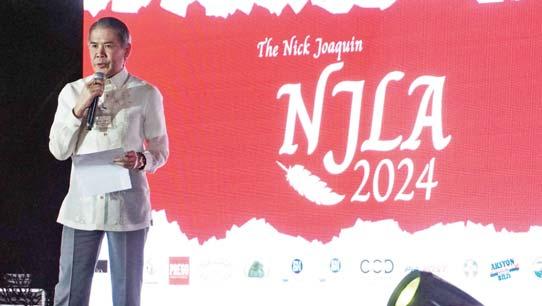

BusinessMirror 5 Sunday, May 26, 2024
Continued on A
NJLA 2024 WINNERS. Retired Philippine Daily Inquirer editor Rosario Garcellano wins first prize and a cash prize of P50,000 for her short story, “The Heart Wants What It Wants;” Second place and a cash prize of P30,000 goes to Criselda Yabes for her short story, “Near Paradise;” Third place and a cash prize of P20,000 was won by Yvette Tan for her short story “Horror Vacui;” Named Poet of the Year was F. Jordan Carnice for “Two Poems for 2023.” Carnice also won Poet of the Year for NJLA 2023
(L-R) BUSINESSMIRROR Editor-in-Chief Lourdes Fernandez, Benjamin V. Ramos, President, BUSINESSMIRROR and Philippines Graphic; 2024 Gawad CCP Para Sa Sining Awardee Pete Lacaba, editor of the BusinessMirror’s Tony&Nick section; Ces Cabangon, Graphic Reader Creative Design consultant, T. Anthony C. Cabangon, publisher, Philippines Graphic and BUSINESSMIRROR; Butch Fernandez, senior reporter, BUSINESSMIRROR
NJLA 2024. D. Edgard A. Cabangon welcomes more than 300 guests composed of National Artists, short fictionists, poets, local government officials, members of big business and the diplomatic sphere during the Nick Joaquin Literary Awards (NJLA) 2024 held at Samsung Hall, SM Aura Premier in Taguig City.
6 Sunday, May 26, 2024

BUSINESSMIRROR Publisher

T. ANTHONY C. CABANGON, Philippines Graphic and BUSINESSMIRROR Publisher (6th from Left), Graphic Reader Creative Design Consultant Ces Cabangon (7th from Left), ALC Group of Companies Chair D. Edgard A. Cabangon (8th from Left), Sharon Tan (9 th from Left) and Philippines Graphic and BUSINESSMIRROR President Benjamin V. Ramos (10th from Left) pose with the 2024 Nick Joaquin Literary Awards (NJLA) Organizing Committee (L-R) Q ueenie Ostulano-Pineda (Advertising), Jocelyn Siddayao (Finance), Mariz Paculanan (Accounting), Leah Caling-Bonotan (Special Projects), Loida S. Virtudazo (EVP-GM Philippines Graphic), Psyche Roxas-Mendoza (Editor-in-Chief, Philippines Graphic), Marivic Guiling-Africa (Audit), Emm Alquinto (Personnel), Trixzy Leigh Bonotan (Social Media), Carlo Abalos (Events), and Dennis Guevarra (AdvertisingSales Manager)
we saw in his work last year.”
more about the military and Mindanao.
Her first novel, Crying Mountain, dealt with the Sulu uprising of the 1970s. It won the U.P. Centennial Literary Prize in 2008 and was longlisted for the Man Asian Literary Prize in 2010. Her second novel, Broken Islands, set in the Visayas with the 2013 super typhoon Yolanda as backdrop, was published in 2019. Her most recent book, Battle of Marawi, is a full account of the five-month siege in 2017 of the Islamic capital of Lanao del Sur.
“Horror Vacui,” released in the June 2023 issue of the Graphic Reader, is seen by Lanot as an “atmospheric kind of horror story, not the Dracula or Frankenstein or Exorcist type.”
“I like the way Filipino beliefs and the Filipino character are subtly interwoven in the story,” Lanot added.
Yvette Tan is an agriculture editor and a horror writer. She has always been asked how she reconciles both interests, and she always answers that both involve staving off the apocalypse.
“Three Baggies, One for Each of Us” is another Tan short story that was published in the Graphic Reader in November 2023.
AFFIRMATION OF EXCELLENCE
DALISAY regarded F. Jordan Carnice’s win as “Poet of the Year” as an “affirmation of the excellence
Carnice won for his piece, “Two Poems for 2023,” published in the Philippines Graphic Reader in September 2023.
Lanot described Carnice’s opus as a “cerebral” poem, “using words to express or assert feelings and to ask questions.”
Based in Bohol province, Carnice is both a writer and a visual artist.
He was published in Anomaly, MIDLVLMAG, Quarterly Literary Review Singapore, and Voice & Verse Poetry Magazine, among other publications. His poetry appears in the forthcoming Issue 17 of Likhaan: The Journal of Contemporary Philippine Literature and in Anthology of Southeast Asian Eco-Writing through the University of Hawaii Press’s Manoa Journal. He authored two poetry chapbooks— Weights & Cushions (2018) and How to Make an Accident (2019). He can be found online through Instagram, Twitter, and Threads ( @ thebullfrog__ ).
BUMPER CROP
THE top winners of NJLA 2024 belong to a bumper crop of 82 Graphic Salute Awardees that were joined in the night’s celebration by National Artist for Film and Broadcast Ricky Lee and National Artist for the Visual Arts Benedicto “BenCab” Cabrera, among other guests.
Graphic Salute Awardees are composed


of up-and-coming, as well as veteran short fictionists and poets whose works appeared in the Philippines Graphic Reader
Guests to the NJLA 2024 represented a whole spectrum of lovers and denizens of Philippine literature. They included: 2024 Gawad CCP Para Sa Sining Awardee Pete Lacaba, editor of the B USINESS M IRROR ’ S Tony&Nick section; film director Joel Lamangan, Bing Villegas, Charo Joaquin Villegas, niece of Nick Joaquin; sculptor Julie Lluch, Kiri Lluch Dalena, visual artist, film maker, and human rights activist; film critic and director Seymour B. Sanchez, Cristina Pantoja-Hidalgo, Director of UST Creative Writing Center; writer John Jack Wigley, Javier Galvan, Director, Instituto Cervantes; Beverly Wico Sy from the Cultural Center of the Philippines, Columnist Satur Ocampo, former Bayan Muna Party list Representative, and wife Carolina “Bobbie” Malay, writer and former UP professor; Women Writers in Media Now—Karina Bolasco, Sol Juvida, Neni Sta. Romana Cruz, Palanca Memorial Awards coordinator Nemie Bermejo; Photojournalists Boy Villasanta, Pat Roque, Audie dela Cruz, Lito Ocampo, and Gil Nartea; Grace Magno, SM Supermalls VP for Marketing; Anne Ilada, SM Supermalls Group Marketing Manager; Pharmaceutical & Healthcare Association of the Philippines (PHAP)
President Diana Edralin, PHAP Executive Director Teodoro B. Padilla, PHAP CorpCom Director–Marianne Pausanos; PHLPost Postmaster General Luis Carlos, PHLPost Chief of Staff Mark Laurente; Ambassador of Columbia Marcela Ordoñez, Nikolay Shestakov from the Embassy of Russia, and Counsellor Ji Lingpeng and Second Secretary Zhang Min from the Embassy of China; City of Sto. Tomas, Batangas Mayor Arth Jhun Marasigan, Biñan City Vice Mayor Angelo “Gel” Alonte, Pakil Laguna Mayor Vincent Soriano, Atty. Jer B. Samson, secretary to Vice Mayor John Martin C. Nieto of Manila, and former chair of the Build-Build-Build program Anna Mae Lamentillo, among others.
COVERS EXHIBIT
THE three-hour NJLA 2024—directed by noted film and television writer and director Rene ‘Sketch’ Sabangan—started with a pre-event exhibit featuring colorful, framed illustrations of the 12 Graphic Reader covers from February 2023 to January 2024.
National Artists BenCab and Ricky Lee led in the exhibit’s ribbon-cutting ceremony together with Graphic Reader Publisher T. Anthony C. Cabangon and Graphic Reader Creative Design consultant Ces Cabangon.
The pre-event likewise included a painting exhibit by SM Group Marketing Manager Anne Ilada and a stamp exhibit by the Philippine Postal
BusinessMirror
Continued From A5
GRAPHIC READER COVERS EXHIBIT. National Artists Ricky Lee (Film and Broadcast) and Benedicto “BenCab” Cabrera (Visual Arts) lead in the ribbon-cutting ceremony of the Graphic Reader Covers Exhibit, featuring colorful, framed illustrations of the 12 Graphic Reader covers from February 2023 to January 2024. Joining them are (L-R) Graphic Reader Creative Design consultant Ces Cabangon, Philippines Graphic Literary Editor Marra PL. Lanot, Philippines Graphic/
T. Anthony C. Cabangon
NICK Joaquin Literary Awards (NJLA) Graphic Salute Awardees for 2024


PATRON OF LITERATURE. In behalf of SM Supermalls President Steven Tan, Virginia Wenceslao, Mall Manager of SM Southmall and OIC AVP of Operations for Premier 4 Malls, receives the Patron of Literature Award from Philippines Graphic and W Publisher T. Anthony C. Cabangon
Corporation (PHLPost).
CORPORATE ROLE
CHAIRMAN D. E dgard A. Cabangon, who sets the policy direction and steers the course for the entire ALC Group of Companies, including the Philippines Graphic, warmly welcomed the over 300 invited guests of NJLA 2024.
He also thanked SM Supermalls, SM Investments Corporation, SM Aura, San Miguel Corporation, and the Pharmaceutical & Healthcare Association of the Philippines (PHAP) for their support.
During the event’s proceedings, awards were given to outstanding men and women in the corporate sphere who generously supported the English and Literature Advocacy of the NJLA, in partnership with the LGUs.
The awards included “Patron of the Year” for SM Supermalls President Steven Tan, “Literature’s Legacy Awardee” for San Miguel Corporation President and CEO Ramon S. Ang, and “Literature Advocate” for Diana Edralin, President of the Pharmaceutical And Healthcare Association Of The Philippines (PHAP).
Hailed as NJLA 2024 Support Champions were the following corporations under the ALC Group of Companies: Isuzu Gencars, Inc., Citystate Properties & Management Corporation, Fortune Life Insurance, Fortune General Insurance, Asian Security & Investigation Agency, Eternal Gardens
LITERATURE ADVOCATE AWARDEE

Pharmaceutical & Healthcare Association of the Philippines (PHAP) President Diana Edralin (center), with PHAP Corporate Communications Director–Marianne Pausanos and PHAP Executive Director Teodoro B. Padilla

REPRESENTING SM Aura, Grace Magno—SM Supermalls VP for Marketing— receives the Suite of Literature award from Philippines Graphic and BUSINESSMIRROR President Benjamin V. Ramos
Memorial Park, Aliw Channel 23, DWIZ, Home Radio, B USINESS M IRROR , and Pilipino Mirror.
Food sponsors to the event included: Manila Grand Opera Hotel, Prego, L’Opera, Agings, Apag Marangle, and Italian Wines and Coffee Bar.
“SAFE HARBOR” AS CSR
T. ANTHONY C. CABANGON —publisher of the PhilippinesGraphic,PhilippinesGraphicReader, and B USINESS M IRROR , said it is the Graphic’s corporate social responsibility to “provide a safe harbor for the country’s best literary minds.”
“With the Philippines Graphic and its companion magazine, the PhilippinesGraphic Reader—we intend to set sail for the next generations of writers and poets. Most important of all, we want to reach the schools where these precious literary works can be appreciated and taught,” Cabangon said.
He added that local government officials can help the promotion and strengthening of Philippine literature by exposing students in public schools to literature materials.
An “In Memoriam” was held for the poets, writers, lyricists, and film directors who died in 2023. A special tribute was given to the late painter Edgar ‘Egai’ Talusan Fernandez whose painting “Kahapon, Ngayon at Pangarap” became the maiden issue cover of the revived Philippines Graphic on June 18, 1990. Psyche Roxas-Mendoza/Photos by Bernard Testa


STUDENTS from various public high schools in the City of Sto, Tomas, Batangas, as well as Biñan City and the municipality of Pakil in Laguna attend the 2024 Nick Joaquin Literary Awards (NJLA) at the Samsung Hall of SM Aura Premier in Taguig City. With them are City of Sto. Tomas, Batangas Mayor Arth Jhun A. Marasigan, Biñan City Vice-Mayor Angelo “Gel” Alonter, and Pakil Mayor Vincent L. Soriano
STARTING THEM YOUNG…
PUBLIC high school students experienced their first time to meet close to a hundred short story writers and poets in one gathering during the 2024 Nick Joaquin Literary Awards (NJLA), held at the Samsung Hall, SM Aura Premier in Taguig City on May 7.
The students came from various public schools in the City of Sto. Tomas, Batangas; Binan City and the municipality of Pakil, both in Laguna; and in the City of Manila.
They were the first beneficiaries of the Nick Joaquin Literary Awards-Local Government Unit (NJLA-LGU) Advocacy for Proficiency in English through Literature Appreciation project.
A brainchild of the PhilippinesGraphic, the NJLA-LGU Advocacy project will benefit Grade 9 and Grade 10 students in the country’s public high schools.
Proclaimed NJLA 2024 LGU CHAMPIONS were City of Sto. Tomas, Batangas Mayor Arth Jhun Marasigan, Biñan City Mayor Walfredo “Arman” Dimaguila, Biñan City Vice-Mayor Angelo “Gel” Alonte, Municipality of Pakil Mayor Vincent L. Soriano, and City of Manila Vice Mayor John Marvin “Yul Servo” Cruz Nieto.
The five officials were the first to support the NJLA-LGU Advocacy project, stressing that students will learn about good English and excellent Philippine literature by reading the Graphic’s companion magazine Philippines Graphic Reader—the first and only monthly literary magazine completely devoted to Philippine literature in English.
“Introducing to Grades 9 and 10 students the short stories and poems written in English by Filipino writers and poets can be a highly enriching experience,” City of Sto. Tomas, Batangas Mayor Marasigan said.
He added that “reading the works of Filipino fictionists and poets can inspire Tomasino
students to explore their own creativity and express themselves through writing. It can spark their imagination, encourage them to experiment with different writing styles, and instill a love for literature and the arts.”
Biñan City Vice-Mayor Alonte bared that the NJLA-LGU Advocacy for Proficiency in English through Literature Appreciation project will benefit some 18,636 students from 14 junior public high schools in Biñan City.
Alonte said that the initiative aims to provide junior high school students across Biñan with the chance to explore a diverse range of literary works in the form of short stories and poems curated by Philippines Graphic Reader “By immersing themselves in these materials, students can improve their critical thinking abilities, and appreciation for literature.”
For his part, Biñan City Mayor Dimaguila said: “Stories and poems written in English by Filipino authors will help young students imbibe good English usage. Students will likewise find the literature more relatable since they reflect local culture, traditions, and experiences.”
Loida S. Virtudazo, Executive Vice PresidentGeneral Manager of Philippines Graphic said that through the Student’s Corner section of the Philippines Graphic Reader, students will be able to study and appreciate the published works of Filipino short story writers and poets, while learning good English.
“This is the beginning of a long-range NJLALGU-public high schools project to promote English proficiency and Literature Appreciation through the PhilippinesGraphicReader. And it starts with popularizing the works of Filipino poets and writers in the hearts and minds of young readers,” Virtudazo said. Psyche RoxasMendoza/Photos by Bernard Testa
BusinessMirror 7 Sunday, May 26, 2024
AMBASSADOR of Columbia Marcela Ordoñez (center) with Philippines Graphic/BUSINESSMIRROR publisher T. Anthony C. Cabangon and MeAnn Supleo Santos, BUSINESSMIRROR Advertising
8 Sunday, May 26, 2024
FILMMAKER-PROF NAMED BACOLOD FILMFEST DIRECTOR

AN award-winning filmmaker and longtime educator has been recently appointed by the Bacolod City Government as director of its film festival, set to be held this September in select cinemas in the city.
The Bacolod Film Festival Council (BFFC), chaired by Mayor Alfredo “Albee” Benitez with Councilor Em L. Ang as co-chairperson, has designated Seymour B. Sanchez as filmfest director, as per Section 7 of City Ordinance 1061-2024.
Sanchez was recommended by legal consultant and film producer Atty. Josabeth “Joji” V. Alonso to the BFFC as “the best person to oversee and manage the festival.”
C.O. 1061-2024, also known as the Bacolod Film Festival Ordinance, is authored by Councilor Ang, chairperson of the Sangguniang Panlungsod (SP) Committee on History, Culture and Arts, with councilors Cindy Rojas and Celia Flor as co-authors.
The Bacolod Film Festival Ordinance also provides for 10 filmmakers, whether producers, directors, or writers, who are bona fide residents of Bacolod City, to be given production grants
worth 300,000 pesos each. Councilor Ang clarified the filmmakers do not need to shoot their entire film in the city.
Sanchez signed the memorandum of agreement with the BFFC at the office of Councilor Ang last May 3. The SP, with Vice Mayor El Cid M. Familiaran as presiding officer, has confirmed the appointment of Sanchez during its 96th Regular Session on the same day.
Apart from being an educator, who is now on his 20th year of teaching, Sanchez also served as head of publicity and promotions of the Cinemanila International Film Festival from 2004 to 2007, under the late filmmaker Amable “Direk Tikoy” Aguiluz VI, and filmfest director of the One La Salle Film Festival in 2018, under the De La Salle-College of Saint Benilde film department headed by Film Development Council


of the Philippines (FDCP) chairperson and CEO Jose “Direk Joey” Reyes.
Sanchez has also worked as FDCP’s Technical Consultant for Academic Linkages or education consultant, judge and one-time jury chair of the Indie-Siyensya Science Filmmaking Competition organized by the Department of Science and Technology-Science Education Institute, mentorjudge of the SINEliksik Bulacan DocuFest, jury and selection committee member of the Manila Broadcasting Company Short Film Festival and Sinepiyu, jury of Sine Kabataan, CineMascian, Kingwagisnan Film Festival, and CineMapúa, and SELCOM member of the Cinemalaya Philippine Independent Film Festival, Cinestudyante and Q uisumbing-Escandor Film Festival for Health. He has also been a judge and speaker in other competitions, including the National Schools Press Conference, National Training of Trainers on Campus Journalism, Planting Seeds Workshops on Filmmaking, and SanayGuro Trainors’ Training.
His short film Caretaker won in various film contests, which include: Second prize in the short fiction category of the sixth CAM International Festival for Short Films in Cairo, Egypt; the Golden Philippine Eagle award and Best Actor for Rolando Inocencio in the third Singkuwento International Film Festival; and the Audience Choice Award in the Active Vista International Human Rights Film Festival.
Sanchez was given the Film Ambassador Award by the FDCP for his “creativity and the global achievement of the film.” He also received the
Maningning Outstanding Direction for the same film in the CineSB Film Festival: Special Edition. A shorter version of the film entitled Katiwala won the People’s Choice Award in the 2018 Freedom Mov E Film Festival.
His first short film Lababo (Kitchen Sink) topped the 2007 Viva-Pinoy Box Office Digitales. His other film Pagbugtaw ( Waking Up) bagged second place in the First Pambujan PelikulaParasa Publiko National Short Film Festival and Competition. Another film Shorts won third prize in the Viva-PBO Digitales 2. His documentary Sinulogfor Beginnersplaced second in the 2006 Sinulog Video Documentary Competition. Another documentary Maria Leonor was cited for its screenplay in the 3rd Dreamanila International Film Festival. His second full-length screenplay Hiwaga (Mystery), co-written with Christian Lacuesta, bagged the grand prize in the 59th Carlos Palanca Memorial Awards for Literature.
Sanchez is one of the fellows of the 17th Lopez Jaena Community Journalism Workshop of the University of the Philippines College of Mass Communication, 21st Iligan National Writers Workshop of the Mindanao State University-Iligan Institute of Technology, and 9th Palihang Rogelio Sicat of the UP Departamento ng Filipino at Panitikan ng Pilipinas. He is also a graduate of the 3rd Produire au Sud workshop at the 6th World Film Festival of Bangkok, 14th Ricky Lee scriptwriting workshop, first Brillante Mendoza directing class, and the first Active Vista film and media for human rights advocacy workshop.
BusinessMirror
BACOLOD City Mayor Albee Benitez meets with the Bacolod Film Festival team
SEYMOUR B. SANCHEZ after a group meeting with interested Bacolod Film Festival participants
Bacolod Film Festival director Seymour B. Sanchez
SUPERSIZED INTERACTIVE BATCAVE
EXPERIENCE CENTERS BATMAN’S 85TH ANNIVERSARY AT SM SUPERMALLS
ONE in Southeast Asia—Gather the crew as the Dark Knight takes over SM Supermalls with iconic Batcave activation and retail pop-ups in a global celebration, Batman 85th Anniversary.
Gear up Batman fans! Warner Bros. Discovery celebrates The Caped Crusader’s 85th anniversary with rotating mall activations and retail pop-ups in SM Malls. A thematic interactive Batcave will excite fans of all generations— with five creative zones in place, shoppers can traverse through Batman’s legacy and role-play his iconic story. Collectors will also be able to get ahold of exclusive merchandise available throughout the celebration.
Created by Bob Kane with Bill Finger, Batman was introduced in 1939’s comic book Detective Comics #27 and since then the Dark Knight has stood as a symbol of determination, courage, and justice to generations of fans for over 85 years. Batman is notable not for having any superpowers but for his intelligence, skill, and technical savvy—born out of tragedy, Bruce Wayne’s relentless pursuit of justice and willpower to protect others made him an instant icon. Today, Batman is recognized across the globe thanks to his portrayal in universally beloved comics, TV shows, animation and movies. Through it all, Batman’s continued adventures through the pages of DC’s comics reaches readers around the globe every month. Batman has inspired countless writers and artists to tell stories of heroism and perseverance. He is vengeance. He is the night. He is Batman!
EXPERIENCE HIGHLIGHTS:
Bat computer: Standing as the centerpiece of the activation, a towering 6 meters in height bat computer will surely amaze fans, and shoppers of all ages can easily relish the Dark Knight’s key milestones.
Batcave Vault: Inside the cave are iconic lairs that provide fans with an interactive retail experience where they can exclusive merchandise to take home.
Garage and Training Zones:
Complete your Batcave experience with the legendary Batmobile set! Inside these zones, fans can play numerous interactive games to level up their journey. Don’t forget to take your photos with numerous photo-ops deployed in all corners!
Cosplay: Get a chance to meet up close to your favorite DC Super Heroes and villains from the Batman Universe.
This caravan is set to start at SM North EDSA on May 20, 2024. Fans can expect this activation in the following SM malls near their cities:
SM City Fairview: June 7- 20
SM City Marikina: July 1- 17
SM East Ortigas: July 18- Aug 18
SM City Masinag: Aug 25- Sep 8
SM City Santa Rosa: Sep 16- 30

For more than eight decades, the Dark Knight has consistently stood as an emblem of determination, courage, and justice. And even up to this day, Bruce Wayne’s relentless
pursuit of justice and willpower has been globally recognized by fans of all ages. Make sure to not miss this exciting global celebration. See you here #SMFam!
BusinessMirror 9 Sunday, May 26, 2024

NBDB RALLIES SUPPORT OF READING ADVOCACY GROUPS, FORMS NEW READING ALLIANCE
AS part of its ongoing efforts to boost readership given declining reading scores, the National Book Development Board (NBDB) has formed the National Alliance of Reading Advocates (NARA).
NARA is a network that gathers readership advocacy groups and individuals from all over the country to form a unified network that will enable collaboration and better spread the news on existing readership initiatives.
In anticipation of its official launch this November, the alliance had its soft launch last April 26, 2024 at the main stage of the Philippine Book Festival at the World Trade Center Manila, where reading advocacy groups and individuals pledged their commitment to the alliance.
PLATFORM FOR READING AS a platform dedicated to nurturing
a robust national reading culture, the NARA shall form a mesh of various readership campaigns through an online community (called NARA Connect) and regular milestone meetings and conferences on the state of readership in the country.
Besides consolidating readership campaigns from around the country, the alliance shall also aid in the cross-media adaptation of Philippine literary works, the creation of fan-based markets, and help popularize home-grown literary characters.
“With the decline of readership in non-school books, it is high time for the NBDB to gather all advocates and like-minded people


who promote readership in the country. We at the NBDB dream of a community of reading advocates who support each other,” said Daniel Mariano, chief of the Board’s Readership Development Division (the agency’s unit responsible for the nationwide reading community, the Book Nook project).
“Many Filipinos love stories— be it in the form of film, TV, or literature. As reading advocates, we call on all our allies to enrich this interest in stories and use it to create a stronger national reading culture,” added Mariano.
As the largest traveling book fair in the country, the Philippine Book Fair was the perfect venue to introduce to the public the NBDB’s latest readership campaign.
READING CRISIS
“THERE is a reading crisis—and it is high time that we all start working together to address it. We have a systemic problem when it comes to building and nurturing reading habits in our society, and so we must therefore face this with a cohesive strategy,” said NBDB Executive Director Charisse, who delivered the State of the Reading Nation during
the soft launch.
The NARA soft launch also served as the alliance’s first wide-scale orientation, which was attended by representatives from the following organizations: UN SDSN Youth Philippines, ASEAN Youth Organization, READ to Achieve Foundation Philippines, Inc., Yellow Boat ofHope Foundation, Binhi English Literacy Foundation, Magbasa Tayo Movement, AHA! Learning Center, The Storytelling Project, LibroMo, Kaalam Ko project, Project Pearls Inc., School Readers Club, Pinoy Reading Buddies, IBBY Philippines, Philippine Association ofColleges and Universities, Association of Progressive and Orthodox Literature and Literature Originators, Laguna Province PrivateSchools and Administrators Association, Inc., Rizal Library of Ateneo De Manila University, St. Mary’s Publishing Corporation, ClaretianCommunication Foundations, Inc., Inteligente Publishing, Paper Katz, FDM Vision Care Research and Training Institute, Beyond BooksPublication, 8 Letters Bookstore and Publishing, DIWA Learning Systems, Inc.
BusinessMirror 11 Sunday, May 26, 2024
DANIEL MARIANO, chief of the National Book Development Board (NBDB) Readership Development Division PHOTO SOURCED FROM NBDB WEBSITE
NBDB Executive Director Charisse Aquino-Tugade PHOTO SOURCED FROM NBDB WEBSITE


