media partner of the year
United nations
2015 environmental Media Award leadership award 2008
BusinessMirror A broader look at today’s business
www.businessmirror.com.ph
n
Sunday, May 22, 2016 Vol. 11 No. 225
P25.00 nationwide | 3 sections 16 pages | 7 days a week
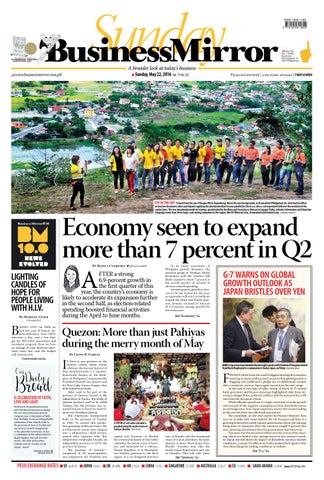
EYE IN THE SKY
Framed from the top of Bangan Hill in Bayombong, Nueva Vizcaya (background), an OceanaGold (Philippines) Inc. information officer on location documents other participants applying the photojournalism lessons paneled by this BusinessMirror correspondent held over the weekend at the capital town. The two-day photojournalism training, spearheaded by the Mines and Geosciences Bureau in Cagayan Valley, includes Information and Education Campaign teams from three large-scale mining companies in the region, like FCF Minerals Corp., OceanaGold and GeoGen Corp. LEONARDO PERANTE II
Economy seen to expand more than 7 percent in Q2 By Bianca Cuaresma
Lighting candles of hope for people living with H.I.V. By Marilou Guieb
Correspondent
B
AGUIO CITY—In 2008 we had one case of human immunodeficiency virus (HIV) infection a day, and a low budget for HIV-AIDS prevention and treatment program. Now, we have an average 25 new detected infections every day, and the budget still remains low. Continued on A2
A CELEBRATION OF FAITH, LOVE AND LIGHT Dear Lord, the grand procession with the Blessed Sacrament during the 51st International Eucharistic Congress was a celebration of faith, love and light. It was an unforgettable celebration of the Catholic faith in the presence of Jesus in the Blessed Sacrament, carried triumphantly in the splendid monstrance. It was a celebration of the vibrant faith of all participants from all over the world—the faith of the entire Catholic Church. For this, we all rejoice. Amen! Word & Life, Fr. Sal Putzu, SDB, and Luisa M. Lacson, HFL
A
@BcuaresmaBM
FTER a strong 6.9-percent growth in the first quarter of this year, the country’s economy is likely to accelerate its expansion further in the second half, as election-related spending boosted financial activities during the April to June months.
In its latest assessment of Philippine growth dynamics, the research group of Nomura Global Economics said the country will likely expand to above 7 percent in the second quarter on account of election-related spending. Second-quarter growth is forecast to be the fastest for the year, as expansion will start to moderate toward the third and fourth quarters. Nomura retained its forecast of 6.5-percent average growth for the entire year.
G-7 warns on global growth outlook as Japan bristles over yen
See “Economy,” A2
Quezon: More than just Pahiyas during the merry month of May
I
By Leony R. Garcia
F there is one province in the country whose many towns celebrate the harvest festival of May simultaneously, it is Quezon, historically known as the birthplace of Philippine Commonwealth President Manuel Luis Quezon and his First Lady, Aurora Aragon, who both hailed from Baler. Baler used to be part of the province of Quezon, located in the subprovince of Aurora. The whole of Quezon province used to be called Tayabas. But the province was renamed Quezon to honor its most famous son, President Quezon. The Americans incorporated Baler to the province of Tayabas in 1901. To correct this anomalous grouping of distant towns, the northernmost towns were lumped into a subprovince called Aurora, named after Quezon’s wife. The subprovince eventually became an independent province in 1979, the province of Aurora. The province of Quezon— comprised of 39 municipalities, one component city (Tayabas) and
PESO exchange rates n US 46.8550
Bank of Japan Governor Haruhiko Kuroda (right) speaks with President of European Central Bank Mario Draghi prior to a symposium in Sendai, Japan, on Friday. Kyodo News via AP
F A STATUE of San Isidro Labrador is paraded along the main streets of Sariaya, Quezon. TEDDY PELAEZ
capital city (Lucena)—is flocked for a festival in honor of San Isidro Labrador, the patron saint of farmers, and venerated for a volcano, Mount Banahaw. It is Metropolitan Manila’s gateway to the Bicol region. It is an elongated province
east of Manila and the downward chain of Luzon provinces. By land, Quezon is about three hours from Manila. Travelers may take the South Luzon Expressway and exit at Calamba. This will take them See “Quezon,” A2
INANCE chiefs from the world’s biggest developed economies meeting in Japan underscored concerns that global growth is flagging and reaffirmed a pledge not to deliberately weaken their currencies, even as Japan again warned on the yen’s surge. At the end of two days of talks, Group of Seven (G-7) central bank governors and finance ministers highlighted risks from terrorism, refugee flows, political conflicts and the potential for a UK exit from the European Union. While officials agreed not to target currencies to stoke growth and warned of the negative consequences from disorderly moves in exchange rates, host Japan repeated a stance that recent trading in the yen has been one sided and speculative. The comments on the yen’s moves by Finance Minister Taro Aso are at odds with views held by the US Treasury and hint at a growing frustration inside Japan’s government about the damage being done to exporters after the currency surged 9 percent this year, spurring speculation that the government may intervene. Tensions over the yen were evident over the course of the meeting, which was held at a hot-springs resort in the country’s north. As Japan warned about the impact of disorderly currency-market conditions, a senior US official on Friday pushed back against that view, describing the trading conditions as orderly. See “G-7,” A2
n japan 0.4261 n UK 68.4880 n HK 6.0324 n CHINA 7.1502 n singapore 33.9308 n australia 33.8527 n EU 52.4963 n SAUDI arabia 12.4940
Source: BSP (20 May 2016 )
NewsSunday BusinessMirror
A2 Sunday, May 22, 2016
Quezon…
Lighting candles of hope for people living with HIV
Continued from a1
through Laguna and then to Quezon. Commercial buses leave daily for Lucena from bus terminals in Quezon City and Pasay City. Quezon province is a true haven of colorful festivals. Every town has various festivals that attract tourists. The country’s biggest and most colorful harvest festival every May 15 belongs to Lucban. Known as Pahiyas, the festival is deeply rooted in the traditional celebration by the townsfolk in thanksgiving for a bountiful harvest. Decorations called kiping, leaf-shaped and multicolored rice paste wafers, are used to decorate the façades of homes, along with fresh fruits and flowers. In fact, this visual and culinary feast honoring San Isidro Labrador has gained national and international recognition. Gumaca, a town at the mouth of Pipisik River and nestling at the foot of the Sierra Madre range, is known for its Araña’t Baluarte Festival. This event is also celebrated every 15th of May, giving tribute to San Isidro with a procession reminiscent of the yearly Quiapo devotion to Jesus Nazareno. From many towns of Quezon, multitudes of peasants and workers—predominantly male—flock to Gumaca to join the processions. The most extravagant and well-attended festival of the town, each baluarte (bastion or fort) in every barangay is decorated with various agricultural products, like bananas, vegetables, young coconut, pineapple and root crops; some are beautifully arranged in arañas (chandeliers). These crop decorations are pulled out by the people after the patron saint has passed during the afternoon procession.
www.businessmirror.com.ph
Continued from a1
Sariaya, Quezon, residents watch the parade from their terraces adorned with colorful hats and colored rice wafers. LEONY GARCIA
The three most beautifully decorated baluartes are given prizes. At night, programs are held, which include a pageant aptly called “Mutya ng Araña’t Baluarte,” folk dances performed by students, teachers and local townsfolk. Sariaya is a populous municipality famous for its pristine beach resorts, heritage houses and nature-trekking activities that lead adventurous hikers to the peak of mythical Mount Banahaw. The town is also well known for its best-selling delicacies: pancit habhab, the Sariaya version of sautéed noodles eaten directly off banana leaves; pinagong bread (a tasty and filling bread shaped like a clenched fist); export-oriented marzipan candies and pastries made of young
coconut or buko meat; cassava confections and rice cakes that blend grated sweet coconut or makapuno and pulverized banana. On May 15 every year, houses in Sariaya are colorfully adorned just like in Lucban. But there’s more: Each participating house provides pliant bamboo treetops and trellises weighed down by hanging food treats, native candies, rice cakes and colorful rice krispies, which are deliberately pulled down on the streets by the merry-makers right after the afternoon procession. Festival revelers from the town’s barangays, neighboring towns and other provinces would then scramble to gather as many treats as they can snatch and carry, hence the term agawan.
HIV positive cases were reported to the HIV/AIDS & ART Registry of the Philippines (HARP), 10 percent higher in the same period last year. About 89 percent were asymptomatic at the time of reporting. The National Capital Region registered the most number of new diagnosed cases at 284 (39 percent), followed by Region 4A, with 94 cases (13 percent); Central Luzon, with 82 cases (11 percent); Region 7, with 71 cases (10 percent); and Region 11, with 65 cases (9 percent). The rest of the 149 cases were spread out from different regions. In the Cordillera Administrative Region (CAR), notorious for having the highest teen-pregnancy rate in the country, Vallido said the Young Adult Fertility Survey of 2013 showed that more than three out of 10 youth have engaged in premarital sex (PMS), a rate higher than the national average. Three out of four had their first PMS unprotected against pregnancy and sexually transmitted infections (STIs). Only about half of the youth were aware of STIs and about a third thought AIDS was curable. Even more alarming was that eight out of 10 considered themselves invincible—that there was no chance of them getting AIDS. In CAR, Baguio City, where life is faster and fancier, registered the highest rate of cases at 151 from 1984 to the present. But this may not be true data, said Dr. Alexi Marrero of the DOH in the Cordillera. He said that because of the stigma attached to HIV-AIDS, people avoid getting themselves tested in their own areas. The region has a total number of 237 HIV cases, 219 of whom remain asymptomatic. Guerrero said the most number of transmittal in the region, consistent with the national figure is MSM, numbering already 105 from 1984 to the present, consistent with the figure of 103 men with HIV infection compared to only 29 females. As Vallido stated, the youth group showed a high vulnerability rate, with 103 cases in CAR from the 25 to 34 age bracket and 60 cases from those 15 to 24 years old. On the national level, also from
Thus said Chi Laigo Vallido of the Forum for Family Planning and Development (The Forum) in a recent news conference in preparation for a candlelight ceremony for those who died of Acquired Immuno Deficiency Syndrome (AIDS). Year after year, the Philippine National Aids Council (PNAC) appeals for a higher budget, but it does not seem to be a priority, she said. Vallido expressed confidence that presumptive President Rodrigo R. Duterte will be more attentive to the issue. “I do not doubt this since as Davao mayor, Duterte was consistent in his support for the Reproductive Health bill,” she said. The PNAC said there are no signs of slowing down, “unless we accelerate efforts to educate Filipinos, remove fears and stigma and encourage high-risk populations to get tested,” Health Action Information Network (HAIN) Program Coordinator Nilda de Vera said in a press statement. HAIN is a member of PNAC. Despite the rise in cases, Vallido said advocate teams are poorly staffed and there remains the urgent need to fund the advocacy, especially on the aspect of giving information. The situation is seriously alarming, especially among the youth. “The latest government data shows that the rate of HIV infection among adolescents is escalating. Over the last five years, from 2011 to 2015, new cases among the young increased by 230 percent,” she said. But only 25 percent of them are able to access treatment. Since the first HIV infection reported case in the Philippines, the number as of March has risen to 32,647—30,136 males and 2,500 females. Predominantly, 24,438 cases were transmitted through men having sex with men (MSM), followed by male and female sex with 4,006 cases. Even more disturbing, among the infected MSM, more than half belong to the 25 to 34 age group and 30 percent even younger, 15 to 24 years old. The Department of Health (DOH) report shows this year alone in the month of March, 736 new
Economy…
Continued from a1
Nomura also remains optimistic that economic expansion—as seen in the Aquino administration—would continue toward the new administration, following the announcement of presumptive President Rodrigo R. Duterte’s eight-point economic plan. “Our baseline view remains that presumptive President Duterte’s policy approach will be pragmatic, and he is unlikely to reverse the reforms implemented by the outgoing Aquino administration. Indeed, Duterte on May 12 [just a few days after the elections] announced an eight-point economic agenda, with the first point explicitly stating policy continuity,” Nomura said.
G-7…
January 1984 to March 2016, MSM registered the highest rate of transmission (24,438, or 81 percent). More than half (13,120, or 54 percent) among MSM belong to the 25 to 34 age group, with 7,214 (30 percent) were youth 15 to 24 years old. Despite the rising number, Dr. Celia Brillantes, head of the Social Hygiene Clinic of the Baguio Health Department, said for the past 20 years since the clinic was set up, they worked with only two staff members and only in the past year-and-a-half did they have 15 peer educators working 10 days a month for P1,500. But meager funding has not stopped the team of Brillantes from finding creative ways to move their cause forward. The team launched the Bonjing web site that serves as an information venue for the youth to express their sexual expressions and issues; and where, likewise, the health-care team can gather the frequently asked questions of the youth. Bonjing was awarded the Best Practices Award in Internet-based Public Service for Young Adults by the National Academy of Science and Technology. They also produce booklets on frequently asked questions on latest issues of the youth. One of their most down-toearth programs is the gathering of bar owners and guest-relations officers, the collective bar workers, into a loose organization known as BABES, an acronym for Baguio Association of Bars and Entertainers. “The leadership of BABES is keen on the prevention of HIV infection. They encourage their ladies to stay in the bar and not to go out with customers,” Brillantes said. Brillantes has, for years, offered free STI testing and treatment for the bar girls who come regularly to her clinic. They see in her a friend and a confidante and, out of that trust Brillantes has guarded over the years, she has successfully enticed 100-percent voluntarily testing for HIV among the night bar workers of the city. Her clinic provides free HIV testing, which will last for the whole year with preand post-counseling.
“The other points include increasing infrastructure spending, reducing land-related bottlenecks and attracting more FDI [foreign direct investment],” the regional think tank added. Against this growth backdrop, Nomura said the Bangko Sentral will keep its policy rates steady for the entire 2016—except for the announced easing to be implemented on June 3 to make way for the new interestrate corridor system. For inflation, Nomura said the growth of the prices of goods and commodities will remain subdued with a possible downside risk to its 2.4- percent year-end forecast. This reflects the sentiment of
the Monetary Board as seen in its last meeting, when Central Bank Gov. Amando M. Tetangco Jr. said in his statement that inflation expectations for 2016 have “declined slightly due to low-inflation readings in the recent months.” Tetangco also said, however, that forecasts remain firmly within the target band over the policy horizon. The central bank’s target band for the year is at 2 percent to 4 percent. In 2015 the central bank was not able to steer inflation within the target band, as it ended the year with an average inflation of 1.4 percent. Current inflation average for the first four months of the year is at 1.1 percent.
a sustainable path. As planned, no communiqué was issued after the event. Japan said its summary didn’t purport to be an official consensus. The G-7 agreed that, if UK voters decide in a June referendum to leave the European Union, it would be the wrong decision and hurt the country’s economic growth. Officials also signaled confidence that the EU will reach a deal with Greece at the meeting of his counterparts next week. Other discussions included tackling cross-border tax evasion and an agreement on new ways to combat terrorist financing. The talks took place against the background of slowing global
growth and continuing concerns about the health of Japan’s economy, the world’s third largest. It dodged recession in the first quarter on the back of government spending. Falling prices and low growth across much of the developed world has stoked concerns that governments aren’t doing enough to stimulate demand, as the influence of monetary policy wanes. The meeting brought together finance ministers and central bank governors from Britain, Canada, Italy, France, Germany, Japan and the US, plus leaders from the International Monetary Fund, the World Bank and the EU.
Continued from a1
Beyond currencies, the G-7 didn’t agree on details of how best to revive the world’s economy. The group said a mix of monetary, fiscal and structural policies should be used but stopped short of any coordinated push or an agreed todo list. Instead, the position emerged that country-specific conditions need to be taken into account. This may reflect the divergent views among the G-7 on whether to unleash extra government spending, as advocated by Japan and Canada, but opposed by Germany. A summary of the meeting released by Japan said it’s important to implement fiscal strategy flexibly while putting debt as a share of GDP on
Bloomberg News
NewsSunday BusinessMirror
www.businessmirror.com.ph • Editor: Dionisio L. Pelayo
2015 metallic-production value down by 23%–MGB By Jonathan L. Mayuga @jonlmayuga
T
HE downward trend in world metal prices brought about by excess supply and weaker global trade has adversely affected the country’s metallic-mineral output last year, the Mines and Geosciences Bureau (MGB) said. MGB Director Leo L. Jasareno said the Philippines’s metallic-production value went down to P108.21 billion in 2015, P39.29 billion, or 23 percent, lower compared to the P140.15 billion recorded in 2014. The sharp drop in the country’s metal output is in contrast to the sector’s performance in 2014. To recall, metallic-production value reached P137.53 billion in 2014, up by 38 percent from P99.38 billion in 2013. This was attributed to the entrants of new players, which boosted the country’s nickel output. During the period, direct shipping ore and mixed nickelcobalt sulphide combined accounted for 58.05 percent, or P79.84 billion of the total production value. “The lackluster performance [last year] can be attributed to the sharp declines in the prices of leading metals, like gold, silver, copper and nickel, during the period,” he said. Jasareno said the biggest losers last year were the base metals nickel and copper, with shortfalls of 29 percent and 19 percent, respectively. In earlier interviews, he predicted a turnaround earlier than expected or earlier than 2017, as China’s economy shows sign of recovery. China is the single major destination of nickel ore in the world. With its sufficient stockpiles of nickel, however, the smaller demand and lower price for nickel by China is forcing nickel miners, including those from the Philippines, to slow down production. According to data released by the MGB, from an average price of $7.56 per pound in 2014, nickel price dipped to $5.34 per pound, down by $2.22 in 2015. In February 2011 nickel was traded by as high as $12.83 per pound but since then, the price of nickel continues to drop. Similarly, the price of copper also went down from an average price of $3.06 per pound in 2014 to $2.48 per pound in 2015. Jasareno said the precious metals gold and silver posted 8.35- percent and 17.62-percent losses, respectively, as gold price declined from $1,269.57 per troy ounce in 2014 to $1,163.59 per troy ounce in 2015, while the price of silver dropped from $19.08 per troy ounce in 2014 to $15.72 per troy ounce in 2015. Of the country’s total metallic- production value of P108.21 billion, nickel direct-shipping ore and mixed nickelcobalt sulfide continued to dominate the top spot, with 50.09 percent share, or P54.20 billion.
Gold was in second spot, with 31.64-percent contribution, or P34.24 billion; and copper, with 17.48 percent, or P18.92 billion. The remaining 0.78 percent, or P0.85 billion, came from the combined values of silver, chromite and iron ore. Despite lower metal prices, the precious metals gold and silver exhibited growths in their respective production records in 2015. Gold enjoyed 12-percent and 4-percent increases in volume and value, respectively, from 18,423 kg, valued at P32.97 billion, to 20,643 kilograms, valued at P34.24 billion. Top producers during the year were Masbate Gold Project of Filminera Mining Corp.-Philippines Gold Processing and Refining Corp. in Masbate; Didipio Project of Oceana Gold (Philippines) Inc. in Nueva Vizcaya; and Co-o Gold Project of Philsaga Mining Corp.-Mindanao Mineral Processing and Refining Corp.in Agusan del Sur. Jasareno added that the production volume and value of silver, likewise, grew by 29 percent and 5 percent, respectively from 23,005 kg with an estimated value of P616.44 million in 2014 to 29,780 kg valued at P647.02 million in 2015. The base metals nickel, copper, chromite and iron ore suffered setbacks both in production volume and value in 2015. Jasareno explained that base metals are always vulnerable to economic slowdown, mainly because they thrive on the degree of economic activities around the globe. “As it is, China, which accounted for the largest metal consumption in the past 10 years or so, has resoundingly been reducing its demand for the said metals. China has been the country’s major market for nickel, copper, chromite and iron ore. Both nickel direct-shipping ore and mixed nickel-cobalt sulfide reported lower mine and plant output, mainly because of the weakened global demand for the metal,” he said. To date, the country hosts 44 operating metallic mines; consisting of the following: 1) 27 nickel mines; 2) six gold mines with silver as coproduct; 3) three copper mines with gold and silver as coproducts; 4) three chromite mines; and 5) five iron mines. These are in addition to the numerous small-scale gold-mining operations. Jasareno said that in terms of peso value, the top 10 mining projects and mineral-processing plants last year are Didipio Copper-Gold Project, P12.24 billion; Toledo Copper Operations, P11.2 billion; Coral Bay HPAL Project, P10.4 billion; Padcal Copper-Gold Project, P9.35 billion; Masbate Mining Project, P9.27 billion; Taganito HPAL Project, P7.04 billion; Mindanao Mineral Processing and Refining Project, P5.74 billion; Cagdianao Nickel Project, P5.18 billion; Claver Nickel Project, P5.17 billion; and Rio Tuba Nickel Project, P3.69 billion.
Sunday, May 22, 2016 A3
SMC unfazed by Duterte’s liquor ban
A
By Lenie Lectura
@llectura
POSSIBLE liquor ban all over the country, if and when imposed by presumptive President Rodrigo R. Duterte, would not affect how San Miguel Corp. (SMC) does business in the Philippines.
Duterte said he is planning to impose the ban starting 2 a.m., but the sale of alcohol could be prohibited as early as 10 p.m. SMC is the largest beer maker in the country. Its core businesses include San Miguel Brewery Inc., Ginebra San Miguel Inc., San Miguel Pure Foods, Co. Inc. and San Miguel Packaging Group. Later on, it diversi-
fied into power, oil, telecommunications, banking and infrastructure. “SMC is No. 1 in the Philippines. We have a stable business. If there will be a liquor ban, ang tingin ko hindi liliit ang consumption, kasi bibilisan lang nila ang pag-inom,” said SMC President and COO Ramon S. Ang. SMC’s net income surged by
122 percent to P13.54 billion in the first quarter of the year, from P6.11 billion during the same period last year, on the back of a strong business across all segments. Ang said the second quarter is “going to be much better,” as new developments in the oil and power sectors take place. Petron Corp. had just completed its $2-billion refinery upgrade in Bataan. The upgraded facility would drastically increase production of gasoline, diesel and petrochemicals. It would also enhance the country’s supply security, since it gives more flexibility to refine crude oil from various sources. More important, Petron would be capable of locally producing fuels that meet the more stringent Euro 4 environmental standard. Last week Ang said he expects Petron’s earnings this year to reach
between P15 billion and 18 billion, nearly triple than the P6.27 billion it posted in 2015. “We are targeting P15-18 billion in net income this year. More efficient ang oil refinery namin, because we just finished upgrading it,” Ang said. Its power business under SMC Global Power Holdings Inc. will commission its 300-megawatt coal plant in Malita, Davao del Sur, this month and another 300-MW coal plant in Limay, Bataan, in the third quarter of the year. He also cited the start of operations of the Boracay airport in the second quarter. “Ang mga businesses ng SMC... we are practically engaged in everything—beer, whisky, food, packaging, property, infrastucture, oil refinery, etc…We are practically everywhere,” Ang said.
Marcos ally files charges vs Smartmatic personnel, Comelec infotech officer
A
PARTY-LIST legislator who is identified with Sen. Ferdinand R. Marcos Jr. filed charges for alleged violation of the automated election law against Smartmatic employee Marlon Garcia for introducing a new script in the transparency server of the Commission on Elections (Comelec) without proper authorization. In a 14-page complaint-affidavit filed with the Comelec, Party-list Rep. Jonathan de la Cruz of Abakada named as corespondents Elie Moreno, Smartmatic project director; Neil Banigued, a member of the Smartmatic Technical Support Team; and Rouie Peñalba, information-technology officer of the Comelec, who were involved in the script change. “The act of tweaking the script of the transparency server caused widespread anxiety and concern among the voters. The lapses in protocol have undermined the credibility and integrity of the 2016 elections,” said de la Cruz, who is also the campaign adviser of Marcos, a candidate for vice president. Specifically, the respondents were charged for violation of Sections 35 (b) and (c) of Republic Act (RA) 8436, as amended by RA 9369, otherwise known as the automated elections law. Among others, the law prohibits interfering with “the generation, transmission of election results, data or information.” De la Cruz said the law also prohibits “gaining or causing access to, using, altering and destroying computer data, program and system software, network, or any computer-related devices, facilities, hardware or equipment, whether classified or declassified.” The complaint was based on the
THE legal team of vice-presidential candidate and Sen. Ferdinand R. Marcos Jr., led by Jose Amorado (right) and Party-list Rep. Jonathan de la Cruz of Abakada (left), files a formal complaint against Smartmatic personnel and a Commission on Elections employee for alleged unauthorized tampering of a hashcode in the agency’s transparency server on Friday at the Comelec main office in Intramuros, Manila. PNA
written report of the incident by William Yu, Parish Pastoral Council for Responsible Voting IT director; separate reports of Peñalba and Moreno to the commission, as well as various newspaper articles reporting the incident regarding the introduction of a new script to the transparency server. De la Cruz said that, from the information they gathered, it was clear that the Comelec en banc was not notified of the issue and that
the poll body did not authorize Smartmatic to tweak the script of the transparency server. He noted, too, that the change was only announced to the persons present inside the transparency server room after it was made. De la Cruz clarified that the complaint does not allege cheating but was meant to find out the truth regarding the introduction of the script to the transparency server. “This is an accusation of irregu-
larity. Whether or not this irregularity affected the results remains to be seen if our request for a system audit is granted by the Comelec,” said Jose Amor Amorado, head of the internal quick-count operation of Marcos. Earlier Marcos formally asked the Comelec to allow his own IT experts, with the supervision of the poll body and possible participation of other interested parties, to conduct a system audit not only of the transparency server, but also of the central server the poll body used in the elections. Amorado said that, in addition to the complaint, they filed another letter before the poll body asking Comelec Chairman Andres D. Bautista to provide additional information concerning other components of the automated election system. Among these data include the number of Consolidation and Canvassing System laptops/servers that were reported to contain rogue votes coming from the preelection logical accuracy test and mock elections on election day; the municipalities, cities and provinces affected; and the measures the poll body took to rectify the supposed error. In addition, the camp of Marcos also requested the poll body for access to the transmission logs, the white list (vote-counting machines, USB devices, BGAN or Broadband Global Area Network); digitally signed election returns; and the public and decryption keys to open the transmitted files. Amorado said these information and the system audit will determine whether the script change was merely cosmetic, as the Comelec claimed, or affected other aspects of the automated election system.
Exodus to Duterte camp starts at House Another round of fuel-price increases seen By Jovee Marie N. dela Cruz
A
@joveemarie
FEW weeks before the 16th Congress ends, several lawmakers abandoned incumbent Speaker Felicianio Belmonte Jr. to support combacking PDP-Laban Rep. Pantaleon Alvarez of Davao del Norte in the 17th Congress’s speakership race. Related story on page A6. This, after the powerful Visayan bloc, headed by former Liberal Party (LP) member and reelected Rep. Alfredo Benitez of Negros Occidental, declared support for the speakership bid of Alvarez, who is being eyed as Speaker of the House of Representatives in the Duterte administration. Alvarez will face Belmonte, who expressed confidence that he still has the support of the LP members in the House of Representatives. Benitez said at least 30 lawmakers from the bloc, many of them LP members, have signed a manifesto declaring “cooperation and support” to Alvarez, as well as to the Duterte administration. “We, the members of the Visayan bloc, extend our cooperation and support to the incoming Duterte administration in its pursuit for the development and enactment of pro-people and developmental policies and programs for our country,” the manifesto said. “The bloc also manifests its support to the speaker-
ship bid of Rep. Pantaleon Alvarez for the 17th Congress,” it added. LP Rep. Jerry Treñas of Iloilo City, president of the bloc composed of at least 45 members, is among the top LP lawmakers to defect to the Alvarez camp. Other LP lawmakers who have signed the manifesto are Reps. Lucy Torres Gomez (Leyte); Arthur Defensor Jr. (Iloilo); Rene Relampagos (Bohol); Cesar V. Sarmiento (Catanduanes); Ben Evardone (Eastern Samar); Paolo Javier (Antique); Gerard Gullas (Cebu); and Richard Garin (Iloilo). Meanwhile, the incoming lawmakers who expressed their support for Alvarez include Lucille Nava (Guimaras); Henry Ong (Leyte); Raul Boboy Tupas (Iloilo); Melecio Yap (Negros Occidental); Manuel Sagarbarris (Negros Occidental); Greg Gasataya (Bacolod City); and Arnie Teves (Negros Oriental). The manifesto was signed during a meeting between the bloc and Alvarez on Wednesday. Big political parties, namely, the Nacionalista Party, the National Unity Party, Nationalist People’s Coalition and the lower chamber's party-list bloc have already expressed their support for Alvarez’s speakership bid. Alvarez was a former lawmaker during the 11th Congress and a former secretary of the Department of Transportation and Communications during the term of President Fidel V. Ramos.
L
OCAL pump prices are expected to go up next week amid increase in demand in the world market, the Department of Energy (DOE) said. Based on last week’s early trading days, the price of diesel and gasoline is expected to increase between P0.90 and P1.20 per liter. “There is an expected oil-price increase next week,” Director Melita Obillo of the Oil Industry Management Bureau said in a text message. “The reason for the upward price adjustment is because of better overall demand. There was a disruption of supply from Nigeria, production outages in Canada due to the wildfires, and political crisis in Venezuela,” Obillo added. Local oil companies adjust their prices on a weekly basis to reflect prices of imported oil products that arrive in the country, Obillo explained. Philippine retail prices are based on the average prices based
on the Mean of Platts Singapore (MOPS). This refers to the prices of finished products, which include gasoline and diesel, sold in pumping stations. On May 17 oil companies implemented a P0.30-per-liter increase in diesel. There were no changes in the prices of gasoline and kerosene. The total year-to-date adjustment in diesel stands now at net increase of P3.78 per liter. Gasoline and liquefied petroleum gas (LPG) remain at P1.82 per liter and P5.15 per kilogram, respectively. Meanwhile, Chevron Philippines Inc. is banking on its newest diesel product to boost sales. The oil company launched on Friday the latest member of its diesel- engine oil product family—Delo Sports, with ISOSYN technology, specifically designed for sport-utility vehicles and pickup trucks. “We are always looking to increase sales. This is a product we
didn’t have before. With this product, we have an expectation in the market that this will work very well for us. This is a product that is designed to meet the expectations of motorists,” Joseph Bronfman, Chevron Area business manager for finished lubricants in the Philippines and Vietnam, said in an interview at the product launching. Chevron’s Delo Sports provides enhanced engine protection and power even under the most challenging of driving conditions. Bronfman said this is the answer to the increasing popularity changes in original equipment manufacturers engine designs. “Caltex lubricants are very responsive to the market needs, and this is why we have released Delo Sports in the country. With Delo Sports, motorists can now experience the full power and performance of their diesel engines in their everyday drive,” he added. Lenie Lecturaa
SundayV
Busine
A4 Sunday, May 22, 2016 • Editor: Angel R. Calso
editorial
Duterte’s program no different from Aquino’s?
A
T some degree of aggregation, one idea may appear to be no different from another. This goes for Presidentelect Rodrigo R. Duterte’s eight-point economicdevelopment program. At the degree of aggregation at which it is summarized, it sounds every bit President Aquino’s development program. In fact, Duterte’s program has very little similarity to Mr. Aquino’s. Review the following considerations:
(1) “Continue and maintain current macroeconomic policies. Improve tax revenue and reform the tax-collection agencies; reduce/eliminate corruption in the government.” This is a central part of the President-elect’s promise to the electorate to clean up the Augean stables of corruption of the Aquino administration. (2) “Accelerate public-private partnership [PPP] projects to create jobs. We’ll hold people to their contracts.” This means holders of PPP contracts should get started on their projects on the time stipulated in their contracts, not on their own good time, Aquino-style. “We shall see to it that infrastructure investment is equitably distributed throughout the country,” explained Dr. Ernesto M. Pernia, professor emeritus of economics at the University of the Philippines, who is an adviser to the Presidentelect. This will create jobs for people, not just in Metro Manila, but in the provinces, as well, to give concrete meaning to the term “inclusive growth.” (3) “Develop the rural areas; provide support services to small farmers to improve their productivity; promote agricultural processing; promote agricultural tourism.” The promotion of tourism in our agricultural sector is nowhere to be found in any Aquino document. (4) “Ease economic restrictions on foreign investors, and enhance the competitiveness of doing business in the Philippines, following the Davao model.” This will involve an amendment to the Constitution, a slap on the face of President Aquino, who could not conceive of any revision of his mother’s overwritten, poorly conceived Constitution. The adoption of the Davao model of doing business means the elimination of red tape and buck-passing—a repudiation of the lengthy graft-ridden processes of the Aquino-led administration. (5) “Address bottlenecks in land administration to ensure security in land tenure.” Let’s hope the reforms contemplated in this area will clean up the Land Registration Administration (LRA), leave no trace whatsoever of those LRA officials who testified in the impeachment trial of Chief Justice Renato C. Corona that the Chief Justice had something like 40 real-estate properties, when it was later shown he actually had three. (6) “Strengthen the basic-education system; provide scholarships for tertiary education relevant to the needs of the private sector.” A universal aspiration. (7) “Make tax system more progressive by indexing tax rates to the inflation rate.” This is something which Mr. Aquino’s mind cannot comprehend; he opposed any change in the tax system. (8) “Maintain the real value of the Conditional Cash-Transfer (CCT) Program by indexing it to inflation. Expand the coverage of the Philippine Health Insurance System.” The President-elect makes no attempt to own the CCT Program, unlike President Aquino, who shamelessly plagiarized it from Mrs. Gloria Macapagal-Arroyo. Duterte’s program no different from Mr. Aquino’s?
The incoming President must look at the lesson of contemporary history Part One
O
THERWISE, he himself, who was elected with the biggest margin in five presidential elections in 30 years and whom I sincerely wish the best in leadership and governance, might also become a victim like the rest.
Since 2005
BusinessMirror A broader look at today’s business ✝ Ambassador Antonio L. Cabangon Chua Founder
Publisher Editor in Chief Managing Editor Associate Editor News Editor City & Assignments Editor Senior Editors
T. Anthony C. Cabangon Jun B. Vallecera Max V. de Leon Jennifer A. Ng Dionisio L. Pelayo Vittorio V. Vitug Lorenzo M. Lomibao Jr., Gerard S. Ramos Lyn B. Resurreccion, Efleda P. Campos
Online Editor Social Media Editor
Ruben M. Cruz Jr. Angel R. Calso
Creative Director Chief Photographer
Eduardo A. Davad Nonilon G. Reyes
Chairman of the Board & Ombudsman President VP-Finance VP-Corporate Affairs VP Advertising Sales Advertising Sales Manager Group Circulation Manager
Judge Pedro T. Santiago (Ret.) Benjamin V. Ramos Adebelo D. Gasmin Frederick M. Alegre Marvin Nisperos Estigoy Aldwin Maralit Tolosa Dante S. Castro
BusinessMirror is published daily by the Philippine Business Daily Mirror
HOM
Publishing, Inc., with offices on the 3rd floor of Dominga Building III 2113 Chino Roces Avenue corner De La Rosa Street, Makati City, Philippines. Tel. Nos. (Editorial) 817-9467; 813-0725. Fax line: 813-7025. (Advertising Sales) 893-2019; 817-1351, 817-2807. (Circulation) 893-1662; 814-0134 to 36. E-mail: news@businessmirror.com.ph.
www.businessmirror.com.ph
regional offices n DXQR -93dot5 HOME RADIO CAGAYAN DE ORO E-MAIL ADDRESS: homecdo@yahoo.com ADDRESS: Archbishop Hayes corner Velez Street, Cagayan de Oro City CONTACT NOs.: (088) 227-2104/ 857-9350/ 0922-811-3997 n DYQC -106dot7 HOME RADIO CEBU E-MAIL ADDRESS: homecebu@yahoo.com ADDRESS: Ground Floor, Fortune Life Building, Jones Avenue, Cebu City CONTACT NOs.: (032) 253-2973/ 234-4252/ 416-1067/ 0922-811-3994 n DWQT -89dot3 HOME RADIO DAGUPAN E-MAIL ADDRESS: homeradiodagupan@ yahoo.com ADDRESS: 4th Floor, Orchids Hotel Building,
Rizal Street, Dagupan City CONTACT NOs.: (075) 522-8209/ 515-4663/ 0922-811-4001 n DXQM – 98dot7 HOME RADIO DAVAO E-MAIL ADDRESS: home98dot7@gmail.com ADDRESS: 4D 3rd Floor, ATU Plaza, Duterte Street, Davao City CONTACT NOs.: (082) 222-2337/ 221-7537/ 0922-811-3996 n DXQS -98dot3 HOME RADIO GENERAL SANTOS E-MAIL ADDRESS: homegensan@yahoo.com ADDRESS: 2nd Floor, Penamante Clinic Tiongson Street, General Santos City CONTACT NO.: 0922-811-3998 n DYQN -89dot5 HOME RADIO ILOILO E-MAIL ADDRESS: homeiloilo@yahoo.com
ADDRESS: 3rd Floor, Eternal Plans Building, Ortiz Street, Iloilo City CONTACT NOs.: (033) 337-2698/ 508-8102/ 0922-811-3995 n DWQA -92dot3 HOME RADIO LEGAZPI E-MAIL ADDRESS: homeradiolegazpi@ yahoo.com ADDRESS: 4th Floor, Fortune Building, Rizal Street, Brgy. Pigcale, Legazpi City CONTACT NOs.: (052) 480-4858/ 820-6880/ 0922-811-3992 n DWQJ -95dot1 HOME RADIO NAGA E-MAIL ADDRESS: homenaga@yahoo.com ADDRESS: Eternal Garden Compound, Balatas Road, Naga City CONTACT NOs.: (054) 473-3818/ 811-2951/ 0922-811-3993
Printed by brown madonna Press, Inc.–San Valley Drive KM-15, South Superhighway, Parañaque, Metro Manila
Database
By Cecilio T. Arillo
A case in point was what happened to his predecessors beginning in 1986: n A President who established an illiberal democracy ran the country with hatred and vengeance that lasted beyond her term and formed her own flawed Constitution; n A President who escaped criminal and administrative prosecution in connection with the multibillionpeso Centennial scam, living behind a complex structure that turned into a white elephant in Pampanga; a President who was as popular or even more popular than incoming President Rodrigo R. Duterte in his time, but lost his job halfway through his term when he started appointing the wrong people in office in the euphoric days after his landslide victory, became too complacent afterward because of his tremendous popularity and ignored persistent reports that he was surrounded by the “Trojan Horses” of his political enemies, including leftists, social democrats and corrupt businessmen, out to oust him; n A President, the longest who stayed in office, is now in jail for graft charges; and n A President who’s leaving behind a legacy of multibillion-peso graft and plunder of every size, shape and make, and who also ran the country with hatred and vengeance. Altogether, they accumulated a budget of more than P31 trillion in 30 years. And yet, we have a country wrapped up only by glowing press releases as progressive, but actually remains in the intensive-care unit. All of them pursued a policy of reconciliation and, accommodation to entice enemies of the State without clearly defined terms of engagement that merely worsened the security and public-safety situation. In this series of articles, Database provides our readers with an executive summary of current events, with emphasis on national security, in the hope that they can intelligently discuss some of the intractable issues facing the country and come up with their own individual or collective
conclusions and recommendations. After five presidents, who spent more than P31 trillion in accumulated national budgets, beginning from the post-Marcos regime in 1986, the country today is beset with a limping economy, unable to employ its own people, stuck in a serious poverty problem, and domestic and foreign borrowings of close to P6 trillion and, worse, gravely riven by three continuing rebellions: the reformist officers in the armed services who have chosen to be quiet, but have again shown signs of restiveness; the Moro separatists; and the communist insurgents who are separately and violently stalking the regions in Mindanao and the provinces in Luzon and the Visayas, oftentimes conducting terrorism, ambuscades, political assassinations, banditry, kidnappings and revolutionary taxation. Except the rebellious officers, the Leftist insurgents and Moro separatists are belligerents and have their own separate constitutions, controlled territories, flags, armaments, tactical and strategic objectives, all in glaring violations of the Philippine Constitution. No doubt, they pose a very serious threat to the State. As a result, there is so much physical and psychological violence to manage, and aggravating this situation are separate but identical police and military organizations seriously hobbled by low budgets (only 1.7 percent of GNP compared to the budgets of other members of the Asean of between 3 percent and 6 percent of GNP), and they do not even have the same internal and external security problems that we have, according to retired Gen. Edilberto Adan, chairman of the Association of General and Flag Officers. The civilian bureaucracy is bloated with too many Cabinet secretaries, deputy secretaries, assistant secretaries, consultants and almost 2 million regular and contractual employees, mostly inept and mediocre, all the way down the line that ate up one-third of the almost P3-trillion 2016 national budget. Specifically, there are 26 Cabinet positions. By comparison, the United States, the most powerful country in the world, has only 14 Cabinet positions. In addition to the 26 are scores of freaky and confusing positions with Cabinet ranks under the Office of the President. Unlike in other countries, the
military here is involved in preventing nearly every problem of violence that occurs every day. In fact, some of the police functions have been integrated in the military operation. In a presidential type of governance, the military is supposed to be a sword kept in the scabbard in preparation for external enemies; now, it is a sword perpetually unsheathed because of real and formidable internal challenges to national security and public safety. Apart from the foregoing, the bloated civilian bureaucracy, the unbridled graft and corruption, and the inability of Congress and the Executive to provide the armed services with a clearly defined tactical and strategic direction further compound the problem. For instance, is it the objective of the military and police organizations to find and kill Moro and New People’s Army terrorists? Attack and dismantle their political, social and economic structures? Provide security to threatened areas? Or all? The truth is the military and police organizations are still stuck to the body-count syndrome that is quite misleading, because what is regularly reported in the media is the number of terrorists killed, wounded, captured or surrendered. What is not reported is the insurgents quietly continue to occupy more territories and produce more rebels faster than government forces could attrite them. This is so because for the Leftists and separatists, the most important battlefield is not the military front, but the political, social and economic fronts where they build their foundation and have made tremendous gains over the past five decades. Prospectively, the new President must put in highest priority the problem of national security, because it is correlated to the survival of the country, in general, and its economic life, in particular, bearing in mind that national security is not just about protecting the country’s territorial integrity (air, land and sea) in all circumstances, but it is also about jobs, education, justice, human rights, unity, electricity, water, traffic, among other things, and this is where his predecessors largely failed. To be continued
To reach the writer, e-mail cecilio.arillo@ gmail.com.
Voices
essMirror
opinion@businessmirror.com.ph • Sunday, May 22, 2016 A5
The path to violent extremism A
By Seamus Hughes | Los Angeles Times/TNS Forum
S one father told me the story of his daughter’s radicalization, his every word was heavy with regret. He should have intervened earlier, he said, when he first noticed she was hiding her online conversations from him. When his daughter disappeared, he frantically tried to call her. But it was too late; she’d gone to Syria to join the Islamic State (IS). Now, she is among the 250 individuals who have attempted to or succeeded in traveling to Syria or Iraq to join terrorist organizations, such as the IS. Parents, like the father I spoke to, are desperate to halt their children’s descent into violent extremism, but they get little help and support from the government or anyone else. Left to struggle on their own, parental interventions often fail. At George Washington University’s Program on Extremism, we spent six months looking for clues to explain the recent surge in American recruits to jihadism. We reviewed nearly 8,000 pages of court documents stemming from
IS-related criminal charges against 85 individuals. We also interviewed some family members and combed through online communications. In the end, we found no clear profile. The path to radicalization wasn’t linear or predictable. IS recruits were old and young, rich and poor, college graduates and high- school dropouts. Some had deep knowledge of Islam, while others had only a superficial understanding of the faith. While they shared an affinity for jihadist ideology, they manifested that support in a variety of ways—from joining the so-called caliphate to raising money to send to Syria or Iraq. If red flags exist, it is family members who might spot them. Such early suspicions are best described as simply “parents’ intuition.” These feelings and observations could never be quantified into a checklist, but some families sense that something is awry. Our interviews and court records reveal how parents, siblings, even aunts and
uncles try urgently to intervene, but often fail. In at least four cases we studied, families hid their loved ones’ passports. Minnesota resident Hanad Mohallim’s mother followed him to Turkey in a futile attempt to bring him home. He later died in Syria. When Sal Shafi, a father in California, realized his son Adam was flirting with the al-Qaeda-affiliated Nusra Front, he sent him on a “scared straight”—style visit with a jailed IS sympathizer. His efforts, too, were in vain: The Federal Bureau of Investigation (FBI) arrested his son for providing material support to a terrorist group. Simply enlisting the help of law enforcement doesn’t appear to increase the odds of success either. Police officers and FBI agents met with convert and Colorado-native Shannon Conley at least eight times to dissuade her from traveling to Syria. They provided guidance to Conley’s parents, brought in a Muslim FBI agent to debate verses
from the Koran and tried to redirect her energies to charities that help Syrians. Despite all those efforts, Conley was arrested at the airport on her way to Syria. It is easy to criticize these families’ haphazard attempts to save their loved ones, but what options do they have? There isn’t a guidebook for American parents in these scenarios. There is no catalog of intervention experts to call upon. US government officials and community groups offer little practical help. Indeed, there are no comprehensive US deradicalization or disengagement programs. Other countries have programs that provide an avenue for interventions. In Germany and Austria there are hotlines for concerned parents. In Canada the government-funded Centre for the Prevention of Radicalization Leading to Violence gives guidance and support to families. The Danish city of Aarhus has developed a mentorship program to help radicalized individuals. Social
Yes, 401(k)s are broken. Let’s fix them. T
By Nir Kaissar | Bloomberg View
ED Benna, the man widely regarded as the father of the 401(k) plan, recently reflected on his creation—and he wasn’t happy. Benna laments 401(k)s have become so complicated and so expensive and so rife with opportunities for mistakes. As we know, 401(k)s and other defined contribution plans have become the go-to retirement plans for private-sector workers. According to the Employee Benefit Research Institute, 84 percent of privatesector workers who participated in an employment-based retirement plan were enrolled in a traditional pension in 1979. By 2011 93 percent were enrolled in a 401(k) or other defined contribution plan. (401(k)s are the largest and most common type of defined contribution plan). Private-sector workers, who participate in an employment-based retirement plan, increasingly rely on defined contribution plans, such as a 401(k). Amid such heady growth, we should also acknowledge 401(k)s aren’t serving their beneficiaries well and start thinking seriously about how to fix their many problems.
First, they’re too complicated. There are too many investment options. Does anyone really need 10 different US large cap mutual fund options? It’s also not obvious how to assemble various options into a sound portfolio, particularly for workers who are firsttime investors. Second, 401(k)s are too expensive. A typical 401(k) is a clown car of high-priced actively managed funds. Even the odd index fund is more expensive in a 401(k) plan, than it is outside of the plan. Fees and others costs also aren’t very transparent for participants. Third, too little information is available to employees. Typically, the only information available about investment options is past performance. But if past performance isn’t indicative of future results, as we all know, then why is that the only information available to employees? This set up practically begs employees to chase high-flying investments that might swoon. Fourth, participation rates in 401(k)s are too low. Enrollment isn’t automatic in most plans. No one wants to own these problems. Employers say they can’t
afford the liability that may come with making investment recommendations to employees, or even offering a curated menu of investment options. Mutual-fund companies say they have to charge more for 401(k)s to compensate for higher legal and regulatory burdens. Regulators say strict rules are necessary to protect workers. This mess is a far cry from what Benna first had in mind. His original 401(k) “could be explained to employees in just a minute.” Benna recalls, “There were two options, a guaranteed fund and an equity fund,” and that “most people would split their contributions 50-50 between the two.” Benna had it right the first time. We can cure most of 401(k)’s ills by going back to his original concept, and we wouldn’t need to wipe out the current system to do so. Here’s what I propose: The federal government should offer a fund that is 50-percent stocks (say, S&P 500) and 50-percent bonds (say, US aggregate bonds). This Federal Fund, let’s call it, is admittedly not the perfect portfolio, but it has other important virtues: It’s intuitively appealing and easy to understand, and it would be
When ‘disruption’ is just hype S
By Michael Hiltzik | Los Angeles Times/TNS Forum
OMETIMES “disruption” isn’t all it’s cracked up to be. The D-word is much beloved by Silicon Valley venture investors and gurus. It signifies the arrival of new technologies that expose long-accepted business practices as nothing but cobwebbed old habits, while pointing the way toward nirvana for consumers, workers and, yes, shareholders. The promise of a disruptive business model can be worth billions of dollars in putative investment valuation. But the term also can mask a vacuum at the heart of the business model, a substitution of hype for content. That may be what underlies the developing fall of Theranos, the Silicon Valley purveyor of an ostensibly “disruptive” blood-testing technology that has turned out to be inefficient and inaccurate. Theranos boasted a private-market valuation of $9 billion last October when it came under the scrutiny of the Wall Street Journal, which reported that the firm had struggled to show that its technology works and suggested that it may have been misleading the public and, possibly, government regulators, about the effectiveness and accuracy of its blood tests. On Wednesday the Journal reported that Theranos has voided or issued corrections of tens of thousands of bloodtest results it produced over the last two
years, including many from its ostensibly revolutionary technology and some that became the basis of treatment decisions by doctors and patients. Theranos hasn’t commented. Theranos is not alone as a Silicon Valley high-flier brought low by realities on the ground. This year Zenefits, an electronic health-insurance broker for businesses, has allegedly run afoul of state insurance regulators nationwide by allowing employees to sell insurance without being licensed, while the building managers of its San Francisco office have complained about discarded alcohol containers and used condoms. Then there’s Uber, the ride-hailing service that still reigns among Silicon Valley “unicorns” (companies valued at more than $1 billion) with a private market valuation north of $60 billion. Uber’s business model depends on flouting price and safety regulations developed for the taxi industry, lowering prices and increasing convenience for customers, often at the expense of drivers. But it’s facing intensifying pushback: Voters in Austin, Texas, recently upheld that city’s mandate on background checks for Uber drivers, and drivers themselves have moved toward unionizing to combat alleged exploitation of their status as independent contractors. Many such companies share features treasured by Silicon Valley investors: Dynamic founders spinning a futureis-now vision; the targeting of mature,
complacent industries; and business plans promising steady revenues with low fixed costs, equaling high margins. But real life doesn’t always allow easy transitions to “disruptive” new models. Zenefits crowed that its software app would revolutionize benefits management and human resources record-keeping for small businesses that couldn’t afford HR departments of their own. But it turned out that most insurance contracts are still done on paper, with e-mail the most advanced technology that small businesses and insurance brokers can handle. According to a Treasury report this month, these include the “potential for disparate impact and fair lending violations, predatory lending and targeting of vulnerable borrower segments, and the use of data contrary to consumer expectations (e.g., using social media in underwriting).” The online marketplace, moreover, has developed entirely during an economic expansion and loose credit and remains “untested through a credit downturn.” Companies promoting disruptive technological models can still attract hundreds of millions of dollars in venture investments and multibillion-dollar private valuations for two reasons. One is that expectations for a new technology naturally are at their highest before they’re actually tested in practice. Bill Gurley, one of Silicon Valley’s more skeptical investors, observed at an investment conference
workers from Hayat, a German nongovernmental organization, counsel families. Just last week the French government announced a new plan to create “deradicalization centers” around the country. The FBI, however, has only haltingly introduced any alternative to arrest. It recently hatched a program called Shared Responsibility Committees that would, in theory, enlist local mental-health professionals, religious leaders, teachers, local law enforcement and social workers to develop strategies to counter violent extremism. The concept quickly attracted the ire of civil-rights advocates, however, for its lack of transparency and potential First Amendment issues. I share their concerns. The US knows it has a problem with radicalization, but offers few solutions. Without a formalized approach to intervention, parents are resorting to hiding their child’s passport, and hoping for the best.
simple and cheap to operate. All 401(k)s would be required to offer the Federal Fund as an investment option, and employees would be automatically enrolled in the Federal Fund unless they chose something else. How much money’s here? At least $4.4 trillion. Oh, and the Federal Fund would be totally free—that’s right, a zero expense ratio. We could easily pay for it by assessing a miniscule tax on all other 401(k) investment options of, say, one-eighth of one basis point (0.00125 percent) on the assets they manage. According to the Investment Company Institute, 401(k)s held an estimated $4.4 trillion in 2014 (that number is almost certainly higher today), which would generate $55 million annually— many multiples of what would likely be required to operate the humble Federal Fund. Even if the Federal Fund proved to be insanely popular and gobbled up all the 401(k) assets—which in reality will never happen—the worst case is that it would have to charge a small expense ratio. The cheapest exchange traded fund charges just 0.03 percent, and the Federal
Fund could be offered, at least, that cheaply, which would still be a huge improvement on what 401(k) participants currently pay. In one fell swoop, the Federal Fund would plug all the holes in 401(k) plans. In the meantime, there are simple steps employers can take to drastically improve 401(k) plans. First, the default should be opt-in rather than opt-out. Employers could set different contribution levels commensurate with employees’ salaries. Second, cost should be the first disclosure to appear alongside each investment option. Cost should also be shown in dollars over an entire career rather than just as an expense ratio. My Bloomberg View colleague Noah Smith artfully demonstrated how this might be done. Finally, every 401(k) plan should have ready-made portfolios labeled “conservative” and “moderate” and “aggressive,” so that employees can quickly and easily choose an investment option. Those simple steps are a good start, but they won’t be enough. If we really want to realize the potential of 401(k)s, we’ll need to channel our inner Benna.
last September that, although only four e-commerce start-ups had actually succeeded in justifying billion-dollar-plus valuations, “the number of companies that are attempting to be successful in e-commerce is maybe two orders of magnitude above that number...and the number of e-commerce unicorns is probably 20 instead of four.” The other is that, in recent years, Silicon Valley has been fixated on growth — start-ups can be forgiven years of financial losses as long as their customer base appears to be expanding. “Investors have been favoring growth over profitability at a level that, I think, has reached somewhat absurd proportions,” Gurley said. That leads to lack of discipline. “You avoid putting constraints on your organization and you make less-good decisions.” Until its exposure last year, Theranos had created a closed universe that heightened investor expectations and kept skeptics at bay. It revealed very few details about the technology it asserted would allow panels of blood tests to be conducted on tiny volumes of blood drawn from a fingertip. This innovation, according to Elizabeth Holmes, its charismatic young founder, would make blood testing almost painless and dirt-cheap. Theranos recruited a board of eminent directors, including former Secretary of State George Shultz, former Sen. Bill Frist and Henry Kissinger. Walgreens and Safeway agreed to open Theranos testing
clinics in their stores, which added to the impression that blood testing was about to become an everyday, self-empowering consumer product. Skeptical voices were drowned out by the secretive company’s allure, fawning news coverage, and Holmes’s spellbinding speech at a TEDMED talk about how “when people have access to information about their own bodies, they can change outcomes.” Few noticed that, unlike other biomedical companies, Theranos’s board lacked directors with real experience in the field. (Frist, a heart surgeon, hadn’t practiced in decades.) Nor did investors pay much attention to medical experts questioning the core premise of Theranos—that more blood testing was good for you. “The notion of patients and healthy people being repeatedly tested in supermarkets and pharmacies, or eventually, in cafeterias or at home, sounds revolutionary,” observes John PA Ioannidis of Stanford Medical School in the Journal of the American Medical Association. But “even if the tests [are] accurate, when they are performed in massive scale and multiple times, the possibility of causing substantial harm from widespread testing is very real, as errors accumulate with multiple testing.” Excessive testing, especially when unprescribed by doctors, can lead to “overdiagnosis, false-positive findings,” and costly and “overly zealous” treatment, Ioannidis had warned in an earlier article.
NewsSunday BusinessMirror
A6 Sunday, May 22, 2016
Alvarez to focus on Cha-cha, restoration of death penalty
R
By Jovee Marie N. dela Cruz |
@joveemarie
ETURNING PDP-Laban Rep. Pantaleon D. Alvarez of Davao del Norte, who is almost sure of being elected Speaker of the House of Representatives in the Duterte administration, said the House, under his leadership, will prioritize a measure changing the 1987 Constitution.
Alvarez said Charter change (Cha-cha) and the revival of the death penalty will be prioritized in the 17th Congress. “Revising the present Constitution [will be the first legislative item in the 17th Congress]. Ang gusto ng ating bagong Pangulo ay palitan ito into federal form [of government],” Alvarez said in a news conference. He said they will do the Cha-cha
through a constitutional convention. At the same time, Alvarez expressed confidence that he can get the speakership from Speaker Feliciano Belmonte Jr. in the next Congress. Alvarez said at least 80 lawmakers are set to join the Coalition for Change of Partido Demokratiko Pilipino-Lakas ng Bayan (PDPLaban) of presumptive President
BELMONTE: “Well, I’m still the leader of the House of Representatives. Aside from being Speaker, currently I’m the de-facto leader of the LP in the House, which comprises 100 to 120 people...unless my partymates choose another person, which is okay with me.”
Rodrigo R. Duterte. The incoming lawmaker said he will ask the coalition to support Duterte’s call for Cha-cha and the restoration of the death penalty. “We respect their opinion on the matter, but the President campaigned on the basis of that platform. People voted for him to effect that change,” Alvarez said. Moreover, he said he has already the support of big political parties, namely, the Nacionalista Party (NP), the National Unity Party (NUP), the Nationalist People’s Coalition and the lower chamber’s party-list bloc.
Alvarez was a former lawmaker during the 11th Congress and a former transportation secretary during the term of President Fidel V. Ramos. Meanwhile, Belmonte said he will still join the 17th Congress speakership race. “Well, I’m still the leader of the House of Representatives. Aside from being Speaker, currently I’m the de-facto leader of the LP [Liberal Party] in the House, which comprises 100 to 120 people...unless my partymates choose another person, which is okay with me,” Belmonte said. Belmonte, who was the campaign manager of the LP, is eyeing a third and final term as Speaker of the lower house. He earlier said he will form a “super majority” bloc in the lower house capable of shielding Duterte from any impeachment attempt and be supportive of his legislative agenda. “Under me, they will be supportive of Digong’s programs and can form the nucleus of his super majority,” Belmonte said.
www.businessmirror.com.ph
MILF, local leaders welcome Piñol’s appointment to DA
C
OTABATO CITY—The Moro Islamic Liberation Front (MILF) on Friday lauded the appointment of former North Cotabato Gov. Emmanuel F. Piñol as agriculture secretary. MILF Peace Panel Chairman Mohaqher Iqbal said that, as a farmer and as a Mindanaoan, Piñol deserved the support of all Mindanaoans. “This is a good development, because he is from Mindanao and a true farmer,” Iqbal told reporters. The MILF distanced itself from Piñol when he was the governor of North Cotabato in 2008 for spearheading the campaign against the memorandum of agreement on ancestral domain (MOA-AD). The deal was later declared unconstitutional by the Supreme Court. “His anti-MOA-AD stance is a thing of the past,” Iqbal said. Meanwhile, Maguindanao Gov. Esmael Mangudadatu and North Cotabato Gov. Emmylou Taliño-Mendoza lauded presumptive President Rodrigo R. Duterte for naming Piñol as agriculture chief. “Piñol knows the needs of Moro farmers, I hope he can consider that, because the Moro farmers really need government assistance,” Mangudadatu said. Mendoza, Piñol’s political archrival, posted a streamer at the entrance of provincial capitol grounds in
Amas, Kidapawan City, congratulating her political nemesis. “I am a proud Cotabatenia with Piñol’s apppointment,” Mendoza also said on her FB page. Piñol welcomed all his wellwishers, especially the farmers who he vowed to serve in compliance of marching orders for him to ensure food sufficiency. “I am only human, let’s all help the agriculture sector,” Piñol said.
Panelo appointment opposed
AS this developed, Mangudadatu has joined the ranks of those who have expressed opposition to Duterte’s announcement that he would name lawyer Salvador Panelo as his spokesman. “Disgusting,” Mangudadatu said, after learning that Panelo will form part of the official family of Duterte. Mangudadatu stressed that Panelo served as one of the counsels of the principal suspects in the 2009 Ampatuan Massacre, where 58 people were killed, including Mangudadatu’s wife and 31 journalists. Panelo was earlier quoted in the media as saying that the pieces of evidence against the Ampatuans were fabricated and pure lies. Mangudadatu said the country has brilliant lawyers who can also serve as Duterte’s alter ego. PNA
Candaba’s Bomba Bridge approach collapses Smart rewards partner retailers in Mindanao
By Joel P. Mapiles Correspondent
C
ANDABA, Pampanga—The approach of the Bomba Bridge in Barangay San Agustin here connecting this town to Baliuag, Bulacan, collapsed onFriday owing to alleged poor engineering design. Bomba Bridge is part of the Santa Ana-Candaba-Baliuag Road that crosses the swamp on the southeast portion of the town. Candaba Councilor-elect Nelson Alonzo said the collapse was aggravated by a six-wheeler truck containing tons of palay that weighed down the bridge’s approach, causing it to fall into a hole nearly 6 to 8 feet deep. Alonzo said the scouring of the retaining wall a year ago that confined the earth around and underneath the bridge’s approach contributed to the collapse of the bridge approach. “Bomba Bridge is a crucial link on the road that connects the 11 barangays of the town’s Poblacion region to 15 barangays of the Tagalog region,” he said. Alonzo added that more than P30 million has been spent by the Department of Public Works and Highways (DPWH) in constructing the bridge. Residents here alleged that
S
Candaba Councilor-elect Nelson Alonzo, outgoing chairman of Barangay San Agustin, incoming Barangay chief Billy Pamintuan and Kagawad Amor de la Peña inspect the scoured portion of the Bomba Bridge’s approach. DANIEL MOBINA
some aspects of the bridge’s construction were done incorrectly and not according to the design, and that inferior-quality concrete was used. They said the collapse of the approach could have been prevented if the DPWH performed
more stringent inspection and maintenance routines. “DPWH officials must assume a certain level of maintenance that is necessary for the bridge to live out its intended life span,” a resident added. As of press time, Bomba Bridge
New Zambales gov sets house cleaning as priority
B
OTOLAN, Zambales—Zambales Gov.-elect Amor D. Deloso on Saturday said he would undertake house cleaning as first priority for effective governance. Deloso, who obtained a resounding majority against incumbent Gov. Hermogenes Ebdane Jr., said before going into massive undertakings to repair a ravaged province and people, he would first look into the state of affairs of the capitol, the center of the provincial government. Together with the newly elected provincial officials, Deloso vowed to Zambales Gov.-elect Amor D. Deloso reads the BusinessMirror investigate the financial state of the province, its available funds and liabilities, other resources and strengths, including the removal of unfit personnel. “Zambales is so rich and so beautiful, but so ravaged by natural calamities and man-made destructions that it needs massive repairs and efforts to resuscitate and modernize it in keeping with the national goals,” stressed Deloso, who has served Zambales for more than 15 years. After cleaning up the Capitol and setting up the implementation of his program, Deloso is considering the cancellation of mining permits to enable the province to rationalize its proper utilization and the democratization of the benefits of its natural resources.
is not passable to all types of vehicles, adversely affecting the daily lives of the residents from 25 out of the 33 barangays of Candaba. Commuters are advised to take the alternate route of San LuisCandaba Road to go to the public market and town hall.
M A RT C om mu n ic at ion s kicked off another year of celebrating rewarding partnerships with its network of retailers through a national convention in Davao City, the first in a series of events exclusively held for the members of its Ka-Partner Rewards Program. Millions of pesos in cash and other prizes were given away during the convention held recently at the Almendras Gymnasium. Criselda Martin became an instant millionaire, while several other retailers won P100,000 each in cash from the quarterly e-raffle, as well as gadgets and home appliances during the games and question-and-answer portions of the program. Two more instant millionaires will be announced during the succeeding retailer conventions in North Luzon and the Bicol region. “The Ka-Partner Rewards Program is our way of recognizing the invaluable contribution of our most valued partners—our Smart Load retailers all over the country and the key role they play in our success,” said Kat Luna-Abelarde, head of wireless consumer operations at Smart. “With our generous incentives, we hope to encourage them to keep growing their business and increase
their own profitability,” she added. TNT endorser Jericho Rosales did a special number to the delight of the crowd. In support of local talent, Smart also invited Asia’s Got Talent Season 1 contestant, human beatbox Neil Rey Garcia Llanes. During the retailer convention Smart launched the Ka-Partner mobile app in line with moves to digitize its sales force. The app makes it easier for retailers to send Smart Load to their customers; save customer lists; load wallet balance alert; and soon, generate sales and profit reports. The Smart Ka-Partner App is now available for Android devices and can be downloaded at the Google Play Store. Smart holds 30 conventions across the country throughout the year for retailers, who include sari-sari store owners, stay-at-home mothers, students and individuals who wish to augment their income through the loading business. Under the Smart Ka-Partner Rewards Program, every P100 load sold per day is equivalent to one point. Load retailers can use accumulated points to avail themselves of instant prizes and services, or exchange for electronic raffle entries to qualify for the quarterly and annual draws.
Regus takes over Makati serviced-office facility
G
LOBAL workplace provider Regus announced that it will take over the running of the Ascott serviced offices in Glorietta 4, Ayala Center in Makati City. In addition, it also announced new business center opening in Taguig City, following the center openings in Clark, Manila and Cebu in December last year. Located near the Philippine Stock Exchange and other major corporate offices on Ayala, the Ascott Makati Business Center offers convenience for business travelers. With over 2,000 square meters of flexible workspace, Ascott sits in the heart of the commercial and business district of Makati City. This center represents the first of alternative venues that Regus is looking to operate from in the near future in the Philippines. “As the global economy becomes more unpredictable and volatile, Filipino businesses and entrepreneurs are looking for flexible real-estate solutions for their operations. Our
proven model is in greater demand, allowing companies of all sizes to set up quickly without the costs and risks of managing their own infrastructure,” said Lars Wittig, Regus Philippines country manager. Apart from situational forces, the growing population of millennials, who account for close to 35 million, is rar ing to join the work force, wh i le r apid ly t r a n sfor m i ng t he business landscape. A survey revealed that flexibility is a key desire for millennials, with 75 percent of respondents opting for the ability to work flexibly and still be on track for promotion and 44 percent of respondents being willing to take pay cuts to enjoy more flexibility and worklife balance. Without a flexible working option and more work-life integration, it is more difficult for organizations to retain younger staff if they fail to adopt this growing trend. Wittig commented, “Both local and international companies benefit from
the assistance, facilities, products and networking opportunities that Regus’s presence in Manila offers. Being supported mainly by favorable employment conditions and wage g ro w t h , d ome s t i c c o n s u mp t io n invar iably leads to a r ise in the nu mber of sma l l a nd med iu m enterprises [SMEs] in the country. In turn, SMEs need to plan strategically and move quickly, to leverage new market openings. Supporting SMEs and local entrepreneurs are also vital toward fostering a self-sustained Philippine economy.” With the two latest additions, Regus Philippines has 24 business centers providing workspace solutions for both local and international companies looking for office spaces and business facilities in the country. The Ascott and Taguig business centers are among the new centers Regus Philippines is opening this year, bringing the network development to exceed previous years’ record high-expansion rates.
Sports TWO IN A ROW FOR MONDILLA Editor: Jun Lomibao • mirror_sports@yahoo.com.ph
C
LYDE Mondilla staked his claim as the hottest player on the International Container Terminal Services Inc. Philippine Golf Tour today, winning for the second straight time—an eight-stroke romp over Jhonnel Ababa in the Calatagan Invitational on a closing 69 at the Calatagan Golf Club on Saturday in Calatagan, Batangas. Unlike in his victory at Manila Masters at Eastridge two weeks ago, where he battled from two strokes down in regulation and nipped rookie pro Jobim Carlos in sudden death, Mondilla, this time, won it in wire-towire fashion, storming unassailably ahead by seven halfway through before holding sway in the last 36 holes. On his way to another win worth P360,000, Mondilla didn’t only beat a stellar field, but also dominated his rivals with his superb iron game and awesome putting. He led by as many as nine over Ababa after 13 holes, slowed down with back-to-back bogeys from No. 15, then capped his four-day brilliance, that included a record 64 in the
second round, with a birdie on the par-5 18th. “It’s nice to win again. I really expected Elmer [Salvador] and Jhonnel to make their charge but I was able to hold them off after I birdied No. 4,” said Mondilla, who pooled a 72-hole total of 17-under 271 to post the biggest winning margin thus far, six legs into this year’s circuit. The 23-year-old rising star also firmed up his hold of the Order of Merit lead with a total earnings of P1,579,896. Just three ahead of the veteran Salvador and four up on Ababa, Mondilla said he felt the pressure as they headed to the first tee, but took his father’s advice to heart and settled down midway through the front nine of the tight layout. “He told me to just relax and play my game. After all, he said, I’m in the lead and there was no need for me to press on,” Mondilla said. “After birdieing No. 4, I regained my confidence and made the right shots and putts.” While Mondilla cruised to a trouble-free win, three players slugged it out in a fierce battle for runner-up honors with Ababa,
BusinessMirror
pocketing the P250,000 purse, despite a 73 for a 279 and Tony Lascuna settling for third with a 72 for a 280 worth P140,000. Salvador also birdied No. 4, but sputtered with five bogeys, including three straight from No. 7, and limped home with a 76 to drop to joint fourth, instead at 281 with Japanese Syotaro Onuki and Jay Bayron, who shot 70 and 71, respectively. Rufino Bayron rallied with a 68 to salvage seventh at 282, while 2011 champion Mhark Fernando matched par 72 for a 284 followed by Zanieboy Gialon, who also rebounded with a 68 for a 285. Joenard Rates, who matched Mondilla’s sizzling opening 67, stumbled with a 73 and ended up tied with Mars Pucay, who shot a second straight 70, for 10th with 287s in the event backed by Custom Clubmakers, adidas, KZG, Sharp, Summit, Srixon, Pacsports, TaylorMade and Champion. For a while, a tight finish loomed as Salvador pulled to within three after 54 holes and Ababa also moved within that distance with a birdie on No. 2. But Mondilla
kept his rivals at bay with a birdie on No. 4, then birdied No. 6 for the fourth straight day and watched his rivals fumble with bogeys on a couple of holes to go five-up again as they made the turn. But Mondilla proved far from being satisfied, rattling off three straight birdies from No. 11 to post leads as many as nine, as Salvador and Ababa struggled, while trying to salvage pars. He did fumble with bogeys on Nos. 15 and 16, but still finished with a flourish, birdying the closing hole for the third straight day, leaving his rivals in awe and in quandary as to how to stop the red-hot Del Monte shotmaker, as they head to the Eagle Ridge Invitational two weeks from now. “If he continues to play that way, it will be difficult for us to stop him,” said Lascuna, who kept his spot at No. 2 in the Order of Merit ranking with earnings of P1,153,115. From No. 23, Ababa is expected to move up to the top 15, with P375,928, while absentee and reigning OOM winner Miguel Tabuena still in third, with P791,058, followed by Japanese Toru Nakajima (P671,506) and Carlos (P492,305).
E.A.C. UPSETS U.P.; ADAMSON EDGES MAPUA I
By Rick Olivares
T was a day for big wins by teams looking for their form. Emilio Aguinaldo College (EAC) held off repeated rallies by University of the Philippines (UP) in the end game for a 68-59 victory, while Adamson found its verve in the endgame to squeak past an Allwell Oraeme-less Mapua, 85-81, on Saturday in Filoil Flying V Premier Cup matches at the Filoil Flying V Centre in San Juan. The Generals have made a bad habit of giving up huge leads before rallying in the fourth. Unfortunately for EAC, time always ran out on their spirited comebacks. Against UP, they didn’t wait for the fourth quarter to rally. The Generals have the talent to compete in the National Collegiate Athletic Association (NCAA) this year, but putting it together is altogether another matter. In the Filoil Flying V Premier Cup, opposing teams have spotted EAC a huge lead heading into the fourth period. It is with time running out that the Generals made their move. And more often than not, they run out of time.
Army, F2 Logistics face Petron teams for PSL semis slots
R
C Cola-Army A and F2 Logistics seek the semifinals tickets, as they face the Petron teams in the quarterfinals of the 2016 Philippine Superliga (PSL) Challenge Cup beach volleyball tournament on Sunday at Sands SM By the Bay in Pasay City. The Cargo Movers of Aby Marano and Danika Gendrauli tangle with Aiza MaizoPontillas and Bang Pineda of Petron XCS at 3:30 p.m. while the tandem of Jovelyn Gonzaga and Nene Bautista of RC Cola-Army A battles Petron Sprint 4T’s Frances Molina and Maica Morada at 4:30 p.m. The winners of the first two quarterfinals showdown will face each other in a knockout semis duel. In other quarterfinals matches, Foton’s Cherry Rondina and Patty Orendain, who swept Pool C, square off with RC Cola-Army B’s Gennie Sabas and Jennie Delos Reyes at 6:30 p.m. The survivor of the Foton-Army B collision forges a semis duel with the winner of the 5:30 p.m. quarterfinals match between Norie Jean Diaz and Pau Soriano of Standard InsuranceNavy A against Far Eastern University (FEU)Petron’s Bernadeth Pons and Kyla Atienza. Day Two of the men’s tournament also unfolds, as University of the East (UE) and Philippine Navy B kicks off the day at 8 a.m., followed by the clash between SM By the Bay and FEU-B at 8:45 am. Cignal Team Awesome faces TVM at 9:30 a.m., while FEU-A battles IEM at 10:15 am. SM By the Bay tests Philippine Navy-A at 11 a.m., UE faces Wayuk at 11:45 a.m., while Philippine Navy-B squares off with FEU-A at 12:15 p.m. Philippine Navy-A duels with battles TVM at 1 p.m. Lance Agcaoili
Against the hot Fighting Maroons who are on a two-match win streak, the Generals overcame an early 12-10 deficit to take the lead and hold off one rally after
another for a 68-59 win. EAC’s duo of center Hamadou Laminou and forward Sidney Onwubere were a handful for UP, as they dominated the shaded lane with only UP’s Andrew Harris battling them for control. Laminou— the Yaounde, Cameroon, native—in his best performance of the tournament, scored a game-high 23 points, grabbed 15 rebounds and turned away four UP shots to lead the Generals to a badly needed victory. Fourth year forward Onwubere repeatedly attacked UP’s interior defense for 16 points and 17 boards, while also rejecting two shots. “Those two,” UP Head Coach Bo Perasol said, “were a handful.” When the Fighting Maroons rallied in the second half, Irvin Mendoza and Francis Munsayac put out the fire with a combined three huge triples. “We need this for our confidence,” said EAC Assistant Coach Bong Melocoton, who subbed in for Head Coach Aris Sison, who had other urgent matters to attend to. “We always start poor, and that hurts us in the end game. This is
E
Clyde Mondilla flashes awesome form through all four days to complete a rare back-to-back title romp.
CURRY AGAINST LEBRON: THE NEW MAGIC VS BIRD
T
Mapúa’s Exequiel Biteng (left) protects the ball from James Pasturan of Adamson University. NONOY LACZA
a good win because UP has a very good team; they are very competitive with a lot of scorers.” UP was led by point guard Diego Dario, who finished with 12 points, while forward Dave Moralde added 11. EAC registered its first win for a 1-3 record, while UP fell to 2-2. The Falcons faced sterner opposition than they thought in taking down the Cardinals, who played minus Oraeme, who served a one-game suspension handed by the league. Mapúa Institute of Technology actually took the first half, 43-40, behind heady plays by their guard
corps of CJ Isit, Exie Biteng and Andrew Estrella. A three-point barrage by the Falcons’ threeguard lineup of JV Pasturan, Rob Manalang and Nick Paranada to start the third period saw Adamson University take the lead for the first time, 49-47. The Falcons looked to take over the game after erecting a 10-point lead, 6151, after a Manalang jumper, but Mapúa launched its own salvo from three-point range behind Almel Orquina and Biteng to retake the lead, 68-67.
EIGHT TEAMS VIE FOR OPEN CONFERENCE TITLE
IGHT teams showcase their skills, as the no-game opener of the Shakey’s V-League Season 13 Open Conference unfurls on Sunday at the FilOil Flying V Arena in San Juan City. The opening ceremonies are set at 12 noon, with the traditional introduction of the eight competing squads. All eyes will be on Bali Pure Water, a team composed of former Ateneo de Manila stars led by two-time league and threetime University Athletic Association of the Philippines (UAAP) Most Valuable Player (MVP) Alyssa Valdez. Valdez reunites with her former Lady Eagles teammates, led by Denden Lazaro, Dzi Gervacio, Amy Ahomiro, Bea Tan and
Sunday, May 22, 2016 A7
Mae Tajima, while leading the crew is playing-Coach Charo Soriano. Bolstering Bali Pure Water are National Collegiate Athletic Association MVP Gretchel Soltones and Best Libero Alyssa Eroa of San Sebastian, as well as San Beda standout Janine Marciano. Aside from Bali Pure Water, the other title favorite is Pocari Sweat Lady Warriors, formerly Philips Gold and will be coached by Ateneo mentor Tai Bundit. Bundit, however, is in Thailand for other commitments, but Rommel Abella will take over for the moment and he will bank former De La Salle stars Michele Gumabao and Melissa Gohing, ex-National University (NU) standout Myla Pablo and Far Eastern
University ace setter Gyzelle Sy. “We’re expecting an exciting conference with these eight teams,” Sports Vision President Ricky Palou said. The other teams seeing action are Baguio, Iriga City, Kia and Philippine AirForce, as well as UAAP squads NU and University of the Philippines. Spiker’s Turf will have its second season with competing teams are reigning Reinforced Conference champion Cignal leading the six-team cast such as Instituto Estetico Manila, Air Force, Navy, Bounty Fresh and a squad formed by Richard Gomez. All matches of the V-League and Spiker’s Turf will start on May 28 held at the same venue. Lance Agcaoili
HIS is our Magic versus Bird. Savor it. As the National Basketball Association (NBA) conference finals head into the next-to-last weekend of May, LeBron James and the Cleveland Cavaliers look unstoppable in the East, while Stephen Curry and the Golden State Warriors have their hands full out West with Oklahoma City. But make no mistake: this season won’t be satisfying without a finale that matches the King against the Baby-Faced Assassin, a showdown that has been in the works for nearly a year. Ever since the Curry-led Warriors beat James’ short-handed Cavs in the 2015 NBA Finals, we’ve all been looking forward to the sequel, one that had them both at their best. And, boy, this one couldn’t be setting up any better, assuming the Thunder realize this just isn’t their time. (Of course, it might their last, best shot for a title if Kevin Durant leaves in free agency, but let’s not digress.) Without question, Curry versus James Part II would have the makings of those monumental showdowns in the 1980s between Magic Johnson and Larry Bird, a rivalry that propelled the league to unprecedented heights. Their teams combined to win eight of the 10 championships during that decade, highlighted by three meetings against each other in the Finals. The Los Angeles Lakers took two of those series, forever giving Magic the upper hand over his fiercest rival. The stakes are just as high for Curry and James. Curry might be a two-time reigning Most Valuable Player (MVP) (this most recent one by a unanimous vote) and perhaps the greatest shooter in NBA history, with a range that stretches to just this side of Neptune, but he and his team still play with a bit of a chip on their shoulders. Clearly, that is directed toward all those who thought the Warriors were a bit of a fluky champion a season ago, the beneficiaries of James having to go it alone in the Finals after both Kevin Love and Kyrie Irving went down with injuries. Not to mention all those old-timers who keep insisting that Golden State wouldn’t stand a chance against Michael Jordan’s Bulls, even though the Warriors took down Chicago’s venerable record by going 73-9 during the regular season. Then there’s James, whose legacy is being firmed up each time he reaches the Finals. He’s been six times already, but only come away with a pair of rings— both won during his sojourn to South Beach, a decision which unfairly earned him an almost universal scorn that still lingers. Never mind that he returned to
his de-facto hometown with the express purpose of bringing Cleveland its first sports title in more than five decades. Though clearly not facing the level of competition the Warriors are navigating on the other side of the bracket, the Cavaliers have been downright dazzling in the playoffs. They have yet to lose a game, sweeping both Detroit and Atlanta before blowing out Toronto in the first two games of the conference final. Cleveland is only the fourth team in NBA history to start the playoffs with 10 straight victories, going all-in to surround James with an array of weapons. There’s Irving, whose penetration creates space in the lane. There’s Love, who knocks down three-pointers when the defense sags (and gets plenty of long-range help). There’s Tristan Thompson, who dominates the boards and sets up all sorts of secondchance opportunities. In the first two games against the Raptors, James has been the anti-Curry— connecting on 18-of-26 shots from an average distance of less than 2 feet. “I’ve got great teammates who are getting me open,” James said. “We’re just a well-balanced, oiled machine. I always use football terminology. We play offense, we play defense and we’re great at special teams, as well. You have to be able to do multiple things according to how the series or how the game is being played. We’ve been able to adjust.” It’s also time to adjust our perceptions of the King. Sure, Curry has become the charismatic face of the league, and rightly so, a thoroughly entertaining player who is much more relatable to the common man, given his slender frame and more limited physical skills. And to all those geezers who insist on hurling insults—we’re now looking at you, Gary Payton—there’s no doubt that Curry was a worthy choice as the league’s first unanimous MVP. AP
LeBron James’s Cleveland Cavaliers are leading, 2-0, against the Toronto Raptors in their Eastern Conference finals. AP
Sports BusinessMirror
AMADOR TO WEAR GIRO PINK JERSEY
C
IVIDALE DEL FRIULI, Italy—Andrey Amador became the first rider from Costa Rica to wear the pink jersey at the Giro d’Italia, while Mikel Nieve won the first big mountain stage on Friday. Nieve got into a breakaway and launched a solo attack on the third of four categorized climbs in Stage 13. A Spaniard with Sky, Nieve clocked just over four-and-a-half hours over the 170-kilometer (106-mile) route from Palmanova to Cividale del Friuli. Nieve finished 43 seconds ahead of secondplace Giovanni Visconti, and 1:17 ahead of third-place Vincenzo Nibali, who edged overall rival Alejandro Valverde in a sprint for the final podium spot. Amador, Valverde’s Movistar teammate, also finished 1:17 behind. In the general classification, Amador leads previous leader Bob Jungels by 26 seconds. AP
JULIAN KEEPS LEAD
F
OLSOM, California—Eighth place felt like first for Julian Alaphilippe on Friday. The French cyclist known for his climbing ability turned in a surprising performance in the Stage Six time trial at the Tour of California, minimizing his losses in a discipline that has proven difficult for him in the past to retain his overall race lead. Rohan Dennis won the stage with a blistering performance, covering the 12.6-mile course in 24 minutes and 16 seconds. But the Australian rider—and one of the world’s best against the clock—was still 16 seconds behind Alaphilippe heading into the penultimate stage. AP
A8 Sun
day, May 22, 2016 mirror_sports@yahoo.com.ph sports@businessmirror.com.ph Editor: Jun Lomibao
Usain wins 100 at Golden Spike in 9.98
LIGHTNING BOLT O
STRAVA, Czech Republic—Usain Bolt used his strong finish to win the 100 meters in 9.98 seconds at the Golden Spike meet on Friday. Bolt recovered from a slow start but pulled ahead in the second half of the race to breeze unchallenged to the victory. With the time, Bolt improved on his season’s best of 10.05 on the Cayman Islands on Saturday. After that first race of the season, he needed treatment on a tight hamstring in Germany on the way to the Czech Republic. He didn’t appear to be limited on Friday, though his time was still far from his world record of 9.58 in 2009. “My reaction was good,” Bolt said about the start. “The power behind the start wasn’t there. I didn’t execute.” Ahead of the race, he said he would be happy with a time of 9.8. “I had to get to work a little bit harder at the end to get up the speed,” Bolt said. “If I can improve that, it should be OK.” Bolt is also scheduled to race in the London Diamond League meet on July 22 in his only other competition in Europe, two weeks before the Rio de Janeiro Games. “This is a very important season. This is a very big year for me,” he added. “I have a lot work to do. I just need to continue, need more races to go.” Ramon Gittens of Barbados finished second in 10.21, while Hassan Taftian of Iran was third in 10.25. It was the eighth time Bolt has raced at the Golden Spike. In 2012 he won the 100 in Ostrava in 10.04, a
poor time by his standards, before he won three more gold medals at the London Olympics. He won his first three golds at the 2008 Beijing Games. Olympic champion Renaud Lavillenie of France cleared 5.83 meters to win the pole vault, beating world champion Shawnacy Barber of Canada, who made 5.70. Jarret Eaton led the American 1-2 finish in the 110 hurdles, in a personal-best 13.25 seconds to edge Jeff Porter by 0.17. World and Olympic decathlon champion Ashton Eaton of the United States, who was scheduled to compete in the long-jump and later in the 100 alongside Bolt, withdrew from the his first competition after completing only two jumps. “During the second jump, I felt something happened in my left quad,” Eaton said. “I don’t know what happened, but I don’t want to take a risk in the Olympic season.” Paralympic long-jump champion Markus Rehm of Germany had the best leap of 8.13. The rest of the field was placed in a separate category, with Radek Juska of the Czech Republic taking the competition with a jump of 7.92. Rehm hopes to become the second athlete with a carbon-fiber prosthesis to compete in the Olympics and the Paralympics after Oscar Pistorius in 2012. “I hope I can perform at the Olympics, but it will be the issue in next weeks,” he said. Thomas Roehler of Germany dominated the javelin with a world-leading throw of 87.37 meters. In the 200, Briton James Elligton won in a tight finish in 20.35 seconds, edging Likourgos-Stefa Tsakonas
NOLE-RAFA SEMIS LOOMS P
of Greece by 0.01. Also, Javon Francis of Jamaica won the 400 in 44.87, while LJ Van Zyl of South Africa was the fastest in the 400 hurdles in 48.67. Christine Day of Jamaica took the women’s 400 in 51.09, well ahead of Carline Muir of Canada, who clocked 51.84, while Jessica Beard of the US had 51.88 in third. World 400 hurdles champion Zuzana Hejnova of the Czech Republic finished third in her first race of the season, clocking 55.69 in a race won by Joanna Linkiewicz of Poland in 55.40. Another world champion, Yarisley Silva of Cuba, was also beaten in her season debut by Czech Jirina Ptacnikova, who cleared 4.60 meters in the pole vault. AP
ARIS—In his quest to complete a career Grand Slam, Novak Djokovic could have to beat nine-time champion Rafael Nadal in the French Open semifinals. Djokovic, who will face 100th-ranked Lu Yen-hsun in the first round, was put in the same side of the draw as Nadal on Friday. The top-ranked Serb beat Nadal in the quarterfinals last year, the Spaniard’s second loss of his career at Roland Garros. Defending champion Stan Wawrinka and Andy Murray could meet in the other semifinal match. In the women’s draw, Serena Williams’s attempt to equal Steffi Graf’s professional-era record of 22 major titles includes a possible quarterfinal match against Victoria Azarenka. Djokovic has lost in the final on the red clay in three of the last four years. But winning the French Open would give him four consecutive major championships, something no man has achieved since Rod Laver won a true Grand Slam in 1969. “Of course, the expectations are big not just from my side but from people around knowing that this is the only Grand Slam I never won,” Djokovic said. “Of course, people are very eager to find out whether or not I can make it this year, and that kind of anticipation existed, and it was present also in the last couple of years.” Djokovic arrives in the French capital with a 37-3 record, but on the back of a loss to Murray in the Italian Open final. He won a title on clay this season in Madrid, defeating Murray in final. AP
Jamaica’s sprinter Usain Bolt rules the men’s 100-meter event in the Golden Spike athletic meet on Friday. AP
Novak Djokovic could face Rafael Nadal in the semis of the French Open. AP