

NCR wage board begins wage consultations May 22
By Mary Jade Jadormio
ABOR
increase from the National Capital Region (NCR) wage board despite a fresh round of petitions seeking higher pay and the start of public consultations this week.
The Regional Tripartite Wages and Productivity Board-NCR is set to begin its consultation process on May 22, starting with the labor sector, followed by discussions with employers on May 28 and a public hearing scheduled for June 18.
The latest minimum wage ad-

THEgovernment must step up efforts to maximize the country’s demographic dividend before the window narrows and the economic advantages of a young population begin to fade, according to analysts.
The World Bank defines demographic dividend as the faster economic growth that can occur when a country has a larger share of working-age people relative to dependents, creating opportunities to boost productivity, investments, and consumption.
Jonathan L. Ravelas, senior adviser at Reyes Tacandong & Co., said the Philippines should maximize this advantage now by attracting more investments tied to domestic consumption while the population remains relatively young.
Ravelas noted that household spending accounts for roughly 70 percent of the Philippine economy, making the country attractive for investors targeting domestic demand.
In the first quarter of 2026, household consumption remained the main driver of economic growth despite subdued spending, contributing 2.2 percentage points to the country’s 2.8-percent gross domestic product (GDP) expansion.
He said this gives the Philippines an edge over many advanced economies, particularly G7 countries, where aging populations
have dampened consumption growth as older consumers tend to spend less and replace goods less frequently.
“You want to make sure that it works well for you. Those things are different when your population is young,” Ravelas said in a recent briefing.
Latest data from the Philippine Statistics Authority (PSA) showed that over half (63.9 percent) of the country’s population, or around 69.4 million Filipinos, belonged to the working-age group in 2020. Meanwhile, 30.7 percent or 33.4 million were classified as young dependents, while 5.4 percent or 5.86 million were considered old dependents.
This brought the country’s dependency ratio down to 57 dependents for every 100 working-age Filipinos, lower than the ratio of 58 recorded in 2015.
The dependency ratio measures the number of dependents supported by every 100 working-age Filipinos, with a lower ratio generally seen as favorable for economic growth.

justment in Metro Manila took effect on July 18, 2025, which raised the daily minimum wage to P695.
The wage deliberations come at a time when inflation risks remain a concern, with economists warning that renewed pressures from global oil price increases could spill over into transport, food, and electricity costs, potentially pushing overall price growth higher and further eroding household purchasing power.
Labor groups said expectations remain low for any significant increase despite the new round of hearings.
Leaders of labor groups said the wage-setting system has consistently produced modest increases
that fail to keep pace with inflation, prompting renewed calls to reform the mechanism.
Josua Mata of Sentro ng mga Nagkakaisa at Progresibong Manggagawa (SENTRO) said workers should expect only limited adjustments from the current round of wage deliberations.
“To be honest, you cannot expect a three-digit increase. It will only be two digits. It’s just small change,” Mata said, mostly in Filipino.
He said any increase is likely to remain within two digits and would not significantly close the gap between current wages and the cost of living in Metro Manila.
He added that labor groups will continue pushing for a P200 wage hike but acknowledged that wage boards have historically granted much smaller adjustments.
Partido Manggagawa Secretary General Judy Chan-Miranda said its petition reflects the need to recover lost purchasing power amid rising prices.
“The P200 is for wage recovery. A large portion of real wage value has already been eroded due to rising prices,” Miranda said.
The labor group representative said workers are seeking what they describe as “wage recovery,”




By Bless Aubrey Ogerio
ARTIFICIAL intelligence
(AI) is no longer confined to experimental use and is now actively reshaping business operations by making companies leaner, faster and more cost-efficient, according to a startup executive.
Paolo Angelo Florenda, Velocity AI chief executive officer, told the BusinessMirror that AI is already embedded in everyday business systems and is increasingly being used to streamline workflows, reduce operating costs, and change how work is structured across industries.
“If you can be efficient in your workflow, if you can shortcut some processes in your workflow, it has a big impact on the busi-
ness,” Florenda said in an exclusive interview on the sidelines of Kapihan sa Red Dynasty in Manila on Wednesday afternoon.
Citing industry estimates shared in his discussion, Florenda said generative AI adoption has grown rapidly in recent years, with usage expanding across both consumer and enterprise applications. He added that companies are now applying AI beyond simple tasks, with use cases expanding into marketing, customer service, and internal operations.
Citing content production as an example, Florenda noted that tasks that once required entire teams can now be generated in minutes using AI tools. “We develop tools. Not to replace, but to enhance what people normally do.”
WHILE the financial system remains “solid and liquid,” analysts said the growth of bank’s resources will hinge on the interplay between the central bank’s policy direction, liquidity conditions, and the “durability” of domestic demand.
Experts shared these insights after data from the Bangko Sentral ng Pilipinas (BSP) showed that combined funds and assets of banks (excluding those held by the BSP) and non-bank financial institutions (NBFIs) increased by 8.61 percent to P37.45 trillion as of end-March 2026, from P34.481 trillion in March 2025.
Carlo Asuncion, chief economist at Union Bank of the Philippines (UBP), said the increase in the Philippine financial system’s total resources to P37.45 trillion as of end-March 2026 largely reflects “continued” balance sheet expansion across both banks and non-bank financial institutions. Asuncion said this was supported by “steady” credit growth, deposit inflows, and ongoing asset accumulation amid still-resilient
demand. Jonathan L. Ravelas, senior adviser at Reyes Tacandong & Co. further explained that banks are still expanding credit, especially
By Justine Xyrah Garcia
trillion, posting a 25.17-percent increase from the P1.181 trillion recorded in the same period in 2025.
Resources of rural and cooperative banks also grew 4.01 percent to P565 billion as of March 2026, representing 18.17 percent of the banking system’s assets, from P543.2 billion in the same period in 2025.
Outlook, challenges
LOOKING ahead, John Paolo R. Rivera, Senior Research Fellow at Philippine Institute for Development Studies (PIDS), said total resources should continue to grow but “likely at a more moderate pace,” due to elevated inflation, slower growth, and geopolitical uncertainty. These factors, he said, “may temper borrowing demand and increase risk aversion.”
Ravelas said the Middle East conflict is “risk, not yet a shock,” adding, “Its impact will come indirectly via oil prices and global volatility, not the banking system itself.”
Asuncion echoed these analysts’ sentiments, saying: “While the overall trajectory for total resources remains upward, risks from ongoing geopolitical tensions, elevated inflation, and moderating economic growth could temper the pace of expansion.”
In particular, he said “tighter financial conditions and more cautious lending behavior may slow credit buildup, even as shifts in portfolio allocation toward safer assets help preserve balance sheet strength.”
As such, the Union Bank’s chief economist said the outlook “will hinge on the interplay between BSP policy direction, liquidity conditions, and the durability of domestic demand, with growth in total resources expected to continue, albeit at a more measured pace.”
According to Ravelas, the bottom line is: “The financial system remains solid and liquid, but growth will hinge increasingly on inflation, oil prices, and the timing of rate cuts.”
‘Unrealistic’ nutrition norms imperil agri exports–groups
By Ada Pelonia @adapelonia
THE“unrealistic” governmentled nutrition standards could ripple through the value chain and dampen the competitiveness of the country’s agricultural exports, according to agriculture groups.
This, after the National Nutrition Council (NNC), an attached agency of the Department of Health (DOH) issued Governing Board Resolution 7, approving and adopting the Philippine Nutrient Profile Model (PNPM), based on a copy provided to reporters.
The PNPM will classify packaged goods based on their levels of sugar, sodium, saturated fat, and total fat in its bid to promote healthier consumption habits due to rising cases of noncommunicable diseases (NCDs) in the country.
For the Philippine Chamber of Agriculture and Food Inc. (PCAFI), the current model contains “highly restrictive” nutrient limits that 96 percent of processed food products as-
sessed will fail to comply with.
“The problem is this may affect our exports,” PCAFI President Danilo Fausto told reporters on Thursday, noting that the model will impact the entire agricultural value chain.
In the same vein, Canned Sardines Association of the Philippines (CSAP)
Executive Director Francisco “Bombit” Buencamino flagged the nutrient thresholds in PNPM for contradicting the Codex Alimentarius, a collection of international food standards vital in global food trade.
“Everything the NNC says is in violation of the specifications prescribed under Codex Alimentarius,” Buencamino said. “If that is the case, nobody can export. No country will im-

port outside of Codex. We cannot export outside of Codex.”
The NNC’s board resolution stipulates that the PNPM adopts the Codex Alimentarius categorization under the General Standard for Food Additives.
Philippine Chamber of Food Manufacturers Inc. (PCFMI) Public Relations Officer Caitlin Punzalan, however, noted that the limits were “unrealistic.”
She explained that the PNPM sets a total fat threshold of 9 grams for mayonnaise, but Codex standards stipulate a minimum fat content of 70 percent. The model also requires fluid milk to have 2 grams of fat, but those available in the market have 2.8 grams.
Products exceeding the thresh-
Demographic…
For Ravelas, these figures highlight why the country needs to maximize its demographic advantage while a large portion of the population remains economically productive.
He warned that today’s young workforce will eventually age, and if incomes and productivity fail to improve significantly over the next two decades, the country could lose the economic gains typically associated with a demographic dividend before becoming more prosperous.
“These are things that we want to take advantage. While they’re young, they’re able to upscale themselves, align with [artificial intelligence], digital tools, and continue to speak good English,” he added.
Human capital investment needed HOWEVER , former Socioeconomic Planning Secretary Dante B. Canlas said the Philippines may fail to fully benefit from its demographic dividend without stronger investments in human capital, particularly in education and workforce training.
“That’s the challenge, a transformative one, equipping the unskilled with employable skills. Until that happens, the Philippines cannot reap the important demographic dividends,” Canlas told the BusinessMirror De La Salle University (DLSU) economist Ella C. Oplas agreed, saying that the country’s weak learning outcomes remain a major obstacle to maximizing its demographic advantage.
Based on the 2022 Programme for International Student Assessment (PISA), Filipino students ranked third lowest in science with an average score of 356, and sixth lowest in both mathematics and reading with scores of 355 and 347, respectively, among 81 participating economies.
The results showed only marginal improvements from 2018,
old are automatically classified “unhealthy,” which the PCFMI said disregards other positive nutrients like Omega 3 and 6, fiber and protein, among others.
“The message we’re trying to convey is that the current model being proposed is too unrealistic, not based on practical market availability. It should consider the functional benefits of nutrients rather than just implying a set threshold,” Punzalan said.
The groups called for amendments to the PNPM, subject to consultative technical discussion of the thresholds per product category and type of food with the stakeholders.
“Nutrition policy must help consumers [and] not make affordable food harder to access,” PCAFI said.
when the Philippines posted scores of 357 in science, 350 in mathematics, and 340 in reading.
A World Bank study also showed that as of 2021, nine out of 10 Filipino children could not read and understand a simple text by age 10, a key indicator of learning poverty.
“If we continue this, we cannot take advantage of our young population [which is starting to age] growing labor force and expanding urban workforce participation,” Oplas told the BusinessMirror
Jose Ramon G. Albert, a senior research fellow at the Philippine Institute for Development Studies, said investments in productivity and human capital are becoming more urgent as slower population growth eventually reduces labor force expansion.
Albert said the more pressing issue over the next decade is not the lack of workers, but whether the country can make each worker more productive.
While the Philippines is expected to remain among the youngest major economies in Asia through mid-century, he noted that declining fertility rates and moderating labor force growth mean productivity gains will increasingly drive economic expansion.
“The returns to investing in education, technical and vocational training, and digital skills are therefore rising sharply, especially in a time of increased use of technology, especially artificial intelligence,” Albert told the BusinessMirror
In 2025, PSA data showed the country’s total fertility rate (TFR), or the average number of children a woman is expected to have over her lifetime, fell to 1.7 children per woman.
The figure marked the country’s lowest recorded fertility rate and fell below the replacement level of around 2.1 children per woman needed to sustain population growth over the long term. The decline also extended a decades-long downtrend, with the country’s TFR falling from 4.1 in 1993 to 2.7 in 2017, 1.9 in 2022, and 1.7 in 2025.
tion during the NCR consultation, but maintained that expectations remain low for any substantial outcome.
membership average, at just 83 percent, while “almost all Cultural Immersion travelers have at least one loyalty program,” at 94 percent. While Recharge and Disconnect travelers are less likely than all traveler groups to be enrolled in hotel loyalty programs, they offer the largest growth opportunity. These travelers are “highly engaged once they are past property doors. They are more likely to stay at hotels, resorts and villas with a partner, and earn hotel loyalty points through stays, F&B and spas, indicating that [for this group], properties are the destinations,” said the report. For the survey respondents, regardless of travel priorities, they want to earn from their everyday spending using their loyalty programs. “Unlocking value through point redemptions vary: 77 percent of travelers use points for small rewards they can access right away, 61 percent for big-ticket items, and 37 percent for exclusive experiences. These patterns suggest that loyalty success requires balancing aspirational rewards with practical value,” said the report. As such, the report showed that Apec travelers are demanding more ways to earn and redeem their points, with half calling for easier earning and spending options and more partner choices for redemptions. “This suggests that hotel loyalty is strongest when it extends beyond stays into a broader, everyday ecosystem,” it said. Those enrolled in hotel loyalty programs earn points by staying at properties (57 percent) and cobranded credit card spends (53 percent), followed by food delivery and dining (48 percent), and retail and e-commerce partners (45 percent). “This suggests that hotel loyalty grows best when programs align with travel and everyday spend,” as per the report. When they redeem their points, Apec travelers will mostly use these to upgrade rooms in properties (58 percent), small F&B indulgences (57 percent), and practical travel perks (51 percent), like late checkouts and room enhancements. “This indicates that members value rewards that enhance travel experience,” said the report. In a news statement John Toomey, Chief Commercial Officer for Apec at Marriott International, said, “Hotel loyalty programs must evolve into adaptive ecosystems that grow with travelers, rather than simply around them. In a region as diverse and fast-moving as Apec, brands that deeply understand local behaviors and cultural nuances will move beyond scale to earn lasting relevance and advocacy.”
The Loyalty Trend Report 2026 by Marriott Bonvoy is based on a quantitative survey of 1,731 travelers across Australia, India, Indonesia, Japan, Singapore, South Korea, Thailand and Vietnam.
‘No size fits all’ THERE is no single regional model that fits all markets, the report said. It pointed to Indonesia’s platformled growth potential, Thailand’s dominance of conglomerate-controlled convenience networks, Singapore’s limited but mature market, and varied structural constraints in Vietnam, the Philippines and Malaysia. Each market, it said, will follow different development paths shaped by retail structure, competition, and consumer behavior.
“Speed is quick commerce’s natural value proposition, but in a structurally price-sensitive region, massmarket adoption requires pricing at or near parity with offline and ecommerce,” it said. It added that achieving that balance will require sustained funding, which at present is largely available only to major platforms with significant capital reserves.
citing an estimated P158 erosion in real wages due to inflation. She said past wage board decisions have typically resulted in small adjustments, often around P50 or lower, which labor groups consider insufficient given the continued rise in the cost of living.
“Based on experience, wage boards usually grant P50 or less,” she said.
Meanwhile, Carlos Oñate of Trade Union Congress of the Philippines (TUCP) said labor groups will formally present their posi-
“Realistically, what has been given in past wage cycles are only small increases—barya-barya,” Oñate said.
He said labor groups will also raise the possibility of declaring a “supervening condition” due to sustained price pressures, which they said continue to erode real wages.
He added that workers may also push for a cost-of-living allowance (COLA) as an interim measure while awaiting a formal wage order, noting that current minimum wages remain far from estimated living wage levels in Metro Manila.
Philippine Competition Commission and Securities and Exchange Commission to strengthen oversight and detect possible bid rigging, collusion and irregularities in procurement. She added that artificial intelligence may eventually be integrated into procurement systems to improve monitoring and manage large volumes of government data. Despite the availability of complaint mechanisms, Salonga noted that many businesses remain hesitant to formally challenge government delays and inconsistencies.
“Part of our culture is that we don’t fight city halls,” she said. “Businesses and investors would rather wait it out or rely on intermediaries so they don’t offend local authorities.”
‘Political noise should not prevail in impeach trial’
By Jovee Marie N. dela Cruz @joveemarie

AHOUSE of Representatives
trial spokesperson said on Thursday that Filipinos expect the House prosecution panel to act with professionalism, discipline, and full respect for due process as the impeachment trial of Vice President Sara Duterte approaches its July 6 start.
“The people expect truth—not political theater,” said the House trial spokesperson, Lanao del Sur Rep. Zia Alonto Adiong.
“As House trial spokesperson, our responsibility is not to create noise or spectacle. Our duty is to present the evidence clearly, professionally, and in accordance with the Constitution,” he added.
Adiong said the prosecution panel is fully prepared to proceed once the Senate, sitting as an impeachment court, issues its official schedule.
He noted that the panel has not yet received any formal communication on the timetable but emphasized that all 11 members are ready to comply with whatever schedule the Senate sets.
“We have not yet received any formal notice from the Honorable Impeachment Court regarding the schedule of the proceedings of the impeachment trial of Vice President Sara Duterte,” Adiong said.
“Nevertheless, the 11-member prosecution panel remains fully prepared and stands ready to proceed on whatever schedule the Honorable Court may determine,” he added.
Adiong stressed that the impeachment proceedings should not be viewed through the lens of regional or political divisions.
“As a representative from Mindanao, let me be clear: this impeachment trial is not against Mindanao, not against Davao, and not against any region. This is a constitutional process mandated by law,” he said. He added that the 257 votes from House members across Luzon, Visayas, and Mindanao reflect a collective judgment that
the evidence should be fully heard by the Senate impeachment court.
“What the people are asking is simple: let the evidence be heard,” Adiong said.
“The Filipino people deserve a fair, open, and fact-based trial. Political noise must not prevail— truth and due process should,” he added.
Adiong also underscored that the prosecution panel is ready to present documentary evidence, official records, and sworn testimonies in support of the Articles of Impeachment.
“This case must be decided on evidence—not on slogans, political pressure, or social media narratives,” he said.
As the Senate prepares to convene as an impeachment court on July 6, Adiong said the proceedings will serve as a key test of the country’s democratic institutions.
“July 6 is not the start of persecution. It is the start of due process,” he said.
“In the end, history will judge not only the individuals involved, but also how institutions upheld truth, accountability, and the Constitution at a crucial time,” Adiong added.
For his part, Party-list Rep. Terry Ridon of Bicol Saro on Thursday expressed gratitude to the Senate Impeachment Court for setting a definite date for the start of the impeachment trial, assuring that the House prosecution panel is fully prepared to proceed.
Ridon said the scheduling of the trial marks an important step toward ensuring accountability and upholding due process in the proceedings.
“We thank the Senate Impeachment Court for setting the actual date for the start of the trial. The House prosecution panel is ready to present evidence on the scheduled date,” Ridon said.
He emphasized that the prosecution team has been preparing thoroughly and is committed to presenting its case in an orderly and evidence-based manner once the trial begins.
DENR mulls suspension of Davao City landfill after collapse kills 1, injures 2
By Jonathan L. Mayuga @jonlmayuga
THE operation of the Davao City Sanitary Landfill is facing possible suspension owing to a trash slide that killed one and injured two others in an active disposal area of the facility following days of heavy rain.
The incident that happened at exactly 1:10 p.m. on May 20 claimed the life of one person, injured two others, and left two more missing. Search and rescue teams from the Bureau of Fire Protection, 911 Urban Search and Rescue, the City Engineers Office, and barangay responders were deployed, though unstable ground conditions limited access to the site, the Department of Environment and Natural Resources (DENR) said, as it has directed the local officials to accelerate stabilization measures at the site.
The City Engineers’ Office has declared the area unsafe, prompting a temporary halt to disposal operations and implementation of perimeter control while technical teams evaluate the extent of the waste movement.
Inspection records show the landfill had been under close monitoring since January.
Environment Management Bureau Region XI Office officials held technical meetings with city officials on January 20 and March 4, and issued a Notice of Violation on March 19 for operating without a discharge permit, failing effluent standards, and maintaining an inadequate leachate treatment system.
A Technical Conference on April 29 resulted
Ombudsman orders Escudero to answer plunder complaint
Sin the city committing to penalties and the submission of a pollution control program.
According to the DENR, earlier inspections documented steep slopes, a collapsed leachate pond, and the presence of informal waste pickers and makeshift dwellings near the landfill perimeter.
These findings formed the basis of DENR recommendations for slope stabilization, partial closure of certain sections, and relocation of households within the 200-meter buffer zone.
Environment Secretary Juan Miguel Cuna said in a statement the incident underscores the urgency of completing the corrective measures.
“Every life lost is unacceptable,” he said.
“The DENR and the local government has been working together on the technical and regulatory requirements for months. This incident reinforces the need to accelerate slope stabilization and the safe closure plan,” he said.
The landfill receives an average of 786 tons of waste per day and is nearing full capacity. A new sanitary landfill adjacent to the existing site is 52 percent complete, and the city has been diverting part of its waste through a coprocessing agreement with Geocycle-Holcim, the DENR reported.
Once suspended, operations at the landfill will not resume until the site is declared safe.
“This is a moment for collaboration,” he said.
“We are committed in ensuring that Davao City’s waste facilities are safe, compliant and resilient,” Cuna said.
See “Davao,” A4
By Joel R. San Juan @jrsanjuan1573
ENATOR Francis Escudero has been asked by the Office of the Ombudsman to file his counteraffidavit on the allegations that he received kickbacks from anomalous flood control projects and other line items in the 2024 and 2025 national budgets.
Assistant Ombudsman Mico Clavano, in a radio interview, said the Ombudsman’s investigation on Escudero, who has been tagged as one of the “master plunderers” in connection with the multibillion flood control scandal, has
reached the preliminary investigation stage.
“I believe our panel is just waiting for his counter-affidavit in order for the preliminary investigation to proceed,” Clavano said. Escudero is under investigation
by the Ombudsman for plunder, graft and indirect bribery.
Escudero was identified by former Public Works Undersecretary
Roberto Bernardo, now one of the state witnesses in the flood control mess, as one of the senators who benefitted from the illegal scheme.
Bernardo claimed during a Senate Blue-Ribbon committee hearing that most of his dealings with Escudero were made through businessman Mayrnard Ngu, his alleged “bagman.”
Bernardo claimed that he delivered a 20 percent share or P160 million cut from the P800 million worth of projects to Escudero’s friend and campaign contributor, Maynard Ngu.
It was followed by another delivery of P120 million at the same location in 2025.
Escudero’s camp has denied the allegations.
Last April, the Sandiganbayan
issued a precautionary hold departure order against Escudero and Ngu to prevent them from leaving the country pending the resolution of the Ombudsman’s investigation. Escudero, along with former Speaker Martin Romualdez, have been tagged as “master plunderers” by the Ombudsman for allegedly receiving kickbacks from flood control projects.
On April 23, the Sandiganbayan’s Seventh Division, issued a PHDO against Romualdez, who is being investigated for plunder, direct bribery, violations of Section 3 (a) and 3 (b) of the Anti-Graft and Corrupt Practices Act, indirect bribery, and money laundering.
The Court of Appeals (CA) has also ordered the freezing of assets, including 25 bank accounts and insurance policies, of Romualdez based on a petition filed by the Anti-Money Laundering Council (AMLC).
DOJ orders PNP, NBI to arrest dela Rosa
THE Department of Justice (DOJ) has ordered the National Police (PNP) and the National Bureau of Investigation (NBI) to immediately enforce the arrest warrant issued by the International Criminal Court (ICC) against Sen. Ronald dela Rosa for his role in the bloody anti-illegal drug war campaign of the Duterte administration.
Justice Secretary Fredderick Vida said the PNP and the NBI have been tasked to arrest dela Rosa following the Supreme Court’s denial of the latter’s plea for the issuance of a temporary restraining order (TRO) or status quo ante order or both enjoining law enforcers from implementing the ICC arrest warrant.
Vida maintained that his order is pursuant to a validly issued arrest warrant by the ICC.
He also cited the senator’s escape from the Senate premises last May 14 despite being under its protective custody as basis for his arrest.
“First, there is a valid arrest warrant issued by the ICC , he is not in the Senate premises, third there is no TRO or any interim order from the SC, fourth the arrest warrant is now enforceable. So it will be enforced and it will be served to the person of Senator dela Rosa,” the DOJ secretary said.
Lacson
IThe DOJ, however, evaded giving specific answers on whether dela Rosa would be immediately brought to The Hague and turned over to the International Criminal Court upon his arrest.
Vida said questions on whether the government would immediately deliver the senator to the ICC are “operational matters.”
He, however, admitted that the “ultimate objective” of enforcing the ICC arrest order “is to bring him to the ICC.”
“Senator dela Rosa is a fugitive from justice and he should be brought to the ICC to face the charges before him,” he said.
Vida added that law enforcement agencies have been in coordination and would follow existing guidelines, stand operating procedures to effect the arrest warrant.
Operationalizing arrest warrant
WHEN asked if the order came from the President Marcos, Vida replied: “Actually, this presupposes any order because this is actually operationalizing a valid arrest warrant.”
On Wednesday, the SC denied dela Rosa’s plea for a TRO but stressed that it only decided on the prayer for interim relief and not on the merit of the main petition that was filed in March 2025 by dela Rosa.
“The SC only decided on the prayers for interim relief. The main issues raised by the parties in their pleadings and motions are yet to be resolved in the main case,” the SC pointed out Dela Rosa’s camp said it would file a motion for reconsideration of the Court’s ruling.
The DOJ has already issued an immigration lookout bulletin order (ILBO) against dela Rosa in a bid to discourage him from leaving the country.
Meanwhile, the Office of the Solicitor General welcomed the Court’s denial to grant dela Rosa a provisional relief against the ICC arrest order.
The OSG said with the SC ruling, there is no more legal impediment for the government to arrest dela Rosa.
“The denial of Senator dela Rosa’s application for injunctive relief, which includes TRO, SQAO and a writ of preliminary injunction, indicates that the Court found no basis to stop the implementation of the ICC warrant,” the OSG said.
It may be recalled, in its comment filed on May 16, 2026, the OSG opposed the issuance of any interim relief in favor of the senator for his failure to establish basis requisites required by the rules.
The OSG said the decision to
recognize an ICC warrant and the surrender of an individual is a political question which belongs to the discretion of the President as the chief architect of foreign policy. It pointed out that the ICC arrest warrant may be implemented through the President’s “prosecutorial and foreign relations powers” considering that the arrest order was received by the government through the Philippine Center for Transnational Crime (PCTC).
“The Court’s denial of the TRO affirms that there is no legal impediment to the enforcement of the ICC warrant,” the OSG stressed.
Mishandling
FORMER Senate President and Justice Secretary Franklin M. Drilon on Thursday criticized the government’s handling of the arrest warrant issued by the ICC against dela Rosa, saying authorities were passing responsibility instead of enforcing the law.
Drilon did not mince words as he questioned the responses of key government agencies over the implementation of the ICC warrant tied to the thousands of killings linked to the Duterte administration’s anti-drug campaign.
A9
to Pia Cayetano: Why demand attention from us?
By Butch Fernandez @butchfBM
N a pushback at Sen. Pilar
Juliana Cayetano’s lament accusing the minority of not bothering to check on them during the May 13 Senate shooting, Sen. Panfilo Lacson on Thursday said this demand for attention and concern is thick, coming from a majority that had, from the get-go, linked minority senators to the violence.
“How can anyone check on the members of the majority bloc when they—or some of them—were busy trying to link the minority bloc to a shooting incident inside the Senate building last May 13?”
Lacson said in response to Cayetano’s lament—while she wept on the Senate floor—that none of her colleagues checked on her and fellow majority bloc members
during the incident.
“Quote of the day: ‘Wala man lang nangumusta sa amin!’ Paano mo ba naman kukumustahin ang mga masasayang nagkakainan, nagkakape at naka -Facebook Live pa para pagbintangan ang minority bloc na may alam daw sa putukan ng baril sa Senado?” Lacson said in a post on X.
Cayetano reacted to Sen. Anna Theresia Hontiveros on Wednesday, when Hontiveros urged the Senate leadership to investigate the situation that led to last week’s shooting incident.
At the time, Lacson noted that Hontiveros urged the Senate leadership to “act quickly and appropriately” to investigate the chaotic situation in the Senate that led to last week’s shooting incident and not act as if “parang walang nangyari [as if nothing happened]. Cayetano misconstrued this
Filipino idiom in reverse, wondering aloud how some peers could say “nothing happened” when the majority senators who were inside the building when shooting broke are still traumatized by it.
Cayetano took offense and accused the now-minority bloc for “trivializing the incident.”
However, neither Cayetano’s brother Senate President Alan Peter Cayetano, or Sen. Imelda Josefa Remedios Marcos—who said at least four senators went home early after being tipped off something big was afoot—have retracted their imputation of a serious offense to the minority, nor apologized.
Last week, Lacson rejected the unfair and malicious insinuations by some majority bloc members that the minority bloc members left the Senate early on the day of the shooting, because they knew
something would happen. Lacson said the minority members, including himself, left early because the session ended early and a planned all-senators’ caucus had been converted into a majority caucus. The same explanation was given earlier by his minority peers—Hontiveros, Erwin Tulfo and Vicente Sotto III, who narrowly missed being attacked by a lynch mob of pro-Duterte crowd that the wanted Sen. Ronald dela Rosa had called to the Senate to protect him.
“It is an unfair and malicious insinuation that we in the minority bloc went home early and left them behind because we knew something would happen. That is quite far from the truth. There is no basis for that because no one knew what would happen that night,” Lacson said in a recent interview.
See “DOJ,”
Group notes ‘disconnect’ between farmgate, retail prices of pork
AYellow power alert raised in Visayas on Thursday
By Lenie Lectura @llectura
is “deeply concerned” about the recurring yellow alerts in the Visayas grid, the ninth time for this month.
By Ada Pelonia @adapelonia
GROUP of agriculture advocates expressed support for the government’s proposed P380 per kilo price ceiling on local liempo to address the “structural disconnect” between farmgate and retail pork prices.
The group made the pronouncement after the Department of Agriculture (DA) earlier said that it is eyeing to impose a price cap for pork liempo at P380 per kilo. Sinag said the price cap on pork belly ensures that consumers, especially those who belong in the vulnerable sectors, benefit from the low farmgate prices that currently beset local hog raisers.
The group noted that farmgate price of hogs remained “depressed” for the past seven months, averaging around P180 to P190 per kilo, yet the price of liempo retails up to a high of P450 per kilo.
“This clearly demonstrates that elevated retail pork prices are not the result of profiteering by local hog raisers. Rather, they are driven by inefficiencies within the value
chain,” Sinag said.
These include weak market regulation, excessive intermediary margins, poor price transmission, and supply chain failures that the group said continue to amplify price pressures on Filipino consumers.
“Government intervention is therefore necessary – not only to protect consumers, but also to shield local producers from the prevailing neoliberal policy bias that treats importation as the default response to high retail prices,” Sinag said.
“Repeatedly increasing imports and reducing tariffs have not delivered lower consumer prices, while undermining domestic producers in the process.”
Meanwhile, Sinag called on the government to reinstate the tariffs levied on pork to 40 percent out-quota and 30 percent inquota, since this has been “long overdue and must be acted upon immediately.”
The group also reiterated the sector’s demand for a first-border inspection and quarantine facilities across the country to ensure food safety and prevent smuggling while also shielding domestic industries against the entry of transboundary animal diseases.
“Supporting local food production amid rising global oil prices and economic uncertainty is not merely about helping farmers—it is about safeguarding the broader economy. Food systems are the lifeblood of the nation, especially when inflationary shocks ripple across all sectors,” Sinag said.
“Now more than ever, strengthening domestic agricultural production will reduce external dependence, ensure baseline food availability, protect rural livelihoods, and sustain jobs across allied industries. Ultimately, this will help stabilize the economy, strengthen national food security, and build a more resilient food system for the country.”
Extension of validity of professional license cards gets House nod
THE House of Representa -
tives has approved on third and final reading a bill extending the validity of Professional Regulation Commission (PRC) identification cards from three years to five years. With 266 affirmative votes, 0 negative votes, and 1 abstention, lawmakers on Wednesday passed House Bill 8876, which seeks to lengthen the renewal period for Professional Identification Cards (PICs), currently required every three years, typically during the license holder’s birth month.
The measure, backed by the House leadership under Speaker Faustino G. Dy III and Majority Leader Ferdinand Alexander A. Marcos, aims to ease the burden on licensed professionals by reducing renewal frequency and streamlining government processes.
Marcos, who represents Ilocos Norte, said the proposal addresses long-standing concerns over costly and time-consuming renewal procedures, noting that the reform would cut red tape and improve efficiency in
public service.
He added that extending the validity of PRC IDs would help decongest appointment systems while maintaining regulatory standards and professional compliance requirements.
Leyte Rep. Ferdinand Martin G. Romualdez, a principal author of the bill, said the measure would allow professionals to focus more on their work and responsibilities rather than repeatedly undergoing renewal processes.
Under the bill, all PRC-issued identification cards will be valid
for five years, subject to existing laws, continuing professional development requirements, and other regulations.
The measure also mandates the PRC’s Information and Communication Technology Service to upgrade its registration and licensing systems within six months from the law’s effectivity.
Lawmakers said the bill would benefit millions of professionals, including teachers, nurses, engineers, architects, and accountants across the country.
Jovee Marie N. dela Cruz
Purpose-built integrated resort strengthens Cebu’s tourism appeal
CEBU CITY—The country’s first purpose-built integrated resort outside of Metro Manila is helping elevate Cebu’s position as a leading tourism destination, its chief operating officer said.
Sean Knights, COO of NUSTAR Resort & Casino, was quoted by the gaming newsletter GGRAsia, as saying that the property occupies a unique space in the Philippine hospitality and gaming sector by offer -


ing travelers a luxury integrated resort experience outside Metro Manila.
Knights noted that the development broadens Cebu’s tourism offerings and gives travelers “another reason to come to Cebu.”
The resort, which opened in 2022, initially opened with its casino and the 379-room Fili Hotel.
In 2025, the company expanded its hospitality portfolio with the opening of the 223-room NUSTAR Hotel, positioned as Cebu’s first ultra-luxury hotel.
Knights said the property’s scale and premium amenities distinguish it from traditional leisure destinations in the region.
“The quality of what we offer differentiates us from most of the tourism destinations,” he said, adding that the integrated resort model allows visitors to enjoy accommodations, entertainment, dining, shopping, and gaming in one location.
He also emphasized Cebu’s natural attractions as a major advantage for the island’s tourism sector.
Knights said visitors can combine luxury resort experiences with outdoor adventures such as whale shark encounters, canyoneering, hiking, and marine activities.
Continued from A3
“It has such a diverse offer that I think it’s a plus for the destination,” Knights said.
He stressed that NUSTAR aims to complement Cebu’s tourism ecosystem rather than compete with existing attractions.
“We want to contribute to that and be part of that ecosystem,” he said.
He noted that while the resort continues to draw heavily from the domestic market, Cebu’s diverse visitor base—including a strong South Korean segment—presents opportunities for international growth.
He described the property as “almost a unique proposition” despite increasing regional competition in the integrated resort sector.
Knights, who assumed the COO post in February 2025, said management has focused on accelerating the completion of the NUSTAR Hotel while refining the overall resort experience to boost customer traffic and reinforce Cebu’s standing as a tourism hub.
The integrated resort is operated by Universal Hotels and Resorts Inc., a company linked to the Gokongwei Group, which also controls businesses including Robinsons Land Corp. and Cebu Pacific. Carmel Pedroza
trash pile on Wednesday.
A female scavenger identified as Cristel, 31, and a resident of Purok 8, barangay New Carmen, was the lone confirmed fatality in the garbage slide triggered by the continuous rainfall across the Davao Region early this week.
The police and the City Disaster Risk Reduction Management Office said a 16-year-old boy and a certain Lilibeth were injured.
ANOTHER yellow alert was hoisted in Visayas on Thursday.
According to the National Grid Corporation of the Philippines (NGCP), the yellow alert took effect from 4:00 p.m. To 9:00 p.m.
At least 11 power generating plants in the area have been on forced outage since early May, one plant since March, three plants since 2025, two plants since 2024, two plants since 2023, and one plant since 2021, while 14 plants are running on derated capacities, for a total of 870.2 megawatts unavailable to the grid.
The grid’s available capacity stood at 2,668 MW while peak demand was at 2,486MW.
A yellow alert is issued when the operating margin is insufficient to meet the transmission grid’s contingency requirement.
The NGCP added that the unavailability of the Visayas’ large coal plants TVI 1, TVI 2, and PEDC 3 contributed to the issuance of the yellow alert. Meanwhile, a former official of the Mandaue Chamber of Commerce and Industry said he
House
T“These incidents reflect the need for stronger long-term energy planning, more aggressive investment in power generation, and improvements in transmission infrastructure. Reliable and affordable power is critical to sustaining economic growth and business confidence in the region,” said the group’s former president Mark Anthony Ynoc. He pointed out that stable and competitively priced electricity is one of the top considerations of investors. The recurring grid alerts and high energy costs could discourage investments in highvalue industries such as data centers, electric vehicle assembly, and semiconductor manufacturing.
“Unfortunately, this places Cebu and the Philippines at a disadvantage compared to our neighboring Asian economies that already offer more reliable and lower-cost energy infrastructure. Strengthening our energy security must therefore become a national priority to remain competitive in attracting future investments,” Ynoc added.
passes WTE bill
By Jovee Marie N. dela Cruz @joveemarie
HE House of Representatives has endorsed for Senate approval a measure seeking to address the country’s worsening garbage problem and recurring flooding through waste-to-energy (WTE) technologies.
This, after lawmakers—voting 255 affirmative votes, 6 negative votes, and 3 abstentions—approved on third and final reading House Bill 9157, the proposed Waste-to-Energy Act.
The bill establishes a national framework for the development, regulation, and operation of facilities that convert waste into energy using modern and environmentally compliant technologies.
Lawmakers said the measure aims to reduce the buildup of garbage in waterways, drainage systems, and flood control infrastructure, which often worsens flooding during heavy rains and typhoons. It also seeks to lessen reliance on open dumps by converting residual waste into usable heat, electricity, or fuel.
HB 9157 consolidates several proposed measures filed by multiple lawmakers and offers what proponents describe as a long-term, science-based solution to both waste management and energy challenges.
The bill mandates strict environmental and public health safeguards, including continuous emissions monitoring systems and compliance with existing laws such as the Clean Air Act, Renewable Energy Act, and Ecological Solid Waste Management Act of 2000.
It also requires proper treatment and disposal of residues from WTE facilities and the use of best available technologies for pollution prevention.
Under the measure, key agencies—including the Departments of Energy, of Environment and Natural Resources, of Health, of the Interior and Local Government, and of Public Works and Highways, and the Energy Regulatory Commission—will craft policies and standards for WTE operations.
Local governments are encouraged to cluster together to establish shared WTE facilities to improve efficiency and reduce costs. Qualified projects may also avail of fiscal and non-fiscal incentives.
The bill prohibits the use of imported municipal solid waste as feedstock and imposes penalties, including fines, imprisonment, and revocation of licenses, for violations.
House Majority Leader Ferdinand Alexander Marcos said the measure balances environmental protection, public health, and the need for sustainable energy.
“This is not simply an energy or waste management measure. It is a national development policy that will help build cleaner, safer, and more resilient communities,” added Marcos, who represents Ilocos Norte.
The missing elderly couple, Luisa, 78, and Rosita, 67, were believed to be inside the house that was buried under tons of garbage that fell at about 1:15 pm Wednesday. The garbage pile is estimated be about 221 meters high. The landfill covers an area of 13.8 hectares and the pit was dug from an area of 3.8 hectares, with a depth of 46 meters. It can hold as much as 1.5 million tons of garbage. At the base of the pit was a lining of high-density polypropylene to prevent seepage underground that may contaminate some water
DA files graft complaints over 8 ‘ghost’ FMRs worth ₧94M in Davao Occidental
TBy Ada Pelonia @adapelonia
HE Department of Agriculture (DA)
on Thursday filed formal complaints before the Office of the Ombudsman over alleged irregularities on eight “ghost” farmto-market road (FMR) projects worth P94 million in Davao Occidental.
Agriculture Secretary Francisco Tiu Laurel Jr. led the filing of the complaints against several officials of the Department of Public Works and Highways (DPWH) and private contractors, alleging corrupt practices, malversion, falsification of public documents, grave misconduct, and serious dishonesty.
One of the complaints involves a “ghost”
FMR project in Brgy. Caburan, Jose Abad Santos, which was allegedly paid in full at P11.94 million despite not being implemented.
The complaint names DPWH Davao Occidental District Engineer Rodrigo C. Larete; Project Engineer and OIC-Chief of Construction Section Joel M. Lumogdang; OIC-Assistant District Engineer Michael P. Awa; Quality Assurance Officer Jafel C. Faunillan; Acting Finance Chief Czar Ryan S. Ubungen; Project Engineer Harold John C. Villaver; and private contractor Leonila P. Urgel of RDF Construction and Supply.
The complaint claimed that the respondents falsified Statements of Work Accomplished (SWA), Certificates of Payment, and Disbursement Vouchers to make the project appear complete, which facilitated the release
Basilan trains women in dispute resolution
DAVAO CITY—the Bangsamoro Ministry of Public Order and Safety (MPOS) has tapped its women in the communities to assume the role as mediators in their communities.
The Bangsamoro government has been conducting trainings in conflict-resolution across its five provinces, and its latest in in Isabela City on May 2 and 3.
The MPOS said this was intended “to strengthen local conflict resolution efforts in Basilan by empowering women mediators in effectively handling grassroots disputes, promoting effective mechanisms for addressing local disputes, particularly those linked to elections.”
Basilan Community Affairs Officer
Shahid Akbara said “local mediators are pillars of peace within the community. Through wisdom, cultural understanding, and compassionate dialogue, they help transform conflicts into opportunities for unity and understanding.”
“Strengthening their knowledge and skills empowers them to address disputes
with fairness, sensitivity, and peaceful approaches that nurture harmony and lasting peace amid the challenges of an ever-changing society,” he added.
The session on gender and mediation emphasized that “lasting and culturally sensitive peacebuilding is achieved when women and marginalized groups are genuinely included in the process.”
Evelyn Abdurahim, one of the local women mediators, expressed gratitude for the training, saying it gave her a deeper understanding of her responsibilities.
“This training greatly helped me understand my role as a community mediator. I learned the proper way to resolve conflicts by staying calm, listening carefully, and remaining neutral,” Abdurahim said.
“The lessons were clear, easy to follow, and filled with relatable real-life examples. This experience has boosted my confidence and inspired me to continue helping maintain peace in our community,” she added.
Manuel T. Cayon
of public funds.
Another complaint was filed against the same DPWH officials and Masulot Construction, represented by Maligamama L. Medtamak, over the Brgy. Caburan Small FMR in Jose Abad Santos.
The DA noted that the project, with a contract worth P11.92 million under the DA FMR Development Program, was allegedly falsely certified as complete, resulting in disbursement of government funds despite field validation by the DA-Internal Audit Service (IAS) showing that the project had not been implemented.
Additional complaints point to FMR projects in several barangays, particularly Brgys. Culaman, Datu Danwata, Demoloc, Tical, and Manuel Peralta, with contract values ranging from P10.02 million to P14.92 million.
DBy Manuel T. Cayon @awimailbox
AVAO CITY—A court in Tagum City, Davao del Norte approved the Aboitiz-owned Davao Light and Power Co. (Davao Light) to take possession of the distribution assets of the electric cooperative that once served the province.
The Supplemental Writ of Possession dated May 15 was the second writ issued by the same Regional Trial Court Branch 2 of Tagum City to allow the Davao Light to utilize the distribution facilities of the Northern Davao Electric Cooperative, or Nordeco.
The supplemental writ covered the remaining distribution assets in Tagum City and the Davao del Norte municipalities of Asuncion, San Isidro, Kapalong, Talaingod, and New Corella.
The Sheriff of the Regional Trial Court
In each case, the DA alleged that respondents conspired to submit falsified SWAs, Certificates of Payment, Project Status Reports, and Disbursement Vouchers to make the projects appear completed, thus securing payments for not implemented FMR projects.
These complaints involve DPWH officials Larete, Lumogdang, Villaver, Awa, Faunillan, Ubungen, and contractors Florentino D. Pesigan Jr. of YPR General Contractor, Abdulaziz U. Kadil of Al Handasa Construction, Marivic B. Juanites of Janmarie Construction, Diana S. Borbon of DISEM Construction and Supply, Allen P. Borbon of Adan Builders Co., and Marvin Lata Cumbe and Honorio Cumbe of HVC Sagittarius Commercial and Construction.
The complaints cite violations of the complex
has formally served the Notice to Vacate to Nordeco.
Nordeco was the erstwhile electricity provider of Davao del Norte and Davao de Oro, including the resort island of Samal off the Davao Gulf, until Congress granted the petition of the two provinces to replace Nordeco with Davao Light over the failure of the latter to provide consistent and reliable power supply.
Congress issued in 2024 Republic Act No. 12144 that granted Davao Light its expanded franchise to include the two provinces.
The court first issued the writ of possession on February 27 to cover the substations in Barangay Mirafuentes, Canocotan and and Apokon, including the office in Tipaz Steet in Tagum City and substation in the municipality of Asuncion.
Meanwhile, Davao Light announced a
crime of malversation of public funds through falsification of public documents under Articles 217, 171 and 172 of the Revised Penal Code, in relation to Article 48 of the same Code; Section 3(e) of Republic Act 3019 or the Anti-Graft and Corrupt Practices Act; and administrative offenses such as grave misconduct and serious dishonesty.
The agency asserted that the actions of the respondents caused undue injury to the government and granted unwarranted benefits to private contractors.
“The DA remains committed to ensuring accountability and transparency in the use of public funds, particularly in programs intended to benefit our farmers and rural communities,” Tiu Laurel said in a statement.
He also stated that the agency’s IAS, together with Inspectorate and Enforcement, will continue investigating possible collusion between DA regional personnel and the DPWH officials and contractors charged in connection with the alleged “ghost” FMR projects, despite the filing of complaints.
reduced residential electricity billing for this month mainly due to a lower transmission charge. Although the rate was still above the P10 level.
The overall residential electricity rate decreased by P0.18 per kilowatt-hour (kWh), bringing the new rate to P10.35/ kWh from last month’s P10.53/kWh. This translates to savings of P35.94 for typical households consuming 200 kWh, it said.
The rate applies to bills received from May 12 to June 10. It said the adjustment was primarily due to lower transmission rates from the National Grid Corporation of the Philippines (NGCP). Additionally, the Energy Regulatory Commission (ERC) has directed the temporary suspension of the P0.0371/ kWh Green Energy Auction Allowance (GEA-All) collection for the May and June 2026 billing periods.
“We will not stop until everyone involved in this corruption is held accountable for their crimes,” Tiu Laurel said. The total amount of the eight allegedly irregular FMR projects is valued at around P94 million, with the DA calling on the Ombudsman to investigate and hold the responsible parties liable for alleged malfeasance and corruption. The alleged violations stipulate penalties of imprisonment of up to 40 years, fines, and perpetual disqualification from holding public office.
Davao Light said, however, that “since market prices remain volatile, Davao Light reminds customers that rates change monthly and encourages continued energy-efficiency practices to manage electricity costs.”
“The rate reduction comes at the perfect time,” said Fermin Edillon, Davao Light Reputation Enhancement Department Head. “With the warm and dry season, electricity demand will be high as heat drives up the use of air-cooling appliances. Moreover, with school out, students are spending most of their time at home. While power consumption may go up, we encourage everyone to practice energy efficiency so families will not worry about high bills.
This is the second consecutive month in which the overall residential rate decreased, providing continued financial relief for households this warm and dry season.

Davao Light gets 2nd green light to enforce writ of possession vs electric cooperative
UN votes to support strong action on climate change despite US efforts to thwart the effort
UBy Farnoush Amiri
The Associated Press
NITED NATIONS—The UN General Assembly voted overwhelmingly Wednesday to support strong action to limit climate change despite recent diplomatic efforts by the United States to have the measure withdrawn.
The 193-member world body approved a nonbinding resolution endorsing the landmark advisory opinion by the U.N.’s top court last July that called failure by countries to protect the planet from climate change a violation of international law.
“The world’s highest court has spoken. Today, the General Assembly has answered,” U.N. Secretary-General António Guterres said in a statement. “This is a
powerful affirmation of international law, climate justice, science, and the responsibility of states to protect people from the escalating climate crisis.”
The vote was 141-8 with 28 abstentions.
The US, Russia, Iran and Saudi Arabia— some of the highest oil-producing nations and major greenhouse gas emitters—opposed the measure. Climate change is caused mainly by the burning of coal, oil and gas.
The text includes adopting a national climate action plan to limit global temperature rise to below 1.5 degrees Celsius (2.7 degrees Fahrenheit); phasing out subsidies for fossil fuel exploration, production and exploitation; and urging those in violation to provide “full reparation” for damage.
The Paris climate agreement in 2015 set a goal of limiting warming to 1.5 degrees



Celsius since pre-industrial times, or the mid-1800s, giving rise to the mantra “1.5 to stay alive,” but now scientists say even their best-case scenario still shoots past that signature temperature mark.
The U.N. resolution had initially included
stronger language from the International Court of Justice opinion that called for establishing an “International Register of Damage” to record evidence and claims, but it was removed after nearly a dozen consultations in order to receive more support.



The adoption came despite reporting by The Associated Press in February that the Trump administration had been urging other nations to press the small island country of Vanuatu—the draft’s original sponsor—to withdraw it from consideration.
In guidance issued to all US embassies and consulates, the State Department had said it “strongly objects” to the proposal and that its adoption “could pose a major threat to US industry.”
On Wednesday, Tammy Bruce, the deputy US ambassador to the U.N., blasted the measure once again, calling it “highly problematic” and maintaining that Washington has serious legal and policy concerns despite changes to the draft.
“The resolution includes inappropriate political demands relating to fossil fuels and on other climate topics,” Bruce told the assembly before the vote.
But representatives from Vanuatu and other island nations, who fear for their survival because of the impact of climate change, said it was important for the General Assembly to back the court opinion, which was hailed as a turning point in in -
ternational climate law.
“We should be honest with one another about why this matters,” Odo Tevi, the Vanuatu ambassador to the U.N., said before the vote. “It matters because the harm is real and it is already here, along our islands and coastlines, for communities facing drought and failed harvests.”
He added, “The states and peoples bearing the heaviest burden are very often those who contributed least to the problem.”
The action by the world body follows decades of frustration for Pacific nations that are watching their homelands disappear.
In Tuvalu, where the average elevation is just 2 meters (6.6 feet) above sea level, more than a third of the population has applied for a climate migration visa to Australia, although only a limited number are accepted each year. By 2100, much of the country is projected to be underwater at high tide.
In Nauru, the government has begun selling passports to wealthy foreigners— offering visa-free access to dozens of countries—in a bid to generate revenue for possible relocation efforts.


THE once iconic Holiday Inn villas in Port Vila, Vanuatu, sit partially sunken, July 19, 2025, after being hit by multiple cyclones and an earthquake that caused irreparable damage. AP PHOTO/ANNIKA HAMMERSCHLAG
WHO warns ‘scale of epidemic is much larger’ as rare Ebola strain hits volatile Congo region
By Justin Kabumba & Monika Pronczuk
BThe Associated Press
UNIA, Congo—Anxious
healthcare workers in east -
ern Congo said Wednesday they are underprotected and undertrained in a rapidly spreading Ebola outbreak of a rare type of the virus in one of the world’s most remote and vulnerable places.
Long the scene of attacks by an array of armed groups, the region’s volatility now further complicates efforts to handle the crisis. Local leaders said an attack by militants linked to the Islamic State group killed at least 17 people on Tuesday night in Alima village in Ituri, a province that has become the hot spot of the outbreak.
The World Health Organization, which noted a low risk globally, has said “patient zero” has not been found.
“It’s truly sad and painful because we’ve already been through a security crisis, and now Ebola is here too,” said Justin Ndasi, a Bunia resident, Tons of health supplies have been airlifted to Bunia, where the first known death was announced last week, but residents said masks are harder to find and some disinfectants that previously sold for 2,500 Congolese francs (about $1) now cost four times more.
A mother watches her son ‘bleeding and vomiting’
AT a treatment center in Rwampara, families cried and watched as healthcare workers in protective gear silently disinfected the bodies of their loved ones—suspected Ebola victims—and placed them into coffins for secure burial sites.
The disease struck suddenly, they said, describing a rapid deterioration after symptoms were mistaken for illnesses such as malaria.

“He told me his heart was hurting,” said Botwine Swanze, who lost her son. “Then he started crying because of the pain....Then he started bleeding and vomiting a lot.”
The Ebola virus is highly contagious and spreads in the human population through contact with bodily fluids such as vomit, blood or semen. Symptoms include fever, vomiting, diarrhea, muscle pain and at times internal and external bleeding.
WHO chief says the ‘scale of the epidemic is much larger’ W HO has declared the outbreak a public health emergency of international concern, worried over its “scale and speed.” The WHO chief in Congo says it could last at least two months.
The rare type of Ebola, known as the Bundibugyo virus, spread undetected for weeks following the first known death while authorities tested for another, more common Ebola virus and came up negative.
Investigations continued into where and when the outbreak started, but “given the scale, we are
Ukraine says its drones hit another refinery inside Russia as long-range strikes escalate
By Susie Blann & Barry Hatton
The Associated Press
YIV, Ukraine—Ukrainian
Kdrones smashed into another Russian refinery overnight, starting a fire that produced huge clouds of black smoke, President Volodymyr Zelenskyy said Thursday, in what appeared to be the latest long-range attack on Moscow’s vital oil industry.
The drones targeted the Syzran oil refinery, located more than 800 kilometers (500 miles) inside Russia, Zelenskyy said on social media, where he posted a video of the aftermath.
It was not possible to verify the video or independently confirm the attack. The governor of Russia’s Samara region, Vyacheslav Fedorishchev, said that two people were killed by Ukrainian drones in Syzran but he didn’t mention the refinery. Russia’s Astra news outlet said that Ukrainian drones struck the Syzran refinery owned by oil and gas giant Rosneft.
Ukraine has expanded its midand long-range strike capabilities, deploying eye-catching drone and missile technology that it has developed domestically as it battles to defeat Russia’s 4-year-old invasion. Ukrainian weaponry and expertise are now sought by other countries, whereas earlier in the war Kyiv had to plead for massive foreign military aid.
Ukrainian drones hit another refinery the previous day, Zelenskyy said, as attacks on Russian oil assets that play a key part in funding the invasion have become almost daily occurrences.
“Overall, our long-range plan for May is being carried out largely in full,” Zelenskyy said in a social me -
dia post late Wednesday. “The key targets are Russian oil refineries, storage facilities, and other infrastructure tied to these oil revenues.”
The escalating attacks have hurt Moscow’s revenue at the same time as it feels the economic pinch of international sanctions. With some attacks reaching more than 1,500 kilometers (900 miles) into Russian soil, the strikes have contributed to some Russians feeling unsafe due to the war and heaped pressure on Russian President Vladimir Putin.
Ukraine’s new reach has also helped it push Russian troops back along parts of the front line, with Ukrainian forces making their most significant battlefield gains since 2024, according to the Institute for the Study of War.
“Ukraine’s intensified midrange strike campaign against Russian logistics, military equipment, and manpower since early 2026 has also degraded Russian forces’ ability to conduct offensive operations across the theater and has also likely supported recent Ukrainian advances,” the Washington-based think tank said in an assessment late Wednesday.
Russia’s Defense Ministry said that air defenses downed 121 Ukrainian drones between late Wednesday and early Thursday.
In the Belgorod region that borders Ukraine, eight people were injured by Ukrainian drones, according to the regional governor, Alexander Shuvayev.
Russia has also invested heavily in drones, using them to bombard civilian areas of Ukraine throughout the war and killing more than 15,000 civilians, according to the United Nations.
Lisbon, Portugal.
thinking that it has started probably a couple of months ago,” said Anaïs Legand, with WHO’s emergencies program.
So far, 51 cases have been confirmed in Congo’s northern provinces of Ituri and North Kivu, and two cases in Uganda, WHO DirectorGeneral Tedros Adhanom Ghebreyesus said Wednesday. There are 139 suspected deaths and almost 600 suspected cases.
But “the scale of the epidemic is much larger,” he said.
The London-based MRC Centre for Global Infectious Disease Analysis estimated that cases have been substantially undercounted and that the actual number could already exceed 1,000. “The true magnitude remains uncertain,” it said.
This is Congo’s 17th Ebola outbreak, and the WHO has said the country’s health ministry has experienced staff and capacity to respond. Most outbreaks, however, were of the more common Ebola type.
Any potential vaccine is months away DR. Vasee Moorthy, a special adviser
Myanmar military recaptures 2 border towns from ethnic militias
BANGKOK—Myanmar’s militarybacked government says it has regained control of two towns near the country’s borders with India and Thailand, marking a significant advance in the civil war as it seeks to reassert control of regions long held by resistance forces.
A report in the state-run Myanma Alinn newspaper on Thursday said Tonzang, near the border with India, was captured by the army on Wednesday after 10 days of operations to retake it.
The paper published photos of soldiers who recaptured the town in front of the township’s administrative office and other departments.
That report came a day after Myanma Alinn reported that the army on Tuesday retook control of Mawtaung, a strategically important border town for trade with Thailand, after a two-week operation.
The army’s recapture of Tonzang in northwestern Chin state and Mawtaung in the southern Tanintharyi region come as the army has regained the upper hand in the nationwide conflict since mid2025, after China-brokered ceasefires and a conscription-driven increase in troop numbers.
The moves also come a month after Min Aung Hlaing, the head of the military-backed government, invited the country’s armed resistance groups to fresh peace talks.
Chin and Tanintharyi have seen intense conflict since the army seized power from the elected government of Aung San Suu Kyi in 2021. After peaceful demonstrations were put down with lethal force, many opponents of military rule took up arms, and many parts of the country are now enmeshed in civil war.
Tonzang, about 25 kilometers (15 miles) east of the Indian border, had since May 2024 been under the control of the allied Chin ethnic militias and local resistance forces. AP
at WHO, said a vaccine to address Bundibugyo would not be available for at least six to nine months.
Eastern Congo already faced “immense pressure from conflict, displacement and a collapsing health system,” said Dr. Lievin Bangali, senior health coordinator for the International Rescue Committee in Congo, adding that years of underfunding have weakened the response.
The outbreak highlights the effects of the Trump administration’s deep cuts in foreign aid. US Secretary of State Marco Rubio has said the administration set a priority on funding 50 emergency clinics in affected areas. The US pledged to contribute $23 million.
Anxiety grows with little protection in affected places IN Bunia, schools and churches remain open while some residents wear masks. Elsewhere in Ituri province, suspected Ebola patients share a ward with others injured or ill at Bambu General Hospital.
A Doctors Without Borders team identified suspected cases over the weekend at Bunia’s Salama hospital but found no available isolation ward in the area, said Trish Newport, an emergency program manager.
“Every health facility they called said, ‘We’re full of suspect cases. We don’t have any space.’ This gives you a vision of how crazy it is right now,” she said on social media.
In Mongbwalu, where the body of
the first known death was taken, the nearby border with Uganda remains open and gold mining continues, said Chérubin Kuku Ndilawa, a civil society leader.
“There’s no panic. People continue with their normal lives, but they’re also starting to spread the word,” said Ndilawa, and noted a lack of public handwashing stations.
There were around 30 Ebola patients at Mongbwalu General Hospital, where a student from the local medical technology institute died on Wednesday, Dr. Didier Pay said.
“The patients are scattered here and there,” said Dr. Richard Lokudu, the hospital’s medical director. “We hope for the proper triage and isolation facilities to be installed today, and if that doesn’t happen, we will be completely overwhelmed.”
They are understaffed and not trained to handle suspected cases, Lokudu said, and added that if confirmed cases surge, “we have no protection.”
In the Ebola-affected city of Goma, where Rwanda-backed M23 rebels are in control, the “situation is complicated,” said Dr. Anne Ancia, WHO’s representative in Congo.
Associated Press writers Jamey Keaten in Geneva; Jean Yves Kamale in Kinshasa, Congo; Wilson McMakin in Dakar, Senegal; Devi Shastri in Milwaukee; Karel Janicek in Prague and Geir Moulson in Berlin contributed to this report.
from A1
The business value of AI, he noted, is increasingly being measured through cost savings and productivity gains rather than technical performance alone. “If AI can help a business grow, that’s already a good metric,” he said. The uneven pace of adoption across companies was also pointed out, as some firms are already using AI to automate end-to-end processes while others remain limited to basic functions such as drafting emails or generating content. The startup executive described this gap as a growing competitive divide, where more advanced adopters are able to automate entire workflows while others remain dependent on manual processes.
In addition, he said this difference is becoming a key factor in business competitiveness, particularly in cost efficiency and operational speed.
While acknowledging concerns over job displacement, Florenda said the economic benefits of AI are already clear, even as broader labor impacts remain unresolved.
“On a business perspective, it’s good.
On a morality perspective, it’s not good,” he said.
He also noted that AI adoption has accelerated sharply in recent years, driven by startups and enterprises integrating it into core operations rather than treating it as a supplementary tool.
Florenda said the real constraint in maximizing AI is not the technology itself but how it is used within organizations.
“The loophole is the person who manages that AI tool,” he said, stressing the need for training and deeper understanding rather than surface-level use.
Despite the lack of clear regulatory frameworks in some areas, he said that rapid experimentation has allowed companies to scale AI adoption quickly. Yet, looking ahead, Florenda said AI use in business will expand as new tools are developed and integrated into enterprise systems.
“It will exponentially grow. As we speak, there are new technologies being developed using AI,” he said. He added that companies that adapt early are likely to gain efficiency advantages, while those that delay adoption risk falling behind in both productivity and cost competitiveness.

A WOMAN weeps as Red Cross workers carry the coffin of a person who died of Ebola from a health center in Rwampara, Congo, Wednesday, May 20, 2026. AP PHOTO/MOSES SAWASAWA
Performance over visibility: Metro Manila voters reward governance-driven district reps–survey
By Jovee Marie N. Dela Cruz @joveemarie
METRO Manila’s highest-performing district representatives have been identified in the latest “Index of Governance” (IOG) survey released by RPMD Foundation Inc., reflecting a growing preference among voters for performance-driven and governanceoriented leadership.
The survey, conducted from April 1 to 8, 2026, through face-to-face interviews with 3,500 respondents across the National Capital Region (NCR), measured lawmakers
based on trust and performance, with a margin of error of ±2 percent. Leading the rankings under the Tier One category are Navotas Rep. Toby Tiangco (88.2%), Marikina Rep. Miro Quimbo (87.9%), and Quezon City Rep. Ralph Tulfo (86.7%), who shared the top spot as the highest-rated lawmakers in Metro Manila.
Placing second are Parañaque Rep. Brian Yamsuan (86.1%), Quezon City Rep. Patrick Michael Vargas (85.8%), Caloocan Rep. Oca Malapitan (85.1%), Quezon City Rep. Marivic Co-Pilar (84.8%), and Caloocan Rep. Dean Asistio (84.2%).
Vargas, in particular, posted strong
Counterfeit breakers seized in QC and Bulacan raids
AUTHORITIES have filed a criminal complaint after uncovering thousands of suspected counterfeit electrical products in warehouses in Quezon City and Bulacan, following a raid conducted in November last year.
The operations targeted Gecel Engineering & Services in Quezon City and Alta Volt Industrial Corp. in Bulacan, where agents seized circuit breakers and electrical panel boards bearing trademarks of Schneider Electric.
The raid was carried out by the National Bureau of Investigation (NBI) in coordination with Schneider Electric’s legal counsel, Cruz Marcelo & Tenefrancia.
In a statement, the NBI said the confiscated items are suspected to be counterfeit and do not meet required safety and quality standards for electrical products sold in the country.
“Counterfeit electrical products are a danger to the public because they can lead to electrical faults, fires, and other hazards,”the NBI Technical Intelligence Division said.
“The Bureau will continue to pursue individuals and businesses involved in the manufacture, distribution, or sale of counterfeit goods that endanger consumers and violate Philippine intellectual property laws,” it added.
The NBI said circuit breakers and similar devices are critical safety components in prevent-
ing electrical overloads and reducing fire risks in residential, commercial and industrial settings, warning that counterfeit versions compromise public safety.
Schneider Electric, the registered trademark owner, assisted authorities during the operation and helped verify the authenticity of the seized products. They said consumer protection remains central to its operations.
“Consumer safety is at the heart of our mission,” Schneider Electric said. “We will continuously work with the authorities like the NBI in identifying and removing counterfeit goods and ensuring that only safe, high-quality products reach Filipino consumers.”
A criminal complaint for violation of Republic Act 8293, or the Intellectual Property Code of the Philippines, was later filed against the two establishments.
For its part, the NBI urged consumers, contractors, and suppliers to purchase electrical products only from authorized distributors and warned businesses against selling unverified or infringing components.
“These enforcement operations demonstrate our steadfast commitment to protecting the public,” the NBI Technical Intelligence Division said. “We will continue to pursue counterfeiters, safeguard consumers, and uphold the law.” Bless Aubrey Ogerio

marks in both trust (85.4%) and performance (86.2%), highlighting public approval of his legislative work, accessibility, and responsiveness to constituents.
Tied in third place are Manila Rep. Benny Abante (83.8%) and Valenzuela Rep. Gerald Galang (82.9%), followed by Manila Reps. Ernie Dionisio (81.7%) and Giselle Maceda (80.9%) in fourth place.
Completing the Top 5 are Pasay Rep. Tony Calixto (79.0%), Quezon City Rep. Arjo Atayde (78.7%), Manila Rep. Joel Chua (78.0%), and Pasig Rep. Roman Romulo (77.1%).
Other lawmakers in the rankings include
Muntinlupa Rep. Jaime Fresnedi (76.3%), Mandaluyong Rep. Queenie Gonzales (74.9%), Valenzuela Rep. Kenneth Gatchalian (74.8%), and Caloocan Rep. Egay Erice (74.6%). Manila Rep. Irwin Tieng (74.1%) and San Juan Rep. Bel Zamora (73.0%) tied for seventh place, while Quezon City Rep. Bong Suntay (71.8%) ranked eighth.
By Carmel Loise Pedroza
CAccording to RPMD Executive Director Dr. Paul Martinez, the survey highlights a shift in voter expectations, with constituents now prioritizing measurable governance, effective district representation, and public service delivery over mere visibility.
“The results show that Metro Manila voters are increasingly rewarding leaders who are responsive, accessible, and effective both in legislation and in serving their districts,” Martinez said.
In ninth place are Makati Rep. Monique Lagdameo (69%) and Marikina Rep. Marcy Teodoro (68%), followed by Las Piñas Rep. Mark Anthony Santos (66.2%) in tenth. Rounding out the list are Taguig Rep. Dan Bocobo (63.9%), Quezon City Rep. Franz Pumaren (61.5%), Makati Rep. Alden Amario (57.9%), Taguig-Pateros Rep. Ricardo Cruz (56%), Malabon Rep. Lenlen Oreta (55%), Manila Rep. Rolando Valeriano (54%), and Parañaque Rep. Eric Olivarez (51.7%).
DILG boosts Universal Health Care through LINGAP Program
THE Department of the Interior and Local Government (DILG) on Thursday highlighted the role of local government units (LGUs) in ensuring that quality healthcare reaches every Filipino, especially those in vulnerable and underserved communities.
This is anchored on the mantra that “healthcare is not a privilege but a fundamental right.”
To strengthen healthcare delivery at the grassroots level, the DILG continues to intensify efforts to bridge healthcare gaps by empowering LGUs through the Local Initiative in Governance and Social Protection (LINGAP) Program.
Launched in November 2025, LINGAP serves as the DILG’s umbrella initiative for social protec-
tion and Gender Equality, Diversity, and Social Inclusion (GEDSI) at the local level. The program is anchored on the “Leaving No One Behind” principle of the United Nations 2030 Agenda for Sustainable Development.
Through LINGAP, the DILG is equipping LGUs with stronger capacities to implement social protection measures and health-related programs in support of Republic Act No. 11223 or the Universal Health Care (UHC) Act.
As part of these efforts, the Department actively participates in technical working groups crafting strategies and action plans to address pressing health concerns such as antimicrobial resistance (AMR), tuberculosis, and cancer.
EBU City—A total of P47.9 million in financial assistance has been distributed to 4,832 residents in three northern towns in Cebu province who were severely affected by the magnitude 6.9 earthquake that struck the province in September 2025.
The beneficiaries came from the towns of Medellin (1,092 recipients), Daanbantayan (302), and San Remigio (3,438). Each beneficiary received P10,000 in cash assistance from
Together with partner agencies, the DILG has also issued joint memorandum circulars promoting healthy learning institutions, safe public spaces, telemedicine services, and the retention of barangay health workers, among others.
The LINGAP Program supports President Ferdinand R. Marcos Jr.’s directive to bring government services closer to the people, particularly the most vulnerable sectors.
Through LINGAP, the DILG reaffirms its commitment to helping build healthier, more inclusive, and more resilient communities where every Filipino, regardless of gender, status, or religion, has equitable access to quality healthcare and social protection services. Jonathan L. Mayuga
Climate accountability enshrined in UN Assembly; PHL in majority bloc
By Malou Talosig-Bartolome
THE United Nations General Assembly on Wednesday adopted by 141 votes to 8, with 28 abstentions, a historic resolution sponsored by 66 countries—including the Philippines—calling on all states to meet their legal obligations under international law to protect the climate system from greenhouse gas emissions. The measure, anchored on the July 2025
advisory opinion of the International Court of Justice (ICJ), affirms that safeguarding the environment is a binding duty under treaties, customary law, and human rights. It r equires accelerated action to limit global warming to 1.5°C and establishes the legal responsibility of states to provide full reparation to countries harmed by their failure to curb anthropogenic emissions.
First Secretary Azela Arumpac - Marte of the Philippine Mission to the UN, speaking for Manila as part of the core group led by


Vanuatu, stressed the country’s exposure to super typhoons, storm surges, extreme heat, ocean warming, acidification, and coral bleaching.
“When we appeared before the ICJ, we spoke as a country on the front lines of the climate crisis,” she said, stressing that resilience “cannot be used as an excuse for inaction.”
Arumpac - Marte added that climate change is a human rights crisis with direct implications for peace, territorial integrity, and food security.
“ Today is a test of whether we are able to respond to the legal clarity provided by the Court. The Philippines welcomes the adoption of L.65 and stands ready to work with all member states to give life to the advisory opinion, faithfully, effectively, and with urgency,” she declared.
While the resolution drew broad cross - regional support, opposition came from major oil producers and high - emitting
See “Climate,” A9
According to Ainjeliz dela Torre-Orong, head of the Public Information Office of the Cebu Provincial Government, the payouts cover the first two batches of calamity assistance distribution.
She added that succeeding distributions are scheduled in Bogo City and the towns of Tabogon and Borbon.
Data previously released by the Cebu Provincial Government showed that the earthquake left 4,378 houses totally damaged and 129,344 houses partially damaged, with most of the affected areas located in northern Cebu.
3 Fil-Am Guam bingo operators sentenced in $10.7M charity fraud
THREE Filipino American operators of a bingo parlor in Guam have been sentenced to federal prison for orchestrating a multimillion - dollar fr aud scheme that diverted charity funds intended for sick children, according to the U.S. Attorney’s Office for Guam and the Northern Mariana Islands. The defendants were identified as Jose Arthur “Art” Chan Jr., 77, his wife Christine C. Chan, 64, and Michael L. Marasigan, 54.
Mar asigan, who was placed on the FBI’s Most Wanted list in February and is believed to be hiding in the Philippines, was sentenced in absentia on May 18 to 262 months—more than 21 years—in federal prison. Guam media reported that he is the ringleader of the operation.ww
See “Bingo,” A9

Continued from A8
states—including the United States, Russia, Saudi Arabia, and Iran—who argued that the text improperly treats the ICJ’s non - b inding opinion as creating binding obligations.
Washington warned that such expansive rules could intrude on sovereign energy policy.
UN Secretary - G eneral António Guterres hailed the adoption as a “powerful affirmation of international law, climate justice, science, and the responsibility of states to protect people from the escalating climate crisis.”
For Manila, the vote marks a shift from diplomatic pledges to enforceable legal accountability—a “long - o verdue legal milestone” for vulnerable archipelagic nations.
The Philippines is also the host of the governing board of the global Loss and Damage Fund, which channels climate finance to vulnerable states for recovery and adaptation.
See related story: https://businessmirror.com.ph/2024/03/25/ phl-to-icj-polluting-states-accountable-for-climate-woes/
Continued from A8
The Chan couple were sentenced May 12 to terms of five years or more. Christine was the operator of the bingo parlor, Guam media said.
Prosecutors said the three conspired between March 2015 and December 2021 to misappropriate proceeds from the Guam Shrine Club, which had pledged to use bingo revenues to cover travel expenses for children and guardians seeking medical care at Shriner’s Hospital for Children in Hawaii.
Of the $34 million in gross proceeds generated, only $140,378 went to the charity between 2015 and 2020, and none in 2021.
All three were ordered to pay $10.75 million in restitution parent charity organization, the Aloha Shriners, to compensate for the massive loss in charitable donations.
Marasigan was also ordered to forfeit $5.87 million and pay a $6,500 assessment fee. The forfeiture amounts for Art and Christine Chan were $339,013 and $871,500 respectively.
“These defendants traded on the reputation of the Shriners Children’s healthcare system to perpetrate their multi - m illion - d ollar fraud. It was an unconscionable means to personal gain. We will make every effort to enforce restitution and ensure that Marasigan and the Chans spend every day of their sentences in federal prison,” U.S. Attorney Shawn N. Anderson said.
FBI Honolulu Special Agent in Charge David Porter condemned the scheme, saying: “These defendants defrauded their own community, taking charity money meant for sick children and using it for their own financial gain. These crimes are particularly offensive because they undermine the public’s faith in charitable giving.”
Carrie Nordyke, Special Agent in Charge of IRS Criminal Investigation in Seattle, added: “Being charitable demonstrates the best in people—it is selflessness in action. This is in stark contrast to the selfishness and greed displayed in this case, which deliberately preyed on the charity of our friends and neighbors and stole millions of dollars from those who needed it most.”
Four other co - d efendants who pleaded guilty and testified for the government received lighter sentences: Juanita Capulong, 73; Minda San Nicolas, 71; Alfredo Leon Guerrero, 90; and Won Sun P. Min, 62. Malou Talosig-Bartolome
China’s reassertion of ‘undisputable sovereignty’over WPS hit by solon
By Butch Fernandez @butchfBM
SENATORS on Thursday pushed back at China’s reassertion of “undisputable sovereignty” over the West Philippine Sea, adding that Beijing’s warning of action to defend its claims must not be tolerated.
“We will not be cowed. We will not be intimidated. And we will never waver in defending our territorial and maritime sovereignty in the West Philippine Sea, particularly in areas that the arbitral
tribunal has already declared as rightfully belonging to the Philippines,” Sen. Jinggoy Estrada said in a statement Thursday.
“Atin ang West Philippine Sea [The West Philippine Sea is ours]..
Our right to develop and improve our islands in the Kalayaan Island Group is legitimate, lawful, and non-negotiable. I stand firmly with the Department of National Defense [DND] and the Armed Forces [AFP] in protecting our sovereign rights and advancing the welfare of Filipinos living in these territories,” he added.
Estrada said “the ongoing development and improvement activities in Pag-asa and Lawak islands are not acts of provocation.” They are, he stressed, “legitimate government initiatives intended to strengthen logistical capabilities, improve living conditions, and provide essential support and services to our kababayans resid -
ing there. These are acts of nationbuilding and public service—not aggression.”
Pagasa is the biggest island in the Kalayaan Island Group, a municipality of Palawan, where the Philippine government has sought—but too slowly, critics say—to build up defenses and infrastructure for a tiny community of Filipinos.
Lawak island was one of those where Vietnamese refugees fleeing after the fall of Saigon had landed on their decrepit boats, most of them fed and sheltered by Filipino soldiers until they were rescued and processed for migration to America.
Estrada said on Thursday, “Any claim that these activities are ‘illegal’ is baseless, unacceptable, and
contrary to international law and the 2016 Arbitral Ruling which invalidated excessive maritime claims that encroach upon Philippine sovereign rights.” Estrada continued, “Hindi tayo matitinag sa pagtatanggol sa ating soberanya sa kabila ng paulit-ulit na panggigipit, pagbabanta, at pagtatangkang maliitin ang ating bansa. Ang soberanya ng Pilipinas ay hindi maaaring sindakin, at lalong hindi maaaring isuko.”
[We will not be swayed in our defense of our sovereignty amid the repeated bullying, threats and attempts to demean our country. The sovereignty of the Philippines is not negotiable and will never be surrendered].
Raided steel plant non-compliant with ECC conditions–DENR
TBy Jonathan L. Mayuga @jonlmayuga
HE Department of Environment and Natural Resources said on Wednesday that Philippine Sanjia-Steel Corporation, which was recently raided by the authorities was noncompliant with key conditions of its Environmental Compliance Certificate (ECC).
In a statement, the DENR said that a team from the DENR conducted a monitoring visit on May 17 at the plant located in Zone 1, Baluarte, Tagoloan, Misamis Oriental, and inside the Philippine Veterans Investments Corp. (Phividec) Industrial Estate.
The DENR said its most recent inspection found that PSSC had not met three specific ECC requirements: the installation of a Continuous Emission Monitoring System, the conduct of a mandated environmental audit, and the formation and operation of a multi-partite monitoring team.
The DENR also said those lapses persist despite earlier enforcement actions and follow-up inspections dating to 2024.
The findings build on a history of regulatory intervention:
DOJ. . .
Continued from A3
Walang sagabal sa pag-serve ng warrant at sang-ayon sa Rome Statute ang pag-serve n g warrant. Ngunitang reaction ng ating mga officials ang nakakatawa [There is no barrier to serving the warrant, and it is in accordance with the Rome Statute],” Drilon said in a radio interview on Thursday.
He slammed the National Bureau of Investigation (NBI) for saying it was “awaiting a directive” before acting on the warrant.
“Directive from whom? From the President? From the Department of Justice?
“This is a simple service of a warrant. It is something authorities do every day,” Drilon said. He also criticized Malacañang and the Department of the Interior and Local Government for distancing themselves from responsibility.
“Now Malacañang is saying the service of the ICC warrant is an operational matter dependent on the DOJ. Then we have a DILG saying the DOJ is the lead agency and not them,” Drilon said, noting that in previous high-profile operations involving former President Duterte and preacher Apollo Quiboloy, it was the DILG, through the PNP (National Police) and the Criminal Investigation and Detection Group (CIDG), that took the lead in implementing the operations.
Inspectors from the Environmental Management Bureau’s Central Office and its Region 10 unit carried out a joint inspection of the PSSC facility on May 21, 2024, and the EMB later issued a Notice of Violation that cited a dozen breaches of ECC conditions. An EMB order in October 2025 imposed an administrative fine of P450,000, which the company paid in December 2025 and for which it withdrew a motion for reconsideration.
PSSC, a steel manufacturing and smelting firm established in 2018, operates within the Phividec Industrial Estate in Tagoloan on roughly 22.56 hectares near the mouth of the Tagoloan River.
The company holds an Environmental Compliance Certificate issued by the EMB Central Office in March 2022 for a steel mill project with an approved capacity of 600,000 metric tons per year, superseding an earlier 2019 permit that authorized a much smaller capacity.
The DENR’s disclosure came as the National Bureau of Investigation and the Philippine Nuclear Research Institute reported preliminary detections of radioactive isotopes at or near the facility.
During a May 17 virtual meeting,
“In a simple warrant of arrest, they are pointing at who should implement,” he said. “It is a collective failure of leadership.”
According to Drilon, the public now sees “two systems of justice” in the country— one for the powerful and another for the victims of extrajudicial killings linked to the Duterte administration’s anti-drug campaign.
“Somebody must be held accountable. Let’as not forget we are looking for justice for over 6,000 victims of EJK during the Duterte presidency under Operation Tokhang,” he said.
The former Senate President also said dela Rosa cannot hide behind “technicalities” to avoid facing the arrest warrant and rejected claims that the ICC warrant should not be recognized because it was not issued by a Philippine court. He stressed that the ICC is not a foreign court but an international tribunal created through the Rome Statute, which was ratified by the Philippine Senate.
“It’s not just a foreign court that issued the warrant of arrest. It was issued by the International Criminal Court,” said Drilon, who voted in favor of the Senate concurrent in the ratification of the Rome Statute of the International Criminal Court in 2011.
Justice for victims
“WE are talking about justice for more than 6,000 victims of extrajudicial killings. You cannot ignore the people’s cry for justice because of technicalities,”
NBI officials said initial tests indicated the presence of radium, uranium, and thorium; the PNRI has been tasked with determining the levels and regulatory implications of those findings.
Under existing rules, radioactive materials fall under PNRI jurisdiction and are regulated pursuant to Department Administrative Order 29 (1992) and the implementing rules of Republic Act 6969.
Authorities said further analysis is underway and that no final regulatory determinations have been announced.
The DENR emphasized that monitoring and enforcement actions will continue while the PNRI completes its assessment of the isotopes’ concentrations and potential risks to public health and the environment.
Undocumented Chinese men
THE National Police (PNP) on Thursday denied allegations of discrimination in the recent joint law enforcement operation at a steel plant in Misamis Oriental that led to the arrest of 69 undocumented Chinese nationals.
Gen. Jose Melencio Nartatez Jr., National Police chief, said the operation was carried out on the
Drilon said in Filipino.
According to Drilon, the proper legal step for Bato is to surrender and face the charges.
Dela Rosa, who absented from the Senate since November 2025 when word got out that a warrant had been issued for him, suddenly attended the May 11 Senate session, but admitted he showed up only to cast a vote for then Minority Leader Alan Peter Cayetano in the latter’s bid to replace Senate President Vicente Sotto III.
Dela Rosa subsequently escaped from Senate premises under cover of darkness at 2:30 a.m of May 14, several hours after shooting broke out in the Senate building, beginning with the “warning shot” fired by Sergeant at Arms Ma. Oronado Ranada Aplasca, who was appointed to the post upon the recommendation of dela Rosa.
In pushing dela Rosa to submit himself to authorities, Drilon noted that “It doesn’t mean that if you have a warrant of arrest you are deemed guilty,” adding that the ICC proceedings would still involve a trial in The Hague.
The warrant merely ensures that the accused would be available to face proceedings and comply with whatever judgment may later be issued, he explained.
Drilon said dela Rosa, Duterte’s former chief of the PNP that implemented the bloody Tokhang operation, could explain before the ICC if he was merely following orders from then President Rodrigo Duterte.
strength of a court-issued warrant and validated complaints involving immigration, labor and public safety violations.
“The National Police categorically denies any claim of discrimination regarding the recent joint operation in Misamis Oriental,” Nartatez said in a statement.
“Our personnel acted strictly based on a lawful, court-issued search warrant to address specific complaints on immigration violations, labor laws, and public safety issues involving hazardous materials.”
The statement came after the Chinese Embassy raised concerns over the alleged targeting of Chinese workers during the May 15 raid at the Philippine Sanjia Steel Corporation plant inside the Philippine Veterans Investments Development Corp (Phividec) Industrial Estate in Tagoloan town.
Nartatez stressed that the operation was driven by evidence and not by the nationality of those involved.
“We do not look at nationality, we look at the violations committed,” he said.
The raid was conducted jointly by the PNP, the Armed Forces (AFP), the Presidential Anti-
Organized Crime Commission (Paocc), the National Bureau of Investigation (NBI) and other law enforcement units. Authorities said 69 undocumented Chinese nationals and one Filipino were found allegedly working illegally at the facility.
Experts from the Philippine Nuclear Research Institute (PNRI) also detected radioactive materials in several areas of the plant. Investigators said the facility allegedly used scrap materials imported from China contaminated with hazardous radioactive substances, including uranium 238, thorium 228, and thorium 232.
The arrested foreigners are now in government custody and may face charges for violations of Republic Act 12305, or the Philippine Nuclear Energy and Safety Act, Republic Act 7394 or the Consumer Act, Presidential Decree 442 or the Labor Code, and immigration laws. Nartatez reiterated the PNP’s commitment to protect foreign workers and investors operating legally in the country, in line with the directives of President Marcos and Interior Secretary Juanito Victor Remulla. With Rex Anthony Naval and PNA
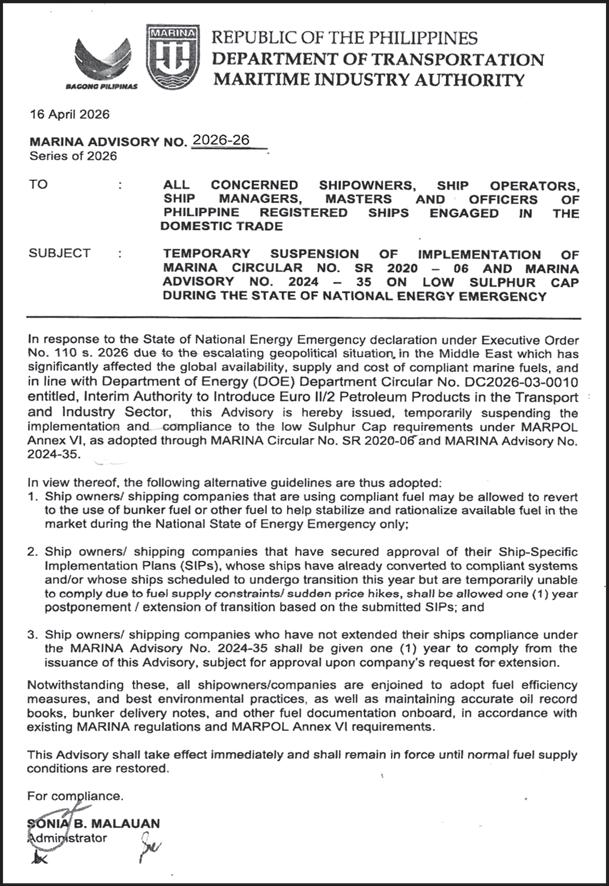
The validation trap: From anti-corruption to no construction
WHEN a multi-billion-peso flood control corruption scandal comes to light, the public rightly demands accountability. Last year’s revelations of ghost projects, padded billings, and misappropriated funds intended to protect communities from disaster were a betrayal of public trust. The government’s response—imposing stricter validation and processing of billing claims—was both understandable and necessary.
But the latest numbers from the Department of Budget and Management tell a troubling story. Infrastructure and other capital expenditures plunged by 43.5 percent in the first quarter, from P261.8 billion to just P147.8 billion. In March alone, the contraction reached 48 percent. This is not a modest pullback; it is a near-collapse in public construction at a time when the country desperately needs resilient roads, bridges, flood control systems, and school buildings. (Read the BusinessMirror story—“Flood mess shadow: Q1 infraspend dips 43.5 percent,” May 18, 2026).
To be sure, the DBM cites legitimate factors: frontloaded projects ahead of the election spending ban created high base effects, and agencies are still completing carryover obligations from prior years. But the elephant in the room is the stricter validation process itself—a direct consequence of last year’s flood control scandal.
No one wants a return to the days of careless disbursements and corrupt dealings. Every peso of public money must be accounted for. However, the current trajectory suggests an overcorrection that risks trading one problem for another: from wasteful spending to no spending at all. Infrastructure investment is not a luxury; it is the backbone of economic growth, job creation, and disaster resilience. The Philippines remains one of Asia’s most disaster-prone nations. Every delayed flood control project, every postponed bridge repair, every stalled road widening means communities remain vulnerable and supply chains stay congested. The poor suffer most when infrastructure lags.
The DBM’s assurance that spending will pick up in the second quarter—citing early allotment releases, the summer construction season, and the completion of bidding activities—offers some hope. But hope is not a plan. The government must urgently address the bottleneck without abandoning fiscal discipline.
What is needed is a middle path: streamline the validation process so that it is rigorous but not paralyzing. Invest in digital auditing tools and third-party monitoring to ensure value for money without monthslong delays. Empower agencies with training and additional personnel to process claims faster while maintaining integrity. And hold corrupt officials accountable—but do not punish the entire infrastructure apparatus for the sins of a few.
The P2.167 billion remaining in this year’s P6.793-billion obligation program must be unlocked immediately. Every week of delay is a week lost in the race against climate change, population growth, and global competition.
The fight against corruption must continue. But so must the fight against poverty, unemployment, and disaster vulnerability. Stricter validation should not mean national paralysis. The government has shown it can crack down on abuse—now it must show it can also build.
BusinessMirror
Ambassador Antonio L. Cabangon Chua

Profiling the Philippine workforce

IEAGLE WATCH
N today’s column, we break down and profile the Philippine workforce using the latest quarterly Labor Force Survey (LFS) microdata made publicly available by the Philippine Statistics Authority. At present, this is the April 2025 LFS.
The estimated domestic population (P) of the country as of April 2025 was 115.1 million. This population can be divided into the workingage population (WA) and the nonworking-age population (NWA), so that P = WA + NWAP = WA + NWA.
WA consists of Filipinos living in the country who are 15 years old and older, plus Filipinos working in Philippine embassies, consulates, and other missions. There is no upper age bound, so even a centenarian is considered of working age. In the survey, WA totaled 79.6 million.
NWA consists of Filipinos aged 14 years and younger, plus overseas Filipinos aged 15 and older who have left the country in the five years preceding the survey for work, study, or travel. NWA totaled 35.5 million.
How do WA and NWA differ in terms of characteristics?
There is, of course, a major difference in age profile. However, if we exclude those aged 14 and younger, the comparison largely becomes one between the domestic working-age population and overseas Filipinos— mostly workers. Statistical analysis that accounts for multiple variables simultaneously shows that, compared to the domestic working-age
population, overseas Filipinos tend to be more educated, more concentrated in the prime working ages (25–59), more likely to be female, and slightly more likely to come from rural areas. For example, only 17 percent of WA are college graduates, compared to 39 percent of overseas Filipinos.
WA can be further divided into those in the labor force (LF) and those not in the labor force (NLF), so that WA = LF + NLF WA = LF + NLF. In the survey, LF totaled 50.7 million and NLF totaled 28.9 million. LF includes those who are either employed or unemployed. The labor force participation rate(LF/WALF/ WA) measures how economically active a population is.
How do LF and NLF differ in terms of characteristics?
Women are substantially less likely than men to be in the LF. More specifically, for women and men of the same age, education, and urban or rural residence, women are 21 percentage points less likely to participate in the labor force. A primary reason is that household chores—still largely shouldered by women—are not counted as employment. By age group, the youth are the
least likely to be in the LF, followed by seniors (60+), while those in between have considerably higher participation rates. Rural residents are also more likely to be in the LF. The effect of education on LF participation is nonlinear: college graduates have the highest participation rates, followed by post-secondary graduates, but college and post-secondary undergraduates have lower participation rates than those with a high school education or less.
As noted, LF can be divided into the employed (E) and the unemployed (U), so that LF = E + ULF = E + U. An employed person is one who (1) worked at least one hour for pay or profit during the reference week, (2) worked as an unpaid family worker, or (3) has a job but did not work during the reference week. In the survey, E totaled 48.7 million and U totaled 2.1 million.
Among those in the LF, who are more likely to be employed rather than unemployed?
While women are less likely to participate in the LF, once they do, they are just as likely as men to be employed. Older labor force participants are more likely to be employed than younger ones. Rural residents are slightly more likely to be employed than their urban counterparts. By education level, college graduates and post-secondary graduates are actually slightly less likely to be employed than those with lower levels of education.
E can be further divided into the fully employed (FE) and the underemployed (UE), so that E + FE + UEE = FE + UE. The underemployed are those who are working but seek additional hours of work for any reason. By this definition, an employed person may already be working more than eight hours a day and still be
considered underemployed. In fact, the data show that 60 percent of the underemployed already work at least eight hours a day, and 11 percent work nine hours or more. In the survey, UE totaled 7.1 million and FE totaled 41.6 million. Among the employed, who are more likely to be underemployed? Men are more likely to be underemployed than women. Seniors are the least likely to be underemployed, followed by the youth, while those in between have the highest likelihood. Rural residents—possibly due to engagement in agriculture—are much more likely to be underemployed than urban residents. By education group, college graduates are the least likely to be underemployed, followed by college undergraduates, while post-secondary graduates and undergraduates, as well as those with lower education, have roughly similar likelihoods of underemployment. This simple profiling exercise shows that the Philippine labor market comprises distinct groups facing different constraints. Efforts to raise labor force participation must focus on women, particularly by addressing their care burden. Programs aimed at reducing unemployment should target the youth by easing school-towork transitions and improving job matching. Meanwhile, the persistence of underemployment—especially among prime-age men and rural workers—points to the need to raise job quality and working hours, not just job creation, including through support for productivity in agriculture and rural nonfarm enterprises.
Dr. Geoffrey Ducanes is Associate Professor at the Ateneo de Manila University and the Director of the Ateneo Center for Economic Research and Development.
New York has long benefited from Filipinos; it’s time to acknowledge their contributions
Angel R. Calso, Dionisio L. Pelayo
Ruben M. Cruz Jr.
Eduardo A. Davad Nonilon G. Reyes
D. Edgard A. Cabangon Benjamin V. Ramos Aldwin Maralit Tolosa
Rolando M. Manangan
BusinessMirror is published daily by the Philippine Business Daily Mirror Publishing, Inc., with offices on the 3rd floor of Dominga Building III 2113 Chino Roces Avenue corner De La Rosa Street, Makati City, Philippines. Tel. Nos. (Editorial) 817-9467; 813-0725. Fax line: 813-7025. (Advertising Sales) 893-2019; 817-1351, 817-2807. (Circulation) 893-1662; 814-0134 to 36. E-mail: news.businessmirror@gmail.com www.businessmirror.com.ph


TBy Troi Santos
HE sun is barely above the buildings when I get to Madison Avenue. Float scaffolding bare, barricades empty, vendors still arranging their tables in the quiet that does not last. I have been working this parade close to two decades—the march south toward Madison Square Park, and before that smaller parades on New Jersey main streets and a few Long Island side roads that nobody outside the community was watching. You learn the corners. The one that gives you the flag against the skyline. The one that gives you the faces. I have always preferred the faces—not for sentiment, but because that is where the information is.
Mass and a flag ceremony at the Philippine Consulate start the morning of the Philippine Independence Day Parade. By noon the floats are moving, the crowd is thick, and the food stalls are doing what they do. By six, people are starting to go home; vendors are folding tables and wrap-
ping the last of the skewers in foil. By morning the city has moved on—absorbed all of it back into a routine it has been running on Filipino workers, on every shift, in every borough, for generations. One day visible. The rest of the year, gone. A resolution now before the City
Council, introduced by Queens member Julie Won, would place June 12— Philippine Independence Day—on New York City’s own calendar. Resolutions are easy to dismiss. This one is harder because it asks the city to do something specific: say out loud, in its own institutional voice, what it has long taken for granted.
The story told about Filipinos in New York—in policy circles, in advocacy language, in the well-meaning op-ed—tends to stop at the ground floor. The domestic worker. The home health aide. The kitchen crew on the overnight shift in a restaurant whose owner does not know their names. That account is accurate and I have lived inside it for four decades—I have stood on subway platforms at five in the morning next to Filipino workers heading to jobs without con-
tracts, without benefits, without any assurance the arrangement holds next week. Their absence from official New York is a fact, and it is a disgrace. Riya Ortiz of the Damayan Migrant Workers Association is right to insist that honoring June 12 must center working-class immigrant Filipinos— the domestic workers, she says, “who keep our city thriving.” I have photographed those workers. Their invisibility is not in dispute. The rest of the picture is this. Filipino nurses, physicians, surgeons and hospital administrators holding medical institutions together across the five boroughs. Filipino lawyers, accountants, engineers, architects and social workers building careers in offices and agencies that have rarely stopped to acknowledge See “New
Dr. Geoffrey Ducanes
The rise and fall of two institutions serving coconut farmers
By Leonardo Q. Montemayor
WHEN the Coco Levy Fund was still in limbo, its ownership unresolved by the Supreme Court, the country’s 3.5 million coconut farmers and farmworkers were deprived of much needed support—notwithstanding that they were major contributors to the coconut industry’s multi-billion-dollar export revenues but were the poorest class of producers in the agriculture sector.
That critical period of uncertainty saw the entry of the United Coconut Planters Bank-Coconut Industry Investment Fund (UCPBCIIF) group of companies. Under the supervision of the Presidential Commission on Good Government (PCGG), the Group launched two entities dedicated to improving the lives of coconut farmers and their families—the UCPB-CIIF Finance and Development Corporation (Cocofinance) and the UCPB-CIIF Foundation (Cocofoundation).
It was a stopgap solution, with funds allocated to both establishments clearly inadequate to service coconut farmers nationwide. But it helped assuage the feeling of neglect felt by farmers.
First to be organized was Cocofoundation in 1987. Starting as a provider of various assistance to coconut farmers, it later concentrated on running a scholarship program for their children. The accepted wisdom was that one of the best ways to improve the lot of poor families, farmers included, was through education. With no regular budgetary support from the national government, Cocofoundation had to raise money on its own to sustain its social development work. Between 2003 and 2019, it generated nearly P300 million in donations from UCPB-CIIF and private companies.
At the height of its operations from 2005 to 2019, Cocofoundation handled about 500 to 1,000 enrolled scholars in various schools nationwide. The partner-schools were mainly the Don Bosco Technical Institute for vocational/technical courses and the State Universities and Colleges for college education. Innovatively, the program’s objective was not merely to graduate the scholars, but also to ensure their gainful employment afterwards. These scholars were also obligated to send a sibling to school once they got employed or to contribute to their family’s kitty. By year-end 2023, the number of graduates totalled almost 3,000—consisting of 1,741 with college degrees (with 17 percent earning Latin honors) and 1,102 with national certificate II competency ratings. Moreover, they sent 471 of their siblings and close kins to college.
Cocofinance was established in 1994. In 2002, during the Macapagal-Arroyo presidency, it received about P700 million worth of redeemable shares of CIIF oil mills.
Cocofinance focused on building social capital and extending affordable credit to coconut farmers and their cooperatives. The approach adopted was holistic. Seminars, trainings and workshops covered values formation, financial literacy, entrepreneurship, advanced farming practices, etc. (for farmers), and accounting/bookkeeping, fund management, marketing, etc. (for cooperatives). As added service, Cocofinance linked these coops to CIIF-affiliated oil mills, helping them to get preferential prices and terms for their copra produce.
The credit program was successful, based on the number of coconut farmers reached (about 235,000) and repayment rate attained (at least 95 percent). By 2019, loans released totalled P10.34 billion. The high repayment rate enabled Cocofinance to grow its capital, from P975 million to P1.2 billion and to sustain its lending operations even without government subsidy.
Considering the huge risks in agricultural lending, the company’s excellent performance provides a recipe for sustainable credit delivery to coconut and other farmers.
In 2012, the Supreme Court decided with finality that the Coco Levy Fund was public in nature and
Chaos and quiet in the memory-universe of Enrique S. Villasis

IThe moribund condition of both firms is doubly lamentable, considering the disappointingly low usage rate of the Coco Trust Fund since 2021. These entities could have played a major role in rolling out the Fund with due diligence and effectiveness and reviving the entire coconut industry.
must be used to benefit coconut farmers and the coconut industry exclusively. In 2021, this judgment was reinforced by the enactment of RA 11524 or the “Coconut Farmers and Industry Trust Fund Act.” Its financing would come from assets acquired through past coconut levies, now consolidated into a single Trust Fund (Coco Levy Fund) and valued at over P100 billion. The amount would be earmarked for various programs for coconut farmers.
With the resolution of the Coco Levy Fund-related issues, Cocofinance and Cocofoundation tried to position themselves as possible conduits and/or users of the Fund. After all, they already had the experience and expertise in working with coconut farmers.
Unfortunately, the government sidelined them in the law’s formulation and implementation. Moreover, the Duterte administration replaced the professional officers running both organisations with political appointees, whose competence and priorities were reportedly questionable. A number of them are likely still sitting as board members or senior managers in these corporations.
Not surprisingly, today, said companies are shadows of their previous robust selves. Take Cocofinance. For unexplained reasons, its resources have dropped to a third of what they were during the company’s heyday (despite PCGG’s supervision). Since 2019, the two companies’ alleged bad governance included the habitually late or failed submission of financial reports to the Securities and Exchange Commission (for Cocofinance) and the non-renewal of accreditation with the Philippine Council for NGO Certification (for Cocofoundation).
The moribund condition of both firms is doubly lamentable, considering the disappointingly low usage rate of the Coco Trust Fund since 2021. These entities could have played a major role in rolling out the Fund with due diligence and effectiveness and reviving the entire coconut industry.
But the Marcos administration can still salvage the situation—by exercising the political will to overhaul the two companies and restore their professionalism. Harnessing them to undertake the Trust Fund’s socio-economic programs can then commence. Ultimately, they can help realize the coconut farmers’ cherished dream of liberation from poverty and deprivation.
A necessary first step would be to summon the incumbent boards of directors/trustees and senior management before the Governance Commission for Government-Owned or -Controlled Corporations (GCG) and the Coco Levy Trust Fund Management Committee to account for Cocofinance’s and Cocofoundation’s financial conditions and the spending of their remaining coconut levy monies. After all, throwing good money after bad would be an even greater tragedy.
The author is a
Tito Genova Valiente
ANNOTATIONS
T seems Enrique “En” Villasis has found a way to rest his transcendence, that state of being, which tires us humans because it is always tedious to fly above the matter of our person. He discovers it in that most elusive—if you are philosophical—and abstracted ideal—as all ideological humans are—thing: the soul. In his Quantum Immortality, under Echo Grief, Villasis ignores the sprawling space above and below him, settles with the residual sorrow and remembers: “Sa luma naming bahay, tinatakpan ni Lola ng itim na tela [In our old house, my Grandmother covers with a black cloth]/Ang salamin sa tuwing may binuburol kaming kamag-anak [The mirror whenever we hold a wake for a kin]./Para hindi maligaw ang kaluluwa sa salamin…[So that the soul will not be in the mirror lost]. The poet persists in rendering material in what other thinkers have always thought to be nonmaterial, for the soul has become a shroud— nakakumot ito sa aking dibdib na tila aninong dumadagan [covering my chest like a shadow pressing upon it hard].”
If Villasis has opted to stay in this space of metaphors, we would have already learned lessons about immortality, but he faces headlong à discourse of that soul, denying it of the ghost and affirming the most physical of truths, which is death. Unafraid, he closes this Canto with the solitude of anonymity (aren’t we all terrified of passing on unknown and unremembered?): Walang lamay, walang (No mourning, no)/Obituaryo kung papaano ang ako na hindi ako nabuhay (Obituary about how I never ever lived).
In my personal conversation with Villasis, upon receipt of a copy of this collection of poems called Chaos Theory, I fancifully and without any mental reservation, admitted to him how I pick a poem from where I could begin a gradual entry into the poet’s territory. The form and content notwithstanding, this act demands the fortitude and hope of a fundamentalist waking up each day, holding the sacred book and flipping it to page. The same fundamentalist reader gives up any modicum of control, for there lies before him a story, a verse, a chapter that will rule all his behavior on this
New York.
. . continued from A10
them. Filipino clergy, veterans, police officers, firefighters, transit workers, postal workers, sanitation workers, security guards—every uniform, every shift. Filipino entrepreneurs running restaurants, bakeries and small businesses that outlast recessions. Filipino teachers spending entire careers in under-resourced schools by choice. Filipino community board members, elected officials, and organizers. Every floor of the building, every hour of the clock—and when June ends, every floor goes dark in the official record. Not just the basement. All of it.
The date carries history worth slowing down for. On June 12, 1898, General Emilio Aguinaldo declared Philippine independence in Kawit, Cavite, after more than three centuries of Spanish rule. What followed was not freedom. The United States, having acquired the Philippines from Spain in the Treaty of Paris, proceeded to wage a war of suppression against the independence movement it had once encouraged. The PhilippineAmerican War killed hundreds of thousands of Filipinos. It does not appear prominently in American history curricula. It is, nonetheless, the foundation.
American recognition of Philippine independence did not come until July 4, 1946—the date the United States preferred, yoked to its own national holiday—through Truman’s Proclamation 2695 and the Treaty of Manila. The Philippines reclaimed June 12 through Republic Act No. 4166 in 1964, reasserting the original date rather than the Americanassigned one. Eighteen years after formal independence, the country had to legislate its own founding moment back into existence. That is not a historical footnote. It is how the relationship has always worked. The migration that brought Filipi-
dila para sa mga sarili kong pumanaw. Hindi dahil (À candle for my selves that have departed. Not because)/Sa pagmamayabang, o dala ng konsensya, kundi dahil (Of arrogance, or urged by conscience, but because) Sa aking berso muli ko silang nabubuhay sa kanilang uniberso (In my verse I let them live again in their universe.)
day, in this earth. Did the poet agree with me or even indulge me with this gesture that is less literary than it is divinatory?
Quantum Immortality thus becomes my ingress to the theories and suppositions of Villasis. And it seems to pay off not because my procedure is efficient but because the poet has rediscovered for me— us—the wellspring of phantasms and philosophy, of teachings long forgotten now recovered in the lore of homes and kinship, self and love, loneliness, too, recognizable as ours.
The poet remembers and he takes chances with the spiritual, of the self journeying through dimensions and amplitude we have lost in classroom lessons that favor stasis and status quo. All this are magnified in the words of Villasis: Kaya nagsisindi ako (And so I light) Ng kan-
Let it be said that the power of Villasis’s poetry does not end in what it proposes as ideas but in how it structures the longing, the lament. Perhaps, my crude translation does not do justice at all to the poems of Villasis, but let it be noted how the poet disciplines himself with the logic of “ hindi dahil ” and “ kundi dahil,” which he leaves hanging at the edge, a device that brings back the inscrutability of a semi-ellipse, neither here nor there, and yet bearing quivering poignancy. It is good to be reminded that poetry collapses words and sentences that in the end makes that seeming carnage à conspiracy between the poet and languages he has long recognized as potency and possibility.

nos to New York was built on the same structure. The Hart-Celler Act of 1965 dismantled national-origin quotas that had mostly barred Asian immigration for decades. Filipino professionals—nurses, physicians, engineers, educated under a system the United States had designed during the colonial period—moved through that opening quickly. They came, they stayed, they built institutions: hospitals, community organizations, civic associations, a parade now more than three decades old. The people I photograph along the barricades on Madison Avenue did not arrive through a clean story of opportunity and assimilation. They arrived through empire, war, colonial schooling, deliberate labor recruitment, and a city that needed what they had and took it without making a habit of acknowledgment.
T he parade organized by the Philippine Independence Day Council with support from the Philippine Consulate General and billed as the largest celebration of Philippine independence outside the Philippines, draws thousands from across the tri-state area. I have worked it long enough to read the crowd without looking for it. The recently arrived next to the third-generation. The undocumented holding the outer edge of the sidewalk and the professionals who sit on the boards of institutions that issue press credentials. The overseas worker still wiring money home every month, and the US-born Filipino American whose Tagalog surfaces only in fragments, at the dinner table, in the register parents use when they don’t want the kids to follow. Teenagers switch between English, Tagalog, Ilocano, and Visayan in the same sentence. Elders in formal barong holding flags they have raised in two countries.
None of them occupy the same position here. The nurse practitioner with a full patient panel and the home health aide who has not seen her own children in five years are experiencing different forms of precarity. The Fili-
Flip the page again and there is that wondrous line: Kami ang bersyon mo na nalagutan ng hininga (We are your version, we whose breath were taken away).
pino lawyer and the Filipino worker on a construction site are not navigating the same risks. What they share is that neither appears in New York’s official story anywhere near the scale of what they have put into it. That gap holds across income levels and immigration statuses and professional tiers. It is not a problem at the margins. It is the whole problem.
Clifford Robin Temprosa, director of public policy at NaFFAA New York, names it plainly: “Too often, Filipino communities function as invisible infrastructure in New York City. They are essential to the life of this city, yet absent from public recognition, policy conversations, and institutional investment.” Infrastructure runs from the foundation to the roof. So does the invisibility.
Council Member Won frames the resolution as recognition of “the Filipino people’s long struggle for selfdetermination and freedom” and an affirmation that Filipino New Yorkers are “an essential part of our city’s story.” Rachelle Ocampo, president of NaFFAA New York, sharpens it: “It is not a ceremonial gesture—it is an act of recognition. It tells every young Filipino American growing up in the five boroughs that your heritage has a place in this city’s story.” Potri Ranka Manis of Kinding Sindaw calls the resolution “overdue after 300 years of the Philippine-American relationship.” Lara Gregory of Queens Center for Progress names the Filipino soldiers who fought alongside Americans in World War II and the Filipino health workers who staffed New York’s hospitals through a pandemic that moved lethally through Filipino households while those households were simultaneously holding the medical system upright. Sir Rely Manacay of the Knights of Rizal calls it “a proud recognition of Filipino heritage, freedom, and the lasting contributions of the Filipino community to this great city.”
None of these people are arguing that Filipinos have earned recogni-
An early favorite in this collection is Schrödinger’s Cat. Let’s begin with the most mundane of observations: we all love cats and our love is assured by the belief that cats have nine lives to spare. And so we ask, what trick or treat does Villasis the poet and, I suppose, a lover of cats, still possess? A lot. In this poem called Schrödinger’s Cat he assures the cat is alright. It may have been crushed somewhere but, following the quantum superposition propounded by the physicist Schrödinger, that cat still exists somewhere. And yet, Villasis is a doting father, an obstreperously affectionate writer who brings the cat to the domain of humans: Ang totoo, hindi ito (The truth is, this is not)/Tungkol sa pusa. Ang kahon, ang lason, ang siyentistang (About the cat. The box, the poison, the scientist)/ Isinusugal ang mortalidad ng nilalang—mga talinghaga (Who gambles with the mortality of being—these are metaphors)/Lamang ito, tulad ng araw na minsang ipinagtapat mo (Merely, as that day you once confessed to me)/ Ang pag-aalangan kung mahal mo ba ako o hindi…(Your uncertainty whether you love me or not...).
Read Chaos Theory and be lost, and found again, in an expanding universe of imagery. Enrique S. Villasis is a poet and scriptwriter from Milagros, Masbate. His poems have won in the Maningning Miclat and Don Carlos Palanca competitions. He is a member of Lira (Linangan sa Imahen, Retorika, at Anyo). Published by Librong LIRA, Chaos Theory is Villasis’s third collection of poetry. On the cover of this book is another Bicolano artist’s art work called Singularity by Panch Alvarez.
E-mail: titovaliente@yahoo.com
tion. The contributions are not in question and have never needed to be proven. What they are arguing is that the city has drawn from that community—the labor, the sacrifice, the tax base, the cultural life—for generations, without writing any of it into its own record. Temprosa puts the mechanics of that plainly: “Recognition shapes narrative, narrative shapes policy, and policy shapes which communities are protected, invested in, and remembered.” No resolution closes wages or steadies a mixed-status family or removes a domestic worker from the legal exposure she carries every day. The distance between a date on a calendar and material protection is wide and should not be called something it isn’t. But cities write themselves into existence through the stories they keep. A city that puts June 12 in its legislative record is harder to convince—in the budget room, in the policy conversation, in the quiet decision about which communities get consulted and which get managed—that Filipino New Yorkers can be treated as an afterthought. Cities do that. They do it continuously. Recognition does not stop it, but invisibility makes it easier.
More than a decade behind this camera, I have stood at the bottom of this economy and at the top of it, and at every level in between, and Filipinos were there at all of it—working, building, staying. The home health aide. The surgeon. The attorney. The cook. The engineer. The teacher who had better options and chose to stay. New York has taken from all of them—across sectors, decades, immigration statuses, and every wave of arrival—and gotten larger on what they put in. This resolution asks the Council to write that down in its own record. Not as June ceremony. Not as a greeting attached to a parade date. As fact. The Council cannot legislate gratitude. What it can do is stop pretending it doesn’t know who built the place.
Friday, May 22, 2026
‘S.E.A. QUICK COMMERCE FACES CHALLENGE OF DEMAND GAP’
By Bless Aubrey Ogerio
CONSUMER demand re -
mains the biggest miss-
ing piece in Southeast Asia’s quick commerce sector despite rapid growth in logistics capacity and delivery infrastructure, according to a Singaporebased research firm.
In its recent Quick Commerce in Southeast Asia 2026 report, Momentum Works said the region’s challenge lies in building consistent consumer habits, even as platforms, retailers and logistics networks continue to expand.
Fulfillment systems and supply-side infrastructure, supported by food delivery platforms and offline retail networks, have largely matured, but demand density has not kept pace, the firm said.
It also noted that closing this gap would require sustained investment to bring prices closer to offline retail levels, warning that without such support, quick commerce risks remaining a premium service rather than a mass-market channel.
In its data, quick commerce gross merchandise value (GMV) in Southeast Asia reached about $7.3 billion in 2025, accounting for 4.6 percent of the region’s e-commerce GMV, but still less than 1 percent of total retail spending estimated at$1.09 trillion. And for Momentum Works, the more important question
is not how large the sector will become, but how it will develop across different markets in the region.
It added that major e-commerce platforms are increasingly integrating quick commerce into their core operations, with about 3.4 percent of Southeast Asia’s e-commerce GMV now fulfilled through quick commerce systems. The report said this signals an early shift in competition among digital platforms, as firms race to build hyperlocal delivery capabilities.
“Unlike China, where a decade of food delivery investment built the hyperlocal rider density that underpinned quick commerce, or India, where thin organized retail allowed platform-run dark stores to effectively become modern retail for affluent consumers, SEA’s offline retail remains dominant and fragmented,” it said. Traditional retail remains dominant and unevenly structured across the region, it added, from mini-marts in Indonesia to conglomerate-led retail ecosystems in Thailand and highly developed modern trade in Singapore.
As a result, Momentum Works said that quick commerce in Southeast Asia is evolving less as a replacement for physical retail and more as an additional layer built on top of existing distribution systems.
Transparency gaps driving up biz costs, officials warn
By Mary Jade Jadormio
BUSINESSES
are losing time, money and investment opportunities because of the government’s inconsistent disclosure practices, fragmented permitting systems and delayed release of public information, government officials said.
At the “FOI Now: Making Democracy Work for Filipinos” forum on Thursday, government officials warned that the absence of timely, accessible and standardized information forces companies to spend heavily just to navigate regulations, secure permits and verify government requirements.
“Transparency reduces friction,” said Christianne Grace F. Salonga, partner at Cruz Marcelo & Tenefrancia. “Businesses spend less time confirming requirements, making multiple follow-ups with government agencies and dealing with hidden procedures or costs.”
Salonga said unreliable access to information pushes firms to rely on informal channels and intermediaries, raising transaction costs, particularly for micro, small and

medium enterprises (MSMEs) and foreign investors unfamiliar with the Philippine regulatory system.
“Information that arrives too late might technically be compliant with transparency requirements but is ultimately commercially useless,” she said.
The discussion, organized by transparency and business groups, centered on how freedom of information (FOI) policies could improve the investment climate by making government transactions more predictable and accountable.
Makati Business Club Programs and Policy Manager Geeta Keswani said one company had hired 27 paralegals solely to contact government offices and obtain information needed for business operations.
‘Apec
“That’s a very high transaction cost,” Keswani said, noting that uncertainty in regulations effectively acts as a hidden burden on firms.
Salonga described freedom of information not merely as a governance reform but as an economic policy tool critical to market efficiency.
“Markets work best when information is reliable, timely disclosed, accessible and understandable to businesses and investors,” she said.
She added that inconsistent implementation of rules across local government units (LGUs) remains one of the biggest obstacles faced by businesses operating nationwide.
Anti-Red Tape Authority (ARTA) Legal and Public Assistance Office Director Leonardo O. Tapia acknowledged that permitting requirements may vary among LGUs because of local autonomy under the Local Government Code.
However, Tapia said ARTA can intervene when local rules create unnecessary burdens or violate Republic Act 11032, or the Ease of Doing Business and Efficient Government Service Delivery Act.
“We already filed cases against local government units that failed to comply with the law, especially in putting up their electronic business one-stop shops,” Tapia said.
Under the law, agencies and LGUs are required to publish citizens’ charters containing requirements, fees, procedures and processing
timelines for government transactions.
Tapia said failure to deliver services within prescribed processing periods and imposing additional requirements beyond those published in citizens’ charters are punishable offenses.
He also admitted that outdated agency charters and limited government funding continue to slow digitalization efforts across the bureaucracy.
For procurement reforms, Procurement Service-Department of Budget and Management Director Marina M. Semana said the government is expanding the use of the modernized Philippine Government Electronic Procurement System (PhilGEPS) to improve transparency in public spending.
The upgraded procurement platform allows end-to-end tracking of projects—from planning and bidding to contract implementation and payment—while also generating procurement datasets accessible to the public.
“In every stage there’s posting,” Semana said. “The government agencies need to post what is happening in the procurement until it is awarded.”
Semana said the government is also working on data-sharing agreements with the Commission on Audit, Office of the Ombudsman,
See “Costs,” A2
travelers seek more value, choices in hotel loyalty programs’
By Ma. Stella F. Arnaldo Special
AJORITY of Asia-Pacific travelers are enrolled in loyalty programs involving hotels and airlines, but their changing travel preferences and behavior demand more co-partnerships between brands and improved options to satisfy these. The New Loyalty Trends Report 2026 by Marriott Bonvoy showed that about 89 percent of their survey respondents in the Asia Pacific Excluding China (Apec) region participate in at least one loyalty program. The most prevalent, at 66 percent, are hotel loyalty programs. This
is followed by airlines (59 percent), dining/food delivery (53 percent), retail/e-commerce (48 percent), among others. Marriott Bonvoy is Marriott International’s free travel and loyalty platform, connecting guests to 30 hotel brands and 10,000 destinations worldwide.
The report, however, indicated that hospitality loyalty programs have to be more agile in catering to the transforming needs of travelers.
“There is no one-size-fits-all approach to loyalty,” the report underscored. “How they engage is no longer uniform. Instead, engagement is shaped by a combination of travel priorities, everyday value expectations, and distinct local market dynamics,” it added. For instance, the report showed that 63 percent of Apec travelers surveyed prioritized Food and Dining when planning their trips, and as such, this is the most powerful driver of travel loyalty programs.
“[These travelers] show especially clear loyalty behavior: they are more likely to earn through food-related activity and redeem for F&B [food and beverage] indulgences, making food one of the most powerful and scalable levers for hotel loyalty engagement,” according to the report. Individuals who travel to Recharge and Disconnect, are the farthest from the Apec loyalty

Editor: Jennifer A. Ng
Megawide posts strong Q1 results on higher revenues

By VG Cabuag @villygc
MEGAWIDE Construction Corp. on Thursday said its consolidated net income jumped 26 percent to P265.35 million in the first quarter from the previous year’s P213.99 million.
Per segment, construction delivered P262 million and real estate brought in P14 million, with landport incurring losses.
Consolidated revenues grew 14 percent to P4.81 billion, with improved results recorded across the portfolio. Construction remained the biggest contributor at P3.84 billion, up 5 percent, with real estate chipping in P831 million, more than double the previous year, while landport accounted for P138 million.
“Our results in the first three months are consistent with our back-ended target for the year. While we sustained a healthy performance early on, we have yet to quantify the impact of the Middle East War and a newly replenished construction order book in the coming months. Nonetheless, we are actively assessing the situation and strategically evaluating the developments to keep us on track with our goals,”
Edgar Saavedra, Megawide’s chairman and CEO, said.
As the impact of the Middle East war that erupted in February this year has yet to be measured, the company said it remains grounded on its strategy and focused on achieving its dual objective of topline growth and balance sheet strengthening to shore up profitability.
“The other side of our value creation strategy is boosting our financial position to ease the debt servicing burden and provide financial flexibility. Already, we have pared down almost P6 billion of our short-term debt in the first quarter alone, which should translate to an estimated interest cost savings of around P250 to 300 million for the year based on our average cost of debt,” Saavedra said.
The company’s bank debt-to-equity ratio further improved to 1.1 times as of end-March 2026 from 1.54 times at end-December 2025, with net D-E ratio likewise breaching
the 1 times mark at 0.8 times versus 1.1 times, respectively. These results align with the company’s medium-term commitments under its de-levering and long-term financial management program.
“For the remainder of the year, we are programmed to pay down another P2.5 to P3 billion from our short-term obligations as we aim to boost our liquidity and free up more debt headroom to support our longterm growth aspirations,” Jez G. dela Cruz, the company’s CFO, said.
Megawide has an existing construction order book of P48.7 billion as of end-March 2026 and is currently constructing around 11,000 units of socialized housing units under the government’s expanded 4PH program to anchor its social infrastructure platform.
The company is also developing the Baguio City Integrated Terminal, the South Luzon Integrated Terminal Exchange, and the Cavite Bus Rapid Transit System.
RLC starts building FedEx facility
PROPERTY developer Robinsons Land Corp. (RLC) and Asian Infrastructure Holdings Corp. (AIHV) on Thursday said they have broken ground on a new builtto-suit logistics facility for FedEx at Clark International Airport in Pampanga under their joint venture, RL Clark Logistix Inc. (RCLX).
RCLX is a joint venture between Robinsons Land and AIHC, with RLC holding an 85 percent stake and AIHC holding the remaining 15 percent.
The project is being developed in coordination with Base Conversion Development Authority, Clark Development Corp. and Luzon International Premiere Airport Development Corp., the operator of Clark International Airport.
The development is planned on approximately 15-hectare site
and is expected to deliver a total gross floor area of close to 78,000 square meters.
Completion is targeted for the first quarter of 2028.
For RLC, the project adds scale to its logistics and industrial expansion through Robinsons Logistix and Industrials Inc., its logistics and industrial facilities arm.
The development strengthens RLX’s presence in a corridor supported by cargo movement, aviation activity, and regional distribution links.
The upcoming facility also supports RLC’s broader direction of expanding investment properties and building more diversified income streams.
Through RLX, the company is widening its industrial footprint in a way that supports portfolio
diversification and strengthens recurring income over time.
“This partnership reflects Robinsons Land’s commitment to developing well-located, future-ready logistics facilities that support the growth requirements of worldclass companies such as FedEx,” Cora Ang Ley, senior vice president of RLC and general manager of RLX, said.
“Through RCLX, we are building in Clark with a long-term view of operational efficiency, network expansion, and the growing role of the Philippines in regional trade and logistics.”
Once completed, the facility will give RLC a large-format, built-to-suit logistics development in Clark, further deepening its presence in one of the country’s most active industrial and transport corridors. VG Cabuag
Intuit to cut 17% of workers to ‘simplify’ structure
INTUIT Inc. is cutting about 17 percent of its staff, or about 3,000 workers, a move to trim costs while the financial software company invests in artificial intelligence products.
The job reductions are meant to simplify the organization and “become a faster, leaner, more focused company,” Intuit said Wednesday in a statement reporting its fiscal thirdquarter results. The company said it expects to incur about $320 million in restructuring charges, largely in the current period.
Intuit’s shares fell 4 percent to $383.93 at Wednesday’s close after Reuters reported earlier on the job cuts. The company’s stock is down 42 percent this year.
Intuit is the latest tech company to have slashed its workforce this year. Meta Platforms Inc. on Wednesday alerted about 8,000 employees that they were losing their jobs, part of a previously announced restructuring aimed at reducing costs while the company invests heavily in artificial intelligence. Like many in the software industry, Intuit is betting on AI features to help expand its business. “As we look ahead, we are further scaling our growth engines and architecting an organization that operates with greater velocity to deliver durable

long-term growth,” Chief Executive Officer Sasan Goodarzi said in the statement. This is the second major job reduction for Intuit in recent years. The company in July 2024 cut 1,800 employees, or about 10 percent of its workforce, saying it expected to rehire the same number of employees in other areas. Intuit had about 18,200 employees as of July 31, 2025. In the quarter, which ended April 30, Intuit reported revenue increased
10 percent to $8.56 billion, ahead of analyst estimates. Profit, excluding some items, was $12.80 per share. Analysts, on average, projected $12.54 a share, according to data compiled by Bloomberg. The company said revenue would increase by a range of 11 percent to 12 percent in the current period ending in July, compared with analysts’ average estimate of 8 percent growth. Adjusted earnings will be $3.56 to $3.62 a share. Analysts, on average, estimated $3.15. Bloomberg News

PLDT hastening shift of cell sites to solar as power costs rise
TELCO titan PLDT Inc. said on Thursday it is ramping up the deployment of solar power across its cell sites, accelerating a program designed to shield the company from rising electricity costs and bolster network reliability as global energy prices remain volatile.
PLDT COO Menardo Jimenez Jr. said the push is driven in large part by the telco’s exposure to market-priced electricity. Unlike fuel — where PLDT benefits from special pricing agreements with major distributors — electricity across many of its facilities is not covered by long-term contracts, leaving it vulnerable to price swings tied to geopolitical tensions and inflationary pressures.
“That’s where we’re seeing the biggest jump,” Jimenez said. “We’re becoming much more disciplined in how we manage power consumption, and we’re accelerating our ability to solarize our cell sites. This allows us to become more efficient and gives us greater control over our energy costs.”
By deploying on-site solar at cell sites, Jimenez said PLDT aims to reduce its dependence on grid
electricity, improve cost predictability, and strengthen service continuity in areas prone to power disruptions.
The accelerated solarization is an extension of PLDT and its wireless unit Smart Communications Inc.’s broader decarbonization agenda, which targets a 40-percent reduction in Scope 1 and 2 greenhouse gas emissions by 2030.
The program has been embedded into network planning, facility operations, and energy procurement over several years.
Several major facilities in Greater Metro Manila already run entirely on renewable energy, while high-consumption buildings are supplied through clean energy agreements.
Smart also deploys artificial intelligence-enabled green radio technology that dynamically adjusts a cell site’s power output based on real-time network demand.
Jimenez acknowledged the difficulty of forecasting conditions in the near-term but said the company was focused on the variables within its control.
Lorenz S. Marasigan

Banking&Finance
WHILE non-life insurance companies in the Philippines booked stronger earnings in the first quarter, the life insurance industry saw its net income fall due to higher benefit payments. Data from the Insurance Commission (IC) showed net income of the life insurance industry dropped by 15.41 percent year-on-year to P9.160 billion in the first quarter from P10.828 billion.
Combined earnings of 33 life insurance companies slipped due to a 16.53-percent increase in benefit payments, which amounted to P33.734 billion. Still, the industry’s premium income rose by 15.42 percent to P115.310 billion from P99.902 billion a year ago.
Total assets of life insurance companies in the country reached P2.071 trillion, higher by 7.35 percent than the P1.929 trillion last year. On the other hand, the total net income of non-life insurance companies jumped to P3.955 billion in the
first quarter, up by 36.68 percent year-on-year from P2.893 billion.
This was on the back of lower losses incurred, down 4.50 percent to P7.717 billion from P8.081 billion last year.
Total net premiums written grew steadily by 3.16 percent to P21.240 billion from P20.589 billion a year ago.
Combined assets of 56 non-life insurers stood at P391.794 billion in the first quarter, up by 1.75 percent from P384.459 billion in the same period last year.
The entire insurance industry logged P15.038 billion in firstquarter net income, slightly down by 1.75 percent year-on-year from P15.307 billion.
Both total premiums and benefit payments increased 13.14 percent and 11.35 percent, respectively.
The Philippines’ insurance penetration rate, or the industry’s contribution to the overall economy, reached 2.03 percent in the first quarter, hitting the government’s 2-percent goal. Reine Juvierre S. Alberto
Build high-performing Boards of associations
THERE was a time when many associations were run largely on goodwill, volunteerism and passion for the profession or industry they represented. While that spirit remains important, the realities facing associations today are far more complex. Members expect value, governments expect credibility, industries expect leadership and stakeholders expect professionalism.
In a recent episode of the PCAAE podcast “Association Matters,” we had the opportunity to speak with Francis Child, executive chair of The Association Specialists, an Australian association management company. Francis shared practical and timely insights on what it takes to build high-performance association boards in today’s environment. One message stood out clearly throughout the conversation: associations can no longer afford to operate casually if they want to remain relevant and trusted.
According to Francis, one of the biggest governance opportunities for associations today is the shift from viewing associations as “member hobbies” to managing them as serious organizations with clear business discipline. While associations are mission-driven and not necessarily profit-driven, they still require strategic planning, budgeting, accountability and professional leadership. He pointed out that some associations still operate without even managing proper budgets, a situation he described as alarming in an increasingly competitive and fast-changing environment.
This transformation begins with governance education. Traditionally, many board members were selected because they were respected practitioners within their industries, e.g., doctors, engineers, mechanics, or business owners, but not necessarily because they had governance or business expertise. Francis emphasized that modern boards now require broader competencies beyond governance alone. Financial literacy, marketing, technology awareness, strategic planning, communications and stakeholder engagement are all becoming essential skills in the boardroom.
Equally important is the induction and mentoring of new board members. Strong boards do not simply appoint volunteers and expect them to perform immediately. They intentionally orient new leaders to the organization’s mission, strategic priorities, challenges and value proposition. In many ways,
Public participation in budget process ‘insufficient’—survey

By Reine Juvierre Alberto @reine_alberto
DESPITE leading its Southeast Asian neighbors in government budget transparency, the Philippines falls short in letting the public participate across different stages of the budget process.
Results of the 2025 Open Budget Survey (OBS) by the International Budget Partnership revealed that the Philippines has a transparency score of 76, out of 100.
This indicates that a “sufficient” volume of budget information is published to enable the public to debate on fiscal policy and understand government budget decisions.
The latest transparency score is a slight improvement from 75 in 2023


this reflects the practices of wellmanaged corporations that invest heavily in leadership development and succession planning. Another valuable point raised during the discussion was the delicate balance between governance and operations. Many associations, especially smaller ones, struggle because volunteer leaders often become involved in day-today operations out of necessity. Francis acknowledged this reality but stressed that associations must still strive to separate strategic oversight from operational management whenever possible. Boards should focus on setting direction and measuring outcomes, while staff or operational committees focus on execution. Clear reporting structures and performance monitoring become critical in maintaining that balance. Perhaps the most important takeaway from our conversation was the relationship between the board and the CEO. Francis described effective board-CEO relationships as being built on trust, mutual respect, transparency and clearly defined responsibilities. Boards should avoid micromanagement while ensuring that CEOs are properly supported with resources, direction and measurable goals. In return, CEOs must report with integrity and maintain open communication with the board. Ultimately, the conversation reinforced a simple but powerful truth: high-performance associations are built on high-performance governance. Associations that embrace professionalism while preserving their sense of community and purpose will be the ones best positioned to lead industries, influence policy and remain relevant in the years ahead. As Francis aptly summarized, successful associations deliver credibility, information, networks and what he called “the power of the pack.” In today’s world, those four elements may matter more than ever.
Octavio Peralta is founder and volunteer CEO of the Philippine Council of Associations and Association Executives, the “association of associations.” PCAAE will hold its 14th Annual Associations Summit (AS14) on November 24, 2026 at the Asian Institute of Management. The views he expressed herein do not necessarily reflect those of the BusinessMirror E mail: bobby@pcaae.org
and 68 in 2021.
Among neighboring countries, the Philippines ranked highest, outpacing Indonesia (71), Cambodia (54), Thailand (53), Vietnam (51) and Malaysia (51).
However, the Philippines obtained a public participation score of 37, out of 100.
This means the government provides “insufficient” formal and meaningful opportunities for pub -
lic participation across the different stages of the budget process. Still, the Philippines posted a higher participation score, surpassing its neighboring countries, such as Indonesia (33), Thailand (28), Malaysia (20), Vietnam (17) and Cambodia (2).
The legislature and supreme audit institutions in the Philippines also provide “adequate” oversight during the budget process, with a composite oversight score of 68 out of 100, according to the survey.
During the 2025 OBS Results Forum last Wednesday, Budget Secretary Kim Robert C. De Leon said the OBS is not merely about international rankings or compliance, but about restoring public trust and ensuring that government resources genuinely translate into better lives for Filipinos.
The newly-appointed chief of the Department of Budget and Management (DBM) said the government must pursue integrated digital
governance, make public information more open and understandable and allow meaningful citizen participation.
“In the DBM, we fully recognize that corruption does not thrive only because of bad actors. It also thrives when systems are weak, processes are outdated, information is inaccessible, and accountability mechanisms are fragmented,” he added. Transparency, De Leon argued, is about building systems where discretion is reduced, processes are traceable, transactions are visible and the public is empowered to participate and demand accountability.
“For me, open government, more than making government more transparent, is about making governance more intelligent, more responsive, more efficient, and more worthy of public trust,” De Leon said. “No reform agenda, no matter how technically sound, can succeed without public confidence in our institution.”
War puts BPI’s ‘blue’ bond issuance on back burner
By VG Cabuag @villygc
THE Bank of the Philippine Is-
lands (BPI) is pondering the issuance of so-called “blue” bonds, or sustainability-linked instruments related to water projects. During the bank’s news conference last Thursday, the bank’s CFO and Chief Sustainability Officer Eric Roberto M. Luchangco said the volatility caused by the Middle East war has made them think twice about floating the bonds this year.
Depending on market conditions, it is still possible that they will issue sustainability-linked bonds this year.
“I’m not saying it’s going to happen, but it’s possible. I’m not saying it’s going to be ‘blue,’ but it’s possible. I’m not saying it’s going to be blue, but I would like to (issue blue
By Andrea Louise San Juan
WHILE Moody’s Ratings affirmed the credit ratings of two Philippine banks, it noted that the country’s sovereign ratings prevents the country’s largest lenders from getting credit rating upgrades.
The banks assessed by Moody’s were the BDO Unibank Inc. (BDO) and the Bank of the Philippine Islands (BPI). Their Baseline Credit Assessment (BCA) affirmed a “Baa2” rating.
As the banks’ deposit ratings and BCA are already at the same level as the Philippines’ sovereign rating, an upgrade is “unlikely.” Moody’s said BDO’s rating reflected its good asset quality, strong funding and liquidity, as well as good profitability and adequate capital.
In the case of BPI, the affirmation of its rating reflected its strong profitability, adequate capital, healthy liquidity and stable funding backed by its solid deposit franchise.
Meanwhile, the credit rating agency said credit downgrades are possible for the banks.
Downgrades possible ACCORDING to Moody’s, BDO’s rating could be lowered if the bank’s TCE/RWA
LandBank
bonds),” he said.
The bank has maturing obligations later this year that will need to be refinanced.
“It’s really a question of what do we think is the best financing for us to use at that time,” Luchangco said. He said they may even opt to issue corporate notes if there is an opportunity like last year where the International Finance Corp. took up the entire issuance.
“We really have to look at what is the best available source for us at any given time, and then so we try to balance those things,” Luchangco said adding that the size of the offering, maturity, and the currency will all depend on market conditions including prevailing interest rates.
“It is a bit more challenging time for us but, when I say we’re not go -
ratio declines to around 13 percent or if there is a “significant and sustained” increase in its problem loans, such that its credit costs increases significantly, which in turn “would hurt its profitability.”
Moreover, BDO’s baseline credit assessment (BCA) could be lowered if there is a “significant” increase in related party lending or concentration risks, Moody’s added.
According to the ratings agency, BPI’s rating could be downgraded, too, if there is a “significant” deterioration in its solvency metrics.
“Specifically, if the bank’s problem loan ratio rises above 5 percent with a corresponding spike in credit costs, or if Moody’s-adjusted tangible common equity/risk-weighted assets decreases to below 14.5 percent,” the credit rating agency said.
Moreover, Moody’s said BPI’s BCA could be lowered if there is a significant increase in related-party exposures or loan concentration risks.
“Additionally, BPI’s BCA could also be lowered if its reliance on less stable funding increases to above 22 percent of tangible banking assets or if its level of core banking liquidity declines to below 17 percent of tangible banking assets,” Moody’s said.
ing to accelerate (the issuance), that doesn’t mean that we will wait until the bond matures before we do the financing. Even when the market conditions were more stable, sometimes we would fund three to six months ahead,” he said.
The BPI executive added they are continuing “to watch the markets carefully.”
“But you know, obviously it’s been quite a tumultuous time in the markets right now and I don’t think we’re quite ready to commit to the market, especially given that it’s very hard to predict how things are going to evolve,” he added
Luchangco said they currently favor the issuance of blue bonds, which are related to water-, oceanor marine-based sustainability projects, since it thinks there is demand from some investors.
Some challenges
EVEN as Moody’s outlook on these two banks remains stable, it flagged a few challenges that could get in the way of these banks’ strengths.
For BPI, the credit rating agency said: “These credit strengths balance the bank’s weakening asset quality, driven by strong growth in the higher risk retail segments, as well as challenges in its corporate segment.”
Moody’s said it expects the retail segments of BPI to experience “further strain” in 2026, given the shrinking financial buffers of retail borrowers amid higher inflation in the Philippines.
BPI’s problem loan ratio, defined by stage 3 loans as a percentage of gross loans, increased to 3.4 percent as of end2025 from 3.1 percent the year before, while its gross credit costs increased to 0.75 percent from 0.32 percent over the same period.
Moody’s explained that the “deterioration” was driven by the seasoning of retail loans following the high 30 percent three-year compound average growth rate, and the normalization of creidt costs following a period of “drawing down” on its reserves. Further, the bank’s stage 2 loan ratio also increased to 9.3 percent as of end-
“Water is a very basic human necessity. Nobody lives without water and, so that’s if you talk about what new thing we’d like to do, I think that’s one of the things on my desk,” he said. Before the war in the Middle East erupted, BPI President and CEO Jose Teodoro K. Limcaoco expressed confidence that the bank will be issuing more bonds because of the supportive market conditions at that time. BPI raised P50 billion from the offering of its BPI Supporting Individuals Grow, Lead, and Achieve Bonds (the BPI SIGLA Bonds), 10 times its base issue size of P5 billion worth of the fixed-rate, peso-denominated instruments. These represent the second tranche under BPI’s P200 billion bond and commercial paper program.
2025 from 7.9 percent the year before, indicating further underlying weaknesses in the loan portfolio. In the first quarter of 2026, the bank reported that several corporate loans slipped into problem loans due to challenges unrelated to the conflict in the Middle East, while gross credit costs increased to 0.87 percent in line with the heightened macroeconomic risks input into its expected credit loss model.
Although the bank has tightened credit underwriting and plans to moderate its retail loan growth, we expect the bank’s asset risks to remain elevated, with credit costs normalizing closer to the 0.9 percent range in 2026. The bank’s high concentration to large corporate loans and long-dated investment securities will also pose risks to its asset quality, Moody’s also noted. For BDO, the credit rating agency expects the bank’s gross credit costs to remain elevated as the bank’s unsecured retail loans continue to grow and season following strong growth over 2023 to 2025.
“The bank’s high concentration to large corporate loans and long-dated investment securities will also pose risks to its asset quality,” added Moody’s.
Octavio Peralta
A ssociation World


Luxury, sunsets, and serenity at Crimson Resort Boracay

ESCAPING from the stifling summer heat and humidity in Metro Manila, which has affected the brains and behavior of 13 of our senators, I flew via AirAsia to Caticlan last weekend for a short trip to my favorite Boracay Island. I was fortunate to have been included in a tour operators’ familiarization trip hosted by Crimson Resort and Spa, which sits on a cove in Station Zero, with its own creamy powdery white-sand beach, facing clear azure waters.
A few minutes away from the Caticlan Airport is the resort’s own guest reception villa and port, where
we were refeshed by cool towels to our faces, snacked on some cookies, and quenched our thirst with chilled water. Ahhh...what a relief!
Shortly after, we zipped over water via the resort’s fastcraft piloted by Captain Onyok. It was too short a trip in fact, as I’ve always found this part of the transfer a leisurely romantic buildup to the wonders that lie beyond, when a boat makes that turn to the island.
Still, I appreciated that we landed right at Crimson Resort’s beach, where guests were slowly starting to gather, taking their places at the lounge beds for their fun day under the sun.
As the group arrived at 10 am, still too early to check-in, we gathered at the Saffron Cafe for a late breakfast. I was overwhelmed by the extent of dishes, which ran from the regular breakfast fare of bread, eggs and bacon, to Japanese sushi selections along with Mexican burrito and taco eats, to the heavier Filipino favorites like Lechon Kawali.
I am told this is the “best breakfast buffet” on the island, and is open to walk-in guests. And for P1,500 per person, I can understand why. For my first brekkie though, I stuck to garlic rice and an egg, sunny side up,
with crispy delicious bacon (San Miguel Foods’ Vida brand), and my usual lacatan banana on the side.
Home was the Indigo building, where my room looked out to a garden and a building across. It was well-appointed and of a size that gives guests enough space to rest, reflect and ruminate. All buildings are named after shades of blue—Indigo, Teal, Cobalt, etc., but gasp! No Cerulean!
Whichever building a guest happens to be booked in, there will surely be a pool nearby if one wants to get away from the beach crowd and read a book (or one’s phone), in between doing laps. I was lucky enough to have the pool at the Indigo building to myself, and swam to my heart’s content as the water was warm and relaxing.
It looked down to the main pool, where on Saturday afternoons there is a foam party with dance music blaring from speakers for guests, who are up to shaking it and downing cool cocktail concoctions.
On the first day of the trip, I hit the beach at 3 pm and enjoyed the swim, when the waters are pleasantly cool and so clear that I espied a few fishies
SEE “CRIMSON,” B5
Ghost(ing) hunt: In search of an emotionally distant generation
BY CALY BAUTISTA
This is the concluding part of the author’s provocative essay on the challenges of modern romance, which appeared in this section of BUSINESSMIRROR yesterday.
IN an article for Medium, psychologist Dr. Annie Tanasugarn recalled three insecure attachment styles that are prone to developing emotional unavailability: anxious, avoidant, and disorganized (which is a mix of the other two).
Since the anxious and avoidant respectively fear rejection and commitment due to unresolved childhood wounds, they are more likely to be unreceptive to their partner’s needs.
Relatedly, Francis may have been in an anxiousavoidant relationship with his ghoster, explained by psychologist Dr. Susan Albers for Cleveland Clinic as the usual grounds where ghosting takes place. Francis being ghosted after longing for his partner’s affection can be paralleled with the “chase” that happens between anxious and avoidants—when the anxious goes after the withdrawing avoidant, they create an exhausting cycle of push-and-pull before their relationship inevitably halts.
Despite their abrupt end, Gia still wished
her situationship rest, better days, and their understanding of her decision. Admittedly, she is still open to giving closure to the person she ghosted— but she won’t be the one who’ll do the approaching. Nonetheless, her heartaches came with a lesson: “I need to make sure that I am whole again and that I love myself again before I love other people.”
Francis, on the other hand, has certainly recovered two years after being ghosted. The experience made him “emotionally stronger and more knowledgeable of how to handle certain things in a relationship.”
While recognizing his own shortcomings, he only wishes his now-happier ghoster to not inflict the same pain on other people: “Being a good person to ourselves and to others isn’t that much of a harm, so why not do it?”
THE DEMONS WE’RE YET TO FACE FOR “date-to-marry” types like Gia, the difficulty of finding a partner who shares the same values is clearly apparent.
“Most [Gen Zs] look for short-term relationships or even mga kalandian alone.” Both she and Francis also agree that dating is supposed to be fun. Nevertheless, with the culture of impermanence currently on the rise, Gen Zs are reminded of the responsibility that


comes with building (and ending) connections. By digging up the possible roots of ghosting and emotional unavailability, we do not only learn to empathize with those who have wounded us with their abandonment or negligence, but we also come face to face with the significance of introspection. In a time when various forms of distractions seem to be accessible and eternal, contemplating one’s feelings becomes the most uncomfortable—yet rewarding—challenge. Ultimately, how can we meet others when we haven’t even met ourselves? We may not have the ability to turn back the clock to prevent the pain from happening to us during our dating fiascos, but fortunately we have the rest of our time to heal and learn from them.
About the author: Caly Bautista was a writer for the Platform (Literary) section of the Benildean Press Corps. She finished cum laude with a bachelor’s degree in Multimedia Arts at De La Salle-College of Saint Benilde (DLS-CSB). Ghost(ing) Hunt: In search of an emotionally distant generation clinched an Award of Merit under Category 28: Writing at the 2026 IABC Gold Quill Awards, a premier international awards program that recognizes greatness in strategic communications.
from to ensure that whatever you do is done with good intentions. Helping others can be heartwarming, but also disappointing. Reach out to organizations that have an infrastructure in place that can make life easier. ★★★
VIRGO (Aug. 23-Sept. 22): Pace yourself; spontaneity will get you in trouble. Put your energy into research, looking for flaws and paying attention to what’s happening around you. Self-improvement is in your best interest. Trying to change others will cost you mentally, financially or physically. Choose a simple and disciplined approach to whatever you decide to do. ★★★
LIBRA (Sept. 23-Oct. 22): An unexpected change will breathe new life into your plans. Conversations will lead to something concrete, so pick up the phone and make things happen. How you express your intentions will carry weight with groups who truly want to make a difference. Don’t take a risk with your health or reputation. ★★★★
SCORPIO (Oct. 23-Nov. 21): Put more effort into nurturing meaningful relationships. Conversations and kind gestures will help you gain access to helpful information. Don’t buy into something you cannot afford or that serves others better than it will serve you. Social events and traveling won’t turn out as hoped. Read the room before you share personal information. ★★
SAGITTARIUS (Nov. 22-Dec. 21): Step into the spotlight and share your thoughts. A chance to make improvements to yourself, your home and the relationships that matter most to you will pay off. Rearranging your space will spark your imagination and encourage you to pay more attention to your health and wealth. Set a budget and say no to overindulgence. ★★★★★
CAPRICORN (Dec. 22-Jan. 19): Stick close to home to take care of family matters. Get your place ready for any upcoming events you want to host or to make your life more comfortable and convenient. Refuse to let someone’s insinuations get to you. Question the sources, check the facts and walk away from gossip or people trying to stir up trouble. ★★★
AQUARIUS (Jan. 20-Feb. 18): Don’t push yourself physically or take on a no-win situation. Happiness will come from spending time with loved ones and taking care of financial matters that add to a stable and stressfree environment. A domestic change will encourage personal growth, self-improvement and striving to reach your goals. Rethink your career options. Get what you want in writing.
PISCES (Feb. 19-March 20): Stay out of questionable conversations with people who are manipulative or trying to redirect your beliefs. Pay more attention to your needs and what makes you happy, and surround yourself with those who offer comfort and practical alternatives. Update your qualifications and skills to meet professional demands. Handle domestic matters wisely, and question quotes you receive with caution. ★★★
BIRTHDAY BABY: You are energetic,

CRIMSON Resort and Spa at Station Zero, Boracay Island PHOTOS FROM CRIMSON RESORT INDIGO pool
Show BusinessMirror
The tell-tale hearts of ‘Remarkably Bright Creatures’

THERE is no sign of life in this darkness, save for what sounds like primeval bubbles when this fable/magic realism begins. But then a blob, a skin, rubbery now and squishy, floats by, its velvety extensions—call them tentacles— graceful and terrifying at the same time, distend, spreading altogether, blooming sepals underneath the sea. It is an octopus indeed, a Giant Pacific octopus. And he talks. He misses the quiet of the depth; he longs to be alone. He has a name, an august one: Marcellus.
Marcellus is lost in reverie until the curious and cheeky faces of little children begin to press themselves against the glass wall of the aquarium. His meditation halts. We are not in the sea; we are in a public aquarium, not even an oceanarium. Marcellus observes them as they also observe him. He almost dreads the presence of these little beings but he treasures the fingerprints from the little sweaty, clammy hands—they are unique, no two prints are ever the same. Marcellus mulls over this reality with a guru’s delight at discovery once more about humans. A bigger face soon appears through the mist of the harassed glass of the aquarium. Of all humans, Marcellus tells himself—and us—that this is one being he does not mind seeing there over and over again: the cleaning lady. Like him, he sees the lady as also caught up in a tank, much bigger though than what he lives in. The lady is Tova. She works in the aquarium aware of how things can be done the right way and the wrong way. She also talks to the creatures in the tank, her attention focused especially on Marcellus. Tova isn’t aware that Marcellus is in the process of sensing her sadness… and isolation.
For Marcellus, this woman has been hurt a long time ago but the wound is still there. Tova, as felt by Marcellus, has a “hole” in her heart. Could this hole be for her husband who has passed on recently and a son who mysteriously disappeared years ago?

Out on the street, a young man is introduced to us as he drives wildly in an old van. He is Cameron in search of a man “who owes him lots of money.” His car has engine trouble, forcing him to stop at the town of Sowell Bay, a charming little town that, according to a real estate agent, has homes whose rooms should be tidied up if only to remove any sign of tragedy. Cameron would soon strike a friendship with Ethan, the local grocer, and through the latter with Tova. Cameron, with Tova, is a short arc to knowing Marcellus. An accident has caused Tova to take a break from her cleaning tasks. In comes Cameron, at first not serious about his responsibility but later on learning even to talk with Marcellus, who refers to him as this “juvenile.
As with all fables and fairy tales, Remarkably Bright Creatures has at its heart a search and a journey. There are, however, no grand heroes in this tale, only humans afflicted by losses and loneliness: for
actor Colm Meaney, Ethan is naturally grumpy on the outside but inside is a nearly cloying closet sentimental man who would offer a sandwich, on the house, to anyone for no reason at all. Or maybe because they share a similar interest in music.
Surrounded by Americans, his Irish brogue, or its version, is like an amulet, which tells us this town where he has the store does welcome wanderers and speculators. Ethan believes love is never time-bound. As Cameron, Lewis Pullman, who happens to be the son of Bill Pullman and resembles the actor of the 1990s, downplays his good looks. This is important in the tale because Marcellus would also spot that unmistakable sadness in Cameron’s face.
His Cameron begins as a drifter (he would be called other unflattering names) but later on, flaws and apologies and an irascible temper, transforms into a young man who would not only see the wisdom of removing the bubblegum stuck on the floor of the aquarium but also the nobility of sympathizing with the old Tova. It is just his luck that Marcellus never forgets to address him as a “juvenile.” This makes us look at Cameron and realize he oozes with nearly
with the use of grilled Iberico pork belly sliced in thick slabs. Yet its flavors were a comfort as these kept to its hometown Ilocano roots.
She is surrounded by wonderful, colorful friends but she has not really moved on. Her spirit has withdrawn from the living and thrives in the desolation—and silence—of the sea. Field’s Tova is guilt personified. Will Tova find forgiveness and love again?
Marcellus knows all this. He, too, has a lonesome heart and he longs for home and more. Marcellus, more than any beings, has already discerned that, beyond the missing parts in their person, Cameron and Tova have the same afflictions. With Marcellus playing the role of Greek chorus, commenting here and there and leaving us with hints, it is a joy watching two actors—Pullman and Field—fleshing out characters on the multicolored brick road to resolution.
As for Marcellus, the voice of Alfred Molina is enough to convince us that the old saying “home is where the heart is” remains true and golden.
Remarkably Bright Creatures is directed by Olivia Newman, who co-wrote the screenplay with John Whittington. The film is an adaptation of the 2022 novel Remarkably Bright Creatures by Shelby Van Pelt. The film streams on Netflix.

and its tilapia-sized momma, probably shimmying underneath. At Station Zero, the sand is equally a soft powder like that of the main beach, so no need for surf shoes to protect the soles of one’s feet. With Happy Hour already in play (50 percent off on select drinks!), I ordered a mojito to start with and samosas on the side. And as the sun slowly set to its bright red-orange, I savored a refreshing Mango-Rita and swapped stories and jokes with Crimson’s own sales and marketing gals Carmela Bocanegra and Cecille Kimpo, and the chill group of tour operators. We were treated to two special dinners on separate evenings, which showed off the ingenuity and inspiration of the resort’s chefs. At the Mosaic Latin Grill for a four-hands dinner, I especially enjoyed the Ceviche de Vieiras of Chef Nickolai Stoyanov, the resort’s long-time Executive Chef. The dish consisted of a jumbo scallop, chili, tomatoes, and mango in an aji amarillo citrus dressing. This was paired with a Clos Montblanc Xipella White 2023, which lifted the scallop’s freshness and the citrusy notes of the dressing.
The next night at the Azure Beach Club, where dinner was al fresco by the beach, the Insarabasab (Pork in Vinegar) by Chef Philip Arreza was elevated
I also appreciated Chef Javier Garcia’s beautiful Arroz con Leche (Creamy Rice with Milk), which was set under a dark chocolate flowery bed. Two tiny teaspoons was all was all pre-diabetic me could handle, however. Other than swimming by the beach or the pool, stuffing oneself silly at any of the resort’s three in-house restaurants, or lazing about in bed or on any of the property’s pool beds, there are other activities that guests can engage in.
For one, I enjoyed the Batik/Tie-dye class, which helps keep the resort sustainable. The cloth we used was old bed linen, which we transformed into colorful sarongs by using toxic-free fabric paints. There are also children’s activities to keep your little ones busy, while you enjoy your, ahem, activities with your significant other. The Aum Spa, meawhile, offers a quiet sanctuary, where Joanne, my massage therapist, kneaded my back and firmly worked away the cool hard spots on my shoulders. Her 12 years of being a massage therapist was evident as her hands worked their magic to release the tension in every inch of my body.
To be honest, it was a much too short visit that left us wanting to stay another day or two at the resort.
But it was full, I kid you not. And mostly with foreign nationals from Australia, Spain, the US, etc. I found this to be a welcome development considering that


Boracay, once the darling of a million foreign tourists, has been struggling to attract travelers from abroad after the pandemic. So to see so many of them with their spouses, friends, or families and enjoying the island was, in a way, a treat. It shouldn’t be a surprise really. Overall, what sets Crimson Resort and Spa apart from the rest is its exclusivity. Each guest is specially ferried via fastcraft and treated to a daily buffet breakfast. You are far away from the constant loud hawking of vendors when you walk along the main beach. Your nose is never assaulted by the three-times dead smell of the seafood being offered along Station 2’s grill restaurants. The resort’s beach and pools are all your own. You share, but with only other resort guests who you catch also with knowing smiles that seem to say, “Yes, this is the good life.” So for a brief shining weekend at least, the island and resort gave me peace, softness, and the comforting illusion that the world is still beautiful and manageable. And frankly, with the state of politics in the Philippines these days, that may be the greatest luxury of all.
■ For bookings and inquiries, go to the Crimson Resort and Spa Boracay website at tinyurl. com/2h6kvr9d.
‘TASKFORCE FIREWALL’ BRINGS BATTLE AGAINST CYBERCRIME TO PRIMETIME TV FOLLOWING the remarkable success of the action-drama series Mga Batang Riles, Sanggang-Dikit FR, Never Say Die, and the recently premiered The Master Cutter, GMA Entertainment Group launches its high-stakes action-drama series Taskforce Firewall, airing beginning May 25. Aiming to raise awareness and promote the prevention of rampant cybercrimes through compelling storytelling, Taskforce Firewall is about a group of individuals brought together by fate and united by a mission to become cyber protectors. Headlining the star-studded cast are Kylie Padilla as Isa Cervantes, the heart of the Firewall and a disciplined strategist living in the shadow of her parents’ legacy; and Miguel Tanfelix as Galo Villareal, a former soldier driven by personal trauma and thrust into handling cybercrime cases.
Joining them are Jak Roberto as Hex Silverio, a survivorturned-hacker, while Kyline Alcantara delivers her natural elegance to the role of Callie Sandoval, the team’s chosen financial brain. Buboy Villar stars as Jhay-jhay Gonzaga, the VFX eye of the team and the Firewall’s go-to drone and video specialist. Adding depth to the story are Allen Dizon, Dominic Ochoa, Glenda Garcia, Rodjun Cruz, Shayne Sava, Cheska Fausto, Anna Abad Santos, John Vic De Guzman, with the special participation of Yasmien Kurdi, Mark Herras, Lexi Gonzales. The series is produced by the GMA Entertainment Group, headed by officer in charge and vice president for drama Cheryl Ching-Sy, senior assistant vice president for drama Ali Nokom-Dedicatoria, and executive droducer Mary Joy Lumboy-Pili. The show’s creative team is headed by creative director Aloy Adlawan, with Rico Gutierrez as director, and Mark Kevin De Vela as associate director.
Taskforce Firewall debuts on May 25 and airs weeknights at 8:55 pm after The Master Cutter, on GMA and via Kapuso Stream and GMA Play, with a delayed telecast on GTV.




FROM left: Kyline Alcantara, Miguel Tanfelix, and Kylie Padilla
Hotel101 Global reaches record single-day revenue generation at 100% occupancy in Hotel101-Madrid
Hotel101 Global Holdings Corp. announced on May 19, 2026 that its 680room Hotel101-Madrid has achieved a company record of more than €100,000 (approximately P7.18 Million) in recurring room revenues in a single day at 100 percent occupancy.
The Company believes this record performance underscores the accelerating momentum and exceptionally strong demand for the 680-room Hotel101-Madrid, the first Hotel101-branded property to operate outside the Philippines, which officially opened in March 2026.
This record single-day performance at 100 percent occupancy provides support for demonstrable, strong demand for the property and illustrates the property’s potential to generate substantial recurring revenues. This milestone revenue achieved today of more than €100,000 Euros for a single day is expected to translate to a highly sizable recurring hotel revenues annually, further validating the success of the Company’s asset light, prop-tech hospitality model and its focus on long-term recurring revenue generation from the Hotel101 global portfolio.
Hotel101-Madrid has been designated as an “official hotel” partner for the Formula 1 Spanish Grand Prix from 2026 to 2035 through an exclusive agreement with

Hotel101’s signature 21 square meter HappyRoom equipped with a practical kitchenette featuring microwave, refrigerator and kettle, luggage rack, 55” TV, free high-speed internet, work desk, modern bidet toilet, strong water pressure, and premium Emma Sleep mattresses.
MATCH Hospitality AG. Hotel101-Madrid is one of the top five largest hotels in Madrid by room count.
Located on a 6,593-square-meter site in Valdebebas, Madrid, it is strategically positioned, adjacent to the new Formula 1 Spanish Grand Prix circuit, overlooking the iconic semicircular Turn 12 titled “La Monumental”. The property offers convenient accessibility, located approximately a three-minute walk to Valdebebas Train Station, four minutes to the IFEMA convention complex, five minutes to the Real Madrid Sports Complex and seven minutes to the Adolfo Suárez Madrid-Barajas International Airport.
The hotel features modern amenities, including an all-day dining restaurant, HBNB Kitchen by award winning La Sucursal, two swimming pools, a fitness center, a children’s playground, 24/7 reception, a business center, function rooms and a proprietary Hotel101 app that supports seamless guest services,
including digital check-in and digital key access.
Hotel101 Madrid serves as the global prototype for Hotel101 Global and functions as the primary operating springboard for the company’s international expansion, which the company expects to enable the successful replication of its innovative business model. This prototype supports Hotel101 Global’s vision of developing one million standardized rooms across 100 countries, with the ultimate goal of becoming the world’s largest single-brand hotel chain.
Since March 2026, Hotel101 Global has started to generate recurring revenues from hotel operations in its newly opened 680-room Hotel101-Madrid in Spain, to be followed by recurring revenue generation in Japanese Yen currency from the 482-room Hotel101-Niseko in Hokkaido Japan set to open on December 2026.
This year 2026 will be the year with the highest number of room openings in one year. A total of additional 2,229 hotel rooms are slated to be operational this year 2026, 680 rooms in the recently opened Madrid, Spain, to be followed by 519 rooms in Davao, 548 rooms in Cebu and 482 rooms in Niseko Hokkaido Japan.
The 518-room Hotel101-Manila and the 606-room Hotel101-Fort in the Philippines continue to consistently operate at very high occupancy levels.
2026 is set to be the year with DoubleDragon to start generating high volume of recurring revenues from its portfolio of provincial community mall leasing, industrial warehouse leasing, office leasing and its hospitality portfolio in the Philippines and overseas.
CCA Manila supports Philippine Heritage Kitchen in championing Filipino culinary traditions
FOR decades, Filipino cuisine struggled to find its rightful place in the global culinary spotlight. Long before ube, adobo, and kinilaw became internationally recognized, there were already culinary institutions and advocates quietly, yet passionately, championing the richness and diversity of Philippine food heritage. Today, that advocacy continues through the newly launched Philippine Heritage Kitchen (PHK), led by culinary icon Chef Reggie Aspiras in partnership with the country’s top culinary school, CCA Manila, along with collaborators and culture bearers from across the country. PHK was recently launched as an initiative dedicated to preserving, documenting, and promoting heritage Filipino dishes that may not yet enjoy mainstream popularity but deserve recognition for their cultural and historical significance. More than simply reviving old recipes, the movement seeks to celebrate regional culinary traditions, forgotten techniques, and indigenous ingredients that form part of the country’s identity.
The launch held at Brittany Hotel in BGC, graced by no less than First Lady Louise Araneta - Marcos, gathered chefs, culinary educators, students, and food advocates who all shared a common goal: ensuring that traditional Filipino cuisine continues to thrive amid changing tastes and rapidly globalizing food trends. The event became both a celebration of Filipino food heritage and a call to action to preserve culinary traditions for future generations.
As one of the support partners of PHK, CCA Manila played an active role, with CCA students assisting in food preparation, kitchen execution, and the recreation of heritage recipes showcased during the event. For the students, the experience served as both practical training and cultural immersion, allowing them to better understand the stories, traditions, and communities behind every dish.
The collaboration between PHK and CCA Manila is expected to continue beyond the successful launch. Organizers shared that monthly activities, culinary showcases, and heritage-focused events are being planned in the coming months, with CCA Manila remaining a committed partner in these efforts. Among the PHK activities include a Sisig Festival (May 29), Traditional Cebu Fare (June 20), Philippine Ingredients (July 17), Wow Mindanao (Aug. 22), and more.
According to CCA Manila Chancellor Dr. Ma. Veritas F.

Heritage Kitchen launch.
Luna, initiatives such as PHK strongly align with the school’s long-standing advocacy of promoting Filipino cuisine and culinary identity.
“Long before Filipino cuisine became globally fashionable, CCA Manila already believed in its value and importance. We have always encouraged our students to appreciate our own culinary heritage, not merely as food, but as culture, history, and identity. Philippine Heritage Kitchen is an important platform because it reminds us that even lesser-known regional dishes deserve preservation and recognition,” Dr. Luna said.
CCA Manila has long integrated Filipino cuisine into its culinary programs, offering professional and short courses that emphasize local ingredients, traditional techniques, and regional food culture. At a time when Western culinary traditions dominated many kitchens and culinary schools, CCA Manila was among the pioneering institutions that continuously pushed for Filipino cuisine to be taken seriously within the professional culinary landscape.
Over the years, many of its graduates have gone on to help elevate Filipino cuisine both locally and abroad. Among them is Chef Thirdy Dolatre, head chef and owner of Hapag Restaurant, one of Manila’s most celebrated modern Filipino dining establishments. There is also Chef JP Anglo of Sarsa and Kooya Filipino Eatery in Dubai.
In Melbourne, Chef Migo Razon is an award-winning Executive Chef, currently leading the culinary team at
Baby launches “Let’s Mom Together”
In a world of overwhelming advice and quiet self-doubt among mothers, Cetaphil Baby is providing something essential: reassurance. Through “Let’s Mom Together: Shared Stories and Expert Care with Cetaphil Baby,” the brand gathered moms, experts, and advocates in an intimate event centered on one powerful truth—motherhood isn’t meant to be figured out alone.
Grounded in the insight that modern motherhood is often paralyzed by information and pressure, the event created a circle of reassurance, where real stories, supportive communities, and expert-backed care come together to uplift moms through every stage.
“Motherhood is a journey of reassurance,” shared Abe Mationg, Head of Marketing for Dermatological Skincare and Therapeutic Dermatology. “Through initiatives like this, we hope to strengthen support systems for moms and make the Club Baby MD community the biggest one.” The event also served as an introduction to the baby skin
care brand’s latest venture: Club Baby MD. This is a Facebook group for new moms to learn expert advice shared by more experienced moms and medical experts.
The afternoon unfolded through a series of meaningful, mom-centered moments—from warm introductions to honest, talk show-style conversations that brought together brand ambassadors, medical experts, and everyday moms. Leading the conversation were Cetaphil Baby brand ambassadors Nico Bolzico, Jessica Wilson, and Laura Lehmann, alongside pediatric expert Dr. Joey Cuyao-Estanislao. Together, they shared candid reflections on realities hidden behind the “perfect mom” myth.
For Lehmann, becoming a first-time mom challenged her most meticulous preparations. “As a first-time mom, you tend to overprepare because you’re anxious for your baby. You think that when you overprepare, you’re ready, but when the baby comes, you realize that you’re still unprepared,” she shared, capturing a reality many mothers quietly face.
PhilHealth’s expanded benefits deliver real impact as private hospitals step up for Filipino patients

PHILHEALTH’S expanded benefit packages are now delivering tangible results for millions of Filipinos, significantly reducing out-of-pocket health expenses while inspiring stronger participation from the private healthcare sector. Over the past two weeks, President Ferdinand R. Marcos Jr. and PhilHealth President and CEO Dr. Edwin M. Mercado personally witnessed how these reforms are transforming healthcare access in two leading private hospitals.
On May 1, 2026, President Marcos and Dr. Mercado visited St. Elizabeth Hospital, Inc., where PhilHealth members were actively benefiting from the agency’s expanded healthcare packages, including YAKAP primary care consultations, cancer treatment services, and life-sustaining dialysis care. The visit showcased how PhilHealth’s strengthened benefits are helping patients access essential treatment earlier while shielding families from the financial burden of illness.
Last May 11, the President visited The Medical City in
Maxicare
Miss Mi Melbourne within the Mövenpick Hotel. Over in Canberra, Chefs Kim and Jay Prieto own Lolo and Lola, a People’s Choice Award winner that has become a fixture of the capital’s dining scene. In Auckland, Chefs Andrew Soriano and Jessabel Granada have spent the past decade building Nanam, a modern Filipino restaurant. While fellow CCA alumnus Chef Carlo Buenaventura of Bar Magda in New Zealand also continues to spotlight his Mindanaoan roots.
“CCA Manila graduates have also become culinary consultants, restaurateurs, food entrepreneurs, and advocates who continue to reinterpret and promote Filipino flavors for international audiences. Several alumni have helped introduce Filipino cuisine to diners overseas, contributing to the growing appreciation for Philippine gastronomy in global dining spaces,” said Dr. Luna.
For Chef Reggie, whose decades-long career has revolved around culinary education, writing, and heritage advocacy, PHK is a continuation of a lifelong mission to celebrate Filipino food traditions. Beyond her work as a chef and educator, she has also been recognized for promoting culinary tourism and Philippine gastronomy through various projects and collaborations over the years.
Among the CCA Manila alumni who took part in the PHK launch was Chef OJ Gomez, a 2001 graduate and seed-tobar chocolatier who has spent nearly a decade championing Philippine cacao. As President of the Laguna Cacao Farmers Association (LCFA) and Vice Chairman of the Region 4A Cacao Industry Federation, he helps oversee more than 2,500 cacao trees across Bay and San Pablo, Laguna, producing premium tablea and fine chocolate from single-origin beans.
For Chef OJ, the PHK launch felt like a homecoming.
“It felt really homey and cozy, even with so many people. You could feel the hospitality of the space,” he said, noting that the standout dish of the day for him was the paksiw na manok paired with heritage rice from the Mountain Province farmers.
The successful launch of the PHK signals a promising beginning for a movement that aims to preserve the richness of Filipino culinary traditions, one dish, one story, and one kitchen at a time. And with institutions such as CCA Manila standing firmly behind the initiative, the future of Philippine culinary heritage is in capable hands.
Wilson echoed this, reframing the pressure to “get everything right” from the beginning. “I had a checklist of the things needed, but don’t worry about it, because it’s more for you, to feel prepared,” she said, reminding moms that preparation is often more about emotional readiness than perfection.
Adding a perspective from fatherhood, Bolzico grounded the conversation in partnership and lightheartedness.
“Always listen to the wife. Moms know better all the time. The role of the fathers is to support the mom,” he shared, reinforcing that motherhood is not a solo journey, but one that thrives with shared responsibility.
Pediatrician Dr. Joey Cuyao-Estanislao shared insights on baby skin, urging mothers not to feel shame for worrying over small changes like redness or dryness, especially when there’s so much available information online.
“Even for us doctors, once the baby is there, you learn as you go. Even when you know the science, it’s different when you apply it,” Dr. Joey stated. “You have to find communities that you can trust for advice and guidance that you can apply as a mom.”
Communities like Club Baby MD encourage the use
Ortigas, where he inspected the newly opened Alfredo R.A. Bengzon Patient Access Ward, a 51-bed facility designed to provide worldclass healthcare services to PhilHealth members with little to no out-of-pocket expenses. The facility, which includes nine mother-and-babyfriendly rooms, stands as a powerful example of what can be achieved when private hospitals fully embrace their partnership with PhilHealth in advancing accessible, highquality healthcare. Patients and their families shared firsthand how expanded PhilHealth coverage protected them from catastrophic medical expenses and allowed them to focus on recovery instead of financial hardship. “The question is not capability but will, the will to look at every PhilHealth member and say, ‘You belong here, too.’” said Dr. Mercado. “Decades from now, no one will ask how many private suites a hospital had. They will ask how many lives were saved and changed.”
Group helps Filipino workers stay productive with accessible healthcare
FOR many Filipino workers, managing health is a daily balancing act between time, cost, and accessibility. With rising transportation expenses, long commutes, and demanding schedules, even a simple doctor’s visit is often postponed; not because of consultation fees, but because of the effort it takes to get there. This reality is becoming harder for businesses to ignore. Delayed care can lead to more serious health concerns, longer absences, and reduced productivity. At the same time, freelancers and self-employed professionals face the same challenges without employer-backed support, where time away from work can mean lost income.
For the Maxicare Group, the country’s leading health maintenance organization, the focus is on closing these workforce gaps, making care easier to access so people can seek help earlier, recover faster, and stay productive.
“Healthcare access is often a question of time and proximity,” said Raymond Hernandez, Maxicare Group Chief Customer Officer. “People delay consultations because of long commutes or the difficulty of stepping away from work. When care is easier to access, it becomes part of everyday life rather than something people postpone.”
Through its Corporate HMO and MyMaxicare health plans, Maxicare integrates physical, digital, and preventive care into one ecosystem. These plan options let them access the company’s 45 Maxicare clinics nationwide, which offer members consultations, diagnostics, and specialist care without needing a Letter of Authorization or using members’ Maximum Benefit Limit.
This year, Maxicare added nine new Maxicare clinics. These Maxicare-owned and managed clinics add to the #1 HMO’s extensive network, which includes over 1,100 hospitals, 749 dental clinics, and 22,400 partner physicians nationwide, ensuring quality care is always within reach.
Maxicare also integrates convenient solutions like 24/7 Teleconsultation with Video Call, HomeLabs, and Member Gateway, allowing their more than 1.5 million members to connect with doctors, get support, get LOAs approved online, or receive diagnostic tests from home.
of gentle, non-disruptive skin care to help strengthen the baby’s skin barriers. With proven gentle care, moms can feel reassured that everyday routines can help support baby skin. The Club Baby MD panel further explored how moms today navigate conflicting advice online, reinforcing the importance of discernment and shared support. “It’s important that you ask for expert advice. With everything available on the internet, I try to filter out and look for what really works for my child,” shared First time mom and Beauty Content Creator, Trishka Puno Samonte.
“There’s so much information online, but as a mother, you get to choose. I cut out all the noise on social media. Choose those who have the same values as me,” added Experienced mom and Lifestyle Content Creator, Stephanie Dods.
The session reinforced a central truth: while information is everywhere, reassurance comes from the right community.
One of the most meaningful moments of the event invited moms to pause and reflect, writing down personal affirmations and realizations from their journey. One note stood out: “Reels are not real.” It was a powerful reminder of

Notably, the 24/7 Teleconsultation with Video Call sessions showed 93.5 percentr growth year-on-year from 2024 to 2025. This shift toward more accessible healthcare is becoming increasingly important as companies look for ways to better support their workforce.
The need for accessible healthcare extends beyond traditional workplaces. With around 42% of employed Filipinos in the informal sector, including freelancers, self-employed individuals, and gig workers, many operate without employer-provided benefits and rely on unstable work arrangements. For this growing segment, convenient and reliable healthcare, nearby clinics, and insurance are all essential to minimize time away from work and prevent lost income.
Maxicare also extends its integrated healthcare support to include mental and emotional well-being. Through Gen Zen, members can access counseling and professional guidance for stress, burnout, and everyday challenges, making it easier to seek help early and stay productive.
“When care is accessible, people seek help early and can focus on their work and families. For businesses, healthcare is an investment that enables people to perform at their best,” said Hernandez.
This belief is reflected also within the Maxicare Group as the company has earned their Great Place To Work® certifications for three consecutive years. This achievement affirms the Group’s commitment to providing not only quality and holistic healthcare, but also a quality work environment for their own employees.
the essence of Let’s Mom Together: a movement away from comparison and toward connection.
Closing the event, Ann Jaymalin, Cetaphil Baby Brand Manager, left attendees with a powerful message: “While you are the ones caring for everyone else, you deserve a circle that cares for you too.”
With Let’s Mom Together, Cetaphil Baby goes beyond skincare, it is championing a movement where every “Am I doing this right?” moment is met with a resounding, “You are not alone.”

First Lady Louise Araneta - Marcos and Chef Reggie Aspiras with CCA students and faculty who assisted in food preparation, kitchen execution, and the recreation of heritage recipes at the Philippine






Motoring







Isuzu Philippines reinforces southern reach with modernized Sta. Rosa hub
IBY RANDY S. PEREGRINO
N a move that underscores its enduring commitment to Filipino motorists, Isuzu Philippines Corp. (IPC) has unveiled the newly modernized Isuzu Sta. Rosa dealership, a facility now upgraded under the Isuzu Outlet Standard (IOS). This milestone not only strengthens IPC’s presence in South Luzon but also reflects the brand’s steady evolution toward a more refined, customer-centered dealership experience—one that extends beyond the showroom floor and into the heart of ownership.
A STRATEGIC SOUTHERN ANCHOR
STA. ROSA, long recognized as one of the region’s most dynamic growth corridors, now hosts a dealership that mirrors Isuzu’s forward-thinking approach to mobility and service. The facility spans 6,798 square meters and is thoughtfully designed to balance retail sophistication with operational efficiency. Its 539-square-meter showroom can display up to three light commercial vehicles (LCVs) and two trucks, giving visitors a full view of Isuzu’s versatile lineup— from dependable passenger models to its renowned commercial workhorses. The dealership’s layout also introduces several customer-focused enhancements: a dedicated sales lounge for more personalized consultations, a new releasing area that streamlines vehicle handovers, and an upgraded body repair and paint (BRP) section. Behind the scenes, a 2,198-square-meter service facility houses five LCV bays and two

truck bays, ensuring that both private owners and fleet operators receive prompt, professional care.
LEADERSHIP AND VISION
AT the inauguration, IPC president Mikio Tsukui reaffirmed the company’s direction toward consistency and quality across its expanding network. “At Isuzu, our commitment goes beyond expanding our reach,” Tsukui shared. “We are equally focused on continuously improving our dealership facilities to ensure that every
LET’S raise a glass to BMW Philippines for extending massive support to the recently concluded Asean 2026 Summit in Cebu City.
It is no mean feat for the luxury brand company to supply the mobility needs of all the delegates numbering more than 150 state heads and other dignitaries led by Philippine President Ferdinand R. Marcos Jr. as chairman of the most powerful assemblage of regional leaders.
For BMW to be chosen as the official premium mobility partner of the meet is truly a screaming proof of the company’s global influence and leading force in motorization.
Jacob Ang definitely deserves more than a shoulder tap for his monumental effort to be of service not only to the nation but to the entire Asean (Association of South East Asian Nations) entity as well.
Ang, the son of billionaire and San Miguel Corp. (SMC) chieftain Ramon S. Ang, is not even one year yet on his post as BMW Phils. President, having been appointed to that lofty position on September 1, 2025, replacing the imminent Spencer Yu after Yu’s sevenyear stint at the helm.
Jacob is only 24 years old but already, he has been showing telling signs of rock-solid leadership that has been the patented trademark of his father, Ramon aka RSA—RSA being largely credited as having architected the spectacular rise of SMC into
customer receives the same high level of service and care, wherever they may be in the country.” His statement captures the essence of IPC’s modernization drive—a nationwide effort to align all dealerships under the IOS framework, ensuring uniform standards in design, operations, and customer engagement. With Sta. Rosa is now joining the ranks. IPC edges closer to its goal of delivering a seamless ownership experience across 50 dealerships nationwide.

the coountry’s biggest conglomerate for the longest time, with SMC enjoying massive stakes in food, fuel, power, infrastructure, real estate and many more.
BMP Phils. is under the SMC Car Asia and 65 percent of it is owned by San Miguel Corp., with the remaining 35 percent kept by the previous owner, Jose Alvarez. Surely, Jacob Ang’s move to throw his support behind the historic 11-nation member Asean gathering was a bold one and required the wisdom of a veteran. If there’s one father feeling truly proud, you need not look far: RSA is it—absolutely.
Here is SMC’s official statement:
“BMW Philippines concluded its role as Official Premium Mobility Partner for the Asean 2026 Summit, deploying a 125-vehicle fleet for heads of
A PARTNERSHIP BUILT ON TRUST
THE Sta. Rosa dealership is operated by Gencars Inc., one of IPC’s most trusted partners with decades of experience in automotive retail and service. Gencars president Lerma Nacnac expressed optimism about the dealership’s role in serving the region’s growing automotive community. “This dealership represents our continued investment in providing better service to our customers,” she said.
“With improved facilities and expanded capacity, we are confident that we can
state, diplomats and senior officials during the recent regional gathering hosted by the Philippines.
“SMC Asia Car Distributors Corp., the official importer and distributor of BMW in the Philippines, provided a mix of sedans, fully electric executive cars and plug-in hybrid sport activity vehicles for the event.
“The fleet was composed of:
“- 25 BMW 760i Protection sedans assigned to heads of state, providing secure mobility through a flagship model designed for high-security requirements while maintaining the comfort and refinement expected of an executive sedan.
“- 70 BMW X3 30e xDrive plug-in hybrid sport activity vehicles deployed for visiting diplomats and senior officials, offering a balance of electrified efficiency, versatility and performance for movements across summit venues.
“- 30 BMW i5 eDrive40 fully electric executive sedans turned over earlier this year, supporting the summit’s use of zero-tailpipe-emission mobility for official transport requirements.
“The deployment supported the Philippines’ hosting of one of Asean’s major diplomatic gatherings, where secure, reliable and well-coordinated mobility is essential to the movement of regional leaders and senior delegates across official venues.
“It also highlighted BMW Philippines’ role in the country’s luxury automotive market, while reflecting
further elevate customer satisfaction and meet the growing demands of Sta. Rosa and nearby communities.”
Gencars’ involvement adds a layer of continuity to IPC’s expansion story— proof that long-standing partnerships remain vital in sustaining the brand’s reputation for reliability and customer
BEYOND THE SHOWROOM
WHILE the new facility stands as a physical testament to modernization, Isuzu’s strength continues to rest on its robust aftersales support and nationwide network. With dealerships strategically positioned across the archipelago, customers enjoy convenient access to genuine parts, expert technicians, and dependable service. This network reinforces Isuzu’s enduring promise as “Your Responsible Partner”—a brand defined not only by durable, fuel-efficient vehicles but also by the assurance of longterm ownership support.
A LEGACY OF LEADERSHIP
FOR over two decades, Isuzu has held its position as the country’s number one truck brand, a distinction earned through consistency rather than spectacle. The modernization of Sta. Rosa is another step in that legacy—a quiet but confident stride toward a future where every dealership embodies the same reliability that Filipino motorists have come to trust. In the end, the new Sta. Rosa facility is more than an architectural upgrade; it’s a reflection of Isuzu’s evolving identity— rooted in tradition, refined by innovation, and driven by the everyday needs of its customers.
the broader shift toward electric and plug-in hybrid vehicles in official and executive transport.
“BMW technical teams provided round-the-clock support during the summit to help keep the fleet operational throughout the event.”
Thank you, Nate.
NEW LEXUS IS THE following is from Aedee Berberabe from the office of Lexus president Carlo Ablaza:
“Lexus Philippines has launched the 2026 Lexus IS, marking a bold evolution for the iconic sport sedan.
“Blending performance-driven engineering with next-generation connectivity, the new IS emerges as a more refined and competitive expression of Lexus’ driver-focused philosophy.
“The lineup is now available in three distinct variants—the IS 300h Executive, IS 300h Premier, and the range-topping IS 350 F Sport—each tailored to a different expression of luxury and performance.
“The 2026 Lexus IS lineup is now available at the Lexus Manila Gallery, with the range-topping IS 350 F Sport starting at P4,388,000.”
PEE STOP Thank you to Manny Castaneda for his enduring friendship. And to Serge Bernal, more power as he embarks on a new chapter soon that will be thoroughly centered on family life. Cheers to you, guys!
2011 Hall of Fame
Jahns grabs lead as Gialon, Lascuña sit one stroke back
KEANU JAHNS
overcame a closing-hole blunder to submit
a 66 and take the solo lead, while Zanieboy Gialon matched that six-under card highlighted by an ace to seize a share of second spot with Tony Lascuña in the third round of the International Container Terminal Services Inc. Caliraya Springs Golf Championship on Thursday in Cavinti, Laguna.
Fil-German ace Jahns bogeyed No. 18 of the Arnold Palmer-designed course and stood at 15-under 201.
G ialon, the Caliraya champion in 2022, suffered his only bogey of the day on the par-4 No. 13 then hit a hole-in-one on the 169-yard 14th with a 7-iron. He birdied No. 18 to sit joint second at 202. I just punched the ball to keep its movement controlled, and fortunately, it went right in,” said Gialon, who last won in Iloilo in 2024.
It was Gialon’s fourth career holein-one, and the ace earns him a P20,000 bonus from the Philippine Golf Tour.
Two-day leader Lascuña, five-time Philippine Golf Tour Order of Merit champion, fired a 70 on nines of 3733 to stay in the hunt.
Just three shots back at 204 are Angelo Que and Guido van der Valk, who matched 68s.
Joining the contenders for the top P450,000 purse of the P2.5 million championship were Fidel Concepcion, who fired a 63 for the week’s best so far, Aidric Chan (67) and Sean Ramos (69), tied for sixth place at 206.
Despite hitting greens, Jahns’ momentum ground to a halt on the back nine, where he struggled to read the pace of the greens and squandered three birdie opportunities.
“ I started really hot for the third straight day,” said Jahns, who battled back from three down and stormed to a three-stroke lead after an eaglespiked, scorching front-side 30.
I was hitting a lot of greens at the back, but I just couldn’t dial in the speed. The greens felt slow and I missed several birdie putts.” His troubles followed him to the final hole. Holding a two-shot cushion over Lascuña on the 18th tee, Jahns hit an errant drive that left him scrambling for par from a difficult lie.

I like the way I’m playing, and I’m managing the course very well,” he added.
“I’m always looking for ways to be more consistent and minimize mistakes so I can post a better score. To be honest, I still don’t feel entirely comfortable with my swing.
But if I can manage the course well tomorrow, I should walk away with a good result.”
Meanwhile, Lascuña endured a roller-coaster round of his own.
After watching his overnight three-shot lead evaporate, falling three strokes behind Jahns in one stretch, he blamed a cold putter for his early slide.
I struggled with my putting at the front, enabling Keanu to pull ahead,” said Lascuña. “I left a lot of birdie putts out there that just refused to drop.”
Harmie wire-to-wirecompletesvictory
ARMIE
HCONSTANTINO completed a wire-to-wire victory in the International Container Terminal Services Inc. Caliraya Springs Championship, finishing with a 68 on Thursday in Cavinti, Laguna. It was a huge week for Constantino, who dominated the Ladies Philippine Golf Tour with four titles in the 2024 season before going winless the following year.
A n opening eagle-aided 66 put her firmly in control, remained steady on top despite an even 72 and she capped the run with a four-under round for a six-stroke victory infickle weather.
Constantino ended up with a 10-under 206 and bagged P130,000.
S he meticulously picked her spots on the Arnold Palmer-designed course, hitting birdie on No. 2 with a solid approach that landed within two feet of the cup, and matched Singson’s birdie on the eighth. C onstantino nailed back-toback birdies from No. 10 to build an eight-shot lead following a Singson bogey on the 11th. A bogey on No. 13 hardly shook her, and she birdied the 17th for the third day in a row on the way to victory.
L ast year’s top earner Sarah Ababa charged back with a 68 to snatch fourth place at 216, while Yvon Bisera wound up with a 73 for
M afy Singson and the rest of the field faded in sweltering conditions at mid-noon, while Constantino played virtually pressure-free golf.

I nearly salvaged a par, but those things happen,” said Jahns of his late stumble. “ I’m just staying in the present.

TNT, RoS eye 2-0 semis leads
By Josef T. Ramos
TNT and Rain or Shine gun for 2-0 leads in their respective semifinal series on Friday in the Philippine Basketball Association Commissioner’s Cup on Friday at the Mall of Asia Arena.
T NT will look to stay in control of its showdown with Meralco at 5: 30 p.m., while rain of Shine battles Barangay Ginebra at 5:15 p.m.
T NT team manager Jojo Lastimosa told the BusinessMirror on Thursday that the 7-foot-3 Bol has adjusted his approach after a 94-89 Game One win at Ynares Center.
He just understands that it is time to have a conscious effort on his part to involve his teammates, and that is the beauty of that game, aside from dominating the scoring,” Lastimosa said.
B ol had 37 points, 11 rebounds, eight assists and six blocks in 42 minutes of action in Game One.
He knows that he cannot do it all by himself, so we see him involving his teammates.”
D espite TNT’s strong start, Lastimosa expects Meralco to make adjustments to avoid falling into a 0-2 hole.
“ We must anticipate their adjustments. I do not think there is anything they can do with Bol.
They may throw their whole team on Bol, but it will just cost them more trouble if our locals make their shots,” Lastimosa added.
R oger Pogoy scored 21 points, Jordan Heading added 16 and Calvin Oftana had 14 points.
M eralco coach Luigi Trillo is unfazed.
“ Bol just showed what type of player he is. So, we must be better than what we were before. More intensity and discipline in our offense and defense, and the longer the series is the better for us,” Trillo said. “We must just do our job.”
I mport Marvin Jones produced 22 points and 14 rebounds, while Bong Quinto had 17 points.
I n the other semifinal, Rain or Shine eyes a follow-up win after a thrilling 115-111 victory over Ginebra.
T he Elasto Painters leaned on Jaylen Johnson, Gian Mamuyac, Jhonard Clarito, and Adrian Nocum at crunch time.
“ Let us see how far we can go in the series, but we must play our game,” said Rain or Shine coach Yeng Guiao. Jaylen Johnson had 40 points and 19 rebounds in the series opener.
Ginebra import Justin Brownlee posted 32 points, five rebounds and five assists while RJ Abarrientos had 21 points but could not stop Rain or Shine’s 11-0 blast in the final period.
“ We played their game tonight and we did not have much discipline. We must be tougher, we got to be better, we got to have more disciplined,” Ginebra coach Tim Cone said.
It’s nice that I got to enjoy the last round without any pressure. I was only focusing on myself and didn’t even notice how the other players were doing. My entire focus was simply on how I wanted to play and how I wanted to finish my round,” said Constantino. Singson missed several opportunities but closed out with back-to-back birdies for a 70 and a 212 for P85,000, while Tiffany Lee carded a 71 to finish third at 215 and take home P72,000.
Bregente rules NCAA golf
HILIPPINE team member Rolando Bregente Jr. ruled the inaugural National Collegiate Athletic Association golf tournament presented by the Philippine Sports Commission on Wednesday with a one-over-par 73 at the Wack Wack Golf and Country Club’s West Course.

e 24-year-old Lyceum of the Philippines University standout, who first swung a club at age eight while his father worked as a caddie at Del Monte Golf and Country Club, hit regente, who placed fifth in the Southeast Asian Games in Thailand last year, won by one stroke over Zach Villaroman of guest team University of Asia and the Pacific, while College of St. Benilde’s Sean Granada wound up third with a 75.
This is the first NCAA golf tournament, so I promised myself to give my best. My name will be in the record books as the first to win it,” said Bregente, who counts Philippine golf icon Frankie Minoza as his inspiration.
SC Chairman Patrick Gregorio hailed the NCAA golf tournament as a breakthrough in grassroots sports, saying it aligns with the PSC’s newly launched Fairways to the Future program along with the National Golf Association of the Gregorio said the NCAA golf tournament and the Fairways to the Future initiative are now closely linked, helping open pathways y designating government-owned and partner courses as training grounds, the PSC and NGAP have fused grassroots access with elite competition, ensuring that the NCAA fairways serve not only as a proving ground for student-athletes but also as a national pipeline for the next
The PSC golf grassroots roadmap is clear. We cannot just create a grassroots program without having tournaments, and this is where collegiate leagues such as the NCAA come in,” said Gregorio, emphasizing the PSC’s push to add golf, weightlifting, boxing, and gymnastics to the NCAA calendar for the first time in its century-long history.
Olivarez builds momentum in China netfest
ERIC JED OLIVAREZ is hitting peak form ahead of the highly anticipated inaugural Palawan Open 2026, battling through a grueling qualifying campaign to secure a quarterfinal berth in the M15 Luan Jian An Open in China. Olivarez displayed immense grit in Lu’an, outlasting ATP-ranked opponents in three consecutive qualifying matches to reach the main draw. He opened his bid by upsetting Japan’s No. 13 seed Yua Taka, 7-6(5), 7-5, before dominating local favorite Xirui Han, 6-3, 6-4. In the final qualifying round, Olivarez showed superb poise, outsteadying Japanese No. 8 seed Shu Muto, 2-6, 6-3, 10-8. C arrying that momentum into the tournament proper, the 28-year-old Filipino swept the first four games in the Round of 16 against China’s Xiaofei Wang before the latter retired, setting up a tough quarterfinal showdown with Japan’s Kosuke Ogura on Thursday.
The Palawan Open 2026 is a P2 million showcase set to start on unwraps on Sunday at the Rizal Memorial Tennis Center.
T he men’s singles champion will take home P300,000, with the runner-up pocketing P150,000, and the losing semifinalists receiving P100,000 each. The women’s singles titlist will receive P100,000.
The event presented by the

Philippine Sports Commission, Gentry Timepieces and Bagong Pilipinas, features a stacked international cast headlined by top seed Digvijay Singh of India. Leading the local defense alongside Olivarez is the country’s topranked player, Alberto Lim Jr. Meanwhile, Christopher Papa of the US enters as the fourth seed, followed closely by India’s Aggarwal Parth and local standouts John Benedict Aguilar, Nilo Ledama and Vicente Anasta.

T he tournament’s depth is mirrored in the women’s division, which is headlined by rising stars Tennielle Madis, Stefi Aludo, Tiffany Nocos and Kaye-Ann Emana, with Elizabeth Abarque, Louraine Jallorina, Niña Alcantara and Althea Ong bolstering the elite field. O rganizers of the event, sanctioned by the Philippine Tennis Association (Philta) and the Universal Tennis Rating (UTR), envision the week-long championship as the cornerstone of a long-term program to revitalize Philippine tennis from the grassroots up to the elite level.
HARMIE CONSTANTINO wins with
PILIPINAS GOLF