



By Claudeth Mocon-Ciriaco
TOO hot to learn. As early as now, Save the Children and Vrije Universiteit Brussel are already sounding the alarm as extreme heat can make it harder for students to learn and will have a great impact on their health.
According to a new global report, a global temperature rise of 3.5 degrees Celsius—a possible worst-case scenario—could put 93.5 percent of Filipinos born in 2020, or about 1.4 million children, to unprecedented lifetime exposure to heatwaves.
Rexel Abrigo, Save the Children Philippines’ Environmental Health Advisor, noted that 5-yearolds are already staying indoors because it’s too hot to play outside— sweating, dizzy, and restless, as even summer break offers no relief from the dangerous heat.
“And it’s just the beginning. They’ll grow up facing even hotter temperatures, with greater risks of dehydration, heatstroke, and other health problems. That’s why the Paris Agreement’s 1.5 degrees Celsius goal is more than a target, it’s a lifeline for children,” said Abrigo.
The findings from “Born into the Climate Crisis 2,” an expanded study by Save the Children and Vrije Universiteit Brussel, showed
children in low-income countries such as the Philippines are among the most affected. The study was released in time for the 10th anniversary of the Paris Agreement, which sets the long-term temperature goal of limiting global warming to 1.5 degrees Celsius. It also noted that homes and schools are often not built to withstand extreme heat and lack cooling systems, electricity, or running water. Many children in these situations will face “unprecedented lifetime exposure” to climate extremes, events so rare they’d normally happen only once in 10,000 lifetimes.
Likewise, experts warn that avoiding this grim future requires ambitious and urgent reductions in greenhouse gas emissions. If the global temperature increase is limited to 1.5 degrees Celsius by 2100, the number of Filipino children born in 2020 facing extreme heat exposure could drop to 55.2 percent or just 843,834 individuals, the study added.

PROJECTED HEAT EXPOSURE n 93.5% of Filipino children born in 2020 (approx. 1.4 million) will face unprecedented lifetime exposure to heatwaves if global temperature rises by 3.5°C.
n If warming is limited to 1.5°C, exposure drops to 55.2% (approx. 843,834).
Child-focused climate adaptation
WITH this, Save the Children Philippines is currently working with children, communities, partners, and government agencies to expand child-focused climate adaptation programs in critical sectors such as Health, Education, and Protection.
“Children did not cause the climate crisis, but they are suffering most from its impact. That’s why our programs are designed not just to protect them, but also to equip them with the knowledge and tools they need to survive, build resilience, and adapt,” said Abrigo.
One such program is the “Child-Centered CommunityBased Adaptation,” which has reached 20,078 children, youth, and community members who now have critical knowledge and skills to build resilience against climate change.
The child’s rights organization, through the “Building Resilient Futures” project, is also equipping adolescents aged 10-17 with essential green skills and supporting innovation labs in schools to enable mitigation and

adaptation action at the community level.
Save the Children Philippines continues to partner with the Department of Education (DepEd), Department of Health (DOH), Department of Environment and Natural Resources, Climate Change Commission, and climate-focused organizations like the Oscar M. Lopez Center and the World Wide Fund for Nature to protect children from the impacts of a rapidly warming world.
DepEd’s take FOR its part, DepEd said that its priority “remains the safety and well-being of our learners and teachers.”
As temperatures soar across the country, Education Secretary Juan Edgardo “Sonny” Angara has ordered immediate measures to protect learners and teachers from the sweltering heat.
The DepEd has rolled out interventions to ensure learning continues safely, following President Ferdinand R. Marcos Jr.’s reminder to ensure uninterrupted learning despite environmental challenges.

To mitigate the effects of extreme heat, DepEd has instructed field offices and schools to take preventive actions, including adjusting class schedules, adopting alternative delivery modes if necessary, improving classroom ventilation, and ensuring access to hydration stations.
“We are deeply concerned about our learners’ and teachers’ safety. We are closely coordinating with our field offices to assess the situation in schools and determine the best course of action given the extreme heat,” Angara said.
Before the school year 20242025 ended in March 31, 2025, when scorching heat was experienced in some areas in the country, DepEd had advised schools to conduct morning sessions from 6 a.m. to 10 a.m., allow asynchronous learning from 10 a.m. to 2 p.m., and hold afternoon sessions from 2 p.m. to 6 p.m. Additional rest and hydration breaks are encouraged, particularly in non-air-conditioned classrooms.
DepEd also underscored the importance of keeping classrooms well-ventilated.
Schools are advised to maximize natural ventilation by opening windows, removing obstructions that restrict airflow, and installing additional fans and cooling devices.
Other safety measures include limiting outdoor activities during peak heat hours, ensuring access to potable water, and providing first-aid kits with cooling packs and emergency thermometers. Health personnel are tasked with monitoring cases of heat-related illnesses, such as heat cramps, exhaustion, and stroke.
In terms of suspension, DepEd clarifies that—in contrast to policies to protect children during heavy rainfall or storms—there is no automatic suspension of classes due to extreme heat under its current policy. However, local chief executives may declare class suspensions in affected areas. In this scenario, schools will shift to alternative learning performance-based tasks, or makeup classes to ensure that learning competencies are still met. In case there is no automatic suspension of classes and in the absence of a declaration from the local government units, DepEd’s policy also allows school heads and ALS (Alternative Learning System) coordinators to suspend in-person classes if excessive heat poses health risks to students and teachers.
Offices and schools are instructed to prepare and use selflearning modules (SLMs) and Dynamic Learning Program (DLP) tools in case of shift to ADM.
By Sibi Arasu | The Associated Press
AHMEDABAD, India—For 20-yearold Mayank Yadav, riding a crowded bus in the summer months in this western Indian city can be like sitting in an oven. That makes it a treat when he steps off and into a bus stop outfitted with sprinklers that bathe overheated commuters in a cooling mist.
“Everyone is suffering from the heat,” Yadav said. “I hope they do more of this across the city.” Rising heat is a problem for millions of people in India. In Ahmedabad, temperatures this year have already reached 42 degrees Celsius (107°Fahrenheit), a level usually not seen for several more weeks, prompting city officials to advise people to stay indoors and stay hydrated. And yet, coping with that heat is a familiar challenge in Ahmedabad. After a 2010 heat wave killed more than 1,300 people, city and health officials rushed to develop South Asia’s first heat action plan.
The plan, rolled out in 2013 and now replicated across India and South Asia, includes strategies for hospitals, government officials and citizens to react immediately
when temperatures rise beyond human tolerance. Public health officials said it’s helped save hundreds of lives every summer.
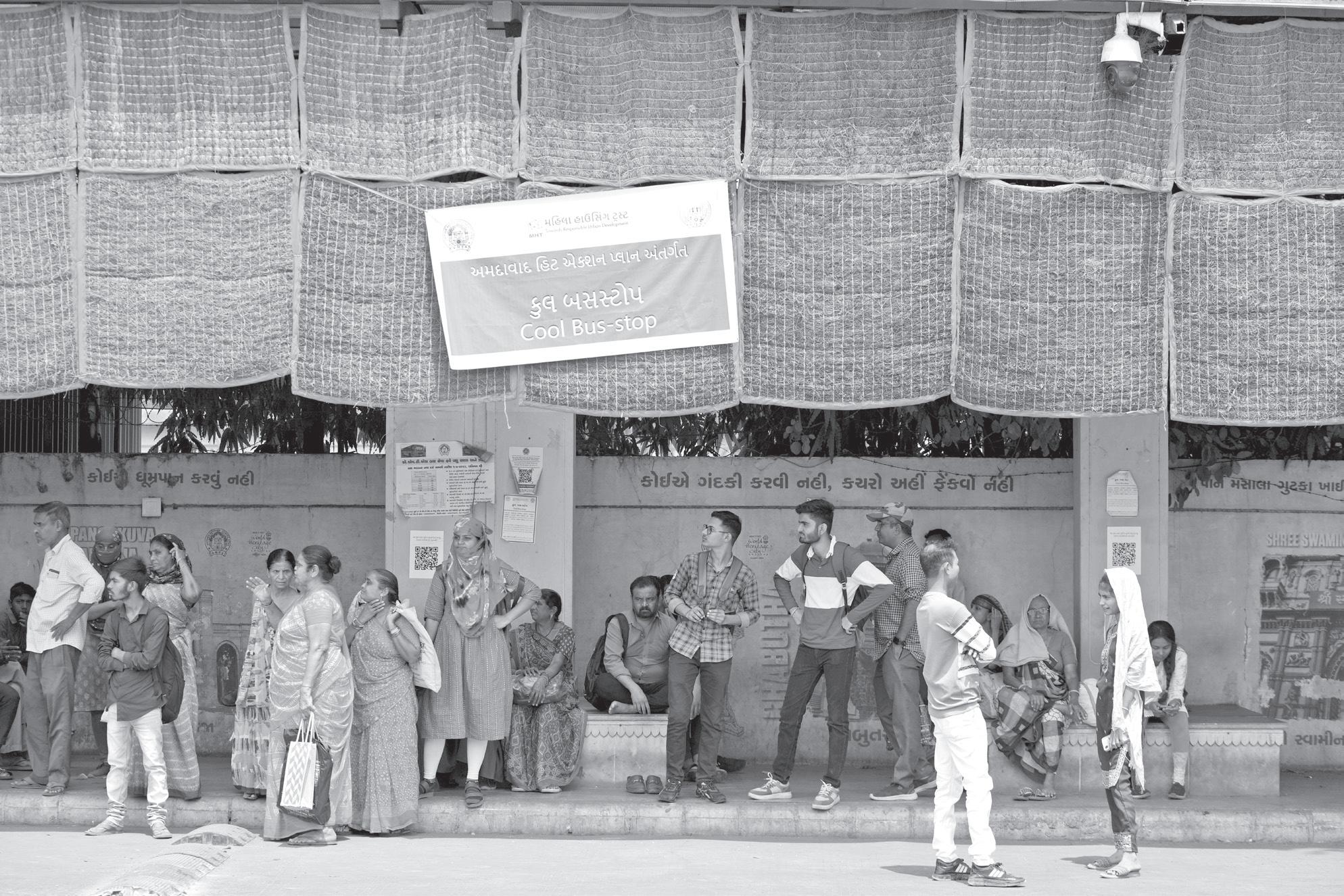
City officials, with help from climate and health researchers, have implemented two simple yet effective solutions to help those affected most by heat: the poor and those who work outdoors. By painting tinroofed households with reflective paint, they’ve reduced indoor temperatures, which otherwise might be up to 5 degrees Celsius (9° Fahrenheit) hotter than outside. More recently, the city hung curtains woven of straw and water sprinklers at one bus stop so commuters can get relief from the sun and heat. Officials said they plan to expand the idea to other bus stops in the city.
Residents said both measures have been a relief even as
they brace for at least three more months of sweltering summer.
A simple coat of paint makes all the difference THROUGHOUT the city’s lowincome neighborhoods, hundreds of tin-roofed homes have been

painted with reflective paint that helps keep the indoors cooler. Residents said their houses were so hot before the roofs were painted that they would spend most of their time outdoors under any shade they could find.
“Earlier, it was really difficult to sleep inside the house,” said Akashbhai Thakor, who works as a delivery van driver and lives with his wife and three-month-old child in Ahmedabad. Thakor’s roof was painted as part of a research project that is trying to measure the impact of the so-called cool roofs.
Early results have been promising. “After the roof was painted, the house is much cooler, especially at night,” said Thakor.
People like Thakor are much more vulnerable to extreme heat because their houses aren’t insulated and, since most of them depend on a daily wage, they must work regardless of the weather, said Priya Bhavsar of the Indian Institute of Public Health Gandhinagar, who is working on the project. Bhavsar said low-cost solutions could be the

only respite for thousands of people in the city who can’t afford to buy an air conditioner.
Veer Vanzara, who lives in the same area as Thakor and works in a nearby garment factory, said the heat makes his job much worse, especially since his factory has no ventilation. So his family is grateful for the cool roofs. “The evenings and night are much cooler than before inside our house,” he said.
A bus stop that’s become an oasis from the heat
IN Ahmedabad’s city center, a 25-meter stretch of a bus stop has been draped with mats made of straw which, when sprinkled with water, immediately cool the hot wind. Sprinklers installed on the bus stop roof lightly spray cool wa-


ter on the commuters below, providing instant relief from the blazing heat just a step away.
“When nothing like this was here, it was really hot. What they’ve done is really good. Senior citizens like me can get some cooling from the heat,” said 77-year-old Ratilal Bhoire, who was waiting under the sprinklers with his daughter. Bhoire said when he was younger, Ahmedabad was hot, but it was still possible to walk many kilometers without feeling dizzy, even at the height of summer. “Nowadays you can’t do that,” he said.
Heat is the city’s biggest problem and heat waves—continuous days of extreme heat—are increasing, said Dr. Tejas Shah of Ahmedabad Municipal Corporation, who oversees the city’s heat action plan. “We are in the period of climate change, and it has already shown its effect,” said Shah.
Shah and other city officials said the onset of summer has become a testing time and efforts such as cool roofs and cool bus stops are reducing heat-related illness and deaths. As climate projections predict only hotter and longer summers for his city, Shah said being prepared is the only thing to do.
“It [the heat] needs to be addressed in the proper way,” he said.
Continued from A1
Updated interim guidelines
ACTING on the instructions of the President, Health Secretary Teodoro J. Herbosa, meanwhile, has released updated interim guidelines on preventing and managing extreme heat health impacts.
Dated and first circulated on March 7, 2025, DOH Department Memorandum No. 2025-0114 outlines measures to beat the health impacts of heat.
DOH DM 2025-0114 directs
all DOH units including Department-retained hospitals and health facilities like the Bagong Urgent Care and Ambulatory Services (BUCAS) centers to implement key strategies themselves, and to cascade the same to and coordinate with local government units (LGUs) through mechanisms like PuroKalusugan which was launched in a recent National Health Sector Meeting.
The key strategies are grouped into service continuity, that includes facility and staff prepared-

ness and networking; public health literacy; establishment of cooling centers; climate-resilient health infrastructure, that includes hydration stations; and prompt detection and monitoring of heatrelated illnesses.
Well-ventilated areas
COOLING centers are air-conditioned or well-ventilated areas close to public transportation routes that shall be made available and accessible to the general public, with priority to the elderly, young children, pregnant women, and persons with disabilities.
Hydration stations will make clean and safe drinking water continuously available to the public in all DOH facilities, especially during the anticipated peak hot hours from 9 am to 4 pm.
“The Department of Health, together with the entire government, is prepared to face the hot weather. Always check the heat index forecast of PAGASA for your area or vicinity. Wear loose, white or light-colored, and lightweight clothing,” said Herbosa.
“Always drink clean water and avoid the heat from 9 am to 4 pm. Call 911, 1555 (DOH), or 143 (Philippine Red Cross) for emergencies,” added Herbosa.
Editor: Angel R. Calso
Hidden history of the ‘Like’ button: How a simple icon became a digital revolution
By Michael Liedtke Ap Technology Writer
SAN FRANCISCO—The Internet wouldn’t be the same without the Like button, the thumbs-up icon that Facebook and other online services turned into digital catnip.
Like it or not, the button has served as a creative catalyst, a dopamine delivery system and an emotional battering ram. It also became an international tourist attraction after Facebook plastered the symbol on a giant sign on that stood outside its Silicon Valley headquarters until the company rebranded itself as Meta Platforms in 2021.
A new book, “Like: The Button That Changed The World,” delves into the convoluted story behind a symbol that’s become both the manna and bane of a digitally driven society.
It’s a tale that traces back to gladiator battles for survival during the Roman empire before fast-forwarding to the early 21st century when technology trailblazers such as Yelp co-founder Russ Simmons, Twitter co-founder Biz Stone, PayPal cofounder Max Levchin, YouTube co-founder Steve Chen, and Gmail inventor Paul Buchheit were experimenting with different ways using the currency of recognition to prod people to post compelling content online for free.
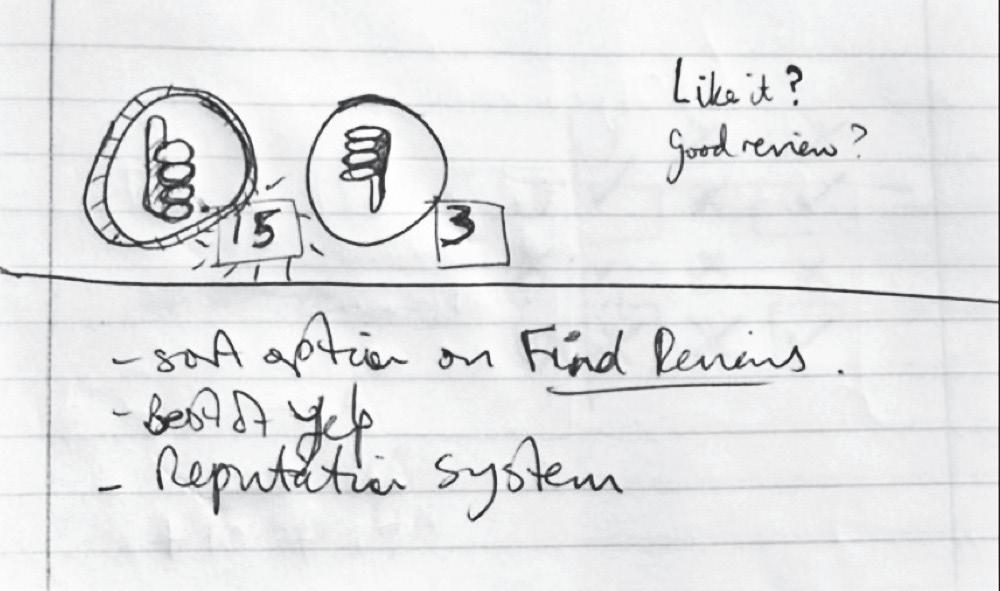
As part of that noodling, a Yelp employee named Bob Goodson sat down on May 18, 2005, and drew a crude sketch of thumbs up and thumbs down gesture as a way for people to express their opinions about restaurant reviews posted on the site. Yelp passed on adopting Goodson’s suggested symbol and, instead, adopted the “useful,” “funny” and “cool” buttons conceived by Simmons. But the discovery of that old sketch inspired Goodson to team up with Martin Reeves to explore how the Like button came to be in their new book.
“It’s something simple and also elegant because the Like button says, ‘I like you, I like your content. And I am like you. I like you because I am like you, am part of your tribe,’ “ Reeves said during an interview with The Associated Press. “But it’s very hard to answer the simple question, ‘Well, who invented the Like button?’ “
The social wellspring behind a social symbol ALTHOUGH Facebook is the main reason the Like button became so ubiquitous, the company didn’t invent it and almost discarded it as drivel. It took Facebook nearly two years to overcome the staunch resistance by CEO Mark Zuckerberg before finally introducing the symbol on its service on February 9, 2009—five years after the social network’s creation in a Harvard University dorm room.
As happens with many innovations, the Like button was born out of necessity but it wasn’t the brainchild of a single person. The concept percolated for more than a decade in Silicon Valley before Facebook finally embraced it.
“Innovation is often social and Silicon Valley was the right place for all this to happen because it has a culture of meet-ups, although it’s less so now,” Reeves said. “Everyone was getting together to talk about what they were working on at that time and it turned out a lot of them were working on the same stuff.”
The effort to create a simple mechanism to digitally express approval or dismay sprouted from a wellspring of online services such as Yelp and YouTube whose success would hinge on their ability to post commentary or video that would help make their sites even more popular without forcing them to spend a lot of money for content. That effort required a feedback loop that wouldn’t require a lot of hoops to navigate.
Hollywood’s role in the Like button’s saga AND when Goodson was noodling around with his thumbs-up and thumbs-down gesture, it didn’t come out of a vacuum. Those techniques of signaling approval and disapproval had been ushered into the 21st century zeitgeist by the Academy Award-winning movie, “Gladiator,” where Emperor Commodus—portrayed by actor Joaquin Phoenix—used the gestures to either spare or slay combatants in the arena. But the positive feelings conjured by a thumbs up date even further back in popular culture, thanks to the 1950s-era character Fonzie played by Henry Winkler in the top-rated 1970s TV series, “Happy Days.” The gesture later became a way of expressing delight with a program via a remote control button for the digital video recorders made by TiVO during the early 2000s. Around the same time, Hot or Not—a site that solicited feedback on the looks of people who shared photos of themselves—began playing around with ideas that helped inspire the Like button, based on the book’s research.
Others that contributed to the pool of helpful ideas included the pioneering news service Digg, the blogging platform Xanga, YouTube and another early video site, Vimeo.
The button’s big breakthrough BUT Facebook unquestionably turned the Like button into a universally understood symbol, while also profiting the most from its entrance into the mainstream. And it almost didn’t happen.
By 2007, Facebook engineers had been tinkering with a Like button, but Zuckerberg opposed it because he feared the social network was already getting too cluttered and, Reeves said, “he didn’t actually want to do something that would be seen as trivial, that would cheapen the service.”
But FriendFeed, a rival social network created by Buchheit and now OpenAI Chairman Bret Taylor, had no such qualms, and unveiled its own Like button in October 2007.
But the button wasn’t successful enough to keep the lights on at FriendFeed, and the service ended up being acquired by Facebook. By the time that deal was completed, Facebook had already introduced a Like button—only after Zuckerberg
See “Like button,” A4

By Kiuyan Wong
THE crowd was taken aback as China’s point person for financial matters in Hong Kong laid out plans to re-energize the city’s markets.
Qi Bin’s proposals on topics including corporate governance weren’t shocking on their face, but the regulators and other policymakers gathered at the Grand Hyatt ballroom in January had rarely heard a mainland Chinese official give such detailed prescriptions on how the city’s finance sector should be run.
For those in attendance, the speech marked a change in China’s approach toward a key pillar of Hong Kong’s economy—one that until now has remained relatively untouched by Beijing’s years-long push to tighten its grip over the former British colony.
Such a shift would underscore Hong Kong’s crucial role as China’s gateway to international capital, especially at a time of elevated concerns about a potential financial decoupling with the US. But the more assertive style from Qi—a former Goldman Sachs Group Inc. banker who held senior regulatory and investment roles before becoming deputy director of the Chinese Liaison Office in November—has also ruffled feathers among some local officials. Even those who agree with Qi’s ideas worry they’re losing authority over the city’s most important industry.
After Qi’s speech, delivered in Mandarin instead of the local Cantonese, attendees rushed to get a hold of the full transcript, which was splashed on the front pages of local newspapers the next day.
Two months later, the 56-yearold official—this time in fluent English—gave a similar talk in front of a broader audience of foreign bankers, investors and dignitaries at HSBC Holdings Plc’s annual flagship conference. Since arriving in November he has met regularly with members of the financial community and has submitted suggestions to regulators on topics such as initial public offerings and corporate governance, even though local officials have no direct reporting line to the Liaison Office.
This story is based on conversations with more than a dozen people who’ve interacted with Qi and who asked that they not be identified speaking about private discussions. Qi wasn’t available for an interview. In a statement, the Liaison Office said the Hong Kong government is “the head of family” and referred any questions on the city’s economic situation to its government officials.
In Qi’s inaugural speech, he called for a White Paper and timetable for market improvements to meet top global standards when it comes to market regulation, trading costs and corporate governance. He invited academics and market participants to contribute “to show our sincere and determination for reform.”
He also shook things up by announcing a global summit in the city to rival the World Economic Forum, the annual gathering of business, finance and policy elite in Davos. The event, originally scheduled for June 26 to 27, was recently postponed because of the fluid geopolitical situation.

A spokesperson for the Financial Services and Treasury Bureau said in an emailed statement that the an announcement on a new date will be made in due course.
The Treasury Bureau declined to comment further.
No one is arguing that Qi isn’t qualified to give advice. His Western education and Wall Street background are viewed by many as a welcome departure from typical mainland Chinese officials.
Qi, who is one of five deputy directors under Director Zheng Yanxiong, previously served as vice president and deputy chief investment officer of China Investment Corp. the nation’s sovereign wealth fund. He joined CIC in 2016 with a mandate to expand the $1.3 trillion fund’s direct investments overseas, including US Midwest factories.
Sally Wong, chief executive officer of the Hong Kong Investment Fund Association, which represents firms with more than $52 trillion in assets under management, said Qi’s “insights can provide invaluable perspectives when Hong Kong continues to re-invent ourselves to bolster our international financial center position.”
The political implications of the speeches he made earlier this year have been over-interpreted in some circles, she said. “There is unwavering commitment by the central government to uphold the principle of one country, two systems for Hong Kong.”
Originally a science student— he obtained a master’s degree in biophysics from the University of Rochester—Qi later realized his real interest was the US economic system. This led him to pursue an MBA from the University of Chicago Booth School of Business—a hub for free market economics— where he studied under people such as Nobel Prize laureate Merton Miller and Sam Peltzman.
Qi recalled that he had borrowed money from everyone he knew to pay the tuition instead of continuing with a fully-funded PhD in Rochester, according to a 2017 interview in Chicago Booth Magazine.
After graduating from Chicago he eventually joined Goldman Sachs, where he worked from 1998 to 2000 as an associate in Alternative Investment Manager Selections. Qi returned to China in 2000 to join the China Securities Regulatory Commission, where he for 16 years oversaw funds, financial innovation and research.
While at the CSRC, he completed a PhD at China’s Tsinghua University, which explored the development of institutional investors and the volatility and efficiency in China’s capital markets.
It was during this time that Qi first became well-known in Hong Kong. He led the CSRC team in the negotiations to set up city’s landmark Stock Connect program, the trading link between Hong Kong and mainland exchanges that now sees billions of dollars in daily trading.
During the months-long work meetings with Hong Kong regula -
tors in 2014, Qi was instrumental in bridging Chinese concerns over risk management, and demonstrated an international mindset that left a lasting impression, according to people with direct knowledge of the talks.
As well as a student of Wall Street, Qi is also an avid writer, who often shared his thoughts in Chinese media on capital market developments and the US-China trade war during Donald Trump’s first term.
He has translated the three editions of “The Great Game: The Emergence of Wall Street as a World Power” by US historian John Steele Gordon.
While in Hong Kong for his new role, Qi has reached out to major banks, financiers, regulators, lawyers and even chambers of commerce for coffee, lunches and dinners.
The invitations from Beijing’s financial point man took most by surprise. During meetings, he has probed people’s views on capital markets, listings, trading and the status of Hong Kong as a financial center. He has more the manners of a college professor than a banker or a stereotypical Chinese official, the people said.
In some encounters, Qi has floated ideas about asking China to unleash more companies to list in Hong Kong when conditions are ripe, according to the people. He also said that China’s support for Hong Kong’s dollar peg was unwavering.
Offering help
SOME foreign firms were wary of the implications of a meeting given his position within the Chinese government. Nonetheless, the exchanges were constructive and comfortable, the people said,
though Qi didn’t make any concrete promises.
Lyndon Chao, head of equities and post trade at Asia Securities Industry & Financial Markets Association, representing over 160 financial firms in the region, said Qi’s team has offered help in connecting with their Beijing counterparts.
“Beijing sent a strong signal by assigning a financial expert like Qi to Hong Kong, to recognize the importance of the city as an international financial center and to help instill confidence on the ground,” he said. “We understood from communications with Chinese regulators that Hong Kong would be well served by demonstrating more independence in financial policies and to showcase to the world its rightful place as an IFC.”
In formal settings, Qi has routinely met with the stock exchange and Securities and Futures Commission since his arrival, according to four people. Qi has also submitted his personal suggestions to regulators.
The SFC and the Hong Kong stock exchange declined to comment.
According to David Webb, a long-time activist investor in Hong Kong, the city needs to improve investor protection, prevent a further weakening of rules, more mandatory reporting and proper independent directors. Webb spoke this week at the Foreign Correspondents’ Club.
China has become more handson in Hong Kong since the national security law was passed, and regulators now typically inform Beijing before they change any major financial policies. By contrast, when building the Stock Connect no pre-approval was needed from the Beijing offices in Hong Kong to kick start discussions. They were informed only later in the process, according to two people.
Given his education at the heart of Western economics, Qi’s view is that open markets can be reconciled with China’s planned economy.
“There is no such thing as a completely free economy,” Qi said in the university magazine interview, noting that most countries have regulations. “It’s always about degrees of freedom. China’s story is an example of how the Chicago idea works in a gradual and pragmatic approach.” With assistance from Sanjit Das and David Scanlan/Bloomberg

Sunday, May 18, 2025
By Jeff Amy, Sudin Thanawala & Geoff Mulvihill The Associated Press
ATLANTA—A pregnant woman in Georgia who was declared brain dead after a medical emergency has been on life support for three months to let the fetus grow enough to be delivered, a move her family says a hospital told them was required under the state’s strict antiabortion law.
With her due date still more than three months away, it could be one of the longest such pregnancies. Her family is upset that Georgia’s law that restricts abortion once cardiac activity is detected doesn’t allow relatives to have a say in whether a pregnant woman is kept on life support.
Georgia’s so-called “heartbeat law” is among the restrictive abortion statutes that have been put in place in many conservative states since the Supreme Court overturned Roe v. Wade three years ago.
Adriana Smith, a 30-year-old mother and nurse, was declared brain-dead—meaning she is legally dead—in February, her mother, April Newkirk, told Atlanta TV station WXIA.
Newkirk said her daughter had intense headaches more than three months ago and went to Atlanta’s Northside Hospital, where she received medication and was released. The next morning, her boyfriend woke to her gasping for air and called 911. Emory University Hospital determined she had blood clots in her brain and she was declared brain-dead.
Newkirk said Smith is now
21 weeks pregnant. Removing breathing tubes and other lifesaving devices would likely kill the fetus.
Northside did not respond to a request for comment Thursday. Emory Healthcare said it could not comment on an individual case because of privacy rules, but released a statement saying it “uses consensus from clinical experts, medical literature, and legal guidance to support our providers as they make individualized treatment recommendations in compliance with Georgia’s abortion laws and all other applicable laws. Our top priorities continue to be the safety and wellbeing of the patients we serve.”
Georgia’s abortion ban SMITH’S family says Emory doctors have told them they are not allowed to stop or remove the devices that are keeping her breathing because state law bans abortion after cardiac activity can be detected—generally around six weeks into pregnancy. The law was adopted in 2019 but not enforced until after Roe v. Wade was overturned in the 2022
Dobbs v. Jackson Women’s Health Organization ruling, opening the door to state abortion bans. Twelve states are enforcing bans on abortion at all stages of pregnancy and three others have bans like Georgia’s that kick in after about six weeks.
Like the others, Georgia’s ban includes an exception if an abortion is necessary to maintain the woman’s life. Those exceptions have been at the heart of legal and political questions, including a major Texas Supreme Court ruling last year that found the ban there applies even when there are major pregnancy complications.
Smith’s family, including her five-year-old son, still visit her in the hospital.
Newkirk told WXIA that doctors told the family that the fetus has fluid on the brain and that they’re concerned about his health.
“She’s pregnant with my grandson. But he may be blind, may not be able to walk, may not survive once he’s born,” Newkirk said. She has not said whether the family wants Smith removed from life support.
Who has the right to make these decisions?
MONICA SIMPSON , executive director of SisterSong, the lead plaintiff in a lawsuit challenging Georgia’s abortion law, said the situation is problematic.
“Her family deserved the right to have decision-making power about her medical decisions,” Simpson said in a statement. “Instead, they have endured over 90 days of retraumatization, expensive medical costs, and the cruelty of being unable to resolve and move toward healing.”
Thaddeus Pope, a bioethicist and lawyer at Mitchell Hamline School of Law in St. Paul, Minnesota, said while a few states have

laws that specifically limit removing treatment from a pregnant woman who is alive but incapacitated, or brain dead, Georgia isn’t one of them.
“Removing the woman’s mechanical ventilation or other support would not constitute an abortion,” he said. “Continued treatment is not legally required.”
Lois Shepherd, a bioethicist and law professor at the University of Virginia, also said she does not believe life support is legally required in this case.
But she said whether a state could insist Smith remains on life support is uncertain since the overturning of Roe, which found that fetuses do not have the rights of people.
“Pre-Dobbs, a fetus didn’t have any rights,” Shepherd said. “And the state’s interest in fetal life could not be so strong as to overcome other important rights, but now we don’t know.”
What is the fetus’ prognosis?
THE situation echoes a case in Texas more than a decade ago when a brain-dead woman was kept on life support for about two months because she was pregnant. A judge eventually ruled that the hospital was misapplying state law, and life support was removed.
Brain death in pregnancy is
rare. Even rarer still are cases in which doctors aim to prolong the pregnancy after a woman is declared brain-dead.
“It’s a very complex situation, obviously, not only ethically but also medically,” said Dr. Vincenzo Berghella, director of maternal fetal medicine at Thomas Jefferson University in Philadelphia.
A 2021 review that Berghella co-authored scoured medical literature going back decades for cases in which doctors declared a woman brain-dead and aimed to prolong her pregnancy. It found 35. Of those, 27 resulted in a live birth, the majority either immediately declared healthy or with normal follow-up tests. But Berghella also cautioned that the Georgia case was much more difficult because the pregnancy was less far along when the woman was declared brain dead. In the 35 cases he studied, doctors were able to prolong the pregnancy by an average of just seven weeks before complications forced them to intervene.
“It’ s just hard to keep the mother out of infection, out of cardiac failure,” he said.
Berghella also found a case from Germany that resulted in a live birth when the woman was declared brain dead at nine weeks of
pregnancy—about as far along as Smith was when she died.
A spotlight on Georgia’s abortion law
GEORGIA’S law confers personhood on a fetus. Those who favor personhood say fertilized eggs, embryos and fetuses should be considered people with the same rights as those already born.
Georgia state Sen. Ed Setzler, a Republican who sponsored the 2019 law, said he supported Emory’s interpretation.
“I think it is completely appropriate that the hospital do what they can to save the life of the child,” Setzler said. “I think this is an unusual circumstance, but I think it highlights the value of innocent human life. I think the hospital is acting appropriately.” Setzler said he believes it is sometimes acceptable to remove life support from someone who is brain dead, but that the law is “an appropriate check” because the mother is pregnant. He said Smith’s relatives have “good choices,” including keeping the child or offering it for adoption. Georgia’s abortion ban has been in the spotlight before.
Last year, ProPublica reported that two Georgia women died after they did not get proper medical treatment for complications from taking abortion pills. The stories of Amber Thurman and Candi Miller entered into the presidential race, with Democrat Kamala Harris saying the deaths were the result of the abortion bans that went into effect in Georgia and elsewhere after Dobbs.
Mulvihill reported from Cherry Hill, New Jersey. Associated Press journalists Lisa Baumann, Kate Brumback, Sudhin Thanawala, Sharon Johnson and Charlotte Kramon contributed.
rebuffed the original idea of calling it an Awesome button “because nothing is more awesome than awesome,” according to the book’s research.
Once Zuckerberg relented, Facebook quickly saw that the Like button not only helped keep its audience engaged on its social network but also made it easier to divine people’s individual interests and gather the insights required to sell the targeted advertising that accounted for most of Meta Platform’s $165 billion in revenue last year. The button’s success encouraged Facebook to take things even further by allowing other digital services to ingrain it into their feedback loops and then, in 2016, added six more types of emotions—“love,” “care,” “haha,” “wow,” “sad,” and “angry.”
Facebook hasn’t publicly disclosed how many responses it has accumulated from the Like button and its other related options, but Levchin told the book’s authors that he believes the company has probably logged trillions of them. “What content is liked by humans...is probably one of the singularly most valuable things on the Internet,” Levchin said in the book.
The Like button also has created an epidemic of emotional problems, especially among adolescents, who feel forlorn if their posts are ignored and narcissists whose egos feast on the positive feedback. Reeves views those issues as part of the unintentional consequences that inevitably happen because “if you can’t even predict the beneficial effects of a technological innovation how could you possibly forecast the side effects and the interventions?”
Even so, Reeves believes the Like button and the forces that coalesced to create it tapped into something uniquely human.
By Matt Sedensky Ap National Writer
EW YORK—Christine
NFarro has cut back on the presents she sends her grandchildren on their birthdays, and she’s put off taking two cats and a dog for their shots. All her clothes come from thrift stores and most of her vegetables come from her garden. At 73, she has cut her costs as much as she can to live on a tight budget.
But it’s about to get far tighter.
As the Trump administration resumes collections on defaulted student loans, a surprising population has been caught in the crosshairs: Hundreds of thousands of older Americans whose decadesold debts now put them at risk of having their Social Security checks garnished.
“I worked ridiculous hours. I worked weekends and nights. But I could never pay it off,” says Farro, a retired child welfare worker in Santa Ynez, California.
Like millions of debtors with federal student loans, Farro had her payments and interest paused by the government five years ago when the pandemic thrust many into financial hardship. That grace period ended in 2023 and, earlier this month, the Department of Education said it would restart “involuntary collections” by garnishing paychecks, tax refunds and Social Security retirement and disability benefits. Farro previ -
ously had her Social Security garnished and expects it to restart.
Farro’s loans date back 40 years. She was a single mother when she got a bachelor’s degree in developmental psychology and when she discovered she couldn’t earn enough to pay off her loans, she went back to school and got a master’s degree. Her salary never caught up. Things only got worse.
Around 2008, when she consolidated her loans, she was paying $1,000 a month, but years of missed payments and piled-on interest meant she was barely putting a dent in a bill that had ballooned to $250,000. When she sought help to resolve her debt, she says the loan company had just one suggestion.
“They said, ‘Move to a cheaper state,’” says Farro, who rents a 400-square-foot casita from a friend. “I realized I was living in a different reality than they were.”
Student loan debt among older people has grown at a staggering rate, in part due to rising tuitions that have forced more people to borrow greater sums. People 60 and older hold an estimated $125 billion in student loans, according to the National Consumer Law Center, a six-fold increase from 20 years ago.
That has led Social Security beneficiaries who have had their payments garnished to balloon by 3,000% — from approximately 6,200 beneficiaries to 192,300 — between 2001 and 2019, according
to the Consumer Financial Protection Bureau.
This year, an estimated 452,000 people aged 62 and older had student loans in default and are likely to experience the Department of Education’s renewed forced collections, according to the January report from CFPB.
Debbie McIntyre, a 62-year-old adult education teacher in Georgetown, Kentucky, is among them. She dreams of retiring and writing more historical fiction, and of boarding a plane for the first time since high school. But her husband has been out of work on disability for two decades and they’ve used credit cards to get by on his meager benefits and her paycheck. Their rent will be hiked $300 when their lease renews. McIntyre doesn’t know what to do if her paycheck is garnished.
She floats the idea of bankruptcy, but that won’t automatically clear her loans, which are held to a different standard than other debt. She figures if she picks up extra jobs babysitting or tutoring, she could put $50 toward her loans here and there. But she sees no real solution.
“I don’t know what more I can do,” says McIntyre, who is too afraid to check what her loan balance is. “I’ll never get out of this hole.”
Braxton Brewington of the Debt Collective debtors union says it’s striking how many older people dial into the organization’s calls
and attend its protests. Many of them, he says, should have had their debts cancelled but fell victim to a system “riddled with flaws and illegalities and flukes.” Many whose educations have left them in late-life debt have, in fact, paid back the principal on their loans, sometimes several times over, but still owe more due to interest and fees.
For those who are subject to garnishment, Brewington says, the results can be devastating.
“We hear from people who skip meals. We know people who dilute their medication or cut their pills in half. People take drastic measures like pulling all their savings out or dissolving their 401ks,” he says. “We know folks that have been driven into homelessness.” Collections on defaulted loans may have restarted no matter who was president, though the Biden administration had sought to limit the amount of income that could be garnished. Federal law protects just $750 of Social Security benefits from garnishment, an amount that would put a debtor far below the poverty line.
“We’re basically providing people with federal benefits with one hand and taking them away with another,” says Sarah Sattelmeyer of the New America think tank.
Linda Hilton, a 76-year-old retired office worker from Apache Junction, Arizona, went through garnishment before Covid and says she will survive it again. But
flights to see her children, occasional meals at a restaurant and other pleasures of retired life may disappear.
“It’s going to mean restrictions,” says Hilton. “There won’t be any travel. There won’t be any frills.” Some debtors have already received notice about collections. Many more are living in fear. President Donald Trump has signed an executive order calling for the Department of Education’s dismantling and, for those seeking answers about their loans, mass layoffs have complicated getting calls answered.
While Education Secretary Linda McMahon says restarting collections is a necessary step for debtors “both for the sake of their own financial health and our nation’s economic outlook,” even some of Trump’s most fervent supporters are questioning a move that will make their lives harder.
Randall Countryman, 55, of Bonita, California, says a Biden administration proposal to forgive some student debt didn’t strike him as fair, but he’s not sure Trump’s approach is either. He supported Trump but wishes the government made case-bycase decisions on debtors. Countryman thinks Americans don’t realize how many older people are affected by policies on student loans, often thought to be the turf of the young, and how difficult it can be for them to repay.

By Geraldine Bulaon-Ducusin
‘THE Philippines is said to be a tiny but mighty country in terms of garbage pollution. Are you proud of that?” asked Associate Prof. Dr. Hernando Bacosa of Mindanao State University-Iligan Institute of Technology.
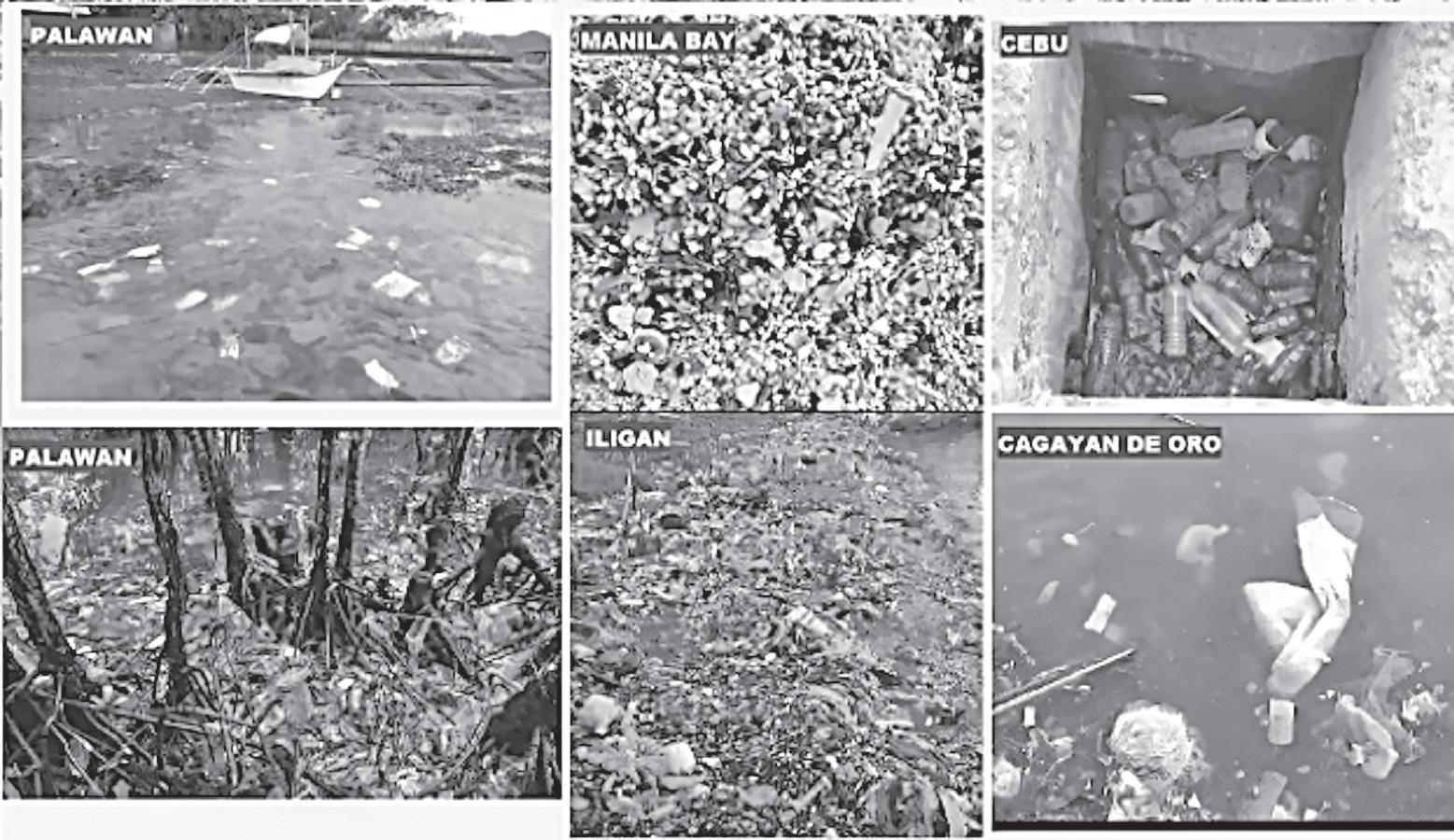
“Definitely not,” Bacosa answered his question during the Mindanao Regional Scientific Meeting (RSM) led by the National Academy of Science and Technology Philippines (NAST PHL). He said that 10 of the world’s 15 top plastic-emitting rivers are in the Philippines. These catchments are: Pasig, Tullahan, Meycauayan, Pampanga, Libmanan, Rio Grande de Mindanao, Agno, Agusan, Paraňaque, and Iloilo. The Philippines contributes a third of the whole ocean’s plastic wastes.
A NAST PHL Environmental Science Awardee, Bacosa has been working on environmental research studies. In his RSM presentation he has shown environ -
mental reports and illustrations relevant to the Philippines.
Comparing different studies, it has shown that plastic bag is the number one, the most dominant plastic in the coastal environment.
Besides studying Mindanao, Bacosa’s team also studied Laguna and did a pioneering work on “Microplastics in surface water of Laguna de Bay: The first documented evidence on the largest lake in the Philippines.”
The study finds that the body of water’s West Bay has more microplastics than the East Bay, which Bacosa said, makes sense because it’s the one facing Manila and is more populated.
When Bacosa returned to the

Philippines in 2021 from his academic pursuits in the United States of America, he did a lot of baseline research in order to compare what the country has now from that in the past.
During his presentation, Bacosa expressed his gratitude to the media, saying they have a very good way of making the story easily understood by the common people. In the course of conducting their research, there were times when their research results did not sit well with some govern -
ment agencies. However, Bacosa said that results were products of a scientific inquiry.
He pointed out that as scientists they are just doing their job—providing evidence. Action should be taken in response to the results, instead of waiting for the environment to be swamped by microplastics. He shared that he was glad, when a few years ago, despite not being pleased with their research results, a government agency eventually admitted there was a
UP scientists find links to production of antibiotics, anticancer agents from marine microbial
SCIENTISTS from the University of the Philippines Diliman-College of Science conducted the first detailed microbial genomic study of an submarine groundwater discharge (SGD) site in the country, in Mabini, Batangas, and uncovered the potential roles of microorganisms in medical applications and biotechnology, a UPD-CS news release said.
SGD occurs when groundwater from land seeps into the ocean, transporting freshwater, nutrients, metals, and even pollutants into marine ecosystems.
The diverse microbial communities in these SGD sites make them hotspots for biological and chemical activity, playing a crucial role in maintaining ecosystem balance.
Studying these microorganisms helps scientists not only understand their impact on marine ecosystems, but also explore their potential applications in medicine and biotechnology. Other studies have primarily focused on its geological and physico-chemical aspects.
Joshua Veluz, Paul Christian Gloria, Laurence Anthony Mallari, and Dr. Maria Auxilia Siringan of the Microbiological Research and Services Laboratory (MRSL) at the UPD-CS Natural Sciences Research Institute (NSRI), along with Ann Elizabeth Enova of the UPD-CS Marine Science Institute (MSI), reconstructed 17 metagenomeassembled genomes (MAGs) from microbial mats collected in Acacia, Mabini, Batangas.
MAGs are genomes assembled
problem, which in a way validated what’s coming out from the researchers’ findings, and asked for their assistance to help resolve those problems. Bacosa believes that it matters when the decisions are data-based. Their other big work is the presence of microplastics in the air in Manila. His team is now working with Environmental Management Bureau in the National Capital Region to possibly establish a baseline data on microplastics in the air, which he said, will take quite a long process.

from environmental samples without the need for cultivation and isolation.
“Our findings reveal diverse bacterial genomes with functional genes related to nutrient cycling, potentially supporting marine ecosystem health,” the researchers explained in an interview.
Additionally, they identified biosynthetic gene clusters (BGCs) associated with the production of bioactive compounds. These BGCs enable microbes to produce antibiotics, anticancer agents, and other bioactive metabolites.
Their study underscores the vital role of microbial ecosystems in SGD sites, particularly in sustain -
Forum on Science, Technology and Innovation for the Sustainable Development Goals at the UN Headquarters in New York on May 7 and 8. At the forum’s 10th ministerial session titled “Harnessing science and technology for the effective delivery of sustainable, resilient, and innovative solutions,” Solidum highlighted the DOST’s technical assistance through the delivery of STI packages. This include livelihood programs to local communities through the DOST Community Empowerment thru S&T Program and technological support to micro, small, and medium enterprises (MSMEs) through the DOST Small Enterprise Technology Upgrading Program. The call for collective science-based action for the greater good was a common recurring theme among Solidum’s statements. He said the contributions of the DOST and the Technical Cooperation Council of the Philippines in promoting South-South Cooperation, included the technology needs assessments and training on food innovation, nutrition, and livelihood with Cambodia, New Caledonia, Vanuatu, Sri Lanka, and Timor Leste. The Philippines has also championed the
ing marine biodiversity and driving biogeochemical cycles.
It also emphasizes the potential of these microbes to address the global demand for new antimicrobial agents.
“The baseline information and insights generated through our study are essential references in developing and establishing policies and regulations on environmental protection of our marine resources, such as those found in SGD-influenced sites in Mabini, Batangas,” the researchers said.
They added that they also presented their findings and project outcomes to an audience of over 50 people at the Mabini Tourism
“Asean-helping-Asean” principle through providing scholarships in Masters and PhD programs in science and engineering to Cambodia, Lao PDR, and Myanmar.
“The Philippines recognizes that the increasingly rapid technological advancements bring novel solutions to pressing cross-sectoral issues and improve the ways that the world is used to. A lot of these are powered by artificial intelligence [AI],”he said in the forum’s thematic session on making AI accessible, inclusive and beneficial for all. He cited that the Philippines’ having launched several big projects related to AI, analytics, and the application of STI for sustain-
Office, emphasizing the biodiversity in SGD-associated sites and providing recommendations.
The meeting attendees included Mabini’s local government officials, tourism industry representatives, divers, and Bantay-Dagat members.
“We are currently working on publishing the metagenomic data from other sampling sites, which will allow for broader comparisons across different SGD environments,” they shared. “We also aim to publish metabarcode data from these sites, which will provide a more comprehensive picture of bacterial diversity in SGD-influenced habitats.”
The paper, titled “MAGnificent microbes: metagenome-assembled genomes of marine microorganisms in mats from a Submarine Groundwater Discharge Site in Mabini, Batangas, Philippines,” was published in Frontiers in Marine Science, which features research on marine species, ecosystems, and processes as well as human interactions with, and impacts on, ocean environments.
The research is also one of the major outputs of MRSL’s threeyear project, Probing Microbial Diversity in Submarine Groundwater Discharge Areas, under the program, “Biodiversity and Resilience of Coral Reefs and Associated Ecosystems in Submarine Groundwater Discharges Areas,” funded by the Philippine Council for Agriculture, Aquatic and Natural Resources of the Department of Science and Technology.
able development.
The DOST Chief enumerated the DOST’s various projects such as the development of AI hubs to democratize the use of AI for the use of the academe, the industry, and the MSMEs, the establishment of the geospatial analytics and data solutions platform that will combine digital transformation into specific geographical units for better analysis and problems. There is also the launch of the smart and sustainable cities and towns all over the 80 provinces of the Philippines to apply smart technologies including AI for their governance, business process, and economic development.
Besides microplastics, there are also bioplastic from seaweeds, wherein seaweeds are used as biomass material.
Bacosa said this is a promising approach to replace conventional plastics that will provide a more eco-friendly alternative. Compared with other biomass, seaweeds do not need pesticide or wide land use to grow fast, and they are also easy to harvest and cheap.
The Mindanao RSM was organized by NAST PHL, in partnership with DOST Mindanao Cluster, led by DOST XII composed of South Cotabato, Cotabato, Sultan Kudarat, Sarangani, and General Santos City, or Soccsksargen. This year’s theme was “Bioscience Innovations: Transforming Enterprise Ecosystems for Wealth Creation.”
DOST, Seameo Tropmed partnership to open opportunities for Filipinos
THE Department of Science and Technology-Philippine Council for Health Research and Development (PCHRD) signed a Memorandum of Understanding (MOU) with the Southeast Asian Ministers of Education Tropical Medicine and Public Health (Seameo Tropmed) Network last April 22 to expand the coverage of scholarship opportunities in health for Filipinos across Southeast Asia. Conducted via Zoom, the MOU virtual signing was attended by officials from both parties, including DOST Undersecretary for Research and Development Dr. Leah Buendia, PCHRD Executive Director Dr. Jaime Montoya, and Seameo Tropmed Network Secretary General Dr. Pratap Singhasivanon, and Deputy Coordinator Dr. Ma. Sandra B. Tempongko.
The collaboration will run for five years.
It serves as an expansion to the preceding partnership forged between the agencies in 2021.
It aims to develop and implement graduate studies under the Faculty of Tropical Medicine in Mahidol University in Thailand.
The initiative has paved the way for the implementation of MSc and PhD in Tropical Medicine Programs, which has supported a total of seven scholars.
With the expanded partnership, aspiring Filipino scholars may gain access to a wider range of research centers, specialists, and policy-makers, offering a multi-country, multi-disciplinary approach for capacity building not only in Thailand, but also in other member countries of the network within the Southeast Asian region.
It will focus on enhancing capacitybuilding initiatives, improving diagnostic and treatment approaches, and providing access to globally recognized practices in disease control for improved healthcare delivery.
It will also foster coordinated regional initiatives dedicated to address -
ing the increasing transnational burden of Neglected Tropical Diseases.
Science Secretary Renato U. Solidum Jr. explained that forging partnerships is key to the DOST’s strategy in promoting scientific and technological advancement in the Philippines.
“The DOST actively pursues collaborative ventures with international partners to expand the reach of our support and programs. We are likewise grateful to the Seameo Tropmed Network for this chance to learn, innovate, and develop solutions to health problems that concern our region.”
Buendia described the partnership as a way to address diseases that are critical for the Philippines and the region.
“Through mutual support and joint efforts, we are better positioned to deal with risks affecting many countries, from dengue and malaria to newer re-emerging and emerging tropical diseases,” she said.
Citing accomplishments from the previous batch of scholars, Singhasivanon expressed his hope for more aspiring Filipino researchers to engage in the program.
He highlighted how the Tropmed centers can better collaborate under the expanded MOU “for knowledge sharing between scientists in health research and related issues of regional concern.”
Montoya highlighted how the partnership acknowledges the crucial role of strengthening human capital in setting the direction of the strength and sustainability of healthcare systems.
“A key part of our partnership with Seameo-Tropmed will provide more opportunities for Filipino students, researchers, and public health professionals to gain advanced education and training in tropical disease epidemiology, emerging infections related to environmental change, diagnostics, and public health and tropical medicine,” he said.

A6 Sunday, May 18, 2025

Editor: Lyn Resurreccion • www.businessmirror.com.ph
By Edwin P. Galvez
‘LET the children come to me, and do not prevent them; for the kingdom of heaven belongs to such as these.”
This is what Jesus said in blessing the children in the Gospel of Matthew, and it may as well be what our children need for lacking “basic Christian formation” due to “absentee parents,” the influence social media and their gadget “addiction” wield on their behavior, and the “gravest issue” of online sexual exploitation, among other concerns.
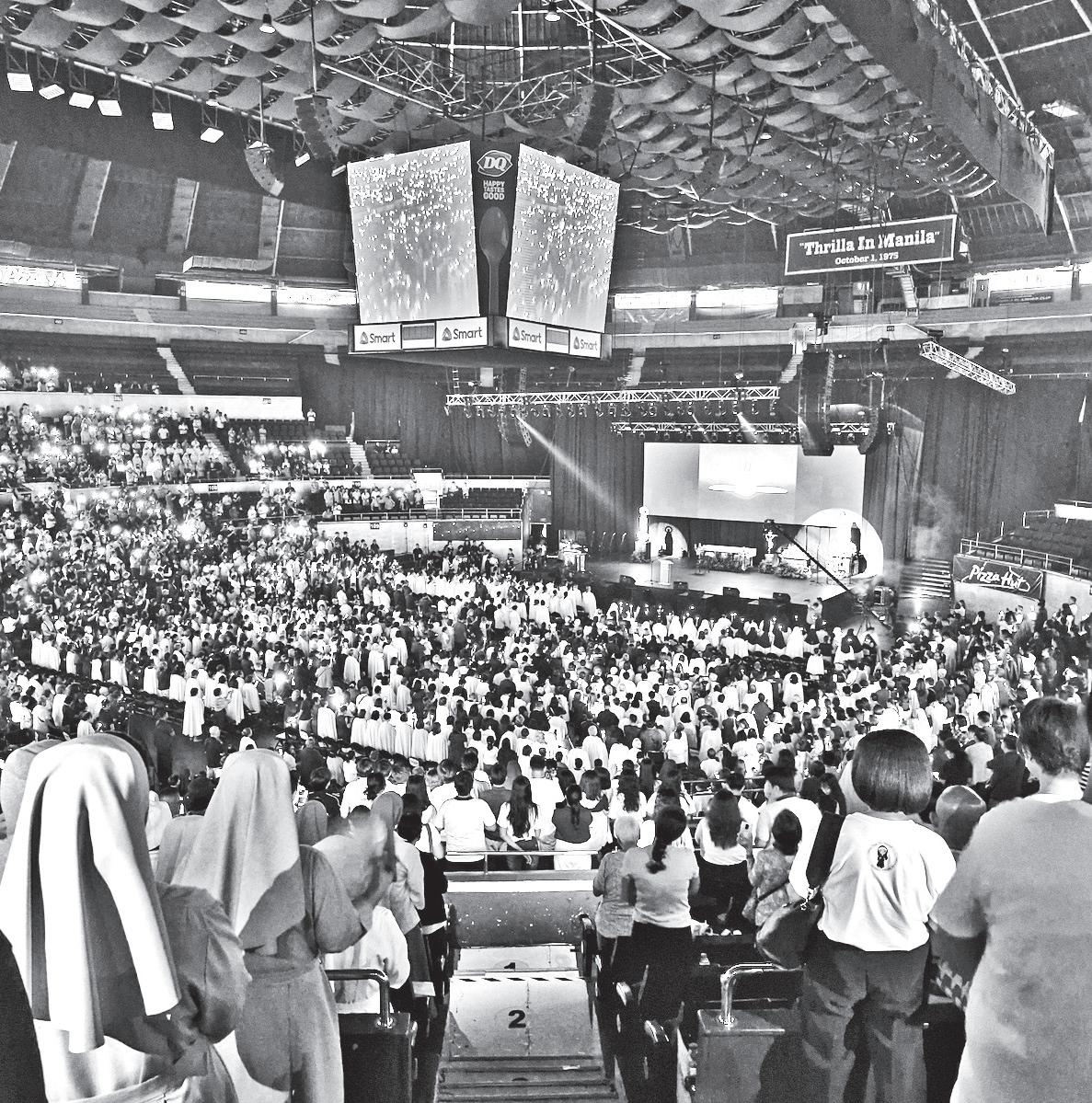
Discalced Carmelite Sr. Mary Bernard Tescam of the Sacred Heart underscored these after she began her talk on the topic “Saint Thérèse: Wounded Child” with this Bible verse during the Congress on Prayer II held at the Smart Araneta Coliseum in Quezon City on April 9. The event—organized by the Secular Order of Discalced Carmelites together with the Order of Discalced Carmelites friars and nuns—marked the centennial of the canonization of St. Thérèse of the Child Jesus and the Holy Face. She was canonized on May 17, 1925. According to her, St. Thérèse “wants us to look at the importance of formation in the home and the way of parenting in our day and age” to address issues confronting the Filipino children today.
The future citizens of this country, she said, depend so much on their basic formation in the home.
“Prayerfully, we are invited by her to expand our perspective to embrace in prayer all parents and caregivers, nannies and teachers, authority figures at home, in orphanages and home-shelters for children,” she said.
She said that St. Thérèse is praying “for those in charge of discipline and Christian formation in the family.”
The prioress of the Carmel of St. Therese Gilmore Quezon City said that St. Thérèse—despite growing up without a mother from four years old and feeling “abandoned and alone” by her four older sisters when they pursued their religious vocation—had a solid Christian formation at home.
“Although wounded and feeling seemingly abandoned, the formation of good values as a child remained in her, giving her direction, and ultimately grounding her spirituality of the ‘Little Way’ as a form of Christian formation,” she said.
Christian formation
“ONE of the factors that stands out in her life is the way her parents formed their children as they were growing
ENAZZANO, Italy—A new photo of Leo XIV stands by frescoes representing past papal visits to a Virgin Mary icon in the Sanctuary of Our Mother of Good Counsel, commemorating where he prayed two days after being elected pope. But the new pontiff is still “Father Bob” to the handful of Augustinian friars who serve in the basilica in a hilltop medieval village—and the tight-knit community of Augustinians worldwide. They knew Leo when he was their global leader, seminary teacher or simply fellow brother in black habits with thick belts and large hooded capes.
“With Father Robert, then Very Rev. Prior General, we have had to change the names, but Father Bob...we realize the person hasn’t changed at all, it’s still him,” said the Rev. Alberto Giovannetti, 78. He was born in Genazzano in the wooded hills outside Rome and entered the seminary at age 11. He remembers a day in 2001 when he was struggling with the responsibility of a new position and then-Prior General Prevost comforted him.
“He gave me courage, ‘Stay calm, the less adequate you feel, the more you’re fit for it,’ that was the meaning,” Giovannetti said. “I think

up,” Sister Mary Bernard said.
“We know examples speak more than words. What the children hear and see and perceive within the confines of home shape their values and attitudes and, consequently, their behavior [into] adulthood,” she said.
She cited two formative actions of St. Thérèse’s parents, Louie and Zelie Martin, now canonized saints themselves, as examples.
While the family walked toward the church, St. Louie would assign St. Thérèse to give “coins or alms to beggars and destitute families.”
“It was a joy for the child,” Sr. Mary Bernard said.
Meanwhile, St. Zelie would “encourage her even at a young age to offer little sacrifices and mortifications for the love of God.”
Through this “conscience-formation” even when she was still a toddler, St. Thérèse would shed “contrite tears” and say sorry when she felt it was her fault. She would also immediately confess to her parents.
“I feel now that she wants parents and parental figures to be conscious of this fact: that they play a very crucial role in the development of children,” she said.
She added that the saint, a doctor of the Church, “wishes to point out what we should pray as a people of God, especially as praying Filipino people with regards to the issues of our children.”
Childhood ‘wounds’
TO say that St. Thérèse suffered a difficult childhood would be an understatement as Sr. Mary Bernard recounted the beloved saint’s “painful wounds.”
Her experiences between the ages of four to 12 made St. Thérèse a “wounded child.”
She lost her “primary caregivers”— her mother succumbed to breast cancer and one by one her three sisters
it’s what’s guiding him now as well, that real humbleness that doesn’t make you feel weak, but rather makes you feel not alone.”
St. Augustine and brotherly leadership
IT’S a style of brotherly leadership that was crucial to St. Augustine, who inspired the order that’s found itself in an unusual spotlight ever since Leo’s first public blessing from St. Peter’s Basilica.
“He resolutely affirmed, ‘I’m a son of Augustine, I’m Augustinian,’ and this filled us all with pride. We’re feeling like the pope’s friars,” said the Rev. Pasquale Cormio, rector of Rome’s Basilica of St. Augustine. Leo’s predecessor, Pope Francis, was a Jesuit who took the name of the founder of the Franciscans. The Jesuit order is widely known for its scholarly star-power, while the Franciscans appeal to many because of the order’s downto-earth charity.
The Augustinian order is a bit of a paradox—it remains as unassuming as when it was first organized in the mid-13th century as a union of mendicant orders, yet traces its origins to one of the most influential thinkers in Christian and Western culture. And now the friars are expecting that
“Father Bob” will bring some of St. Augustine’s spiritual trademarks to the wider church.
Augustinian spirituality
AUGUSTINIAN spirituality is founded on these words of St. Augustine—a single heart, a single soul oriented toward God, that is to say, toward unity,” said the Rev. Lizardo Estrada, who was a student of Leo’s in seminary.
“That’s why you can sum it up in four words, I’d say—community, interiority, charity and obedience,” he added.
For Augustinians, the foundation of a godly life is seeking truth with the help of Scriptures and sacraments, finding it as God’s presence inside one’s heart—the “interiority”—and then taking that knowledge outward to help others.
“You can’t adore the Lord every day, pray every day, and not find God in the vulnerable, in the humble, in those working the fields, in the Amazonian peoples,” said Estrada, who is secretary general of the Latin American and Caribbean Episcopal Conference.
“You can’t know God inside you, have that knowledge, and stay put,” he said.
The order has certainly been on a journey—
part of St. Augustine’s enduring appeal is that he was a “seeker” who introduced the concept
entered the Lisieux Carmel, while one became a Visitation nun.
Her father moved the family residence from Alençon to Lisieux three months after her mother’s death, which entailed “separation from everything familiar and being with her cousins.”
Although the succeeding years saw her “protected and cared for, loved and almost pampered by her family,” she would later experience bullying at her boarding school because her classmates envied her intelligence and “shone out among the students.”
The once “lively and precocious child” became shy, withdrawn and introverted. She then began suffering from continual headaches, insomnia, trembling and hallucinations.
At the age of 10, she suffered a mysterious illness that included “hallucinations, extreme nervous distress and even periods of unconscious spells.”
But when she was 12 years old, St. Thérèse found the will to be strong “and master her deep hurt.”
She “discovered once again the strength of her soul which she had lost at the age of four and a half and she was to preserve it forever,” Sr. Mary Bernard said.
In her autobiography “The Story of a Soul,” St. Thérèse called this incident her “grace of Christmas.”
From this initial conversion, Sr. Mary Bernard said that an “inner strength grew with her and expanded her consciousness.”
This growth from her childhood wounds “culminated to a deep desire to help in ‘saving souls for Jesus,’ when she prayed for a criminal, Henry Pranzini, who was scheduled to die by capital punishment.”
The Carmelite nun said this was a “manifestation of the germ of ‘apostolic awareness’ in St. Thérèse.”
“Even at that tender age, her perspective has embraced the concerns of the universal Church, the effort to
of introspection as a way to happiness.
Born in what today is Algeria in the 4th century, he embraced his mother’s Christian faith during travels in Italy and went on to write some of history’s pivotal spiritual and philosophical treatises.
His answers to perennial questions— such as free will versus predestination, true faith versus heresy, even issues addressing leadership, gender and sexuality—continue to inform Western culture today, said Colleen Mitchell, a scholar with Villanova University’s Augustinian Institute.
The Augustinians since the Middle Ages AS both male and female monastic communities started following him, St. Augustine wrote the basics of a “rule” or the charter for an order, which was eventually assigned some eight centuries later by the pope to medieval hermits in Tuscany to form a single union.
Today, the order of some 3,000 friars is active in 50 countries, with universities like Villanova in Pennsylvania and some 150,000 children enrolled in Augustinian schools.
They operate missions across Africa, are growing in Asia, and run historic and artworkfilled churches across Europe, including Santo

gather the flock of the Lord to benefit from the passion and death and resurrection of the Lord Jesus,” she said.
Children’s issues
WHILE the Carmelite nuns are cloistered, Sr. Mary Bernard said they can feel the pulse of the country or locality through the petitioners, friends, and benefactors of the monastery.
A councilor of the Philippine Federation of Discalced Carmelite nuns, she said they “intensely share in the struggles, pains and aspirations of our people.”
“We are not in Carmel to sanctify ourselves only, [but] we are called to sanctity because God wants us for Himself to serve the Church and the people of God through prayer and selfimmolation,” she said.
Thus, Sr. Mary Bernard knows the “problems and aspirations of parents for their children and the threats and dangers confronting them.”
The “biggest issue,” she said, is the use of social media whose influence— ”no matter what generation, Y or Z or Alpha”—cannot be underestimated.
“We, in Carmel, get petitions regarding children addicted to computer games, unable to stop, [and] thus having mental problems or psychological sickness due to lack of sleep or even total sleeplessness,” she said.
There are also petitions of “unruly behavior, anger issues, rebellious attitudes” because there is no Wi-Fi or Internet or their gadgets are broken.
“The list is endless,” she said.
The “culture of vanity” that has developed among boys and girls is also a concern.
“The delicate balance between the beauty of the natural self and the enhanced self-consciousness to be socially acceptable is a challenge today for all our young people and for the parents and formators in our Filipino homes and schools,” she said.
But the “gravest issue,” according
Spirito in Florence—for which a young Michelangelo sculpted a crucifix as a thank-you gift since the friars had allowed him access to their hospital to learn anatomy, said the prior general, the Rev. Alejandro Moral.
“The search for truth is very important because as St. Augustine put it, truth is not yours or mine, it’s ours. And we have to engage in dialogue to find that truth and, once we have found it, walk together, because we both want to follow truth,” Moral told The Associated Press from the Augustinians’ headquarters in Rome.
A brother pope THE large, unpretentious complex is next to the spectacular colonnade that encircles St. Peter’s Square. Jubilant friars huddled at the windows cheering when Leo was announced as pope.
A few days later, the pope joined them for a surprise lunch and the birthday celebration of a brother, showing the attention to fraternity that is an Augustinian point of pride.
“He puts you at ease, he has this way of being near that...always struck me even when he was prior general, and he’s kept up that style as cardinal and now as pope,” said the Rev. Gabriele Pedicino, the provincial for Italy. He added that finding unity in diversity is
to Sr. Mary Bernard, is the “evil element” of online sexual exploitation that victimizes some 600,000 Filipino children today.
This is two times higher than the 200,000 victims “before the pandemic,” which she said came from her source—a religious congregation that runs shelters and homes for exploited young adults and children. She also cited other concerns—child trafficking, kidnapping due to human organ harvesting, and pedophilia.
Prayer and closeness to God SR. Mary Bernard said that the “basic knowledge of the faith and the habit of prayer and closeness to God is learned in the home usually through the parents themselves.”
This is why she feels that St. Thérèse is concerned about “absentee parents,” particularly those working as overseas contract workers who send their children to school through their “good-paying jobs abroad.”
“St. Thérèse, on this occasion, wishes that would-be parents or actual parents could exert more effort to learn the rudiments of our Faith, the knowledge of the Holy Eucharist and the Mass, our Christian heritage, and cultivate their closeness with God,” she said.
According to her, “the values of honesty, integrity, fear of the Lord, and charity are rooted in the examples the children see as they are growing up.”
Sr. Mary Bernard acknowledges the presence of St. Thérèse in our daily lives who, in her own way, “watches over us.”
“By her intercession, may we pray for the conversion of hearts of the perpetrators, the rehabilitation of victims, and the great revival of spiritual awareness in the homes of fervent families who will raise up more St. Thérèses for the Church and for the world,” she ended.
another pillar of Augustinian thought that he expects Leo will promote.
“The diversity among brothers—I think that the pope will labor so that increasingly inside and outside the church, we can recognize the other, the different, not as a danger, not as an enemy, but as someone to love, someone who makes our life richer and more beautiful,” Pedicino said.
Various friars found inspiration in the pope’s motto, “in illo uno unum”—Latin for “in the one Christ, we are one” and derived from St. Augustine’s sermons about Christian unity. He lived through times of division. A millennium later a former Augustinian, Martin Luther, broke with Catholicism and launched the Protestant Reformation. As today’s Catholic Church also struggles with polarization, reestablishing a core unity centered in Jesus is a message that resonates widely.
“It’s not like we’re better than anybody else, we’re all the same, and when we engage in dialogue, we need to realize that we need to greatly respect the other,” Moral said. “I believe that this is fundamental to our mission—to listen, to respect, and to love. Pope Leo has this straightforward simplicity.” Giovanna Dell’orto/Associated Press

Editor: Lyn Resurreccion

By Manuel T. Cayon
DAVAO CITY—Filinvest Group’s FDC Utilities Inc. (FDCUI) assured the Philippine Eagle Foundation (PEF) that it will remain host to one of the eagles in the center, ensuring the steady flow of critical funding and other necessities of maintaining the eagle in captivity.
The FDCUI has adopted in 2022 the Philippine Eagle named “Dagitab,” one of the older eagles in the center that has contributed to the reproduction of the endangered eagles in captivity.
This year, the company said it will still adopt Dagitab, which “aligned with Filinvest’s 70th anniversary, reinforcing its mission to drive progress while safeguarding the country’s natural heritage”.
The PEF said Dagitab is a symbol of resilience, one of the oldest and most prolific Philippine Eagles at the Center.
“Now 40 years old, Dagitab represents the enduring legacy of the Filinvest Group. The Gotianunled conglomerate has stood firm for seven decades, providing op -
portunities to Filipino families through its diversified portfolio, growing alongside the nation while championing sustainability,” said Juan Eugenio L. Roxas, president and CEO of FDCUI.
Born on May 5, 1984, Dagitab has played a crucial role in the conservation breeding program.
Over the years, he was successfully paired with “Elisa,” producing 10 offspring, an extraordinary contribution to the survival of his species, the company said.
“As we celebrate a significant milestone in our journey, Filinvest continues to grow steadfastly, focusing on various tangible initiatives that help enable Filipino dreams,” Roxas said.
“By renewing our adoption of

ASHINGTON—Scien -
Wtists in Australia have identified the oldest known fossil footprints of a reptile-like animal, dated to around 350 million years ago.
The discovery suggests that after the first animals emerged from the ocean around 400 million years ago, they evolved the ability to live exclusively on land much faster than previously assumed.
“We had thought the transition from fin to limb took much longer,” said California State University paleontologist Stuart Sumida, who was not involved in the new research.
Previously the earliest known reptile footprints, found in Canada, were dated to 318 million years ago.
The ancient footprints from Australia were found on a slab of sandstone recovered near Melbourne and show reptilelike feet with long toes and hooked claws.
Scientists estimate the animal was about 2.5 feet (80 centimeters) long and may have resembled a modern monitor lizard. The findings were published Wednesday in “Nature.”
The hooked claws are a crucial identification clue, said study co-author and paleontologist Per Ahlberg at Uppsala University in Sweden.
“It’s a walking animal,” he said.

the Philippine Eagle Dagitab, we are not only ensuring the survival of this magnificent species but also contributing to the preservation of the country’s rich ecosystem,” he added.
PEF Executive Director Dennis Salvador said Dagitab, a rescued Philippine Eagle under the PEF’s care at the Philippine Eagle Center in Davao City, “relies on continued support for its well-being. Through this adoption, FDCUI helps provide food, veterinary care, and enrichment activities to Dagitab.”
“Support from companies like Filinvest ensures that we can continue providing the necessary care for rescued eagles and invest in long-term conservation strategies.
Corporate partnerships play a crucial role in sustaining our work, from rehabilitating injured eagles to protecting and restoring their natural habitats,” Salvador added.
He said the challenges of eagle conservation “require a multisectoral approach, and long-term commitments from private entities help bridge critical funding and resource gaps, enabling us to strengthen research, education, and forest protection efforts.”
The FDCUI said it has actively supported PEF’s conservation efforts since 2019 through habitat restoration and public awareness campaigns.
The company supports reforestation efforts in Bukidnon
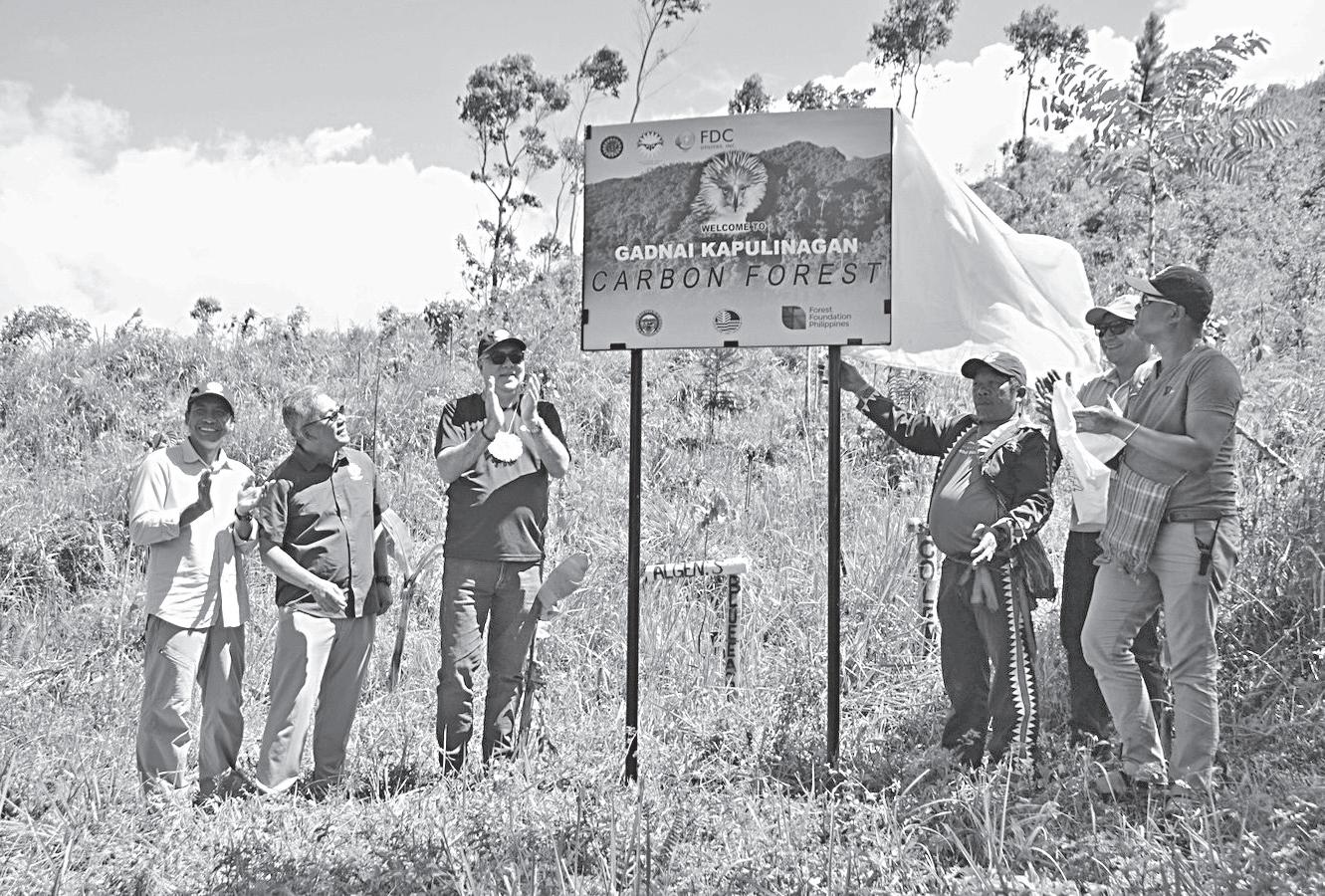
through the Kilag-udan Apo Datu Nanikunan Tribal Association Inc. (KADNTAI), formerly known as GADNAI, Reforestation and Carbon Sink Project, a 20-hectare restoration initiative located on Mt. Tago, Manolo Fortich.
This project aids biodiversity recovery, indigenous land rights, and sustainable livelihoods by restoring native forests and implementing community-led conservation programs.
Only animals that evolved to live solely on land ever developed claws. The earliest vertebrates— fish and amphibians—never developed hard nails and remained dependent on watery environments to lay eggs and reproduce.
But the branch of the evolutionary tree that led to modern reptiles, birds and mammals— known as amniotes—developed feet with nails or claws fit for walking on hard ground.
“This is the earliest evidence we’ve ever seen of an animal with claws,” said Sumida. At the time the ancient reptile lived, the region was hot and steamy and vast forests began to cover the planet. Australia was part of the supercontinent Gondwana.
The fossil footprints record a series of events in one day, Ahlberg said. One reptile scampered across the ground before a light rain fell. Some raindrop dimples partially obscured its trackways. Then two more reptiles ran by in the opposite direction before the ground hardened and was covered in sediment.
Fossil “trackways are beautiful because they tell you how something lived, not just what something looked like,” said co-author John Long, a paleontologist at Flinders University in Australia.
Christina Larson/Ap Science Writer
AS summer approaches, millions of Americans begin planning or taking trips to state and national parks, seeking to explore the wide range of outdoor recreational opportunities across the nation.
A lot of them will head toward the nation’s wilderness areas—110 million acres, mostly in the West, that are protected by the strictest federal conservation rules.
When Congress passed the Wilderness Act in 1964, it described wilderness areas as places that evoked mystery and wonder, “where the earth and its community of life are untrammeled by man, where man himself is a visitor who does not remain.”
These are wild landscapes that present nature in its rawest form.
The law requires the federal government to protect these areas “for the permanent good of the whole people.”
Wilderness areas are found in national parks, conservation land overseen by the US Bureau of Land Management, national forests and US Fish and Wildlife refuges.
In early May 2025, the US House of Representatives began to consider allowing the sale of federal lands in six counties in Nevada and Utah, five of which contain wilderness areas.
Ostensibly, these sales are to promote affordable housing, but the reality is that the proposal, introduced by US Rep. Mark Amodei, a Nevada Republican, is a departure from the standard process of federal land exchanges that accommodate development in some places but protect wilderness in others.
Regardless of whether Americans visit their public lands or know when they have crossed a wilderness boundary, as environmental historians we believe that everyone still benefits from the existence and protection of these precious places.
This belief is an idea eloquently articulated and popularized 65 years ago by the noted Western writer Wallace Stegner.
Stegner’s eloquence helped launch the modern environmental movement and gave power to the idea that the nation’s public lands are a fundamental part of the United States’ national identity and a cornerstone of American freedom.
Humble origins
IN 1958, Congress established the Outdoor Recreation Resources Review Commission to examine outdoor recreation in the US in order to determine not only what Americans wanted from the outdoors, but
to consider how those needs and desires might change decades into the future.
One of the commission’s members was David E. Pesonen, who worked at the Wildland Research Center at the University of California at Berkeley. He was asked to examine wilderness and its relationship to outdoor recreation.
Pesonen later became a notable environmental lawyer and leader of the Sierra Club. But at the time, Pesonen had no idea what to say about wilderness.
However, he knew someone who did. Pesonen had been impressed by the wild landscapes of the American West in Stegner’s 1954 history “Beyond the Hundredth Meridian: John Wesley Powell and the Second Opening of the West.”
So he wrote to Stegner, who at the time was at Stanford University, asking for help in articulating the wilderness idea.
Stegner’s response, which he said later was written in a single afternoon, was an off-the-cuff riff on why he cared about preserving wildlands.
This letter became known as the Wilderness Letter and marked a turning point in American political and conservation history.
Pesonen shared the letter with the rest of the commission, which also shared it with newly installed Secretary of the Interior Stewart Udall.
Udall found its prose to be so profound, he read it at the seventh Wilderness Conference in 1961 in San Francisco, a speech broadcast by KCBS, the local FM radio station. The Sierra Club published the letter in the record of the conference’s proceedings later that year.
But it was not until its publication in “The Washington Post” on June 17, 1962, that the letter reached a national audience
The Philippine eagles have thrived in the area over the years, thanks to the support of the local indigenous community and private partnerships, such as FDCUI and PEF.
FDCUI is the holding company of the Filinvest Group for its power generation projects. Its flagship power project is the FDC Misamis 405-megawatt baseload power plant in Villanueva, Misamis Oriental, which significantly contributes to the stability of the Mindanao grid. The company also develops renewable energy sources, including solar, hydro, and biomass power projects.
Mt. Tago is home to a pair of Philippine Eagles—female “Kalabugao,” male “Guilang-guilang” and their eaglet, “Maluko.” Kalabugao is the world’s first case of a rescued, rehabilitated, and released juvenile Philippine eagle surviving to sexual maturity and breeding in the wild.
Why protecting wildland is crucial to American freedom, identity
and captured the imagination of generations of Americans.
An eloquent appeal
IN the letter, Stegner connected the idea of wilderness to a fundamental part of American identity.
He called wilderness “something that has helped form our character and that has certainly shaped our history as a people... the challenge against which our character as a people was formed... [and] the thing that has helped to make an American different from and, until we forget it in the roar of our industrial cities, more fortunate than other men.”
Without wild places, he argued, the US would be just like every other overindustrialized place in the world.
In the letter, Stegner expressed little concern with how wilderness might support outdoor recreation on public lands. He didn’t care whether wilderness areas had once featured roads, trails, homesteads or even natural resource extraction.
What he cared about was Americans’ freedom to protect and enjoy these places. Stegner recognized that the freedom to protect, to restrain ourselves from consuming, was just as important as the freedom to consume.
Perhaps most importantly, he wrote, wilderness was “an intangible and spiritual resource,” a place that gave the nation “our hope and our excitement,” landscapes that were “good for our spiritual health even if we never once in 10 years set foot in it.”
Without it, Stegner lamented, “never again will Americans be free in their own country from the noise, the exhausts, the stinks of human and automotive waste.”
To him, the nation’s natural cathedrals

and the vaulted ceiling of the pure blue sky are Americans’ sacred spaces as much as the structures in which they worship on the weekends.
Stegner penned the letter during a national debate about the value of preserving wild places in the face of future development.
“Something will have gone out of us as a people,” he wrote, “if we ever let the remaining wilderness be destroyed.” If not protected, Stegner believed these wildlands that had helped shape American identity would fall to what he viewed as the same exploitative forces of unrestrained capitalism that had industrialized the nation for the past century.
Every generation since has an obligation to protect these wild places.
Stegner’s Wilderness Letter became a rallying cry to pass the Wilderness Act. The closing sentences of the letter are Stegner’s best: “We simply need that wild country available to us, even if we never do more than drive to its edge and look in. For it can be a means of reassuring ourselves of our sanity as creatures, a part of the geography of hope.”
This phrase, “the geography of hope,” is Stegner’s most famous line. It has become shorthand for what wilderness means: the wildlands that defined American character on the Western frontier, the wild spaces that Americans have had the freedom to protect, and the natural places that give Americans hope for the future of this planet.
America’s ‘best idea’
STEGNER returned to themes outlined in the Wilderness Letter again two decades later in his essay “The Best Idea We Ever Had: An Overview,” published in “Wilderness” magazine in spring 1983. Writing in response to the Reagan administration’s efforts to reduce protection of the National Park System, Stegner declared that the parks were “Absolutely American, absolutely democratic.” He said they reflect us as a nation, at our best rather than our worst, and without them, millions of Americans’ lives, his included, would have been poorer. Public lands are more than just wilderness or national parks. They are places for work and play. They provide
V
ATICAN CITY— Pope Leo XIV has made peace with Jannik Sinner.
The top-ranked tennis player visited the new pope on Wednesday, gave him a tennis racket and offered to play, during an off day for Sinner at the Italian Open.
Leo, the first American pope, is an avid tennis player and fan and had said earlier this week that he would be up for a charity match when it was suggested by a journalist.
But at the time, Leo joked “we can’t invite Sinner,” an apparent reference to the English meaning of Sinner’s last name.
By Wednesday, all seemed forgotten.
“It’s an honor,” Sinner said in Italian as he and his parents arrived in a reception room of the Vatican’s auditorium. Holding one of his rackets and giving Leo another and a ball, the three-time Grand Slam champion suggested a quick volley. But the pope looked around at the antiques and said, “Better not.” Leo, a 69-year-old from Chicago, then appeared to joke about his white cassock and its appropriateness for Wimbledon, perhaps a reference to the All England Club’s all-white clothing rule. He asked how the Italian Open was going. “Now I’m in the game,” Sinner said. “At the beginning of the tournament, it was a bit difficult.”
Sinner has a quarterfinal match on Thursday in his first tournament back after a three-month ban for doping that was judged to be an accidental contamination. He will next face freshly crowned Madrid champion Casper Ruud. Sinner is attempting to become the first Italian man to win the Rome title since Adriano Panatta in 1976.
During the audience, Angelo Binaghi, the head of the Italian Tennis and Padel Federation, gave Leo an honorary federation card.
“We all felt the passion that Leo XIV has for our sport and this filled us with pride,” Binaghi said in a statement. “We hope to embrace the Holy Father again soon, maybe on a tennis court.”
The pope and Sinner posed for photos in front of the Davis Cup trophy that Sinner helped Italy win for the second consecutive time last year. Also on display in the room was the Billie Jean King Cup trophy won by Italy in 2024, the biggest women’s team event in tennis.
Earlier in the week, after Leo’s first quip about not wanting to invite him, Sinner said it was “a good thing for us tennis players” that the new pope likes to play the sport In addition to tennis, Leo is an avid Chicago White Sox baseball fan.
His predecessor, Pope Francis, was a lifelong fan of Buenos Aires soccer club San Lorenzo. AP

Archer Aviation’s piloted electric air taxi known as Midnight will ferry up to four passengers from a vertiport takeoff and landing hub near a major venue about 10 to 20 minutes to their destination within the company’s Los Angeles network.
LOS ANGELES—Fans and VIPs can fly their way to venues at the 2028 Los Angeles Olympics with the first air taxis ever to be used at a games. Archer Aviation’s piloted electric air taxi known as Midnight will ferry up to four passengers from a vertiport takeoff and landing hub near a major venue about 10 to 20 minutes to their destination within the company’s Los Angeles network.
The planned network includes vertiports at SoFi Stadium in Inglewood and the Los Angeles Memorial Coliseum south of downtown, which are slated to share opening and closing ceremonies. Other locations are Los Angeles International Airport, Hollywood, Santa Monica and Orange County.
“We want to transform the way people get around Los Angeles and leave a legacy that shapes the future of transportation in America,” Adam Goldstein, CEO and founder of Archer Aviation, said in a statement Thursday. “There’s no better time to do that than during the LA28 Games.”

Archer says the air taxis produce less noise and emissions than a traditional helicopter. The eVTOL aircraft is built with redundant, fault-tolerant systems, including 12 total engines and propellers, allowing Archer to target certification with the FAA at similar levels of safety as commercial airliners. The air taxis are made at the company’s manufacturing plants in San Jose, California, and Covington, Georgia.
As an official provider to the LA 2028 Olympics, Paralympics and Team USA, Archer also will use the air taxis to provide support for emergency services and security.
“Our vision is to fundamentally reimagine the Olympic and Paralympic Games experience,” LA chairperson and president Casey Wasserman said. “This partnership represents an incredible opportunity to deliver something unprecedented.”
Historic year for female Olympic leaders
AHEAD of the International Olympic Committee’s (IOC) first female president

formally taking over next month, one of the few women leading an Olympic sport faces an election challenge.
The International Table Tennis Federation’s (ITTF) president since 2021, Petra Sörling, is in a May 27 contest against men from Qatar and Mauritania.
The vote in Doha after the world championships shapes to be between the Swedish incumbent and the host nation’s Khalil alMohannadi, a veteran of ITTF politics since 1997.
“He feels that he’s been so long in this sport he says he deserves to become the next president,” Sörling told reporters Thursday in an online call. “It’s a democratic world and everyone is, let’s say, free to make their campaign.”
Sörling is a rare female leader in world sports. Last month, badminton’s governing body elected Khunying Patama Leeswadtrakul unopposed, and another Swede, Annika Sörenstam, is in her third term as International Golf Federation president.
An International Olympic Committee member since 2023, Sörling was in Greece in

March when Kirsty Coventry won against six men in the IOC’s presidential election.
“I am looking forward, with the good relations I have with her,” she said of Coventry, “also to play my role in fully supporting her in the new chapter of the IOC.”
Sörling is campaigning on a record that includes a three-fold increase in ITTF commercial revenue since 2019 and sold-out sessions at the Paris Olympics last year.
The ITTF hopes its planned 7,000-capacity space for the 2028 Los Angeles Olympics, at the Convention Center downtown, could increase. Table tennis will debut a mixed-team event for men and women.
“Our biggest challenge now in LA is that we think our venue is too small. It’s a good problem,” Sörling said.
The election follows Qatar hosting the worlds that open Saturday and run through May 25.
In this time, Sörling suggested, an election solution could be found “so we don’t have any losers. We have no time to waste on internal fights.” AP


‘Beyond
HE De La Salle-College of Saint Benilde Blazers and a talented and energetic squad of persons with disabilities (PWDs) faced off in an exhibition match to showcase the skills of differentlyabled individuals and empower them through sports and recreational activities. Dubbed Beyond Limits: The Benilde Blazers, the outreach program championed inclusivity
the University of the Philippines, Arellano University and Saint Benilde, runner-up in the National Collegiate Athletic Association Season 100 men’s basketball tournament.
The Taft-based cagers—including Jhomel Ancheta, Matthew Oli, Gab Cometa, SJ Moore and Anton Eusebio—observed and admired the on-court heroics of the PWD players.
Besides a friendly game, an adaptive 3x3 basketball league was also held at the Benilde Sports and Dorm Complex.
The one-day affair was a collaborative effort among the Benilde Center for Sports Development (CSD), School of Environment and Design, Center for Social Action, Center for Inclusive Education and School of Deaf Education and Applied Studies.
Best Buddies Philippines, a non-profit group which advocates for individuals with intellectual and developmental diversities, was also one of the event partners.
“This event is not just a powerful celebration of sports but a reminder that regardless of physical limitations and abilities, everyone deserves recognition and respect,” Benilde CSD Director Stephen Fernandez said.
Philippine Sports Commission (PSC) Commissioner Walter Francis Torres emphasized the importance of staying fit in one’s health and athleticism.
“This is a program that the PSC is pushing— adaptive sports or adaptive physical activity,” Torres said. “It’s really to encourage the PWD sector to be physically active and engage themselves in sports.”
Adeline Dumapong-Ancheta, the first Filipina Paralympic medalist who bagged the bronze in powerlifting at the 2000 Sydney Paralympics, shared her inspiring journey with her fellow sportsmen.
“Sports is the great equalizer—when we’re on the track, on the court, in the playing venue, we are all equal,” Dumapong-Ancheta said. “It’s about heart and determination.”
Other notable attendees included actor-turneddirector David Chua, Project Empower founder and CEO JD Castro, Best Buddies Philippines executive director Michelle Aventajado,


‘Genshin Impact’ creator dives into AI for growth beyond games
MAY 18, 2025 | soundstrip.businessmirror@gmail.com
Story
and photos
by Reine Juvierre S. Alberto
IT was never a phase—and on May 9, 2025, Manila proved it.
For one night at the Mall of Asia Arena, the emo kids—who were never really “alright”—were transported back to the unforgettable era of dark eyeliners, carefully curating MySpace and Friendster profiles with background music and feeling all the emotions in heartbreak anthems.
The sold-out Playback Music Festival was headlined by three of the most iconic bands to come out of the 2000s punk, rock and emo wave: the oneman acoustic band Secondhand Serenade, power pop band The Click Five and punk rock Boys Like Girls. These are the bands that shaped a generation and made their way onto burned CDs and iPods of teenagers who relied on angsty lyrics when they couldn’t say the things they wanted or felt. Even if decades have passed, with some not having the energy to be in the mosh pit anymore, they got the chance to relive the memories of their high school days.

Publisher :
T. Anthony C. Cabangon
Editor-In-Chief :
Lourdes M. Fernandez
Aldwin M. Tolosa
Concept :
Y2Z Editor :
SoundStrip Editor : Group Creative Director : Graphic Designers :
Jt Nisay
Edwin P. Sallan
Eduardo A. Davad
Niggel Figueroa
Chow Jarlego
Contributing Writers :
Tony M. Maghirang
Rick Olivares
Jill Tan Radovan
Reine Juvierre S. Alberto
John Eiron R. Francisco
Pocholo Concepcion
Francine Y. Medina
Justine Xyrah Garcia
Bea Rollo
Trixzy Leigh Bonotan
Bless Aubrey Ogerio
Photographers :
Bernard P. Testa Nonie Reyes
Y2Z & SOUNDSTRIP are published and distributed free every Sunday by the Philippine Business Daily Mirror Publishing Inc. as a project of the
The Philippine Business Mirror Publishing, Inc., with offices on the 3rd Floor of Dominga Building III 2113 Chino Roces Avenue corner
Dela Rosa Street, Makati City, Philippines. Tel. Nos. (Editorial) 817-9467; 813-0725.
Fax line: 813-7025
Advertising Sales: 893-2019; 817-1351,817-2807. Circulation: 893-1662; 814-0134 to 36. www.businessmirror.com.ph



and who shaped my sound, I get to play with now. That’s an incredible thing,” said John Vesely, the voice behind Secondhand Serenade.
Donning their allblack outfits, Converse and Vans sneakers and smudged eyeliners, the fans showed up for the bands that were there for them when they needed someone most.
Back in Manila

“Coming back here is very, very surreal and it’s all because of the fans, it’s all because of you,” Kyle Patrick, lead vocalist of The Click Five, shared in a press briefing prior to the show.
It has been 15 years since The Click Five last went to the Philippines and their reunion at Playback marked not just a return but a resurrection of their music marked by memories they helped shape.
For Secondhand Serenade and Boys Like Girls, their visit felt more familiar as they had just staged their own concerts in Manila last year.
“You guys got tired since last year,” Martin Johnson, Boys Like Girls’ lead guitarist and vocalist, joked with the seated crowd. “[Everyone] was standing up. What happened to you?”
He later turned sentimental and looked back at their previous shows in the country. “[The Philippines] is one of our favorite places to play in the entire world… Thank you for bringing us back two years in a row. We’re so happy to be back here.”
As these iconic bands returned, and even The Click Five getting back together, sharing the stage with one another became even more meaningful for the artists themselves.
“I feel so lucky to be put in the same pool with incredible artists. I sometimes find myself surprised because a lot of the artists I listened to growing up
Night of nostalgia
The music festival opened with a strippeddown and emotionally raw set by Secondhand Serenade, bringing the arena to a standstill. From “Maybe” to “Broken,” Vasely’s voice cut deep.
People in the mosh pit were singing along like it was a personal diary entry from 2007. There was no silent moment—whether it was “Vulnerable,” “Twist in My Story,” “Awake,” and “Stranger” to recall an intense love or painful heartbreaks like in “Goodbye” and “Like A Knife.”
But the loudest screams came when the first chords of “Fall For You” were strummed.
The song became even more famous on TikTok, with 16.4 million views, and has now turned into a meme associated with the emo subculture.
The fans lit up their phone’s flashlights and sang along to the lyrics as tiny foams fell from the ceiling, mimicking snow.
“This is my first time seeing this. You guys are gonna make me cry here,” Vesely expressed, adding that the Philippine crowd was the “incredible” one he ever played to.
Vesely changed the song lyrics to “because a crowd like Manila is impossible to find. It’s impossible to find.” Everyone in the crowd screamed their hearts out and the noise enveloped the arena, preparing it for a night to remember.
Next up was The Click Five, who wasted no time firing up the crowd with favorites “Friday Night,” “Catch Your Wave,” and “All I Need Is You.”
Clad in their signature sharp-looking suits and ties, the band further reignited memories with “Happy
Birthday” and “Good Day” and brought fans back to memories of MTV days and cute high school crushes.
But apart from this power pop band’s catchy tracks, sentimental songs such as “Mary Jane,” “Don’t Let Me Go,” and “Empty” offered a softer and more vulnerable side of the band—similar to what the crowd felt in experiencing heartbreak long ago.
Of course, the hits “Pop Princess,” “Just the Girl,” “Flipside,” “Headlight Disco” and “Jenny” turned the arena into a giant sing-along event, as the voices of those who knew every word by heart echoed. Capping the night was Boys Like Girls, delivering an electrifying set that got everyone jumping in the mosh pit at 10:30 p.m. to “Love Drunk” and “Five Minutes to Midnight.”
The band also sang a couple of throwback hits from their self-titled album, including “Heels Over Head,” “Up Against the Wall,” “Dance Hall Drug,” and “Holiday.”
Meanwhile, “Thunder” brought the emotional thunderstorm, as couples held hands and friends hugged to the lyrics that once lined their high school notebooks. As the show came to an end, Boys Like Girls gave their all with the nostalgic “Hero/Heroine” and “The Great Escape,” which was cut short by Johnson.
“You guys have been incredible tonight. I’d love to see you bring this house down for one last time. Can you do that? You got the video now. Let’s put the phones away. This is the song that started it all,” Johnson said.
Everyone, including those who are seated, stood up and enjoyed the cathartic joy brought by music as shouting the words to “The Great Escape” and “Love Drunk” is exactly the release they need in this new phase called “adulting.”
“Throw it away, forget yesterday
We’ll make the great escape
We won’t hear a word they say
They don’t know us anyway
Watch it burn, let it die
‘Cause we are finally free
I used to be love drunk but now I’m hungover
I’ll love you forever but now it’s over!”
Story and photos by John Eiron R. Francisco
While Original Pilipino Music (OPM) is basking in a creative renaissance, Over October stands as both witness and participant to the cultural shift reshaping the local music landscape. Beyond chart placements and streaming milestones, the band has a cleareyed view of the cracks that remain—gaps in infrastructure, a lack of legal literacy among artists, and a broader need for institutional support that extends not just to performers, but to the countless crew members behind the curtain.
“What we need more of are fearless musicians, fearless writers who aren’t afraid to release whatever they want,” frontman Josh Buizon said during the exclusive interview with BusinessMirror’s SoundStrip.
He added that the beauty of today’s OPM scene lies in its boldness and diversity. It’s a far cry from the more rigid sonic templates of the past. Now, everything from indie pop to experimental hip-hop to folk ballads finds space to thrive—and he wants to see even more of that fearlessness.
“IfyoulookatOPMnow,grabe,there’ssomanydifferent genresnasumisikat,andit’snicetoseethathappening.Iwant to see more of that,” the band’s vocalist said.
Yet, as the scene diversifies creatively, the infrastructure struggles to catch up. Guitarist Josh Lua points to a glaring gap: the lack of mid-sized venues that can bridge the leap from intimate bar gigs to arena-scale shows.
“There are only a few venues like that, and everyone’s trying to book them. It’s becoming a demand and supply problem,” Lua said.
blind spot in the industry: the lack of legal literacy among musicians when it comes to contracts, royalties, and intellectual property.
“What OPM needs right now is more education on a musician’s rights,” Anton stressed.
He noted that many artists still struggle to navigate the legal side of their careers, leaving them vulnerable in an industry that often romanticizes the ‘passion project’ narrative—overlooking the reality that music is also a profession requiring protection and structure.
Janessa Geronimo, the band’s drummer, echoed the sentiment. “We’re very blessed to be doing this as our full-time job now, but it took so long to get here.” Yet she knows many peers are still struggling to reach that level of stability.

He pointed out that the local music scene would greatly benefit from the availability of more mid-sized venues that can accommodate between 500 to 1,000 attendees.
Lua added that this would provide a crucial stepping stone for emerging bands like Over October—groups that have already built enough of a following to fill up small bars but are not yet at the stage where they can headline large arenas like Araneta Coliseum, where major concerts are typically held.
By having more of these mid-tier spaces, he said, bands would have more opportunities to reach wider audiences and grow their fan base in a more sustainable way, helping bridge the gap between underground acts and the mainstream music market.
For Anton Magno, the band’s rhythm guitarist and a practicing lawyer, the issue cuts deeper than just the music and the performances. He points to a persistent
“I really hope the government starts recognizing musicians as legitimate professionals— not just people who perform for fun or on the side,” she said.
She also underscored the often unseen financial and personal investments required to sustain a career in music.
According to the band’s drummer, many people tend to focus only on the performances they see on stage, without realizing the significant costs and long hours that go into preparing for those moments. From investing in quality instruments and equipment to spending countless hours rehearsing and producing music, she said that being a musician demands both substantial resources and time—realities that are frequently overlooked by the general public.
Beyond artists, she also shines a light on the countless individuals working behind the scenes—producers, engineers, stage crews—who deserve the same recognition and support.
Formed in 2014, Over October is a five-member indie pop band that began carving out their space in the local music scene during their university days, quickly attracting attention for their distinct sound and heartfelt songwriting. Over the years, the band has steadily built a

loyal fan base both in the Philippines and abroad.
As of April 2025, they have amassed over 3.8 million monthly listeners on Spotify and more than 100,000 subscribers on YouTube, with the majority of their audience coming from the Philippines, Indonesia, the United States, Canada, and the United Arab Emirates, where they continue to top the listener charts.
‘Mic drop moment’
The 2025 Aurora Music Festival performance was, in many ways, Over October’s “mic-drop” moment. Playing to over 150,000 festivalgoers, it was their largest crowd to date—a culmination of a decade-long journey.
“Honestly, we were just talking about how that was the biggest crowd we’ve ever played for,” Buizon said. “When I stepped out on stage, I was completely stunned by the sheer number of people.”
Lua added, “We’re used to bar gigs, where you can rely on go-to spiels to connect with a smaller audience. We’ve been playing to bigger crowds lately, but this one was something else.”
The size of the crowd, coupled with the massive setup—including eight large screens broadcasting their performance—added another layer of pressure. “It felt like all eyes were on us,” Buizon said. “It was overwhelming, but we reminded ourselves to have fun—and we really did.”
Anton highlighted how much mental preparation went into the show. “We’ve been doing a lot of gigs, so we were ready performance-wise. But nothing quite prepares you for seeing that entire field packed with people,” he said. “We were there during soundcheck and it was empty, but seeing it filled later in the day was just wild.”
Despite the nerves, the band, including Joric Canlas, the bassist, agreed it was a rewarding moment. “Honestly, it felt like everything we’ve worked for in the past few months paid off,” Canlas said.
“This has always been the goal—to play bigger stages. We even invested in new gear so we could move around more freely during shows,” Lua added.
The band used wireless setups and discussed whether they needed choreography or should just go with the flow. “We really tried to visualize the moment ahead of time,” Buizon said, “but even that didn’t fully prepare us. It was just... crazy.”
Among the songs they performed that night was their newest track, “Bitin”—a sequel to their 2020 breakout hit “Ikot.” The song continues a bittersweet narrative: two people realize, too late, that their feelings were mutual, and now one of them is with someone else. The tension lingers. The timing wasn’t right.
“More on the world around us,” Lua said, when asked if the song was drawn from personal experience. “When we write songs, we usually come up with scenarios in our heads and then build the story from there.”
It’s a process that reflects the band’s evolution— from a solo songwriting effort led by Buizon to a more collaborative, deliberate process that now begins on Google Docs and ends in packed venues.
Over October’s emotional storytelling and layered arrangements have struck a chord with listeners. As of April 2025, they have over 3.8 million monthly listeners on Spotify and 100,000 subscribers on YouTube, with fans spanning the Philippines, Indonesia, the U.S., Canada, and the UAE.
Asked what emotion or message Over October hopes to be remembered for, Janessa paused before answering with quiet conviction: “For me, it’s that feeling of being seen.”
She explained that their songs—whether drawn from personal experience or imagined scenarios—tend to take on a life of their own once released into the world.
“Even if the stories in our songs are fictional or rooted in our own lives, once they’re out there, they belong to the listeners.”
Janessa said it’s always moving to hear fans say things like “Parang para sa akin ’tong kantang ’to.” Many people, she noted, pour their own memories and identities into the music. “They make it their own. That connection, that sense of being understood—that’s really what it’s about for us as a band.”
That deep emotional resonance is also what made the launch of “Bitin” extra special. Held on Friday, May 16, at 123 Block in Mandaluyong, the event drew a soldout crowd, once again proving that Over October’s music continues to strike a powerful chord with its growing community of listeners.
The band walked off the stage not just as performers, but as advocates, hoping that the stage they stood on would one day be more accessible to all the Filipino musicians daring enough to dream.
By Cecilia D’Anastasio Bloomberg
FOR decades, Chinese video games and American gamers just didn’t mix. US audiences were receptive to all manner of weird and wonderful experiences, from Finnish Angry Birds to Japanese Pokémon, but sidestepped anything coming out of China.
That was until Genshin Impact arrived five years ago with two dozen plucky anime characters that fought monsters and took on quests. The HoYoverse production was an instant hit and went on to earn about $6.2 billion from smartphone players purchasing the chance to win alluring fighters and their magical weapons, according to data from Sensor Tower.
HoYoverse, the international brand for Shanghai-based Mihoyo Co., has had an unprecedented hit rate with its anime-inspired fantasy games. It followed Genshin Impact with Honkai: Star Rail and, in 2024, Zenless Zone Zero, a trio of games that’s collectively generated more than $8.4 billion on mobile, per Sensor Tower. But recently, its titles have begun to cannibalize each other. With each new release, HoYoverse’s audience migrated and the prior game’s mobile revenue roughly halved in the two subsequent quarters.
Sales at the closely held company fell 23 percent to $4.7 billion in 2024, according to data from Niko Partners. The need for fresh ideas is clear and urgent. As HoYoverse plots its next step toward growth, the answer will have to come from something other than cute warriors and selling tokens for in-game lotteries. Billionaire co-founder Cai Haoyu, now in his late 30s, stepped aside from running HoYoverse to help discover the answer.
Creating a virtual world that’s “more real than reality”
CAI is segueing his video game success into a separate, California-based artificial intelligence startup called Anuttacon, where he’s researching the use of cutting-edge technologies to develop nontraditional interactive media. The move in late 2023 was presented at the time as helping to “adapt to the company’s future development needs,” though a HoYoverse representative told Bloomberg News the two are “entirely independent entities.” Cai has recruited about a dozen former HoYoverse employees for the startup, according to a LinkedIn analysis. His first project is a spacefaring video game where the player interacts with a cute girl whose dialog is AI-generated.
HoYoverse’s slogan is “tech otakus save the world,” referencing the Japanese slang for obsessive anime nerds. Employees boast of a fundamental optimism that the future’s biggest problems are solvable with technology. Parent

company Mihoyo has invested in everything from nuclear fusion technology and space rocket development to brain-computer interface technology. Its ambitious goal, according to an employee manual shared with Bloomberg News, is to create a virtual world that’s “more real than reality” by 2030. HoYoverse compares itself to Apple Inc. and Elon Musk’s SpaceX, and claims that “We have never been a game company.”
Still, games are HoYoverse’s first step. For its upcoming titles, the company has poached top developers who have worked at Western companies like Ubisoft Entertainment SA and Electronic Arts Inc. It’s building new open-world and farming-simulator games, according to current and former employees. That’ll be a necessary departure from the anime role-playing genre—to expand the potential audience—but a risky one as HoYoverse tests new ground in an industry with flat revenue, diminishing hit rates and increasingly higher costs.
The company’s spokesperson declined to comment for this article, saying only that it contained several inaccuracies and unverified claims, without specifying or elaborating.
As a student at Shanghai Jiao Tong University, Cai dabbled in Flash games inspired by the iconic Japanese anime Neon Genesis Evangelion. In 2011, he teamed up with classmates Liu Wei and Luo Yuhao and established “MiHoYo” in a dorm room. The first two characters stood for mobile internet, while H and Y signified Haoyu and Yuhao. That’s according to an exhaustive history of the company from local publication Game Grapes. In 2022, the company started going by HoYoverse.
“A lot of Chinese gaming companies founded in the mid-2010s were from people who had grown up with those types of games that maybe weren’t mainstream at the time,” Daniel Ahmad, director of research at Niko Partners, said of mobile anime games. “They wanted to go mainstream with those ideas.”
Anime has exploded in recent years from a niche interest among deeply passionate aficionados to a mainstream hobby celebrated by the likes of rapper Megan Thee Stallion. Some 42 percent of Gen Z Americans watch anime weekly, according to a survey of more than 4,000 people by entertainment outlet Polygon. HoYoverse was poised to capitalize when anime’s popularity surged.
“Otaku have a strong inner need to communicate with girls, yet are afraid to act,” Liu said in one 2011 video, where he pitched a project involving “sweet, cute, kawaii pretty girls” to a room of potential investors with an excited energy. Otaku are “lonely and isolated people,” and with the company’s virtual characters, “we are here to meet such needs.” HoYoverse released games on that theme for years that earned downloads, prizes and investors.
CHINA’S domestic video-game market has long been dominated by fast-paced mobile titles designed to entice players to continuously spend small sums of money. These games, much like their counterparts in Japan, typically involve purchasing digital currency—represented as sparkling diamonds, virtual gold coins or special keys— and spending it on a chance to win new characters or items. Westerners criticized this so-called gacha genre for its monetization mechanics, which many consider predatory. On top of that, Chinese game makers had a reputation for cloning popular Western games—sometimes even before they were released.
Genshin Impact received criticism on both fronts when it launched in 2020. It also achieved what no other Chinese game had done before: popularity in the US.
The anime-style role-playing game drew from the world of 2017’s The Legend of Zelda: Breath of the Wild for its aesthetics, borrowed Grand Theft Auto’s surprise events system, and built its missions much in the fashion of Bethesda Softworks games like Skyrim, ac -
spending, according to Sensor Tower. Cai led the game’s development.
Aspiring Chinese game developers applied to work at HoYoverse en masse. The company prefers to hire younger people, even right out of college, who the founders feel are more in touch with the target consumers, according to current employees and the company’s manual. The workers refer to each other as “classmates” and have been known to stay late into the night working in the company’s Shanghai office. HoYoverse now employs more than 6,000 people across China, Singapore, North America and elsewhere.
HOYOVERSE’S next phase has been long in the works, but comes at a time of increasing uncertainty about the future of gaming and AI. The employee manual waxes poetic about a vision for games built around AI-generated content, something akin to Roblox Corp. but with 3D visual assets instantly created upon a user’s command.
Cai’s Anuttacon is his first step in that direction. The technology will “create new, innovative, intelligent and deeply engaging virtual world experiences,” its website says. He is now worth $7.9 billion, according to the Blooomberg Billionaires Index, mostly from his reported 41 percent stake in Mihoyo.
Yet the announcement for Anuttacon’s upcoming test version of its space AI game, Whispers from the Star, made no waves. Video-game fans are ambivalent about AI and worry that the shift away from the human touch could hurt game quality and developer jobs. HoYoverse has faced a backlash after replacing voice actors who expressed concerns about AI.
Cai does not necessarily disagree: “We may as well consider switching careers,” he wrote in a LinkedIn post addressing the impact of AI on game development.
‘We may as well consider switching careers’
–Billionaire Cai Houyou in a LinkedIn post addressing the impact of AI on game development
cording to the Game Grapes report. To Western gamers, it felt both familiar and fresh. Its charismatic cast of characters lured in millions of players stuck at home during the pandemic, while its super-polished gameplay kept them coming back.
Every six weeks, Genshin Impact gets new characters—a busty pirate or a mysterious prince—which players pay money to try and acquire. The game is free, but gamers build an emotional attachment to its fantasy universe and spend increasing amounts to build out their rosters with more virtual friends with varied fighting styles.
HoYoverse expanded from 500 employees to more than 1,000 over Genshin’s four-year incubation period, according to the Game Grapes report. Development cost $100 million, significantly less than Western peers’ flagship titles, according to the South China Morning Post. It grossed more than its cost in just two weeks. A month after its debut, it was the No.1 mobile game by global consumer

But HoYoverse has a soft cushion under it. Not only does it have the backing of the Chinese government—which it does as a noted pioneer in software development— but the entire games industry is on a yearslong shift eastward. At a time when Western studios are shutting down projects and laying people off, China has become a hub for top game development talent. And HoYoverse is part of that trend with its successful recruitment of developers from the likes of EA.
China is today the No.1 video game market internationally, generating an anticipated $50 billion from games this year, according to Niko Partners. HoYoverse is a comfortable titan in that market, though the company has its sights set on conquering more distant horizons. To do that, it’ll have to tap its deep talent pool of young otaku and rekindle some of the magic that helped it do unprecedented things in the past.
n Cover photo by Google DeepMind on Pexels.com