REMITTANCES are no longer a “high-growth” driver for the Philippines, especially as elevated inflation and slower economic growth may start canceling out the surplus amounts sent home by overseas Filipinos, analysts pointed out.
Experts said this even after the latest data from the Bangko Sentral ng Pilipinas (BSP) showed that cash remittance inflows grew both on a month-on-month and
By Claudeth Mocon-Ciriaco
year-on-year basis.
BSP data showed the money sent home by overseas Filipinos grew by 2.3 percent to $2.87 billion from the $2.81 billion in March 2025.
Cash remittances also grew by 3.16 percent from the $2.79 billion registered in February 2026.
On a year-to-date basis, the money sent home by overseas Filipinos amounted to $8.68 billion, up 2.79 percent from the $8.44 bil-
By Reine Juvierre S. Alberto
THE Bureau of Internal Revenue (BIR) expects its revenue collections to reach P271.558 billion this May, higher than its target, as it concluded the filing and payment of the 2025 annual income tax return (AITR). At the BIR National Command Center on Friday, Deputy Commissioner for Operations Group Vener S. Baquiran reported that the BIR’s expected collection of P271.558 billion
TBy Ada Pelonia
HE Department of Agriculture (DA) on Friday launched a $1-billion program funded by the World Bank to modernize the country’s farm sector and benefit around 5 million farmers nationwide in a five-year period. The Philippine Sustainable Agriculture Transformation (PSAT) program is a project under the World Bank’s Program-for-Results (PforR) model, which releases funds based on a specific set of outcomes rather than upfront disbursements.
Midyear bonus...
It also covers employees of constitutional commissions and offices, state universities and colleges, government-owned or -controlled corporations covered by the compensation and position classification system and local government units.
Uniformed personnel from the Armed Forces of the Philippines under the Department of National Defense, as well as members of the Philippine National Police, Philippine Public Safety College, Bureau of Fire Protection, and Bureau of Jail Management and Penology under the Department of the Interior and Local Government, are likewise entitled to the benefit.
Personnel of the Philippine Coast Guard under the Department of Transportation and the National Mapping and Resource Information Authority under the Department of Environment and Natural Resources are also included.
The mid-year bonus is equivalent to one month’s basic salary as of May 15. To qualify, personnel must have rendered at least four months of aggregate service from July 1 of the previous year to May 15 of the current year.
The required service period includes actual services rendered while occupying regular, contractual, or casual positions in the national and local government, including leaves of absence with pay.
They must also remain in government service as of May 15 of the current year and have obtained at least a satisfactory performance rating in the immediately preceding rating period or applicable performance appraisal period.
Acting Budget Secretary Ro -
lando U. Toledo said that funding for the mid-year bonus had already been comprehensively released at the start of the fiscal year to ensure the timely provision of benefits.
“The DBM ensured that the necessary funds were released early so that the distribution of this benefit would not be delayed. The actual processing and releasing of the mid-year bonus for their qualified personnel is now within the jurisdiction of their respective agencies,” Toledo said.
Possibly the biggest group of state workers receiving the midyear bonuses are the one million qualified educators and school staff nationwide, as the Department of Education (DepEd) announced their bonus release on Friday.
The release covers around 900,000 public school teachers and over 100,000 non-teaching staff across the country, providing essential financial support ahead of the opening of School Year 2026–2027.
Education Secretary Juan Edgardo “Sonny” Angara emphasized that the timely provision of this benefit reflects the administration’s recognition of the vital role played by the education workforce in national development and learning recovery.
The incentive covers qualified teaching and non-teaching personnel nationwide, including those in regular, casual, and contractual positions who meet the prescribed requirements.
Angara emphasjzed that both teaching and non-teaching personnel are central to the administration’s education reform efforts, particularly in the implementation of literacy, numeracy, and digital learning initiatives. Reine Juvierre S. Alberto, Claudeth Mocon-Ciriaco
Peso at new record low as oil soars past $107 a barrel
By Andrea E. San Juan
BRENT crude’s surge past $107 per barrel pushed the Philippine peso to a fresh record low of P61.72 against the dollar on Friday.
“The peso weakened to 61.721 as Brent crude surged past $107 per barrel, amplifying pressures from mounting signs of rising inflation,”
Jonathan L. Ravelas, senior adviser at Reyes Tacandong & Co. said in a Viber message on Friday.
In a separate message, Ruben Carlo Asuncion, chief economist of the Union Bank of the Philippines (UBP) also explained that the key driver of the weakening of the peso remains “external.”
“While recent local political developments, including those involving the Senate, may have added to market caution at the margins, the key driver remains external,” Asuncion said.
At this stage, the Union Bank chief economist said, the level of the peso itself is not yet a major concern, but “sustained weakness” could become more challenging if it begins to feed “more persistently” into inflation and inflation expectations.
“Ultimately, the focus should be less on the level per se, and more on whether the depreciation remains orderly and grounded in
fundamentals rather than shifts in market sentiment,” Asuncion said.
In the near term, Ravelas sees the peso trading within the 61.6061.90 range.
“Should Brent oil prices climb above $120 per barrel, the USD/ PHP pair could test the 62.00 level,” added Ravelas.
The peso weakened for the second straight trading day against the greenback. Within this twoday losing streak, it also hit two
historic lows. Data from the Bankers Association of the Philippines (BAP) showed that the local currency closed at P61.72 on Friday, 8 centavos weaker than its previous finish of P61.64 against the greenback on Thursday.
Ravelas told this newspaper on Thursday that the local currency could weaken further to P65 against the dollar should the price of Brent Crude shoot up to $150 to $170 per barrel. (See: https://businessmirror.com.ph/2026/05/14/prolonged-middle-east-war-may-see1%E2%82%B165-exchange/)
Within the trading session on Friday, the peso’s strongest level was at P61.57 while its weakest mark was at P61.73 against the greenback.
Despite ME war, PHL remittances up 2.3%
lion in the three-month period in 2025.
These data indicate that cash remittances in March recovered from the nine-month low in February despite the conflict in the Middle East, the region which accounts for 18 percent of the Philippines’ remittances pie.
Cash remittances refer to cash sent by land-based and sea-based workers through the banking system, the BSP said.
‘Lag effect’
ANALYSTS said it may be too early to see the possible drawdown in cash remittances, as the impact of geopolitical tensions has a lag effect.
Jeremaiah Opiniano, executive director of the Institute for Migration and Development Issues (IMDI) and professor at the University of Santo Tomas told the BusinessMirror: “The month-onmonth cash remittance flows still increased amid the Middle East conflict. It may mean that March is too early a period to see possible slowdowns in foreign exchange inflows from Filipinos abroad.”
Ruben Carlo Asuncion, chief economist at Union Bank of the Philippines (UBP) told this newspaper that the rebound in March remittances reflects a “combination of seasonal recovery from post-holiday slowdown, continued income stability among overseas Filipinos, and some support from the weaker peso.”
However, Asuncion underscored: “The impact of geopolitical tensions—particularly in the Middle East—tends to come with a lag and may still feed through in the coming months.”
Sluggish economy backdrop
THESE experts pointed out the lag effect in the context of elevated inflation, weaker economic growth momentum, and the rising prices of oil.
Opiniano pointed out: “Sure, remittances helped families back home to remain afloat, but rising inflation rates that the conflict and oil price hikes both induced will just cancel out any surplus amounts from abroad [buoyed by lower exchange rates and the strong US greenback].”
His sentiment was echoed by Asuncion:
“While remittance inflows remain resilient, elevated inflation and slower global growth are likely to cap further acceleration, as higher living costs abroad constrain the ability of workers to send more funds.”
Critical, but no high-growth driver FOR his part, Jonathan L. Ravelas,
senior adviser at Reyes Tacandong & Co. pointed out that remittances remain a “critical anchor” for Philippine consumption.
“But they’re no longer a highgrowth driver,” Ravelas emphasized.
As such, he said if the country wants “faster” economic expansion, the heavy lifting will have to come from investment and stronger domestic demand.
Ravelas expects remittance growth to remain in the near 3-percent range, with some upside during the second half from seasonal spending and potentially easing global inflation.
Asuncion said the growth in the money sent home by overseas Filipinos is seen to remain in the low single digits but on the assumption that there is steady overseas employment and currency effects.
Advice for recipients from abroad
ACCORDING to Opiniano, families receiving incomes from abroad— especially from the Middle East— may have to plan ahead.
“Plan for finances up to December, especially when the conflict drags on. Note also that oil prices and inflation rates won’t drop right away. Remittance families at least may have to be more prudent and thrifty with their money,” he underscored.
In a statement on Friday, the BSP said the United States remained the top source of cash remittances to the Philippines in January to March 2026, followed by Singapore and Saudi Arabia. Personal remittances, which include cash sent through banks and informal channels as well as remittances in kind, amounted to US$3.20 billion in March 2026.
Year-to-date personal remittances recorded a 2.8-percent increase from US$9.40 billion recorded in January-March 2025 to US$9.66 billion in January-March 2026, BSP noted.
www.businessmirror.com.ph
HMOs net income up 41.3% to ₧818.7 million in Jan-Mar
By Reine Juvierre S. Alberto
HEALTH maintenance orga-
nizations (HMOs) in the country sustained their profitability in the first quarter of the year, as membership fees and benefits paid maintained a “healthy ratio.”
Latest data from the Insurance Commission (IC) showed that the net income of the HMO industry rose by 41.31 percent to P818.7 million as of end-March, from P579.4 million in the same period last year. IC said this underscores the financial capability of HMOs to meet their obligations and sustain operational stability.
Total revenues of the HMO industry grew by 19.93 percent year-on-year to P27.572 billion from P22.989 billion.
About P26.828 billion of this came from membership fees, which increased by 19.67 percent from P22.419 billion last year.
Meanwhile, total expenses also went up by 19.38 percent to P26.753 billion from P22.410 billion a year ago.
Part of these are healthcare benefits and claims, which posted a 13.99-percent increase yearon-year, amounting to P20.147 billion.
“The continued financial strength of HMOs reflects their resilience and readiness to consistently fulfill their obligations to members,” Insurance Commissioner Reynaldo A. Regalado said.
“At the same time, the continued increase in membership fees shows sustained reliance and continued coverage under HMO plans,” he added.
Total assets of the HMO industry likewise expanded by 15.95 percent to P101.436 billion as of end-March from P87.483 billion in the same period last year.
Invested assets totaled P23.830 billion, up by 29.70 percent yearon-year from P18.373 billion.
Withdrawal of bid to remove Piki as CEO ‘a gesture to resolve Lopez family divide’
By VG Cabuag
THE camp of Federico “Piki”
R. Lopez said the move of the other faction of Lopez Inc. to withdraw its resolution that removed him as president and CEO of the company is a gesture for all parties to finally resolve the issues dividing the family.
Piki said he hoped that the faction of the Lopez family aligned with Eugenio “Gabby” L. Lopez III, will back up the gesture with genuine, positive and concrete efforts leading to an amicable, fair and lasting resolution of the rift within Lopez Inc.
“With this development, Piki Lopez also hopes for a stop of the misinformation harming the Lopez Group,” he said in a statement.
Piki said he will continue to fulfill his duties to all shareholders in the companies of the Lopez group, and “will remain steadfast in acting as a responsible steward of these various businesses.”
Piki said that it was in fulfillment of these duties that he supported the agreements with the Prime Infra. First Gen’s board of directors unanimously approved these transactions. Its directors include Manuel “Beaver” Lopez Jr., a KKR representative, among others.
“It is essential to recognize that, as a vote of confidence in Piki Lopez, the Prime Infra requested the change of management control provisions in their agreements,” Piki said.
BDO Unibank Inc. also showed this vote of confidence by issuing standby letters of credit, conditioned on the continued and active
involvement of Piki in the First Philippine Holdings Corp., he said.
“It is also anticipated that the other side will address unresolved questions about ABS-CBN [Corp.] so the media firm can finally chart a path to recovery, to protect not only the family legacy, but equally or even more importantly, the welfare of investors and employees,” he said.
Piki said he is prepared for any outcome following this gesture, given that the formal processes in the Mandaluyong Regional Trial Court and Securities and Exchange Commission (SEC) are proceeding in due course.
“He is focused on leading FPH and First Gen in delivering value through strategic projects and partnerships with reputable industry players,” Piki said.
The withdrawal presents an opportunity for the whole family to step back, reconsider their adversarial positions, and look for options that are least injurious to the family, the Lopez group, and the investing public, Lopez Inc. said in an earlier statement.
“Harm has been done to everybody. Reputational damage is there. Our family has been in a fishbowl with everybody looking in. Agreements have been signed with undeserved financial penalties especially for the investing public,” it said.
The majority said it is open to a ceasefire subject to a reasonable expectation of a fair compromise and access to information, but is more than ready to ramp up its efforts to protect its legal and pecuniary interests if there is none.
ADB eyes $1.75-B fund support for PHL response to Mideast war
By Justine Xyrah Garcia
THE Asian Development Bank (ADB) is prepared to extend the Philippines up to $1.75 billion in additional financing as the Marcos administration moves to contain the economic damage caused by the prolonged Middle East conflict.
ADB said on Friday the proposed funding—on top of roughly $2 billion in policy-based loans already in the pipeline this year—would help Manila manage mounting fiscal pressures as the government expands subsidies and emergency assistance to shield households and key industries from rising fuel and commodity costs.
ADB President Masato Kanda conveyed the lender’s commitment during a meeting with President Ferdinand Marcos Jr. at Malacañang Palace on Thursday.
“The Philippines is ADB’s home, and we see the strain this crisis is
placing on Filipino families, workers, and businesses,” Kanda said.
“ADB will act swiftly to support the government to protect vulnerable communities, manage fiscal pressures, and strengthen the economy’s resilience,” he added.
The offer comes as the Philippines absorbs the spillover effects of the conflict, with the country heavily exposed to volatile oil, fertilizer, and commodity prices because of its dependence on imports.
Inflation accelerated to a threeyear high of 7.2 percent in April, stoking fears that price pressures could worsen further if fuel costs continue to climb. Economists have warned inflation may breach double digits in the coming months if the conflict drags on.
Economic growth also sharply slowed in the first quarter, with gross domestic product expanding by just 2.8 percent—the weakest pace since the pandemic-era contraction in 2021.
The government earlier declared a national energy emergency as rising fuel prices threatened to reignite inflation and further strain public finances.
To soften the impact, the Marcos administration rolled out the Unified Package for Livelihoods, Industry, Food, and Transport (Uplift), which includes fuel subsidies, excise tax cuts on selected petroleum products, and cash aid for transport workers, farmers, fisherfolk, and repatriated overseas Filipino workers.
ADB said the proposed support may come through policy-based and countercyclical lending facilities designed to help governments navigate external shocks.
The lender also said trade finance assistance could be made available if needed.
Beyond emergency financing, ADB said it is coordinating with Philippine agencies on programs aimed at reducing the country’s
long-term vulnerability to fuel and commodity shocks.
These include support for fertilizer security, social protection programs, energy efficiency projects, clean energy investments, and mass transit development.
The Marcos administration has yet to say whether it will tap the additional financing being offered by ADB.
Earlier, ADB Philippines
Country Director Andrew Jeffries said the Philippines may have to adopt a more cautious fiscal strategy as pressure on state finances intensifies.
“It’s the government’s call on who they borrow from and for what purpose. Given this crisis and the fiscal strain that we don’t know how long it will last, that may also affect what they borrow for and what they may need to prioritize and postpone,” Jeffries said.
“There’s a lot more uncertainty around borrowing generally.”
Palace seeks to cure underspending, reviews progress of priority projects
MALACAÑANG is pushing to fix underspending in five key government agencies with bigticket projects to keep the country’s economic growth targets on track amid looming concerns it might be derailed by “stagflation” due to the effects of the ongoing Middle East crisis.
On Thursday, Executive Secretary Ralph G. Recto met with the Department of Agriculture (DA), Department of Transportation (DOTr), Department of Public Works and Highways (DPWH), Department of Education (DepEd) to determine how to accelerate government spending.
During the meeting, Recto and representatives of these agencies eyed the use of new streamlined procurement rules to expedite their acquisition and reduce delivery delays.
“There are spots of underspending and these must be resolved immediately,” he said.
“There is a way that we can speed up the process without taking legal shortcuts. Red tape that causes paralysis without sacrificing transparency can be done away with,” he added.
Recto said the President Ferdinand Marcos not only wants to accelerate government spending not only to provide better public service, but also to boost economic growth.
“The President’s order is to fast-track priority programs to push economic growth against global headwinds,” Recto said.
Based on initial data, the government already made programmed releases worth P1.287 trillion during the second quarter of the year.
A large portion of the spending was on government responses to those affected by the Middle East conflict, which disrupted global supply chains and triggered a surge in pump prices since it started last February.
The measures were consolidated in the Unified Package for Livelihoods, Industry, Food, and Transport (UPLIFT) initiatives of the Marcos administration, which focused in ensuring the safety of Filipinos in the Middle East, providing support to public utility vehicle drivers, as well as ensuring the country has adequate energy supply and affordable food,
In the UPLIFT Website, the government reported it spent P4 billion for its Middle East responses.
This includes the P3.21-billion cash aid of the Department of Social Welfare and Development for over 2.1 million transport workers, P820.84
Cebu starts post-quake rehab of damaged bridges for ₧94.2M
CEBU CITY—The Cebu Provincial Government has intensified its post-earthquake rehabilitation efforts as repair works officially begin on four more bridges damaged by the magnitude 6.9 earthquake that struck northern Cebu in September 2025. According to the information provided by the Provincial Engineering Office (PEO) through the Cebu Capitol Public Information Office (PIO), the newly-launched bridge rehabilitation projects carry a combined cost of approximately P94.2 million and are aimed at restoring safe and reliable transportation routes for residents and motorists in affected communities.
The projects include the rehabilitation of the following bridges in Poblacion Borbon Bridge I (35 meters)—P38.9 million; Poblacion Borbon Bridge II (11.9 meters)— P7.2 million; Tabunan Bridge I and II in Borbon (24 meters)—P27 million; and Calumboyan Bridge in Sogod (19
is already under way on eight other earthquake-damaged bridges across
Cebu’s fourth and fifth districts, with a total contract value of P159.732 million.
Provincial officials said these projects form part of the P276 million worth of infrastructure rehabilitation initiatives approved by Governor
million for the service contracting program of DOTr for 373,039 drivers and operators, P50 million for DA’s fuel assistance for 10,949 fisherfolks.
Despite the government spending, an economist from the HSBC Global Investment Research said that the 2.8 percent economic growth in the first quarter of the year might indicate that the country may be headed to “stagflation,” which is marked by simultaneous slow economic growth, high inflation, and high unemployment.
The Department of Economy, Planning, and Development (DEPDev) earlier allayed
the said concerns, saying that the government is already implementing measures to address inflation and to sustain the momentum of the growing economy through structural reforms.
Government wide, allocation releases programmed for the second quarter have so far reached P1.287 trillion, “and it is a must that the social good that this will fund be enjoyed by the people soonest,” Executive Secretary Recto said. Department officials present said new procurement rules that expedite project acquisition should be maximized to cut delivery delays.
Recto said “there is a way that we can speed up the process without taking legal shortcuts. Red tape that causes paralysis without sacrificing transparency can be done away with.”
“The President’s order is to fast-track priority programs to push economic growth against global headwinds,” he said. In multiple Cabinet meetings, “President Marcos has urged his Cabinet to speed up the projects and programs that will have the highest multiplier effect, create jobs, battle inflation, with focus on food security,” Recto pointed out.
Meralco pushes for solar energy adoption
THE Manila Electric Company
(Meralco) has reiterated its support for the wider adoption of solar energy, emphasizing that the company itself has embraced solar technology as part of its broader sustainability and energy efficiency efforts.
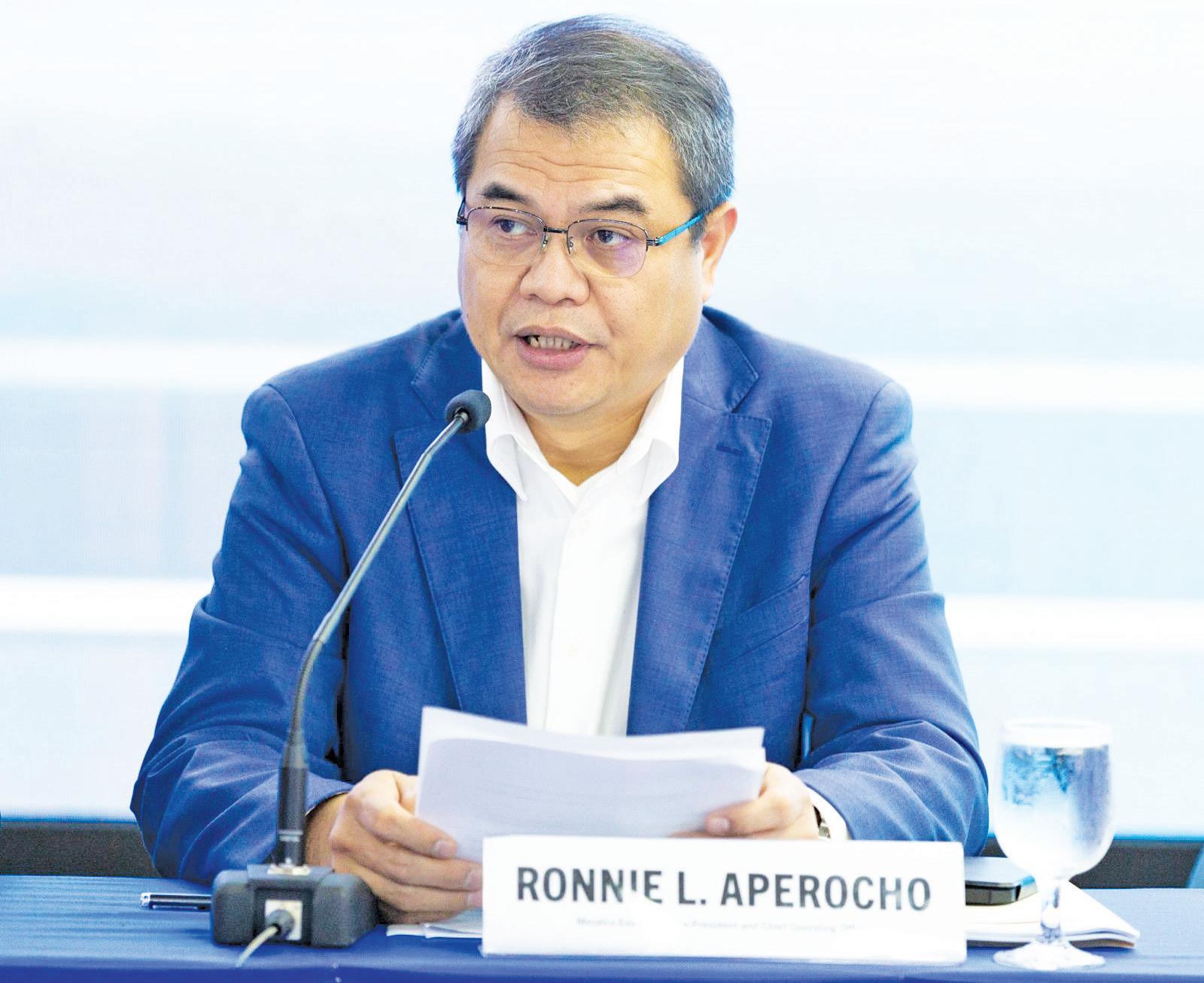
According to Ronnie L. Aperocho, Meralco has been installing solar panels across its own facilities to demonstrate its confidence in the technology and encourage its responsible use among households and businesses.
“Meralco installed and continued to install solar panels in our own facilities for the same reason many households and businesses
are now exploring solar technology—it helps us use electricity more efficiently and responsibly,” he said.
Meralco’s use of solar is aligned with its long-term sustainability agenda, particularly through its Resource Conservation and Efficiency Program, an energy efficiency initiative launched in 2020.
“As part of this program, we have installed solar panels in our headquarters, business centers, and sector offices to help reduce operational energy use,” Aperocho said.
For Meralco, adopting solar technology internally is also about leading by example, according to the official.
“We believe that if a technology
can help save resources and improve efficiency, we should also practice it ourselves,” Aperocho said.
“In fact, we have a solar subsidiary, MSpectrum, that has helped many homes and businesses shift to cleaner and more sustainable energy solutions,” he added. Meralco remains committed to advancing sustainability both within its operations and across the communities it serves.
“We will continue to promote and push the responsible use of solar energy, including other ecofriendly technologies, in our quest to foster and encourage sustainability in our operations,” Aperocho said.
Samuel P. Medenilla, Butch Fernandez
Senate security chief Aplasca suspended 6 mos over shooting
By Joel R. San Juan
HE Office of the Ombuds -
Tman has placed acting Senate Sergeant-at-Arms Mao Ranada Aplasca under a six-month preventive suspension without pay following Wednesday’s shooting incident at the Senate involving Senate security forces and agents of the National Bureau of Investigation (NBI).
Aplasca’s suspension will take effect immediately for a period not exceeding six months until the termination of the investigation as to his possible administrative liabilities over the incident.
Aplasca earlier admitted that he fired the first warning shot against NBI agents who were allegedly trying to access the Senate premises through the GSIS building. Prior to the incident, NBI agents were barred from entering the Senate building after its chaotic attempt to enforce the arrest warrant issued by the International Criminal Court (ICC)) against Senator Bato Dela Rosa on Monday.
NBI Director Melvin Matibag late Monday had an agreement with newly installed Senate President Alan Peter Cayetano that the NBI men who tried to go after dela Rosa will not be detained by the Senate for contempt, but they will be barred from the premises without prior clearance.
However, Matibag said the NBI unit that Aplasca’s large security team had engaged on Wednesday evening were on the other side of the wall, inside the building of the Government Service Insurance System (GSIS). The GSIS sought NBI’s help to secure their side of the connecting wall, since the GSIS security had been put at risk by Monday’s chaotic events, the NBI chief said, sharing a copy of the GSIS letter to NBI. They were not trying to sneak into the Senate premises, Matibag stressed, and should not have been fired at by Aplasca.
Referring to the sergeant at arms, whom TV reporters had seen wearing a bulletproof vest and loading his firearm before approaching the connecting wall, Remulla said at Friday’s briefing: “He was the one who fired first. Are you going to shoot back at law enforcement? We do not tolerate that.”
Remulla added,“That is why we need to investigate. It is difficult to forgive what they did. That is unacceptable. What right did he have to do that? Who does he think he is?”
Remulla said Aplasca’s continued stay in office poses a risk to the integrity of the ongoing investigation into the May 13 shooting incident.
“The preventive suspension is necessary to preserve documents and evidence currently under his control and custody and to
prevent any potential prejudice to the adjudication of the case,” the Ombudsman said.
Likewise, the Ombudsman issued a subpoena for the submission of the CCTV footage of the second floor as well as the basement parking from May 13-14, 2026 to aid in its investigation.
DOJ forms panel
MEANWHILE , the Department of Justice (DOJ) has created a special panel of prosecutors to conduct a comprehensive case-build up investigation in connection with the shooting involving the personnel of the Senate’s Office of the SergeantAt-Arms (OSAA) and operatives of the National Bureau of Investigation (NBI).
At a press briefing, DOJ Secretary Fredderick Vida said the panel will have the power to issue subpoenas for the submission of evidence and records from various agencies and individuals who were present during the incident.
Vida also appealed to mediamen who were present during the shooting to submit videos, photos, and other evidence that may be used by the panel in the investigation.
The OSAA through the Office of the Senate President, according to Vida, will also be asked to submit a report and turn over all relevant pieces of evidence in its possession and control, including
CCTV footages, ballistic and paraffin examination results.
“We assured the public that a complete, transparent and partial investigation will be conducted,” the DOJ chief stressed.
The DOJ is giving the law enforcement agencies such as the NBI and the Philippine National Police to submit their initial reports about the incident not later than Wednesday next week.
Vida also confirmed having prior knowledge about the NBI’s operation to arrest Senator Ronald “Bato” Dela Rosa at the Senate on Monday, as well as the presence of its operatives at the GSIS building during Wednesday’s shooting incident.
“Yes,” Vida said when asked if there was a proper coordination made by the NBI with the DOJ in connection with its activities at the Senate premises.
Vida also dismissed calls for NBI Director Melvin Matibag to be suspended as well following the order of the Ombudsman placing acting Senate Sgt.-At-Arms Mao Aplasca under preventive suspension.
“I don’t see any reason why Director Melvin Matibag will be suspended or preventively suspended given the current circumstances,” Vida stressed.
He also pointed out that it is not within the power of the justice secretary to remove Matibag from his post.
Siargao tensions spur DOT call for respect from foreign tourists
By Ma. Stella F. Arnaldo
BusinessMirror
to the
Special
RESPECT Filipinos.
That was the message of the Department of Tourism (DOT) on Thursday as reports again surfaced anew about tensions between Israeli tourists and local residents of Siargao.
In a post on its Facebook page, the DOT, now headed by Tourism Secretary-designate Ma. Bernadita Angara-Mathay, said: “We Filipinos, are known for our warmth. But hospitality is not an invitation to disrespect our people, our culture, or our laws. Every tourist is welcome in the Philippines, so long as they come with respect. When it comes to the law, no one gets special treatment. Local or foreign, the standard is the same.”
The agency added: “We stand in defense of Siargao’s tourism, but more than that, we stand in defense of Filipino dignity and welfare. At the same time, we call on the public to not paint an entire race or nationality with the same brush. The actions of a few do not speak for the many.”
It stressed: “Our message is simple: You are welcome in the Philippines. Be a good guest, honor the Filipino people and the Filipino people will honor you back even more.”
This comes amid reports that Israel’s Ambassador to the Philippines Dana Kursh snubbed a town hall meeting in Siargao that she had called for on May 12. A woman from the Lumad tribe who was allegedly assaulted by an Israeli tourist showed up, along with industry stakeholders and a representative of the local government unit (LGU).
Meanwhile, a post on Facebook by the LGU of General Luna showed Kursh participating in a town hall meeting at the Cabuntog Hall and Museum Center on May 11. (https://tinyurl. com/jetdtv56)
As per the LGU’s post, “The Ambassador clarified the distinction between consular assistance and legal accountability, emphasizing that embassies provide support for nationals in distress but do not intervene to protect individuals who violate local laws.”
The LGU added that Kursh “stressed that any misbehavior should be dealt with under Philippine laws and proper legal
processes, underscoring the importance of respecting local traditions, cultural heritage, and community standards.” It quoted the Ambassador saying, “If they are misbehaving, arrest them, press charges!”
‘Arrest them, press charges’
ISRAEL is a growing source market for the Philippines as DOT data showed a 53.6 percent increase in tourists to 24,583 in 2025, year on year. (See, “El Al direct service to PHL seen enticing more Israeli tourists,” in the B usiness M irror .)
The DOT also urged the public to report “any form of violence” against tourists or Siargao residents to the local police, echoing the advice of the island’s LGU. “Submit any evidence—such as photos or CCTV footage— that may help expedite the investigation.”
Cases of harassment, intimidation
THE LGU said Kursh “committed to raising the concerns through official channels and social media platforms to inform Israeli nationals of their responsibilities
while traveling abroad.” Comments on said post indicated that the Ambassador was supposed to have met business owners and tour operators the next day.
Several cases of skirmishes between locals and Israeli tourists have been reported largely by social media. Among these incidents include alleged catcalling and hurling of rocks against a group of transwomen and other foreign tourists, incidents of intimidation by Israelis on motorbikes, and vandalization of a cafe with pro-Palestine messages, to name a few.
Chef JP Anglo posted on his Instagram account photos of the town hall meeting on May 12 where Kursh was a no-show. “The Israeli Ambassador decided not to show up and never gave notice to the [participants]. People are upset and feel disrespected. The community of business owners, Lumads, and the one representative from the LGU showed up,” he said.
One photo showed a woman from the Lumad tribe with part of her face swollen. “They hurt our women, a Lumad. And they don’t have the decency to face the community? The lady Lumad has black eyes,” he said.
Cebu rotational brownouts on 3rd day to avert Visayas grid collapse
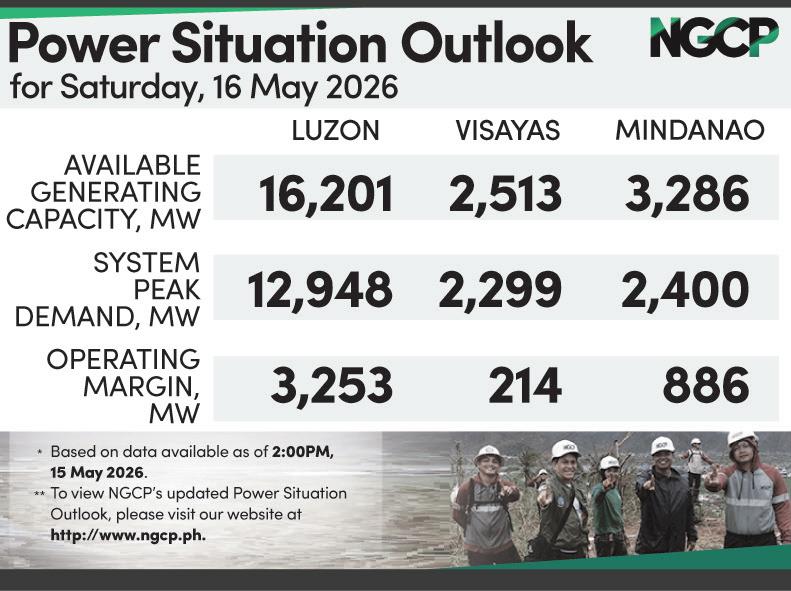
CEBU CITY—Visayan Electric has implemented rotational brownouts in parts of its franchise area following Red and Yellow Alert advisories issued by the National Grid Corporation of the Philippines (NGCP), as authorities work to prevent a possible collapse of the Visayas power grid.
Engr. Nino Paolo Cerrado, officer-in-charge of Visayan Electric’s Reputation Enhancement Department, said the utility began implementing rotational brownouts during peak hours starting Wednesday in response to the tightening power supply situation.
Kaning rotational brownout, solusyon ni siya aron ma-protect ang grid [This rotational brownout is a solution to help protect the grid],” Cerrado said in an interview with local radio station dyLA, explaining that the temporary outages are meant to ease pressure on the power supply following NGCP’s announcement that several power plants were unavailable or operating below capacity.
kay mas dakong problema if ang grid nato ang mo-collapse [We do not want the grid to collapse since it will create a bigger problem],” Cerrado said. Under the rotational brownout scheme, affected areas are expected to experience outages lasting about one hour each, although the utility said it is trying to minimize interruptions as much as possible. Cerrado said critical facilities such as hospitals and water supply systems are being prioritized and, if possible, excluded from scheduled outages. He added that the Interruptible Load Program (ILP) may also be activated if NGCP requires larger power curtailments.
NGCP, in its Friday morning advisory, placed the Visayas grid under Red Alert from 5 p.m. to 9 p.m., while Yellow Alert was declared from 2 p.m. to 5 p.m. and again from 9 p.m. to 11 p.m.
while several others have remained offline or operating on derated capacities since previous years, resulting in a total of 841.3 MW unavailable to the grid.
A Red Alert status is issued when power supply becomes insufficient to meet consumer demand and the transmission grid’s regulating requirements, while a Yellow Alert is declared when operating reserves fall below required contingency levels.
The Department of Energy (DOE), in a statement posted on their official Facebook page, attributed the power supply problem to the tripping of two major 500-kilovolt transmission lines on May 13 — the IlijanDasmañiñas and Ilijan-Tayabas lines — which serve as major channels for electricity flowing from power plants to Luzon and the Visayas through the interconnected grid system.
these transmission lines.
The agency said the interruption caused overloading in other transmission lines and reduced reserve power, prompting the issuance of Red and Yellow Alerts in both Luzon and Visayas.
Energy Secretary Sharon Garin has ordered immediate coordination to accelerate restoration work, while DOE technical teams were dispatched to inspect affected facilities and assist in restoring operations.
The DOE is also coordinating with NGCP, power generators, and distribution utilities such as Meralco and Visayan Electric for the possible implementation of the ILP when necessary.
Meanwhile, the DOE welcomed the recent commissioning of the first phase of the Toledo (Carmen) Battery Energy Storage System (BESS) in Cebu, a 25-MW facility under Meralco PowerGen Corporation.
More government officials, private sector, civil society should visit Kalayaan–Kiko
GOVERNMENT officials, civil society organizations, academic institutions, media representatives, and members of the private sector must visit the Kalayaan Island Group (KIG) in the West Philippine Sea to strengthen national awareness and solidarity amid continued aggression and harassment by China in Philippine waters, according to Senator Francis “Kiko” Pangilinan.
The senator had visited Pagasa Island to address the challenges faced by its residents, whose waters are claimed almost in its entirety by China. He was one of the minority senators whose absence from the Senate premises when the shooting broke out Wednesday evening had spawned innuendo by the new Senate leadership that they were tipped off that something big was afoot.
Fellow minority senator Risa Hontiveros pushed back on this, and explained that minority senators and their staff went home earlier since the Wednesday session had adjourned, and they had been informed that the post-session caucus was limited to the majority.
Pangilinan, meanwhile, explained that his visit underscores the need for the government to support and modernize the country’s armed forces and coast guard.
But more important, Pangilinan stressed that government officials and the private sector must join hands for a “whole-of-
nation approach” to address maritime and territorial issues.
Asked if he would encourage more government officials like him to visit the Philippine-claimed island, the lawmaker replied in the affirmative, thanking the West Philippine Sea task force for the invitation.
“And I think aside from high government officials, even those in the private sector, in the media, and socio-civic organizations,” he added. “Because information reached us that when the civil society groups and private sector are with our Coast Guard, and these involve activities to strengthen our claim and our victory in the international tribunal, the other side keep their distance.”
That is why, he said, a “whole-ofgovernment and whole-of-nation approach in our defense of our Exclusive Economic Zone, our territorial waters, our national sovereignty,” is important. His visit is also critical to identifying the military›s needs—such as more ships and equipment—to safeguard the contested waters, especially ahead of the upcoming budget deliberations.
“We don’t want trouble. We do n’t want an escalation of tensions. But we must ramp up our capacity to patrol our waters,” Pangilinan stressed.
Previously, the senator came under fire from the Chinese Embassy in Manila for criticizing the embassy’s remarks against several government officials and lawmakers. Butch Fernandez
‘Filipinos use Facebook more than any platform, but distrust it as news source’
FILIPINOS are aware that misinformation widely circulates in social media platforms like Facebook, but analysis of WR Numero’s data on media use reveals people continue to consume these platforms as they have become inseparable from their social and civic life.
In the latest article of WR Numero’s Public Opinion Letters, data from the March 2024 Philippine Public Opinion Monitor were used to examine Filipinos’ perceptions on misinformation, media bias, and factchecking. The Public Opinion Letters is a regular series of research articles that provide in-depth analysis of data and trends in Philippine public opinion and its study.
About 62 percent of Filipinos use Facebook daily–the highest among any platforms in the March 2024 survey. At the same time, Facebook also emerged as the most distrusted news source in the country, with 39 percent identifying it as the platform they trust the least, followed by TikTok at 24 percent.
By contrast, television is the most trusted news source in the country by a wide margin (50 percent). Still, shifting consumption habits among younger generations appear to be reshaping the country’s media landscape, as television reach dropped from 66 percent in 2020 to 46 percent in 2024.
WR Numero Senior Research Associate Buboy Figueroa said these findings reflect the “quiet contradiction” of everyday media life for millions of Filipinos. Rather than indicating ignorance about misinformation, Figueroa argued that this problem is “built into the platforms people cannot afford to leave, and the habits that have quietly formed around them.”
Views on misinformation, media credibility nearly 2 in 3 (63 percent) Filipinos
Continued from A3
Saturday, May 16, 2026 Pamela Baricuatro to restore critical public infrastructure in areas severely affected by the quake. The eight bridges are among the initial 16 infrastructure projects identified for immediate rehabilitation following the disaster. In September 2025, a magnitude 6.9
He added that Visayan Electric continues to monitor NGCP advisories closely amid ongoing Red and Yellow Alerts in the Visayas grid. Dili ta ganahan mo-collapse ang grid
The grid operator said available capacity stood at 2,441 megawatts (MW) against a peak demand of 2,661 MW. NGCP also reported that 11 power plants have been on forced outage since May 2026,
DOE said the outages disrupted power transmission from the 1,262.1-MW Excellent Energy Resources Inc. plant and the 1,200MW South Premiere Power Corporation Ilijan natural gas-fired power plant.
According to the DOE, about 12 percent of Luzon’s electricity supply passes through
The project is expected to improve the reliability and resilience of the Visayas grid and support the integration of renewable energy sources into the country’s power supply system. Carmel Pedroza
believe misinformation is prevalent. Among all generations, Millennials (71 percent) and Gen Zs (66 percent) express the greatest concern about the spread of fake news in the country. These generations are also the most engaged on digital platforms, indicating how pervasive misinformation has become in their daily lives.
Skepticism also extends to traditional media platforms. The majority of Filipinos (55 percent) also think journalists are biased and have vested interests. Younger Filipinos–Millennials (63 percent) and Gen Zs (57 percent)--recorded the highest level of skepticism across cohorts. Conversely, older Filipinos, whose media habits developed before the rise of social media and influencers as sources of news, appear more inclined to give journalists the benefit of the doubt. Less than half of the Silent Generation (35 percent), Baby Boomers (49 percent), and Gen X (48 percent) agree that journalists are biased. What remains consistent across generations, however, is the need for factchecking to verify news and information, with 4 in 5 (80 percent) Filipinos agreeing with this statement. Yet, Figueroa said factchecking alone cannot address the problem of misinformation as false news spreads faster and farther than the truth. The researcher also added that the overwhelming support for fact-checkers indicates demand for a media system they can trust rather than endorsement of factchecking’s current state. “Far less attention has been paid to what forms of fact-checking content actually work for the Filipino news consumer—one that accounts for their diverse media diets, trust orientations, and vernacular content,” said Figueroa.
such as
were
Staying strong after 60:
TimeOur
Embracing vitality through smart, joint-friendly movement
By Jona C. Redondo
TURNING 60 marks not an end but a powerful new chapter. With wisdom and experience comes the opportunity to focus on health span—the quality years ahead—rather than just lifespan. Sarcopenia (age-related muscle loss), reduced bone density, joint stiffness, and balance challenges are common, but consistent, evidencebased exercise can dramatically slow or even reverse many effects. Experts emphasize that strength, mobility, balance, and low-impact cardio form the foundation for independence, fall prevention, pain reduction, and joyful daily living.
The good news? You don’t need intense gym sessions or high-impact activities. Joint-friendly routines, often recommended by physiotherapists and doctors, prioritize controlled movements, proper form, and progressive overload while protecting knees, hips, shoulders, and spine.
Why strength matters after 60 MUSCLE mass naturally declines by about 3 percent to 8 percent per decade after age 30, accelerating after 60. This affects metabolism, bone health, posture, and the ability to perform everyday tasks like carrying groceries or rising from a chair. Strong muscles also support joints, reducing arthritis pain and injury risk. Balance training is equally critical; falls are a leading cause of injury in older adults.
Longevity experts like Dr. Peter Attia highlight four pillars for fitness in later decades: strength (building and maintaining muscle), stability (balance and control), aerobic efficiency (Zone 2 cardio), and peak aerobic output (some higher-intensity work). These translate well to accessible routines for those over 60.
Joint-friendly activities espoused by experts
EXPERTS consistently recommend low-impact, functional exercises that mimic real-life movements. Here are proven options:
Walking and gait training: Simple yet highly effective. It improves cardiovascular health, bone density, and leg strength without joint stress. Aim for daily walks, starting short and building up.
Swimming and water aerobics: Buoyancy reduces joint load by up to 90%, making it ideal for arthritis or joint pain. It builds full-body strength and cardio endurance.
Tai chi and yoga (including chair variations): These enhance balance, flexibility, and mindfulness. Tai chi is often called “meditation in motion” for its gentle flows that improve coordination and reduce fall risk. Chair yoga adapts poses for those with limited mobility.
Cycling (stationary or outdoor):
Low-impact cardio that strengthens legs while being gentle on joints. Resistance training with bands, light weights, or bodyweight: Crucial for muscle preservation. Focus on controlled movements rather than heavy loads.
Seated or chair-based exercises: Perfect entry points or for those with mobility limitations. They build strength safely.
Always consult a doctor before starting, especially with pre-existing conditions. Start slow, prioritize form, and consider working with a physiotherapist.
Expert-recommended exercise routines
MANY physiotherapists and doctors share practical videos demonstrating safe routines. Here are standout examples:
Dr. James O’Donovan (GP) and Ella Boys (Chartered Physiotherapist) highlight six key exercises for over-60s to build leg strength, core stability, posture, and balance. Their routine targets daily function and independence, demonstrating modi-
fications for different fitness levels. Watch: “Over 60? Master These 6 Exercises to Stay Strong and Steady” on YouTube.
Will Harlow, a leading over-50s specialist physiotherapist, shares five powerful moves including Wall W-Lift (for posture and shoulders), Thoracic Mobilization, Heel Raises, Farmers Carry (for grip and core), and Sit-to-Stand variations. These combat common aging changes effectively. See his video “5 Exercises to Stay Strong & Independent After 60.”
Dr. Alyssa Kuhn, a physical therapist and osteoarthritis specialist, recommends three essential fullbody strengthening movements with progressions and regressions for pain management. Her approach emphasizes movements vital for independence. Check “3 Exercises Everyone Over 60 MUST DO for Total Body Strength.”
Doug Weiss, DPT (physical therapist with 30+ years experience), presents six research-backed exercises focused on lifelong strength and balance. His video “Seniors: The 6 Best Exercises to Keep You Strong Forever!” is excellent for evidencebased guidance.
ElderfitTV (Tom and Gareth) offer accessible home routines, including 20-30 minute sessions with no equipment needed. Their practical demonstrations for over-60s emphasize strength, mobility, and confidence. Explore videos like “The Best 20 Minute Exercise Routine For Seniors Over 60.”
Other valuable resources include HASfit’s seated chair strength workouts and joint-friendly yoga with resistance bands for arthritis safety.
Sample weekly routine
A BALANCED plan might look like this (adjust as needed):
Strength/Balance (2-3 days): 20-30 minutes of the expert moves above—squats/sit-to-stands, heel raises, wall pushes, single-leg stands (with support), and light band or dumbbell rows/presses. Include core work like seated marches.
Cardio (3-5 days): 20-45 minutes of walking, swimming, or stationary cycling at a conversational pace (Zone 2).
Flexibility/Mobility (Daily or 3+ days): 10-15 minutes of yoga, tai chi, or gentle stretching. Focus on hips, thoracic spine, and shoulders.
Rest and recovery: Include active recovery days with light walks. Prioritize sleep, protein-rich nutrition (1.2-1.6g per kg body weight), and hydration.
Progress gradually: Add reps, sets, or slight resistance over weeks. Track improvements in energy, ease of movement, and mood.
Additional tips for success WARM-UP and Cool-down: Always include 5 minutes of light movement and dynamic stretches. Form over Intensity: Poor form risks injury. Use mirrors or record yourself.
Consistency beats Perfection: Short daily sessions outperform sporadic long ones.
Social and Fun Elements: Join senior classes, walk with friends, or try pickleball for motivation. Monitor progress: Improvements in grip strength, walking speed, or how easily you climb stairs signal success. Nutrition and Lifestyle: Pair exercise with adequate protein, vitamin D, calcium, and resistance to sedentary habits.
Staying strong after 60 is achievable and transformative. Countless seniors report renewed independence, less pain, better sleep, and greater joy in life through these practices. As physiotherapists like Will Harlow and Dr. Alyssa Kuhn demonstrate in their videos, small, smart investments in movement yield big returns. Start today with one video and one walk. Your future self—active, capable, and vibrant—will thank you.
BusinessMirror
Taguig City rolls out free flu vaccination for 120K seniors
By Christopher Lloyd Caliwan
AROUND 120,000 senior citizens in Taguig City will receive free flu vaccines in all 38 barangays starting Monday.
“This is the first city-wide, fully implemented, and fully funded by the local government to vaccinate our senior citizens against the flu,” Mayor Lani Cayetano said during the mass inoculation program held at the Taguig Center for the Elderly in Barangay North Signal.
The vaccine was procured by the local government using taxpayer funds.
“We are thankful as a city that we are able to finance a program rollout as massive as this,” Cayetano said, adding they are hoping to reach 115,000 to 120,000 senior citizens with the program.
Cayetano also cited the possibility of a house-to-house vaccination rollout for bedridden senior citizens and those unable to travel to designated vaccination sites.
“Our vaccination team will go to them personally and there, at their homes, they will be vaccinated,” she said.
The city selected Abbott Pharmaceuticals’ “Influvac Tetra Quadrivalent,” which Cayetano said is the latest flu vaccine available.
“This is a well-known vaccine—a well-known vaccine that is given in private clinics and hospitals,” Cayetano said.
Cayetano said the choice of vaccine was carefully studied by the City Council and the City Health Office because “we cannot just choose a vaccine that is not credible or not a respectable brand.”
Enough rope to hang ourselves
AT a mall, I happened to bump into a familiar face. It was J. whom I had worked with several years ago. We used to call him “standard electric fan” or “bagyo” behind his back because he was “mahangin” as we say in the native lingo.” What I most remember about him was that he was a chain smoker, a voracious meat eater and a hard drinker. One time when he learned he had a blood pressure of 175/100, he scoffed and dismissed it. “That’s my normal,” he boasted, as he continued to suck on his cigarette with gusto. He belittled doctors, saying he knew his body better than them. So, in spite of our constant warnings, he didn’t change his lifestyle a bit.
On that morning when I accidentally ran into him, there was J. being pushed on a wheelchair. What happened? He suffered not one but two strokes, which left half of his body paralyzed. He spoke in a slurred way and I could hardly understand him. Saliva dripped around one corner of his lips. Before we parted, I slid all the money I had on my wallet into his shirt pocket for his meds. The truth is I was not surprised at what happened to J. He had it coming, as they say.
More often than not, letting hubris find its natural course till the end is the more effective way to teach someone a bitter lesson or put him in his place. Originated from the ancient Greeks, hubris refers to excessive pride, arrogance, conceitedness or overconfidence. Someone who has self-assured hubris, combined with Dunning-Kruger effect, believes that he knows or can do better, causing him to make reckless decisions that inevitably lead to his downfall. Karma is also what some people call it. A lot of sayings have emanated from this concept of hubris such as “Pride goeth before the fall.” “Those who exalt themselves shall be humbled.” The modern version for our time is FAFO (F—k Around and Find Out). However, my favor -
ite is still the old truism: “Give ‘em enough rope, and they’ll likely hang themselves.”
What these sayings caution us against is overweening self-centeredness.
There’s an arrogant overconfident world leader who thought he could start a war on his own without consulting his allies and finish it in a few days. He called it just a little “excursion.” After all, he was
the ropes to tie around his neck and the whole nation’s. Lo, every day, the ropes are tightening.
The people were warned about him, yet he had been able to con his way to becoming once again a candidate, and the American electorate, ignoring his sordid past and his numerous frailties, still elected him to their nation’s highest office.
They were unaware that he was a rope they were lassoing around themselves. Now it seems they have to hang collectively with him before the bitter lesson is finally learned.
In my personal life, I’ve learned that it’s no use trying to change the minds of certain people with arguments, especially if they have KIA (Know It All) syndrome. Worst are those who know in their hearts that their hubris will hurt them sooner or later.
If someone is doing something wrong and he’s hardheaded about
able to do the “little excursion” in a small third world country in Latin America just a few months ago. No sweat.
So, he f-cked around again and then he found out. In his unbridled and dangerous thinking that might always trumps all, he has consequently and inadvertently turned the world order upside down as he finds himself alone in his military adventurism and is now frantically looking for a way to end the conflagration that he started. The world gave him all the rope he wanted to hang himself and teach him a lesson, but alas, we’re all suffering because of his un-restrained hubris.
This is the same leader who got elected despite being convicted 34 times and being known as a chronic liar. Having a compliant Congress and a spineless Supreme Court under his thumb, he has been given all
it, don’t make any effort to change him. Just let him continue with his erroneous ways and sooner or later he will bring misfortune upon himself. Given the opportunity, people who are full of themselves will fail on their own merits, or suffer the consequences of their own actions.
As someone said: “I did not interrupt him when he first lied. I let him spin the web of his lies and get him to trap himself. It is better to give someone enough rope and wait.”
“Bigay hilig” is our term. “Bayaan mong madapa sa sariling kilos.”
Long time ago, I read about an acerbic movie critic who used to lambast the films of a certain producer without let up. He couldn’t find anything to praise about them. Then the producer had an idea and turned the tables around. He lured the said critic to direct a movie to be written by the critic himself. The
“We are confident that this brand and this vaccine are safe and scientifically proven to really help our senior citizens,” she added. The vaccination rollout will run for two weeks or before June. PNA
critic took the bite. It turned out he couldn’t direct actors, manage a production crew, couldn’t work with his cinematographer, had no editing sense. Of course, the movie bombed. Which leads me to another saying: be careful what you wish for. Many times, the granted wish turns out to be an opportunity to botch things and mess up.
My painter friend, a senior, also has a similar story with his daughter, who is a gifted artist. She had long been diagnosed to be diabetic but for whatever reason she resisted treatment. Her condition kept worsening because she was not taking her medicines and was reckless about her food choices. One day, pent up, my friend let her daughter have her way. She eventually crashed. She was taken to the ICU and nearly died. Recently, talking about her daughter, my friend confided that while the crisis nearly drained all their resources, he says it was worth it. It was the final straw that broke the back of her hardheadedness. It turned things around for the better. She’s completely changed. She is now more grateful and caring. She now listens to her doctor. She is now healthier and more prolific. Her artworks are attracting clients and she’s now financially independent. Best of all, she acknowledges what she calls “my s—t.” What this tells us is that you can’t force someone into lasting change. Words don’t transform people. Consequences do. It only happens when they’re ready to take responsibility for the impact of their own behavior not when someone else demands it or warns them about it. True change and growth often stem from an inner awakening rather than external pressure. What is true in our private lives is also true of our society right now. I wait for the rope that is now around our nation’s neck to tighten some more. Until the fallout hurts enough, the hubris of our corrupt leaders and complacency of our people will continue. We can’t force that timing—we can only decide what we’ll tolerate while the rest of us figure it out. As the rope ever tightens, Benjamin Franklin’s comment at the time of the signing of the American Declaration of Independence has now become dangerously real: “We must all hang together, or, most assuredly, we shall all hang separately.”
BusinessMirror
Gen Z in Southeast Asia among the most engaged and experimental with digital tools
SOUTHEAST Asia, including the Philippines, has one of the youngest, most digitally native populations in the world, and they use Search to make decisions they can trust, said Google.
Recently, “BINI Coachella” reached the top of the trends globally, as their Gen Z fans celebrated the group bringing Southeast Asian Pride to the world stage. Signed-in users globally aged 18 to 24 now have more daily queries than any other age group with Google forecasting over 5 trillion searches annually with Gen Z driving this growth.
The Search feature is an extension of Gen Z culture helping them learn, take action and explore the world they love.
Google Search’s AI mode, when enabled, allows its new Gemini 3.1 model to learn and collect data based on the user’s queries. This new model creates a more conversational flow with users, turning Google Search into its own AI chatbot.
Google said these developments are due to advancements in AI, powered by its Gemini model. These are transforming Search from a keyword-based tool into what it described as an “intelligent partner” capable of answering complex queries and supporting back-and-forth interactions across text, voice, and visual inputs.
“AI is the best thing that has happened to Search. Today, it can do much more than just provide information. AI is making Search more intelligent so it can converse interactively across formats and provide answers to people’s complex and nuanced questions. In Southeast Asia—home to one of the world’s youngest, most AI-native populations—we
GLOBAL leader in access solutions Yale, under Assa Abloy Philippines, officially unveiled the future of connected living with the theme Unlock Real Life Security. Upgrade to a Smart Yale Home. at the Smart Yale Home Launch held on May 1 at True Value, Level 6, Shangri-La Plaza. The in-store launch introduced a new generation of smart security solutions designed to simplify everyday life for Filipino homes.
Opening the program, Jonathan Kwong, Assa Abloy Philippines director and general manager, emphasized Yale’s enduring legacy and forward-looking vision. “Since 1840, Yale has been protecting homes. From a small lock shop in Connecticut to being present in over 120 countries today, our foundation has always been built on trust, quality, and innovation,” he shared. Kwong highlighted how security has evolved beyond physical protection into a more connected, intuitive experience, adding that the launch represents “a smarter way of living that fits today’s lifestyle— bringing together convenience, control, and peace of mind.”
True Value Philippines reaffirmed its commitment to bringing meaningful home solutions closer to Filipinos. In her partner’s message, Cynthia Chavez, assistant vice president of True Value Philippines, noted that customers today are seeking more than just durability—they are looking for smart, practical upgrades
are seeing this shift play out in real-time. For this generation, Search has become a constant companion. They are engaging more deeply, visually, and through voice than any group before them. Whether it’s for learning, exploring a personal passion or making a high-stakes purchase, they rely on Search to make decisions they can trust,” said Sapna Chadha, vice president, Google Southeast Asia and South Asia Frontier.
Popular content creator Arshie Larga, who is a frequent traveler, uses Google Search to look for good deals and to check which ones have less impact on the environment. “Plus it is my filter to avoid tourist traps! When I see a viral restaurant or food on social media, I make sure to consult Google Reviews.”
Google has driven the talk surrounding The Devil Wears Prada 2 with a fun and engaging interactive feature on Search.
Google has tucked a chic little Prada 2 Easter egg into your search results. When you look up the film and click that iconic red heel icon, a stylish silhouette struts right across your screen. It’s a playful nod to the
film’s legendary fashion roots, and it’s clearly a hit, as more than 10 million fans have already clicked the shoe to join the fun.
Google Search is also full of lookups with various keywords related to the movie.
Here’s what’s trending right now as fans dive deeper into Miranda Priestly’s world:
■ The Cast: Moviegoers are eager to see which favorites returned to the office (and who the new “clackers” are). “The Devil Wears Prada 2 cast” is one of the top breakout searches surrounding the movie, but of course, there’s always “Miranda Priestly,” “Andy Sachs,” “Meryl Streep,” “Anne Hathaway,” and more.
■ The Reviews: Fans are checking in to see others’ feedback by searching “The Devil Wears Prada 2 reviews” on Search, to see if they think the sequel captures that same magic we fell in love with 20 years ago.
■ The Cinemas: People are actively hunting for the best big-screen theater experience to see every fabric texture in 4K by searching “The Devil Wears Prada 2 cinema.”
that enhance everyday living.
“We’re proud to support Yale in this milestone. These innovations reflect where home security is going, and how we continue to grow with the needs of Filipino families,” she said, adding that Yale products are now available across True Value stores nationwide.
The highlight of the event was the unveiling of the Smart Yale Home Pop-Up Booth led by Jonathan Kwong, Aya Castillo, product marketing manager of Assa Abloy Philippines, Cynthia Chavez, and Herco Trading Inc. president and CEO Willy Co. More than a traditional product reveal, the installation offered a distinctly immersive and unconventional launch experience—transforming retail space into a fully realized smart home environment. Designed in the
shape of a “Y,” the booth featured actual working doors and three home simulation rooms, each showcasing Yale’s latest innovations: the Yale Luna Elite+, Yale Uno, Yale YDL325 Series, and Yale Solis Safes.
The Smart Yale Home brought each product to life through real-world scenarios. Aya led a walkthrough of the booth, joined by actress, mom, lifestyle personality, and #MySmartYaleHome ambassador Isabel Oli-Prats, who experienced the space firsthand alongside #ThePratties family as they put the finishing touches on their new home. The walkthrough offered a relatable glimpse into how Yale’s smart security solutions seamlessly integrate into everyday living, reinforcing the brand’s vision of making connected, intuitive protection part of modern
Filipino homes. Against this backdrop, Yale is strengthening its position as a trusted yet forward-looking brand in the Philippines, bridging its 180-year heritage with modern innovation. Aya emphasized that while many new entrants are entering the smart home space, Yale stands out by combining proven security expertise with userfriendly technology and design that fits seamlessly into everyday life. Through its expanding portfolio, from entry-level smart locks to premium biometric systems and integrated home solutions, Yale is making smart security more accessible across different household needs and price points.
Supported by strong retail partnerships and nationwide availability, Yale continues to build confidence among Filipino consumers who are looking for reliable, intuitive, and well-designed upgrades for their homes. The event brought together key partners, media, and lifestyle and tech personalities to witness Yale’s latest innovations firsthand—marking a significant step in making smart home security more accessible in the Philippines.
The Smart Yale Home experience continues beyond launch day, inviting the public to explore and interact with these innovations firsthand. Visit the Smart Yale Home pop-up booth until May 31, 2026, at True Value, Level 6, Shangri-La Plaza, Mandaluyong City.
Concentrix continues to be bullish on PHL, unveils P2-billion investment and new QC tech hub
BY RIZAL RAOUL REYES
GLOBAL technology and services provider Concentrix is doubling down on its commitment to the Philippines, unveiling a P2-billion investment in intelligent solutions alongside the launch of its newest operations hub at Quezon City. The dual launch, dubbed iX 360 and GBF Site: Digital Site Journeys Reimagined, signals what company executives described as a bold step toward redefining the future of customer experience through the fusion of advanced technology, purposeful workplace design, and Filipino talent.
Speaking at a recent press briefing , Amit Jagga, executive vice president and chief business officer of Concentrix Philippines, said the initiative reflects the company’s long-term confidence in the country as a strategic hub for intelligent experience solutions.
According to Jagga, the investment goes beyond infrastructure, highlighting Concentrix’s vision of creating digitally enabled workspaces that empower employees while delivering seamless, scalable services to global clients.
The newly launched site at GBF Tower 2 is designed to integrate intelligent technologies with a world-class work environment, reinforcing the Philippines’ position as a key player in the global business services industry. For Concentrix, the project also underscores the growing role of Filipino talent in driving innovation and customer engagement on a global scale.
Jagga described the iX 360 as a next-generation environment where clients and employees can explore, co-create and experience solutions powered by advanced analytics, automation and artificial intelligence.
Jagga said the new site in GBF Tower will support the company’s growing operations while providing a modern, dynamic workplace. With almost 4,000 employees, GBF Tower is Concentrix’s 52nd site in the Philippines, sustaining the country’s status as the nation’s largest private employer. Its teams support clients in multiple industries such as financial technology, digital media, education, retail/consumer goods, travel, transport, wellness, and utilities. “iX 360 represents how we are bringing intelligent experience to life—where strategy, technology and human ingenuity come together to create real business impact,” said Jagga.
“As AI and automation continue to reshape industries, our focus is on ensuring that they work hand in hand with our people—enhancing productivity, unlocking creativity, and enabling better outcomes for our clients and gamechangers,” added Jagga
He pointed out that the Bridgetowne Campus expansion in Quezon City marks a strategic shift for the customer experience (CX) giant, moving beyond traditional voice services toward a “human-in-the-loop” AI strategy designed to keep Filipino professionals competitive against emerging global markets like Egypt and South Africa.
At the heart of the new facility is the iX 360 (Intelligent Experience 360) center. Described by company leaders not as a “museum of tools” but as a dynamic “digital space,” the center is designed to spark experimentation and creativity.
The iX 360 allows clients and “game changers” (employees) to experience technology solutions firsthand through a structured journey.
Jagga addressed the concerns regarding AI that it will displace jobs or neutralize the Filipino “accent advantage.” In fact, Jagga said the Concentrix leadership framed technology as a “stepping stone.”
The company highlighted tools like Harmony and Clarity, which neutralize background noise and modulate voices.
Furthermore, these tools allow individuals who might have previously struggled with English fluency to pass interviews and gain confidence.
While AI handles pronounciation, Jagga pointed out that cannot fix grammar or provide the “empathy and comprehension” that Filipino agents are known for.
Through the Next Wave Academy, Concentrix Philippines vice president of transformation and shared services Larah Santa Maria said the company is providing AI education across all levels, from basic literacy to advanced engineering. “Concentrix is also deepening its local roots through several corporate social responsibility (CSR) initiatives,” said Santa Maria.
Logging on at a cafe? Privacy and security guidelines for remote workers
FOR digital nomads, logging on to work from a cafe, coworking space, hotel lobby or airport lounge is a way of life. Remote working has been made possible by reliable high speed internet and turbocharged by the pandemic. For some remote workers, that includes working from somewhere other than their home, perhaps because their company doesn’t have a physical location in their area, or because they don’t have an ideal home office setup.
Working in public, however, doesn’t come without privacy and security risks. Here’s a quick reminder of precautions to take:
■ READ THE RULEBOOK. Hybrid or fully remote working is the norm for many jobs, so it’s a good idea to check for guidance from your employer on what’s expected when working away from the office.
Many companies and organizations have internal guidelines including best practices for working in public, or even offer privacy and confidentiality training for staff.
Some discourage working in crowded public places like coffee shops because of data privacy risks. The British government spells it out in guidance for staff working with classified documents. “These environments can present additional risks, including being more freely accessible to people without the appropriate clearance and need-to-know.”
If you’re planning to travel and work, some employers might also have rules forbidding staff from working from certain countries.
■ THINK VISUALLY. Cafes and co-working spaces are often busy with strangers, most of whom will be minding their own business. But it’s still a good idea not to leave yourself exposed. Try to find a secluded place to sit to prevent others from seeing what’s on your screen, even if it’s by accident. It’s harder for someone to “shoulder surf” if you’ve got your back to a wall.
To make it even harder for prying eyes, get a screen privacy filter. This is a thin film that has tiny louvres to prevent anyone from seeing your screen when looking at it from an angle.
■ BE WARY OF THE WI-FI. It’s so tempting to log on to that free Wi-Fi network in the airport lounge or hotel lobby so you can check your email. But cybersecurity experts advise against it because the risks are high. Avoid a public Wi-Fi network that doesn’t need a password, because any data sent over it is vulnerable to theft or manipulation, the National Security Agency warns. Even if a Wi-Fi network requires a password, that doesn’t mean the data will be encrypted, the NSA says in a cybersecurity tip sheet.
The agency warns about a number of cybersecurity risks involving public Wi-Fi. One possible danger is a rogue network that tricks people into joining.
“A malicious actor can set up a fake access point, also known as an evil twin, to mimic the nearby expected public Wi-Fi, resulting in that actor having access to all data sent over the network,” the NSA says.
Instead, use a mobile hotspot, which is more secure because it uses your cellphone signal to create a mini wireless network. Most iPhones or Android phones can do this. For even more security, use a VPN, or virtual private network. This is software that encrypts data traffic and routes it through private tunnels to secure servers to prevent anyone from being able to read it. Companies usually provide them for staff. If not, you can sign up for one yourself.
■ DON’T FORGET THE OBVIOUS MEASURES. There are other common-sense measures you can take in public.
Beware of your surroundings. Sitting in a public place with a laptop in plain sight could make it an attractive target for thieves. If you need to leave your spot to go to the restroom, take your devices with you.
Avoid having private conversations in public. If you’re on a noisy train car or in a busy hotel lobby talking on a Zoom call about a sensitive project, it might be tempting to raise your voice to make sure you’re being heard. But you can never be sure if anyone is eavesdropping.
“In public areas be aware of whether you can be overheard by any unauthorized individuals, such as members of the public, or smart listening devices,” the British government’s guidance warns. AP
• Saturday, May 16, 2026
Tecno Camon 50 Ultra 5G:
The end of the premier era
MUCH like everything else these days, smartphones in 2026 are becoming more expensive while innovation no longer feels as dramatic as the rising price tags attached to them.
A few years ago, paying more for a new phone felt easier to justify because the upgrades were obvious. Cameras improved dramatically, charging speeds became faster, and performance jumps were large enough that even casual users could immediately feel the difference after upgrading.
Today, flagships have become luxury devices, but the good news is that midrange phones have evolved far beyond the compromises people used to expect from them. Features once exclusive to premium phones like curved AMOLED displays, telephoto cameras, water resistance, AI imaging, and large all-day batteries are now available at far lower price points.
Which brings us to the Tecno Camon 50 Ultra 5G.
Personally, I think the old “Premier” branding already gave the Camon series its own identity. It sounded more photography-focused and stylish compared to today’s spec-heavy naming trends. But I also understand why Tecno switched to “Ultra” because the name immediately puts the Tecno Camon 50 Ultra 5G in the same conversation as today’s top midrange and flagship-inspired devices.
Over the past several weeks, I used the Tecno Camon 50 Ultra 5G to find out whether it’s simply a name change—or whether this phone actually delivers an “Ultra” experience.
Before anything else, though, Tecno seriously needs to rethink the packaging of the Tecno Camon 50 Ultra 5G. The box is filled with large spec callouts and feature labels that feel unnecessarily busy. Sometimes cleaner packaging actually makes a product feel more premium.
Inside, the Tecno Camon 50 Ultra 5G includes all the usual accessories like the SIM ejector tool, wall charger, USB cable, paperwork, and warranty documents. Thankfully, Tecno also includes a tempered glass protector in the box, which is genuinely appreciated because good tempered glass options for curved displays are still surprisingly difficult to find.
I also liked how Tecno handled the initial setup process. Instead of repeatedly tapping “Next” or “Agree,” the Tecno Camon 50 Ultra 5G lets Ella AI guide users through setup using a more conversational approach. It’s a small touch, but it makes the onboarding process feel less robotic. That said, the phone still comes with a noticeable amount of preinstalled and suggested apps, which makes the setup process slightly longer than it probably needs to be.
DESIGN AND BUILD
THE Tecno Camon 50 Ultra 5G immediately gives off a premium impression with its floating camera rings, curved AMOLED display, slim frame, and matte finish.
It also continues Tecno’s “Swan-neck” design language first introduced in the Camon 40 series. The flowing rear profile and curved lines help soften the phone’s shape, making it more comfortable to hold during long periods of use. The 43.5-degree curved display strikes a good balance between style and usability by avoiding the overly aggressive curves that often introduce accidental touches.
Despite carrying a massive 6500mAh battery, the Tecno Camon 50 Ultra 5G remains surprisingly slim at just 7.75mm and weighs around 178 grams. The matte rear finish also helps keep fingerprints under control while maintaining a cleaner appearance.
Tecno also refined the dedicated AI button by repositioning it closer to the thumb’s natural resting point, making one-handed shortcuts easier to access. By default, the key launches Ella AI and FlashMemo functions, but it can also be customized for shortcuts like mute controls or the flashlight.
Tecno also improved durability with IP68, IP69, and IP69K protection alongside Gorilla Glass 7i and military-grade durability claims.
The display itself is excellent for the price. The 6.78inch 1.5K AMOLED panel supports a 144Hz refresh rate and reaches up to 4500 nits peak brightness, making videos, games, and scrolling feel extremely fluid.
CAMERAS
THIS is still the real reason the CAMON series exists. The series was focused on photography and that philosophy remains intact, the “Premier” lineage lives on.
The Tecno Camon 50 Ultra 5G uses a 50MP Sony LYT-700C main camera with OIS, a 50MP 3x telephoto camera with OIS, an 8MP ultrawide camera, and a 50MP autofocus selfie camera.
The telephoto camera is easily the highlight.
Unlike the filler zoom cameras often found in this category, the 50MP 3x telephoto lens genuinely changes how the Tecno Camon 50 Ultra 5G behaves in everyday photography. Portraits look cleaner, subjects separate better from backgrounds, and street photography becomes far more flexible.
The main 50MP Sony sensor performs well too, especially during daylight. Tecno’s processing leans toward vibrant output, but it usually stops short of becoming unrealistically oversharpened. Colors pop without looking radioactive, dynamic range remains respectable, and detail retention stays strong even in difficult lighting conditions.
Low-light performance is surprisingly competent for the category. The combination of OIS and AIassisted processing helps stabilize shots enough for cleaner nighttime images without needing extremely long exposures. The Tecno Camon 50 Ultra 5G handles signs, indoor lighting, and street scenes better than expected, especially considering its price range.
The Tecno Camon 50 Ultra 5G also supports up to 100x zoom. While the highest zoom levels are more novelty than necessity, the zoom system remains genuinely useful at 3x, 6x, and even around 10x where details still remain surprisingly usable for travel shots, signs, and distant subjects.
One of the most underrated features here is FlashSnap, which rapidly captures multiple frames and automatically selects the sharpest result. It works especially well for pets, children, and moving subjects.
The 50MP autofocus selfie camera also deserves mention because Tecno clearly understands its audience. Unlike many midrange phones that aggressively soften faces into wax-like textures, the Tecno Camon 50 Ultra 5G keeps enough natural detail
intact while still producing flattering results.
Video performance is respectable too, supporting stable 4K recording on both front and rear cameras. This is not cinema-level smartphone videography, but for TikToks, Reels, vlogs, and everyday social media content, the setup feels more capable than most phones at this price.
PERFORMANCE
THE Tecno Camon 50 Ultra 5G runs on the MediaTek Dimensity 7400 Ultimate processor paired with up to 12GB RAM and 512GB storage.
Daily performance is smooth. Apps open quickly, multitasking feels responsive, and the combination of the 144Hz display and polished animations makes the phone feel faster than benchmark numbers alone might suggest.
Gaming performance is solid but clearly not the phone’s main priority. Popular titles run comfortably at medium to high settings, but the Tecno Camon 50 Ultra 5G is not the type of device designed for hardcore competitive gaming or maximum FPS bragging rights.
SOFTWARE
ANOTHER area where Tecno improved significantly is software. Older Tecno devices often suffered from cluttered interfaces and unnecessary bloat, but HiOS 16 feels noticeably more refined.
Animations are smoother, the interface feels cleaner, and the overall experience no longer feels cheap or unfinished. Tecno also integrates AI heavily throughout the system, though thankfully many of the tools feel genuinely practical instead of existing purely for marketing.
Tecno promises three generational Android updates and five years of security patches, which is respectable for this category.
However, the Tecno Camon 50 Ultra 5G still uses UFS 2.2 storage. While performance feels responsive today, slower storage speeds may become more noticeable over the long term compared to newer UFS 3.1 or UFS 4.0 standards.
BATTERY
THE 6500mAh battery is comparable to most other devices in this category and it comfortably lasts a full day even under heavy use, while lighter users can realistically stretch it into a second day. Screenon time remains consistently strong thanks to the efficient Dimensity 7400 Ultimate processor.
Charging is handled by 45W wired charging, which is decent but not particularly impressive when the competition is offering 2x faster speed.
Final word: So, did Tecno make the right call in changing the name to “Ultra”? Honestly, yes. The Tecno Camon 50 Ultra 5G earns it where it matters most. Its cameras are easily the highlight, capable of producing sharp, vibrant photos and surprisingly stable 4K videos. The 100x zoom may lean more toward “fun feature” than practical tool, but it’s still impressive to have when you want it.
I also genuinely like the Swan-neck design of the camera module, which helps the Tecno Camon 50 Ultra 5G stand out in a market full of phones trying too hard to look like iPhones. Add the bright 144Hz AMOLED display, reliable all-day battery life, durable IP69-rated build, and noticeably improved software experience, and you end up with a phone that feels polished and complete. Starting at ₱21,999 for the 12GB+256GB variant and ₱25,999 for the 12GB+512GB model, the Tecno Camon 50 Ultra 5G may not be cheap, but it delivers enough to justify being called “Ultra.”
A VISIONARY STRUCTURAL LANDMARK TAKES SHAPE IN THE PREMIER BUSINESS DISTRICT
THE Philippines will soon welcome a new residential landmark designed by Foster + Partners, the globally renowned architecture and design firm behind projects such as the HSBC Building in Hongkong, Apple Park in California and The Gherkin in London. Set to open its doors to homeowners starting the first half of 2027, The Estate Makati marks the firm’s first residential project in the country.
Developed through a joint venture between SM Residences and Federal Land, Inc., The Estate Makati begins with a simple but defining idea: homes should evolve with the people who live in them.
Located along Apartment Ridge, the development sits right at the heart of Makati’s commercial core while maintaining a quieter, more exclusive character, reflecting what Foster + Partners’ project lead and partner Perry Ip describes as “a dialogue between two worlds.”
“It’s a rare site,” Ip said. “You move from a very urban condition to something quieter within a short distance. That contrast shaped the design from the beginning.”
For Ip, that duality became more than a site condition. It became a way of thinking about how people experience home and balancing access to the city with a sense of retreat.
“At Foster + Partners, all the projects we design are a reflection of how people live,” Ip said. “It needs to be built around you. It shouldn’t be something generic.”
That thinking carries through the building’s core principle of full adaptability, where homes are designed as spaces that can change over time.
This idea takes shape through its pioneering double-slab system, where there’s a one-meter space between floors to conceal plumbing and electrical systems, allowing greater freedom for homeowners to reconfigure their space over time, whether adjusting layouts, expanding rooms, or adapting the home to new routines.
A column-free layout further supports this, enabling each home to function as a blank canvas rather than a fixed plan.
“The essence of the project is how much flexibility it gives residents to shape their space,” Ip said.
“It’s all about possibility.”
The experience of the home extends beyond its interiors. In a tropical setting, comfort becomes a central part of the design, shaping how light, air, and views are experienced throughout the day.
Rather than treating the façade as a purely visual element, it is designed around how people will use the space. Deep horizontal fins provide shading, while operable windows allow controlled ventilation.
“We didn’t want the view to just be something you look at,” Ip said. “We wanted to bring people closer to it.”
This thinking is expressed
In a tropical setting, comfort becomes a central part of the design, shaping how light, air, and views are experienced throughout the day.
through bay windows that can be used as everyday living spaces, whether for reading, working, or simply pausing above the city.
The building’s cruciform layout deepens this connection. Each residence is positioned as a corner unit, maximizing views, natural light, and airflow. In a dense urban environment, this creates a stronger sense of openness and connection to the surroundings.
“Urban living is vibrant, but people also want a retreat,” Ip said.
Movement through the building is approached as a transition from city to home.
A landscaped arrival sequence introduces this shift, creating a quieter, more private environment from the moment residents enter. The ground level is organized as a series of spaces rather than a single lobby, reinforcing a more residential, less institutional feel.
With 188 units, the development is intentionally low in density, supporting privacy and a more considered living experience. Private lift access further enhances this sense of exclusivity.
Environmental performance is integrated into the design in practical ways. The
cooling, while rainwater collection and electric vehicle infrastructure support more efficient daily living.
the building from becoming obsolete,” Ip said. “Instead, it will evolve with its residents and remain relevant for generations.” The Estate Makati takes a timeless approach, allowing homes to adapt alongside the lives unfolding within them.
Designed by Foster + Partners, The Estate Makati will start turnover in 2027.
The double slab system allows rooms to expand or change function entirely, ensuring that reconfiguring a unit is a question of intent rather than structural intervention.
Editor: Angel R. Calso
Strait of Hormuz in turmoil: Ship near UAE seized, another sunk as Iran flexes control
By Adam Schreck & Melanie Lidman
The Associated Press
DUBAI, United Arab Emirates—A ship anchored off the United Arab Emirates was seized and taken toward Iran and another—a cargo ship near Oman— sank after being attacked, authorities said Thursday, as tensions escalated near the Strait of Hormuz.
It wasn’t immediately clear who was behind these incidents, but they happened as a senior Iranian official reiterated his country’s claim of control over the waterway and another said it had a right to seize oil tankers connected to the US.
The turmoil in the strait, which a fifth of the world’s oil passed through before the war, has been a sticking point for weeks in talks between the US and Iran to end the conflict. Iran’s grip on the vital waterway has jolted the world economy and spiked fuel prices far beyond the Middle East.
The ongoing instability in the region came as US President Donald Trump met with Chinese leader Xi Jinping in Beijing. The White House said both sides had agreed that the Strait of Hormuz must remain open.
Just last week, tensions flared in the strait when US forces fired on and disabled Iranian oil tankers that they said were trying to breach its blockade of Iran’s ports. Seizures and attacks in Hormuz ongoing
THE United Kingdom Maritime Trade Operations center said it received reports that the ship seized Thursday was taken by unauthorized personnel while anchored 38 nautical miles (70 kilometers, 44 miles) northeast of the UAE port of Fujairah, an important oil export terminal that has been repeatedly attacked during the war with Iran.
The U.K. maritime center did not name the ship seized Thursday and said it is investigating. The British military said the vessel is heading toward Iranian waters.
Indian authorities said Thursday that an Indian-flagged cargo ship sank off the coast of Oman after an attack sparked a fire aboard the vessel while it was en route from Somalia to Sharjah, another UAE port. They did not say who attacked the ship.
The attack on the Indianflagged cargo ship Haji Ali occurred Wednesday, according to Mukesh Mangal, a senior official in India’s shipping ministry. He said all 14 Indian crew members were rescued by Oman’s coast guard and were safe.
India’s foreign ministry called the incident “unacceptable” and condemned continued attacks on commercial shipping and civilian mariners. The ministry did not identify who carried out the attack.
Seizures come at tense diplomatic moment IRANIAN semiofficial news agencies reported that Chinese
ships began passing through the strait Wednesday night under new Iranian protocols. According to the reports, Tehran agreed to facilitate the passage of several Chinese vessels after requests from China’s foreign minister and Beijing’s ambassador to Iran. The ships began their passage as Trump arrived in China.
The seizure of a ship off the coast of the UAE happened hours after Prime Minister Benjamin Netanyahu announced he had quietly visited the country during the Israeli-US war with Iran, though the UAE swiftly denied it.
The Gulf nation normalized relations with Israel in 2020. Iran has criticized that agreement and has repeatedly suggested over the years that Israel maintained a military and intelligence presence in the UAE.
Netanyahu’s decision to go public with the sensitive meeting was likely an effort to drum up support for his flagging party ahead of Israeli elections, said Yoel Guzansky, a senior researcher at the Institute of National Security Studies in Tel Aviv.
“It’s amazing, it’s the deepest cooperation we’ve ever had…that during a war, Israel is defending an Arab state against Iran. It shows how complicated the Middle East is,” he said.
The UAE is trying to highlight its cooperation with Israel but not with Netanyahu and his government, Guzansky said, because many in the UAE are against Israel’s policies in Gaza.
“They’re trying to differentiate between security cooperation and cooperating with this government,” said Guzansky, who previously worked for the national security council within the Israeli prime minister’s office.
Iran sets demands for new talks
IRAN said it will not enter more
talks with the United States unless five conditions are met, including paying reparations for the war and accepting Iran’s sovereignty over the Strait of Hormuz, Iran’s semiofficial Fars news agency reported, citing an informed source.
The White House is again unlikely to accept those demands, which would essentially formalize Iran’s control over a waterway that was open to international traffic before the war.
Iran’s senior vice president, Mohammadreza Aref, said Thursday that the strait belongs to Iran and that Tehran would not give it up “at any price,” state TV reported. “It has always been our property,” Aref said.
Iran defends right to seize ships IRAN’S judiciary spokesperson told the state-owned Iran Daily newspaper on Thursday that Iran has the legal and judicial right to seize oil tankers in the strait that are connected to the US because the US has violated international maritime laws and committed piracy. The spokesperson, Asghar Jahangir, did not explicitly refer to the tanker seized on Thursday. Iran seized a number of ships, including a tanker identified as the Ocean Koi, last week, saying it was attempting to disrupt oil exports and Iranian interests, according to the official IRNA news agency. It said the tanker was seized in the Gulf of Oman and carrying Iranian oil when it was taken to Iran’s southern coast.
The US sanctioned the Ocean Koi in February as part of a “shadow fleet” transporting Iranian oil.
Top US military leader says Iran’s threats impact shipping THE top US commander in the Middle East said Thursday he believes Iran’s military capabilities have been “dramatically degraded,” but its leaders are impacting shipping in the strait with rhetoric alone.
“Their voice is very loud, and the threats are clearly heard by the merchant industry and the insurance industry,” Adm. Brad Cooper told lawmakers in Congress.
He said the US has the military power to permanently reopen the strait and escort ships. But he deferred to policymakers about the best path forward amid a “time of sensitive negotiations.”
Lidman reported from Tel Aviv, Israel. Natalie Melzer in Nahariya, Israel, Sheikh Saaliq in New Delhi and Konstantin Toropin in Washington contributed to this report.
A10
Trump, Xi cite progress in stabilizing US-China ties despite deep differences
By Aamer Madhani, Will Weissert & Simina Mistreanu The Associated Press
BEIJING—Presidents Donald
Trump and Xi Jinping wrapped up critical talks on Friday, claiming important progress in stabilizing US-China relations even as deep differences persist between the world’s two biggest powers on Iran, Taiwan and more.
Xi welcomed Trump at his official residence, Zhongnanhai, on Friday for their final engagement of the summit before the US leader’s return to Washington. The leaders took a short walk through the grounds that feature ancient trees and Chinese roses, and strolled through a covered passageway with green columns and archways painted with birds and traditional Chinese mountain scenes.
Over tea and lunch, Trump and Xi—with top aides and translators in tow—huddled for nearly three hours of talks before the US leader completed his three-day visit to China.
“It’s been really a great couple of days,” Trump told reporters.
Xi, for his part, called it a “milestone” visit. “We have established a new bilateral relationship, or rather a constructive, strategic, stable relationship,” he said. But the optimistic outlook collides with some difficult truths
about the thorniest issues between the two superpowers.
Beijing has shown little public interest in US entreaties to get more involved in solving the conflict in Iran, even though Trump said in an interview with Fox News’ Sean Hannity that Xi had in their conversations offered to help. In recent weeks, the US State Department has accused Chinese firms of providing satellite imagery to the Iranian government and the Treasury Department has moved to target Chinese oil refineries accused of buying oil from Tehran, as well as shippers of the oil. And the White House believes China can still do more to stem the flow of Chinese-made precursor chemicals into Mexico used to make illicit fentanyl that has wreaked havoc on many US communities.
Xi, meanwhile, warned Trump during private talks that their differences on the self-ruled island of Taiwan, if handled poorly,
could hurtle the world’s dominant powers toward “clashes and even conflicts,” according to Chinese government officials.
Trump appeared impressed by the bucolic grounds, remarking the roses were the most beautiful he had ever seen. Xi promised to send him some rose seeds.
The compound is wrapped around two artificial lakes that had been built for the pleasure of emperors. Zhongnanhai is often compared to the White House, the Kremlin or South Korea’s Blue House. But unlike the other presidential residences, Zhongnanhai does not serve as the main venue for diplomatic visits. The invitation appeared to be an attempt by Xi to extend a personal touch to a US leader who appreciates big gestures.
“I think he’s a warm person, actually. But he’s all business,” Trump said of Xi in the Fox News interview. “There’s no games.”
The Chinese government also
bid farewell to Trump with great pomp.
Chinese Foreign Minister Wang Yi saw a smiling Trump off at the airport. And schoolchildren dressed in Air Force One’s light blue and white colors waved American and Chinese flags in a coordinated movement as the US president arrived to board the plane.
Taiwan remains the most important issue for China XI’S sharp language on Taiwan loomed large over the visit, with Chinese government officials amplifying that differences on the self-ruled island pose the biggest risk to US-Chinese relations.
But Secretary of State Marco Rubio told NBC News that US policy toward Taiwan was “unchanged” and cautioned that it would be “a terrible mistake” for China to try to take Taiwan by force. He also framed Xi’s comments as standard practice.
War worsens Lebanon’s economic crisis with job losses, price gouging and slow business
By Malak Harb & Kareem Chehayeb The Associated Press
CHIYAH, Lebanon—Ayman al-Zain watched on a recent afternoon as a bulldozer cleared the rubble of what used to be his sports clothing store, which was one of dozens of buildings destroyed in Israeli strikes against the Hezbollah militant group. With a nominal truce in place that has reduced but not halted the fighting, Al-Zain tried to assess whether to rebuild the shop in Beirut’s southern suburbs that he once hoped to pass down to his kids. But it’s unlikely he will be able to do so anytime soon, and not only because of the fear of more airstrikes.
“Everything is expensive,” he told The Associated Press. “If I want to open a new store and get mannequins, hangers and some accessories, the prices are very different than before.”
The US-Israeli war with Iran, and the closure of the Strait of Hormuz, have sent economic shock waves across the Mideast. In Lebanon, those woes have been compounded by the country’s existing economic problems and by largely unregulated markets
that are vulnerable to price gouging.
“This continues to be a major economic shock, one of honestly an existential nature,” said Economy Minister Amer Bisat, who is part of the Lebanese Cabinet that came into office over a year ago on a reformist agenda.
Problems have piled up for years SINCE 2019, the tiny Mediterranean country has been in the throes of an economic crisis that pulverized the value of its local currency and its banking system. That’s when Lebanese banks collapsed, which evaporated depositors’ savings and plunged about half of the population of 6.5 million into poverty, after decades of rampant corruption, waste and mismanagement. The country suffered some $70 billion in losses in its financial sector, further compounded by about $11 billion in the 2024 war between Israel and Hezbollah, according to the World Bank. The Lebanese pound has since lost over 90% of its value against the US dollar.
The cash-strapped state electricity company provides only a few hours of power a day, and most Lebanese rely on
“US-China,” A13 See “Lebanon,” A11
US President Donald Trump, left, speaks as he is greeted by Chinese President Xi Jinping at Zhongnanhai Garden in Beijing, China, Friday, May 15, 2026. EVAN VUCCI/POOL PHOTO VIA AP
Facing Iran war fuel crunch, hard-hit Asia accelerates shift to ethanol, other biofuels
By Sibi Arasu & Anton L. Delgado The Associated Press
BENGALURU, India—Taxi driver
Ravi Ranjan, who lives with his wife and child in New Delhi, said shipping disruptions caused by the Iran war have forced him to pay higher prices for cooking fuel at a time when India’s prime minister is also urging residents to reduce driving and travel.
It’s all hitting Ranjan’s bottom line, he said, as he’s paying three times as much for liquid petroleum gas after facing delays on delivery of the cooking fuel.
“I used to get a cylinder of LPG for 1,000 rupees ($11), now I pay 3,000 rupees ($31) in the black market,” he said.
On the other side of the country, in the coastal city of Chennai, Sushmita Sankar, an advertising executive, said her gasoline and cooking fuel expenses are skyrocketing because of the war. Sankar said gasoline blended with ethanol—the default mix available at fuel stations now—is also worsening her car’s mileage.
“Fuel expenses are increasing and with only ethanol mixed petrol available, I feel my car’s mileage has reduced in the last year or so,” she said. “Already our days are busy with work and taking care of our child’s school and other needs. Having to now spend a lot of time to fill my car or buy LPG is making things even more hectic.”
Against the backdrop of cooking gas shortages and crude oil price increases, India has proposed letting vehicles run on 85%, or even 100%, ethanol. On Friday, India increased its petrol and die -
sel prices and local news outlets reported panic buying leading to long queues in India’s Odisha state. India has also banned all exports of sugar at least through September to ensure a local supply of sugar, but also to ensure enough raw material is available if ethanol blending levels are to be increased.
The government claims more ethanol will reduce vehicle pollution, but drivers have concerns about mileage. Environmental experts also say that producing corn, rice and other grains for ethanol can take away from food and livestock needs.
Asia was first and hardest hit by fossil fuel disruptions caused by the Iran war’s closure of the Strait of Hormuz, a critical shipping artery for energy.
As nations brace for a second wave of impacts, governments want to use more biofuels to slash fuel imports. Indonesia and Malaysia are also pushing policies to increase fuel mixing with palm oilbased substitutes, though experts warn this could drive agricultural expansion and deforestation.
Despite this war-driven interest, it may still take years for higher fuel blends to hit the road in Asia because of time needed
Pope decries rise of AI-directed warfare, saying it leads to a spiral of annihilation
By Nicole Winfield & Paolo Santalucia
RThe Associated Press
OME—Pope Leo XIV on Thursday
denounced how investments in artificial intelligence and high-tech weaponry were leading the world into a “spiral of annihilation,” as he called for peace in the Middle East and Ukraine during a visit to Europe’s largest university.
Leo’s speech at Rome’s La Sapienza University marked the first time a pope has visited the campus since Pope Benedict XVI called off a planned speech there in 2008 in the face of protests from faculty and students.
The American pope was warmly welcomed on Thursday, including by some of Sapienza’s newest students: Young Palestinians who arrived in Italy this week on a “humanitarian corridor” from Gaza to continue their studies at the university. The Italian government, working with Catholic organizations, has brought hundreds of Palestinians to study and receive medical care in Italy since the Israeli war against Hamas in Gaza began in 2023.
Leo met some of the Gaza students during a brief greeting at the campus chapel, and again after his speech in the main lecture hall of the university, which was founded by Pope Boniface VIII in 1303.
In his speech, Leo denounced how military spending had increased dramatically this year, especially in Europe, at the expense of education and healthcare, while “enriching elites who care nothing for the common good.”
He called for better monitoring of how AI was being developed and used in military and civilian contexts “so that it does not absolve humans of responsibility for their choices and does not exacerbate the tragedy of conflicts.”
“What is happening in Ukraine, in Gaza and the Palestinian territories, in Lebanon, and in Iran illustrates the inhuman evolution of the relationship between war and new technologies in a spiral of annihilation,” he said.
The pope said education and research must move instead in the opposite direction that values life “the lives of peoples who cry out for peace and justice!”
Leo has identified AI as one of the most critical matters facing humanity, especially its application in warfare and everyday life. They are themes he’s expected to explore more fully in his first encyclical, due to be released in the coming weeks.
Nada Rahim Jouda, 19, was one of the Gazans who met Leo, just two days after she arrived in Italy. She was still marveling at her new life studying business science in Rome, a city that she said was “like heaven for me.”
“Everything here is green and it’s not gray and troubles everywhere and miserable people in the streets,” she said.
But Jouda remains concerned for the family she left behind: her mother, recovering from leukemia, and younger sisters aged 17 and 13. Over the course of the war in Gaza, the family was forced to move four times, and her mother was unable to receive care or check-ups for her cancer.
“They all rely on me. I’m the only hope that they have,” she said.
for developing supply chains, researching new blends and testing vehicle compatibility.
India blends biofuels to cut costs
PRIME Minister Narendra Modi asked Indians this month to make “nationally responsible choices” to save fuel by using more public transport, carpooling and skipping international travel.
India imports nearly 90% of its crude oil, so the Iran war has hampered vehicles that need gasoline and millions of homes and restaurants that need LPG. Industries that require natural gas have also been affected. Meanwhile, a national electric grid that runs mostly on coal and some renewables has kept the lights on.
After the Iran war started, the Indian government responded by diversifying their oil sources and proposing higher biofuel blends, but this has only cushioned the shock a little, said energy experts.
Most fuel pumps in India now sell a 20% ethanol blend after the country achieved its goal to roll the blend out nationally in 2025, five years ahead of a government target. Policymakers are considering increasing the blend across all gasoline up to 27% by 2030. The recent announcement by India’s transport ministry proposing to allow vehicles that run on 85% ethanol, or even fully on it, is the strongest signal so far to automobile makers to begin producing vehicles compatible with such high blending. The timeline for these even higher blends is still unclear.
“Moving toward higher ethanol blends reflects the government’s long-term vision for energy security, lower emissions, and reduced dependence on imported crude oil,” said Chandra Kumar Jain, president of the Grain Ethanol Manufacturers Association.
India’s 20% ethanol blend led to a 2.5% reduction in crude oil
Lebanon. . .
Continued from A10
diesel generators to make up the difference. That makes the economy particularly vulnerable to fuel price increases.
Lebanon was already “grappling with multiple rounds of crises,” said Mohamad Faour, professor of finance at the American University of Beirut. “So this round of war only made an already fragile situation more fragile.”
With this new war, 1.2 million Lebanese have been displaced, largely from southern Lebanon and Beirut’s southern suburbs. Many are sheltering in schools with no work or draining whatever money they have renting out apartments or hotel rooms.
Economy suffers job losses and crippling inflation
IN an interview with the AP from his office, Bisat estimated that the country faces an economic loss of around 7% of its gross domestic product due to the war because “companies are closing, people are losing their jobs, tourists are not showing up.”
Evidence of inflation abounds.
IN the usually bustling produce market in Sabra, south of Beirut, vendor Ahmad alFarra looked dejected as an elderly woman shopping for watermelon, tomatoes and potatoes walked away without buying anything after checking the price tags.
Prices have spiked since the US and Israel launched a war against Iran on Feb. 28, followed quickly by a resurgence of war between Israel and Hezbollah.
“We’re keeping our prices low so we can sell, and even then, we’re not selling,”
imports in 2025, according to the Institute for Energy Economics and Financial Analysis.
Any oil import reduction is good, but a downside of the rapid pace of fuel blending is policy uncertainty and confusion among automobile manufacturers, said Charith Konda of IEEFA.
Southeast Asia raises biofuel ambitions
SOUTHEAST Asia similarly sees bioenergy as a way to shield itself from the current crisis and future shocks, according to Reza Yosri, an energy expert at the consultancy Ramboll.
Indonesia wants to increase fuel blending to 50% biodiesel, up from 40%, under a program launched in March by President Prabowo Subianto, who said, “We are going in a big way to biofuel.”
The biofuel initiative is part of Indonesia’s push for “energy sovereignty” in response to the recent fuel disruptions, according to
al-Farra said as the sound of an Israeli drone whizzed overhead.
Even consumers who can afford to spend are anxious and cutting back on nonessential purchases, leaving many businesses empty.
Riad Aboulteif, who runs several restaurants and bars in the capital, said his revenue has dropped by some 90% since the war began, as Lebanon’s shrinking middle class cuts costs.
People are saving more money for their survival and not making plans to celebrate birthdays or other special occasions, he said at one of his bars in the bustling Hamra district of Beirut, where the loud chatter of customers once overpowered the jazz music coming through the sound system. That night, only a few tables were occupied. He’s had to downsize his staff and restructure his menus to offer more affordable items.
War fuels price gouging MEANWHILE , the country’s bankrupt government has struggled to crack down on unfair and illicit profiteering and the hoarding of fuel and other essential items.
Many agricultural areas in southern and eastern Lebanon are no longer accessible because of airstrikes and clashes, but al-Faraa believes suppliers have raised prices beyond what is necessary to cover cost increases.
Some of the starkest increases have been in generator bills.
Families and businesses for years have paid multiple utility bills to cover privately supplied electricity and water in the absence of government services. Neighborhood generator owners charge a monthly fee, and some landlords have
Putra Adhiguna of Jakarta-based Energy Shift Institute.
Fuel blending will also help Indonesia develop a local market for the palm oil it sells globally, he said. But he cautioned that land clearing and deforestation must be monitored.
In April, Malaysia approved a proposal to gradually increase its fuel mixing to 15% biodiesel and 85% fossil diesel, with a future 20% blend under consideration.
Skyrocketing fuel costs have “revived the idea,” said Ahmad Rafdi Endut, a Kuala Lumpurbased energy analyst. However, he cautioned that higher concentrations will need more testing and consumers are wary about reduced mileage.
Debated biofuel benefits
WHILE ethanol blending is often presented as a substitute for gasoline, experts warn that it is more complicated.
Shyamasis Das of the New Del -
their own generators and charge the cost to tenants.
Frustrated business owners have said that generator bills have doubled at times, forcing them to shorten their hours of operation or even close on some days to cut costs.
“If we didn’t take these measures, we cannot continue,” Aboulteif said.
Bisat said his ministry has conducted over 4,000 inspections of private generators, gas stations and shops across the country since the start of the war in March and lodged dozens of complaints to the courts.
But the issue will not be quickly resolved. In the meantime, the government has little ability to crack down on the handful of
hi-based Centre for Social and Economic Progress said it’s not clear how higher blends would affect current engines, and it will take time to scale up manufacturing for engines that can run on the even higher concentrations.
Drivers may notice trade-offs. Ethanol is less energy-dense than gasoline, meaning vehicles tend to consume more fuel to cover the same distance, Das explained.
Concerns also remain that the crops needed for ethanol could compete with the food supply, raising prices and increasing water stress, according to Das. In India, about 70% of ethanol comes from crops like sugarcane, corn and rice.
Producing a single liter (34 fluid ounces) of ethanol can require anywhere from 3,000 liters (792 gallons) to 10,000 liters (2,641 gallons) of water, a resource already under pressure in a country facing groundwater depletion. While biofuels can reduce tailpipe emissions, their overall climate impact depends on their production.
Konda, the analyst with IEEFA, said that electric vehicles are likely a more efficient long-term solution, along with moving industries to renewable energy instead of fossil or biofuels.
The climate benefits of cropbased ethanol can be limited by factors including land use and water consumption, analysts say. Das, with CSEP, said producing ethanol from materials that do not require additional land or water— like agricultural residues, municipal waste and used oils—is key.
“If the biofuel is not sourced from residues or waste, they are not usually treated as renewable,” he said.
Delgado reported from Bangkok. AP video journalist Piyush Nagpal in New Delhi contributed to this report.
companies that import and distribute fuel and other goods.
No sign of relief on the horizon WITH no end to the war in sight, the economic situation shows no sign of easing. A tenuous ceasefire is in place between the U.S. and Iran, but talks between Washington and Tehran are gridlocked. A nominal truce between Israel and Hezbollah has reduced but not stopped the fighting in Lebanon.
For now, Lebanese families and business owners are confronting the challenges day by day and hoping for the best.
“Only God knows how we’ve been trying to manage ourselves,” al-Farra said.
WORKERS unload
A12 Saturday, May 16, 2026
Palestinians in Gaza mark anniversary of 1948 mass expulsion, calling today’s crisis even more severe
By Julia Frankel & Wafaa Shurafa The Associated Press
DEIR AL-BALAH, Gaza Strip— Blink and you might miss the few stone walls that are all that’s left of the village that Yusuf Abu Hamam’s family was forced to flee when he was an infant in 1948.
The village, al-Joura, was demolished by the Israeli military at the time. It has since vanished under neighborhoods of the southern Israeli city of Ashkelon and the grounds of a national park.
The neighborhood where Abu Hamam’s family ended up—and where he spent most of his life— now lies also largely in ruins. Buildings in the Shati Camp in the northern Gaza Strip have been razed and wrecked by Israeli bombardment and demolitions during the past 2½ years of war.
On Friday, Abu Hamam and millions of Palestinians mark the 78th anniversary of the Nakba, Arabic for “catastrophe,” referring to the mass expulsion and flight of some 750,000 Palestinians from what is now Israel during the 1948 war surrounding Israel’s creation. It’s the third commemoration of the Nakba since the war in Gaza began.
The 78-year-old Abu Hamam, one of a dwindling number of Nakba survivors, says the current war is an even greater catastrophe.
More than six months after an October ceasefire, he and the rest of Gaza’s more than 2 million people are now crammed into less than half of the 25-mile-long strip along the Mediterranean
coast, surrounded by an Israelicontrolled zone encompassing the rest of the territory.
“There is no country left,” Abu Hamam said, speaking next to his home, which was heavily damaged by Israeli shelling earlier in the war. “A square kilometer and a half extending from the sea, this is what we are living in…It’s indescribable, unbearable.”
What was the Nakba?
FOR Palestinians, the Nakba meant the loss of most of their homeland. Some 80% of the Palestinians who lived in the area that became Israel were driven from their homes by forces of the nascent state before and during the war. The fighting began when Arab armies attacked following Israel’s establishment as a home for Jews in the wake of the Holocaust. Palestinians who remained behind hold Israeli citizenship.
After the war, Israel refused to allow Palestinian refugees to return to ensure a Jewish majority within its borders. Palestinians became a seemingly permanent refugee community that now numbers some 6 million, with most living in refugee camps in the Israelioccupied West Bank, Lebanon,
Syria, Jordan and Gaza.
Around 530 Palestinian villages in what became Israel were destroyed, according to the Palestinian Bureau of Statistics.
Abu Hamam’s birth village was one of them. Al-Joura was seized by the Israeli military as it advanced against Egyptian forces in November 1948. Soldiers were ordered to destroy every home in al-Joura and neighboring villages to ensure their Palestinian populations couldn’t come back, according to military archives cited by Israeli historian Benny Morris. Refugees swelled the population of the tiny patch of territory along the southern coast that became the Gaza Strip. They stayed in tent camps, run by a newly created U.N. agency for Palestinians, UNRWA, which provided aid and schooling. Those camps, like Abu Hamam’s Shati Camp, grew into dense urban neighborhoods over the decades, before many were flattened during the latest Gaza war by Israeli bombardment.
In Gaza, Palestinians live a new Nakba
THE ancestors of Ne’man Abu Jarad and his wife, Majida, were already living in what would become the Gaza Strip in 1948. They both recall stories from their families about refugees streaming in by foot from areas further north, like the village Abu Hamam came from.
Though they avoided the original Nakba, there was no escaping from what Majida now calls “our Nakba.”
Their hometown has been wiped off the map. Over the past year, Israeli bulldozers and controlled detonations have razed nearly every building in the northern Gaza towns of Beit Lahiya and
Beit Hanoun. A new Israeli military base stands about 700 meters (765 yards) from where the Abu Jarads’ house once stood, according to satellite photos.
Also gone is the southern Gaza city of Rafah, once home to a quarter million people, and other villages and neighborhoods located in the Israeli-held half of the Gaza Strip. The military says it is destroying positions used by Hamas and preparing the area for reconstruction. Satellite photos show nearly every structure reduced to rubble.
Over the last 31 months of war, the Abu Jarads and their six daughters have been displaced more than a dozen times as they fled Israeli bombardment and offensives. They currently live in a camp in the southern city of Khan Younis. Their tent offers little shelter from biting winter winds or summer heat, Majida said.
Their daughters have been out of school for over two years now.
“The Nakba of ‘48, I don’t think it can be compared to our Nakba,” Majida said. “In ‘48, they say people were displaced once and settled in
one place, and they are still there until now. But our Nakba, honestly, is more severe because our displacement has happened multiple times. There is no stability.”
Around 90% of Gaza’s more than 2 million people have lost their homes, according to U.N. estimates, with most of them now sheltering in huge tent camps with rat infestations and pools of sewage. They are dependent on aid to survive. Israel’s offensive has killed over 72,700 Palestinians, according to local health officials. It was triggered by Hamas’ Oct. 7, 2023, attack on southern Israel that killed some 1,200 people. Militants also abducted 251 hostages.
In the northern West Bank, tens of thousands of Palestinians are entering their 15th month of displacement, after the Israeli military ordered them out of their refugee camps as it launched an operation it said was targeting militant groups. Since then, troops have demolished or heavily damaged at least 850 structures across the refugee camps of Nur Shams, Jenin
and Tulkarem, according to an analysis of satellite imagery by Human Rights Watch released in December.
Saving what was lost, again and again
THE 1948 Nakba also brought the loss of Palestinians’ history, as those fleeing struggled to keep hold of the documents and possessions tying them to their homes. One of the largest archives of Palestinian documents dating back to the Nakba belongs to UNRWA.
UNRWA staff members, who fled their offices in Gaza after Israel ordered the north evacuated, had to leave behind the agency’s extensive archive. The staff then launched a mission to rescue the most crucial documents—birth, death and marriage certificates and refugee registration cards, according to Juliette Touma, a former senior UNRWA official.
Without those documents, Palestinians could lose their rights and refugee status. Staffers crammed their personal suitcases full of papers and carried them through checkpoints and out of the territory, Touma said. The current war has cost Palestinians in Gaza what little remained of their personal histories. Majida’s parents’ home in Beit Hanoun was destroyed, and with it family photos.
“There is nothing left,” she said. Abu Hamam, too, says everything has been lost.
“When this war came, it devoured trees, stones and people,” he said. “Entire families were erased from the civil registry. Hundreds of families are still buried under the rubble.”
New Ebola outbreak confirmed in remote Congo province, with 65 deaths recorded
KINSHASA, Congo—Africa CDC, the continent’s top public health body, on Friday confirmed a new Ebola outbreak in Congo’s remote Ituri province, with 246 suspected cases and 65 deaths recorded so far.
The deaths and suspected cases have been recorded mainly in the Mongwalu and Rwampara health zones, the Africa Centers for Disease Control and Prevention said in a statement. The Ebola virus is highly contagious and can be contracted through bodily fluids such as vomit, blood, or semen. The disease it causes is rare, but severe and often fatal.
“Four deaths have been reported among laboratory-confirmed cases. Suspected cases have also been reported in Bunia, pending confirmation,” the agency said, referring to the capital of Ituri province, near the border with Uganda.
NE’MAN ABU JARAD and his daughter push a cart loaded with jerrycans filled with water as they walk at a tent camp for displaced Palestinians in Khan Younis, southern Gaza Strip, Wednesday, May 13, 2026. AP/ABDEL KAREEM HANA
Federal judge orders Trump administration to bring back Colombian woman who was deported to Congo
By Claire Galofaro & Tim Sullivan The Associated Press
AFEDERAL judge has ordered the Trump administration to bring a Colombian woman back to the US from Congo, after she was deported to the African nation even though it had refused to accept her because it could not care for her medical needs.
The deportation of Adriana Maria Quiroz Zapata “was likely illegal,” US District Judge Richard J. Leon ruled Wednesday. Zapata, 55, who has diabetes and a thyroid condition, “has been sent to a country that refused to accept her because they cannot provide sufficient medical care,” the ruling said. “As a result, she faces a daily risk of medical complications, up to and including death.”
Black spots began to grow on Zapata’s back and foot while she was in detention, her skin started to peel and her nails blackened, according to documents Zapata submitted in court, which were provided to the AP by her lawyer. She also suffers from depression, anxiety and insomnia. “She’s not doing well and does worry that she’s going to die,” her lawyer, Lauren O’Neal, said.
Congo didn’t want Zapata but she was sent there anyway
ZAPATA entered the US from Mexico in August 2024 and was taken into Immigration and Customs Enforcement custody.
A judge found last year that she could not be deported to Colombia because she could be tortured if returned. Her former partner there had ties to the national police force, and beat her so viciously he broke her teeth, stabbed her twice, raped her and threatened to kill her, she wrote in court documents.
The government requested to send her to half a dozen other countries that all refused to accept her, according to court records. The Congolese government on April 14 notified ICE in writing that it also could not take Zapata. Within days, she was sent there anyway, records show.
She was among at least 15 people who were sent to Congo, said Rep. Rob Menendez, a Democrat of New Jersey, who has been working with Zapata and her family for more than a year.
Menendez likened the case to that of Kilmar Abrego Garcia, whom the administration sent to a notorious prison in El Salvador before the US Supreme Court ruled he be returned to the US.
“We have to make the assumption that they are small reflections of what is happening more broadly,” he said. “These are reflective of this administration having zero concern for due process, zero concern for people’s legal rights, trampling all over our legal system, trampling all over individual rights and pushing the bounds and limits in ways we would have never even imagined.”
The Department of Homeland Security did not respond to a request for comment.
Living behind locked gates in Congo
SINCE being deported, Zapata has lived in a hotel in Kinshasa, Congo’s capital. The hotel gates are locked, O’Neal said. Zapata and other deportees are rarely allowed out, and only with supervision, she said.
“She was close to signing to agree to go back to Colombia,” said O’Neal, adding that the possibility of being tortured there seemed to her more bearable: “because at least dying there would involve some time where she didn’t feel so much physical pain.”
Zapata is among thousands of immigrants ordered deported to countries where most had no connections.
Zapata was protected from deportation to Colombia because of international agreements on torture, but immigrants awaiting rulings on their asylum claims have been more common targets in the White House push for ever more immigrant expulsions. Advocacy groups say more than 15,000 asylum-seekers have been ordered deported after having their asylum claims canceled, though only a tiny fraction of those orders have been carried out.
Few details are known about the agreements to accept these deportees, though the US has signed them with a range of countries, including Ecuador, Honduras, Uganda,
Cameroon and Congo. Hoping for justice and Zapata’s return THE judge, who was nominated by President George W. Bush, ordered the federal government to bring Zapata back as quickly as possible. He wrote that the government must update the court on the status of that effort by 5 p.m. Friday and every 72 hours after that.
“It was at least some level of justice for what’s been a horrendous broken process for Adriana and her family,” Menendez said. But they aren’t “spiking the football,” he said — they still have to make sure the administration complies with the judge’s order and brings Zapata back. He worries about all the cases like hers that have been quietly carried out behind the walls of detention centers and on deportation flights that the public hasn’t learned of yet.
“It should have never had to happen,” he said. “If this is happening, what else is happening that we don’t even know about?”
Journey of a lifetime: A US teen Buddhist lama is now a monk studying in Himalayan foothills
By Luis Andres Henao The Associated Press
KATHMANDU, Nepal—At a monastery in the Himalayan foothills, a teenage Buddhist lama blesses thousands.
One by one, he taps bowed heads with a ritual vase and a peacock feather, sprinkling holy water for protection, purification, wisdom. He stops to smile at children who eye him with curiosity, reverence and awe. He tries to keep pace with others who, like him, are among the few chosen to give the final blessing.
Just six months earlier, thousands of miles away, this same young man was pulling allnighters to play Madden NFL on his Xbox at his home near Minneapolis. Sometimes he’d pause to snack on pizza rolls and Diet Coke, or check his texts for the next hangout at TopGolf or Buffalo Wild Wings. Two separate worlds. Both are home to Jalue Dorje.
A typical American teen, he grew up loving rap music, video games and football.
He is also an aspiring spiritual leader who, from an early age, was recognized by the Dalai Lama and other Tibetan Buddhist leaders as a reincarnated lama.
Now he’s 19. He graduated from high school
Ebola. . .
Continued from A12
It said preliminary laboratory results have detected the Ebola virus in 13 of 20 samples tested.
last year and moved to northern India to join the Mindrolling Monastery, about 7,200 miles (11,500 kilometers) from his home in Columbia Heights. Recently, he came to Nepal to meet his parents, who flew from Minneapolis, and attended sacred rituals and teachings conducted by the abbot of Shechen Monastery. Maroon and golden monastic robes had replaced his usual hoodies and sweatpants. But he still quoted from Drake (the rapper) and Shantideva (the 8th-century Indian monastic). And beneath his robes, he wore white Crocs decorated with Jibbitz charms of “The Simpsons.” He wore them often at Shechen Monastery, near the 1,500-year-old Boudhanath stupa, one of Tibetan Buddhism’s most sacred sites.
Each morning, he’d awake at dawn. After prayers, he walked from his hotel through crowded Kathmandu streets lined with fruits, incense and spices, dodging mopeds near the soaring white dome and spire of Boudhanath with its colorful Tibetan prayer flags and the painted, ever-watching eyes of the Buddha. On a recent day, he strode to the monastery and took off his Crocs before entering a prayer hall reserved for monks with doctorates and lamas like himself. Incense wafted. The sound of ancient instruments—cymbals, bells and
drums—punctuated the monastic chants.
Standing before three huge gold statues of the Buddha, Dorje bowed to Shechen Rabjam Rinpoche, the monastery’s spiritual head, and presented him with a golden plate that symbolizes the entire universe, and a “khata”—a white Tibetan ceremonial scarf.
It was the first mandala, or offering, Dorje had made since his long journey to follow his predestined spiritual path. It was a moment, he says, when he realized how far he’d come.
“This is the real one, you know? We’re here and this is really happening,” he says. “I’m doing what the prophecy fulfilled.”
A reincarnation cycle dating to 1655
SINCE the Dalai Lama recognized him at age 2, Dorje had spent much of his life training to become a monk, memorizing sacred scriptures, practicing calligraphy, learning the Buddha’s teachings.
The process of identifying a lama is based on spiritual signs and visions. Dorje was four months old when he was identified by Kyabje Trulshik Rinpoche, a venerated master of Tibetan Buddhism. He was later confirmed by several lamas as the eighth Terchen Taksham Rinpoche—the first was
concerns, it said.
born in 1655.
Jalue Dorje’s parents took him to meet the Dalai Lama in 2010 when Tibetan Buddhism’s spiritual leader visited Wisconsin. The Dalai Lama cut a lock of Dorje’s hair in a ceremony. He advised the parents to let their son stay in the US to perfect his English and then send him to a monastery.
“From my parents’ end, educating me was a really big one,” Dorje says. “They followed the words of his holiness; he laid the foundation, and they took that gamble.”
As a child, he often wondered why he couldn’t sleep later on weekends and watch cartoons like other kids. One day, it would pay off, his dad would tell him, “like planting a seed that one day would sprout.”
He remembered the early mornings of recitation and memorization. He recalled people who posted messages online doubting that he was a reincarnated lama, and how that troubled his parents. And how they both worked hard cleaning hotel rooms and doing laundry at hospitals while raising him.
“It wasn’t all rainbows and unicorns every day,” Dorje says. “We overcame a lot.” Fluent in English and Tibetan, Dorje
excelled in public school. Although he was officially enthroned as a lama in a 2019 ceremony in India, his parents let him stay in the US until graduation.
Growing up, he kept a photo of the Dalai Lama in his room above DVD collections of “The Simpsons,” “South Park,” and “Family Guy,” next to the manga graphic novel series “Buddha.”
On his bedside table, he kept a journal where he diagramed plays he’d like to try as a left guard with his school football team.
On a wall in his living room, he hung a poster with his senior year photo wearing sunglasses and his football uniform, touching thumb tips to index fingers in a meditation gesture.
He had a deal with his father, who would give him Pokémon cards in return for memorizing Buddhist scriptures. He collected hundreds, sometimes sneaking them in his robes at ceremonies. “I remember,” he says, “when I first learned my Tibetan ABCs, when I was able to recite it all by memory, my dad was so happy.”
A love of sports THE days were long. Every morning he awoke to recite sacred texts. Then school,
followed by football practice. He returned home for tutoring on Tibetan history and Buddhism. At night, he practiced calligraphy or listened to rappers. When he got his license, he drove around listening to Taylor Swift. What would he have been if not a spiritual leader? “Sports journalist would have been cool,” he says. He loves to write.
An avid fan, he roots for the Atlanta Hawks in basketball, Real Madrid in soccer, and the Atlanta Falcons in football.
His favorite athlete is US figure skater Alysa Liu: “She brings so much swagger, but it doesn’t overshadow the sports.” In high school, he wrote an award-winning story about Tibet for the student newspaper. On the football field, his teammates praised his positivity; he reminded them to have fun and keep losses in perspective. But in the final game of his senior season, he shed tears, realizing it would likely be his last game ever.
He often helped with events representing the local Tibetan community. For his 18th birthday, more than 1,000 people gathered at the Tibetan American Foundation of Minnesota for the last party before joining the monastery in India.
Africa CDC said it is concerned about the risk of further spread due to intense population movement, mining-related mobility in Mongwalu, insecurity in affected areas, gaps in contact listing and control challenges.
The proximity of affected areas to Uganda and South Sudan also raises
The latest outbreak comes around five months after Congo’s last Ebola outbreak was declared over after 43 deaths. Ituri is in a remote eastern part of Congo characterized by poor road networks, and is more than 1,000 kilometers (620 miles) from the nation’s capital of Kinshasa.
US-China. . .
Continued from A10
“They always raise it on their side. We always make clear our position, and we move on to the other topics,” said Rubio, who was among senior aides to join Trump for the talks.
China in recent weeks has sought to put more focus on its view that Taiwan sits at the “core” of its interests and is key to ensuring a stable relationship with the US. Trump at moments has shown ambivalence toward Taiwan, raising speculation that he could be open to loosening ties with Taipei. Trump has demanded Taiwan increase defense spending, and in
December, the White House announced an $11 billion weapons package for Taiwan, the largest ever to the island democracy. But the US has yet to begin fulfilling the arms sales, and Trump had said he expected to discuss the matter with Xi in Beijing. He’s also groused that Taiwan “stole” America’s semiconductor business and called on Taiwan to pay the US for protection.
China wants the Strait of Hormuz opened THE leaders agreed that the Strait of Hormuz—effectively closed since the start of the Iran conflict—needs to be reopened to support global energy demands About 20% of the world’s oil flowed
The agency said it is convening an urgent high-level coordination meeting Friday with health authorities from Congo, Uganda and South Sudan, together with key partners including U.N. agencies and other countries.
“The meeting will focus on immediate response priorities, cross-border coordination, surveillance, laboratory support, infection prevention and control,
through the strait before the war started on Feb. 28.
“We feel very similar about (how) we want it to end,” the president said with Xi at this side. “We don’t want them to have a nuclear weapon.”
White House officials say Xi was also opposed to any implementation of tolls on vessels crossing the strait and expressed interest in China potentially purchasing US oil to reduce Chinese dependence on Gulf oil in the future.
Trump earlier this week had downplayed the importance of talks with Xi on the 11-week-old Iran war that has led to surging energy prices and threatens to plunge the global economy into recession if the conflict does not
risk communication, safe and dignified burials, and resource mobilization,” it said.
Congo has seen more than a dozen Ebola outbreaks
THIS is the 17th outbreak in Congo since the disease first emerged in the country in 1976. An Ebola outbreak from 2018 to 2020 in eastern Congo killed more than 1,000 people.
An earlier outbreak that swept across
conclude soon.
But before Air Force One could land in Beijing, Rubio said administration officials would make the case to the Chinese officials about why they should be invested in prodding Iran to come to terms to end the war.
Indeed, the Chinese, who have been critical of the US and Israeli bombardment of Iran, hold unique leverage as Iran’s biggest trading partner. The Chinese government has managed to weather the economic damage caused by the war with the help of its strategic oil reserves, but that backstop is not limitless. Economists say the Iran conflict could still have a big impact on China’s export-driven economy.
West Africa from 2014 to 2016 also killed more than 11,000 people.
The new outbreak will create more worry for the Central African country, which has been battling various armed groups in the east, including the M23 rebel group, which launched a rapid assault in January last year and has since occupied key cities.
Ituri in particular is also battling violence from the Allied Democratic Force, an Islamic State-linked militant group which has killed dozens there and in other parts of the east.
Will Trump announce any major business deals?
THE White House, ahead of the visit, insisted that Trump wouldn’t be making the trip without an eye toward securing results before he leaves, suggesting there could be announcements coming on trade.
Trump says some “fantastic trade deals” had been struck during the visit, but did not offer further details
The US side had been hoping to nail down Chinese commitments to buy US soybeans and beef. Trump told Fox News that Xi had indicated a commitment for China to buy 200 Boeing jets from the US.
The leaders on Thursday discussed increasing US agricultural
Congo, Africa’s second-largest country by land area, often faces logistical challenges in responding to disease outbreaks. During last year’s outbreak, which lasted three months, the World Health Organization initially faced significant challenges in delivering vaccines due to limited access and scarce funds. AP
purchases by the Chinese and opportunities for both sides to expand investment into each other’s markets, according to the White House. Trump administration officials also want to work toward establishing a Board of Trade with China to address commercial differences between the countries. Trump, whose delegation for the trip included the CEOs of Mastercard and Visa, said he also raised with Xi expanding access to the China market for the US-based credit card companies.
Mistreanu reported from Bangkok. Associated
Wu in Bangkok, Darlene
and Josh Boak in Washington contributed to this report.
Press writers Huizhong
Superville
A14
May 16, 2026
| Editor: Mike Policarpio
American experts impart world-class teaching programs with Baguio educators
THE United States Embassy in the Philippines’ Regional English Language Office launched a specialized professional development program to help college instructors teach technical subjects more effectively in English.
This initiative highlights American excellence in teaching innovation, bringing world-class instructional standards to Philippine classrooms, according to the embassy.
The two-day workshop, held in Baguio City on April 28 and 29 and facilitated by Saint Louis University, trained 50 college instructors specializing in science, technology, engineering and mathematics or STEM, and social sciences. Led by American English Language Fellows, the workshop used experiential learning methods—including mini-laboratories and solving complex math problems in English—to help participants experience firsthand the challenges students face when learning English-based technical subjects.
“By empowering Filipino faculty with tools to strengthen their English instruction, we are also helping them shape the next generation of subject matter experts who can effectively communicate complex ideas in English,” said Regional English Language Officer Jeff McIlvenna of the US Embassy. “This collaboration bridges a future where the United States and the Philippines can work more easily toward shared goals, making both our nations safer, stronger, and more prosperous.”
“This training has benefited the whole region through these professors and instructors to learn more ways of using English as a power and a tool in facilitat -
ing content courses,” said Dr. Stephanie Busbus, Director of Global Relations at Saint Louis University. “From here, we will always share and pay it forward.”
Participants also relied on the American English Toolkit—a collection of resources provided by the US State Department in collaboration with American educators and professionals. It includes interactive games, songs, recorded virtual workshops, and other teaching tools that highlight American values, culture, history, and the arts, offering instructors valuable materials to incorporate into their classrooms.
The Regional English Language Office
in Manila advances US interests in the Philippines and the region by promoting English language teaching and learning programs that strengthen both countries’ people-to-people ties. Through teacher training, curriculum development, and educational resources, RELO empowers educators and institutions to enhance English language instruction, creating opportunities for Filipinos to engage with American culture, values, and innovation.
According to the embassy, the program is part of the 80th anniversary celebration of US-Philippines diplomatic ties, and the “Freedom 250” commemoration of the 250th year of US independence.
Dr. Tirso A. Ronquillo gets fresh mandate as BatStateU president
BATANGAS STATE UNIVERSITY
(BatStateU) recently announced
the reappointment of Dr. Tirso A. Ronquillo as its president for a new fouryear term from 2026 to 2030, following the completion of his previous term from 2022 to 2026.
The university community extended its warmest congratulations to Dr. Ronquillo, who marked a historic first as the inaugural president to lead BatStateU as the Philippines’ “National Engineering University,” and now embarks on a renewed mandate to sustain and scale its impact.
According to the university, Dr. Ronquillo’s leadership carries both institutional and personal significance, being the youngest and the first engineering alumnus to serve in the role since assuming office in 2014. His reappointment signals continuity in strategic direction—anchored on a leadership agenda focused on propelling transformation and accelerating reforms across higher education, innovation, and national development.
Under Dr. Ronquillo’s leadership, BatStateU underwent a period of accelerated and measurable institutional transformation, guided by its mandate under Republic Act 11694 as the country’s National Engineering University. Over the past four years, BatStateU has strengthened its role not only as an academic institution, but as a national driver of engineering excellence, innovation, and industry development.
Central to this was the expansion of its leadership beyond campus boundaries through the National Engineering Education Development Program, which engaged 206 engineering deans, program chairs, and quality assurance leaders from 95 institutions across all 18 regions, ultimately impacting more than 185,000 students nationwide.
Reengineering education
THE university’s academic transformation was marked by the launch of 10 emerging undergraduate and 16 graduate programs in high-growth fields such as artificial intelligence (AI), aerospace engineering, biomedical engineering, and data science. These programs produced their first graduates in 2025, including licensure examination top -
notchers that contributed to BatStateU’s recognition as a top-performing school.
Complementing this was the rollout of the country’s first University-Industry Microcredentials, co-developed and codelivered with industry partners, which has already produced 22 courses across multiple cohorts while creating pathways between short-term upskilling and formal degree programs.
To further align education with industry needs, the university advanced its IndustryBased Learning model through the BatStateU Aboitiz LIMA Campus—a 10-hectare industry-embedded environment surrounded by more than 185 companies. This approach redefined the learning experience by positioning the industry as co-educator and co-developer, enabling students to engage directly in real-world problem-solving and innovation even before graduation.
Student success, institutional quality
THE academic and structural reforms translated into concrete gains in student success and institutional quality.
Strategic investments amounting to P1.36 billion supported the completion of 72 infrastructure projects, with an additional P1.5 billion allocated for ongoing developments, significantly enhancing learning environments across campuses.
These efforts contributed to producing 9,792 licensed professionals, alongside a marked increase in licensure examination
performance: from a 71.71-percent passing rate in 2022 to 87.33 percent in 2025, while producing 74 topnotchers and top -
ping multiple national and international student competitions.
Enrollment likewise expanded to 64,189 students, with graduates increasing by 113 percent, reflecting improved retention and completion rates.
Research into real-world impact BEYOND teaching and learning, Dr. Ronquillo’s administration strengthened BatStateU’s research and innovation ecosystem, ensuring that knowledge generation translates into real-world impact.
The development of the KIST Park, supported by more than P690 million in investments, established a fully integrated innovation environment for technology commercialization, startup incubation, and industry collaboration. It earned national recognition for outstanding innovation partnerships.
Complementing this is the STEER Hub, which has secured P60 million in external funding, incubated 83 startups, developed 76 commercializable products, and trained thousands in technopreneurship—demonstrating the university’s capacity to convert research into enterprise and economic value.
Across the broader research ecosystem, outputs expanded significantly, with 513 publications, 67 completed research projects, more than 3,200 intellectual property filings, and 440 technology transfers recorded from 2022 to 2025. These efforts were matched by an extensive extension program that established 779 community partnerships, trained nearly 67,000 individuals, and reached close to 100,000 beneficiaries—ensuring that engineering expertise directly contributes to inclusive growth, disaster resilience, and sustainable development.
Digital transformation also emerged as a defining feature of the administration. Through over P230 million in investments, BatStateU established the Center for Artificial Intelligence and Smart Technologies, and built a digital infrastructure ecosystem across campuses that enhanced connectivity, learning systems, and institutional efficiency.
These efforts have delivered sustainability gains, including saving more than 11
million sheets of paper annually—equivalent to over 1,300 trees and more than P5 million in cost reductions.
Global reach, financial stewardship AT the global level, BatStateU significantly expanded its international footprint, recording a 350-percent increase in partnerships, and a 160-percent rise in research collaborations, alongside substantial growth in student and faculty mobility.
These efforts translated into its inclusion in the QS Asia Rankings, QS Stars Rating System, and World University Rankings for Innovation, as well as improved standing in global benchmarks such as the Times Higher Education Impact Rankings and UI GreenMetric, affirming BatStateU’s emergence as a globally competitive institution.
The period of growth was underpinned by strong financial stewardship, with revenues reaching P1.2 billion in 2025 and strategic investments totaling P14.40 billion across key development pillars. Long-term projections further indicate sustained economic returns, positioning the university not only as an academic institution, but as a viable engine for national development and innovation.
Building on these gains, BatStateU now enters a new phase of development under Dr. Ronquillo’s leadership—one that continues to propel transformation and accelerate reforms while scaling institutional impact in response to evolving national and global demands. The next four years will focus on advancing AI-driven education and governance, expanding industryaligned and globally competitive programs, accelerating research commercialization, strengthening international partnerships, and broadening access through flexible and technology-enabled learning platforms.
For BatStateU, Dr. Ronquillo’s reappointment reflects a renewed mandate to sustain momentum, deepen reforms, and lead with strategic clarity grounded on good governance and innovation excellence. It moves forward with a strengthened foundation and a clear direction to not only educate and innovate, but actively shape the country’s engineering future while contributing meaningfully to national and global progress.
ENDERUN COLLEGES has officially entered a new era of student engagement with the launch of the Enderun App—a first-of-its-kind digital platform designed to introduce interactive, reward-based experiences into the holistic college journey.
Moving beyond the traditional focus on grade-point averages, the institution is now incentivizing the everyday activities that define a well-rounded student life.
Enderun alumnus and project head for the Enderun App Joey Tuason explains that the platform was born out of a need to address student engagement challenges in a post-pandemic world. According to him, while internships and graduation are pivotal moments, they represent only a fraction of the college experience.
“We're trying to reward students for the holistic student experience and reward [them] for everyday things that they can do,” Tuason shared during the app’s launch on April 15 at the Enderun Tent in McKinley Hill, Taguig City.
First student rewards app LIANA FIEL from the Student Life Office highlighted the pioneering nature of the initiative, as she noted that Enderun is “the first school in the country to have this student rewards app.” She said this is a significant milestone that Enderun students can take pride in, “because it makes their campus stay more meaningful and more enjoyable.”
The app functions as a private social network where students earn “Campus Coins” for various forms of participation. The coins hold real-world value within the Enderun ecosystem, and can be redeemed for merchandise, cafeteria items, or luxury experiences like hotel stays at Enderun Hotels and other alumniowned properties.
The system also pioneers a unique networking feature where students scan each other’s digital IDs to build a professional directory. One student-participant likened it to a “campus-specific LinkedIn,” as there were previously no means within the institution for personally connecting with other students, other than approaching them directly.
Students also earn Campus Coins for academic performance, class attendance, and active participation in campus events and student-led channels. Through this, the app allows students to be rewarded for their engagements, while building a professional network through digital ID connections.
Information hub
BEYOND the rewards, the Enderun App serves as a centralized hub for information. It helps solve the issue of information overload and fragmentation, as Fiel observed that “information is very easy to miss when it’s just spread out…[the app] can bring everyone together through announcements and events... it’s not just about showing up every day, but actually having more intention in your campus life.”
From a faculty perspective, the app serves as a vital communication tool and support system. Enderun faculty member and the school’s prefect of discipline Marissa Felix views the app as a “personal assistant” for the student body. She emphasized its role in keeping students connected and informed, and noted that “it’s always good for them to be reminded of the things that are happening in class and the Enderun Experience activities.”
By tracking engagement levels, the college also gains the ability to identify and support students who may be less involved. Tuason highlighted that this data allows the school to “tap the least engaged students, and actually encourage them to start an organization, or figure out what their interests are.”
With the Enderun App, the institution is not just providing a digital tool; it is building a community where every connection made and every event attended contributes to a student’s future success. For the college, this innovation sets a new benchmark for higher education institutions in the Philippines that can leverage technology to foster a vibrant, connected, and motivated campus culture.
DR. RONQUILLO
AN American English Language Fellow trains college instructors on teaching complex subjects in English.
UNDERGROUND TOMBS AND NATURE TRAILS:
A long weekend in Nagcarlan, Laguna
THE Calabarzon region of Luzon, comprising Cavite, Laguna, Batangas, Rizal, and Quezon, is known for its heritage and historical trails, as well as its local cuisine and crafts. The province of Laguna alone boasts a number of destinations where one can spend a long weekend filled with learning and exploration.
Although it was not my first time, I was glad to find myself en route to the town of Nagcarlan for a long weekend with a small group of lifestyle media, upon the invitation of Approche Hospitality Management (AHM), a hospitality management company overseeing the Green Nature Resort and Leisure Park in Nagcarlan. The trip was a curated weekend exploration of the town’s attractions.
Nagcarlan Discovery Day Trip
AFTER settling into our respective rooms in the new wing of the Green Nature Resort and Leisure Park—a five-hectare property featuring a water park complete with a wave pool and water slides—we found the newer expansion to be set apart from the main water park area, offering a more private space dotted with gardens, a large T-shaped swimming pool, and several dozen rooms in a two-story structure. It is just a few steps away from a conference hall, an outdoor dining area and cafe, and the reception.
As tempting as it was to simply retreat to the
bed for an afternoon nap, a tour around Nagcarlan awaited us. I was glad that, after more than a decade, I would once again be able to explore the heritage trail of this Laguna town.
Our first stop: the underground catacombs with a story to tell.
After a recent restoration, entering the Nagcarlan Underground Cemetery now feels lighter and appears brighter. Sunlight filters more gently through the chapel and descending into the crypt no longer carries the heavy gloom I sensed during earlier visits.
Built in 1845 under the supervision of Fr. Francisco Velloc, the Nagcarlan Underground Cemetery was declared a National Historical Landmark in 1981. The site bore witness to Philippine history: first as a burial place (the underground crypt for friars, while the above-ground niches were for the public), then as a refuge for Katipunan members during the 1896 Philippine revolution, and later as a hideout for guerrillas during the Japanese occupation.
Recent conservation efforts have focused on preserving the structure while making it safer and more accessible. These included
The 36-hour Aurovillian
IN this day and age of strife, stress, and suffering, wouldn’t it be nice if everyone just got along in peace and unity? What if there was a place where race, religion, politics citizenship, and socio-economic class took a back seat to human unity, peace, and sustainable living?
Sounds like Nirvana or Shangri-La? What if I told you there is indeed a place that experiments on living sustainably in peace and progressive harmony?
It’s called Auroville, a combination of French words that translate to “City of Dawn.”
Founded in 1968 by Mirra Alfassa, the experimental township and spiritual commune of Auroville straddles Tamil Nadu and Pondicherry in southern India. It was designed by the visionary French architect and artist Roger Anger. Auroville was inspired by the teachings of Indian philosopher Sri Aubindo, who advocated for a space where the collective human spirit can overcome the suffering and shortcomings of human society.
Auroville is run independently—it has its own government and rules enacted by the Parliament of India. In practice, it’s like an entirely different country with a population of less than 5,000—people who call themselves Aurovillians. They have their own electronic currency, special visa status, and self-contained economy. Of the less than 5,000 Aurovillians, there are over 60 nationalities represented, including two from the Philippines—though I was not able to locate them. Though most tourists spend less than a day visiting Auroville, I decided to try living as an Aurovillian.
cleaning the masonry walls, reinforcing them with lime and mortar, improving natural light and air circulation, installing unobtrusive lighting, and adding a small museum near the entrance.
At the back of the Underground Cemetery, past a narrow passageway beside the new museum, we meet Nanay Carmen, the founder of Amie’s Espasol.
“Amie is my daughter. This espasol business is already over 30 years old. She was still little when I started,” Nanay Carmen tells me in Tagalog.
In her extended kitchen, a trio is busy rolling espasol dough for a bulk order that arrived that morning. They offer us a few bites. After tasting a couple of pieces, I walk away with two boxes (20 pieces each), costing only 120 pesos per box.
Nearby is the St. Bartholomew the Apostle Church, which was first constructed in 1583 using light materials under the order of the Franciscans and Rev. Tomas de Miranda. A second version, built in 1752 using brick and stone, strengthened and expanded the structure, while a church loft was added in 1845 under Rev. Velloc.
Although parts of the church were destroyed in a fire in 1781, and it later endured the wear of time, a four-story bell tower was eventually added after the fire. The church underwent restoration in the 1990s, preserving much of its 18th-century structure.
This Baroque-style church continues to stand in grandeur to this day, even serving as one of the main shooting locations for the hit early2000s television series “Kampanerang Kuba” on ABS-CBN.
Visiting Two of the Seven Lakes of San Pablo SAN Pablo, Nagcarlan’s neighboring town, boasts seven lakes scattered across its landscape. Two of them, particularly Lake Yambo— the twin lake of Lake Pandin, separated only by a hill—lie almost halfway within Nagcarlan and are easily accessible via the town’s highway.
Geographically also part of Nagcarlan, it was a no-brainer to include the lake in our itinerary so we could enjoy a dose of nature-based activities, such as feasting aboard a bamboo raft, swimming, jumping into the water while clinging to a rope set up by locals on a wooden
platform, and riding a giant swing tied to a towering tree.
After our fun on the water, we went on a five-minute hike up the hill that separates Lake Yambo from Lake Pandin. Almost identical in size, the same activities are also available on the other side of the lake.
This morning excursion provided a wonderful way to cap off our long weekend in Nagcarlan, as we spent the remainder of the afternoon unwinding back at Green Nature Resort and Leisure Park until dinner, enjoying good food and lively socialization. This quick trip also serves as a reminder that one doesn’t have to board a plane or embark on a half-day road trip from Metro Manila just to enjoy nature. Just a couple of hours away in the province of Laguna, travelers can already find a variety of destinations where they can immerse themselves in nature while also learning about local culture and history. Nagcarlan and San Pablo City alone offer plenty to explore, and if you have extra time, nearby towns such as Liliw—the country’s tsinelas capital—make for a great side trip for café hopping and footwear shopping before heading home.
Where to stay
DEPENDING on budget, length and purpose of stay, there are many accommodation options inside Auroville. None of them are hotels or fancy places. Rather, these are simple guest houses with Aurovilians as stewards. Aurovillians live as one with the land, so to speak. They live as sustainably as possible with a conscious effort to reduce pollution and promote conservation.
I selected the Atithi Griha Guest House, located right in the middle of Auroville. While sparse and simple, it’s South Indian architecture amidst a lush garden was actually calming.
Breakfast time—served family-style at the courtyard, meant meeting fellow residents and chatting over cups of freshly-made hot chai and traditional south Indian fare. There was a family from Calcutta, three Belgians, a French national and a yogi from the Ukraine in residence. The ambience was warm, the people even moreso. It was their first time meeting someone from the Philippines so conversation flowed as fast as the fresh chai.
What to do
AUROVILLE is a place to reconnect with yourself, reflect and regroup. There are spaces where you can just sit, read and think; or be inspired looking at art or listening to music.
Meditate at Matrimandir Inner Chamber
Familiarization tour
The first stop at Auroville is the Visitors Center so you can get sorted out with regards to electronic currency, or get a guide to help get familiar with the area. You can also get an idea of goings-on and various activities here.
THE golden dome of the Matrimandir is a sight to behold. It took a whopping 37 years to complete this architectural and engineering marvel that incorporate elements of yoga.
MUCH of Auroville is actually off-limits to tourists and it was fortunate I decided to stay inside. A young Aurovillian was tasked to take me around the township. While going around, he explained the evolution of Auroville and other ‘maritess’ tidbits. We went to the market, the swap-meet, a wheatgrass farm, the schools and other areas where activities are held.
But inside is even better. The dome is designed to channel vibrations and help you get into a meditative state faster. The vibrations are said to help rebalance your chakras, or the body’s energy zones. You must book at least 10 days prior to meditate inside the Matrimandir (I actually booked 14 days prior to be safe). There are no gadgets allowed inside, or any other objects of religious practice. You have 15 minutes inside the inner chamber of the Matrimandir—an allwhite sphere with a crystal globe at the center illuminated by natural light from a dome overhead. If you’ve ever tried sound healing or sound meditation before using singing bowls, being inside the Matrimandir takes the experience to a whole different level.
Yoga or ayurveda healing
AUROVILLE is actually made up of many different social enterprises that provide livelihood and all the necessities for the residents. There are drop-in yoga, breathwork and meditation sessions.
I chose to have an ayurveda massage at Angam Tree with Raja, the local healer. Far from a luxury spa,
Raja conducts his healing sessions and massages in a hut in the middle of a dense forest. You can hear birds chirping and tree branches rustling as you
Tourism Editor: Edwin P. Sallan
Photos by Marky Ramone Go
Photos by Charo Logarta
ESPASOL maker INSIDE underground Cemetery
UNDERGROUND Cemetery
LAKE Yambo jump
LAKE Yambo swim
THE South Indian design of the Atithi Griha Guesthouse inside Auroville
Matrimandir which took
LAKE Yambo
Foreign riders raise bar for Filipinos
By Josef Ramos
what we saw the entire Tour,” he added.
Tolentino said that adding more stages—this year’s Tour of Luzon went up to 14 stages from last year’s eight—could also provide more opportunities for Filipino cyclists to hone their skills to elite levels.
“The Tour of Luzon this year has totally grown for the better compared to last year, but no Filipino has won the yellow jersey. But that is okay,” he said. “The competition made them better.” He added: “I believe we can get a yellow jersey soon. The race also became more exciting.”
South Korean Joo Dae Yeong of Gapyeong Cycling Team won the Great Revival Tour last year while Russian Nikita Shulchenko of the Life Cycle Works United Arab Emirates team captured this year’s A Heritage in Motion crown.
Filipinos Emmanuel Dave Montemayor of Go for Gold and
NLEX coach Jong Uichico stressed his Road Warriors need to shut down not only Bol Manute Bol but the entire TNT KaTropa if they want to advance to the semifinals of the Season 50 Philippine Basketball Association Commissioner’s Cup.
“We need to limit all of them, not just Bol, to get a good opportunity to win,” Uichico told the BusinessMirror on Friday. “That is the benefit of having a twice-to-beat incentive.”
“My players are confident that we can get them this time,” added Uichico, whose top-seeded wards took a 93-96 setback last Wednesday to lose its twice-to-beat advantage in the quarterfinals.
The Road Warriors go for a bounce win against the Tropang 5G on
CSaturday at 7:30 p.m. at the Ynares Sports Center in Antipolo City. League history is not on the Road Warriors’ side—they lost twice-to-beat incentives in the quarterfinals against NorthPort in the 2019 Governors’ Cup and in the Philippine Cup last year to Rain or Shine.
Robert Bolick—who booked a subpar 15 points and four assists as he fell into foul trouble early on Wednesday night—is expected to get his usual
veteran Ryan Tugawin of Excellent Noodles were the only Filipinos who won a stage this year.
The 13 teams—led by overall champion 7-Eleven Cliqq Road Bike Philippines and Eagle of the Mountain and second placer Antoine Huby of France—were allowed to include foreign riders in their rosters.
Tolentino also said that it is time for the Tour of Luzon to be calendared by Union Cycliste Internationale, or UCI, because the race has become a global event with foreign teams asking to be invited.
“The race is getting better and bigger and by next year, it will become much bigger,” he said.
Huby won P1 million as individual champion while his team banked P2 million.
CYCLING federation president Abraham “Bambol” Tolentino waves the checkered flag as Frenchman Antoine Huby crossed the finish line in John Hay Hotels in Baguio City. MPTC TOL PHOTO
assists, 5.7 rebounds and 1.8 steals in Saturday’s knockout match.
Import Cady Lalanne, one of the reliable reinforcements averaging 25.3 points and 15.5 rebounds, also needs to work double time not only to provide the Road Warriors with offensive firepower but to limit Bol’s output.
Bol had 34 points, 14 rebounds and three blocks on Wednesday.
Uichico said Bol is an “absolute dominant piece” for TNT.
“Nobody can guard him one on one and his teammates can also score,” Uichico said.
A certified Basketball Association veteran, Bol leads the Best Import race with averages of averaging 38.2 points, 14.7 rebounds, 1.7 assists, and 4.3 blocks Josef Ramos
HICAGO—National Basketball Association (NBA) referees are calling about 11 percent more personal fouls per game so far in these playoffs than they did during the regular season, a differential that’s on pace to be one of the largest in NBA history. And in the league’s eyes, that’s to be expected.
Mindful of criticism from players and coaches that seems like a constant in any postseason, the NBA’s senior vice president of referee development and training freely acknowledges that there is a difference between regular-season basketball and playoff basketball—a point that nobody within the league likely would largue. But refereeing, Monty McCutchen insists, doesn’t fundamentally change at playoff time.
“It would be very difficult on our players, on our coaches, most certainly on our referees, if the intensity of a seven-game series that we see in the playoffs exhibited itself over 82 games,” McCutchen said at the NBA draft combine. “NBA playoff basketball is one of the great spectacles
of all sport in my opinion. You get the combination of the passion and strength of our players and coaching staffs in tight spaces over seven-game series. And I think that that absolutely makes for a different game.” Given the stakes of the postseason, it’s only natural for every play to come under more scrutiny and for emotions to run hotter.
n San Antonio star Victor Wembanyama was ejected from a playoff game this week for elbowing Minnesota’s Naz Reid, a play that led to Spurs coach Mitch Johnson saying his team’s 7-foot-4 star is constantly dealing with some sort of physicality that goes over the line and inevitably will force him to react. “At some level, you have to protect yourself,” Johnson said. “Every single play on every single part of the floor, people are trying to impose their physicality on him. I get it. We get it. That’s part of the game.”
n Austin Reaves and the Los Angeles Lakers held an impromptu meeting at midcourt with referees after a playoff loss in Oklahoma City to voice concerns.
Bike fest pedals toward record turnout
n Cleveland coach Kenny Atkinson pointed out that Cavs star guard Donovan Mitchell wasn’t getting to the line very often in Games 1 and 2 of the series with Detroit; Mitchell got there 11 times, total, in those games (both Cleveland losses) and got there 11.5 times on average in the next two games (both Cleveland wins). That, in turn, led to Pistons coach JB Bickerstaff to comment after Game 4.
And those are just some examples.
“Standing up for your team is a job descriptor of an NBA head coach and most certainly I don’t begrudge a head coach the desire to represent for himself, his team, most certainly his players,” McCutchen said. “That’s part of the voice of an NBA head coach that I have an understanding of. My job is to take those commentaries and decide or see what is true and what is avocation. And now, even if it is true, it’s very important that I’m not putting my foot on the scale of a series.” AP
recreational and competitive riders to take part.
One of the festival’s biggest attractions remains its children’s categories, which include the Kids and Family Ride, Tricycle Kids Ride and Push Bike races for youngsters aged two to seven. Distances ranging from 100 meters to 500 meters offer children a safe and enjoyable introduction to cycling while promoting active habits at an early age.
Imus City Mayor Alex Advincula emphasized the event’s broader impact on the community, saying the bikefest promotes not only fitness but also stronger social connections and sustainable lifestyles.
HE Philippine Golf Tour (PGT) resumes next week as a hungry and battle-tested field returns from a two-month break in the International Container Terminal Services Inc. Caliraya Springs Championship beginning Tuesday in Cavinti, Laguna.
With the demanding Caliraya Springs Golf Club offering birdie chances alongside danger at nearly every turn, the P2.5 million championship promises four days of high-stakes competition, calculated risk-taking and survival golf where a single gust of wind or one errant swing could instantly alter the leaderboard.
The second leg of this year’s 10-stage PGT season unfolds on the Arnold Palmer-designed layout renowned for its rolling terrain, deceptive angles and water hazards guarding key stretches of the course.
Defending champion Keanu Jahns returns determined to reassert his dominance after overpowering the field by four shots in last year’s edition. But he faces a deeper, sharper and more motivated cast all eager to make an early statement in the season and leading the charge is Sean Ramos, who looms as a major threat after a strong showing in the recent Asian Development Tour (ADT) event.
Rufino bags 2 titles in San Pablo
in the girls’ 16-and-under finals. The two-title romp earned Rufino a share of the tournament MVP honors. Lagac, meanwhile, continued the dominant form that carried him to victories in the recent Bagong Pilipinas Juniors tournament. Representing Quezon
Ramos narrowly missed out an ADT breakthrough in a playoff and heads to Caliraya carrying both confidence and momentum. Angelo Que, meanwhile, is out to end a string of near-misses at Caliraya as the three-time Asian Tour winner finished fifth at Lakewood and remains driven to finally break through after settling for runner-up honors in the last two editions—first to Clyde Mondilla in 2024 and then to Jahns last year. Mondilla himself is eyeing a second Caliraya title in three years, while multi-titled campaigners Tony Lascuña, Reymon Jaraula, Rupert Zaragosa, Jhonnel Ababa and Guido van der Valk are all expected to figure prominently in the title hunt in the blue-ribbon championship organized by Pilipinas Golf Tournaments Inc. The next generation of stars is likewise ready to challenge the veterans. Cousins Carl Corpus and Aidric Chan continue to gain experience and polish from overseas stints, while Jeffren Lumbo and Russell Bautista—who figured in a gripping five-hole playoff at South Pacific last year—are tipped to provide another strong challenge. Ha Taewon, still stung by his playoff defeat to Justin Quiban in the kickoff leg at Lakewood last March, is also back with redemption on his mind as he banners a strong international contingent that includes Atsushi Ueda, Kim Tae Soo, Jisung Cheong, Ryoto Furuta, Lee Song, Daiya Suzuki, Hyun Jin Youn, Ugo Ottogalli, Nakajima Hikaru, Junghyeon Son and Fil-Am Ivan Yabut.
TORONTO Raptors head coach Darko Rajakovic talks with referee Tony Brothers, Detroit Pistons head coach JB Bickerstaff walks away after arguing with referee Ben Taylor and Cleveland Cavaliers head coach Kenny Atkinson disputes a call with referee Gediminas Petraitis. AP
DEFENDING champion Keanu Jahns is determined to reassert his dominance after overpowering the field by four shots last year. PGT PHOTO