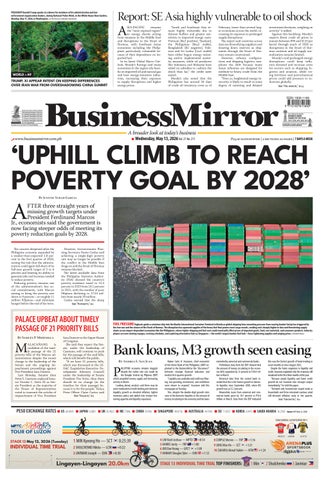
The concern deepened after the Philippine economy expanded by a weaker-than-expected 2.8 percent in the first quarter of 2026, raising the risk that the administration could again fall short of its full-year growth target of 5 to 6 percent and limiting its ability to generate jobs and incomes needed to reduce poverty. Reducing poverty remains one of the administration’s key social commitments, with Marcos aiming to bring the poverty rate down to 9 percent—or roughly 11 million Filipinos—and eliminate hunger before the end of his term.
However, Socioeconomic Planning Secretary Dante Canlas said achieving a single-digit poverty rate may no longer be possible if the conflict in the Middle East drags on and the Strait of Hormuz remains blocked. The latest available data from the Philippine Statistics Authority (PSA) showed the country’s poverty incidence eased to 15.5 percent in 2023 from 18.1 percent in 2021, with the number of poor Filipinos declining to 17.54 million from nearly 20 million. Canlas warned that the sharp
Report: SE Asia highly vulnerable to oil shock
ASIA-PACIFIC remains the “most exposed region” to energy shocks arising from tensions in the Middle East and disruptions in the Strait of Hormuz, with Southeast Asian economies including the Philippines particularly vulnerable because of their dependence on imported fuel.
In its latest Global Macro Outlook, Moody’s Ratings said many economies in the region rely heavily on imported oil and natural gas and host energy-intensive industries, increasing their exposure to supply disruptions and higher energy prices.
“South and Southeast Asia remain highly vulnerable due to thinner buffers and greater sensitivity to imported energy costs. Vietnam [Ba2 positive], Thailand, the Philippines [Baa2 stable], Bangladesh [B2 negative], Pakistan and Sri Lanka [Caa1 stable] have either begun energy rationing and/or implemented austerity measures, while oil producers like Indonesia and Malaysia have relied on subsidies to cushion the shock thus far,” the credit rater stated.
Moody’s also noted that the Philippines has around 24 days of crude oil inventory cover as of
February, lower than several larger economies across the world, increasing its exposure to prolonged supply disruptions.
The report said countries across Asia are diversifying suppliers and drawing down reserves as shipments through the Strait of Hormuz remain constrained.
However, refinery configurations and shipping logistics complicate the shift because many Asian refineries are designed for medium-to-heavy crude from the Middle East.
“Even so, heightened energy insecurity is likely to result in some degree of rationing and delayed
investment decisions, weighing on activity,” it added. Against this backdrop, Moody’s expects Brent crude oil prices to remain between $90 and $110 per barrel through much of 2026 as disruptions in the Strait of Hormuz continue and oil supply normalization remains limited.
Moody’s said prolonged energy disruptions could keep inflation elevated and increase costs for sectors such as shipping, logistics and aviation, while rising fertilizer and petrochemical prices could add pressure to industries globally.
By Samuel P. Medenilla
MALACAÑANG is confident of the timely passage of the 21 priority bills of the Marcos administration despite the recent change in the leadership of the Senate and the ongoing impeachment proceedings against Vice President Sara Duterte. Last Monday, Senator Alan Peter S. Cayetano replaced Senator Vicente C. Sotto III as Senate President as the majority of the House of Representatives voted to transmit the articles of impeachment of Vice President
Sara Duterte to the Upper House of Congress.
She said they expect the Senate, under the leadership of Cayetano, will continue to push for the passage of the said bills, which will benefit the public.
“If we have 21 priority bills, which was discussed in the LEDAC [Legislative-Executive Development Advisory Council] under the leadership of Senate President Tito Sotto, then there should be no change [in the timeline for their passage] because it is for the people,” Palace Press Officer Claire Castro said
By Andrea E. San Juan
was available and credit was flowing, but spending, investment, and confidence were slower to respond,” Asuncion told this newspaper on Tuesday.
This, despite the double-digit growth rates seen in the domestic liquidity or the amount of money circulating in the economy and the loans
extended by universal and commercial banks.
Preliminary data from the BSP showed that the amount of money circulating in the economy (M3) expanded by 12 percent to P20.4 trillion in March.
Historical data from the central bank revealed that this is the fastest growth in domestic liquidity since September 2020, when M3 growth was at 12.2 percent.
Meanwhile, loans from universal and commercial banks grew by 10.7 percent to P14.6 trillion in March. Data from the BSP indicated
this was the fastest growth of bank lending in seven months or since August 2025. Despite the faster expansion in liquidity and credit, Asuncion explained why the economy still weakened in the first three months of the year.
“Because ample liquidity and faster credit growth do not translate into stronger output immediately,” he told this paper.
“Demand-side transmission stayed weak as households and firms remained cautious amid still-elevated inflation early in the quarter,
See “Oil shock,” A14
FUEL PRESSURE Tugboats guide a container ship into the Manila International Container Terminal in Manila as global shipping faces mounting
the Iran war and the closure of the Strait of Hormuz. The disruption has squeezed
chains across import-dependent
like
in Filipino in a press briefing.”
‘Uncompromising’
THE Presidential Communications Office undersecretary made the announcement as the Senate is poised to convene soon as an impeachment court to hear the case of Duterte.
Castro made an assurance that Malacañang will not intervene in the said impeachment trial, which she said is an exclusive function of the Senate.
The Palace will support the efforts of the Senate to hold into account Duterte, who is being accused of misusing government confidential funds, unexplained wealth, Statement of Assets, Liabilities and Net Worth (SALN) discrepancies, and issuing grave threats against President Ferdinand Marcos and his family, according to Castro.
She said the President maintained a similar uncompromising position to go after those involved in the anomalous flood control projects.
Updated list DURING the 3rd LEDAC meeting of the 20th Congress in Malacañang last February, Marcos released the list of 21 bills, which he urged lawmakers to pass by June.
Among the said bills to combat the spread of fake news and political dynasties, reform the Partylist System, abolish the Travel Tax, and the amendments to the Coconut Farmers and Industry Trust Fund Act.
Other bills included in the 21 common legislative agenda the See “Palace,” A14
House forms prosecution team for impeachment trial
By Jovee Marie N. Dela Cruz
THE House of Representatives on Tuesday formally constituted an 11-member prosecution panel composed of seasoned lawmakers and legal experts who will represent the chamber in the Senate impeachment trial of Vice President Sara Z. Duterte.
Named to the prosecution team were Reps. Joel R. Chua (Manila 3rd District), Leila M. de Lima (Mamamayang Liberal Party-list), Gerville Luistro (Batangas 2nd District), Terry L. Ridon (Bicol Saro Party-list), Chel I. Diokno (Akbayan Party-list), Ysabel Maria J. Zamora (San Juan), Lordan G. Suan (Cagayan de Oro 1st District), Jonathan Keith T. Flores (Bukidnon 2nd District), Lorenz R. Defensor (Iloilo 3rd District), Ramon Rodrigo “Rodge” D. Gutierrez (1-Rider Partylist) and Arlene “Kaka” Bag-ao (Dinagat Islands).
De Lima, currently senior deputy minority leader, is a former senator and justice secretary, as well as a former chairperson of the Commission on Human Rights. She gained international recognition for her advocacy of democracy, human rights, and the rule of law and was named by Time magazine among the world’s “100 Most Influential People.”
Diokno, a deputy minority leader, is a leading human rights lawyer and former long-time chair of the Free Legal Assistance Group (FLAG). He served as private prosecutor during the impeachment trial of former President Joseph Estrada and later became founding dean of the De La Salle University College of Law.
Luistro, chairperson of the House Committee on Justice, previously played a key role in major investigations, including the tax credit scam probe during the Arroyo administration.
Chua, who heads the Committee on Good Government and Public Accountability, has led several high-profile congressional inquiries involving confidential funds and corruption issues.
Ridon, chairperson of the Committee on Accounts, is a lawyer, broadcaster, and former Kabataan Party-list representative who also previously led the Presidential Commission for the Urban Poor.
Zamora, an assistant majority leader, is a litigation and corporate law specialist and currently heads the House contingent to the House of Representatives Electoral Tribunal.
Suan, chairperson of the Committee on Public Information, has focused his legislative work on social
justice, healthcare, and poverty alleviation.
Flores, a practicing lawyer prior to entering politics, was a partner at a Davao-based law firm.
Defensor, Senior Deputy Majority Leader, specializes in energy law and utilities regulation.
Gutierrez, deputy majority leader, is a transportation advocate who has pushed for legislation on road safety and the welfare of motorists.
Bag-ao, a human rights lawyer, previously served as a prosecutor during the impeachment trial of former Chief Justice Renato Corona and later as governor of Dinagat Islands.
House leaders said the composition of the prosecution team
lagged effects of previously high interest rates and softer confidence,” he added.
underscores the chamber’s commitment to uphold the Constitution and pursue the impeachment case with professionalism, integrity, and full respect for due process.
The House earlier approved the Articles of Impeachment against Duterte by a vote of 257-25, with nine abstentions—well above the one-third threshold required to transmit the case to the Senate.
The complaint alleges misuse and possible malversation of P612.5 million in confidential funds, unexplained wealth, bribery, and threats against President Ferdinand R. Marcos Jr., First Lady Liza Araneta-Marcos, and former Speaker Ferdinand Martin G. Romualdez.
elevated at 11.8 percent to 13.3 percent during the first quarter.
economic slowdown in the first quarter could reverse those gains as weaker growth translates into job losses and declining purchasing power, increasing the risk of more Filipinos slipping into poverty.
“Laid-off workers are liable to slip below the poverty line as their family income decreases. Own-account and the self-employed are also at risk,” Canlas told the BusinessMirror
Similar warnings have also been raised by several think tanks in the previous months, including the Philippine Institute for Development Studies (PIDS), which estimated that between 1.3 million and 3.5 million more Filipinos could fall into poverty under various oil price shock scenarios linked to the Middle East crisis, potentially pushing the poverty rate to as high as 16.3 percent.
Another state think tank, the Congressional Policy and Budget Research Department (CPBRD), also warned that the Middle East oil shock could push between 185,000 and nearly 400,000 more households into poverty under various oil price scenarios.
For De La Salle University (DLSU) economist Ella C. Oplas, the government’s repeated failure to meet growth targets could further undermine poverty reduction efforts, particularly if weaker economic growth translates into fewer stable income opportunities for Filipinos.
“Because even with the ayudas, there is no evidence that shortterm employment assistance translates to upliftment of economic standing of Filipinos,” Oplas told the BusinessMirror
Data from PSA showed that labor market conditions remained fragile in the first quarter of 2026. The country’s unemployment rate hovered at around 5 percent during the period, slightly higher than the 4.3 percent to 4.9 percent recorded in the same quarter last year.
Meanwhile, the underemployment rate, which measures workers seeking additional jobs or longer working hours, remained
“It takes a miracle in 2027…I cannot think of any program that can drastically improve the situation now,” she added.
Cash aid
PIDS Senior Research Fellow Jose Ramon G. Albert said social protection programs such as the Pantawid Pamilyang Pilipino Program (4Ps) could help cushion the impact of rising fuel costs if assistance is delivered efficiently and on time, particularly in communities where households spend mostly on basic goods and services.
The Department of Budget and Management (DBM) earlier identified around P238 billion in available resources from the 2025 and 2026 national budgets that could be tapped specifically for the crisis response, of which P125.2 billion had already been released as of April 1.
It also ordered government agencies to surrender unused portions of their prior-year budgets to help finance the government’s Unified Package for Livelihoods, Industry, Food and Transport (Uplift) program which will be need P155 billion.
However, Albert warned that prolonged disruptions in global oil supply chains could keep fuel prices elevated and erode the real value of government cash assistance as food and transport costs continue to rise.
“In that scenario, the government would need to consider either indexing transfer amounts to prevailing price levels or standing ready to expand coverage and amounts through a contingency mechanism,” Albert told the BusinessMirror
In April, headline inflation accelerated to a three-year high of 7.2 percent, with several economists warning that price pressures could even breach doubledigit levels in the coming months.
Food inflation, meanwhile, surged to 6.1 percent from 2.7 percent in March and 0.7 percent a year ago. Rice was the main driver, with the average price jumping by 13.7 percent from 3.5 percent a month earlier.
Still, Albert said the government’s poverty reduction goals are not yet necessarily out of reach, noting that economic growth can still reduce poverty if it generates jobs and higher incomes for lower-income households.
“If growth, even at a modest pace, is concentrated in sectors that employ large numbers of lower-income workers—agriculture, labor-intensive manufacturing, and community-based services—it can still move the poverty needle,” he added.
Asuncion said much of the lending growth was geared toward working capital, refinancing, or projects still in the pipeline, meaning “the real economic payoff tends to surface with a delay.” In addition, he said public spending execution issues and external uncertainties weighed on in vestment and consumption decisions.
Jonathan L. Ravelas, senior adviser at Reyes Tacandong & Co. said bank lending picked up as ear lier BSP rate cuts “finally flowed through to borrow ers, corporate demand improved, and banks became more willing to lend given strong balance sheets.” “At the same time, M3 surged because de posits grew, government spending circulated through the system, and credit creation gained traction,” added Ravelas. For the economy, Ravelas said this is support ive as more liquidity and credit mean stronger consumption and investment at a time when growth needs help. Looking ahead, with inflation pressures and global risks like the Middle East conflict, lending and liquidity growth should “moderate but re main healthy,” the analyst pointed out.
“Earlier rate cuts clearly helped jump‑start this momentum, and while the BSP’s recent tighten ing may slow things at the margin, it won’t derail growth—it simply keeps liquidity
in flation will likely slow—rather than reverse—these trends, with effects emerging gradually.”
March data
IN a statement on Tuesday, the central bank said loans from universal and commercial banks grew at a faster pace in March 2026, “providing even stronger support for production activities of busi nesses and consumption of households.” Loans meant to fund business activities ex panded by 9.7 percent in March from 8.6 percent in February.
“Lending rose for the following key industries: real estate activities [8.8 percent]; electricity, gas, steam, and air conditioning
[26.7
of
and
and
and motorcycles [9.3
and
and
[19.4 percent],” the BSP said. Meanwhile, consumer loans to residents grew by 20.5 percent, slightly slower than the previ ous month’s 20.8 percent due to the slowdown in motor vehicle loans and salary based general purpose consumption loans. Outstanding loans to residents grew by 11.1 percent in March from 10.2 percent in February, while outstanding loans to non residents fell by 5.9 percent from a 13.2 percent decline in the same period.
The BSP said it monitors bank loans because they are a “key transmission channel of monetary policy.” Asuncion said lending growth was driven mainly by corporate borrowing in key sectors such as energy, transport, trade, and real estate, indicating ongoing project execution, capac ity expansion, and working capital needs, while household credit remained robust, supporting consumption amid easing inflation and steady employment.
Meanwhile, the BSP explained that domestic liquidity growth “was driven primarily by the con tinued expansion in borrowings by non financial private corporations and households.”
“Claims on the private sector alone, which mainly cover borrowings by non financial private corporations and households, grew by 11.8 per cent in March from 10.6 percent in February,” it noted.
Meanwhile, net claims on the central govern ment increased by 12.1 percent in March,
Pressure on for Senate to try Duterte, surrender dela Rosa
T‘Criminal, administrative cases await senators who block impeachment trial’
By Joel R. San Juan
By Butch Fernandez @butchfBM
HE gates of the Senate premises in Pasay City may have opened Tuesday morning after Monday’s chaotic situation involving a leadership change and the botched attempt to arrest Sen. Ronald dela Rosa, but activists served notice they will press on with protests to prod the Senate to convene as an impeachment court for Vice President Sara Duterte.
A day after the historic second impeachment by the House of Representatives against Duterte, the Akbayan! Youth called on the chamber to “forthwith” start the VPs trial, in accordance with the Constitute, amid what is seen as an attempt by the so-called “Duterte bloc” to hijack the trial.
Hindi na dapat ito pinapatagal pa. Malinaw ang sigaw ng kabataan: Simulan ang impeachment trial at papanagutin si Sara Duterte [There’s no reason to prolong this further.
The call of the youth is clear: start the impeachment trial and make Sara Duterte be accountable],” said Frank Araneta, Akbayan! Youth Deputy Secretary General for Luzon.
By a vote of 257 affirmative, 25 negative and 9 abstentions, the House of Representatives voted on Monday to impeach Duterte on four
charges: misuse and irregular liquidation of confidential funds, bribery, unexplained wealth, and grave threats and inciting to sedition.
Going viral for wrong reasons ALSO on Tuesday, Sen. Anna Theresia “Risa” Hontiveros, who is with the minority, lamented, “The Senate is going viral for the wrong reasons. That affects everything and everyone: majority and minority, Senate employees, and most of all, the work that we do for the Filipino people. No one wins with this.”
She called on the new Senate leadership to “protect the dignity and reputation of the Senate,” adding that, “the people’s trust and respect in the Senate is lost when our powers and traditions are being misused to avoid accountability.”
Hontiveros continued: “As always, we can disagree. We must challenge
each other. But the Senate must not become a mockery in the face of the Filipino people, especially when the public is looking to us to faithfully perform our constitutional duties.”
“Once and for all, proceed with the impeachment forthwith. The evidence is clear. From the bank records, to the PSA [Philippine Statistics Authority] certifications, it’s quite clear that Sara is guilty,” Araneta of Akbayan added, speaking in Filipino.
He stressed that this is not a simple political war between blocs or parties, but a fight for accountability and the return of the credibility of a democratic institution.
Araneta recalled that former Senate President Francis Escudero had made a mockery of the impeachment process. “And now there’s Alan Cayetano and [Senator] Bato [dela Rosa] who are adding to our shame before the whole world? Do we let people like these to make us a laughingstock again?”
He protested the use of the Senate as a “waiting room” in the face of a clear call to make a sitting senator accountable, referring to dela Rosa.
The groups are preparing protests to coincide with the transmittal of the Articles of Impeachment from the House to the Senate.
Watching “WE are watching—the millennials and Gen Z are watching. We won’t stop until Sara Duterte is held accountable,” said Araneta.
Petitioners of the impeachment complaint led by Tindig Pilipinas, meanwhile, held a news conference to slam the change of leadership in the Senate which it deems a desperate
attempt to block the impeachment trial from proceeding in the senate. The groups also called for the immediate arrest of dela Rosa, and for the Senate to stop protecting an accused mass murderer and an impeached plunderer.
Dela Rosa on the run AFTER the NBI-led team failed to arrest dela Rosa in the Senate on Monday—he ran and they gave chase— senators led by dela Rosa himself and backed by Rodante Marcoleta demanded that the arresting party be cited in contempt for blocking a sitting senator from doing his job. To which, as expected, new Senate President Alan Peter Cayetano acceded, ordering the Office of the Sergeant at Arms to close all exits and detain the NBI-led team, sparking a scuffle between OSAA and the former.
The Senate Sergeant at Arms, retired general Rene Sarmiento, resigned.
NBI Director Melvin Matibag and Cayetano subsequently forged a compromise, with the NBI mean allowed to leave, and dela Rosa staying in the Senate.
Senators approved a motion by Marcoleta to place dela Rosa in “protective custody” until he is able to exhaust all legal remedies to protect himself.”
Late Monday, the International Criminal Court (ICC) confirmed it had issued a warrant of arrest for de la Rosa, who as the first National Police (PNP) chief of then President Rodrigo Duterte, was the chief enforcer of the bloody anti-drug war believed to have carried out thousands of extra-judicial killings.
Religious groups urge speedy trial for Sara
RELIGIOUS groups on Tuesday urged the Senate to fulfill its constitutional mandate and move forward with the impeachment trial.
Party-list Rep. Jude Acidre of Tingog expressed support for separate statements issued by the Catholic Bishops’Conference of the Philippines (CBCP) and the Clergy for Good Governance (CGG), both of which called on senators to proceed with the trial without delay.
“The CBCP and the Clergy for Good Governance are correct in reminding the Senate that this is no longer about politics or personalities but about constitutional duty and accountability. The House has already fulfilled its mandate and transmitted the Articles of Impeachment. The next constitutional step is clear: the trial must proceed, the evidence must be heard, and the Filipino people deserve to see the truth come out through due process,” Acidre said. He added that the appeals from Church leaders highlight a shared message: that accountability must prevail over political considerations.
The CBCP placed the Senate’s constitutional duty at the center of its May 12 statement, saying: “The House of Representatives, heeding the overwhelming sentiment of the Filipino people and finding probable cause,
has voted by far more than the requisite onethird of its membership to impeach the Vice President and, as directed by the Constitution, to forward the Articles of Impeachment to the Senate for trial.”
It then issued a direct appeal to senators:
“We appeal to the Members of the Senate to abide by what the Constitution directs: to proceed with the trial and to decide the case against the Vice President by summoning witnesses, hearing testimony, and voting according to the evidence and, above all, the demands of righteousness and justice.”
Warning against delay
“ WE urge the senators to avoid any act that may be perceived as evading their sworn duty or circumventing the requirements of the Constitution,” it said.
It added: “We make this urgent appeal to not delay the trial and to convene the Senate as an impeachment court at the soonest possible time. To delay the trial is to delay justice for both the Filipino people and the Vice President.”
The CBCP, likewise, called on the public to remain engaged and vigilant.
“To our fellow Filipinos, let us fulfill our civic duties and responsibilities by ensuring a
fair and credible trial so that all may see and hear clear, verified evidence and arguments,” it said.
Acidre also welcomed the statement issued by the CGG, which framed the issue in moral and institutional terms.
In its May 12 statement, the CGG stressed that the Senate must follow the Constitution by convening as an Impeachment Court, hearing witnesses, and deciding the case based on evidence and justice.
The bishops also warned against any delay, saying this would stall justice for both the public and the Vice President.
Similarly, the CGG cautioned that political maneuvering in the Senate risks undermining public trust.
“This is no longer just about personalities or politics,” the group said. “It is about whether our institutions still have the courage to place truth above power.”
The group further urged senators not to allow the chamber to become a venue where accountability is weakened by political compromise, reminding public officials that their mandate is to serve with integrity, humility, and courage.
Obligated
WITH the House of Representatives voting to impeach Duterte and formally transmitting the Articles of Impeachment to the Senate, lawmakers in the upper chamber are constitutionally obligated to convene as an impeachment court and proceed to trial, a law dean said.
Fr. Ranhilio Aquino, a Roman Catholic priest who served as dean of the San Beda University Graduate School of Law for over two decades, emphasized that the Constitution leaves no discretion to the Senate once the required threshold has been met.
“Very clearly, the intendment of the Constitution is to mandate the Senate, once the articles of impeachment have been sent to it by at least one-third of the membership of the lower house, to proceed to trial,” said Aquino, a holder of a Doctor of Jurisprudence degree from Columbia Pacific University in California, USA.
Duterte started her law schooling at San Beda but graduated from the School of Law of San Sebastian College
On Monday, the House impeached Duterte by a vote of 257-25, with nine abstentions, surpassing the one-third requirement of 106 votes out of 318 members. The vote adopted Committee Report 261 and Resolution No. 989, which contain the Articles of Impeachment citing allegations that include unexplained wealth, misuse of confidential funds, discrepancies in asset declarations, and an alleged death threat against President Marcos.
The approval and transmittal of the articles effectively elevated the case to the Senate, which Aquino stressed is duty-bound to act.
Citing Section 3, Article XI of the 1987 Constitution, Aquino said impeachment and the subsequent trial are “constitutionally ordained avenues” to hold top officials accountable and cannot be delayed or disregarded.
Jovee Marie N. dela Cruz
@jrsanjuan1573 & Jovee Marie N. dela Cruz @joveemarie
AGROUP of prominent deans and professors from leading law schools warned that any attempt by the Senate to delay or block the impeachment trial of Vice President Sara Z. Duterte could expose lawmakers to administrative and even criminal liability.
In a statement issued on Monday, the legal scholars said that the Constitution leaves the Senate with no discretion once the House of Representatives transmits Articles of Impeachment approved by at least one-third of its members.
On Monday, a total of 257 members of the House of Representatives voted to impeach Duterte for alleged corruption and other violations of the Constitution.
They criticized the alleged attempts of some members of the Senate to delay the impeachment trial of the Vice President, by ousting Senate President Vicente Sotto III and installing Sen. Alan Peter Cayetano as his replacement, on the eve of the transmittal of the Articles of Impeachment to the Senate.
The law deans and professors also assailed the new Senate leadership’s adoption of the “Escudero definition” of “forthwith”—which, the Supreme Court recently interpreted to mean “within a reasonable time depending on the circumstances of each case.”
“We, the undersigned law deans and law professors, wish: To invite attention of the Members of Senate—as well as the Filipino people—that refusal of public officers to perform a duty imposed by law, particularly by the Constitution, constitutes dereliction of duty that is administratively actionable and conferring an undue advantage and benefit on a person not entitled to it is an indictable criminal offense under Republic Act 3019,” the statement read. Among those who signed the statement were retired SC Associate Justice Adolfo Azcuna, San Beda University Graduate School of Law professor; Antonio La Vina, San Beda University Graduate School of Law professor; Fr. Ranhilio Aquino, San Beda University Graduate School of
See “Impeachment,” A7
Stop Senate from protecting dela Rosa, taxpayer asks SC
By Joel R. San Juan & Jonathan L. Mayuga @jonlmayuga
ATAXPAYER has filed a petition before the Supreme Court (SC) seeking to stop the Senate from providing protection to Sen. Ronald dela Rosa against the implementation of the arrest warrant issued by the International Criminal Court (ICC) for leading the antiillegal drug war campaign of the Duterte administration.
The petition was filed by high school teacher John Barry Tayam, in his capacity as a taxpayer and registered voter.
In a 17-page petition, Tayam asked the Court to declare Senate Resolution 44 titled “Expressing the Sense of the Senate of the Philippines to Protect all Filipinos Against Extraordinary Rendition and Guarantee them a Reasonable Time Prior to Their Surrender by or Extradition from the Philippines to Seek Redress from the Courts and Avail of Legal Remedies” issued on February 18, 2026 null and void ab initio or from the beginning for having been issued with grave abuse of discretion.
The subject resolution was cited by the
Senate to justify its decision to place dela Rosa in its protective custody. Tayam argued that the resolution is not a law, thus, cannot be used as a legal barrier to the execution of the ICC arrest warrant.
“Because a resolution does not undergo the same constitutional requirements as a bill, such as three readings in both houses [of Congress] and presidential approval, it cannot supersede existing law or obstruct the execution of a valid warrant,” Tayam argued. Tayam also asked the High Tribunal to direct the National Police-Criminal Investigation and Detection Group (PNP-CIDG) and the National Bureau of Investigation (NBI) to perform their ministerial duty in coordinating the service and execution of the ICC-issued arrest warrant.
“The recent standoff between the NBI and the Senate necessitates a definitive ruling from the Supreme Court to prevent a constitutional crisis,” Tayam said.
“To allow the Senate to shield its members from judicial process under the guise of institutional integrity would be to create a privileged class above the law,” he added.
It may be recalled that the SC dismissed
See “Dela Rosa,” A10
Book launch on native trees offers insights into Piki Lopez’s environmental advocacies
ENVIRONMENTAL group Green Convergence recently launched the fourth volume of its “Philippine Native Trees” book series, offering a comprehensive look at native trees and their intertwined roots with Filipino heritage and identify.
Launched late last month at Club Filipino in Greenhills, San Juan, the 980-page book “Philippine Native Trees 404: Rooted & Rising” showcases personal accounts, botanical information, and photos of various trees, as well as a compilation of 404 species of native trees for planting as alternative to exotic trees.
Authors and editors Jason Mansibang and Lillian Jennifer Rodriguez said they drew inspiration for the book from two prominent late environmentalists: Oscar M. Lopez, the patriarch of the Lopez Group of Companies; and Leonard Co, a renowned botanist. Rodriguez recalls spending fond memories with Leonard, whom he described not only as a brilliant botanist but also as a humble mentor who would gladly share with others his knowledge about plants and trees as a legacy for next generations to come.
Hindiniyatinagoangkaalaman Ibinahagi niya ito sa susunod na henerasyon [He did not keep his knowledge to himself…he shared it for the next generation],” Rodriguez said about Leonard during the book launch.
Victoria “Vicky” Segovia, Green Convergence president, grounded the book launch in a clear sense of purpose: to celebrate the country’s rich and diverse natural heritage.
“Our native trees are silent witnesses to our history, protectors of our biodiversity, and vital allies in our response to climate change,” Segovia said, framing the book as “a tangible response to today’s growing ecological challenges.” The book launch also gave Oscar’s son, First Philippine Holdings Corporation (FPH) Chairman Federico “Piki” R. Lopez, a time to remember some fond memories he spent with his father and Leonard—two individuals who greatly influenced his own love and appreciation for nature.
He acknowledged the botanist’s influence in FPH and its subsidiary First Gen
House ad hoc panel passes Kalinga bill
THE Ad Hoc Committee on Legisla -
tive Energy Action and Development (LEAD) on Tuesday approved the consolidated Kalinga Bill, a key House measure designed to provide relief to Filipinos affected by the ongoing oil and energy crisis.
House Majority Leader Ferdinand Alexander A. Marcos welcomed the committee’s approval, saying the measure is intended to deliver immediate and long-term support to vulnerable sectors heavily impacted by rising fuel prices.
The substitute bill and its committee report were approved, subject to amendments in form and style.
House Committee on Ways and Means
Chairman Romero Quimbo directed the committee secretariat to submit the approved substitute bill and committee report to the Committee on Rules through the Bills and Index Service.
“Our fellow citizens can expect assistance. The proposed Kalinga Act is about helping and protecting Filipinos, the most vulnerable of them—from the poorest of the poor, to transport sector drivers, farmers and fisherfolk, and small business owners,” Marcos, who represents Ilocos Norte, said.
Speaker Faustino Dy III and Marcos are the principal authors of the bill, formally titled “Komprehensibong Alalay sa Livelihood, Inflation, Negosyo, at Goods Assistance [Kalinga] Act.”
Marcos said the bill seeks to institutionalize a permanent government mechanism to respond to oil price surges and similar economic emergencies.
“The government will no longer have to look for a law or mechanism to respond to a crisis that burdens our citizens, such as rising oil prices. This is it—the Kalinga Act,” he said.
He expressed hope that the House would soon approve the measure in plenary and urged the Senate to act on it promptly.
“We are hoping as well that the Senate would act on it as expeditiously as possible,” he said.
Marcos also noted that the framework remains relevant even beyond current geopolitical tensions affecting global oil prices.
“We envision it as an institutional or permanent response mechanism to any crisis or emergency,” he said.
The LEAD committee, chaired by Quimbo, endorsed the consolidated bill after two months of hearings and deliberations involving both government agencies and private sector stakeholders.
Quimbo, who represents Marikina, said the measure represents the House’s comprehensive response to the oil crisis, combining immediate relief with long-term structural reforms.
“It symbolizes public-private sector cooperation in formulating responses to the raging oil crisis and similar situations that may arise in the future,” he said.
He emphasized that the bill aims not only to provide short-term assistance but also to reduce the country’s dependence on imported fuel through conservation, renewable energy adoption, and efficiency programs.
“This is the spirit of the Kalinga Program: relief now, resilience for the future,” Quimbo said.
He added that fuel price increases have wide-ranging effects across the economy, from transportation and food production to small business operations and household expenses.
“Fuel is not just one commodity. It is an input into almost everything that keeps daily life moving,” he said.
The Kalinga Program includes seven major components: fuel price stabilization, energy supply security and inventory management, targeted assistance, essential
See “Kalinga,” A10
Aguda warns against rumors, false narratives in socmed
By Lorenz S. Marasigan @lorenzmarasigan
NFORMATION and Communications
ITechnology Secretary Henry Aguda on Tuesday assailed an online report that he had resigned from his post, branding it false rumor and warning that such narratives could erode public trust in the government.
Aguda claimed the resignation rumors are part of a broader pattern of disinformation targeting the agency, noting that the department has been at the forefront of efforts to counter fake news.
“While unfortunate, these attacks are unsurprising given the department’s recent gains and successes in pushing meaningful digital transformation initiatives that directly benefit the Filipino people,” he said. Aguda reaffirmed that he continues to serve under the authority of President
IBy Rizal Raoul Reyes @brownindio
Ferdinand Marcos.
“As with all members of the Cabinet, I continue to serve at the pleasure of the President and remain fully committed to carrying out the mandate entrusted to me by the administration,” he said. The secretary said the DICT remains focused on its core agenda of accelerating digital transformation, expanding connectivity, and ensuring that digitalization efforts translate into inclusive benefits for all Filipinos.
“I deny the false reports and speculations that I have resigned from my position as secretary of the DICT,” Aguda said. Aguda was appointed ICT chief in March 2025. He was confirmed by the Commission on Appointments in October. Since his appointment, Aguda has focused on beefing up connectivity and cybersecurity in the country through his “Digital Bayanihan” thrust.
Bill sets up legal framework for financial data sharing
By Jovee Marie N. dela Cruz @joveemarie
LAWMAKERS filed the proposed Open Finance and Consumer Data Empowerment Act of 2025, which seeks to establish the country’s first comprehensive legal framework for consumer-directed financial data sharing.
House Bill 9149 was principally authored by Leyte Rep. Ferdinand Martin Romualdez, together with Party-list Reps. Yedda Marie Romualdez, Andrew Julian Romualdez, and Jude Acidre of Tingog.
The proposal comes amid the rapid expansion of the country’s digital financial ecosystem, with millions of Filipinos now relying on e-wallets, online banking, and digital payment platforms for daily transactions, business operations, and financial management.
Data shows that digital payments accounted for 57.4 percent of all retail payment transactions in the Philippines in 2024, while around 58 million Filipinos are now e-wallet users. Despite this growth, access to formal credit remains limited for many, as traditional lending systems continue to depend heavily on conventional financial records such as bank loans, credit cards,
and deposit histories.
The lawmakers pointed out that while financial behavior has evolved significantly in the digital age, credit evaluation systems have yet to fully adapt. As a result, freelancers, gig workers, small entrepreneurs, and those in the informal economy often face difficulty securing affordable financing, even with active digital financial footprints.
Rep. Yedda Marie Romualdez said the measure acknowledges the changing economic realities of Filipinos and the need for financial systems to keep pace.
“Many Filipinos are already participating in the digital economy every day. They pay bills through e-wallets, sell products online, take freelance work, and manage small businesses through digital platforms. But despite this, many still struggle to access formal financing because our existing systems fail to
recognize these forms of financial activity,” Romualdez said.
“This measure seeks to make the financial system more responsive to the realities of how Filipinos actually live and work today. Responsible financial behavior should open doors to opportunity, not leave people excluded simply because they do not fit into traditional credit models,” she added.
The lawmakers also noted that while laws such as the Data Privacy Act of 2012 and the Consumer Act of the Philippines provide general protections, they do not establish a standardized system for consumerdirected data portability or regulated financial data sharing.
This gap has resulted in fragmented regulations and voluntary compliance, limiting both consumer control over financial information and fair competition among financial service providers.
Under the bill, consumers would be empowered to securely authorize the transfer of their financial and transaction data to accredited institutions for purposes such as credit evaluation and access to financial services.
The measure also guarantees rights to informed consent, access, portability, and deletion of data, and imposes penalties for unauthorized disclosure, misuse, or refusal to comply with valid data requests.
It further proposes the creation of a Consumer Data Commission (CDC), which will oversee technical
standards, accreditation, compliance monitoring, and enforcement of data-sharing rules.
Rep. Andrew Julian Romualdez said the bill is designed to give consumers greater control over their financial data while expanding access to opportunities within the formal financial system.
“This bill seeks to correct that imbalance by allowing consumers, through clear and informed consent, to make their financial data work for them. The objective is not dependency on assistance but broader access to opportunity—particularly for Filipinos who have long been underserved by traditional financing systems,” Romualdez said. Rep. Jude Acidre emphasized that the proposal seeks to modernize the country’s financial framework while ensuring strong accountability and consumer protection.
“As the digital economy evolves, our legal and regulatory systems must evolve with it. Financial inclusion today goes beyond opening bank accounts—it means ensuring that responsible financial behavior, whether digital or traditional, leads to real economic opportunities,” Acidre said.
“At the same time, consumer protection must remain at the core. Any use of financial data must be guided by informed consent, strict security standards, transparency, and accountability. Innovation should never come at the expense of privacy or public trust,” he added.
Regional panel eyes mega food hub, fish port in Cebu
By Carmel Pedroza
CEBU CITY—The Regional Unified Package for Livelihoods, Industry, Food, and Transport (Uplift) committee is pushing for the establishment of a mega food hub and fish port in Central Visayas, alongside a food mapping system and stronger water security initiatives for agriculture, as government agencies respond to the mounting effects of global tensions on the regional economy.
These proposals were among the key measures discussed during the committee’s first regional meeting early this week, where officials tackled strategies to address rising inflation, fuel prices, and food security concerns linked to the ongoing conflict in the Middle East.
officials proposed the development of a centralized mega food hub and fish port to improve distribution efficiency and reduce supply chain disruptions.
The committee also discussed implementing a food mapping system to better monitor food availability and production in all provinces, as well as expanding water security initiatives to support agricultural productivity during periods of uncertainty.
Cebu Gov. Pamela Baricuatro, chairperson of the Region 7 Uplift committee, urged member agencies and stakeholders to convert cooperation into concrete and sustained action to protect vulnerable sectors across Central Visayas.
one falls through the cracks. We must also accelerate reintegration support for workers displaced or uprooted from employment, here and abroad, so we can bridge immediate gaps while preparing for the long haul,” she said.
The Uplift committee brings together national government agencies, local government units, and private sector representatives to coordinate measures addressing the impact of international geopolitical developments on transportation, food supply, livelihoods, and inflation in Central Visayas.
Board in Central Visayas (LTFRB-7) provided updates on fuel subsidy distribution and service contracting assistance aimed at helping public transport drivers and operators cope with rising fuel prices. In coordination with the Department of Social Welfare and Development in Central Visayas (DSWD-7), the agency is set to release cash assistance to more than 2,700 public utility jeepney (PUJ) drivers under the “Cash Relief Assistance for PUJ Drivers” program.
During the meeting, participating agencies presented updates on existing assistance programs and outlined medium- and long-term plans under the region’s response framework.
resources available for that ambition,” Santoro stated.
N a direct call to action at the inaugural Association of Southeast Asian Nations (Asean)-European Union (EU) Sustainability Summit, key diplomatic and strategic leaders warned that the transition from climate policy to local impact is being stifled by a critical “financing gap.” European Union Ambassador to the Philippines Massimo Santoro and Stratbase ADR Institute President Victor Andres Manhit led the push for a more integrated, privatesector-driven approach to sustainability, arguing that legislative frameworks are meaningless without the capital to fuel them. Santoro highlighted a growing disconnect between the bold sustainability frameworks established by Southeast Asian governments and the actual resources deployed on the ground.
“There is a pressing need to reinforce the link between the ambition and the financial
He warned that without providing local authorities with the “necessary tools and instruments,” even the most well-designed policies risk stalling at the planning stage. Santoro called for institutional scaling or moving beyond “pilot programs” to largescale initiatives through partnerships with the Asian Development Bank (ADB) and European financial institutions.
He said the government should join hands with the private sector because it is the only force capable of ensuring the long-term sustainability of climate actions currently initiated at the government level. Further, he described the private sector as the “only one able to guarantee the sustainability of the action which is currently going at government-to-government level.”
Santoro noted that there was a pressing “need to reinforce the link between the ambi‘Financing
See “Financial gap,” A9
The Department of Agriculture raised concerns over the region’s limited post-harvest facilities and storage capacity, warning that these gaps could worsen supply issues and contribute to higher food prices.
To strengthen food resilience,
Baricuatro emphasized that government efforts should extend beyond immediate interventions and include long-term programs for families and workers affected by economic disruptions.
“Our responsibility does not end with immediate response. Today, I ask this body to intensify monitoring of affected families so that no
Data presented by the Philippine Statistics Authority showed that inflation in Central Visayas climbed to 10.8 percent in April, significantly higher than the 7.4 percent recorded in March.
Meanwhile, the Land Transportation Franchising and Regulatory
LTFRB-7 has already released the list of qualified beneficiaries for the first batch of payouts, which will be conducted in various locations across Cebu City, Mandaue City, Lapu-Lapu City, the town of Liloan in Cebu, and Tagbilaran City in Bohol.
The payout is scheduled from May 13 to 14, 2026. Qualified drivers are required to present their driver’s license with two photocopies, a printed copy or screenshot of their e-verification result, and the official confirmation text message from LTFRB.
Farmers, fishermen recipients of Dole’s ₧1.5 billion assistance
By Justine Xyrah Garcia
THE Department of Labor and Employment (Dole) has disbursed
P1.5 billion in assistance to help farmers and fishermen cope from the impact of rising fuel and farm input costs triggered by the Middle East crisis.
The assistance package, rolled out under the government’s Unified Package for Livelihoods, Industry, Food, and Transport (Uplift), will provide temporary jobs and livelihood support to workers in the agriculture and fishery sector.
The initiative is being implemented in partnership with the Department of Agriculture (DA) and the National Irrigation Administration (NIA) through the Dole
Integrated Livelihood Program (DILP), the Tulong Panghanapbuhay sa Ating Disadvantaged Workers (Tupad) program, and the Adjustment Measures Program (AMP).
“It also aims to promote food security, ensure the continuous movement of goods, and improve agricultural productivity and water resource management through the rehabilitation of agricultural infrastructure and facilities, such as secondary irrigation canals and climate-resilient infrastructure,” the Dole said in a statement.
The project has been launched in Calabarzon (Cavite, Laguna, Batangas, Rizal and Quezon), Western Mindanao, and Caraga, where beneficiaries were assigned to activities such as declogging and clearing irrigation canals and vegetable gardening along canal
areas. The program is also set for implementation in Central Luzon, Mimaropa (Mindoro, Marinduque, Romblon and Palawan), and the Cordillera Administrative Region.
Prior to the rollout of the convergence initiative, the agency said it had already extended more than P148.9 million in livelihood assistance to 6,920 farmers and fishermen since January this year.
The assistance included support for broiler raising, chicken egg production, hog fattening, food processing, rice retailing, and other small-scale livelihood activities.
Meanwhile, under the Tupad program, 91,457 farmers and fisherfolk received emergency employment assistance amounting to over P655.4 million.
The work covered activities such as
coastal cleanup, tree planting, communal gardening,
and
(DMW).
Marcos moves UPLIFT meetings to biweekly, Malacañang vows no letup in crisis response
By Samuel P. Medenilla
@sam_medenilla
WITH government interventions to mitigate the socio-economic impact of the Middle East crisis already in place for over two months, President Ferdinand Marcos Jr. has decided to reduce the frequency of the weekly meeting of the Unified Package for Livelihoods, Industry, Food, and Transport (UPLIFT) Committee, according to Malacañang.
Palace Press Officer Claire Castro made the announcement after the chief executive decided not to
convene the seventh UPLIFT Committee meeting last Tuesday. Instead, the said UPLIFT meeting was reset to May 19, 2026. It will now also be held every other week.
Castro said the scaled down UPLIFT meetings will not disrupt government programs to assist those affected by the Middle East tensions.
“The President sees that even though we are not meeting every week now, we can see that our cabinet secretaries and other agencies are working continuously to alleviate the impact of the crisis in the Middle East,” Castro said in
PSA: Higher carpentry material prices pushed up April construction costs in MM
By Justine Xyrah Garcia
HIGHER prices of carpentry materials pushed up construction costs in Metro Manila last month, according to the Philippine Statistics Authority (PSA).
Data released by the PSA showed that the Construction Materials Retail Price Index (CMRPI) in the National Capital Region (NCR) accelerated to 1.7 percent in April 2026, faster than the 1.3 percent recorded in March.
The year-on-year growth was also higher than the 1 percent increase recorded in the same month last year.
Last month’s reading brought the year-to-date growth of the CMRPI to 1.3 percent.
The PSA said the increase in building costs in April was largely driven by the faster rise in the carpentry materials index, which grew by 0.6 percent from a flat
growth rate in the previous month. Faster increases were also observed in masonry materials, which rose to 1.9 percent from 1.5 percent; painting materials and related compounds, to 2.2 percent from 2 percent; and plumbing materials, to 0.5 percent from 0.4 percent.
The statistics office also noted that prices of tinsmithry materials increased to 2.5 percent from 2.3 percent, while miscellaneous construction materials accelerated to 1.5 percent from 1.3 percent.
On the other hand, the increase in prices of electrical materials slowed slightly to 1.9 percent in April from 2 percent a month earlier.
The CMRPI tracks the retail prices of construction materials typically purchased by households and small-scale builders, serving as a key indicator of trends in the residential construction sector.
US university fair to be held in Quezon City, Davao City
By Manuel T. Cayon @awimailbox
DAVAO CITY – Several US universities are participating in the 11th edition of a University Fair in the cities of Quezon and Davao next week, the US Embassy said.
Twenty-nine US universities will be presented in undergraduate and graduate studies program in Quezon City, and 12 will participate in Davao City.
The U.S. Embassy in the Philippines said it was inviting students and parents to attend the 11th Education USA University Fair in Quezon City on May 22 and in Davao City on May 23. The Davao City fair will be the first time the University Fair will be held in Mindanao.
“This year’s University Fair features several American colleges and universities that are visiting the Philippines for the first time and eager to meet with Filipino students,” said U.S. Embassy Chargé d’Affaires, a.i., Y. Robert Ewing.
“We are also thrilled to bring it to Mindanao for the first time, opening access for more Filipinos to experience American excellence in education and strengthen ties that make both our nations safer, stronger, and more prosperous,” he added.
The Quezon City University Fair will be held at the Quezon City Hall Meetings, Incentives, Conferences, and Events (M.I.C.E.) Center, with separate sessions for undergraduate programs in the morning and graduate programs in the afternoon.
From 10 am to 12 pm, the following U.S. higher education institutions and organizations will participate in the undergraduate session: College of Central Florida, Lewis University, Manhattan University, Middle Ten -
Filipino in a press briefing.
“So, it’s [interventions are] still ongoing – even though we are not meeting every week,” she added.
In preparation for the next UPLIFT meeting, the Office of the Executive Secretary (OES) convened members of the Committee last Monday to discuss initiatives related to the national emergency on energy.
“The discussion focused on the expansion of the Fuel Subsidy Program to ensure adequate passenger transportation services,” the OES said in a statement.
Under the said program, a P10 per liter discount will be given to
Adiong:
jeepney and UV express nationwide.
“The expansion of this program includes fuel subsidies for buses and delivery trucks, especially those transporting agricultural products and other necessities.
There will also be support for farmers and fishermen to ensure sufficient and affordable food for every Filipino family,” the OES said.
Since it was created by Marcos through Executive Order No. 110 last April, the UPLIFT Committee has already met six times every Tuesday to discuss government response to the Middle East war.
The conflict in the Middle East
crisis started in February after the United States and Israel attacked Iran, which caused a disruption on the global supply chain and triggered a spike in pump prices.
Among the functions of the UPLIFT Committee is to monitor and ensure the continued distribution and availability of fuel and other basic goods and services as well as provide support for those who are affected by the Middle East conflict.
The UPLIFT programs currently include providing cash aid and fuel subsidy to public utility vehicle drivers and the repatriation of overseas Filipino workers in the Middle East.
Accusations of impeachment payoffs insult 257 House members, 69% of Filipinos
By Jovee Marie N. Dela Cruz @joveemarie
ALEADER of the House of Representatives on Tuesday pushed back against claims from the Duterte camp that lawmakers were offered funds, projects, and allowances in exchange for supporting the impeachment of Vice President Sara Z. Duterte, saying the charge unfairly insults not only the 257 House members who voted in favor but also the 69 percent of Filipinos who want the case heard in the Senate.
House Assistant Majority Leader Zia Alonto Adiong of Lanao del Sur said backing for the impeachment process may come from both citizens and lawmakers who believe that powerful officials must answer serious allegations in the proper constitutional forum.
“Support for impeachment does not come from the House of Representatives alone. Even the general public—69 percent, according to OCTA Research—believes the case should proceed to the Senate so that evidence can be presented and the vice president held accountable,” said Adiong, who chairs the House Committee on Suffrage and Electoral Reforms.
nessee State University, Saint Louis University, South Dakota State University, Southern Utah University, SUNY Stony Brook, The University of Akron, Trine University, University of Rochester, University of San Francisco, British Council (IELTS), College Board (SAT), Pearson.
From 3 p.m. to 5 p.m., the following institutions and organizations will participate in the graduate session: Arizona State University, Avila University, City University of Seattle, Johns Hopkins Carey Business School, Lewis University, Manhattan University, Middle Tennessee State University, Saint Louis University, South Dakota State University, Southern Utah University, SUNY Stony Brook, The University of Akron, University of Rochester, British Council (IELTS).
In Davao City, the University Fair will be held from 3 pm to 7 pm at the University of Southeastern Philippines (USeP) Social Hall, in partnership with the Davao City local government. Participating U.S. institutions and organizations include the following: College of Central Florida, Johns Hopkins Carey, Business School, Lewis University, Manhattan University Middle Tennessee State University, Rice University, Saint Louis University, The University of Akron, Trine University, British Council (IELTS), College Board (SAT), Pearson.
The US Embassy said the EducationUSA is the US government’s official source of information on US higher education, offering free advising services to students across the Philippines through its offices at the U.S. Embassy in Manila and the PhilippineAmerican Educational Foundation or Fulbright Philippines in Mandaluyong. With almost 4,000 accredited US colleges and universities, students have access to a wide array of programs, top-notch research opportunities, and flexible academic pathways.
Adiong stressed that backing for the impeachment process may come from both citizens and lawmakers who believe that powerful officials must answer serious allegations in the proper constitutional forum.
“Does this mean that every sector supporting impeachment is be -
ing paid? Have we lost our sense of being Filipino?”Adiong asked.
“Can it not simply be that people are standing on the principles of the rule of law, accountability, transparency, and holding the powerful to account?” he added.
Adiong issued the statement after the House of Representatives voted 257-25-9 to approve the Articles of Impeachment against Duterte and transmit the case to the Senate for trial.
The vote far exceeded the onethird constitutional threshold required to impeach, paving the way for senators to sit as judges in the impeachment trial.
The Articles of Impeachment include allegations of misuse of confidential funds, unexplained wealth, alleged bribery of education officials, and alleged threats against President Ferdinand R. Marcos Jr., First Lady Liza Araneta-Marcos, and former Speaker Martin G. Romualdez.
Davao City Mayor Sebastian Duterte had earlier claimed that some lawmakers were offered at least P200 million worth of infrastructure projects, monthly allowances, and upfront funds to support the impeachment of his sister.
Adiong dismissed the allegation as a recycled attack meant to cast doubt on lawmakers instead of addressing the evidence presented during the proceedings.
“These scare tactics undermine the very principle of holding those in power accountable,” Adiong said.
“The Constitution mandates accountability, transparency, and the rule of law, and it is the duty
THE local government unit (LGU) of
Cagayan de Oro has recently revisited the city’s Renewable Energy Plan and Roadmap and affirmed a whole-of-system, multi-stakeholder approach to energy planning, a Manila-based think tank said.
The three-day workshop, held in collaboration with the Institute for Climate and Sustainable Cities (ICSC), reviewed and validated the 2024 Draft Local Energy Plan using an Integrated Resource Planning (IRP) approach.
The process supported the step-by-step review of plans, assessment of the local energy stream, identification of gaps, prioritization of interventions, and exploring potential RE investments and financing opportunities, the ICSC said in a statement.
“As a growing and dynamic city, we recognize that our future depends on how we respond to the challenges of energy security, climate change, and sustainable development,” Cagayan De Oro City Mayor Hon. Rolando “Klarex” Uy, said in his opening remarks.
of Congress to uphold these principles,” he added.
The Lanao del Sur lawmaker emphasized that the issue should remain focused on evidence and accountability, especially after the House Justice Committee found probable cause in the impeachment complaints.
“Ignoring evidence that is already clear only reinforces a culture of impunity,” Adiong said.
“If you truly believe in upholding the rule of law and holding impeachable public officials accountable, then the position you should take is clear,” he added.
Adiong also noted that allegations of bribery have become a recurring narrative from the Duterte camp.
“We have seen the evidence—it speaks for itself,” he said.
“As for the claims of bribery and payoffs, these are the same recycled allegations we keep hearing,” he added.
He urged the vice president’s camp to present counterevidence before the Senate rather than resorting to personal attacks against impeachment supporters.
“It would be better to present counterevidence instead of engaging in ad hominem attacks against those who support impeachment,” Adiong said.
“We are seeing a pattern here— these are part of scare tactics that only reinforce a culture of impunity,” he added.
With the case now transmitted to the Senate, Adiong said the next step is a full trial where both sides can present their evidence before senator-judges and the public.
De Lima warns Senate: Refusal to convene as impeachment court can be challenged before SC
AMAMAYANG Liberal (ML)
MParty-list Rep. Leila de Lima on Tuesday underscored the legal remedies available to compel the Senate to act on the impeachment of Vice President Sara Z. Duterte, warning that any refusal or indefinite delay in convening as an impeachment court could be challenged before the Supreme Court (SC).
De Lima emphasized that once the Articles of Impeachment are transmitted, the Senate assumes a ministerial duty—one that is mandatory and leaves no room for discretion—to formally receive the articles, convene as an impeachment court, and initiate the trial process. She also said the timing of Monday’s leadership change in the Senate cannot be separated from the impeachment proceedings. Senator Alan Peter Cayetano replaced Senate President Tito Sotto III after securing the support of 13 senators—a development widely seen as
reshaping the chamber on the eve of a potential impeachment trial.
In an interview, De Lima said the public is justified in questioning the intentions of the new Senate majority.
“Of course, it happened because they had the numbers—13 senators. We cannot avoid suspecting that this is connected to the impeachment, especially since they knew the House would vote on it and that there was already a strong majority in favor,” she said.She then raised a key question: “What does this leadership change mean? What are their plans? That is what we want to know—what does the new majority intend to do with the impeachment process?”
De Lima stressed that the Constitution leaves no discretion when it comes to the Senate’s duty to act.
“Will they immediately take up the Articles of Impeachment once these are transmitted? The House will send them
without delay—if not today, then tomorrow. Will they accept the articles right away? They have no choice. Will they convene as an impeachment court? Again, they have no choice. The Constitution is clear that the trial shall forthwith proceed once the articles are received,” she said. She clarified that while the actual trial proceedings may not begin immediately, the Senate must at once initiate the constitutional process by formally accepting the articles, convening as an impeachment court, and taking the oath as senator-judges.
De Lima noted that a recent Supreme Court ruling allows some flexibility in interpreting the term “forthwith,” meaning action must be taken within a reasonable period. However, she emphasized that this does not remove the Senate’s obligation to convene.
See “De Lima,” A11
“Through this initiative, we take a decisive step toward a cleaner, more resilient, and more inclusive energy future,” he said.
RE potential CAGAYAN de Oro boasts of renewable energy potential waiting to be tapped. It is strategically located near key RE sources, including the planned 40 MW San Isidro run-of-river hydropower plant and the proposed rehabilitation of the Agus-Pulangi Hydropower Complex (APHC), which serves as Mindanao’s largest RE source with a 1,000 MW installed capacity.
The city also has strong solar energy prospects, particularly in its dense downtown coastal areas that receive high global horizontal irradiance (GHI), making them ideal for rooftop solar installations.
High electricity costs
DESPITE this, Northern Mindanao continues to face high electricity costs, highlighting the urgent need to shift to cleaner and cheaper energy sources as Mindanao moves towards its target of a 50:50 RE mix by 2030.
The workshop brought together executive leaders, legislative representatives, and department heads and technical staff from planning, engineering, finance, and disaster risk management offices to ensure a technically sound, legally robust, and fiscally viable energy plan and roadmap. Key external stakeholders were also engaged, including electric cooperatives and distribution utilities, academe, civil society organizations (CSOs), and the private sector.
“As the local government unit, you should lead your community’s energy resilience. And with your [local energy] plan, we will be able to ensure that even with increasing fuel prices, we still have indigenous resources, so we don’t need imported fuel because we have local supply,” said the Department of Energy’s Undersecretary Mylene Capongcol, reaffirming the government agency’s support for locally-driven initiatives and acknowledging the importance of a bottom-up, peoplecentered approach in energy planning.
Best practices
DURING the workshop, representatives from Iloilo Province and Butuan City have shared their experiences and lessons in crafting their own Renewable Energy Plans, and how they can be considered for Cagayan de Oro’s planning. Iloilo Province Senior Board Member Hon. Rolando B. Distura shared how they formulated and implemented their local Renewable Energy Plan Roadmap. On the last day of the workshop, discussions focused on strengthening the financial and policy mechanisms needed to accelerate the RE development in the city. Representa -
Editor: Angel R. Calso
Trump says Iran ceasefire is on ‘life support’, proposes gas tax pause as strait stays closed
By Jon Gambrell, Samy Magdy & Seung Min Kim The Associated Press
DUBAI, United Arab Emirates— US President Donald Trump on Monday said the Iran ceasefire is on “life support” after rejecting Tehran’s latest proposal, which officials said included some nuclear concessions. Trump also proposed suspending the federal gas tax to help with higher fuel prices caused by the war.
The stalled diplomacy and recent exchanges of fire could tip the Middle East back into open warfare and prolong the worldwide energy crisis sparked by the conflict. Iran still has a chokehold on the Strait of Hormuz, a vital waterway for global oil and gas shipments, and America is blockading Iranian ports.
Asked at the White House if the ceasefire was still in effect, Trump said it’s on “life support.”
“I would call it the weakest right now after reading that piece of garbage they sent us,” Trump added. “I didn’t even finish reading it.”
Trump also said he supported a suspension of the federal tax on gasoline—just over 18 cents per gallon and 24 cents for diesel. Congress, which is controlled by Republicans, would have to approve. The tax brings in more than $23 billion each year.
His pledge came after fuel prices surged past $4.50 a gallon last week.
Trump predicted that the price of oil and gas would drop “like a rock” as
Abad, Adamson University College of Law dean; Ma. Soledad Margarita Deriquito-Mawis, Lyceum of the Philippines University College of Law dean; Marivic Traabajo-Daray, Holy Name University Tagbilaran City College of Law dean; Carlo Cruz, Lyceum of the Philippines University College of Law professor; Roger Terence Camua, University of Asia and the Pacific College of Law professor; Rabrindanath Polito, Misamis University College of Law dean; Fr. Jaime Achacoso, JCD, San Beda University Graduate School of Law professor; Dr. George Carmona, San Beda University Graduate School of Law professor; Juan Ruffo Chong, San Beda University Graduate School of Law professor; Manuel Solis, San Beda University Graduate School of Law professor; Linda Malenab-Hornilla, San Beda University Graduate School of Law professor; Melanie Pimentel, San Beda University Graduate School of Law professor; and Fr. Jerome Rosalinda, JCD, San Beda University Graduate School of Law professor.
Citing Article XI, Section 3 of the Constitution, they emphasized that the trial must proceed “forthwith,” underscoring that the framers intended the impeachment process to move automatically and without delay.
“Trial forthwith proceeds,” the group said, citing Article XI, Section 3 of the Constitution, adding that the clear intent of the framers was for the impeachment process to move “as a matter of course.”
The House of Representatives on Monday night formally endorsed and ordered the transmission to the Senate of the Articles of Impeachment against Duterte, setting the stage for a historic Senate impeachment trial.
The professors decried what they described as “brazen attempts” by some senators to derail or postpone the proceedings through procedural maneuvers and leadership changes.
Redefining ‘forthwith’
THEY also rejected interpretations suggesting the Senate could decide when to begin the trial, particularly remarks attributed to Senate President Francis Escudero. According to the group,
soon as hostilities are over.
The two sides remain far apart TRUMP has demanded a major rollback of Iran’s nuclear activities, while Iran is pushing for a more limited agreement that would reopen the strait and lift the blockade ahead of further negotiations.
On Monday, Trump claimed that Iran had said it would allow the US to come in and help extract its highly enriched uranium but went back on that in its latest ceasefire proposal. “They changed their mind because they didn’t put it in the paper,” he said.
Iran has not publicly agreed to give up its uranium, saying it has a right to enrich and that its nuclear program is entirely peaceful.
Two regional officials told The Associated Press that Iran has offered to dilute part of its highly enriched uranium and transport the rest to a third country. Russia has previously offered to take it. The officials spoke
redefining “forthwith” contradicts both the plain language and intent of the Constitution.
The legal scholars warned that refusal to perform a constitutional duty may constitute dereliction of duty and could even amount to a criminal offense under Republic Act 3019, or the Anti-Graft and Corrupt Practices Act, if it results in undue advantage to a public official.
Among the signatories were retired Supreme Court Justice Adolfo Azcuna, Antonio La Viña, and Fr. Ranhilio Callangan Aquino, along with deans and professors from several law schools, including San Beda University, Adamson University, Lyceum of the Philippines University, Holy Name University, Misamis University, and the University of Asia and the Pacific.
The group, meanwhile, commended the 257 members of the House who voted to approve the impeachment complaint, describing the move as “courageous” and in line with constitutional accountability.
The House adopted House Resolution 989 and affirmed the findings of the Committee on Justice, which found probable cause to impeach the vice president on multiple grounds.
For his part, House Assistant Majority Leader Zia Alonto Adiong welcomed the statement from the legal academe, saying it reinforces the Senate’s constitutional obligation to proceed with the impeachment trial.
“The statement of our respected law deans, professors, and legal scholars sends a strong and important message that impeachment is a constitutional process that must be respected and not delayed or undermined for political convenience,” Adiong said.
Adiong, who represents Lanao del Sur, said the support from members of the legal academe underscored growing concern over attempts to delay or derail the impeachment proceedings despite the constitutional mandate.
“These are some of the country’s most respected legal minds speaking clearly on the issue. This is no longer just a political discussion. This is about fidelity to the Constitution, accountability in public office, and preserving public trust in our institutions,” he said.
on condition of anonymity to discuss the sensitive diplomacy.
Trump is expected to use a trip this week to China to urge President Xi Jinping to pressure Iran. Beijing is the biggest buyer of Iran’s sanctioned crude oil, giving it leverage.
Israeli Prime Minister Benjamin Netanyahu, who launched the war with Trump on Feb. 28, has also demanded that all of Iran’s highly enriched uranium be removed from the country.
He told CBS’ “60 Minutes” in an interview that aired Sunday that if that can’t be accomplished with negotiations, Israel and the US agree “we can reengage them militarily.”
Iran’s proposal included far-reaching demands
IRAN’S proposal asked that the US recognize its sovereignty over the Strait of Hormuz, formalizing its control over the international waterway. Iran has effectively closed the strait since the start of the war, allowing only a small number of ships to pass and charging tolls.
But experts say such an arrangement would likely violate international law that provides for freedom of navigation. That proposal is also likely to be widely rejected by the international community. The strait was open to international traffic before the war.
Iran is also demanding war reparations from the US, the lifting of international sanctions, the unfreezing of Iranian assets held abroad and an end to the war between Israel and Lebanon’s Iran-backed Hezbollah, according to Iranian state TV.
Israel and Hezbollah have continued to exchange blows, mainly in southern Lebanon, since a nominal ceasefire took hold last month.
“We did not demand any concessions—the only thing we demanded was Iran’s legitimate rights,” Iranian Foreign Ministry spokesman Esmail Baghaei said Monday. “The American side still insists on its one-sided views and unreasonable demands.”
Pakistan still trying to negotiate a deal TWO regional diplomats familiar with the ongoing talks said that Pakistan was continuing its efforts to broker a compromise.
One of the diplomats said Pakistan was trying to arrange a memorandum of understanding aimed at ending the war and paving the way for a broader dialogue on issues where the two sides remain divided.
Pakistan had hoped to help finalize the memorandum last week, but the effort did not materialize, and mediators are still working on various proposals, the diplomat said.
The diplomat, speaking on condition of anonymity to discuss the behind-the-scenes
diplomacy, added that Islamabad is receiving support from other regional countries in its peace efforts.
Iran keeps up its executions
MEANWHILE , Iran executed another man it accused of spying for both the CIA and Israel’s Mossad intelligence service. Iran’s state-run IRNA news agency said Erfan Shakourzadeh had worked on satellite communications and relayed classified information to those intelligence services.
Iran has carried out a string of executions since nationwide protests swept the country in January. Activist groups have long accused Iran of carrying out closed-door trials during which defendants are unable to fully defend themselves. Iran’s judiciary chief has repeatedly said that Tehran would increase the speed with which it carried out hangings to fight back against its enemies at home and abroad.
Magdy reported from Cairo and Kim from Washington. Associated Press reporter Munir Ahmed in Islamabad contributed.
A8
May 13, 2026 www.businessmirror.com.ph
Shipping industry fears fuel shortages as Iran war squeezes bunker fuel supply
By Anton L. Delgado & Chan Ho-Him The Associated Press
BANGKOK—Ship operators rely on a sludgelike substance known as bunker fuel to keep vessels running. The Iran war ‘s closure of the Strait of Hormuz has choked off the supply of this fuel that powers the global maritime industry and its largest refueling hub in Asia.
Bunker fuel is a literal bottom of the barrel product—heavier and dirtier than the more expensive kinds of refined crude oil used by other vehicles like cars and airplanes—it sinks to the bottom of storage containers.
But it helps move the 80% of globally traded goods that are transported by sea, and experts say that means a shortage of bunker fuel will translate to higher shipping costs, increase consumer prices and hurt the bottom lines of businesses worldwide.
That will be an issue first in Asia, which relies heavily on Middle Eastern oil. In Singapore, the world’s biggest refueling hub for bunker fuel, reserves are dwindling and prices are spiking. Shipping companies are trying to adapt to the energy shock, reducing vessel speeds and revising schedules to cut costs in the short term while making plans to acquire ships that can run on alternative fuels.
But some companies won’t survive this triage for long, according
to Henning Gloystein of the Eurasia Group consultancy firm, who warned that the pain will spread beyond Asia through global supply chains.
Southeast Asia turns to ‘energy triage’ ASIA , which was hit first and hardest by the energy shock, has adopted various forms of “energy triage “ to cope, increasing its use of coal, buying more crude oil from Russia and reviving plans to develop nuclear power.
But Asia is bracing for further impacts as energy reserves dwindle and government subsidies dry up.
More than half of global seaborne trade moved through Asian ports in 2024, according to United Nations data, so what happens there will have global consequences.
For now, Singapore’s supplies of bunker fuel have held up even as the price races up.
But the prolonged cutoff from major sources of the heavier crude oil needed for bunker fuel, like Iraq and Kuwait, will cause shortages, said Natalia Katona of the commodity site OilPrice.
“We just see the price in Singapore going up, up, up,” Katona said.
Before the war, bunker fuel in Sin -
gapore cost about $500 per metric ton ($450 per US ton). That went up to more than $800 ($725 per US ton) as of early May.
Fuel shortages drive consumer costs
SHIPPING companies are absorbing the brunt of the costs for now, said June Goh, an oil analyst for market intelligence firm Sparta Commodities, but this may soon “pass on to the customers.”
The daily cost of the Iran war for the global shipping industry is 340 million euros (nearly $400 million), according to the European Federation for Transport and Environment.
“Bunker fuel shortages tend to feed through to shipping costs more quickly than many other cost pressures,” said Oliver Miloschewsky of risk consultancy firm Aon.
Individual product impact may appear incremental but the cumulative effect of higher shipping costs
“can ripple across supply chains and ultimately influence consumer prices across a broad range of sectors,” he said.
Singaporean consumers are also feeling the pinch in other ways as local
ferries increase fares and luxury cruise liners tack on fuel surcharges.
Ship operators face limited options
SHIPPERS have limited choices to deal with the situation, Miloschewsky said. They can pay more for fuel or implement fuel-saving measures like slowing shipping or suspending voyages.
The average speed of bulk carriers and container ships has slowed globally by around 2% since the war began on Feb. 28, industry group Clarksons Research reported.
High prices are also driving more interest in green fuels, said Håkan Agnevall of marine and energy technology manufacturer Wartsila.
The good news is the technology to create lower-emitting fuels exists, he said. The bad news is production isn’t yet at scale and greener fuels are often more expensive.
Though US President Donald Trump derailed efforts to shift global shipping away from fossil fuels in 2025, Agnevall said the current conflict could prompt strategically minded companies and countries to renew their push toward greener alternatives.
Rising fossil fuel prices are narrowing the cost gap. “That improves the business case for green fuels,” he said. The Caravel Group owns one of the world’s largest ship management companies, Fleet Management Limited, which oversees more than 120 shipbuilding projects.
About a third of ships that the company is managing the construction of will be “dual fuel capable,” meaning they can run on both conventional bunker fuel and alternatives such as liquified natural gas, CEO Angad Banga told The Associated Press. Ship owners are willing to pay a premium to have vessels that can switch between fuels because “in a volatile environment optionality has a measurable economic value,” he said. Alternative fuels are not yet as flexible as conventional fuel bunkering, Banga said. While there are more than 890 LNG-fueled vessels in operation globally, a lack of supporting infrastructure has created bottlenecks for them. But the industry is catching up and limits on bunker fuel are driving even more interest in LNG-capable ships, he said, “that progress is real.”
Chan reported from Hong Kong.
The World
Trump, Xi appear intent on keeping differences over Iran war from overshadowing China summit
By Aamer Madhani The Associated Press
ASHINGTON—President
WDonald Trump is set to leave Tuesday for Beijing to meet with President Xi Jinping after weeks of trying, and failing, to persuade the Chinese government to use its considerable leverage to prod Iran to agree to US terms to end the two-month war—or at the very least, reopen the Strait of Hormuz.
Trump has veered between venting that China, the world’s biggest buyer of Iranian oil, hasn’t done more to get the Islamic Republic in line, and acknowledging that Xi’s government helped de-escalate the conflict last month by nudging Tehran back to ceasefire talks when negotiations wobbled.
But ahead of the US leader’s highstakes visit, the White House has set low expectations that Trump will be able to persuade Xi to change China’s posture.
Instead, the administration seems determined not to let differences on Iran overshadow efforts to make headway on other difficult matters in the complicated relationship—ranging from trade to further Chinese cooperation to block exports of fentanyl precursors.
Continued from A4
Corporation, the country’s leading renewable energy producer and the parent firm of the world’s largest vertically integrated geothermal company, Energy Development Corporation (EDC).
EDC is pursuing a target to plant 10 million trees around the country under the geothermal company’s Binhi program, the largest reforestation project ever launched by a power company in the Philippines.
Financial
Continued from A5
“We don’t want this to be something that derails the broader relationship or the agreements that might come out of our meeting in Beijing,”
US Trade Representative Jamieson Greer said on Bloomberg TV last week.
US administration sanctioned China ahead of the trip
BEIJING publicly insists that it wants to see the war end and has been working diplomatically behind the scenes to help its ally Pakistan push to broker a peace agreement. It has also sent a “subtle message of discontent to Iran” for closing the Strait of Hormuz, and to the US for its blockade of Iranian shipping, said Ahmed Aboudouh, a specialist on China’s influence in the Middle East with the London-based Chatham House think tank.
“They are very cautious, risk adverse, and they don’t want to be involved in anything that would drag them into something that they don’t consider their problem,” he said.
In recent days, Secretary of State Marco Rubio and Treasury Secretary Scott Bessent have stepped up their calls for China to use its influence to help reopen the strait, through which about 20% of the world’s crude flowed before the war began.
The State Department announced Friday it was sanctioning four entities,
“In many ways, he [Leonard] helped shape our own reforestation journey at First Gen Geothermal. Because Leonard taught us something profound: that restoration is not simply planting trees. It is helping restore relationship—between species, between places, between people and the living systems that sustain them.” Piki said. He also cherished the memory of his father, Oscar.
“My Dad had what I can only describe as a lifelong affair with trees, biodiversity, and nature. Even today, I vividly remember how my siblings and I grew up always surrounded by trees, animals and the
including three China-based firms, for providing sensitive satellite imagery that enables Iranian military strikes against US forces in the Middle East. Earlier, the Treasury Department moved to target Chinese oil refineries accused of purchasing oil from Tehran, as well as shippers of the oil. The sanctions cut off the companies from the US financial system and penalize anyone who does business with them.
Beijing has called the sanctions “illegal unilateral pressure” and enacted a blocking statute—passed in 2021 and never used until now—that prohibits any Chinese entity from recognizing or complying with the sanctions.
Ahead of Trump’s arrival, Chinese Foreign Minister Wang Yi last week hosted his Iranian counterpart Abbas Araghchi in Beijing. The Chinese foreign minister used the moment to defend Iran’s right to develop civilian nuclear energy.
Xi has also offered implicit criticism of the US over the war. He has said that safeguarding international rule of law is paramount, adding it “must not be selectively applied or disregarded,” nor should the world be allowed to revert “to the law of the jungle.
Both China and the US want to avoid a return to a tariff war TRUMP on Monday downplayed
outdoors,” Piki said, adding that his mom and dad “were always growing something or another.”
He further recalled that after the 1986 Edsa Revolution, just as his father was rebuilding a struggling FPH, one of his earliest instincts was to reforest a barren piece of land in Bamban, Tarlac.
“Over time, that love for nature found its way into how we operate our businesses. We began seeing stewardship not as peripheral to enterprise, but central to it,” Piki explained.
He recalled that, more than 50 years ago,
differences with China over Iran and underscored that Xi wants to see the strait reopened. “He’d like to see it get done,” Trump said of the Chinese leader.
Like Trump, Xi also has plenty of reason to not let differences over Iran impact other facets of the relationship, analysts say. China imports about half its crude oil and almost one-third of its liquefied natural gas from Middle Eastern countries affected by the closure of the strait, according to China’s General Administration of Customs.
Beijing wants to guard against further deterioration of the US-China relationship—something that would add further challenges to its economy.
“I think for Xi, a win is continued stability without surrender,” said Craig Singleton, senior director for the Foundation for Defense of Democracies’ China program. “He wants the summit to validate China’s superpower status, preserve the tariff predictability, and to reaffirm that Washington has to deal with Beijing on Beijing’s terms.”
Yet, since the US and Israel launched strikes on Iran in late February, there have been difficult moments between Trump and Xi that threatened to set back the relative stability in their relationship.
China has long supported Iran’s ballistic missile program and backed it with
dual-use industrial components that can be used for missile production, according to the US government.
Last month, Trump threatened to impose a 50% tariff on China after reports that Beijing was preparing to deliver a shipment of new air defense systems to Iran, but later backed away from the threat, claiming that he had received written assurance from Xi that he would not provide Tehran with weaponry. Days later, Trump said cryptically that the US Navy had intercepted a Chinese vessel carrying a “gift” for Iran. He has not offered further explanation.
“There have been moments where it seemed like it was going to spill over,” said Patricia Kim, who co-leads the Assessing China Project at the Brookings Institution. “But I think, again, the two sides are pretty invested in not allowing this to destabilize the broader relationship.”
Both Trump and Xi may be eager to avoid creating dark economic clouds, as they did last year, when the two powers appeared on the precipice of a massive trade war.
Trump had set tariffs on Chinese goods at 145% and China announced a further tightening of rare-earth export controls that would have hurt US industry—before the governments backed off from inflicting maximalist penalties on each other. The two sides reached a fragile truce in their long-running trade
disputes in October. Trump and other administration officials have made the case that the Iran conflict—particularly the closure of the strait—has caused greater harm to China and its Pacific neighbors than it has to the United States, which is far less dependent on Middle East oil.
“China is an export-driven economy. That means they depend on other countries to buy from them,” Rubio told reporters last week, making the case that it was in China’s interest for Iran to let traffic resume. “You can’t buy from them if you can’t ship it there, and you can’t buy from them if your economy is being destroyed by what Iran is doing,” he said. But for now, China has shown little interest in wading deeper into the conflict and has appeared reluctant to be seen siding with Washington.
“It will be difficult to get the Chinese deeply involved under any circumstances,” said Kurt Campbell, a former deputy Secretary of State during the Biden administration and chairman of The Asia Group. “They will want to be careful because they can see political quicksand as well as the next guy.”
The Associated Press writers Didi Tang in Washington, Adam Schreck in Dubai, United Arab Emirates, and David Rising in Bangkok contributed to this report.
tion and the financial resources available for that ambition,” and that governments and development partners must work closely together to provide local authorities with the “necessary tools [and] necessary instruments to translate the policy framework into concrete action.”
Meanwhile Stratbase President Victor Andres Manhit framed the region’s current “energy emergency” not just as a risk, but as a catalyst for deeper regional integration.
his father planted a sapling of a tree, called bombax. The tree now towers at more than 100 feet over the family’s ancestral home in San Juan. But every time a typhoon barrels down the metropolis, strong winds break and strip the bombax of its branches.
“There were many times during our lives that the branches would break during a typhoon and then my mom would say, ‘Well it looks like the end of that tree.’ She kept saying it was dead,” Piki narrated.
One day, he researched about the bombax and told her, “Mom, it does that in a storm. The branch will fall just so the whole tree can
“We are in an energy emergency...but though there’s risk, there’s also opportunity to test and improve existing resilience,” Manhit noted, suggesting that the current crisis should serve as a stress test for future cooperation.
Meanwhile, the discussion also touched on the shifting identity of the Asean bloc.
Borje emphasized that the varying development levels across the 11-member bloc should be viewed as an asset—a diverse “testing ground” for climate adaptation models that could eventually be exported to the rest of the world. Book.
survive; but after that, it will grow again. And it does for maybe more than 50 to 60 years. I told her, that’s really the symbol of the resilience of nature that we can all learn from.”
Piki said the lesson from the bombax also reminds him of his father. Piki explained that “[f]or me, the towering bombax has become a symbol of what he does best: allowing things to take root, then nurturing, and then growing them to stability and longevity.
“That bombax tree taught me early that legacy is not what we leave behind, but what we help continue growing,” the FPH chairman stressed. “And perhaps that is one of the great lessons trees, and nature, teach. They remind us that life flourishes through reciprocity.”
Manhit called for a “forward-looking” cooperation model that transcends traditional state-to-state agreements. By strengthening resilience at both the regional and local levels, he argued that Asean and the EU can create a more robust risk management framework.
Executive Director Robert Borje of the
Philippine Climate Change Commission, noted that as geopolitical tensions tighten global fiscal conditions, Asean must pivot its value proposition.
A10 Wednesday, May 13, 2026 www.businessmirror.com.ph
Starmer losing fight to stay in power as rebellion spreads
By Alex Wickham, Ellen Milligan & Joe Mayes
KEIR STARMER was facing growing pressure to step down as Britain’s prime minister after dozens of members of Parliament, including Cabinet allies, joined the calls for him to set out a timetable for his departure.
Those privately urging Starmer to consider plans for handing control to a successor on Monday included Home Secretary Shabana Mahmood, according to people familiar with the matter. Her intervention followed a similar overture by Energy Secretary Ed Miliband in recent weeks, suggesting that the Cabinet support that had so far protected Starmer’s position was ebbing away.
More than 70 of Labour’s 403 MPs have called on the prime minister to step aside in the wake of last week’s local elections, in which the party lost control of the Welsh parliament and almost three of every five English council seats it was defending. The prospect of selecting a new leader has exposed a deep factional divide in the governing party between those who favored a center-left candidate similar to Starmer and those who want a standard-bearer who could better unite the left.
The rebellion sets up a dramatic scene in Downing Street on Tuesday morning, when Starmer is due to chair a regularly scheduled Cabinet meeting. Some Cabinet ministers such as Housing Secretary Steve Reed and Attorney General Richard Hermer were said to be urging the prime minister to fight on, while others like Foreign Secretary Yvette Cooper and Defense Secretary John Healey were said not to be pushing him either way.
Continued from A7
Deny HOUSE Senior Majority Leader Lorenz Defensor of Iloilo, meanwhile, firmly denied allegations that members of the House of Representatives were offered additional funding in exchange for voting to impeach Duterte.
No. 10 Downing St. declined to comment on the latest developments.
At least one minister expected to be seated around the Cabinet table, Health Secretary Wes Streeting, has been preparing for months to seek Starmer’s job if the opportunity presented itself. A ministerial aide of Streeting’s and his constituency neighbor joined the calls for the prime minister’s exit, fueling speculation that the health secretary was preparing to seek the premiership.
A turbulent day began with a speech in which Starmer vowed to prove his doubters wrong and stay in office. He warned the party against repeating the mistakes of the former Conservative government that cycled through five prime ministers in the years after Britain’s exit from the European Union.
“What we witnessed with the last government was the chaos of constantly changing leaders,” Starmer said. “And it cost this country a huge amount, a huge amount.”
But Labour lawmakers said the speech failed to present a turnaround on the scale necessary to show the prime minister had a plan to turn back the advance of populist rivals like Nigel Farage’s Reform UK and Zack Polanski’s Greens. The number of MPs calling for his departure steadily rose
Defensor issued the statement during Monday’s plenary session, where the House voted overwhelmingly—257 out of 318 members—to impeach the Vice President. “Mr. Speaker, on behalf of the House, we categorically deny any such allegations,” Defensor said.
The issue was raised after Batangas Rep. Leandro Legarda-Leviste questioned whether lawmakers who supported the impeachment would receive P20 million.
throughout the day.
That followed a fall in UK government debt on Monday, with 10-year gilt yields rising nine basis points to 5.00%, as bond investors expressed concern that any replacement for Starmer would increase fiscal spending, potentially driving borrowing costs higher. The pound extended losses after the reports of Mahmood’s intervention.
Asked whether Cabinet members were planning to tell Starmer to resign at that meeting, Care Minister Stephen Kinnock—who does not attend Cabinet, but serves under Streeting in the health ministry—told the BBC, “they may well do.”
He added: “I just hope that they really will take a beat, pause, reflect, and think about the potential that that has for chaos that might be unleashed.”
The calls for a timetable revealed a rift in the Labour Party and who they preferred to take over. Those favoring Andy Burnham sought an “orderly transition,” which would give the Greater Manchester mayor more time to secure a seat in Parliament, while others backing Streeting urged a faster process. Burnham is seen as a member of the party’s so-called soft left and Streeting hails from a more centrist wing of the party.
While Streeting remained silent on Monday, his ministerial aide said there should be a “swift timetable” to replace the prime minister. Labour figures said that calls by known allies of Streeting for Starmer to go appeared to be an orchestrated effort to build momentum against the premier in order to give the health secretary cover to announce a challenge—something an ally of Streeting denied.
Still, one senior lawmaker from the soft left faction warned that any contest that didn’t include Burnham would be seen as illegitimate, and even if Streeting won it he would be vulnerable to fresh challenge.
However, Leviste did not present any evidence to support the claim.
“It should at least be fair that everyone who votes gets P20 million, and those who do not vote hopefully should also be given that, because this is taxpayers’ money and should not be allocated on the basis of your vote on the impeachment,” Leviste said without citing any source for his information.
Defensor reiterated he was categorically denying the allegation.
The claim echoed an earlier accusation by Sen. Imelda Josefa Remedios Marcos, who, like Leviste, failed to provide proof.
“Political uncertainty, and the risk of a new leader who is more fiscally profligate, were already putting upward pressure on gilt yields. A leadership contest would likely see that trend intensify, acting as yet another headwind to an economy which is set to struggle this year in the face of the energy shock,” said Bloomberg economists Dan Hanson and Antonio Barroso.
Burnham’s allies expect in the coming days to be able to set out a path for him to return to Parliament in order to be eligible to stand in any leadership contest. His backers said a sitting MP in the north-west of England is likely to soon stand down, giving him an opportunity to apply to be the Labour candidate in the ensuing by-election. That would set up a clash with Starmer’s allies on Labour’s National Executive Committee, who blocked him from running in a by-election earlier this year.
Burnham pulled out of a longplanned speech at a London conference on Tuesday without explanation. It was unclear if he had done so because he is preparing to make an intervention, or because he was not yet ready to address his intentions in public. A spokesperson for Burnham declined to comment.
Angela Rayner, another possible contender, made her second public remarks in two days on Monday, but again stopped short of saying she wanted to challenge Starmer for his job. She endorsed Burnham’s return to Parliament, leading some MPs to conclude support has fallen away from her in recent weeks and that she is now hoping to be the junior partner on a Burnham ticket.
Starmer started the day cautioning Labour that replacing him risked plunging the party into disarray. That was a warning that appeared prescient just hours later. With assistance from Lucy White and Alex Morales/Bloomberg
This prompted Party-list Rep. Jude Acidre of Tingog Sinirangan to challenge her to substantiate the allegation.
“If Senator Imee has evidence, she should present the receipts. She should name who received it, name who offered it, and file a case. If she has none, she should stop the diversion and the attacks against the entire House,” Acidre said.
“She is a senator. She should understand the gravity of such an allegation. The Senate and the House are co-equal branches of Congress. Respect for a co-equal chamber should not be optional, especially if you have no proof,” he added.
Dela Rosa. . .
Continued from A4
Tayam’s earlier petition seeking to enjoin dela Rosa from using the Senate as a sanctuary in the event of that the ICC issues an arrest warrant against him.
The Court ruled that the petition failed to present an actual case or controversy which warranted the dismissal of the petition.
Legal limits
MALACAÑANG on Tuesday said the Senate’s protective custody over Sen. Ronald dela Rosa has legal limitations, noting that Philippine laws would govern any action in connection with the International Criminal Court’s arrest warrant issued against him.
Palace Press Officer Claire Castro, a lawyer, said Republic Act 9851 or the Philippine Act on Crimes Against International Humanitarian Law, Genocide, and Other Crimes Against Humanity, governs the matter despite the Philippines’ withdrawal from the ICC.
In a Palace press briefing, Castro noted that under Section 17 of RA 9851, the Philippines may defer to an international tribunal already conducting an investigation.
“Puwede natin i-waive ang ating karapatan at ibigay na sa international court ang pagpapaimbestiga. At iyon lamang din po ang sinusunod natin dito sa RA 9851 [We may waive our right and allow the international court to conduct the investigation. And we only follow the provision of RA 9851],” she said.
Castro said the Department of Justice had earlier stated that there are only two options under the law—“either surrender or extradition.”
She added that a Supreme Court circular on extradition applies only to requests from a state and not from the ICC.
Asked how authorities could enforce a warrant if the Senate grants dela Rosa a protective custody, Castro said senators’ privileges are not absolute.
“Meron pong tinatawag na privilege para hindi hulihin ang sino mang senador habang nasa session kapag siya po ay nasa vicinity ng Senado. But alam po natin na ito ay may limitasyon [There is a privilege against arrest for senators while Congress is in session and when they are within the Senate vicinity. But we know that this privilege has limitations],” Castro said.
“Kapag ka po ang isang krimen na nagawa ay may penalty na more than six years, hindi po mag-a-apply ang privilege na ito [If the crime committed carries a penalty of more than six years, this privilege does not apply],” she added.
With regard to concerns that the Senate could be used as a “sanctuary” for dela Rosa, Castro said lawmakers should know the limits of their authority, telling them that “they should not go beyond the law.” Castro also stressed that the Philippines has obligations to Interpol to ensure accountability.
Pressed further about dela Rosa’s appeal for protection from President Marcos, Castro said all parties, including alleged extrajudicial killing victims and accused persons, are entitled to protection under the law.
“Maski naman po iyong mga EJK victims ay humingi rin po ng proteksyon sa gobyerno. So ang akusadong katulad ni
Kalinga. . .
Continued from A5
goods and logistics stabilization, MSME energy relief and business continuity support, energy conservation and demand reduction, and flexible fiscal and regulatory measures.
Quimbo also underscored the urgency of passing the measure, warning that delays could deepen the impact of the crisis on Filipino families.
“The people demand us to act—swiftly, decisively, and wisely,” he said. “And we must do so before another Filipino family is pushed deeper into hardship by this crisis.” Speaker Dy, for his part, welcomed the approval of the Kalinga bill, calling it a significant step toward shielding Filipino families and businesses from fuel price volatility, soaring energy costs, and global market disruptions.
Dy said the House leadership worked closely with economic managers and key stakeholders—including transport groups, labor organizations, farmers, fisherfolk, energy officials, and business sectors—to
Senator Bato ay humingi ng proteksyon. Lahat po po ay bibigyan ng proteksyon na naaayon sa batas [Even the EJK victims sought government protection. So, accused like Senator Bato is also asking for protection. Everyone will be given protection in accordance with the law],” she said. Castro, however, emphasized that Marcos has consistently directed law enforcement agencies to follow the law. She added that if dela Rosa were arrested, his rights as an accused would be respected.
Dela Rosa, named by the ICC as an “indirect co-perpetrator” in former President Rodrigo Duterte’s drug war, returned to work on Monday after hiding for several months.
PNP ready, if... A DAY after serving a subpoena to dela Rosa, the National Police (PNP) said it is ready to arrest its former chief, who is now in the protection of the Senate led by Cayetano. The PNP spokesperson, Brig. Gen. Randulf Tuaño, told reporters that an arrest on the strength of the ICC warrant will only come through Interpol and a local court order.
“SILG’s [Secretary of the Interior and Local Government] instruction to the Chief, PNP is clear: To only implement the contingency plan in case there is a confirmed ICC warrant,” Tuaño said.
The ICC confirmed on Monday the existence of an arrest warrant for dela Rosa, a copy of which was brought by a team from the National Bureau of Investigation who attempted to serve the warrant amid a Senate coup that abruptly saw the leadership change in favor of known Duterte allies. Aside from the ICC, which now considers him a fugitive, de la Rosa is facing an investigation for his role in the murders that took place in Davao City during his stint as the city’s chief of police.
De la Rosa is facing a case of crime against humanity before the ICC together with former President Rodrigo Duterte, who is now in detention at The Hague, the Netherlands, facing trial.
According to the PNP, the ICC warrant should be coursed through Interpol and through the National Central Bureau in Manila or the Philippine Center on Transnational Crime, and if there is a court order, and the PNP is ready to implement it.
Meanwhile, the law firm of Torreon and Partners said they filed an urgent manifestation with an omnibus motion for guidance on the legal effect of the arrest warrant from the ICC.
dela Rosa said on Tuesday that they will exhaust all means to prevent his arrest to face the case filed against him with ICC, and publicly appealed to President Marcos that he be allowed to face trial before a court in the Philippines, and not in the ICC.
“We will exhaust all available means, legal means... kailangang gawin natin lahat para hindi nila tayo madala doon sa The Hague,” dela Rosa said in an interview with the media.
“Sino bang Pilipino na gustong litisin sa ibang bansa?” he added. Dela Rosa said that if ever a lower court issues an arrest warrant against him, his camp will appeal it to the SC.
For the meantime, he said he will stay in the Senate, where he was promised protection by Cayetano, to avoid arrest. With PNA
ensure the measure directly responds to the widespread impact of rising fuel prices on the economy.
“This substitute bill is the product of listening—listening to our workers, our drivers, our farmers, our fishermen, our entrepreneurs, and our economic managers. This is not a theoretical exercise. This is a direct response to what Filipinos are experiencing on the ground,” he added. H e emphasized that the Kalinga measure is anchored on the principle of “relief now, resilience for the future,” a framework repeatedly underscored during LEAD committee hearings.
“We want a future where global oil price spikes will no longer automatically translate into deeper hardship for Filipino families,” the Speaker added.
The LEAD panel is composed of the Committees on Ways and Means, Energy, Agriculture and Food, Foreign Affairs, Labor and Employment, Transportation, Information and Communications Technology, Economic Affairs, Social Services, Trade and Industry, Overseas Workers Affairs, and Appropriations. Jovee Marie N. dela Cruz
Economist says protecting MSMEs one key to preventing ‘economic collapse’
By Carmel Pedroza
CEBU
CITY — Economist
and Ateneo
Center for Economic Research
and Development Director Ser Percival Peña-Reyes urged the government to provide targeted and time-bound support for micro, small, and medium enterprises (MSMEs) as inflation and high interest rates continue to threaten economic stability, particularly in Central Visayas.
Speaking during an online economic forum organized by the Department of Economy, Planning and Development Re -
gion 7 on Tuesday, May 12, 2026, Peña-Reyes said MSMEs remain among the “critical sectors” that must be protected alongside transport and food, warning that the collapse of these industries could severely affect the broader economy. “If we manage to somehow help these three critical sectors, these pressure points, probably there’s a good chance that our economy will not break,” he said. He emphasized that support measures should include affordable financing, credit guarantees, temporary tax relief, wage subsidies, reduced energy and
Flood control probe findings won’t go to waste despite Senate turnover–Lacson
THE Blue Ribbon Committee’s findings so far on the flood control anomalies would not go to waste despite the leadership change at the Senate on Monday, according to Senator Panfilo “Ping” M. Lacson.
Lacson said the committee under his leadership—his Blue Ribbon chairmanship was declared vacant during the Senate coup—had already contributed to the fact-finding and case buildup efforts of the Department of Justice (DOJ) and Office of the Ombudsman against some personalities.
“Our findings would not go to waste. First of all, we already contributed to the preliminary investigation of the Department of Justice and Office of the Ombudsman, through testimonial and documentary evidence,” he said in a mix of English and Filipino in a radio interview, a day after 13 senators installed Minority Leader Alan Peter Cayetano as the new Senate President, replacing Vicente Sotto III. Beside there Blue Ribbon, Lacson lost his post as Senate President Pro Tempore,
now held by Sen. Loren Legarda. Lacson also noted that since he already disclosed the contents of the Chairman’s Progress Report in a privilege speech last May 5, the updated findings have become part of the public record and may now be shared with the DOJ and Ombudsman.
Lacson said he had ordered the transmittal of the evidence to the Ombudsman and DOJ.
He earlier explained that while he refrained from making the evidence public before his privilege speech because this may violate the rules of the Senate, his speech paved the way for the evidence to be used by the DOJ and Ombudsman in their casebuilding efforts.
Also, he had reminded colleagues— including those linked to the flood control mess—of their “shared responsibility” to sign the partial committee report so it can be discussed on the floor. He added the Blue Ribbon partial report in plenary may be their platform to defend themselves.
Butch Fernandez
DA temporarily bans Greek animal products after FMD outbreak
Tlogistics costs, digitalization support, and faster government payments to small businesses.
Peña-Reyes also defended the Bangko Sentral ng Pilipinas’ recent 25-basis-point policy rate hike, describing it as part of a “delicate balancing act” in addressing inflation driven largely by external supplyside shocks.
While noting that some economists believed the BSP should have held policy rates steady, he said the central bank remains “professionally run” and “competently run by a world-class central bank.”
He stressed, however, that monetary policy alone cannot solve the crisis and must work “in tandem with the fiscal policy” of the national government.
During his presentation, Peña-Reyes warned that Central Visayas is particularly vulnerable to inflationary and stagflationary pressures due to its dependence on imported fuel, inter-island logistics, tourism, and external demand.
He noted that the region’s inflation rate has trended above the national average, with higher shipping and energy costs quickly translating into increased food
prices, transport expenses, and operational costs for businesses.
He added that climate-related disruptions, geopolitical tensions, and infrastructure bottlenecks further expose the region to economic risks.
To strengthen resilience, Peña-Reyes proposed several strategic imperatives, including energy diversification, modernization of ports and logistics systems, climate-resilient agriculture, and diversification beyond tourism and consumptionled growth.
He also highlighted opportunities in IT
and digital services, advanced manufacturing, maritime services, healthcare, and creative industries. “The challenge really is to grow sustainably, productively, and resiliently under persistent global uncertainty,” he said.
Peña-Reyes said the country’s best chance at achieving a “soft landing” lies in coordinated monetary, fiscal, and supplyside policies that can tame inflation without undermining economic growth.
“These policies in combination should be tight enough to break inflation, but also smart enough not to break growth,” he said.
VP Sara Duterte supporters name Sen. Bong Go as second pick for president; Sen. Raffy Tulfo leads among VP Leni Robredo’s base
SEN. Bong Go is the top secondchoice presidential candidate among supporters of Vice President Sara Duterte, while Sen. Raffy Tulfo stands out as the leading alternative among backers of former Vice President Leni Robredo, according to the March 2026 Philippine Public Opinion Monitor.
The latest Philippine Public Opinion Monitor showed Duterte currently leading the 2028 presidential race with 36%, followed by Tulfo (19%), Robredo (16%), and Go (4%).
PA chief Nafarrete visits Fort Shafter in Hawaii
THE Philippine Army (PA) on Tuesday announced that its chief, Lt. Gen. Antonio Nafarrete, visited Fort Shafter in Hawaii on May 11 ahead of his participation in the three-day Land Forces Pacific (LANPAC) Symposium and Exposition.
However, in a scenario where the respondents’ first choice is unable to run, WR Numero also asked Filipinos which presidential candidate they would support in the 2028 election instead. The nonpartisan poll finds Go (35%) emerging as the most preferred second choice candidate among Duterte supporters (35%).
Trailing the senator are Tulfo (30%) and Robredo (11%). Sen. Bam Aquino, Sen. Risa Hontiveros, Education Secretary Sonny Angara, Interior Secretary Jonvic Remulla, and Public
Works Secretary Vince Dizon would each receive only 1% support from Duterte voters if the vice president is excluded from the presidential ballot. However, about 19% of the vice president’s supporters are still undecided on their second pick Meanwhile, among Tulfo supporters, Duterte (19%) and Robredo (19%) are tied as their top second choice contenders. Other traditional opposition figures, such as Sen. Kiko Pangilinan (14%), Aquino (10%) and Hontiveros (2%), are also seen as viable alternatives
among Tulfo’s base. Those identified as alternatives among Tulfo’s supporters also include Go (5%), Angara (5%), Remulla (5%) and Dizon (4%). Still, 17% of the senator’s supporters are unsure who to vote for if he skips the 2028 polls. On the other hand, Tulfo is the most popular
By Ada Pelonia @adapelonia
susceptible.
HE Department of Agriculture (DA) has imposed a temporary ban on shipments of animal products from Greece following confirmed outbreaks of foot-and-mouth disease (FMD).
Agriculture Secretary Francisco Tiu Laurel Jr. signed Department Circular (DC) 20, which banned the entry of FMD-susceptible animals and their by-products to shield the country’s livestock industry.
Tiu Laurel stressed the urgency and importance of the measure in safeguarding the domestic agriculture sector, ensuring food safety, and protecting public health.
“This circular is a critical and proactive step to shield our country from the potentially devastating effects of foot-and-mouth disease. By enforcing a temporary ban and tightening import controls, we aim to protect the health of our livestock, ensure food security, and preserve the stability of our agricultural economy,” he said.
The DA decided to issue the temporary ban after Greece’s official report of FMD cases in domestic sheep on Lesvos on April 6. Furthermore, the circular also suspended the issuance of sanitary and phytosanitary import clearances (SPSICs) for affected commodities and directed strict inspection at all ports of entry.
Products such as skeletal muscle meat, live swine, bovines, and untreated milk are not allowed to enter the country, while certain processed goods deemed “safe commodities” under international standards may still be permitted under strict conditions.
Meanwhile, shipments already in transit before the circular’s effectivity may enter the Philippines, provided these were produced or slaughtered on or before February 28, and comply with established guidelines.
The agency warned that non-compliant shipments will be confiscated or dealt with in accordance with existing regulations.
FMD is a highly contagious viral infection that primarily affects livestock, especially cattle. Other cloven-hoofed animals, including pigs, sheep, goats, and buffalo, are also
Tiu Laurel said the circular forms part of the government’s directive to remain vigilant in preventing the entry and spread of transboundary animal diseases.
The DA also assured stakeholders that the restriction will be reviewed regularly based on global disease developments.
Spain’s pork products
SPAIN can now resume its exports of pork products after securing a regionalization agreement with the Philippines, the DA said.
Agriculture Secretary Tiu Laurel Jr. signed Department Circular (DC) 22, which granted bilateral recognition of regionalization for African swine fever (ASF) to Spain.
The same circular also lifted the temporary ban Manila slapped on pigs and pork products from Spain, which was imposed last December 2025.
Under DC 22, the Philippines requested several documentary requirements from Spain’s veterinary authorities to assess the public health control measures it applied and implemented against ASF.
The Bureau of Animal Industry (BAI), an attached agency of the DA, then conducted a review and evaluation of the application for bilateral recognition of regionalization for ASF.
BAI concluded that Spain “maintains sufficient veterinary oversight and has established necessary control and mitigating measures against ASF.” Such a decision ensures a low risk of importing swine products and byproducts, including meat from identified proposed zones for recognition.
For the measure, the chief veterinary officers of Spain and the Philippines agreed on the import terms and conditions for the bilateral regionalization for ASF.
As such, all pig and pork import transactions should be in accordance with the bilaterally agreed import terms and conditions on regionalization and the current rules and regulations, the DA said.
Under a regionalization agreement, the Philippines will restrict shipments of the commodity only from certain areas with confirmed ASF cases instead of imposing a country-wide ban.
Following the arrival honors, US Army Pacific commander Gen. Ronald Clark handed over a ceremonial cartridge to Nafarrete.
The PA chief’s visit to Fort Shafter reciprocates Clark’s courtesy call at Fort Bonifacio in February and May this year.
With the visit, Nafarrete affirmed the PA’s “firm commitment” to deepening its partnership with the US Army in support of a secure and stable Indo-Pacific Region. Rex Anthony Naval
She also outlined the legal remedy should the Senate majority attempt to halt the process entirely.
“If the proceedings are delayed indefinitely, especially if the majority decides not to convene at all, a petition for mandamus is available. Convening and conducting a trial is a ministerial duty under the Constitution. They have no option, no discretion, and no authority to refuse. They must do it. The proper course of action would be to file a petition for mandamus before the Supreme Court,” De Lima said.
The lawmaker warned that refusal to convene would constitute a breach of constitutional duty.
“If they fail to convene, that would be a violation of their constitutional obligation. We will then have to determine what steps can be taken to hold them accountable,” she added.
She explained that a petition for mandamus would compel the Senate to act.
“A petition for mandamus simply compels them to convene as an impeachment court—that is what it is meant to do,” she said.
De Lima added that questions of possible administrative or criminal liability, including dereliction of duty, may be addressed later. For now, she said, the priority is clear: compel the Senate to fulfill its constitutional mandate.
“We continue to hope that the Senate, despite the leadership change, will act in accordance with the Constitution and uphold the principle of accountability,” she said. Jovee Marie N. Dela Cruz
De Lima. . .
Opinion
Beyond participation: Why Asia must climb the global value chain editorial
No more excuses: Stable rice prices start at home
AASIA’S globalization story is being written in assembly lines—but the next chapter will be written in control rooms. The Asian Development Bank’s latest warning, laid out in its 2026 Asian Development Policy Report, is as clear as it is uncomfortable: several economies in Asia and the Pacific, including the Philippines, are at risk of missing out on larger gains from globalization if they remain stuck in low-value segments of global value chains (GVCs). (Read the BusinessMirror story: “ADB flags economies stuck in low-value assembly work,” May 7, 2026).
REPORT released by the Food and Agriculture Organization of the United Nations (FAO) in August 2002 disclosed that the export price of Vietnam 5 percent broken rice averaged $191 per metric ton (MT). Thailand 25 percent broken rice, meanwhile, sold at an average of $176 per MT. In 2002, the reference basket price of the Organization of Petroleum Exporting Countries (OPEC) was at an average of $24.36 per barrel.
For decades, GVC participation delivered momentum. Developing Asia doubled its share in global GVC trade from 9 percent to 18 percent between 2000 and 2023, and the bank credits that integration with driving rapid income growth and poverty reduction. The mechanism is straightforward. Firms do not need to build entire industries from scratch; they can specialize in specific stages of production, plug into existing demand, and learn as they go. That path helped many countries industrialize quickly.
Despite the peso’s fall to an average of P51.6036 to the US dollar in 2002, according to data from the Bangko Sentral ng Pilipinas, and because oil was cheap which meant that fertilizer was affordable, it made more sense to import rice at the time. The low cost of logistics provided an additional incentive to buy more foreign rice. Based on a report published by the Philippine Rice Research Institute, the country's rice imports reached 1 million metric tons (MMT) in 2002 to plug the shortfall in production.
But the ADB argues that industrialization through participation is not the same as industrial upgrading. When economies merely assemble components—especially when domestic linkages remain shallow—learning spillovers weaken. Workers and firms may gain experience, yet the knowledge often stays narrow: limited to process repetition rather than product innovation, design capacity, logistics planning, quality assurance, or supply chain management. This is why the report highlights patterns across sectors and countries—textiles in places like Cambodia and Sri Lanka, electronics assembly in Malaysia and the Philippines, and resource-based activities in Papua New Guinea and Indonesia—where participation has not always translated into broad capability development.
It was in 2008 when the Philippines had to confront the harsh reality that its rice requirements will take a backseat to the need of exporting countries for the food staple. Export bans imposed by Vietnam and India and panic buying caused a surge in prices. From a low of nearly $200 per MT in 2002, export prices shot up to more than $1,000 per MT, causing retail prices to soar to unprecedented levels.
Resilient nation
three sins are
John Mangun
OUTSIDE THE BOX
Export prices had since declined to below $1,000 per MT, but it will never return to the levels seen during the early 2000s. While the world enjoyed cheap oil during the pandemic years, those levels were just a blip and may never be seen again unless the world is struck by another scourge like Covid-19. The export ban imposed by India in 2023 also reminded importers like the Philippines that they play second fiddle to the food requirements of exporters.
The policy implication is not to abandon GVCs. It is to outgrow them. The bank’s data suggests that the payoff from integration depends on upgrading. Economies that successfully moved into higher-value activities expanded by an average of 6 percent annually from 2000 to 2023—faster than the 4.4 percent recorded by those that participated without upgrading and the 3.9 percent expansion seen among economies that remained peripheral to GVC trade. In other words, being “in the chain” matters, but transforming what you do in the chain matters more.
This also fits the macroeconomic logic. A 10 percent increase in GVC participation is linked to a 0.45 percent rise in per capita income growth, but the report stresses that sustained gains are increasingly contingent on competitiveness embedded in systems—not just costs. Geopolitics, supply-chain fragmentation, climate-related regulations, and automation are reshaping global trade. In that environment, low labor costs are not a strategy; they are a baseline. Upgrading requires investments in four system areas. First are connectivity systems—logistics networks and digital infrastructure—that make reliability possible. Second are trade facilitation and regulatory systems that reduce friction and uncertainty. Third are domestic capability systems—skills, innovation, and technology diffusion—so firms can absorb and improve. Fourth are trade and investment policy systems that encourage the right kinds of private investment and partnerships.
The food price crisis caused by the war in the Middle East is again cautioning policymakers to not let the country’s topographical limitations crimp efforts to further increase the productivity of rice farms. There is simply no reason to abandon the goal of raising rice output particularly since dedicated funds are now available for this purpose. In fact, the Rice Competitiveness Enhancement Fund (RCEF), which was created by virtue of the Rice Tariffication law or Republic Act (RA) 11203, is bigger at P30 billion annually from the initial P10 billion (See “Rice tariff collections hits a record P34.2 billion in 2024,” BusinessMirror, May 29, 2025).
RA 12078, which amended the original rice tariffication law, mandated the allocation of P30 billion for RCEF until 2031. Agencies and institutions should use the P30 billion not only to raise production but address the issues that have bogged down the sector for years, such as low yield, high labor cost and the lack of farm infrastructure and facilities. Removing these obstacles may not turn the Philippines into another rice exporter in Southeast Asia but it would make retail prices stable and make the staple more accessible to its growing population.
Here’s the vital question: will our policymakers treat GVC participation as an achievement or as a starting point? The ADB’s conclusion suggests the former is no longer enough. Firms and economies must demonstrate reliability, manage risks, and meet increasingly complex regulatory and sustainability requirements. Globalization can still be a ladder to higher productivity and better jobs—but only if countries climb.
T. Anthony C. Cabangon
Lourdes M. Fernandez
Jennifer A. Ng Vittorio V. Vitug
Eduardo A. Davad Nonilon G. Reyes
D. Edgard A. Cabangon Benjamin V. Ramos Aldwin Maralit Tolosa Rolando M. Manangan BusinessMirror is published daily by the Philippine
(Circulation) 893-1662; 814-0134 to 36. E-mail: news.businessmirror@gmail.com www.businessmirror.com.ph
www.news.businessmirror@gmail.com
Printed by BROWN MADONNA Press, Inc.–Sun Valley Drive KM-15,
Spostings on Social Media two weeks ago highlighted how wonderful Vietnam’s economy is performing. From Facebook: “As of 2026, Vietnam’s GDP measured by Purchasing Power Parity (PPP) has surpassed Thailand’s, making Vietnam the second-largest economy in Southeast Asia based on this metric, trailing only Indonesia.” Accurate in principle if not in fact.
TTHE BUILDER
HE Philippine economy finds itself at a challenging period. With economic expansion slowing and prices rising, we face the challenge of ramping up infrastructure spending and social support to turn the period of global volatility into domestic resilience.
Vietnam’s economy is growing at roughly 7 to 8 percent annually. Thailand faces slower growth of 2 to 3 percent, weighed down by an aging population and high household debt. The World Bank spent decades telling developing countries that property rights, political pluralism, and convertible currencies were the prerequisites for sustained growth. Vietnam discarded those ideas and moved on.
The question of which economy is larger today is beside the point.
Per the Philippine Statistics Authority (PSA), our gross domestic p roduct grew just 2.8 percent in the first quarter of 2026. The growth is a slowdown from the 5.4-percent expansion in the same period last year a nd marks the weakest performance in five years.
The economic cooling puts the government’s full-year growth target of 5 p ercent to 6 percent under pressure.
While the service sector managed to stay afloat, the industrial sector and the agriculture, forestry and fishing sectors both saw slight contractions. The first quarter also saw a d ecline in investment appetite, as
Vietnam’s General Statistics Office put 2025 GDP on a purchasing power parity basis at approximately US$1.885 trillion, fractionally ahead of Thailand’s estimated US$1.881 trillion. Other datasets, depending on timing and methodology, still show Thailand marginally in front. The gap is an unimportant $4 billion on a base of $1.8 trillion. What is not in dispute is the direction.
And the direction is worth examining truthfully, because three structural features of the Vietnamese
economy make development economists quickly change the subject to labor, power, and “corruption costs.” Initially, the Vietnam dong is not freely convertible and tracks the dollar with quiet, government-enforced discipline. Further, there is no functioning political opposition, and the Communist Party of Vietnam does not negotiate its industrial policy with anyone outside the room. Finally, no Vietnamese citizen privately owns the land beneath whatever they have built. The state owns all of it.
the gross capital formation, which measures the country’s investment levels, dropped 3.3 percent.
The primary driver behind the slowdown is the ongoing conflict in the Middle East, which has caused global fuel prices to soar. Because the Philippines imports nearly all of its fuel, it is exposed to these external shocks. This has led to a “double w hammy” for Filipinos, with slower economic growth paired with a sharp spike in inflation.
Headline inflation soared to 7.2 percent in April from 4.1 percent in March. The surge was felt in transport costs and utility bills. Food inflation
Go back to Friedrich Hayek, who rigorously argued that decentralized price signals and secure property rights were the irreducible engines of prosperity. The Vietnamese case does not refute Hayek entirely. It does suggest that a government sufficiently competent and sufficiently ruthless can substitute administrative authoritarianism for market price discovery long enough to produce a generation of real growth. Whether the second generation holds is the question
Vietnam has not yet answered. The currency peg is the most straightforward piece. By keeping the dong stable against the dollar and managing convertibility, Vietnam removed a category of speculative attack that has periodically gutted regional competitors—1997 being the textbook example the BSP still uses. Foreign manufacturers pricing their supply chains in dollars do not worry about dong volatility. They can then worry about logistics, labor, and power supply. Vietnam controls two of those three better than most of its neighbors.
Ramping up infrastructure spending will provide immediate employment for thousands of workers, putting money back into the pockets of Filipino families. Modernizing our roads, ports and digital networks can lower the cost of doing business and make our logistics more competitive.
also picked up, with rice prices rising by over 13 percent and the costs o f fish and vegetables also climbing.
These price hikes eat into the purchasing power of Filipino households a nd slow the consumer spending that usually drives our economy. Complicating the matter is the weak peso, w hich recently hit lows of 61 against the US dollar.
In response to these challenges, the government introduced the Unified Package for Livelihoods, Industry, Food and Transport, or UPLIFT.
The absence of political opposition is not a feature that recommends itself for export. But in practice it means that Vietnam’s industrial policy does not get renegotiated every election cycle. The semiconductor incentive package that took three years to design does not get repealed five years later because a different coalition won an election. Investors with 10-year capital horizons find that continuity worth pricing into their location decisions. In 2025, foreign investors committed US$38.42 billion into a country where the political party that first invited them decades ago is still in charge.
T he framework is designed to be a comprehensive, whole-of-government approach to protect the most v ulnerable sectors.
Per Department of Economy, Planning and Development (DEPDev)
S ecretary Arsenio Balisacan, the administration is focusing on targeted i nterventions to manage the prices of food, energy and transport. The goal is to ensure a stable supply of essential
Land ownership—or rather the absence of private title—is the most counterintuitive advantage. The state can assemble land for industrial estates, highways, or railroads without the years of court litigation that stall comparable projects in democracies with functioning property registries. An economic zone that would require a decade of eminent domain proceedings in a jurisdiction like the Philippines gets cleared in
Vietnam on a timeline that makes foreign project finance viable. The human displacement costs are real but are suffered almost entirely by people without political voice. That is not a moral argument in Vietnam’s favor. It is a description of how the math works.
goods while providing a safety net for those hit hardest by the crisis.
The Department of Energy is also working to secure fuel inventories, reporting that the country has enough s upply to last nearly two months, with more deliveries on the way. Meanwhile, the Land Transportation Franchising and Regulatory B oard (LTFRB) is assisting drivers through financial aid and fuel subsidies to prevent public transport from b ecoming unaffordable for the commuting public.
The Philippines watches this the way a person watches a neighbor renovate—noting every decision, calculating every tradeoff, and making no move. Private property is constitutionally protected here. Political opposition is vigorous to the point of consuming enormous institutional energy. The peso floats. The BSP manages it with competence, but it still floats. Foreign manufacturers making 20-year supply chain decisions notice the difference.
T he government’s strategy also extends to farmers, fishers and consumers. The Department of Agriculture has suspended loan repayments f or farmers and fisherfolk for up to a year. They are also piloting new fertilization methods to reduce the reliance on expensive, petroleum-based f ertilizers.
None of this is an argument for importing Vietnamese political/ economic arrangements. It is an argument for being precise about what is actually producing the Vietnamese result, rather than attributing it to work ethic or favorable demographics or some other explanation that requires no uncomfortable conclusions.
To help consumers directly, hundreds of “Kadiwa ng Pangulo” sites h ave been established, allowing people to buy rice and other essentials directly from producers at lower prices.
T he government also focuses on providing jobs. While the unemployment rate in March 2026 improved s lightly to 5.0 percent from 5.1 percent in February, it remains higher t han it was a year ago.
Secretary Balisacan said the government will pursue programs for job preservation, including reskilling and job-matching for workers who may have been displaced by the effects of the Middle East conflict.
The Philippines will not replicate the Vietnamese model. The question is whether it can produce the same outcomes—stable capital, policy continuity, fast land clearance, none of which require authoritarianism, only competence. The constitution is not the problem. The institutions and their administration are.
See “Villar,” A13
E-mail me at mangun@gmail.com. Follow me on Twitter @mangunonmarkets. PSE stock-market information and technical analysis provided by AAA Southeast Equities Inc.
Argentina upgrade seen opening narrow window for debt sale
Stock trader’s guide to navigating high stakes Trump-Xi talks
ABy David Feliba
By Jeanny Yu
Iultimately decided against.
RGENTINA’S latest credit upgrade is fueling bets that the country will get another shot at tapping international markets after missing a window in early 2026.
Fitch Rating’s decision to raise the country’s credit score to B- could push spreads back toward multi-year lows reached in January, investors say. It may give President Javier Milei a fresh chance to secure funding before election-driven uncertainty grips markets next year, when he is expected t o seek a second term.
Expectations for a concrete deal between the world’s two largest economies remain low, though the meeting of the two leaders may calm trade tensions between their countries, analysts say. Any such improvement, along with a potential easing of curbs on US tech exports to China, could boost Chinese exporters and tech hardware makers.
“There is a window opening up, but it will be narrow,” said Thierry Larose, an emerging-markets portfolio manager at Vontobel Asset Management. “ With 2027 effectively closed by the political calendar, this leaves a real but limited runway, and the upgrade clearly improves the terms on which a deal could be done.”
Argentine bonds rallied after the upgrade, with the 2035 notes—the country’s most widely traded—rising to 76.7 cents on the dollar, pushing yields down to about 9.5 percent. The spread slumped to as low as 515 basis points, the lowest since February 18.
NVESTORS are looking for further signs of easing tensions between President Donald Trump and his counterpart Xi Jinping to help remove an overhang on Chinese markets, with geopolitical and trade issues in focus.
purchased more than $7 billion this year. The government has also raised over $3 billion in the local market and is working on a large bank loan backed by multilateral lenders.
A successful meeting between the two leaders on May 14-15 may provide an extra boost for Chinese equities, which have lagged their Asian peers even as regional markets rallied last month on easing concerns over the Iran war. Optimism over a stronger yuan is also building as the dollar has retreated. Any structural disagreements, on the
other hand, could reignite volatility in local stocks. “If the summit can bring a little bit more certainty to the US-China relationship and drive that risk premium down, that’s ultimately going to be very positive for Chinese equities,” said Christopher Hamilton, head of client solutions for Asia Pacific ex-Japan at Invesco Ltd. These are the areas market participants are watching ahead of the summit:
Seasonal agricultural exports, energy revenues and steady demand for A rgentine corporate debt are bringing in a steady flow of dollars, supporting the currency and helping the central bank rebuild reserves. It has already
Argentine bonds rallied after the upgrade, with the 2035 notes—the country’s most widely traded—rising to 76.7 cents on the dollar, pushing yields down to about 9.5 percent. T he spread slumped to as low as 515 basis points, the lowest since Feb. 18.
Trade tariffs
THE base case for tariffs is for them to remain in place without a meaningful escalation, according to Macquarie Group Ltd. Current US levies on Chinese goods at an effective rate of around 22 percent, according to
While that’s still roughly double where Economy Minister Luis Caputo has argued they should trade, i nvestors say Argentina should take the opportunity to come back sooner rather than later.
“With 2035 bond yields below 10%, the issuance window is open. The opportunity is there, and it would be positive for the government to take it,” s aid Ivan Stambulsky, Latin America economist at Barclays. “Investors are concerned next year will be volatile due to elections, so building a larger liquidity buffer would certainly help.”
a JPMorgan Chase & Co. estimate, are subject to an ongoing investigation, and China has pointed to those probes as a source of friction.
An absence of further tensions “marginally improves visibility for broader China exporters by easing escalation risk and providing better supply-chain certainty, even as existing tariffs continue to cap upside,” said Eugene Hsiao, head of China equity strategy at Macquarie in Hong Kong.
The government relied on a $3 billion bank repo and local placements t o meet its debt obligations this year. It is widely expected to cover about $4.5 billion in July payments without issuing new debt—Argentina hasn’t tapped global markets since it restructured $65 billion of debt back in 2020 a fter defaulting for the ninth time.
But the clock starts ticking next year. Argentina faces roughly $25 billion in payments in 2027, with about $15 billion tied to local and international foreign-currency bonds.
While companies related to energy security or the tech global supply chain are likely to get waivers, higher levies will be particularly challenging for biotech firms with significant US revenue exposure, such as WuXi Biologics (Cayman) Inc. and WuXi AppTec Co., which are already under pressure from the Biosecure Act. Middle East conflict
THE Iran war adds an additional layer of strain to US-China tensions. Washington’s efforts to tighten pressure on Tehran are increasingly af-
M ilei’s rise to power and strong electoral showing last year triggered a sharp repricing in Argentine debt, with yields on longer-dated bonds falling from distressed levels to an eight-year low in January. The move fueled anticipation of a comeback to debt markets, which the government
While the gains have stalled amid political noise—from alleged corruption scandals to a decline in Milei’s p opularity—investors expect the upgrade to gradually be reflected in spreads, which have also narrowed lately amid a broad move in emergingmarket bonds.
fecting China, which remains Iran’s largest trading partner and a major buyer of its oil exports. The US has also sanctioned refiners in the Asian country that process Iranian oil.
Trump has said he would discuss the Iran war with Xi during their summit. A signal of easing tensions on that front may help improve risk sentiment, with analysts pointing out that meetings between the two leaders have often triggered sharp swings in shares.
“While the Chinese economy is short-term resilient, both sides have strong interests in quickly resolving the Middle East conflict, reopening the Strait of Hormuz, and pacifying other potential chokepoints,” JPMorgan analysts led by chief China economist Feng Zhu wrote in a note Friday. Tech curbs
“History shows that once countries move out of CCC, new buyers show up, and they often show up quickly,” said Mauro Favini, a senior portfolio manager at Vanguard. “This is not about optimism. It is about a change in the composition of demand as the investor base broadens.” The country has received multiple upgrades from major rating f irms throughout Milei’s tenure as he gradually restored fiscal accounts and brought inflation down from triple-digit levels. Fitch’s had already done so twice—first in late 2024 to CCC from CCC-,
TENSIONS over chip technology have intensified ahead of the meeting, with US regulators reportedly halting tool shipment to Hua Hong See “Stock,” A17
Antonio L. Cabangon Chua Founder
Mark Villar
US, Iran far apart in talks to end war and reopen Hormuz
By Salma El Wardany & Galit Altstein
THE US and Iran remain far apart on a framework to end their war and reopen the Strait of Hormuz, with President Donald Trump calling the Islamic Republic’s reply to his proposed peace plan unworkable.
Tehran demanded a lifting of the US naval blockade and sanctions relief, while maintaining a degree of c ontrol over traffic through Hormuz, according to a person familiar with the matter, who asked not to be identified discussing sensitive information.
I ran also insisted that any agreement must result in an immediate e nd to fighting, including in Lebanon, where Israel is waging a parallel war against militant group Hezbollah, the person said.
“Everything we proposed in the text was reasonable and generous,” Iran’s Foreign Ministry spokesman, Esmail Baghaei, said at a press conference on Monday.
Trump rejected Iran’s response, but stopped short of declaring a resumption of fighting, which began w hen the US and Israel started a bombing campaign on Feb. 28. The conflict has killed thousands of people across the Middle East and upended oil and gas markets.
“ I have just read the response from Iran’s so-called ‘Representatives,’” Trump said in a social media post on Sunday. “I don’t like it—TOTALLY UNACCEPTABLE!”
The impasse means Hormuz remains largely blocked, with Iran and ot her Persian Gulf countries unable to export energy supplies through the waterway—a conduit for a fifth of the world’s oil and liquefied natural gas before the war.
The reputation of the strait as a reliable artery for global energy trade may be permanently damaged by its prolonged closure, International Energy Agency Executive Director Fatih B irol said. Even if movement is restored, “the vase has been broken. You can’t glue it back together,” he said. “If it was once closed, it can be closed again.”
A ceasefire that took hold just over a month ago is intact but fragile, as Arab states and ships across the Gulf come under intermittent attacks from the Islamic Republic.
Failed attempts to reach a basic framework for further discussions between Washington and Tehran jeopardize the prospects for successful negotiations over future curbs on I ran’s nuclear program — a key aim of the US-Israeli military campaign.
Iran offered to transfer some of its stockpile of highly enriched uranium to a third country, while rejecting the idea of dismantling its nuclear facilities, the Wall Street Journal reported o n Sunday. Iran’s semi-official news agency Tasnim disputed the report, and the person familiar with the discussions said Tehran’s counterproposal didn’t mention the nuclear program.
Iran’s other demands include the release of its frozen assets and the lifting of US sanctions on its oil sales, the person said. Iran’s state-run IRIB News described Trump’s plan, conveyed last week, as tantamount to s urrender and said the US must also pay war damages.
Trump had proposed that Iran permit shipping to pass through Hormuz w hile Washington ends its blockade of Iranian ports, with monthlong nuclear talks to follow. Oil rose on Monday following
The impasse means Hormuz remains largely blocked, with Iran and other Persian Gulf countries unable to export energy supplies through the waterway—a conduit for a fifth of the world’s oil and liquefied natural gas before the war.
Trump’s social media posts, with global benchmark Brent gaining as much as 4.7 percent before paring its advance to 2.8 percent to trade at $105 a barrel as of 12:20 p.m. in London. Higher oil prices, which stoke inflation concerns, weighed on bonds, with t he 10-year Treasury yield climbing three basis points to 4.39 percent.
The conflict with Iran will be on Trump’s agenda when he meets Chinese President Xi Jinping later this w eek. Revenue that China provides to Iran as well as potential weapons exports would be among the topics discussed at the summit, according to a US official who briefed reporters on a conference call over the weekend. They spoke on condition of anonymity because of the sensitive nature of t he preparations.
The US has sanctioned multiple Chinese firms for purchasing Iranian oil or providing satellite imagery to the Islamic Republic, as the Trump administration comes under increasing pressure to address the unfolding e nergy crisis.
Iran wants any resolution to end the war between its proxy Hezbollah and Israel. Israel’s Prime Minister Benjamin Netanyahu told CBS o n Sunday that the two should be handled separately.
Trump and his advisers have repeatedly suggested the war is all b ut over, even as they threatened to escalate attacks if Tehran doesn’t agree to a peace deal. He’s facing rising political pressure to bring down g asoline prices across the US ahead of the November midterm elections, when his fellow Republicans hope to hold on to control of Congress.
Saudi Aramco, the world’s largest oil company, warned over the weekend it would take several months for t he market to return to normal even if Hormuz reopened immediately.
There were intermittent attacks on shipping and states around the Persian Gulf over the weekend. A drone s trike briefly set a cargo vessel ablaze on Sunday in Qatari territorial waters, the country said. The vessel, which came from Abu Dhabi, continued to Mesaieed Port in Qatar after the fire was extinguished. The United Arab Emirates and Kuwait also reported aerial attacks.
Foreign ministers of Iran and Saudi Arabia held a phone call on Monday to discuss the talks between Tehran and Washington, according to Telegram post by Iranian Foreign Minister Abbas Araghchi.
Some vessels managed to exit the Gulf through Hormuz, including Qatari ships carrying LNG and liquefied p etroleum gas.
More than 40 nations met on Monday to outline their military contributions to a European-led mission to e scort ships through Hormuz once a stable ceasefire is in place.
The countries are expected to offer demining, escorting and air-policing capabilities as part of a defensive naval mission led by the UK and France t hat’s designed to reassure commercial ships that it will be safe to pass t hrough the waterway. Bloomberg
The weight of evidence
IAM not a lawyer. Let me say that again, because it matters: I am not a l awyer. I don’t know the precise contours of parliamentary procedure, the fine print of the Revised Rules of Court, or the exact standard for when a senator should recuse. I am just a citizen—someone who reads the news, watches hearings when I can, and tries to make sense of the machinery that governs us.
And right now, that machinery has produced something remarkable.
On May 4, 2026, the House Committee on Justice voted unanimously—55 to zero—to find probable c ause to impeach Vice President Sara Duterte. Unanimously. That means not a single member of that committee, across party lines, across political r ivalries, across whatever pressure they may have faced, said no. They looked at the evidenc —the Commission on Audit reports, the bank transactions confirmed by the Anti-Money L aundering Council, the testimonies of witnesses—and they reached the same conclusion.
I keep coming back to that number: zero. No dissenting votes. In a country where impeachment has often felt like a political weapon wrapped in constitutional language, this was different. Batangas Rep. Gerville Luistro, the committee chair, didn’t take shortcuts. She made sure the Vice President had due process. And still, the evidence stacked. That’s why the House, with 257 affirmative votes, voted in favor of the committee report, which effectively sends the articles of impeachment to the Senate. I re member the first time I heard Antonio Trillanes speak about the
MAKE SENSE
Duterte family’s wealth. It was 2016, I think—back when those allegations felt like whispers, the kind of conspiracy theory you’d hear in a jeepney f rom a driver who’d had too much coffee. Trillanes kept talking. Year after year. People called him bitter, obsessed, a sore loser. He waited 10 years for validation.
On April 22, 2026, he got it.
The Anti-Money Laundering Council confirmed that 19 of the bank transactions he had presented—19 entries, with specific dates a nd amounts—were “completely similar” to their own records. Covered transactions. Suspicious transaction reports. Over P6.7 billion, Trillanes alleged, tied to the Vice President and her husband.
I don’t know about you, but when the AMLC—an agency not exactly known for drama—says something matches, I listen. They don’t confirm things for sport. They don’t show up to congressional hearings to make headlines. They follow the money. And the money, it turns out, followed a trail that led to the second-highest official in the land.
This is where I wrestle with myself.
Because I also know that the Vice President has called all of this politically motivated. And maybe she’s r ight—or partly right. Impeachment is never purely legal; it’s inherently political. The Constitution designed it that way. But “political” doesn’t automatically mean “unfair.” It just means that the people’s representatives, not appointed judges, get to decide whether an official has betrayed t he public trust.
Rep. Chel Diokno said something that stuck with me. He said impeach -
I am not a lawyer. But I know what fairness looks like. It looks like a committee that votes unanimously not because they all agree on politics, but because they all agree on evidence. It looks like a witness waiting 10 years for the truth to catch up. And it looks like judges who listen before they speak.
ment is a constitutional mechanism meant to work when it needs to, especially during crises, like the current situation brought about by the M iddle East war.
Diokno argues that impeachment isn’t a waste of time. That it’s not too costly. That the real waste is letting officials who don’t deserve public trust remain in power, siphoning funds that should go to the hungry, the sick, the young. I want to believe him. I think I do. But belief is cheap. Evidence is what matters here, and the evidence has passed a threshold that I, as a nonlawyer, can recognize: probable cause.
Which brings me to the question I keep circling back to. I am not a lawyer. But I know that in court hearings, personal bias is a ground to ask a judge to inhibit themselves. If a judge has already decided the case before hearing the arguments, we call that a mistrial waiting to happen.
So here’s what I’m genuinely asking—not rhetorically, not provocatively, but honestly: On May 4, 2026, during discussions surrounding the impeachment proceedings against Vice President Sara D uterte, Senator Robin Padilla spoke to the media about the Senate’s possible role in the trial. In his remarks, he defended the minority’s right to oppose, asserting that doing so is their duty. This raises the question: isn’t this a case of a potential impeachment
judge publicly revealing bias?
Some senators have already spoken against the impeachment of Vice P resident Duterte. They’ve said it’s harassment, a waste of time, a political vendetta. They’ve said it before t he House plenary has even voted, before the articles of impeachment have been transmitted, before any trial in the Senate has begun. If the case reaches the Senate, and those senators sit as judges, is that not exactly what we’d call bias on a bench? The same standard that applies to a regional trial court judge, t he same principle that says nemo judex in causa sua—no one should be a judge in their own case, or in a case where they’ve already made up their mind.
I’m just asking.
Because I watched the House committee do its job. I saw 55 members v ote yes, zero voting no. I saw the AMLC confirm transactions. I saw a committee chair defend due process. And I saw a Vice President who has described the whole thing as political—which may be true, but which a lso doesn’t erase the bank records, the COA findings, the testimonies. If the Senate is the ultimate check—the court of impeachment— then shouldn’t its members at least refrain from deciding before the gavel falls?
I am not a lawyer. But I know what fairness looks like. It looks like a committee that votes unanimously not b ecause they all agree on politics, but because they all agree on evidence. It looks like a witness waiting 10 years for the truth to catch up. And it looks like judges who listen before they speak. Whether the Senate can give us that—well, I’ll keep watching. And I’ll keep asking questions. That, at least, I don’t need a law degree to do.
Dr. Jesus Lim Arranza is the Chairman Emeritus of the Federation of Philippine Industries and concurrent Chairman of the Anti-Smuggling and Anti-Illicit Trade Committee.
India mulling emergency measures to protect foreign exchange
By Anup Roy, Ruchi Bhatia & Shruti Srivastava
INDIA is considering emergency steps to shore up foreigne xchange reserves, including curbing non-essential imports like gold and electronic goods, and hiking fuel prices, to help cushion the e conomy from the fallout of the Iran war, people familiar with the matter said.
Officials in the Prime Minister’s Office and Finance Ministry have held discussions with the Reserve Bank of India on several measures that could be taken to limit the damage from soaring oil prices, the people said asking not to be identified as the discussions are private.
O ne of the proposals under discussion is a fuel price hike, the people s aid, which would be the first increase since the Iran war began and come on the back of Prime Minister Narendra Modi’s landslide win in recent state elections. No final decision on the emergency measures have been made yet, the people said.
Gold and consumer electronics are considered non-essential imports and steps could be taken to restrict those items, one of the people said. Officials
On Sunday, Modi urged citizens to use public transport and work from home to conserve petrol and diesel. He also called on the public to stop buying gold—one of India’s biggest import categories— and restrict overseas travel.
are concerned about the widening current account deficit and the measures are aimed at curbing imports t o preserve foreign exchange, the people said.
India’s Finance Ministry and central bank didn’t respond to requests for further information.
India is the world’s third-largest oil importer of oil and the country has been hit hard by soaring energy prices and the halting of supplies through the Strait of Hormuz. The outflow of foreign exchange to pay for higher energy bills has pressured the rupee, which has plunged to a record low, and forced the RBI to take a ggressive steps this year to stabilize the currency.
The rupee fell as much as 0.3% to 95.6313 to a dollar to a record low
on Tuesday. The rupee has surrendered all gains made after the RBI a nnounced anti-speculative measures and is Asia’s worst performer so far in 2026 as high oil prices strain India’s import bill.
On Sunday, Modi urged citizens to use public transport and work from home to conserve petrol and diesel. He also called on the public to stop buying gold—one of India’s biggest import categories—and restrict overseas travel.
We would be watching for any announcement on a staggered fuel hike and measures to curb gold imports and encouraging capital flows,” s aid Garima Kapoor, an economist at Elara Securities India Pvt. The prime minister’s “call for conserving forex reserves reflect the reality we are living in.”
The emergency measures are not unprecedented. Several countries in Asia, such as Vietnam and Thailand, have asked citizens to work from home to save on fuel and preserve dollars.
The prime minister’s comments were cautionary and preparing the ground for any possible future shortages, the people said. Preserving foreign exchange is important during u ncertain times and if citizens don’t
act responsibly, authorities could temporarily restrict withdrawals of foreign exchange for non-essential purposes, one of the people said. Modi may be emboldened by his recent election win to push through austerity measures. His party or allies now control two-thirds of India’s s tates after a milestone win last week in West Bengal, previously an opposition stronghold.
T he RBI has been steadily intervening to bolster the currency, with f oreign exchange reserves dropping to $690.7 billion as of May 1, the lowest level in over a month. The reserves a re enough to cover 10 to 11 months of imports. The central bank has also taken several other measures to support the rupee, including curbing speculation in the forex market by limiting b anks’ daily open positions to $100 million. It also asked lenders to stop offering non-deliverable forwards to non-residents, though it was withdrawn later.
T he RBI could change rules on currency hedging for importers and ask exporters to repatriate dollars immediately upon receipt, a person familiar with the matter said. With assistance from Subhadip Sircar/Bloomberg
While one upgrade partially opens the door to some institutional investors, a second would unlock access to a bigger pool of funds whose mandates restrict exposure to CCC-rated debt. Daniel Chodos, managing partner at Dhalmore Capital, said Argentina’s spreads could initially compress toward 450 basis points. “The window to issue or carry out liability management could open, but it will depend on whether the government is willing to
validate rates that would still be relatively high then.” Caputo has made clear the government is in no rush, having already raised over $3 billion locally at cheaper rates through short-term placements and leaning on multilateral funding and expected privatization proceeds. “As long as we have access to financing at around 6 percent to repay debt yielding closer to 9.5 percent, that’s what makes sense,” Caputo said in a TV interview on May 6. “When that option is no longer available, that’s when we will eventually turn to the market.” Investors say a liability manage -
ment operation—similar to the one done by Ecuador earlier this year— would help ease the country’s debt burden. They also note the government is operating from a position of relative strength, with multiple financing options on the table—a rare luxury for Argentina.
“We would frame it less as urgent and more as opportunistic,” Vontobel’s Larose said, adding his base case is that Argentina returns to markets in the second half of 2026. “The kind of deal you do because the window is open, not because you have no choice.” Bloomberg
The Department of Foreign Affairs in the meantime is coordinating the safe return of overseas Filipino workers affected by the crisis abroad.
S ome economists suggest that we should prepare for the full impact of the Middle East conflict in the second quarter. High inflation and potential interest rate hikes could dampen consumer sentiment even more.
T his is precisely why a “businessas-usual” approach will not suffice.
The current economic cooling should be seen as a call to build more boldly. Ramping up infrastructure spending will provide immediate employment for thousands of workers, putting money back into the p ockets of Filipino families. Modernizing our roads, ports and digital ne tworks can lower the cost of doing business and make our logistics m ore competitive. Investing in the future, even during a crisis, signals stability to the p rivate sector. To regain our lead and meet our goal of catching up with our neigh -
bors, we must bridge the investment g ap. The government should also continue its targeted social protections t o keep families afloat, while accelerating high-impact infrastructure p rojects that will fuel our growth. By prioritizing these investments today, we ensure that the Philippines does not only survive the current global volatility but emerges from it as a more modern, efficient and resilient nation.
F or feedback e-mail to senatormarkvillar@gmail.com or visit our web s ite: https://markvillar.com.ph
Dr. Jesus Lim Arranza
Wednesday, May 13, 2026
2nd Front
BusinessMirror
GOVT RAMPS UP DIGITALIZATION OF PHL CIVIL REGISTRY SYSTEM
By Justine Xyrah Garcia
AT least 201 local civil registry offices (LCROs) nationwide have adopted the Administrative Petition for Correction Automated System (Apcas) as the Philippine Statistics Authority (PSA) ramps up efforts to digitalize the processing of corrections in civil registry documents.
National Statistician Claire Dennis S. Mapa said on Tuesday that the digital transformation is “no longer an option” as the government modernizes the country’s civil registration system.
“Our vision for our country’s civil registration system is to establish a fully integrated, endto-end digital ecosystem that streamlines processes, improves coordination across institutions, and ensures faster, more reliable service delivery,” Mapa said during the ceremonial launch of Apcas.
Under Apcas, petitions involving minor clerical or typographical corrections—such as misspelled names, incorrect birth dates, wrong gender entries, and change of first name—can now be filed and endorsed electronically.
The system allows LCROs to directly transmit petitions to the PSA, cutting paperwork and reducing the need for repeated client visits and courier deliveries of documents.
According to the agency, Apcas reduced the administrative process from 12 steps to six and shortened processing time by as much as 80 percent.
Mapa said shifting from manual procedures to a digital workflow enables local civil registrars to process petitions more efficiently, accurately, and securely while improving the overall client experience.
“We continue to lead efforts to build a more efficient citizencentered civil registration system that enables faster processing and seamless coordination between the [PSA] and [LCROs],” he added.
While applicants still need to physically submit original documents to their local civil registry offices, these are scanned and uploaded into the system, eliminating the need to send hard copies to PSA offices.
The statistics office added that Apcas underwent privacy and security testing before its rollout.
Pilot implementation of APCAS began in the second half of 2024. Since then, nearly 6,000 petitions have already been processed digitally through the platform.
Among the local government units that have onboarded the system are Laoag City, Marawi City, Baguio City, Batac City, Muntinlupa City and Zamboanga City.
US agency backs feasibility study on airport in Cavite
THEBy Malou Talosig-Bartolome
United States Trade and Development Agency (USTDA) has awarded funding for a feasibility study on the proposed Sangley Point International Airport (SPIA) in Cavite, a project expected to ease congestion at Manila’s main gateway and bolster secure aviation links with the United States.
The grant was awarded to Philippine developer Cavitex Holdings Inc., which tapped California-based The S -A-P Group LLC to conduct the study.
Cavitex Holdings is controlled by the Virata family, with investment banker and mining executive Luis Juan L. Virata serving as Chairman. Virata is a major shareholder of Nickel Asia Corp., the largest nickel producer in the country. According to the USTDA, The S -A-P Group will provide technical
expertise on air traffic forecasts, financial analyses, and advanced security screening measures for an airport envisioned to host direct flights to major US hubs.
The feasibility study will also promote adoption of trusted American solutions, including screening technologies, construction components, safety equipment, telecommunications networks, and consulting services.
USTDA Deputy Director Thomas R. Hardy said the initiative reflects
PhilHealth set to expand Yakap scheme
By Reine Juvierre S. Alberto
THE return of the Philippine Health Insurance Corporation’s (PhilHealth) reserve fund will bankroll the expansion in healthcare benefits this year, as benefit payouts are projected to surge to as much as P400 billion.
PhilHealth President and Chief Executive Officer Dr. Edwin M. Mercado said that the restored P60 billion will fund existing healthcare benefits, expansion of Yakap and Gamot programs and new healthcare packages lined up for this year.
“We have many more planned this year, including expanded
cancer coverage and benefits for other illnesses,” Mercado said in a televised news program on Tuesday.
Mercado said benefit payments and coverage are estimated to reach P370 billion to P400 billion this year, nearly triple the P119 billion recorded in 2023.
Benefit expenses, which cover payments to healthcare providers, account for the largest portion of PhilHealth’s corporate operating budget, Mercado noted.
The PhilHealth chief said there are about 4,130 Yakap clinics nationwide, which nearly doubled in two years.
About 95 percent of municipalities already have Yakap clinics, pro -
viding members access to consultations, selected laboratory services and essential medicines through accredited primary care providers.
PhilHealth has also been accrediting more private clinics under the program, with private providers now accounting for about a quarter of all Yakap facilities nationwide.
Members can access up to P20,000 worth of outpatient medicines under the Gamot Program, a benefit package covering medicines for conditions such as infections, asthma, diabetes, high cholesterol, hypertension, heart disease and chronic pulmonary disease.
Moreover, PhilHealth is planning to expand the coverage of seasonal diseases, including leptospi-
rosis and animal bites.
Mercado said PhilHealth is drafting additional benefits that would cover not only preventive medicines for leptospirosis, but also hospitalization, dialysis and respirator support for severe cases.
The state health insurer is also studying the expansion of animal bite coverage to include Category 2 exposure cases, beyond the current coverage for severe Category 3 cases involving open wounds and bites near the face.
Last week, the National Treasury returned PhilHealth’s P60 billion in reserve funds it was stripped off by the Department of Finance two years ago.
the “steadfast friendship” between the two countries, noting that direct passenger traffic must flourish “safely and efficiently” as part of shared priorities for a free and open Indo -Pacific.
The project forms part of the Luzon Economic Corridor effort to strengthen connectivity and resilience in a key Philippine region.
Sangley’s development is expected to expand Metro Manila’s capacity for both cargo and passenger traffic, complementing Ninoy Aquino International Airport, which handled about 52 million travelers in 2025.
Sangley Point has long been a strategic site on Manila Bay. During the Spanish colonial period, it was a hub for Chinese merchants.
It later became a major US naval base following the Battle of Manila Bay in 1898, serving as part of the Cavite Navy Yard and hosting maritime patrol aircraft during World War II and the Vietnam War.
In 1971, the US Navy turned over the base to the Philippine government, which has since operated it as an air force and navy facility.
For years, the Philippine govern-
ment has been planning to build an international airport at the Sangley Point, but progress has stalled.
The Virata-Yuchengco -led consortium behind the project has yet to submit a detailed engineering design, a requirement for final approvals, and has also encountered financing and coordination issues among its partners. These delays have prevented the Department of Transportation from setting a firm timeline for groundbreaking, leaving Sangley to continue serving general aviation and charter operations in the meantime.
Cavitex President and CEO Leonides J.M. Virata believes the USTDA grant would accelerate their longdelayed planning and implementation.
“USTDA’s technical assistance will help advance project planning by enabling access to advanced US expertise, innovative technologies, and global best practices,” Virata said. He added that the initiative will deliver “transformative benefits” by creating tens of thousands of jobs, enhancing mobility, and unlocking billions in long-term economic activity.
PHL rice purchases hit 1.6 MMT in 4 mos
RBy Ada Pelonia
ICE arrivals rose by 18.16 percent year-on-year to over 1.6 million metric tons (MMT) as of end-April, based on latest government data.
Figures from the Bureau of Plant Industry (BPI) showed that rice shipments from January to April reached 1.68 MMT, up from 1.42 MMT recorded in the same period last year.
Of the volume that arrived in the Philippines, more than 1.45 MMT came from Vietnam, which maintained its status as the country’s top supplier of the staple grain. This was followed by Thailand at 104,052.93 metric tons (MT).
The Philippines also purchased rice from other countries, including Myanmar (72,147.15 MT), Cambodia (35,565 MT), India (8,871.4 MT), and Pakistan (1,646 MT).
Earlier, Agriculture Secretary Francisco Tiu Laurel Jr. said rising regional demand, exacerbated by the Middle East crisis and potential production concerns from another El Niño event, has made stable imports a priority.
As such, the Philippines and Vietnam have agreed on a one-year arrangement for 1.5 MMT of rice to ensure constant entry of shipments
through April 2027. “Securing import volumes until next April is crucial amid geopolitical uncertainties and climate risks,” he said, noting the importance of a sufficient stockpile to stabilize prices.
With the global oil crisis triggered by the Middle East war driving up costs of critical farm inputs, together with the threats posed by El Niño on local plantations, the DA said rice imports could reach a new record-high in 2026. This, as the DA revised downward its palay production outlook this year to a range of 18.6 MMT to 18.8 MMT, should fertilizer and pump prices continue their upward momentum. If realized, the latest outlook will be the lowest production level in 10 years.
In 2024, the country’s rice imports registered an all-time high of 4.81 MMT, driven by the severe El Niño that affected local farmlands.
“The market—the importers and traders—will respond when they see that production is low, they will import more,” Agriculture Assistant Secretary Arnel de Mesa said in a previous interview.
“Given the current pressures, it’s possible [for rice imports this year to reach 4.8 MMT] or more,” he added.
earlier estimate of 2.8 percent as higher energy costs weigh on investment, household spending and financial conditions.
Globally, Moody’s lowered its 2026 growth forecast for G-20 economies to 2.4 percent from its
The credit rater also lowered its outlook for G-20 emerging
“So, let’s see if this will be included in the list of if there will be other alternative measures that can be done [so it can be passed into
she said.
Marcos is pushing for the passage of the UPLIFT bill as it seeks additional funding for its responses related to the Middle
Pamilyang Pilipino Program (4Ps) Act; Masustansyang Pagkain Para sa Batang Pilipino Act; Government Assistance to Students and Teachers in Private Education (GASTPE) Act; AntiOnline Sexual Abuse or Exploitation of Children (OSAEC) and Anti-Child Sexual Abuse or Exploitation Materials (CSAEM) Act; Electric Power Industry Reform Act (EPIRA)—Energy Regulatory Commission (ERC) Strengthening Bill; and the Amendments to the Rice Tariffication Law / Rice Industry and Consumer Empowerment (RICE) Act. Castro said the list of priority bills may be expanded to include the proposed UPLIFT bill in the next LEDAC meeting on May 19. If passed into law, the UPLIFT bill will provide greater flexibility to the government to use savings as well as unreleased and unobligated appropriations.
Editor: Jennifer A. Ng
After Q1 income drops 43%, Jollibee to hike prices in Q2
DLMCI Homes Inc. announced it has created DMCI Hospitality and Leisure Inc.
By VG Cabuag @villygc
OCAL fast food giant Jollibee Foods Corp. on Tuesday said its income for the first quarter of the year fell 43 percent to P1.4 billion from the previous year’s P2.49 billion on elevated direct costs.
The company said it experienced higher cost impacting certain commodities and supply chain inputs amid recent geopolitical developments during the period.
“While the operating environment remains dynamic, we are taking disciplined steps to manage near-term volatility through measured price increase beginning in second quarter, alongside thoughtful and targeted cost management initiatives, while continuing to advance sustainable growth and long-term shareholder value,” Ernesto Tanmantiong, the company’s CEO, said.
The drop in income came de -
Prime
By Lenie Lectura @llectura
Pspite revenues grew by 9 percent to P76.54 billion from the previous year’s P70.22 billion. System-wide sales even grew 10 percent to P113.86 billion from the previous year’s P103.19 billion.
While sales from the Philippine business increased by 8 percent, the company’s international segment expanded by 13 percent.
Same store sales growth for the quarter increased 3.5 percent with the Philippine business up 3 percent and the international business up 4 percent.
Growth in the Philippines reflected continued customer demand across key brands, against a higher base in the prior year,
Infra
RIME CoreGen, a subsidiary of Prime Infrastructure Capital Inc., may participate in the planned auction for mid-merit natural gas, which plays a critical role to ensuring grid stability and as the energy mix shifts.
“I think it’s a very appropriate and relevant initiative by the DOE to address grid stability in the face of increasing variable renewable energy (VRE) in the country,” said Prime CoreGen President Jose Victor Emmanuel A. de Dios last Tuesday.
The DOE earlier released a draft circular on a plan to hold an auction dedicated to gas-fired power generation, citing the increasing penetration of VRE in the national grid necessitates the procurement of flexible mid-merit capacity to manage intermittency, ensuring grid
which benefited from electionrelated spending. Demand trends also improved in March, supported by graduation-related spending.
Richard Chong Woo Shin, the company’s CFO, said the company views these headwinds as manageable, “supported by disciplined cost controls, ongoing productivity initiatives and targeted margin recovery actions across our brands and markets.”
“We are managing today’s cost volatility prudently, and we remain confident in our long-term growth outlook. As costs normalize over time, we remain focused on prudent capital allocation and sustaining profitable, long-term growth,” Shin said.
The company said it is reviewing its assumptions for the year, including the pacing of store openings, planned capital expenditures and profitability expectations.
unit to bid for natural gas
reliability and stability. The DOE defines mid-merit capacity as electricity needed on the grid to manage the fluctuating demand throughout the day.
*In fact, the [DOE] is scheduling a mid-merit auction to ensure, over the longer term horizon; that there is a fuel, there is a generation that will bridge your declining or diminishing coal-fired generation and your increasing variable renewable energy generation… something in the middle. So it’s not merely a transition,” said de Dios.
He pointed out that gas technology is uniquely positioned to handle the modern grid’s volatility due to its specific operational capabilities. Unlike coal, gas plants ramp up and down quickly, making it an ideal partner for intermittent sources like solar and wind.
“I’d rather call it a bridge. You can move up and down the low curve
when your viable energy sources diminish. So typically, on a very hot sunny day, solar’s up, gas plants run underneath: your minimum stable load,” de Dios explained.
“The sun goes down, solar plants don’t generate power, demand spikes. Coal-fired plants don’t do that. They can’t follow the load as quickly as gas-fired plants. So that’s the role that gas-fired plants fill,” he further said.
The DOE’s draft circular stated that the auction is necessary “in view of the projected power supplydemand outlook and system reliability requirements, particularly in the Visayas, Mindanao, and offgrid areas.”
“It’s a major thrust of the government, mainly through gas-fired generation, and then back to energy storage systems. So that’s the role that we fill. And you know what? I do appreciate the fact that the De-
partment of Energy appreciates this nuance of gas generation because there is such a thing as a mid-merit role that gas plays in your demandsupply profile,” added de Dios.
The natural gas capacity to be auctioned will be determined by the Natural Gas Auction Committee, assisted by a technical working group, based on the latest Power Development Plan simulations.
Prime CoreGen was put up early this year to manage and operate the gas-fired power plants it acquired from First Gen Corp. These include the1,000 megawatt (MW) Santa Rita, 500 MW San Lorenzo, 450 MW San Gabriel, 97 MW Avion, and the proposed 1,200 MW Santa Maria power plants.
(DMCI HLI) to operate its leisure properties, starting with beach park resort in San Juan, Batangas, which is set to open early next year.
According to the company, DMCI HLI will manage and operate the hotel and resort component of properties under the “DMCI Homes Leisure Residences” brand.
The company said it considers the move signaling a strategic step as it builds operational capabilities to support its venture into the leisure and hospitality market. As it ventures deeper into the into hospitality sector, the company is extending this model beyond residential communities.
The “DMCI Resorts” brand also signals a shift toward developing and operating full-scale leisure destinations, supported by strengthened operational capabilities and service standards, the company said.
The company is tapping experi -
METRO Pacific Health Tech Corp. (DBA mWell PH) announced expanding the reach of its suite of digital health solutions to more hospitals and clinics.
“Healthcare providers across the country are doing their best to deliver quality care, but fragmented systems can make this more challenging,” mWell PH President and CEO June Cheryl Cabal-Revilla said.
“Our goal is to support a more connected healthcare experience, where every step of the patient journey works more smoothly, from booking to diagnosis to follow-through care,” Revilla, who is also CFO of Metro Pacific Investments Corp., said.
According to the company, its digital solution “unifies fragmented healthcare systems into
enced hospitality professionals to lead day-to-day management, ensuring consistent service delivery and operational efficiency across properties.
“Our immediate priority is to put the right operating systems and people in place,” DMCI Homes President Alfredo R. Austria said. “We want to ensure consistent service delivery, efficient property management, and reliable guest experiences across all our leisure developments.”
Austria added that the company is confident in its ability to attract top-tier talent to lead its hospitality arm.
“Beyond putting the right systems in place, we are building a highly competent organization,” he said.
Austria noted that the company sees growing opportunities in both the leisure and MICE segments, particularly as its developments incorporate facilities designed to host business and social events. VG Cabuag
a single, intelligent platform that empowers providers to operate faster, smarter and with greater control.”
“By eliminating disconnected tools, it enables seamless workflows, real-time visibility and integrated care delivery,” it added noting that the ecosystem’s core is its clinic management system (CMS).
“We’ve seen the value firsthand. With mWell CMS, we’ve improved speed, precision and control across our corporate healthcare programs. It streamlines workflows from patient intake to reporting, helping us deliver consistent, high-quality care at scale, especially for major partners,” Carmen N. Soriano, vice president for marketing and strategy of Delos Santos Medical Center, said. VG Cabuag
Did America really win the war vs. Iran?
AFINEX FREE ENTERPRISE
MERICA outlined its goals in Iran as: crush its ability to erect a nuclear weapon; curtail Iran’s warlike allies in the region; effect regime change; destroy the Iranian military; disable the drone and missile programs; and, stop the “weaponization geography” of the Strait of Hormuz.
Did America actually meet these objectives enough to claim victory? Hardly.
America fears Iran will develop a nuclear warhead and join its allies and dominate the Middle East to the detriment of America’s surrogate brother in t hat region: Israel.
America-Israel’s “Operation Midnight Hammer” in 2025 and the recent Epic Fury” may have damaged the physical infrastructure of the nuclear warheads manufacturing, but not the ability of Iran to revive this in two years.
A news report revealed that deep fortified tunnels have shielded Iran’s nuclear facilities from total obliteration. Iran may agree in principle not to develop nuclear weapons. But if its underground assets, technical knowhow, and enriched uranium stockpiles are still in place, it is only a matter of time before Iran is back in the nuclear arms race.
What about the armies financed by Iran that are doing damage in the Middle East? The Hezbollah in Lebanon is still strong. The Houthis in Yemen are still a force to reckon with, especially in maritime disputes near the Red Sea. These armies have been able to use drones and missiles on Israel and the other Gulf nations despite Washington’s propaganda that “Epic Fury” had decimated this capability.
President Donald Trump, aware that there are crucial midterm polls in the USA in November, probably pushed his luck in Iran, hoping for a quick victory that never happened. America thought that by wiping out the theocratic-political leaders, a power vacuum would occur and make Iran a headless chicken. Not so.
Because the Iranian bureaucracy is a multi-layered one, despite the wholesale assassination of leaders, Iran is still r unning effectively with current leaders. No real regime change happened.
W hile it is true that Iran offered no resistance to American air power, its military is still intact with 310,000 in the army, navy, and air force, plus 190,000 of the Islamic Revolutionary Guards, or a total of 610,000. Iran can easily conscript fanatics of a million Iranians to bear arms if push comes to shove. Iran is not defenseless, personnel-wise.
Trump had boasted that Iran has no more Navy, yet it controls the sea traffic at the Gulf of Hormuz. Iran has made it dangerous and costly for ships to cross the Gulf. Without a choice in the Gulf of Hormuz, America resorted to a blockade of Iran-related ships, which was supposed to choke off Iran’s exports, shipping gains, and port income.
Yet Iran has been able to ship out some of its oil by launching thousands of delivery trucks by land through friendly neighbor Syria, thus offsetting the imagined losses of Iran per d ay. It is for this reason that Iran can afford to tarry on agreeing on terms of settlement with America because it continues to endure and survive the military bombardment and economic strangulation of America.
In sum, America did not win its war against Iran even though it would proclaim such in so many words. Not only d id it not win the war, but it has turned off the entire globe hit by inflation due to the oil and fertilizer shortage, angered most Americans (70 percent) with high prices, and driven away the nation’s allies that Trump criticized for not participating in his war.
Zoilo P. Dejaresco III, a former banker, is a financial consultant and media practitioner. He is a Life and Media member of Finex. His view here, however, are personal, and do not necessarily reflect those of the Finex and the BusinessMirror bingo8dejaresco@ gmail.com
Banking&Finance
Govt awards bond offer at higher cost
By Reine Juvierre Alberto @reine_alberto
THE Bureau of the Treasury
(BTr) fully awarded its 5-year Treasury bond (T-bond) offering last Tuesday, although at a higher cost for the government, as investors wait for yields to peak further.
Average yield on the 5-year securities soared by 92.1 basis points (bps) to 7.249 percent from the 6.328 percent recorded in the previous auction last April 14.
This is also 23.8-bps higher than the secondary market rate at 7.010 percent for the same tenor under the
Bloomberg Valuation Service (BVAL).
The Treasury awarded yields ranging from a low of 7 percent to a high of 7.450 percent.
“Investors are waiting for the peak in bond yields or to top out before taking investment positions to maximize the yield to be locked in,”
Michael L. Ricafort, chief economist at Rizal Commercial Banking Corp., explained.
Tenders for the debt papers reached P38.444 billion, or 1.2 times the Treasury’s P30-billion offering.
Investors have turned cautious, as demand for the long-dated tenor weakened this time, versus the P70.37 billion in the previous auction.
As the Strait of Hormuz remains closed due to Washington’s war of attrition in the Middle East war, Ricafort said investors are expecting inflation to stay elevated.
He added that inflation hitting 7.4 percent in April paved the way for more rate hikes if the print remains above the central bank’s target band of 2 percent to 4 percent.
The central bank’s Monetary Board has turned hawkish after it
ADB inks first ‘risk participation agreement’ with Security Bank
By Andrea Louise San Juan
THE Asian Development Bank (ADB) announced having entered into a deal with the Security Bank Corp. to expand supply chain finance access for local small- and mediumsized enterprises (SMEs) in the country.
A statement issued by the multilateral lending institution last Tuesday read this is the first time the ADB signed a “Risk Participation Agreement” (RPA) with a Philippine bank.
Under the partnership, the ADB’s “Trade and Supply Chain Finance” program will “share and diversify credit exposure” with Security Bank. According to the ADB, doing so will enable the Security Bank, which is 20-percent owned by MUFG Bank (formerly Bank of Tokyo-Mitsubishi UFJ), to extend financing
to local SME suppliers. In addition, the program will help businesses receive earlier payments, manage cash flow more effectively, and strengthen “operational stability” within local and regional supply chains.
Andrew Jeffries, ADB Country Director for the Philippines, said the multilateral lending institution is creating a “replicable” model with Security Bank. Jeffries added the model can be expanded in the local market to help more small enterprises across the country “access the liquidity they need to grow and create jobs.”
“This partnership demonstrates how ADB’s collaboration with local financial institutions is helping address financing gaps faced by SMEs and build more resilient supply chains,” he said.
According to the ADB, SMEs in the Philippines often
struggle to access “timely and affordable” working capital even when they have established trade relationships with larger buyers.
As such, it noted that the RPA allows Security Bank to extend financing support to more suppliers, help local businesses remain competitive, and create more jobs across the country.
Backed by ADB’s AAA credit rating, the multilateral development bank said its TSCF program delivers guarantees and loans through more than 200 partner banks to support trade and create import and export opportunities for businesses.
“The program is a key partner in helping diversify trade both internationally and intra-regionally within Asia and the Pacific,” the lender said.
The ADB said this program has supported over $74 billion in trade since 2009.
raised the key policy rates by 25bps to 4.5 percent last April after its inflation outlook has “deteriorated” amid the considerable rise in global oil and fertilizer prices due to the Middle East conflict.
The weaker peso, which hovered at a P61-per-dollar level anew last Monday, also puts pressure on inflation, as it makes imports more expensive and raises fuel and food costs, Ricafort added.
Last April 8, some P282.2 billion in 5-year T-bonds matured, which could potentially be reinvested into new government securities.
This May, the Treasury will auction T-bonds to raise P140 billion and P128 billion via Treasury bills. With some $2.5 billion left in this year’s external borrowing program, the Treasury is also eyeing the issuance of offshore bonds in the second
THE Insurance Commission (IC) has ordered Vigattin Insurance and Antz Insurance Agency & Services (Antz Insurance) to cease and desist from acting as insurance agents.
In a notice to the public, the IC said the two entities were ordered to stop engaging in the insurance business and/or as agents in the solicitation or procurement of insurance applications without valid licenses.
IC said Vigattin Insurance claims to be a mere trademark of Antz Insurance. However, the Commission found that both operate separate websites, social media pages, businesses and hold separate certificates of incorporation issued by the Securities and Exchange Commission.
“A trademark cannot be used to justify deriving benefit from another party’s licensed rights,” the IC said.
Vigattin Insurance has also never been registered as an insurance agent.
“The insurance industry, and by extension insurance agents, receive money in exchange for a promise of risk coverage and the safeguarding of the policyholders’ assets and livelihood,” the IC said in a separate statement.
Aside from being issued the CDO, Vigattin Insurance was also ordered to suspend the operations of its websites and other pages.
Meanwhile, four licenses of Antz Insurance to act as agents of AXA Philippines Life and General Insurance Corp., Bethel General Insurance & Surety Corp., Fortune General Insurance Corp. and Philippine British Assurance Co. Inc. were also suspended. Both companies were also ordered by the regulator to pay the appropriate penalties and return all commissions and compensation received from their unauthorized activities.
“Vigattin Insurance and Antz Insurance are remind-
quarter, which could help reduce the need to borrow from the local bond market.
Moreover, the Philippine sovereign bonds, with a notional value of $49 billion, will be included in the JP Morgan Government Bond Index–Emerging Markets in January 2027.
“[T]hat could lead to greater demand from foreign investors to mimic the said index [and] lead to more trading liquidity, lower bond yields, and lower borrowing costs in the country,” Ricafort added.
This year, the government aims to borrow a total of P2.682 trillion, following a 77:33 financing mix, in favor of domestic sources to mitigate foreign exchange risks.
The government’s outstanding debt hit a fresh record high of P18.488 trillion as of end-March.
ed that strict adherence to the Commission’s rules and regulations is essential to safeguarding consumers, and entities engaged in the insurance business must not be allowed to evade regulatory requirements,” the IC said in a decision dated March 11, 2026.
“Accordingly, any deviation from these regulatory safeguards undermines public trust in the insurance system and must be met with appropriate sanctions to ensure accountability and protect the insuring public,” it added. The decision is without prejudice to any further investigation for possible violations of Republic Act 11765, or the Financial Products and Services Consumer Protection Act.
Furthermore, the IC reminded the public to transact only with duly licensed insurance, pre-need, and health maintenance organizations and intermediaries.
Reine Juvierre S. Allberto
Zoilo ‘Bingo’ Dejaresco III
IN BUSINESS
SHE was a starlet in her youth. She was also known to be intelligent (she went to college even if she was busy with her career) and promising in her craft. But she had a baby who had special needs and this, people believe, “pushed” her to become an escort. Money was easier that way. Despite everything she had on her plate, the starlet continued to go to school to get her degree. She eventually had more kids and her being an escort continued and this resulted in her being lazy to act. Can’t blame her, really. The money she gets from acting is only a fraction of what she earns as an escort. Now that she’s older and her kids grown, the starlet makes money by booking escorts for clients. The money is earned fast and she does not need to work that hard. The plus side is, she now has more time to act.
LEGAL BATTLE
THE much-publicized legal battle between family members is rooted in money. While the family is rich in principle, much of the cash is tied up in business and most of the members rely on cash dividends, which have not been generous lately. So the family members started to wonder. Why are they not awash in cash, especially now that one of the companies has a deal with one of the country’s biggest corporations? Well, they all decided to do something about it but later, much to their dismay, they realized that the big corporation and banks will only deal with their common enemy, who is the only one they respect and believe in. What happens next is anybody’s guess but this battle is definitely not yet over.
NO MORE LOVETEAM
NOW that he is out of a management-imposed “loveteam,” the handsome guy can finally breathe a sigh of relief. He can now spend more time with his boyfriend. When he was still in the loveteam, he often complained how his partner seemed to be taking the “loveteam” seriously when she knew the truth about him. He said she was not only demanding but very touchy with him. Eventually, the girl made a mistake and was exposed for it so there is no more loveteam. In public, they seem friendly because they have endorsements together but otherwise, they are just civil to each other now. What will happen to their careers, we wonder, since they aren’t that popular individually?
MESSY
SO the celebrity died without a will. Naturally, everything will go to her surviving family member. But the said inheritance is a Trojan horse. It comes with many encumbrances. The titles of the real estate properties are in shambles. The real property taxes are unpaid. The heir would need a lot of time and money to ensure that everything will be okay. What happened was very characteristic of the celebrity, who was a good person but not really responsible and reliable when it came to adult things and legalities. She was known for leaving her kids without food and money for days. It wasn’t because she wanted to but she had a lot of things to worry about. Hopefully, her heir will be able to fix everything so he can enjoy the things she worked very hard for.
Show BusinessMirror
In
legal dispute over ‘The View,’ ABC argues Trump administration is trying to chill free speech
NEW YORK—In a strongly worded filing, ABC accuses the Trump administration of trying to chill its constitutionally protected free speech and hinder open political discussion.
The point of contention: The popular show The View, and whether it’s subject to equal time rules.
ABC’s filing to the Federal Communications Commission, made public on Friday, came in a dispute involving one ABC station in Houston, KTRK-TV. But the wording indicated the network was embarking on a broader battle with the administration.
“The Commission’s actions threaten to upend decades of settled law and practice and chill critical protected speech, both with respect to The View and more broadly,” said the filing on behalf of both KTRKTV and ABC.
The commission replied, in a statement e-mailed to The Associated Press, that equal time law “encourages more speech and empowers voters to decide the outcome of elections. The FCC will review Disney’s assertion that The View is a ‘bona fide news program’ and thus exempt from the political equal time rules.”
The ABC filing appeared to be the latest volley inside and outside the legal arena between the US media and the Trump White House over what journalists perceive as the president’s attack on free speech and the media’s ability to do its job. Trump has been critical of media outlets whose journalism runs counter to his agenda and sensibilities.
Among legal battles in the courts: a dispute between the Pentagon and The New York Times over access; a battle between the White House and The Associated Press over how to refer to the Gulf
of Mexico; and Trump’s anger at The Wall Street Journal over reporting about Jeffrey Epstein.
The dispute concerns content on The View, ABC’s long-running morning talk show, which combines entertainment and political interviews and often features commentary critical of Trump. The filing referenced the FCC’s revisiting, with legal action, the question of whether The View should fall under equal time rules. The rules require granting equal airtime to competing candidates for office.
News programs are exempt from the rules.
Trump’s FCC chairman, Brendan Carr, has indicated he intends to argue that The View is not a so-called “bona fide news program.” The issue could affect other shows that similarly combine entertainment and politics. In its filing, ABC argued that “The View has been broadcasting under a bona fide news exemption granted to it more than 20 years ago, consistent with longstanding Commission interpretations designed to minimize the serious First Amendment problems inherent in the equal time regime.”
The network also argued that the decades-old equal time doctrine was not attuned to the realities of the present day, when “the broadcast airwaves account for a slice of the numerous media options through which Americans get their political information. Indeed, the marketplace of ideas has never been more robust, and people can hear virtually any brand of political commentary by listening to a podcast, watching cable, scrolling social media, or streaming on a phone, computer or connected TV. The
CONTINUED ON B5
‘Born to Shine’ releases original songs
GMA Network’s high-rating musical drama series, Born to Shine is sharing its original songs to the world.
The Born to Shine OST Volume 1 is out now on all digital streaming platforms, offering inspirational and meaningful music produced by GMA Playlist.
The mini album includes songs performed by some of the star-studded cast of Born to Shine
First on the list is “Runaway” by NIXI, one of the show’s girl groups, composed of Olive May (as Megan), Aaliyah De Gracia (as Tiffany), Angelika Santiago (as Rami), and Chloe Redondo (as Gabby).
Meanwhile, “This is Our Time” is a song performed by Born to Shine’s very own YUMI including Zephanie (as Jeni),
The lead star of the series, Zephanie, also has two solo songs on the OST album: “Aking Liwanag” and “Ang Kwento Ko,” showcasing the actress-singer’s vocal prowess. Veteran actress and singer Vina Morales, who plays the role of Dara, also has an emotional single titled “Sandali.” The show’s leading man, Michael Sager (as Nate), also brings kilig with the song “May Gusto na Ako Sa ’yo.”
Stream the Born to Shine OST album on all digital streaming platforms. Don’t forget to also catch the series on the GMA afternoon block from Monday to Saturday at 2:30 pm.
By Eugenia Last
23-Aug. 22): Listen, learn, take notes and use the information you gather to elaborate on something you want to pursue. Actions speak louder than words and are more difficult for others to manipulate. Trust your instincts and pursue your heart’s desires with enthusiasm and vigor. Love and romance are in the stars, and your actions will help fulfill your dreams. ★★★★★
VIRGO (Aug. 23-Sept. 22): Start a dialogue with someone who can feed you valuable information regarding something you want to pursue. Whether you are looking to enhance your skills, knowledge, experience or lifestyle, putting a plan in place that’s doable will give you the strength and confidence to proceed. Don’t be fooled by someone’s gestures or facial expressions. ★★★
LIBRA (Sept. 23-Oct. 22): Sign up for something that will raise your awareness and give you something to consider that will encourage a positive lifestyle change. A motion or signal someone offers will resonate with you, helping you recognize possibilities that you can integrate into your plans. It’s time to stop procrastinating and get things started. ★★★
SCORPIO (Oct. 23-Nov. 21): Hang on tight and move like the wind. Explore what’s available to you and how you can incorporate your dreams into an opportunity that may seem far-fetched to others but resonates with you. Explore possibilities and make offers and counteroffers that will encourage new beginnings and positive lifestyle changes. Embrace your passions and thrive. ★★★
SAGITTARIUS (Nov. 22-Dec. 21): Stick close to home. Give yourself a chance to digest what’s happening around you and find a place where you fit in and can apply what you do best to bring about positive change. Once you address home improvements and emotional issues, you will feel better and be able to move forward. ★★★★★
CAPRICORN (Dec. 22-Jan. 19): Hold tight. Now isn’t the time to make waves. Observation is your friend and will help you dissect what you are up against and how to deliver the best option or outlet for change. Using intelligence and remaining calm will give you the chance to come up with the best solution and to execute your plans with unfiltered truth.
AQUARIUS (Jan. 20-Feb. 18): Money matters, and putting a budget in place before starting something will ease stress and keep you on track with your plans. Talk to experts and get second opinions, but rely on your ability to devise a plan that works for you. Socializing will lead to someone who sparks your imagination and gives you something interesting to consider. ★★★★ PISCES (Feb. 19-March 20): Let your intuition and intelligence take over. Financial discussions will help you decide what you can afford. Work with the numbers, manage your money and search for alternative means and methods to create the lifestyle you desire. Hard work and discipline will bring about positive change.
THE popular US morning program The View is being aggressively targeted by the Trump administration.
Image
Work-from-home productivity traps
WORKING from home promises freedom, flexibility and focus. Yet many days leave you feeling oddly exhausted with little to show for it. You answer messages, attend meetings, and check tasks off a list, but meaningful progress feels out of reach. This is the quiet pull of productivity traps, patterns that keep you busy without helping you move forward. The good news is that once you recognize these traps, you can step out of them with simple and practical changes that reshape how you work each day.
One common trap is mistaking responsiveness for productivity. When your workspace is filled with chat notifications and emails, it feels natural to reply at once. You may even feel responsible and efficient while doing so. However, constant responsiveness fragments your attention and prevents deep work. Instead, you can set specific times to check messages. For example, you might review emails mid-morning and late afternoon, then give your full attention to focused tasks in between. During these focus periods, silence notifications and commit to one task. If something feels urgent, remind yourself that most messages can wait. This small boundary protects your attention and allows you to produce work that actually matters.
Another trap is overloading your to-do list. At the start of the day, you may write down everything you hope to accomplish. The list looks ambitious and motivating, but it often becomes overwhelming by noon. You begin to jump from one task to another, chasing the satisfaction of checking items off. A better approach is to choose three priority tasks that will define a successful day. These should be meaningful and aligned with your goals. You can even write a simple sentence that captures your intention for the day. Once the three priorities are complete, anything else becomes a bonus rather than a burden. This shift replaces pressure with clarity and keeps your energy directed toward what counts.
Multitasking also disguises itself as efficiency. You may listen to a meeting while answering messages and reviewing documents at the same time. Although it feels productive, your brain switches rapidly between tasks and reduces the quality of your output. You can test this by dedicating 30 minutes to a single task without interruption.
Close extra tabs, put your phone away, and give yourself permission to focus. Notice how much more clearly you think and how much faster you finish. When you give your full attention to one task, you respect both your time and your effort, and the results often speak for themselves.
The home environment introduces its own subtle distractions. Chores, entertainment, and even the comfort of your space can pull you away from work. Without clear boundaries, your day becomes a blend of personal and professional tasks. You can create structure by defining a start and end to your workday. Begin with a short routine such as reviewing your priorities and setting an intention. End with a simple wrap-up such as noting what you accomplished and what comes next. You can also designate a specific area for work, even if it is just a corner of a table. These small signals help your mind shift into focus and step out of it when the day is done.
Another overlooked trap is equating long hours with high performance. It is easy to extend your work into the evening, especially when your office is just a few steps away. Over time, this erodes your energy and reduces your effectiveness. You can challenge this by measuring output rather than hours. Ask yourself what results you produced instead of how long you stayed online. For instance, completing a thoughtful report in two focused hours often matters more than spending an entire day in scattered effort. When you focus on outcomes, you begin to work with greater clarity and purpose. Isolation can also lead to hidden inefficiencies. Without casual conversations or quick check-ins, small misunderstandings can grow into larger
problems. You spend extra time revising work or clarifying expectations. To avoid this, you can communicate proactively. Before starting a task, confirm what success looks like. Share progress updates and ask questions early. A short message that clarifies direction can save hours of rework later. Connection, even in simple forms, keeps your work aligned and your effort efficient. Finally, you may fall into the trap of constant self-pressure. Working remotely often blurs the line between your role and your identity. You feel the need to prove that you are productive, which leads to overwork and stress. Instead, you can adopt a more balanced mindset. Recognize that productivity is not about doing more at all times. It is about doing what matters with intention and care. Taking breaks, stepping away, and recharging are part of working well, not signs of weakness. A short walk or a quiet pause can restore your focus more effectively than pushing through fatigue.
Avoiding productivity traps in remote work is less about strict discipline and more about thoughtful awareness. When you notice where your time and energy go, you gain the power to redirect them. By setting boundaries, focusing on priorities, and valuing meaningful output, you can transform your workday from a cycle of busyness into a rhythm of genuine progress.
You aren’t the only one who just sits in the car before or after a long day
By Aya Diab & Adithi Ramakrishnan The Associated Press
HAVE you ever pulled into the driveway of your home or a parking lot spot and just... stayed there?
Maybe it’s a few minutes, or half an hour. You might be scrolling on your phone, belting out a favorite song or just staring into the distance.
Scroll through TikTok and you’ll find countless videos of people wondering aloud why they’re doing the same thing: arriving at work, home, the gym, and then just sitting in their car. Some get there early on purpose. Others stay long after they’ve parked. The behavior is so common it’s become its own kind of ritual, one people are increasingly recognizing and sharing online.
It turns out, science has a few ideas for why people do this. Whether in a car, on a sidewalk or just outside a door, that temporary pause can act as a buffer between one part of the day and the next. And while there isn’t an extensive body of research to back it up, experts say this can be good for you—if you keep a few things in mind.
“A lot of times we’re just going 100 miles an hour,” said Jenny Taitz, a clinical psychologist who runs her own practice in Beverly Hills. “But if we can literally stop, like slow down, take a step back, observe, proceed mindfully, maybe like a few minutes to reset between activities, it kind of gives you an ability to be intentional.”
Brief moments alone can help reset emotions when moving from one thing to another—like leaving work stress behind before coming home.
“By taking a brief little break, you can at least take a moment to relax and prepare before moving forward,” said psychologist Anthony Vaccaro with the University of North Carolina at Chapel Hill. Vaccaro sits in his parked car for a few minutes after arriving home from work, turning up the speakers to listen to just one more song.
People seek out these breaks to process, recalibrate and shake off the gloom. And doing it in a car make sense because “it’s an in-between space,” according to psychologist Thuy-vy Nguyen with Durham University in England and founder of Solitude Lab, which studies how being alone affects and rejuvenates us. The car is an environment people can have total control over, from the temperature to the music.
Scientists say taking brief moments to decompress during the workday and after can improve mood, sharpen focus and boost energy levels.
When it comes to breaks in the car, though, whether that pause helps—or hurts—depends on how the time is spent.
“If you’re in your car scrolling and thinking about something that’s upsetting to you or ruminating, you know, in your head spiraling, the parked car is not a reset. It’s the stressor,” said Taitz.
Scrolling on your phone can pull your attention toward what’s happening on the screen, which can in
turn make it harder to decompress.
If sitting in a parked car has become a habit, be mindful of how you’re spending the time. Take a few moments to slow your breathing, listen to a familiar song or make a simple plan for how you want to show up next—whether that’s feeling calmer, more patient or more focused. Even a short pause can shift your state. “You could change your blood pressure in five minutes,” Taitz said, referring to simple techniques like slowing your breathing or relaxing your body.
There’s a difference between a helpful reset and avoidance. If the parked car breaks are making you late for important meetings or dinner with friends, or it feels difficult to get out of the car and confront the rest of the day, they may do more harm than good—or indicate that something more serious is going on.
“It’s really about why you’re doing it, and whether it’s interfering with other aspects of your life. That’s really what’s going to determine whether this is a good or bad behavior for you,” Vaccaro said.
Decompressing in a car can be about more than just shaking off stress. The sheer volume of information people take in every day can make a quiet pause even more essential and rewarding.
“We’re always juggling so much, not taking a lot of time to slow things down,” Taitz said. “Trying to find those moments can allow for things to be happier and more joyful and fulfilling.”
Think of it less like stalling, and more like refueling.
free flow of ideas flourishes on these non-broadcast platforms even though the equal opportunities rule does not apply there.”
ABC argues that free political discourse is needed now more than ever. Narrowing the FCC’s longtime approach to so-called “bona fide news exemptions,” it said, “would risk restricting political discourse exactly when it is needed most.”
The administration’s criticism of The View echoes its displeasure with late-night news hosts who criticize Trump–especially ABC’s Jimmy Kimmel. Donald and Melania Trump recently both called for ABC to fire Kimmel for a joke in which the comic described the first lady as having “the glow of an expectant widow.”
The joke came two nights before the White House Correspondents’ Association dinner, which was cut short when a man armed with guns and knives tried to enter the Washington ballroom where the Trumps were gathered along with much of the nation’s leadership and Washington media. Kimmel said the joke was a light roast about the couple’s age difference—and certainly not a reference to assassination.
In a footnote, ABC noted that The View has long featured a panel including women of different backgrounds to discuss issues of the day.
“Although the lineup of the co-hosts has changed over the years, The View has consistently prioritized having a panel of women from different backgrounds in order to facilitate interesting discourse and the exchange of divergent perspectives,” it said. AP
BARE GLOWING SUMMER SKIN BY LOOKING OUT FOR THESE COMMON SKIN WOES
WITH over 7,600 islands teeming with breathtaking beaches and dive sites that rival the best in the world, the Philippines is truly a summer lover’s paradise. When they’re not swimming, snorkeling, or building sandcastles on the shore, local and foreign tourists are most likely tanning, soaking in the sun’s rays for hours to get that perfectly bronzed shade.
Achieving that sun-kissed glow comes with a price to your health, says Ma. Margarita Isabel Carlos-Tanchiong, MD, at the country’s top hospital, Makati Medical Center (MakatiMed, www.makatimed.net.ph). “That tan on your skin is a sunburn. It may look nice, but it also damages your skin. The intense heat and humidity can also lead to frustrating skin issues like acne and fungal infections.”
Do not let the sun spoil your summer days. MakatiMed cites common sunrelated skin conditions and what to do about them.
n A BAD SUNBURN. Too much sun exposure doesn’t just tan your skin; it can cause it to flake and peel or develop painful blisters.
“If this happens, get out of the sun immediately and stay in a cool room, or bathe in cool water,” reminds Carlos-Tanchiong. “Gently apply aloe vera or a ceramide-containing lotion or moisturizer, and do not pop the blisters. Take a pain reliever to ease the sting of the burn. You may also need topical and oral medications to treat the sunburn.”
Next time you go out into the sun, prepare by slathering a broad-spectrum, water-resistant sunscreen with a sun protection factor (SPF) of at least 30. “Reapply to your face and exposed skin every two hours, especially if you’ve been swimming or sweating. Don’t forget to include your ears and the back of your neck. Wearing sunglasses, a wide-brimmed hat, and choosing clothing made with Ultraviolet Protection are helpful tips to keep your skin protected from further ultraviolet damage. It is also best to stay out of the sun between 10 am and 4 pm. That’s when the UV rays are strongest, causing the most skin damage.”
n ACNE. The heat and humidity of Philippine summers make us sweat more than usual. This causes an overproduction of sebum (oil) on the face, which clogs our skin’s pores. The result? Unsightly pimples.
“Wash your face regularly with a soap-free cleanser or one that contains salicylic acid to help unclog pores,” shares Carlos-Tanchiong. “Use a sunscreen that is non-comedogenic—meaning it doesn’t cause blackheads or whiteheads—and choose gel-based and oil-free moisturizers over their creamy counterparts during the hot summer months. If the pimples are on your back or neck, wear loose, cotton clothing to stay cool.” n FUNGAL INFECTION. Fungus thrives in heat and humidity, so do not be surprised if you find yourself scratching an unbearable itch from red or discolored rashes. “Athlete’s foot develops between your toes. The rash usually presents as scaly, red patches with accompanying itch,” explains Carlos-Tanchiong. “Ringworm gets its name from its appearance as a circular rash with raised edges that spread outward. Jock itch’s rashes are found in warm, sweaty parts of the body like the groin, inner thighs, or buttocks. Areas of the body where skin folds and moisture tend to form, like under the breasts or in between layers in the tummy, are where yeast infections usually start. You’ll note the appearance of red scaly patches with satellite bumps that are usually itchy.”
Aside from keeping your skin cool and lessening friction on skin, overthe-counter and prescription anti-fungal creams are best at addressing these conditions. See your doctor, who will be able to identify them during a consultation. “To prevent infections from developing or worsening, keep those areas in your body clean and dry, wash your towels and clothing regularly, and resist the urge to scratch, or you may spread the infection,” says Carlos-Tanchiong.
PHOTO BY MAJOR TOM AGENCY ON UNSPLASH
EducationUSA hosts 11th University Fair in Quezon City and Davao City
The US Embassy in the Philippines invites students and parents to attend the 11th EducationUSA University Fair in Quezon City on May 22, 2026, and in Davao City on May 23, marking the first time the University Fair will be held in Mindanao.
“This year’s University Fair features several American colleges and universities that are visiting the Philippines for the first time and eager to meet with Filipino students,” said U.S. Embassy Chargé d’Affaires, a.i., Y. Robert Ewing. “We are also thrilled to bring it to Mindanao for the first time, opening access for more Filipinos to experience American excellence in education and strengthen ties that make both our nations safer, stronger, and more prosperous.”
The Quezon City University Fair will be held at the Quezon City Hall Meetings, Incentives, Conferences, and Events (MICE) Center, with separate sessions for undergraduate programs in the morning and graduate programs in the afternoon.
From 10 am to 12 pm, the following U.S. higher education institutions and organizations will participate in the undergraduate session:
• College of Central Florida
• Lewis University
• Manhattan University
• Middle Tennessee State University
• Saint Louis University
• South Dakota State University
• Southern Utah University
• SUNY Stony Brook
• The University of Akron
• Trine University
• University of Rochester
• University of San Francisco
• British Council (IELTS)
• College Board (SAT)
• Pearson
From 3 pm to 5 pm, the following institutions and organizations will participate in the graduate session:
•Arizona State University
• Avila University
• City University of Seattle
•Johns Hopkins Carey Business School
• Lewis University
• Manhattan University
• Middle Tennessee State University
• Saint Louis University
• South Dakota State University
• Southern Utah University
• SUNY Stony Brook
• The University of Akron
• University of Rochester
• British Council (IELTS)
In Davao City, the University Fair will be held from 3 pm to 7 pm at the University of Southeastern Philippines (USeP) Social Hall, in partnership with the Davao City local government. Participating U.S. institutions and organizations include the following:
• College of Central Florida
• Johns Hopkins Carey Business School
• Lewis University
• Manhattan University
• Middle Tennessee State University
• Rice University
• Saint Louis University
• The University of Akron
• Trine University
• British Council (IELTS)
• College Board (SAT)
• Pearson
Admission to the University Fair is free and open to all students, parents,
and educators interested in study abroad opportunities in the United States. Participants are encouraged to preregister online: https://educationusaph. eo.page/fair2026.
EducationUSA is the U.S. government’s official source of information on U.S. higher education, offering free advising services to students across the Philippines through its offices at the U.S. Embassy in Manila and the Philippine-American Educational Foundation or Fulbright Philippines in Mandaluyong. With almost 4,000 accredited U.S. colleges and universities, students have access to a wide array of programs, top-notch research opportunities, and flexible academic pathways.
For more information about the EducationUSA University Fair in Quezon City and Davao, visit the EdUSA Facebook page at https://www.facebook.com/ educationusa.philippines or email at manila@educationusa.org.
Suzuki Philippines inaugurates Business Operations Simulation Facility at Don Bosco College in Laguna
SUZUKI Philippines
its
Don Bosco College, Canlubang, recognized for its Salesian educational framework, offers a range of degree programs, including Technical Vocational Education and Training (TVET). Its automotive programs focus on equipping students with applied skills, technical knowledge, and industry relevant competencies.
During the event, Suzuki Philippines President Koichiro Hirao formally presented the authorization to operate the simulation facility to Fr. Jeffrey Mangubat, SDB, reinforcing the shared objective of preparing students for careers in the automotive sector.
The Suzuki Business Operations Simulation Facility is structured to simulate real world dealership environments, integrating key functions across sales, aftersales, and customer engagement. It provides students with end-to-end exposure to automotive operations, from initial customer interaction and service consultation to diagnostics, repair procedures, parts handling, and post service support. Through guided training modules and scenario-based activities, learners are able to apply classroom knowledge in a controlled, industry aligned setting that reflects actual workplace conditions. By bridging academic instruction with practical application, the facility supports the development of graduates who are not only technically capable but also equipped with problem solving skills, professionalism, and an understanding of customer centric service. This initiative reinforces Suzuki Philippines’ continued commitment to education, workforce development, and its promise of being By Your Side, empowering future professionals every step of the way.
Global MarTech Integration Day: PH Edition set to unite Southeast
TAsia’s marketing innovators
HIS May 19, 2026, the spotlight turns to the Philippines as “Global MarTech Integration Day: PH Edition” brings together the region’s most forwardthinking Marketing Technology (MarTech) leaders for a three-day convergence of ideas, innovation, and opportunity.
Taking place at the Shangri-La Makati, the event is organized by the Department of International Trade Promotion, Ministry of Commerce in Thailand, in collaboration with MarTech Association Thailand and event organizer Brainsparks. It connects MarTech innovators, agencies, startups, and enterprises from Thailand and the Philippines, creating a platform for cross-border collaboration, business matching, and industry growth.
Building on previous editions, this year’s gathering goes beyond conversation. It enables actionable partnerships, co-developed solutions, and real market expansion. Attendees can expect a curated environment where emerging technologies meet real business needs.
At the same time, it serves as a platform to discover leading-edge marketing solutions that drive awareness and growth, while opening doors to new cross-border business opportunities. The event will spotlight high-growth industries, align market needs with innovative MarTech solutions, and drive business matching between Thai and Filipino players. More than a meeting point, it serves as a launchpad for cross-border expansion, where participants can explore partnerships, pilot programs, and strategic alliances, while also creating direct opportunities to engage with and offer solutions to Thai startups and enterprises entering the Philippine market.
“Global MarTech Integration Day: PH Edition” brings together a diverse community, from startups and creative agencies to corporations, solution providers, enterprise buyers, and key ecosystem enablers,
working together to build a more connected, competitive, and future-ready region.
As Southeast Asia’s digital economy grows, the demand for integrated and scalable marketing solutions has never been higher. This event offers a space where ideas are not only exchanged, but activated, bridging ecosystems, unlocking opportunities, and empowering organizations to move from exploration to execution. Mark your calendars for May 19, 2026, and join a growing network of innovators shaping the future of marketing technology in Southeast Asia. Register here to be part of this momentous event: https://luma.com/wde1w4km
For more information and registration updates, stay tuned to Brainsparks’ social media channels. You may also reach out to us at team@brainsparks.ph
Gumande ignites Pampanga at Makina Moto Tiangge
THE energy of the riding community in Central Luzon is set to surge as Gumande Tires takes center stage at the Makina Moto Tiangge Pampanga, bringing an actionpacked experience that goes beyond the usual tire sale. As part of its commitment to delivering both performance and value, Gumande is offering an exclusive 10 percent discount on all tire purchases during the event. But the brand goes further, ensuring every rider leaves not just with a product, but with a complete service experience. All buyers will enjoy free tire installation, complimentary tire valves, and exclusive Gumande merchandise, reinforcing the brand’s promise of “Kampante sa bawat biyahe.”
Adding adrenaline to the event, the Traction Masters will take over the spotlight with daily 30-minute stunt show performances, demonstrating the ultimate grip and durability of Gumande tires in real-world extreme riding conditions. From high-speed maneuvers to controlled drifts, the performances serve as a powerful testament to the brand’s reliability on the road and beyond it. Fans and enthusiasts will also get the rare opportunity to connect with their favorite personalities through exclusive meet-and-greet sessions with the Gumande ambassadors, a lineup of respected motovloggers, racers, and riding icons who embody the spirit of the brand. “We want every rider to feel the difference of Gumande, not just in performance, but in the overall experience. From the moment they purchase, to installation, to seeing the tires pushed to the limit in our stunt shows, this is our way of showing that quality and confidence should always go hand in hand. We’re excited to bring this to our Central Luzon community and welcome them to the Gumande Nation,” said Janis Crisostomo of Gumande’s Marketing team. With its growing presence in the Philippine market, Gumande continues to build a strong community rooted in trust, performance, and rider confidence. This activation at Makina Moto Tiangge Pampanga is more than just a promo, it’s a celebration of the riding lifestyle. Central Luzon riders, this is your moment. Join the movement. Experience the performance. Be part of the Gumande Nation. Kampante sa Gumande.
Watercolor Masterclass series: Advanced spaces painting at Sunshine Place
FOR its Watercolor Masterclass Series, Sunshine Place opens a four-session Advanced Scapes Painting workshop with Jen Consumido as instructor.
The workshop will be conducted every Wednesday starting May 13 to June 3, 2026 from 2 pm to 5 pm.
The workshop is open to both beginners and experienced watercolorists.
The masterclass offers a structured yet flexible approach to painting scapes: landscapes, seascapes, and waterscapes. Participants will be guided through essential processes while painting the subject of their choice and working on a single output during the entire period.
During the first session, participants will learn paper preparation (stretching) and foundational planning. They will create thumbnail sketches from photo references to determine composition, selecting, eliminating, or repositioning elements. A tonal study will follow to establish light, shadow, and depth, culminating in a final drawing on prepared watercolor paper. They will begin the painting process, with focus on approach and sequencing, typically working from background to middle ground while establishing overall color relationships in the second session. Painting will continue on the third session with a guided assessment to help participants refine their painting. By the
participants
In the photo are, from left, Yukio Sato, SPH GM for Aftersales Service and Marine; Takuya Nakajima, SPH Spare Parts Sales Manager; Catherine Magtibay, SPH GM for Finance and Administration; Atty. Gio Gomez, TESDA Executive Director; Norminio Mojica, SPH Managing Director; Koichiro Hirao, SPH President; Fr. Jeffrey Mangubat, SDB, President and Rector; Fr. Jun Innoncencio, SDB, TESDA Board Member; Reynaldo Lorenzo, Sr. TESDA Specialist; Jennifer Silao, Dean of Don Bosco College Canlubang; and Rommel Cabanela, Group Head, MC Dealer Training Group.
inaugurated
Business Operations Simulation Facility on April 16, 2026, at Don Bosco College, Canlubang in Calamba City, Laguna, in partnership with the academic institution.
The initiative aims to provide students with practical exposure to dealership operations within an educational setting.
Editor: Tet Andolong
NEW KEYNESIAN POLICY BOOSTS PHL AFFORDABLE HOUSING BOOM
By Rizal Raoul S. Reyes @brownindio
HISTORICALLY, the mid-income segment has held the lion’s share of the Metro Manila pre-selling sector. However, the first quarter of 2026 has ushered in a surprising shift as the affordable and economic segments are now dominating net take-up.
In his presentation, Joey Roi Bondoc, research director of Colliers Philippines, says the pivot suggests a move away from the “invisible hand” of Adam Smith's classical economics, where market forces alone dictate demand toward a Keynesian approach.
“By prioritizing government intervention to stimulate the economy, the Philippine government’s Pambansang Pabahay para sa Pilipino [4PH] Program is doing wonders for the condominium market, specifically for the urban poor and low-income earners,” says Bondoc in his presentation during the Q1 2026 Philippine Property Market Briefing held at the Bonifacio Global City.
Bondoc says the 4PH program is designed to bridge the housing gap through strategic collaboration. The program requirements and participants include a standardized design
with units typically no less than 22 square meters, ranging from walk-up buildings to condominium towers. Moreover, it highlights the publicprivate synergy. While private developers like 8990 Holdings are actively participating, local government units (LGUs) are taking an unprecedented lead. For instance, in Caloocan, the local government is directly inducing and building projects to meet the needs of its constituents.
Bondoc says the Keynesian intervention arrives at a critical time for the Ready for Occupancy (RFO) sector. Currently, the affordable to economic segments account for 42 percent of the unsold RFO units in Metro Manila. When combined with the lower-midincome segment, this group represents over 80 percent of the total unsold inventory.
John Maynard Keynes (1883–
1946) was a British economist whose ideas fundamentally changed the theory and practice of macroeconomics and the economic policies of governments. He is best known as the founder of Keynesian economics, which dominated the Western world during the mid-20th century. Keynes’s most in -
BASE Bahay collaborates with ICC-ES to pave the way for global acceptance of structural bamboo in construction
BASE Bahay Foundation (BASE), a recognized global leader in bamboo-based research and technology, today announced a groundbreaking collaboration with the US-based International Code Council Evaluation Service (ICC-ES) to build safer, eco-friendly homes that address urgent housing needs in vulnerable communities across the world by establishing official global standards for structural bamboo construction.
Under the partnership, ICC-ES and BASE will assemble an industry-first group of international experts to develop global Acceptance Criteria documents for structural bamboo, creating code-compliant pathways for this alternative building material. The new Acceptance Criteria will form the basis for official Structural Bamboo Evaluation Service Reports (ESRs). These reports will rigorously confirm that bamboo buildings meet all safety standards, providing architects, builders, and government officials with the necessary confidence to specify, design, and build with structural bamboo.
“Working with ICC-ES is a significant step toward strengthening confidence in structural bamboo as a reliable building material. By supporting the evaluation and recognition of bamboo within established codes and standards, this collaboration helps formalize its use in mainstream construction,” said Engr. Luis Felipe Lopez, BASE General Manager.
“Incorporating bamboo into regulatory frameworks not only ensures safety, quality, and performance but also unlocks wider adoption of a regenerative, low-carbon material. Ultimately, this paves the way for more resilient, sustainable, and accessible building solutions for communities that need them most.”
Bamboo has been a cornerstone building material for thousands of years across South Asia, East Asia, and Central and South America, recognized for its affordability, rapid growth, and environmental benefits. Despite its rich history and immense potential, especially in regions facing significant economic and environmental challenges, structural bamboo has largely lacked formal, independent evaluation for code com -
pliance in modern regulatory frameworks. This collaboration, spearheaded by BASE, represents a pivotal step towards establishing the technical foundation required for its widespread adoption.
BASE will play a critical, leading role in this effort by identifying and engaging global subject-matter experts for the working group. The foundation will also actively involve structural bamboo producers from participating countries and ensure that the resulting ESRs are aligned with real-world construction practices and existing technical research. These contributions are vital to guarantee an evaluation framework that supports regional capacity building and encourages the broader adoption of structural bamboo as a safe and resilient building material globally.
ICC-ES will contribute its established ex -
pertise in testing, inspection, and certification services for structural bamboo, facilitating its global acceptance and boosting confidence in its use as an innovative building solution. Initial efforts will focus on critical markets such as Colombia, the Philippines, India, and Indonesia, with future expansion planned for Australia, Brazil, Fiji, Malaysia, Mexico, and Nepal—all regions where demand for safe, permanent, and sustainable structures is exceptionally high.
Said Chris Fennell, Vice President of Global Business Development for ICC’s Conformity Assessment Group (ICC CAG): “This collaboration reflects ICC-ES’s continued global growth and its mission to help create a safer built environment while addressing urgent housing needs. By combining technical evaluation, code development support, and product evaluation, ICC-ES is helping expand broader code acceptance of both traditional and innovative materials, including structural bamboo, in a way that supports regional adoption and long-term resilience.”
The new global rules for bamboo building are targeted for completion by late 2026, with official reports and tests expected to be finalized by early 2027.
For more information on Base Bahay Foundation Inc. and its transformative projects, please visit www.base-builds.com.
fluential work, The General Theory of Employment, Interest and Money (1936), was written in response to the Great Depression. Before Keynes, classical economic theory held that markets would naturally self-correct and reach full employment.
The 4PH program effectively addresses this market gap. Total unsold RFO units in the capital have already begun to decline, dropping from 29,400 to 27,900 units recently.
B eyond government programs, Bondoc says developers are adopting aggressive strategies to move inventory. Since the latter half of 2025, the market has seen offerings such as flexible lease-to-own, extended terms and value add ons.
Flexible lease-to-own offers
36-month rental periods where 60%
of payments are credited toward the contract price. Developers also offer up to 120-month lease-to-own schemes with no bank financing required. Meanwhile, value add-ons provide incentives such as free parking to entice buyers.
“These efforts have dramatically reduced the "inventory life" of the RFO segment. While it previously would have taken over 13 years to clear unsold stock, that figure is steadily declining. Even when excluding socialized housing, the inventory life now sits at approximately 7.7 years, signaling a healthier, faster-moving market,” explains Bondoc.
tive to the same trends that dictated movement during the 1997 Asian Financial Crisis and the 2008 Global Financial Crisis. Following the 9.5 percent contraction during the 2020 pandemic, the economy has seen a Vshaped recovery. Bondoc points out that the broader economic improvement is creating a "halo effect" on real estate demand. While certain pockets of Metro Manila still grapple with high inventory, the synergy of government-led Keynesian policy, LGU participation, and private sector innovation is successfully pivoting the market toward inclusivity and long-term stability. “As we look beyond 2026, the continued strength of OFW remittances will remain a vital pillar in sustaining this residential take-up,” says Bondoc.
Find your place: How Ajoya Cabanatuan is shaping everyday living in Central Luzon’s expanding urban corridors
OUTSIDE Metro Manila, development continues to align with infrastructure, industry, and mobility corridors, shaping residential patterns as families, professionals, and entrepreneurs locate closer to work, services, and daily needs.
For Aboitiz Land, this informs how communities are planned from the outset, with location treated as a foundational element in long-term relevance. In Cabanatuan, Nueva Ecija, this approach is reflected in Ajoya Cabanatuan, a 19-hectare masterplanned community located within Central Luzon’s expanding urban corridor, supported by growing road networks, commercial activity, and regional connectivity.
This reflects a design approach rooted in how daily life unfolds: through movement, interaction, and participation in shared spaces.
Designed around everyday living
PLANNING in Ajoya Cabanatuan focuses on how residents move through and use space, with a pedestrian-oriented layout connecting homes to shared areas through a network of green corridors. Parks, amenities, and the town plaza are positioned within walking distance, shaping how daily movement, interaction, and routine naturally unfold across the community.
Designed as an integrated environment for everyday living, open spaces are embedded through interconnected greenbelts that function as pathways, gathering areas,
and environmental buffers, shaping how the community is experienced over time.
“Ajoya Cabanatuan reflects how communities take shape when they are designed around everyday life—how people move, gather, and build routines within a shared environment in Central Luzon.”
shared Monica Lorenzana Trajano, Vice President for Commercial Strategy and Residential Business Unit Head at Aboitiz Economic Estates and Aboitiz Land.
Step into a completed community
WITHIN Ajoya Cabanatuan, a selection of move-in-ready units allow residents to move directly into a completed community, with established access to major routes and key city destinations from the moment they move in. Available units and requirements may be accessed through the Vecino App, which streamlines the homebuying journey from enquiry to turnover in coordination with your property specialist or broker.
A community that supports livelihood AT the frontage, the Town Plaza introduces a commercial layer through shophouse units designed for combined residential and business use, enabling residents to operate small enterprises within the same environment they live in while also providing access to essential services within the community.
This structure supports household income streams and extends convenience to surrounding areas, contributing to local
economic activity through a setting where residential life and small-scale commerce operate within a shared environment.
Architecture rooted in place THE homes draw from Filipino architectural traditions, interpreted for contemporary use in collaboration with Buensalido+Architects, incorporating elements of the Bahay na Bato into a modern residential form. Features such as ventanillas and extended rooflines support ventilation and thermal comfort, responding to local climatic conditions while reducing reliance on mechanical cooling, resulting in an architectural approach that balances familiarity with present-day functionality.
Part of a larger platform for growth AJOYA Cabanatuan forms part of Aboitiz Land’s broader portfolio of residential communities linked to economic estates and growth centers across the country, connecting communities to infrastructure pipelines, employment nodes, and regional development planning.
It reflects the long-term development platform of the Aboitiz Group, which spans multiple industries and provides continuity across projects, positioning residential development alongside broader regional systems of growth.
Recognized for what it demonstrates WITHIN this context, Ajoya Cabanatuan was awarded Gold in the Mid-Cost Housing Category at the 2026 FIABCI Prix d’Excellence Awards, reflecting how the community performs across key dimensions of residential development including location, design, livability, and long-term value formation. This recognition reinforces a direction in housing development where communities are shaped in relation to the systems,
URBAN Deca Homes Campville
URBAN Deca homes Cubao
FIND your centre at Ajoya Cabanatuan, a 19-hectare masterplanned community by Aboitiz Land in Nueva Ecija, within Central Luzon’s thriving growth corridor.
Herrera shines as Enderun takes lead at Midlands
KRISTYANNA HERRERA put up a solid second-round at Tagaytay Midlands and Lucky 9 courses as Enderun Colleges grabbed the lead in the International Container Terminal Services Inc. Intercollegiate Tournament women’s division on Tuesday.
Herrera rose from a fourstroke deficit to a five-shot lead in the individual competition with a tournament-best 100 under demanding conditions at the Midlands back nine course and the tricky Lucky 9 layout. Enderun moved to an unexpected four-stroke advantage in the women’s team standings, setting up a tense chase heading into the final 36 holes.
Erstwhile leader Phoebe Bucay of La Salle faltered with a 109 and slipped to second at 210, five strokes behind Herrera’s 205 aggregate (105-100).
Stacey Chan, also of La Salle, slipped to third at 220 after a 114, while Enderun’s Daine Pillerin and Ateneo’s Tatiana Ong remained tied for fourth at 221 after identical 107s. College of St. Benilde’s Olivia Bermudo dropped to sixth at 224 after a 110.
I n the team race, Enderun’s three-to-play, two-to-count lineup— despite Danielle Lafuente’s 111 not being included—produced a 426 total after a 207, putting the college in an unfamiliar but increasingly confident position atop the standings.
L a Salle, despite a 223 and a 430 total, stayed within striking distance in second followed by St. Benilde (226446) and Mapua (233-462).
Herrera cited her strong recovery and late surge to staying relaxed on a day when the Midlands and Lucky 9 winds eased.
My game was much better because I stayed relaxed, although it was still very challenging since it was a lot hotter than yesterday,” said Herrera, who also leaned on solid fairway wood shots and a muchimproved short game.
Min scorches field in ToL ITT
By Josef T. Ramos
LINGAYEN ,
Pangasinan—South
Korean sprint specialist Min Kyeong Ho averaged a blistering 46.8 kilometers per hour under the sweltering Pangasinan heat on Tuesday, ruling the final Individual Time Trial (ITT) of the Metro Pacific Tollways Corporation (MPTC) Tour of Luzon 2026.
Min was flagged off 43rd from the field of 71 riders and his impressive clocking of 25 minutes and 39 seconds over the 20-kilometer course at the Pangasinan Baywalk was never threatened.
N ot even Nikita Shulchenko of Life Cycle Works (LCW), general classification leader and winner of the first ITT a week ago, could get close as he finished 22 seconds off pace for second place.
The Stage 13 victory was the second for Min in this 14-leg race, and although he remained far from the leaders in the general classification, he is elated to get a big boost ahead of this year’s Asian Games.
Min, racing for Seoul Cycling Team in the Tour of Luzon in the two-week race presented by the Philippine Sports Commission (PSC) chaired by Patrick Gregorio, bids for gold in Nagoya after earning bronze in Hangzhou four years ago.
“Maybe today I was fresher, had more confidence, and more determination so I was able to put up a good time from start to finish,” Min, winner of Stage 6, the Tour of Luzon’s longest leg at 228.8-km from Tuguegarao City to Pagudpud and third placer in the ITT Stage 7 in Pagudpud.
“It was windy today, but it was similar weather conditions with other stages.”
“My experience here will help me in my preparations for winning a gold medal in the Asian Games in Nagoya later this year. So happy with my performance,” added Min, who was No. 43 of the 71 riders released by the race officials.
Jo seph Javiniar of Excellent Noodles was 30 seconds off for third place, while Nash Lim of MPT DriveHub placed fourth, 54 seconds behind.
Sh ulchenko’s second-place finish extended his advantage with an aggregate time of 36:42:22 in the individual general classification.
French rider Antoine Huby of 7-Eleven Road Bike Philippines remained second in the individual standings but his 13th-place finish in the ITT, 1:42 off Min, means he will start the final stage from Lingayen to Baguio needing to erase a 3:50 gap from Shulchenko.
T he Russian will not to ride easy in Stage 14, a 181.8-km race highlighted by a brutal 38.6-km climb from Benguet welcome arch to Camp John Hay.
“ It is nice to me, a great gap, but I am not going to relax despite the time advantage. I will still treat this as a challenge and no relaxation,” Shulchenko said. “I trained so many times here in Baguio course but still won’t relax.”
Still leading the team classification was 7-Eleven with an accumulated time of 144:25:51, followed by Go for Gold, five minutes behind, and Standard Insurance Philippines trailing 17:35.
I was able to control the greens better and, more importantly, I really enjoyed myself out there. I think that helped me play a lot better,” she added. Despite taking the lead, Herrera admitted she was not entirely satisfied with her round after carding several costly double bogeys.
“ I’m honestly surprised to be in the lead,” she said. “I was disappointed with some parts of my game, especially the double bogeys, but my teammates and my mom kept reminding me to just enjoy the game and stay positive.”
Still, Herrera remained encouraged by her steady progress heading into the final two rounds.
“ I’ll just keep trying my best to lower my score,” she said. “At least I’m improving every day, and that’s already a good start for us.”
Green Archers pull away, Lady Archers seize control in UAAP golf
THE La Salle Green Archers put up a steady performance to extend their lead, while the Lady Archers bounced back to seize control of the women’s side after the second round of the University Athletic Association of the Philippines (UAAP) golf tournament at Tagaytay Midlands.
W ith 36 holes still left in the 72-hole championship, La Salle has already created separation from the rest of the field on both the individual and team races.
Perry Bucay and Zach Castro continued to anchor the Green Archers’ charge, staying 1-2 in the men’s individual standings after 71 and 72, respectively, for 36-hole totals of 143 and 145.
Their steady play likewise bolstered La Salle’s bid in team competition as junior golf standout Martin Lu debuted with a 74 and counted for the team’s 217 output in the four-to-play, three-to-count format tournament presented by Pilipinas Golf Tournaments, Inc. and supported by the Philippine Sports Commission, Wilson Philippines and Akari.
W ith a two-day aggregate of 440, the Green Archers stretched their overnight five-stroke lead into a massive 26-shot advantage over University of the Philippines, which compiled a 466 after a 240 behind Joshua Buenaventura’s 75, Emilio Carpio’s 81 and Miggy Roque’s 84.
Buenaventura remained third in individual play with 149, while Ateneo’s Glenn Unabia carded a 74 for 150, and Carpio stood at fifth with a 158.
A teneo pulled within five strokes of UP with a 471 after a 231 as Unabia posted a two-over round, Schmuel Tan chipped in a 75, while Mich
Romero added an 82.
U ST and Adamson took the next two spots in the five-team field with 251-512 and 367-737, respectively.
The Lady Archers proved just as relentless, mounting their own second-round charge to seize control of both the individual and team competitions.
Julia Lua bounced back from an opening-round 86, rediscovering her rhythm for a 79 highlighted by crisp drives and pinpoint approach shots, highlighting her round with birdie on the last hole.
Despite missed birdie opportunities and several flubbed par putts, the inaugural International Contatiner Terminal Services Inc. individual champion stormed from third place to grab a threestroke lead with a 36-hole total of 165.
Overnight leader Monique Mendoza of Ateneo shot a 91 after an opening 81 and slid to third at 172.
Lady Archer Alexa Dacanay climbed to second place with a 168 after an 81, while Ateneo’s Simi Tinio shot an 85 for 173 for fourth followed by Annika Gozum (101-183) and Ava Heredia (86-185), both from UP.
Backed by Donnabel Magsino’s 98, La Salle posted a strong 258 round for a 523 aggregate, opening a commanding 10-shot lead over Ateneo, which struggled to a 269 for a 532 total in team play.
My tee shots and short game were much better than yesterday, and that really made the difference because driving is so crucial on this course,” said Lua, who birdied No. 2 to start her round and finished strong with another birdie on the 18th after a solid drive, a well-struck 3-wood approach, and a brilliant chip.
It’s FEU vs Beach Hut in Futsaliga Women’s final
AR Eastern University (FEU) and Beach Hut
FFC have arranged a title match on Sunday in the Futsaliga Women’s Division presented by the Philippine Sports Commission.
The Lady Tamaraws were first to the final, beating Enderun Colleges, 4-0, at the Philsports Arena despite missing head coach Let Dimzon for a second straight match due to national team duties.
University Athletic Association of the Philippines Golden Boot winner Judie Arevalo brought her finishing touch from the football pitch onto the hardcourt, scoring a brace to power FEU into the championship match.
Beach Hut FC edged out Azkals Development Club (ADC), 1-0, in a tactical and physical showdown decided only in the final minute.
B each Hut goalkeeper
Kayla Santiago, a stalwart of
ALEX EALA did not disappoint when she went down in defeat against Elena Rybakina on Sunday night, May 10, Philippine time. It was more of a celebration than a moping mood when the match ended.
Thus, the 6-4, 6-3 win that Rybakina tabbed against the Filipino tennis sensation was but part of Eala’s journey to a dream laced with wine and roses if only to wax poetic for once.
The score reflected not just a fraction of how Eala did so well amid tremendous odds as she faced no less than the second-best female player of the globe. It also underscored how Eala has progressed that much: No surrender at all times, with every point aggressively fought for even when, at times, it looked impossible to salvage.
E ala’s performance was a shocker, taken on a
the
the Filipina5, produced a huge double save against ADC’s Caitlyn Panilan to keep the match scoreless entering the closing minute.
M oments later, Beach Hut launched a decisive counterattack as Jodie Banzon powered past ADC captain Dai Dolino before finding Samantha Toledo, who hit the winning goal with just 42 seconds remaining.
University of Makati stormed into the Women’s Plate final with a 16-0 victory over Forza.
Jules Cabal exploded for five goals to stay well ahead in the race for the Golden Boot.
Joining UMak in the Plate Final was the Philippine Women’s University, escaping Azzurri, 2-1, with Noelle Urmeneta delivering the decisive second-half goal.
her 2023 Australian Open loss to the top-ranked Belarusian. Thus, you can just imagine how tough mentally Eala had to endure before she faced Rybakina on Mother’s Day.
But then, as I said, Eala didn’t blink and was actually up to the task for much of the match.
At 20 years of age and ranked 44th in the world, the 5-foot-9 Eala was a mere midget when ranged against Rybakina, who isn’t only the world No. 2 but also a towering, power-hitting and an ace-making machine as well.
B orn in Moscow, Rybakina has embraced Kazakhstan citizenship, making her that country’s premiere athlete for some time now and wealthiest tennis star with a net worth of more than US$24 million.
A gainst Eala, Rybakina was like Mike Tyson facing a nondescript sparring mate.
But Eala fought fiercely up to the end, even taking a 2-1 lead in the second set after barely surrendering the first set at 6-4.
To win the second set, 6-3, to wrap up the match, Rybakina had to practically struggle to win precious points.
E xperience definitely spelled victory for Rybakina, who turned pro in 2014. Eala turned pro only last year.
But what a rookie year for Eala in 2025, bundling out such
Vermosa Bike Fest hits biggest turnout to date
THE Shopwise Bike Fest is gaining momentum, with over 3,000 registrants ahead of the Sunday event at Ayala Vermosa Sports Hub in Imus, Cavite.
The record turnout comes as no surprise to Shopwise and organizer Sunrise Events Inc., which witnessed overwhelming support during the event’s first two editions.
W hat started as a fitness-driven cycling gathering has now evolved into a broader movement advocating healthy lifestyles, stronger family connections and sustainable mobility.
R egistration remains open through the official event website, while updates and announcements are available on Shopwise’s official social media channels.
Organizers hope the event encourages families to spend more time outdoors, engaging in meaningful activities that promote physical health, social interaction and emotional well-being. “ Shopwise Bike Fest is a celebration of healthy living, inclusivity and community,” said SEI president and managing director Princess Galura. “We want families, friends and cycling enthusiasts to come together in
Grand Slam winners like Jelena Ostapenko, Madison Keys and Iga Swiatek in maddening succession to make a spectacular dent in the Miami Open last year. She lost to Rybakina, yes, but Eala would march on gallantly,
THAT’S IT You want history about our initial thrusts in Olympic competitions? Then, grab a copy of the book, “The First Filipino Olympians.” It chronicles the untold exploits of Dr. Regino Ylanan and David Nepomuceno, our