





By John Eiron R. Francisco
THE financial services sector remains the biggest user of data centers in the Philippines, driven by rising digital activity, a growing population, and more businesses adopting cloud-first strategies, according to the local chief executive of a data center firm.
“The data center customers are still predominantly in the financial services sector—banks and other types of financial institutions. Then you have the telcos and other telecommunications companies, which run very information systems-intensive applications,” ST Telemedia Global Data Centres (STT GDC) Philippines Chief Executive Officer Carlo Malana said in a media interview during its exclusive event series on Thursday at the Grand Hyatt Manila in Taguig City. Expert insights and industry studies consistently point to the financial services sector as the biggest user of data center capacity in the Philippines—likely making up around 40 percent or more of total demand, based on earlier analyses. This strong demand is largely fueled by regulatory mandates from the Bangko Sentral ng Pilipinas (BSP), which require banks to upgrade their digital infrastructure to ensure operational resilience, cybersecurity, and improved service delivery.
Data from the Philippine Statistics Authority (PSA) shows that the digital economy grew to P2.25 trillion in 2024, contributing 8.5 percent to GDP—a 7.6-percent rise from the previous year. The Asian Development Bank forecasts even faster growth ahead, with the digital economy expected to expand at a compound annual growth rate of 12 percent to 15 percent through 2027, driven largely by e-commerce, digital payments, and cloud adoption.
Beyond financial institutions, Malana noted the growing presence of hyperscale providers— global tech firms operating content delivery networks and edge applications—aimed at bringing digital services closer to Filipino users.

FROM SERVERS TO THE CLOUD: KEY MILESTONES n 2017: DICT Cloud-First Policy n 2020: GCash, remote work boom n 2024: Over 70% of gov’t agencies migrated n 2025+: Push for AI/Data Sovereignty
These trends reflect the Philippines’s broader digital acceleration, Malana noted. With over 115 million people, the country is the second most populous in Southeast Asia and is seeing rapid smartphone adoption. The continued expansion of 5G and LTE networks is also fueling sharp increases in data generation and usage.
Top internet users
ACCORDING to the Digital 2025 study by Meltwater and We Are Social, Filipinos continue to lead globally in internet usage, spending an average of 8 hours and 52 minutes online daily—well above the global average of 6 hours and 38 minutes.
The study also found that 98.9 percent of Filipino internet users use chat or messaging apps monthly, 94.2 percent use email, and nearly half (49.5 percent) make mobile video calls—figures all higher than global averages.
In digital finance, Filipinos also ranked high, with 91.3 percent accessing banking, investment, or insurance platforms each month.
Malana emphasized that the Covid-19 pandemic was a key turning point, accelerating the country’s digital shift. Mobile wallets
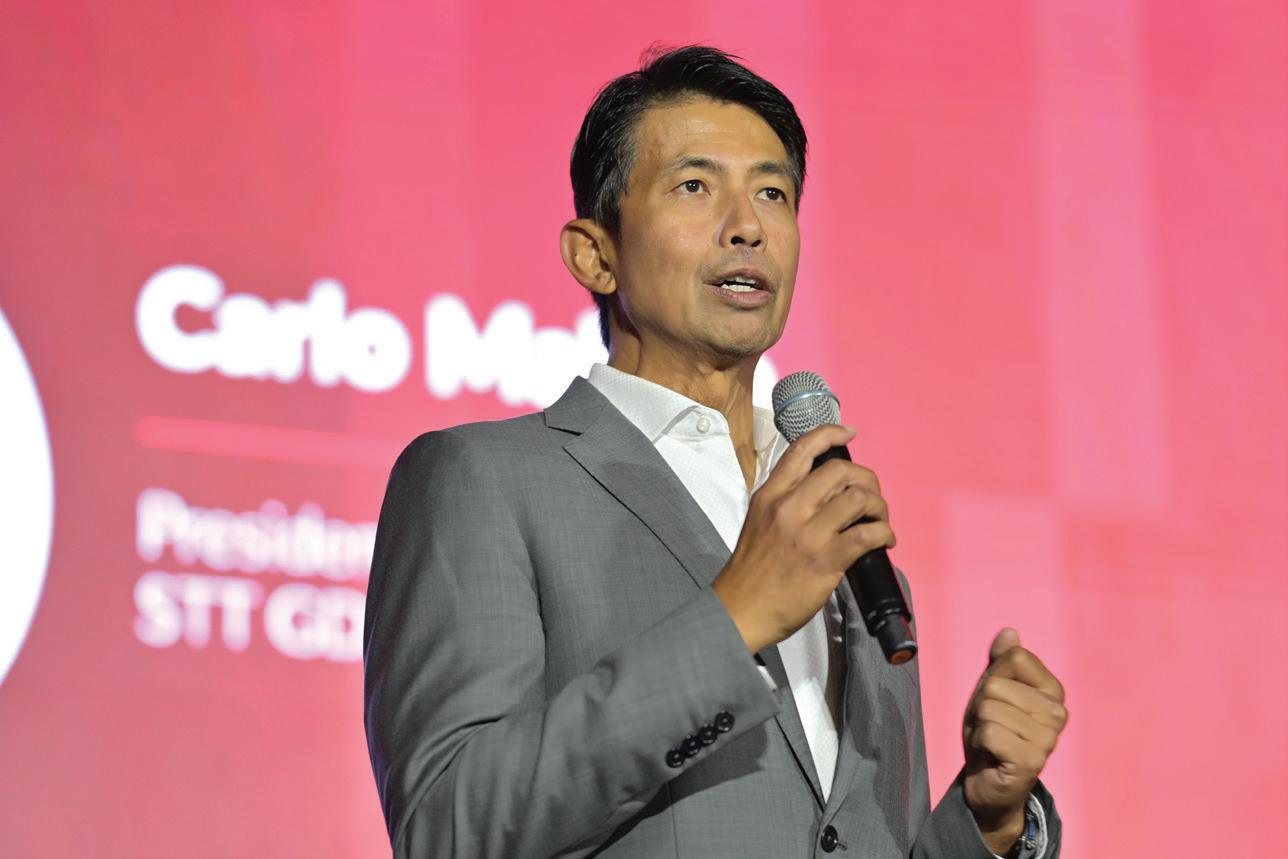
“Why would you generate data in the Philippines, send it to Singapore, then access it again from the Philippines?”—Carlo Malana, CEO of STT GDC Philippines, on inefficiencies in cross-border
like GCash became mainstream tools for everyday transactions, while more businesses and government agencies adopted cloud solutions to improve efficiency.
“Even after—especially after—the pandemic, we’ve gotten much more digital. That’s what’s sustaining the industry [data center] today,” Malana said.
Many organizations, he said, have since embraced a cloud-first approach, viewing cloud computing as the most practical and scalable way to manage data and computing workloads. This aligns with the Department of Information and Communications Technology’s (DICT) cloud-first policy, introduced in 2017, which has already prompted over 70 percent of government agencies to migrate to cloud platforms. The policy aims to improve service delivery while strengthening data security and reducing IT infrastructure costs.
“Before, you had to buy servers for every app. You can’t always utilize them efficiently. Cloud just makes more sense,” he explained.
In the Philippines, cloud services are predominantly hosted outside the country, said Malana. “When you go cloud, chances are you’re not local,” he noted, explaining that data such as emails, Zoom calls, and archives—unless temporarily cached—are typically stored abroad, most often in Singapore.
Singapore currently serves as the main hub for cloud service pro -
viders catering to the Philippines. However, capacity constraints are becoming a growing issue. “There’s a moratorium. They do not have capacity,” Malana said, referring to Singapore’s tightened restrictions on new data center developments.
In 2019, Singapore imposed a moratorium on data center construction due to land limitations, high power usage—which accounted for 7 percent of its total electricity consumption—and sustainability concerns tied to its dependence on natural gas. Although the ban was lifted in 2022, new projects are now subject to strict environmental and efficiency standards, with individual capacities capped at 5 to 30 megawatts. Under its 2024 Green Data Centre Roadmap, Singapore plans to add only 300 MW in total by promoting renewable energy and improving energy use. These constraints are driving hyperscale providers to look toward neighboring markets, including the Philippines, for expansion opportunities.
Malana emphasized the need for infrastructure rationalization: “Why would you generate data in the Philippines, send it to Singapore, then access it again from the Philippines?” This inefficient data loop results in higher costs and slower performance, he said.
“Sometimes the app feels slow because it’s bouncing back and forth between the Philippines and Singapore 20 times just to load the
first page,” he explained. With demand rising and Singapore’s capacity tightening, Malana said it makes sense to build data infrastructure closer to where data is generated and consumed. “If you’re generating data here and consuming it here, it will make sense to keep it here,” he said, noting that some hyperscalers have already begun augmenting their presence in the Philippines. He added that some international data professionals, including Filipino experts, are returning home to help build up the domestic data center industry.
STT GDC Philippines currently operates seven data centers nationwide with a total IT load capacity exceeding 150 megawatts. Four of these facilities are strategically located in Metro Manila—specifically in Quezon City, Mandaluyong, Makati, and the newly launched Fairview site. The company also runs two data centers in Cavite and one in Davao. Its new flagship facility in Fairview, once fully built out, is designed to deliver 124 megawatts of IT load. This robust infrastructure is part of a joint venture with Globe Telecom and Ayala Corporation.
While Malana did not disclose the exact investment figures for the Cavite and Fairview sites, he said the industry benchmark typically ranges from $11 million to $12 million per megawatt, depending on project scale and design requirements.
‘Push for data sovereignty’ WITH digital transformation accelerating across sectors, the push for data localization is gaining urgency. While cloud adoption remains the most efficient route for modernization, STT GDC’s Malana underscored the need for clearer regulations governing data sovereignty. Previous proposals for data localization laws, he noted, were often too broad, leading to uncertainty across industries. But with more sensitive government and citizen data being stored offshore—primarily in Singapore— he argued that a more focused legal framework may soon be necessary. Singapore is currently the preferred hosting hub for Philippine data due to its strong regulatory environment. However, Malana cautioned that not all countries offer the same level of trust and

Editor: Angel R. Calso
By Sam Mednick, Julia Frankel & Sarah El Deeb The Associated Press
TEL AVIV, Israel—A group of American security contractors, ex-military officers and humanitarian aid officials is proposing to take over the distribution of food and other supplies in Gaza based on plans similar to ones designed by Israel.
The Associated Press obtained a proposal from the newly created group, the Gaza Humanitarian Foundation, to implement a new aid distribution system supplanting the current one run by the UN and other international aid agencies. The UN and aid groups have rejected Israel’s moves to control aid distribution.
It was not immediately clear if the proposal from the new group, which is registered in Geneva, would ease those concerns.
Israel has blocked food, fuel, medicine and all other supplies from entering Gaza for 10 weeks, worsening a humanitarian crisis for 2.3 million Palestinians. It has said it won’t allow aid back in until a system is in place that gives it control over distribution.
The 14-page proposal circulated this week among aid groups and UN officials lays out plans similar to ones Israel has been discussing privately for weeks with international aid groups. The proposal reveals for the first time plans to create the foundation and names the people leading it.
A UN official said last week that Israel’s plans would “weaponize aid” by placing restrictions on who is eligible to receive it.
Aid workers have also criticized the plans, which would centralize distribution at four hubs under the protection of private security contractors. They say the plans could not possibly meet the needs of Gaza’s large and desperate population, and that they would forcibly displace large numbers of Palestinians by driving them to move nearer to the aid.
Under the new group’s proposal, Palestinians would receive pre-packaged rations, potable water, hygiene kits, blankets, and other supplies at the distribution hubs. The group said it wants to partner with the UN and international aid groups in handing out their supplies.
A US official confirmed the authenticity of the proposal and said the former
director of the UN World Food Program, David Beasley, is the lead choice to run GHF. The proposal could still be revised and Beasley’s role is not confirmed, the official said, speaking on condition of anonymity to detail plans that have not been made public.
Beasley, a former governor of South Carolina, didn’t immediately respond to messages seeking comment.
Israel accuses Hamas and other militants of siphoning off large amounts of aid. The U.N and aid workers deny there is significant diversion, saying the UN strictly monitors distribution.
When contacted Thursday for comment about GHF’s proposal, Israeli officials did not immediately respond.
US backing for the foundation THE Trump administration supports the new group’s proposal, said a person involved in it. The person said GHF would work “within the confines” set by Israel on aid but would be “independent and committed to humanitarian principles”—a nod to UN concerns. The person spoke on condition of anonymity to discuss a plan not yet made public.
“This is a new approach with one focus: Get help to people. Right now,” said US State Department spokeswoman Tammy Bruce.
Ahead of his first trip to the Middle East this week, US President Donald Trump said “a lot of talk” was going on about Gaza and that his administration will soon have more to say about a new proposal. This may include a new push for a ceasefire between Hamas and Israel, the release of hostages and an influx of aid to Palestinians.
Aryeh Lightstone, a senior member of US special envoy Steve Witkoff’s team, was involved in briefing UN agencies and aid groups about the foundation as they gathered in Geneva on Thursday, according to two humanitarian workers briefed on the meeting who spoke on condition

of anonymity because they were not authorized to comment to the media.
Who’s involved?
GHF ’s proposal names a 10-member leadership team that includes former senior American military officers, business executives and officials from aid groups. At least two of them have ties to private security companies.
Beasley is listed among them, but the proposal says his role is still “to be finalized.” Beasley is also a senior advisor to Fogbow, a private US firm that participated in the short-lived project delivering aid to Gaza by sea via a US military-built pier.
The AP contacted people listed in the proposal to confirm their participation. Only one responded, saying he was “not on the board.” The person involved in planning said the list was still in flux.
How would it work?
ACCORDING to the proposal, GHF would initially set up four distribution sites, each serving 300,000 people. That would cover about half of Gaza’s population. The system would be scaled up to meet the needs of 2 million people. But the proposal does not give a timeframe. Aid workers warn that food is rapidly running out in Gaza under Israel’s blockade.
The GHF proposal said subcontractors will use armored vehicles to transport supplies from the Gaza border to distribution sites, where they will also provide security. It said the aim is to deter criminal gangs or militants from redirecting aid.
CBy Priscila Azevedo Rocha
HARLIE CLARKE fell severely ill in late summer 2023 after a swim at Clevedon Marine Lake in southwest England while training for a Triathlon. The next day he collapsed on the street near his home and was taken to the hospital, where after a series of tests he was diagnosed with myocarditis—an inflammation of his heart muscle caused by an infection.
The diagnosis was a shock for Clarke, an otherwise healthy 28-year old designer, and he had to stop training. It took him about six months to do sports again and a whole year to get back to the same level of fitness. Since then, he has been “very cautious” and so far only trained in pools. He pulled out of a triathlon in September on the morning of the event after he learned of a recent sewage spill at the beach where the swim was taking place. Clarke’s story is one of many showing how severe the impact of Britain’s sewage crisis can be on everyday life. As the weather turns warmer, the swimming season is getting underway, and although spills were supposed to become fewer, they’ve worsened. Untreated sewage entered English waters for a record 3.61 million hours last year—a result of aging infrastructure which sends rain and wastewater from toilets and kitchens through the same pipes and often overflows into rivers and seas.
The depth of the health problem is still unknown, even as campaigners such as Surfers Against Sewage attempt to track thousands of cases of sewage-related sickness. The issue became a key battleground in last year’s election, with waterways playing an important role in the economic and community life of the island nation. Frustration over their degradation is likely to be even higher this summer after water bills were hiked as much as 47% in April to help curb pollution.
“The fundamental issue is that water companies just waited too long to invest,” said Kevin Grecksch, a social scientist and lecturer in the University of Oxford’s school of geography and the environment.
“Now they’re playing a game of catch up, which they can’t win.”
One doctor that Bloomberg spoke to for this story, who asked not to be identified discussing patients publicly, said that sewage-related illnesses have increased since April when it was warm enough for more people to swim in the sea. They said that about one in 10 patients calling the Cornwall-based doctor’s surgery for advice are reporting symptoms related to ingesting sewage and have been in the sea recently.
Efforts to fix the problem have kicked into motion, but they are slow. The UK’s water sector has been stuck in a persistent crisis, with Thames Water
Utilities Ltd.—which serves about a quarter of the UK’s population—at the forefront. The company underwent a massive borrowing binge since it was privatized in 1989, but has been accused of allocating little to infrastructure upgrades and more toward investor returns.
Companies in the sector have faced intense political and regulatory scrutiny as a result of the issues. They recently received approval to spend over £11 billion ($14.6 billion) to fix sewage overflows.
“The water sector in England and Wales has seen an unprecedented year of change and progress,” a spokesperson for industry association Water UK said. But “the regulatory system is painfully slow, hugely expensive and ridiculously complicated.”
Whether it’s companies or regulators dragging their feet, the consequences for some parts of the broader public have been life-threatening.
Suzi Finlayson, a 45-year-old who once swam regularly at the southern English Aldwick Beach, became seriously ill around Christmas of 2023. At the hospital she was diagnosed with a blood infection that damaged her heart and eventually required surgery. Finlayson, who has lived by the sea since she was 11 and worked as a life coach, has still not fully recovered and had to close her business because she no longer had the energy to work.
It did not specify who would provide security but said it could include personnel who previously worked in the Netzarim Corridor, an Israeli-held zone cutting off northern Gaza. A private logistics and operations company, Safe Reach Solutions, has operated in the corridor.
GHF said people will get assistance based on need with no eligibility requirements. This appears to differ from proposals floated by Israel. Aid workers say Israel has said it intends to vet aid recipients and screen them using facial recognition.
What do aid groups say?
THROUGHOUT Israel’s campaign in Gaza, the UN and other humanitarian groups have been carrying out a massive aid program. They have trucked in supplies and distributed them across the territory, going as close as possible to where Palestinians were located.
What has chiefly hampered the system, aid workers have said, are Israeli military operations and restrictions on movement,
as well as the low amount of aid allowed to enter even before the blockade. Convoys have also been attacked by criminal groups stealing aid, and hungry Palestinians have sometimes taken supplies from trucks.
Aid workers contacted by the AP cast doubt whether GHF would meet humanitarian requirements for neutrality and independence.
Shaina Low, communications adviser for Norwegian Refugee Council, one of the main organizations in Gaza, said aid groups are concerned the plan will be used “to advance military and political goals.”
By forcing the population to relocate around aid hubs, the system would “depopulate entire parts of Gaza” and could be used to potentially expel the population, she said.
“They are framing (the plan) to fix the problem that doesn’t really exist,” she said, referring to Israel’s contention that it must prevent Hamas from taking aid.
The use of private security companies has also alarmed humanitarian workers. While it’s common for private security firms to operate in conflict zones, they have to respect humanitarian law and at a minimum be fully vetted and monitored, said Jamie Williamson, executive director for the International Code of Conduct Association.
Tamara Alrifai, communications director for the UN agency for Palestinian refugees, which has led the aid effort in Gaza, said the plan was logistically unworkable. She said the foundation does not appear able to match the current infrastructure needed to distribute food and address other humanitarian needs.
Alrifai called it “a very dangerous precedent” for countries to use “full siege as a tactic of war” to force the abandonment of “existing aid structures and the entire international system that exists and is recognized and start creating a new system.”
El Deeb reported from Beirut. AP reporters Matthew Lee in Washington, Farnoush Amiri at the United Nations, Meg Kinnard in Chapin, South Carolina, and Jamey Keaten in Geneva contributed to this report.


CHOOSING the right track may be the hardest decision for some senior highschool (SHS) graduates who are unsure of the course they will take at the tertiary level.
Under the K-12 curriculum, SHS students may choose from General Academic Strand (GAS), Humanities and Social Sciences (HUMSS), Technical Vocational (TechVoc), and Science, Technology, Engineering, and Mathematics (STEM), said a Science department news release.
These tracks help the students to prepare for their chosen career paths at the tertiary level.
However, according to the baseline study published by the Philippine Business Coalition for Women Empowerment (PBCWE) in 2021, several factors affect the decisions of the students from choosing STEM-related career paths.
This includes a lack of confidence in their technology, engineering, or math skills, and a lack of awareness of STEM-related careers.
Meanwhile, the Department of Science and Technology-Science Education Institute Director IV Dr. Jayeel S. Cornelio said highschool students should consider a STEM-related path because this is a transformative path on both personal and societal levels, said the DOST-SEI in a news release.
“On the personal end, it builds essential skills, such as creativity, critical thinking, futures-thinking, and problem-solving skills, among many others. Meanwhile, on the societal end, the field gives
birth to innovations and research that shape our world for the better,” Cornelio said in an interview.
However, students from nonSTEM tracks can pursue STEM courses in college. DOST-SEI said most Philippine universities make special arrangements for these students wherein they undergo bridging programs and take additional coursework as prerequisite subjects.
High-paying jobs in the country IN 2023, the Philippine Statistics Authority released the results of the 2022 Occupational Wages Survey, which includes the Top 10 highest-paying occupations in the country. Most of these belong to the field of STEM, the DOSTSEI said.
Second and third on the list are software developing and mathematicians/actuaries careers with an estimated monthly income of P70,595 and P69, 654, respectively.
Also belonging to the top 10 highest-paying jobs are specialist medical practitioners (P57,476), statisticians (P51,607), medical doctors/general medical practitioners (P51,251), and geologists (P49,059).
Besides competitive salary, the STEM field also offers important equal opportunities depending on one’s specific interests, and its demand is intertwined with other disciplines.
“For one, they can discover what is currently unknown through groundbreaking scientific research. They can also

transform existing industries by introducing cutting-edge technologies through their inventions,” Cornelio explained.
“They can also pave the way for emerging industries by pioneering studies in artificial intelligence, biotechnology, renewable energy, and space exploration, among many others,” he added.
Common career paths in STEM HERE is a list of common career paths that students may take in their undergraduate studies under the STEM field.
Science: Biologist, chemist,
environmental scientist, medical scientist, pharmacologist, food scientist, and forensic scientist. Technology: Software developer, data scientist, cybersecurity analyst, web developer, information technology auditor, and computer network architect. Engineering: Civil engineer, mechanical engineer, electrical engineer, chemical engineer, biomedical engineer, computer engineer.
Breaking Misconceptions about STEM ACCORDING to DOST-SEI, there are various misconceptions about
choosing STEM-related careers that affect the decision-making of students.
One is that it is only for academically gifted students, and careers are limited to scientists and engineers. Some say STEM courses are too difficult and require extreme intelligence.
“In fact, STEM courses, at its core, help develop the student’s critical thinking and problemsolving skills, as well as creativity. These are skills that are not limited to the STEM field but can also be found in other fields. What sets STEM apart is its deeper appreciation of the world’s intricacies that may or may not be seen by the naked eye,” DOST-SEI explained, debunking misconceptions in STEM.
The science agency added that extracurricular activities, such as science fairs, robotics clubs, and research competitions are some of the many ways to help non-STEM students build their interest in the field.
Sources across the web, like the Kid Spark Education, reported that there is also a misconception that boys are better than girls at STEM subjects. It added that STEM education programs are unaffordable.
Assistance and Initiatives in promoting STEM MOREOVER , to entice more students to enter the STEM field, the DOST-SEI is offering assistance and programs, promoting the importance of taking up STEMrelated courses/tracks.
Some of these initiatives are the #Push4Science and NuLab
programs, which are known as the targeted promotional and experiential programs in remote areas of the country.
The agency is innovating ways to encourage basic education students to explore STEM through competitions like IndieSiyensya, a science filmmaking contest; Girls and Gears, a robotics competition for Filipina high-school students; and Climate Science Youth Camp, a two-week program for basic education students in climate science. For scholarships and assistance, the DOST-SEI is offering undergraduate, master’s, and doctorate scholarship programs both locally and internationally.
Data from the DOST-SEI from 2018 to 2024 showed that a total of 263,000 undergraduate students were supported by the agency—26,910 availed of master’s scholarship programs, and 6,330 got their doctorate through the assistance.
“At its core, STEM careers shape society. It helps drive technological progress, economic growth, and industrial innovations that propel the country toward development. Critical in this pursuit are the professionals’ contribution in addressing key fields in the country such as healthcare, energy, environment, and infrastructure among many others,” Cornelio said. To avail themselves of a DOST scholarship, interested students may check https://sei.dost.gov. ph/ and follow Facebook page at https://www.facebook.com/ DOST.SEI for more information and announcements.
IN Simbalan, Buenavista, Agusan del Norte, over 100 farmers—62 of whom are women, mostly mothers—are excited about the income opportunities offered by the Bamboo Textile Fiber Innovation Hub (BTFIH).
The farmers, who also work as carpenters, seamstresses, and barbers, are now embracing the potential of bamboo as a sustainable and profitable resource. By learning how to process bamboo into textile fibers, they are entering a new industry that promises economic growth for their families and community.
Launched on April 24, the BTFIH, the first of its kind in Mindanao, provides innovative access to processing technology that adds value to bamboo—a sustainable and locally available resource. The hub is equipped to process up to 40 kilograms of raw bamboo fibers each day, supporting yarn spinning and other textile applications.
This initiative is the result of a collaborative effort by the Department of Science and TechnologyPhilippine Textile Research Institute (DOST-PTRI), DOST Caraga, the municipality of Buenavista, Agusan del Norte, and the Kapunungan sa mga Mag-uuma sa Simbalan Inc. (Kamasi). Equipment provided to the facility includes: 1) a Bamboo Textile Fiber Extraction Machine; 2) a Bamboo Slatting Machine; and two (2) units of Industrial Cut-Off Saw.
On April 10 and 11, the farmers were trained by DOST-PTRI in bamboo fiber production, machine operation, and equipment maintenance. The skills gained during this training will enable them to enter the growing bamboo textile market, creating new sources of income for their families.
A new path to financial growth for farmers FOR the farmers of Agusan del Norte, the BTFIH offers a new, sus -
tainable path to financial growth. With women participants, they balance traditional family roles with opportunities in bamboo textile production.
By learning bamboo fiber extraction, they are gaining access to additional income that can support their families and improve their quality of life.
The women, along with the rest of the community, are excited about the potential of bamboo to create a greener and more profitable future.
With their new skills, they can now produce high-quality bamboo fibers and tap into both local and global markets for sustainable textiles.
Farmers in La Union, who partnered with DOST-PTRI through the BTFIH project in Pangasinan, have already earned nearly half a million pesos from producing bamboo fibers for textiles. The Institute now looks to replicate this model through its Kamasi initiative.

Fostering a sustainable textile industry in Agusan del Norte
THE BTFIH is not just about creating new income—it’s about building a local sustainable textile industry.
Bamboo, a fast-growing and renewable resource, offers an eco-friendly alternative to traditional fibers. By focusing on this sustainable material, the hub helps local farmers and artisans reduce environmental impact while generating new economic opportunities.
During the launch, Science Secretary Renato U. Solidum Jr., said “With science, technology, and innovation in our hands and with the strength of our communities at the center, there is no limit to what we can achieve. And as you push for the limit, always remember that we are here as OneDOST4U: Solutions, Opportunities for All.”
The innovation directly responds to an industry gap in Agusan del Norte, where despite the abundance of bamboo, communities had limited means to transform this resource into high-value products.
Prior to the intervention, there were no accessible technologies or established systems to process bamboo for textile use.
Through the provision of S&T equipment and hands-on training, the DOST and its partners have bridged this gap—enabling farmers not only to harness bamboo’s potential but also to participate in a value-adding textile industry that previously seemed out of reach.
DOST-PTRI Director Dr. Julius L. Leaño Jr. said during the launch: “While Agusan del Norte may not have established weaving communities, the province holds the key to the textile industry through its abundant raw materials.”
This vision highlights the province’s potential to become a major player in the textile industry by capitalizing on its natural resources.
BSU students were a mong the first to register and access the DOSTFPRDI’s e-Library. DOST-FPRDI PHOTO

HE Department of Science and Tech -
nology-Forest Products Research and Development Institute (DOST-FPRDI) recently launched its e-Library last April 29 at the Benguet State University in La Trinidad, Benguet.
The launch was an output of the project
“From Page to Pixel: Digital Transformation of the DOST-FPRDI Library.” The project aims to digitize thousands of the Institute’s forest products research materials and publications.
The shift to a digital platform ensures global access and long-term preservation of over 3 million pages of valuable materials, some dating back to 1954.
Science Secretary Renato U. Solidum Jr. expressed his strong support for the initiative, citing its alignment with national research goals.
“Digital libraries like this allow our researchers and learners to seamlessly tap decades of scientific work. This is a leap toward innovation in resource sharing,” he said.
“The digitization process plays a key role in preserving fragile and rare materials that may have deteriorated over time. By creating digital copies and storing them in multiple locations, we ensure the information remains intact for future generations,” explained DOST-FPRDI head librarian and Project Leader Felipe B. Seva Jr. Seva also added that the platform will enhance research efficiency by letting users locate data with ease, allowing retrieval of research materials at any time, without the need to physically visit the library.
Currently, the DOST-FPRDI library holds an extensive collection of 4,977 books, 2,691
reports, 17,954 journals, 183 theses and 2,261 reprints.
“This e-Library is not just a collection of scanned pages. It is about breaking barriers. It ensures that knowledge, which was once confined to shelves, now reaches classrooms, research hubs, other libraries, and communities far beyond our walls, and remains accessible for years to come,” said DOST-FPRDI Director Rico J. Cabangon. Dr. Maria Cielito G. Siladan, chief of the Institute’s Technical Services Division, emphasized the importance of the e-Library in expanding the reach and relevance of the Institute’s knowledge assets, reinforcing its value even in the global context.
“The availability of a new information system that allows sharing of materials across provinces, regions, and even across countries gives more value to these intellectual creations,” she said during the launch. During the launching, several DOST-FPRDI publications were turned over to the BSU Library. An exhibit was also held that showcased select Institute technologies and services.
The e-Library launch marks a significant milestone in the Institute’s ongoing efforts to promote inclusive and future-ready scientific learning. By embracing digital transformation, the agency reaffirms its commitment to broaden the access to knowledge and empower the next generation of researchers and professionals.
The e-Library project was funded by the DOST-Philippine Council for Agriculture, Aquatic and Natural Resources Research and Development. Glenn B. Manongsong and Apple Jean C. Martin-de Leon/S&T Media Service
A6 Sunday, May 11, 2025

By Joanne M. Pierce
WHEN the 69-year-old Cardinal Robert Fran -
cis Prevost on May 8, 2025, appeared on the main balcony of St. Peter’s Basilica for the first time as Pope Leo XIV, he was cheered loudly by the huge crowd of pilgrims, tourists, local Catholics and other onlookers, who had waited hours for the first sign of white smoke and the official announcement.
As a specialist in Catholic history and ritual, I know how important this moment was for Catholics and others all over the world. A new pope brings with him a sense of excitement often mixed with uncertainty.
But the choice of the College of Cardinals came as a surprise to some. Prevost is the first pope from the United States, and, traditionally, the European-dominated College of Cardinals has had reservations about choosing a cardinal from the US for fear of too much American influence in the church. So, who is Prevost and what might have influenced the cardinals’ vote?
Early experiences
BORN in Chicago, Illinois, Prevost joined a Catholic religious order at the age of 20: the Order of St. Augustine, called Augustinians,
founded in the 13th century.
Instead of withdrawing from the world in isolated monasteries, members of this order traveled as mendicants to aid the poor as well as serve as missionaries and teachers.
Prevost studied theology both in the US and in Rome and, as a newly ordained priest, spent a year in Peru.
After a short return to the US as an official of the Augustinian order in Illinois, he returned to Peru as a seminary professor to teach canon law, the legal structure of the Catholic Church. He would stay in Peru for the next 10 years.
In 1999, he became the prior, or the head, of the local Augustinian province in Chicago, and was later elected prior of the worldwide Augustinian order. This gave him a truly global experience, since the Augustinians had some 50 communities spread across every continent.
In 2015, Pope Francis appointed him bishop for the diocese of Chiclayo in Peru.
In 2019, Francis appointed him a member of several important Vatican dicasteries, or departments, where he became very familiar with the central church administration. Most importantly, he served as prefect, or chairman,

on the Dicastery for Bishops. Because of his lengthy pastoral experience in Peru and service at the Vatican, some commentators had noted before Prevost was chosen that, if the cardinals were to elect an American pope, it would be him. His service on the Dicastery for Bishops was considered especially important, since members play a key role in selecting new bishops.
Global church DURING the 20th century, especially after the Second Vatican Council—a series of meetings of the world’s bishops to modernize
the church, ending in 1965—the popes began to name cardinals from other parts of the world that were previously considered to be on the periphery of the Catholic Church.
And this led to popes being chosen from outside of Italy for the first time in centuries. Pope St. John Paul II was Polish and the first non-Italian pope since the 16th century.
Pope Benedict XVI was another non-Italian, born in Germany, who had served as a Vatican official. Pope Francis was born in South America to parents who
Pope Leo XIV’s speech: ‘Peace be with all of you’
POPE Leo XIV greeted the city of Rome and the world with these words, translated from Italian, at his first appearance as the Successor of Peter from the Central Loggia of St Peter’s Basilica: Peace be with you!
Dearest brothers and sisters, this was the first greeting of the risen Christ, the good shepherd who gave His life for the flock of God. I, too, would like this greeting of peace to enter your hearts, to reach your families and all people, wherever they are; and all the peoples, and all the earth: Peace be with you!
This is the peace of the Risen Christ, a disarming and humble and preserving peace. It comes from God. God, who loves all of us, without any limits or conditions. Let us keep in our ears the weak but always brave voice of Pope Francis, who blessed Rome—the pope who blessed Rome and the world that day on the morning of Easter.
Allow me to continue that same blessing. God loves us, all of us, evil will not prevail. We are all in the hands of God. Without fear, united, hand in hand with God and among ourselves, we will go forward.
We are disciples of Christ, Christ goes before us, and the world needs His light. Humanity needs Him like a bridge to reach God and His

love. You help us to build bridges with dialogue and encounter so we can all be one people always in peace.
Thank you, Pope Francis!
Thank you, to my cardinal brothers who chose me to be the Successor of Peter and to walk together with you as a united Church searching all together for peace and justice,
working together as women and men, faithful to Jesus Christ without fear, proclaiming Christ, to be missionaries, faithful to the gospel.
I am a son of Saint Augustine, an Augustinian. He said, “With you I am a Christian, for you a bishop.”
So may we all walk together toward that homeland that God has prepared for us.
To the Church of Rome, a special greeting:
We have to look together how to be a missionary Church, building bridges, dialogue, always open to receiving with open arms for everyone, like this square, open to all, to all who need our charity, our presence, dialogue, love.
(In Spanish): Hello to all and especially to those of my diocese of Chiclayo in Peru, a loyal, faithful people accompanying the bishop and helping the bishop.
(Returning to Italian): To all you brothers and sisters of Rome, Italy, of all the world, we want to be a synodal church, walking and always seeking peace, charity, closeness, especially to those who are suffering.
Today is the day of the Supplicatio (Plea) to Our Lady of Pompei.
Our blessed mother Mary always wants to walk with us, be close to us, she always wants to help us with her intercession and her love. So let us pray together for this mission, and for all of the Church, and for peace in the world.
We ask for this special grace from Mary, our Mother.
Hail MaryHail Mary, full of grace, the Lord is with thee. Blessed art thou among women, and blessed is the fruit of thy womb, Jesus. Holy Mary, Mother of God, pray for us sinners now, and at the hour of death. Amen. Vatican News
NEW LENOX, Illinois—When white smoke poured out of the Sistine Chapel revealing that a new pope had been chosen, John Prevost turned on his television in Illinois, called his niece and they watched in awe as his brother’s name was announced.
“She started screaming because it was her uncle and I was in the moment of disbelief that this cannot be possible because it’s too far from what we thought would happen,” Prevost said on Thursday in an interview with The Associated Press from his home in New Lenox, Illinois.
Next, he said he felt an intense sense of pride that his brother, Cardinal Robert Prevost, had become the 267th pontiff to lead the Catholic Church, making the Chicagoborn missionary the first US pope.
“It’s quite an honor; it’s quite a once in a lifetime,” he said. “But I think it’s quite a responsibility and I think it’s going to lead to bigger and better things, but I think people are going to watch him very closely to see what he’s doing.”
Robert Prevost, a 69-year-old member
of the Augustinian religious order who spent his career ministering in Peru, took the name Leo XIV. John Prevost described his brother as being very concerned for the poor and those who don’t have a voice.
He said he expects him to be a “second Pope Francis.”
JOHN PREVOST points to an
“He’s not going to be real far left and he’s not going to be real far right,” he added.
“Kind of right down the middle.”
During the interview, John Prevost realized he had missed several calls from his brother, so he gave the new pope a call back. Leo told him he wasn’t interested in being part of the interview and after a brief

were Italian-born immigrants to Argentina.
The College of Cardinals, which had few representatives from other continents until recently, is now much more international.
Some 80 percent of the cardinal-electors were named by Francis, many from countries that had never before had a cardinal.
In reviewing his record, the cardinal-electors might have taken a number of factors into account.
Prevost would be an effective administrator as head of the church, and was an expert in church canon law. He had decades of experience doing pastoral work in South America, as well as in North America.
And as prior general of the entire Augustinian Order, he would likely have traveled widely to visit many of the communities he supervised.
Papacy under Leo THE new pope appeared on the Vatican balcony wearing the traditional papal garments: white cassock, short red cape, decorated red and gold stole, and golden cross hanging around his neck.
Francis, on the other hand, had appeared dressed in the plain white cassock of a pope.
Certainly, he had not chosen the simplicity of Francis. Was this
a sign that he would be more of a traditionalist?
His choice of a papal name, I believe, could indicate a different point of view.
Pope Leo XIII wrote a groundbreaking encyclical in 1891, “Rerum Novarum,” subtitled “On Dignity and Labor.”
In this he stressed the rights of workers to unionize and criticized the conditions in which they worked and lived. He also championed other rights the ordinary worker deserved from their bosses and from their government. In his first remarks from the balcony, offering a glimpse into the direction of his papacy, Leo XIV stressed the role of Catholics and the church as peacemakers and bridge-builders, in dialogue with other religious traditions and cultures.
His first words were “Peace be with you all,” describing this peace as “a disarmed peace, a disarming peace.”
He further urged Catholics to act together “without fear…united with one another…to build bridges” through dialogue and outreach—to bring peace to the world.
He may not follow exactly in Francis’ footsteps, but he will likely continue walking in the same direction. College of the Holy Cross/The Conversation (CC) via AP

Wmessage of congratulations and discussion in which they talked like any two brothers about travel arrangements, they hung up.
The new pope grew up the youngest of three boys. John Prevost, who was only a year older than him, said he remembers Robert Prevost being very good in school as a kid and enjoying playing tag, Monopoly and Risk.
From a young age, he said he knew his brother was going to be a priest. Although he didn’t expect him to become pope, he recalled a neighbor predicting that very thing when Robert Prevost was only a first grader.
“She sensed that at 6 years old,” he said. “How she did that, who knows. It took this long, but here he is, first American pope.”
When Robert Prevost graduated eighth grade, he left for seminary school, his brother said.
“There’s a whole period there where we didn’t really grow up together,” he said. “It was just on vacations that we had contact together.” Obed Lamy And Hallie Golden/ Associated Press
HILE much has been said about his pastoral service and religious views, only a few know that Pope Leo XIV also has a strong foundation in science, technology, engineering and mathematics (STEM), much like his predecessor, Pope Francis, who studied chemistry, ScienceKonek said on its Facbook post.
“Remarkably, according to our research, he is the first pope in 470 years with a distinct background in mathematics, following Pope Marcellus II, who reigned briefly in 1555,” it said.
Born on September 14, 1955, in Chicago, Illinois, USA, Prevost was drawn to academic life early on, influenced by his father, an educator, and his mother, a librarian.
In 1977, he earned a Bachelor of Science in Mathematics from Villanova University in Pennsylvania, USA. During his university years, he was known for his deep affection for numbers and equations, it added.
His extensive missionary work in Peru and direct engagement with pressing socio-environmental issues transformed him into a committed environmental advocate.
Calling for urgent climate action, he has urged the Church to move “from words to action,” warning against the perils of unchecked technological development and advocating for a respectful, reciprocal relationship with nature, ScienceKonek said. His environmental stance is closely aligned with Pope Francis’ priorities, as noted in the College of Cardinals Report. Prevost is also celebrated for his exceptional multilingualism. He speaks English, Spanish, Italian, French, and Portuguese, and can read German and Latin, enabling him to communicate with diverse communities and effectively champion his advocacies worldwide.
Despite his demanding responsibilities, he makes some time for recreation. Prevost enjoys playing tennis and is reportedly a devoted fan of a local baseball club in his hometown of Chicago. Pope Leo XIV stands as another powerful example of how STEM and faith can come together to serve the common good, Science Konek said.

Editor: Lyn Resurreccion



By Jonathan L. Mayuga
HE ecosystem of Manila Bay is vibrant, a 2024 cumulative impact assessment in and around the bay says. It is “alive,” the Environment department adds. However, the 21 proposed and ongoing reclamation projects in the area threaten marine ecosystems and small fishers’ way of life, and could trigger more flooding in low-lying areas in Metro Manila and nearby areas in the face of climate change’s worst impacts.
The Marine Environment Resource Foundation (MERF) cumulative impact assessment of the historic water body, highlighting the impact of reclamations, was presented during a news conference on April 30. The Department of Environment and Natural Resources (DENR) confirmed the results of the study that it has commissioned.
Incidentally, the restoration of the bay’s water quality to its former glory was the subject of a continuing Supreme Court mandamus issued in 2008 to 13 government agencies, led by the DENR.
The results of the study were made public as the country observes the Month of the Ocean this May as mandated by Presidential Proclamation 57, issued in 1999.
‘Manila Bay is alive’ WHILE saying “Manila Bay is alive,” Environment Secretary Maria Antonia Yulo-Loyzaga enjoined local government units (LGUs) on the “need to take into consideration the social impacts, the cultural, legal, and ecological considerations in their development goals.”
The LGUs “need to integrate the reclamation projects into their water quality and water sourcing plans, their traffic and mobility plans, their solid waste management systems, their flood management systems, their disaster risks and climate change risk management plans,” she added during the event.
Citing it’s being “vibrant,” the Environment chief pointed out the bay’s rich biodiversity despite decades of unbridled development, aggravated by anthropological problems posed by rapid urbanization and overpopulation.
Manila Bay remains a productive fishing ground, although small fishers, who depend on it’s depleted fish stock, have been complaining of the steep drop in fish catch for years.
Sustainable future
YULO-LOYZAGA underscored the importance of the cumulative impact assessment, saying the process is vital for safeguarding the environment and ensuring a sustainable future for Filipinos.
“By evaluating the combined effects of various projects, we can make informed decisions that balance economic growth, social well-being, and ecosystem health,” she said.
She added that the comprehensive approach could aid in mitigating the impacts on biodiversity, promoting fairness and equity, and enhancing community resilience against environmental challenges.
Study coverage; rich biodiversity THE MERF study evaluates the potential impacts of two ongoing, 12 approved, and seven proposed reclamation projects, focusing on water resources, ecosystems, and communities.
Models for flood risk and water circulation were developed. The researchers measured water quality and assessed biological resources.
An interdisciplinary team of 48 members, including 16 oceanographers, ecologists, and planners, conducted surveys during varying seasons.
The study documents 51 coral genera and 167 fish species, revealing a rich biodiversity that offers hope for future management despite the challenges, said MERF’s Dr. Charina Lyn A. Repollo, who presented the study.
Repollo warned that the proposed reclamation projects can disrupt the bay’s natural water flow, leading to stagnation and trapping pollutants, particularly during extreme weather events, increasing water quality issues that could have far-reaching public health implications.
Threats REPOLLO disclosed that Manila Bay remains
vital for fisheries that support many coastal communities.
However, she warned that the reclamation projects can severely diminish fishing grounds and destroy critical habitats.
“The loss of mangroves threatens marine biodiversity and weakens coastal defenses, making communities more vulnerable to typhoons,” she said.
Additionally, reclamation raises sedimentation and nutrient levels, increasing the risk of harmful algal blooms, which could pose significant dangers to both marine life and human health due to their toxins, she added.
Potential impacts
THE study says the proposed reclamation projects will create 6,166 hectares of new land—that is projected to create pressure on the environment that are equivalent to nearly four new central business districts.
On water quality, the reclamation activities can significantly disrupt the natural circulation of water in Manila Bay.
Another concern is the construction of large coastal structures and alterations to the coastline that would weaken water movement, resulting in stagnation and the buildup of sediments, pollutants, and debris in specific areas.
Impact on fisheries
S IGNIFICANT reduction in available fishing grounds is another result, forcing fishers to travel longer distances in search of viable spots, which exacerbates small fishers’ limited resources for fuel, food, and logistics necessary in fishing operations.
Ultimately, these can significantly diminish their productivity, affect their income, and further increase their vulnerability.
The study cites the potential impact on the bay area’s already degraded coastal and marine environment. The loss of mangroves not only threatens marine biodiversity but also diminishes natural coastal defenses, increasing the susceptibility of nearby communities to storm surge and coastal erosion, it says.
Declining water quality
MEANWHILE , the study also warns that
the declining water quality, exacerbated by reclamation activities, has elevated sedimentation and nutrient levels, creating conditions that could lead to harmful algal blooms.
“The presence of harmful species like Alexandrium minutum and Gymnodinium catenatum raises alarms due to their production of paralytic shellfish toxins, which pose serious risks to both marine life and human health,” the study says.
T
HE study highlights the reclamation’s potential impact on flooding by obstructing natural drainage pathways, creating a bottleneck that delays the timely flushing of floodwaters, particularly during heavy rains and typhoons when effective drainage is crucial.
“This impediment can significantly increase both coastal and inland flooding, leading to deeper and more prolonged inundation in the affected communities,” it says.
“Consequently, the threats to lives, infrastructure, and overall community resilience is heightened, raising urgent concerns about the long-term impacts of these reclamation efforts on urban flood management,” it adds.
The study, likewise, cautions that reclamation can exacerbate flooding in low-lying Metro Manila urban cities and municipalities. By blocking natural drainage pathways, the projects hinder the timely drainage of floodwaters, especially during heavy rains.
“This bottleneck effect increases both coastal and inland flooding, posing heightened risks to lives and infrastructure, and undermining community resilience,” Repollo warned.
The study calls for regular monitoring of water quality and shellfish safety to safeguard fisheries and public health, and urges that project proponents should be held accountable for their actions as Metro Manila faces the ramifications of further reclamations.
FORMER Asean Centre for Biodiversity executive director Theresa Mundita S. Lim
told the BusinessMirror in an interview that the highlights of the cumulative impact assessment affirm already known information on the impact of reclamation on marine and coastal ecosystems of Manila Bay.
“I assume that the full technical report would provide more granular data that can enhance the results of available ecosystem services valuation and costbenefit analyses previously conducted for the bay,” she said.
“It would be ideal to see this updated, science-based information feed into an integrated management plan for the whole of Manila Bay, which should be able to delineate the go and no-go zones for development activities, including land reclamation and infrastructure projects, as well as identify potential areas for restoration,” explained Lim, the former director of the DENR’s Biodiversity Management Bureau said via Messenger on May 6.
DENR’s response
RESPONDING to a media query on the DENR’s way forward, Yulo-Loyzaga said the agency would review the Environmental Compliance Certificates (ECCs) of the Manila Bay reclamation projects and determine whether these should be revised or amended to address the results of the study.
The process would involve consultations with the Philippine Reclamation Authority (PRA), LGUs, and stakeholders for the possible modification of the ECCs.
She said a technical conference will be called with proponents to immediately start the project review process that would eventually determine the fate of the reclamation projects.
Cancel ‘em all!
ENVIRONMENTAL groups have expressed dismay at the DENR’s response to the results of the impact study.
Led by Oceana Philippines, they called for the cancellation of all Manila Bay reclamation projects, which they said were approved in haste without studying their potential impacts on people and the environment.
Atty. Rose-Liza Eisma-Osorio, Oceana
Philippines acting vice president, said via email that the most logical step is for President Ferdinand Marcos Jr. to stop all reclamation projects, not only in Metro Manila but in also different parts of the country, to avoid the devastating impacts on the environment and the coastal communities.
“Given the overwhelming evidence, the DENR should immediately cancel all ECCs and the permits issued by the [PRA] to these destructive projects, both proposed and ongoing, including the San Miguel Aerocity in Bulakan, Bulacan,” Bernie Larin, campaign officer of Alyansa Tigil Mina, pointed out. Hold DENR accountable LARIN said the DENR must also be held accountable for what he calls “highly irregular and objectionable approvals” of the projects.
“The ECC review should have been done before the issuance of the reclamation permits, precisely to ensure environmental protection and public safety. Why then did the previous DENR issue the ECCs and approve the permits for the projects before an impact assessment was determined?” he said in a statement.
Eisma-Osorio added that the DENR chief must not legitimize what she calls “reckless approvals” of the previous DENR officials.
“The next step is not to modify the ECCs but to cancel them as they should not have been issued in the first place,” she said. Leaders of environmental groups are one in blaming the DENR, and insisting that the state environment agency should have exercised its institutional accountability and cancelled the permits on its own, especially now that the cumulative impact assessment results are disclosed. They said that cancelling all ECCs and permits related to reclamation are in order, and called for a moratorium on future reclamation proposals. They are demanding legal accountability for government officials who approved projects despite scientific warnings, and are asking to ensure investment in ecosystembased coastal protection, instead of putting in place destructive infrastructure to save Manila Bay.
NVIRONMENTAL
despite a recent Social Weather Stations poll showing that 92 percent of voters prioritize issues that are strongly linked to environmental and climate action, including food security and hunger, jobs, reduced poverty and disaster resilience, the groups said.
“The silence of frontrunners is a damning symptom of our broken political system,” said Von Hernandez, global coordinator of Break Free from Plastic (BFFP).
Those who responded to the survey and submitted their positions include Leody de Guzman, Teddy Casiño, Luke Espiritu, David Delano D’Angelo, Jocelyn Santos Andamo, Norman Marquez, Mody Floranda, and Atty. Arnel Bondilles Escobal.
The previous positive efforts and track records by nonrespondents like ex-senators Francis “Kiko” Pangilinan (Sagip Saka Act and legislative efforts to address singleuse plastics) and Gringo Honasan (Clean Air Act and Solid Waste Management Act) were noted.
The groups behind the initiative include Ecowaste Coalition, Greenpeace Philip -
pines, Pangisda Pilipinas, Health Care Without Harm, Community Legal Help and Public Interest Center, Mother Earth Foundation, Interfacing Development Interventions for Sustainability, BAN Toxics and BFFP.
“Only eight candidates responded to urgent environmental questions—that’s not just disappointing, it’s a red flag,” said Lea Guerrero, country director of Greenpeace Philippines.
“When climate justice is absent from platforms, it shows a dangerous disregard for the crises deepening hunger, worsening health, and driving poverty. We need leaders who will stand with people, hold polluters accountable, and put climate at the top of the agenda,” she said.
“While Filipinos grapple with climate disasters, plastic pollution and biodiver -
sity collapse, our politicians cling and aspire to power through dynastic politics, smear campaigns and empty theatrics,” Hernandez said.
Filipinos “deserve leaders who fight like our nation’s survival depends on a safe and healthy environment—because it does, and survival is nonnegotiable,” he added.
The groups lamented the current state of the Philippine environment which they said seems to be regressing as evidenced by government programs—from entertaining problematic nuclear energy and waste burning incineration, to allowing the continued proliferation of single-use plastics and recent attempts to open municipal fishing waters to commercial fishing interests.
Pangisda Pilipinas Chairman Pablo Rosales minced no words as he said in
Filipino: “Politicians are obsessed over quick fixes while the nation wallows in poverty, trash and crisis. We need systemic and just solutions to solve the inter-connected ecological crisis.”
The groups unveiled a Survival Agenda to guide the electorate in selecting candidates they should vote for public office. They include: ban single-use plastics and institutionalize reuse and zero waste solutions; end fossil fuels and promote climate justice; protect the rights of small fisherfolk, waste workers and consumers; champion real solutions and reject false fixes like waste to energy incineration and nuclear energy; and protect and rehabilitate the country’s terrestrial, coastal and marine resources.
“This isn’t just policy—it’s a fight for breathable air, edible fish, and a liveable
future,” said Wes Lipana, Marine Litter Management officer of Ecowaste Coalition.
“Our communities are drowning in plastic, our coastlines are eroding, and our children are growing up in a world where clean water and safe food are no longer guaranteed. Our environment is in a state of emergency, and that demands leadership. Voters must demand bold environmental leadership and scrutinize candidate track records, not slogans,“ Lipana explained. Since 2004, the Green Electoral Initiative has exposed candidates’ environmental commitments or lack thereof. The methodology involves a survey sent to candidates running for national office, asking them to disclose their positions on issues, such as climate, biodiversity, waste management and pollution.
ALL but one of the six division winners from the kickoff leg of the International Container Terminal Services Inc.
(ICTSI) Junior Philippine Golf Tour
Visayas-Mindanao Series are back in action for the second leg starting on Tuesday at the Negros Occidental Golf and Country Club in Bacolod City. Leading the charge are Brittany Tamayo and Tashanah Balangauan, who dominated the girls’ 11-14 and 15-18 categories, respectively, at the Mactan Island Golf Course.
Tamayo, a 13-year-old standout from Notre Dame of Marbel University, rallied from a one-stroke deficit after 18 holes and stormed to a five-shot victory over Zuri Bagaloyos with a closing 73 in the 36-hole Pilipinas Golf Tournaments Inc.organized tournament.
“I know I can do more,” said Tamayo, who was one of the JPGT Match Play champions last year. Balangauan, meanwhile, delivered a wire-to-wire performance in the premier division where she capped her circuit debut with a commanding seven-stroke victory over Precious Zaragosa.
A proud Cebuana, she broke the Mindanaoans’ stranglehold in the Mactan leg and now looks to build on that confidence.
“My JPGT experience gave me insight into what I need to
improve for my next tournament. It motivates me to train even harder,” said Balangauan, who maintains a rigorous training schedule from morning until late afternoon. In the girls’ 7-10 class, Cebu’s Denise Mendoza eyes another strong performance after a 15-shot romp in the opening leg. However, she’s aware of the stronger field ahead, with Bacolod’s Ana Marie Aguilar and Cecilia Jalandoni, Negrense Anezka Golez, Faith Reosura of Talisay and Davao’s Soleil Molde all gunning for the top spot.
Davao’s Ethan Lago also seeks to defend his title in the boys’ 7-10 division after cruising to an 11-stroke win over Cebu’s Kvan Alburo and Cagayan de Oro’s James Rolida.
Joining the competition are Canlaon’s Sebastian Bautista and Cebu’s Tobias Tiongko, making the path to another victory far more challenging.
A stacked lineup is expected in the boys’ 15-18 division, where local standouts Santi Asuncion, Lance Soberano, Azie Acuña, Cybon Casil, Eddie Gonzales, Raphael Aguilar and John Rey Oro will square off against Cebu’s Nyito



OHTANI stands for photos next to agent Nez Balelo during a news conference at the Dodger Stadium on December 14, 2023, in Los Angeles. AP
Ohtani could have landed 15-yr deal, but didn’t want to risk skills decline
NGLEWOOD, California— Shohei
IOhtani could have pursued a 15-year contract through age 44, agent Nez Balelo said Thursday, explaining the two-way superstar didn’t want to risk a decline in his skills while under the big deal. Balelo pulled back the curtain that shrouds Ohtani a bit when he spoke at Sportico’s Invest West conference featuring decisionmakers in sports, entertainment and finance at the new Intuit Dome, home of the National Basketball Association’s Los Angeles Clippers. Ohtani’s $700 million, 10-year deal with the Los Angeles Dodgers that he signed in December 2023 was the largest in professional sports. He won his third MVP award and first World Series title in his first season after moving from the Los Angeles Angels. A year later, Juan Soto went even bigger. The left fielder landed a $765 million, 15-year contract with the New York Mets in which none of the money will be deferred.
“We wouldn’t do anything different,” Balelo said afterward. “He won a championship. He went to the right team. No regrets.”
Ohtani’s deal includes $680 million in deferred payments. Those deferrals reduce the net present value of the contract to about $461 million for baseball’s luxury-tax system, instead of an average of $70 million a year had there been no deferrals.
Ohtani will be 38 when the contract ends after the 2033 season.
“We could have went to 13, 14, 15 years,” Balelo said. “But Shohei wanted to always kind of keep the integrity of where he’s at as a player. He just didn’t want to have the end of his storybook career tail off and then on year 13, 14 and 15, it’s just like who is this guy? You can’t even run down first and he’s not a guy anymore.”

Tiongko and Yosef Tiongko, Davao’s James Teves, and Canlaon’s Blake Bautista.
Tamayo, meanwhile, is bracing for a tougher outing with several fresh challengers entering the mix, including Johanna Uyking (Davao), Andrea Borromeo (Cebu), and Gabriela Regino (Bacolod), Chelsea Ogborne, also from Bacolod, and Bukidnon’s Rafella Batican are back, both seeking redemption.
Over in the boys’ 11-14 division, Bukidnon’s Ralph Batican also seeks a repeat after topping the Mactan leg by four strokes.
Although runner-up Ken Guillermo will not be in the field this time, competition remains fierce with South Cotabato’s Jared and Laurence Saban, Bacolod’s Isaac Locsin and Zach Casil and Bukidnon’s Mico Woo all eyeing the crown.
The JPGT series shifts to the Bacolod Golf and Country Club in Binitin, Murcia from May 19 to 21, before heading to Mindanao for a four-leg swing that kicks off at Del Monte Golf Club from June 25 to 27.
LEADING the charge are Brittany Tamayo and Tashanah Balangauan, who dominated the girls’ 11-14 and 15-18 categories, respectively, at the Mactan Island Golf Course.
Balelo prefers operating behind the scenes and carefully controlling the narrative around Ohtani. But even he couldn’t tamp down a cottage industry of rumors about which team would land Ohtani and how much it would cost.
“It was quite a ride,” he said in a discussion moderated by Ben Verlander, MLB analyst for FOX Sports. A social media frenzy ensued when it was reported Ohtani was on a plane to Toronto to sign with the Blue Jays.
“Well, that was reckless reporting. We actually tried to let the individual know, ‘No, we’re not on a plane,’” Balelo said. “I felt bad for the country of Canada. I felt horrible for the organization because clearly they knew we weren’t.”
Ohtani’s goals were to keep his new team competitive by allowing the club money to sign other players and to allow him to win championships and continue to be a two-way player.
“The Dodgers gave us their word that’s what they were going to do,” said Balelo, who works for CAA Sports’ baseball division.
Ohtani is MLB’s top endorser, with his earnings jumping from $65 million in 2024 to $100 million this year.
“Yeah, absolutely, those are real numbers,” Balelo said. “It continues to take on a life of its own.”
According to Balelo, Ohtani endorses just over 20 brands that are carefully vetted and chosen based on his use or belief in the product and the people behind it. His priority is his on-the-field performance and the training that goes into it.
“He takes that very, very serious and everything really becomes secondary other than his family,” Balelo said. “We just have to make sure that we don’t overexpose him or put him in a situation where it’s too heavy of a lift.” AP


JUST a few days after winning the Kentucky Derby, Sovereignty was ruled out of running in the Preakness Stakes It is the second time in four years the owner and trainer of the Derby champion opted to skip the Preakness in favor of the Belmont Stakes in June—Rich Strike also bypassed the Preakness in 2022 after winning at Churchill Downs at odds of 80-1.
Country House did not run in 2019 because of illness after getting elevated to Derby winner when Maximum Security was disqualified for interference, the races were run out of order in 2020 and Medina Spirit ran and finished third in the 2021 Preakness after being DQed from his first-place finish in the Derby for a positive drug test.
That means this is the fifth time in seven years that the Preakness gates open at Pimlico Race Course in
Baltimore without even a chance at a Triple Crown. That was only the case once in the previous 33 years from to 1986-2018, and that happened because a horse was retired because of injury after taking the Run for the Roses.
Why is this happening?
Horse racing has changed from its heyday, when stars of the sport like War Admiral, Secretariat and Seattle Slew were used to running every couple of weeks. Breeding, money and other factors have changed that, and the top 3-year-old horses eligible for the Triple Crown race far less often, with bigger stretches in between.
“Most trainers hate running their horses back in two weeks,” NBC Sports analyst Randy Moss said. “They feel like it’s bad for the horses.”
Beginning in the early 21st century, many of the Derby horses who finish between second and 20th started getting more rest to
wait five weeks for the Belmont. It was essentially automatic that the Derby winner would go, though not anymore.
“The trainers of Derby winners that do run back in the Preakness do it out of a sense of tradition—not because they like it,” Moss said.
Sovereignty’s Bill Mott made that clear the morning after his horse passed Journalism down the stretch in the mud at Churchill Downs with a record audience watching , casting doubt on the Preakness.
“We want to do what’s best for the horse,” Mott told reporters in Louisville, Kentucky, on Sunday. “Of course, you always think about a Triple Crown, and that’s not something we’re not going to think about.”
Does something need to change?
The debate has been raging for decades about horses not being able to handle the grind of three premier

ROCHESTER, New York—The World Video Game Hall of Fame recendlt inducted four honorees, paying tribute to games that challenged players and changed the industry. Making up the Class of 2025 are: Defender, the 1981 arcade game that raised the bar on difficulty; Tamagotchi, the digital pets that bridged toys and video games; GoldenEye 007, whose fourperson mode influenced multiplayer games that followed; and Quake, which debuted in 1996 with a 3D engine that became the new standard for the industry. The winners emerged from a field of 12 finalists that included Age of Empires, Angry Birds, Call of Duty 4: Modern Warfare, Frogger, Golden Tee, Harvest Moon, Mattel Football, and NBA 2K. The Hall of Fame each year recognizes arcade, console, computer, handheld, and mobile games that

races over a span of five weeks. That was primarily because no one swept the Triple Crown between Affirmed in 1978 and American Pharoah in 2015, a 37-year drought that made industry stakeholders question tradition versus modern-day changes.
Justify doing it in 2018 to give the sport a pair of Triple Crown champions in four years quieted that talk. The recent uncertainty about Derby winners going to the Preakness reignited the chatter.
Prominent owner Mike Repole shared a proposal on social media Tuesday that would move the Belmont up to second in the rotation and shift the Preakness back to provide more spacing. Others have suggested moving the Preakness back to the first Saturday in June and the Belmont to the first Saturday in July.
What is the solution?
No one really knows. And does there need to be seismic change like the pitch clock in baseball?
Maybe, maybe not. After all, the previous two Derby winners—Mystik Dan last year and Mage in 2023— wheeled back after two weeks to finish in the money at the Preakness. They didn’t win, but their trainers wanted to give it a shot. And Bob Baffert-trained American Pharoah and Justify completing the Triple Crown showed it was possible.
“We’ll see Triple Crown winners because there will occasionally be horses like American Pharoah and like Justify who are good enough to blow up any of the current thoughts about spacing,” Moss said. And trainers who aren’t worried about it. Baffert and 89-year-old fellow Hall of Famer D. Wayne Lukas have shown a willingness to go for it after winning the Derby—and even when they don›t. Lukas intends to run American Promise in the Preakness after a 16th place finish in Kentucky.
Others have chosen to play it more safe, which, if that becomes the trend, puts the future of the Preakness in peril. AP
have had staying power and influenced the video game industry or pop culture.
Id Software’s 1996 Quake was recognized for its lasting influence, with a game code that “is a literal legacy” and continues to be used in some games after nearly 30 years, electronic games curator Lindsey Kurano said.
Quake co-creator John Romeo, on hand to see his game enshrined, said he and the other developers worked on the game for an exceptionally long time, a year and a half, playing it constantly.
“We knew that what
MAY 11, 2025 | soundstrip.businessmirror@gmail.com
Hontiveros-Cheng
DRESSED in colorful yet complimentary ensembles, the nine piece folk band played music from their latest album: ‘The Traveller Across the Universe’ to media present who were there for a press conference on the band’s upcoming world tour.
Kicking off last year at the Mall of Asia Arena on December 14, 2024 the Philippine leg of the tour will continue in Cebu on May 24, 2025 at the Waterfront Cebu City Hotel & Casino, which will be followed

Publisher :
T. Anthony C. Cabangon
Lourdes M. Fernandez
Editor-In-Chief :
Concept :
Aldwin M. Tolosa
Y2Z Editor :
SoundStrip Editor : Group Creative Director : Graphic Designers :
Jt Nisay
Edwin P. Sallan
Eduardo A. Davad
Niggel Figueroa
Chow Jarlego
Contributing Writers :
Tony M. Maghirang
Rick Olivares
Jill Tan Radovan
Reine Juvierre S. Alberto
John Eiron R. Francisco
Pocholo Concepcion
Francine Y. Medina
Justine Xyrah Garcia
Bea Rollo
Trixzy Leigh Bonotan
Bless Aubrey Ogerio
Photographers :
Bernard P. Testa Nonie Reyes
Y2Z & SOUNDSTRIP are published and distributed free every Sunday by the Philippine Business Daily Mirror Publishing Inc. as a project of the
The Philippine Business Mirror Publishing, Inc., with offices on the 3rd Floor of Dominga Building III 2113 Chino Roces Avenue corner
Dela Rosa Street, Makati City, Philippines. Tel. Nos. (Editorial) 817-9467; 813-0725. Fax line: 813-7025
Advertising Sales: 893-2019; 817-1351,817-2807. Circulation: 893-1662; 814-0134 to 36. www.businessmirror.com.ph

by a June 8 stop at the University of St. La Salle in Bacolod and then on June 22 at the SMX Convention Center in Davao.
The band is then scheduled for a July 12 show at the Thunder Valley Casino in Lincoln, California and are slated for a Singapore show on December 14, 2025 at the Arena@Expo. Additional dates and venues will be announced as soon as they become available.
On the next chapter
The band performed their latest single ‘Saranggola’ which they explained was a song about friendship, specifically their friendship, which has spanned over eight years. In hindsight, this was a good starting point for the press conference, as the discussion kept going back to the band’s friendships which has spanned eight years and has overcome many challenges. Most notably for a group of nine musicians who are known to have disagreements here and there.
During the press conference the nine piece folk-pop band talked about the challenges of going on tour. Frontman Paolo Benjamin said: “One of the challenges (not just us) but artists and bands face with this specific part of the work (going on tour) one of the challenges is burn out, and by burn out it’s basically fatigue of doing something again and again. But of course, for every place that we play is going to be the first and probably the only time that they experience it but being real about it, for us, we play it again and again. That comes with its own set of challenges and conflicts that arise.”
progresses because it comes with both, the positive things such as being there for each other but it also comes with negative things such as having issues and disagreements, and also emotional, mental, and physical toll that it takes on each of us. What encourages me and what encourages all of us is that we have been through a lot and we have already resolved a lot of things to be ready enough for the next chapter of our journey.”
Are there challenges / conflicts - what are your roles that break the ice when you have a misunderstanding.
Bassist Agnes Reoma continued to talk about the
Our love for each other is bigger Violinist Kiefer Cabugao related their song ‘Sarangolla’ with how the group deals with challenges in the group: “With what we have been through, I am also amazed with how we’ve all had to deal with it and do the work of patching things up. When we write songs like ‘Sarangola’ there is a history, it comes from somewhere, so it’s really fun to play because our realities of our own experiences with our own relationship, we can see that.”
“We will always make sure to talk about things,” Kiefer continued. “We are not perfect, we really do fight sometimes both creatively and in personal things. Our love for each other is much bigger.”

band’s conflict resolution practices- “What I like and what I am proud about our band is that when we have misunderstandings, we are able to do the work that needs to be done. If there are (bad) feelings we won’t let the other (members) feel it, especially on stage. But as a group if there are any big issues-you,” she then turns to Miguel Benjamin- “are the bridge.” This was met with affirmation from the rest of the band, who confirmed that Miguel was indeed the mediator in times of misunderstandings in the group.
Paolo continues: “For example there are things that happen in our personal lives, but we have to commit to these things. So I guess these are the things that we worry most about as this chapter of our music and journey
Paolo added: “Over the years we have developed a dynamic that the baseline is that we talk about it. As basic as that sounds, in truth that in itself, can be a hard thing to do, not just for us but for a lot of people as well. I think it is ingrained in our culture that it’s better to just keep things down. After we talk about it, we adjust.”
The band was asked what are their secrets to being together for eight years.
Agnes Reoma answered: “We go to meetings. If there are things - we feel that it is our responsibility to talk about it, we have to be complete and each one should be able to say what they are feeling. We feel that it is an important thing to have that space, that moment.” She continued: “At least once a year where we get together to talk, to see how each one is doing. I think that it is important that we check on each other, it’s weird that we are always together, but that’s work and that’s different”.
I have been to a lot of Ben&Ben press conferences both online and in person but this was the one where the band was most relaxed and laid back. Even the media present were laughing at the inside jokes which the band shared, and I think that their positive outlook and awareness of their friendship and the steps that they need to preserve it, amidst their very unique job description would surely help them have another eight years of music and friendship.
Story
and photos
by John Eiron R. Francisco
There are artists, and then there are artists who command stages. Over the weekend of May 3 to 4, the Aurora Music Festival — one of the largest music events in the Philippines — found its stage commanded by none other than BINI, the breakout P-Pop girl group who headlined both nights of the festival at Clark Global City in Pampanga.
According to festival organizers, BINI the first OPM (Original Pinoy Music) as festival’s headliner to sell out both days of Aurora since the festival’s inception. This year’s attendance reportedly peaked at over 150,000 people across two nights — a record-breaking feat not just for BINI, but for the local music scene itself.
The numbers alone are impressive, but numbers don’t tell you how it felt to be there. The crowd swelling with excitement as the hour crept closer to midnight. The floodlights scanning across a sea of glowing fan sticks and rain-damp faces still buzzing with energy. In those moments before BINI took the stage, you could feel it in your chest: something big was about to happen.
BINI — composed of Aiah, Colet, Maloi, Gwen, Stacey, Mikha, Jhoanna, and Sheena — took the spotlight with a fierce, high-energy performance that fittingly served as the festival’s grand finale.
The choreography was sharp, the visuals stunning, and despite the rain before their set on Day 1, the crowd was thoroughly engaged from the first note of their opening track, “Karera”—a song that pulsed with intensity and intent—followed by the nostalgic “Huwag Muna Tayong Umuwi,” the flirtatious “Cherry on Top,” the show-stopping “Salamin, Salamin,” and “Pantropiko” closer.
While BINI has been known for their bright, often polished charm, this performance hinted at a group stepping into something bolder, more grounded, and confidently experimental. Their stage presence was electric, but what really made Day 1 shine was the seamless flow of the setlist.
The individual spiels stretched the timeline a bit, but they helped humanize the act—showing off not just performers, but personalities. From spontaneous jokes to playful banter, BINI knew how to work the crowd, even one as diverse and massive as Aurora’s. There were no technical hiccups, no awkward pauses—just well-prepared, well-rehearsed magic.



Tech glitches can’t stop BINI
Day 2 brought a different flavor—and a few unexpected challenges. Technical glitches slightly disrupted the flow, and the crowd felt the effects of the delay.
Some fans got restless during the repeated filler spiels as the crew worked to fix the issues, but BINI handled it with grace. They kept the energy alive by engaging with the crowd, cracking jokes, and throwing in impromptu moments of humor to keep the vibe light.
While the hiccups were a minor inconvenience, the group showed professionalism in how they managed the situation—proving that they could entertain and connect with an audience regardless of the technical hurdles.
Musically, Day 2 was more diverse. “Salamin, Salamin” returned, but this time it was followed by breezier tracks like ”I Feel Good,” the funky “Blink Twice,” the emotionally charged “Lagi,” and a teaser performance of “Zero Pressure,” a sneak peek at their next musical chapter. They capped it off again with “Pantropiko,” which by now felt like their unofficial anthem—tropical, confident, and endlessly catchy.
Still, compared to Day 1, something felt a bit clipped. Maybe it was the tech, or maybe the pacing. Either way, the group’s professionalism and effort to still connect—even when the sound system refused to—was nothing short of admirable.
Was it perfect? No. But it was memorable, and






in live music, that’s what matters most.
What made the festival even more exciting was the impressive lineup of OPM artists who contributed to the energy of the event. BGYO opened Day 1, setting the bar high with their energetic performance, followed by OPM powerhouse Moira, Arthur Nerry, and TJ Monterde, who made the evening even more special with a surprise appearance from his wife, KZ Tandingan.
But it was Rico Blanco who really brought a different flavor to the festival. His performance was a masterclass in connecting with the crowd, blending



nostalgia with raw energy. He knew how to make his audience feel every note, and his wild, electrifying stage presence set a memorable tone for the rest of the evening.
On Day 2, the stage was taken by other talented acts like Over October, FlowG, Cup of Joe, Maki, and Dionela. Their performances were as diverse as the genres in OPM, from rap to acoustic to indie rock. The eclectic mix highlighted the breadth of talent within the current OPM landscape, with solo artists dominating the spotlight.
By Ian Jonas Ruga
gymnast Carlos Yulo may not be a stamp collector, but at the 2025 National Philatelic Exhibition (NAPEX), he was the main attraction.
Postage stamp collectors of all levels gathered at Lucky Chinatown Mall in Binondo, Manila on April 25 for the three-day event celebrating philately, or the collection and study of postage and imprinted stamps. Launched last year by the Philippine Postal Corp. (PHLPost), in cooperation with the Philippine Philatelic Federation Inc. (PPFI), the 2025 NAPEX saw the launch of postcards featuring the beauty and heritage of the country. Among the new designs were Filipino medalists in the 2024 Paris Olympic Games, including two-time gold medalist Carlos Yulo.
“[NAPEX is] more than displays of tradition, but expressions of who we are as a people,” said PHLPost Postmaster General and CEO Luis D. Carlos. By honoring Filipino athletes like Yulo in a series called Philippine Medalist Stamps, he added that the hope is to “inspire more Filipino athletes to reach their dreams and give pride to the country.”
The event drew a modest crowd who admired postage stamps. The varied collections ranged from Philippine national heroes to historical events, from birds to teachers, and even notorious printing errors, with some pieces even dating as far back as the 19th century. Each piece, encased in glass, served as a miniature snapshot of its era.

The momentous unveiling at the 2025 NAPEX focused on two major releases, both designed by PHLPost’s inhouse graphic artist, Jose Antonio A. Jayme. One was the Philippine Festivals stamp, which pays homage to the country’s cultural celebrations, imagery, and traditional attires of Davao’s Kadayawan Festival, Baguio’s Panagbenga Festival, Bulacan’s Singkaban Festival, and Cebu’s Sinulog Festival. The other, the Carlos Yulo souvenir sheets, which captures the gymnast in his famous victory pose after his historic double-gold win at the 2024 Summer Games in the French capital.
The 2025 NAPEX was mostly a serene



and quiet celebration of philately. On its second day, however, when Yulo entered the venue, everything changed.
It was a full-on fan frenzy for the first Filipino double-gold Olympian, who drew the attention of everyone at the venue, from the attending stamp collectors to the casual mall-goers. Phones in hand, they rushed to the stage, eager to secure photos and selfies with the champion.
When Yulo left the stage, he was trailed by a huge crowd. The 25-year-old moved to a table at the back of the event space to accommodate requests for selfies and souvenir stamps signings. In that moment, the exhibit felt less a philatelic gathering and more a celebration of a historic Filipino ath-
lete. That said, Yulo’s presence at the event might just have served as an introduction into philately for the younger generation, including a and a fresh batch of potential hobbyists.
In today’s digital world, where instant, online messaging reign supreme, the use of postcards and postage stamps has largely faded from everyday use. As a result, many consider philately an analog hobby that faded away from public interest.
A vendor at the 2025 NAPEX even believes it’s unlikely that the hobby receives a resurgence in popularity among the younger generation, given its obsolescence. Yet, it is possible that this very sense of obsolescence could also work the other way around.
With stamps becoming relics, they’ve now taken a new role as a form of historical documentation, serving as lasting symbols that preserve moments, people, and cultures for future generations. The newly introduced Carlos Yulo souvenir sheets, for instance, immortalize a shining moment in Filipino sports history, while the Philippine Festival Stamps preserve the festive imagery of traditional celebrations.
“They’re just like NFTs [non-fungible tokens, or digital assets verified on a blockchain]; both are collectibles and are often tied to specific cultural movements,” stamp designer Antonio Jayme said on the sidelines of the event, explaining how the new stamps can appeal to a new generation of potential collectors.
As the event wound down and the crowds dispersed, a few attendees lingered, their eyes still fixated on the featured stamps. It is clear that whether these items are seen as collectibles, cultural records, or simply remnants of a once popular form of communication, postal stamps serve as enduring reflections of the stories of a nation, even in today’s digital age.
WITH the ascension of King Charles III to the British throne in 2023, some commentators have made much of the fact that the stamp bearing his image features the king without a crown. This is a major break with a tradition that began in 1840 with the world’s first postage stamp, the Penny Black, which featured the reigning monarch, Queen Victoria, wearing her crown.
Less discussed is the fact that the living monarch’s image must appear on all British stamps because the monarch embodies the nation itself. This is true
even for commemorative stamps that honor historically important persons and events. Whether sharing equal billing with another person or relegated to a corner, the living monarch’s image will always be found on British stamps.
When the United States was ready to release its first stamps in 1847, the Post Office returned to the issues that had first been raised in a debate about coins. In 1792, when the U.S. mint was founded, a proposal to feature the heads of living presidents on the nation’s coinage was defeated in Congress by those who argued that to do so
would be monarchical.
In a republic, they proclaimed, only history, not heredity, could determine who was worthy of lending their likeness to the nation’s money. It was agreed that only dead or allegorical persons–for example, the Goddess of Liberty–can be depicted on U.S. currencies. The postal service adopted similarly democratic ideals.
The questions of the day became “Who deserves to be honored on American stamps?” or “What does democracy look like?” The Post Office answered, “like dead heroes”–or, more specifi -

cally, like images of deceased white males whom history deemed central to the nation’s founding and growth. The country’s first stamp designs featured Benjamin Franklin and George Washington, who had died in the previous century.
Nearly 180 years since that decision was made, American stamps have come to include more and more kinds of people. Indeed, stamps provide a visual history of American thinking about gender and race in a widely disseminated and easily recognizable tiny form. The Conversation