THE Philippines’ debt-toGDP ratio, or its outstanding debt compared against its economy, rose to 62 percent in the first quarter after the economy grew slower than expected.
Latest data from the Bureau of the Treasury (BTr) showed the latest debt-to-GDP ratio went up from 60.7 percent in the fourth quarter of 2024 and 60.1 percent in the same period a year ago.
This comes after the country’s gross domestic product, or the total value of all goods and services produced within a country, rose by 5.4 percent in the first quarter of the year. (See: https://business-
This was also the result of the continued rise in the government’s outstanding debt, which reached P16.683 trillion as of the first quarter, up by 11.78 percent year-on-year from P14.925 trillion. (See: https://businessmirror.com.ph/2025/05/08/ national-government-debthits-record-p16-68-trillion-asof-end-march/).
“This increase is alarming given the GDP growth has been declining,” Ateneo de Manila University economist Leonardo A. Lanzona told BusinessMirror
The higher debt-to-GDP ratio,
Lanzona said, shows that much of the government’s reforms and programs, partially financed by debt, are not producing as expected.
“It’s hard to justify claims that the economy will be booming even at a much later date when the debt-to-GDP ratio is actually increasing,” Lanzona said.
The current debt-to-GDP ratio is also above the internationally accepted threshold of 60 percent, which is generally considered fiscally responsible.
A lower ratio means that the country has a more sustainable debt level, which impacts its ability to source financing, attract foreign investments and pay off its obligations.
Broken
By Bless Aubrey Ogerio @blessogerio
THE Department of Trade and Industry (DTI) will expand market access, provide “targeted support” to industries, and attract high-quality investments to ensure inclusive and sustainable economic growth in the Philippines.
In a statement on Thursday, Trade and Industry Secretary Cristina A. Roque said the 5.4-percent GDP growth in the first quarter of 2025 reflects the Philippine economy’s “robust resilience, fueled by strong consumer spending and the dynamic contributions of our industries.”
Roque said DTI recognizes this growth as a “testament” to
the dedication of Filipino businesses and consumers.
With this, the Trade chief said the agency is committed to build on this momentum through strategic initiatives that prioritize inclusive and sustainable economic expansion.
“Our focus remains on attracting high-quality investments in key sectors, ensuring consumer protection and empowering micro, small, and medium enterprises and local industries,” Roque said.
The DTI chief said the agency is “actively fostering a business-friendly environment that
Gold holdings, meanwhile, increased to $13.338 billion from $12.762 billion in end-March 2025 and $10.255 billion in end-April 2024, due to the flight to safe havens amid market volatility. Foreign exchange holdings also grew to $648.6 billion from $525.1 billion in the previous month, but were lower than $789.4 billion a year ago, used to pay off foreign debts.
Special drawing rights held by the Philippines were maintained at $3.804 billion as of end-April 2025 from the same level in end-March, but higher than the $3.741 billion in end-April 2024. This is the second consecutive month the country’s GIR has fallen, and at three-month lows since dollar reserves dipped to $103.271 billion in January 2025.
Year-on-year, the current GIR level is 1.92 percent higher than the $102.647 billion recorded in end-March 2024.
The country’s GIR is the level of foreign exchange holdings the Central Bank has during a given period. It is a crucial component of the economy as it is often used to manage the country’s foreign exchange rate against excess volatility. Despite the decrease in the latest GIR level, the BSP said it still “provides a robust external liquidity buffer,” which is equivalent to 7.2 months’ worth of imports of goods and payments of services and primary income.
The GIR is seen to be adequate if it can finance at least three months’ worth of the country’s imports of goods and payments of services and primary income, the BSP explained.
It also covers about 3.6 times the country’s short-term external debt based on residual maturity, which is considered adequate if it provides at least 100 percent cover for the payment of the country’s foreign liabilities, public and private, due within the immediate 12-month period.
Reine
Juvierre
S. Alberto
Comelec bars EU observers from entering precincts
By Justine Xyrah Garcia
THECommission on Elections has stood firm in barring election observers, including those from the European Union (EU), from entering polling precincts on May 12.
Comelec Chairman George Erwin M. Garcia confirmed on Thursday that the poll body had rejected the EU’s request to enter voting areas to “interview” members of the electoral board during election day.
“They said if they aren’t allowed, it might violate international standards on international observations and might compromise 30 years observation of EU...They sent a letter yesterday insisting they should be allowed inside every precinct,” Garcia told reporters in a press briefing.
However, Garcia said allowing that would directly violate Philippine election laws.
“We told them, you’ve seen our polling precincts. The law is very clear about who is allowed inside. We just don’t understand why there’s a need
to insist on entering the precinct itself. We want voters to cast their ballots without interference or distraction,” he said.
Garcia cited Section 192 of the Omnibus Election Code, which limits entry to precincts strictly to board of election inspectors, official watchers, support staff, and voters.
A maximum of 10 voters are allowed to be inside each precinct.
The law also confines watchers to designated areas and prohibits them from entering spaces reserved for voters or the election board, as well as from mingling or speaking with voters.
The poll chief stressed that the decision was not meant to discriminate against foreign observers, but merely to enforce existing domestic law.
“They have freedom of movement,
yes. But in the same manner, they must not interfere with the conduct of elections,” Garcia said.
“What additional insights can they gain by approaching members of the electoral board while they’re working?” he asked.
Garcia revealed that the EU also warned of possible “consequences” for the Comelec’s refusal to grant access to precincts.
Though it remains unclear what those consequences may be, the poll chief said they are prepared to face them.
“Simply because that’s our law. Comelec exists to uphold the law. If we ourselves violate it, how can we disqualify others? That’s basic,” he said.
He also emphasized that the commission cannot simply issue a resolution to override the restriction, as doing so would just render the resolution void.
Garcia said the EU had described the Philippine law as “old,” but he pushed back.
“This is just about respecting the sovereignty of another country. Our law may be old or Jurassic, but that remains to be the law we observe,” he said.
A total of 226 EU observers are currently in the Philippines to monitor the upcoming midterm elections.
Both the Comelec and the Philippine government invited the EU to observe the upcoming polls.
leads to higher taxes.
“Under this situation, monetary policy is going to be ineffective. Excessive reliance on monetary easing can lead to asset bubbles without real economic growth,” Lanzona said. The best option for the government, he said, is to ramp up its expenditures, which consequently
Despite the Department of Economy, Planning, and Development highlighting signs of steady growth, the figure still fell short of the government’s full-year target of 6 percent to 8 percent.
Former socioeconomic planning secretary Dante Canlas told BusinessMirror that global uncertainty was a significant factor, particularly the disruptions caused by tariff policies under the administration of US President Donald Trump.
Washington’s initial proposal to impose a 17-percent tariff on Philippine goods in April, later scaled back to 10 percent following a 90-day pause, dampened the country’s export prospects.
“The latter dampens Philippine exports. Net exports have been lackluster for a while, hindered by supply-chain disruptions,” Canlas said in a message.
“The country’s growth drivers are the non-tradable sectors like wholesale and retail trade. On the demand side, consumption and government spending are robust, but also non-tradable,” he added.
The nation’s first-quarter growth was propelled by strong performances in wholesale and retail trade (up 6.4 percent), financial and insurance activities (up 7.2 percent), and manufacturing (up 4.1 percent).
Key sectors also showed year-onyear growth, with agriculture, forestry, and fishing increasing by 2.2 percent, industry by 4.5 percent, and services by 6.3 percent.
De La Salle University economist Ella Oplas echoed this view, noting that the ongoing global uncertainties, particularly rising US tariffs, have strained production.
“I believe we are all in a waitand-see situation,” Oplas told this newspaper. “Although I was expecting election-related spending to spur economic activity...It seems that politicians have learned their lessons; they frontloaded public expenditure, slowed down during quarter 1, and will pour out during the second quarter.”
Oplas also mentioned other challenges, like extreme tempera-
drives innovation, generates quality jobs, and enhances the local and global competitiveness of Philippine products and services.”
In ensuring inclusive growth, Roque underscored the need to expand market access, streamline processes and provide “targeted support” to industries.
Amid the global economic complexities, the head of DTI said the agency will respond with “strategic focus and a commitment to open communication.”
“The DTI will continue to monitor trends, engage stakeholders, and adapt policies to ensure sustained growth that leaves no one behind,” Roque said. Through the lens of a business group, Makati Business Cub (MBC) Executive Director Rafael Ongpin said the group believes that “The government must prioritize reducing the cost of power and building a strong manufacturing base to attract investors.”
Ongpin stressed that the MBC is concerned about the possible effects of the 17-percent tariff imposed by the United States government on the Philippines, especially for skilled Filipino workers employed in export sectors.
However, Finance Secretary Ralph G. Recto said there is no need to impose new taxes as the government is “properly managing” its finances. The country’s outstanding debt is expected to reach P20.7 trillion by the end of the Marcos Jr. administration in 2028.
Meanwhile, the government aims to reduce the country’s debtto-GDP ratio to 60.4 percent in 2025, 60.2 percent in 2026 and 56.3 percent in 2028.
tures affecting agriculture.
Pointing to a deeper issue, Ateneo de Manila University economist Leonardo Lanzona cited the lack of productivity-enhancing reforms.
“Trade has become particularly weak because of the uncertainties created by Trump. Yet, we do not see any program that can strengthen domestic production,” Lanzona told BusinessMirror.
“Foreign investments have not been forthcoming despite the avalanche of trips the government initially made at the start of this administration,” he added. “Demand has declined because production is limited, leading to lower incomes and lower inflation.”
Meanwhile, another Ateneo economist, Luis Dumlao, maintained that the Q1 performance was within expectations, given last year’s trends.
“Given the quarterly trends in 2024 and the 5.6 percent Q4 2024 growth, it should not be a surprise for GDP to grow by 5.4 percent,” he told this newspaper, suggesting that the result was more of a continuation than a setback.
Can goal still be achieved?
DESPITE the slower-than-expected growth in the first quarter, economic officials remain hopeful that the government’s full-year growth target of 6 to 8 percent is still within reach.
“This first quarter is actually not quite a disappointment. There are many layers to it and a lot of it is born out of the uncertainty. We saw that businesses have also employed strategies in anticipation of more uncertainty,” Edillon said at the press briefing.
Oplas shared a similarly upbeat outlook. “I still think 6 to 6.8 percent is doable,” she said. “Neighboring countries also saw slower growth, so this isn’t a warning sign. Growth is still sustained. And with the election season coming, that always fuels economic activity.”
The Philippines placed second among Asian countries reporting first-quarter GDP, matching China’s performance. Vietnam led at 6.9 percent, outpacing Indonesia (4.9 percent), Malaysia (4.4 percent), and Thailand, whose GDP is projected at 2.8 percent.
“These factors have become all the more relevant in an increasingly uncertain global economy,” said Ongpin. The Philippine economy grew by 5.4 percent in the first quarter of 2025, slightly above the 5.3 expansion in the fourth quarter of 2024 but below the 5.9-percent growth in the same period last year. This quarter’s GDP growth of 5.4 percent fell short of the median estimate of local economists at 5.8 percent. This also falls short of the government’s 6 to 8 percent full-year growth target range. Andrea E. San Juan
However, others were more cautious. Dumlao said growth is expected to gradually improve through the rest of the year but may still fall short. “Q2 to Q4 will slowly pick up. We project a whole year 2025 growth of 5.7, which will result in a negative output gap.” For his part, Lanzona warned that without major reforms, sustained acceleration is unlikely.
“Even with continuous declines in BSP (Bangko Sentral ng Pilipinas) policy rates, unless the government undertakes a successful major production-enhancing reforms, the 6-8 percent growth target will be out of reach,” he said.
Canlas echoed this, noting that export-driven growth takes time. “It is doubtful [to reach the full-year growth target this year]. It takes time to build exports even if the Philippines gets a trade deal with the US sufficiently fast.”
Meanwhile, ANZ Research projected slower growth amid global policy uncertainty and weaker external demand, forecasting Philippine GDP to decelerate to 5 percent for the full year. HSBC Asean economist Aris Dacanay also flagged trade-related headwinds in the second half. “Relative to other Asean economies, the Philippines will be relatively better off,” he said.
“The Philippines can easily bolster its domestic economy to make up for the slack in trade. And it is geared to do so through monetary policy,” he added.
Revising the target?
ASKED whether the government should consider revising the target, Edillon said that while the Development Budget Coordination Committee (DBCC) still needs to meet and review, growing by 6.2 percent in each of the remaining quarters would be enough to hit the lower end of the target.
“Based on past trends, that’s still within the range of possibilities,” she said.
In March, DepDev Secretary Arsenio Balisacan had said the key is to make adjustments when needed, particularly with the ongoing fiscal consolidation program, to avoid actions that could complicate future policy responses.
“We need to make sure that our long-term goals for growth, poverty reduction, and employment generation are not compromised,” Balisacan said.
Colorum delivery service operators encouraged to register as DICT announces amnesty program
TBy Lenie Lectura @llectura
HE Department of Information and Communications Technology (DICT)
is looking at granting amnesty to Private Express and/or Messengerial Delivery Service (PEMEDES) operators who are not yet registered with the agency.
As of April 30, 2025, there are 200 suspected colorum PEMEDES operators. Since they have yet to sign up with the agency, the DICT said their operations continue to remain a risk to consumers and results in unfair competition.
As such, the DICT said it will soon launch its amnesty program to encourage unauthorized operators to sign up. “We want to protect our people, not penalize them. This amnesty is about recognition, reliability, and rebuilding public trust,” said DICT Secretary Henry R. Aguda.
DOJ wraps up probe into businessman’s kidnap-slay case, defers decision on excluding victim’s son as respondent
TPEMEDES refers to individuals or entities engaged in the express and/or messengerial delivery of written messages, parcels, and mail matter. This includes riders on motorcycles, bikers, van operators, foot messengers, and
Hague evidence
even app-based delivery providers. Under Presidential Decree No. 240, no such firm may operate in the country without securing an Authority to Operate (ATO) issued by the government. This authority now falls under the regulatory oversight of the DICT through Republic Act No. 7354 and Republic Act No. 10844.
Through the amnesty program, unregistered PEMEDES operators can regularize their
operations without retroactive penalties. Registering with the DICT will allow them to enjoy benefits such as legal recognition, access to government-led training programs, enhanced market credibility, participation in government initiatives, and improved operational efficiency through best practices and technological tools provided by the DICT. There will be nationwide consultations,
convention to simplify cross-border legal battles for Filipinos
followed by a digital registration portal and information campaign prior the implementation of the amnesty program, which may start early 2026.
“During the COVID-19 pandemic, they kept goods moving when the world stood still. Now it’s our turn to deliver—by giving them legitimacy, support, and the recognition they’ve long deserved,” said Aguda.
Hong Kong), Singapore, United Kingdom, most European Union Countries, and South Korea.
By Joel R. San Juan @jrsanjuan1573
HE Department of Justice (DOJ) Thursday wrapped up its preliminary investigation into the kidnapping for ransom with homicide charges filed by the Philippine National Police (PNP) against five individuals in connection with the killing businessman Anson Que and his driver Armanie Pabillo.
However, Prosecutor General Richard Anthony Fadullon said the panel of prosecutors handling the case has opted to defer its decision on the motion filed by the Philippine National Police (PNP) last Friday to amend the complaint and exclude Que’s son, Alvin, as among the respondents who were earlier recommended by the police to undergo preliminary investigation.
“They have not yet resolved the motion to amend. They are going to resolve that together with the resolution to be issued by the panel,” Fadullon said.
“It will not be resolved separately. It will be resolved together with the resolution that will be issued,” he clarified.
Fadullon noted that Alvin remains as one of the respondents until the panel comes up with a resolution on whether there is probable cause to charge the respondents before the trial court.
The PNP sought the exclusion of Alvin as a respondent, according to Fadullon, on the ground of lack of sufficient evidence linking him to the crime.
Alvin was implicated by David Tan Liao who earlier surrendered to authorities and executed an extrajudicial confession wherein he admitted his involvement in the killing and identified his cohorts.
The other respondents were identified as Richard Austria, Reymart Catequista, Haohua Yang and Fangquiang Yuan. Lawyer Pearlito Campanilla, one of the members of Alvin’s legal team, said they were supposed to file their counter-affidavit on Thursday as directed by the panel of prosecutors.
However, since the PNP has already filed a motion to exclude their client as respondent they agreed to just wait for the resolution of the panel on the motion.
“If there is a resolution in our favor then we will no longer file a counter-affidavit. If the motion is denied then we will ask for an extension to file our counter-affidavit,” Campanilla said.
Campanilla said Alvin was present during Thursday investigation because he was subpoenaed by the panel of the prosecutors.
“It is already submitted for resolution subject to further proceedings in the event that the motion to exclude our client is denied,” Campanilla added.
The Movement for Restoration of Peace and Order (MRPO), a Chinese-Filipino organization, earlier condemned the PNP for the release of David’s extrajudicial confession to the media implicating Alvin in the kidnapslay case.
It also questioned the PNP’s reliance on Liao’s statement as evidence against Alvin despite the former’s criminal records.
The group said Liao is a known kidnapper and gun-for-hire responsible for deaths of more than a dozen kidnap victims.
The group also lambasted media outfits who reported about Alvin’s alleged involvement in the crime without conducting further verification.
Legarda hails signing of her bill on better retirement benefits for DFA personnel
SENATOR Loren Legarda lauded the timely signing into law of Republic Act No. 12181, to be known as the Adjusted Department of Foreign Affairs Retirement Benefits Act, a measure Sen. Legarda principally authored and co-sponsored, which honors the service of officers and employees of the Department of Foreign Affairs (DFA) at the same time strengthens the foundations of Philippine diplomacy.
“Our foreign service officers operate in complex and often high-risk environments, tasked with safeguarding national interests, and strengthening bilateral and multilateral ties, the senator said, noting “this law allows for a more equitable retirement framework that reflects the strategic value of their work and ensures their welfare beyond active service.”
Under the new law, DFA retirees receiving monthly pensions from the Government Service Insurance System (GSIS) will receive a Monthly Pension Differential (MPD), which shall be the difference between the adjusted monthly pension computed by the DFA and the actual monthly pension provided by the GSIS, multiplied by an adjustment factor initially set at fifty percent (50%). This aligns the benefits of retired personnel with updated
compensation standards. The law also grants a monthly gratuity benefit to those who opted to retire under RA No. 1616, and ensures that all benefits granted are exempt from income tax, attachment, levy, and garnishment, protecting retirees from financial vulnerability. Crucially, survivorship benefits are also extended to qualified dependents of retirees. Beyond financial compensation in Republic ACT 12181 is a strategic investment in the country’s diplomatic architecture. In a sector where institutional memory, experience, and continuity are invaluable, ensuring a dignified and secure retirement is essential not only to honor past service but also to attracting and retaining committed foreign service officers.
“This measure strengthens the policy environment for career development in the foreign service by providing a clear, sustainable retirement framework. It reinforces institutional continuity, boosts morale, and affirms that diplomacy is a long-term professional commitment vital to national interest. We hope it also inspires more Filipinos to pursue a career in diplomacy as a worthy and honorable path in public service,” Legarda concluded. Butch Fernandez
Bong Go continues to advocate for more interventions to help, save cancer patients
SENATOR Christopher “Bong” Go reaffirmed his call for expanded cancer care and a more accessible government health system for indigent Filipinos, drawing from personal encounters shaping his longstanding advocacy for pro-poor health reforms. During a recent visit to a theme park in Quezon City, Go reunited with John Paul Cuilao, a young cancer survivor he first met in 2018 at the Philippine Children’s Medical Center (PCMC). Then only four years old, John Paul had been undergoing treatment for leukemia when Sen. Go, visiting PCMC as part of a long-standing tradition shared with former president Rodrigo Duterte of spending time with young cancer patients, formed a lasting bond with the child and his family. That moment, Go recalled, was not just a fleeting encounter but a turning point. John Paul became a symbol of hope and a personal reminder of the lives behind the statistics that should be saved if given proper government interventions.
Their enduring friendship has since shaped Go’s legislative priorities, particularly in crafting measures and pushing
for sufficient funding that ensure medical services reach those most in need.
Now 11 years old and in remission, John Paul remembered their first meeting vividly, saying: “Nagkita po kami nung four years old po ako...Birthday niya po ’yun at bumisitaposiyasaPCMC po. Ever since then po, magkaibigan na po kami.” He fondly recalled being treated to cotton candy by Go after watching a basketball game together.
The young survivor also shared the emotional weight of his diagnosis and how his family rallied behind him: “Nungnalamanpo nimamanamaycancerpoako,hindiniyapo sinabisaakinagad…Tapos,umiiyakposiya. Tapos,nungnakalbopoako,mgaka-family ko pong lalaki, nagpakalbo rin po.” Moved by stories like John Paul’s, Go has consistently pushed for greater government support for cancer patients. He emphasized his continuing efforts to secure more funding for the Cancer Assistance Fund (CAF), which is intended to support those undergoing treatment but lacking financial means.
STARTING July, companies and even Filipino overseas workers may now obtain evidence from abroad for civil or commercial cases filed in the Philippines.
This, after Philippine Ambassador to The Hague Eduardo Malaya deposited the instrument of accession to the treaty called The Hague Conference on Private International Law Evidence Convention (HCCH) on May 6, 2025.
“This is a game changer especially for big companies,” Malaya told the B usiness M irror
The treaty establishes a standardized method for obtaining and serving evidence including legal documents internationally.
The Evidence Convention will enter into force for the Philippines on July 5, which is 60 days after the date of deposit of the
Instrument of Accession with the Netherlands Ministry of Foreign Affairs.
Practical use
MALAYA said under the present setup, it is difficult for companies in legal disputes or litigation to gather evidence from other countries.
With this Convention, there is no longer the need to go to diplomatic channels to scrutinize or legalize documents.
For money claims, currently, a potential witness who is based abroad would be required to travel back to the Philippines to testify.
Under the Evidence Convention, the witness may instead appear before the court of the country where he is residing.
This may also be applicable to cases under
Remulla throws shade anew at Ombudsman over swift action on complaints filed by Imee Marcos
JUSTICE Secretary Jesus Crispin Remulla on Thursday questioned anew the Office of the Ombudsman’s swift action on the administrative and criminal complaint filed against him, his brother Interior and Local Government Secretary Juanito Victor “Jonvic” Remulla and three other high-ranking government officials over their involvement in the “kidnapping” and subsequent turn-over of former President Rodrigo Duterte to the International Criminal Court in the Hague, Netherlands.
In an interview, Remulla insinuated that the Ombudsman opted to prioritize the complaints against them while it continues to sit on other important cases pending before it.
The DOJ secretary cited the multi-billion graft case filed against former government officials and executives of Pharmally Pharmaceuticals Inc. over the anomalous procurement of medical supplies during the COVID-19 pandemic, which has yet to be resolved by the Ombudsman.
“There are other more serious cases which have not been acted upon that are still pending with the Ombudsman. For example, the Pharmally cases, that is P10 billion of people’s money clearly stolen and nothing has happened yet,” Remulla said.
“Hopefully, they will also give attention to the other cases that are cold cases right now, but people are crying out to be resolved,” he added.
Aside from the Remulla brothers, the other respondents named in the complaint filed by Senator Imee Marcos were Philippine National Police (PNP) Chief Gen. Rommel Francisco Marbil, PNP Criminal Investigation and Detection Group (CIDG) head Maj. Gen. Nicolas Torre III and Department of Foreign Affairs (DFA)-Special Envoy on Transnational Crime Ambassador Markus V. Lacanilao as respondents in the complaints.
They were charged before the Ombudsman with graft, arbitrary detention, grave threats, false testimony, perjury, usurpation of authority or official functions and for violation of R.A 7438 or An Act Defining Certain Rights of Person Arrested, Detained or Under Custodial Investigation As Well as the Duties of the Arresting, Detaining and Investigating Officers.
The complaints were filed following an investigation in aid of legislation conducted by the Senate Committee on Foreign Relations headed by Marcos to identify the government officials who may have violated certain laws in hastily facilitating Duterte’s turn-over to the ICC despite the country withdrawal from the Rome Statute on March 19, 2018 which took effect a year after.
In an order issued last Monday, the Ombudsman’s Preliminary Investigation and Adjudication Board (PIAB) directed the Remulla brothers and their co-respondents to submit their counter-affidavits on the complaints within 10 days upon receipt of notice.
After the conduct of a preliminary investigation, the case will be submitted for resolution on the basis of the evidence presented by the complainant and the respondents.
It added that if the respondents failed to file their respective counter-affidavit, it will be deemed as waiver of their right to submit controverting evidence and the preliminary investigation will still proceed .
Remulla maintained that a fact-finding investigation should have been conducted first before the Ombudsman issued the order compelling them to submit their counter-affidavits.
“There’s something more to it than meets the eye. We don’t know what that is,” Remulla said. Joel R. San Juan
NGCP suspends maintenance activities for uninterrupted power during
THE National Grid Corporation of the Philippines (NGCP) has suspended all maintenance activities in line with contingency plans set by the Commission on Elections (Comelec) for the upcoming national and local elections on Monday.
The grid operator said on Thursday that construction and non-critical maintenance activities near substations and transmission lines are temporarily suspended from May 5 to 16.
Likewise, maintenance works and construction activities inside substations and within 300 meters of energized power lines are also suspended.
The NGCP reported that all transmission lines were cleared of vegetation and obstructions as of April 30, except for one line in South Luzon.
The scheduled vegetation trimming along the said line is still being negotiated with the uncooperative landowner, it said.
These contingency measures are set by NGCP to be consistent with the timeline of activities set by the Comelec in its Resolution No. 10999 dated May 24, 2024 prescribing the calendar of activities and prohibited acts in line with the national elections, and Resolution No. 11055 dated September 13, 2024 setting the roles of different agencies in ensuring the peaceful and credible conduct of the mid-term elections.
“NGCP is strictly following its contingency measures and coordinating with concerned groups to ensure a power interruption-free election, especially during the crucial periods
elections
prescribed by the COMELEC,” said NGCP in a statement.
Based on the updated power outlook, NGCP said there is sufficient supply on the critical election weeks.
Canvassing and proclamation of winners will take place from May 13-19.
Therefore, NGCP said uninterrupted and reliable transmission of power must be ensured during this critical period, thus warranting maintenance works and shutdowns to be put on hold.
Maintenance activities of power plants were also adjusted to ensure their availability during this period.
Meanwhile, NGCP said it will activate the 24/7 operations of its Overall Command Center from May 11 until 8:00PM of May 14, 2025, and its critical units, particularly System Operations (SO) and Operations and Maintenance (O&M), will remain fully staffed and operational.
Line crews, engineers, pilots, maintenance and testing, and other technical personnel are also strategically positioned in substations to respond to line trippings, if any.
Administrative and other support teams will also remain on duty.
NGCP’s Power Task Force Elections (PTFE), a special team formed to ensure the security and reliability of the transmission network across the country during the elections, has already set out with preparatory activities. Lenie Lectura
international civil arbitration, Malaya said.
OFWs who wish to file civil suit or claims against employers overseas may also invoke this Evidence Convention when requesting for evidence.
The request for evidence shall be coursed through the Office of the Court Administrator (OCA) of the Supreme Court to the Central Authority of the country which is being requested to gather submit evidence.
This is also applicable for companies or individuals overseas wishing to secure evidence in the Philippines.
There are 67 state parties of the HCCH including the United States, China (including
“Forgotten” treaty
THE Philippines has been a signatory to HCCH since 2010, but appeared to have “forgotten” the need to accede it. It was only on April 21, 2025, when President Ferdinand Marcos Jr. signed the instrument of accession.
A month prior to formal accession, on March 4, 2025, the Supreme Court of the Philippines issued the implementing regulations on the transmission and execution of request letters related to the HCCH. Malou Talosig-Bartolome
Vance says Russia was ‘asking for too much’ in its initial Ukraine peace offer
By Michelle L. Price The Associated Press
WASHINGTON—Vice
President
JD Vance said Wednesday that Russia was “asking for too much” in its initial peace offer as the United States looks to bring about an end to the war in Ukraine.
The vice president, speaking at a Washington meeting hosted by the Munich Security Conference, did not elaborate on Moscow’s terms, but said he was not pessimistic about the possibility of a peace deal. That is a more sanguine assessment than President
VICE President JD Vance speaks at the Munich Leaders Meeting, Wednesday, May 7, 2025, in Washington. AP PHOTO/JULIA DEMAREE NIKHINSON
Donald Trump’s recent skepticism that Russian President Vladimir Putin wants to end the war that begin in February 2022 when Russia invaded.
“I wouldn’t say that the Russians are uninterested in bringing this thing to a resolution,” Vance said. “What I
would say is right now: the Russians are asking for a certain set of requirements, a certain set of concessions in order to end the conflict. We think they’re asking for too much,” he said.
Trump, when asked later Wednesday about the vice president’s com -
ments, told reporters at the White House, “Well, it’s possible that’s right.”
He seemed to imply that Vance had details that he did not have because he was preoccupied with other matters.
“We are getting to a point where some decisions are going to have to be made. I’m not happy about it,” Trump said of the peace effort.
Vance did not repeat any of the criticisms of Volodymyr Zelenskyy that Vance had aired during an Oval Office blowup in February with the Ukrainian leader, and he made a point of saying the US appreciated Ukraine’s willingness to have a 30-day ceasefire. But the Republican vice president, citing Russia’s unwillingness on that point, said the US would like to move past that and have the Russian and Ukrainian leaders sit down directly to negotiate a long-term settlement
that would end the fighting.
“What the Russians have said is, ‘A 30-day ceasefire is not in our strategic interests.’ So, we’ve tried to move beyond the obsession with the 30day ceasefire and more on the, what would a long-term settlement look like,” Vance said.
Vance’s talk at the conference event followed his appearance at the organization’s February summit in Germany, where he ruffled feathers for his comments that free speech is “in retreat” across Europe. Vance addressed that Wednesday and said his comments applied to the US under Democratic President Joe Biden’s administration, just as they did to Europe.
“It’s not ‘Europe bad, America good.’ It’s that I think that both Europe and the United States, we got a little bit off track, and I encourage us all to
get back on track together,” he said. On the Middle East, Vance did not shed light on the timing of planned talks between the US and Iran over Iran’s nuclear program. He said the Trump administration felt the inspection and enforcement provisions in the 2015 Iran nuclear deal negotiated under Democratic President Barack Obama were “incredibly weak” and “allowed Iran to sort of stay on this glide path toward a nuclear weapon if they flip the switch and press go.”
“We think that there is a deal here that would reintegrate Iran into the global economy, that would be really good for the Iranian people, but would result in the complete cessation of any chance that they can get a nuclear weapon. And that’s what we’re negotiating toward,” Vance said.
Gaza boy’s pain highlights human cost of blockade amid surge in burn victims
By Mohammad Jahjouh & Sam Mednick
The Associated Press
YOUNIS, Gaza—Hamza
HAN
KAbu Shabab cringed in pain as his mother pulled off his shirt and eased his bandaged head back onto his pillow so she could apply ointment to his small, burned body.
The 7-year-old suffered third degree burns across his head, neck and shoulders when, frightened by an Israeli airstrike, he spilled a hot plate of rice and lentils onto himself in his family’s tent in southern Gaza last month. His recovery has been slowed by Israel’s blockade, now in its third month, that bars all medicine, food, fuel and other goods from entering Gaza. His burns have gotten infected—the boy’s immune system is weakened by poor nutrition and supplies of antibiotics are limited, said his mother, Iman Abu Shabab.
“Had there not been a siege or it was a different country, he would have been treated and cured of his wounds,” she said at her son’s bedside in Nasser Hospital in Khan Younis.
Israel’s blockade, imposed since March 2, has forced hospitals and clinics across Gaza to stretch limited stocks of medicines even as needs increase. For burn patients, the lack of supplies is particularly excruciating. Burns are painful and susceptible to infection, but hospitals, including Nasser are short on painkillers, anesthetics, dressings and hygiene materials, said Julie Faucon, the medical coordinator for Gaza and the occupied West Bank with Doctors Without Borders.
Burn cases are surging
SINCE Israel resumed bombardment across Gaza in
mid-March, the number of patients with strike-related burns coming into Nasser Hospital has increased fivefold, from five a day to 20, according to Doctors Without Borders, which supports the facility. The burns are also bigger, covering up to 40 percent of people’s bodies, Faucon said.
Some patients have died because burns impacted their airways and breathing or because they developed severe infections, she said.
While strikes are a main cause of burns, people also seek treatment for accidents, such as spilling hot liquids. That is in part due to the squalid living conditions, with hundreds of thousands of displaced Palestinians squeezed into tents and crowded shelters, often cooking over wood fires. Hamza was one of more than 70 patients in Nasser Hospital’s burns and orthopedic ward—as many as it could hold—with more streaming in for daily care.
His mother said Hamza has undergone nine surgeries, including four on his face. The hospital ran out of the liquid painkillers used for children, and he struggles to swallow the larger
pills, she said.
Lack of food also slows recovery IN another room, 4-year-old Layan Ibrahim Sahloul sits despondently among her dolls, with second-degree burns across her face, foot and stomach. A week ago, a strike on her house in Khan Younis killed her pregnant mother and two siblings, burying her under the rubble.
Layan has difficulty moving and has become withdrawn and in a constant state of fear, said her aunt, Raga Sahloul. She also suffers from malnutrition, she said.
“I am scared it will take her months instead of weeks to heal,” said her aunt.
The number of malnourished children has swelled under Israel’s ban on food to Gaza, with aid groups warning that people are starving. Without proper nutrition, patients’ recovery
is slowed and their bodies can’t fight infection, say health professionals.
At the meeting of Netanyahu’s security Cabinet this week, which decided to expand operations in Gaza, ministers were told that “at this point there is enough food in Gaza,” without elaborating, according to two Israeli officials, speaking on condition of anonymity to discuss the meeting.
Israel says its blockade and renewed military campaign aim to pressure Hamas to release the remaining 59 hostages it holds and to accede to Israel’s demands that it disarms. Rights groups have said the blockade is a “starvation policy” and a potential war crime.
The United Nations has warned that Gaza’s health-care system is on the brink of collapse, overwhelmed by casualties with essential medicines running out.
Life in tents brings suffering
DOCTORS say they’re also worried about prospects for long term care for burn patients. Many need reconstructive surgery, but few plastic surgeons remain in Gaza. Israel has increasingly rejected entry for international medical staff in recent weeks, aid workers say, though some continue to have access.
At the end of April, 10-year-old Mira al-Khazandar was severely burned on her arms and chest when a strike hit near her tent. Worried that she will have permanent scars, her mother combs pharmacies looking for ointments for her. Mira’s been able to return to the
family’s tent to recover, but she suffers from the sand and mosquitos there, said her mother Haneen alKhazandar. She has to go regularly to the hospital, which risks infecting her burns and causes her pain, standing under the sun waiting for transport.
“She is slowly recovering because there is no treatment and no medicines and no food,” she said. “She is tired, she can’t sleep all night because of the pain, even after I give her medicine, it doesn’t help.”
Associated Press writers Wafaa Shurafa in Deir al-Balah, Gaza Strip and Sally Abou AlJoud in Beirut, Lebanon contributed.
Cardinals return to the Sistine Chapel to vote on a new pope after first conclave ballot fails
By Nicole Winfield
The Associated Press
ATICAN CITY—Cardinals
Vreturn to the Sistine Chapel on Thursday to resume voting for a new pope after the first conclave ballot failed to find a winner, sending billowing black smoke through the chapel chimney.
Some of the 133 voting cardinals had said they expected a short conclave to replace Pope Francis. But it will likely take a few rounds of voting for one man to secure the two-thirds majority, or 89 ballots, necessary to become the 267th pope.
The cardinals opened the secretive, centuries-old ritual Wednesday afternoon, participating in a rite more theatrical than even Hollywood could create.
Cardinal Pietro Parolin, the 70-year-old secretary of state under Francis and a leading contender to succeed him as pope, assumed leadership of the proceedings as the senior cardinal under age 80 eligible to participate.
Parolin stood before Michelangelo’s vision of heaven and hell, “The Last Judgment,” and led the other cardinals in a lengthy oath. Each one followed, placing his hand on the Gos -
For much of the past century, the conclave has needed between three and 14 ballots to find a pope. John Paul I—the pope who reigned for 33 days in 1978—was elected on the fourth ballot. His successor, John Paul II, needed eight. Francis was elected on the fifth in 2013.
pel and promising in Latin to maintain utmost secrecy. The ritual a wash of red-robed cardinals, Latin chants, incense and solemnity that underscored the magnitude of the moment.
Outside in St. Peter’s Square, the scene was festive as thousands of people flocked to the piazza to watch the proceedings on giant video screens, applauding when the Sistine Chapel’s doors slammed shut and the voting began.
They waited for hours, watching screens that showed just a skinny chimney and occasional seagull. After the vote dragged on to dinnertime, some left in frustration, but those who stayed cheered when the smoke finally billowed out.
“My hope is that cardinals will choose a man who can be a peacemaker
and could reunify the church,” said Gabriel Capry, a 27-year-old from London. The cardinals were sequestered from the outside world Wednesday, their cellphones surrendered and airwaves around the Vatican jammed to prevent all communications until they find a new pope.
Francis named 108 of the 133 “princes of the church,” choosing many pastors in his image from farflung countries like Mongolia, Sweden and Tonga that had never had a cardinal before.
His decision to surpass the usual limit of 120 cardinal electors has both lengthened the amount of time it takes for each vote to be processed and injected more uncertainty into a process that is always full of mystery and suspense.
Brazilian state legalizes Amazon rainforest deforestation, grants amnesty to ranchers
By Fabiano Maisonnave
SAO PAULO, Brazil—With little fanfare and virtually no publicity, lawmakers in the Brazilian state of Rondonia have passed legislation in favor of hundreds of cattle ranchers who had illegally converted swathes of Amazon rainforest into pasture land.
“All fines, notices of violation and other administrative penalties tied to the occupation and use of the area are automatically voided and carry no legal or financial consequences,” declared the law.
One of the beneficiaries of the amnesty is likely to be JBS SA, the world’s largest meatpacker, which is poised to start selling shares on the New York Stock Exchange in
The new legislation, which was passed April 28 and took effect immediately, also grants amnesty to slaughterhouses that purchased cattle illegally raised inside what had been the Jaci-Parana conservation area, which the new law effectively dissolves.
June. According to a 2023 audit by Brazil´s Federal Prosecution Service, 12 percent of cattle purchased by JBS in Rondonia came from illegally deforested areas.
In exchange for the amnesty, cattle ranchers must join Rondonia’s environmental regularization program, which requires them to halt deforestation and submit a plan to reforest part of the area. The law does not give them the public land, but allows it to be used under concession for 30 years. They will also be allowed to sell cattle, despite a law forbidding commercial cattle in Brazil’s protected areas. Around 216,000 head graze on pasture there, according to the state animal division.
“The law is an affront. If it’s not declared unconstitutional, it will pose one of the greatest threats to the protection of all conservation areas facing land invasions,” said Wellington Lamburgini, a coordinator with the local chapter of the Pastoral Land Commission, a nonprofit affiliated with the Catholic Church. “It sends the message that this crime is tolerated and will eventually be legalized.”
State lawmaker Luís do Hospital, who
sponsored the bill, Alex Redano, president of the state parliament, and JBS all declined to comment.
Legal loopholes
THE expectation that illegally used land will become sanctioned has been the main driver of deforestation in the Amazon.
Land-grabbers clear land in hopes it will eventually be legalized due to lax land laws or government amnesties. In most cases, the forest is cleared for pasture to show economic activity.
In recent years, Rondonia’s attorney general’s office, state prosecutor’s office and environmental agency have fined and prosecuted hundreds of cattle ranchers and four slaughterhouses for causing damage inside the Jaci-Parana conservation area, where large-scale cattle raising is forbidden. Fines and pending legal settlements total $280 million—a fraction of the more than $1 billion in damages estimated by Rondonia state. Many of the 778 identified land invaders have never been prosecuted. While several have been convicted, most
have escaped punishment due to legal loopholes.
The state prosecutor’s office told The Associated Press it is considering appealing the new law. The attorney general’s office declined to comment.
In December 2023, the state’s attorney sued JBS and three other slaughterhouses for buying cattle raised in Jaci-Parana. Months later, two of the slaughterhouses—Distriboi and Frigon—were ordered, along with three cattle ranchers, to pay $764,000 for causing environmental damage. Neither company responded to requests for comment.
‘Could cause immeasurable harm’ JBS is facing three lawsuits pending trial.
In one of them, the company argued that it has an environmental monitoring program that has blocked over 20,000 farms in Rondonia alone, according to the company’s defense included in the court filings. It also states that the lawsuit is based on purchasing only 73 heads of cattle, representing 0.0006 percent of the company´s purchases in the state.
According to the company, the transaction, which took place 12 years ago, involved fraud from the cattle rancher, as he used geographic coordinates outside the JaciParana reserve to make the sale appear legal. The producer has since been blocked from further sales.
“The mere existence of this lawsuit— even if ultimately unsuccessful—could cause immeasurable harm to JBS and, by extension, to Brazil’s economy, to which the company contributes significantly, accounting for roughly 2.1 percentof the national GDP,” the company said in court filings. In a statement to AP, the meatpacker said that starting January 1, 2026, it will only buy cattle from producers enrolled in its Transparent Livestock Platform, which allows ranchers to register information about their own suppliers, who will also be subject to JBS’s socio-environmental compliance criteria. Last month, the US Securities and Exchange Commission approved the listing of JBS on the New York Stock Exchange despite strong opposition from environmental groups.
CARDINALS attend the first day of the conclave to elect the successor of the late Pope Francis inside the Sistine Chapel at the Vatican, Wednesday, May 7, 2025. VATICAN MEDIA VIA AP
Editor: Angel R. Calso
Global shares trade higher after Wall Street climbs moderately as Fed holds rates steady
By YURI KAGEYAMA AP Business Writer
TOKYO—Global shares rose moderately Thursday after a lackluster finish on Wall Street, with most shares ticking higher after the Federal Reserve left its main interest rate unchanged, as was widely expected.
France’s CAC 40 rose 0.7% in early trading to 7,682.21, while Germany’s DAX jumped 1.0% to 23,347.88. Britain’s FTSE 100 added 0.3% to 8,581.51. US shares were set to drift higher with Dow futures gaining 0.5% to 41,434.00. S&P 500 futures rose 0.9% to 5,701.25. Japan’s benchmark Nikkei 225 edged up 0.4% to finish at 36,928.63. Australia’s S&P/ASX 200 added 0.2% to 8,191.70. South Korea’s Kospi rose 0.2% to 2,579.48. Hong Kong’s Hang Seng surged 0.4% to 22,775.92, while the Shanghai Composite gained 0.3% to 3,352.00. Investors continue to watch with trepidation US President Donald Trump ‘s comments about the trade imbalance, as well as the
Trump’s
By Josh Boak
The Associated Press
Wreactions from various nations to appease the Trump administration and the overall confusion over the long-term economic impact.
Geopolitical tensions also weighed on market sentiments, centered around the standoff between India and Pakistan. Pakistan has said it will avenge those killed by India’s missile strikes, which New Delhi called retaliation for last month’s massacre of Indian tourists in India-controlled Kashmir. Pakistan called the strikes an act of war and claimed it downed several Indian fighter jets.
The missiles killed 31 people, including women and children, in Pakistan-administered Kashmir and the country’s Punjab province, Pakistan’s military said. The strikes targeted at least nine sites “where terrorist attacks against India have been planned,” India’s Defense Ministry said. Two mosques were hit.
Markets are also hopeful that the United States and China may
be making the first moves toward a trade deal. The announcement for high-level talks between US and Chinese officials this weekend in Switzerland helped raise optimism, but some of that washed away after Trump said that he wouldn’t reduce his 145% tariffs on Chinese goods as a condition for negotiations.
Fed Chair Jerome Powell said that gives the central bank time to wait before making any potential moves on interest rates, even if Trump has been lobbying for quicker cuts to juice the economy.
“There’s so much that we don’t know,” Powell said. So, like the rest
of Wall Street and the world, the Fed is waiting to see what will actually end up happening in Trump’s trade war and whether his tariffs, which were much stiffer than expected, will hit as proposed.
“For now, trade optimism is outweighing yesterday’s Fed hawkishness and may help set the tone for the rest of the week— especially with the US and China preparing to meet in Geneva to
‘strategic uncertainty’ on trade deals creates confusion, market volatility
ASHINGTON—The more President Donald Trump talks about his efforts to reach deals with America’s trading partners, the more confusing the tariff picture gets. His team seems good with that, saying Trump is using “strategic uncertainty” to his advantage.
Trump says the United States does not have to sign any agreements, and that it could sign 25 of them right now. He says he is looking for fair deals on all sides, and that he does not care about other countries’ markets. He says his team can sit down to negotiate the terms of a deal, and that he might just impose a set of tariffs on his own.
“I am struggling to make sense of it,” Chad Bown, a senior fellow at the Peterson Institute for International Economics, wrote in an e-mail.
Late Wednesday on his social media site, Trump wrote that he’ll be holding a news conference Thursday morning concerning a “MAJOR TRADE DEAL WITH REPRESENTATIVES OF A BIG, AND HIGHLY RESPECTED, COUNTRY.” He added that it would be “THE FIRST OF MANY!!!”
Although Trump’s team holds up his best-selling book “The Art of the Deal” as proof that he has a master plan, much of the world is on tenterhooks. That has meant a volatile stock market, hiring freezes and all kinds of uncertainty even as Trump continues to promise that new factories and jobs are on the horizon.
A look at how the trade talks may play out:
Trump still wants tariffs
AS part of any deal, Trump wants to keep some of his tariffs in place. He believes the import taxes can generate massive revenues for a heavily indebted federal government even though other countries see the whole point of striking a deal as getting rid of tariffs.
“They’re a beautiful thing for us,” Trump said recently about tariffs. “If you can use them, if you can get away with using them, it’s going to make us very rich. And we’ll be paying off debt, we’ll be lowering your taxes very substantially because so much money will be taken in that we’ll be able to lower your taxes even beyond the tax cut that you’re going to be getting.”
So far this year, the US government has collected $45.9 billion from tariffs, about $14.5 billion more than last year, according to the Bipartisan Policy Center. Those revenues could escalate sharply given the 10% baseline tariffs, the 145% rate being charged on Chinese goods and rates as high as 25% on steel, aluminum, auto and Mexican and Canadian imports.
To reach Trump’s stated goals
lower overall tax revenues. That would be close to impossible mathematically.
How do negotiations work?
THE Republican administration has said 17 of its major 18 trading partners have essentially presented them with term sheets, which list the possible compromises that they are prepared to make. Agreeing to a mutual understanding of the terms would be only the start of any trade talks. But foreign leaders have said it is unclear exactly what Trump wants or how deals could be codified into a durable agreement. They also know Trump approved the United States-Mexico-Canada Agreement in 2020, only to charge new tariffs on those same two trading partners this year.
While meeting with Trump on Tuesday, Canadian Prime Minister Mark Carney suggested the next version of that agreement would need to be strengthened to prevent a repeat of the fentanyl-related tariffs imposed this year by Trump that Canada saw as arbitrary.
‘Some things about it are going to have to change,” Carney said.
Can the US reach a deal with China?
THE 145% tariffs on China—and the 125% tariffs on the US that Beijing imposed in response—hang over the entire negotiating process. Treasury Secretary Scott Bessent acknowledges that those tariffs are not “sustainable.”
The first talks between the US and China are set to begin this weekend in Switzerland, but they will likely be limited to finding ways to de-escalate tensions enough for meaningful negotiations to take place.
The key issue is that China is the world’s dominant manufacturer, which makes also makes it a leading exporter in ways that can supplant domestic industries. Because China suppresses domestic consumption and focuses on production, the rest of the world buys what it makes because there is not enough internal demand. The US wants to rebalance trade, but it has done so also through tariffs on countries that could be its natural allies in defending their auto and tech industries against China.
“Obviously in this trade puzzle, China is the biggest piece,” Bessent said this week.
“Where do we end up with China?”
Chinese Foreign Ministry spokesperson Lin Jian has suggested that a meaningful way for the Trump administration to jumpstart talks would be to pull back on its rhetoric and punitive import taxes.
“If the US truly wants to resolve the issue through dialogue and negotiation, it should stop threatening and pressuring and engage in dialogue with China on the basis of equality, respect and mutual benefit,” Lin said Tuesday.
Asked on Wednesday whether he would reduce the tariffs on China as a condition for negotiations, Trump said, “No.”
The president also disputed statements
by the Chinese government that his administration sought the talks in Geneva. “Well, I think they ought to go back and study their files,” Trump said.
Would Congress need to approve any deals?
NOT necessarily.
Trump unilaterally imposed his universal tariffs without Congress, using the 1977 International Emergency Economic Powers Act to do so, which has led to multiple lawsuits. The administration also maintains that any agreements to change the rates would not need congressional approval.
Previously, presidents, including Trump in his first term with his “Phase One” China deal, could negotiate only “more limited agreements that have focused on select bilateral trade and tariff issues,” according to a Congressional Research Service report updated this April. Other examples of limited deals include a 2023 agreement on critical minerals and a 2020 deal on digital trade with Japan.
The challenge is that Trump has also made nontariff barriers such as safety regulations for autos and the value added taxes charged in Europe part of his talks. He wants other countries to change their nontariff policies in exchange for the US reducing the new tariffs he introduced. Other countries, in return, might object to US subsidies to its companies.
In theory, it would take House and Senate approval to complete a deal that would address “non-tariff barriers and require changes to US law,” the Congressional Research Service report said.
Is it really a deal if Trump just imposes it?
IF other countries fail to satisfy him, Trump has suggested he will just do some kind of internal deals and set a tariff rate, although he technically already did that with his April 2 “Liberation Day” tariffs. The import taxes announced by Trump then led to a financial market sell-off that caused him to pause some of his new tariffs for 90 days and charge the lower 10% baseline rate while negotiations take place.
It appears Trump will agree not to impose the originally threatened tariffs if he thinks other countries are making adequate concessions, essentially meaning that the US gives up nothing because the tariffs are new. But Trump might also pull back his tariffs without necessarily getting much in return.
“Trump is notorious for making maximalist demands and then retreating as negotiations go on, so we’ll see how long he sticks with his formula,” said William Reinsch, a senior adviser at the Center for Strategic and International Studies, a Washington think tank. “But so far it is pretty clear that countries coming in and wanting a ‘normal’ trade negotiation with both sides making substantive concessions are being rebuffed.”
Chief Justice Roberts says judicial independence is key to checking Congress and the US president
By Mark Sherman The Associated Press
BUFFALO—Amid attacks on federal judges who have slowed President Donald Trump’s agenda, Chief Justice John Roberts on Wednesday defended judicial independence as necessary to “check the excesses of the Congress or the executive.”
“Judicial independence is crucial,” Roberts, the leader of the Supreme Court and the entire federal judiciary, said at a gathering of judges and lawyers in his hometown.
He described the creation of three co-equal branches of government as the Constitution’s one innovation. “That innovation doesn’t work if the judiciary is not independent,” he said.
The 70-year-old chief justice largely repeated things he has said previously. But his comments, in response to questions from another federal judge, drew applause from the 600 people who gathered to mark the 125th anniversary of federal courts in the Western District of New York. Asked about comments from Trump and his allies supporting the impeachment of judges because of their rulings, Roberts largely repeated the statement he issued in March. “Impeachment is not how you register disagreement with a decision,” he said. Roberts also said he has no plans to retire as he nears the 20th anniversary of his confirmation to the nation’s highest court. His appearance in the city where he was born followed—by less than a week—Justice Ketanji Brown
Jackson’s forceful condemnation of attacks on judges.
In a speech to a conference of judges and lawyers in Puerto Rico, Jackson talked about “the relentless attacks and disregard and disparagement that judges around the country, and perhaps many of you, are now facing on a daily basis.”
Jackson, in remarks posted on the court’s website, described the attacks as “the elephant in the room” in the course of a talk that did not once mention Trump.
The president, senior aide Stephen Miller and billionaire Elon Musk have railed at judges who have blocked parts of Trump’s agenda, sometimes with highly personal attacks. Trump called the judge who temporarily halted deportations using an 18th century
wartime law a “radical left lunatic.”
There also have been unsettling attempts at intimidation in the form of unwanted pizza deliveries to the homes of judges and their children. Some of those deliveries have been sent in the name of Daniel Anderl, the son of US District Judge Esther Salas. Anderl was shot dead at the family home by a disgruntled lawyer in 2020.
“These deliveries are threats intended to show that those seeking to intimidate the targeted judge know the judge’s address or their family members’ addresses,” Sen. Dick Durbin, D-Ill., wrote Tuesday in a letter to Attorney General Pam Bondi and FBI Director Kash Patel.
Trump has largely spared the high court, which is weighing several emergency appeals of lower court rulings that have gone against him.
The court also has temporarily halted some deportations of alleged Venezuelan gang members under an 18th century wartime law. And the justices also said deportations can’t take place without giving people a chance to challenge them in court.
The president has a mixed record in front of the justices so far.
On Tuesday, the court’s conservative majority revived the administration’s ban on transgender military service members while court challenges to the policy continue. The three liberal justices dissented.
But the court also has temporarily halted some deportations of alleged Venezuelan gang members under an 18th century wartime
law. And the justices also said deportations can’t take place without giving people a chance to challenge them in court.
Next week, the court is hearing arguments over Trump’s executive order that would deny citizenship to American-born children of people who are in the country illegally. The Justice Department wants the court to narrow lower court orders so that the restrictions could be enforced in more than half the country, while the cases continue.
Trump campaign architects are now training their sights on Albania’s upcoming election
By Llazar Semini & Jill Colvin
The Associated Press
TIRANA, Albania—Some of the architects of Donald Trump’s presidential campaigns have reunited in Albania as they try to help a Trumpian candidate prevail in this weekend’s elections.
They include Chris LaCivita, who served as co-campaign manager of Trump’s successful 2024 effort, Trump’s longtime pollster Tony Fabrizio, and Paul Manafort, who served as chairman of Trump’s 2016 campaign before he was convicted in 2018 of crimes that included secretly lobbying for Ukraine’s former pro-Russian president.
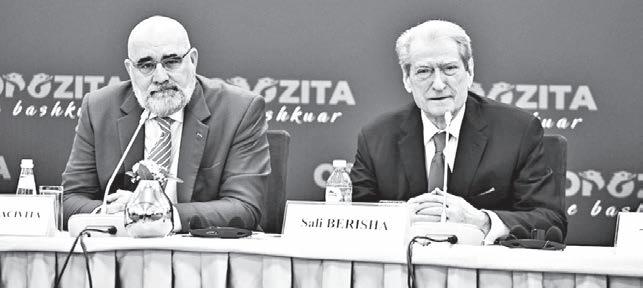
The trio is working for former prime minister and president Sali Berisha, the head of Albania’s opposition Democratic Party, who is challenging Prime Minister Edi Rama to return the Democrats to power, even as he awaits trial on corruption charges.
“It’s the only Democrat Party I would ever consider working for,” quipped LaCivita as he headed to the country for his third trip before Sunday’s election.
Berisha, who is hoping the new administration will reverse sanctions barring him from entering the US, has also signed a two-year, $6 million contract with Continental Strategy, a Republican consulting and lobbying firm. Its staff includes Katie Wiles, the daughter of White House chief of staff Susie Wiles, who along with LaCivita, led Trump’s campaign. Katie Wiles is not involved with the client.
Foreign consulting has long been a popular way for US strategists from both parties to rake in cash between election cycles. But Berisha’s decision to lean on Trump hands—and to highlight their involvement—makes clear how valuable they can be to candidates trying to harness populist sentiment and replicate Trump’s rise. In Albania, like many other
countries, being seen as having close ties to the US and its leaders is also considered a major asset.
Rama has his own connections with Trump allies. In December, Rama’s Cabinet approved entering into negotiations with Atlantic Incubation Partners LLC, owned by Trump’s son-in-law Jared Kushner, for development of a $1.6 billion luxury resort on the small island of Sazan.
The Strategic Investment Committee awarded Kushner’s company the status of strategic investor for 10 years.
There’s more at stake than just an electoral victory THROUGHOUT the campaign, Berisha has cast himself as a Trump-like figure and the victim of a politically motivated scheme that he blames in part on the US billionaire George Soros, a booster of liberal causes around the world and longtime foil of conservatives. He launched his campaign with a promise to “Make Albania Great Again,” but later had to change the slogan amid concerns that it could be misinterpreted as a reference to “greater Albania” and spark confrontation in the western Balkans over fears some in neighboring countries have about Albanian expansionism.
The campaign now vows to make Albania “grandiose”: “madheshtore” instead of “e madhe.”
Like Trump, Berisha also has his own signature campaign hat—a blue one that features the No. 1, the Democrats’ ranking on the ballot.
While recent elections in Canada and Australia have demonstrated the power of backlash against candidates deemed too aligned with Trump, in other countries those ties have been a major boon. In Argentina, Javier Milei swept to power with a “Make Argentina Great Again” slogan and Trumpian flair.
And in El Salvador, President Nayib Bukele has become one of Trump’s strongest allies, agreeing to detain US deportees in his country’s notorious terrorism
megaprison.
Will new consultants deliver a long-sought victory?
BERISHA’S party presents its hiring of Trump campaign staffers as a major coup. The Americans, they say, have been working on all aspects of the campaign, from strategy to messaging and public communication.
LaCivita “managed one of the most spectacular campaigns in the political history, making president a politician who had all against him, media companies, exit poll companies, NGOs, etc, to a certain extent the same situation with the opposition and its leader here in Albania,” the party said in a written response to questions from The Associated Press.
Albania’s Democratic Party and US Republicans are “natural allies,” they added, since both are “against the woke culture and support family and free market too.”
LaCivita has been featured in Democratic social media posts and appeared at a series of events in the country and abroad, including a rally where he took the stage to the Village People’s “YMCA,” Trump’s signature walk-off song.
“Who is ready to make Albania great again?” he boomed as he opened his speech—notwithstanding the concerns about referencing “greater Albania.” (Other times, he goes with “Make Albania magnificent.”)
Rama, the Socialist Party leader, derisively calls Berisha a “swamp owl” and frequently criti -
cizes the Americans’ involvement, with LaCivita even featured in a negative ad.
The Democrats have not disclosed how much LaCivita is paid, but said “his payment was done in line with the law and the election rules, here in Albania and in America” and that the contract would eventually be made public.
LaCivita has stressed he is being paid solely to advise the party and that he is not lobbying officials in the US.
Manafort, they said, is part of LaCivita’s team as “a friend and collaborator, and he has been in Tirana at that capacity.”
Manafort was charged in 2017 by special counsel Robert Mueller’s team with, among other things, concealing from the US government lucrative political lobbying work he’d performed on behalf of a pro-Russia party in Ukraine. He was convicted of multiple financial crimes and sentenced to prison but ultimately pardoned by Trump.
Hiring a lobbying company, aimed at lifting Berisha’s ‘non grata’ designation
In addition to the campaign help, in late April the Democrats signed a $250,000-a-month lobbying contract with US-based Continental Strategy to help them establish relationships in the executive and legislative branches, and to promote democracy, anticorruption initiatives and governmental reforms, according to the company’s filing with the Department of Justice under the Foreign
Agents Registration Act.
The firm is led by Carlos Trujillo, a longtime Trump ally who served as US ambassador to the Organization of American States during Trump’s first term and whom Albania’s Democratic Party has touted as “President Trump’s lawyer and as a staunch anti-communist in his stand!” Trujillo is working on the contract with the firm’s managing partner, Alberto Martinez, who served as nowSecretary of State Marco Rubio’s Senate chief of staff.
The arrangement has raised eyebrows in Albania and triggered an investigation by Albania’s SPAK, the Special Structure Against Corruption and Organized Crime.
The firm is being paid by the “Make Albania Great Again Foundation,” a newly created nonprofit founded by Nuredin Seci, an Albanian American contractor from New Jersey, with what is supposed to be money collected from the Albanian-American community.
Seci did not respond to questions about the foundation and where the funding had come from sent to his Facebook account. Numbers and an email address associated with Seci appear to have been disconnected.
Melissa Stone, a spokesperson for Continental, said, “Our work is being funded by an AmericanAlbanian businessman and active leader in the Albanian-America diaspora who loves America and loves Albania.”
That includes trying to lift the sanctions on Berisha, who was barred from campaigning in the US, where many Albanian expats live.
“As part of our work to improve bilateral relations between Albania and the United States, we are actively petitioning the Trump Administration to launch a fullscale review and reversal of the Biden-era weaponization of Section 7031(c) against conservative, pro-American leaders, including President Sali Berisha,” she said in a statement.
In May 2021, former Secretary of State Antony Blinken sanctioned Berisha for alleged “significant corruption” and barred him and his wife and children from entering the US. Britain did the same a year later. Blinken said that during Berisha’s 2005-2013 tenure as prime minister, the politician “was involved in corrupt acts, such as misappropriation of public funds and interfering with public processes, including using his power for his own benefit and to enrich his political allies and his family members,” which Berisha denies.
Last year, Berisha was charged with corruption for an alleged scheme in which he helped his son-in-law privatize public land to build apartment buildings in the capital, Tirana. The trial has yet to start.
Berisha told Albanian media in January that he considered Trump’s election “a miracle for humanity” and said that he would ask the new administration to review his designation as a “persona non grata” and demand that it be changed.
LaCivita has called Berisha “a true friend of the United States.” And he has drawn parallels between Trump and Berisha, casting both as having been “unfairly prosecuted and persecuted by a government that has no regard for Democracy.”
LaCivita has acknowledged Berisha’s decision to promote his involvement is different from other foreign clients who prefer more discretion.
“That’s one place where you know, America meddling in their elections is encouraged, right? Everywhere else, not so much,” LaCivita said in a conversation with journalists posing as potential clients that was published by The Guardian.
CHRIS LACIVITA , who served as co-campaign manager of Donald Trump’s successful 2024 presidential campaign, attends a news conference with Sali Berisha, leader of Albania’s main opposition center-right Democratic Party that he is consulting for in the upcoming May 11 parliamentary election, in Tirana, Albania, February 10, 2025. AP
Rooting literacy Taiwan dollar’s stunning rally
spells trouble for tech, insurers
By Charlotte Yang
ASURGING Taiwan dollar is aggravating concerns about the competitiveness and earnings prospects of local firms that form the backbone of global tech supply chains.
The currency’s biggest single-day surge since 1988 on Monday has further eroded the relevance of an upbeat results season that preceded Donald Trump’s punishing tariffs. Of the 205 Taiwanese companies that had reported first-quarter earnings, more than half of them beat estimates, according to a Goldman Sachs Group Inc. note last week.
The island, which Morgan Stanley estimates to have the widest revenue exposure to the US among emerging markets and Asian peers, is particularly vulnerable to higher tariffs and excessive currency appreciation. The Taiwan dollar’s unexpected strength bodes ill not just for exporters but also for local insurers with massive, largely unhedged holdings of US assets.
“Since March, negative earnings revisions in Taiex have been linked to revised global growth outlook, which would impact sales of export industries, especially in the indexheavy technology sector,” William Yuen, an investment director at Invesco Hong Kong Ltd. said, referring to Taiwan’s stock benchmark. “The recent strength of TWD, if sustained, would temporarily add more headwinds to earnings.”
The 12-month forward consensus earnings estimates for Taiex have dropped about 1% since end-March. The index has fallen 11% this year, making it the second worst performer in Asia behind Thailand’s.
Semiconductor
THE island’s semiconductor sector—featuring the world’s leading contract chipmaker Taiwan Semiconductor Manufacturing Co. and other suppliers to tech behemoths like NVIDIA Corp. and Apple Inc.— are the most exposed to currency risks given their heavy dollar revenue base and predominantly local manufacturing.
“Most companies do not practice much FX hedging given the cost of hedging has historically been seen as more expensive over the cycle,” JPMorgan Chase & Co. analysts including Gokul Hariharan wrote in a note. “We believe that the ~10 percent TWD appreciation in the last one month is likely to have a negative EPS impact of 4 percent to 10 percent if it persists through the year.”
TSMC has recently said that for every 1 percent appreciation in the Taiwan dollar, its operating margin declines by an estimated 0.4 percentage point, according to a local report. Over 90 percent of the company’s sales are generated outside of Taiwan.
The island’s semiconductor sector—featuring the world’s leading contract chipmaker Taiwan Semiconductor Manufacturing Co. and other suppliers to tech behemoths like NVIDIA Corp. and Apple Inc.—are the most exposed to currency risks given their heavy dollar revenue base and predominantly local manufacturing.
Within the sector, companies that design and market chips such as MediaTek Inc. may be less affected as their revenue and cost of goods are in dollars, according to a note from UBS Group AG. Foundries and outsourced assembly and test vendors like Win Semiconductors Corp. and ASE Technology Holding Co. may take a bigger hit, the note said.
Life insurers
THE Taiwan dollar’s gains has also put the island’s insurance firms in the spotlight, thanks to their huge pile of US Treasuries and corporate debt. Their relatively low currency hedging ratio—averaging less than 60%, according to HSBC Holdings Plc calculations—is raising questions around the fate of US bond holdings that make up over half of their overseas investments on average.
The insurers, which have benefited from a strengthening greenback in recent years, are at risk of a financial hit, facing potential foreign exchange losses in their NT$23 trillion ($767 billion) of foreign assets. Much of their investments concentrated in US bonds.
While the financial regulator has assured that insurers are safe from immediate insolvency or liquidity issues, their earnings prospects are looking grim. The companies would be locked in a weak dollar if they add hedges now, while doing nothing exposes them to further foreign exchange losses, according to Bank of America.
To be sure, there are also likely beneficiaries of a stronger Taiwan dollar, such as the island’s food and beverage makers and petrochemical firms, due to their input costs in foreign currencies.
“While movement in TWD is a factor to consider, underlying sales are usually more important to underlying fundamentals,” Invesco’s Yuen said. “If global growth turns out to be less negative than initially expected, stronger sales could offset the impact of a stronger TWD.” With assistance from Betty Hou /Bloomberg
ITito Genova Valiente ANNOTATIONS
T is easy to be hysterical about the news that millions—18 to 19 million—of our high school students graduate without being literate. Upon release of the said news, one could only marvel at how the blame game began. If we were overwhelmed by the crisis, then it was understandable how we hastily looked around and started pointing accusing fingers at everyone except ourselves. The usual tack was to claim that “our generation” was better than this, the present victims of functional illiteracy. We are all aware of this tendency to paint some glorious golden age for our batch, in the process blatantly displaying ignorance about how eras differ from each other, how conditions for each decade vary not only in terms of politics but also in the disequilibrium and social neurosis of that period.
Quoted and perhaps altered already in the spread of this quote is this principle attributed to PISA (Programme for International Student Assessment) OECD (Organisation for Economic Co-operation and Development), which says: “The quality of a system cannot exceed the quality of its teachers.” I like this principle because it stops us from infinite regression, from endlessly searching for the flaw in a system until you reach a tabula rasa, a blank slate and you cannot proceed anymore. Then we are back in the EDCOM, the Part 2 Report, which I started discussing in last week’s Annotations.
The report does not flinch when it singles out nutrition in the early stage of child’s development as one root cause of what will turn out to be weakness in accessing education. I have actually skipped many processes when I made that conclusion because when we look at the report, it states how nutrition-specific interventions in the Philippines for children below 5 years of age follow global standards and yet in practice has been “fragmented.” The report also discloses how coverage of the same has remained “low” and targeting of interventions “weak.”
The report cites data from the Department of Education (DepEd) school-based feeding program that
indicate how at most 30 percent of learners fall back to become “wasted” and “severely wasted” despite months of interventions.
The document has clear policy recommendations:
“To resolve challenges in nutrition in the early years, strong collaboration, equitable resourcing, and clear accountability across the ECCD Council, DepEd, DOH, NNC, DSWD, and LGUs are imperative.” It is easier to talk about this collaboration but we wonder how this is accomplished and what technologies are in place to effect the same. From nutrition, the intervention focuses on early childhood education (ECE). The document is candid when it writes how “early childhood is not equally accessible throughout the country.”
This conclusion happens in the face of Republic Act 6972 of 1990, which required that each province, city, or municipality should establish a day care center in every barangay. Again, data from the DSWD and Early Childhood Care and Develop -
ment (ECCD) Council show that only 36% have at least 1 child development center (CDC) per day care. To clarify, this means 15,207 barangays out of 42,027 in the country. Articulated, the lowest coverage of CDCs can be seen in Region VIII, with only 479 recorded CDCs out of 4,365 barangays (11%), and in the Cordillera Administrative Region, with only 152 recorded CDCs out of 1,178 barangays (13 percent). It is significant to note what the report describes as “extreme discrepancies” existing with first-class municipalities having up to 6 centers for every 10,000 children aged 3 to 4 versus 1 to 2 only in sixth-class municipalities.
Structured inequality continues in the field of early-child education.
While we are not sparing the family and the parents as having a stake in early childhood education, it is imperative to turn our gaze back to the teachers. The report has this to
Although it is the party-list organization as a whole that should be evaluated by the electorate, it cannot be denied that the identity of the nominees remains a significant reference for voters without actually knowing it or its platform.
“The party list system is an attempt to introduce a new system of politics in our country, one where voters choose platforms and principles primarily and candidate-nominees secondarily,” said Supreme Court Senior Associate Justice Marvic Leonen in the 2013 case of Atong Paglaum, Inc. v. COMELEC (707 Phil. 454).
For DINK couples, having no children means more disposable income. While they may not be necessarily wealthy, these couples often get to save more and spend more on their personal growth. In fact, they are one of the biggest spenders in industries like travel, dining, and luxury goods, focusing mostly on experi-
Atty. Dennis R. Gorecho is a Junior Partner who heads the seafarers division of the Sapalo Velez Bundang Bulilan Law Offices. For comments, e-mail info@sapalovelez.com, or call 09088665786.
ences rather than possessions. With a more flexible lifestyle, DINK couples can travel more and be spontaneous with their decisions. Meanwhile, in terms of investing for a home, most DINK couples opt for luxury condominiums that offer lifestyle amenities rather than investing in spacious family homes. This enables developers to focus more on creating urban-based, compact spaces that offer better proximity to workplaces and access to modern
ABy Weilun Soon
FTER buckling under pressure from Beijing and Washington, the clandestine supply chain that carries Iranian crude to China is finding new workarounds.
A tanker identifying itself as Global discharged about 2 million barrels of Iranian oil at a port managed by a Chinese provincial government in late April, ship-tracking data show. However, the vessel was actually a very large crude carrier called Gather View that had been sanctioned by the US and took over the identity of a previously scrapped ship to evade a crackdown on the trade.
It’s the first time a so-called zombie ship was observed entering a government-run port in Shandong since the province, home to the world’s biggest buyers of Iranian crude, issued a directive forbidding sanctioned tankers in January. The move highlights the lengths Tehran and the teapots—independent Chinese refiners often working on extremely thin margins—are going to keep the trade alive.
The sale of Iranian crude to China
amenities and recreation. Also, with the expectation that no children will help them in their future trips to the doctor, insurance companie s target DINK couples, as they are likely to have more liquid assets to spend on services that offer long-term wealth creation and health plans. The rise of the DINK lifestyle may have a positive impact on the Philippine economy, given that the higher disposable income and savings will likely lead to increased consumer
is crucial to Tehran and a lifeline for Shandong’s private processors. In the past, it’s been facilitated by ship-toship transfers in the waters off Malaysia to avoid scrutiny and mask the origins of the cargoes.
A crackdown by the US—through successive rounds of sanctions—and China since January has now snarled the supply chain. Traders have since rushed to find privately run berths in China to receive sensitive cargoes, as well as sourcing the smaller tankers they are able to accept.
The delivery of 2 million barrels on a sanctioned VLCC to a government-run port goes against that trend. It’s a risky gambit: if discovered by authorities, the entire cargo worth about $120 million at the time could have been impounded. Furthermore, the port could have hit by Washington’s secondary sanctions—as happened in March to a
spending and investment for the country. Moreover, with the continued decline in fertility rates, the government can use the momentum to make a leap in its investment towards education, technology, and infrastructure, which are crucial in achieving rapid economic take-off, as demonstrated by neighboring countries like South Korea and Singapore. However, it is also worth noting that Filipinos perform a critical role in the global economy. The health-
Further details are alarming: of the 224 higher education institutions (HEIs) offering the Early Childhood Education teaching program, only 3,993 graduates have been produced since 2005, which is equivalent to about 80 annually. It appears, following the EDCOM II Year One Report Commission on Higher Education’s current undergraduate program in Early Childhood Education prepares graduates for 0-4 years old (this is Pre-Kinder) and Key Stage 1 (Kindergarten to Grade 3). Following Republic Act 7836 of 1994, Early Childhood Education graduates specializing in teaching 0 to 4-year-old children who want to take the Licensure Examination for Teachers must register for the Elementary Level exam, even if the said level covers competencies and learning areas for children beyond the early years (0–4). This, again, is a systemic crisis of sorts.
This section of Early Childhood Education closes with these items: 89 percent of child development teachers and workers hold nonpermanent positions and receive an average of P5,000 per month. Data from the DSWD show that 19 percent receive an honorarium of less than P1,000 per month. It concludes: “Worse, according to UNICEF, the average salary is P5,000 per month versus the starting salary of a Kindergarten teacher in DepEd of P27,000 per month.”
This report continues in the next column.
tell us about the quality of teachers handling Early Childhood Education: most of these daycare teachers are aging and lack training in early childhood education. Articulated, the report reveals how 52 percent have a college degree, with 17 percent possessing only a high school diploma. It seems Early Childhood Education has become a specialized field with a few having trained in the said discipline.
E-mail: titovaliente@yahoo.com
Zombie oil supertanker in China points to Iran trade workarounds
terminal in southern China that facilitated the trade.
“Iran needs to be creative because the pace for them to find new tankers cannot really match the pace of US sanctions,” said Muyu Xu, senior crude oil analyst at analytics firm Kpler in Singapore. “So that’s why we’re seeing them come up with this tactic.” Zombie ships, where a vessel signals itself as an already scrapped tanker, are increasingly being used to avoid sanctions, as law enforcement officials become more familiar with the usual tactics used by the dark fleet to deliver sensitive cargoes. At least four such vessels have featured in the Venezuelan oil trade, while late last year one was observed discharging at two ports in China.
The Gather View — identifying as Global—called at a berth in Dongjiakou belonging to Qingdao Port, which in turn is part of Shandong Port Group, on April 25, according to data from Kpler and Bloomberg. It appears to have carried out a similar run in March.
Shandong Port Group didn’t respond to an email seeking comment.
care systems in the USA and Europe, for instance, have relied heavily on nurses from the Philippines, resulting in a steady flow of OFW remittances. This is equivalent to about 8 percent of the country’s gross domestic product. While the DINK lifestyle can offer numerous benefits to its recipients and, potentially, to the economy, it remains to be seen whether such a lifestyle is indeed sustainable. Some consider it as temporary, being a strategic response to economic uncer-
There’s no clear evidence of willful wrongdoing in port-inspection procedures but “there may be some loophole in terms of scrutiny,” said Kpler’s Xu.
The Gather View was sanctioned by the Treasury Department in December under its former name, MS Angia, for being involved in the Iranian oil trade. It’s flying the flag of San Marino, took its cargo from another tanker owned by the National Iranian Oil Company through an at-sea transfer near Malaysia, and has since returned to that area, data show.
The original Global—a floatingstorage unit for crude—was sent to the breakers in Bangladesh in late 2021. That vessel wasn’t sanctioned by any government. Smaller cargoes on sanctioned tankers are still reaching China’s private ports, including a terminal at Dongying recently spun off from Shandong Port Group that has become a go-to spot for sensitive shipments. However, those workarounds aren’t as cost-efficient as those done through official ports that can receive larger VLCCs. Bloomberg
tainty. Others, like Japan and South Korea, who have long struggled with their ageing population and low fertility rates, are faced with impending strains in their labor markets, as well as pressure toward increasing government expenditures on pension and health services for their ageing societies.
Drop in power spot prices cuts ACEN income
By Lenie Lectura @llectura
ACEN Corp.’s earnings for the first quarter dropped 28 percent year-on-year to P1.95 billion due to lower spot market prices and generation output.
There was a slowdown in Philippine renewable energy (RE) generation recorded at 489 gigawatt hours (GWh), a decline of 14 percent year over year. This was due primarily to the lingering impact of Typhoon Marce in November 2024, which caused several turbines, now under
repair, in the 160 MW Pagudpud Wind and 70 MW Capa Wind farms to cease operations.
The Philippine business also saw weaker solar resource in the period, mitigated by the full energization of the 60 MW Pangasinan Solar project.
“ACEN’s first quarter financial performance was impacted by a decrease in generation in its home market, the Philippines, lower prices in the country’s Wholesale Electricity Spot Market (WESM), and higher depreciation and interest bookings with more plants coming into op -
eration,” it reported to the stock exchange Thursday. Despite a decline in Philippine RE generation, total attributable renewables output grew 3 percent year-on-year to 1,680 GWh. Of which, ACEN’s international portfolio generated 1,191 GWh of RE, a 13-percent increase over the first quarter of 2024, driven by the full contribution of plants which began operations last year.
Out of ACEN’s 7GW portfolio, 3.6 GW is now operational while 2.6 GW of assets are under construction globally, while committed capacity,
composed of projects with signed tenders or agreements that await construction, stands at 823 MW.
For its international power generation business, particularly in Australia, ACEN recorded attributable revenues of P823.5 million and attributable EBITDA of P625.0 million, a decline of 14 percent and 31 percent, respectively. This was primarily because of lower generation, due to diminished irradiance and colder than expected temperatures, from New England Solar, as well as reduced Large-scale Generator Certificate (LGC) prices. Meanwhile, Stubbo Solar began injecting power to the National Electricity Market, contributing to an 8-percent overall growth in year-on-year generation of the overall Australia business to 282 GWh. Construction of the remaining 150 MW of the New England Battery Energy Storage System project has also begun.
Indian operations recorded 22 percent growth to 217 GWh, due to the strong contribution of Masaya Solar, which was still ramping up generation in the year ago period. Likewise, attributable revenues grew 24 percent to P398.3 million, while attributable EBITDA grew 15 percent to P308.2 million.
ACEN and its partners continue to see progress on the sizeable project pipeline in the country, with the 405
MW Tejorupa Solar and 102 MW Bijapur Wind projects receiving notices to proceed in the quarter.
In Vietnam, attributable output grew 29 percent year-on-year due to stronger wind resource, the full operations of the Lac Hoa and Hoa Dong Wind Projects and ACEN’s increased stake in the BIM Energy Holdings platform. Attributable revenues grew 13 percent to P2.2 billion while attributable EBITDA improved 22 percent to P1.9 billion. In Indonesia, ACEN said its assets continued to provide stable returns from the Salak and Darajat Geothermal plant, now augmented by the 15-MW Salak Binary plant. Construction also commenced on the 40-MW Salak Unit 7 expansion. In the US, repowering work on the 129-MW Stockyard Wind was completed in March.
“ACEN’s first quarter results reflect some of the challenges of scaling renewables. The company is strengthening its balance sheet with the planned equity infusion to ensure that we remain strong amidst these challenges and sustain our growth initiatives in line with the global energy transition,” said Eric Francia, ACEN President and CEO. Meanwhile, ACEN CFO and Strategy Officer Jonathan Back said the company will continue to expand its operating capacity as it moves past the headwinds in the first quarter.
Banking&Finance
Outstanding loans grew at slower pace in March
By Reine Juvierre Alberto @reine_alberto
DESPITE ample money supply in the Philippine financial system, lending activity of banks moderated in March, according to the Bangko Sentral ng Pilipinas (BSP).
Preliminary data from the BSP showed that outstanding loans of universal and commercial banks (UKBs) grew by 11.8 percent yearon-year in March. However, this is slower than the 12.2-percent growth in February. On a month-on-month seasonally-adjusted basis, outstanding UKB loans rose by 0.9 percent. Broken down, outstanding loans to residents grew by 12.3 percent in March, lower than the 12.6 percent expansion in February. Outstanding loans for production activities also expanded at a slower pace, at 10.9 percent in March after growing by 11.2 percent in February.
The central bank said loan growth eased to a slower expansion in lending to key industries such as: real estate activities (9.6 percent); wholesale and retail trade, repair of motor vehicles and motorcycles (11.6 percent); information and communication (8.9 percent); construction (1.8 percent); arts, entertainment and recreation (12.6 percent); water supply, sewerage, waste management and remediation activities (12.9 percent); and accommodation and food service activities (19.3 percent).
Similarly, the expansion in consumer loans to residents moderated at 23.6 percent in March from 24.1 percent in February due to the increase in credit card loans, motor vehicle loans and salary-based general purpose consumption loans.
At the same time, the BSP said outstanding loans to non-residents decreased by 5.6 percent in March from 3.2 percent in February.
“Looking ahead, the BSP will ensure that domestic liquidity and bank lending conditions remain consistent with its price and financial stability objectives,” the central bank said.
Money supply
IN a separate report, the BSP said the money supply in the Philippine financial system amounted to P18.2 trillion as of the first quarter of 2025.
Domestic liquidity (M3) rose by 6.1 percent from the 6.3 percent growth in February 2025. On a month-on-month seasonally adjusted basis, M3 increased marginally by 0.7 percent.
Broken down, domestic claims rose by 10.4 percent year-on-year to P20.652 trillion in March from the 10.1 percent expansion in February.
Claims on the private sector grew by 11.5 percent in March, lower than the 12.3 percent in the previous month, with the sustained expansion in bank lending to non-financial private corporations and households.
Meanwhile, net claims on the central government jumped by 8 percent from 5.9 percent due to higher borrowings by the national government.
Net foreign assets (NFA) in peso terms rose by 2.5 percent year-onyear in March, also lower compared to the 5.8 percent growth in February. Foreign assets of the BSP expanded by 4.5 percent, reflecting the increase in gross international reserves relative to a year ago.
The BSP said the NFA of banks declined mainly due to higher foreign currency-denominated bills payable. “The BSP will continue to ensure that domestic liquidity conditions remain consistent with the prevailing stance of monetary policy, in line with its price and financial stability objectives,” the central bank said.
Banker bonuses set to drop as tariffs cause uncertainty
THE outlook for some Wall Street bonuses looks grim, with an expected pullback in payouts after a strong 2024 amid economic turmoil caused by the US trade war and geopolitical tensions. Investment bankers, hedge fund employees and asset- and wealthmanagement professionals are all poised to see lower year-end incentive pay in 2025, according to a report Thursday from compensation consultant Johnson Associates Inc. It’s a sharp reversal from last year, when payouts swelled and industry profits soared.
“We started 2025 with momentum and optimism, which has quickly changed,” Alan Johnson, managing director of Johnson Associates, said in an interview. “Now the expectation is pay will be down, moderately, off of a high level.”
The forecast follows a chaotic period sparked by President Donald Trump’s tariff turmoil, which has crimped demand for deals. But that same volatility has fueled demand for trading, potentially driving bonuses for equity traders up between 15 percent and 25 percent. Their fixedincome counterparts could see a more modest increase, of 10 percent to 20 percent, according to the report.
“Some of the traders at big banks are having great results, benefiting from the volatility,” Johnson said. For others, the level of uncertainty is “not good, given most of financial services needs stability.”
The tariff turmoil is likely to keep volatility elevated and companies on the sidelines. Because of that, the projected surge in merger-and-acquisition activity, spurred by a presidential administration billed as business-friendly, hasn’t materialized. Advisory-sector bonuses are set to fall as much as 10 percent this year as “expected M&A ‘mania’ disappoints,” Johnson Associates said in its report.
Corporate clients have also pulled
Banks urged to step up vs social media use for financial research
By Reine Juvierre Alberto @reine_alberto
AS more consumers prefer social media and its online variants in researching and purchasing financial products, banks must advance financial literacy while leveraging technology to prevent risks, according to executives of the Kearney Group.
User’s predilection for gathering data on financial products in social media platforms was flagged in a research by Kearney’s Asia-Pacific office. The A.T. Kearney Holdings Ltd. study showed consumers in the Philippines and Japan use social media, messaging services and banner advertisements in researching and purchasing financial products.
“This can be a significant risk, and banks need to put in guardrails,” Kevin Kwek, partner and head of Financial Institutions Group-Southeast Asia, told the BusinessMirror. Scams, which are increasing in sophistication, as well as promises of returns and even misguided influencer roles, pose risks to this development, Kwek added.
Kearney Senior Partner and Philippines Country Head Marco de la
Rosa told this newspaper that Filipinos are vulnerable to these scams as they “spend the most time online globally and are among the top users of social media.”
Nonetheless, de la Rosa said around 60 percent of Filipinos still are concerned about the veracity of the information they are obtaining online.
He cited the Bangko Sentral ng Pilipinas (BSP) in saying “that we’re among the bottom 30 percent of countries in terms of financial literacy.”
“And those in lower income brackets are most vulnerable to promises ‘too good to be true,” according to de la Rosa.
One way could be for financial institutions to put warnings and place-based education through their
NDC receives final payment for Pandacan lot after 7 yrs
platforms, and use it as a way to bring in customer relationships, such as through investment education seminars, Kwek said.
No control
ACCORDING to De la Rosa, this issue could be addressed by more education, such as teaching financial literacy and critical thinking among young Filipinos. He added there’s also a need to ensure that operators of online social media hubs work with private and public entities to more proactively label questionable content.
“But not as much can be done over media the banks have no control over, and as such, regulators have a role to play too, to educate the general public as well as ensure banks have minimum standards and practices,” Kwek said.
Kearney said the use of social media in research and purchasing financial products will “grow rapidly” over the next five years to a decade, particularly in the research phase, given the widespread use by the younger tech-native generation.
The challenge now is for banks to learn how to engage potential customers directly on these platforms and then bring them onto their own sites to complete the transaction.
The study also found that the Philippines has a high proportion of unbanked citizens at 48 percent as of 2024, while the number of physi-
cal bank branches grew 8.5 percent from 2019 to 2023.
Physical branches
KEARNEY expects that physical branches will continue to play an important role in the Philippines, while paper-based cash payments remain dominant.
“There is a fundamental need to educate the unbanked about the benefits of banking and for banks to make banking as compelling and easy for this segment as possible,” de la Rosa told the BusinessMirror
This could begin with physical interactions at branches or in the communities where they live and making the financial products “fitfor-purpose,” such as through seasonal business loans, marriage loans and others that are “pocket-sized.”
“From here, to drive digital banking penetration again requires education and enablement,” de la Rosa said. Apart from teaching how to use technology and creating trust in the platforms and understanding the benefits, such as convenience and speed, platforms must be accessible through whatever devices or digital infrastructure are available in the communities, de la Rosa said. Kwek added that smartphone penetration, general adoption and payments as an anchor could drive digital adoption in the country, as more Filipinos embrace digital banking alongside the rise of e-commerce.
Mother’s day and associations
Hback on stock sales amid the equitymarket volatility. Bankers who help companies raise equity are likely to see the steepest drop in payouts—of as much as 20 percent, Johnson said. Strong demand for wealth-management services could also be countered by market declines, causing incentive pay in that business to fall as much as 7.5 percent, according to Johnson Associates. Similarly, those working in asset management could see a decline of 5 percent to 10 percent on the back of market declines and equity outflows.
Last year, Wall Street bonuses swelled, with the total pool for payouts jumping to a record $47.5 billion as industry profits soared, according to estimates by New York State Comptroller Thomas DiNapoli. The average annual bonus rose by almost a third, to $244,700, the first significant increase since the Covid-19 pandemic.
Given it’s still early in the year, forecasts can change, especially if questions are resolved around the economy, tariff negotiations and the Federal Reserve’s path toward lower interest rates. Some businesses will be more affected by uncertainty than others, including retail and commercial banking. Employees in those fields could see their bonuses down 5 percent to 10 percent, with lending activity lower and provisions for credit losses higher, Johnson Associates said.
Bankers had high hopes that Trump’s plans for tax cuts and doing away with large swaths of regulation would unleash a wave of dealmaking and capital-markets activity. Now, most of the financial industry will be disappointed with their bonuses if the economic uncertainty and market volatility remain, Johnson said.
“This was finally going to be their year,” he said. “Then the rug gets pulled out from underneath them.” Bloomberg News
THIS undated photo courtesy of the National Development Co. (NDC) shows NDC General Manager Saturnino H. Mejia (6th from left), Toll Regulatory Board (TRB) Executive Director Alvin A. Carullo (7th from left) and NDC and TRB staff during a ceremony for the actual collection of payment to the NDC. CREDIT: NATIONAL DEVELOPMENT CO.
By Andrea E. San Juan
THE National Development Co. (NDC) anno unced last Thursday of having received the final tranche of payment from the Toll Regulatory Board (TRB) for a portion of its property in Pandacan, Manila.
In a statement issued on May 8, the NDC said the collection was completed on April 30, 2025, seven years after negotiations started in 2018.
According to the government’s investment arm, the Pandacan property is a single 5-hectare parcel of land, 1.3 hectares of which were acquired by the TRB for the Metro Manila Skyway Stage 3 Project. Due to the construction of the Skyway, the parcel was segmented into three irregular fragments.
“The conclusion of this transaction between NDC and TRB forms part of the strategic infrastructure project of the national government,” NDC General Manager Saturnino H. Mejia was quoted in the statement as saying.
“The lengthy process resulted in a sale that reflects the market value of commercial properties in the Pandacan area,” Mejia added.
A person familiar with the transaction said the purchase
amount is around P400 million.
The NDC explained that the negotiations took time because of the considerations from different stakeholders involved.
“The successful conclusion of this transaction highlights NDC’s ongoing commitment to unlocking the value of government assets and reinvesting in projects that drive national development and long-term growth,” according to the NDC, a government-owned and –controlled corporation.
As the investment arm of the national government, NDC is mandated to “promote” economic development through equity investments, project development, and strategic asset management.
“With a focus on industrial innovation, renewable energy development, and inclusive infrastructure, NDC plays a vital role in implementing the country’s long-term development agenda,” the state-owned enterprise said.
As mandated in its Revised Charter (PD 1648), the NDC, may on its own or in joint venture with the private sector, undertake “vital projects” when necessary or when the private sector is not willing or able to undertake such projects due to high risks or to lack of funds/ resources.
APPY Mother’s Day! This day is a cherished occasion celebrated in many countries worldwide, honoring the invaluable contributions of mothers to society.
discussions and award ceremonies to celebrate entrepreneurial mothers who successfully balance their careers and family responsibilities.
While it is often marked by personal gestures of love and appreciation, associations also play a role in commemorating this special day. From professional organizations to charitable groups, associations leverage Mother’s Day as an opportunity to recognize, support, and uplift mothers through various programs and initiatives.
The modern celebration of Mother’s Day traces its roots back to the early 20th century in the United States. Anna Jarvis campaigned for the establishment of the holiday in honor of her own mother, Ann Reeves Jarvis, a social activist who worked to improve public health and welfare. In 1914, US President Woodrow Wilson officially proclaimed the second Sunday of May as Mother’s Day, setting a precedent that was later adopted by many other nations.
The concept of honoring mothers predates this modern observance. In ancient Greece and Rome, festivals were dedicated to maternal goddesses. In England, “Mothering Sunday” was historically observed as a day when people returned to their “mother church” and spent time with their families. These traditions evolved over time, influencing the global celebration of mothers today.
Associations across different industries and causes have embraced Mother’s Day as an opportunity to highlight the importance of maternal roles and advocate for policies that support mothers. Here are a few examples of how associations celebrate and contribute to this occasion:
1. Professional and business associations. Many professional organizations recognize the contributions of working mothers in their respective fields. Women’s business associations, chambers of commerce, and industry groups often organize networking events, leadership summits, and recognition programs that highlight the achievements of working mothers. For example, the National Association of Women Business Owners (NAWBO) frequently hosts panel
2. Nonprofit and advocacy organizations. Nonprofit groups use Mother’s Day to advocate for policies that support mothers’ rights, including parental leave, childcare accessibility, and maternal healthcare. Associations like the National Partnership for Women & Families often run awareness campaigns highlighting the need for better workplace policies and healthcare benefits for mothers. Similarly, charitable organizations organize fundraising drives to support single mothers, victims of domestic abuse, and underprivileged families.
3. Healthcare and wellness associations. Medical and wellness associations take Mother’s Day as an opportunity to promote maternal health and well-being. Initiatives such as free health check-ups, mental wellness seminars, and breastfeeding awareness campaigns are common. The American College of Obstetricians and Gynecologists (ACOG), for instance, often publishes educational content focusing on maternal health issues during this time.
4. Community and social groups. Local community associations and religious organizations often arrange Mother’s Day luncheons, familyfriendly events, and volunteer-driven activities such as visiting nursing homes or organizing donation drives for mothers in need. These efforts help foster a sense of community and appreciation for mothers from all walks of life.
Mother’s Day is more than just a personal celebration; it is an opportunity for associations to recognize the critical role mothers play in society. Whether through advocacy, professional recognition, charitable work, or community engagement, associations have the power to make a meaningful impact on the lives of mothers.
Octavio Peralta is founder and volunteer CEO of the Philippine Council of Associations and Association Executives, the “association of associations. The views he expressed herein do not necessarily reflect those of the BusinessMirror. E-mail: bobby@pcaae.org.
Octavio Peralta
A ssociation World
Show BusinessMirror
Finding in films manners and mores
THE historian Mark Ferro has offered to ask the question: What kind of history or histories do films offer—an official history or one that runs counter to the regular histories being told about an event or era? Does this kind of history involve the remembering of a particular group of people, or is it a product of an autonomous analysis? While film journalists in general tend to locate histories in outstanding cinemas or those that are part of a canon, it is wise to consider the so-called ordinary films.We have to remember that, long before certain films have been canonized, the audience of the late 1940s and 1950s, have been consuming regular films. The consumers were regular individuals who were not affected by how certain films have acutely portrayed the total social facts but were seduced by the engaging entertainment value of the work.
Two films have enticed me to conduct this critical experiment: Tanikalang Apoy from Sampaguita Films and Tanglaw sa Dilim from SCG Productions. The film Tanikalang Apoy was released in 1959 and signaled a generation of stars that would soon be replaced in a few years or whose gravitas would grow through the decade. Paraluman gets top billing in the film, followed by Rita Gomez and then Lolita Rodriguez. Eddie Arenas is the leading man, with Eddie Garcia and Etang Discher completing the cast. Matimtiman Cruz, who later would languish in bumbling maid roles, occupy a serious character in this story based on the story by one of the mighty komiks writers of yore, Pablo S. Gomez. Unremittingly melodramatic from start to finish, Tanikalang Apoy acquits itself very well with the solid and stable direction of Jose de Villa. Lolita Rodriguez plays the role of a girl from the rural area who marries into an “eccentric family with sordid secrets” (as the logline goes). We would soon find out the family is no more eccentric than it is a household managed by a virago who merely reflects the cruelty of a structured
LOW KEY
THE actor is in his 30s but he once dated a girl who had just turned 19. He and that girl broke up. He is currently dating another girl, not from show business, who is around the same age. Sources said this is why he keeps his relationships low key because he doesn’t want people to talk about his private life. He isn’t the first actor known for dating women who are way younger. Another actor only dates women who are below 25 years old and that’s only now when people are scrutinizing age differences. He used to date minors.
SHE’S
A FIGHTER
NOW that the young actress is once again involved in a controversy, stories about her past fights with other artists have surfaced. There was allegedly an incident where she bullied another artist just because the dresses they were wearing to an event were similar. Another incident involved an influencer. It’s not clear what happened but the influencer swears that the young actress is not a good person, based on how she behaved with him. People say she likes to act nice in public and only shows her true self when fans aren’t around.
NO LONGER FRIENDS
THE two celebrities used to be really close with each other. It got to a point where the comedian became an unofficial family member of the young actress. They were seen everywhere together. But one day, the friendship seemed to have stopped. They never fought publicly nor did they unfollow each other but they were just no longer friends. The comedian reportedly took the side of the actress’ ex when they broke up. Pretty soon, the comedian became the best friend of a super popular actress.
THROWING
A TANTRUM
DURING a recent event, the live audience and those watching at home noticed how the performers seemed to be subpar. While it is true that the organizers booked singers that weren’t really great performers (and that is putting it mildly), the main singer should have been a beauty queen. However, the beauty queen backed out at the latest minute and the organizers scrambled to find a replacement for her. Tantrums aren’t new to this beauty queen. She seems to have a sense of entitlement and she doesn’t care if her behavior hurts or inconveniences other people.
inequality. For all the emotions running high among the characters, Paraluman and Rita Gomez and, of course, Lolita Rodriguez played their roles with such restraint and good taste that you believe whatever praises you read about these actresses long after they were gone. Even Eddie Arenas, who essays a simple role as the good son, has good taste all over his performance.
Gomez, the writer, was adventurous with his depiction of drug addiction and Rita Gomez showed us why she was always the daring thespian that admirers remembered her always. There are, however, two artifacts of filmmaking gracing this film. One is Etang Discher and the other is Bella Flores. I’d like to assume Jose de Villa need not direct Etang Discher (for the uninitiated, she was the mother of the great Panchito). The character actress simply has to pick from her arsenal of stares and imperious gestures to deliver the message of her person. Several times, the camera was trained onto those fierce eyes and were we terrified! But there is one directorial note in the film and this is in that scene where the character of Eddie Garcia is still asleep while Etang is already tapping her long fingers on the table, a warning that after a few seconds she herself is going to go to Eddie’s bedroom. But Bella Flores is there, also asleep. The temerity of this wench.
Indeed, Etang knocks on the door of Eddie’s room. Eddie scampers and wakes up Bella who, frantically, is pushed to hide inside the bathroom. But Etang turns the place upside down, and opens the bathroom door. I was expecting a comic relief—Bella cowering inside. But no, when the door to the toilet is flung aside, there Bella stands proud, all dressed up. She walks to the bed, sits down at its edge, and puts on her shoes. She is the only one who can stand up to Etang. She is our Bella Flores!
Tanglaw sa Dilim is one complicated and convoluted story. Complication is common but convolution is a
singularly admirable trait common among the stories of Susana C. De Guzman, one of the most prolific—if not the most—writers of Philippine movies. She wrote short stories and novels; she created screenplays; she produced and directed films. She did all those things and it still surprises me why she never became a National Artist in Film.
My interest in Tanglaw sa Dilim are twofold: one is how a film made in 1961 has leading characters with flaws—a trait most unusual in that period. In those days, you had leading ladies and leading men who were pure, and negative attributes were given to villains or contravidas. Another value of this film is how we have lost many manners and etiquettes that up to now are still distinctive contours in the depiction of family life in Asian films.
The film begins with two brothers played by Bernard Bonnin and Robert Campos (no need to quibble: the two are physically miscast as men from the rural societies). Bonnin is studying law in Manila while Campos remains in the village. The latter is not the favored son. In one of his trips back home, Bonnin encounters a pretty girl, Marita Zobel, but the meeting was not fruitful.
Zobel has a past: her mother is separated from Zobel’s father and the mother works in a nightclub. Campos falls in love with Zobel but the latter opts to join her mother in her work in the nightclub because the mother is sick. When the father of the two brothers goes to Manila to visit the successful son, this son introduces the father to his rich girlfriend as their farm caretaker.
Daring, the story as written by Susana C. De Guzman must have been quite a shocker in the early 1960s. The fluidity of the characters—from being good to one with questionable motives— is no more a function of a reckless plot than it is a mirroring of what was taking place in real life. Not everything was rosy, not even with girls with lovely, sweet voices. Or
boys with serious ambitions in life. Often, I have been asked if the Confucian ethos of respect for the elders had been lost in our culture. Tanglaw sa Dilim offers a peek into this lost trait when the elder brother—the Kuya—had as much authority as the father. There are also scenes of deep respect accorded to parents in the film, as when the son greets the father “Good evening” and even kisses the hand of elders before retiring to bed.
For the Bicolano, it would interest them to find out that long ago, the city of Legaspi was spelled with an “S” and that it took only 12 hours to travel by train from Tutuban to Daraga in Albay (if you are unlucky, it takes sometimes 12 hours or even more to reach Naga by bus from Manila). Interestingly, there was no attempt for some characters to speak a bit of Bicolano language to manifest the so-called local color. It would take regional cinema to insist on that trait. n
a price on loyalty. It is trait I should hope my friends also have and value.)
I could also relate to the limited series because the couples onscreen mirrored a few of my married friends and relatives. I found it hysterical that many of the couples’ individual behavior or actions together hit so close to home in the case of the couples I know, that all I want to do is tell the latter to watch the series. Would they see themselves in those couples onscreen, I wonder?
But The Four Seasons is not just about couples and friendships, but about love and loss, and how we each react or recover from them. It’s funny yet poignant—a series from which we can all learn. n
“IT TOOK ME 44 YEARS TO GET THIS,” SAYS MEL TIANGCO ON BEING NAMED MOST TRUSTED TV NEWS AND CURRENT AFFAIRS HOST
VETERAN broadcast journalist and 24 Oras anchor Mel Tiangco has once again proven why Filipinos turn to her for credible news. At the 27th Reader’s Digest Trusted Brand Awards on April 4 at Marco Polo Ortigas Manila, she was honored as Most Trusted TV News and Current Affairs Host— the latest in a string of recognitions that span her remarkable 44-year career. “Thank you for telling me here and now that I have been doing a good job,” Tiangco said upon accepting the award. Reflecting on two decades as the face of 24 Oras’ primetime newscast, she added, “It took me 44 years to get this. Forty-four years and my heart is filled with overwhelming happiness, joy and fulfillment at the thought that I have attained the ultimate achievement in my profession—to be acclaimed as the most trusted, having been determined solely by the general public.” Tiangco paid tribute to GMA Network and GMA Integrated News for fostering the high standards of trust and integrity she’s known for. “I am truly blessed to belong to an organization whose every member— from writers and reporters to technical crews—shares the same commitment to delivering truthful, relevant information to millions of Filipinos.”
As anchor of GMA’s flagship newscast 24 Oras and host of the long-running drama anthology Magpakailanman, Tiangco combines seasoned journalistic rigor with genuine empathy. She also founded and serves as ambassador for the GMA Kapuso Foundation, the network’s socio-civic arm. This Reader’s Digest accolade adds to an illustrious list of honors: n 2019 Rotary Peace Award, Rotary
International District 3830—first journalist recipient n Induction into the Anak TV Hall of Fame (Makabata Award) and EdukCircle Hall of Fame (Outstanding Journalist in Public Service)
n Multiple recognitions from the Philippine Movie Press Club, Soroptimist International, and the COMGUILD Center for Journalism
n Most Outstanding Female News Anchor, 7th Gawad Lasallianeta (January 2025)
n Community Impact Award, inaugural Babae Awards by WomenBizPH (March 2025)
GMA Network celebrates Mel Tiangco’s enduring influence on Philippine media— her professionalism and integrity continue to
and viewers alike.
Editor: Gerard S. Ramos
www.businessmirror.com.ph
Editor: Tet Andolong
Motoring
in the Philippine market, it sent a clear message that the German luxury car brand had charged its way into the country’s EV revolution and sustainable mobility initiative. The EQ model range, consisting of EQA, EQB, EQE, EQE SUV, EQS, and EQS SUV, leads the brand’s e-mobility charge in the country, offering a zeroemission and luxury-combined driving experience.
So, when Inchcape Philippines, the official distributor of Mercedes-Benz in the country, invited us to experience two of its EQ models for a quick out-of-town drive, there was no way we were turning it down. It was not the usual media drive with planned stops and activities but rather a relaxing drive down south for a coffee run. Yes, to swing by Forresta Café in Villar City, Dasmarinas, Cavite.
EQ stands for “electric intelligence”
TWO EQ models were commissioned, the EQB 250+ “Electric Art” all-electric subcompact crossover and the EQE 350+ “AMG Line” all-electric sedan. The name EQ stands for “Electric Intelligence,” we are up for what the luxury brand claims to encompass: all key aspects of customer-focused electric mobility that extend beyond the vehicle itself. Moreover, offering a comprehensive electric mobility ecosystem of products, services, technologies, and innovations.
ABehind the wheel of the “Electric Art”
coffee shop, wanting more from the exciting freeway drive.
infrastructure unit, has signed an Operations and Maintenance (O&M) Services Agreement with Korea Railroad Corporation (KORAIL), South Korea’s national railway operator, to support the next phase of MRT-7 as it moves closer to full operations.
“Under the agreement, KORAIL will continue its advisory role—helping guide the setup of MRT-7’s core operational systems, safety protocols, and maintenance programs. SMC MRT-7 Corp. holds the concession to build, operate, and maintain the MRT-7, which links Metro Manila to Bulacan via Commonwealth
“The
by
Hee, Vice Minister Baek Won Kug of Korea’s Ministry of Land, Infrastructure and Transport, and His Excellency Lee Sang-henwa,
IN this drive event, our group was assigned to the EQB 250+. Dubbed “Electric Art,” we could see where it originated when we boarded. Inside, the rose gold-colored elements and the backlit trim characterize the modern, high-tech ambiance. Design accents like tubular elements in an aluminum-look reinforce the solid, robust, high-quality overall impression.
Of course, highlighted are the two merged 10.25 bright screens forming a widescreen cockpit and displaying all drive information, including the power meter and other EV driving data. It even shows a 360-degree bird’s-eye view in
The EQB 250+ Electric Art variant dishes 188 hp and 385 N-m of torque. Thanks to these figures, 0-100 km/h is achieved in 8.9 seconds. It has a 4x2 (FWD) drivetrain using eATS (Asynchronous) transmission. HV Battery capacity is at 70.1 kWh with a maximum output of 260 kW. The AC Charging capacity is 11 kW, while the DC Charging capacity is 100 kW (CCS / Type 2 charging cable). The total electric range is between 422 – 473 km (WLPT). On the other hand, the EQE 350+ AMG Line variant dishes out 288 hp and 565 N-m of torque, achieving 0-100 km/h in 6.4 seconds. It has a 4x2 (RWD) drivetrain using eATS (Asynchronous) transmission. Its HV Battery capacity is at 90.5 kWh with a maximum output of 375 kW. The AC Charging capacity is 22 kW, while the DC Charging capacity is 170 kW (CCS / Type 2 charging cable). The total electric range is between 644 – 682 km (WLPT).
Ambassador of the Republic of Korea to the Philippines. The Department of Transportation was represented by Undersecretaries Giovanni Lopez, Timothy John Batan, and Jonathan Ronulo.
“The engagement starts in July 2025, with the first six to 12 months focused on completing pre-operational requirements and stabilizing key systems.
“This is a critical step as we move closer to delivering MRT-7 to the public,’” said Ang. “We have faced delays—mostly due to right-of-way issues—but we have stayed focused. With all trains expected to be running and tested by the end of this year, and full operations targeted for 2026, this partnership with KORAIL brings us closer to our goal.”
“KORAIL operates South Korea’s extensive rail network, including the high-speed
parking mode. Of course, there is the MBUX Multimedia System functioning by simply saying “Hey Mercedes.” Thanks to the brand’s unique electric seat adjustment on the side door panel, finding the perfect seating position and vantage point was easier.
The convoy left the dealership along Greenhills EDSA during the morning rush hour. Despite the messy traffic situation, everything inside was impressively tranquil. The thermotronic A/C system was cold enough to relax all four of us while slicing through the crowded lanes. You know you are inside a Mercedes-Benz vehicle when everything inside is the opposite of the traffic mess on the road.
When we reached the freeway, that was when everything became bliss. With fewer cars, we were able to push the throttle. Here was when the vehicle’s pure electric
KTX system, metropolitan commuter lines, and intercity services. It is recognized globally for its strong track record in safety, technology integration, infrastructure management, and workforce development.
Ang acknowledged the DOTr’s active, hands-on role in moving the project forward, led by Secretary Vince Dizon. “ This agreement brings together strong public and private sector efforts,” Ang added. “At San Miguel, we remain committed to building projects that not only improve everyday life for Filipinos, but also contribute to sustainable growth for our economy.”
“KORAIL officials described their renewed partnership with SMC as a ‘landmark of cooperation and mutual prosperity, enabling the Philippines’ premiere corporation to excel in the new arena of rail.”
“I am confident that the fusion of
power took over. Dishing out 385 N-m of torque, we felt that Mercedes-Benz was modest with the declared figure. Because the instantaneous acceleration, whenever we step on it, felt otherwise. The power output made the four adult occupants irrelevant. Even so, the regenerative braking was forceful enough that we almost did a “one-pedal” operation the entire time. That was not even touching the recuperation paddles to adjust the intensity.
Throughout the freeway run, the vehicle was well-planted and in control. We like the steering feedback, which delivers precise reactions even on sudden turns at highspeed limits, maintaining the vehicle’s form.
As a result, passing slower vehicles became a walk in the park. Then we reached the exit going to the venue, and still, everything was blissful until we finally reached the
KORAIL’s technical expertise with San Miguel’s managerial prowess will make MRT-7 the finest rail in the Philippines,” said KORAIL’s Han.
“The MRT-7 project is a 22-kilometer elevated railway that will connect North Avenue in Quezon City to San Jose del Monte, Bulacan, with 14 stations. Once operational, it is expected to significantly cut travel time, decongest major road corridors, and
Undoubtedly EQ-looking AT the coffee shop, we were able to appreciate the design more during the photo shoot. At first glance, one thing was evident and oozing: the characteristic black panel grille representing the EQ line with seemingly united high-performance LED headlamps. Also, the continuous light strip at the front and rear clearly shows the EQB as a member of the Mercedes-Benz EQ family. Those multi-spoke rims added to the sporty look of the crossover. Meanwhile, the EQE is one sleek-looking electric luxury sedan. Arranged beside the EQB during the photo shoot, its main characteristic feature is the striking onebow design - a coupé-like shoulder line that flows sweepingly from the rear to the front. It emphasizes typical EQ features, such as the three-dimensional MercedesBenz star pattern on the front. Seemingly united to the black grille are the digital light headlamps. The AMG Line touch even added a character to the electric business class look, complementing other design elements such as the seamless door handles and multi-spoke rims.
After the photoshoot, we returned to our assigned vehicles and took the same route to Manila. As passengers, we found the rear area spacious enough for tall guys. The seat has contours that are comfy enough to doze us off. Again, we encountered heavy traffic on EDSA, and as usual, it was negligible inside the EQB 250+. No wonder when we made it back to the Greenhills dealership, it was as if we had never driven at all.
Story & photos by Randy S. Peregrino
THE
China now on world snooker map
Sports
B8 Friday, May 9, 2025
mirror_sports@yahoo.com.ph
Editor: Jun Lomibao
Baylon’s wushu World Cup gold high on PSA’s top performers list
WUSHU’S Carlos Baylon Jr. led martial arts athletes in delivering the goods for the Philippine campaign overseas in April.
B aylon delivered a breakout performance in the International Wushu Federation 10th Sanda World Cup in Jiangyin, China, where he anchored a one-gold and two-bronze haul for the country.
Competing in the men’s 56kg class, Baylon upset of Macau’s Hio Lam Ku, a bronze medalist in the 2024 world championships, in the semifinals, 2-1, and sealed his biggest achievement to date with a 2-0 shutout of Uzbekistan’s Saydullo Abdurashitov in the final.
The roaring triumph earned for the proud son of La Carlota City the accolade as the Philippine Sportswriters Association’s top performer for the month.
Sambia’s Sydney Sy Tancontian and para taekwondo’s Allain Ganapin joined Baylon in the honor roll with Sy Tancontian reigning supreme in the Asia-Oceania Sambo Championships in Uzbekistan by beating
Mongolia’s Ser-Ochir Buyanzaya, 3-0, in the adult women’s +80 kgs division. Aislinn Yap of also ruled the women’s -80 kgs combat play and Richmond Revina clinched silver in the men’s -64 kgs SVI-1 sport category. Ganapin, a veteran of the Paris 2024 Paralympics, bagged the bronze medal in the men’s K44 -80 kgs category in the Seventh World
BIÑAN Tatak Gel leaned on Pamboy Raymundo’s clutch triples to subdue Pasig City, 7972, Wednesday night and continue its climb in the Manny Pacquiao presents 1xBet-Maharlika Pilipinas Basketball League 2025 Season at the Alonte Sports Arena in Laguna. Pasig City rallied to within 5962 early in the fourth quarter, but Raymundo drilled in three triples in a four-minute span to seal Binan’s fifth straight win for a 6-3 win-loss record in the round-robin elimination phase of the 30-team tournament.
Taekwondo President’s Cup–Asian Region in Tai’an, China. Filipino surfers also rose the occasion with a bronze medal finish at the World Longboard Championship in El Salvador highlifghted by Jay-R Esquivel’s third-place performance in men’s individual play.
Elsewhere, world No. 4 pole vaulter EJ Obiena booked a victory in Chinese Taipei while tennis sensation Alex Eala continued to make her mark in the Women’s Tennis Association.
Obiena overcame foggy conditions in clearing 5.50 meters to beat American Matt Ludwig (5.30m) in the Taiwan International Pole Vault Championship’s for the gold medal.
A fter her historic run in last month’s Miami Open spiked by stunning reversals over three Grand Slam champions, including world No. 2 Iga Swiatek, Eala cracked the top 100 at No. 75 from 140th and climbed to new h eights of 73rd and 72nd in April.
The 19-year-old Eala was the top seed in the Oeiras Ladies Open in Portugal where she reached the round of 32, then got off to a winning start in the WTA 1000 Madrid Open with a 6-3, 6-2 disposal of No. 64 Viktoriya Tomova of Bulgaria before bowing to Swiatek in the next round, 6 -4, 4-6, 2-6.
Nueva Ecija led the race for the playoffs with a 9-0 card, followed by San Juan (8-0), Pampanga (8-1), Abra (8-1) and Quezon Province (8-1). Veteran Jeff Chan fired 16 points, highlighted by four triples, in the first quarter to push Bi ñ an ahead, 25-15, from which Pasig couldn’t recover to suffer its fifth straight defeat after a 2-0 start.
C arlo Lastimosa added 12 points, including Bi ñ an’s last four, followed by Raymundo’s timely nine points, seven assists and six rebounds and Kenny Roger Rocacurva’s nine
points and nine rebounds. Pasig drew 17 points and six rebounds from Mark Montuano and 16 points, six rebounds and six assists from Christian Rivera, as well as 10 points and 10 rebounds from Warlo James Batac.
The Mindoro Tamaraws also sustained their gradual recovery with a 101-79 trashing of the Davao Occidental Tigers in the other game.
Powered by Joseph Sedurifa, Wendelino Comboy and Brandrey Bienes, Mindoro led as many as 10174 to climb to a 5-6 card with four victories in its last five games.
Eala shifts focus on doubles bid in Italian Open
ABy Josef Ramos
LEX EALA has shifted her focus in her team up with world No. 3 Coco Gauff in women’s doubles action on Friday at the Italian Open at the Grand Stand Arena of in Foto Italico in Rome.
E ala exited from the women’s singles competition of the WTA 1000 tournament following a 0-6, 1-6 loss to Ukraine’s Marta Kostyuk.
R anked No. 70 in the world— the first Filipino to break the No. 100 barrier—Eala, 19, and the 21-year-old 2020 Australian Open champion Gauff will square off with Fanny Stollar of Hungary and Alexandra Panova of Russia in a first-round action set at 9 p.m. in Rome (3 a.m. in Manila).
Eala won two top level doubles titles as a junior player—with Indonesia’s Priska Nugroho in the 2020 Australian Open and with Russian Oksana Selekhmeteva in the 2021 French Open.
The world No. 27 Kostyuk, 22, was aggressive from the onset and to win the first set at love.
Kostyuk was as fearsome in the second set and didn’t give Eala much of a chance to wrap up the match in one hour and three minutes.
S edurifa chalked up 23 points and eight rebounds, Comboy had 16 points and Bienes made 10 points to the delight of Mindoro Tamaraws team owner Mayor Jennifer “Ina” Cruz, who watched the games. Davao, which dropped to 3-3, got 16 points and five assists from Reymart Escobido, 14 points from homegrown Jansher Salubre and 10 rebounds and nine assists from Harold Arboleda.
T he Bataan Risers struck from afar and ruled the boards to rout the Marikina Shoemasters, 103-69, in the opener.
TAIPEI, Taiwan—Once considered a saloon or recroom past-time by many, snooker has long been serious business in the UK and much of the rest of the world.
Now, it seems, it’s China’s turn in the spotlight.
Zhao Xintong’s crowning as Asia’s first world snooker champion has put the focus on the growth of the sport in China in a relatively short time.
“There’s a new superstar of the game,” said Mark Williams, 50, the three-time World Champion from Wales who lost to Zhao in the final of the World Snooker Championship, held in Sheffield, north England, recently. “It could be huge for the sport.”
Brought to China by foreign traders in the 19th century, snooker suffered during the early Communist period, when all pastimes seen as individualistic, bourgeois and foreign were frowned upon.
T he first ranking event to be held in Asia was the Hong Kong Open in 1989 and the following year China hosted the Asian Open.
The death in 1976 of Mao Zedong, opened the doors for the sport and snooker has now moved from smoky backstreet parlors and outdoor shopfront street-side tables—amazingly kept level by the bricks they sat on—to swanky halls and practice venues.
Former world No. 1 Ding Junhui blazed the trail for Zhao and others like him, even as enthusiasm for the sport may be waning somewhat among a younger generation infatuated with e-sports and smartphone games.
Zhao himself may be the best thing to happen to China-British relations in recent years, with ties under pressure
Zhao owned up to knowledge of the what was happening, although he said he wasn’t directly involved and returned to the sport in September 2024 as an amateur, requiring him to battle his way back up the ranks.
Boost for snooker in China
DUBBED “The Cyclone,” Zhao Xintong now stands at 11th in the world rankings and his combination of youth and talent is being celebrated across the country. His expressions of disbelief at his world title was witnessed by millions of television viewers in China, with many praising him in online posts as the “pride of China” who “brought tears to one’s eyes.”
“I t’s worth celebrating in China,” said Tong Jianfeng, 29 and longtime fan of the game. “Through the whole process, Zhao Xintong played smoothly. His precision is impressive.”
Hu ang Siyuan, also 29, agreed, “It didn’t come easy. I feel proud for Chinese billiards.”
Wang Heng, the manager and founder of Beijing Xinrui Billiard Academy, located in Tongzhou, just outside the capital, said Zhao’s success will be positive for the domestic game.
“I believe this will make Chinese players very confident because they would realize the world championship is no longer something difficult to break,” he said. “They will be more and more sure of themselves.”
Zhao Xintong ‘on a pedestal’ THERE may already be more Zhao Xintong’sin the works. At this year’s world championships, 10 Chinese players qualified for the main draw and six made it into the final 16—the highest ever.
“Now this will give them [children in China] power and in the future many Chinese players can do this,” said Zhao covered in confetti and a Chinese flag after taking the title. International recognition will be crucial to the sport’s continued growth, according to Jason Ferguson, chairman of the World Professional Billiards and Snooker Association.
“The one thing we do know about China is that snooker is treated like any other major Olympic sport, it is on a pedestal, it does get major broadcast hours and it really is supported by government and education systems,” Ferguson told The Associated Press.
ZHAO XINTONG is now an inspiration in China, including eight-year-old Li Zelei, who practices on a pool table at the Beijing Xinrui Billiard Academy in Beijing. AP