chain choke points” brought about by the tariff pronouncements of Washington, according to supply chain experts.
“Maybe you are not feeling it because there is still inventory in the system. Wait until three to four or six months, you’ll start to feel it...increasing commodity costs, retaliatory tariffs being made by country to country,” Charlie Villaseñor, President of Procurement and Supply Institute of Asia (Pasia), said during the recent Philippines Logistics Summit 2025.
He explained that anything that happens in one echelon of the supply chain is going to create “significant” impact for many organizations, which will also lead to “continuing uncertainties and challenges.”
“We are all interconnected. Anything that happens in one echelon of the supply chain, either you’re on the
first tier, second tier or the third tier echelon, it’s going to create significant impact to many organizations,” Villaseñor said during the forum.
He explained that the rise in cost of goods may originate from what he called the “bullwhip effect.” “When businessmen are apprehensive, they stop. When they stop and they wait and see, the supply chain is not moving. So it creates a bullwhip effect,” said Villaseñor. This means, he said, “From the manufacturer down to the customer, some of them will tend to buy more or not buy at all.”
He also explained that the trend of repositioning manufacturing plants in some countries may push
By Bless Aubrey Ogerio @blessogerio
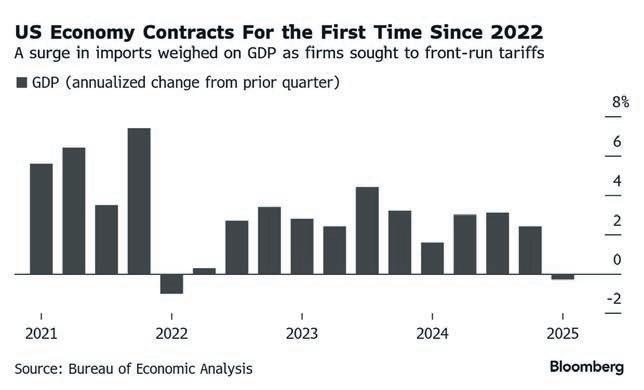
THE Philippine government is closely monitoring the potential impact of the United States’ economic contraction on the domestic economy, following a 0.3-percent annualized decline in their gross domestic product (GDP) in the first quarter of 2025.
“It’s really difficult to give an answer on the basis of a one-off change in the GDP,” Department of Economy, Planning, and Development (Depdev) Undersec-
By Cai U. Ordinario @caiordinario
MILAN, Italy—The Asian Development Bank (ADB) is increasing its financing for developing member countries (DMCs) by another $100 billion over the next decade.
In his opening address at the 58th Annual Meeting on Monday, ADB President Masato Kanda said the “additional headroom” will expand ADB’s operations by 50 percent in the next 10 years.
This means, ADB financing will increase to $36 billion a year for the next 10 years from the current $24 billion, which it announced in February 2025. Kanda said this
will allow ADB to better meet the needs of DMCs.
“We have created $100 billion dollars in additional headroom, which we will allow us to grow our operations by 50 percent over the next decade—from $24 billion to $36 billion dollars a year—to meet the rising aspirations of our developing member countries,” Kanda said. “Our ambition is not simply to grow bigger. It is to become more effective and more inclusive.”
The additional financing includes the $40 billion for food and nutrition financing that the ADB just announced on Sunday. (See: https://businessmirror.com. ph/2025/05/05/adb-hiking-
food-nutrition-funds-to-40b/).
The amount also includes the four-fold increase in private sector financing to $13 billion annually by 2030. The financing, Kanda said, will help support entrepreneurs, businesses, and investors for innovative business solutions.
“The region will not grow and add the millions of jobs we need without private sector development,” Kanda said. “Our job is to help unleash this potential, especially in the markets where it is needed most.”
The additional financing will also enable ADB to advance open regionalism efforts through digitalization; resilient infrastructure; cross-border energy and
transport systems; and greater cooperation.
The Manila-based multilateral development bank also intends to deepen financial integration by developing local currency bond markets, strengthening financial safety nets, and promoting seamless cross-border transactions.
“We are committed to strengthening governance and transparency. We know that development finance must not only be effective; it must be trusted. Strong safeguards, rigorous sustainability disclosures, and policy dialogue will remain central to our work,” Kanda said.
In February, ADB said its bid
retary Rosemarie Edillon said in a press briefing on Monday. Edillon explained that the contraction was likely driven by a surge in US imports in anticipation of higher tariffs, which skewed the GDP calculation.
Kasi ang alam natin, nangyari ito dahil sa anticipation ng high tariffs— dumami yung imports nila [What we know is that this happened because of the anticipation of high tariffs—their imports increased],” she said. “And as you know, GDP is computed as consumption plus
By Reine Juvierre S. Alberto @reine_alberto
DESPITE expectations of recovery, the Philippine economy is poised to accelerate to only 5.5 percent in the first quarter of the year, according to Moody’s Analytics—still below the Marcos administration’s target of 6 to 8 percent.
In its economic view for Asia Pacific, Moody’s Analytics said the Philippine economy likely expanded to 5.5 percent in the first quarter of 2025.
The forecast is faster than the 5.2 percent growth recorded in the fourth quarter of 2024 but slower than the 5.8-percent expansion posted in the same period last year. Still, Moody’s Analytics’ outlook
is below the Cabinet-level Development Budget and Coordination Committee’s (DBCC) growth target of 6 to 8 percent.
This year, the Philippine economy’s growth trajectory is projected to be shy of the government’s target, which is already seen as the “strongest expansion” in three years, according to Moody’s Ratings.
Moody’s Ratings sees the economy to grow by 5.9 percent in 2025 from 5.6 percent in 2024, and will further slow to 5.8 percent in 2026—still one of the fastestgrowing economies in Southeast Asia due to its domestic economy driven by private consumption.
Amid the global tariff war, Moody’s Analytics said domestically driven economies like the Philippines have an opportunity to ease monetary
policy and boost domestic demand.
“If inflation remains at or near central bank target ranges, and provided the greenback doesn’t return to sustained appreciation, then central banks across the region will have more room to cut rates,” Moody’s Analytics said.
Bangko Sentral ng Pilipinas (BSP) Governor Eli M. Remolona Jr. told Malacañang reporters on Monday that the country’s economic growth will be an “important factor” in deciding the monetary policy stance.
Given a more challenging external environment, Remolona has said there will be further rate cuts this year to support economic growth.
The BSP has lowered the key policy rate by 25 basis points to 5.50 percent, and is expected to reduce
75 basis points more this year as inflation remains under control. The central bank projects inflation to remain low and settle within the range of 1.3 percent to 2.1 percent in April, on the back of easing prices of rice, fish, fruits and vegetables, as well as favorable domestic supply conditions. Lower oil prices, along with the peso appreciation, will also contribute to the downward price pressures for the month, the BSP added. Headline inflation eased to 1.8 percent year-on-year in March, the lowest since the height of the Covid-19 pandemic in May 2020, from 2.1 percent in February. The April local inflation data will be released on May 6, while the first quarter GDP result will come out on May 8.
Govt to prioritize in-city, on-site housing projects for squatters
By Bless Aubrey Ogerio
THE
Department of Human Settlements and Urban Development
(DHSUD) assured that the Marcos administration’s flagship housing program will prioritize in-city and on-site housing projects for urban poor communities.
In a dialogue with the Partido Lakas ng Masa (PLM)-Urban Poor Committee, Housing Secretary Jose Rizalino Acuzar emphasized that the Pambansang Pabahay para sa Pilipino (4PH) program aligns with the President’s vision of providing “decent, safe, and affordable shelters” for Filipinos.
“Ang utos po ng mahal na Pangulong Marcos ay ipaabot ang lahat ng tulong sa mga mas nangangailangan. Kaya naman laging bukas ang DHSUD sa mga urban poor groups upang mas mapaigting natin ang pagseserbisyo,” Acuzar said.
“Ang tunay na pag-unlad ay hindi lamang nasusukat sa dami ng gusaling naipatayo kundi sa kung ilang pamilya ang nabigyan ng pagkakataong umunlad,” he added.
The PLM-Urban Poor Committee leaders, on their part, pointed out
PBy Henry J. Schumacher
UBLIC Relations–that is, the relationship between companies and governments (national and local) and public institutions—faces a difficult situation.
Why? The term ‘lobbying’ has a poor reputation. It’s sometimes associated with corruption, and political donations are rightly scrutinized. But there’s no reason for shame. On the contrary: Engagement in political work is essential for companies. Public Relations is a critical success factor. And this engagement must not be limited to the large and rich companies. More efforts are needed to encourage medium-sized companies and even small companies via chambers of commerce or industry representations to get their interests and their contributions to the economy made known. This trend has intensified noticeably: companies must navigate highly diverse government interventions depending on the region. The US, for instance, translates social policy values into strict antiESG (environmental, social, and governance) regulations. The EU
that many of their members are still without proper housing and have been victims of demolition, threats and harassment from private developers claiming their land. Representatives from various urban poor communities were those from fire-hit areas in Tondo like Marala, Aroma, and Happyland, as well as Manila North Cemetery, along with Kamaynila organizations. There were also leaders from Angono and Antipolo in Rizal.
“Our doors at DHSUD are wide open to listen to the woes of our people,” Acuzar said.
Anti-poor cost?
THE PLM-Urban Poor Committee highlighted that the cost of 4PH housing, even after the recent reduction to P2,100 per month,
first tightens CO₂ rules for the automotive industry—then loosens them again. And the Philippines needs that dialogue, given the political and regulatory changes. The political toolkit ranges from promoting specific technologies and economic sectors to increasingly interventionist investment control and sanctions laws. This leads to more effort being required in opportunity and risk analysis, compliance, strategy development, and investment decisions. Regulation must be integrated into business strategies.
Those who want to enhance company value and minimize risks should form trusted partnerships with relevant stakeholders. Traditionally, this includes investor relations and dialogue with business partners and employees. But interaction with public institutions and political interest groups is becoming just as important.
Public relations and governance interaction are thus key to business success.
Regulation has unfortunately become one of the most important drivers of entrepreneurial opportunity and risk development—including requirements for product
remains unaffordable for many.
The committee broke down the issue, explaining that squatters or what are euphemistically called informal settler families (ISFs) fall into two main categories: “[Una], ang mga minimum wage earner na kaya lang magbigay ng 10 percent ng kanilang kita buwan-buwan na katumbas ng P1,600 per month.”
Ikalawa ay mga informal workers na ang kaya lang ay P300-P500 a month in usufruct na babayaran sa loob ng 50 taon, na may option to purchase kapag may regular nang trabaho ang mga informal workers,” they added.
DHSUD earlier said in 2024 that Pag-Ibig housing loan borrowers under the program will benefit from even lower interest rates, as the agency will subsidize up to 5 percent of the loan interest to make monthly payments more manageable for lowincome workers.
Wishes and promises THE PLM-Urban Poor Committee said the housing department committed to put all the agreements from the dialogue into a formal memorandum of agreement (MOA).
Housing Undersecretary Odilon Luis Pasaraba and Assistant Secretary Daryll Bryan Villanueva, head of the 4PH Project Management Office for North Luzon, affirmed
quality, data commercialization, and artificial intelligence.
Global legal harmonization is quickly losing supporters; under the banner of national sovereignty, governments are opting for special solutions.
Public relations is closely linked with other areas such as business development, compliance, financial planning, legal affairs, and communications. Company leadership must ensure this interconnection—and should also create direct reporting lines to the top.
Public relations doesn’t just analyze current and future regulations—it also develops influence strategies, direct contact with government representatives, association work, or political donations.
these commitments. Among the items discussed was the application of Executive Order 34 to help secure land in Angono. In Metro Manila, DHSUD also promised to look into the firedemolition incident in Tondo and appeal to the courts regarding the land rights granted to R2 Builders Corporation.
They also pledged to relocate residents living in the Manila North Cemetery and provide them with housing.
“Bibigyan din ng proteksyon ang mga ISF sa demolisyong isinasagawa ng mga dambuhalang korporasyon na umaangkin at namimili ng lupa,” the committee said.
The committee further proposed that every 4PH beneficiary receive a 4Ps allowance to help support their children’s education—a suggestion Acuzar agreed to before leaving the dialogue.
On the other hand, PLM General Secretary Elna Tamondong called on DHSUD to visit areas affected by alleged land-grabbing and to inspect government-owned lands for potential housing sites.
She also urged the agency to set up provincial satellite offices to improve access to its services.
DHSUD requested the committee to draft the MOA and present it at the next meeting, expected to be held after the May 12 midterm elections.
It is also important to prepare for political crises. These could involve ‘naming & shaming’ by political circles or parliamentary hearings, as well as politically motivated calls for boycotts or lawsuits.
Lobbying has become a strengthened legal obligation. But caution is advised:
It is difficult not to cross the sometimes-narrow line between necessary lobbying and prohibited corruption—for two reasons:
1. The core element of corruption—an unlawful agreement—is highly dependent on the facts and, above all, on values.
2. Political donations can also constitute corruption.
In conclusion: executives must undergo a mindset shift:
Public relations and lobbying are critical success factors for business in an age of global economic interventionism. But they require further professionalization—with regional expertise and the appropriate resources.
I am looking forward to your reactions; contact me at hjschumacher59@gmail.com.
Discrimination in pension payments for seniors should stop–Lacson
By Butch Fernandez @butchfBM
ONE of the survey leaders in the administration senatorial slate is worried by the alleged discrimination experienced by senior citizens regarding pension payments, and has vowed to look into the matter should he win a seat on May 12.
Former senator Panfilo Lacson said he is mulling over a review of the relevant laws to see if there is a legislative solution to this, “after learning of one such instance during a Konsultahang Bayan forum in Cebu last week.”
“During that forum, the sena -
Senate bets vow more funding for education
By Jovee Marie N. dela Cruz @joveemarie
TO address a Philippine Statistics Authority (PSA) report indicating over 18 million Filipino high school graduates are functionally illiterate, the Alyansa Para sa Bagong Pilipinas senatorial candidates have called for the reinforced implementation of the Early Childhood Care and Development (ECCD) Act as they push for wider free tertiary education, more funding for education, and more local government support for students across the country.
Senatorial candidate and Makati Mayor Abby Binay emphasized the importance of structured learning from daycare with a proper curriculum and qualified child development workers.
Binay stressed the necessity of a structured curriculum in daycare centers, implemented by qualified child development workers, as mandated by the ECCD Act.
“Daycare should have a curriculum. It’s not just about leaving your child for care while you work. There should be a system, a curriculum that teachers are properly equipped to implement,” Binay said. She urged the Department of Education (DepEd) to prioritize foundational learning, emphasizing that interventions in later years are less effective.
“DepEd’s approach shouldn’t always be bridging the gap. It should be foundational. We focus on daycare, kindergarten, and Grade 1, so by Grade 3, they are literate,” she asserted.
Binay reiterated the importance of developing basic proficiency in Reading, Math, and Science from preschool to Grade 3 and called for timely interventions to address learning gaps.
In Makati, she has implemented innovative ECCD measures, including a pre-kindergarten program and a feeding project for public elementary school students.
Wider scholarships IN Batangas City, Alyansa senatorial candidates vowed to champion education funding.
“We will not allow what happened last year, which is a significant reduction in the Education and Health budget,” Sotto said. “The education budget will be there, and if necessary, it should be increased.”
ACT-CIS Rep. Erwin Tulfo added that greater student access to DSWD services and educational assistance must be institutionalized.
Tulfo also highlighted his proposed bill to fund review programs for indigent students taking board or bar exams.
“If you’re the child of a poor family, if you’re indigent, the government should cover the cost of your review for the board or bar exam on your first take,” he said.
Former senator Panfilo Lacson called for a Senate review of the free tertiary education law’s implementation, addressing delays in reimbursements.
“Scholarships should be available without parents having to pay upfront,” Lacson said.
Former Interior Secretary Benhur Abalos advocated for greater flexibility in the use of the Special Education Fund (SEF), urging local governments to supplement national scholarship programs.
“Many LGUs have the funds to supplement any deficiencies,” Abalos said.
Sen. Francis Tolentino, on the other hand, emphasized supporting local governmentled colleges and cited his experience founding institutions like Colegio de Tagaytay and the Community College of Alicia.
Oil companies announce roll back
PRICES of petroleum products will go down this week.
Oil companies on Monday announced a P0.55 per liter cut in gasoline, P0.65 per liter reduction in diesel, and P0.90 per liter slash in kerosene.
Petron, Shell, Caltex, Unioil, Total, Phoenix, PTT, Seaoil, Jetti said they will adjust their pump prices at 6a.m. of Tuesday, May 6. For Cleanfuel, the new prices will take effect at 8:01 a.m.
tor recalled a seaman who said his parents were denied pension supposedly because he is a seaman and that he earns a lot,” but Lacson said, “That’s the wrong approach,” as he vowed: “We will look into that by way of legislation, so we can come up with an institutionalized solution.”
In addition, Lacson stressed that he will look into the plight not just of parents of seamen, but all senior citizens who are similarly treated by the existing law on pensions given to them. Lacson said “assuming that all gainfully employed children of senior citizens support their parents is the height of naïveté.”
This week’s price adjustment was mainly influenced by oversupply concerns in global markets and tariff policies in the United States.
Local oil companies adjust their pump prices every week to reflect movements in the world oil market. Last week, they implemented a price increase of P1.35 per liter for gasoline, P0.80 per liter for diesel and P0.70 per liter for kerosene. This brought the year-to-date increase for both gasoline and diesel at P3.65 per liter, while kerosene has a total net decrease of P1.10 per liter. Lenie Lectura
Editor: Angel R. Calso
May 6,
Putin expresses hope nuclear arms won’t be needed in Ukraine conflict
By The Associated Press
RUSSIAN President Vladimir Putin has said that the need to use nuclear weapons in Ukraine had not arisen and that he hopes it will not.
In comments aired Sunday in a film by Russian state television about his quarter of a century in power, Putin said Russia has the strength and the means to bring the conflict in Ukraine to a “logical conclusion.”
Responding to a question about Ukrainian strikes on Russian territory, Putin said: “There has been no need to use those (nuclear) weapons ... and I hope they will not be required.”
“We have enough strength and means to bring what was started in 2022 to a logical conclusion with the outcome Russia requires,” he said.
Putin signed a revamped version of Russia’s nuclear doctrine in November 2024, spelling out the circumstances that allow him to use Moscow’s atomic arsenal, the world’s largest. That version lowered the bar, giving him that option in response to even a conventional attack backed by a nuclear power.
In the film, Putin also said Russia did not launch a full-scale invasion of Ukraine—what he called a “special military operation”—in 2014, when it illegally annexed Crimea, because it was “practically unrealistic.”
“The country was not ready for such a frontal confrontation with the entire collective West,” he said. He claimed also that Russia “sincerely sought to solve the problem of Donbas by peaceful means.” Putin said that reconciliation with Ukraine was “inevitable.”
‘He should think about ending his war’ RUSSIA and Ukraine, however, remain are at odds over competing ceasefire proposals.
Ukraine’s President Volodymyr Zelenskyy said a ceasefire is possible “even from today” if
Moscow is serious about ending the war.
Speaking Sunday at a joint news conference with Czech President Petr Pavel, Zelenskyy noted that Russia has ignored a US proposal for a full ceasefire for 54 days and thanked the Czech Republic for backing Ukraine’s call for a 30-day ceasefire.
“Putin is very eager to show off his tanks at the (Victory Day) parade,” Zelenskyy said, “but he should think about ending his war.”
Zelenskyy again expressed deep skepticism over Russia’s proposal of a 72-hour ceasefire in Ukraine to mark Victory Day in World War II, saying Moscow continues to launch hundreds of assaults despite publicly signaling interest in a partial truce.
“Even during Easter, despite promises—including to the United States—Russia carried out more than a hundred assaults,” Zelenskyy said, referring to Russian attacks during the 30-hour Easter ceasefire unilaterally declared by Putin.
Zelenskyy has repeatedly called for a more substantial 30day pause in hostilities, as the US had initially proposed.
The Kremlin said the Victory Day truce was on humanitarian grounds and will run from the start of May 8 and last through the end of May 10 to mark Moscow’s defeat of Nazi Germany in 1945—Russia’s biggest secular holiday.
Zelenskyy thanked Pavel for his country’s military support and said Ukraine hopes to receive 1.8 million artillery shells in 2025 as part of a Czech-led initiative to supply military aid to Kyiv. The initiative, launched in 2024 and supported by NATO allies, supplied Ukraine with 1.5 million artillery rounds last year.
Zelenskyy also said he had discussed with Pavel “the next steps in the development of our aviation coalition”,” namely the creation of an F-16 training
A missile from Yemen halts flights in Israel hours before vote on intensifying Gaza war
By Ohad Zwigenberg & Tia Goldenberg The Associated Press
BEN-GURION International Airport, Israel—A missile launched by Iranian-backed rebels in Yemen briefly halted flights and commuter traffic at Israel’s main international airport on Sunday after its impact near an access road caused panic among passengers.
The attack on Ben-Gurion International Airport came hours before Israeli Cabinet ministers were set to vote on whether to intensify military operations in Gaza. The army was calling up tens of thousands of reserves, Israel’s chief of staff Lt. Gen. Eyal Zamir said.
Israel’s army said it was the first time a missile struck the airport grounds since the war in Gaza began. The military said initial findings indicated the likely cause was a technical issue with the interceptor.
Israel’s paramedic service Magen David Adom said four people were lightly wounded.
Multiple international airlines canceled or postponed flights. The war with Hamas in Gaza and then Hezbollah in Lebanon had led a wave of airlines to suspend flights to Israel. Many had resumed in recent months.
The Houthis have targeted Israel throughout the war in solidarity with Palestinians, raising their profile at home and internationally as the last member of
school. He said that such a base could not be opened in Ukraine because of Russian attacks.
Attacks on Ukraine continue A RUSSIAN drone attack overnight on the Ukrainian capital, Kyiv, wounded 11 people, Ukraine’s State Emergency Service said Sunday. Two children were among the wounded.
The attack woke up Valentyna Fesiuk, an 83-year-old resident of Kyiv’s Obolon district.
“I was just sleeping when the house shook,” said Valentyna Fesiuk, an 83-year-old resident of Kyiv’s Obolon district. “It was at 12:30. An apartment on the 12th floor caught fire,” she told The Associated Press.
Another resident, Viacheslav Khotab, saw his car burning. “I was covered with broken glass,” he said. “I couldn’t do anything.”
The 54-year-old was frustrated with stalled peace negotiations: “They can’t agree on anything, and we are the ones who suffer the consequences.”
Daryna Kravchuk, an 18-year-old student in the district, described how “five to six minutes after the air raid was activated, we heard a strong impact, everything started shaking.... There were three strikes almost in a row after the air raid was activated.”
“It’s very scary to witness, we have been suffering from this for so long. People are just suffering all the time.... It’s still very hard to see our country constantly being destroyed,” she told the AP.
Two people were killed by Russian guided bombs Sunday, one each in the Dnipropetrovsk and Sumy regions, local officials said.
Russia fired a total of 165 exploding drones and decoys overnight, Ukraine’s air force said. Of those, 69 were intercepted and a further 80 lost, likely having been electronically jammed. Russia also launched two ballistic missiles.
Russia’s Defense Ministry said its air defenses shot down 13 Ukrainian drones overnight.
Vote on expanding Gaza war
NETANYAHU said the security Cabinet was meeting Sunday evening to vote on plans to expand the fighting in Gaza.
Iran’s self-described “Axis of Resistance” capable of launching regular attacks on Israel. The US military under President Donald Trump has launched an intensified campaign of daily airstrikes targeting the Houthis since March 15.
Early Monday, the rebels issued a warning to airlines that they would carry out “repeated targeting” of Ben-Gurion, Israel’s main gateway to the world.
International carriers should “cancel all their flights to the airports of the criminal Israeli enemy, in order to safeguard the safety of their aircraft and passengers,” the Houthis said.
Israel vows to respond HOUTHI military spokesman Brig. Gen. Yahya Saree said in a video statement that the group fired a hypersonic ballistic missile at the airport. Houthi rebels have fired at Israel since the war with Gaza began on Oct. 7, 2023. The missiles have mostly been intercepted, although some have penetrated Israel’s missile defense systems, causing damage.
Israel has struck back against the rebels in Yemen.
Prime Minister Benjamin Netanyahu said the US was supporting Israeli operations against the Houthis. “It’s not bang, bang and we’re done, but there will be bangs,” he said. In a later statement, he added Israel would respond to the Houthis “AND, at a time and place of our choosing, to their Iranian terror masters.”
“We will operate in additional areas and we will destroy all of the infrastructure above and below ground,” Zamir said.
Far-right Israeli National Security Minister Itamar Ben-Gvir told Israeli Army Radio he wanted to see a “powerful” expansion of the war, and demanded that Israel bomb “the food and electricity supplies” in Gaza.
An 8-week ceasefire with the Hamas militant group allowed more aid into Gaza and freed some Israeli hostages, but it collapsed in March when Israel resumed strikes. The military has since captured swaths of the coastal enclave. Hundreds of Palestinians have been killed, according to local health officials.
Israel in March halted the entry of goods into Gaza as part of efforts to pressure Hamas to negotiate on Israel’s terms for a new ceasefire. That has plunged the territory of 2.3 million people into what is believed to be the worst humanitarian crisis of the war. Hunger has been widespread, and shortages have set off looting.
In a confrontation over efforts to support Gaza, Malta’s prime minister, Robert Abela, said his country had offered to send a marine surveyor to look into the damage caused to a ship said to be carrying aid and organized by pro-Palestinian activists. Abela said the captain refused.
Conclave to choose the next pope will be the most geographically diverse in history
By Nicole Winfield The Associated Press
VATICAN CITY—There is no rule that cardinals electing a new pope vote a certain way according to their nationality or region. But understanding their makeup in geographic terms can help explain some of their priorities as they open the conclave Wednesday to choose a new leader of the 1.4-billion strong Catholic Church.
A cardinal who heads the Vatican’s liturgy office might have a very different set of concerns than the archbishop of Ulaanbaatar, Mongolia. A cardinal who runs a large European archdiocese with hundreds of priests likely has other priorities than the Vatican ambassador ministering to war-torn Syria or the archbishop of Managua, Nicaragua whose church has been under siege by the government. There are currently 135 car -
dinals who are under age 80 and eligible to vote in the conclave, hailing from 71 different countries in the most geographically diverse conclave in history. Already two have formally told the Holy See that they cannot attend for health reasons, bringing the number of men who will enter the Sistine Chapel down to 133. A two-thirds majority is needed to be elected pope, meaning that if the number of electors holds at 133, the winner must secure
89 votes.
The countries with the most electors are: Italy (17), United States (10), Brazil (7), France and Spain (5), Argentina, Canada, India, Poland and Portugal (4).
Here is a regional breakdown of the full 135 cardinal electors, according to Vatican statistics and following the Vatican’s geographic grouping.
Europe: 53. One of the electors who says he’s skipping the conclave is from Spain, so the actual number
Indigenous Catholics hope the
By María Verza
The Associated Press
SIMOJOVEL, Mexico—At a recent service in the remote southern Mexican community of Simojovel, Catholic and Mayan symbolism mingled at the altar as the deacon—his wife beside him—read the gospel in his native Tsotsil and recalled Pope Francis’ teachings: work together for human rights, justice and Mother Earth. The scene in the small church in Mexico’s poorest state, Chiapas, conveyed much of the message Francis delivered during his 2016 trip to the region and his other visits to far-flung locales, including the Amazon, Congo and the jungles of Papua New Guinea. It also illustrated what the world’s Indigenous Catholics don’t want to lose with the death of the first pontiff from the Southern Hemisphere: their relatively newfound voice in an institution that once debated whether “Indians” had souls while backing European powers as they plundered the Americas and Africa.
“We ask God that the work (Francis) did for us not be in vain,” Deacon Juan Pérez Gómez told his small congregation. “We ask you to choose a new pope, a new servant, who hopefully Lord thinks the same way.”
Empowering Indigenous believers
FRANCIS was the first Latin American pope and the first from the order of the Jesuits, who are known for, among other things, their frontline work with society’s most marginalized groups. Although some feel Francis could have done more for their people during his 12 years as pontiff, Indigenous Catholics widely praise him for championing their causes, asking forgiveness for the church’s historical wrongs, and allowing them to incorporate aspects of their Native cultures into practicing their faith.
Among the places where his death has hit particularly hard are the lowlands of the Bolivian Amazon, which was home to Jesuit missions centuries ago that Francis praised for bringing Christianity and European-style educa -
next
pope
tion and economic organization to Indigenous people in a more humane way.
Marcial Fabricano, a 73-yearold leader of the Indigenous Mojeño people, remembers crying during Francis’ 2015 visit to Bolivia when the pope sought forgiveness for crimes the church committed against Indigenous people during the colonial-era conquest of the Americas. Before the visit, his and other Indigenous groups sent Francis a message asking him to push the authorities to respect them.
“I believe that Pope Francis read our message and it moved him,” he said. “We are the last bastion of the missions.… We can’t be ignored.”
That South American tour came shortly after the publication of one of Francis’ most important encyclicals in which he called for a revolution to fix a “structurally perverse” global economic system that allows the rich to exploit the poor and turns the Earth into “immense pile of filth.” He also encouraged the church to support movements defending the territory of marginalized people and financing
of Europeans is expected to be 52.
Asia (including Middle East): 23 Africa: 18. One of the electors who says he’s skipping the conclave is from Kenya, so the actual number of Africans is expected to be 17.
South America: 17
North America: 16 (of whom 10 are American, 4 are Canadian and 2 are Mexican)
Central America: 4
Oceania: 4 (one each from Australia, New Zealand, Papua New Guinea and Tonga).
people what was taken from them and to place at the center of decision-making the ordinary, honest, dignified people.”
As in many EU countries, antiestablishment sentiment is running high in Romania, fueled by high inflation and cost of living, a large budget deficit and a sluggish economy. Observers say the malaise has bolstered support for nationalist and farright figures like Georgescu, who is under investigation and barred from the rerun.
Georgescu, who appeared alongside Simion at a polling station on Sunday in the capital, Bucharest, called the vote rerun “a fraud orchestrated by those who have made deceit the only state policy,” but said he was there to “acknowledge the power of democracy, the power of the vote that frightens the system, that terrifies the system.”
The presidential role carries a five-year term and significant decision-making powers in national security and foreign policy.
Widespread distrust in the authorities DAN , a 55-year-old mathematician and former anti-corruption activist who founded the Save Romania Union party (USR) in 2016, ran on a pro-EU “Honest
Romania” ticket.
from A8 See “Romania,” A11
“It is about the trust of Romanians and our partners in democracy ... and in my opinion, it is a new beginning that we all have a responsibility to do correctly,” Dan said after the polls closed.
Antonescu, 65, a veteran centrist who campaigned on retaining Romania’s proWestern orientation, said Sunday that he voted for “a united Romania, for a strong Romania, for a dignified Romania.”
“Democracy means a battle, sometimes taken to the maximum, but it is a battle of ideas,” he said after voting had closed. “Let’s not forget that we are fellow citizens, sons of the same country, and we must move forward together.”
Victor Ponta, who was prime minister from 2012-2015, also pushed a MAGA-style “Romania First” campaign and boasted of having close ties to the Trump administration, stands in fourth place with 14.3% of the vote.
Elena Lasconi, who came second in last year’s first round ballot and participated in the rerun, only obtained about 2.6% of the vote. She positioned herself as a staunchly pro-Western, anti-system candidate, railing against what she described as a corrupt political class.
Cristian Andrei, a Bucharest-based political consultant, said Simion’s clear
shares Francis’ approach to Native people
their initiatives.
“For the first time, (a pope) felt like us, thought like us and was our great ally,” said Anitalia Pijachi Kuyuedo, a Colombian member of the Okaira-Muina Murui people who participated in the 2019 Amazon Synod in Rome, where Francis showed interest in everything related to the Amazon, including the roles of women.
Pijachi Kuyuendo, 45, said she hopes the next pope also works closely with Native people. “With his death, we face huge challenges.”
A wider path for the church
PÉREZ GÓMEZ, 57, is able to help tend to his small Tsotsil Catholic community in Mexico because the church restarted a deaconship program under Francis.
Facing a priest shortage in the 1960s, the church pushed the idea of deacons—married men who can perform some priestly rituals, such as baptisms, but not others, such as conducting Mass and hearing confession.
Samuel Ruiz, who spent four decades as bishop of San Cristóbal de las Casas trying to im -
prove the lives of Chiapas’ Indigenous people, saw deaconships as a way to promote the faith among them and form what he called a “Native church.” The deaconship initiative was such a hit in Ruiz’s diocese, though, that the Vatican halted it there in 2002, worried that Ruiz was using it as a step toward allowing married priests and female deacons. The halt was lifted in 2014.
Pérez Gómez, who waited 20 years before he was finally ordained a deacon in 2022, said he was inspired by Ruiz’s vision for a “Native church.” He said Francis reminded him of Ruiz, who died in 2011 and whom he credits with explaining the church’s true purpose to him as “liberator and evangelizer.”
“Francis also talked about liberation,” Pérez Gómez said, adding that he hopes the next pope shares that view.
New ways to celebrate Mass IT had been a half-century since the Vatican allowed Mass to be held in languages other than Latin when Francis visited Chiapas in 2016 and went a step further.
During a Mass that was the highlight of his visit, the Lord’s Prayer was sung in Tsotsil, readings were conducted in two other Mayan languages, Tseltal and Ch’ol, congregants danced while praying and Indigenous women stood at the altar.
Chiapas was a politically sensitive choice for the Pope’s visit, which wasn’t easily negotiated with the Vatican or Mexican government, according to Cardinal Felipe Arizmendi, who was then bishop of San Cristobal. In 1994, it saw an armed uprising by the Zapatistas, who demanded rights for Indigenous peoples.
Getting the Vatican to allow Mayan rituals in the Mass was also tricky, but Arizmendi recalled that there was a helpful precedent: Congo.
In 1988, the Vatican approved the first cultural innovation in
a Mass, the so-called Zaire rite, which is a source of national pride and continental inclusion, said the Rev. Abbé Paul Agustin Madimba, a priest in Kinshasa. “It shows the value the church gives Africans.” Francis cited the Zaire rite, which allowed some local music and dance to be incorporated into Mass, to argue for such accommodations with other Indigenous Catholics around the world.
The decision was made not only to expand Catholicism, which is in retreat in many places, “but also a theological act of deep listening and conversion, where the church recognizes that it is not the owner of cultural truth, but rather servant of the gospel for each people,” said Arturo Lomelí, a Mexican social anthropologist.
It was the Vatican’s way to see Indigenous rituals not as “threats, but rather as legitimate ways to express and live the faith,” he said.
‘No longer objects’ ON the Saturday after Francis’ death, Pérez Gómez stopped by a church in the town near his village to pick up the Communion wafers he would give out during his service the next day. Because he’s a deacon, he needs a priest to consecrate them for him ahead of time.
He and his wife, Crecencia López, don’t know who the next pope will be, but they hope he’s someone who shares Francis’ respect for Indigenous people. And they smile at the thought that perhaps one day, he could become a priest and she a deacon.
“We are no longer objects, but rather people” and that is thanks to God and his envoys, “jtatik Samuel (Ruiz)” and “jtatik Francis,” Pérez Gómez said, using a paternal term of great respect in Tseltal.
AP journalists Carlos Valdez in La Paz, Bolivia; Fabiano Maisonnave in Rio de Janeiro (Brasil) and Jen-Yves Kamale in Kinshasa, Congo contributed to this report.
Romania.
Iran’s top diplomat in Pakistan to mediate in escalation with India over Kashmir attack
By Munirb Ahmed & Muhammad Yousaf The Associated Press
ISLAMABAD—Iran’s foreign minister was in Pakistan on Monday to try and mediate in the escalation between Islamabad and New Delhi after last month’s deadly attack on tourists in the Indian-controlled part of Kashmir.
Abbas Araghchi’s visit was the first by a foreign dignitary since tensions flared in the wake of the April 22 massacre of 26 tourists, which India blames on Pakistan. Tehran has offered to help ease tensions between the nucleararmed neighbors.
Romania. . .
Continued from A10 victory indicates a complete “reshape” of the political spectrum, and that if Dan reaches the runoff, “it will be a clear signal that the political class and the political establishment have lost.”
“You have a populist or pro-sovereign movement...and you also have this liberal, urban, pro-Western segment of Romania that wants change,” he said, adding that it would be a “huge rejection of the classic political parties...and this will mean that the entire political spectrum will be reshaped.”
Crossroads moment for Romania DISTRUST in the authorities remains widespread, especially for those who voted for Georgescu, a sizable electorate that Simion has sought to tap into.
Pakistan’s military has been on high alert after Cabinet Minister Attaullah Tarar cited credible intelligence indicating that India could attack. Pakistan has denied any role in the massacre of mostly Indian tourists, and offered to cooperate with a credible inter -
national investigation. India has so far not accepted the offer and several world leaders have urged both sides to exercise restraint and avoid further escalation.
Pakistan’s Foreign Minister Ishaq Dar, who is due to meet with Araghchi, welcomed mediation to defuse the tensions with India. Since last week, Dar said he’d spoken to over a dozen foreign dignitaries, including US Secretary of State Marco Rubio and Russian Foreign Minister Sergey Lavrov.
“We will not be the first to take any escalatory step,” Dar said in Islamabad, but added that he had warned the international community that should there be “any act of aggression by India, Pakistan will resolutely defend its sovereignty and territorial integrity.”
He accused the Indian air force of attempting to breach Pakistani
airspace on April 28. Pakistan scrambled aircraft and forced Indian jets to turn back, he said. There was no immediate comment from India on those claims. Kashmir is split between India
and Pakistan and claimed by both in its entirety. The two countries have fought two of their three wars over the Himalayan region and their ties have been shaped by conflict, aggressive diplomacy
and mutual suspicion, mostly due to their competing claims over Kashmir.
The latest flare-up led the two countries to expel each other’s diplomats and nationals, as well as the shuttering of airspace.
On Monday, Pakistan’s Information Minister Attaullah Tarar led a group of journalists to the mountain village of Bella Noor Shah, near Muzaffarabad—the main city in the Pakistan-administered Kashmir—where he said New Delhi had falsely claimed the presence of a militant training camp.
Residents of the village told reporters they had never seen any such camp in the area.
“It is clear there is no truth to the Indian claim,” Tarar said.
Yousaf reported from Muzaffarabad, Pakistan.
Rares Ghiorghies, 36, who works in the energy sector and voted for Simion, says he hopes that if he secures the presidency, Romania can “return to the basic principles of democracy, regain our confidence.”
“What happened in December 2024 is definitely a dark chapter in the history of this country, and we can no longer accept it,” he said. “I’m hoping things will get back to normal.”
The election redo is a crossroads moment for Romania as it seeks to restore its democracy and retain its geopolitical alliances, which have become strained since the canceled election fiasco.
The decision to annul the election and the ban on Georgescu’s candidacy drew criticism from US Vice President JD Vance, Elon Musk and Russia, which publicly supported his candidacy in the rerun.
“The antiestablishment sentiment is not like an anarchic movement, but is against the people who destroyed this country,” Simion told The Associated Press days before the rerun. “We are not a democratic state anymore.” Simion said that his hard-right nationalist Alliance for the Unity of Romanians party is “perfectly aligned with the MAGA movement,” capitalizing on a growing wave of populism in Europe after US President Donald Trump’s political comeback. AUR rose to prominence in a 2020 parliamentary election, proclaims to stand for “family, nation, faith, and freedom,” and has since doubled its support.
SUPPORTERS of Muttahida Qabail Federation party burn a rendition of the Indian flag and poster with the picture of Indian Prime Minister Narendra Modi during a demonstration in Quetta, Pakistan, Sunday, May 4, 2025. AP/ARSHAD BUTT
Trump’s ambiguous stance on due process protections raises concerns
By Aamer Madhani The Associated Press
WEST PALM BEACH, Fla.—President Donald Trump is circumspect about his duties to uphold due process rights laid out in the Constitution, saying in a new interview that he does not know whether US citizens and noncitizens alike deserve that guarantee.
He also said he does not think military force will be needed to make Canada the “51st state” and played down the possibility he would look to run for a third term in the White House.
The comments in a wide-ranging, and at moments combative, interview with NBC’s “Meet the Press” came as the Republican president’s efforts to quickly enact his agenda face sharper headwinds with Americans just as his second administration crossed the 100day mark, according to a recent poll by The Associated Press-NORC Center for Public Affairs Research.
Trump, however, made clear that he is not backing away from a to-do list that he insists the American electorate broadly supported when they elected him in November.
Here are some of the highlights from the interview with NBC’s Kristen Welker that was taped Friday at his Mar-a-Lago property in Florida and aired Sunday.
Trump doesn’t commit to due process CRITICS on the left have tried to make the case that Trump is chipping away at due process in the United States. Most notably, they cite the case of Kilmar Abrego Garcia, a Salvadoran man who was living in Maryland when he was mistakenly deported to El Salvador and imprisoned without communication.
Trump says Abrego Garcia is part of a violent transnational gang. The Republican president has sought to turn deportation
into a test case for his campaign against illegal immigration despite a Supreme Court order saying the administration must work to return Abrego Garcia to the US.
Asked in the interview whether US citizens and noncitizens both deserve due process as laid out in the Fifth Amendment of the Constitution, Trump was noncommittal.
“I don’t know. I’m not, I’m not a lawyer. I don’t know,” Trump said when pressed by Welker.
The Fifth Amendment provides “due process of law,” meaning a person has certain rights when it comes to being prosecuted for a crime. Also, the 14th Amendment says no state can “deny to any person within its jurisdiction the equal protection of the laws.”
Trump said he has “brilliant lawyers...and they are going to obviously follow what the Supreme Court said.”
He said he was pushing to deport “some of the worst, most dangerous people on Earth,” but that courts are getting in his way.
“I was elected to get them the hell out of here, and the courts are holding me from doing it,”
Trump said.
Military action against Canada is ‘highly unlikely’
THE president has repeatedly threatened that he intends to make Canada the “51st state.”
Before his White House meeting on Tuesday with newly elected Canadian Prime Minister Mark Carney, Trump is not backing away from the rhetoric that has angered Canadians.
Trump, however, told NBC that it was “highly unlikely” that the US
would need to use military force to make Canada the 51st state.
He offered less certainty about whether his repeated calls for the US to take over Greenland from NATO-ally Denmark can be achieved without military action.
“Something could happen with Greenland,” Trump said. “I’ll be honest, we need that for national and international security.... I don’t see it with Canada. I just don’t see it, I have to be honest with you.”
President bristles at recession forecasts
TRUMP said the US economy is in a “transition period” but he expects it to do “fantastically” despite the economic turmoil sparked by his tariffs.
He offered sharp pushback when Welker noted that some Wall Street analysts now say the chances of a recession are increasing.
“Well, you know, you say, some
people on Wall Street say,” Trump said. “Well, I tell you something else. Some people on Wall Street say that we’re going to have the greatest economy in history.”
He also deflected blame for the 0.3% decline in the US economy in the first quarter. He said he was not responsible for it.
“I think the good parts are the Trump economy and the bad parts are the Biden economy because he’s done a terrible job,” referring to his Democratic predecessor, Joe Biden.
Trump doubled down on his recent comments at a Cabinet meeting that children might have to have two dolls instead of 30, denying that is an acknowledgment his tariffs will lead to supply shortages.
“I’m just saying they don’t need to have 30 dolls. They can have three. They don’t need to have 250 pencils. They can have five.”
Trump plays down third-term talk
THE president has repeatedly suggested he could seek a third term in the White House even though the 22nd Amendment of the Constitution says that “No person shall be elected to the office of the President more than twice.”
Trump told NBC there is considerable support for him to run for a third term.
“But this is not something I’m looking to do,” Trump said. “I’m looking to have four great years and turn it over to somebody, ideally a great Republican, a great Republican to carry it forward.” Trump’s previous comments about a third term sometimes seem more about provoking outrage on the political left. The Trump Organization is even selling red caps with the words “Trump 2028.” But at moments, he has suggested he was seriously looking into a third term. In a late March phone interview with NBC, Trump said, “I’m not joking. There are methods which you could do it.” So, JD Vance in 2028? Marco Rubio? Not so fast TRUMP said in the interview that Vice President JD Vance is doing a “fantastic job” and is “brilliant.” Secretary of State Marco Rubio, whom Trump last week tasked to simultaneously serve as acting national security adviser, is “great,” the president said. But Trump said it is “far too early” to begin talking about his potential successor.
PRESIDENT Donald Trump holds a document with notes about Kilmar Abrego Garcia as he speaks with reporters in the Oval Office of the White House, April 18, 2025, in Washington. AP/ALEX BRANDON
www.businessmirror.com.ph
Iraq faces prison overcrowding crisis as general amnesty law takes effect
By Qassim Abdul-Zahra The Associated Press
BAGHDAD—As a general amnesty law takes effect in Iraq, the country’s prisons are facing a crisis of overcrowding, housing more than double their intended capacity, the country’s justice minister said in an interview.
Justice Minister Khaled Shwani told The Associated Press on Saturday that Iraq’s 31 prisons currently hold approximately 65,000 inmates, despite the system being built to accommodate only half that number.
He acknowledged that the overcrowding has put a severe strain on prison healthcare and human rights standards.
“When we took office, overcrowding stood at 300%,” he said. “After two years of reform, we’ve reduced it to 200%. Our goal is to bring that down to 100% by next year in line with international standards.”
. . Continued from A12
He is confident that his “Make America Great Again” movement will flourish beyond his time in the White House.
“You look at Marco, you look at JD Vance, who’s fantastic,” Trump said. “You look at—I could name 10, 15, 20 people right now just sitting here. No, I think we have a tremendous party. And you know what I can’t name? I can’t name one Democrat.”
Hegseth is ‘totally safe’ DEFENSE Secretary Pete Hegseth has been under fire for his participation in Signal text chains in which sensitive information about military planning was shared. But Trump said he is not looking to replace his Pentagon chief.
“No. Not even a little bit. No. Pete’s going to be great,” Trump said. Hegseth’s job is “totally safe.”
The president also said his decision to nominate national security adviser Mike Waltz to be the US ambassador to the United Nations was not punishment for starting the chain to which Waltz inadvertently added a reporter.
“No. I just think he’ll do a nice job in the new position,” Trump said. He said his decision to have Rubio take over Waltz’s duties will likely be temporary.
“Marco’s very busy doing other things, so he’s not going to keep it long term. We’re going to put somebody else in,” Trump said, adding that it would nonetheless be possible to do both jobs indefinitely. “You know, there’s a theory. Henry Kissinger did both. There’s a theory that you don’t need two people. But I think I have some really great people that could do a good job.”
One person he said he is not considering for the post? Top policy aide Stephen Miller.
“Well, I’d love to have Stephen there, but that would be a downgrade,” he said. “Stephen is much higher on the totem pole than that, in my opinion.”
Thousands more detainees remain in the custody of security agencies but have not yet been transferred to the Ministry of Justice due to lack of prison capacity. Four new prisons are under construction, Shwani said, while three have been closed in recent years. Two others have been opened and six existing prisons expanded. The general amnesty law passed in January had strong support from Sunni lawmakers who argue that their community has been disproportionately targeted by terrorism charges, with confessions sometimes extracted under torture.
Trump insists he’s not profiting from the presidency, plans to donate his salary once again TRUMP denied he is profiting from the presidency, even as he continues to promote a series of business ventures, including cryptocurrency holdings.
“I’m not profiting from anything. All I’m doing is, I started this long before the election. I want crypto. I think crypto’s important because if we don’t do it, China’s going to. And it’s new, it’s very popular, it’s very hot,” Trump said, adding that he hasn’t even “even looked” at how much he’s made from the venture.
Just days before taking office, Trump launched his own meme coin, which surged in value after it announced that top holders would be invited to an exclusive dinner at the president’s Washington-area golf club later this month and a tour of the White House. He also helped launch World Liberty Financial, another cryptocurrency venture, last year.
That’s in addition to a long list of other business ventures, from Trump Media & Technology Group, which runs his Truth Social site, to branded sneakers, watches and colognes and perfumes.
“Being president probably cost me money if you really look,” Trump said. “In fact, I do something that no other president has done, they think maybe George Washington has done.”
He added: “I contribute my entire salary to the government, back to the government. And I’m doing it again.”
Another TikTok deal extension
TRUMP said he is open to extending the deadline for a deal on TikTok once again.
“I’d like to see it done,” he said. “I have a little warm spot in my heart for TikTok. TikTok is—it’s very interesting, but it’ll be protected.
He later added: “If it needs an extension, I would be willing to give it an extension, might not need it.”
But opponents say the law would allow the release of people involved in public corruption and embezzlement as well as militants who committed war crimes.
The Iraqi Observatory for Human Rights, a watchdog group, said in a statement that “the current version of the general amnesty law raises deep concerns over its potential legal and security consequences.”’
Shwani said 2,118 prisoners have been released from the justice ministry’s prisons since the amnesty law took effect, while
Last month, Trump used executive action to keep TikTok running in the US for another 75 days to give his administration more time to broker a deal to bring the social media platform under American ownership.
White House officials had believed they were close to a deal in which the app’s operations would have been spun off into a new company based in the US and owned and operated by a majority of American investors. But Beijing hit the brakes after Trump slapped wide-ranging tariffs on nations across the globe.
“We actually have a deal. We have a group of purchasers, very substantial people. They’re going to pay a lot of money. It’s a good thing for us. It’s a good thing for China. It’s going to be, I think, very good,” he said. “But because of the fact that I’ve essentially cut off China right now with the tariffs that are so high that they’re not going to be able to do much business with the United States. But if we make a deal with China I’m sure that’ll be a subject, and it’ll be a very easy subject to solve.”
The Associated Press writer Jill Colvin in New York contributed to this report.
others had been released from the custody of security agencies before being transferred to the Ministry of Justice.
“We have a committee studying the status of inmates and identifying those who may qualify for release, but the vision is not yet final,” he said. The minister said he expects a “good number” to be released but “cannot specify an exact percentage until we receive clarity from the judiciary on who qualifies for the amnesty.”
Iraq’s prisons house hundreds of foreign nationals, most of them
Missile. . .
Continued from A7
The activists said Friday their vessel was struck by drones, blaming Israel. The ship remained in international waters off Malta. The Israeli military has not commented.
New Israeli airstrikes kill children
ISRAELI airstrikes killed at least seven Palestinians, including parents and their children, ages 2 and 4, in southern and central Gaza, Palestinian medics said. The military had no comment.
The military said two soldiers were killed in combat in Gaza, bringing the number killed since fighting resumed in March to six.
The war in Gaza began when Hamasled militants attacked southern Israel, killing 1,200 people and taking about 250 hostages. Israel says 59 captives remain in Gaza, although about 35 are believed to be dead.
Israel’s offensive has killed more than 52,000 people in Gaza, many of them women and children, according to Palestinian health officials, who do not distinguish between combatants and civilians in their count.
The fighting has displaced more than 90% of Gaza’s population, often multiple times.
convicted of terrorism-related charges or affiliation with the alQaida and Islamic State militant groups.
The inmates hail from countries including Kyrgyzstan, Kazakhstan, Azerbaijan, Turkey, Egypt, North African nations, and several European states, as well as a handful of US citizens. Shwani said discussions are underway with several governments to repatriate their citizens, excluding those sentenced to death.
He said inmates have been repatriated under existing agreements with Iran, Turkey, and the United Kingdom, including 127 Iranian inmates who were recently transferred back to Tehran.
An Iranian who was convicted in the 2022 killing of a US citizen in Baghdad remains in custody, however, Shwani said.
Stephen Edward Troell, 45, a native of Tennessee, was fatally shot in his car in November by assailants as he pulled up to the street where he lived in Baghdad’s central Karrada district with his family. Iranian citizen Mohammed Ali Ridha was convicted in the killing, along with four Iraqis, in what was described as a kidnapping gone wrong.
All executions have been halted following the issuance of the general amnesty law, Shwani said. Iraq has faced criticism from human rights groups over its application of the death penalty and particularly over mass executions carried out without prior notice to lawyers or family members of the prisoners.
Shwani pushed back against the criticisms of prison conditions and of the executions.
“There are strict measures in place for any violations committed against inmates,” he said. “Many employees have been referred for investigation, dismissed, and prosecuted.”
He insisted that the “number of executions carried out is limited—not as high as reported in the media” and said the death penalty is only applied in “crimes that severely threaten national security and public safety,” including inmates convicted in a 2016 bombing attack in Baghdad’s Karrada district that killed hundreds of people, as well as cases of child rape and high-ranking IS leaders. Executions have been paused to reassess cases under the new amnesty law, he said.
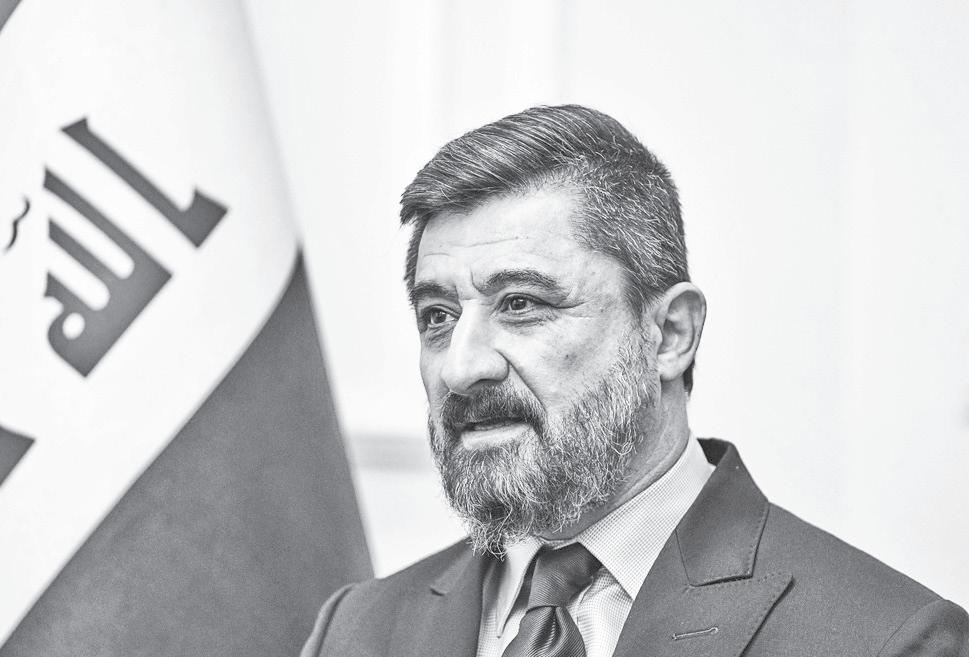
IRAQI Justice Minister Khaled Shwani fields questions during an interview with The Associated Press in Baghdad, Iraq, Saturday, May 3, 2025. AP/HADI MIZBAN
Goldenberg reported from Tel Aviv, Israel. Associated Press writers Natalie Melzer in Nahariya, Israel; Samy Magdy in Cairo; Melanie Lidman in Je -
rusalem, Kevin Schembri in Birkirkara, Malta, and Jon Gambrell in Dubai, United Arab Emirates, contributed to this report.
ISRAELI security forces inspect the site where the Israeli military said a projectile fired by Yemen’s Houthi rebels landed in the area of Ben Gurion International Airport near Tel Aviv, Israel, on Sunday, May 4, 2025. AP/OHAD ZWIGENBERG
DOF rules out new taxes as BIR beats collection targets
IN recent announcements, the Department of Finance (DOF) has made it clear that the Philippine government is not considering new taxes at this time, thanks to a robust fiscal position. Finance Secretary Ralph Recto emphasized that the government is adeptly managing its finances to meet public needs without overburdening citizens. This clarity has been bolstered by impressive growth figures from the Bureau of Internal Revenue (BIR), which underscore the agency’s effective tax collection strategies. (Read the BusinessMirror story, “DOF: No new taxes, fiscal position remains robust,” April 30, 2025).
The BIR reported an extraordinary 16.67 percent increase in tax collections for the first quarter of 2025, amassing P690.4 billion. This surge not only reflects the agency’s commitment to enhancing tax administration but also highlights the success of ongoing digitalization efforts and robust enforcement measures. The increase in tax revenue is a testament to the BIR’s proactive approach, particularly in reaching out to taxpayers and simplifying the filing process through online platforms.
One of the standout achievements of the BIR has been the remarkable 22.5 percent rise in the number of taxpayers filing their annual income tax returns (ITR). This growth can be attributed to effective tax awareness campaigns and collaborations with various sectors. Commissioner Romeo D. Lumagui Jr. noted that these initiatives have made tax compliance more accessible and less daunting for the public. The successful implementation of online filing has further streamlined the process, reducing congestion in BIR offices and encouraging more citizens to fulfill their tax obligations. (Read the BusinessMirror story, BIR: “Number of taxpayers up as filing ended 15 April 2025,” April 24, 2025).
The BIR’s efforts are not solely about revenue generation; they also aim to foster a culture of compliance among taxpayers. By focusing on education and awareness, the agency is working to improve public perception of taxation, transforming it from a burden into a civic duty. This is crucial, especially as the nation grapples with economic uncertainties. Moreover, the government’s fiscal policy, as outlined by Secretary Recto, is designed to provide economic stability without imposing new taxes. The emphasis on maintaining a sustainable debt trajectory and managing the deficit effectively reassures citizens that their government is on a path of responsible financial governance. The DOF’s commitment to retaining and attracting investments through legislative measures also reflects a forward-thinking approach that prioritizes economic growth.
As we look ahead, the BIR’s ambitious target of P3.232 trillion for the year is within reach, thanks to the momentum built in the first quarter. The agency’s continuous pursuit of digital transformation and its efforts against tax evasion will be pivotal in achieving this goal. The focus on non-tax revenue sources will further bolster the government’s financial health, ensuring that essential services and programs remain funded.
The BIR’s achievements are not just numbers on a balance sheet; they represent a significant step towards fiscal responsibility and economic resilience. As the country prepares for the upcoming national elections, it is essential for citizens to remain informed and discerning about fiscal policies. The BIR and DOF have demonstrated their capability in navigating economic challenges while maintaining transparency and accountability. Their collective efforts promise a brighter financial future for all Filipinos, free from the burden of new taxes.
T is called a “Causal Conundrum”—an elaborate term that simplifies to a ‘tricky puzzle’. “Causal” means cause and effect, while “conundrum” means things so complex or confusing that it can scramble your mind. Take Bangus Sisig—is it really sisig because it is sizzling with onions, chili peppers, and calamansi juice, even though fish do not have ears?
A classic causal conundrum we all know is: “Which came first, the chicken or the egg?” You have only two options: the egg creates the chicken that creates the egg, or the chicken creates the egg that creates a chicken. Go ahead—pick an answer.
At first glance, a causal conundrum might seem like a brain teaser, insignificant and unimportant. Do not be fooled. It is a cornerstone of sharp, logical thinking. It compels us to grapple with the messy challenge of identifying cause-and-effect relationships, the foundation of sound decision-making, problem-solving, and even advancing knowledge in science, medicine, and economics. Misjudge causality, and you are stuck with bad calls, failed solutions, or nasty surprises.
Think about it: a CEO in Makati pours millions into a marketing campaign only to realize sales were tanking because of a competitor slashing prices.
Does stress keep you awake at night, tossing and turning? Or does a bad sleep night stress you out the next day? It is a causal conundrum because both can hold true, and untangling which one drives the other is no easy task. So, where do you begin—sleeping pill, therapy session, or take a vacation?
The solution depends on finding the real cause, and that is what the conundrum forces us to do.
Here is another example: “There are dark clouds in the sky because it is raining,” versus “It is raining because there are dark clouds in the sky.” Both sound plausible. Are they? We have all seen dark clouds and rain appear together like an inseparable pair. But which one truly takes the lead and causes the other?
Scientifically, dark clouds form first, as warm, moist air condenses into droplets that eventually fall as rain. Thus, “It is raining because
Was the JP Morgan news the catalyst for prices going higher? Or were prices going higher the catalyst for the JP Morgan upgrade news? It is our friend, the causal conundrum, just dressed up in a stock market barong. Next time you hear about a ‘catalyst’ in the PSE—or face any tough spot—ask yourself: am I facing a causal conundrum? Or maybe ask a chicken?
there are dark clouds” aligns more closely with reality. Causal conundrums like these are not merely entertaining riddles. They serve as a reminder to probe deeper before drawing conclusions. Whether you are a doctor treating a patient, a policymaker addressing poverty, or trying to understand why PSE stock prices are moving – or not – grasping what truly causes the situation can determine the success of your next step.
In a research note dated April 23 —and highlighted locally on Thursday April 24—JP Morgan Securities upgraded Philippine equities to Overweight from Neutral. On Friday, April 25, the PSE Composite Index went up 1.79 percent or 110 points, the strongest advance since the April 8 bottom reversal. Looks like a perfect cause-and-effect story, doesn’t it? Or does it?
Social media groups blew up on the weekend after April 25, ‘Finally, a reason to buy!’, as if JP Morgan waved a magic wand over the market. Rain
causes clouds or clouds cause rain?
Here is the question: did JP Morgan’s upgrade spark the rally, or was the market already on the move?
To understand this, let us rewind a bit because the PSEi has been lurching like a jeepney dodging potholes since January. March saw it all stall, then “Tariff Tuesday” on April 3 (Philippine time) sent traders from Manila to Madrid scurrying like rats on global trade fears. The week ending April 11 saw a strong upside reversal from the weekly PSEi low, closing essentially unchanged week-on-week. A determined upside reversal held firm on the PSE, defying the gloom.
The local stock market analysts had been begging for a yet-to-benamed “catalyst” to push prices higher because apparently you cannot have a market rally without a shiny catalyst to pin it on. Funny thing about the markets—they do what they want, whether we are ready or not.
Was the JP Morgan news the catalyst for prices going higher? Or were prices going higher the catalyst for the JP Morgan upgrade news? It is our friend, the causal conundrum, just dressed up in a stock market barong. Next time you hear about a “catalyst” in the PSE—or face any tough spot—ask yourself: am I facing a causal conundrum? Or maybe ask a chicken?
E-mail me at mangun@gmail.com. Follow me on Twitter @mangunonmarkets. PSE stock-market information and technical analysis provided by AAA Southeast Equities Inc.
Big Tech earnings defy fears of ‘worst-case scenario’ for stocks
By Jeran Wittenstein and Ryan Vlastelica
INVESTORS in the US technology behemoths that dominate the S&P 500 Index are breathing a sigh of relief as last week’s earnings reports from the group show their outlooks remain mostly strong in the face of President Donald Trump’s shifting trade policies.
One after another, tech giants from Amazon.com Inc. to Microsoft Corp. unveiled forecasts that suggest demand remains largely intact for businesses including electronic devices, cloud computing services, software and digital advertising. While the reports were by no means perfect—Apple Inc. was a high-profile disappointment—they eased many of the worst-case fears that the firms would signal a tariff-induced profit slump was on the immediate horizon.
It was an encouraging stretch for investors seeking signs that the stock market’s rebound potentially has legs. The tech-heavy Nasdaq 100 Index took its two-week rally to 10 percent and is now almost 3 percent above where it closed on April 2, before Trump unleashed tariffs
on virtually all of America’s largest trade partners. Microsoft led gains in the so-called Magnificent Seven megacaps, with its best week in more than two years.
“A lot of investors were braced to hear things that were very grim,” said Mark Luschini, chief investment strategist at Janney Montgomery Scott. “Even numbers that were a little weak were far from the worst-case scenario. That’s allowing the market to take a glass-half-full view, even though the situation remains foggy, and the rebound could be jeopardized by any emerging signs of a slowdown.”
Of course, the threat of renewed volatility hangs over the tech giants as the trade war drags on. It will also take until the next earnings cycle to see how the sector actually per-
One after another, tech giants from Amazon.com Inc. to Microsoft Corp. unveiled forecasts that suggest demand remains largely intact for businesses including electronic devices, cloud computing services, software and digital advertising. While the reports were by no means perfect— Apple Inc. was a high-profile disappointment—they eased many of the worst-case fears that the firms would signal a tariffinduced profit slump was on the immediate horizon.
formed once Trump’s levies took effect. Until the picture is clearer, Luschini said he’s avoiding big sector bets and holding defensive shares, along with tech stocks linked to long-term growth trends.
Big Tech companies have been at the center of the selloff in US stocks that’s shaved about 3 percent off of the S&P 500 this year as traders pocketed profits on the cohort and
shifted into defensive assets. The worry is that tariffs will fan inflation and stifle economic growth. The market got some reassurance on Friday from a strong jobs report, as well as hints of possible trade talks between the US and China. Still, the underlying uncertainty has caused companies including airlines, shoemakers and retailers to withdraw forecasts and take a cautious approach to spending. Most of the tech giants bucked that trend. Of the six Magnificent Seven companies that have reported, four gave revenue forecasts that were either roughly in line or exceeded Wall Street estimates. Google parent Alphabet Inc. kept with tradition and didn’t provide one. Nvidia Corp., the last to report, is scheduled to announce results on May 28. Microsoft’s revenue forecasts for the current quarter topped expectations thanks in part to strength in its Azure cloud-computing business, where demand continues to outstrip its data center capacity. Amazon’s operating profit outlook was weaker
Ambassador Antonio L. Cabangon Chua Founder
World’s riskiest bonds lure traders back after tariff turmoil
By Vinícius Andrade & Jorgelina do Rosario
INVESTORS are dipping their toes back into some of the riskiest emerging-market bonds, snapping up high-yield government debt that has been made cheap by tariff-induced volatility.
Money managers including Ninety One UK Ltd., Vontobel Asset Management and TCW Group Inc. argue that some prices have fallen to a level that justifies taking on the risk of sovereign defaults, which they say has been overblown.
In April alone, the extra yield investors demand to own dollardenominated junk bonds from emerging markets over Treasuries widened 37 basis points to 634 basis points. Meanwhile, credit-default swaps—a type of protection against defaults—saw limited deterioration, with a broad index trading far below levels seen ahead of the last wave of debt meltdowns in 2022-2023.
“We had ammunition to come back during the selloff,” said Carlos de Sousa, a portfolio manager at Vontobel, who scooped up notes from Ivory Coast to Benin. Before the turmoil, de Sousa had been holding an unusually high exposure to betterrated credits.
While tariff concerns haven’t vanished and the risk of a prolonged US economic downturn isn’t fully priced in, the move into high-yield is a window into how some money managers believe that the worst of President Donald Trump’s global trade war is over. They are adjusting their portfolios to take on more risk, wagering that fundamentals in some of the world’s most vulnerable nations will remain resilient.
It’s an investment that is so far fairly limited but catching on. JPMorgan Chase & Co. cited the appetite for higher-yielding opportunities among its key takeaways from an investor survey carried out during the International Monetary Fund and World Bank meetings in Washington last month.
For good reason: The asset class has been one of the brightest spots in emerging markets in recent years. In 2024, some of the notes handed triple-digit gains to investors. It hasn’t worked out that way so far this year, as investors moved to take profits in the run-up to Trump’s levies.
A Bloomberg gauge of EM highyield dollar bonds is up about 1 percent this year, lagging an index tracking investment-grade bonds from emerging markets, which has advanced close to 3 percent. Spreads for countries like Egypt, Ivory Coast, Benin and Senegal have been on the rise since April 2, when Trump announced a shift in his tariff policy.
Fears allayed
RECENT remarks from US Treasury Secretary Scott Bessent signaling that the Trump administration will try to influence international financial institutions such as the IMF were
than expected, but Chief Executive Officer Andy Jassy said it hasn’t “seen any attenuation of demand yet.” Meta offered reassurance about the outlook for digital ad-spending with a forecast that was roughly inline with analyst estimates.
Spending leeway
THE earnings season has also calmed worries about capital spending on artificial-intelligence computing gear, which has fueled a revenue boom for companies like Nvidia and Broadcom Inc. Meta raised its forecast for capital expenditures this year, and Microsoft said growth in such outlays would slow next year but still rise.
The comments sent shares of chipmakers and computing-hardware makers higher.
Do not ghost the BIR
PWhile tariff concerns haven’t vanished and the risk of a prolonged US economic downturn isn’t fully priced in, the move into highyield is a window into how some money managers believe that the worst of President Donald Trump’s global trade war is over. They are adjusting their portfolios to take on more risk, wagering that fundamentals in some of the world’s most vulnerable nations will remain resilient.
also positive, according to Vontobel’s de Sousa, because they allay fears of a US withdrawal.
Bessent said last month that both institutions are “falling short,” though he made clear that he sees a need for the Washington-based institutions.
Thys Louw, a portfolio manager at Ninety One in London, points to the role bilateral and multilateral lenders are playing and the fact that some countries are diversifying their financing. He brushed off speculation that the US and institutions like the IMF will pull back support for developing nations.
“We’ve seen some pockets of value in EM, especially within HY where generally fundamentals have remained resilient and reform progress has been broadly positive,” said Louw, who likes bonds from Ivory Coast, Egypt and Senegal. To bond fund managers running the $3.5 billion TCW Emerging Markets Income fund, there’s room for an additional widening in spreads thanks to a larger-than-expected slowdown in global economic growth this year.
However, they recently told clients that they “are seeing value creation as default risk in certain segments of the market appears overpriced.”
London-based hedge fund Frontier Road Limited says that emerging-market credits will continue to benefit from what the firm calls “TAMA,” meaning “there are many alternatives” to US mega-stocks, according to an April 14 note to clients seen by Bloomberg.
Portfolio manager Martin Bercetche pointed to countries such as Egypt and Nigeria, where spreads have widened amid tariff uncertainty even though these economies’ combined exports to the US are less than $6 billion. Those types of disconnects provide openings that the fund can take advantage of, he said. With assistance from Selcuk Gokoluk / Bloomberg
“Tech companies are getting more leeway to spend, because they’ve shown it can deliver returns and support growth,” said Hanna Howard, a portfolio manager at Gabelli Funds. It wasn’t all good news, however. Tesla Inc. backed away from a prior forecast to return to revenue growth in 2025, and Apple said it expects $900 million in higher costs from tariffs in the current quarter. The iPhone maker was hit with at least two Wall Street downgrades, with the analysts citing tariff headwinds and growth concerns.
While profit estimates in many S&P 500 sectors have fallen this earnings season, projections for tech giants are climbing. According to Bloomberg Intelligence, earnings for the Magnificent Seven are seen rising 21.6 percent in 2025, while revenue is expected to grow 9.7 percent. Both estimates have risen in the past week. Bloomberg
Atty. Irwin C. Nidea Jr.
TAX LAW FOR BUSINESS
ICTURE this: you receive a letter from the Bureau of Internal Revenue (BIR) marked “Subpoena Duces Tecum” (SDT). It’s not a tax assessment—just a formal request for you to appear or submit certain records. Thinking it’s not urgent, you set it aside. A few months later, you’re facing criminal charges. This is not an exaggeration; it’s a real consequence under Section 266 of the National Internal Revenue Code (NIRC)—a provision that BIR officers are now enforcing with growing frequency.
Section 266 penalizes any person who, without valid justification, fails to comply with a duly issued summons from the BIR. This includes ignoring an order to appear, refusing to testify, or failing to present required documents. The penalties?
A fine of up to P5,000 and imprisonment ranging from one to two years. While the monetary fine may seem modest, the prospect of incarceration—even for a year—can have significant and lasting consequences for one’s personal and professional life. The courts have consistently upheld the seriousness of this offense. In various cases, taxpayers have been convicted and sentenced to both
fines and imprisonment. It’s also important to understand that intent is not a defense. Under our laws, failure to comply with a BIR summons is a mala prohibita offense—meaning that the act is punishable regardless of whether the taxpayer meant to violate the law.
Are there defenses available? Yes —but they are limited. Valid excuses may include defective SDT or demonstrable lapses in due process. You cannot also be required to submit what you do not have. Mere confusion, fear, or misunderstanding of the notice will not stand in court.
BIR procedures on service of summons are guided by Revenue Memo -
Rubio’s ascendance
Arandum Order (RMO) No. 8-2014, which outlines strict requirements. The preferred method of serving an SDT is through personal delivery at the taxpayer’s registered address. Service at a known (but unregistered) address is considered only as a secondary measure.
In certain cases where personal service is not possible, substituted service may be allowed—but with stringent safeguards. The revenue officer must be accompanied by a barangay official and two disinterested witnesses (individuals of legal age who are not BIR employees) who can personally observe and confirm that the taxpayer is not present at the registered address. Only when this absence is clearly established can the SDT be left with the barangay official. Moreover, these details— including the names, positions, and signatures of the witnesses—must be properly recorded on the face of the SDT itself.
Only after personal service (and possibly substituted service) has been attempted and failed, that service by mail may be utilized. There must be documentation of prior attempts to serve personally. The SDT must be sent via registered mail to the registered address of the taxpayer. A registry receipt and proof of mailing must be kept by the revenue officer as evidence of compliance.
Taxpayers must realize that a
Subpoena Duces Tecum is not just another piece of paperwork—it is a legal order backed by criminal penalties. Whether you are an individual, a sole proprietor, or a corporate officer, compliance is not optional. The Bureau of Internal Revenue is increasingly using this tool to compel cooperation, and both the Court of Tax Appeals and the Supreme Court have upheld penalties of fine and imprisonment for non-compliance. Rather than risk fines and imprisonment, taxpayers are strongly encouraged to respond to an SDT promptly and in good faith. It is even better that the first and final notices of the BIR to submit documents are not ignored. So, the BIR will not be forced to issue an SDT. In tax matters, silence is seldom golden, and delay can be costly. Cooperation, on the other hand, protects not just your finances but your peace of mind.
The author is a senior partner of Du-Baladad and Associates Law Offices (BDB Law) (www. bdblaw.com.ph).
The article is for general information only and is not intended, nor should be construed as a substitute for tax, legal, or financial advice on any specific matter. Applicability of this article to any actual or particular tax or legal issue should be supported, therefore, by a professional study or advice. If you have any comments or questions concerning the article, you may e-mail the author at irwin.c.nideajr@ bdblaw.com.ph or call 8403-2001 local 330.
masks bigger question of who has Trump’s ear
By Nick Wadhams, Natalia Drozdiak & Eric Martin
JOLT of staff upheaval this week made Marco Rubio the first person in 50 years to hold the top two national security jobs in the US government, the culmination of a journey from his role as Donald Trump’s rival for the presidency to one of his most prominent aides.
Rubio’s ascent to both secretary of state and interim national security adviser coincided with the fall of Mike Waltz, whose hawkish foreign policy stances made Trump’s MAGA base wary. Waltz was ousted from his West Wing job after inadvertently including a journalist on a Signal group chat about military actions and will be nominated to be Trump’s ambassador to the United Nations.
On the surface, the upheaval highlights the former Florida senator’s deft navigation around concerns about his late-to-hatch Trump-world bona fides and his emergence as an impassioned messenger for the president.
Yet the question of who won or lost Trump’s favor masks a reality for both men: neither Rubio nor Waltz has taken the lead on some of the foreign policy issues most important to the president, and their influence has never been truly tested.
Despite being the top US diplomat, Rubio takes a back seat on ending the Ukraine war and confronting Iran’s nuclear program to Steve Witkoff, the longtime Trump friend and real estate developer. In Africa, Trump has named his daughter Tiffany’s father-in-law, Massad Boulos, to oversee talks related to the Democratic Republic of Congo and other matters.
Rubio’s rival for the secretary of state job, special envoy Richard Grenell, has run negotiations with Venezuelan President Nicolas Maduro, at times clashing with Rubio.
That doesn’t even count all the others who have Trump’s ear, including Elon Musk, who dismantled the US Agency for International Development and other government agencies; Trump’s son Donald Jr.; TV personality Tucker Carlson; and far-right activist Laura Loomer, who took credit for an earlier staff purge at the National Security Council.
“It is a larger presence for Rubio—what he can make of that remains to be seen,” said Justin Logan, director of defense and foreign policy studies at the libertarian-leaning Cato Institute. “The national security adviser always is important because of its proximity to the president,” but may be less so in this White House “because power in this administration is highly centralized under one person.”
Rubio’s actions in the next few weeks will help clarify how much his expanded portfolio adds to his leverage. It won’t be easy given that the White House has yet to appoint or nominate staff for numerous senior roles at both the State Department and the National Security Council. Rubio may not hold both jobs for
long. The last person to do so was Henry Kissinger in the 1970s. The White House is considering permanent replacements for Waltz. Candidates include Grenell, White House Deputy Chief of Staff Stephen Miller and Sebastian Gorka.
“The president has assembled a world-class team that works together to implement the policies he sets,” a State Department official said Saturday, speaking on condition of anonymity. “There are no egos and everyone is rowing in the same direction.”
While Waltz’s departure gives more power to Rubio, it also leaves Rubio without an ally in Washington on several issues. He and Waltz were aligned on many of their publicly stated policy positions, with a traditionally conservative bent that tracks with decades of Republican policy convention. That’s out of step with MAGA supporters such as Vice President JD Vance, Carlson and other members of the administration.
On questions like Iran, “Will Rubio seek to influence that sort of decision tree?” Logan said. “I have to imagine he will, but if he sees himself getting crosswise with the president, will he pull back or push forward?
That’s a question for Marco Rubio.”
Rubio’s rise is one of the more surprising turnarounds of Trump’s second term as he has shed many previously held views—on Russian President Vladimir Putin, Nato, the value of the USAID—to adopt a far more strident tone that appeals to the president’s base.
He batted away concerns around the dismantling of USAID and shut down reporters who criticized the
move to revoke visas for dozens of international students studying in the US. And he’s been a vocal defender of Trump’s move to deport Kilmar Armando Abrego Garcia, the Maryland resident mistakenly deported to an El Salvador prison. Hours after his appointment as interim national security adviser, Rubio went on Fox News for an interview with Sean Hannity, riffing on a joke Vance had made earlier in the day that Rubio might get selected as the next pope, given the speed of his ascent. And he gave credit to Trump for the first 100 days of foreign policy.
“The question here is, who’s the only leader in the world that can talk to both sides and hopefully bring them to a deal?” he said of the war between Russia and Ukraine. “And that’s President Trump.”
The comments were only remarkable in the current White House because of who said them. As a senator who had sought the Republican nomination against Trump in 2016, Rubio hammered former Exxon Mobil Corp. Chief Executive Rex Tillerson—Trump’s first nominee to be secretary of state—for refusing to call Putin a war criminal. He praised USAID and many programs now being dismantled at the State Department.
“He was a stalwart opponent of authoritarian governments and critic of Vladimir Putin,” said Kori Schake, a senior fellow at the American Enterprise Institute, who served in the George W. Bush administration. “And none of those seem to be either choices of the administration or attitudes that the secretary of state continues to hold.” Bloomberg
Vietnam keeps growth target at 8% despite tariff challenges
By Nguyen Dieu Tu Uyen & Nguyen Xuan Quynh
VIETNAM’S prime minister said the nation’s economic growth target remains unchanged this year despite the many challenges it faces, as the threat of US tariffs creates uncertainty for exporters and businesses. “The global economy saw unprecedented movements in the past months, putting pressure on the management of the macroeconomy,” Pham Minh Chinh said, addressing the National Assembly in Hanoi on Monday.
Still, Chinh reiterated that the government will keep its target of at least 8 percent growth this year and doubledigit expansion in the coming years. Expansion slowed to 6.93 percent in
the first quarter from 7.55 percent in the last three months of 2024.
Vietnam, whose exports to the US account for around 30 percent of its GDP, will negotiate with the US to “secure balanced trade, while ensuring not to hurt other markets,” Chinh said, as he vowed the nation will continue to combat trade fraud.
Trade officials of the Southeast Asian nation are engaged in intense negotiations with their US counterparts, as they seek to avert a 46 percent tariff that would deal a serious blow to growth. At the same time, the country is also striving to balance relations with its largest trading partner, China, which has warned nations against cutting deals at Beijing’s expense.
Vietnam will continue to manage
Trade officials of the Southeast Asian nation are engaged in intense negotiations with their US counterparts, as they seek to avert a 46 percent tariff that would deal a serious blow to growth. At the same time, the country is also striving to balance relations with its largest trading partner, China, which has warned nations against cutting deals at Beijing’s expense.
the currency and interest rates in a flexible manner to ensure demand for loans that will help support growth, Chinh told parliament. The government will also boost development of high-speed railway and nuclear power
plants, and seek to attract more foreign tech investment, including in the semiconductor and AI sectors, he said. In a sign of the strain on factories, the S&P Global manufacturing purchasing managers’ index for Vietnam showed a contraction in activity in April to its lowest reading since May 2023. Vietnam is also “pushing for military modernization, developing military science and technology, producing weapons with high-tech equipment,” Chinh said, without giving further details. First-quarter GDP growth was slower than targeted, putting the government under pressure to meet the 8 percent growth target for the year, according to Phan Van Mai, head of the National Assembly’s economic and financial committee. Bloomberg
Art BusinessMirror
Drawing was animator Meryl Chan’s entry into the world of storytelling
FOR many, it’s a specific instance. For Meryl Chan, it’s a recurring feeling.
The graduating animation student in New York couldn’t pin down any particular moment that made her realize that she wanted to become a visual artist. While others cite memories of watching their grandfather draw or being told in school that they had the talent, Chan only points to the many times the path called her, over and over again. “It was something I felt again and again—every time I watched a film or quietly observed the world around me,” the 23-year-old from Manila said. “I was always moved by the immersive quality of visual storytelling.”
Chan is finishing up her Bachelor of Fine Arts degree in Animation at New York’s The School of Visual Arts (SVA). To celebrate her time at one of the world’s top art and design colleges, she opened a retrospective exhibition last month on 26th St., featuring 15 artworks.
The vast collection spans her urban landscapes from both the Philippines and the United States, as well as “personal explorations in color.” Presented as well are her three animation projects, including a class film she directed, titled Miss Illusion animation prototype; and Dive & Trek “about the Philippines and the urgent social and environmental crises it currently faces.” Each piece
SEE “CHAN,” B5
Robinsons Land ARTablado presents the art of motherhood
THIS Mother’s Day, Robinsons Land ARTablado honors the incomparable love and care that moms give their families with two exhibits that showcase the poignant journey of motherhood in vivid detail.
The Artablado Mother’s Day exhibits are on view until May 15 at Robinsons Galleria and Robinsons Antipolo.
The two exhibitions focus on one theme: mothers, with Mama Mary, Mother Nature and our own mothers as the focal points. Artablado is RLC’s platform that promotes the Philippine art culture and Filipino creativity.
Philippine biodiversity advocate and artist Bing Famoso’s artworks are showcased at Robinsons Galleria, while the works of mother-and-daughter tandem Maria Cristina Arroyo and Christelle Arroyo are mounted at Robinsons Antipolo.
FLOWERS FOR MOM
BING FAMOSO has led an art movement focused on the country’s endemic and indigenous flora and fauna since she started painting in 2016. Her works have been exhibited locally and internationally, and her Philippine Eagle paintings have been donated to institutions, Philippine Embassies and Consulates around the world.
Bing is also the visionary behind the 100 Artists/ Filipinos for the Philippine Eagle. It was her children who inspired her art. “At first, I painted to deal with separation anxiety when my daughter Willa went off to college. I was so attached to my children that I didn’t know what to do with all the emotions. Painting became my therapy, and in many ways, it still is. Now that Willa has her own home and my youngest, Walden, lives in the US permanently, painting has become my sanctuary.”
Her Artablado exhibit at Robinsons Galleria is titled “Hoya de Filipinas: A Tribute to Mothers” and is inspired by the month of May. “May has always been a sacred month for me—a time of flowers, faith, and deep love for mothers. As a child, I looked forward to offering flowers to Mama Mary after teaching catechism to children during Flores de Mayo. That simple gesture, done with reverence and a full heart, planted something lasting in me.”
THE TIES THAT BIND
FOR their Artablado Mother’s Day exhibit “All About Her” at Robinsons Antipolo, motherand-daughter artists Maria Cristina Arroyo and
Christelle Arroyo highlight the power of women to love and nurture children and nature.
Maria Cristina says “The ‘Her’ in our exhibit title is the artist. A woman who has hopes, dreams, inspirations, belief and faith, all of which is rooted in love. Mother’s Day is celebrated in May and for us the best role model for motherhood is our Mother Mary. Mother Earth is also one of our inspirations. Nature inspires us to paint, and we are particularly inspired by the sunflower, which symbolizes light, happiness, and hope. Like art, the sunflower brings joy to the heart.”
Her biggest motivation is her sister. “I joined the art therapy sessions of SILAB ArtReach in 2008 with my sister Michelle, who was battling cancer. She was supposed to join their exhibit in 2009, but sadly she did not make it. I joined the exhibit in her place. That was when my art journey started, not just for myself but for Michelle and all the children facing serious illness. Art became my healing, my voice, my tribute.”
Check out the Artablado Mother’s Day exhibits at Robinsons Galleria and Robinsons Antipolo until May 15. More information can be found at the Facebook and Instagram page of ARTablado.
a path that works for you. Altering your lifestyle to suit your demands will
LEO (July 23-Aug. 22): Live and learn. Your actions and words matter; taking on someone or something that concerns you will make a difference in the outcome. Be the leader; take control, and you’ll find a positive way forward. ★★★
VIRGO (Aug. 23-Sept. 22): Press forward with passion, experience and knowledge, and you will leave a lasting impression. Take time to breathe. Changing your surroundings, going somewhere or doing something that eases stress will also give you a positive perspective regarding your next move. Short trips and reconnecting with associates or partners will be uplifting.
LIBRA (Sept. 23-Oct. 22): Be silent while you observe what others do and say, and you’ll spare yourself ridicule and criticism. Progress can be yours if you encourage your creative imagination to take you on a journey that has the potential to uncover new possibilities. Expand your interests, and you’ll connect with someone who intrigues you. 3 stars
SCORPIO (Oct. 23-Nov. 21): You’ll crave change, excitement and being in the middle of the action. Before you rush in and share your thoughts, consider who you are dealing with. Decide whether you are up for a debate or looking for validation that you are on the right track. Aim to stabilize your life, not disrupt it. 4 stars
SAGITTARIUS (Nov. 22-Dec. 21): Opportunity is within reach. Keep the momentum going, and share your vision with the people you care about most. You’ll get the input you need, but at a cost you may not like. Listen to sound advice and be willing to compromise; something good will unfold. ★★
CAPRICORN (Dec. 22-Jan. 19): Take a backseat and consider your options. The information you receive from someone you trust will be eye-opening and encourage you to head in a direction that will safeguard your position. Attend events that allow you to network, connect and position yourself strategically.
AQUARIUS (Jan.
ANG Mag-Ina at ang Hoya Pubicalyx by Bing Famoso
Off-screen, Barbie’s been embracing self-care and self-growth. She has found joy in simple things like cafe hopping and her new hobby—running. She first shared her “runner era” in February with a post of an early morning jog with friends and fellow Sparkle artists Alden Richards and Kristoffer Martin. Since then, running has become part of her regular routine. Barbie’s not just running for fitness; she’s running with purpose. In April, she joined her first official fun run for children with cancer, completed a 10K for Save the Children Philippines, and took part in events supporting violence prevention against women.
From taking on stronger roles to making time for wellness, Barbie Forteza is embracing a slower, more intentional pace while still chasing dreams and breaking new ground. More information can be found at www.gmanetwork.com.
Evolution of a timeless classic in new ‘Jurassic World Rebirth’
THE enduring appeal of the Jurassic films is the main inspiration for the newest installment in the franchise, Jurassic World Rebirth. “It’s called Rebirth. It harkens back to the first film. It’s a survival story,” explains Scarlett Johansson, who plays covert operations expert Zora Bennett in the film.
In Jurassic World Rebirth, a skilled team of experts are on a top-secret mission to secure genetic material within the DNA of dinosaurs across different environments. When an accident strands them on a forbidden island, once housing an undisclosed research facility for Jurassic Park, they come face-to-face with a shocking discovery hidden from the world for decades. The film also stars Jonathan Bailey and two-time Academy Award winner Mahershala Ali.
This summer, three years after the Jurassic World trilogy concluded with each film surpassing $1 billion at the global box office, the enduring Jurassic series evolves in an ingenious new direction with Jurassic World Rebirth. A new era is born as Jurassic World Rebirth arrives in the Philippines on July 2.
Chan...
Continued from B4
creative management,” she said.
As she prepares to transition from school to the real world, Chan acknowledges the difficulties that have hounded the animation industry in recent years, particularly in the US.
Major animation players were reported to have implemented cutbacks left and right. Pixar reduced its workforce by 14 percent this time last year.
Meanwhile, last August, the 5,000-strong Animation Guild in Hollywood began a fresh round of contract negotiations with top studios and streamers, naming outsourcing jobs and the threat of generative AI as their main points of contention.
Despite the slowdown, Chan remains hopeful. She says there’s a growing appetite among audiences for indie animation, the kind that “feels more creative, personal, and free from large studio constraints.”
From a personal standpoint, as she prepares to graduate, Chan aspires to continue refining her portfolio and “to keep creating work that feels meaningful.” She takes inspiration from a constantly changing set of artists she discovers. Currently, the roster includes Shinji Kimura, Genndy Tartakovsky, and, again, Wong Kar Wai.
Eventually, Chan’s wants to open her own studio. Just like how she shapes narratives in all her artworks, she has this goal very much laid out as well. Her vision is for the studio is to be a “fostering space,” one “where creativity and original storytelling can thrive.” n
Jomari Yllana sets his sights on elevating motorsport in the Philippines
FORMER teenage celebrity Jomari Yllana admits that he misses acting, but believes that his hiatus as an actor will not remain for long.
“The passion is still very much in me, perhaps just suppressed all these years. As I grow older and more mature, I guess I’ve come to accept that perfect timing is always key, and if ever I get a good script in the future, if I’m offered a good comeback role, then by all means I’ll give it another shot. But it’s important also that I am ready before I take the plunge again—mentally, emotionally and physically, so I could perform well and be at my best,” he told us recently.
In the meantime, Yllana shifts his focus to another of his many passions—car racing. Truth is, the sport has always been special to him. “Racing gives me a kind of internal high, an emotion that is difficult to describe.”
During our most recent chat, Yllana recalled how he initially got drawn to car racing.
“It was during the peak of the Gwapings [the popular teenage trio with buddies Eric Fructuoso and Mark Anthony Fernandez] when I was actively participating in those popular drag racing activities in Greenhills. These midnight races were illegal at that time and my peers and I were even caught by Jinggoy [Estrada] and when he recognized me, I was released after being reprimanded.”
Wanting to learn more about the sport, Yllana took the right path and sought mentorship from the professionals.
And seeing both his passion and promise as a potential future race champion, he was eventually made part of the Toyota professional racing team where Yllana honed his driving skills.
When local politics lured Yllana, he pushed for road safety not only in the city where he served, but also in the sport he loved.
“It was also the time when I advocated for safe racing. It also instilled a special kind of discipline in me—the more I practice, the better I become. Just like life, nothing great is achieved in an instant, whether in politics, entertainment or racing.”
Yllana has partnered with Okada Manila and Rikki Dy-Liacco, head of Motorsports of the Automobile Association of the Philippines, in launching the Motorsport Carnivale 2025, hoping that in a few years, the festival will become a major tourist event and attraction just like the annual Singapore Formula 1 Grand Prix and the motorcycle road race in
the Isle of Man TT (TouristTrophy) in Europe.
Okada Manila is providing the venue for the racing action, extending to its boardwalk and gardens, the seaside area just outside the resort casino and hotel premises.
The festival kicked off over the weekend and will continue throughout the coming months. Racing continues on May 31 with the Jom’s Cup, a 1/8 mile drag racing challenge that will feature car and racing enthusiasts divided into three categories: Super Car, Muscle Car and Vintage Car.
This early, Yllana’s group is preparing for the biggest rally event in the country scheduled on the third week of June, and plans are being made to close the main roads in Entertainment City, where a special
stage will be built, similar to those in the rallies in Monaco, Argentina and Greece.
Motorsport Carnivale is inspired by the glory years of Philippine motorsports, including the Philippine Grand Prix held annually from 1973 to 1976.
“We have awakened a sleeping giant. Through this festival, we are reminded of the passion that fuels our local motorsport scene—and we are just getting started. We hope to attract not only the enthusiasts and racers, but also the general public as well,” Yllana said.
As to his plans of a great movie acting comeback, that can wait for the meantime. “One passion at a time,” Yllana whispered to us before a tight hug. “We will get there.” n
A NEW NETFLIX FILM FEATURES A HURTLING JAPANESE BULLET TRAIN WITH A TICKING BOMB
By Yuri Kageyama The Associated Press
TOKYO—The highspeed bullet train says Japan as much as Godzilla, sushi and Mount Fuji. And it takes center stage in Shinji Higuchi’s new film, Bullet Train Explosion, (now streaming) on Netflix.
Higuchi, the director of the 2016 Shin Godzilla (or “New Godzilla,”) has reimagined the 1975 Japanese film The Bullet Train, which has the same premise: A bomb will go off if the train slows down below 100 kph (62 mph.) That original movie also inspired Hollywood’s Speed, starring Keanu Reeves, which takes place mostly on a bus.
Higuchi recalls being fascinated by the aerodynamically shaped bullet trains growing up as they roared by, almost like a violent animal. To him, as with many Japanese, the Shinkansen—as the trains are called in Japan—symbolize the nation’s efforts to become “top-rate,” superfast, precise, orderly and on time.
“It’s so characteristically Japanese,” Higuchi said in an interview with The Associated Press. “To complete your work, even if it means sacrificing your personal life, is like a samurai spirit living within all Japanese.”
The film’s realism was achieved by a smooth combination of computer graphics and miniature train models, built to one-sixth the size of the real thing.
A huge LED wall was used on the set to project
visuals of passing landscapes as seen from the train window, and those shots were juxtaposed seamlessly with footage shot on a real train.
The explosions are strangely exhilarating, and beautifully depicted with scattering sparks and smoke.
Higuchi stressed that the filmmakers were careful to make sure the criminal act, as depicted, is not physically possible today.
He said Bullet Train Explosion marked a challenging departure from his past movies that were about heroes and monsters.
“I examined the question of evil, and how we pass judgment on a person,” he said.
“That’s what my predecessors did as directors before me: Try to show what happens if you commit evil,” he added. “And I tried to give my answer.”
One departure from the original, which starred the late Ken Takakura as the bomber, is that Higuchi chose to focus on the train workers.
Tsuyoshi Kusanagi, formerly a member of boy band Smap who portrayed a transgender woman in Eiji Uchida’s Midnight Swan, is convincing as a dedicated Shinkansen worker.
“I always have fun working with the director,” Kusanagi said of Higuchi at a Tokyo premiere. “I’ve loved him for 20 years.”
Kusanagi starred in Sinking of Japan, Higuchi’s 2006 science-fiction thriller about a natural catastrophe that threatens Japan’s very existence.
East Japan Railway Co., formed after the national railway was privatized, which operates the bullet train featured in Higuchi’s reboot, gave full support to the film. It allowed the use of real trains, railway facilities and uniforms, as well as helping train the actors to simulate its workers and their mannerisms.
The bullet trains have long been a symbol of Japan’s blossoming as a modern economy and peaceful culture in the decades following World War II.
Pinay Olympian to lead PHL runners at EVA Air Marathon
RIO de Jainero 2016
Olympian Mary Joy Tabal -Jimenez will hit the road again as she leads some 300 Filipinos who will compete in the 2025 EVA Air Marathon on October 26, 2025 in Taipei, Taiwan.
Regarded as the country’s top longdistance runner, the Cebu-based runner is also gold medalist in the 2019 South East Asian Games, six-time champ in the Milo Marathon, and finisher of the 2023 Tokyo Marathon.
“I’m excited to be finally back on the road. This is not a simple marathon, because it’s about finding the joy in running again after spending time with my family as full-time mom and wife,” says Tabal at the event’s recent press launch organized by Cebu-based travel agent Travel Care.
Designated as official Team Philippines ambassador, the Mandaue City sports development head, will be joined by Sto. Niño Mactan College athlete scholar Ceasar Miguel Fuentes and bemedalled deaf runner Precious Mae Villaver.
The 35-year-old record holder hopes to shatter her 42K personal best of 2 hours, 43 minutes which she posted in the Scotiabank Ottawa Marathon in 2016, which still stands today as the national record.
Also joining the contingent are national and student athletes who will be endorsed by the Department of Education and the Philippine Sports Commission, and whose
SINCE pioneering livestream shopping in the Philippines in 2019, Shoppertainment Live Inc. has been at the forefront of the content-commerce revolution. Over the past five years, the company has empowered over 500 local and multinational brands through dynamic, high-converting live commerce experiences.
As a platform-agnostic enabler, Shoppertainment Live has proven its ability to scale livestream operations seamlessly across major e-commerce and social media platforms — including Shopee, Lazada, TikTok, direct-to-consumer (D2C) websites, and most recently, YouTube Shopping. The company is also actively collaborating with Meta to help grow live commerce across Facebook and Instagram.
From early challenges convincing brands to go live, to scaling rapidly during the pandemic, and navigating both local and international competition, Shoppertainment Live has demonstrated unmatched adaptability, foresight, and innovation.
These efforts culminated in 2024, its strongest year yet, marked by industry leadership, profitability, and operational resilience.
This milestone partnership also marks the formation of a new board, composed of some of the most respected names across Digital Advertising, Media, E-commerce, Gaming and Entertainment, Influencer Marketing, Retail, and Human Resources. The diversity of backgrounds reflects the company’s forward-thinking and integrated approach to the evolving content-commerce landscape.
Shoppertainment Live Inc. Board Members:
Hiyasmin Neri-Soyao, CEO and Co-Founder, Shoppertainment Live Inc.
Patricio Soyao Jr., CSO and Co-Founder, Shoppertainment Live Inc.; President, Future First Talents Inc. (HR and Executive Search)
Lawrence Lee, Chief Broadcast Officer and Managing Director, Shoppertainment Live Inc.
Steve Sy, President and CEO, Great Deals E-Commerce Corp. (E-commerce and Retail)
Ace Gapuz, President and CEO, Blogapalooza Inc. (Influencer Marketing)
participation will be sponsored by Travel Care, the Marathon’s official local travel agent.
Inaugurated in 2018 by Taiwan-based carrier EVA Air, this year’s running event is expected to lure 24,000 runners from all over the world and promote the island country a sports tourism hub in Asia.
An IAAF – AIMS Certified Course, there will also be a half marathon, 10K and 3K categories whose race route has been designed to highlight Taipei’s tourist spots.
A NT$ 110,000 cash prize awaits the top winner of the 42K division.
EVA Airways general manager Rick Hsieh expressed optimism for a successful turnout of participants from the Philippines and other countries, particularly those where the airline flies.
“We connect the world through our airline and now, through the EVA Air
Marathon,” he enthuses.
A member of the prestigious Star Alliance, the carrier was ranked 8th among the World’s Top 10 Airlines by Skytrax, and also won in various categories in its 2024 World Airline Awards.
It flies to 67 destinations from four continents, including Philippine gateways such as Manila, Clark, and Cebu.
In photo at the launch are EVA Airways Corp. assistant manager for passenger Ming Kuo, EVA Airways Corp. manager for Manila Nancie Ng, Lt. Dan Jimenez, Mary Joy Tabal-Jimenez, EVA Airways Philippine Branch general manager Rick Hseih, and Travel Care proprietors Sunshine and Charles Lim.
For details and online registration, visit www.evaairrun.com or follow Travel Care on Facebook for tour packages for runners.
In the photo are, from left, Saymour Go, Director of Manila Kleanfuel Corp. and Director, SLI; Lawrence Lee, Chief Broadcast Officer, SLI; Steve Sy, President and CEO, Great Deals E-Commerce Corp. (E-commerce and Retail) and Director, SLI.; Patricio Soyao Jr., CSO and Co-Founder, SLI and President, Future First Talents Inc. (HR and Executive Search); Hiyasmin Neri-Soyao, Chief Executive Officer, SLI; Ronald Robins, Chief Executive Officer, Sigma Ventures; Stephen Chua, Director, Sigma Ventures; Marito De Jesus, General Manager, Sigma Ventures; Ace Gapuz, Chief Executive Officer, Blogapalooza Inc. (Influencer Marketing) and Director, SLI; Serafin Cu, President, EWealth Universal Marketing Corp. & Director, SLI
Justin Francisco, President of Arkos Technologies Inc. and Shareholder of Great Deals E-commerce Corp.
Sigma Ventures Corp. Executives:
Ronald Robins, Chief Executive Officer
Andre Uy, Managing Director
Stephen Chua, Managing Partner
Marito De Jesus, General Manager
Both Robins and Sy are part of the globally recognized Endeavor Network, known for empowering entrepreneurs who scale companies with transformative impact.
Sigma Ventures Corporation has established a strong presence in both technology and the Indonesian market through its partnership with PHINDO Exchange, a team specializing in cross-country expansion between the Philippines and Indonesia. Sigma Ventures operates with the guiding principle of INSIC — Inspire, Structure, Invest, and Create Value. Now, Shoppertainment Live takes a bold leap forward by forging a strategic partnership with Sigma Ventures Corp. This partnership goes beyond capital; it brings together a powerhouse of entrepreneurial minds, strategic insight, and regional expertise that will accelerate Shoppertainment Live’s growth not just in the Philippines,
Korean Cultural Center launches Student Short Film Contest
GOT big dreams, a camera, and a story to tell? The Korean Cultural Center in the Philippines (KCC) is giving student filmmakers and enthusiasts the ultimate ticket to the spotlight with the launch of its first-ever “Student Short Film Competition,” and the grand prize is a trip to Busan to attend the world-famous Busan International Film Festival (BIFF)!
This exciting competition is part of the 2025 Korean Film Festival, an annual celebration of Korean cinema that brings heartwarming stories and world-class films to Filipino audiences. This year, KCC is raising the stakes by inviting young storytellers to step behind the camera and show the world their take on “Korea in the Philippines” — the perfect theme to capture the shared ties between two nations.
And the best part? The winning filmmaker won’t just see their work on the big screen during the KFF’s regular screening; they’ll also pack their bags for Busan, for a first-hand experience of one of Asia’s most prestigious film festivals.
“This competition is more than just a contest; it’s an invitation for students to tell stories that connect cultures, spark conversations, and maybe even launch
their future in film,” said KCC Director Kim Myeongjin. “And with Busan as the destination, the journey from script to screen just got even more exciting.”
So whether you’re a one-person film crew or rolling deep with your creative squad, this is your moment to call “Action!” Interested participants can fill out the application form (bit.ly/ReelConnectionsApplication) and the submission form (bit.ly/ ReelConnectionsSubmission) for the film entry. Deadline of the application is on June 30, 2025.
�� Your stor y starts here and a trip to Busan awaits!
Puregold Solidifies MSME Support with 2025 Tindahan Ni Aling Puring Convention
MICRO, small, and medium enterprises (MSMEs) are the economic engine of the Philippines, representing 99.5 percent of registered businesses and employing more than 60 percent of the national workforce, according to the Department of Trade and Industry. Among them, over 1.3 million sarisari stores fuel daily commerce in both urban centers and remote communities, serving as vital distribution points for fast-moving consumer goods and contributing significantly to grassroots economic activity.
Puregold Price Club Inc., one of the country’s leading multi-format retailers, continues to recognize the outsized impact of this sector—and is strategically focused on strengthening its role as a key enabler of MSME growth. In line with this commitment, Puregold is hosting its flagship Tindahan ni Aling Puring (TNAP) Sari-Sari Store Convention 2025 from May 15 to 17, 2025 at the World Trade Center in Pasay City. Now one of the largest negosyo events in the country, the convention supports close to one million Aling Puring card members.
With the theme “Piliin si Aling Puring, Kayang-Kaya Umansenso,” this year’s event reflects Puregold’s broader strategy: empower micro-entrepreneurs to become resilient, high-performing business partners in a fastevolving consumer landscape.
“Our MSMEs, especially sari-sari store owners, are not just customers, they are partners in economic growth,” said Vincent Co, President of Puregold. “Through our Tindahan Ni Aling Puring program, we give them the means to thrive in a competitive environment while making a real impact in their communities.”
but across Southeast Asia.
“This investment marks more than just a financial milestone, it’s a shared vision to shape the future of digital retail,” said Neri-Soyao. “With Sigma Ventures by our side, we are even more confident in accelerating our innovations and expanding our regional footprint.”
Neri-Soyao, a former host of a home shopping network turned entrepreneur, is an inspiring example of the power of female leadership in tech. Her journey from on-air talent to CEO of a trailblazing live commerce platform underscores Shoppertainment Live’s authenticity, heart, and hustle. As a female-founder-led startup now backed by some of the region’s top business minds, Shoppertainment Live is proof that visionary leadership — regardless of gender — can drive industry-wide change.
As the company looks ahead, it remains focused on enhancing its core livestream commerce services while expanding into new initiatives in product development, distribution, and international expansion. United by a pioneering spirit and strengthened by strategic capital, Shoppertainment Live is poised to lead the next chapter in content-driven commerce.
In 2024, Puregold executed over 250 Ka-Asenso SaloSalo activations nationwide, deepening engagement and
expanding TNAP membership in key provincial growth corridors like North Luzon, Visayas, and Mindanao. These grassroots initiatives have been critical in driving regional brand loyalty and volume growth in areas with rising consumer demand.
Puregold’s value programs, “Mas Pinababang Presyo Araw-araw” and “Panalo sa Branded,” also enhance profitability for MSMEs by offering access to high quality and competitively priced branded goods, enabling sarisari store owners to increase margins and customer retention.
In addition to pricing and promotions, Puregold is helping sari-sari store owners to modernize through technology. Tools like the Puregold Mobile App and P-Wallet simplify ordering, payment, and inventory management, giving store owners more control and efficiency in running their businesses.
Puregold’s focus on MSMEs aligns with national development goals that prioritize inclusive growth, employment generation, and digitalization. By investing in the success of small retailers, the company contributes directly to job creation, income stability, and local economic resilience—especially in underserved regions.
“We want to ensure that our Ka-Asensos evolve with us,” Vincent added. “We are building new stores, but we are also introducing entrepreneurship. Puregold’s goal is to help Filipino entrepreneurs grow from small wins to lasting success.”
With a nationwide footprint of over 500 stores and a growing digital ecosystem, Puregold is more than a retail chain. It is a scalable platform for inclusive progress, positioning itself as a long-term partner in economic development for entrepreneurs and communities.
Buffett to step down following six-decade run atop Berkshire
By Alexandre Rajbhandari & Katherine Chiglinsky
WARREN BUFFETT, who built Berkshire Hathaway Inc. into a business valued at more than $1.16 trillion and himself into a celebrity billionaire renowned for his investing acumen and witticisms, will step down at year-end after six decades atop the conglomerate.
Greg Abel, the vice chairman for non-insurance operations, will take charge of the conglomerate upon board approval, Buffett, 94, said Saturday at the company’s annual shareholder meeting in Omaha, Nebraska.
The announcement stunned the board and even Abel, who, while long signaled as Buffett’s successor, was unaware that the news was coming as the annual meeting drew to a close.
“That’s the news hook for the day,” Buffett said. “Thanks for coming.”
Berkshire grew aggressively over the decades with Buffett as chairman and CEO, as he chose acquisitions and stocks for the company portfolio alongside trusted adviser and vice chairman, Charlie Munger, who died in 2023 at 99. The conglomerate acquired a bewildering assortment of businesses, which Buffett often said mirrored the US economy as a whole. A bet on Berkshire, he said, was a bet on America.
“The world is Berkshire’s oyster—a world offering us a range of opportunities far beyond those realistically open to most companies,” Buffett said in his annual letter released in 2015. Buffett had the ear of fellow CEOs and some presidents, and was able to draw a crowd of tens of thousands of shareholders to Omaha every year for the annual meeting.
His investing success, a 20% compounded annual gain in Berkshire stock between 1965 and 2024, compared with about 10% for the S&P 500, gave him the power to move stocks and helped him strike lucrative deals with Goldman Sachs Group Inc. and General Electric Co. during times of crisis.
Buffett started managing money when he was young, a disciple of Benjamin Graham’s investing style. He moved more into the corporate world when his Buffett Partnership Ltd. bought shares of Berkshire. In 1965, he took control of the rest of the business.
Composed mostly of struggling textile operations that would eventually fade away, Berkshire became the foundation for Buffett’s modernday giant. Piece by piece, he built and acquired operations into a varied set of industries, including insurance—which gave him cash, or “float”—to help his investing strategy.
Now, Berkshire owns businesses ranging from railroad BNSF to auto insurer Geico, sprawling energy operations, and even retailers such as Dairy Queen and See’s 1234Candies. Its collection of companies generated $47.4 billion of annual operating earnings in 2024. Buffett also built up the stock portfolio—populating it with giant bets on the likes of Apple Inc. and American Express— and offering Berkshire another way to participate in the gains of businesses that it didn’t fully own.
‘All-in wager’
WHEN Buffett agreed to buy BNSF for $26 billion in 2009, he called the deal an “all-in wager on the economic future of the United States.” The billionaire rarely missed a chance to extol the prospects of the US economy.
An “all-powerful trend” toward more productivity made the country great, he wrote in a 2015 annual letter. Over the course of his lifetime, the nation’s economic output had risen sixfold per capita, “a leap far beyond the wildest dreams of my parents or their contemporaries,” he wrote.
Abel, 62, a longtime Buffett deputy, will be taking over
a healthy business. While Berkshire just reported firstquarter operating earnings declined 14% to $9.6 billion after heavy losses in its insurance unit related to California wildfires, its increased holdings of Treasury bills helped lift investment income.
Scarce deals
DURING the pandemic, Buffett was stymied on the dealmaking front due to high valuations for good businesses, leaving a swollen cash pile and few attractive opportunities to put money to work. Instead of deals, Buffett leaned into share buybacks to deploy capital, though he broke with that trend by completing an $11.6 billion acquisition of Alleghany Corp. in 2022.
Last year, he decried a lack of meaningful deals that would give the firm a shot at “eye-popping performance” as Berkshire’s cash pile hit yet another record. The few US companies capable of moving the
needle at Berkshire had already been “endlessly picked over by us and by others,” he said.
Since then, as the billionaire cut his stakes in Apple and Bank of America Corp. while refraining from making major deals, Berkshire’s cash pile kept piling up, reaching $347.7 billion as of March 31. There were also some occasional missteps. Buffett conceded he paid too much for aerospace-equipment maker Precision Castparts, a deal that forced a $10 billion writedown in 2020. And Buffett and Munger were famously late to seeing value in technology stocks, though they later accelerated purchases of Apple shares.
Still, his long-term track record has attracted fans for years. At the annual meetings held in a crowded Omaha sports arena, he and Munger would opine on topics ranging from stock markets to cryptocurrency and even life and success.
The annual event, nicknamed Woodstock for Capitalists, and
his widely read annual letter both played into the investor’s fascination with teaching others.
Fans of the billionaire often quote his more-memorable quips. Buffett pulled out one of his chestnuts again in 2018 on the question of whether troubled Wells Fargo & Co.— then a longtime Berkshire investment—might uncover additional wrongdoing: “There’s never just one cockroach in the kitchen.” And of over-leveraged financial firms during the worldwide crisis in 2008 he had this to say: “You only learn who has been swimming naked when the tide goes out.”
Despite Buffett’s large following, his day-to-day management of Berkshire was simple. He long favored a decentralized management approach, allowing the heads of Berkshire’s various businesses to run the operations how they deemed fit and checking in on the operations every now and then.
Buffett considered one of his more important roles to be a capital allocator for Berkshire, figuring out where the money should go, and reportedly spent a lot of time reading in his corporate office in Omaha. That office had just 27 employees as of last year.
“Buffett’s decision to limit his activities to a few kinds and to maximize his attention to them, and to keep doing so for 50 years, was a lollapalooza,” Munger said in an annual letter. “Buffett succeeded for the same reason Roger Federer became good at tennis.” Bloomberg News
Wall Street’s enigma: Why the market’s rising despite concerning fundamentals
By Alexandra Semenova
THE stock market is on a heater. After rising for nine straight sessions and gaining 10% in that time, the S&P 500 Index closed out the week on its longest winning streak in more than 20 years, recouping all of its losses since April 2, when President Donald Trump launched his global trade war.
The question is why. And the answer appears to be, with so much of Wall Street’s institutional money staying on the sidelines, bullish individual investors are driving the gains. History says there’s little sense in fighting this enthusiasm.
To paraphrase the famous statement from former Citigroup CEO Chuck Prince in 2007 right before the global financial crisis hit, for now the music is still playing, so you have to dance.
“There are so many smart people in our industry that just don’t get the simplicity of how this market works over longer periods of time, and I think it actually creates an opportunity,” said David Wagner, portfolio manager at Aptus Capital Advisors LLC. “Am I siding with the retail investors here right now? I might be.”
The fundamentals behind the enthusiasm, however, are less than promising.
Economic data has been uneven, as the impact of Trump’s sweeping tariffs is only starting to hit. This week, the US Bureau of Economic Analysis reported that inflationadjusted gross domestic product contracted in the first quarter for the first time since 2022, while figures from the Bureau of Labor Statistics indicated that jobs growth was robust in April,
although the labor market is showing signs of cooling. And the so-called soft data, which measures how consumers and households are feeling, also has been concerning.
Earnings have been solid, but far from great. For the most part, companies are reluctant to give hard outlooks for the rest of the year with so much uncertainty in the global economy. Big tech stalwarts Microsoft Corp. and Meta Platforms Inc. put up strong numbers this week, but Amazon.com Inc. and Apple Inc. indicated that trade pressures are starting to hit. And although the Trump administration has talked about upcoming tariff agreements with some trade partners, the reality is nothing has happened and any concrete deals with terms nailed down are a ways off.
‘New and crazy’
“I THINK every day stays new and crazy until we start seeing if the soft data leaks into the hard data,” said Brent Schutte, chief investment officer at Northwestern Mutual Wealth
Management Company. “Absent that, I think you continue to trade off of the back and forth of what’s happening on the trade negotiation front, which I think is going to be ever-present in the future.”
It’s a view that’s starting to catch on. Earlier this week, the trading desk at JPMorgan Chase & Co. said it had turned tactically bullish on US equities on expectations that low positioning and light volume following the early April rout, as well as optimism that Trump will soon announce something involving progress in trade talks, are catalysts for more upside in the S&P 500. However, the bank added that this momentum could fade quickly once tariffs begin to drag on the economy.
“Overall, the de-escalation trade has room to run,” head of global market intelligence Andrew Tyler told clients, while stressing that “this is not an all clear for markets.”
The latest rebound is largely being driven by the same retail trading cohort that has bought the dips in most of the recent bull markets. Mom-and-pop
investors snapped up $40 billion worth of US equities in April, a record for monthly inflows, according to Emma Wu, a global equity derivatives strategist at JPMorgan. And individual clients at Bank of America Corp. have been buyers for 19 consecutive weeks, the longest streak to start a year in the firm’s data going back to 2008.
Meanwhile, the sentiment among institutional investors has only slightly improved, shifting from significantly underweight US stocks to neutral, according to data from Deutsche Bank AG. It’s unlikely the group will move to overweight stocks without concrete signs that Trump is backpedaling on his trade policies, the bank added.
“We were pulling back from markets starting late last year, so we have some dry powder,” said Keith Buchanan, senior portfolio manager at GLOBALT Investments LLC, “But we’re scratching our heads right now at how the market can make a bottom before things are clear.”
Need clarity INDEED, clarity is what’s most
lacking at the moment. Many companies, like American Airlines Group Inc. and Delta Air Lines Inc., have abandoned earnings outlooks for the year because the economic backdrop is just too uncertain. Meanwhile, Amazon.com gave a weakerthan-expected forecast for operating income and said it’s bracing for a tougher business climate in the coming months.
Overall, the earnings guidance from Corporate America is the worst since the pandemic, according to Bloomberg Intelligence chief equity strategist Gina Martin Adams.
“You don’t know who the winners and losers are going to be, yet you’ve got some idea about who might navigate things better or worse,” said Chris Zaccarelli, chief investment officer at Northlight Asset Management. “The opportunity for getting whipsawed is just so much higher because of the uncertainty. It’s an unintended side effect of really whatever the Trump administration is trying to do.”
Things are also sketchy on the tariff front, where the real tensions are with China. Chinese
state media said the Trump administration has reached out to initiate talks, but it appears the US president’s tough stance has only strengthened China’s resolve to fight. For now, Chinese officials say they are assessing the possibility of trade talks with the US.
The Trump administration says it’s close to some kind of resolution with India, Japan and South Korea. But even if an agreement in principle is reached, it will likely take months or years to hammer out the final terms of a deal.
“The markets have moved on comments from Trump and his administration, hopeful the tariff mess will just go away,” said Thomas Thornton, founder of Hedge Fund Telemetry LLC. “Trade deals historically take a lot of time, and in a world when we can order something on Amazon and get it the next day, people have unrealistic expectations.” For anyone looking ahead rather than responding in the moment, the soft economic data indicating that a slowdown is coming may be most troubling. US consumer sentiment is among the lowest going back to the 1970s, and long-term inflation expectations are the highest since 1981, both because of fears of the tariff fallout, according to the latest University of Michigan survey.
“The soft data that has been envisioning a sharp economic downturn I think is going to quickly turn into hard data,” said Kathryn Rooney Vera, chief market strategist at StoneX Group. “Even if we get a trade agreement, I think volatility affects sentiment, consumption and investment.” With assistance from Carmen Reinicke, Katrina Compoli, Reade Pickert and Matt Turner/Bloomberg