SEVERITY, NOT TIMING, IS BIGGER FACTOR, SAYS MEDALLA

 By Cai U. Ordinario @caiordinario

PRESIDENT Ferdinand R. Marcos Jr. expressed great concern over the incidents of provocation by Chinese ships in the West Philippine Sea (WPS) despite his ongoing efforts to establish direct communication lines with Beijing. “
It is one of the major issues
that we have to face back home,” Marcos said in a chance interview during his meeting with US Vice President Kamala Harris on Tuesday at the US Naval Observatory in Washington, D.C.
P rior to his departure for his working visit in the US, Marcos said the government was still
INCHEON, South Korea—
If more Pinoys go cashless, the national government could see its costs decrease by way of lower cash printing and coin minting costs, according to the Bangko Sentral ng Pilipinas (BSP).
I n a session here on Wednesday, BSP Governor Felipe M. Medalla said the BSP spends quite a significant amount on cash. This is considered a subsidy that makes cash seem cheap for the average Filipino.
H owever, in reality, Medalla said cash is not cheap, especially where the government is concerned. This is the reason for the government’s push for financial inclusion by way of
financial technologies.

“ Let me first say that cash looks cheap because the central bank absorbs the cost. It costs P10 to make a P20 coin so quite a bit of subsidy of the central bank on the physical cash system. So in a sense, if you literally reduce the demand for cash, the central bank cost for minting will go down,” Medalla said.
N onetheless, Medalla admitted that more needs to be done to encourage the use of financial technologies among Filipinos. It has to do with making financial technology costs lower and investing in infrastructure.
Medalla said bringing down or removing the cost of money
transfers has already been put forth as one solution. This has already been supported by the banking industry, especially since the BSP agreed to bring down the reserve requirement ratio should this happen.

T he BSP governor said not all the solutions can be borne on the shoulders of the private sector and consumers. Efforts from the government are needed, especially in improving digital connectivity nationwide.
D ata gathered by the BSP showed that for CARD bank, half of its transactions were still assisted transactions. This means the technology is brought to customers in order for them to access their funds, which is
also common practice for small banks.
F rom a regulatory perspective, Medalla said the BSP helps by creating “sandbox” regulations for small banks that allow them to cope while they are still growing. Once they become larger banks, they can be subjected to greater regulation from the central bank.

“ What the government can do is improve the signal. There’s nothing that the banks can do about the signal,” Medalla said. “Clearly, there are many things that government can do; it’s the signal and making sure that poor people, when they’re hit by disaster, have a fallback position.”
waiting for a response from China to operationalize the proposed communication lines between Manila and Beijing to prevent misunderstandings in the WPS.

T his after the near-collision between the Philippine Coast Guard and the Chinese Coast
Guard in the Ayungin Shoal last month as well as the 100 alleged Chinese ships which swarm the WPS last week.
A mid such tensions in the WPS, Marcos said the country will continue to maintain its enhanced security cooperation with the US.
See “PBBM,” A2
INCHEON, South Korea—The Philippines has mechanisms in place to cushion the impact of El Niño on food supply but the Bangko Sentral ng Pilipinas (BSP) says the extent of the impact, particularly on inflation, remains to be seen.
I n a statement, the ASEAN+3 finance ministers and central governors called on AMRO to focus on these issues through its Strategic Direction 2030 (SD2030) and Medium-term Implementation Plan (MTIP).
T hese issues, the Finance Ministers said, are financial digital transformation, climate change, population aging, and supply chain reconfiguration. Monitor -
Continued from A1
derscored the importance of exerting effort to improve the region’s resilience to potential economic and financial risks.
T he finance ministers and central bank governors recognized initiatives for Disaster Risk Financing (DRF), including the Working Group (WG) 3 and the Southeast Asia Disaster Risk Insurance Facility (SEADRIF).
WG3 and SEADRIF received support from the ASEAN Secretariat and the World Bank and played an important role in this regard.
T he finance ministers and central bank governors also welcomed the upgrading of DRF as a regular agenda under the ASEAN+3 finance track.
SEADRIF,” the statement read.
M eanwhile, the ASEAN+3 finance ministers and central bank governors also welcomed the implementation of Asian Bond Markets Initiative Medium-Term Road Map 2019-2022, which received support from the Asian Development Bank (ADB).
T h We officials also commended the Credit Guarantee and Investment Facility (CGIF)’s efforts to expand and innovate the issuance of local currency (LCY) bonds.
T he ABMI Medium-Term Road
Map 2023-2026 was endorsed at the meeting. It highlighted future directions and major activities, including the promotion of sustainable finance regionally.
I n an interview with BusinessMirror on the sidelines of the Asian Development Bank (ADB) Annual Governor’s Meeting, BSP Governor Felipe M. Medalla said the severity of the El Niño, and not its timing, will be a greater factor to consider in terms of its impact on inflation.
T his week, the Philippine Atmospheric, Geophysical and Astronomical Services Administration (PAGASA), warned that there is an 80 percent chance that an El Niño will start sometime in June to August and continue until the first quarter of 2024.

If it turns out to be a really bad year then the actual will be higher than our forecast,” Medalla told this newspaper.
is for the rate of increase to go down. And generally, if it’s already increased a lot, then it’s less likely to increase by a lot more when you look at the statistics,” Medalla said.
Neda to ‘fight very hard’ NONETHELESS , Medalla said the national government has learned its lesson. He said National Economic and Development Authority (Neda) Secretary Arsenio M. Balisacan will “fight very hard” to ensure that “imports don’t come too little, too late.”
“
Our high inflation is really our imports coming too late.
ing these would help in supporting the members’ steady development in these areas.
“ The Meeting encourages AMRO to further enhance its visibility and continue to actively forge synergies with peer institutions,” ASEAN+3 Finance Ministers’ and Central Bank Governors’ Meeting said.
T he ASEAN+3 officials also said higher frequency and severity of natural disasters un -
“Well, cooperation with the United States certainly is just something that we are building upon that has been going on for many, many, many decades. And we just
The 2023-2025 Action Plan of the ASEAN+3 Disaster Risk Financing Initiative was endorsed at the Meeting, which sets out the key actions to explore insurance solutions and other financial products, facilitate knowledge exchange, and develop technical solutions including a regional data repository and monitoring tool, building on the existing regional initiatives such as the ASEAN Disaster Risk Financing and Insurance (ADRFI) and
keep going,” Marcos said.
H arris for her part said the US Coast Guard will continue its cooperation with their Filipino counterparts.
T he road map also sought to improve the regulatory and market framework and create a better foundation for cross-border transactions and promote digital transformation to integrate the ASEAN+3 financial markets.
It also promoted LCY liquidity provision to mitigate risks in cross-border transactions and continued and more tailored support for LCY bond market development. Cai U. Ordinario
S he noted that under the leadership of Marcos, the Philippines-US alliance is now stronger.
“And through your leadership we have been able to continue to do the work that we have that is a priority around our mutual prosperity and security,” Harris said.
T he Philippines and the US are currently crafting new bilateral defense guidelines to institutionalize their defense priorities on land, sea, air, space, and cyberspace.
Samuel P. MedenillaE arlier, ADB said the vulnerability of the Philippines to climate change also makes it a country that has the most to gain in the shift to a more carbonneutral world.
T his is especially crucial since climate change under a high emissions scenario could impose GDP losses of 24 percent in the whole of developing Asia, 35 percent in India, 30 percent in Southeast Asia and 24 percent in the rest of South Asia by 2100.
T he report’s coauthor and ADB Economic Research and Regional Cooperation Department (ERCD) economist David Anthony Raitzer said in a recent briefing that the Philippines saw an expansion in the share of coal in terms of the country’s electricity generation. This, he said, is not “economically preferable” in the study’s model.
T he primary recommendation of the report is for countries to tap carbon pricing as a way to finance green technologies that are carbonneutral to attain the below-1.5 degree celsius target set under the Paris accord.
D uring the interview, BSP Deputy Governor Francisco Dakila Jr. said that the BSP’s inflation targets that were included in the latest projections of the Development Budget Coordination Committee (DBCC) “assumes the absence of further supply side shocks.”
D akila said the BSP’s report to the DBCC was that inflation will average 6 percent this year and 2.9 percent next year. The main reason for the higher forecast was the high inflation in January which, Medalla noted, was 1.7 percent month on month.
Medalla said when it comes to inflation, having shocks lasting over 15 months would be a threat. He said the longest shock experienced by the country was 15 months and it would be a threat if shocks last for 18 to as long as 20 months.
However, the inflation rate could benefit from base effects.
“If inflation is so high, the base effect will make the inflation rate lower. The thing about inflation is prices don’t have to go down. All that has to happen
I do not blame the government for wanting to protect the farmers. There are many good reasons for being protectionist. The principal reason for being protectionist is when supplies are short, the people who usually supply to us, stop supplying. Of course they prefer their own consumers to ours,” Medalla said.
E arlier, BSP disclosed that it expects April inflation to be slower due to the decline in electricity prices and select food items.
I n its month-ahead inflation, BSP said April inflation may have averaged 6.3 to 7.1 percent, lower than the 7.6-percent inflation recorded in March 2023.
I f the low end of the target is achieved, this will be the same rate in August 2022 and the lowest since June 2022 when inflation was at 6.1 percent. If the high end of the forecast is attained, this will mark the sixth consecutive month that inflation is above 7 percent. However, BSP said, upward pressures still remain. These include higher domestic petroleum prices, increased rice and meat prices, and peso depreciation.
Multilaterals’ role
Continued from A16 Zubiri...
T he report noted that the region’s share of global greenhouse gas (GHG) emissions doubled to 44 percent in 2019 from 22 percent in 1990 and is expected to remain at this share until mid-century under current policies.
A t current levels of GHG emissions, ADB said, the region would exhaust the remaining global carbon budget consistent with limiting warming to 1.5 degrees Celsius by 2040.
GIVEN this task, Medalla said, multilateral development banks like the Asian Development Bank (ADB) should continue extending support for financial inclusion as well as infrastructure support.
He said institutions like ADB should also ensure that loans they make available to countries should help attain development goals such as poverty reduction, financial inclusion and addressing infrastructure gaps.
My wish is that they do not displace lending for infrastructure because that’s very important too. Raising productivity by including infrastructure. It is still a timeless way of making people better off,” Medalla said.
B ased on data from ADB’s Independent Evaluation Department, the Manila-based multilateral’s financial sector portfolio in the past 10 years accounted for 12 percent of ADB’s operations. Most, or 69 percent
Continued from A1
of these operations, were sovereign in nature.
S upport for inclusive finance accounted for 51 percent, followed by infrastructure finance and access to capital markets at 39 percent and financial sector inclusion at 5 percent. Support for climate finance remained limited at 6.5 percent of the annual target lending.
E arlier, BSP and the Japan International Cooperation Agency (Jica) said small and medium enterprises may now be able to tap the financial markets through the Credit Risk Database (CRD).
M edalla said that while SMEs are often referred to as the backbone of the Philippine economy, the sector is beset by challenges, particularly in accessing financing.
He said the problems of the SME sector have been compounded by “bad policies” such as mandating banks to lend to them, leading to “one-size-fits-all” solutions that do not work. Cai U. Ordinario
Continued from A16
He thinks the example set by the US Federal Government is something “which we can do under our situation now.”
T he US, he continued, continuously reviews that policy, usually every decade. “Even less than a decade, every five years they do a review.”
W hile the Philippine Congress passed Republic Act 6727, creating the Regional Wage Pro -
ductivity Board, “let’s face it . . . the Regional Wage Boards are weak, they’re slow to move.”
A nd he added, unless workers rally and cry their hearts out in front of the offices of the Regional Wage Boards, nothing happens.
“And when they move, the increrase they give is something like P16, P15 daily. What can a person eat with P15, that can’t even buy a Selecta ice cream that costs P20.”
THE Manila Electric Compa -
ny (Meralco) has cautioned the Manila International Airport Authority (MIAA) about its reported plan to install additional power generation sets
(genset) to partially address power supply interruptions besetting the country’s main international aviation gateway. They are planning to put up additional gensets but we don’t think it’s the best option. Even if you have gensets but your electrical system
is unsafe or underrated then there is still a chance of power failure. It’s a knee jerk reaction,” said a Meralco source. Meralco is set to conduct a full electrical audit.
“ We offered it and Transportation Secretary Bautista accepted it,” added the source.
T he power outage last May 1 resulted in the cancellation of 48 domestic flights by Cebu Pacific and delays by some international flights, with over 9,000 passengers affected.
The full electrical audit has yet to be done. As to the cause of
FOLLOWING the failure of the policy of appeasement pursued by the past administration, a senior US Embassy official on Tuesday said the Philippine government must now pursue a policy of deterrence to uphold and defend its sovereign rights in the West Philippine Sea (WPS).
US Embassy Political Counselor
Brett Blackshaw made the statement in a forum on Tuesday, entitled “Modernizing Philippine defense capabilities and elevating security partnerships,” organized by the Stratbase ADR Institute.
T he forum coincides with President Ferdinand R. Marcos Jr.’s meeting with US President Joe Biden at the White House in Washington DC. It also happened on the heels of a nearcollision between a Philippine and a Chinese vessel in Ayungin Shoal and the “swarming” of over 100 Chinese vessels in the WPS.
“A lot of our focus within the alliance of maritime cooperation is ensuring that you in the Philip -
pines have a credible deterrent to uphold and defend its sovereign rights. The past shows us appeasement does not work. It is important to show confidence and to develop the capabilities to stand up for lawful rights. And that is why having allies and friends matters so much,” Blackshaw pointed out.
“Deterrence is not about provoking conflict. It’s about defending and that means, specifically EDCA [Enhanced Defense Cooperation Agreement]. That is an important way that both our forces can increase their interoperability and training and exercise together to enable the Philippines and their alliance in partnership to be able to respond in any kind of crisis and to uphold our obligations under the Mutual Defense treaty,” he explained.
A t the White House meeting, President Biden reaffirmed United States’ “ironclad” alliance commitments to the Philippines. He emphasized that an armed attack on Philippine armed forces, public vessels, or aircraft in the South China Sea would invoke the US commitments under the Mutual Defense Treaty.
On a policy level, Blackshaw said that Washington is ready to move ahead with its combined maritime activities with the Philippines.
It [maritime cooperation] means activities together in the West Philippine Sea. I know that often in public the word joint patrol is used. We don’t really use that on the US side. We talk about combined maritime activities, which cover a whole range of doing stuff together in the South China Sea, West Philippine Sea. The value there is it shows the Philippines has partners and friends who support your lawful sovereign rights,” Blackshaw said.
Former Armed Forces Chief of Staff Emmanuel Bautista stressed the need for deterrence at the WPS.
It was during his leadership in 2014 that the EDCA was signed.
I n his speech, he recalled how the two-month standoff between the Philippines and China at the Panatag Shoal in 2012 led to a realization that the Philippines lacked deterrence in the WPS.
To boost the country’s deterrence, Bautista said the Philippines must boost the capability of the
Armed Forces of the Philippines particularly its Navy.
“A reality check during the Panatag Shoal incident [in 2012] revealed that we really had no deterrence to deter aggression from other countries and that, in fact, highlighted the need for us to upgrade our capability, certainly, our military capability. That incident in 2012 really was a realization for us so that in 2014, we signed EDCA. It was our strategic move to put us in our better position to navigate those complex situations we were thrown into,” Bautista explained.
“ The Philippines is standing on a moral high ground when we won the case in The Hague. We have demonstrated that we are able to stand up for our rights. We hope that we can leverage that capital to achieve multilateral support from other potential allies from Asean and the rest of the international community,” he added.
Stratbase President Victor Andres Manhit also reiterated the need to continuously strengthen the country’s defense cooperation with likeminded partners such as the United States, Japan, and Australia.
power outage, we reported that it was traced to the busted current transformers inside their own substation serving the parking areas. Because when they re-energized it around 3:46 p.m. last May 1, it caused another total failure. When it was fully isolated, Terminal 3
went back to its normal operation,” added the source. Meanwhile, MIAA Senior Assistant General Manager Bryan Co has been named as the agency’s officerin-charge following the preventive suspension of its General Manager Cesar Chiong.
 By Joel R. San Juan @jrsanjuan1573
THE Court of Appeals (CA) has affirmed its decision that bars the opening of five gates of BF Homes in Parañaque to the public.
In a 14-page resolution, the CA’s Former Ninth Division junked the motion for reconsideration (MR) filed by respondents Human Settlements Adjudication Commission (HSAC) and several individuals seeking the reversal of its October 20, 2022 decision which reversed and set aside the ruling of HSAC ordering the BF Federation of Homeowners’ Associations Inc. (BFFHAI) to open the gates and allow the entry of vehicles on Aguirre Avenue, Elizalde Street, El Grande Avenue, Concha Cruz Street and Tropical Street in the BF Homes subdivisions and to stop imposing entry fees on utility and delivery service providers.
T he respondents, in the MR, assailed the CA’s decision as illegal as it amended a previous ruling of the appellate court issued on November 16, 1999 which upheld the
local government of Parañaque’s reclassification of the El Grande Avenue and Aguirre avenue as “commercial areas.”
T he respondents insisted that by declaring the said roads as “commercial areas,” they have become public roads.
Fu rthermore, the respondents maintained that the issuance of a writ of preliminary injunction by the HSAC to enjoin BFFHAI from requiring car stickers before allowing the entry of vehicles on the subject roads is justified.
T hey argued that the subject roads should be opened because these are being maintained using public funds and that BFFHAI has no authority to sell car stickers.
However, the CA held that El Grande and Aguirre Avenue remain to be private properties despite their reclassification as commercial areas.
It noted that while the Supreme Court approved the reclassification of El Grande and Aguirre avenues into commercial areas in a decision issued on February 7, 2007 it did not declare them as public roads.
ASHIPMENT of smuggled sugar has been approved to be sold at Kadiwa outlets at a cheaper price, a Sugar Regulatory Administration (SRA) official revealed on Wednesday.
SRA Acting Administrator Pablo Luis Azcona said at least 4,000 metric tons (MT), or about 4 million kilos of sugar, will be sold at P70 per kilo.
As for now, the approved is 4,000 MT. That is about 4 million kilos,” Azcona said during the Laging Handa media briefing.
We still have an additional 6,000 MT confiscated sugar. Hopefully, it will also be released once it is proven safe and approved for sale, for donation to Kadiwa,” he said.
A kilogram of sugar currently sells for P100 to P136 in some stores, based on SRA monitoring by the De -
partment of Agriculture (DA).
Besides Kadiwa stores, the SRA earlier said that it is also considering selling the confiscated smuggled sugar in supermarkets.
A zcona said the smuggled sugar that will be sold at supermarkets will be priced the same as those at Kadiwa stores at P70.
Right now, we’re actually finalizing how we’re going to do this because this project with big supermarket
chains signified that they want to volunteer as a base. It’s free. They will provide shelf space for it to become a Kadiwa outlet. We will not sell sugar but other commodities as well,” he said.
T he Kadiwa center is a program of the DA, which aims to provide the public with affordable goods by enabling the farming community to sell goods directly to consumers, without the trader-intermediaries.
THE Energy Regulatory Com-
mission (ERC) has released a database of approved generation rates so distribution utilities (DUs) can refer to this before it collects from consumers.
Energy stakeholders and consumers can now access the latest approved generation rates per region and per technology through the ERC’s website. This move aims to promote transparency in the energy sector and ensures that DUs are aware of the maximum tariff allowed to be collected from consumers in case of Emergency Power Supply Agreements [EPSAs],” the ERC said on Wednesday.
Pursuant to the Section 2.2.2 of the
Department of Energy (DOE) Department Circular DC 2018-02-0003, as amended by DOE Department Circular DC 2021-09-0030, the rates to be charged in EPSAs shall be equivalent to or lower than the latest ERC-approved generation rate for the same or similar technology in comparable areas.
ERC’s database for generation rates also provides the benchmark for the most recent rates deemed as reasonable and compliant with the least cost mandate. With this, the ERC said DUs across the country would have sufficient information in contracting their PSAs at the least cost.
Moreover, the database also informs consumers about the generation rates of the PSAs implemented in their franchise areas as well as the
status of the PSA applications pending with the ERC. L ast March, the ERC reminded all DUs entering into EPSAs with generation companies through negotiated procurement to comply with the said DOE circular.

“It’s in the DOE rules that whenever there is a need for an emergency procurement this can be done and can be implemented immediately provided that the tariff can not be higher than the latest ERC approved tariff for the same technology in the same area,” ERC Chairperson Monalisa Dimalanta had said.
Under 2.2.1.2 of the circular, negotiated procurement of EPSA shall not exceed one year, and such EPSA shall be filed immediately before the
ERC upon the issuance and within the effectivity of the COE (Certificate of Exemption)-CSP; provided, that the DU shall prove and certify that it has performed all the necessary and required due diligence, and solicited proposals from at least one power supplier for EPSA to address the emergency situation and to avert and/or mitigate its consequences, and the offers from the available power suppliers shall be attached in the request for COE-CSP; provided also, that the procurement of emergency power shall not be entitled to any form of subsidy. Provided finally, that the rate shall be equivalent to or lower than the latest ERC-approved generation tariff for same or similar technology in comparable areas.
THE presidential inter-agency committee created under Executive Order (EO) No. 23, will provide concrete actions in addressing trade unionist killings, the Department of Labor and Employment (DOLE) assured on Wednesday.
L abor Secretary Bienvenido E. Laguesma made the assurance after labor groups criticized the membership of the committee, which only includes government agencies.
With the said agencies to be directly led by the Office of the President, he said there would be prompt response to the concerns raised by labor groups on the Freedom of As-
sociation (FOA) violations.
“My appeal and call to them [labor groups] is to let the interagency committee do its job first,” Laguesma said in a media forum in Manila on Wednesday.
Under EO 23, the committee will be chaired by the Executive Secretary and vice chaired by DOLE. Its members include the Department of Justice, Department of the Interior and Local Government, Department of National Defense, Department of Trade and Industry, National Security Council and the Philippine National Police.
L aguesma explained one of the reasons why workers were excluded from the committee is because they were the ones who raised the gov-
ernment’s supposed slow response in resolving the cases of trade unionists killings before the International Labor Organization High Level Tripartite Mission (ILO-HLTM).
In its submitted report to the ILO-HLTM, the All Philippine Trade Unions (APTU) reported at least 68 incidents of trade unionists killings.
How can we allow the complainants to be also the ones judging the actions [of the government on trade unionist killings]. Even the employers are also not part [of the committee],” Laguesma said.
Federation of Free Workers (FFW) president Sonny Matula, however, insisted that there should be tripartism in the committee to prevent it from ending up just like the Inter-
Agency Committee on Extra-Legal Killings, Enforce Disappearances, Torture, and Other Grave Violations of the Right to Life Liberty and Security of Persons (IAC).
L abor groups noted that despite the existence of the IAC since 2012, it failed to address their reported trade unionist killings.
Workers’ groups suggest that as early as now, workers shall be involved [with the committee],” Matula said.
For his part, Sentro ng mga Nagkakaisa at Progresibong Manggagawa Secretary General Josua Mata also questioned how the committee resolved the said cases, when some of its members are faced with allegations of labor rights violations.
INCHEON, South Korea—Efforts to promote access to climate technology, improve digital services and enhance sustainable and inclusive infrastructure development through public–private partnerships (PPPs) were given a boost on Wednesday as the Korean government and Asian Development Bank (ADB) signed three new agreements.
A DB said the three agreements generated $100 billion to cover the Government of the Republic of Korea of the ADBmanaged e-Asia and Knowledge Partnership Fund and another $5 million for Korea’s contribution to the Asia Pacific Project Preparation Facility (AP3F), a multi donor trust fund which provides technical support to developing member countries (DMC) for the preparation of sustainable and inclusive PPP projects to fill the infrastructure gap in Asia and the Pacific.
T he Korean government and ADB also signed an agreement to work towards establishing an ADB-Korea Climate Technology Hub (K-Hub) in Seoul to connect ADB’s DMCs to cutting-edge climate technology, experts, service providers, and other stakeholders in the climate tech ecosystem. Through the K-Hub, DMCs will be able to access and implement solutions to challenges posed by climate change.
I am pleased to sign a memorandum of understanding for ADB and the Government of Korea to work together to establish the ADB-Korea Climate Technology Hub,” said ADB President Masatsugu Asakawa.
Based in Korea, the K-Hub will connect ADB’s developing member countries to experts, service providers, and other key stakeholders to harness the potential of technology in the battle against climate change,” he added.
I n his speech at the formal opening of the Annual Governor’s Meeting here, Asakawa highlighted the journey of Korea from being a founding member and recipient of assistance of the Manila-based multilateral development to a donor country helping the ADB.
“ I remember visiting Seoul in 1985 for the World Bank-IMF Annual Meetings, where there was much discussion of the country’s economic progress. We called it ‘the Miracle on the Han River.’ I am proud of ADB’s contributions over more than half a century to Korea’s transformation into a global economic powerhouse,” Asakawa said.
A DB said the replenishment of Korea’s contribution to the ADBmanaged e-Asia and Knowledge Partnership Fund would help leverage the Republic of Korea’s expertise in information and communication technology (ICT) in the region.
T his can be done by helping ADB scale up the use of technology and knowledge sharing to support economic and social development.
T he fund was established in 2006 to promote information and ICT, social development, and knowledge sharing, and to reduce the divide between countries in access to digital services.
T he AP3F was established in 2015 by Australia, Canada, and Japan as founding financing partners, along with ADB, which manages and operates the facility.
T hrough its technical support, AP3F aims to address key development challenges, including climate change and gender equality, and to promote digital innovation and quality infrastructure investment in the region.
The Republic of Korea is proud to help the economies of Asia and the Pacific to meet their development needs,” said the Republic of Korea’s Deputy Prime Minister and Minister of Economy and Finance Kyungho Choo. “I hope K-Hub would be a platform for governments and companies around the world to explore climate solutions and share climate technology and knowledge. Also, I’m pleased to see Korea participating in ADB’s key areas such as AP3F, by cooperating with various stakeholders.”
A DB is committed to achieving a prosperous, inclusive, resilient, and sustainable Asia and the Pacific, while sustaining its efforts to eradicate extreme poverty. Established in 1966, it is owned by 68 members—49 from the region.
PRESIDENT Ferdinand R. Marcos Jr. has secured commitments for almost 80,000 jobs from multinational firms during his ongoing working visit in the United States.
T he bulk or 75,000 of the said vacancies are expected to come from British-American cruise operator Carnival Corp.
In a meeting with President Ferdinand R. Marcos Jr. in Washington, John Padget, president and CEO of Carnival Corp. said his group of companies is set to hire the Filipino
seafarers,” the Presidential Communications Office (PCO) said in a statement issued on Wednesday.
A n additional 3,000 jobs will be generated from the planned $900 million additional investments by Maxeon Solar Technologies to widen its operations in the country.
T his will be on top of the 2,000
engineering jobs created by Maxeon’s research and development facility in Cavite.
Maxeon is operating in the country under the name of Sunpower Philippines Manufacturing Ltd. and has seven projects in Biñan, consisting of manufacturing, information technology, and logistics activity.
B usiness process outsourcing (BPO) firm Atento also announced its plan to put up its first call center in the country at the Iloilo Business Park in Mandurriao, Iloilo.
“Atento is projected to provide employment opportunities for around 554 workers in the first year and 665 workers in the second year, bringing in
a significant investment of P21.4 million,” the PCO said. Marcos was able to secure the said commitments during his meetings with business leaders at the Blair House or the President’s Guest House in Washington, D.C. T he President will conclude his working visit in the US today, Thursday.
THE Management Association of the Philippines (MAP) is calling on President Ferdinand R. Marcos Jr. to create a National Branding Council to develop a Philippine country brand that would put the Philippines on the global map.
We call on the President to create a National Branding Council to develop a Philippine country brand that would put the Philippines on the global map,” Benedicta Du-Baladad, President of MAP said in a statement on Wednesday.
A ccording to the head of MAP, “We believe that a well-crafted and well-executed country brand can drive our country forward.” She said having a country brand will “improve global competitiveness, foster economic growth, and unite the nation in a shared sense of pride and identity.”
T he business group said its endorsement for the creation of a National Branding Council (NBC) further demonstrates its “dedication” to supporting and promoting initiatives that will improve the Philippines’s ranking in the global community.
M AP said the establishment of an NBC would serve as a “unifying force,” bringing together representatives from the government, private sector, civil society, and other stakeholders towards the goal of promoting the Philippines to the global arena.
This move is the first of its kind coming from the private sector, and reflects MAP’s commitment to sup -
port the advocacy for country branding, thereby helping position the Philippines as a global powerhouse,” Du-Baladad said.
T he MAP chief said that the business group’s position paper endorsing the establishment of an NBC is set to be sent to the Office of the President, marking the “initial step” towards the group’s advocacy for the creation of a Philippine country brand.
According to MAP, country branding goes beyond catchy taglines, hip videos and vibrant logos. Instead, it said, it dives deeper into the country’s “ethos” and a more strategic approach to shaping public perceptions, building a positive image, and promoting what’s unique in Filipino culture on the global stage.
“ It requires an end-to-end approach to ensure that a visitor’s or an investor’s first impressions are substantiated by succeeding experiences,” MAP said in a statement on Wednesday.
M AP explained that a country’s brand might be seen from seven dimensions: culture, people, tourism, exports, governance, immigration and investments.
The MAP, with its diverse membership of top executives from various industries and leaders from the government and the academe, recognizes the immense potential of country branding for the Philippines,” Du-Baladad said.
T he MAP head said having collaborative effort among different sectors of society would help build a strong country brand. Moreover, Du-Baladad noted the country could unlock economic opportunities, create jobs and “elevate its global standing.”
By Joel R. San Juan @jrsanjuan1573CHIEF Justice Alexander Gesmundo has assured stakeholders that the Special Rules on Anti-Terrorism Cases that the Court is now drafting would protect individual fundamental freedoms and the effective implementation of the law for the protection of the public.
I n his speech before the participants in the dialogue on the proposed judicial rules on antiterrorism and counter-terrorism financing cases, CJ Gesmundo said the procedural rules proposed by the ad hoc committee tasked to formulate the special rules are currently being reviewed and deliberated by the Court en banc.
R etired Chief Justice Reynato Puno has been designated to head the ad hoc committee.
“
Now, through this Dialogue, it is hoped that Members of the Judiciary as well as other stakeholders invited in this activity will share their concerns on the substantive laws and their suggestions on judicial procedures so that the proposed ATA [Anti-Terrorism Act] Rules can, all the more, achieve its objective of protecting fundamental rights under the backdrop of effective law enforcement,” CJ Gesmundo said.
O n the other hand, the CJ also acknowledged the need to allow “a more proactive approach” to security with the advancement of technology to discourage terrorist activities.
T he dialogue which will be held until Friday (May 5) is being held in Mandaue City, Cebu.
I t is being conducted with the help of the Australian Embassy, the United Nations Office on Drugs and Crime and the Asia Foundation.
C J Gesmundo also acknowledged the need to allow “a more pro active approach” to security to stop terrorist activities.
“ While we accept the necessity for urgent and enhanced security measures, these must be done within the confines of the law, with proper checks and balances to guarantee that there is no undue or excessive intrusion to our rights and freedoms,” he pointed out.
Indeed, we must balance the need for security with the protection of individual rights and freedoms,” he added.
It can be recalled that 37 petitions were filed challenging the constitutionality of Republic Act No. 11479, the ATA of 2020. ATA was enacted on July 3, 2020 and enforced starting July 18, 2020.

O n December 7, 2021, the SC handed down a decision which ruled as constitutional almost all the provisions of ATA.
O n December 7, 2021, the SC handed down a decision which ruled as constitutional almost all the provisions of ATA.
T he Court struck down as unconstitutional the qualifier to the proviso in Section 4 of RA 11479 which defines terrorism
T he said provision states that terrorism “shall not include advocacy, protest, dissent, stoppage of work, industrial or mass action, and. other similar exercises of civil and political rights, which are not intended to cause death serious physical harm to a person, to endanger a person’s life, or to create
commitment to bring them home in close coordination, of course, with the DFA [Department of Foreign Affairs],” Ople said.
The two groups would be composed of 80 and 72 OFWs or 152 in total.
They belong to the 340 OFWs that were assisted by the DFA and the Philippine Embassy in Cairo in crossing over from the Sudan Port into the Argeen Land Port Authority in Aswan, Egypt. OWWA Administrator Arnell Ignacio will be joining one of the groups on the flight home.
“The two commercial flights will be traveling to Manila via Jeddah and Riyadh,” Ople said.
The DMW is also negotiating with Philippine Airlines (PAL) for a chartered flight to bring the remaining 188 OFWs from the group of 340 rescued plus an anticipated 104 OFWs that would be arriving this week after successfully clearing the Egyptian border.
By Nonie Reyes @NonielonlonNINETEEN students taking up Islamic Studies in strifetorn Sudan, along with five other Filipinos, returned to the country before noon on Wednesday on board a Saudi Airlines flight.

T he other five evacuees are the Poblete family, including three children. Mary Grace Poblete, a nurse at the International School
in Sudan, said they suffered enough traumas in Sudan amid the raging conflict in Khartoum, prompting their decision to join the Philippine government’s repatriation operations.
“Ang importante makaligtas at umalis muna kami sa lugar na ’yun at hindi na kami babalik sa Sudan,” Mary Grace vowed.
Earlier, Migrant Workers Secretary Susan “Toots” Ople announced
that two groups of overseas Filipino workers (OFWs) affected by the civil war in Sudan will be taking commercial flights via Saudia Airlines Wednesday (May 3), which will be arriving in Manila on Thursday (May 4).
“Our DMW [Department of Migrant Workers] and OWWA [Overseas Workers Welfare Administration] teams continue to look after our distressed OFWs as part of our
a serious risk to public safety.”
However, the Court ruled that the qualifier “which are not intended to cause death or serious physical harm to a person, to endanger a person’s life, or to create a serious risk to public safety” was “overbroad and violative of freedom of expression.”
A lso declared as unconstitutional was the second method for designation in Section 25 (Designation of Terrorist Individual, Groups of Persons, Organizations or Associations) paragraph 2 of RA 11479.
P aragraph 2 states: “Request for designations by other jurisdictions or supranational jurisdictions may be adopted by the ATC (Anti-Terrorism Council) after
determination that the proposed designee meets the criteria for designation of UNSCR (United Nations Security Council Resolution) No. 1373.”
C J Gesmundo said “it became imperative to provide for a set of procedural rules to protect the fundamental rights of persons and entities from the ill effects brought about by abuses in the implementation of inherently overbroad penal statutes.”
He noted that the SC “found it necessary to promulgate a procedural framework both to demarcate a zone of legitimacy for acts by law enforcers as well as to delineate judicial reliefs against potential abuses of state agents.”
“For this week, we will have 152 arriving on May 4 from Egypt and another bigger batch of OFWs from Sudan coming home, hopefully via a chartered PAL flight. OWWA and the DMW are committed to bringing as many of our kababayans home, so that the process of healing from the trauma of Sudan’s civil war can commence,” Ople said.
According to the DMW secretary, PAL has a partnership with Egypt Air that would enable it to come up with flight arrangements from Cairo to Dubai and onward to Manila.

TAIPEI, Taiwan—A delegation of United States defense contractors and a former senior leader of the US Marine Corps pledged the beginning of deeper cooperation with Taiwan on Wednesday.
Taiwan has faced increasing pressure from China in the years since Tsai Ing-wen was elected president. China, which claims the island as its territory, has poached Taiwan’s diplomatic allies and sent military planes and ships toward the island on a near-daily basis. It also held large-scale drills modeling a blockade and simulated strikes on important targets on the island twice within the past year. Speaking at a public forum in Taiwan’s capital Taipei, retired Lt. Gen. Steven Rudder said the US wants to be part of the defense capabilities of Taiwan and improve the supply chain resilience of the island. He also emphasized how critical the island’s position is for security.
“For the Asia-Pacific, I would offer there’s not another more important area in the world to maintain peace,” Rudder said Wednesday morning at the Taiwan-US Defense Industry Forum. “So (when) you hear ‘a free and open Indo-Pacific,’ this is a small part of ensuring that shared vision remains intact.”

“We want to be part of the selfdefense capabilities of Taiwan,” he said.
Rudder, who was in charge of Marines operations in the Pacific, said the visit was within the US’ multiple agreements with China and laws related to Taiwan, such as the Taiwan Relations Act, which
requires Washington to ensure Taiwan can defend itself. The legislation was enacted decades ago when the US administration first recognized China and broke off official diplomatic relations with Taipei.
The event was co-hosted by a trade group from the US and another from Taiwan as the publicfacing portion of the defense contractors’ visit.
Although it’s unclear whether the groups will sign specific deals, local media reported that the United States was looking at cooperation in production of certain products. Part of that cooperation would be ensuring both sides can work together to use the weapons systems Taiwan bought alongside the island’s existing self-produced defense capabilities. Washington is Taipei’s largest unofficial partner and the supplier of a vast majority of Taiwan’s defense purchases.
“I’ll say it very simply: The endgame is joint interoperability,” Rudder said.
A group of about 20 activists protested outside. “American warmongers are a scourge on Taiwan,” read one of the banners.
“They sell all sorts of outdated ammunition to Taiwan and make tens of billions of US dollars from Taiwan every year,” said David T. Chien, vice-chair of the Blue Sky Action Alliance, which supports unification with China.
Between 6 a.m. Tuesday and 6 a.m. Wednesday, 27 Chinese warplanes and a drone flew toward Taiwan, according to Taiwan’s Ministry of National Defense.
The drone encircled the island, according to a flight map from the defense ministry, while seven navy vessels sailed the waters close by.
Council resolutions. We don’t have a choice.”
BANGKOK—Myanmar’s ruling military council on Wednesday said it was releasing more than 2,100 political prisoners as a humanitarian gesture. Thousands more remain imprisoned on charges generally involving nonviolent protests or criticism of military rule, which began when the army seized power in February 2021 from the elected government of Aung San Suu Kyi.
State-run MRTV television reported that the head of Myanmar’s military council, Senior Gen. Min Aung Hlaing, had pardoned 2,153 prisoners on the most important Buddhist holy day of the year, marking the birth, enlightenment and death of Buddha.
The releases began Wednesday, but may take a few days to be completed. The identities of those released were not immediately available, but would not include Suu Kyi, who is serving a prison term of 33 years on more than a dozen charges her supporters say were trumped up by the military.
According to an official announcement on state media, all of the prisoners granted pardon on Wednesday had been convicted under a section of Myanmar’s penal code that makes it a crime to spread comments that create public unrest or fear, or spread false news, and carries a penalty of up to three years in prison.
The terms of the pardon warn that if the freed detainees violate the law again, they will have to serve the remainder of their original sentences in addition to whatever term they are given for their new offense.
Mass prisoner releases are common on major holidays in Myanmar. The last release of so many political prisoners at one time occurred in July 2021, when 2,296 prisoners were freed.
In November last year, several high profile political prisoners, including an Australian academic, a Japanese filmmaker, an ex-British diplomat and an American, were released as part of a broad prisoner amnesty that also freed many local citizens held for protesting the army takeover.
The Assistance Association for Political Prisoners had said Tuesday that 17,897 people taken into custody since the 2021 army takeover remained in detention.
The group keeps detailed tallies of arrests and casualties linked to the repression of the military government.
Prisoner releases appear to be efforts by the hardline military government to soften its image as a major human rights abuser.
Last week, former UN Secretary-General Ban Ki-moon urged Myanmar’s military to take the initiative in finding a way out of the country’s violent political crisis, including releasing political detainees, after a surprise meeting with Min Aung Hlaing.
A statement following the meeting said Ban “supported the international community’s calls for the immediate release by the Myanmar military of all arbitrarily detained prisoners, for constructive dialogue, and for utmost restraint from all parties.”
The amnesty also came a day after Min Aung Hlaing met with the visiting foreign minister of China, which has provided key support to his regime since it seized power.
MRTV said Tuesday that Qin
Gang held talks in the capital, Naypyitaw, with Min Aung Hlaing and other top officials and exchanged views on bilateral relations, Myanmar’s political situation and conditions needed for its stability and development.
China has strategic geopolitical and economic interests in Myanmar, its southern neighbor, and is one of the few large nations that have maintained good relations with its military government, which is shunned and sanctioned by many Western nations for its takeover and brutal repression of its opponents.

Myanmar has been in turmoil since the army took power. Its takeover prompted peaceful protests that security forces suppressed with bloody violence. Violence has since escalated with the rise of armed resistance around the country and major military efforts to suppress it.
As of Tuesday, 3,452 civilians had been killed by the security forces since the military takeover, according to the Assistance Association for Political Prisoners.
The Associated Press
CLEVELAND, Texas—A four-day manhunt in Texas for a gunman accused of killing five neighbors ended Tuesday when authorities, acting on a tip, said they found the suspect hiding underneath a pile of laundry in the closet of a house.
By Jeong-Ho LeeSOUTH Korea President Yoon Suk Yeol urged China to reduce the nuclear threat posed by North Korea, responding directly to Beijing’s displeasure over the US ally’s new security agreement with Washington.
H e also called on China to, at the very least, comply with UN Security Council sanctions against North Korea, according to his office late Tuesday. The statement comes days after after Beijing expressed its displeasure with the Washington Declaration signed by South Korea and the US last week.
China’s compliance with the UN Security Council sanctions on North Korea has long been a contentious issue. As North Korea’s largest trading partner, China holds significant leverage over the isolated nation but critics say Beijing is reluctant to fully enforce sanctions fearing instability on their shared border.
“If y ou try to challenge and criticize the Washington Declaration, an upgraded nuclear-based security cooperation, you must first follow the international law,” Yoon told reporters earlier on Tuesday. “It is telling us what to do while not participating in the sanctions at all for violating the Security
T he declaration laid out steps to bolster security on the Korean Peninsula, including through more regular deployments of nuclear-armed submarines and by involving South Korea in strategic planning for nuclear contingencies.
The agreement has been met with unease by China, which views the growing partnership between South Korea and the US as a potential threat to its regional influence.
Last week, China’s foreign ministry told Seoul and Washington to “refrain from going down the wrong and dangerous path.”
South Korea is looking to pressure China over North Korea and use this as leverage to strengthen its alliance with the US and Japan to ensure regional stability. Yoon is set to meet Japanese Prime Minister Fumio Kishida in Seoul Sunday, where he is expected to discuss ways to further enhance security ties among US allies.
Yoon also stressed to reporters that South Korea is open to resolving economic problems with China, provided that Beijing doesn’t act hostile toward Seoul and respects their mutual interests. He emphasized the importance of cooperation and understanding between the two nations as a way to achieve regional stability and security. Bloomberg News
Francisco Oropeza, 38, was captured without incident near the community of Conroe, north of Houston and about 20 miles (32 kilometers) from his home in the rural town of Cleveland. That’s where authorities say he went next door and shot his neighbors with an AR-style rifle shortly before midnight Friday.
Oropeza had been shooting rounds on his property and the attack occurred after neighbors asked him to go farther away because the gunfire was keeping a baby awake, according to police.
Oropeza will be charged with five counts of murder, San Jacinto County Sheriff Greg Capers said. Bond was set at $5 million.
“They can rest easy now, because he is behind bars,” Capers said of the families of the victims. “He will live out his life behind bars for killing those five.”
The arrest ends what had become a widening dragnet that had grown to more than 250 people from multiple jurisdictions and had seen $80,000 in reward money offered. As recently as Tuesday morning, the FBI said that Oropeza “could be anywhere,” underlining how investigators for days struggled to get a sense of his whereabouts and candidly acknowledged they had no leads.
The tip that finally ended the chase came at 5:15 p.m., and a little more than
an hour later, Oropeza was in custody, said FBI Assistant Special Agent in Charge Jimmy Paul. The alleged shooter is a Mexican national who has been deported four times between 2009 and 2016, according to US immigration officials Connor Hagan, an FBI spokesman, said they would not disclose the identity of the person who called in the tip—one of more than 200 tips he says investigators received. Authorities did not say who owned the house, whether Oropeza knew them or if anyone else was inside when he was found.
They also would not say whether friends or family had helped Oropeza evade capture, or where he had been since fleeing the scene in Cleveland, which authorities previously said was likely on foot.
Hagan said the three agencies that went in to arrest Oropeza were the US Marshals, Texas Department of Public Safety and US Border Patrol’s BORTAC team.
Drones and scent-tracking dogs had been used during the widening manhunt, which included combing a heavily wooded forest a few miles from the scene. Republican Gov. Greg Abbott offered a $50,000 reward as the search dragged late into the weekend, while others offered an additional $30,000 in reward money.
Capers said that prior to Friday’s shooting deputies had been called to the suspect’s house at least one other time previously over shooting rounds in his yard.
All of the victims were from Honduras. Wilson Garcia, who survived the shooting,
said friends and family in the home tried to hide and shield themselves and children after Oropeza walked up to the home and began firing, killing his wife first at the front door.
The victims were identified as Diana Velazquez Alvarado, 21; Julisa Molina Rivera, 31; Jose Jonathan Casarez, 18; Sonia Argentina Guzman, 25; and Daniel Enrique Laso, 9.
A government official in Honduras said the remains of four of the victims would be repatriated. Velásquez Alvarado will be buried in the United States at the request of her sister and her husband, said Wilson Paz, general director of Honduras’ migrant protection service.
Osmán Velásquez, Diana’s father, said Tuesday that his daughter had recently gotten residency and had traveled to the United States without documents eight years ago with the help of a sister, who was already living there.
“Her sister convinced me to let her take my daughter. She told me the United States is a country of opportunities and that’s true,” he said. “But I never imagined it was just for this.”
In offering the reward, Abbott called the victims “illegal immigrants,” a partially false statement that his office walked back and apologized for Monday after drawing wide backlash over drawing attention to their immigration status. Abbott spokesperson Renae Eze said they had since learned that one of the victims may have been in the country legally.

Merchant reported from Washington. The Associated Press reporters Jake Bleiberg in Dallas, Paul J.
in Austin, Texas,
Marlon
in Tegucigalpa, Honduras, contributed to this report.
Weber
and
González
SAN Jacinto County Sheriff Greg Capers, left, and FBI assistant Special Agent in Charge Jimmy Paul speak to the media during a news conference
Now it’s time for the show.
King Charles III will be crowned Saturday at Westminster Abbey in an event full of all the pageantry Britain can muster.
Enrobed clergymen will hand over the medieval symbols of power—the rod, the scepter and the orb. Brass bands and soldiers in bearskin hats will troop through the streets. And the new king and queen will presumably end the day on the balcony of Buckingham Palace to wave to the cheering crowds.
But don’t be too dazzled. There’s purpose behind the pomp: to buttress the crown’s foundations and show that the people of the United Kingdom still support their monarch.
Royal historian Robert Lacey compares the event to a US presidential election and an inauguration rolled into one—a celebration as well as a test of how the public sees the new sovereign.
“The king obviously is not subject to the vote and so these big public rituals are the closest royal people get to that sort of test,’’ said Lacey, author of “Battle of Brothers: William & Harry—the Inside Story of a Family in Tumult.” “Its basic purpose is to attract the loyalty and interest of British people to demonstrate that crowd outside Buckingham Palace waving at the balcony.”
But, while TV screens around
the world will be filled with flagwaving fans, Charles’ coronation comes at a difficult time for the royals.
Opinion polls show that support for the monarchy has weakened over time. Britain is gripped by double-digit inflation that is eroding living standards and making some people question the expense of the coronation. And the royal family is riven with controversy as Charles’ younger son, Prince Harry, lobs criticism from his base in Southern California.
More fundamentally, some in Britain’s increasingly diverse society want a re-examination of the monarchy’s links to the trade in enslaved Africans and its role in the former British Empire, which ruled over large parts of Asia, Africa and the Caribbean.
Kehinde Andrews, a professor of Black Studies at Birmingham City University, questions whether the people of Britain and the Empire’s successor, the Commonwealth, really want a 74-year-old white man as their representative.
“If that isn’t the biggest celebration of white supremacy, I can’t think of what is, especially when you think about the lengths, the pageantry, the jewels and all this stuff, right?’’ Andrews said of the coronation.
“So if you really were serious about saying, look, we want an
anti-racist future, there is absolutely no place for this terrible institution.”
The king has tried to address some of those concerns by promising to open the royal archives to researchers studying the family’s links with slavery. But the coronation will be a broader, more symbolic effort to show the monarchy still has a role to play.
The crowning of Charles and Camilla, the queen consort, will feature many of the elements of coronations past—the hymns, the prayers, the anointing with oils—all of which are designed to remind the world of the history, tradition and mystery embodied by the monarchy.
But the festivities have been tailored to better reflect modern Britain, where about 18 percent of the population describe themselves as belonging to an ethnic minority. That compares with less than 1 percent when Charles’ mother, the late Queen Elizabeth II, was crowned in 1953.
For the first time, religious leaders representing Buddhist, Hindu, Jewish, Muslim and Sikh
traditions will play an active role in the ceremony. The music will feature pieces written and performed by artists from each of the UK’s four nations and throughout the Commonwealth.
Symbolically, Charles will open the service by facing a young choirboy and pledging to serve—not to be served—and he has scrapped the centuries-old tradition of having the most senior members of the aristocracy pledge their loyalty to him. Instead, the congregation and those watching at home will be invited to pledge allegiance to the king.
The ceremony will also be shorter—about two hours, instead of three.
“The coronation is about different people celebrating together,” said interfaith leader Aliya Azam, who will represent Muslims when faith leaders greet the king after he is crowned. “I think what’s very important is that cohesiveness triumphs over divisiveness, like light triumphing over darkness.”
Sylius Toussaint and his wife, Bridgette, will be watching. The couple celebrated Elizabeth’s coronation as children on the is -
land of Dominica and moved to England in 1960 to find work. A corner of their home in Preston, northwest England, is festooned with royal photos and souvenirs, including a tin of coronation shortbread.
Toussaint likes Charles’ efforts to protect the environment and he’s willing to look past the breakdown of his first marriage to the late Princess Diana. He blames the government, not the monarchy, for the immigration crackdown that unfairly targeted him and thousands of other Caribbean migrants in recent years.
“Maybe like the rest of us, he has his faults…but he’s forgiven,” Toussaint said. “I think he will do a good job and we rather like him.”
The question is whether that allegiance is passed on to younger generations.
While support for the monarchy has softened over the past 30 years, it is much weaker among young people, according to surveys conducted by the polling firm Ipsos.
One of the monarchy’s strengths is that many see the benefit in having a neutral head of state at times of instability, said Kelly Beaver, the firm’s UK chief executive. With Britain facing multiple pressures from inflation to climate change and the war in Ukraine, the king has “a real opportunity to step forward and to demonstrate leadership,” she said.
“And so I think, really, for Charles, it’s all to play for.”
Unfortunately for the king, the coronation will also spotlight the family dramas that have rattled the House of Windsor. Chief among those is Charles’ tense relationship with Harry and his wife, Meghan, a biracial American who pundits once thought would help the royal family connect with multicultural Britain.
But those hopes crumbled when the couple gave up front-line royal
duties and decamped to California three years ago. Since then, they have aired a series of grievances, including allegations that palace officials were insensitive to Meghan’s mental health struggles when she was adjusting to life as a royal, that the Windsors are guilty of unconscious bias in their attitudes on race, and that Camilla leaked unflattering stories about the couple to garner more favorable coverage for herself.
After months of speculation about whether they would be invited to the coronation, the palace announced that Harry would attend but Meghan would remain in California with their two children.
If recent royal gatherings are any indication, attention will now shift to the seat assignments inside the Abbey and whether Harry speaks to his father and Prince William, the heir to the throne.
“Where Harry sits in relation to the rest of his family clearly will be of great importance to the international media,” said Joe Little, managing editor of Majesty Magazine. “But, you know, Buckingham Palace and the organizers will be aware of that, and they will, I’m sure, come up with the best possible solution under the circumstances.”
All of this—the history of the monarchy, the changes in British society, and even the family drama—will be on people’s minds as they watch the coronation unfold.
For Lacey, that’s how it should be. At some level, people will process all of these things when they decide whether to cheer or stay away altogether, just like voters on election day.
“One of the interesting things about the coronation and its symbolism is it’s not just simple celebration,” he said. “It does give Britons a chance to look and think about what matters to us.”
MAJOR Democratic do -
nors are thrilled that an elderly man who has been his party’s standardbearer for years will likely reappear on the 2024 presidential ballot—and they’re talking about Republican Donald Trump.
Many of President Joe Biden’s biggest contributors are heartened by Trump’s emergence as the Republican frontrunner and are hoping for a 2024 rematch.
Pitting the current president against his predecessor would create a race that they say advantages Biden politically, policy-wise and from a fundraising perspective.
Having Trump on the ticket will motivate the networks of wealthy contributors who can write big checks, according to several Biden donors, who spoke on condition of anonymity. Trump as the GOP nominee would also allow Biden to tap some financial support from conservatives who would otherwise be open to giving to a business-friendly Republican, one donor said.
Going up against his predecessor is also a motivating factor for Biden, who views stopping Trump as his patriotic duty. Trump’s emergence as the Republican frontrunner raises the stakes of the election—making it fundamentally about safeguarding US democracy—and rendering donations to Biden a no-brainer, according to another large contributor who said he had concerns about the president’s age and had previously hoped for a younger alternative.


Indeed, Biden’s 2024 reelection campaign video opens with images from the Jan. 6, 2021 riot at the US Capitol, where Trump’s supporters unsuccessfully tried to overturn the ex-president’s electoral loss.
“There is a general feeling now of ‘Everybody get behind President Biden. Everybody put their shoulder into it,’” venture capitalist and Biden donor Roger Ehrenberg said in an interview. “The people I’ve spoken to believe that Trump would be easier to beat than name-your-Republican-candidate.”
Still, Biden’s ability to excite the donor class of largely older, politically engaged civic and business leaders still needs to
translate to convincing young voters, who polls show are less enthusiastic about him.
The president’s most fervent backers say his record—encompassing an infrastructure package, investments in semiconductor chips and a range of new renewable energy tax benefits— gives him a robust policy agenda on which to run.
“Today we’ve got a phenomenal candidate who has accomplished a lot and can run on the substance of his accomplishments,” said Biden campaign co-chair Jeffrey Katzenberg, who helped raise millions of dollars for him last cycle. “At some point he will have to run against
somebody, but right now we are focused on all he has done for the American people.”
The enthusiasm about Biden going up against Trump stands in contrast to concerns that emerged in the immediate aftermath of his formal reelection launch last week that his initial fund-raising intake was sluggish.
Despite the slow start, he will have no trouble raising money, people familiar with the matter said. Those who grumbled about weak outreach to donors during the first two years of his presidency are planning to support him again. Even donors who privately voiced
worries about Biden, 80, being the oldest person ever to run for president or raised concerns about Vice President Kamala Harris’s ability to lead in Biden’s absence still plan to back him.
That potentially gives Biden a big edge against Trump, 76, who has been rejected by major GOP donors, including billionaires Ken Griffin and Thomas Peterffy. Biden donors are also confident that the president could beat Florida Governor Ron DeSantis, who has not yet officially entered the race, but is the second highest polling candidate for the nomination.
Biden sought to make headway over the weekend at a series of events with donors, including a session Friday at the Democratic National Committee’s Washington headquarters.
“People look at you and say, ‘He or she is for that person, with this kind of intensity.’ It changes their minds,” Biden told donors and political leaders.
Earlier frustration about a lack of outreach since 2020 wasn’t apparent during Biden’s weekend meetings with donors, according to two attendees. An attendee at one event described
the atmosphere as electric, particularly for a hard-to-excite crowd.
Another participant said that donors always complain they’re not getting enough special treatment and that such gripes are unlikely to harm Biden’s ability to court big donors this cycle.
The roughly 150 attendees at a dinner with Biden and Harris on Friday weren’t asked to commit to give a certain amount. Instead the campaign framed the 2024 election as a battle for democracy and against the rollback of certain freedoms, including access to abortion, one person said.
It’s unclear exactly how much the donor outreach has translated to contributions. The Biden campaign will release its first fundraising data in July, according to a campaign official.
Top Biden advisers, including former chief of staff Ron Klain and Steve Ricchetti, also briefed donors about Biden’s accomplishments, including low unemployment and the infrastructure-investment law. Those are some of the policy wins the campaign is publicly touting in an ad released Monday. With assistance from Justin Sink and Bill Allison/ Bloomberg
LONDON—The crown has been resized. The troops are prepared for the biggest military procession in 70 years. The Gold State Coach is ready to roll.BRITAIN’S King Charles III, back to camera, greets well-wishers as he walks by the gates of Buckingham Palace following the death of Queen Elizabeth II in London on September 9, 2022. King Charles III will be crowned Saturday, May 6, 2023, at Westminster Abbey in an event full of all the pageantry Britain can muster. YUI MOK/POOL VIA AP THE 2020 US presidential debates between Joe Biden and Donald Trump, the major candidates in the 2020 presidential election, were sponsored by the Commission on Presidential Debates. BLOOMBERG
THE Bureau of Fisheries and Aquatic Resources (BFAR), an attached agency of the Department of Agriculture, is appealing to fish cage operators to undertake the necessary steps, such as harvesting early, to prevent income loss.
El Niño may benefit tuna and sardine supply as small pelagic fish favor warmer temperature, but aquaculture fish [tilapia,bangus] may be affected because of lower wa-
ter level amid El Niño,” BFAR chief information officer Nazer Briguera said on Wednesday. State weather bureau Philippine Atmospheric, Geophysical and Astronomical Services Administration has recently warned the public that El Niño may affect the country starting June.
R ecently, BFAR Central Luzon Regional Director Wilfredo Cruz said the government will call for a meeting with various stakeholders in the fisheries and aquaculture sec-
tors in the region to discuss possible mitigating measures to cushion the impact of El Niño.
El Niño may affect aquaculture since high temperatures hasten the decay of organic matter and promote plankton bloom that could result in the unwanted death of fish like tilapia and bangus which are vulnerable,” he said.
By next month, we will call for a meeting with major stakeholders in our industry. During high temperatures, there are reports of fish kills. So, one of the good things that they
[fish cage owners and operators] can do is early or partial harvest to prevent further losses.”
Most likely to be affected by the El Niño phenomenon is fish production from municipal fishing, BFAR said.
“ There is a possibility that municipal fishing will be affected because of the heat and small pelagic fish will seek deeper water and fewer fish schools will be near the shore,” Briguera said.
For his part, Department of Agriculture officer-in-charge Field Operations
AS the Philippines braces for the effect of the El Niño phenomenon, farmers asked the government to start prepositioning aid and subsidies for farmers and fishers who are likely to be affected by the dry spell.
“It is high time for the Department of Agriculture to grant P15,000 production subsidies for farmers and fishers. Important support services including seeds, farm inputs, and implements are needed, to counter the increasing costs of production,” the Kilusang Magbubukid ng Pilipinas (KMP) said in a statement.
T he group warned that if the condition worsens, farmers may not be able to plant in the coming planting season due to lack of rainwater and irrigation.
“ This could affect our agriculture and fisheries output, especially rice and vegetable yield. Fisheries and aquaculture output could also be lower than normal as fishes move and disperse into deeper parts of the water.”
T he group issued the call as the country’s weather bureau raised the probability of El Nino to 80 percent, forecasting dry conditions in the country from June to August until
the first quarter of 2024. El Niño may also cause below-normal rainfall conditions, which could negatively affect local farming and agriculture. Dry spells and drought may also be experienced. Our past experiences have shown
that El Niño and other adverse climate patterns may also result in lower agricultural output and even crop failures. Our only option now is how to mitigate the risks and impact of El Niño. Both the government and stakeholders should be prepared,”
KMP’s Danilo Ramos said. T he group vowed to closely scrutinize the proposed El Niño mitigation efforts of the National Irrigation Administration and the newly created Water Resource Management Office.
Service U-Nichols Manalo said that El Niño may hit some of the country’s major crop-producing provinces.
To prevent production loss, Manalo said the government is prepared to implement measures, such as cloud seeding.
We have requested an initial budget of P18 million for cloud seeding for areas which will be adversely affected by El Niño,” Manalo said.

Pagasa said in an advisory dated May 2 that recent conditions and model forecasts indicate that El Niño
may emerge “in the coming season [June-July-August] at 80 percent probability and may persist until the first quarter of 2024.”
T he bureau said El Niño increases the likelihood of below-normal rainfall conditions, which could have negative impacts (such as dry spells and droughts) in some areas of the country. However, over the western part of the country, abovenormal rainfall conditions during the southwest monsoon season (Habagat) may also be expected.
EIGHT agrarian reform beneficiary organizations (ARBOs) in Lamut, Ifugao province have received much-needed help from the government to improve their agricultural productivity.
T he Department of Agrarian Reform (DAR) said P10,696,500 worth of farm machinery and equipment (FME) were provided to the Saranay MultiPurpose Cooperative which received a tractor head with 460 horsepower amounting to P3,499,000; iLucaban
Agrarian Reform Farmers and Community Organization and Monggayan-Pinto Agrarian Reform Farmers Organization each receiving a unit of the combined harvester for rice and corn amounting to P1,988,000.00 per unit; Tallo
Purok Happy Agrarian Reform Farmers Organization with four-wheel drive tractor and super thresher amounting to P2,970,000; Aduyongan
Agrarian Reform Farmers Organization, Talbok Agrarian Reform Farmers Organization, and Bongan Agrarian Reform
Farmers Organization each receiving a unit of bulilit floating tiller, amounting to P55,500.00 each unit; and the Ngileb Agrarian Reform Farmers Organization receiving an engine for a flatbed dryer worth P85,000.
R aul Laluan, Provincial Agrarian Reform Program Officer II, said these FMEs would help the farmers boost their crops and help generate more income.
“ The intervention you receive is God-given. I encourage you to continue praying so that more blessings will come not only from the DAR but also from other government agencies,” he said.
T he distribution of the FMEs was made possible through the Sustainable & Resilient Agrarian Reform Community under the DAR’s Climate Resiliency and Farm Productivity Support Program. The program aims to support farm mechanization to help Filipino farmers improve their productivity, increase their income, and enhance food security in the country.
Jonathan L. Mayuganancing round. It’s also expanding its grocery footprint, with distribution growing to about 2,300 retail stores by the end of the month from just 23.
Investors in the round include former McDonald’s Corp. Chief Executive Officer Don Thompson’s firm, Cleveland Avenue, as well as DNS Capital, Union Grove Venture Partners and the D’Amelio Family Fund by 444 Capital. The total funding for the startup now amounts to $47.5 million. Its backers also include athletes Tom Brady and Kevin Durant.
VIETNAM’S production of robusta coffee likely shrank this year to the smallest in four years as farmers focused more on growing durians and were drawn away by a property boom.
T he harvest fell more than 7 percent from the previous year to 1.67 million tons, according to the median estimate of exporters and traders in a Bloomberg survey. Crop expectations gradually declined as the harvest progressed.
T he global market for robusta beans—the type used in instant drinks—has grown as roasters and consumers seek cheaper options to cope with high inflation. Prices have also been supported by worries about the impact of weather on some key crops. That’s driven futures for the variety up 35 percent this year in London to the highest level in more than a decade.
Actual output was lower than people had forecast,” said Phan Hung Anh, chief executive of exporter Quang Minh Coffee Trading in the southern Vietnamese province of Binh Duong. “Growers invested less
in their coffee farms because their eyes were fixed on growing durians and other profitable fruit.”
A nother coffee shipper, Le Duc Huy, general director of Simexco Daklak, said the smaller harvest was explained by a down year in the crop production cycle, increases in fertilizer costs and a property boom early last year, which pulled some growers away from farming.
T he reduced crop and strong demand spurred a surge in local coffee prices to 53,000 dong ($2.26) a kilo last month, the highest since at least 2014. Farmers have sold over 85 percent of their crop and exports have been running at a fast clip.
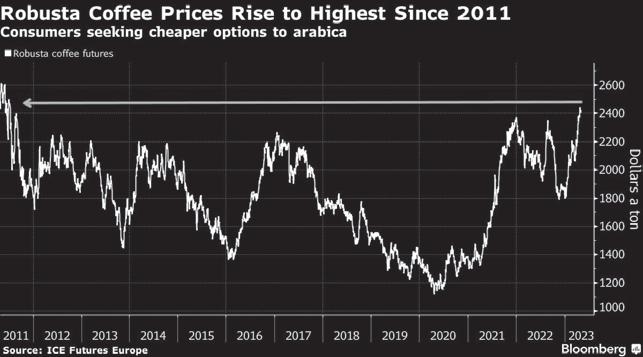
T he country shipped 1.16 million tons of coffee in the first seven months of the season, the highest ever, according to customs and statistics office data compiled by Bloomberg. But the pace may slow over the rest of the season.
Hero Bread
HERO BREAD, a maker of low-carbohydrate bread, tortillas and buns, has raised $15 million in a Series B fi-
T he $15 million was a figure designed to support the company’s growth through the end of the year, founder and Chief Executive Officer Cole Glass said in an interview. But sales have thus far outpaced projections, and if that continues, another round of financing will come soon.
“If things are going better than what we planned, the rest of fundraising is going to go ahead of schedule as well,” Glass said.
Globally, fundraising for agriculture, food and related tech startups totaled $29.6 billion in 2022, a 44-percent drop from 2021, according to a report from investor and researcher AgFunder.
Hero Bread and Subway Restaurants Inc. have paused their partnership, Glass said, as Hero focuses more heavily on retail and direct-toconsumer sales online.
Hero makes its products by replacing standard flour with plantbased proteins and fibers, resulting in breads with 0 to 2 grams of net carbohydrates, compared with more than 20 grams of carbohydrates for a slice of conventional white bread. They’re also higher in protein.
By Dennis Abrina ContributorSILANG, CAVITE —At the end of the weeklong Sumilang Festival 2023, the Municipal Agriculture Office under Adelia Poblete and the Silang local government unit, led by Mayor Kevin Anarna, honored outstanding farmers on April 30 at the Silang campus of the Cavite State University.

A mong those who were recognized are the oldest farmers in the town and farmers with the biggest harvests of vegetables, such as upo, eggplant, and squash.
T he awardees are Carina Magana
of Barangay Santol (Outstanding Naturally Grown Vegetable Farmer), Jose Rossboy Lagoras of Barangay Adlas (Outstanding Corn Farmer), Anselmo Noveno of Barangay Bunga (Outstanding Ornamental Plant Producer), Ildefonso de Leon of Barangay Pooc 1 and Erlinda Pailas of Barangay Litlit (Outstanding High Value Crops Farmer).
T he other awardees are Engr.
Ricky Perez of Barangay Lumil (Outstanding Agricultural Entrepreneur), Cherish Belamide Del rosario of Kape ni Tatay (Outstanding Young Farmer), William Ugsod of Barangay Lumil (Outstanding Small Animal Raiser Adopting In-
tegrated Farming System), Romel Olares of Barangay Pasong Langka (Outstanding Large Animal Raiser Adopting Integrated Farming System) and Francisco Montales of Barangay Balite 1, Antonia Emelo of Barangay Sabutan, Diosdado Bayan of Barangay Tubuan 3 and Zoilo Calderon of Barangay Adlas (Oldest Silangeño Farmers).
A narna said there is a need to preserve the lands in Silang, particularly those devoted to agriculture, which inspired the Sumilang Festival.
He also expressed his support for all farmers in Silang and has vowed to continuously give them aid, such as fertilizer and tractors.
Coffee drinkers pay more as farmers prefer growing durians in Vietnam
THe Philippines and the United States have long had a close, although at times unsteady, relationship. On Monday, the security and economic partnerships between the two countries were “strengthened and redefined” following the bilateral meeting between President Ferdinand R. Marcos Jr. and US President Joseph “Joe” Biden.

The meeting comes at a crucial time as the US is trying to counter the growing influence of China in Asia. Marcos welcomed Biden’s ironclad commitment to help in defending the country amid the “complicated geopolitical situation” in the Pacific. “It is only natural for the Philippines to look to its sole treaty partner in the world, to strengthen and to redefine the relationship that we have and the roles that we play in the face of those rising tensions that we see now around the South China Sea and Asia-Pacific and Indo-Pacific regions,” Marcos said in his speech at the Oval Office. (Read, “US-PHL ties redefined, boosted,” in the BusinessMirror, May 3, 2023).
American media said the meeting “is meant to send a message to China amid conflict over Taiwan and its increasingly assertive claim to almost the entire South China Sea.”
“We are facing new challenges, and I couldn’t think of a better partner to have than you,” Biden told Marcos in the Oval Office.
“The US-Philippine military ties would stay strong. The United States remains ironclad in our commitment to the defense of the Philippines, including the South China Sea, and we will continue to support the Philippines’s military modernization,” Biden said.
In a joint declaration, both leaders agreed to institutionalize their defense priorities on land, sea, air, space, and cyberspace with the creation of new bilateral defense guidelines. These include US support in the Philippine military modernization initiatives with the plan to transfer two Island-class patrol vessels, two Protector-class patrol vessels, and three C-130H aircraft to the Armed Forces of the Philippines.
The US government also plans to provide sustainable development and investment in local communities in sites covered by the Enhanced Defense Cooperation Agreement (EDCA).
Pundits said that while US-Philippine military cooperation has strongly progressed, the broader economic relationship between the two countries is lagging. They said Marcos needs to show improvement there if he wants to sustain domestic political support for a strengthened security partnership with the US.
“The alliance cannot work if the United States doesn’t provide more assistance to the Philippines for economic development, food security and energy security,” said Gregory Poling, director of the Southeast Asia program at the Center for Strategic and International Studies. “Those are the top priorities of every Filipino. Marcos needs to be able to make the case at home that there are tangible benefits with a closer US relationship.”
Biden disclosed he will be deploying the first ever Presidential Trade and Investment Mission to the Philippines to encourage more US firms to invest in the country’s innovation economy, clean energy transition, critical minerals sector, and food security.
He also said the US plans to co-host with the Philippines the 6th annual Indo-Pacific Business Forum in Manila next year. The event, Biden said, will help “establish the Philippines as a key hub for regional supply chains and high-quality investment.”
The two leaders also committed to prioritize the completion of the Philippines-US Trade and Investment Framework Agreement and support the creation of the Indo-Pacific Economic Framework for Prosperity.
Biden’s pledge to send the first-ever US presidential trade and investment mission to the Philippines is an encouraging move that could potentially reinvigorate American investors’ interest to locate or expand their business in the country. This will also open opportunities to deepen economic cooperation that will promote inclusive prosperity.
FOR 50 years, I weighed 165 lbs. never varying more than 10 percent heavier or five percent lighter. Then came the March 2020 lockdown and months of nothing much but “Netflix and eat.” In early 2021, I decided that I had come to the end of my personal lockdown and go out, any “out.”
I was shocked after reaching into my closet and discovering my favorite denim pants had shrunk. Apparently, the coronavirus had attacked my pants so violently that it was absolutely impossible to button them no matter how I tried.
My wife told me that it was not the pants that were the problem but that my waistline was significantly larger than it had been a year earlier.
That is my silly story to illustrate the liquidity crisis that we will soon be facing and how this time the difficulty will sneak up on us. As I said last Tuesday, a Silent Killer.
The 1997 and 2008 financial crises that saw liquidity freeze and then

price destruction in the asset and financial markets were predicted by a few. But most were like, “A potential price bubble in the housing sector across many economies will soon explode.”
The one person who fully understood was former Governor of the Reserve Bank of India, Raghuram Rajan, writing this in 2005, angering his peers. Rajan said that financial managers were encouraged to take “small-probability” risks that offered great rewards but could “generate severe adverse consequences” or “tail risks.”
He wrote: “Perhaps the most important concern is whether banks

will be able to provide liquidity to financial markets so that if the tail risk does materialize, financial positions can be unwound (liquidated/ sold) and losses allocated so that the consequences to the real economy are minimized.”
But if due to a loss of liquidity you cannot sell out, like the “global financial institutions” in 2008, it is a disaster and in that case, a total economic disaster. You have a few million in the stock market and you unwisely ride the price down, forcing you to take a 50-percent loss. That’s bad. No trip to Boracay and no new car. But if you cannot sell because there is no liquidity and lose it all, that could be an ELE—“extinction-level event.”
I knew I was gaining weight in 2020. But it was slow and gradual and then KaDoom. From 2014 and through 2016 trading volume—and proof of liquidity—on the Philippine Stock Exchange increased by 800 percent. 2016 was the peak, dropping by almost 50 percent in 2018 and from 2018 to 2023 by almost 60 percent.
On the last day of April 2023 trading, out of 286 issues, 102 traded less that P20,000. In March 2023 there were 114 “no trade” stocks. But in
May 2019, that number was 79 issues and in June 2019, 90 did not trade. Is this a sign that the PSE is losing liquidity or is it merely a “boring” market as I complained last week? Should you sell all your shares and run for cover? Of course not. But I will say again, we are facing a massive global liquidity squeeze in all economies to some degree or another.

What to do? If you are not willing to take manageable financial risks, you are either exceedingly wealthy or exceedingly lazy. You protect against major risks in the future by taking minor risks today and managing those risks sensibly and competently. You invest in a fire extinguisher today to protect against a fire that may never happen. You invest in stocks today to build wealth over time. But as with fire protection you monitor it prudently and frequently. You have an obligation to learn how to take advantage of changing situations and conditions. “Expect the best. Prepare for the worst. Capitalize on what comes.”—Zig Ziglar. E-mail me at mangun@gmail.com. Follow me on Twitter @mangunonmarkets. PSE stock-market information and technical analysis provided by AAA Southeast Equities Inc.
THe Biden administration has decided to remain publicly quiet on India’s democratic backsliding, according to senior US officials, as the US intensifies efforts to keep New Delhi on its side in the rivalry with China.
Indian Prime Minister Narendra Modi’s pressure on religious minorities and the media is troubling, as is his party’s targeting of opposition lawmakers, said the officials, who asked not to be identified discussing internal deliberations. But the decision to largely refrain from criticizing Modi comes as growing concerns about China make India increasingly crucial to US geopolitical and economic goals in the Indo-Pacific.
The decision on handling India is an example of how President Joe Biden’s emphasis on human rights— and his framing of a global conflict between democracies and autocracies—has run up against the strategic realities of a world where rivals such as China and Russia are vying for greater control.
So while New Delhi’s strong defense ties with Russia and its vast purchases of Russian crude have drawn scrutiny from US lawmakers after the invasion of Ukraine, the administration believes it needs India to buy that oil to keep prices low. And rising concerns about China’s growing assertiveness under Xi Jinping have helped drive the US and India even
closer together, these people said.
“India is getting this free pass on account of China,” said Manoj Joshi, a fellow at the Observer Research Foundation in New Delhi who has advised previous Indian administrations on national security issues.
“The only country in Asia, in terms of size and potential, that can balance China is India.”
In a sign of the close ties, Biden is set to host Modi for a state dinner in Washington this summer. While Biden might press Modi to take a more explicit stance on Ukraine, one US official said it’s doubtful New Delhi would publicly rebuke Russia, given their close defense ties.
‘Regularly engage’
A SKED whether the administration is reluctant to criticize Modi, John Kirby, spokesman for the National Security Council, said in a statement, “As we do with other nations around the world, we regularly engage with Indian government officials at senior levels on human rights concerns, including freedom of religion or belief.” US officials also have frequently pointed to India’s shipments of hu-
manitarian aid to Ukraine as well as Modi’s comments to Russian President Vladimir Putin that “today’s era is not one for war.”
India’s foreign ministry declined to comment. Indian Foreign Minister Subrahmanyam Jaishankar has made no secret of his country’s decision not to pick sides regardless of what others may want, echoing India’s Cold War leadership of what was called the “non-aligned movement.”
“Whether it is the United States, Europe, Russia or Japan, we are trying to ensure that all ties, all these ties, advance without seeking exclusivity,” Jaishankar said during a visit to the Dominican Republic last month.
As India eclipses China as the world’s most populous country with more than 1.4 billion people, the Biden administration believes it’s impossible to solve pressing global challenges such as climate change without New Delhi, one official said, and the country remains a central part of the US’s Indo-Pacific strategy.
That’s led to the relative silence on issues that the US would normally speak out about publicly, and loudly.
Most recently, India’s government banned a critical documentary about Modi released by the BBC and sent federal tax authorities to raid the British news organization’s Delhi office.
Modi’s Hindu nationalist Bharatiya Janata Party also won a defama-
tion case against the main political opposition leader, Rahul Gandhi, that has seen him kicked out of parliament. Modi’s government has also choked local and international nongovernmental organizations of foreign funding.
Russian arms
O T HER Indian moves also run against a greater strategic alignment with Washington: In recent months, India pledged closer defense ties with Russia. Although India has sought to scale back purchases of some Russian weapons, its military has more than 250 Russian-designed fighter jets, seven Russian submarines and hundreds of Russian tanks. It has also received Russian S-400 missile defense systems despite US efforts to keep those purchases from going forward. “President Biden would be remiss if he doesn’t raise the Russia issue and restate the importance of supporting Ukrainian sovereignty and explain why that is important for the Indo-Pacific region,” said Lisa Curtis, who was the National Security Council senior director for South and Central Asia under former President Donald Trump. “It’s no use pretending we don’t have serious differences on such a crucial issue,” said Curtis, who directs the Indo-Pacific Security Program at the Center for a New American Security.
See “US,” A15
From markets in Bursa to universities near Ankara and the streets of Berlin, the mood among many Turkish voters is tilting against recep Tayyip Erdogan and could thwart the powerful president’s reelection bid.
Workers suffering from brutal inflation, young people worried about grim prospects and wavering support among once-steadfast voters from the Turkish diaspora are combining to pose the biggest ever threat to Erdogan’s power.
The 69-year-old—who has dominated the country’s politics for two decades—wields almost unbridled authority and is now taking the heat for the country’s woes. The upshot will likely mean he’ll fall short of the 50 percent needed to win in the first round of voting on May 14.
“We’re neck deep,” said Hasan Cakir, surrounded by bags of henna in his tiny shop in northwestern Turkey. “Even if I’m going to die because of it, I’m still not going to vote for him.”
The 51-year-old merchant had cast his ballot for the Turkish leader and his conservative AK Party at every election in the past 21 years, but like millions of other Turks, he saw his quality of life erode since Erdogan grabbed more power after his 2018 reelection. Rampant inflation in the last few years even surged past 100 percent in Istanbul and other large cities, and reached a peak of 85 percent nationwide in late 2022.
While increases have since eased, prices of everything from housing to cars and food quadrupled in a matter of years. Many blame Erdogan’s efforts to extend his influence across all aspects of the economy, including monetary policy.
Unorthodox interest rate cuts further fueled price gains in the aftermath of the Covid pandemic, sapped the Turkish lira’s value by more than 75 percent against the dollar since the last election, and sparked an exodus of investors. Economists attribute Turkey’s outlier status to Erdogan’s economic experiment going terribly wrong.
The frustration is widespread enough that Erdogan is projected to be denied victory in the first round against main rival Kemal Kilicdaroglu, who’s backed by a broad coalition of opposition parties. Recent polls put the two neck and neck, with both shy of the majority needed to gain power. There would then be a runoff two weeks later for the first time.
Bloomberg reporters spoke to voters in Bursa, Eskisehir, Balikesir and Canakkale—key cities in an industrial and agricultural hub in the northwest that’s critical to the economy—as well as Turks in Berlin, home to the biggest pool of voters outside the country.
The interviews revealed an electorate deeply divided along social values, age and pay. Older, conservative voters were more likely to stick to Erdogan, while poorer people are losing faith. Younger voters are the most frustrated.
Disaffected youth
T U RKEY ’s poor recent economic performance and Erdogan’s authoritarian power grab have made him much less popular among younger people and those living in city centers.
“I don’t understand how anyone at my age can still possibly support Erdogan,” said Elif Torun, a 21-yearold university student in Eskisehir,
continued from A14
Oil politics
T HE Us has also moved on from concerns about India’s vast purchases of Russian crude oil even as the country
The frustration is widespread enough that Erdogan is projected to be denied victory in the first round against main rival Kemal Kilicdaroglu, who’s backed by a broad coalition of opposition parties. Recent polls put the two neck and neck, with both shy of the majority needed to gain power. There would then be a runoff two weeks later for the first time.
a city neighboring Turkey’s capital Ankara. “We’re even calculating the cost of our meals, skipping lunch some days to save money.”
That could be problematic. since the 2018 elections, about 6 million people have become eligible to vote— nearly 10 percent of the electorate.
Diaspora split
FA dIng prospects in Turkey has prompted young people like Yaren Akcakoyun to leave in pursuit of opportunity, gradually shifting the dynamics of a group that Erdogan could once rely on for clear majorities.
The 24-year-old who studied to be a psychological counselor recently migrated to germany from Turkey’s Adana region and is now looking for a job in Berlin. she has no love lost for Erdogan.
“If there is a change of government in Turkey, I would like to go back to my country and do the job I was trained in,” Akcakoyun said in the german capital’s Kreuzberg neighborhood.
But the view isn’t universal among the nearly 4 million Turkish voters living abroad—most in germany, the netherlands, France and Belgium.
While there are also a large number of anti-Erdogan Kurds scattered around Europe, most voters are Turkish descendants of so-called guest workers—brought in as cheap labor starting in the 1950s.
Treated as underclass in the countries where they settled, their experiences have led to staunch nationalist, pro-Erdogan sentiment, even if they support left-leaning parties locally.
“With Erdogan, our status here got a boost,” said Ismet Aydinlik, an 81-year-old retired man who migrated to Berlin nearly four decades ago and worked as a butcher. “They used to look down on us in the past. But now they see us as more powerful.
I’m a supporter of Erdogan’s party.
I’m not shy about it.”
The devil you know
sIMIl A R sentiment is evident in the Turkish heartlands, where Erdogan is viewed as the strong leader the country needs to guide them out of hard times—even if it was the president’s policies that played a major role in creating the situation.
s u rrounded by Turkish flags adorning the walls of his small workshop in Balikesir, Ali Erdik gave Erdogan a free pass on the policy missteps.
“There’s been an economic malaise due to reasons out of Erdogan’s hands,” the 51-year-old mechanic said. “But he’s also the one who can fix it.” With assistance from Tugce Ozsoy and Beril Akman / Bloomberg
rejects a group of seven initiative to put a cap on the price for which it’s sold.
At one meeting in delhi between Us and Indian officials following the invasion of Ukraine, a Us diplomat told a senior Indian official that if their refiners weren’t buying Russian
nese government refused to heed our calls, our protests against their aggression and illegal occupation, aside from the usual bullying and oppression of our fishermen. In fact, even Coast gu ard and supply vessels in our territorial waters and exclusive economic zones are tailed and harassed.
FILIPINoS are divided as to whether we align with China, the US or stay in the middle.

I’ d like to make a brief statement on this national issue confronting us Filipinos, in simplified manner, easy to understand, so to speak, but, unfortunately with not much detail due to space limitation.
We’ll limit the discussion to two major stuff so that we do not entangle ourselves with so many collateral or perhaps, peripheral issues, which would come along the way, for sure, like it or not.
Two facts are clear from PRC. Its People’s liberation Army occupied reefs and shoals that are part of our territorial waters and inside our exclusive economic zone.
China reclaimed areas in the West Philippine sea, which under interna-
tional law are not theirs. These areas have now become expansive and modern military bases that altered the status quo in the area. It occurred despite President Xi Jinping’s repeated pronouncement and commitment that the facilities they built on the reclaimed reefs and shoals are only for maritime shelter and emergency use of fishermen and are civilian in character, not intended for military purposes.
On so many occasions, the Chi-
Yet, Xi Jinping, like a broken record, told PRR d, PBBM and the world that they prefer peace and stability, talks over confrontation to settle the issue among the parties involving not only the Philippines but also Indonesia, Vietnam, Malaysia and Brunei.
The frustrating thing on the ground is the opposite. They mouth this and that, but do otherwise.
China doesn’t even respect any international rule of law, especially if it does not favor their interests. With the Chinese economic and military might, the bully now acts with impunity since they know we are militarily weak and helpless.
n o w, can there be a middle ground? none, it surely will be total and full occupation of the WPs
W hat can we do? While the Us is a friend, we are at the mercy of their institutional, economic and political control. But there can be no neutralizer other than the Yankees and allies together who can help us mitigate China’s bullying and aggression.
We have to bite the bullet. With EdC A, we host the indefinite stay of Us troops and the installation of war facilities in our ill-equipped military bases near or directly facing the WPs and Taiwan.
Frankly, it’s a base within a base, which the Us does in the Middle East and other countries as a way to go around the respective countries’ laws and prohibition.
China won’t stop until they have full control of the West Philippine sea. And our antidote is being with the Us, Japan, Australia and other allies, even at the prospect of being involved in a war between the two for the expected Battle of Taiwan. That is the case if we want to fight for every inch of our territorial waters and EEZ, which President Bongbong Marcos and senator Bong go stand for.
PBBM met President Biden for more clarity on the mutual defense treaty and how the Us responds to humanitarian and the current conflict with aggressor China.
On his part, senator go reiterated that “even if we are a small country, we will fight for what is ours,” as he cited the role of EdC A in strengthening the country’s disaster and humanitarian capabilities.
Comments@andalbilly@yahoo.com
THE US, Europe and other key allies of Ukraine are preparing fresh penalties against russia to try and tighten the net on President Vladimir Putin’s economy more than 14 months into his war, according to people familiar with the matter.
The packages would be individually implemented but coordinated. A key goal is to close loopholes in existing penalties and tackle overall sanctions circumvention, the people said, asking not to be identified discussing sensitive matters.
The plans will be unveiled around a group of seven leaders meeting in Japan later this month.
Multiple rounds of sanctions and other economic penalties imposed on Moscow since its invasion of Ukraine have battered Russia’s economy but not delivered a knockout blow, while Putin shows no sign of halting his war. Russia’s energy revenues are close to exceeding their target level in the face of the oil price cap imposed by the g -7 and European Union partners, helping the government to stabilize the budget even as military spending has surged.
The Bank of Russia forecast on
Friday that the economy will grow as much as 2% this year as the impact of sanctions fades, with gross domestic product reaching pre-war levels by the end of 2024, far earlier than many economists had forecast. Russia’s gdP declined by 2.1% in 2022 compared to a year earlier, confounding predictions early in the war that the restrictions would send the economy into a deep slump.
The g -7 summit will provide a forum for a discussion on what has worked so far and what options remain in terms of pressuring the Russian economy further. But with swathes of Russia’s trade and financial sectors already sanctioned, finding new areas to significantly squeeze Putin’s ability to fund his war isn’t easy.
The EU’s package, the bloc’s 11th since February 2022, will mostly focus on the loopholes in sanctions
already enacted, according to officials. Proposals on the table include banning many goods from transiting through Russia and targeting vessels that switch off navigation systems.
The measures, which would need the backing of all EU member states to be adopted, would also impose new sanctions on about three-dozen people.
The Us and Japan are preparing their own packages, the people said. Canada is working on measures relating to human rights, including the alleged abduction of Ukrainian children, and penalties on Russia’s defense industry.
While each package may differ in its content, due in part to the regulatory systems in each country, allies have been coordinating their respective responses ahead of the summit, the people said.
Much of the g -7’s attention is focused on cracking down on Moscow’s ability to evade or circumvent existing measures, with an emphasis on hundreds of restricted goods and technologies used for military purposes.
That effort has involved applying diplomatic pressure on other coun-
tries through which trade to Russia has spiked, enhanced monitoring of key goods and targeting companies that may be helping Moscow—intentionally or otherwise—to get around restrictions.
g -7 leaders are expected to further hone those efforts at their meeting in Hiroshima, while also expanding restrictions on technology and equipment used by Russia’s military and industry.
Ahead of the summit, g -7 states are also discussing flipping the existing sanctions regime around, with all exports banned unless exempted, Bloomberg previously reported.
That is seen as especially problematic for the EU, however, where the bloc would eventually need the backing of all member states. If the new criteria are endorsed by g -7 leaders, exemptions would likely include agricultural goods, food and medicines.
The g -7 leaders are also expected to make progress on a mechanism to track and trace Russian diamonds across borders that could eventually pave the way for restrictions on that trade. With assistance from Ewa Krukowska / Bloomberg
WASHINGToN—Widespread loneliness in the US poses health risks as deadly as smoking up to 15 cigarettes daily, costing the health industry billions of dollars annually, the US surgeon general said Tuesday in declaring the latest public health epidemic.
About half of Us adults say they’ve experienced loneliness, dr. Vivek Murthy said in an 81-page report from his office.
“We now know that loneliness is a common feeling that many people experience. It’s like hunger or thirst.
It’s a feeling the body sends us when something we need for survival is missing,” Murthy told The Associated Press in an interview. “Millions of people in America are struggling in the shadows, and that’s not right. That’s why I issued this advisory to pull back the curtain on a struggle that too many people are experienc-
crude and putting it back on global markets, oil prices might have soared to about $180 a barrel, according to a person familiar with the meeting.
Indian officials always viewed Western criticism of their oil purchases as hypocritical, given that Indian refiners do put the product
ing.” The declaration is intended to raise awareness around loneliness but won’t unlock federal funding or programming devoted to combatting the issue.
Research shows that Americans, who have become less engaged with worship houses, community organizations and even their own family members in recent decades, have steadily reported an increase in feelings of loneliness. The number of single households has also doubled over the last 60 years.
But the crisis deeply worsened when Covid-19 spread, prompt-
on global markets.
But India has emerged as a major market for redirected Russian oil, taking advantage of cheaper barrels to help curb inflation and spur growth. Russia is now India’s top supplier, surpassing Iraq and saudi Arabia, and in March the average
ing schools and workplaces to shut their doors and sending millions of Americans to isolate at home away from relatives or friends.
People culled their friend groups during the coronavirus pandemic and reduced time spent with those friends, the surgeon general’s report finds. Americans spent about 20 minutes a day in person with friends in 2020, down from 60 minutes daily nearly two decades earlier.
The loneliness epidemic is hitting young people, ages 15 to 24, especially hard. The age group reported a 70% drop in time spent with friends during the same period.
l oneliness increases the risk of premature death by nearly 30%, with the report revealing that those with poor social relationships also had a greater risk of stroke and heart disease. Isolation also elevates a person’s likelihood for experiencing depression, anxiety and dementia, accord-
cost of Moscow’s crude landing on its shores hit the lowest level since the war in Ukraine began.
Jaishankar, the foreign minister, has often invoked broader sentiment in the so-called global s outh as he defended his country’s position on Ukraine amid soar-
ing to the research. Murthy did not provide any data that illustrates how many people die directly from loneliness or isolation.
The surgeon general is calling on workplaces, schools, technology companies, community organizations, parents and other people to make changes that will boost the country’s connectedness. He advises people to join community groups and put down their phones when they’re catching up with friends; employers to think carefully about their remote work policies; and health systems to provide training for doctors to recognize the health risks of loneliness.
Technology has rapidly exacerbated the loneliness problem, with one study cited in the report finding that people who used social media for two hours or more daily were more than twice as likely to report feeling socially isolated than those who were on such apps for less than 30 minutes a day.
ing food and energy prices that have put immense pressure on poor countries. He has waved off U s concerns about India’s human rights record, saying “people are entitled to have views about us.”
With assistance from Sudhi Ranjan Sen and Clara Ferreira Marques / Bloomberg
climate ahead.
So, we need to do two things: insulate our financial system through easy-to-pass reforms such as the FIST [Financial Institutions’ Strategic Transfer] Act extension, rural bank consolidation, and streamlined procedures for financial rehabilitation for small and medium enterprises,” he said.
The second, and far more important step, is to ensure that we invest in programs and projects that expand our productivity. That means we also need to expedite national government disbursements especially for asset-creating projects such as infrastructure,” he said.
ment,” Park said.
By Cai U. Ordinario @caiordinarioHouse Committee on Ways and Means Chairman Joey Sarte Salceda urged these agencies to act faster in implementing government programs to insulate the country’s economy.
S alceda said the government is not spending cash fast enough, despite good collection performance by the tax collection agencies, which he congratulated in a tax panel committee hearing he led.
“ The Bureau of Internal Revenue expects to collect a record P300.9 billion in April alone or 25 percent from P239.6 billion last year. I also want to congratulate
the Bureau of Customs for once again exceeding its revenue collection targets for the month of April 2023. The BOC collected P68.274 billion last month, exceeding its target of P68.199 billion by 0.11 percent,” Salceda added.


This suggests that, despite uncertain global conditions, our tax collection agencies are exceeding expectations and are working hard to earn the lifeblood of Philippine government,” he said.
A ccording to Salceda, there are slight rumblings in the global economy, which indicates at least a cloudy global economic
‘Triple contraction’ UNFORTUNATELY, Salceda said despite the growth in collections, the country is actually implementing a contractionary fiscal policy, with disbursements being 1.05 percent down, despite expectations of around 6 percent real GDP growth this year.
“ Together with the Fed’s continued commitment to increase hikes further by at least 25 bps this week, and the contractionary monetary policy that these actions force our BSP to take, we cannot expect resilient growth
with these economic policies,” Salceda said.
“And as one of my mentors, Former Secretary Winnie Monsod once chided me about, when we miss growth targets, the sick die and families go hungry,” he said.
Salceda added that if the government doesn’t spend fast enough, while the BSP is cutting rates and the Fed continues its hikes, the country will rely solely on private investment, which could mean it misses its growth targets.
“ The Department of Budget and Management already has the authority to release allotment orders from President Marcos. It must use the authority in consonance with our growth targets. Otherwise, we are not putting our money where our mouths are,” Salceda added.
“And crucial agencies for economic and social services, such as DPWH [Department of Public Works and Highways], DOLE [Department of Labor and Employment], and DBM, must be more aggressive in implementing programs to expand productivity. Otherwise, growth will come solely from the private sector—and we are very likely to fall short of our targets,” he said.
INCHEON, South Korea—
Getting rid of fossil fuel subsidies, land use, and making agriculture greener are among the “low-hanging fruits” for countries in their effort to transition to net zero, according to the Asian Development Bank (ADB).
In a briefing here on Wednesday, ADB Chief Economist Albert Park said removing fuel subsidies can discourage its consumption; land use can lead to efforts that cut greenhouse gas emissions from deforestation and cropping activities; a “greener” agriculture mean using better fertilizers.
T hese efforts, Park said, can be addressed through regulations and legislation, and not necessarily investments that may be costly given that countries are still recovering from the pandemic.
“ Things like green building codes, (setting) carbon emission standards, and other ways that again, it’s all about making people, if there isn’t a carbon price out there, make people internalize actions that are going to be harmful for the environ -
For the development sector, ADB President Masatsugu Asakawa said the need to address climate change and tread the path to net zero is also a call for ADB and other multilateral development banks to evolve.
T his MDB evolution must recognize that development is no longer possible without effective climate action; investing in global public goods; and be key players in the effort to mobilize the levels of financing now required for development, from billions to trillions.
A sakawa stressed that traditional models of lending and grantmaking will not be enough to respond to the challenge of climate change. MDBs must undertake efforts to “help economies transition, swiftly and justly, to a net zero future.”
“
We need to answer the call for MDBs to do more to maximize our financing capacity through game-changing new mechanisms; to leverage the enormous investment potential of the private sector and philanthropies; and to maintain our place as a stable, reliable financial institution,” Asakawa said. See “Net zero,” A2
SAYING the regional wage boards have been slow—and thrifty—in granting workers relief for the past several years, Senate President Juan Miguel Zubiri on Wednesday affirmed his commitment to push the bill for a legislated wage hike, and sounded confident he can muster his peers’ support for it.
I nterviewed at the Kapihan sa Manila Bay, the Senate leader recalled a previous commitment at the Senate to pass an awaited legislative wage hike to help workers reeling from persistently high inflation.
On Labor Day I resurfaced our commitment in the Senate to pass a legislative wage hike due to inflation,” he said partly in Filipino, adding: “I mention this because I frequently talk to foreigners and I ask them how much is the minimum wage in their country; in their case it’s often $10 minimum per hour.
In our case that $10 is the whole day’s wage. So, they are surprised. How can our workers survive?’
S enate President Zubiri said he agrees with their view that workers and their families can hardly survive being paid a minimum wage of P517 a day.
He noted that such a rate is even for the NCR (National Capital Region); “I’m not yet talking about the provinces, where it’s P300 per day— it’s less than $7 per day. How can you feed your family if you have, say 4-5 children, on P300 per day? How can you cope with their educational requirements?”
T his being so, Zubiri lamented, “our workers’ situation is truly dire; and that was especially highlighted in the pandemic.”
S oon after the pandemic, he recalled the next problem was inflation, as “prices of all basic items soared - from sugar to vegetables to fish, pork, other meat, everything went up. Gasoline, electricity, none went down. The only thing that was frozen was the people’s wages. It’s
not inflationary, it does not go up with inflation. Our people’s wages have remained steady.”
H e disclosed that several senators now share his view that, “it is time to move. Most of them believe it’s high time to act, onetime big-time, to help our workers.” He cited Senate President Pro Tempore Loren Legarda, Majority Leader Joel Villanueva, and Senators Nancy Binay and Raffy Tulfo, among those who share this view.
A s an example, he noted that in the US, there is a Federal Minimum Wage per hour. “They assigned one rate for the entire US, where you cannot give anything lower.
I think it’s no less than $9 to $10 per hour.” It’s up to the respective states, be it California or Florida, if they wish to set something higher, and by how much, he added. “That means in California, it’s higher tna $10, I think $11.50 per hour is the minimum wage, if I am not mistaken.”
AN economist-lawmaker on Wednesday called out the Department of Budget and Management, the Department of Finance and the Bureau of the Treasury for “slow national government disbursements,” which he says are “resulting in a three-bladed contractionary policy—spending is slower than last year, we are shrinking money supply, and the external environment is cloudy.”
Thursday, May 4, 2023
Stéphane Bancel, Ceo of Moderna said the company is expanding its footprint by establishing the Philippine hub.
“The Philippines has a critical mix of talent and global business service expertise, which makes it an excellent location to scale efficiently and provide regional support,” Bancel said.
According to Moderna, the Asia Pacific region is “integral” to Moderna’s business, as it has “established” subsidiaries in Australia, hong Kong, Japan, Singapore, South Korea, and Taiwan.
The vaccine maker said the addition of the site in the Philippines “completes” its strategy to provide regional solutions across the business, complementing existing locations in Atlanta, Georgia, which services the Americas, and Warsaw, Poland, which cov-
ers e u rope, the Middle e a st, and Africa.
The company said its enterprise solutions hub will provide new capabilities, service lines, and capacity to help meet the growth of Moderna’s commercial and business operations in the Asia Pacific region.
The US-based vaccine manufacturer said it plans to begin operations in the Philippines in the second or third quarter of 2023.
Moderna said the Philippine hub will be similar to its counterparts in Warsaw, Poland, and Atlanta, US, which were established in May 2021 and March 2022, respectively.
“The hub will initially house finance, pharmacovigilance, medical, and hr personnel, in addition to commercial- focused roles, to support its direct presence in the market.”
The company said it expects to
employ approximately 40 to 50 employees in the Philippines.
Jose Manuel G. romualdez, Ambassador of the Philippines to the US, said the Philippines is “wellpositioned” to host global services and facilities that advance health and pharmaceutical technology.
romualdez also said the country’s partnership with Moderna highlights the Philippines’s position in promoting healthcare and addressing emerging health threats.
“It also highlights Moderna’s role in delivering life-saving vaccines during the Covid-19 pandemic and the ability and promise of their mr NA platform.”
In a separate statement on Wednesday, the Department of Trade and Industry (DTI) said President Ferdinand r Marcos Jr. held meetings with representatives of other American firms.
Marcos had discussions with Ultra Safe Nuclear Corp., one of the companies that are at the “forefront” of small and micro modular reactor technologies; Atento, a leading company involved in customer relationship service and business process outsourcing (BPo); Analog Devices, a major semiconductor company; and o ptum (UhG), Inc., a major healthcare provider in the US.
DTI said Atento has decided
to set up its first call center at the Iloilo Business Park, which will employ about 1,000 workers during its first year.
The US-based BPo firm will offer both voice and non-voice services to American clients. The DTI said Atento’s initial investment is estimated at P21.4 million.
Meanwhile, o ptum will invest P800 million to set up health information management services operations in Davao, which will generate 1,500 jobs.
The semiconductor industry is also expected to get its share in the investment pie as Analog Devices will set up a research and development (r & D) center and hire an additional 1,000 engineers for semiconductors.
Maxeon Solar Technologies, a global leader in solar innovation, plans to bring its latest technology, Max7 to the Philippines, according to the DTI.
Trade Secretary Alfredo e Pascual said through this project, “the most advanced solar cells in the world will be manufactured in the Philippines.”
The Trade chief welcomed the plans of the American firms to pour investments into the Philippines, saying the “billions of dollars’ worth of investments will generate thousands of jobs for the Filipino people.”
The P52-billion interconnection project linking Mindanao and Visayas was finally energized last April 30, the National Grid Corporation of the Philippines (NGCP) announced Wednesday.
Through the Mindanao-Visayas Interconnection Project (MVIP), the Mindanao grid will be linked to the Visayas grid via a high voltage direct current system (h V DC) with a 450-megawatt (MW) initial capacity. however, the capacity will be gradually delivered starting with an initial load of 22.5 MW via high voltage submarine and overhead lines from Mindanao to Visayas.
“We expect to gradually increase the MVIP’s transfer capacity to 50MW by mid-May, and 112MW by the end of the month, before energizing to its full transfer capacity of 450MW by the third quarter of this year,” the grid operator said in a statement.
The MVIP is comprised of a 184 circuit-kilometer h V DC submarine transmission line connecting the power grids of Mindanao and Visayas with a transfer capacity of 450MW expandable to as much as 900MW.
The project also includes converter stations in both regions and more than 500ckm of overhead lines to facilitate the flow of electricity.
It was certified as an energy Project of National Significance in 2018
and was initially targeted for completion by December 2020 but was delayed due to the Covid-19 pandemic and subsequent quarantine restrictions across the country.
NGCP said the MVIP will benefit consumers by providing them with “a more reliable and sustainable power transmission service” that will reduce the instances of power interruptions. It will also promote energy resource sharing, as excess power generated in one region can now be transmitted to the other.
“The completion of the Mindanao-Visayas Interconnection Project is a significant achievement for us and for the Philippines as a whole. This will not only improve the reliability of our transmission services but will
lead to efficient energy utilization as one Philippine grid,” said NGCP.
Parts of the MVIP were completed in 2022, such as the Lala-Aurora 138kV Transmission Line, the 350kV Submarine Cable, and Cable Terminal Stations in Santander, Cebu, and Dapitan, Zamboanga del Norte. NGCP expects to complete the remaining components of the project and ramp up the transfer capacity of the facility in the coming months.
“NGCP is committed to providing the Filipino people with a reliable transmission network which is the backbone of the nation’s development. The completion of the MVIP is a significant step towards achieving that goal.”
B1
LT Group Inc. (LTG), the holding firm of taipan Lucio Tan, is transitioning to a new leadership with Lucio Tan III replacing his uncle, Michael G. Tan, as president of the company.
Tan III is a member of the third generation of Tan family and is the son of Lucio Tan Jr., who died in 2019.
During the year-long transition period, Tan III shared decision-making responsibilities for business and operational matters with his uncle Michael who had been president of LTG since 2010.
Michael is stepping down after steering the company in the past 10 years to greater heights with the income in 2022 nearly three times that of 2013 when LTG had its initial public offering that raised P37.7 billion.

“Like most businesses, your company had to grapple with higher energy, raw material and freight costs, higher interest rates, and higher foreign exchange rates, making it a challenge to keep costs down and at the same time, implement price increases to pass on some of the cost increases to our customers. And your company was able to succeed, posting growth in our income for 2022,” Michael said.
“We reported LTG’s highest ever attributable net income of P25.1 billion in 2022.”
Michael will remain as board director of LT and as president of Asia Brewery Inc.
In his message during LTG’s annual stockholders’ meeting, Michael thanked the company’s stakeholders for the continued support and trust despite the challenges.
“Your company’s journey, from the reorganization in 2012 of Tanduay h o ldings Inc., to what it is today, has not been easy. As I look back over the past decade of LTG
as a publicly-listed company, we have done our best to lead it to where it is,” he said.
“The task of the president of this company is not about the glitz and glamour, but meant stewardship over what was entrusted to me, with careful and responsible management, with accountability. I have handled the responsibility with integrity and done what I could to the best of my ability. I have always put the interests of the stakeholders and shareholders, especially the minority shareholders, above everything else.”
Tan III, meanwhile, expressed gratitude to the senior management and employees for their hard work and dedication, which has led to a growing and profitable group of companies that provide products, services, and employment to Filipinos. h e also emphasized the importance of focusing on further optimizing their business processes.
“As in the past years that we were able to overcome the challenges of the pandemic, my commitment remains in delivering consistent results and prioritizing the profitability of every company in our portfolio. Additionally, we will continue to strive in creating value for our stakeholders. By staying true to our core values and embracing innovation, we are confident that we can build a resilient and thriving business that will endure for the long term.”
CeM e x holdings Philippines
Inc. said it incurred a net loss of P355.48 million in the first quarter, a reversal of the previous year’s income of P261.3 million on lower sales.
Consolidated net sales for the first quarter fell 11 percent to P4.64 billion from the previous year’s P5.24 billion due to lower volumes. Cemex said its domestic cement volumes declined by 16 percent on lower cement demand.
The company said it expects a lowsingle-digit percentage decline for its domestic cement sales volume this year. “As commented last February, we expect 2023 to be a year of transition for our company. Although we have already noticed an inflection point in costs such as fuel and electricity, our expectations remain that market conditions and cost inflation will continue to be challenging through the first half of 2023,” Luis Franco, the company’s president, said. VG Cabuag
MeTro Pacific Investments Corp. (MPIC) Chairman Manuel V. Pangilinan, who is leading a group of investors that will take the company private after it delists from the Philippine Stock exchange, said there are a lot of ways of raising money even as a private entity.
Pangilinan said Wednesday there are “a slew of private investors in the world” and there are trillions of pesos worth of bonds available for investments.
“And if at some point, you’re able to give them a piece of some of the assets you own, and you float it at some point, that’s where they derive value as well, that could be the exit point. So you’re not left with no alternative in terms of raising equity even if you’re private,” Pangilinan said.
“There are a number of private holding companies in the world that do this. And what’s listed are their subsidiary companies, they’ve investee companies, and it’s not the end of the world for MPIC just because we privatized.”
Under the tender offer launched last week, the Salim family-led First Pacific Co. Ltd., through its Philippine affiliate Metro Pacific holdings Inc. (MPhI), would spend approximately $90 million to increase its stake in MPIC by as much as 3.8 percent, using internal financial resources. MPhI owns 46.1 percent of MPIC.

GT Capital h o ldings Inc. would increase its stake to a maximum of 20 percent from the current 17.1 percent by paying some $70 million in the transaction for the residual 2.9 percent, funded through internal cash.
Mit-Pacific Infrastructure holdings Corp., a joint venture of Mitsui and Japan o verseas Infrastructure Investment Corporation for Transport and Urban Development, would buy up to 20 percent of MPIC under the tender offer, becoming a shareholder for the first time.
The Management Investment Group of Pangilinan would buy up to 10 percent. The tender offer of the bidders
has placed a price of P4.63 per share.
The company’s share price closed at P4.42.
MPIC said its core net income for the first quarter reached P4.3 billion, up 38 percent from P3.1 billion a year earlier.
r e ported net income attributable to the parent declined 12 percent to P5 billion compared with P5.7 billion last year, which had the benefit of gains from the acquisition of Landco.
Improved financial and operating results at MPIC’s holdings delivered a 30-percent increase in contribution from operations, mainly driven by the strong performance of the power generation business and higher billed volumes from the water concession.
Power accounted for P4.2 billion or 75 percent of net operating income, toll roads contributed P1.3 billion or 23 percent; water contributed P1.1 billion or 19 percent; and the other businesses, mainly light rail, healthcare, agribusiness, real estate and fuel storage, incurred a net loss of P967 million. VG Cabuag

‘MPIC can still raise money as a private firm’ Cemex incurs net loss in Q1
Moderna Inc., a United States-based vaccine manufacturer, has announced plans to establish an enterprise solutions hub in the Philippines.
PILIPINAS Shell Petroleum
Corp. (PSPC) on Wednesday said it received the decision of the Court of Tax Appeals (CTA), which ruled in favor of the oil firm, in relation to the P3.5 billion taxes for alkylate imports.
“On May 2, 2023, PSPC received a copy of the decision dated April 27, 2023 of the Court of Tax Appeals Special Second [2nd] Division, which ruled that alkylate is not subject to excise tax and granted PSPC’s amended petition for review dated October 5, 2012,” the oil firm said in a disclosure to the stock exchange.
When sought for comment, PSPC Media Relations Manager Cesar Abaricia said the oil firm is “thankful for the decision of the CTA favoring SPC on its alkylate case.”
“Rest assured that [PSPC] continues to work with the government for the benefit of the country, its employees, customers and shareholders in fulfilling its strategy,” Abaricia added.
According to the executive, the court’s decision would not have an impact on its financial performance as PSPC had ceased its refinery operations.
According to PSPC, the CTA invalidated Document M-0592012 issued by the Bureau of Internal Revenue (BIR) on June 29, 2012 to the Bureau of Customs (BOC), which ordered the imposition of taxes on the oil firm’s alkylate importations. The October 1, 2012, letter of
the BOC was, likewise, invalidated by the CTA.
“Thus, the CTA prohibited the government from collecting, in any manner, excise taxes and value-added tax on SHLPH’s Alkylate importations,” the PSPC said in a statement. SHLPH is the stock symbol of the oil firm.
Earlier, PSPC said it would pay under protest the P3.49 billion worth of excise taxes and VAT on fuel blending components used in its refinery for years 2014 to 2020 to the BOC.
“This will allow us to continue to provide to our customers and to the general public who rely on our products and mindful of the thousands of Filipinos whose livelihood depends on our ability to maintain our operations,” it said.
The payment is pursuant to the demand letter of the Port of Batangas in view of the dissolution by the Supreme Court (SC) of the Temporary Restraining Order (TRO) previously issued. The case was remanded to the CTA.
In July 2021, the SC lifted the TRO that barred the government from imposing taxes on the importation of the gasoline blending stock.
The case originated from a CTA case wherein the oil firm questioned the validity of documents from the Bureau of Customs’ Port of Batangas collector compelling it to pay P1.99 billion in “deficiency excise taxes, inclusive of interest and penalties, for its alkylate importations between January 2010 to June 2012.”
SECB) announced it is mourning the passing of Alberto S. Villarosa, the chairman of the lender’s Board of Directors.
“Chairman Villarosa has been an integral part of SECB’s growth story for over two decades,” SECB said in a statement issued last Wednesday.
Prior to being elected as chairman in 2015, Villarosa served in various capacities such as president and CEO and as Chief Operating Officer, the bank said. SECB added that Villarosa has been a member of its board of directors since 2002 and, prior to his passing, was a member of the Executive, Nominations and Remuneration, Restructuring and Finance Committees.

“Chairman Villarosa is most remembered for his legacy at
cies Declaration Form” and “Customs Baggage Declaration Form.”
In cases of inadvertent non-declaration or unintentional inaccurate declaration of foreign currency or foreign currency-denominated bearer monetary instrument by an incoming passenger during verbal verification and initial physical examination, the Customs Officer on duty shall assist the incoming passenger in accomplishing the “Currencies Declaration Form” and “Customs Baggage Declaration Form.”
defines a smuggler as a person who evades the currency-declaration requirement under this proposal.
The measure also provides penalties, including fine, imprisonment, seizure and forfeiture against any person or conspirator who commits bulk foreign currency smuggling offense.
It added that bulk foreign currency smuggling shall be a predicate offense to money laundering as defined in the Anti-Money Laundering Act of 2001, as amended.
Rewards
Following the approval of the proposed Anti-Bulk Foreign Currency Smuggling Act, House Committee on Ways and Means Chairman Jose Ma. Clemente “Joey” S. Salceda said the reform is urgent as bulk cash smuggling is considered a “red flag” by the Financial Action Task Force.
The FATF, Salceda said, could recommend the imposition of sanctions and additional safety checks against Philippine financial institutions.
The intergovernmental watchdog publicly identifies jurisdictions that have strategic anti-money laundering and counter-terrorism financing (AML/CFT) deficiencies that present a risk to the international financial system and closely monitors their progress.
Salceda said bulk cash smuggling is a potential source of terrorist financing and is being taken advantage of by syndicated crime groups.
The lawmaker cited that about P28.6 billion was smuggled into the Philippines by four syndicates in 2019. Salceda said P50.1 billion may have been smuggled into the Philippines undetected the same year.
required to declare the same under oath using the form prescribed by the Bureau of Customs (BOC). These are any person, agent or bailee of the person who transports, is about to transport or has transported foreign currency or foreign currencydenominated bearer monetary instruments in an amount that exceeds $10,000 or its equivalent from a place in the Philippines to a place outside the Philippines or to a place in the Philippines from a place outside the Philippines. The amount may also be determined by the Anti-Money Laundering Council (AMLC) through published circular orders.
Registration
THE bill mandates any person or entity engaged in periodic transfer of bulk currency under money service business shall register with the Bangko Sentral ng Pilipinas. The BSP, the bill said, shall furnish the BOC the list of registered persons or entities engaged in periodic transfer of bulk currency for monitoring at the ports of entry and exit and in the implementation of this proposal.
The measure also mandates the BOC to submit the declaration to the AMLC within 24 hours upon receipt thereof for the immediate verification of the veracity and authenticity of the documents submitted in accordance with this proposal.
Seizure
THE bill provides that upon discovery of fraud, the foreign currency or foreign currency-denominated bearer monetary instrument shall immediately be seized by the BOC pursuant to Section 1113 of Republic Act (RA) 10863 (Customs Modernization and Tariff Act).
Fraud refers to false declaration of foreign currency or bearer monetary instruments being transported with a discrepancy of more than 30 percent between the amount declared and the amount determined by a Customs Officer after examination, pursuant to RA 10863.
MEANWHILE, the bill grants reward to persons instrumental in the apprehension of violators with a cash reward equivalent to one percent or P250,000, whichever is lower, of the total amount of seized bulk foreign currency shall be given to informers who are non-public officers and are instrumental in the seizure of the bulk foreign currency smuggled.
Also, 50 percent of all imposed and collected fines for the violation of this proposal shall proportionately be earmarked to the budget of the Bureau of Customs and the Anti-Money Laundering Council.
The committee also concurred to institutionalize an inter-agency committee on anti-bulk cash smuggling, to be composed of the BOC, AMLC, BSP, Bureau of Immigration, and the country’s airport authorities.
SECB where he drove the bank to greater heights in its mission to provide Filipinos the ‘Better Banking’ experience,” the lender said. “His direction was crucial in steering the bank’s physical expansion in key markets and paving the way for adopting technology to innovate banking services.”

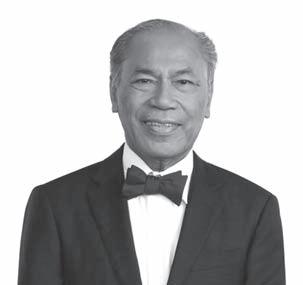
SECB said it extends its condolences to the bereaved family of Villarosa during this most trying of times.
“We pray that they find solace that Chairman Villarosa now joins the Creator. Security Bank shall endeavor to preserve the legacy that [he] leaves behind.”
The bank said that in light of Villarosa’s passing, Vice Chairman Cirilo P. Noel will serve as interim chairman for the time being.
The solon said the measure approved by the House Committee on Ways and Means would help ease customs declaration for people accessing the country’s borders, including overseas Filipino workers.
The substitute bill identifies those
The bill said incoming passengers bringing in foreign currencies or foreign currency-denominated bearer monetary instruments in excess of $10,000 or its equivalent shall, upon request, be assisted by the Customs Officer on duty in filling the “Curren-
Under the bill, the offense of bulk foreign currency smuggling is committed when a person physically transports or transfers foreign currency or foreign currency-denominated bearer monetary instruments in an amount that exceeds $200,000 or its equivalent from a place within the Philippines to a place outside of the Philippines or from a place outside the Philippines to a place within the Philippines, unless registered as an entity engaged in periodic transfer of bulk currency. Likewise, the bill
The BSP, the AMLC and the BOC all expressed support for the passage of the measure.
The BOC earlier said the country’s laws on undeclared foreign currencies are “not categorical, and sanctions provided are not deterrent enough” unlike in other countries like the United States where such attempts to under-declare or not declare currency is defined as bulk cash smuggling. Likewise, the BOC has said the penalties are far more severe than those provided under Philippine laws.
THE Bureau of Internal Revenue (BIR) announced that Commissioner Romeo D. Lumagui Jr. decided to amend certain provisions of existing revenue issuances pertaining to value-added tax (VAT) zero-rated transactions by issuing Revenue Regulations 3-2023. The same was signed by Department of Finance Secretary Benjamin E. Diokno, a statement by the BIR read.
“With the issuance of this regulation, the BIR is optimistic that it will help the economy by attract-
ing more investors who are willing to engage in business in the Philippines, adding to the list of our partners in nation building,” Lumagui was quoted in the statement as saying.
As mentioned in the said regulations, local purchases of goods and local services such as janitorial, security, financial, consultancy, marketing and promotionand services rendered for administrative operations such as Human Resources (HR), legal and accounting shall not be considered as “directly and
PHILIPPINE National Bank (PSE:
PNB) has announced that its Board of Directors has approved the appointment of Edgar A. Cua as chairman and Florido P. Casuela as president effective April 25, 2023. The election was held during an organizational meeting following the bank’s annual stockholders’ meeting held on April 25.
An Independent Director, Cua has served as PNB director for seven years and was first appointed on May 31, 2016. He has held various positions at the Asian Development Bank (ADB) during a 30year professional career. He retired from the ADB in 2015 as senior advisor of the East Asia Department, based in ADB’s Resident Mission in Beijing, People’s Republic of China (PROC). He served as deputy director general of the East Asia Department and as country director of the ADB Resident Mission in Indonesia. He was a member of the country team that set up the ADB Resident Mission in the PROC, where he was the first deputy country director.
Cua completed his Bachelor of Arts in Economics (honors program) at the Ateneo de Manila University. He ob-
tained his Master of Arts in Economics and his Master of Planning in Urban and Regional Environment from the University of Southern California. He took “Advanced Chinese Language and History” at the Beijing Language Culture University as well as the “Sustainable Development Training” program at Cambridge University.
Ex-LBP president CASUELA, on the other hand, joined PNB in 2006 as director. He was appointed as the bank’s acting president on July 5,
2022, after former President and CEO Jose Arnulfo A. Veloso was appointed as president and general manager of the Government Service Insurance System.
Casuela is currently the chairman of PNB Securities Inc. He is also a director of Allianz PNB Life Insurance Inc., PNB International Investments Corp,. PNB RCI Holdings Co. Ltd. and Bancnet Inc.
Formerly, he served as chairman of Casuela Equity Ventures Inc., director of Surigao Micro Credit Corp. and Senior Adviser of the Bank of Makati Inc. Likewise, he was a director of Manila Electric
Co., special assistant to the chairman of the National Power Corp., director of Sagittarius Mines Inc., senior executive vice president of United Overseas Bank (formerly Westmont Bank), senior vice president of PNB, first vice president of the Bank of Commerce and vice president of the Metropolitan Bank & Trust Co. Prior to PNB, he served as president of the Land Bank of the Philippines and Maybank Philippines Inc.
Casuela is a Certified Public Accountant. He obtained both his Bachelor of Science degree in Business Administration, major in Accounting, and his Master’s degree in Business Administration from the University of the Philippines. He is one of the 10 awardees of the 2001 Distinguished Alumni Award of the UP College of Business Administration.
Casuela has attended an advanced management program for overseas bankers from the Philadelphia National Bank in conjunction with the Wharton School of the University of Pennsylvania and attended a study tour on micro-finance program and co-operatives under the auspices of the United States Agency for International Development.
exclusively used” in the registered project or activity of a registered export enterprise.
“We are a fair agency. We honor VAT incentives. We run relentlessly against taxpayers involved in illicit activities such as those involved in ghost receipts [and/or] fake VAT transactions,” the BIR Commissioner said.
A separate revenue issuance will be issued by the BIR particularly in the audit procedures that will be conducted by its revenue officers, the BIR statement read.
NON-bank financial institutions
(NBFIs) remain a key plank in the Philippine lending industry, accounting for nearly half of loans extended each year to the country’s more than a million micro-sized, small-scale and medium-sized businesses (MSMEs).
The latest available data from the Asian Development Bank (ADB) showed that loans to MSMEs by microloan organizations, pawnshops and other NBFIs topped $4.9 billion in 2020.
By comparison, banks lent around $10.3 billion to this sector. The amount, though, comprised just 2.4 per cent of all loans they extended to all their borrowers.
“As you can see, MSMEs remain underserved by banks. The huge gap is being bridged by NBFIs,” Asialink Finance Corp. CEO Robert B. Jordan Jr. was quoted in a statement issued last May 2.
“The gap is even more glaring considering MSMEs–which number around 996,000 as of 2020–make up over 99 percent of total businesses in the Philippines.”
The ADB data showed that among Southeast Asia’s largest economies, the Philippines has the least funding support for MSMEs in terms of bank loans.
Thailand’s banks extended over $168 billion to support MSMEs in 2020 while those in Singapore, Malaysia and Indonesia lent between $68 billion and $79 billion.
NBFI loans to MSMEs in the Philippines, on the other hand, were the fourthlargest in the region.
Jordan said the presence of NBFIs allowed MSMEs to weather the effects of the Covid-19 pandemic.
The executive said that last year, Asialink Finance released P10.5 billion in total loans, a 25-percent increase compared to the firm’s 2021 performance, to about 24,000 clients nationwide. 70 percent of which are MSMEs.
“It gave them access to loans at a time when they desperately needed access to funds to keep themselves afloat amid a very challenging environment,” Jordan added.
THE House Committee on Ways and Means approved last Wednesday a substitute bill penalizing the bulk-cash smuggling and tightening the country’s measures against the transit of large amounts of money to and from the Philippines.Lumagui CasueLa Cua
“The government must seriously look into the consideration to set up manufacturing plants in the Philippines,” said Rep. Anthony Rolando Golez Jr., Vice Chairperson, of the House Committee on Health during the recent “Creating a Disease-Free Society through Immunization” forum organized by the American Chamber of Commerce of the Philippines Inc. (AMCHAM Philippines) together with Merck Sharp and Dohme (MSD) Philippines , and the Pharmaceutical and Healthcare Association of the Philippines (PHAP).
He urged pharmaceutical companies to support this move as it will be a win-win situation for both the government and the private sector.
“If you can convince the government by investing in the manufac -
ture of vaccines, you could provide a lot of things such as employment opportunities, payment of taxes. We also have economies of scale, and savings that can enable us to buy more vaccines,” Golez added.
Quality services
H E s tressed reiterated the call for the private sector to support and help the government’s health program to provide quality services.
In response, Golez filed last year House Bill 01710 or “An Act Providing for the Framework for the Establishment and Operation of Virology l a boratories in the Philippines, Creating for the Purpose the Virology Science and Technology Institute of the Philippines [VIP],” l a ter,
House Bill 01710 was substituted by HB06452.
At the same time, Golez said the government must also prepare the human resources that will deliver the services to the people. “A steady supply of healthcare workers such as nurses must be guaranteed to be of service to the people,” he said.
He urged the government to foster the “Para sa Bayan” spirit manifested through the “Doctors to the Barrio” (DTTB) program. A brainchild of the late former Health Secretary and Senator Juan M. Flavier, the DTTB promoted the deployment of skilled, idealistic and dedicated doctors as rural health physicians to municipalities without doctors.
“The other needs of the healthcare workers such as decent pay, housing, schooling and other economic benefits should be addressed,” Golez said.
Medical tourism
G O l E z said the Department of Health should also invite healthcare insurance providers to promote medical tourism in the country. He added that the government, together with the private sector, will boost the Universal Health Care program
By Rory Visco Contributor Editor: Anne Ruth Dela Cruzof the government. Dr. Romel l a cson, Country Director of the US Centers for Disease Control and Prevention (CDC) Philippines, said the priority of the Atlanta-based health, science-based and data driven organization is to help the country boost its vaccination campaign. “Immunization is the most cost-effective method to ensure a healthy population,” l a cson said.
“For every dollar invested in immunization, the country saves $52,” l ac son added.
He said CDC Philippines will continue to partner with the DOH to do constant research in the field epistemology of several diseases in the country. l a cson said the Philippines offers a lot of lessons regarding its vaccination campaign. “We also have the same problems with vaccination in the US,” he said.
“We saw the big potential in the vaccination campaign during the Covid-19 pandemic,” l ac son added.
He stressed the effectivity of the vaccines made a big difference in the fight against the pandemic resulting in the saving of millions of lives around the world.
IT i s often called the neck of the womb. The cervix, that is. The cervix is part of the female reproductive system located at the junction of the vagina and the uterus (womb).
The month of May is Cervical
Cancer Awareness month.
Cervical cancer is the 2nd leading cancer site among women in the Philippines, the Department of Health (DOH) said.
An estimated 7,277 new cases of, and 3,807 deaths due to, cervical cancer are expected to occur every year.
Generally, all women who have had sexual intercourse are at risk of cervix cancer. However, rare types of cervical cancer can occur even in women who never had any sexual intercourse in their life.
Cause I N r ecent studies, the DOH said, there has been overwhelming evidence that an infectious agent, particularly human papillomavirus (HPV) that is transmitted through sexual intercourse, causes cancer of the cervix.
The following have been established as possible causes of cervix cancer:
n have had multiple sexual partners;
n have had sexual partners (regular or casual) who themselves had several sexual partners;
n have had sexual partner who is infected with the human papillomavirus; and
n had first sexual intercourse at a very early age, possibly 15 or 16 years old
Symptoms
G E NERA l lY, c ervix cancer does
not have symptoms.
Often, the disease is detected during its advance stage. However, the following impressions often lead to cervix cancer such as unusual bleeding from the vagina at any time and unpleasant vaginal discharge.
Early detection
C E RVICA l cancer, when detected early, is curable.
At present, the most reliable and practical way to diagnose early cervical cancer is through Pap smear.
A woman’s first Pap smear should be done three years after the first vaginal intercourse.
After that, it should be done every year for three years. If the Pap smear test is negative for the consecutive three years, then it can be done every two or three years.
In unmarried women who have
never had any sexual activity in their life, Pap smear should be done at age 35.
Treatment
S IN CE t here is almost universal acceptance that cervical cancer is primarily transmitted through sexual intercourse, the following preventive measures should be followed: n a one-partner sexual relationship between partners should be observed; n a delay on the first sexual intercourse; and n use of barrier contraceptives like condoms during sexual intercourse.
“To mothers and our women, get regular check-ups and get vaccinated against human papillomavirus to prevent cervical cancer,” reminded DOH officer-in-charge Maria Rosario Vergeire said.
 By Roderick L. Abad Contributor
SHINAGAWA l a sik & Aesthet -
ics has diversified in the Philippines, with the opening of a brand new medical facility that provides services centered on diagnostic testing and early detection of illnesses.
Called the Shinagawa Diagnostic and Preventive Care Center, it offers comprehensive Japanese-standard healthcare services with its topnotch specialized medical equipment courtesy of leading technology brand Philips and Fujifilm.
According to Shinagawa Philippines President Masako Uemori, Filipinos are now more proactively conscious of their health due to the ensuing Covid-19 pandemic.
Since they started operating their eyecare and beauty centers in the country 13 years ago, she noticed that preventive care awareness and availability of diagnostics machines in the country are very low.
“I found that most of the local market are not interested in preventive care or they don’t go to the hospital or clinic without any symptom. And the other thing is that in terms of the number of diagnostic machines available, the Philippines is ranked 126th out of 140 countries globally,” she told the BusinessMir-
ror in a sideline interview during the launch of their latest facility last April 26. This growth opportunity made them decide to put up such a pioneering one-stop-shop facility of its kind in the country, according to her.
Without divulging their exact amount of investment, the top executive only said that it’s “quite big” given their provision of services centered on diagnostic testing and preventive care, as well as extensive and all-in medical checkup and screening services to all clients of all ages.
Global City in Taguig, Shinagawa Diagnostic and Preventive Care Center offers brain diagnostic exams (MRI/ MRA), full body exams (CT scan), digestive scans (ultrasound and endoscopy), and tests for women (mammography and ultrasound), among other customizable screenings.
When patients visit the center, medical check-ups are done with ease and convenience sans waiting time, from booking to undergoing procedures and claiming results, all in the same day courtesy of the Japanese Health Checkup Information System, which increases operational efficiency. Shinagawa, likewise, practices double reading and consultation
DESPITE the ubiquitous presence of digital devices and the lure of the internet, many kids these days regardless of age and social demographics, would resort to playing outdoors if the opportunity arises. Despite the sun’s immense heat, they will play to their hearts’ content together with their friends or family, whether in the comforts of their homes, the neighborhood streets, parks, all not minding what the mighty sun’s rays can do to their fragile bodies.
Same with adults. Not all are glued to their smart phones or laptops, and with many becoming conscious of their health, would choose to go out and do physical activities to make themselves healthy.
But just like any physical activity, people are susceptible to possible damage to the body, according to the Agency for Healthcare Research and Quality of the US Department of Health and Human Services. These are injuries, which the agency describes as “harm caused by accidents, falls, hits, weapons, and more.”
Wounds, on the other hand, are those that “break the skin or other body tissues like cuts, scrapes, scratches, and punctured skin, which often happen because of an accident.” However, it said that surgery, sutures, and stitches also cause wounds, and that “minor wounds usually aren’t serious, but it is important to clean them.” Serious and infected wounds, the agency said, “may require first aid followed by a visit to your doctor. You should also seek attention if the wound is deep, you cannot close it yourself, you cannot stop the bleeding or get the dirt out, or it does not heal.”
Philippine style wound management
MOST Filipinos of a certain age, like those born in the late 60s or 70s or probably even earlier, remember two popular topical antiseptics when it comes to treating wounds: “Mercurochrome” and “Merthiolate,” especially wounds on the knees after playing “patintero,” “moromoro” or even “tumbang preso.” To some, the orange-colored mercurochrome is the mildest, while Merthiolate is the one that would make kids shriek in pain and call all the saints they know from religion class while their mother blows short whiffs of air on the wound to alleviate the pain.
To some Filipinos before, wound management involves opening or crushing an antibiotic capsule or tablet and plac -
ing the powder directly on the bruised skin. This is a big no-no since they are designed for oral ingestion and not for topical application.
But there are those who are a bit more logical in thinking when it comes to wound care. For them, water is still the top choice for initial wound management. Just make sure that the water source is not highly pressurized so a running water faucet would suffice. Soap, a mild soap with less harmful chemicals, is also effective but just make sure to wash the wound thoroughly so there would no excess soap left on the wound itself.
In the provinces, there are village folk who still believe in the power of certain indigenous herbs and common kitchen implements to treat common wounds and even body ailments, and these are already being studied heavily by the Department of Health for their efficacy.
Promising market
ACCORDING to the Wound Care Market–Philippines Outlook and Forecast 20232030, a study that provided a wound care market overview of the Philippines, in 2017, the Philippine wound care market size was at around US$51 million. However, the study revealed that this is projected to reach a higher US$85 million come year 2025 or about two years from now and growing at a Compound Annual Growth Rate (CAGR) of 6.5 percent from 2018 to 2025.
The study revealed that the country’s wound care market will continue to expand even further because of what it pointed out as “rapidly aging population and favorable demographics; rise in incidence of diabetes, obesity, and chronic conditions; and technological advancements to deal with complex wounds.”
It said that the country’s wound care market is segmented into three parts: advanced wound care, surgical wound care, and traditional/basic wound care, with surgical wound care expected to broaden in size during the said forecast period. This is due to the foreseen growth in the amount of surgical procedures and demand for more cutting-edge technologies in surgical procedures such as “minimally invasive surgeries and laparoscopic surgeries.”
More opportunities will also present itself to wound care market players with the presence of an aging population who are more vulnerable to certain medical conditions and would need top-quality wound care products that are proven effective and efficient in treating wounds and enable faster healing.
with Japanese medical experts to ensure high precision of diagnosis and treatment plans.
Eumori bared that they are in the process of obtaining accreditation with all major Health Maintenance Organization providers nationwide to make its services more convenient and accessible to all Filipinos.
Target clients
AS a headstart, she said that they are targeting to tap corporate accounts, not only for the basic but also executive checkups of their employees.
While the center conforms to high Japanese healthcare standards, available service packages are affordable, starting at P5,000. With this in mind, Shinagawa Diagnostic and Preventive Care Center is expected to accommodate at least 150 patients a day, per Uemori.
Shinagawa continuously hires medical doctors, including OB gyne and radiologists. Expansion-wise, the company will still focus in Metro Manila.
“With our globally competitive medical experts and state of the art technology, we can assure of giving you only the best healthcare services,” she stressed. “Early detection of illnesses allows patients more time to seek effective medicines or procedures that can ultimately lessen or cure their symptoms.”
ST l u ke’s Medical Center, the premier healthcare institution in the Philippines, ushers in a new leadership that would allow the hospital to continue to deliver high-quality health services to its patients while remaining at the forefront of medical innovation.
On April 26, 2023, St. l u ke’s board of trustees approved the appointment of Dr. Dennis P. Serrano as the new President and Chief Executive Officer, effective May 1, 2023. Prior to this appointment, he was the hospital’s Executive Vice President for One Healthcare System.
With Dr. Serrano’s appointment, his predecessor, Dr. Arturo S. De l a Peña, takes a new role in leading St. l u ke’s Medical Research & Policy Institute and St. l u ke’s Innovation & Transformation Center. He is also a board member of St. l u ke’s Medical Center.
Dr. Serrano brings decades of experience in the medical field to his new role.
A graduate of the UP College of Medicine in 1989, he took on his residency training in urology at the PGH and finished it in 1994. In 2005, Dr. Serrano attained his Master’s Degree in Hospital Administration from UP Manila.

He is one of the key individuals behind the success and continuous innovation
at St. l u ke’s Medical Center, where he spearheaded the Institution’s Robotic Radical Prostatectomy program in 2010. Other than his contribution to the medical center, he held leadership roles in various medical associations, both local and international.
His expertise, experience, and commitment to excellence will be instrumental in leading St. l u ke’s Medical Center to provide the best care for its patients and community. He plans to focus on enhancing the patient experience and the culture of care for its employees.
This will involve creating a more supportive environment for patients, implementing better tools for staff efficient workflow, and increasing communication between patients, their family members, and physicians. All these efforts would ensure that all patients get the best possible care in a safe and supportive environment while also creating a culture of appreciation among its employees.
The country must develop its capability to manufacture vaccines to ensure stability and availability in the supply of vaccines for its immunization drive.
Wound care market in PHL shows bright potential—study
THERE has been a tenfold increase in sexual abuse imagery created with webcams and other recording devices worldwide since 2019, according to the Internet Watch Foundation.
Social media sites and chatrooms are the most common methods used to facilitate contact with kids, and abuse occurs both online and offline.
Increasingly, predators are using advances in technology to engage in technology-facilitated sexual abuse.
Once having gained access to a child’s webcam, a predator can use it to record, produce and distribute child pornography.
We are criminologists who study cybercrime and cybersecurity. Our current research examines the methods online predators use to compromise children’s webcams. To do this, we posed online as children to observe active online predators in action.

Chatbots
WE began by creating several automated chatbots disguised as 13-year-old girls. We deployed these chatbots as bait for online predators in various chatrooms frequently used by children to socialize. The bots never initiated conversations and were programmed to respond only to users who identified as over 18 years of age.
We programmed the bots to begin each conversation by stating their age, sex and location. This is common practice in chatroom culture and ensured the conversations logged were with adults over the age of 18 who were knowingly and willingly chatting with a minor. Though it’s possible some subjects were underage and posing as adults, previous research shows online predators usually represent themselves as younger than they actually are, not older.
Most prior studies of child sexual abuse rely on historical data from police reports, which provides an outdated depiction of the tactics currently used to abuse children. In contrast, the automated chatbots we used gathered data about active offenders and the current methods they use to facilitate sexual abuse.
IN total, our chatbots logged 953 conversations with self-identified adults who were told they were talking with a 13-year-old girl. Nearly all the conversations were sexual in nature with an emphasis on webcams. Some predators were explicit in their desires and immediately offered payment for videos of the child performing sexual acts. Others attempted to solicit videos with promises of love and future relationships. In addition to these commonly used tactics, we found that 39 percent of conversations included an unsolicited link.
We conducted a forensics investigation of the links and found that 19 percent (71 links) were embedded with malware, 5 percent (18 links) led to phishing websites, and 41 percent (154 links) were associated with Whereby, a video conferencing platform operated by a company in Norway.
Editor’s note: The Conversation reviewed the author’s unpublished data and confirmed that 41 percent of the links in the chatbot dialogues were to Whereby video meetings, and that a sample of the dialogues with the Whereby links showed subjects attempting to entice what they were told were 13-yearold girls to engage in inappropriate behavior.
It was immediately obvious to us how some of these links could help a predator victimize a child. Online predators use malware to compromise a child’s computer system and gain remote access to
their webcam. Phishing sites are used to harvest personal information, which can aid the predator in victimizing their target. For example, phishing attacks can give a predator access to the password to a child’s computer, which could be used to access and remotely control the child’s camera.
AT first, it was unclear why Whereby was favored among online predators or whether the platform was being used to facilitate online sexual abuse. After further investigation, we found that online predators could exploit known functions in the Whereby platform to watch and record children without their active or informed consent.
This method of attack can simplify online sexual abuse. The offender does not need to be technically savvy or socially manipulative to gain access to a child’s webcam. Instead, someone who can persuade a victim to visit a seemingly innocuous site could gain control of the child’s camera.
Having gained access to the camera, a predator can violate the child by watching and recording them without actual—as opposed to technical— consent. This level of access and disregard for privacy facilitates online sexual abuse.
Based on our analysis, it is possible that predators could use Whereby to control a child’s webcam by embedding a livestream of the video on a website of their choosing. We had a software developer run a test with an embedded Whereby account, which showed that the account host can embed code that allows him to turn on the visitor’s camera. The test confirmed that it is possible to turn on a visitor’s camera without their knowledge.
We have found no evidence suggesting that other major videoconferencing platforms, such as Zoom, BlueJeans, WebEx, GoogleMeet, GoTo Meeting and Microsoft Teams, can be exploited in this manner.
Control of the visitor’s camera and mic is limited to within the Whereby platform, and there are icons that indicate when the camera and mic are on. However, children might not be aware of the camera and mic indicators and would be at
risk if they switched browser tabs without exiting the Whereby platform or closing that tab. In this scenario, a child would be unaware that the host was controlling their camera and mic.
Editor’s note: The Conversation reached out to Whereby, and a spokesperson there disputed that the feature could be exploited. “Whereby and our users cannot access a user’s camera or microphone without receiving clear permission from the user to do so via their browser permissions,” wrote Victor Alexandru Truică, Information Security Lead for Whereby. He also said that users can see when the camera is on and can “close, revoke, or ‘turn off’ that permission at any time.”
A lawyer for the company also wrote that Whereby disputes the researchers’ claims. “Whereby takes the privacy and safety of its customers seriously. This commitment is core to how we do business, and it is central to our products and services.”
Revoking access to the webcam following initial permission requires knowledge of browser caches. A recent study reported that although children are considered fluent new media users, they lack digital literacy in the area of safety and privacy. Since caches are a more advanced safety and privacy feature, children should not be expected to know to clear browser caches or how to do so.
Keeping your kids safe online
AWARENESS is the first step toward a safe and trustworthy cyberspace. We are reporting these attack methods so parents and policymakers can protect and educate an otherwise vulnerable population. Now that videoconferencing companies are aware of these exploits, they can reconfigure their platforms to avoid such exploitation. Moving forward, an increased prioritization of privacy could prevent designs that can be exploited for nefarious intent.
Here are some recommendations to help keep your kid safe while online. For starters, always cover your child’s webcam. While this does not prevent sexual abuse, it does prevent predators from spying via a webcam. You should also monitor your child’s internet activity. The anonymity provided by social media sites
CEO, Du-Baladad and Associates. “If the problem is not addressed in an urgent and decisive manner, we will be placing our country’s future in the hands of stunted children becoming adults whose capacity to be productive, competitive and creative are limited, thus affecting national development and progress.”
ACCORDING to the World Bank, the Philippines has one of the worst cases of child stunting in the world, ranking fifth with the highest stunting prevalence among countries in the East Asia and Pacific Region, and is among the 10 worst countries in the world. ( https://bit.ly/3AMHjrC )

T he World Health Organization (WHO) clarifies that stunting is a growth and development impairment of children resulting from poor nutrition, repeated infection and inadequate psychosocial stimulation. ( https://bit.ly/44jSUMd ) When this happens specifically during the first 1000 days from birth to 2 years of age, it can lead to adverse consequences that will limit a child’s ability to reach his full mental, physical and economic potential. We should be worried,” said Atty. Benedicta Du-Baladad, president, MAP Founding Partner and
Addressing malnutrition and child stunting requires a strong focus on governance, involving coordinated actions by many actors across sectors and across levels of government, according to the Scaling Up Nutrition (SUN) Movement. As such, the recent infusion of resources from the World Bank is expected to boost the Philippine Multi-Sectoral Nutrition Project (PMNP) with timely and critical support. The PMNP underscores the importance of holistic nutrition-sensitive programs that address key underlying determinants of nutrition. This includes food security, access to services, and environment, as well as nutrition-specific interventions or those that deal with the immediate causes of maternal and child malnutrition such as micronutrient deficiency, underweight, stunting, wasting and obesity.
In line with its mission to create a positive impact in nation-building, the Management Association of the Philippines (MAP) has launched its campaign against malnutrition and child stunting in the country. MAP has laid out initiatives that will complement the PMNP. The goal is to contribute to the improvement of the overall nutritional status of Filipino children.
“We at MAP hope to expand our role beyond fund generation and philanthropy to a shared responsibility in addressing malnutrition in the country, participating in the programming and governance of nutrition strategies and interventions. It will be a shift from a transactional to a transformational partnership with the government,” said Atty. Du-Baladad. According to Du-Baladad, MAP’s presence in the food, retail, healthcare, education and logistics industries as well as other sectors could help leapfrog progress through interventions and actions that can contribute in addressing the country’s malnutrition problems effectively and sustainably. “We will do our share and engage private firms, organizations and individuals to heed this call, starting with our own MAP members and expanding the circle to other groups so that together we can all work in building a more progressive future for the country,” she added.
Child stunting is a major threat to the nation’s future,” according to Dr. Cielito “Ciel” F. Habito, Governor-in-Charge for MAP’s Cluster on Resilience and Recovery. He added, “MAP’s ecosystem is diverse and can potentially muster the collective strength of the private sector to mobilize and help the government achieve the country’s nutrition objectives. As we are among the leading employers in the country, MAP can strategically influence its network of employees in the delivery of support services like nutrition literacy.”
and chatrooms facilitates the initial contact that can lead to online sexual abuse. Online strangers are still strangers, so teach your child about stranger danger. More information about online safety is available on our labs’ websites: Evidence-Based Cybersecurity Research Group and Sarasota Cybersecurity.
PHOTO BY
KELLY SIKKEMA
BUSY mornings are always a challenge for moms. Often, you and your family get overwhelmed by the morning rush that you barely have time to catch up with each other.
Not to worry—tomorrow is always a new opportunity for you to create a delightful breakfast experience for your loved ones that may set a positive tone for the rest of the day. Here’s how:
1. Have a morning playlist full of upbeat, happy songs
Begin the day on the right note—literally. Play your family’s favorite happy, upbeat songs in the background to pump up everyone in the morning. Listening to lively tunes will help lighten the mood and lift up any weary spirit.
Pro tip: Create a shared playlist the night before or during the weekend. This not only ensures that everyone’s favorite music is included, but it can also be an amazing bonding and enjoyable activity for the family.
2. Open the curtains and let the sunshine in
Let the sunlight flood your dining room. It feels like a no-brainer, but this is a great way to awaken the family’s bodily rhythm to get everyone ready for the day. It may also keep the kids from getting back to snoozing. Together, enjoy the gentle warmth of the sunlight while soaking up and getting a boost from that good ol’ Vitamin D.
3. Prepare a hearty and delicious breakfast
Having a delightful breakfast is a must in every family’s morning routine. It helps give everyone the energy they’ll need to conquer all the tasks and activities at work or in school. To whip up tasty and nutritious meals and drinks, remember to use high-quality products such as those from Universal Robina Corp. (URC)

For breakfast, classic silog meals like tocilog and baconsilog are foolproof. So, make sure to choose products that are farm-fresh quality, like the ones from Robina Farms: Honey-Cured Bacon, tender premium bacon that has the right amount of sweetness from honey which you and your children will enjoy; Primera Tocino, juicy chunks of prime pork that have a delicious blend of sweet and savory flavors; and Premium Brown Eggs, farm-fresh eggs that contain essential nutrients such as DHA and choline.
4. Make it a tradition and create lasting memories
Once the yummy breakfast is set, now is the perfect time to gather around the dining table, enjoy the meal, and open yourselves to great conversations with each other. By making these simple yet special meals a tradition, you can create lasting memories, build stronger relationships, and, most of all, create a happy and loving home that the entire family will always treasure.
REX Education, in partnership with the Philippine Social Science Council (PSSC), Philippine National Historical Society (PNHS), and Philippine Historical Association (PHA), formally introduced the fellows of its “Saliksik Kasaysayan: A Fellowship Program to Develop a Compendium of Philippine History” program last February 17, 2023.
“Saliksik Kasaysayan” is a 10-month program that aims to take stock of and secure articles, materials, and references on different periods in Philippine history. The main proponents of the program are selected fellows knowledgeable in the different time periods of Philippine history, ensuring the accuracy and credibility of each learning resource.

The program was launched last September 2022, where REX and its partner organizations reaffirmed the importance of curating materials that would be reliable references for generations of academics and students.
“This fellowship program brings together the academe, civil society, and private sector toward the common goal of serving Filipino learners,” REX Chief Executive Officer Don Timothy Buhain said during the event. “REX believes that an important next step in enabling our learners, teachers, and communities entails looking back at where we all came from.”
of the Philippines. Mary Jane B. Rodriguez, PhD will be covering Luzon, Alicia P. Magos, PhD will be studying Visayas, and Cecilia B. Tangian, PhD will be tackling Mindanao.
To end the program, Bernardita Churchill, PhD, President of the PNHS, delivered her closing remarks virtually from the United States.
AS the sun rises over the east, Hotel Okura Manila celebrates a bountiful first anniversary at Newport World Resorts. Across the eventful year, the Japanese luxury hotel succeeds in bringing together the mindfulness of Japanese omotenashi with the warmth of Filipino hospitality. Escape at Newport World Resorts with exclusive stays within the hotel’s elegantly built sanctuary and the fulfilling, unparalleled taste of Japanese fine dining.
Speaking on the hotel’s milestone, Hotel Okura Manila General Manager Jan Marshall shares, “Hotel Okura Manila is performing beyond our expectations. We are so fortunate to be a part of the first Integrated resort in the Philippines.” The hotel located at Newport World Resorts soft-opened in December 2021 and officially launched last April 2022.
Since then, it has elevated Japanese culture and lifestyle on Filipino soil through a commitment to the spirit of Wa, meaning harmony, and a partnership with the world-renowned hospitality interior design company HBA. Modern picturesque structures, an exquisite minimalist rock garden, and a breathtaking mountainous landscape paints the picture of zen in luxury across the hotel’s lobby atrium. Marshall

adds, “There is no designed hotel like this in all of Southeast Asia.”
Step into the wonder of Japan and experience the signature omotenashi hospitality with Hotel Okura Manila’s One in Harmony room packages, a luxurious Japanese escape at the heart of the metro. The package includes a deluxe welcome amenity, daily breakfast for two adults and two kids, afternoon tea for two, and P2,000 food and beverage credits at Yamazato Restaurant. The One in Harmony room packages price start at P15,000 nett per night. Booking dates are from April 17 to May 20 for the stay period beginning on April 19 to May 30.
Hotel Okura Manila’s signature fine dining restaurants enchant the palette with the finest ingredients for a divine taste.
Recognized for its unmatched quality, Yamazato, is regarded as one of the best Japanese restaurants in the Tatler Dining Guide 2023. Indulge in the restaurant’s premium teppanyaki menu, expertly crafted by Specialty Chef Katsuji Kato known for procuring only the highest quality seafood and meat from organic sources. Embark on a culinary journey from time-honored Japanese traditions to modern flavors and mastery with Seasonal Bento, only available for lunch at Yamazato Restaurant.
The anniversary celebrations continue through the weekend with the Kisetsu Buffet at Yawaragi Restaurant. The delectable spread of international dishes, Japanese specialties, and Filipino favorites form a harmonious dining experience that has become beloved by guests. With its delectable menu and stunning interior, Yawaragi hosted many VIP events throughout the year with more in the works including a collaboration with Hotel Okura Manila’s sister hotel at Bangkok and their Michelin star restaurant, Elements. Following an outstanding first year, Hotel Okura Manila moves forward with upcoming global collaborations and showstopping projects to watch out for. Today, the sun sets on the luminous hotel with rays of prosperity and harmony for the future. Escape the ordinary at Newport World Resorts, you know you want to. For more information on Hotel Okura Manila, visit www.newportworldresorts. com and hotelokuramanila.com and follow @newportworldresorts on Facebook and Instagram, and @nwresorts on Twitter. Make the most of your visit and sign up for an Epic Membership or download the Newport World Resorts Mobile App for free at the Apple App Store and Google Play Store.

reach into the country, we look forward to facilitating new trade lanes, which will bring a host of benefits to Canadian businesses and exporters in addition to promoting tourism into more cities and generating more jobs across all sectors, including those directly serving the aviation industry,” continued Kazim.
The 11 academicians were awarded a generous grant to work on period or subject areas in Philippine history ranging from the pre-colonial period to the Fifth Republic and with special volumes on Muslim Mindanao and Indigenous Peoples Community.
During the program launch, Excelsa Tongson, DSD, Chairperson of the PSSC, delivered the opening remarks, followed by a message from Buhain. Lourdes M. Portus, PhD, Executive Director of the PSSC, introduced the fellowship program, and Ma. Luisa Camagay, PhD, President of the PHA, had the privilege of introducing the fellows.
Each fellow was given a chance to speak about the respective periods of their research.
Michael L. Tan, PhD will be looking into the Pre-colonial period. Svetlana T. Camacho, PhD is set to investigate the Spanish rule period during the years of 1521 to 1872, while Grace Liza Y. Concepcion, PhD will study the Spanish rule during 1873 to 1898.
Ricardo T. Jose, PhD will cover the American rule and Japanese occupation period.
Ferdinand C. Llanes, PhD will be studying the Martial Law era of 1972 to 1986. Jose Victor Z. Torres, PhD has committed to being the fellow for the Fifth Republic, encompassing the years of 1986 to present times. Meanwhile, Calbi
A. Asain, PhD will be doing research on the Historiography of the Muslim Filipino.
Three fellows will also be tackling special volumes on the indigenous peoples communities in the three major island groups
As per DepEd Order 20, Philippine history was removed from the high school curriculum to pave the way for the K to 12 program. Instead, the topic was integrated into the Araling Panlipunan (AP) curriculum at the 5th and 6th grade levels. While the revised K-12 program has allotted discussions for Asian Studies and World History topics in Social Science classes, there is no dedicated subject for Philippine history for Grades 7 to 10.
A 2019 pedagogy review conducted by the FEU Public Policy Center (FPPC) asserted that the goal of AP education should also be the development of students’ critical thinking skills apart from examination, interpretation, research, and communication skills, among others in DepEd’s goals. In their review, FPPC concluded that existing textbooks do not give a complete view of Philippine history.
There has been a consequent call to arms for academics, historians, and scholars to be better engaged in the production of materials regarding Philippine history, whether through co-authorship or fact checking. The end goal would be to ensure textbooks with historical accuracy and sound pedagogy, which is achievable through the effective use of primary sources.
REX, PSSC, PNHS, and PHA believe in the importance of Philippine history in making whole the learning experiences of every Filipino learner. Through “Saliksik Kasaysayan,” the program fellows embark on their journey of gathering and scrutinizing resources on Philippine history, with the ultimate goal of paving the way for Filipino learners who can understand and appreciate the nation’s past from credible materials and learn from it as they move forward.
EREHWON Center for the Arts’ will show its first full-length feature film, “Amon Banwa sa Lawud,” in a gala preview at Areté, the creative and innovation hub of Ateneo de Manila University, Quezon City, on May 5, 2023.
EMIRATES recently announced that it will launch a new daily service from Dubai to Montreal, starting July 5. Montreal becomes Emirates’ second gateway in Canada, complementing its passenger and cargo services to Toronto, which have been operating to Ontario’s capital city since 2007.
The launch of services to Montreal comes as the UAE and Canada aim to deepen economic cooperation between the two nations and stimulate benefits to the aviation and tourism sectors, in addition to enhancing trade flows and commercial links. With the new daily flights, travelers will now have more choice when flying to Canada and are able to fly direct from Dubai to Canada’s two largest metropolitan hubs.
Passengers from Montreal can enjoy the airline’s award-winning services to and through Dubai, and connect safely, seamlessly and efficiently to Emirates’ global network of over 130 destinations in over 70 countries and territories. The daily flights between Dubai and Montreal will operate as EK243/244 with a Boeing 777-300ER aircraft in a three-class configuration, offering a premium travel experience across its cabins. Passengers can enjoy Emirates’ award-winning travel experience aboard
its wide-body aircraft with eight First Class suites, 42 lie-flat seats in Business Class and 304 seats in Economy Class. Tickets to Montreal are now on sale for flights starting 5 July and can be booked on emirates.com, the Emirates App, or via travel agents.
“Emirates is excited to launch our second gateway into Canada as we expand our reach in the country with direct services from our hub in Dubai. As a major metropolitan center and as Canada’s second largest city, we are pleased to add Montreal to our growing global network of over 130 destinations and strengthening our coverage in the Americas to reach 18 points served by our services from Dubai, said Adnan Kazim, Emirates’ Chief Commercial Officer.
“We have been serving customers with passenger and cargo services to Toronto for over 15 years and when we begin services to Montreal in July, customers will have more choices when planning their travel whether for business, leisure, education or for visiting family and friends. We would like to thank the UAE and Canadian authorities and airport stakeholders for the enhanced agreements which have made this new destination possible. With our expanded
Customers of Emirates and Air Canada have access to an expansive network of destinations thanks to the codeshare partnership between the two airlines. In addition to over 130 destinations that Emirates flies to, its customers currently have access to 19 Canadian destinations beyond Toronto through the partnership, while Air Canada customers are able to fly on Emirates to Dubai and access 17 cities in Africa, the Indian Subcontinent, Middle East and Far East.
Through an enhanced interline arrangement between both airlines, Emirates passengers are now able to choose from 68 points from Montreal, including the US, Mexico, South America and the Caribbean, while also enjoying conveniences such as the simplicity of flight itineraries on a single-ticket and smooth connections. Most popular domestic points in Canada via Montreal include Vancouver, Calgary, Ottawa, and Halifax. Additionally, Emirates passengers are able to choose from over 140 routes operated by Air Canada on an interline basis, including 27 points in Canada and 94 routes between Canada and the US and South America.
Emirates Skywards members can earn Miles on all eligible Air Canada flights and can redeem Miles for reward tickets across Air Canada’s network.
Areté provided a venue grant in support of the film’s message of a people fighting to preserve their environment, and the cultural and traditions that have been embedded in their fishing community. The film focuses on the famed mangrove island of Suyac in the Visayas, and how its residents’ lives and livelihood are threatened by the incursions of large, foreign vessels.

This is multi-awarded film and theater director Anton Juan’s independent film, which has an international title of “Our Island of the Mangrove Moons.” Most of the film’s cast and production crew are actual residents of Suyac Island and Sagay City, highlighting the reality of the story and the imminence of tragedy to their lives. The dialogue is in
Hiligaynon with English subtitles. Anton Juan devised the screenplay from Onofre Pagsanghan’s Filipino adaptation of the Pulitzer Prize-winning play ‘Our Town’ (1938) by Thornton Wilder. By putting the narratives in the modern-day period, the screenplay is able to weave personal memories from the island and the shared experiences of the Filipino people into Wilder’s themes of life, death, and the afterlife, and finally, carve a foreboding image of what is to come.
“I hope that this [the film’s plot] never happens,” Juan ruminates with much anxiety. He dedicates the film: “For my nation, lest histories be erased.” Suyac Island’s Mangrove Eco Park is the site of one of the world’s oldest and biggest species of mangroves. When Typhoon Yolanda hit in 2013, Suyac’s mangroves became the people’s most reliable protection. What if, one day, the mangroves can no longer exist to tell their stories?

tion, sharing of ground support for satellite missions, information and knowledge sharing, plus the exchanges of scientists and technical personnel.
This, as the Philippine Space Agency (PhilSA) and the Argentine Republic’s National Commission on Space Activities (Comisión Nacional de Actividades Espaciales, or CONAE) signed a cooperation agreement on the peaceful uses of outer space, while marking the 75th anniversary of the two nations’ diplomatic linkages.
The ceremony was part of the fifth Philippines-Argentina Bilateral Consultation Mechanism last April 23.
The memorandum of understanding (MOU) between both parties covers areas of collaboration in earth observation from space; use of satellite information for studies on the environment, natural resources and emergency management; satellite-systems development and their applications; ground infrastructure for space systems and their applications; space education and training;
as well as space-industry promotion.
PhilSA director-general Dr. Joel Joseph S. Marciano Jr. signed the agreement, witnessed by Claudio Javier Rozencwaig who is the undersecretary for Foreign Policy from the Ministry of Foreign Affairs and Worship of the Argentine Republic.
“Our cooperation agreement with Argentina marks another milestone in our efforts to expand and deepen our ties with other space-capable nations,” Dr. Marciano said. “Through the partnership with CONAE, we open a new and exciting frontier in our countries’ long and rich relations, and additional opportunities for growing our local space ecosystems.”
Activities under the PhilSACONAE partnership include space projects and programs planning, development and implementation, exchange of space-based informa-
THE Government of Japan, through its embassy in Manila, announced on April 29 the decoration of four Philippine nationals for the 2023 Spring Conferment:
Japan-Philippines Politico-Military Dialogue which saw the two parties exchange views on wide-ranging matters such as the regional situation in the Indo-Pacific, as well as important political and security issues.
defense equipment with Japan and bolstered the two nations’ defenseequipment and technology cooperation. Lorenzana’s strong leadership paved the way for the further deepening of mutual defense relations.
Alberto G. Romulo (Grand Cordon of the Order of the Rising Sun): He served as the Philippines’s secretary of Foreign Affairs (SFA) from 2004 to 2011. On the occasion of the 50th anniversary of the normalization of diplomatic relations with Japan, Romulo contributed to the formulation of the Japan-Philippines Joint Statement: “Partnership between Close Neighbors for Comprehensive Cooperation,” which forms the basis for the current strategic partnership between the two nations. By leading negotiations on the “Japan-Philippines Economic Partnership Agreement,” the former SFA helped elevate the two countries’ economic relationship to new heights. He also spearheaded the launch of the

Delfin N. Lorenzana (Order of the Rising Sun, Gold and Silver Star): He served as the country’s secretary of National Defense from 2016 to 2022. During his term, defense cooperation and exchanges between Japan and the Philippines were greatly enhanced, particularly with the participation of the Japan Self-Defense Forces in joint exercises with the armies of the Philippines and the United States.
It was also under his tenure in 2020 that a contract was concluded between the Department of National Defense and Mitsubishi Electric Corporation Corp. for the delivery of airsurveillance radar systems, which marked the first overseas transfer of
Gamaliel A. Cordoba (Order of the Rising Sun, Gold Rays with Neck Ribbon): As head of the National Telecommunications Commission from 2009 to 2022, he made significant contributions to advancing cooperation in the field of telecommunications. In particular, he vigorously promoted the application of ISDB-T: a Japanese-devised terrestrial digital television-broadcasting standard. He greatly contributed to the Philippine government’s decision to adopt such in June 2010, and to its reaffirmation in November 2013. Furthermore, Cordoba initiated efforts for the smooth launch and dissemination of ISDB-T in the Philippines, in cooperation with the Japanese public and private sectors.
Dr. Cynthia Neri Zayas (Order of the Rising Sun, Gold Rays with Rosette): She is the Philippines’s leading maritime anthropologist and foremost Japanologist. Having completed her Master’s and Doctorate degrees in Japan, the scientist collaborated with Japanese anthropologists in pioneering maritime anthropological studies in the Philippines.

Dr. Zayas’s internationally recognized works on the cultures of disasters and free women divers, or ama in Japan, have deepened understanding of Japanese society worldwide.
Also instrumental in introducing Japanese traditional performing arts locally, she continues to promote Japanese culture and society through her research and professorial stints at the University of the Philippines.
The embassy relayed the government of Japan’s warm congratulations to the four outstanding Filipinos, plus an appreciation of their significant contributions to forging stronger ties with the Philippines.
(Photos courtesy of the Embassy of Japan’s Facebook page.)
THE Embassy of the Czech Republic in Manila successfully hosted the Czech Industry Forum 2023 in mid-April, in partnership with the Czech Chamber of Commerce (CCC) and the Philippine Chamber of Commerce and Industry (PCCI).
Said forum was one of the highlights of the visit of the European country’s delegation to the Philippines led by Prime Minister Petr Fiala of the Czech Republic who was accompanied by CCC president Vladimír Dlouhý.
Participated by more than 100 business leaders and representatives from different institutions across the country, the “most anticipated forum—” as
the embassy described, was officially opened by the Czech Republic’s prime minister Petr Fiala.
In his keynote, Fiala said: “The Philippines is a rapidly growing economy with an impressive [gross domestic product] rate, a dynamic work force, and ambitious modernization programs. Meanwhile, Czechia is known for [its] advanced manufacturing industry, cutting-edge technology, and innovative solutions.”
PCCI president George Barcelon underlined the growing importance of ties between the Philippines and the European Union: “Agriculture, defense, transportation, mining and
energy, among many others, are industry strengths of the Philippines.
It is important to remain consistent in renewing opportunities in trade and investment, especially between the Philippines and the Czech Republic.”
Meanwhile, CCC president Vladimír Dlouhý reiterated that the chamber is eager to establish more partnerships with local companies, as the country continues to exhibit positive economic image, credit rating, and foreign-direct investments.
Both chambers signed their memorandum of understanding during the forum. According to the embassy, it
served as a huge step toward enhancing trade and economic links binding the two nations. Tesla Technologies’s CEO Petr Matějček and Smart Citi Teknologi’s CEO Mario Marcos also inked deals at the ceremony.
After the program, the attendees networked among businesses for possible connections. The conference also served as a platform for representatives from the government, chambers and business leaders from defense and security, banking and finance, manufacturing, logistics and health-care industries to discuss new trends and opportunities for both countries that may arise as the year unfolds.
Before their meeting on April 25 the Argentine delegation paid a courtesy visit to the PhilSA domicile and toured the ground station of the Philippine Earth Data Resource Observation or PEDRO at the Department of Science and TechnologyAdvanced Science and Technology Institute premises, as well as the research facilities of the University of the Philippines-Diliman’s University Laboratory for Small Satellites and Space Engineering Systems or ULyS³ES on April 24.
Aside from CONAE, PhilSA has existing space agreements with the United Nations Office for Outer Space Affairs, Japan Aerospace Exploration Agency, and United Arab Emirates Space Agency. The Philippine agency also enlisted to the Space for Climate Observatory—a global initiative promoting and facilitating the space-technology use for climate action led by the Centre National D’Etudes Spatiales: France’s national space agency.
THE British Embassy in Manila will be marking the coronation of their majesties King Charles III and his queen consort Camilla Parker-Bowles on Saturday, May 6, at Liwasang Aurora inside the Quezon City Memorial Circle.
The event will feature a livestream of the monumental event from Westminster Abbey. It will also showcase British food, culture and music.
The celebration will be open to all those who wish to join in marking this historic occasion. Guests will also be treated to a special exhibit showcasing the life milestones of the new British monarch.
His Majesty’s ambassador to the Philippines Laure Beaufils said: “The [coronations] of our new king and the queen consort will be a very solemn occasion for many of us, but it will also be a moment of celebration and pageantry. It is important for those of us in the British EmbassyManila to be able to share this moment with the Filipino community.”
Beaufils shared that they “can’t wait to host our Filipino friends for what will be a very special occasion, and a uniquely British combination of ceremony, celebration and tradition.”
The embassy likewise provided these key facts about this historic moment:
n The coronation of their majesties is a significant cultural event for the United Kingdom with global reach.
n World leaders from far and wide will attend, witness and celebrate the historic coronation ceremony and accompanying events.
n On Friday, May 5, a number of coronation-linked events are set to take place, which will welcome overseas dignitaries to the UK ahead of the ceremony.
n On Saturday, May 6, at the ancient Westminster Abbey in the heart of London, the Archbishop of Canterbury will crown His Majesty King Charles III and Camilla ParkerBowles as “Her Majesty, The Queen Consort.”
n It promises to be a day of pageantry and spectacle, with people from all over the world visiting Britain’s capital to witness the historic spectacle. n Leaders from around the globe
will attend the coronation ceremony: the first since Queen Elizabeth II was crowned in June 1953. She devoted 70 years to loyal service as the longest-reigning monarch in British history.
n His Majesty will be crowned “King of the UK and 14 other independent realms,” of which he is also the head of state.

n Westminster Abbey has been Britain’s coronation church since 1066. King Charles III will be the 40th monarch to swear the traditional oath of faithful service.
n Other historic elements include ceremonial robes, a golden orb and scepter, and a 700-year-old throne known as the “Coronation Chair” which sits above the “Stone of Destiny” used to inaugurate Scottish kings.
n The king will be crowned with the solid-gold St. Edward’s Crown, originally made for King Charles II in 1661, and decorated with 444 precious stones including rubies, amethysts and sapphires. It is so heavy that the monarch will only wear it briefly at the moment of coronation.
n Alongside ancient rituals will be modern and personal touches that reflect the king’s role today and look toward the future. Archbishop Justin Welby will anoint King Charles with holy oil made in Jerusalem to his majesty’s specifications using only plant-based ingredients.
n The king has commissioned 12 new pieces of music for the occasion, including an anthem from British composer Andrew Lloyd Webber.
n Songs will be performed in English and Welsh, with a gospel choir and Greek Orthodox music in memory of the King’s father Prince Philip, who was born in Corfu, Greece.
THE Philippines and Argentina are literally taking the trajectory of their mutual relations to greater heights and atmospheric levels.DIRECTOR-GENERAL Dr. Joel Joseph S. Marciano Jr. (left) and Undersecretary Claudio Javier Rozencwaig PHILSA KING Charles III and Queen-Consort Camilla Parker-Bowles By Jun Lomibao
PHNOM PENH—Two gold medals are ready for the picking for Team Philippines in Obstacle Racing but host Cambodia looked bent at breaking Filipinos’ domination in triathlon at the 32nd Southeast Asian Games.
Ca mbodia, meanwhile, officially welcomed the members of Team Philippines in formal rites on Wednesday morning at the grounds of the 60,000-seat Morodok Techo Stadium.
“ Hopefully, this goes on and on,” said Pilipinas Obstacle Sports Federation (POSF) president Atty. Al Agra, whose wards are guaranteed of gold medals in both men and women categories of Obstacle Racing.
P recious Cabuya was unstoppable at the OCC Wedding Center as she covered the 100-meter course in 33.1278 seconds with compatriot
Kaizen de la Serna coming in second to seal an all-Filipina duel for the women’s gold medal.
D e la Serna, who owned the erstwhile world record of 35.42 seconds, clocked a personal-best 34.8634 in the initial runs to set up the final duel with Cabuya on Saturday.
T he men’s contest was no different at all.
M ark Julius Rodelas shattered his own world record of 26.42 seconds with 25.0921 seconds in the heats to arrange a gold medalshowdown with 2019 SEA Games champion Kevin Pascua.
Pascua ranked second with a new personal best of 26.1896.
The obstacle racers again are proving to be a gold mine for Team Philippines—whose participation is
PHNOM PENH—Jack Animan is back in action for a Gilas Pilipinas women’s squad that eyes a third straight crown in Southeast Asian Games 5x5 basketball action.
The Samahang Basketbol ng Pilipinas (SBP) bared on Wednesday the final 12 for Gilas Women on its social media page with Animam back after missing last year’s Games in Hanoi because of an ACL injury.
A lso back in action are Afril
Bernardino, Janine Pontejos, Clare Castro, Khate Castillo, Camille Clarin, Katrina Guytingco, Ella Fajardo, Chack Cabinbin, Stefanie Berberabe, Andrea Tongco and Angel Surada.
D espite Animam’s absence, Gilas women bagged a second straight gold after winning four of their five outings in the single round robin tournament in Hanoi.
A nimam first donned the national colors in 2019 to help the country bag a breakthrough gold medal in the SEA Games women’s basketball.
A ction in the women’s 5-on-5 division will once again be a single round robin.
The Filipinas take on Cambodia on May 10, Singapore on May 11, Indonesia on May 12, Vietnam on May 13, Thailand on May 14, and Malaysia on May 15.
A nimam, Bernardino, Pontejos, and Mikka Cacho were also named to the women’s 3x3 team that will start play on May 6. Josef Ramos
B8 Thursday, May 4, 2023
mirror_sports@yahoo.com.ph
Editor: Jun Lomibao
denied Team Philippines the opening victory it wanted as the defending champions carved a 2518, 25-18, 25-23, win on Wednesday in the 32nd Southeast Asian Games men’s volleyball competition at the Olympic Stadium Main Hall.
Brazilian coach Sergio Veloso couldn’t get the brew done to neutralize Indonesia’s offensive game but his wards fought valiantly enough in the third set where they tasted an 11-10 lead but couldn’t sustain the drive.
Normally, it’s the first match but it’s very good with the way we started the third set as the guys continued to show that they can play our system,” Veloso told reporters after the game.
“I can see on our service in the first and second sets that it worked well.”
backed by the PSC and POC—just like in 2019 at home where they swept all six gold medals at stake.
Host Cambodia, meanwhile, sprung as the biggest threat to the Philippines’s reign in triathlon with two naturalized French standouts who could potentially shatter the campaigns of defending champions Kim Mangrobang and Fernando Casares.
M argot Garabedian, who competed for France at the 2014 World Junior Championships, leads the host’s bid in women’s triathlon and aquathlon while Mickael Chaumond will race in men’s duathlon.
M angrobang, 31, is seeking a fourth straight women’s crown while Filipino-Spanish Casares is after back-to-back men’s crown.
T he Philippines dominated the sport since its inception in the Games program in 2015 in Singapore. Filipino triathletes won three gold, one silver and a bronze in Vietnam last year.
We are hoping to repeat our dominance, but we expect stiffer
competition from all, also especially Singapore which have very good swimmers (for aquathlon),’’ Triathlon Association of the Philippines president Tom Carrasco said.
The Filipinos will also try their luck in men’s and women’s duathlon apart from aquathlon where three gold medals are at stake in the men’s, women’s and mixed team relay events.
R aven Alcoseba and Heart Quiambao will represent the Philippines in the women’s aquathlon on May 6 at the seaside town of Kep, a more than three-hour drive from the capital.
K im Remolino and Josh Ramos are competing in the men’s aquathlon.
The aquathlon sprint is a 500-meter swim and 2.5-km run race, duathlon a 5-km run, 20-km bike and 2.5-km run event and triathlon covers 750 meters of swimming, 20 kms of biking and 5 kms of running.
“ I’m still confident, we’re targeting three (gold) medals, four if we are lucky,’’ Carrasco said.
No Filipino finished in double figures with new Filipino-American recruit Steve Rotter and Joshua Umandal finishing with eight points each. “ We hope to make much better in our service to make a little damage in the attack system of the opponent,” said Veloso, adding they would move on from this game and try to beat host Cambodia on Thursday at 8:30 p.m. “ Sometimes, we win and sometimes we just learn the hard way,” Veloso said. “We will be better tomorrow. Today’s match is finished and tomorrow is going to be an important match.”
T he game with Cambodia will determine the fate of Team Philippines supported by the Philippine Olympic Committee, headed by president Rep. Abraham “Bambol Tolentino and the Philippines Sports Commission (PSC), led by chairman Richard “Dickie” Bachmann. A v ictory will keep the Philippine men’s team’s chances of making it to the podium.
SAN FRANCISCO—LeBron James no longer has to do it all against Stephen Curry on the big stage, not even close. Anthony Davis plugs the middle and takes away the easy chances inside. Dennis Schröder has the energy to help chase No. 30 all over the court. D’Angelo Russell can hit a big shot with a hand in his face.
Th at’s the thing about these new-look Lakers—they take so much pressure off the game’s all-time scoring leader and James believes in them, even with the defending champions on a 14-0 run with their home crowd rocking.
CAMBODIA formally acknowledged the members of Team Philippines during Wednesday’s Team Welcome Ceremony with Deputy Chef de Mission Paolo Tancontian representing the delegation in the flag-raising rites at the host country’s main hub of 32nd Southeast Asian Games action at the 60,000-seat Morodok Techo Stadium. Philippine sports brass led by Philippine Olympic Committee (POC) president Abraham “Bambol”
Tolentino, meanwhile, arrived past midnight Wednesday as action in various fronts kicked off ahead of
Friday’s opening ceremony.
Team Philippines is ready for action and I believe each and every Filipino athlete is in harness for these Games,” said Tolentino, who was on the same plane with the first of two main bulk of Team Philippines. “As the POC always says, Filipino athletes are always a fighting team.”

A rriving with Tolentino in a Philippine Airlines flight were Philippine Sports Commission chairman Richard “Dickie”
Bachmann, POC secretary-general Atty. Ed Gastanes and deputy secretary-general Karen Caballero.
Team Philippines Chef de Mission Chito Loyzaga arrived at the Phnom Penh international airport on Wednesday morning along with athletes from at least three national sports associations. Tolentino and the POC team did the rounds on Wednesday starting at the Athletes Village and hotels where Filipino athletes are billeted.
JAPANESE Head Coach Munehiro Kugimiya gave his seal of approval to all six members of the national men’s artistic gymnastics team led by two-time world champion and Tokyo Olympian Carlos Yulo, at the close of a weeklong training camp last Tuesday at the Gymnastics Association of the Philippines (GAP) gym inside Rizal Memorial Sports Complex in Malate, Manila.
Kugimiya was profuse in gratitude as he shook hands and thanked the athletes and coaches who are scheduled to leave today for the 32nd Cambodia Southeast Asian Games.

“ We would like also to thank GAP president Cynthia Carrion, secretary general Weng Bautista and, of course, the Philippine Sports Commission
athletes in
the Cambodia SEA Games possible,” Kugimiya said.

B autista said that Kugimiya wanted media to witness the last day of camp so that the athletes would exert their best while simulating the conditions of playing in front of a live audience in the Cambodian capital.
Kugimiya, however, won’t be in Phnom Penh when the SEA Games gymnastics competitions start on May 6, preferring to hand the reins to assistant coaches Reyland Capellan and Allen Aldrin Castañeda.
“ Both Capellan and Castañeda are competent coaches and I am sure that they will be able to handle the job with our gymnasts well,” he said.
B esides Yulo, who flew in from Tokyo last week, the other members of the squad are Juan Miguel Besana, Jan Gwynn Tymbang, John Ivan
Cruz, Justine Ace de Leon and rookie Jhon Romeo Santillan. Yulo, who suffered a strained left ankle ligament that forced him to skip the FIG World Cup Series in Cairo, Egypt, last month, said he was recovering well after rehabilitation in the Japanese capital.
I’m 80 to 90 percent good, and I’m good for the Cambodia SEA Games,” Yulo said. He was also happy to be back training with his teammates as they hope to surpass their silver medal finish in the 31st Vietnam SEA Games last year.
“ We’re all inspired to get the team gold in Cambodia,” he said.
D ue to the “handicapping” system of the Cambodian hosts, however, he won’t be able to duplicate the five gold and two silver medals he won in Hanoi last year.
Davis had 30 points, 23 rebounds, five assists and four blocked shots, James added 22 points and 11 rebounds dueling with Stephen Curry in their latest postseason showdown, and Los Angeles held off a late flurry by the Golden State Warriors to win an entertaining Game 1 in the Western Conference semifinals, 117112, on Tuesday night.
“
We’ve been playing playoff basketball for about two-and-ahalf months now just to punch our clock to be able to play right now in the postseason,” James said. “We were very resilient tonight. ... We know how great they are on their home floor, so to withstand that, it’s another good step for our ballclub.” James’ 23 points were his thirdfewest in 23 playoff games against the Warriors. His previous-low in a win was 27 in Game 7 of 2016 Finals.
Jordan Poole missed a threepointer to tie it with 9.7 seconds left as the Warriors’ rally in the closing minutes fell short. Curry’s 3 with 1:38 left tied the game, then Russell answered right back before Davis blocked a shot by Curry moments later. James missed the first of two free throws with 1:05 to go. oole’s 3 with 2:48 remaining cut the Lakers’ lead to 112-109, and James was called for traveling with 1:53 left.
or all-time scoring leader James and Curry—who has the most threepointers ever and is reigning National Basketball Association (NBA) Finals MVP—this is a new chapter in the long rivalry between the superstars after they faced off in four straight NBA Finals from 2015-2018 while James played for Cleveland. AP
THE Lakers’ Anthony Davis shoots against the Warriors’ Kevon Looney. AP