



The oil price shocks and related impacts of the Middle East conflict have added fuel to the call for increases in workers’ pay; and economists concede there’s no clear view of the right path.
By Justine Xyrah Garcia
WITH prices already elevated and expected to remain so amid the Middle East crisis, the debate over wage hikes has returned to the fore, once again testing how far such measures can ease the burden on workers.
Recently, labor groups renewed calls for an across-theboard increase of as much as P200 a day, while others are pushing for a more sweeping reform— scrapping the current regional wage system in favor of a uniform daily wage of P1,200 across all regions and sectors.
For labor advocates, the timing is urgent, as persistent price pressures continue to squeeze household incomes and strain already tight budgets.
Economists, however, caution that the issue extends beyond the immediate call for higher wages.
Former Socioeconomic Planning Secretary Dante B. Canlas said the clamor for higher wages reflects mounting pressures from oil-price shocks, rising inflation and unemployment, which are pushing more families toward poverty.
This view is echoed by data from the Philippine Institute for Development Studies (PIDS), which warned that the Middle East crisis could push up to 3.1 million more Filipinos into poverty in a worst-case scenario of prolonged conflict—equivalent to a poverty
rate of 16.3 percent, reversing the 13.2-percent baseline projection for 2025.
Still, Canlas emphasized that policy responses must be carefully calibrated to avoid placing additional strain on the economy.
“The cost and burden of the oil crisis is unavoidable; a burden-sharing scheme may have to be considered as a matter of course. Consider a policy mix that’s least distorting to the growth of the economy,” Canlas told the BusinessMirror
The wage trade-off CONCERNS over economic distortions have been echoed by several economists, including another former Socioeconomic Planning Secretary, Cielito F. Habito, who warned in an earlier interview that sharp wage hikes could trigger a wage-price spiral, with higher labor costs feeding into rising prices and further inflation.
At the company level, De La Salle University (DLSU) economist Ella C. Oplas said legislated wage increases may not be sustainable, even if they boost workers’ purchasing power.



By Yongchang Chin Bloomberg
THE war in the Middle East has left Asian buyers grappling with a two-speed diesel economy, as poorer states face acute shortfalls, while wealthier nations with large refining industries enjoy sizable buffers.
Diesel—vital for transport, agriculture and industry—has been among the fuels most immediately affected by the conflict. In Asia, refining powerhouses China and South Korea curbed product exports after processors were forced to cut run rates. That triggered a drop in fuel flows to regional buyers, with importers such as Indonesia and the Philippines bearing the brunt.
For richer nations, the curbs paid off as their domestic supplies remain healthy.
Among indicators of relative abundance, commercial diesel inventories in China recently touched the highest in nearly two years even as state-owned refineries ran slower, according to data from Mysteel Oilchem.
But for poorer countries such as India—where diesel runs through the backbone of the economy, and most goods are moved by road—there are mounting problems. Truck owner Smruti Ranjan Samantaray said that one of his vehicles headed to pick up a load of iron ore has been stranded by the roadside in the eastern state of Odisha as pumps run dry.
“The situation is quite serious,” Samantaray said by phone on Thursday, adding that he also halted the departure of seven additional trucks as the shortages appeared to be worsening. “When I last spoke to the driver, he said several other trucks are idling on the side of roads.” The war between the US and Iran—now in its third month—has forced the neartotal closure of the Strait of

Hormuz, crippling shipments of crude as well as products. Brent topped $126 a barrel this week to hit the highest in almost four years, and product prices including diesel have soared.
For the world’s most populous region, that’s feeding into inflation as costs rise for farmers, factories and drivers. In the Philippines—which declared a national energy emergency—price gains hit 4.1% in March, the fastest in nearly two years, and the central bank expects they’ll go higher.
‘More vulnerable’
“THE impact of the diesel shortage isn’t evenly distributed across Asian countries,” said Xavier Tang, a senior market analyst at Vortexa Ltd. “Countries in Southeast Asia have limited oil stocks, leaving them more vulnerable to supply disruptions.”
Asia typically sources most of its diesel from plants within the region, which in turn rely on flows of crude from the Middle East for a substantial share of their input. With oil supplies from the Persian Gulf down by more than 14 million barrels a day, according to an estimate from Goldman Sachs Group Inc., that’s had a knock-on effect in Asia as seaborne diesel exports contract.
In Indonesia, the shortage of diesel has prompted Southeast Asia’s largest economy to fast-track the roll-out of a blend comprised 50% of biofuels from its vast oil palm plantations. That push has come as the surge in international crude oil prices lifted the cost of regular diesel far above its crop-based counterpart, a reversal of the usual pattern, traders said.
In Vietnam, industries including steel- and cementmaking have been asked by the government to conserve fuel, while Nghi Son Refinery and Petrochemical LLC, a maContinued on A2






Oplas explained that higher wages raise the cost of doing business, forcing firms to either pass on the increase through higher prices, scale down operations or employment, or reduce working hours— each of which ultimately limits the intended benefit to workers.
She added that sustained cost pressures could even force some firms to shut down, possibly reducing the already limited employment opportunities and weakening overall economic activity.
“Policy makers should weigh on the welfare of workers and businesses. At this point when it’s hard to attract investors we cannot afford to kill the existing ones,” she told the BusinessMirror
For PIDS Senior Research Fellow John Paolo R. Rivera, the issue ultimately boils down to calibration.
While calls for higher wages are understandable amid rising costs, Rivera said poorly timed or excessive increases could raise business costs, fuel inflation, and dampen hiring—particularly among micro, small, and medium enterprises.
Yet holding wages down carries its own risks, as weak purchasing power can drag on consumption and overall growth. In this sense, the wage debate reflects a broader policy dilemma: how to raise incomes without undermining employment and economic stability.
“Key trade-off is balancing
worker welfare with business viability,” Rivera told the BusinessMirror
Just an excuse?
LABOR groups, however, dismissed these arguments as longstanding justifications that favor employers.
Trade Union Congress of the Philippines (TUCP) spokesperson
Carlos S. Oñate said the wage-price spiral has long been invoked by economic managers to oppose legislated wage hikes, including during deliberations in the previous Congress.
Proposals for a national minimum wage increase are filed every Congress, but the measure came closest to passage in the 19th Congress after being approved on third and final reading in both chambers.

The bill, however, died after lawmakers failed to convene a bicameral conference before adjournment.
“That’s just an excuse from big businesses. Employers are at the top while workers are at the bottom—so what kind of balance are we really talking about?” Oñate asked.
Kilusang Mayo Uno (KMU) Chairperson Jerome M. Adonis likewise argued that wage increases should not automatically lead to higher prices, saying firms can absorb the adjustment through their profits.
“If the increase comes from profits, then it should not translate into higher prices,” Adonis explained.
Estimates from the National Wage Coalition appear to support this view, suggesting that a P200 legislated wage hike would account for only a modest share of employers’ net profits.
For microenterprises, the hit would be around 15 percent; for small firms, 13 percent; mediumsized businesses, 11 percent; and for large corporations—many of which earn billions of pesos annually—just 9 percent.
Regional approach
GIVEN the potential economic disruptions of a legislated wage hike, Rivera said adjustments coursed through the RTWPBs remain the more prudent approach.
“They allow adjustments to reflect differences in cost of living, productivity, and business capacity across regions,” he explained.
The Department of Economy, Planning, and Development (Dep -



Dev) also supports this view.
As DepDev Secretary Arsenio M. Balisacan pointed out, “There is a law that requires that such a wage setting happens at the regional level and there is a very good economic reason for that. Conditions are very different across the regions. Cost of living is very high in Manila but much less so in other regions.”
The Department of Labor and Employment (DOLE) said the annual review cycle for minimum wages has begun, with the RTWPBNCR set to take the lead in May.
However, the regional approach is not without limitations.
Critics noted that wage adjustments can create distortions within firms, particularly when increases for minimum wage earners are not matched by adjustments for higher-paid workers. Under Republic Act No. 6727 or the Wage Rationalization Act, employers and workers are expected to negotiate the correction of such distortions within establishments.
Because these adjustments are handled at the firm level, the extent to which workers benefit ultimately depends on employer action—raising concerns that wage orders may not translate into broad-based gains.
Lennard C. Serrano, spokesperson of DOLE, said enforcement rests with the regional wage boards, while workers may also raise concerns through the National Conciliation and Mediation Board.
“Labor-management cooperation is being strengthened to improve communication between workers and management, especially in establishments without






formal mechanisms or union representation,” he said.
Supplementary aid BEYOND raising wages, Rivera said the government should strengthen targeted subsidies, ease food and transport costs, improve logistics, expand skills training, and support MSMEs to cushion the impact of rising prices.
“The more sustainable path is to raise real incomes through productivity, not only through mandated wage adjustments,” he added.
Canlas likewise emphasized the need for a broader policy mix, including additional cash aid under proposed measures such as the UPLIFT (Unified Package for Livelihoods, Industry, Food, and Transport) bill and adjustments in fare increases.
For her part, Oplas said emergency employment programs such as Tulong Panghanapbuhay sa Ating Disadvantaged/Displaced Workers (Tupad) could provide temporary relief for workers who may lose their jobs amid the crisis.
Ultimately, the debate highlights a familiar constraint: wage hikes can provide relief, but their ability to offset rising costs remains in question. Who gains and who absorbs the impact remains contested.
Editor: Angel R. Calso

By Claire Galofaro & Sally Ho
The Associated Press
SHE was 13 years old and scared of the dark when she arrived at a residential treatment center that had promised her adoptive parents it would help her heal—from the pain of not knowing who her mother was or why she’d given her away.
Kate plugged in a night light in the dorm room. She had needed one since she was sexually assaulted at another facility, she said. Her roommate turned it off. She panicked. She ran and then curled into a ball, heaving, weeping. Three employees followed her—to comfort her, Kate thought. Instead, they threw her face first into the carpet, she said, yelling that she was “OIC”—“out of instructional control.” For what seemed like an hour, they held her down, Kate said, one on each arm, the third holding her legs. Kate would be institutionalized for most of her adolescence—until she could sign herself out as an adult. The Utah facility was her third stop in a sprawling network of loosely regulated, for-profit residential treatment centers, wilderness programs and boarding schools that’s become known as the “troubled teen industry.”
An Associated Press investigation finds that a business known for tough-love boarding schools for rebellious, rich teenagers has also set its sights on a different demographic: adopted kids. Experts say adoptees, only 2% of American children, account for an estimated 25-40% of those in residential treatment.
Adoptees told the AP they believe they’ve been enmeshed in a shadow orphanage system where children end up with the very fate that adoption was supposed to spare them—promised ‘forever homes’ but institutionalized instead, some for years, in oppressive and sometimes abusive facilities.
Charging as much as $20,000 a month, many of these facilities promise in their marketing pitches to treat adopted children for reactive attachment disorder, often called RAD. They offer a salve for desperate adoptive parents, claiming the child’s behavioral problems are caused by a pathological failure to connect with their caregivers, and they can learn to attach in faraway treatment.
But experts say most teenagers confined in these facilities almost certainly don’t have RAD, and that the treatment offered wouldn’t fix it even if they did.
The AP interviewed dozens of program attendees and their families, former employees, public officials, attorneys and experts, and obtained hundreds of government and business records to examine why and how adopted kids land in such facilities despite the companies’ disturbing track records.
Police reports reveal children as young as 9 experience or witness violence, chaos, self-harm and sexual abuse inside facilities. Adoptees and adoptive parents said children left more traumatized than when they arrived—if, that is, they ever left. Some have died inside the facilities that promised they would keep them safe.
Children are strip-searched, regularly restrained and punished
with manual labor, the AP found. Communication with the outside world, including their parents, is limited and tightly monitored.
Many said it felt like prison, except they had not been convicted of any crime, they have no sentence and no judge monitors their confinement. Parents alone usually decide to send their children away and for how long.
The AP is using only Kate’s first name because it does not typically identify people who say they are victims of sexual assault. When she was 12, she says, she was assaulted by another girl in the middle of the night at her first residential center.
She finally checked herself out of treatment four years ago, when she was 18, but she cries even now as she recounts the night in 2017 when she says she was held to the ground, screaming “I can’t breathe” as snot poured from her nose. Eventually, she went silent, exhausted, she said, and she was released. She went to bed, without a night light.
She lived in that place for another two years.
“We were afraid all of the time,” she said.
A corrupted diagnosis
ADOPTED by a Kentucky couple, Kate longed to know her birth family, and resented their absence. She lashed out, sometimes violently. She was never in trouble with the law, she didn’t do drugs, but she knows she was a difficult child to parent.
She struggled with depression, anxiety and trichotillomania, a psychiatric condition that led her to pull out her hair.
Kate’s parents went looking for answers. Like many adoptive parents, they thought they found them when they learned about RAD.
The diagnosis is meant for young children who were so neglected in early life that they struggle to bond with caregivers, said Brian Allen, a psychologist who runs the mental health program at Penn State’s Center for the Protection of Children.
It originally described the effects of confinement in orphanages abroad that were so understaffed that babies were rarely held and received no affection, Allen said. Today, the Diagnostic and Statistical Manual of Mental Disorders—the catalog of mental illnesses known as the DSM— says it applies to children who’ve become so withdrawn, they seek no comfort when they are distressed or scared. The DSM specifies the diagnosis is extremely rare and applies to children under 5—not older children who suffer neglect when small and misbehave years later.
Kate experienced no physical deprivation as a baby. Her adoptive mother was in the room when she was born and took her home right away, she said. But once she arrived
in residential treatment, program therapists introduced her parents to reactive attachment disorder.
That’s a common misinterpretation, Allen said, to apply RAD to virtually any adopted preteen or teenager with behavioral challenges. Allen’s clinic studied 100 adopted and foster children brought in for treatment. Around 40% of them had been diagnosed with RAD, but not a single one fit the criteria, their study found.
Some proponents of the wider definition say it makes children manipulative and dangerous, and they must be corrected with obedience-based therapies. That, Allen said, is either a misunderstanding or an intentional bastardization of the diagnosis.
Allen argues the DSM should delete RAD from its listings. The diagnosis has been too “corrupted,” he said, and it is demonizing adopted children who could be better served by researched diagnoses like post-traumatic stress disorder or oppositional defiant disorder, for which there are studied treatments.
“We should absolutely not be doing those types of heavyhanded, obedience-focused, boot camp kinds of things,” Allen said. “There’s no empirical or theoretical basis for that.”
Yet many facilities advertise treatment for RAD.
“You have really fearful parents who are seeking rapid results and answers,” said Sloan Nova, a psychologist and director of a family therapy program at the University of California in San Francisco, who was adopted from South Korea in the 1980s and ended up in a treatment facility as a teenager.
“Often what sweeps in is this overpromise, a very seductive promise from residential treatment centers,” Nova said. “So, it just sounds almost too good to be true.”
Life and death in one company’s facilities
UINTA Academy in Utah practices equine therapy, telling parents that if their daughters can learn to connect with animals, they can learn to connect with people. By the time Kate left there, she said, she felt like the horses they’d trained: broken.
“I had no feelings,” she said. “I was a robot.”
The girls there were required to do what they were told without question, with a neutral expression on their faces—no sighing, no frowning, no crying, she said. Break the rules and they had to scrub the floor on their knees with a toothbrush for hours or go outside in 100-degree heat, rake moldy hay or pull weeds all day, she said. The smell of freshly pulled weeds still makes her sick.
Uinta is one of more than a dozen facilities across the country operated by Family Help & Wellness, a company which faces multiple lawsuits alleging abuse. FHW has denied wrongdoing in connection to those claims.
FHW did not respond to a detailed list of questions outlining the allegations in this story, and Uinta’s administrators did not respond to requests for comment.
In a statement to the AP, the parent company said its programs are independently operated, and the company provides funding and support while the facilities determine “clinical models, admissions decisions and day-to-day care” and abide by local licensing laws and regulations. The company said it

supports legislation to tighten industry regulations and is committed to strengthening oversight and improving quality of care that aligns with evolving best practices.
“The safety, well-being, and long-term success of every young person and family are our priority,” it wrote in a statement. “We recognize this is an area of increasing public attention and scrutiny, understandably so, given the real impact on young lives.”
The stakes are extraordinarily high: In the last two years, two of the company’s properties shuttered after children died there.
Trails Carolina closed in 2024 after a 12-year-old boy suffocated and the state revoked its license. Asheville Academy, which Kate also attended, closed last year. North Carolina’s Department of Health and Human Services suspended admissions after two girls died by suicide, the agency said, and the facility surrendered its license days later.
FHW’s Uinta Academy remains open. A lawsuit filed against it last year by a 16-year-old girl’s parents alleged “dehumanizing” punishments: A girl was made to strap a hula hoop around her waist to create a barrier between her and other students. Staff threatened to shave girls’ heads.
The suit alleged Uinta’s punitive culture allowed a 24-yearold employee to groom and rape their daughter. She says in the lawsuit that she didn’t tell anyone because she’d seen other girls punished after expressing discomfort with what happened to them there. Years later, that staffer pleaded guilty to trying to meet a 12-year-old girl—in reality, a police officer who posed as a child online—for sex. The facility has not yet responded in court to the allegations.
Of the four programs Kate attended, Uinta was the one that scarred her the most, she said. It was where she learned not to think.
“They’d strip away any sort of individuality,” she said. “They convince you that part of you is bad, that part is toxic, it’s unhealthy, it’s non-working and you have to get rid of it.”
Eventually, she submitted. She became a model student— “brainwashed,” she said. She was selected to give tours to parents considering the program for the next wave of children.
She smiled and told them she was happy.
‘Profit-driven and untransparent’ programs
THERE’S a lot of money to be made from adopted children in distress. The AP found at least 80 private facilities that specifically advertise they treat adoption-related issues.
The broader industry was born
in Utah and remains concentrated there, but facilities have opened in rural communities across the country.
There is no federal tracking, so no one knows the number of programs or how many children are housed within them. The advocacy nonprofit 11:11 Media Impact, led by hotel heiress Paris Hilton, who has testified before state and federal legislators about abuse she experienced in such facilities, estimated in 2021 that the industry enrolls as many as 200,000 kids each year, including 50,000 placed privately at the sole discretion of their parents.
Many of these businesses started as small operations, with behavioral modification approaches historically rooted in Christian teachings, experts said. Today, public and private equity companies drawn to the promise of significant profits and an endless supply of struggling kids have been acquiring centers and commercializing treatment.
The industry no longer relies exclusively on the checkbooks of wealthy parents. The Covid-19 pandemic prompted more bipartisan political support for youth mental health funding, bolstering programs that tap public taxpayer dollars via healthcare, child welfare, juvenile justice and school systems.
That reliable money flow allows investors to go “into these markets
risk free,” said Raj Kumar, an analyst at the financial services firm Stephens who tracks healthcare.
Promising a healthy 20% in profit margins, residential treatment centers make money based on minimizing staffing costs and maximizing how long kids are in care, Kumar said. That’s easier to do, experts said, because there are so few regulations compared to other inpatient healthcare settings such as nursing homes.
The publicly traded company Acadia Healthcare has been scrutinized as it has come to dominate the business. Lesser known entities like FHW and Embark Behavioral Health are often backed by private equity firms, which aren’t required to disclose their inner workings publicly. Those investor groups didn’t respond for comment.
Private equity’s focus on fast profits is especially troublesome, said Eileen O’Grady, who researched the industry for a 2022 report for the watchdog organization Private Equity Stakeholder Project. She found problematic facilities often reopen under new names, which makes them harder to track and less accountable to litigation.
Aspen Education Group, for example, was once a leading player in residential treatment while backed by Bain Capital, one of the world’s largest private investment firms, which has declined to comment. Aspen sold off many properties following allegations of abuse and lawsuits. Acadia Healthcare, which didn’t respond to interview requests, and FHW picked some of them up.
In 2014, FHW rebranded Aspen’s Island View Residential Treatment Center in Syracuse, Utah, as Elevations, which lists “adoption and attachment issues” as a specialty.
Trouble followed. The AP obtained police data for the property: There were 167 Syracuse Police Department cases for Elevations in 2025 alone—more than the total during Island View’s ownership between 2005 and 2014.
See “Adopted,” A4

By Cathy Bussewitz The Associated Press
NEW
YORK—Artificial
intelligence is permeating workplaces, changing the nature of jobs of every stripe.
Teachers are using it to create lesson plans and grade papers. Marketing professionals are harnessing it to work a room and learn about the needs of potential clients. Product managers are asking AI to serve as an interpreter when technical conversations went over their heads in meetings.
Some people who employ AI tools are concerned that widespread use of the technology could erode critical thinking skills, especially among children. They also caution that AI-assisted work needs to be checked carefully because the tools have been known to hallucinate and make mistakes.
Here are some ways that people with a range of jobs use artificial intelligence to save time and generate ideas.
Unpacking jargon
ONE creative way Kristin Moore, a technical product manager at PERQ, a digital marketing platform for property management companies, uses AI is to help ensure she understands her colleagues’ technically advanced conversations. If she’s in a meeting and engineers talk through a topic in a way that she doesn’t grasp, she can upload the recorded conversation through Claude, AI assistant built by Anthropic, and ask it to summarize what she needs to do to follow up.
O’Grady said ongoing problems at facilities like that show that the business model and treatment philosophy are “fundamentally at odds.”
“All of that is kind of the predictable outcome when you pair this intensely profitdriven and untransparent business model with a service like residential behavioral health treatment,” O’Grady said.
In North Carolina, FHW has shifted the facades of its troubled sites, including a facility called Solstice East. That facility was rebranded as Magnolia Mill in 2024, and then merged with Asheville Academy the same year that center was shut down, according to a lawsuit filed in December by four former program attendees.
They sued the company alleging “systematic abuse, neglect, exploitation and forced labor” at Solstice East and Trails Carolina. The lawsuit claimed there was a web of LLCs that shielded the investors and owners involved, alleging such residential programs “operate as cash machines for private equity firms and investors who operate the facilities through layers of management companies.”
The company in March sought to dismiss the case, arguing that the plaintiffs were legally sent there by their parents. The company said it was “offering structured program environments governed by rules, supervision, and behavioral expectations,” court documents show.
It defended what it described as
“It picks up on all of that terminology that I don’t understand, and it can simplify it into something that I can consume,” Moore said.
She also asks the AI tool to read through emails, support tickets, recorded meetings and conversations to determine what her clients would like her company to build.
“It’s definitely freed up hours and hours of my week,” Moore said.
Grading papers
KYLE Weimar, an elementary school teacher for Charter Schools USA, serves as coordinator of a Florida school’s multitiered support system, a position that involves creating plans to help children performing at the bottom 20% of the student population.
In that role, he uploads test scores, report cards and health information into his school district’s AI tool. Then he asks it before meetings to help brainstorm what the district can do to help each child.
Weimar has also used AI to grade papers. He says he can upload 100 to an AI agent, give it a scoring guide, and let it grade and give students instant feedback. “I can do that in 30 minutes, whereas it would have taken me a week before,” he said.
Teachers are really overwhelmed with work, “so any tools that we can use to make that a little bit more viable, we’re really excited about using,” Weimar said.
Working a room
ASHLEY Smith, head of marketing at HireQuest, a staffing and recruiting company with about 400 franchises, used Claude to build a dashboard that analyzes
“routine program discipline and behavioral accountability mechanisms”—inherent, it said, in residential treatment settings.
“Warehouses of neglect” CHRISTY Nelson, a special-education teacher, said she tried to report her concerns about the Missouri treatment facility where she worked to everyone she could think of: its corporate owner, state regulators, legislators. Nothing ever came of it, she said. There were too few workers to keep the kids safe, she said, and kids bullied and abused each other. It was so chaotic, they could barely teach, she said. Kids spent most of their time with young, low-paid front-line employees with dismal training in mental healthcare.
The facility, Change Academy at Lake of the Ozarks, or Calo Programs, which is owned by Embark Behavioral Health, advertises as “the nation’s first adoption-specific family treatment center.”
“I started to feel like improvements were never happening and that real change wasn’t ever going to happen,” Nelson told AP. “It was extremely dysfunctional, dangerous.”
Calo sent AP statements, saying that it upholds a high standard of accountability and takes seriously its responsibilities to report any allegation of abuse. Additionally, it wrote that all new staff complete at least 40 hours of orientation before working directly with children, and said their “program completion rates and outcomes reflect the strength and effectiveness” of their approach.
“Our students arrive in crisis—many presenting with self-harm, suicidality, and aggression … Calo serves the students and


website traffic data and social media trends.
It reports what the HireQuest’s followers are reacting to or ignoring, and Smith uses the information to inform franchisees about how to win more business, she said.
When members of her sales team attended a huge manufacturing trade show recently, she asked them to take screenshots of the companies they wanted to pursue. She uploaded the images to an AI platform and prompted it to build a list including company names and, based on press releases and stock reports, insights on what their staffing needs might be over the next 18 to 24 months.
The hours Smith said she saved by handing off that research task to AI let her spend more one-on-one time with her franchisees.
“AI has not replaced anything. It’s only expanded what we’re able to offer to our franchisees,” Smith said. “It allows us to do
families that other programs and providers have given up on,” the company said in a statement.
“Calo operates under rigorous, continuous external oversight given the complexity of our population and the breadth of our funding sources—which span Medicaid, commercial insurance, adoption subsidy, school district funding, and private pay.”
Calo also said that it investigated and addressed “directly and in good faith” the concerns raised by Nelson and a second teacher that company officials “thought were valid.”
Nelson said she quit and brought her accusations to a congressional investigation into the industry, led by US Sen. Ron Wyden of Oregon. The report was entitled, “Warehouses of Neglect.”
It described how in facilities across the country, chronic understaffing led to improper physical restraints, a lack of mental healthcare and rampant physical, sexual and emotional abuse.
The industry, the report found, functions more like confinement for kids in trouble, rather than places where vulnerable children find healing.
Zoie Albers had never been in trouble. She was never defiant.
Adopted from a Chinese orphanage at nearly 2 years old, her parents brought her home to Tennessee. By 9, she was tormented by thoughts about how she had been given up for adoption.
Zoie started harming herself. Her parents tried doctors, different schools, sports, church, medication, hospitals—and finally, a residential treatment center in Utah called Three Points Center, which was exclusively for adoptees and operated a second facility in North Carolina.
“We wanted some place that was nurturing and caring and that would help her and respect her and just help her accept herself,” said her mother, Leslie, “and that was what they purported to do.”


things that, candidly, we just weren’t able to deliver even as short as two years ago.”
A DESIGN leader at Georgia Pacific, the pulp and paper company that makes Dixie cups, Quilted Northern toilet paper and other consumer products, says he uses AI to create quick visuals. When brainstorming how to modernize the Brawny paper towel brand, for example, Andrew Markle said his team asked AI to depict what the man shown on their packaging would look like with a longer or shorter beard.
Using AI helped people on the team review ideas more quickly, and the tool also offered predictions for how target consumers might respond, Markle said.
“It’s not replacing the creative eye of what’s good and what’s appropriate for
Within Zoie’s first week there she watched the staff slam a boy to the ground, screaming, she said. She told the AP that the other kids tried to comfort her. Don’t worry, they’d said: This happens all the time, this is normal here. “I don’t think this is normal, I don’t think this is OK,” she remembers thinking.
For the next nine months, Zoie said, she was careful to be as quiet and compliant as possible. Children were restrained all around her, she said. There was constant chaos. Everyone was yelling all the time.
Any child could “call a group” on someone else, which meant that person had to sit quietly as the other children told them what they don’t like, Zoie said. At the end, she claimed that the targeted child had to “take accountability.”
One girl was simultaneously restrained and shamed, she said. The girl had tried to run away and a male employee twisted her arms behind her back and pulled her to the ground, Zoie said, holding her straddled between his legs for 45 minutes while the other girls berated her for being stupid enough to run away.
Once, Zoie was unconsciously picking at scabs from self-harming. Someone called “a group” on her, she said. For more than a half hour, she said, she cried as the other girls told her she was “attention-seeking” and selfish. She had to agree, she said, to make it stop.
Not long after Zoie left, in 2022, Three Points Center’s license was put on conditional status for, among other things, violating a Utah law that prohibits “cruel, severe, unusual or unnecessary” punishment.
The facility shuttered last year. Its founder, Norm Thibault, declined to comment for this story. He moved on to another program that treats adoption issues in young adults.
A hard life—then punishment, suicide SOME facilities shut down after children die there. Some don’t.

our business,” Markle said. “Ultimately, we knew we were going to partner with our ad agency. We have an illustrator that’s going to do the final vision.”
KENNETH Lynch, a special education coach in Tulsa, Oklahoma, teaches developmentally disabled students life skills to help them live independently. He uses AI to develop quizzes as learning materials. For example, when he was working with a student who wanted to pursue automotive work, Lynch uploaded a book of mechanical instructions to an AI tool that generated quizzes for each chapter.
He is more reluctant to trust AI when it comes to soliciting guidance on psychological conditions. “When I look up different types of diagnosis and try to connect comorbid diagnoses together, it really struggles with understanding how those fit together,” Lynch said.
RAVI Pendse, the University of Michigan’s chief information officer, has used AI to prepare for meetings by asking the tool to predict what questions he might get asked.
“It has made me a lot more efficient,” Pendse said. “It gives me more time to focus on my own mental health and wellness.”
The University of Michigan also created an AI tutor that professors can tailor to help students with coursework material around-the-clock, he said. But Pendse is mindful to use AI responsibly.
Biruk Silvers was 17 years old.
He and his older brother, Yabi, had had a hard childhood in Ethiopia. This is the story
Yabi tells: an abusive, alcoholic father and a mother who fled. Life on the streets. A new beginning—Biruk was 7 and Yabi 11 when they were brought to the Chicago suburbs by their new parents.
Yabi said Biruk was curious, he read everything: novels, history, the Guinness Book of World Records. He cared about all creatures, including ants. He liked to watch them march along in their lines and got upset when their parents called the exterminator.
Biruk arrived at Discovery Ranch in Utah in April 2024 to be treated for depression, suicidal tendencies and trauma.
Blaine Baily and Biruk shared a bunk bed, Biruk on top and Blaine on the bottom, and they became as close as brothers, said Blaine, who is also adopted.
Blaine said Biruk was positive and outgoing, but routinely punished. He told his parents he was tackled and put in a choke hold, according to a lawsuit his family filed. The facility denied that in court. They took his books away as punishment, the lawsuit alleged. He lost his privilege to sit on furniture and had to sit on the floor.
On Nov. 5, 2024, Biruk was found dead hanging from a belt, tied to a post on the bunk bed.
The family lawsuit says that the facility started Biruk on a new medication for depression on Oct. 18 that came with the caution: “WARNING: SUICIDAL THOUGHTS AND BEHAVIORS” in kids and young adults.
On Nov. 1, he met with his therapist again and said he wanted to kill himself, the family wrote in their lawsuit. Discovery Ranch denied in court documents that it had been warned Biruk was actively suicidal. The school did not respond to requests for comment, sent via email and voice message left for its director; attorneys representing the school in litigation


“We all should be thinking about how we ensure that AI does not erode our critical thinking skills, especially those of our children,” Pendse said. “As we grew up, we learned from our mistakes. We wrote bad papers, and we got better.”
One way that Bob Jones, the university’s assistant vice president of emerging technology and support services, uses AI is making sure his emails are succinct enough for the intended audience.
“If I’m communicating about a particularly sticky topic, I want to make sure that I’m neutral and thoughtful,” Jones said. “So, the idea of really assessing how I’m presenting myself, AI is really good at that.”
Understanding customer needs THE marketing director at SumnerOne, a company that delivers printers, copiers, and IT services, asks her AI tool to help create email campaigns, social media posts and slide decks. Natalie Blythe said she also uses it to help understand her ideal customers. For example, when aiming to sell printing services to universities, she asked chatGPT, an AI tool created by OpenAI, to create a probable demographic profile of an admissions director at a university. Then she asked it to predict what the director’s top five problems might be and to identify ways her company’s products could help solve them.
“When it first started up, I was in the camp of, ‘Oh my God, this is the end for us,’” Blythe said about the early days of AI. But rather than just fear it, she dug in and started learning.
“The efficiencies gained out of it have been tremendous,” she said.
also did not reply.
The Utah Department of Health and Human Services conducted an investigation into Biruk’s death. It cited Discovery Ranch for compromising the safety of its children, failing to supervise him and not following its own suicide prevention policy. Discovery Ranch was fined $10,300.
The state temporarily barred the facility from taking any more children, which lasted just a few months.
Biruk’s death wasn’t the facility’s only infraction. Licensing records obtained by the AP show the state repeatedly issued the facility warnings: There was the employee who admitted punching a child in the stomach. There was the incident where two employees took hold of a child on the campus where the students raised calves. A third staffer stuck two fingers into the child’s mouth.
“How does that cows—taste?” the staffer allegedly demanded.
Discovery Ranch was allowed to resume normal operations after passing two follow-up inspections.
Biruk’s adoptive parents recently settled their lawsuit, signed a non-disparagement agreement and said they could not talk about what happened to their son. Discovery Ranch has defended its reputation: It filed a lawsuit in January against a mother who reported to the state of California and posted online that her son was abused there, demanding $5 million because the facility claims her allegations were false or misleading.
Blaine, Biruk’s friend, remained at Discovery Ranch for several weeks after the death of the boy everyone called “B.” Until he left, he slept in the same bed where his friend died.
“Every night,” he said, “all I could envision was him hanging from that bed post.”
Galofaro reported from Kentucky and Tennessee. Ho reported from California, Missouri and Washington.



TStory & photo by John Eiron R. Francisco
HEY don’t look like much, soft, slow, and often ignored on the ocean floor. But sea cucumbers (Holothuroidea) are both a high-value commodity and among the sea’s most important unseen workers—quietly cleaning sediments and helping keep marine ecosystems healthy.
Dr. Rachel June Ravago-Gotanco of the University of the Philippines Marine Science Institute described sea cucumbers as “nondescript, unassuming, [and] overlooked,” despite their crucial ecological function.
Ravago-Gotanco was named the 2026 NAST Environmental Science awardee for her research on sea cucumbers during ceremonies organized by the Department of Science and Technology (DOST) and the National Academy of Sci -

(FROM left) Dr. Chitho P. Feliciano, National Academy of Science and Technology Philippines Talent Search for Young Scientists winner in 2018; NAST PHL Director Luningning E. Samarita-Domingo; NAST PHL President Academician Jaime C. Montoya; 2026 NAST PHL awardee Dr. Rachel June Ravago-Gotanco with her husband and daughter; Director Lormelyn E. Claudio, Director IV, Ecosystems Research and Development Bureau of the Department of Environment and Natural Resources; and Academician Rhodora V. Azanza, chairperson of NAST PH Environmental Science Award board of judges. They were at the awarding ceremonies held at a hotel in Manila on April 22.
ence and Technology Philippines (NAST PHL) at a hotel in Manila on April 22.
“They’re like the earthworms of

EVERY invention begins the same way: with a problem someone refuses to ignore.
A farmer is looking for a better way to dry crops. A student is building a safer helmet. A researcher is trying to make technology more accessible.
Across the Philippines, these ideas exist. But for many innovators, the real challenge is not creating them; it’s moving them forward.
At Malacañang, that challenge, and its possibilities, took center stage as the country’s top innovators were recognized on April 28 through the NICE 2026 Presidential Awards. NICE stands for National Invention Contest and Exhibit.
President Ferdinand R. Marcos Jr. captured this in his message. “These are precisely the kinds of innovations that we seek; ones that offer solutions to real-world challenges and improve the lives of our fellow Filipinos,” he said.
Organized by the Department of Science and Technology-Technology Application and Promotion Institute (DOST-TAPI), NICE 2026 culminated in the Presidential Awards held at the Malacañang Palace on April 28. It recognized the country’s outstanding innovations that has the potential to create real impact beyond the laboratory.
The awarding ceremony was led by President, with Science Secretary Renato U. Solidum Jr. joining the Filipino inventors, innovators, and researchers who continue to push boundaries through science and technology.
Anchored on the theme “Limitless: Innovation Beyond Boundaries,” the event reflects a growing reality that Filipino ideas are no longer confined locally; they are all set to compete, scale, and thrive globally.
From 764 ideas to 28 at the national stage BEFORE reaching Malacañang, every finalist went through a nationwide search.
Through the Regional Invention Contest and Exhibits by Cluster (ClusteRICE) 2025, 764 entries were evaluated from across the country, where 28 finalists advanced to NICE 2026.
NICE brought the stories together and gave them something many innovators lack: visibility, validation, and a way forward.
From national to global recognition For Atty. Marion Ivy D. Decena, DOST-TAPI director, the awards are not the destination; they are a turning point:
“From ClusteRICE to NICE, we are building pathways for Filipino innovators to move forward; from developing their ideas within their communities to presenting them on a national stage, and eventually representing the Philippines globally,” Decena said.
Through its programs, DOSTTAPI helps innovators navigate what comes after—from intellectual property protection, technology development, commercialization, and even to international exposure, recognition, and awards.
Filipino innovations that passed through NICE have won gold, silver, and bronze awards in Geneva and Seoul, proving that local solutions can meet global standards.
Their innovations are steadily progressing toward commercialization and adoption, highlighting how NICE has been helping transform promising ideas into real technologies ready for transfer, scaling, and market entry.
the sea, and by moving through the sediments, they actually make the sediment quality better and also improve the water quality to some

From agricultural technologies to engineering solutions and student-led innovations, these breakthroughs show that it becomes possible when ideas are supported.
Recognizing innovations that matter NICE awardees were honored under the following categories:
Tuklas Award for Outstanding Invention (PrivateFunded Category): Effectiveness and Safety of Herbal cream preparation DEMOLLUSCUM in the removing of Molluscum Contagiosum and the Like, using cashew nut oil extract (Anacardium occidentale, Linn.) by Rommel B. Dela Cruz, Richard B. Dela Cruz, and Lorena Dela Cruz-Chiu (NCR Cluster)
Banghay Award for Outstanding Industrial Design: Multi-Grain Precision Seeder with Fertilizer Applicator by Delfin C. Cuevas Jr. (Southern Luzon Cluster)
Tuklas Award for Outstanding Invention (Government-Funded Category): Multi-shell Neutron Spectrometer (MuNS) by Alvie J. Asuncion-Astronomo, Frederick C. Hila, Cheri Anne M. Dingle, Charlotte V. Balderas, Rafael Miguel M. Dela Cruz, and Neil Raymund D. Guillermo (NCR Cluster)
Likha Award for Outstanding Creative Research (GovernmentFunded Category): Point-OfCare (On-Site) African Swine Fever Virus Detection System by Reneelyn E. Danganan-Cutab, John Paulo G. Jose, Sheila D. Mantaring, Zafia A. Aborot, Janella C. Manlutac, Dianne Marie C. Bantola, Arnie O. Dimaano, Phillipe Ira M. Balilla, and Romarico M. Bassig Jr. (NCR Cluster)
Sibol Award for Outstanding Student Creative Research (College Level): I-Count:
Artificial Intelligence Optical Chick Counting Device For Unloading Operation by Bennet Jillian B. Fabrigas, Allen Joy P. Parreno, John Oscar E. Sta. Ana, Mikkaella O. Nadales, John Keci Rebadomia, Paul Kennith Marasigan, and Paul Richard Villason (Visayas Cluster)
Why this matters
EACH award signalled readiness where inn ovations were prepared to move beyond prototypes and into real-world applications. DOST-TAPI guides innovators as they move their ideas forward.
As Science Secretary Solidum emphasized, DOSTTAPI provides targeted support through its key programs: patent and intellectual property assistance to secure innovations; technology promotion and marketing to connect inventors with industries, investors, and adopters; technology transfer and commercialization support to enable market entry and scaling up; and international exposure initiatives that open global opportunities for Filipino innovations.
NICE is one of the flagship components of the Institutional Support for Technology Exposition Program that aims to strengthen marketing, promotion, and support for DOST-generated technologies and homegrown inventions. This is anchored on Republic Act 7459, or the Inventors and Invention Incentives Act of the Philippines.
DOST-TAPI is one of DOST’s service agencies whose primary responsibility is to promote the commercialization of technologies and market the services of other operating units of the Department. It was created by virtue of Executive Order 128 on January 30, 1987. Marielle Vacal/S&T Media Service
extent,” Ravago-Gotanco said.
Her award-winning research, titled “Complex Patterns of Genetic Structure in the Sea Cucumber Holothuria [Metriatyla] scabra from the Philippines: Implications for Aquaculture and Fishery Management” examined sea cucumber populations across the Philippine archipelago using high-throughput DNA sequencing.
The study analyzed how genetic variation is distributed among populations and identified distinct management units for sustainable fisheries and aquaculture.
According to Ravago-Gotanco, the findings provide baseline scientific data that can guide local governments, resource managers, and national agencies in designing conservation strategies and managing sea cucumber stocks.
“Once people have an understanding and an appreciation of
that, then we will learn to value them more,” she said.
Ravago-Gotanco noted that while translating basic science into policy may take time, such data are essential for long-term resource management.
She added that similar approaches can be applied to other marine species with comparable life histories.
As part of the award, she received a plaque of recognition, P150,000 in cash from NAST PHL and is entitled to a P2 million research grant from the DOST.
She encouraged young Filipinos to pursue careers in science, particularly in marine science, where only a small number of researchers are currently working.
“What it takes is passion, commitment, and interest. Excellence will come if you have that passion and motivation,” Ravago-Gotanco pointed out.
‘Antingaw:’ Bohol’s rock-eating shipworm places 2nd in Intl Mollusc of the Year competition
THE Philippines’“antingaw” (Philippine chalk-chomping clam” in English, with scientific name “Lithoredo abatanica”) got the second place in the just concluded International Mollusc of the Year (IMOY). It is one of the strangest and rarest species in the world.
With 5,097 online public votes, the antingaw is the 2026 IMOY’s First RunnerUp, placing a close second after the winning mollusc, the Mediterranean Vampire Snail (Cumia intertexta), the University of the Philippines Marine Science Institute (UP MSI) announced on its Facebook account.
The “antingaw” is the first known shipworm that lives within and eats through rock.
UP MSI said: “More than a competition, the International Mollusc of the Year has become a celebration of mollusc diversity across the world. The antingaw, in particular, shone a spotlight on the mysterious potential of Philippine shipworms.”
Closely related to“tamilok”and“ugaong,”it is unique in the shipworm family because it bores through limestone rather than wood.
Despite the name, shipworms are a type of clam. Instead of being housed within their shell, shipworm evolution has resulted in a long, fleshy body with two jagged shells on its head—the shells usually dedicated for boring into wood. What makes the antingaw distinct is that its shell has adapted to cut into stone: where other shipworms have teeth-like denticles that are small and sharp, the antingaw has denticles that are large and blunt.
The 2019 paper that detailed the antingaw’s discovery also found limestone in its stomach, making it the first known freshwater invertebrate that burrows through rock by ingesting it.
The UP MSI is continuing this research and led the campaign for antingaw to be the IMOY. The annual competition is hosted by the German research institute Senckenberg Society for Nature Research, its marine conservation arm Senckenberg Ocean Species Alliance, and the international research society Unitas Malacologica.
The antingaw was among the five finalists among the candidate mollusc species nominated by the researchers of Italy, Australia, Seychelles, and the United States for the final stage. The grand prize is a complete sequencing of the winner’s genome. Having detailed genetic information will be a major step for the winner to develop biotechnology products.
UP MSI is already looking into creating biotechnology products with the antingaw and other shipworms with the support of the Department of Science and Technology-National Research Council of the Philippines. Through the “Teredinids and Associated Microbes: A Multi-level Investigation of Lifestyles and Outstanding Compounds as Sources of Novel Therapeutics,” or Tammiloc Project, UP MSI is investigating shipworms and the microbial symbionts that aid in wood digestion.
The mechanism of how this odd animal gets nutrients from rock remains a mystery.
Scientists think that the antingaw may harbor symbiotic microorganisms in its gills that help break down its inorganic diet, similar to how the tamilok hosts bacteria that helps break down mangrove wood.
Exclusively found in the Abatan River of Bohol, the antingaw proudly carries its origins in its scientific name Lithoredo abatanica
Distel & Rosenberg, 2019.


A6 Sunday, May 3, 2026

VATICAN CITY—Pope Leo XIV prayed on April 27 in the Vatican with the Archbishop of Canterbury, Sarah Mullally, and vowed to keep working to overcome differences “no matter how intractable they may appear,” in a historic meeting with the first female leader of the Church of England and spiritual leader of the global Anglican Communion.
The encounter between Christianity’s two most famous religious figures would have been unthinkable just a few years ago, given the divisions between their two churches over women’s ordination in general, and Mullally’s appointment in particular.
Leo acknowledged that “new problems” in their relationship had been added onto “historically divisive issues.” But he nevertheless vowed to continue the tradition of past popes to continue to try to reunite the churches. Anglicans split from Rome in 1534, when English King Henry VIII was refused a marriage annulment.
Despite a formal theological dialogue that began in the 1960s, big differences remain, especially over the Church of England’s decision to ordain women. The Roman Catholic Church reserves the priesthood for men.
Leo quoted the late Pope Francis as telling Anglican primates that “it would be a scandal if, due to our divisions, we did not fulfil our common vocation to make Christ known.”
“For my part, I add that it would
Talso be a scandal if we did not continue to work toward overcoming our differences, no matter how intractable they may appear,” Leo said.
Mullally, whose appointment has split the already divided Anglican Communion, arrived an hour early to meet with Leo. She thanked him for welcoming her on her first foreign visit since she was installed last month.
After meeting in Leo’s library, the two then prayed together in the Urban VIII Chapel inside the Apostolic Palace for what the Vatican said was a “moment of prayer.”
Mullally’s office said Leo presided but that they both “said the grace together.” The Vatican released photos and video of the meeting and prayer, both of which were closed to the press.
In her remarks to Leo, Mullally said both of them were called to preach the Gospel with “renewed clarity.”
“In the face of inhuman violence, deep division, and rapid societal change, we must keep telling a more hopeful story: that

every human life has infinite value because we are precious children of God; that the human family is called to live as sisters and brothers,” she said.
“We must, therefore, work together for the common good—always building bridges, never walls; that the poorest among us are closest to the heart of God,” she added.
A pilgrimage to Rome amid challenges
MULLALLY is on herfour-day pilgrimage to Rome that has included visits to the main pontifical basilicas, where she has prayed at the tombs of Saints Peter and Paul and met with top Vatican officials.
Lambeth Palace, he official London residence of the Archbishop of Canterbury, said her visit is designed “to strengthen Anglican–Roman Catholic relations through prayer, personal encounter, and formal theological dialogue. It aims to deepen bonds of communion, affirm a shared witness, and encourage ongoing collaboration at both global and local levels.”
The first female Anglican

priests were ordained in 1994, its first female bishop in 2015, and now Mullally as the first archbishop of Canterbury.
Leo and Mullally have exchanged greetings, with Leo congratulating her on her installation last month but acknowledging she was taking over at a “challenging” time and that differences still divide the Anglican and Catholic churches.
The pope nevertheless vowed to continue dialogue, and in October Leo welcomed King Charles III and Queen Camilla to the Vatican, where they prayed in the Sistine Chapel. Charles is the titular head of the Church of England.
The October 25 event marked the first time since the Reformation that the heads of the two Christian churches had prayed together.
This year marks the 60th anniversary of the first formal ecumenical statement between the Anglican and Roman Catholic Churches, signed in 1966 at St. Paul’s Outside the Walls basilica by Archbishop Michael Ramsey and Pope Paul VI.
Mullally, for her part, has expressed solidarity with Leo’s peace message, after the American-born pope was harshly criticized by US President Donald Trump for his calls for peace in Iran. Popes past have met with female Christian bishops and archbishops: Francis met in 2015 with Archbishop Antje Jackelén, the first woman to lead the Lutheran Church of Sweden.
Francis also invited the female Anglican bishop, Jo Bailey Wells, into a private meeting of his cardinal advisers in 2024 to discuss the role of women in the Catholic Church.
An historic meeting that follows the king’s visit
GEORGE GROSS, an expert on theology and the monarchy at King’s College London, said Monday’s meeting was historic, particularly given the Vatican doesn’t recognize the female priesthood.
“If we were to go back several hundred years, it’s unthinkable,” he said. “It’s the fact that the pope is willing to meet, but in itself it also shows the difference, the gap.”
Gross said the prayer was clearly an attempt to show the two churches united, especially in confronting the global conflicts and projecting a message of unity. Such optics, he said, were in continuity with the visit to the Vatican in October by the king.
“It’s a doubling down of togetherness,” he said.
An appointment that divides the Anglican communion MULLALLAY’S appointment though has split the Anglican Communion, whose 100 million members in 165 countries are deeply divided over issues, such as the role of women and the treatment of LGBTQ+ people.
Many in England and other Western countries hailed her appointment as a historic breaking of a stained-glass ceiling.
But the communion’s largest and fastest-growing churches in Africa belong to a conservative group called the Global Anglican Future Conference (Gafcon), which has sharply criticized her appointment and threatened a final break. In the US, the conservative Anglican Church in North America formed in a break from the more liberal US and Canadian Episcopal churches and has signed onto the Gafcon statement opposing Mullally’s appointment.
Mullallay told Leo, who has just returned from a four-nation African voyage, that she would soon be following in his footsteps with a visit to Cameroon and Ghana in July.
“Your pilgrimage to Africa was full of life and joy,” she said. “It reminded us that despite our sufferings, people long for life in all its fullness, and countless people are working each day for this vision of the common good.”
Nicole Winfield/Associated Press
number of nuns forces Carmelite community in Compiègne, France, to close down
HE community of Carmelite sisters in Compiègne in northern France is set to close down owing to their declining number.
A diocese communiqué on April 21 announced the closure of the Carmelite community, saying that their numbers are declining and no outside reinforcements are available, said the post on Carmelite Unite! Facebook on April 24, which shared the franceinfo online news dated April 22. Since 1992, the nuns have been based in Jonquières, near Compiegne.
Bishop Jacques Benoit-Gonnin of Beauvais, Noyon and Senlis made the announcement on April 21. He explained that “with advancing age, declining numbers, vocations slow in coming, and outside reinforcements impossible to find, our Carmelite Sisters of Compiègne […] have decided to close their community.”
The remaining Carmelite sisters will leave the site gradually in the coming months.
Marc Gilbert, a volunteer at the Carmel’s reception area, was quoted by franceinfo describing the sisters’ reaction to the closure: “Of course, it is a bereavement. Some have always lived here; others came from elsewhere, from other Carmels. They are at an age when they will go to retirement homes or elsewhere. But it is still an im -
posed step, and surely a costly one.”
Speaking to France 3 Picardie TV station, Bishop Benoit-Gonnin was quoted as saying: “Carmelite life has been present in the diocese practically since the 17th century, and now it is fading away. I hope this is only a temporary disappearance. But it is a loss and a sorrow for the diocese. And a sorrow for the Catholic faithful of the diocese.”
One of the concerns is that before the Carmelite nuns leave the site they would be able to work out a memorial for the relics connected with the 16 martyred nuns.
A significant community for Compiègne THE Carmel of Compiègne was founded in 1641. It had a community of 21 sisters who were wholly devoted to prayer.
When France was plunged into the French Revolution (1789-1799), the provisional suspension of religious vows was definitively ratified, the online Vatican News shared in its account on the significant history of the Compiègne nuns.
On August 4, 1790, the Carmelite community’s possessions were inventoried. Each nun was interviewed and given the chance to renounce her vows. However, every single nun gave firm conviction to remain faithful to her vows until death. In April 1792 the wearing of the religious habit became illegal. By

August, all women’s monasteries were ordered closed and evacuated; their goods were sequestered. The 20 Carmelites of Compiègne evacuated their monastery on September 14, the Feast of the Exaltation of the Cross. Through the help of friends, they found shelter in four different locations and were able to acquire civilian clothing.
Prayer for the salvation of France
NOT too long after, Mother Teresa
of St Augustine shared with the four oldest choir sisters a proposal to invite the entire community to offer their lives for the salvation of France, in imitation of St Teresa of Avila who reformed Carmel. She understandably was met with immediate resistance. Within a few hours, the two senior nuns begged their prioress’ forgiveness for their lack of courage. This made Mother Teresa to propose an act of selfoffering to the other members of the community.
As of November 27, each nun daily recited an act of self-offering for the salvation of France written by the prioress. Eventually, an intention was added for the release of those who had been arrested and that fewer people would be guillotined.
Life of consecration
ON June 21, 1794, soldiers searched the nuns’ living quarters. They were arrested on evidence that they continued to live a life of consecration. The now
16-member Carmelite community were imprisoned in a former Visitation convent along with 17 English Benedictines.
On July 12, as their only sets of civilian clothes were soaking, the mayor of Compiégne, accompanied by soldiers, were surprised to see them dressed in their habits.
On July 17, the 16 Carmelite nuns, along with 24 other prisoners, were found guilty of being “enemies of the People,” among other charges, and sentenced to death.
That same evening, the nuns’ voices singing the Divine Office floated through the streets of Paris as they were paraded toward the executioner’s block.
The executioner also allowed the nuns to complete the prayers for the dying, which included the singing of the Te Deum.
After the subsequent singing of the Veni Creator Spiritus, and the renewal of their vows, the nuns went one by one to the scaffold, received a final blessing from their Prioress, kissed a statuette of Our Lady, and followed the sacrificial Lamb.
The Carmelite Martyrs of Compiègne were beatified by Pope Pius X in 1909 after a nine-year process. In January 2022, Pope Francis authorized a process of “canonization without the necessity of miracles.” They were canonized on December 18, 2024. Carmelites Unite! Facebook, franceinfo and Vatican News

Editor: Lyn Resurreccion

By Jonathan L. Mayuga
CLIMATE change is reshap -
ing how economies in Asia and the Pacific function, which calls for a proactive approach in terms of financing, planning, and execution of how institutions must respond, said Dr. Jikyeong Kang, president and dean of Asian Institute of Management (AIM).
In her opening remarks at the 2026 Asian Conference on Climate Change Disaster Resilience at AIM on April 30, Kang said that for many years, climate change has been something monitored from afar, affecting other people or other places.
However, she said it is not simply the case, as it is now disrupting systems and testing resilience.
“We must actively manage and urgently rethink,” she said.
According to Kang, “The risk is becoming more complex, more severe; luckily, our understanding is evolving as well. We begin to see more clearly, and more importantly, know what needs to change.”
Kang raised the questions of how capital actually moves, who it reaches, and whether it arrives in time to make a difference.
Funding exists but… WHILE funding exists, there is a need to ensure that the funds are accessible to the most vulnerable.
“The reality is this. Billions in climate finance technically exist, yet when it strikes, people on the ground often lack resources and skills on how to act,” she said.
According to Kang, the disconnect tells of how fundamentally the financial system is not designed for the speed, scale, and unpredictability of climate realities.
Yet across Asia and the Pacific, that window remains dangerously underutilized.
Through the conference, AIM convened policymakers, finance ministers, private sector innovators, and local government executives to tackle policies and programs, and to ensure that climate finance reaches frontline communities before the next disaster hits.
Anchored on the theme “From Risk to Readiness: Investing in Climate Futures in Asia,” the conference reframed climate preparedness as more than a humanitarian issue. It positioned resilience as an


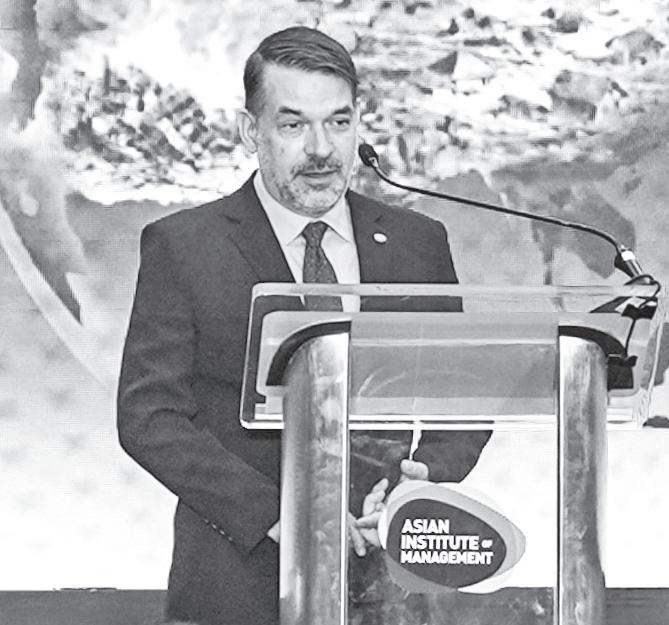
urgent economic, governance, and national security priority.
Sen. Loren Legarda, in her keynote address, called for stronger climate adaptation measures, more robust disaster risk reduction frameworks, and data-driven solutions to build a forward-looking resilience strategy.
Extending the discussion into the national security sphere, Gen. Romeo S. Brawner Jr., chief of staff of the Armed Forces of the Philippines, emphasized the importance of climate readiness in strengthening national security and long-term governance.
Complex realities
ASSISTANT Secretary Lilian M. de Leon, for International Relations at the Local Government department, who spoke on behalf of Secretary Juanito Victor Remulla, said that driven by climate change, rapid urbanization, and increasing vulnerabilities are becoming more complex and interconnected.
In the Philippines, she said current responses are no longer sufficient to keep pace with such realities.
“Given the country’s location along the Pacific Ring of Fire and so-called typhoon belt, the Philippines is at the receiving end of various natural threats,” de Leon said. Because of its vulnerabilities, enhancing the country’s resilience against disasters and climate change is a priority thrust of the government.
She said that various policies have been institutionalized and through local government units, from the provinces down to the barangays, fund allocation is
based on plans that identify the capacities of all LGUs in addressing vulnerabilities toward community resilience.
She underscored the importance of building the capacity of stakeholders to effectively address the impact of disasters and that the DILG’s thrusts aim to ensure that “every Filipino in every barangay, including the most vulnerable, are safe and resilient.”
Delayed funding
ACROSS the sessions, a consistent message emerged: delayed climate funding compounds losses, inflates recovery costs, and leaves the region’s most vulnerable communities without the protection they need.
The conference featured panel discussions covering anticipatory climate financing, risk-layered investment strategies, climate insurance and corporate asset protection, and last-mile delivery mechanisms—offering a systemslevel view of how financial architecture must evolve to meet the region’s escalating climate risks.
Among the distinguished speakers were Kathryn Milliken, senior climate change specialist at the Asian Development Bank; Radu Tatucu, senior financial sector specialist and financial sector lead at the World Bank; Secretary Robert E.A. Borje, vice chairperson and executive director of the Climate Change Commission of the Philippines, and AIM Prof. Chad Briggs.
Their insights highlighted the importance of aligning global capital flows with local resilience needs.
Financial perspectives
DURING the conference, additional perspectives from the Bangko Sentral ng Pilipinas, the Department of Finance, WWF Philippines, and LGUs ensured that the conversation reflected every level of the financing chain, from international funders to community implementers.
A defining concern of the climate change disaster resilience conference was the “first-mile to last-mile disconnect”—the persistent failure of global climate funds to reach local governments and frontline communities in time to reduce disaster impact.
Discussions centered on the need to redesign financing systems so that resources flow directly to local government units and vulnerable communities before crises escalate, rather than in the aftermath.
Anticipatory systems
ORGANIZERS believe the era in which post-disaster funding serves as the primary response model is no longer viable.
In its place, anticipatory systems—powered by data, strengthened by interagency collaboration, and enabled by agile financing mechanisms—must become the new regional standard.
The conference reinforced the Institute’s role as a convening force for transformative dialogue where leadership, policy, and sustainable development meet.
By bringing together voices from government, multilateral finance, and the private sector, AIM continues to advance its mission of developing principled leaders shaping solutions to Asia’s most pressing challenges.
What’s missing?
ASKED to weigh in, international biodiversity expert Theresa Mundita S. Lim underscored the inextricable link between climate change and disaster resilience to biodiversity.
“For a biodiversity-rich country like the Philippines, and a biodiversity-rich region like Asean we cannot speak meaningfully about climate resilience without recognizing the central role of naturebased solutions,” Lim, a former Environment department’s Biodiversity Management Bureau director and Asean Centre for Biodiversity executive director, told the Business Mirror via Messenger on April 30.
‘”Mobilizing climate finance and ensuring that resources reach frontline communities and local governments is vital, especially for disaster preparedness. But how these funds are used is just as important,” she said.
Financing biodiversity
ACCORDING to Lim, there is no one-size-fits-all approach to resilience-building.
“Financing decisions must be informed by the ecological realities of each area, including the protective functions already provided by existing natural ecosystems,” Lim said.
She explained that concrete or hard infrastructure may be necessary in some cases, but it should not automatically be treated as the default solution.
The global biodiversity financing gap, experts agree, is the massive shortfall between the current global investment in nature and
the amount needed to halt and reverse biodiversity loss by 2030. They estimate that there’s an annual gap of approximately $700 billion, given that the total annual need is between $722 billion and $967 billion, while the current spending range from $124 billion to $143 billion per year. In the Philippines, BIOFIN Philippines reported that the biodiversity financing gap is estimated at 80 percent, given that approximately P24 billion, or roughly $530 million, is needed each year to effectively implement the Philippine biodiversity Strategy and Action Plan, as against the current annual spending of roughly P4.9 billion.
Nature-based solutions
Fortunately, Lim said there are many ways to effectively combat climate change and natural disasters through nature-based solutions.
“In many areas, mangroves, forests, wetlands, coral reefs, seagrass beds, and other ecosystems already provide natural protection against floods, storm surges, erosion, landslides, and other climate-related hazards,” she explained.
“Where these ecosystems remain intact or can still be restored, climate finance should support their protection, restoration, and sustainable management. This may include incentives for local communities that serve as stewards of these ecosystems, as well as complementary infrastructure that strengthens recovery without undermining natural resilience,” she pointed out.
She said there has already been a lot of scientific information on how healthy mangroves provide buffer from storm surges and sea level rise.
“Also, intact forests prevent soil erosion and function to recharge groundwater, ensuring a sustainable water supply,” she added.
“Coral reefs [including deep-sea corals] provide another layer of protection—reducing the height of waves during storm surges and tsunamis. Wetlands are also natural water reservoirs that can absorb rising water levels. All of these ecosystems are also living habitats that can support food security when disasters create scarcity,” she further said.
COUNTERINTUITIVELY , despite the ongoing fuel crisis, when lesser vehicles are on the road, and the over two decades since the global phaseout of leaded gasoline, toxic lead is still present in Metropolitan Manila’s air.
An international team of researchers that analyzed aerosol data from 2018 and 2019 using lead isotope fingerprinting found that lead pollution has taken on new forms and persists to this day. The researches included those from the Ateneo de Manila University (AdMU) Department of Physics and the Manila Observatory.
The study points to modern industrial activities, fossil fuel combustion, and legacy pollution as key sources of lead pollution in the nation’s capital.
“While the data was collected in 2018 and 2019, the conclusions remain relevant today. This research highlights the importance of monitoring atmospheric lead
to ensure that we do not undo the gains from phasing out leaded gasoline,” said AdMU physics professor and study co-author Dr. Maria Obiminda L. Cambaliza.
The phaseout of leaded gasoline removed a primary pollutant, but the study points to industrial processes, such as e-waste recycling and smelting, as other major contributors, accounting for up to 45 percent to 62 percent of atmospheric lead in Metro Manila’s air, the study said.
Fossil fuel use, including diesel and trace elements in unleaded gasoline, contributes another 30 percent 45 percent.
Cambaliza explained: “There are now contemporary sources of lead, mainly from industrial activities, such as e-waste processing, and fossil fuel combustion, such as from diesel use and unleaded gasoline combustion.”
She pointed out: “Indeed, trace amounts of lead, may still come from unleaded gasoline.”

Also, contrary to patterns seen in other Philippine regions, Metro Manila’s pollution is largely from local emissions, persisting yearround regardless of seasonal shifts
wind patterns. These emissions are embedded in the material conditions of everyday life. As Metro Manila expands, so too do industries and
energy systems reliant on fossil fuels, sustaining the motion of urban life, the study said.
In the climate of geopolitical instability, surging global oil prices may delay the transition to clean energy, discourage proper vehicle maintenance, and heighten public exposure to toxic emissions.
The current situation traps communities in a cycle of economic pressure and environmental harm that intensifies each other.
The health concern is as critical: lead is heavily concentrated in fine particulate matter that can be inhaled deeply into the lungs and absorbed into the bloodstream.
This poses particular danger to children, who are vulnerable to lasting developmental and neurological harm, the researches pointed out.
Globally, one in three children already has elevated blood lead levels, but the Philippines has not
updated its national monitoring in nearly 20 years. Without sustained intervention to address these emerging issues, the public health achievements of the past remain vulnerable to reversal amid increasing global uncertainty. The persistence of lead in Metro Manila’s air serves as a reminder that environmental progress is not a finished chapter but a matter of continued vigilance, the researchers said.
Mengli Chen, Jariya
By Aldrin Quinto
Music blares through the giant speakers at the Tianya Haijiao center court as the crowd erupts, arms swaying in rhythm. At the Asian Beach Games in the resort city on the southern tip of Hainan Island, volleyball firmly took its place as one of the centerpiece events.
Volleyball has grown rapidly across the continent, driven by a young population and increased digital access. From indoor arenas to sun-soaked beach courts, the sport is reaching new audiences and producing new athletes sat an unprecedented pace, and Asian Volleyball Confederation president Ramon “Tats” Suzara is determined to sustain the gains.
“Across Asia, we are witnessing a remarkable rise in volleyball’s popularity, driven by passionate fans and a new generation of highly skilled athletes elevating the level of play. Asia is at the core of this global rise of volleyball, playing a key role in shaping the sport’s future,” said Suzara, also an executive vice president of the world governing body Fédération Internationale de Volleyball.
“At the same time, we are committed to strengthening a fancentric culture—bringing supporters closer to the athletes and the game through meaningful engagement and social media. This is the kind of volleyball we want to champion in Asia: competitive on the court and deeply connected with its fans.”
Regional competitions such as the Southeast Asian V.League have fueled rivalries and fan culture, while top-flight continental meets like the AVC Champions League have provided a springboard to even bigger stages—from world tours to global championships. Tactical sophistication
THE Asian Beach Games provided another showcase of the continent’s development as a volleyball hotbed, Thailand proving itself a worthy rival to Japan and China, which have set the bar for discipline and technical precision.
Iran has emerged as a global dark horse, while the Philippines is experiencing a surge in growth in the region.
Referee coach Richard Tony Casutt, an FIVB International Referee who has worked two Olympic Games and three World Championship meets, noted that while competing in top-level events is key to accelerating growth, players also need to put in the off-court work to truly close the gap with the world’s best.
“Beach volleyball’s gotten so big. And you see even in this tournament—the teams have played a lot of beach volleyball, understand the game and are dominating here,” Casutt said.
“But you also see new countries…fantastic athletes… learning. So for them to grow their quality, they need to expose themselves to more quality matches but also do the learning because you can access everything on YouTube.
“You can tell these new teams are super talented, even without playing much beach volleyball. Imagine if they had the years of history of beach volleyball in their country.
“So if they want to, they could improve really quickly.”
Thailand coach Petcharaj Putsorn, who steered Kongphopsarutawadee Worapeerachayakorn and Naraphornrapat Taravadee to the women’s title in the ABG, said he sees Asia’s level of play steadily rising, especially with the regional integration with Australia and New Zealand.
Putsorn said the key, particularly for Thailand and the Southeast Asian neighbors, is playing smarter to overcome the size disparity against volleyball powers in Europe and North and South America.
“Step by step, we can be better. The best in the world are really tall and very good.”
Broader development
BEHIND the volleyball action at the Asian Beach Games was a strong contingent of Asian Volleyball Confederation officials.
Kritsada Panaseri of Thailand served as the technical director, while fellow Olympic referees Richard Tony Casutt, Mariko Satomi of Japan, and Wang Lijun of China acted as referee coaches, overseeing and mentoring the international referees. Casutt noted that player development is complemented


by growth on the officiating side, with the Asian Volleyball Confederation focused on preparing the next generation of talent to keep pace with the sport’s rapid expansion.
“We are looking for the next group of young referees,” he said.
“And the group of us want to develop the next generation of Asian referees to progress all the way to the Olympics—that is the goal.
“AVC president Ramon has asked to develop our referees and build a strategy that will get Asian referees to the top again. Some of us older ones have been at the top and are retired from top level refereeing and we have not got the replacements to go to the Olympics yet.” Asia is getting there, Casutt says, but sustained investment in both players and officials will be key to closing the gap.


FOOTBALL players, coaches and fans from across the country gather for the inaugural New Clark City (NCC) Football Festival from May 8 to 10 at the NCC Athletics Stadium in Capas, Tarlac.
Presented by the Bases Conversion and Development Authority (BCDA) in partnership with Maxcom Sports Management Services, the three-day event marks the first football festival to be staged in New Clark City.
It aims to promote youth development, teamwork and community engagement through sport.
The festival will feature both 11-a-side and 8-a-side formats— the 11-a-side matches will follow standard full-pitch rules and are intended for older youth aged 13 and above, while the 8-a-side games are


designed for younger players aged 9 to 12, providing an accessible format that supports early-stage football development. Thirty-one football clubs have registered so far—showing strong interest from grassroots teams and youth football programs nationwide— with the deadline set on May 5.
“This Football Festival reflects our continuing commitment to position New Clark City as a premier venue for sports development and tourism, while creating meaningful opportunities for young athletes to sharpen their skills and pursue their passion for sport,” said BCDA President and Chief Executive Officer Joshua Bingcang.
Matches will be held across key facilities within the NCC complex,

Junia Gabasa: I’m very grateful to have been
by the WGAP to represent the Philippines in such a prestigious event. In preparing for tournaments, I try to keep my practice routine as consistent as possible. That consistency helps me stay composed and confident, and allows me to perform with the same mindset under competition.
My time as a student-athlete at Texas State has taught me the value of trusting and believing in my teammates. In team competitions, mistakes can sometimes feel more significant, but it’s important to remember that we got each other’s backs
including the Athletics Stadium, warm-up track and practice throwing areas, offering participants a worldclass sporting environment. The Athletes’ Village will serve as the official accommodation for athletes, coaches and technical officials. The Football Festival is open free to the public.
The event supports President Ferdinand R. Marcos Jr.’s agenda of strengthening grassroots sports development, expanding access to quality athletic facilities, nurturing young Filipino talent, and building a stronger pipeline of future national athletes. It is also expected to boost sports and event tourism in the region while generating economic opportunities for surrounding communities in Tarlac.
Queen Sirikit made me understand the value of teamwork, knowing each other’s strengths and weaknesses, being able to communicate amongst each other and strategize is some of the valuable lessons that I can share with Ate Junia and Ate Precious.
Along with WGAP president Cielo Fregil, team captain and WGAP board member Cookie Castillo will be ensuring that our lady amateurs head for the Queen Sirikit Cup with the best fighting chance. The team has presenting sponsors SkyFlakes and the Philippine Sports Commission and is also supported by the Philippine Amusement


Why the workouts of F1 drivers might help computer users with ‘tech neck’
MAY 3, 2026 | soundstrip.businessmirror@gmail.com
Story by Bless Aubrey Ogerio
SINGAPOREAN singer-songwriter Shye has never really treated identity as a fixed idea.
For much of her early career, she said, she wasn’t actively thinking about heritage or how it might shape her sound. It only came into focus later, as her work started crossing borders and genres that didn’t always fit neatly into labels.
Raised in Singapore to a Chinese-Singaporean mother and British father, Shye, the stage name of Trinity Shye-Anne Brown, grew up in a setting where cultural differences didn’t feel central to daily life. That changed only after she began moving through international music spaces.
“I think when I first started, it never really crossed my mind,” Shye told SoundStrip in an exclusive interview ahead of her Manila set.
“Growing up in Singapore, I went to a local school, all my friends were Singaporean, all Asian. So I kind of forgot that I do have that kind of heritage,” she added. It was only in recent years, she added, that she

Publisher :
T. Anthony C. Cabangon
Editor-In-Chief :
Lourdes M. Fernandez
Aldwin M. Tolosa
Concept :
Y2Z Editor :
SoundStrip Editor : Group Creative Director : Graphic Designers :
Jt Nisay
Edwin P. Sallan
Eduardo A. Davad
Niggel Figueroa
Chow Jarlego
Contributing Writers :
Tony M. Maghirang
Rick Olivares
Jingo Zapata
Reine Juvierre S. Alberto
John Eiron R. Francisco
Patrick Villanueva
Ana Zoe V. Davad
Justine Xyrah Garcia
Ginger Franz S. Ocampo
Trixzy Leigh Bonotan
Bless Aubrey Ogerio
Photographers :
Bernard P. Testa Nonie Reyes
Y2Z & SOUNDSTRIP are published and distributed free every Sunday by the Philippine Business Daily Mirror Publishing Inc. as a project of the
The Philippine Business Mirror Publishing, Inc., with offices on the 3rd Floor of Dominga Building III 2113 Chino Roces Avenue corner Dela Rosa Street, Makati City, Philippines. Tel. Nos. (Editorial) 817-9467; 813-0725. Fax line: 813-7025
Advertising Sales: 893-2019; 817-1351,817-2807. Circulation: 893-1662; 814-0134 to 36. www.businessmirror.com.ph
began actively reflecting on it. “It’s something I realized is part of me, and I should probably learn more about it.” And that sense of rediscovery has followed her into increasingly global stages.
Just days before her All of The Noise (AOTN) 2026 appearance, a regional music festival that brings together independent and alternative acts from across Asia and beyond, Shye opened for Scottish band The Jesus and Mary Chain, even joining them onstage for two songs. The moment, she said, felt unexpectedly circular.
“It kind of felt full circle,” she said. “Like, okay, I am part of this community technically. I didn’t grow up there, but I’m connected to it in some way.”
Last April 18, Shye performed a set at 123 Block in Mandaluyong City as part of the AOTN program, where she previewed the kind of stripped, mood-driven sound that has defined her recent releases.
Relationship with music
HER music career began early. At 16, she won the Vans Musicians Wanted showcase with original tracks, followed by a debut album that later earned her recognition as Best New Artist at the Freshmusic Awards.
Since then, she has picked up international attention, including a NME Best New Act from Asia award and appearances at festivals like South by Southwest.
Still, she said recognition did not remove uncertainty. If anything, it made the process more deliberate.
“I think something I had to unlearn is the idea that people will always show up for you,” she told this newspaper. “You really have to show up for yourself. Otherwise, things just won’t happen.”
That self-directed approach also shows in how Shye builds music. For her, songs usually begin with sound rather than lyrics.

“It’s always been the music first, usually guitar,” she said. “Then I layer things on. If the instrumental feels like it’s telling a story, I follow that instead of forcing words onto it.”
The young artist avoids rigid formulas, preferring instinct over structure. “Everyone will interpret the same song differently anyway,” she added.


LIVE performances, meanwhile, serve a more practical role in her process. With AOTN coming just weeks before a new album release, Shye is not treating the set as a preview in the traditional sense, but as a reading of audience response.
The latest in her music is ‘Smoke,’ her single taken from her forthcoming second album, The Doves Came Home, which is scheduled for release on May 8.
“Any opportunity to play live is a great way to read the room,” she said. “Sometimes you love a song, but when you play it live, nobody reacts. That’s okay. You just adjust.”
The Smoke-singer admitted she sometimes tests unreleased material on stage, depending on the setting, though her Manila appearance stuck to released tracks and a cover of an OPM song.




AFTER the festival, Shye’s focus now shifts to touring. She is preparing for her first full Asia tour, alongside a supporting run with a Canadian act.
“That’s the next thing,” she said. “I’ve never done my own Asia tour before, so I’m looking forward to it.”
She is also quick to note that she won’t be pausing work after her album cycle ends. New material is already in progress, though she says her outlook on audience reception has changed.
“I used to think everyone had to like my music,” she said. “Now I realize that’s not realistic. It’s more about finding the right listeners.”
For an artist still moving between genres, geographies, and influences, certainty is not the goal. The process, as Shye describes it, is still about learning—what works on record, what works on stage, and what simply doesn’t.
And in Manila, Shye’s process continued in real time.
Story by Justine Xyrah Garcia
Interview by Edwin P. Sallan
If you grew up in the 2000s or early 2010s, chances are Silent Sanctuary was part of your rotation, whether you meant it or not.
They were the kind of band you didn’t really have to look for. You’d download their songs at a computer shop, save them to your MP3 player or early Android phone, then let them play on repeat—on the way home, before going to sleep, or while you were stuck on someone you couldn’t quite figure out.
At some point, their songs stopped being background noise and started meaning something. They became anthems for breakups, for crushes, or for the one person you knew you weren’t ready to let go of.
Years later, the band is still here—still six, just a little different now—and easing back into the kind of songs that made them stick in the first place.
“We’ve been missing releasing love story songs—love songs, basically,” vocalist Sarkie Sarangay said in an exclusive interview with
BusinessMirror’s SoundStrip.
“For the longest time, we’ve been doing more experimental tracks… but now, we’re going back to the Silent Sanctuary sound,” he added. “That’s what you can expect from us this 2026.”
The band spent the past few years exploring different sounds and textures, moving slightly away from what first defined them. But as Sarangay explains it, those experiments didn’t replace their identity— they simply added to it.
Now, the direction feels more settled. Not a reset, but a return—with more clarity behind it.
“In terms of songwriting, we’ve evolved. The process has matured,” he said. “We’re more aware now of the lines we write and the melodies we create.”



That shift is less about changing their sound and more about refining it. The band still builds around strings and melody, but the process behind it has become more deliberate.
“It’s better now that there are six of us contributing ideas and suggestions on where the song should go,” he added.
While Silent Sanctuary has always operated as a full band, the lineup has shifted over the years.
Cello player Anjo Inacay pointed out that Ronnie joined on bass in 2020, Poch Villalon on keys in 2022, and Kim MirandillaNg on violin in 2017—changes that gradually shaped how the group approaches songwriting.
Despite those shifts, the band’s core remains intact.
“What stayed the same would be our string section… and of course, the melodies,” Sarangay said. “The flavor of Silent Sanctuary is still there.”
Earlier this year, the band released “Una”—a song they had actually written years ago and kept on hold for more than a decade.
At its core, it tells a familiar story: a relationship filled with conflict, where arguments keep repeating and pride gets in the way, but one person continues to choose the other anyway.

According to Sarangay, the song was first written and demoed in 2009 but didn’t make it into any of their earlier albums because it felt unfinished at the time.
“We only released it now because back then, it still felt raw,” he said. “We felt like it didn’t fit the albums we were putting out.”
“There are relationships that don’t work—constant fights, a lot of ego involved,” he added. “But no matter what happens, that person is still the one you choose first.”
Looking ahead, Silent Sanctuary is planning a steady stream of releases throughout 2026, potentially leading to a full-length album.
The band is also preparing for more performances here and abroad, including the Kundiman Canada Tour with Hale, Kitchie Nadal, and Moonstar88, as well as an appearance at Circus Music Festival next month.
They recently wrapped up sold-out shows in Japan and Singapore, part of a broader push to expand their overseas audience.
They are also eyeing a major concert in the Philippines later in the year.
For longtime listeners, the band’s current direction may feel familiar—but not in a way that simply repeats the past.
Instead, it reflects a sound that has remained consistent while gradually evolving, shaped by years of experience and a clearer sense of what continues to resonate.
By James Ellingworth The Associated Press
KEEPING your eyes on the road is vital if your car travels at a speed of 200 mph (322 kph). A strong neck helps.
Neck-strengthening exercises are integral in the fast-paced world of Formula 1 racing. Plenty of drivers will bring specialized training gear for that purpose when they arrive in Florida for this weekend’s Miami Grand Prix, the next event of a lucrative, year-long championship which spans the globe.
Working out with weighted harnesses or using deep body-weight stretches stabilize their heads and help them stay focused on the track through high-speed corners, while forces up to five times as strong as gravity heave their bodies from side to side.
Adults with “tech neck” don’t work in such extreme conditions, but the training techniques of professional race car drivers highlight an often-overlooked muscle group. Paying greater attention to posture while using screens and adding neck-specific exercises to a fitness routine are small changes that could ease discomfort, according to Dr. Neeru Jayanthi, an Atlanta-based sports medicine specialist who works with athletes of all ages from a range of sports.
“Does a normal person need to have a neck like an F1 driver? Probably not,” Antti Kontsas, an experienced performance coach who worked with four-time F1 champion Sebastian Vettel and other stars of the sport, said.
Still, “the healthy foundations are the same for the normal person and for the driver. Where you would start is exactly the same,” Kontsas told The Associated Press
As with any other fitness activity,

neck training needs to be practiced safely and with attention to an individual’s physical needs and limitations. When in doubt, seek guidance from a doctor or other medical professional, especially if you have experienced neck injuries or don’t know what might be causing your aching neck.
When you’re aware of your limits, “it’s just knowing the loading, exposing gradually. That’s the safe way to progress,” Konstas said.
How drivers train
THE days when F1 drivers smoke and drank before a Grand Prix are long gone. Even in the 1990s, fitness was crucial to Michael Schumacher’s success; the seven-time champion from Germany emphasized cardio and strength training. After all, fatigue causes mistakes.
A key element of Kontsas’ training programs is not overlooking the neck, otherwise known as the cervical spine, when exercising your back and core.
Body-weight exercises like keeping the head level with the shoulders in a lateral, or side, plank position can help. Another
easy exercise can be done lying down.
“The most simple thing is lying on your back on a bench with your head hanging and then holding your head in a complete horizontal line. You’re holding your head still and seeing how long you can hold that. That’s a good way to train, particularly, the front musculature,” Kontsas said.
To increase the challenge, drivers typically use a resistance band or a weighted harness that straps around the head to work their neck muscles.
Beating the pain of ‘computer neck’
TRAINING doesn’t have to take up a lot of time. Even F1 drivers might only do neck exercises for 10 to 15 minutes a session, two or three times a week, according to Kontsas.
If you spend a lot of time at a desk for work, improving neck health can start with a simple reminder to be aware of your posture and simple stretches like tucking the chin back to compensate for leaning forward toward a screen.
“Computer neck,” a modern ailment
APERSON can be physically active and still highly sedentary. Someone might go for a run before work, then remain seated for most of the next eight hours. The exercise helps, but it does not erase the effects of prolonged sitting on the body.
When the body stays still for long periods, a series of changes begins to take place. Skeletal muscle activity drops, making it harder for the body to absorb glucose from the blood. Over time, this
contributes to insulin resistance, a major pathway to type 2 diabetes. Fat metabolism also slows down.
Prolonged sitting also affects the musculoskeletal system. Poor posture and limited movement place strain on the neck, shoulders and lower back, helping to explain the aches and pains so common among office workers.
The effects are not only physical. Long periods of inactivity can reduce alertness, concentration and energy levels.
Employees who sit for extended periods often report feeling more sluggish and less productive.
Take an ‘active break’ REDUCING sitting time does not require a gym membership or a dramatic office overhaul. Small, regular interruptions to sitting can make a meaningful difference. Research suggests that standing up or moving for just two to five minutes every 30 to 60 minutes can improve glucose me-
that causes neck, shoulder and back pain, comes when “your head sits in different positions off the spine” while working, explains Jayanthi.
“You sit in front of the computer for two, three, four hours, and you never realize that your head was in the wrong position the entire time,” he said. “So, we can go back to positioning our neck and actually doing chin tucks and isometrics to push your head in the correct position on the spine. Just remind yourself every 30 to 60 minutes.”
There’s evidence that having a strong neck and trunk can help with other serious issues, according to Jayanthi. For example, neck training is “one of the most accessible, least expensive” options for concussion recovery and prevention, he said.
Likewise, spine strength can be a predictor of injury prevention or mitigation in tennis players, Jayanthi said.
Life in F1 can be a pain in the neck
IT’S hard to measure how much faster fitness makes a driver, but it’s notable that one of Formula 1’s most celebrated non-driver staff members of the last 15 years is Angela Cullen, longtime personal physiotherapist to seven-time champion Lewis Hamilton.
The physical challenge of racing at the top level can be shock to first-timers.
At age 18, British driver Oliver Bearman made his F1 race debut with two days’ notice as a replacement for Ferrari when regular driver Carlos Sainz, Jr. needed emergency surgery in 2024. Bearman was fit from racing in junior series Formula 2, but the strain on his body from going at F1 speed was in another league.
“Destroyed” was his response to being asked how he felt afterward.
“Physically it was a really difficult race. ... I think especially my lower back and my neck, it’s hurting,” Bearman added.
tabolism and reduce cardiometabolic risk. Remember: regular exercise is essential, but it does not fully offset the risks of sitting for too long.
A short walk at lunch, standing during a phone call, or simply getting up between meetings may sound like trivial adjustments, but they are not. For modern workers, protecting health is not only about moving more before or after work. It is also about sitting less while work is happening. The Conversation