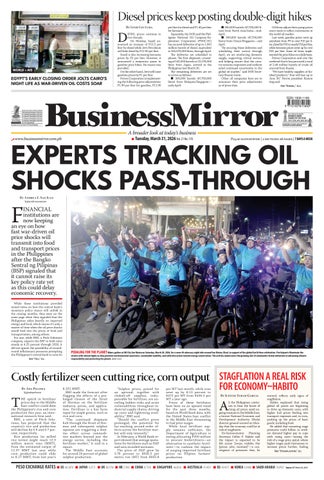
institutions are now keeping an eye on how fast war-driven oil price shocks will transmit into food and transport prices in the Philippines after the Bangko Sentral ng Pilipinas (BSP) signaled that it cannot raise its key policy rate yet as this could delay economic recovery.
While these institutions provided mixed views on how the central bank’s monetary policy stance will unfold in the coming months, they were on the same page when they signaled that the Philippines relies heavily on imported energy and food, which means it’s only a matter of time when the oil price shocks would feed into the prices of food and transportation, among others.
For one, while BMI, a Fitch Solutions company, expects the BSP to hold rates steady at 4.25 percent through 2026, it did not ignore the possibility of secondround inflationary pressures prompting the Philippines’s central bank to raise its
By Ada Pelonia @adapelonia
Tand production will decline by 0.6 and 0.7 percent, respectively.
Rice production (in milled rice terms) might reach 12.3 million metric tons (MMT), from the estimated output of 12.37 MMT last year while corn production could slide to 8.27 MMT, from last year’s
Diesel prices keep posting double-digit hikes
By Lenie Lectura
IESEL prices continue to rise sharply. On Monday, Seaoil announced an increase of P12.5 per liter for diesel while Jetti Petroleum will hike diesel by P12.90 per liter.
Seaoil is also increasing kerosene prices by P2 per liter. However, it announced a temporary pause in gasoline price hikes. No reason was provided.
On the other hand, Jetti will raise gasoline prices by P1 per liter.
Petron Corporation is implementing the following price adjustments: P1.90 per liter for gasoline, P11.90
per liter for diesel and P1.40 per liter for kerosene.
Separately, the DOE said the Philippine National Oil Company-Exploration Corporation (PNOC-EC) has secured deliveries of up to 1.042 million barrels of diesel, equivalent to 165,678,000 liters, through April.
The deliveries are scheduled in phases. The first shipment, consisting of 142,000 barrels or 22,578,000 liters from Japan, arrived in the Philippines last March 26.
The remaining deliveries are set to arrive as follows:
n 300,000 barrels (47,700,000 liters) from Malaysia/Singapore— early April.
n 300,000 barrels (47,700,000 liters) from North Asia/India—midApril.
n 300,000 barrels (47,700,000 liters) from Oman/Singapore—end April.
“By securing these deliveries and scheduling their arrival through April, we are reinforcing domestic supply, supporting critical sectors, and helping ensure that the country remains responsive and resilient amid continued uncertainty in the global oil market,” said DOE Secretary Sharon Garin. Other oil companies have yet to announce their price adjustments as of press time.
8.331 MMT. BMI made the forecast after flagging the effects of a prolonged closure of the Strait of Hormuz on the fertilizer industry, prices, and application. Fertilizer is a key farm input for staple grains, such as rice and corn.
“The continued shipment halt through the Strait of Hormuz and subsequent sulphur squeeze are triggering a domino effect across commodities markets beyond just the energy sector, including the fertilizer market,” it said in a report.
The Middle East accounts for around 24 percent of global sulphur production.
“Sulphur prices, poised for an uptrend, together with choked-off supplies, indispensable for fertilizer, are unveiling hidden risks and acute vulnerabilities throughout industrial supply chains, driving up costs and tightening availability,” BMI said.
“Should the conflict prove prolonged, the potential for far-reaching second-order effects across the fertilizer market will only intensify.”
In February, a World Bank report showed that average quotations for fertilizers such as DAP and urea recorded increases.
The price of DAP grew by 3.76 percent to $626.5 per metric ton (MT) from $603.8
per MT last month, while urea went up by 8.13 percent to $472 per MT from $436.5 per MT a year ago. Prices of these fertilizers have been on an upward trend for the past three months, based on World Bank data, with the United States-Iran conflict in the Middle East threatening to fuel price surges. While local fertilizer supply remains sufficient, the Department of Agriculture is eyeing allocating P500 million to procure biofertilizers—an alternative to synthetic fertilizers—to cushion the impact of surging imported fertilizer prices on Filipino farmers’ production.
By Justine Xyrah Garcia
AS the Philippines continues to bear the brunt of rising oil prices amid ongoing tensions in the Middle East, a former National Economic and Development Authority (Neda) director general warned on Monday that the economy could be at risk of stagflation.
Ex-Socioeconomic Planning
Secretary Cielito F. Habito said the impact is expected to be felt across “presyo, trabaho, kita [prices, jobs, incomes]”—a convergence of pressures that, he
warned, reflects early signs of stagflation.
Habito explained that rising global oil prices are beginning to drive up domestic costs, with higher fuel prices feeding into transport expenses and, in turn, pushing up the prices of basic goods, including food. He added that mounting wage pressures could follow, as workers demand higher pay to cope with rising costs—raising the risk of a wage-price spiral, where higher wages push businesses to increase prices further, fueling
By Andrea E. San Juan @andreasanjuan
Markets pricing a ‘prolonged’ war; peso at new all-time low
By Andrea E. San Juan @andreasanjuan
THEPhilippine peso slumped to a new all-time low of P60.69 against the dollar on Monday as markets are pricing a “prolonged” war.
Jonathan L. Ravelas, senior adviser at Reyes Tacandong & Co., responded with: “Markets are pricing a prolonged war,” when he was asked what could have dragged the local currency to a new record low on Monday.
As such, he said the peso is likely to
Stagflation…
Continued from A1
another round of inflation.
These factors, combined with a weakening labor market, pose a risk of slowing economic growth alongside elevated inflation.
trade “within the 60.60/60.90 levels.”
The analyst made this comment after data from the Bankers’ Association of the Philippines (BAP) showed the peso closed at P60.69 per $1 on Monday, 14 centavos weaker than its previous finish of P60.55 on Friday.
Philippine Institute for Development Studies (PIDS) Senior Research
Fellow John Paolo R. Rivera said this was “mainly driven by external factors: a stronger US dollar, elevated oil prices increasing the Philippines’s import bill, and global risk-off sentiment.”
Rivera said, however, that he does not see this as a “speculative attack” on the peso.
He pointed out that the move was “likely amplified” by technical factors after breaching the 60-per-dollar level.
As such, Rivera noted this still reflects a “temporary external adjustment rather than a currency crisis.”
“As a net oil importer, higher fuel costs raise demand for dollars, put-
ting pressure on the currency,” he also noted.
Michael L. Ricafort, chief economist at Rizal Commercial Banking Corp. (RCBC) noted the peso may have weakened “after the country’s recent purchases of crude oil/diesel/petroleum in the country that are settled/paid in US dollar/foreign currencies in an effort to further augment local energy supplies.”
The peso weakened for the fourth straight trading day, historical data from BAP showed.
Within the trading session on Monday, the local currency traded at its strongest level of P60.55 against the greenback, while its lowest level was at P60.84.
key policy rate later in the year.
“While we had previously expected the BSP to cut rates at its April meeting, the US-Iran conflict upended this view. Inflation is likely to breach the BSP’s 2-4 percent inflation target range in the coming months, but sluggish growth will keep the BSP on hold rather than tighten,” BMI said.
As such, BMI said it expects the BSP to hold rates steady at 4.25 percent through 2026.
It explained that the Middle East conflict has led to a “supplyinduced” price shock, which has driven up international oil prices significantly.
“And this has swiftly passed through to higher domestic fuel prices—diesel prices jumped by more than 60 percent since preconflict. Meanwhile, fertilizer prices are rising rapidly, which will feed through into food inflation,” added BMI.
Against this backdrop, BSP revised upwards its average headline inflation forecast from 3.6 percent to 5.1 percent in 2026, underpinned by revisions to its oil price assumptions.
transmit into higher transport costs, putting upward pressure on fare adjustments despite the government’s call to defer hikes.
“Fare increases tend to be sticky and non-linear, feeding into household inflation expectations, distribution costs, and eventually wage demands,” added Neri. As such, the BPI lead economist said the combination of food and transport second-round effects “heightens the risk” that inflation extends beyond a pure supply shock, “ultimately transmitting into demand.”
Taking these into account, Neri said headline inflation likely quickened to 3.9 percent in March, with risks that inflation could breach 4 percent in the near term, with fullyear average inflation potentially exceeding 5 percent if oil prices remain elevated.
“Historical experience suggests sustained supply shocks eventually bleed into demand, increasing the likelihood of a more hawkish shift if inflation expectations drift,” said Neri.
“Now think of the prospect of tens of thousands of workers having to come back from the Middle East because of the problem… Think about how now even more will be competing for the limited jobs we have in the domestic economy,” Habito said in an interview.
According to Habito, the country lost around 758,000 jobs over the past year, between December 2024 and December 2025, even before the latest escalation in the Middle East.
Latest data from the Philippine Statistics Authority (PSA) showed that the unemployment rate rose to 5.8 percent in January, the highest since June 2022, equivalent to about 2.96 million jobless Filipinos.
This is despite the full impact of geopolitical tensions yet to be felt.
Habito, who led Neda during the Asian financial crisis in the 1990s, said the government can still take a
more aggressive stance in preparing for what he described as “worse times ahead.”
He noted that the current situation could prove more disruptive than the Covid-19 pandemic, when supply chains remained intact but mobility was restricted.
This time, he said, the risk lies in actual supply constraints, which could push prices higher while limiting availability of key goods.
“In other words, if we’re expecting things to really get worse then it’s time—even now, you don’t have to wait for the first signs of the problem to actually come up with responses,” he said.
Habito also warned that the government faces a tight fiscal space, which could limit its ability to respond to the crisis.
He said public finances are already under strain, with slowing economic activity expected to weigh on tax revenues even as spending needs rise—for subsidies, imports of fuel and food, and infrastructure.
“At a time when the government needs the most revenues, it actually is facing a prospect of having less,” the former Neda chief said.
This could force difficult choices, including increased borrowing, weaker revenue collection and, eventually, the need to raise or broaden taxes—adding to the burden on households.
“We might as well wake up to that reality, that these things will come, even if the war in Iran were to stop today. The downhill forces causing us to move in this difficult direction are already there, whether or not the war goes on or not,” Habito added.
Latest estimates from the Department of Economy, Planning, and Development (DepDev) show that inflation could accelerate to between 4 percent and 8.6 percent this year, depending on the average price of Dubai crude.
At the same time, higher fuel costs, weaker remittances and softer tourism could drag growth, with GDP projected to slow to between 3.5 percent and 5.3 percent.
According to BSP, average international oil prices could hover at around $85 per barrel this year.
Before the conflict in the Middle East, the central bank was looking at around $64-$65 per barrel.
Still, BMI said: “We think it is premature to forecast rate hikes from the BSP,” adding, “While inflation will probably rise significantly, the BSP notes that it will be supplydriven and monetary policy is not well-placed to tackle that.”
However, BMI pointed out: “The risks are that the BSP hikes later in 2026.” This forecast rests on the fuel prices “largely dictating” the cost of logistics that underpin the modern economy, where a prolonged conflict would leave “strong, broadbased second-round inflationary pressures in its wake, prompting the BSP to hike.”
US-Israel-Iran war vs Russia-Ukraine war
MEANWHILE , Bank of the Philippine Islands (BPI) Senior Vice President and Lead Economist Emilio S. Neri Jr. emphasized in a statement on Monday: “Recent price dynamics suggest that the current tensions stemming from the US-Israel-Iran conflict appear to transmit more forcefully than during the 2022 Russia-Ukraine war.”
Neri illustrated that March Dubai crude surged by 64 percent monthon-month (MoM) versus 22 percent in 2022, with local gasoline prices rising 21 percent month-on-month against the 11 percent four years ago.
“This has been accompanied by sharper increases in rice [4.7 percent MoM] and electricity tariffs [4.9 percent MoM], pushing monthly inflation to an estimated +1.2 percent, well above the +0.6 percent seen during the 2022 episode,” the BPI’s Lead Economist underscored.
Overall, Neri said, the magnitude and speed of pass-through point to “tighter supply conditions and reduced buffering capacity” compared to previous shocks.
According to Neri, the surge in fuel prices is also beginning to
BSP policy implications WITH the current policy rate at 4.25 percent—a level he described as “below historical restrictive levels”—the central bank will likely become more agile amid this fluid situation to make the necessary tightening adjustments to ensure that the economy does not suffer further from this crisis if inflation expectations are “de-anchored.”
“With second-round effects in both food and transport beginning to emerge, alongside rising external and FX pressures, the risk is shifting toward a more persistent and broad-based inflation environment, challenging the BSP’s current waitand-see stance,” Neri said.
In a separate commentary, Moody’s Analytics said prior to the BSP’s off-cycle monetary policy decision to keep its key policy rate steady at 4.25 percent, it had expected the central bank’s scheduled April meeting to bring a “hold decision” in response to the Middle East conflict.
“The early meeting reflects a desire to steady expectations amid rising external risks,” Moody’s Analytics said.
“For the Philippines, which relies heavily on imported energy and food, the conflict raises concerns about supply security and inflation,” it also noted.
According to Moody’s Analytics, on Wednesday, the Philippines became the first country in the Asia Pacific region to declare an energy emergency.
At the BSP’s off-cycle meeting on Thursday, BSP Governor Eli M. Remolona Jr. said monetary policy will focus on addressing secondround effects of the oil price shocks.
“Once we see second-round effects from those shocks, for which we can do something about the demand for those second round effects, then I think it would be appropriate for monetary policy to tighten the inflation from those second round effects,” the BSP chief pointed out. (See: https://businessmirror.com.ph/2026/03/26/ bsp-maintains-rates-to-soothemarkets/)
Ultimately, the ambassadors propose that the Philippines gradually decouple from formal military alliances, including the Mutual Defense Treaty with the US, and adopt strict neutrality.
They also suggest exploring integration into the economic bloc of Brazil, Russia, India, China, and South Africa (BRICS) to diversify ties.
“Out-of-the-box and difficult solutions are proposed, and they will require careful consideration and a change of mindset in both our leaders and people,” the paper said.
29.96 million tons in 2024. Road transport accounted for 28.28 million tons, while air cargo declined to 23.73 thousand tons, down 28 percent from 32.95 thousand tons a year earlier. Across regions, Calabarzon posted the highest outflow—referring to goods shipped out to other regions—in both volume and value.
Outgoing shipments from the region reached 11.76 million tons, while the value of traded goods was estimated at P714.85 billion.
On the other hand, inflow, or the goods received from other regions, was highest in the National Capital Region (NCR), which recorded
12.79 million tons and P655.89 billion in 2025. Taken together, these flows determine a region’s trade balance, or the gap between goods going out and coming in. Regions with the most favorable or positive domestic trade balances last year in terms of value were Calabarzon (P277.40 billion), Northern Mindanao (P262.77
sksargen (-P145.44 billion).
National Women’s Month
www.businessmirror.com.ph
Filipina CEOs: Does Gender Equity
Hit a Wall in PH Corporations?
Closing the gap between representation and equity, aspiration and opportunity requires ongoing effort from corporations, policymakers, and society alike.
By Bless Aubrey Ogerio
THE conversation around women’s leadership has never been louder—or more urgent. As organizations increasingly highlight workplace equality, women in senior management roles are gaining recognition, and March’s Women’s Month offers a timely reminder of the progress made.
According to a Grant Thornton Women in Business 2026 report, the Philippines has seen an uptick in female representation in senior management. Women now hold 44.5 percent of senior roles, up from 43 percent last year, ranking the country second globally in female leadership presence. (See: https:// businessmirror.com.ph/2026/03/11/grantthornton-report-more-pinays-as-leadersnow/).
Yet, while representation has improved, the gender gap persists in terms of compensation and opportunities.
Data from the Philippine Statistics Authority (PSA) from 2020 to 2025 showed that male managers consistently earn more than their female counterparts, highlighting that progress in leadership does not automatically translate into equity.
Yet, beyond pay disparities, societal perceptions of gender roles continue to shape career paths, subtly steering women and men into fields traditionally considered “appropriate” for their gender.
These long-standing assumptions can constrain potential and reinforce stereotypes, even in a country that, on paper, supports women in leadership.
S o, while more Filipino women may now occupy top positions, the question remains: what does this progress truly look like in practice, and how far does it go?
First off, money talks
In data obtained by BusinessMirror, compensation figures by the statistics agency provide a clear lens into persistent inequalities. PSA numbers show that in 2020, male managers earned an average daily pay of P1,148, compared with P1,072 for female managers—a difference of P76.
The gap fluctuated in subsequent years but largely favored men. In 2021, male managers earned P1,152 daily versus P1,157 for women, a small reversal but short-lived.
By 2023, male managers again pulled ahead with P1,292 per day, compared with P1,213 for women—a P79 gap.
Projections for 2024 and 2025 suggest this trend will continue, with male managers earning P1,396 and P1,405 daily, respectively, while female managers are expected to earn P1,387 on average.
But why is it this way?
EXPERTS point to structural and societal factors that continue to influence women’s advancement.
Angelica Esguerra-Patterson, a development professional specializing in women and gender, noted that Filipino women face fewer cultural barriers than women in many other countries, particularly in South Asia or parts of the Middle East, where social norms can limit participation in public and corporate life.
“In that regard, it can be argued that women in the Philippines have had a relatively clearer path to assuming leadership roles in business in comparison to other countries,”
Patterson told BusinessMirror in an interview.
Still, traditional expectations on giving care at home—childcare, household management, and elder care—remain strongly associated with women. This dual responsi-
bility often makes top executive roles harder to accept or sustain.
Even in households without children or spouses, women frequently shoulder extended family care, creating additional demands on their time.
Pattenson also cited some studies that suggest a common reluctance among women to take on top-level positions, not for lack of ability, but because of the intensive demands and time commitments,
RIGHTS WOMEN SHOULDN’T HAVE TO FIGHT FOR: SAFETY, RESPECT, FREEDOM.
Too many women still hide in fear or endure harassment silently, but the public outcry over Rep. Bong Suntay’s statements shows that people are increasingly ready to speak out and refuse to accept harassment as part of everyday life.
By John Eiron R. Francisco
WOMEN’S rights are human rights. It is a phrase that is repeated often and continues to be emphasized in awareness campaigns. And for good reason. It does not require special treatment, nor does it demand complicated conditions. It simply states the truth that every woman, just like every man, is human and, therefore, entitled to the same dignity, safety, and respect.
Yet the reality is far from this ideal. Women encounter behavior that strips away their basic humanity, harassment on the streets, unsolicited judgment in creative spaces, and even ridicule for expressing themselves through fashion or art. Moments that should be ordinary can feel threatening, and spaces that should welcome expression can feel hostile.
If a society cannot guarantee the safety, freedom, and respect of half its population, can we truly call it progressive? How can we claim to advance as a community when the simple right to exist without fear remains a struggle for many?
Acknowledging this is not an accusation; it’s a call to awareness. It challenges us to confront uncomfortable truths about everyday interactions, about norms that quietly tolerate inequality, and about the cultural patterns that still allow disrespect to go unchallenged. Because progress is not measured in words alone, but in the assurance that every person, regardless of gender, can walk freely, create boldly, and live fully without fear.
According to UNESCO, nearly one in three women worldwide, about 840 million, have experienced physical or sexual violence in their lifetime, and progress in reducing it has been painfully slow. In 2024 alone, roughly 50,000 women were killed by partners or family members. That’s 137 lives lost every single day. Homes, schools, and neighborhoods, places that should have been safe, too often became sites of danger. Some women are more vulnerable than
others. Adolescent girls just beginning relationships, women with disabilities, and those facing multiple forms of discrimination bear the brunt. And when crises strike, armed conflicts, natural disasters, or climate change, the risks escalate even further. Child marriage, exploitation, and intimate partner violence rise, affecting not just individuals but families, communities, and entire societies.
Online harassment and attacks on women in public life add another layer of danger. Yet less than 40 percent of survivors seek help, and fewer than 10 percent report to authorities.
Legal protections remain limited: only 14 percent of women live in countries with strong laws against violence, and many nations still lack consent-based rape laws or safeguards against cyber harassment.
PHL Laws Protecting Women
In the Philippines, laws have been passed to protect women’s rights and for a fairer society.
One of the most important is Republic Act 9710, better known as the Magna Carta of Women (MCW). This law is designed to eliminate discrimination and ensure that Filipino women, especially those from marginalized communities, can fully enjoy their rights.
The MCW translates international commitments into local law, reflecting principles from the Convention on the Elimination of All Forms of Discrimination Against Women (CEDAW). It clearly defines what counts as gender discrimination and lays out the government’s responsibility to promote equality and protect women’s human rights.
It also aligns with the International Covenant on Economic, Social, and Cultural Rights (ICESCR), recognizing rights that cover all aspects of life from political and economic participation to education and health. If a violation involves a government agency or official, those responsible can face penalties, including administrative and civil sanctions. When violence is committed by state agents, it is treated as an aggravated offense, carrying stricter penalties.
For violations by private individuals or organizations, those responsible can be ordered to pay damages, while the victims can also pursue other legal remedies under existing laws protecting women.
Complementing the MCW are several other key legislations that reinforce protection for women. Republic Act No. 9262, or the AntiViolence Against Women and Their Children Act of 2004, addresses abuse committed by intimate partners, including current or former spouses, live-in partners, or dating partners.
The law covers acts that result in or are likely to result in physical, sexual, psychological, or economic harm, including threats, harassment, and deprivation of liberty.
Other protective measures include the Rape Victim Assistance and Protection Act (RA 8505), which provides support services for survivors of sexual violence, and the Anti-Sexual Harassment Act of 1995 (RA 7877), which penalizes harassment in workplaces, schools, and training institutions.
Additional legal frameworks further strengthen women’s rights in the country. These include the Anti-Rape Law of 1997 (RA 8353), the Anti-Trafficking in Persons Act of 2003, and laws prohibiting gender-based discrimination in employment, such as RA 6725.
Beyond legislation, the Philippines has also adopted key policies and international commitments that guide gender-responsive governance. These include the ratification of CEDAW in 1981, the Philippine Plan for Gender-Responsive Development (1995–2025) under Executive Order No. 273, and the Harmonized Gender and Development (GAD) Guidelines issued by the National Economic and Development Authority.
While these are just the major laws among the numerous laws and executive orders that provide a strong framework, their effectiveness ultimately depends on proper implementation.
The laws can only achieve their purpose when leaders, lawmakers, and institutions uphold their spirit and ensure that the rights guaranteed by the Constitution are respected in practice.
What can be done?
FOR Jean Encinas-Franco, a
reap the benefits of gender equality in the workplace,” Franco told this newspaper in an email.
For her part, Patterson concurs that Diversity, Equity, and Inclusion (DEI) policies are essential for modern business.
“B ut genuine policies go beyond platitudes. Policies actually impact employees’ lives, and increase their ability to perform their jobs better in an environment that helps maximize their potential,” she explained.
“If we stop clinging to these roles, men and women alike can make decisions affecting their work and family life that work for them, rather than trying to fit into archaic molds that overburden, burn out, and ultimately limit the potential for advancement of one gender over another,” she added. In reality, the Philippines has made visible strides in women’s representation in se -
opportunity requires ongoing effort from corporations, policymakers, and society alike. In conclusion, representation alone is not enough. Filipino women are leading, yes, but for true progress, the environment in which they lead must evolve alongside them.
BREAKING THE GLASS CEILING. more Filipino women are stepping into leadership, taking onresponsibility, and reshaping the business landscape. PHOTO SOURCE: KY NANG/UNSPLASH
Impeachment proceedings vs VP to continue despite petition at SC
By Jovee Marie N. Dela Cruz | @joveemarie
THE House Committee on Justice will push through with the impeachment proceedings against Vice President Sara Z. Duterte despite a petition filed before the Supreme Court, with its vice chairperson pointing to growing support among lawmakers and ongoing efforts to strengthen evidence.
I n an interview, San Juan City Rep. Ysabel Maria Zamora, vice chairperson of the Justice panel, said the legal move was expected and would not disrupt the constitutional process.
Well, of course, we expected that, and we felt that they were going to file a petition before the Supreme Court. I mean, she [Duterte] has her lawyers, and it is just natural for the lawyers to exhaust all remedies available to them,” Zamora said.
T he petition, filed by lawyers linked to the Duterte camp, accuses the House of grave abuse of discretion in handling the impeachment proceedings and seeks to stop the ongoing hearings.
Despite this, Zamora said the committee will continue its work in line with the 1987 Constitution and House impeachment rules.
Gatchalian revives bid to keep minors off social media
By Butch Fernandez @butchfBM
WITH several countries, including Indonesia, now seriously in the process of legislating a ban on minors on social media, Sen. Sherwin Gatchalian revived his push for a similar prohibition in the Philippines.
I ndonesia is the first country in Southeast Asia to enforce a social media ban for minors. Under that country’s law, minors below 16 will be prohibited from creating accounts on platforms deemed “high-risk,” including Instagram, Tiktok, Facebook, YouTube, X, and Roblox, among others.
A ustralia earlier pursued a similar initiative. And recently, in the US, a Los Angeles jury found social media giants YouTube and Meta guilty of promoting childhood social media addiction.
Well, what will happen next is the continuation of the proceedings before the Committee on Justice, where we will have a hearing, as stated under the Constitution and as stated in the rules of impeachment of the House of Representatives. So, we will proceed with a hearing,” she said.
Support
ZAMORA added that based on her discussions with colleagues, there appears to be enough support in the House to sustain the impeachment case, although she emphasized that the process is still ongoing and will ultimately depend on the evidence.
Of course, we will follow the rules on impeachment proceedings, and we will still have to determine probable cause as stated in our rules. And maybe for the understanding of others, what we are doing right now is akin to a preliminary investigation in criminal cases,” she said.
T he Justice panel began hearings on March 25 after ruling that the two remaining impeachment complaints against Duterte were sufficient in form, substance, and grounds.
The committee is now working to determine probable cause, the final step before the case may be elevated to the Senate for trial, with hearings scheduled on April 14, 22, and 29.
The House plenary has authorized the panel to continue its hearings during the congressional recess from March 21 to May 3, allowing it to issue subpoenas and gather additional evidence.
T he current complaints were filed after the Supreme Court voided last year’s impeachment case on procedural grounds under the one-year bar rule, while allowing new complaints to be lodged starting February 2026.
The allegations include misuse of confidential funds, unexplained or ill-gotten wealth, alleged threats against the president and other officials, possible discrepancies in statements of assets, liabilities, and net worth, and bribery.
Subpoena
BATANGAS Rep. Gerville Luistro, the justice committee chairperson, defended the panel’s decision to issue subpoena for witnesses and documents ahead of the hearings on the two remaining impeachment complaints against Duterte.
L uistro emphasized that the proceedings before the committee are formal hearings aimed at clarifying issues and determining probable cause.
I want to make it clear that what is happening in the Justice Committee is a hearing proper—a clarificatory hearing akin to a preliminary investigation. The members are acting as investigators, and our mandate is to determine whether probable cause exists,” she said during an online interview.
S he explained that the panel must examine the truthfulness of the allegations by reviewing documents and hearing testimonies from witnesses.
And how do we do it? We need to test the veracity of the allegations of offenses and grounds in the
complaints. We do this by trying to find other documents that can counter or test the veracity of the allegations in the complaints or listening to the witnesses and asking questions,” she said.
Luistro stressed that uncovering the truth is essential before the committee can make a decision.
In order to carry out this duty, we must establish the facts. We need to verify whether the claims in the impeachment complaints are true. At the end of the day, we will vote on whether probable cause exists,” she added.
She, meanwhile, advised that any petition filed before the Supreme Court should be based on the committee’s actual actions, not on how the proceedings are labeled or described in interviews.
“I think it is totally wrong to base it on the name, on the nomenclature, or on the label. Again, the correct basis to judge the constitutionality of the proceeding is the actions that the committee is actually doing for the purpose of responding to the requirements of the rules of impeachment,” she said.
S he reiterated that the proceedings are meant solely to determine whether there is sufficient basis to proceed to trial.
Madriaga ZAMORA also said the committee will verify the truthfulness of the affidavit of detained witness Ramil Madriaga, described in proceedings as an alleged former bagman of Duterte.
See “Impeachment,” A5
DOJ, Pagcor strengthen data sharing
By Joel R. San Juan @jrsanjuan1573
HE Department of Justice
T(DOJ) has agreed to provide the Philippine Amusement and Gaming Corporation (Pagcor) the profile data of its more than 50,000 officials and employees in a bid to strengthen the implementation of laws and regulations that prohibit government officials and employees from going to gambling casinos.
T he DOJ led by Secretary Fredderick A. Vida and Pagcor through its Chairman and Chief Executive Officer Alejandro H. Tengco signed a memorandum of agreement (MOA) on Monday on data sharing as part of the agencies’ “proactive and united approach” to prevent people in government from entering the casinos.
Under the MOA, the DOJ and its attached agencies will share the profiles of their officials and employees to Pagcor.
A mong the DOJ’s attached agencies are the Bureau of Corrections, the Bureau of Immigration, the National Bureau of Investigation, Parole and Probation Administration, the Presidential Commission on Good Government, the Public Attorney’s Office, the Office for Alternative Dispute Resolution, the Office of the Government Corporate Counsel, Office of the Solicitor General, and the Land Registration Authority.
T he profile data will include the names, titles and photos of the officials and employees.
B esides these, there is also the harm from bullying on social media, which has been blamed for the rise in suicides among young people.
G atchalian also recalled the results of the 2022 Program for International Student Assessment (PISA), which found that every one-hour increase in a 15-year-old Filipino learners’ use of digital devices for leisure resulted in a four-point decline in mathematics scores.
Huwag na nating hayaang lumala pa ang problema bago tayo kumilos [Let us not allow this problem to worsen before taking action],” said Gatchalian.
I n 2024, Australia became the first country in the world to ban minors under 16 on social media. The ban took full effect in December 2025.
I n the Philippines, the Cybercrime Investigation and Coordinating Center (CICC) had earlier urged telecommunications companies to prepare for a possible nationwide Roblox block to protect children from online exploitation and harmful content.
Ceap, CBCP back proposed three-term school calendar
By Mary Jade Jadormio
CATHOLIC educators expressed support for the proposed three-term academic calendar of the Department of Education (DepEd), but urged the government to pace the transition carefully.
The Catholic Educational Association of the Philippines (CEAP) and the Catholic Bishops’ Conference of the Philippines (CBCP) Episcopal Commission on Catholic Education (Ecce) warned that rushed implementation of the program could disrupt learning delivery and strain teachers.
I n a statement, CEAP and CBCP Ecce recognized the Department of Education’s intent to recalibrate the school calendar to support learning recovery. However, the groups emphasized
that the reform’s success will depend not on the calendar itself but on the system’s readiness to adapt teaching, assessment, and curriculum design.
“ The shift from a four-quarter to a three-term structure is not merely a scheduling adjustment but a systemic transformation that demands coherence across curriculum, pedagogy, and assessment,” their statement read. They warned that without corresponding curriculum reconstruction, the reform could lead to “shallower coverage, accelerated pacing without mastery, increased assessment pressure, and reduced remediation space.”
T he groups said these risks reflect actual classroom conditions when structural changes outpace instructional readiness.
“CEAP,” A6
Dy orders House panels to craft fast solutions to Mideast conflict impact
SPEAKER Faustino Dy III on
Monday ordered a series of House of Representatives joint committee hearings to develop a coordinated legislative package aimed at addressing the crisis in the short, medium, and long term in a bid to shield Filipinos from the effects of the escalating Middle East conflict.
D y said the initiative aims to align the legislative and executive branches in rolling out immediate relief measures while laying down strategies for economic stability and long-term resilience.
We are holding these joint hearings to make sure that the initiatives of the legislative branch are coordinated with the executive and are properly targeted and forward-looking. What we need
now is a clear plan—not just for today, but for the months and years ahead,” he added.
Set during the session break after Holy Week, the hearings will bring together key government agencies and lawmakers to address the crisis’ impact on vital sectors such as energy, food security, labor, transportation, and economic management.
T he speaker stressed that the hearings are meant to produce concrete solutions rather than assign blame.
“ We want to hear directly from our economic managers and frontline agencies so we have the information we need to come up with measures that can help our people cope with the impact of the Middle East conflict,” he said.
A mong the committees involved are Energy, Agriculture, Aquaculture and Fisheries, Foreign Affairs, Ways and Means, Labor and Employment, Transportation, Information and Communications Technology, Economic Affairs, and Social Services.
D y said the findings from the joint hearings will guide both executive actions and legislative measures aimed at minimizing the effects of global disruptions on Filipino families.
“ We may not control what is happening abroad, but we can control how we respond. What’s important is that we are prepared, we act quickly, and we work together to find solutions,” he added.
dela Cruz
Jovee Marie N.
Cebu City launches 24/7 Government Service Hub
By Carmel Pedroza
CEBU CITY—The Cebu City government has launched its flagship 24/7 Government Service Hub, marking a significant step toward delivering uninterrupted public service for its residents.
The groundbreaking and blessing ceremony, held on Saturday at the second floor of Cebu Exchange Tower on Salinas Drive, was led by Mayor Nestor Archival and Vice Mayor Tomas Osmeña with key stakeholders and industry representatives in attendance.
I n his message, Archival said this initiative is a milestone in transforming how services are delivered to the public.
This is more than just a facility. It is a commitment that the Cebu City government is always ready to serve anytime for every Cebuano,” he added.
The 24/7 hub – also referred to as the “Mayor of the Night Center”—aims to
address the needs of Cebu City’s evolving workforce, particularly those in the business process outsourcing (BPO) and information technology sectors.
T his launch coincided with the city’s observance of BPO Day, reinforcing Cebu’s status as a major hub for IT-BPO services in the country.
A rchival emphasized that the project reflects a broader vision of governance that extends beyond traditional office hours. Government should work when you need it most—not just during office hours,” he said, reiterating his administration’s focus on accessibility and inclusivity.
Os meña echoed this, stressing that the initiative responds to the changing demands of the community, especially those working at night.
He confirmed that the 24/7 OneStop Shop will begin operations on April 6, initially offering services from the City Treasurer’s Office, Business
Permit and Licensing Office, Cebu City Transportation Office, Civil Registrar, and City Health Office.
National agencies such as the Philippine Postal Corporation and the National Police (PNP) are also set to provide services at the hub from day one.
A dditional support has been pledged by agencies including the Land Transportation Office, Philippine Statistics Authority, National Bureau of Investigation, Pag-IBIG Fund, and PhilHealth.
O fficials said the facility is expected to simplify transactions, shorten waiting times, and make government services more accessible—especially for those unable to visit offices during regular hours.
The ceremony was attended by leaders from the BPO sector, including representatives from the Cebu IT-BPM Organization, as well as members of the City Council, all of whom expressed support for the initiative.
“ The presence of government officials and employees in gaming establishments, in violation of existing laws and regulations, undermines the ethical standards we are sworn to uphold,” Vida said.
The MOA, according to Vida, will allow Pagcor to efficiently regulate access to gaming venues and empower the DOJ to reinforce discipline within its ranks.
Tengco said more than P310 million in casino winnings were voided in 2025 after it was discovered that the claimants were people in government.
The Pagcor official praised the DOJ for initiating the move, noting that it is the first government agency that agreed to provide the list and profiles of its personnel.
“ Truly we are thankful for the fact that the Department of Justice has decided to step up and share the list of all its employees which we will in turn include in our national database for restricted persons or NDRP,” Tengco also said.
T he MOA is in line with Presidential Decree 1869 (Pagcor’s Charter) and Memorandum Circular No. 6, series of 2016, which prohibit all government officials and employees from entering, staying or playing in gambling casinos. This agreement demonstrates how inter-agency collaboration can produce tangible, practical solutions to real challenges. It is a model that we hope to replicate in other areas where coordination is key to reform,” Vida noted.
V ida stressed that those who will be found violating the law and the circular will be dismissed outright and may face administrative and criminal charges. Let me be clear: this is not about restriction for its own sake. This is about safeguarding the integrity of public office. It is about ensuring that every public servant remains worthy of the trust bestowed upon them by the Filipino people,” Vida stressed.
Construction down in January
By Justine Xyrah Garcia
CONSTRUCTION activity
in January showed a sharp decline in value despite a steady number of approved building permits, data from the Philippine Statistics Authority (PSA) showed. The total value of construction fell by 28.2 percent to P37.05 billion, from P51.63 billion in the same month last year. In contrast, the number of approved building permits edged up by 0.5 percent to 13,577, reversing the 2.6 percent decline recorded in December last year.
PSA said the decline in value was evident across major construction types. Non-residential projects posted a steeper decline, with value dropping 37.3 percent to P16.25 billion. Residential construction fell 22.3 percent to P16.97 billion. Together, the two segments accounted for nearly all construction value. Residential made up 45.8 percent, while non-residential accounted for 43.9 percent.
Within residential construction, single-type houses continued to drive activity. They contributed P10.63 billion, or 62.6 percent of the segment. In non-residential construction, institutional buildings registered the highest value at P7.15 billion, representing 44 percent of the segment.
A cross other construction components, meanwhile, results were mixed. Additions to existing structures rose by 26.3 percent to P0.54 billion. Other constructions, which include demolition and landscaping, increased by 6 percent to P0.61 billion.
I n contrast, alteration and repair declined by 6.4 percent to P2.68 billion.
B y volume, the PSA said residential projects continued to dominate, accounting for 8,156 permits or 60.1 percent of the total.
Most were single-type houses, comprising 6,727 or 82.5 percent of residential constructions.
Non-residential projects reached 3,292 permits, or 24.2 percent of total construction activity. This segment declined by 3.8 percent year-on-year.
Most of the non-residential constructions were commercial buildings with 2,315 constructions [70.3 percent],” the PSA added.
Meanwhile, additions totaled 495 permits, up 4.9 percent. Alteration and repair reached 1,111 permits, down 0.4 percent. Other constructions rose to 523 permits, posting an 80.3 percent increase.
A similar pattern was seen in construction size. Total floor area fell by 29.4 percent to 2.80 million square meters.
R esidential constructions accounted for 1.40 million square meters, or half of the total, down 8.7 percent.
Non-residential constructions contributed 1.36 million square meters, or 48.5 percent of the total, and recorded a sharper 43 percent decline.
Meanwhile, the average cost of construction stood at P12,060.32 per square meter. This was slightly lower by 0.5 percent from a year earlier.
A dditions recorded the highest average cost at P12,908.45 per square meter. Residential buildings followed at P12,128.91, while nonresidential constructions averaged P11,963.41.
A mong residential types, condominiums posted the highest average cost at P17,556.62 per square meter. Other residential types recorded the lowest at P5,868.94.
For non-residential buildings, institutional constructions had the highest average cost at P13,371.87 per square meter. Agricultural buildings posted the lowest at P6,851.
Traders buy Occidental Mindoro onions to stabilize prices–FTI
TBy Ada Pelonia
HE private sector has procured around 6,000 bags of onions in Occidental Mindoro to stabilize farmgate prices of the crop, state-run Food Terminal Inc. (FTI) said.
F TI Sales and Distribution
Manager Edoard Medalla said private investors purchased onions at P32 to P35 per kilo, higher than the prevailing farmgate price of about P22 per kilo.
Tacking on the logistics cost of roughly P8 per kilo to transport the onion to cold storage facilities in Nueva Ecija, the FTI said the effective cost stood at around P40 to P43 per kilo.
The average production cost in Mindoro Island is around P18 to P24 per kilo, the FTI said. Despite this, Medalla said the FTI is banking on the storage capacity outside Mindoro owing to operational constraints.
These are perishable goods, whose quality deteriorates quickly after harvest,” Medalla said. “This is the first time we entered the onion market in Mindoro, so we have to rely on experts we have engaged in Nueva Ecija to maintain quality.”
I n Nueva Ecija, FTI-backed buyers have already procured about 110,000 bags at an average price of P40 a kilo, using part of the 190,000-bag cold storage capacity secured by the agency.
Medalla acknowledged, however, the limits to intervention, with Occidental Mindoro’s output estimated at 3.2 million bags.
We cannot guarantee we would buy all production, but we will try to support prices around P35 a kilo, depending on quality and storage availability,” he said.
T he agency’s move comes as lawmakers try to find an approach that will balance farmers’ incomes with consumer welfare.
PHL’s weapons vs Chinese bullying at WPS: diplomacy, international law–Brawner
By Lorenz S. Marasigan | @lorenzmarasigan
THE Philippines will not meet China’s growing assertiveness in the West Philippine Sea with force, drawing a firm line around diplomacy and international law as the country’s only tools for defending its maritime claims.
he cited expanding defense partnerships – including the socalled “Squad” grouping and coming Balikatan exercises where Japan will participate for the first time –as proof that the country was not standing alone in its position.
T he Coast Guard (PCG) commandant, Adm. Ronnie Gil Gavan, said the tension was not abstract. Coast guard personnel face Chinese vessels blocking or harassing Filipino crews as a “daily reality,” he said, adding that his forces regularly protect Filipino fishers and respond to distress calls in contested waters.
Justice Antonio Carpio said allied naval presence in the area was itself a form of enforcement of the 2016 ruling.
Every time the US and its allies sail in the West Philippine Sea… that is enforcement,” Carpio said, noting such operations affirm the waters as part of the Philippines’ exclusive economic zone. He urged the government to pursue additional legal remedies to build broader international backing for the arbitral decision.
For his part, Agriculture Secretary Francisco Tiu Laurel Jr. said targeted procurement and storage are critical to “smoothing price swings” without distorting the market. We must strike a careful balance—ensuring farmers earn fairly while protecting consumers from price spikes,” Tiu Laurel said. “Strategic buying and storage allow us to support producers during periods of oversupply, while preserving enough buffer to prevent sharp increases in retail prices.”
Storage woes
THE FTI said onion growers in Mindoro expanded the area planted to the crop, likely bolstered by last year’s strong performance. This is despite the absence of additional cold storage capacity and existing constraints.
The planted area rose to 8,637 hectares for this year’s crop season from 6,000 hectares in 2025, which could yield an additional 27,000 metric tons (MT) of onions. This would account for half of last year’s estimated national shortfall in domestic production.
However, FTI said the island’s increased output, combined with the crop’s short shelf life outside cold storage, has provided traders “greater leverage” in setting prices. Even under optimal storage conditions, white onions maintain good quality for only up to four months, while red onions can last aboutsixmonthsbeforeexperiencing significant deterioration.”
Cu rrently, Mindoro has eight cold storage facilities, but the FTI said their combined capacity can accommodate only 16 percent of this year’s projected harvest. Even with the planned addition of a mega cold storage facility by the Department of Agriculture, expected to be operational next year, total storage capacity will still cover only about a quarter of the current projected output.”
Gen. Romeo Brawner Jr., Armed Forces chief of staff, speaking at a forum organized by the Stratbase Institute and the Embassy of Japan, said Manila would continue asserting its rights “through peaceful and lawful means,” anchoring its position on the 2016 arbitral ruling under the United Nations Convention on the Law of the Sea that invalidated Beijing’s sweeping maritime claims at the WPS.
In the face of the People’s Republic of China’s increasing assertiveness in the West Philippine Sea… the Philippines remains firmly anchored in international law, diplomacy, and transparency,” Brawner said.
Despite this diplomatic stance,
“ Security at sea is a human right,” Gavan said, calling the West Philippine Sea the “most immediate test” of Manila’s alliances. He said cooperation with Japan and other partners was essential to keeping Philippine forces “professional, yet unyielding.”
R etired Supreme Court
Junior officer killed, NPA captured in Occidental Mindoro gunbattle
By Rex Anthony Naval
AN Army junior officer was killed while a communist New People’s Army (NPA) rebel was captured in an encounter in San Jose, Occidental Mindoro, on Sunday.
R eports reaching the Army headquarters at Fort Andres Bonifacio, Taguig City, said troops from the 203rd Infantry Battalion were conducting pursuit operations at sitio Salafay, barangay Monteclaro, when they encountered around 15 or more NPAs, triggering a firefight.
Col. Michael Aquino, spokesman for the Second Infantry “Jungle Fighter” Division, said the gunbattle lasted for some 20 minutes before the NPAs fled.
The troops recovered one M-16 rifle, a hand grenade, and improvised explosive device components from the encounter site aside from capturing one NPA insurgent.
Su nday’s encounter follows an earlier firefight on March 24 in the same barangay involving
the same unit, where troops also clashed with the NPAs, resulting in the recovery of a firearm and the discovery of bloodstains indicating possible NPA casualties.
A quino said the government troops sustained casualties during the encounter, with 1Lt. Dean Oyando killed in action while leading his troops in pursuit of the fleeing terrorists.
T wo other soldiers were wounded, one of whom was brought to the AFP Medical Center in Quezon City for further medical treatment.
“ 1Lt. Dean Oyando embodied the courage and dedication of the Filipino soldier. His ultimate sacrifice in the pursuit of peace strengthens our resolve to continue the mission he bravely carried out – to protect our communities and secure lasting peace in our area of responsibility,” Aquino said in honoring the fallen officer.
B ut despite this, Aquino said government military operations in the area have disrupted and further weakened the NPA
remnants’ capability to fight.
Our continuous operations have undeniably disrupted the armed group’s movements and significantly diminished their capabilities. The terrorist NPA cannot hide from the long arms of the government as we build on the ultimate sacrifice of our fallen comrade and continue to apply the full force of the command to prevent them from regrouping,” he added.
H e also urged the public to remain vigilant and support ongoing security efforts.
O perations remain ongoing as troops continue to press the pursuit against the fleeing NPA members while securing affected communities in the area.
G overnment forces went on heightened alert on Sunday as the NPA marked its 57th anniversary, making it insurgency the oldest in the world.
The rebels usually celebrate the anniversary with attacks on soft government targets as well as small military and police detachments.
Visayan Electric manages supply mix to shield consumers from price surges
CEBU CITY—Visayan Electric assured consumers that it is actively managing its power supply mix and limiting reliance on the Wholesale Electricity Spot Market (WESM) whenever feasible, in a bid to cushion the impact of price volatility on electricity bills.
T he distribution utility said this proactive approach forms part of its ongoing efforts to deliver reliable and costeffective service, particularly as external factors threaten to push generation costs upward.
T he company issued the statement following a recent advisory from the Department of Energy (DOE), which warned of possible increases in electricity prices owing to global fuel supply disruptions and higher demand during the summer season.
V isayan Electric emphasized that while such developments may influence overall electricity rates, generation charges are beyond its control.
A s a distribution utility, it does not set power generation rates, noting that these are pass-through costs billed by suppliers.
T he utility also acknowledged recent directives from the Energy Regulatory Commission (ERC), which is taking steps to address prevailing market conditions.
At this time, we are awaiting further details and guidance from these regulatory agencies. Rest assured that we remain fully aligned with their direction and committed to implementing any measures that will support consumer protection and system reliability,” said Mark Anthony B. Kindica, President and General
Manager of Visayan Electric.
De spite concerns over rising costs, the company reported a slight decrease in residential electricity rates this March, with a reduction of Php 0.02 per kilowatt-hour.
T his reflects the dynamic nature of electricity pricing, which depends on actual generation costs for each billing period.
V isayan Electric also assured customers that it maintains adequate power supply across its franchise area to meet increased demand during the summer months.
T he utility added that future rate adjustments will depend on actual power costs amid evolving global energy conditions.
It reiterated its commitment to transparency and urged consumers to adopt energy-efficient practices to help manage electricity expenses. Carmel Pedroza
Stratbase Institute President Victor Andres Manhit said defending sovereignty required “strategic clarity” and stronger coordination with democratic partners.
Because the next seventy years will not be defined by history – but by how we act today,” Manhit said. “In a region where the stakes continue to rise, the Philippines and Japan have both the opportunity and the responsibility to work together.”
She said that the panel’s role at this stage is to assess the credibility of Madriaga’s statements against Duterte.
Well, we are limited by this preliminary investigation. We are there to check the veracity,” Zamora said, adding that the committee has not declared Madriaga either a competent or incompetent witness despite questions raised by some lawmakers about his character.
She said it is incumbent upon the panel to determine whether Madriaga was telling the truth in his affidavit but stressed that it will not conduct the kind of exhaustive questioning expected during a Senate trial.
We will not be conducting all of the searching questions that are expected to come from the senators,” she stressed.
Z amora said the House proceedings are not a trial, which is why Duterte’s lawyers are not allowed to cross-examine witnesses at this stage.
“ They [defense lawyers] are not allowed to cross [examine], to ask questions for the very reason that this is a preliminary investigation. And even in a prosecutor’s office, the parties or their counsels are not allowed to do that,” Zamora explained.
So it is the members of the Justice committee who are acting as prosecutors who are expected to propound questions to the witnesses,” she added.
M adriaga is currently detained at the Bureau of Jail Management and Penology facility inside Camp Bagong Diwa in Taguig City, where he is being held pending trial for a kidnapping-for-ransom case.
Z amora said the House will coordinate with courts and law enforcement authorities to secure his participation, with Madriaga expected to attend the April 14 hearing.
Madriaga has been identified as a key witness in the impeachment complaints, which include allegations involving the handling of confidential funds during Duterte’s tenure as vice president and as education secretary.
D uring the March 25 hearing, the House justice panel approved motions to subpoena Madriaga and secure his affidavit as part of its evidence-gathering process, while also adopting measures to ensure his availability and safety.
Agri sector reels from P1.9-B damage due to moisture stress
TBy Ada Pelonia
HE damage caused by moisture stress to the local farm sector has reached over P1.9 billion, according to the Department of Agriculture (DA).
I n its latest bulletin, the agency said losses incurred by 43,594 farmers have reached P1.9 billion. Around 48,718 hectares of farmland were affected by moisture stress. Of these, 39,115 hectares have a chance to recover.
The DA noted that the volume of production losses across five regions was pegged at 113,875 metric tons (MT), affecting rice, corn, high value crops, and livestock. The regions included were Cagayan Valley, Mimaropa (Mindoro, Marinduque, Romblon and Palawan), Zamboanga Peninsula, Davao Region and Soccsksargen (South Cotabato, Cotabato, Sultan Kudarat, Sarangani and General Santos).
C orn sustained the most damage at 109,260 MT, followed by rice at 4,173 MT, and high-value crops at 442 MT.
It added that four animals, which include swine and goat, were affected by moisture stress.
T he bulk of the value of production losses was also recorded
in corn at P1.84 billion. Rice and high value crops also sustained damages worth P106.86 million and P17.57 million, respectively. Livestock also incurred losses amounting to P78,400.
DA said its regional field offices (RFOs) continue to monitor weather conditions and actual ground situation, including those of dams and status of irrigation system.
T he RFOs also disseminate advisories and agrometeorological information along with the continuous validation of affected areas while also monitoring areas vulnerable to moisture stress.
M eanwhile, the DA said it has issued several assistance to help farmers, including P266.78 million worth of agricultural inputs such as rice, corn and vegetable seeds and fertilizer.
I t also offers loans up to P25,000 from the Survival and Recovery (SURE) Loan Program of the Agricultural Credit Policy Council (ACPC). These come with a three-year repayment term, interest-free.
The DA also allocated an initial amount of P88.2 million for the indemnification of insured affected farmers through the Philippine Crop Insurance Corporation (PCIC).
It’s time to ‘Get off the
By Henry J. Schumacher
THE sweet spot in leading is the overlap of what you are good at, what you like, and what the world needs. Getting there might require developing new skills and leaving your comfort zone.
I see five critical traits that help create a successful leader, which I will explore:
• A s ense of purpose, duty, and service
• E mpathy: a high level of compassion, humility, and humanity
• More courage
• Th e ability to inspire and show moral leadership
• S eeking transformative partnerships We need leaders who are the opposite of the old “company man” who coldly maximizes profits, and who instead embrace being more vulnerable, open, caring, empathetic, and human. Today’s leaders should encourage their staff to come up with challenging
business ideas, willing to implement the ideas as part of new strategies. Leaders should accept people who come to work to apply their talents and their skills. These talents seek opportunities to grow and be accepted as contributors.
O rganizations should strive for those traits as well. The obsession with shareholder value has turned businesses into soulless money machines. It’s all numbers, statistics, and profits. Companies have become robotic, valuing only contractual relationships instead of open, trusting partnerships.
I believe that a business is and should be human, with real people serving the needs of other real people. If we start with people as the core of business—not with the pursuit of short-term profits—then the first step in building a more human business is to look inward to find the strength to change how business works.
A company can only head toward positive trends if it has leaders courageous enough to
New Cavitex-C5 Link Segment 3B toll-free for all of April–Marcos Economy
PRESIDENT Marcos on Monday opened a new segment of the Cavitex-C5 Link and announced that it will be toll-free for the entire month of April to ease motorists’ burden.
T he newly opened Segment 3B, a two-kilometer expressway connecting Parañaque to Taguig, is expected to significantly improve mobility, especially during the Holy Week travel period.
“Mula ngayon hanggang end of April toll-free muna dito para naman mapagbigyan ang ating kababayan lalo na Holy Week ngayon maraming bumibiyahe [From now until the end of April, this will be toll-free to give relief to our countrymen, especially
now that many are traveling during Holy Week],” Marcos said.
T he President said the project will also reduce travel time to 15 minutes and ease congestion on surrounding roads.
“Ang biyahe na dati ay isang oras isang oras kalahati magiging 15 minutes na lang [Travel that used to take one to one-and-a-half hours will now take only 15 minutes],” he said.
A round 36,000 vehicles are expected to use the new road daily.
Sidelines’ in Leadership
challenge business as usual, has leaders who understand that profit should come not from creating the world’s problems, but from solving them.
How can we keep earning when the world is burning? The solutions to many of our challenges are available, and there is capital to invest. What’s stopping us? Part of the answer is that resistance is high, from both inertia and vested interests. So, finally, leaders need determination to fight through the roadblocks. Willpower comes from cultivating positive leadership principles, such
as purpose, humility, and courage. Underlying those traits, basic human values can be our guide and foundation of a new kind of leadership: justice, compassion, dignity, and respect its the Golden Rule (the ethical principle of treating others as you would like to be treated yourself) again. When you know what the right thing to do is, you›ll find the courage to take a stand.
In conclusion, I would like to quote the last paragraph of a letter Mr. Robinson Valenzona wrote in the Inquirer on 23 March 2026: “When we are kind, we tend to see injustices around us, and recognize inequalities, bullying, and abuse, and act on them. Sometimes, power means having enough to give and protect everyone under your wings, not pushing them and letting them down when they are asking to be saved.”
It’s really time to Get off the Sidelines, I am looking forward to receiving your views! Contact me at hjschumacher59@gmail.com.
DTI rolls out unified digital services portal
By Bless Aubrey Ogerio
T
HE Department of Trade and Industry (DTI) has launched the One DTI Portal, a centralized online platform designed to streamline access to key government services for businesses and consumers, as part of efforts to expand digital public service delivery.
M arcos said the initiative is in line with the government’s broader efforts to improve mobility and provide relief to the public amid rising fuel costs linked to global developments.
T he project is also aligned with the administration’s “Uplift” strategy, which includes infrastructure and transport interventions to mitigate the impact of ongoing energy challenges stemming from the Middle East conflict.
L ast week, Marcos issued Executive Order 110 declaring a State of National Energy Emergency and creating the Upllift Committee to mitigate the impact of the Middle East crisis.
Transportation Acting Secretary Giovanni Z. Lopez said the connector road was originally scheduled to be opened to the public last year, but completion was delayed owing to right-of-way issues.
He said the problem was finally settled with the help of the Public Works Secretary Vivencio B. Dizon. A side from the Cavitex-C5 connector road, Dizon announced that the Central Luzon Link Expressway (CLLex) will be opened to the public on Tuesday in time for the Holy Week exodus.
The new expressway will make travel from the Subic-Clark-Tarlac Expressway (Sctex) and Maharlika Highway in Cabanatuan City in Nueva Ecija faster. He also disclosed that the major rehabilitation of the Maharlika Highway, which will cover its segments in Samar and in Northern Mindanao, will start in April or May.
“So this year our budget [for the rehabilitation is] roughly 16 to 17 billion pesos. That will be augmented by additional investments next year,” Dizon said. Samuel Medenilla with PNA
Environment group, Napocor partner to protect watersheds
By Rizal Raoul Reyes
THE environment group ClientEarth and the National Power Corporation (Napocor) recenrly signed a Memorandum of Understanding (MoU) to advance environmental governance and sustainable energy development at watershed reservations.
At the MoU signing, ClientEarth Chief Executive Officer Laura Clarke and Napocor President and Chief Executive Officer Jericho Jonas B. Nograles said partnership amid the ongoing global energy crisis stemming from the instability in the Middle East, noting the need for stronger governance frameworks to balance energy security with environmental protection.
T he MoU establishes a framework for collaboration over the next three years, including joint research, policy development, and regular coordination through a dedicated liaison committee.
their impacts on forest ecosystems, energy infrastructure, and renewable energy development, as well as on indigenous peoples and local communities (IPLCs).
Nograles expressed his gratitude toward the ClientEarth while highlighting the vital role of the Napocor-managed watershed areas.
This partnership marks a significant step forward in strengthening our stewardship of some 500,000 hectares of watershed reservations in the Philippines.
Beyond power generation, these areas are vital to ecological balance and survival of life, both our flora and fauna and human alike,” said Nograles.
T he collaboration hopes to strengthen Napocor efforts to manage watershed reservations responsibly and transparently. Napocor, he said is committed to showcasing good governance, “particularly in how we engage with indigenous Peoples and local communities, while ensuring that our energy infrastructure supports long-term sustainability.”
The partnership also includes capacity-building initiatives, legal research, and knowledge exchange to support Napocor in implementing best practices in watershed management and sustainable development.
L aunched on March 26, the portal consolidates several transactions into a single website, allowing users to complete processes such as business registration, filing complaints, and applying for accreditation without needing to navigate multiple platforms or repeatedly submit the same information.
separate accounts and duplicated data entries for different transactions.
Trade Assistant Secretary for the E-Commerce Bureau Marcus Valdez II said the platform is still evolving, with improvements expected as technology develops.
P reviously, DTI services were spread across various bureaumanaged websites, often requiring
With emerging technologies such as artificial intelligence, we recognize that this is an evolving platform. More needs to be done, but the vision is clear,” Valdez said in his speech.
Rest assured that enhancements will continue; user experience will improve; and, eventually, the One DTI Portal will be available on your mobile devices,” he added.
I n addition, Valdez said that the initiative is expected to support broader regional digital integration efforts.
As we gear up for the conclusion and signing of the ASEAN Digital Economy Framework Agreement, the One DTI Portal as a government digital service will significantly contribute to the growth of the digital economy of the Philippines and the region,” he said.
T he portal brings together
several DTI digital services, including the E-Commerce Philippine Trustmark, Online Business Database, Online Dispute Resolution System, the Office for Special Mandate on Vaporized Nicotine and NonNicotine Products, the Business Name Registration System, and the Consumer Complaints Assistance and Resolution System, among others.
T he trade agency said that the initiative aligns with the government’s Ease of Doing Business program and the Philippine Development Plan 2023-2028, which both aim to modernize and digitize public services.
G overnment data show the growing importance of the digital sector in the economy. In 2024, the Philippine Statistics Authority reported that the country’s digital economy reached P2.25 trillion at current prices.
Th is accounted for 8.5 percent of gross domestic product and growing by 7.6 percent from the previous year.
O f this, government digital services, one of the four components of the digital economy, accounted for P6.48 billion.
“Amid growing global energy pressures, it is more important than ever to ensure that the transition to sustainable energy is grounded in strong environmental governance and respect for communities. This partnership with NAPOCOR reflects our commitment to working alongside governments to deliver practical, legally sound solutions that benefit both people and the planet,” Clarke said.
Under the MoU, ClientEarth will provide legal and policy expertise to support Napocor in enhancing environmental and forest governance in watershed areas under its management.
T he collaboration will focus on assessing reforestation and rehabilitation initiatives, examining
The partnership also builds on ClientEarth’s growing engagement in the region, including its ongoing work with governments, policymakers, and stakeholders to advance legal solutions for clean energy and sustainable development, as well as its convening of dialogues, including the “The Role of the Law in Accelerating the Energy Transition in the Philippines” panel event, which was recently held in Manila.
Continued from A4
To address this, they stressed the need to recalibrate learning targets, ensuring that competencies remain developmentally appropriate and that assessments are meaningful.
“ Reform must ultimately be judged not by compliance with a new calendar, but by its capacity to improve learning outcomes, strengthen teacher effectiveness, and sustain student well-being,” the statement further read.
C eap also flagged transition challenges, noting that differing school calendars may affect student mobility, college admissions alignment, and even family routines.
P rivate schools, in particular, may face complications with local government engagements and community-based activities tied to existing schedules.
Given these concerns, the group called for a “deliberate, well-paced, and adequately supported transition,” including time for curriculum mapping, teacher training, and institutional adjustments.
They added that private schools operate in complex regulatory environments, requiring sensitivity to policy and coordination across sectors.
Holy Week exodus faces strain as DOTr flags higher PUV fares, fewer ships amid ME crisis
By Samuel P. Medenilla @sam_medenilla
THE hundreds of commuters who will join the upcoming Holy Week exodus from Metro Manila will face greater challenges heading to their destinations, including reports of higher fares and fewer ships due to the impact of the Middle East (ME) crisis on public utility vehicles (PUV).
In an interview with reporters at the sidelines of the ManilaCavite Expressway (CAVITEX)-C5
Southlink Segment 3B last Monday, Department of Transportation (DOTr) Acting Secretary
Reflect well on Lent, Brawner tells all military personnel
ARMED Forces of the Philippines (AFP) chief-of-staff Gen. Romeo Brawner Jr. on Monday called on all military and civilian personnel to reflect on the deeper meaning of service, sacrifice, and nation-building as the country starts the observance of Holy Week.
Speaking during the regular flag-raising ceremony held at Camp Aguinaldo, Quezon City, Brawner emphasized that the observance of Holy Week offers a moment not only for solemn reflection but also for reaffirming the AFP’s mission beyond security operations.
Giovanni Z. Lopez confirmed he has received reports that some buses have raised their rates despite the indefinite deferment of any fare hike for land PUVs.
Earlier this month, President Ferdinand Marcos ordered the suspension to prevent adding financial burden on commuters as the armed conflict in the ME has resulted in higher oil prices.
Lopez said he has ordered the Land Transportation Franchising and Regulatory Board (LTFRB) to issue a show cause order to bus operators and other PUVs, which have raised their fares despite the ongoing suspension.
He urged PUV operators to comply with the deferred fare hike or risk facing sanctions.
“Raising [their fares] without the approval of the LTFRB is grounds for the revocation or suspension of their licenses,” he said in Filipino.
The DOTr chief said there is also a 10 percent reduction in the number of ships, which are now setting sail for domestic routes due to higher oil prices.
“Based on our study and report from last week, there was a 10 percent reduction because some of our shipping lines...for cost sufficiency and savings, they are also not allowing some of their ships to travel,” Lopes said.
To address the situation, he said the Maritime Industry Authority (Marina) issued an order relaxing its scheduling rules to allow ships to travel only with
full capacity so they can maximize their fuel use.
However, he stressed the Marina will not allow overloaded to overcapacity ships to travel.
Lopez said the Philippine Coast Guard will deploy ships in major ports, such Marinduque, Batangas at Calapan in Oriental Mindoro to assist passengers, who may be stranded especially in the Holy Week travel rush.
As for the passengers, who will travel from the Batangas and the Calapan ports, he urged them to use the new Online Reservation Assistance System of the Philippine Ports Authority they will know if there are still available tickets so they can avoid being stranded in the said facilities.
The high fuel prices, Lopez said, has also prompted some domestic flights to be collapsed or compressed.
But he assured that all of the passengers, who were able to buy their plane tickets, will still be able to board their flights. At the Ninoy Aquino International Airport, Lopez said an average of 150,000 passengers still use its three terminals daily. He said they observed a 7,000 reduction in the number of passengers bound for international flights, particularly in the Middle East. The Department of Migrant Workers (DMW) earlier said that the air space in some ME countries remain closed for now due to the ongoing war in the region after the United States and Israel attacked Iran last month.
Maximum police visibility for all transport hub this Holy Week
By Rex Anthony Naval
P“This Holy Week, we are reminded that sacrifice has meaning only when it leads to something greater. Because in the end, the mission is not only to defeat threats—It is to build a nation where every Filipino can live in peace, with dignity, and with a future they can believe in,” the AFP chief noted. Rex Anthony Naval
“We are called not only to confront threats but also to protect the peace that allows our people to live, work, and hope for a better future,” the AFP chief stressed. Brawner highlighted how the Lenten theme of sacrifice mirrors the soldier’s oath, asserting that such devotion is meaningful only when it serves the higher purpose of safeguarding the nation’s wellbeing and its people.
‘Opong’-hit farmers in Eastern Visayas receive help from DAR
THE Department of Agrarian Reform (DAR) is providing agrarian reform beneficiaries (ARBs) in Eastern Visayas who were affected by Tropical Cyclone “Opong” with the much-needed support to help them recover faster and get back on their feet.
DAR Secretary Conrado Estrella III has allocated P1 million for fertilizer and vegetable seed assistance to help restore their farms and resume crop production after the typhoon damaged their crops in September 2025. Opong was a destructive storm that struck the Philippines in late September 2025. It was the country’s 15th tropical cyclone of that year and made a total of six landfalls across the Eastern Visayas and Mimaropa regions before exiting toward Vietnam.
Opong, which aggravated the effects of two other typhoons— Mirasol and Nando, affected over 4.6 million people. Damage to infrastructure, agriculture, and housing was estimated at approximately P4.97 billion.
The assistance benefited farmers from some of the hardesthit communities in the region. Through the support, farmers can begin rehabilitating their farms and prepare for the next planting season. Among the agrarian reform beneficiary organizations (ARBOs) that received assistance were the Imelda Agrarian Reform Cooperative, Talustusan Agrarian Reform Cooperative, Padre
Sergio Eamiguel Rice Farmers Irrigators Association Inc., and the Villa Consuelo Tree Planters Agricultural Cooperative, all from Biliran province.
Aside from Biliran, ARBs from Leyte, Samar, and Eastern Samar also received fertilizer assistance to help revive their farms and restore their livelihoods after the typhoon.
DAR Regional Director Robert Anthony Yu said the support includes 100 bags of complete fertilizer, 100 bags of urea, and 85 bags of muriate of potash, with a total value of P727,150.
He explained that the fertilizer assistance is part of the department’s initial support to help farmers restart production, adding that vegetable seeds will also be distributed once they are delivered by the supplier.
For farmer-beneficiary Sarah Gelig of Naval, Biliran, the support brings hope to farmers who are still recovering from the typhoon’s impact.
“I am very grateful to President Marcos for giving attention to the farmers. Here at the regional office, I sincerely thank all of you for providing this opportunity. Thank you very much,” Gelig said.
Yu also assured farmers that DAR’s support will continue.
“We will continue to provide logistical support to our farmers. From this year until next year, DAR will remain a partner of our farmers as they rebuild their farms and livelihoods,” he said. Jonathan L. Mayuga
HILIPPINE National Police (PNP) chief Gen. Jose Melencio Nartatez Jr. on Monday announced that there will be more police presence in major transportation hubs in the country as Filipinos begin the annual Holy Week trek to their respective provinces.
Aside from transport hubs,
Nartatez said the PNP will also keep a tight watch over churches and other areas of religious convergence as part of their heightened alert status which took effect on March 29.
“The increased police presence on the road, churches, transportation hubs and other places of convergence is intended to provide maximum security and assistance to all our ‘kababayan’ (country -
men),” he added. Nartatez said that this is part of the PNP’s mandate to serve and protect.
Around 2.4 million are expected to flock to various sea ports across the country while airport authorities said they expect around 1.3 million passengers at the Ninoy Aquino International Airport for the entire Holy Week break.
Production costs for fisheries almost doubled in Ilocos Region due to rising fuel costs–group
By Jonathan L. Mayuga @jonlmayuga
THE regional chapter of the fishers’ group Pambansang Lakas ng Kilusang Mamamalakaya ng Pilipinas (Pamalakaya) in Ilocos Region reported a 77.1% increase in fuel cost per fishing trip due to skyrocketing oil prices.
According to the report of Timmpuyog ken Namnama dagiti Babassit a Mangngalap (TIMEKIlocos), the average fuel expenses of a fisherfolk have climbed to P2,040 from the usual P1,152 per fishing trip. This is an additional P888 to conduct their usual fishing operations with 10 liters of gasoline.
Pamalakaya said most fishermen borrow money to finance fishing activities. As production
costs increase, income remains low because buyers would offer them an unreasonable price for their catch.
“This pushes small fishermen to borrow more money and be heavily indebted,” George Cacayuran, a fisherfolk and president of TIMEK-La Union, said in a statement.
“Because fisherfolk can’t recover the cost of production from their earnings, they often “fall prey to loan sharks,” Pamalakaya explained.
“The problems they are facing are even more aggravated by the US-Israel war in the Middle East. They could no longer survive the increasing cost of fuel and other production costs if the situation continues to worsen. Meanwhile, the Marcos administration seems
to be deaf to the plea of small fishermen for an oil price rollback,” Fernando Hicap, Pamalakaya National Chairperson, said. He fears that if the situation does not improve, many fishermen will decide to abandon fishing.
The fishers’ group has been seeking the following measures to stabilize the local pump prices and mitigate its impacts on marginalized sectors: Immediate and adequate rollout of fuel subsidies to over two million registered fisherfolk amounting P15,000 each; removal of excise tax and VAT on fuel products that add up to P17P20 per liter; and repeal of the Oil Deregulation Law that “empowers” oil companies to overprice and manipulate fuel prices.
Ombudsman urged to probe former officials over billions in alleged PBBM flood control kickbacks
SEVERAL cause-oriented groups on Monday asked the Office of the Ombudsman to launch an investigation into the possible criminal liabilities of two former high-ranking officials of the government who allegedly received billions of pesos in kickbacks from flood control projects on behalf of President Marcos Jr.
In a five-page joint complaint affidavit, the group identified the former officials as former Office of the Executive Secretary undersecretary Adrian Carlos Bersamin and former Department of Education undersecretary Trygve Olaivar. Among the complainants were David Michael San Juan, initiator of the Kilusang Bayan Kontra Kurakot (KBKK) and convenor of the Taumbayan Ayaw sa Magnanakaw at Abusado Network alliance (Tama Na); Francisca Castro, former ACT
Teachers Partylist representative; Teodoro Casiño, chairperson of the Bagong Alyansang Makabayan; Bonifacio Ilagan, co-convenor of the Movement Against Tyranny; Maria Belinda Sevall, vice president of Bunyog (pagkakaisa) Party; David D’ Angelo, chairperson of the Green Party Philippines; Gaudelia Tiongson, chairperson of the Senior Kontra Kurakot; and Servando Peralta, member of the Seniors Kontra Kurakot.
The complaint stemmed from the exposés of resigned Ako Bicol Party List Zaldy Co and former Department of Public Works and Highways operations undersecretary Roberto Bernardo.
The groups were referring to the video posted by Co on November 5, 2025 in which he implicated Marcos Jr. as the one who ordered P100 billion worth of insertions into the 2025 General
Appropriations Act during the bicameral conference committee.
Co claimed that he confirmed Marcos Jr.’s directive from Bersamin and former Department of Budget and Management (DBM) Secretary Amenah Pangandaman. The groups pointed out that Co’s claims were supported by Bernado’s affidavit attesting that he personally delivered P52 billion out of the P100 billion insertions to Bersamin and Olaivar.
Bernardo’s claims, according to the complainants, were even confirmed by Senate Blue Ribbon Committee chair Panfilo Lacson, in one of his public statements.
The complainants further said former DPWH undersecretary’s affidavit disclosed facilitating project insertions under the 2024 “Unprogrammed Appropriations supposedly
See “Ombudsman,” A16
DILG urges consumers to buy cheaper goods from 784 Kadiwa stores
THE Department of Interior and Local Government (DILG) urged Filipino consumers to support and buy affordable goods from Kadiwa outlets nationwide.
The DILG made the call as the government steps up efforts to cushion the impact of rising fuel costs on basic commodities. There are currently 784 Kadiwa outlets operating in various localities. Also called the Kadiwa ng Pangulo, these stores or outlets continue to provide direct access to low-cost food and essential goods.
Kadiwa, or Katuwang sa Diwa at Gawa para sa Masaganang Ani at Mataas na Kita, operates as a direct producerto-consumer market under the Department of Agriculture, cutting layers in the supply chain to lower prices while increasing the income of farmers, fisherfolk, and micro, small, and medium enterprises.
The DILG called on LGUs to identify and secure strategic locations for KADIWA sites to ensure sustained access to fresh, affordable products in communities.
Consumers can purchase rice, vegetables, fruits, processed food, non-food items, and ready-to-eat meals at reduced prices, with P20 per kilo rice available for vulnerable sectors.
Public response reflects its impact. One netizen shared, “Ang Kadiwa ay isa sa mga paraan upang maibsan ang nagtataasang presyo. Mababang presyo at de kalidad na produkto ang hatid sa bawat barangay.” Another beneficiary said, “Pangalawang bili namin ng tig20 pesos na bigas sa Kadiwa ng Pangulo. Sobrang laking tulong nito sa amin.”
The DILG also hosts a Kadiwa market at its Central Office in Quezon City and has sustained monthly Kadiwa activities since 2024, providing access to goods from over 40 merchants.
The Department emphasized that programs like Kadiwa ensure that government support is directly felt at the household level. Jonathan L. Mayuga
Editor: Angel R. Calso
Trump mulls seizing Iran’s Kharg Island oil terminal even as talks show progress
By Jon Gambrell & David Rising
The Associated Press
DUBAI, United Arab Emirates—President Donald Trump openly mused about seizing Iran’s Kharg Island oil terminal in the Persian Gulf and the United States and Israel kept up their attacks Monday on the Islamic Republic, even as there were signs of progress in nascent ceasefire talks. Tehran, meanwhile, struck a key water and electrical plant in hard-hit Kuwait, part of its ongoing campaign targeting the Gulf Arab states.
As a diplomatic effort being facilitated by Pakistan toward ending the war moved ahead, Trump said Iran had agreed to allow 20 oil tankers through the Strait of Hormuz starting Monday as “a sign of respect.”
At the same time, with 2,500 US Marines now in the region and a similar sized contingent on its way, he raised the idea of taking Iran’s Kharg Island.
“Maybe we take Kharg Island, maybe we don’t,” he told the Financial Times in an interview published early Monday. “We have a lot of options.”
Iran launches attacks on Israel and hits more infrastructure targets in Gulf states
Sirens sounded at dawn near Israel’s main nuclear research center, a part of the country that has been targeted repeatedly in recent days. Israel’s military also said it had taken out two drones launched from Yemen, where the Iranian-backed Houthi rebels entered the war on Saturday with its first missile attack.
Iran kept up the pressure on its Gulf Arab neighbors, as Saudi Arabia intercepted five missiles targeting its oil-rich Eastern Province, Bahrain sounded a missile alert, and a fireball erupted over Dubai as an incoming missile was taken out by defenses.
In Kuwait, an Iranian attack hit a power and desalination plant, killing one worker and injuring 10 soldiers, the state-run KUNA news agency reported.
Desalination plants remain crucial to water supplies in the Gulf Arab states, and an Iranian attack previously damaged a desalination plant in Bahrain during the war. The facilities are typically paired with power plants, because of the large amount of energy required to remove salt from the water to make it drinkable.
Israel’s military launched a new wave of attacks on Iran, saying it was striking “military infrastructure” across Tehran.
Iranian media also reported that one of the facilities of Tabriz Petrochemical was struck in a northern province of the
country. They said no hazardous materials had been released.
In Lebanon, which Israel has invaded by ground, an Indonesian peacekeeper was killed and three others wounded when a projectile exploded near a village in the south.
Over the weekend, Israeli Prime Minister Benjamin Netanyahu said the military will widen its invasion, expanding the “existing security strip” in that country’s south as it targets the Iran-linked Hezbollah militia.
Oil prices rise again as concerns of global energy crisis grow IRAN’S attacks on the energy infrastructure of the region and its stranglehold on the Strait of Hormuz, through which a fifth of the world’s oil is shipped in peacetime, has sent oil prices skyrocketing and given rise to growing concerns about a global energy crisis.
In early trading, the spot price of Brent crude oil, the international standard, was around $115, up nearly 60% from when the US and Israel started the war with attacks on Iran on Feb. 28.
As pressure has grown on Trump to bring an end to the conflict, the US has presented Iran a 15-point plan that includes it agreeing to open the Strait of Hormuz to shipping. Iran, meantime, has produced a five-point plan with its own terms, including
maintaining its sovereignty over the key waterway.
Pakistan announced Sunday that it would soon host talks between the US and Iran, though there was no immediate word from Washington or Tehran, and it was unclear whether discussions on the monthlong war would be direct or indirect.
Pakistan’s Foreign Minister Ishaq Dar the talks would be held “in the coming days.”
Trump says diplomatic approach going well but suggests military expansion is possible
Trump told reporters aboard Air Force One late Sunday that the US was negotiating “directly and indirectly” with Iran, though Iran has insisted that it has not been in any talks with Washington.
“We’re doing extremely well in that negotiation but you never know with Iran because we negotiate with them and then we always have to blow them up,” Trump said.
Earlier, Iran’s parliament speaker, Mohammad Bagher Qalibaf, dismissed the talks in Pakistan as a cover after more US troops to get to the area. He said Iranian forces were “waiting for the arrival of American troops on the ground to set them on fire and punish their regional partners forever,” according to state media.
In the interview with the Financial Times, Trump suggested it could mean a longer-term commitment if the US decided to try and take Kharg Island, saying “it would mean we had to be there for a while.”
“I don’t think they have any defense,” he added. “We could take it very easily.”
The US already launched airstrikes once that targeted military positions on the island. Iran has threatened to launch its own ground invasion of Gulf Arab countries and mine the Persian Gulf if US troops land on its territory.
To get an amphibious invasion force to Kharg would mean transiting the Strait of Hormuz and most of the Persian Gulf. Experts say that holding the island would also be a challenge, because in addition to its missiles and drones, it would be well within artillery range from the Iranian mainland.
Tuesday, March 31, 2026 A11 See “Trump,” A15
Oil gains as Iran war escalates with Houthi attacks on Israel
By Bloomberg News
OIL advanced as Iran-backed Houthi militants in Yemen entered the Middle East war and more US troops arrived in the region, raising fears the widening conflict will cause further chaos for energy markets.
A
MOHAMMED HAMOUD/GETTY IMAGES
Brent crude—on track for a record monthly increase— surged as much as 3.7% to $116.75 a barrel, while West Texas Intermediate jumped above $100, before paring gains. The Houthis fired missiles at Israel over the weekend, and said they would continue operations until attacks on Iran and its proxy militant groups cease.
The US has ordered thousands of troops to the region, fanning fears of a risky ground invasion. In an interview with the Financial Times on Sunday, President Donald Trump said he wants to “take the oil in Iran” and could seize the export hub of Kharg Island, a move that could trigger significant retaliation from Tehran. Earlier this month, the US struck military sites on the island.
Brent has surged around 60% in March as the war between the US, Israel and Iran upended global markets and triggered concern about a simultaneous spike in inflation and slowdown in growth. The conflict has entered its fifth week and is showing no sign of abating despite a diplomatic push by Washington last week and separate peace talks over the weekend in Pakistan.
On Sunday, Trump told reporters on Air Force One that Iran “gave” the US most of the 15 demands it sent to Tehran for an end to the war, declining to specify the concessions offered. Iran previously publicly rejected the plan, countering with conditions including maintaining sovereignty over the Strait of Hormuz.
“The conflict is becoming increasingly complex and harder to contain,” said Linh Tran, a market analyst at XS.com in Ho Chi Minh City, Vietnam. “This is forcing the market to continuously reprice risk,” she said, adding that oil could climb back to around $120 barrel in the near term.
Iran has choked off all but a fraction of the traffic passing through the waterway that links the Persian Gulf to global markets. Tehran has moved to formalize its control of the artery, barring most vessels, while allowing a handful to pass, including from Pakistan, Thailand and Malaysia.
Last week, Trump said in a cabinet meeting that Iran had allowed 10 boats of oil to sail through Hormuz as a goodwill gesture. He told the FT that number had been doubled, while Pakistan’s Foreign Minister Ishaq Dar separately said on X that Tehran agreed to let 20 more of its ships through the strait.
The involvement of the Houthis presents a new risk for crude markets. The group effectively shut the Red Sea to most Western shippers after the war in Gaza began in 2023, forcing vessels to reroute. Any threats to cargoes loaded via Saudi Arabia’s Yanbu would further constrain supplies.
The threat from the Houthis to “Saudi oil infrastructure and exports through the Red Sea outlet is like denying bypass surgery that worked well to arrest the full heart attack” of the Strait of Hormuz closure, said Mukesh Sahdev, chief executive officer of XAnalysts Pty.
Israeli police bar Catholic leaders from Palm Sunday Mass, drawing US and EU criticism
By Melanie Lidman & Nicole Winfield The Associated Press
TEL AVIV, Israel—Israeli police prevented Catholic leaders from entering the Church of the Holy Sepulchre to celebrate a private Mass on the Christian holiday of Palm Sunday for the first time in centuries, setting off a wave of criticism from the United States and others.
Jerusalem’s major holy sites, including the church, are closed because of the ongoing Iran war, as the city has come under frequent fire from Iranian missiles.
Early Monday morning, Israel’s police said it had approved a “limited prayer framework” for the church, in consultation with the Latin Patriarchate of Jerusalem.
On Sunday, the Patriarchate had called the police decision to bar entry “a manifestly unreasonable and grossly disproportionate measure.” It prevented two of the church’s top religious leaders, including the Latin Patriarch, Cardinal Pierbattista Pizzaballa, and the Custos of the Holy Land, from celebrating Palm Sunday at the place where Christians believe Jesus was crucified.
Palm Sunday commemorates Jesus’ triumphant entry into Jerusalem and launches the Holy Week commemorations for Christians which culminates in Easter.
Israeli police said they had notified church authorities on Saturday that no Mass could take place on Palm Sunday because of safety considerations, the lack of access for emergency vehicles in narrow alleys of the Old City and lack of adequate shelter.
In the Monday statement, police said the new framework would aim to “enable freedom of worship.” It highlighted that restrictions at holy sites without standard protected spaces—like the cavernous church deep in a maze of tiny alleyways—are meant to “safeguard worshippers” from Iranian attacks.
Earlier this month, shrapnel from the interception of an Iranian missile fell on a rooftop just steps from the church.
However, the Latin Patriarchate said the Church of the Holy Sepulchre had been hosting Masses that aren’t open to the public since the Iran war began on Feb. 28, and it was unclear why Sunday’s Mass and access by the two priests was any different.
“It’s a very, very sacred day
for Christians and in our opinion there was no justification for such a decision or such an action,” said Farid Jubran, the spokesperson for the Latin Patriarchate of Jerusalem.
Jubran said that the church had requested permission from police for a few religious leaders to enter the church for a private celebration on Sunday—not one that was open to the public. The Patriarchate said that the decision impeded freedom of worship and the status quo in Jerusalem.
The traditional Palm Sunday procession normally sees tens of thousands of Christians from around the world walk from the Mount of Olives down the narrow, hilly streets toward the Old City, waving palm fronds and singing.
The Patriarchate canceled the traditional processional last week because of safety concerns, and has held Masses limited to fewer than 50 worshippers in compliance with
the Israeli military’s guidelines for civilians.
Pizzaballa instead celebrated Mass in the nearby St. Savior’s Monastery, a soaring marble church which is located next to an underground music school that the Israeli military has deemed a safe shelter space. Later on Sunday, Pizzaballa held a prayer for peace at the Dominus Flevit Shrine on the Mount of Olives, but kept his homily concentrated on Jesus and didn’t mention the morning’s incident.
Pope Leo XIV, at the end of Palm Sunday Mass in St. Peter’s Square, prayed for all Christians in the Middle East who he said were living through an “atrocious” conflict. He said that “in many cases, they cannot live fully the rites of these holy days,” though he didn’t elaborate.
The Vatican spokesman didn’t immediately respond when asked to comment on the Jerusalem incident.
US, France and Italy criticize decision
THE closure sparked a wave of criticism that Israeli authorities had gone too far in restricting worship, including from Israel’s top ally, the United States. US Ambassador Mike Huckabee, a devout evangelical Christian, said that the incident was “an unfortunate overreach.” He said in a statement that the proposed prayer with Pizzaballa and the others was well below the 50-person limit for gatherings. “For the Patriarch to be barred from entry to the Church on Palm Sunday for a private ceremony is difficult to understand or justify,” he wrote.
French President Emmanuel Macron condemned the incident, which he said had added to the “concerning increase in violations of the status of the Holy Sites in Jerusalem.” In a post on X, Macron wrote: “The free exercise of worship in Jerusalem must be guaranteed for all religions.”
Italian authorities across the political spectrum condemned the move to restrict Pizzaballa, an Italian cardinal considered a leading papal contender in the 2025 conclave, to access the church. The Italian government formally protested the incident to Israeli authorities and summoned Israel’s ambassador to Rome for clarification.
Premier Giorgia Meloni said that the police action “constitutes an offense not only against believers but against every community that recognizes religious freedom.”
See “Israeli,” A15
FAITHFUL attend a prayer service in the Church of All Nations, held by Cardinal Pierbattista Pizzaballa, the Latin Patriarch of Jerusalem, to mark Palm Sunday in Jerusalem, Sunday, March 29, 2026. AMMAR AWAD/POOL VIA AP
Israeli.
. .
Continued from A14
Meloni’s conservative government tried to keep a balanced position with Israel during the war in Gaza, supporting Israel’s right to defense but condemning the toll on Palestinians. The Italian leader has also said that Italy won’t participate in the Iran war, while affirming that the Islamic Republic can’t be allowed to possess nuclear weapons.
Israel working to allow partial access
ISRAELI Prime Minister Benjamin Netanyahu said there was no “malicious intent” and that the cardinal was prevented from accessing the church because of safety concerns, but that Israel would try to partially open the Church of the Holy Sepulchre in the coming days.
“Given the holiness of the week leading up to Easter for the world’s Christians, Israel’s security arms are putting together a plan to enable church leaders to worship at the holy site in the coming days,” Netanyahu wrote on X.
In an interview with Italian Catholic broadcaster TG2000, Pizzaballa said there was difference of opinions with Israeli authorities over accessing the church, but that the dispute remained polite.
“We want to use this situation to try to clarify better what will be done in the coming days, respecting the security of all naturally but also in respect of the right to prayer,” he said.
The Western Wall, the holiest site where Jews can pray, is also mostly closed because of safety issues, but authorities are letting up to 50 people at a time pray in an enclosed area adjacent to the plaza.
Smaller churches, synagogues, and mosques are open in Jerusalem’s Old City if they are located within a certain distance of a bomb shelter deemed acceptable by Israel’s military and, if gatherings are kept under 50 people.
The same limitations apply to most of Israel, where schools have also been closed since the beginning of the Iran war and workplaces can function only where a shelter can be reached in the short time available after an alert.
Oil. . .
Continued from A13
While the group didn’t say they would target vessels transiting through the southern Red Sea and the Bab El-Mandeb Strait, they have the capability to do so. The Saudi Arabian port of Yanbu, which the kingdom is using for some of its oil exports after the crucial Strait of Hormuz was effectively closed by the war, is also well within the range of Houthi missiles.
The move by the Houthis adds “upside risk mainly via shipping and Red Sea routing,” said Haris Khurshid, chief investment officer at Karobaar Capital LP in Chicago,
Trump. . .
Continued from A11
Death toll climbs
IN Lebanon, officials said more than 1,200 people have been killed and more than 1 million have been displaced. Five Israeli soldiers have also lost their lives.
In Iran, authorities say more than 1,900 people have been killed, while 19 have been reported dead in Israel.
In Iraq, where Iranian-sup -
Egypt’s early closing order jolts Cairo’s night life as war-driven oil costs soar
By Samy Magdy The Associated Press
CAIRO—The Egyptian government is seeking ways to conserve oil-powered electricity during the US-Israel war with Iran, enacting at least one policy that threatens Cairo’s identity as a city that never sleeps.
The government imposed new nationwide closing times Saturday for stores, restaurants and cafes, ordering them to shut early and interfering with their ability to operate during critical hours.
“It’s ruinous,” said Youssef Salah, a cafe owner in Cairo. “It deprives us from our peak time.”
The decision is one of a series of measures the government has taken in recent weeks to mitigate the fallout of the US and Israeli war against Iran, which has shaken the Middle East and the global economy. Though Egypt is not a party to the widening conflict, the most populous Arab country is one of the most impacted by the war’s far-reaching repercussions, including higher oil prices and disrupted shipping routes.
‘We must protect people’s livelihoods’
THE early closures will have dire repercussions on hundreds of thousands of small businesses found on almost every street, alley and lane across the country. Some of them—including many eateries, juice shops and cafés—
A youth-led
By Justin Spike The Associated Press
Busually operate nonstop.
Salah, the café owner in Cairo’s middle-class neighborhood of Sayeda Zeinab, said he was forced to cut his 35-member workforce by 40%.
The 46-year-old father of three used to keep his venue open 24 hours a day, with peak hours starting in the evening till the first hours of the new day. The latenight shifts are now abolished, he said.
“It’s painful,” Salah said as he closed his shop doors at 9 p.m. (19:00 GMT) on Saturday.,
Yet two days into the decision, some Egyptians danced around the government order. Some cafes closed their front doors as patrons inside went about smoking shisha or playing chess, dominos or cards.
Others took to social media to criticize the early closures.
“The Butterfly effect,” Mahmoud Elmamlouk, editor of Cairo24, one of the biggest news outlets in Egypt, wrote on social media after cafe shops shuttered their doors Saturday evening. “The closure of Strait of Hormuz has
deprived us from smoking shisha in Talbia,” he wrote, referencing a working-class neighborhood in greater Cairo.
Ayman Harbi, who works at a store in Downtown Cairo, called on the government to extend the opening hours at least till midnight, saying that closing at 9 p.m. is “extremely difficult” for business like his.
“Our work in the summer usually starts after 8 p.m. (18:00 GMT),” he said. “Forcing me to close at 9 p.m. (19:00 GMT) makes the workday pointless.”
Magdy al-Deeb, a business owner, urged the government to reverse the decision to preserve jobs, especially for cafes and small businesses.
“Where will all those people (workers) go,” he asked of those who could lose their jobs. Smoking a shisha—the tobacco burning water pipe—in a Cairo café, he said society “must protect people’s
livelihoods.”
The decision to close businesses early has also changed to the lifestyle for Egyptians accustomed to being able to buy virtually anything at any time, especially in big cities like Cairo and Alexandria.
A nighttime tour across Cairo Saturday and Sunday revealed the city’s usually vibrant streets turned eerily quiet.
‘Exceptional’ measures SHOPS , restaurants, malls and cafes across the country have been ordered to close at 9 p.m. (19:00 GMT) for a month. The measures—described by the government as “exceptional”—include dimming streetlights and roadside advertising. The government’s district offices in the New Administrative Capital, east of Cairo, were also ordered to close by 6 p.m. (16:00 GMT). Civil servants were also asked to return
working from home for one day a week in April.
The government exempted tourist-attraction areas from its energy-saving measures, given that tourism is a major source of foreign currency for the cashstrapped country. The exempt areas include the Red Sea tourist resorts of Hurghada, Sharm elSheikh, Marsa Alam, as well as the antiquities-rich southern cities of Aswan and Luxor.
Prime Minister Mustafa Madbouly said the measures aim to curtail oil consumption.
“The alternative would be to resort again to further price increases,” he warned.
The government already hiked prices for fuel and cooking gas earlier this month as global energy prices soared with the virtual closure of the Strait of Hormuz, a crucial chokepoint for about a fifth of global oil supply.
Repercussions are particularly painful for Egypt GLOBAL energy prices have skyrocketed since the start of the war on Feb. 28, when the US and Israel launched massive airstrikes on Iran, which retaliated with attacks on oil and gas infrastructure across the Persian Gulf and by squeezing traffic through the Strait of Hormuz. The increases hit Egypt hard given that its population of over 108 million people consumes $20 billion of oil products annually, including fuel used to operate power plants.
The country imports 28% of its gasoline and 45% of its diesel and Madbouly said the nation’s oil bill had more than doubled from January to $2.5 billion.
push for change threatens Orbán’s 16-year rule in Hungary’s polls
UDAPEST, Hungary—A group of friends in their mid-20s campaigned door to door last week in a small Hungarian city, supporting a political
“But unless it spills into broader Gulf infrastructure or Hormuz flows, it’s more volatility than a true supply shock,” he added.
Banks have been scrambling to calculate how the war—and prices—may evolve. Macquarie Group Ltd. said last week futures may hit $200 a barrel if the conflict drags on till June and Hormuz stays shut in a scenario with 40% odds.
The Washington Post reported the Pentagon is preparing for weeks of ground operations in Iran, citing US officials, but senior administration staff, including Secretary of State Marco Rubio, have downplayed such a move. Separately, the Wall Street Journal reported that Trump was
ported militia groups have entered the conflict, 80 members of the security forces have died. In Gulf states, 20 people have been killed. Four have been killed in the occupied West Bank. Thirteen US service members have been killed in the war.
Rising reported from Bangkok. Associated Press writers Darlene Superville aboard Air Force One, Giovanna Dell’Orto in Miami, Florida and Munir Ahmed in Islamabad contributed to this story.
movement that soon could end Prime Minister Viktor Orbán’s 16-year grip on power. The young men from Hungary’s Lake Balaton region were volunteering for the center-right Tisza party and its leader, Péter Magyar, and campaigning to move past what they described as Orbán’s broken system.
weighing a military operation to extract uranium from Iran, an option that was flagged earlier this month.
The fallout from the war is rippling across the Asia-Pacific. South Korea may widen restrictions on driving to include the general public if prices breach $120 a barrel— the first such move since the 1991 Gulf War. Australia will halve its fuel excise for three months, while
“We’ve lived our whole lives in this system, and we want to see what it could be like outside of it,” said Florián Végh, a 25-year-old student. “I can say on behalf of my fellow university students and my friends that this system is absolutely dysfunctional.”
A generational gap is widening, with
Vietnamese airlines will cut flights from April on concerns around jet fuel constraints and higher prices.
Brent’s prompt spread points to acute concern about near-term supply in a backwardated, bullish pattern, with the front-month contract trading at a huge premium to the next. The gap was more than $7 a barrel on Monday, compared with little difference the week before the war broke out.
Hungary’s youth pushing overwhelmingly for an end to Orbán’s autocratic rule while the oldest citizens remain loyal to the prime minister — a split that could be a decisive factor in the April 12 elections. Orbán, 62, trails in the polls behind Magyar, a 45-year-old lawyer who broke
The conflict has hit other industries. Over the weekend, Emirates Global Aluminium sustained “significant damage” during an Iranian missile and drone strike on Sat -
with Orbán’s nationalist-populist Fidesz party over a political scandal in 2024. He has led Tisza on a rapid political rise, inspiring a voting cohort that had largely avoided politics for at least two decades.
urday. In addition, an Aluminium Bahrain facility was hit. Prices in London surged as much as 6% at the open on Monday. With assistance from Rong Wei Neo/Bloomberg News
See “Hungary,” A17
Nicole Winfield reported from Rome.
Solon urges govt: Cut VAT on basic goods, reform power rates to ease fuel price crunch
By Jovee Marie N. Dela Cruz @joveemarie
ALAWMAKER is calling on the government to swiftly roll out economic relief measures, including cutting the value-added tax (VAT) on basic goods, reforming electricity pricing, and reviewing the Tax Reform for Acceleration and Inclusion (TRAIN) Law to ensure it remains responsive to current economic conditions as Filipino families grapple with rising fuel costs fueled by the escalating conflict in the Middle East.
Ombudsman. . .
Continued from A7
for the Office of the Executive Secretary.”
Cavite Rep. Lani MercadoRevilla warned that the global crisis is already causing fuel prices to surge, which in turn is increasing transportation costs and the prices of basic commodities, further straining household budgets.
“To ease the burden on our people, we must seriously consider reducing or suspending VAT on basic necessities, such as sardines, eggs, bread, coffee, sugar, and rice,” Mercado-Revilla said.
She emphasized that these staple items are consumed daily by millions of Filipinos, particularly those in the middle- and low-income sectors who are most vulnerable to inflation.
The lawmaker also reiterated her call for a review of the Tax Reform for Acceleration and Inclusion (TRAIN) Law to ensure
it remains responsive to current economic realities.
“It is time to revisit the TRAIN Law and make sure it is not adding to the burden of our people. In times of crisis, we must protect the purchasing power of Filipino families,” she said.
In the energy sector, MercadoRevilla highlighted the urgent need to pass House Bill No. 6976, which she authored, seeking to remove system loss charges currently passed on to electricity consumers.
“As the author of House Bill No. 6976, I maintain that system loss charges should not be shouldered by consumers. These reflect inefficiencies that should be borne by power companies, not the public,” she stressed.
See “Solon,” A17
Sen. Bam measure places petroleum products under govt price control
By Butch Fernandez @butchfBM
IN response to the worsening oil crisis burdening many Filipino families, Senator Bam Aquino has filed a measure to classify gasoline, diesel, and other petroleum products as basic necessities, placing them under the government’s price control mechanisms.
In filing Senate Bill No. 2011, Aquino said the proposed measure will address a gap in Republic Act No. 7581, or the Price Act, by including petroleum products among the basic necessities that may be subjected to a price ceiling during periods of national emergency.
Currently, only liquefied petroleum gas and kerosene are considered basic necessities, while gasoline, diesel, and other petroleum products are not covered by price control mechanisms.
The complaint tagged Bersamin as the apparent “runner, bagman, and disbursing officer of kickbacks who directly reported to the President.”
“Putting all these revelations together, at the very least, there appears to be a multi-billion peso ‘commitment-insertionkickback’ scam running from the highest rungs of the Marcos administration whereby President Marcos ordered budgetary insertions which ‘facilitators’ include in the budget for assured funding, after which operators handled and delivered billions in kickbacks for him,” the complaint affidavit stated.
The groups said all the information were gathered from news reports, budget deliberations of the Senate, affidavits of Bernardo which he submitted to the Independent Commission for Infrastructure and the Ombudsman, and Co’s video statements posted on Facebook.
The groups said the Ombudsman should pursue the investigation against Bersamin and Olaivar despite their resignations,
which were obviously done to avoid accountability.
Specifically, the groups are seeking the Ombudsman to file charges against Bersamin and Olaivar for violation of Republic Act 6713 or the Code of Conduct and Ethical Standards for Public Officials and Employees and Republic Act 3019 or the Anti-Graft and Corrupt Practices Act.
Joel R. San Juan
“The Philippines is in the midst of a fuel price crisis, and Filipino families are feeling the strain. Rising diesel and gasoline prices have pushed up transportation costs, food prices, and the cost of basic goods,” Aquino said.
“Across the country, workers, small business owners, farmers, and ordinary households are struggling to make ends meet,” he added.
The bill also extends the allowable period for price control on these products from 15 days to 30 days, ensuring that government interventions remain effective amid sustained price increases.
“This proposal complements broader efforts to deliver targeted assistance, support workers and small businesses, and ensure the continuity of essential services during this period of uncertainty,” Aquino stressed.
Beyond subjecting petroleum products under price control, Aquino is also pressing for the suspension or removal of the 12-percent value-added tax (VAT) on fuel products. This can provide significant relief to Filipinos reeling from rising pump prices due to the Middle East crisis, he said.
Aquino emphasized that revisiting the collection of VAT on petroleum products could have a bigger and more direct impact on fuel costs and help ease the burden on consumers, especially transport workers.
“At the current diesel price of P124 a liter, if we remove the 12 percent VAT and excise tax, the price of this will go down by almost P20 a liter. This is a big help to the people,” he said.
He called on the Department of Energy and economic managers, including the Department of Finance and the Department of Economy, Planning, and Development (DEPDEV), to seriously study VAT reforms on fuel and consider them as part of the government’s immediate response to the oil crisis.
“It’s good to raise this, because people are seeking answers. And the excise tax is one, but VAT actually will be a bigger subtraction in the pump price if this is suspended,” he said at a recent Proactive Response and Oversight for Timely and Effective Crisis Strategy (PROTECT) Committee hearing.
THE Department of Agrarian Reform (DAR) and the Bureau of Jail Management and Penology (BJMP) in Batangas have strengthened their partnership by signing and renewing marketing agreements that will help Agrarian Reform Beneficiaries (ARBs) sell their farm products and provide food for persons deprived of liberty (PDLs).
Under the Partnership Against Hunger and Poverty (PAHP) program, farmer organizations supported by DAR will have a reliable market for their produce, helping increase their income and sustain their livelihoods.
Provincial Agrarian Reform Program Officer (PARPO) Atty. Emaculada Concepcion S. Mendoza emphasized the importance of strong collaboration among government agencies in supporting ARBs and meeting the food and nutrition needs of PDLs.
During the activity, DAR also recognized the top three BJMP units with the highest ARBO
product sales in 2025, highlighting their strong support for farmers and locally produced goods. The event also included the signing of a memorandum of understanding (MOU) and the renewal of marketing agreements between DAR, BJMP, Dayapan Multi-Purpose Cooperative, Lucban MultiPurpose Cooperative, and other partners. These agreements aim to expand market opportunities for farmers and strengthen support for ARB enterprises.
PARPO Atty. John Erick M. Sawal, together with BJMP Regional Director Isabelo V. Cartin Jr., emphasized that the partnership promotes inclusive development—supporting farmers’ livelihoods while ensuring a steady supply of nutritious food for PDLs. Through this strengthened partnership, DAR continues to help ARBs expand their markets and increase their income, while BJMP ensures regular access to fresh and locally produced food for PDLs. Jonathan L. Mayuga
Manila Water customers urged to avail septic tank desludging as summer begins
TO save costs while properly maintaining their septic tanks to ensure household comfort, public safety, and community health, East Zone private water concessionaire Manila Water called on its customers to take proactive steps by availing the scheduled septic tank desludging services the company offers within its concession area.
According to Manila Water, with higher temperatures and increased water consumption typical of the summer months, septic systems experience greater stress, making desludging a critical precaution to prevent overflows and system failure.
“Septic tanks naturally accumulate sludge over time, and when left unattended, they can overflow, emit foul odors, and contaminate nearby soil and water sources. These risks are magnified in summer, as heat intensifies unpleasant smells and higher water usage accelerates the filling of tanks. Proper desludging prevents these problems, ensuring that households avoid costly emergencies while maintaining a clean, healthy environment,” Jeric Sevilla, Corporate Communication Affairs Group Director of Manila Water said.
Regular and proper desludging every 5-7 years also plays a vital role in reducing stagnant wastewater that can serve as breeding grounds for mosquitoes, helping to lower the risk of dengue outbreaks during the
warmer months. In addition, sludge is easier to pump in hot weather, making the process more efficient for service providers and less disruptive for households.
For the month of April, Manila Water’s monthly desludging caravan will go around barangays in the following cities and municipalities in the East Zone concession area: Concepcion Uno, Malanday, Parang, and Calumpang in Marikina City; Poblacion, Aguho and Santa Ana in Pateros; Camp Aguinaldo in Quezon City; Salapan in San Juan City; Bagong Nayon, Sta. Cruz, and San Luis in Antipolo City; San Juan in Cainta; Sta. Ana in Taytay; San Isidro, San Jose and Burgos in Montalban; and the whole of Baras, Rizal.
Manila Water will also roll out desludging services for identified households in the following barangays that have not undergone siphoning in the past five years: 767, 773, 774, 777, 785, 808, 810, 877, 878, 879, 880, 881, 883, 884, 885, 886, 887, 889, 890, 891, 895, 900, 901 and 902 in the City of Manila; Addition Hills, Corazon De Jesus, Kabayanan, and Batis in San Juan City; Pinagkaisahan in Makati City; and San Rafael in Montalban, Rizal. Residents are encouraged to coordinate with their respective barangay or contact the Manila Water Customer Service Hotline at 1627 to inquire about the schedule of the desludging caravan in their areas.
Jonathan L. Mayuga
DILG highlights role of MLGOO, Katarungang Pambarangay system
THE Department of the Interior and Local Government (DILG) on Monday underscored the vital role of Municipal Local Government Operations Officers (MLGOOs) in upholding the rule of law and ensuring that the Katarungang Pambarangay system functions effectively and fairly.
Within the Katarungang Pambarangay system, MLGOOs guide barangay officials in observing proper procedures for mediation and conciliation, including the issuance of summons, the conduct of hearings, and adherence to due process under Republic Act No. 7160.
While the Lupon or Pangkat lacks coercive power to compel physical attendance, the law provides clear consequences for unjustified nonappearance.
Under Section 515 of the Local Government Code, refusal or willful failure to appear despite a
Solon. . .
Continued from A16
She noted that removing these charges would provide immediate relief to households already dealing with rising electricity rates alongside increasing prices of basic goods.
valid summons may give rise to indirect contempt proceedings upon proper application before the court and may also affect the ability of parties to pursue claims or counterclaims.
The DILG underscored that the absence of direct coercive authority is distinct from the existence of legal repercussions for disobedience, which are enforced through the courts.
The DILG also expressed concern over the treatment of MLGOOs, citing the experience of Dexter Castro Narrido during a recent television interview, where he was subjected to undue humiliation while correctly discussing the application of the law.
While scrutiny and debate are part of public service, these must be exercised with fairness, respect, and a shared commitment to clarity and understanding.
Jonathan L. Mayuga
Repatriated OFWs from Middle East top 3,000 as DMW charters 6th flight
By Samuel P. Medenilla @sam_medenilla
THE number of Filipinos who fled the conflict-hit Middle East has now surpassed the 3,000 mark, according to the Department of Migrant Workers (DMW).
This after an additional 338 Filipinos and their relatives—who were stranded in the United Arab Emirates (UAE)—arrived in the country via the sixth flight chartered by the DMW, which landed
at Villamor Airbase in Pasay City last Sunday.
Of the said repatriates, 203 were overseas Filipino workers, 125 were their relatives, and 10 were stranded Filipinos. Upon their arrival at the Villamor Airbase, they got financial and medical aid, assistance to return to their province, and temporary shelter in Metro Manila.
“Currently, the government has helped 3,248 Filipinos return home from the Middle East,” DMW said in a statement.
DMW Undersecretary Felicitas Q. Bay said another 98 Filipinos arrived in the country last Monday. She said they will release new repatriation data from their social media page.
In line with the directive of President Ferdinand Marcos, she said they fast-tracked the repatriation of more Filipinos from the Middle East through chartered flights.
“Last week, there were three chartered flights, which arrived on March 23, 27, and 29,” Bay said
QBE joins “A Run for Million Trees,’ signs up as co-presentor
By Jonathan L. Mayuga @jonlmayuga
QBE Group Shared Services Centre (GSSC) is sponsoring “A Run for a Million Trees,” an Earth Day fun run organized by the Million Trees Foundation, Inc. (MTFI), scheduled on 11 April at the Quirino Grandstand.
The event is expected to draw over 3,000 participants and forms part of QBE’s ongoing institutional partnership with MTFI.
QBE has been an institutional partner of MTFI for the past two years, including support for the QBE SanQtuary located at the
Million Trees Nursery and Eco Learning Center within the La Mesa Watershed in Quezon City. The site supports nursery operations and environmental education activities.
The QBE SanQtuary includes a small eco-park used for environmental learning activities; three nurseries that produce native tree seedlings, and a carpentry shop that supports nursery and site requirements.
QBE is also MTFI’s partner in tree-planting and seedling rebagging activities
Proceeds from A Run for a Million Trees will support MTFI’s tree - g rowing, nurturing, and
monitoring programmes across selected watershed sites in Metro Manila.
For registration details, interested participants may visit the Million Trees Foundation Facebook page.
The MTFI has made significant progress in watershed rehabilitation and reforestation, centered on its goal to rehabilitate seven critical watersheds that supply water to Metro Manila and surrounding provinces
As of 2025, the initiative has planted 10.3 million trees over the past 8 years. The Foundation is on track to plant 15 million trees by 2030.
500 PDLs transferred to newly-built Iwahig Prison in Puerto Princesa
THE Bureau of Corrections (BuCor) on Sunday announced the transfer of 500 persons deprived of liberty (PDLs) from the New Bilibid Prisons (NBP) in Muntinlupa City to the newlyconstructed dormitory at Iwahig Prison and Penal Farm in Puerto Princesa, Palawan.
Bureau of Corrections (buCor)
Director General Gregorio Pio P. Catapang Jr said the batch were the first occupants of the “state-of-theart” facility which has a capacity of up to 1,000 PDLs.
The transfer of the PDLs is part of the continuing effort of the government to alleviate overcrowding and enhance rehabilitation programs within the Philippine penal system.
Catapang said the newly constructed dormitory adds modern infrastructure while maintaining the farm’s principles of humane treatment and rehabilitation through productive labor.
The BuCor chief said the dormi-
tory’s completion is more than just an expansion of physical facilities as it “represents a commitment to improving the quality of life for inmates by providing safer, cleaner, and more organized living conditions.”
“The BuCor is taking concrete
steps toward decongesting prisons and fostering more effective rehabilitation. This development offers a glimpse into a future where humane treatment and reform underscore the nation’s approach to corrections.,” Capatang said.
Joel R. San Juan
in a Viber message.
DMW Undersecretary Dominique R. Tutay said two more chartered flights are also scheduled this week: April 1 and 5. Bay said more than 200 Filipinos will also be brought home via block booking in commercial flights on April 3.
DMW started chartering flights to bring home Filipinos in the Middle East on 14 March 2026 after the joint attack of the United States and Israel against Iran resulted in a region-wide armed conflict.
SC junks Roque’s petition vs House’s Quadcomm for being moot
THE Supreme Court (SC) has dismissed for being moot the petition filed by human rights lawyer and former presidential spokesperson Harry Roque seeking to enjoin House of Representatives (HOR) QuadCommittee (Quadcomm) from implementing the subpoena it issued ordering his arrest and compelling him to attend succeeding hearings and submit documents in connection with his alleged involvement in illegal Philippine OffshoreGaming Operators (POGOs) operations. In a decision penned by Associate Justice Justice Samuel H. Gaerlan, the Court en banc held that Roque’s petition for certiorari and prohibition had become moot after the House Quadcomm lifted the contempt order against him and the 19th Congress adjourned on June 11, 2025.
The Court explained that a case becomes moot when a ruling can no longer have any practical effect or provide relief. It added that a legislative inquiry ends either when the committee submits its final report or when Congress adjourns its final session.
Once a legislative inquiry ends, the SC stressed, Congress’ power to cite a person in contempt also ends.
“In this case, the Quadcomm not only lifted the contempt order against Atty. Roque but also submitted its final report. The 19th Congress then adjourned the next day,” the SC said.
“With the lifting of the contempt order, the cessation of the Quad Committee’s injury, and the expiration of the 19th Congress, this Court no longer grant any practical relief to Atty. Roque. The petition must perforce be dismissed,” it added.
It may be recalled that in 2024, the House convened the Quadcomm, composed of the Committees on Dangerous Drugs; Public Order and Safety; Human Rights; and Public Accounts to investigate illegal activities linked to POGOs.
Hungary. . .
Continued from A15
“This crisis is not the fault of the Filipino people, yet they are the first to suffer. It is our duty to act swiftly to ease their burden,” she added.
Mercado-Revilla also called for a whole-of-government approach to address the economic impact of the crisis, including targeted subsidies, stricter price monitoring, and support for sectors most affected by fuel price hikes.
Diesel. . .
Continued from A11
economic interests of the country as a whole.
However, Petron said there are no ongoing negotiations regarding the potential sale of the company.
He said the sale could be structured in tranches at fair market valuation so the government would not need to shoulder a lumpsum payment during a difficult fiscal period.
“We have never treated Petron as simply a profit center. We lost over P11 billion in 2020. We invested $2 billion to upgrade the
Bataan refinery and kept it running even when it would have been easier to just import finished fuel, the way other oil companies chose to do. We did that because the country needs its own refining capacity. That has always been our reason,” he said. With the Petron Bataan refinery processing 180,000 barrels per day and supplying roughly a third of national fuel demand, Ang noted that the facility’s importance to energy security has only grown amid the disruption of the Strait of Hormuz and record-high fuel prices. “This is not about who owns Petron. This is about what is best for the country,” he added.
Fidesz’s declining popularity during economic stagnation and political and corruption scandals has widened the demographic divide. A recent survey by pollster 21 Research Center found that 65% of voters under 30 support Tisza, while 14% are backing Orbán.
Changing of the guard ONE Tisza volunteer, 24-year-old student Levente Koltai, pointed out that Fidesz is an acronym in Hungarian for “Alliance of Young Democrats.” But he believes the party no longer lives up to its name.
“Fidesz has lost the title of young, democratic and alliance,” he told The Associated Press. “It’s gone from young to old, from democratic to tending toward dictatorial, and from an alliance to a circle of cronies.”
Andrea Szabó, a senior researcher with Eötvös Loránd University’s Institute for Political Science in Budapest, said a changing of the guard was emerging in Hungary, where “a new, active political generation is beginning to unfold before our eyes.”
While Orbán’s political generation was defined by its fight against Hungary’s Sovietera socialist system in the 1980s and 1990s, “now, we have reached the point where after 25 years, there is a new political generation that is against the Orbán regime,” Szabó said.
‘Illiberal’ drift toward Russia and China
ORBÁN’S government defines itself as both Christian-national and “ illiberal,” and has drifted away from partners in the European Union in favor of closer relations with Russia and China.
Long accused by critics of taking over Hungary’s institutions, clamping down on press freedom and overseeing entrenched political corruption — charges he denies — Orbán has become an icon in the global far-right movement.
Admirers approve of his opposition to immigration and curtailing of LGBTQ+ rights, and applaud benefits to young families such as abolishing income tax for mothers with multiple children and providing state-backed loans to first-time homebuyers.
Such policies, as well as a pension supplement for retirees, appeal to many older voters. Fidesz leads Tisza 50% to 19% among retirement-age Hungarians, according to the
21 Research Center Poll. Zsuzsanna Prépos, a retiree, said at one of Orbán’s recent campaign rallies that she was “very happy” with the government’s pension policies, and that she’s supporting Fidesz because it “helps young people.”
“When I was young...I didn’t get anything. Now young people have a lot of help,” she said.
Yet such measures have not translated into youth support for Orbán. In several recent speeches, he has both scolded young people for their anti-government attitudes and pleaded with them to reconsider.
“Young people, wake up!” he said at a rally last week. “These are not times for taking risks, experimenting or trying new things.... Believe me, today only Fidesz and my humble self can provide this country with security.”
Szabó, the researcher, said while many young people view Orbán’s family support policies positively, their “very strong sense of justice” is incompatible with “the authoritarian exercise of power, the corruption, the fact that they feel vulnerable and that there is insecurity in the country.”
“Their lives essentially took place entirely within the Orbán regime, so they know nothing other than this kind of functioning of power,” she said.
The Quadcomm invited Roque to attend its first hearing as a resource person but he did not appear, claiming he believed it was set for a different date.
He attended the second hearing, where he was questioned about his alleged ties to POGOs, and was directed to attend the next hearing with certain documents. Roque did not comply and instead filed a motion to quash the subpoena. He argued that submitting the documents would violate his rights to privacy and against self-incrimination.
The Quadcomm junked his motion and issued a show cause order directing him to explain why he should not be held in contempt.
In response, the former Palace official said he should be excused due to his medical condition.
He was again invited to another hearing but failed to appear.
The Quadcomm then issued a subpoena for him to attend the next hearing. It also issued a detention order, with the contempt order attached, directing the House sergeant-at-arms to arrest him. Roque filed the petition with the SC, which included a prayer for the writ of amparo, arguing that the Quadcomm’s contempt and detention orders threatened his rights to life, liberty, and security. Joel R. San Juan
PHOTOS COURTESY OF BUCOR
Philippine tourism in turbulent skies: How Middle East tensions are reshaping travel
THE Philippine tourism industry, having only recently emerged from the shadow of a global pandemic, finds itself once again staring down a period of profound uncertainty. The ongoing conflict in the Middle East has sent ripples through the global economy, manifesting most acutely in the aviation sector. With jet fuel prices nearing $200 per barrel, airfare costs have climbed accordingly—through the Civil Aeronautics Board’s Level-8 fuel surcharge. For Filipinos and inbound tourists alike, this is a structural change in how journeys are planned. (Read the BusinessMirror story: PHL tourism faces headwinds as fuel prices surge, flights cut, March 29, 2026).
However, to view this development solely as a crisis is to misunderstand the resilience of the travel sector. While the data paints a sobering picture— cancelled long-haul flights, deferred corporate events, and a palpable “softening” of market confidence—the narrative emerging from the ground is one of adaptation rather than surrender.
The current situation is, as some industry veterans have noted, reminiscent of the pandemic years. Yet, there is a crucial difference: the desire to travel remains fundamentally unbroken. What we are witnessing is not a collapse of demand, but a recalibration of it. Travelers are becoming more “intentional,” trading the grand, expensive European getaway for the accessibility of a regional Asian destination or the comfort of a local staycation.
This pivot toward short-haul and domestic travel is the industry’s current lifeline. It is heartening to see major carriers like Cebu Pacific maintaining optimism by leaning into short-haul demand and aggressive seat sales, proving that when the cost of long-haul travel becomes prohibitive, the market naturally gravitates toward value-driven alternatives.
For the hospitality sector, the challenge is more nuanced. The MICE (Meetings, Incentives, Conventions, Exhibitions) segment, which relies heavily on corporate confidence, is feeling the pinch of budget tightening. But here, too, the response has been agile. Hotels are moving away from the “one-size-fitsall” approach, instead focusing on township-driven campaigns, flexible packages, and operational efficiency. By prioritizing value-led strategies over broad, brand-eroding discounting, these establishments are protecting their integrity while acknowledging the economic reality of their clients.
The path forward for Philippine tourism is clear: agility is the new currency. The Department of Tourism’s ambitious growth targets for 2026 may be under threat, but they are not unreachable if the industry continues to pivot. The focus must shift toward strengthening the “ecosystem” of local tourism—making domestic destinations more attractive, accessible, and value-packed.
Ultimately, travel is an enduring human necessity, not a luxury that can be permanently shelved. The Middle East conflict has introduced turbulence, and the ride may be bumpy for the remainder of the year. But if the industry continues to evolve in step with the changing habits of travelers—prioritizing regional connectivity and domestic experiences—it will not only weather this storm but emerge more diversified and robust than before. Though the path ahead may be unpredictable, the future of Philippine tourism stays bright— so long as we are bold enough to evolve and embrace new directions.
Opinion
TOUTSIDE THE BOX
HE wealthy have always known something most of us pretend not to see: the nation-state is a fine place to be born, but a terrible basket in which to put all your eggs.
Fortunately, there is more than one basket: Citizenship in one country, residence in another, savings parked in a third. It is the oldest form of risk management.
Florence, Italy, in the 15th century was the banking capital of Europe. The Medici family did not build their empire by putting faith in Florence alone. They kept warehouses in Lyon and agents in Bruges because they know this truth: no single jurisdiction lasts forever. That is not a history lesson. It is an operating principle that still drives how smart capital moves today.
Hedging is not some brilliant forecast of the future. It is simply admitting you cannot predict what is coming next, especially when markets can flip faster than any government can react. You set things up so that one bad turn does not wipe you out completely.
What most Filipinos do not know is that their own government has
Australia
AAngel R. Calso, Dionisio L. Pelayo Ruben M. Cruz Jr.
been quietly playing this exact game for years.
The Bangko Sentral ng Pilipinas reported gross international reserves hitting a fresh record of $112.7 billion at the end of February 2026. That is real money—enough to cover 7.5 months of imports and more than four times the short-term external debt. The buffer is not perfect, but it is substantial and consistent. It gives the country breathing room when the peso takes a hit or global money gets tight.
Look closer at the reserves composition and you see the real story. Gold is not sitting there as some hot trade. It is insurance. As bullion prices climbed, the value of the BSP holdings jumped, pushing the percentage of gold higher without the BSP chasing the market. They treat it as a long-term cushion for when things go sideways with a “not too much, not too little” strategy.
Further, the currency reserve
mix reflects where the Philippines actually does business, holding dollars, yen, and yuan. Japan remains a major trading partner. China is the largest import source.
The same logic runs through the government debt strategy. Around 68 percent of the national debt is domestic, keeping interest payments inside the local economy. That also limits the damage from wild swings in the exchange rate. External borrowing is spread across US dollar bonds, euro bonds, yen bonds, Islamic certificates, and peso-denominated global bonds. When the world tightens, Manila has more room to maneuver instead of panicking and begging.
This sovereign approach matters to ordinary Filipinos because it attempts to set a floor under the economy. When the peso slides against the dollar, the BSP has the reserves and credibility to step in without triggering a panic. That is the difference between a messy but manageable adjustment and the kind of crash that spikes import costs, crushes savings, and turns the family budget into a nightmare.
You already see the same principle working in everyday Filipino life, even if nobody calls it hedging.
The overseas Filipino worker earning dollars while the family stays here is spreading risk across currencies.
The Fil/Am holding two passports is doing it at a higher level. These are common sense in a world where no
single place stays safe forever. For most families this does not have to be complicated. Start simple by keeping a portion of your savings in a foreign currency dollar account. Not everything, of course, but just enough so that if the peso takes a serious dive, you are not wiped out. It has happened before. It will happen again.
Layer on a second income stream that is not tied to the same risks as your main job. It could be a food kiosk, an online business, a unit rented and billed in dollars to foreign tourists. The point is that not everything fails at the same time. That gap gives you room to breathe.
None of this requires a financial advisor, a brokerage account, or a second passport. It requires accepting this reality: conditions often change suddenly, and the people who prepare in advance are the ones who survive and even thrive through the chaos.
By the time the headlines scream crisis, it is already too late for clean moves. The peso will have moved past the point of comfort, the school tuition will be reconsidered, and the dollar deposit they kept putting off is now a waste of time. All that is not bad luck. It was bad choices made in advance by doing nothing.
E-mail me at mangun@gmail.com. Follow me on Twitter @mangunonmarkets. PSE stock-market information and technical analysis provided by AAA Southeast Equities Inc.
to cut fuel tax to shield drivers from Iran impact
By James Mayger, Keira Wright & Joe Flynn
USTRALIA will temporarily halve its tax on fuel to shield consumers from the impact of global prices, which have surged as a deepening conflict in the Persian Gulf upends supply.
The levy on gasoline and diesel will be cut by about 26 Australian cents ($0.18) per liter from Wednesday, Prime Minister Anthony Albanese said at a press conference in Canberra. That will reduce the cost of filling a 65-liter (17-gallon) tank by nearly A$19, according to the government.
“The longer this war goes on, the worse the impacts will be,” Albanese said as he announced the threemonth cut in the tax. The government will also reduce a charge on heavy vehicles such as trucks and coaches for the next three months and delay a planned increase in that rate by six months.
Gasoline and diesel prices at the pump have surged to records, as panic buying boosted demand—especially in rural areas—and led to some service stations running out of fuel. The government has urged drivers not to buy more than they need, and says
the nation’s fuel imports are at normal levels, despite the cancellation of several cargoes.
The measures are expected to cost about A$2.55 billion and to lower the consumer price index by 0.5 percentage point, Treasurer Jim Chalmers said. Inflation had already been picking up from the middle of last year, with Chalmers warning earlier in the month that it was set to rise above 4.5 percent due to the spike in energy prices, well above the central bank’s target.
Still, the moves may not be enough to cool price rises in the long run. Westpac Banking Corp. Chief Economist Luci Ellis revised her outlook for Reserve Bank of Australia interest rate hikes to three more times this year, which would take the cash rate to 4.85 percent—the highest since late 2008.
The cut “reduces the near-term outlook for headline CPI inflation,
but a peak of 5.4 percent y/y in June quarter remains likely,” said Ellis, who previously worked at the Reserve Bank, noting the announcement doesn’t affect prices of other oil-related products, including aviation fuel.
2022 precedent
THE last time Australia temporarily halved the fuel excise was in 2022 to help ease cost-of-living pressures as global oil prices surged following Russia’s invasion of Ukraine. That measure lasted six months.
The average price of a liter of diesel jumped above A$2.82 last week, according to data from the Australian Institute of Petroleum, while gasoline was almost A$2.40, both the highest in at least 20 years. The average price in rural regions like the Northern Territory was even higher, a blow to farmers and long-distance transport firms.
Several hundred gas stations have reported shortfalls in recent days.
New South Wales Premier Chris Minns said Monday that there were 75 stations across the state without any kind of fuel and 242 without diesel, spread between metropolitan
Sydney and regional areas. “We’re particularly concerned about regional access to diesel fuel as we approach the Easter long weekend,” Minns said, referring to the national holidays this Friday and next Monday. Many Australian schools also begin vacation this weekend.
Australia’s fuel crunch is also affecting industries like agriculture and mining. Neil Baker, who rears livestock in northern New South Wales, said that he expects the recent fuel price increases to raise the cost of cattle by as much as $20 per animal. The tax cut will help alleviate “a lot of stress,” he said. “Diesel is an essential commodity. Without it we can’t get our tractors around, we can’t transport cattle, we can’t get the fertilizer.”
Some states have already announced they will make public transport free to help those who can’t afford to buy fuel. The national government said last week it will underwrite the cost of private sector purchases of additional fuel from the international market. With assistance from Ainslie Chandler, Matthew Burgess and Swati Pandey/Bloomberg
John Mangun
Japan’s latest warnings on FX intervention and oil help buoy yen
By Erica Yokoyama, Akemi Terukina & Mia Glass
top currency official helped strengthen the yen by delivering his strongest warning yet to speculators that authorities may take bold action in markets if current conditions persist.
“We’re hearing increasing concern that speculative activity is picking up not just in the crude oil futures market, but also in the foreign exchange market,” Atsushi Mimura, vice finance minister for international affairs told reporters Monday. “If this situation continues, we believe decisive action may soon be necessary.”
Mimura spoke after the currency slid past the 160 per dollar level at the end of last week for the first time since Japan intervened in the market in July 2024. Following Mimura’s remarks, the yen strengthened to touch 159.74 after weakening as far as 160.46 earlier in the morning.
“We are prepared to respond on all fronts, and our focus is broad and comprehensive,” Mimura said, suggesting the government is monitoring not only currency markets but also crude oil futures. Last week the government hinted that it might step into the oil market in an indirect bid to support the weakening yen.
Remarks in parliament from Bank of Japan Governor Kazuo Ueda may also have supported the yen, as he added to the picture of concern among the nation’s top policymakers. A summary of opinions from the central bank’s March meeting floated the scenario of a largerthan-usual rate hike depending on developments in the Middle East crisis, another factor that may have helped firm up the currency.
“When we’re above 160, we have to be very vigilant, we have to be very careful of any funky moves. Everybody’s on high alert,” said Bart Wakabayashi, Tokyo branch manager at State Street Bank & Trust. Until now Mimura has refrained from warning of “bold action,” a phrase widely understood as signaling intervention. While that gives the latest warnings a greater indication that the government is close to taking action, some analysts argue that Japan is still trying to buy time rather than step into the market. While use of the phrase looks like a calculated move to heighten expectations of intervention, that action may not happen yet, said Tsuyoshi Ueno, chief economist at NLI Research Institute.
Amid a wave of safe-haven dollar buying trigged by the Middle East tensions and a lack of speculative positions betting on yen weakness, the Finance Ministry risks an intervention that fails to gain traction, he says.
“Ideally, they’d like to contain things with verbal intervention for now,” Ueno said, adding that he sees the ministry holding off until the yen crosses 161.95. The power of Mimura’s warning may also have been watered down by repeated references to bold action by Finance Minister Satsuki Katayama since late last year. Mimura has not used the term since taking office in July 2024 after the last interventions by his predecessor that month. When the expression is delivered by Japan’s FX chief, it can be seen as a final warning ahead of actual intervention to support the yen.
Katayama is set to meet Group of Seven finance and energy ministers on Monday, where she may discuss the matter with counterparts. She said last week that global policymakers are becoming increasingly concerned about recent market moves.
The jawboning from Tokyo follows four consecutive days of declines last week that culminated in heightened volatility on Friday. The fallout from the Iran war has also hurt Japanese government bonds, pushing yields sharply higher and putting upward pressure on the government’s borrowing costs.
Others are also questioning the rationale and effectiveness of intervention at this stage. The dollar has strengthened broadly this month, supported by haven demand and reduced expectations for Federal Reserve rate cuts as the surge in energy prices fuels inflation concerns.
“The idea that speculative selling of the yen is driving the dollar-yen exchange rate higher doesn’t really hold up,” said Tohru Sasaki, chief strategist at Fukuoka Financial Group, adding that under current conditions it would be hard for Tokyo to justify its intervention.
Japan is committed to letting markets determine exchange rates under G-7 and G-20 agreements and generally needs one-sided, speculative moves to justify stepping into the market.
Meanwhile, any entry into the oil futures market to support the yen would be unprecedented with doubts over its chances of moving the needle either for oil or the currency.
“If you short the futures market and prices rise instead, you take losses. And more fundamentally, intervening in markets like WTI or Brent, which aren’t directly tied to Japan’s actual demand, would distort global markets without a clear domestic rationale,” Sasaki said.
In his comments on the yen, Ueda said that currency movements have a big impact on the economy and prices, in response to a question in parliament. He added that the central bank was watching currency movements closely.
“We intend to make policy decisions while carefully considering the implications of the various current financial and economic conditions and the factors driving them, including exchange rate trends,” he said. The next decision comes on April 28, with overnight swaps pointing to a 68 percent chance of a quarter percentage point rate hike then.
Still, the responsibility for the currency and any intervention in the forex market lies with the Finance Ministry. Any decision to step into the market would be made by the ministry with the BOJ carrying out the move as instructed.
Since late 2022, Japan’s authorities have spent more than ¥24 trillion ($150 billion) intervening in the market to prop up the yen. The most recent round of operations came in July 2024, after the currency weakened past the 160 per dollar level. That followed Japan’s largest ever intervention to support the yen earlier in the year in April and May.
But State Street’s Wakabayashi argues that the situation is different now.
“It’s a dollar buying market. When you think about the largest impact that intervention could have, it’s not technically right now,” said Wakabayashi, flagging 161 as the level when action becomes much more likely. Still, “to convince the market that yes, we are here, we are watching, we are willing and able to move, at some point, they’re going to have to take definitive action.” With assistance from Toru Fujioka, Brett Miller and Brian Fowler/Bloomberg
Opinion
Fuel VAT windfall
EAtty. Irwin C. Nidea Jr.
TAX LAW FOR BUSINESS
VERY P10 increase in fuel prices hands the government billions in unplanned VAT revenue. As global crude prices surge amid the renewed Middle East conflict, the Philippines—an oil-importing economy—once again faces rising pump prices, higher transport costs, and mounting pressure on businesses and households. Yet beyond the immediate burden lies a fiscal reality that is often overlooked: government revenues rise automatically when fuel prices increase.
This occurs because petroleum products in the Philippines are subject to two national taxes: excise tax and value-added tax (VAT). Excise taxes are fixed per unit: P10 per liter for unleaded gasoline, P6 for diesel, P3 per kilogram for LPG, and around P4 per liter for jet fuel. VAT, on the other hand, is imposed at 12 percent and is computed on a tax-inclusive base—meaning it applies not only to import costs but also to excise taxes, freight, insurance, and distribution margins.
While excise taxes remain static, VAT automatically increases when prices rise. This creates what economists often describe as automatic VAT buoyancy during inflation—a phenomenon where government revenues grow without any legislative action simply because the tax base expands.
This feature becomes particularly visible during fuel price shocks.
Consider diesel priced at P50 per liter. VAT at 12 percent amounts to P6. When diesel rises to P140 per liter—which is relatively the current price now—VAT increases to P16.80. That represents an additional P10.80 per liter in VAT collections, generated not by improved tax administration or new legislation, but purely by market-driven price increases.
On a national scale, the effect becomes substantial. The Philippines consumes roughly 20 to 25 billion liters of fuel annually. Even partial exposure to price increases translates into tens of billions in additional VAT revenue.
This is the essence of automatic VAT buoyancy: as inflation rises, government revenues expand automatically, even as businesses and consumers absorb higher costs. The fiscal system, in effect, collects more
during periods when the economy is under strain.
Some observers argue that this VAT windfall may not be as significant because businesses can claim input VAT credits, which offset output VAT. There is some merit to this view. As fuel prices increase, VATregistered businesses incur higher input VAT, which they may credit against their own VAT liabilities. In theory, this reduces the net VAT gain to government.
However, this offset is far from complete.
First, final consumers cannot claim input VAT. Households, commuters, and many small businesses bear the full increase in VAT embedded in fuel prices. For these sectors, higher VAT becomes a direct and unavoidable cost, translating into higher transport fares, food prices, and logistics expenses.
Second, many VAT-registered businesses cannot fully utilize input VAT credits. Exporters, for example, often accumulate excess input VAT due to zero-rated sales, while firms with thin margins or losses may have limited output VAT to offset. In these cases, input VAT becomes trapped, reducing the immediate offset to government collections.
Third, VAT is imposed at multiple stages of the supply chain. Fuel price increases affect importers, distributors, retailers, and downstream industries such as transportation, manufacturing, and logistics. Not all of these sectors can perfectly offset input VAT, particularly when demand weakens or costs cannot be fully passed on.
The result is that even after accounting for input VAT credits, government revenues still rise during fuel price surges.
While excise taxes remain static, VAT automatically increases when prices rise. This creates what economists often describe as automatic VAT buoyancy during inflation—a phenomenon where government revenues grow without any legislative action simply because the tax base expands.
Input VAT offsets may trim the windfall—but they do not erase it.
Much of the additional VAT is ultimately borne by consumers and sectors unable to claim credits, ensuring that government revenues still rise automatically when fuel prices surge.
Another argument raised is that reducing excise taxes diminishes the VAT windfall. This is also partially correct. Because VAT is computed on an excise-inclusive base, suspending excise taxes reduces the VAT base and therefore lowers VAT collections. However, the impact is relatively modest compared to the overall price increase driven by global oil markets.
Excise taxes account for P6 per liter on diesel, but global price increases can add P40, P60, or even P80 per liter. VAT increases on the entire amount, not just the excise portion. As a result, even if excise taxes are temporarily reduced, the bulk of the VAT windfall remains driven by higher import costs.
This underscores a broader point: excise tax relief alone may soften the burden but does not fully address the automatic rise in VAT collections during fuel price spikes.
From a policy perspective, this raises an important question: how should government respond to this automatic revenue gain?
One option is transparency. Policymakers can publicly disclose the incremental VAT collections arising from fuel price increases. Doing so would allow businesses and households to understand how much additional revenue government is collecting during periods of economic stress.
Another option is temporary relief measures that allow the windfall to flow back into the economy. A direct reduction in VAT on petroleum products would be the most immediate approach, but this requires Congressional action. The statutory 12 percent VAT rate cannot be changed by presidential decree alone, even in a declared state of emergency.
Nevertheless, administrative
mechanisms can mimic the effect of a VAT reduction without new legislation.
These include:
n Temporary VAT rebates or credits for petroleum importers and distributors to improve liquidity and encourage price pass-through. n Deferred VAT remittance to allow dealers to spread payments and ease immediate cost pressures.
n Redistribution of excess VAT collections through targeted subsidies, fuel vouchers, or assistance to transport operators and energy-intensive SMEs which the government is doing now. Such measures would allow government to pass on part of the VAT windfall while maintaining fiscal discipline.
The current Middle East crisis once again highlights a structural feature of Philippine taxation: government revenues rise automatically during periods of economic strain. This automatic VAT buoyancy during inflation is not inherently problematic, but it raises questions of balance and fairness when businesses and households bear the full burden of higher prices.
Properly managed, the windfall can help cushion the economy. Left unaddressed, it becomes a passive gain while firms struggle with rising costs and shrinking margins. In moments like these, the issue is not whether the government collects more—it inevitably will. The real question is whether policymakers acknowledge this automatic revenue gain and consider temporary relief measures that help businesses and consumers navigate volatility. Because when fuel prices surge, the economy tightens—but government revenues expand. Recognizing this dynamic is the first step toward ensuring that the benefits of automatic VAT buoyancy do not remain one-sided, but instead help sustain economic momentum during uncertain times.
The author is a senior partner of Du-Baladad and Associates Law Offices (BDB Law) (www. bdblaw.com.ph). The article is for general information only and is not intended, nor should be construed as a substitute for tax, legal, or financial advice on any specific matter. Applicability of this article to any actual or particular tax or legal issue should be supported, therefore, by a professional study or advice. If you have any comments or questions concerning the article, you may e-mail the author at irwin.c.nideajr@ bdblaw.com.ph or call 8403-2001 local 330.
LandBank ATM cash shortage in Aritao prevents hundreds of employees from withdrawing salaries
WE are writing to seek BusinessMirror’s help in ventilating an urgent concern with LandBank in Aritao, Nueva Vizcaya. Hundreds of ordinary government employees, including public school teachers, in our area are unable to withdraw our salaries because the LandBank ATMs in Aritao do not dispense enough cash. This has been an issue with LandBank ATMs in Aritao for ages, and we’re wondering why they don’t do anything, especially
since they can easily update or change the machines. With prices continuing to rise, our salaries—though already barely sufficient—would help us make ends meet if we could access them.
However, since we cannot withdraw our pay, many of us are left with no choice but to borrow money at interest just to cover basic needs. We also face additional burdens in trying to report the problem. It takes time and money to travel to Bambang, Nueva Vizcaya to file complaints—yet the issue remains unresolved, leaving hundreds of public servants without access to their salaries. We ask for your assistance in giving this matter proper attention, and we hope LandBank officials in Manila will act on it as soon as possible. We cannot survive under these conditions if we are unable to withdraw our hardearned salaries.
Anwar is said to oppose quick release of probe into graft chief
By Niluksi Koswanage & Tom Redmond
Prime Min -
ALAYSIAN
Mister Anwar Ibrahim has urged officials to avoid immediately releasing a report on his anti-graft chief’s shareholdings to the public, people familiar with the matter said. Anwar’s cabinet in February ordered an investigation into whether the shareholdings of Malaysian AntiCorruption Commission Chief Commissioner Azam Baki breached legal limits. A three-person committee of senior civil servants led by the attorney-general reported its findings to the cabinet, and the matter has since been referred to the chief secretary to the government for next steps.
The Malaysian leader has asked key people involved to hold off on making the report or its findings public until investigators complete a separate probe into allegations made in a Bloomberg report about businessmen who worked with the anti-graft agency to oust company executives, the people said, asking not to be identified because the information is private. Anwar’s concern is that making the shareholding report public would undermine perceptions of his government ahead of a possible general election that could come as early as this year, they said. The plan is to discuss the matter again in cabinet after the investigation into the so-called corporate mafia, a network of businessmen alleged to have worked with MACC officials
to intimidate and oust company executives, is completed, the people said. The cabinet this month ordered Malaysian law enforcement agencies, including the MACC, to investigate the allegations of a so-called corporate mafia that worked with the anti-graft agency. It’s unclear how long that probe will take.
Anwar is poised to let Azam step aside after his term ends on May 12, Bloomberg reported earlier this month. Azam has been campaigning to be made a senator after he leaves the job, three people familiar with the matter said. Senators are chosen by state assemblies or Malaysia’s king on the advice of the prime minister, and can serve a maximum of two three-year terms.
Representatives from the Prime
Minister’s Office didn’t immediately respond to a request for comment. Azam and representatives for MACC also didn’t respond to a request for comment.
Two Bloomberg News reports published in February have caused a public outcry in Malaysia. The first, based on public records, was about shareholdings owned by Azam that were higher than allowed limits for public officials. The second was on allegations that the MACC was colluding with businessmen to target executives and oust them from companies. Azam and the MACC strongly denied the allegations.
The findings of the report on Azam’s shareholdings haven’t been made public. Rafizi Ramli, a member of parliament from Anwar’s party
and a former cabinet minister, said this month that the probe allegedly uncovered that Azam owned shares worth 14 million ringgit ($3.5 million) in nine companies.
A 2024 Malaysian government circular, which provides guidance on 1993 regulations stipulating the conduct of public officials, says a public servant may purchase shares in a company incorporated in Malaysia on the condition they don’t exceed 5 percent of its paid-up capital or 100,000 ringgit in value, whichever is lower. They also must declare assets at least once every five years and at the time of purchase and sale of holdings. Azam has denied any wrongdoing. Anthony Loke, a senior minister in Anwar’s cabinet, had called
for a Royal Commission of Inquiry into the separate allegations of a so-called corporate mafia. But he said on a podcast in March that he tried and failed to get the cabinet to agree to this proposal. The government hasn’t responded to Loke’s comments. On March 13, police and Securities Commission officials raided the premises of Victor Chin, a Malaysian businessman mentioned in Bloomberg’s report as allegedly being involved in the scheme. Chin, who denies being part of the corporate mafia, has issued a series of press statements defending himself and alleging he is being made a scapegoat. He’s said any probe must also examine the role of the MACC and the police. Bloomberg
Sincerely,
Glaiza Marie Rosimo Aritao, Nueva Vizcaya
BusinessMirror
P3.34-T GOODS MOVED ACROSS REGIONS IN ’25, HALF BY LAND
By Justine Xyrah Garcia
OODS worth P3.34 tril-
Glion moved across the country’s regions last year, with more than half of the total value transported by road.
Data released by the Philippine Statistics Authority (PSA) on Monday showed that P1.80 trillion, or 54 percent, of domestic trade was carried by road. This was followed by P1.53 trillion (45.9 percent) transported by water and P2.38 billion (0.1 percent) by air.
The latest figure is significantly higher than the P1.31 trillion recorded in 2024, when domestic
trade data covered only commodities transported via water and air.
“This Special Release on Domestic Trade Statistics [DTS] includes movement of commodities through road transport which started in the 2025. The data on the movement of commodities through road transport is sourced from the newly conducted Commodity Flow Survey [CFS],” the PSA noted. In terms of volume, domestic trade reached 60.19 million tons last year.
Of the total, 31.89 million tons (53 percent) were shipped by water, up 6.4 percent from
See “P3.34-T,” A2
Pag-IBIG Fund to maintain 3% socialized housing rate under Expanded 4PH amid Middle East conflict
PAG -IBIG Fund said it shall maintain its 3% annual interest rate for qualified socialized housing loans under the Expanded Pambansang Pabahay para sa Pilipino Program, keeping homeownership affordable at a time when the conflict in the Middle East continues to unsettle global oil markets and drive volatility in oil prices.
The move supports President Ferdinand R. Marcos Jr.’s direction to keep decent and affordable housing within reach of Filipino workers, especially those from the low and moderate income sectors seeking to achieve homeownership.
“In keeping with the directive of President Ferdinand R. Marcos Jr., Pag-IBIG Fund shall maintain the 3% interest rate for qualified socialized housing loans under the Expanded 4PH so that more Filipino workers can continue to pursue homeownership even during a time of global uncertainty,” said Department of Human Settlements and Urban Development Secretary Jose Ramon P. Aliling, who chairs the Pag-IBIG Fund Board of Trustees. “By keeping monthly amortizations low, we are helping more working families secure a home of their own while supporting sustained housing production and the jobs it generates, in step with broader national efforts to keep the economy stable.”
Under the program, first-time homebuyers, particularly those earning less than P47,856 per month in the National Capital Region and less than P34,686 outside NCR, may qualify for the subsidized 3% rate for the first five years of the loan term. All overseas Filipino workers, regardless of income, may also qualify. Separately, under Pag-IBIG Fund’s Early Bird Promo, the first 30,000 qualified borrowers may enjoy the same 3% rate for the first 10 years of their housing loan, allowing them to save more and benefit from affordable and predictable monthly amortizations for a longer period.
The loan may be used to purchase socialized house-and-lot and condominium units priced at up to P950,000 and P1.8 million, respectively. It also provides up to P100,000 in additional financing for home improvements, such as utility connections and home fixtures, and carries a 100% loan-to-value ratio, meaning no cash equity is required.
At these terms, monthly amortization is about P4,005 for a houseand-lot unit worth up to P950,000 and about P7,589 for a condominium unit worth up to P1.8 million,
Ex-diplomats propose Reed Bank oil venture with China
By Malou Talosig-Bartolome
AGROUPof retired heavyweights of the Philippine Foreign Service is urging the government to break the diplomatic stalemate over oil and gas exploration in the West Philippine Sea (WPS) by pursuing a creative joint venture with China.
The former envoys propose an “outof-the-box” corporate structure that would comply with the Constitution’s requirement for majority Filipino ownership while addressing Beijing’s demand for equal partnership.
Under the plan, the Filipino firm would hold 60 percent of voting shares, while the Chinese partner would hold 40 percent voting shares plus an additional 20 percent in preferred, non-voting stock.
The proposal is the centerpiece of a new white paper outlining a longterm strategy to defend Philippine maritime rights while restoring confidence with Beijing.
The white paper was prepared by a distinguished group of retired dip-
amounts that are lower than the cost of monthly rent. In addition, eligible borrowers may further benefit from additional subsidy provided by the national government, which may bring down the annual interest rate to as low as 1% and make monthly payments even lower.
Meanwhile, Pag-IBIG Fund Chief Executive Officer Marilene C. Acosta said maintaining the 3% rate reflects Pag-IBIG Fund’s strong fiscal standing and its continuing commitment to carry out President Marcos’ housing agenda in a way that keeps homeownership within reach of working Filipino families.
“We continue to heed the direction of President Marcos in helping uplift the lives of Filipino workers by keeping homeownership affordable for those who need it most,” Acosta said. “Our strong fiscal standing allows Pag-IBIG Fund to keep the subsidized 3% rate in place so more working Filipinos can continue pursuing homeownership under the Expanded 4PH.”
Acosta added that, beyond keeping loan rates low, Pag-IBIG Fund is also making it easier and less costly for members to look for a home through regional housing fairs that bring together quality housing units available for sale, partner developers, and Pag-IBIG Fund financing support in one venue. Earlier this year, Pag-IBIG Fund launched its series of regional housing fairs through the Central Luzon Housing Fair. It is set to hold similar fairs in South Luzon, the Visayas, Mindanao, and the National Capital Region in the coming weeks. The Central Luzon fair gathered over 40 developers, financing institutions, and government agencies in one venue and provided onsite assistance for loan applications.
“Through these regional housing fairs, we are making it easier and less costly for members to find a home by bringing quality housing units available for sale, partner developers, and Pag-IBIG Fund financing together in one place,” Acosta said. “That is how Pag-IBIG Fund will continue providing more Filipino families with practical pathways to homeownership, turning affordable financing into real opportunities to own a home.”
Pag-IBIG Fund’s capacity to sustain this support is backed by its record housing loan performance in 2025, when it released P140.54 billion in housing loans benefiting 90,727 Filipino workers and their families, reflecting both the strength of its finances and its continued ability to help more members achieve homeownership.
lomats, including former Philippine Ambassador to the US Raul Rabe, former DFA Assistant Secretary for American Affairs Clemencio Contessa, former Ambassador Victoria Bataclan—who was part of the Philippine delegation to the Permanent Court of Arbitration in The Hague—former Consul General to Shanghai Jesus Yabes, and former DFA Assistant Secretary for Maritime and Ocean Affairs Generoso Calonge. Also contributing were former Ambassadors Jose Syjuco Jr., Nelson Laviña, George Reyes, Lamberto Monsanto and Virgilio Reyes Jr.
The authors argue that Reed Bank—an area 98 miles off Palawan estimated to hold 11 billion barrels of
oil and 190 trillion cubic feet of natural gas—offers the best chance for a breakthrough.
“A breakthrough there could be made if there will be a common desire to end the stalemate. An agreement on Reed Bank could result in the restoration of mutual confidence and possible settlement of the remaining issues in other parts of the WPS,” the paper states.
The white paper was finalized on February 14, 2026, two weeks before the war in Iran. BusinessMirror got hold of the copy over the weekend as Manila and Beijing resumed political dialogue in Quanzhou City, Fujian Province.
Sources said the white paper was submitted to Foreign Affairs Secretary Ma. Theresa Lazaro a few days after the Iran war broke out. It is not clear, however, if the 60-40/20 formula was tabled formally during the combined 24th Foreign Ministry Consultations and the 11th Bilateral Consultation Mechanism in Quanzhou.
DFA Undersecretary Leo HerreraLim led the Philippine delegation where he and Vice Foreign Minister Sun Weidong of China engaged in initial discussions on oil and gas cooperation, reviving talks nearly four years after they collapsed in 2022. They also
explored cooperation in renewable energy, agriculture, fertilizers, tourism, and people-to-people exchanges.
(See relate story: https://businessmirror.com.ph/2026/03/30/phlchina-scs-dialogue-tackles-energy-and-oil/)
Risk of surrogacy THE retired diplomats also warned against over-reliance on the United States, cautioning that the Philippines risks being used as a “surrogate” in the intensifying US-China rivalry. They stressed that the 2016 arbitral ruling was largely about maritime rights, not sovereignty, and argued that treating the WPS issue as a zerosum game would not serve Philippine interests.
While advocating accommodation with China, the white paper also criticized the state of the Armed Forces of the Philippines, noting that 60 percent of its budget goes to salaries and pensions, with only 10 percent for capital expenditures.
“The huge imbalance in favor of salaries and pensions of military and uniformed personnel in the Philippine defense budget must be redressed if the country is to develop a limited but credible deterrent force in the long term,” the paper said.
ARECORD-LOW fertility rate is beginning to raise concerns not just about the country’s demographic, but also about its long-term fiscal health.
On Monday, the Philippine Statistics Authority (PSA) reported that the country’s total fertility rate (TFR)—or the average number of children a woman is expected to have over her lifetime—fell to 1.7 children per woman in 2025.
Fertility rates were lower in urban areas at 1.5 children per woman, compared with 2.0 in rural areas.
Last year’s TFR marked the lowest level on record, falling below the roughly 2.1 children per woman needed for a population to replace itself in the long run.
The decline extends a decadeslong trend, from 4.1 in 1993 to 2.7 in 2017 and 1.9 in 2022.
Philippine Institute for Development Studies (PIDS) Senior Research Fellow Jose Ramon G. Albert warned that while the shift may ease pressures on households in the near term, it carries significant long-term risks for the economy—particularly for government finances.
“Once a country falls below replacement, the arithmetic of population aging becomes structural: the labor force eventually slows and may contract, consumer de -
mand shifts, and the domestic market can face persistent headwinds. The long-run risks are not immediate—but they are already embedded in today’s fertility trends,” Albert said in an exclusive interview with the BusinessMirror
Albert said the most pressing concern lies in fiscal sustainability, as demographic shifts begin to strain public resources.
He explained that declining fertility could weaken the country’s contributory base—fewer workers supporting a growing number of retirees—placing pressure on pension systems, healthcare spending, and overall government revenues.
The economist said the country’s main pension programs, the Social Security System (SSS) for privatesector workers and the Government Service Insurance System (GSIS) for state employees, were built on the assumption of a steady inflow of contributors.
Data from the SSS show that its reserve fund stood at P1.065 trillion last year, with officials aiming to grow this to P2 trillion by the end of the Marcos administration in 2028.
Earlier projections indicated the fund could remain viable until 2054, but Albert warned that faster fertility decline could bring forward these pressures.
“As the working-age population
eventually shrinks relative to the elderly, the contributory base thins precisely when benefit obligations are rising,” Albert said.
This is particularly concerning, he noted, given that older Filipinos—especially those living alone—are already among the most economically vulnerable, with poverty rates higher than the national average.
Under these conditions, he said, pension systems may struggle to provide adequate support.
Latest data from the PSA showed that 7.8 percent, or about 837,000, senior citizens could not afford to meet their basic food and non-food needs in 2023, although this improved from 10.2 percent in 2021.
Albert added that an aging population will also put pressure on healthcare spending, as older Filipinos typically require more medical services, shifting the cost burden on programs such as PhilHealth.
At the same time, he said a smaller and older workforce could weaken the tax base, with fewer income earners and softer consumption, creating added strain on government revenues without reforms.
Utilizing demographic dividend COMMISSION on Population and Development (CPD) Deputy Executive Director Lolito R. Tacardon acknowledged that the country is
entering the “late demographic transition phase,” a stage marked by low birth rates, slowing population growth, and a gradual shift toward an aging population.
Tacardon said that as the working-age population continues to outnumber dependents, the country must maximize the opportunities brought by the demographic dividend—particularly given the limited window to do so.
He pointed out that based on projections, the proportion of the working-age population in the Philippines is expected to decline by 2050.
“We only have around two decades to optimize that opportunity and [yet our fertility rate declined], which also has some implications if we fail to optimize this opportunity,” Tacardon said at the launch of the 2025 National Demographic and Health Survey.
Tacardon said the continued decline in fertility calls for a shift in how the government frames family planning—away from simply limiting births and toward improving overall family well-being.
He noted that while family planning has long been associated with controlling the number of children, the focus should instead return to helping families achieve their aspirations and improve their quality of life.
5 groups vow to conserve energy, push RE
FBy Ada Pelonia @adapelonia
IVE business groups have pledged to conserve energy and develop renewable energy (RE) sources to cushion the impact of the escalating Middle East war on consumers and the economy.
The groups issued a joint statement after a meeting convened by Finance Secretary Frederick Go to discuss the Middle East crisis and explore collaborative measures to safeguard Filipino consumers and the Philippine economy.
The groups include: Federation of Filipino-Chinese Chambers of Commerce and Industry Inc. (FF-
CCCII), Federation of Philippine Industries (FPI), Makati Business Club (MBC), Management Association of the Philippines (MAP), and Philippine Chamber of Commerce and Industry (PCCI).
“We recognize that volatile global oil prices pose serious threats to our nation’s economic stability and the welfare of our people,” they said. “As partners in nationbuilding, we commit to a whole-ofnation approach.”
In their statement, the groups pledged to implement aggressive energy-saving measures across corporate and industrial facilities.
Furthermore, they would adopt flexible work models to reduce transportation fuel demand and
encourage their workforce to embrace sustainable energy habits both at work and at home.
The groups also pledge to invest in and accelerate the adoption of alternative energy solutions, particularly solar power, to reduce dependence on imported fuel and strengthen long-term energy security.
To mitigate the risks posed by the war, however, the groups proposed establishing government-togovernment oil procurement with non-traditional partners, such as Russia, Indonesia, and India.
They also called for maintaining steady interest rates and reducing non-fuel costs to prevent surges in the prices of basic commodities.
The groups advocated direct support to marginalized transport groups, such as jeepney and bus operators, to cushion the impact of rising fuel costs without triggering fare increases.
Lastly, they are seeking the promotion of local industries and Philippine-made products to protect jobs and strengthen resilience against global supply chain shocks.
“Unity is our greatest strength in navigating global instability. We thank Secretary Go for this vital collaboration and reaffirm our commitment to a continuing dialogue with the government to protect Filipino consumers and ensure economic resilience.”
See “Reed Bank,” A2
Editor: Jennifer A. Ng
B1 Tuesday, March 31, 2026
Wilcon 2025 profit declines
By VG Cabuag @villygc
WILCON Depot Inc., the home improvement retailer, said its net income last year fell by 3 percent to P2.44 billon from the P2.52 billion recorded in 2024, despite higher sales.
The company said net sales for the year grew by almost 4 percent to P35.44 billion from the previous year’s P34.62 billion, mainly as a result of those coming from new stores as comparable sales growth closed the year at -0.3 percent.
The company said there six new depots were opened during the year, while two smaller format stores were closed and one depot that burned down in 2024 was re-opened, bringing to 104 the total number of operating
stores by the end of the year. “We are happy to announce that we were able to maintain positive same-store sales growth in the fourth quarter, which resulted in a second-half net income increase of 26 percent,” Lorraine Belo-Cincochan, the company’s president and CEO, said.
“We recalibrated some functional strategies, such as in-store organizational structure and processes, product marketing plans, store layouts, among others, which were aimed at reversing performance downturns.”
Wilcon, she said, will continue to open stores this year, with eight planned for the year. The company has so far opened three new stores this year.
The company said its net income for the fourth quarter alone grew 41 percent to P580 million from the previous year’s P411 million. Sales grew 7 percent to P9.1 billion, driven by comparable sales growth of 3.8 percent, with the balance accounted for by sales from new stores.
The company said it opened two new stores in North Luzon during the quarter.
On a per format basis, net sales from depots of P8.766 billion went up by 7 percent or P586 million from, driven primarily by a 3.8-percent same-store sales growth and the addition of new stores. The in-house and exclusive brands contributed 52 percent of total sales for the quarter.
Power sales lift CREC earnings in 2025
ITICORE Renewable En -
Cergy Corp. (CREC) posted a14-percent jump in net income to P1.15 billion in 2025 from P1 billion posted in 2024 on the back of higher revenues.
Consolidated revenue stood at P5.32 billion, 3 percent more than P5.1 billion in 2024, driven by sustained electricity sales totaling P4.29 billion. This was a result of the full-year realization of higher renewal rates of electricity retail customers.
The increase in earnings was supported by a 34-percent surge in service fees to P325 million, and a 19-percent reduction in finance costs following successful refinancing initiatives. Service fees pertain to charges associated with the company’s retail electricity supply services to commercial and industrial businesses.
Three solar plants, two located
in Batangas and one in Pampanga, with a combined capacity of 239 megawatt direct current (MWdc) were energized in 2025 and are expected to fully contribute to CREC’s financial performance this year.
Moreover, there are six additional solar plants, with a combined capacity of 484 MWdc, scheduled to be energized next month. These six plants, comprising two in Batangas, two in Negros Occidental, and two in Pangasinan, are strategically positioned to help respond to the Philippines’s
energy demand especially during the hot dry season.
Last September, CREC switched on the 197-MWp Citicore Solar Batangas 1, with an installed 320-megawatt hour (MWh) battery energy storage system (BESS).
“This milestone demonstrates how innovation in renewable energy can redefine the country’s power landscape. We now have definitive proof that solar, when paired with energy storage systems, can provide a truly reliable source of energy that supports
national growth,” CREC President Oliver Tan said.
CREC had partnered with Pertamina New Renewable Energy (PNRE) last year for a $120-million venture to co-develop renewable energy projects here and in Indonesia.
CREC also secured a $55-million financing from Pentagreen Capital to rollout solar projects up to 2 gigawatts (GW) of generation capacity and up to 760 megawatthours (MWh) of battery storage.
“Smart capital will find its way to compelling investments, like the vision of CREC. Through our transparency, execution discipline, and investors’ trust, we continue to play a vital role in helping the Philippines reach its energy transition targets with our responsive and innovative renewable energy developments,” Tan added.
Evolution of PHL printing industry excites Brother
BROTHER International Philippines Corp., a. brand known for its printing machines, said the company intends to stay longer in the Philippines as it sees opportunities in the evolution of the local printing industry.
Glenn Hocson, president of Brother Philippines, said the company is introducing more products in the country, such as those printers for crafters and cutting machines.
“And the best part of our cutting machine is paper. Actually, originally, we prepared it for textile, then we adopted it for the paper, so both, two products. Both products we are launching and we are preparing for crafters, entrepreneurs and companies. And this is a business machine. It is well loved for embroidery, for personalized industry.”
The company is celebrating its 25th year in the Philippines.
Hocson admitted the company entered the Philippine market late, but it has since introduced other products over the years, other than printers, to tap other small and medium-sized enterprises.
While Brother is a Japanese brand headquartered in Nagoya, many of Japan units are assembled in Brother’s global facilities in Vietnam,
China or even in the Philippines in Batangas, but configured with Japanese software and power specs. The company has two units in the Philippines, one is for sales— Brother International Corp.—and the other is for the factory—Brother Industries.
“We don’t change partners often at the same time we also honor and recognize Brother Philippines. We call them associates. We still have pioneer 25 years, 24 years,” Hovson said. He said the printing industry in the country is evolving, noting that the company has ventured into the rental of equipment for the first time. Hocson said the company is serving an airline firm for the past 10 years. It is also supporting the nationwide sales offices of a beverage company, which has been its partner for 20 years.
“They don’t purchase anymore their machines. They enter into a contract, they have to use our products, and they just pay for a number of toners or number of pages,” Hocson said.
“We’re just hoping and praying an end to what is happening in the Middle East, then we can go back again to our lives. VG Cabuag
BDO exec: Excessive belt-tightening may slow GDP growth
BDO chief Ed V. Francisco urges OFWs to ensure that their families use remittances wisely and encourages them to keep some of the funds for emergencies.
By John Eiron R. Francisco
WHILE saving and cutting back on expenses is generally prudent amid the socio-economic fallout from the escalating military conflict in West Asia, experts caution that excessive belt-tightening could slow the Philippine economy, which relies heavily on consumer spending to drive growth.
According to BDO Capital & Investment Corporation President Ed V. Francisco, household spending has been “the real hero” of the country’s economic expansion. He warned that a sharp pullback in personal spending could dampen consumption and, in turn, weigh on gross domestic product (GDP).
“If everyone suddenly becomes too budget-conscious, consumption will go down—and that will also pull GDP lower,” Francisco said. He clarified, however, that the message is not to stop spending altogether, but to be more intentional.
“People should continue to spend—but on things that truly matter for themselves and their families,” he added. Consumption remains key to growth
Data from IBON Foundation show that the Philippine economy grew by 3 percent in the fourth quarter of 2025, bringing full-year growth to 4.4 percent—slower than the previous year and part of a steady deceleration since the 7.1-percent peak in 2016. Household consumption has played a central role in this trend. After peaking at 7.1 percent growth in household final consumption expenditure (HFCE) in 2016, spending growth eased to an average of 5.9 percent from 2017 to 2019, con-
tracted during the pandemic years, and has since settled at around 5 percent between 2023 and 2025.
Analysts attribute the softer consumption growth to slower wage gains and moderating overseas remittances.
The share of wage and salary income in GDP rose from 50 per-
cent in 2003 to 62 percent in 2016 but has since plateaued at around 63 percent. Meanwhile, remittances declined from 8.5 percent of GDP in 2017 to 7.5 percent in 2024.
Balancing spending and saving Francisco noted that while the Philippines is not directly involved in
the US-Iran conflict, it still feels the ripple effects—particularly through higher oil prices and shifts in consumer sentiment.
“It affects us indirectly, especially given our reliance on OFW remittances, with many Filipinos working in the Middle East,” he said.
For overseas Filipino workers (OFWs), he emphasized the importance of financial preparedness. While there is no broad call for repatriation, those in higher-risk areas should consider returning home if necessary.
“Mag-ipon [save] because you never know what might happen. Avoid overspending or spending just for appearances,” he said.
He also urged OFWs to ensure that their families use remittances wisely.
“Encourage your families to keep some of the funds for emergencies,” he added.
Managing risks and supporting clients Francisco said BDO Capital continues to closely monitor developments and manage potential risks.
“We regularly stress-test our portfolios and look for ways to support clients—whether individuals, businesses, or OFWs,” he said.
He emphasized the importance of flexibility and practical guidance, especially for businesses navigating supply chain disruptions and rising costs.
“At the end of the day, we aim to listen, adapt, and respond to what our clients need,” he added.
He pointed out that inflation remains largely driven by production costs. Supporting companies— particularly in sourcing goods more efficiently—can help ease price pressures.
“If we can help finance companies in a way that lowers their production costs, that can help temper inflation and reduce price increases,” he explained.
Mixed outlook for markets
BDO Capital is also monitoring developments in financial markets. Francisco expressed optimism about the bond market, citing strong investor appetite.
“We expect a strong year for bonds, but equities may remain challenging,” he said.
On foreign investments, he noted that there has been no significant pullback so far. In fact, some investors are redirecting their focus from the Middle East to other parts of Asia, including the Philippines.
“We’re seeing continued interest in sectors like renewable energy, logistics, consumer goods, and healthcare,” he said.
As for the stock market, Francisco described conditions as “subdued,” with ongoing efforts to attract new initial public offerings (IPOs), although pricing remains a challenge.
“Trading volumes have improved, which is a positive sign. While we generally follow global trends, there are indications of gradual recovery,” he added.
Francisco also noted that banks are working to manage non-performing loans while remaining reasonable and supportive of borrowers.
BROTHER Industries' plant in Batangas. PHOTO FROM WWW.GLOBALBROTHER.COM
Banking&Finance
Govt debt payment jumped in January 2026
By Andrea E. San Juan
THE national government’s debt payments jumped to P137.669 billion in January 2026, as amortization—the repayment of principal debt—increased by fourfold.
Why should you simplify your finances?
IT’S a new year, and you want to make some substantial changes in how you handle your finances in 2026.
You discovered a plethora of complicated spreadsheets, confusing formulas, and over-the-top programs online that you believed could finally help you deal with your financial difficulties.
Here’s the thing: Our minds are programmed to perform simple, straightforward, and efficient tasks on a daily basis. This is the point at which cognitive biases like friction and heuristics become relevant.
As a result, you will undoubtedly fail in putting these recently discovered, supposed-to-be-perfect solutions to work for you.
More financial tools don’t always equate to better management of your finances. For instance, you have money in several savings accounts, some of which are now deemed dormant due to inactivity.
You have downloaded several digital payment apps for which you frequently forget the passwords. You have multiple credit cards, each of which serves a different purpose and accrues rewards along with finance charges on unpaid monthly balances being that you only pay the minimum amount due and late fees on missed payments.
You have recurring utility bills with days between due dates; you receive constant push notifications from various merchants urging you to purchase their goods or services; and life keeps throwing you curveballs.
This is just about your finances. What about the other facets of your life?
“Life is really simple, but we insist on making it complicated,” Confucius remarked. Humans usually correlate complexity with sophistication. However, complexity that lacks a purpose can also be dangerous and can turn into friction.
When your work-intensive money management becomes too taxing for you, you avoid them altogether because doing so makes you feel more anxious. And so, avoidance is a response to pressure and stress rather than an indication of negligence.
The following are some pointers for managing your finances less daunting: Keep things simple. Automate your investment and savings accounts. Automating your investments and savings frees up your time and relieves you of the burden of execution and mental strain.
Use no more than one or two credit cards. You’ll find it simpler to monitor expenditures and to quickly identify and report any fraudulent transactions. Get enough insurance coverage
This is higher by 29.25 percent than the P106.510 billion recorded during the same month in 2025.
Broken down, 92.84 percent of the government’s debt payments for the month accounted for interest payments while the rest were spent on amortization.
Interest payments rose to P127.817 billion in January 2026, 22.39 percent higher than the P104.435 billion recorded in January 2025.
Meanwhile, amortization surged by 374.80 percent to P9.852
billion in January 2026 from P2.075 billion in January 2025. Domestic sources were paid P94.603 billion in interest in January 2026, up by 30.87 percent from the P72.286 billion settled a year ago. This includes interest payments amounting to P3.683 billion for Treasury bills, P85.400 billion for fixed-rate Treasury bonds, P3.575 billion for retail Treasury bonds and P1.945 billion for other obligations.
About P33.214 billion in interest payments were also disbursed
to external financiers, higher by 3.31 percent from the P32.149 billion in January 2025.
In 2025, the government settled a record P2.103 trillion in liabilities, as debt servicing increased by 4.11 percent from P2.020 trillion in 2024. The national government’s outstanding debt reached P18.133 trillion as of end-January 2026 and is seen to settle at P19.057 trillion at the end of 2026. This year, the government will borrow a total of P2.682 trillion, of which 77 percent will be sourced
locally while the remaining 23 percent will come from foreign sources. On the sidelines of the Insurance Commission’s anniversary event early this month, National Treasurer Sharon P. Almanza told the BusinessMirror that the borrowing mix remains unchanged for now, as the Development Budget Coordination Committee has yet to reassess the economic outlook. “We’re hopeful that maybe we’ll still be able to execute our borrowing strategy,” Almanza said.
DOF seeks to cancel loans on slow Cebu BRT progress
By Carmel Loise Pedroza
CEBU CITY—The national government is moving to significantly reduce financing for the long-delayed Cebu Bus Rapid Transit (BRT) project, seeking to cancel a large portion of unused loans as the project shows slow progress.
In a restructuring paper released on March 13, 2026, the World Bank confirmed it received a formal request from the Philippine government, through the Department of Finance (DOF), to cancel part of the project’s loan proceeds.
that you can sustain the premium payments. There are chances that you will either be under-insured or over-insured. Therefore, it’s best to speak with a financial adviser to properly analyze the insurance coverage you’ll need.
Invest in an index fund. It relieves you of the cognitive load of deciding which business is best to invest in. The exchange updates the index on a regular basis based on market capitalization. However, since you’re investing in an index, your fund manager will automatically update your portfolio.
Remove friction for positive reinforcements and add friction for negative reinforcements. This means that if you want to save and invest more, minimize the friction. Eliminate anything that hinders your ability to finish the task at hand. Conversely, if you want to cut back on your expenditures, create all the obstacles you need to control your spending.
To put it briefly, make it simple for you to move money between your investment or savings accounts while making it harder for you to withdraw funds or use your credit cards, which may cause you to indulge in impulsive purchases.
Perhaps when it comes to tracking your spending, are you employing a digital or conventional approach?
Counting the steps required to complete the activity is a good technique to determine the simplicity of your money management. It is recommended that you choose the shortest number of steps owing to the friction is much lower.
Concentrate on one goal at a time. Instead of focusing on five or ten goals simultaneously and gaining little to no progress, you will be able to devote all of your resources to achieving one goal after another.
By streamlining your finances, you can avoid juggling multiple tasks at once and committing mistakes that could prevent you from realizing the goals you set.
Better judgments may be made with simpler procedures, which also lessen the mental, emotional, and physical strain of managing finances. It fosters clarity. It helps you regain focus. Most significantly, it maintains the desired behavior, which gradually turns into a habit.
Simplifying your finances also simplifies your life—allowing you to devote your resources, such as your time, your money, and your effort, to the things that matter most to you.
Rosemarie
The request includes the full $25-million loan from the Clean Technology Fund and $59.9 million from the International Bank for Reconstruction and Development (IBRD), totaling $84.9 million in proposed cancellations.
If approved, the move would cut more than half of the $141 million World Bank financing package, leaving about $56.1 million available for the project.
The project, under management by the Department of Transportation, has seen significant delays in implementation since 2016.
Limited progress BASED on the report, only Civil Works Package (CWP) 1 has been substantially completed.
This covers a 2.38-kilometer dedicated busway between the Cebu South Bus Terminal and the Cebu Provincial Capitol, along with four BRT stations and a short stretch of urban improvements.
However, major components remain stalled.
These include CWP 2 and CWP 3, which involve over 10 kilometers of trunk bus lanes, feeder routes, depots, terminals, and mixed-traffic operations extending to areas such as South Road Properties (SRP), IT Park, Talamban, and Talisay.
The document also noted that key systems—such as the intelligent transport system (ITS) and area traffic control—have yet to be rolled out, while the creation of a dedicated BRT operating entity and procurement of an operator remain pending.
The restructuring paper highlighted significant procurement setbacks, including delays in hiring a technical support consultant and the absence of critical personnel such as a procurement advisor and financial management specialist for extended periods.
Social safeguards have also progressed slowly.
While a resettlement action plan has been approved for communities affected by right-of-way acquisition, implementation has been minimal.
Environmental compliance re -
quirements, including an approved impact assessment, are in place but tied to delayed civil works.
Delays,
low utilization
THE DOF said the government would be unable to fully use the remaining funds before the loan closing date of September 30, 2026.
Canceling the unspent amounts would also help reduce “future commitment fees,” or charges for undisbursed loan balances.
Project data cited in the restructuring document showed persistently low fund utilization.
Only $40.62 million, or about 29 percent of World Bank loans, has been disbursed.
Funding from the Agence Française de Développement (AFD) has, likewise, lagged, with just €3 million released out of €50.89 million (around $57.5 million).
The World Bank rated both implementation progress and achievement of project objectives as “unsatisfactory,” pointing to prolonged procurement delays and failure to meet key milestones.
Multiple restructurings
THE Cebu BRT project has undergone several restructurings since its approval in 2014.
Originally backed by $116 million from IBRD, $25 million from
➔ InLife retains industry spot THE Insular Life Assurance Co. Ltd. (InLife) has become the country’s eighth-largest insurer in terms of New Business Annualized Premium Equivalent, a key metric used by the industry. Data from the Insurance Commission showed that InLife’s NBAPE rose to P4.229 billion as of December 31, 2025. This is 15.86-percent higher than the P3.650 billion recorded for the insurer in 2024. During the period, InLife’s P4.229 billion NBAPE accounted for 5.66 percent of the industry’s total NBAPE of P74.708 billion. The insurer’s growth in NBAPE outpaces the industry average of 10.7 percent. InLife Group’s market share has now reached 7.5 percent. Andrea San Juan ➔ Asia Pacific bank CIOs polled on AI ACCENTURE Plc announced its “Banking IT Executives Survey” revealed that agentic AI will help create new tech roles and free up capacity to handle backlog of technology activities. “This comes as banks grapple with legacy infrastructure, which has resulted in mounting tech debt and unsustainable maintenance costs,” the company’s statement read. According to the firm, almost half (45 percent) of banks in the Asia Pacific region spend 26 percent to 50 percent of information technology budgets to maintain legacy systems. More than two in three (70 percent) of these banks still rely on legacy in-house-built cores. The poll also showed that 74 percent of these banks expect to increase their technology headcount as a result of agentic AI. Just 4 percent expect to decrease headcount.
➔ LandBank holds NL run THE Land Bank of the Philippines announced last Monday of having organized events Northern Luzon beginning March 17 promoting its lending programs among small businesses and students. The state-run lender’s statement read its events in Tuguegarao City and Lal-lo, Cagayan were participated by some 1,200 farmers, fishers, and agrarian reform beneficiaries and representatives of about 200 micro-sized, small-scale and medium-sized enterprises. The activities, according to LandBank, focused on financing, financial education and networking. The lender added its event at the Nueva Vizcaya State University targeted nearly 3,000 participants.
the Clean Technology Fund, and additional counterpart funding from the Philippine government and AFD, the project aimed to modernize Cebu City’s urban transport system.
Following a mid-term review in 2020, the scope was revised and timelines repeatedly extended—from 2021 to 2023, then to early 2024, and now to September 2026—to accommodate delays and changes in design and implementation strategy.
The project includes six components: BRT infrastructure; traffic management; urban mobility initiatives; urban realm improvements; project monitoring; and, project management support. Despite this comprehensive design, most components remain incomplete.
With financing set to shrink, the World Bank said further adjustments will be necessary to align the project’s scope with the reduced budget.
“The Cebu BRT Project is scheduled to close on September 2026, and, at the current level of implementation, a substantial portion of the remaining project resources will not be utilized by closing,” the report stated. Officials acknowledged that another restructuring phase may be required to match project ambitions with available funding.
BSP wants more entities reporting credit exposure
THE Bangko Sentral ng Pilipinas (BSP) announced plans to strengthen its monitoring of credit exposures and emerging risks in the financial system by mandating other entities to submit reports.
According to the central bank, the proposed circular expands the coverage of the “Comprehensive Credit and Equity Exposures Report” (Cocree) to include non-stock savings and loan associations (NSSLAs), non-bank credit card companies, government non-bank financial institutions, and other non-bank financial institutions (NBFIs) with credit and equity exposures under BSP supervision.
The central bank believes the inclusion of these entities in the coverage of the Cocree would “enable the BSP to collect more borrower- and counterparty-level credit information thereby enhancing the BSP’s capacity to analyze credit exposures, borrower characteristics, and credit trends across demographic and geographic segments.”
The draft circular noted that Sections 143-N and 162-S of the “Manual of Regulations for Non-Bank Financial Institutions” shall be amended to implement this new feature, which the BSP dubs as “Cocree 2.0.”
The circular further read that “the electronic submission of the Cocree 2.0 shall conform with the prescribed submission procedures and guidelines covering the required format structure, lineitem instructions, validation rules and appropriate technology for reporting, among others.”
To prepare and familiarize BSP-supervised financial institutions (BSFIs), the central bank said the submission of Cocree 2.0 will be open for pilot testing until its live implementation. The central bank eyes the following schedule of the live implementation of the reportorial requirement: for those ending September 30, 2026, the due date for submission of the report will be on November 27, 2026; for December 31, 2026, the due date is February 19, 2027; and, for March 31, 2027, the due date is May 21, 2027. According to the central bank, for those ending June 30, 2027, and onwards, the due date shall be 25 banking days after end of reporting reference period.
The BSP wouldn’t impose penalties on entities found having violated the Cocree 2.0 during the pilot period. Imposition of penalties, however, shall be “strictly enforced” after the grace period of three reporting periods from Cocree 2.0’s live implementation, the BSP draft circular noted. Andrea E. San Juan
Latest data from the Bureau of the Treasury (BTr) showed the government settled P137.669 billion of its obligations in January 2026.
Art BusinessMirror
Italy’s culture minister pledges to buy more artworks, as latest purchase shown in Rome
BY TRISHA THOMAS The Associated Press
ROME—Italy’s Culture Ministry put a recently purchased devotional painting by early Renaissance artist Antonello da Messina on display in the Senate on Thursday—and the culture minister says such acquisitions would be stepped up.
The $14.9 million purchase from Sotheby’s auction house in New York of the painting, titled Ecce Homo comes just weeks after the ministry paid a private collector €30 million (about $35 million) for a portrait by Caravaggio that was part of a blockbuster show in the capital last year.
“It is true that there is a policy to step up these acquisitions,’’ Culture Minister Alessandro Giuli told The Associated Press in his office after the work was unveiled. “We want people to understand how important it is for us to bring works of great artistic and public significance back to Italy and make them available to the world as well as to Italians.”
Giuli flew to New York this week to complete the deal with Sotheby’s for the double-sided devotional painting on a wooden panel measuring 20.3 cm (7.9 inches) by 14.9 (5.8 inches).
One side features the Ecce Homo painting of Jesus with a crown of thorns on his head and a rope around his neck, depicting the moment Pontius Pilate hands Jesus over to the crowd for crucifixion. On the other side, is a painting of Saint Jerome the Penitent.
The artwork dating from around 1470 was carried by its owner in a leather bag for years and pulled out to be used in prayer. The face of Saint Jerome has been worn away by the owner’s repeated devotional kissing.
Giuli said that the Italian government became aware of the work as it was about to go on auction, and intervened.
“Our pockets are not deep, as the Culture Ministry budget is not even 0.3 percent of the national budget,
but it is large enough to purchase works of art,’’ Giuli said, adding that the acquisitions do not impact resources to other government activities, which have different funding lines.
The artwork will initially be displayed in the National Museum of Abruzzo in L’Aquila before being moved to other locations in Italy with the goal of giving as many Italians as possible the chance to see it in person.
The acquisition comes two weeks after Italy bought a rare portrait by baroque painter Caravaggio, one of the largest state investments ever for a single artwork. The painting depicts Maffeo Barberini, a nobleman who later became Pope Urban VIII.
PRODUCTION DESIGN EXHIBIT EXPLORES WORLD-BUILDING AS METHOD AND MEDITATION
AN exhibition of theatrical adaptations and contemporary reimaginations through set and costume designs, re/visions explored how the act of world-building became both a method and creative meditation for young artists.
Held at the Fundacion Sansó, a nonprofit depository to promote the legacy of the artist, the show celebrated the 30th anniversary of the Production Design Program of the De La Salle-College of Saint Benilde (DLS-CSB) School of Arts, Culture and Performance. The display featured a collection of creations of current students, as well as the thesis outputs of the graduating batch–a culmination of several years of education on contemporary performance, film, television, and digital media industries.
The works perceived storytelling as an active intervention. The selection ranged from theatrical adaptations to contemporary reimaginations of popular and classic films, television series, songs, and even toys. It nostalgically exemplified a keen sense of sharp attention, deliberate imagination, and intentional care.
Each installation suggested an openness to the
potential of diverse narratives. It highlighted the various possibilities when artists respond to design questions, probe deeper, and further investigate practices and processes in production.
“re/visions demonstrated the ability of the graduating students to construct immersive environments and complex visual narratives as they transition into the professional industry,” Benilde Production Design chairman Lawyn Cruz explained.
In line with the exhibition, two specialized workshops were likewise conducted to accentuate Benilde Production Design’s commitment to technical mastery.
Benilde Production Design faculty member Jude Pagtakhan delved into the tactile construction of essential narrative elements in a prop-making session.
Educator Jaydee Jasa, a homegrown talent of the program, championed the transformative power of cosmetics and professional stage techniques in a theater makeup class.
More information about the Benilde Production Design Program can be found at www.facebook.com/ benildeproductiondesign.
NCCA SHOWCASES WOMEN-LED ARTISTRY THROUGH ‘ARTE BABAE’ EXHIBIT
THE National Commission for Culture and the Arts (NCCA) officially opened the Arte Babae: An Exhibition of Women Traditional Artisans Exhibit on March 18, 2026, at the Likhang Filipino (Gallery 1), Center for International Trade Expositions and Missions, Pasay City. The exhibition brings together Filipino women artisans from across the country in celebration of National Women’s Month, recognizing their vital role in preserving community traditions, cultural heritage, and women-led creative enterprises.
The event began with welcome remarks from NCCA chairman and executive director Dr. Eric Zerrudo, who underscored the enduring role of women in sustaining the country’s cultural life. “Across our archipelago, Filipinas actively sustain and enrich the living tradition of our diverse community,” Zerrudo said.
This message was echoed by Asec. Marie Rafael of the Department of Social Welfare and Development, who highlighted the significance of women artisans in cultural preservation and community life. “Women artisans are guardians of our heritage, teachers of the next generation, and movers in communities,” Rafael said.
Also present at the opening was Trade Assistant Secretary Al Modesto Valenciano, who recognized the depth of women’s contributions across cultural and economic fields. One of the highlights of the event was the performance by the women of Kalinga Sumacher. The resonant sounds of their bamboo instruments welcomed the guests, following a customary practice that signifies arrival, prayer, and welcome. Their performance set the tone for an event rooted in cultural pride, celebration and community.
The spirit of the event was further heightened by the breathtaking performances brought to life by Tanghalang Bagong Sibol. A fashion show featuring the creations of Norman Peñaflorida also captivated guests with striking designs that incorporated traditional art into contemporary fashion.
The women and other featured artists of the Arte Babae exhibit served as a great reminder for the attendees that culture is not frozen in time but a living practice, passed on from generation to generation. At the heart of this effort are women who add beauty and value to every craft they make.
Take a walk, and consider the changes you can make and the outcomes that will follow. Look for information to validate your ideas and plans, and it will help you present your case and change how you proceed. Your relationships will undergo friction if you let divisiveness interfere. Tolerance and patience will encourage others to follow suit. ★★★
VIRGO (Aug. 23-Sept. 22): Take hold of any chance you get to move ahead. An offer, cold call or connection you have to someone who can help you advance will bring favorable results. Refuse to let self-doubt or competition stop you from giving your all and pursuing your dreams. Show passion, desire and the will to come out on top. ★★★
LIBRA (Sept. 23-Oct. 22): Too much of anything will weigh you down. Shed your burdens, and focus on what you can achieve. There is an energy boost that will help you multitask enough to broaden the scope of possibilities and encourage you to go for broke. Believe you can do it, and you’ll convince the powers that be to support your efforts.
SCORPIO (Oct. 23-Nov. 21): Let your mind wander, listen to what others contribute and pick what works best for you. Networking, interacting with people who share your concerns and expressing a solid path forward will put you in a stellar position. Combining all the skills you have accumulated will help you reach a pinnacle in your life plan.
SAGITTARIUS (Nov. 22-Dec. 21): Get your papers, finances and health in order. Set meetings, and adjust your calendar to ensure things flow according to plan. Start discussions that can help regulate how you run your personal and business interests to the best of your ability. A home, work or lifestyle change that puts your mind at ease is overdue. ★★
CAPRICORN (Dec. 22-Jan. 19): Myths will result in confusion. Observation, research and formulating an authentic path forward are in your best interests. Use your intelligence and willpower to nurture partnerships and joint ventures that have an impact on your life. Make thoughtful gestures, share concerns and keep the peace. Monitor your time, money and health to avoid shortcomings. ★★★★★
AQUARIUS (Jan. 20-Feb. 18): Take better care of yourself. Eliminate risks that cause injury, illness or financial loss. It’s best to direct your energy into developing solid ideas and initiating
PISCES (Feb.
Starbucks, Harry Potter unite to bring everyday magic to PHL
EXCITEMENT brews as two iconic worlds come together. Starbucks is partnering with Warner Bros. Discovery Global Consumer Products to bring the beloved world of Harry Potter to Starbucks coffeehouses across the Philippines, transforming everyday rituals into extraordinary adventures filled with imagination, creativity and connection.
The collaboration brings the joy of shared experiences to life in a magical Starbucks Experience—celebrating themes of friendship, courage, and community that take inspiration right from the first ride aboard the Hogwarts Express to spontaneous adventures in Hogsmeade. Harry Potter fans are invited to honor these enduring values through handcrafted beverages, enchanting merchandise and activities that encourage conversation, laughter and connection together.
For the first time ever, three spellbinding beverages arrive at Starbucks: Iced Honeydukes Bursting Bonbons Latte, Honeydukes Bursting Bonbons Frozen Tea, and Honeydukes Bursting Bonbons Frappuccino Blended Beverage. Inspired by Honeydukes and carefully handcrafted, each sip hides a delicious secret—Honey Bergamot Flavored Bubble Bursts that pop with citrusy brightness for an enchanting twist.
Crafted to spark conversations, these beverages turn simple coffee breaks into grand magical adventures shared between friends.
The Honeydukes Bursting Bonbons Series are offered at select Starbucks stores in the Philippines. Meanwhile, designed for fans who want a touch of magic in their daily routines is the Harry Potter Starbucks collection with over 16 drinkware and lifestyle accessories with spellbinding motifs and soft constellation accents that bring a refined touch of magic to every gathering, from your cozy common room or neighborhood Starbucks coffeehouse.
‘Kay Susan Tayo! Vlogs’ now streams on GMA Public Affairs YouTube
ONE of the most recognizable titles in Philippine television makes its digital return as Kay Susan Tayo! Vlogs, the online evolution of Susan Enriquez’s well-loved program, streams on the GMA Public Affairs YouTube channel beginning March 28.
True to its legacy, Kay Susan Tayo! Vlogs brings Susan’s signature brand of storytelling into a more personal and engaging format, featuring candid conversations with personalities from showbiz, sports and politics. More than catching up, the vlog dives into the issues and controversies that once captured national attention, giving guests the space to revisit the past and share their side of the story. Leading the pilot episode was Dominic Ochoa, who was part of the hit series Abot Kamay na Pangarap and is set to appear in the upcoming GMA action series Firewall. In a rare and emotional interview, he reflects on the passing of matinee idol Rico Yan, whose death anniversary falls on March 29. Rico’s passing in 2002, which happened during Good Friday, continues to be remembered by many Filipinos every Holy Week.
Marking its 24th anniversary, Dominic recalled their final trip to Dos Palmas, sharing that Rico had been going through a difficult time and wanted to get away. He also recounted the moment he tried to wake him the next morning, only to realize he was already gone. He further addressed the long-standing questions and controversies surrounding Rico’s death, offering his personal account of what truly happened.
With its mix of nostalgia, revelation and honest storytelling, Kay Susan Tayo! Vlogs offers a compelling new way to revisit the stories that once moved the nation.
Kay Susan Tayo! Vlogs can now be seen every weekend on the GMA Public Affairs YouTube channel.
Show BusinessMirror
Showbiz hopefuls grateful for scholarships
TECHNOLOGICAL innovations have definitely made it easier than ever to become a celebrity. Various platforms that are available on social media are now easily accessible, and we see a lot of teenagers gaining celebrity status before even having finishing school. For local newbies in the entertainment arena who are targeting to gain status in the public eye, it can be a challenge to balance possible stardom and handling education. Just like the internet has made popularity and stardom more accessible, it has also opened up wider academic help.
Recently, Immaculada Concepcion College (ICC) joined hands with Sparkle GMA Artist Center to launch a “scholarship partnership” that will allow young artists from the network to carry on their education while continuing to build their careers in the entertainment industry, reflecting the shared commitment of these two parties to develop wellrounded individuals and, hopefully, future stars. We are elated to learn that seven of the Sparkle teenage girls have passed the initial screening and have been admitted to the scholarship program of Immaculada Concepcion College. Kayla Davies, Sabrina Cuervo, Angel Cadao, Lauren King, Aya Domingo, Kzhoebe Baker, and Meg Montgomery have made the cut to be the first batch of academic scholars.
Kayla Davies, a Filipino-British blogger and aspiring actress who is part of the cast of network’s new TV series House of Lies, told us that she feels fortunate to be among the scholars. “Education is very important, and many times teenagers like me have to set it aside to take advantage of the opportunity to be an actor. I’m glad that I have this chance to pursue both, given the flexibility of schedules and requirements.”
Another scholar is Aya Domingo, who is part of the action drama series Never Say Die. “I have a lot of interests like any growing teenager, and I am thankful that Sparkle opens a lot of doors for me. I have done workshops and I’m preparing myself for more acting assignments. I am also targeting to engage more in martial arts because not many female aspiring actors are into this field. I’m glad that I will be able to continue my studies because it is something that no one can take away from me wherever destiny would take me. I am grateful for being with Immaculada Concepcion College’s first batch of celebrity scholars.”
“We at ICC believe that quality education should be accessible to everyone,” said Marcelino Agana, president of Immaculada Concepcion College, a private, non-sectarian educational institution based in Caloocan City that aims to mold students to become future leaders that possess a strong sense of self-
NEW YORK—Project Hail Mary stayed aloft in its second weekend, holding strongly with $54.5 million, according to studio estimates on Sunday, and adding to the long-term prospects of the year’s biggest hit thus far. The Phil Lord and Chris Miller sci-fi adventure, starring Ryan Gosling, dipped only 32 percent after notching the best non-franchise opening weekend since 2023’s Oppenheimer. Amazon MGM’s (most successful title) yet, Project Hail Mary has grossed $300.8 million worldwide in two weeks.
Project Hail Mary, which cost nearly $200 million to produce, didn’t face any significant new competition and kept premium format screens largely to itself.
Potentially the weekend’s most watched movie, the K-pop documentary BTS: The Return, went straight to streaming on Netflix.
direction and passion for excellence in whatever field they choose to.
Agana added, “Through this partnership with Sparkle, we hope to support the network’s young talents not only in the pursuit of their artistic journeys, but also in becoming well-rounded individuals guided by strong values as they start their colorful ascent in the entertainment industry.”
We learned that ICC offers flexible learning pathways designed to support students with demanding schedules. Scholars may choose from modular learning, hybrid classes, homeschooling modules, or in-person learning at ICC’s Caloocan campus, allowing them to continue their studies anytime and anywhere.
“We have very flexible schedules that these can work well with these celebrity hopefuls, and with our zero-tuition scholarship model, ICC is committed to making education very accessible,” Agana declared.
Sparkle’s top executive Atty. Vic del Rosario is more than happy with this new partnership. “At GMA, we are committed to always finding the balance
in the development of our artists. While we open the doors and chart their progress in the various facets of entertainment, we are also very much aware that quality education plays a crucial role in shaping the future of our artists, especially the teenagers. We are more than happy to get into this partnership with ICC as our young hopefuls continue to solidify their academic foundations while pursuing their showbiz dreams.”
We sincerely hope that these aspiring celebrities are aware that finding a balance between education and a possible rewarding career as actors requires treating every acting assignment as a consistent discipline rather than a sporadic hobby, while leveraging their academic studies under the scholarship program for intellectual growth, skill diversification, emotional maturity and medium- to long-term security.
We hope that Sparkle will continue to encourage their contract artists to see the value of education alongside the pursuit of their dreams of becoming artists and entertainers.
REACHES A SATURATION POINT
But Project Hail Mary is on an enviable trajectory. Its second weekend hold was even better than that of Oppenheimer, which collected $46.7 million in its follow-up frame. Meanwhile, the weekend’s top new release, Will Kill You debuted with a disappointing $5 million for Warner Bros. The gory R-rated horror film stars Zazie Beetz as a woman who applies to be a maid at an apartment complex where she’s to become a sacrificial offering. While the result was far from catastrophic for a movie with a modest $20 million budget, it did suggest that theaters may have become oversaturated in horror. David A. Gross, who runs the movie consulting firm FranchiseRe, noted that there has been a new horror film released every weekend for the last 14 weekends. That included last week’s Ready or Not 2: Here I Come ($16.3 million domestically so far) and a second horror-comedy that also debuted this weekend. IFC’s Forbidden Fruits, about a coven of witches who work at a Texas mall, debuted with $1.2 million in sales. Despite the glut, Gross is forecasting horror films will account for about $2.1 billion in North American ticket revenue in 2026, down from $2.75 million last year. While horror remains popular with audiences and relatively cheap to produce, the genre may be approaching overkill.
CLOCKWISE: Aya Domingo and Kayla Davies; ICC’s Marcelino Agana (center) flanked by Sparkle executives Atty. Vic del Rosario (left) and Jenny Donato.
Prince Warehouse powers retail operations through COREnergy
Cebu-grown retail chain
Prince Warehouse Inc., which operates nationwide, has partnered with Vivant Energy’s Retail Electricity Supplier (RES) arm, COREnergy. The collaboration supports smarter and greener ways of powering its retail operations.
The partnership enables Prince Warehouse to optimize how energy supports its retail operations, focusing on productivity, efficiency, and longterm cost management. By working with COREnergy, the retailer gains greater flexibility in aligning its energy requirements with evolving business needs, while supporting sustainability objectives through smarter energy choices.
“To remain relevant and responsive to our customers, we continue to rethink how we operate. Energy plays a critical role in keeping our stores efficient and resilient,” said Blake Nelson Go, Vice President for Business Development and Finance of Prince Warehouse, Inc. “Partnering with COREnergy allows us to make more informed energy decisions that support our growth, while maintaining reliable service for our customers.”
The collaboration comes at a time
Prince
when more commercial and industrial customers are gaining access to greater energy choice, following recent policy developments that lowered the threshold to 100kW peak for participation in the Retail Competition and Open Access (RCOA) framework. With this shift, businesses with qualifying electricity consumption now have the option to explore alternatives beyond their traditional utility, including working with licensed RES such as COREnergy. Through COREnergy, businesses are able to manage energy more strategically, from optimizing supply arrangements to
integrating sustainability considerations into long-term operational planning. The partnership with Prince Warehouse reflects Vivant Energy’s continued focus on helping community-integrated businesses strengthen operational stability while adapting to a more competitive and evolving energy landscape.
As more organizations reassess how energy impacts profitability, productivity, and performance, COREnergy continues to work with forward-looking businesses seeking smarter ways by giving them greater Power of Choice in how they source and manage energy.
Ascott properties nationwide offer special Holy Week stays for rest and reflection
IN observance of the Lenten season, Ascott Philippines presents a curated collection of Holy Week room offers across its portfolio of serviced residences, inviting guests to rest, reflect, and reconnect. Designed for families, staycationers, and travelers seeking a peaceful urban retreat, these seasonal offers provide the perfect setting for a meaningful pause. Guests can enjoy a range of thoughtfully curated
NUSTAR Resort Cebu
experiences across Ascott, Somerset, Citadines, and lyf properties nationwide.
From the vibrant energy of Makati and Bonifacio Global City to the cultural heartbeat of Quezon City and Manila Bay’s calming views, Ascott Philippines properties offer a diverse range of stay experiences in this season of reflection and quiet escape.
City Escapes in Makati, BGC, and Alabang
• Ascott Makati – Rates start at P10,000 nett
• Ascott Bonifacio Global City Manila – Rates start at P11,265 nett
• Somerset Alabang Manila – Rates start at P7,990 nett
• Somerset Central Salcedo Makati – Rates start at P4,900 nett
• Somerset Millennium Makati – Rates start at P5,500 nett
• Somerset Valero Makati – Rates start at P5,800 nett
Stays with Magnificent Bay Views
• Citadines Bay City Manila – Rates start at P5,200 nett
• lyf Malate Manila – Rates start at P3,800 nett
Wellness and Slow Living
• Citadines Benavidez Makati – Rates start at P4,600 nett
• Citadines Roces Quezon City – Rates start at P4,500 nett
• Citadines Salcedo Makati – Rates start at P4,600 nett
Leisure Stays Beyond Metro Manila
• Citadines Amigo Iloilo – Rates start at P3,000 nett
• Citadines Bacolod City – Rates start at P5,700 nett
• Citadines Cebu City – Rate start at P3,800 nett
• lyf Cebu City – Rates start at P2,000 nett For bookings and reservations: https://www.discoverasr.com/en/ philippines Terms and conditions apply and would vary per property. Ascott Philippines invites guests to book early and take advantage of seasonal offers across participating properties nationwide. For reservations and full offer details, guests may visit the official Ascott Philippines booking channels or contact their preferred property directly. For more information on Ascott Philippines, visit www.discoverasr. com/the-ascott-limited. Follow the company on Facebook, Instagram, TikTok, and LinkedIn.
celebrates Easter with Treasure Cove: The Great Easter Hunt
Holy Week reimagined: Reflect, rejuvenate, and celebrate at Kingsford Hotel Manila
THIS Holy Week, Kingsford Hotel Manila invites families and guests to experience the perfect blend of reflection, leisure, and fun at Manila’s bustling Entertainment City. With the city’s historic churches, familyfriendly activities, and thoughtfully curated accommodations, Kingsford Hotel Manila offers a staycation that turns traditional observance into a holistic experience. Guests looking to honor Lenten tradition can embark on a Visita Iglesia on the seven churches nearby: including the Archdiocesan Shrine of Jesus the Way, the Truth, and the Life, St. John Paul II Chapel, National Shrine of Our Mother of Perpetual Help, St. Joseph Parish, St. Andrew Cathedral Parish, Diocesan Shrine and Parish of St. Joseph, and San Ezekiel Moreno Church.
Harriland: Harri and Friends Easter Adventure
For families and leisure seekers, the hotel’s signature “Harri and Friends Easter Celebration” is a highlight not to be missed. Children and adults alike can enjoy Easter egg hunts and interactive activities, all set within the hotel’s welcoming and vibrant spaces. This year, the hotel is staging a “Kawaii Sanrio and Friends themed” Easter Adventure from 2 pm to 5 pm on Easter Sunday in the hotel’s Grand Ballroom. The celebration features a snack buffet, entertainment, magic show, meet and greet with mascots, best-in-costume competition, and more! Tickets are priced at P1,600 for adults and P950 for children aged two to 11, while children under two are free when accompanied by a full-paying adult.
Harriland: Harri and Friends Easter Adventure is in partnership with Gardenia: Gardenia Cream Roll, Gardenia Muffin, Gardenia Fun Bun, Gardenia Pocket Sandwich, Coffee Smile by Gardenia, Delicia, Happy Mie, Selecta, Columbia’s, VFresh, Frooty, Frutos, Potchi, Champi, Leslie’s, Farmer John Premium Potato Chips, Clover Chips, Cheezy, Rich Garden, Mr. Cookie, Fibisco, The Ultimate Chocolate Chip Cookies, Ceelin Gummies, Puffy and Sparky, Tiny Buds, Space
and Time Cube +, and Beams Studio.
Easter Staycation Packages
Complete your experience with all-in-one staycation packages designed for ultimate comfort. Kingsford Hotel Manila’s special Easter Family Staycation Packages combine festive fun with relaxation—no need to leave the hotel to enjoy amenities.
Package A, available April 4 to 5, 2026 for P8,450, includes an overnight stay in a Deluxe Room with buffet breakfast for two, two tickets to the Easter event, a 15 percent discount on up to two additional tickets, late checkout until 6 pm, and full access to the Swimming Pool, Fitness Center, Steam, and Sauna—perfect for unwinding and extending the holiday experience.
Package B, valid April 5 to 6, 2026 for P7,250, offers the same inclusions with late checkout until 2 pm, providing an ideal way to cap off Easter celebrations while enjoying all hotel amenities without stepping outside.
Culinary Delights: Lenten Meals
For guests observing fasting, Kingsford Café will serve a curated selection of Lenten meals to complement reflection and wellness during the Holy Week.
“Our goal is to create a sanctuary where guests can reflect, reconnect, and celebrate,” says Jorold Montelibano, General Manager of Kingsford Hotel Manila. “Through thoughtfully designed offerings and festive moments like our Easter celebration, we aim to bring families and loved ones together in a space that feels both comforting and memorable. From Visita Iglesia journeys to playful Easter adventures, indulgent Lenten meals, and relaxing hotel amenities like our pool, steam, and sauna, this Holy Week is designed to cater to every aspect of the season.”
For reservations or inquiries, you may contact +63 2 8888 6388 or +63 917 859 5307 or you can also email at stay@kingsfordmanila. com or dine@kingsfordmanila.com.
Celebrating Easter: Moments that matter—family, food and connection
IN the Philippines, Easter is not only a religious observance; it is a celebration deeply rooted in family, tradition, and togetherness. Following the reflective days of Holy Week, Easter Sunday offers a renewed sense of joy as families reunite, often gathering around the table to share meals and meaningful conversations.
For many Filipinos, these gatherings are the heart of the celebration. Meals are prepared with care, stories are exchanged across generations, and time seems to slow down just enough to appreciate the presence of loved ones. It is a reminder that beyond the festivities, Easter is about connection—rekindling bonds and creating moments that matter.
This sense of togetherness is echoed in spaces that welcome families to celebrate comfortably. At Savoy Hotel Manila, guests are invited to experience Easter in a setting that reflects the warmth and familiarity of Filipino hospitality. With thoughtfully prepared dining experiences and family-friendly activities, the hotel provides an environment where celebrations feel both relaxed and meaningful.
As part of the Easter festivities, families can look forward to the “Hop On Board: Toy Time Easter Party” happening on April 5, 2026 at Connect Lounge. Designed to bring joy to younger Guests, the event features an
Easter Egg Hunt, face painting, games, and sweet treats—creating shared moments of fun for both children and adults alike.
Complementing the celebration is an Easter Sunday Lunch Buffet, where families can gather over a curated selection of dishes, continuing the Filipino tradition of bonding over food. For those seeking a more extended experience, room packages offer an opportunity to turn a simple gathering into a relaxing staycation. Ultimately, what makes Easter memorable is not just the activities or the setting, but the feeling of being together. In a time when moments with loved ones are increasingly valued, Easter serves as a gentle reminder of the importance of family, gratitude, and shared experiences, traditions that continue to define the Filipino way of celebrating.
Warehouse in Sogod, Cebu powered by COREnergy.
Harri and Friends Easter Adventure
Pakistan’s ‘crypto bro’ uses Trump family crypto ties to build influence–and a role in Iran talks
AT an ornate building in the heart of Islamabad, Pakistan’s most powerful leaders gathered in January to welcome a special visitor: Zachary Witkoff, chief executive officer of World Liberty Financial, the crypto platform co-founded by US President Donald Trump.
The prestigious guest list made the event look more like a state visit than a ceremony for a nonbinding stablecoin agreement that is exploratory in nature and doesn’t involve a major financial commitment. A group photo showed the 32-year-old son of Trump adviser Steve Witkoff flanked by Pakistani Prime Minister Shehbaz Sharif and Field Marshal Asim Munir, the nation’s even more powerful military chief. Standing on the other side of Munir was a key player in transforming the relationship between the US and Pakistan over the past year: Bilal Bin Saqib, a 35-year-old self-described “crypto bro” who says he worked three jobs to get through college, including cleaning toilets. At the event, Saqib hailed the visit by Zachary Witkoff and other World Liberty Financial executives as helping to “put Pakistan on the map.”
Pakistan’s adept use of crypto diplomacy—or “biplomacy” as Saqib calls it, a reference to Bitcoin—has buttressed a burgeoning friendship between Trump and Munir. The red carpet treatment in Islamabad for the American president’s family business underscores the growing depth of an increasingly important geopolitical relationship, seen by Pakistan’s emergence as a key intermediary between the US and Iran in a war that threatens to upend the global economy.
Steve Witkoff confirmed last week that Pakistan delivered a 15-point action plan, and Islamabad has also been mentioned as a potential venue for any talks ahead of Trump’s April 6 deadline for Iran to strike a deal or face attacks on critical infrastructure. Pakistan also has an incentive to get this resolved: The country is facing the prospect of an acute energy shortage as Iran blocks most ships from passing through the Strait of Hormuz.
“Given how important personal connections are in the Trump White House’s policy process, Pakistan may well have bought itself some influence in the White House that advantaged it when it pitched itself to Washington as a mediator,” said Michael Kugelman, resident senior fellow for South Asia at the Washingtonbased Atlantic Council, citing the deals with Zachary Witkoff.
“With this unconventional US administration, unconventional factors can help your cause—and that’s certainly the case with crypto.”
Plucked from relative obscurity last year, Saqib has suddenly become one of Pakistan’s most influential figures. He’s forged partnerships with crypto luminaries such as Changpeng Zhao, better known as CZ, the billionaire founder of Binance Holdings Ltd., the world’s largest cryptocurrency-exchange. He’s
also rubbed shoulders with the likes of fund manager Cathie Wood, Bitcoin billionaire Michael Saylor and Nayib Bukele, El Salvador’s president who made Bitcoin legal tender in 2021 and established a Strategic Bitcoin Reserve Fund.
Yet no relationship has paid more diplomatic and commercial dividends than his close ties with World Liberty Financial, which named Saqib as an adviser last April. He stepped away from that role when he entered government service and wasn’t being paid, said David Wachsman, a spokesman for World Liberty Financial.
Last month, Saqib posted a selfie with Zachary Witkoff and other company executives at Trump’s Mar-a-Lago club in Florida. That came around the same time that Pakistan reached an agreement with the US to revamp the Roosevelt Hotel in Manhattan, a deal negotiated by Steve Witkoff.
“Because of crypto, doors have opened,” Saqib said in a recent interview. “New conversations have opened, trust has been built. We have gotten an opportunity to rebrand.”
White House deputy press secretary Anna Kelly said in a statement that the US is working with Pakistan on a number of topics of mutual interest, including energy, critical minerals and counterterrorism. Responding to a question about country’s adoption of cryptocurrency and ties with World Liberty Financial, Kelly said: “There are no conflicts of interest.” Trump only acts in the “best interest of the American people” and his assets are in a trust managed by his children, she added.
For Pakistan, it all amounts to a remarkable turnaround. The nation has spent much of the past decade on the brink of bankruptcy and diplomatic isolation as the US strengthened ties with India to counter China’s rising military and economic strength. Those dynamics abruptly changed last May, when Pakistan’s generals credited Trump with stopping an armed conflict in India—a claim New Delhi rejected outright, leading to months of terse relations with the US.
While the White House has since mended ties with India, Trump regularly heaps praise on Munir: At a Board of Peace meeting in February, the president called Pakistan’s military chief a “great general,” “great guy” and “serious fighter.” Pakistan has reciprocated with calls for Trump to be awarded the Nobel Peace Prize and other forms of flattery, while also using crypto as a way to further cement ties with the White House.
“For a country starved of global investor interest, aligning with Washington’s crypto pivot isn’t just about tech,” said Uzair Younus, who is a partner at The Asia Group, a Washington DCbased advisory firm. “It’s about
signaling relevance in a shifting global order.”
Until two years ago, Pakistan wanted little to do with crypto.
The country’s regulators had spent a decade keeping the industry at arm’s length, citing concerns over fraud, ponzi schemes and money laundering risks. Struggling with high inflation, heavy debt and dwindling foreign reserves, Pakistan was also reliant on a bailout from the International Monetary Fund that it had struggled to pay back.
But by 2024, sentiment shifted. An economic recovery coincided with a realization within Pakistan’s military establishment that crypto could be a useful bargaining chip in global diplomacy. The nation rushed to pass a law governing virtual assets, establish a dedicated regulator and invite global exchanges to apply for licenses. It also proposed a national crypto reserve and earmarked 2,000 megawatts—about 5% of its power grid—for crypto mining.
As part of that push, it needed someone to oversee everything— and that’s where Saqib entered the picture. Starting in March of last year, he was appointed to a series of positions in quick succession: The finance minister’s chief adviser on crypto, chief executive officer of the Pakistan Crypto Council, special assistant to the prime minister on blockchain and crypto. Finally he ended up as chairman of the Pakistan Virtual Assets Regulatory Authority.
Exactly how he skyrocketed to become one of Pakistan’s most influential officials in such a short amount of time remains unclear.
When asked who approached him to join the government, Saqib wouldn’t give specifics, only mentioning it was the Finance Ministry.
Responding to a question on his expertise, Saqib said it was “essentially turning an idea into execution.”
“I am not a trader,” he said. “I’m a builder. I am the artist, not the scientist.”
However Saqib defines it, suddenly he’s seeing lots of success. Originally from Lahore, Pakistan’s second-most populous city, Saqib said his interest in crypto started during Bitcoin’s historic bull run in 2017, when it surged from below $1,000 in January to $14,000 by the end of the year.
Spending time in both the UK and Pakistan, Saqib said he worked three jobs while getting a bachelor’s degree, including at the university’s grocery store where he manned the register, stocked shelves and cleaned toilets. After later receiving a graduate degree at the London School of Economics for social innovation and entrepreneurship, he was soon giving TED Talks and recognized by Forbes for his work helping poor women access drinking water at a charity called Tayaba, which he founded with his brother in 2019.
While in the UK during Covid, Saqib co-founded the One Million Meals campaign to deliver fresh meals to health workers and others in need, a move that won him recognition from former Prime Minister Boris Johnson as well as the royal family, which honored him as a Member of the
Order of the British Empire.
For all his accolades in social work, Saqib struggled to find his footing in the crypto space.
In the four years prior to his appointment in Pakistan, Saqib’s LinkedIn profile shows he was at The Coin Master, whose profile page says it has two-to-10 employees and goes by the slogan “Helping Tokens Develop Routes to Web3 Markets.”
In the interview, Saqib acknowledged he’s had some difficult times, without going into details.
“In crypto, failure is the best teacher,” he said. “There is no formal school for this. And you learn by doing, by making mistakes and getting back up every time.”
“One thing I know,” he added. “If you throw enough mud against the wall, something will stick.”
It didn’t take long for Saqib to make his mark after he formally started working with Pakistan’s government in March 2025. The next month he persuaded Binance’s Zhao—who had recently finished a US prison term after being convicted for failing to set up appropriate money laundering safeguards—to sign on as a strategic advisor to the Pakistan Crypto Council. Trump would end up pardoning Zhao in October.
“The chef pulled up to Pakistan. We cooking heavy— good vibes, no brakes!” Saqib posted about the visit on X, where his profile picture is a photo of himself wearing a T-shirt declaring “cryptocurrency is not a crime.”
A Binance spokesperson said the company had obtained permission from Pakistan’s regulator to conduct activities in the country, and “remains committed to operating in full compliance with all applicable regulatory requirements and to working closely with local authorities to support the responsible development of the digital asset ecosystem.”
Getting Zhao on board was just the start. Some three weeks later, Saqib hosted World Liberty Financial’s Zachary Witkoff and other executives in Islamabad, where the company signed a “letter of intent” with Pakistan’s government to deepen cooperation on stablecoin adoption.
Pakistan publicized the moment with enthusiasm. World Liberty Financial is “backed by the Trump family, including President Donald Trump and his sons,” and Trump has “personally endorsed WLF,” the government said in a statement at the time.
Zachary Witkoff similarly has lofty ambitions. In a video conversation with Saqib in May posted from Lahore’s scenic Shalimar Gardens, he spoke about wanting to help digitize Pakistan’s economy, tokenize the nation’s “trillions of dollars” worth of rare-earth minerals and target the world’s third-largest unbanked population with services like digital wallets and stablecoins. Pakistan, he said, has “enormous potential.” Later in May, Saqib pitched Pakistan’s emergence as a crypto player at a Bitcoin conference in Las Vegas, which also drew attendees such as US Vice President JD Vance and the US president’s sons, Eric Trump and Donald Trump Jr., both co-founders of World Liberty Financial. Several days later,
Saqib was at the White House meeting with Bo Hines, who was then director of the President’s Council of Advisers on Digital Assets.
The following month, Saqib found himself as a last-minute addition to a Pakistani delegation heading to the US for trade talks. While on a family vacation in a Himalayan resort town that barely had any mobile reception, an official called him with an urgent message: “You’re going to Washington. Pack quickly.” D espite having no background in tariffs, no idea of the agenda and no suit to wear in the meetings, Saqib jumped at the opportunity. Once he landed in DC, he made a beeline to buy a blazer off the rack. The next morning, seated across from American trade officials, he was holding forth on digital assets and trade corridors. By the time he left Washington, he had helped draft the framework for a trade deal. That agreement was one of several tangible benefits Pakistan received from the Trump administration. It cut tariffs on Pakistani goods to 19%, far lower than many Asian peers and well below US rates at the time on Indian products, which climbed as high as 50% before Trump brought them down to 18% in January. The Trump administration officially designated the Balochistan Liberation Army a terrorist organization, a group that Pakistan has long sought to outlaw internationally. For the US, Pakistan offers several prizes. Besides being a strategically located nuclear power, the nation also could help the US diversify critical mineral supply chains. In September, Missouri-based US Strategic Metals signed a memorandum of understanding with a militaryowned firm to develop rare-earth resources.
Trump’s family business also stands to benefit from access to Pakistan’s virtual asset market. The country has 40 million crypto users with an estimated trading volume of more than $300 billion, according to the Finance Ministry, one of the world’s highest adoption rates as residents look for investment alternatives in an economy with chronic inflation. Plenty can always go wrong, particularly as oil prices surge. Pakistan still needs to pay back the International Monetary Fund, which has shown an aversion to sovereign crypto experiments. El Salvador learned the hard way: Bitcoin adoption strained relations with the IMF, contributing to stalled funding negotiations. Trump has also shown he can quickly turn on any leader, no matter how chummy they seem. He could demand that Pakistan, which last year signed a defense agreement with Saudi Arabia, join the fight against Iran in some fashion—a scenario that would put Munir in a tight spot. For Saqib, however, the focus is on building up tech skills among Pakistan’s younger generations so they can develop the economy and avoid running to the IMF every few years for cash. And he’s optimistic that the nation is heading in the right direction despite all the uncertainty around the globe.
“It’s a lot of serendipity, a lot of good timing,” Saqib said. “All the stars have aligned.” With assistance from Sidhartha Shukla, Ryan Weeks and Suvashree Ghosh/Bloomberg
BILAL BIN SAQIB at the Quaid-e-Azam Library in Lahore. SHAH ZAMAN/BLOOMBERG
Abarrientos deflects credit
as Gin Kings regain groove
By Josef Ramos
RJ ABARRIENTOS
showed poise and maturity in Barangay Ginebra San Miguel’s 9993 victory over Converge in Season 50 Philippine Basketball Association (PBA) Commissioner’s Cup action on Sunday night at the Smart Araneta Coliseum.
A barrientos stood tall with 32 points on 12 of 20 shooting with four triples and four assists helping the Gin Kings to their second win in three games.
But he’s quick to deflect the praises.
I never noticed about how I played because my teammates were contributing nicely and were so efficient,” Abarrientos said. The combo guard out of Far Eastern University admitted that he was inspired a little bit by Mikey Williams—who three years ago powered TNT Tropang 5G past Ginebra
LEO LOPEFRANCO defended his men’s open solo 1000 meters crown and Madelyn Veluz muscled her way to the women’s title in the Philippine Rowing Association (PRA) Indoor Meet presented by the Philippine Sports Commission on Sunday at the University Hotel inside the University of the PhilippinesDiliman campus in Quezon City.
L opefranco clocked 3:06.0 seconds in winning the gold medal over John Martin De Jesus (3:09.2), and Vincent Chua (3:17.0).
I feel very fulfilled, defending this title did not come so easy,” said the businessman Lopefranco. “I actually trained quite a lot because I really thought that this year’s competition will be a lot tougher and tighter and there’s going be a lot of players from different sports coming in.” With all the numbers you see in rowing, it just shows how honest it is, you know,” said Lopefranco, who rowed varsity for Ateneo. “It will really measure your technique, how strong you are, how fast you are, how much you can maintain that kind of power all throughout the whole race and you don’t gas out.” Veluz tapped in first with a time of 4:08.4 seconds, while Alexandria Muyot a second shy at 4:09.60 for the silver medal and Kat Santos at 4:15.70 for the bronze.
I n men’s under-21, Stephen Andre Trovela ruled with 3:16.6, followed by Clark Tito at 3:21.0 and Miguel Cuales at 3:21.50, while Andrea Daquigan finished first in the women’s division in 3:55.6, Jasmine Regio was second in 3:56.20 and Ashley Dy third in 4:09.9.
in the 2023 Governor’s Cup Finals— who’s now in a FiberXers uniform.
I told him [Williams] that I copied some of his moves that he flashed during their championship run,” Abarrientos said.
R esident import Justin Brownlee had 33 points and 10 rebounds against Converge, which has lost its last three games.
Troy Rosario had 10 points and 13 rebounds and Nards Pinto had seven points for the Gin Kings, who bounced back from a 113-118 loss to NLEX last week.
Coach Delta Pineda defended his players, saying that injuries are the team’s major concern—Justine Arana (illness), Calvin Abueva (knee) and Juan Gomez de Liaño (bone contusion).
Our situation is so tough right now with injuries affecting our rotation. But we will do our best in next game to snap the losing skid,” said Pineda, stressing that their loss to Ginebra should not be blamed on the player.
“ Nobody wants to lose and everybody commits mistakes,” he said. “There is no time for blaming, we just need to be better the next game.”
Justin Baltazar had 20 points and Williams posted 16 points and eight assists for Converge.
JMF on Tropang 5G: Team to beat THE way TNT demolished San Miguel in their first meeting in the Commissioner’s Cup, June Mar Fajardo came to the conclusion the reigning champions are the bench mark in this mid-season conference.
TNT is the team to beat,” said the 6-foot-10 Fajardo shortly after the Tropang 5G dominated the Beermen in runaway fashion, 118-92, before a big Saturday night crowd at the Smart Araneta Coliseum.
A nd the towering 7-foot-3 Bol Bol has a lot to do with Fajardo’s bold statement.
The TNT import again came huge for his team in the rematch between
the Philippine Cup finals protagonists, dropping a stats line of 34 points, 18 rebounds, and a block shot in 34 minutes of play.
He had 16 in the first half to set the tone for the rout as the Tropang 5G sat on a 57-32 lead at the break.
Fajardo, the reigning, nine-time MVP, didn’t do badly either, finishing with 15 points and 20 rebounds, although he was held to just four points during the stretch when TNT was pulling away from the game.
He said Bol was just too long and physically strong inside the paint despite his slender frame.
Tall, long and heavy,” was how Fajardo describes the former National Basketball Association player and son of the late Manute Bol. The loss sent the Beermen down in the standings at 1-2 going to their showdown with winless guest team Macau Black Knights on Tuesday before the league takes a break for the Holy Week. With PBA News
Semenya slams IOC transgender ban
APE TOWN—Two-time Olympic champion runner Caster Semenya on Sunday expressed her disappointment with International Olympic Committee (IOC) President Kirsty Coventry over the decision to ban transgender women athletes from competing in women›s
events at the Olympics. Semenya, who is South African, said she expected more from a woman leader like Coventry, who is from Zimbabwe and a fellow African.
Personally, for her as a leader, she’s an African, I’m sure she understands how, you know, we as Africans, we are
coming from, as a global South, you know, you cannot control genetics,” Semenya said at a press conference after a women’s race promoted to celebrate female strength, unity and community support in Cape Town. “For me personally, for her being a woman coming from Africa, knowing how, you know, African women or women in the global South are affected by that.”
Semenya spoke three days after the IOC excluded transgender women athletes from competing in women’s events at the Olympics or any IOC event. The decision published in a 10-page policy document Thursday also restricts female athletes such as Semenya with medical conditions known as differences in sex development, or DSD.
Obviously if you say the science, because we talk about science here, if the science is clear, show us who decided and don’t dress that as a lie because it’s a lie and we know because we’ve seen it so if we were to answer or confront Kirsty that’s how we gonna respond and we’ll respond strong as we are because it affects women,” Semenya said. AP
JAPANESE Kaiya Ota is smiling his way to victory over China’s Li Zhiwei in the elite men sprint final. PHILCYCLING PHOTO