

Govt-backed housing seen costlier
By Justine Xyrah Garcia
BusinessMirror, Housing Senior Undersecretary Henry Yap said escalating geopolitical tensions—already pushing transport and logistics costs—could affect the pricing of
units for sale or lease. At present, the price ceiling

THEPhilippines and China were at loggerheads over continued clashes in the South China Sea, as senior officials resumed bilateral dialogue in Quanzhou City, Fujian Province on March 27–28. While locked in sovereignty disputes over islands and maritime entitlements, both sides nonetheless explored avenues of cooperation, including energy stability amid tensions in the Middle East.
PBy Lenie Lectura @llectura

ETRON Corporation has procured a total of 2.48 million barrels of crude oil sourced from Russia, boosting its inventory up to June this year. The new supply is not part of the oil firm’s business-as-usual sourcing strategy. The purchases were undertaken strictly out of extreme necessity as an extraordinary emergency measure in response to unprecedented geopolitical and supply-chain
for socialized housing is set at P950,000 for house-and-lot or horizontal developments and P1.8 million for condominium-type units. Rental rates, meanwhile, vary by location.
In Quezon City, for instance, units are priced at around P800 per month, subject to periodic adjustments every three years as determined by the Local Housing Board (LHB).
Yap said that during the Covid-19 pandemic, a study showed that housing prices increased as developers had to account for the additional costs they incurred while constructing houses during the
lockdown.
“Today, I still do not know because the conflict has just started, so it will [have an impact], but the magnitude depends on what actions the developers will take in relation to the crisis,” he said, partly in Filipino.
Although Yap acknowledged that construction material costs may also rise, he said these are typically precontracted, limiting immediate price pressures. He added that a more significant risk comes from potential wage increases in the sector, which could drive up housing prices.




disruptions and only after exhausting all commercially and operationally viable alternatives.
“Acting out of extreme necessity and considering the abrupt cut in supply, the Corporation was thus constrained to procure Russian crude oil, which at that time was available and the only viable crude, to protect not only its interests as a company but, more importantly, the security and interests of the nation,” Petron said in a filing. When sought for comment,

TBy Joel R. San Juan @jrsanjuan1573
HE Department of Justice
(DOJ) has held that concerned government agencies may provide other incentives other than a tax payment certificate (TPC) to promote the electric vehicle industry in the country.
In a three-page legal opinion signed by acting Justice Secretary Fredderick Vida, the DOJ also pointed out that the EV incentive strategy (EVIS) under the Republic Act (RA) No. 11697, otherwise known as the “Electric Vehicle Industry Development Act” (EVIDA), does not compel the adoption of the incentive program under the Comprehensive Automotive Resurgence Strategy (CARS).
“We are of the view that the EV incentive strategy under the EVIDA may use any legal incentive mechanism which may or may not include a TPC...Section 24 of the EVIDA only requires the EV incentive strategy be similar and not identi-
cal to the CARS program. As such, it is not required to use the exact TPC mechanism used by the CARS program,” the legal opinion stated.
The DOJ issued the legal opinion upon the request of Dr. Ceferino S. Rodolfo, Board of Investments (BOI) Managing Head and Department of Trade and Industry Undersecretary for Industry Development and Investment Promotions Group.
In his letter-request, Rodolfo sought the justice department’s legal position on whether the EVIS to be adopted under the EVIDA must mirror, or not, the CARS Program in its entirety. He noted that EVIDA only requires that the strategy be similar with the CARS program.
The official also asked the DOJ whether the EVIS may provide incentives through any mechanism, including a tax credit certificate (TCC), instead of a TPC, which was used in the CARS program.
The DOJ stressed that the EVIDA merely requires that the EVIS be “similar” to the CARS Program,

By Malou Talosig-Bartolome
FAITH, FESTIVITY, AND A TOUCH OF HEAVEN On March 29, 2026, communities in Batangas and Metro Manila welcomed Holy Week with color, devotion, and joy. At Saint Joseph Parish Church, palm fronds (palaspas) were blessed during Mass, while a community thespian group in Barangay San Andres staged a “palaspas” procession along Parola Street, singing Hosanna as an actor portraying Jesus Christ was welcomed by supporters—a tradition marking the start of Holy Week, with Pabasa, Penitensya, and Cenaculo reflecting devotion and reflection.
In Las Piñas City, children dressed as angels shared playful moments, symbolizing purity and joy during the festive Hosanahan reenactment of Jesus’ entry into Jerusalem. NONIE REYES, BERNARD TESTA & ROY DOMINGO
The talks combined the 24th Foreign Ministry Consultations (FMC) and the 11th Bilateral Consultation Mechanism (BCM). The Philippine delegation was led by Foreign Affairs Undersecretary Leo M. Herrera-Lim, while the Chinese side was headed by Vice Foreign Minister Sun Weidong. Philippines raises safety concerns THE Department of Foreign Affairs said, “Both sides held a candid
These
MEMBERS of the Philippine delegation led by Foreign Affairs Undersecretary Leo M. Herrera-Lim (fifth from left) are seen after the conduct of the 24th Foreign Ministry Consultations (FMC), combined with the 11th Bilateral Consultation Mechanism (BCM) this weekend in Beijing. The Chinese side was headed by Vice Foreign Minister Sun Weidong. The Philippine Department of Foreign Affairs said, “Both sides held a candid and productive exchange on bilateral concerns, including strategic, political-security and law enforcement issues.” PHOTO FROM DFA
He noted that labor typically accounts for about 30 percent of total development costs.
“So if wages go up, there will be an impact. But for now, there are no adjustments yet. There are several elements at play, and it will depend on when these feed into the cost of socialized housing,” Yap said.
Several labor groups have already called for an across-the-board wage hike to help workers cope with rising fuel prices, which could eventually spill over into the cost of basic goods and commodities.
Some groups have also indicated plans to file petitions before regional wage boards seeking adjustments.
Asked whether the potential impact of the Middle East crisis would prompt DHSUD to revise its housing targets, Yap said the agency would maintain its goal.
“Rather than concentrating on the product, we’re providing them the option, so it will depend on the capacity of the beneficiary...Whatever fits their capability, we will match the two,” he said.
Earlier this year, DHSUD recalibrated its housing target for the current administration to 1.133 million units of combined direct and indirect assistance.
President Ferdinand R. Marcos Jr. had initially set a target of at least 6.5 million housing units by 2028, which was later revised to 3.2 million and subsequently adjusted to over a million units.
To date, around 400,000 socialized housing units have been completed so far.
DTI says strong export run signals a wider global reach
By Bless Aubrey Ogerio @blessogerio
FILIPINO
products are gaining wider traction in global markets, with stronger demand across electronics, mineral goods, and agricultural exports signaling growing confidence in the country’s industries, the Department of Trade and Industry (DTI) said.
The agency said the broad-based expansion reflects both the quality of Philippine-made goods and efforts to strengthen trade links, as exports continued to post steady gains early this year.
This came after data from the Philippine Statistics Authority showed that total exports reached $14.47 billion in the first two months of 2026, up 8.3 percent from the same period last year. The figure marks the highest export level recorded for January to February since 1991.
“These results affirm that our strategy to diversify and deepen trade partnerships is working,” Trade Sec-
retary Cristina Roque said in a statement.
“We will build on this momentum by expanding market access through our Free Trade Agreements [FTAs], strengthening value chains, and enhancing support for exporters to sustain growth throughout the year,” she added.
Following a strong January performance of $7.14 billion, exports in February climbed by 8 percent to $7.33 billion, from $6.79 billion a year earlier. This marked the 14th straight month of growth and the highest monthly export value since October 2025.


Electronics remained the main driver, with shipments rising by $718.92 million to $4.23 billion, accounting for 57.7 percent of total exports. Machinery and transport equipment contributed $415.22 million or 5.7 percent, while gold exports reached $337.55 million or 4.6 percent. By commodity group, manufactured goods continued to dominate, accounting for $5.96 billion or 81.3 percent of total exports. Mineral products brought in $615.26 million, equivalent to 8.4 percent, while agro-based goods contributed $608.06 million or 8.3 percent. Industry sources linked the sustained growth to steady global demand for semiconductor components and electronic devices, particularly those used in emerging technologies, along with higher shipment volumes during the period.
Agricultural exports also posted gains, supported by stronger demand for coconut-based products. The coconut subsector grew
by 6.5 percent, driven by higher shipments of desiccated coconut and related products, despite weaker exports of coconut oil.
Processed pineapple products, including canned goods, juice, and concentrates, lifted the fruits and vegetables subsector by 17.3 percent, offsetting softer demand for fresh bananas in some markets.
The United States remained the country’s largest export destination, accounting for $1.41 billion or 19.3 percent of total shipments.
Other key markets included Hong Kong with $1.17 billion (16 percent), Japan with $986.44 million (13.5 percent), China with $663.71 million (9.1 percent) and the Netherlands with $328 million (4.5 percent).
“The DTI continues to monitor global developments affecting trade and logistics and is working with industry partners on market diversification, alternative distribution channels, supply chain coordination, and timely market information,” it said.
and finished product sources.
Ang said, “We have healthy supplies of finished products,” that will last up to “June 30.”
If Petron had not done this, it said, there could have been a possibility of “a refinery shutdown for failure to secure crude,” that could have led to “serious nationwide fuel shortage, sharp price spikes, panic buying, disruption to transportation and logistics, and broader economic dislocation.”
When the US and Israel launched a military attack against Iran last February 28, Petron said it was advised that one shipment of 2 million barrels of crude oil could not do safe passage at the Strait of Hormuz. Subsequently, a second shipment last March 7 of two million barrels of crude oil was cancelled owing to the heightened risk in the Red Sea and Strait of Hormuz.
In procuring the oil supply from Russia, Petron said it coordinated with the Department of Energy and the Department of Finance, both of which have encouraged oil firms to secure alternative crude
More important, the Bangko Sentral ng Pilipinas issued a letter last March 12 confirming that there is no prohibition under the law against sourcing foreign currency for import and trade transactions. “Based on these engagements, the corporation’s understanding was that there is likewise no domestic legal prohibitions on the importation of Russian crude oil,” Petron said.
Petron may purchase more crude oil from Russia if the current crisis persists. “The corporation may again be compelled to consider purchases of Russian crude oil to augment the national fuel supply and directly mitigate the inimical consequences resulting from the absence of a stable and reliable source of crude,” it said, adding that relevant agencies will be informed soon.
“The corporation has acted and will continue to act in compliance with its applicable obligations,” Petron stressed.
Petron has a market share of 30 percent of the country’s fuel supply and operates the only oil refiner in the country. The country imports 98 percent of its crude oil requirements from the Middle East.
and productive exchange on bilateral concerns, including strategic, politicalsecurity and law enforcement issues.”
At the BCM, Manila “firmly reiterated its principled positions and raised concerns over incidents affecting the safety of Filipino personnel and fishermen, including actions that have disrupted lawful activities and posed risks at sea.” The DFA stressed, “The Philippines emphasized the need for diplomacy and communication for managing differences at sea, and upholding international law, particularly the 1982 Unclos and the 2016 South China Sea Arbitral Award.” China lodges protests CHINA countered the blow with a counterpart diplomatic protest, accusing the Philippines of recent maritime “infringements, provocations, and sensationalized hype.” Beijing demanded that Manila “match words with actions” and return to dialogue and consultation as the proper track for handling maritime issues, saying this would help “create favorable conditions and atmosphere for stabilizing bilateral relations.”
Oil, gas cooperation back on the table DESPITE sharp exchanges, both sides cautiously reopened discussions on oil and gas cooperation in the South China Sea.
The Philippine delegation noted that the two countries engaged in “initial exchanges” on joint oil and gas exploration as part of the broader practical measures aimed at building confidence in the maritime domain.
This intent to revive oil and gas talks comes nearly four years after then-Foreign Affairs Secretary Teodoro Locsin Jr. terminated joint exploration talks with Chinese Foreign Minister Wang Yi in 2022, citing constitutional constraints and sovereignty issues.
Other areas of cooperation on energy stability such as renewable energy, trade, agriculture, and tourism were also discussed amid Middle East tensions.
The DFA noted these engagements were “in line with the directive to pursue dialogue and diplomacy with China in line with Philippine national interest, while protecting the country’s sovereignty, sovereign rights and jurisdiction.”
Confidence-building measures
OFFICIALS advanced practical cooperation in maritime law enforcement, coast guard communications, and marine science.
The Philippines welcomed China’s plan to host a marine science and technology symposium in Qingdao in September 2026, with PAGASA expected to participate.
China emphasized regional stability, urging both sides to fully implement the Declaration on the Conduct of Parties in the South China Sea (DOC) and accelerate consultations toward a binding Code of Conduct (COC).
Next steps
“Thus, while CARS program incentive strategy may guide the BOI in its recommendation, there is no requirement to replicate the same strategy...Stated otherwise, there is no need to use an identical incentive strategy for two different programs with two different goals,” it added.
Section 24 of the EVIDA mandated the BOI to recommend an
incentive strategy to the Fiscal Incentives Review Board (FIRB), as part of the manufacturing component of the Comprehensive Roadmap for Electric Vehicle Industry (CREVI). The incentive strategy aims to narrow the cost gap between the EVs and traditional motor vehicles; provide time-bound, targeted, performance-based, and transparent support to attract EV and EV parts manufacturing; and set local production targets to be achieved within eight years from the promulgation of EVIS.
BOTH sides agreed to manage the maritime situation, strengthen communication, and deepen practical cooperation. Regionally, they committed to work with ASEAN partners to accelerate negotiations toward a binding COC.
These meetings build on earlier dialogues in Cebu and Beijing and pave the way for a foreign ministers’ meeting later this year. The consultations align with President Ferdinand R. Marcos Jr.’s directive to pursue diplomacy with China while safeguarding Philippine sovereignty and jurisdiction.
The FMC was last held in Manila in March 2023, while the previous BCM convened in Xiamen in January 2025.
Govt agencies prepare for Lenten exodus

By Lorenz S. Marasigan @lorenzmarasigan & Claudeth Mocon-Ciriaco @claudethmc3
GOVERNMENT agencies have started preparations for the expected surge of travellers during Holy Week.
The Land Transportation Franchising and Regulatory Board (LTFRB) ordered all regional directors to conduct roadworthiness inspections on buses and other public utility vehicles (PUVs) at terminals nationwide.
It is also coordinating with local governments and law enforcement agencies to enforce road safety rules during the expected travel surge.
LTFRB Chairman Vigor Mendoza II said the agency is preparing for what he called a “yearly exodus,” with more passengers and motor vehicles anticipated on major routes as people head home for religious observances and vacations.
“Our goal is to ensure the safety of commuters and other road users by ensuring the road worthiness of buses and other PUVs, as well as the physical and mental readiness of the drivers,” Mendoza said. Mendoza also directed local LTFRB officials to check whether terminal operators are complying with passenger safety and comfort standards.
The LTFRB has previously issued show cause orders and notices of violation against hundreds of terminal owners over dilapidated facilities, with some shut down for gross safety violations.
“Aside from the safety of PUVs on the road, we also have to make sure that all passengers are comfortable and treated well inside the terminals,” Mendoza said, adding that violators would be held accountable without exception.
On the road infrastructure side, the Department of Public Works and Highways (DPWH) said repair works on critical sections of the Maharlika Highway in Calabarzon, Bicol, Eastern Visayas, and Caraga are nearing completion. Public Works Secretary Vivencio Dizon said the agency will aim to finish all remaining construction along the highway to eliminate one-way traffic bottlenecks before the holiday period.
PPA activates Oras AT seaports, the Philippine Ports Authority (PPA) activated its
EBy Lenie Lectura @llectura
ARTH Hour 2026 in the Philippines resulted in a total power load reduction of 145.43 megawatts (MW), the Department of Energy (DOE) said on Sunday.
On a per grid basis, Luzon recorded a load reduction of 75.25 MW, the Visayas with 66.6 MW, and Mindanao with 3.58MW. DOE said the 145.43MW load reduction could power close to one million households with an electricity consumption of 100 kilowatt hour (kWh) a month. The one-hour lights off from 8:30 to 9:30 p.m. was done on Saturday, March 28. In 2025, the DOE reported a load drop of 161.98MW. The reduction was higher than 2024’s 132.11MW.
Online Reservation Assistance System (Oras), allowing walk-in passengers at select ports to preregister and secure a time slot for vessel boarding through a threestep process: scan, choose, and reserve.
Port routes covered under the initial rollout include sailings from Batangas Port to Calapan, Caticlan, Romblon, Coron, Puerto Galera, and other destinations, as well as routes from Lucena and Balanacan ports.
Passengers who register through Oras will receive a pass with a code to be presented at validation areas, allowing faster port entry. The pass expires three hours before the passenger’s chosen vessel schedule.
Helpdesks will be available for walk-in passengers, senior citizens, and persons with disability who arrive without a prior reservation.
The PPA clarified that Oras will not apply at ports where passengers already hold tickets upon arrival, or at terminals with ticketing booths located outside the port area. Passengers traveling with vehicles are also exempt and will follow existing queuing procedures.
DOH declares Code White PUBLIC hospitals and health facilities have been placed on “Code White” alert to ensure their readiness during the Lenten season, the Department of Health (DOH) said over the weekend.
From March 30 to April 6, the DOH said, government hospitals are ready for all incidents that can happen this Holy Week, during which there is increased public activity.
The DOH noted that the people usually take advantage of the long weekend to go to the provinces to visit churches, or engage in domestic tourism.
Code White Alert refers to the readiness of hospitals, particularly, general and orthopedic surgeons, anesthesiologists, internists, operating room nurses, ophthalmologists, and otorhinolaryngologists (eye, ear, nose, throat specialists) to respond to emergencies at any time.
Likewise, during a Code White Alert, identified medical personnel and staff are placed on standby for the immediate acceptance and treatment of incoming patients at the hospitals.
Impeachment proceedings seen to conclude end May
By Jovee Marie N. dela Cruz @joveemarie
IMPEACHMENT proceedings against Vice President Sara Duterte at the House Committee on Justice may conclude by the end of May, as lawmakers continue to assess probable cause.
San Juan Rep. Ysabel Maria Zamora, vice chairperson of the Justice panel, said the committee is working within the 60-sessionday period mandated from the time the complaint was referred to it.
“From the time of the initiation or referral to the Committee on Justice, it’s 60 session days… Our estimate is, if I’m not mistaken, the end of May,” Zamora said during a news forum last Saturday.
She said that while the case is politically sensitive and under intense public scrutiny, lawmakers are striving to remain impartial as they review the complaints, supporting documents, and legal thresholds required to move forward.
“So, regarding the question earlier on whether we have the numbers—in fact, as I said, I admit that there are qualms and concerns among some, or even many, of the congressmen. But people still believe in the charges. That’s it,” Zamora noted.
Zamora noted that more evidence has been attached to the current impeachment complaint compared to last year, strengthening the case under review, although the alleged impeachable offenses remain largely similar.
Lawmakers, she said, have already found the complaints sufficient in form and substance, citing the presence of verification, endorsements,
and detailed allegations. However, she clarified that the committee has yet to formally determine probable cause, which will be decided through hearings.
More evidence
“IN fact, there is now more evidence because additional attachments have been included in the complaint. We saw the impeachable offenses last year, and they are similar to those cited this year. And as I assured my colleagues, there is indeed a case,” Zamora said.
She acknowledged that impeachment inevitably unfolds in a political environment, especially with the next elections drawing closer, but argued that members of the committee are gradually seeing that the process is anchored on a real cause and not on empty accusations or speculation.
Despite concerns raised by some members, Zamora said many lawmakers believe the charges have merit, underscoring that having enough votes should not be interpreted as bias or a prejudgment of the case.
She also addressed questions on whether the committee can invoke
exemptions to bank secrecy laws, saying impeachment proceedings may fall under such exceptions, though the matter is not explicitly defined.
Also, Zamora pushed back against criticisms from Duterte’s legal team, who have questioned the validity of the process, saying such responses are expected from the respondent’s camp. She emphasized that the committee thoroughly reviewed the complaints in public proceedings, ensuring compliance with constitutional requirements and House rules.
At this stage, she explained, the panel is not yet weighing evidence in full but is instead determining whether the complaints sufficiently outline specific acts that may constitute impeachable offenses.
Zamora also said the vice president may still participate in upcoming hearings through her legal counsel, assuring that due process will be observed.
“But as we said, in the next hearings she may participate; she may participate through her lawyer, and we will follow the Constitution and
Nartatez condemns ambush-killing of Maguindanao cops
By Rex Anthony Naval
GEN. Jose Melencio Nartatez Jr., National Police chief, on Sunday condemned the “senseless and cowardly ambush” of policemen in Shariff Aguak, Maguindanao del Sur, on the night of March 28.
Reports said members of the Second Provincial Mobile Force
Company were attacked by unidentified armed suspects while en route back to their detachment following patrol and police visibility operations.
The incident resulted in the death of five policemen and the wounding of three others who are now provided with medical treatment.
“This heinous act is a direct
assault on law enforcement and a threat to peace and order. The PNP has launched intensified hot pursuit operations, in coordination with the Armed Forces, to ensure the swift identification and arrest of the perpetrators,” Nartatez said.
The PNP chief also assured the public that all measures are being undertaken to bring those responsible to justice. Likewise, Nartatez said the PNP extends its condolences to the families of the fallen personnel, adding that their bravery and sacrifice will never be forgotten.
Rising suicides prompt Gatchalian to push for more effective mental health programs
TBy Butch Fernandez @butchfBM
HE number of reported suicide cases nearly tripled since January, and this warrants the intensified rollout of comprehensive mental health programs to protect vulnerable Filipinos and prevent further loss of life, Sen. Sherwin Gatchalian said.
The NCRPO, recorded 111 cases from January 1 to March 23 this year, almost thrice the 38 cases recorded in the same period in 2025.
“We will not waver. This attack will not go unanswered. Justice will be swift, certain, and uncompromising,” he concluded.
Dole lines up ₧1.2-B fund as energy crisis puts jobs at risk
By Justine Xyrah Garcia
“Simple actions, such as turning off unused lights, using energyefficient appliances, and managing our energy consumption wisely can collectively strengthen our country’s energy resilience and help secure a more sustainable future,” added the energy chief.
The DOE reiterated its call for the public to carry the spirit of Earth Hour beyond the annual event by adopting energy efficient practices at home and in the workplace. Sustained efforts not only reduce electricity costs but also support national goals of energy security, affordability, and environmental protection.
“Earth Hour clearly shows that when Filipinos act together, we can achieve meaningful reductions in energy demand. More importantly, it reminds us that energy conservation should not be limited to one hour, but practiced consistently in our daily lives,” said Energy Secretary Sharon Garin. She added that sustained energy efficiency and conservation (EEC) practices are essential in addressing global challenges affecting fuel supply, electricity prices, and overall energy security.
Gatchalian’s call on Sunday follows a report by the National Capital Region Police Office (NCRPO), which found that suicide cases in the National Capital Region more than tripled in the first three months of 2026.
Sa gitna ng patuloy na pagdami ng mga kaso ng suicide sa bansa, mahalagang patatagin natin ang mga programang magtataguyod sa kaligtasan at kapakanan ng ating mga kababayan, lalo na pagdating sa mental health [In the face of the steady rise of suicides in the country, it is important to strengthen the programs promoting the health and welfare of our countrymen, especially when it comes to mentral health],” said Gatchalian.
“Now more than ever our people need support for mental health, especially as we face a serious crisis affecting our daily life,” he added, in apparent reference to the challenges wrought by the worst impacts of the war in the Middle East, which has plunged the global oil supply into its worst crisis, severely hurting countries like the Philippines whose energy mix still mainly tilts toward oil .
Gatchalian noted that under the 2026 national budget, P742.6 million is allotted for the implementation of the Mental Health Program as mandated under the Mental Health Act or Republic Act 11036.
Marcos: Strengthen unity, compassion, hope
AS millions of Filipinos observe the Holy Week, President Marcos called on Filipinos to use this time not only for prayer and reflection but also as an opportunity to strengthen unity, compassion, and hope amid ongoing challenges.
The president called on the nation to reflect on the life, passion, and resurrection of Jesus Christ, saying it serves as a reminder that true greatness is measured not by power or privilege, but by sacrifice, service, and compassion.
“May this Holy Week strengthen our resolve to become a nation guided by faith, united in purpose, and inspired by selfless service,” the President said in his message.
He also urged Filipinos to “take a
moment for a brief pause, rest, and reflection” during the sacred season.
Marcos asked Filipinos to remember the immeasurable love of Jesus Christ, whose journey from Jerusalem to the Cross and Resurrection reflects a love that embraces human suffering and triumphs over death.
“The Passion of Christ reminds us that true greatness is not found in power, but in sacrifice; not in privilege, but in service; and not in comfort, but in the courage to carry the burdens of others,” the president said.
The Chief Executive urged Filipinos to renew their commitment to loving and serving one another, especially in times of hardship, and to remain
steadfast in faith despite life’s challenges.
Marcos added that Jesus Christ’s example should inspire the public to face their own challenges “with humility, perseverance, and hope.”
“For in every act of compassion, every hand extended to those in need, and every sacrifice made for the good of others, we keep alive the spirit of His message,” the President said.
Marcos also encouraged Filipinos to unite to advance the welfare of families, strengthen communities, and build “a more compassionate and prosperous Bagong Pilipinas.”
“I wish everyone a meaningful and blessed Holy Week,” the president said. Jovee Marie N. dela Cruz
AN initial P1.2 billion fund will be set aside to cushion the possible displacement of workers amid the energy crisis, largely driven by ongoing tensions in the Middle East, the Department of Labor and Employment (Dole) said.
The agency said the allocation will be channeled through its flagship social protection programs, Tulong Panghanapbuhay sa Ating Disadvantaged/ Displaced Workers (Tupad) and the Dole Integrated Livelihood Program (DILP).
“These programs are in place to support vulnerable workers, including those who may be displaced as a consequence of the current energy emergency,” the department said in a statement.
The statement said the budget preparation follows President Marcos’s declaration last week of a national energy emergency and the adoption of a “wholeof-government response framework” under the Unified Package for Livelihoods, Industry, Food, and Transport (Uplift) through Executive Order 110.
To support UPLIFT, the Labor department said it is now closely
A4 Monday, March 30, 2026
DTI: No price hikes for basic goods starting April 1
By Bless Aubrey Ogerio & Justine Xyrah Garcia
THERE will be no price increases for basic necessities and prime commodities (BNPCs) effective April 1, following a commitment from manufacturers and retailers to keep prices steady, the Department of Trade and Industry (DTI) said.
The assurance came after a meeting between the DTI and major industry players, where companies agreed to defer any price adjustments until April 16 to help maintain stability for consumers amid ongoing tensions in the Middle East.
The move runs counter to earlier remarks from the Philippine Amalgamated Supermarkets Association Inc. (Pagasa), whose president, Steven Cua, had said some manufacturers were preparing to implement price increases.
According to the DTI, manufacturers and retailers have instead agreed to absorb rising logistics and inventory costs for now to avoid passing these on to consumers.
Participating manufacturers include Alaska Milk Corporation,
Chattrade Enterprises, Commonwealth Foods Inc., Century Pacific Food Inc., Ecossential Foods Corp., Sevilla Candle Factory Inc., Lorenzana Food Corp., Monde Nissin, Nestlé Philippines, Procter & Gamble Philippines Inc., San Miguel Foods, Slord Development Corp., Unilever Philippines Inc., Universal Canning Inc., Universal Robina Corporation, Virginia Food Inc., Wellmade Manufacturing Corporation, and a representative from the Canned Sardines Association of the Philippines. Retailers that joined the discussions include Robinsons Retail Holdings Inc., SM Markets— which operates SM Supermarket, SM Hypermarket, and Savemore— Metro Retail Stores Group Inc., and Pagasa.
Following the issuance of Ex -
Over 1,400MW of new power projects to come online next month
By Lenie Lectura @llectura
THE Department of Energy
(DOE) announced Sunday the commercial operations of 22 new power projects that will generate 1,471 megawatts (MW) next month.
The 22 projects form part of the 200 power plants that President Marcos directed the DOE to fast-track over the next three years in his Fourth State of the Nation Address to accelerate the delivery of additional power supply across the country.
These incoming capacities will come from renewable energy (RE) sources. Twelve solar projects account for approximately 1,284 MW, complemented by six hydroelectric plants with 48.23 MW, two biomass facilities with 38 MW, one wind project with 13.56 MW, and one 20 MW Integrated Renewable Energy Storage System (IRESS).
Of the 200 committed power projects, 24 power generation plants are already in commercial operation, with an aggregate capacity of 1,178.642 MW. Of these, three solar power plants commenced commercial operations this month, reflecting continued momentum in bringing new capacity into the grid. In parallel, seven Battery Energy
Storage System (BESS) facilities with a combined capacity of 190 MW are likewise operational.
The 22 projects targeted for operation by April 2026 are expected to build further on this operating base as they come online.
The DOE said it will closely monitor the progress of these projects and sustain close coordination with all power sector stakeholders—National Grid Corporation of the Philippines (NGCP), the Energy Regulatory Commission (ERC), and the Independent Electricity Market Operator of the Philippines (IEMOP)—to ensure that additional capacity is delivered to the grid in accordance with all technical, safety, and regulatory standards.
“At a time when the country must act with urgency and discipline to protect the integrity of the power system, the timely delivery of committed capacity is imperative,” said Energy Secretary Sharon S. Garin.
The 22 power projects are already in advanced stages of construction or are undergoing final testing and commissioning. Once fully integrated into the grid, they are expected to provide critical near-term capacity that can reinforce supply margins, support rising electricity demand, and strengthen overall grid reliability in the months ahead.

ecutive Order 110, which declared a State of National Energy Emergency, the DTI said it has intensified nationwide monitoring to ensure that these commitments are carried out at the retail level.
The agency currently oversees 726 variants of essential goods, with 196 stock-keeping units covered by a Suggested Retail Price (SRP) bulletin.
These include items such as canned sardines and meat, coffee, processed milk, instant noodles, condiments, laundry and toilet soap, candles, salt, batteries, bottled water, and bread.
The DTI said it will continue to monitor compliance and ensure that prices remain stable as agreed.
There will be no price increases for basic necessities and prime commodities (BNPCs) effective April 1, following a commitment from manufacturers and retailers to keep prices steady, the Department of Trade and Industry (DTI) said.
The assurance came after a meeting between the DTI and major industry players, where companies agreed to defer any price adjustments until April 16 to help maintain stability for consumers amid ongoing tensions in the Middle East.
Assurance belies Pagasa statement THE move runs counter to earlier remarks from the Philippine
Amalgamated Supermarkets Association Inc. (Pagasa), whose president, Steven Cua, had said some manufacturers were preparing to implement price increases.
According to the DTI, manufacturers and retailers have instead agreed to absorb rising logistics and inventory costs for now to avoid passing these on to consumers.
Participating manufacturers include Alaska Milk Corporation, Chattrade Enterprises, Commonwealth Foods Inc., Century Pacific Food Inc., Ecossential Foods Corp., Sevilla Candle Factory Inc., Lorenzana Food Corp., Monde Nissin, Nestlé Philippines, Procter & Gamble Philippines Inc., San Miguel Foods, Slord Development Corp., Unilever Philippines Inc., Universal Canning Inc., Universal Robina Corporation, Virginia Food Inc., Wellmade Manufacturing Corporation, and a representative from the Canned Sardines Association of the Philippines.
Retailers that joined the discussions include Robinsons Retail Holdings Inc., SM Markets— which operates SM Supermarket, SM Hypermarket, and Savemore— Metro Retail Stores Group Inc., and PAGASA.
Following the issuance of Executive Order No. 110, which declared a State of National Energy Emergency, the DTI said it has intensified nationwide
monitoring to ensure that these commitments are carried out at the retail level.
The agency currently oversees 726 variants of essential goods, with 196 stock-keeping units covered by a Suggested Retail Price (SRP) bulletin.
These include items such as canned sardines and meat, coffee, processed milk, instant noodles, condiments, laundry and toilet soap, candles, salt, batteries, bottled water, and bread.
The DTI said it will continue to monitor compliance and ensure that prices remain stable as agreed.
Retail prices steady
RETAIL prices in Metro Manila held steady in February as higher fuel costs offset slower increases in food prices, data from the Philippine Statistics Authority (PSA) showed.
General Retail Price Index (GRPI) in the National Capital Region (NCR) remained at 2.1 percent in February 2026, unchanged from January but higher than the 1.2 percent recorded in the same period last year.
The unchanged rate was attributed to a rebound in the index of mineral fuels, lubricants and related materials, which posted a 1 percent annual increase from a 0.4 percent decline in the previous month, covering petroleum
Govt relies on public-private effort to ensure fuel supply
By Jovee Marie N. dela Cruz @joveemarie
THE government is banking on a coordinated publicprivate effort to ensure stable fuel supply and protect consumers from price volatility, as major oil companies pledged to secure both conventional and alternative sources, emphasizing that these supply gains should lead to tangible relief for the ordinary citizen.
In a statement on Sunday, Executive Secretary Ralph G. Recto said the strategy ordered by President Marcos is beginning to deliver “tangible gains,” with fresh supply agreements and conservation measures reinforcing the country’s energy security.
“A synergy of public-private efforts ordered by President Ferdinand Marcos Jr. is bearing fruits that guarantee energy security for the nation as it bears the brunt of a crisis not of its own making,” said Recto.
At the core of the government’s response is a dual-track strategy, Recto said, focused on securing fuel supply while easing the burden on consumers.
Recto pointed to commitments from major oil players, including Petron and Seaoil, to secure both traditional and alternative fuel sources. He also highlighted the recent arrival of Russian oil shipments, calling it a sign of “agility”
Groups
call
By Jonathan L. Mayuga @jonlmayuga
amid unstable global markets.
“At a time of oil supply volatility, Petron’s pledge that it will tirelessly secure both traditional and alternative sources to keep our supply stable should be a source of calm and comfort,” he said.
He said energy diplomacy has likewise delivered concrete results.
“The oil diplomacy ably conducted by energy officials led by [Energy] Secretary Sharon Garin has resulted in the firm order of 1.04 million barrels of diesel, with the first batch arriving this week. From Indonesia also comes the ironclad guarantee of a steady supply of coal,” he added.
Further boosting confidence is the expected activation of new wells in the Malampaya gas field by the last quarter of 2026, which could help stabilize domestic energy output, Recto said.
“Believing that these gains will be sustained, we fully back the efforts of Petron, Seaoil, other oil companies, the DOE, and PNOC [Philippine National Oil Company] to keep the supply lines flowing so the economy is powered up, the country running, and our lives minimally disrupted,” he added.
Recto said that supply-side gains must translate into real relief for ordinary Filipinos.
To cushion the impact of rising fuel prices, Recto said the government is expanding fuel
discount programs targeting around 250,000 public transport drivers. Assistance is also being readied for farmers and fisherfolk, sectors vulnerable to fueldriven cost increases that could push food prices higher.
At the same time, he said authorities are tightening energy use within government offices. More than 1,000 offices have already undergone spot checks in the first week of a renewed energy conservation campaign, focusing on air-conditioning, lighting, and equipment efficiency.
He added government vehicles—except those used for emergency and health services—have also been placed under strict fueluse limits.
“The most valuable watt of electricity or liter of fuel is the one not consumed,” Recto said, underscoring the administration’s push to reduce demand alongside securing supply.
Meanwhile, Recto said the administration is also ready to tap fiscal tools.
He said the newly enacted law empowers the President to suspend or reduce excise taxes on petroleum products, giving policymakers added flexibility to manage price spikes.
Recto also credited local government units and private firms for stepping up.
products such as refined and residual, as well as compressed and liquefied gas.
Faster annual increments were also recorded in crude materials, inedible except fuels, at 3 percent from 2.8 percent, including items such as firewood, charcoal, and other mineral products.
Manufactured goods classified chiefly by materials also posted a faster increase at 1.6 percent from 1.5 percent, covering products such as leather, rubber manufactures, cement, and related items. Food prices, which carry the largest weight at 37.5 percent, posted a slower annual increase of 3.4 percent from 3.6 percent in January, helping temper overall retail price growth.
Retail prices of machinery and transport equipment also rose at a slower pace, easing to 0.5 percent from 0.7 percent.
The PSA said the rest of the commodity groups retained their previous month’s rates, including beverages and tobacco at 1.4 percent; chemicals, including animal and vegetable oils and fats, at 2.1 percent; and miscellaneous manufactured articles at 0.8 percent.
According to the agency, the GRPI measures changes in the general level of prices at which retailers sell goods to consumers or end-users, making it a key indicator of consumer inflation trends in the region.
the rules and afford her due process as dictated by the Supreme Court in the Duterte decision,” Zamora stressed.
Further decline SEPARATELY, La Union Rep. Paolo Ortega V, endorser of the fourth impeachment complaint, warned that Duterte’s trust ratings may further decline amid unresolved corruption allegations. Citing survey results showing that more than half of respondents who distrust the Vice President attribute it to alleged corruption, Ortega said public skepticism may deepen if the issues remain unanswered.
For his part, Party-list Rep. Terry Ridon of Bicol Saro said growing public distrust is tied to Duterte’s continued refusal to address allegations, particularly those involving confidential funds. Ridon added that financial documents related to the Vice President are expected to be submitted soon following subpoenas issued by the committee, which could further shape public perception as the impeachment process unfolds.
Lawmakers made the prediction in reaction to Pulse Asia’s Ulat ng Bayan survey showing that over half—or 51.5 percent—of those who distrusted her pointed to her alleged involvement in corruption as the main reason. Next on the list were her threats against the administration (21.4 percent), repeated cursing (5.4 percent), inability to do anything (5.1 percent), and frequent travels abroad (4.5 percent).
for just energy, waste solutions amid global crisis
PSA: Agri trade gap narrows to $11.12B in ‘25
By Bless Aubrey Ogerio
THE country posted an $11.12-billion deficit in agricultural trade in 2025, marking a 5-percent improvement from the level recorded in 2024, according to the Philippine Statistics Authority (PSA).
The 2025 agri trade deficit, a four-year low, showed that the country continued to rely heavily on foreign sources for food and farm-related products.
Total agricultural trade, which covers both exports and imports, reached $29.63 billion in 2025. This shows an 8.9 percent yearon-year increase and is the highest level recorded since PSA data tracking began in 1991.
The value of total agricultural trade also posted an 11.8 percent expansion in 2024, following a 9.2 percent decline in 2023.
PSA data showed that the country’s food purchases climbed to $20.37 billion in 2025, up 4.7 percent from $19.46 billion in 2024. This was also the highest recorded level of agricultural imports since PSA records began in 1991.
Agricultural imports accounted
US finalizes higher biofuels quota to boost domestic demand
THE Trump administration unveiled long-awaited biofuels blending standards, imposing a stronger mandate than a plan proposed last year in a further show of support for producers and American farmers.
The rule requires refiners to mix a record 25.82 billion gallons of biofuels into conventional diesel and gasoline this year, almost 8 percent higher than was advertised last June, the Environmental Protection Agency said.
Both the oil and agriculture sectors have been anxiously awaiting President Donald Trump’s administration’s finalization of the quotas. Biofuels are seen as key to lifting incomes for farmers struggling with low crop prices and high input costs. Continued deferral of a decision had weighed on demand for the fuel, with crop trader ArcherDaniels-Midland Co. saying last month that the timing of “policy clarity” would largely determine its outlook for 2026.
The war with Iran has boosted calls for increased biofuels use. Advocates say that amid gasoline price spikes, blending more biofuels can help temper costs at the pump.
Some small and mid-sized refiners, however, caution that blending biofuels is a big expense for them and it would increase their costs to produce. And analysts have said that energy prices are unlikely to meaningfully subside until the end of the effective closure of the Strait of Hormuz, a crucial waterway for shipments.
Speaking at a White House event Friday to mark National Agriculture Day, Trump called the move a “dramatic update to the renewable fuel standards.”
“These new standards will generate over $10 billion of rural economic benefit, create an estimated 100,000 new jobs and massively increase our nation’s energy supply,” Trump said.
Shares of biofuel producers and crop traders climbed on the news. ADM jumped as much as 2.6 percent, Bunge Global SA added as much as 4.6 percent and Green Plains Inc. rose as much as 8.7 percent.
Some refiners have warned high blending quotas, which increase expenses for the crude processors, will hike diesel and gasoline prices at a time when the war has already spiked costs. Among the concerns, they say, are inadequate current levels of US ethanol production.
American Fuel & Petrochemical Manufacturers President Chet Thompson said the rule will add to costs for consumers.
“It’s baffling, with fuel prices already rising due to the conflict in Iran, that EPA is finalizing a rule that will make things far worse for consumers,” Thompson said in a statement.
For its part, the biofuels industry has said companies will grow production to meet higher demand.
It’s still unknown whether and how the administration will grant more small refineries’ bids to be exempted from quotas for last year. But the issue has created a rift within the oil industry. Large refiners want fewer exemptions to be granted because they have to bear the cost, while small and medium refiners want the exemption process to remain the same.
Under the EPA’s proposal, 70 percent of exempted volumes would be reallocated to those who didn’t win the breaks.
Hosting farmers
AT the White House, Trump hosted farmers and executives from agriculture companies. The administration has been focusing on farmers—a key voting block that has generally supported Trump—to help alleviate pressures from the president’s tariff policies and attacks on Iran. Trump in December announced a $12 billion aid package for struggling farmers.
In a further effort to bolster corn farmers and biofuels producers, the EPA said Wednesday it will waive higher-ethanol E15 gasoline from US volatility requirements this summer. The move will allow for expanding sales, giving drivers more options and delivering a bigger domestic market for farmers. Ethanol producers and some fuel refiners have been pushing for more permanent change, seeking year-round sales of E15, but legislation efforts have repeatedly stalled.
At the event on Friday, Trump said he’s seeking congressional action to allow E15 fuel waivers all year round.
In a separate move to aid farmers, Trump also confirmed that the Small Business Administration will launch a “massive” new loan guarantees program for farmers and food suppliers. Guarantees will be available for vegetable, grain, seed farmers, cattle, pig and poultry producers, and grocery wholesalers, he said. Bloomberg News
for 15.2 percent of total national imports. The top 10 commodity groups alone reached $16.78 billion, or 82.3 percent of total agricultural imports, and grew by 2.5 percent year-on-year.
Cereals remained the largest import category, valued at $3.89 billion or 19.1 percent of total agricultural imports.
From Asean partners, agricultural imports totaled $7.78 billion, or 22 percent of the country’s total imports from the region. Vietnam was the Philippines’ leading supplier within Asean, accounting for $2.22 billion or 28.6 percent of agricultural imports from the bloc.
The leading import category from Asean was fats and oils, including animal, vegetable, and microbial fats and waxes.
From the European Union, agricultural imports reached $1.78 billion, or 21.3 percent of total imports from the bloc. Spain was the top supplier among EU member states, contributing $432.66

million or 24.4 percent. Meat and edible meat offal was the largest import category from the EU, valued at $501.63 million or 28.3 percent of the total.
Meanwhile, figures from the PSA indicated that export receipts rose to $9.25 billion in 2025, up 19.3 percent from $7.75 billion a year earlier. This also marked the
highest level of agricultural exports on record since 1991.
Agricultural exports accounted for 11 percent of total Philippine exports in 2025. Among the leading export categories were fats and oils, including prepared edible fats and animal or vegetable waxes, which made up the largest share of outbound shipments.
Regionally, agricultural exports to Asean countries reached $950.74 million, representing 8 percent of total exports to the bloc. Malaysia emerged as the top destination, importing $438.25 million worth of Philippine agricultural goods, or 46.1 percent of the total Asean-bound shipments.
Exports to European Union markets were significantly higher, totaling $2.14 billion or 21.9 percent of the country’s total exports to the region. The Netherlands was the largest EU buyer, accounting for $1.29 billion or 60.3 percent of agricultural exports to the bloc.
‘Govt must expand assistance to local farmers, fishers’
CBy Butch Fernandez @butchfBM
ITING the mounting economic pressures caused by the ongoing conflict in the Middle East, and the real threats to food security, Senator Francis N. Pangilinan is calling for additional government interventions to protect farmers and fishers from the war’s impact.
Pangilinan, who chairs the Senate committee on agriculture, food and agrarian reform, warned that escalating tensions in the region are already contributing to rising global oil prices, which in turn drive up the cost of fuel, transportation, fertilizers, and other critical agricultural inputs.
He repeated at the weekend the warning he made during the Proactive Response and Oversight for Timely and Effective Crisis Strategy (PROTECT) Ad Hoc Committee on Thursday.
These price and cost hikes, he pointed
out, disproportionately affect small-scale farmers and fishers who are among the most vulnerable sectors in the country and put at risk the country’s food security goals.
“Kakauntinangalangangmakikinabang, maliit pa [It’s bad enough that only a few will be covered, and the amount of assistance is rather small],” he said, referring to the plan to give a one-time P2,325 cash aid to only four million of the 10 million registered farmers.
In the fisheries sector, only 400,000 fishermen out of 2.4 million are scheduled to receive cash aid.
These are sourced from the P10-billion Presidential Assistance to Farmers and Fisherfolk under the 2026 budget.
About 15,000 fishers will receive fuel assistance from the P150-million FY 2025 continuing appropriation, with P75 million each allotted to the Bureau of Fisheries and Aquatic Resources and the Department of Agriculture (DA).
One Health project to
AREGIONAL initiative aimed at strengthening coordination between human, animal, and environmental health systems has been launched to address rising risks of zoonotic diseases across Africa, Southeast Asia, and the Caribbean.
The ASEACA project, which focuses on preventing the emergence of diseases that can be transmitted from animals to humans, is being positioned as a platform to improve cooperation among national and local stakeholders while aligning strategies on disease prevention and early response systems.
At its kick-off meeting, participants from pilot sites in Pampanga and Bukidnon, along with representatives from partner institutions, discussed implementation plans, coordination structures, and priority actions for the initial phase of the project.
The meeting also served to clarify roles and establish a shared direction for the program’s rollout.
The senator said this is a matter of national food security, warning that Filipinos’ food supply will be at risk if the country relies on imports. He added that current measures are insufficient and urged the DA to present a clear plan to support farmers and ensure sustainable production.
Pangilinan raised the possibility of tapping other sources of funds, such as the DA’s quick response fund and other available appropriations, expressing his willingness to do the necessary legislative and policy adjustments for these funds to be readily available.
He wondered aloud whether the DA has a plan “to source the calamity fund because there is a state of emergency to be able to add support for the farmers and fisher sector. I would like to think and I think the crisis committee recognizes that, Mr. Chairperson, priority number 2 is food security—but it seems it is not number two in funding. So, how do we reconcile
the priority with the appropriations?,” he asked, speaking partly in Filipino. The senator previously urged the government to expand fuel subsidies for farmers and fishers, noting that higher fuel prices directly reduce their already thin margins.
He also pushed for the suspension of fuel excise taxes amid the Middle East conflict, while also working to pass legislative measures such as the renationalization of agricultural extension services, the strengthening of agriculture cooperatives, and the creation of the Congressional Commission on Agriculture, Fisheries, and Food Security.
President Ferdinand Marcos Jr. recently approved the bill, rushed by Congress before the Holy Week break, giving the chief executive the power to suspend or reduce fuel excise taxes as long as needed, in order to blunt the impact of the Middle East war.
combat rising zoonotic risks
Southeast Asian Regional Center for Graduate Study and Research in Agriculture (SEARCA) Director Mercedita Sombilla said the initiative goes beyond health concerns and is closely tied to broader efforts to build more resilient and sustainable food systems.
“By embedding One Health into farming and food systems, we ensure that agricultural expansion strengthens resilience rather than amplifies risks,” she said.
“Preventing zoonotic spillovers is not just a health imperative—it is a foundation for sustainable, inclusive, and future ready food systems.”
The project is being implemented in areas identified as vulnerable to zoonotic disease transmission, particularly communities affected by environmental pressures, climate change, and disruptions in agricultural systems.
Diseases such as leptospirosis, rabies, African swine fever, and avian influenza continue to place a burden on public and
animal health systems, while the Covid-19 pandemic underscored the consequences of weak early warning mechanisms and limited intersectoral coordination.
Southeast Asia has been identified as a hotspot for such risks, driven by land use changes, intensive livestock and crop production, habitat loss, and increasing human encroachment into wildlife areas, compounded by climate-related pressures.
The kick-off meeting also highlighted community-based surveillance as a key approach for early detection and prevention, alongside efforts to identify gaps in capacity and opportunities for cross-sector collaboration.
Through technical discussions and participatory workshops, the project aims to develop a shared Theory of Change that links national strategies with local realities, ensuring that interventions are grounded in both institutional systems and community conditions.
Participants agreed on coordination arrangements, including technical working groups, and began drafting an indicative work plan covering 2026 to 2027.
Sombilla said the initiative aligns with global and regional frameworks, including the PREZODE movement on preventing zoonotic disease emergence, the Kunming-Montreal Global Biodiversity Framework, the Philippines’ Nationally Determined Contributions, and the One Health Joint Plan of Action. She also stressed the importance of working closely with communities, strengthening scientific collaboration, and ensuring institutional reforms that will allow One Health practices to continue beyond the project’s duration.
“SEARCA stands ready to work with all of you to ensure that ASEACA becomes a model for integrated, community empowering, and future-ready One Health action in the Philippines and across Southeast Asia.” Bless Aubrey Ogerio
Typhoon-hit farmers in E. Visayas get help from DAR
TBy Jonathan L. Mayuga @jonlmayuga
HE Department of Agrarian Reform
(DAR) is providing agrarian reform beneficiaries (ARBs) in Eastern Visayas who were affected by Tropical Cyclone Opong with support to help them recover faster and get back on their feet. DAR Secretary Conrado Estrella III has allocated P1 million for fertilizer and vegetable seed assistance to help restore their farms and resume crop production after the typhoon damaged their crops in September 2025.
Opong was a destructive storm that struck
the Philippines in late September 2025. It was the country’s 15th tropical cyclone of that year and made a total of six landfalls across the Eastern Visayas and Mimaropa regions before exiting toward Vietnam. Opong, which aggravated the effects of two other typhoons—Mirasol and Nando, affected over 4.6 million people. Damage to infrastructure, agriculture, and housing was estimated at approximately P4.97 billion.
The assistance benefited farmers from some of the hardest-hit communities in the region. Through the support, farmers can begin rehabilitating their farms and prepare for the next planting season. Among the agrarian reform beneficiary
organizations (ARBOs) that received assistance were the Imelda Agrarian Reform Cooperative, Talustusan Agrarian Reform Cooperative, Padre Sergio Eamiguel Rice Farmers Irrigators Association Inc., and the Villa Consuelo Tree Planters Agricultural Cooperative, all from Biliran province. Aside from Biliran, ARBs from Leyte, Samar, and Eastern Samar also received fertilizer assistance to help revive their farms and restore their livelihoods after the typhoon.
DAR Regional Director Robert Anthony Yu said the support includes 100 bags of complete fertilizer, 100 bags of urea, and 85 bags of muriate of potash, with a total
value of P727,150. He said the fertilizer assistance is part of the department’s initial support to help farmers restart production, adding that vegetable seeds will also be distributed once they are delivered by the supplier. For farmer-beneficiary Sarah Gelig of Naval, Biliran, the support brings hope to farmers who are still recovering from the typhoon’s impact. Yu assured farmers that DAR’s support will continue. “We will continue to provide logistical support to our farmers. From this year until next year, DAR will remain a partner of our farmers as they rebuild their farms and livelihoods.”
THE Philippines is regarded as one of the world's top suppliers of pineapples. BUSINESSMIRROR FILE PHOTO
Worries about global economic pain deepen as the war in Iran drags on
By Paul Wiseman AP Economics Writer
WASHINGTON—US and Israeli attacks on Iran have driven up prices, darkened the outlook for the world economy, sent global stock markets reeling and forced developing countries to ration fuel and subsidize energy costs to protect their poorest.
Ongoing strikes and counterstrikes on Persian Gulf refineries, pipelines, gas fields and tanker terminals threaten to the prolong the global economic pain for months, even years.
“A week ago, or certainly two weeks ago, I would have said: If the war stopped that day, the long-term implications would be pretty small,’’ said Christopher Knittel, an energy economist at the Massachusetts Institute of Technology. “But what we’re seeing is infrastructure actually being destroyed, which means the ramifications of this war are going to be long-lived.’’
Iran has hit Qatar’s Ras Laffan natural gas terminal, which produces 20% of the world’s liquefied natural gas. The March 18 strike wiped out 17% of Qatar’s LNG export capacity and repairs will take up to five years, stateowned QatarEnergy said.
The war caused an oil shock from the getgo. Iran responded to US and Israeli attacks Feb. 28 by effectively closing off the Strait of Hormuz, a transit point for a fifth of the world’s oil, by threatening tankers trying to pass through.
Gulf oil exporters like Kuwait and Iraq cut production because there was nowhere for their oil to go without access to the strait. The loss of 20 million barrels of oil a day delivered what the International Energy Agency calls the “largest supply disruption in the history of the global oil market.’’
The price for a barrel of Brent crude oil climbed 3.4% on Friday to settle at $105.32. That was up from roughly $70 just before the war began. Benchmark US crude rose 5.5% to settle at $99.64 per barrel.
“Historically, oil price shocks like this have led to global recessions,’’ Knittel said.
The war also has dredged up a bad economic memory from the oil shocks of the 1970s: stagflation.
“You’re raising the risk of higher inflation and lower growth,’’ said the Harvard Kennedy School’s Carmen Reinhart, a former World Bank chief economist.
Gita Gopinath, former chief economist at the International Monetary Fund, recently wrote that global economic growth, expected before the war to register 3.3% this year, would
By David Klepper The Associated Press
WASHINGTON—As they fled an Iranian missile strike, some Israelis with Android phones received a text offering a link to real-time information about bomb shelters. But instead of a helpful app, the link downloaded spyware giving hackers access to the device’s camera, location and all its data.
The operation, attributed to Iran, showed sophisticated coordination and is just the latest tactic in a cyber conflict that pits the US and Israel against Iran and its digital proxies. As Iran and its supporters seek to use their cyber capabilities to compensate for their military disadvantages, they are demonstrating how disinformation, artificial intelligence and hacking are now ingrained in modern warfare.
The bogus texts received recently appeared to be timed to coincide with the missile strikes, representing a novel combination of digital and physical attacks, said Gil Messing, chief of staff at Check Point Research, a cybersecurity firm with offices in Israel and the US. “This was sent to people while they were running to shelters to defend themselves,” Messing said. “The fact it’s synced and at the same minute ... is a first.”
The digital fight is likely to persist even if a ceasefire is reached, experts said, because it’s a lot easier and cheaper than conventional conflict and because it is designed not to kill or conquer, but to spy, steal and frighten.
Iran-linked groups are turning to high-volume, low-impact cyberattacks
WHILE high in volume, most of the cyberattacks
be 0.3 to 0.4 percentage points lower if oil prices averaged $85 a barrel in 2026.
Fertilizer shortages and price hikes hurt farmers
THE Persian Gulf accounts for a big share of exports of two key fertilizers, a third of urea and a quarter of ammonia. Producers in the region enjoy an advantage: easy access to lowcost natural gas, the primary feedstock for nitrogen fertilizers.
Up to 40% of world exports of nitrogen fertilizer pass through the Strait of Hormuz.
Now that the passage is blocked, urea prices are up 50% since the war and ammonia 20%.
Big agricultural producer Brazil is especially vulnerable because it gets 85% of its fertilizer from imports, Alpine Macro commodity strategist Kelly Xu wrote in a commentary. Egypt, a big fertilizer producer itself, needs natural gas to make the stuff and production falters when it can’t get enough. Eventually, higher fertilizer prices are likely to make food more expensive and less abundant
as farmers skimp on it and get lower yields. The squeeze on food supplies will land hardest on families in poorer countries.
The war also has disrupted world supplies of helium, a byproduct of natural gas and a key input in chipmaking, rockets and medical imaging. Qatar makes helium at the Ros Laffan facility and supplies a third of the world’s helium.
Rationing gas and limiting the air conditioning “NO country will be immune to the effects of this crisis if it continues to go in this direction,” International Energy Agency head Fatih Birol said on March 23.
Poorer countries will be hit hardest and face the biggest energy shortages “because they will be outbid when competing for the remaining oil and natural gas,’’ said Lutz Kilian, director of the Center for Energy and the Economy at the Federal Reserve Bank of Dallas.
Asia is especially exposed: More than 80% of the oil and LNG that passes through the Strait of Hormuz is headed there.
In the Philippines, government offices are now open just four days a week and bureaucrats must limit the use of air conditioning to nothing cooler than 75°F (24°C). In Thailand, public workers have been told to take the stairs instead of elevators.
India is the world’s second-biggest importer of liquefied petroleum gas, which is used in cooking. The Indian government is giving households priority over businesses as it allocates its limited supply and absorbing most of the price increases to keep costs low for poor families.
But LPG shortages have forced some eat -

linked to the war have been relatively minor when it comes to damage to economic or military networks.
But they have put many US and Israeli companies on the defensive, forcing them to quickly patch old security weaknesses.
Investigators at the Utah-based security firm
DigiCert have tracked nearly 5,800 cyberattacks so far mounted by nearly 50 different groups tied to Iran. While most of the attacks targeted US or Israeli companies, DigiCert also found attacks on networks in Bahrain, Kuwait, Qatar and other countries in the region.
Many of the attacks are easily thwarted by the latest cybersecurity precautions. But they can inflict serious damage on organizations with out-of-date security and impose a demand on resources even when unsuccessful.
Then there’s the psychological impact on companies that may do business with the military.
“There are a lot more attacks happening that aren’t being reported,” said Michael Smith, DigiCert’s field chief technology officer.
A pro-Iranian hacking group claimed responsibility Friday for infiltrating an account of FBI Director Kash Patel, posting what appeared to be years-old photographs of him, along with a work resume and other personal documents. Many of those records appeared to be more than a decade old.
It’s similar to a lot of the cyberattacks linked to pro-Iran hackers: splashy and designed to boost morale among supporters, while undermining the confidence of the opponent but without much impact to the war effort.
Smith said these high-volume, low-impact attacks are “a way of telling people in other countries that you
can still reach out and touch them even though they’re on a different continent. That makes them more of an intimidation tactic.”
Health care and data centers have been a target IRAN is likely to target the weakest links in American cybersecurity: supply chains that support the economy and the war effort, as well as critical infrastructure like ports, rail stations, water plants and hospitals. Iran also is targeting data centers with both cyber and conventional weapons, showing how important the centers have become to the economy, communications and military information security.
This month, hackers supporting Iran claimed responsibility for hacking Stryker, a Michigan-based medical technology company. The group known as Handala claimed the strike was in retaliation for suspected US strikes that killed Iranian schoolchildren.
Cybersecurity researchers at Halcyon recently published the findings of another recent cyberattack targeting a health care company. Halcyon did not reveal the name of the company but said the hackers used a tool that US authorities have linked to Iran to install destructive ransomware that shut the company out of its own network.
The hackers never demanded a ransom, suggesting they were motivated by destruction and chaos, not profit. Together with the attack on Stryker, “this suggests a deliberate focus on the medical sector rather than targets of opportunity,” said Cynthia Kaiser, senior vice president at Halcyon. “As this conflict continues, we should expect that targeting to intensify.”
eries to shorten hours, close temporarily or drop dishes like curries and deep-fried snacks requiring a lot of energy.
South Korea, dependent on energy imports, is restricting the use of cars by public employees and has reinstated fuel price caps that had been dropped in the 1990s.
Crisis hits a vulnerable US economy THE United States, the world’s largest economy, is somewhat insulated.
America is an oil exporter, so its energy companies stand to benefit from higher prices. And LNG prices are lower in the US than elsewhere because its export liquefaction facilities already are running at 100% capacity. The US can’t export any more LNG than it already is, so gas stays home, keeping domestic supplies abundant and prices stable.
Still, higher gasoline prices are weighing on American consumers already frustrated by the high cost of living. According to AAA, the average price of a gallon of gasoline has risen to nearly $4 a gallon from $2.98 a month ago.
“Nothing weighs more heavily on consumers’ collective psyche than having to pay more at the pump,” Mark Zandi, chief economist at Moody’s Analytics, and his colleagues wrote in a commentary. The US economy already was showing signs of weakness, expanding an annual pace of just 0.7% from October through December, down from a rollicking 4.4% from July through September. Employers unexpectedly cut 92,000 jobs in February and added just 9,700 a month in 2025, the weakest hiring outside a recession since 2002.
Gregory Daco, chief economist at EY-Parthenon, has raised the odds of a US recession over the next year to 40%. The risk when times are “normal’’ is just 15%.
Recovery will take time
THE world economy has proven resilient in the face of repeated shocks: a pandemic, Russia’s invasion of Ukraine, resurgent inflation and the high interest rates needed to bring it under control.
So, there was optimism it also could shrug off the damage from the Iran war. But those hopes are fading as the threats to the Gulf’s energy infrastructure continue.
“Some of the damage to LNG facilities in Qatar done will likely take years to repair,’’ said the Dallas Fed’s Kilian, who also noted necessary repairs to refineries in countries like Kuwait and tankers in the Gulf that must be re-provisioned and stocked up with marine fuel. “The process of recovery will be slow even under the best circumstances.’’
“There is no economic upside to the conflict with Iran,” Zandi and his colleagues wrote. “At this point, the questions are how much longer the hostilities will continue and how much economic damage they will cause.’’
Artificial intelligence is providing a boost
AI can be used both to increase the volume and speed of cyberattacks as well as allow hackers to automate much of the process.
But it’s disinformation where AI has really demonstrated its corrosive impact on public trust. Supporters of both sides have spread bogus images of atrocities or decisive victories that never happened. One deepfake image of sunken US warships has racked up more than 100 million views.
Authorities in Iran have limited internet access and are working to shape the view Iranians receive of the war with propaganda and disinformation. Iranian state-run media, for instance, has begun labeling actual footage of the war as fake, sometimes substituting its own doctored images, according to research at NewsGuard, a US company that tracks disinformation.
Heightened concerns about the risks posed by AI and hacking prompted the State Department to open a Bureau of Emerging Threats last year focused on new technologies and how they could be used against the US. It joins similar efforts already underway at agencies including the Cybersecurity and Infrastructure Security Agency and the National Security Agency.
AI also plays a role in defending against cyberattacks by automating and speeding the work, Director of National Intelligence Tulsi Gabbard recently told Congress.
The technology, she said, “will increasingly shape cyber operations with both cyber operators and defenders using these tools to improve their speed and effectiveness,” Gabbard said.
Editor: Angel R. Calso
Israeli airstrike in southern Lebanon kills 3 journalists covering the war

By Bassem Mroue & Isabel Debre
Associated Press
The
BEIRUT—An Israeli airstrike on southern Lebanon on Saturday killed three journalists who were covering the latest Israel-Hezbollah war, their TV stations said. Hezbollah’s al-Manar TV said its longtime correspondent Ali Shoeib was killed in southern Lebanon. Israel’s military said it had targeted Shoeib, accusing him of being a Hezbollah intelligence operative, without providing evidence.
A well-known Lebanese war correspondent, Shoeib had covered southern Lebanon for alManar TV for nearly three decades. Meanwhile, Beirut-based pan-Arab Al-Mayadeen TV said reporter Fatima Ftouni was killed in the same airstrike in the southern district of Jezzine along with her brother Mohammed, a video journalist. She had just been on air with a live report before the strike.
Top officials in Lebanon condemned the strike, with President Joseph Aoun calling it a “flagrant crime that violates all laws and agreements that protect journalists.”
The Israeli army claimed that Shoeib was “operating systematically to expose the locations of (Israeli) soldiers operating in southern Lebanon.” It also accused him of maintaining contact with Hezbollah militants and inciting against Israeli troops and civilians, without elaborating.
Al-Manar TV did not respond to the Israeli allegations but described its correspondent as “distinguished by his professional and credible reporting of events.”
Israel’s claim mirrored past Israeli military allegations against Palestinian journalists that it targeted in its war against Hamas in Gaza, accusing them of being Hamas militants posing as reporters.
The Israeli military did not mention the two others who died in its statement.
Since the last Israel-Hezbollah war began on March 2, Israel’s air force has struck Hezbollah’s civilian targets, including the headquarters of Al-Manar TV and the group’s AlNour radio station.
Saturday’s strike came days after an Israeli airstrike on an apartment in central Beirut killed Mohammed Sherri, the head of political programs at Al-Manar TV, along with his wife.
The latest deaths bring the number of journalists and media workers killed this year in Lebanon to five.
Meanwhile, Hezbollah launched about 250 projectiles from Lebanon in the past 24 hours, according to an Israeli military official who spoke on condition of anonymity in line with military guidelines.
The official said most of the projectiles were aimed at Israeli soldiers operating in southern Lebanon and only 23 crossed into Israel.
Death toll grows
THE Health Ministry in Beirut said 47 people had been killed and 112 wounded over the past 24 hours. It said 1,189 have been killed since March 2.
Lebanon’s Health Minister Rakan Nassereddine said nine paramedics were killed in Israeli strikes on Saturday, raising the toll among health care workers to 51.
Israel’s military said nine soldiers were injured in two attacks in southern Lebanon.
Associated Press writer Melanie Lidman in Jerusalem contributed.
al-Manar TV correspondent Ali Shoeib, who was killed in an Israeli strike in Jezzine along with other journalists on Saturday, March 28, 2026, is seen reporting in the town of Marjayoun, Wednesday, Nov. 22, 2024. AP PHOTO/HUSSEIN MALLA
North Korea conducts missile engine test for weapon capable of reaching US mainland
By Hyung-Jin Kim
The Associated Press
SEOUL, South Korea—North Korean leader Kim Jong Un observed a test of an upgraded, high-thrust, solid-fuel engine for weapons and hailed it as a significant development to boost the country’s strategic military capability, state media reported Sunday. While the test was in line with Kim’s stated goal of acquiring more agile, hard-to-detect missiles targeting the United States and its allies, some experts speculate North Korea’s claim may be an exaggeration.
The Korean Central News Agency reported Kim watched the ground jet test of the engine using a composite carbon fiber material. It said the engine’s maximum trust is 2,500 kilotons, up from about 1,970 kilotons reported in a similar solidfuel engine test in September.
KCNA reported the test was conducted as part of the country’s five-year arms build-up meant to upgrade “strategic strike means,” a term referring to nuclear-capable ballistic missiles and other weapons.
Kim said the latest engine test had “great significance in putting the country’s strategic military muscle on the highest level,” according to KCNA.
KCNA did not report exactly when or where the test occurred.
North Korea’s report on the latest test could be “bluffing” as it didn’t disclose some key information like the engine’s total combustion time, said Lee Choon Geun, an honorary research fellow at South Korea’s Science and Technology Policy Institute.
When North Korea described the September test as the ninth and final ground test of a solid-fuel engine that it earlier said would be used for intercontinental ballistic missiles. Observers predicted at the time North Korea would soon testlaunch an ICBM loaded with that engine, but it hasn’t done so yet.
North Korea’s solid-fuel engine development program may be facing some delays or the country might have determined to develop a better engine, possibly with Russian technical assistance, Lee said. Cooperation between the countries has deepened in recent years, with the North sending troops and conventional weapons to support Russia’s war against Ukraine.
In recent years, North Korea has test-fired a variety of ICBMs demonstrating the potential range to reach the US mainland, including missiles with solid propellants that make detection prior to liftoff more difficult. The country’s older liquidfuel missiles must be fueled before liftoffs and cannot last long.
Some of North Korea’s past claims about major weapons testlaunches drew outside skepticism. In 2024, North Korea claimed to have successfully tested a multiwarhead missile, but South Korea quickly dismissed the claim as deception to cover up a failed launch. Some foreign experts say North Korea still faces technological hurdles before it has a functioning ICBM, such as ensuring its warheads survive the harsh conditions of atmospheric reentry. But others dispute that assessment given the number of years the country has spent on its nuclear and missile programs.
Possession of more powerful and efficient solid-fuel engines would allow North Korea to build smaller ICBMs that can be launched from submarines or land-based mobile launch trucks, Lee said. Other observers say a push to increase the engine power is likely associated with efforts to place multiple warheads on a single missile to increase chances of defeating US defenses.
Europe seeks to hike deportations as some warn of Trump-like tactics
By Sam Mcneil & Giada Zampano The Associated Press
BRUSSELS—The European Union is expanding its powers to track, raid and deport migrants to “return hubs “ in third countries in Africa and elsewhere, quietly adopting tactics of the Trump administration that have drawn public criticism across the 27-nation bloc.
The EU continues to tighten migration policies after right-wing parties took power in some countries in 2024. European Commission President Ursula von der Leyen, from the center-right European People’s Party coalition, has said the new measures will prevent a repeat of the 2015 crisis caused by Syria’s civil war, when about 1 million people arrived to seek asylum.
“We have learnt the lessons of the past. And today, we are better equipped,” von der Leyen has said. The new policies, known as the Pact on Migration and Asylum, go into effect on June 12.
Far-right parties in Europe have praised the deportation policies of US President Donald Trump and called for the EU to adopt a similar approach. Human rights groups warn that authorities are already illegally pushing back migrants at EU borders and hollowing out their legal protections.
Italy provides a model THE EU already spends millions of dollars to deter migrants before they reach its shores, and has supported tens of thousands of Africans returning home, voluntarily or by force.
What’s envisioned now is an expansion of what Italy has created under Prime Minister Giorgia Meloni and her “tough on migration” stance. It operates two migrant detention centers for rejected asylum-seekers in Albania. One currently holds at least 90 migrants, said lawmaker Rachele Scarpa, who said she found people confused and scared during a recent visit.
In addition, Meloni’s Cabinet has approved an anti-immigration package that would allow the navy to halt vessels in international waters for up to six months if they are deemed a threat to public order; return intercepted migrants to countries of origin or third countries; and speed up the deportation of foreign nationals
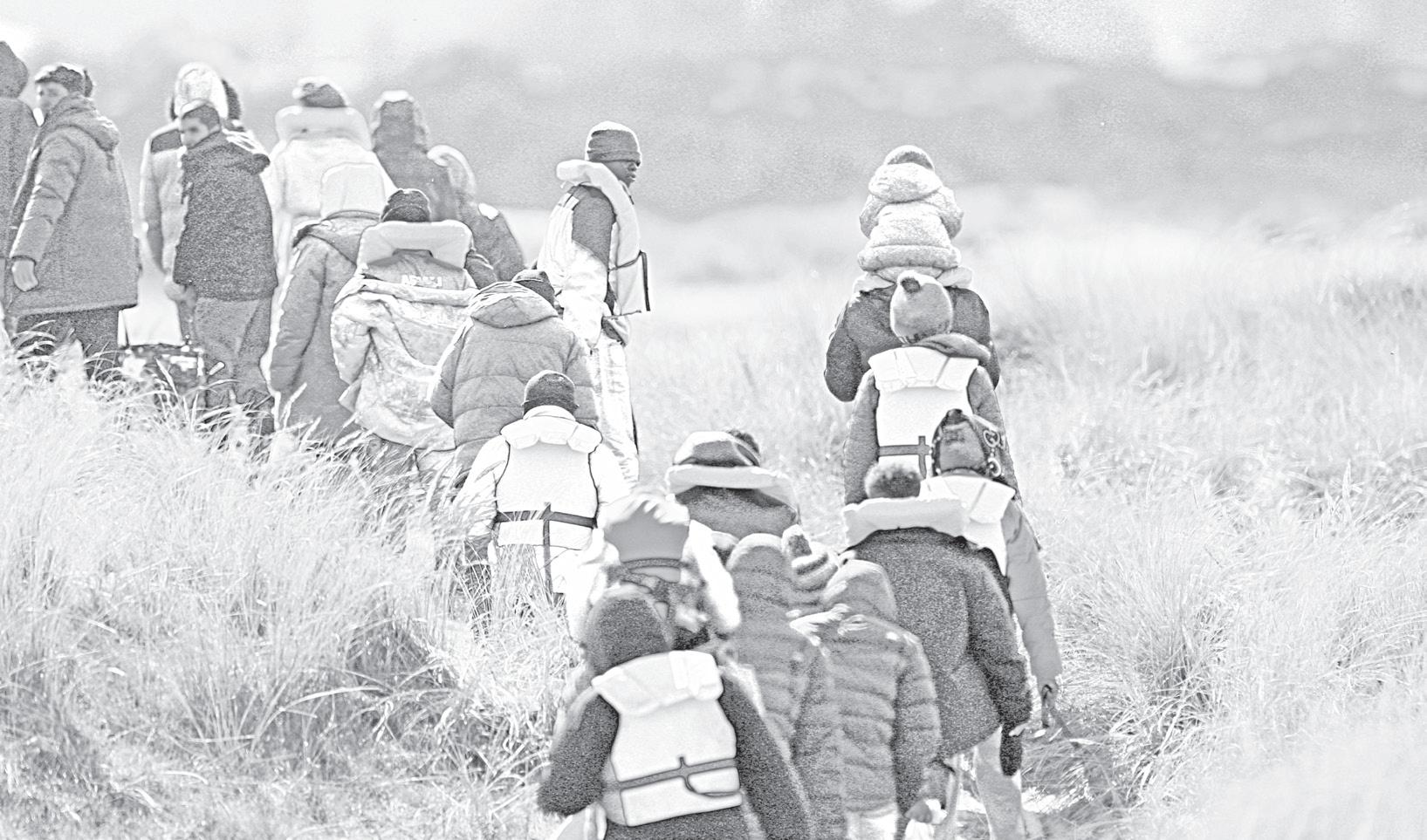
convicted of crimes.
An “informal group” of EU nations including Germany, Austria, the Netherlands, Denmark and Greece are pursuing deportation center agreements, said Bernd Parusel, a researcher at the Swedish Institute for European Policy Studies.
Kenya is one country they are speaking with, said a Dutch member of the European Parliament, Tineke Strik. Whether consciously or not, the plan is similar to Trump’s deals with nations like El Salvador to take in deported migrants, she said.
Other countries are exploring similar ideas. Sweden’s migration minister has said the conservative ruling coalition approves setting up hubs outside Europe, especially for Afghan and Syrian asylum-seekers.
Some in Europe cheer Trump-style tactics
DURING the Winter Olympics in Italy, protests erupted over the deployment of US Immigration and Customs Enforcement agents to provide security to the US delegation. But others in Europe have praised ICE’s actions and called for setting up deportation-focused police units.
The EU border service Frontex began sending officers along on raids with Belgium’s police in 2024 to detain and deport migrants. It is not
clear whether it is doing this in other countries.
The European Commission has declined requests to take a position on US federal immigration policies.
In Britain, which left the EU several years ago, the center-left Labour Party government has made curbing unauthorized immigration a key focus.
The Home Office in February said almost 60,000 people had been deported since the government was elected in July 2024. It said 9,000 arrests were made of people working without permission in 2025, up by more than half from the year before.
Pushbacks, raids and surveillance increase UNDER the principle of non-refoulement in EU and international law, a person cannot be returned to a country where they would face persecution.
But European immigration enforcement tactics include so-called pushbacks, where people trying to cross into the EU are forced back across a border without access to asylum procedures.
Authorities in Europe carry out an average of 221 pushbacks a day, according to a February report by a group of humanitarian organizations. More than 80,000 pushbacks were recorded in 2025, the report said, mostly in
‘No Kings’ rallies draw crowds across US, Europe; Springsteen headlines Minnesota demonstration
By Mark Vancleave, Steve Karnowski, Todd Richmond & John Hanna The Associated Press
ST. PAUL, Minn.—Large crowds protested Saturday against the war in Iran and President Donald Trump’s actions in “No Kings” rallies across the US and in Europe. Minnesota took center stage, with thousands of people standing shoulder-to-shoulder to celebrate resistance to Trump’s aggressive immigration enforcement.
Minnesota’s flagship event on the Capitol lawn in St. Paul drew Bruce Springsteen as its headliner. He and other speakers praised the state’s people for taking to the streets over the winter in opposition to a surge of US Customs and Immigration Enforcement agents. Springsteen performed “ Streets of Minneapolis,” the song he wrote in response to the fatal shootings of Renee Good and Alex Pretti by federal agents. Springsteen lamented Good and Pretti’s deaths but said the state’s pushback against ICE gave the rest of the country hope.
“Your strength and your commitment told us that this was still America,” he said. “And this reactionary nightmare, and these invasions of American cities, will not stand.”
People rallied from New York City, with almost 8.5 million residents in a solidly blue state, to Driggs, a town of fewer than 2,000 people in eastern Idaho, a state Trump carried with 66% of the vote in 2024.
Big but mostly peaceful crowds
US organizers have estimated that the first two rounds of No Kings rallies drew more than 5 million people in June and 7 million in October. They expected 9 million participants Saturday, though it was not clear whether those expectations were met.
Organizers said more than 3,100 events—500 more than in October—were registered, in all 50 states.
Protests were mostly peaceful, but some arrests were reported.
In Los Angeles, authorities deployed tear gas near a federal detention center downtown. One man had a leaf blower, attempting to clear the air. The Los Angeles Police Department later arrested people for failing to disperse.
Earlier in the day, a band was playing and people were dancing to Spanish-language music.
The Denver Police Department said on the social platform X that it declared an unlawful assembly and deployed
smoke canisters after a small group of protesters blocked a road and did not leave as asked. Some threw the canisters back at officers, police said. At least eight people were arrested, as was a ninth person later on who police said was throwing objects.
GOP officials dismissive of protests
WHITE House spokesperson Abigail Jackson called them the product of “leftist funding networks” with little real public support.
The “only people who care about these Trump Derangement Therapy Sessions are the reporters who are paid to cover them,” Jackson said in a statement.
The National Republican Congressional Committee was also sharply critical.
“These Hate America Rallies are where the far-left’s most violent, deranged fantasies get a microphone,” spokesperson Maureen O’Toole said.
Protesters have a long list of causes
TRUMP’S immigration enforcement push, particularly in Minnesota, was just one item on a long list of grievances that also included the war in Iran and the rollback of transgender rights. Speakers at the Minnesota rally decried billionaires’ economic power.
In Washington, hundreds marched past the Lincoln Memorial and into the National Mall, holding signs that read “Put down the crown, clown” and “Regime change begins at home.” “
Bill Jarcho was there from Seattle, joined by six people dressed as insects wearing tactical vests that said, “LICE”—spoofing ICE—as part of what he called a “mock and awe” tour.
“What we provide is mockery to the king,” Jarcho said. “It’s about taking authoritarianism and making fun of it, which they hate.” About 40,000 people marched in San Diego, police there said.
In New York, Donna Lieberman, executive director of the New York Civil Liberties Union, said during a news conference that Trump and his supporters want people to be afraid to protest.
“They want us to be afraid that there’s nothing we can do to stop them,” she said. “But you know what? They are wrong—dead wrong.”
In Topeka, Kansas, a protesters dressed up in an inflatable frog costume and a baby version of Trump. Wendy
Wyatt showed up with a “Cats Against Trump” sign. Many things upset her about the administration, she said, but the rallies are “very hopeful to me.”
Organizers said two-thirds of RSVPs for the rallies came from outside of major urban centers. That included communities in conservative-leaning states like Idaho, Wyoming, Montana, Utah, South Dakota and Louisiana, as well as suburbs in electorally competitive Pennsylvania, Georgia and Arizona.
Main event at the Minnesota Capitol ORGANIZERS designated the rally there as the national flagship event.
Before Springsteen took the stage, organizers played a video in which actor Robert DeNiro said he wakes up every morning depressed because of Trump but was happier Saturday because millions of people were protesting. He also congratulated Minnesotans for running ICE out of town.
The bill also included singer Joan Baez, actor Jane Fonda, Vermont US Sen. Bernie Sanders and a long list of activists, labor leaders and elected officials.
Protesters held up a massive sign on the Capitol steps that read, “We had whistles, they had guns. The revolution starts in Minneapolis.”
“Donald Trump may pretend that he’s not listening, but he can’t ignore the millions in the streets today,” said Randi Weingarten, president of the American Federation of Teachers.
Rallies overseas
DEMONSTRATIONS were also held in more than a dozen other countries, according to co-executive director Ezra Levin of Indivisible, which spearheaded the events.
In Rome, thousands marched with chants aimed at Premier Giorgia Meloni, whose conservative government saw its referendum for streamlining Italy’s judiciary fail badly this week. Protesters also waved banners protesting Israeli and US attacks on Iran.
Richmond reported from Madison, Wisconsin, and Hanna from Topeka, Kansas. Associated Press journalists Jennifer Sinco Kelleher in Honolulu; Nicholas Garriga in Paris; Mike Pesoli in Washington; Colleen Berry in Milan; Amy Taxin in Santa Ana, California; and Jill Connelly in Los Angeles contributed.
Italy, Poland, Bulgaria and Latvia.
“Men, women and children—including individuals in critical medical condition—are routinely subjected to beatings, attacks by police dogs, forced stripping, forced river crossings and theft of personal belongings,” according to the report.
European agents are brutalizing migrants just like in the US, said Flor Didden, migration policy expert at the Belgian human rights group 11.11.11. Some, like in Greece, even wear masks.
“The images are shocking and the outrage is justified,” he said of the US. “But where is that same moral clarity when European border authorities abuse, rob and let people die?”
Europe still has more protections for migrants
THE groups also have recorded an expansion of surveillance technology like drones, thermal cameras and satellites to monitor people on the move.
Other human rights groups warn of a weakening of legal protections.
The EU’s new migration regulations allow for more police raids in private homes and public spaces and more use of surveillance and racial profiling, said a letter to EU institutions in February from 88 nonprofit groups including the Brussels-based Platform for International Cooperation on Undocumented Migrants.
“We cannot be outraged by ICE in the United States while also supporting these practices in Europe,” said the platform’s director, Michele LeVoy. Olivia Sundberg Diez, EU migration advocate for Amnesty International, said Europe retains more protections for vulnerable migrants than the United States but shares much of the political momentum toward harsher policies.
Zampano reported from Rome. Associated Press writers Elena Becatoros in Athens, Jill Lawless in London, Paolo Santalucia in Rome, Claudia Ciobanu in Warsaw and Kirsten Grieshaber in Berlin contributed to this report.

Iran-backed Houthis enter the monthlong war and could further threaten global shipping
By Samy Magdy, Aamer Madhani & Jon Gambrell
The Associated Press
DUBAI, United Arab Emirates—Iranian-backed
Houthi rebels entered the monthlong war in the Middle East on Saturday, claiming two missile launches at Israel. About 2,500 US Marines arrived in the region. And Pakistan’s government said regional powers plan to meet Sunday to discuss how to end the fighting.
The war has threatened global supplies of oil and natural gas, sparked fertilizer shortages and disrupted air travel. Iran’s grip on the strategic Strait of Hormuz has shaken markets and prices. The United States and Israel continue to strike Iran, whose retaliatory attacks have targeted Israel and neighboring Gulf Arab states. More than 3,000 people have been killed.
The Houthis’ entry could further hurt global shipping if they again target vessels in the Bab el-Mandeb Strait off the Red Sea, through which about 12% of the world’s trade typically passes. There could be limited relief after Iran on Friday agreed to allow humanitarian aid and agricultural shipments through the strait following a United Nations request. US President Donald Trump, meanwhile, has given Iran until April 6 to reopen the strait. Witnesses in Tehran reported heavy strikes late Saturday. Israel’s military earlier said it targeted Iran’s naval weapons production facilities that it would finish attacking essential weapons production sites within “a few days.” The US said it has struck more than 11,000 Iranian targets in

the war. Iran fired missiles toward Israel, while air defenses early Sunday intercepted missiles and drones across Gulf countries.
Ukrainian President Volodymyr Zelenskyy visited Gulf nations Saturday as his country offers defense help with drones.
Houthi involvement sparks concerns HOUTHI Brig. Gen. Yahya Saree said on the rebels’ Al-Masirah satellite television station that they launched missiles toward “sensitive Israeli military sites” in the south. If the Houthis increase attacks on commercial shipping, as they have in the past, it would further push up oil
prices and destabilize “all of maritime security,” said Ahmed Nagi, a senior Yemen analyst at the International Crisis Group. “The impact would not be limited to the energy market.”
The Bab el-Mandeb, at the southern tip of the Arabian Peninsula, is crucial for vessels heading to the Suez Canal through the Red Sea. Saudi Arabia has been sending millions of barrels of crude oil a day through it because the Strait of Hormuz is effectively closed.
Houthi rebels attacked more than 100 merchant vessels with missiles and drones, sinking two vessels, between November 2023 and January 2025. The group said it acted in solidarity with Palestinians in Gaza during the Israel-Hamas war.
The Houthis’ latest involvement would complicate the deployment of the USS Gerald R. Ford, the aircraft carrier that arrived in Croatia on Saturday for maintenance. Sending the ship to the Red Sea could draw attacks similar to those on the USS Dwight D. Eisenhower in 2024 and the USS Harry S. Truman in 2025.
The Houthis have held Yemen’s capital, Sanaa, since 2014. Saudi Arabia launched a war against the Houthis on behalf of Yemen’s exiled government in 2015 and they now have an uneasy ceasefire.
Diplomacy attempted as US beefs up troop numbers
PAKISTAN said Saudi Arabia, Turkey and Egypt will send top diplomats to
Islamabad for talks aimed at ending the war, arriving Sunday for a twoday visit. Pakistani Prime Minister Shehbaz Sharif said he and Iranian President Masoud Pezeshkian held “extensive discussions” on regional hostilities.
But Iranian Foreign Minister Abbas Araghchi told his Turkish counterpart by phone that Tehran was skeptical about recent diplomatic efforts. Iranian state-run media said Araghchi accused the US of making “unreasonable demands” and exhibiting “contradictory actions.”
Pakistani Foreign Minister Ishaq Dar later spoke with Araghchi and urged “an end to all attacks and hostilities.”
Trump envoy Steve Witkoff said Washington delivered a 15-point “action list” to Iran for a possible ceasefire, with a proposal to reopen the Strait of Hormuz and restrict Iran’s nuclear program, which is the issue at the heart of tensions with the US and Israel. Tehran rejected the list and presented a five-point proposal that included reparations and recognition of its sovereignty over the waterway.
US ships with around 2,500 Marines trained in amphibious landings have arrived, adding to the largest American force in the region in more than two decades. At least 1,000 paratroopers from the 82nd Airborne Division, trained to land in hostile territory to secure key positions and airfields, have been ordered to the Middle East.
US Secretary of State Marco Rubio said Washington “can achieve all of our objectives without ground troops.”
US troops wounded at Saudi base MORE than two dozen US troops have been wounded in Iranian attacks on Saudi Arabia’s Prince Sultan Air Base in the past week, according to two people briefed on the matter who spoke on condition of anonymity because they weren’t authorized to comment publicly.
Iran fired six ballistic missiles and 29 drones at the base Friday, injuring at least 15 troops, five of them seriously. The base, about 96 kilometers (60 miles) from the Saudi capital Riyadh, was attacked twice earlier in the week, including a strike that wounded 14 US troops, according to the people briefed on the matter. More than 300 US service members have been wounded in the war. At least 13 have been reported killed.
Death toll climbs
IRANIAN authorities say more than 1,900 people have been killed in the Islamic Republic, while 19 have been reported dead in Israel. In Lebanon, where Israel has started an invasion in the south while
By Aamer Madhani, Samy Magdy & Ben Finley
The Associated Press
WASHINGTON — The number of American service members wounded in the Iran war has grown beyond 300, with more than two dozen troops injured this week from attacks on a Saudi air base. Iran fired six ballistic missiles and 29 drones at Saudi Arabia’s Prince Sultan air base in an attack Friday that injured at least 15 troops, including five seriously, according to two people briefed on the matter. US officials initially reported that at least 10 US troops were injured, including two who were seriously wounded.
More American forces are reaching the Middle East, with a Navy ship carrying about 2,500 Marines having now arrived in the region, US Central Command announced Saturday. The USS Tripoli, an amphibious assault ship, as well as the elements from the 31st Marine Expeditionary Unit that are aboard, are based in Japan. They were conducting exercises in the area around Taiwan when the order came to deploy to the Middle East almost two weeks ago. Central Command said that in addition to the Marines, the Tripoli also brings transport and strike fighter aircraft, as well as amphibious assault assets to the region. The USS Boxer and two other ships, along with another Marine Expeditionary Unit, have also been ordered to the region from San Diego. Before the arrival of the Marines, the US military had already built up the largest American force in the region in more than 20 years, including two aircraft carriers, several other warships and some 50,000 troops. The USS Gerald R Ford, the nation’s newest aircraft carrier, recently left the Middle East for repairs and supplies in Europe after a fire in a laundry room that affected some of the ship’s sleeping quarters.

Zelenskyy visits Gulf Arab states to talk drone defense and seek strategic ties
By Volodymyr Yurchuk
The Associated Press
KYIV, Ukraine—Ukrainian President Volodymyr Zelenskyy on Saturday made unannounced visits to the United Arab Emirates and Qatar, as Ukraine seeks to use its drone expertise to help Gulf Arab states blunt Iran’s attacks during the war in the Middle East.
Zelenskyy said that Ukraine has already signed 10-year security agreements with Saudi Arabia and Qatar, and expects to shortly finalize a similar agreement with the UAE.
alongside a video of himself disembarking a plane in Qatar.
The war in the Middle East erupted on Feb. 28 when the United States and Israel launched joint attacks on Iran. The Islamic Republic retaliated with strikes against Israel and the Gulf Arab States and the blockading of the Strait of Hormuz, a crucial waterway.
The war has upended global travel and sent oil prices soaring as its economic fallout extended well beyond the region.
Last week, Zelenskyy revealed that Kyiv is helping five countries — the UAE, Saudi Arabia, Qatar, Kuwait and Jordan — counter Tehran’s drone strikes on their territory.
The agreement with Qatar involves “joint defense industry projects, the establishment of coproduction facilities, and technological partnerships between companies,” Zelenskyy said in an X post.
At a media briefing, the Ukrainian leader said that he expects a similar agreement with the UAE to follow shortly.
The Saudi base had come under come attack twice earlier in week, including an incident that injured 14 US troops, according to the people, who were not authorized to discuss the matter publicly and spoke on the condition of anonymity. In the other attack, no one was injured but a US aircraft was damaged.
The base, which is about 96 kilometers (60 miles) from the Saudi capital of Riyadh, is run by the Royal Saudi Air Force, but also used by US troops. The installation has been targeted almost since the beginning of the war, which on Saturday reached the one-month mark.
Army Sgt. Benjamin N. Pennington, 26, was wounded during a March 1 attack on the base and died days later. He is one of the 13 service members who have been killed in the war. Six of the fallen were killed when an Iranian drone struck an operations center at a civilian port in Kuwait. Another six died when their refueling plane crashed in Iraq following an incident with another aircraft that the US military said was “not due to hostile or friendly fire.”
The Pentagon did not immediately re -
Secretary of State Marco Rubio said Friday the United States can meet its objectives “without any ground troops.” But he also said Trump “has to be prepared for multiple contingencies” and that American forces are available “to give the president maximum optionality and maximum, opportunity to adjust to contingencies should they emerge.”
spond to an email seeking comment Saturday regarding the American casualties at the Saudi base.
Central Command said Friday that more than 300 service members have been wounded in the war. Most have returned to duty, while 30 remained out of action and 10 were considered seriously wounded.
Iran has responded to attacks by the United States and Israel with strikes against Israel and neighboring Gulf Arab states. The war has upended global air travel, disrupted oil exports and caused fuel prices to soar. Iran’s stranglehold on the Strait of Hormuz, a strategic waterway, has exacerbated the economic fallout.
With the economic repercussions extending far beyond the Middle East, President Donald Trump is under growing pressure to end Iran’s chokehold on the strait. The latest attacks on the Saudi air base happened after Trump claimed talks on ending the war were going “very well.”
Trump said he had given Tehran until April 6 to reopen the strait. Iran says it has not engaged in any negotiations.
Magdy reported from Cairo. Associated Press writer Konstantin Toropin in Washington contributed to this report.
Ukraine has quickly grown into one of the world’s leading producers of cuttingedge, battle-tested drone interceptors that are cheap and effective. They are playing a key part in its defense against Russia’s fullscale invasion, which began on Feb. 24, 2022.
In return for its aid to Gulf countries, Ukraine is seeking more high-end air-defense missiles that they possess and that Kyiv needs to counter Russia’s attacks. On Thursday, Zelenskyy visited Saudi Arabia, and last week he said that Ukraine is looking into whether it can play a role in restoring security in the Strait of Hormuz.
Zelenskyy tours Gulf Arab states ON Saturday, Zelenskyy and Emirati state media reported on a meeting between the Ukrainian president and his Emirati counterpart, Mohamed bin Zayed Al Nahyan, to discuss regional security amid the Iran war.
Zelenskyy later posted on X to say that he had moved on to Doha and met with Qatari leaders, including with the ruling emir, Sheikh Tamim bin Hamad Al Thani, and Prime Minister Sheikh Mohammed bin Abdulrahman Al Thani.
The Ukrainian and Qatari ministers of defense signed cooperation agreements in the defense sector and defense investments, according to the Qatar Ministry of Defense.
“Real security is built on partnership— we value everyone and remain open to supporting all those who are ready to work together for this goal,” Zelenskyy wrote
“For Ukraine, this is also a matter of principle: terror must not prevail anywhere in the world. Protection must be sufficient everywhere,” he said on X following his meeting with the Emirati leader.
He added they had discussed “the security situation in the Emirates, Iranian strikes, and the blockade of the Strait of Hormuz, which directly affects the global oil market”.
Ukraine’s Mideast alliances
ZELENSKYY told reporters that his government is seeking to build long-term strategic ties with Middle Eastern countries, including joint production, investment, energy cooperation and the sharing of battlefield experience.
“Simple sales do not interest us,” he said at a live briefing held on Zoom on Saturday.
While Ukraine remains short of high-end air defense systems, such as Patriot missiles, Zelenskyy said that Kyiv has developed an “integrated” defense model that effectively protects against Iranian-made Shahed drones.
Tehran sent large numbers of the attack drones to Russia early in the war. Since then, Moscow has modified them to improve their effectiveness, begun domestic production, and repeatedly launched the drones in waves at Ukrainian cities.
Zelenskyy said that Ukraine is offering Gulf Arab partners “combat-tested” expertise, and has already signed 10-year security deals with Saudi Arabia and Qatar.
He also told reporters that Ukraine had received “no signals” from the US about potential diversions of weapons, including those funded by Kyiv’s European partners, from Ukraine to the Middle East. His comments followed weeks of speculation that the Iran war could detract attention from Ukraine, deplete Western arsenals and force NATO allies to reduce military support for Kyiv. Russia is already profiting from a surge in global energy prices, brought on by damage to oil and gas infrastructure in the Gulf and Iran’s blocking of the Strait of Hormuz, a vital oil choke point.
Zelenskyy on Rubio:
‘I have not lied to anyone’ ZELENSKYY also pushed back on recent remarks by US Secretary of State Marco Rubio, who on Friday dismissed as “a lie” the Ukrainian leader’s claim that Washington wants Kyiv to hand over territory to Russia before giving it security guarantees.
Zelenskyy said his earlier statements, made in an interview with Reuters, reflected the “general direction” of talks.
“I have not lied to anyone,” he said, adding that Rubio may have misconstrued his comments.
Zelenskyy stressed that the US has not directly pressured Kyiv to withdraw troops from the Donbas, Ukraine’s industrial heartland long coveted by Moscow. Russian forces occupy the bulk of the region, but they have not seized a strip of land that is among the most heavily fortified parts of the front line. Kyiv fears that Moscow could use that territory as a launchpad for further aggression.
Hanna Arhirova contributed to this report.
Pope Leo XIV opens first Holy Week at Vatican, echoing Francis’ final days
By Nicole Winfield
The Associated Press
ROME—Pope Leo XIV cel -
ebrated Palm Sunday before tens of thousands of people in St. Peter’s Square, as he opened his first Holy Week as pontiff that for many people recalled the final, suffering days of Pope Francis’ life.
The celebration began with a procession of cardinals, bishops, priests and laypeople walking into the square carrying olive branches and palm fronds, some intricately braided. They stopped at the central obelisk, where Leo delivered an opening prayer, and then processed toward the altar to begin the Mass. Palm Sunday marks Jesus’ triumphant entrance into Jerusalem in the time leading up to his crucifixion, which Christians observe on Good Friday, and resurrection on Easter Sunday.
When Holy Week opened last year, Francis was still recovering at the Vatican after a five-week hospital stay for double pneumonia. He had delegated the liturgical celebrations to others, but rallied on Easter Sunday to greet the faithful from the loggia of St. Pe -

ter’s Square. Most poignantly, he then made what became his final popemobile loop around the piazza. Francis died the following morning, Easter Monday, after suffering a stroke. His nurse, Massimiliano Strappetti, later told Vatican Media that Francis had told him: “Thank you for bringing me back to the square” for the final salute.
Leo is due to preside over this week’s liturgical appointments and is
returning to tradition with the Holy Thursday feet-wash ceremony that commemorates Jesus’ Last Supper with his disciples.
During his 12-year pontificate, Francis famously celebrated the Holy Thursday ritual by travelling to Romearea prisons and refugee centers to wash the feet of people most on society’s margins. His aim was to drive home the ritual’s message of service and humility, and he would frequently
Jerusalem heads into a subdued Passover and Easter under the shadow of Iran war
By Melanie Lidman The Associated Press
ERUSALEM—Jerusalem’s major holy
Jsites are shuttered and families are dejected and exhausted ahead of Passover and Easter as the Iran war enters its fifth week. The mood stands in stark contrast to a usual spring, when longer days herald a period of family gatherings and an influx of tourists for the major Jewish and Christian holidays.
Metal shutters are drawn on nearly all stores in the Old City, home to key holy sites, and only scattered footsteps echo on deserted stone alleyways. Vast plazas are missing the typical throngs of faithful and tourists.
Jerusalem has largely escaped past wars, with Israel’s enemies appearing to be hesitant to launch missiles near the city’s Muslim holy sites. But since Israel and the United States launched strikes on Iran on Feb. 28, Jerusalem has repeatedly come under fire.
Earlier this month, an intercepted Iranian missile sprayed shrapnel on the rooftop of the Greek Orthodox Patriarchate, just steps from the Church of the Holy Sepulcher, one of the most important sites in Christianity. The church, built on what is revered by many Christians as the site of Jesus’ crucifixion, burial and resurrection, remains closed under Israeli military guidelines prohibiting gatherings of more than 50 people.
Missile debris also hit a road leading to the Western Wall, the holiest site where Jews can pray.
From his office overlooking the plaza at the Western Wall, now also closed to worshipers, Rabbi Shmuel Rabinowitz, lamented the empty plaza.
“The heart aches greatly, it bleeds, seeing the Western Wall as it looks now,” he said. The massive priestly blessing for Passover, which usually draws tens of
Dole. . .
Continued from A3
coordinating with the Departments of Transportation (DOTr), of Social Welfare and Development (DSWD) and of the Interior and Local Government (DILG), and local governments to roll out targeted emergency employment and livelihood interventions. Dole said the rollout will begin with transport workers “to help ensure continuity of economic activity and mobility of the riding public.”
It also acknowledged that other vulnerable industries may require similar support, including agriculture and fisheries.
In a separate interview over the weekend,
thousands, will take place with just 50 worshippers, Rabinowitz said. That’s the maximum allowed to pray together in the enclosed area by the Western Wall under wartime safety guidelines—reminiscent of the restrictions imposed during the coronavirus pandemic.
Easter celebrations are canceled
THE Latin Patriarchate has canceled a procession on Sunday commemorating Jesus’ triumphant entry into Jerusalem, the Christian celebration known as Palm Sunday.
Any other year, tens of thousands of Christians from around the world would walk down the narrow, hilly streets toward the Old City, waving palm fronds and singing.
Rami Asakrieh, the parish priest for Jerusalem’s Catholics, said the community will sorely miss the procession, a deeply emotional and spiritual part of the holiday. But the cancellation is also a reminder that faith comes internally from the heart, not from external actions, he added.
“We are celebrating resurrection, resurrection is from death and winning the pain and the war,” he said. “It will not come by having fear, but by having faith.”
A local Catholic high school, empty of students as classes have been canceled, was also recently hit by debris from an Iranian missile interception, Asakrieh said.
A Franciscan priest, Asakrieh is still celebrating Mass for up to 50 parishioners at the Saint Savoir monastery’s cavernous marble hall, near the centuries-old complex’s music school, the Magnificat Institute. The school was built in what was once the convent’s basement, which has been approved by the Israeli military as a suitable shelter. Jerusalem’s smaller synagogues, mosques and churches are also open to groups of up to 50 people—if they are located close to a shelter or a safe space.
Labor Spokesperson and Assistant Secretary Lennard C. Serrano said the implementation guidelines for Tupad and DILP during the emergency are still being finalized.
“We are currently reviewing under the framework how many days of assistance can be provided. We are preparing a financial plan—what can be given for 10 days, 15 days, or 30 days. As much as possible, we want to cover everyone in need because the program is inclusive,” Serrano said, mostly in Filipino. The guidelines are expected to be released after Holy Week.
Based on agency data, Dole provided emergency employment through Tupad and livelihood assistance through DILP to 110,106 vulnerable workers in the first quarter of 2026, amounting to P753.69 million.
muse during his Holy Thursday homilies “Why them and not me?” Francis’ gesture had been praised as tangible evidence of his belief that the church must go to the peripheries to find those most in need of God’s love and mercy. But some critics bristled at the annual outings, especially since Francis would also wash the feet of Muslims and people of other faiths.
Leo, history’s first US-born pope, is returning the Holy Thursday footwash tradition to the basilica of St. John Lateran, where popes performed it for decades. The Vatican hasn’t yet said who will participate, though Popes Benedict XVI and John Paul II normally washed the feet of 12 priests.
On Friday, Leo is due to preside over the Good Friday procession at Rome’s Colosseum commemorating Christ’s Passion and crucifixion. Saturday brings the late-night Easter Vigil, during which Leo will baptize new Catholics, followed a few hours later by Easter Sunday when Christians commemorate the resurrection of Jesus.
Leo will celebrate Easter Sunday Mass in St. Peter’s Square and then deliver his Easter blessing from the loggia of the basilica.
US lawmakers say they’ll visit Taiwan before Trump’s summit with China’s Xi
By Stephen Groves The Associated Press
WASHINGTON—A biparti -
san group of four senators has plans to visit Taiwan, Japan and South Korea in the coming days on a trip meant to bolster US alliances seen as important to countering China’s dominance in Asia.
Sen. Jeanne Shaheen of New Hampshire, the top Democrat on the Senate Foreign Relations Committee, announced the trip Saturday. She will be joined by Sens. John Curtis, R-Utah, Thom Tillis, R-N.C., and Jacky Rosen, D-Nev. Their visits to Taipei, Tokyo and Seoul are coming before President Donald Trump’s trip to Beijing in May for a rescheduled summit with Chinese President Xi Jinping.
The lawmakers’ stop in Taiwan could draw scrutiny from China, which opposes such relations and sees them as a challenge to its claim of sovereignty over the self-governing island. Taiwan relies on American backing for its democracy, but recent moves by Trump, such as discussing a potential weapons sales to Taiwan with Xi, have raised questions about the future direction of US policy.
Analysts in both China and the United States believe Xi, through the leader-level summit, will try to influ -
ence Trump to soften the US stance on Taiwan.
“This bipartisan delegation demonstrates Congress’ commitment to these alliances and partnerships is unwavering and will endure well beyond any one administration,” Shaheen said in a statement. In a show of reassurance to the Asian allies, the lawmakers plan to meet with political leaders and defense officials on their trip.
“Our alliance with Taiwan is one of the most strategically and morally significant partnerships America has in the Indo-Pacific,” Curtis said. It remains to be seen how Trump’s intervention in Venezuela, Iran and elsewhere could influence other powers such as China and Russia. But there is some concern among lawmakers that the Republican president’s actions could be seen as giving those countries an opening for their own foreign moves.
The economic relationship with Taiwan has also come under scrutiny from the Trump administration. The US is reliant on Taiwan for its production of computer chips, which contributed to a trade imbalance of nearly $127 billion during the first 11 months of 2025.
Associated Press writer Didi Tang contributed to this report.
2 missing aid sailboats reach Havana safely after weather delay, crews ‘never in danger’
Closed for most of Ramadan NEXT to the Western Wall is Al Aqsa Mosque compound, Islam’s third-holiest site, which has also stood empty since the war started, canceling prayers during most of the Muslim holy month of Ramadan, which ended 10 days ago.
Fayez Dakkak, a third-generation Muslim storeowner in the Old City whose shop has catered to Christian pilgrims since 1942, said he was heartbroken over Al Aqsa’s closure during the Islamic holy month.
“It’s like there was no Ramadan for us,” Dakkak said. He added that he prayed several times at a local mosque but that it can’t compare to being able to pray at Al Aqsa.
Police orders have closed his shop, along with all non-food stores in the Old City — also part of the safety guidelines during the war.
Dakkak said that for years now, as the numbers of pilgrims and tourists plummeted, he’s barely been able to make ends meet. Still, it would have been nice to open his shop for some semblance of routine and just chat with other storeowners.
Cleaning for Passover, running for the shelter ISRAELIS have also grown weary after nearly a month of daily sirens, 16 civilian deaths and dozens of people seriously injured.
For seder, Jewish families are planning smaller, stripped-down ceremonial Passover dinners that commemorate the Jewish exodus from Egypt — a far cry from times when large family gatherings often welcomed relatives from abroad. Israel’s Ben Gurion airport has been operating on a severely limited basis throughout the war. Many point out the irony that ahead of Passover, Israelis are fleeing the country through the land border crossing with Egypt to the Sinai desert, while the holiday commemorates the story of ancient Israelites leaving Egypt via Sinai to Israel.
Plea to employers
WHILE Dole’s social protection programs are set to prioritize the “most vulnerable, most marginalized” workers, the agency also appealed to employers in the formal economy to sustain jobs during the crisis.
“Our objective is to preserve employment for every worker, and we are looking at how we can support them,” he said.
Serrano said they are assessing possible assistance for employers who have expressed difficulty sustaining operations due to rising costs.
He also said regional tripartite wages and productivity boards (RTWPBs) continue to monitor the situation to assess whether a wage increase may already be warranted, even if less than a year has passed since the latest wage orders were issued in all regions.
HBy Andrea Rodríguez The Associated Press
AVANA—Two sailboats that went missing carrying humanitarian aid from southern Mexico to Cuba landed in Havana on Saturday afternoon hours after Mexico’s navy said it had located the boats days after they went incommunicado because of bad weather.
The vessels carrying at least eight people departed from Isla Mujeres in southern Mexico on March 20 and then lost contact, fueling concern in Mexico, Cuba and beyond.
In a post on X on Saturday morning, the navy said an aircraft spotted the boats 80 nautical miles (148 kilometers) northwest of Havana, Cuba. Upon arriving to the island, Adnaan Stumo, the coordinator of the sailing convoy, said bad weather was responsible
Energy. . .
Continued from A4
“The rising oil prices and cost of basic goods are making life harder for ordinary people, especially mothers who struggle to budget for their families,” urban poor leader Ate Uday of Gabriela Manila said for her part. They added that the Philippines’ recent declaration of a national energy emergency under Executive Order 110, s. 2026 should prioritize people-centered solutions. Instead of investing in incineration, the government must allocate resources toward social services, food security, housing, and job generation. This shift is not only socially just but economically sound. According to a study by the Global Alliance for Incinerator Alternatives, green jobs such as repair, recycling, and remanufacturing can generate over 200 times, 50 times, and 30 times more jobs compared to landfills and incinerators.
Continued from A4
He cited the city of Manila for subsidizing jeepney operations to provide free rides and Quezon City for expanding its free bus programs.
Businesses that have delayed price increases were likewise commended for what Recto described as “placing patriotism before profits.”
Framing the response as a collective effort, Recto said these measures reflect a broader spirit of cooperation aimed at cushioning Filipinos from a crisis “not of our own making.” “United, we shall overcome,” he said.
for the delay because the boats had to take a longer route and the sailors were “never in any serious danger.”
He thanked Mexico’s navy, which escorted one of the boats into Havana Bay, for its support and making sure they were OK, and said they were “delighted” to start delivering aid to Cubans on the island.
“”We arrive with a simple but powerful message: solidarity with the Cuban people doesn’t stop at borders. It crosses oceans,” Stumo, a US citizen, said. “Over the past week, our sailboats encountered difficult conditions at sea, during which we lost contact with convoy coordinators and maritime authorities alike.”
The organization Nuestra América Convoy said Friday that based on the speed of the vessels reported to the Cuban maritime authorities, the window of arrival for the boats in Havana should be between Friday and Saturday and that the boats were led by experienced sailors.
James Schneider, communications director for Progressive International who helped coordinate the Nuestra America convoy to Cuba, thanked Mexican and Cuban authori -
ties for their help on Saturday and said he was “relieved” to hear they were safe.
“The crews are safe, and the vessels are continuing their journey to Havana,” he said Saturday morning. “The convoy remains on track to complete its mission — delivering urgently needed humanitarian aid to the Cuban people.”
The boat’s arrival comes as an increasing number of countries and aid organizations have sent shipments of aid to Cuba while a US fuel blockade has caused crippling blackouts and pushed the Caribbean nation to the brink of collapse. President Donald Trump in a speech Friday said “Cuba is next” after speaking about military actions in Venezuela and Iran.
The fuel blockade has prompted United Nations leaders to warn of a potential “humanitarian crisis” in the island’s future amid mounting concerns by human rights and religious leaders as hospitals, schools and many residents go without power for long stretches. The same day the boat was located, a delegation of religious leaders also arrived in Cuba. They visited hospitals and a nursing home, and met with other religious leaders on the island.

POPE Leo XIV presides over Mass in St. Peter’s Square at the Vatican on the Catholic feast of Palm Sunday, commemorating Jesus’ arrival in Jerusalem, Sunday, March 29, 2026. AP PHOTO/ALESSANDRA TARANTINO
Building a future-ready workforce: Why PHL’s green and digital push in construction matters
THE news from the International Labor Organization (ILO) and its partners is encouraging—not because it is another skills training announcement, but because it confronts a looming reality: the construction industry is changing fast, and the Philippines can’t afford to let young workers be left behind. (Read the BusinessMirror story—ILO: PHL youth to gain green, digital construction skills, March 26, 2026).
Construction is one of the country’s biggest employers. Yet it is no longer simply about pouring concrete and erecting structures. The sector is undergoing what the ILO calls a “twin transition”—digitalization and environmental sustainability moving together. That combination is reshaping how buildings are designed, constructed, and maintained, and it is redefining which skills will be most valued by employers in the coming years.
The ILO’s initiative to train young Filipino workers in green and digital construction skills—centered on Building Information Modeling (BIM) and green construction competencies—recognizes an uncomfortable truth: traditional training pipelines often lag behind industry needs. If that lag continues, young jobseekers may keep acquiring credentials that do not translate into hiring.
This project attempts to close that gap by aligning training with the direction of the industry itself. BIM is not a buzzword; it is a practical tool used for more efficient, coordinated, and sustainable building design and management. And green construction skills are not optional extras; they directly affect energy efficiency, materials selection, waste reduction, and lower environmental impact—requirements that increasingly shape procurement and project standards.
One of the most important aspects of the ILO’s message is its emphasis on accessibility—particularly for youth from low- to medium-skill backgrounds. That matters because “skills development” can become an empty promise when training is effectively reserved for those who already have advantages: connections, spare time, resources for certification fees, or prior exposure to technology.
If the program truly reaches young people who are most vulnerable to unemployment, underemployment, and low-wage work, then it becomes more than a labor market intervention. It becomes a pathway for upward mobility—helping workers move into roles with stronger employability, better career stability, and the potential for higher wages.
The news also notes a formal handover of training modules to national institutions such as DOLE, TESDA, CMDF, and PCA. This is significant. Fragmented or short-lived projects often fail because they do not get absorbed into the country’s training ecosystem.
By transferring modules and embedding them into learning systems, the effort is positioned to outlast a single event or funding cycle. The ILO/Korea Partnership Program’s broader goal—equipping young people across Asean for the evolving construction industry—also suggests a deliberate regional strategy, not a one-off pilot. However, partnerships succeed only when implementation is measured and improved over time. The real test will be whether these modules translate into consistent training delivery, recognized competency outcomes, and tangible job placements. In short: employers must see the value, trainees must gain real marketready capabilities, and government partners must have the capacity to sustain it.
There is a tendency in public discourse to treat the twin transition as a threat— something that will replace workers or demand skills that workers cannot obtain. But threats can become opportunities when the workforce is prepared.
If BIM adoption expands and green construction standards become more mainstream, then workers with DigiGreen competencies will not just be “trained”— they will be positioned. They will be the people who can help projects reduce environmental impacts, improve productivity, and meet increasingly sophisticated requirements.
And that is how the country can turn a global shift into national progress: by building an employment pipeline that grows with industry transformation.
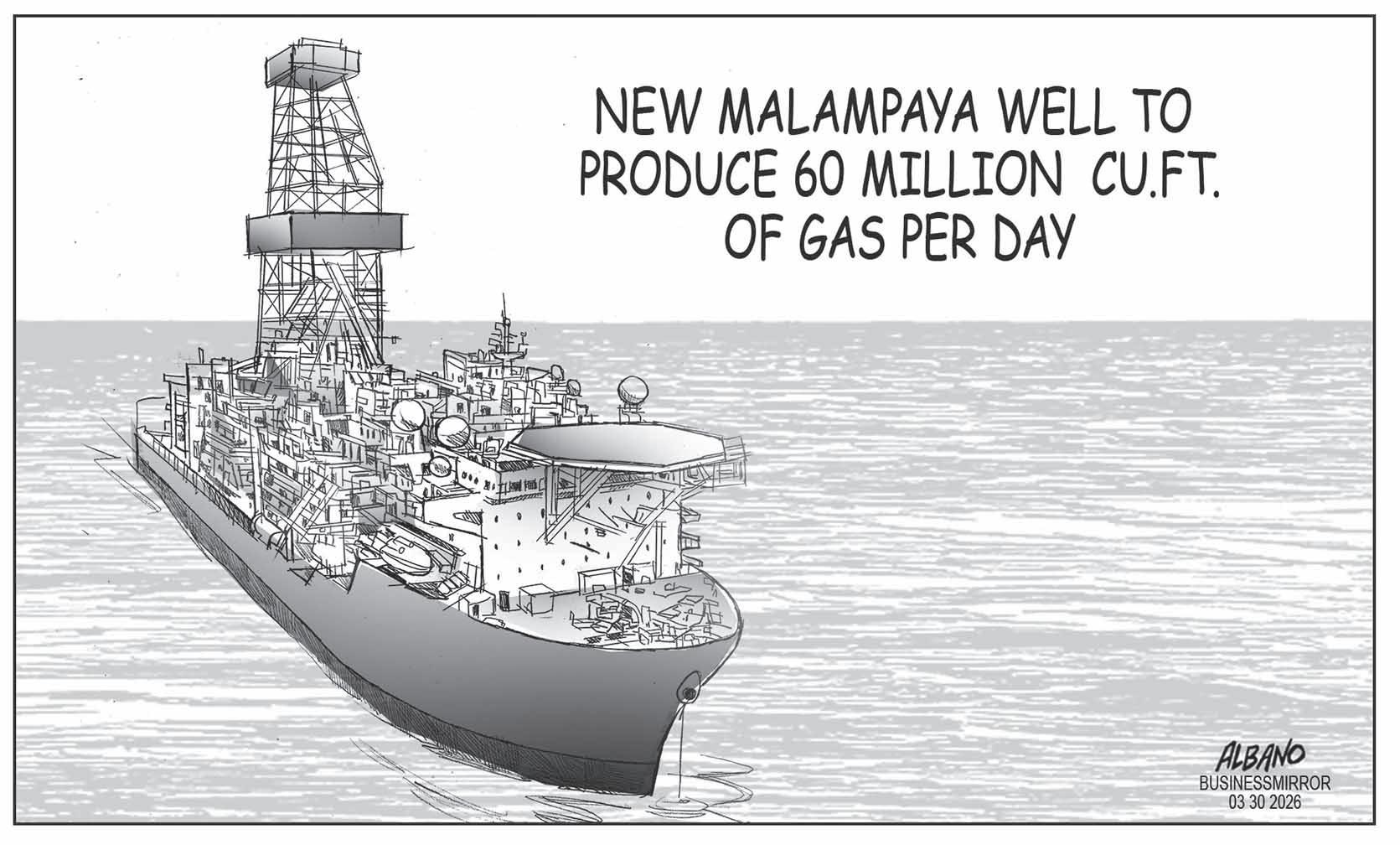
The perfect storm and the Filipino worker

ORISING SUN
IL prices are climbing as Middle East tensions disrupt global supply chains. Climate change is rewriting our agricultural calendar, and quietly, in the glass towers of BGC and Makati, artificial intelligence is beginning to do what a generation of Filipino professionals was trained to do—answer calls, process data, write reports, manage workflows, and so on.
Separately, each of these is a serious challenge. Together, they form a perfect storm bearing down on the Philippine workforce.
The numbers don’t lie. Between 35 and 37 percent of Philippine jobs are exposed to AI displacement risks, according to the World Bank—the highest rate among ASEAN nations.
The IT-BPM industry alone generated over $40 billion in revenue and accounted for 8.2 percent of GDP in 2024. It is, by any measure, the
backbone of our middle class. And it is precisely this sector that AI is targeting most aggressively.
The timing could not be worse. Rising fuel costs are squeezing household budgets and transportation networks. The ongoing conflict in the Middle East threatens the safety and livelihood of our OFWs— another pillar of the economy. Families and workers here in the country are affected as prices of basic commodities soar and transportation
expenses skyrocket. Meanwhile, climate-related disruptions are costing the agricultural sector billions annually. And the supply chain is taking a double hit as fuel costs drive up the price of moving provincial produce to the main cities.
We are being pressured from three directions at once. And yet we should not despair, never panic. Instead, we need to act with clarity.
Automation is not eliminating jobs at the scale that headlines suggest. It is changing what every job requires, often faster than workers can keep up. The Filipino worker who adapts is not replaced, but rather elevated. New roles in content classification, data annotation, AI training, and algorithm development are emerging precisely because AI systems require human intelligence to function and improve.
We can still count on the Filipino advantage — our workforce is young, English-proficient, culturally adaptive, and emotionally intelligent in ways that no algorithm can replicate.
The IT and Business Process Association of the Philippines projects that
the sector could add 1.1 million jobs and increase revenue by $29.5 billion by 2028, provided we invest in reskilling now.
The operative word is now. There is currently no national AI policy framework, no workforce transition program, and no comprehensive AI adoption plan embedded in our educational system. This is a policy emergency. Business leaders cannot wait for the government to move first. Companies must embed upskilling into their operations, not as a discretionary expense, but as a survival strategy.
The perfect storm is real, but we are known for our resilience. The question is not whether AI will change the Philippine economy. It already has. The question is whether our institutions—corporate and public alike—will respond with the urgency that this moment demands. Seneca, writing two thousand years ago, observed that luck is what happens when preparation meets opportunity. The perfect storm is forming above our heads. Let us not be caught unprepared.
Why Petron is not the culprit: Global geopolitics and tax burdens explain PHL’s fuel crisis

T. Anthony C. Cabangon
Lourdes M. Fernandez
Jennifer A. Ng Vittorio V. Vitug
Lorenzo M. Lomibao Jr., Gerard S. Ramos
Lyn B. Resurreccion, Dennis D. Estopace
Angel R. Calso, Dionisio L. Pelayo
Ruben M. Cruz Jr.
Eduardo A. Davad
Nonilon G. Reyes
D. Edgard A. Cabangon Benjamin V. Ramos
Aldwin Maralit Tolosa
Rolando M. Manangan
BusinessMirror is published daily by the Philippine Business Daily Mirror Publishing, Inc., with offices on the 3rd floor of Dominga Building III 2113 Chino
817-2807. (Circulation) 893-1662; 814-0134 to 36. E-mail: news.businessmirror@gmail.com www.businessmirror.com.ph


NO doubt about it: the fuel crisis is hurting the nation. Diesel has become a daily wound for jeepney drivers, truckers, and farmers. Gasoline bites deeper into household budgets. When the price board at the service station changes overnight, the pain is immediate, visible, and personal. And when pain spreads, blame is never far behind.
But the finger rarely points where the problem truly begins. The crisis did not originate in the Philippines. It began thousands of miles away, in the Middle East, where war between Iran and the US-Israel coalition has disrupted the flow of crude oil to global markets. And which led to unwieldy rises in crude oil as the Strait of Hormuz, from where flows a fifth of the oil deliveries, has been rendered impassable.
That region accounts for roughly 30 to 35 percent of the world’s crude supply—around 30 to 36 million barrels a day out of the planet’s 100-million-barrel daily production. When a supply artery of that magnitude falters, the tremor travels instantly across oceans. Tankers slow. Traders panic. Prices leap. And yet the anger of the public is not directed toward distant geopo -
litical chessboards. It is directed toward the gas station down the street. The most accessible targets, after all, are the oil companies. They are the ones announcing the weekly pump price adjustments. They are the ones motorists see.
And among them, Petron—the country’s largest oil firm—has become the most convenient villain.
Progressive blocs in Congress, activist groups, and consumer advocates have demanded government intervention. Their message is blunt: stop the oil companies, and stop Petron in particular. The accusation is emotionally powerful.
Oil firms, the argument goes, are exploiting the crisis and passing punishing increases to motorists. But powerful arguments are not always accurate ones. Democracy allows every voice to be heard, and rightly so.
But the debate becomes more useful when emotion yields to examination.
Consider the fuel adjustments for March 17 to 23, 2026. Across the industry, gasoline prices rose by P12.90 to P16.60 per liter, while diesel increased by P20.40 to P23.90 per liter. Those numbers appear staggering at first glance.
Yet the oil companies do not keep most of those increases. In reality, they function largely as collection agents for the government, remitting both the excise tax and the valueadded tax directly to the Bureau of Customs.
A significant portion of what motorists pay at the pump therefore flows not into corporate profits— but into the public treasury. The tax structure makes this unavoidable.
Under the TRAIN Law, every liter of fuel already carries a fixed excise tax before a single peso reaches an oil company: P10 per liter for gasoline P6 for diesel and P3 for kerosene And on top of that sits the 12-percent VAT, applied not as a flat charge but as a percentage of the total price. Which means the mathematics of taxation works in only one direction: the higher global oil prices climb, the larger the government’s automatic share becomes.
This is precisely why the government itself has acknowledged the burden of these taxes. President Ferdinand Marcos Jr. has already been granted the authority to suspend excise taxes during extreme price
spikes, while discussions about removing VAT on petroleum products have gained traction in both chambers of Congress. Now return to the supposed villain of the story which is Petron. Ironically, Petron often charges less than competitors such as Shell or Seaoil. Hence, a queue almost always greet motorists at Petron stations. Yet it absorbs much of the political fire whenever global prices surge. The reason is not difficult to see. Petron operates the country’s only remaining oil refinery. While other companies exited refining years ago—choosing instead to import finished fuel—Petron stayed in a business that is capital-intensive, politically exposed, and structurally vulnerable to global price shocks. In other words, it remained in the very segment of the industry that guarantees scrutiny whenever a crisis erupts. None of this makes Petron virtuous. But neither does it make the company the villain some ideologues portray it to be. The truth, as it often is in matters of economics and geopolitics, is less theatrical and more complicated. Global wars push prices upward. Taxes magnify the increases. Markets transmit the shock. And somewhere between those forces stands the oil company at the corner station—visible enough to blame, but not powerful enough to control the storm.
Atty. Jose Ferdinand M. Rojas II
Taxing times in an oil crisis

AJoel L. Tan-Torres
DEBIT CREDIT
NEW Philippine law—Republic Act (RA) 12316—was signed on March 25, 2026 by President Ferdinand Marcos, Jr. This law created a conditional, time-bound mechanism to temporarily suspend or reduce fuel excise taxes when global oil prices spike. Any action on this is not a permanent one, but a limited emergency authority. The law allows the President to suspend or reduce excise taxes on petroleum products after statutory triggers and process requirements are met. This excise tax relief must be implemented through an executive order and related administrative actions.
The law’s trigger hinges on the crude benchmark based on the daily average of high and low price assessments for refined petroleum products traded in Singapore reaching or exceeding $80/barrel for one month preceding an order. It also contains “guardrails”: each suspension/reduction can last up to three months. The total aggregate duration cannot exceed one year, and the authority can only be exercised until December 31, 2028. The excise tax automatically reverts when conditions normalize or when the time limit is hit.
The impact of a full suspension of excise tax on oil prices indicates reductions of about P11.20 per liter of gasoline and P6.72 per liter of diesel. As of late March 2026, fuel prices have substantially increased due to geopolitical tensions in the Middle East, with diesel prices rising by over P20 per liter and gasoline by about P14 per liter compared to the early March levels. Further price increases are expected, with projections for early April indicating another potential P0.50 to P2.50 hike for gas and P11 to P13 for diesel. The potential reduction in prices of diesel and gasoline due to the excise tax suspension is welcome, but with the prices of these products and other consumer goods and services continuing to spiral up, the crisis brought about by the US-Iran war will be exacerbated.
On the fiscal side, the Department of Finance (DOF) reported in Senate deliberations that suspending excise taxes from May to December 2026 would imply approximately P121.4B in foregone excise revenues and about P14.6B in VAT losses (because excise is part of the VAT base), or around P136B total. Converting these into “one-year equivalent” indicates about P200B for a full year of relief (excise tax plus VAT-on-excise effect). The Bureau of Customs and the Bureau of Internal Revenue (BIR) will be hard-pressed by the DOF to increase their efforts in collecting taxes. I just hope that it will not result in additional pressure on us taxpayers when the two agencies step up their enforcement to collect more to respond to the foregone excise taxes. I have encountered various instances in handling cases for my clients where the BIR examiners justify their massive tax assessments with the reason that these are necessary since their collection goals continue to increase, which they have to recover from the taxpayers. When I encounter these situations, my normal response to the BIR examiners is that my clients will pay what is fair and legally due, and not based on their increased targets.
I also hope that taxpayers filing their tax returns and paying their income taxes will not use the ongoing crisis as an excuse to cut back on their tax payments due to their financial constraints. We, as taxpayers, should support the development of our country through the taxes that we pay. We should also be reminded that there are heavy penalties for failure to pay the correct amount of taxes, consisting of financial surcharges and interest, and even the penalty of imprisonment.
A key critique of broad fuel-tax suspensions is that these are not well targeted. Higher-income households consume more fuel and thus receive a disproportionate share of the peso benefit. Recent Philippine policy analysis argues that blanket excise suspensions are poorly targeted measures compared with targeted transfers or subsidies. Foregone tax revenues, estimated
Our own Strait of Hormuz

TThe impact of a full suspension of excise tax on oil prices indicates reductions of about P11.20 per liter of gasoline and P6.72 per liter of diesel. As of late March 2026, fuel prices have substantially increased due to geopolitical tensions in the Middle East, with diesel prices rising by over P20 per liter and gasoline by about P14 per liter compared to the early March levels.
at P200B for a full year, materially constrain fiscal space, raising the likelihood of spending deferrals, reprogramming, or borrowing. These are evils that we should avoid.
Even within the 2026 crisis, excise tax suspension alone is not the sole or complete solution. Our policy makers and Congressional leaders should also focus on measures that provide benefits of a pre-legislated, rules-based stabilizer (e.g., explicit triggers, transparency and antiprofiteering checks, and automatic sunset) RA 12316 partially provides these through thresholds, duration caps, and reporting requirements. Additional fiscal and investment incentives should also be formulated to promote the appropriate energyefficient practices and habits.
As a broader fiscal posture, an official DOF press release emphasizes the government’s intent to coordinate measures (staggered adjustments, targeted subsidies for transport and agriculture, and monitoring inflation in relation to Bangko Sentral ng Pilipinas’ target band), while noting that fueltax relief was being considered as a transition response to the evolving conflict-driven shock.
The current shock has revived a broader energy-security agenda beyond tax tools, with multiple crisisresponse measures. A well-thoughtout and defined framework should provide options across the medium and long-term horizons. This can include measures such as continuing the fuel subsidies for the most affected groups. securing strategic petroleum reserves/buffer stocks, diversification of the petroleum supply chain and route flow, domestic refining, demand reduction and substitution, joint development of exploration sites, and transition towards renewable energy.
The crisis calls for swift action, but not reckless policy. Fuel excise tax relief may soften the blow, but it is only one part of the answer. The government must ensure that every tax concession is matched by discipline in spending, fairness in tax enforcement, and clear protection for the most affected sectors. There are many non-tax proposals that can also help address this crisis, but I will not dwell on them here. My purpose in this article is to focus on the tax and fiscal measures that can realistically contribute to the solution and measures that can ease the burden on our people without unduly weakening the country’s fiscal position.
Joel L. Tan-Torres was a former Commissioner of the Bureau of Internal Revenue. He has also held various positions, including Dean of the University of the Philippines School of Business, Chairman of the Professional Regulatory Board of Accountancy, Tax partner of Reyes Tacandong & Co., and SyCipGorres and Velayo & Co., and director of various corporate boards. He is a Certified Public
Siegfred Bueno Mison, Esq.
THE PATRIOT
HE Strait of Hormuz between Iran and Oman has been mentioned quite often these days. It is a choke point since shipping lanes for traffic in both directions are restricted to just two miles wide each way. It is narrow. Considered as a critical international waterway, 20 percent of the global supply of oil passes through Hormuz.
As the conflict in the Middle East has escalated, the Iranian government is reportedly contemplating a toll system and impose maritime restrictions to monetize its control over the strait. Monetization is not only strategically driven due to this ongoing war but can also be driven by economic pressures. After all, Iran is among the world’s most heavily sanctioned countries.
So, the possible charging of fees is seen making up for some economic shortfalls due to the heavy sanctions. For the time being, the Strait of Hormuz remains open, allowing safe passage for non-hostile vessels but with prior coordination with Iranian authorities.
Needless to say, due to this latest conflict between US and Iran, shipping through this narrow strait has substantially been reduced. The impact is global, one of the most affected is the Philippines. By virtue of E.O. 110, the Philippines is now in a state of national energy emergency. President Marcos Jr. created the UPLIFT Committee (Unified Package for Livelihoods, Industry, Food, and Transport) to manage fuel supply risks and protect consumers. Each agency was mandated to miti-
gate the impact of the energy crisis. While I trust some of the officials involved in this UPLIFT Committee to do the right things, there can be others who may exploit this opportunity to make unholy transactions. With a culture of impunity among the corrupt, some might misappropriate funds in the guise of alleviating the plight of those affected by the rising fuel prices.
Civil society should remain vigilant. Amid all the corruption allegations, no big fish has yet to be held accountable. Even the output of the Independent Commission for Infrastructure, another creation of President Marcos Jr., via Executive Order No. 94, was practically negligible. Since the ICI merely focused on investigation of corruption in flood control projects instead of including other infrastructure projects, the output was expectedly pitiful.
Due to lack of transparency and credible results from the ICI, I think corruption will remain unabated. Due to the lack of “bang” of the ICI (E.O. 94) and with the “wide gate” of UPLIFT (E.O. 110), people can be tempted again to do something evil. Another arena for evil to prevail
Accountability these days appears to be a Strait of Hormuz, given the difficulty of the process of any proceeding, whether before the National Bureau of Investigation, Department of Justice, Ombudsman, ICI, and impeachment. Accountability is a narrow gate where only a handful get convicted. Corruption is a wide gate where many abuse the system to evade any responsibility.
is the impeachment saga of VP Sara Duterte. Affidavits have been inaccurate, unnecessarily retracted by witnesses, and confusingly explained by lawyers. I am almost certain there will be some back door negotiations and secret deals in exchange of testimonies and/or votes. The Supreme Court may again be involved. Lawyers from either side will likely make the process complicated, unnecessarily.
Accountability these days appears to be a Strait of Hormuz, given the difficulty of the process of any proceeding, whether before the National Bureau of Investigation, Department of Justice, Ombudsman, ICI, and impeachment. Accountability is a narrow gate where only a handful get convicted. Corruption is a wide gate where many abuse the system to evade any responsibility.
In the Bible, Jesus used the metaphors of a “narrow gate” and “wide gate”—“Enter through the narrow gate. For wide is the gate and broad is the road that leads to destruction, and many enter through it. But small is the gate and narrow the road that leads to life, and only a few find it.”
(Matthew 7:13-14).
AMID global uncertainties driven by tensions in the Middle East, the government has moved decisively to shield Filipino families from the impact of rising fuel prices on transportation, food costs, and supply.
After carefully assessing the situation and planning a coordinated response across multiple fronts, the government had one clear priority: protect the household—keep food on the table, stabilize prices, and ease the everyday burden on families.
President Ferdinand R. Marcos Jr. had a busy week with much of his activities focusing on ensuring the welfare of Filipinos in the midst of the Middle East conflict even as government agencies aligned efforts to ensure that external shocks do not translate into heavier pressures on family budgets, while also providing immediate assistance through programs already in place.
This approach is reinforced by the declaration of a State of National Energy Emergency under Executive Order No. 110, alongside the creation of the Unified Package for Livelihoods, Industry, Food, and Transport (UPLIFT).
This whole-of-government strategy ensures that support reaches where it matters most—the Filipino home. It reflects a shift from reactive measures to proactive protection, anticipating the ripple effects of global crises and acting early to mitigate them.
“Nais kong maging malinaw tungkol sa aming prayoridad. Hindi natin kontrolado ang presyo ng langis sa mundo. Iyan ang katotohanan na ating hinaharap,” the President said in an address to the nation.
Ngunit ang hindi maaaring mangyari ay maramdaman ng bawat Pilipino ang buong bigat nitong mga pangyayari na wala naman silang kinalaman,” he said, stressing that the government is giving priority to easing the impact on families.
Sa pagkain, sa pamasahe, sa kuryente, sa araw-araw na gastos ng pamilya, ’yan ang mga hakbang na aming inuuna,” he assured.
Securing food supply to keep prices stable
The narrow gate is Jesus. Those who follow Him, enters the narrow gate. My pastor taught me that the narrow gate represents a sacrificial Jesus-like love, while the wide gate refers to living with outward righteousness that hides inner corruption. Entering the narrow gate is not easy since Jesus followers strive to do so. Those who seek to enter the narrow gate end up in a struggle against their inherent sinful desires. Entering the narrow gate can get extremely difficult because of the opposition of the flesh within. Doing the right thing can be really difficult amid the temptations of the flesh compounded by the Philippine culture of forgiveness without accountability. It is a narrow gate. But doing the wrong thing can be likened to a wide gate. Scandals come and go. Yet, those responsible remain free and roaming around the country, or the world in the case of former congressman Zaldy Co. The narrow gate of accountability is difficult. Similarly, finding the narrow gate of salvation and righteousness is not easy, much more to enter it. It is a choke point. But, the believers among all Filipinos should not use such difficulty as an excuse to give up. We must keep finding the gate if we seek it—whether it is a gate towards salvation of ourselves and our loved ones or a gate of accountability of public officials.
Govt moves to protect families, ease
Under the administration’s priorities to ensure food security and uplift farmers’ living conditions, President Marcos inspected the P332-million solar-powered irrigation projects in Camarines Sur.
More than 1,800 farmers in Minalabac and Bula, Camarines Sur will benefit from two SolarPowered Irrigation Projects (SPIPs) initiated by the National Irrigation Administration (NIA), including the P126.7-million Solar Pump Irrigation Project by the San Agustin-San Ramon Agrarian Reform Farmers’ Cooperative (SARF) in Bula, and the P205.46-million New MASSBA Solar Pump Irrigation Project (Phase I) in Minalabac.
With the adoption of solar energy, farmer cooperatives in the province drastically cut their power consumption, allowing them to save money and increase their income.
While in Camarines Sur, the President also inspected the Bicol Mega Cold Storage and Vegetable and Fruit Processing Facility in Pili municipality, reaffirming his administration’s commitment to strengthening the country’s agricultural infrastructure, improving the value chain, and enhancing farmers’ livelihoods.
The Mega Cold Storage features six refrigerated warehouse rooms for commodities and one room for preparation, one blast freezer with a capacity of two tons, and a solar power system that will ensure the safety of agricultural commodities such as vegetables, fruits, meat, poultry, and fish.
In Isabela, farmers will no longer have to dry their palay on the roadside or their onions left to rot for lack of a suitable storage area.
The President on Thursday inspected a multi-purpose drying pavement and a cold-storage facility for onions turned over by the government to farmers in the Municipality of Ramon in Isabela.
Siegfred has a diversified set of education and experiences which has made him a game changer and a servant leader in organizations. His professional degrees came from the United States Military Academy at West Point in New York, Ateneo Law School, and University of Southern California, Los Angeles, USA. His corporate experiences include stints as general counsel for the country’s flag carrier, a food exporter with manufacturing plants in Davao and in Laguna, and a sports distributor company. Siegfred is a former soldier and a lawyer by profession, a teacher and inspirational speaker by passion, and a book author and a writer with a mission.
burden of rising oil prices
The cold storage has a capacity of up to 20,000 bags, which would prevent spoilage of about 4,000 to 7,000 bags, ensuring year-round supply and generating additional income for farmers.
“Trabaho para sa ating magsasaka at para naman maging mas maganda ang kanilang hanapbuhay. Kailangan natin sila alagaan dahil sila ang nagpapakain sa ating lahat,” the President said during his address to farmers in Isabela.
In Narra, Palawan, the Department of Agriculture inspected rice mills and dryers to ensure their continued operation during the harvest season. The DA reported that more than one million farmers belonging to cooperatives and farmers’ associations are benefitting from the 151 rice processing systems that have been completed with funding from the Rice Competitiveness Enhancement Fund.
The government will also provide fuel and fertilizer subsidies to help ease the burden on farmers amid rising oil prices, along with financial assistance through the Presidential Assistance to Farmers, Fisherfolk, and Families program.
By strengthening domestic production, the government is directly addressing one of the biggest risks during global crises: sudden price spikes caused by supply shortages.
Stable production leads to more predictable prices—allowing families to better manage their daily expenses.
Social protection: safeguarding family budgets
President Marcos on Tuesday visited the Parañaque Integrated Terminal Exchange (PITX) to personally oversee the initial rollout of fuel subsidies for PUVs and ensure that the distribution process is smooth and well-organized.
The initiative is part of the PhP2.5-billion allocation for PUVs under the Department of Transportation (DOTr) Fuel Subsidy Project. Under the program, bus operators will receive P10,000 per unit, while drivers are entitled to P5,000 each. The subsidies will be released through various channels—including checks, fuel cards, Throughout the week the Depart-
ment of Social Welfare and Development distributed cash aid to TNVS, jeepney, delivery and motorcycle taxi drivers.
The assistance to the transport sector prevented the imposition of fare hikes that could add burden to commuters.
Meanwhile, the Department of Health achieved a milestone with the deployment of 290 doctors to the barrios. For the first time since the program’s inception, every municipality now has access to a government physician. These doctors serve as frontline providers in communities far from urban centers, helping bridge longstanding gaps in healthcare access.
“Through the sustained implementation of this program, we have reached a historic milestone of Zero Doctorless Municipalities nationwide in 2025,” the President said during the send-off ceremonies in Malacanang.
Dr. Lara Mae Rosiete, assigned to Cabatuan, Isabela, underscored the importance of this mission: Ang pagiging doctor ay hindi lamang propesyon, kundi adbokasiya na makatulong sa ating mga kababayan. Galing ako sa mga pampublikong ospital at nakikita ko na ang mga kababayan natin ay nagpupunta na lang kapag malubha na ang sakit. Sana sa kanilang bayan pa lang, natutugunan na ang kanilang pangangailangan sa kalusugan.” Keeping families strong through uncertain times WHILE the situation in the Middle East continues to evolve, the government’s response underscores a firm commitment: no Filipino family should bear the full weight of global disruptions alone. Through strengthened food production, targeted subsidies and cash assistance, and expanded social protection programs, the country is taking decisive steps to keep food affordable, budgets manageable, and households secure. In the face of uncertainty, the focus remains clear—protect the Filipino family, ease their burden, and ensure that every home has food on the table. PNA
Monday, March 30, 2026
‘Demand pressure rising, BSP must move toward tightening’
By Andrea San Juan @andreasanjuan
MONETARY
officials should start considering tightening monetary policy as “demand pressures” are already building up, according to a former deputy governor of the Bangko Sentral ng Pilipinas (BSP).
In a televised interview over the weekend, Former BSP Deputy Governor for the Monetary and Economics Sector Diwa C. Guinigundo said this after he contested the central bank’s claim that the inflation stemming from oil price shocks is largely supply-driven.
“True, that this is a supply problem. There is a tightening supply of oil and dollar in the country. But if you combine everything, if we start connecting the dots, that will translate to what? One, price pressures. Number two, inflation expectations could be disanchored. And therefore, that
becomes a demand problem,” Guinigundo said. The Monetary Board, the highest policy-making body of the BSP, called for an off-cycle meeting on Thursday and decided to maintain the policy rate at 4.25 percent. BSP Governor and Chairman of the Monetary Board Eli M. Remolona Jr. said last Thursday that the MB had to call for an unscheduled policy meeting to “reassure” markets that the central bank is assessing the situation constantly.
“Normally, with inflation going where it’s going, we would have hiked. But because it was driven
by supply shocks, we felt a hike wouldn’t do very much. And at the same time because growth was relatively weak, growth would temper any rise in inflation,” added Remolona.
As BSP now projects headline inflation to breach the central bank’s tolerance range of 4 percent this year, Remolona said the monetary board prefers to look at core inflation, which he noted “strips out the volatile elements in headline inflation.”
The central bank chief said core inflation is expected to rise, “but not likely breach the tolerance range.”
Guinigundo, the former deputy governor of the BSP for the monetary and economics sector, however, pointed out that with core inflation now higher than the headline inflation, this shows that “demand pressure is already building up.”
As such the former BSP deputy governor said: “So it is time for BSP to act. It’s time for the BSP to start considering tightening monetary policy. So it’s not entirely true that this is completely a supply problem. Demand pressures are already building up.”
Remolona said monetary policy will focus on addressing likely second-round effects of the oil price shocks.
“Once we see second-round effects from those shocks, for which we can do something about the demand for those second round effects, then I think it would be appropriate for monetary policy to tighten the inflation from those second round effects,” the BSP chief pointed out.
Remolona said second-round effects could manifest in higher transport fares, food prices and wages.
Zeno Ronald R. Abenoja, the BSP’s current Deputy Governor for the Monetary and Economics sector, said the central bank sees the impact of oil prices spilling over to other commodity prices by the second half of the year.
The BSP’s latest projection showed that headline inflation could average 5.1 percent this year. At the February 19 policy meeting, the BSP pegged average inflation forecast for 2026 at 3.6 percent. (See: https://businessmirror.com.ph/2026/03/26/ bsp-maintains-rates-tosoothe-markets/)
ADVINCULA: GREATEST ACT OF LOVE SURRENDER, NOT ACTION
By Mary Jade Jadormio
THE greatest act of love is not what we do, but what we are willing to endure, Manila Archbishop Cardinal Jose Advincula said as he led the faithful into Holy Week.
Opening Palm Sunday, Advincula said surrender, not outward gestures or achievements, is at the heart of Christ’s Passion and the deepest expression of love.
“The greatest act of love in human history is not an action but a surrender,” he said, noting that Jesus did not respond to violence with violence but entrusted himself completely to the Father.
The Manila archbishop reminded Catholics that the celebration is not about waving palms but reflecting on the suffering and death of Christ.
“The highlight of our liturgy is not simply the procession of palms but the solemn proclamation of the suffering and death of the Lord,” Advincula said.
He noted that during the reading of the Passion, the Church set aside familiar gestures such as incense, candles, and the usual greetings.
“Through the omission of these gestures, the liturgy reminds us that today we stand before a mystery that silences us,” he said.
Advincula said this silence

points to the deeper truth of the Gospel: even in suffering, God is at work. In those moments when Christ was “betrayed, arrested, mocked, scourged, and crucified,” He appears passive, yet this is where the deepest work of salvation happens.
“It is precisely in these moments when Jesus appears to be doing nothing that he accomplishes the most,” Advincula said. “Surrender is often seen as weakness or defeat, but the passion of Jesus reveals a different wisdom.”
He added that many today carry their own crosses, from illness and poverty to grief and uncertainty.
“At times we may feel powerless,” he said. “But even in those moments, God is accomplishing something profound within us.” As Holy Week begins, Advincula urged the faithful to follow Christ in silence and surrender, trusting that even suffering can be transformed by God.
foodpanda PHL’s Patricia Jacinto on finding mentors, believing in oneself, and supporting other women
By Francine M. Marquez
The tech and logistics fields largely remain dominated by men. But that does not mean women are unable to climb the proverbial ladder. The environment has been opening up tremendous opportunities for women, not just to participate, but to lead in this fast-rising industry.
For Patricia Jacinto, Growth and Marketing Director of foodpanda Philippines, her leadership journey has been marked by both challenges and the guidance of mentors who helped open doors for her to thrive.
From being one of the few women during her student days at the University of the Philippines’ College of Engineering, to managing operations across various companies, and now leading foodpanda Philippines’ marketing team, Jacinto’s story is one of tenacity, faith, and passion.
In BusinessMirror’s weekly podcast “Freshly Brewed,” the celebration of Women’s Month continues as Trade and Industry reporter Bless Aubrey Ogerio engages Jacinto in a meaningful discussion on the inner strength of women and their ability to empower others and make a difference in the industries they serve.
foodpanda is a leading delivery

platform in Asia, operated by its parent company, Berlin-based food delivery giant Delivery Hero, and present in more than 40 countries across five continents. In the Philippines, foodpanda partners with thousands of restaurants and shops to provide food, groceries, and on-demand delivery services nationwide.
Early exposure
JACINTO grew up in a family dominated by women: four sisters and her mother, alongside her father and only brother.
“I was lucky to have parents who made me believe anything is possible. Because of that, I pursued an engineering degree and entered UP. Coming from an all-girls high school, I was culture-shocked to see very few women.
“At that time, around 15 years ago, the college was made up of 70 percent men. When I graduated and


joined my first company’s supply chain department, with logistics as my core focus, it became even more apparent that it was a male-dominated field.”
Jacinto spent a decade in logistics, mastering the trade and eventually moving up as Director of Operations in a previous company before joining foodpanda Philippines in 2022. From there, she decided to explore a new path.
“I had learned a lot in logistics, and I wanted to make a change for myself. I was grounded in what my parents taught me—that anything is possible. I was also lucky to have mentors who empowered me. So I switched to marketing, which is more creative and artistic, yet still data-driven,” she said.
Having mentors early in her career helped her see a clear path forward.
“I was lucky that when I entered the workforce, my mentor and boss were women. Early on, I saw that even in a male-dominated space, it can be done.
I’m very grateful because I saw women in management, holding power among
so many men around the table.”
“I had inspiration. I was standing on the shoulders of giants, people who had done it before me.”
Empowering leadership
HER management style centers on giving her team independence. She advocates for leadership that supports each member and treats setbacks as opportunities for growth.
“I believe people will succeed if you give them the chance. You cannot micromanage them. Personally, I don’t respond well to being micromanaged, so I try not to do that to others.
“If you give them the driver’s seat, let them take the wheel. If they fail, it becomes an opportunity to learn.”
“We shouldn’t be afraid to let people take risks. At the end of the day, those you believe in can surprise you and achieve great things—but only if you let them.”
In fast-moving industries like tech and logistics, pressure is constant.
Jacinto emphasized the importance of fostering a collaborative environment where ideas can be freely expressed.
“This reflects our culture at foodpanda. We have a very flat organization; anyone can speak to leadership, senior managers, or directors. We aim to create a safe space where everyone can share ideas and opinions, because that’s what we value.”
She also highlighted the importance of balancing assertiveness with openness.
“There’s a delicate balance. Some situations call for assertiveness—like during the pandemic, when logistics stopped overnight. That was a time when we had to act quickly, comply with regulations, and get operations running again.”
“But in less stressful situations, you can be more open. For example, during creative sessions, we ask the team how users can celebrate Valentine’s Day on our app. We create an environment where everyone—not just marketing—can contribute.”
On inclusive hiring and representation,
Jacinto stressed the need for deliberate action.
“I would love to walk into a boardroom and see an equal number of men and women leaders. That can only happen if we build a strong pipeline.
“As a hiring manager, my philosophy has always been to interview at least one woman and one man for every role. That ensures fairness. We need to be intentional about creating equal opportunities.”
AI and leadership AS artificial intelligence continues to shape industries, Jacinto sees it as a tool rather than a threat.
“There are many ways to look at AI. On one hand, it could make gender less relevant because it has no gender. But on the other, it’s a tool that can enhance how we work and lead.
“I see AI as something that can strengthen my abilities as a leader.”
Advocating the women’s cause LOOKING back, Jacinto credits her success to the people who believed in her.
To women who aspire to make an impact, she offered this advice:
“Find a sponsor, someone who advocates for you. It can be a woman or a man. What matters is that they support your growth and align with your values. That kind of support builds confidence.”
Above all, she encourages women to believe in themselves.
“Know that you can do it. I’ve been in rooms where there were very few women at the table. I came in scared, but I told myself, ‘I can do this.’” She also underscored the power of positivity.
“Situations can be unpredictable, but I try to stay positive. That energy matters, it’s something people remember. Sometimes, a simple moment of encouragement can make a lasting difference.”
• Watch the full episode on BusinessMirror’s YouTubechannel.Catch new episodes of “Freshly Brewed” on Mondays, 10 a.m., on BusinessMirror’s YouTube, Facebook, and website.
Patricia Jacinto, foodpanda Philippines Director of Growth and Marketing, talks about inclusive leadership with Bless Aubrey Ogerio, BusinessMirror's Trade and Industry Reporter.
Patricia Jacinto, foodpanda Philippines Director of Growth and Marketing Bless Aubrey Ogerio, BusinessMirror's Trade and Industry Reporter
MANILA Archbishop Cardinal Jose Advincula
Editor: Jennifer A. Ng

By Lenie Lectura @llectura
FOLLOWING the government’s declaration of a national energy emergency, the Energy Regulatory Commission (ERC) is encouraging power distribution utilities (DUs) to offer flexible payment options to their consumers to mitigate rising power costs.
“At the first instance, DUs should already explore that with their suppliers. Each case is unique depending also on the financial capacity of the supplier. However, in the end, it is the commission that will have the final say, and that includes directing the staggering, even if one has not been agreed upon, on such terms as may be reasonable,” ERC Chairman Francis Saturnino Juan said via Viber.
This, he added, is the main purpose of the directive issued last Friday. The agency has moved to modify the current automatic generation cost pass-through mechanism by directing all DUs experiencing a significant increase in generation costs to submit detailed reports to enable timely regulatory intervention and consumer protection.
“That is the purpose of the requirement for the DUs to submit their calculations to ERC, instead of just implementing the current automatic adjustment mechanism,” added Juan. DUs in coordination with their
suppliers, are encouraged to submit staggered recovery schemes, allowing consumers to pay for the increase over a period of time rather than in a single billing cycle. This approach helps ease the immediate financial burden on households while ensuring that legitimate costs are recovered in a manageable manner, the ERC said.
Senator Sherwin Gatchalian called on the agency to ensure that any increase in electricity rates is implemented on a staggered basis to protect consumers from sudden financial distress.
Gatchalian, vice-chair of the Senate Committee on Energy, said the ERC should closely monitor electricity rates and prohibit one-time, large increases.
The ERC chief acknowledged this and stressed that part of what the commission has been doing is meant to protect consumers from unauthorized and unnecessary power rate hikes. “What the ERC has been doing is allowing or mandating the
staggering of cost recoveries to mitigate huge rate hikes.”
The directive specifically applies to DUs with an increase in their blended generation rate of more than P1 per kilowatt-hour (kWh) compared to the previous supply month. The DUs, including the Manila Electric Co. (Meralco), are required to submit the basis for their rate adjustments, including detailed computations, supporting invoices from power suppliers, and any proposed staggered recovery schemes agreed upon with suppliers.
Submissions must be made electronically at least 5 days prior to the intended release of monthly consumer bills.
Juan said this move is meant to closely monitor price movements, validate cost increases, and determine appropriate mitigating measures before these are passed on to consumers.
For consumers, an increase of more than P1/kWh in the generation charge can significantly affect monthly electricity bills, particularly for households with higher consumption or those already vulnerable to rising living costs.
The generation charge, which typically accounts for the largest portion of electricity bills, fluctuates depending on the cost of power supply sourced by the DUs. As fuel prices rise globally, generation costs also increase, leading to higher electricity rates.
“In times of global volatility, our foremost responsibility is to protect Filipino consumers while ensuring the continued stability of our power
sector. By requiring early and transparent reporting from DUs, the Commission is better positioned to review rate increases, validate their basis, and implement measures—such as staggered recovery—that will help ease the burden on consumers,” Juan said.
Gatchalian said the electricity sector is a regulated industry, and the ERC should not allow one-time, big-time increases in electricity rates, saying “now is the worst time to increase electricity costs.”
But while government intervention in electricity pricing has been clipped under the Electric Power Industry Reform Act of 2001, the government may intervene in case of supply shortage, he added.
Meanwhile, Meralco assured customers in its franchise area of stable and reliable power service during the Holy Week.
“We join the nation in observing a solemn and safe Holy Week. As a 24/7 service provider, we assure our customers that our crews are fully prepared to respond to any powerrelated concerns that may arise,” Meralco Vice President and Head of Corporate Communications Joe Zaldarriaga said.
Meralco also issued safety reminders for customers, especially those planning to leave their homes for an extended period of time. Customers are advised to unplug appliances when not in use or before leaving the house; avoid overloading outlets with extension cords or “octopus” connections; keep wires organized and away from foot traffic; and ensure electrical devices are kept away from water.
ABS-CBN denies payouts to execs
By Lorenz S. Marasigan @lorenzmarasigan
THE board of directors of ABSCBN Corp. on late Saturday categorically denied two key allegations that surfaced in court records related to an intra-family dis-
and
to
pute within the Lopez Group, clarifying that the media company is not a party to the ongoing legal battle.
In a statement, the ABS-CBN board addressed claims attributed to court filings in a case filed by businessman Federico “Piki” Lopez against his cousins, led by Eugenio
“Gabby” Lopez III, before the Mandaluyong City Regional Trial Court.
“There were no audit findings. There is nothing to resolve. This claim is unfounded,” the board said, rejecting allegations of “unresolved audit findings” at ABS-CBN that reportedly figured in Piki’s opposi-
Development Corp., TKC Metals Corp., Uniholdings Inc., Easycall Communications Philippines Inc. and Lodestar Investment Holdings Corp.
THIS WEEK
SHARE prices may continue to slide this week, still a result of the ongoing war in the Middle East.
It will be a three-day trading week as there will be no trades on Maundy Thursday and on Good Friday.
Japhet Louis O. Tantiangco, senior research analyst at Philstocks Financials Inc., said the local market is still expected to have a bearish default due to rising inflation expectations amid the uncertainties of the war.
“The elevated oil prices and the weak position of the peso are expected to continue weighing on market sentiment. Investors are also expected to monitor further developments in the conflict in the Middle East.”
2TradeAsia said the Philippines is entering a period of “forced demand destruction.”
“The declaration of a State of National Energy Emergency, alongside the UPLIFT package, underscores the severity of the crisis; this is on top of emerging consumption curbs on the private plus household side,” it said.
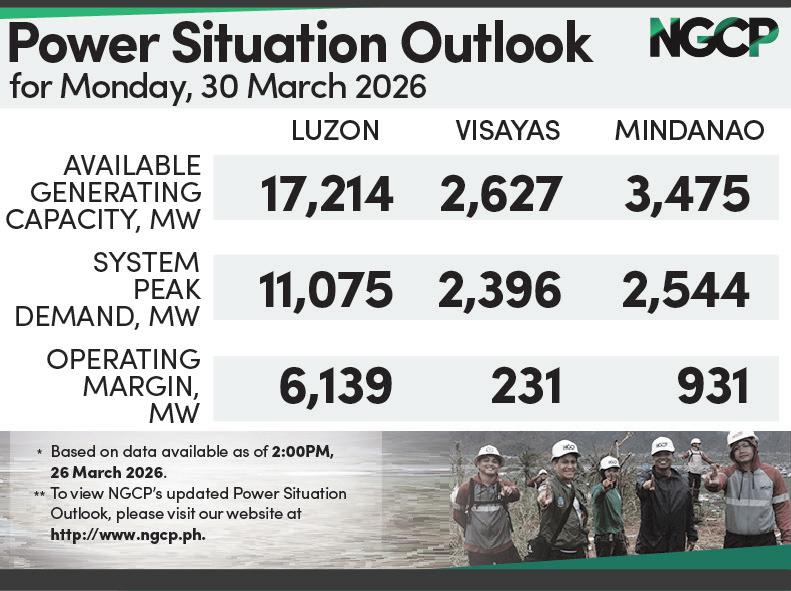

By Justine Xyrah Garcia
PHILIPPINE
Airlines Inc.
(PAL) has received a “Ba2” corporate family rating with a stable outlook from Moody’s Ratings for the first time, reflecting improved financial metrics following its restructuring.
In a statement last March 27, Moody’s said the rating reflects PAL’s position as the country’s flag carrier, supported by “steady domestic and international market shares and a defensible long-haul franchise,” particularly on North American routes.
It also cited improvements in PAL’s cost and capital structure following its 2021 Chapter 11 restructuring.
However, Moody’s said these strengths are tempered by structural constraints, citing PAL’s relatively small scale compared with global peers, alongside its fleet expansion plans and limited liquidity buffers.
The credit watcher said PAL has 21 aircraft on order for delivery between 2026 and 2029, which it plans to fund through a mix of operating and finance leases.
still feel the impact of rising fuel costs and changes in passenger demand driven by geopolitical tensions. It said fuel supply risks have increased following the Philippine government’s energy emergency declaration on March 24, although PAL has secured supply through end-June 2026 and is not expected to be directly affected in the near term.
“Nonetheless, any indication of supply disruptions or restrictions could pressure PAL’s credit profile,” the credit watcher added.
Moody’s expects PAL’s revenues to grow by 4.5 percent to 7 percent in fiscal year 2026 to 2027, with EBIT (earnings before interest and taxes) margins seen at 6 percent to 8.5 percent over the same period. Adjusted debt/EBITDA (earnings before interest, depreciation and amortization), meanwhile, is projected to remain below 4.0x over the next 12 to 18 months.
tion to a proposed P2-billion capital infusion from Lopez Inc., the closed holding company of the Lopez clan.
The board also flatly denied a separate claim that the proposed capital infusion would be used for executive payouts.
Continued on B2
“While the government’s consideration of excise fuel tax adjustments may provide a temporary cushion, we reiterate that it is unlikely to neutralize the upcoming inflation spike.”
The local market’s trading range is seen from 5,800 points to 6,000 points.
STOCK PICKS
REGINA Capital Development Corp. gave a buy when support holds recommendation on the stock of BDO Unibank Inc.
Its technical readings show the stock is “modestly bearish,” while some of the movements suggest minimal selling pressure and renewed buying optimism after the re-tracement. Its support price for the stock is at P116. BDO shares closed last week at P119.10 apiece.
Meanwhile, it gave a trade the range advice on the Bank of the Philippine Islands, as its share price remains below key moving averages, continuing its downtrend.
“The MACD prints narrowing red histogram bars suggesting that bearish momentum is gradually easing, although the downtrend remains intact,” it said. “Given the strong bearish conditions, downside pressure may persist, although short-term consolidation or a minor bounce could occur.”
BPI shares closed at P98.50 apiece. VG
Its liquidity also remains adequate but limited, with cash and short-term investments of about $432 million as of end-2025. This, together with $768 million in cash from operations, is expected to cover roughly $845 million in debt maturities—mainly lease obligations—and about $505 million in capital expenditures through June 2027.
Beyond its internal metrics, Moody’s said external conditions remain a key consideration.
Even with the Middle East making up only around 11 percent of capacity and 8 percent of revenues, Moody’s said Philippine Airlines Inc. could
“We could upgrade PAL’s rating if there is a notable improvement in its operating and financial profiles, alongside sustained or expanded market share. Demonstrated success in fleet expansion will also be necessary for an upgrade,” the report read. An upgrade, Moody’s said, would also depend on EBIT margins staying above 9 percent and adjusted debt remaining below 3.5x EBITDA on a sustained basis, supported by good liquidity.
It added that the rating could be downgraded if operating and financial conditions weaken, including if EBIT margins fall below 7 percent, adjusted debt/EBITDA rises above 4.0x, or liquidity pressures emerge.
“Any indications of fuel supply disruptions or restrictions could also pressure PAL’s credit profile,” it said.
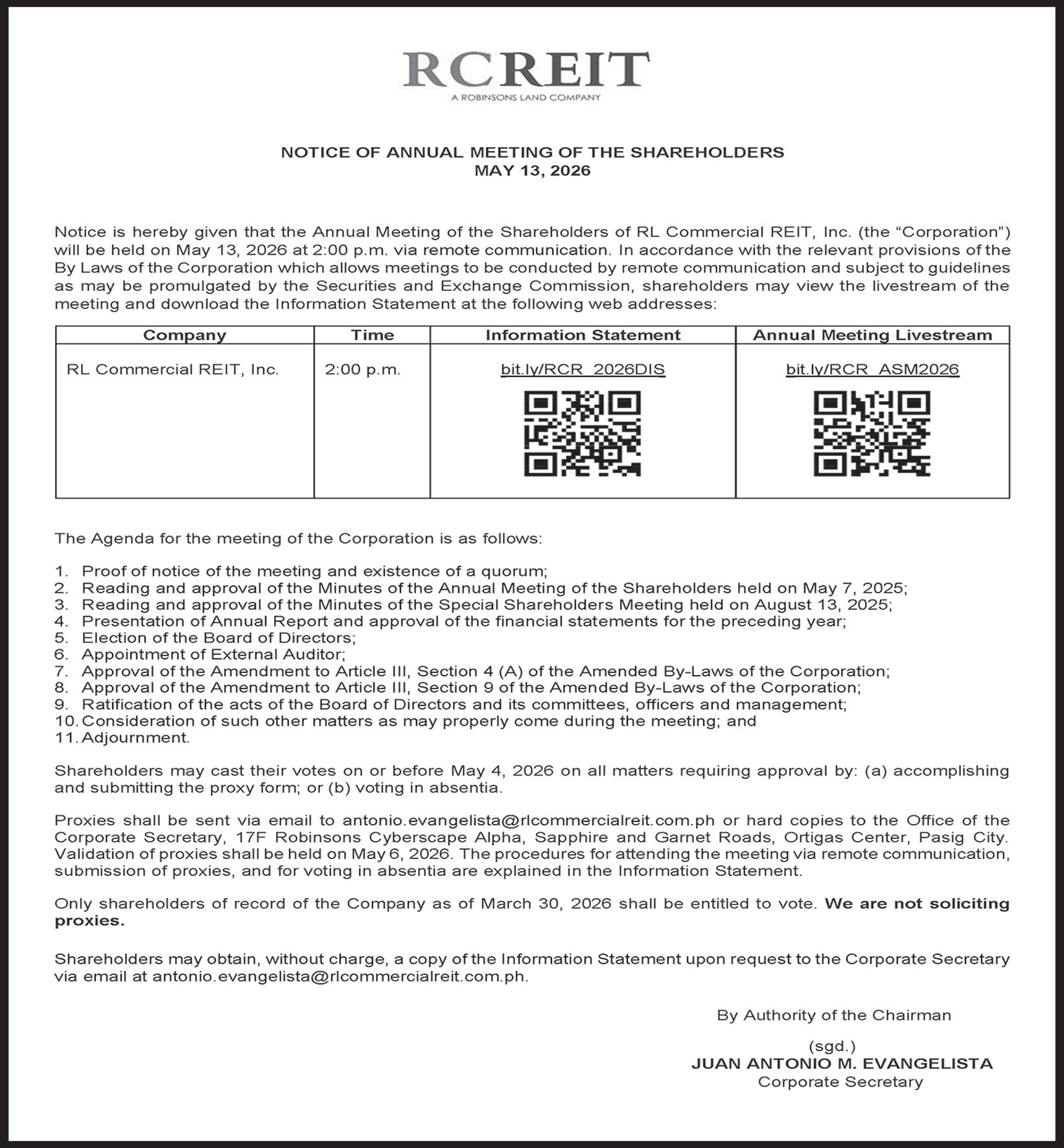
Food Waste at the Forefront: Int’l Day of Zero Waste 2026
IT’S lunch break at a busy fast-food restaurant. You are seated in the corner, glancing at the surroundings. On the table beside you, there’s a half-eaten food that has barely been touched. At the corner, there is a mound of rice, disposable utensils, and plastic wrappers that spill over from an overflowing trash bin.
Minutes after, customers began to rush out as their 1-hour break came to an end. What follows is a scene that you get to see every single day in cities across the world: Trash bins full of leftover food. In the rush of daily life, what seems like food scraps from one person becomes piles of wasted food from millions of customers around the globe. Food waste represents a major climate and environmental threat. Globally, an estimated 1.05 billion tonnes, or nearly one-fifth, of the food available to consumers is wasted every year.
According to the United Nations Environment Programme (UNEP), this accounts for up to 10-percent greenhouse gas (GHG) emissions, which are nearly five times larger than emissions from the aviation sector. Much of this waste ends up in the landfills, where it produces methane—a potent GHG that contributes to climate change, based on a report by the US Department of Agriculture. In light of this growing concern, UNEP and the UN-Habitat call for promoting sustainable consumption and production systems to prevent waste before it reaches landfills.
The International Day of Zero Waste, inaugurated by the United Nations General Assembly in 2023, returns on March 30, with a renewed call to action.
This year’s theme, “Food Waste,” draws attention to one of the most pressing yet preventable global challenges, underscoring its impact on climate change, food security, and sustainable development. Accordingly, the Food and Agriculture Organization (FAO) defines food waste as food products that were disposed of by restaurants, supermarkets, or households.
Anchored in the UN Sustainable Development Goals (SDGs)—specifically SDG 12: Responsible Consumption and Production, SDG 2: Zero Hunger, and SDG 13: Climate Action—this day serves as a platform to inspire governments, businesses, and communities to adopt zero-waste practices and accelerate progress toward a healthier, more resilient planet.
Building on this global initiative, the conversation also extends to how countries like the Philippines are contributing through national strategies, grassroots initiatives, and community-driven efforts that reflect the country’s growing role in shaping a zero-waste future.
The growing population in the Philippines resonates with the rise in generated food waste. Over the past five years, the country has seen a steady increase in food being wasted amidst families struggling to meet their daily nutritional needs. While households are a major contributor, a significant portion of food waste also comes from the food service sector. Accordingly, 40 percent of food waste occurs in customer-facing businesses (e.g., restaurants, supermarkets, and hotels), while nearly half (48.9 percent) comes from household waste.
A closer look at the composition of Philippine waste reveals that biodegradable materials, including food waste, make up the largest portion of the country’s garbage. Notably, from a 2023 National Nutritional Survey done by the Food and Nutrition Research Institute, rural areas tend to discard more food, not only from households but also from postharvest losses, improper handling during storage and transport, and excess agricultural supply, compared to those in urban regions. Beyond environmental issues, food waste also bears socioeconomic impacts. Economically, it signifies lost resources spent on producing food that ends up discarded. Socially,

a striking paradox reveals that even as the country generates massive food waste, there is also an inequality in food accessibility. Practices like ‘pagpag’ or scavenging of leftover food from rubbish bins should not be treated as an isolated coping mechanism but instead emphasize deeper systemic issues in accessibility, affordability, and social inequality in the country.
The Philippine government has taken steps to address the issue through policies and programs aimed at reducing food waste and improving the general waste management systems in the country. Central to these efforts is the Ecological Solid Waste Management Act of 2000, which includes mandates related to waste segregation, composting programs, and recycling initiatives.
The government also enacted the Extended Producer Responsibility Act (EPRA) of 2022, also known as the Republic Act 11898, to address the growing issue on the use of plastic packaging waste. More recently, House Bill 8043 or the Food Waste Reduction Act was passed by the Congress to address poverty and reduce the environmental impact of food waste across the country.
Alongside public-sector initiatives, corporate organizations and private sectors also play a vital role in strengthening accountability and governance, especially today, when there is a growing expectation to measure, manage, and disclose environmental-related impacts. Auditors and accountants ensure that waste-related information is accurate, consistent, and supported by a robust data structure, mirroring how financial impact is reported.
Firms like R.G. Manabat & Co. (KPMG in the Philippines) support various organizations and services by helping quantify waste, aligning with global standards, complying with regulations like EPRA, and embedding disclosure through sustainability and Environmental, Social, and Governance (ESG) reporting practices. These efforts underscore that responsible waste management has always been an integral part of corporate governance and has been continuously evolving as sustainability becomes central to business resilience.
Despite these existing laws and awareness, waste management remains a significant challenge – the Philippines still struggles with food insecurity, parallel to the increasing amount of food waste. Hence, environmental advocates highlight that while policies exist, collective efforts of agencies, businesses, individual households, and communities are needed to curb this issue.
Simple actions such as buying what you only need, planning meals, storing food, promoting food preservation to increase the shelf life of in-season fruits and vegetables, and composting kitchen waste can significantly reduce the volume of food waste that ends up in landfills and dumpsites.
As the world unites under the global observance of International Day of Zero Waste, it should be stressed that this celebration is not just a one-day commitment, but a reminder and an urgent call to reduce waste production in everyday practice.
© 2026 R.G. Manabat & Co., a Philippine partnership and a member firm of the KPMG global organization of independent member firms affiliated with KPMG International Limited, a private English company limited by guarantee. All rights reserved. This article is for general information purposes only and should not be considered as professional advice to a specific issue or entity. The views and opinions expressed herein are those of the author and do not necessarily represent the BusinessMirror, KPMG International or R.G. Manabat & Co. For more information, you may reach out through ph-kpmgmla@kpmg.com, social media or visit www.home.kpmg/ph.
Subsidies to state-run firms dropped to lowest in 9 years
By Andrea Louise San Juan
THE national government extended less financial support to state-run corporations in 2025, as subsidies dropped to their lowest level in nine years, data from the Bureau of the Treasury (BTr) showed.
Subsidies to state-run firms declined by 22.94 percent to P106.924 billion in 2025 from P138.763 billion in 2024. This is the lowest since the P103.190 billion recorded in 2016.
BTr data showed government financial institutions received P509 million in 2025. This is lower by 90.88 percent from the P5.58 billion GFIs obtained in 2024.
Under GFIs, only the Land Bank of the Philippines and the Small
THE World Bank has recently approved a $1-billion loan to finance a broad agricultural reform program in the Philippines.
In a statement released over the weekend, the Washington-based lender said its top executives cleared funding for the “Philippines Sustainable Agricultural Transformation,” or “Psat,” project. The Psat is a government-led initiative aimed at modernizing farm practices, strengthening food and nutrition security, and supporting job creation in the sector, the statement read.
The loan will be structured as a “program-for-results” operation, with funds released in tranches and tied to the government’s achievement of pre-agreed targets.
It will also be complemented by about $7.17 billion in financing from the national government.
SSS eyes
Business Corp. received subsidies last year.
The last time the Landbank received subsidies from the government was in 2022 with P5 million. In 2025, the state-run bank was given P7 million.
Meanwhile, SBCorp, the financial institution arm of the Department of Trade and Industry, received smaller budgetary support, nearly halved even, from the national government.
According to the World Bank, the initiative is expected to benefit around five million farmers and will focus on raising productivity and resilience in rice-based farming through climate-smart measures. These include improved seed and nutrient management, water-efficient technologies, and interventions to reduce greenhouse gas emissions and post-harvest losses.
It will also support diversification into higher-value crops, livestock, and aquaculture, while improving market access and upgrading logistics systems.
Mechanization will be expanded through farmer cooperatives and associations to support rural enterprises and improve scale efficiencies, it added.
The lender said a digital voucher system will be introduced to speed
measures
Data from the BTr showed SBC only received P502 million last year, 49.80-percent down from the P1 billion subsidy from the government in 2024. SBCorp is mandated to provide accessible and affordable financing to micro, small and medium enterprises.
Budgetary support to major nonfinancial government corporations was also slashed by 29.44 percent to P67.325 billion in 2025 from P95.414 billion in 2024.
This is due to lower subsidies extended to the National Electrification Administration (P1.453 billion), National Housing Authority (P1.346 billion) and National Irrigation Administration (P47.239 billion).
Meanwhile, there were higher subsidies extended to the Light Rail Transit Authority (P888 million), the National Food Authority (P14.404 billion), the Philippine National Railways (P835 million) and the Metropolitan Waterworks and Sewerage System (P168 million).
up the delivery of farm inputs and improve transparency, with public support linked to measurable gains in farm output and incomes.
Zafer Mustafaoğlu, World Bank Division Director for the Philippines, Malaysia, and Brunei, said the loan represents a “transformative investment in Philippine agriculture.”
“By putting in place the right policies, systems, and partnerships, these projects will make agriculture more productive, competitive, and climate smart. Farmers will be better equipped to earn more, withstand climate shocks, and bring safer, more affordable food to Filipino households,” he said. The program is also expected to support agrifood exports by expanding access to high-value crops and strengthening export certification laboratories.
Other GOCCs obtained a total of P39.09 billion in 2025, higher by 3.38 percent from P37.769 billion in 2024. Despite the slightly higher subsidies received, other GOCCs that received lower budgetary support from the government were: Tourism Promotions Board (P142 million), Tourism Infrastructure and Enterprise Zone Authority (P22 million), Development Academy of the Philippines (P350 million), the Cultural Center of the Philippines (P765 million), Aurora Pacific Economic Zone and Freeport Authority (P126 million) and the Bases Conversion and Development Authority (P1.939 billion).
For 2026, subsidies are proposed to receive higher subsidies worth P149.654 billion.
Of the amount, the Philippine Health Insurance Corp. will corner the biggest subsidy amounting to P53.262 billion, which is expected to fund the annual insurance premiums of indigent beneficiaries.
The bank said it will also help modernize the Department of Agriculture by improving budgeting, data management, and procurement systems.
Mio Takada, World Bank Senior Agriculture Specialist, said the initiative is expected to lift farmer incomes through productivity gains, better inputs, and increased diversification.
“This new initiative aims to deliver tangible benefits for farmers and consumers alike. Farmers will see higher incomes through stronger agricultural productivity—driven by better seeds, increased mechanization, and more efficient fertilizer use—as well as greater diversification, improved climate resilience, reduced post-harvest losses, and growth in agrifood exports,” Takada said. Justine Xyrah Garcia
DigiPlus partners with Manny Pacquiao on games, payments World Bank OKs $1B loan for PHL agri reform plan
to help contributors address challenges
THE Social Security System (SSS) announced it is “actively studying” the feasibility of offering a loan moratorium for its members and a condonation program for contribution penalties for employers as relief measures amid economic challenges.
A statement issued by the state-run fund manager last Sunday quoted SSS President and CEO Robert Joseph M. de Claro as saying they see these measures could provide “immediate relief” to SSS members and employers struggling with financial difficulties, ensuring they can continue to access “vital benefits without an added burden.”
Moreover, the state-run insurance program for private sector workers said it is “evaluating” options for extending contribution payment deadlines for employers and individual paying members to provide “greater flexibility” amid the current situation.
De Claro reaffirmed the SSS’s commitment “to protecting the welfare of our over 40 million members.”
He added that SSS officials “are expediting internal reviews and consultations with stakeholders to roll out these support initiatives as swiftly as possible, while safeguarding the long-term sustainability of the SSS fund.”
De Claro said the SSS is also actively pursuing digital initiatives to “simplify” administrative and implementation processes to reduce compliance burden and ensure the timely delivery of relief measures and services.
The net income of the SSS jumped nearly 60 percent in 2025, while its reserve fund breached the P1-trillion mark, according to the Department of Finance (DOF).
The DOF reported that the state-run pension fund’s net income rose by 58.4 percent to P142.97 billion in 2025 from P90.25 billion in 2024.
The SSS, likewise, grew its reserve funds, composed of member contributions for their benefits and earnings from investments, beyond P1 trillion in 2025. (See: https:// businessmirror.com.ph/2026/02/16/sss-ceo-says-reforms-drove-net-income-growth-in-2025/ ) Andrea Louise San Juan

By VG Cabuag @villygc
ONLINE gaming firm DigiPlus Interactive Corp. announced last week of having partnered with boxing legend Emmanuel “Manny” D. Pacquiao for a series of branded games, and will become the new face of the company.
According to DigiPlus, there will be a suit of nine Manny Pacquiao-themed titles that it will launch this year.
Flagship titles include Super Ace Pacquiao, Pacman’s Color Game, Wild Bounty Pacquiao, Pacquiao Fortune, Gates of Manny Super PacMan and Fortune Gems Pacquiao, which the company said has already received strong positive feedback from users.
The full lineup for the year, which also includes Boxing King Pacquiao, Pacman’s Bingo Boom, and Manny Punch, is built on mechanics from popular games in the Philippine market to ensure a meaningful and relatable experience, it said.
“Unlike standard celebrity-branded games, the collection is made for Filipinos, carefully designed to reflect Pacquiao’s achievements and indomitable fighting spirit,” DigiPlus said.
Digiplus said Pacquiao’s ambassadorship serves as the prelude to an alliance, with ArenaPlus committed to standing in the boxing icon’s corner for his upcoming fights, while GameZone brings his champion mindset to life through the GameZone tour, the pioneer of table game tournaments in the Philippines.
“As the new face of DigiPlus premier sportsbook and elite card and table
game tournament hub, Pacquiao perfectly embodies the world-class Filipino entertainment that DigiPlus champions,” the company said.
The collaboration is anchored by a new payments integration with MannyPay, Pacquiao’s payment platform.
DigiPlus, together with its gaming platforms—BingoPlus, ArenaPlus, and GameZone—is the first official gaming partner of MannyPay.
MannyPay, which is powered by Traxion Pay Inc., is a Bangko Sentral ng Pilipinas-licensed payment infrastructure.
DigiPlus partners only with BSPaccredited payment channels in accordance with the requirements of the Philippine Amusement and Gaming Corp.,
“As the digital entertainment scene in the Philippines continues to evolve, our audience is seeking more than just games. They want authentic, narrativedriven experiences,” Eusebio H. Tanco, chairman of DigiPlus, said.
“And so this collaboration allows us to combine the legendary story of our boxing hero—the ‘PacMan,’ the ‘People’s Champ,’ the ‘Pambansang Kamao,’—with our robust technological infrastructure, providing our players with an innovative, secure, and truly local experience,” he added.
“This partnership with DigiPlus is special because it was created with our countrymen in mind. Whether it is through the games that tell my story, or handling payments with MannyPay, we are showing the world what Filipinos are capable of,” Pacquiao, chairman of MannyPay, said.
UNLIKED BY JURY
What could come next for other social media firms as a jury finds Meta platforms harm children
By Barbara Ortutay & Kaitlyn Huamani AP Technology Writers
SAN FRANCISCO—The first jury verdict in a series of social media child safety trials this year is in — and it’s not looking good for Meta. A jury in New Mexico found last Tuesday that the social media giant’s platforms are harmful to children’s mental health and imposed a $375-million penalty.
While the fine is a tiny fraction of Meta’s $201-billion revenue in 2025, the verdict illustrates a growing shift in the public’s perception of social media companies and their responsibilities in keeping young people safe on their platforms.
For years, social media companies have disputed allegations that they harm children’s mental health through deliberate design choices that addict kids to their platforms and fail to protect them from sexual predators and dangerous content.
This year, several state and federal court cases are heading to trial, and while the details may vary, they all seek to hold companies responsible for what happens on their platforms.
The lawsuits have come from school districts, local, state and the federal government as well as thousands of families. The courtroom showdowns are the culmination of years of scrutiny of the platforms over child safety, and whether deliberate design choices make them addictive and serve up content that leads to depression, eating disorders or suicide.
The outcomes could challenge the companies’ First Amendment shield and Section 230 of the 1996 Communications Decency Act, which protects tech companies from
liability for material posted on their platforms. They could also be costly in the form of legal fees and settlements. And they could force the companies to change how they operate, potentially losing users and advertising dollars.
Here’s a look at the major social media harms cases in the United States.
New Mexico jury fines Meta $375 million A TEAM led by New Mexico Attorney General Raúl Torrez, who sued Meta in 2023, built their case by posing as children on social media, then documenting sexual solicitations they received as well as Meta’s response.
Torrez wants Meta to implement more effective age verification and do more to remove bad actors from its platforms.
Last Tuesday, a jury found Meta to be in violation of state consumer protection law. It found thousands of violations, each counting separately toward a penalty of $375 million.
The landmark decision came after a nearly seven-week trial. Jurors sided with state prosecutors who argued that Meta — which owns Instagram, Facebook and WhatsApp — prioritized profits over safety. The

jury determined Meta violated parts of the state’s Unfair Practices Act on accusations the company hid what it knew about the dangers of child sexual exploitation on its platforms and impacts on child mental health.
The jury agreed with allegations that Meta made false or misleading statements and also agreed that Meta engaged in “unconscionable” trade practices that unfairly took advantage of the vulnerabilities of and inexperience of children.
Meta said it disagrees with the verdict and will appeal.
“We work hard to keep people safe on our platforms and are clear about the challenges of identifying and removing bad actors or harmful
content. We will continue to defend ourselves vigorously, and we remain confident in our record of protecting teens online,” the company said in a statement.
The trial kicked off in early February. In his opening statement, prosecuting attorney Donald Migliori said Meta has misrepresented the safety of its platforms, choosing to engineer its algorithms to keep young people online while knowing that children are at risk of sexual exploitation.
The Los Angeles case centers on addiction JURORS are still deliberating in a landmark social media case that
seeks to hold tech companies responsible for harms to children. The plaintiff has argued the platform design features of the two remaining defendants, Meta and YouTube, were designed to be addictive, especially for young users. TikTok and Snap each settled before the trial began.
At the core of the Los Angeles case is a 20-year-old identified by the initials “KGM,” whose case could determine how thousands of similar lawsuits will play out. KGM, or Kaley, as her lawyers have called her, and a handful of other plaintiffs have been selected for bellwether trials — essentially test cases for both sides to see how their arguments play out before a jury.

“This is a monumental inflection point in social media,” said Matthew Bergman of the Seattle-based Social Media Victims Law Center, which represents more than 1,000 plaintiffs in lawsuits against social media companies. “When we started doing this four years ago, no one said we’d ever get to trial. And here we are trying our case in front of a fair and impartial jury.”
School districts head to trial
A TRIAL scheduled for this summer pits school districts against social media companies before US District Judge Yvonne Gonzalez Rogers in Oakland, California. Called a multidistrict litigation, it names six public school districts from around the country as the bellwethers. Jayne Conroy, a lawyer on plaintiffs’ trial team, was also an attorney for plaintiffs seeking to hold pharmaceutical companies responsible for the opioid epidemic. She said the cornerstone of both cases is the same: addiction.
“With the social media case, we’re focused primarily on children and their developing brains and how addiction is such a threat to their well-being and … the harms that are caused to children — how much they’re watching and what kind of targeting is being done,” she said. The medical science, she added, “is not really all that different, surprisingly, from an opioid or a heroin addiction. We are all talking about the dopamine reaction.”
Both the social media and the opioid cases claim negligence on the part of the defendants.
“What we were able to prove in the opioid cases is the manufacturers, the distributors, the pharmacies, they knew about the risks, they downplayed them, they oversupplied, and people died,” Conroy said. “Here, it is very much the same thing. These companies knew about the risks, they have disregarded the risks, they doubled down to get profits from advertisers over the safety of kids. And kids were harmed and kids died.”
Resolution could take years amid dueling narratives SOCIAL media companies have disputed that their products are addictive. During questioning by the plaintiff’s lawyer during the Los Angeles trial, Zuckerberg said he still agrees with a previous statement he made that the existing body of scientific work has not proven that social media causes mental health harms.
Some researchers do indeed question whether addiction is the appropriate term to describe heavy use of social media. Social media addiction is not recognized as an official disorder in the Diagnostic and Statistical Manual of Mental Disorders the authority within the psychiatric community.
But the companies face increasing pushback on the issue of social media’s effects on children’s mental health, not only among academics but also parents, schools and lawmakers.
“While Meta has doubled down in this area to address mounting concerns by rolling out safety features, several recent reports suggest that the company continues to aggressively prioritize teens as a user base and doesn’t always adhere to its own rules,” said Emarketer analyst Minda Smiley. With appeals and any settlement discussions, the cases against social media companies could take years to resolve. And unlike in Europe and Australia, tech regulation in the United States is moving at a glacial pace.
Style

Slim’s Fashion and Arts School names industry expert as new director
SLIM’S Fashion & Arts School, an institution of the De La Salle-College of Saint Benilde (DLS-CSB), has named fashion design and merchandising expert Christine Cheryl Y. Benet as the new school director. Benet brings with her over 30 years of experience in the fashion industry, with extensive involvement in the Manufacturing and Merchandising sector. She is the Project Leader of the Fashion and Merchandising Program Research, titled “Cultural Mapping and Digitalization of the Philippine Heirloom Fine Jewelry,” granted by the Department of Science and Technology (DOST). She likewise renders her expertise as consultant for the Philippine Creative Industry Sector for DOST, Department of Trade and Industry, and the World Bank. She is also an Industry Expert of the Technical Education and Skills Development Authority (TESDA) for the Fashion Design and Garment Production Philippine National Competencies.
As an educator and academician, Benet served as the Associate Dean of the Environment Studies Cluster of the then School of Design and Arts of the De La Salle-College of Saint Benilde (DLS-CSB), wherein she managed four degree programs: BS Architecture, AB Fashion Design and Merchandising, BS Industrial Design, and BS Interior Design. Benet earned her degree in BS Clothing Technology and Master in Technology Management from the University of the Philippines Diliman and took further studies in Master in New Tech-Style Design at the Politecnico di Milano in Milan, Italy. Moreover, she elevated her skills through a series of international learning experiences, to include a draping workshop in ESMOD, the first French school dedicated to fashion business and design, in Paris, France; and an extensive immersion in jewelry making in Centro de Joalharia de Lisboa in Lisbon, Portugal. Currently, she expands her knowledge in technology and developmental studies as she pursues her PhD in Philippine Studies at UP Diliman. Among Benet’s goals as Slim’s school director is the preservation of Slim’s curriculum. This includes the comprehensive technical lessons in garment construction, the pattern-making syllabus which is copyrighted and registered as the “Slim’s Method”. It also incorporates the fashion design subjects deeply rooted in fine arts foundation: Dressmaking, Bespoke Tailoring, Fashion Illustration, and Draping. The educator revealed new short courses such as Textile Series, Fashion Business Series, and Styling will be introduced. More information about Slim’s Fashion & Arts School can be found at www.facebook.com/SlimsFashionSchool.
HAVE DUFFLE, WILL TRAVEL
GLOBAL style purveyor Fendi presents the Fendi Lui Duffle bag, where lightness, functionality and premium materials come together. Unveiled on the Fendi Spring/ Summer 2026 catwalk, this new travel bag is designed to accompany the modern man in every journey, from weekend getaways to professional engagements. The two sizes—45
Jenny Mercado-Ortega: From fine arts to high fashion

FROM fine arts to high fashion, Jenny Mercado-Ortega is navigating the transition quite seamlessly. An artist to her core, she’s a visual artist, a dancer, a music mogul, a pageant queen and, now, a budding fashion designer.
“As an artist, I found fashion to be a powerful medium, my canvas. It became my way of expressing identity, culture and advocacy,” said the energetic Jenny, who pursued architecture at the University of Santo Tomas, and is currently the CEO of The Music House. She burst into the national scene, though, as the Noble Queen of the Universe for Culture and Arts in 2023. Then she became Mrs. Universe Pacific Philippines 2025. Of this pageant journey, Jenny recalled:
“I did not join to simply be called a queen but to use this platform for my advocacy. Having a title before my name is not just an honor, it is a job, a responsibility I must carry and uplift. It is more than a crown, it is a commitment.
“I truly aspire to be someone who can inspire and influence others. I receive many requests for help and while I wish I could accommodate them all, I also have other obligations. Still, I will do my best to be worthy of this calling and I pray that God will send other instruments in times when I cannot deliver.”
Born in Lemery, Batangas, Jenny traces her roots to Marcella Agoncillo, the “Mother of the Philippine Flag.”
She debuted as a fashion designer at the Manila International Fashion Week at Okada Manila, produced by Bench Bello. She unleashed her second collection at The Heritage Hotel via Sketchpad 3 The Heritage Fashion Series: In Harmony, the brainchild of fashion director Ogee Atos and model-actor/producer Bong Regala.
Full of joie de vivre, Jenny shares her fashion journey:
■ PARTY FILIPINIANA—“I said yes to Sketchpad because of my respect and admiration for Direk Ogee Atos, Bong Regala and the entire team, and because I saw it as the perfect platform to share my voice as an artist and designer.
“My collection is titled ‘Diwang Filipina Couture.’ It is a series of wearable art pieces that express my pride as a Filipina, celebrating our culture and identity. The inspiration comes from my deep love for Filipino heritage, my background in dance and music, and my advocacy for women empowerment.
“Each piece carries emotion, joy and pride translated through hand-painted couture. The collection features modern Filipiniana party dresses without the traditional sleeves. The style is fluid and contemporary. The silhouettes are combinations of classic elements with modern cuts.
“The fabric is Mikado Silk, which gives a clean and regal look. My color palette is vibrant and expressive from bold hues like fuchsia, orange and royal blue, to softer tones that highlight the hand-painted details.
“It reflects my passion for cultural dance from my time with the UST Salinggawi Dance Troupe, as well as my love for music as a singer inspired by song lyrics. By blending modern silhouettes with Filipiniana-inspired artwork, the collection honors Filipino heritage while showing that culture can continue to live, evolve and be proudly expressed through contemporary fashion.”
■ FOLK ARTS AS FASHION—Jenny finished each look with her hand-painted images of folk artforms, bringing





culture to life on fabric. She named each look as such:
“Kay Ganda ng Musika”—celebrates the joyful rhythm of Filipino culture through a Filipina dancing with a salakot, symbolizing harmony between music, movement, and identity; “Patria Filipina”—honors the strength, dignity and enduring spirit of the Filipina as the heart and soul of the nation; “Vinta”—symbolizes the Filipina’s journey of resilience, courage and cultural pride; “Sarimanok”— celebrates the vibrant spirit, cultural pride, and rising strength of the Filipina.
“Singkil”—celebrates the Filipina whose grace, poise and strength shine through movement, tradition, and cultural pride; “Banga”—honors the quiet resilience and enduring strength of the Filipina; “Sisters in Strength”—symbolizes the beauty of sisterhood and the strength that emerges when women uplift and support one another; “Malong”— Celebrates the Filipina who moves through life with creativity, confidence, and a powerful sense of identity.
“Lakambini”—honors the empowered Filipina who carries heritage with grace while shaping the future with strength and pride; “Together We Rise”—celebrates the power of unity among women, symbolized by Filipinas standing together in strength, resilience and empowerment; “Singkil Prince”— symbolizes strength, nobility, and the rich cultural heritage of Mindanao.
■ FASHION AWAKENING—“Fashion has always been part of my life. Growing up, my mother created couture dresses for her clients at a time when RTW was not widely available. I was exposed early to design, craftsmanship and styling. As an artist, I found fashion to be a powerful medium, my canvas. It became my way of expressing identity, culture and
Beautycon is a beauty playground and more
cashiers so the lines weren’t that long. The booths were designed in such a way that we had more space to walk. Anyway, for my Beautycon 2026, I tried to be more practical and only get what I needed. My Torriden Dive In Serum is almost out so I got the Dive In Multi Pad. It was at 20 percent off and Torriden gave me a few travel-size skincare samples.
advocacy.
“My target market includes confident, empowered women who appreciate artistry, culture,and individuality, women who want to wear pieces that tell a story and make a statement. My designs are for those who value both heritage and modern expression.
“My fashion awakening began in childhood through my mother’s couture work. My journey has been enriched through collaborations and mentorship, especially with fashion designer John Guarnes. I specialize in hand-painted couture and wearable art, particularly modern Filipiniana that blends tradition with contemporary design.
“I realized my aesthetic when I began integrating my paintings into garments. I saw that my strength lies in storytelling through wearable art, combining cultural symbolism with contemporary fashion. My aesthetic is rooted in identity, of being a Filipina.”
■ INSPIRATIONS AND CHALLENGES—“I am inspired by Filipino culture, women’s strength, music, and dance. I am deeply grateful to my mentor, John Guarnes, who has guided me in my journey. I am also inspired by iconic designers like Renee Salud and Ditta Sandico, who have greatly supported my journey, career and creative vision.
“As a new designer, one of the biggest challenges is balancing time, resources and demand. Manila’s fashion scene is highly competitive, so establishing a distinct style is essential. Another challenge is ensuring that the vision, from concept to execution, remains cohesive.
“I look forward to dressing women who share my vision, and I dream of dressing influential Filipinas and global icons who celebrate culture and empowerment.”
ONE of the best things about Beautycon is getting to shop new releases and replenishing personal care stuff like shampoo, conditioner, and body wash.


Beautycon 2026 at the SMX Convention Center featured 185+ brands. As someone who has attended past Beautycon editions, I can say that Watsons, SM Beauty, and LOOK at Me made sure that everything was better this year. There were more





I bought a bottle of the red Tsubaki Premium Moist and Repair Shampoo and the Repair Mask. They handed out shampoo and conditioner sachets, perfect for travel. One thing I noticed is that the brands were still very generous with gifts but mostly for buying customers. Speaking of shampoos, I also bought a bottle of the Happy Skin Volumizing Shampoo. I love the fragrances of the Happy Skin shampoos!
One of my favorite purchases was the Vaseline Gluta-Hya Lip Serum Gloss. This is very moisturizing.
I also got several lip liners from GRWM Cosmetics. I have always said these lip liners are very underrated. I purchased a couple of Sola Vitamin C Makeup Removing Wipes for overnighters or short trips.
My favorite part of Beautycon is the brandsponsored segments featuring makeup artists and celebrities. These guests share their makeup and skincare hacks and also answer questions from the audience. Beautycon is something I look forward to as a beauty enthusiast. There was a year when I didn’t buy anything at all but I still had a great time just looking at stuff and swatching color cosmetics.

‘DIWANG FILIPINA COUTURE’ Jenny MercadoOrtega and her pieces called Singkil Prince, Sarimanok, Kay Ganda ng Musika and Patria Filipina PHOTOGRAPHED BY BERT BRIONES
BPI bags five Asia-Pacific Stevies, three Silver Anvils
The Bank of the Philippine Islands (BPI), the Philippines’ first and Southeast Asia’s oldest bank, recently garnered eight distinctions from the 13th annual AsiaPacific Stevie Awards and the 61st Anvil Awards.
The Asia-Pacific Stevie Awards, widely recognized as one of the region’s premier business awards programs, celebrate innovation across industries. Together with The International Business Awards and other Stevie programs, the Stevies are regarded globally as a benchmark of excellence in organizational performance and creativity.
BPI’s five Stevie wins highlight the Bank’s continued leadership in purposeful communication across video storytelling, public affairs, marketing, events, and B2B services. These recognitions include:
•Gold Stevie – Innovation in Public Relations Videos
BPI #ProudToBePartOfIt – now on its fifth season, the series reimagines employer branding by shifting from scripted recruitment materials to authentic, vlog-style storytelling that gives audiences a genuine look into the culture, passion, and everyday purpose that drive BPI employees.
•Gold Stevie – Innovation in Public Affairs Communications
AFASA: Blazing the Trail in Consumer Protection – an initiative that combined education, advocacy, and multi-sectoral engagement to help shape national policy, culminating in the passage of the Anti-Financial Account Scamming Act (AFASA), a landmark law that reinforces cybersecurity and strengthens safeguards for the public.
•Silver Stevie – Innovation

in Purpose-Driven Marketing
BPI Partner-serye – a social media video series that introduced the “Withdrawal via BPI app” capability, allowing customers to get cash at partner stores through an appgenerated barcode while highlighting how partner stores help bring banking closer to everyday Filipino routines.
•Bronze Stevie – Innovation in Business-to-Business Services
BPI Salary On-Demand – a service exclusive to BPI payroll customers that allows employees to access a portion of their earned salary ahead of payday, enabling employers to offer a financial wellness benefit without changing internal processes or adding administrative burden.
•Bronze Stevie – Innovation in the Use of Events
BPI Cyber Protect Conference Series –launched in 2023, the initiative has grown into a multi-sectoral platform against digital fraud, bringing together leaders from government, industry, and civic organizations to elevate cybersecurity awareness and collective protection.
“These recognitions from the AsiaPacific Stevie Awards affirm BPI’s ability not only to compete but to stand out across the region,” said TG Limcaoco, BPI President and CEO. “They inspire us to continue building programs rooted in collaboration, creativity, and the trust
of our customers as we move toward our 175th year.”
The awards will be formally presented on April 17, 2026, in Macau.
Meanwhile, BPI also received three Silver Anvil Awards at the 61st Anvil Awards held on January 28, 2026 at Solaire Resort North in Quezon City, recognizing communication initiatives that deliver real impact.
Organized by the Public Relations Society of the Philippines (PRSP), the Anvil Awards are widely known as the “Oscars of Public Relations” in the country, celebrating programs and tools that meaningfully connect with audiences and help drive positive change.
BPI’s Silver Anvil Awards include: Silver Anvil – Public Relations Tools (Multimedia) BPI #ProudToBePartOfIt
Silver Anvil – Public Relations Programs (Best Use of Influencer Marketing) BPI Circle: Championing Financial Wellness with KOLs – a program that partnered with content creators nationwide to make conversations on financial education, cybersecurity, sustainability, and digitalization more relatable and accessible to Filipinos.
Silver Anvil – Public Relations Programs (Government Relations) CyberAcademy: A Public Private Partnership for Cybersecurity and Financial Protection – an initiative that brings together BPI and key government agencies to strengthen cybersecurity capabilities through specialized training and certification programs.
“These awards remind us that communication is most effective when it is anchored on service and shared responsibility,” said Maria Elena Torrijos, Head of BPI Public Affairs and Communications. “From telling the stories of our people, to working with creators, and partnering with government, our goal has always been to create initiatives that truly matter to the communities we serve.”
The recognition at the 61st Anvil Awards underscores BPI’s continued commitment to communication excellence, driven by empathy, collaboration, and a clear focus on making a positive difference for Filipinos.
Winford Resort & Casino Manila deploys Agilysys hospitality technology to elevate operations, service

AGILYSYS , Inc. (Nasdaq: AGYS), a leading global provider of hospitality technology solutions, recently announced that Winford Resort & Casino Manila has deployed Agilysys InfoGenesis POS to centralize food and beverage operations across 11 venues and integrate in real time with their Total Rewards System (TRS). Located in Manila’s historic San Lazaro Tourism and Business Park, the 22-story integrated resort features 128 rooms and suites, multiple dining outlets, premium entertainment facilities and a full casino operation. To support this high-volume environment, Winford transitioned from legacy POS systems requiring manual processes to a fully automated platform aligned with the technology standards of Newport World Resorts. With InfoGenesis POS, dining transactions now connect directly real time to guest loyalty and reward data through seamless TRS integration, improving transaction speed, billing accuracy and operational efficiency while delivering a more streamlined experience for guests and staff. Since
the deployment, Winford staff have noted the intuitive nature of the new system. Key benefits identified during training and initial use include: Intuitive Workflows: The system is easy for staff to navigate, significantly reducing training time and minimizing order errors. Integrated Rewards: Real-time synchronization with TRS eliminates manual workarounds, allowing guests to earn and redeem rewards effortlessly across the property.
Arman Reyes, Assistant Director of IT, Winford Resort & Casino stated, “Agilysys InfoGenesis POS stood out as the ideal choice for Winford Manila because of its flexibility, seamless integration with our systems, and real-time data insights. We wanted to replace our legacy software with a truly modern solution that is intuitive for our team, scalable for our operations, and agile enough to consistently deliver exceptional guest experiences. InfoGenesis empowers us to achieve greater efficiency and mobility across our property, helping us serve our guests better every day.”
Tony Marshall, Vice President & Managing Director for Agilysys Asia Pacific commented, “We are proud that Winford Resort & Casino Manila chose Agilysys InfoGenesis POS to be the backbone of their dining and retail transactions. InfoGenesis is designed specifically for complex, highvolume environments like Winford Manila, ensuring exceptional performance even during peak times. By integrating POS with the resort’s loyalty ecosystem, the property is now able to deliver a more seamless and rewarding guest experience. This partnership underscores our commitment to providing cuttingedge solutions that drive efficiency and elevate the guest experience in the Asia-Pacific region. The implementation of InfoGenesis POS reinforces Winford Casino & Resort’s commitment to investing in bestin-class technology to maintain its position as a leading integrated resort destination and establishes a strong foundation for the future innovation and growth.
Enchanted Kingdom celebrates return of its legendary Wheel of Fate
ENCHANTED Kingdom, the first and only world-class theme park in the Philippines, proudly celebrated the official return of its legendary ride, the Wheel of Fate, as the highlight of The Legend Shines Again campaign last March 21, 2026.
Following the theme park’s successful 30th anniversary celebration last October, its signature ferris wheel ride took a four-month break to make way for enhancements, which include a fresh thematic look, smoother ride experience, and updated ride system technology.
This is part of EK’s ongoing revitalization of its existing facilities and iconic rides to ensure that their longevity and legacy can be sustained for the years to come.
Regarded as one of longstanding rides of its kind in the country, the Wheel of Fate has been bringing magical experiences to countless Filipinos since EK opened its gates in 1995. It eventually grew into a crowd favorite among its multigenerational guests, especially with families and friends.
This towering ride lifts guests 130 feet above the ground, showcasing the breathtaking view of its home city, Santa Rosa. Aside from this, it also elevates the EK experience by illuminating the whole park, especially during nighttime.
The official relaunch of the Wheel of Fate on March 21 featured spectacular performances, with EK’s very own P-pop girl group SMS launching their new song, The Legend Shines Again; and OPM band The Bloomfields serenading the crowd with timeless hits.
The cast of Viva One’s My Husband is a Mafia Boss also made a special appearance to unveil the show’s photobooth installation. Meanwhile, the youth-led organization Lion City Youth Inc. surprised parkgoers with a teaser for Hello Santa Rosa, their flagship tourism program launching this year in collaboration with EK.
The ride’s relaunching ceremony was graced by Santa

events
offerings,
Kingsford Hotel Manila turns five with ‘FiveFold: Unfolding Five-tastic Years

Fone, the hotel aimed not only to serve its guests but also to contribute to the nation’s recovery and growth, creating opportunities that support employees and empower the community.
As Kingsford celebrates its 5th anniversary, it honors this journey through recognizing the achievements made possible by its dedicated team, loyal guests, and trusted partners who have turned challenges into meaningful milestones. Titled “FiveFold: Unfolding Five-tastic Years of Reimagined Memories,” the anniversary campaign reflects the hotel’s enduring commitment to creating experiences that resonate far beyond a stay.
“Five years ago, we opened our doors with hope in our hearts and a clear vision to serve with purpose, not only for our guests, but also in support of our people and the nation during a time of uncertainty. Today, we look back with deep gratitude, not just for how far we’ve come, but for every individual who has walked this journey with us. To our dear guests, trusted partners, and most especially our dedicated team members—you are the story behind every milestone, the reason each moment became meaningful, enriching our lives fivefold. This anniversary is not defined by time, but by the people who made it all worthwhile,” Jorold Montelibano, General Manager of Kingsford Hotel Manila, said.
Castrol launches new lubricants for motorcycle enthusiasts
of Reimagined Memories’
A Celebration in Five Dimensions Love in Every Stay
Guests can join the anniversary celebration by availing of Kingsford’s special room package, complete with a Sampaguita welcome amenity and a limited edition Harri plushie for only P5,555, embodying warmth and heartfelt appreciation.
Honor for Those Who Serve In tribute to frontline heroes, OFWs, and teachers, the hotel offers 25 percent off at Kingsford Cafe upon presentation of a valid ID, a small gesture of gratitude for those whose service enriches communities nationwide.
Healing Through Healthy Dining
The anniversary menu features dishes designed to nourish and delight, including Mesclun and Feta, Asian Slaw Salad, Lentehas at Malagkit, Chicken Tandoori and Egg, and Flat Bread with Tomato Cream Cheese, each plate a celebration of wellness and flavor.
Dignity in Every Welcome Guests can indulge in a special culinary journey curated by Kingsford Hotel Manila’s Executive Chef, Angelo “Chubby” Timban, featuring his signature dishes from the past five years. Priced at P1,555, the menu showcases the evolution of the hotel’s dining scene, beginning with the Beef Kulawo appetizer (Circa 2026), followed by the Deconstructed Paella in Black Beer Broth soup (Circa 2022), and the Blackened Chicken & Shrimp Salad (Circa 2023). The main course highlights Chicken Piaparan with Mashed Potato and ChiliLime Accents (Circa 2024), complemented by the dessert Sampaguita Polvoron Mantecado (Circa 2025), and paired with a
Filipino Hospitality, Reimagined
each
of the campaign
with a
of
of
including Tupig, Bibingka Tablea, Pianono Halo-Halo, Empanaditas, and Chicken Pianggang Pan de Sal, celebrating Filipino flavors and heritage. As part of its mission to elevate hospitality, Kingsford Hotel Manila ensures every guest encounter reflects warmth, professionalism, and the essence of Filipino hospitality. It

BPI’s Public Affairs and Communications team celebrate the Bank’s three Silver Anvil wins at the 61st Anvil Awards on January 28, 2026 at Solaire Resort North in Quezon City.
Santa Rosa Mayor Arlene Arcillas, EK COO Cynthia Mamon, and Integrated Marketing Head Nico Mamon led the relaunching ceremony
Five years strong: The Façade of Kingsford Hotel Manila
Well done, young women leaders

WE often hear this: the youth is our hope for the future. At the same time, this generation of young people has drawn a lot of flak for a lot of things— some of them valid, some of them merely hasty generalization. But having had the chance to witness a number of young women tell stories of the good that they have been doing in society, and at such a young age, has reinforced my belief that we can still aspire for a better, kinder world.
I recently had the chance to meet some of the members and leaders of the Kalinangan Youth Foundation, Inc. (KALFI), an organization that partners with families and educational institutions “to support the holistic formation of young women in the Philippines.”
According to the organization, it “envisions empowered young women with integrity, achieving personal excellence while contributing positively to society. Its programs emphasize mentoring, character formation, leadership development, and a lived commitment to service.”
One such program is KALFI LEAD, the group’s flagship youth leadership program, that is designed to “train and nurture servant leaders of the future.” LEAD—which stands for Leadership, Excellence, Accountability, and Discipline—instills exactly those values in its participants, spread across various study centers nationwide.
Over a week before the end of Women’s Month, they held their KALFI LEAD Summit with the theme “Habi: Weaving Purpose Into Our Stories.” The event aimed to show how “leadership is intentionally weaved—thread by thread, choice by choice.”
Young women of purpose WHEN we arrived at the venue,

there were already close to 100 young women at UP Diliman’s Pilar Herrera Hall. Those young ladies all chose to spend their Saturday morning to learn from each other, share their stories, and listen to speakers talk about finding one’s purpose and contributing to society.
The event aptly opened with a showcase of programs and activities of six of KALFI’s study centers, including one located all the way in Cebu. Who better to tell these stories than the leaders of those centers: young women from senior high school to different year levels in college, all sharing a passion for serving their communities and making a difference in people’s lives.
Programs included arts and crafts lessons, mini library, gift-giving, catechism in Tagalog and Bisaya, medical missions, tutorials, soup kitchen, monthly street-side food distribution, and even a partnership with Angat Buhay in Bicol and a rural service project in Surigao del Sur—and these were only from 2025.
All of these were conceptualized and implemented by KALFI LEAD participants, following personalized mentoring and coaching sessions, exposure to project management modules, participation in talks and workshops, and regular interactions with fellow LEAD program beneficiaries.
You are more than your achievements FOLLOWING the study center

leaders’ accomplishment reports, Ikigai Philippines Founder and Head Coach Alexis Torres talked about purpose—our reason to wake up in the morning. At the same time, he reminded the young attendees to never equate their worth and identities with their accomplishments.
“We live in a world where expectations never stop growing. When we achieve something, somehow the goalpost just keeps on moving farther and farther away, making it increasingly harder to hit our next goal. It is important for you to accept that reality and not force yourselves to have to constantly meet the world’s expectations of you,” he said.
“Don’t equate yourselves with your accomplishments. The person that you are is not just the work that you do. Focus on what
really matters to you. When we can clearly define what matters to us, we make better decisions and we spend our time wisely,” he added.
He emphasized three key points in his talk:
n We are invited to feel alive every day—choose to live.
n We are more than a list of accomplishments—be brave enough to be yourself.
n We have limited time here on Earth—leave it a little better than when you arrived.
Living her purpose every day
THE last speaker of the day is a good example of someone who has found her purpose and who is fortunate enough to be able to live that purpose every day. Moha Barakat, founder of clothing brand Better Basics, capacity-building social enter -

prise The Learning Lab, and produce distributor Good Gulay is always doing so many things at once—and that is what motivates her to get up from bed every single day.
She related that she never imagined herself becoming part of the corporate world, although she did admit that she sometimes wondered how far up the ladder she would be by now if she, like many of her peers, decided to pursue that path.
Amid her busy schedule, juggling tasks and wearing multiple hats, she finds her fulfillment in the big and small wins that her ventures help produce: the nanay who has sewn her first garment, the farmer whose vegetables fetched fair prices and did not go to waste, the busy career woman who has finally found the best pieces for her capsule wardrobe.
“I didn’t expect to be doing all of these things. Better Basics started because I thought the clothes I liked were too expensive. I started The Learning Lab because we did not have enough good sewers for the industry. Good Gulay came to be because we wanted to help farmers sell their produce at fair prices,” she related.
“I believe in the power of just ‘making.’ It may seem like I’m all over the place, with all the things that I’m doing all at the same time, but I have developed systems that work for me to allow me to do the things that I do. There is fulfillment in just ‘making,’” she added.
There is hope yet
FOR the participants of the KALFI LEAD program, achievements are everyday occurrences. They are student leaders and honor students. Long before they leave the confines of their schools to join the rat race of the so-called real world, it is reassuring to know that they have already immersed in its realities: that while we are comfortable, so many more are afflicted. The ongoing war in Iran has made that all the more obvious. The things that these young women are doing for the community, with the help of their KALFI mentors, are not just but additional feathers on these young achievers’ caps. Their impact on the people whose lives they touched will not be forgotten. The imprint of these activities on the KALFI LEAD ladies, both current members and alumnae alike, is indelible. As war rages and we suffer helplessly from the fallout, hope still shines. Thank you for this reminder, KALFI LEAD ladies. And kudos for a job well done.
PR Matters is a roundtable column by members of the local chapter of the United Kingdom-based International Public Relations Association (Ipra), the world’s premier organization for PR professionals around the world. Abigail
L. Ho-Torres is the Chief Marketing Officer of Ikigai Philippines and an independent consultant and trainer, with more than two decades of experience in media, public relations, marketing, and customer experience.
We are devoting a special column each month to answer our readers’ questions about public relations. Please send your questions or comments to askipraphil@ gmail.com.
KALFI officers and members of its Cebu center with the KALFI LEAD Summit speakers PHOTO BY ABIGAIL HO-TORRES
SPEAKERS answer questions from the crowd PHOTO BY ABIGAIL HO-TORRES
Monday, March 30, 2026

PHL in spotlight: Lee medals, Honorica delivers record ride
rider—Zedrick Ivan Honorica—set
a new Philippine record in men elite sprint using the same bike he uses in plying his trade.
Honorica’s bike? A Brain frame that costs P2,500 and a wheel set worth P12,000 which he raised from delivering food—a bicycle that astronomically pales to the equipment used by the elite countries’ riders, some breaching P7 million.
“I pushed and pushed myself, it’s a very tough race,” said Lee, 21, who lost his right forearm from under the elbow in a meat grinder at his
aunt’s stall at Marilao Market when he was five years old.
“I’m really very happy because it’s for our country,” added Lee, who’s set to race again on the last day Wednesday of the championships supported by Tagaytay City Mayor Brent Tolentino and supported by the Philippine Sports Commission, Philippine Olympic Committee, MVP Sports Foundation, Sports Plus PH, Toyota and Peak.

broke the national record his fellow Marikeño and many-time tour champion Jan Paul Morales set in the Doha 2006 Asian Games.”
By Josef T. Ramos
BOL BOL is putting up big numbers— and pulling them in, too.
after an opening loss, with the 7-foot-3 South Sudanese-American erupting for 34 and 18 rebounds in a 118-92 rout of San Miguel Beer on Saturday in the Philippine Basketball Association Commissioner’s Cup.
TNT governor Ricky Vargas is elated as Bol continues to make an impact beyond the box score, drawing fans and boosting interest in the league.
“It draws a lot of attention and interest as the basketball fans love to see him play live at the venue. He is an absolute crowd drawer. Imagine this is just the elimination games. He is just more than the game,” Vargas told BusinessMirror on Sunday.
“What we noticed so far are the TV ratings and the viewership are also increasing according to Sienna Olaso of Cignal, not only at the live venues but also in our respective platforms. So, everything is positive so far,” Vargas added. Bol, who had played for the Orlando Magic and the Phoenix Suns in the NBA, has wowed fans with his unique blend of size and versatility.
“I think I am just getting used to the physicality and getting my teammates involved and that was what has gotten us the last two wins,” the Sudanese-American son of former NBA icon 7-foot-6 Manute Bol said.
“We are good tonight. It was hard the first game, but after these last three games, I’m getting used to it. And they are getting used to playing with me now too,” Bol added, referring to his first game loss to Rain or Shine, 109-112. TNT is averaging 37.3 points, 16.3 rebounds and 2.7 blocks. After a 109-112 heartbreaking defeat to Rain or Shine where Bol had 38 points, the TNT reinsofrcement posted 40 points and 15 rebounds in a 103-97 win over NLEX. Vargas hopes Bol can adjust to the Philippine style of basketball quickly.
“He still needs to learn a lot of things about the Philippine basketball scene especially all the taunting,” Vargas said.
Meanwhile, San Miguel Beer coach Leo Austria confirmed that former Oklahoma Thunder center Justin Patton will replace import Marcus Lee. The Beermen play the Macau Black Bears on Tuesday at the Ninoy Aquino Stadium.
Parenting in sports

I AM gung-ho about the book “How to Be An Elite Parent for Young Basketball Players” because like the authors— Eric “Bizzy” Miraflores and Ivan Carlos—I, too, have first-hand experience about the topic. As a long-time journalist, I have seen many a (stage) parent give their kids tough love, run their kids out of the sport, or plain embarrass themselves. And honestly, I have to thank those parents for showing me not what to be to my two boys who got into sports. I remember one time watching a football game for high school kids, and this father was constantly yelling instructions from the sidelines to his son who was on the pitch. Everyone—from the two coaches of the competing teams, to players and parents—were occasionally looking at him as if to say, WTF, man! Give it a rest. And you know, he didn’t care. During half time, his son, instead of going to the bench, went to his father who proceeded to give him a dressing down. Now, I know this father who was a really good athlete during his time. The problem of parents who were star athletes, they want their sons to be just as good if not better. And for sure, that is added pressure on them. Only after the dressing down did the son go to his team’s bench.

Anyway, their team won the championship. Everyone was celebrating…except the kid who simply went back to the bench and sat down. He was probably going to get another dressing down because he didn’t score a goal. Another boy was a top player during his high school years, but struggled to elevate his game and playing time in the college ranks. The father rode him mercilessly. In the son’s final year, he made the Mythical Selection of a top tournament. But with a year of eligibility left, he walked away. I next saw the son in a triathlon where he told me he was doing his own thing at his own pace, and more importantly, his own happiness.
I swore that I will do no such thing for my kids. And you know what—that got put to the test.
My youngest son stands 6-foot-1. He played hoops fairly well. The team he played for was purely students in school.
Uzbekistan’s Azimbek Abdullaev won the gold medal and Japan’s Ruito Kameda secured the silver but with a tough challenge from Lee—the result went down to the photo finish.
Another Filipino, Joel Inn Tacutaco, finished fifth in the 14-rider race.
Honorica? He’s not your ordinary elite cyclist—literally, he came out of nowhere.
“I race in ‘bente-bente, nothing more,” said the 21-year-old who

U“I wasn’t aware of the national record, but I know Kuya JPM [Morales], him being a champion…he doesn’t know me, though,” he added.
Honorica said he’s an accidental member of the national team in the Asian championships.
“I saw a post on Facebook by national coach Gil [Virgilio Espiritu) on an invitation for a power test [informal tryouts], and I was second best... that was only last January,” he said.
Honorica clocked 10.865 seconds, beating Morales’s 20-year-old record of 11.42 seconds.
The effort landed him in 21st out of 22 riders in the event won by Japan’s Kaiya Ota in 9.348 seconds, also shaving a fraction from his previous best of 9.350.
Red Warriors rule inaugural UAAP boys’ tennis tourney
NIVERSITY of the East (UE)
claimed the inaugural University Athletic Association of the Philippines high school boys’ tennis overall title after edging National University, 2-1, in the team event final on Saturday at the Colegio San Agustin-Bulacan Tennis Court in San Jose del Monte.
The Junior Warriors tallied 39.287 points in the three events contested—singles, doubles and team—to emerge as overall champions of the demonstration tournament supported by Wilson Philippines.
UE went undefeated in the team event to add to the 24.287 points it earned after topping the doubles where Al Tristan Licayan and Aser de los Santos reached the quarterfinals.
Co-MVPs Kobi Luzon and de los Santos, also doubles champions, delivered the championship-clinching point in the team final against NUNS, outlasting Ariel Cabaral and Jeremiah Labasano in the doubles rubber, 6-3, 6-2.
Kyle Saga gave UE an early advantage after winning the opening singles against Labasano, 6-4, 6-2, but Cabaral then responded for the Bullpups at the expense of Licayan, 6-0, 6-3, to force a winner-take-all doubles showdown. NU finished second with 35.925 points, followed by Ateneo d with 27.581 points.
“This is the result of the team’s hard work, sacrifice and loyalty to the UE community,” UE coach Roel Licayan
said. “We trained for more than a year for this one, it was a sacrifice.”
University of Santo Tomas (UST), meanwhile, beat University of the Philippines (UP), 3-1, in Game 3 of the finals on Sunday to clinch its 17th men’s tennis crown. Richard Bautista and Nash Agustines sealed the championship for the Male Tennisters with a 6-4, 6-3 win over Miguel Iglupas and Raymund Goco in the first doubles.
University of the East’s JB Aguilar was named MVP of the tournament, while UP’s Carl Tan claimed Rookie of the Year honors.
Pacquiao being an exhibition and not a bout that will count on the two boxers’ record. Mayweather pointed out he also has an exhibition with former heavyweight champion Mike Tyson coming up and one in Greece

No recruitment. No funding.
Now, the coach—didn’t know much. But he did have this player who could score like anything. His instructions were to pass the ball to this player all the time.
Parents grumbled and some even began to make their voices heard during games. Some parents, knowing I was a sportswriter, a coach in inter-corporate and inter-subdivision leagues—looked to me to intervene.
I said, I couldn’t.
That kid who was handed the ball and given a license to shoot? He was recruited by a University Athletic Association of the Philippines team and became a star for them.
In the meantime, my son’s team kept losing.
The following year, the team mired in a long losing streak, was slated to go up against this mid-table team that had good talent but suffered from terrible coaching.
While watching my kid’s practice one day, the coach came over to chat. Since he was the one who opened up, I took the opportunity to suggest. I did have a full scouting report after all.
He asked me to help give the team a run through which I didn’t. And you know, my son’s team executed it to near perfection. And they won and the ended a long losing spell. That one win of the season felt like a championship.
To this day in 2026 (and that was like 10 years ago), the entire team still calls me “coach.”
My wife asked me to push my son to play. My question to both of them was—how far do you want to go—the PBA, Gilas, a
UAAP or NCAA team? Not really, was the reply of my son. Ergo, it was just a pastime. For me, love of the game is important. When you love the game, no one tells you to go to the court. That’s automatic. When the sun is down and you’re still balling, that’s love of the game. When he was offered an athletic scholarship
PATRICK GERARD LEE (left) takes the first step in the bid to make the 2028 Los Angeles Paralympics as Zedrick Ivan Honorica stamps his mark at Tagaytay CT Velodrome. PHILCYCLING PHOTO