




Artisanal salt makers in Zambales keep generations-old craft alive despite hard times
 By Henry Empeño
BOTOLAN, Zambales—Just after the rains when the soil is still moist but already loose enough to be worked on, the arduous task of pagkupkop starts at this three-hectare strip of land where organic salt is produced naturally from pliant earth at the seaside community of Panayunan here.
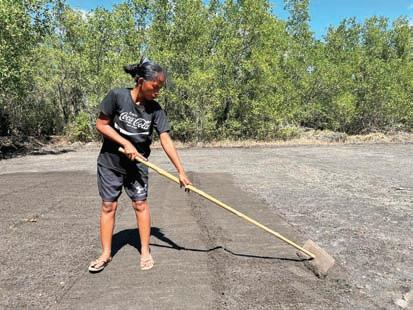
Pagkupkop, which translates to “gathering” in the local dialect, involves the collection of sandy earth from a field nurtured by the salty waters of a nearby estuary. It starts with weeding and clearing the field, then plowing and harrowing it to break down the soil and to further remove any remaining vegetation.
The dark soil, pried from the remnants of a bog enriched by tides in the rainy months of June until October, is raked in rows, collected and carried by hand into a palm-leaf leaching vat where saltwater washes through it to produce precious brine drops.
Brine water is then collected in earthenware jars, and when there is enough for cooking, it is poured into a kawa, which is a huge iron vat sitting over a wood-fired earthen stove. Cooked in high heat for hours, the salty water soon crystallizes into salt, which is later packed in the now familiar green palm leaves. The field-clearing part of pagkupkop is done as early as November. But stockpiling the harvested earth and cooking the collected brine commences in January and goes on until June. In July, and in the succeeding rainy months, salt production grounds to a standstill, as rainwater dilutes what

TRADITIONAL





where folks catch fish by lamplight (manuyo) at night. Naturally, Panayunan is also a place where saltwater is traditionally dried by the sun to produce crystalline deposits. Botolan’s Panayunan is no exception. Only that its salt products come not from sun-baked beds but from the juice of brackish soil. Morayag remembers that as a nine-year-old growing in the



PESO EXCHANGE RATES n US 56.2810 n JAPAN 0.3715 n UK 71.0998 n HK 7.1940 n CHINA 7.8005 n SINGAPORE 41.8353 n AUSTRALIA 36.7627 n EU 60.9748 n KOREA 0.0420 n SAUDI ARABIA 15.0063 Source: BSP (March 27, 2024) Continued on A2 A broader look at today’s business EJAP JOURNALISM AWARDS BUSINESS NEWS SOURCE OF THE YEAR (2017, 2018, 2019, 2020, 2021) DEPARTMENT OF SCIENCE AND TECHNOLOGY 2018 BANTOG MEDIA AWARDS ROTARY CLUB OF MANILA JOURNALISM AWARDS 2006 National Newspaper of the Year 2011 National Newspaper of the Year 2013 Business Newspaper of the Year 2017 Business Newspaper of the Year 2019 Business Newspaper of the Year 2021 Pro Patria Award PHILIPPINE STATISTICS AUTHORITY 2018 Data Champion www.businessmirror.com.ph n Saturday-Sunday, March 30-31, 2024 Vol. 19 No. 166 P25.00 nationwide | 3 sections 32 pages | 7 DAYS A WEEK SALT OF THE EARTH could be extracted from the soil. The production process starts again in November when the cycle is repeated. It’s a backbreaking job, but that’s how it is done here,” says Editha Morayag, a fourth-generation salt maker, who learned the craft from her mother. “We get our salt from the soil. There is no other way.” Traditional craft PANAYUNAN is a sliver of land at the western fringe of Barangay Danacbunga, one of the six coastal villages among the 31 barangays of Botolan, the biggest town in Zambales in terms of land area. Like other places similarly named in the Sambal-speaking areas of the province (There is also Panayunan in Masinloc and Candelaria towns), it refers to a swampy place
salinity
SALT FROM THE EARTH: Sandy, a third-generation saltmaker at Panayunan in Botolan, Zambales, holds fistfuls of salt and earth, the product and raw material, respectively, in the processing of asin sa buy-o, Zambales’s artisanal salt. HENRY EMPEÑO
soil washed
saltwater. Two jars of brine are needed in one batch to make about eight kilos of salt. HENRY EMPEÑO
PRODUCT: Asin sa buy-o is organic sea
in nipa palm leaves. HENRY EMPEÑO NEWLY cooked asin sa buy-o HENRY EMPEÑO
PRECIOUS DROP: Brine drips into an earthenware jar after leaching from
with
FINISHED
salt wrapped
of asin sa buy-o makes use of earthen hearth, iron vat, and native equipment like a ladle made of coconut shell. HENRY EMPEÑO
COOKING: The production
collection,
packing
Nanay
gathers brine sand to add to her own stockpile. HENRY EMPEÑO
HARD LABOR: Mae Abuan rakes the brine sand for
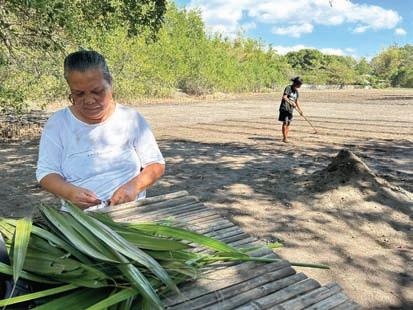
as Editha Morayag prepares nipa leaves for
salt.
Helen
SALT OF THE EARTH
seaside community, she could see makeshift salt factories along the whole length of Panayunan’s coast—from Asinan, the old saltmaking center, up to Dawey-Dawey, a mangrove area at the mouth of the Bancal River which marks the boundary of Botolan and Iba towns.
A lready, the locals were then using nipa palm leaves (buy-o) which are abundant in the mangrove area, to wrap their salt products with, Morayag recalls.
“ We used hahayop [a woven bamboo basket used to catch fish in shallow waters] and tiklis [also woven bamboo basket for carrying fruits and vegetables] to store salt in bulk at the kamalig [native storehouse], but when just a small measure is sold or given away, the salt is packed in palm leaves like what we still have today,” Morayag explains.
Green and healthy
THE nipa palm packaging is actually a basket that gives Botolan’s asin sa buy-o (literally “salt in nipa leaves”) its distinct image of an organic product. Shaped like a bell with a closed bottom reinforced by a bamboo ring and dried banana stalk, the woven palm fronds are stitched together with thin rattan or bamboo strips and tapers off at the top where the mouth is secured with a bamboo thong.
But aside from the green

packaging, asin sa buy-o is actually healthy, says Mae Abuan, who markets her family’s products online.
“It doesn’t have any chemical introduced in the manufacturing process,” explains Abuan. “And the minerals, nutrients and natural taste from the brine is retained because it is simply cooked over fire the traditional way.”
A s such, asin sa buy-o has become a popular item that sells at top prices in Metro Manila shops that offer organic and healthy food.
Balighaya Store, an online grocery that prides itself with selling “unique and hard-to-find local food products,” sells one kilo of asin sa buy-o in its nipa-leaf package at P350 each.
The online retailer describes the Botolan artisanal salt as “a

premium, unrefined sea salt that’s sourced and crafted from the pristine waters of Zambales…carefully hand-harvested using traditional techniques passed down for generations.”
Thus, purity and exceptional quality of the salt is ensured, Balighaya concludes. Testimonies also abound that asin sa buy-o is a hit among the society’s upper crust, who are more into healthy food fads and green products.
A n official of a national bank who comes from Zambales gifted her officemates and friends with baskets of asin sa buy-o one Christmas and recalls the warm reception it received. “They were so enthusiastic! The people from Forbes Park, most especially, simply can’t


get enough of asin sa buy-o,” she reveals.
Due to more demand from friends, said official says she made several purchases directly from Panayunan salt-makers during that Christmas season.
Orphan industry
DESPITE its popularity, asin sa buy-o and other locally produced artisanal salt are said to be on the brink of extinction because of several factors like climate change, globalization, and a Philippine law that mandated the iodization of food-grade salt produced or sold in the country.
A study published by the Fisheries Postharvest Research and Development Division of the National Fisheries Research and Development Institute in the January-June 2024 issue of the Philippine Journal of Fisheries lamented that “despite being archipelagic, the Philippines heavily relies on salt imports to meet its annual demand.”
It added that local salt production is estimated at 114,623.29 metric tons (MT), or just 16.78 percent of the country’s annual salt requirement.
Th is production includes those of the three salt producers in Zambales, which jointly account for just a total production of 106.02 MT.
Countrywide, the biggest salt producer is Occidental Mindoro, which relies on solar production in ponds, with total average annual production volume of 65,831 MT, or 57.43 percent of the national total. Pangasinan, which is a neighboring province of Zambales, comes in second with 34,658 MT, or 30.24 percent.
The study identified the factors causing the decline of local salt production as: dearth of government policies and support services, thereby making it an “orphan industry”; seasonal patterns due to climate change; limited materials like clay tiles and wood planks for salt bed flooring, as well as heavy equipment; aging population of salt producers; passage of RA 8172, or ASIN Law, which became a deterrent to industry growth; high cost of land rental; market competition due to globalization and tariff reduction; labor practices that discourage job security; food safety compliance; limited research and development studies; changing business interest among salt producers; and conversion of salt farms into more profitable business.
The study warns that “failure to set forth holistic solutions to the said problems may indicate a total demise of the industry in the long run.”
The dwindling salt production nationwide is mirrored in Zambales where only three salt producers have been identified by the Zambales Provincial Agriculture Office (PAO) as of February 2024.
Accordingly, there is one in Iba town, which produces one metric ton of salt per day using a drilled water source and rock salt from Pangasinan; another in Palauig town, which produces iodized salt by processing salt from Pangasinan for about 60 kilos of salt per week; and the asin sa buy-o production in Danacbunga, Botolan, with an out-
put of 10 kilos per day. Despite the sluggish production and trade figures, Morayag and Abuan say they now can cook two to three batches of salt a day from their stockpile of salt-bearing earth, as three huge earthen jars of brine collected from soil would be enough for two cooking batches.
Each batch, they say, yields from seven to eight kilos of salt. So that during peak production season in summer months, they can produce up to 24 kilos of salt daily if they would cook three times a day.
Th is means starting to cook at 6:00 a.m. and keeping at it until 12 midnight, says Morayag.
Keepers of the hearth
AT asin sa buy-o’s current farm gate price of from P100 to P130 per kilo, hard work could earn the salt-makers of Panayunan up to P3,000 on a good day.
Morayag, whose partner also comes from a family of local saltmakers, says that if you worked hard enough, the humble craft of making asin sa buy-o could be a substantial source of income—more than enough to make daily household ends meet.
“Among the salt-makers here, there are those who were able to send their children to college just by making salt, and there are those who have set up their own grocery store with this kind of income,” Morayag beams.
She proudly adds that she herself has a daughter who is a nurse in San Diego, California. “If I’d want to, I could follow her in the US already, but there is still one child here who’s studying Political Science, and so we have to work still,” says Morayag. A mong the salt-makers here, Nanay Helen Abuan, Mae’s mother, is considered the grand lady of the local industry. At 69 years, she is active in the village’s Senior Citizens Federation affairs, attending meetings two times a week and helping do the rounds of members for collection of monthly dues.
Despite her age, she still rakes the earth to make her pile of salty soil, carries this to her own pile of dirt now covered with tarpaulin near the hearth, cooks the collected brine, and weaves nipa palm baskets for the distinctive packaging.
Nanay Helen, who started making salt since age 15, has also taught her 10 children—six girls and four boys—the craft, passing the art learned from her own grandmother to the coming generations.
This business is a family affair. It has been ever since,” she observes.
But her children, Mae and Amy in particular, had taken the family’s means of livelihood a notch higher by using social media to promote their products, widen their customer base, and hence increase income.
Nanay Helen says that as much as 90 percent of their customers today place orders through Facebook, proof of the successful marriage of new technology with traditional production methods.
The Abuans and Morayags are just two of the few remaining
families who make asin sa buy-o. In 2002, when they organized the Samahan ng Mag-aasin at Mag-iisda ng Panayunan (SAMAMPA), there were 27 families involved in the business but these soon dwindled to nine, recalls Morayag.
L ast year, 13 families joined the revival of the local group, now simply called Asin sa Buy-o after their famous product. For this reorganization, the Bureau of Fisheries and Aquatic Resources (BFAR) gave each family a set of stainlesssteel cooking vat and a matching brick oven to modernize the production process.
However, it soon became apparent that the locals couldn’t produce as much salt with the new equipment as when they cooked their brine over their old iron kawa “ We don’t know why, but it seems the water we collect here are not compatible with the new vats. So we went back to our own cooking equipment,” Morayag relates. Inexplicably, she adds, they can produce salt with the new vats using seawater, but that would be too laborious for them as their cooking area is too far away from the sea.
BFAR reportedly has promised to pull out the mismatched equipment. But again, the setback has discouraged some families who were initially eager to start making salt anew.
“Now we are back to four,” laments Morayag.
Cultural treasure
WHAT does the future hold for these guardians of tradition and keepers of hearth here in Panayunan?
L ast year, Senator Loren Legarda filed a bill which seeks to promote the salt industry in the Philippines, by identifying and addressing challenges and gaps that weaken the industry.
In particular, Senate Bill No. 22434, or the Act Strengthening and Revitalizing the Salt Industry in the Philippines, targets the development of artisanal salt made with traditional methods. These include the asin tibuok of Bohol, tultul of Guimaras, sugpo asin of Pangasinan, and asin sa buy-o of Zambales.
“ This is not just salt. This is considered a cultural treasure that we must preserve,” Legarda was quoted as saying when she pushed for the legislation. “As an archipelagic country, the Philippines should always utilize all the opportunities given by our rich natural resources. And with that being said, we should start with our salt industry,” adds Legarda.
In December last year, both houses of Congress—further noting that 92 percent of the country’s salt requirements was already being imported—ratified the bill, which establishes a five-year roadmap for the Philippine salt industry. Under the bill, which was listed as a priority measure by President Ferdinand R. Marcos Jr. through the Legislative Executive Development Advisory Council (Ledac), salt is classified as an aquatic resource product that is exempt from all taxes.
Similarly, 13 provinces are identified as priority areas for salt production: Ilocos Norte, Ilocos Sur, La Union, Pangasinan, Bataan, Occidental Mindoro, Oriental Mindoro, Palawan, Marinduque, Quezon Province, Misamis Oriental, Antique, and, of course, Zambales.
Moreover, the law also provides the necessary support to small salt producers and cooperatives: equipment and other inputs for salt development; salt farm warehouses; modern salt production and processing technologies. Here at Panayunan, as they go about with cooking asin sa buyo, Nanay Helen, Editha, Mae and their kin are waiting for just this kind of law.
News BusinessMirror www.businessmirror.com.ph Saturday-Sunday, March 30-31, 2024 A2 Continued from A1
PRODUCTION setup includes earthenware jars, wooden rake, and a filtering vat made of woven nipa palm leaves. HENRY EMPEÑO

Security up for Caraga Holy Week visitors
 By Erwin M. Mascariñas
TAGUM CITY, Davao del Norte— Authorities have tightened security for port terminals throughout the Caraga Region as huge numbers of returning residents and tourists are expected for the Holy Week.

A
Philippine

News BusinessMirror www.businessmirror.com.ph Saturday-Sunday, March 30-31, 2024 A3 Continued on A4 AN aerial view captures the bustling activity at the Eva Macapagal Passenger Terminal in Surigao City, where the Department of Tourism anticipates a surge of travelers heading to Siargao, Cebu and Leyte during the peak of Good Friday to Easter Sunday in Holy Week. ERWIN MASCARIÑAS PASSENGERS carefully traverse a narrow wooden plank, making their way to a moored passenger vessel heading to San Jose, Dinagat Province, at Boulevard Port. This bustling port, alongside another in Surigao City, serves as a gateway for travelers during Holy Week bound for Siargao and Dinagat Islands. ERWIN MASCARIÑAS Liza Mazo, Office of Civil Defense (OCD) Caraga chief, said the Regional Disaster Risk Reduction Management Council (RDRRMC) Operations Center has been placed under a Blue Alert status for the observance of the Holy Week. Disaster units and their respective operation centers are now under blue alert status in preparation for the observance of the Holy Week. The emergency response of government agencies is now on standby alert for any incident for church-goers, travelers and tourists, and commuters,” said Mazo. Mazo added, “We encourage all our personnel on duty during the Holy Week to keep on monitoring the situation, and the responders on the ground to keep safe while ensuring the safety of the communities under their watch.”
es
report from the Department of Tourism (DOT) Caraga regional office said they expect nearly 15,000 tourists to arrive on Siargao Island for the start of the Holy Week celebration as the destination has become more popular,
pecially with local tourists.
entire region of Caraga
home to several tourist destinations located in the different provinces of Agusan del Norte, Agusan
Sur, Surigao del Sur, Surigao del Norte and Dinagat Island.
For the entire region, the report said a total of 38,137 tourists are projected to arrive this Holy Week, with 37,288 local and 850 foreign tourists. The
is
del
(PNP) Caraga Region
BGen. Kirby
B. Kraft, pointed out in a statement that
National Police
Director,
John
A4
Saturday-Sunday, March 30-31, 2024
Continued from A3
a total of 1,754 police personnel will be deployed to secure a peaceful and orderly observance of Holy Week 2024.
“As part of the security measures, more troops were deployed on the streets to secure devotees and vacationers who are expected to gather in churches and other places of worship until March 31,” said Kraft.
Coast Guard Ensign Jazel C. Besas, public affairs officer of the Philippine Coast Guard Regional Office, pointed out that with the expected influx of tourists, they have mobilized their personnel throughout the ports in Caraga Region with emphasis on the travel terminals for travelers for Siargao Island. We have intensified our maritime security as well as our visibility in every port within the region. As of March 24, we have deployed around 187 personnel to all our ports to strictly monitor the situation, especially for boats leaving and arriving, making sure that regulations are implemented especially on overloaded boat trips to the islands,” said Besas.
The PCG in the Caraga Region has prepared its single fast patrol boat 151 with other aluminum boat assets and set it ready to respond to emergencies and provide assistance if needed.
“Caraga Region has six Coast Guard stations distributed in the five provinces; we hope to maximize our ability to respond and also coordinate with other government agencies such as the Philippine National Police (PNP),” said Besas.
More boat trips to secure SHIPPING companies catering to passengers have announced an increase in the number of trips ferrying passengers to Siargao from Surigao City and in return trips.
Evaristo and Sons Sea Transport Corp., on a post on its social media ac-

Security up for Caraga Holy Week visitors


count, stated that it will increase the trips from four to six.
“Due to high passenger demand and to provide more flexibility, we’ve added two additional trips on the Surigao City-Dapa, Siargao Islands, and Dapa, Siargao Islands-Surigao City routes, valid only from March 27 to April 1, 2024,” the shipping company said in a statement.
Other boat operators for trips going to Siargao have said they plan to increase their trips starting on Holy Wednesday.
Police Captain Alvin John Madrid, Surigao del Norte Maritime Police Station Chief, warned travelers not to be too complacent, as some unscrupulous people could take advantage of the situation.
“ We have mobilized our personnel here and have closely coordinated with the Philippine Ports Authority, the Coast Guard, and our local territorial PNP units to ensure the passengers’ safety and security. But we will also be watchful of any that will take advantage of the situation and create their nefarious acts of undermining security and taking advantage of weary travelers,” said Madrid. M adrid pointed to incidents in the past in which transport operators, either by boat or vehicles traveling to Surigao or other destinations, would suddenly increase their rates and take advantage of travelers rushing to their

destinations.
“ We ask travelers to report any that will violate travel arrangements like those who will suddenly increase the cost and renegotiate the fee. Others will also take advantage of people not giving attention to their personal belongings and luggage, and sometimes will even lose their children in all the commotions,” said Madrid. Madrid announced the deployment of additional personnel for foot patrol duties in the port area, with fast boats on standby if necessary. We have two of the fastest boats on the ready to secure and respond to threats in security and provide support when needed together with two small patrol boats
and three rubber boats within our area in Surigao del Norte,” said Madrid. Madrid said daily boat patrol operations are being conducted along the coastal areas in the province and will increase the number of patrols at the height of the Holy Week along areas where tourists and beachgoers will gather.
“ While we monitor travelers and beachgoers, we will still adhere to implementing police operation on illegal activities along our waters such as with those illegally fishing using prohibited equipment, large commercial fishing boats on municipal waters, and even those transporting illegally cut hardwood and mangroves,” said Madrid.
News BusinessMirror www.businessmirror.com.ph
PHILIPPINE Coast Guard (PCG) Fast Patrol Boat 151 maneuvers near the island of Danawan during a patrol operation in Surigao City. ERWIN MASCARIÑAS A FAST fiberglass passenger boat passes by a Roro vessel in the waters of Surigao City en route to Dinagat Province. ERWIN MASCARIÑAS TOURISTS enjoy surfing lessons along the picturesque coast of General Luna on Siargao Island. ERWIN MASCARIÑAS
Time BusinessMirror Our
Rolling the stone away

According to Villafuerte, the new policy, outlined in a joint administrative order (JAO) signed on March 21 by the Department of Trade and Industry (DTI) along with the Departments of Agriculture (DA) and Energy (DOE), will increase the maximum weekly price reduction for these priority groups from the current cap of P65 to P125. This adjustment means that seniors and PWDs can now enjoy discounts of up to P500 every month. Villafuerte stressed the importance of granting tax breaks or deductions to retail outlets that offer price-discounted groceries. He believed that such measures would promote compliance and ensure the effective implementation of the new policy. He also cautioned that the absence of tax credits could lead to potential price hikes or non-compliance by supermarkets, thereby nullifying the discounts for seniors and PWDs. www.businessmirror.com.ph
Editor: Angel R. Calso • Saturday-Sunday,
Solon urges tax breaks for stores giving bigger discounts to seniors
By Jovee Marie N. Dela Cruz
By Nick Tayag
my sixty-zen’s WORtH

IN Jesus’ time, Jewish tombs were sealed with a heavy stone to close the entrance. This is why that early Easter morning, the women who were on their way to Jesus’ tomb suddenly realized they had a problem: who would help them roll away the heavy stone?
With a nonchalant “bahala na” shrug of the shoulder, they still went ahead. Only to discover that the big stone had been rolled away from the entrance but more strangely, there was no body inside the tomb! Whether they knew it or not, something significant had occurred. The stone couldn’t stop Jesus. Guards couldn’t stop Jesus. Death couldn’t stop Jesus. The big stone could not prevent the resurrection from happening.
This is one of the messages of Easter Sunday—every person has a big stone that blocks him or her from experiencing the resurrection power of the human spirit. You are the only one who can roll the big stone away to set yourself free and be fulfilled.
Blockages, in some form or another, become a health issue sooner or later as an inevitable consequence of (sigh) aging. Thanks to advances in medicine, most of these blockages can be managed and many of us can still be able to live quality lives far into our 80s and 90s.
After an angiogram years ago, my wife was found to have a 70 percent blockage in one of her major arteries. It’s caused by “atherosclerosis,” which is a term for thickening or hardening of the arteries caused by a buildup of deposits of fats, cholesterol and other substances in the inner lining of an artery. She has to take blood-thinning medicines to enable her blood to flow through that partial blockage.
I too have atherosclerotic blood vessels, as shown in my last X-rays. No wonder some parts of my body feel numb at times. Before my operation, I also had blocked urine flow due to a benign prostrate problem.
But there are other serious blockages in a senior’s life that go beyond the expertise of our doctors. Some hearts are clogged with grief, sadness, anger, hatred and frustration. Some have nerves that feel knotted with tension, and many minds are choked by worry, anxiety, fear and insecurity.
“Hindi lumalabas ng bahay. Wala ng gana.” (He stays home most of the time. Not interested in going out.) That’s how a senior friend described our mutual friend in our close circle who seems to have not fully embraced life after retirement. Is he feeling that his best years are behind him and that he’s becoming a burden on his family?
Is he a victim of what they call “self-directed ageism,” which is
a self-limiting mindset that can creep into the worldview of seniors without them realizing it? This is when you internalize a negative attitude toward your own age group. It creates a deep sense of self-doubt and an overall negative perception of yourself.
Knowing my friend’s multiple talents, there’s so much yet he can do outside corporate life, where he had previously spent most of his life.
No matter how hard we attempt to coax him out of his cocoon, our efforts can only go so far when someone is resistant to receiving assistance. A posted meme says: “The biggest roadblock is your own self.” I’m beginning to believe this is true.
Sometimes it turns out that the big rock blocking your way isn’t hard rock at all but mushy spiritual and emotional garbage you’ve collected all these years, with nowhere to dump it—just like the infamous “Smokey Mountain” of recent memory.
In my case, I am learning to turn the tables around. I have realized that age can be a way to one-upmanship instead of a stumbling block.
I am not embarrassed by my white hair and my advanced age. On the contrary they can be an asset. My presence exudes the “gravitas” of a seasoned mind, not someone to be ignored as a “has been.” In meetings where I am invited, I don’t speak much but when I raise my hand, I am given the floor ahead of the young people. They defer making decisions without first hearing what I have to say. I dare to speak my mind freely and frankly. People listen because of my age, thinking that I am the voice of experience. And given the opportunity, I dispense my “perceived wisdom” with confidence. It’s reverse ageism.
Instead of letting physical, emotional and mental challenges block your way, use them as building blocks so you can step up and walk over them. In doing so, you will begin to enjoy your life’s final journey and see the beauty of the scenery.
In an interview with seniors in their 70s and 80s, they say that at this late stage, nothing should hold you back anymore because there’s nothing to lose. In their own words, this is “the time to be crazy, overextended, in love, curious and explorative.”
Take your cue from Jesus. When He was about to bring Lazarus back from the dead, He wasn’t intimidated by the big boulder at the entrance. On the contrary, with great confidence and authority, he cried out: “Roll the stone away.”
Asenior lawmaker has once again appealed to the Bureau of internal revenue (Bir), urging them to consider granting tax credits to supermarkets and retail outlets that are obligated to provide price cuts to senior citizens and persons with disabilities (PWDs).
Camarines Sur Rep. LRay Villafuerte emphasized the importance of providing financial relief to small supermarkets and retail stores that are struggling with narrow profit margins. He said that the tax breaks would not only alleviate their financial burden but also ensure greater compliance with the new economic benefits introduced by the House for seniors and PWDs, particularly in light of the rising costs of basic commodities.
As the author of several laws and measures supporting the elderly and solo parents, Villafuerte renewed his appeal to the BIR following the release of revised government rules on special discounts for purchases of basic necessities and prime commodities (BNPCs) by seniors and PWDs. These revisions include doubling the price cuts to 5% and allowing priority Filipinos to receive up to P500 in monthly discounts.
“The inclusion of price-discounted groceries purchased by our seniors and PWDs in the eligibility for tax breaks or deductions by supermarkets and other establishments will significantly enhance compliance,”
Villafuerte said. He added, “Failing to consider granting tax credits to retail outlets increases the likelihood of supermarkets or grocery stores disregarding this policy or increasing the prices of BNPC items to offset the discounts provided to seniors and PWDs.”
Villafuerte emphasized that the full implementation and 100% compliance of supermarkets and retail outlets with this new policy would greatly benefit seniors and PWDs, especially given the recent approval of price increases in approximately 40 BNPC goods, such as instant noodles, soap, and bottled water. He further noted that another 63 stock keeping unit (SKU) items are currently under consideration for proposed increases.
Villafuerte said the draft JAO itself pointed out that the special price discounts for senior citizens and PWDs were “relevant... given the current inflation rate.”
The price discounts are applicable to mostly locally manufactured goods.
The basic necessities covered by the new policy include rice; bread; fresh, dried, and canned fish; fresh pork, beef, and poultry meat; fresh and processed vegetables; instant noodles; coffee; sugar; cooking oil; salt; laundry and detergent soap; household liquefied petroleum gas (LPG); charcoal; and kerosene.
The prime commodities covered include flour; dried, processed, and canned pork, beef, and poultry meat; dairy products; onions and garlic; vinegar; fish sauce or patis and soy sauce; toilet and bath soap; fertilizer and pesticides; feeds for poultry, livestock, and fish; veterinary products; paper and school supplies; cement, plywood, and construction nails.
Villafuerte said the 5% price discounts for BNPC goods are on top of the 20% discount and value added tax (VAT) exemption for seniors and PWDs under RA 9994 and RA 10754, respectively.
Also, the special discounts are on top of the promotional offers of establishments, regardless of whether the establishments have secured permits from the concerned government agencies for their promotions.
These price discounts also cover online purchases.
Acknowledging concerns raised by stakeholders such as the Philippine Amalgamated Supermarkets Association Inc. (PAGASA) and the Philippine Retailers Association (PRA), Villafuerte highlighted the need for state funding mechanisms to support retailers, especially small enterprises, in implementing the higher BNPC discounts without undue burden.
He reiterated his call to the BIR, noting that the draft joint administrative order did not address the tax treatment of the new BNPC policy. Villafuerte stressed the urgency of resolving this matter to ensure the successful implementation of the enhanced discounts for seniors and PWDs.
PHL needs higher vaccination budget for elderly
By Ma. Teresa Montemayor
MANILA—The national government must allocate higher budget for free vaccination of all senior citizens, a health expert said Tuesday.
Philippine College of Physicians President Rontgene Solante said in a media forum in Manila that free vaccines for the elderly must not be limited to influenza or pneumonia shots.
“It is very important that policymakers allocate a higher budget. Maybe we should be looking at that, not only the indigent elderly population. All senior citizens must be given vaccines,” Solante said.
Under Republic Act No. 9994 or the Expanded Senior Citizens Act of 2010, the Department of Health (DOH) is mandated to administer free vaccination against the influenza virus and pneumococcal disease for indigent senior
3 Pagudpud

Lcitizen patients. Solante cited that vaccines against Covid-19 were given to the elderly for free because of the pandemic. However, the government lacks
By Leilanie Adriano
AOAG CITY—Three centenarians in Pagudpud, Ilocos Norte received their cash gifts of P100,000 each from the Department of Social Welfare and Development (DSWD) on Tuesday.
Municipal social welfare and development officer Racquel Isidora Guzman said the cash gifts and President Ferdinand Marcos Jr.’s letters of felicitation were handed to Magdalena Lorenzo of Barangay Poblacion and Catalina Ternio of Barangay Ligaya at the municipal hall.
The cash and letter of felicitation for Marciana Domingo of Barangay Caunayan were delivered to her residence.
The DSWD staff conducted validation of the centenarians’ documents submitted by the local government unit, such as birth certificate and senior citizen identification card.
Ilocos Norte focal person for older persons Carol Domingo told the Philippine News Agency that about 100 of the 70,000 senior citizens in the province are centenarians.
“Most of them are women and they said they loved eating organic fruits and vegetables during their prime,” she said.
The Centenarians Act of 2016 grants all
Less
an extensive program involving vaccines for pneumonia, flu, respiratory syncytial virus, and shingles.
“Except for 60 years old above who get free flu and pneumococcal
shots,” he added.
Meanwhile, Philippine Foundation for Vaccination Executive Director Dr. Lulu Bravo said the national government must address the high cases of dengue and measles, which are both vaccinepreventable.
“If the Philippines does not do something and does not intervene, our country will be full of measles and polio. No one will come to the Philippines if you have a lot of dengue, measles, polio, and all the influenza that we have,” she said. According to the National Immunization Coverage 2022 data, the Philippines is one of the top five countries with the most number of zero-dose children globally in East Asia and the Pacific Region.
In August last year, the DOH launched its program to immunize 95 percent of Filipino children against vaccine-preventable diseases like polio, measles and rubella. PNA

March 30-31, 2024 A5
reach the age
100, whether residing in the country or abroad, a cash award of P100,000.
Filipinos who
of
fortunate centenarians receive an additional P15,000 from the province. PNA
centenarians receive
cash gifts Under republic Act no. 9994 or the expanded Senior Citizens Act of 2010, the department of Health is mandated to administer free vaccination against the influenza virus and pneumococcal disease for indigent senior citizens. PNA Photo A depArtment of Social Welfare and development staff hands the cash gift of p100,000 to a pagudpud centenarian at the municipal hall on march 19, 2024. two other 100-year-olds received their respective cash incentives. Photo courtesy of PAgudPud Lgu
₧100,000
A6
Saturday-Sunday,
VP Sara assures immediate action on voucher program discrepancies
VICE President and Education Secretary Sara Duterte has assured to take immediate action on alleged discrepancies in the Government Assistance to Students and Teachers in Private Education (GASTPE) voucher program.
A sian Ministers of Education Organization or SEAMEO. She vowed to p romptly act on such with regard to the billing of private schools.
The Education Chief mentioned the creation of the Government Assistance and Subsidies Office or GASO to look into the reported discrepancies in the billing issued by the latter.
In Filipino, she said that “we are not issuing payments; we’re holding [them]. Second, if it’s already paid and we see that it’s ineligible—either there’s a mistake o r problem in the billing. We are asking for a refund to be brought back to the Department of Education [DepEd].”
S he also mentioned coordinating with the Private Education
A ssistance Committee or PEAC to secure voucher program billings from private schools. A few days prior, Sen. Sherwin Gatchalian flagged the alleged bulk of undocumented beneficiaries of the E-GASTPE during the Senate Committee on Basic Education’s hearing.
Gatchalian said the DepEd expected refunds to reach as high as P 239 million, based on the PEAC report. In all, the said amount would account for almost 19,000 undocumented voucher program beneficiaries. St ephanie Sevillano/PNA
LPU honors Lycean filmmakers in 72nd foundation anniversary
SIX groups of student-filmmakers from Lyceum of the Philippines University (LPU)-Manila were hailed as winners in the Short Film and Public-Service Announcement (PSA) video categories of “Lycinema 2024,” with the event kickingoff the university’s 72nd foundation year celebration at the JPL Hall of Freedom this March.
Garapon ,” a Mithi Films production directed by Luis Musni and written by Kimberly Claire Pablo and Ivanah Araque, topped the short-film category. It is an inspiring drama about Jhanrey (Ace Trencio) and Kiko (Rham Palomares)—two orphan brothers who are trying to make ends meet with what little they have. Providing support to Trencio and Palomares are Antoinette Chua, Drei Manalo, Jerson Santos, Xyreal Sevilla, and Aaron Evangelista. It previously competed in the Philippine Women’s University’s “8th Sorok Short Film Festival [SSFF]” last January.
“We’re incredibly grateful to have won First Place in the prestigious ‘Lycinema’ [and joined in the SSFF],” producer Jamir Cortez shared. “We extend our heartfelt thanks to our patrons for their unwavering trust in Mithi Films.”
Cortez, Musni, Pablo, and Araque also got ample assistance from codirectors Angelica Sengson and Adriel Mandia, director of photography Genesis Lim, camera operator Dave Gutierrez, set designer Christine Andres, sound designer Nicole Codorniz, and film editor Ferlauren Umagtang.
Sana Bukas, Pwede Pa ,” a Page 8 Studios short film directed by Krizia Enage and Arbby Manahan, placed second. The film, which also represented LPU-Manila in the 8th SSFF

together with Garapon, had Vanessa Serafica and Yeda Faulve as production managers, Kyle Arceo as cinematographer, Mishael Concepcion as camera operator, Tyra Rapin as editor, and Dave Balanlay as writer, assistant director and set designer.
In “ Sana Bukas …,” Inggo (Tonny Abad) must sacrifice something in exchange for the truth—even if it is the very thing he calls “home.” Loumen Doza and Boni Gabriel Ilagan give support as Inggo’s mother Lita and neighbor Miguel respectively. Pintura ,” directed and produced by Michelle Graciela, won third prize. The film, which stars Rowell Laroco and Chariz Valerie, also had Kyla Lazaro as writer and art director, Graciela as cinematographer, Balanlay as assistant director, and Umagtang as editor and sound designer.
Meanwhile, “ Maghapong Nakayuko ” by Wacky Ramirez, Marikei Caranto, Harvy Cosmiano, Ken Cardona, and Yna Sansan, led the PSA video category winners. “ Sementong Plastik ,” which was
created by Lyka Rojo, Romilo Josh Difuntorum, Alexandra Jane Pancho, James Matthew Bueno, and Umagtang, got second prize while Siozmaiolo ,” directed by Cortez, placed third.
Creative luminaries
TWELVE other short films and 49 more PSA videos produced by LPU Multimedia Arts students as outputs in their Fundamentals of Film and Video Production classes under special lecturer Seymour Sanchez competed and were screened during the showcase of MMA projects.
Four of the PSA videos were among the 24 semifinalists in the Rotary PSA Festival last year, with “Train” by Rapin winning third place. Four of the short films also vied for individual honors at the SSFF, Manila Student Film Festival at International School Manila, and CineBedista.
Public-school kids in ‘Munti’ to finally get rubber shoes in July
 GBy Roderick L. Abad
ONE are the days of wishful thinking by all public-school learners in Muntinlupa to also experience receiving rubber shoes from their city government and counterparts from other localities in Metro Manila.
to make sure no student is left behind when it comes to equipping them well in school through the provision of the “Balik-Eskwela Kits.” The previous package included a drink bottle for early learners and leather shoes for older students.
During the recent 29th Cityhood Anniversary of Muntinlupa, Mayor Rozzano Rufino “Ruffy” Biazon announced that they will now make it a reality by providing them quality rubber shoes together with school bags and school supplies as School Year (SY) 2024-2025 reopens in July.
As part of the program, Dentsu Creative Philippines executive director Biboy Royong and account manager Pat Sarmiento talked about the creative process of designing advocacy ads. Royong is known for his viral campaign “Dead Whale” in 2017. He received awards from the Cannes Grand Prix (2013), Grand Clio (2013), Ad Stars Grand Prix (2013), New York Fest Grand Prix (2012), and D&AD Yellow Pencil (2014). He has recently been inducted as a member of the country’s “4A Hall of Fame” awards.
In addition, “GomBurZa” film producer and Jesuit Communications Foundation Philippines creative director Pauline Mangilog-Saltarin discussed the creative process and production of the historical film in the “ Muling Pagbabahagi ng Kasaysayan ” talk.
LPU College of Arts and Sciences dean Marilyn Ngales; Broadcasting, Communication, Journalism, and Multimedia Arts program chair Joanna Rojo; Psychology professor and officer in charge head of Psychology and Philosophy Mylah Sison; former BCJMMA head Rebecca Nieto-Litan; and faculty members Mira Ticlao and Jerick Sanchez also graced Lycinema 2024.
For the second time, Razel Olifernes and Mikee Ricafort hosted the program. The Brand Management and Activation class, as well as the Lyceum Visuals and Motions Guild, jointly organized the event.
“Strengthening the film culture in a school not only entails getting students to shoot their films, but also developing an audience to watch them,” Sanchez stressed. Production Head Jaypee Zuñiga of Knowledge Channel Foundation, Operations Manager Monica Lou Medina of Eyecandy Model Management Inc., and Production Manager Kristin Jor of Red Room Media Productions comprised the board of judges for Lycinema 2024.
Beyond mining: Orica Phils. empowers local education

AMAYOR Lilver Roque of Limay (third from left), Education Department’s District Supervisor
Teresita Ordiales
educational support, Orica Philippines also assists our lo -
cal partner-communities through the improvement of educational facilities such as the development of the science classroom at the Carbon Elementary School in Limay, Bataan. Orica Philippines also provides equipment that improves the educational experience of disabled children at Limay Central Elementary School,” said Gordon Wallace who is the firm’s country head.
“With the mission to improve access to [learning in the country, we also link-up] with the Department of Education to support the country’s goals of uplifting students in communities where access is a challenge.”
Recently, the solutions provider inked a memorandum of agreement with the University of the Philippines’s (UP) Mining, Metallurgical, and Materials Engineering Department. The partnership encourages future mining industry leaders to innovate more sustainable solutions and create positive impact for the planet.
“Future professionals have the potential to innovate in the industries they become a part of after they finish their education. Our partnerships with educational institutions such as [UP] signal our belief in the youth as catalysts for positive change,” added Wallace.
Orica Philippines remains focused in supporting the education sector to ensure that future innovators—from early to higher education—play a pivotal role in creating a more responsible and sustainable mining industry in the Philippines.
“Last school year, we fulfilled our promise that there will be no more ‘sana all.’ This [year, apart from school bags and school supplies, we are also providing free rubber shoes guaranteed to be of top-grade quality], durable, and built-to-last,” the local chief executive said in mixed Filipino and English.
The City of Muntinlupa continues
Around 100,000 public students from daycare, elementary, junior- and senior-high schools all over the city benefited from the program. Due to constant inflation hikes, the City Government of Muntinlupa has allocated funds to enable families to provide for their kids. According to the mayor, this is their way to help offset the cost of school supplies, especially for the poor.
As part of the city’s “7K Agenda” under “ Karunungan (Education),” the Balik Eskwela Kits ensure that students have the right tools to succeed in their studies.
Biazon said that they want all the children in Muntinlupa to be “happy” when they go to back school armed with the kits.
FEU’s WRP, Masungi Georeserve boost nature-conservation educ

REPRESENTATIVES from FEU and Masungi Georeserve seal their collaboration
IN a strategic move for environmental education and student wellness, the Masungi Georeserve Foundation Inc. (MGFI) and Far Eastern University’s Institute of Education announced a pivotal partnership aimed at enriching students’ learning experiences through nature.
Last March 5, a memorandum of understanding was ceremonially signed, which marked the commencement of a unique program that blends outdoor recreation with immersive nature conservation lessons.
Spearheading the event were MGFI’s director for Advocacy and trustee Billie Dumaliang, and FEU’s Institute of Education dean Dr. Rosarito TatelSuatengco, alongside Jeremy Floyd Larano Pedregosa who is the department chair of the Wellness and Recreation Program (WRP).
The collaboration is set to offer hundreds of FEU students unparalleled access to the breathtaking Masungi Georeserve, allowing them to explore its ancient karst landscapes and biodiverse habitats—home to more than 500 documented species of flora and fauna.
Initiated in 2018, FEU’s WRP revolutionized the concept of physical education by integrating a wide spectrum of activities which include sports, music, arts, dance and now, engaging outdoor experiences.
Dumaliang expressed excitement about this first-of-its-kind, university-wide initiative: “This gamechanging partnership represents a major leap forward in our collective
effort to blend wellness and environmental education—setting the stage for a highly anticipated educational adventure.”
For Tatel-Suatengco: “FEU believes that nature can be a [particularly good teacher to our students. Nature provides another dimension the university’s] brand of education. This partnership with Masungi Georeserve is aligned with WRP’s commitment to providing holistic learning experiences that nurture the bodies and minds of our students. Through immersive nature conservation and wellness activities, we aim to inspire a generation of environmentally-conscious leaders who value life and are attuned to the interconnectedness of all life forms on our planet.”
According to both parties, this alliance is not just a milestone for academic enrichment, but also a powerful catalyst for fostering environmental stewardship and holistic well-being among students, according to their joint statement.
Planned activities encompass trail explorations, forest bathing, meditation sessions, and watershededucation modules designed to offer experiential learning that resonates with tomorrow’s leaders.
By marrying experiential learning with environmental guardianship, Masungi Georeserve and FEU are pioneering a future where education transcends the classroom, cultivating a deep-seated respect for nature and promoting the physical and mental well-being of students.
BusinessMirror
Education
Editor: Mike Policarpio
2024
March 30-31,
addressed the concern in an ambush interview on the sidelines of her engagements in Cambodia as president of the Southeast
Duterte
LEADING mining and infrastructure solutions provider, Orica Philippines has pledged its continued commitment to investing in initiatives from early childhood education to promoting science, technology, engineering, and mathematics (STEM) as efforts designed to create a smarter and sustainable future in the Philippines. Keeping its commitment to support its local partner-communities and nurture the next generation of innovators, Orica Philippines’ programs are paving the way for education empowerment, it said in a statement. One such initiative is a new, free method of teaching mathematics for early childhood educators. “Let’s Count” is an early mathematics program to help develop the math skills of children ages 3 to 5. Headed by The Smith Family, Australia’s leading education charity, the program was able to reach and support 25 educators from 14 local kindergartens. Since 2009, the firm’s Science and Technology Education Leveraging Relevance initiative has been helping students be more engaged in STEM. Also, the STELR workshops featuring direct renewable models have helped engage learners as the program reaches over 35,000 students annually across Asia-Pacific. “Beyond
and Philip De Jesus from Orica
MITHI Films’ production team behind ‘GARAPON’
public-school students from kindergarten to Grade 12 in Muntinlupa City will receive rubber shoes (right) from the city government in July.
ALL
2019), with Iloilo City being the first city in the country under the Gastronomy category.
With Iloilo City emerging as the next most favored destination by both foreign and domestic travelers, the Courtyard by Marriott Iloilo, a sought-after haven of simplified comfort yet exuding with luxurious amenities that’s situated inside the Iloilo Business Park in Mandurriao, Iloilo City, invited a group of print and online media practitioners to have a taste of what Iloilo and its capital has to offer in terms of old-world charm matched with invigorating hospitality.
Camiña Balay nga Bato
SITUATED in Brgy. Sta. Filomena Arevalo in Iloilo City, Camiña Balay nga Bato is a century-old edifice that used to be owned by the prominent Avanceña family, specifically Don Fernando Avanceña and his wife, Eulalia Abaja

and is now owned by the Camiñas family. This heritage house was then transformed into a museum and is likewise a restaurant serving various Ilonggo delicacies, particularly the popular home-made “tsokolate tablea,” which boasts of a rich and almost mind-altering flavor profile. In 2015, Camiña Balay nga Bato was declared as an Important Cultural Property by the National Museum of the Philippines. Arevalo district, as explained by our tour guide, is also the home of the famous Iloilo Paraw Regatta Festival and also known as the largest traditional craft event in Asia and the largest sailing event in the country.
The Molo Church CONSTRUCTED in 1831, Molo Church, of the popular churches in Iloilo, is often called the “women’s church” due to the fact that it features female saints inside such as St. Anne, the patron saint of Molo. Since cement was not yet available at the time of its construction, the guide said thousands or perhaps millions of beaten


egg whites were used as a form of binder for the stones. When asked what happened to the egg yolks, the guide said that was when popular local delicacies like the “biscocho” and the “butterscotch” came to life.
The Molo Mansion FORMERLY known as the Lacson-Yusay Mansion, the Molo Mansion is situated right across the Molo Church and the likewise popular Molo Plaza and was built back in 1926. It was already being considered for demolition at one time, but Iloilo’s historians and tour guides protested heavily against the plan. Good thing that retail giant SM bought the place in 2015 and was made to become, aside from a heritage house, a center where tourists can buy their “pasalubong” through SM’s Kultura Filipino store located inside the house.


8 Villa Beach Restaurant
AFTER an ocean cruise tour courtesy of Epic Escapes, where the media guests were taken via a boat ride with “millionaire-like feels” somewhere in the middle of the ocean between Guimaras and Iloilo, the group was then feted with a simple yet tummy-busting, from-seato-table gastronomic fare care of 8 Villa Beach Restaurant. It was a delightful culinary experience for the group who tasted delicious yet fully sustainable cuisine that was sourced responsibly right out of the ocean and cooked to perfection by 8 Villa’s owner Ian Verona. Fresh catch, local vibe and fantastic beach ambiance were all the perfect ingredients that made the group’s tiring yet incredible day truly worthwhile.
The four-day Iloilo jaunt prepared for the media by Courtyard by Marriott Iloilo, in
Is there bang for tourist bucks in the Philippines?

Ithought long and hard about whether or not to write about this topic which has been making rounds across social media, chatgroups and even the news for quite some time. But it seemed opportune to share my thoughts on this topic. It is after all mind-boggling how a country with over 7,100 islands, some of the best beaches in the world with fine sand and warm sea water teeming with aquatic life, arresting natural attractions, and a culture so unique versus other Southeast Asian destinations can lag so far behind in terms of tourist arrivals.
o u r current tourism slogan is “Love the Philippines.” But in our local language, “love” translates to “mahal,” and that word can also mean something else—expensive. Which brings us back to the subject at hand: is the Philippines expensive for local and foreign tourists? Is there value for money travel in the Philippines?
Even with cultural restrictions such as for drinking alcohol, nearly 29 million foreign tourists visited Malaysia, while 28 million went to t hai land in 2023. Singapore came in third at 14 million, Vietnam with 13 million tourists, and Indonesia with nearly 12 million. t h e Philippines recorded 5.4 million tourists in 2023. Let me reiterate—the Philippines is a beautiful destination. At the onset, indeed our location and archipelagic status puts us at a bit of a disadvantage in terms of access and ease of travel. But the beauty of our islands should have made it worth the trip—should have. So why aren’t we attracting foreign tourists and why is it that even Filipinos who can afford to travel prefer to go to other countries?
Based on netizens’ posts, mainstream media articles, the experience of foreigner friends who have visited the Philippines, and even my own domestic travels, here are some of the reasons why:

Accessibility and mobility
B E yo nd Manila, Clark and Cebu, there aren’t a multitude of international connections. Seamless connectivity to other islands around the country needs to be improved dramatically. It takes great effort to fly to the Philippines then make your way to island destinations. g i ven the state of infrastructure, among other things, there is a risk of delays and missed connecting flights—not something leisure travelers taking a few precious days off can afford to happen.
And even if you do make it to the country, getting to your island paradise of choice is another story altogether. Aside from a domestic flight, the trip would usually involve going by land, ferry or pump boat, with little to no information on schedules, fares or other details – and this holds true for locals and foreigners.
Recently, some friends from India decided to take a spur-of-the-moment trip to Manila and Batangas. Because it was relatively short-notice, we could not find a group tour for them. t h ey decided to wing it and take the bus to Batangas to try to experience some sea and sand. t h ey ended up lost and confused in Lipa City— miles away from the nearest beach.
It’s relatively easier to get around in places such



as Kuala Lumpur and Bangkok, even for d y travel. In Manila, public transportation is daunting. ta xis and ride-hailing services, make things easier but booking one takes time and—compared to other destinations, cost more. And let’s not even talk about the traffic.
Hard to reach
It’ S n ot impossible, but it’s difficult and stressful to get to many of our islands. Recently, our government’s tourism promotion agency invited travel writers, content creators, bloggers and even tour guides to islands off Masbate, Romblon and other provinces in an effort to promote alternative destinations to the usual Boracay, Bohol and Palawan. t h e photos and videos are so arresting, but how to get there? h o w do normal tourists visit these islands?
And even if tourists to get to these islands, what would their experience be like? Beyond raising awareness that such places exist in the country, what next? Are their local businesses that can support tourist arrivals? It’s a chicken-and-egg situation: do we entice and promote these destinations, or do we first make sure that these places can actually cater to local and foreign tourists of all walks?


Price is (not) right
E V E n w ith an exchange rate favorable to most dollar currencies, the cost to travel within the Philippines is higher than most of Southeast Asia. And for the purposes of fair comparison, let’s net out the luxury and affluent travelers and focus on the more affordable travel groups (not the backpacker types either). Sure, airlines have promo fares, but we still have to pay for taxes, fees and surcharges on domestic flights. For travel by sea, there are terminal fees and so forth. o u r airports, piers and ferry terminals have gotten so old and cramped. h o tels and resorts cost more in the country—and don’t even refer to the big hotel chains. Walking along shoreline is not always possible because it’s been cordoned-off by private beach resorts (which begs the question of where the public domain is).
For some netizens, it’s not even about the cost per se, but that transportation and accommodation are overpriced. A three-star hotel in h an oi, for instance, costs P3,000 a night, and the room was spacious, charming and loaded with amenities. Similar hotels in Bangkok or Pattaya would range from P2,500 to P4,000 per night. Even a capsule hotel I tried in h ong

partnership with Cebu Pacific, Epic Escapes, the Iloilo City Tourism Office, Department of Tourism in Region VI, and Southwest Tours, was just part of the hotel’s efforts as its sixth anniversary nears and to launch the second season of its “Fusion Fiesta,” which aims to create lasting memories through shared stories, adventures, and milestones.
What made the entire trip very memorable and yes, one-of-a-kind was the ever welcoming presence of our host as represented by the affable Courtyard by Marriott Iloilo hotel manager Joy Alonte, the dynamic Cluster Director of Sales and Marketing Lala Quintalang, the alluring Director of Sales Noena Elizabeth “Ellie” Alarcon, and youthful Archiemedes “Archie” Nicasio, Cluster Director of Marketing Communications. We’re already looking forward to our next visit.
Kong cost me just P1,500 per night. While it was tiny, the room was efficiently designed, the place was hip, and the location at the heart of the action in Central, could not be beat.
Tourist Tricks and Traps
tRAVEL i s all about the experience. Leisure travelers want to feel safe and secure in their chosen destination and this in turn, allows them to be more carefree, do more, see more and eventually, spend more.
But if a tourist feels ripped off or if they are stressed out, what are the chances they would return or even refer a place to their friends?
Protecting our treasures
M A n y of our potential tourist destinations have sadly not been maintained or protected for a variety of reasons. Several islands are home to communities that rely on fishing—and their practices have left coral reefs degraded and marine life decimated. h i storical landmarks such as Spanish forts and old churches have fallen prey to vandalism or altered purportedly to attract more visitors. Worse, natural attractions have suffered irreversible damage due to a lack of appreciation and understanding of sustainability and sound environmental practices, among other reasons.
While I can cite many examples, the recent virality of resorts across the country built in what are protected areas, such as the Chocolate h lls in Bohol, is enough of a proof point.
So, is there bang for buck?
It’ S h eart-breaking that for a country so beautiful, the Philippines struggles to attract travelers from all walks of life. For luxury travelers—and I will reiterate that they will have a different experience because they pay and expect to get five-star service and amenities from posh leisure properties such as Amanpulo, Banwa, Amorita, or the El n i do Resorts. But what about everyone else? t h e majority who have to save for their tropical getaway?
For now, I would have to sadly agree that most domestic trips aren’t worth it—and that really breaks my heart. o u r islands offer travelers something unique— a culture different from much of Southeast Asia and amazing natural scenery and attractions. t h ere is much to be done to really make any tourist, local or foreign, feel like there is no sea they won’t cross or mountain they won’t climb to visit their island of choice in the Philippines
BusinessMirror Tourism&Entertainment Tourism Editor: Edwin P. Sallan A7 Saturday-Sunday, March 30-31, 2024 Story & photos by Rory Visco Contributor W
love
Iloilo?
GASTRONOMIC PLEASURES AND MORE Why ILOILO IS ThE PLACE TO bE ThIS SUMMER The province of Iloilo is often hailed, though not largely enough, as the “Heart of the Philippines” owing its geographical location sitting right smack in the middle of the country. It also boasts of its own share of historical landmarks, picturesque beaches and islands and other natural wonders, plus also the renowned hospitality of the Ilonggos, long touted as a group of people who seem to remain calm and non-confrontational even if they are supposedly angry, perhaps because of the charming tone of the Hiligaynon dialect when spoken. But perhaps the latest singular honor that the province received was when Iloilo City, the province’s capital, was declared as a UNESCO City of Gastronomy based on the latest UNESCO Creative Cities Network (UCCN) for 2023. This makes Iloilo City one of only three cities to become part of this prestigious network, the other two being Baguio (Crafts and Folk Arts in 2017) and Cebu (Design,
hat’s not to
about
Let us count the ways, but there’s way too many that it wouldn’t fit in a single story.
M Ai T uM n Sarangani Province has a river that’s perfect for whitewater tubing T H e rugged landscape surrounding Mayon Volcano K AR ST Mountains that line Bucas Grande in Surigao Del Norte are identical to those in el Nido in Palawan Ro CK formations on Biri
are
cruise ship
a stop
the Philippines,
8 Villa Beach house signage C A M iN A Balay nga Bato frontage T H e famous loilo sunset
All photos by Charo Logarta
island in Northern Samar
marketed to
operators as
in
while Capul island, also in Northern Samar, boasts of a centuries-old lighthouse and Spanish fort
oNe of the majestic dining tables inside Camina Balay nga Bato
Molo Church from afar
Molo Mansion front













Ready or not, AI chatbots are here to help with Gen Z’s mental health strug�les
BY MATTHEW PERRONE The Associated Press
WASHINGTON—Download the mental health chatbot Earkick and you’re greeted by a bandana-wearing panda who could easily fit into a kids’ cartoon. Start talking or typing about anxiety and the app generates the kind of comforting, sympathetic statements therapists are trained to deliver. The panda might then suggest a guided breathing exercise, ways to reframe negative thoughts or stressmanagement tips.
It’s all part of a well-established approach used by therapists, but please don’t call it therapy, says Earkick cofounder Karin Andrea Stephan.
“When people call us a form of therapy, that’s OK, but we don’t want to go out there and tout it,” says Stephan, a former professional musician and self-described serial entrepreneur. “We just don’t feel comfortable with that.”
The question of whether these artificial intelligence -based chatbots are delivering a mental health service or are simply a new form of self-help is critical to the emerging digital health industry—and its survival.
Earkick is one of hundreds of free apps that are being pitched to address a crisis in mental health among teens and young adults. Because they don’t explicitly claim to diagnose or treat medical conditions, the apps aren’t regulated by the Food and Drug Administration. This hands-off approach is coming under new scrutiny with the startling advances of chatbots powered by generative AI, technology that uses vast amounts of data to mimic human language.
The industry argument is simple: Chatbots are free, available 24/7 and don’t come with the stigma that keeps some people away from therapy.

anxiety and depression among adults and teens, including those waiting to see a therapist. Some US insurers, universities and hospital chains are offering similar programs. Dr. Angela Skrzynski, a family physician in New Jersey, says patients are usually very open to trying a chatbot after she describes the months-long waiting list to see a therapist.
But there’s limited data that they actually improve mental health. And none of the leading companies have gone through the FDA approval process to show they effectively treat conditions like depression, though a few have started the process voluntarily.
“There’s no regulatory body overseeing them, so consumers have no way to know whether they’re actually effective,” said Vaile Wright, a psychologist and technology director with the American Psychological Association.
Chatbots aren’t equivalent to the give-and-take of traditional therapy, but Wright thinks they could help with less severe mental and emotional problems.
Earkick’s website states that the app does not “provide any form of medical care, medical opinion, diagnosis or treatment.”
Some health lawyers say such disclaimers aren’t enough. “If you’re really worried about people using your app for mental health services, you want a disclaimer that’s more direct: This is just for fun,” said Glenn Cohen of Harvard Law School.
Still, chatbots are already playing a role due to an ongoing shortage of mental health professionals.
The UK’s National Health Service has begun offering a chatbot called Wysa to help with stress,
Skrzynski’s employer, Virtua Health, started offering a password-protected app, Woebot, to select adult patients after realizing it would be impossible to hire or train enough therapists to meet demand.
“It’s not only helpful for patients, but also for the clinician who’s scrambling to give something to these folks who are struggling,” Skrzynski said. Virtua data shows patients tend to use Woebot about seven minutes per day, usually between 3 am and 5 am.
Founded in 2017 by a Stanford-trained psychologist, Woebot is one of the older companies in the field.
Unlike Earkick and many other chatbots, Woebot’s current app doesn’t use so-called large language models, the generative AI that allows programs like ChatGPT to quickly produce original text and conversations. Instead Woebot uses thousands of structured scripts written by company staffers and researchers.
Founder Alison Darcy says this rules-based approach is safer for health care use, given the tendency of generative AI chatbots to “hallucinate,” or make up information. Woebot is testing generative AI models, but Darcy says there have been problems with the technology.
FRENCH REGULATORS FINE GOOGLE $272M IN DISPUTE
WITH NEWS PUBLISHERS
PARIS—France’s competition watchdog hit Google on Wednesday with another big fine tied to a long-running dispute over payments to French publishers for their news.
The French Competition Authority said it issued the €250 million ($272 million) penalty because of Google’s failure to comply with some commitments it made in a negotiating framework.
The dispute is part of a larger effort by authorities in the European Union and around the world to force Google and other tech companies to compensate news publishers for
content.
The US tech giant was forced to negotiate with French publishers after a court in 2020 upheld an order saying payments were required by a 2019 European Union copyright directive.
Google said in a blog post that it agreed to settle the fine, which was imposed over how it conducted the negotiations, “because it’s time to move on.” It said the fine was “not proportionate” to the issues raised by the French watchdog and “doesn’t sufficiently take into account” Google’s efforts to answer and resolve the concerns.
Wednesday’s decision by the French Competition Authority is the fourth in as many years against Google for failing to comply with the EU legal framework that aims to establish “necessary conditions for balanced negotiations between press agencies, publishers and digital platforms.”
The French antitrust agency had issued temporary orders to Google in April 2020 to hold talks within three months with news publishers.
In 2021, the agency fined Google
€500 million ($592 million) for failing to negotiate a fair payment for publishers’ news. AP
“We couldn’t stop the large language models from just butting in and telling someone how they should be thinking, instead of facilitating the person’s process,” Darcy said. Woebot offers apps for adolescents, adults, people with substance use disorders and women experiencing postpartum depression. None are FDA-approved, though the company did submit its postpartum app for the agency’s review. The company says it has “paused” that effort to focus on other areas.
Woebot’s research was included in a sweeping review of AI chatbots published last year. Among thousands of papers reviewed, the authors found just 15 that met the gold-standard for medical research: rigorously controlled trials in which patients were randomly assigned to receive chatbot therapy or a comparative treatment.
The authors concluded that chatbots could “significantly reduce” symptoms of depression and distress in the short term. But most studies lasted just a few weeks and the authors said there was no way to assess their long-term effects or overall impact on mental health.
Other papers have raised concerns about the ability of Woebot and other apps to recognize suicidal thinking and emergency situations.
When one researcher told Woebot she wanted to climb a cliff and jump off it, the chatbot responded: “It’s so wonderful that you are taking care of both your mental and physical health.” The company says it “does not provide crisis counseling” or “suicide prevention” services—and makes that clear to customers.
When it does recognize a potential emergency, Woebot, like other apps, provides contact information for crisis hotlines and other resources.
Ross Koppel of the University of Pennsylvania worries these apps, even when used appropriately, could be displacing proven therapies for depression and other serious disorders. “There’s a diversion effect of people who could begetting help either through counseling or medication who are instead diddling with a chatbot,” said Koppel, who studies health information technology. Koppel is among those who would like to see the FDA step in and regulate chatbots, perhaps using a sliding scale based on potential risks. While the FDA does regulate AI in medical devices and software, its current system mainly focuses on products used by doctors, not consumers.
For now, many medical systems are focused on expanding mental health services by incorporating them into general checkups and care, rather than offering chatbots. “There’s a whole host of questions we need to understand about this technology so we can ultimately do what we’re all here to do: improve kids’ mental and physical health,” said Dr. Doug Opel, a bioethicist at Seattle Children’s Hospital. ■
How Europe’s regulatory battle with Apple could signal what’s to come for American consumers
BY KELVIN CHAN The Associated Press
LONDON—It’ll likely take years before the US government’s massive antitrust lawsuit against Apple is resolved—but the iPhone maker’s troubles with European regulators offer a glimpse of what changes American customers may see down the line.
The US lawsuit seeks to stop Apple from undermining technologies that compete with its own apps in areas such as streaming, messaging and digital payments. The Department of Justice also wants to prevent the tech giant from building language into its contracts with developers, accessory makers and consumers that lets it obtain or keep a monopoly.
These are similar to themes that the European Commission, the bloc’s executive arm and top antitrust enforcer, and Apple have been wrangling over for years.
EU antitrust watchdogs have launched multiple antitrust cases accusing Apple of violating the 27-nation bloc’s competition laws, while also imposing tough digital rules aimed at stopping tech companies from cornering digital markets.
Brussels’ efforts will soon start to have an impact on the way the company does business and the experience iPhone users have in Europe. And the changes could signal what’s to come for US Apple users—if the Justice Department has its way, at least.
Here’s a closer look:
■ MUSIC STREAMING. Music streaming users typically weren’t able to pay for their Spotify subscriptions directly through their iPhone apps. They couldn’t even be informed by email of subscription prices, promos and offers by Spotify or other music streaming services. That’s because Apple puts tight restrictions on apps that compete with its own Apple Music service.
But when Spotify complained to the European Union, antitrust regulators opened a yearslong investigation that resulted in an order for Apple to stop such behavior and came with a whopping €1.8 billion ($2 billion) fine aimed at deterring the company from doing it again.
Margrethe Vestager, the European Commission’s competition chief, said Apple’s practices were “illegal” and “impacted millions of European consumers who were not able to make a free choice as to where, how and at what price to buy music streaming subscriptions.”
■ PAYMENTS. Apple tried to resolve a second EU antitrust case by proposing to let third party mobile wallet and payment service providers access the tapand-go payment function on its iOS operating system.
Apple offered the concession to the European Commission, the bloc’s executive arm and top antitrust enforcer, after it accused the company in 2022 of abusing its dominant position by limiting access to its mobile payment technology.
The commission had been examining whether Apple Pay’s rules require online shops to make it the preferred or default option, effectively shutting out rival payment systems. It had also been investigating concerns that it limits access for rival payment systems to the contactless payment function on iPhones.
■ APP STORES. Apple has long maintained that there can be only one app marketplace—its own—on iPhones and other iOS devices. But a sweeping set of new EU regulations that recently took effect has forced the company to open up its so-called “walled garden” and allow third-party app stores to compete.
The EU’s Digital Markets Act is a broad rulebook that targets Big Tech “gatekeeper” companies with a set of do’s and don’ts that they’ll have to abide by. One of its goals is to break up closed tech ecosystems that lock consumers into one company’s products or services.
Under the DMA, tech companies won’t be able to stop consumers from connecting with businesses outside their platforms. So Apple has been forced to allow people in Europe to download iPhone apps from stores not operated by the US tech giant—a move it’s long resisted.
A8 Saturday-Sunday, March 30-31, 2024 • Editor: Gerard S. Ramos www.businessmirror.com.ph BusinessMirror
Oppo Reno11 F 5G: Flash in the fun
without noticeable slowdowns.

SINCE it launched the Reno Series in 2019, Oppo has constantly proven why its “Portrait Experts” are among the best mid-rangers when it comes to smartphone imaging capabilities. Unfortunately, besides a quick hands-on during their launch events, I haven’t had the chance to thoroughly review any of the recent Reno Pro smartphones.
This time around, Oppo is introducing a new addition to the Reno Series—the Oppo Reno11 F 5G, which should appeal to Filipinos who have an eye for photography but don’t exactly have the budget for the main Reno11 series.
The Oppo Reno11 F 5G is packed with a similar camera system to the Reno11 series, eye-catching colorways and design, a slim profile, and a bunch of other fun features. But should you go for it or just save up more and get the pricier “Renos” instead?
DESIGN, DISPLAY AND SOUND
THE Oppo Reno11 F 5G is clearly aimed at Gen-Z users with its flashy colorways and design. It’s available in three nature-inspired colorways including Coral Purple, Palm Green and Ocean Blue. Of the three, the Coral Purple is the standout, with a soft lilac tint against playful glittering particles and flowing ripples to create a perfect blend of fashion and fun. It’s not the most purple but if you’re a K-pop stan, this is probably the color that would appeal the most to you, especially with BSS (Seventeen) members
Seungkwan, DK and HOSHI having been announced as the newest faces for the Oppo Reno11 F 5G.
There’s also a Palm Green, which is for those who prefer darker colors. By harnessing Oppo Glow, this Palm Green reveals layers of emerald and soft leaf tones, with fine glitter that diffuses light with elegant confidence and a natural flair. In some angles, it even looks black.
The color I have is Ocean Blue, which is perfect for the summer, as it is almost like holding the beach in the palm of your hand with its glistening azure and white color that ripples differently at every angle thanks to Oppo’s Magnetic Particle Design.
The Reno11 F 5G has a 7.54mm Ultra-Slim Body that slips easily into a pocket or bag, with flat sides and rounded corners. It weighs only 177g making it super-comfortable to hold for extended use, whether you’re browsing your feed, gaming, or watching some movies.
To ensure a longer lifespan, the Reno11 F 5G has been tested to withstand 100,000 volume key presses, 200,000 power button presses, and 20,000 instances of plugging in and taking out the USB-C cable. This testing translates to years of reliability, so you can be confident that Reno11 F 5G won’t let you down. It also has an IP65 Ingress Protection rating, so it can withstand a heavy downpour or even those clumsy spills.
I must commend Oppo for the design, but despite its eye-catching appearance, the Reno11 F 5G’s departure from the capsule camera module of the main Reno11 series to a more conventional layout feels
BY RIZAL RAOUL S. REYES
FINANCIAL technology (fintech) company DFNN and Spain’s CIC Consulting Informático (CIC) recently formalized a strategic joint venture agreement aimed to create endless opportunities in the technology sector. The two companies expressed optimism as they expect a huge demand for innovative technology solutions in the Philippines. “Through our shared vision, I eagerly anticipate the profound impact this collaboration will have on the future of technology in the Philippines,” said DFNN president and CEO Ricardo Banaag.
“This transformative journey promises to push boundaries, redefine standards, and ultimately elevate the nation’s technical prowess to greater
like a missed Opportunity. This change, while not detrimental to the device’s overall appeal, positions the Reno11 F 5G less like a direct family member and more akin to a distant relative. Incorporating the same capsule camera module could have reinforced the family lineage, offering a more cohesive visual identity across the series.
The display of the Reno11 F 5G is a 6.7-inch FHD+ AMOLED panel with a 120Hz refresh rate and HDR10+ certification. This ensures vivid, smooth visuals whether you’re scrolling through social feeds, watching videos, or enjoying games. The high screen-to-body ratio and 10-bit color depth enhance the immersive viewing experience, supported by good outdoor visibility thanks to a peak brightness of 1100 nits.
On the audio front, the 300 percent Ultra Volume Mode is a nice feature, designed to enhance the sound output significantly, and particularly useful if you are in a small room and don’t have any earphones or speakers. However, the device’s single speaker setup could disappoint those yearning for a more immersive stereo sound experience, particularly evident in its lackluster performance in delivering spatial audio effects.
CAMERAS
UNLIKE others that brag about having a 200MP camera, the Reno11 F 5G has a humbler triple camera array, led by a 64MP main sensor, which is complemented by an 8MP ultra-wide and a 2MP macro lens. This configuration is a mixed bag of impressive capabilities marred by a few shortcomings, placing the Reno11 F 5G right smack in the middle of other phones at the same price point.
The 64MP main sensor is the star of the show, delivering crisp, detailed images. The high resolution ensures that photos retain clarity even when cropped or zoomed in, making it suitable for capturing everything from scenic vistas to subtle portrait details.
Leveraging Oppo’s software prowess, the Reno11 F 5G excels in portrait shots, applying effective background blur (bokeh) to emphasize the subject. The camera’s AI capabilities can enhance skin tones and textures, making it a strong contender for portrait photography enthusiasts.
Despite the main sensor’s large aperture, low-light photography is a bit inconsistent. Images shot in dim environments may struggle with noise and loss of detail, but you can use night mode to brighten the image.
Complementing the main sensor is an 8MP ultra-wide lens, offering a 112-degree field of view for expansive landscapes or group shots. The 2MP macro lens, on the other hand, is just there to fill that third camera module, and like all other 2MP lens, it falls short in terms of resolution and image quality.
The Reno11 F 5G supports 4K video recording both for its back and front cameras so you can shoot cinematic clips and ultra-clear vlogs. However, it lacks optical image stabilization (OIS), relying instead on electronic stabilization (EIS). This can result in less smooth footage so use a tripod if you can.
FUNCTIONAL PERFORMANCE
PERFORMANCE-WISE, the Reno11 F 5G is powered by the MediaTek Dimensity 7050 chipset, paired with up to 8GB of RAM and 256GB of internal storage. This hardware combination ensures that the device can easily handle everyday tasks, from navigating through apps to multitasking and moderate gaming. The inclusion of dynamic RAM expansion further enhances the smoothness of the user experience, allowing the phone to keep more apps in memory
heights,” added Banaag. With this shared vision, he said the DFNN Group and CIC are committed to delivering innovative solutions that empower businesses, enhance customer experiences, and shape the future of technology in the Philippines. Banaag said the collaboration will enable the joint venture to enter new markets, capture market share, and deliver innovative products and services that meet the evolving requirements of businesses and investors. The DFNN Group’s nationwide reach brings to this partnership its extensive experience and deep understanding of the local market.
With the country currently giving a strong push on entrepreneurship and driving innovation, DFNN will provide complementary software solutions,
simplifies the process of cutting out subjects from photos. Traditionally a task requiring meticulous effort on a computer, Smart Image Matting allows for quick subject extraction with just a long press. The Reno11 F 5G analyzes the image, isolates the foreground object, and converts it into a transparent PNG. This functionality extends beyond portraits, working effectively on groups of people, objects, and even pets, providing you with instant stickers or elements for creative projects.
Next is File Dock which allows for seamless saving and retrieval of images, texts, or files, enabling quick drag-and-drop functionality across apps. Simply drag an item into File Dock for easy future access. What sets File Dock apart is its ability to sync across your ColorOS 14-enabled devices. Simply log into your Oppo account on both your phone and tablet to effortlessly access your saved items from either device, ensuring your important files are always at your fingertips.
Smart Touch elevates your ordinary screenshots. Once captured, you can extract content from the screenshot, whether it be images, text, or even text within images, and drag them into File Dock. This capability makes previously unselectable content easily accessible and shareable.
At the core of ColorOS 14’s enhanced performance is the Trinity Engine. This next-generation computing system ensures your Reno11 F 5G operates with unparalleled smoothness and stability. It optimizes
customer support, strategic guidance and regulatory expertise critical to navigating the Philippine market. Meanwhile, CIC offers a wide array of technological expertise and a comprehensive suite of software solutions. It has turnkey projects involving cybersecurity, software development and IT integration and ICT infrastructures across the power, manufacturing, telecom, railways, and oil and gas sector. While businesses are increasingly susceptible to AI-driven cybersecurity threats, including sophisticated phishing attacks, deepfake manipulations, and AI-powered malware, CIC’s cybersecurity tool integrates advanced AI algorithms to detect and counter these emerging threats effectively,
the device’s CPU and storage, clearing up to 23GB of additional space by compressing unused data and eliminating duplicate files.
The Trinity Engine also adapts to your usage patterns, optimizing for the best possible user experience and battery life, ensuring your device performs efficiently over time.
While ColorOS 14 brings a lot of nifty features, the initial setup experience can be a bit cumbersome with the presence of bloatware, pre-installed apps, and even more app suggestions.

Lastly, a 5000mAh battery has somewhat become a standard, and the Reno11 F 5G, offers more than sufficient endurance to get through a day of moderate to heavy usage. The 67W SUPERVOOC fast charging technology is impressively quick, capable of recharging the phone from 0 to 100 percent in just over an hour, ensuring minimal downtime for users on the go.
FINAL WORD: THE Oppo Reno11 F 5G excels in its flair for design. It also has a very capable 64MP main shooter that’s great for portraits and an overall balanced set of specs and features. However, it faces stiff competition in a very saturated market especially at its P18,999 price point.
Still, the Reno11 F 5G represents Oppo’s efforts to balance features and affordability becoming sort of an enticing “gateway” for those aspiring to experience the Reno series for less, making it a compelling option for users who prioritize style, display quality, and battery endurance in their smartphone.
However, the choice to deviate from the iconic camera module of the Reno11 and Reno11 Pro subtly relegates it to the margins of the Reno family, casting it more as a longing stepchild rather than a direct descendant or even a first cousin. ■
A9 Editor: Gerard S. Ramos • Saturday-Sunday, March 30-31, 2024 www.businessmirror.com.ph BusinessMirror
However, do note that this isn’t a gaming phone and it may struggle with more demanding gaming titles at the highest settings. Stick to the default settings for the smoothest gameplay. The Oppo Reno11 F 5G ships with ColorOS 14 and this latest update introduces an array of features designed to enhance the user experience, marrying functionality with intuitive design to elevate your smartphone interaction to new levels of convenience and efficiency. My favorite has to be Smart Image Matting, which is like having digital scissors to cut up your photos. This feature
enabling businesses to stay ahead of the curve and mitigate potential risks effectively. CIC’s suite of products include SGRwin, a Network Management System (NMS) solution used to manage complex multi-technology ecosystems in energy and telecommunications.. “This joint venture will provide CIC an international reference setup in the Philippines, a growing market with high business potential for our core business. It is our mission to offer CIC’s experience in utilities solutions to the private and public sectors in the country,” said CIC CEO Ramón López. The joint venture will target key sectors such as cybersecurity, value added services (VAS), customer support, e-banking, biometrics technologies, Internet of Things (IoT), and blockchain, leveraging DFNN’s market insights and CIC’s technological capabilities to capitalize on emerging opportunities.
Spanish joint venture sees huge potential in local tech sector
Filipino,
 Editor: Lyn Resurreccion
IN ORDER TO GENERATE INFORMATION IN TREATING LIVER DISEASES, AND TO MAKE RESEARCH AND CLINICAL CARE WORK TOGETHER
Creation of liver research center pushed
By Reine Juvierre S. Alberto
FOR years, liver diseases have been overlooked since it is always the cardiovascular, infectious, and other diseases that were always talked about and cautioned to the public.
Out of 1,000 deaths in the country, 27.3 deaths are caused by liver diseases, according to the 2020 data by the Philippine Statistics Authority (PSA).
“We also have to consider that liver [diseases are] now becoming [the] leading cause of morbidity and mortality in the country, and we really have to address it,” said Dr. Jaime C. Montoya, executive director of the Department of Science and Technology’s Philippine Council for Health and Research Development (DOST-PCHRD) at a press briefing on March 25
The Philippines is one of the countries that has the highest prevalence of Hepatitis B infection in the region and the world, Montoya said, together with Vietnam.
Claudio Tiribelli, scientific director of Fondazione Italiana Fegator (FIF), revealed that a lot of liver diseases are related to obesity and metabolic disease.
“If you have an obese adolescent, the chances to have severe problems in the future are huge... It’s been calculated that 20 years from now, the major indication of liver transplantation will be metabolic-related liver disease of adolescents now,” Tiribelli said.
“We need to put a lot of effort to prevent this plague,” Tiribelli added.
‘From the center to the periphery’
CURRENTLY, there is no specialty hospital for liver diseases in the Philippines, but there are government-owned and -controlled corporation hospitals, such as the
Philippine Heart Center, National Kidney and Transplant Institute, Lung Center of the Philippines and the Philippine Children’s Medical Center.
Although there is a lack of a specialty hospital in the country, Montoya said there are liver specialists in various hospitals.
Montoya said there is a possibility of having a specialty hospital solely for the liver soon through the Philippine Liver Network and if the Department of Health sees the wisdom of having one.
Tribelli agreed to have specialized centers for liver to lessen the burden on patients, comparing it to Italy where patients have to travel from north to south just to be treated.
Tribelli said information in treating liver diseases has to move from the center to the periphery, moving all over the country, to reach the patients in the province.
Executive Director Dr. Eva Cutiongco-de la Paz of the University of the Philippines Manila-National Institute of Health (UPM-NIH) said the institute, located right next to the UP-Philippine General Hospital (UP-PGH), is tasked to set up a center for liver research so that research and clinical care would go hand in hand.
“We don’t want anyone to travel to Manila to go to PGH or to other major private hospitals to get their care. The Philippine Liver Network [PLN] hopes to make all the regions equip with people who can do the clinical care as well as help in the research,” Cutiongcode la Paz said.
Philippine Liver Network
THE PLN was established in 2021 after the signing of a tripartite agreement by the DOST-PCHRD, UPM and FIF.
The network will facilitate research collaborations to address
the lack of evidence and research on liver diseases, despite its significant burden among Filipinos, the DOST-PCHRD said.
Through the agreement, the parties will cooperate in enabling research on the applications of “Omic” technologies and artificial intelligence (AI) for liver research, as well as animal and non-animal models for liver diseases.
Omics refers to a field of study in life sciences that focuses on large-scale data/information to understand life, such as proteomics, genomics, metabolomics, etc., the United States National Institutes of Health website said.
The DOST-PCHRD has supported four completed projects that approach liver cancer diagnosis, hepatitis stigma, hyperbilirubinemia screening, and the development of the Philippine Liver Research Program.
An AI-driven liver cancer diagnosis, liquid biopsy for liver cancer, and the development of a data registry for liver are ongoing projects implemented by the DOST-PCHRD.
Promoting Healthy Filipino Liver (PhilLiver) is also a newly approved program of the DOSTPCHRD through the Interdisciplinary Innovative Research, funded by the DOST Grants-inAid Program.
The DOST-PCHRD said UPM will develop the PhilLiver biobank, which will be used for the study of liver diseases, identify biomarkers for viral hepatitis, determine metabolic markers for chronic liver disease, and examine the liver condition of people living with HIV disease in the country.
Cutiongco-de la Paz highlighted the importance of doing liver research, adding that 10 percent, or about 10 million Filipinos, can be affected by Hepatitis B but
there are more problems to be concerned with.
She added that besides alcoholic liver disease, non-alcoholic fatty liver disease, pediatric liver diseases, such as neonatal hepatitis, and biliary atresia are emerging in the country.
“Sa pamamagitan po ng [Through the] Philippine Liver Network, magkakaroon po tayo ng oportunidad na [we will have an opportunity] to build the capacity of researchers within the network of academic, research institutions, [and] clinicians, to be able to do liver research,” Cutiongco-de la Paz said.
Through the liver network, Cutiangco-de la Paz said health policies on the liver will be developed and it will allow multi-specialty collaborations, wherein two or more doctors will handle cases of liver diseases.
Promote human well-being, wealth creation
SCIENCE Secretary Dr. Renato U. Solidum Jr. said that part of DOST’s thrust is collaboration in order to develop the liver network in the Philippines, which would be beneficial to Filipinos as this would hit two birds with one stone.
Solidum said two of DOST’s strategic thrusts—promotion of human well-being and wealth creation—would be achieved through the liver network.
To sustain the country’s social and economic development, Solidum said healthy Filipinos are the key.
“Out of these different healthrelated initiatives, products and services, we can actually develop a certain income stream so that [while] we promote addressing health issues, we can also develop our own [health technologies] that will address the concerns of Filipinos and also other parts of the world,” Solidum said.
Global push for renewable energy faces big hurdles

Thave agreed they want to triple renewable energy by 2030, a goal laid out at the UN climate summit in December.
But right now, the post-pandemic global economy is throwing up obstacles that will need to be overcome if the goal is going to be met. Here are the big hurdles to solar, wind and other renewable energy projects:
Costly credit
CENTRAL banks in Europe and
the US have raised interest rates to combat inflation. That hits renewables harder than it does investment in fossil fuel projects. Renewables have much higher upfront costs to build wind farms, solar arrays and more, and that borrowing costs money. After that, operating costs are negligible since the wind and sun are free, of course—but high interest rates have made it harder to get new projects off the ground. In many cases, the answer is raising the agreed price of the electricity flowing to the grid to
cover the added costs.
Inflation
EVERYTHING costs more these days—not just food and rent, but the electric cables, power turbines, construction materials and services needed to build wind or solar installations.
One exception: solar panels have plunged in price due to massive Chinese production.
Snarled supply chains ORDER backlogs and supply

April’s total solar eclipse promises to be the best yet for experiments
APE CANAVERAL, Flor -
Cida—April’s total solar eclipse promises to be a scientific bonanza, thanks to new spacecraft and telescopes— and cosmic chance.
The moon will be extra close to Earth, providing a long and intense period of darkness, and the sun should be more active with the potential for dramatic bursts of plasma.
Then there’s totality’s densely populated corridor stretching from Mexico to the US to Canada.
Hundreds if not thousands of the tens of millions of spectators will double as “citizen scientists,” helping NASA and other research groups better understand our planet and star.
They’ll photograph the sun’s outer crownlike atmosphere, or corona, as the moon passes between the sun and Earth, blotting out sunlight for up to 4 minutes and 28 seconds on April 8.
delays are growing because there are shortages of skilled engineers, raw materials and a lack of manufacturing capacity for complex machinery needed for renewable energy projects. An order for a new wind turbine or a transformer to connect to the grid can take months or longer to arrive than it did before the Covid-19 pandemic.
Not in my backyard
SO-CALLED NIMBY (Not in my backyard) syndrome remains an issue in many places.
Germany’s southern region of Bavaria, for example, is known for resisting the noise and appearance of wind turbines in its scenic landscape.
Installations have lagged in Bavaria and other regions despite the German government’s push for more renewable energy after losing affordable Russian natural gas used to heat homes, generate electricity and power factories.
Worse troubles in developing world
LOW-INCOME countries have long faced much higher borrowing costs than the richer parts of the globe because government subsidies or other credit guarantees are uncertain.
The result is that the same solar park if built today costs twice as much in Ghana as it would in the US because of interest rates alone, according to Todd Moss, a former State Department official who heads the Energy for Growth Hub in Washington.
They’ll observe the quieting of birds and other animals as midday darkness falls. They’ll also measure dropping temperatures, monitor clouds and use ham radios to gauge communication disruptions.
At the same time, rockets will blast off with science instruments into the electrically charged portion of the atmosphere near the edge of space known as the ionosphere.
The small rockets will soar from Wallops Island, Virginia—some 400 miles outside totality but with 81 percent of the sun obscured in a partial eclipse.
Similar launches were conducted from New Mexico during last October’s “ring of fire” solar eclipse that swept across the western US and Central and South America.
“Time for the biggie! It is pretty exciting!!!” Embry-Riddle Aeronautical University’s Aroh Barjatya, the rockets’ mission director, said in an email.
NASA’s high-altitude jets also will take to the air again, chasing the moon’s shadow with improved telescopes to study the sun’s corona and surrounding dust.
“Dust sounds boring,” acknowledged NASA’s eclipse program manager Kelly Korreck. “But at the same time, dust is actually really interesting. Those are the leftover remnants from when the solar system was forming.”
More than 600 weather balloons will be launched by college students along the track, providing livestreams while studying atmospheric changes. Cloudy skies shouldn’t matter.
“Lucky for us, the balloons flying to 80,000 feet and above don’t care if it’s cloudy on the ground,” said Angela Des Jardins, an astrophysicist at Montana State University who’s coordinating the nationwide project.
And if the Federal Aviation Administration approves, a 21-foot (6.5-meter) kite will lift a science instrument three miles (5 kilometers) above Texas in an experiment by the University of Hawaii’s Shadia Habbal. She, too, wants to get above any clouds that might hamper her observations of the sun.
Normally hidden by the sun’s glare, the corona is on full display during a total solar eclipse, making it a prime research target. The spiky tendrils emanating thousands of miles (kilometers) into space are mystifyingly hotter than the sun’s surface—in the millions of degrees, versus thousands.
“In terms of the value of total eclipses, science still cannot explain how the corona is heated to such extreme temperatures,” said retired NASA astrophysicist Fred Espenak, better known as Mr. Eclipse for all his charts and books on the subject.
The US won’t see another total solar eclipse on this scale until 2045, so NASA and everyone else is pulling out all the stops.
April’s eclipse will begin in the Pacific and make landfall at Mazatlan, Mexico, heading up through Texas and 14 other US states before crossing into Canada and exiting into the Atlantic at Newfoundland.
Those outside the 115-mile-wide (185-kilometer-wide) path, will get a partial eclipse.
Scientists got a taste of what’s to come during the 2017 total solar eclipse that stretched from Oregon to South Carolina. This time, the moon is closer to Earth, resulting in more minutes of darkness and a wider path.
“Any time we can observe for longer, that gives scientists more data,” Korreck said.
Another scientific bonus this time: The sun will be just a year away from its maximum solar activity, as opposed to 2017 when it was near its minimum.
That means lots more action at the sun, possibly even a coronal mass ejection during the eclipse, with massive amounts of plasma and magnetic field blasted into space. Plus there are two new spacecraft out there studying the sun: NASA’s Parker Solar Probe and the European Space Agency and NASA’s Solar Orbiter. They’ll join other spacecraft on eclipse duty, including the International Space Station and its astronauts.
Closer to home, April’s eclipse, unlike previous ones, will pass over three US radar sites typically used for monitoring space weather. The stations will tune in to what’s happening in the upper atmosphere as the skies dim. Marcia Dunn, Ap Aerospace Writer
BusinessMirror
Science Sunday
Saturday-Sunday, March 30-31, 2024
•
A10
www.businessmirror.com.ph
HE world’s governments
A BIOGAS plant stands in front of a wind farm in Sprakebuell, Germany, on March 14. Sprakebuell is a model village for the energy transition, with an aboveaverage number of electric cars, a community wind farm and renewable heat from biogas. All houses in the village center have been connected to the local heating network and all old oil heating systems have been removed. AP/FRANK MOLTER THIS photo provided by NASA shows three APEP rockets at NASA Wallops Flight Facility on Wallops Island, Virginia, on February 21 with Mission Principal Investigator Dr. Barjatya (top, left) and NASA Mission Manager Jay Scott (top, right) and Embry-Riddle Aeronautical University and NASA personnel. BERIT BLAND/NASA VIA AP
•
Editor: Lyn Resurreccion

Easter Sunday: ‘The triumph of good over evil’
THE Christian world celebrate Easter Sunday, the Resurrection of Jesus Christ from the dead. It is considered as the most important date in the Christian calendar.
C hristians learn that Jesus Christ rose from the dead on Easter, the third day of his crucifixion. It is the end of Holy Week and of Lent.
H is resurrection marks the triumph of good over evil, sin and death. It is the singular event which proves that those who trust in God and accept Christ will be raised from the dead, the Catholic.org said.
Since Easter represents the fulfillment of God’s promises to mankind, it is the most important holiday on the Christian calendar,” Catholic.org said. C atholics attend Easter Vigil on or before midnight. The ceremony is lengthy because of long readings recalling the history of salvation and many sacraments performed, such as baptisms and Rite of Christian Initiation for Adults during the Mass.
Pasig bishop lauds scrapping of San Miguel’s PAREx project

ACATHOLIC bishop has described the scrapping of the planned P95-billion expressway along the Pasig River a “welcome development.”
Bishop Mylo Hubert Vergara of Pasig said the conglomerate San Miguel Corp. (SMC) has addressed the civil society’s environmental concerns about the project.
This is a welcome development in the spirit of synodality,” Vergara said.
SMC president and CEO Ramon Ang last week said that the P95billion express way will no longer proceed.
“We are very sensitive to the opinion of the public. If the public think that it is not good [for] the public welfare, we will not do it anymore,” Ang said in a briefing on March 18.
The 19.4-kilometer Pasig River Expressway (PAREx) originally aimed to connect Manila, Mandaluyong, Makati, Pasig, Taguig, and Taytay, Rizal, but faced controversy.
The bishop said the SMC “has indeed listened to the multisectoral groups, including the Church, who have expressed serious concerns and objections about the project.”
Vergara reiterated that the controversial project “will be harmful to the environment and the cultural heritage of Pasig and Metro Manila.”
“The decision of SMC not to pursue the project is in line with the challenge of Pope Francis to make decisions not just at the individual level but most effectively at an institutional level,” he said.
In his pastoral letter issued in March 2022, Vergara warned of the negative consequences if the project will push through, adding that it “is not a solution to ease the traffic but will worsen our future.”
“We do not need another project like an expressway in order to be called a ‘livable city’ that will cause harm and death,” the letter
D awn celebrations are held, called Salubong (meeting) in the Philippines, that symbolizes the

meeting of the Risen Christ and His mother, the Virgin Mary. This takes place outdoors, often in church grounds.
I n some countries, including

the Philippines, children hunt for brightly colored Easter eggs, or plastic eggs filled with candies or coins.
T he egg is a symbol of the Resurrection. Just as Jesus rose from
the tomb, the egg symbolized new life emerging from the eggshell. In the Orthodox tradition, eggs are painted red to represent the blood that Jesus shed on the cross, Britannica.com said. Following Easter Sunday, the season of Easter begins and lasts for seven weeks, ending with Pentecost, the Catholic.org said.
Holy Week in the Holy Land: Forgiveness is the only way to peace
AGAINST the backdrop of the ongoing war between Israel and Hamas, Holy Week was celebratory but not as festive as usual in the Holy Land. Similarly to last Christmas, these Easter celebrations did not see crowds of pilgrims and tourists flocking to Jerusalem, where Jesus accomplished the Paschal Mystery after His triumphant entrance into the holy city on Palm Sunday.
Profound meaning of Holy Week
FAR from the traditional festive atmosphere, the death and resurrection of Christ was celebrated by Christians in Jerusalem in meditation, prompting deeper reflection on the meaning of those events in the light of the present situation, which seems to leave hardly any space for hope. Indeed, the violence suffered by Jesus in the Gospel can help Christians in the Holy Land today to look beyond despair, said Bishop Rafic Nahra, the Auxiliary Bishop of the Latin Patriarchate of Jerusalem, in an interview with Vatican News’ Jean Charles Putzolu.
“I believe that this Holy Week gives us back the true perspective of the Christian faith, on the situation, which is somehow desperate,” the Patriarchal Vicar for Israel said, expressing his hope that the
POPE Francis has declared the death penalty “inadmissible.” This means that the death penalty should not be used in any circumstance. It also alters the Catholic Catechism, a compendium of Catholic doctrine, and is now binding on Roman Catholics throughout the world.
But in spite of his definitive statement, Pope Francis’ act will probably only deepen the debate about whether Christians can support capital punishment.
As a Catholic scholar who writes about religion, politics and policy, I understand how Christians struggle with the death penalty—some cannot endure the idea and others support it as a way to deter and punish terrible crimes.
Some Christian theologians have also observed that capital punishment could actually lead to a change of heart among criminals who might repent when faced with the finality of death.
Is the death penalty un-Christian?
THE two sides.
In its early centuries, Christianity was seen with suspicion by

subdued atmosphere of these Easter celebrations may help reflect on this deep meaning of Holy Week, urging a collective journey in the footsteps of Christ.
There is light amid darkness
THE Auxiliary Bishop of Jerusalem went on to remark that amid the darkness of war overshadowing the Holy Land and beyond, we must never lose sight of the light of the Resurrection of Christ, but
authorities.
Writing in defense of Christians who were unfairly charged with crimes in second-century Rome, philosopher Anthenagoras of Athens condemned the death penalty and wrote that Christians “cannot endure even to see a man put to death, though justly.”
But as Christianity became more connected with state power, European Christian monarchs and governments regularly carried out the death penalty until its abolition in the 1950s through the European Convention on Human Rights.
In the Western world, today, only the United States and Belarus retain capital punishment for crimes not committed during wartime.
But China, and many nations in the Middle East, South Asia and Africa still apply the death penalty.
According to a 2015 Pew Research Center Survey, support for the death penalty is falling worldwide. However, in the United States a majority of white Protestants and Catholics continue to be in favor of it.
also of the light that is already here: that of the “wonderful people” who have shown compassion and solidarity since the beginning of war between Israel and Hamas nearly six months ago, transcending the prevalent climate of violence and hatred. He cited the examples of Palestinian and Jewish doctors and nurses who have been assisting injured people on both sides.
“We must not be impressed
Critics of the American justice system argue that the deterrence value of capital punishment is debatable.
There are also studies showing that, in the United States, capital punishment is unfairly applied, especially to African-Americans.
Christian views
IN the Hebrew Bible, Exodus 21:12 states that “whoever strikes a man so that he dies shall be put to death.”
In Matthew’s Gospel, Jesus, however, rejects the notion of retribution when he says “if anyone slaps you on the right cheek, turn to him the other also.”
While it is true that the Hebrew Bible prescribes capital punishment for a variety of offenses, it is also true that later Jewish jurists set out rigorous standards for the death penalty so that it could be used only in rare circumstances.
At issue in Christian considerations of the death penalty is whether the state has the obligation to punish criminals and defend its citizens.
St. Paul, an early Christian evan-
by the currently prevalent hate speech,” he said. “The light is present. It is through people who have this light in their hearts.”
Sowing seeds of peace, overcoming hatred
REFLECTING on Jesus’ experience of being welcomed triumphantly in Jerusalem only to then face crucifixion and be abandoned by people who had hailed him, Bishop Nahra, spoke about
gelist, wrote in his letter to the Romans that a ruler acts as “an avenger who carries out God’s wrath on the wrongdoer.”
The Middle Ages in Europe saw thousands of murderers, witches and heretics put to death. While church courts of this period generally did not carry out capital punishment, they did turn criminals over to secular authorities for execution.
Thirteenth-century Catholic philosopher Thomas Aquinas argued that the death penalty could be justified for the greater welfare of society.
Later Protestant reformers also supported the right of the state to impose capital punishment. John Calvin, a Protestant theologian and reformer, argued that Christian forgiveness did not mean overturning established laws.
The position of Pope Francis AMONG Christian leaders, Pope Francis has been at the forefront of arguing against the death penalty.
The letter accompanying the Pope’s declaration makes several points.
the challenges faced by those advocating a peaceful solution to the conflict.
Despite being marginalized and discredited, he emphasized the importance of persevering in sowing seeds of peace.
“Calls for peace today are not heard. But we must not let ourselves be defeated by this, and I think that this is precisely the moment to sow small seeds of peace and to continue to act whatever happens, knowing that this is not the first time in history that there are acts of such violence.”
Need for conversion of hearts to forgiveness
FOR peace to take root, Bishop Nahra said there is a need for conversion of the hearts, shifting away from revenge, prevalent in both Israeli and Palestinian societies, toward forgiveness and understanding.
“We need to look at others as human beings, whatever has happened, and this can be done only through God’s grace.”
Recalling that forgiveness is at the heart of the Gospel, Bishop Nahra urged Christians not to forget this message in the face of suffering and darkness.
“The Gospel reminds us, we have no choice but to move in the direction of forgiveness.”
Jean Charles Putzolu and Lisa Zengarini
First, it acknowledges that the Catholic Church has previously taught that the death penalty is appropriate in certain instances.
Second, the letter argues that modern methods of imprisonment effectively protect society from criminals.
Third, the letter states that this development of Catholic doctrine is consistent with the thought of the two previous popes: St. Pope John Paul II and Benedict XVI.
St. John Paul II maintained that capital punishment should be reserved only for “absolute necessity.”
Benedict XVI also supported efforts to eliminate the death penalty.
Most important, however, is that Pope Francis is emphasizing an ethic of forgiveness.
The pope has argued that social justice applies to all citizens. He also believes that those who harm society should make amends through acts that affirm life, not death.
For Pope Francis, the dignity of the human person and the sanctity of life are the core values of Christianity, regardless of the circumstances. Mathew Schmalz, College of the Holy Cross/The Conversation (CC) via AP
Faith Sunday A11 Saturday-Sunday, March 30-31, 2024 www.businessmirror.com.ph
CHILDREN enjoy at the Washington Sycip Park in Makati City on Easter Sunday, where they play the traditional Easter egg hunt. NONIE REYES/FILE
ACCAP: Palm Sunday procession on the Mount of Olives, in East Jerusalem. VATICAN NEWS IN JERUSALEM
CBCP News Can you be Christian and support the death penalty?
read.
BISHOP Mylo Hubert Vergara of Pasig DIOCESE OF PASIG/FACEBOOK


Jose Rizal’s jewel weevil
Researchers reveal new distribution record of flightless weevil named after National hero Dr. Jose Rizal
By Jonathan L. Mayuga

ADresden, in Dresden, Germany.
“Rizal sent several natural collections to Germany, advancing global knowledge of Philippine biodiversity,” the authors said, citing another paper by naturalist Emanuela Carli in 2006.
The
(form and structure) comparison with the types deposited at the Senckenberg Natural History Museum in Dresden, Germany.
Flightless weevil
PACHYRHYNCHUS GERMAR 1824 (Coleoptera: Curculionidae) is a genus of weevils k nown for their flightless ability, unique and iridescent elytral (tough fore wings) colorations and patterns.
The authors said its center of diversity is in the Philippines, which has the greatest number of species, with Luzon Island hosting the majority of known Pachyrhynchus species.
“In recent years, there has been a surge of interest in conducting various coleopterological [scientific study of beetles] expeditions, especially in underexplored islands like Mindanao, wherein several species have been described,” the paper said.
Rizal, a naturalist
ACCORDING to the authors, Rizal was a naturalist with a myriad of documented correspondence with Dr. Adolph Bernhard Meyer, director of the Königlich Zoologisches und Anthropologisch-Ethnographisches Museum, now the Museum für Tierkunde
Several species have been named after Rizal: Draco rizali Wandolleck, 1900; Rachophorus rizali Boettger, 1897; Spathomeles rizali Strohecker, 1964; and Apogonia rizali Heller, 1897.
Natural history collection
RIZAL had his collection and can be considered a contributor to the country’s natural history collection.
“Rizal corresponded with Meyer, the curator of Dresden museum, and sent him lots of specimens from the Philippines that include birds, frogs and beetles, in exchange for books and scientific stuff,” Cabras said.
“Unfortunately Dresden was bombed during WWII [World War 2] and we lost also a good number of specimens sent by Rizal. Fortunately, the insects were saved and transferred on time so they remain intact,” she said.
Cabras said R izal was one of the early naturalists in the Philippines but was less credited for it.
“His tr avels to Europe and talking to curators made him realize the importance of keeping a natural history collection,” Cabras said.
Endemic species
P. RIZALI is endemic to the Philippines,

which means it is not found anywhere else in the world.
“Its distribution is probably highly restricted to the Sierra Madre mountain range. This means that once this habitat is gone, the entire species can be easily decimated,” Villegas said.
“I think what’s more interesting about P. rizali is its unique relationship with Philippine history and the Filipino identity. It demonstrates that Jose Rizal was a wellrespected figure among the international naturalists at the time. He is also one of the earliest Filipinos who recognized the true importance of natural history collections in the country, something that is not wellregarded at present,” Villegas explained.
Survivor species
CAPTURED through opportunistic sampling at the back of a house with a small commercial store along the roadside, the P. rizali was observed crawling in a decaying fallen tree log coiled with creeping vines.
“It can be inferr ed that the species could tolerate minimal anthropogenic [human-caused] disturbance similar to other Pachyrhynchus species as long as there is a remnant of the original habitat left,” the authors said.
This is a similar observation with amphibians and reptiles, whose population remains to cling on as long as there are residual habitats left.
Wide distribution
VILLEGAS said the discovery of the P. rizali
within the Aurora Memorial National Park signified a wider distribution of the species in the fragmented Northern Sierra Madre biotic region.
“The recent discovery highlights the importance of protecting forest ecosystems as a sanctuary of underappreciated weevils. It also mainstreams and popularizes a relatively unknown species named after the Philippine National Hero, Dr. Jose P. Rizal,” he told the B usiness M irror via Messenger on March 16.
Villegas believes the flightless weevil was already in the area before and was just separated from other populations with the forest fragmentation and land-use changes in Aurora.
Little-known insect
P. RIZALI is a little-known weevil. Villegas said that at present, only studies about the taxonomy and records on the distribution of P. rizali are known to science.
“There is so much to be learned about the species. For example, the development biology of P. rizali [from the egg stage to adulthood] is still undocumented. We can also study what environmental conditions and food habits favor the survival of the species, something that is useful for its conservation,” he pointed out.
Cabras added that other than being an endemic species to Luzon, P. rizali is a posthumous honor 38 years after Rizal’s death.
P. rizali is still a valid name. All the beetles named after Rizal along with Apogonia rizali and Spathomeles rizali
 Editor:

are all valid names still being used today,” Cabras added.
Protect the habitat, protect the weevil
ACCORDING to Villegas, the recent discovery of the new population distribution in Aurora highlights the need for a proactive approach to biodiversity conservation.
“We need to be more proactive in our biodiversity conservation efforts. Aside from protecting and managing forested landscapes, there is a more pressing need to regenerate damaged ecosystems. In this way, we are restoring the natural habitats of our small but ecologically important beetles,” he said.
For her part, Cabras said people should bear in mind the importance of even the smallest creature on the planet—the insects.
“If you find some insects or spiders or any wildlife, be kind and do not kill them.
As for Pachyrhynchus rizali, I hope the LGU [local government unit] in Aurora will create a policy to protect this special weevil from getting extinct,” she said.
According to Cabras, keeping its habitat intact is important but so is educating the locals not to collect them and similar species, especially since there’s an ongoing illegal trade in Aurora.
Threat to beetles’ population
CABRAS said that besides habitat destruction, the illegal trade of beetles is a growing concern, particularly in Aurora province.
Villegas agreed, adding that during their
research, there were locals who said they were asked by collectors to collect beetles. The collectors require the preservation of the beetles by putting them in a container of alcohol.
The selling price depends on the species. But some are not even bought by the collector, so there’s a tendency for the beetles to be killed for nothing.
According to Cabras, based on an initial investigation they conducted, most Pachyrhynchus (a genus of weevils) range from P1,000 to P5,000 depending on the rarity of the species, and the color variation, or if the species is new.
“If it’s a new species, they are way more expensive,” Cabras said, adding that the collectors may be researchers who come up with a report without doing the legwork.
“Collectors and amateur researchers are alike,” she quipped.
“These weevils are highly coveted abroad. They are being considered as one of the most beautiful weevils in the world,” she said.
She said they are bought cheaply in the communities, but when selling them online, the price is much higher in the international market.
She disclosed one platform that is notoriously allowing the trade of beetles.
This is heartbreaking, especially since these species have narrow geographic ranges and are found only in a particular mountain, mountain range, or island,” she said, meaning that collecting them with the huge prize money in mind may lead to the species’ eventual extinction.

And on the exposed banks of the Miguel Aleman dam in Valle de Bravo, Mexico, the ground is so dry from drought and heat that it’s deeply cracked, starved of rain.
The United Nations estimates that around 2.2 billion people worldwide don’t have access to safely managed drinking water.
Thailand, garbage clogs the Chao Phraya River, where cranes atop boats help collect waste and clear waterways.
In Jakarta, Indonesia, canals are littered with plastic bags and bottles that bob on the surface.
For many, that means working hard to get what they need. Like in Makueni County, Kenya, where residents scoop water that’s accumulated in the sand during rainy season to keep them going during the dry parts of the year.
Or in Lima, Peru, where getting enough water means residents need to make sure their tank is always filled up, with provisions given to them by the government.
And in California, having enough water after a well dries up means waiting for water tankers for weekly state rations, and asking neighbors when that runs out.
Even the most pristine-looking sources, like a forest lake near Frankfurt, Germany, aren’t immune to the challenges posed by climate and environmental crises, as a warming world causes tumult across the globe.
A12 Saturday-Sunday, March 30-31, 2024
Lyn Resurreccion Biodiversity Sunday BusinessMirror Asean Champions of Biodiversity Media Category 2014
PAPER marking a new distribution record of the flightless weevil species, Pachyrhynchus rizali named after National Hero Dr. Jose P. Rizal, was published by the Philippine Journal of Science and ResearchGate last month. Authored by Jhonnel P. Villegas of the Davao Oriental State University, and Perry Archival C. Buenavente and Analyn A. Cabras both from the National Museum of Natural History, the paper describes in detail the female specimen collected at the Aurora Memorial National Park in Aurora province. Female specimen THIS was the first time that a female specimen of the species named after Rizal was described since the discovery of the species in 1934.
abras told the B usiness M irror via Messenger on March 17 that the paper presents the first female description. When it was described by [entomologist] Wilhelm Schultze back in 1934 he only did the male,” Cabras explained, adding that it was a common practice back then.
specimen was collected on June 18, 2023, a day before Rizal’s 162nd birth anniversaryl.
C
The
specimen was identified based on morphological
Water, abundant for some, scarce for others I N Soweto, South Africa, residents queue up for fresh water. In a favela in Rio de Janeiro, residents collect it from a naturally-ßoccurring small stream. And in Guwahatai, India, residents collect water from an open drain, filling buckets to the brim. Fresh water is central to the lives of everyone, but for some, clean and consistent water sources are harder to come by. On World Water Day, on March 22, Associated Press photographers around the world captured both the lengths that some people must go to source water and the relative ease for others. Only around 3 percent of Earth’s surface is covered in fresh water, and much of that is locked up in ice or soil, but the sources that humans and animals draw from are plentiful and varied. The Ohio River is not just a means of water but of transportation, as ferries shuttle across transporting goods between its banks. In Milan, Italy, the precious resource isn’t taken for granted, as utilities expel the bacteria from wastewater, making the water safe for agriculture. And in Colombia, the Chingaza lagoon serves as the primary water source for millions of residents. But as the world warms from humancaused climate change and environmental concerns like waste impact waterways, the availability of the world’s most precious resource is getting increasingly erratic. In Bangkok,
AP
RESIDENTS collect drinking water that falls naturally down a mountain in the Rocinha favela of Rio de Janeiro, Brazil, on March 18. AP/SILVIA IZQUIERDO
TWO men carry water from Brahmaputra River on World Water Day in Guwahati, India, on March 22. AP/ANUPAM NATH
RESIDENTS of the township of Soweto, South Africa, queue for water on March 16. AP/JEROME DELAY
THE habitat of the newly discovered population of P. rizali in Aurora province.
THE flightless weevil, Pachyrhynchus rizali, named after National Hero Dr. Jose P. Rizal. PHOTOS COURTESY OF JHONNEL V. VILLEGAS
Elon Musk’s Starlink terminals are falling into the wrong hands
By Bruce Einhorn, Loni Prinsloo, Marissa Newman & Simon Marks
SPACEX’S Starlink touts its highspeed Internet as “available almost anywhere on Earth.”
In the real world, its reach extends to countries where Elon Musk’s satellite-enabled service has no agreement to operate, including territories ruled by repressive regimes.
A Bloomberg News investigation identified wide-spanning examples of Starlink kits being traded and activated illegally. How they are smuggled and the sheer availability of Starlink on the black market suggests that its misuse is a systemic global problem, raising questions about the company’s control of a system with clear national security dimensions.
In Yemen, which is in the throes of a decade-long civil war, a government official conceded that Starlink is in widespread use. Many people are prepared to defy competing warring factions, including Houthi rebels, to secure terminals for business and personal communications, and evade the slow, often censored Internet service that’s currently available.
Or take Sudan, where a yearlong civil war has led to accusations of genocide, crimes against humanity and millions of people fleeing their homes. With the regular Internet down for months, soldiers of the paramilitary Rapid Support Forces are among those using the system for their logistics, according to Western diplomats.
“It is deeply concerning because it’s unregulated and headed by a private company,” Emma Shortis, a senior researcher in international and security affairs at the Australia Institute, an independent think tank in Canberra, said of the Starlink system. “There’s no accountability on who has access to it and how it’s being used.”
Starlink delivers broadband Internet beamed down from a network of roughly 5,500 satellites that SpaceX started deploying in 2019. With some 2.6 million customers already, Starlink has the potential to become a major moneymaker for SpaceX, a company that began as Musk’s way to fulfill his dream of exploring Mars and has now become the most important private-sector contractor to the US government’s space program and a dominant force in national security.
Musk, until recently the world’s richest person, has said there will be a cap to how much money SpaceX’s launch services business will make, while Starlink could eventually reach revenue of $30 billion a year. Starlink plans to launch tens of thousands of additional satellites to connect places that are too remote for groundbased broadband or that has been cut off by natural disasters or conflict.
But given the security concerns around a private American company controlling Internet service, SpaceX first needs to strike agreements with governments in each territory. Where there are none, people are “proceeding to use Starlink without the proper coverage—that is quite illegal and of course should not be allowed,
but it’s difficult to control and manage,” said Manuel Ntumba, an Africa geospatial, governance and risk expert based in New York.
In central Asia, where Starlink deals are rare, a government crackdown on illicit terminals in Kazakhstan this year has barely made a dent on its use. All it did was lead to higher prices on the black market, according to a trader who imports the gear and who didn’t want to speak publicly for fear of retribution. Prior to the government intervention, customers were able to buy the company’s equipment and have it shipped via the local postal service, the trader said.
SpaceX didn’t respond when asked to comment on a written list of questions submitted on Thursday. “If SpaceX obtains knowledge that a Starlink terminal is being used by a sanctioned or unauthorized party, we investigate the claim and take actions to deactivate the terminal if confirmed,” the company said in a post on X in February.
The growing black market for Starlink has emerged in regions with patchy connectivity, where the allure of high speed, dependable Internet in an easy-to-use package is strong for businesses and consumers alike.
In many ways, it’s Starlink’s effectiveness as a communications tool that has made it such a sensitive matter. The US military is a customer: The Air Force has been testing terminals in the Arctic, calling them “reliable and highperformance.”
Those same properties made it vital to Ukraine’s military in its defense against invading Russian forces. SpaceX provided the technology to Kyiv in the early days of Russia’s invasion, and Starlink has since become crucial to the Ukrainian communications infrastructure. The US Department of Defense later struck a deal with Starlink to supply Ukraine with equipment, the terms of which were not made public.
Then in February of this year, Ukraine said that Russia was deploying Starlink in its own war efforts, while unverified posts on X, Musk’s social network, appeared to show Russian soldiers unpacking kits. Two House Democrats wrote a letter to SpaceX President Gwynne Shotwell pressing her on Ukraine’s claims. “To the best of our knowledge, no Starlinks have been sold directly or indirectly to Russia,” Musk wrote on X.
It’s the uncertainty about where the satellite dishes are landing that has security officials around the world concerned.
Starlink kits are being sold for use in Venezuela, where individuals and entities have been subject to US sanctions for almost a decade, most recently under President Nicolas Maduro’s authoritarian rule. A map of coverage areas on Starlink’s website shows the South American nation blacked out. Yet social media ads promote package deals for Starlink equipment, which is widely available and admired for its reliability and

portability in a country of isolated cattle ranches and gold mines.
SpaceX should be able to prevent Russian use of Starlink in occupied Ukraine, since “basically every single transmitter can be identified,” said Candace Johnson, director at NorthStar Earth & Space Inc., a Montreal company that in January successfully launched four satellites — on a rocket from SpaceX competitor Rocket Lab USA Inc.—to identify and track objects in space.
“There needs to be more accountability: to your country, to your company, to your shareholders, to your stakeholders,” said Johnson, who is also a partner with Seraphim Capital, a venturecapital firm that invests in space startups.
In North Africa, Starlink’s use in Sudan shows how terminals arrive in a country subject to international sanctions.
There has been no Internet in Sudan since early February. Both the Sudanese Armed Forces and Rapid Support Forces have blamed each other for cutting the service while the CEO of Zain Sudan, a mobile operator, said his company’s engineers had been prevented from reaching parts of the country to reconnect the network due to insecurity and a lack of fuel.
To bypass the blackout, members of the RSF and local business owners have smuggled Starlink devices into Sudan’s Darfur region using an organized network that registered the units in Dubai before transporting them into Uganda by airplane and then by road to Sudan via South Sudan, according to interviews with Western diplomats and business owners using the devices.
Gold miners in remote areas along the borders of South Sudan and the Central African Republic were provided with Starlink services even prior to the war by traders working in South Darfur’s Nyala City. Starlink says on its website that a “service date is unknown at this time” for Sudan.
Haroun Mohamed, a trader in Nyala who transports goods across the border to Chad and South Sudan, said the use of Starlink by RSF soldiers and civilians was widespread. “Ever since the eruption of war in
Darfur, a lot of people are bringing in Starlink devices and use it for business,” he said. “People are paying between $2 or $3 per hour, so it’s very good business.”
In South Africa, where Musk was born, the government hasn’t yet approved Starlink’s application to operate. But that hasn’t prevented a flourishing trade in terminals there. Facebook groups feature providers that offer to buy and activate the kits in Mozambique, where it is licensed, and then deliver them over the border to South African customers.
There were enough users of the service in the country as of Nov. 28 that the regulator felt the need to issue a statement reminding people that Starlink has no license for South Africa. Unlawful use could result in fines of as much as 5 million rand ($265,000), or 10% of annual turnover.
Regulators in other countries in Africa have issued similar warnings. Ghana’s National Communications Authority in December released a statement demanding that anyone involved in selling or operating Starlink services in the country “cease and desist immediately.”
In Zimbabwe, authorities threatened raids in response to online advertising for Starlink equipment, H-Metro newspaper reported in January. Prices for Starlink gear on the black market ranged from $700 to $2,000, according to local technology blog Techzim. Government officials in Ghana and Zimbabwe have recently said they hope to allow licensed service.
Countries have different reasons for declining to cooperate with Starlink, including stipulations that it has a local partner and concerns around data use. Starlink service is currently available—legally—in eight countries in sub-Saharan Africa, and the US company has

big plans to build its user base. It is working with local marketing partners such as Jumia Technologies AG, an e-commerce company backed by Pernod Ricard SA that has an agreement to sell Starlink equipment for residential use in Nigeria and Kenya. There has been significant demand, with the first shipment to Nigeria selling out in a few hours, according to Chief Commercial Officer Hisham El Gabry.
“Jumia is aware that there are some unofficial distributors of these kits,” El Gabry said in an interview. While the number of devices is not yet at an alarming level, “it is a point of discussion between us and Starlink that this needs to be brought under control,” he said.
Jumia verifies customers, and c ancels orders if they are going to traders or unverified sources, according to El Gabry. While “that device could eventually end up with bad actors,” Starlink can monitor where these devices are connecting from. “If they pick up it’s connecting from a particular militant group for instance, they can enforce that control,” he said.
One Facebook group of people complaining they’d been cut off suggests that Starlink has recently de-activated some of the equipment smuggled into South Africa. Still, social media groups point to a workaround, with terminals reregistered in a country like Malawi and reactivated. Customers can then make use of Starlink’s roaming services, with a subscription paid through the website.
The company offers a global roaming service with a monthly charge of $200. Customers in South Africa can expect to pay about 12,000 rand ($630) for a kit.
In Venezuela, customers similarly get around the ban by paying for the global service plan using an international credit card, according to people familiar with the market, who said its use is now “normalized.”
President Joe Biden’s administration could tighten the export
controls that apply to Starlink to keep them out of the hands of American adversaries, according to a former US government official. A security consultant who provides training to companies on the restrictions said the real key is trying to geolocate kits when they are turned on and blocking the ones that are in violation of US export controls. That would require the company to cooperate, the person said, asking not to be named discussing commercially sensitive matters of national security.
A State Department spokesperson said that satellite constellations like Starlink are a key tool for providing connectivity and bridging digital divides. “We encourage companies to take appropriate measures to seek licenses for operating in nations around the world,” they said.
Meanwhile, SpaceX is providing assurance to some countries that it will work with them to keep its Starlink services out of certain areas.
SpaceX has reassured Israel that it can geolocate and turn off individual terminals when it detects illegal use, according to an Israeli government official.
In Yemen, meanwhile, Starlink kits are openly for sale on social media, bought in countries such as Singapore or Malaysia, and then activated on roaming. Customers pay via bank transfers in other countries or at the port of arrival. Prices are higher in Houthi-controlled areas, said one seller who asked not be named for safety reasons. That’s because telecoms are controlled by the Houthis, who profit from the revenues, and have warned of “severe actions” against those caught using Starlink.
Facebook and WhatsApp groups offer the equipment regardless— along with tips on how to conceal the dish. With assistance from Fabiola Zerpa, Daniel Flatley, Mohammed Alamin, Mohammed Hatem, Andreina Itriago Acosta, Nariman Gizitdinov, Ray Ndlovu, Eric Johnson and Jake Rudnitsky/Bloomberg

The World www.businessmirror.com.ph • Editor: Angel R. Calso BusinessMirror Saturday-Sunday, March 30-31, 2024 A13
THE Starlink kit comes with a dish, dish mount, and a Wi-Fi router base unit. CATE DINGLEY/BLOOMBERG
NATO makes its wartime debut as a climate technology investor
By Mark Bergen
GLEN KELP was visiting a startup fair last May in Estonia to scout for support for his new company, when he walked past an unexpected booth. It was from NATO. The military alliance was recruiting for its very first business accelerator.
Kelp knew the defense industry was paying more attention to technology startups—he lives in Tartu, a small Estonian city a few hundred miles from the Russian border. But that interest seemed relegated to sensors and weapons, not his field. The physicist had recently left academia with a research lab experiment: he and two colleagues had devised a method for building incredibly fine ceramic tubes, as thin as human hair, that could form lighter, more energy-efficient versions of the fuel cells used to power electronics or grids. The researchers formed a business, called GaltTec, to market their invention.
At the fair, Kelp read NATO’s material on its new accelerator. “Wait,” he thought. “This is kind of what we’re doing.” Months later, Kelp’s startup joined 43 others in the inaugural batch of the Defense Innovation Accelerator for the North Atlantic, or DIANA, part of NATO’s experiment as a venture capitalist. In 2023, the European organization unveiled DIANA and a €1 billion fund to invest in tech, with money pooled from dozens of member countries. While the Pentagon has launched similar programs, this marks a first for Europe’s militaries. And the initiative is starting amid a flurry of political uncertainties on the continent, not least the potential return of Donald Trump, a NATO vilifier, to the US presidency. NATO formed its fund and accelerator before Russia’s invasion of Ukraine, but the conflict has only underscored why NATO is looking for new ways to fight wars and prevent them—and why it’s entering the energy sector. NATO invited startups working on cybersecurity, surveillance, and energy resilience. The last category was defined as tech that helps Allied nations recover from “energy disruptions,” a nod to the fear that’s swept Europe since Russia’s war that power supplies might be choked off. The program accepted 13 startups, primarily in the clean energy sector, that make power grids resilient or support microgrids. They’re working to reinvent a range of components, from electric grid transformers in London to wind turbines in Reykjavik and storage batteries in Delft.
The
N“The minute you think of climate change, and the battle for natural resources, all these global systemic issues that we might face—we are facing,” says Deeph

Chana, managing director for DIANA. “It’s very clear that if they become worse, then conflict will emerge.”
Chana works from DIANA’s main outpost on the campus of Imperial College London, where he’s on leave from a professorship. But most of the action is elsewhere.
There are 23 regional sites where startups can gather—in locations from Tallinn to Seattle—and 182 test centers with labs and training machinery that DIANA plans to open up to its startups, providing resources, Chana says, the young companies “could not easily access on their own.” DIANA is giving participating companies some cash—a €100,000 grant each initially—but that’s not much, especially for those working with large, complicated machinery.
Matthew Williams, founder of Ionate Energy, a British startup in DIANA, hopes the program can provide access to testing facilities for the hulking grid transformer
equipment his company is working to modernize. “You need very specialized labs,” he says. “It’s also quite expensive.”
Ionate Energy has run trials with a utility in Spain and Portugal using its equipment, which is designed to help grids better manage the supply of renewable energy. Kelp describes GaltTec as still in the “prototyping phase.” Its invention relies on the ceramic material zirconium dioxide, packed into hollow tubes, that acts as the electrolyte inside a fuel cell, sparking electricity via a chemical reaction. Ultimately, Kelp imagines the device will be as small as a phone battery and up to ten times lighter than current hydrogen fuel cells, allowing it to slot easily into satellites or drones.
The startups DIANA backed seem well-equipped to provide aid to power grids, yet don’t meet the gravity of the security threats NATO has said climate change poses, everything from overheat -
ing military aircrafts to sparking resource wars, says Richard Milburn, a researcher at the School of Security Studies at King’s College London. He imagines the alliance calling for companies to generate cheap, zero-emissions power in contained settings, and then taking those inventions to the commercial sector, like the military did with GPS. “NATO could be doing something quite profound,” he says. “This is a good stepping stone. But it’s still not at the level to align with the rhetoric.”
Unlike most accelerators that back unproven tech, DIANA isn’t taking any equity in companies. Instead, the program is trying to steer startups towards its military members. Halfway through the yearlong accelerator, which started this January, Chana says his staff will introduce companies seeking defense contracts to interested agencies, although he didn’t offer specifics. “You can think of DIANA as a brokering program,” he says.
Some participants have begun to brainstorm defense applications, yet the companies in DIANA say that the program isn’t pushing them to work with militaries. And the program’s leaders stress that their program is for businesses with both commercial and government customers. “They recognize that working with the defense sector is a lot of pain in the ass,” says Daniel McGuire of McGuire Aero Propulsion Solutions, a Canadian turbine developer in DIANA.
With startup investing, the alliance is also opening itself to scrutiny for using public money to back startups, enterprises with high rates of failure.
Another risk is that startups servicing the military will find fewer avenues for capital later on.
Frédéric de Mévius, the chairman of Planet First Partners, a €450 million European climate tech venture fund, finds the DIANA program “quite exciting” for its potential to back “blue-sky tech.” Yet he’s restricted from investing into companies that sell to militaries because his fund’s backers rule the category out, part of blanket bans on financing alcohol, gaming or guns. “A number of investors don’t want that,” he says.
Adrian Dan, DIANA’s chief commercial officer, says the broad mandate of the program means most of the startups won’t face these military restrictions later on. NATO created its own venture arm, in part, to compensate for the reticence to finance defense applications. And Chana sees the NATO fund backing some startups that graduate from the DIANA program, although he says the fund isn’t compelled to do so. NATO’s fund hasn’t backed any startups directly yet.
Chana’s budget for DIANA is in the “tens of millions” but he says it will increase in the coming years. For the next batches, he imagines inviting energy startups working on smart grids or nuclear fusion; Cynthia Shaw, a senior challenge manager for DIANA and a fuel cell expert, mentions sustainable aviation fuel and artificial intelligence for discovering new materials. They may have to win more converts as well. Shaw recalls meeting an energy company in Warsaw, during DIANA’s recruiting drive, which was dubious of military partnerships—she wouldn’t name the company, only that it’s from a nation not in NATO. “Well, we also have the same energy challenges,” she told them. “This is not all about throwing missiles at people.” Bloomberg News
British royal family learns that if you don’t fill an information vacuum, someone else will
By David Bauder Ap Media Writer
EW YORK—A media
frenzy was born on February 27, when the hashtag #WhereIsKate exploded online with speculation about the whereabouts of Britain’s Princess of Wales. It opened a rabbit hole of amateur detective work, memes, bizarre theories and jokes—mixed with genuine concern about Kate’s health— into which thousands of people descended until her announcement last week that she was recovering from cancer.
The episode offered the royal family—and everyone else—a lesson in the modern world of online media: If your silence leaves an information vacuum, others will rush to fill it. And the results may be messy.
“The royal family’s mantra is never complain, never explain,”
said Ellie Hall, a journalist who specializes in covering Britain’s king and his court. “That really doesn’t work in a digital age. It doesn’t take much to get the crazy things going.”
It was, in part, entertainment for some people with too much time on their hands. Except it involved real people with real lives—and, it turns out, real medical challenges.
Anatomy of an information vacuum
On January 17, Kensington Palace announced that Kate was in the hospital recovering from a planned abdominal surgery and would not be doing any public events until after Easter. There was relatively little online chatter, or official updates, until it was announced on Feb. 27 that her husband, Prince William, would not be attending his godfather’s memorial service due to a “personal matter.”
That’s when the theorizing
really began, noted Ryan Broderick, who writes the Garbage Day newsletter about the online environment.
Where was Kate? Was she seriously ill—in a coma, perhaps? Did she travel abroad to undergo plastic surgery? Had she been replaced by a body double? Was there trouble in her marriage? Did she leave William? Had she been abused? Unsubstantiated rumors made it all the way to American talk show host Stephen Colbert. Memes appeared that included putting Kate’s picture on the face of an actress in “Gone Girl,” a 2014 film about a missing wife.
After two decades in which people have uploaded their lives to a system of platforms run by algorithms that make money off our worst impulses, “we have wondered what the world might look like when we crossed the threshold into a fully online world,” Broderick wrote on Garbage Day. “Well,


we did. We crossed it.”
“Conspiracy is the Internet’s favorite sport,” Sarah Frier, author of “No Filter: The Inside Story of Instagram,” posted on X, formerly Twitter. “It starts here and becomes mainstream. At one point last week, MOST of the content on my (X) feed was about her. None of it was right. This is just what peo -
ple do for fun and followers now.”
Then came the grand, unforced error—the palace releasing a photo on March 10 of Kate and her children that it later admitted had been digitally manipulated, without leaving clear exactly what was done.
Even before that, a ham-fisted public relations strategy by the royal family’s handlers had lost control of the narrative, said Peter Mancusi, a journalism professor at Northeastern University and a lawyer with his own business in crisis counseling.
Providing some proof of life, some morsels of information—
The World Saturday-Sunday, March 30-31, 2024 www.businessmirror.com.ph A14 BusinessMirror
A FUEL cell prototype developed by GaltTec, a startup in NATO’s accelerator, at the company’s laboratory in Tartu, Estonia. PETER KOLLANYI/BLOOMBERG
See “Royal family,” A15
A MONTAGE of the front pages of some of Britain’s Sunday newspapers pictured in London on Sunday, March 24, 2024. Support has poured in from around the world for Kate, the Princess of Wales, after she revealed in a candid video message that she is undergoing chemotherapy for cancer following major abdominal surgery. AP/ALASTAIR GRANT
The World
‘Women farmers are invisible’: A West African project helps them claim their rights and land
By Jack Thompson The Associated Press
ZIGUINCHOR, Senegal—
Mariama Sonko’s voice resounded through the circle of 40 women farmers sitting in the shade of a cashew tree. They scribbled notes, brows furrowed in concentration as her lecture was punctuated by the thud of falling fruit.
This quiet village in Senegal is the headquarters of a 115,000-strong rural women’s rights movement in West Africa, We Are the Solution. Sonko, its president, is training female farmers from cultures where women are often excluded from ownership of the land they work so closely.
Across Senegal, women farmers make up 70 percent of the agricultural workforce and produce 80 percent of the crops but have little access to land, education and finance compared to men, the United Nations says.
“We work from dawn until dusk, but with all that we do, what do we get out of it?” Sonko asked. She believes that when rural women are given land, responsibilities and resources, it has a ripple effect through communities. Her movement is training women farmers who traditionally have no access to education, explaining their rights and financing womenled agricultural projects.
Across West Africa, women usually don’t own land because it is expected that when they marry, they leave the community. But when they move to their husbands’ homes, they are not given land because they are not related by blood.
Sonko grew up watching her mother struggle after her father died, with young children to support.
“If she had land, she could have supported us,” she recalled, her
Royal family. . .
Continued from A14
even a staged shot of Kate waving from a balcony—would have filled the vacuum, he said. Mancusi contrasted the strategy with that surrounding King Charles, where it was quickly announced around the same time that he was fighting cancer. It has never been made clear exactly what kind of cancer the king has, but people are inclined to grant some degree of privacy with that diagnosis, Mancusi said.
Mancusi frequently deals with clients who resist releasing damaging or uncomfortable information that usually winds up getting out anyway. Best to be pro-active or, as Hall said, “feed the beast.”
“It’s just human nature, and it’s the nature of a lot of companies when bad news hits, to go into a defensive crouch,” Mancusi said. “But hope isn’t a strategy anymore.”
Clear and verifiable information can help matters DESPITE the temptation to ignore rumors and conspiracy theories, it’s best to respond quickly with clear and verifiable information, said Daniel Allington, a social scientist at King’s College in London
normally booming voice now tender. Instead, Sonko had to marry young, abandon her studies and leave her ancestral home.
After moving to her husband’s town at age 19, Sonko and several other women convinced a landowner to rent to them a small plot of land in return for part of their harvest. They planted fruit trees and started a market garden. Five years later, when the trees were full of papayas and grapefruit, the owner kicked them off.
The experience marked Sonko.
“This made me fight so that women can have the space to thrive and manage their rights,” she said. When she later got a job with a women’s charity funded by Catholic Relief Services, coordinating micro-loans for rural women, that work began.
“Women farmers are invisible,” said Laure Tall, research director at Agricultural and Rural Prospect Initiative, a Senegalese rural think tank. That’s even though women work on farms two to four hours longer than men on an average day.
But when women earn money, they reinvest it in their community, health and children’s education, Tall said. Men spend some on household expenses but can choose to spend the rest how they please. Sonko listed common examples like finding a new wife, drinking and buying fertilizer and pesticides for crops that make money instead of providing food.
who studies disinformation. “Once people start speculating that you are lying to them,” Allington said, “it’s very hard to get them back on board.”
In an article published on vulture.com 12 days before Kate announced she had cancer, author Kathryn VanArendonk seemed to anticipate that truth in a discussion about how the monarchy is not built for the modern information era.
“Catherine may be going through some private experiences she does not want to share widely,” she wrote, “and the Internet has broken everyone’s ability to assess what’s a supervillain-level cover-up and what’s more likely to be something sad and mundane.”
Cancer is something too many people can relate to. They understand how hard it is to speak those words to loved ones, much less the entire world. Kate’s video was a candid, emotional and effective way of sharing very personal information, said Matthew Hitzik, a veteran in crisis communications from New York.
It didn’t end wild online speculation, though. Almost immediately, suggestions popped up that the speech was generated by artificial intelligence or, in an unholy alliance of conspiracy theories, that her cancer was caused by the Covid-19 vaccine.

With encouragement from her husband, who died in 1997, Sonko chose to invest in other women. Her training center now employs over 20 people, with support from small philanthropic organizations such as Agroecology Fund and CLIMA Fund.
In a recent week, Sonko and her team trained over 100 women from three countries, Senegal, Guinea-Bissau and Gambia, in agroforestry—growing trees and crops together as a measure of protection from extreme weather—and micro gardening, growing food in tiny spaces when there is little access to land.
One trainee, Binta Diatta, said We Are the Solution bought irrigation equipment, seeds, and fencing—an investment of $4,000— and helped the women of her town access land for a market garden, one of more than 50 financed by the organization.
When Diatta started to earn money, she said, she spent it on food, clothes and her children’s schooling. Her efforts were noticed.
But that was nonsense, and felt churlish. A corner had been turned.
The Sun in London now runs daily stories with “Brave Kate” in the headline. Trolls “should hang their heads in shame,” the newspaper editorialized. The Atlantic magazine headlined: “I Hope You All Feel Terrible Now.”
What shouldn’t be lost, however, is how preventable it all was.
“You cannot blame British newspapers for the miseries heaped on the Prince and Princess of Wales,” columnist Hugo Rifkind wrote in The Times of London.
“Certainly we didn’t help, if only because a princess releasing doctored photographs to the public, for reasons at that point unclear, is an objectively grabby and fascinating story. But the conspiracy theories? The juggernauts of dirty speculation? You could argue, I suppose, that papers should have simply pretended none of this was happening.
“But it was, and it wasn’t driven by us,” he wrote. “It was driven by you.”
#WhereIsKate? Now we know.
The Associated Press correspondents Sylvia Hui and Jill Lawless in London contributed to this report.
David Bauder writes about media for
The Associated Press.
“Next season, all the men accompanied us to the market garden because they saw it as valuable,” she said, recalling how they came simply to witness it.
Now another challenge has emerged affecting women and men alike: climate change.
In Senegal and the surrounding region, temperatures are rising 50 percent more than the global average, according to the Intergovernmental Panel on Climate Change, and the UN Environment Program says rainfall could drop by 38 percent in the coming decades.
Where Sonko lives, the rainy season has become shorter and less predictable. Saltwater is invading her rice paddies bordering the tidal estuary and mangroves, caused by rising sea levels. In some cases, yield losses are so acute that farmers abandon their rice fields.
But adapting to a heating planet has proven to be a strength for women since they adopt climate innovations much faster than men, said Ena Derenoncourt, an investment specialist for womenled farming projects at agricul -
tural research agency AICCRA.
“They have no choice because they are the most vulnerable and affected by climate change,” Derenoncourt said. “They are the most motivated to find solutions.”
On a recent day, Sonko gathered 30 prominent women rice growers to document hundreds of local rice varieties. She bellowed out the names of rice—some hundreds of years old, named after prominent women farmers, passed from generation to generation—and the women echoed with what they call it in their villages.
This preservation of indigenous rice varieties is not only key to adapting to climate change but also about emphasizing the status of women as the traditional guardians of seeds.
“Seeds are wholly feminine and give value to women in their communities,” Sonko said. “That’s why we’re working on them, to give them more confidence and responsibility in agriculture.”
The knowledge of hundreds of seeds and how they respond to different growing conditions has
Robert F. Kennedy Jr. picks Nicole Shanahan as his running mate for his independent White House bid
By Jonathan J. Cooper & Meg Kinnard The Associated Press
OAKLAND, California—Robert F. Kennedy Jr. chose Nicole Shanahan on Tuesday to be his vice presidential pick, adding a wealthy but nationally unknown figure to his independent White House bid that’s trying to appeal to voters disaffected by a rematch of the 2020 election.
Shanahan, 38, is a California lawyer and philanthropist who’s never held elected office. She leads Bia-Echo Foundation, an organization she founded to direct money toward issues including women’s reproductive science, criminal justice reform and environmental causes.
Kennedy, a former Democrat, made the announcement in Oakland, California, where Shanahan was raised in an impoverished family.
“Nicole and I both left the Democratic Party,” he said. “Our values didn’t change. The Democratic Party did.”
Kennedy’s campaign has spooked Democrats, who are fighting third-party options that could draw support from President Joe Biden and help former President Donald Trump. But allies for both Biden and Trump attacked Kennedy and Shanahan on Tuesday, reflecting the
uncertainty about how Americans might respond to an independent ticket that has little chance of winning Electoral College votes but could draw votes across the spectrum.
Without the backing of a party, Kennedy faces an arduous task to get on the ballot, with varying rules across the 50 states. He’s picking a running mate now because about half of the states require him to designate one before he can apply for ballot access.
Kennedy has secured access to the ballot in Utah. He and an allied super PAC, American Values 2024, say they’ve collected enough signatures to qualify in several other states, including swing states Arizona, Nevada and Georgia, but election officials there have not yet signed off.
In Nevada, Democratic Secretary of State Francisco Aguilar said in a March 7 letter to independent candidates that they must nominate a vice presidential candidate before collecting signatures. The letter came days after Kennedy’s campaign announced he’d collected enough signatures in the state.
Kennedy acknowledged the hurdles he faces and urged Americans to “take a risk” and vote for him, saying the biggest obstacle to his campaign is the belief that he can’t win.
“If Nicole and I can get Americans to refuse to vote from fear, we’re going to be in the White House in November,” he said.
been vital in giving women a more influential role in communities.
Sonko claimed to have a seed for every condition including too rainy, too dry and even those more resistant to salt for the mangroves.
Last year, she produced 2 tons of rice on her half-hectare plot with none of the synthetic pesticides or fertilizer that are heavily subsidized in Senegal. The yield was more than double that of plots with full use of chemical products in a 2017 UN Food and Agriculture Organization project in the same region.
“Our seeds are resilient,” Sonko said, sifting through rice-filled clay pots designed to preserve seeds for decades. “Conventional seeds do not resist climate change and are very demanding. They need fertilizer and pesticides.”
The cultural intimacy between female farmers, their seeds and the land means they are more likely to shun chemicals harming the soil, said Charles Katy, an expert on indigenous wisdom in Senegal who is helping to document Sonko’s rice varieties.
He noted the organic fertilizer that Sonko made from manure, and the biopesticides made from ginger, garlic and chilli.
One of Sonko’s trainees, Sounkarou Kébé, recounted her experiments against parasites in her tomato plot. Instead of using manufactured insecticides, she tried using a tree bark traditionally used in Senegal’s Casamance region to treat intestinal problems in humans caused by parasites.
A week later, all the disease was gone, Kébé said.
As dusk approached at the training center, insects hummed in the background and Sonko prep ared for another training session. “There’s too much demand,” she said. She is now trying to set up seven other farming centers across southern Senegal.
Glancing back at the circle of women studying in the fading light, she said: “My great fight in the movement is to make humanity understand the importance of women.”
In a nearly 30-minute speech introducing herself to Kennedy supporters, Shanahan echoed the critique at the heart of Kennedy’s campaign — that both major parties, the media and the US government are beholden to greedy profiteers. She also embraced his discredited anti-vaccine message.
“It wasn’t until I met Bobby and people supporting him that I felt any hope in the outcome of this election,” Shanahan said.
Formerly married to Google co-founder Sergey Brin, Shanahan is deeply enmeshed in the Silicon Valley technology culture that Kennedy frequently critiques.
But he said her connections would help her confront the tech industry’s power and influence, and her knowledge of artificial intelligence could steer the government to nurture transformative technologies.
Outside the performing arts venue where Kennedy announced his pick, brokendown cars, discarded bicycles, tents and all manner of household goods took up the sidewalk and a park, a visual reminder of the housing crisis that has plagued California.
Dawn Mitchell, a 52-year-old retired Army reservist and US Postal Service worker from Chesapeake, Virginia, said she was vacationing in Los Angeles when she heard Kennedy would be appearing in Oakland and decided to make the six-hour drive to hear him and Shanahan.
“I didn’t really know her before, but just listening to her and listening to her passion about helping children and the chronic disease epidemic and regenerative farming, I’m pretty impressed by her,” she said.
www.businessmirror.com.ph BusinessMirror A15 Saturday-Sunday, March 30-31, 2024
MARIAMA SONKO poses in the seed hut of her agro-ecological training center in the Casamance village of Niaguis, Senegal on March 7, 2024. This quiet village in Senegal is the headquarters of a 115,000-strong rural women’s rights movement in West Africa, We Are the Solution. Sonko, its president, is training female farmers from cultures where women are often excluded from ownership of the land they work so closely. AP/SYLVAIN CHERKAOUI

One of England’s best shuns playing for flag, country
By James Robson
ISteve Holland.
W hite’s World Cup exit was sudden, coming shortly before England’s first game of the knockout stages. At the time, the FA asked that “the player’s privacy is respected” without offering further detail.
The 26-year-old White has previously spoken of his unusual attitude to soccer, revealing that he rarely watches matches.
I just loved the game, I was always playing it, never watching it,” he told Sky Sports in 2021.
It hasn’t done him any harm.
He joined Arsenal from Brighton for 50 million pounds ($69.5 million) in 2021 and has been part of the London›s club›s resurgence over the past two years. The Gunners lead the Premier League and are in the Champions League quarterfinals.
N o wonder Southgate wants him in his squad ahead of the Euros with England considered one of the title favorites.
T here’s no doubt White would bolster England’s chances, so his reluctance to be involved puzzles everyone. Especially, when he said he “cried for about an hour” when he received his first international callup in 2021.
S outhgate hasn’t been able to persuade him back but one of his Arsenal teammates is going to give it a try. New England captain Declan Rice.
The only thing that matters is what he thinks, and at this moment in time he obviously doesn’t want to play for England,” Rice told talkSport radio. “I really hope he does [change his mind], because I see him every day, he is such a good character. For people that don’t know, such a good character, very composed, very level-headed.
When he’s on a football pitch, he will do anything to win but also I think for England as well, he can play as a center back and at right back, as in inverted full-back. Now he’s a really key tool that we could have. So I hope he changes his mind.”
White is not the first
By Ronald Blum The Associated Press
TAMPA, Florida— Nestor Cortes got behind the plate in a batting cage and watched an 8-foot-high, 1,200-pound robot spit out fastballs, cutters and sweepers just like the ones spinning off the fingertips of his left hand. “ It was like seeing myself pitch. That was crazy,” the New York Yankees All-Star left-hander said. Technology has come a long way since the days of the Iron Mike.
The Trajekt Arc pitching machine uses baseball’s high-tech data to mimic the way balls break from every big league pitcher and has been approved by Major League Baseball (MLB) for in-game use this year in batting cages. Using video of deliveries and data, the robot allows a hitter to step in against recreated offerings from any pitcher he wants to face. Dodgers two-way star Shohei Ohtani said he used Trajekt to view his pitches from a different vantage point. “ You’re training their brain. You’re training their eyes,” Philadelphia hitting coach Kevin Long said.
E ach machine costs $15,000 to $20,000 a month as part of a three-year lease, an unimaginable leap forward from the pitching gun invented by Princeton mathematics professor Charles Howard Hinton in 1896 that looked like a 2 1/2-footlong cannon.
Paul Giovagnoli turned the concept into a business. He owned golf driving ranges in Wichita and Topeka, Kansas, wanted to add baseball and created what become known as the Iron Mike.
Giovagnoli founded Master Pitching Machine in 1952, and its units with long metal arms became omnipresent throughout the majors.
By the mid-1970s, machines with spinning wheels entered the market, the better to replicate breaking balls, and the Yankees had three at $1,600 each at spring training in 1978.
Those models have gone the way of flannel uniforms.
Spinball Sports’ iPitch Smart Machine retails for $14,000 and is programmed with 16 built-in pitchers with 140 pitches. Company sales manager Sam Root says there are more than 100 of its iPitch machines
among 27 MLB teams and units are at 15 Division I college conferences.
SportsAttack’s Elite eHack Attack comes with fastballs, changeups, split-fingers and right and left curveballs and sliders, and allows customized pitches and storage for 20 favorites. It retails for $14,999.
Joshua Pope took it a step further. He was a senior at TanenbaumCHAT high school in Toronto in 2014 and was talking with friends about how many swings it would take for them to get a hit off Marcus Stroman, then a top Toronto Blue Jays rookie. Having had a couple shoulder surgeries, Pope knew his career wouldn’t be as an athlete. He applied to the University of Waterloo in Ontario in part because John McPhee, a mechanical engineering professor there, had developed a hockey slapshot robot.
We had a theoretical modeling approach to how we could create a machine to replicate gyro spin,” Pope said.
Data was publicly available. MLB installed Sportvision’s PITCHf/x in 2006 and then its more detailed Statcast system for 2015, which runs on Hawk-Eye data. All teams get Hawk-Eye, and some now supplement it with information from KinaTrax Motion Capture, Simi Reality Motion Systems and DARI Motion.
D uring his five-year college program, Pope received a grant of $60,000 Canadian and raised financing to built a prototype.
He became CEO of the new company founded in 2019 and recruited Rowan Ferrabee, a Waterloo mechatronics engineering student, to be chief technology officer. They originally called their firm SimulatePro but changed it to Trajekt Sports—Traject with a normal spelling was taken and they liked the K because of its use for strikeouts in baseball scoring. Working at Velocity, a startup

Roller derby league says ‘no way’ on
EAFORD, New York—They
Szip around the rink, armed with helmets, pads and mouthguards. They push, bump and occasionally crash out as they jostle for position on the hardwood floor.
But for the women of the Long Island Roller Rebels, their biggest battle is taking place outside the suburban strip-mall roller rink where they’re girding for the upcoming roller derby season.
The nearly 20-year-old amateur league is suing a county leader over an executive order meant to prevent women’s and girl’s leagues and teams with transgender players from using county-run parks and fields.
The league’s legal effort, backed by the New York Civil Liberties Union, has thrust it into the national discussion over the rights of transgender athletes.
A manda Urena, the league’s vice president, said there was never any question the group would take a stand.
The whole point of derby has been to be this thing where people feel welcome,” said the 32-year-old Long Island native, who competes as “Curly Fry” and identifies as queer, at a recent practice at United Skates of America in Seaford. “We want trans women to know that we want you to come play with us, and we’ll do our very best to keep fighting and making sure that this is a safe space for you to play.”
The February edict from Nassau County Executive Bruce Blakeman affects more than 100 public facilities in the county of nearly 1.4 million just east of Queens.
S ports leagues and teams seeking permits to play or practice in county-run parks must disclose whether they have or allow transgender women or girls.
A ny organization that allows them to play will be denied a permit, though men’s leagues and teams aren’t affected.
restricting transgender women

Bills restricting trans youths’ ability to participate in sports have already passed in some 24 states as part of an explosion of anti-trans legislation on
Fuel Masters give back to young basketball players
THE Phoenix Super LPG Fuel Masters launched a new edition of its camp for kids— Pinoy Hoops Basketball Camp—
recently at the Treston International College in Taguig City. Set on the four Saturdays of March, the camp was conducted by
Fuel Masters team members and coaches and gathered boys and girls aged six to 17 years old. We always believe in giving back,

many subjects in recent years. The largest school district in Manhattan is among localities also weighing a ban, following a school
and the basketball camp is the team’s way of paying it forward,” Phoenix Senior Vice President and team governor Atty. Raymond Zorrilla said. “Besides teaching them basketball fundamentals and fostering teamwork and sportsmanship, we hope to inspire these young kids to dream big and to help them make their dreams come true.”
The participants were grouped according to their age range and skill level and the Fuel Masters, in full force, taught the campers skills development on dribbling, passing, shooting and defense as well as short scrimmages and controlled competitive exercises to apply their learning.
agreed to a three-week spring training trial in 2021. Trajekt reached deals for seven teams in 2022 and now has 20 teams with about 45 machines— including a club in Japan that started last season. Until this year, MLB limited use to before and after games. Trajekt trains a team’s data and video staff and sends two people for installation, which takes a day or two. Teams appear to prefer using softer Rawlings L10 training balls to lessen broken bats.
Phillies All-Star catcher JT Realmuto spends about an hour before each game going over the data on opposing hitters, writing notes that he takes to the dugout and reviews before each defensive half inning. It’s cool to see how far data driven baseball things have come,” Realmuto said. “Obviously, analytics are a huge part of our game now. Analytics were going on 20 years ago, it’s just we didn’t really know how to understand it and how to transfer it into real time.”
MLB began regulating on-field technology in 2016 and has approved six products for in-game, on-field use this year: 4D Motion’s kinematic/ movement tracker, Catapult’s GPS tracker, STATSports’ GPS tracker, Pulse’s Motus Sleeve that measures biomechanics and heart monitors from WHOOP and Zephyr. In addition, two bat sensors from Blast Motion and two from Diamond Kinetics are approved for on-field use during workouts. It’s a lot of vetting. It’s important to keep your eyes on emerging technologies but it requires a lot of work,” Phillies general manager Sam Fuld said. “It’s not as simple as snapping your fingers and investing in a piece of technology that looks interesting. You’ve got to make sure you’re making the right choice because with it comes a lot of human capital that’s needed to operate the tech. If there’s data associated with the tech, there’s a lot of bandwidth required to make meaning of that data.”
board vote last week.
The Roller Rebels sought a county permit this month in hopes of hosting practices and games in county-owned rinks in the upcoming season, as they have in prior years.
But they expect to be denied, since the organization is open to anyone who identifies as a woman and has one transgender player already on the roster. The ban will also make it hard for the league, which has two teams and about 25 players, to recruit and will hurt its ability to host competitions with other leagues, Urena said.
State Attorney General Letitia James has demanded the county rescind the ban, saying it violates state anti-discrimination laws, while Blakeman has asked a federal judge to uphold it. Th at a roller derby league has become the face of opposition isn’t surprising: the sport has long been a haven for queer and transgender women, said Margot Atwell, who played in a women’s league in New York City and wrote “Derby Life,” a book about roller derby. AP
The kids had three more sessions where a deep understanding of the fundamentals and offense and defense exercises in preparation for the culmination tournament were taught. The camp ended with a basketball tournament and an awarding ceremony.
The program is a basketball clinic that aims to fuel the passion of young, amateur basketball enthusiasts with the assistance of the Phoenix Super LPG Fuel Masters team. The program was first launched in 2018 in Subic and has lured more than 400 young players since its establishment.
Robots replicate reality: Machine mimics pitchers Sports BusinessMirror A16 SAturdAy-SundAy, MArch 30-31, 2024 mirror_sports@yahoo.com.ph Editor: Jun Lomibao
Associated Press
The
is still a mystery why one of England’s best players walked out on the team midway through the last World Cup and hasn’t represented his country ever since. B en White has never publicly said why. Meanwhile, he’s continued to excel in Arsenal’s defense and, as one of the Premier League’s top players, remains on the radar of England manager Gareth Southgate. Yet last week, Southgate said White was still making himself unavailable for England, and was seemingly ruling himself out of the European Championship in Germany. For me, that is a great shame,” Southgate said. “He is a player we took to the Euros, a player we took to the World Cup, and I spoke to him postQatar because I wanted to pick him. “ I want that door wide open. He would be in this squad, but he’s not available to us and I have to focus on who can help us.” W hite left the 2022 World Cup early for what the English Football Association said were “personal reasons.” Those reasons have still not been explained and Southgate has dismissed reports there was a problem between White and England assistant
T
to opt against representing England. BEN WHITE has previously spoken of his unusual attitude to soccer and reveals that he rarely watches matches. AP
player
hub in Kitchener, Ontario, from April 2019 to March 2020—and then in the garage of Pope’s parents after the coronavirus pandemic began—they developed a machine that controls 11 of 12 degrees of freedom for pitches,
maintaining only a fixed release point of 56 1/2 feet from the plate.
They presented a demo of the ball inserter and user interface at the 2019 winter meetings, and Chicago Cubs director of Innovation Bobby Basham
THE Trajekt Arc pitching machine uses baseball’s high-tech data to mimic the way balls break from every big league pitcher and has been approved by Major League Baseball for in-game use this year in batting cages. AP
MEMBERS of the Long Island Roller Rebels practice skills at United Skates of America in Seaford, New York. AP
MEMBERS of Phoenix Super LPG—led by team governor Atty. Raymond Zorrilla, manager Paolo Bugia and head coach Michael Jarin—take a group photo with the kids and their parents.

STEAM-focused SPED:
FiliPino SPEciAl EDucATion
TEAchEr DiScuSSES hEr
‘rEwArDing,’ ‘PErFEcT cArEEr’

Silicon Valley-based Patricia Mae Paredes helps students ‘with exceptionalities’ gain critical skills for 21st century careers and industries
BusinessMirror March 30-31, 2024
REVIEW | A front-row seat to ‘Taylor Swift’s The Eras Tour’ (from my couch)
By Trixzy Leigh Bonotan
WATCHING Taylor Swift sans the hustle and bustle of going to a concert venue was a delight. Sure, I missed the friendship bracelets and the shared energy of a hyped-up crowd, but a glimpse of this electrifying spectacle in glorious 4K wasn’t a bad consolation prize.
I s at down and watched her Eras Tour on my devices. I went back and forth between our TV and my phone—but settled on my phone since I wanted to be more comfortable. A word to the wise: Disney+ plays hardball with screenshots, so forget capturing every glittering costume change.
T he familiar melody of “Miss Americana and the Heartbreak Prince” washed over me. “It’s you and me,” Taylor sang, and I couldn’t help but giggle. Yep, for the next few hours, it was just me and her.
A s the scene shifted to a panoramic view of the So-Fi Stadium, a delightful surprise awaited—the lyrics changed to a medley of her songs! There she was, Ms. Swift herself, gliding across the stage with a troop of backup dancers. Their outfits, with large, flowing props, brought to mind a mesmerizing underwater ballet—part sea anemone, part mermaid swaying in the current.

Publisher :
T. Anthony C. Cabangon
Lourdes M. Fernandez
Editor-In-Chief :
Concept :
Aldwin M. Tolosa
Y2Z Editor : SoundStrip Editor : Group Creative Director : Graphic Designers :
Jt Nisay
Edwin P. Sallan
Eduardo A. Davad
Niggel Figueroa
Anabelle O. Flores
Contributing Writers :
Tony M. Maghirang
Rick Olivares
Jill Tan Radovan
Reine Juvierre S. Alberto
John Eiron R. Francisco
Pocholo Concepcion
Francine Y. Medina
Rory Visco
Bea Rollo
Trixzy Leigh Bonotan
Photographers :
Bernard P. Testa
Nonie Reyes
Y2Z & SOUNDSTRIP are published and distributed free every Sunday by the Philippine Business Daily Mirror Publishing Inc. as a project of the
The Philippine Business Mirror Publishing, Inc., with offices on the 3rd Floor of Dominga Building III 2113 Chino Roces Avenue corner Dela Rosa Street, Makati City, Philippines.
Tel. Nos. (Editorial) 817-9467; 813-0725.
Fax line: 813-7025
Advertising Sales: 893-2019; 817-1351,817-2807.
Circulation: 893-1662; 814-0134 to 36. www.businessmirror.com.ph

Then came the moment I’d been waiting for: the iconic “Oh hi!” that signaled the arrival of the awardwinning anthem, “Cruel Summer.” Taylor, resplendent in a bejeweled bodysuit and shimmering boots, absolutely stole the show. But the true cherry on top? This Disney+ version boasted four additional acoustic songs, along with the hauntingly beautiful “cardigan.”
Going through each Era with Taylor and the LA Swifties
IMAGINE a scene straight out of a dream: So-Fi Stadium transformed into a glittering galaxy. Thousands of fans, their glowing wristbands synchronized in a mesmerizing wave, weren’t just cheering—they were a celestial symphony, roaring their admiration for the woman onstage. Taylor, bathed in their light, couldn’t help but grin. This wasn’t just a concert; it was a coronation. The next song on the setlist? “The Man,” is a fitting anthem for a queen with her loyal court.
With Taylor declaring, “WELCOME TO THE ERAS TOUR!!”, the barrier between screen and stadium dissolved. I felt like a little girl again when she said, “ We’re going on a little adventure together. And that adventure is going to span 17 years of music.” The child who grew up soundtracking her life with Taylor’s lyrics, was ready to sing along, every era, every memory.
After her songs “Lover” and “The Archer,” the golden letters with the word FEARLESS showed up onscreen. From her colorful bodysuit to a golden fringe dress, it looked like ‘08 Taylor stepped out. Nostalgia hit me, this was my childhood!
A s she went further down the rabbit hole, evermore era was next. Fans went serious as they savored every line from the songs. I caught myself tearing up at “champagne problems,” whilst Taylor was playing the piano—and the waterworks finally went off hearing tolerate it.
The tables turned when Reputation era came. “…Ready for It”’s intriguing beat woke my senses, followed by “Delicate”’s pulsing beat. “Don’t Blame Me” and “Look What You Made Me Do”’s guitar riffs were a sonic punch to the gut, perfectly setting the tone for the songs’ fierce energy.
R eputation’s fire died to a whisper. Purple

bloomed onscreen, a fairytale beckoning. Taylor, a princess in lavender, sang “Enchanted,” and the Eras Tour waltzed into Speak Now
With a flourish, Taylor unveiled her blue koi guitar. The first “Long Live” notes made a lump form in my throat as the familiar melody washed over me. “Tell them how the crowds went wild, tell them how I hope they shine ” line made me a teary, wide-eyed kid again.
Red era was up and the song “22” made everyone feel like, well, 22. “We Are Never Getting Back Together,” “I Knew You Were Trouble,” and the killer 10-minute “All Too Well” definitely got me singing my heart out.
W ith glistening snow onscreen and a cottagecore stage, folklore unfolded. Opening with “The 1,” followed by Taylor’s storytelling of “Betty,” “The last great American Dynasty,” “August,” and the heartwrenching “Illicit Affairs.” Supposedly ending this era was “My Tears Ricochet” but just when I thought it was over, here came “Cardigan.”
Taylor’s year, 1989, opened with “Style,” and ended with the stadium turning blood red for “Bad Blood.” The acoustic set made me feel all emotions, as she started with “Our Song,” and followed it with “You’re on Your Own, Kid.”
A crashing wave of sound heralded the arrival of the Midnights era. Billowing clouds of smoke gave way to the pulsing beat of “Lavender Haze.” The stadium erupted as “Anti-Hero,” my current obsession, kicked in. And the song that I’ve been singing for days, “Karma” made me do a little dance.
Just when I thought it was over after she thanked the whole stadium, The Acoustic Collection showed up! I thought it would be along with the set earlier on, but here it was. “I Can See You,” “Death By a

Thousand Cuts,” “You Are In Love,” and “Maroon” was part of this collection, too.
Navigating the Eras with Taylor
RESISTING the urge to belt along was a battle I was destined to lose. Taylor’s exhilarating stage presence was a force field, pulling every audience member—even those at home—into her orbit. The concert was a masterclass in musical prowess. Every note, every flourish, resonated with a raw power that still sends shivers down my spine.
But Taylor’s brilliance transcended mere singing. This was a theatrical show, a whirlwind of talent. She hosted with charisma, danced with fire, and even coaxed delicate melodies from instruments. Heck, she might as well have added “therapist” to her resume. The way she wove stories into her music, stories that mirrored the joys and heartbreaks of our own lives, was pure emotional alchemy
After that epic 3-hour movie/concert, seeing her live is the only thing missing. As the credits rolled, it was like 17 years of her music washed over me again, a powerful reminder of the soundtrack to my life.
I will let people know who you are and tell them how you shined that night, Taylor. Thank you for making songs that allow us to embrace who we are, and who we want to be.
EDITOR’S NOTE: Taylor Swift’s The Eras Tour (Taylor’s Version) started streaming on Disney+ last March 14. The 3.5-hour concert Film garnered 4.6 million views and 16.2 million hours on Disney+ in its opening weekend alone. It remains one of the most streamed and the most recommended content on the Disney+ platform as of this writing.
BusinessMirror YOUR MUSIC 2 MARCH 30-31, 2024
Filipino special education teacher discusses her ‘rewarding,’ ‘perfect
career’
Silicon Valley-based Patricia Mae Paredes helps students ‘with exceptionalities’ gain critical skills for 21st century careers and industries
By Lourdes m. Fernandez
STEam (Science, Technology, Engineering, arts, and math) skills are sought after, both by schools as well as workplaces that see the primacy of having these in their midst.
As a teacher, Patricia Mae Paredes wants her students to be immersed in areas covered by STEAM. Patricia, or Trish to family and friends, does this by connecting STEAM concepts to real-world applications and examples. Being based in Alameda in California’s Silicon Valley means she has access to resources that can aid her in this goal.
“In future careers and industries,” Patricia says, “STEAM skills are essential for jobs in engineering and technology like software development and coding, as well as creative roles in graphic design and architecture. These skills help professionals design, build, and innovate in diverse fields.”
But there is a different layer—or challenge—to Patricia’s work, for her students have exceptionalities or special needs.
“I teach middle-school students in grades 6 to 8 who have mild to moderate disabilities,” says Patricia, a special education coordinator at the Washington Manor Middle School in San Leandro, California. Her students’ disabilities range from learning difficulties to speech or language impairments, autism, emotional disturbance, ADHD (Attention-deficit/hyperactivity disorder), and vision and hearing impairments.
To support her students in accessing STEAM activities, Patricia utilizes assistive technology tools. She provides hands-on and sensory-rich experiences that cater to different learning styles. However, tapping these resources is just part of the process.
“Student engagement is a big factor in student learning, so I try to make learning interactive, collaborative, and studentcentered,” Patricia says. “I prepare activities that promote critical thinking and problemsolving skills. I do group activities and projects to foster social skills, communication, and teamwork with peers.”
One example of Patricia’s technologyenabled teaching method is engaging her students with STEM simulations and virtual labs like Gizmos and Tinkercad to explore


complex scientific concepts in an immersive and hands-on manner. She also uses assistive devices for communication and academic support, such as Picture Exchange Communication System (PECS) on iPads for students with low vision. Meanwhile, to develop her students’ critical thinking and analytical skills, Patricia utilizes math and problem-solving activities, alongside graphing tools like Desmos.
Working for continuous growth
PATr ICIA graduated in 2015 from the University of the Philippines with a bachelor in education, major in SPED (special education), cum laude. In 2021, she got her master of education, majoring in special education, at the American College of Education, Indianapolis, Indiana.
“As a special education professional, I continuously look for ways to grow and develop,” says Patricia, who religiously attends conferences with the California Teachers Association and Applied Behavior Analysis, along with other professional development workshops. She believes that it is important to stay up-to-date on the latest trends, interventions, and research-based practices in special education as it continues to evolve to be more supportive and inclusive for the students and their families.
In the Philippines, Patricia has given talks at the Special Education Symposium at Centro Escolar University in 2018 and at Philippine Normal University in 2015 for a conference titled “The 21st Century Teachers: Forging New Pathways in Special Education.” She shared in her discussions valuable insights to those who want to pursue special education.
“A career in special education can be re-

warding but requires a high level of empathy, understanding, and patience,” she says. “There will be many challenges day-to-day, but it can be rewarding because you can make a positive difference in the lives of students with special needs.”
‘A perfect career’
SPECIAL education is all about celebrating diversity and promoting inclusivity, according to Patricia. She says that it is important to create a supportive and accepting environment where every individual feels valued and included.
“It is a perfect career, very rewarding,” Patricia says. “I continue what I do because I see my students’ progress, not only in academics, but also in their social skills, how they treat other people, how other people treat them. Every day there is progress. I also like working with other team members, with speech therapists, occupational therapists, and we create a plan for the children.”
A caveat on the job, though: “It can be challenging so it is important to practice self-care and prioritize your well-being.”
Childhood shaped her career choice
PATr ICIA knew from her elementary school days at Miriam College that she wanted to be a teacher. But her interest in special education was piqued by a personal experience.
“Growing up, I witnessed first-hand how my cousin with autism experienced academic and behavioral challenges, as we lived under the same roof. He became one of my motivators to pursue a career in special education. It prompted me to delve deeper into understanding the diverse spectrum of disabilities and develop tailored intervention

plans to address individual needs, whether about social skills, behavior, or academics.”
During her internships and in her first job, she knew outright her chosen career would not be easy.
“I was managing a heavy caseload and coping with the limited resources available for students with special needs. It became evident to me that many schools in the Philippines were still in the process of raising awareness about students with disabilities and few were implementing inclusive education programs.”
After two years of teaching, she was accepted as a trainee/international fellow at the Anderson Center for Autism in Staatsburg, New York. She worked with students with Autism Spectrum Disorder (ASD) in various settings, with ages ranging from five to 21.
“As a registered behavior technician [r BT], I utilized Applied Behavior Analysis techniques to implement individualized interventions designed to support each student’s unique needs and abilities,” she says of the 18-month fellowship.
During the pandemic, she and her colleagues tried different apps and programs that were engaging to students, as the school shifted to online learning. Patricia incorporated some of these programs, such as virtual labs, when they got back to inperson classes.
“All these experiences have shaped me into an educator who prioritizes continuous learning and self-improvement, striving to inspire and create positive impacts in the lives of my students,” she says. “In the words of academic and scientist Angela Duckworth, ‘Our potential is one thing; what we do with it is quite another.’”
BusinessMirror march 30-31, 2024 4 STEAM-focused SPED:
Patricia in a trip to New York city with her international colleagues from c zech republic, Serbia, Germany, and Slovakia in upstate New York with friends and colleagues from india, italy, and ireland Photos from Patricia mae Paredes
aNderSoN center for autism ceo Patrick Paul hands a certificate to Patricia for completing her training program Patricia attending the Good teaching conference by the california teachers a ssociation
VINYL GOLD RUSH
More audiophiles troop to latest edition of ‘One Stop Record Fair’
 By Reine Juvierre S. Alberto
AUDIOPHILES crowded the first “One Stop Record Fair” for this year which kicked off at the new Greenhills Mall in San Juan City on March 16.
The quarterly music event “One Stop Record Fair” featured over 30 vinyl record sellers, such as Bunnygod Records, Tambai Records, Lennox Records, Kapitan Plaka, Musique Vibe Records, Mamsy Records, Plakatons, Ohmandys, and Perfect Day Records, among others.
V inyl records from as early as the 60s to 2020s were discounted up to 50 percent and sold for as low as 200 pesos, but everyone is welcome to negotiate and ask for discounts. First pressings are often sold for an expensive price so it’s good to note for next time to bring additional cash.
G ot no turntable and other audio equipment yet? Fret not because cassette tapes and compact discs (CDs) were also available at the record fair. Audio-Technica had a booth selling their audio gear such as turntables and speakers.
Notable titles which are sold at the event are Bob James Trio’s “Feel like Making Love” and “The World’s Greatest Audiophile Vocal Recordings” both from UG34 Music; Stevie Nicks and Lindsey Buckingham’s “Buckingham Nicks (Japan Pressing” and “City Pop Avenue” by Paper Moon Project from Bunnygod Records; Edie Brickell & The New Bohemians’ “Shooting Rubberbands At The Sky (US First Pressing) and Charles Mingus’ “Mingus at Monterey (Japan pressing mono)” from New Vintage Culture.
O ther unique records sold were Grade’s “Under The Radar” and My Chemical Romance’s “Life On The Murder Scene” from Perfect Day Records; Second View’s “Machinery” and Xmal Deutschland’s “Early Single” from Lahn’s Vinyl Shop; Depeche Mode’s “The Singles” from Mamsy Records; Madonna’s “True Blue” and Paula Abdul’s “Shut Up and Dance” from RJLS.
C rooner Jem Cubil known for his songs which became soundtracks of “Meet Me in




St. Gallen” and “Sid and Aya: Not A Love Story” serenaded the crowd with his original songs “Little by Little,” “You Fit Right In,” and more from his recently released album.
Cubil’s wife Keiko Necesario, who is also a singer-songwriter, joined him on stage to sing their song “Una.”
Meanwhile, actor-director Edgar “Bobot” Mortiz, an accomplished singer himself, launched his 8-track vinyl album “Goin’ Standard,” a collection of standards popularized

by Frank Sinatra, at the record fair.
“ I am happy with the outcome of this event. One Stop Record Fair is indeed successful. I can say that ‘our events are always successful,’” said Sari Osorio, the organizer of the record fair.
O sorio said this time’s record fair was different since it was more fun and more people came.
“ People come and go but they spent at least two to three hours in our event to get
their hands digging and experience what we truly offer,” Osorio added.
Osorio noted that the people are also more excited this time because they already know what the record fair offers and they want to get a look at what has been added to the mix since the last fair.
The last “One Stop Record Fair” was in December 2023 at the Ayala The 30th in Pasig City. Get ready to get digging because the next fair will be happening this June, 2024.


MARCH 30-31, 2024 BUSINESS MUSIC 3
FROM left: BusinessMirror’s Aldwin Tolosa, One Stop Record Fair organizer Sari Osorio, and actress and Tambai Records’ Yayo Aguila
ACTOR and director Bobot Mortiz signs his recently released vinyl record “Goin’ Standard”
CROONER Jem Cubil serenades the crowd with his original songs
ONE Stop Record Fair merchants




Saturday-Sunday, March 30-31, 2024 | Edited by Jose F. Lacaba COVER STORY P5
FILIPINO
OF
SOPRANOS AND THE WORLD STAGE RICKY LEE’S 76TH BIRTHDAY
BY PABLO A. TARIMAN
Stefanie
Quintin

The first Filipino soprano to sing in Italy, Maestra Isang Tapales on the cover of a music magazine in Milan
ISANG TAPALES
In April 1924, Maestra
Isang Tapales debuted at Teatro Donizetti in Bergamo, Italy.
Tapales was the first Filipino to sing at Opera Comique in Paris (followed several decades later by her student Noel Velasco).
She was also the first Filipino soprano to sing with such opera icons as Italian tenors Giacomo Lauri-Volpi and Beniamino Gigli, who inherited the crown of Enrico Caruso before the electronic age of Placido Domingo and Luciano Pavarotti.

Stefanie Quintin–Filipina Soprano
By Pablo A. Tariman
THE Filipino soprano has a stellar record in Philippine history. It can even be said that the year 2024 is the centennial year of Filipino sopranos—a long, brilliant line of extraordinary women who graced and sang their way to the top stages of Italy and the United States.





Conchita Gaston, born in Silay City, Negros Occidental, was the first Filipino to sing the role of Carmen in New York.
JOVITA FUENTES
It was the turn of Filipina Maestra Jovita Fuentes (a National Artist for Music) in 1925, when she sang “Cio Cio San” in a municipal theater in Piacenza, Italy.
MERCEDES MATIAS SANTIAGO
Maestra Mercedes Matias Santiago studied in Italy and came home to Manila singing the lead role in the opera La Somnambula at the Manila Grand Opera House. She was also one of the first to sing the title role in Gaetano Donizetti’s Lucia di Lammermoor.
DALISAY ALDABA, CONCHING ROSAL
Maestra Dalisay Aldaba debuted in Madame Butterfly at the New York City Opera.
Carmen , the Georges Bizet opera, was heard in its Pilipino version in 1979 at the Cultural Center of the Philippines, with the soprano Conching Rosal (1926-1985) as the Bizet heroine. It featured the Escamillo of the late baritone Gamaliel Viray and in another presentation, the role was played by Constantino Bernardez.
CONCHITA GASTON
The first Filipino to sing the role of Carmen and bring it to international audiences was the Silay Cityborn Conchita Gaston, who died on June 11, 1984, in Holland. She died 34 years after her triumphant Carmen in New York.
In the late 1950s, American critic and musicologist Deems Taylor wrote: “There may be a better Carmen than Conchita Gaston, but I haven’t heard one.”
FIDES CUYUGAN ASENCIO
The first Filipino scholar in voice at the Curtis Institute of Music in Philadelphia was Fides Cuyugan Asencio (now National Artist for Music).
A coloratura soprano, Asencio sang at the FEU Auditorium and became a household word when she figured in the noontime TV show Sunday Sweet Sunday
BusinessMirror 2 Saturday-Sunday, March 30-31, 2024
A young Maestra Mercedes Matias Santiago, one of the country’s foremost interpreters of Lucia di Lammemoor
Maestra Dalisay Aldaba debuts in Madame Butterfly at the New York City Opera
Fides Cuyugan Asencio is the first Filipino scholar in voice at the Curtis Institute of Music in Philadelphia



EVELYN MANDAC, LILIA REYES, ELEANOR CALBES
In the ’70s and ’80s, it was the time of Evelyn Mandac, Lilia Reyes, and Eleanor Calbes. Reyes was last heard as Pamina in Magic Flute at the CCP, while Evelyn Mandac became the first Filipino soprano to sing at the Metropolitan Opera House in New York City.
During her time, La Mandac represented class and distinction in the opera world.
Married to an investment banker and now based in New York where she continues to teach the fine art of singing, La Mandac has shared the stage with the likes of Placido Domingo and Shirley Verrett in the San Francisco Opera production of L’Africaine, Brigitt Nillson in Turandot, and Dame Kiri Te Kanawa in Nozze di Figaro.
For the record, La Mandac is still the first and the last Filipino singer to invade the well-guarded Metropolitan Opera of New York in its 1975-76 season, through the role of Laureta in Giacomo Puccini’s Gianni Schicchi.
She has been heard with the Washington Opera in the title role in Manon, as Mimi in La Boheme, Sicle in L’Ormindo, and Anne Truelove in The Rake’s Progress. Performances with the San Francisco Opera included the roles of Despina in Cosi fan tutte, Susanna in Le Nozze di Figaro, and Inez in Meyerbeer’s L’Africaine.
After the fame, the glory, and the excitement of opening nights, La Mandac is just content with her newfound spiritual fulfillment and teaching in between. “Music and the spiritual life actually go hand in hand,” she said. “They are actually related. When I work with my students, you discover your own voice as well as that of the student. When you are able to confront your emotional crisis, sometimes a healing happens.”
ANDION FERNANDEZ, LUZ MORETE
The younger ones in the late ’80s and ’90s were Andion Fernandez and Luz Morete, winners in the National Music Competitions for Young Artists Foundation, Inc. (NAMCYA).
A Spanish-Filipino operatic soprano, Fernandez studied voice in Berlin, as well as contemporary music with famed German composer, pianist, and accompanist Aribert Reimann. As for
Morete, one of her sterling performances was her essaying the role of Sisa in the
three-act opera Noli Me Tangere, composed by National Artist Felipe Padilla de Leon, with libretto by National Artist Guillermo Tolentino.
STEFANIE QUINTIN
In the new century, the soprano who is consistently good in concerts and recitals is Stefanie Quintin.
This soprano from Baguio ended 2023 with a bang, singing with Filipino super tenor Arthur Espiritu in Baguio City and getting another round of ovation at the Manila Pianos Concert Series with pianist Mariel Ilusorio.
Writer Jose Dalisay observed the yearend engagement thus: “We spent a wonderful evening listening to a concert at Manila Pianos given by tenor Arthur Espiritu and soprano Stefanie Quintin, accompanied by pianist Mariel Ilusorio. What brilliantly talented singers and musicians we Filipinos can produce! The program began with light familiar tunes and Broadway showstoppers (my timeless favorites, ‘Dein ist mein ganzes Herz’ and ‘Stranger in Paradise’) and went on to more classical pieces from Gounod and Mozart and finished with Filipino perennials (including Ernani Cuenco’s haunting ‘Nahan’), with encores that had the audience singing along. Deepest thanks as ever to Joseph Uy, who makes magical interludes like this possible in these stressfilled times. If only all those bombs and bullets in Ukraine and Gaza were music. Fire symphonies, concertos, fugues, and cantatas across the border!”
Soprano Stefanie only had less than a month’s rest and the new year saw her again making waves at the 46th International Bamboo Organ Festival in Las Piñas, followed by another well-received engagement at The Museum in Malabon City.
VERSATILE COLORATURA
Stefanie Quintin is unique, as her choice of program is never the same and not the usual crowd-pleaser. She has a versatile coloratura range, and when she hits the proverbial high note, the audience is at once fascinated. True, Quintin’s tessitura is a voice like no other. With her art, you get to explore rare but equally fascinating repertoire.
Music reviewer Gabi Francisco noticed Quintin at this year’s edition of the
International Bamboo Organ Festival: “Soprano Stefanie Quintin-Avila’s timbre has matured with motherhood, lending the brilliance of her instrument with a warmer, rounder sound. She sang her two arias with such beautiful mastery that she seemed barely to need air as she spun out those long phrases, giving such tasteful ornamentation when she repeated the da capo arias. When she sang out that ‘Christ is dead,’ she seemed to weep as she repeated ‘tot, tot,’ and nearly moved us to tears, in turn.”
Back in 2018, Quintin had her share of international acclaim for her appearance in the title role of a one-act chamber opera, Mila in Hong Kong.
Critic Peter Gordon of the Asian Review of Books wrote that Mila was evocatively sung by Filipina soprano Stefanie Quintin: “She is the most intricate part and the only one which allows much in the way of character complexity. She is, indeed and probably not coincidentally, the only character in the main section of the opera with a name. The husband (‘Sir’) and wife (‘Ma’am’), sung by bass-baritone Joseph Beutel and soprano Amanda Li, are cutouts against which Mila lives out her anguish.”
INVOKING MEMORIES
Quintin said that in her concerts, she prefers a program closer to her heart. “I chose pieces that invoke memories through words and sounds. During my undergraduate years at UP, I was enamored with the beauty of French art songs, especially those of Debussy. Hence, in one concert, I started my recital with Cinq Poèmes de Charles Baudelaire, a set of five songs from Charles Baudelaire’s collection of poems— Les Fleurs du Mal (The Flowers of Evil). I have always had a penchant for Debussy’s style filled with chromaticism in melodies paired with lush harmonies. However, through time, my musical taste has evolved. I started being interested in the music of composers who were against traditional forms of writing music. As a counter-argument to Debussy’s music, I chose a composer who deliberately contradicted the style of 19th-century western music composers.”
As always, Quintin aims to present pieces that are rarely performed by classically trained performers and those that explore the capacities of the human voice. “I have
always believed that the music of 21st-century composers is not devoid of the ethos of those whom they preceded. I believe in the message and purpose of each note that was laid by the composers of the pieces that are included in my recital program.”
Her other favorites include Greek composer Georges Aperghis, Finnish composer Kaija Saariaho, and Irish composer Gráinne Mulvey—all of whom had songs that she sang in her last CCP program. “Their compositions are monumental works for the voice in the twenty-first century. These works explore various vocal timbres through extended vocal techniques which inevitably push singers to their limits. It is indeed a grueling task to learn their compositions. I believe that the totality of their compositions will resonate with audiences of the modern world.”
CONTEMPORARY MUSIC
Still classified as a lyric coloratura soprano, Stefanie Quintin has performed contemporary music for various concerts with chamber ensembles and solo classical performances in San Diego, where she took her master’s studies. “My teacher Susan Narucki is a specialist in contemporary music, and I am very grateful to have had the opportunity to study with her. She is a pillar in contemporary vocal music. Her recordings are monumental. Susan [Narucki] imparted to me the importance of knowing the composer’s intentions through an in-depth analysis of compositions, and showing these intentions through the delicate use of our instruments.”
Now married to lawyer and classical guitarist Anton Luis Avila, soprano Stefanie Quintin shares her transformation when she decided to be both wife, mother, and performer. “Marriage certainly added substance to my interpretation of music. Some of the pieces that I learned when I was younger changed significantly in terms of their poetic and musical meaning. For one, my interpretations are now shaped by my life experiences. Loving another person wholeheartedly made me see things from a different perspective—that of selfless love and devotion. I am lucky to have a very intelligent husband who delivers timely jokes every hour of the day and plays Bach as his pastime. With him around, I achieve perfect balance of sanity throughout the day.”
BusinessMirror 3 Saturday-Sunday, March 30-31, 2024
Evelyn Mandac, the first Filipino soprano to sing at the Metropolitan Opera House in New York City
Stefanie Quintin, tenor Arthur Espiritu, and the author at the Manila Pianos concert. PHOTO BY RICHARD SY-FACUNDA
Stefanie Quintin with lawyer-classical guitarist husband Anton Avila

A 76TH BIRTHDAY PARTY FOR RICKY LEE


 By Tony& Nick staff
THE party was an all-nighter. Friends, students, fellow teachers, relatives, and guests started arriving at the Xavierville I Clubhouse in Loyola Heights, Quezon City at 6 p.m.
By the time the last guest left the party at 3 a.m. the following day, about 300 denizens of film, theater, television, music, and the academe had gathered to greet National Artist for Film and Broadcast Ricky Lee a rousing Happy Birthday! It was March 19, 2024 and Ricky welcomed another year ahead at the profound age of 76.
Ricky’s workshop students, assistant, and volunteers organized the huge get-together. Booze and potluck food sustained everyone. A continuous cacophony of smiles,



greetings, conversation, music, and selfies with the birthday celebrant enlivened the room.
Charles Dermil, Clarence Imson, and Anna Araneta led in ably capturing flashes of memory through countless photos taken from mobile phones and cameras.
There sat and chatted support groups from Pelikulove, Sagip Pelikula, and GMA Public Affairs. The film students of the man who patiently mounted workshops from Batch 1 to Batch 29 were there.
“The party was a show of love for Ricky Lee because the workshops are somehow products of love. And this is usually a chance for a reunion from mostly writers, directors, or filmmakers of all stations,” said Adelbert Abrigonda, currently taking up a Bachelor of Arts in Broadcasting at the Polytechnic Uni -



Well-wishers greet and take photos of Ricky Lee in front of his birthday cake
versity of the Philippines (PUP) and former president of the Film Afficionados Circle.
They came—close friend and fellow screenwriter Pete Lacaba and poet Marra Lanot, some of the members and officials of Mowelfund, Star Cinema, and ABS-CBN, the cast of Himala: Isang Musical led by Vincent De Jesus, Bituin Escalante, Kakki Teodoro, and many more.
The night glittered with beloved celebrities Iza Calzado, Bela Padilla, Agot Isidro, John “Sweet” Lapus, Meryll Soriano, Joem Bascon, Herbert Bautista, Gina Alajar, Ricky Davao, Ice Seguerra, Dimples Romana, Miles Ocampo, Elijah Canlas, Gold Aceron, Kych Minemeto, Vandolph Quizon, and Dos Quizon.
There were songs and lively performances from The Brockas: Lav Diaz, Khavn De La
Cruz, and Roxlee with Katch23.
Katutubong D.I.V.A. Bayang Barrios and singer-songwriter Cooky Chua rendered a duet of Paano Mahalin ang Katulad Mo, accompanied by Mike Villegas.
Strains of classical music lifted the soul from lyric soprano Sharon Vicente and Tenor-Classical Pop Singer Jonathan Badon. We all came to the 76th birthday party of Ricky Lee—a man who penned close to 180 screenplays, garnered three lifeachievement awards, and won more than 70 trophies of excellence from the nation’s major award-giving bodies.
HAPPY 76th BIRTHDAY, RICKY LEE!
A delbert Abrigonda supplied Tony&Nick with photos and the list of guests to Ricky Lee’s 76th birthday party
BusinessMirror
March 30-31, 2024
5 Saturday-Sunday,
(L-R) Marra PL. Lanot, Gina Alajar, Jose Lacaba, Iza Calzado, Issa’s husband Ben Whintle, Ricky Lee, Bela Padilla, Agot Isidro, and Adolf Alix.
Jose F. Lacaba delivers his message to Ricky Lee
Ricky Lee and Iza Calzado
Bela Padilla gives her birthday message to Ricky Lee
Ricky Lee and Meryll Soriano—wearing a huge, red and white polkadot ribbon on her hair—pose with birthday well-wishers Ricky Lee with Adelberto Abrigonda (extreme left) and guests
(L-R) Susan Claire Agbayani, Jose F. Lacaba, Ricky Lee, Marra PL. Lanot, Sari Lluch Dalena, and Ann Angala Cakes and food galore!
Sining Filipina announces
IT was a celebration of Filipina artistry and women’s empowerment through art as SM Supermalls, BDO Unibank, Inc. and the Zonta Club of Makati and Environs (ZCME), announced the winners of the inaugural Sining Filipina art competition at an awarding ceremony and exhibition opening at SM Aura recently.
Distinguished members of the diplomatic corps, business sector, and the arts community gathered to celebrate the winners and participants of the Philippines’ very first all-female national art competition. ‘Sining Filipina’ aims to highlight Filipina artistry and creativity, and promote their wider participation in Philippine art.
Guests of honor—women leaders themselves— included US Ambassador MaryKay Carlson, British Ambassador Laure Beaufils, Singapore Ambassador Constance See, Embassy of Denmark’s Mawdame Eva Fischer-Mellbin, Embassy of Nigeria Counsellor/Head of Chancery Charity Ekeadon Davidson, together with SM Hotels and Conventions Corporation President Elizabeth Sy and SM Foundation Executive Director Debbie Sy.
Leading the awarding and exhibition opening ceremonies were SM Supermalls President Steven Tan, BDO Private Bank President Albert Yeo, and ZCME President Jeannie Abaya.
Hanna Joy Sayam from Negros Occidental and her artwork entitled “Pira-pirasong Tela ng mga Marias,” and Maria Gemma San Jose from Ilocos Norte and her artwork entitled “Layers of Experience,” won top honors in the figurative and non-figurative categories, respectively, each taking home the grand prize of Php250,000.
Winners of the Figurative category Luckyshia Jenielou Canonigo (2nd place) and Ma. Christina Baltero (3rd place); and Non-Figurative category winners Maria Melissa Sangoyo (2nd place) and Isabelita Rodillo (3rd place) were awarded a cash prize of Php150,000 for second place and Php100,000 for third. All winners also took home the ‘Sining Filipina’ trophy, specially created by sculptor and Zonta member, Charming Baldemor.
The pioneering competition, which provides a platform for women to express their unique perspective and narratives through art, received an overwhelming response with 732 entries coming from women of all ages from all over the country.
The esteemed panel of judges that took the formidable task to heart was composed of Metropolitan Museum of Manila President Tina Colayco, Ayala Museum Senior Curator and Head of Conservation Kenneth Esguerra, Ateneo Art Gallery Director and Chief Curator Victoria Herrera, renowned artist Mark Justiniani, and eminent sculptor Julie Lluch.
The awarding ceremony also marked the opening of the exhibition featuring the six winning works and those of the 72 finalists. Proceeds from the sale of the artworks will go towards the artist and ZCME’s charitable programs. The exhibition is ongoing until March 22, 2024 at the Upper Ground Level Atrium of SM Aura.
‘Sining Filipina’ is one of the highlights of SM Supermalls’ Women’s Month celebration this March and is also supported by Airspeed and Brittany Hotel.


ceremony were (L-R, back): SM Supermalls’ President Steven Tan, Singapore Ambassador Constance See, British Ambassador Laure Beaufils, SM Hotels and Conventions Corporation President Elizabeth Sy, US Ambassador MaryKay Carlson, Zonta Club of Makati and Environs President Jeannie Abaya, and BDO Private Bank President Albert Yeo
Maria Gemma San Jose from Ilocos Norte and her artwork entitled “Layers of Experience” (upper left) won top honors in the non-figurative category





6 Saturday-Sunday, March 30-31, 2024
Winners of the Non-Figurative and Figurative categories: (L-R, front): Maria Gemma San Jose (1st place, Non-figurative); Ma. Christina Baltero (3rd place, Figurative); Hanna Joy Sayam (1st place, Figurative); Isabelita Rodillo (3rd place, Non-Figurative); Maria Melissa Sangoyo (2nd place, Non-figurative); and Luckyshia Jenielou Canonigo (2nd place, Figurative). At the awarding
Singapore Ambassador Constance See and SM Foundation Executive Director Debbie Sy
Hanna Joy Sayam from in the figurative category mga Marias.”
“Gabay na Ilaw” by Luckyshia Jenielou Canonigo, 2nd place winner in the figurative category
Ma. Christina Baltero’s “Kula,” won third place in the figurative category
Isabelita Rodillo’s “The third place in the non-figurative
announces winners











The Sining Filipina trophy, made from mango and narra wood, is a creative representation of everything that it means to be a woman. A play on contrasts presents a piece that is strong yet soft. The trophy was crafted from wood, artfully shaped to form smooth, flowing curves and brushstrokes. The female silhouette was also reimagined to look like a cornucopia— symbolizing abundance and the overflowing creativity in the arts.

7 Saturday-Sunday, March 30-31, 2024
Embassy of Denmark’s Madame Eva Fischer-Mellbin and Embassy of Nigeria Counsellor and Head of Chancery Charity Ekeadon Davidson
Zonta Club of Makati and Environs’ Oliva Perry and BDO Unibank Senior Vice President & Head of Compliance Atty. Federico Tancongco
Zonta Club of Makati and Environs Vice President Joanne Zapanta-Andrada welcomes guests to ‘Sining Filipina’
Actor Xian Lim at the Sining Filipina awarding and exhibition opening at SM Aura
Christine Jacob Sandejas hosts the ‘Sining Filipina’ awarding and exhibition opening at SM Aura
US Embassy’s Deputy Director for Public Engagement Pauline Anderson and Zonta Club of Makati and Environs’ Maritess Pineda
The inaugural Sining Filipina winners with the competition’s esteemed judges (from left): Maria Gemma San Jose; Ma. Christina Baltero; Hanna Joy Sayam; renowned sculptor Julie Lluch; Metropolitan Museum of Manila President Tina Colayco; Ateneo Art Gallery Director and Chief Curator Victoria Herrera; Isabelita Rodillo; Maria Melissa Sangoyo; and Luckyshia Jenielou Canonigo
(From left) SM Supermalls’ President Steven Tan, Singapore Ambassador Constance See, British Ambassador Laure Beaufils, US Ambassador MaryKay Carlson, SM Hotels and Conventions Corporation President Elizabeth Sy, ZCME President Jeannie Abaya, and BDO Private Bank President Albert Yeo signed the ‘Sining Filipina’ canvas to symbolize their support for Filipina artistry and officially mark the opening of the exhibition
from Negros Occidental was awarded the grand prize category for her artwork entitled “Pira-pirasong Tela ng
“The power of many,” won non-figurative category
“She’s not that complicated” by second place winner in the non-figurative category, Maria Melissa Sangoyo

YOUNG FILMMAKERS FETED AT LYCINEMA 2024 FOR ADVOCACY PSAS AND SHORT FILMS
 By Seymour B. Sanchez
SIX groups of student filmmakers from Lyceum of the Philippines University (LPU) Manila were honored for their public service announcement (PSA) videos and short films at Lycinema 2024. The event kicked off LPU’s 72nd Foundation Anniversary celebration at the JPL Hall of Freedom this March.
“Maghapong Nakayuko” by Wacky Ramirez, Marikei Caranto, Harvy Cosmiano, Ken Cardona, and Yna Sansan, led the PSA video category winners. It tells the travails of a Filipino farmer amid the inflation.
“Sementong Plastik,” created by Lyka Rojo, Romilo Josh Difuntorum, Alexandra Jane Pancho, James Matthew Bueno, and Umagtang, got second prize while “Siozmaiolo,” directed by Jamir Cortez, placed third. The former tackles the problem regarding ecobricks while the latter also touches on inflation.
GARAPON
Mithi Films production “Garapon,” directed by Luis Musni and written by Kimberly Claire Pablo and Ivanah Araque, topped the short film category.
“Garapon” is an inspiring drama about two orphan brothers, Jhanrey (Ace Trencio) and Kiko (Rham Palomares), who are trying to make ends meet with what little they have. Providing support to Trencio and Palomares are Antoinette Chua, Drei Manalo, Jerson Santos, Xyreal Sevilla, and Aaron Evangelista. It previously competed in the 8th Sorok Short Film Festival at Philippine Women’s University last January.
“We’re incredibly grateful to have won first place in the prestigious Lycinema competition at Lyceum of the Philippines University and to have participated in the esteemed 8th Sorok Short Film Festival. We extend our heartfelt thanks to our patrons for their unwavering trust in Mithi Films,” producer Cortez said.
Cortez, Musni, Pablo, and Araque also got ample support from assistant directors Angelica Sengson and Adriel Mandia, director of photography Genesis Lim, camera operator Dave Gutierrez, set designer Christine Andres, sound designer Nicole Codorniz, and film editor Ferlauren Umagtang.


SANA BUKAS, PWEDE PA
“Sana Bukas, Pwede Pa,” a Page 8 Studios short film directed by Krizia Enage and Arbby Manahan, placed second. The film, which also represented LPU Manila in the 8th SSFF together with “Garapon,” had Vanessa Serafica and Yeda Faulve as production managers, Kyle Arceo as cinematographer, Mishael Concepcion as camera operator, Tyra Rapin as editor, and Dave Balanlay as writer, assistant director and set designer.
In “Sana Bukas, Pwede Pa,” Inggo (Tonny Abad) must sacrifice something in exchange for the truth—even if it is the very thing he calls home. Loumen Doza and Boni Gabriel Ilagan provide support as Inggo’s mother Lita and their neighbor Miguel, respectively.
PINTURA
“Pintura,” directed and produced by Michelle Graciela, won third prize. The film, which stars Rowell Laroco and Chariz Valerie, also had Kyla Lazaro as writer and art director, Graciela as cinematographer, Balanlay as assistant director, and Umagtang as editor and sound designer.
Twelve other short films and 49 more PSA videos, which were produced by LPU Multimedia Arts students as outputs in their Fundamentals of Film and Video Production classes, competed and were screened during the showcase of MMA projects.
Four of the 52 PSA videos were among the


24 semifinalists in the 7th Rotary PSA Festival last year, with “Train” by Rapin winning third place. Four of the 15 short films also vied for individual honors at the SSFF, Manila Student Film Festival at International School Manila, and CineBedista.
BOARD OF JUDGES
Production Head Jaypee Zuñiga of Knowledge Channel Foundation, Operations Manager Monica Lou Medina of Eyecandy Model Management Inc., and production manager Kristin Jor of Red Room Media Productions comprised the board of judges for Lycinema 2024.
As part of the program, Dentsu Creative Philippines Executive Director Biboy Royong and account manager Pat Sarmiento talked about the creative process of designing advocacy ads.
Royong is known for his viral campaign “Dead Whale” in 2017. He has been granted awards from the Cannes Grand Prix (2013), Grand Clio (2013), Ad Stars Grand Prix (2013), New York Fest Grand Prix (2012), and D&AD Yellow Pencil (2014). He has recently been inducted as a member of the country’s 4A Hall of Fame Awards.
In addition, “GomBurZa” film producer and Jesuit Communications Foundation Philippines Creative Director Pauline Mangilog-Saltarin discussed the creative process and production of the historical film in the “Muling Pagbabahagi
ng Kasaysayan” talk.
LPU College of Arts and Sciences Dean Marilyn Ngales, Broadcasting, Communication, Journalism, and Multimedia Arts program chair Joanna Rojo, Psychology and Philosophy program chair Mylah Sison, former BCJMMA head Rebecca Nieto-Litan, and faculty members Mira Ticlao and Jerick Sanchez, also graced Lycinema 2024.
For the second time, Razel Olifernes and Mikee Ricafort hosted the program. The Brand Management and Activation class and the Lyceum Visuals and Motions Guild (LVMG) coorganized the event.
LYCINEMA
Lycinema started as the official film festival of the LPU Manila CAS in 2019, with different LPU campuses, Batangas, Cavite, Laguna, and Manila, participating in the competition.
After four years, Lycinema made its comeback last year to screen the films made by third year MMA students. One of the main purposes of bringing back Lycinema is to showcase filmmaking in the university, and to give recognition to students who create out of the box stories.
Lycinema 2023 recognized the achievements of LPU Manila MMA graduate Christine Anne Crisostomo, who won Best in Cinematography for “Gula” in the Three-Shot Film (3SF) Festival of MUD Studios and a two-time finalist in the said competition for “Gula” and “Kabtang.”
Seven semifinalists of the 6th Rotary PSA Festival from LPU Manila were also feted at Lycinema 2023: “Primary Lines” by Hazel L. Ampon (Third Prize), “ApoliPOLIO” by Roniel Justine T. Sañez (Special Prize), “A Mother’s Love” by Eunize-Anne D. Dalena, “Bawas ang Bukas” by Aaliyah Frances Damilig, “Folds” by Aina Zarinah E. Dela Cuadra, “Hashi” by Earl Lance C. Sta. Maria and Marie Nicole Domingo, and “Paano Naman Sila?” by Ron Vincent R. Dumalay.
National Artist for Film and Broadcast Arts Ricky Lee and GMA director Michael Christian Cardoz graced Lycinema 2023 and awarded the winners together with Litan at the LPU Mini Theater.
Cardoz shared his experiences from working in the industry and gave some tips on filmmaking. Lee also delivered an inspirational talk to students at Lycinema 2023.
BusinessMirror 9 Saturday-Sunday, March 30-31, 2024
Mithi Films production team behind “Garapon,” top winner in the Lycinema 2024 short film category
Directors Krizia Enage and Arbby Manahan of Page 8 Studios’ short film, “Sana Bukas, Pwede Pa,” second place winner in the short film category
Seymour Sanchez with Lycinema 2024 Kristin Jor, Jaypee Zuñiga, and Monica Lou Medina

BusinessMirror
CALL FOR SUBMISSIONS TO SINEPIYU XVI OF THE FEU FILM SOCIETY
FAR Eastern University (FEU) Film Society presents Sinepiyu XVI: Ligaw with the theme “Paglibot sa Kawalan.”
Sinepiyu is an annual student-run film festival that provides a platform for aspiring student-filmmakers across the Philippines to showcase their stories and storytelling prowess—exploring the unknown and limitless possibilities of cinema.
The entire film festival champions the filmmaker’s freedom of expression, divided into three categories—narrative, documentary, and experimental.
Established in 1994, the FEU Film Society is a non-profit, university-wide student film organization of FEU. It advocates for telling stories about social realities and for creating cultural awareness and understanding expressed in cinema.
For 28 years, the organization has continued to foster film appreciation and literacy among its members, the film community, and the general public.
TAMARAW, INTERSCHOOL DIVISIONS
Sinepiyu has maintained a benchmark of credibility as a university-based film festival for the past 16 years.
It has an All Tamaraws Division for films made by FEU students under the Film and Directing Class of FEU-Manila and an Interschool Division.
In 2023, the following institutes, colleges, and universities participated in Sinepiyu: University of the Philippines (UP-Diliman), University of the Philippines (UP-Visayas), De La Salle College of Saint Benilde (DLS-CSB), University of San Carlos (USC), Polytechnic University of the Philippines (PUP), Centro Escolar University (CEU), Asia Pacific Film Institute, University of Santo Tomas (UST), Colegio de San Juan de Letran, Lyceum of the Philippines University, De La Salle University (DLSU), Ateneo De Manila University (ADMU), and Mapua University.
Working within the professional standards of filmmaking, the FEU Film Society provides its members the foremost avenue of opportunities that gives them exposure to the film industry.
These include film literacy workshops facilitated by film industry experts, screening of award-winning films produced by the FEU Film Society members and alumni, and a panel discussion—all designed to serve as a training ground for members to become competent and credible film industry movers.
ENTRIES SUBMISSION
Deadline for Interschool entries is April 3, 2024 at 11:59 pm. All Tamaraws entries must be submitted by April 18, 2024 at 11:59 pm.
All FEU Students, Senior High School and College students in the Philippines are welcome

to join as long as their films were produced not earlier than January 2023.
Current members of the FEU Film Society are strictly prohibited to take part in any major production roles—Producer, Director, Screenwriter, and Main Cast—in the film entries for the Interschool division. Should they proceed to participate or have participated in the submitted film, the entry will be automatically disqualified.
Entries may be within Narrative, Experimental,
and Documentary categories.
Films must be submitted in .mp4 or .mov format and at least 720 HD resolution.
All entries may consist of originally composed music, or copyright-free music, whereas any copyrighted music/song/audio should be credited properly and have proof of permission from the owner.
Final films must have a total running time of a minimum of five minutes and shall not exceed 25 minutes, including opening and
closing billboards.
Entries may be in any language provided with English subtitles.
Filmmakers or Film productions may submit more than one entry.
Submissions must be done via Sinepiyu XVI registration form.
The opening ceremony of Sinepiyu XVI is scheduled for April 29, with film screenings starting on April 30 to culminating during the May 4 Awards Night.
11 Saturday-Sunday, March 30-31, 2024