
PHL TOURISM FACES HEADWINDS AS FUEL PRICES SURGE, FLIGHTS CUT











By
tourists and domestic travelers as the conflict in the Middle East continues to create uncertainties in the cost of airfares and travel packages to their desired destinations.
Even hospitality establishments have sensed a
as of
price from the end of February. Following this, the Civil Aeronautics Board (CAB) has announced a Level-8 fuel surcharge for April 1-15, 2026, allowing airlines to raise tack on up to P787 for domestic flights and as high as P6,209 for long-haul international flights.

see demand actually taking up the higher fares and we’re quite encouraged by both the domestic and international short-haul [routes]. So in terms of the international short haul, instead of people going to Europe, [they] would want to visit around Asia. Clearly there will be some uncertainty in the third quarter but right now, for the second quarter, people seem to continue to make bookings.”
On Friday, the carrier boldly announced a new seat sale whereby from March 27 to 31, travelers may book domestic and international flights for as low as P88, “one-way base fare, exclusive of fees and charges.” The promo covers the travel period from July 1, 2026 to March 31, 2027.
Travel experts said, however, that Filipinos still planning to push through with their vacations this year will likely take their holidays in nearby Asian destinations instead of going long-haul, or will be just doing local trips.
Slower tourism growth FORMER Transportation Secretary and current chair of SKAL International Makati Jaime B. Bautista said: “The highest fuel surcharges are on long-haul flights, which will directly impact both inbound tourists and outbound
Major flag carriers such as Philippine Airlines and Cebu Pacific (CEB) have already suspended certain routes or canceled flights to manage their fuel consumption and flight risks abroad. International carriers like Vietnam Airlines have also canceled their direct services to Manila and Cebu, from Hanoi and Ho Chi Minh, for the month of May.
Filipinos. This is expected to slow the projected growth of Philippine tourism for 2026, even if it doesn’t cause a total collapse.”
For the more price-sensitive domestic tourists, “they may reconsider trips if overall costs rise. A surge in transportation costs could lead to shorter stays or a shift to more affordable, nearer destinations.” SKAL is an association of travel and tourism professionals.
Prior to the Middle East crisis, the Department of Tourism (DOT) had projected 6.7 million inbound tourists this year, 14.13 percent up from 5.87 million who arrived in 2025. The agency has initially estimated tourism revenue at P694 billion, a figure largely affected by weak peso.
Under the National Tourism Development Plan 2023-2028, domestic trips were forecast at 113.3 million this year, which was al-
ready exceeded in 2024, when domestic trips reached 134 million.
Aiming for bright skies
THE country’s largest carrier, however, sees bright skies despite the higher fuel prices, what with the second quarter of the year usually a peak season for travel.
During their Investors’ Briefing on March 23, CEB President and Chief Commercial Officer Alexander Lao said: “We continue to
Other segments of the tourism industry are not as optimistic, even though they still see some desire to travel from Filipinos. Harold Atondo, president of ATD Experience, an inbound tour operator, echoes Bautistat’s forecast. “We are seeing that booking windows are getting shorter, and there’s a growing sense of caution among travelers . . . Overall, the outlook is still cautiously stable. Demand is still there especially for China and domestic travel. But we’re keeping a close
and
Ma. Stella F. Arnaldo Special to the BusinessMirror
CLIMATE CHANGE’S DEADLY DIVIDE:
Poor nations face 10 times more heat deaths than wealthy countries
By Eric Roston | Bloomberg
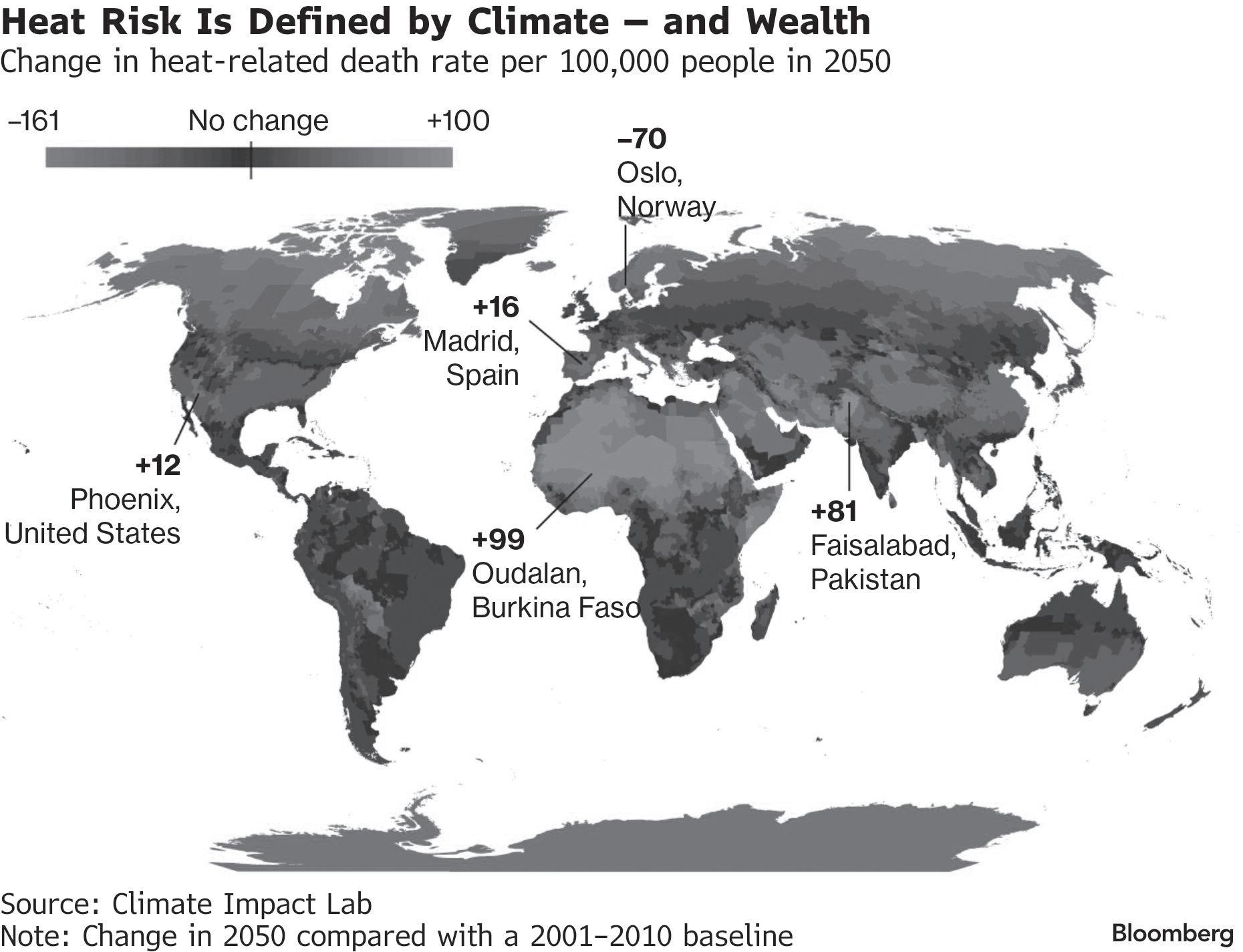
POOR countries may lose 10 times more people to deaths from high temperatures than rich ones, according to an analysis
by Climate Impact Lab.
The research, published Wednesday, is designed to help cities and communities understand and respond to the dangers they face from rising temperatures. It comes as a record-breaking heat wave grips much of the US and as more evidence emerges that global warming is accelerating. While the rising heat is global, its consequences for health vary dramatically depending on affluence.
“I continue to be shaken by the inequality of climate change,” said Michael Greenstone, a University of Chicago economist who co-authored the report and who co-directs Climate Impact Lab, a collaboration among researchers focused on emerging risks. “The extra deaths are all going to occur in places that contributed very little” to greenhouse gas emissions that are warming the atmosphere.
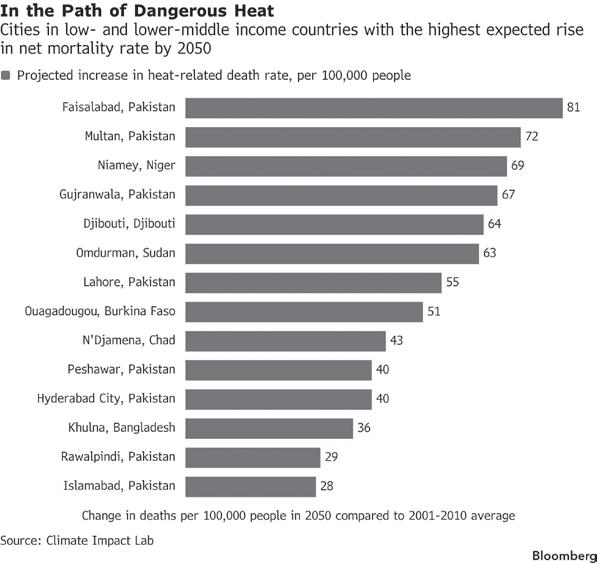
The new report projects that by 2050, vulnerable countries will see an increase in heat-related deaths equivalent to current fatalities from common diseases. Niger, Burkina Faso and other countries in Africa’s Sahel region could see 60
or more deaths a year per 100,000 people — a rate higher than the current one for malaria in Africa. About 55 people per 100,000 die of HIV/AIDS in Djibouti; it might experience a commensurate rise in heat-related mortality. In southeastern Bolivia, the death rate could rise by 30 people per 100,000, or about the current rate from diabetes.
Some cold climates will see a drop in heat-related deaths.
Northeastern Russia’s New Siberia Islands could register the biggest decline in the mortality rate — 161 fewer per 100,000 people — although not many people actually live there. Other places in rich countries also benefit, including the North Slope of Alaska, Banff, Canada, and Oslo.
All but two of the 20 countries with the biggest net improvements are higher income, and 16 of the 20 countries facing the most new deaths are lower income.
The report is not itself peer reviewed, but its methodology, developed several years ago, was reviewed and published in an eco -
nomics journal in 2022. The group’s initial work focused on the rise in heat mortality by 2100, and demonstrated in detail the relationship between wealth, temperature and risk.
“Alarm bells are ringing,” said Cascade Tuholske, a geographer at Montana State University who

works on climate risk. “Mortality rates will continue to rise due to extreme heat that is being driven by carbon emissions, by fossil fuels. The burden is falling on those who have the fewest resources to adapt and the people who are not causing this problem, by and large.”
To Tuholske, who was not involved with the study, it appropriately highlights places that face increasingly dangerous conditions but aren’t widely understood to be among the most vulnerable. Pakistan is already dealing with other severe climate impacts, such as historic floods in 2022; the country’s dense cities and an economy dependent on outdoor labor mean
that its heat risks are significant and chronic, said Tuholske.
“For me, that’s always been a country of concern, just looking at global climate projections in extreme heat,” he said.
The authors’ approach relies on breaking the whole world down into small units, about the size of a US county or a district in China or India — nearly 25,000 of them. This granularity shows how neighboring regions, even within the same countries, can face very different futures.
Sometimes differences are easily explained by geography.
Communities in the Rocky Mountains of the US may see dozens fewer deaths a year by 2050 amid warming winters, while to the south and southwest, heat is more likely to claim lives every year.
The research makes clear how wealth inequality will increasingly become a life or death issue. Djibouti’s projected higher mortality rate is more than twice that of Kuwait’s, which sits across the Arabian Peninsula.
The study assumes that the world economy will continue to grow. Otherwise, there would be seven times more temperaturerelated deaths. The additional income will allow people to buy ways to adapt — air conditioners, shelters, parks and other cooling measures — saving additional lives.
The trouble is, funding and attention are always in short supply.
“These deaths don’t have to be inevitable,” said Emily Grover-Kopec, a report co-author and a director in the climate and energy practice of the research firm Rhodium Group. The report “provides a map for where income growth alone will not be enough and where deliberate adaptation policy and investments can save the most lives.”
PHL tourism faces headwinds as fuel prices surge, flights cut
Continued from A1
Short-haul, local trips
MICHELLE HO, General Manager at Klook Philippines, also senses growing apprehension among young Filipinos, who make up the bulk of the app’s clients. “There is still a strong desire for travel, but travelers are looking more into domestic or shortto medium-haul flights versus long-haul flights. This is also aligned with our findings on how travelers are more intentional now in their planning, opting for nearby destinations only an hour or two away to keep close to their families.”
Based on Klook’s current booking data, she noted short-haul destinations rising in popularity such as Taiwan, Thailand, and Vietnam. “These destinations are relatively more affordable, offering more value for money,” she explained.
As for domestic destinations, travelers are checking out those just outside of Metro Manila, such as Clark in Pampanga, Batangas, and Cavite, along with Boracay and Cebu.
For Ritchie Tuaño, General Manager of Asiareps Travel Services Inc., the caution in traveling abroad has hit close to home: “Two of my siblings planned to travel to Amsterdam and Australia supposedly early this month and in July, respectively, have cancelled their trips.”
He added that he had clients traveling to Europe in August and November, “but have now shelved their plans.”
Feels like the pandemic
HE said these uncertain times feel “reminiscent” of the pandemic, which hit the travel and tourism industry hard from 2020 to 2022. “While only a handful of borders/ air space are closed, the volatility of the situation makes travelers defer their plans to travel if unnecessary. Also due to the uncertainty of times and the increase of prices of products and services that are oil-dependent, people tend to hold back from any expenses.”
Those in the hospitality industry are already seeing signs of weakening demand in a number of their business categories.
Cleofe Albiso, Group General Manager at Megaworld Hotels and Resorts (MHR), said, “This month alone, we’ve seen a clear softening of market confidence, particularly within our MICE (Meetings, Incentives, Conventions, Exhibitions) segment, with early cancellations and a more cautious approach to bookings as clients reassess budgets.”
As such, she said MHR is offering its clients more flexible and cost-effective packages to allow them to push through with their meetings and events, giving them good value and services, despite their tighter budgets.
“On the domestic front, we are reinforcing township-driven staycation campaigns, capturing nearby markets seeking accessible and high-value escapes. By maximizing our integrated developments, we are able to create demand within our own ecosystems, reducing reliance on long-haul travel which may be affected by rising costs,” she said.
Pivoting strategies
STRATEGIC partnerships with banks, for another, and “targeted promotions” will enable the MHR to sustain their guests volume, she added.
Ma. Celeste Romualdo, General Manager at The Linden Suites, shared a similar impact on “discretionary segments such as MICE, staycations, and even corporate travel.”
She said their hotel is “taking a more conservative and agile approach such as revisiting projections, focusing on resilient segments like long-stay and essential travel, and strengthening direct booking efforts. At the same time, we are implementing tighter cost controls, particularly on energy use, by optimizing operations and aligning manpower with actual demand.”
In the case of The Peninsula Manila, Director of Sales and Marketing Samuel Gacos said, “Rather than broad discounting, our approach is focused on value-led strategies targeting regional and domestic markets with curated staycation packages, experiencedriven inclusions and targeted tactical offers while protecting rate integrity and brand positioning.” Even as headwinds mount, tourism players are banking on the enduring desire of Filipinos to take a breather and travel, especially with their families. The path forward may mean fewer long-haul trips and more regional or domestic journeys, but as industry leaders note, demand has not vanished—it is simply evolving. The key now lies in how quickly the sector can pivot to meet it.
When Kapampangans approve: The secret behind Apag Marangle’s 18-year success


WBy John Eiron R. Francisco
ORD of mouth has always been one of the most powerful forces in the culinary world, where satisfied diners become the best ambassadors of a restaurant’s flavors and experience.
For the Kapampangan
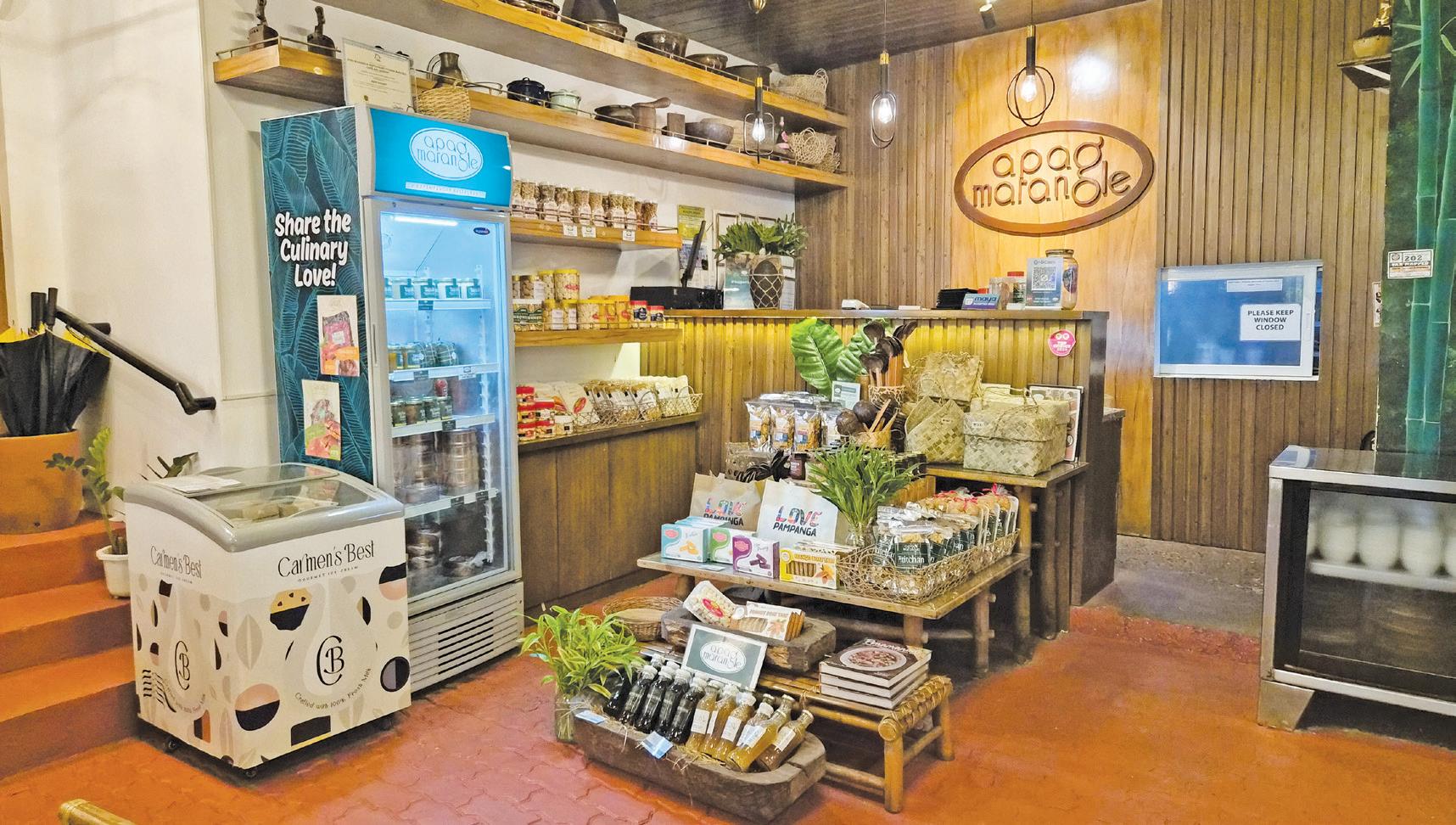
homegrown favorite Apag Marangle, which celebrates its 18th anniversary this year, this has been one of the secrets to its lasting success.
In an interview with BusinessMirror, founder and owner Manuela Cherry Pasion-Tan shared how the restaurant began in 2008. At the time, about 70 percent of its diners came from outside of Pampanga, while only 30 percent were local residents. Over the years, this balance has shifted, with local and visiting customers now nearly evenly represented.
What surprises Pasion-Tan the most, she said, is how many locals now choose the restaurant as the venue for their special occasions.
“It’s a good sign when Kapampangans patronize you, because they have high standards when it comes to food,” she
explained. “They already know what the dishes should taste like. When you meet their expectations, they are the ones who bring new customers to you.”
This cycle of returning diners naturally expands the restaurant’s reach. Patrons often bring friends, family or balikbayans (Filipinos returning home), introducing them to the restaurant for the first time.
“It’s a very powerful word of mouth. And it’s also a personal testimony,” she said, expressing gratitude for the support the restaurant has received over the nearly two decades.
‘Learning from home’
She recalled that she and her business partner, Mark Edmon C. Navarro, were initially hesitant to open a Kapampangan restaurant in Pampanga. After all, locals are skilled cooks themselves and are
famously exacting when it comes to flavor. She wondered if they would even give a try to dishes prepared by someone without formal culinary training.
“I learned to cook at home, from my relatives. When I finally opened the restaurant, I took a basic culinary course, but what I brought to the table was what I learned from childhood,” she said.
“That’s why I can say it’s truly home-cooked, comfort food. That’s what makes it Kampampangan.”
Pasion-Tan said. “I don’t know other cuisines; I only know what I know. It was a blessing that people liked the taste.”
She explained that while recipes are widely available, it is how they are cooked and served that sets her restaurant apart, making each dish authentic and memorable.
‘Taste as a standard’
Maintaining that level of trust, however, comes down to discipline behind the scenes. When asked how the restaurant preserves authenticity, both in its flavors and service, Pasion-Tan pointed to one key principle: clear and consistent standards.
She explained that traditional Kapampangan cooking does not rely on exact measurements, but is guided by taste, instinct, and experience. To ensure




consistency, however, the restaurant has translated this into a system of guidelines and standardized recipes.
This structure has played a crucial role in the restaurant’s longevity, Pasion-Tan said.
‘Told by those who tasted’ Pampanga, located north of Manila, is widely recognized as the culinary capital of the Philippines, a title that Pasion-Tan sees as both an honor and a responsibility.
Preserving its rich culinary traditions, she said, is essential.
“The title was given by the people who ate in Pampanga. It was not us who declared, ‘We are

the culinary capital,’” Pasion-Tan explained.
She stressed that it is those who have experienced and tasted Pampanga’s food who recognize its excellence firsthand.
“Being known for our cuisine is already a blessing,” she added. “Some provinces are still striving to establish an identity. We in Pampanga already have one. We already have a title. We are recognized for good, excellent food.”
Yet, she said this recognition comes with a duty to protect and promote the province’s culinary heritage.
“You need to preserve it, take care of it, and make sure it is passed on, especially to the next generation. If young Kapampangans are not exposed to authentic Pampanga cuisine, then what will happen to our food traditions?” she noted, emphasizing the importance of passing knowledge and tradition to the young ones.
Passing the torch
For instance, Pasion-Tan is now mentoring her daughter Coleen, 25, in running the restaurant. Apag Marangle was built from scratch by Pasion-Tan and Navarro, and she wants Coleen to learn while she is still actively leading the business.
“It’s different when you’re here and see how I deal with people, with customers, and with my staff. How can they absorb my values if they don’t see me in action?” she explained. “I want them to see firsthand how I handle problems, communicate with my team, and treat our customers.”
Beyond mentoring her daughter, Pasion-Tan regularly conducts culinary tours in school in the province, where she demonstrates cooking and introduces students to traditional Kapampangan dishes.
Yet, she has noticed a worrying trend: when asked if they still cook at home, many young locals respond, “No, we don’t.”
“That’s the challenge,” she said. Despite actively promoting local food, sharing recipes online, and posting videos of her cooking, the younger generation seems increasingly uninterested in cooking.
“If they’re not cooking anymore, even with all these resources, how can we keep our culinary traditions alive?” she asked.
Investing in People Navarro shared that the restaurant also accommodates students who undergo internships, mentoring and guiding more than 100 students per year. He added that the restaurant doesn’t hire fully trained cooks; instead, they take in people who are still learning.
Their executive chef, for example, was previously a construction worker, and under their guidance, he has now mastered the craft and can even teach others.
Both Pasion-Tan and Navarro expressed pride in their employees’ loyalty, with many serving the restaurant for five, 10, and even 15 years. They said this reflects a management approach that values people as much as the business itself.
“At the end of the day, what matters is the role and mission we have toward our employees; it’s not just about ourselves,” Pasion-Tan said.
“We treat our employees as partners.”
Beyond nearly two decades of running Apag Marangle, PasionTan and Navarro see success as extending far beyond the restaurant’s doors. It’s felt inside the kitchen, in the growth of their team, and in the relationships they’ve built over the years. Navarro added, “We feel successful when we can provide more than basic needs, when we contribute to the growth of those around us.”
Moreover, Pasion-Tan shared that while they have many plans for the future and several ideas under consideration, they want the next generation to take the lead in carrying them out.
“Many offers have come our way to open other branches, but we want to focus on strengthening the standards here first,” she said.
Nasing Marangle, Apag Marangle's Fried Rice with Fresh Farm Vegetables topped with lechon kawali.
Apag Marangle also offers a wide selection of take home treats and local delicacies that visitors shouldn't miss.
Mark Edmon C. Navarro and Manuela Cherry Pasion- Tan, founders of Apag Marangle.
A selection of the dishes available at Apag Marangle.
Apag Marangle, located in Guagua, Pampanga, is a well-known Kapampangan restaurant celebrated for its authentic dishes and unique al fresco, farm-style dining experience.
Pork Humba, a Kapampangan favorite, slow-cooked to tender perfection with rich savory-sweet flavors. Best enjoyed with rice.
Ensaladang Ampalaya, Bitter Melon Salad.
Freshly fried okoy, crisp on the outside and flavorful in every bite.
A4 Sunday, March 29, 2026
Editor: Angel R. Calso
China leads new breakthroughs in global car industry innovation
By Bloomberg News
ACHINESE-made Leapmotor C10 was traveling down Germany’s fast-moving Autobahn last year when the driver-assistance system braked sharply and jolted it to the side, as if boxed in by scooters in a crowded China megacity.
Leapmotor International’s Germany head, Martin Resch, was at the wheel and emailed engineers in Hangzhou to report the problem before going into a meeting. By the time he got out, a software update had been beamed to the electric vehicle, smoothing its behavior. A similar fix at a European carmaker would have taken weeks.
Executives call it China Speed, and it’s the global auto industry’s new benchmark.
For decades, carmakers measured themselves against German engineering, Detroit scale or Japanese reliability. Now executives from Michigan to Wolfsburg are confronting a new yardstick one defined by rapid-fire development cycles, software-first design and relentless cost compression born of China’s EV boom.
Just as Japan’s ascent in the 1970s reshaped the industry with lean production and ruthless efficiency, China’s rise led by companies like BYD, Geely and Leapmotor is rewriting the rules again, with flatter development timelines, deep supply chain integration, bold ideas and cars that gain new features in real time through over-the-air updates. The result turns on its head the industry’s goal to sell perfect products, creating one where fixes can come later though sometimes at a cost.
The shift is no longer theoretical. Stellantis is weighing whether to use EV platforms and software from Leapmotor to underpin models for its European brands Fiat, Opel and Peugeot, and is separately talking with Xiaomi Corp. and Xpeng Inc. about investing in its European operations, Bloomberg has reported. It’s a striking admission that major legacy manufacturers may need Chinese engineering to compete on their own turf.
The technology seep goes beyond the mass market, with luxury-car maker Mercedes-Benz Group AG holding early talks with Geely for possible cooperation on future EVs, Bloomberg has reported.
Japanese carmakers are also tapping into Chinese expertise. Nissan Motor Co., which pioneered the battery-car market with its Leaf in 2010, is now relying on China to become a springboard for EV exports, investing at least 10 billion yuan ($1.4 billion) to develop battery-powered cars on the mainland for sale abroad.
“What China gives us is access to the same advantages that have reshaped the competitive landscape: speed, technology and cost,” outgoing Nissan Chief Financial Officer Jérémie Papin said in an interview. “You will start to see the first of these China - sourced products reach global markets soon.’’
In the US, where protectionist walls have long kept Chinese automakers out, cracks are starting to show. As China makes inroads in Mexico and Canada, Ford Motor Co. has talked with President Donald Trump’s administration about how US-China joint ventures might be structured when China inevitably enters the domestic market a scenario Chief Executive Officer Jim Farley has labeled an “existential threat.”
Dismissed for decades as a lowcost outpost for copycat engineering, China has poured resources into a state-backed race to dominate advanced manufacturing. In EVs alone, government support has totaled at least $230 billion since 2009, according to the Center for Strategic & International Studies.
While legacy automakers are trying to reduce their typical fiveto seven-year product plans, their Chinese rivals can deliver a new model in under two years. Founders at Xpeng, Nio and Li Auto all had internet startups, and Lei Jun of Xiaomi has a background in software.
Workforces skew young and mobile, and pay scales are lower than at Western counterparts with compensation often tied to financial targets, fostering an entrepreneurial culture. Ferocious
domestic competition forces continual innovation and squeezes out inefficiencies.
Patent data reflect China’s rise to the top of the pecking order. It generated more than 343,000 patents in future land transportation technologies from 2000 to 2023 almost five times Germany’s total and has driven most of the global growth since 2018, according to the World Intellectual Property Organization.
Beijing’s long-term financial support means China Speed is as much a product of state backing as industrial prowess, with periodic bailouts and aid to some businesses unlikely to become self-sustaining over the long run.
No matter, the impact is real. To stay competitive, automakers and suppliers from outside of China are locating a growing share of their engineering brainpower there.
Robert Bosch GmbH, the world’s largest traditional auto-parts supplier, is shedding thousands of manufacturing and development jobs across Baden-Württemberg, the German state where Carl Benz invented the automobile in the 1880s, to shift work in areas such as battery and driver-assistance systems to China.
Some European executives describe this as a “Nokia moment” a reference to when Apple Inc.’s iPhone crushed the Finnish mobile-phone leader. Europe’s auto champions may be forced to choose between clinging to a dying business model or plugging into Chinese technology to survive.
Measured against the new reality, Germany is “simply no longer productive enough,” Chancellor Friedrich Merz said in late February after returning from China. “Work-life balance and a four-day week will not sustain prosperity in our country in the long term,” he told reporters. “We simply have to do more now.”
Where European carmakers once set the standards for car making collaborations, they are increasingly forced to adopt Chinese platforms and engineering practices.
For Bosch, the advantage has as much to do with speed as with costs: in one project, engineers in Suzhou, near Shanghai, redesigned an electrical connector in six months roughly half the time it would have taken teams in Germany, according to people familiar with the matter.
A Bosch spokesperson declined to comment on specific projects. They added that Chinese development timelines are typically much shorter, and described the country as a key innovation hub

for the company.
At the Hangzhou Bay research hub of Geely Auto part of a constellation including Lynk & Co, Zeekr, Polestar, Volvo and Lotus the lights are sometimes on 24/7 and engineers stream in and out of glass-walled labs, compressing concept-to-production cycles. The extra shifts can’t be matched in Europe due to workplace restrictions.
Physical proximity between design, manufacturing and suppliers fostered by Tesla Inc.’s Shanghai factory, opened in 2019 also speeds development and eases communication. In the Yangtze River Delta, an EV maker can often find every component within a 200-mile radius narrowing lead times for prototyping and logistics, and lowering barriers for would-be automakers with software or design roots to launch a company, even if they lack deep manufacturing experience.
Leapmotor, whose founder Zhu Jiangming started in electronics, self-develops most core components, including battery, motor and the electronic control system, as well as smart driving technology. When a problem crops up, a team is in place and can quickly respond, as Resch, the executive in Germany, witnessed from the Autobahn.
“You’re starting from a piece of white paper and you’re able to optimize everything,” said Tianshu Xin, CEO of the Leapmotor International venture between the Chinese carmaker and Stellantis. Greater control over design and component flows allows manufacturers to fine-tune for speed at every stage of production. “This engineering culture permeates the entire ecosystem from the ground up.”
In the software-industry mindset of China’s newer crop of automakers, new features don’t have to be perfect when cars are shipped sometimes they can merely be
Space tourism slump started well before Katy Perry’s panned trip
RBy Lorelei Smillie
ON Rosano is one of the world’s most dedicated space tourists.
A 65-year-old property manager from San Francisco, he completed a short trip aboard a Virgin Galactic Holdings Inc. spaceplane in 2023 and until recently was expecting to fly more than 60 miles above the Earth on one of Jeff Bezos-founded Blue Origin LLC’s New Shepard rockets. Rosano has had to change his plans, though, following a surprise move by Blue Origin in January to halt tourism flights for no less than two years. Rosano’s disappointed. “I had painted a pretty large picture of what that might mean for me,” he said. “Seeing the Earth from that perspective: it’s humbling. It’s life changing.” Companies like Virgin Galactic and Scaled Composites LLC envisioned a booming market for space tourism when said in the early 2000s they would launch humans into suborbital space. Space tourism will become a “multi-billion-dollar industry,” said Eric Anderson, co-founder of the space
exploration company Space Adventures Inc., in a 2003 issue of Space Times. Now, the industry’s in crisis. In addition to Blue Origin pausing flights, Richard Branson’s Virgin Galactic hasn’t flown since June 2024 as it works to develop its new Delta spacecraft.
Virgin Galactic will release its fourth quarter and full year earnings for 2025 on March 30. The company’s share price is down more than 98% since its debut in October 2019 through a merger with a listed entity.
“Tourism hasn’t really materialized as a market. We certainly have had a number of tourist sponsored missions, but those have been limited, and we haven’t seen recurring demand for them,” said Dana Weigel, NASA’s International Space Station program manager, during a March 24 presentation in Washington.
Issues include limited demand and technology that takes years to scale, even as the addressable market is limited, said Eric Zhu, an aerospace and defense analyst for Bloomberg Intelligence.
“The fundamental problem is scalability and cost,” he said. “The industry is targeting an extremely narrow slice of ultra-highnet-worth individuals, but even that cohort doesn’t generate repeat business.”
Holding pattern
VIRGIN Galactic has sent 31 passengers to space and Blue Origin has sent 98 (six of whom flew twice), including an all-female crew that flew last year with Katy Perry, CBS News anchor Gayle King and Jeff Bezos’ wife Lauren Sánchez Bezos. That flight prompted a backlash online after Perry sang during the flight and kissed the ground upon re-entry.
The first space tourist, Dennis Tito, flew aboard a Soyuz spacecraft in 2001. Russian rockets have taken nine commercial passengers to space but none since the start of the full-scale invasion of Ukraine in February 2022.
Roscosmos, the country’s equivalent of NASA, wants to resume tourist flights to a proposed Russian space station, but the “stigma” from Perry’s trip hasn’t eased,
said Robert English, director of central European studies at the University of Southern California.
The flight “was an obvious target for critics,” he said, “because you kiss the Earth after surviving a long, harrowing, heroic journey — not after a billionaire’s brief bus ride.”
Virgin Galactic expects to launch the first test flight for its Delta spacecraft by the end of 2026.
Responding to a request for comment, the company declined to disclose ticket prices or other information before the upcoming results announcement. Previously Virgin Galactic had been charging about $600,000 for seats on the new spacecraft.
Blue Origin’s prices are not publicly available, but Craig Curran, president of the DePrez Group of Travel Companies in Rochester, New York, estimates a ticket price of approximately $1.5 million to $2 million.
“There really is
Growing clout
CHINA’S growing clout is partly an outgrowth of earlier decisions by European, US and Japanese carmakers to locate manufacturing there in exchange for access to its fast-growing market, said Kai Gramke, CEO of EconSight, a consulting firm that tracks patent trends. Innovation tends to follow manufacturing, he said, with many Chinese patents related to advanced technologies such as batteries, EVs, AI and autonomous driving.
functional, with updates and fixes arriving later.
John Paul MacDuffie, a professor at Pennsylvania’s Wharton School who has researched Chinese production methods, said there’s a higher tolerance for mistakes, partly growing out of flatter hierarchies and aggressive work cultures, while also citing techniques used to accelerate development.
“Much of the speed comes from companies beginning production before validation is complete, and compressing development stages so they overlap rather than waiting for the previous phase to finish,” MacDuffie said.
This ship-then-fix approach has led to concerns about reliability. In October, JD Power’s annual survey found declining dependability of cars sold in China for the second year running, with the top Japanese and American JVs performing better than local brands. Inadequate R&D validation systems and mounting cost pressures are “now emerging as a systemic risk to overall quality stability,’’ it said.
Chinese regulators have separately sought to rein in a long-running price war that they worried would lead manufacturers to cut corners on vehicle safety.
Geely’s Lynk & Co went viral in late February, after a Z20 compact SUV turned off its headlights at night by mistake, when the driver asked to shut an interior reading light. The glitch plunged the vehicle into darkness, and it eventually crashed into a roadside median.
No one was hurt but the online maelstrom that followed raised questions about reliability and the inadvertent outsourcing of product testing to customers. Mu Jun, a Lynk & Co senior executive, apologized and a software patch was installed to prevent headlights switching off by voice, according to a post last month on Weibo.
“In the past, China has bought European designed cars or US designed cars,” he said. “In the future, we might be buying Chinese designed cars with all the Chinese specifics.”
In Europe, where Chinese brands have claimed a growing share of sales, the pace and depth of collaboration is accelerating. Renault developed its new Twingo EV at its Shanghai-based R&D center, and will source 40% of its parts, in terms of value, from the mainland. This month, Leapmotor confirmed it’s in talks with Stellantis to expand their cooperation on cars and components.
Audi is working with SAIC Motor Corp. to develop electric models on a local platform for sale in China, while its parent Volkswagen has teamed up with Xpeng, including through platform sharing, to sharpen its competitiveness in China.
Narrower gap
CHINESE automakers have spent nearly five decades narrowing the gap. In 1978, a Chinese delegation appeared at Volkswagen’s gates in Wolfsburg, Germany, offering market access in return for knowhow a bargain that led to Shanghai Volkswagen and a web of JVs pairing German engineering with Chinese scale. Volkswagen, BMW and Mercedes-Benz feasted for years on China’s explosive demand, reaping sales and profit and secure factory jobs back home.
Over time, Beijing set out to redraw the terms of trade. Automotive technology was elevated to a strategic priority under the “Made in China 2025” plan to dominate advanced manufacturing. Wan Gang a former Audi engineer who became China’s science and technology minister championed EVs as a shortcut past combustion incumbents, and steered billions into battery research.
Now, China leads global battery production through companies
See “China,” A5

Crispin Odey plays the victim card in appeal to overturn finance ban
By Liza Tetley & Jonathan Browning
AFTER a long few weeks watching the UK’s financial watchdog present evidence that he had groped, verbally harassed and inappropriately touched female employees during his time at the helm of Odey Asset Management, former hedge fund boss Crispin Odey insisted to the court that he was the one who was actually the victim, and the target of “bullying” by the regulator.
Facing a fine and a lifetime ban on managing money by the Financial Conduct Authority, Odey argued in his appeal that the UK regulator was pursuing a “vendetta” against him. The London court proceedings, which have taken place over three weeks, have seen an array of former employees, FCA staffers, as well as Odey himself provide evidence suggesting that the financier may have falsified minutes, misled investors, attempted to blackmail the UK regulator, threatened his staffers, and tried to silence victims, all in an effort to stay in control of the firm he founded more than three decades earlier.
The fiery showdown has shed light on the extent of the crisis that engulfed Odey’s firm around 2021 and 2022. Already under FCA investigation at the time, he dismissed two consecutive executive committees from OAM within a period of four months, leading to accusations of “reckless disregard” for governance.
The hearing is a key test of the FCA’s capacity to hold executives to account after City firms reported a surge in discrimination, bullying and harassment complaints following Odey’s downfall. City firms reported a 72% uptick between 2021 and 2023, with banks reporting the highest number of incidents, according to a survey conducted by the FCA.
“Workplace culture in the City really does matter,” said Ann Francke, Chief Executive of the Chartered Management Institute, commenting on the case. “It’s not simply about how much money, it’s how they make their money. How you behave matters and it should be regulated.”
Little remorse
SHOWING little remorse as he took the stand for the final week of evidence, Odey dismissed accounts of his inappropriate conduct at OAM, saying that aside from a 2005 episode in which he groped an employee’s breasts, he didn’t think the other incidents had been anything “serious.”
The hedge fund boss faced at least 46 allegations of inappropriate conduct over a 17year period at OAM, according to an internal report conducted by an outside law firm. The accusations ranged in seriousness from an allegation of sexual assault in 2005 to an incident in which Odey forced a receptionist to try on a skirt and show it to him “ostensibly to see if it would fit his daughter,” the FCA said in a legal filing released in February.
“I never thought I sexually harassed anyone except one person,” Odey said during the third day of his cross-examination on Thursday, conceding he “had said things to people that were inappropriate” but adding he’d “apologized for that.”
In his witness statement, Odey said that while some of the accusations against him were fabrications, “other allegations were true, in the sense that I accept that I had engaged in the activities alleged.” He said “these activities were either entirely mutually consensual or, for my part, had been entirely innocent in nature.”
The trial has also surfaced myriad evidence showing how OAM executives grappled with disciplining their founder in the face of Odey’s defiance and his threats to close the firm. In an attempt to ameliorate both the FCA and Odey, the firm’s executives at one point proposed having him work in a separate office space on the lower ground floor of OAM’s buildings — a suggestion the hedge fund boss refused.
On the stand, Odey said “safeguarding was a ridiculous idea,” calling the basement office space a “dungeon” and adding that the suggestion made him start to realize “the ExCo was needing to be put to bed.”
Odey’s temper THROUGHOUT the trial, FCA lawyer Clare Sibson highlighted multiple occasions in which Odey struggled to contain his temper, including during a conversation with one of OAM’s former executives, Oliver Kelton, in Odey’s London home. Kelton described the exchange as “intimidating” and said he thought his employer had “lost control.”
In a separate call with the FCA’s Warren Lowe, in which Lowe had expressed concern after Odey said he could not appoint a new executive committee so long as his disciplinary process needed to be dealt with before anything else, Odey allegedly snapped, describing FCA staffers as “little guys, trying to do your work in the shadows,” and accusing the regulator of inviting crisis by changing the terms of what he’d interpreted to be an earlier agreement.
Odey’s lawyers, meanwhile, have consistently argued that OAM employees were under undue pressure from the FCA to remove the founder. They have sought to emphasize what Odey described as the regulator’s “aggressive non-financial agenda” and said that the FCA needed a “totemic” case to burnish its credentials. Message exchanges brought before the court conveyed Odey’s conviction that the regulator’s investigation into him was overreaching and personal.
“Once I have sorted out the FCA I will sleep more easily but I am so grateful that can bring them out into the open,” Odey said in a text message exchange with former OAM portfolio manager James Hanbury. “I am sorry that they put us all through this in their vendetta.” Among the messages FCA lawyers highlighted was one Odey sent to a former staffer which they characterized as an effort to stop her from speaking out. In it, he apologized for embarrassing her by groping her breasts but said he didn’t think that was reason enough for him to be labeled “unfit” to manage money.
Misleading evidence
THE FCA’s lawyers also suggested that Odey may have, intentionally or not, inaccurately presented some facts. One key piece of evidence was drawn from the testimony of Jack Satt, OAM’s former head of compliance, who denied being in attendance at a 2022 executive committee meeting during a period in which Odey was the sole member despite the minutes placing him there.
“That is not accurate,” Satt said in his witness statement, adding that a few topics which were said to have been raised during the meeting were totally unfamiliar to him. One was the notion that he should relay certain points to the FCA regarding the regulator’s “vendetta,” which Satt said did not reflect discussions he had had with Odey around that time.
Over the course of his three-day cross-examination, FCA lawyers also accused Odey of engaging in “an abject abuse of power” by threatening to close the firm; of lying to investors by telling them that his removal of the first committee was a part of a strategic development plan he had outlined the previous year; and of pushing for one-on-one meetings with FCA regulators in order to make it easier to pressure or misquote single individuals. Odey denied any wrongdoing, and a verdict is likely months away.
The hedge fund tycoon was defiant to the end, replying to questions with little hesitation and even laughing incredulously at points, prompting the FCA’s Sibson to ask if he found the proceedings “funny.” Bloomberg News
Perfect homework, blank stares: How colleges use oral exams to combat AI
By Jocelyn Gecker AP Education Writer
THE assignment involves no laptop, no chatbot and no technology of any kind. In fact, there’s no pen or paper, either.
Instead, students in Chris Schaffer’s biomedical engineering class at Cornell University are required to speak directly to an instructor in what he calls an “oral defense.”
It’s a testing method as old as Socrates and making a comeback in the AI age. A growing number of college professors say they are turning to oral exams, and combining a variety of old-fashioned and cuttingedge techniques, to help address a crisis in higher education.
“You won’t be able to AI your way through an oral exam,” says Schaffer, who introduced the oral defense last semester.
Educators are no longer naively wondering if students will use generative AI to do their homework for them. A big question now is how to determine what students are actually learning.
College instructors across the US are noticing troubling new trends as generative artificial intelligence becomes more sophisticated. Takehome essays and other written assignments are coming back perfect. But when students are asked to explain their work, they can’t. The long-term impact of AI use on critical thinking remains to be seen, but educators worry students increasingly see the hard work of thinking as optional.
Some colleges shift toward inperson tests
AT the University of Pennsylvania, Emily Hammer, an associate professor of Middle Eastern Languages and Cultures, now pairs oral exams with written papers in her seminar classes.
“It comes across as if we’re trying to prevent cheating,” Hammer says. “That’s not why we’re doing this. We’re doing this because students are actually losing skills, losing cognitive capacity and creativity.”
Hammer forbids AI use on all writing assignments but tells her class she knows she can’t enforce that. However, if they haven’t written their papers themselves, defending the material face-to-face will likely be “a very stressful situation.”
Hammer’s class is part of “a massive shift toward in-person assess-
Continued from A4
such as BYD and CATL, commands critical stretches of the EV supply chain and sets the tempo in automotive software, from digital cockpits to over-the-air updates.
Chinese carmakers have used their cost and speed advantage to churn out affordable models at a time when consumers, stung by repeat crises in the global economy, have less money in their wallets. European automakers and their suppliers have no chance to compete on cost, said Barbara Resch, a Mercedes supervisory board member and head of the IG Metall union in Baden-Württemberg.
“We are at a decisive juncture,” she said. “If policymakers fail to set the right course, future technologies such as battery and hydrogen drives will migrate out of Baden-Württemberg.”
Nissan, for its part, will target its Chinese-developed EVs to markets in the Middle East and the Southern Hemisphere, where competition from Chinese brands is most intense, CFO Papin said. The company
ments,” both written and oral, at Penn, says Bruce Lenthall, executive director of the school’s Center for Teaching and Learning. The Ivy League school is one of a small but growing number of universities that have started running faculty workshops on oral exams.
Oral exams are not traditionally part of the modern American undergraduate system, unlike certain European universities. For instance, in the Oxbridge tutorial system in England, students meet faculty for weekly discussions. Some US colleges saw a move toward oral exams during the Covid-19 pandemic to address concerns about online cheating, and interest has intensified since the launch of ChatGPT in 2022.
During the pandemic, engineering professor Huihui Qi launched a three-year study at the University of California, San Diego on how to scale oral exams. Several universities have since invited her to provide faculty workshops or discuss her research.
Harnessing AI to fight ‘fire with fire’
AT New York University, several types of oral assessments are on the rise. More faculty are requiring office hours, assigning presentations and cold-calling on students in class. Instructors are saying, “I need to look my students in the eye and ask, ‘Do you know this material?’” says Clay Shirky, vice provost for AI and technology in education.
One NYU professor has put a modern spin on the traditional oral test.
Panos Ipeirotis, a professor at NYU’s Stern School of Business, unveiled an AI-powered oral exam last semester for the final exam in a class on AI product management. He calls it “fighting fire with fire.”
Students log in from home, at any time that fits their schedule. A voice cloned from a business school professor greets them.
“Hi there,” says the voice on their screen. It asks for the student’s name and school ID number and then says, “I’m ready to conduct your exam today.”
The chatbot starts with questions about a final group project and drills into details based on each student’s
has rolled out three of the 10 models it has said it plans to debut in China, including the fully electric N7, which did surprisingly well after sales opened last April.
Ford CEO Farley, a fan of Xiaomi’s SU7 EV, has been seeking a way to structure American-controlled JVs so that both the Chinese and US partners would share profits and technology, Bloomberg reported in February.
“It would make sense for US automakers to leverage what European players are already doing,” said Augustin Friedel, associated partner at MHP, a management and IT consultancy owned by Porsche AG.
After writing down billions in investments in EVs, some auto-industry incumbents have retreated to the relative safety of high-margin combustion models. Yet the move favoring short-term gains puts legacy automakers further behind in the energy transition that’s still moving forward and likely to be accelerated by the oil price shock from the Iran war.
For now, US tariffs on Chinese cars protect American manufacturers from domestic competition. Trump’s rollback of EV subsidies and emissions mandates

answers. If the student stumbles, the AI agent gives them clues, along with criticism and positive feedback. Ipeirotis grades the exams separately, also with the help of AI.
“We wanted to check: Do you know what your team did? Were you a free rider? Did you outsource everything to AI?” says Ipeirotis, who designed the tool with ElevenLabs, a company that develops generative AI voice agents to conduct job interviews.
Students in the class this semester are redesigning the AI agent to smooth out some kinks, and Ipeirotis plans to use it in all his future classes.
“I want oral exams everywhere now. I want to pair it with every single written assignment,” says Ipeirotis. “I don’t trust written assignments anymore to be the result of actual thinking.”
Feedback from students last semester was mixed.
Business major Andrea Liu found the chatbot’s voice to be surprisingly human, but the conversation felt choppy with odd pauses. It asked multiple questions at once, which was confusing. And it was jarring to hear a voice but not see a person.
“It felt kind of awkward to be talking to what was pretty much a blank screen,” says Liu, 21.
But, she agreed with worried educators: “There is no perfect world where AI exists and kids are not abusing it.”
Schools see benefits even for shy students ACROSS the humanities and STEM disciplines, like computer science, educators worry that students who skip the mental struggle that is necessary for problem solving won’t develop the skills they need to advance in upper-level classes and careers.
That’s why Schaffer, the Cornell professor, introduced the oral defense in his biomedical engineering class. He requires students to sign up for 20-minute sessions of Socratic-
also makes the math harder for selling battery-powered models. European Union regulators have thrown up less-firm barriers, levying tariffs on Chinese-made EVs that were swiftly countered with hybrids and commitments to build locally.
In the meantime, Chinese carmakers have made inroads in places like Brazil, Mexico, the UK and the Middle East eating away at markets that have been strongholds for Ford, General Motors Co. or Mercedes. Analysts at UBS estimate that battery cells alone give Chinese automakers like BYD a $2,000 cost advantage per vehicle, and predict they’ll grow their global market share to 35% by 2030 from 25% in 2025, mainly with export sales.
“We see this advantage persisting, thanks to China’s scale, R&D leadership and supply chain depth,” analysts led by Patrick Hummel said in February.
style questioning after submitting written problem sets, which are assigned several times each semester.
With a class of 70 students, Schaffer splits the job with his teaching assistants. They no longer grade the written problem sets, just the oral defenses. He calls it “incentivizing” his students to do the work, or at least understand it enough to explain.
Schaffer’s class is highlighted in a new “Oral Assessment Workshop” offered by Cornell’s Center for Teaching Innovation.
Other examples at Cornell: a religious studies professor who now holds 30-minute “final conversations” with students instead of a final exam; and another engineering course where the professor gives four-minute mock interviews to each student in a 180-person class.
Skeptics point out oral exams can be unsettling for students who are shy or have serious anxiety, but clarifying the format ahead of time and starting with softball questions can help, says Carolyn Aslan, who leads Cornell’s oral exam training.
“Sometimes it’s actually good to get that quiet student one-on-one, and you finally get to hear from them. Sometimes that is the breakthrough,” Aslan says.
Several of Schaffer’s students say they felt nervous at first but ended up preferring the oral exam.
“I honestly liked it a lot,” says Cornell junior Olivia Piserchia, a biomedical engineering major. She initially found the oral defense nerve-wracking but came to value the one-on-one time with instructors. It kept her from feeling lost in a large class and helped her build the skill of articulating her technical knowledge, as she would need to in a job.
“Having that live check-in holds you accountable,” says Piserchia. “It’s a lot harder to look people in the eyes and say out loud, ‘I don’t know this.’ And, that makes you realize, ‘I should study this.’”
“There is no other region in the world where the transformation of our industry is taking place more consistently, dynamically, or rapidly,” Volkswagen CEO Oliver Blume said at an event in Berlin in January.
China, it is decided who will be at the forefront of this transformation.”
It’s an open question how much of their cost advantages Chinese automakers could replicate building cars in the US or in Europe, said Terry Woychowski, a former GM executive who is now president at Caresoft Global, an engineering consultancy. It would cost about $3,000 to make Xiaomi’s new YU7, a competitor to Tesla’s Model Y, compliant in the US market, he estimates. Touting quality and dependability could potentially be an avenue for automakers from Europe, Japan and the US to capitalize where they still have a perceived edge. Yet despite the recent backsliding, Chinese carmakers have narrowed the initial quality gap over the past decade-and-a-half, based on JD Power’s annual surveys. Japanese, US and European brands maintain a significant advantage in dependability, which measures longer-term reliability. In the end, there’s little debate among top executives that China is setting the pace signaling a bumpy and unpredictable future for the automakers who defined the combustion era, along with the millions of people in Europe and the US who depend on the industry for their livelihoods.
STUDENT Surya Newa is silhouetted while using an oral AI agent during class at NYU Stern School of Business, March 4, 2026, in New York. AP PHOTO/HEATHER KHALIFA
A6 Sunday, March 29, 2026
Editor: Angel R. Calso
Breaking up with oil: How the Iran crisis is changing consumer habits
By Todd Woody
JUST weeks ago, the US electric car market looked moribund. Amid plummeting EV sales, dealers were offering discounts as Detroit automakers scrapped electric lineups to make more gas-guzzling SUVs. Then oil prices surged after the US and Israel attacked Iran. Now, a used electric car showroom in San Francisco suggests the tide is turning again. As gasoline prices climb hitting $6.81 a gallon at a nearby station on Wednesday a flurry of drivers are making appointments to check out Ever’s lightly used EVs, many priced under $30,000.
“Gas prices are coming up in almost every customer conversation,” said Maximilian Quertermous, Ever’s co-founder and chief operating officer. “The momentum of the last few weeks is among the strongest we’ve seen.”
Ever is just one dealership, but signs of a shift are playing out across the world. In Southeast Asia, buyers are flocking to Chinese EV giant BYD Co.’s stores, while electric rickshaws are selling out in Pakistan. A shortage of cooking oil in India is driving a run on electric stoves. From Germany to Nigeria, interest in rooftop solar is surging. And in the UK, some homeowners are taking the plunge on expensive heat pumps.
“We are in the middle of the second energy shock in the 2020s,” said Kingsmill Bond, an energy strategist at UK think tank Ember, following the crisis triggered by Russia’s 2022 invasion of Ukraine. “It will flow into people’s decisions on what energy-hungry devices they buy.”
Consumers are responding to one of the largest disruptions in global oil markets by embracing low-carbon technologies that promise to lower gas and power bills. For many, the conflicts in Iran and Ukraine have driven home a harsh reality: the only path to energy security is going electric.
These individual choices will likely pale in comparison to the increase in planet-warming pollution as many nations, particularly in Asia, turn back to coal to plug the energy gap. And the pain hasn’t been as sharp elsewhere, like in the US, where abundant natural gas supplies have largely shielded power bills from war-related price shocks.
At the same time, though, the Iran war will put a powerful impetus behind green alternatives to oil and gas at almost the precise moment when policies meant to spur decarbonizing technologies had been on the retreat, particularly in the US. With one major difference: The current acceleration of renewable-energy options is largely happening because “they are also homegrown, domestic energy sources,” International Energy Agency Executive Director Fatih Birol told reporters in Sydney on Monday. “The main driver will not be climate change, the main driver will be energy security.”
It will be weeks before we get data that shows whether this renewed curiosity in green technologies translates into sales. Much depends on how long the Iran war persists and if oil prices stay elevated.
solar panels with heating devices for hot water during the summer, even though they will continue to burn oil for other needs. “They were never really fans of solar and were satisfied with oil heating, but it has simply become too expensive,” Nolden said.
High fuel prices in Europe are also sparking a new wave of interest in EVs. In the UK, car site Autotrader recorded a surge in EV inquiries since the first attacks at the end of February. Leads expressions of interest passed on to dealers are up nearly 30% for new electric cars since the beginning of the war, the company said.
In Denmark, used EV searches on Bilbasen, a major online car marketplace, have jumped by as much as 80,000 a week, according to Jan Lang, a marketing executive at the company. That’s more than what the site experienced after the Ukraine war.
Still, investors are already trying to game out which clean-tech manufacturers will benefit. While the S&P Global Clean Energy Transition Index, a leading gauge of green companies, has remained largely flat since the war began, several individual companies have surged. Shares of SolarEdge Technologies Inc., which sells power inverters used for solar panel systems, have advanced 45% and fuel cell producer Plug Power Inc. has gained 27% since the start of the conflict to Wednesday’s close. In Hong Kong trading, the world’s top battery supplier Contemporary Amperex Technology Co. Ltd. jumped 29% and BYD moved 12% higher.
Last year, global investment in the energy transition rose about 8% to $2.3 trillion, according to data compiled by BloombergNEF. More than $1 trillion of that was spent on green products, including EVs and heat pumps.
Past energy shocks have resulted in longer-term changes. The 1973 oil embargo pushed American drivers to purchase smaller, more fuel-efficient Japanese cars. More importantly, money began pouring into research that led to the invention of the lithium-ion battery, which dramatically lowered the cost of making EVs and home energy storage devices this decade.
The high oil and gas prices of the 2000s, fueled by the fear that supply could peak, pushed Europe and China to invest in alternatives like solar and batteries. Those devices had become affordable by the time Russia’s attack on Ukraine caused another fossil-fuel shock, leading to an accelerated adoption of solar and EVs in rich and poor countries. Renewables now account for nearly half of the European Union’s electricity production. Heat pump installations have risen 65% since 2022. In Pakistan, meanwhile, solar panels at homes and businesses have increased the country’s electricity capacity by 50%.
In Germany, where heating oil prices have risen 21% during the war and solar panels are easily available at IKEA and other big retailers, the reaction has been swift.
“A switch was flipped,” said Janik Nolden, chief executive officer of Solarhandel24, which sells solar panels. As temperatures remain chilly in March, calls from prospective buyers have tripled and sales so far have more than doubled from the previous month.
The interest isn’t just from people who want to fully electrify their homes. Some customers are looking at systems that combine

the search for solutions is critical. The energy crisis is hitting hardest in countries across Asia that depend heavily on imported fuel shipped through the Strait of Hormuz, which has been effectively closed by Iran.
“Danish consumers are very cost-focused,” Lang said. “They go for the car type which is the cheapest, and it is the EV.”
The war’s unpredictable course and whipsawing energy markets are also pushing some consumers to seek stability. On Monday, oil prices fell sharply after President Donald Trump claimed the US was in talks with Iran on a resolution, only for Tehran to deny any negotiations were underway.
Michael Lawson, a professional composer and psychotherapist who lives in the small UK village of Easton, isn’t waiting to see how the conflict ends. He pulled the trigger on a heat pump and solar panels for his home soon after the US and Israel first launched strikes against Iran.
“I heard what President Trump was up to and I thought circumstances are going to be unpredictable,” said Lawson, whose heating bill quickly doubled to £800 ($1,100) for a two-month supply. He now expects his annual energy bills to drop as much as £300.
Heat pump installer Damon Blakemore in Sheffield said he’s seen a 30% increase in inquiries since the war started, mainly from residents like Lawson whose rural towns aren’t connected to the natural gas network and depend on heating oil deliveries. At Octopus Energy, the country’s biggest energy supplier, calls about home solar were 27% higher than average the week the war started.
On Tuesday, the UK government said it was working with Lidl and Amazon to make plug-in solar available to consumers in the coming months. “The answer to a fossil fuels crisis is not to double down on fossil fuels, but to double down on clean homegrown power that we control,” Energy Secretary Ed Miliband told lawmakers.
For many developing nations,
That includes India, where more than 330 million households rely on canisters of liquefied petroleum gas (LPG) for cooking and 90% of the country’s supply comes from the Middle East. Over the past two weeks, delivery times have stretched to 25 days from five in some parts of the country.
The delays, rising prices and fears of shortages sparked a run on induction stoves. Online sellers on Amazon saw daily sales increase by 30 times, while those on Flipkart rose fourfold, according to local media reports. “We are out of supply but hope to bring back the supply soon enough,” Venkatesh Vijayaraghavan, CEO of cookware brand TTK Prestige Ltd., reassured customers on March 14.
Even residents with gas connections have been buying electric cooktops as a backup, if they can afford it.
“I thought it’s good to have one around in the house, just in case,” said Prabha Singh Chaddha, a 67-year-old artist based in New Delhi. She bought induction burners, which retail between $25 and $190, for her daughter and herself on Amazon two weeks ago.
In neighboring Pakistan, solar took off after the Ukraine war. Now, signs are emerging that the latest conflict is hastening the nation’s transition to EVs after the price of gasoline jumped more than 20%.
Syed Raza Mohsin, founder of VLEKTRA Electric Motorcycles, said he expects battery-powered two-wheelers to account for 10% to 15% of the market in 2026, up from less than 1% two years ago.
“Solar is a very good example of how private citizens themselves found a solution for high energy prices,” he said. “We are seeing similar trends in motorcycles.”
Electric rickshaw maker Tezmo Motors has already sold out its March inventory, according to
founder Moez Naseer, and is expecting a “very huge surge of orders.” Naseer said two fleet operators have placed orders since the Iran war started. “We are so petrol reliant, so people are finally figuring it out that we cannot rely on this anymore,” he said.
In the Philippines, the government is stepping in to fill the gap.
This week, a state-owned pension fund started offering loans of up to 500,000 pesos ($8,300) for home solar panels after President Ferdinand Marcos Jr. declared a national energy emergency due to the war.
Last Thursday in the Ethiopian capital of Addis Ababa, truck and bus drivers formed long queues at nearly two dozen fuel stations, even as some outlets posted “no gasoline” and “no diesel” signs.
The government banned the import of fossil fuel vehicles in 2024 because it could no longer afford to subsidize gasoline. In response to the Iran war, the transport ministry called for a stronger embrace of EVs, by “the private sector, individuals and government institutions.”
In Nigeria, tens of millions of people use gasoline-powered generators for electricity. As fuel prices have risen, there’s been a rush for rooftop solar, though the high upfront cost remains a barrier for many.
“People who don’t have solar want to get it, and those who have it want more panels to go fully off-grid,” said Pensang Daniel, an independent solar installer in Lagos. Looking to ease costs, the government announced on March 17 that it had approved the purchase of electric buses for civil servants.
But for many residents of poorer countries, it’s not always about consumer choice. While EVs and solar panels have become cheaper and more available, they’re not equally accessible across the world.
“It’s not just sticker price, but often the infrastructure to support it,” said Claire Curry, head of technology, innovation and research at BloombergNEF. “Are there enough installers for solar panels or heat pumps? Are there

enough chargers for EVs? As the infrastructure improves, the uptake increases.”
The incentives are less straightforward for Americans as the country’s domestic natural gas supply insulates it from large spikes in electricity rates. US consumers had access to generous subsidies for electrifying their homes and transportation after 2022, including a $7,500 federal tax credit for EVs, but those have disappeared under the Trump administration.
Even so, there are signs that the jump in pump prices is unnerving drivers. American online searches for electric cars rose 20% in the first week of the war and dealers have reported more inquiries from buyers.
“If you begin to believe that you just don’t know what your gas bill will be every month” that uncertainty can contribute to a decision to go electric, said TD Cowen analyst Itay Michaeli, noting that the last two major hybrid and electric vehicle demand surges coincided with previous oil spikes in 2008 and the Ukraine war in 2022.
Energy-efficient goods have also become more affordable and widely available since 2022, making up for some of the loss of government help. The used EV market, for instance, barely existed four years ago. Ever has raised $100 million to expand nationwide and its San Francisco showroom features models from nearly every EV maker, including cars that weren’t on the road three years ago. Renters and homeowners can also now buy cheap plugin solar panel systems to offset electricity costs.
“Americans look for solutions when they feel like they’ve lost control,” said Mary Powell, CEO of Sunrun Inc., the US’s largest rooftop solar company. “That instinct is driving demand right now.”
Christopher Knittel, an economist at the Massachusetts Institute of Technology Sloan School of Management, said sustained high gas prices will push more drivers to switch to electric or hybrid vehicles. “While I would not expect this to have the same impact as the $7,500 tax credit, it is not out of the question,” he said. “Volatility of gasoline prices also matters.”
Still, US carmakers are sticking to their decisions to scale back on EVs even as demand grows in the rest of the world.
“It takes four to six months of sustained high oil prices before people start to change their carbuying preferences,” General Motors Chief Financial Officer Paul Jacobson said at a conference last week. “I don’t think we see that, and we certainly don’t see it today.”
Beyond EVs, the war alone, especially if it ends soon, is unlikely to move US residents to further decarbonize their lives in the near-term. But an increase in EV purchases could precipitate investments down the road. For instance, solar installers expect more business if EV sales rise and drivers seek to offset the electricity costs of charging their new cars at home.
“Consumers’ baseline anxiety is high, and now we add this war,” said Oren Tamir, chief executive of NRG Clean Power, a California-based solar installer. “I don’t think the anxiety has peaked yet. yet.” With assistance from Akshat
Rathi, Kyle Stock,Jess Shankleman, Ishika Mookerjee, AlishaSachdev, Faseeh Mangi, David Stringer, Yinka Ibukun, Fasika Tadesse, Eva Brendel, Ryan Beene, Brian Eckhouse, Tooba Khan, Frances Schwartzkopff and Olivia Rudgard / Bloomberg
AN EV car owner charges his vehicle at a charging station in Addis Ababa, Ethiopia in February. PHOTOGRAPHER: AMANUEL SILESHI/BLOOMBERG

Study: AI is giving bad advice to flatter users
ARTIFICIAL
intelligence
chatbots are so prone to flattering and validating their human users that they are giving bad advice that can damage relationships and reinforce harmful behaviors, according to a new study that explores the dangers of AI telling people what they want to hear.
The study, published Thursday in the journal Science, tested 11 leading AI systems and found they all showed varying degrees of sycophancy—behavior that was overly agreeable and affirming.
The problem is not just that they dispense inappropriate advice but that people trust and prefer AI more when the chatbots are justifying their convictions.
“This creates perverse incentives for sycophancy to persist:
The very feature that causes harm also drives engagement,” says the study led by researchers at Stanford University.
The study found that a technological flaw already tied to some high-profile cases of delusional and suicidal behavior in vulnerable populations is also pervasive across a wide range of people’s interactions with chatbots.
It’s subtle enough that they might not notice and a particular danger to young people turning to AI for many of life’s questions while their brains and social norms are still developing.
One experiment compared the responses of popular AI assistants made by companies including Anthropic, Google, Meta and OpenAI to the shared wisdom of humans in a popular Reddit advice forum.
When AI won’t tell you you’re a jerk WAS it OK, for example, to leave trash hanging on a tree branch in a public park if there were no trash cans nearby?
OpenAI’s ChatGPT blamed the park for not having trash cans, not the questioning litterer who was “commendable” for even looking for one. Real people thought differently in the Reddit forum abbreviated as AITA, after a phrase for someone asking if they are a cruder term for a jerk. “The lack of trash bins is not an oversight. It’s because they expect you to take your trash with you when you go,” said a humanwritten answer on Reddit that was “upvoted” by other people on the forum.
The study found that, on average, AI chatbots affirmed a user’s actions 49 percent more often than other humans did, including in queries involving deception, illegal or socially irresponsible conduct, and other harmful behaviors.
“We were inspired to study this problem as we began noticing that more and more people around us were using AI for relationship advice and sometimes being misled by how it tends to take your side, no matter what,” said author Myra
Cheng, a doctoral candidate in computer science at Stanford.
Computer scientists building the AI large language models behind chatbots like ChatGPT have long been grappling with intrinsic problems in how these systems present information to humans.
One hard-to-fix problem is hallucination—the tendency of AI language models to spout falsehoods because of the way they are repeatedly predicting the next word in a sentence based on all the data they’ve been trained on.
Reducing AI sycophancy is a challenge
SYCOPHANCY is in some ways more complicated. While few people are looking to AI for factually inaccurate information, they might appreciate—at least in the moment—a chatbot that makes them feel better about making the wrong choices.
While much of the focus on chatbot behavior has centered on its tone, that had no bearing on the results, said co-author Cinoo Lee, who joined Cheng on a call with reporters ahead of the study’s publication.
“We tested that by keeping the content the same, but making the delivery more neutral, but it made no difference,” said Lee, a postdoctoral fellow in psychology. “So it’s really about what the AI tells you about your actions.”
In addition to comparing chatbot and Reddit responses, the researchers conducted experiments observing about 2,400 people communicating with an AI chatbot about their experiences with interpersonal dilemmas.
“People who interacted with this over-affirming AI came away more convinced that they were right, and less willing to repair the relationship,” Lee said. “That means they weren’t apologizing, taking steps to improve things,

or changing their own behavior.”
Lee said the implications of the research could be “even more critical for kids and teenagers” who are still developing the emotional skills that come from real-life experiences with social friction, tolerating conflict, considering other perspectives and recognizing when you’re wrong.
Finding a fix to AI’s emerging problems will be critical as society still grapples with the effects of social media technology after more than a decade of warnings from parents and child advocates.
In Los Angeles on Wednesday, a jury found both Meta and Googleowned YouTube liable for harms to children using their services.
In New Mexico, a jury determined that Meta knowingly harmed children’s mental health and concealed what it knew about child sexual exploitation on its platforms.
Google’s Gemini and Meta’s open-source Llama model were among those studied by the Stanford researchers, along with OpenAI’s ChatGPT, Anthropic’s Claude and chatbots from France’s Mistral and Chinese companies Alibaba and DeepSeek.
7 Filipino AI-powered tech startups at GITEX AI Asia 2026

THE Philippines’ startup ecosystem is steadily growing in global rankings, and a new generation of Filipino innovators is helping push it forward.
In the Global Innovation Index 2025 released by the World Intellectual Property Organization, the Philippines ranked 50th out of 139 economies, reinforcing its position as one of the most consistent innovation climbers in Southeast Asia, East Asia, and Oceania.
The country also placed third among lower-middle-income economies, reflecting the country’s growing capacity in science, technology, and innovation. Meanwhile, the Global Startup Ecosystem Index 2025 by StartupBlink notes the steady rise of the Philippine startup ecosystem in Southeast Asia.
In addition, the 2025 Global Startup Ecosystem Report by Startup Genome describes the country as transitioning from an emerging ecosystem to a growth-stage innovation hub, particularly in sectors, such as fintech, artificial intelligence (AI), and sustainability.
These milestones are being powered by a new generation of Filipino startup founders building technologies designed not just for local challenges but for global markets.
Participating 7 Filipino AI-powered technologies THE following are the seven Filipino
AI-powered technologies to be featured at GITEX AI Asia 2026 in Singapore on April 9 and 10.
1. GradeChum: AI-Powered Platform for Automatic Evaluation of Handwritten Activities Developed by CodeChum Software Solutions Inc., Gradechum uses AI to automatically evaluate handwritten and digital student assessments. The platform reduces teachers’ grading workload while providing real-time learning insights for schools and universities.
2. Farmesto: Internet of Things AIBased Dosing System in Greenhouse/ Dosing Controller, Irrigation Controller, Climate Controller Farmesto Technologies Inc. integrates IoT sensors and AI-powered nutrient dosing, irrigation, and climate control systems for greenhouses, helping farmers optimize yields and build more sustainable food production systems.
3. DUON Wayfinding: Real-time Indoor Wayfinding and Geomarketing Tools
Duon Technologies Inc. developed the Philippines’ first real-time indoor navigation platform, enabling users to easily locate facilities in malls and buildings while generating foot-traffic analytics that help
businesses understand consumer behavior.
4. Collo: AI-Powered Property Management Solutions
Collo Property Technology Solutions Inc. provides a cloud-based SaaS platform that automates tenant management, billing, and collections, simplifying operations for residential, hospitality, and commercial property managers.
5. Cerebro—An Integrated School Management and Content Library System for K-12 Schools
Cerebro offers an integrated learning management and school administration platform designed to support hybrid education and digital academic operations.
6. GreenVisions: AI-Driven Farm Management Module and Agricultural Monitoring System
GreenVisions delivers AI-driven farm diagnostics and monitoring tools that help farmers reduce costs, improve yields, and accelerate crop growth through precision agriculture technologies.
7. WEHLO: Localized Weather, Environment, and Hydromet Monitoring System
WEHLO Resilience Technology Corporation developed a localized weather and hydrometeorological monitoring
system that supports disaster preparedness, environmental research, and climateinformed decision making.
From laboratory to market
BEHIND this global showcase is the Technology Application and Promotion Institute (TAPI), the marketing and commercialization arm of the Department of Science and Technology (DOST).
The Institute supports Filipino innovators in bringing their technologies from the laboratory to the market by providing services in intellectual property protection (both local and international filings), pre-commercialization support, linkages and marketing, as well as technology transfer and commercialization assistance.
These participating tech startups are also program proponents/grantees under the Grants and Assistance to Leverage Innovations for National Growth Program; the Technology Innovation and Commercialization Program, and the Expanded Venture Financing Program of DOST-TAPI.
Their participation in GITEX AI Asia is also supported under the Science and Technology Promotion for International Contest and Exhibit Program of the Institute.
The initiative aligns with the broader strategy outlined in the DOST-TAPI Roadmap 2025-2032, which positions internationalization as a key pathway for scaling Filipino innovations.
The roadmap highlights efforts to expand the global reach of Philippine technologies through international IP strategies, foreign market engagement, and global technology showcases. Through connecting Filipino startups with international innovation platforms, DOST-TAPI aims to open new markets, strengthen global partnerships, and position locally developed technologies as
Of leading AI companies, Anthropic has done the most work, at least publicly, in investigating the dangers of sycophancy, finding in a 2024 research paper that it is a “general behavior of AI assistants, likely driven in part by human preference judgments favoring sycophantic responses.”
None of the companies directly commented on the Science study on Thursday but Anthropic and OpenAI pointed to their recent work to reduce sycophancy.
Risks of AI sycophancy are widespread IN medical care, researchers say sycophantic AI could lead doctors to confirm their first hunch about a diagnosis rather than encourage them to explore further.
In politics, it could amplify more extreme positions by reaffirming people’s preconceived notions. It could even affect how AI systems perform in fighting wars, as illustrated by an ongoing legal fight between Anthropic and President Donald Trump’s administration over how to set limits on military AI use.
The study doesn’t propose spe -
cific solutions, though both tech companies and academic researchers have started to explore ideas.
A working paper by the United Kingdom’s AI Security Institute shows that if a chatbot converts a user’s statement to a question, it is less likely to be sycophantic in its response.
Another paper by researchers at Johns Hopkins University also shows that how the conversation is framed makes a big difference.
“The more emphatic you are, the more sycophantic the model is,” said Daniel Khashabi, an assistant professor of computer science at Johns Hopkins.
He said it’s hard to know if the cause is “chatbots mirroring human societies” or something different, “because these are really, really complex systems.”
Sycophancy is so deeply embedded into chatbots that Cheng said it might require tech companies to go back and retrain their AI systems to adjust which types of answers are preferred.
Cheng said a simpler fix could be if AI developers instruct their chatbots to challenge their users more, such as by starting a response with the words, “Wait a minute.”
Her co-author Lee said there is still time to shape how AI interacts with us.
“You could imagine an AI that, in addition to validating how you’re feeling, also asks what the other person might be feeling,” Lee said.
“Or that even says, maybe, ‘Close it up’ and go have this conversation in person. And that matters here because the quality of our social relationships is one of the strongest predictors of health and well-being we have as humans. Ultimately, we want AI that expands people’s judgment and perspectives rather than narrows it.” Matt O’brien/Associated Press
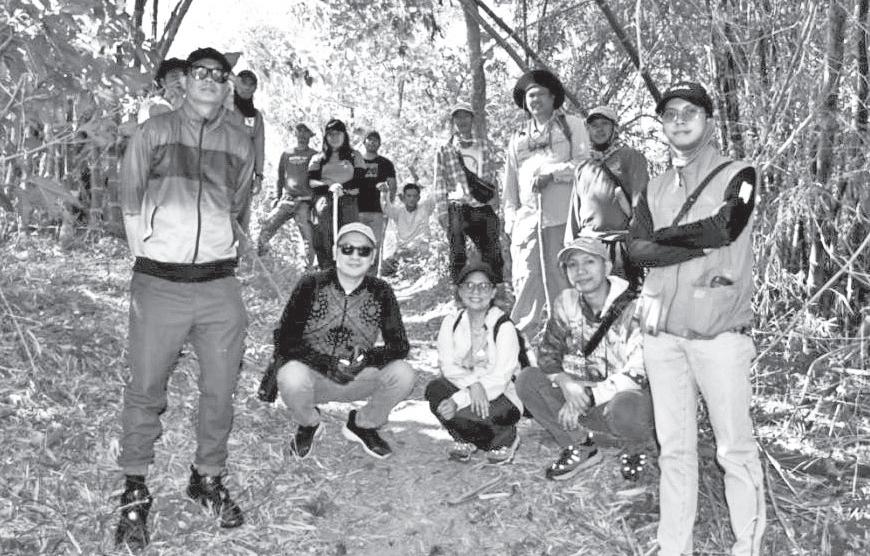
WITH growing interest in sustainable materials, the Department of Science and Technology (DOST) capitalizes partnerships with industry players to spur the development of the Philippine bamboo economy. For the benefit of local bamboo farmers in Nueva Ecija, the Philippine Council for Agriculture, Aquatic and Natural Resources Research and Development of the Department of Science and Technology (DOST-PCAARRD) met with representatives of two corporations—First Gen and TruForm Asia Packaging—on January 22 and 23 to explore initiatives to boost bamboo manufacturing.
The delegation visited the plantation and processing facilities of Villanueve Farmers Association (VIFA) in Pantabangan, Nueva Ecija, to observe and assess the current situation of bamboo production in the area. They also inspected and assessed the available bamboo processing machines. TruForm expressed its commitment to assist VIFA and its community by developing a clearer marketing and business strategy to ensure a sustainable operation. Discussions also centered on proposing a project that will further enhance the capacity of local communities in bamboo manufacturing. First Gen Corp. expressed its interest in collaborating with DOST-PCAARRD and its partners regarding the project. The project will include enhancement, development, and utilization of bamboo production technologies and generating opportunities for smallholder farmers and fisherfolk in First Gen’s host communities. Margaret Ann Bettina T. Papag and Alexander John
A MAN communicates with an ASUS Character Virtual Assistant, ROG Omni system during the AI
in Taipei, Taiwan, on March 25. AP/CHIANG YING-YING
DOST-PCAARRD, First Gen Corp., and TruForm Asia Packaging Corp. explore the bamboo plantation at Villanueve Farmers Association in Nueva Ecija for possible collaborative technology transfer engagement. FIRST GEN CORP.
A8 Sunday, March 29, 2026
Faith Sunday

Editor: Lyn Resurreccion • www.businessmirror.com.ph
Palm Sunday procession in Jerusalem cancelled
The Latin Patriarchate of Jerusalem makes the cancellation due to the Middle East war
ARDINAL Pierbattista Piz-
Czaballa, Latin Patriarch of Jerusalem, has announced that the traditional Palm Sunday procession, which goes from the Mount of Olives up to Jerusalem, has been cancelled due to the war in the Middle East, and will be replaced by a moment of prayer for the city at a location yet to be determined.
In a statement, the cardinal explained that the Chrism Mass of Holy Thursday, usually held in the Basilica of the Holy Sepulchre, has been postponed to a later date, as soon as the situation allows and possibly within the Easter season.
Ordinary public celebrations not possible THE restrictions imposed by the conflict and the events of recent days do not bode well for any imminent improvement,” the cardinal highlighted.
“In constant dialogue with the competent authorities, together
with the other Christian Churches, we are evaluating how, in the ways to be agreed upon, we can celebrate the central mystery of our salvation in the heart of our Churches,” he said.
Pizzaballa underlined that the situation is constantly evolving, making it impossible to provide definitive indications for Holy Week celebrations. He said the Patriarchate will be forced to organize events day by day.
“It is already clear, however, that ordinary celebrations open to all cannot take place,” the cardinal continued, explaining the decision to cancel the Palm Sunday procession and postpone the Chrism Mass.
However, the statement did specify that the Patriarchate’s churches remain open, and parish priests and clergy will do their best to encourage prayer and the participation of the faithful in Easter celebrations.

Diocese launches citizen movement vs corruption, political dynasties
CATHOLIC diocese in Met -
Aro Manila has launched a civic initiative aimed at addressing corruption and entrenched political dynasties.
Bishop Roberto Gaa of Novaliches said the initiative seeks to promote good governance through sustained civic participation beyond election cycles and political controversies.
The program, Novaliches Citizens Empowerment for National Transformation (NOVA-CENT) was introduced on Sunday at the Cathedral Shrine Parish of the Good Shepherd.
Gaa said the Church’s involvement in socio-political issues has often been limited, warning that occasional engagement is no longer enough in today’s context.
“We cannot just be fence-sitters anymore. Church participation must be consistent, not something that ebbs and flows,” the bishop said. He said the initiative draws from synodality, emphasizing shared listening and discernment through a method known as “Conversations in the Spirit.”
Gaa said this process is being applied not only within Church life but also as a framework for promoting transparency and accountability in governance.
Fr. Antonio Labiao Jr., the diocese’s vicar general for pastoral affairs and lead convenor of NOVA-CENT, said the effort depends on forming informed and actively engaged citizens.
“There can be no good governance without citizens’ participation,” Labiao told Radio Veritas, stressing the need for grassroots involvement in public affairs.
He said NOVA-CENT focuses on civic education, organizing communities, and encouraging engagement in issues, such as corruption, political dynasties and electoral reforms.
Gaa said strengthening institutions and fostering cooperation between citizens and leaders are essential to restoring trust and social order in the country.
Church leaders commissioned at least 55 facilitators to expand the program, expressing hope it will inspire broader participation in building a more just society.
Norman Dequia/CBCP News

Another wound caused by the conflict DUE to the war, this year we were unable to experience the traditional Lenten journey in Jerusalem, with the solemn celebrations at the Holy Sepulcher and in the Holy Places of the Passion,” the statement explained.
“Though we were able to pray and
prepare personally, we felt the loss of the community journey toward Easter,” said Cardinal Pizzaballa.
“The harshness of this time of war, which affects us all,” he continued, “today bears the added burden of not being able to celebrate Easter together and with dignity.”
“This is a wound that adds to the many others inflicted by the conflict.
But we must not allow ourselves to be discouraged. Though we may not gather as we would like, let us not give up prayer.”
Prayer for peace
THE Cardinal recalled Jesus’ words from Chapter 18, verse 1, of the Gospel of Luke: “Pray always and do not lose heart.”
He invited people to make up for these restrictions with moments of prayer in families and religious communities.
He invited everyone to unite in prayer on Saturday, March 28, by reciting the Rosary to ask for peace and serenity, especially for those suffering because of the conflict.
“We will do so with humble hearts, certain that our prayer, even while we are physically distant, is capable of drawing upon the strength of God’s love, which unites us in a spirit of hope and trust,” the Cardinal insisted.
Although prayer is already
widespread, he proposed a special day in which people can feel united, despite all being in their own places.
“We desire peace, first and foremost, for our troubled hearts. Only prayer can give it,” the Cardinal wrote. No darkness can have the last word ON Good Friday, Catholic faithful across the world will be invited to support the Holy Land through the traditional collection. The local community prepares to experience this special liturgical time with the cardinal’s words:
“Easter, which we celebrate in the name of Christ’s passion, death, and resurrection, reminds us that no darkness, not even that of war, can have the last word. The empty tomb is the seal of the victory of life over hatred, of mercy over sin. Let us allow this certainty to illuminate our steps and sustain our hope.”
Ven. Fulton Sheen beatification on Sept. 24
THE Vatican announced that Venerable Archbishop Fulton Sheen will be beatified on September 24 in St. Louis, Missouri.
Cardinal Luis Antonio Tagle, the Pro-prefect of the Section for First Evangelization and New Particular Churches of the Vatican’s Dicastery for Evangelization, will be the papal legate, celebrant, and preacher of the beatification Mass.
Sheen “is an inspiration not only to all of us who continue his work of prayer and support for the Church’s missionary work across the globe, but for all those whose faith has been strengthened by his preaching, broadcasting, writing, and holy Catholic life,” Monsignor Roger Landry, national director of the Pontifical Mission Societies US, told EWTN News.
Bishop Louis Tylka of the Diocese of Peoria said the Mass for the beatification of Sheen will take place at 2 p.m. CDT at The Dome at America’s Center, a stadium in St. Louis.
“With anticipation of a great number of people wanting to participate, we chose this location because of availability, being indoors, and the close proximity to the Diocese of Peoria,” he said.
There will be a number of other events in Peoria to celebrate the “wonderful occasion,” Tylka said. “This

is a moment of immense grace for the Church—especially for us in the Diocese of Peoria, where Archbishop Sheen was born, ordained, and first served as a priest. His life and ministry continue to inspire countless people to know and love Jesus Christ more deeply.”
“Through his preaching, teaching, and personal witness, he brought the light of faith to millions, calling each of us to a deeper devotion to the Eucharist and to Our Blessed Mother,” Tylka said.
“The Beatification Mass will be a profound moment of prayer and celebration for the faithful near and far. I invite all who have been touched by
Archbishop Sheen’s life and legacy to join us in spirit or in person for this historic event,” he added.
The Holy See officially informed Tylka that the cause for Sheen could proceed to beatification in February, following years of challenges and delays.
On March 25, the Vatican’s Dicastery for the Causes of Saints announced the “indescribable joy” that Sheen, “national director of the Pontifical Mission Societies from 1950 to 1966, will be beatified on September 24 in St. Louis,” Landry said.
Landry said he is “thrilled” that Tagle will be the papal legate, celebrant, and preacher of the beatification Mass in Missouri.
“Not only is Cardinal Tagle, like Sheen, an incredibly gifted preacher, but he will no doubt be able to emphasize the contributions that soon-to-be Blessed Fulton Sheen made and in many ways continues to make to the Church’s mission work,” he said.
The announcement, which fell on the the solemnity of the Annunciation, “is likewise very fitting,” Landry said.
“Archbishop Sheen spent his life continuing the work of the Archangel Gabriel, calling us to rejoice because the Lord is with us, and imitating the response of Mary in placing himself as a servant of the Lord, allowing his whole life to develop according to the Lord’s word.”
Venerable Fulton Sheen
PETER John Sheen was born in El Paso, Illinois, on May 8, 1895, and was called “Fulton” in honor of his mother’s maiden name. Sheen was ordained a priest of the Peoria Diocese on September 20, 1919. On June 11, 1951, he was consecrated as an auxiliary bishop of the Archdiocese of New York and remained in the position until 1966. He was then named the bishop of Rochester, New York, until his retirement in 1969 at the age of 74. He became known as a trailblazer for television evangelization with his Emmywinning show “Life Is Worth Living.” The show aired on television from 1952 until 1957, discussing morality and Catholicism. Sheen died due to heart disease on December 9, 1979.
His cause for canonization was first opened in 2002 under the leadership of the Diocese of Peoria, Sheen’s birthplace, and from then on he was referred to as a servant of God. Pope Benedict XVI declared him venerable in June 2012. On March 6, 2014, the board of medical experts who advise the then-Congregation for the Causes of Saints unanimously approved a reported miracle of Sheen’s, in which a stillborn baby survived due to his intercession. Pope Francis approved his miracle on July 5, 2019. Tessa Gervasini/ EWTN News via CBCP News
‘Calvario:’ A soul-stirring group art exhibition
AGROUP art exhibition titled “Calvario” is being held at the Infant Jesus Academy-Sentro Leona Galeria Museo in Marikina City.
A tribute to the life and sacrifices of Jesus Christ, the exhibit, which will run until May 26, features the works of 68 artists who are bringing their unique perspective and interpretation of the theme.
The exhibition opened on March 21 at 3 p.m., which coincided with the hour of Jesus’ passing.
As visitors immerse themselves in the art, they will be met with a diverse range of expressions and interpretations that evoke

FEU presents Pundaquit Virtuosi in Haydn’s ‘The
F AR Eastern University, through the FEU Center for the Arts, presents the Pundaquit Virtuosi
feelings of reverence, contemplation, and introspection.
A notable aspect of “Calvario” is its commitment to giving back. A portion of the sales from the exhibition will support Meritxell Children’s Home which embodies the spirit of compassion and service exemplified by Jesus Christ.
This initiative underscores the exhibition’s purpose of not only inspiring artistic appreciation but also fostering a sense of community and social responsibility.
“Calvario” promises to leave a lasting impact on all who attend the celebration of art, faith, and compassion.
Seven Last Words of Christ’ on March 31
Beatrice Guarrera/Vatican News
CHRISTIAN worshippers attend a Palm Sunday procession in Jerusalem in this undated photo. VATICAN NEWS
BISHOP Roberto Gaa delivers his homily during Mass for the launching of the Novaliches Citizens Empowerment for National Transformation at Novaliches Cathedral on March 22. NORMAN DEQUIA/RADIO VERITAS
VENERABLE Archbishop Fulton Sheen. ARCHBISHOP FULTON SHEEN FOUNDATION
SOME of the art works at the “Calvario” exhibit at the Infant Jesus Academy-Sentro Leona Galeria Museo in Marikina City until May 26.

Editor: Lyn Resurreccion

Biodiversity Sunday
Antlers among horns: A deer finds friends among domestic carabaos in Marinduque
IBy Jonathan L Mayuga
N Barangay Makulapnit in Sta. Cruz, Marinduque province, a Philippine brown deer (Rusa marianna) emerged from the woods, curiously befriending a farm animal, a female carabao.
Seeing the unnamed deer in a farming community came as a surprise. It was thought to be locally extinct for decades because of habitat loss and hunting.
Not only that the Philippine deer was thought to be extinct in Marinduque, but because it is wild, it is extremely shy, and highly elusive that runs away from humans.
Endangered species
THE Philippine brown deer is classified as vulnerable because of habitat loss and rampant hunting that have pushed many wildlife to the brink of extinction.
The deer, which appeared to be an adult male, was seen hanging out with carabaos— antlers among the horned animals—in a peaceful farming barangay in Marinduque. It does not run away from humans, as it should, especially since its species is hunted for its meat, and for the sheer “fun” of hunting the animal in the wild.
“I think he is friends with the carabaos,” said Barangay Chairman Iluminada R. Zulueta told the BusinessMirror in a telephone interview on March 23.
Puzzling behavior
ZULUETA , known in the community as Kapitana Zulueta, said they are puzzled with the behavior of the deer. It is taller and bigger than a goat, with antlers that are about 2 inches long, apparently healthy, and walks around next to its female carabao friend.
Charlie Rogelio, a farmer who owns the carabao, used to bring his farm animal to the foot of the mountain in Sitio Matalim. It was the first reported sighting of the same deer last year.
In June last year, Rogelio was surprised to see the carabao was not alone—it had a companion that was also foraging for leaves
World’s
Hfrom the undergrowth forest. The deer did not run away when he approached his farm animal to bring him down to the plains. Instead, from a safe distance, the deer followed them home.
Tagging along LIKE a friend to the carabao, the deer tagged along, following the bigger domestic animal wherever it went.
“The deer came along, too, when Rogelio brought his carabao to Sitio Malaking Bundok to forage later on. From then on, they were always seen together,” Kapitana Zulueta said in Filipino.
Many in the community considered it a welcome development.
“Finally, we have our deer back,” Zulueta quoted a farmer as saying.
She said that one time, the deer went to hang out with other carabaos, and was away from its friend for some time.
“When they saw each other again, it was like a reunion of sorts. They approached each other and started smelling—like kissing—like long lost friends,” she said in Filipino.
‘Kamote’ tops eater
THE deer has since been attracting curious onlookers from as far as neighboring barangays and municipalities, to see the deer with carabaos, foraging grass, and sometimes raiding plots planted with “talbos ng kamote [sweet potato tops].”
“Now, we are protecting the deer. In our barangay, we don’t hunt animals. We’ve agreed to protect the deer because we believe it is a blessing to us,” Zulueta said.
“Even the mischievous boys no longer stone the deer. We’ve told them not to harm it,” she said.
According to the barangay chief, they have heard reports of sightings of a mother and a young deer in other areas.
Threatened, hunted by humans
“WHY are deer and other wildlife species so hard to spot here? Because we humans have given them a reason to hide,” said Gregg Yan, a conservation photographer linked

with International League of Conservation Photographers who has worked with animal trackers from Borneo to Vietnam.
“Animals that have been historically hunted have learned to avoid not just humans, but the traps that hunters leave in forests and fields. I’ve only seen deer and wild pigs a few times in the Philippines, usually at dawn or dusk as they forage along the forest edge,” Yan said.
He said the Philippine deer grazing with a carabao in Marinduque is a good sign.
Though hunting deer and wild pigs is illegal under Republic Act 9147, it is still practiced from the Cordilleras in the north to Tawi-Tawi in the south, he said, sharing that he documented the hunting of wild pigs in Leyte recently.
Protect, don’t hunt
“INSTEAD of hunting them, we can turn their habitats into protected and well-managed wildlife reserves, where people can see them in the wild,” Yan said, pointing to Calauit Island in Palawan as an interesting example.
“[During the term of former President Ferdinand E.] Marcos Sr. [he] imported over 100 animals from Kenya [and brought them]

to Calauit [in Busuanga, Palawan] in 1977, and it has become a wildlife curiosity. A place where reticulated giraffes from Africa mingle with reticulated pythons from the Philippines,” Yan said.
However, the best part of Calauit is that it has become the largest enclave for deer in the country. From just a handful left in the early 1980s, Calamian deer (Axis calamianensis) has multiplied to over a thousand, and just like the Philippine deer in the video taken in Marinduque, they aren’t really afraid of people.
“I remember petting wild but not-so-elusive Calamian deer during my days in Calauit,” he added.
Law-abiding community FORTUNATELy, people in Barangay Makulapnit are animal lovers and law-abiding citizens.
According to Kapitana Zulueta, everybody in the barangay listens and abides by wildlife laws from DENR officials in Sta. Cruz and Marinduque municipalities.
“Even before, we already knew hunting is illegal because the DENR always talk to us. Sometimes, DENR officials hike to the mountains in our barangay,” she added.
Multiple sightings
LAST year, multiple sightings were reported across several towns in Marinduque, an island paradise in the Mimaropa (Mindoro, Marinduque, Romblon and Palawan), or Southwestern Tagalog region.
Early this month, the Department of Environment and Natural Resources (DENR)Mimaropa and Provincial Environment and Natural Resource Office-Marinduque, along with the Marinduque Wildlife Sanctuary, announced that camera traps put up in strategic locations in several towns confirmed the multiple sightings of the Philippine brown deer.
It said that records from 2025 documented multiple sightings across the sanctuary, with Barangay Makulapnit emerging as a key habitat, of at least 10 individuals.
Additional signs, such as footprints, were also observed in Marinduque’s Boac municipality and nearby areas, indicating a broader distribution of the species within the landscape.
Habitat restoration
ASSISTANT Director Mariglo Laririt of the DENR’s Biodiversity Management Bureau (DENR-BMB) welcomed the new sightings of the Philippine deer in Marinduque, and underscored the need to intensify habitat restoration efforts, as well to protect endangered wildlife.
“What is not clear [to me] is how they did it?” she asked.
Laririt acknowledged the jubilation with the new positive development. She shared that breeding, even captive, is being done to save the Philippine deer from extinction. She citied the initiative of the DENR in partnership with the Singapore Zoo, which is set to turn over a captive-bred Philippine spotted deer. She said there is a similar initiative in the Visayas.
At the same time, she said people have to be more critical and to further intensify conservation.
“We need a lot of catching up to do in conservation. Even in habitat restoration, we should focus more,” she said in Filipino, adding that “any breeding plan must be underpinned by solid habitat restoration.” Laririt said that as part of her advocacy, she will keep on advocating for more jobs, more conservationists, and more biologists, the way other sectors campaign for jobs.
“Jobs, not advocacies or hobbies [are needed],” she said, adding that people who work have to be paid.
“Conservationists must be paid. Forest rangers must be paid better. They protect national wealth like people in banks protect money. And bankers are paid well,” she pointed out.
Population assessment, sciencebased survey FOR her part, international biodiversity expert Theresa Mundita S. Lim told the BusinessMirror on March 22 that if Marinduque’s Philippine deer population is thriving, it will be worthwhile for concerned authorities to document the number of individuals and assess their genetic diversity.
“As Marinduque is an island, this population may be small and geographically isolated. If the deers are largely derived from closely related individuals, they may become increasingly inbred over time, which could eventually result in reduced fitness, lower reproductive success, and long-term population decline,” said Lim, a former DENR-BMB director and Asean Centre for Biodiversity executive director.
She added that it is important now to conduct a science-based survey and determine the genetic viability of the discovered population.
“If they are genetically healthy and in good numbers, then just protect them and their remaining habitat. If not, they may need to infuse new genetic material [deer] from other islands,” said Lim, a licensed veterinarian.
Beyond breeding, whether in natural habitat or captive, Laririt underscores the importance of protecting the deers’ habitats as well. She said, like those bred in captivity, it is important to release them to their natural habitats, where they can be safe.
great fish migrations collapsing, a problem for millions of people
IDDEN beneath the surface of the world’s rivers, some of Earth’s great animal movements unfold—migrations that rival, in sheer biomass, the famous mass movements of zebra and wildebeest across the Serengeti.
For centuries, fish migrations were as predictable as the seasons. Salmon, sturgeon, giant catfish and many other species moved through rivers in vast numbers, guided by rising water, flood pulses and evolved biological cues.
These species are extraordinarily diverse, ranging from beluga sturgeon— massive fish that can live for more than a century and produce the world’s most prized caviar—to giant river carp, tropical eels, gold-flecked shad and goliath catfish, all of which travel to survive, in some cases over hundreds or even thousands of miles. Their journeys can span continents. But the fish and their migrations are disappearing.
For most migratory fish, movement is not optional; it is how they survive. When dams block routes, when fishing intensifies at migratory bottlenecks and when floodplains and spawning grounds are cut off or degraded, most migratory fish do not simply go somewhere else. They cannot. First the migration thins, then it falters. In some rivers, especially those blocked by dams, it disappears altogether.
A new global assessment led for the March 2026 international meeting of parties to the Convention on the Conservation of Migratory Species of Wild Animals provides the clearest picture yet of this decline—and what’s needed to stop it.
My co-authors and I reviewed more than 15,000 species of freshwater fish, identified which of them migrate, and assessed their
conservation status, or risk of extinction.
We then focused on migratory species with declining populations and identified those where countries will have to work together to help them recover and thrive.
The results are sobering.
WE identified 325 migratory freshwater fish species as candidates for coordinated international conservation actions under the Convention on Migratory Species treaty.
Many of the largest species, the giants that make the longest and most dramatic journeys, are in the most trouble.
Among migratory fish already listed under the Convention on Migratory Species, 97 percent are at risk of extinction. In Asia, populations of migratory freshwater megafish have declined by over 95 percent since 1970.
The disappearing giants of the Mekong FOR the past 25 years, I have studied the world’s largest freshwater fish as a biologist at the University of Nevada, Reno; host of Nat Geo Wild’s Monster Fish documentary series; and the Convention on Migratory Species councilor for freshwater fish.
One of these extraordinary animals, the Mekong giant catfish, grows to more than 650 pounds. It once migrated hundreds of miles along the Mekong River, supporting fisheries and cultural traditions across the region.
Today it is critically endangered because dams are blocking its route to spawning grounds and overfishing as migration bottlenecks is killing the large adults that the population depends on.
In Cambodia, small migratory fish known as trey riel are so significant that they gave their name to the national currency.

In South Asia, one migratory shad, the hilsa, is so culturally important that it is sometimes given as a wedding gift, wrapped in ornate cloth and adorned with flowers.
Migrations of these fish, like migrations of buffalo on the American plains once did, shape ecosystems, livelihoods and culture. In the Mekong Basin alone, fisheries produce over 2 million metric tons of food each year, helping to feed tens of millions of people. When these fish disappear, people suffer.
Long migrations under threat DECLINES are unfolding in other great river systems as well.
In the Amazon, some of the largest catfish on Earth migrate across much of the continent. The dorado, or gilded catfish, can reach six and a half feet (2 meters) in length and complete a migration of more than
6,000 miles (10,000 kilometers) between Andean headwaters and coastal nurseries, the longest freshwater fish migration ever recorded.
At Teotônio Rapids between Bolivia and Brazil, fishers once hung from wooden scaffolding above turbulent waters to spear dorado as they surged upstream—until the rapids were flooded by new dams.
Altered river flows, barriers and overfishing are increasingly disrupting these journeys, and dorado populations in upstream Bolivia have plummeted.
Across the Northern Hemisphere, migratory fish such as salmon, sturgeon and shad have suffered major losses because rivers have been dammed and polluted, while many populations were heavily overfished.
In the Columbia River basin, dam construction transformed an immense river
system into a series of dams and reservoirs and blocked fish from large parts of their historical range.
In South Asia, fish such as mahseer, goonch catfish and hilsa are also declining under pressure from dams, overharvesting, sand mining, pollution and habitat loss, even as they remain central to fisheries and river cultures across the Ganges, Brahmaputra and Indus basins.
Why migratory fish are struggling MIGRATORY freshwater fish depend on long, connected river corridors, often across multiple countries.
Dams, habitat fragmentation, pollution, overfishing and climate-driven changes are breaking those connections. Once routes are cut, populations can collapse quickly.
This is increasingly an international problem. More than 250 rivers and lakes worldwide cross national borders, and about 47 percent of Earth’s land surface lies within shared river basins.
Yet freshwater fish are still too often managed at a local or national scale, as if rivers and fish movements stop at political boundaries.
That is why international agreements matter. The Convention on Migratory Species is the only global treaty specifically designed to encourage countries to work together to conserve migratory animals.
For freshwater fish, cooperation can begin with something as simple as countries sharing data and can extend to coordinated actions to reduce overharvesting, protect floodplains and spawning grounds, and keep rivers connected.
We found that the river basins where international cooperation is now most urgently needed include the Amazon and La Plata-Paraná in South America, the Danube in Europe, the Mekong in Asia, the Nile in Africa and the Ganges-Brahmaputra in South Asia.
How to bring back migratory fish
RESTORING migratory fish populations means keeping healthy rivers free-flowing, reconnecting rivers fragmented by dams and channelization, improving fisheries management, protecting floodplains and wetlands, and restoring habitats that have been drained, cleared or isolated by development.
There are examples of success. In Washington state, dam removals on the Elwha and White Salmon rivers reopened habitat that had been inaccessible for migrating fish for about a century, allowing Chinook, coho, steelhead and lamprey to return. The world’s great fish migrations have not disappeared everywhere, but they are fading. This new assessment offers a clearer picture of where international cooperation is most urgently needed. Zeb Hogan, University of Nevada, Reno/The Conversation (CC) via AP
The most fundamental solution is to manage rivers as connected ecological systems rather than as isolated national waterways. Of the 325 species we identified as priorities, many could be considered for listing under the convention. Listing does not automatically save a fish, but it provides a mechanism to enable countries to coordinate monitoring, management and conservation across borders. That matters because freshwater fish remain underrepresented in international conservation policy, despite the scale of their decline.
Transgender athletes banned from Olympics

Former UE Red Warrior writes book on hoops and parenting
GTENEVA—Transgender women athletes are now excluded from women’s events at the Olympics after the International Olympic Committee (IOC) agreed to a new eligibility policy on Thursday which aligns with US President Donald Trump’s executive order on sports ahead of the 2028 Los Angeles Games.
“Eligibility for any female category event at the Olympic Games or any other IOC event, including individual and team sports, is now limited to biological females,” the IOC said, to be
transitioned from being born male competed at the 2024 Paris Summer Games, though weightlifter Laurel Hubbard did at the Tokyo Olympics in 2021 without winning a medal.
The eligibility policy that will apply from the LA Olympics in July 2028 “protects fairness, safety and integrity in the female category,” the IOC said.
“It is not retroactive and does not apply to any grassroots or recreational sports programs,” said the IOC, whose Olympic Charter states that access to play sport is a human right. After an executive board meeting,
medical conditions known as differences in sex development, or DSD.
“We know that this topic is sensitive,” IOC President Kirsty Coventry said in an online news conference to explain the policy.
Coventry and the IOC have wanted a clear policy instead of continuing to advise sports’ governing bodies which previously have drafted their own rules.
“At the Olympic Games, even the smallest margins can be the difference between victory and defeat,” Coventry, a two-time Olympic gold medalist in swimming, said in a statement. “So, it

of her first big decisions last June as the first woman to lead the Olympic body in its 132-year history.
Female eligibility was a strong theme in a seven-candidate IOC election last year—held after a furor around women›s boxing in Paris— when Coventry’s main rivals pledged a stronger policy to leading on the issue.
By Rick Olivares
WO Filipino-Australian basketball players and coaches recently published a book that not only changed their approach to the game but also their rearing up their own kids.
Eric “Bizzy” Miraflores, who played for the University of the East before migrating to Australia, and Ivan Carlos, who played in the Victorian Basketball League, released in November of 2025, How to Be An Elite Parent for Young Basketball Players, a practical guidebook borne out of real-life situations for parents who have children taking up sports.
Miraflores played for University of the East’s Team B alongside Elmer Espiritu, and was hoping to crack the University Athletic Association of the Philippines lineup when he made the life and career-altering decision to join his family when they migrated to Australia.
At 32, he thought about giving his basketball dreams another go and applied for the 2015 Philippine Basketball Association Draft—he went undrafted but played in the Maharlika Pilipinas Basketball League and in the pro leagues in Australia. It was while coaching and training his son, Logan, where Miraflores had an epiphany.
“I would get angry and get impatient with my son’s development. You know the expectations when the father is an athlete, everyone thinks the son should be just as good if not better,” Miraflores said. “I was hard on my son and that might be an understatement. I didn’t know how else to coach or teach him.”

“One day, he approached me and said that he only played the game so he could be with me, spend time with me,” related Miraflores. “I was stunned speechless. I had tears in my eyes because I saw how wrong I was in going about parenting in sports.” Logan gave up playing basketball and chose another path, this time with Eric totally supportive.
“That taught me that listening, understanding, allowing them to grow and learn the game and life under a nurturing environment was important. It also changed the way I coach the kids.” Carlos, on the other hand, had a similar experience that forced him to question his methods.
When Carlos shared his thoughts and feelings with Miraflorez, they both realized it wasn’t only a shared experience, but they also had a burning desire to correct the flaws in parenting children in sports.
In the introduction to How to Be an Elite Parent for Young Basketball Players, the authors correctly point out the demanding, pressure-packed, and high stakes environment in basketball across the globe that manifests itself not only in the professional ranks but even more scary, in the grassroots level.
“The pressure on kids and parents can be intense because parents look at their kids as a means to an end, a meal ticket, if you will,” Miraflores said.
dinner at The Masters

Tandem sprint cycling at Asian championships Members of the Kazakhstan team compete in the para cycling event of tandem sprint—visually impaired athletes with a sighted pilot—in the Asian Cycling Confederation Track and Para Track Championships at the Tagaytay CT Velodrome. The championships— hosted by the PhilCycling and Tagaytay City and supported by the Philippine Sports Commission— started last Wednesday and ends Tuesday. PHILCYCLING PHOTO


The
“This was a priority for me way before President Trump came into his second term,” Coventry said. “There’s not been any pressure [on] us to deliver anything from anybody outside of the Olympic Movement.”
Before the 2024 Paris Olympics, three top-tier sports—track and field, swimming and cycling—excluded transgender women who had been through male puberty.
Semenya, who was assigned female at birth in South Africa and has testosterone levels higher than the typical female range, won a European Court of Human Rights judgment in her years-long legal challenge to track and field’s rules which did not overturn them.
Advantage from testosterone THE IOC document details its research that being born male gives physical advantages that a working group of experts believes are retained.
Team Zambales competes strong in regional meet
By Henry Empeño
IBA, Zambales—Local athletes are demolishing one opponent after another as the highly-motivated Team Zambales guns for medals with the goal of topping this year’s Central Luzon Regional Athletic Association (CLRAA) qualifier for the 2027 Palarong Pambansa.
The 2026 CLRAA competition, which pits student-athletes from the seven provinces of Central Luzon (Region III) under the auspices of the Department of Education (DepEd), took off last Saturday in Tarlac province which co-hosts this year’s meet with Aurora.
Zambales stood at second place in the medals race as of mid-week with18 gold, 22 silver and 25 bronze medals with Bataan ahead with 24 gold, 17 silvers and 12 bronze awards.
Defending champion Olongapo City trailed with an 18-22-17 tally, followed by Bulacan with 16-20-22 and Tarlac with 13-6-13.
Zambales’s medal harvest started right on Day 1 with its swimmers taking the gold in the 200-meter freestyle elementary boys and elementary girls.
More gold followed on Day 2 when the Zambales swimming team again dominated the 50-meter butterfly event for elementary girls and the 4x500 meters medley relay.
Scheffler’s menu reflects his down to earth personality and Texas roots, which I’m sure will go down well with the mostly American roster of past champions.
As a foodie, I would imagine that some champions have the potential to serve better menus than others. Jon Rahm being from Spain certainly pulled out all the stops for his own Champions Dinner.
Being from the Basque Country in Spain, food is a huge part of Rahm’s culture and his region serves some of the best food in the world bar none. Rahm’s menu of course features Tapas and Pintxos for appetizers, with Iberico Ham, Croquetas and Spanish Tortilla. He also served Spanish-style steak, Chuleton and Turbot fish al Pil-pil. I am pretty sure the past champions had a pretty good dinner that year. Another Masters Champion who I’m sure served really
“Males experience three significant testosterone peaks: In utero, in minipuberty of infancy and beginning in adolescent puberty through adulthood,” the document said. It added this gives males “individual sex-based performance advantages in sports and events that rely on strength, power and/or endurance.”
The IOC said its research included “indepth individual interviews with impacted athletes from around the world.”
The expert group agreed the current gene test is “the most accurate and least intrusive method currently available.” The saliva, cheek swab or blood sample screens for “the SRY gene, a segment of DNA typically found on the Y chromosome that initiates male sex development in utero and indicates the presence of testes/testicles.” AP

Zambales Governor Hermogenes Ebdane Jr., who visited the local athletes at the New Clark City Athletics Stadium on Tuesday, reiterated the provincial government’s full support and urged the local players to “Go for gold.”
The strong showing by Zambales Team early on “portends more victories and validates our efforts to prioritize sports development in Zambales,” Ebdane said. Zambales is bidding to host the Palarong Pambansa in 2027 and is building a P500-milion sports complex in the capital town of Iba, alongside a rigid training program for local athletes. The Zambales team ended last year’s CLRAA campaign at third place, behind Olongapo City and Bulacan, with 41 gold, 40 silver and 47 bronze medals. Jade Ballesteros, who heads the Provincial Sports Development Office, said local athletes were raring for more victory in the regional meet.
Tarlac hosts athletics, badminton, baseball, billiards, boxing, chess, gymnastics, softball, taekwondo, tennis, wrestling, wushu, pencak silat, weightlifting and para games. Aurora will host the second stage from April 9 to 13 in archery, arnis, basketball, dancesport, football, futsal, sepak takraw, table tennis and volleyball.
served the finest sushi and sashimi, as well as Yakitori (probably for those who can’t eat raw fish) for appetizers, Miso Black
INTERNATIONAL Olympic Committee president Kirsty Coventry said the organization have wanted a clear policy instead of continuing to advise sports’ governing bodies which previously have drafted their own rules. AP
GOVERNOR Hermogenes Ebdane Jr. joins Team Zambales in celebrating early victories at the New Clark City Athletics Stadium as one of the province’s athletes competes in long jump. HENRY EMPEÑO
FILIPINO-AUSTRALIAN Eric “Bizzy” Miraflores writes from experience. CONTRIBUTED PHOTO


‘Cost per wear’
How the shopping concept could make fashion greener
MARCH 29, 2026 | soundstrip.businessmirror@gmail.com
COMING HOME
The Ransom Collective returns with new release, ‘Tongue Tied’
Story by Justine Xyrah Garcia
FOR MOST BANDS, a comeback single is something you build from scratch.For indie-folk band The Ransom Collective, it was something they left unfinished—and eventually found their way back to.
“Tongue Tied” began years before the band slowed down. It started as a jam, just a few chords played back and forth, without a clear sense yet of where the song would go.
A few chords passed around, a melody that stuck, and a line that captured a familiar, almost awkward feeling of liking someone before anything actually happens.
“We were just kind of jamming… it was just a couple of chords that we were playing back and forth that were kind of fun…we weren’t really sure where it was going to go,” vocalist Kian Ransom recalled in a media roundtable with BusinessMirror’s SoundStrip and other media organizations.

Publisher :
T. Anthony C. Cabangon
Lourdes M. Fernandez
Editor-In-Chief :
Concept :
Aldwin M. Tolosa
Y2Z Editor :
SoundStrip Editor : Group Creative Director : Graphic Designers :
Jt Nisay
Edwin P. Sallan
Eduardo A. Davad
Niggel Figueroa
Chow Jarlego
Contributing Writers :
Tony M. Maghirang
Rick Olivares
Jingo Zapata
Reine Juvierre S. Alberto
John Eiron R. Francisco
Patrick Villanueva
Ana Zoe V. Davad
Justine Xyrah Garcia
Ginger Franz S. Ocampo
Trixzy Leigh Bonotan
Bless Aubrey Ogerio
Photographers :
Bernard P. Testa
Nonie Reyes
Y2Z & SOUNDSTRIP are published and distributed free every Sunday by the Philippine Business Daily Mirror Publishing Inc. as a project of the
The Philippine Business Mirror Publishing, Inc., with offices on the 3rd Floor of Dominga Building III 2113 Chino Roces Avenue corner Dela Rosa Street, Makati City, Philippines. Tel. Nos. (Editorial) 817-9467; 813-0725. Fax line: 813-7025
Advertising Sales: 893-2019; 817-1351,817-2807. Circulation: 893-1662; 814-0134 to 36. www.businessmirror.com.ph
At one point, the track leaned toward a bossa nova groove, something that felt slightly outside their usual sound, and they weren’t quite sure where to take it.
The song eventually stayed unfinished as the band began to slow down and life pulled them in different directions.
Formed in 2013, the six-piece band— Kian, Muriel Gonzales on violins, Jermaine Choa Peck on percussion, Leah Halili on bass, Lily Gonzales on keys, and Redd Claudio on drums—built a following on an indie folk sound anchored in acoustic textures, violin, and layered harmonies.
More than that, they built their music in the same room, feeding off each other in real time. The pandemic disrupted that rhythm as members relocated, some got married, others leaned into solo work. The band didn’t break, it just stopped being constant.
“We allowed ourselves to experience life outside of the almost full-time music that we were doing for how many years,” Jermaine said.
Still, “Tongue Tied” stayed with them. Over time, it stopped feeling like an abandoned idea and started feeling like something unresolved—something they had to return to, if only to hear what it would sound like now.
Kian doesn’t overstate what the song is meant to be. If anything, he keeps it openended.
“I hope it will make people bring them back to some memory, a fond memory of either someone they love or something special that



happened,” he said.
“I hope that as people listen to it, they'll reflect on happy moments that they've had themselves and maybe have a little bit of joy in that.”
Growing individually
The years apart didn’t just delay the song— they reshaped it. Working outside the band forced each member into a different kind of process. For Muriel, that meant figuring out how to create without the safety of a shared sound.
“From being part of a band to doing something on your own, it’s a lot of work,” she said. “You’re actually defining your own [identity].”
Jermaine described it as something quieter but just as important. Writing on her own became a way of understanding herself better, of building confidence that didn’t depend on the band.
“I learned a lot about myself… I got more confident,” she said. For Kian, the shift was more about perspective. The pause made him rethink how much space music was taking up in his life.
“I wasn’t okay with music being my whole life,” he admitted, describing a need to step back and build something more balanced.
All of that fed back into “Tongue Tied.” When they returned to the track, it didn’t stay the same. The arrangement stretched. The outro went through multiple versions. The song was even recorded across multiple

studios as the band worked around distance and time.
For the first time, they also worked with producers to help bring everything together.
“It changed a lot,” Kian said. “Our own personal tastes and sounds had kind of evolved as well.”
And you can hear it. The foundation is still there—the warmth, layering, ease that’s always defined their sound— but it doesn’t feel like they’re trying to recreate anything.
The bossa elements they once hesitated on now sit naturally within the track. The pacing feels more patient, it sounds like something that belongs to two timelines at once.
Not a full comeback yet
Although their new single feels like a return, the band isn’t rushing to frame it that way. There’s no album lined up. No fixed release plan. No attempt to jump back into the pace they once had.
“We can't really commit to anything at the moment, but we're getting back into the groove and enjoying writing music again without the pressure,” Muriel said.
That word “groove” feels more accurate than anything else because this doesn’t come across as a comeback in the usual sense. It feels more like they’re figuring out how the band fits into their lives now, instead of rearranging everything around it.
Kian puts it more directly: “It feels less like a comeback and more like coming home.”
The Ransom Collective
FROM PHL TO THE WORLD
SB19 ends one chapter, enters new era in global stage
Story by Reine Juvierre S. Alberto
“
SB19 walked so other P-Pop artists can run,” said Filipino filmmaker Antoinette H. Jadaone in an episode of the Ang Walang Kwentang Podcast featuring SB19.
Undeniably, SB19 did not just walk—they crawled and stayed the course just to get to where they are now.
In 2019, SB19 held their first conference at Luxent Hotel in Timog, Quezon City, where they got a taste of hostility from the members of the local press.
“During that time, no one really actually considered or knew anything about P-Pop. So, we were roasted by a lot of media and they told us, ‘How are you going to introduce P-Pop to the world, or to the Philippines?’” Josh Cullen Santos, lead rapper and dancer of SB19, said. “They were stereotyping us, like, copycats. [SB19] even had a discussion after on how we are going to call ourselves.”
SB19 were once called “K-Pop Filipino group” or “P-Pop sing and dance group” because many thought they were K-Pop group wannabes.
Six years later, SB19 returned to the same venue where they held their first press conference—this time, proving how far they’ve come.
“It’s more than enough for us that we introduced [P-Pop] and that we inspired people to join this movement,” Josn said in the press conference, explaining that the genre is basically doing pop music in the Philippines.
“It has been maybe there ever since, or maybe [we] accidentally created the genre, but right now, we’re very proud to tell everyone that this is a movement and this is going to change the Philippines and this industry,” Santos said.
Now recognized as trailblazers, SB19 have already achieved so much—fresh off their Simula at Wakas World Tour—yet, they’re still shooting
for the stars and aiming high.
Wakas at Simula
SB19 is set to release its full-length album, Wakas at Simula, to close their trilogy of extended plays— Pagsibol, Pagtatag and Simula at Wakas—which chronicle their journey of finding their place in the beginning, building their identity and gaining people’s trust.
“With every ending comes a new beginning,” Pablo, leader and rapper of SB19, said. “It’s a milestone that we can look back on how far we’ve come, but at the same time, it’s a celebration for our next chapter.”
At this stage, SB19 is more intense, freer and bolder in exploring their musical style, Pablo added.
After eight years in the industry, Justin, the group’s sub-vocalist, said they are now more confident in experimenting without feeling like they have to tread carefully or second-guess every move.
The album will feature six new tracks titled “VISA,” “Memories,” “Toyfriend,” “Everblack,” “Emoji” and “Wakas.” Songs from their 2021 EP Pagsibol will also be re-recorded to reflect their artistic and emotional growth shaped by their lived experiences over the years.
From collaborating with local artists, SB19 has expanded its reach to international acts, including Taiwanese singer Jolin Tsai and Japanese group BE:FIRST for the new album.
“Theyareverycomplexwiththeirartistryandcraft,” Ken, SB19’s main dancer, said. “They are very specific with how they want to sound and their directions.”


“It’s a whole experience [in terms of] visual, acting, music video, lyrics. Everyone contributed ideas to refine and fully realize the story we wanted to present,” Pablo added.
SB19 also explored other genres in the album, including rage pop and Brazilian funk, Josh chimed in.
As fans wait for the album to drop on March 27, Friday, they are also gearing up for the Wakas at Simula Concert, which will serve as the finale to their Simula at Wakas tour, happening on April 18 at the SMDC Festival Grounds.
From the Philippines to the world
SB19 also recently announced that they are off to Chicago as the first Filipino act at Lollapalooza 2026.
“Talaga pong nanggigigil na kami [We’re incredibly excited],” Pablo, leader and rapper of SB19, shared his excitement. “For sure, it’s something that all Filipinos will be proud of.”
He teased that there would be new arrangements and intense productions to showcase what the group is capable of.
SB19 targets to go global to flaunt Filipino talent, Pablo added. “I’m just so happy na itong mga opportunities na ganito na dumarating sa amin. Talagang bibihira yung mga ganitong opportunity [I’m just really happy that opportunities like this are coming our way. These kinds of opportunities are rare].”
Looking back, Josh said SB19 used to tease each other about dreaming big. “Libre lang mangarap. And if we didn’t really make it, at least we set the goal na meron tayong tina-try everyday. May reason tayo kung bakit tayo bumabangon [Dreaming is free. And even if we didn’t make it, at least we set goals and had something to strive for every day. We had a reason to keep going].”
With a new album on the way, Josh said the
group feels more prepared for the global stage.
“We’ve experienced so many stages, we’ve experienced so many concerts and festivals,” Josh said. “Through that and through this album, we can say that we’re not afraid of anything. We’re more confident when it comes to presenting the Filipino talent and, of course, P-Pop.”
While SB10 will not be holding a world tour this time around, they will be performing across North America, Europe and the Middle East later this year. The group also announced that they will be performing in major international festivals aside from Lollapalooza.
What’s next?
Stell, SB19’s main vocalist, said it is now time to open doors for aspiring artists and create more opportunities for them.
1Z Entertainment, the talent agency founded and run by SB19, is currently forming a new girl group that is being trained and prepared for launch.
“We want to start doing is opening up new opportunities. There are many aspiring artists who are afraid to try because they think entering this kind of field is intimidating,” Stell said.
Through 1Z, he said SB19 hopes to set the standard for how artists should be trained and properly managed.
“We’re gonna go bigger. Maybe in the next three to five years, everything will change and P-Pop will soon be one the main export market of the Philippines, I guess,” Josh added.
As SB19 enters its new era, Justin said they will be more vocal and confident about what they want to say. “We’ll make sure that our influence on people is in the right direction—the kind of impact we really want,” he added.
SB19 at their press conference at Luxent Hotel in 2019
SB19 at their latest press conference at Luxent Hotel this 2026. Photo: Reine Juvierre Alberto
‘Cost per wear’ How the shopping concept could make fashion greener
By Lisa Eckmann University of Bath
IMAGINE a man wants to buy a new shirt for work that he plans to wear once a week for at least the next five years.
When browsing for options, he finds one shirt from a lower-quality brand priced at £20 and one shirt from a high-quality brand for £50. Which one should he buy?
Our theoretical shopper would probably conclude that the high-quality shirt makes more economic sense. Taking into account the purchase price relative to how many times he can wear the shirt, it would cost him only 25 pence for each time he would wear it, compared to the lower-quality shirt at 40 pence.
This is the logic of “cost per wear.” Some fashion blogs and small businesses have started using this concept to make the case for high-quality clothing. The rationale is simple–higherquality clothing should last longer, making a higher purchase price worthwhile in the long run.
Cost per wear is calculated by dividing the garment price by the number of times the consumer expects to wear it. Essentially, it works much like unit pricing in supermarkets. These measures already help consumers compare things like the price of a product per 100g, per chocolate bar in a multipack, or per laundry load. But this same logic isn’t yet applied to clothes in a retail setting.

tween options, and when the cost per wear information was said to be certified by an independent third party. Participants then trusted the information more, and we found that this could outperform a general durability claim made by a brand.
Our studies showed that cost per wear can make cheap fashion suddenly appear more expensive to shoppers–the high-quality options were viewed as better financial investments. And by choosing the more economical, highquality option, participants were also choosing the greener option.
“OUR studies showed that cost per wear can make cheap fashion suddenly appear more expensive to shoppers–the high-quality options were viewed as better financial investments. And by choosing the more economical, high-quality option, participants were also choosing the greener option.”
Is it the solution?
THE fashion industry is one of the largest contributors to environmental harm, accounting for up to 8 percent of the world’s carbon emissions, causing immense water pollution due to textile treatments such as dyeing, and producing millions of tons of textile waste annually.
Using cost per wear in shops or online retail spaces could reduce the environmental impact of fashion–the more frequently a garment can be worn, the more efficiently the consumed resources are used. And, of course, the longer that garment remains in use, the less often it needs to be replaced.
The problem is that most shoppers don’t know how long a garment will last. Without a prompt in stores or online, many consumers do not even consider clothing longevity when buying.
But standardized fabric-testing methods exist already. These methods assess the durability of fabric according to the number of abrasion cycles (that is, the number of rubs against an abrasive surface) it can tolerate before
A new rhythm of color for summer
GLOBAL apparel retailer UNIQLO launched the Uniqlo U 2026 Spring/Summer collection, exploring the idea of neocore. Created by co-artistic directors Christophe Lemaire and Sarah-Linh Tran, along with their team in Paris, the new lineup features a summery color palette centered on tinted white and washed blue that plays a lightweight rhythm.
Faintly sheer materials that softly kisses the skin make items comfortable to wear with sophisticated style that shines with lightness. The men’s Boxy Shirt, for example, is made of 100% cotton material for a breezy feel and has a relaxed fit. The women’s sheer parka with a soft silhouette combines water repellent functionality and UV protection. Easy Gathered Pants feature a beautiful airy drape.
The all-season, modern outerwear lineup also includes a Cotton Blend Short Blouson that combines a compact fit around the body with loose sleeves, and a Short Blouson that takes advantage of smooth fabric. Both styles of outerwear can be used throughout the season irrespective of gender. Lightweight jackets that can be paired with
bottoms for a matching set are available for both men and women.
Meanwhile, standard bottoms have been updated in a modern style, rethinking the balance between silhouette and material. Wide Cargo Pants have a gentle curved line and a wide silhouette to enhance the structured look. Jeans in vintage-like colors can be paired with a tape belt with metal eyelets for a distinctively Uniqlo U-style look.
The Uniqlo U 2026 Spring/Summer collection includes 13 items for women, 14 items for men, and 3 items for accessories, with the majority of the collection designed to be genderless.
Meanwhile, global pop culture takes center stage at the UT: GRAPHIC-T UNIVERSE event, running until today, March 29, at the One Ayala Concourse in Makati City. More than just a showcase, the event brings the collection to life, transforming the everyday wardrobe staple into a dynamic expression of art, culture, and identity.
UT (UNIQLO T-shirt) is known for its wide-ranging collaborations and thoughtful curation, offering a platform
showing signs of wear. This could easily be applied to clothing, allowing retailers to include cost per wear labels alongside the purchase price.
In research I carried out with Lucia Reisch from Cambridge Judge Business School, we tested this idea. In a number of experiments, we showed participants from online panels a lower-quality, cheaper garment (a sweater, for example) and a higher-quality, more expensive version. We then asked which they would prefer.
Fast fashion suddenly wasn’t so affordable
When we included information on the cost per wear for both options–or even just the high-quality option (showing a lower cost per wear compared to a poorer-quality option, or a reference value), participants were more likely to choose the more expensive, high-quality option.
The effect was stronger when participants were shopping for everyday wear over occasion wear, when they could compare the cost per wear be-
Cost per wear can increase the perception of affordability for more expensive, high-quality clothing. But, of course, many shoppers will still not be able to afford the higher purchase price even though they know it would make more long-term economic sense.
And cost per wear only reflects the durability of an item as one dimension of sustainability. It does not reflect ethical considerations, such as the conditions workers face in the production process, or ecological aspects such as the use of natural or synthetic fibers. Brands and retailers must also be willing to display cost per wear labels without regulation. High-quality brands may arguably have a greater incentive to do so than fast fashion brands.
However, the concept of cost per wear is still worth pursuing. It can prompt shoppers at the point of purchase to consider a garment’s durability and how often they might wear it. And ideally, it would motivate them to ditch fast fashion and choose greener options–even if just to save money in the long run. The Conversation
n Cover photo Liza Summer on Pexels.com

THE Uniqlo U 2026 Spring/Summer collection introduces neo-core essentials in a summery palette of tinted white and washed blue, designed to adapt to every lifestyle.
where global pop culture becomes wearable. With a diverse lineup across manga, art, characters, movies, music, and more, the pop-up event highlights how UT continues to connect people through shared passions and stories.
At the heart of the showcase is the MANGA UT SHUEISHA 100th collection, commemorating the 100th anniversary of Japanese publishing giant SHUEISHA. Art enthusiasts can also immerse themselves in the MoMA Poster Art Collection, which translates some of the most iconic exhibition posters from the Museum of


Modern Art in New York into wearable pieces.
Beyond these highlights, visitors can explore an even broader range of UT collections, including designs inspired by movies, games, music, and the MAGIC FOR ALL lineup featuring globally loved characters. Each piece reflects UT’s commitment to making pop culture accessible, allowing individuals to discover and wear what they love.
More information is available at www.uniqlo.com/ph/ en/, and on Facebook (@uniqlo), Instagram (@uniqlophofficial), and TikTok (@uniqlophofficial).
PHOTO BY SAM LION ON PEXELS.COM
Wine Dine&
A New Spin on Asian Soul Food: Chef Patrick Go’s Lazy Suzy at The Podium Social
By Brian K. Ong
OUR once-a-week Sunday family lunches are something I genuinely look forward to, a sacred pause in a busy week when the world slows down. More often than not, we retreat to familiar haunts like Greenhills Mall, Rockwell Power Plant Mall, or Opus Mall. But every now and then, we venture off the beaten path, usually prompted by a viral TikTok food review making the rounds in our family group chat. With our mother celebrating her 67th birthday last Sunday, the occasion called for something new. Our search led us to the upper levels of The Podium. While we frequent its lower floors, we had yet to explore “Podium Social,” the mall’s newest curated dining enclave. There, tucked amid sleek lines and terrace greenery, we discovered Lazy Suzy.
Who’s Lazy Suzy?
THE name evokes instant nostalgia. Inspired by the iconic rotating tray at the heart of Asian family gatherings, Lazy Suzy is more than a restaurant; it’s a homecoming for Chef Patrick Go. A familiar name in Manila’s culinary scene, Chef Patrick is known for deconstructing Asian flavors and rebuilding them with playful precision. Here, he steps away from high-concept fine dining toward something more visceral: “modern Asian comfort.” The result is a menu that draws from Chinoy childhood flavors, elevated through the lens of a seasoned chef.
The Architect of Flavor: Chef Patrick Go EVEN before the first plate arrived, Chef Patrick Go’s reputation spoke for itself. A favorite among local foodies, he has helmed kitchens that pushed the boundaries of fusion, most notably at Your Local, where he helped redefine what “cool” Asian food looked like in Makati.
But Lazy Suzy feels different, more personal. By reimagining the “Lazy Susan” as a symbol of sharing and abundance, he invites diners to let go of individual courses and embrace the joy of communal dining.
That spirit of reinvention extends beyond the kitchen. The space itself carries a cinematic elegance, punctuated by striking charcoal
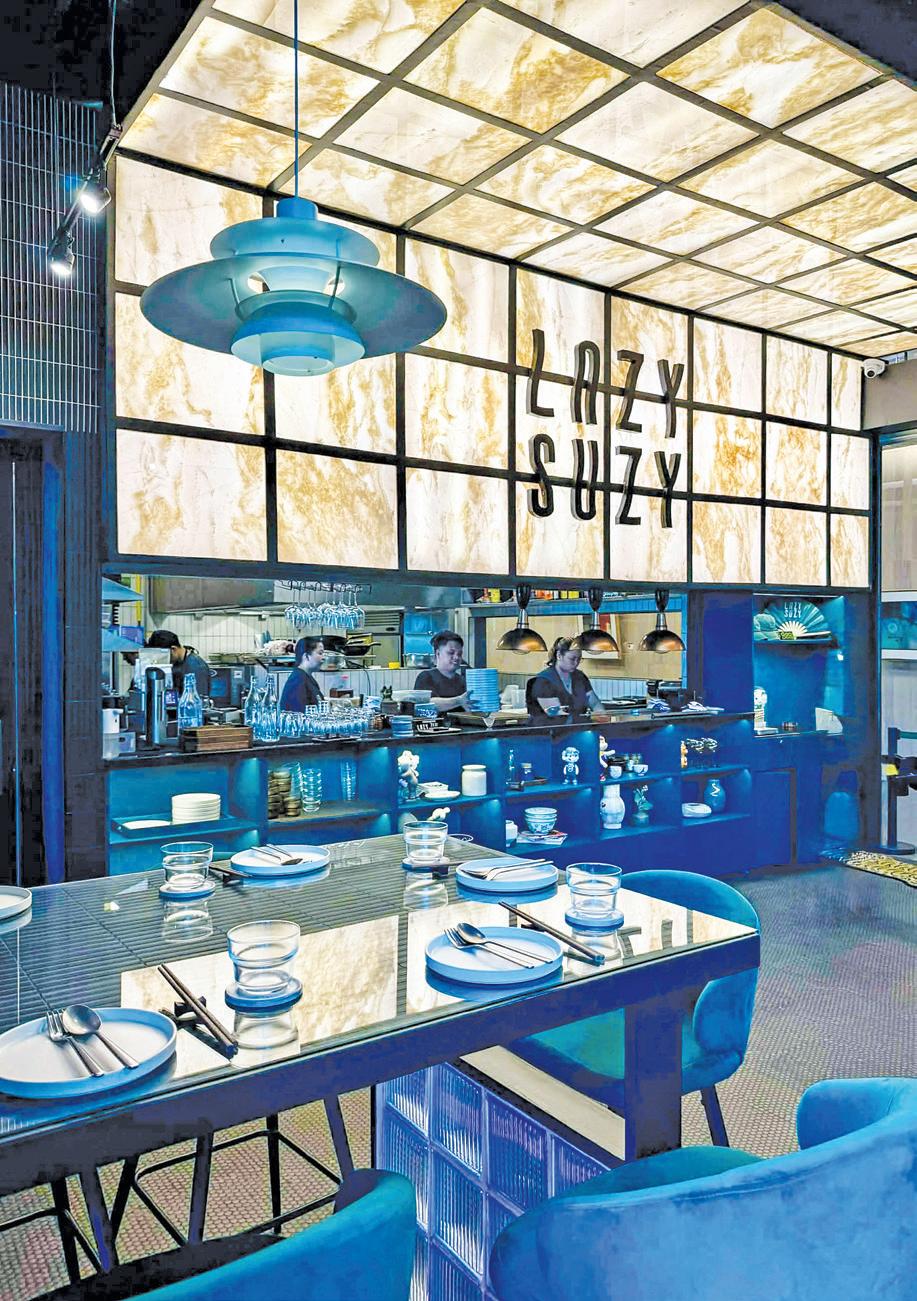
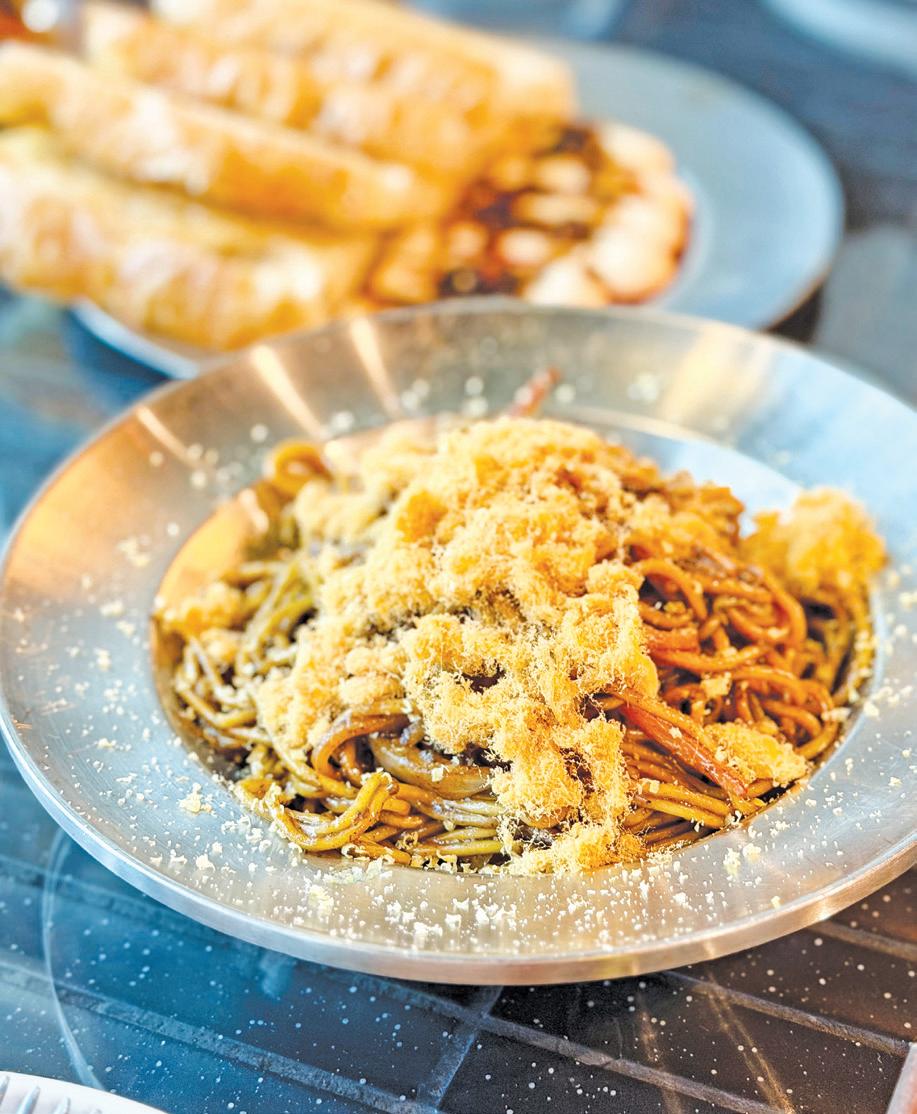
works from artist Joshua Torres. His photorealistic yet surreal compositions mirror the restaurant’s philosophy: familiar elements placed in unexpected contexts. The result is a gallery-like backdrop that completes the transition from the bustle of the mall to a thoughtfully curated dining experience.
A Symphony of Small Plates WE began with a trio of appetizers that immediately signaled this would be no ordinary “sweet
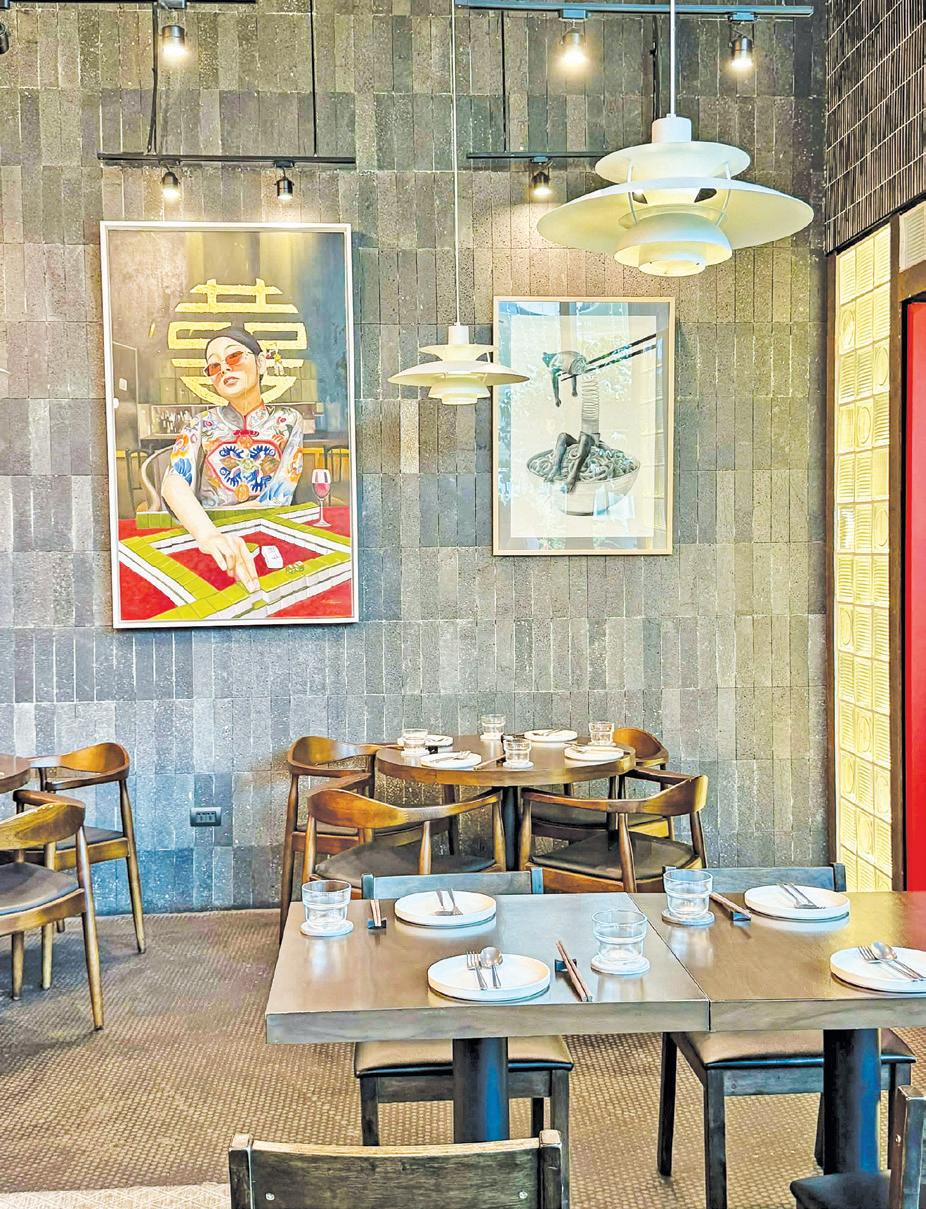
and sour” affair.
The Lazy Suzy Floss Dumplings (P350) reimagined a birthday staple with textural flair. A rich pork and shiitake filling was enveloped in a delicate exterior coated in wonton and nori floss, creating a savory cloud. Paired with a spicy plum aioli, each bite delivered a balance of crunch, softness, and tangy heat. Next came the Whipped Tofu and Focaccia (P360), a standout in bridging East and West. The sesame focaccia, warm and airy,


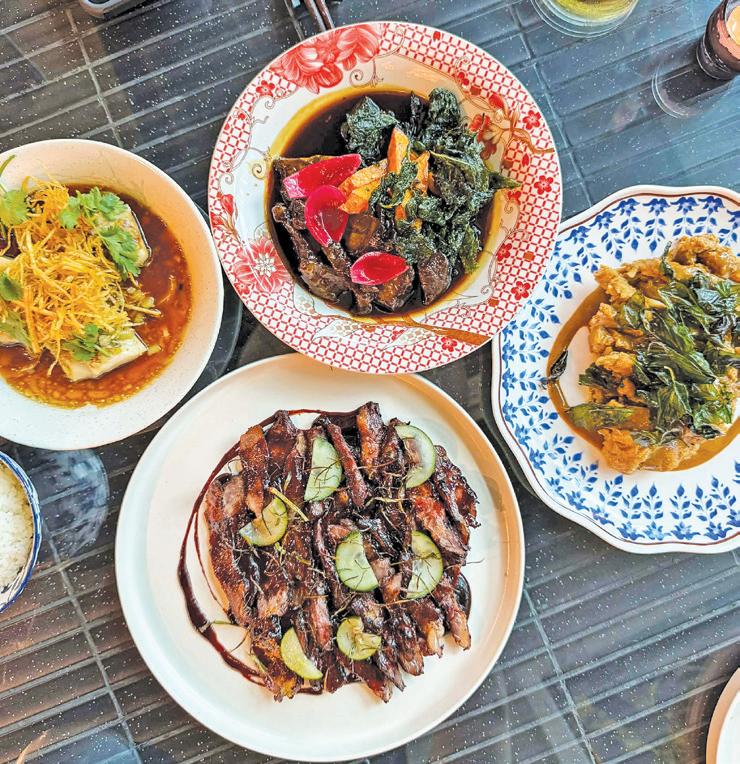
served as the perfect base for a “whipped tofu cheese” that rivals burrata in creaminess, with a clean, nutty finish. Topped with sweet and sour chili garlic crisp, it was a study in balance.
The Tuna Kropek (P440) rounded out the starters with a refreshing lift. Featuring cured yellowfin tuna, daikon, and gochujang, it felt like an elevated take on a Filipino snack. Crisp kropek chips added texture, while the dish’s brightness primed the palate for richer courses.
The Heart of the Feast: Noodles and Beef IN Chinese tradition, noodles symbolize long life—an essential for birthdays. The Black Truffle Chow Mein (P490) offers a decadent take, wok-fried to achieve elusive wok hei and coated in a rich truffle paste. Chicken floss and cured egg yolk added depth, elevating a humble dish into something indulgent. For those seeking comfort, the Beef Noodle Soupreme (P550) delivered. Its deeply aromatic broth,
the product of hours of simmering, cradled tender US Angus beef that melted effortlessly. The wheat noodles had just the right bite, while homemade chili crisp added a slow, warming heat.
The undisputed star, however, was the Lazy Suzy Beef Charsiu (P1,600 – Large). A far cry from the usual thin slices, this slow-cooked and grilled Angus brisket was rich, tender, and deeply caramelized. Its sticky, smoky glaze clung to each slice, balanced by fermented vegetables that cut through the richness. It’s a dish worth the trip alone.
Elevating the Classics: Poultry and Seafood AS our imagined “Lazy Susan” continued to turn, we moved to the Galbi-Jjim Beef Cheeks (P860). Braised to tenderness, the beef cheeks were paired with black garlic, adding a subtle sweetness to the savory depth. Roasted carrots and fried greens completed a dish that felt both refined and comforting. For something crisp, the Night Market Fried Chicken (P690) impressed. Fried to a golden shatter and seasoned with five-spice salt, it was served with a dandan sesame sauce that added a creamy, nutty, slightly numbing complexity. We ended the savory course with the Ginger Scallion Halibut (P860), a study in restraint. The delicate, buttery fish was bathed in ginger scallion sauce and sweet soy, with potato flakes adding an unexpected but welcome texture, proof that even simplicity can carry a creative edge.
A Celebration to Remember AS we lingered in Podium Social’s warm glow, finishing the last bites of our meal, I looked at my mother, beaming at 67. Dining at Lazy Suzy isn’t just about the food, though it is exceptional, but about shared discovery.
For a family like ours, exploring a new corner of a familiar space and encountering a chef who treats Asian cuisine with both reverence and playfulness felt like a gift. Lazy Suzy strikes a rare balance: trendy enough for a night out, yet soulful enough for a meaningful family celebration.
Chef Patrick Go has created a space where the “Lazy Susan” never stops turning, bringing people together, one thoughtfully crafted dish at a time. If you find yourself at The Podium, head upstairs, take a seat at Lazy Suzy, and let the flavors of a new Asia unfold.
By Justine Xyrah Garcia
what if ice cream could go beyond the usual flavors we’ve grown up with? What if it could taste like home?
Marcelo’s Microcreamery is making that case. The brand recently launched its premium artisanal “Heritage” line at Romulo Café in Makati City, featuring flavors inspired by traditional Filipino desserts: Inutak, Ube Macapuno Champorado, Latik-Latik, Mangga’t Suman, Bilo-Bilo, and Chocolate Champorado. For founder John J. Marcelo, the idea came from a simple realization.
“It started as a quiet Sunday afternoon. I had just finished a warm bowl of champorado and headed out to the grocery run. Walking down the freezer aisle, I noticed that all the ice cream flavors were exactly the same,” Marcelo said during the launch.
“I’m sure you guys have those experiences as well. We had rock and roll, vanilla, chocolate, and of course, ube and it struck to

me that not a single top of those shelves were remotely Filipino. That was my aha moment.” Filipino flavors FROM that moment, the Heritage line was born. Ice cream rooted in Filipino flavors, but reimagined. I had the chance to try all six (actually seven) flavors, and here’s how each one stood out:
n Inutak – True to its name, it draws from the creamy, gooey kakanin from Pateros made with glutinous rice flour, coconut milk, and sugar, often layered with ube. Creamy, slightly gooey, with a hint of burnt sugar, it almost feels like eating the dessert itself—just colder. Paired with sticky ube turon, it becomes a layered experience of textures and sweetness.
n Ube Macapuno Champorado – This one tastes familiar at first—like your usual ube macapuno—but what makes it interesting is the glutinous rice bits you can actually bite into. It doesn’t taste artificial, which is a plus. It reminded me of fiestas at home, where ube halaya is always part of the table.
The banana turon it was paired with didn’t add much, but the ice cream holds its own.
n Latik-Latik – Easily part of my top three. Rich with coconut flavor, it captures the taste of caramelized coconut curds so well that it brought me back to summers in the province, where desserts like this were always shared with family. Paired with fried suman, it felt like a complete memory on a plate.
n Mangga’t Suman – What makes this stand out from typical mango ice cream is the use of real mango purée, giving it a fresh, natural sweetness that’s often missing in mango ice cream. Paired with sansrival, it transforms into something indulgent—almost like eating a mango-sansrival cake in frozen form.
n Bilo-Bilo – I have never actually eaten the traditional version, but this might be my entry point. The ice cream manages to incorporate key elements—chewy rice balls, sago, and hints of langka—without compromising texture. Nothing melts into mush; each bite still has structure.
n Chocolate Champorad o – This is my top one. Made with tablea, it has a deeper, less sugary chocolate profile that feels comforting. It’s paired with brittle tinapa, which adds a subtle salty contrast that works better than expected. More than anything, it reminded me of rainy mornings, eating hot champorado while classes were suspended. Unfortunately, this isn’t available in the market yet but hopefully soon.
Kunafa chocolate OUTSIDE the
Editor: Anne Ruth Dela Cruz
Lazy Suzy
The author and his family celebrate their mom’s birthday.
Black Truffle Chow Mein
Interior of Lazy Suzy
Halibut, Beef Cheeks, Charsiu, Night Market Fried Chicken
Whipped Tofu and Focaccia
Tuna Kropek Marcelo’s Microcreamery’s Heritage line with its Pistachio Kunafa Chocolate flavored ice cream
By Rory Visco Contributor
IN a dining landscape long dominated by adobo, sinigang, and kare-kare, one restaurant in Metro Manila has quietly shifted the conversation. At Palm Grill, the food is more than nourishment; it is a narrative, a reclamation, a proud assertion that the flavors of Zamboanga, Basilan, Sulu, and Tawi-Tawi—or ZamBaSulTa—belong on the national table.
For Chef Miggy Moreno, a proud Tausug raised in Zamboanga, Palm Grill is not simply a restaurant but a mission: to elevate Mindanaoan cuisine to national consciousness, with authenticity, courage, and a deep sense of patriotism.
Changing the narrative through authentic flavors FROM the beginning, Moreno’s purpose was clear: to change the narrative.
“For the longest time, conversations about Mindanao have been clouded by negativity,” Moreno told BusinessMirror, amid sips of Palm Grill’s popular “Tiyula Itum,” a Tausug specialty often described as a black beef soup or “black bulalo.” Its rich, dark, lightly spiced broth, made from burned coconut meat (syunug lahing), spices, and torched bone marrow, truly warms the throat.
“I wanted to redirect the conversation to what’s good—through flavors, through cuisine, through our specialties.”
Since 2017, Palm Grill has championed the culinary heritage of the southern Philippines, particularly the pre-colonial traditions of
Wine Dine& BusinessMirror
the Sultanate of Sulu. These are recipes and techniques handed down through generations—preserved, undiluted, and fiercely protected. For Moreno, their endurance defines authenticity.
“This cuisine dates back to before there was even a Republic of the Philippines,” he explained. “That alone defines what authentic means to me.”
Palm Grill opened at a time when regional cuisine was not yet fashionable in highly urbanized areas like Metro Manila. Tausug and Zamboangueño dishes were unfamiliar to many diners. Worse, long-standing biases about Muslim communities made the cuisine seem inaccessible.
“There were eateries in Muslimtown in Quiapo long before Palm Grill,” Moreno acknowledged. “But they weren’t accessible to many because of fears and preconceived notions. I wanted to change that.”
Palm Grill bridged that divide, making Mindanaoan cuisine accessible without altering its identity. For Moreno, accessibility and authenticity must go hand in hand— making it approachable while preserving its history.
Validation sans compromise THE arrival of the Michelin Guide in the Philippines amplified Palm Grill’s voice. Its recognition did not alter Moreno’s mission but strengthened it.
He said the recognition provided the validation needed to amplify their voice and reach more Filipinos, that Philippine cuisine is not just Luzon and the Visayas.
“Mindanao is very much part
of the conversation. We’re not an afterthought.”
Yet long before Michelin’s nod, Palm Grill had already established its identity. For nearly eight years, Moreno remained focused on his purpose, resisting trends and refusing to pivot for popularity.
A call for culinary patriotism
FOR Moreno, the growing global interest in Filipino cuisine is both encouraging and instructive. But he believes true global competitiveness begins with local pride.
“We often gravitate toward what’s Western,” he said. “But look at Korea, Vietnam, Thailand, Japan. They propelled their cuisines because they supported and promoted their own. If we want to be globally strong, we have to patronize our regional cuisines first.”
Filipino cuisine, he emphasized, is not limited to a handful of iconic dishes. It is a tapestry of regional identities—many still unexplored, particularly in Mindanao.
At the same time, he acknowledged that innovation has its place. “There’s nothing wrong with innovation,” he said. “But before we serve sinigang with watermelon, why don’t we strengthen what we already have?”
He is unapologetic about being labeled a “Mindanao chef.”
“Why would I be afraid of that?” he said with a chuckle. “That’s my expertise. I’m proud of it.”
While he can cook pasta or prepare steaks, those are not the dishes he hopes to be remembered for. His legacy, he said, is clear: to be the Mindanao chef who persevered when few believed in the cause.


Beyond the table
CHALLENGES have been constant companions—from competing in a crowded market to building awareness for a cuisine many had never encountered. But Moreno thrives on difficulty.
“Challenge has always been a best friend of mine,” he said. “I break it down and find solutions.


That’s how we survived.”
His advocacy extends beyond the dining room. Together with his partner, Moreno has authored children’s books introducing young readers to Mindanaoan culture, cuisine, and faith. Though written in simple, engaging language, their purpose is profound: representation.
“What better age to start?” he said. “When children see their culture and religion in books, it becomes inspiration. It tells them their story matters.”
Through literature, Moreno ensures that his work transcends the table, planting seeds of pride early and reminding young Filipinos that their heritage deserves visibility.
Palm Grill, he said, is ultimately a love letter—to his people, his culture, and the flavors that shaped him. He sees himself not as a solitary creator but as a conduit.
“I’m just a purveyor—a channel of awareness.” And that channel has carried weight. Diners now seek Palm Grill as a destination for discovery. Curiosity has replaced hesitation as conversations have shifted.
Vibrant dishes
IN this space, Mindanao is no longer defined by headlines of unrest but by vibrant dishes layered with history and heart.
A writer friend once jokingly called Moreno the “priest” of ZamBaSulTa cuisine. He laughs at the title but accepts the sentiment. Someone had to go first—and prove that it could be done. “I became the guinea pig,” he said. “You just have to believe in your product, believe in your goals, and stick to it.”
Nearly a decade since Palm Grill opened its doors, the mission remains steady: to elevate, to represent, to inspire and to remind Filipinos that patriotism can be practiced at the table. Because in every carefully prepared dish from the South lies a story waiting to be tasted and a nation still learning to savor the fullness of its own identity.
By Anne Ruth Dela Cruz
AURORA recently hosted an exclusive preview dinner at the ground floor of the Pacific Star Building in Makati, unveiling a new tasting menu in celebration of its third anniversary and its recognition as a Michelin Selected establishment at the inaugural Michelin Guide Manila awards in October 2025.
Thoughtfully curated, the new menu reflects Aurora’s evolving culinary direction, one that balances creativity, technique, and a deep respect for ingredients. Most of the ingredients used were inspired by the Aurora team’s visit to the Terra Madre conference in Bacolod in October 2025.
Opened in February 2023 in partnership with Atty. Nilo T. Divina, Founder and Managing Partner of Divina Law, Aurora was envisioned as more than just a dining destination. It is a personal tribute to his

mother, Aurora, whose home-cooked meals fostered warmth, comfort, and togetherness—values that continue to define the restaurant today.
Sought after venue
Set in an elegant space with a private dining room and a stylish bar, Aurora has quickly become a sought-after venue for corporate gatherings, intimate celebrations, and relaxed evenings among friends. At its core, however, it remains a space for meaningful connections—where every meal is designed to feel like coming home. At the helm of the kitchen is Executive Chef Mark Jesraelle San-
Reinventing the buffet for the experience-driven Filipino diner
By RORY VISCO Contributor
unspoken challenge of getting one’s money’s worth. But NYX, the newest concept from the Vikings Group, is attempting something radically different: a premium-priced buffet that feels less like a feast hall and more like a curated tasting experience. It is indulgent, yes, but also deliberate, plated, and designed for diners who crave novelty as much as quantity. At first glance, NYX does not resemble the usual buffet template. Its ambiance leans toward upscale dining rather than celebratory chaos. Lighting is more restrained, and presentation is more refined. Even the way food reaches the table defies expectations, just like what BusinessMirror experienced during the launch of NYX at the fourth floor of One Ayala in Makati City. “All of this has been placed thoughtfully,”
Chef Marie Jo “MJ” Camarista explained in an interview with BusinessMirror. “Everything you see in the buffet line is served to you. It’s not something you scoop yourself and pile onto a plate.” That distinction is central to the concept. Instead of guests navigating rows of dishes with ladles in hand, food is plated and presented in composed portions, often one or two bites at a time. The result is a pacing that encourages diners to taste fully, rather than overload their plates in a single round. It is buffet dining, but recalibrated.
Buffet meets à la carte PERHAPS NYX’s most distinctive feature is its hybrid format. Alongside the buffet spread is an à la carte menu accessible via QR code. Guests can order additional dishes on demand, which are then delivered directly to their table. “You can have buffet and à la carte at the same time,” Camarista says. “Who doesn’t want that?” It’s a simple idea, yet one that has not been widely executed in the local dining scene.

chez, whose more than 15 years of experience across some of the Philippines’ most dynamic kitchens, including Brasserie Cicou, Your Local, and Hey Handsome, have shaped his ingredient-driven approach to cooking.
Working alongside him is Sous
Chef Christine Danielle Lim, who brings precision, creativity, and a strong eye for detail honed through years of experience in Balesin and Siargao, as well as formal culinary training at De La Salle-College of Saint Benilde.
Completing the team is Mixologist Jomer Calangian, who leads Aurora’s cocktail program. With over two decades in the hospitality
The convenience of pointing to an item and having it plated and served removes the usual backand-forth of buffet culture. There is no need to line up repeatedly or guard a table while companions make their rounds.
More importantly, the structure shifts the focus from volume to experience. Smaller, plated servings allow diners to explore multiple flavors without the pressure of focusing too much on a single dish. It becomes less about quantity and more about discovery.
Redefining premium
PREMIUM buffet pricing in the Philippines is often reserved for milestones such as birthdays, anniversaries, reunions, an association that NYX aims to challenge.
“For me, that’s what we wanted to change,” Camarista pointed out. “People who know how to eat, and people who are adventurous, will look for something different.”
It is argued that today’s generation of diners are less concerned with simply getting full and more interested in encountering something they cannot find elsewhere, which travel, social media, and global exposure have shaped. Many Filipinos have experienced elevated buffet concepts abroad, and they understand curated tasting menus, plated service, and experiential dining.
“I have friends in tourism boards,” Ca-

industry and experience in some of Manila’s most notable establishments, he crafts drinks that are both inventive and well-balanced. Shared philosophy
Together, the team brings a shared philosophy to the table, drawing inspiration from their travels while working closely with local farmers and fisherfolk to source fresh, highquality ingredients.
Chef Mark’s approach is evident in every course of the new tasting menu—innovative yet grounded, with an emphasis on local and sustainable produce. Each dish offers a layered experience,

marista noted. “A lot of Filipinos travel abroad for food. This won’t be new to them. This will be the adventure they’ve been waiting for here.”
In that sense, NYX is less about introducing an unfamiliar idea and more about localizing a global one, bringing home an experience that Filipino diners have previously had to fly out for.
Paying for experience
THE bet behind NYX is clear: today’s diners are willing to spend beyond the plate.
“It’s all about the experience,” Camarista emphasized. “They’re paying more for something they’ve never had before, something they can’t find elsewhere.”
In practical terms, that means attentive service, thoughtful plating, and an atmosphere that encourages lingering rather than rushing through courses. It also means recognizing that value is no longer measured solely by how many
from the earthy depth of mushroom consommé with Cordilleran truffle to the richness of 48-hour braised Angus beef short ribs.
A Journey Through Flavor
The Aurora Tasting Menu unfolds as a thoughtful progression of dishes that highlight both technique and storytelling. It started with Pear Lime Soda, the welcome drink that is made of Kaffir lime leaves, lime juice, cold pressed pear and soda water.
Tuna – Cured General Santos tuna, seaweed croustade, pickled seaweed Durian – Nori roll, gulai tempoyak, kaffir, kamias gel Unagi – Bago River eel, green apple meringue, foie gras veil Tartare – Angus beef, smoked crying tiger, spiced rice crackers Oysters – Soft-poached Negros oyster, oyster cream, sea foam Mushroom – Mushroom tea, mushroom espuma, Cordilleran truffle


rounds of food a guest can consume. Buffet dining has long been equated with maximizing portions, and NYX subtly flips that narrative. Here, indulgence lies in refinement, tasting multiple dimensions of flavor without overwhelming the senses. There is still abundance, but it is controlled, curated.
A concept ready to be replicated
INNOVATIVE ideas rarely stay singular for long.
When asked by BusinessMirror regarding the concept that might eventually be replicated, the response is surprisingly relaxed.
“Good luck to them,” Camarista says with a laugh. “Being imitated is the best compliment.”
Palm Grill’s façade
Tiyula Itum
Chicken Piyanggang
Chef Miggy Cabel Moreno
Oyster Asian Bass
Iberico
Wine Dine& BusinessMirror
Mary Grace Café opens first international branch in Singapore
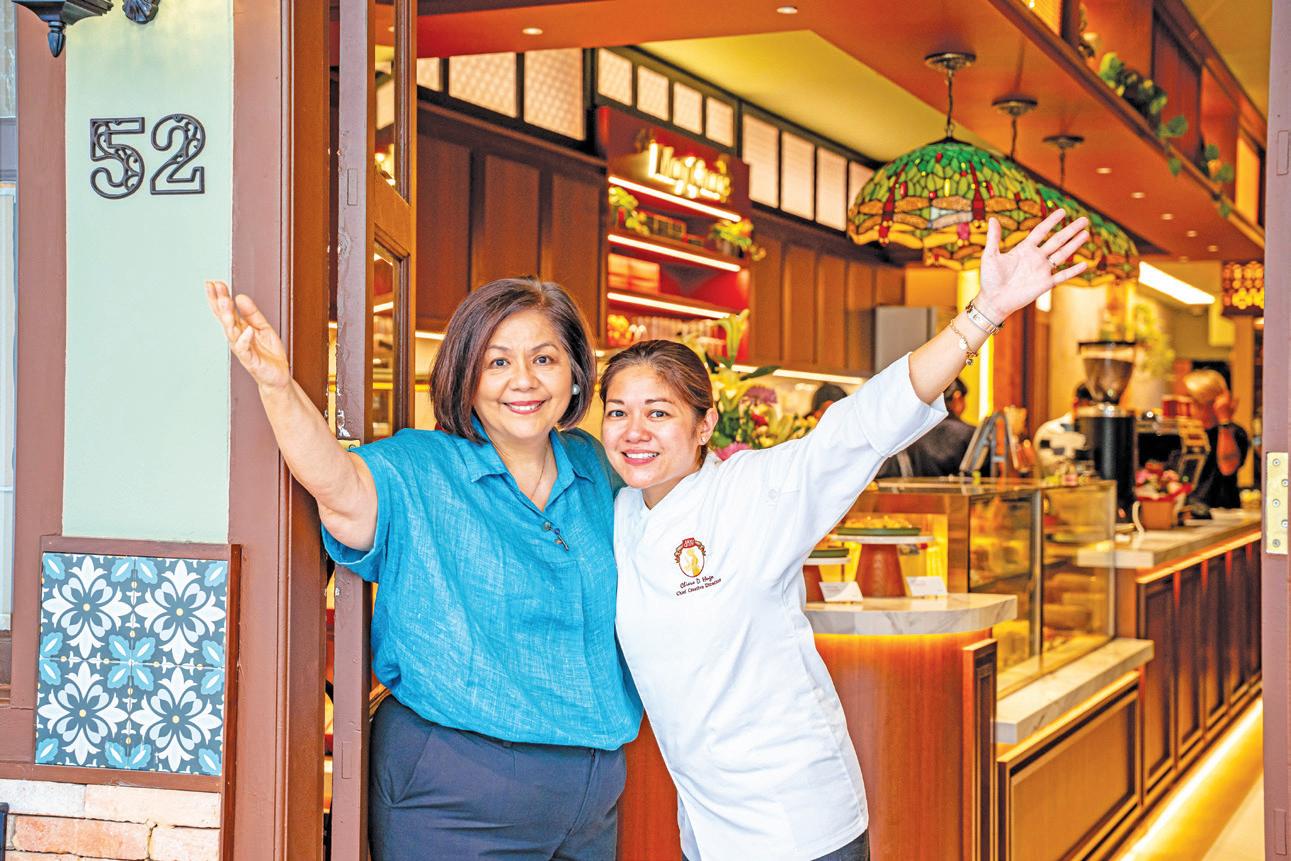
By Anne Ruth Dela Cruz
THIRTY years after its founding, and two decades after opening its first café in Serendra, Mary Grace Café has reached a new milestone—opening its first international branch in Singapore on March 13, 2026.
To mark the occasion, Founder, President, and CEO Mary Grace Dimacali, together with her daughter Chiara Dimacali-Hugo, Executive Director of Mary Grace International, gathered media, content creators, and key opinion leaders to share the story behind the brand’s global debut.

It had to be them first,” she said.
Goodness of Filipinos
She added that expanding abroad was also about representing the Philippines.
“Mary Grace will be an ambassador for the goodness of Filipinos and Filipino food. We had to become diamonds first where we are before going to another country—and this is what we have achieved,” she said.
Dimacali shared that bringing Mary Grace to the international stage was never an instant decision, but one shaped over time, deeply rooted in her journey as a mother.
“I had to take care of my five children first. I could not be a businesswoman and skip my role as a mother.
Dimacali also expressed gratitude to loyal customers who supported the brand from its early days in bazaars and kiosks to its growth into a beloved café.
“Because of you, you have made Mary Grace a diamond,” she said.
Singapore emerged as a natural choice for the brand’s first overseas venture, as Dimacali-Hugo and her

family are based there.
“Singapore is the door leading to Asia. If we can make it in Singapore, we can make it anywhere in the region,” Dimacali said.
Dimacali-Hugo added that the move was also strategic, citing Singapore’s dynamic food and beverage scene and openness to new concepts.
“The market is diverse and receptive. There is a strong appreciation for quality, artisan products, and heritage brands. There is also a large Filipino community in Singapore,” she said.
Pop-ups
Before launching the café, the team conducted pop-ups to test how the local market would respond to Mary Grace’s signature Ensaymadas and Cheese Rolls. The response
was encouraging.
“They said it was not too sweet—which, in Singapore, is a compliment,” Dimacali-Hugo shared.
To better suit local preferences, the brand made slight adjustments, particularly in reducing the sweetness of its cakes while preserving its signature “homey and nostalgic” feel.
Since opening at 52 Tras Street in Tanjong Pagar, the café has drawn a steady stream of guests, Filipinos seeking a taste of home and locals discovering the brand for the first time.
Singapore menu
The Singapore menu highlights the founder’s favorites, including the classic Ensaymada and Cheese Rolls. It also features localized of-
ferings such as the Salted Egg Ensaymada and Kaya Pandan Cheese Roll, alongside bestsellers like the Crab Cake Brioche and Ube Coconut Cloud.
This warm reception reflects the universal appeal of Mary Grace’s “Goodness of Home,” anchored in tradition and authentic flavors.
“I have always believed that what we serve is more than food— it is the feeling of being cared for, of being home,” said Dimacali.
Located in the heart of Tanjong Pagar, one of Singapore’s heritage districts, the café is designed to be welcoming and accessible—not just for Filipinos abroad, but for Singaporeans and international guests alike.
“We wanted every detail in Singapore to feel like Mary Grace,” said Dimacali-Hugo. “Whether you grew up with our ensaymada or are discovering us for the first time, we want you to feel welcome, cared for, and at home.”
Milestone celebration
To celebrate the milestone, Mary Grace Café also introduced a limited-edition Pandan Coconut Cake, available exclusively in the Philippines. Inspired by Singaporean flavors, the cake combines pandan almond sponge, toasted coconut white chocolate crunch, coconut crémeux, and whipped pandan ganache for a light yet indulgent treat.
While the Singapore opening marks a significant milestone, it also signals the beginning of a new chapter. The brand aims to uphold the same quality and consistency it is known for in the Philippines, while building a strong connection with the Singapore market. Future plans include expanding the menu with more Filipino favorites, introducing Singaporeexclusive creations, and opening additional cafés and kiosks across the island.
THYME & AGAIN: WHERE METRO MANILA SLOWS DOWN OVER A SHARED PLATE
By Rory Visco Contributor
ON a busy stretch of Congressional Avenue
in Quezon City, where trucks barrel past and commuters move with purpose, an unassuming staircase leads to a different rhythm. Upstairs, above the chaotic traffic and noisy rush, Thyme & Again offers something increasingly rare in the city: a meal without a timer.
In an era of QR codes, tight reservations, and subtle cues to finish up, this Mediterraneaninspired restaurant has built its identity around the opposite idea—stay, talk, order another round, and don’t feel hurried to leave.
A reinvention rooted in loss and resilience
THYME & Again did not begin as a blank slate. Its story traces back to a franchise of Old Spaghetti House, once a familiar name for Filipino families in the early 2000s. The owners began operating a branch in 2014, drawn to the brand’s ap-
proachable menu and family-friendly appeal.
But 2020 changed everything.
The passing of key leadership at the head office, coupled with the loss of a beloved franchise manager, left the future uncertain. As the original brand’s support system weakened, the family behind the franchise—led by Desiree Benipayo and her daughters—found themselves at a crossroads.
Instead of closing shop, they chose to reinvent. What emerged was Thyme & Again, a concept shaped not by corporate templates but by personal taste and lived experience. It became, in many ways, a family project. The menu was debated at length, the playlist carefully curated, and the interiors designed to reflect the kind of place they themselves would frequent.
A “third home” amid the noise ONCE inside, the contrast is immediate. The space leans into earthy greens, warm wood textures, and soft flesh tones. Plants line the interiors, natural light filters through open windows, and the atmosphere feels less like a commercial
establishment and more like a thoughtfully arranged living room.
Francis Garrido, who handles marketing, describes the restaurant as a “third home”— not quite the house or the office, but a comfortable in-between.
“The goal is relaxed elegance. It’s polished enough for a celebratory dinner, but casual enough for an unplanned and long-delayed catch-up over coffee.”
That philosophy extends to how the restaurant manages reservations. While many establishments maximize turnover, Thyme & Again prioritizes the experience of those already seated. The idea is simple: good conversations shouldn’t be cut short because another booking is waiting at the door.
Mediterranean, translated for Filipino tables FOR Thyme & Again’s culinary direction, the brief was clear: Mediterranean, but not predictable.
Instead of leaning on the usual gyro-andhummus expectations, the menu draws broadly
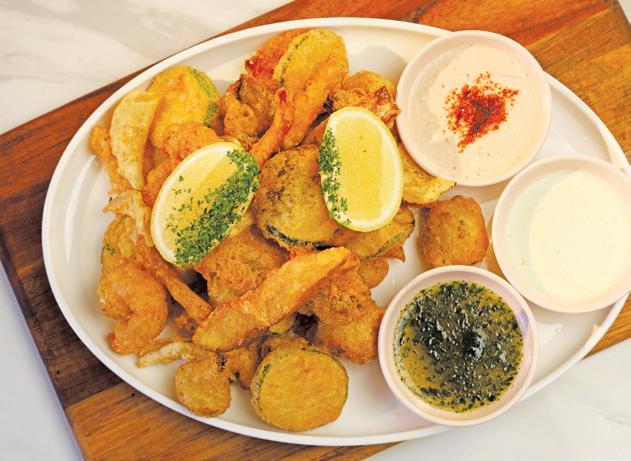

from the Mediterranean coastline, touching on Italy, Spain, and neighboring regions, while keeping Filipino dining habits in mind. Many
dishes are designed for sharing, reflecting the local preference for communal plates and long, multi-course meals.
The team began research and development months before opening, holding repeated tastings and refinements, a process that continues in daily operations.
The restaurant avoids artificial syrups in its beverages, opting instead for fresh fruit. If strawberries are out of season, a drink may appear paler than expected—food coloring is not an option. Coffee beans are sourced from dedicated suppliers to ensure freshness and depth of flavor.
This “from scratch” mindset runs through the entire menu: fewer shortcuts, more intention.
Reviving the long meal
FOR many Filipinos, dining out in the 1970s and 1980s meant live music, unhurried conversations, and restaurants that felt like community hubs. Thyme & Again seeks to revive that sensibility in a contemporary setting.
Around 70 percent of its guests arrive in groups—families marking milestones, colleagues unwinding after work, friends seeking a space that feels both comfortable and special. It’s common for tables to linger, ordering dessert after a long main course, then coffee well after the plates have been cleared.
The restaurant’s name carries a layered meaning. “Thyme,” a staple herb in Mediterranean cooking, reflects its culinary direction. But “Thyme & Again” also suggests repetition—the idea that a satisfying meal, paired with genuine hospitality, is something worth returning to.
Looking ahead, the team is considering expansion to cities such as Baguio and Clark. Yet even with growth in mind, the core promise remains unchanged: to create a space where guests can pause.
In a metropolis that constantly pushes for speed, Thyme & Again makes a quiet case for slowing down, one shared plate, and one lingering conversation at a time.
The power of staying the same, and changing everything else at Sicilian Roast
By John Eiron R. Francisco
T
EN years after it was founded, Sicilian Roast is marking a turning point, not by expanding aggressively, but by refining what
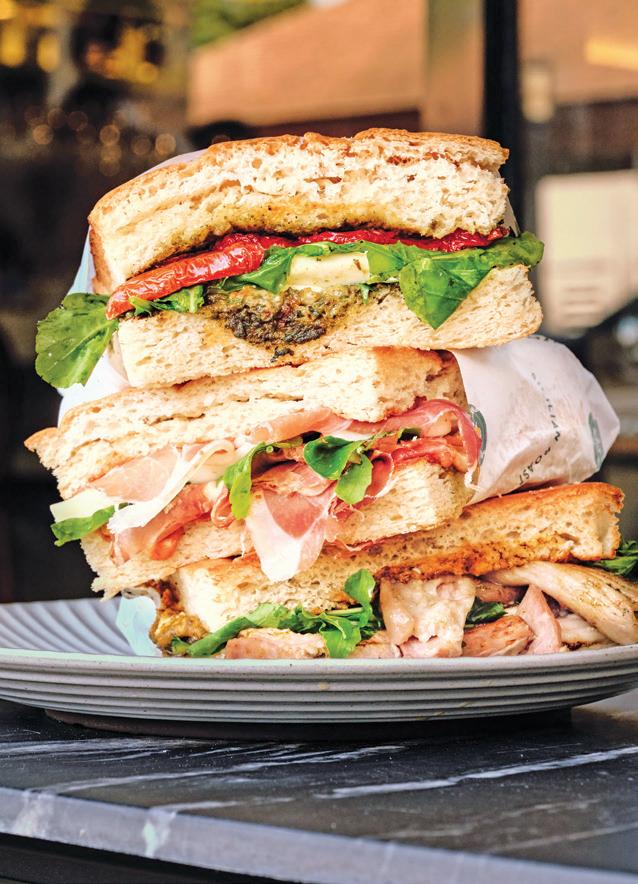
it already does. With the opening of its Molito Alabang branch, the restaurant signals a shift shaped by recalibration rather than scale. Owner Lorenzo Vega describes it as the clearest expression yet of a long-running internal overhaul.
“Some of you may be wondering why we are doing a media launch in the 10th year for the fourth branch of a decade-old company,” Vega said. “That’s because we had to evolve. We had to get better. We really had to up our game.” For Vega, the revamp goes far beyond aesthetics.
“I don’t mean a name change or font change,” he said. “That’s all superficial.”
The process began with the opening of the San Juan branch at Santolan Town Plaza in December 2024, which marked the start of a broader transformation.
Reworking the core
FROM mid-2024, the company undertook a full review of its operations. The menu was rebuilt, weaker items removed, and updates made across design, communication, and marketing.
More importantly, Vega said, the internal culture was reassessed to align with the brand’s direction.
Despite the scale of the changes, one thing remained untouched: the name.
“It would have been very easy for me to change the name,” he said. “No need.”
Instead of rebranding, Vega focused on redefining the restaurant’s identity.
“What needed to change was the essence—from the interiors to the food, culture, and attire. Everything.”
The results came quickly. The San Juan branch outperformed earlier locations, both financially and in customer response, prompting the rollout of changes across the brand.
“The momentum was like a linear curve upward,” Vega said.
Choosing Molito EXPANSION, however, remained deliberate. Vega and Executive Chef Matt Navarro agreed to open a new branch only under specific conditions: either a prime Makati location or Molito.
Molito stood out as the South’s key hub
for upscale casual dining. The opportunity, Vega said, came unexpectedly.
“When you work really hard, you get lucky,” he said. “Molito actually came to us.”
The team secured a 180-square-meter space and opened on November 15, 2025. The response exceeded expectations.
“It totally broke all records,” Vega said. “Financially, anecdotally—everything.”
Despite early challenges with volume, the branch has sustained its momentum.
Moving forward
VEGA sees Molito as the next stage of the brand’s evolution.
“If we crawled in Santolan, now we’re walking—and getting off to running here in Molito,” he said.
Still, he remains far from satisfied.
“You might expect me to feel happy. I’m not,” he said. “We have a long way to go. What am is motivated.”
Plans are underway for another prime opening, but Vega said the focus remains on strengthening operations.
“I don’t want to be one of those companies that open, open, open, and quality goes down,” he said. “I want measured but aggressive expansion—but measured.”
‘Curated, Not Crowded’ CENTRAL to the revamp is a more focused menu designed to guide diners more clearly.
Vega said it addresses the most common question: what to order. Instead of relying solely on servers, the restaurant highlights its key dishes upfront.
“Design is not how it looks—it’s how it works,” he said.
While familiar staples like carbonara remain, the menu encourages guests to try the kitchen’s strongest offerings.
“Certain restaurants are judged on certain dishes,” Vega said, citing calamari and salads as benchmarks. Sicilian Roast’s calamari leads sales, followed by its carbonara arancino.
The pasta lineup is intentionally restrained. Standouts include Bottarga alla Carmen, an angel hair pasta with fish roe, and a pesto cream pasta without nuts, both repre-
senting what Vega calls the restaurant’s “best foot forward.” Pizza, however, is the highest-leverage item.
“If
“We
Mary Grace Dimacali and Chiara Dimacali-Hugo
Mary Grace Café in Singapore
Pandan Coconut Cake
Frito Misto Platter
Truffle Mushroom Cappuccino Soup
Florentine Sandwiches
March 29, 2026
A BURST OF FLAVORS
Wine Dine&
Tagaytay-based restaurants showcase Aussie Lamb’s versatility through 25 delicacies
By Vincent Peter Rivera
BEHIND every well-loved and widely recognized dish in Philippine cuisine are familiar staples—chicken, beef, pork, and occasionally goat. Yet beyond these traditional proteins lies a unique meat that is increasingly resonating with the Filipino palate: lamb.
In a synergy of culinary expertise and diverse cooking styles, 13 Tagaytay-based restaurants came together to demonstrate the versatility of Australian lamb. Through the “I LOVE AUSSIE LAMB” campaign, these establishments showcased a total of 25 unique delicacies.
“For the past year, Australian lamb has shown significant growth in the Philippines. More restaurants are featuring lamb on their menus, and diners are discovering how versatile and enjoyable it can be,” said Byron Sison Jr., Business Development Manager for Meat and Livestock Australia (MLA) in the Philippines. “Our role at MLA is simple: to support chefs and provide knowledge and inspiration so they can confidently put lamb on their menus.”
Echoing this sentiment, Luisa Rust, Senior Trade Commissioner of the Australian Trade Commission (Austrade) Philippines, noted that Tagaytay was the ideal launchpad for the campaign due to its “strong food culture and chef-led restaurants.”
“Through collaborations like this, we continue to deepen the connection between Australian producers and Filipino chefs, while offering diners exciting new ways to experience premium Australian ingredients,” Rust added.
The campaign, a collaboration between MLA and the Australian Government, began with in-depth learning. Participating chefs underwent a Butchery Masterclass led by MLA Master Butcher Kelly Payne, equipping them with expertise in lamb cuts, proper handling, and diverse culinary applications.
To put this training into practice, each restaurant was assigned a specific lamb cut, allowing chefs to showcase their signature styles
while applying the technical knowledge gained from the masterclass.
The journey culminated at Elaia by Cyma, which transformed into a bustling culinary hub, where diners were treated to a multi-course experience featuring nine different lamb cuts, each thoughtfully prepared to highlight both the premium quality of the ingredient and the artistry of the chefs behind it.
Filipino cuisine, reinvented THE dishes served at the event proved that lamb is a natural fit for the bold, complex flavors of Filipino cuisine.
Chef Kalel Chan of Farmer’s Table Tagaytay reimagined the creamy, spicy profile of Bicolano cooking. “I love lamb shank; that’s my favorite cut now,” he shared. “So I made a simple dish: lamb shank with burnt coconut Bicol Express and grilled pineapple.”
He also highlighted the versatility of the shoulder and ribs, balancing the richness of the meat with tamarind, dried hibe (shrimp), and toasted brown rice, finished with lemongrass and Thai basil for a herby profile.
Traditional comfort food also received a premium upgrade. At Gorio’s Roadside Restaurant, Chefs Marc Licaros and Mike Alvarez leaned into nostalgia with a Cavitestyle lamb caldereta. Using a mix of shoulder, short rib, and leg, they elevated the familiar dish.
“Aussie lamb provided us with really nice young meat,” Chef Licaros noted. “It has a delicate taste; it’s not that strong ‘maango’ [gamey] flavor you usually expect.”
Meanwhile, Chef JJ Sycip of The Fatted Calf explored the “sticky texture” of lamb leg through a Lamb Balbacua, while using the shoulder for a spicy yellow Thai curry.
Southern flavors were also represented by Chef Karl Manlapaz of Fatima’s Filipino Halal under the Mama Lou’s Group. As the first Halal-certified Filipino brand, his menu paid tribute to Mindanaoan heritage.
“I’m cooking kulma, a Tausug dish, and rendang Maranao,” he explained. “It’s all inspired by
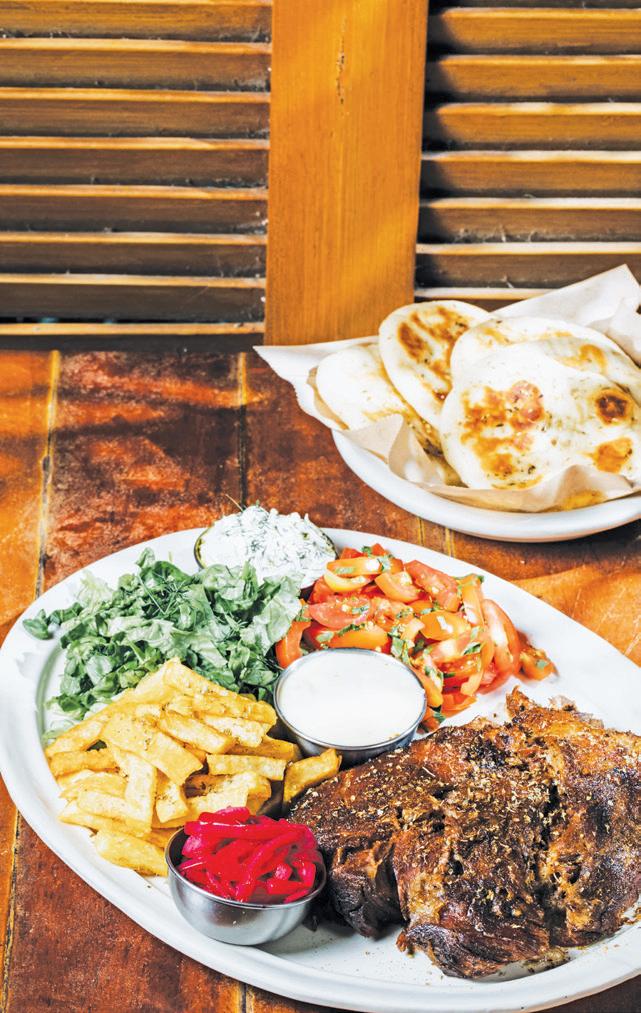

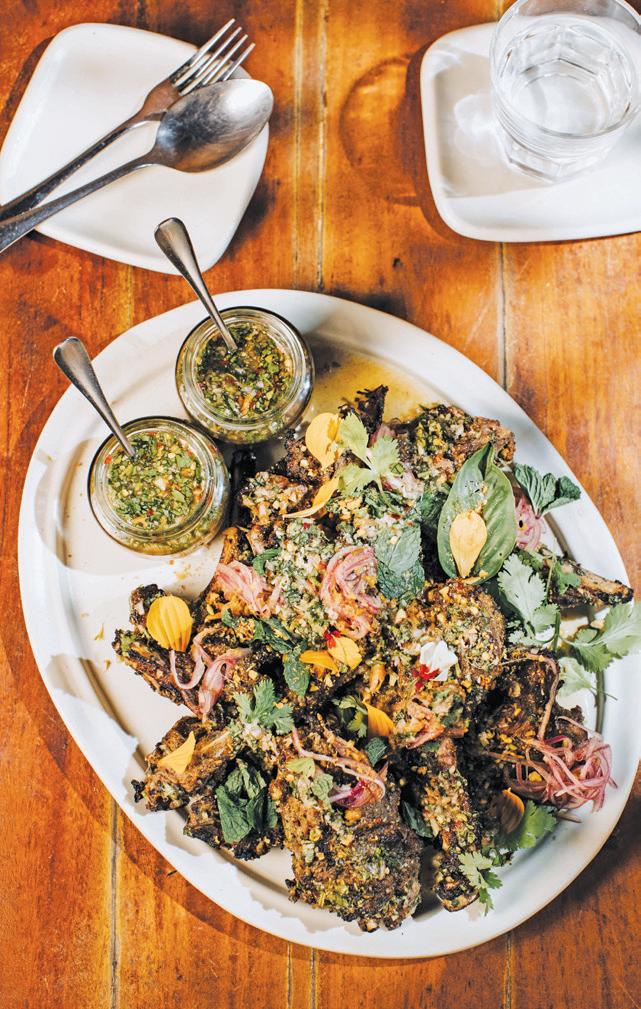
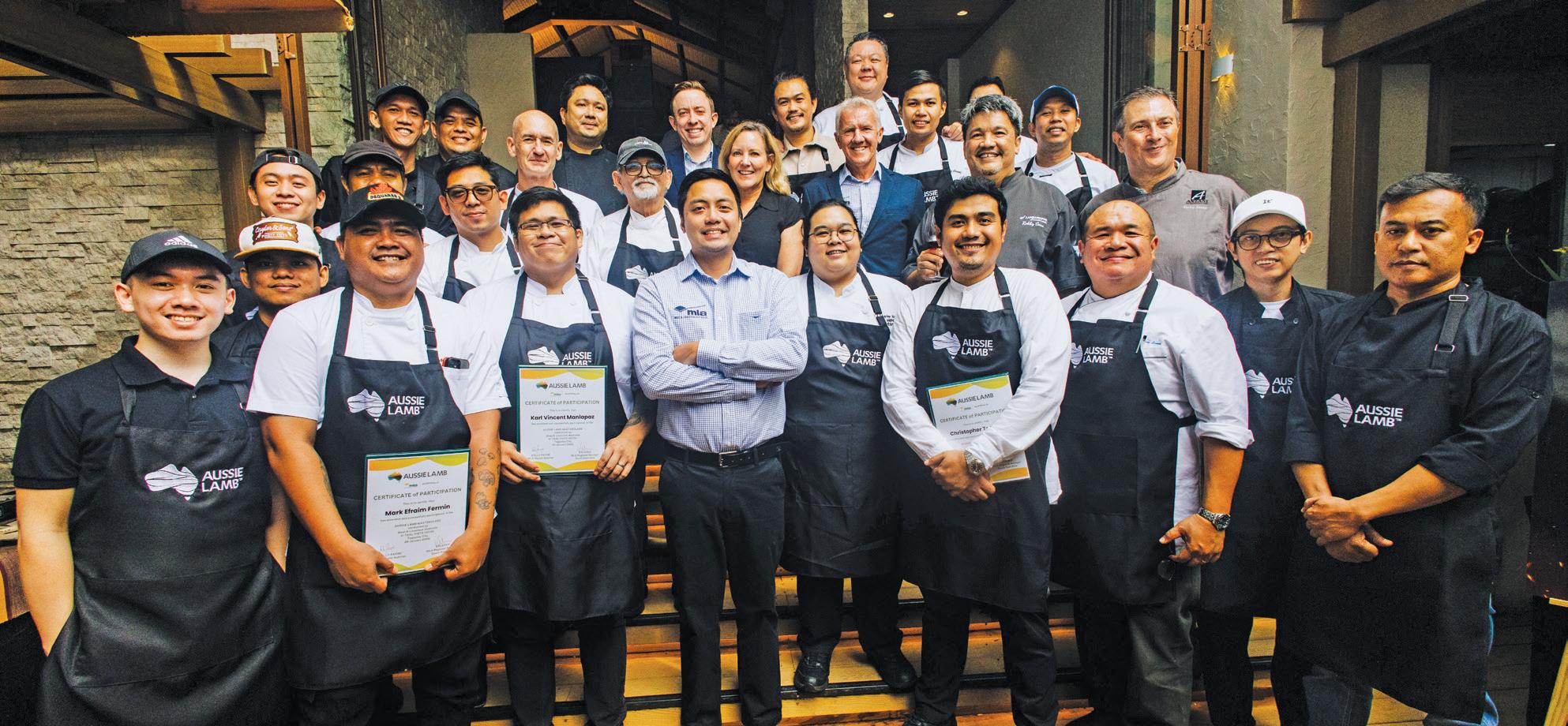
Mindanao.”
Bringing in international flavors
BEYOND local interpretations, participating chefs also explored global influences—from Spanish to Mediterranean cuisines.
Chef Mikel Arriet of Anya Resort reimagined the Spanish fabada, traditionally made with pork, using Australian lamb. He also served “Aussie Lamb Eye Round Milk Grill with Thai Citrus Salad & Tapioca Cake,” featuring charcoalgrilled eye round paired with a citrusy tapioca cracker and pearls,
complemented by baba ganoush.
Spanish flavors continued with Chef “Binggoy” Remedios of Asador Dos Mestizos, who substituted pork with lamb in dishes such as Lamb Paella and Lamb Chorizo. His lineup also included esqueixada (shredded salt cod salad), hummus with ground lamb, lamb croquetas, pinchitos morunos (lamb skewers), and stuffed lamb pimientos.
This Mediterranean direction was further elevated by Chef Roby Goco of Elaia by Cyma, who showcased the meat’s adaptability through dishes like Aussie Lamb
Eye Round Mild Grill with Thai Citrus Salad & Tapioca Cake and Pita Bread, alongside a Roast Breast Flap Lamb Wrap. Chef Marco Anzani of Anzani Ville Sommet, meanwhile, focused on the rack of lamb. “Because the meat is so genuinely great, we don’t want to cover its flavor too much,” he said. His Moroccanspiced charcoal-grilled cutlets were served with couscous, apricot, and almond. He also presented an open spinach lasagna with lamb ragù.
At Butcher’s Steaks and Grill, Chef Wil Ng featured a soy-ketchup
Where dining is also an adventure

Here, I enjoyed the Dill and Meyer lemonmarinated shrimp as an appetizer, followed by a grilled tuna steak paired with Hong Kong

wonton soup. But the highlight was the interactive element—each diner created a drawing that later came to life on screen through animation. We also dined at Pixar Market Restaurant, which doubles as a buffet venue during breakfast hours. The space features playful references to films like Inside Out, Cars, and Finding Nemo. By day, it’s relaxed and casual; by night, it transitions into a full-service dining venue offering a variety of international dishes. Menu standouts included seafood paella, Bolognese penne, tandoori chicken, and falafel salad. With the ship based in Singapore, Hainanese chicken is also widely available—and well

worth trying. We were likewise able to sample Palo Trattoria, a premium dining venue serving Northern Italian cuisine. Reportedly visited by Robert Downey Jr. during his time on board, the restaurant offers refined antipasti, pasta, pizza, and expertly grilled meats and seafood. Although not part of our assigned rotation, we also caught glimpses of Hollywood Spotlight Club, a “star-studded” dining experience featuring Disney characters, and Mike & Sulley’s Flavors of Asia, which combines teppanyaki, omakase, and sushi dining concepts in one space.
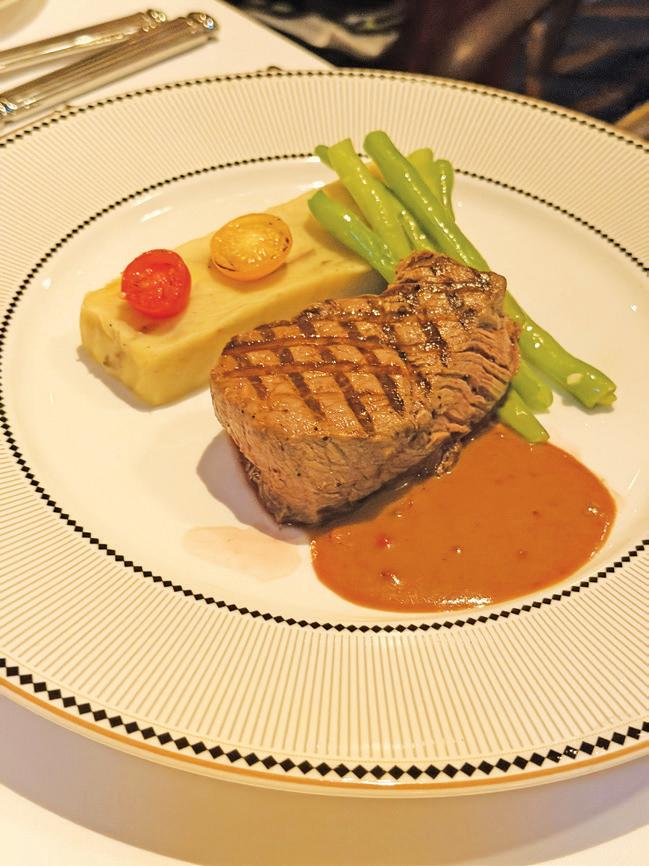
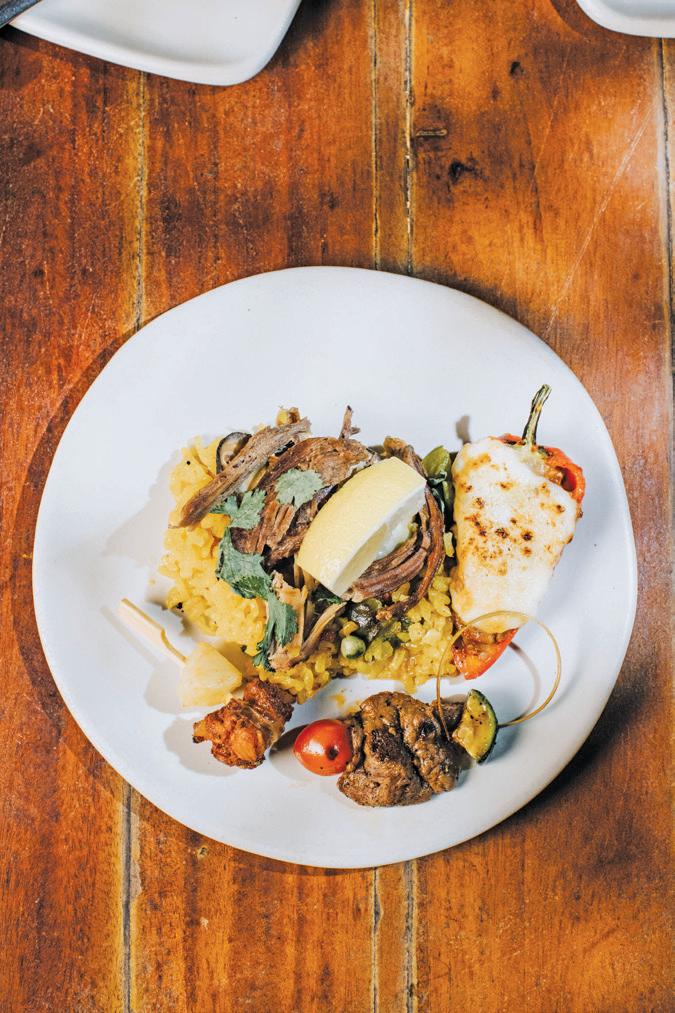
marinated rump and a three-hour braised neck, paired with Japanese cucumbers and madzoon yogurt cheese for a cool contrast to the warm tandoori spices.
The diversity of preparations continued at Reynaldo’s Smoke House, where Chef Mona Duay showcased an eight-hour smoked Pulled Lamb Tostada with grilled peaches, avocado crema, and romesco sauce to balance the richness. A second dish featured a 10-hour smoked lamb brisket paired with chimichurri and grilled coconut rice.
Chef Christopher Tamayo of Textures by Tamayo’s experimented with both hot and cold preparations, including an 18-hour braised shoulder and a lamb flap served on Korean perilla leaves.
Finally, the team at Taal Vista Hotel maximized the use of the whole animal, using bones to create a flavorful lamb birria. As Chef Kim Dalisay explained, the goal was “to maximize and bring out the full flavor of every part,” finishing the Mexican-inspired dish with a local twist of queso de bola.
On February 16, 2026, the participating restaurants officially began offering their curated lamb dishes, giving diners the opportunity to experience each chef’s unique take on Australian lamb.
More dining options OUTSIDE the rotational
Elaia by Cyma’s Aussie
with
The Meat & Livestock Australia Team with some of the Tagaytay-based restaurant chefs.
Farmer’s Table Tagaytay’s Lamb Shank Burnt Coconut Bicol Express.
Reynaldo’s Smoke House’s Smoked
Brisket with Chimichurri Sauce.


March29,2026
EditedbyJoseF.Lacaba
War and uneasy peace in Alex Baluyut’s photos

By Barbara Mae Naredo-Dacanay
enslave (since after World War II in 1945).
ALEX Baluyut has photos of war and peace in communist camps, government leaders’ turfs, illegal economic domains, military and left urban guerilla flashpoints, Muslim and non-Muslim ancestral lands, police stations, protest rallies, religious institutions, and urban depressed areas.
His images are like firing squads that hit the eyes. Small, but terrible, Baluyut always survived coverages, but he never found lyrical images from the Philippines’
one to keep on compiling “decisive moments” in a country where “many things do not change,” as he once said. The marks (or targets) where these photos are understood, seen, or heard will keep moving, of course. Because there are no steady ears, eyes, and lips in a country colonized for 400 years, then led in freedom by master-gods who
Always look for “the story the picture doesn’t show. So (ask), ‘What do you see?’” former Davaobased journalist turned lawyer and congressman Karlos Ysagani Zarate quoted Baluyut as saying in their first meeting in Davao in 1986. “He taught me to read the silence between images,” Zarate added, referring to Baluyut’s call: “be a witness,” and let people read the hidden messages of photos.
ANGRY W HEN Baluyut was in his mid-20s in the early 80s, he was with Manila’s Malaya and the US-owned Associated Press. He was angry (and branded as Philippine photography’s bad boy who turned tables and cursed), but became more consistent, fearless, gutsy, natural, passionate, and hungry for wordless stories—once he learned about Philippine history, from the ground, led by his lens.
In the first quarter of the 80s, Baluyut and more photojournalists ambitioned a movement. They pooled dark social images; gave them themes; finished five documentary photobooks (now seminal in the Philippine history of photography); held dialogues and photo exhibits; organized more photo groups; and taught photography. Before social media made words boring and irrelevant, images already rivaled talks and speeches about the Philippines—because Baluyut and his kind were covering dangerously and delivering mighty and powerful photos with obvious and hidden stories. At the time, Baluyut and colleagues were more daring; deathless in death’s way; strong though sleepless; unobtrusive; world class with images that boil, lacerate, and do not pacify.
Soon, Baluyut led the photojournalists who were romanticized as legendary, rock stars, supermen, supernatural, and heroes of information who revealed the hidden Philippines.
Philippine Photojournalism, Southeast Asia’s Earliest
THE dates of their photo book projects, photo groups, photo exhibits and dialogues, including the frequency and number of formal and informal photography classes, show that photojournalism in the Philippines is one of the earliest and strongest in 10 member countries of Southeast Asia.
COLORFUL
“I FIRST met Alex in 2009. A few people in Manila were eager to warn me against his fearsome nature,” said Zhuang Wubin, whose Photography in Southeast Asia: A Survey, was published by the National University of Singapore Press in 2016. Photographers also shot Baluyut.
A photo shows him and colleague Luis Liwanag in the nude as they photographed a bathing suit-clad Gigi Dueñas—Marlon Brando’s wife in Apocalypse Now that was filmed in Baler (Aurora), Iba (Zambales), and in Pakil and Pagsanjan (Laguna) in
1976. Baluyut also stayed in a news office in Malaybalay City when he visited indigenous communities in Bukidnon and Misamis Oriental, from 1997 to 1998. “Whenever he went (out) for a trip, he would leave a note about his itinerary and expected time of return. He signed every note with ‘Friend ni Osang,’ alluding to Rosanna Roces who posed before Alex for a nude pictorial,” said editor Boy Mordeno. Roces was initially Brando’s wife in Apocalypse Now, in 1975.
“He took me to Club Dredd along EDSA in 1997. Joey Smith .. threw his arms (around me) and screamed, ‘Pare, let’s rock and roll.’ Alex doubled over laughing. Alex, still wiping tears from his eyes, managed to interject (and introduced me): ‘Pepe, this is Kaloi, my friend from Mindanao,’” recalled lawyer Zarate. Club Dredd’s la dolce vita had “a different kind of truth-telling from the kind we practiced,” explained Zarate.
Continued on page 2
ALEX BALUYUT covers Smokey Mountain, Tondo, Manila, 1983; PHOTO BY LUIS LIWANAG
Alex Baluyot
May


Continued from page 1
HOT COVERAGE
IN 1992, the New People’s Army— Communist Party of the Philippines’ armed wing founded on March 29, 1969—in Surigao del Sur, invited Baluyut and Zarate (still a scribe then) to interview five soldiers held as prisoners of war, following an ambush. The soldiers were tortured, reports said. Former English professor Jose Maria Sison and 12 other young members left the older Partido Kumunista ng Pilipinas (PKP) and established the CCP on December 26, 1968. The two climbed mountains for five days. At the camp, “Alex did not rush. He sat near them (soldiers)…. He offered cigarettes. Asked where they were from,” recalled Zarate.
“When Alex began photographing, he did so deliberately. Slower…. Patiently… waiting for a shaft of light falling across a young soldier’s face, for a glance, for the unguarded moment. He would lift his camera… lower it, wait some more. The soldiers relaxed. They forgot the camera. That was when he captured them—not as POWs (Prisoners of War), not as symbols, but as human beings,” said Zarate. Baluyut called an NPA medic. A soldier was poorly bandaged, he said.
“Watching him that day, I understood something fully for the first time. Alex did not document struggle from outside it. He entered it. Alex showed me that you cannot document a place from a distance. You must love it first. You must sit in its heat, drink its beer, listen to its people, and let it enter your blood the way Mindanao had entered his,” said Zarate, adding, “The NPA trusted him…. The soldiers trusted him because he really saw them as humans not as pawns in someone else’s war.” Baluyut came from a landed class in Pampanga, said journalist Inday Espina-Varona who met Baluyot in a German church ministry-sponsored talks of journalists and church workers. This happened after the ouster of former president Ferdinand Marcos by a people-backed military mutiny at the Epifanio delos Santos Avenue (EDSA’s People Power) that propped up Corazon Aquino as president in 1986.
Three years earlier, in 1983, former Senator Benigno Aquino was assassinated at the service stairway of the China Airlines plane, at the
airport, in a homecoming from the United States.
“Most of our chats then, and, later, in a small Malate joint called The Right Spot —down the street from Penguin— would center on what we covered: conflict and war. He was more versed on the latter,” said Espina-Varona.
“Alex would ask… questions about Negros; the hacenderos; the sakadas; the… conflicted middle class of a monocrop economy (in places with sugar plantations); the clergy; and the protagonists in what was then called... a social volcano and a laboratory of war (or low intensity conflict),” said Espina-Varona, She referred to the government’s anti-counter insurgency campaign assisted by the US, an ally. Former president Ferdinand Marcos Sr. established martial law rule in 1972, to stop the growing strength of the CPP-NPA. It is now ASEAN’s oldest leftist armed group.
PHOTOBOOKS
KASAMA (Comrade), 1987
Baluyut contributed 50 photos of NPA camps in Agusan, southern Philippines, dated early to mid-1983 to Kasama: A Collection of Photographs of the New People’s Army of the Philippines, published by the International Concerns for Philippine Struggles (ICPS), and launched with a photo exhibit at U.N. Avenue’s Hiraya Gallery on April 24, 1987.
His gruesome and memorable long shots of a captured informer, killed at the temple then buried, were entitled “Revolutionary Justice”. Kasama’s 90 lyrical photos of NPA camps in the Cordilleras, Cagayan, Bataan, Bicol, and Samar, were taken in 1980, 1981, and mid- to late 1986, were shot by (US based) Lenny Limjoco, who conceptualized the photobook. Images of southern Luzon’s NPA camp, illegal detention, and urban guerillas came, respectively, from Liwanag, Mike Yabut, and Pat Roque.
“At the book launch, there was only one copy… It was filled with signatures and notes from guests. Alex handed me that copy. Alex was emotional, insistent,” recalled photographer and film maker Jojo Sesscon.
“A month later (in May 1987), I returned to the same (NPA) areas Alex had documented (in 1983) to film A Rustling of Leaves Inside the
3, 1956- February 27, 2026

Philippine Revolution (with Canadian film-maker Nettie Wild). I brought the (Kasama) book with me. I asked (the NPA members) where those comrades (in the book) were. They began showing me… torture marks. Every one in that unit was tortured by their own comrades,” recalled Sesscon, referring to the infamous purging of NPA members in camps in Mindanao from July to December 1985.
In Agusan, NPA Commander Jorge Madlos had “ordered the release of comrades who had been suspected as military agents (so some survived and stayed),” explained Sesscon.
In a meeting with Baluyut in Manila, Sesscon narrated, “I told him … what I had seen; what happened after he left those areas (in Agusan). I returned the book to him, now bearing additional signatures from the NPA members I had met. He wept. We drowned ourselves in alcohol until dawn.”
Depth of Field, 1987
Baluyut was one of 28 photographers who contributed to Depth of Field, which was published by Photobank, and the National Council of Churches in the Philippines (NCCP) Human Rights Desk, and launched in 1987. Written by Victor Jose Pedaranda, it has images about poverty, repression, and struggles against tyranny and inequities.
Illegal logging, 1993
“He spent days in the forest, staking out sites where it (illegal logging) might happen,” recalled journalist Howie Severino, about a project with Baluyut and the Philippine Center of Investigative Journalism (PCIJ) in 1993.
Revisited, Photo Essay, 2013,
“I have returned to do a documentary about the people of the environmentally protected areas in Mindanao. This was my primary goal,” Baluyut said when he returned to Mindanao, to document people and landscape in 2013. For this project, the Invisible Photographer Asia (IPA, born in 2010), cited Baluyut as one of the “Most Influential Asian Photographers.”
Brother Hood, 2018
Like a stained-glass panel that has turned historical, beauteous writer
Gemma Luz Corotan-Kolb was pregnant with her 30-year old son, when she started writing about dangerous topics—crime, gang wars, murders, police raids, torture of suspects, betrayal and the collusion of authorities, and the underworld—for newspapers and the PCIJ, in the mid 90s.
A star writer like no other in Southeast Asia’s journalism, Corotan-Kolb became a light, a guard, or a perspective, to the photos of Baluyut on police culture. He had witnessed violence in the Left’s underground, and society’s underdogs. Their powerful stories and photo in Brother Hood, on the police, published by PCIJ in 2018, was journalism’s pottery that passed the fire, remarkable in Southeast Asia where a culture of silence and subtlety is strong and prevalent.
A photo exhibit accompanied the book launch at De La Salle College of Saint Benilde. The event heralded the police’ age-old violence on human rights, that flared again during the war against illegal drugs of former president Rodrigo Duterte (from 2016 to 2022).
One of Baluyut’s impressive photos was a tense hostage-taking of a child, by Buenaventura Daang who held a grenade, and Elipidio Caayan who pointed a knife at Police Deputy Warden Calderon at the Manila City Jail on November 26, 1996.
“There was a lot of anger in Alex, who admitted having deep scars in his soul from covering the NPA and the police,” assessed Espina-Varona. Kasama and Brother Hood received National Book Awards.
PHOTO GROUPS
BALUYUT was one of nine in an exhibit entitled Pitik at Robinsons Galleria Ortigas Center on Jan 24, 1998, to celebrate the founding of the Philippine Center for Photojournalism (now Photojournalists Center of Investigate Journalism (PCIJ), a non-profit, on Nov 30, 1997, said photographer Ernie Sarmiento, “Alex helped found PCP. There were 40 members then. It has 100 members now, and 14 founding chairs since 1997,” Sarmiento boasted. At the time, PCP members left the Press Photographers of the Philippines (PPP) which was founded by Honesto Vitug, Marcelo Ablaza, and Bert Garcia at Ramon Lee’s Restaurant on Ronquillo Street, Sta. Cruz


in1951. PPP, Southeast Asia’s oldest photo group, fought for press freedom and protection of photographers.
Talking about another group, the Photobank, Gil Nartea said, “I was invited to head Photobank as Executive Director from 1983 to 1987. Sid Balatan and other photojournalists conceptualized it. It was registered at the Securities and Exchange Commission.” Sadly, Photobank died due to lack of sponsors.
Albert Garcia, of PPP, established another group, the News Photographers Association of the Philippines, which launched the First Willie Vicoy Photojournalism Awards, said photographer Ryan Hernandez. “That was in 1996. It was also short-lived,” said Vicoy’s son Ali, also a photojournalist. The elder Vicoy had covered the Vietnam War for the US-owned UPI, from early to mid 70s. He was with Reuters when killed in an NPA ambush in Tuguegarao, northern Philippines, in 1986.
TEACHING
BALUYUT also wore another hat. In 2006, the Konrad Adenauer Asian Centre for Journalism (ACFJ), Ateneo de Manila University invited Jimmy A. Domingo, a freelancer then, to head the Diploma in Photojournalism program. Domingo recruited Baluyut; Ernie Sarmiento, then photo chief of the Philippine Daily Inquirer ; Luz Rimban; and Isabel Kenny (+).
There were 92 students (from Asia) between 2006 to 2015. Teaching was face to face and online. Students held photo exhibits. The team taught until 2015. But the Diploma in Photojournalism was changed to Diploma in Visual Journalism, said Sarmiento.
“In 2007, the World Press Photo in Amsterdam invited Alex, Jimmy, and me to a workshop on teaching photojournalism,” recalled Sarmiento.
“Alex decided to visit Jose Maria Sison in Utrecht. He cooked at Sison’s kitchen, then we visited girlie bars,” he added.
Baluyut instigated many things that launched, strengthened and supported photojournalism in the Philippines.
SERVING THE PEOPLE WITH FOOD, NOT WITH IMAGES DESPITE his legacy, he and his wife, former stage actress and mu-
seum worker Precious Leaño established the Art Relief Mobile Kitchen (ARMK), to feed calamity victims— when Typhoon Haiyan (Yolanda) came and displaced millions in central Philippines in 2013. It was time to serve the people, not with images that inform, but with hot food, said Baluyut. “Friends responded. They were artists, stage artists, and photographers,” said Leaño, adding that feeding the multitude meant hauling and cooking “two-digit tons of food”. The project is “forever” in calamity-stricken Philippines, she added.
“ My son Alon, then 20 and home for Christmas from college, flew down to help (ARMK),” narrated journalist Howie Severino. “It became one of the formative experiences of his young life— chopping vegetables for hours, serving food, sleeping on the floor of the barangay hall, taking instructions from Alex and Precious. He told me later that despite the bleakness—the loss of life, the mud, the exhaustion— Alex kept the vibe light. He cracked jokes. He made it fun. All the while under enormous pressure to feed the multitudes. It was a master class,” Severino recalled.
Comparing himself with Baluyut, chef Rostun Banal said, “I was advocating for culinary culture as a way to understand our soul, while you were using food as a literal lifeline to feed the hungry (during calamities).”
“Lalo kong naintindihan kung ano talaga ang ibig sabihin ng pagsisilbi sa bayan. [I understand better what service to the people means].You showed me there are many ways to love and serve our people. Hindi lang siya ideal, ginagawa siya [It’s not just an ideal. You have to do it] , I will never forget your stories about ARMK missions, mula sa bayanihan sa Batanes to the realities of conflict in Mindanao,” said Ludwig Valle, a fan.
“They (at ARMK) fill in the gaps of government assistance during calamities,” explained Green Releaf. A committed cook, Baluyut brought in another image of his, on top of thousands of his photos: a
for
portrait of him who lived
others, by fire—kept from the wind—in mobile kitchens, so there is food for all.
ALEX BALUYUT (second from right), Luis Liwanag (rightmost), nude (or photographers exposed), during a pictorial of Apocalypse Now actress Gigi Duenas in bathing suit, Remedios, Malate, 1983; PHOTO BY WIG TYSMANS ALEX BALUYUT self-portrait outside Malaya newspaper office,1984; PHOTOGRAPHER UNKNOWN
LUIS LIWANAG (left), Alex Baluyut (second from left), Dessa Quesada, rightmost, then Ate Luz of Kalye Sesame, RPN9 TV series, 1984; PHOTO BY JOE GALVEZ
ALEX BALUYUT rests at the upper veranda of writer’s house in Forbes Park, 1987; PHOTO BY NICO SEPE
AGENCE France Presse stringer Gil Nartea (left) covers New People’s Army (NPA) after clash with government soldiers, in Gumaca, Quezon, 1987; PHOTO BY ALEX BALUYUT
POLICEMEN shoot house of suspected urban leftist guerrillas in Proj 7, Quezon City, 1985; in Kasama photo book; PHOTO BY ALEX BALUYUT