SWFs may own shares in


FOREIGN Sovereign Wealth Funds (SWFs) can collectively invest a maximum of 30 percent in Philippine companies engaged in the operation of public utilities and critical infrastructure such as telecommunications, according to the newly released Implementing Rules and Regulations (IRR) of the Public Service Act (PSA).
O n Monday, the National Economic and Development Authority (NEDA) released the amendments of the IRR of the PSA in a bid to provide safeguard provisions to
protect the country against national security concerns that may arise through any proposed merger or acquisition, or any investment in a public service.
S ection 44 states that foreign governments or foreign state-owned enterprises; entities controlled by foreign government or foreign stateowned enterprises; and an entity acting on behalf of a foreign government or state enterprise are prohibited from making any investment or owning capital in a public service or critical infrastructure.

“ Sovereign wealth funds [SWF] and independent pension funds of each state may collectively own up to thirty percent [30 percent] of the capital of such a public utility entity or public service entity classified as critical infrastructure,” Section 44d of the IRR stated. The cumulative investment of such funds in the public service classified as a public utility or critical infrastructure, regardless of source of fund, shall not exceed thirty percent [30 percent] capital investment,” it added.
Further, Section 45 of the IRR provides that no foreign national can own more than 50 percent of the capital of entities engaged in the operation and management of public services in the Philippines.
H owever, if an investment leads to a foreign national owning more than 50 percent of the capital stock of the public service, the country of the foreign national “accords reciprocity to Philippine nationals as provided under the Act and these Rules.”
BusinessMirror
NEDA: LAND USE ACT KEY TO INFRA DEVELOPMENT
By Cai U. Ordinario @caiordinario
MEDALLA: PHL CAN WITHSTAND SHOCKS FROM BANKING CRISIS

THE Bangko Sentral ng Pilipinas (BSP) said the Philippine banking system and the entire economy can withstand the impact of the blight that has recently engulfed some foreign banks.
Flagship projects to bolster physical connectivity—DOF
possible shocks” that could emanate from the collapse of Silicon Valley Bank (SVB) and Signature Bank.
I n his opening statement at the public hearing of the Senate Committee on Economic Affairs on Monday, Senator Joseph Victor G. Ejercito said a master plan, which will be “the plan of all plans,” will also allow the country to catch up with its neighbors.
However, the National Economic and Development Authority (Neda) said that while it supports this proposal, there is the matter of passing a land use act that could better facilitate the implementation of infrastructure projects.
“Kung may maiguguhit po tayo na maayos na blueprint na pinagtutulungan ng ating mga eksperto, matitiyak po natin na magpalit man ang pangulo o administrasyon ay may iisang plano na tayo susundan, maiba man ang engineer, foreman o karpintero ay may pangkalahatang gabay na pagbubuo ng mga pangarap,” Ejercito said.

“ Probably, this is a result of our political system as well. Yung threeyear term and six-year term, with the term limit, most of our public officials, even Presidents, I would say, are only concentrated on the short and medium term. Yun ang pagkukulang natin, yung long-term planning,” he added.
D uring the hearing, Neda Assistant Secretary Jonathan L. Uy said implementing projects whether at the national or regional level depend on the local land use plans. The proposed National Land Use Act has been languishing in Congress for over 30 years.
The important thing, Mr. Chair, that we’d like to factor in what is discussed so far is essentially that a lot of the national master plans and regional master plans will depend on local land use and development plans.
B SP Governor Felipe M. Medalla told reporters on Monday that recent developments such as the collapse of some banks in the United States as well as the recent acquisition of Credit Suisse Group (CSG) AG by UBS Group AG through a “government-brokered deal” will not have an impact on the global economy, including the Philippines.
Medalla also assured that the BSP will closely monitor these developments as well as “assess their impact on the banking system and respond accordingly.”
This means CSG is too big to fail. It does not look like that other Globally Systemically Important Banks [GSIBs] have the same problem, in which case the impact on the global economy— and therefore the Philippines— will not be significant,” Medalla said via Viber.
I n a note, the BSP chief assured the President that the banking sector can “withstand

Medalla also said losses of Philippine banks from rising interest rates are smaller relative to their counterparts in the United States.
He noted that the interest rate hikes of the US Federal Reserve were larger. The US Fed has already raised key policy interest rates by 450 basis points (bps).
T he BSP Overnight Reverse Repurchase Rate is currently at 6 percent from 2 percent on May 19, 2022, or 400 bps rate hike over the same policy horizon.
Further, Medalla said, the Philippine “yield curve did not invert similar to the US yield curve.” The US Treasury yield curve, BSP noted, continued to be inverted with 2-year and 10year US Treasury notes posting rates of 4.14 and 3.56 percent, respectively, as of March 16.
T he secondary market government security (GS) yields for the two-year and 10-year tenors, the BSP said, stood at 5.89

MOST of the flagship projects that the government intends to undertake are aimed at improving physical connectivity and the management of water resources, according to Finance Secretary Benjamin Diokno.
D iokno presented the government’s infrastructure plan on Monday in a forum organized by
the Foreign Correspondents Association of the Philippines. The Infrastructure Flagship Project (IFP) list was recently approved by the National Economic and Development Authority (NEDA) Board. The list also includes projects on health, energy and agriculture infrastructure,” he added.
See “Neda,” A2 PESO EXCHANGE RATES n US 54.6780 n JAPAN 0.4148 n UK 66.7454 n HK 6.9665 n CHINA 7.9378 n SINGAPORE 40.7771 n AUSTRALIA 36.7163 n EU 58.4398 n KOREA 0.0418 n SAUDI ARABIA 14.5575 Source: BSP (March 20, 2023)
LEGISLATING the Comprehensive Infrastructure Development Master Plan, a 50-year infrastructure master plan, is needed to boost the country’s growth and development to better guide the projects and programs of succeeding administrations.
6.23
respectively, as
March 17. ‘Foreign
public utilities’ See “Foreign,” A2 See “Medalla,” A2 IMMIGRATION WOES Airport passengers crowd the immigration area at Terminal 1 of the Ninoy Aquino International Airport in Pasay City, Monday, March 20, 2023. The Bureau of Immigration apologized for the lengthy screening process at the immigration counters, as the government ramps up efforts to combat human trafficking in the country. It can be recalled that in November 2022, the Senate panel that broke the “pastillas” scam among corrupt immigration officers has exposed another nefarious operation, this time enabling the human trafficking of Filipino jobseekers within the Asean region, only to fall prey to Chinese syndicates that brutalize them. NONIE REYES See “Flagship,” A12 w P25.00 nationwide | 2 sections 20 pages |
and
percent,
of
2006 National Newspaper of the Year 2011 National Newspaper of the Year 2013 Business Newspaper of the Year 2017 Business Newspaper of the Year 2019 Business Newspaper of the Year 2021 Pro Patria Award PHILIPPINE STATISTICS AUTHORITY 2018 Data Champion EJAP JOURNALISM AWARDS BUSINESS NEWS SOURCE OF THE YEAR (2017, 2018, 2019, 2020, 2021) DEPARTMENT OF SCIENCE AND TECHNOLOGY 2018 BANTOG MEDIA AWARDS n Tuesday, March 21, 2023 Vol. 18 No. 157 XI MEETING PUTIN IN BOOST FOR ISOLATED RUSSIA LEADER THE WORLD ›› A9
Travel to PHL, Asia Pacific seen picking up in July-Dec
By Ma. Stella F. Arnaldo @akosistellaBM Special to the BusinessMirror
THE return to full air connectivity, especially within Asia Pacific, is key to the tourism recovery in the region, especially the Philippines, which has largely relied on the Chinese market to boost its inbound tourism numbers.
In an email exchange with the BusinessMirror, Forward Keys Vice President-Insights Olivier Ponti, said, “The recovery of the Asia Pacific region is clearly underway, but we are witnessing a gradual process rather than a sudden rebound. Given that there was no coordination in the reopening of the countries in the region, each destination started rebuilding air connectivity at its own tempo. Some are more advanced than others, but all need more time to be fully back on track.”
P onti added, “Airlines and airports cannot resume operations with the appropriate level of services overnight, especially given that many are facing staffing issues. The speed at which the region will get back to preCovid levels will highly depend upon its ability to reestablish air connectivity, especially within the region itself. Airlines need a stable environment to operate, and as we are moving toward this stabilization, we expect travel to
and within Asia Pacific to pickup more strongly in the second half of 2023, unless a new Covid variant or geopolitical tensions lead governments in the region to revert to travel restrictions.”
A knowledge partner of the World Travel and Tourism Council, Forward Keys gathers global data on aviation movements based on actual ticketing sales.
Among destinationslowest-ranked
IN data made available at the recent ITB Berlin convention, Forward Keys showed international arrivals to Asia Pacific just 49 percent lower than the same period in 2019. This was a significant improvement from the 74-percent drop in international arrivals in the region in 2022 from 2019 levels.
F or flights booked between March and August this year, the Philippines ranked among the lowest destinations for Chinese travelers, at 73 percent lower than book-
ings in 2019. Macau, a territory of mainland China, proved to be the “most resilient” destination, with air bookings by Chinese travelers at just 4 percent lower versus 2019 bookings. It was followed by Hong Kong (-53 percent) and Singapore (-55 percent).
Ponti explained, “What it true for Asia Pacific also holds for China. The full recovery of the Chinese outbound market implies lifting all remaining travel restrictions and reducing delays for processing passport renewals and visa applications. Rebuilding international air connectivity is also going to be crucial as the lack of airlift currently is the main bottleneck. For their part, Chinese officials have indicated that the authorities would support a progressive return outbound travel and Chinese airlines keep increasing seat capacity.”
China-Boracay flights
PRIOR to the pandemic, China was the second largest source market for tourists for the Philippines, at 1.74 million arrivals, accounting for 21 percent of the 8.3 million international tourists that year. The Department of Tourism is currently working to simplify visa requirements for China and India to enable their travelers to apply for the arrival document online. As of March 15 this year, arrivals from China were just 33,311. (See, “12-M arrivals ‘achiev -
able’ by 2028, says DOT chief,” in the BusinessMirror , March 20, 2023.)
Ph ilippines-based carriers Philippine Airlines (PAL) and Cebu Pacific have already restarted their routes to mainland China, while foreign carriers such as Central Airlines, Cathay Pacific, South Airlines, Air Asia, and Xiamen Airlines also offer several routes between both countries, sometimes with layovers in third countries.
Meanwhile, PAL senior vice president and general counsel Carlos Luis D. Fernandez confirmed that the carrier will be offering charter flights between some points in China to Kalibo International Airport, the gateway to Boracay Island. The island—popular among Chinese honeymooners and families—was recently visited by the Chinese Ambassador to Manila. (See, “Chinese envoy meets Aklan local chiefs,” in the BusinessMirror , January 10, 2023.)
We’ve awarded [that route] to some charters based in China,” said Fernandez, although details are still being ironed out, adding that the carrier had to bid out the service due to huge demand.
“There are several cities in China such as Nanking and Chengdu, that we’re mounting it from…. but there are changes, so it’s still not final,” he explained. But the service will definitely start by summer, he said.
Continued from A1
I n addition, Medalla said US banks’ bond holdings have longer tenors of as long as 30 years while Philippine banks mainly hold government securities with residual maturity of up to 15 years.
B ased on February 2023 data from the Bureau of the Treasury, BSP said bulk or 63.7 percent at P6 trillion of total outstanding securities issued by the national government have original maturities of 5-10 years.
“ The BSP also has in place Emergency Loan Facilities which can be tapped by solvent banks experiencing serious liquidity problems. Lastly, BSP was given enhanced resolution authority through the amendments to the Charter of the Philippine Deposit Insurance Corporation,” Medalla said.
He also noted that Philippine banks maintain a diversified lending base that spans counterparties and industry types as well as in terms of loan quality.
B SP said the banking system’s non-performing loans ratio stood at 3.3 percent as of end-January 2023 from 4.1 percent a year ago.
C urrently, Medalla said, the liquidity coverage ratio (LCR) of universal/commercial banks was at 185.7 percent on solo basis as of end-December 2022, higher than the 100 percent minimum requirement.
T he BSP governor noted that the minimum liquidity ratios of standalone thrift banks, rural banks and cooperative banks were higher than the 20 percent requirement and stood at 29.9 percent, 63.7 percent, and 44.4 percent, respectively, on a solo basis.
O n Monday, reports from Bloomberg quoted Morgan Stanley as saying that Asian economies are in a better position to absorb the impact from the banking crisis. I n the report, Morgan Stanley also stated that monetary policy in Asian countries remain accommodative and was not as restricted similar to the United States.
Continued from A1
S o Mr. Chair, we would submit that one of the considerations in this proposed legislation will be the harmonization with regard particularly with land use,” Uy said.
A part from passing a land use act, Uy also said there is a need for some flexibility when it comes to technology. He said legislating a long-term infrastructure plan should allow the government to adopt better technologies in undertaking projects.
Access to concessional funding
THE Neda official also stressed the need for flexibility in terms of funding sources in the proposed legislation. Uy said when the country enters Upper Middle Income Country (UMIC) status, the Philippines may not have as much access to concessional funding from development partners.
B ased on the World Bank, a UMIC is a country whose Gross National Income (GNI) per capita is between $4,096 and $12,695. These countries that enjoy higher per capita incomes graduate to less or no concessional funding from sources of Official Development Assistance (ODA).
Under the rules of multilateral development banks such as the Asian Development Bank (ADB), UMIC countries are no longer given access to concessional financing. This means, sovereign loans sourced by UMIC countries are slapped with higher interest rates.
“ If we become an upper middle income country, we may have to graduate to less concessional development assistance kaya we have to have alternative funding strategies. So ang lumilitaw po, we cannot rely on the usual very concessional funding from Japan or other developed countries,” Uy said.
Part of the discussion is also looking at a financing strategy so we are suggesting that the legislation, if it will pass, will also look at providing more flexibility to the executive and all the parties in accessing financing. I think green
financing is mentioned but there are other [sources], Mr. Chair,” he added.
Meanwhile, Ejercito said he proposed the infra masterplan in response to the “depressing state” of the country’s major infrastructure programs, which he described as “inconsistent and disorganized.”
He cited the frequent reblocking of roads that are still in good condition and the implementation of road widening projects that inflict damage on urban drainage systems as symptoms of this “cancer.”
Ejercito said his proposed Comprehensive Infrastructure Development Master Plan will boost the country’s investment climate and create new jobs and opportunities for Filipinos.
“Infrastructure is vital to foster economic development. When countries invest in infrastructure, it leads to higher foreign and local investments, job opportunities, and efficient government services,” he said.
We are here today to help our government craft a long-term infrastructure development master plan by providing legislative guidelines to ensure continuity of highquality integrated infrastructure projects,” he added.
In July, Ejercito filed Senate Bill 158, which seeks to create and institutionalize a Comprehensive Infrastructure Development Master Plan. T he said plan, which will be drafted by the Neda and monitored by a Joint Congressional Oversight Committee, would cover several areas of development: transportation and logistics, energy, water resources, information and communications technology, social infrastructure, agri-fisheries modernization and food logistics, and asset preservation and maintenance strategies.
H e said his proposed master plan hopes to ensure the continuity of the country’s major infrastructure programs despite changes in administration. The said plan also aims to harmonize the government’s competing infrastructure priorities, he said.
Continued from A1
The PSA amendments form a critical part of our endeavor to attract foreign investments to the country to boost market competitiveness, foster innovation, and create high-quality jobs,” NEDA Secretary Arsenio M. Balisacan said.
Upon its effectivity on April 4, 2023, the amendments to the PSA will enable the liberalization of key public services by allowing full foreign ownership of businesses in select industries such as airports, railways, expressways, and telecommunications.
P rior to the approval of the amendments, foreign ownership in the aforementioned industries was limited to 40 percent.
Meanwhile, public service utilities such as electricity transmission and distribution, water and wastewater pipeline distribution system including sewerage, petroleum and petroleum products pipeline transmission systems, seaports, and public utility vehicles remain subject to the 60-40 percent foreign equity limitation.
The implementation of policies on competition and regulatory efficiency necessitates comprehensive and transparent consultations with key stakeholders and legislators to ensure that these remain faithful to public interest,” Balisacan said.
Further, relevant administrative agencies may issue guidelines and circulars for the effective implementation of Republic Act (RA) 11659 and its IRR, provided that these remain consistent with Commonwealth Act No. 146 as amended, as well as with RA 11659 and its IRR.
Safeguards
THE IRR joins the list of policies and measures to attract foreign capital in the Philippines. These measures include the amendments to the Foreign

Investments Act, the Retail Trade Liberalization Act, and the passage of the Corporate Recovery and Tax Incentives for Enterprises Act.
T he government also ratified the Regional Comprehensive Economic Partnership as well as implemented amendments to the IRR of the BuildOperate-Transfer Law and approved the NEDA Joint Venture Guidelines.
We are confident that the Philippines will be able to attract muchneeded capital and technology, sustain its high-growth trajectory, and generate high-quality jobs enabling rapid poverty reduction in the next six years,” Balisacan said.
R A 11659 or the amendments to the PSA was signed into law by former President Rodrigo Duterte in March 2022.
T he amendments also provide the following safeguard provisions:
■ The power of the President to suspend or prohibit any investments in a public service in the interest of national security upon the review, evaluation, and recommendation of the relevant government agency;
■ The provision on restrictions on investments by foreign state-owned enterprises (SOE) prevents a foreign SOE from owning capital stock in a public utility or critical infrastructure;
■ The provision on information security ensures entities engaged in the telecommunications business meet relevant ISO standards;
■ The reciprocity clause prevents foreign nationals from owning more than 50 percent of capital in critical infrastructure unless the country of such foreign nationals accords reciprocity to Philippine nationals; and
■ The performance audit provision mandates the conduct of an independent evaluation to monitor a firm’s cost and quality of services to the public. Cai U. Ordinario
Medalla...
BusinessMirror www.businessmirror.com.ph Tuesday, March 21, 2023 A2 News
Neda...
Foreign...
Cai U. Ordinario
DOJ: Evidence points to Rep. Teves’ complicity in Degamo murder case
By Joel R. San Juan @jrsanjuan1573
JUSTICE
Secretary Jesus Crispin
Remulla on Monday said circumstantial evidence gathered by authorities pointed to the complicity of Negros Oriental Rep. Arnolfo “Arnie” Teves Jr. in the killing of Negros Oriental Governor Roel Degamo and eight others last March 4.
R emulla issued the statement following the surrender of a discharged soldier last Friday to the Armed Forces of the Philippines (AFP) who admitted direct participation in the crime.
T he DOJ chief described the soldier as “one of the main players” in the Degamo killing.
H e said the soldier provided “very critical” information that corroborates the statements previously provided by four suspects now in custody of the National Bureau of Investigation (NBI).
W hen asked if the soldier corroborated the claim of the arrested suspects that Teves masterminded the killing, Remulla said, “Naming [Teves] as mastermind or participation or role in the crime? Well what I can tell you is that there are circumstances that lead you to the conclusion that he was perhaps involved in the crime but the spe -
cifics of that we cannot tell you as of now.”
R emulla expressed optimism that the information provided by the soldier will lead to the identification of at least eight other persons of interest in the crime, including the mastermind.
Very possible [that it will lead to the mastermind] but we have to look at the information first. We have to interview him again. There was already an initial interview but we have to validate the information to make sure that everything is reliable and ties up with the information that we have,” Remulla said.
H e added that investigators are currently doing case build-up to ensure that they will have an airtight case against the suspects and the masterminds.
“ There will be no cover-up in this investigation. We are work-
ing on a case build-up against the suspects and the masterminds,” Remulla said.
D epartment of the Interior and Local Government Secretary Benjamin “Benhur” Abalos, on the other hand, said the surrenderer has given information that strengthens the testimonies of the other witnesses who have earlier surrendered.
We were told that the suspect has vital and critical information that we hope will pave the way for the resolution of this case the soonest possible time,” Abalos said.
Teves has denied any involvement in the killing of Degamo but said he would not be surprised if he and his brother Pryde Henry Teves would be implicated to the crime.
T he Teveses are known political rivals of Degamo.
P ryde Teves lost his petition filed before the Supreme Court seeking to reverse the September 1, 2022 ruling of the Commission on Elections, which declared a certain Grego Ruel Degamo as a nuisance candidate in the gubernatorial race in Negros Oriental in the May 2022 elections.
A s a result, the poll body ordered that the 49,953 votes obtained by Grego be credited in favor of Degamo, bringing the latter’s total votes to 331,727.
S ubsequently, the Comelec annulled Teves’ proclamation as provincial governor since his total votes of 301,000 was lower than

Degamo’s votes.
B ut while circumstantial evidence is slowly coming out against Teves, Remulla admitted that his return to the country remains uncertain.
Teves left the country last February 28 to undergo stem cell treatment in the US and was suppose to return last March 9 based on the travel clearance issued by the House of Representatives.
T he lawmaker has expressed apprehension over his safety and sought assurance from the government that he gets proper protection.
Teves, through his lawyer Ferdinand Topacio, assured that he would face all accusations against him and expressed confidence that he would eventually be cleared.
Remulla said Teves has not made any concrete steps to show his desire to return to the country.
We don’t know if he is coming back. If he really intends to return, he will go back but the problem is the ongoing talks are not leading towards that direction,” Remulla said.
He should come home to face the music. He is a public servant and that’s what he should do, he should face his responsibilities and answer all the questions being thrown at him,” Remulla said.
On the petition filed by Degamo’s widow Pamplona Mayor Jance Degamo before the House of Representatives seeking Teves’ expulsion, Remulla said such action is possible under the rules of the House.
H owever, Remulla stressed
that the task force would leave it up to the House leadership on what possible action to take against Teves if he fails to return.
That’s very possible under the Rules of the House. It would depend on the voting of its members. It’s really up to the House to come up its own decision in that case,” the DOJ chief explained.
M eanwhile, Remulla said public prosecutors assigned in Negros Oriental would be replaced in order to ensure a fair investigation and prosecution of cases in the province.
We’re about to do that, we are working on that, now that Gov. Degamo has been laid to rest. So those things will move faster again, for the things we need to do,” Remulla said.
In an earlier radio interview, Remulla said relatives of Degamo had also suggested the replacement of state prosecutors assigned in the province.
Abalos said at least 30 complaints have been filed in relation to the Degamo murder.
A mong the respondents were the four suspects who were earlier arrested by authorities and 12 “John Does.”
Of the complaints, nine were for murder, 15 for frustrated murder, three for attempted murder, and three for violation of the laws on illegal possession of firearms, ammunition and explosives.
House deadline
THE House Committee on Ethics and
Privileges on Monday gave Negros Oriental Rep. Arnolfo Teves Jr. 24 hours to physically attend the next hearing scheduled on Tuesday. House Committee on Ethics and Privileges chairman Rep. Felimon Espares said Teves’ failure to appear in the next hearing would result in the committee deciding on sanctions that could be imposed against him.
We cannot totally disclose what will be our next action but then as per approved by the committee, we’ll just inform you [media] that we extend our time to let our colleague to respond, within 24 hours to come back in the country,” he said. If he will not appear personally in our committee, the committee will really have its decision, the appropriate sanctions so probably by tomorrow [Tuesday] 4 or 5 p.m. we will have our meeting,” Espares added.
A lso, Espares added that the panel prohibited Teves to join the hearing via videoconferencing as claimed by the lawmaker’s legal counsel Atty. Ferdinand Topacio.
We give him another chance of 24 hours to really personally appear in our committee. Otherwise, the action of the comittee will be based on his non appearance,” said Espares.
“But then once he will appear for our meeting, might be the decision of the committee has nothing to do with regards to disciplinary action given that he appeared before the deadline,” he added.
With Jovee Marie N. Dela Cruz
www.businessmirror.com.ph Editor: Vittorio V. Vitug • Tuesday, March 21, 2023 A3 BusinessMirror The
Nation
Labor coalition sets filing of ₧530 wage hike petition
By Samuel P. Medenilla @sam_medenilla
WORKERS and labor organizations under the banner of Unity for Wage Increase Now! (UWIN) are expected to file a P530 wage increase petition before the regional wage board in
the National Capital Region (NCR) today, Tuesday.
I n an advisory, UWIN said the increase would help raise the existing P570 minimum wage rate for non-agriculture workers in the region to P1,100. It would allow minimum wage earners in NCR to cope with the
impacts of rising prices of goods and services.
F ifteen local unions in NCR as well as eight national trade union federations and several other workers’ organizations back the UWIN petition.
I f approved by the Regional Tripartite Wages and Productiv -
ity Board-NCR (RTWPB-NCR), the wage petition will help bring the minimum wage in Metro Manila close to UWIN’s proposed “family living wage requirement” of P1,161.
A s of Monday afternoon, the RTWPB-NCR said it has only received the wage petition filed by

Oil firms roll back fuel pump prices
By Lenie Lectura @llectura
FUEL pump prices are going down this week.
O il firms announced Monday a hefty price rollback in petroleum products starting Tuesday morning.
Gasoline prices will be slashed by P1.20 per liter, diesel by P1.85 per liter and kerosene by P2 per li -
ter. This was announced by Seaoil, Shell, PTT, Phoenix, Petron, Caltex, and Total.
T he price adjustment takes effect at 6.a.m of March 21. Cleanfuel, meanwhile, will implement the price rollback at 12:01 a.m. of Tuesday.
Last week, oil firms reduced diesel price by P0.10 per liter and P0.60 per liter for kerosene.
O n the opposite, the price of
gasoline has increased by P1.00 per liter. The DOE said these resulted to a year-to-date net decrease for diesel at P1.00/liter and kerosene at P1.65/liter. Gasoline on the other hand, has a net increase of P6.70/liter.
Oil firms adjust prices every week to reflect movements in the world oil market. The DOE said last week the price of MOPS diesel and kerosene
have decreased by $0.70 per barrel, while MOPS gasoline has soared by about $2.10 per barrel.
T he local oil industry uses MOPS, which is the daily average of all trading transactions between buyer and seller of petroleum products, as assessed and summarized by Standard and Poor’s Platts, a Singapore-based market wire service.
the Kapatiran ng mga Unyon at Samahang Manggagawa (Kapatiran) last December.
K apatiran is pushing for a P100 wage hike in NCR.
T he RTWPB-NCR said the petition from Kapatiran is still under review.
T he Trade Union Congress of
the Philippines (TUCP) earlier announced it would also be filing its own wage petition in NCR after the country’s inflation rate slightly eased to 8.6 percent.
T UCP added it would submit its wage petition once it obtains the government’s first quarter inflation report.
DAR establishes 14th farm business school in Polomolok, South Cotabato
By Jonathan L. Mayuga @jonlmayuga
TO groom more farmers as future agri-entrepreneurs, the Department of Agrarian Reform (DAR) has established another Farm Business School (FBS) in Polomolok, South Cotabato.
T he FBS in Polomolok is the 14th to be established by the DAR to provide education to agrarian reform beneficiaries on farm production and marketing strategy.
It is in consonance with the directive of President Ferdinand Marcos Jr. to DAR Secretary Conrado Estrella III to improve the livelihood of the farmers.
D olefil Agrarian Reform Beneficiaries Co-operative (DARBC) vice chairman Maria Antonia Banting conveyed the cooperative’s commitment and vowed full participation in the implementation of the program.
Through this program, our farmers will certainly improve their
farm production and profitability,” she said.
T he FBS would equip ARBs with knowledge in sustainable farming, and provide them with interventions to innovate, develop, and make their products more enticing to the market to make them become effective farmer-entrepreneurs.
C harish Paña, DAR-South Cotabato Provincial Agrarian Reform Program Officer II, said the program implementation would run for 16 weeks with 25 handson sessions.
“
The ARBs attending the FBS are lucky because the learning center is just around their doorsteps. They no longer need to go to school and learn the valuable lessons that they will experience in the program,” she said.
FBS is implemented in partnership with DARBC, the Department of Agriculture, Department of Trade and Industry, and other Comprehensive Agrarian Reform Program or CARP-implementing agencies.
At least 400K to take CSE examination on March 26
THE Civil Service Commission (CSC) on Monday said it is now ready to push through with the conduct of the Career Service Examination-Pen and Paper Test (CSE-PPT) this coming weekend, as the number of examinees breached the 400,000 mark.
T he commission noted this is more than double of the 147,877 takers of its CSE-PPT last August.
CSC Chairperson Karlo B. Nograles said they have already completed their preparations to accommodate the additional examinees for the next CSE-PPT to
be held on March 26, 2023.
“As we expected, around half a million have registered for the upcoming test this March. Because of this, we have assigned additional testing centers so we can properly accommodate all of the examinees," Nograles said in Filipino.
T here are 94 testing centers nationwide for the said CSE-PPT.

T he bulk or 350,645 of the examinees will take the CSE-PPT for professional level, while the remaining 52,922 are expected to take the sub-professional test. Samuel P. Medenilla

A4 BusinessMirror www.businessmirror.com.ph Economy Tuesday, March 21, 2023 • Editor: Vittorio V. Vitug
Osaka City-based firms eye biz expansion in PHL–Peza chief
By Andrea E. San Juan @andreasanjuan
THE Philippine Economic Zone Authority (Peza) is looking forward to realizing more investments from Japan after it welcomed delegates from an Osaka City-led business mission, which it said brought 15 Japanese firms with plans to put up businesses in different sectors, including food, agriculture and manufacturing, among others.
We are encouraging more investments coming from Japan, especially this time when we, alongside President Bongbong R. Marcos Jr., are most aggressive in promoting the Philippines to the international business community,” Peza Officerin-Charge Director General Tereso O. Panga revealed. Panga issued the statement following the 3-day Osaka-led Business Partner City (BPC) mission, which kicked off last Thursday, for joint official and business delegation with the delegates.
By Rene Acosta @reneacostaBM
POLICE authorities on Monday declared the closure of the John Matthew Torres Salilig, who died last month after undergoing hazing rites from members of the Tau Gamma fraternity of the Adamson University in Manila.
During the continuation of the Senate hearing probing circumstances surrounding the death of Salilig on Monday, Biñan City Chief of Police Lt. Col. Virgilio Jopia said they have already arrested seven suspects, filed three cases and identified 11 others, who still remain at large.
Jo pia told Sen. Francis Tolentino, chairman of the committee on justice and human rights, which held the hearing jointly with the committee on public order and security, that they were only waiting for the issuance of warrants against the suspects.
T he 24-year-old Salilig, a thirdyear chemical engineering student, died on February 18 after undergoing initiation rites from Tau Gamma Phi fraternity members in Laguna. His body was found 10 days later in Imus, Cavite.
By Manuel T. Cayon @awimailbox Mindanao Bureau Chief
DAVAO CITY—Bangsamoro
regional waters remain as the richest in the country with its annual fish catch accounting for a third of total fisheries haul in the last two years.
T he Philippine Statistics Authority (PSA) said the Bangsamoro Autonomous Region in Muslim Mindanao (BARMM) has the highest fish production in the country in the years 2021 and 2022. The region is followed by Zamboanga Peninsula and Mimaropa region.
By Samuel P. Medenilla @sam_medenilla
TO cut red tape for public and private construction projects, the Department of Labor and Employment (DOLE) has decentralized the issuance of Construction Safety
A ccording to the investment promotion agency, the delegation brought 30 investors, including representatives from 15 Japanese companies which it said are planning to put up businesses in different sectors, including manufacturing, food, agriculture, pharmaceutical, electronics, and machinery.
For his part, Presidential Special Envoy to Japan Regis Romero II highlighted the efforts being done by the government to continue pitching in the country to Japanese investors. Among the efforts, he noted is the “easy way of doing business” in the Philippines.
Our President is quite bullish in providing you the business climate and the easy way of doing business in the Philippines. Peza is part of the government industrial estate where your incentives—business incentives, tax incentives, and benefits —are also consolidated into one to ease up permits and doing business in the Philippines,” Romero stressed.
Meanwhile, Panga said Peza is
also looking at intensifying collaborations with Osaka, especially in engaging its more than 30,000 small and medium-sized enterprises (SMEs), which the agency said will “encourage” local SMEs to be integrated in the ecozone program.
“ What we want is not just our ecozones to grow but including our SMEs that support the operations of our locator companies. Without which, we cannot provide a better ecosystem for our investors here in the Philippines,” Panga explained.
According to Peza, the Osaka Business Partner City Council (OBPC), the lead of the delegation, alongside the Philippine Trade and Investment Center (PTIC) Osaka, is positive that more partnerships will come out of the 3-day inbound mission.
“I’m convinced that the roundtable and other events held together with the [forum] today will be of great significance in promoting economic exchange between Osaka and its Partner Cities in the future,” OBPC Executive Director and Secretary
By Raadee S. Sausa
Empower the ethics of your workforce
General Makoto Yagi said.
To date, the investment promotion agency reported there are about 887 Japanese companies registered in Peza, which generated P745.637 billion in investments, $17.250 billion exports, and 350,710 direct jobs.
Some of the top companies in Peza include, among others, Taganito HPAL Nickel Corporation, Toshiba Information Equipment (Philippines) Inc., Ibiden Philippines Inc., Canon Business Machines (Philippines) Inc., and Tsuneishi Heavy Industries (Cebu) Inc.
With the recent state visit of the President in Tokyo, the Peza interim chief said, “We are expecting more Japanese business partners and companies to come and invest in the Philippines as part of their long-term business plan.”
I n fact, Panga noted, the agency has already received “more inquiries” from interested Japanese firms “who will greatly add to the exports of the Philippines.”
By Henry J. Schumacher
AFOCUS on ethics cuts through the “compliance clutter” to help employees understand and do the right thing.
The need for compliance programs will never recede, of course; but when a company fosters a strong ethical climate, the compliance obligations it faces become much easier to manage. Still, empowered ethics is easier said than done.
Compliance officers need a keen understanding of how to make it work, how the business benefits, and how to lead executives beyond their comfort zone to make that shift in mindset.
How does a company make such a shift?
T his is where the practical parts of a compliance program enter the picture, including, but not limited to: Internal whistleblower hotlines accessible and easy to use. Clear policy manuals that help employees answer their own questions quickly, about conflicts of interest, harassment, corruption, or other issues that might arise Third-party due diligence and risk management tools and procedures that automate much of the work, so that employees aren’t overwhelmed with tedious, repetitive searches for data.
Investigation and case management tools that let compliance teams resolve issues promptly, so that employees know their allegations are heard.
In short, connecting ethics and compliance is about alignment. W hat benefits arise from empowered ethics and connected compliance?

Sen. Raffy Tulfo told the committee that he would file a bill that would widen the responsibility and culpability under Republic 11053 or the Anti-Hazing Act of 2018 in hazing cases that would include officers of fraternities and sororities, even if they were not present during initiation rites.
T he measure would also include superintendents of both the Philippine Military Academy (PMA) and the Philippine National Police Academy (PNPA) under the doctrine of command responsibility where the penalty would be reclusion perpetua.
“Tingnan natin kung hindi magpakatino ang PMA, PNPA,” Tulfo said, adding “only then matitigil ang hazing sa PMA at PNPA.”
Senate President Juan Miguel Zubiri noted that despite the existence of RA 11053, whose initiation and passage he had ardently pushed, hazing cases and deaths are still being recorded in the country.
Z ubiri is amenable to amendments of RA 11053 although he believed that the law is already sufficient in its current form, and what it needs is its vigorous implementation.
T he PSA’s fisheries report said BARMM produced a volume of 1.319 million metric tons equivalent to 30.41 percent of total volume of fisheries production for fiscal year 2022.
BARMM maintained its status since 2021, it added, “recording a total fisheries production of 4.25 million metric tons. This grew to a total of 4.34 million metric tons for the year 2022,” the Bangsamoro Information Office said in its report, quoting the PSA.
M inister Mohammad Yacob of the Ministry of Agriculture, Fisheries and Agrarian Reform lauded the Bangsamoro fisherfolk for their significant contribution to
and Health Program (CSHP).
L abor and Employment Secretary Bienvenido E. Laguesma issued on Thursday Labor Advisory (LA) No. 6, series of 2023 authorizing DOLE field and provincial directors to facilitate the evaluation, processing, and concurrence of CSHP for projects of
AJOINT operation be -
tween the Bureau of Customs (BOC) and Department of Agriculture (DA) has resulted in the seizure of P86 million worth of smuggled sugar from Hong Kong.
In a separate joint operation, BOC and DA operatives seized smuggled agri-fishery products worth P120 million at the Subic free port.
T he BOC and DA seized the smuggled sugar at the Subic Freeport following the inspection of some 30 containers vans purportedly carrying slipper outsoles and styrene butadiene rubber but suspected to carrying refined sugar.
T he BOC conducted a non-intrusive examination and full inspection of the containers, which yielded 15,648 bags/sacks of refined sugar.
C ustoms Commissioner Bienvenido Rubio said the BOC’s continuous efforts in preventing the entry of illicit goods at the border has been very effective with the help of partner agencies. “With this, I’d like to commend the Port of Subic and remind them to remain stead-
the region. “ I would like to extend my gratitude to our grateful fisherfolk, and we are more than compensated by this achievement of remaining the rank 1 in the country,” Yacob said.
This manifested that the ministry from the regional office down to the provincial and municipal level is committedly performing its mandate to fulfill every responsibility that rests on their respective shoulders so that our farmers, fisherfolk, and ARBOs [agrarian reform benefiary organizations] can feel the services of this government,” the minister added.
Yacob also assured to continue
the Department of Public Works and Highways (DPWH) and other government agencies.
L ikewise, CSHP for private construction projects must also be submitted to concerned DOLE Field and Provincial Offices before the said initiatives can start pursuant to Depart-
fast in protecting our borders,” the Customs chief said.
I n the second joint operation, the DA-Office of the Assistant Secretary for Inspectorate and Enforcement (DA-IE) requested the issuance of Letter Of Authority from the BOC to conduct a series of raids on seven storage facilities in Navotas City for storing suspected smuggled agri-fishery products.
The authorities discovered a variety of smuggled frozen agricultural products, including frozen pork, frozen beef and frozen chicken, at a facility in Francisco Street, San Rafael Village, Navotas City,” DA Assistant Secretary James Layug said.
M oreover, the authorities raided two locations at 81 and 72 Bernardo Street, San Rafael Village, Navotas City, where they discovered cold storage facilities containing frozen pompano, pangasius, shrimp, chicken, frozen beef and frozen pork.
L ayug said, “DA will ensure that these storage warehouses will be shut down and its owners held accountable for trading smuggled agrifishery commodities.”
to sustain fisheries production in the region through different means of assistance, including the strengthening of technical staff in partnership with the government, and fisheries research institutes, among others.
Yacob also cited the collective support of the local governments of Basilan, Sulu, Tawi-Tawi, Maguindanao, and Lanao del Sur “along with the development partners and stakeholders that contributed to the fisherfolk through technology transfer and training.”
“ We are delighted with your unwavering support to boost the economic growth in the Bangsamoro region,” Yacob said.
ment Order No. 198, Series of 2018, and Joint Memorandum Circular No. 2018-01. The submission, evaluation, processing, and concurrence of the Construction Safety and Health Program are free and no cost shall be charged to the applicant principal and contractor
HARNESSING the ethical power of your workforce requires two shifts:
First is a shift in organizational culture. Senior management must go beyond simply declaring what the company’s ethical values are, and expressly state that ethical behavior is the company’s top priority. Then management needs to prove that point by establishing incentives for ethical behavior.
T he truth is that most employees already have a good sense of corporate ethical values. They’re just not certain when to act on those values, especially if acting on ethical concerns might conflict with other business objectives such as closing a sale or meeting a product deadline.
W hen we talk about management’s role in establishing an ethical corporate culture, the work is more about sending a clear message that employees should put ethics first; and then follow up on that principle with measures that give employees the incentive to act ethically.
To site some examples: Compensation and promotion policies that include metrics for ethical behavior.
Procurement policies that include due diligence on third parties to identify past misconduct, or clauses requiring a commitment to your Code of Conduct.
The formation of in-house committees to review and discuss the company’s ethical performance at regular intervals.
A ll those steps, however, only give employees the incentive to act ethically. Companies still need to empower employees to act ethically, in tangible and practical ways.
T here is the second shift that needs to happen: a shift in compliance program operations, to give employees the tools and support they need to act ethically. Compliance officers should dwell less on, “How does our program meet our regulatory obligations?” and more on, “How does our program help employees act ethically?”
or subcontractor,” Laguesma said.
Prior to the issuance of LA 6, CHSPs must still pass through DOLE’s regional offices after going through the initial assessment of field and provincial offices before these are approved. L aguesma said the decentralized approval of the CSHP is meant to im -
T he benefits are many, but if employees are the most important part of a corporation, we can start there: a more ethically engaged workforce is a better workforce. That can lead to lower costs in recruitment and training, as well as higher revenue from more productive employees. More broadly, when employees “feel heard,” they’re more likely to bring concerns to management’s attention—which is just another way of saying employees have a stronger desire to help the company solve its problems. A company that is more responsive to its problems is better positioned to thrive in the competitive marketplace.
T he goal with empowered ethics and connected compliance isn’t specifically to save money for the organization, although that can happen as you experience fewer serious regulatory infractions. Rather, the goal is to assure that acting ethically delivers a real return on investment—and one larger than acting unethically, or only acting in a check-the-box compliance approach.
Conclusion
AS we said at the beginning, compliance officers need a better strategy for meeting expectations today. Organizations need to put ethical behavior at the center of how employees view their jobs and daily routines; and then create a compliance program apparatus that empowers employees to act on their ethical concerns, rather than leaving them wondering what they should do.
Compliance officers will need to build a business case for why the company should make that shift.
To do that, they’ll need to show how their compliance program can help employees be better, more productive performers—and how that, in turn, can help the company’s bottom line and its relationship with regulators, customers, investors, and other stakeholders.
I have always been convinced that ethics and compliance will only be successful if management and staff are part of the implementation. I would appreciate feedback. Should you need assistance, let me know; support is available.
You can contact me at hjschumacher59@gmail.com
prove the quality of its service for its clientele.
T he CSHP is a set of detailed rules, which cover the processes and practices to be utilized in a specific construction site in conformity with Occupational Safety and Health Standards (OSHS).
www.businessmirror.com.ph Tuesday, March 21, 2023 A5 BusinessMirror News
BARMM
DOLE decentralizes CSHP issuance to cut red tape in public, private construction projects
Salilig death by hazing case solved–Biñan police official BOC and DA joint operations yield smuggled sugar, fishery products
bares fish catch volume in last two years
20.
XU, YOUYI Key Accounts Specialist Consultant Brief Job Description: Oversee the relationships of the company with Chinese clients; responsible for obtaining and maintaining long term key customers by comprehending their requirements.
30,000 - Php 59,999
Basic Qualification: Can develop strong positive relationships with executive and management contacts; able to speak and communicate using mandarin.
Salary Range: Php 30,000 - Php 59,999

CSCEC STRAIT CONSTRUCTION AND DEVELOPMENT CO., LTD (PHILIPPINES BRANCH OFFICE)
Units A&b 20/f
ESTABLISHMENT / ADDRESS No. NAME OF FOREIGN NATIONAL , POSITION AND BRIEF DESCRIPTION QUALIFICATION AND SALARY RANGE ESTABLISHMENT / ADDRESS No. NAME OF FOREIGN NATIONAL , POSITION AND BRIEF DESCRIPTION QUALIFICATION AND SALARY RANGE ESTABLISHMENT / ADDRESS No. NAME OF FOREIGN NATIONAL , POSITION AND BRIEF DESCRIPTION QUALIFICATION AND SALARY RANGE 24 INCH GAUGE CONSTRUCTION INC. L4 Blk. 4, Near Kay Buboy Bridge, San Dionisio, City Of Parañaque 1. GONG, SHUSHAN Project Coordinator Brief Job Description: Plan, organize, and direct the activities of a construction project, under the direction of a general manager. Basic Qualification: Bachelor’s degree in business or related field of study; Competency in Microsoft applications including Word, Excel, and Outlook; Knowledge of file management, transcription, and other administrative procedures. Or a related field; Good communication and interpersonal skills Salary Range: Php 30,000 - Php 59,999 2. LIANG, RONGKE Project Coordinator Brief Job Description: Plan, organize, and direct the activities of a construction project, under the direction of a general manager. Basic Qualification: Bachelor’s degree in business or related field of study; Competency in Microsoft applications including Word, Excel, and Outlook; Knowledge of file management, transcription, and other administrative procedures. Or a related field; Good communication and interpersonal skills Salary Range: Php 30,000 - Php 59,999 3. LIN, FUXING Project Coordinator Brief Job Description: Plan, organize, and direct the activities of a construction project, under the direction of a general manager. Basic Qualification: Bachelor’s degree in business or related field of study; Competency in Microsoft applications including Word, Excel, and Outlook; Knowledge of file management, transcription, and other administrative procedures. Or a related field; Good communication and interpersonal skills Salary Range: Php 30,000 - Php 59,999 4. WU, JUNZONG Project Coordinator Brief Job Description: Plan, organize, and direct the activities of a construction project, under the direction of a general manager. Basic Qualification: Bachelor’s degree in business or related field of study; Competency in Microsoft applications including Word, Excel, and Outlook; Knowledge of file management, transcription, and other administrative procedures. Or a related field; Good communication and interpersonal skills Salary Range: Php 30,000 - Php 59,999 8 STONE BUSINESS OUTSOURCING OPC 5-10/f Tower 1, Pitx Kennedy Road, Tambo, City Of Parañaque 5. XIONG, HANZHONG Customer Service Representative Mandarin Speaking Brief Job Description: Build sustainable relationship of trust through open and interactive communication in Mandarin Speaking. Basic Qualification: Knows how to recommend potential products or services to management by collecting custom information and analyzing customer needs. Salary Range: Php 30,000 - Php 59,999 6. CHUNG TAC SINH Customer Service Representative Vietnamese Speaking Brief Job Description: Build sustainable relationship of trust through open and interactive communication in Vietnamese Speaking. Basic Qualification: Knows how to recommend potential products or services to management by collecting custom information and analyzing customer needs. Salary Range: Php 30,000 - Php 59,999 7. HO TRUNG DONG Customer Service Representative Vietnamese Speaking Brief Job Description: Build sustainable relationship of trust through open and interactive communication in Vietnamese Speaking. Basic Qualification: Knows how to recommend potential products or services to management by collecting custom information and analyzing customer needs. Salary Range: Php 30,000 - Php 59,999 8. LE KIEN LUONG Customer Service Representative Vietnamese Speaking Brief Job Description: Build sustainable relationship of trust through open and interactive communication in Vietnamese Speaking. Basic Qualification: Knows how to recommend potential products or services to management by collecting custom information and analyzing customer needs. Salary Range: Php 30,000 - Php 59,999 9. LE VAN PHU Customer Service Representative Vietnamese Speaking Brief Job Description: Build sustainable relationship of trust through open and interactive communication in Vietnamese Speaking. Basic Qualification: Knows how to recommend potential products or services to management by collecting custom information and analyzing customer needs. Salary Range: Php 30,000 - Php 59,999 10. NONG THI HUONG Customer Service Representative Vietnamese Speaking Brief Job Description: Build sustainable relationship of trust through open and interactive communication in Vietnamese Speaking. Basic Qualification: Knows how to recommend potential products or services to management by collecting custom information and analyzing customer needs. Salary Range: Php 30,000 - Php 59,999 11. PHUONG THI MAI HUONG Customer Service Representative Vietnamese Speaking Brief Job Description: Build sustainable relationship of trust through open and interactive communication in Vietnamese Speaking. Basic Qualification: Knows how to recommend potential products or services to management by collecting custom information and analyzing customer needs. Salary Range: Php 30,000 - Php 59,999 12. TRUONG XUAN LUU Customer Service Representative Vietnamese Speaking Brief Job Description: Build sustainable relationship of trust through open and interactive communication in Vietnamese Speaking. Basic Qualification: Knows how to recommend potential products or services to management by collecting custom information and analyzing customer needs. Salary Range: Php 30,000 - Php 59,999 BIGCAT SOFTWARE SOLUTIONS, INC. 18/f Pbcom Tower, 6795 Ayala Avenue Cor. Rufino Street, Salcedo Vill., Bel-air, City Of Makati 13. YENNY THAMIDA Bahasa Indonesian Language - Officer Support Brief Job Description: Assist in the planning & administration of the organization’s daily operations. Providing information assistance & support to customers. Assist with the preparation of reports. Escalating complex issues to management. Basic Qualification: Degree holder; Must be fluently speak and write Bahasa Indonesian language; Can work under pressure. Salary Range: Php 30,000 - Php 59,999 14. LUU XUAN TRI Vietnamese Language - Supervisor Marketing Brief Job Description: Identify, develop and implement new strategies for selling products or services Basic Qualification: Fluently speak and writes Vietnamese language to cater foreign markets Salary Range: Php 60,000 - Php 89,999 15. NGUYEN THI THANH HANG Vietnamese Language - Supervisor Support Brief Job Description: Assist in the planning & administration of the organization’s daily operations. Providing information assistance & support to customers. Assist with the preparation of reports. Escalating complex issues to management. Basic Qualification: Degree holder; Must be fluently speak and write Vietnamese language; Can work under pressure. Salary Range: Php 60,000 - Php 89,999 BIPO SERVICE PHILIPPINES INC. 10/f South Tower, Sheridan, Rockwell Business Center, Highway Hills, City Of Mandaluyong 16. ZHU, YAN Sales Manager Brief Job Description: Responsible for the development of customers in the management department. Basic Qualification: Bachelor’s degree or equivalent practical experience Salary Range: Php 30,000 - Php 59,999 BOEHRINGER INGELHEIM (PHILIPPINES), INC. 23/f Bdo Towers Valero Bldg., 8741 Paseo De Roxas, Bel-air, City Of Makati 17. LEE, SEUNG HUN Head Of Marketing, Human Pharma Brief Job Description: Influence the development of regional brand services and marketing/business process by providing regular feedback and relevant local insight (business, market, customer. competitor) Basic Qualification: Strong business acumen, strategic thinking, analytical skills, problem solving and communication skills. Salary Range: Php 500,000 and above C’EST LA VIE EVENT MANAGEMENT INC. 230, Narra Street, Marikina Heights, City Of Marikina 18. CAI, PEICHU Key Accounts Specialist Consultant Brief Job Description: Oversee the relationships of the company with Chinese clients; responsible for obtaining and maintaining long term key customers by comprehending their requirements. Basic Qualification: Can develop strong positive relationships with executive and management contacts; able to speak and communicate using mandarin. Salary Range: Php 30,000 - Php 59,999 19. WU, AIHONG Key Accounts Specialist Consultant Brief Job Description: Oversee the relationships of the company with Chinese clients; responsible for obtaining and maintaining long term key customers by comprehending their requirements. Basic Qualification: Can develop strong positive relationships with executive and management contacts; able to speak and communicate using mandarin. Salary Range: Php
Rufino Pacific Tower, 6784 Ayala Ave. Cor. V.a. Rufino St., San Lorenzo, City Of Makati 21. HUANG, SHUJUAN Mandarin Project Manager Brief Job Description: The mandarin project manager will be a strategist and a leader able to steer the company to the most profitable direction while also implementing its vision, mission and long term goals. Basic Qualification: Proven experience as mandarin project manager, excellent communication, interpersonal and presentation skills. Salary Range: Php 30,000 - Php 59,999 22. WU, FUGUI Mandarin Structural Maintenance Analyst Brief Job Description: The mandarin structural maintenance analyst will be a strategist and a leader able to steer the company to the most profitable direction while also implementing its vision, mission and long term goals. Basic Qualification: Proven experience as mandarin structural maintenance analyst, excellent communication, interpersonal and presentation skills. Salary Range: Php 30,000 - Php 59,999 DATACLICK INTERNATIONAL CORP. E. Rodriguez St., Roxas Blvd. St., Barangay 3, Pasay City 23. DAO VAN ANH Customer Support Specialist Brief Job Description: Being the voice of our players within our fast-growing online/offshore gaming platform, stay on track with the game updates, implementing procedures to support players, work creatively across multiple projects and platforms at the same time. Basic Qualification: Excellent communication skills in Chinese. Both spoken nd written Salary Range: Php 30,000 - Php 59,999 24. HO CAM LONG Customer Support Specialist Brief Job Description: Being the voice of our players within our fast-growing online/offshore gaming platform, stay on track with the game updates, implementing procedures to support players, work creatively across multiple projects and platforms at the same time. Basic Qualification: Excellent communication skills in Chinese, both spoken and written Salary Range: Php 30,000 - Php 59,999 25. LUU NGOC LAN Customer Support Specialist Brief Job Description: Being the voice of our players within our fast-growing online/offshore gaming platform, stay on track with the game updates, implementing procedures to support players, work creatively across multiple projects and platforms at the same time. Basic Qualification: Excellent communication skills in Chinese, both spoken and written Salary Range: Php 30,000 - Php 59,999 26. MA SEO THA Customer Support Specialist Brief Job Description: Being the voice of our players within our fast-growing online/offshore gaming platform, stay on track with the game updates, implementing procedures to support players, work creatively across multiple projects and platforms at the same time. Basic Qualification: Excellent communication skills in Chinese, both spoken and written Salary Range: Php 30,000 - Php 59,999 27. NGUYEN DINH KHANH Customer Support Specialist Brief Job Description: Being the voice of our players within our fast-growing online/offshore gaming platform, stay on track with the game updates, implementing procedures to support players, work creatively across multiple projects and platforms at the same time. Basic Qualification: Excellent communication skills in Chinese, both spoken and written Salary Range: Php 30,000 - Php 59,999 28. NGUYEN QUAN HA Customer Support Specialist Brief Job Description: Being the voice of our players within our fast-growing online/offshore gaming platform, stay on track with the game updates, implementing procedures to support players, work creatively across multiple projects and platforms at the same time. Basic Qualification: Excellent communication skills in Chinese, both spoken and written Salary Range: Php 30,000 - Php 59,999 29. PHONG CHIENG DAU Customer Support Specialist Brief Job Description: Being the voice of our players within our fast-growing online/offshore gaming platform, stay on track with the game updates, implementing procedures to support players, work creatively across multiple projects and platforms at the same time. Basic Qualification: Excellent communication skills in Chinese, both spoken and written Salary Range: Php 30,000 - Php 59,999 30. VI THI MAI Customer Support Specialist Brief Job Description: Being the voice of our players within our fast-growing online/offshore gaming platform, stay on track with the game updates, implementing procedures to support players, work creatively across multiple projects and platforms at the same time. Basic Qualification: Excellent communication skills in Chinese, both spoken and written Salary Range: Php 30,000 - Php 59,999 31. VONG MY LINH Customer Support Specialist Brief Job Description: Being the voice of our players within our fast-growing online/offshore gaming platform, stay on track with the game updates, implementing procedures to support players, work creatively across multiple projects and platforms at the same time. Basic Qualification: Excellent communication skills in Chinese, both spoken and written Salary Range: Php 30,000 - Php 59,999 32. VONG PHONG AN Customer Support Specialist Brief Job Description: Being the voice of our players within our fast-growing online/offshore gaming platform, stay on track with the game updates, implementing procedures to support players, work creatively across multiple projects and platforms at the same time. Basic Qualification: Excellent communication skills in Chinese, both spoken and written Salary Range: Php 30,000 - Php 59,999 DIGICHROM INC. Unit 2001-a, 2602 & 2603 20/f & 26/f Pbcom Tower, 6795 Ayala Ave. Cor. V.a. Rufino St., Bel-air, City Of Makati 33. TRAN QUOC HUY Vietnamese Speaking Customer Service Representative Brief Job Description: Immediately escalate serious complaints or issues. Basic Qualification: Proficient in speaking, reading and writing in Vietnamese Salary Range: Php 30,000 - Php 59,999 DRAGONFLY TECHNOLOGIES INC. Unit 602 6/f Itc Bldg., 337 Sen. Gil Puyat Ave., Bel-air, City Of Makati 34. LIN, XIAOBIN Mandarin Support Specialist Brief Job Description: Prioritizing your workload to ensure the most critical issues are resolve first Basic Qualification: Proficient in speaking, reading and writing in mandarin Salary Range: Php 30,000 - Php 59,999 EASTERN GOLD CORPORATION 503, Nueva St., Barangay 289, Binondo, City Of Manila 35. CHAI POH YIE Marketing And Sales Agent Brief Job Description: Researches and develops various marketing strategies for products and services and implements marketing plans and works to meet sales quotas. Basic Qualification: Can contribute information, ideas, and research to help develop marketing strategies; can help to detail, design, and implement marketing plans for each product or service being offered. Salary Range: Php 30,000 - Php 59,999 36. CHEN, SI Marketing And Sales Agent Brief Job Description: Researches and develops various marketing strategies for products and services and implements marketing plans and works to meet sales quotas. Basic Qualification: Can contribute information, ideas, and research to help develop marketing strategies; can help to detail, design, and implement marketing plans for each product or service being offered. Salary Range: Php 30,000 - Php 59,999 37. LIN, SHAOTIAN Marketing And Sales Agent Brief Job Description: Researches and develops various marketing strategies for products and services and implements marketing plans and works to meet sales quotas Basic Qualification: Can contributes information, ideas, and research to help develop marketing strategies; can help to detail, design, and implement marketing plans for each product or service being offered. Salary Range: Php 30,000 - Php 59,999 BusinessMirror A6 www.businessmirror.com.ph Tuesday, March 21, 2023
ESTABLISHMENT / ADDRESS No. NAME OF FOREIGN NATIONAL , POSITION AND BRIEF DESCRIPTION QUALIFICATION AND SALARY RANGE ESTABLISHMENT / ADDRESS No. NAME OF FOREIGN NATIONAL POSITION AND BRIEF DESCRIPTION QUALIFICATION AND SALARY RANGE ESTABLISHMENT / ADDRESS No. NAME OF FOREIGN NATIONAL , POSITION AND BRIEF DESCRIPTION QUALIFICATION AND SALARY RANGE 38. LIU, YUYUAN Marketing And Sales Agent Brief Job Description: Researches and develops various marketing strategies for products and services and implements marketing plans and works to meet sales quotas. Basic Qualification: Can contribute information, ideas, and research to help develop marketing strategies; can help to detail, design, and implement marketing plans for each product or service being offered. Salary Range: Php 30,000 - Php 59,999 39. NGUYEN VAN PHONG Marketing And Sales Agent Brief Job Description: Researches and develops various marketing strategies for products and services and implements marketing plans and works to meet sales quotas. Basic Qualification: Can contribute information, ideas, and research to help develop marketing strategies; can help to detail, design, and implement marketing plans for each product or service being offered. Salary Range: Php 30,000 - Php 59,999 40. THANDAR WIN Marketing And Sales Agent Brief Job Description: Researches and develops various marketing strategies for products and services and implements marketing plans and works to meet sales quotas. Basic Qualification: Can contribute information, ideas, and research to help develop marketing strategies; can help to detail, design, and implement marketing plans for each product or service being offered. Salary Range: Php 30,000 - Php 59,999 41. WAN CHOON HONG Marketing And Sales Agent Brief Job Description: Researches and develops various marketing strategies for products and services and implements marketing plans and works to meet sales quotas. Basic Qualification: Can contribute information, ideas, and research to help develop marketing strategies; can help to detail, design, and implement marketing plans for each product or service being offered. Salary Range: Php 30,000 - Php 59,999 42. XIONG, YE Marketing And Sales Agent Brief Job Description: Researches and develops various marketing strategies for products and services and implements marketing plans and works to meet sales quotas. Basic Qualification: Can contribute information, ideas, and research to help develop marketing strategies; can help to detail, design, and implement marketing plans for each product or service being offered. Salary Range: Php 30,000 - Php 59,999 43. ZHANG, YI Marketing And Sales Agent Brief Job Description: Researches and develops various marketing strategies for products and services and implements marketing plans and works to meet sales quotas. Basic Qualification: Can contributes information, ideas, and research to help develop marketing strategies; can help to detail, design, and implement marketing plans for each product or service being offered. Salary Range: Php 30,000 - Php 59,999 44. ZHOU, XIAOLING Marketing And Sales Agent Brief Job Description: Researches and develops various marketing strategies for products and services and implements marketing plans and works to meet sales quotas. Basic Qualification: Can contributes information, ideas, and research to help develop marketing strategies; can help to detail, design, and implement marketing plans for each product or service being offered. Salary Range: Php 30,000 - Php 59,999 45. ZHU, SHUAI Marketing And Sales Agent Brief Job Description: Researches and develops various marketing strategies for products and services and implements marketing plans and works to meet sales quotas Basic Qualification: Can contributes information, ideas, and research to help develop marketing strategies; can help to detail, design, and implement marketing plans for each product or service being offered. Salary Range: Php 30,000 - Php 59,999 EASTVANTAGE BUSINESS SOLUTIONS INC. Unit 2400 24/f Fort Legend Tower, 3rd Ave. Cor. 31st St., Fort Bonifacio, City Of Taguig 46. HOLLAND III, GEORGE FRANCIS Assistant Director Of Operations Brief Job Description: Assists in the planning, implementation and evaluation of programs and staff development Basic Qualification: Basic knowledge and understanding of all various departments Salary Range: Php 60,000 - Php 89,999 47. LAM, KEVIN Assistant Director Of Operations Brief Job Description: Manage and lead team with metrics to ensure success. Research and implement new procedures to increase efficiency of team. Determine and implement KPI’s for teams that measure success. Basic Qualification: Basic knowledge and understanding of all various departments. Salary Range: Php 60,000 - Php 89,999 EASYTECH SUPPORT INC. 9-11/f, 14/f Capella Bldg., Asean Drive Filinvest, Alabang, City Of Muntinlupa 48. KELVIN Indonesian Speaking Customer Service Representative Brief Job Description: Recommends potential products or services to management by collecting information and analyzing customer needs Basic Qualification: Proficient in speaking, reading and writing in Mandarin Salary Range: Php 30,000 - Php 59,999 49. LI, YINGJIAN Mandarin Speaking Customer Service Representative Brief Job Description: Recommends potential products or services to management by collecting information and analyzing customer needs Basic Qualification: Proficient in speaking, reading and writing in Mandarin Salary Range: Php 30,000 - Php 59,999 EGIS INTERNATIONAL S.A. - PHILIPPINE BRANCH OFFICE Unit 708, 7/f Citystate Center, 709 Shaw Blvd., Oranbo, City Of Pasig 50. RAJEEV, KARTHIK Project Manager Brief Job Description: Duties include, among others: Organize and supervise the preparation of all deliverables; ensure quality of all deliverables and delivery in a timely manner; Basic Qualification: Master’s Degree in Engineering Salary Range: Php 150,000 - Php 499,999 EVERLOUNGE INC. 27th/f Robinsons Summit Center, 6783 Ayala Ave., Bel-air, City Of Makati 51. JEKABSONE, ILZE HR Specialist Brief Job Description: Monitor human resource functions Basic Qualification: 1-2 years related work experience Salary Range: Php 30,000 - Php 59,999 52. SUDNIKS, ILMARS It Executive Brief Job Description: Manage software and IT functions Basic Qualification: 1-2 years related work experience Salary Range: Php 150,000 - Php 499,999 EXCELLENT JNGR RESTO FOOD CORP. (ROYAL INDIAN CURRY HOUSE) G/f-5/f, 5345 Gen. Luna St., Poblacion, City Of Makati 53. KASH PRADHAN Food And Beverage Supervisor Brief Job Description: Train and lead teams food and beverage Basic Qualification: Strong communication and negotiation skills servers Salary Range: Php 30,000 - Php 59,999 FLASH EXPRESS SOFTWARE (PH) CO., LTD. INC. 11/f Cybersigma, Lawton Ave., Mckinley West, Fort Bonifacio, City Of Taguig 54. CHEN, WEI Transportation (route) Planning Officer Brief Job Description: The Transportation (Route) Planning Officer will assist the Transportation Planning Manager in transport operations, managing the transport expenses, planning for transport operations improvements, and providing relevant information to customer service. Basic Qualification: Must have good knowledge and understanding of transportation and logistics in the Philippines. Has good analytical skills, decisionmaking skills, and problemsolving skills. Service-mind and patient. Salary Range: Php 30,000 - Php 59,999 55. SAARD, PATAPOHN Transportation (route) Planning Officer Brief Job Description: The Transportation (Route) Planning Officer will assist the Transportation Planning Manager in transport operations, managing the transport expenses, planning for transport operations improvements, and providing relevant information to customer service. Basic Qualification: Must have good knowledge and understanding of transportation and logistics in the Philippines. Has good analytical skills, decisionmaking skills, and problemsolving skills. Service-mind and patient. Salary Range: Php 30,000 - Php 59,999 HECTECHURE CORP. Units A&b 20/f Rufino Pacific Tower, 6784 Ayala Ave. Cor. V.a. Rufino St., San Lorenzo, City Of Makati 56. TANG, WANQING Mandarin Operating System Supervisor Brief Job Description: Provide Mandarin language support to senior professionals in China, Taiwan and other Mandarin speaking counterpart and clients. Basic Qualification: IT/Computer Science degree Salary Range: Php 30,000 - Php 59,999 HUBEI SHUIZONG WATER RESOURCES AND HYDROPOWER CONSTRUCTION CO. LTD.PHILIPPINES BRANCH OFFICE Unit A & B, 20/f Rufino Pacific Tower, 6784 Ayala Ave. Cor. V.a. Rufino St., San Lorenzo, City Of Makati 57. GAN, LU Mandarin Electrical Foreman Analyst Brief Job Description: The mandarin electrical foreman analyst will be a strategist and a leader able to steer the company to the most profitable direction while also implementing its vision, mission and long term goals. Basic Qualification: Proven experience as mandarin electrical foreman analyst, excellent communication, interpersonal and presentation skills. Salary Range: Php 30,000 - Php 59,999 58. SUN, JIA Mandarin Human Resources Supervisor Brief Job Description: The mandarin human resources supervisor will be a strategist and a leader able to steer the company to the most profitable direction while also implementing its vision, mission and long term goals. Basic Qualification: Proven experience as mandarin human resources supervisor, excellent communication, interpersonal and presentation skills. Salary Range: Php 30,000 - Php 59,999 59. QIAO, GANGAO Mandarin Structural Maintenance Analyst Brief Job Description: The mandarin structural maintenance analyst will be a strategist and a leader able to steer the company to the most profitable direction while also implementing its vision, mission and long term goals. Basic Qualification: Proven experience as mandarin structural maintenance analyst, excellent communication, interpersonal and presentation skills. Salary Range: Php 30,000 - Php 59,999 IDEAL FOCUS SERVICES INC. 24/f Pbcom Tower, 6795 Ayala Ave. Cor. V.a. Rufino, Bel-air, City Of Makati 60. SUZUKI, YUKI Japanese Consultant Team Leader Brief Job Description: Oversee the consulting process of their team and the strategic direction of the project. Basic Qualification: Excellent in Japanese language Salary Range: Php 60,000 - Php 89,999 61. NAIYASAP, TEERADA Thai Associate Consultant Brief Job Description: Assist in the execution and completion of various mid to senior level executive search projects throughout several different markets. Basic Qualification: Excellent in Thai language Salary Range: Php 30,000 - Php 59,999 62. PROMVICHAI, VASSANA Thai Associate Consultant Brief Job Description: Assist in the execution and completion of various mid to senior level executive search projects throughout several different markets. Basic Qualification: Excellent in Thai language Salary Range: Php 30,000 - Php 59,999 63. NGO DUONG CUC TAM Vietnamese Associate Consultant Brief Job Description: Will assist in the execution and completion of various mid to senior level executive search projects throughout several different markets. Basic Qualification: Excellent in Vietnamese language Salary Range: Php 30,000 - Php 59,999 INVECH TREASURE PROCESSING CORPORATION 3rd Floor, E Six West Campus Le Grand Avenue, Mckinley West,, Fort Bonifacio, City Of Taguig 64. ARIVIN Indonesian Customer Support Representative Brief Job Description: Supports customers by providing helpful information, answering questions, and responding to complaints Basic Qualification: Able to speak and write in Indonesian and at least college level with related BPO experience Salary Range: Php 30,000 - Php 59,999 65. PARK, CHANHONG Korean Customer Support Representative Brief Job Description: Support customers by providing helpful information, answering questions, and responding to complaints. Basic Qualification: Able to speak and write in Korean and at least college level with related BPO experience. Salary Range: Php 30,000 - Php 59,999 66. WIRA CHONG HUI LING Malaysian Customer Support Representative Brief Job Description: Supports customers by providing helpful information, answering questions, and responding to complaints Basic Qualification: Able to speak and write in Malay and at least college level with related BPO experience Salary Range: Php 30,000 - Php 59,999 67. WONG CHIN EN Malaysian Customer Support Representative Brief Job Description: Supports customers by providing helpful information, answering questions, and responding to complaints Basic Qualification: Able to speak and write in Malay and at least college level with related BPO experience Salary Range: Php 30,000 - Php 59,999 68. CHEN, SHUYI Mandarin Customer Support Representative Brief Job Description: Supports customers by providing helpful information, answering questions, and responding to complaints. Basic Qualification: Able to speak and write in MANDARIN and at least college level with related BPO experience. Salary Range: Php 30,000 - Php 59,999 69. LUO, XUEQIANG Mandarin Customer Support Representative Brief Job Description: Supports customers by providing helpful information, answering questions, and responding to complaints. Basic Qualification: Able to speak and write in MANDARIN and at least college level with related BPO experience. Salary Range: Php 30,000 - Php 59,999 70. AR SU Myanmari Customer Support Representative Brief Job Description: Supports customers by providing helpful information, answering questions, and responding to complaints. Basic Qualification: Able to speak and write in BURMESE and at least college level with related BPO experience. Salary Range: Php 30,000 - Php 59,999 71. YIN YIN @ HMONE WON Myanmari Customer Support Representative Brief Job Description: Supports customers by providing helpful information, answering questions, and responding to complaints. Basic Qualification: Able to speak and write in BURMESE and at least college level with related BPO experience. Salary Range: Php 30,000 - Php 59,999 72. ZAW MAY THET OO Myanmari Customer Support Representative Brief Job Description: Supports customers by providing helpful information, answering questions, and responding to complaints Basic Qualification: Able to speak and write in Myanmari and at least college level with related BPO experience Salary Range: Php 30,000 - Php 59,999 73. BUI DINH BA Vietnamese Customer Support Representative Brief Job Description: Supports customers by providing helpful information, answering questions, and responding to complaints. Basic Qualification: Able to speak and write in VIETNAMESE and at least college level with related BPO experience. Salary Range: Php 30,000 - Php 59,999 74. BUI VAN KHAI Vietnamese Customer Support Representative Brief Job Description: Supports customers by providing helpful information, answering questions, and responding to complaints Basic Qualification: Able to speak and write in Vietnamese and at least college level with related BPO experience Salary Range: Php 30,000 - Php 59,999 75. DANG PHUOC MINH Vietnamese Customer Support Representative Brief Job Description: Supports customers by providing helpful information, answering questions, and responding to complaints Basic Qualification: Able to speak and write in Vietnamese and at least college level with related BPO experience Salary Range: Php 30,000 - Php 59,999 76. DO TIEN KHANH Vietnamese Customer Support Representative Brief Job Description: Supports customers by providing helpful information, answering questions, and responding to complaints Basic Qualification: Able to speak and write in Vietnamese and at least college level with related BPO experience Salary Range: Php 30,000 - Php 59,999 77. LE VAN NHAM Vietnamese Customer Support Representative Brief Job Description: Supports customers by providing helpful information, answering questions, and responding to complaints. Basic Qualification: Able to speak and write in VIETNAMESE and at least college level with related BPO experience. Salary Range: Php 30,000 - Php 59,999 78. LIU KHAI PHI Vietnamese Customer Support Representative Brief Job Description: Supports customers by providing helpful information, answering questions, and responding to complaints. Basic Qualification: Able to speak and write in VIETNAMESE and at least college level with related BPO experience. Salary Range: Php 30,000 - Php 59,999 79. NGUYEN HUY Vietnamese Customer Support Representative Brief Job Description: Supports customers by providing helpful information, answering questions, and responding to complaints Basic Qualification: Able to speak and write in Vietnamese and at least college level with related BPO experience Salary Range: Php 30,000 - Php 59,999 80. TRINH VAN VUONG Vietnamese Customer Support Representative Brief Job Description: Supports customers by providing helpful information, answering questions, and responding to complaints Basic Qualification: Able to speak and write in Vietnamese and at least college level with related BPO experience Salary Range: Php 30,000 - Php 59,999 81. VOONG VAN TU Vietnamese Customer Support Representative Brief Job Description: Supports customers by providing helpful information, answering questions, and responding to complaints Basic Qualification: Able to speak and write in Vietnamese and at least college level with related BPO experience Salary Range: Php 30,000 - Php 59,999 82. DONG QUANG PHU Vietnamese Customer Support Specialist Brief Job Description: Experts at their product, and their primary duty is to resolve customer issues quickly and efficiently. Basic Qualification: Able to speak and write in VIETNAMESE and at least college level with related BPO experience. Salary Range: Php 30,000 - Php 59,999 83. HOANG DIEU LINH Vietnamese Customer Support Specialist Brief Job Description: Experts at their product, and their primary duty is to resolve customer issues quickly and efficiently. Basic Qualification: Able to speak and write in VIETNAMESE and at least college level with related BPO experience. Salary Range: Php 30,000 - Php 59,999 84. HOANG TRUNG DUC Vietnamese Customer Support Specialist Brief Job Description: Experts at their product, and their primary duty is to resolve customer issues quickly and efficiently. Basic Qualification: Able to speak and write in VIETNAMESE and at least college level with related BPO experience. Salary Range: Php 30,000 - Php 59,999 85. LUONG HUNG VI Vietnamese Customer Support Specialist Brief Job Description: Experts at their product, and their primary duty is to resolve customer issues quickly and efficiently. Basic Qualification: Able to speak and write in VIETNAMESE and at least college level with related BPO experience. Salary Range: Php 30,000 - Php 59,999 86. NGUYEN THI NGOC ANH Vietnamese Customer Support Specialist Brief Job Description: Experts at their product, and their primary duty is to resolve customer issues quickly and efficiently. Basic Qualification: Able to speak and write in VIETNAMESE and at least college level with related BPO experience. Salary Range: Php 30,000 - Php 59,999 87. PHAN DAC THANG Vietnamese Customer Support Specialist Brief Job Description: Experts at their product, and their primary duty is to resolve customer issues quickly and efficiently. Basic Qualification: Able to speak and write in VIETNAMESE and at least college level with related BPO experience. Salary Range: Php 30,000 - Php 59,999 BusinessMirror A7 www.businessmirror.com.ph Tuesday, March 21, 2023
in understanding the needs of the Clients and communicating it with the whole team. Building and maintaining effective working relationship with the clients, setting, managing an coordinating realistic timeline between the entire team, preparing and presenting sales pitches and monitoring project.
Basic Qualification: College level/graduate with at least 1 year of experience and proficiency in MS office and CRM Software with aptitude to learn system, fluent in both English & Vietnamese.
Salary Range: Php 30,000 - Php 59,999
*Date Generated: Mar 20, 2023
In the ad material of Notice of Filing of Application for Alien Employment Permits published on Mar 8, 2023, the name VICENT, BINTO under the company CEBU AIR, INC., should have been read as VINCENT, BINTO and not as published.
In the ad material of Notice of Filing of Application for Alien Employment Permits published on Mar 17, 2023, the position PRESIDENT AND COUNTRY MANAGER of IFF, HANS under the company DECATHLON PHILIPPINES INC., should have been read as PRESIDENT, CHAIRMAN AND COUNTRY MANAGER and not as published.

Any person in the Philippines who is competent, able and willing to perform the services for which the foreign national is desired may file an objection at DOLE National Capital Region located at DOLE-NCR Building, 967 Maligaya St., Malate Manila, within 30 days after this publication.
Please inform DOLE National Capital Region if you have any information on criminal offense committed by the foreign nationals.
ESTABLISHMENT / ADDRESS No. NAME OF FOREIGN NATIONAL , POSITION AND BRIEF DESCRIPTION QUALIFICATION AND SALARY RANGE ESTABLISHMENT / ADDRESS No. NAME OF FOREIGN NATIONAL POSITION AND BRIEF DESCRIPTION QUALIFICATION AND SALARY RANGE ESTABLISHMENT / ADDRESS No. NAME OF FOREIGN NATIONAL , POSITION AND BRIEF DESCRIPTION QUALIFICATION AND SALARY RANGE 88. RO CHAM H’ KROC Vietnamese Customer Support Specialist Brief Job Description: Experts at their product, and their primary duty is to resolve customer issues quickly and efficiently. Basic Qualification: Able to speak and write in VIETNAMESE and at least college level with related BPO experience. Salary Range: Php 30,000 - Php 59,999 89. SIN DUC MINH Vietnamese Customer Support Specialist Brief Job Description: Experts at their product, and their primary duty is to resolve customer issues quickly and efficiently. Basic Qualification: Able to speak and write in VIETNAMESE and at least college level with related BPO experience. Salary Range: Php 30,000 - Php 59,999 KEPCO KPS CARABAO CORP. Unit 15a 15/f Bdo Equitable Tower, 8751 Paseo De Roxas, Bel-air, City Of Makati 90. JEONG, YOOSEOB Marketing Assistant Brief Job Description: Responsible for assisting the admin. and marketing team in planning and execution of the plans in line with the marketing strategy. Basic Qualification: Bachelor’s degree with excellent communications skills Salary Range: Php 90,000 - Php 149,999 MAKLOOK CORPORATION 7th/f Sun Plaza Bldg., Shaw Blvd. Cor. Princeton, Wack-wack Greenhills, City Of Mandaluyong 91. LIMON, MD HASIBUZZAMAN Bengali Language CSR Brief Job Description: Translating and answering client queries in Bengali language Basic Qualification: Expertise in Bengali language Salary Range: Php 60,000 - Php 89,999 MELCO RESORTS LEISURE (PHP) CORPORATION City Of Dreams Manila, Aseana Ave. Cor. Roxas Blvd., Tambo, City Of Parañaque 92. DAI, TING-JHEN Senior Host, Global Marketing Brief Job Description: Identify, develop, and/or acquire new business & potential players Basic Qualification: Tertiary education, pref. a degree holder in business admin or marketing field, at least 1 yr. experience in sales or cs field, pref. In gaming marketing, multilingual Salary Range: Php 30,000 - Php 59,999 93. LIM GOON SENG Senior Host, Resorts & Loyalty Marketing Brief Job Description: Accountable for the recruitment of players to the loyalty program through on floor recruitment & assist w/ performing membership related transactions at the Melco club. Basic Qualification: Tertiary education, at least 1 yr. experience in customer service or related field, fluent in spoken English, knowledge of other languages would be an advantage Salary Range: Php 90,000 - Php 149,999 MOA CLOUDZONE CORP. 4th-11th Flr. Nexgen Tower, C4 Rd. Edsa Ext., Barangay 76, Pasay City 94. DIP KHI CHIENG Call Center Agent Brief Job Description: Customer service. Basic Qualification: College graduate/level and fluent in mandarin/ basic English. Salary Range: Php 30,000 - Php 59,999 95. HUANG, SHAN Call Center Agent Brief Job Description: Customer service. Basic Qualification: College graduate/level and fluent in mandarin/ basic English. Salary Range: Php 30,000 - Php 59,999 96. KHOR CHEE HOI Call Center Agent Brief Job Description: Customer service. Basic Qualification: College graduate/level and fluent in mandarin/ basic English. Salary Range: Php 30,000 - Php 59,999 97. PHAM THANH THAI Call Center Agent Brief Job Description: Customer service. Basic Qualification: College graduate/level and fluent in mandarin/ basic English. Salary Range: Php 30,000 - Php 59,999 98. SIN CHANG SAU Call Center Agent Brief Job Description: Customer service. Basic Qualification: College graduate/level and fluent in mandarin/ basic English. Salary Range: Php 30,000 - Php 59,999 NEPC POWER CONSTRUCTION CORP. 15/f Cyber One Bldg., Eastwood Cyberpark City, Bagumbayan, Quezon City 99. HOU, HUAHAI Mandarin Electrical Commissioning Analyst Brief Job Description: The Mandarin Electrical Commissioning Analyst will be a strategist and a leader able to steer the company to the most profitable direction while also implementing its vision, mission and long term goals. Basic Qualification: Proven experience as Mandarin Electrical Commissioning Analyst, excellent communication, interpersonal and presentation skills. Salary Range: Php 30,000 - Php 59,999 100. SHI, LIFENG Mandarin Electrical Commissioning Analyst Brief Job Description: The Mandarin Electrical Commissioning Analyst will be a strategist and a leader able to steer the company to the most profitable direction while also implementing its vision, mission and long term goals. Basic Qualification: Proven experience as Mandarin Electrical Commissioning Analyst, excellent communication, interpersonal and presentation skills. Salary Range: Php 30,000 - Php 59,999 101. ZHANG, YANJUN Mandarin Safety Supervisor Brief Job Description: The Mandarin Safety Supervisor will be a strategist and a leader able to steer the company to the most profitable direction while also implementing its vision, mission and long term goals. Basic Qualification: Proven experience as Mandarin Safety Supervisor, excellent communication, interpersonal and presentation skills. Salary Range: Php 30,000 - Php 59,999 NEXTRADE PHILIPPINES, INC. Unit 801 Fort Legend Tower, 3rd Avenue Corner 31st Street, Bonifacio Global City, Fort Bonifacio, City Of Taguig 102. PARK, MIYOUNG International Sales And Marketing Manager Brief Job Description: Manage the business affairs of the company, initiate and develop company policies, plans and programs Basic Qualification: She must be seen with high standard of professionalism and to be embodied the ideal of the company Salary Range: Php 30,000 - Php 59,999 OUTWIT, INC. 2/f Marvin Plaza, 2153 Chino Roces Ave., Pio Del Pilar, City Of Makati 103. DANG AI SANG Mandarin Speaking Customer Service Representative Brief Job Description: Helps gain customer’s loyalty to the company and its services. Basic Qualification: Good oral and written communication skill in mandarin. Salary Range: Php 30,000 - Php 59,999 104. UNG TO MI Mandarin Speaking Customer Service Representative Brief Job Description: Helps gain customer’s loyalty to the company and its services. Basic Qualification: Good oral and written communication skill in mandarin. Salary Range: Php 30,000 - Php 59,999 105. ZHANG, FENGDI Mandarin Speaking Customer Service Supervisor Brief Job Description: Supervises and coordinates activities of workers engaged in customer service activities. Basic Qualification: Good oral and written communication skill in mandarin. Salary Range: Php 30,000 - Php 59,999 106. LY THANH LONG Mandarin Speaking Marketing Specialist Brief Job Description: help develop, execute and monitor marketing programs across a variety of channels Basic Qualification: good social and presentation skills Salary Range: Php 30,000 - Php 59,999 107. NGUYEN THANH TRUNG Mandarin Speaking Marketing Specialist Brief Job Description: help develop, execute and monitor marketing programs across a variety of channels Basic Qualification: good social and presentation skills Salary Range: Php 30,000 - Php 59,999 108. TIEU MY PHUNG Mandarin Speaking Operations Manager Brief Job Description: Manage staff, preparing work schedules and assigning specific schedules. Basic Qualification: Good oral and written communication skill in mandarin. Salary Range: Php 30,000 - Php 59,999 TENMAN PROJECT MANAGEMENT INC. Unit 805-808 The One Executive Office Bldg., #5 West Ave., Nayong Kanluran, Quezon City 109. CHAMBERLAIN, WARREN JAMES Consultant Brief Job Description: Overall responsible for the successful conclusion of the project Basic Qualification: Handled international projects and minimum 2+ years of experience in the same field Salary Range: Php 500,000 and above 110. METCALF, ANDREW DUKE Consultant Brief Job Description: Overall responsible for the successful conclusion of the project Basic Qualification: Handled international projects and minimum 2+ years of experience in the same field Salary Range: Php 500,000 and above TORN YANG PHILS. INC. Mabato, Road, Ibayo-tipas, City Of Taguig 111. WU, CHEN-WEI Technical Consultant Brief Job Description: Manage the business affairs of the company, initiate and develop company policies, projects, plans and programs Basic Qualification: Must be seen with high standard of professionalism and to be embodied the ideal of the company Salary Range: Php 30,000 - Php 59,999 VERTEX DIGITAL ENTERTAINMENT TECHNOLOGIES, INC. 1439 Adriatico Cor. Sta. Monica St., 072, Barangay 669, Ermita, City Of Manila 112. LIU, LELE Chinese It Specialist Brief Job Description: Maintain the operations of electronic gaming devices Basic Qualification: College graduate with experience in maintaining gaming devices; fluent in Mandarin and English Salary Range: Php 30,000 - Php 59,999 113. DANG THI THUY LINH It Specialist Brief Job Description: Maintain the operations of electronic gaming devices Basic Qualification: College graduate with experience in maintaining gaming devices; fluent in Mandarin and English Salary Range: Php 30,000 - Php 59,999 114. DUONG CONG HUNG It Specialist Brief Job Description: Maintain the operations of electronic gaming devices Basic Qualification: College graduate with experience in maintaining gaming devices; fluent in Mandarin and English Salary Range: Php 30,000 - Php 59,999 115. LE NGUYEN MINH PHONG It Specialist Brief Job Description: Maintain the operations of electronic gaming devices Basic Qualification: College graduate with experience in maintaining gaming devices; fluent in Mandarin and English Salary Range: Php 30,000 - Php 59,999 116. LE THI NGOC ANH It Specialist Brief Job Description: Maintain the operations of electronic gaming devices Basic Qualification: College graduate with experience in maintaining gaming devices; fluent in Mandarin and English Salary Range: Php 30,000 - Php 59,999 117. TRUONG THI TUE It Specialist Brief Job Description: Maintain the operations of electronic gaming devices Basic Qualification: College graduate with experience in maintaining gaming devices; fluent in Mandarin and English Salary Range: Php 30,000 - Php 59,999 WISHLAND SOFTWARE TECHNOLOGY INC. 28/f Techzone Condo Corp., 213 Buendia Ave., San Antonio, City Of Makati 118. QIN, SHIPENG Chinese Language Support Service Brief Job Description: providing details to client relative to services being offered. Basic Qualification: proficient in Chinese language Salary Range: Php 30,000 - Php 59,999 119. XIE, JINMIAO Chinese Language Support Service Brief Job Description: provide support services and resolve the issues. Basic Qualification: proficient in Chinese language Salary Range: Php 30,000 - Php 59,999 120. CHEN, JUNXIONG Chinese Language-marketing Staff Brief Job Description: providing details to clients relative to services being offered. Basic Qualification: proficient in Chinese language Salary Range: Php 30,000 - Php 59,999 121. FAN, MINGGUANG Chinese Language-marketing Staff Brief Job Description: providing details to clients relative to services being offered. Basic Qualification: proficient in Chinese language Salary Range: Php 30,000 - Php 59,999 122. GAN, TIAN Chinese Language-marketing Staff Brief Job Description: providing details to clients relative to services being offered. Basic Qualification: proficient in Chinese language Salary Range: Php 30,000 - Php 59,999 123. GU, HAILONG Chinese Language-marketing Staff Brief Job Description: providing details to clients relative to services being offered. Basic Qualification: proficient in Chinese language Salary Range: Php 30,000 - Php 59,999 124. LI, YANG Chinese Language-marketing Staff Brief Job Description: providing details to clients relative to services being offered. Basic Qualification: proficient in Chinese language Salary Range: Php 30,000 - Php 59,999 125. LIN, CONG Chinese Language-marketing Staff Brief Job Description: providing details to clients relative to services being offered. Basic Qualification: proficient in Chinese language Salary Range: Php 30,000 - Php 59,999 126. LU, ZHENGYOU Chinese Language-marketing Staff Brief Job Description: providing details to clients relative to services being offered. Basic Qualification: proficient in Chinese language Salary Range: Php 30,000 - Php 59,999 127. PENG, WANG Chinese Language-marketing Staff Brief Job Description: providing details to client relative to services being offered. Basic Qualification: proficient in Chinese language Salary Range: Php 30,000 - Php 59,999 128. RAO, JIN Chinese Language-marketing Staff Brief Job Description: providing details to client relative to services being offered. Basic Qualification: proficient in Chinese language Salary Range: Php 30,000 - Php 59,999 129. WAN, XUNCHAO Chinese Language-marketing Staff Brief Job Description: providing details to client relative to services being offered. Basic Qualification: proficient in Chinese language Salary Range: Php 30,000 - Php 59,999 130. XU, RENMIAO Chinese Language-marketing Staff Brief Job Description: providing details to clients relative to services being offered. Basic Qualification: proficient in Chinese language Salary Range: Php 30,000 - Php 59,999 131. YUAN, CHENGJIA Chinese Language-marketing Staff Brief Job Description: providing details to clients relative to services being offered. Basic Qualification: proficient in Chinese language Salary Range: Php 30,000 - Php 59,999 132. ZHANG, HE Chinese Language-marketing Staff Brief Job Description: providing details to client relative to services being offered. Basic Qualification: proficient in Chinese language Salary Range: Php 30,000 - Php 59,999 133. ZHANG, YANRU Chinese Language-marketing Staff Brief Job Description: providing details to client relative to services being offered. Basic Qualification: proficient in Chinese language Salary Range: Php 30,000 - Php 59,999 134. NATALIA Indonesian Language Support Service Brief Job Description: providing details to client relative to services being offered. Basic Qualification: proficient in Chinese language Salary Range: Php 30,000 - Php 59,999 135. NEVA Indonesian Language Support Service Brief Job Description: providing details to client relative to services being offered. Basic Qualification: proficient in Chinese language Salary Range: Php 30,000 - Php 59,999 WOZOT NB OLIVE INC. Penthouse 1 One Corporate Center, Julia Vargas Ave., San Antonio, City Of Pasig 136. NGUYEN THI BICH NGOC Accounts Executive Brief Job Description: Responsible in understanding the needs of the Clients and communicating it with the whole team. Building and maintaining effective working relationship with the clients, setting, managing an coordinating realistic timeline between the entire team, preparing and presenting sales pitches and monitoring project. Basic Qualification: College level/graduate with at least 1 of year experience and proficiency in MS office and CRM Software with aptitude to learn system, fluent in both English & Vietnamese. Salary Range: Php 30,000 - Php 59,999 137. NGUYEN THU GIANG Accounts Executive Brief Job Description: Responsible in understanding the needs of the Clients and communicating
Salary Range:
138. TRAN THI HIEN Accounts Executive Brief Job Description:
it with the whole team. Building and maintaining effective working relationship with the clients, setting, managing an coordinating realistic timeline between the entire team, preparing and presenting sales pitches and monitoring project. Basic Qualification: College level/graduate with at least 1 of year experience and proficiency in MS office and CRM Software with aptitude to learn system, fluent in both English & Vietnamese.
Php 30,000 - Php 59,999
Responsible
BusinessMirror A6 www.businessmirror.com.ph Tuesday, March 21, 2023
The World Xi meeting Putin in boost for isolated Russia leader
By Emily Wang Fujiyama & Joe Mcdonald The Associated Press
THIS photo provided by the North Korean government shows what it says is a ballistic missile in North Pyongan Province, North Korea, on March 19, 2023. North Korea says its ballistic missile launch over the weekend simulated a nuclear attack against South Korea. Independent journalists were not given access to cover the event depicted in this image distributed by the North Korean government. The content of this image is as provided and cannot be independently verified. Korean language watermark
North Korea says latest missile simulated nuclear counterattack
By Kim Tong-Hyung
The Associated Press
SEOUL, South Korea—North Korea said Monday it simulated a nuclear attack on South Korea with a ballistic missile launch over the weekend that was its fifth missile demonstration this month to protest the largest joint military exercises in years between the US and South Korea.
The North’s leader Kim Jong Un instructed his military to hold more drills to sharpen the war readiness of his nuclear forces in the face of “aggression” by his enemies, state media reported.
The South Korean and Japanese militaries detected the short-range missile being launched Sunday into waters off the North’s eastern coast, which reportedly came less than an hour before the US flew long-range B-1B bombers for training with South Korean warplanes. The North characterizes the US-South Korea exercises as a rehearsal to invade, though the allies insist they are defensive in nature. Some experts say the North uses the exercises as a pretext to advance its weapons programs.
Pyongyang’s official Korean Central News Agency said the missile, which flew about 800 kilometers (500 miles), was tipped with a mock nuclear warhead. It described the test as successful, saying that the device detonated as intended 800 meters (yards) above water at a spot that simulated an unspecified “major enemy target,” supposedly reaffirming the reliability of the weapon’s nuclear explosion control devices and warhead detonators.

The report said the launch was the final step of a two-day drill that also involved nuclear command and control exercises and training military units to switch more quickly into nuclear counterattack posture, properly handle nuclear weapons systems and execute attack plans.
The exercise was also a “stronger warning” to the United States and South Korea, who are “undisguised in their explicit attempt to unleash a war” against the North, KCNA said.
Photos published by state media showed Kim walking through a forest with his daughter and senior military officials and a missile the North described as a tactical nuclear weapon system soaring from the woods spewing flames and smoke.
Saying that his enemies are getting “ever more pronounced in their moves for aggression,” Kim laid out unspecified “strategic tasks” for further developing his nuclear forces and improving their war readiness, KCNA said. This indicated that the North could up the ante in its weapons demonstrations in coming weeks or months.
Jeon Ha Gyu, spokesperson of South Korea’s Defense Ministry, said it’s clear North Korea with its ramped-up testing activity is making “considerable progress” in nuclear weapons technology. He did not provide a specific assessment about the North’s claim about the successful warhead detonation.
North Korean photos indicated the latest launch was of a solid-fuel missile apparently modeled after Russia’s Iskander mobile ballistic system that the North has been testing since 2019. The missiles are built to travel at low altitudes and be maneuverable in flight, which theoretically improve their chances of evading South Korean missile defenses.
While these missiles have been mostly fired from wheeled vehicles, North Korea has also tested them or their variants from railcars, a submarine and a platform inside a reservoir.
Photos of the latest test suggested the missile was possibly fired from a silo dug into the ground, highlighting the North’s efforts to diversify its launch options and make it harder for opponents to identify and counter them.
South Korea’s military said the launch took place at a mountainous northwestern region near Tongchangri, which hosts a site where the North conducted long-range rocket and satellite launches in previous years.
North Korea likely has dozens of nuclear warheads, but there are differing assessments on how far the North has advanced in miniaturizing and engineering those weapons so that they could fit on the newer weapons it tested in recent years.
While the North after six nuclear tests may be able to place simple nuclear warheads on some of its older systems, like Scuds or Rodong missiles, it will likely require further technology upgrades and nuclear tests to build warheads that can be installed on its more advanced tactical systems, according to Lee Choon Geun, an honorary research fellow at South Korea’s Science and Technology Policy Institute.
Sunday’s short-range launch was the North’s fifth missile event this month and the third since the US and South Korean militaries began joint exercises on March 13. The allies’ drills, which are to continue through Thursday, include computer simulations and their biggest springtime field exercise since 2018.
The North so far in 2023 has fired around 20 missiles over nine different launch events. They included short-range missiles fired from land, cruise missiles launched from a submarine, and two different intercontinental ballistic missiles fired an airport near Pyongyang as it tries to demonstrate a dual ability to conduct nuclear attacks on South Korea and the US mainland.
The latest ICBM test last Thursday preceded a summit between South Korean President Yoon Suk Yeol and Japanese Prime Minister Fumio Kishida, who agreed to resume security dialogues and take other steps to improve their oft-strained relations in the face of North Korean threats.
North Korea already is coming off a record year in testing activity, with more than 70 missiles fired in 2022, as Kim accelerates his weapons development aimed at forcing the United States to accept the idea of the North as a nuclear power and negotiating badly needed sanctions relief from a position of strength.
In response to the most recent ICBM launch, the UN Security Council scheduled an emergency open meeting Monday morning at the request of the United States, United Kingdom, Albania, Ecuador, France and Malta. Security Council resolutions have long banned North Korean ballistic missile activity, but permanent council members Russia and China have thwarted punishment or further sanctions in recent years.
The UN Security Council held an informal meeting Friday at which the US, its allies and human rights experts shone a spotlight on what they described as the dire rights situation in North Korea. China and Russia denounced the meeting as a politicized move.
North Korea’s UN Mission called the meeting about “our non-existent ‘human rights issue’” unlawful. It also said the US held Friday’s meeting “while staging the aggressive joint military exercise which poses a grave threat to our national security.”
Associated
BEIJING—Chinese leader Xi Jinping is due to meet Vladimir Putin in Moscow in a political boost for the isolated Russian president after the International Criminal Court charged him with war crimes in Ukraine.
Xi’s government gave no details of what the Chinese leader hoped to accomplish. Xi and Putin declared they had a “no limits friendship” before last February’s attack on Ukraine, but China has tried to portray itself as neutral. Beijing called last month for a cease-fire, but Washington said that would ratify the Kremlin’s battlefield gains.
The Chinese government said Xi would visit Moscow from Monday to Wednesday but gave no indication when he departed. The Russian government said Xi was due to arrive at midday and meet later with Putin.
China looks to Russia as a source of oil and gas for its energy-hungry economy and a partner in opposing what both see as American domination of global affairs.
The meeting gives Putin and Xi a chance to show they have “powerful partners” at a time of strained relations with Washington, said Joseph Torigian, an expert in Chinese-Russian relations at American University in Washington.
“China can signal that it could even do more to help Russia, and

that if relations with the United States continue to deteriorate, they could do a lot more to enable Russia and help Russia in its war against Ukraine,” Torigian said.
Beijing’s relations with Washington, Europe and its neighbors are strained by disputes over technology, security, human rights and the ruling Communist Party’s treatment of Hong Kong and Muslim minorities.
Some commentators have pointed to a possible parallel between Russia’s claims to Ukraine territory and Beijing’s claim to Taiwan. The Communist Party says the self-ruled island democracy, which split with China in 1949 after a civil war, is obliged to unite with the mainland, by force if necessary. Xi’s government has been stepping up efforts to intimidate the island by flying fighter jets nearby and firing missiles into the sea.
China has stepped up purchases of Russian oil and gas, helping to top up the Kremlin’s revenue in the face of Western sanctions. Beijing appears largely to have complied with US warnings not to give military support.
This week’s meeting follows
the ICC announcement Friday of charges that Putin is personally responsible for the abductions of thousands of children from Ukraine.
Governments that recognize the court’s jurisdiction would be obligated to arrest Putin if he visits. Putin has yet to comment on the announcement, but the Kremlin rejected the move as “outrageous and unacceptable.”
In a show of defiance, Putin over the weekend visited Crimea and the occupied Ukrainian port city of Mariupol to mark the ninth anniversary of Russia’s seizure of the Crimean peninsula from Ukraine. Russian news reports showed him chatting with Mariupol residents and visiting an art school and a children’s center in Sevastopol in Crimea.
Xi said in an article published Monday in the Russian newspaper Russian Gazette that China has “actively promoted peace talks” but announced no initiatives.
“My upcoming visit to Russia
Japan PM Kishida to announce new Indo-Pacific plan in India
from taking sides and abstained from voting against Russia at the United Nations or criticizing President Vladimir Putin.
Japan, meanwhile, has imposed financial sanctions to isolate Russia, including export controls on high-tech products.
By Sheikh Saaliq The Associated Press
NEW DELHI—Japan’s Prime Minister Fumio Kishida on Monday invited his Indian counterpart Narendra Modi for the Group of Seven major industrial nations summit in May and was later expected to announce a new plan for a free and open Indo-Pacific aimed at countering China’s growing influence in the region.
On his two-day trip to India, Kishida said Modi accepted his invitation to participate in the G-7 summit, which will be held in Japan’s western city of Hiroshima. Kishida held delegation-level talks with Modi to deepen cooperation between Tokyo and New Delhi, while also addressing food security and development financing.

The two leaders discussed their priorities for their respective
presidencies of the G-7 and G-20, Modi said in a speech.
Kishida said late Sunday that he will present his new action plan for Japan’s free and open Indo-Pacific vision, a Tokyo-led initiative aimed at curbing China’s growing assertiveness in the region, during his India visit. The plan is expected to include Japan’s support for human development in maritime security, a provision of coast guard patrol boats and equipment and other infrastructure cooperation.
India, which is heading this year’s Group of 20 industrial and emerging-market nations, says ties with Japan are key to stability in the region. The two nations, along with the United States and Australia, make up the Indo-Pacific alliance known as the Quad that is countering China’s rising influence in Asia.
India is the only Quad member that has not condemned Russia’s invasion of Ukraine. It has refrained
In an article for the Indian Express newspaper Monday, Kishida said “the foundation of order in the international community was shaken by Russia’s aggression against Ukraine” and its impact on food access and fertilizer prices were felt by the international community, including in the Indo-Pacific region.
“In order to respond effectively to the various challenges that the international community is currently facing, cooperation between the G-7 and the G-20 has greater significance. Such pressing challenges include food security, climate and energy, fair and transparent development finance,” Kishida wrote.
India and Japan share strong economic ties. Trade between the two was worth $20.57 billion in fiscal year 2021-2022.
The Japanese investments in India touched $32 billion between 2000 and 2019. Japan has also been supporting infrastructure development in India, including a high-speed rail project.
T he Associated Press writer Mari Yamaguchi in Tokyo contributed to this report
will be a journey of friendship, cooperation and peace,” Xi wrote, according to text released by the official Xinhua News Agency.
“A reasonable way to resolve the crisis” can be found if “all parties embrace the vision of common, comprehensive, cooperative and sustainable security,” Xi wrote.
The trip follows the surprise announcement of a diplomatic thaw between Iran and Saudi Arabia following a meeting in Beijing, a diplomatic coup for Xi’s government.
Xi wants to be seen as a global statesman who is “playing a constructive role” by talking about peace but is unlikely to press Putin to end the war, said Torigian.
Beijing is worried about “potential Russian losses on the battlefield” but doesn’t want to be seen to “enable Russia’s aggression,” said Torigian.
“They won’t spend political capital” on pressing Moscow to make peace, “especially if they don’t think it will get them anything,” he said.
Gunmen kill 9 Chinese at mine in Central African Republic
By Jean-Fernand Koena & Krista Larson The Associated Press
BANGUI, Central African Republic—
Gunmen stormed a Chinese-operated gold mining site that had recently been launched in Central African Republic, killing nine Chinese nationals and wounding two others Sunday, authorities said.
However, the rebel coalition initially blamed by some for the attack put out a statement later in the day. Without providing evidence, it accused Russian mercenaries from the Wagner Group of being behind the violence.
The attack early Sunday came just days after gunmen kidnapped three Chinese nationals in the country’s west near the border with Cameroon, prompting President Faustin Archange Touadera to plan a trip to China in a bid to reassure investors.
The assault on the Chimbolo gold mine began around 5 a.m. when the gunmen overpowered the site’s guards and opened fire, said Abel Matipata, mayor of the nearby town of Bambari, located 25 kilometers (16 miles) away. The mining site’s launch had taken place just days earlier, he added.
The bodies of the victims were brought to the capital, Bangui, later Sunday. Local authorities said they were pursuing the assailants, but declined further comment. Residents said that the violence was the latest incident undermining confidence in security forces.
“The government is having difficulty proving its ability to protect Central Africans and foreigners living in the country,” said Ange Morel Gbatangue, a resident of Bambari.
KristaLarsonreportedfromDakar,Senegal
BusinessMirror Tuesday, March 21, 2023 www.businessmirror.com.ph • Editor: Angel R. Calso A9
CHINESE President Xi Jinping, left, and Russian President Vladimir Putin enter a hall for talks in the Kremlin in Moscow, Russia on June 5, 2019. The Chinese government said Xi would visit Moscow from March 20 to March 22, 2023, but gave no indication when he departed. The Russian government said Xi was due to arrive at midday and meet later with Putin.
AP/ALEXANDER ZEMLIANICHENKO
The
Press
M. Lederer attheUnitedNationscontributedtothisreport
writer Edith
KOREAN CENTRAL NEWS AGENCY/KOREA NEWS SERVICE VIA AP
on image as provided by source reads: “KCNA” which is the abbreviation for Korean Central News Agency.
JAPAN’S Prime Minister Fumio Kishida, left, and Indian Prime Minister Narendra Modi pose for the media before their delegation level meeting in New Delhi, India on Monday, March 20, 2023. AP/MANISH SWARUP
editorial
Jail CEOs of firms involved in oil spills
ThE 1969 Santa Barbara oil spill was the largest oil spill in United States by the time it happened. While it was a disastrous incident, killing thousands of birds, fish and intertidal invertebrates, along with many dolphins, elephant seals and sea lions, the legacy of the Santa Barbara oil spill is lasting and impressive and includes the creation of the National Environmental Policy Act, the US Environmental Protection Agency, and National Marine Sanctuaries system, which until today is seriously protecting important marine ecosystems around the United States.
The 2006 oil spill in Panay Gulf was considered to be the worst oil spill in the Philippines. The oil leak adversely affected marine sanctuaries and mangrove reserves in four municipalities in Guimaras, and threatened 27 communities in Iloilo province and 17 others in Negros Occidental. Because the oil spill nightmare in 2006 seriously threatened the country’s marine ecosystems, the government was so inspired to prepare and respond to future oil spills by doing…nothing of significance.
Now we are paying a high price for this inaction. The massive oil spill caused by the sinking of oil tanker MT Princess Empress off the coast of Naujan, Oriental Mindoro on February 28 is threatening to affect the Verde Island Passage (VIP), a region described by scientists as the center of marine biodiversity in the world. According to Conservation International, the VIP is “one of the most productive ecosystems in the world.” (Read, “VIP Under Siege, BusinessMirror ,” March 18, 2023)
From fishing to shipping, the VIP provides food, livelihoods and other benefits to over two million people. It is also home to “charismatic species such as whale sharks, sea turtles, nudibranchs, and an impressive array of corals.” More importantly, Conservation International declared that the strait is “the backbone of the local economy, thriving upon coastal tourism, fisheries, and as a shipping route to the international ports of Batangas, Manila and Subic Bay.”
In a recent Senate inquiry on the disastrous Mindoro oil spill, Dr. Cesar L. Villanoy of the University of the Philippines Marine Science Institute said it is imperative to stop the seepage from the sunken vessel to prevent further damage to marine and coastal environments. He said this should be done before the amihan season ends, which also signifies the onset of the summer season, which, he estimated, will start to happen before the Holy Week.
Citing trajectory models used by the United States’ National Oceanic and Atmospheric Administration, the ocean’s current and strong wind brought about by amihan are pushing the oil seeping from the sunken vessel to the shores of Naujan and Pola, Oriental Mindoro. However, he warned that without the wind, the trajectory model indicates it will move to the direction of the VIP in the next few weeks.
So far, he said, the oil spill is going south, mostly to Semirara and Caluya Island and eventually to Cuyo. However, in the next few days, it will reach the Taytay area in Palawan. “The currents are starting to move to the west—towards the Verde Passage. Sometime next week, it will start to affect the Verde Island Passage,” said Villanoy.
International ocean conservation advocacy group Oceana said it is clear from the testimonies made by national government agencies during the Senate hearing that government agencies still have to learn to closely coordinate with one another, including with local authorities and stakeholders for disaster prevention, effective disaster risk communication, and disaster response.
Sen. Loren Legarda stressed the need for concerted action to mitigate the damage caused by the oil leakage. “Who among the government agencies present here is in charge? There should be one commander. There should be one head. We cannot have different agencies without a head. I call on the President to designate an overall in charge among the agencies,” she said.
We hope the massive oil spill in Oriental Mindoro would prompt authorities to do something significant this time to contain and control oil spills in the future. Oil companies must be held responsible for cleanup costs and economic and environmental damages. Imposing fines equal to the harm caused by the spill is a good start, but tougher penalties are needed for negligent oil companies and their officers to teach them a lesson. How about jailing their CEOs?
Timely help for our fishermen
THE EnTrEprEnEur
ThE concern shown by President Ferdinand Marcos Jr. for our fishermen last week made me emotional and nostalgic about my early childhood. his plan to put up nearly a dozen cold storage facilities in several parts of the nation to reduce the high spoilage in the catch of Filipino fishermen is very timely. It is a shot in the arm that our fishermen need in this high inflationary regime.
I can empathize with our hardworking fishermen. They sweat out and take risks in the open sea to provide their family with a decent meal and eke out a living amid the punishing weather. I was once in the middle of the food chain of fish production and marketing. At the age of six, I helped my mother in selling shrimp and fish at the Divisoria Public Market to earn money and support my siblings and myself to school.
My job at a tender age is not easy—I worked hard at the fish market in between classes. But my job paled in comparison with the plight of our fishermen, who work at the
mercy of the seas and nature—and with no guaranteed profits.
But for our Filipino fishermen, the storm is about to ease off.
President Marcos’ plan to build 11 more cold storage facilities on top of those already being constructed at ports in the cities of General Santos and Cagayan de Oro will go a long way in improving the fishermen’s meager income. Per the report of Malacañang, the facilities will be operational by the end of the year.

Our chief executive and agriculture secretary is taking a hands-on approach in providing solutions to the problems of the agriculture
The 2023 cycle OuTSIDE
sector. He presided over a sectoral meeting attended by officials of the Department of Agriculture, Bureau of Fisheries and Aquatic Resources, Department of Environment and Natural Resources, Laguna Lake Development Authority, Department of the Interior and Local Government and the Cooperative Development Authority. He noted the high rate of fish spoilage from the fishing boats up to the ports and the markets.
Mr. Marcos is a fast learner. He called last week’s meeting to discuss the Philippine Fisheries Program, specifically on how to address the declining fishery production and reduce post-harvest losses.
“The solution we formulated,” says Mr. Marcos, “is to create cold storage facilities there at the fish ports so that we can preserve the fish and so that it will not just be thrown out due to spoilage.”
The lack of post-harvest facilities in the Philippines results in the wastage of some fish harvests, as well as in crops like rice and vegetables. With a shortage of post-harvest equipment such as blast freezers, ice-making machines, cold storage warehouses and fish landing sites, estimated fish spoilage in the Philippines is between 25 percent and
John Mangun
THE BOX
FrOM the 2014 movie “The Imitation Game,” millions became familiar with Alan Turing, broadly called “The Inventor of the Modern Computer.” however, as with most individuals who become “celebrities,” his quest for greater knowledge goes far beyond theoretical computer science and artificial intelligence.
Several billion people celebrate their most important religious event based on the cycle of the moon. Hundreds of millions believe that the cyclical progression of the planets influences who they are and their daily lives. In the 1970s Casio Computer Co. marketed the “Biolator” to calculate human “biorhythms” to those convinced that knowing their personal Physical, Emotional, and Intellectual cycles could help improve personal performance.
Yet economics is the only field where cycles are denied.
In 1946, economists Arthur F. Burns and Wesley C. Mitchell provided the now standard definition of business cycles in their book “Measuring Business Cycles.” But the idea that there could be a predictable and time-apparent cycle in an economy and business was so distasteful that
most of the experts would only acknowledge that these were “fluctuations” and not cycles.
Burns wrote: “Business cycles are not merely fluctuations in aggregate economic activity.” Economist Milton Friedman said that calling the business cycle a “cycle” was a misnomer, because of its noncyclical nature. Friedman believed that business declines are more of a monetary occurrence. If it is a monetary—meaning control of the money system—event, then this so-called cycle can be controlled by manipulating money through interest rates and the amount in circulation.

We humans may not hate chaos —“complete disorder and confusion”—but we are desperate to find a pattern in the chaos, which led us to understand how to predict lunar
eclipses thousands of years in both the past and future.
Turing had a theory that within all of nature, what appears to be chaos was a mask that hides a natural order. He was the first to think that there might be a mathematical arrangement that defines nature. The ultimate “chaos” is Morphogenesis, how when all the identical cells in an embryo begin to clump together to become different from each other. The mystery was how cells know to form different things such as skin, eyes, or brain.
In 1952 he published his explanation of Morphogenesis. Turing’s formula revealed a hidden cycle within the chaos of Morphogenesis. Cycles are the order constant in all of nature. Yet economics is the only field where cycles are denied.
Hidden cycles are there even if not easily seen in politics, asset prices (metals, commodities, stock markets, currency, bonds, etc.), war, weather, and economics.
Ancient societies pounded drums to scare away the wolf eating the sun. Human sacrifices were made to stop the hidden weather cycles of drought and rain. Maybe “random” events could be pushed away. Except most events are not random and cannot be pushed away with any more success than King Canute trying to stop the tide. Even he admitted, “Let all men know how empty and worthless is the power of kings.” But then central
40 percent. Per official estimates, the Philippines may no longer have to import fish if the nation can reduce fish spoilage by 8 percent to 10 percent.

The need to modernize the country’s fishponds to boost aquaculture production also did not escape the eyes of our chief executive. The lack of bank credits to fishpond operators for modern equipment appears to be stalling the development of this sector.
Last week’s sectoral meeting also highlighted the need to bolster the nation’s food security and fish output through marine farming, or mariculture. This refers to a specialized branch of aquaculture involving the cultivation or culture of marine life, such as prawns, oysters and mullets in enclosed sections of the open ocean.
The Philippines, perhaps, can take a look at the Thailand aquaculture model. The Thai fishing industry exports over $6 billion worth of products yearly and employs more than 800,000 people. It is the world’s third-largest seafood exporter and the world’s leading exporter of shrimp.
Vietnam is another emerging powerhouse in aquaculture proSee “Villar,” A11
bankers came along. I wrote in September 2019 that 2020 would be a year of economic chaos. “It’s all Covid’s fault.” No, it was the fault of governments using the virus to try to mitigate the central banks’ economic disaster of trying to solve the Global Debt crisis of 2008 with more debt.
I wrote that 2023 would be the “Year from Hell” because of a confluence of cycles. We barely made it to March 1st before all hell broke loose in the banking sector. “It’s all Putin’s fault.”
No, it is the central banks trying to solve the problem of low/no economic growth caused by the 2008 debt crisis with 5,000-year historically low interest rates by now trying to solve the 2020 “too much debt crisis” by raising interest rates.

Raising interest rates has caused smaller US banks to default, not to mention Credit Suisse, one of the world’s largest multi-national investment banks serving mostly large corporations, institutional investors and governments. What happens when Egypt, Pakistan, Argentina, and half of the “Wakanda” region of Africa follow?
The 2023 cycle: You haven’t seen anything yet. E-mail me at mangun@gmail.com. Follow me

www.news.businessmirror@gmail.com
Tuesday, March 21, 2023 • Editor: Angel R. Calso Opinion BusinessMirror A10
Manny B. Villar
on Twitter
PSE stock-market information and technical analysis provided
AAA Southeast Equities Inc.
@mangunonmarkets.
by
BusinessMirror A broader look at today’s business Publisher Editor in Chief Associate Editor News Editor Senior Editors Online Editor Creative Director Chief Photographer Chairman of the Board President Advertising Sales Manager Group Circulation Manager T. Anthony C. Cabangon Lourdes M. Fernandez Jennifer A. Ng Vittorio V. Vitug Lorenzo M. Lomibao Jr., Gerard S. Ramos Lyn B. Resurreccion, Dennis D. Estopace Angel R. Calso Ruben M. Cruz Jr. Eduardo A. Davad Nonilon G. Reyes D. Edgard A. Cabangon Benjamin V. Ramos Aldwin Maralit Tolosa Rolando M. Manangan BusinessMirror is published daily by the Philippine Business Daily Mirror Publishing, Inc., with offices on the 3rd floor of Dominga Building III 2113 Chino Roces Avenue corner De La Rosa Street, Makati City, Philippines. Tel. Nos. (Editorial) 817-9467; 813-0725. Fax line: 813-7025. (Advertising Sales) 893-2019; 817-1351, 817-2807. (Circulation) 893-1662; 814-0134 to 36. E-mail: news.businessmirror@gmail.com www.news.businessmirror@gmail.com Printed by brown madonna Press, Inc.–Sun Valley Drive KM-15, South Superhighway, Parañaque, Metro Manila Ambassador Antonio L. Cabangon Chua Founder Since 2005 ✝ MEMBER OF
Reconciliation or not? Your right to privacy and BIR’s subpoena powers
hance public service and the common good. It merely requires that the law be narrowly focused, and a compelling interest justify such intrusions.
institutions. These companies are in quandary because their officers are threatened that subpoena will follow if they do not accede to the requests.
BEFORE anything else, The Bridge is pleased to commence this endeavor humbled by the trust and confidence of the people behind the ALC Media Group.
Beyond this honor, it becomes a mission to give BusinessMirror readers our perspective, thoughts and opinion on the political and economic conditions obtaining in the country.

Well, 21 days ago, the 24th of February, was a special non-working day throughout the country declared by President Ferdinand R. Marcos, Jr. a day ahead of the 37th anniversary of the People Power Revolution.
atty. irwin C. nidea Jr.

Tax law for business
OnCE upon a time, the BIR issued a revenue regulation (RR) that requires broker dealers to divulge personal information of their clients such as TIn, birthdate, and address. It anchored its directive from the Tax Code where the Commissioner may mandate anyone to reveal information necessary in the performance of his functions. The said RR is a test on how far the Commissioner can stretch this power. If upheld, the floodgates will be opened, and everyone’s personal information will be out in the cold.
Intrusions into the right must be accompanied by proper safeguards and well-defined standards to prevent unconstitutional invasions. In this case, the BIR did not show that safeguards were in place.
Well, despite monumental differences on many national important and crucial issues confronting us as a nation, we can move on and consider the call for reconciliation, among others, as a work in progress, worthy of being given the benefit of the doubt. Because as a nation of civilized, peaceful and happy people, we should work hard for the future of the next generation. And looking forward, it all depends on what we do now.
Thus, in processing the TINs of investors, the regulatory enactments must guarantee the protection of the sensitive personal information and the privileged information.
The SC added that government bears the burden to show and prove that its action serves a compelling state interest and is narrowly drawn to prevent abuses. The BIR failed to show and prove that the questioned regulations were narrowly drawn as the least restrictive means for effecting the invoked interest. The SC is concerned and according to it there may be abuses because of the enforcement of the questioned regulations.
Failure to obey a subpoena is a criminal offense. But does it mean that taxpayers have no choice but to crumble into submission every time they receive one? The answer is no. Taxpayers must only obey a valid subpoena. Is there such a thing as an invalid subpoena that taxpayers must not obey? Absolutely, yes. In a recent case, for example, the Court of Tax Appeals (CTA) ruled that a subpoena is not valid because the taxpayer had already been investigated on the taxable year in question. The CTA ruled that taxpayers can only be investigated once in a taxable year. A subpoena is also invalid if it violates a law, like the Data Privacy Act.
As we all know, February 25th fell on a Saturday. We were made to understand that the Proclamation by Mr. Marcos aims “to enable Filipinos to enjoy the benefits of holiday economics,” but stressed its point in the declaration the words “providing that the historical significance of the Edsa People Power Revolution Anniversary is maintained.” That’s very reassuring for those sectors who might have thought that the present dispensation doesn’t consider February 25th as a momentous epoch in Philippine history.
Started by PGMA, holiday economics is good. With the long weekend, a lot of people, families, workers get some respite from work, rest, bond with family, travel to places of interest which add more to tourism revenues, and more money is spent on goods and services . These all contribute to the national productivity output. Hence, it is called holiday economics.
While PBBM didn’t physically set foot on the People Power Monument, he sent flowers instead as his gesture of oneness in spirit with the believers.
For sure, two major schools of thought might have come with that but it’s not the first time. It has some precedence because, notably, the previous Chief Executive, President Rodrigo Roa Duterte, never showed up at the historical marker since assuming the Malacanan post up to the very end of his term.
What could be more significant on the 37th anniversary celebration of Edsa People Power Revolution, his first as President of the Republic, is that PBBM offered his hand
Villar.
Continued from A10
of reconciliation. There is no better thing which should be put forward on a great day as the anniversary of a people’s uprising against a deposed regime. Bongbong recalled history, our turbulent times, the period of bitter division among Filipinos and proudly proclaimed “how we came out united and stronger as a nation.”
But the BIR failed the test. Recently, the Supreme Court (GR No. 213860) held that the questioned regulations violate taxpayer’s right to privacy. According to the SC, the information, particularly the TINs of the investors, sought to be collected and provided to the listed companies and eventually the BIR, are sensitive personal information. The SC stated that sensitive personal information includes personal information issued by government agencies peculiar to an individual which includes, but is not limited to, social security numbers, previous or current health records, licenses or its denials, suspension or revocation, and tax returns. It added that TINs are issued by the BIR for the facilitation of filing of tax returns and payment of taxes.
The SC ruled that the questioned regulations failed to include guarantees to protect the sensitive information to be collected. The BIR cannot simply rely on other laws and regulations such as the Tax Code regarding this requirement. The SC added that the Data Privacy Act is clear that it must be the subject issuance itself— not the other laws or regulations— that should provide the guarantee.
There is no assurance that the information gathered and submitted to the listed companies will be protected, and not be used for any other purposes outside the stated purpose.
The SC also observed that the investors provided their information to the brokers presumably without the intention of sharing such with any other entity, including the investee companies and the BIR.
It is clear that taxpayers’ right to privacy must be protected. If the BIR issue a subpoena to secure sensitive information, do not give in. Keep in mind that it can be quashed.
The author is a senior partner of Du-Baladad and Associates Law Offices, a member-firm of WTS Global.
According to the SC, the right to privacy does not bar all incursions into individual privacy. The right is not intended to stifle scientific and technological advancements that en-
This SC decision is a welcome development since some taxpayers are being forced by the BIR to reveal sensitive information of their clients. There are instances when the BIR requests the financial information of taxpayers from financial
Macron’s leadership at risk amid tensions over pension plan
By Sylvie Corbet | The Associated Press
The Philippines surely can surpass the fish production of our two
The reconciliation call of Marcos Jr. is something, indeed, very important in the short and long term for our country and people; however, it may be suspect and lacking—for some quarters, the EDSA bloc, the militants and, those in the opposing side, by keeping their stand, on their proposition as Bayan’s Renato Reyes chronically stresses, that “reconciliation can only happen when there is justice, that without meaningful recognition of the past abuses, how can there be genuine reconciliation?”
Well, despite monumental differences on many national important and crucial issues confronting us as a nation, we can move on and consider the call for reconciliation, among others, as a work in progress, worthy of being given the benefit of the doubt. Because as a nation of civilized, peaceful and happy people, we should work hard for the future of the next generation. And looking forward, it all depends on what we do now.
Absolutely, we cannot be sitting idly waiting for the guava to fall. Reconciliation, we must unite on, even as we let a thousand flowers bloom.
Southeast Asian neighbors. We are an archipelago of 7,641 islands, and have a marine water area and coastlines that are much bigger than those of Thailand and Vietnam. It is not too late to catch up and make the Philippine economic growth more inclusive and relevant to our fishermen.
For comments, send e-mail to mbv_secretariat@vistaland.com.ph or visit www.mannyvillar. com.ph
PARIS—A
Macron had hoped his push to raise the retirement age from 62 to 64 would cement his legacy as the president who transformed France’s economy for the 21st century. Instead, he finds his leadership contested, both in parliament and on the streets of major cities.
His brazen move to force a pension reform bill through without a vote has infuriated the political opposition and could hamper his government’s ability to pass legislation for the remaining four years of his term. Demonstrators hoisted the parody photo at protests after Macron chose at the last minute Thursday to invoke the government’s constitutional power to pass the bill without a vote at the National Assembly.
In his first public comment on the issue since then, the 45-year-old leader expressed his wish for the bill to “reach the end of its democratic path in an atmosphere of respect for everyone,’’ according to a statement Sunday from his office provided to The Associated Press.
Since becoming president in 2017, Macron often has been accused of arrogance and being out of touch. Perceived as “the president of the rich,’’ he stirred resentment for telling a jobless man he only needed to “cross the street” to find work and by suggesting some French workers were “lazy.”
Now, Macron’s government has alienated citizens “for a long time” to come by using the special authority it has under Article 49.3 of the French Constitution to impose a widely unpopular change, said Brice Teinturier, deputy director general of the Ipsos poll institute.
He said the situation’s only winners are far-right leader Marine Le Pen and her National Rally party, “which continues its strategy of both ‘getting respectable’ and opposing Macron,” and France’s labor unions. Le Pen was runner-up to Macron in the country’s last two presidential elections.
As the garbage piles get bigger and the smell from them worse, many people in Paris blame Macron, not the striking workers.
Macron repeatedly said he was convinced the French retirement system needed modifying to keep it financed. He says other proposed options, like increasing the already heavy tax burden, would push investors away, and that decreasing the pensions of current retirees was not a realistic alternative.
The public displays of displeasure may weigh heavily on his future decisions. The spontaneous, sometimes violent protests that erupted in Paris and across the country in recent days have contrasted with the largely peaceful demonstrations and strikes
UN science report to provide stark climate warning
By Frank Jordans & Seth Borenstein
The Associated Press
BERLIN—A major new United Nations report being released
Monday is expected to provide a sobering reminder that time is running out if humanity wants to avoid passing a dangerous global warming threshold.
The report by hundreds of the world’s top scientists is the capstone on a series that summarizes the research on global warming compiled since the Paris climate accord was agreed in 2015.
It was approved by countries at the end of a week-long meeting of the United Nations’ Intergovernmental Panel on Climate Change report in the Swiss town of Interlaken, meaning governments have accepted its findings as authoritative advice on which to base their actions.
At the start of the meeting UN Secretary-General Antonio Guterres warned delegates that the planet is “nearing the point of no return” and they risk missing the internationally agreed limit of 1.5 degrees Celsius (2.7 Fahrenheit) of global warming since pre-industrial times. That’s because global emissions of
carbon dioxide and other greenhouse gases keep increasing—mainly due to the burning of fossil fuels, deforestation and intensive agriculture— when in fact they need to decline quickly.
Governments agreed in Paris almost eight years ago to try to limit temperature rise to 1.5 C or at least keep it well below 2 C (3.6 F). Since then scientists have increasingly argued that any warming beyond the lower threshold would put humanity at dire risk.
Average global temperatures have already increased by 1.1 degrees Celsius (2 degrees Fahrenheit) since the
19th century, but Guterres insisted last week that the 1.5 C target limit remains possible “with rapid and deep emissions reductions across all sectors of the global economy.”
Monday’s report comes after the IPCC made clear two years ago that climate change is clearly caused by human activity and refined its predictions for a range of possible scenarios depending on how much greenhouse gas continues to be released.
The following year it published a report concluding that the impacts of global warming are already being felt and nearly half the world’s
previously organized by France’s major unions.
Macron’s reelection to a second term last April bolstered his standing as a senior player in Europe. He campaigned on a pro-business agenda, pledging to address the pension issue and saying the French must “work longer.”
In June, Macron’s centrist alliance lost its majority in the lower house of parliament, though it still holds more seats than other political parties. He said at the time that his government wanted to “legislate in a different way,” based on compromises with a range of political groups.
Since then, conservative lawmakers have agreed to support some bills that fit with their own policies. But tensions over the pension plan, and widespread lack of trust among ideologically diverse parties, may end attempts at seeking compromise.
Macron’s political opponents in the National Assembly filed two noconfidence motions Friday against the government of Prime Minister Elisabeth Borne. Government officials are hoping to survive a vote on the motions set for Monday because the opposition is divided, with many Republicans expected not to support it.
If a motion passes, however, it would be a big blow for Macron: the pension bill would be rejected and his Cabinet would have to resign. In that case, the president would need to appoint a new Cabinet and find his ability to get legislation passed weakened.
Macron notably hopes to propose new measures designed to bring France’s unemployment rate down to 5 percent, from 7.2 percent now, by
population are “highly vulnerable to climate change.” Two months later it laid out what needs to be done to reduce the harm from warming that’s already inevitable and prevent a further dangerous rise in temperatures; the sharp drop in cost of solar and wind power would make that easier, it noted.
Three further special reports by the IPCC focused on the oceans, land and 1.5-degree target. The next round of reports won’t be published until the second half of this decade, by when experts say it could be too late to take further measures allowing that ambitious goal to still be met.
the end of his second and final term. If the no-confidence motions fail, Macron could enact the higher retirement age but try to appease his critics with a government reshuffle. Either way, Macron would keep his job until his term runs out in 2027, and retain substantial powers over foreign policy, European affairs and defense. As commander-in-chief of the armed forces, he can make decisions about France’s support for Ukraine and other global issues without parliamentary approval.
France’s strong presidential powers are a legacy from Gen. Charles de Gaulle’s desire to have a stable political system for the Fifth Republic he established in 1958.
Another option in the hands of the president is to dissolve the National Assembly and call for an early parliamentary election.
That scenario appears unlikely for now, since the unpopularity of the pension plan means Macron’s alliance would be unlikely to secure a majority of seats. And if another party won, he would have to appoint a prime minister from the majority faction, empowering the government to implement policies that diverge from the president’s priorities.
Le Pen said she would welcome a dissolution.
And Mathilde Panot, a lawmaker from the leftist Nupes coalition, said with sarcasm Thursday that it was a “very good” idea for Macron to disband the Assembly and trigger an election.
The article is for general information only and is not intended, nor should be construed as a substitute for tax, legal or financial advice on any specific matter. Applicability of this article to any actual or particular tax or legal issue should be supported therefore by a professional study or advice. If you have any comments or questions concerning the article, you may e-mail the author at rwin.c.nideajr@ bdblaw.com.ph or call 8403-2001 local 330. duction. Its aquaculture output in 2022 reached 5.1 million tons, or up 6.3 percent over 2021. Vietnam’s seafood exports of pangasius, black tiger shrimp and whiteleg shrimp jumped to a record $11 billion in 2022.
“I believe it would be a good occasion for the country to reaffirm that yes, they want the retirement age down at 60,” Panot said. “The Nupes is always available to govern.”
Governments agreed at last year’s climate summit in Egypt to create a fund to help pay for the damage that a warming planet is inflicting on vulnerable countries, but failed to commit to new measures for reducing greenhouse gas emissions. The new synthesis report published Monday will play a pivotal role when governments gather in Dubai in December for this year’s U.N. climate talks. The meeting will be the first to take stock of global efforts to cut emissions since the Paris deal, and hear calls from poorer nations seeking more aid. Borenstein reported from Kensington, Maryland.
Tuesday, March 21, 2023 Opinion A11 BusinessMirror www.news.businessmirror@gmail.com
parody photo appearing on protest signs and online in France shows President Emmanuel Macron sitting on piles of garbage. It’s both a reference to the trash going uncollected with Paris sanitation workers on strike—and to what many French people think about their leader.
. .
PANEL APPROVES HOUSE BILL MANDATING CREATION OF DISASTER FOOD BANKS
By Jovee Marie N. dela Cruz
@joveemarie
THE House Committee on
Appropriations on Monday approved an unnumbered substitute bill seeking to build disaster food banks in every province in the Philippines.
W ith this bill, Dinagat Islands
Rep. Alan 1 B. Ecleo, one of the principal authors of the proposal, said no province will have to grapple with massive starvation and inadequate food resources because of transportation delays or interruptions.
Our province’s experience with Covid-19 and Typhoon
Odette is an eye-opener to the reality experienced by geographically isolated Provinces in times of crises and natural calamities, specifically concerning the accessibility and availability of food supply,” said Ecleo, who chairs the House Committee on Disaster Resilience.
Ecleo authored House Bill 5245, among the three bills consolidated and passed by the House Appropriations Committee. It aims to establish stockpiles that will serve
as a “central repository and supply reserve of food, water, medicines, vaccines, antidotes, and other critical medical supplies, and other essential goods such as but not limited to, portable power source, first aid kits, portable light source, clothing, tents, and communication devices in every municipality and city in the Philippines.”
Such items and materials, according to Ecleo, shall be non-perishable or will have a shelf life of at least two years for food items.
T he bill will also help in boosting local agriculture and local economies of municipalities and cities by sourcing the food and other supplies from within the LGUs themselves.
“As we have always said, no province is safe from the destruction and devastation brought by weather-related events, especially in the context of our changing climate,” said Ecleo.
“ We need to empower each LGU to be able to provide adequate food and supplies to affected households and communities, especially the impoverished,” he added.
Group thumbs down cut in tariffs on sugar imports
By Andrea E. San Juan
THE Confederation of Sugar Producers Associations Inc. (Confed) said it opposes the reduction of sugar tariffs, saying the move will “jeopardize” the livelihood of farmers.
R epresenting Confed, Rosemarie Gumera said planters have thumbed down the cut in the most favored nation (MFN) tariff rates for cane or beet sugar and chemically pure sucrose, in solid form.
C iting data from Sugar Regulatory Administration (SRA), Gumera said 80,000 sugarcane farmers with about 90 percent considered as “small” will be harmed by the tariff reduction.
She also noted that more than 700,000 workers of the industry in the farms, sugar centrals, refineries, industry logistics, tractor/farm machinery repair shops, implement fabrication industries, ancillary services, among others, will also be affected.
A side from the livelihood of the farmers and workers, Gumera also noted that the industry has “very huge investments in sugar mills and refineries” and are already considered large taxpayers in the country.
S he said there are “billions of capital investments and working capital of sugar factories (minimum P200 billion), farmers (minimum P100 billion), fertilizer business (minimum P10 billion), equipment suppliers and fabricators, truckers/ haulers and other upstream/downstream industries which keep the
Flagship...
DOE: Luzon grid could see 15 weeks of yellow alerts
By Lenie Lectura @llectura
THE Luzon grid may experience 15 weeks of yellow alerts this year, from earlier projections of 12, possibly due to possible delays in the commercial operation of power plants and transmission constraints, among others.
“ With the assumption of scheduled planned outage from power plants, forced outage and additional capacity from committed or upcoming power plants, we are expecting 15 Yellow Alerts and zero Red Alert throughout the year,” said Department of Energy (DOE) Undersecretary Rowena Cristina Guevara during the Philippine Electric Power Industry Forum.
However, the DOE official cited events that could reduce the number of yellow alerts.
But with the import from Visayas of about 250 MW to provide
Philippine economy afloat.”
Gumera also noted that the industry has already generated “millions of jobs” which she said will slowly shrink and may eventually collapse.
Under the cane or beet sugar and chemically pure sucrose, in solid form heading in the matrix presented by the Tariff Commission, the current MFN rates of the said tariff lines range from 50 to 65 percent.
Frozen potatoes
DURING the same public hearing, Golden Arches Development Corp. again pushed for the removal of tariffs on frozen potatoes amid rising consumer prices.
We would just like to reiterate that we are appealing to the Tariff Commission with regard to our proposition to have a zero percent tariff rate with regard to non-rice products specifically frozen potatoes,” said Jose Gabrielle G. Petrache, Public Affairs and Sustainability Manager at Golden Arches.
Petrache said the tariff rate imposed on frozen potatoes will “most probably aggravate the already negative effects of the already increasing consumer prices brought about by the unprecedented levels of inflation.”
He said scrapping the tariffs on frozen potatoes will help hasten the recovery of local businesses from the effects of the pandemic.
Petrache noted that the removal of tariffs on frozen potatoes will have “no adverse impact” on the local industry.
Continued from A1
T he list features 194 high-impact IFPs, 95 of which are already underway, according to the DOF.
D iokno cited the Philippines’s strong macroeconomic fundamentals, marked by its record-high fullyear economic growth in 2022, low unemployment and on-target fiscal performance, as “a source of optimism” for the country’s medium to long-term outlook.
T he secretary also mentioned that the Japan Credit Rating (JCR) Agency recently affirmed its “Aminus” credit rating with a stable outlook for the Philippines, which reflects the country’s high and sustained economic growth performance underpinned by solid domestic demand.
Persistently high inflation, how-
ever, remains to be a top concern. The DOF said it is working closely with relevant agencies to construct a short- to medium-term framework to mitigate inflation by improving every stage of the supply chain. Meanwhile, Diokno said there is a need to create more quality and green jobs, which can be achieved through more investments in public infrastructure, human capital development, and digitalization that have high multiplier effects on the economy. “ Let us not lose sight of the end goal of all these investments, which is to reduce poverty and raise the standard of living for all Filipinos. This is the be-all and end-all of every plan, project, and effort,” he added. Raadee S. Sausa
stability to the Luzon’s supply, the number of critical weeks with yellow alerts might be reduced,” said Guevara.
S he was referring to the interconnection project that will link the Visayas and Mindanao grids which would be 80 percent complete by the end of this month. In essence, the Mindanao grid will be linked to the Visayas grid via the high voltage direct current system with a 450-mwgawatt (MW) initial capacity. The full completion of the project is expected in June this year.
Yellow alerts are issued when
the level of power reserve in the grid is low, while red alerts are declared when actual power supply against demand is insufficient and power interruptions are imminent.
A side from the Visayas-Mindanao Interconnection Project, the DOE is banking on the ongoing development of the liquefied natural gas terminals that will provide fuel to Ilijan power plant tentatively in June. If and when this happens, there could be an additional 1,200 MW in the Luzon grid.
A lso, Guevera said the DOE is requesting generation companies to avoid maintenance shutdown during the summer months.
For Luzon, the expected peak demand this year is expected to hit 13,125 MW. Guevara said the DOE is preparing initiatives for two events this year. These are the Philippine hosting of FIBA World Cup from August 25 to September 10 and the Barangay and Sangguniang Kabataan Elections (BSKE) on October 30.
F or Visayas, the DOE expects five yellow alerts and zero red alert. Demand forecast could reach 2,691MW. “Yellow alerts
will fall in the months of October to December. This is the power demand outlook for Visayas in the evening. During daytime, we do not expect any yellow or red alerts,” said Guevara.
For the Mindanao grid having a peak demand forecast of 2,395 MW, the power outlook for the hot dry season and during the BSKE this year will be normal with no expected yellow and red alerts, said the DOE official.
Our energy sector is marketdriven and as such, it is the private sector comprising of the generation, transmission and distribution, who will have to work very hard to make this outlook a reality.
O f course, demand side management is expected from our residential, commercial and industrial consumers—we all have to do our part. The DOE family will continue to come up with relevant, timely and fair policies, policy recommendations and programs, in partnerships with our stakeholders, to deliver secure, sustainable, sufficient, affordable and environment-friendly energy to all economic sectors,” she said.
Manila, Washington list possible EDCA sites
By Rene Acosta @reneacostaBM
THE Philippines and the United States jumpstarted on Monday the rehabilitation of the runway of Basa Air Base in Pampanga, one of the five original Philippine military sites that have been identified to host rotating American troops and their equipment under the Enhanced Defense Cooperation Agreement (EDCA).
“After almost eight years of delays and legal challenges, the EDCA implementation is now in full swing. Today, we laid down the time capsule to signify openly the start of the necessary rehabilitation of the Basa Air Base as one of the EDCA priorities,” Department of National Defense Officerin-Charge Carlito Galvez Jr. said during the event.
O ther officials, including the secretary of the US Air Force, Frank Kendall III, were also present during the event.
G alvez said the rehabilitation of the 2,800-meter runway
would cost $25 million, excluding “improvements” and the construction of the Wing Operation Center.
The runway rehabilitation, which is expected to be completed in September 2023, would make Basa Air Base ideal for the efficient conduct of joint task force exercises and as a natural hub for HADR (humanitarian assistance and disaster response) operations, especially that we are a disaster-prone country,” he said.
T he DND official said that out of the 15 EDCA projects, five have been completed, five are still ongoing and the remaining five are lined up for implementation.
A side from Basa, the four other original sites that will host American forces and their equipment are Fort Magsaysay in Nueva Ecija, Antonio Bautista Air Base in Palawan, Benito Ebuen Air Base in Mactan, Cebu and Lumbia Air Base in Cagayan de Oro.
T he US Embassy in Manila said some $11.4 million has been allocated for EDCA works at Fort Magsaysay; $1.8 million at Antonio Bau-
tista; $2.7 million at Benito Ebuen and $3.7 million at the Lumbia Air Base.
L ate last year, Philippine military officials disclosed that the US had asked for four additional sites for the EDCA, and these camps are located in the provinces of Palawan, Zambales, Cagayan and Isabela.
O fficials of Cagayan led by Governor Manuel Mamba, however, are not amenable to hosting American forces in the province, but Galvez said on Monday that Mamba has already withdrawn his opposition.
Me anwhile, the military’s Western Command said Senator Imee Marcos, chairperson of the Senate Committee on Foreign Relations, visited its headquarters where she discussed her initiative of reviving and strengthening the country’s Self-Reliant Defense Posture (SRDP) with officials and members of the command.
T he SRDP was program championed by her father, the late strongman and former President Ferdinand E. Marcos Sr. in the

1970s, which enabled the country to manufacture its own armaments and produce its indigenous vehicles from mini-cruisers to speed boats.
“ Senator Marcos believes that the revival and strengthening of the SRDP Program will be a big boost to the AFP’s (Armed Forces of the Philippines) modernization effort adequately addressing the requirements for the desired defense build-up through maximizing the utilization of indigenous materials,” Wescom spokesman Cdr. Ariel Joseph Coloma said.
D uring the discussion, Coloma said that the Wescom offered several recommendations “attuned to a self-reliant defense posture that seeks to improve our external defense operations in the West Philippine Sea such as the support for the sustainment of effective presence in the Kalayaan Island Group, shipbuilding and maintenance, sub-surface detection capability, drone and anti-drone capability, and coastal defense.”
A12 Tuesday, March 21, 2023
HUMAN TRAFFICKING PROBE Cesar Chiong, general manager of the Manila International Airport Authority, answers questions from Senator Grace Poe, chairperson of the Senate Committee on Public Services, at a joint public hearing on the alleged human trafficking scheme at the Ninoy Aquino International Airport on February 13, 2023. ROY DOMINGO
Editor: Jennifer A. Ng
Tuesday, March 21, 2023
Meralco inks emergency power supply deal with two generators
By Lenie Lectura @llectura
Pacific Co. (AG&P). The proposed project will supply the 1,200-MW Ilijan combined cycle power plant and SMC Global Power’s future projects.
The 670MW was supposed to come from SPPC but it secured a Temporary Restraining Order (TRO) that stopped the Energy Regulatory Commission (ERC) from enforcing its September 2022 order.
B1
ACEN turns on solar project in Australia

lapsed but we were able to ask SMC for an extension at that time until SMC was no longer able to extend it anymore.”
PSAs terminated
Meralco First Vice President Jose
Ronald V. Valles said during the “Philippine Electric Power Industry Forum” the firm “recently received an offer from GNDP [for] 300MW and from SMC [for] 370MW.”
“That’s for one year and we sought exemption from the DOE [Department of Energy] and we are now in the process of finalizing the agreements with the two generators,” added Valles, a lawyer and head of Meralco’s Regulatory Management Office.
While he demurred from citing the exact rates agreed upon by the parties, Valles noted that the average rate is “about P7.8” per kilowatt hour, which is “cheaper than what we signed in the past.”
The EPSA takes effect on March 26. Valles said SMC will source the 370MW from a combination of coal and LNG (liquefied natural gas) power facilities.
“The first two months will be sourced from coal and after two months it will be sourced from LNG plants as they have committed to the DOE that their LNG terminal will start operating in May,” said Valles.
Long-stop
date
SOUTH Premier Power Corp. (SPPC), a unit of SMC Global Power, will take charge of the LNG trading of the P14-billion LNG facility that will be operated by Linseed Field Power Corp., a subsidiary of Singaporeheadquartered Atlantic, Gulf and
The ERC order denied the rate hike joint petitions of Meralco with SPPC and another unit of SMC Global Power, San Miguel Energy Corp. (SMEC), for price adjustments to serve as temporary relief covering a combined P5.2 billion in losses that the company said was incurred from January to May 2022 “due to the unprecedented spike in fuel prices.”
The TRO then led to the cessation of 670 MW supply that SPPC was obligated to deliver under its PSA with Meralco.
Meanwhile, Meralco and SMC Global Power both said on Monday that the non-issuance by the ERC of the final approvals of the PSAs within the respective long-stop dates on September 17, 2021, and September 23, 2021 led to the termination of the PSAs.
“It was terminated on the ground that that long-stop date had lapsed. The long-stop date is existing in all PSAs. This serves as a security for all power generators,” Valles said. “It
LAST Friday night, Meralco was informed by SMC Global Power that the PSAs—with a total capacity of 1,800MW—between Meralco and Excellent Energy Resources, Inc. (EERI) and with Masinloc Power Partners Co. Ltd.—had been terminated.
Under the PSAs, EERI should deliver 1,200MW of gas-generated capacity starting December 2024 and the remaining 600MW from Masinloc Power starting May 2025.
But since these were terminated, Meralco is looking at conducting another auction, saying there are power plants that could offer their capacity.
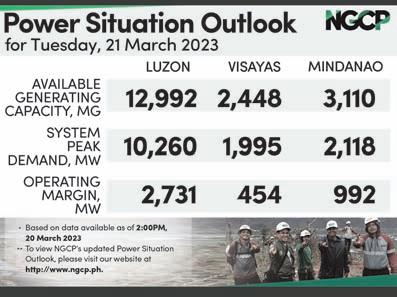
“We are confident that we can source this. There are many power plants where we can source this such as from Dinginin and some plants of SMC. They can still participate,” said Valles.
When sought for comment, ERC Chairman Monalisa C. Dimalanta said the agency will look into it.
“It seems it has lapsed. We need to check also if they were required to submit, but failed to file it. That could be a reason why the commission did not act on it.”
FNI, Baosteel sign purchase deal
By Jonathan L. Mayuga @jonlmayuga
GLOBAL Ferronickel Holdings Inc. (FNI) has signed an Annual Purchase Agreement with Baosteel Resources International Co. Ltd. for the supply of 1.5 million wet metric tons (WMT) of nickel ore for the 2023 mining season.
The nickel ore will be coming from FNI’s operating mines in Surigao del Norte and Palawan, operated by Platinum Group Metals Corp. (PGMC) and Ipilan Nickel Corp. (INC), respectively.
ABS-CBN Corp. said on Monday it has entered into a partnership agreement with blockchain infrastructure provider Theta Labs Inc. to develop new ways of consuming content and entertainment.
Under the partnership, Theta will be the Web3 video infrastructure partner to power ABS-CBN’s various business units and its digital collectibles non-fungible token (NFT) business.
The partnership, according to ABS-CBN Head of Digital Eugenio Manuel “Jamie” Lopez IV, brings “fresh opportunities for media and entertainment fans in the Philippines,” starting with projects that have been finalized and are set to release in the coming months.
“Our partnership with ThetaLabs is a very exciting chapter for us. We are looking forward to testing and exploring Theta’s Web3 video and NFT DRM infrastructure and how it can enhance our audience experience across various businesses and IPs.
Working with Theta will bring new features and capabilities to our viewers and push entertainment boundaries,” Lopez said. Lorenz S. Marasigan
“Our two operating mines have given us the ability to undertake year-round production to better support the growing demand from China. The easing of COVID-19 restrictions and the robust growth of China’s property sector that is driving the need for stainless steel will help boost the nickel industry,” FNI President Dante R. Bravo was quoted in a statement as saying.
Under the purchase agreement, one-third of the shipment will be composed of lowgrade nickel ore with 0.90-percent nickel content and 49-percent iron content while the
GLOBE Telecom Inc. (PSE: GLO) signaled on Monday it expects its core business to post “mid-single digit” growth this year, “despite the major macroeconomic headwinds” that it forecasts in 2023.

GLO Chief Finance Officer Rosemarie Maniego-Eala said the publicly-listed company aims to sustain a similar top line growth rate from 2022 to 2023, even as the firm slows down on capital spending while optimizing its current network utilization rates.
GLO recorded a 4-percent increase in service revenues to a record high of P158 billion in 2022 from P152.3 billion in 2021, driven by mobile and corporate data services and increased revenue contribution of non-telco subsidiaries.
Aside from this, the company is looking at maintaining its 50-percent margin for earnings before interest, taxes, depreciation and amortization (Ebitda) this year.
“We have a guidance of revenue growth of mid-single digit in 2023. It is the same guidance that we had in 2022, despite the major macroeconomic headwinds we are facing this year,” Eala, also the firm’s Chief
remainder will be medium-grade to high-grade nickel ore with 1.30-percent to 1.60-percent nickel content and 15-percent to 25-percent iron content.
The selling price of each shipment will be set on a monthly basis according to the prevailing market price at the time of price setting.
FNI was last traded at P2.35, down 1.67 percent, at the Philippine stock market.
Baosteel is a wholly owned subsidiary of the Chinese steel manufacturer China Baowu Steel Group and is engaged in the business of
mineral resource investment, trading, and logistics services.
The company highly specializes on trading of metallurgic raw material with annual volume of over 60 million tons covering a vast range of products such as iron, ore, coal, alloys, non-ferrous metals, ferrous scraps, metallurgical flux, etc. Baosteel Resources said it maintains more than a hundred overseas suppliers and over 40 overseas clients. The company’s headquarters is located in Hong Kong with footprints in Australia, Singapore, South Africa and Indonesia, among others.
ACEN Corp. announced last Monday that it has formally launched its New England solar power project in Australia.
The first phase of ACEN Australia Pty. Ltd.’s New England solar project was officially opened by the Hon. Chris Bowen MP, Federal Minister for Climate Change, marking a milestone in the project’s 6-year journey to generate clean renewable energy into the National Electricity Market (NEM) of the world’s sixth-largest country.
The estimated 936 megawatt (MW) project is being developed in two stages, and was approved by the New South Wales Government in 2020. The first 521 MW stage of the project has been in construction since March 2021. It is one of Australia’s largest solar projects to be participating in the NEM, with Stage 1 requiring the installation of close to a million solar panels.
New England Solar was granted
formal registration to send power into the NEM by the Australian Energy Market Organization (AEMO) in December 2022, and since that time, has been generating renewable energy.
“Stage 1 of the project is expected to be generating at full nameplate capacity of 521 MWdc in the coming months,” said ACEN.
“The event is an important milestone for the energy transformation underway across NSW and Australia.
I truly believe that the work ACEN Australia is doing to accelerate Australia’s transition to a renewable energy future is here and now – and it starts with New England Solar.
We decided to build New England Solar on a fully merchant basis to ensure it is online in time to help replace closing coal fired power stations in NSW. We wanted to get things built, to decarbonize Australia,” said ACEN Australia CEO Anton Rohner. Lenie Lectura
Healthway, units tap sister firm for waste
By VG Cabuag @villygc
AYALA- L ED Healthway
Philippines Inc., and its pharmaceutical importation and distribution arms, IE Medica and MedEthix, entered into a partnership with AC Logistics Inc. subsidiary Integrated Waste Management Inc. (IWMI) for the proper handling of waste.
IWMI now handles all the medical waste management of the entire AC Health group, starting with Generika Drugstore in 2022, through this newly-signed agreement.
Leveraging IWMI’s expertise in hazardous and hospital waste management, Healthway and IE Medica and MedEthix have contracted their fellow Ayala business unit as its waste hauler across all its facilities, including its QualiMed hospitals and Healthway Multispecialty clinics, starting this year.
protection through various initiatives on energy, water and waste management.”
“This partnership with IWMI for the efficient and environmentally friendly management of hazardous wastes in all our healthcare facilities further strengthens our ecosystem’s resolve to ensure the safety of our patients, staff, and the communities we serve, and our commitment towards sustainability,” he added.
IWMI said it is one of the leading waste management companies in the Philippines, offering full waste management solutions from transport, treatment, disposal, processing, and documentation, further specializing in managing hazardous, medical and electronic wastes.
IWMI President Cezar Christopher Gregory G. Pacheco Jr. said they “understand the impact of proper waste management on our people and our planet.”
Risk Officer, said. “We, likewise, gave guidance of maintaining our 50-percent Ebitda margin, which we will deliver by following through on our cost management initiatives.”
GLO’s Ebitda inched up by six percent to an all-time high of P79.1 billion last year from P74.9 billion in 2021, with an Ebitda margin of 50 percent from 49 percent in 2021.
Eala noted that GLO is expecting to post more gains from the proceeds of its tower sale and leaseback initiative this year, with the balance of the towers to be turned over progressively over the next few quarters.
To recall, GLO jump-started its tower-sale-and-leaseback program in August 2022, selling over 7,000 towers to MIESCOR Infrastructure Development Corp. (MIDC), Frontier Tower Associates Philippines Inc. and PhilTower Consortium Inc. to improve its balance sheet health and finance its capital expenditures. So far, GLO has raised around P39
billion from the transactions.
Eala added that GLO is also “focusing its efforts on free cash flow sustainability,” setting a lower capital expenditure (capex) program of $1.3 billion in 2023 from $1.9 billion the year prior.
It is further reducing its capex level for 2024, aiming to hit only $1 billion next year.
Eala assured that this optimization of capital spending and cash flow improvements “will not be at the expense of service quality as the company will continue with its commitment to deliver a world-class network and an industry-leading customer experience.”
GLO reported a 46-percent rise in net income in 2022 to P34.6 billion from P23.7 billion the year prior, recognizing its gains from the sale of its data center business, as well as the execution of the first few tranches of the sale and leaseback of its tower assets.
Lorenz S. Marasigan
“Translating our environmental, social and governance commitments into action remains one of our top priorities,” Ayala Healthcare Holdings Inc. President and CEO Paolo Maximo F. Borromeo said.
“This partnership with IWMI is only the first step in our efforts to champion sustainability throughout our entire healthcare network, and I am thrilled to be working with IWMI and AC Logistics in this endeavor,” Borromeo said.
For his part, Healthways President and CEO Jaime E. Ysmael said that while the firm “cares a lot about the welfare of our patients and our people, we, likewise, care a lot about the environment to ensure that it is preserved and enhanced for the benefit of our children and the generations to come.”
Ysmael reiterated the firm’s commitment “to environmental
“Responsibly handling hazardous and medical waste is not an easy feat, so we will make sure to be AC Health’s trusted and reliable partner that its subsidiaries can count on in every step of the process – from transport operations, plant operations, waste treatment, and documentation,” Pacheco said. He added they are “looking forward to helping Healthway, IE Medica, and MedEthix achieve their sustainability commitments.”
AC Logistics President and CEO Jose Rene Gregory D. Almendras described the partnership with AC Health as a “manifestation” his firm’s vision, “which is rooted in sustainability.”
“For an advocacy driven solutions provider like IWMI, it’s not just about ‘waste hauling,” Almendras added. “Our team is determined to work with AC Health in shaping the country’s standards on how hazardous and clinical wastes should be managed.”
BusinessMirror
Companies
THE Manila Electric Co. has forged an emergency power supply agreement (EPSA) with San Miguel Global Power Holdings Corp. and Aboitiz-led GNPower Dinginin Ltd. (GNPD) for a total of 670 megawatts (MW), according to a Meralco executive.
ABS-CBN taps into blockchain potential
Globe Telecom to ring in growth
BSP seen to scuffle still with ‘sticky’ inflation
By Cai U. Ordinario @caiordinario
WITH
The First Metro Investment Corp.-University of Asia and the Pacific (FMIC-UA&P) Capital Markets Research believes the increase in key rates will not dampen the country’s growth, which the local think-tank expects to hit 7.1 percent in the first quarter.
The last time the Monetary Board raised interest rates by 25 bps was in June 2022 when it raised the interest rate on the BSP’s overnight reverse
repurchase facility to 2.5 percent.
“We expect the BSP to hike policy rates by 25 bps in its March meeting to 6.25 percent, but this won’t suffice to stem the depreciation tendency of the peso given the Fed’s resolve to raise its policy rates by 25 bps in March and in May and the Philippines’s burgeoning trade deficits,” the local think tank said.
The think tank expects the BSP to increase key rates by another 25
How to maximize profit in investing during high inflation?
INFLATION is an increase in the price of commonly used goods and services in an economy making our buying power lower for a particular amount of peso. This is the reason why we can hear our grandparents sharing that they can buy a lot with P100 during 1970s.
As we return back to mostly face-to-face meetings, may it be in school or at work, our expenses also changed because of transportation-related and food-related needs outside our home. Based on government statistics, inflation for the first quarter of 2023 can reach to 8 percent. With this happening, how can we maximize investing to fight inflation with the right precautions?
I would like to quote what the legendary investor said: “Be fearful when others are greedy and greedy when others are fearful.”
If we will look at this message in the right context, we will see that there’s always an opportunity in the midst of every difficulty.
Here are some tips on what we can do during high inflation.
1. Focus on companies that generate income rather than consume cash. As inflation intensifies, more companies have this strategy of spending their funds to maintain physical volume of business.
However, there are companies that focus on generating profit with minimal expenses. This can be an advantage for a steady growth in their stock because they are providing innovative ideas and move. Such businesses must have these characteristics: the ability to increase price and the ability to accommodate large volume increases in business transactions.
2. Consider investing in real estate. Historically, real estate has been an effective hedge against inflation. The rise in property values enable owners to maintain a good profit by having their properties rented out or by selling a particular house on a higher price.
This is the reason why a lot of people buy condominium units in the metropolis, which they sell when price increases after two years to three years.
3. Maintain a flexible budget. Consider lowering your lifestyle expenses on the side of wants. We definitely can’t cut down our budget on basic needs. But for some extra cash that we have, like spending on travel or leisure, we may allocate 20 percent to investing. This way we can earn passively rather than
bps following an upside risk that the Federal Reserve will hike policy rates by 50 bps in March.
FMIC-UA&P Capital Markets Research believes the BSP will not “extinguish the economic recovery momentum” by raising interest rates further.
BSP Governor Felipe M. Medalla earlier said a 50-bps increase in policy rates would have less than a percentage-point reduction in gross domestic product (GDP) growth.
“Despite high inflation and negativity that troubles many minds, we think the economy is far from being down and out. Rather, the robustness remains until some more dramatic (unlikely) negative event(s) demolishes it,” FMIC-UA&P Capital Markets Research said.
Sticky inflation
MEANWHILE, Moody’s Analytics expects central banks in countries like the Philippines that are still experiencing high inflation will
Karlo Biglang-awa

being affected by the high cost of living and being unaware of it.
4. Take care of your health and well-being. Since money is the usual topic in investing, let us talk about our health and wellness. Do you agree with me when I say that health is really wealth?
Just imagine if someone in the family is hospitalized. It will take a big chunk in our savings, which can disrupt our financial goals. Eating healthy food, getting adequate sleep and exercise will strengthen our immunity.
5. Invest in yourself. Investing in ourselves means that we continuously upgrade our skills and knowledge. May it be attending a seminar, certification course or taking up a master’s degree, these will allow us to earn more. Investing in education can be an advantage in the long run as it will allow us to make better decisions in business resulting to profit, high salary if you are employed and with this you can add more value to the community, which will give you an edge in your industry.
6. Don’t lose hope. Most of the time, we can be consumed by news that affect our demeanor. Remember that everything is temporary and things may get better. Keep on moving forward, enjoy your time with your family and expect that the light at the end of the tunnel is coming your way.
A person without money but with high hopes can see the opportunities in the midst of a difficult situation but a person with a lot of money but without hope can be miserable.
Let us all be grateful with what we have and count all the blessings albeit we are experiencing different challenges in the economy. We can also help one another thrive and succeed. With this, our nation will progress and make a different in the rest of the world.
The good thing is we are in a demographic sweet spot: our population are mostly young and in the working age.
continue raising interest rates one or two more times this year.
These countries, apart from the Philippines, include Australia, India, and Vietnam. The central banks may keep raising rates while monitoring the impact of “tightening of lending standards does some of the heavy lifting for them.”
In the Philippines, Moody’s Analytics said the country is “battling some of the stickiest inflation in the Asia-Pacific region” which has prompted monetary authorities to raise interest rates.
It said cumulative hikes done by the BSP reached 400 basis points since May last year. Moody’s Analytics said inflation is being driven by demand-side and supply-side factors.
“With inflation still too high, [the] BSP will want to prevent what it calls the ‘emergence of additional second-order effects’. However, the small easing in inflation in February, which contrasted with BSP’s expectation for an increase, could
give the central bank confidence to step it back,” Moody’s Analytics said.
Growth drivers
THE local think tank said the Philippine economy’s growth drivers in the first three months of the year include manufacturing, employment, and national government spending.
“While the data do not readily show blinking bright lights, digging a bit beneath the surface does provide a sufficient basis for good expansion in the first quarter of 2023,” FMIC-UA&P Capital Markets Research said.

“Add to that the real income effect of the personal income tax cuts and strong overseas Filipino workers (OFW) remittances at a higher exchange rate than a year ago, and so we see GDP growth of 7.1 percent in Q1-2023,” it added.
The think tank said the Volume of Production Index (VOPI) was off to a good start in 2023 by posting a growth of 10.6 percent, the fastest in 10 months.
The growth was driven by higher increases in factory output for 17 out of 22 major industry categories, fueled by the above-10 percent expansion in eight categories out of the 17 categories.
In terms of employment, the think tank said the latest data showed the economy employed fewer Filipinos but still showed a 10.1 percent increase year on year. It expects employment figures to show improvement starting in February when the weather permitted more travel, eating out and construction work.
FMIC-UA&P Capital Markets Research said the government’s total spending rose 10.4 percent to P5.2 trillion in 2022 from P4.7 trillion in 2021.
This was driven by higher National Tax Allotment shares of local government units, higher capital expenditures, defense modernization projects, personnel services expenses, and interest payments.
PNB income declines after 2021 saw one-time gains
THE Philippine National Bank (PNB), the lender led by tycoon Lucio Tan, posted a 63-percent decline in its net income in 2022.
In a disclosure to the Philippine Stock Exchange (PSE), PNB reported that its net income reached P11.6 billion, lower than its net income in 2021.
The country’s sixth-largest bank by assets said its net income in 2021 was significantly higher due to onetime gains. However, the bank said, its total operating income grew by 19 percent from 2021.
“In 2021, the bank reported a one-off gain coming from the properties-for-shares swap transaction implemented that year, which significantly increased the prior year net income by P33.3 billion. This caused the comparative net income in 2022 to be lower by 63 percent,” PNB said in a statement.
However, PNB said that without the effect of its one-off gain, its pre-tax income showed a growth of 3.5 times year-on-year on the back of stronger core operating
income in 2022.
PNB said the double-digit growth in its total operating income was driven by “sustained growth in core income and supplemented by substantial gains on disposal of the bank’s low-earning foreclosed properties.”
Apart from this, PNB said it also concluded several sale transactions involving high-value foreclosed properties in 2022, which generated net gains on sale and exchange of P7.8 billion during the year, almost 8-times higher than the gains recorded in 2021.
“PNB improved its efficiency and profitability amidst challenging conditions and economic headwinds,” said PNB Acting President Florido P. Casuela. “PNB’s performance in 2022 is a good indicator that the Bank continues to deliver real value to our clients, investors and the overall economy.”
PNB also reported that amid the rising interest rate environment in 2022, its net interest income reached P37.3 billion, up by 7 percent yearon-year due to higher yields on in-
terest-earning assets. This translated to the bank’s net interest margin improving to 3.61 percent from 3.27 percent a year ago. Its core income was boosted by the 5 percent growth on its fee-based revenues largely coming from fees on its deposits, bancassurance and underwriting transactions.
Further, gains from foreign exchange transactions expanded to P1.6 billion, up by 116 percent yearon-year. These gains cushioned the impact of trading losses recorded in 2022 amounting to P1.3 billion with the uptrend in interest rates, brought about by the global monetary tightening during the year.
“Operating expenses posted a moderate increase of 8 percent year-on-year on account of the taxes related to the property sales, as well as higher amortization costs for the leased properties of the bank where it is currently holding its operations. These properties were the subject of the properties-for-shares swap executed in 2021,” the bank explained.
PNB’s gross loan portfolio settled
at P613.6 billion as of end-December 2022, lower by 3 percent from prior year’s level.
Credit provisions on the loan accounts are 44 percent lower than year-ago level arising from improvements in payment and credit status in 2022 of certain large exposures of the Bank.
On the funding side, the lender’s deposit liabilities likewise were reduced by 3 percent mainly due to its strategy to trim down higher-cost time deposits.
However, PNB said this decline was tempered by the continued build-up of its current and savings deposits, which together grew by 4 percent year-on-year.
Consequently, total resources of the Bank stood at P1.15 trillion by end-2022, 4 percent lower compared to previous year’s balance.
Despite the economic challenges in 2022, the Bank’s equity remained robust as it increased by 5 percent year-on-year, bringing the Bank’s Capital Adequacy Ratio to 15.38 percent and Common Equity Tier 1 Ratio to 14.58 percent. Cai U. Ordinario
High consumer loans boost EastWest’s ’22 income
GOTIANUN-led East West Banking Corp. (PSE: EW) saw a 42-percent increase in its net income in 2022 as it was able to increase its consumer loans.
In a disclosure to the Philippine Stock Exchange (PSE) last Monday, EW said its loans grew by 20 percent driven by credit cards, business loans and key salary loan segments.
Total deposits were steady at P329.2 billion with CASA ratio improving to 79 percent from the previous year’s 75 percent, according to the country’s 11th-largest lender by assets.
“We accelerated our loan bookings in the second half across all lending products which improved our earning capacity back to pre-pandemic levels. We intend to exceed this in 2023, as we carry on the momentum from last year,” EW President Jacqueline S. Fernandez said.
The bank also grew its core revenues by 12 percent to P28.1 billion in 2022 while its total assets reached P421.4 billion driven by its shift “towards higher yielding consumer lending assets.”
Meanwhile, EW also invested on IT systems to help improve its digital
services and prime it for faster digital innovations, increasing its operating expenses by 3 percent to P17 billion.
Its capital ratios continue to stand at a healthy 13.8 percent and 13 percent for Capital Adequacy Ratio (CAR) and Common Equity Tier 1 (CET1) ratio, respectively, well above the regulatory requirements.
“The full year impact of our 2022 asset build-up will be felt this year on our core income performance. The growth momentum should improve this further as we exceed prepandemic asset levels this year,” EW CEO Jerry G. Ngo said.
“Though we expect some headwinds particularly from the higher interest rate environment, the country’s growth prospects remain intact. We believe that EW is at the right place and at the right time, as we partner with our customers to rebuild and grow together,” Ngo added. EW, a Filipino-owned universal bank, is a subsidiary of Filinvest Development Corp., one of the country’s leading conglomerates with a diverse range of interests including real estate, banking, hospitality and tourism, infrastructure power generation and sugar. Cai U. Ordinario
Financing app operator attracts more women–study
By Roderick Abad @rodrik_28 Contributor
TALA Financing Philippines Inc. said its study showed it is creating ripples in the traditionally male-dominated financial technology (fintech) industry as it closes the gender gap in job positions and remuneration packages.
Based on the firm’s “Impact Report for 2022,” more financial independence equates to an increase in self-esteem among 80 percent of its women borrowers.
This research also bared that 78 percent of the respondents gained more respect from their families while 70 percent had a growth in influence on household decisionmaking.
Partnering with Tala resulted in 56 percent of them having more financial freedom, 53 percent now afford household expenses and 15 percent are able to pay for education, the financial services operator said.
Leveling the gender playing field deeply rooted from its principle that all individuals “all have the same potential; just not the same access.”
“Tala is focused on creating and following objective, fair, and equitable processes within the company. We aspire to foster an equal and inclusive workplace every contribution is appreciated and valued,” Tala Philippines Senior Director for People Katherine Antunez said of inclusivity resulting to women comprising half of their
leadership team.
Across Tala’s offices in the Philippines, the United States, Kenya, Mexico and India, benefits that provide work-life balance to female employees include managing their own work calendars and enjoying personal time off on top of maternity leave benefits and “unexpected life event” days off covering emergency and bereavement leave.
They also get learning opportunities and engagement activities to help develop their career and fulfill various roles outside the workplace, the company said. It cited making experts available on various topics as another benefit. There are also employee resource groups that help employees connect, share experiences and provide feedback on
what else the management can do to make Tala their preferred employer, the company said.
“My mentors and managers at Tala help me to build my confidence and taught me to explore opportunities,” said Tala Senior Vice President of People Punam Brahmbhatt. “I also give my team a chance to grow.”
“As a Filipina in a diverse and inclusive talent pool, I feel an even greater sense of purpose taking on a global leadership role. I look forward to seeing more women in Tala become rising stars in their respective roles, bridging the gender gap in an otherwise male-dominated FinTech industry,” Tala Senior Director for Global Customer Experience Operations Iona Iñigo-Mayo added.
BusinessMirror Editor: Dennis D. Estopace • Tuesday, March 21, 2023 B3 www.news.businessmirror@gmail.com Banking&Finance
inflation to have slightly cooled in February, local and international think tanks believe the Bangko Sentral ng Pilipinas (BSP) will raise interest rates by only 25 basis points (bps) on Thursday.
personal-financial planning, attend the 100th RFP program this March. To inquire, e-mail info@rfp.ph or text at 0917-6248110.
Karlo Biglang-awa is a registered financial planner of RFP Philippines. To learn more about
perSonal finance
PRETTY Savage/ Anthurium Minoa
Theodora Sforza, Wawi Navarroza
Meaning explored, transformation celebrated
renewing itself.”
In his ongoing show with Silverlens Manila, Mit presents several of his ongoing series. Among these is Marking Stones, an interactive artwork that invites the viewers to take a painted object made from recycled material in exchange for sharing documentation. The project is inspired by an earlier project by Mit in 1991, Vienna Apartments, in which the artist invited his friends and residents of the city to take an object made from found material and furniture and open their homes for a public exhibition.
TODAY’S
HOROSCOPE
By Eugenia Last
CELEBRITIES BORN ON THIS
DAY: Jace Norman, 23; Sonequa
Martin-Green, 38; Matthew Broderick, 61; Rosie O’Donnell, 61.
HAPPY BIRTHDAY: Busy yourself with projects. Idle time will lead to dissatisfaction, complaining and arguments. A positive attitude will help counter anyone trying to rain on your parade. Put a plan, budget and schedule in place. Take a journey that leads to something that makes you feel passionate about life. Call the shots instead of standing on the sideline and letting others vet for you. Your numbers are 4, 16, 24, 26, 32, 38, 43.
ARIES (March 21-April 19): Keep the momentum flowing. Don’t ignore the rules or listen to bad advice. Someone will be eager to make you look bad or ruin your plans. Be true to yourself and stick to the path that will help you reach your destination. ★★★
TAURUS (April 20-May 20): Hard work will pay off when trying to get in shape, following your dream or joining forces with someone you find compatible. Refuse to let outside influences interrupt your plans. Make how you look, how you feel and what you do priorities. Get fit and feel good. ★★★★
TWO solo exhibitions share the spotlight at Silverlens Manila, one featuring a foreign artist scrutinizing semantics on a philosophical level, and another narrating a transformative rebirth. Mit Jai Inn’s Ocular Vocabulary and Wawi Navarroza’s As Wild as We Come are on view until April 5.
In Mit’s presentation, the Thai artist and activist reflects on “Spraschspiel,” or language-game, a philosophical concept developed by prominent 20th century thinker Ludwig Wittgenstein. The idea refers to the malleability and relativity of meaning, in which a word acquires definition only as a result of the “game” at hand. The word “water,” for instance, could mean as an order, a question, or the answer itself.


Mit’s thematic choice speaks of his critical nature. In an essay for Artbasel.com, the artist recalled how he, as a boy, “loved to break things.”
“I was always rebelling against authority,” wrote Mit, also the cofounder of Chiang Mai Social Installation and founder of Cartel Artspace in Bangkok. “I realized that being an artist was my only option. Breaking things apart is what modern artists do. It’s like modern society, constantly
Opposite Mit is Navarroza’s latest showcase, featuring the Filipino contemporary artist’s latest works first exhibited at Kristin Hjellegjerde Gallery in London last year and recently shown at Art Fair Philippines’s Special Exhibitions section. In As Wild as We Come, Navarroza, known for her multi-layered self-portraits, capture her current transformative phase, from moving countries to becoming a mother.
“The suite of large format colorful works marks a celebratory return and regeneration through the power of art-making,” the artist writes in the show’s exhibition note. “She is the Woman at the Threshold; these are her portraits. What is the threshold if not the picture frame, if not a portal to a new life, new place, new time—a woman’s season of change.”
Navarroza has exhibited widely in the Philippines and internationally, including the National Museum of the Philippines, Metropolitan Museum of Manila, Singapore Art Museum 8Q, and the Hangaram Museum (Korea), to name a few. She has also presented in galleries in Australia, Japan, Malaysia, Singapore, Laos, Cambodia, London, Spain, Italy, and Russia; with continued participation in international photography festivals and art fairs such as Art Basel HK. ■
The Embassy of Italy celebrates Italian Design Day with masterclasses
THE Embassy of Italy in Manila celebrated Italian Design Day, an annual thematic review that promotes the best of Italian creativity and talents, with a series of masterclasses dedicated to interior and product design, architecture and fashion at the prestigious showroom of Home Studio in San Juan City.
Themed “The quality that enlightens: The energy of design for people and the environment,”, the seventh edition welcomed local and visiting design ambassadors, which included Milan-based multidisciplinary designer Ilaria Bianchi, Filipino fashion design and merchandising expert Christine Cheryl Benet, and multiawarded Italian architect Romolo V. Nati. Bianchi specializes in product, furniture, and interior design. Her works have been shown in galleries, cultural centers and international fairs, such as Victoria & Albert Museum, Triennale di Milano, Galleria Luisa delle Piane, Chamber NYC, MiArt, Stockholm Design Fair, London Design Fair and Salone del Mobile.
Elle Décor named her as the Next Designer of the Year in 2018, with her Duo Shelf Project as one of the WallPaper 2018 Design Award Winners. In 2019, Ad Italia
included her as one of the Seven Designers of the Future and Elle Décor hailed her as the Young Designer of the Year in 2020.

Benet has over 20 years of professional experience in merchandising and manufacturing. She is the consultant of the Philippine Department of Science and Technology (DOST) for the Creative Industry
Developer for the Textile Design Program in the Philippines.
Equipped with a passion for the academe, she mentors the promising style innovators of the De La Salle-College of Saint Benilde. She is likewise the former Associate Dean of Benilde Environment
Studies Cluster and Chairperson of Benilde Fashion Design and Merchandising Program.
Nati is currently the Executive Chairman and CEO of Italpinas Development Corp., a publicly listed Italian-Filipino real estate development company that specializes in the design and development of sustainable buildings in emerging cities across the Philippines.

He is the vice chairman of the Philippine renewable energy company Constellation Energy Corp. (CEC), which focuses on acquiring, financing and developing small- to medium-scale renewable energy projects across the Philippines. He is also the chairman of PRIMA Inc., a company engaged in Asset Management in the Philippines.

The event culminated with an awarding ceremony to honor 23 local designers who made a mark in their respective fields.
The Italian Design Day was launched in 2017 by the Ministry of Foreign Affairs and International Cooperation in collaboration with the Ministry of Culture. This year’s edition was held in partnership with Home Studio Inc. and the Philippine Italian Association.
GEMINI (May 21-June 20): Don’t start what you can’t finish. Getting upset with someone will slow down what you are trying to accomplish. Shake yourself off and prepare to do what’s best for you. The best opportunity is the one you create for yourself. Stay on budget. ★★
CANCER (June 21-July 22): Halt, observe what’s happening around you and listen, but don’t share too much information. Don’t compromise your position by showing vulnerability or saying something you shouldn’t. Be true to yourself and honest with others. ★★
LEO (July 23-Aug. 22): Change only what’s necessary. Emphasize learning, experimenting and visiting people who can offer something valuable to you. Taking a trip or going to a meeting will clear up any concerns or misinformation you receive. Protect your money. ★★★★★
VIRGO (Aug. 23-Sept. 22): Try something new and explore the possibilities. Don’t give in to others. Map out how you want your life to be, then start the journey. Practical ideas and applications will help you achieve your goal. Selfimprovement is favored. ★★★

LIBRA (Sept. 23-Oct. 22): Take pride in what you do and take on as much as you see fit. Having your finger on the pulse of something will give you a full range of options that lead to a more incredible opportunity. ★★★
SCORPIO (Oct. 23-Nov. 21): Getting your house in order will ease your mind. Do the dirty work yourself and you’ll understand the benefits of maintenance. Steer clear of joint ventures or sharing expenses. An unusual suggestion will attract hands-on help. ★★★
SAGITTARIUS (Nov. 22-Dec. 21): Keep an open mind, but don’t believe everything you hear. Keep your emotions in check when dealing with peers, friends and relatives. It’s important to listen, but do not give up your dreams for someone who takes more than gives back. ★★
CAPRICORN (Dec. 22-Jan. 19): Simplify your plans and stick to your budget. Use your ingenuity and experience to make the changes you want. You can dream, but be realistic about what’s possible. You’ll be happy with the results. Romance looks promising. ★★★★
AQUARIUS (Jan. 20-Feb. 18): Pick up the pace and finish your to-do list. Don’t withhold thoughts and feelings when dealing with pushy people. Be blunt about what you expect and are willing to give back. Don’t let a decision someone makes interfere with your plans. ★★★
PISCES (Feb. 19-March 20): Funnel your energy into something unique, creative or passionate. Refuse to give in to annoyances and disgruntled people. Declutter your space and rearrange things to fit your lifestyle. Set up things ahead of time in order to advance. ★★★

BIRTHDAY BABY:
You are determined, concerned and helpful. You are original and persistent.
B4 Tuesday, March 21, 2023 • Editor: Gerard S. Ramos www.businessmirror.com.ph
ACROSS 1 Utah site of the 2002 Winter Olympics, briefly 4 “___, I’m Adam” (palindrome) 9 Watery hue in the Miami Dolphins’ logo 13 Soothing mineral 15 “Humble” home 16 Like lyrics 17 Continent adjoining Europe 18 Be subtly yet publicly critical 20 Answer pages? 21 Item produced by Santa’s elves 22 Cicely who won an honorary Oscar in 2018 23 Move like a butterfly 25 Sass 27 Picnic pest 28 Skip pronouncing 29 “I should’ve ___ that coming!” 31 First part of POTUS: Abbr. 32 Club Med destination 34 Christina of “Yellowjackets” 36 Spew nasty words 39 Parts of hippies’ necklaces 40 Nursery chair 43 Morally right 46 Itty-bitty bit 48 Trousers material 49 Make a pick 50 “Washboard” muscles 51 Kids’ racing vehicles 53 Small mammal with a long snout 55 “Wait a ___!” 56 Cost of a ride 57 Express relief 60 “OG Original Gangster” rapper 61 Lake that’s the “E” in HOMES 62 Word before “opposite” or “bear” 63 Udder part 64 Hibernation locations 65 Marry in a hurry 66 Amtrak stop: Abbr. DOWN 1 Congression-al aide, e.g. 2 French explorer of the Mississippi 3 Exclusive and unfriendly 4 Dull finish 5 Detests 6 Small boat 7 Much ___ About Nothing 8 Kitten’s cry 9 Pale gray 10 Galactic nucleus 11 Ruined 12 FBI employees 14 Bring into question, with “on” 19 NASCAR sponsor 24 ___ Haute, Ind. 25 Flowery necklaces 26 Run up, as expenses 30 Name that anagrams to “stern” 31 Go ballistic 33 Michigan congresswoman Rashida 35 Its hands are over its face 37 Short vows 38 Giant slaloms, e.g. 41 Implore 42 ___ Stone (Egyptian tablet) 43 Kidded around 44 Call from a balcony, perhaps 45 Overexertion 47 Feature of many a relationship on 90 Day Fiance 50 Amazement 52 Earth tone, in Canada 54 Days before holidays 55 Missile housing 58 Koko or King Kong 59 Fa follower Solution to today’s puzzle:
Art BusinessMirror
LEE TAYLOR
Universal Crossword/Edited by David Steinberg
‘catch my drift?’ BY
The
MILAN-BASED multidisciplinary designer Ilaria Bianchi
MULTI-AWARDED Italian architect Romolo V. Nati
Max Eigenmann: More than just a lucky charm
IN less than a month, three different films with Max Eigenmann playing the lead bagged best film awards.
T.M. Malones’s Kargo took home the Orient Express Best Film trophy at the Fantasporto International Film Festival in Portugal. Eigenmann played a young wife who seeks vengeance for the tragic death of her husband and daughter.
“The Philippine delegation was so happy when Kargo was announced as the winner for best film. I am glad I was able to join the trip because being in a foreign festival representing both your film and your country is priceless. And to be honored by foreign critics and jury members in an awards ceremony makes any Filipino artist beam with pride!” she enthused.
Eigenmann went to Portugal with Malones, coactor Jess Mendoza, executive producer Sara Santiago, and coproducers Essy Antonano and Ferdy Lapuz. While there, they attended some screenings of the films in competition.
“Portugal is a beautiful country, with so much to see and experience—arts, architecture, history, food and culture. The people are also very warm, and those who were in the audience during the screening of Kargo were very generous with their appreciation of our film,” Eigenmann shared.
“There was also a good number of Filipinos living and working in Portugal who came to our screenings and supported us. Nakakataba ng puso,” she added.

While Eigenmann was in the city of Porto, she received good news that 12 Weeks, another film which she topbilled, won the Best Film from the Society of Filipino Film Reviewers. The film, written and directed by Anna Isabelle Matutina, was cited for effectively distilling complex gender politics and psychology into a personal, humanistic narrative.

Eigenmann also bagged the Best Lead Performance award, and was honored “for her bravura and effortlessly naturalistic performance of a middle-aged woman torn between terminating her pregnancy as a pro-choice advocate, and the call of maternity.”
Bidens to host ‘ted Lasso’ cast to promote mentaL heaLth
WILMINgTON, Delaware—President Joe Biden and
First Lady Jill Biden will host the cast of the TV series Ted Lasso at the White House on Monday to promote mental health and well-being.
Jason sudeikis, who plays the title character—an American coaching a soccer team in London—and other members of the cast will meet with the Bidens “to discuss the importance of addressing your mental health to promote overall wellbeing,” the White House said. The third season of the Emmy-winning, feel-good Apple TV+ series began streaming last week.
A White House official said the Bidens had seen some of the show and are familiar with its “message of positivity, hope, kindness, and empathy.” Cast members expected to be in attendence include: Hannah Waddingham, Jeremy swift, Phil Dunster, Brett goldstein, Brendan Hunt, Toheeb Jimoh, Cristo Fernandez, Kola Bokinni, Billy Harris, and James Lance. Biden has previously called on lawmakers in both parties to expand resources to fight the “mental health crisis” in the nation as part of his “ unity agenda.” His administration has surged funding to bolster the 988 suicide and Crisis Lifeline and expand school-based mental health professionals. ap
and runner-up honors for directing and ensemble performance too,” Eigenmann said.
A few days after she flew back to Manila, Eigenmann welcomed the news that Raging Grace, a film she shot in the United Kingdom, won top honors at the highly regarded SXSW (South by SouthWest) Film Festival in Austin, Texas, bagging the coveted Best Narrative Feature Film Award.
Eigenmann plays the lead character of an undocumented Asian housecleaner in a tense story about a mother who works as the caretaker of a
concert ‘risen,’ a rebirth of music and culture at Manila Cathedral
ON April 13, 6:30 pm, the Philippine Suzuki Youth Orchestra (PSYO) will take center stage inside one of Manila’s most iconic locations—the Manila Cathedral-Basilica—to perform a special Easter concert, titled Risen. This concert marks a historic moment for all—it marks the first youth orchestra to have been endorsed to play in Manila Cathedral, and it also happens on the eve of the installation of Msgr. Rolando R. dela Cruz as its new Rector.
PSYO is a training orchestra for young string instrumentalists aged nine and above with a wide repertoire that includes favorite pieces from the Baroque, Classical, and Romantic periods, as well as hits from contemporary music.
luck certainly did come in threes for the actress. A few mentioned that Eigenmann must probably be the lucky charm, but there is more to this amazing thirdgeneration actress than just luck and charm. She is not the Asia Pacific Screen Awards best actress for nothing. This lady’s got unfettered talent and superb natural acting skills in her core.
Max Eigenmann is back in town, in her favorite job. She is part of the main cast of GMA Entertainment Network’s newest drama series The Missing Husband, which will air very soon. n
IN IsrAEL, T V’s DYsTOPIAN ‘HANDMAIDs’ Is PrOTEsT FIxTurE
The concert seeks to honor Msgr. Dela Cruz’s vision for Manila Cathedral—that it becomes not only a place of worship but a center of music and culture, bringing in more people into its walls with beautiful melodies and inspirational performances from world-class musicians, such as Ryu Goto, a JapaneseAmerican concert violinist who previously played with the Philippine Philharmonic Orchestra (PPO) in 2018. It was the last orchestra that played in the cathedral.
Risen is set to be a spectacular performance, brimming with hope and new life, a perfect way to commemorate Easter. Through this concert, the PSYO brings an experience of captivating music and rebirth as they play classical music pieces from the Baroque and Classical periods as well as beautifully arranged contemporary pieces specifically for the Easter season—a theme that reflects revival on this joyous holiday.
“Music has always been an integral part of our faith,” says Msgr. Dela Cruz. “It is my vision to create a vibrant cultural atmosphere in our church where young minds can come together to appreciate music and faith.”

TEL
AVIV, Israel—It’s
become an ominous fixture of the mass anti-government protests roiling Israel: a coil of women in crimson robes and white caps, walking heads bowed and hands clasped. They are dressed as characters from Margaret Atwood’s dystopian novel, The Handmaid’s Tale, and the eponymous TV series.
The women, growing in numbers as the demonstrations against Prime Minister Benjamin Netanyahu’s policies intensify, say they are protesting to ward off what they believe will be a dark future if the government follows through on its plan to overhaul the judiciary. “This display is a representation of the things that we fear,” said Moran Zer Katzenstein, founder of the women’s rights advocacy group Bonot Alternativa, or “building an alternative,” which is behind the Handmaid’s protest.
“Women are going to be the first to be harmed” under the overhaul, she added.
In a move that has sparked widespread opposition,
New youth-oriented series to debut soon
THE latest youth-oriented anthology series, Sparkle U promises to provide audiences a feel-good and heartwarming afternoon every weekend. The series features the good times and the struggles that Filipino youth are facing today in their teenage lives.
The show’s first installment, titled “#LikeforLike,” will soon be headlined by some of Sparkle GMA Artist Center’s most promising stars: Shayne Sava and Abdul
Raman, together with Zephanie, Michael Sager, Roxie Smith, Anjay Anson, Lauren King, Vanessa Peña, and Princess Aliyah.
“#LikeforLike” follows the story of a 17-year-old wallflower, Bekang (Shayne), and three other mediocre teens: Sue (Zephanie), Marco (Michael) and Wado (Anjay). From being nobodies, they will suddenly become famous after rescuing the campus queen bee, Yazzi (Roxie), from a fire incident.

As their high school lives begin to change, the four teens must deal and adjust to their new status. They will be forced to act according to society’s expectations, especially now that they gained attention from more popular students and the anonymous Jen Z, a vlogger who reveals secrets and controversies inside the university.
Will Jen Z make or break the relationships these teenagers have with their friends, families, and even with
Netanyahu’s government is pushing to weaken the Supreme Court and limit the independence of the judiciary, steps they say will restore power to elected legislators and make the courts less interventionist. Critics say the move upends Israel’s system of checks and balances and pushes it toward autocracy. The overhaul has sent tens of thousands of people into the streets in protest each week. Unmissable in the crowd are the women in red robes, turning otherwise usual protest scenes into an otherworldly sight. The government, Israel’s most right-wing ever, is overwhelmingly male. Only nine out of 64 members of Netanyahu’s coalition are women. Ultra-Orthodox parties, which are key components of the coalition, deny inclusion to women members entirely. With the crisis in Israel showing no sign of abating, the women in red have become a mainstay at protests around the country and their numbers are growing. About 1,000 women wore the robes at a recent Tel Aviv rally. ap
themselves? Will their sudden fame be something good for them, or will it only harm their young minds?
Sparkle U is being shepherded under the supervision of GMA SVP for entertainment group Lilybeth G. Rasonable, while the creative team is led by creative head for afternoon prime Dode Cruz, with Barry Gonzales as director. It will soon debut on GMA, with viewers overseas being able to watch this latest offering via GMA Pinoy TV.
Concertmaster Theodore Julius Tan, the first-prize winner of the National Music Competitions for Young Artists Foundation (NAMCYA) in 2022, will be leading the group as they perform Mozart’s “Eine kleine Nachtmusik” and “Divertimento in D major,” among other familiar staples of the classical repertoire by Bach, Mozart and Handel. The concert will also feature dynamic pieces where special performances featuring PSYO’s principal musicians, the Spectrum Cello Quartet, and young vocalist Jamie Rose Ong, will take center stage. The orchestra’s pianists will also have a treat for early concertgoers who will get to be serenaded by pipe organ music as they enter the cathedral.
Risen is copresented by the PSYO and the Manila Cathedral, with the support of Intramuros Administration, dzFE 98.7, Crossover Radio Online and Prince Albert.
For ticket inquiries, message 0906-4311407 via Viber or visit bit.ly/3mrdp8c. The reception will be open from 5:30 pm to 6:15 pm. Choice of seats will be on a first-come, first-served basis.
B5 Editor: Gerard S. Ramos • Tuesday, March 21, 2023 www.businessmirror.com.ph
Show BusinessMirror
Msgr rolando r dela Cruz
THE young stars of Sparkle U, Anjay Anson (from left), Zephanie, and Michael sager
Cleanfuel Launches Premium Octane Race 97 gasoline in select stations

is the best time to launch our newest gasoline, the Race 97. Last year, the local auto industry reached a combined 33 percent growth compared to 2021 overall sales. This is a good indicator of our timing.” Atienza also mentioned that the Race 97 in Cleanfuel stations are only 50-centavo higher than the price of their Premium 95 fuel. “The best part of buying this product is the cost effectivity of getting a premium fuel load. Now, here’s the best deal. If you are a VIP card holder of Cleanfuel, all your Race 97 fuel consumption will automatically earn double points value. From price, points, and higher grade fuel ratings, the Race 97 is the best deal in the marketplace.”
mWell bolsters doctor roster with OB-Gyns, family physicians, mind health experts
METRO Pacific Investments Corporation’s (MPIC) mWell, the country’s first and only health and wellness mega app, further strengthens its line-up of partner-doctors for its mission to bring health care closer to Filipinos especially women who are the primary health guardians of the family.
In celebration of International Women’s Month, mWell has tied up with Kalusugan ng Kababaihang Pangkabayanan, Inc (KnKPInc), a group that safeguards the well-being of marginalized Filipino women in the countryside. Working with member OB-GYNs, mWell shall provide free online consultation for women as part of KnKPInc’s medical mission this March.
Aside from providing quality health care to women in the countryside, the collaboration also aims to help raise awareness on issues such as reproductive rights, gender equality and abuse against women.
experience, Riyan Portuguez, MP, RPsy, RMPm, founder of YMP Lead says, “As a practitioner, everything I need can be found in the app with just one click. It's easier for me to check my appointments and to have easy access to teleconsultation. I also really love the fact that it has automated coding for a specific diagnosis, and we can fill out and sign our abstracts after consultations. It's so convenient to use!”
CLEANFUEL , the purveyor of Quality Fuel for Less, recently announced its latest premium high-octane gasoline—the Race 97. The addition of Race 97 fuel will provide motorists a cheaper alternative to the high price of the Research Octane Number (RON) of 97 in the Philippine market. Moreover, the Race 97 offers a big advantage over competitors as motorists can save more while maximizing the engine performance of their vehicles.
“The introduction of Race 97 is a milestone for Cleanfuel’s product range as we provide more value for our loyal customers. Because of our lower price
offering for quality high octane fuel, more customers can now experience the benefit of higher octane fuel for their vehicles,” said Atty. Jesus “Bong” Suntay, President and CEO of Cleanfuel Group of Companies.
Suntay shares that a higher octane fuel allows your engine to have a balanced and stabilized combustion which is needed to be able to maximize your vehicles engine performance.
Meanwhile, Cleanfuel Director Marco Atienza expressed optimism that the launch of Race 97 in Cleanfuel stations is timely, with more private cars and two-wheels now back on the road. “This
Currently, the Cleanfuel Race 97 is available at Cleanfuel Katipunan White Plains, Cleanfuel Pioneer, Cleanfuel Kamias, Cleanfuel Mayon, Cleanfuel Malabon, Cleanfuel Quirino Manila, Cleanfuel Silang, Cleanfuel Olongapo, and Cleanfuel La Union Rosario. The company is committed to add Race 97 in most of its fuel stations in Mega Manila and key provinces.
“Initially, we roll out the Race 97 in select Cleanfuel stations to allow our customers to experience of our new product and reinforce our company mantra of Quality Fuel for Less. In the next quarter, they will see more Race 97 in Cleanfuel stations,” adds Suntay.
Leading industrial company Rennai Training to join PSMex 2023 back-to-back with I-MTAP
2023
PHILIPPINE Subcon and Manufacturers Exhibition 2023
(PSMex 2023) themed as “Make it in the Philippines,” a biennial exhibition will be held from April 26 to 29, 2023, Hall B and C of World Trade Center Metro Manila.
It is an event that will cater to both local and international audience which covers whole business platform that will be beneficial to suppliers, distributors and end-users. It is an event that will showcase the capabilities of Philippine products and services to the world. It will be held back-to-back with i-MTAP 2023.
PSMEX 2023 is the venue of Philippine capabilities to support local and international companies who can give assistance to their manufacturing plant, as the word Subcon implies. PSMEX 2023 a platform to stimulate and invite international companies to locate in the Philippines with existing companies to support their operation and covers fourmajor manufacturing industries such as Aerospace, Automotive, Electronics and Motorcycle
As Rennai Trading is an authorized distributor of Pareo Caster in the Philippines. Pareo Caster is a well-known brand trusted by major manufacturing

plants in Thailand. They are dedicated to bringing the best of Pareo Caster to their customers, offering a wide range of caster solutions for various applications.
Their ultimate goal is to distribute and trade products of the highest quality and to work closely with our customers to build strong business relationships in the market.
They are also the authorized distributor
“Being a woman, a mother and having a daughter, I am fully committed to empowering women through mWell’s holistic approach to health and wellness. Recognizing the crucial role that women play in nation-building, mWell shall ensure that women receive access to doctors, a daily health tracker, fitness programs and healthy recipes—all within the mWell app. We are here to ensure good health and well-being of all women in every step of the wellness journey by providing the tools needed for improved productivity in the various roles they play,” said mWell President and CEO and MPIC Chief Finance, Risk, and Sustainability Officer Chaye Cabal-Revilla.
“We are honored to partner with mWell in promoting women’s health and empowerment. Through our medical missions, we can help underprivileged and marginalized Filipino women who still suffer from inadequate access to quality healthcare. Becoming part of the mWell ecosystem will greatly help in KnKPInc’s mission to address the delays in preventive care and disease management for women in the countryside,” said Dr.Connie Pijuan-Alfiler, Chairman and Founder of KnKPInc.

As a fully integrated, fully digital platform, mWell has also partnered with YMP Lead to strengthen its roster of mind health experts. Kicking off the partnership, free mind health consultations were provided to mWell app users to promote self-love as part of mWell’s Love For Wellness campaign. Recognizing the need to help ease anxiety and sadness especially during the Valentine season, mWell gifted app users with a health pass code which they can use to consult with psychologists from YMP Lead.
Asked about their consultation
“The mWell app is user friendly, easy to navigate, and multiple notifications (via email, text message, and the app itself) is helpful. Also, clinicians can input consultation notes and select coding for specific diagnosis. Overall, I love the app,” said Rachell Anne Castro, MA, RPsy, RPm.
After her consultations via mWell, Marry Jane Sioson, MP, RPm, RPsy said, “The app allows both the clinician and the patient stay up to date with their session schedule via email and SMS. This feature helps a lot especially on organizing and setting us reminders amidst our busy schedules. Medical notes are easy to access and user friendly. High regards to the technical team who are quick to respond.”
To better respond to the fast-paced lifestyle of doctors, mWell empowers all its partner-doctors to go fully digital by creating the new mWellMD app—a virtual clinic designed by doctors, for doctors. It allows them to easily manage schedules and patient records and be notified of upcoming patient schedules. Built with the doctor experience in mind, it provides a seamless experience from sign-up to consultation. The mWellMD app enables doctors to conveniently serve patients anytime, anywhere with its fully digital features.
Recognizing their fast-paced lifestyle, mWellMD allows doctors to attend to patients on their mobile phone, wherever they may be, 24/7. It is loaded with tools that will allow doctors to manage their practice— from patient records, consults, billings, and professional fees. They can even communicate with their staff and refer patients to other doctors.
SeedWorks Philippines‘ TH-82 Hybrid Rice Variety leads the national rice tech forum
of Flexovit Abrasives and authorized dealer of Makita Products.
See them at PSMEX 2023 at Booth no. 18 and “TOGETHER WE BUILD A BETTER FUTURE for the Philippines’ Manufacturing Industry”
To register online visit https://psmex. weebly.com or email psmex01@gmail.com or mai_mgt@compass.com.ph or call +63-2 8985-3375
National Dance Sport has a new team member in breakdancing champion Logan Elanna Edra
THE Philippine Dance Sport Federation (PDSF) officially announced the newest Philippine National Dance Sport team member, Red Bull BC One Women’s World Breakdancing champion, Logan Elanna Edra aka BGirl Logistix.
Logan aka Bgirl Logistix, a World Breaking Dance Champion, will be joining the Philippines’ Breaking National Team. She was presented to the media by Becky Garcia, PDSF President; Gloria Alcala, PDSF Treasurer; Becca Jose, PDSF Director for Breaking; Melvin Jansen Ang PDSF Head of Breaking; and her co-athlete, Ilyvm “Bboy Dudut” Gabriel at the Urban Arts “mini” Festival event last March 4, 2023, at Ayala Malls Circuit Activity Center.

Breaking started in the late 1970s in the Bronx. It is called Breaking because dancers dance through breaks made by the DJ. It is closely attributed to the birth of Hip Hop, as DJs developed rhythmic breaks for the dancers. Breaking made its Olympic debut at the Youth Olympic Games in Buenos Aires in 2018.
Logan, Bgirl Logistix, was quoted as saying, “Now I get to do it with more meaning and purpose because this is my way of paying homage to my roots.”
The audience warmly welcomed her as their “Kababayan” who will represent the Philippines in the 2023 SEA Games and the 2024 Olympics in Paris and hopefully realize our dream of another gold medal, bringing glory to our country!
SEEDWORKS Philippines’ TH-82 has topped the 15th National Rice Technology Forum (NRTF). Thus, the hybrid rice variety has once again demonstrated its potential as an ideal option for wet season cropping.
The 15th NRTF, organized by the Department of Agriculture (DA) and its Regional Field Office 1, the Rice Productivity Advocacy, Inc. (Rice Board), and the provincial and local governments of Ilocos Norte, culminated in September 2022 at Barangay Cabaruan, Bacarra, Ilocos Norte.
With the theme “Increase Rice Production towards Farmers’ Prosperity,” the recent edition of the national biannual rice derby showcased 29 different hybrid and inbred rice varieties from 11 agriculture brands and companies using a total of 120 hectares allocated for technology demonstrations. The rice demonstration event commenced in May 2022 and was also aimed at demonstrating the latest agricultural technology for coping with climate change impact and the economic effects of the ongoing pandemic.
Mario Galicinao, a 60-year-old local farmer, used SeedWorks’ TH-82 and topped the rice derby with a yield of 8.63 tons per hectare (at 14 percent moisture content), which is twice the Region I average of 4.6 tons
per hectare and the national average of 4.1 tons per hectare (based on 2021 data from the Philippine Statistics Authority or PSA). This also reiterated the outstanding feature of the hybrid rice variety to still bring productive yield even during the wet season. TH-82 also reclaimed the No. 1 rank in NRTF after it dominated the 4th NRTF in 2017 held in M’lang, Cotabato.

Best known for its hybrid seed vigor and robust root system, TH-82 has consistently been demonstrating its capability to bring high-quality yield in any season. It has produced impressive yields in numerous demo farming programs nationwide and has proven to be an ideal variety for dry-seeding and direct-seeding in both wet and dry field conditions.
“SeedWorks has always been at the forefront when it comes to supporting our local farmers by offering them the best rice varieties that could bring greater yields even in highly stressed conditions,” said SeedWorks Philippines President Carlos Saplala. “TH-82 is our hybrid rice variety that can withstand major diseases and abiotic stress brought about by climate change.”
Aside from TH-82, SeedWorks Philippines also pushes its US-88 hybrid rice variety, which is known for its long grain and premium quality, ideal in the central plains of Luzon. The company’s Quadro Alas variety is also gaining popularity among local farmers for its early maturity (around 104 to 110 days after seeding [DAS]) and high yielding capability.
“With our TH-82, US-88, and Quadro Alas hybrid rice varieties, SeedWorks continues to uphold our commitment to help Filipino farmers increase rice production so they can generate higher income and help make the country to attain rice self-sufficiency and make rice more affordable. We are one with the national government in achieving that goal,” Saplala concluded.
Tuesday, March 21, 2023 B6
FROM left, LeeJ Razalan, Logan’s Manager/Coach; Melvin Jansen Ang, PDSF Head of Breaking; Bgirl Logistix; Ilyvm “Dudut” Gabriel, Breaking National Team; Becky Garcia, PDSF President; Gloria Alcala, PDSF Treasurer; and Becca Jose, PDSF Director for Breaking.
SEEDWORK’S winning variety, TH-82 during the 15th National Rice Technology Forum (NRTF).
New Covid-19 origins data point to raccoon dogs in China market
By Dake Kang & Maria Cheng The Associated Press
THE EU is going to need roughly €400 billion of additional investment in energy infrastructure a year to hit its 2050 net-zero targets.
EU slips in bid to keep pace with US and China in clean-tech race
By Ewa Krukowska & Mark Burton
EUROPE’S efforts to foster the investment needed to build a sustainable economy and fend off challenges from the US and China are still in the very early stages.
While the European Union has made an initial push to respond to a massive US green subsidies program, it’s only starting to wake up to the challenges involved in turning its bold vision for a climate-neutral trading bloc into reality.
Faced with losing investors to President Joe Biden’s $369 billion package of tax breaks, regulators in Brussels proposed a mix of measures this week including domestic production targets and quicker permitting for key clean-tech projects. But the response lacks the simple framework of the US’s Inflation Reduction Act and only addresses part of the problem.
On top of the race to attract investment, secure key raw materials and develop technology, the 27-nation EU has to contend with an unprecedented energy crisis, which pushed power and natural gas prices to all-time highs last year. Even as they’ve fallen dramatically, Europe’s new reliance on liquefied natural gas—including from the US—locks in higher costs.
The EU response has good and bad parts,” said Juergen Matthes, head of markets research at the IW German Economic Institute in Cologne. “What it doesn’t solve is the impact of high energy prices, which for energy-intensive industries are much more important in terms of location for new investments than IRA subsidies.”
In contrast to a framework of tax incentives offered by the US, the EU unveiled the Net-Zero Industry Act, which calls for the bloc to produce at least 40 percent of its clean-tech needs in sectors such as those that produce solar cells, wind turbines and batteries. Critics described the approach as reminiscent of a planned economy rather than a free-market response.

“ The proposal for the Net-Zero Industry Act reads more like a Zero Industry Act,” said Marco Mensink, director general of European chemical industry association Cefic. “It is very unlikely to become a game changer for the EU industry’s competitiveness as it does not look at the problem from a business and investor perspective.”
Cefic criticized the EU’s plan for failing to match the IRA’s incentives to cut day-today operational expenses. It also argues their customers—from battery to renewable energy producers—will rely on chemicals produced at a lower cost in the US.
For Italy’s largest utility Enel SpA, the commission’s proposal is a ”fundamental” step toward increasing the clarity and speed of permitting processes, which have been slowing down the energy transition.
“Much work remains to be done and the industry must work closely with the European institutions on the measures that follow this first milestone,” said the company’s Chief Executive Officer Francesco Starace.
An accompanying measure seeks to secure ample supplies of raw materials vital to the energy transition. Lithium—critical for modern battery cells—is dominated by China, which controls up to 70 percent of the world’s processing for the mineral, according to the International Energy Agency.
The White House is offering huge commercial incentives to boost domestic processing of critical raw materials. Since the tax credits and rebates were announced in August, miners, refiners and battery makers have announced a flurry of investments in the US. The lack of equivalent support under the EU measures could leave the bloc at a disadvantage.
The experience of Rock Tech Lithium Inc., a startup building Europe’s first lithium refinery in a small German town at the Polish border, underscored the deficiencies of the EU approach. The startup is looking to build its second plant and will “very likely” opt for North America due to the subsidy schemes, Chief Executive Officer Dirk Harbecke said.
Under current EU state-aid regulations, approximately €50 million ($53 million) will be spent to support the site in eastern Germany, while “on paper, for the same plant I could get $200 million in the US,” he said.
Reducing industrial gr eenhouse gas emissions remains one of the biggest challenges for the EU. The bloc has a binding goal to cut pollution by at least 55 percent by 2030 and reach climate neutrality by 2050. Europe already has measures in place such as pricing carbon to prod efficiency measures. But the transition involves massive investment.
What is striking about the proposal? It doesn’t throw new money around,” said Peter Vis, senior adviser at Rud Pedersen Public Affairs in Brussels. “Most of the emphasis to ensure that clean technologies will be ramped up focuses on specifics on how to remove bottlenecks slowing clean-technology deployment.”
By its own estimates, the EU is going to need roughly €400 billion of additional investment in energy infrastructure a year to hit its 2050 net-zero targets, and critics of the new legislation say more generous incentives are needed to make the bloc more competitive. The proposal still needs approval by member states and the European Parliament, who may also suggest amendments.
Meanwhile, there are growing expectations that Beijing will respond by authorizing a flurry of new initiatives to secure raw materials overseas, meaning that the country could well extend its dominance in materials like cobalt and lithium in the coming years.
Even if the EU has already spent billions of euros on its Green Deal and earmarked more in future budgets, it’s mainly relying on private capital for the implementation. The latest measures underscore the existing funding programs and relaxed state-aid rules. A new financing instrument is mentioned, but will be established in the future.
“It ’s long on buzzwords and short on details as to how they’re actually going to hit these targets,” said Colin Hamilton, managing director for commodities research at BMO Capital Markets. With assistance from Petra Sorge, Oliver Crook and Alberto B rambilla/Bloomberg
“These data do not provide a definitive answer to how the pandemic began, but every piece of data is important to moving us closer to that answer,” World Health Organization DirectorGeneral Tedros Adhanom Ghebreyesus said Friday.
How the coronavirus emerged remains unclear. Many scientists believe it most likely jumped from animals to people, as many other viruses have in the past, at a wildlife market in Wuhan, China. But Wuhan is home to several labs involved in collecting and studying coronaviruses, fueling theories scientists say are plausible that the virus may have leaked from one.
The new findings do not settle the question, and they have not been formally reviewed by other experts or published in a peerreviewed journal.
Tedros criticized China for not sharing the genetic information earlier, telling a press briefing that “this data could have and should have been shared three years ago.”
The samples were collected from surfaces at the Huanan seafood market in early 2020 in Wuhan, where the first human cases of Covid-19 were found in late 2019.
Tedros said the genetic sequences were recently uploaded to the world’s biggest public virus database by scientists at the Chinese Center for Disease Control and Prevention.
They were then removed, but not before a French biologist spotted the information by chance and shared it with a group of scientists based outside China that’s looking
into the origins of the coronavirus.
The data show that some of the Covid-positive samples collected from a stall known to be involved in the wildlife trade also contained raccoon dog genes, indicating the animals may have been infected by the virus, according to the scientists. Their analysis was first reported in The Atlantic.
“There’s a good chance that the animals that deposited that DNA also deposited the virus,” said Stephen Goldstein, a virologist at the University of Utah who was involved in analyzing the data. “If you were to go and do environmental sampling in the aftermath of a zoonotic spillover event…this is basically exactly what you would expect to find.”
The canines, named for their raccoon-like faces, are often bred for their fur and sold for meat in animal markets across China.
Ray Yip, an epidemiologist and founding member of the US Centers for Disease Control office in China, said the findings are significant, even though they aren’t definitive.
“The market environmental sampling data published by China CDC is by far the strongest evidence to support animal origins,” Yip told the AP in an e-mail. He was not connected to the new analysis.
WHO’s Covid-19 technical lead, Maria Van Kerkhove, cautioned that the analysis did not find the virus within any animal, nor did it find any hard evidence that any animals infected humans.
“What this does provide is clues to help us understand what may
have happened,” she said. The international group also told WHO they found DNA from other animals as well as raccoon dogs in the samples from the seafood market, she added.
The coronavirus’ genetic code is strikingly similar to that of bat coronaviruses, and many scientists suspect Covid-19 jumped into humans either directly from a bat or via an intermediary animal like pangolins, ferrets or racoon dogs.
Efforts to determine the origins of the Covid-19 pandemic have been complicated by factors including the massive surge of human infections in the pandemic’s first two years and an increasingly bitter political dispute.
It took virus experts more than a dozen years to pinpoint the animal origin of SARS, a related virus.
Goldstein and his colleagues say their analysis is the first solid indication that there may have been wildlife infected with the coronavirus at the market. But it is also possible that humans brought the virus to the market and infected the raccoon dogs, or that infected humans simply happened to leave traces of the virus near the animals.
After scientists in the group contacted the China CDC, they say, the sequences were removed from the global virus database. Researchers are puzzled as to why data on the samples collected over three years ago wasn’t made public sooner. Tedros has pleaded with China to share more of its Covid-19 research data.
Gao Fu, the former head of the Chinese CDC and lead author of the Chinese paper, didn’t immediately respond to an Associated Press e-mail requesting comment. But he told Science magazine the sequences are “nothing new. It had been known there was illegal animal dealing and this is why the market was immediately shut down.”
Goldstein said his group presented its findings this week to a WHO advisory panel investigating Covid-19’s origins.
Michael Imperiale of the University of Michigan, a microbiology and immunology expert who was not involved in the data analysis, said finding a sample with sequences from the virus and a raccoon dog “places the virus and the dog in very close proximity.
But it doesn’t necessarily say that the dog was infected with the virus; it just says that they were in the same very small area.”
He said the bulk of the scientific evidence at this point supports a natural exposure at the market, and pointed to research published last summer showing the market was likely the early epicenter of the scourge and concluding that the virus spilled from animals into people two separate times.
“What’s the chance that there were two different lab leaks?” he asked.
Mark Woolhouse, an infectious diseases expert at the University of Edinburgh, said it will be crucial to see how the raccoon dogs’ genetic sequences match up to what’s known about the historic evolution of the Covid-19 virus. If the dogs are shown to have Covid and those viruses prove to have earlier origins than the ones that infected people, “that’s probably as good evidence as we can expect to get that this was a spillover event in the market.”
After a weeks-long visit to China to study the pandemic’s origins, WHO released a report in 2021 concluding that Covid-19 most probably jumped into humans from animals, dismissing the possibility of a lab origin as “extremely unlikely.”
But the UN health agency backtracked the following year, saying “key pieces of data” were still missing. And Tedros has said all hypotheses remain on the table.
The China CDC scientists who previously analyzed the Huanan market samples published a paper as a preprint in February suggesting that humans brought the virus to the market, not animals, implying that the virus originated elsewhere. Their paper didn’t mention that animal genes were found in the samples that tested positive.
In February, the Wall Street Journal reported that the US Department of Energy had assessed “with low confidence” that the virus had leaked from a lab. But others in the US intelligence community disagree, believing it more likely first came from animals.
Experts say the true origin of the pandemic may not be known for many years—if ever.
Cheng reported from London. AP Science Writer Laura Ungar contributed to this story from Louisville
TSMC’s manufacturer of storage tanks is hidden jewel of Japan’s chip industry
By Takashi Mochizuki & Yuki Furukawa
THE world’s most advanced and delicately fine-tuned semiconductors wouldn’t be possible without the aid of giant steel storage tanks built by a little-known Tokyo company founded in 1927.
Valqua Ltd. makes specialized, super clean containers for storing essential chipmaking chemicals, and it expects to hit its highest sales ever this fiscal year. It’s by far the world’s largest supplier of such tanks, dwarfing a clutch of smaller competitors in places like Taiwan, and providing almost every tank used by the world’s biggest contract chipmaker, Taiwan Semiconductor Manufacturing Co., according to Ichiyoshi Research Institute analyst Mitsuhiro Osawa.
Valqua is part of a loose network of Japanese manufacturers that dominate a niche but indispensable segment of the global chip supply chain. Disco Corp., for instance, is the industry’s go-to supplier of silicon wafer cutters, while JSR Corp. provides the high-purity chemicals that Valqua stores at chip plants.
“A molecular-level impurity would make the whole chemical solution in a tank useless, as it would drastically degrade the production yields
of cutting-edge chipmaking,”Valqua President Yoshihiro Hombo said in an interview. “We and chemical makers support the complete supply chain by making, transporting and storing these solutions under ultra-clean conditions, and that is not something that can be easily replicated.”
Valqua gets more than half its sales from semiconductor makers and its close-knit relationship with the chip sector helps it stand out among industry peers. At $470 million, it’s Japan’s most valuable supplier of mechanical rubber products after doubling its share price over the past three years, from just before the pandemic. Valqua shares jumped in January after it reported a 41 percent leap in operating profit, and its president is confident revenue will grow by at least 30 percent over the next four years.
Chipmaking customers aren’t showing signs of slowing spending even as demand has fallen dramatically from its pandemic highs, Hombo said. Samsung Electronics Co., the other giant of chipmaking beside TSMC, makes its own containers. Valqua’s stock climbed as much as 2.1 percent Monday, outpacing a weak market.
“Sentiment actually remains intact as top players of the industry tend to accelerate their investment to distance themselves from rivals,” the 66-year-old executive said.
The various chemicals and acids used in semiconductor fabrication processes have to be free of contaminants. The required purity for the ones used in cleaning wafers is equivalent to taking a trip around the Earth without finding a dust speck wider than a tenth of a human hair. Those extreme specifications make it a tough business for a small company to enter and an unattractive one for bigger players, according to Hombo.
There’s no standardized tank shape or size, so each chip plant’s containers—which usually number in the hundreds per facility—have to be made to order. These tanks can be as large as 4 meters in diameter and 9 meters in height, and Valqua lines their interiors with fluororesin sheets. Applying the inflexible, non-adhesive sheets to curved surfaces perfectly requires the hands of skilled workers. Pipes connecting tanks to machinery must also be lined, and the whole tank production process is carried out in a clean environment.
Customers return to Valqua because of that bespoke manufacturing and the difficulty of replacing a tank, which might last for a decade or more.
Valqua may spend to accelerate its growth push as it moves toward its hundredth birthday. “Our balance sheet is healthy right now, and
we may eye some acquisitions and expansions,” the company’s president said.
One step on that path is a new factory for storage tanks in Japan’s Aichi, which Valqua announced last month. It’s the company’s first new plant in Japan since 2008, underscoring the growing value placed on shoring up potential weak points in the chip supply chain. The move was driven in part by requests from customers wary of geopolitical risks around Taiwan.
“ The cost of making tanks is higher in Japan, but some top chipmakers still favor Japan as the best place to source supplies from,” Hombo said. The country is rich on good providers of materials and machinery and is seen as a safe haven for a sector that “has become a big cluster of various geopolitical risks.” Valqua’s new factory, expected to start operations in January 2025, will be funded in part by the Japanese government.
Valqua shares are up 27 percent this year, but the supplier remains undervalued, according to Ichiyoshi’s Osawa.
“The company has products that are hard to match, and it’s launching multiple maintenance-and-check services that should add to the top line,” Osawa said. “What it needs is just more recognition by investors.” Bloomberg News
BusinessMirror Tuesday, March 21, 2023 www.businessmirror.com.ph • Editor: Angel R. Calso B7 World Features
BEIJING—Genetic material collected at a Chinese market near where the first human cases of Covid-19 were identified show raccoon dog DNA comingled with the virus, adding evidence to the theory that the virus originated from animals, not from a lab, international experts say.
BLOOMBERG
B8 Tuesday, March 21, 2023
mirror_sports@yahoo.com.ph
Editor: Jun Lomibao
AVARICIO BRINGS ACT TO ILOILO
CHANELLE AVARICIO, bouncy coming off a near-improbable title run in Bacolod City, hopes to cash in on her fine form and good breaks as she shoots for a sweep of the Ladies Philippine Golf Tour’s (LPGT) Visayan swing in the International Container Terminal Services Inc. (ICTSI) Iloilo Golf Challenge starting Wednesday at the Iloilo Golf and Country Club.
Avaricio turned a losing stand into a winning act as she rallied from eight strokes down in the final round to nip Sarah Ababa by one in last week’s Negros Occidental Golf Classic,

Yulo as brand ambassador
AJINOMOTO Philippines Corporation
(APC Group) introduced recently worldclass gymnast Carlos Yulo as the brand’s newest athlete endorser.
putting her on track for another prolific season after racking up three victories last year.
B ut the Alabama State U product is looking beyond campaigning on the country’s premier circuit as she is set to play in the Pattaya Ladies Open in Thailand, along with the other Filipina players, next week and in the US to sharpen her game and gain more experience in pursuit of more golfing honors. I’ll play just a couple of tournaments here and head to the Thai LPGA [Ladies Professional Golf Association] where I have some events coming,” Avaricio said. “I will then fly to the US in April to play
Brodeth, Manito sustain fiery form in Baybay junior netfest
KIMI BRODETH and Gio Manito brought their dominant run as well as Ma. Caroliean Fiel in the Palawan Pawnshop-Palawan Express Pera Padala (PPS-PEPP) junior circuit in contrasting fashions in the Mayor Jose Carlos Cari National Juniors Tennis Championships in Baybay, Leyte, last Sunday.

The top-seeded Brodeth trounced Kate Imalay, 6-2, 6-0, in the girls’ 16-under finals at the Baybay City Tennis Club then the Ormoc City star routed Corazon Lambonao, 6-1, 6-1, in the premier 18-under division to match her two-title romp in Maasin also in Leyte last week.
M anito duplicated his exploits but needed an extra set and a couple of breaks to repel Kenzo Brodeth, 6-2, 2-6, 11-9, in the boys’ 16-under championship of the Group 2 event presented by Dunlop.
The find from Pardo in Cebu also held off Gerald Gemida’s tough stand to prevail, 6-3, 6-4, in the 18-under finals. Fiel, meanwhile, mounted her own
charge in the 10-under unisex and girls’ 12-under by crushing Ericson Barquio, 4-0, 4-1, in the youngest category and surviving Chrystell Laguna, 7-5, 2-6, 13-11, in the other division.
A lso clinching top honors in the tournament, held as part of the country’s longest talent-search put up by Palawan Pawnshop president and CEO Bobby Castro, were local bet Xian Calagos, Kenzo Brodeth and Imalay.
The fourth-ranked Calagos upended top seed Claudwin Toñacao, 6-4, 6-1, to snare the boys’ 12-under crown; No. 1 Kenzo Brodeth, also from Ormoc City, topped the 14-U side with a 6-0, 6-0 rout of Christian Laguna; and Imalay downed Chrystell Laguna, 6-0, 6-3, in the 14-under finals of the week-long tournament.
The Brodeths, along with Fiel, go for a sweep of the Visayan swing as they banner the field in this week’s championship hosted by Mayor Lucy Torres beginning Thursday.
For details, contact tournament organizer Bobby Mangunay at 09154046464.
Gayoso, Amita star for Kaya
FORMER collegiate stars Jarvey
Gayoso and Arnel Amita scored for the second straight match as Kaya FC Iloilo continued its amazing run by rallying past Azkals Development Team (ADT), 3-1, Saturday night in the Philippines Football League brought to you by Qatar Airways at the Rizal Memorial Stadium.
Gayoso struck the go ahead goal in the second half before Amita sealed the victory with another late strike as Kaya made it four straight wins to hike its record to 42 points, 11 clear of Dynamic Herb Cebu.
Warming up for the Southeast Asian Games, ADT got off to a dream start when Andres Aldeguer, son of former basketball star Dino Aldeguer, scored in the 10th minute off an assist from Pocholo Bugas.

some tournaments.”
The comely shotmaker embarked on a US mission after ruling the Hallow Ridge, Caliraya Springs and Pradera Verde legs last year to toughen up and saw action in three Thai LPGA events this year where she posted tied for 43rd (NDSF Ladies Classic) and 50th (BGC Championship) finishes and missed the cut in the Thai LPGA Classic.
S he rallied for joint 16th in last month’s Anvaya Cove International and was heading to another fruitless campaign in Bacolod after trailing Ababa by eight in the final round.
But the two-day leader faltered with a 79 and Avaricio gutted out an
even-par 70 card to steal the win.
The same kind of finish looms in this week’s battle with Ababa seeking redemption and the likes of Pamela Mariano, Daniella Uy, Chihiro Ikeda, Harmie Constantino, Sunshine Baraquiel and Marvi Monsalve all going all-out to spark their respective title bids in the 54-hole tournament put up by ICTSI.
T hree of the country’s leading amateurs are also keen on crowding their fancied rivals for top honors in the Pilipinas Golf Tournaments, Inc.-organized event, including Rianne Malixi, who swept her three LPGT stints last year but who could not seem to get her game going at
Angels, Cool Smashers
PETRO GAZZ and Creamline set out for repeats over PLDT and F2 Logistics, respectively, at the Mall of Asia Arena Tuesday with their eyes focused on forging another title clash for the Premier Volleyball League All Filipino crown.
T he Angels and Cool Smashers matched four-set victories in the opener of their respective bestof-three semifinal series over the weekend and both are keen on reasserting their might in an attempt to add another chapter to a rivalry that began to take shape in 2019.
Petro Gazz, then bannered by Myla Pablo, stunned the highlyfancied Creamline in the Reinforced Conference finals but the Cool Smashers got back at the Angels in the Open conference.
They faced off again in this tournament, then the Open, last year with Creamline again prevailing.
But PLDT and F2 Logistics will surely be armed with a different mindset and key adjustments needed to keep them in the hunt for a title breakthrough in the league organized by Sports Vision.
The Angels recovered from a first-set loss before cutting the taller High Speed Hitters down to size for a 22-25, 25-19, 25-21, 25-18 victory.
P etro Gazz coach Oliver Almadro downplayed their big fightback but credited the High Speed Hitters for pushing his wards to outdo themselves.
“PLDT is a really great team. But great teams just push us forward,” said Almadro, whose wards will be taking on the High Speed Hitters at 4 p.m. “We were pushed to our limits, so we saw what mistakes we need to correct.”
What’s good is that these girls are really fighters. They’re humble and they’re fighters, and they really want it,” added Almadro, who drew double digit outputs from Jonah Sabete (18), MJ Phillips (17), Remy Palma (14), Aiza Pontillas (13) and Grethcel
Marapara although she battled back and tied for third with Mariano.
L aurea Duque is also all primed for a big rebound after a tied for eighth finish last week, while Mafy Singson, who upstaged the pros at Splendido Taal last year, is ready and eager to make up for her mediocre joint 12th effort at Marapara.
O thers in the roster are former three-time Order of Merit winner Cyna Rodriguez, Rev Alcantara, Florence Bisera, Kristine Fleetwood, Apple Fudolin, Lovelynn Guioguio, Lesley Icoy, Majorie Pulumbarit, Eva Miñoza, Gretchen Villacencio and Sheryl Villacencio.
seek to seal 4th title duel
Mendez and Mika Reyes, who both scored 11 points, and Dell Palomata and Michelle Morente, who matched nine-point outputs.
But they struggled with their first ball in the last two sets, enabling the Angels to regain control on their way to victory.
Yulo is a two-time former world champion and Tokyo Olympian who’s also a dominant gymnast in the Southeast Asian Games.
We are extremely happy to welcome Carlos Yulo into the Ajinomoto family. We are inspired by his many victories and we promise to support him in achieving more success in the future,” said Hironori Aoki, APC’s Board of Director for Marketing, Sales and Public Relations.
Yulo, 23, has booked a spot in the Antwerp world championships in September where slots to the Paris 2024 Olympics are at stake. He will also compete in the Cambodia SEA Games in May.

I am very grateful to be part of Ajinomoto family. The sports nutrition brand aminoVITAL has been a key part of my training,” Yulo said. “I am honored to be working with them as I prepare for my next competitions representing our country.”
Soltones (10) to underscore their awesome firepower.
But the Angels also shone in net defense, coming through with 14 blocks, six more than the High Speed Hitters. They also produced 23 excellent sets, including 18 from Djanel Cheng, that kept their offense humming in the last three sets.
PLDT coach Rald Ricafort, whose wards stunned the Angels in five sets in the eliminations, also got big numbers from Jovie Prado (18), Mean

Rondae’s goal: Win pro crown
L ike the High Speed Hitters, the Cargo Movers will need a lot of adjusting to do to slow down the Cool Smashers in their 6:30 p.m. match.
C reamline unloaded 69 attack points against F2’s measly 38hit output partly caused by the continued absence of Pablo, who has not seen action since cramping out against the Choco Mucho Flying Titans last March 7.
The former Angel normed 13 points in seven elims games, delivering a huge 27-point performance in their five-set win over the Cool Smashers.
By Josef Ramos
RONDAE HOLLIS-JEFFERSON

has been delivering for
TNT Tropang Giga for two reasons—he want to win the crown for both the Katropa and himself.

“I haven’t won a professional championship,” said the 28-yearold Hollis-Jefferson, who played for the Brooklyn Nets, Toronto Raptors and Portland Trailblazers from 2015 to 2021 before taking his talent to Turkey, Puerto Rico and South Korea last year.
“That’s the drive, the determination to do that has kept me in the zone,” added the 6-foot-6 former University of Arizona standout.
Hollis-Jefferson replaced Jalen Hudson and is averaging 31 points, 12 rebounds, 5.8 assists and 2.4 steals in his five games with TNT, which is 10-1 won-lost for
A PC will support Yulo through the Victory Project which Ajinomoto Co. Inc. started in 2003 to support the conditioning of top-level athletes in Japan and conduct nutritional support activities utilizing the power of amino acids, including providing products such as aminoVITAL and promoting the Winning Meals Kachimeshi.
A jinomoto’s Kachimeshi®
(“Winning Meals”) concept supports elite athletes in building winning physiques for optimum performance. The brand also supports Junna Tsukii, a World Games and 30th SEA Games gold medalist in karate.
One of the things that we are excited to work with Carlos is championing a lifestyle of wellness for Filipinos,” Aoki said. “We believe he is the right athlete ambassador to help us empower Filipinos, especially the youth, in living a healthier lifestyle.”
a top-seed spot in the quarterfinals where it plays No. 8 Phoenix Super LPG starting on Wednesday holding a twice-to-beat advantage.
T NT beat defending champion Barangay Ginebra San Miguel, 114-105, in their last eliminations game with Hollis-Jefferson getting 34 points, 11 rebounds, four assists and four steals.

Hollis-Jefferson said he’s been focused on TNT since he arrived in the country. I don’t go outside my hotel except going to practice,” he said. “I work hard, pretty focused, and pretty determined. I feel like we are locked in and we are all focused from the coach down to the trainers.”
Juami Tiongson, meanwhile, topped the scoring department with 25.6 points after the elimination round of the Governors’ Cup despite Terrafirma exiting from the playoffs. B arangay Ginebra big man Christian Standhardinger ranked second with averages of 22.9 points and 10.2 rebounds. He’s fifth in the assists with 6.0 to be a prime candidate for the Best Player of the Conference award.
But it was all Kaya from there with Audie Menzi equalizing in the 29th minute just moments after Dennis Chung almost doubled the lead for ADT only to be denied by Kaya goalkeeper Zach Banzon.
A DT remained in fourth spot with 21 points after coach Stephan Schrock’s side lost its second straight match. The core of the ADT side will banner the Under-23 squad for the SEA Games in Cambodia in May. Japanese midfielder Horikoshi who also set up Menzi’s goal also provided the second for Gayoso, who burst into space and fired past Quincy Kammeraad from close range.
Magramo brothers, Francisco vie for crowns in Elorde Awards card
THREE regional titles will be disputed during the Gabriel “Flash” Elorde Boxing Awards Banquet of Champions on Saturday at the Okada Manila Grand Ballroom in Parañaque City.
To be featured are the Magramo brothers Giemel and Arvin as well as 23-year-old prospect Albert Francisco during the banquet held in honor of boxing great Elorde.
The banquet is celebrating its 23rd anniversary and is returning from a three-year pandemic shutdown.
The former world title challenger, 28-year-old Giemel (26-3 win-loss record with 21 knockouts) takes on Thailand’s Sanchai Yotboon for the World Boxing Organization (WBO)
global flyweight belt.
The 26-year-old Arvin Magramo (16-1-1 with 11 knockouts), on the other hand, clashes with Filipino fellow Joel Lino for WBO oriental lightweight title.
Francisco, meanwhile, collides with Chinese Chengcheng Yang for the WBO oriental youth flyweight championship.
The fights start at 3 p.m.
“It’s going to be a memorable night, but first we have to treat all the awardees and guests with total action,” said Liza Elorde, wife of Elorde’s son Johnny. “Filipino boxers, fans and supporters deserve to be recognized.”
The awards night will honor the country’s top professional and amateur boxers in 2020, 2021 and 2022.
Special Award of Distinction will be given to eight-division world champion and former senator Manny Pacquiao and four-weight division world champion Nonito Donaire Jr. Pacquiao is already a Hall of Famer of the Elorde awards for having been named Boxer of the Year for seven consecutive times. Seven boxers will be feted as Boxers of the Year—2019, 2020 and 2021 International Boxing Federation (IBF) super flyweight champion Jerwin Ancajas; 2019, 2020 and 2021 WBO bantamweight champion Johnriel Casimero; 2019 and 2020 IBF minimum weight titleholder Pedro Taduran; 2021 and 2022 IBF minimum weight champion Rene Mark Cuarto; 2022 World Boxing Council featherweight champion Mark Magsayo; reigning Internatonal Boxing Organization flyweight champion Dave Apolinario; and 2019 and 2021 WBO and World Boxing Association minimum weight champion Vic Saludar. Josef Ramos
Sports BusinessMirror
CARLOS YULO with AjinomotoPhilippines Corporation Board of Director for Marketing, Sales and Public Relations Hironori Aoki.
GIO MANITO (second from left) and Kimi Brodeth hold their trophies as they pose with Baybay Tennis Club vice presidents Bebot Malate (left) and Jeje Chiong (right).
CHANELLE AVARICIO aims for Visayan swing sweep in Iloilo.
TNT import Rondae Hollis-Jefferson has yet to win his first championship as a professional.
ALMADRO RICAFORT
KAYA FC’S Daizo Horikoshi tries to get past Azkals Development Team Yrick Gallantes.
