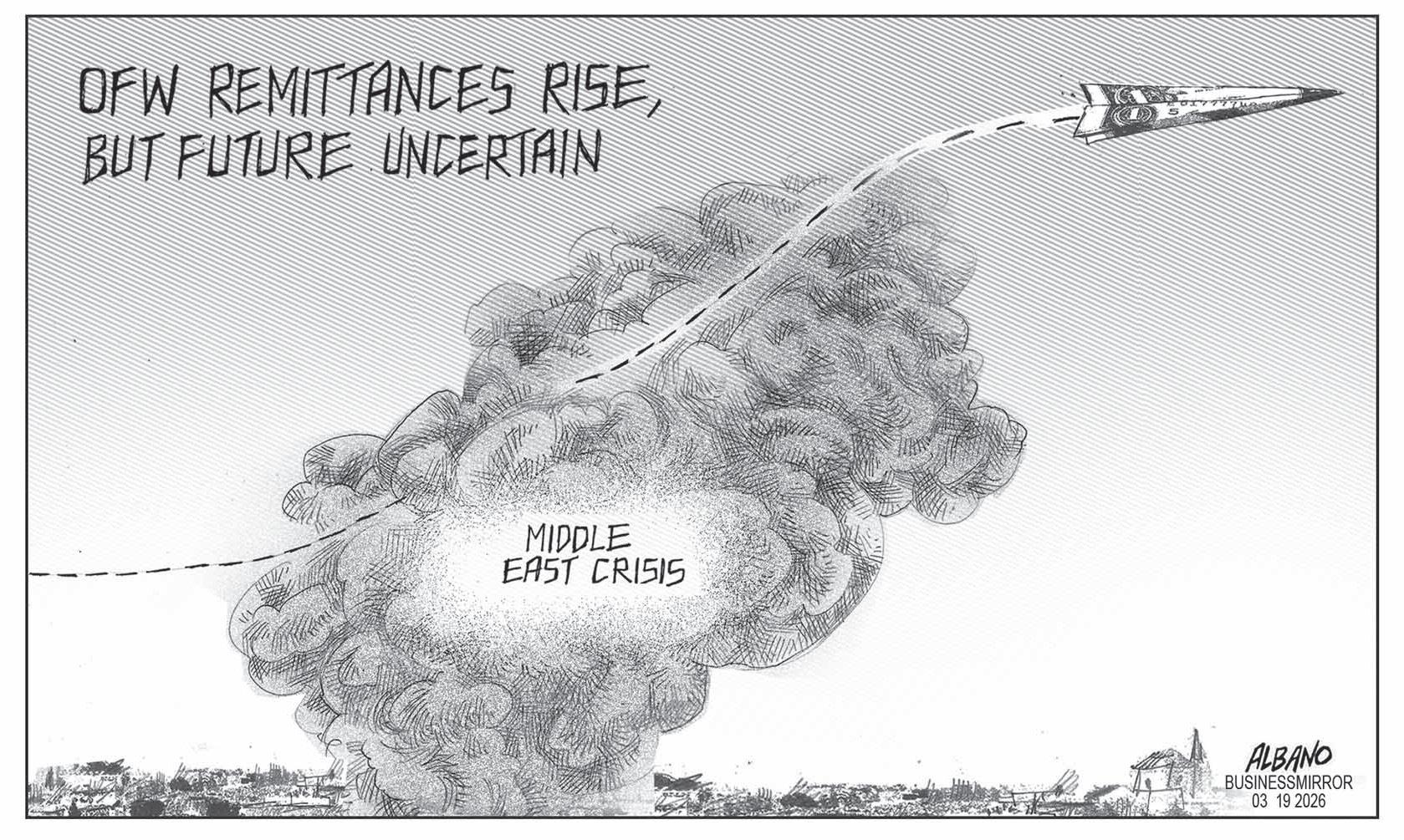
of risks outside the country’s borders may keep bankers’ hands in their pockets, thereby tempering the pace of expansion of resources held by the Philippine financial system, according to analysts.
The growth of loans and investments could also be placed under strain by increasing prices of oil and energy costs, putting upward pressure on inflation and interest rates, Rizal Commercial Banking Corp. (RCBC) Chief Economist Michael L. Ricafort said. What’s at stake is the total resources held by the Philippine financial system, which rose to P36.33 trillion as of January, as reported recently by the Bangko Sentral ng Pilipinas (BSP).
Based on central bank data, combined funds and assets of banks (excluding those held by the BSP) and non-bank financial institutions (NBFIs) increased by 7.29 percent to P36.33 trillion as of the end of the first month of the year, from P33.86 trillion in January 2025. The year-on-year growth in financial system resources reflects “solid deposit inflows, steady loan expansion, and banks holding more investments amid still-high interest rates,” according to Jonathan L.
By Justine Xyrah Garcia
AFTER a fresh round of fare hikes, labor groups are making it clear: if commuting costs are moving up, wages cannot stay stuck. Several labor groups on Wednesday renewed calls for an across-theboard pay increase, saying workers will once again absorb the brunt of rising prices following the latest increase in public transport fares.
The Sentro ng mga Nagkakaisa at Progresibong Manggagawa (Sentro) and the Federation of Free Workers (FFW) said the fare adjustment was justified, noting that transport drivers and operators are among the first to feel the impact of surging fuel costs. But they stressed that relief should not stop
By Samuel P. Medenilla & Lorenz S. Marasigan
CONCERNED over how the newly approved fare hike for all land public utility vehicles (PUV) will affect commuters,
President Ferdinand Marcos Jr. has ordered the Department of Transportation (DOTr) to suspend the implementation of the measure for now.
Citing the economic impact of the ongoing Middle East crisis, which resulted in higher pump and rice prices, the chief executive said the implementation of the higher fares will be temporarily deferred.
“You know, when I woke up this morning, I saw the headlines and what was being talked about was the approved fare hike for our passengers. In my opinion, since we still have problems due to the war in the Middle East, maybe this is not the time to increase fares for our countrymen,” Marcos said in Filipino.
The Department of Transportation (DOTr) said on Wednesday it will implement Mr. Marcos’s directive to suspend pending fare increases for public utility vehicles.
In a statement, the DOTr said it is preparing a package of relief measures including free rides for passengers and toll discounts, the lat-
ter after Transportation Secretary Giovanni Lopez held talks with toll operators.
The department added it is fasttracking the release of fuel subsidies for qualified drivers and operators.
“The DOTr and all its attached agencies will continue to act swiftly to ensure that all possible assistance and support are immediately extended to commuters, drivers, and transport operators,” the department said.
The suspension covers fare hikes for land transport modes only. It does not extend to the Level 8 fuel surcharge that the Civil Aeronautics Board (CAB) approved Tuesday, and
the Maritime Industry Authority’s (Marina) memo on the same charges for vessels.
When sought for comment, transport group Manibela President Mar Valbuena was scathing, sarcastically praising Mr. Marcos as “napakabait, napakabuti [so, so good] for suspending increases that had not even taken effect.
“How kind, how good of the President for not even thinking about the fare increase. However, the fare increase they gave us is garbage. A one-peso increase won’t even get you anywhere,” he said. “To our beloved President, you are so good—
at the transport sector.
Sentro Secretary General Josua Mata urged Congress to prioritize the proposed P200 across-theboard daily wage increase for minimum wage earners, as this would help cushion workers from the ripple effects of higher transport and commodity prices.
“This will further erode real wages that have stagnated for years. Workers are being squeezed from all sides—higher prices, stagnant pay, and no relief in sight…A wage increase is not just urgent—it is necessary,” Mata told the BusinessMirror
He added that a wage hike should form part of a “comprehensive government response” that will protect “incomes, stabilizes prices, and ensures that workers are not left to
carry the burden alone.”
The Trade Union Congress of the Philippines (TUCP) also urged Congress to convene a special session to deliberate and pass the propose P200 legislated wage hike.
“There have been successive increases in oil prices, then fare hikes follow, food prices go up, but workers’ wages are fixed. If workers need to render overtime just to get their families by because of the four-day work week and because goods are so expensive, then Congress and the Senate should also be ready to render overtime to pass a wage increase,” TUCP Party-list Representative Raymond Democrito C. Mendoza said in a statement.
For its part, FFW President Sonny G. Matula said the fare increase adds to the growing financial strain
on workers, especially as food and non-food prices are also expected to rise in the coming months.
“If there is an adjustment in fares, there should also be an adjustment in wages.” Workers, he said, should not always “be the ones who have to adjust.”
He said the group is studying the filing of wage petitions before the Regional Tripartite Wages and Productivity Boards (RTWPBs) to push for region-based increases amid the current economic pressures.
He added, however, that wage boards should also take the initiative to review prevailing wage levels.
This view was echoed by Mata, who said RTWPBs “can—and must—review and adjust wage rates motu proprio.”
By Malou Talosig-Bartolome
THE Philippines could face inflationary pressures as severe as those experienced during the early months of the Covid-19 pandemic if the war in the Middle East continues, a leading economist warned. Dr. Cid Terosa, associate professor at the University of Asia and the Pacific’s School of Economics, said his simulations show that even a modest 10-percent increase in global oil prices could push Philippine inflation up by 6.8 percentage points. He explained that refined petroleum products, electricity,
Andrea E. San Juan
GENERATIONS IN DEVOTION The Diaz-Taguba family of Barangay San Roque upholds a longstanding Holy Week tradition through the Pabasa ng Pasyong Mahal ng Panginoong Hesus Kristo, a continuous chant narrating Christ’s passion.
The annual observance began on Tuesday and concluded Wednesday
3 p.m., drawing cantors from various barangays who took turns in solemn recitation. Among them, the oldest participant, aged 90, and the youngest, 10-year-old Carl Nazarene Nuncio, reflect the enduring passage of this sacred skill across generations. For the past 16 years, the current custodians of the Diaz-Taguba family’s religious images and traditions have faithfully organized the pabasa, preserving a vital expression of Filipino faith and cultural heritage. BERNARD TESTA
becomes part of the cost of commuting, delivering goods, and running businesses, particularly for workers who spend daily just to get to work and parents who watch their market budget shrink with every spike.
The Senate-approved Senate Bill No. 1982 authorizes the president to temporarily suspend or reduce excise taxes on petroleum products when global oil prices surge, providing a mechanism to ease the impact on consumers.
Under the measure, the President may exercise this power upon the recommendation of the Development Budget Coordination Committee (DBCC) and in coordination with the Department of Energy (DOE), particularly when the average Dubai crude oil price—based on the Mean of Platts Singapore (MOPS)— reaches or exceeds $80 per barrel for at least one month prior to the issuance of the order.
The measure allows the suspension or reduction to be applied to specific petroleum products and may be implemented either fully or partially, depending on prevailing economic conditions.
Any tax relief measure will be effective for up to three months per issuance, with a total allowable period not exceeding one calendar year. The excise tax rates will automatically revert to their original levels either one week after global oil prices fall below the $80 threshold, as certified by the DOE, or after the three-month period lapses—whichever comes first.
The authority granted to the President under the bill may be exercised until December 31, 2028.
Budget deficit goal could be missed despite spending cuts
By Reine Juvierre S. Alberto @reine_alberto
THERE is always a risk that
the government could miss its budget deficit target for this year, even as measures to cut spending are in place, according to Finance Secretary Frederick D. Go.
The government aims to narrow its fiscal deficit to P1.611 trillion, equivalent to 5.3 percent of the gross domestic product (GDP) this year from last year’s P1.567 trillion.
“Of course, there’s always a risk that we might miss that,” Go said in an interview with Haslinda Amin on Bloomberg Television on Tuesday.
“But I believe that the fiscal discipline that the government is undertaking should help mitigate that,”
Wages…
Continued from A1
the Finance secretary added.
Aside from the President calling on all government offices to save on energy costs, postpone non-essential travel and adopt remote work arrangements, Go said agencies are also instructed to delay non-urgent programs and capital outlays.
“We’re also trying to see where government can save on the expenditure side,” Go said.
This year, the government plans to spend P6.434 trillion, higher by 7.15 percent than the P6.005 trillion in the previous year.
Go said a project could be delayed if its economic rate of return is less than 15 percent, although agencies will ultimately decide which initiatives to push back.
“I’ve always been espousing that
Earlier, the National Wages and Productivity Commission (NWPC), an attached agency of the Department of Labor and Employment, said current conditions have yet to meet the threshold for a wage adjustment under existing rules.
The NWPC said it continues to monitor key indicators, including inflation, unemployment, and the potential impact of geopolitical tensions on gross domestic product (GDP) growth. So far, it noted, there has been no significant “spike” in these indicators.
Under the Omnibus Rules on Minimum Wage Determination, RTWPBs may issue a wage order only
the government should spend on programs and capital outlays that produce the highest multiplier effect on the economy and promote jobs for the people,” Go said.
On the revenue side, the government will raise P4.823 trillion in revenues this year, up by 8.69 percent from last year’s P4.437 trillion.
However, both chambers of Congress have approved bills allowing the President to suspend or reduce fuel excise taxes amid soaring oil prices in the country brought by the Middle East war.
While the measure could result in foregone revenues, Go said the government will still
once a year.
Petitions for wage increases within the 12-month period are generally not allowed unless a supervening event—defined as an extraordinary development that significantly affects economic
collect value-added tax (VAT) on fuel importation.
“Because as oil prices continue to go up, the VAT that we collect will also go up. So we have a balancing factor,” Go added.
Despite recurring external shocks that have disrupted growth momentum, Go expressed optimism about the country’s prospects.
“Every time we’re about to hit our stride…there’s an external shock that happens.”
“I’m hopeful that—I think shocks, for one, are now part of normal life. We cannot say that there will be no shocks. There will always be shocks. But there’s a lot of green shoots in what we’re doing,” he added.
conditions—occurs.
The NWPC noted that in previous instances, sharp increases in petroleum prices have been considered a supervening event, allowing wage boards to act even within the one-year restriction.
Global headwinds to cut…
Continued from A1
Ravelas, senior adviser at Reyes Tacandong & Co.
The growth also reflects the continued expansion supported by deposit growth, remittance inflows, and overall balance sheet expansion of banks and nonbanks, Philippine Institute for Development Studies (PIDS) Senior Research Fellow John Paolo R. Rivera said.
BSP data showed banks accounted for the bulk, or 82.86 percent of total resources, while NBFIs held the remaining 17.14 percent.
Resources held by banks climbed 7.72 percent to P30.104 trillion from P27.947 trillion in January 2025.
Broken down, universal and commercial banks (UKBs) continued to dominate the sector, holding 92.68 percent of total banking resources, or P27.901 trillion. This is higher by 6.75 percent from P26.137 trillion as of January 2025.
Thrift banks accounted for 4.86 percent of all resources in Philippine banks, at P1.462 trillion, posting a 26.30-percent increase
Inflation…
Continued from A1
demand shifted erratically. Food prices rose sharply, while fuel and electricity costs added pressure to household budgets.
The government’s inflation basket did not fully capture retail trade’s pass-through costs, but consumers felt them directly in higher prices for basic goods.
Terosa warned that a prolonged Middle East war could replicate these dynamics, with inflation climbing to 7-8 percent, or even higher in worst-case scenarios.
Ripple effects
DURING the forum, Terosa explained how price shocks transmit across sectors.
A 10-percent increase in refined petroleum prices alone could raise inflation by 0.68 percentage points—the highest among the industries studied. Electricity would add 0.41 points, land transport 0.46, air transport 0.31, and water transport 0.07.
Food products, retail trade, and food and beverage service activities would be hit hardest, passing on higher costs to consumers.
“Retail trade, by itself, has the potential to push inflation by 1.9 percentage points,” Terosa stressed, noting that retail trade is often overlooked in inflation calculations despite its strong pass-through effect.
the fare increase hadn’t even been implemented yet and you already took it back.”
“Among what we are considering is a strike—but can they give a P5, P2, P3 fare increase? What we are telling the President is to expedite the removal of the excise tax and the giving of aid,” Valbuena added.
Commuter group The Passenger Forum Convener Primo Morillo welcomed the cushioning measures but urged the government not to lose sight of transport workers caught in the same crisis.
Morillo said the most effective interventions would be those that benefit both passengers and drivers simultaneously.
“We welcome anything that will help cushion the impact of crude oil prices on our commuters. But we hope that drivers and other transport workers who are also affected by the crisis will not be forgotten either. It would be best if measures are implemented that would benefit both commuters and drivers alike, such as the suspension of the excise tax on petroleum products,” he said.
from the P1.158 trillion recorded in the same period in 2025.
Resources of rural and cooperative banks also grew 7.19 percent to P565 billion as of January 2026, representing 1.88 percent of the banking system’s assets, from P527.1 billion in the same period in 2025. Rivera expects the growth in these resources to “continue to grow albeit at a more moderate pace in line with economic activity and credit demand.”
He said the key drivers moving forward will be bank lending trends, domestic liquidity conditions, and confidence in the financial system.
“Although global volatility and tighter financial conditions could temper the pace of expansion,” Rivera added.
According to Ravelas, “resource growth will hinge on loan demand, inflation and interest rate moves, and global risks.” He also noted rate cuts and improving confidence could lift activity, while external volatility may keep banks cautious.
Supply disruptions amplify losses
TEROSA also modeled supply disruptions, assuming a one-peso decrease in production across the five industries. The results showed disproportionate amplification:
n A one-peso drop in refined petroleum output could reduce total economic production by P4.68.
n Electricity disruptions would cut P2.55.
n Land transport, P1.98.
n Water transport, P2.40.
n Air transport, P1.22.
Energy-intensive and logistics-dependent industries such as construction, food products, and retail trade would be severely affected.
Wholesale trade, professional services, electronics, and chemicals would face moderate declines.
Macroeconomic implications
TEROSA said that inflationary pressures will likely come from the supply side, reducing output in key consumption sectors.
“Food and beverage service activities, food products, retail trade, and even wholesale trade will suffer. There’s going to be a potential slowdown in overall economic growth,” he said.
With the country’s oil reserves estimated to last only 30 to 60 days, Terosa cautioned that a prolonged conflict—lasting more than a month—could push inflation to levels unseen since the pandemic.
“Nobody thought it would last two weeks. So, maybe, more than a month. If that happens, we could be looking at inflation rates as high as 9 or 10 percent,” he warned.
Suspension timeline unknown AS of press time, Malacañang has yet to announce until when the fare hike suspension will remain in effect. Global oil prices rose after the United States and Israel attacked Iran resulting in an ongoing armed conflict in the Middle East. The conflict has also started to affect rice and fertilizer prices. Last Tuesday, the Land Transportation Franchising and Regulatory Board (LTFRB) raised the fares for traditional jeepneys from P13 to P14 with the additional per-kilometer rate increasing from P1.80 to P2. It also approved the rate increases for the following PUVs: modern jeepneys from P15 to P17, while the succeedingkilometer rate was increased to P2.30; Metro Manila and city ordinary buses, from P13 to P15 for the first 5 kilometers with the per-kilometer charge rising from P2.25 to P2.49; air-conditioned city buses from P3 hike to P18 for the first 5 kilometers, with succeeding kilometers rising from P2.65 to P2.98. For provincial ordinary buses, they were given a P1 hike for the first 5 kilometers, with varying per-kilometer increases depending on bus type—30 centavos for ordinary buses (P1.90 to P2.20), 35 centavos for air-conditioned deluxe and super deluxe buses (P2.10 to P2.45), and 45 centavos for luxury buses (P2.90 to P3.35).
In the case of Transport network vehicle services (TNVS), their base fares were raised by P20 plus a P15 pick-up fee, pushing sedan base fares from P45 to P65, AUVs from P55 to P75, hatchbacks from P35 to P55, and premium TNVS from P145 to P165.
The flag-down rate for airport taxis fares were increased from P75 to P115. Despite issuing the suspension order, Marcos gave assurances that the government will provide additional support to PUV drivers, who were affected by the fare hike suspension.
“Our transport workers need not worry because we will fast-track and increase our support for you so that you won’t have too much trouble,” he said.
The Department of Social Welfare and Development started the rollout of its P5,000 cash aid to the PUV drivers, initially for those using tricycles, under its Assistance to Individuals in Crisis Situation (AICS) program, last Tuesday.
The PUV drivers and their operators will also start getting fuel subsidies from the DOTr before the end of the month.
As for commuters, Marcos said he also directed DOTr to start implementing free bus rides and to coordinate with the management of the Metro Rail Transit (MRT) and the Light Rail Transit (LRT) to implement fare discounts.
He also ordered for toll road operators to provide discounts to motorists, which will use their facilities.
“Even if there is a major conflict [in the Middle East], always remember that the government is trying to eliminate or minimize its impact on our citizens, who report for work, and students, who go to school daily,” Marcos said.
“We are always thinking of new ways to ensure that your life is normal, orderly, and safe,” he added.
Sara hearings to continue despite Congress recess
THE House of Representatives is pressing ahead with impeachment proceedings against Vice President Sara Z. Duterte, authorizing hearings even during the congressional break while zeroing in on whether her official response holds up under scrutiny.
O n Tuesday night, lawmakers adopted House Resolution 892, allowing the Committee on Justice to continue its work during the March 21 to May 3 recess—ensuring the process does not lose momentum.
T he measure, led by Speaker Faustino G. Dy III, Majority Leader Ferdinand Alexander “Sandro” A. Marcos and Minority Leader Marcelino “Nonoy” Libanan also guaranteed protection for complainants and witnesses who may face threats or retaliation.
L awmakers stressed that impeachment cases—by nature involving high-ranking officials— require safeguards to ensure “truthful disclosure” without fear of intimidation. The panel may coordinate with agencies such as the Department of Justice, National Police (PNP), and National Bureau of Investigation to implement security measures.
Consistent with parliamentary practice and the continuing nature of committee mandate and functions, committees of the House of Representatives may continue the conduct of authorized hearings and the performance of their functions during periods when the House is in recess, subject to the authority of the House,” the resolution said.
Under the Rules of the House of Representatives, committees are authorized to conduct hearings, receive evidence, and issue compulsory processes, including subpoenae ad testificandum and subpoenae duces tecum, in aid of the performance of their mandate and functions,” it added.
The resolution also empowers the Justice panel to implement Section 8 of the Rules of Procedure in impeachment proceedings, particularly provisions related to the protection of complainants and witnesses involved in the case.
Protection UNDER the measure, the committee is authorized to implement Section 8 of the Rules of Procedure in Impeachment Proceedings, which provides that “The House may, upon proper petition, provide adequate protection to a complainant or witness if it is shown that the personal safety of the complainant or witness is in jeopardy because of participating in the impeachment proceeding.”
It also affirmed that the House, under the Constitution, has the exclusive power to initiate impeachment cases and may exercise incidental powers needed to carry out this duty, including safeguarding those who take part in the process.
Such authority shall be exercised consistent with the Constitution, existing laws, the Rules of the House of Representatives, the Rules of Procedure in Impeachment Proceedings, and the requirements of due process,” they said.
In addition, it may coordinate with relevant government agencies such as the Department of Justice (DOJ), Philippine National Police (PNP), and National Bureau of Investigation (NBI) in implementing appropriate protective measures.
A s the process moves forward, the Committee on Justice has shifted its focus to a single question: whether Duterte’s formal reply is enough to counter the allegations.
D uring Wednesday’s hearing the panel chairman, Rep. Gerville Luistro of Batangas, made clear the committee is not yet determining guilt—but assessing if the case should proceed.
Jovee Marie N. dela Cruz
Impeachment raps against VP ‘sufficient in grounds’
By Jovee Marie N. Dela Cruz | @joveemarie
THE House of Representatives Committee on Justice on Wednesday declared the third and fourth impeachment complaints against Vice President Sara Duterte sufficient in grounds, advancing the proceedings to the next stage and scheduling initial hearings on March 25, April 14, 22, and 29, 2026.
D uring the hearing, the chairman of the panel, Batangas Rep. Gerville Luistro, confirmed the approval of motions for both complaints without any objection from members.
“ The members moved. The members seconded the motion, and no one objected. That is the reason why the chair proceeded to declare the sufficiency in ground of the two impeachment complaints,” said Luistro.
W ith this, the committee concluded its third step in the impeachment process – determining the sufficiency of grounds.
The panel will now proceed to the hearing proper, where both parties are expected to present evidence and witnesses as part of the process of determining probable cause.
L uistro noted that some lawmakers had raised the possibility of the respondent elevating the matter to the Supreme Court.
I was explaining earlier that, to be candid, this is not for us to address anymore. Failure to state ultimate facts—the proper remedy is not to go to the Committee on Justice but to go
to the Supreme Court,” she said.
In my capacity as justice chair, I maintain the position that the committee observed the necessary requirement of due process,” she said.
Not utilized LUISTRO emphasized that the filing of an answer is a key component of due process but pointed out that this was not fully utilized in the current case.
As a matter of fact, the filing of an answer is part of due process, but it was not substantially availed of, in view of the fact that the allegations in the answer are not responsive to the allegations in the complaint,” she explained.
She underscored that responses must directly address the claims raised in the complaint.
“ That is why some members are saying that the answer is not really an answer; instead, it is a motion to dismiss,” she said, noting that such motions are not allowed under Section 6 of the impeachment rules during the period for filing an answer.
E arlier, complainants of the
two impeachment cases against Duterte had waived their right to reply, saying the Vice President’s submission fails to address the allegations and should not delay proceedings.
L uistro, meanwhile, noted that the House plenary has authorized the committee to continue its proceedings during the congressional recess from March 21 to May 3.
T he authority includes the implementation of protective measures for complainants and witnesses under the impeachment rules.
Th e panel also acknowledged receiving a March 5 letter from Akbayan Rep. Chel Diokno requesting the issuance of a subpoena duces tecum for relevant documents.
‘Bare answer’
LAWMAKERS expressed disappointment over Duterte’s legal team, saying her consolidated answer to the impeachment complaints failed to directly address key allegations.
I have read the Consolidated Verified Answer Ad Cautelam [with Caution], and, certainly, I would express my disappointment with the legal team of the Vice President, who has 16 lawyers who have signed this particular answer,” said Cagayan de Oro City Rep. Rufus Rodriguez during the hearing of the House Committee on Justice.
T he pleading, signed by 16 lawyers from a high-profile defense team that includes members of the Fortun Narvasa & Salazar law firm, was expected to systematically respond to the accusations. But Rodriguez said it fell short of basic standards.
In an answer, the grounds which were averted to in the third complaint, six grounds, should
have been answered one by one,” Rodriguez said.
However, in this case, there is no answer to the six grounds of the third complaint, and also no direct answer to the five grounds,” he added.
Lack of clear response
RODRIGUEZ, a former dean of the San Sebastian College of Law, of which the Vice President is an alumnae, said the lack of a clear, ground-by-ground response prevents the committee from fully assessing the Vice President’s defense.
I am surprised that in this particular instance, there is no discussion per ground and, therefore, would not give us the real answer of the respondent to the six and five grounds,” he said.
T hese complaints include allegations of misuse of confidential and intelligence funds, unexplained wealth, violations of Statements of Assets, Liabilities, and Net Worth requirements, bribery, and a supposed threat against President Marcos, First Lady Liza AranetaMarcos, and former Speaker Ferdinand Martin G. Romualdez.
R odriguez noted that only two issues were addressed in the answer—the alleged P125 million confidential funds in 2022 and the supposed threat against top officials—but said both responses were inadequate.
A bare answer to definite allegations and ultimate facts in the third complaint and the fourth complaint. It does not have the facts that could constitute the real answer, so a hearing would be required on this particular matter,” he said.
H e added that explanations previously mentioned by the Vice President were not reflected in the answer.
Comelec: Marcoleta not criminally liable, but...
By Mary Jade Jadormio
HE Commission on Elections
T(Comelec) has ruled that Sen. Rodante Marcoleta did not commit a criminal offense over his campaign finance disclosures, citing the absence of criminal liability under existing law.
H owever, poll body has not totally junked Marcoleta’s case with Comelec Chairman George Erwin M. Garcia saying: “He is no longer criminally liable. There may be civil or administrative liability,
however,” explaining that the law effectively decriminalized incomplete Statement of Contributions and Expenses filings.
I n a resolution, the commission terminated its motu proprio investigation into Marcoleta’s Soce despite finding that not all required entries were reported.
Garcia said the Comelec Political Finance and Affairs Department (Pfad) found non-compliance with disclosure requirements.
However, he clarified that the violation no longer carries criminal
liability under Republic Act 7166.
The commission said the evidence on record was not sufficient to support the filing of a criminal case against Marcoleta.
At the same time, the commission en banc adopted the recommendation to refer the case to the Comelec law department for further proceedings.
R egarding the three alleged donors who were not declared in the Soce, Garcia said the finance department recommended that they be charged by the commission.
“ Pfad recommended that these
Zambales marks Magsaysay’s death anniversary
By Henry Empeño
ASTILLEJOS,
CZambales— Government officials, war veterans, and plain citizens in Zambales paid tribute to the late President Ramon Magsaysay Sr. here on Tuesday, as the province commemorated the death anniversary of its most beloved son. Magsaysay, the seventh President of the Philippines, died 69 years ago on March 17, 1957 when his presidential plane “Mt. Pinatubo” crashed into Mt. Manunggal in Cebu shortly after takeoff. Z ambales Board Member Jun Rundstedt Ebdane, who represented Gov. Hermogenes Ebdane Jr., led Tuesday’s commemoration, along with Vice Gov. Jacqueline Khonghun, Castillejos Mayor Jeffrey Khonghun, and representatives from the National Historical Commission.
The officials offered flowers at President Magsaysay’s statue here at the Magsaysay ancestral house, which has been converted into a museum to house presidential memorabilia.
I n his tribute, Board Member Ebdane urged Zambaleños to always remember Magsaysay’s enduring legacy as a populist leader.
Bilang Zambaleño, tungkulin nating pangalagaan at ipagpatuloy ang pamana na iniwan ni Pangulong Magsaysay— sa pagpapahalaga ng katapatan , malasakit at tapat na paglilingkod sa ating kapwa [As Zambaleños, it is our duty to safeguard and continue the legacy of President Magsaysay – in valuing honesty, empathy, and faithful service to our fellowmen],” Ebdane said.
Magsaysay is revered by the Filipino people for humility, integrity, and dedication to ordinary people,
for which he opened the gates of Malacañang during the presidency. He was also fondly remembered for the dictum that “Those who have less in life should have more in law.”
A humble automobile mechanic by profession, Magsaysay was appointed military governor of Zambales following his outstanding service as guerilla leader during the Pacific War. He later served as Zambales congressman for two terms, was appointed Secretary of National Defense in 1950, and won as President by a landslide in1953.
Under Proclamation 15 signed in March 1966 by then President Ferdinand Marcos Sr., March 17 of each year is being celebrated as “Ramon Magsaysay Memorial Day.”
G overnor Ebdane had since declared March 17 as a special non-working holiday in Zambales to honor the legacy of President Magsaysay.
Tiangco dared to present bribery proof
ALEADER of the House of Representatives on Wednesday strongly refuted allegations by Navotas Rep. Tobias Tiangco that lawmakers were bribed to support the impeachment complaint against Vice President Sara Z. Duterte, calling the claim “categorically false” and challenging him to present proof.
The claim of Rep. Toby Tiangco that Members of the House were bribed with funding allocations to support the impeachment complaint against Vice President Sara Duterte is categorically false,” said the House Committee on Higher and Technical Education chairman, Party-list Rep. Jude A. Acidre of Tingog said. “ There was no bribe. There was no deal. There was no exchange.” A cidre added: “If there is evidence, present it. If there is none, stop misleading the public.”
Acidre also dismissed insinuations that House leadership, including former Speaker Ferdinand Martin G. Romualdez, influenced lawmakers through funding or favors.
“ Let me be clear: at no point was there any instruction, inducement, or pressure from the leadership to secure signatures through funding or favors,” Acidre said.
To suggest otherwise is not only false—it is a serious allegation that demands proof, not propaganda,” he added.
He urged Tiangco, a first cousin inlaw of both President Marcos and Romualdez, to bring his claims to the proper forum.
“ If such a claim were true, the proper course is obvious: file the appropriate cases, present the evidence, and prove it in the proper forum,” he said.
But until that happens, these claims remain exactly what they are: unsubstantiated accusations designed to cast doubt, not to reveal truth,” he said.
A cidre described the allegation as an affront to the integrity of the House and its members.
three be charged with the Law Department,” he said.
“ They will determine if there is probable cause.”
Garcia said he was inhibited from the case and did not participate in the deliberations.
“I deemed it proper not to participate…to ensure the commission’s decision is fair,” he said.
The commission stressed that the ruling covers only the criminal aspect and does not preclude further proceedings, including administrative or civil actions by the law department.
To allege that Members of Congress sold their judgment in exchange for funding is not just false—it is a reckless and baseless accusation that insults the integrity of the House and the intelligence of the Filipino people,” he said. He maintained that support for the impeachment complaint was based on evidence presented during committee proceedings.
“ What there was, plain and simple, was evidence to support the impeachment complaint. I know this because I was there,” Acidre said. “I sat through the hearings. I listened to the testimonies. I reviewed the documents.” Acidre also underscored that his decision was not made lightly, noting his previous support for Duterte.
Jovee Marie N. dela Cruz
House Labor committee pushes alternative work arrangements
THE House Committee on Labor on Wednesday called on the Department of Labor and Employment (Dole) and private employers to expand work-fromhome (WFH) and flexible work arrangements as part of efforts to conserve fuel and protect workers amid the global energy crisis triggered by the ongoing conflict in Iran.
C avite Rep. Jolo Revilla, the panel chairman, said Dole must take the lead by issuing clear and updated guidelines, ensuring the protection of workers’ rights, and coordinating with employers to institutionalize flexible work setups across industries. He warned that the continuing tensions in the Middle East are already disrupting global oil supply, driving up fuel prices and threatening the country’s energy security, particularly as the Philippines depends heavily on imported oil.
“ The situation in Iran is not just a distant conflict – it directly affects our fuel supply and prices. If this continues, there is a possibility that our fuel reserves will be affected and the financial burden on our workers will become even heavier,” Revilla said. Global oil markets, he noted, are under strain as the conflict threatens critical supply routes such as the Strait of Hormuz, which carries about 20 percent of the world’s oil, fueling price spikes and supply uncertainty. W hile the Philippines has fuel reserves estimated to last around 60 days, Revilla cautioned that prolonged disruption could tighten supply and force stricter conservation measures. The lawmaker said promoting WFH and hybrid work arrangements is a practical and immediate step to reduce daily fuel consumption, especially in urban areas where millions rely on commuting. Jovee Marie N. dela Cruz
Economy
Prices of basic goods steady for now–DTI
By Bless Aubrey Ogerio
MANUFACTURERS have committed to keep prices of essential goods unchanged for at least 30 days, with some pledging to hold the line for up to 60 days, amid pressures from global fuel costs.
well as Lorins patis , along with processed canned meat from CDO and candles from Liwanag, are also covered by the price stability commitment.
S ome manufacturers signaled a longer holding period of up to 60 days for products including Lucky Me, Ho-Mi, Argentina, Lucky 7, 555, Swift Premium, Wow! and Shanghai.
Filipino consumers,” she said.
To help keep prices stable, the Trade chief earlier proposed during a Senate hearing the suspension of certain government charges on port operations and cargo handling, as well as a moratorium on toll fees for trucks transporting essential goods.
Polish companies eye maritime, industrial investments in PHL
THE Philippines is seeking to deepen trade and investment ties with Poland as the Philippine Economic Zone Authority (Peza) and the Polish Investment and Trade Agency (PAIH) held a joint briefing with a business delegation from the West Pomeranian Voivodeship last week.
The Polish delegation included representatives from eight companies involved in marine and industrial electrical systems, maritime logistics, engineering construction, ship repair and metal fabrication, among others.
environment for our exporters and investors,” Wilkowiecka said. The engagement comes as the Philippines continues negotiations for a free trade agreement with the European Union (EU), with both sides targeting completion by 2027 as the country transitions from its current participation in the Generalized Scheme of Preferences Plus (GSP+). U nder the GSP+ scheme, Philippine exports to the EU currently enjoy zero tariffs on a wide range of goods.
The assurance was made during a March 16 meeting convened by Trade Secretary Ma. Cristina Roque with 21 manufacturers of such commodities as canned sardines, bread, bottled water, instant noodles, coffee, canned meat, soap and candles. These include canned sardine brands such as Unipak, 555, Ligo, Lucky 7, Fresca, Morjon, Golden Town and Mega; bread products like Pinoy Tasty and Pinoy Pandesal; bottled water brands Wilkins and Nature’s Spring; and household items such as Safeguard Pure White, Tide Bar Original Scent and Green Cross Pure White.
M eanwhile, producers of coffee brands such as Kopiko, Nescafe and San Mig Coffee 3-in-1, as well as Export candles, said they would maintain current prices for the time being.
R oque said the government is balancing the need to protect consumers with the rising costs faced by producers.
C ondiments such as Datu Puti soy sauce and vinegar, as
Our priority remains to ensure fair and reasonable pricing. We thank our manufacturing partners for their commitment and shared concern for
Davao electricity consumers urge Nordeco to sell assets
By Manuel T. Cayon @awimailbox
Mindanao Bureau Chief
DAVAO CITY—The Davao Consumer Movement has urged the Northern Davao Electric Cooperative (Nordeco) to sell its assets to the Davao Light and Power Company to avoid a sharp depreciation of the value to the detriment of consumers who owned them.
T he appeal was made after the Nordeco continued to insist that it remained the rightful owner of the franchise area covering Davao de Oro and Davao del Norte, including the island resort of Samal being part of the latter.
T he DCM posted on March 10 that the Republic Act 12144,
which granted Davao Light the extension of its franchise to cover the Nordeco franchise, was not yet final saying that the Supreme Court was yet to rule on its petition to reconsider the High Court’s January 14 ruling which upheld the Constitutionality of the act of Congress to pass RA 12144. This appeal is grounded in law, affirmed by the Supreme Court, and directed toward protecting the economic interests of Nordeco’s member-consumers,” it said.
I t said the Supreme Court dismissed on January 14 Nordeco’s petition challenging the law and affirming that Congress acted within its constitutional powers. The DCM said the Court emphasized that legislative
franchises are not exclusive, that they may be amended or repealed when the common good requires, and that Nordeco’s cooperative identity remains intact even as its distribution system is transferred.
N ordeco said, however, that with its undecided petition, its franchise “still exist, and the same will co-exist with the franchise of DLPC pursuant to Section 11, Article XII of the 1987 Constution as interpreted in Ileco I, Ileco II, Ileco III versus MORE Power.”
The DCM said that “economic reality is clear: If Nordeco refuses to sell its assets, their value will diminish as Davao Light builds new infrastructure.”
“ This outcome harms memberconsumers, who risk losing the
The proposal covers governmentimposed costs collected by the Philippine Ports Authority, Cebu Ports Authority and the Subic Bay Metropolitan Authority.
A t a separate House hearing on Tuesday, Department of Trade and Industry (DTI) Assistant Secretary Regino Mallari Jr. said the agency has not observed unusual price movements across basic goods so far.
The DTI continues to monitor 191 stock-keeping units under its latest Suggested Retail Price bulletin released in February last year.
equity they invested through the cooperative. By selling assets to Davao Light, Nordeco can secure fair compensation and distribute proceeds directly to its members, ensuring that consumers benefit rather than suffer losses,” the DCM added.
It said RA 12144 “mandates a transition period of not more than two years, ending around April 2027.”
This timeline requires Nordeco’s leadership to act promptly. Delay only reduces asset value and undermines consumer welfare. Selling assets is not dissolution; it is responsible stewardship that protects members’ investments while allowing Nordeco to continue as a cooperative.”
“ We therefore call on Nordeco’s board to begin negotiations with Davao Light without further delay.
The law is clear, the Supreme Court has spoken, and the transition period is running. Act now to safeguard the interests of your member-consumers,” it said.
N ordeco has yet to issue a statement on the issue.
Mekeni at 40: Honoring people behind every flavor
CBy Joel P. Mapiles
ITY OF SAN FERNANDO, Pampanga—For four decades, the standard fare of breakfast tables across the Philippines – tocino, longganisa, and other beloved Filipino favorites—have carried a name many families recognize: Mekeni Food Corporation. But behind every product is a deeper story- one shaped not just by recipes and innovation, but by the dedication of the people who make them.
T hat story took center stage as the company celebrated its 40th anniversary with a grand
employee Thanksgiving gathering on February 28, bringing together more than 1,400 employees at the Laus Group Event Centre.
The milestone event carried the theme “Pasasalamat: Four Decades of Stories in Every Flavor,” reflecting Mekeni’s belief that its growth has always been rooted in the people behind its success.
For Mekeni president Pruds Garcia, the anniversary was not merely about celebrating the company’s longevity in the food industry - it was about honoring the workforce that made that journey possible.
“Our 40-year journey is a testament
to the hard work and passion of our people,” Garcia said.
“ Every product we create carries the story of the individuals behind it. This celebration is our way of expressing sincere gratitude to the employees who helped build Mekeni into the company it is today.”
T he gathering transformed the evening into more than a corporate event. It became a reunion of stories—of employees who had spent decades with the company, of young workers beginning their careers, and of teams who had worked side by side through the challenges and triumphs of the food manufacturing industry.
O ne of the highlights of the celebration was the Service Awards, recognizing employees who have spent years—some even decades— serving the company.
Their loyalty and dedication have played a crucial role in strengthening Mekeni’s operations and sustaining its reputation as one of the country’s trusted food brands. For many honorees, the recognition reflected a relationship that goes beyond employment.
O ver the years, Mekeni has grown into what employees often describe as a second family, where shared goals and mutual support drive both productivity and pride.
W hile the celebration looked back on four decades of achieve -
ments, it also marked the beginning of a new chapter for the company.
D uring the event, Mekeni introduced its renewed Vision, Mission, and Values, setting a strategic direction for future expansion and innovation.
According to Kathlene GomezSchultz, Mekeni marketing manager, these guiding principles will help ensure that growth remains anchored in the company’s founding ideals.
Our renewed vision, mission, and values will serve as our compass as Mekeni continues to grow and evolve,” Gomez-Schultz said.
“As we expand, we remain committed to the principles that shaped the company over the past 40 years.”
Further reinforcing its culture of appreciation, the company also launched a recognition initiative honoring employees who successfully delivered key targets despite the challenges of Fiscal Year 2025.
Top-performing employees were rewarded with a celebratory Asian cruise from March 3 to 9, 2026, with stops in Ishigaki, Japan, and Keelung, Taiwan—an experience designed not only as a reward but as a gesture of gratitude for their exceptional contributions.
For Marilou Uy, the initiative reflects the company’s belief that its greatest asset is its people. “At Mekeni, our greatest strength has always been our people,” Uy said.
The West Pomeranian region, known for its maritime economy and experience in shipbuilding and port operations, was identified as a potential partner for projects linked to the country’s own coastal and industrial development.
Peza also reported interest from another Polish locality, Jordanów, whose companies are engaged in export-oriented wood pallet production, indicating broader interest from Polish businesses beyond a single region.
D uring the briefing, Asian Consulting Group Tax Advisor Mon Abrea outlined available fiscal and non-fiscal incentives under the CREATE MORE Act, which aim to attract foreign investors and support business expansion in economic zones.
P olish Chargé d’Affaires Katarzyna Wilkowiecka said the visit is part of efforts to strengthen economic relations and build connections between companies from both countries.
I hope Polish businesses will return home with a positive view of the Filipino market, and I also encourage our Filipino partners to help create a more open and enabling
T he Philippines is the secondlargest beneficiary of the program, with exports reaching about €2.3 billion, or roughly P158 billion, in 2024.
T he fifth round of negotiations for the proposed EU-Philippines free trade agreement was held last week in Brussels.
Peza Director General Tereso Panga said the participation of companies from West Pomerania reflects growing European interest in the Philippines as an investment destination, particularly as trade talks with the EU progress.
“ The participation of the West Pomeranian delegation— representing shipbuilding, maritime logistics, industrial engineering, and construction— underscores Poland’s growing interest in the Philippines as a strategic investment hub in the region,” Panga said.
“ The anticipated EU-PH FTA, coupled with robust bilateral collaborations, is poised to unlock greater trade and investment flows, positioning the Philippines as a premier gateway for European businesses and reinforcing its role in fostering inclusive and sustainable economic growth,” he added.
Bless Aubrey Ogerio
House launches program for retirees, constituents
THE House of Representatives on Tuesday formally rolled out Alagang Kongreso, a threepronged institutional program that strengthens support for retirees, streamlines public assistance, and introduces a comprehensive health package for its workforce—placing strong emphasis on accessible and preventive healthcare.
House Majority Leader Ferdinand Alexander A. Marcos said the initiative reflects a broader vision of public service that prioritizes the well-being of both current personnel and former employees.
Alagang Kongreso is about making care visible. When access to check-ups becomes easier, support systems for retirees are clearer, and public assistance is more organized, the institution becomes more humane and service delivery improves,” he added.
The program was introduced in three key components: Dakilang Yugto for retired Secretariat personnel, the Suporta sa Bayan Desk at the North Gate Screening Facility, and the HRep Executive Check-Up Program, which was formally presented at the People’s Center Cathedral alongside the signing of agreements with partner hospitals.
T he first component, Dakilang Yugto, underscores the House’s continuing commitment to its retirees.
Built on the pillars of Konektado, Inaasikaso, and Asensado, the program offers wellness activities, learning sessions, community engagement, and livelihood opportunities. A dedicated microsite will also serve as a platform for updates and continued engagement, reinforcing the message that retired personnel remain part of the institution.
At the core of the initiative is the HRep Executive Check-Up Program, which provides comprehensive medical examinations for House members, Secretariat officials, employees, and staff through accredited hospitals. The program promotes preventive care and early detection, addressing a common issue in public service where medical consultations are often delayed.
B enefit coverage is set at up to P75,000 for House members and Executive Committee officials, P60,000 for Secretariat officials, and P30,000 for employees, including coterminous and contractual staff members.
B eneficiaries may avail of the package either through reimbursement or direct billing arrangements with partner hospitals—the latter offering immediate relief by eliminating the need for upfront payment.
House Secretary General Cheloy Velicaria-Garafil said the health component directly addresses barriers that often prevent personnel from seeking timely medical care. The health package is one of the most concrete aspects of Alagang Kongreso because it responds to an immediate need. Preventive care becomes more accessible when there is clear coverage and a straightforward process,” she said.
M arcos emphasized that the initiative reflects a shift toward a more sustained and inclusive culture of care within the institution. Under Speaker Bojie Dy, the House is building an institution that not only legislates care but practices it. These are programs and benefits that people can genuinely feel,” he said. Jovee Marie N. dela Cruz
T he second component, the Suporta sa Bayan Desk, serves as a centralized hub for public requests coursed through lawmakers and partner offices. It aims to improve coordination and transparency in delivering medical, financial, social, and emergency assistance, making the process more efficient and easier to monitor.
Marcos: Accurate information through media key to mitigating impact of regional turmoil
By Samuel P. Medenilla
P@sam_medenilla
ROVIDING the public with accurate and timely information on the government response on the ongoing Middle East armed conflict with the help of the press can significantly help allay growing concerns on the potential impact of the said regional turmoil, according to President Ferdinand Marcos.
In his speech during the oathtaking of the new members of the Kapisanan ng
mga Brodkaster ng Pilipinas (KBP) Board of Trustees and Standards Authority in Malacañang last Wednesday, the Chief Executive sought the cooperation of media in its information dissemination initiatives related to the Middle East crisis.
“In that way, we will be able to face those challenges that we are now beginning to feel and our people can much better – much better address the ways and means that we can mitigate the effects of the difficulties that we are seeing developing especially along the horizon,” Marcos said.
83% of Filipinos act on health after emergencies—AIA study
By John Eiron R. Francisco
EIGHT out of 10 Filipinos respond to health concerns only after experiencing a personal or family emergency, a recent insurance firm study shows.
During a briefing in Mandaluyong City on Wednesday, AIA Philippines Chief Marketing Officer Melissa Henson shared the findings of the 2026 Rethink Health Study, titled ‘Shaping Filipino HealthSeeking Choices from Thinking to Doing.’
The study, conducted in collaboration with BBX Collab, surveyed 872 respondents nationwide, spanning three generations: Gen X, millennials, and Gen Z. It found that 83 percent of respondents were prompted to take action on their health following some type of crisis, including personal or family health emergencies, financial difficulties, and, in some cases, the effects of the pandemic.
“It often takes a jarring event to make people realize, ‘I need to prepare for this, for myself and my family,’” Henson said.
She added that many view these steps as an act of self-care and responsibility toward loved ones, aiming to avoid becoming a burden if a similar situation arises in the future.
“When we talked to Filipinos from across the country and different generations, there’s really a strong intent toward being more prepared,” Henson told the BusinessMirror in a sideline of the event.
She explained, however, that what prevents some from taking action is the challenge of balancing the needs of today with preparing for tomorrow.
“For some, there are financial constraints. For some, there’s just a lot of pressure on their time and their resources to be able to balance everything they need to do today to begin with,” Henson noted. “You have to add a few things to that to prepare for the future, which can be quite overwhelming for some.”
The study highlighted that this tension is particularly felt by Gen X, often referred to as the “sandwich generation,” who simultaneously care for aging parents and
SBy Henry Empeño
UBIC , Zambales—Zambales 1st District Representative and House Deputy Speaker Jay Khonghun has filed a bill seeking the reduction of tollway fees by as much as 70 percent, as the government sought measures to reduce the impact of surging oil prices on affected sectors.
House Bill No. 8652, or the “Tollway Fee Reduction Act,” filed by Khonghun, Wednesday, March 18, seeks to provide “immediate and sustained relief” to motorists through a phased reduction of tollway fees that would culminate in a 70 percent decrease within five years. Under this proposal, there will be a 50 percent cut in toll fees in the first year of implementation, followed by a 20 percent reduction in the succeeding year.
The proposal covers Class 3 vehicles transporting essential goods and commodities, public utility vehicles engaged in passenger transport, and vehicles traveling during offpeak hours. Khonghun said the measure aims to provide immediate relief and a long-term solution to rising transportation costs, amid surging oil and fuel prices caused by ongoing tensions in the Middle East.
He stressed the crucial role of the press in combating false information amid such “global uncertainty.”
“With the crises and the difficulties, and the shocks that the world is providing not only the Philippines but the entire globe, it is more essential than ever that we combat fake news and disinformation,” he said.
“In this time of global uncertainty, we lean on to our media to be the bearers of facts, to police abuse, and to be the voice of our people,” he added.
Earlier this week, Marcos led the roll
out of the government cash aid for public utility vehicle drivers, who were affected by the high pump prices in Manila, as well as, the special price and supply monitoring in San Juan City by the Department of Social Welfare and Development (DSWD) and the Department of Trade and Industry (DTI).
In both events, the President allowed himself to be interviewed by the press to discuss the government’s interventions to minimize its effects on the Middle East crisis on the economy and the public.
The ongoing conflict in the Middle East, which started after the United States and Israel attacked Iran, resulted in higher global oil and fertilizer prices.
Marcos has committed to continue providing support to the media by recognizing the challenges it faces, including violence against its members as well as the proliferation of misinformation and disinformation, especially in social media.
“As a public servant who faces the media almost every day, I understand the weight of your job,” Marcos said.
“And that is why this Administration has made it clear that the safety and welfare of our journalists must be protected at all times,” he added.
He said the KBP can help in upholding journalistic values among its members, which includes television networks and radio stations.
“So please continue to uphold the values that have guided you for more than five decades: the values of independence, responsibility, innovation, and, of course, service to our people,” Marcos said.
PHL should have a strategic petroleum reserve—Chiz
By Butch Fernandez @butchfBM
growing children.
“I think it’s really that generation that has started this awareness of wanting to be independent longer, just so that pattern doesn’t continue and they can break that cycle and themselves remain financially independent and healthy,” Henson said.
But the burden extends across generations, with many contributors reporting similar pressures in balancing personal, family, and financial responsibilities.
Among those who serve as breadwinners or primary caregivers, half said their family role affects their overall health, 45 percent said it impacts their mental well-being, 43 percent reported sacrificing personal financial goals for their family, and 63 percent said they take care of their health specifically for the sake of their loved ones.
“Families really stand out in the study this year,” Henson said. “They are core to all of our attitudes, decisions, and behaviors around health and finance. From what we grew up with to how we live today, family shapes individual habits, financial choices, budgeting, what we eat, and how active we are.”
While many respondents noted the strain and stress of contributing to their households, it does not deter them. Henson noted, most respondents said that maintaining their health is crucial for continuing to fulfill their family responsibilities.
“I think it’s something that we embrace as Filipinos, the roles we play in our families, the strong influence and ties, and the integration of family and individual lifestyles, and how we give back to each other,” Henson said.
According to Henson, improving one’s health begins from within.
“Health is a very personal journey,” she said, noting that while systems and support are important, the starting point must always be the individual.
She emphasized the role of the home in shaping healthy habits, adding that if individuals and families cultivate healthier routines, the benefits will extend to society as a whole over time.
as tollway fees add significantly to the overall expense of moving goods and passengers,” the solon explained. “The combined effect of high fuel prices and toll charges exacerbate inflation, reduces economic mobility, and undermines the general welfare.”
He added that sectors involved in transporting goods and people should be prioritized to fully realize the benefits of the toll fee cut.
Khonghun’s proposal came in the wake of pronouncements by the Department of Transportation (DOTr) on Tuesday that the government is considering reduction in port fees, aviation charges, and toll discounts to ease the impact of surging fuel prices.
DOTr Acting Secretary Giovanni Lopez said Pres. Ferdinand Marcos Jr. directed the agency to consider measures to help reduce operating costs and lower fares and prices of goods.
Last Monday, Manila 2nd District Rep. Rolando Valeriano also filed House Resolution No. 879, urging the government to impose a 50-percent reduction on tollway fees. He said the proposed toll discount would be effective as long as oil prices remain above $80 per barrel.
THE Philippines must set up a government-owned crude oil tank storage facility to better position the country in dealing with the oil crisis and ensure fuel security, according to Senator Francis“Chiz”Escudero, who has filed Senate Bill No. 1993 for the purpose.
The Philippines, he noted, imports about 90 to 95 percent of its crude oil and refined petroleum needs, making it highly vulnerable to external shocks. Escudero said this situation underscores the need for the country to establish a crucial petroleum reserve depot to cushion the impact.
Such escalating tension in the Middle East, including ongoing attacks on energy infrastructure and instability affecting major shipping lanes, has triggered unpredictable price movements and supply risks across Asia, he added.
“Even temporary disruptions in the Strait of Hormuz have immediately sent fuel prices soaring in the Philippines, with cascading effects on transport, food logistics, and power generation,” the senator pointed out.
The Escudero proposal would have the Philippines build a crude oil tank farm capable of storing 90 day worth of national consump -
tion (estimated at P30 billion) up to 180 days (P60 billion).
Energy Secretary Sharon Garin, in a recent interview, said that the current inventory would only last until the end of April, and orders for May delivery are still being worked out.
The bill allocates an initial funding of P60 billion for the construction of the fuel reserves facility.
The acquisition of fuel inventory for the reserve shall be undertaken by the Department of Energy, or through the Philippine National Oil Company or its subsidiary. They shall also be responsible for the construction, management, maintenance, and operation of fuel storage facilities, as well as the procurement, handling, storage, quality maintenance, rotation and transport of fuel reserves.
The measure, likewise, seeks to establish a Targeted Fuel Relief Program to extend direct cash assistance or fuel vouchers to sectors most affected by severe petroleum supply disruptions, sharp increases in international petroleum prices, or a declared state of calamity of emergency. These include small farmers and fisherfolk, public transport and delivery drivers, micro and small enterprises engaged in fuel-dependent activities, among others.
The Bicolano senator underscored the need
for a national buffer to cushion sudden supply cuts, geopolitical crises, refinery shutdowns, extreme price spikes, and shipping disruptions.
“A strategic crude oil stockpile is our shield. Every time tensions rise in the Middle East, every time shipping lanes are disrupted, our economy absorbs the shock within days. We need a national buffer that protects Filipino families and industries from crises happening thousands of miles away,” he said.
The idea of a stockpile draws more urgency amid remarks by Finance Secretary Frederick Go that they are tapping different countries in order to bolster the Philippines’ strategic buffer, so as to avert disruptions in case the war in the Middle East extends well into the second semester.
The proposed oil depot, Escudero said, would not interfere with private sector operations but would serve as a stabilizing mechanism during extraordinary circumstances.
“By releasing crude during shortages or extreme price spikes, the government would be able to protect essential sectors such as transport, agriculture, and power generation, while also strengthening the country’s negotiating position during global market disruptions,” the senator said.
TBy Lenie Lectura @llectura
HE Department of Energy (DOE) announced Wednesday the completion of a transmission substation upgrade in Oriental Mindoro.
The agency, together with key power sector stakeholders, successfully facilitated the installation of three current transformer (CT) at Bay 1 of the Calangatan switching station in Oriental Mindoro. The completed works now enable the full dispatch of wind power from the island’s largest renewable
energy facility—16.530 megawatt (MW) Wind Energy Power Facility (WEPF) operated by the Philippine Hybrid Energy Systems, Inc. (PHESI).
The upgrade addressed a key limitation at the Calangatan switching station, which had previously restricted the flow of electricity to the Mindoro grid.
“Following the successful replacement, testing and commissioning of the upgraded current transformer, the system can now accommodate the full dispatch of approximately 16 MW of wind power from the PHESI facility, significantly improving the utilization of
“Motorists, commuters, and logistics operators bear the brunt of [rising fuel prices],
For example, South Korea, which is one of the most import- dependent economies in Asia, maintains a sophisticated reserve system managed by the Korea National Oil Corporation, enabling rapid response during global crises and stabilizing domestic supply, he said. Escudero pointed out that the Philippines is among the few major Asian economies that are heavily import- dependent yet lack a strategic petroleum reserve.
“We cannot continue living at the mercy of global events. A modern economy needs a modern safety net. We must catch up,” he concluded. The senator is proposing the coastal municipality of Limay on the eastern side of Bataan as the site of the future storage facility since it currently hosts the country’s lone active oil refinery, the Petron Bataan Refinery.
“The area’s deep - water port, existing crude -handling facilities, and proximity to the country’s only refinery make it a practical site for a government- owned reserve. envision the facility being built on government-secured land to ensure full public control while benefiting from the logistical advantages of the region,” he said.
Escudero noted that many countries have long prepared for such scenarios by maintaining national oil stockpiles. The United States, Japan, and members of the International Energy Agency (IEA) hold reserves equivalent to at least 90 days of net imports.
Substation upgrade unblocks 16 MW of renewable energy for Mindoro grid
renewable energy in the Mindoro Island grid,” the agency said.
The installation and commissioning were carried out in collaboration with the National Transmission Corporation (TransCo), the National Power Corporation (NPC/NAPOCOR), PHESI, Ormin Power Inc., and the Oriental Mindoro Electric Cooperative (ORMECO).
PHESI also operates a Battery Energy Storage System (BESS) that helps manage short-term fluctuations in wind generation and support stable power delivery to the grid.
With the commissioning of the upgraded CT, the wind facility, together with the BESS, is
SC affirms conviction of several police officers for graft over ₧400-million ‘ghost’ procurement
Tnow able to deliver the full available wind generation to the Mindoro grid. The DOE said it continues to work closely with TransCo, NPC, ORMECO, PHESI, and other stakeholders to address operational challenges in the Mindoro grid and support the reliable integration of renewable energy in island power systems.
“Resolving grid constraints and improving system readiness are essential steps in enabling renewable energy projects to operate efficiently and contribute more meaningfully to the country’s energy supply,” said DOE Secretary Sharon Garin said.
Valeriano also filed House Bill No. 8516, which provides for the automatic suspension of toll fees once the average crude oil monthly price of internationally-recognized benchmark reaches or exceeds $80 per barrel. Zambales solon proposes 70% cut in tollway fees LGUs urged to cut power, fuel use; implement four-day work week
By Joel R. San Juan @jrsanjuan1573
HE Sandiganbayan Fourth Division has affirmed its decision which found several former police officials guilty of graft over their involvement in the P400-million “ghost”repair and procurement of spare parts for the Philippine National Police (PNP’s) armored vehicles from 2007 to 2008.
In a 37-page resolution, the Sandiganbayan held that the accused failed to present new arguments in their motions for reconsideration that would warrant the reversal of its decision issued on December 11, 2025.
“At the outset, it is worth noting that all motions filed by the accused merely rehash issues and arguments that have already been resolved and given due consideration by this Court,” the resolution read.
“No new or substantial matter is presented to justify a reversal of the assailed decision,” it added.
The anti-graft court junked the motions for reconsideration filed by former officials of the PNP-Logistics Support Service-Bids and Awards Committee (PNP-LSS-BAC) namely Emmanuel Ojeda, Reuel Leverne Labrado, Josefina Dumanew, Analee Forro and Victor Puddao; former LSS inspection officer Warlito Tubon and non-uniformed personnel (NUP) supply accountable officer Eulito Fuentes; and former property inspector for the Directorate for Comptrollership NUP Alex Barrameda. On the other hand, the Sandiganbayan
granted the motion for reconsideration of former LSS BAC member Henry Duque and acquitted him of the charges.
“The motion for reconsideration filed by accused Henry Duque is granted. Duque is acquitted based on reasonable doubt. No civil liability is hereby adjudged as against Duque as basis thereof do not exist. The bail posted for his provisional liberty is hereby ordered cancelled and released, subject to the usual auditing and accounting procedures,”the Sandiganbayan said.
It also ordered the lifting of the hold departure order (HDO) that it previously issued against Duque.
The Sandiganbayan pointed out that Duque’s signature appears on the minutes of the bidding, abstract of bids and recommendation of award in the purchase of tires.
Duque, however, insisted that his signatures were forged because he was formally designated as a member of the LSS-BAC only on October 8, 2007, while the bidding was held on December 24, 2007.
“Here, the evidence is on equal footing. On one hand, Duque’s unsubstantiated allegation of forgery tends to show his involvement and participation in the actual bidding. On the other hand, the order designating him as a member of the BAC only after the actual bidding occurred provides no evidence tying him conclusively to the actual bidding,” the anti-graft court noted.
“Under the equipoise rule, where the evidence in a criminal case is evenly balanced, the constitutional presumption of innocence tilts the scales in favor of the accused,” it added.
The cases stemmed from the anomalies over the procurement of 40 tires; repair and maintenance of 10 V-150 light armored vehicles; disbursement of funds allocated for the transportation and delivery expenses of V-150 units for the procurement of various office and janitorial supplies; and the repair and maintenance of 18 V-150 units of the PNP in 2007 and 2008.
Based on the complaint filed by the Ombudsman, the accused PNP officials and private individuals conspired to make it appear that they purchased spare parts, engines, and transmission assemblies for the repair and maintenance of the vehicles when in fact there was no actual purchase nor delivery of the items.
The accused police officials, according to the Ombudsman, conspired with private suppliers, to falsify supporting documents supposedly showing that bidding requirements were complied with and that the delivery of the needed supplies were completed.
In its December 2025 decision, the Sandiganbayan found Ojeda, Labrado, Dumanew, Forro and Puddao guilty of four counts of violation of Section 3 (e) of Republic Act 3019 or the Anti-Graft and Corrupt Practices Act; Tubon and Fuentes were found guilty of two counts of grants; and Duque and Barrameda were guilty of one count of graft.
The Sandiganbayan imposed the penalty of imprisonment from six years to 10 years for each count and banned them from perpetually holding public office.
Thursday, March 19, 2026
Marina inks deal with BSM PHL to fuel green transition and boost Filipino seafarer welfare
By Lorenz S. Marasigan @lorenzmarasigan
THE Maritime Industry Author -
ity (Marina) and Bernhard Schulte
Shipmanagement International (Philippines) Corp. (BSM Philippines) have formalized a partnership aimed at accelerat -
ing the maritime sector’s shift toward greener operations and strengthening training programs for Filipino seafarers. Under the memorandum of understanding (MOU) they signed, the two parties committed to collaborate on regulatory frameworks that support environmental sustainability, safety, and the mental health
wellness of seafarers.
Together, Marina and BSM Philippines will work on training programs and research initiatives covering human element best practices, alternative fuels, renewable energy applications, and emission reduction measures.
The partnership also covers the adoption of energy-efficient technologies and
green fuels training.
“Through this MOU, Marina and BSM aim to work together to support the green transition in the maritime sector while ensuring that the welfare, competence, and resilience of seafarers remain at the center of this transformation,” Marina Administrator Sonia B. Malaluan said.
AI-powered cold storage opens in Floirendo-owned industrial estate
ties within AIE,” he said.
DAVAO CITY—The largest cold storage facility powered by artificial intelligence (AI) was officially opened for operation last week inside the Floirendoowned industrial estate to help narrow the gap in cold storage chain network across Mindanao, the Damosa Land Inc. has announced, saying that the facility was jointly put up by its sister company with one of the largest cold storage operations in the country.
The Damosa said its sister company, AC Logistics “celebrates with GMAC Logitech Refrigeration Corp. as it launched its third and largest cold-storage facility in Mindanao at the Anflo Industrial Estate [AIE] in Panabo City, Davao del Norte.”
For its first year, the partnership is set to roll out several activities: a Training of Trainers program for the revised Basic Training - Personal Safety and Social Responsibilities (BTPSSR), provision of learning facilities, delivery of methanol training for Marina personnel, and the development of a dedicated mental health course for seafarers.
“Partnerships like this are essential as our industry navigates a period of profound transformation. The maritime sector is entering a new era, one defined by the need for sustainability, innovation, and stronger collaboration between industry and regulators,” BSM Group Representative Guengoer Ates said.
Continued from A5
Arturo Yan, chief executive officer of the Glacier Megafridge Inc., earlier told the BusinessMirror during the construction of the facility in 2024, that the storage facility would cater “to almost anything perishable, from vegetables and fruits to meat product. The products would be of two kinds: one to supply the local needs of our clients, and two, products that we would be exporting outside.”
The Damosa Land said for example, that this will help strengthen the value chain supporting Philippine banana exporters and
“The new facility brings together advanced logistics and cold-chain expertise to strengthen the Philippines’food supply and export capabilities,” it said. The facility inside the industrial estate in Panabo City, Davao del Norte is the third and largest facility of GMAC Logitech Refrigeration Corp. Its facility here has 11,728 pallet positions, equivalent to almost 12 million kilograms, to increase its total storage capacity to 17,000 pallets including its first storage facility in Tablon, Cagayan de Oro City, with 5,348 pallets, and a smaller storage of 300 pallets in its GMAC Zamboanga facility.
other high-value crops, “enabling efficient storage and logistics solutions that connect Mindanao producers to international markets.” It said that banana exports alone grew by 26 percent in 2025.
GMAC’s new facility will boost perishable goods handling capacity in Davao del Norte and nearby provinces, supporting banana and other crop exporters amid rising demand and helping maintain product quality to meet strict international standards, Damosa Land said.
Yan said the facility “can simultaneously house different temperature ranges, including products that are more sensitive and those that require a more controlled environment to accommodate a broader mix of industrial tenants and enhance appeal to both local and foreign investors.”
“With this scale, the facility further strengthens supply chain efficiency and supports the seamless operation of diverse industrial activi-
He said most of the operations in the upcoming facility here would be powered by artificial intelligence “to ensure the integrity of its refrigeration temperature level as well as to determine the inventory level in the facility.”
The GMAC would expand in areas “where there is gap in the cold chain, especially in food storage, to prevent food spoilage” and Yan said the joint venture would double its size in the next five years “to create a cold chain corridor.”
“Our goal is to bring the raw materials to where they must be consumed,” he added. “our goal is to expand from where we are now and to keep the distance from our competitors, we have to build more.”
He said the GMAC was looking at Basilan and General Santos City in Mindanao, to Cebu and Bacolod in the Visayas “and all the way up to Northern Luzon to ensure that the vegetables of Benguet are preserved.” Manuel T. Cayon
Meanwhile, the anti-graft court acquitted the other accused in the case, including former PNP chief Avelino
Continued from A5
LGUs are also urged to maximize virtual meetings, seminars, and workshops through secure digital platforms, except in cases where physical presence is legally required or operationally necessary.
The circular, likewise, calls for limiting official travel to essential functions and strengthening fleet-efficiency measures to reduce fuel consumption and improve the fuel
thermostats at 24C and ensuring
and equipment are turned off when not in use.
The DILG emphasized that implementing these measures must not disrupt the continu
ous delivery of essential government services, particularly those related to health, public safety, and emergency response. Boracay Water hurdles DOH Microbiological water testing assessment. Jonathan L. Mayuga
Editor: Angel R. Calso
China ignores Trump’s Strait of Hormuz request as the Iran war deepens and his Beijing trip slips
By Didi Tang
The Associated Press
WASHINGTON—China won’t help the United States reopen the Strait of Hormuz as requested by President Donald Trump, but it is probably welcoming the delay in Trump’s highly anticipated trip to Beijing as the US risks getting bogged down in the Middle East, analysts say.
The latest developments are unfolding as Trump’s Iran war, in its third week, is faced with mounting pressure as oil has stopped moving through the strait and US allies have refused to step up to secure the strait. That has produced concerns that China, the United States’ biggest geopolitical rival, could stand to benefit from a war that some say was ill-considered.
“President Trump’s request to delay his long-awaited summit with President Xi Jinping underscores how significantly he underestimated the fallout from Operation Epic Fury,” said Ali Wyne, senior research and advocacy adviser for US-China relations at the International Crisis Group. “A show of US force that was meant to intimidate Beijing has instead served to puncture the illusion of US omnipotence: Unable to reopen the Strait of Hormuz alone, Washington now needs its principal strategic competitor to help it manage a crisis of its own making.”
The Chinese Foreign Ministry gave a non-answer when asked if it would help reopen the strait but repeated its call for “parties to immediately stop military operations, avoid further escalation of the tense situation and prevent regional turmoil from further impacting the global economy.”
Beijing, which had never officially confirmed Trump’s state visit, originally scheduled for March 31, has signaled willingness to work with the US to reschedule the visit by stating that the two sides “remain in communication.” It even helped clarify that the postponement had nothing to do with Trump’s request for China to help reopen the Strait of Hormuz. On Tuesday, Trump said the Chinese “were fine” with the delay and claimed “a very good working relationship with China.”
Sun Yun, director of the China program at the Stimson Center, said, “I think the Iran request is now going to be less pressing for China to fulfill.” At the same time, Chinese diplomats have been engaging with countries in the Middle East, pledging a constructive role in easing tensions and restoring peace.
On Sunday, through the Red Cross and the Red Crescent, Beijing delivered to Iran an emergency humanitarian aid package of $200,000, earmarked for families of children and teachers killed in the bombing of the Shajarah Tayyebeh elementary school building in Minab, Iran, with the Chinese ambassador to Iran condemning the school attack.
State visit delayed A DELAY in the state visit is welcome by both the Trump administration and China, said Brett Fetterly, a managing principal in the China practice at The Asia Group, a Washington-based consultancy.
“I think the political environment is difficult for the United States to have the commander in chief travel abroad while managing military operations,” Fetterly said. “On the Chinese side, it doesn’t hurt to play for more time, to better understand what exactly President Trump might want.”
A recent trade talk in Paris between the two governments appears to have yielded little agreement and suggested difficulties remain in addressing structural differences in trade, technology and economic security, Fetterly said. “At the end of the day, both sides really needed some time to define what the range of deliverables are,” he said. The US business community has also expressed concern that preparations for the summit might not have been sufficient to produce substantive agreements.
Pivot away from Asia TRANSFERS of military assets from the Indo-Pacific region to the Middle East, including a sizable portion of Marines deployed there as part of a rapid-response unit and an anti-missile defense system,
See “Hormuz,” A8
Iran vows revenge for Ali Larijani as Trump says war may end soon
By Kateryna Kadabashy, Hadriana Lowenkron & Sherif Tarek
IRANIAN attacks on Israel and Arab states in the Persian Gulf continued overnight into Wednesday, while President Donald Trump said the US could end the war with the Islamic Republic “in the near future.”
Iran launched fresh waves of missile and drone attacks, targeting the United Arab Emirates, Saudi Arabia and Kuwait. It also struck Tel Aviv and killed two people.
The attacks followed Iran confirming the assassination of its security chief, Ali Larijani, in an Israeli strike. The country showed no sign of backing down on the 19th day of a war that has upended global energy flows and bond markets.
Iran’s military vowed to avenge the killing of Larijani as well as that of Gholamreza Soleimani, the head of the Basij paramilitary unit, which the government uses to maintain internal security in Iran. They died in the same strike, Israel said.
The US said it dropped 5,000-pound bunker-buster munitions on Iranian missile sites near the Strait of Hormuz late on Tuesday. That’s part of Trump’s efforts to reopen the vital waterway to commercial vessels. It’s effectively been closed since the war started, forcing countries such as Saudi Arabia, the UAE and Iraq to cut oil production and pushing crude prices above $100 a barrel.
Iran has de facto control over which ships transit the Strait of Hormuz, with some transiting the chokepoint by tracking close to the Iranian coast. Most ships exiting are heading to places such as China—which buys almost all
Iran’s oil—and India. Mohammad-Bagher Ghalibaf, the powerful speaker of Iran’s parliament, said the strait “won’t return to its pre-war status.”
Iran’s Foreign Minister Abbas Araghchi echoes those comments.
“We need to design new arrangements for the Strait of Hormuz and the way ships pass through it in the future,” he said to Al Jazeera. The rules should “guarantee that safe passage through the strait takes place under specific conditions.”
‘Near future’
TRUMP, meanwhile, again said the US would soon be ready to end the war.
“If we left right now, it would take them 10 years to rebuild,” Trump said at the White House on Tuesday. “But we’re not ready to leave yet. But we’ll be leaving in the near future.”
Trump threatened to expand strikes on Iran’s main oil export hub on Kharg Island after weekend attacks on military installations there. The president has abandoned efforts to recruit partners from Europe and Asia to help reopen Hormuz with naval escorts. That was after most countries showed little willingness to join such a mission, which military analysts say would be risky without a ceasefire.
The USS Gerald R. Ford aircraft carrier—the world’s biggest—is withdrawing from the conflict and heading back to port after a fire broke out in its laundry area, leaving at least two sailors injured. The carrier will sail from the Red Sea to Souda Bay on the Greek island of Crete.
In Iran, a strike hit an area at the Bushehr nuclear power plant, according to Russia’s state atomic
firm Rosatom, which operates the facility. No Rosatom employees were injured, and about 480 Russian citizens remain at the plant, Likhachev said, according to Russia’s Tass news agency.
Iran’s strikes on energy facilities and ports across the Gulf have continued this week. It set a massive natural gas field in the UAE ablaze Monday as it stepped up attacks on key energy sites, the first time the Islamic Republic has damaged an oil or gas upstream facility in the neighboring country during the war.
Anwar Gargash, a top adviser to UAE President Sheikh Mohamed bin Zayed, said Iran miscalculated by firing upon Arab states in the Gulf. The attacks will drive them closer to Israel and the US while demonstrating why the region can’t accept Iranian nuclear and missile programs, Gargash said.
He signaled the UAE may be willing to help secure the Hormuz strait.
“This is the responsibility not only of the United States, but of countries in Asia, countries in the region, countries in Europe,” he said.
The US president scolded North Atlantic Treaty Organization allies for their reluctance to join such an effort. “I’ve long said I wonder whether or not NATO would ever be there for us,” Trump said. “This was a great test because we don’t need them, but they should have been there.”
Trump also reiterated he started the war—which began with US and Israeli bombings of Iran on Feb. 28—to disarm a potent nuclear threat. He claimed, without providing evidence, that Iran was just two weeks away from acquiring a weapon that they would have used “very gladly.” Iran has long
denied pursuing atomic weapons and nuclear experts mostly disagree it could have built weapons that quickly.
US gasoline prices have soared in recent weeks, rising to around $3.79 a gallon, according to the American Automobile Association. That’s the highest level since October 2023 and is piling pressure on the administration ahead of the November midterm elections. White House officials are claiming energy prices will drop rapidly once the war ends and are urging Americans to be patient.
National Economic Council Director Kevin Hassett told CNBC that the US’s expectation is still for a “four-to-six week operation,” while acknowledging that a longer war could “hurt consumers.”
In the latest sign of growing domestic opposition to the conflict, Joe Kent, a top counterterrorism official, announced he is resigning in protest of the war, arguing that Israel had dragged the US into the conflict.
Asked about the resignation, Trump countered that Iran indeed had been a threat. He said Kent, a staunch MAGA Republican, was “a nice guy, but I always thought he was weak on security.”
In parallel with the war in Iran, Israel has stepped up an offensive in Lebanon, where it’s fighting the Tehran-backed Hezbollah militant group. Israeli strikes in the country have killed more than 900 people, according to the Lebanese government.
That brings the war’s death toll to more than 4,000, with most of the fatalities in Iran. Dozens of others were killed in the rest of the Middle East, while the US has lost 13 military personnel. With assistance from Yuliya Fedorinova/Bloomberg
About 90 ships cross Strait of Hormuz as Iran exports millions of barrels of oil despite war
By Chan Ho-Him & Sheikh Saaliq
The Associated Press
HONG KONG—About 90 ships including oil tankers have crossed the Strait of Hormuz since the outset of the war with Iran and it is still exporting millions of barrels of oil at a time when the waterway has been effectively closed, according to maritime and trade data platforms.
Many of the vessels that passed through the strait were so-called “dark” transits evading Western government sanctions and oversight that likely have ties to Iran, maritime data firm Lloyd’s List Intelligence said. More recently, vessels with ties to India and Pakistan have also successfully crossed the strait as governments stepped up negotiations.
As crude prices spiked above $100 a barrel, US President Donald Trump pressured allies and trade partners to send warships and reopen the strait, hoping to bring oil prices lower.
Most shipping traffic through the Strait of Hormuz, a waterway for global oil and gas transport that supplies roughly one-fifth of the world’s crude oil, has been halted since early March, after the war started. About 20 vessels have been attacked in the area. However, Iran has still managed to export well above 16 million barrels of oil since the beginning of March, trade data and analytics platform Kpler estimated. Due to Western sanctions and associated risks, China has been the biggest buyer of Iranian oil.
There has been “continued resilience” in Iran’s oil export volumes, said Kpler trade risk analyst Ana Subasic.
Iran has managed to profit from oil sales and also “preserve its own export artery” by using control over the chokepoint, said Kun
Cao, client director at consulting firm Reddal. Iran’s oil export data estimates are largely aligned with maritime traffic data.
At least 89 ships crossed the Strait of Hormuz between March 1 and 15 – including 16 oil tankers, according to Lloyd’s List Intelligence, down from roughly 100 to 135 vessel passages per day before the war. More than one-fifth of the 89 vessels were believed to be Iran-affiliated, while Chinese and Greece affiliated ships are among the rest, it said. Other vessels also have been getting through.
The Pakistan-flagged crude oil tanker Karachi, controlled by the Pakistan National Shipping Corp., passed through the strait on Sunday, Lloyd’s List Intelligence said. Shariq Amin, a spokesman at the Pakistan Port Trust, refused to confirm or deny which route the MT Karachi had used but he said the ship would soon safely reach Pakistan.
The India-flagged liquefied petroleum gas (LPG) carriers Shivalik and Nanda Devi, both owned by state-owned Shipping Corp. of India, also traveled through the strait around March 13 or 14, according to Lloyd’s List Intelligence. LPG is used as a primary cooking fuel by millions of Indian households.
India’s foreign minister, Subrahmanyam Jaishankar, told the Financial Times the two vessels were able to pass following talks with Iran. Iraq was also in talks with Iran to allow Iraqi oil tankers through the Strait of Hormuz, its state-run news agency reported. Vessels may be transiting “with at least some level of diplomatic intervention,” said Richard Meade, editor-in-chief of Lloyd’s List. So, Iran may have “effectively created a safe corridor” with some ships passing close to the Iranian coast.
Some vessels near or in the strait were found to have declared themselves as Chinalinked or with all Chinese crew to reduce
risks of being attacked, based on an earlier analysis on ship tracking platform MarineTraffic. Analysts believe they were taking advantage of China’s closer ties with Iran.
Oil prices have jumped more than 40% to above $100 per barrel since the Iran war began, and Iran has threatened it won’t allow “even a single liter of oil” destined for the US, and Israel and their allies to pass through.
To try to stabilize oil prices, the US said it was allowing Iranian oil tankers to cross the strait. “The Iranian ships have been getting out already, and we’ve let that happen to supply the rest of the world,” Treasury Secretary Scott Bessent said in an interview with CNBC on Monday.
The US bombed military sites on Kharg Island off the Iranian coast, which is key for Iran’s oil network and exports, but President
Donald Trump said he had left its oil infrastructure alone for now.
The latest passages through the Strait of Hormuz show the strait was not simply “closed,” Cao said. “It is better understood as closed selectively against some traffic, while still functioning for Iranian exports and a narrow set of tolerated non-Iranian movements,” he said.
However, if Iran’s plan is to “inflict pain through higher energy prices, the number of tankers it allows through the Strait of Hormuz may be very limited,” Dutch bank ING’s strategists Warren Patterson and Ewa Manthey wrote in a research note.
Saaliq reported from New Delhi. AP Writer Munir Ahmed contributed from Islamabad, Pakistan.
A8 Thursday, March 19, 2026
New US trade deal with Indonesia secures fossil fuels and access to critical minerals
By Aniruddha Ghosal & Anton L. Delgado
The Associated Press
ANOI, Vietnam—A new trade
Hpact between Indonesia and the United States has recast their economic ties, binding Jakarta’s resource wealth and energy future more closely to Washington’s strategic needs.
Indonesia agreed to widen access for US investors in critical minerals, boost its purchases of US crude and liquefied petroleum gas, back the development of an American coal export corridor and cooperate on small modular nuclear reactors.
In turn, the US trimmed a threatened 32% tariff on Indonesian goods to 19% and granted broader access to the American market, including a zero-tariff entry policy for major products such as palm oil, coffee, cocoa, spices and rubber.
Though the US Supreme Court’s ruling against President Donald Trump’s tariffs may impact how it is implemented. The deal fits with longer term US efforts to secure critical mineral supply chains, beef up its oil and gas exports and reduce dependence on China.
Meanwhile other export-reliant Southeast Asian economies negotiating with the United States, including Vietnam,
are closely watching the Indonesia–US trade deal for clues about the tariff levels and concessions Washington may demand across the region.
Indonesia, the world’s largest nickel producer, has vast mineral reserves needed for electric vehicles and clean energy systems. It’s caught between the conflicting aims of the US and China, a key source of foreign investment and market for Indonesian coal and nickel, analysts say.
China is concentrating on electrification, renewables and dominance of battery supply chains, while the US is pairing its push for mineral access with more fossil fuel exports.
Haryo Limanseto of Indonesia’s Coordinating Ministry for Economic Affairs, said the deal’s energy provisions “balance foreign trade and meet domestic energy needs.”
“The leadership of Indonesia is trying to tread a fine line between the West and China,” said Putra Adhiguna of the Jakartabased Energy Shift Institute, adding that Chinese influence is “inescapable” since it is Indonesia’s largest trading partner.
US gains a new foothold to Indonesia’s minerals INDONESIA has pledged to promote US
investment across its mineral industry, from exploration and mining to refining, transport and export. In some cases, American investors will receive treatment “no less favorable” than domestic firms.
Restrictions on exports of critical minerals to the US will be relaxed to expedite development of Indonesia’s rare earths and critical minerals sector with US partners, promising “greater certainty” for companies involved in extraction to help boost production, the agreement says.
Major policy shifts have altered Indonesia’s mining sector in the past six months and the trade deal’s new restrictions on existing foreign-owned entities in Indonesia will curb excess output from processing plants. Foreign businesses must follow the same tax, environmental, labor and quota rules as other companies.
Indonesia’s critical mineral processing sector is currently dominated by China, which has firms operating or financing multiple nickel smelters and industrial parks.
“Indonesia is absolutely central to this competition because it combines resource endowment with political ambition,” said Kevin Zongzhe Li, with the Center for China Analysis within the Asia Society Policy Institute, a New York-based think tank.
Competition over critical minerals is heating up and the agreement “opens the door for US firms to have a real shot” at “modestly leveling a sector where Chinese industries established first mover advantage,” he said.
Indonesia to purchase more US energy
INDONESIA has agreed to cut red tape so that its companies can more easily purchase US energy products.
It plans to buy $15 billion worth of American energy commodities over an unspecified period, mainly fossil fuels such as liquefied petroleum gas, crude oil and gasoline.
Trump’s efforts to persuade Asian countries to buy more American LNG has gained momentum during trade talks, with energy purchases emerging as a way to narrow trade gaps. It’s unclear if the turmoil in oil trading due to the war with Iran might impact that effort.
Indonesia, one of the world’s top coal exporters, will also invest in developing an export corridor from the US West Coast to help make American coal more competitive in global markets, the agreement says.
Indonesia also pledged to work with
the US and Japan to deploy small modular nuclear reactors, starting with a potential project in West Kalimantan.
Shift in energy transition policies
THE deal reflects changed US energy priorities under the Trump administration, away from cooperation on reducing Indonesia’s climate change -causing emissions.
In 2022, Indonesia joined the Just Energy Transition Partnership, a multibillion deal where the US and other wealthy nations pledged support for reducing coal use and expanding clean energy. The program was faltering even before Trump withdrew from it last year.
Despite the US withdrawal, Indonesian officials said the $21.4 billion partnership will continue. As of January, at least $3.4 billion, around 15%, of the funds had been received, according to Airlangga Hartarto, Indonesia’s minister for economic affairs.
Adhiguna said the deal’s biggest impact may be political, with Jakarta emulating the US emphasis on fossil fuel use.
“There is the risk that the political leadership of Indonesia is going to fall back into that hole,” Adhiguna said.
That will mean still slower progress in areas like solar energy.
Over the past five years, tropical, sunny Indonesia has installed less than 1 gigawatt of solar energy—compared with roughly 2 GW in Vietnam and nearly 60 GW in India.
Hormuz. . .
Continued from A7
have raised concerns that the US could get distracted from its own stated priority to refocus on Asia.
“The longer this war continues, and the more forces that are shifted out of Asia, the more it will feed Asian allies’ concerns about US distraction and resource constraints,” said Zack Cooper, a senior fellow at the American Enterprise Institute, where he studies US strategy in Asia.
A delay in the state visit could also mean a delay in any arms sales to the self-
Indonesia should prioritize building 100 GW of solar and storage capacity and expand interconnection grids to enable renewable energy sharing, said Dinita Setyawati, with the United Kingdom-registered energy think tank Ember.
Tariff strike down creates confusion
THE deal’s future has been clouded by the US Supreme Court’s recent ruling against Trump’s sweeping global tariffs, just after the agreement was reached— casting doubt on the durability of his trade strategy. The agreement requires ratification by Indonesia’s parliament before it can take effect. That adds another “layer of uncertainty,” said Meha Sitepu, with the Washingtonbased strategic advisory firm The Asia Group.
Some provisions of the agreement are drawing criticism, including those that are seen as diluting Indonesia’s halal certification requirements in the mostly Muslim country of nearly 288 million, Southeast Asia’s most populous nation.
“Parliamentary approval could be an uphill battle and added uncertainty from the US side may complicate things further,” Sitepu said.
Delgado reported from Bangkok, Thailand. Associated Press writer Edna Tarigan in Jakarta contributed to this report.
The International Energy Agency found that fossil fuels, like coal, oil and natural gas, made up nearly 78% of Indonesia’s energy mix in 2023.
governing island of Taiwan to deter attacks from Beijing, he said. China has vowed to take Taiwan by force if necessary, but the United States is obligated by its own law to give the island sufficient hardware to defend itself. The issue remains the thorniest in US-China relations.
“I believe that China is happy to delay the visit and reap the benefits as the United States once again gets bogged down in the Middle East,” Cooper said.
And Beijing probably doesn’t need to do much, he added: “I think most Chinese experts and officials believe that the United States is undermining itself, so they just need to get out of the way.”
PHL wants to buy fertilizer from Russia, Belarus
TBy Ada Pelonia @adapelonia
HE Department of Agriculture (DA) is racing to secure additional fertilizer supplies as oil-driven price spikes pose a threat to local farm production.
Agriculture Secretary Francisco Tiu Laurel Jr. said Manila is in talks with several countries, including China and Russia, to ensure steady shipments of the critical farm input.
He said the Chinese ambassador assured the agricultural cooperation between the two countries.
”The DA has also engaged India and Russia, and will be talking to Belarus to secure supply moving forward.”
The agency said its search for other fertilizer suppliers reflects the mounting pressure in global markets after oil prices surged following geopolitical tensions in the Middle East. This included disruptions around the Strait of Hormuz, a critical chokepoint for global oil trade.
The ripple effect has jacked up the cost of petroleum-based fertilizers, according to the DA.
The DA chief noted that global
DA amenable to raising biodiesel blend to 5%
THE Department of Agriculture (DA) has recommended increasing the biodiesel blend to 5 percent as escalating tensions in the Middle East sent local pump prices to record highs.
Agriculture Secretary Francisco Tiu Laurel Jr. confirmed to the BusinessMirror that the agency has made this recommendation to the Department of Energy (DOE).
“The DOE asked for our opinion if it’s okay to increase [the biodiesel blend] and we said yes,” he said. “We agree to use more biofuels so that we will use less fossil-based fuel.”
This comes at a time when diesel prices skyrocketed past P100 per liter, as geopolitical tensions persist in the Middle East, a global oil powerhouse.
The DA is a member of the government body National Biofuels Board (NBB) together with other government agencies whose proposal is subject to the approval of the DOE secretary who chairs the board.
Under the Biofuels Act of 2006 or Republic Act (RA) 9367, all liquid fuels for motors and engines sold in the country should be blended with biofuels.
In 2007, the Philippines implemented a 1-percent biodiesel blend (B1) in compliance with RA 9367. This was increased to 2 percent (B2) in 2011, and further to 3 percent (B3) in 2024.
This blend was supposed to increase to 4 percent (B4) by October 1, 2025, and then to 5 percent (B5) by October 1, 2026.
The NBB, however, recommended temporarily suspending the increase in biodiesel blend last year due to the surge in feedstock quotations which could put pressure on fuel prices. This was then approved by the DOE.
‘Support biofuels’ SUGAR millers had urged the government to ramp up support for locally produced biofuels that will help cut the country’s purchases of expensive imported oil. (See: https://businessmirror.com. ph/2026/03/11/group-biofuels-to-reduce-phl-relianceon-oil-imports/)
The Philippine Sugar Millers Association (PSMA) made the pronouncement after rapid spikes in international oil prices driven by the ongoing conflict in the Middle East, a powerhouse in global oil trade.
The PSMA said using domestic bioethanol in gasoline blending reduces the country’s reliance on imported petroleum, helping stabilize pump prices while maintaining fuel expenditures circulating within the economy.
“Every liter of locally produced bioethanol blended into gasoline displaces a liter of imported oil exposed to geopolitical risks,” PSMA Executive Director Jesus Barrera said.
“This provides an immediate and practical buffer that helps protect Filipino motorists and the broader economy from global supply disruptions.” Ada Pelonia
fertilizer prices went up, with urea possibly reaching $800 per metric ton (MT) if the tension escalates further.
While the agency has secured over 80 percent of requirements through September, he warned of delivery risks amid the spike in prices. Suppliers that fail to meet obligations could face permanent blacklisting, he added.
Meanwhile, the agency is also looking at other ways to reduce the country’s reliance on costly inputs.
China has offered to share farming techniques that cut fertilizer use without sacrificing yield, the DA said.
The agency noted that it is also reviewing the supply outlook for other key farm products and preparing contingency measures, including strengthening local production and fine-tuning import strategies.
Despite this, the DA said domestic food supply remains
sufficient, although it noted that prices are expected to rise due to higher logistics and transport costs.
To cushion the impact, the government has ramped up market monitoring and begun rolling out targeted financial
assistance, including fuel subsidies for farmers and fishers.
The government is also finalizing the legality of a proposed price ceiling of P50 per kilo for imported rice to curb profiteering.
The DA chief said locally produced rice will be exempt
to protect farmgate prices and avoid discouraging planting.
The Asian Development Bank (ADB) on Tuesday warned that the ongoing conflict in the Middle East could raise energy and fertilizer costs, adding pressure on food systems across Asia and the Pacific.
ADB President Masato Kanda said the region is already facing mounting challenges from climate change and natural disasters, with geopolitical tensions adding another layer of uncertainty to food production and distribution.
“We are facing a perfect storm of climate shocks, water stress, land degradation, biodiversity loss, and volatile food prices. Indeed, this could be exacerbated by the conflict in the Middle East, which drives up energy costs, fertilizers, shortages. It is a really difficult time,” Kanda said during the 2026 Asia and Pacific Food Systems Forum held at the ADB Headquarters in Mandaluyong.
PCA to convert ‘reject’ coconuts into green aviation fuel
THE Philippine Coconut Authority (PCA) has forged ties with an international coalition that advances sustainability in the local aviation sector to turn “reject” coconuts into sustainable jet fuel.
The PCA Administrator Dexter Buted and Island Skies Alliance (ISA) President Amrendra Kumar signed a memorandum of understanding (MOU) to develop sustainable aviation fuel (SAF) from coconut feedstocks.
The partnership comes at a time when the Philippines is grappling with volatile global fuel prices and hefty domestic oil hikes.
Under the partnership, nonstandard coconuts (NSC)—dubbed as “reject” coconuts after failing food-grade or export specification—will be used as a traceable, low-carbon energy source for the aviation sector.
For the PCA, the move to transform coconuts into highvalue jet fuel will stabilize the industry and provide coconut
farmers with an additional revenue stream that does not compete with food security.
The agency said the signing will trigger a pre-feasibility study to ensure that the supply chain meets the International Civil Aviation Organization’s (ICAO) CORSIA standards for carbon offsetting.
Despite this, Buted said the project will not compromise food security.
By using only “non-standard” coconuts, the PCA said the program ensures that the supply of food-grade coconuts remains untouched, while simultaneously maximizing the economic output of every palm planted.
The agency said the MOU establishes a two-year framework for cooperation, focusing on technical and institutional support to build a responsible and sustainable SAF ecosystem in the country.
With this collaboration, the PCA said its vision of diversify -
ing coconut application beyond traditional uses, boosting farmers’ incomes and global competitiveness, by creating new markets while tackling pressing climate challenges will be shown.
Escalating tensions in the gulf region prompted a surge in global jet fuel prices, with the Civil Aeronautics Board (CAB) raising the ceiling for passenger fuel surcharges to Level 8—double the Level 4 applied in March. This covers April 1 to April 15. (See: https://businessmirror.com. ph/2026/03/18/plane-fares-goup-on-fuel-surcharge-hike/)/
For domestic travelers, the Level 8 ceiling ranges from P253 per passenger on the shortest sectors of up to 200 kilometers—covering routes such as Cebu to Tagbilaran or Cebu to Bacolod—up to P787 on the longest routes exceeding 1,000 kilometers, such as Manila to General Santos or Clark to Davao.
Mid-range domestic routes of 401 to 600 kilometers, which include the busy Manila-Cebu
corridor, carry a ceiling of P503. All figures are per passenger, one-way, and up from P117, P232, and P342, respectively, at March’s Level 4. At Level 8, international fuel surcharge ceilings from the Philippines range from P835.05 for nearby destinations such as Taiwan, Hong Kong, Vietnam, Cambodia, and Brunei, to P1,154.89 for Singapore, Thailand, Malaysia, and Guam, and P1,299.02 for Indonesia, Japan, South Korea, India, and Port Moresby. Those bound for the Middle East—a critical corridor for overseas Filipino workers—face a ceiling of P2,873.32, while passengers flying to Australia, New Zealand, and Honolulu may be charged up to P3,627.23. The steepest ceiling applies to North America, the United Kingdom, and the Netherlands, at P5,913.31, and routes exceeding 14,000 kilometers at P6,208.98. All are per passenger, one-way. Ada Pelonia
Group: Bfar must help local govts protect municipal waters
ENVIRONMENTAL group Oceana is urging the Bureau of Fisheries and Aquatic Resources (Bfar) to abandon its “pro-commercial fishing” stance and instead support local governments in protecting their municipal waters.
The group made this pronouncement after citing Bfar Director Elizer Salilig’s statement during a recent Senate hearing that the Supreme Court ruling now allows Mercidar Fishing Corp. to fish in municipal waters, adding that this will not affect municipal fishers.
“Instead of fighting for the rights of 2.2 million municipal fisherfolk as mandated by law and the Constitution, the Bfar
is interpreting the Supreme Court First Division ruling in a way that benefits large commercial fleets,” Oceana Vice President Von Hernandez said.
“This lamentable interpretation of the ruling, which is not yet final, is unfortunately causing widespread confusion among local government units, enforcement agencies and fisherfolk. One wonders whether this is part of an intentional effort to set the narrative and slowly open municipal waters to commercial fishing interests.”
Oceana warned that Bfar’s current narrative trajectory, coupled with external pressures like rising fuel costs, creates a “perfect storm for illegal incursions.”
The group added that soaring fuel prices could make it economically tempting for commercial fishers to “fish illegally” closer to shore, further robbing municipal fishers of their catch and income.
“The increasing price of fuel brought on by the ongoing war in the Middle East should prompt Bfar and our enforcement agencies to double down on vessel monitoring measures and work more closely with local government units to uphold the law to protect the 15-kilometer municipal waters instead of legitimizing its plunder,” Hernandez added.
THE smoke rising from Babitha Sivadasan’s kitchen in rural Kerala carries a scent that belongs to her grandmother’s era.
“I have started cooking with firewood,” said Babitha, who began rationing her half-empty cooking gas cylinder after failing to secure a refill from her Indian Oil Corp. distributor.
“The agency hasn’t taken bookings in a week.”
“Our fishers are the ones putting food on our table, yet they are the ones going hungry and struggling from poverty,” Hernandez said.
“Instead of enforcing science-based recovery measures as mandated by law, DA-Bfar is peddling amendments that would let commercial fishing fleets raid municipal waters—the final refuge for our recovering stocks and small fishers. This is incompetence meeting greed, and it’s shrinking our fisheries and emptying people’s nets.” Ada Pelonia
In its fisheries audit report, Oceana found that despite progressive laws, the Philippine fisheries sector is in rapid decline, with the country losing over 45 million kilos of fish annually and fisherfolk families remaining mired in poverty.
Cooking gas shortage spurs fistfights, use of firewood in India
hoarding, and theft in India that’s the
by
second-largest LPG buyer.
of
and depends on the
of Hormuz for
its shipments, is among
East volatility. Having scaled back Russian crude purchases under US pressure, New Delhi turned back to the Gulf—only to face stalled shipments, soaring costs, and a sliding rupee.
Recent US concessions over Russian oil purchase have done little to address India’s immediate shortages: Liquefied Natural Gas and Liquefied Petroleum Gas. With over 90% percent of its LPG supplies coming from the
As the Iran war enters the third week and cooking gas becomes scarce amid a conflict-driven supply shock, some Indian homemakers are turning to practices of the past—a stark reminder of how geopolitics can reshape daily life in distant lands. In Thiruvananthapuram’s bustling Chala marketplace, desperation has spilled into crime: a 19-kilogram (42 pound) cooking gas cylinder meant for commercial use was stolen from a hotel in broad daylight. What began as a supply hiccup has escalated into
Middle East, India’s kitchens remain exposed to all the supply shocks. The issue is being felt nationwide. In Raisen district of the central Indian state of Madhya Pradesh, The Press Trust of India reported that consumers had blocked a main road after an agency failed to open. Hundreds had queued from nearly dawn, and by midmorning tempers flared.
Black market IN Sanpada, on the outskirts of India’s financial capital Mumbai, queues begin at 3 a.m., according to the Free Press Journal. The hospitality sector has been impacted as well, with over 20 percent of hotels in Navi Mumbai and Raigad suspending operations. On the black market, gas cylinders fetch upwards of 3,000
rupees ($32.5). Violence has followed. In Gorakhpur, a city in the northern Indian state of Uttar Pradesh, a scuffle at a gas distributor escalated into a fistfight last week when several men tried to jump the queue, forcing police to intervene. As much as 5 percent of organized restaurants have shut, according to the National Restaurant Association of India. Mumbai-based Millo, an upscale eatery in Lower Parel, is cutting back on Asian dishes like noodles and rice that consume more gas, founder Sujit Mehta told Bloomberg News. The food industry is currently operating with about 25 percent fewer cylinders, according to Karan Taurani, an analyst at Elara Securities. Food delivery platforms Eternal Ltd.’s
HUNGARY fertilizer. AKOS STILLER/BLOOMBERG
New paths to capital: IFC and OnePuhunan expand financing for women entrepreneurs
THE International Finance Corp.’s recent approval of a loan package to CreditAccess Philippines Financing Co. Inc. (OnePuhunan) represents more than just another financial transaction in the banking sector. It is a strategic intervention that addresses three critical pillars of sustainable development: financial inclusion, women’s economic empowerment, and rural development. (Read the BusinessMirror story: “MSME finance to expand via IFC-local firm alliance,” March 16, 2026).
The $60 million facility—comprising a $20 million direct loan and $40 million in mobilized funds—will be channeled exclusively to women-owned or led microenterprises in rural areas. This targeted approach acknowledges a fundamental truth about the economy: that its backbone is composed of micro, small, and medium enterprises (MSMEs), which constitute 99.6 percent of all registered businesses, employ two-thirds of the workforce, and contribute over a third of the country’s gross domestic product.
Yet for all their numerical dominance, MSMEs—particularly those in rural areas and those led by women—have historically faced significant barriers to accessing formal credit. Traditional financial institutions often view them as high-risk borrowers, leaving millions of entrepreneurs reliant on informal lenders charging usurious rates. This credit gap has constrained business growth, limited job creation, a nd perpetuated cycles of poverty in precisely the communities where economic uplift is most needed.
The IFC-OnePuhunan partnership tackles this market failure by channeling funds through a microfinance institution with a 16-region rural network, ensuring capital reaches the grassroots. Its focus on women entrepreneurs—who reinvest up to 90 percent of income into their families—amplifies the developmental impact of every peso lent.
OnePuhunan’s goal to reach one million Filipinos by 2030 shows it understands that growth requires both expansion and digital innovation. Digital services can lower costs and extend reach into remote areas, making microloans more sustainable and accessible.
T his initiative arrives at a crucial moment. As the economy faces global uncertainties and aims to regain its growth momentum, strengthening MSMEs is both a social and economic must. When rural women entrepreneurs grow their businesses—whether sari-sari stores, food processing, or farming—they create ripple effects that uplift entire communities.
This $4 billion IFC platform addresses constraints limiting MSME lending by combining debt, guarantees, and risk-sharing—signaling serious commitment to a sector often dismissed as too fragmented or risky.
Critics might argue that microfinance alone cannot solve structural problems of rural poverty or gender inequality. They would be correct. Access to credit must be accompanied by financial literacy programs, business development services, and investments in infrastructure and education. The statement from OnePuhunan acknowledges this, noting its commitment to continuously improve product offerings a nd services beyond mere lending.
Nevertheless, this partnership is a model of how development finance and the private sector can collaborate to bridge market gaps while pursuing sustainable returns. The IFC brings rigorous standards and developmental expertise; OnePuhunan provides local knowledge and operational reach.
For policymakers, this initiative offers lessons on the importance of creating an enabling environment for microfinance institutions. Regulatory frameworks that recognize the unique characteristics of microfinance—rather than applying onesize-fits-all banking rules—can encourage more players to enter this space. Similarly, investments in digital infrastructure can accelerate the financial inclusion that initiatives like this seek to achieve.
As OnePuhunan CEO Daniele Rovere noted, the goal is to help clients focus on growing their businesses and supporting their families. The IFC partnership provides capital; Filipino women entrepreneurs provide the enterprise, determination, a nd hard work that turn loans into livelihoods, businesses into legacies, and aspirations into achievements.
In a world where development challenges often seem intractable, this is a story of practical, targeted action. It deserves not just acknowledgment but emulation.
Nobody cares about you, Philippines
WJohn Mangun
OUTSIDE THE BOX
HEN trouble starts in the Strait of Hormuz, gasoline prices in the Philippines eventually follow. Nearly 20 percent of the world’s oil moves through that narrow channel between Oman and Iran, making it one of the most economically important waterways on the planet.
Iran’s Foreign Minister Abbas Araghchi announced on March 14 that the strait remains open to shipping from all nations except the United States and Israel, with their allies similarly excluded. And as Araghchi himself acknowledged, any safe passage is “up to our military to decide,” which is another way of saying the announcement means precisely what Tehran wants it to mean on any given day.
The declaration followed US strikes on Kharg Island, Iran’s primary oil export terminal, and came amid a conflict that has sharply curtailed flows through this vital chokepoint.
For the Philippines, the implications are immediate and uncomfortable. The country sources the overwhelming majority of its crude oil imports from the Middle East. The Philippines imported about $8 billion worth of crude oil and another $11 billion in refined petroleum products in 2024. Only one major refinery, Petron’s Bataan facility,
processes crude domestically, so a substantial share of gasoline and diesel arrives already refined, much of it processed in South Korea and Singapore from Middle East crude. The supply chain is longer and more fragile than the retail pump price suggests.
Fuel costs are rising, and inflation above 4 percent for the year is a reasonable working assumption at this point, not a worst-case scenario.
The social media commentary on electricity from the sacred, magical “Well of All Knowledge” called Facebook predicting blackouts within months and doubled power bills is hyperbolic babble.
Oil and diesel plants account for roughly one to three percent of actual electricity produced in the Philippines. Coal supplies around 60 percent, natural gas another 14 to 17 percent, and renewables are the remainder. Power prices will rise because inflation moves through an economy without regard for the root cause. But the grid is not about to
collapse because of Hormuz.
The instinct to assign political blame, whether to Trump or to the mullahs, is understandable and entirely useless. It is the same instinct that governs the public conversation about what the Philippines faces in the waters to the west. Two American diplomats in the 1850s suggested the US should obtain from China the island then called Formosa by whatever means necessary. Sun Yat-sen was organizing anti-Qing revolutionary networks in Honolulu as early as 1894. When the 1911 Revolution overthrew the Qing dynasty, the US recognized the resulting Republic of China in 1913. The thread has run unbroken for well over a century.
Taiwan has been a variable in the US-China equation for longer than the modern Philippine state has existed. The Hormuz crisis follows the same structural logic. Iran and the US have been at ‘war’ since the overthrow of Iran’s elected Prime Minister Mohammad Mossadegh in 1953. The CIA-backed coup was driven by concerns over the nationalization of Iran’s oil industry and fears of a potential drift toward the Soviet Union.
Great powers pursue interests; smaller economies absorb consequences.
Neither Trump nor the Ayatollah cares one fudge about the Philippines or about a single Filipino’s opinion about the war. Further, who is “right,” who is ‘wrong’ ultimately does nothing to progress Philippine interests. It is the operating reality within which Philippine policymakers and Filipino businesses have to make decisions,
and pretending otherwise is a luxury that only the pundits and the keyboard warriors can afford. The only questions that matter are how long the disruption lasts, how far the price shock spreads through the economy, and whether the government has the policy tools to deal with it. They are also the ones receiving the least attention. Everything else is meaningless commentary. So, what can be done? The honest answer is not much, and not quickly. The country has no domestic oil reserves in the ground worth drawing on. There is limited refining capacity and a fiscal position that constrains the kind of fuel subsidy response that larger economies can deploy.
What the nation does have is time to make the structural decisions that have been deferred for decades: accelerating the renewable energy buildout that reduces petroleum dependence at the margin, diversifying crude import origins where logistics permit, and building the reserve buffer that every serious energy policy document has recommended and every administration has quietly shelved. The next Hormuz crisis, and there will be one, will arrive on the same terms as this one unless the country decides in the intervening years that preparation is cheaper than exposure.
E-mail me at mangun@gmail.com. Follow me on Twitter @mangunonmarkets. PSE stock-market information and technical analysis provided by AAA Southeast Equities Inc.
Iran war triggers hunt to secure new fuel supplies in Africa
By Paul Burkhardt
MANY African economies are running on weeks of refined fuel as the Iran war chokes off shipments through the Strait of Hormuz, forcing governments to scramble for alternatives.
About 600,000 barrels a day of oil products that typically flow to the continent from the Middle East are at risk, with tanker traffic through the critical waterway slowing to a trickle, according to the International Energy Agency. For some countries, those cargoes effectively meet all demand.
“We’re looking everywhere” for supply options, Jacob Mbele, director-general at South Africa’s Department of Mineral Resources said in an interview in Cape Town. “We’re comfortable that in the coming weeks or so, we are safe,” he said, adding that overall “the situation is fluid, it changes every day.”
Securing fuel will be harder for developing nations as richer buyers may be able to outbid them. The squeeze is exposing how refinery clo-
sures and underinvestment have left much of the continent dependent on a single trade route now at the center of a widening conflict.
Africa, which accounts for about 7 percent of the world’s crude output, had seen refining capacity shrink by about a third in the past two decades before billionaire Aliko Dangote started his facility in Nigeria two years ago.
The refined-fuel supply crunch is especially severe across east and southern Africa, where the margin for error is thin. The two regions receive about 75 percent of their fuel imports from the Middle East, according to Elitsa Georgieva, executive director at energy consultancy CITAC.
Kenya, which consumes about
100,000 barrels of fuel each day and imports all of it, requires importers to hold 21 days of stock. That leaves it vulnerable to a loss of even a single shipment.
As a benchmark, the IEA requires members to hold at least 90 days of net oil imports. No African country is a member of the global energy watchdog.
The biggest fuel suppliers to Kenya are “rationing product,” said Martin Chomba, chairman of the Petroleum Outlets Association of Kenya. A few distributors are “experiencing stock outs in the villages,” he said.
Ethiopia asked its citizens to be frugal in their use of fuel as the government directs energy to “basic and essential needs,” Prime Minister Abiy Ahmed said in an X post on Monday. Regulated prices of diesel and gasoline in many countries on the continent may obscure future risks, leaving fuel marketers on edge.
Here’s how sub-Saharan Africa’s top economies are dealing with the crisis:
Kenya IN East Africa, Kenya imports fuel to the port city of Mombasa, the site of a dormant refinery that shut because is was unprofitable. The nation that’s dependent on imports, renewed a supply contract last year with Saudi Aramco, Emirates National Oil Co. and Abu Dhabi National Oil Co. Oil marketing companies are required to keep three weeks of operational stock, with the countdown on that starting if an expected fuel cargo fails to arrive.
Officials haven’t responded to questions over details of the cargo and when supplies might run out. South Africa
SOUTH Africa has lost about half its refining capacity in recent years after accidents and years of underinvestment left plants unable to meet cleaner-fuel standards, increasing its reliance on imports.
Saudi Arabia was its second-biggest oil supplier in 2024, according to the Department of Electricity and See “Iran,” A11
Japan’s Takaichi visits Trump as Hormuz warship standoff simmers
By Alastair Gale and Sakura Murakami
PRIME Minister Sanae Takaichi faces a diplomatic balancing act at a summit this week with Donald Trump, after the US president called on Japan to deploy warships to help secure the warstricken Strait of Hormuz—before abruptly dropping the demand.
Takaichi’s first trip to Washington on Thursday since winning a sweeping mandate has been viewed by Tokyo as an opportunity to showcase the strength of the US-Japan alliance, despite challenges over trade. Perhaps more importantly, it was seen as a chance to gain the president’s ear before his meeting with Chinese leader Xi Jinping. Instead, a showdown over Iran is dominating the conversation.
Trump’s call for Japan and other US allies to send battleships into the Middle East handed Takaichi a nearly impossible request—then on Tuesday, Trump angrily withdrew that call, after a lack of support. While most of his ire appeared reserved for NATO allies, he also named Japan in a social media post declaring the US didn’t “NEED THE HELP OF ANYONE!”
Further complicating Takaichi’s trip, Trump has postponed his visit to Beijing because of the Iran war.
“Takaichi has built a strong relationship with Trump,” said Bloomberg Economics’ Adam Farrar. “The question is whether she can craft an approach that advances Japan’s interests while still placating Trump’s tendency to lash out when he feels partners are not pulling their weight.”
World leaders from the UK to South Korea, who responded with chilly caution to his warship request, will be watching for how Takaichi manages the fallout, marking a key test of her leadership on the world stage.
Takaichi said on Wednesday that she’ll lay out what Japan is legally able to do—and what it can’t—with regards to sending ships to the Middle East.
“There are things that can be done, but also things that cannot be done when it comes to complying with Japanese law,” she said in a parliamentary session. “I intend to convey these points clearly, and I’m sure that the US side understands these laws given our history.”
Adding to the tensions, Japan is still in the firing line of Trump’s tariff campaign. That includes new global investigations by the US designed to impose duties on imports from countries deemed to have unfair trade practices, which are poised to replace levies struck down by the US Supreme Court.
Trump has displayed a willingness for publicly confronting leaders who defy him, most famously in an Oval Office showdown with Ukraine’s Volodymyr Zelenskyy. While Takaichi arrives on far firmer footing with the Republican leader— who endorsed her election bid and has lauded her as “beautiful”—he’s also harbored a grudge against Japan for decades for its perceived dependence on the US military.
Takaichi has so far avoided expressing support for the US-Israeli war with Iran. Part of that calculation is potentially far-reaching economic consequences because of Japan’s reliance on oil from the Middle East and its historical ties to Tehran. Japan’s tight constitutional limits on deploying its military overseas also make it hard for Takaichi to consent to the dispatch of naval assets to a conflict zone.
“Takaichi is being squeezed between the legal limits of Japan’s security framework and the political expectations of President Trump,” said Kenichi Doi, a senior research fellow at the Institute of Geoeconomics in Tokyo.
‘A little backbone’
TRUMP’S frustrations for what he sees as Japan’s over-reliance on the US military goes back decades. In 1987, he took out a full-page national
Will Larijani killing weaken chance of US exit strategy for Iran war?
Inewspaper advert berating Tokyo for relying on American military might to secure oil from the Middle East. That missive called for US defense policy to have just a “little backbone.”
Since then, Japan has deployed military assets to the Middle East, although never during an active conflict. Japan’s first overseas deployment since World War II was the dispatch of minesweeper ships to the Persian Gulf in April 1991— a month after the US concluded Operation Desert Storm, which ended the Gulf War.
Takaichi has ruled out a similar deployment this time around.
One key difference with the current war is that the US didn’t inform its allies or build consensus, said Kunihiko Miyake, a former Japanese diplomat who served in Iraq and China. “Japan must do what it can, but it’s still too early to discuss joining a coalition because it’s not even clear whether such a coalition can actually be formed,” he said.
Trump has recently praised Takaichi’s desire to build-up Japan’s military strength as a bulwark against China, however, and some political analysts see the president’s change of strategy over the Strait of Hormuz as clearing the way for a more productive summit.
“It takes some pressure off of the summit and allows the two leaders to engage a broader set of topics and have a discussion about Iran without focusing on a very specific demand from Trump,” said Jacob Stokes, a senior fellow and deputy director of the Indo-Pacific Security Program at the Center for a New American Security.
Still, Trump earlier said he was looking for “great enthusiasm” from partners about participation— meaning Takaichi could still face pressure to suggest something. One possibility could be offering logistics support for refueling and stocking ships, while staying out of the conflict zone. Alternatively, she could pledge contributions for when the situation moderates.
In her comments Wednesday, Takaichi addressed that possibility.
“I wouldn’t say that there is nothing we can contribute once there is a complete ceasefire agreement in place,” she said. “I will make those considerations when the time comes.”
Any moves from Japan risk inflaming ties with China, a longtime friend of Iran that’s repeatedly warned against Japan’s return to “militarism.” Beijing is ramping up a campaign of economic and diplomatic coercion on Tokyo, in a bid to force Takaichi to reverse her remarks on Taiwan, which the Chinese Communist Party considers its own despite never having ruled it.
“With hostilities deepening between Tokyo and Beijing, Takaichi would like Trump to weigh in on Tokyo’s behalf,” said Emma ChanlettAvery, deputy director of the Asia Society Policy Institute. Failing that, she could appeal to Trump against making “concessions on Taiwan that would further rattle the region.”
For Takaichi, staying on safe ground such as her US investment program worth $550 billion will be key to ensuring a smooth trip. Japan has pledged up to $36 billion in US oil, gas and critical mineral projects as part of that program, with more cooperation on rare earths in the pipeline. Deflect and delay will likely be Takaichi’s strategy to fielding Trump’s requests on Iran, said John Nilsson-Wright, professor of Japanese politics at the University of Cambridge. With assistance from
Rebecca Choong Wilkins, Akemi Terukina, Paul Jackson and Laura Daviso /Bloomberg
By Golnar Motevalli
SRAEL’S killing of Ali Larijani, a veteran Iranian politician known for his pragmatism and long experience helming national security, leaves the Islamic Republic’s wartime leadership largely in the hands of hardliners who may be less likely to seek a diplomatic pathway out of the war.
Larijani was an insider of the Islamic Republic’s establishment for decades. He leveraged his ties to different factions and key figures, including late Supreme Leader Ayatollah Ali Khamenei, to influence important decisions. He had emerged as the country’s most senior nationalsecurity official with a central role in the talks on Iran’s nuclear program, most recently shuttling between Gulf-Arab states and visiting Moscow to meet Russian President Vladimir Putin, in the weeks before the current conflict started.
As the US-Israeli war on Iran intensifies and continues to wreak havoc on the oil-rich Persian Gulf, some fear that the death of a figure like Larijani could block potential diplomatic efforts to end it quickly. Speaking before it was confirmed by Iranian authorities, US President Donald Trump didn’t comment directly on the implications of Larijani’s death.
“Israel seems to be turning its attention to targeting those that could push for a political solution to the current crisis,” said Ellie Geranmayeh, senior policy fellow and deputy director of the Middle East and North Africa program at the European Council on Foreign Relations.
Asked about Larijani’s killing, an Israel government spokesperson said: “solving the conflict involves hammering the ayatollah regime until they are gone. We will not allow one ayatollah regime to be replaced with another ayatollah regime.” The spokesperson requested anonymity, a common practice for such statements in Israel.
Since the assassination of Khamenei, in the opening salvo of the war on February 28, Larijani had emerged as a major component of the leadership structure that’s administered Iran and managed its wartime strategy. Israel had described Larijani as
US
Athe de-facto leader of Iran, a reflection of how much his influence in the Islamic Republic had increased. He was last seen alive in public on Friday when he, and several other members of the Iranian leadership, attended a mass rally in Tehran. The war, now in its third week, shows no sign of easing.
An Emirati gas field was set ablaze by Iran on Monday after a missile attack. The UAE announced it was again closing its airspace as other missiles were launched at the country. Trump has voiced growing frustration that allies haven’t committed to efforts to help vessels transit the Strait of Hormuz, the narrow crossing that’s critical to the flow of oil shipments through the Persian Gulf. Its effective closure has seen oil prices spike and highlighted the economic costs of the conflict globally.
Larijani’s statements since the start of the war have consistently pushed back against Trump’s demands to capitulate to the US. In comments released on Monday, he sought to justify Iran’s attacks on Gulf-Arab states and criticized the countries for siding with the US and Israel against the Islamic Republic. He urged them to rethink pro-Western policies that included a landmark normalization agreement between the United Arab Emirates and Israel, signed in 2020.
Yet his reputation as a shrewd insider who was broadly in favor of using diplomacy to reduce Iran’s economic isolation, while strategically preserving the Islamic Republic’s position in the Middle East, meant he was seen by some foreign diplomats as someone who could potentially act as a conduit to talks as the war evolved.
After the supreme leader’s death his duties were initially taken over by an interim leadership council—
made up of Iran’s President Masoud Pezeshkian, judiciary chief Gholam Hossein Mohseni-Ejei and a top cleric from the Guardian Council.
At the same time Larijani, ultraconservative clerics and hardliner Mohammad-Baqer Qalibaf emerged as the country’s top civilian decision makers.
Larijani was the only figure in the lineup of senior power-brokers with a link to the politics that characterized the presidency of moderate cleric Hassan Rouhani—who was in charge when the original nuclear deal was signed with the US and other major powers in 2015—and Abbas Araghchi, the current foreign minister.
“If you look at how the assassination of Ali Khamenei empowered the most hardline and security elements within the Islamic Republic of Iran,” Geranmayeh said, “then Larijani’s death could act as an accelerator to that path.”
Pivotal role
THROUGHOUT his career Larijani had important roles in managing national security matters and dealing with foreign diplomats. This also meant he was one of the few people in the higher ranks of the regime who was deployed to meet with counterparts from other countries at times of crisis.
“Larijani was an insider who helped curate the system’s war and day-to-day response. He also had relationships across the Gulf and has in the past been in touch with UK and European leaders,” Sanam Vakil, director of the Middle East and North Africa program at Chatham House, said. “He is a key node that could have helped manage negotiations.”
Others dispute whether Larijani would have fulfilled that role. “That he was somehow a figure who’d be instrumental in negotiating an end to the conflict. I don’t think we know that,” said Michael Singh, managing director at The Washington Institute.
“I don’t think you’re going to find too many objections right now in the American system,” Singh added of the killing of Larijani. “There’s a desire to really put as much pressure as possible on Iran.”
There’s also a question now of who succeeds Larijani as secretary of the Supreme National Security Council —a pivotal role as the war evolves. If the balance of power has now been further tipped towards the hardliners, that could mean that one of their own is named to take on that role.
More immediately, Larijani’s death is likely to leave Qalibaf, the speaker of parliament, a former commander of Iran’s police force and the Islamic Revolutionary Guard Corps, with more power in the current leadership structure.
Qalibaf is heavily associated with the IRGC and is known among middle class Iranians, who have long demanded reform, as someone who has pushed for repressive and violent policies against protesters and dissenters.
The former mayor of Tehran is seen, in the country, as having been an advocate of naming the late Khamenei’s son, Mojtaba, to replace his father as supreme leader, a view he shared with the IRGC and some of Iran’s most hardline and ultraconservative clerics, but one that Larijani is broadly believed to have not fully backed.
The prospect of further hardline consolidation at the top raises fresh questions over the status of other senior government officials, seen as more pragmatic, including Araghchi, the foreign minister and most experienced diplomat still in office. Other figures outside government, like Rouhani and former foreign minister Mohammad Javad Zarif, could be further marginalized by hardline opponents if foreign powers from Europe or China look for figures who might be more receptive to diplomatic efforts to deescalate the war.
With Larijani gone “Tehran loses one of the few insiders able to connect the battlefield to politics,” said Ali Vaez, director of the Iran Project at the International Crisis Group. “The result is not simple weakness, but a system that is more rigid, less strategically coherent and potentially more dangerous.” With assistance from Courtney McBride, Dan Williams and Magdalena Del Valle/Bloomberg
focus on Iran may impact Asia, Japan’s ex-defense chief says
By Sakura Murakami and Takashi Umekawa
CHANNELING of US resources into the conflict ravaging the Middle East could cause an imbalance in the current security environment surrounding Japan, renewing the need for the country to strengthen its defense capabilities, according to Japan’s former Defense Minister Gen Nakatani.
“In particular, the transfer of equipment or a shift in the focus and priorities of US forces could become factors that destabilize the balance of power around Japan,” Nakatani said in an interview Tuesday.
“Japan must ensure that such developments do not lead to unforeseen contingencies. We need to address this by maintaining and strengthening our own deterrence and response capabilities,” he added.
The comments come ahead of a summit meeting between Japanese Prime Minister Sanae Takaichi and
Iran. . .
continued from A10
Energy. Oman, Bahrain and the UAE are key diesel providers as import dependence grows.
The remaining refineries meet less than half of about 612,000 barrels a day of demand—leaving little buffer just as disruptions hit the Middle East. The strain is compounded by the shutdown of Glencore Plcowned Astron Energy’s 100,000 barrel-a-day Cape Town refinery for maintenance, with production only expected to resume in April.
Astron said it secured crude for the restart.
President Donald Trump as the USIsraeli conflict with Iran shows no signs of abating. Trump has repeatedly called out allies including Japan for their lack of support in providing warships to ensure safe passage of commercial ships passing through the Strait of Hormuz.
While Nakatani sees risks emerging if the US focus stays outside Asia over a longer period, he also sees scope for the summit on Thursday providing an opportunity to start cooling down the situation.
“I imagine Trump is looking for
South Africa holds about 8 million barrels of strategic stocks, according to the state-owned Central Energy Fund, while roughly a third of domestic fuel output comes from Sasol Ltd.’s coal-to-liquids plant in Secunda east of Johannesburg.
Ghana
EVEN as one of Africa’s established oil producers, Ghana meets only about a third of its 125,000 barrelsa-day fuel demand from domestic refineries, according to the Chamber of Oil Marketing Companies.
The shortfall is covered with imports from as far afield as the Netherlands and the UAE, as well as regional supplies from Nigeria, said
the moment to resolve the situation,” Nakatani said, adding that Japan’s friendly history with Iran could be a strength that could be played into as a means to bring some calm to the situation.
“Japan has conducted very good diplomacy with Iran, so I think this is the time for that to come to fruition,” he said. Still, a prolonged war would have a deep impact around the world, including in the US.
The US has already diverted resources from South Korea to the Middle East and a US amphibious ship and marine unit based in Japan have been dispatched to the region as well, according to media reports. Those moves show how Washington is pulling resources from the IndoPacific into its war with Tehran.
Nakatani drew parallels between the current situation in the Strait of Hormuz and possible conflict in the
Patrick Kwaku Ofori, chief executive officer of the Chamber of Bulk Oil Distributors.
Sentuo Oil Refinery Ltd. operates the country’s only functioning plant, with capacity of about 40,000 barrels a day, according to the Ghana National Petroleum Authority. Output could rise once the Tema refinery completes maintenance expected in May.
Ghana currently holds about two months of fuel stocks, Ofori said.
“Ghanaians shouldn’t be worried in terms of fuel availability,” he said.
Nigeria DANGOTE’S refinery is emerging as a rare bright spot. The 650,000
Indo-Pacific region, saying that the burden of defending sea lanes that are vital to Japan’s survival could weigh more heavily on Japan and other like-minded countries.
“In particular, the most critical routes run from Southeast Asia, around Singapore, up to the East China Sea toward Japan. These are also essential sea lanes, and if they are not properly secured, China’s influence will continue to grow under the pretext of ensuring security,” he added. The way to counter these shifting security challenges is for Japan to boost its own defense and deterrence capabilities.
“For these reasons, Japan must strengthen its own security framework in these areas and carefully consider how to ensure that the situation in the Middle East does not impact the situation in Asia,” he said. Bloomberg
barrel-a-day plant outside Lagos has been ramping up to full capacity since starting operations in 2024. Alongside smaller facilities, Nigeria is now well positioned to meet domestic fuel demand of about 493,000 barrels a day—with surplus volumes available for export. It also holds weeks of stock, giving it a buffer that few other countries on the continent can match.
Dangote is seeking to secure more crude locally, though the refinery has previously supplemented supply with imports from the US. With assistance from David Herbling,
and
Thursday, March 19, 2026
2nd Front
BusinessMirror
DA WANTS TO CUT BY 30% GAP BETWEEN FARMGATE, RETAIL
By Ada Pelonia
THE Department of Ag-
riculture (DA) wants to eliminate the gap between farmgate and retail prices by 30 percent to temper volatility and ensure that prices remain stable for farmers and consumers.
Agriculture Secretary Francisco Tiu Laurel Jr. is banking on the agency’s command center to gather real-time farmgate prices of farm products nationwide. The central platform is designed to fast-track data collection and aid the agency in policymaking.
“We do have real-time farmgate prices, but it’s in patches. We need more regular farmgate data from every province or every municipality, if possible,” Tiu Laurel told reporters on the sidelines of the 2026 Agriculture and Food Security Summit in Makati on Tuesday.
He cited the “clear gap” between farmgate prices of onions at around P35 to P50 per kilo and retail prices ranged at P100 to P120 per kilo.
The move, Tiu Laurel said, will enable the DA to monitor the trend between farmgate and retail prices, study what causes the gap in between, keep track of the traders, and where farm products end up.
“So, at the end of the day, it’s possible that retail prices will go down in the market and the
farmgate prices for farmers will increase,” he said.
The DA chief noted that the agency completed the command center in February, which they are currently populating.
“In six months’ time, we should have more data to crunch to make more sound decisions,” he said.
In December, Tiu Laurel called on the agency’s officials to accelerate data collection efforts for the command center, with modernization plans anchored on the information fed into the system.
The consolidated data hub will integrate real-time information on crop production, livestock inventory, weather patterns, import and export flows, price movements, satellite field monitoring, and supply chain conditions, according to the DA.
By centralizing these metrics, the agency stressed that this would eliminate guesswork, allowing it to anticipate shortages, prevent oversupply, deploy interventions faster, and improve coordination across regional units.
“If we want to manage Philippine agriculture well, we must base our decisions on accurate and timely information,” Tiu Laurel said.
Industry sources have long been plagued by the disconnect between farmgate and retail prices of agriculture commodities, which affect both farmers and consumers.
Fuel excise tax bill rushed, but it won’t be
By Jovee Marie N. Dela Cruz & Samuel P. Medenilla
THEHouse of Representatives on Wednesday adopted the Senate version of a bill granting President Ferdinand Marcos Jr. the authority to suspend excise taxes on fuel during national or global economic emergencies, as part of lawmakers’ efforts to rush passage of a bill that the President had certified urgent.
However, after calling members of Congress to fast-track the passage of the bill granting him special powers to suspend or reduce excise tax for petroleum products, President Ferdinand Marcos indicated on Wednesday he is not keen on using it right away, amid concerns that the measure will slow the country’s economic growth.
Marcos made the statement as prices of basic commodities as well as fuel supply are expected to remain stable in the next 30 days, and the country has secured alternative
fertilizer sources.
He described the process of deciding to adjust excise tax for petroleum products as a “complicated calculation.”
“We don’t know what the effects are. We don’t know what will happen in the Strait of Hormuz,” Marcos told reporters when asked how soon he is expected to exercise the said special power after leading the Special Joint Price Monitoring of the Department of Agriculture (DA) and the Department of Trade and Industry (DTI) at the Agora Market
TThe senior research fellow at the state-run think tank told this newspaper: “If markets interpret such engagements as political influence over monetary policy, this could undermine BSP credibility, which is crucial for anchoring expectations and supporting the peso.”
He said that while coordination is normal, maintaining “clear institutional independence is key to sustaining investor confidence.” Meanwhile, Rivera explained that the local currency’s appreciation is more likely driven by technical factors such as profit-taking after recent weakness, some improvement in global risk sentiment and dollar inflows (e.g. remittances or corporate conversions).
The Presidential Communications Office reported on Tuesday night that the President met with Remolona Jr. and discussed the Monetary Board’s policy considerations during its February 2026 meeting, particularly on the decision to reduce interest rates.
A day after the meeting, the BSP issued a statement saying: “On the peso, the BSP stresses that it operates in the foreign exchange market to smooth excess volatility and maintain orderly conditions.”
“This is consistent with a flexible exchange rate policy, with intervention limited to tempering large swings that could affect inflation rather than defending any specific level,” added the central bank.
used–yet
in San Juan City last Wednesday.
“So, you know, right now, we are just adjusting to the situation. And when the situation calls for it, then we will see when to exercise that power and how much by how much...,” he added.
During plenary deliberations, Deputy Majority Leader Luigi Villafuerte said the House Committee on Ways and Means, which sponsored House Bill (HB) 8418, agreed to align with Senate Bill (SB) 1982.
“We have been informed that the Committee on Ways and Means, sponsor of House Bill 8418 as well as the authors thereof, is in concurrence with the provisions of Senate Bill 1982. In accordance with our rules, I move to adopt Senate Bill 1982 as an amendment to House Bill No. 8418,” Villafuerte said.
The motion’s approval effectively allowed the chamber to adopt the Senate-approved version, streamlining the legislative process and moving the measure closer to enactment.
With a 17-0-0 vote, the Senate approved SB 1982 last Tuesday, which authorizes the President of the Philippines to suspend or reduce excise taxes on petroleum products during national or global economic emergencies, amending the National Internal
Revenue Code of 1997. The measure aims to mitigate the impact of rising fuel prices driven by the ongoing conflict in the Middle East.
For his part, House Majority Leader Ferdinand Alexander “Sandro” A. Marcos said the bill allowing the temporary suspension or reduction of excise taxes on fuel is now just one step away from becoming law. In a press statement, the younger Marcos emphasized the importance of the bill in giving the President flexibility to act during periods of extraordinary fuel price increases.
“We are now just one step away from enacting into law a vital measure that will give the president the flexibility to suspend or reduce excise taxes on fuel during times of extraordinary price increases,” he said. He noted that temporarily lifting the excise tax could reduce pump prices by as much as P10 per liter for gasoline and P6 per liter for diesel.
“If the president can temporarily lift the excise tax, that is up to P10 per liter for gasoline and P6 per liter for diesel that can be taken off the price that people pay,” he added. Under existing law, excise taxes are embedded in the retail price of fuel, which means every increase
Biz, tourism groups want industry-savvy DOT chief
By Ma. Stella F. Arnaldo Special to the BusinessMirror
MAJOR business and tourism stakeholders groups are appealing to President Marcos Jr. to appoint a Tourism Secretary with industry and business experience, along with strong leadership qualities and a vision to lift up the tourism industry.
In a letter sent on March 17, a copy of which was obtained by the BusinessMirror Management Association of the Philippines (MAP) President Donald Patrick C. Lim presented “the collective insights and preference of private tourism and business stakeholders regarding the search for the next Secretary of the Department of Tourism [DOT],” in a bid to “enhance and revitalize the tourism sector.”
MAP’s points were echoed in a separate letter sent to Malacañang by Tourism Congress of the Philippines (TCP) President James Montenegro dated March 17. TCP, which shared its letter with this paper, is the legally mandated private sector consultative body representing key stakeholders across hospitality, travel services, transportation, events, and destination development.
The groups said the next DOT Secretary should be someone with “a strong background in various aspects of the tourism industry. such as hospitality, travel management, product development, destination management, and tourism marketing.”
its citizens. Last year, the Philippines attracted just 5.87 million, based on e-travel data collected by the Bureau of Immigration. This was slightly lower than the 5.95 million who arrived in 2024.
TCP’s Montenegro underscored in a separate appeal to the President: “Given the limited time remaining within the current administration to roll out programs and deliver measurable results, the next Secretary must be prepared to assume office with urgency and momentum—ready to move quickly, make decisive actions, and execute priority initiatives from day one. This includes the ability to translate existing strategies into concrete tactical and operational measures without delay.”
He cited the National Tourism Development Plan (NTDP) 2023-2028 as an existing comprehensive roadmap to achieve tourism targets. As such, “The focus must now be on efficient, results-driven implementation rather than crafting a new plan.”
Strong understanding of niche markets
The Philippine peso hit a new all-time low on Monday as it closed at P59.87 against the greenback with the “fog of war” keeping investors on the edge. (See:https://businessmirror.com. ph/2026/03/17/peso-in-new-record-low-of%e2%82%b159-87-amid-fog-of-war/)
Apart from the depreciation of the local currency, the BSP also stressed in its statement on Wednesday that it is closely monitoring the impact of the Middle East conflict on Philippine inflation and the economy ahead of the monetary-policy meeting on April 23,2026.
“Price stability is the BSP’s main mandate. As such, the BSP is assessing the potential impact of higher oil price on the price of fertilizer, transport fares, and inflation in general,” the central bank said. Moreover, the central bank said it hopes for the safety of overseas Filipino workers and other civilians as the conflict in the Middle East continues. Andrea E. San Juan Peso
independence.”
“Expectations that the BSP will remain measured in its easing path also help support the currency,” added Rivera. Overall, however, Rivera pointed out that “it appears to be a temporary correction rather than a structural strengthening.”
On Wednesday, the local currency strengthened for the second straight trading day, after its four-day losing streak against the greenback due to the elevated global oil prices amid the ongoing conflict in the Middle East.
Also, the groups prefer a candidate who has actual business experience “because tourism has a big business ecosystem. It is not only identifying markets but also conversion of these markets into real numbers that count.”
‘Clear vision for attracting more tourists’
THE groups stressed the next Tourism chief should have “excellent knowledge of the tourism industry, solid reputation, and the ability to effectively demonstrate leadership skills that can guide the DOT through policy mechanisms that will strengthen structures, enhance resilience and risk management.”
The candidate “should possess a clear vision for increasing tourist arrivals in the Philippines, focusing on areas such as international marketing efforts and diversifying tourism offerings with established targets and timelines.”
Visitor arrivals in the Philippines remain sluggish, with former Tourism Secretary Christina Garcia Frasco blaming it on the poor arrivals from China due to government’s suspension of the electronic visa for
SPECIFICALLY Montenegro stressed that the tourism industry needs a DOT Secretary with “a strong and nuanced understanding of the country’s diverse tourism products and growth areas. This includes, for instance, Meetings, Incentives, Conferences, and Exhibitions [MICE] and sports tourism, which represent significant opportunities for expansion.” He noted that, “Strategic leadership in these and other sectors—working closely with the private sector and relevant institutions—will be critical to attracting international events, increasing visitor arrivals, and maximizing economic impact, while allowing flexibility for strengths in other tourism segments.”
The group said the next DOT chief should be committed to “sustainable and responsible tourism”; be able to “work closely” with the private sector, local government units, and national agencies; and should have a strong appreciation for the country’s diverse cultural heritage and regional identities, which will help position the country as a “compelling and authentic destination in the global tourism marketplace.”
After announcing the removal of Frasco as Tourism Secretary on March 12, Malacañang has yet to appoint her
WOMEN PUSH FOOD AID Women leaders from Akbayan Party-list and allied groups visit Kamuning Public Market in Quezon City on Wednesday, March 18, 2026, calling for expanded food subsidies for working women, especially mothers, amid rising oil prices. The group urged the government to prioritize mothers in the proposed P3,000 assistance under the “Walang Gutom Program” and pressed for the immediate passage of the Magna Carta for Workers in the Informal Economy to better support small workers and
Editor: Jennifer A. Ng
‘Maya PHL should rethink plan to list on US bourse’
By VG Cabuag @villygc
THE dual listing of fintech firm Maya Philippines Inc., which aims to list on the United States bourse and then in the Philippines, could be “very difficult,” according to the chief of the Philippine Stock Exchange Inc. (PSE).
PSE President and CEO Ramon
S. Monzon said Maya could become an “orphan” after listing on the US bourse.
Orphans refer to equities that are ignored, abandoned or overlooked by institutional investors
and Wall Street analysts.
“What they (Maya) are doing is difficult,” Monzon said. “Maya has not approached us at all. I just read from you (publications) that they’re doing a dual listing. So, I don’t even know what the amount
of their IPO [initial public offering] is,” Monzon said at the sidelines of the PSE’s InvestPH conference.
He said this could pose difficulties for the fintech firm as its rival, the Ayala-led GCash, operated by Globe Fintech Innovations Inc., has thought of the same route, but eventually decided to abandon it.
“That’s why I was surprised. I guess it’s the pressure of the private equity fund that wants to exit.”
Last month, Manuel V. Pangilinan, the company’s chairman, said foreign investors were the ones who were pushing for the foreign listing.
PLDT Inc. and Hong Kong-listed First Pacific Co. Ltd., own some 39.6 percent of Maya, combined. Other major investors include KKR and Co., Tencent Holdings and the International Finance Corp
March 19, 2026
“Because how much is Maya making compared to GCash? I don’t know what will happen to them after (the listing). They’ll be orphans,” Monzon said.
“Of course, GCash also thought about it before. Maybe in the listing, okay. But after that, you become an orphan. There’s no way you can make the index there (US market). The companies there are huge.”
Its rival GCash, which has massive control of the Philippine market, is also mulling over a local IPO.
Mynt’s parent company Globe Telecom Inc. had been lobbying for a lower minimum public float for its IPO, worried that imposing the current 20 percent minimum requirement will result in an offering size that is too large for the market to absorb.
AWC to start building wind farm in ‘27
By Lenie Lectura @llectura
ONSTRUCTION of Ati -
Cmonan Windkraft Corp.’s (AWC) proposed 100-megawatt (MW) wind power project in Quezon worth P10.8 billion is targeted to commence in the first quarter of 2027.
Commercial operation is expected in the first quarter of 2029, a few months after targeted commissioning takes place.
The Department of Energy (DOE) earlier awarded Triconti ECC Renewables Corp. a 25-year wind energy service contract (WESC) to develop and utilize wind energy in Atimonan, Quezon. The WESC was later reassigned to AWC.
The wind energy process utilizes
RGEC unit solar plant goes live
BKS Green Energy Corp. (BKSGEC), a subsidiary of Yuchengco-led Rizal Green Energy Corp. (RGEC), officially switched on its 40-megawatt (MW) Limbauan solar power plant in San Pablo, Isabela last Monday. RGEC, a joint venture of PetroGreen Energy Corp. (PGEC) and Taisei Corporation of Japan, announced this on Wednesday.
The solar project is composed of a 6-MW facility embedded in the Isabela Electric Cooperative II (Iselco-II) and a 34-MW facility directly connected to the National Grid Corporation of the Philippines (NGCP) via a dedicated 4.73-kilometer transmission line linked to the 69-kiloVolt Tuguegarao-Cabagan line.
The Limbauan solar power facility can generate about 59 gigawatt-hours of clean energy annually, enough to power around 33,000 households, while avoiding an estimated 31,700 metric tons of carbon dioxide emissions each year. The facility utilizes 52,640 solar PV panels supplied by Trina Solar.
“The current Middle East conflict highlights once more the absolute necessity of securing our country’s energy supply and reducing our dependence on imported energy sources. The switch-on of this solar power facility, among the first utility-scale solar plants in Isabela province, is thus very timely. Lenie Lectura
a wind turbine to convert the wind’s kinetic energy into mechanical energy, which then spins a generator to produce electricity.
The electrical energy generated by each wind turbine generators will flow through underground power cables, which are connected to a take-off substation.
The wind power project will contribute to meeting the growing demand for a reliable and affordable electricity supply. “The project is expected to provide additional generation capacity that can support households, commercial establishments, and industrial users, while also contributing to long-term national development objectives,” the project proponent said in a filing.
“The proponent is committed to advancing national renewable
energy goals and ensuring that the project is aligned with the Philippine Energy Plan (PEP) and broader national development strategies.”
According to the PEP 20232050, electricity demand in the Philippines is expected to grow substantially in the next coming years. Total electricity sales are projected to increase to approximately 408.11 terawatt-hours (TWh) by 2050 from about 91.3 TWh in 2022, representing an average annual growth rate of around 5.5 percent. Over the same period, peak electricity demand is forecast to rise sharply, from 16.6 gigawatts (GW) in 2022 to about 68.5 GW by 2050, equivalent to an average annual growth rate of 5.2 percent.
As the country’s main center for economic and industrial ac -
tivity, the Luzon grid is expected to account for the largest share of this demand, contributing roughly 70 percent of the total projected peak load. To accommodate this sustained increase in electricity demand, the country will require an estimated additional generating capacity of about 122.7 GW by 2050.
Renewable energy (RE) remains a central component of the government’s low-emission development pathway, supporting climate change mitigation, energy security, and broader access to clean and sustainable power. The DOE has set RE targets, aiming for a minimum 35 percent share in the power generation mix by 2030, 50 percent by 2040, and more than 50 percent by 2050.
Geely 2025 profit beats estimates
GEELY Automobile Holdings Ltd.’s full-year profit beat analyst estimates and climbed to a record as China’s secondlargest carmaker closed in on market leader BYD Co.’s sales, thanks to the popularity of its EX2 hatchbacks and Zeekr sport utility vehicles.
Net income rose to 16.85 billion yuan ($2.4 billion) in 2025, compared with 16.81 billion yuan the previous year, the Hong Kong-listed arm of billionaire Li Shufu’s auto empire said in a statement Wednesday. That topped the 16.5-billion-yuan average of 31 analyst estimates compiled by Bloomberg. Revenue climbed 25 percent to 345.2 billion yuan.
Geely gained market share on BYD in China last year, and has even outsold the world’s biggest electric vehicle maker in 2026. The company is aiming for sales to increase 14 percent this year as it pursues its goal to become one of the world’s top five carmakers by the end of the decade.
The stock fell 3.6 percent to HK$18.16 at 2 p.m. on Wednesday in Hong Kong, largely unchanged from where the shares were before the company reported earnings.
“Investors were already expecting good numbers,” said Eugene Hsiao, a strategist at Macquarie Capital Ltd. In Hong Kong. “So this feels like a ‘sell-the-news’ sort of moment.”
Excluding items such as gains from foreign exchange and the disposal of subsidiaries, profit rose 36 percent, it said.
Vehicle sales, including its Zeekr and Lynk & Co brands, rose nearly 40 percent to 3 million units last year.
The Xingyuan, known as the EX2 overseas, became China’s top-selling model for 2025 and the Zeekr 9X luxury SUV has also been topping sales of vehicles priced at 500,000 yuan and above the past several months, according to Chinese media reports.
The carmaker is just over a year into a major overhaul it began in late 2024. Under its “Taizhou Declaration” strategy, Geely group turned its focus toward consolidation and cost cuts, merging brands such as Zeekr, which delisted from the New York Stock Exchange, and Lynk & Co back into the Hong Kong-listed entity of Geely Auto. These moves appear to be bearing
fruit as Hangzhou-headquartered Geely outsold BYD globally during the first two months of 2026, its largest lead since 2022. Still, Geely was far behind BYD in terms of revenue and profits as BYD’s larger volumes last year gave it better economies of scale and the company’s vertically integrated supply chain helps to control costs.
Still, exports, which have become increasingly important for Chinese carmakers recently, were weak last year. With falling demand in Russia, Geely’s total overseas shipments reached 420,097 units in 2025, largely unchanged from the year prior, according to the statement. By comparison, BYD’s overseas sales surged 150 percent to 1.05 million units. Bloomberg News
THE Philippine Stock Exchange Inc. (PSE) said putting up a separate board for financial technology firms is not a walk in the park.
PSE President and CEO Ramon S. Monzon said market makers are key to launching a Nasdaq-type of board for upcoming technology companies.
“So, we’re seeking out entities, brokers, that might want to serve as market makers. Of course, because that might not have a track record. There needs to be market making,” Monzon said.
Market makers are entities that provide liquidity by continuously quoting both a bid and an ask price for securities, ensuring smooth trading and reducing volatility.
“But there’s nothing to buy.
There’s no market. So, that’s what we’re trying to work on—trying to look for market makers,” Monzon said.
The Nasdaq-style emerging technology board hopes to relax listing requirements, such as on profitability, allowing smaller, technologyfocused companies access to capital.
Examples of the firms include motorcycle taxi firms, such as Angkas and MoveIt, payment platform Bayad Center and GoTyme bank.
The said move is also meant to
‘SM
prevent upcoming technology firms from listing overseas to raise capital. Monzon said they are talking to the big brokers, the multinational ones, for a separate board for fintech firms.
Meanwhile, Monzon said he is sticking to his target of raising P170 billion from the exchange, despite the ongoing war in the Middle East. Last year, funds raised from the PSE reached P144.14 billion, which came from two initial public offerings (IPOs), eight follow-on offering and 14 private placements. He said with the new policies on real estate investment trust, there may be a mega IPO coming up—such as PLDT Inc.’s data center—and a lot of re-Iisting and follow-on offerings.
“Not right now (fundraising activities). I mean, of course, I hope this conflict will stop in the next two months or something. We’re still okay.”
The P170-billion target does not include the listing of PNB Holdings Corp. by way of introduction, a mode that allows existing shares to be listed without an IPO to raise fresh capital. The initial listing price for the common shares will be P1.20 each, for a total listing price of P56.32 billion. VG Cabuag
THE local government unit (LGU) of Iloilo has cited the city’s redevelopment of its public markets, which its governor regarded as drivers of its growth.
Iloilo Governor Arthur Defensor Jr. called the redevelopment of the Central and Terminal Market, through a public-private partnership with listed firm SM Prime Holdings Inc., as an example of how positive results can be achieved through collaboration between government and the private sector.
“The upgraded facilities in these public markets not only open fresh opportunities for long-time vendors and new businesses to thrive, but also provide market-goers with greater comfort, convenience, and variety under one roof,” Defensor said.
The Iloilo City LGU has entered into a 25-year lease agreement with SM Prime, which invested around P1.5 billion and P2.5 billion for the modernization of Iloilo Central Market and the Iloilo Terminal Market.
The shopping mall operator transformed the market into clean, safe and efficient commer -
cial hubs, the LGU said. The redeveloped markets now house around 2,000 stalls, providing improved facilities for vendors and a more comfortable and organized shopping experience for consumers.
The Iloilo Central Public Market operates from 4 a.m. to 10 p.m., while the Terminal Public Market is open from 1 am to 10 p.m.
The market redevelopment aligns with the local government’s “My Heart Beats in Iloilo City” campaign, which aims to showcase the city’s unique heritage and culture while fostering a strong emotional connection between residents and their city.
“As I go around Iloilo City, I am truly amazed by the remarkable transformation of the Iloilo Central Market, the Iloilo Terminal Market and other public markets such as Jaro and La Paz,” Defensor said.
“The province of Iloilo deeply appreciates this redevelopment, as it empowers our small and medium enterprises and homegrown brands to grow, thereby strengthening the local economy and enriching the lives of our people.” VG Cabuag
A MAN pedals past the Philippine Stock Exchange in this BusinessMirror file photo. NONIE REYES
PHOTO: PHOTOGRAPHER: QILAI SHEN/BLOOMBERG
Banking&Finance
Why marketing matters more than ever in today’s banking landscape
THE banking industry is undergoing transformation as digitalization disrupts traditional banking norms. The rise of fintech, evolving customer expectations, and increasing regulatory complexity are reshaping how financial institutions operate and compete.
According to the Bangko Sentral ng Pilipinas, digital payments accounted for 57.4 percent of retail transactions in 2024, up from 52.8 percent the year before; meaning nearly six out of every ten payments now happen electronically. This change in consumer behavior is reshaping the entire relationship between banks and their customers.
For many, the most frequent interaction with their bank no longer takes place inside a bank’s branch. It happens on a phone screen, wherever they are, in real time.
Today’s customers are increasingly expecting seamless, personalized and even multi- moment financial experiences. They want to open accounts instantly, make payments on the fly, receive relevant virtual financial advice and interact with their bank, any time of the day or night.
Marketing plays a critical role in understanding these evolving customer expectations and translating these into meaningful customer experiences. The need to better understand and leverage data and analytics, to help create the right message, at the right time, on the right channel with the right offer, seamlessly.
A new level of expectation from our customers is on the horizon.
So why does marketing matter more today? Marketing’s purpose is deep target audience understanding and creation of more value to its cus-
tomers—to attract, engage and retain them. There is a key need to be more data-driven, to understand customer pain points with unprecedented precision. To use artificial intelligence, predictive and prescriptive analytics to draw customer journeys that are now targeted to a customer of one. Where one needs to be creative and yet communicate clearly - being more relevant and transparent. Developing content that is easy to grasp across multi generations. The need to bridge complex banking jargon into simple messages that a customer can understand so that they can decide on what’s best for them. Marketing will need to define more direct measurable business outcomes that impact long-term profitability; deliver strong customer insights with the ability to communicate value clearly and adapt to constant change. Marketing will need to work in-tandem with regulators and yet drive financial inclusivity: to help customers do more, to navigate financial decisions with confidence. In today’s era when products can be replicated and technology can be matched; a strong competitive advantage will lie in how well a bank understands and connects with its customers. That is fundamentally, the role of marketing—and why it matters now more than ever.
Cathy Santamaria is the chief customer and marketing officer of the Bank of the Philippine Islands, where she leads the bank’s customer experience, marketing, and digital communication initiatives. She also currently serves as president of the Bank Marketing Association of the Philippines, helping advance collaboration and professional standards across the country’s banking marketing community. The views and opinions she expressed herein do not necessarily represent the BusinessMirror
New BAP chief alarmed by risks linked to AI use
ANA MARIA ABOITIZ-DELGADO, President and CEO of Union Bank of the Philippines, who has been elected as President of the Bankers Association of the Philippines (BAP), has expressed concern over the risks associated with Artificial Intelligence.
The newly elected chief of BAP expressed concern over “next generation of risks” carried by the potential of Artificial Intelligence alongside the economic impact stemming from geopolitical uncertainty.
“What excites me most is that as bankers, ours is an industry that has the ability to uplift lives and fuel economic progress by increasing the efficiency and effectiveness of banking services,” Aboitiz-Delgado said.
“As we see the acceleration of digitalization and the potential of AI, we face a next generation of risks that extend beyond individual institutions and national borders. These risks are further compounded by the economic impact arising from geopolitical uncertainty that faces us,” she also noted.
These, she said, underscore the importance of “being peaceful in advancing industry-wide standards and deepening collaboration with each other, the central bank, and the communities we serve.”
“So that trust and confidence in the financial system is not only preserved, but is strengthened,” she added.
In a statement on Wednesday,
PHL secures €200M funding for coastal, marine area devt
By Reine Juvierre Alberto @reine_alberto
THE Philippines has secured a 200-million euro financing line from Germany to safeguard marine resources and expand economic opportunities for coastal communities.
A statement issued by the Depart-
ment of Finance (DOF) last Wednesday read that the KfW Development Bank extended funding to support the “Marine Ecosystems for Blue Economy Development” program-
By Andrea E. San Juan
ONLY nine of eleven Philippine banking brands recorded significant or “doubledigit” brand value growth this year, according to the “Banking 500 2026” journal being sold by brand valuation consultancy firm Brand Finance Plc.
A statement issued by the London, UK-headquartered firm only gave highlight to Asia United Bank Corp. (AUB), Bank of the Philippine Islands (BPI), BDO Unibank Inc., Land Bank of the Philippines and the Metropolitan Bank & Trust Co. (Metrobank). AUB, to note, was only included in this year’s ranking.
According to Brand Finance, it “calculates brand value using the Royalty Relief methodology which determines the value a company would be willing to pay to license its brand as if it did not own it.”
“This approach involves estimating the future revenue attributable to a brand and calculating a royalty rate that would be charged for the
By Henry Empeño
Sthe industry group of universal and commercial banks in the country said Aboitiz-Delgado took over the role of Jose Teodoro K. Limcaoco, President and CEO of Bank of the Philippine Islands (BPI), who completed his three-year term after being elected as the BAP president in 2023.
BAP said Aboitiz-Delgado is the first woman to head the industry organization in its almost 80-year history.
Under Limcaoco’s leadership, the BAP said the industry group advanced key initiatives such as fighting financial scams and cybercrimes, supporting the Anti-Financial Account Scamming Act, as well as promoting regional collaboration across the region through the ASEAN Bankers Association in an ecosystem approach to fighting financial scams and fraud.
Efforts also zoomed in on making industry platforms “more efficient” and improving their connectivity to support the growth of digital transactions.
Aboitiz-Delgado, member of the Aboitiz family, assumed the role after 20 years at UnionBank.
According to the BAP, the newly elected president of the industry group started as a management trainee in 2003 and has risen to lead one of the country’s most digitally advanced banks, overseeing SME banking, retail and institutional finance, customer experience, and digital channels. Andrea E. San Juan
UBIC, Zambales—Zambales 1st District Representative and House Deputy Speaker Jefferson “Jay” F. Khonghun has filed a bill last Wednesday seeking the reduction of tollway fees as the government seeks measures to reduce the impact of surging oil prices.
House Bill (HB) 8652, or the proposed “Tollway Fee Reduction Act,” seeks to provide “immediate and sustained relief” to motorists through a phased reduction of tollway fees that would culminate in a 70-percent decrease within five years.
Under this proposal, there will be a 50-percent cut in toll fees in the first year of implementation, followed by a 20-percent reduction in the succeeding year.
The proposal covers Class 3 vehicles transporting essential goods and commodities, public utility vehicles engaged in passenger transport and vehicles traveling during off-peak hours.
Khonghun said the measure aims
subprogram 1, or “Mebed1.”
The program is expected to “strengthen regulatory capacity to protect, restore and sustainably manage the country’s marine and coastal resources.”
use of the brand,” it added.
Brand Finance Managing Director for Asia Pacific Alex Haigh said through the statement that “with nine out of 11 Philippine banking brands recording double-digit growth in brand value, this year’s results point to strengthening brand fundamentals across the market.”
Haigh said BDO remains the country’s “most valuable” banking brand, while BPI’s rise in global ranking and AUB’s debut “highlights how stronger financial performance and improved brand strength are contributing to brand value growth.”
“Even in a more moderated growth environment, Philippine banking brands continue to enhance their global positioning,” added Haigh.
BDO, while it saw its brand value down by 4 percent to $3.5 billion, ranks 105th globally [94 in 2025] and “remains the highest ranked Philippine bank in the ‘Banking 500’ ranking.”
“The bank retains a strong AAA brand strength rating, reflecting
The DOF also expects the program to create “more sustainable livelihood opportunities for over three million Filipinos.” The latter includes fishers, aquaculture operators and tourism workers who should see their incomes rise.
The project must also enhance the resilience of coastal communities.
The DOF said the financing, roughly P13.776 billion at current exchange rates, will build on earlier gains under the Mebed Program and support ongoing reforms and initiatives addressing key challenges in coastal and marine ecosystems.
The agreement was signed by Finance Secretary Frederick D. Go with KfW Management Committee Member for Europe and Asia Stephan Opitz. “By strengthening the foundations of the blue economy, we are securing livelihoods, raising incomes, and reinforcing a vital engine of national growth, today and for the future,” Go said during the ceremonial signing of the agreement on March 17. Go added that the partnership reflects a shared commitment to ensuring that environmental protection, climate resilience and economic growth advance together. The signing ceremony was attended by DOF Undersecretary Joven Z. Balbosa and German Embassy Deputy Head of Mission Mathias Kruse. The DOF didn’t disclose the terms of the financing agreement.
sustained customer familiarity and leadership in the domestic banking sector,” the brand valuation consultancy firm noted. The marginal decline, the firm pointed out, reflects “more cautious” revenue forecast assumptions amid expectations of potential rate cuts by the Bangko Sentral ng Pilipinas, which could affect interest income across the sector.
Union Bank of the Philippines saw its ranking drop from 251 in 2025 to current 269. Brand Finance didn’t expound on this plunge in Unionbank’s brand value.
Meanwhile, some of the banks that recorded significant growth in brand value this year, Brand Finance said, are BPI (113 from 128 in 2025), Landbank (182 from 192), and Metrobank (184 from 187).
BPI’s brand value increased by 37 percent to $3.2 billion, rose 15 places to rank 113th globally, with its brand value growth supported by higher income from its core lending operations.
REP. KHONGHUN
to provide immediate relief and a long-term solution to rising transportation costs, amid surging oil and fuel prices caused by ongoing tensions in the Middle East.
“Motorists, commuters, and lo -
Brand Finance said BPI also ranks 21st globally for brand strength, recording a rise from its AAA-brand strength rating in 2025 to AAA+ this year.
Landbank’s brand value surged by 29 percent to $1.6 billion. The staterun lender ranks 182nd globally, rising 10 places in the ranking as growth in lending and government-backed development financing continues to support the bank’s performance. Meanwhile, Metrobank’s brand value improved by 19 percent to $1.6 billion, ranking 184th globally. According to Brand Finance, Metrobank reported “record” earnings last year, “supported by asset growth and strong trading income.”
Other Philippine banking brands featured in the Brand Finance’s ranking include: Security Bank Corp. (299 from 356 in 2025); Philippine National Bank (308 from 355); China Banking Corp. (364 from 412); Rizal Commercial Banking Corp. (394 from 456); and, East West Banking Corp. (458 from 488).
oversee implementation through a Joint Technical Working Group, while an Interagency Oversight Committee consisting of chief information officers and IT security officials will monitor developments and rec-
He added that sectors involved in transporting goods and people should be prioritized to fully realize the benefits of the toll fee cut.
Khonghun’s proposal came in the wake of pronouncements by the Department of Transportation last Tuesday that the government is considering reduction in port fees, aviation charges, and toll discounts to ease the impact of surging fuel prices.
Last Monday, Manila 2nd District Rep. Rolando M. Valeriano also filed House Resolution 879, urging the government to impose a 50-percent reduction on tollway fees. He said the proposed toll discount would be effective as long as oil prices remain above $80 per barrel.
Valeriano also filed HB 8516, which provides for the automatic suspension of toll fees once the average crude oil monthly price of internationally-recognized benchmark reaches or exceeds $80 per barrel.
gistics operators bear the brunt of (rising fuel prices), as tollway fees add significantly to the overall expense of moving goods and passengers,” the solon explained. “The combined effect of high fuel prices and toll charges exacerbate inflation, reduces economic mobility, and undermines the general welfare.”
ommend measures.
“Cybersecurity is a critical component of institutional resilience in today’s increasingly digital environment. Through this collaboration, the Insurance Commission strengthening its capacity to protect critical systems and safeguard sensitive information against evolving cyber threats,” Insurance Commissioner Reynaldo A. Regalado was quoted as saying in the statement. Reine Juvierre S.
Health&Fitness
Leading health organizations join forces to strengthen kidney care
By Candy P. Dalizon Contributor
THE prevalence of Chronic Kidney Disease (CKD) in the Philippines has reached a critical level, with an estimated 7 million Filipinos already at Stage 3, a crucial window for clinical intervention.
At this stage, patients have not yet progressed to Stage 5, when dialysis becomes necessary. This presents a vital opportunity for medical professionals to implement targeted strategies that can delay, or even prevent, the onset of kidney failure.
Dr. Rey Rosales of Diabetes Philippines warned that without proper management, patients can progress from early-stage kidney disease to dialysis in as little as six months to a year—resulting in “early dialysis” that imposes a heavy financial burden on both families and the healthcare system.
Pag stage 3, wala pa yan sa dialysis… so we have time to prevent or delay the progression,” he explained. “But if neglected, within months a patient may already require dialysis.”
He emphasized that proper care at Stage 3 can delay dialysis by up to a decade, translating to significant savings for both patients and government,
while improving quality of life.
Kidney health for all DR. Rosales was among the speakers at a World Kidney Day forum and signing ceremony held at Mercury Drug in EDSA Shangri-La Plaza on March 12, 2026.
CKD is a progressive condition marked by the gradual loss of kidney function. Often called a “silent killer,” it typically shows no symptoms in its early stages, leading to many undiagnosed cases. Left unmanaged, it eventually progresses to advanced stages requiring lifelong dialysis.
Aligned with this year’s theme, “Kidney Health for All: Caring for People,” a collaboration among Mercury Drug, AstraZeneca, and Diabetes Philippines aims to streamline kidney care for Filipinos.
Expanding access to screening BUILDING on a free kidney screening program launched in January, the initiative offers key diagnostic services, including blood pressure checks, Body Mass Index (BMI) assessment, and random blood sugar testing. A key component is the Urine Albumin-to-Creatinine Ratio (UACR) test, which detects early kidney damage by identifying microscopic protein leakage
in urine, often before symptoms appear.
Dr. Rosales noted that 58 percent of patients with type 2 diabetes eventually develop CKD, underscoring the importance of early detection.
“Screening is not only for CKD; it is also for early diagnosis of diabetes. Because we want to prevent patients with diabetes from developing kidney disease,” he said.
Hypertension and obesity, both assessed during screening, remain major risk factors for CKD.
Bringing care closer to communities TO expand its reach, the program will begin offering on-site physician consultations every Sunday starting March 22 at select Mercury Drug locations: Pavilion Mall and Shangri-La Plaza in Mandaluyong, Trinoma Mall in Quezon City, and Noveleta, Cavite.
The initiative aims to screen more than 13,000 Filipinos in 2026, with AstraZeneca continuing to partner with institutions to broaden access, particularly among high-risk communities.
According to Dr. Fatma Tiu, President of Diabetes Philippines, doctors will be present during screenings to immediately explain results and recommend treatment.
For patients without a primary physician, prescriptions may be provided
on-site to ensure timely care. Nutritionists and nurses will also offer guidance on diet, exercise, and blood sugar monitoring.
“This collaboration reflects our dedication to bringing accessible, meaningful health solutions to the communities we serve,” said Cora Lim, Vice President for Merchandising of Mercury Drug Corp.
“At AstraZeneca, our purpose is to improve patient outcomes through science and strong collaboration. This is why the expansion of the ACT NOW for CKD program is so meaningful,” said Lotis Ramin, Country President of AstraZeneca Philippines.
“Our collaboration with Mercury Drug allows us to scale screening access through their extensive network, while Diabetes Philippines strengthens care for those most at risk. This is the power of partnership—creating meaningful, measurable impact,” she added.
The event also launched the “8 Golden Rules for Kidney Care,” a health education video by the Kidney Alliance of the Philippines, outlining practical steps such as monitoring blood sugar and blood pressure, maintaining a healthy diet, exercising regularly, staying hydrated, avoiding smoking and misuse of pain relievers, and undergoing regular checkups.
Mary Mediatrix: Transplanting hope and a healthier future
FOR patients diagnosed with Stage 5 chronic kidney disease (CKD), the most severe form of kidney failure, the condition can be overwhelming. At this stage, the kidneys can no longer filter waste and excess fluid, leading to life-threatening complications if left untreated.
For patients and their families, the journey is often physically, emotionally, and financially draining. Yet even in the face of these challenges, hope remains—for longer life, better health, and improved quality of life. Decades ago, survival for Stage 5 CKD patients depended largely on dialysis. Today, advances in medical science have made kidney transplantation a safer, more effective, and often preferred long-term option for eligible patients.
At Mary Mediatrix Medical Center’s Renal and Transplant Institute in Lipa, Batangas, patients benefit from expert care and modern technology, offering the possibility of a life beyond the limitations of dialysis.
Life beyond dialysis
ACCORDING to Dr. Nathaniel Agoncillo, Senior Nephrologist at the institute, dialysis places a heavy burden on patients.
“Imagine what is required of a patient undergoing dialysis—sessions three times a week, strict dietary restrictions, daily medications, and the constant risk of complications,” he said.
“Dialysis imposes significant limitations.
In contrast, patients who undergo kidney transplantation often regain energy, mobility, and the freedom to enjoy daily activities and spend more time with loved ones. Their quality of life is significantly better.”
He added that for many patients with endstage renal disease, transplantation offers the best chance for improved health and longevity.
At Mary Mediatrix, a multidisciplinary team guides patients through every stage of the transplant journey, from evaluation to lifelong follow-up, combining global best practices with compassionate care.
Who qualifies for transplant?
NOT all patients are eligible for kidney transplantation. Candidates typically must:
n Have end-stage kidney disease (Stage 5 CKD) with severely reduced kidney function
n Be in good overall physical and mental health to tolerate surgery and recovery
n Demonstrate the ability to adhere to lifelong treatment and follow-up care
n Have no active infections, serious cancer, or unstable medical conditions
The hospital conducts comprehensive evaluations, including blood and tissue typing, imaging, cardiac assessments, and psychosocial screening, to ensure both donor and recipient are prepared for surgery and long-term recovery.
Weighing the benefits and risks
KIDNEY transplant patients often experience increased energy, fewer dietary restrictions, and greater independence.
“Studies show that transplant recipients tend to live longer. We have patients in their 70s and even 90s who remain stable because of their transplants,” Dr. Agoncillo noted.
However, transplantation carries risks, including bleeding, infection, blood clots, and possible organ rejection. To prevent rejection, patients must take lifelong immunosuppressive medications, which may have side effects such as increased infection risk and metabolic changes.
Despite these risks, outcomes have significantly improved over the years.
“With advances in surgical techniques and immunosuppressive therapy, many transplanted kidneys function immediately and last for many years,” he said.
Safe and proven care
KIDNEY transplant procedures today are safer and more effective than ever. Dr. Agoncillo emphasized the importance of choosing a hospital with experience and strong clinical support.
Mary Mediatrix performed its first kidney transplant in 1994, a pioneering milestone in Batangas and the Southern Tagalog region.
Since then, it has continued to strengthen its transplant program through accredited specialists, modern facilities, and adherence to national regulations and ethical standards.
Patients are supported by a multidisciplinary team of nephrologists, transplant surgeons, subspecialists, and counselors, ensuring comprehensive, patient-centered care at every stage.
For patients facing end-stage kidney disease, transplantation offers more than treatment—it offers a second chance at a healthier, fuller life.
By Rizal Raoul S. Reyes Contributor
NEPHROPLUS , Asia’s largest dialysis network, has launched a mobile application designed to help patients seamlessly manage their treatment through an integrated digital healthcare experience.
Timed with the observance of World Kidney Day, NephroPlus Chief Executive Officer Rohit Singh said the initiative underscores the company’s commitment to expanding access to quality dialysis care. He added that NephroPlus leaders, alongside leading nephrologists, are highlighting the state of kidney health in the Philippines and the role of technology and expanded healthcare infrastructure in strengthening the national health system.
The launch comes as the country grapples with a rising number of chronic kidney disease (CKD) cases, projected to increase from around 40,000 in 2020 to nearly 150,000 by 2030. This widening gap between available facilities and integrated patient support services underscores the need for innovative solutions to improve access to renal care.
Dialysis journey
NEPHROPLUS traces its roots to the personal experience of co-founder Kamal D. Shah, who began dialysis at age 21. Confronted with challenges in treatment quality and convenience, he co-founded the company with the goal of reshaping the dialysis experience and empowering patients to lead longer, more productive lives.
“We want all patients, whom we call ‘guests’ at NephroPlus, to live happy, productive and fulfilling lives. At NephroPlus, we strive to give them the best possible experience and help them get their lives back,” he said in a press statement.
In an interview with BusinessMirror , Singh described the new mobile application as a first-of-its-kind platform in the Philippines, offering comprehensive and holistic dialysis care through integrated features such as clinic care, a learning hub, lifestyle support, and a patient community network.
App services UNDER its Clinic Care feature, patients can manage their dialysis journey across NephroPlus Philippines’ nationwide clinics. The app allows users to book dialysis sessions, make secure payments, a ccess laboratory results and prescriptions, and consult with nephrologists via telemedicine.
Recognizing the importance of nutrition and lifestyle in dialysis care, the Lifestyle Support feature provides free dietitian consultations, access to a wide directory of dialysis-friendly recipes, and tools for monitoring vital signs, including fluid intake.
The app also includes a Learning Hub, which offers educational resources on dialysis, along with interactive activities and patient engagement programs. Meanwhile, its Community Network enables patients to connect through forums, share experiences, and support one another.
Singh said these features are designed to help patients take a more active role in managing their health alongside clinical treatment.
Network expansion
ALONGSIDE its digital initiatives, NephroPlus Philippines is expanding its dialysis network to improve access to care nationwide.
By 2028, the company aims to establish 150 dialysis clinics across the country, further strengthening access for Filipino patients living with kidney disease.
“NephroPlus is committed to improving the accessibility and quality of dialysis care in the Philippines,” Singh said.
“Our Patient App is an essential extension of our clinics, guiding patients throughout their treatment journey. Through this innovation, we aim to serve more patients and help them live healthier lives as we continue expanding our network and investing in digital healthcare solutions,” he added.
He also noted that the Philippines’ high level of digital adoption makes it an ideal environment for tools that promote better health management and “data discipline” among patients.
DOH urges public to ‘light up in red’ for World TB Day 2026
AT 6 pm on March 24, 2026, Filipinos are encouraged to light up their cities in red.
In line with the global observance of World Tuberculosis (TB) Day, the Philippine health sector, led by the Department of Health (DOH), is joining the international community in renewing its commitment to end tuberculosis as a public health threat by 2030.
NephroPlus launches app to improve dialysis care access AI and genomics bring new hope to rare disease patients
By Rory Visco | Contributor
LIVING with a rare disease often means years of uncertainty, misdiagnosis, and limited treatment options. But advances in artificial intelligence (AI) and cloud computing are beginning to change that, enabling faster diagnosis and opening new pathways for research and care.
The World Health Organization defines a rare disease as one that affects fewer than one in 2,000 people. While individually uncommon, these conditions collectively represent a significant global health burden. More than 300 million people worldwide are estimated to be living with one of roughly 7,000 known rare diseases, surpassing the number of cancer cases recorded globally over the past five years.
Despite this, rare diseases have historically received limited attention in research and funding, largely because each condition affects a small population.
Dr. Rowland Illing, Chief Medical Offi -
cer and Director of Global Healthcare and Nonprofits at Amazon Web Services (AWS), described this imbalance as the “rare disease paradox”—where individually rare conditions collectively affect millions but remain overlooked.
The long road to diagnosis
MANY rare diseases, including motor neuron disease, cystic fibrosis, Duchenne muscular dystrophy, and hemophilia, are linked to genetic variations.
Around 80 percent of rare diseases have a genetic component, contributing to both their rarity and the difficulty of diagnosis. Symptoms often resemble more common illnesses and can appear at different stages of life. For many families, the search for answers can take years. Physicians refer to this as the “diagnostic odyssey”—a prolonged and often frustrating journey involving multiple consultations, repeated tests, and specialist referrals.
Children are particularly vulnerable, as many rare diseases manifest early and young
patients may struggle to describe their symptoms. Limited awareness and research further compound these challenges.
The power of genomics ADVANCES in genomics, particularly whole genome sequencing, are transforming diagnosis. Scientists can now analyze a patient’s DNA in unprecedented detail, helping identify mutations linked to rare conditions.
Combining genomics with cloud computing enables researchers to share data globally and analyze complex information at scale.
One landmark initiative is Genomics England’s 100,000 Genomes Project, which integrated genome sequencing into the United Kingdom’s healthcare system. Through the National Health Service (NHS), more than 100,000 genomes have been sequenced, making it the first national system to offer whole genome sequencing as part of routine care for suspected rare disease cases.
In one case, genomic testing revealed that two children, previously diagnosed with
autism and dyspraxia, had an ultra-rare neurodegenerative condition caused by a mutation in the Dehydrodolichyl Diphosphate Synthase (DHDDS) gene, with only 59 cases recorded worldwide. The diagnosis enabled targeted care, including vitamin therapies that reduced tremors by up to 30 percent.
Artificial intelligence enters the fight AI is accelerating progress in genomic science by processing vast amounts of medical data and identifying patterns that traditional methods may miss.
It is also improving early detection. Researchers at Children’s National Hospital in the United States have developed tools that analyze smartphone images to identify facial features linked to rare genetic disorders in newborns, conditions that might otherwise go undetected.
At Rady Children’s Hospital in San Diego, advanced language models are helping speed up genomic analysis, reducing the time needed to diagnose rare diseases and making testing more accessible.
This year’s theme, “YES! PILIPINAS CAN #ENDTB: Magpasuri, Magpagamot, at Mag-TPTodo para Protektado,” highlights the country’s intensified push for early detection, proper treatment, and the use of Tuberculosis Preventive Treatment (TPT). “This year, DOH is launching a nationwide activity to unite all sectors of society and raise awareness on how we can work together to protect every family from TB,” the agency said.
The nationwide red lightup initiative aims to symbolize solidarity and strengthen public awareness of the fight against tuberculosis, while advocating for TB-free communities.
Organizers are encouraged to use alternative energy sources and participate in a five-minute lightup ceremony using only energyefficient lighting.
Understanding TB
THE World Health Organization (WHO) describes tuberculosis as an infectious disease caused by the bacterium Mycobacterium tuber -
culosis. It most commonly affects the lungs (pulmonary TB) but can also impact other parts of the body (extra-pulmonary TB).
Common symptoms include persistent cough, fever—often worsening in the evening—night sweats, chest pain, weight loss, loss of appetite, and, in some cases, coughing up blood.
TB spreads through the air when an infected person coughs or sneezes. Infection occurs when others inhale microscopic droplets containing the bacteria. It cannot be transmitted through casual contact such as touching clothes or shaking hands.
Treatment and prevention TB is curable with proper treatment. Patients must complete the full course of prescribed medication consistently and without interruption. The WHO-recommended treatment, known as Directly Observed Treatment, Short-course (DOTS), is widely available across the Southeast Asia region.
Treatment typically lasts six to eight months. Stopping medication prematurely can lead to drug-resistant TB, which is more difficult and costly to treat.
Health authorities emphasize that completing treatment is critical—not only for the patient but also to protect families and communities from the spread of stronger, drug-resistant strains.
Editor: Anne Ruth Dela Cruz
Envoys&Expats BusinessMirror
WOMEN’S MONTH
Phil. Con-Gen in Istanbul holds Women in Diplomacy confab
THE Philippine Consulate General in Istanbul held its inaugural “Women in Diplomacy” discussion with İstanbul University’s Political Science and International Relations Club.
In celebration of International Women’s Day (March 8) and National Women’s Month, the panel brought together women diplomats, policy practitioners, and students on March 9 for an engaging discussion, followed by an interactive question-and-answer session. The event aimed to deepen students’ understanding of the role of women’s leadership in contemporary diplomacy, foster dialogue on gender-inclusive and feminist foreign policy ap -
proaches, and provide students with exposure and networking opportunities related to careers in diplomacy and multilateral institutions.
Some 100 participants comprised members of the Consular Corps, students, professors, and senior officials of Istanbul University—considered Türkiye’s most prestigious higher educational institution in public research—including its dean and the vice rector.
Consul General Christina Rola-McKernan, together with Ambassador Ayşe Sözen Usluer of the Ministry of Foreign Affairs Representation Office in İstanbul—the Consul General of Sweden in İstanbul Karin Hern -
marck—served as panelists and shared perspectives on women’s participation in diplomacy based on their respective national and institutional experiences.
During the discussion, the panelists acknowledged that while women’s representation and influence in diplomacy have steadily improved, gender disparities continue to persist globally. The “glass ceiling” remains a challenge not only in diplomacy, but across many professional sectors.
The speakers emphasized, however, that this reality should serve as a call to action rather than a deterrent—particularly for the younger generation. Strengthening efforts to remove structural barriers and ensuring that talent, regardless of gender, can thrive remain essential goals for governments and institutions worldwide.
The panelists also underscored that diplomacy in the 21st century increasingly benefits from diverse perspectives, fresh ideas, and inclusive leadership, with women playing an indispensable role in shaping the future of international relations.
The event concluded with an engaging exchange between the panelists and students that highlighted the strong interest among the next generation of women in pursuing careers in diplomacy and
affairs.
Ambassador leads inauguration of Bohol’s 1st Polish honorary consulate
CEBU CITY—Bohol has inaugurated its first Honorary Consulate of the Republic of Poland —a development local officials say will strengthen diplomatic, cultural, and economic relations between the province and the European country. The consulate was formally opened in rites attended by Ambassador Katarzyna Wilkowiecka and Consul Sebastian Marek Kmita of the Embassy of Poland on March 5.
Gov. Erico Aristotle Aumentado of Bohol welcomed the Polish delegation and described the establishment of the consulate as a “milestone for the province.” Aumentado said the opening of the Polish honorary consulate creates an opportunity for deeper friendship and more active collaboration in tourism, education, economy, and culture. The ceremony gathered members of
Philippine ambassador presents credentials to German president
Bthe Sangguniang Panlalawigan, representatives from Bohol’s three congressional districts, officials from the City Government of Tagbilaran, and other local stakeholders.
Officials said the consulate will help facilitate stronger engagement between Polish nationals and the local community, particularly as Bohol continues to position itself as an international tourism destination.
Zarah Socorro Jao Dejaresco was appointed as honorary consul of Poland. She will serve as the primary representative of Polish interests in the province.
Provincial leaders expressed optimism that the consulate will help expand partnerships and strengthen people-to-people exchanges between Boholanos and Polish nationals. The governor looked forward to “stronger Bohol-Poland relations.”
ERLIN—Ambassador Maria Teresa T. Almojuela, the Philippines’ top envoy to Germany, formally presented her Letters of Credence to President Frank-Walter Steinmeier of Germany on March 6 at Schloss Bellevue. With the ceremony, Almojuela officially assumed her functions as ambassador extraordinary and plenipotentiary of the Republic of the Philippines to the Federal Republic of Germany. She takes charge of the Philippine government’s representation in the European country, becoming the 21st Filipino envoy there, and the seventh consecutive female diplomat to hold the post in more than 70 years of diplomatic relations.
“I am honored to assume this post as our nations are broadening cooperation in many areas and reaching a new understanding on what we can do further ahead not only as bilateral partners, but also in bringing Asean and the European Union [EU] closer, [while] promoting multilateralism and international law,” she said.
A career diplomat since 1995, the ambassador brings to Berlin over three decades of distinguished service, with expertise in multilateral diplomacy, regional security, maritime affairs, and United Nations engagement. She holds the rank of Chief of Mission, Class I—the highest rank in the Philippine career foreign service.
Distinguished diplomatic career ALMOJUELA was the Department of Foreign Affairs’ assistant secretary
for United Nations and International Organizations from June 2023 to December 2025. Prior to this, she served in senior diplomatic positions in the Permanent Mission of the Philippines to the United Nations in Geneva, the Philippine Embassy in Beijing and the Embassy and Permanent Mission of the Philippines to the UN in Vienna.
In Manila, she has held portfolios spanning China and North Asia policy, maritime and ocean affairs, and regional security.
The ambassador holds a Master of Public Policy from the University of Oxford and a Bachelor of Arts in Communication from the University of the Philippines. Before joining the diplomatic service, she served as Public Information Officer at the Office of the Senate President of the Philippines from 1993 to 1995.
Almojuela’s mission in Berlin begins during a vibrant expansion of bilateral ties between the two countries across trade and investment, climate action, renewable energy, innovation, defense, labor mobility, education, and people-to-people exchanges. Germany is one of the Philippines’ key partners in the EU and is actively engaged in dialogue and cooperation with Asean and in the Indo-Pacific region. Almojuela’s appointment underscores the Philippines’ commitment to principled diplomacy, multilateral engagement, and constructive partnerships with Germany and the broader European community.
international
EXPLORING JOINT INITIATIVES Ambassador Anna Ferry, with Athena Cartagena (fourth from right, and right) and Ebba Ragnartz (second from left) from the Embassy of Sweden visited the University of Santo Tomas for an exploratory meeting on potential partnerships in the areas of science, technology, health, sustainability, and cultural exchange. Ferry also paid a courtesy call on UST’s rector Very Rev. Fr. Richard G. Ang,
CONSUL GENERAL Christina Rola-McKernan (top row, fourth from right) with panelists, İstanbul University’s academics and students ISTANBUL PCG
GOVERNOR Erico Aris Aumentado and Ambassador Katarzyna Wilkowiecka (second and third from left) with officials of the Bohol provincial LGU and Embassy of Poland FB: GOV.
AMBASSADOR Maria Teresa T. Almojuela and President Frank-Walter Steinmeier
BUNDESREGIERUNG/ TOBIAS KOCH
Shincheonji Volunteers expand outreach efforts to more communities in the PHL
Shincheonji Volunteers continue to expand community outreach efforts across the country through initiatives that provide immediate assistance while promoting volunteerism and environmental stewardship.
In Barangay Nagpayong, Pinagbuhatan, Pasig City, the nonprofit volunteer group conducted the “Kain Na! Tara Na! Community Pantry and Feeding Program,” bringing together nearly 100 participants, including 78 beneficiaries composed of adults and children, alongside 29 volunteers.
Families received fresh vegetables and home-cooked meals prepared by volunteers, while children enjoyed interactive games that created a lively and welcoming atmosphere for the community.
The activity was organized in partnership with Patok-Kenneth Neighborhood Association Inc., a homeowners association in Barangay Pinagbuhatan. Ma. Cristina Corpuz, secretary of the association, expressed appreciation for the initiative, noting
initiatives can transform neglected spaces into cleaner and safer communities.
Brick Lane Bakery & Cafe: From a London craving to a global journey
FOUNDED in 2019, Brick Lane Bakery & Cafe quickly transformed from a simple observation into a flourishing culinary brand, delivering a “slice of joy” with its London-inspired baked goods.
The journey began when founder Allen Andre B. Suarez explored the vibrant food hubs of London and New York, seeking inspiration. While walking through the renowned Brick Lane in East London, he encountered a “London-style” filled doughnut—dense, artisan-crafted, and generously filled with rich cream. Unlike the massproduced doughnuts familiar in the Philippines, these were rich in both flavor and experience.
That moment sparked a pivotal realization for Andre: there was a significant gap in the local market for highquality, craft-focused pastries. He asked himself, “Why don’t we have something like this back home?” Inspired by this, he embarked on a lean, strategic approach to business. Brick Lane Bakery & Cafe didn’t start with a large-scale café but with small-batch production and pre-orders. This approach allowed the brand to refine its products and organically build demand while maintaining the quality of an artisan product.
and Instagram, the brand has captured the
strengthening
Shincheonji Volunteers – Manila, together with Barangay Pinagbuhatan, plans to continue bringing the same initiative to other areas within the barangay to extend assistance to more families.
Meanwhile in Cebu, the group carried out a clean-up drive in Lapu-Lapu City, clearing a heavily littered area and removing plastic waste and debris that pose risks to public health and the environment.
The activity was conducted in collaboration with Barangay Gun-ob Waste Management, highlighting the importance of responsible waste disposal and demonstrating how volunteer-driven
Through its outreach efforts, the group aims to reflect the biblical principle found in Matthew 5:16 — encouraging acts of service to shine before others and inspiring communities to recognize good works and honor God.
Shincheonji Volunteers is a global volunteer organization affiliated with the Shincheonji Church of Jesus, serving communities through humanitarian initiatives such as blood donation drives, disaster response, education programs, and environmental clean-up campaigns.
For updates on upcoming activities, the public may visit the Shincheonji Volunteers PH Facebook page at fb.com/ shincheonjivolunteersph.
Vision Express celebrates real customers in ‘Icons Among Us’ campaign
THIS Spring/Summer 2026 season, Vision Express turns the spotlight on the people who define the brand: its customers. With its new “Icons Among Us” campaign, the premium optical retail chain showcases real Vision Express customers and celebrates their fearless stories, bold style, and remarkable individuality. Built on its long-standing promise of exceptional customer service and an impressive portfolio of international designer eyewear, Vision Express enters a new era while remaining committed to being the country’s premier optical destination. Vision Express President Neelam Gopwani shares, “On our 12th year, we celebrate the real VIPs of Vision Express: our customers who have supported us throughout the years. This year, we are going full throttle with providing them that extra mile through high-end eye care services and by making the latest collections from global designer brands accessible in the Philippines.”
Staying true to its renewed focus on community, Vision Express made a conscious decision to move away from celebrities
and professional models for its SS26 campaign. Instead, the brand features real customers, including a hands-on mom, a chief marketing officer, and award-winning design directors. Each brings a unique Vision Express story and represents the vibrant and diverse community that has trusted the brand for years.
Vision Express continues to elevate the customer journey by offering advanced technologies and premium services that are easy and free to access, including the comprehensive UKstandard vision7 eye exam, AI-powered VisionPlus retinal imaging assessment machine, and the revolutionary AI Styling Studio that uses facial analysis technology.
In addition to that, Vision Express launched a new look online with its refreshed website design. This is to ensure online customers see the latest product drops, book eye exam appointments anytime, locate stores, and stay updated on online and in-store promos.
Fresh from the runway, the new Spring/Summer 2026 collections of the top designer brands have landed in the Vision Express stores. From sculpted silhouettes to updated classics, the SS26 collections are the perfect accessories of the season.
Dior and Prada are taking sculptural to a supersized level, especially with Jonathan Anderson‘s new creative direction for Dior. TOM FORD mashes up aviator and cat-eye in its latest metal collection for that hybrid look. Meanwhile, Miu Miu took the classic route with a 2026 twist with their half rim frames in colors that are very today.
To meet the growing demand for advanced eye care and a premium retail experience, Vision Express is further expanding across the country. In the next three months, the brand will open new locations in SM Aura Premier, Evia Lifestyle Center, SM Megamall, SM City Clark, and SM Seaside City Cebu. By the first half of 2026, Vision Express will operate 55 stores nationwide.
To learn more about Vision Express, follow them on Instagram, Facebook, and TikTok.
and the guest experience itself. By championing varied perspectives and lived experiences, the group strengthens creativity, sharpens decision-making, and nurtures environments where individuals are empowered to lead authentically. At Araneta Hotels Inc., leadership is not framed as a
gender narrative but as a philosophy of balance where empathy meets strategy, and operational rigor coexists with creative instinct. The synergy between men and women across the executive team has cultivated a culture defined by collaboration, resilience, and shared ambition.
This harmony is evident in how both hotels approach challenges: with discipline, but also with heart.
At the forefront of this transformation is Cluster General Manager Maria Manlulu-Garcia, who also holds the distinction of being the first woman and the first Filipino appointed as Area General Manager of Accor in the Philippines. In this role, she oversees a portfolio spanning premium, midscale, and economy brands, a testament to both her strategic acumen and industry leadership.
Her stewardship of Novotel and ibis Styles Manila Araneta City is anchored in purpose-driven leadership and operational clarity. By balancing empathy with precision, she has elevated performance while cultivating a culture grounded in accountability, trust, and shared ambition.
Supporting her are two dynamic leaders shaping the distinct identities of each hotel.
At Novotel Manila Araneta City, Hotel Manager Joy De Mesa sharpens commercial performance while elevating service standards. With a strong foundation in operations and sales, she champions consistency and guest connection, ensuring that excellence is not occasional, but embedded.
At ibis Styles Manila Araneta City, Resident Manager Felicia Aye Chan Mon brings global brand fluency and creative energy to the forefront. Her leadership captures the vibrant spirit of the
Brick Lane’s flagship store opened in Cebu, Philippines, introducing its signature creations that have quickly become crowd favorites. These include: The Brissant: A mouthwatering, flaky pastry hybrid. The Cinnacro: A sweet, comforting signature treat. Artisan Doughnuts: The rich, cream-filled classics that started it all.
Fizz Drinks: Refreshing, fruit-inspired pairings.
Today, Brick Lane Bakery & Cafe is a prominent name in major lifestyle hubs like Vibo Place and Mactan-Cebu
Email: info@bricklaneph.com
Power up your BDO credit card with
the best payment app in town
MANAGING your spending is now as easy as a few taps on your phone. Whether you’re shopping or paying bills online, BDO keeps pace with your busy lifestyle, giving you real-time control, security, and convenience right at your fingertips. Designed to simplify your financial routine, the BDO Pay app makes managing your BDO credit card intuitive and hassle-free. Instantly check your outstanding balance, track transactions, view statements, and see payment due dates in your app in real time. Your BDO credit card now smarter with BDO Pay. BDO Pay lets you manage your credit card effortlessly whether you’re at home, at work, or on the go.
Security you control
With BDO Pay, you can keep your credit card locked when you’re not using it and unlock it instantly when you need it, adding a layer of protection against unauthorized transactions. Activate your credit card, access e-statements, or file disputes directly in the payment app so you can skip the customer service calls.
Everyday services, simplified
You can request card re-delivery, apply for a Cash Advance PIN, or check the status of a credit card application, all by using BDO Pay. You can even request supplementary cards right from the app, making tasks quick and easy.
More ways to pay Through BDO Pay’s Scan to Pay option, you can make purchases even without your physical credit card. Simply scan QR codes at merchant stores nationwide and complete your transactions securely, avoiding the risk of wrong transfers or fraudulent cash-ins. No need to pre-load funds
ibis Styles brand, fostering a service culture that is expressive, agile, and unmistakably guest-centric. What distinguishes Araneta Hotels Inc. is not only representation at the top, but the depth of women leaders who have grown within the organization.
Marife Tolentino, who began as Accounting Manager in 2015, now serves as Cluster Director of Finance, safeguarding the financial architecture of both properties. Her leadership spans strategic planning, fiscal discipline, and internal controls, ensuring that growth remains both ambitious and sustainable.
Kristine Alba, who joined in 2018 as Talent and Culture Manager, is now Cluster Director of People and Culture. She shapes the employee experience across both hotels, championing engagement, development, and inclusive workplace practices that foster long-term loyalty and high performance.
Meanwhile, Therese Galindo, formerly Guest Relations Manager, has expanded her remit as Cluster Director of Guest Experience, Sustainability and Safety. She has elevated service benchmarks while leading both hotels to Green Key certification, a testament to their commitment to responsible tourism and environmental stewardship.
A new generation of leaders is also stepping confidently into influence.
Janelle Crisostomo, who joined in 2023 and now serves as Director of Rooms, has strengthened operational agility within Novotel’s rooms division. Under her leadership, the property marked its 10th anniversary with a defining accolade: its Presidential Suite was named the Philippines’ Leading Hotel Suite 2025 at the World Travel Awards — a reflection of meticulous product refinement and elevated guest touchpoints. For May Malagamba, now Director of Food & Beverage,
Easy access to Rewards Every qualified spend earns points when you pay with your BDO Credit Card linked to your
Your BDO credit card now smarter with BDO Pay.
Pay lets you manage your credit card effortlessly whether you’re at home, at work, or on the go. and no more awkward delays at the counter due to insufficient funds.
success has been built on precision and passion. Transitioning from Director of Events Management, she has led the F&B division to regional distinction including Best F&B Performer at the
Shincheonji Volunteers expand outreach across regions, supporting families through a community pantry and feeding program in Pasig City and promoting environmental cleanliness through a clean-up drive in Cebu. that the outreach provided meaningful help to families in the community while
unity among residents.
The women leaders of Araneta Hotels Inc. stand united in striking power suits, each in a distinct hue, a visual testament to the strength of diversity, equity, and excellence that defines Novotel and ibis Styles Manila Araneta City.
Backyard vegetable gardens are healthy for people and the planet. Here’s how to start yours
IF you want healthy food, experts say to eat what’s local, organic and in-season. Those foods benefit the planet too, because they are less taxing on the soil and they don’t travel as far. It doesn’t get more local, organic and in-season than a backyard vegetable garden. At this time of year, many backyards across the country are still covered in snow. But it’s the perfect time to start planning for a garden because you’ll want to have supplies ready to start planting just after the last frost date in your area. Below are some tips on how to plan a backyard garden and reasons why you should do it:
n Homegrown vegetables have fewer emissions. Vegetable gardens benefit the surrounding ecosystem by adding diverse plant life, especially where they replace grass or cover a deck or patio. They also can provide flowering plants for pollinators. The plants capture and store carbon in the soil, promote healthy soil by preventing compaction and can make the air cooler on rooftops and patios, according to Ellen Comeau, who chairs the advisory council for the Cuyahoga County Master Gardener Volunteers with the Ohio State University Extension program.
Homegrown vegetables and fruits are responsible for fewer emissions than their store-bought counterparts because grocery store produce typically travels long distances on trucks. “There’s this whole idea of a zero-kilometer meal, that I don’t have to travel anywhere, except my backyard, to make food. That certainly helps the climate,” said Carol Connare, editor of The Old Farmer’s Almanac.
n Gardening has health benefits. The health benefits from gardening are multifaceted, “social, emotional, nutritional, physical,” said Katherine Alaimo, an associate professor of food science and human nutrition at Michigan State University. Gardening promotes physical health because it requires a lot of movement. The food is typically picked at the height of ripeness and eaten fresh so it tends to have more nutrients than grocery store produce.
Alaimo said most gardeners don’t use pesticides and grow their food organically. And of course, when you grow more produce, you eat more produce.
“That’s going to reinforce people eating more fruits and vegetables even in the off season when they’re not growing food. So they try new foods, they potentially increase creativity and their cooking skills,” she said.
Alaimo said gardening also connects people with nature, provides a sense of responsibility and accomplishment, and encourages sharing harvests with friends. All of that can contribute to reduced stress, lower blood pressure and higher energy, she said.
n Picking the right spot and budgeting. Sunlight is the biggest factor in choosing where to put your garden. Most produce wants at least six hours of sunlight per day. If sunny spots are few, save them for fruiting plants because leafy greens can tolerate more shade. It also helps to have a nearby water source because you’ll get more food for less effort if you’re not lugging buckets of water a long way.
If you’re growing in the ground, Comeau said to start with a soil test to determine its acidity and nutrient makeup. Soil samples, once bagged or boxed, can typically be sent to a cooperative extension office at a university. The Old Farmer’s Almanac offers a list of extension offices by state. The results will give you an idea of what to grow and whether you need fertilizer or other amendments.
If you have barren soil or a concrete patio, you can buy or build raised beds with purchased soil. Connare said raised beds have advantages such as controlling the soil, but the disadvantages include the cost and the likelihood of compacting soil and eventually needing to replace it. After finding the right spot, Comeau said the next step is figuring out how much you have to spend. That determines how big the garden is, whether you sow seeds or buy baby plants known as starts and how many supplies you can afford.
Another major investment: fencing for pests. That means digging fences into the soil to stop burrowing animals like groundhogs, making them tall to deter deer or installing netting for climbing critters.
n Choosing what to grow and when to start. What you can grow depends on what falls into your region’s plant hardiness zone. Californians can grow olives more easily than Ohioans, for example.
Connare recommends finding out what plants are working for your neighbors. “They might be able to tell you, ‘I can’t grow a Cherokee tomato here to save my life, but these tie-dye ones do great,’” she said. Once you’ve narrowed down what can grow, pick what appeals to you. Kevin Espiritu, founder of Epic Gardening, said he used to advise people to focus on what grows the fastest and easiest, but now he also emphasizes choosing what you like to eat. Connare also recommends adding flowers to attract pollinators. Local garden centers are good sources of knowledge about what native plants will attract beneficial insects. AP
Collaborative parenting: When parents and teachers work together–Part II
ONE of the most powerful shifts in parenting today is that raising a child is no longer something parents have to navigate alone. Increasingly, children grow best when the adults around them—parents, teachers, relatives, and caregivers—work together as partners. Especially when home and school collaborate, in my experience, our children experience support, understanding, and accountability.
But if I have to be honest, the parent-teacher relationship is not always easy. Many parents tell me stories of their child feeling misunderstood by a teacher. At the same time, I listen to teachers share their problems on managing classrooms, meeting curriculum demands, and, many times, how to communicate with parents on their child’s areas of improvement. I myself have had some awkward, and at times very frustrating, encounters with my children’s school.
Despite these challenges, decades of research show that strong family-school partnerships benefit everyone, especially the child. A wellknown framework by education scholar Joyce Epstein describes learning as influenced by three overlapping spheres: family, school, and community. When these spheres work together, children receive consistent guidance and stronger learning support. Countries known for strong education systems like Singapore formally emphasize school-home partnership as part of their national education guidelines.
I remember when Meagan was studying at Philippine Montessori, Teacher Vangie pointed out how Meagan’s lack of listening to authority may affect her future learning. If she did not recognize the teacher’s authority, then she will not absorb the lessons.
She told me I needed to be firmer at home. She asked me about our home dynamics and rules. My inside knee-jerk reaction was to be offended. I felt my parenting skills were being challenged. However, I truly commend Teacher Vangie on her kindness and candor. By applying her advice and by taking a more objective view, I learned to listen to experts and spend time to know my child better.
Our kids can only benefit the most from school if we as parents let the school perform their tasks on education and formation. As long as you are assured that the school has your child’s best long-term interest at heart, in my experience, there is truly much to gain with seeing the school as our partners in parenting. At times when my child’s well-being was in conflict
with the school, I would involve my children, starting first with their contribution to the situation, and the principles behind their actions. I would discuss how they would like to lobby their cause. And whatever the result, they knew that my love for them does not change...but they would need to face the effects of their positive or negative actions.
As I continuously became more open to collaborate with the school, I also saw my children grow up more empowered and accountable. As a parent, it alleviated me from the pressure. I welcomed the reality that it is good to get constructive inputs and have experts to bounce off our questions and possible solutions with. In short, it is good to have teachers to collaborate with in maximizing our children’s potential, instead of seeing their inputs as attacks on our parenting.
Parent-teacher collaboration lwwooks different depending on a child’s age. Experts recommend adapting communication and involvement as children grow, while maintaining a supportive presence.
n Toddlers (1–3 years)—Focus on sharing observations about your child’s development, temperament, and routines. Teachers benefit greatly from knowing how your child communicates, regulates emotions, or responds to transitions.
n Preschool (3–5 years)—Build a warm relationship with the teacher early in the year. Short conversations during pick-up or drop-off can help
both sides notice patterns in behavior, learning, or social development.
n Grade School (6–10 years)—Stay engaged with your child’s learning habits. Instead of only asking about grades during PTCs, ask teachers about your child’s strengths, motivation, and classroom participation; research shows that this kind of family engagement supports better academic and social outcomes.
n Middle School (11–13 years)—This stage often brings emotional and academic changes. Keep communication open with teachers while also encouraging your child to take increasing responsibility for schoolwork and problem-solving.
n High School (14–18 years)—Parents shift from direct managers to supportive guides. Collaboration with teachers may focus more on long-term goals like study habits, interests, and preparation for college or future careers.
At the heart of every parent-teacher conversation is the same shared goal of helping a child grow. When parents and teachers approach each other with curiosity instead of assumptions, something powerful happens: the child is no longer caught between two worlds but supported by a community working together. And in today’s complex world, that partnership may be one of the greatest gifts we can give our children.
MONDELĒZ INTERNATIONAL GOES THE DISTANCE FOR WOMEN EMPOWERMENT AT WOMEN’S RUN PH 2026
MONDELĒZ International in the Philippines once again showed its support for women empowerment and gender equality by participating in Filipina CEO Circle’s (FCC) Women’s Run PH for the third consecutive year. In celebration of Women’s Month, 75 employees—both women and men—laced up and took part in the run, reinforcing the company’s belief that advancing gender equality requires collective action. This year’s Women’s Month celebration adopts the theme “We for Gender Equality and Inclusive Society,” part of the Philippine Commission on Women’s ongoing campaign. The theme highlights that investing time, resources and support in advancing women benefits everyone. It encourages generosity, collaboration and shared responsibility in building a society where women have greater access to opportunities and leadership, reflecting the spirit of #GiveToGain, the message behind this year’s International Women’s Day. At Mondelēz International, this mindset is reflected not only through participation in initiatives like Women’s Run PH, but also through the company’s continued focus on inclusive leadership. Today, 66.7 percent of the company’s top leadership team in the Philippines is comprised of women, helping ensure diverse perspectives and stronger
decision-making across the organization.
Leading the business is Aleli Arcilla, the company’s first female Managing Director in the Philippines and a recognized advocate for women’s leadership in the corporate sector. “Progress happens when people actively support one another’s growth,” said Arcilla. “The theme #GiveToGain reminds us that investing in women through mentorship, opportunity and support creates stronger teams, stronger communities, and a stronger future for everyone.”
Within the workplace, Mondelēz International continues to strengthen programs that help women succeed at every stage of their careers. Flexible work arrangements support employees balancing professional and family responsibilities, while leadership development and mentoring programs equip women with the tools to grow into larger roles. Wellness initiatives, including women’s health programs and lactation support for new mothers, further reinforce a culture where employees can thrive both personally and professionally. The company’s commitment also extends beyond the workplace through initiatives that empower women in communities. Programs such as Aling Tindera, which enables women micro-
B8 Thursday, March 19, 2026
VENEZUELA might have been the visiting country, and the
Venezuela, and not US, world baseball champ
By Tim Reynolds The Associated Press
MIAMI—Pablo Cuerta was watching batting practice before the US-Venezuela championship game at the World Baseball Classic (WBC), when the realization hit him. He couldn’t lose. There were thousands of Venezuelans at the game in Miami on Tuesday night. There were thousands of Americans at the game as well. And some—like Cuerta, a Venezuelan-American—got to basically cheer for both sides.
His shirt: a Venezuela jersey. His hat: the Venezuelan team cap. And draped over his shoulders, tied across his chest: the US flag.
“ I was born in Venezuela, and this country gave me the opportunity to come, to be a citizen,” said Cuerta, who drove from his home near Orlando for the final days of the tournament in Miami. “I appreciate both countries, you know. One, I was born in Venezuela. And two, this one gave me everything I’ve got. So, I’m proud to have both countries.” Venezuela won, 3-2, taking the WBC title for the first time. And when the game ended, loanDepot Park became one giant, deafening roar.
Venezuela might have been the visiting country, and the visiting team on the scoreboard, but a very Latinflavored crowd in Miami sure made the new champions feel right at home.
“This is a celebration for all of the Ven ezuelan country,” said designated hitter
who drove in the go-ahead run with a double in the ninth inning.
A s they have throughout the tournament, Venezuelan fans showed up in a big way to see their team in Miami—all seven of Venezuela’s games at the WBC were played inside the Miami Marlins’ ballpark.
From the outset, these unusual political times—Venezuela’s deposed leader Nicolás Maduro is currently jailed in New York and facing drug trafficking charges, after American forces executed a military operation in Venezuela earlier this year to capture him—have not had much of an effect on the joy Venezuelans have for this event, even with it being played on US soil.
W
hen both flags were brought to home plate as part of the pregame ceremony, the building seemed to shake with noise.
Super emotional with Venezuela and being here for the championship game. This is beyond sport. It is well deserved,” said Argenis Masiaf, a Miami resident who had the Venezuelan flag painted on his face for the game. “We have lived through many difficult things inside our country. This is the moment for Venezuela to accomplish something so special and memorable.”
Venezuela’s players and coaches tried to avoid all political talk throughout the tournament. They’ve said in many ways that they’re at the WBC to play baseball, and manager Omar López reiterated that sentiment
Song gets rhythm going
but I need to stay focused over the last
Together we are going to have better generations for our country, united with no color, political colors or ideology,” López said. “We have people with double citizenship.... Baseball is one of the best tools or ways to educate a country. Discipline, dedication, determination.
“ If you don’t believe in that, you should start believing. You have to believe in that. Thirty human beings today are going to unite Venezuela through a baseball game.”
He was right.
I n Caracas—Venezuela’s capital and highest-populated city—the streets were empty Tuesday night. Everyone was watching baseball. Thousands of people, many of them children, gathered at a public plaza to watch the game, many dancing and waving Venezuelan flags.
Long live Venezuela! Truly, I am very happy,” acting President Delcy Rodriguez said after the game. “I want, on behalf of our people and the government of Venezuela, to thank and embrace each one of our players.”
The party kept going after the final out. Bands played, flags waved and some fans cried—both in Caracas and Miami.
R odríguez declared Wednesday a National Day of Joy and made it a non-working holiday except for essential workers.
“ The USA is [the] best country in the world,” Enrique Cabrera, a retired teacher, screamed over the din of a celebration that basically became a human parking lot along the rightfield concourse at loanDepot Park after the game. “But Venezuela is the best at baseball.”
despite harsh conditions
two days,” he said. But while the Korean, who turned in a bogey-free 67 Tuesday, rebounded to stay ahead, erstwhile joint leader Yabut endured a frustrating day on the greens and missed several makeable birdie opportunities to limp with a 75 for a 142.
Enrico Gallardo also fumbled with a 73 in the morning session and remained at third with a 141, while Hyun Jun Youn fired the day’s best score of 69 to join Yoshizawa Ichiru, who shot a 71, at fourth at 144.
ALEX EALA takes on Germany’s Laura Siegemund on Thursday as the global tennis sensation returns to the Miami Open hoping to improve on her semifinal finish last year.
A big US-based Filipino crowd is again expected to pack the Hard Rock Stadium in Miami Gardens in Florida to see Eala, 20 and seeded 31st in the tournament, play against the veteran Siegemund who is 18 years her senior.
A total of 96 players are seeing action in the Women’s Tennis Association 1000 tournament
Eala rose to a high No. 29 in the world following a string of sensational tournaments to start the year—but fell to No. 50 this week—while Siegemund,
THE Philippine national women’s football team clashes with Uzbekistan in the Asian Football Confederation Women’s Asian Cup Australia 2026 on Thursday hoping to snatch one of the last two 2027 FIFA Women’s World Cup slots.
The play-in matches are set at the Cbus Super Stadium in the suburbs of Robina at the Gold Coast with the Philippines-Uzbekistan duel scheduled for 11 a.m. (Manila time). Our girls did a fantastic job to get us to this point, to be in contention, and
although she’s No. 52, owns two career singles titles—Bastad 2016 and Stuttgart Open 2017—and was a quarterfinalist at Wimbledon last year where she lost to world No. 1 Aryna Sabalenka of Belarus. Siegemund beat Croatia’s Petra Marcinko, 6-4, 6-4, in Wednesday’s qualifiers to advance to the main draw. E ala was a surprise package in Miami last year when she beat the US’s Katie Volynets and women’s tour stars Latvia’s Jelena Ostapenko, the US’s Madison Keys, Spain’s Paula Badosa and Poland’s Iga Swiatek, a former world No. 1. She fell to Jessica Pegula of the US in the semifinals, 6-7, 7-5, 3-6, but earned the reputation of becoming the first wildcard in a WTA tournament to beat three grand slam winners. Josef Ramos
conference at the Action the Gold Coast.
The Filipinas—whose campaign is supported by the Philippine Football Federation and the Philippine Sports Commission—were relegated to the play-ins after a 0-7 loss to Japan to the quarterfinals, while the White Wolves absorbed a 0-6 setback to South Korea on Saturday in Sydney. We already did our job here by reaching the quarter-finals but we still have one more goal to achieve. We dream of reaching the World Cup and we hope to do our job there,” said White Wolves coach Kotryna Kulbyte in a statement. The White Wolves won three of their previous four matches with the Filipinas since 1997, while a friendly last October at the Rizal Memorial Stadium ended in a 2-2 draw. Torcaso is expected to field a full roster against the White Wolves, including a fully-rested veteran goalie Olivia McDaniel, who was absent in their clash with Japan, while her sister Chandler is expected to lead the offense. A gainst the Koreans, Uzbekistan’s key players like Lyudmilla Karachik, Maftuna Shoyimova and Nilufar Kudratova were on the bench and are expected to play against the Filipinas.