THE Philippine economy must grow by at least 6.06 percent this year to achieve the government’s target of a lower debt-to-GDP ratio, but such growth rate may be “unrealistic,” according to De La Salle University (DLSU).
In its report on the Philippine economy for March, DLSU said its Philippine High Frequency Model does not project economic growth beyond 6 percent.
The university forecasts the Philippine economy to grow by 5.8 percent in 2025, below the government’s target range of 6 to 8 percent.
“This is due to the lack of significant changes in the latest available indicators, which show no clear
signs of higher economic growth. We continue with our ‘wait and see’ attitude,” DLSU said. The economy expanded by 5.6 percent in 2024, bringing the deficit-to-GDP ratio to 5.7 percent, above the government’s 5.6 percent target.
“Achieving a deficit-to-GDP ratio lower than 5.32 percent given a budget deficit of P1.54 trillion would require a GDP growth rate of no less than 6.06 percent,” it said.
Last year, the budget deficit eased by 0.4 percent to P1.506 trillion from P1.512 trillion in 2023. This is 1.48 percent higher than the government’s expectations of a P1.48-trillion deficit in 2024.
“The reduction in the fiscal deficit does not necessarily mean that the Philippines has a better-managed economy,” DLSU said.
This is because the government’s finances are different from those of a household or a firm, for whom a permanent deficit is untenable, it added.
DLSU said a deficit occurs when the private sector seeks to net save and/or net import. Decisions made by the nongovernmental sector, not by government spending, result in a fiscal deficit.
“Targeting a fiscal deficit is of not much use. Budget or Finance cannot decide it,” DLSU said.
“The real problem of an economy [what leads to crises] is not a fiscal deficit unless the government
is borrowing foreign currency, and this cannot be paid back—not the case of the Philippines now but a private sector deficit. This is what the Philippine government should monitor and watch out for,” it added.
DLSU said reducing the government’s fiscal deficit should not be viewed as a key indicator of sound economic judgment or excellent economic performance.
“Instead of making fiscal consolidation a priority, the government should recognize that what really matters is how it is managing its spending to support what the Philippine economy really needs—which is attaining and sustaining faster economic growth in the long run,” it said.
Alberto
Reine Juvierre S.
‘INFLATION MAY QUICKEN
ON COSTLY DUBAI CRUDE’
By Reine Juvierre S. Alberto
per barrel, according to the Bangko Sentral ng Pilipinas (BSP).
In its Monetary Policy Report from its February meeting, the BSP said inflation could exceed the 2 to 4 percent target range in the latter part of the year.
As such, the BSP revised upward its baseline inflation forecast for 2025 to 3.5 percent from 3.3 percent.
“The anticipated decline in rice prices from tariff reductions is expected to help guide inflation towards the midpoint of the target range in the first half of 2025,” the central bank said.
However, higher global oil and non-oil prices, peso depreciation and above-expectation inflation print recorded in December 2024 and January 2025 caused the upward revision of BSP’s inflation expectations.
The increase in Dubai crude oil prices will also lead to inflation exceeding the government’s targets, considering only direct effects and not potential second-round impacts, the BSP said.
The BSP estimates inflation will reach 4.1 percent in 2025 if Dubai crude oil prices would hit $100 per barrel. Inflation in 2026 could settle at 4.2 percent if the price of Dubai oil hits $85.
Meanwhile, potential increases in electricity rates, transport charges and pork prices were identified as upside risks to the inflation forecast for 2025 and 2026.
By Lorenz S. Marasigan
the Energy Regulatory Commission (ERC).
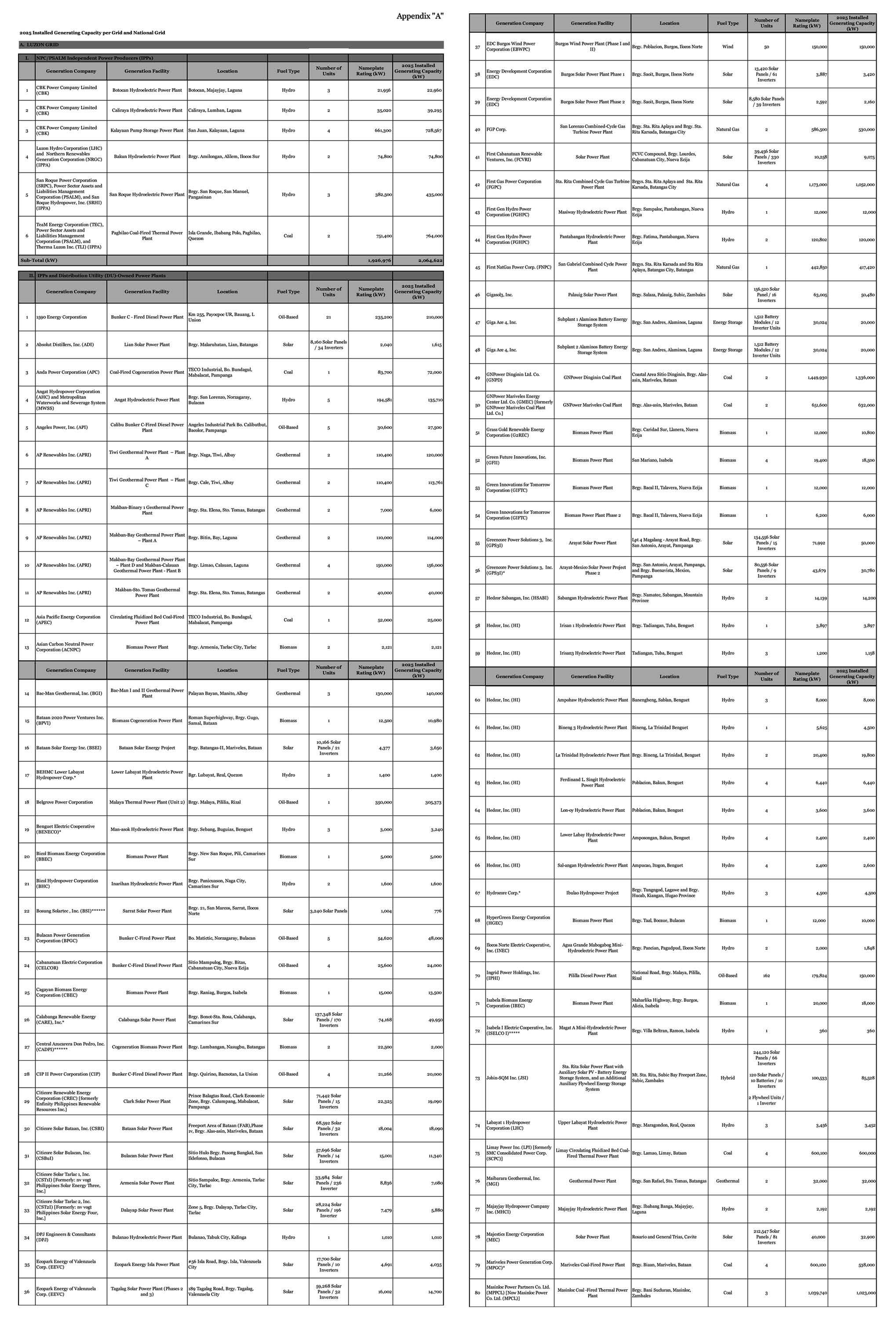
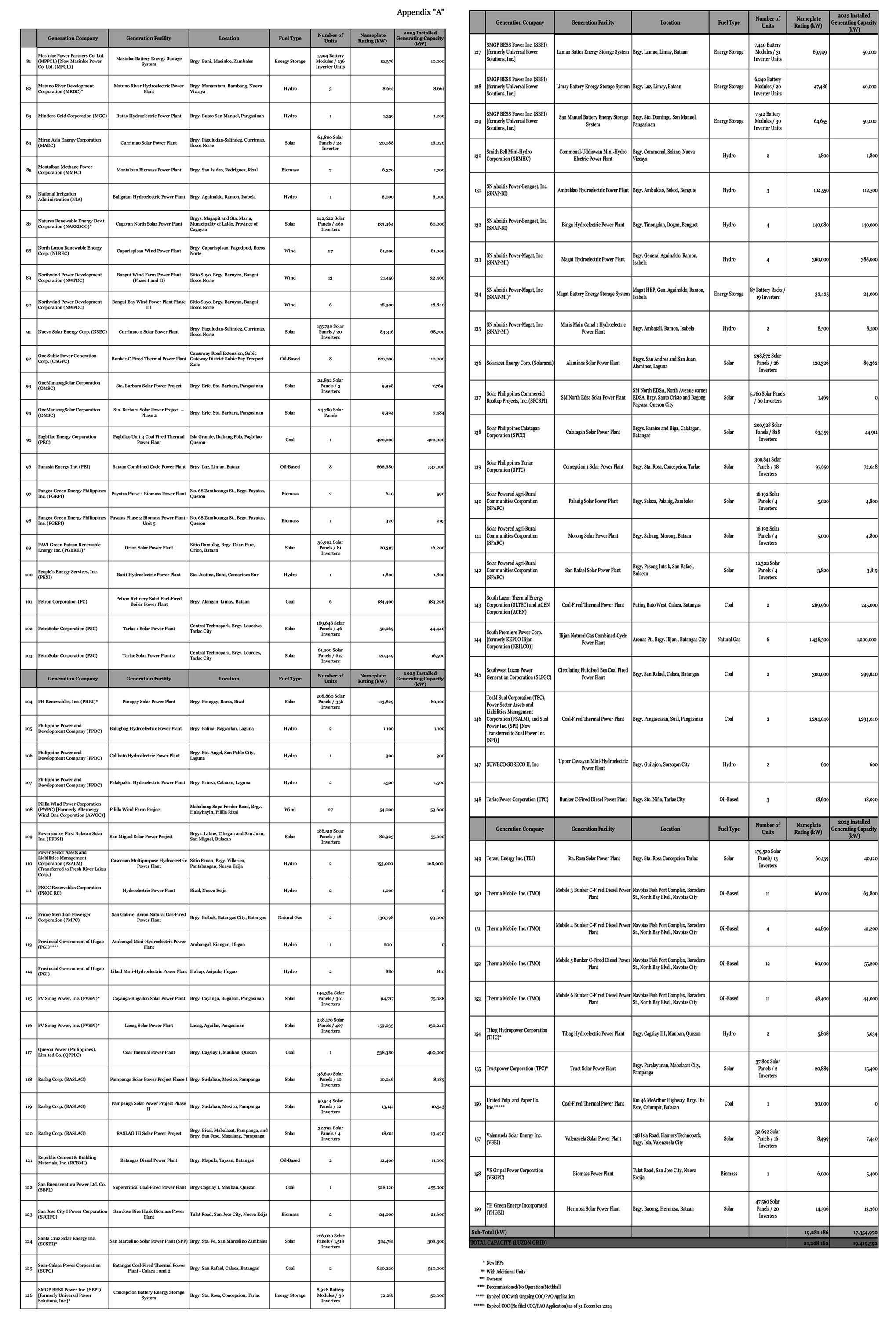
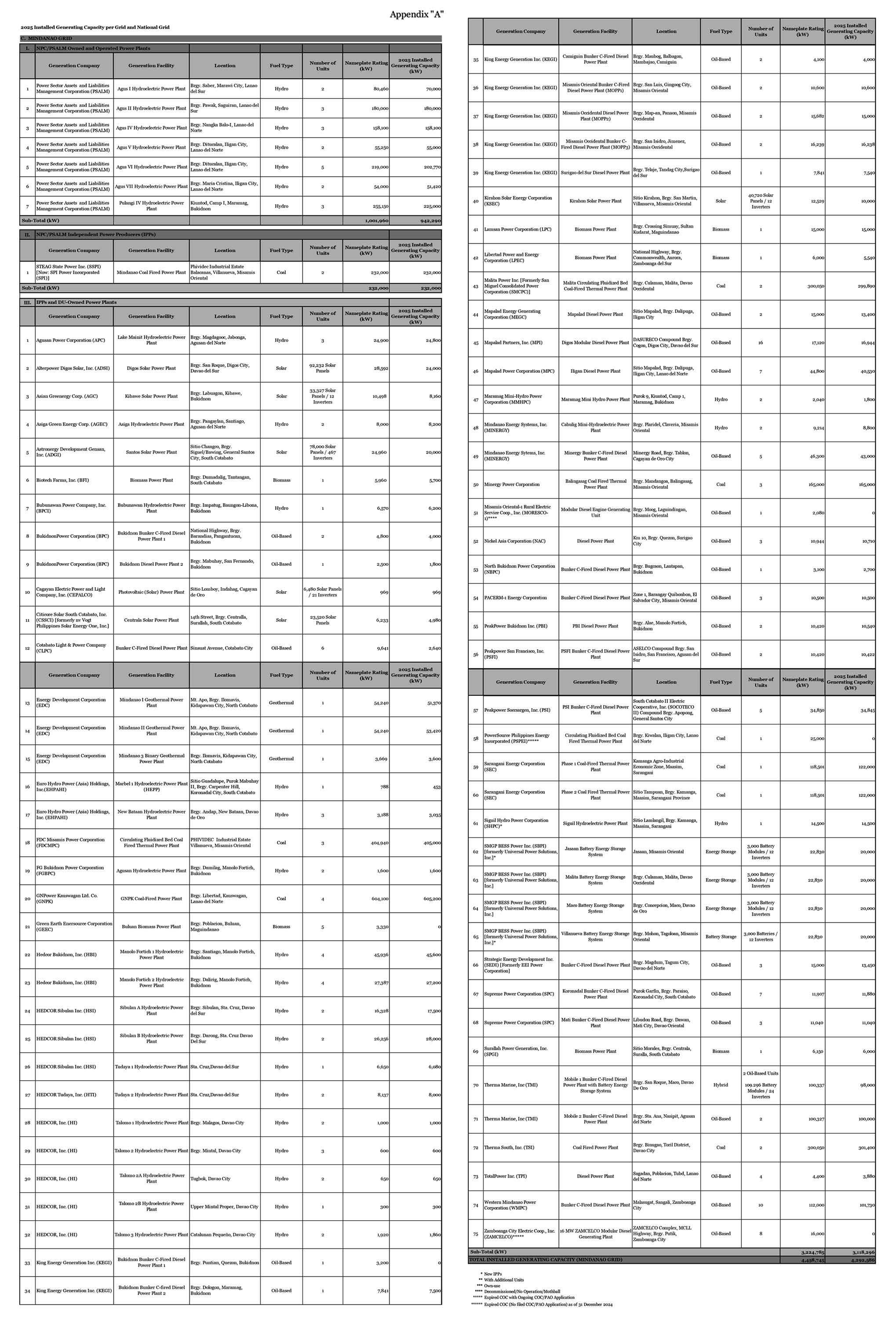
Data from the regulator showed that the Ang-led conglomerate’s market share in the national grid is now at 22.44 percent with a generation capacity of 6,079 MW. It was followed by Aboitiz Equity Ventures Inc. at 21.75 per-
cent share (5,894 MW), First Gen Corp. at 13.22 percent (3,582 MW), Manila Electric Co. at 5.42 percent (1,467 MW), and Ayala Corp. at 5.28 percent (1,431 MW).
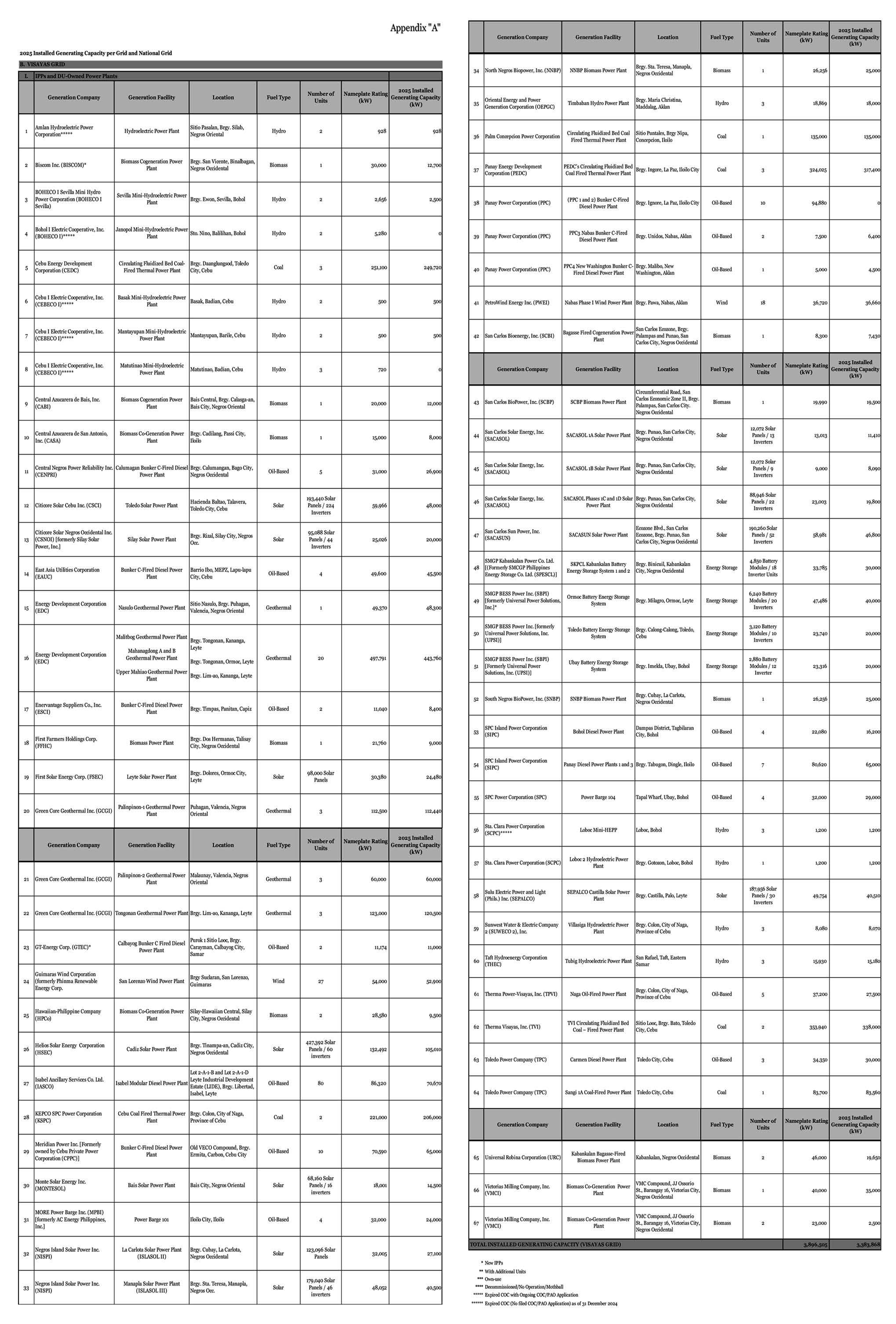
SMC also dominated the Luzon grid at 28.42 percent share (5,519 MW), followed by Aboitiz (4,797 MW), First Gen (2,688 MW), Ayala (1,257 MW), and Meralco (775 MW). In the Visayas, First Gen held the largest market share at 23.2 percent (785 MW), followed by Meralco (691 MW), Aboitiz (457
TBy Ada Pelonia @adapelonia
HE Department of Agriculture (DA) said only a fifth of retailers in Metro Manila followed the maximum suggested retail price (MSRP) for pork imposed by the government.
Citing the latest report from the DA’s Agribusiness and Marketing Assistance Service, Agriculture Assistant Secretary Arnel de Mesa said only 20 percent of over 170 Metro Manila stalls monitored have complied with the MSRP for pork. He added that the compliance with MSRP for “sabit ulo” at P300 per kilo, or the price at
which traders pass on pork to retailers, stood below 10 percent.
“If they are not compliant with ‘sabit ulo,’ therefore (retailers) would really have a hard time complying with the MSRP of P350 to P380 (per kilo). So, we will focus on that,” De Mesa told reporters in a press briefing on Monday.
He noted that the farmgate price of pork was already on a downward trend and has fallen to as much as P220 per kilo from P250 per kilo.
“So, this means the prices agreed upon during the meetings were not followed based on the level of compliance,” he said.
He noted that the DA will hold
another meeting to determine the causes for the low compliance rate despite holding consultations with stakeholders.
However, De Mesa also noted that the agency is mulling over allowing the government to intervene in the market if high retail pork prices would persist. This would be done through the Food Terminal Inc. (FTI) which will purchase local pork and sell it at a lower price.
The DA imposed the MSRP on pork in Metro Manila wet markets starting March 10 at P380 per kilo for pork belly or liempo and P350 per kilo for kasim or pork shoulder and pigue or pork ham.
The agency said the move to
impose an MSRP on pork aims to ease the financial strain on consumers reeling from the surge in meat prices.
Furthermore, the DA said it decided to impose an MSRP on pork following consultations with industry stakeholders, such as producers, wholesalers, traders, and retailers, who said this move would ensure the pork industry’s sustainability, which continues to suffer from the ASF’s adverse effects. Retail prices of pork ham in Metro Manila markets range from P340 to P410 per kilo, while pork belly is being sold at P355 to P470 per kilo, based on the latest government price monitoring report.
Palace defends appointment of new BTA leaders, members
By Samuel P. Medenilla and Jovee Marie N. Dela Cruz
PRESIDENTFerdinand
Marcos
is ready to take immediate action if there are lapses in the performance of the new administration of the Bangsamoro Transition Authority (BTA), according to Palace Press Officer Claire Castro.
Castro issued the remark after the Moro Islamic Liberation Front (MILF) opposed the president’s decision to not appoint 6 of the nominees it submitted for the BTA.
“If something goes wrong, then that’s the time the President will take immediate action,” Castro said in a briefing with Palace reporters last Monday.
In a statement it issued over the weekend, the MILF leadership called the President’s decision not to appoint all of the 41 names it submitted to the Office of the President for appointment in the BTA as “meddling” into their internal affairs.
“This deviation undermines Section 2, Article XVI of the BOL [Bangsamoro Organic Law], which provides that the Moro Islamic Liberation Front shall lead the Bangsamoro Transition Authority, without prejudice to the participation of the Moro National Liberation Front in its membership,” MILF said in its one-page statement. It pointed out that the decision of the President was in violation of the Comprehensive Agreement on Bangsamoro (CAB).
MILF also rejected the decision of Marcos to appoint Maguindanao
del Norte governor Abdulraof Macacua
as the new interim chief of minister (ICM) of the Bangsamoro Autonomous Region in Muslim Mindanao (BARMM) since it was done without any consideration of its position.
Castro urged MILF to give the new leadership and members of the BTA a chance.
“As we said, the President has the prerogative to appoint [BTA members]. Let us just give them a chance [to do their jobs],” she said in Filipino when asked if the MILF opposition to the BTA appointments can compromise the peace agreement in Mindanao.
“If the leadership of the newly appointed ICM is not [doing] well, we can discuss it again for the sake of what the Bangsamoro, MILF said,” she added.
Fraud audit
MEANWHILE , the House Committee on Public Accounts on Monday called on the Commission on Audit (COA) to conduct a fraud audit on the Bangsamoro Autonomous Region in Muslim Mindanao (BARMM) regarding its utilization of the P6.4 billion Local Government Support Fund (LGSF) amid concerns over transparency and accountability.
House Assistant Majority Leader Zia Alonto Adiong of Lanao del Sur emphasized that under COA’s internal auditing
policies, funds exceeding P50 million should be audited by the central office rather than the regional level.
“Even in COA’s internal auditing policy, amounts below P50 million can be audited at the regional level. However, anything above P50 million must be handled by the central office. That’s part of your internal auditing rules and policies,” Adiong said.
He said COA’s national office should now be involved in the scrutiny of BARMM’s use of the LGSF.
“The P50 million and above, COA central national office will come into the picture, and we’re talking of P6.4 billion,” he added.
High-ranking officials of the BARMM were again absent during Monday’s House Committee on Public Accounts hearing on the alleged questionable P6.4billion fund releases to favored barangays.
Paduano confirmed that BARMM officials had requested to be excused from attending due to the observance of Ramadan.
“The BARMM officials sent us an excuse letter because of Ramadan…and we considered it a valid reason,” Paduano explained.
Basilan Rep. Mujiv Hataman, however, pointed out that fasting should not be a reason to avoid official duties.
“We are also fasting, yet we are here, doing our job,” he said.
He also noted that BARMM had previously invoked autonomy to avoid legislative inquiries but has now shifted to Ramadan as an excuse for non-appearance.
Hataman also questioned whether BARMM officials had abandoned their previous claim that the House had no oversight authority over the region.
“Does this mean they no longer question our oversight power over them?” he asked.
Paduano affirmed that Congress has a constitutional mandate to conduct inquiries in aid of legislation, including over BARMM.
In his opening remarks, Paduano revealed that testimonies had been received indicating that barangays received funds ranging from P500,000 to more than P2.5 million. Allegedly, certain regional officials instructed recipients to return the majority of the funds while retaining only P200,000 for projects.
“The funds were reportedly released with instructions that only P200,000 should be kept, while the rest should be returned to specific officials,” Paduano said.
DTI: Local MSMEs get help under ‘Tatak Pinoy’ scheme
By Andrea E. San Juan
THE Tatak Pinoy Market Access initiative has supported 232 micro, small and medium enterprises (MSMEs) since its inception in 2024, according to the Department of Trade and Industry (DTI).
“The Tatak Pinoy Market Access initiative also supported 38 projects, mobilizing P51.82 million in funding,” DTI said in a statement on Monday.
Citing reports, the Trade department noted that these projects benefitted 232 MSMEs, generating actual and booked sales of P6.08 billion. These projects, DTI said, are seen to generate P4.85 billion in revenues and P5.24 billion in investments.
“Through international trade fairs, trade and investment missions, and business-to-business matching, the ‘Proudly Filipino’ brand is being strengthened in the global market, expanding opportunities for Philippine products and services to compete and succeed on the world stage,” DTI said.
The Tatak Pinoy Act was enacted on February 24, 2024. A year since its passage, DTI, in collaboration with government, academic and private sector stakeholders, have made “notable strides” in implementing the Tatak Pinoy measure through six focus areas—policy development, technology and innovation, human resource development, investments, market access, and marketing and promotions.
Among the “bold” initiatives DTI have launched to drive industrial goals is the explora-
tion of the feasibility of a wafer fabrication facility and an integrated circuit design lab to beef up the semiconductor sector. “Wafer fabrication facilities transform wafers into integrated circuits used in components like radio frequency amplifiers, LEDs, and microporcessors,” it said. To support MSMEs in adapting the fastchanging technological landscape, DTI said the Smart Industry Readiness Index (SIRI)
This resulted in a 3.5 percent risk-adjusted inflation forecast for 2025 and 3.7 percent in 2026. The downside risks are the spillover effects of lower tariffs on imported rice to domestic rice prices. Executive Order 62 was signed to reduce tariffs on rice to 15 percent from 35 percent to bring down imported rice prices.
“Overall, the risks to the inflation outlook are now broadly balanced for 2025 and 2026,” the BSP said.
In the BSP’s Survey of External Forecasters (BSEF) for February, analysts said there is a “high probability” that inflation will remain within the target
Continued from A22
retiree, change in visa status when they marry Filipinos, or their children have finished their education in the country, “which is common among South Koreans,” said the source. According to the PRA, 60 per -
Continued from A1 ‘Bye, bye…
MW), SMC (180 MW), and Ayala (174 MW).
In Mindanao, Aboitiz took the lead at 14.88 percent share (638 MW), followed by SMC (379 MW), and lastly First Gen (109 MW).
Meanwhile, the ERC has set the updated installed generating capacities (IGC) for Luzon, Visayas, and Mindanao to “promote free and fair competition in the generation and supply of electricity” in the country.
Under Resolution No. 7, Series of 2025, the regulator outlined that total IGC of 19,419 MW in Luzon, 3,383 MW in Visayas, and 5,002 MW in Mindanao, bringing the national IGC to 27,096 MW.
IGC refers to the maximum capacity that power generation facilities connected to a transmission or distribution system can collectively produce under specific conditions.
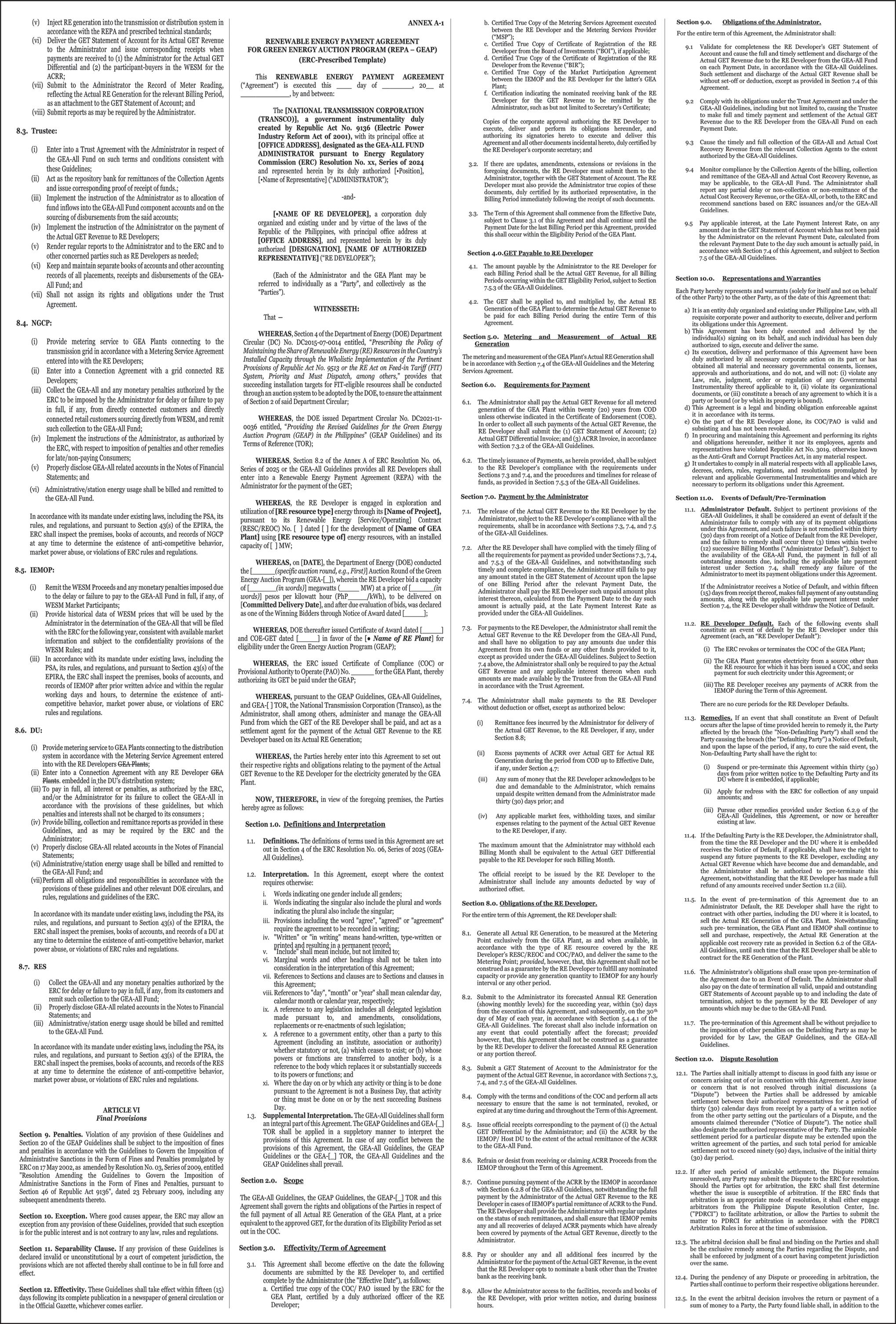
Pursuant to Section 45 (a) of Republic Act 9136 or the Electric Power Industry Reform Act of 2001 (Epira), the ERC is mandated to set the numbers annually to prevent
cent of its foreign retirees live mostly in the National Capital Region, followed by 12 percent in Central Visayas, and 11 percent in Southern Luzon. Foreign retirees living in Northern Luzon, specifically in Baguio, account for just 3 percent of total, while those in Central Luzon (Clark, Pampanga) represent 9 percent.
a person, company, related group or independent power producer administrators, singly or in combination, to own, operate, or control more than 30 percent of the IGC per grid, and 25 percent of the national grid.
Under ERC Resolution No. 7, Series of 2025, which outlines the updated power generation landscape per grid and the national level, each generation company has a market share limitation (MSL) of 25 percent for the national grid. They are also only allowed to gain a maximum of 30 percent of the Luzon, Visayas, and Mindanao grids.
“Considering that this initial determination has yet to consider the implications of market developments that have occurred during the period considered, the commission shall review this initial determination and update the 2025 ICG and MSL, as provided under the continuing review provision of Section 3, Article II of the MSL Guidelines,” the resolution read.
Continued from A1
range. Mean inflation is projected at 3.2 percent in 2025, unchanged from the previous survey, and 3.3 percent in 2026.
Analysts said there is an 83.2 percent chance that inflation will settle between 2 and 4 percent in 2025 with a 15.4 percent possibility of exceeding the upper-bound target. Based on the survey, the likelihood of inflation falling within the target range is also estimated at 84.4 percent for 2026 and 76.5 percent for 2027.
Forecasters said the impact of geopolitical tensions and unfavorable weather conditions on commodity prices, particularly
oil, pose risks to the inflation outlook. Additional factors mentioned are the proposed minimum wage increases, base effects, the potential increase in utility rates and transportation charges and uncertainties in international trade.
In terms of monetary policy, most analysts expect the BSP to loosen its stance this year, cutting key policy rates by 50 to 100 basis points. Positions in reducing banks’ reserve requirement ratio were also varied, ranging from zero to 75-bps cut. In 2027, analysts said the BSP will remain on an easing path.
‘Conviction in just one killing enough to put Duterte in prison’
By Jovee Marie N. dela Cruz @joveemarie
FORMER President Rodrigo Duterte could face a life sentence at the International Criminal Court (ICC) in The Hague, the Netherlands, owing to the numerous charges against him, according to a leader of the House of Representatives.
House Deputy Majority Leader Paolo Ortega V, said Duterte, who faces 43 counts of murder in a crimes against humanity case, could receive a minimum of 30 years or a life sentence for each conviction.
“He is facing 43 counts of murder in the crimes against humanity case. One conviction alone for each count [or killing] is more than enough to put him away,” Ortega said of the 79-year-old former
Chief Executive. Ortega said the length of ICC trials, estimating that a mass murder trial alone could take five to six years. He emphasized the fairness of the ICC process, noting that judges are independent and cannot be influenced by the Philippine government or Duterte’s camp.
The Philippine National Police helped the International Police Organization (Interpol) serve the ICC arrest warrant that three
judges had issued on March 7, when Duterte was on his way home to Manila on March 11 after a brief visit to Hong Kong, where he reportedly campaigned for his senatorial candidates.
“At least in ICC, we are assured of a very fair trial where nobody— both in the camp of Duterte or even the Philippine government—can exert any form of influence for the judges to rule in their favor. For one, judges were neither appointed by Duterte nor President Marcos,” he pointed out.
Under ICC rules, a conviction for one murder alone can earn the former leader at least 30 years of incarceration, at a minimum, or a life sentence, at a maximum. The global court, on the other hand, is not a tribunal tasked with trying single murder cases, but mostly “crimes against humanity.”
Some other dictators even face charges of genocide when countries are engaged in a civil war.
“So, even if you credit and apply, say, the last five years of trial, then it would still be a net of 25 years. He will be 105 years old by then.
And that is for one murder case alone,” Ortega, who represents La Union, explained.
He also pointed out that ICC rules require defendants to be present throughout the trial, unlike some domestic legal systems where bail or trials in absentia are possible.
“Unlike in our case, where bail can sometimes be granted, there is no trial in absentia in ICC. He [Duterte] has to be there for the whole duration of the trial, just like everybody else,” he said.
Ortega said that the precedent set by Duterte’s case should serve as a warning to world leaders.
“We have to bear in mind that power is only temporary. Therefore, we should not abuse power because power is not forever. World leaders should avoid hubris but should rather practice humility. Presidents come and go, and even dictators fade away too,” Ortega stressed
“As public officials, we have to use our power in the right way, and we should always be fair,” he added.
Senators eye breach of protocols in collapse of new Isabela bridge
SBy Butch Fernandez @butchfBM
ENATORS are focusing, not
just on the design of the collapsed Cabagan-Santa Mairan bridge in Isabela, but also on the observance of load limits.
This point was highlighted as Sen. Alan Peter Cayetano started on Friday the investigation on the collapse of the Cabagan-Santa Maria Bridge, a portion of which had collapsed last February 27, less than a month after it was completed and opened to the public, leaving six people injured.
“The mission of this bridge is to transform the countryside. It is a gateway to the Cordilleras and a very beautiful project. But now let us just say that it is a symbol of our failure as a government,” Cayetano said during the Senate blue-ribbon committee hearing.
Comelec
He then asked Public Works Undersecretary for Regional Operations Eugenio Pipo Jr. to submit to the committee the names of errant contractors that were blacklisted and disciplined by the Department of Public Works and Highways (DPWH) and the total number of contractors registered with the agency.
Meanwhile, Cayetano also focused his investigation on the design of bridges across the country and their load-bearing capacity, among others. He expressed alarm that a similar incident might occur in other parts of the country, where, it is widely known, authorities have no way of preventing many heavy vehicles from using bridges whose load-bearing capacity is way below their tonnage.
In his inspection of the collapsed bridge recently, even President Marcos had demanded that
investigations focus both on the bridge’s design, which he described as “flawed,” as well as the systems by which the load-bearing capacities of bridges across the country are clearly provided in signages, and are respected by motorists, especially heavy trucks and trailers.
Meanwhile, Cayetano lamented the slow investigation being done by the DPWH on the matter.
“If this was Japan or Singapore, many would have already resigned and then they would have findings by now since it’s two weeks, but since this is the Philippines… all of you are doing their best but there is no structure, no protocol,” Cayetano said in Filipino.
For his part Sen. Ramon Revilla Jr., Senate Committee on Public Works chairman, said heads must roll “whether it was due to fault or gross negligence.”
Revilla said he was “deeply
to distribute voter information sheets in April
By Justine Xyrah Garcia
THE Commission on Elections (Comelec) will start distributing voter information sheets (VIS) nationwide next month to ensure that Filipinos have ample time to prepare for the May 12 elections.
In a press briefing over the weekend, Comelec Chairman George Erwin M. Garcia stressed that voters must receive the VIS at least a month before election day.
“It is crucial that we distribute these VIS, not just to help voters choose their candidates, but also because they contain essential
voting guidelines and step-bystep instructions on how to cast their ballots,” Garcia said. Each registered voter will receive a four-page VIS detailing their name and address, polling place and precinct number, voting instructions and reminders, as well as the list of candidates for national and local positions, including party-list groups.
Garcia explained that the VIS will be printed in Filipino to ensure accessibility for the majority of voters.
To prevent political interference, he also clarified that barangay officials will not be involved
in the distribution process.
“We have hired personnel specifically for this task in every barangay and town. With all due respect, we cannot entrust this to barangay officials as there is a risk of political influence. That’s why Comelec itself is handling the hiring and deployment to ensure proper distribution throughout the month,” Garcia said in a separate radio interview.
Based on Comelec data, 1,667 VIS face templates are currently being printed at the satellite office of the National Printing Office in Meycauayan City, Bulacan.
Despite the sheer volume, Garcia assured that production remains
PNP modernizes Firearms and Explosive Office
By Rex Anthony Naval
THE National Police (PNP) on Sunday announced that it has modernized its Firearms and Explosive Office (FEO) in order to ensure a more efficient and user-friendly experience for responsible gun owners.
Gen. Rommel Francisco Marbil, National Police chief, announced that the Firearms and Explosives Office (FEO) had implemented a series of reforms designed to streamline procedures while enhancing cybersecurity and accessibility.
For years, firearm licensing has been a critical service of the PNP,
catering to over 800,000 clients across the country annually.
However, a cyberattack on May 16, 2024 exposed vulnerabilities in the previous system, prompting an urgent shift to a more advanced and fortified platform. The upgraded system now boasts robust security features, including anti-malware protection, web reputation monitoring, activity tracking, device control, a web application firewall (WAF), intrusion prevention, and twofactor authentication (2FA) via Google Authenticator and email verification.
Recognizing the need for both security and convenience, the
PNP-FEO, in coordination with the Information and Technology Management Service (ITMS), is rolling out key enhancements to further improve the process. These include the introduction of SIM card-based client credentials, regional kiosk installations, integration with the National Police Clearance system, a userfriendly mobile app, additional epayment gateways, an expanded notification system, a unified database, and an enhanced system interface.
Marbil said these innovations reflect the PNP’s unwavering commitment to digital transformation and public
House QuadCom members hope ICC unravels ‘web of deception’ in drug war
AS the International Criminal Court (ICC) proceeds with its case against former President Rodrigo Duterte, a senior member of the House Quad Committee expressed optimism on Monday that the trial will fully expose how the so-called war on drugs was manipulated to generate billions for those in power during the previous administration.
According to the QuadComm comprising the House Committees on Dangerous Drugs, on Public Order and Safety, on Human Rights, and on Public Accounts, Duterte and his inner circle allegedly facilitated and profited from the very drug trade they publicly vowed to dismantle.
“To put it simply: Why was the War on Drugs a ‘Grand Budol’? Because it was not just bloody—it was a billionpeso business. Small-time pushers were killed, but the big syndicates grew stronger. Why? Because they controlled the supply. And when they monopolized it, they dictated the price,” said House Assistant Majority Leader Jay Khonghun, a senior member of the House Quad Comm, in a statement.
“If this was truly a war against drugs, why weren’t the major suppliers targeted? Why were only the small ones eliminated while the big players became even stronger? Who profited from the skyrocketing prices of illegal drugs?” asked Khonghun, who represents Zambales.
alarmed and greatly concerned about the collapse of this newlyopened Cabagan-Santa Maria bridge in Isabela. Whether it was due to fault or gross negligence, we must swing the sword so that accountability will run its course.”
Weighing in on the issue at the blue-ribbon committee, Revilla said: “There are times when we say that we must not point fingers. But in this kind of situation, there can’t be no one at fault; and even more so, there can’t be no one to hold accountable. Anyone involved or complicit in the mistake or negligence must be named and held accountable.”
The blue-ribbon committee conducted a motu proprio investigation on the newly constructed bridge that collapsed less than a month after it was completed and opened to the public, leaving six persons injured.
on schedule and is expected to be completed by March 24.
He noted that several machines are being used to print over 68 million VIS.
“The public has nothing to worry about. The Comelec is doing everything to ensure that all preparations are on time. We will be able to ship out and deploy all necessary materials as scheduled,” he added.
Meanwhile, Comelec confirmed that the online precinct finder will remain accessible even with the distribution of VIS. However, it will only be available two weeks before election day to prevent hacking attempts, similar to what occurred in the 2022 elections.
service excellence.
“We want firearm licensing and registration to be both secure and accessible. By harnessing technology, we are making government transactions faster, safer, and more convenient for the people we serve,” he added.
With these innovations, the PNP-FEO is not only enhancing the licensing experience for gun owners but also reinforcing national security and public safety, Marbil also said.
“The agency remains steadfast,” he said, “in its mission to provide world-class service while ensuring that every step of the firearm registration process is seamless, transparent, and protected against cyber threats.”
During a House QuadCom hearing last December, Antipolo Rep. Romeo Acop, the committee’s senior vice chairman, presented initial findings that Duterte’s controversial drug war allegedly served as a front for a “grand criminal enterprise” involving high-ranking government officials, systemic corruption, and international drug trafficking networks.
“Ladies and gentlemen, the Quad Comm has begun uncovering a grand criminal enterprise, and it appears that at its center is former President Duterte,” Acop said. “This is painful because we were all deceived.”
Moreover, Khonghun emphasized that the ICC trial will shed light on how Duterte’s drug war was not merely about extrajudicial killings but allegedly about a vast, state-backed financial network that profited from both the illegal drug trade and money laundering through Philippine Offshore Gaming Operators (Pogo).
“The ICC trial is not just about the killings—it’s about the billions of pesos earned at the expense of Filipino lives. Duterte should not be the only one held accountable; everyone who benefited from this fake war should face justice,” Khonghun said.
As the international case moves forward, the committee is also advocating for domestic criminal charges against those implicated in the hearings to ensure that all financiers, enablers, and protectors of the illegal drug trade are held accountable.
According to Acop’s presentation, Duterte’s most trusted officials wielded both the “Purse and the Sword” of the Republic. However, instead of serving the people, they allegedly weaponized these powers for personal and political gain.
He cited the testimony of former police intelligence officer Col. Eduardo Acierto, who categorically named former President Duterte and Sens. Christopher Go and Ronald dela Rosa as “integral personalities in allegedly protecting the illegal drugs network in the Philippines.”
Acop opened his presentation by recounting two major drug smuggling cases from 2017 and 2018, which he called the “Tale of Two Shipments.” These involved P6.4 billion and P3.4 billion worth of methamphetamine hydrochoride or shabu, respectively, smuggled through the Manila International Container Port.
Testimonies from key witnesses—businessman Mark Taguba and former Customs intelligence officer Jimmy Guban—detailed how Duterte’s son, Davao City Rep. Paolo “Pulong” Duterte; his son-in-law and husband of Vice President Sara Duterte, Manases Carpio; and his former economic adviser Michael Yang allegedly orchestrated these shipments. Witnesses also described a rewards system that incentivized law enforcement to kill alleged drug offenders, often with little evidence.
Police Col. Jovie Espenido, once the “poster boy” of the drug war, confirmed that rewards could go as high as P100,000 for each kill.
One of the most explosive revelations was the Quad Comm’s assertion that Duterte himself may have been at the center of the drug enterprise.
In his affidavit submitted to the International Criminal Court, former police officer Arturo Lascañas described Duterte as the “Lord of All Drug Lords,” accusing him of using his anti-drug campaign as a tool to eliminate competition while protecting key players in the drug trade.
Lascañas, a self-confessed hitman and former member of the Davao Death Squad, testified that Duterte directly ordered the killings of drug chemists and workers involved in the Dumoy laboratory. He alleged in his affidavit that Duterte paid as much as P500,000 to eliminate these individuals, raising questions about whether these killings were about eradicating drugs—or eliminating competitors. Jovee Marie N. dela Cruz
A4
Tuesday, March 18, 2025
Economy
www.businessmirror.com.ph
Senate bets push for wage hike, capital access for all
SBy Justine Xyrah Garcia
EVERAL senatorial candidates are calling for higher wages and broader access to capital, arguing that these measures are crucial to address inequality and drive economic growth.
At an economic forum organized by the Chamber of Commerce of the Philippine Islands last week, former lawmaker Teodoro “Teddy” A. Casiño said it was time to grant workers the long-overdue wage increase they deserve.
Casiño acknowledged that while raising wages might affect some businesses, it would ultimately boost purchasing power, stimulate demand, and drive economic activity.
“It will all go back to the economy. It
will also raise tax collections...It may hurt some profits, but the long-term gain for the economy is immense and will pay for itself,” Casiño said.
The Makabayan senatorial bet proposed legislating a national minimum wage with exemptions for struggling businesses. He also suggested that the government provide subsidies to key industries to help employers meet wage adjustments.
Debates over wage increases have intensified this year after the House of Representatives approved a P200 acrossthe-board wage hike for private sector workers on second reading. As of 2024, Metro Manila’s minimum wage stands at P645 per day—far below the estimated family living wage of over P1,200 per day.
Meanwhile, former National Security Adviser Norberto B. Gonzales pushed for expanding capital access to enable more Filipinos to start their own businesses rather than relying solely on employment for income.
“We cannot allow capital to be monopolized by a few parties. In investment, for example, the government must step in and ensure capital is accessible to more people,” Gonzales said.
Former Cagayan Economic Zone Authority administrator Raul L. Lambino, for his part, called for stronger industrialization efforts, emphasizing that the country must reduce its reliance on imports by manufacturing more goods locally.
He also warned that the administration’s plan to impose additional capital gains taxes could discourage small businesses
and investors.
“Kawawanamanitongatingmaliliitna negosyantekapagthey have engaged in this k ind of investment,” the PDP-Laban bet said. Lambino further raised concerns about the country’s growing debt burden, noting that the debt-to-gross domestic product (GDP) ratio has exceeded 60 percent—a threshold that could trigger inflationary pressures and financial instability.
By the end of 2024, the Bureau of the Treasury reported that the Philippines’ debt-to-GDP ratio stood at 60.7 percent, with total debt reaching P16.05 trillion.
Education sector woes
BEYONG economic reforms, the candidates stressed the urgency of improving the country’s education system, par -
What Is GRC? Understanding Governance, Risk, and Compliance
By Henry J. Schumacher
WHY should companies take my article seriously? An important driver of GRC is corporate governance. Investors are increasingly interested in how companies are managed and what kind of risks they are exposed to.
Moreover, employees, customers, and other stakeholders expect organizations to be transparent about their organization and have robust mechanisms to prevent misconduct.
Taking integrity seriously, how to implement GRC in your organization?
GOVERNANCE , risk, and compliance, often called GRC, is a blanket term that describes the strategies and technologies used to manage an organization’s compliance
with regulatory mandates and corporate governance standards.
To better understand GRC, it’s best to look into each individual component: Governance
THE framework of rules, processes, and practices by which an organization is directed and managed. In essence, this comprises how an organization attempts to meet its goals and business objectives.
Risk or risk management
THE potential for loss or damage to an organization’s reputation, finances, employees, customers, or other stakeholders. In particular, the main focus of risk in GRC is risk management, i.e. identifying and subsequently minimizing risks encountered by the organization.
Compliance
THE state of conforming to laws, regula -
ticularly through higher teacher salaries, curriculum reforms, and increased infrastructure investments.
Casiño proposed raising teachers’ salaries to at least P50,000 per month, calling it both “reasonable” and necessary to retain and motivate educators. He argued that well-compensated teachers would significantly improve learning outcomes, even in resource-limited schools.
Gonzales, meanwhile, pointed out the widening gap between public and private education, emphasizing the need for reforms to bridge this divide rather than reinforce it.
Lambino also pushed for a stronger focus on STEM (Science, Technology, Engineering, and Mathematics) to align the Philippine
tions, and standards required by relevant bodies or government agencies. This can vary depending on the industry or sector and ensures that organizations meet a minimum standard of operations.
Why is GRC important?
GRC is important because it helps organizations protect their reputations, finances, customers, and employees while ensuring compliance with relevant laws and regulations. Moreover, GRC can also help organizations improve their operational efficiency and reduce costs.
By implementing a GRC program, organizations can avoid costly fines, penalties, and litigation expenses associated with non-compliance. In addition, a well-run GRC program can help organizations spot potential problems before they occur, saving them time and money in the long run.
What are some GRC tools?
Compliance management systems
THESE systems help organizations keep track of their compliance obligations by providing them with real-time visibility into their compliance posture. In addition, they typically include workflow capabilities that make it easy for organizations to manage their compliance processes from start to finish.
Risk management systems
THESE help organizations identify, assess, and manage operational risks. They typically include features such as risk dashboards and heat maps that give organizations a quick way to see where their biggest risks are located.
Policy management systems
THESE systems help organizations develop, implement, and enforce corporate
education system with global standards. Implemented in 2012, the K-12 program was designed to enhance basic education by adding two years to high school and strengthening technical-vocational training.
However, concerns persist over its effectiveness, with employers and educators citing skills mismatches among graduates and gaps in curriculum implementation. In 2022, the Program for International Student Assessment ranked Filipino students among the world’s weakest in reading, math, and science.
The Philippines ranked 77th out of 81 countries in the assesment, scoring 347 in reading, 355 in math, and 373 in science—roughly 120 points lower than the average scores.
policies and procedures. They typically include features such as policy templates and workflows that make it easy for organizations to create and distribute policies throughout their company.
How to implement GRC in your organization?
WHEN it comes to implementing a GRC program, there is no one-size-fits-all solution. The best approach will vary depending on the size, complexity, and needs of your organization.
Here are some steps:
LEARN how GRC relates to your specific business needs
THE first step is to clearly understand the laws, regulations, standards, culture, stakeholders, and the entire context that applies to your organization. You should also assess your organization’s risk tolerance and establish what kind of risks you are willing to take. This will inform your objectives, strategies, and actions.
ALIGN your strategy with greater business objectives
THE next step is to align your GRC strategy with your organizational objectives and actions. This will help your GRC program to align with the overall goals of your organization
PERFORM actions and policies toward desirable results
THE third step is to take actions that reinforce the desirable and neutralize the undesirable. You should also take action to help you detect deviations from GRC policies and procedures as soon as possible.
REVIEW and evaluate GRC on an ongoing basis
THE fourth and final stage of this GRC model is to evaluate the strategy’s design, operational effectiveness, and continuing relevance of goals to improve your organization.
In conclusion, allow me to remind you of what I said at the beginning: investors are increasingly interested in how companies are managed and what kind of risks they are exposed to. I wish you luck in implementing GRC! I am certainly interested in your comments; you can reach me at hjschumacher59@gmail.com.
SolGen steps aside in Duterte ICC case, says PHL has no obligation to cooperate
CBy Joel R. San Juan @jrsanjuan1573
HIEF government counsel Solicitor General Menardo Guevarra has refused to defend the Palace and other key Executive officials over their decision to handover former President Rodrigo Duterte to the International Criminal Court (ICC) to face trial for crimes against humanity in connection with death 43 individuals during his bloody anti-illegal drug war campaign.
In a nine-page manifestation and motion submitted to the SC, Guevarra sought to recuse himself from defending in the respondents in the consolidated petitions for a writ of habeas corpus filed by Duterte’s children Davao Mayor Sebastian Duterte, Davao 1st District Rep. Paolo “Polong” Duterte, and Veronica A. Duterte following the “illegal arrest” of the former president by the Philippine National Police (PNP) by virtue of an arrest warrant issued by the ICC.
Guevarra maintained his position that the ICC has no jurisdiction over the Philippines following its withdrawal as a state party to the Rome Statute, which created the ICC, on March 17, 2019.
“In st eadfast adherence to this sovereign decision, the OSG [Office of the Solicitor General] has consistently maintained, both in its submissions before the ICC and in its public statements, that the case of the Philippines was not admissible and that the ICC failed to timely exercise its jurisdiction,” Guevarra said. “ Consequently, the Philippine Government has no legal obligation to cooperate with the ICC nor recognize any process emanating from the ICC following the effectivity of the country’s withdrawal from the Rome Statute,” he maintained.
T he manifestation was received by the Court around 1:03 p.m. at the SC. “ Considering the OSG’s firm position that the ICC is barred from exercising jurisdiction over
the Philippines and that the country’s investigative, prosecutorial, and judicial system is functioning as it should, the OSG may not be able to effectively represent Respondents in these cases and is constrained to recuse from participating therein,” the chief government counsel said.
“Wherefore, the OSG most respectfully prays that its manifestation of recusal… be noted and/or favorably considered,” he added.
When asked who will represent the respondents in the petitions following his decision to inhibit, Guevarra said: “You will know that today.”
Among the respondents named in the consolidated petitions were Executive Secretary Lucas Bersamin, Interior and Local Government Secretary Jonvic Remulla, Philippine National Police (PNP) Chief Gen. Francisco Marbil, PNP-Criminal Investigation and Detection Group (CID) Director Gen. Nicolas Torre III, Solicitor General Menardo Guevarra, Foreign Affairs Secretary Enrique Manalo, Armed Forces of the Philippines (AFP) Chief of Staff Romeo Brawner Jr., Executive Director of the Philippine Center on Transnational Crime (PCTC) Undersecretary Lt. Gen. Antonio Alcantara, Capt. Johnny Gulla and the Bureau of Immigration (BI).
T he Duterte siblings are asking the Court to order the respondents to appear before the High Tribunal and to produce the body of the former president and explain why he should not be freed without delay. The writ of habeas corpus is a legal remedy available to address illegal confinement or detention, or to determine rightful custody over a person. It applies to all cases of illegal confinement or detention by which any person is deprived of his liberty. They argued that their father was illegally arrested and turned over to the ICC
despite its lack of jurisdiction since the country had already withdrawn from the Rome Statute, which established the ICC.
T hey insisted that despite the country’s withdrawal from the Rome Statue, crimes against humanity and other international crimes may still be prosecuted under Republic Act No. 9851, also known as the Philippine Act on Crimes Against International Humanitarian Law, Genocide, and Other Crimes Against Humanity.
T he said law gives Philippine trial courts’ jurisdiction for crimes against humanity.
F urthermore, the petitioners also accused the respondents of blatant violation of Article II, Section 7 of the Constitution when they allowed the entry of investigators from the ICC to investigate the drug war in the country and permitting the enforcement of the warrant of arrest.
The said constitutional provision mandates the government to place “paramount consideration to national sovereignty in its dealings with foreign parties.”
Likewise, the petitioners argued that their father needed medical attention which has been denied by the respondents despite request for it.
T he petitions also seek to prohibit the government from further cooperating with the ICC. T he ICC issued last March 7 an arrest warrant against Duterte for allegedly committing crimes against humanity over the killing of 43 individuals suspected to be drug pushers, users or thieves.
The warrant states that 19 out of the 43 were killed by the Davao Death Squad (DDS) in various locations in Davao City during Duterte’s term as mayor of the province while 24 persons believed to be drug pushers, drug users or thieves were killed during the term of Duterte as President.
The crimes covered by the arrest warrant took place between November 1, 2011 and March 16, 2019, according to the chamber.
Increase in subsistence allowance shows support to troops–AFP
THE Armed Forces of the Philippines (AFP) on Sunday night said the increase in the subsistence allowance of all military personnel highlights the government’s concern and support to its troops.
“The adjustment in our subsistence allowance has long been discussed and was approved as part of the GAA FY 2025. Our continuous efforts to ensure the welfare of our personnel reflects our commitment to strengthening the well-being of our troops,” AFP spokesperson Col. Francel Margareth Padilla said in a statement. She added that this increase is important especially to those AFP personnel serving in the frontlines as this highlights their role in safeguarding the nation.
Defend the legality arrest of Ex-President Rodrigo
R. Duterte
MALACAÑANG said it is ready to defend the legality of the arrest of former President Rodrigo R. Duterte last week for his crimes against humanity case before the International Criminal Court (ICC) in the proposed hearing of Senator Maria Imelda “Imee” R. Marcos on the matter.
Palace Press Officer Claire Castro said the Executive Branch of the government to the Senate hearing since it will provide it the venue to further justify allowing the arrest.
“I believ e [so], because we just complied with all the requirements, with the law regarding the arrest of former President Duterte,” she said when asked if the Executive Department can defend the arrest.
D uterte was arrested through the warrant of arrest issued by the ICC, which was served by the International Criminal Police Organization (Interpol) in coordination with the Philippine National Police (PNP). He is now detained in the Hague, Netherlands.
The ICC investigation stems from the complaints lawyer Jude Josue Sabio and former Senator Antonio Trillanes III in 2017 on at least 6,000 extra judicial killings (EJK) during the administration of Duterte.
C astro assured that the executive department under President Ferdinand Marcos will not prohibit government officials from attending the hearing proposed by the President’s sister, Senator Marcos like in the case of previous administrations.
Former Gloria Macapagal-Arroyo issued her controversial Executive Order No 464, which prevented her executive officials from attending the legislative inquiries. Duterte prohibited the head of his military detail from attending such hearings during the pandemic.
S enator Marcos called for the Senate hearing since the arrest has “deeply divided the nation.”
given retroactively beginning Jan. 1, 2025.
Earlier, President Ferdinand R. Marcos Jr. has raised the daily subsistence allowance of all officers and enlisted personnel of the AFP from P150 to P350.
Under Executive Order (EO) 84, signed by Marcos on March 14 and made public on Saturday, the PHP200 increase will be
“Providing adequate support to our personnel has always been a priority, as their strength and readiness directly contribute to national security and resilience,” Padilla stressed.
Harry Roque to apply for political asylum in The Netherlands
ATTY. Harry Roque, former spokesman of former President Rodrigo Duterte, is planning to apply for political asylum in the Netherlands.
In a video conference with reporters, Roque said he will claim for “unjust persecution” that he has been receiving from the Quad Committee of the House of Representatives.
Roque is planning to join the defense team of Duterte before the ICC on the charge of the crimes against humanity for murder.
“I’m formally applying for asylum here in the Netherlands. As soon as my application for asylum is received, I do have rights to non-refoulement,” he said.
Non-refoulement is a principle in the international law that prohibits countries to deport individuals to a country where the individuals face persecution, torture, or other serious human rights violations.
Roque said under the Dutch law, while his application is still being processed, the Netherlands government cannot deport him.
“Ang warrant of arrest na nilabas ng Quad Committee ay magpapatunay ng unjust prosecution. Dito sa Europa, unheard of ang warrant of arrest na indefinite ang lifetime, walang bail.
“Malinaw na imbestigasyon ng ito’y imbestigasyon sa POGO na nail nilang i-link ang dating President Duterte. Malinaw na sa tingin ko ang political motivation behind the Quad Committee kasi sinasabi ng partners na it has
Sen Koko to Comelec: Resolve simple cases now to avoid backlog when local campaign begins
THE Commission on Elections (Comelec) can avoid being swamped with cases that hinder its handling of complicated legal challenges if it focuses now on disposing of the simple ones ahead of the local campaign period, Senate Minority Leader Aquilino “Koko” Pimentel III said on Monday Specifically, the Comelec En Banc can expedite its handling of simple disqualification (DQ) cases and petitions for denial of due course ahead of the local campaign period that starts March 28, according to Pimentel.
The increase will benefit the trainees and probationary 2nd lieutenants or ensigns undergoing military training, Citizen Military Training cadets on summer camp training and reserve officers, and enlisted reservists undergoing training and assembly or mobilization test, Citizen Armed Force Geographical Unit, and cadets. EO 84 takes effect immediately upon its publication in the Official Gazette or a newspaper of general circulation.
Rex Anthony Naval
been there since the time President Aquino,” he said.
Roque is one of the fiv e international lawyers accredited by the ICC to be a counsel in any of the ICC proceedings.
T he ICC has yet to recognize him as part of the Duterte defense team.
“ Ngayong naririto na ang kaso ni Duterte, isa sa mga dahilan kung bakit nila ako ginigipit ay para mawalan ng legal representation ang Presidente,” he said.
There are five Filipino international lawyers who are accredited by the ICC. One of them is Roque. Malou Talosig-Bartolome
to act swiftly so they can fulfill their commitment to addressing all pending cases before election day,” he said on Monday.
S everal years ago, Pimentel himself had filed an election protest and won, three years after the Senate races, thus allowing him to serve the last half of what should have been his own six-year term.
“With the elections just a few months away, Comelec must act swiftly to clear its backlog. A good starting point is to resolve the simpler cases immediately. They need
“Resolving easier cases first would significantly reduce Comelec’s backlog, allowing the poll body to focus on more complex cases without unnecessary delays,” the senator, a Bar topnotcher and veteran election law expert, explained.
Teachers’ excessive paperwork will soon be a thing of the past
THE Department of Education (DepEd) is set to streamline school forms and reports to significantly ease the administrative burden on public school teachers by 57 percent, allowing them to focus on improving student learning outcomes.
“Teachers have long raised concerns about excessive paperwork, and this policy directly responds to that. Reducing their bureaucratic workload will not only improve their well-being but also enhance the quality of instruction they provide to our learners,” Education Secretary Juan Edgardo “Sonny” Angara said. From the total of 174 school forms previously required from teachers, the new DepEd policy will mark an approximately 57 percent, 5 forms will be regularly completed by all teachers. H owever, teachers may also accomplish 31 forms for teacher ancillary tasks and 39 forms for teaching related assignments, which may
vary depending on the agreed designations of teachers by virtue of their rationalized workload under DepEd Order No. 005, s. 2024. T his initiative aligns with the Marcos administration’s broader education reform agenda, which aims to enhance the efficiency of the public school system while addressing the long-standing concerns of overworked teachers.
DepEd is set to issue a formal department order to implement the new guidelines, accompanied by nationwide orientation sessions to ensure smooth execution at the school level. Much of teachers’ time on filling out school forms and reports.
A study conducted by DepEd’s Technical Working Group (TWG) on school forms, established during Angara’s leadership, revealed that teachers spend excessive hours on non-teaching tasks. Claudeth Mocon-Ciriaco
A seasoned la wyer and former Senate President, Pimentel pointed out that prompt decisions on simple cases would not only help prevent bottlenecks in 1Comelec’s decision-making process but also strengthen public confidence in the fairness of the electoral system.
They should begin with the cases that are easiest to decide. That will set the pace for handling the more complicated ones,” Pimentel added.
Among the cases pending befor e the Comelec En Banc is that of Marikina Mayor Marcy Teodoro, whose Certificate of Candidacy (CoC) was unanimously canceled by the Comelec First Division on December 11, 2024, due to material misrepresentation.
P imentel stressed that the lack of a clear timeline from Comelec on resolving these cases raises concerns that could affect candidates and voters alike.
“The sooner Comelec resolves these cases, the better it will be for everyone— candidates, voters, and the integrity of our elections. Delayed decisions only create uncertainty. We should prevent that,” he said.
Butch Fernandez
Tuesday, March 18, 2025
Editor: Angel R. Calso • www.businessmirror.com.ph
US airstrikes in Yemen kill dozens; Houthi rebels promise retaliation
By Samy Magdy The Associated Press
CAIRO—The United States and Iranbacked Houthi rebels in Yemen are both vowing escalation after the US launched airstrikes to deter the rebels from attacking military and commercial vessels on one of the world’s busiest shipping corridors.
The Houthi-run Health Ministry said the US strikes killed at least 53 people, including five women and two children, and wounded almost 100 in the capital of Sanaa and other provinces, including Saada, the rebels’ stronghold on the border with Saudi Arabia.
“We’re not going to have these people controlling which ships can go through and which ones cannot. And so, your question is, how long will this go on? It will go on until they no longer have the capability to do that,” US Secretary of State Marco Rubio told CBS on Sunday.
President Donald Trump on Saturday vowed to use “overwhelming lethal force” until the Houthis cease their attacks, and warned that Tehran would be held “fully accountable” for their actions.
The Houthis have repeatedly targeted shipping in the Red Sea, sinking two vessels, in what they call acts of solidarity with the Palestinians in Gaza, where Israel has been at war with Hamas, another Iranian ally. The attacks stopped when an IsraelHamas ceasefire took hold in January—a day before Trump took office—but last
week the Houthis said they would renew attacks against Israeli vessels after Israel cut off the flow of humanitarian aid to Gaza this month.
There have been no Houthi attacks reported since then.
The US airstrikes were one of the most extensive attacks against the Houthis since the war in Gaza began in October 2023.
Trump’s national security adviser, Mike Waltz, on Sunday told ABC that the strikes “actually targeted multiple Houthi leaders and took them out.” He didn’t identify them or give evidence. Rubio said some Houthi facilities had been destroyed.
In a speech aired Sunday night, the rebels’ secretive leader, Abdul-Malik al-Houthi, warned: “We will confront escalation with escalation.”
“We will respond to the American enemy in its raids, in its attacks, with missile strikes, by targeting its aircraft carrier, its warships, its ships,” al-Houthi said.
“However, we also still have escalation options. If it continues its aggression, we
THIS photo taken from video released by Ansar Allah Media Office via Al Masirah TV channel shows a wounded child being taken for treatment at a hospital in Saada, Yemen, Saturday, March 15, 2025 following airstrikes over multiple targets in the country. The Houthi-run Health Ministry said the overnight strikes killed at least 31 people, including women and children, and wounded over 100 in the capital of Sanaa and the northern province of Saada, the rebels’ stronghold on the border with Saudi Arabia.
will move to additional escalation options.”
He did not elaborate. The Houthis have targeted US warships and shot down American drones flying over Yemen.
The rebels on Sunday claimed to have targeted the USS Harry S. Truman carrier strike group with missiles and a drone.
According to a US official, the Houthis did fire drones and at least one missile in response to the US attack. The official, who spoke on condition of anonymity to provide updated information on operations, said that beginning at about midnight local time in Yemen, the Houthis fired 11 drones and at least one missile over about 12 hours. Ten of the drones were intercepted by US Air Force fighter jets and one was intercepted by a Navy F/A-18 fighter jet. The missile fell into the water far from the ship, and nothing came close to hitting either the carrier or the warships in its strike group.
The spokesperson for UN SecretaryGeneral Antonio Guterres in a statement called for “utmost restraint and a cessation of all military activities,” while warning of
Trump to speak with Putin Tuesday in bid to end
Ukraine war amid concerns from European allies
By Chris Megerian The Associated Press
ASHINGTON—President Donald
WTrump said he would speak to Russian President Vladimir Putin on Tuesday as he pushes to end the war in Ukraine.
The US leader disclosed the upcoming conversation to reporters while flying from Florida to Washington on Air Force One on Sunday evening.
“We will see if we have something to announce maybe by Tuesday. I will be
speaking to President Putin on Tuesday,” Trump said. “A lot of work’s been done over the weekend. We want to see if we can bring that war to an end.”
Any such conversation could be a pivot point in the conflict and an opportunity for Trump to continue reorienting American foreign policy. European allies are wary of Trump’s affinity for Putin and his hardline stance toward Ukrainian President Volodymyr Zelenskyy, who faced sharp criticism when he visited the Oval Office a little more than two weeks ago. Although Russia failed in its initial goal
to topple Ukraine with its invasion three years ago, it still controls large swaths of the country.
Trump said land and power plants are part of the conversation around bringing the war to a close.
“We will be talking about land. We will be talking about power plants,” he said.
Trump described it as “dividing up certain assets.”
Trump special envoy Steve Witkoff recently visited Moscow to advance negotiations, and he said earlier Sunday that a call between Trump and Putin could
the “grave risks” to the dire humanitarian situation in Yemen, the Arab world’s poorest nation.
Rubio said that over the past 18 months the Houthis had attacked the US Navy “directly” 174 times and targeted commercial shipping 145 times using “guided precision anti-ship weaponry.”
The attacks sparked the most serious combat the US Navy had seen since World War II.
On Sunday, the head of Iran’s paramilitary Revolutionary Guard, Gen. Hossein Salami, denied his country was involved in the Houthis’ attacks, saying it “plays no role in setting the national or operational policies” of the militant groups it is allied with across the region, according to state-run TV. Iran’s Foreign Minister Abbas Araghchi, writing on X, urged the US to halt its airstrikes and said Washington cannot dictate Iran’s foreign policy.
The US and others have long accused Iran of providing military aid to the rebels. The US Navy has seized Iranian-made missile parts and other weaponry it said was bound for the Houthis.
The United States, Israel and Britain previously hit Houthi-held areas in Yemen, but the new operation was conducted solely by the US. It was the first strike on the Houthis under the second Trump administration.
The USS Harry S. Truman carrier strike group, which includes the carrier, three Navy destroyers and one cruiser, is in the Red Sea and was part of the mission. The USS Georgia cruise missile submarine has also been operating in the region.
The Associated Press writers Amir Vahdat in Tehran, Iran, and Tara Copp and Lolita C. Baldor in Washington contributed to this report.
come soon. During his conversation with reporters on Air Force One, Trump said he was pushing forward with his plans for tariffs on April 2 despite recent disruption in the stock market and nervousness about the economic impact.
“April 2 is a liberating day for our country,” he said. “We’re getting back some of the wealth that very, very foolish presidents gave away because they had no clue what they were doing.”
Trump has occasionally changed course on some tariff plans, such as with Mexico, but he said he had no intention to do so when it comes to reciprocal tariffs.
“They charge us and we charge them,” he said. “Then in addition to that, on autos, on steel, on aluminum, we’re going to have some additional tariffs.”
Netanyahu seeks to dismiss Israel’s internal security chief as power struggle boils over
By Melanie Lidman The Associated Press
ERUSALEM—Israeli Prime Minister
JBenjamin Netanyahu said Sunday
he will seek to dismiss the head of the internal security service this week, deepening a power struggle focused largely on who bears responsibility for the Hamas attack that sparked the war in Gaza.
Netanyahu’s effort to remove Ronen Bar as director of the Shin Bet comes as the security service investigates close aides of the prime minister. Netanyahu said he has had “ongoing distrust” with Bar, and “this distrust has grown over time.”
Bar responded by saying he planned to continue in the post for the near future, citing “personal obligations” to finish “sensitive investigations,” free the remaining hostages in Gaza and prepare potential successors.
Bar also criticized Netanyahu’s expectation of a personal loyalty that contradicts the public interest. But he emphasized that he would respect any legal decision regarding his tenure.
Attorney general says Netanyahu must explain legal basis for his decision
Israel’s attorney general said Netanyahu must clarify the legal basis for his decision before taking any action.
The Shin Bet is responsible for monitoring Palestinian militant groups, and recently issued a report accepting responsibility for its failures around the October 7, 2023, Hamas attack. It also criticized Netanyahu, saying failed government policies helped create the climate that led to it.
While the army concluded in a recent report that it underestimated Hamas’ capabilities, Shin Bet said it had a “deep understanding of the threat.” In veiled criticism of the government, the agency said its attempts to thwart the threat were not implemented.
“The investigation reveals a long and deliberate disregard from the political leadership from the organization’s warnings,” Bar’s statement said.
Deflecting blame for the October 7 attack
NETANYAHU has resisted calls for an official state commission of inquiry into the October 7 attack and has tried to blame the failures on the army and security agencies. In recent months, a number of senior security officials, including a defense minister and army chief, have been fired or forced to step down.
Bar has been one of the few senior security officials since the October 7 attack to remain in office.
If successful in removing him, Netanyahu would be expected to appoint a loyalist in his place, slowing any momentum for the commission of inquiry. The prime minister said removing him would help Israel “achieve its war goals and prevent the next disaster.”
Netanyahu’s proposed resolution for Bar’s dismissal would need the approval of parliament, the Knesset, and it is likely he has support to pass it.
However, a personnel decision of this magnitude must get the attorney general’s approval, said Amichai Cohen, a senior
research fellow at the Israel Democracy Institute think tank.
In her letter to Netanyahu warning he could not go ahead without clarification, Attorney General Gali Baharav-Miara added that he should “pay attention to the fact that the role of the Shin Bet is not to serve the personal trust of the prime minister,” according to a statement from her office.
The two have a combative relationship, with the prime minister accusing BaharavMiara of meddling in government decisions. Earlier this month, Justice Minister Yariv Levin, one of Netanyahu’s biggest supporters, initiated the process of firing her.
Cohen also called Netanyahu’s decision “very problematic.” He said it illustrates the conflict of interest regarding the Shin Bet findings around the October 7 attack and the agency’s investigations into connections between the prime minister’s office and Qatar, a mediator in talks on the war in Gaza. Netanyahu is angry that the Shin Bet is investigating members of his staff for their dealings with Qatar.
Eli Feldstein, Netanyahu’s former spokesperson, was reported by Israel’s Channel 12 to have worked for a Doha-based firm that recruited Israeli journalists to write pro-Qatar stories. Israel’s left-leaning daily, Haaretz, has reported that two other Netanyahu staffers, Jonatan Urich and Yisrael Einhorn, allegedly built a campaign to bolster Qatar’s image ahead of the 2022 World Cup there.
The Shin Bet, and Bar, have been closely involved with the Gaza hostage negotiations. Netanyahu recently
removed Bar from the negotiating team and replaced him with a loyalist, Cabinet minister Ron Dermer. Israeli media have reported on policy differences between the negotiators, who have pushed for a hostage deal, and Netanyahu, who threatens to resume the war.
The Movement for Quality Government in Israel, a good-governance civil society group, called Netanyahu’s announcement a “declaration of war on the rule of law” and claimed that he does not have the authority to take the step against Bar because of the investigations into his office.
The group’s chair, Eliad Shraga, called the announcement unlawful and “an extreme example of conflict of interest.”
Opposition leader calls plans to dismiss Bar ‘shameful’ Opposition leader Yair Lapid said he would appeal Bar’s dismissal, calling the resolution “shameful” and politically motivated. Since Netanyahu was indicted on corruption charges in 2019, he has claimed to be the victim of a “deep state” conspiracy by the media, judiciary and other unelected civil servants.
He launched a plan to overhaul the country’s judicial system in early 2023, sparking months of street protests by demonstrators who accused him of trying to weaken the country’s system of checks and balances.
Israeli media have said Bar was among top security officials warning ahead of the October 7 attack that the strife was sending an image of weakness to Israel’s enemies.
Trump’s tariffs temper Asia market gains despite China’s positive data
By Elaine Kurtenbach Ap Business Writer
BANGKOK—Shares advanced Monday in Asia though they gave up much of their early strong gains after US President Donald Trump told reporters he would go ahead with more tariffs despite worries over their impact on the economy and markets.
Speaking with journalists on Air Force One, Trump said he was pushing forward with a plan for more tariff hikes on April 2 regardless of recent disruptions in the stock market.
Chinese markets rose after officials in Beijing reported stronger than expected factory data.
Officials were due later in the day to brief reporters about Beijing’s efforts to get consumers to spend more, seen as key to getting the economy out of its doldrums.
Most economists have advocated broad and fundamental reforms to foster greater confidence and build consumer purchasing power.
Hong Kong’s Hang Seng rose 0.8 percent to 21,144.86, and the Shanghai Composite index was up 0.2 percent at 3,426.13.
China’s industrial output rose nearly 6 percent in the first two months of the year from a year earlier and retail sales were up 4 percent, the government reported Monday. But officials reported continued weakness in the property market, with home prices falling and investment in real estate down nearly 10 percent from a year earlier.
In Tokyo, the Nikkei 225 index jumped 0.9 percent to 37,396.52, while the Kospi in Seoul leaped 1.7 percent to 2,610.69. Australia’s S&P/ASX 200 gained 0.8 percent to 7,854.10 and the Taiex in Taiwan was up 0.7 percent. Bangkok’s SET gained less than 0.1 percent.
On Friday, Wall Street’s roller coaster shot back upward, but not enough to keep the US market from a fourth straight losing week, its longest such streak since August.
The S&P 500 jumped 2.1 percent a day after closing more than 10 percent below its record for its first “ correction “ since 2023. It closed at 5,638.94. The US stock market has been tumbling quickly since setting a record less than a month ago. The last time the index shot up that much was the day after President Donald Trump’s election, when Wall Street was focusing on the upsides of Trump’s return to the White House.
The Dow Jones Industrial Average climbed 1.7 percent, to 41,488.19. The Nasdaq composite jumped 2.6 percent to 17,754.09. Ulta Beauty jumped 13.7 per -
cent after the beauty products retailer reported stronger profit for the latest quarter than analysts expected.
Gains for Big Tech stocks and companies in the artificial-intelligence industry also helped support the market. Such stocks have been under the most pressure in the recent sell-off after critics said their prices shot too high in the frenzy around AI.
Nvidia rose 5.3 percent to trim its loss for 2025 so far below 10 percent. Apple climbed 1.8 percent to pare its loss for the week, which at one point had been on pace to be its worst since the 2020 Covid crash.
It helped that the Senate made moves to prevent a possible partial shutdown of the US government. But the heaviest uncertainty remains with Trump’s escalating trade war. There, the question is how much pain Trump will let the economy endure through tariffs and other policies in order to reshape the country and world as he wants. The president has said he wants manufacturing jobs back
in the United States, along with a smaller US government workforce and other fundamental changes.
While stock prices may be close to finishing their reset to account for tariffs set to hit in April, Ma said concerns about how big an impact the cutbacks in federal spending will have on the economy are “likely to remain for some time.”
US households and businesses have already reported drops in confidence because of all the uncertainties created by Trump’s barrage of on-again, off-again tariff announcements and other policies. That’s raised fears about a pullback in spending that could sap energy from the economy.
In other dealings early Monday, US benchmark crude oil gained 48 cents to $67.66 per barrel in electronic trading on the New York Mercantile Exchange.
Brent crude, the international standard, added 49 cents to $71.07 per barrel.
The US dollar rose to 148.93 Japanese yen from 148.81 yen. The euro slipped to $1.0880 from $1.0882.
Pope Francis seen in wheelchair in 1st photo since hospitalization
By Colleen Barry The Associated Press
ROME—The Vatican on Sunday released the first photograph of Pope Francis in more than a month, showing the pontiff in a three-quarter view from behind wearing a purple stole typical of Lenten liturgical vestments and sitting in a wheelchair before the altar of his personal hospital chapel.
The Vatican said he was participating in the celebration of the Mass with other priests in the 10th-floor papal apartment in the Gemelli hospital. No one else is visible in the photo and it is the first mention the Vatican has made of the pope’s participation in celebrating Mass since his February 14 hospitalization for a bout with chronic bronchitis that quickly turned into double pneumonia.
There was no obvious sign that he was receiving supplemental oxygen mentioned in medical bulletins.
Doctors this week said the pontiff was no longer in critical, life-threatening condition, but they have continued to emphasize that his condition remained complex due to his age, lack of mobility and the loss of part of a lung as a young man.
In an audio recording released March 6, the pope spoke in a feeble and labored voice as he thanked the faithful in St. Peter’s Square for their prayers.
His condition has been gradually improving over the last week, leading the Vatican to suspend morning updates and to issue less frequent medical bulletins. An X-ray this week confirmed that the infection was clearing.
In the most recent bulletin on Saturday, doctors said they were working to reduce the pope’s reliance on a non-invasive ventilation mask at night, which will allow his lungs to work more. He was continuing to receive high-flow supplemental oxygen, delivered by a nasal tube, during the day—although no such apparatus was evident in the photograph.
‘Pope of the children’ EARLIER Sunday, dozens of children— many from war-torn countries, and toting
yellow and white balloons—gathered outside Rome’s Gemelli hospital to greet Francis on his fifth Sunday hospitalized. While the pope did not appear from the 10th-floor suite of windows, he thanked them and acknowledged their presence in the traditional Sunday blessing.
“I know that many children are praying for me; some of them came here today to Gemelli as a sign of closeness,’’ the pontiff said in the Angelus text prepared for the traditional prayer but not delivered live again. “Thank you, dearest children! The pope loves you and is always waiting to meet you,’’ Francis said. The Rev. Enzo Fortunato, president of the pontifical committee for World Children’s Day who organized the event, said that the gathering of children with their parents was a form of spiritual medicine for the 88-year-old pontiff. He called it “the most beautiful caress.’’
“The children represent a symbolic medicine for Pope Francis,’’ Fortunato said. “Letting him know that so many children are here for him cheers the heart.’’
A small group of children, whose balloons represented the colors of the Vatican flag, briefly entered the hospital to leave behind their drawings, messages and flowers for Francis. Many of the children came from poorer Italian districts or from countries impacted by war, some having arrived in Italy from Afghanistan and Syria via humanitarian corridors set up by the Sant’Egidio charity in agreement with the Italian government; others were from Ukraine, Gaza, South America and Africa.
One of them was 12-year-old Anastasia, who got up at 5 a.m. to make the trip from Naples with the hopes of delivering the message directly to the pope. “I wrote, ‘Pope Francis, get well and return home soon,’” she said. “We love you, all of the children are praying for you.’’
Andrea Iacomini, the spokesman for UNICEF in Italy, said besides demonstrating affection for the pope, the group also wanted to say “enough’’ to conflicts that are impacting 500 million children in 59 countries.
See “Pope,” A19
CURRENCY traders watch monitors near a screen showing the Korea Composite Stock Price Index (KOSPI) at the foreign exchange dealing room of the KEB Hana Bank headquarters in Seoul, South Korea, Monday, March 17, 2025. AP/AHN YOUNG-JOON
The World
Trump administration defies court order, deports hundreds of immigrants under 18th century law
By Nicholas Riccardi & Regina Garcia Cano
The Associated Press
THE Trump administration has transferred hundreds of immigrants to El Salvador even as a federal judge issued an order temporarily barring the deportations under an 18th century wartime declaration targeting Venezuelan gang members, officials said Sunday. Flights were in the air at the time of the ruling.
US District Judge James E. Boasberg issued an order Saturday temporarily blocking the deportations, but lawyers told him there were already two planes with immigrants in the air—one headed for El Salvador, the other for Honduras. Boasberg verbally ordered the planes be turned around, but they apparently were not and he did not include the directive in his written order.
White House press secretary Karoline Leavitt, in a statement Sunday, responded to speculation about whether the administration was flouting court orders: “The administration did not ‘refuse to comply’ with a court order. The order, which had no lawful basis, was issued after terrorist TdA aliens had already been removed from US territory.”
The acronym refers to the Tren
de Aragua gang, which Trump targeted in his unusual proclamation that was released Saturday In a court filing Sunday, the Department of Justice, which has appealed Boasberg’s decision, said it would not use the Trump proclamation he blocked for further deportations if his decision is not overturned.
Trump’s allies were gleeful over the results.
“Oopsie…Too late,” Salvadoran President Nayib Bukele, who agreed to house about 300 immigrants for a year at a cost of $6 million in his country’s prisons, wrote on the social media site X above an article about Boasberg’s ruling. That post was recirculated by White House communications director Steven Cheung.
Secretary of State Marco Rubio, who negotiated an earlier deal
with Bukele to house immigrants, posted on the site: “We sent over 250 alien enemy members of Tren de Aragua which El Salvador has agreed to hold in their very good jails at a fair price that will also save our taxpayer dollars.”
Steve Vladeck, a professor at the Georgetown University Law Center, said that Boasberg’s verbal directive to turn around the planes was not technically part of his final order but that the Trump administration clearly violated the “spirit” of it.
“This just incentivizes future courts to be hyper specific in their orders and not give the government any wiggle room,” Vladeck said.
The immigrants were deported after Trump’s declaration of the Alien Enemies Act of 1798, which has been used only three times in US history.
The law, invoked during the War of 1812 and World Wars I and II, requires a president to declare the United States is at war, giving him extraordinary powers to detain or remove foreigners who otherwise would have protections under immigration or criminal laws. It was last used to justify the detention of Japanese-American civilians during World War II.
Venezuela’s government in a statement Sunday rejected the use of Trump’s declaration of the law, characterizing it as evocative of “the darkest episodes in human history, from slavery to the horror of the Nazi concentration camps.”
Tren de Aragua originated in an infamously lawless prison in
the central state of Aragua and accompanied an exodus of millions of Venezuelans, the overwhelming majority of whom were seeking better living conditions after their nation’s economy came undone during the past decade. Trump seized on the gang during his campaign to paint misleading pictures of communities that he contended were “taken over” by what were actually a handful of lawbreakers.
The Trump administration has not identified the immigrants deported, provided any evidence they are in fact members of Tren de Aragua or that they committed any crimes in the United States. It also sent two top members of the Salvadoran MS-13 gang to El Salvador who had been arrested in the United States.
Video released by El Salvador’s government Sunday showed men exiting airplanes onto an airport tarmac lined by officers in riot gear. The men, who had their hands and ankles shackled, struggled to walk as officers pushed their heads down to have them bend down at the waist.
The video also showed the men being transported to prison in a large convoy of buses guarded by police and military vehicles and at least one helicopter. The men were shown kneeling on the ground as their heads were shaved before they changed into the prison’s all-white uniform—knee-length shorts, T-shirt, socks and rubber clogs—and placed in cells.
EU hosts donor conference for Syria’s reconstruction after Assad’s ouster
By Lorne Cook & Abby Sewell The Associated Press
BRUSSELS—The European Union hosts a donor conference for Syria on Monday to muster support to ensure a peaceful transition after President Bashar Assad was ousted by an insurgency last December.
Ministers and representatives from Western partners, as well as Syria’s regional neighbors, other Arab countries and UN agencies will take part in the one-day meeting in Brussels which will be chaired by EU foreign policy chief Kaja Kallas.
Syria will attend the conference—the ninth edition of its kind—for the first time, and will be represented by Foreign Minister Asaad Hassan al-Shibani. The event was organized in haste by the EU to try to take advantage of the change sweeping the country.
The gathering comes at a precarious time. Syria’s new leaders are trying to consolidate control over territory that was divided into de facto mini-states during nearly 14 years of civil war and to rebuild the country’s economy and infrastructure.
The United Nations in 2017 estimated it would cost at least $250 billion to rebuild Syria, while experts say that number could reach at least $400 billion.
The prospects of economic recovery have been hampered by harsh Western sanctions that were imposed during Assad’s rule and largely have not been lifted.
The interim government will likely be looking to the Brussels conference to shore up its legitimacy in the eyes of the international community in hopes that the sanctions will be lifted, while also seeking short-term aid.
Security concerns
BUT the EU in particular is in a quandary
as not all has gone well recently.
Last week, an ambush on a Syrian security patrol by gunmen loyal to Assad triggered clashes. Some factions allied with the new government launched sectarian revenge attacks—primarily targeting members of Assad’s Alawite minority sect—that monitoring groups say killed hundreds of civilians over several days. In a statement, the EU called “for the full respect of Syria’s sovereignty, unity and territorial integrity,” saying that it will only support “a peaceful and inclusive transition, away from malign foreign interference, which guarantees the rights of all Syrians without distinction of any kind.” Syria is also on the agenda of a meeting of EU foreign ministers that Kallas is chairing separately Monday. The 27-nation bloc has begun to ease energy, transport and financial sector sanctions to encourage the new authorities.
“We need to continue with the lifting of sanctions because if there is hope for the people, then there is also less chaos. And for the hope for the people, you need also the services to be provided, for example, banking services,” Kallas said. However, the country’s interim rulers have struggled to exert their authority across much of Syria since the Islamist former insurgent group, Hayat Tahrir al-Sham, or HTS, led a lightning insurgency against Assad. Former HTS leader Ahmad al-Sharaa is now interim president, and on Thursday he signed a temporary constitution that leaves Syria under Islamist rule for five years during a transitional phase.
While many were happy to see an end to the Assad family’s dictatorial rule of more than 50 years, religious and ethnic minorities are skeptical of the new Islamist leaders and reluctant to allow Damascus
See “Trump,” A19
The river of fear: Indonesian villages on edge as crocodile attacks increase
By Edna Tarigan & Dita Alangkara The Associated Press
BUDONG-BUDONG, Indone -
sia—Nearly seven months after a crocodile attack almost took her life, Munirpa walked to the estuary outside her home with her husband and her children, ready to brave a reenactment.
Munirpa, who like many Indonesians only uses one name, recounted how one early morning in August, she threw her household garbage into a creek about 50 meters (164 feet) away from her house, as she normally would. She didn’t see what was coming next. By the time she realized a crocodile had attacked her, the fourmeter-long (13-foot) beast had already sunk its teeth into most of her body, sparing only her head. She fought hard, trying to jab its eyes. Her husband, hearing her screams, ran over and tried to pull her by the thigh out of the crocodile’s jaws. A tug-of-war ensued; the reptile whipped him with its tail. Fortunately, he saved Munirpa in time, eventually dragging her out of the crocodile’s grip.
People have long feared the ancient predators in the Central Mamuju district of Indonesia’s West Sulawesi, where the BudongBudong River meets the sea. For Munirpa, 48, that fear turned into a brutal reality when she became one of nearly 180 recorded crocodile attack victims in Indonesia last year. Residents like her are
learning to coexist with the crocodiles, a legally protected species in Indonesia, as they balance conservation with looking out for their safety. But as attacks rise, several residents and experts have called for better government interventions to stop the problem from getting even worse.
Communities near the crocodiles are on edge FOLLOWING the attack, Munirpa was hospitalized for a month and has had two surgeries. By February this year, her fear was still clearly visible, as were the scars on her legs and thighs.
“I am so scared. I don’t want to go to the beach. Even to the back of the house, I don’t dare to go,” said Munirpa. “I am traumatized. I asked my children not to go to the river, or to the backyard, or go fishing.”
In the villages surrounding the Budong-Budong River, like Munirpa’s, crocodiles have become a daily topic of conversation. Their presence has become so common that warning signs now mark the areas where they lurk, from the river mouth to the waterways which were once a popular swimming spot for children.
In 2024, there were 179 crocodile attacks in Indonesia, the highest number of crocodile attacks in the world, with 92 fatalities, according to CrocAttack, an independent database. Social media videos showing crocodile appearances and attacks in Sulawesi and other regions in Indonesia are also
on the rise.
The increase in attacks began about 12 years ago with the rise of palm oil plantations around the river mouth, said 39-year-old crocodile handler Rusli Paraili. Some companies carved artificial waterways, linking them to the larger part of the Budong-Budong River. That was when the crocodiles started straying, leaving the river and creeping to nearby residential areas, such as fish and shrimp ponds, he explained.
Palm oil plantations now dominate the landscape in West Sulawesi, from the mountains to the coast, and patrolling for crocodiles has become part of people’s daily routine. When residents check the water pumps in their ponds, they have no choice but to keep out an eye for the beasts— flashlights in hand, scouring up, down and across canals and waterways—resigned to the uneasy reality of sharing their home with a predator.
Balancing conservation and safety
THE saltwater crocodile has been a legally protected species in Indonesia since 1999, making it an animal that cannot be hunted freely. As a top predator, there is also no population control in nature.
Paraili, the crocodile handler, said that while the law protects crocodiles from being killed, the rise in attacks is a major concern. In response, he’s taken care of some of the crocs in a speciallydesigned farm away from human
populations. He’s received some financial support from the government and community donations, as well as support from palm oil companies for the last five years.
The farm has four ponds and around 50 reptiles. Some have names: Tanker, the largest, shaped like a ship, or Karossa, named after the sub-district the animal was caught after fatally attacking someone.
When funds run low, he uses his own money to ensure they’re fed, at least once every four days.
Amir Hamidy, who studies reptiles at the National Research and Innovation Agency, worries the rise in attacks indicates that crocodile numbers are becoming far too dangerous. Hamidy supports better population control.
Being a protected species “does not necessarily mean that the population cannot be reduced when it is at a level that is indeed unsafe,” he said.
Improving protection for residents
AROUND a year ago in Tumbu village, Suardi, who goes by one name, was harvesting coconuts when they fell into the river. When he went to retrieve them, he was attacked by a crocodile he initially didn’t notice. He’s since made a full recovery.
Still, the experience has made him more cautious. “Yes, I am worried. But what else can we do,” Suardi said. “The important thing is that we are careful enough.”
Along with Munirpa, Suardi is one of 10 people in the region who was attacked by a crocodile last year. Three of those attacked were killed.
See “Crocodile,” A19
Nightclub blaze leaves North Macedonia in grief and desperate for accountability
By Konstantin Testorides & Ivana Bzganovic The Associated Press
KOCANI, North Macedonia—North Macedonia is grappling with the loss of dozens of young lives in a nightclub inferno, while trying to hold those responsible to account and prevent another calamity.
Fire tore through the overcrowded Club Pulse early Sunday in the eastern town of Kocani, leaving 59 people dead and 155 injured from burns, smoke inhalation and being trampled in the panicked escape toward the building’s single exit.
Although the investigation into the fire’s cause is ongoing, videos showed sparkling pyrotechnics on the stage hitting Club Pulse’s ceiling and igniting the blaze as a band played.
People as young as 16 were among the casualties, and the nation declared seven days of mourning.
“We are all in shock, and I am shocked myself: as a mother, as a person, as a president,” North Macedonian President Gordana Davkova Siljanovska said in an address to the nation Sunday night.
“I still cannot believe that the terrible tragedy in Kocani is a reality. do not know with what words to express my condolences to the parents and loved ones of the deceased,” she said. “No one responsible should escape the law, justice and punishment! Let us not allow anyone to endanger the lives of innocent people anymore.”
The fire that shook the nation of 2 million—where close-knit extended family bonds made the disaster personal to many—was the latest in a string of deadly nightclub fires around the world.
Allegation of bribery surrounding nightclub AUTHORITIES say they are investigating allegations of bribery surrounding the nightclub that was crammed with young revelers and at double capacity. And North Macedonia’s government ordered a sweeping three-day inspection to be carried
out at all nightclubs and cabarets across the country, starting Monday.
The country was in mourning as people watched harrowing scenes in the town of 25,000 people, where rescuers for hours carried out their grim task of removing the charred bodies of clubgoers. The fire caused the roof of the singlestory building to partially collapse, revealing the charred remains of wooden beams and debris.
Anxious parents gathered outside hospitals in Kocani and the capital Skopje, some 115 kilometers (72 miles) west, for updates about the injured.
Waiting outside the hospital in Kocani, Dragi Stojanov was among those who received the dreaded news that his 21-yearold son Tomce had perished. “He was my only child. I don’t need my life anymore.... 150 families have been devastated,” he told reporters. “Children burnt beyond recognition. There are corpses, just corpses inside (the club).... And the bosses (of organized crime), just putting money into their pockets.”
Neighboring countries provide help FLAGS around the country have been lowered to half-staff, and the death toll may rise further, with 20 of the injured in critical condition, Health Minister Arben Taravari said.
Neighboring and nearby countries— Greece, Bulgaria, Serbia and Turkey—have already accepted many of those with the most serious injuries, while the government was in talks with several other countries to expand the hospital transfers, officials said. “All patients who have been transferred abroad are currently in stable condition. We hope it stays that way and that we will receive positive news from abroad.” Taravari said Monday, noting that several countries are also sending medical teams to North Macedonia.
Testorides reported from Skopje, North Macedonia
Tuesday, March 18, 2025
USAID’s demise: A blow to global health and democracy as Trump administration cuts funding for vital programs
By Kateryna Chursina, Jim Wyss & Katarina Höije
THE demise of the US Agency for International Development is sapping billions of dollars of funding for health and social programs that will be difficult for the world to replace. But it’s also leaving behind a complicated legacy as a promoter of American values abroad.
Donald Trump and his efficiency czar Elon Musk made USAID an early target of their cost-cutting campaign in part because the president is prioritizing domestic issues over international support. The agency funded journalistic outlets, human-rights groups and anticorruption efforts that critics at home and abroad argued were unnecessary interventions in other countries’ affairs.
These organizations were sometimes the only local sources of criticism or independent research in places with autocratic governments, though they also did work in countries that were long-time democratic allies, such as Mexico and Colombia. Many of those groups will struggle to carry on without US funding, and Trump’s retrenchment is emboldening some authoritarian leaders to crack down on dissent.
“Now is the moment when these international networks have to be taken down, they have to be swept away,” Hungary’s Viktor Orbán said in a radio address last month, announcing plans to target any nongovernmental organizations that receive foreign funds and praising Trump’s move. “It is necessary to make their existence legally impossible.”
That move is part of a push by a “consolidated axis of antidemocratic actors” to suppress civil society that will only accelerate as the US turns inward under Trump, according to Christopher Sabatini, a senior fellow at Chatham House in London who from 1997 to 2005 was Latin America director at the National Endowment for Democracy, which also had its funding cut alongside USAID.
“This was one of the sole sources of support to open up and to sustain political space in these countries,” he said. “A lot of the private foundations don’t do that.”
After a six-week review, Secretary of State Marco Rubio announced on March 10 that more than 80 percent of USAID’s contracts were officially canceled because they didn’t serve—and in some cases even harmed—“core national interests.” The State Department didn’t respond to a request for comment.
Some USAID activity became uncomfortable even for countries with close relations with the US. Frustrated by an anticorruption group he said was tied to conservative opposition parties, Mexico’s then-President Andrés Manuel López Obrador penned a formal complaint to US counterpart Joe Biden in 2023 about what he saw as an “interventionist act.”
Colombia’s leftist leader Gustavo Petro has also balked at foreign assistance. “That aid is poison,” he said during a televised cabinet meeting last month, asking why his country couldn’t foot the bill itself for a USAID-funded border patrol.
But in other places, USAID was seen as an ally to governments that strived for democratic ideals. In Ukraine, the agency supported independent journalism that helped sway the country to implement reforms aimed at European integration, according to Oksana Romanyuk, head of the country’s Institute of Mass Information.
Mor e than 80 percent of 120 media outlets the institute recently surveyed received US grants. “It was soft power, which held the democratic world together,” she said.
There’s a high risk foreign actors will exploit the void, Ola Myrovych, head of the Lviv Media Forum, told Bloomberg by email. “With external support from authoritarian regimes like Russia and China, media outlets in Ukraine may face increased pressure to align with foreign agendas,” she said.
Russia’s former president praised the move in a post on X.
A similar dynamic is playing out in Asia. Freedom House’s China Dissent Monitor, a platform that documented protests and other forms of opposition in China, has suspended all work since USAID funding was withdrawn, making it harder to gauge public sentiment in the world’s second-biggest economy.
“The message it sends is that the United States is walking away from some of its longest-held priorities,” according to Emily Mendrala, who worked on Cuba and migration policy under former President Joe Biden and is now a Washington-based consultant.
E lsewhere in Europe, other leaders are echoing Orban. Authorities loyal to Serbian President Aleksandar Vucic sent investigators to raid the offices of prodemocracy groups funded by USAID and the National Endowment for Democracy, in search of potential evidence of financial fraud or misuse of funds.
“ There will be many more surprises in the coming days, documents are coming to light,” Vucic said March 9, referring to the probe of USAID projects. “Anything that wasn’t done in accordance with the law will have to be accounted for.” USAID also funded independent local news operations covering autocratic regimes across Latin America. An already dwindling independent press in those places will now have to look elsewhere for resources.
In Venezuela, Nicolás Maduro’s government has shuttered more than 400 independent media outlets since 2000. Thirteen organizations with US funding were among the few outlets willing to buck the state media line when the socialist strongman declared himself reelected to a third term last July without presenting evidence. Of the 235 reporters in that network at the time of the contested vote, only 39 now remain.
A journalist who covers Daniel Ortega’s administration from exile in Costa Rica, who requested anonymity for fear of reprisals both in Nicaragua and the US, described the Trump administration’s move as a gift to the regime.
In neighboring E l Salvador, democratically elected but authoritarianleaning President Nayib Bukele has repeatedly voiced support for Trump’s decision. “The vast majority of ‘independent’ journalists and media are, in fact, part of a global money laundering operation aimed at promoting the glo -
International companies defy Trump’s DEI order, pursue inclusion initiatives abroad
By Siraj Datoo
DONALD TRUMP’S executive order dismantling diversity, equity and inclusion efforts is making waves at international companies in Europe, Asia and beyond—but only on the surface. Quietly, many businesses are standing firm on diversity initiatives.
Companies from Roche Holding AG to Nissan Motor Co. have backpedaled on DEI policies in the US. But the Swiss drug maker says it has no plans to change its inclusion efforts elsewhere, while the Japanese car maker has left its international websites untouched. Volvo AB is going further: The car company hires “based on meritocracy, not quotas,” its spokesperson said, adding that positive action schemes such as its tecHER program will continue.
It’s what you might call DEI by stealth—an approach that, in various forms, has started to become the new normal for global companies outside the US since President Trump issued an executive order on Jan. 20 entitled “Ending Illegal Discrimination and Restoring Merit-Based Opportunity.” For American companies, there’s a degree of uncertainty around the directive. While US federal agencies and their suppliers are required to end any form of what Trump calls “illegal DEI,” such as affirmative action in hiring, the order doesn’t definitively say what measures companies are no longer permitted to take. And with robust federal antidiscrimination statutes still in place, it’s not even clear that
the directive is lawful.
O utside of the US, the picture is even more complicated. Companies may wish to avoid unwanted scrutiny from the Trump administration, but complying with the spread of international diversity regulations is non-negotiable.
In jurisdic tions from the UK and the EU to Australia and Hong Kong—where inclusion measures have primarily focused on gender rather than race—companies are legally required to meet targets for board diversity, gender pay gaps, pay transparency and reintegration of employees after long-term leave. Various countries have other requirements too. In Japan, top publicly listed companies must aim to promote women to 30 percent of director roles by 2030, up from about 16 percent last year. In the Netherlands, the financial sector is expected to consider accessibility to ensure older people are not cut off from basic services.
N evertheless, few companies want to put their head above the parapet in the US, especially those with lucrative government contracts to lose. On top of the executive order, the president’s demand that US government agencies identify as many as nine potential civil compliance investigations in the private sector lit a tinderbox. No company wants to be the first to be accused of breaking the law.
More than 15 US companies have
already altered language around diversity in their annual reports, while European companies are increasingly avoiding the topic on earnings calls.
“Ultimately, people are trying to pivot. They’re trying to keep up with what’s going on but without losing sight of that ultimate goal of inclusive workplaces,” said Zamena Ladak, senior vice president for DEI and business development at Assemble HR Consulting, a New Jersey-based talent strategy and leadership development consultancy.
Bloomberg contacted more than a dozen companies with headquarters around the world that make a significant portion of their revenue in the US about their diversity, equity and inclusion plans. Few issued a public statement. But it’s clear that boardrooms are under increasing pressure from lawyers as well as staff to work out how to tread the DEI tightrope.
Legal obligations
SUPPORTERS argue that DEI strategies are about business survival and economic growth, as well as benefits for individual workers. Companies with more gender diversity are more likely to innovate, according to research published in the journal Innovation: Management, Policy & Practice. However, while many firms say they have recruited without bias for decades, few can boast a representative
balist agenda,” he said on X last month.
The kinds of outlets under fire are often among the few reporting on drug trafficking and immigration—key issues for the Trump administration, said Gypsy Guillen Kaiser, head of global affairs at the Committee to Protect Journalists. But now that they’re being dismantled, the journalists who received funding are being hounded by the authorities on flimsy or fabricated charges.
“The message that this entire process is sending to other governments is that those journalists are free prey,” she said.
O n the other side of the Atlantic, across Africa’s Sahel region, military rulers who seized power in recent years and spurned the West in favor of Russia have joined the push to investigate NGOs—with some arguing Trump is following their lead.
The junta that runs Mali said it had “denounced the danger of development aid being used to fund terrorist networks long before the new US administration took office,” according to a February 24 foreign ministry statement. The military leadership has cracked down on civil society and seen civilian deaths rise since it overthrew the civilian government in 2021, kicking out Western troops who were leading the fight against a decade-long Islamist insurgency.
The junta vowed to “investigate and punish” anyone responsible for the misuse of funds, urging US authorities to
Georgina Calvert-Lee, an employment lawyer at Bellevue Law.
workforce—in fact, many initiatives have led to even more homogeneity, according to analysis by academics Frank Dobbin and Alexandra Kalev. Countries where a significant portion of women are economically inactive or underactive are missing a growth opportunity, a particular problem for countries with an aging or shrinking population such as Germany, Spain, Italy, Japan and South Korea. In Japan, where a third of the population will be over 65 years old by 2040, the economy is already suffering, while Germany needs an influx of hundreds of thousands of migrant workers a year simply to prevent its labor force from shrinking.
By helping companies close the gender pay gap and finding other ways to make the workplace more equitable, DEI teams help to keep women working or increase their hours, according to a 2020 report by Mercer Inc.
They can help companies meet their legal obligations too. In the UK, companies’ responsibilities include avoiding discrimination in hiring and taking “reasonable steps” to prevent sexual harassment. Doing so effectively means firms need to educate staff about what discrimination, harassment and victimization—which can be subtle or inadvertent—look like. “Having DEI programs helps them comply,” said
But training on controversial topics like unconscious bias has in some cases already been rebranded. Now, there’s “less emphasis on this idea that we’re all biased or terrible people,” said Kate Dodd, an employment lawyer at Pinsent Masons and head of the firm’s Brook Graham diversity and inclusion consultancy. Instead, the focus is on using data to examine why specific minority groups may progress through a firm more slowly or exhibit higher attrition rates.
Many international companies are viewing the DEI retreat in the US through the lens of a four-year presidential term, according to Alexandra Evreinoff, managing director at INvolve, a London-based diversity and inclusion consultancy that has worked with clients such as Boston Consulting Group, HSBC Holdings Plc and Standard Chartered Plc.
Two large European multinational companies that work with the federal government told Bloomberg they won’t alter DEI policies unless the executive order is enforced. The move is seen as being in the best interests of customers and staff, according to a person familiar with the matter who did not wish to speak publicly for fear of reprisals.
While Sumitomo Mitsui Financial Group Inc. wiped references to DEI from its American websites, the Japanese company left its international websites untouched, describing the US changes as part of a global
investigate and charge those who used the money “to finance international terrorism.” Musk responded enthusiastically to the assertion in a post on X.
“ With the US administration suspending aid, the Sahel military regimes can say, ‘Look, even the US says it, so our suspicions were right,” said Yvan Guichaoua, an independent researcher focusing on the region.
In an interview with a right-wing US influencer last week, Rwandan President Paul Kagame—who has ruled for three decades—slammed foreign aid. He has come under increasing Western pressure as a militia his military supports and arms has seized major cities in neighboring Democratic Republic of Congo, displacing nearly 1 million people.
“Whoever gives you aid controls your life,” said Kagame, whose country has long been one of Africa’s biggest per-capita aid recipients. “It is weaponized.”
Still, some democratically elected leaders have also welcomed Trump’s move, on the grounds that it will help end Africa’s aid dependency. Hakainde Hichilema, the president of Zambia, is among them. Without US funding, he said this month, “we’re on our own” and that represents “a great window.” With assistance from Piotr Skolimowski, Marton Kasnyik, Misha Savic, Rebecca Choong Wilkins, Fabiola Zerpa, Taonga Mitimingi, Matthew Hill, Iain Marlow and Dave Merrill/Bloomberg
digital restructure “after many months of planning.”
And several banks headquartered outside the US, such as HSBC, Deutsche Bank AG, Barclays Plc and Banco Santander SA, have publicly reaffirmed their commitments to DEI and workforce representation targets, even as some Wall Street banks have backpedaled. In its annual report, HSBC described having a workforce that reflects society as a “strategic priority.” In January, Deutsche Bank Chief Executive Officer Christian Sewing called DEI “integral” to the company.
“I k now what diversity has brought us on the management board at the top reporting level,” he said. “That’s why we are strong supporters of these programs.” In fashion and retail—sectors where women make up an important part of the consumer base—companies including Germany-based Adidas AG, Hennes & Mauritz AB and Ikea have explicitly retained their DEI focus. “Our commitments in this area remain unchanged and are closely connected with our company’s purpose,” a spokesperson for H&M said.
Some European pharmaceutical companies are pushing on too with a commitment to inclusive clinical trials, according to people familiar with the situation. Their position is grounded in science as well as business: Testing the efficacy and side effects of new products requires women and individuals from underrepresented groups to take part in drug trials.
“ We need to have a continuous focus on this,” Martin Holst Lange, Novo Nordisk A/S’s development chief, said this month. It’s also important to include patients of diverse socioeconomic status, he said. In other sectors, the outlook is more mixed. Consulting giant McKinsey & Co. sent a carefully crafted memo to staff emphasizing that the company is still focused on inclusion, while noting that it abides by local law — a strong hint that it’s complying with anti-DEI measures in the US. Deloitte looked ready to drop its diversity policies globally before its partnerships in the UK and Australia said they wouldn’t make any changes locally. Meanwhile, Accenture Plc was among the first nonUS-headquartered companies in any sector to ditch its global DEI policies. All three have a lot to lose by defying Trump. Their combined revenues as federal government contractors were in excess of $7.8 billion in the fiscal year to Sep. 30, according to Bloomberg data.
companies are now scrambling to
www.businessmirror.com.ph
Smugglers turn to TikTok: Social media becomes major tool for migrant trafficking amid US border crackdown
By Megan Janetsky
MThe Associated Press
EXICO CITY—The videos roll through TikTok in 30-second flashes.
Migrants trek in camouflage through dry desert terrain. Dune buggies roar up to the United States-Mexico border barrier. Families with young children pass through gaps in the wall. Helicopters, planes, yachts, tunnels and jet skis stand by for potential customers.
Laced with emojis, the videos posted by smugglers offer a simple promise: If you don’t have a visa in the US, trust us. We’ll get you over safely.
At a time when legal pathways to the US have been slashed and criminal groups are raking in money from migrant smuggling, social media apps like TikTok have become an essential tool for smugglers and migrants alike. The videos—taken to cartoonish extremes—offer a rare look inside a long elusive industry and the narratives used by trafficking networks to fuel migration north.
“With God’s help, we’re going to continue working to fulfill the dreams of foreigners. Safe travels without robbing our people,” wrote one enterprising smuggler.
As President Donald Trump begins to ramp up a crackdown at the border and migration levels to the US dip, smugglers say new technologies allow networks to be more agile in the face of challenges, and expand their reach to new customers—a far cry from the old days when each village had its trusted smuggler.
“In this line of work, you have to switch tactics,” said a woman named Soary, part of a smuggling network bringing migrants from Ciudad Juarez to El Paso,
“This pope is not just a religious leader, he is a great global leader. A man of peace.
This pope is pope of the children,’’ Iacomini said.
Not seen publicly since being admitted to hospital
Francis typically delivers the Angelus from a window overlooking St. Peter’s Square to the gathered faithful, who have grown more numerous due to the Jubilee year that Francis inaugurated in December.
In the written text, Francis said he was thinking of others, who like him, are in a fragile state. “Our bodies are weak, but even like this, nothing can prevent us from loving, praying, giving ourselves, being for each other, in faith, shining signs of hope,’’ the pope said.
under its new leadership to assert control over their areas.
The EU can reintroduce the sanctions if things do not go to the liking of Western
Continued from A18
find the right language to describe their plans around diversity, equity and inclusion, the president’s crusade can’t have come as a total surprise. During his presidential campaign, Trump railed against “anti-White racism” and “illegal” DEI measures. A blizzard of conservative activism and lawsuits also raged in the lead-up to the elections.
In 2023, the S upreme Court effectively ended affirmative action concerning race
Texas, who spoke to The Associated Press on the condition that her last name would not be shared out of concern that authorities would track her down. “TikTok goes all over the world.”
Soary, 24, began working in smuggling when she was 19, living in El Paso, where she was approached by a friend about a job. She would use her truck to pick up migrants who had recently jumped the border. Despite the risks involved with working with trafficking organizations, she said it earned her more as a single mother than her previous job putting in hair extensions.
As she gained more contacts on both sides of the border, she began connecting people from across the Americas with a network of smugglers to sneak them across borders and eventually into the US.
Like many smugglers, she would take videos of migrants speaking to the camera after crossing the border to send over WhatsApp as evidence to loved ones that her clients had gotten to their destination safely. Now she posts those clips to TikTok.
TikTok says the platform strictly prohibits human smuggling and reports such content to law enforcement.
The use of social media to facilitate migration took off around 2017 and 2018, when activists built massive WhatsApp groups to coordinate the first major migrant caravans traveling from Central America to the US, according to Guadalupe Correa-Cabrera, a professor at George Mason University focused on the migrant smuggling industry.
Later, smugglers began to infiltrate those chats and use the choice social media app of the day, expanding to Facebook and Instagram.
Migrants, too, began to document
Along with a stop at St. Peter’s to seek indulgences by walking through the basilica’s Holy Door, pilgrims are now also adding a stop at Gemelli, a 15-minute train ride from the Vatican.
Francis has not been seen publicly since he was admitted to the hospital after a bout of bronchitis that made it difficult for him to speak. Doctors soon added a diagnosis of double pneumonia and a polymicrobial (bacterial, viral and fungal) infection.
The first three weeks of his hospitalization were marked by a rollercoaster of setbacks, including respiratory crises, mild kidney failure and a severe coughing fit. Over the last week, his condition has stabilized. The next medical update won’t be issued until mid-week, the Vatican said.
The Associated Press video journalist Francesca Primavilla contributed to this report.
backers. At the same time, Syria’s economy, infrastructure and institutions lie in tatters. As a failed state it could become another haven for extremists.
Economic and humanitarian needs PEOPLE must make do with only a few
in college admissions, after lawyer and anti-affirmative action activist Edward Blum sued Harvard. Even though the ruling didn’t extend to businesses, it created a chilling effect around race-related measures in recruiting. The Supreme Court is now hearing a discrimination case brought forward by a White woman who claims she was first denied a promotion and then later demoted because she is heterosexual. If successful, the case could pave the way for more discrimination suits from members of majority groups.
In the short term, lawyers are urging global companies with an American presence to “hit
their often-perilous voyages north, posting videos trekking through the jungles of the Darien Gap dividing Colombia and Panama, and after being released by extorting cartels.
A 2023 study by the United Nations reported that 64 percent of the migrants they interviewed had access to a smart phone and the Internet during their migration to the US.
Around the time of the study’s release, as use of the app began to soar, that CorreaCabrera said she began to see smuggling ads skyrocket on TikTok.
“It’s a marketing strategy,” CorreaCabrera said. “Everyone was on TikTok, particularly after the pandemic, and then it began to multiply.”
Last year, Soary, the smuggler, said she began to publish videos of migrants and families in the US with their faces covered and photos of the US-Mexico border with messages like: “We’ll pass you through
The immigrants were taken to the notorious CECOT facility, the centerpiece of Bukele’s push to pacify his once violencewracked country through tough police measures and limits on basic rights
The Trump administration said the president actually signed the proclamation contending Tren de Aragua was invading the United States on Friday night but didn’t announce it until Saturday afternoon.
Immigration lawyers said that, late Friday,
Crocodile. . .
Continued from A17
Suyuti Marzuki, who’s head of West Sulawesi Marine and Fisheries Agency, said the crocodile habitat shift is making people’s everyday
hours of electricity each day, water supplies are unreliable and often unsafe, unemployment runs to 80 percent or 90 percent, and destruction is widespread. Many government employees and experts needed to rebuild fled after the 2011 Arab Spring democracy movement collapsed into conflict and authoritarian rule under Assad. The UN refugee agency said that last year
the pause button” on any programs in the US that might benefit specific demographics, according to INvolve’s Evreinoff.
Global companies are looking for “a good balance between the regional approach and the global strategy,” said Evreinhoff, given the legal requirements they still have to meet abroad.
Even so, in the UK at least, conversations with professionals in DEI-related roles indicate a subtle shift has taken place over the past two years. The country is among the most advanced in terms of DEI development, but a worsening economic outlook has led to
the administration’s CBP One app, which Trump ended.
Amid Trump’s crackdown, posts have shifted to dispelling fears that migrants will be captured, promising American authorities have been paid off. Smugglers openly taunt US authorities: one shows himself smoking what appears to be marijuana right in front of the border wall; another even takes a jab at Trump, referring to the president as a “high-strung gringo.”
Comments are dotted with emojis of flags and baby chickens, a symbol meaning migrant among smugglers, and other users asking for prices and more information.
Ciudad Juárez, no matter where you are. Fence jumping, treks and by tunnel. Adults, children and the elderly.”
Hundreds of videos examined by the AP feature thick wads of cash, people crossing through the border fence by night, helicopters and airplanes supposedly used by coyotes, smugglers cutting open cacti in the desert for migrants to drink from and even crops of lettuce with text reading “The American fields are ready!”
The videos are often layered over heavy northern Mexican music with lyrics waxing romantically about being traffickers. Videos are published by accounts with names alluding to “safe crossing,” “USA destinations,” “fulfilling dreams” or “polleros,” as smugglers are often called.
Narratives shift based on the political environment and immigration policies in the US. During the Biden administration, posts would advertise getting migrants access to asylum applications through
they noticed Venezuelans who otherwise couldn’t be deported under immigration law being moved to Texas for deportation flights. They began to file lawsuits to halt the transfers.
“Basically, any Venezuelan citizen in the US may be removed on pretext of belonging to Tren de Aragua, with no chance at defense,” Adam Isacson of the Washington Office for Latin America, a human rights group, warned on X.
The litigation that led to the hold on deportations was filed on behalf of five Venezuelans held in Texas who lawyers said were concerned they’d be falsely accused of
activities—like harvesting coconuts, fishing or even disposing of garbage like Munirpa— very risky.
Marzuki said the government is looking at possible options that can provide both safety and economic alternatives for residents.
While he acknowledged that crocodile
some 7 million people had left their homes but remained in Syria. More than 4.7 million refugees are registered in neighboring countries, most in Turkey, Lebanon and Jordan. Since Assad’s fall, though, almost 302,000 have returned.
Despite the challenges, UN humanitarian chief Tom Fletcher, who will attend the conference, is upbeat. “It is now easier for
something of a pullback.
A 2024 survey by campaign group Reboot found that about 40 percent of respondents at financial services firms said budget cuts had hampered DEI efforts.
“ This is where we see who was really committed to diversity, equity, inclusion and for whom this was a matter of compliance,” said Michael Smets, professor of management at Oxford University’s Saïd Business School. With assistance from Claudia Cohen, Jennifer Creery, Ashleigh Furlong, Karoline Kan, Naomi Kresge, Rafaela Lindeberg, Sabah Meddings and Isabel Reynolds/ loomberg
ration” due to fear of authorities tracking him down said other accounts would steal his migrant smuggling network’s videos of customers saying to camera they arrived safely in the US.
“And there’s not much we can do legally. I mean, it’s not like we can report them,” he said with a laugh. In other cases, migrants say that they were forced by traffickers to take the videos even if they haven’t arrived safely to their destinations.
Cristina, who migrated because she struggled make ends meet in the Mexican state of Zacatecas, was among those scrolling in December after the person she had hired to smuggle her to the US abandoned her and her partner in Ciudad Juárez.
“In a moment of desperation, I started searching on TikTok and, well, with the algorithm videos began to pop up,” she said. “It took me a half an hour” to find a smuggler.
After connecting, smugglers and migrants often negotiate on encrypted apps like WhatsApp and Telegram, doing a careful dance to gain each other’s trust. Cristina, now living in Phoenix, said she decided to trust Soary because she was a woman and posted videos of families, something the smuggler admitted was a tactic to gain migrants’ trust.
Smugglers, migrants and authorities warn that such videos have been used to scam migrants or lure them into traps at a time when cartels are increasingly using kidnapping and extortion as a means to rake in more money.
One smuggler, who asked to only be identified by his TikTok name “The Corpo -
being members of the gang. Once the act is invoked, they warned, Trump could simply declare anyone a Tren de Aragua member and remove them from the country.
Boasberg barred those Venezuelans’ deportations Saturday morning when the suit was filed, but only broadened it to all people in federal custody who could be targeted by the act after his afternoon hearing. He noted that the law has never before been used outside of a congressionally declared war and that plaintiffs may successfully argue Trump exceeded his legal authority in invoking it.
population numbers and ecosystems need to be protected, Marzuki also raised the possibility of bolstering the local economy through the crocodile skin trade. That industry is controversial because of conservation and animal welfare issues.
Paraili, the crocodile handler, also urged
us to operate in Syria and across Syria than it was under the Assad regime,” Fletcher told reporters last week.
“I had excellent conversations with the caretaker authorities,” he said, noting that al-Shibani in particular had helped to keep border crossings open.
The illicit advertisements have fueled concern among international authorities like the UN’s International Organization for Migration, which warned in a report about the use of the technology that “networks are becoming increasingly sophisticated and evasive, thus challenging government authorities to address new, non-traditional forms of this crime.”
In February, a Mexican prosecutor also confirmed to the AP that they were investigating a network of accounts advertising crossings through a tunnel running under the border fence between Ciudad Juarez and El Paso. But investigators would not provide more details.
In the meantime, hundreds of accounts post videos of trucks crossing border, of stacks of cash and migrants, faces covered with emojis, promising they made it safely across the border.
“We’re continuing to cross and we’re not scared,” one wrote.
Illustrations are based on hundreds of videos posted on TikTok examined by the AP that advertise travel to the US to migrants. Videos are often laced with emojis, make bold promises of success and promise safe travel.
The bar on deportations stands for up to 14 days and the immigrants will remain in federal custody during that time. Boasberg has scheduled a hearing Friday to hear additional arguments in the case. He said he had to act because the immigrants whose deportations may actually violate the US Constitution deserved a chance to have their pleas heard in court.
“Once they’re out of the country,” Boasberg said, “there’s little I could do.” Cano reported from Caracas, Venezuela.
serious government interventions.
“This is a matter of human lives. So, when the government is not serious, then our brothers and sisters in the future—in 5 or 15 years—there will be even more who will die from being attacked by crocodiles,” he said.
While the aim of Monday’s conference is to generate aid pledges, it’s also focused on meeting Syria’s economic needs, and that requires calm. Infrastructure, health and education must be scaled up. Jobs and cash for work programs are needed so that Syrians can start to make a living.
Sewell reported from Beirut. AP journalist Edith M. Lederer in New York contributed to this report.
Tuesday, March 18, 2025
Editor: Angel R. Calso
Waste as a resource: Cebu’s plant sparks national shift towards sustainable solutions
THE recent emissions testing of Cebu’s first wasteto-energy (WtE) treatment plant marks a pivotal moment in the country’s approach to waste management. As stakeholders gathered in Cebu City to discuss the future of waste treatment, a consensus emerged: modern waste management methods must be prioritized, not only by local governments but also by private entities, including hospitals and industries that produce substantial waste. (Read the BusinessMirror story, “Beyond landfills: What’s the future of waste treatment?,” March 16, 2025).
Historically, waste management in the Philippines has been characterized by a reactive and often ineffective approach. Many have adopted the “not in my backyard” (NIMBY) mentality, believing that the burden of waste disposal rests solely on local governments. Commissioner Dwight Ramos of the National Solid Waste Management Commission aptly highlighted that this outdated mindset must evolve; it is essential for communities to recognize their role in waste management. The idea of clustering municipalities to share the costs of waste treatment infrastructure is a progressive step, fostering collaboration and resource-sharing that can alleviate the financial strain on individual local government units.
The introduction of thermal oxidation technology, as demonstrated by the Canadian firm EnEco, offers a promising alternative to traditional waste disposal methods. With its smaller, more affordable units, this technology can cater to the needs of various sectors, particularly in areas like the Cebu Mactan Export Processing Zone, which generates a staggering 17 tons of waste daily. By processing waste locally, we can significantly reduce the strain on overflowing landfills and unsanitary dumpsites that threaten public health and the environment.
Moreover, the endorsement of WtE technologies by the Department of Energy signals a governmental commitment to exploring sustainable solutions. The planned green energy auction for biomass and WtE technologies is a crucial step toward attracting renewable energy developers and ensuring that the Philippines can tap into the potential of these innovative systems.
The challenges remain, however. Jesus Jayme Jr. of EnEco highlighted a prevalent “wait-and-see” attitude among political leaders that could stifle progress. A proactive approach is essential for all stakeholders, from government officials to private enterprises. The successful implementation of WtE plants requires not only political will but also public support and understanding of the long-term benefits of sustainable waste management.
Lt. Gen. Alan O. Okubo’s remarks on the Philippine National Police’s waste management issues further emphasize the urgent need for modernized systems. The struggles faced even at the PNP general headquarters illustrate the widespread inadequacies in waste disposal across various sectors. A phased approach, beginning with targeted waste treatment plants in crucial areas, could serve as a model for other organizations grappling with similar challenges.
A collective effort is needed to embrace modern technologies, advocate for policy support, and encourage community involvement. The Cebu plant may be just the first, but it represents a critical step forward. With the right resources, commitment, and collaborative spirit, we can transform our waste from a burden into a resource, ushering in a new era of sustainability and a cleaner, healthier future.
Opinion
‘Why I Ain’t ’Fraid of No Ghost’
‘IOUTSIDE THE BOX
F there’s something strange in your neighborhood, who you gonna call? Ghostbusters!”
We all want someone to help get the answers we need, whether for busting ghosts or navigating the stock market. Who is your ‘Phone A Friend’ when the market is acting diabolical, waiting to steal your money? “The Year of Greater Risk” does not hesitate. It grinds the weak into dust.
US traders have Titans like Dimon and Buffett, who can carve a pathway. On the PSE, we grope in the shadows, bleeding cash when the market pulls the rug out from under us. “Buy and Hold...Forever” is not a trader’s sword. It is a dull knife.
Consider this stunning sequence of events. February 20, 2025: Jamie Dimon, CEO of JPMorgan Chase, sold $234 million of his personal JPM stock. Two days later on February 22, Warren Buffett announced that Berkshire Hathaway now holds a record-breaking $334 billion in cash. Then, 12 days after these moves, the Nasdaq 100 index plunged by 11 percent. That is a drop of the guillotine’s blade and Dimon and Buffett stepped over the bodies.
Dimon offloaded more than 860,000 shares through various channels, including family trusts and limited liability companies. Analysts and investors have always viewed Dimon’s transactions as a poten-
tial bellwether for broader market trends. Following his February 20th sale, JPM shares declined more than 13 percent in a mere two weeks. Thirteen percent torched in 14 days. Dimon did not sell, he lit the fuse.
In late May 2020, Dimon appeared on CNBC amid the widespread pandemic panic and declared JPM as “very valuable.” Within three weeks, JPM stock soared 41 percent. The only prediction better than that was from Noah before the flood, and he got his hot tip directly from God. Note this. Dimon’s February ’25 liquidation marks his first significant divestment since taking charge of JPMorgan 19 years ago.
The plot thickens with Buffett’s revelation on February 22. Berkshire Hathaway’s cash reserves swelled to $334 billion during 2024, among the largest cash holdings ever recorded by a public company. Of that total, $286 billion resides
In the prior weeks, greed in risky assets had climbed to unsustainable levels. Market positioning had grown dangerously lopsided. Since the downturn began, the Fear & Greed Index has fallen to its lowest point since the 2022 bear market, reflecting a rapid pivot from Irrational Exuberance to Paralyzing Dread.
in US Treasury Bills, far exceeding the US Federal Reserve’s own T-bills holdings of $195 billion at the time. Berkshire’s T-bill stash surpassing the Fed’s by $91 billion, calls for an “OMG” and “WTF.”
When pressed on why he amassed such a hoard, Buffett explained, “Often, nothing looks compelling; likewise, very infrequently we find ourselves knee-deep in opportunities.” His words are a clear message: Most stocks appear overvalued.
Another OMG moment. Berkshire Hathaway snuffed out its own stock buy-backs in late 2024, the second consecutive quarter. The company stated it would resume repurchases only when Buffett deems the price is below intrinsic value.
Stay tuned.
The repercussions of these moves flattened the field. In the week following Dimon’s sale and Buffett’s announcement, we saw $700 billion in cryptocurrency market value flushed down the toilet. This is the Year of Greater Risk.
Meanwhile, the Atlanta Federal Reserve adjusted its GDP estimates downward. The “GDPNow” tool, pro-
viding real-time growth projections, initially forecasted a 3.9 percent expansion for first quarter 2025. Now it says “contraction” settling at negative 2.4 percent as of last week. Teach your preschooler to say “Recession.” How did Dimon/Buffett foresee this downturn? Pure Senior Citizen luck. Or not. Luck does not stack billions.
In the prior weeks, greed in risky assets had climbed to unsustainable levels. Market positioning had grown dangerously lopsided. Since the downturn began, the Fear & Greed Index has fallen to its lowest point since the 2022 bear market, reflecting a rapid pivot from Irrational Exuberance to Paralyzing Dread. Dimon and Buffett were not going solo. Insiders swarmed for the exits even earlier. The ratio of insider buyers to sellers dropped to 0.22, the bottom of a black hole not touched since counting started in 1988. Retail players, the little guys, keep grabbing the dip, betting on a lift. Will they survive the crush?
Successful traders know and seize this fact. Chaos carves the path to the golden door where profits lie behind. Volatility does not flinch —it rewards the swift who master the market sentiment’s twists. The pendulum will swing again. Remember what you sing after calling the Ghostbusters? “I ain’t ‘fraid of no ghost, I ain’t ‘fraid of no ghost.”
E-mail me at mangun@gmail.com. Follow me on Twitter @mangunonmarkets. PSE stock-market information and technical analysis provided by AAA Southeast Equities Inc.
China maps out plan to raise incomes and boost consumption
CHINA will take steps to revive consumption by boosting people’s incomes, according to the official Xinhua News Agency, as part of a plan that adds to recent pledges by the government to support demand in an economy threatened by Donald Trump’s tariffs.
Dennis D. Estopace Angel R. Calso, Dionisio L. Pelayo Ruben M. Cruz Jr.
Eduardo A. Davad Nonilon G. Reyes
The guidelines that came from a State Council report set out other measures such stabilizing the stock and real estate markets, and offering incentives to raise the country’s birth rate. Investors await further clues from top officials during a press conference set to be held 3 p.m. Monday on steps to boost consumption.
Policymakers in China increasingly recognize that a broad recovery in incomes is necessary to encourage people to boost spending. At parliamentary meetings this month, the country’s leadership made boosting consumption the top priority of the annual work report for the first time since President Xi Jinping came to power over a decade ago.
“Households can’t spend what they don’t have,” said Lynn Song,
chief economist for Greater China at ING Bank. “While there are few new details on how the government will increase spending, the details of the plan show a greater determination to tackle China’s consumption problem this year.”
The latest effort, which covers eight areas, outlines plans to improve childcare and includes a pledge to enforce China’s paid leave system. Local governments have already started to increase support for social wellbeing, with Hohhot, the capital of the Inner Mongolia Autonomous Region, announcing new childcare subsidies.
Ambitious goal
THE program made public on Sunday elaborates on some of the measures announced by Premier Li Qiang earlier this month when he delivered the gov-
ernment’s annual work report to the national parliament in Beijing. China has set an ambitious economic growth goal at about 5 percent for 2025 and brought its fiscal deficit target to the highest in over three decades.
Lifting consumer spending is key to countering US policies that are upending global trade and causing a slowdown of Chinese exports, which contributed to nearly a third of the country’s economic expansion in 2024. At the same time, China is still grappling with a prolonged property slump that has suppressed demand and kept prices low throughout the economy while wages stagnate.
Reviving consumption has been a challenge for the government since the end of the pandemic. Retail sales have been anemic while consumer prices fell into deflation in February for the first time in over a year.
Beijing will promote “reasonable growth” in wages and establish a sound mechanism for adjusting the minimum wage, Xinhua reported. It
will also look at setting up a childcare subsidy system, as well as strengthening how investment can support consumption.
“Compared to previous plans focused solely on supply-side improvements or old-for-new policies, the plan also touches on the need to improve income,” Jefferies analysts including Anne Ling wrote in a note.
“We believe the government is placing more focus on securing the welfare of lower-income groups.” Chinese stocks rallied the most in two months on Friday after the State Council, China’s cabinet, announced that officials from the finance ministry, the central bank and other government departments plan to discuss measures to boost consumption on Monday.
“With a few measures taking place such as trade-in extensions and maternity support by some cities, the guidelines could be read positively by the market amid the current rally,” Morgan Stanley analysts including Lillian Lou wrote in a note. Bloomberg
John Mangun
The Fed is in wait-and-see mode; investors want reassurance it will act if needed
By Jonnelle Marte & Liz Capo McCormick
JEROME POWELL faces a tricky task this week of both assuring investors the economy remains on solid footing while also conveying policymakers stand ready to step in if necessary.
Even as the Federal Reserve chair has touted US resilience, uneasiness sparked by President Donald Trump’s rapidly escalating trade war has sent stocks tumbling over the past month. Bond yields are down, too, as is consumer sentiment as worries about the economic outlook mount.
“Powell needs to give some sort of a signal that they’re watching it,” said Dominic Konstam, head of macro strategy at Mizuho Securities USA. While the Fed chief will likely make it clear that officials don’t target the stock market, they can’t ignore the recent slide, he warned. The Fed is widely expected to leave interest rates steady when they meet March 18-19, but traders now see high odds of three rate cuts this year, most likely beginning in June. Economists generally expect two reductions, similar to what forecasters foresee policymakers’ updated projections to show Wednesday.
Some investors caution that if officials continue to signal only two reductions in 2025, it becomes all the more important for the Fed chief to emphasize the central bank’s willingness to adjust borrowing costs if the labor market stumbles.
“At the margin, the Fed could make it slightly better or slightly worse,” said James Athey, a portfolio manager at Marlborough Investment Management.
“But clearly they can’t completely calm markets because the hit to sentiment has come largely from the White House.”
On top of the escalating and everchanging tariff threats toward America’s largest trading partners, the Trump administration hasn’t done much to downplay recession risks. The president said March 9 that the US economy faces a “period of transition,” and his Treasury Secretary Scott Bessent noted the US and markets are in need of a “detox.” Market reaction
THE two-year yield, most sensitive to the Fed’s monetary policy, has declined almost 60 basis points from a midJanuary peak to a trough this month of 3.83 percent, the lowest level in over five months. And while stocks advanced on Friday, the move came after a selloff that culminated in a 10 percent plunge of the S&P 500 from its peak. Wall Street’s so-called fear gauge—the VIX—at one point last week climbed to the highest levels since August.
Those market jitters have ramped up the stakes as officials release fresh economic projections that stand to offer insight into how much officials anticipate Trump’s policies will affect the economy. Policymakers are expected to slightly downgrade their forecasts for growth this year and bump up their outlook for so-called core inflation, which excludes food and energy.
But Powell will likely be reticent to guarantee investors the Fed will spring into action at the first signs of a faltering economy without a key caveat: Officials need to see evidence inflation is sustainably moving toward their 2 percent goal and that expectations for future price growth remain stable.
“We’ll hear the message that things are still holding up, and that policy is in a good place where the Fed can react in
either direction— whether that’s stubbornly high inflation or a more marked slowdown in the economy,” said Sarah House, a senior economist at Wells Fargo & Co. “Now what I would like to hear more is just getting more clarity on how they are weighing the two sides of their mandate.”
While consumer prices rose at a slower pace in February and the producer price index was unchanged from a month earlier, the components that feed into the Fed’s preferred inflation measure—the personal consumption expenditures price index—were largely firmer. A closely watched measure of long-term inflation expectations climbed for a third month to a more than three-decade high.
Such data limits the Fed’s ability to act and bolster the economy until the weakness starts to appear more directly in the labor market, said Matthew Luzzetti, chief US economist for Deutsche Bank AG. That could show up in the form of weaker payroll gains, a rise in the unemployment rate or a spike in layoffs, he said.
“There’s lots of uncertainty that’s out there, and it’s possible that that filters into the hard data, but they are going to be in kind of a wait-and-see mode to see whether or not that happens,” said Luzzetti, who does not expect the Fed to lower rates this year. “At the same time, I think they’re seeing greater evidence that their job on inflation is not done.”
If the Fed were to confront a weakening economy amid still-elevated inflation, about two-thirds of economists in a Bloomberg survey said they would expect officials to hold borrowing costs steady.
Complicating the outlook is the possibility that other policies proposed by the Trump administration, such as tax cuts and deregulation, could boost the economy and inflation in the months ahead. Powell and his colleagues have emphasized they are watching to see what the “net effects” of Trump’s policies will be on the economy and want more clarity on the overall impact before adjusting policy.
“Despite elevated levels of uncertainty, the US economy continues to be in a good place,” Powell said earlier this month at an event in New York, his last public remarks before officials gather this week. “We do not need to be in a hurry, and are well positioned to wait for greater clarity.”
Balance sheet
WALL Street strategists will also be keen for any hints on the Fed’s plans to pause or further slow the speed at which the central bank is reducing its balance sheet—a process known as quantitative tightening or QT. Minutes of the January gathering revealed policymakers had discussed the potential need to pause or slow the process until lawmakers can strike a deal over the government’s debt ceiling.
“The argument for March is that the Fed has already talked about it,” said Blake Gwinn, head of US rates strategy at RBC Capital Markets. “So why not just do it—as they can pause QT and then just restart it later.” With assistance from Kristine Aquino, Nazmul Ahasan, Ye Xie and Maria Eloisa Capurro/Bloomberg
Opinion
VAT on local sales of RBEs
CFulvio D. Dawilan
TAX LAW FOR BUSINESS
REATE MORE (Republic Act 12066) made significant clarifications on the taxation of and incentives enjoyed by registered business enterprises (RBEs)—enterprises that are registered with various Investment Promotion Agencies (IPAs). Among those clarified are the value-added tax treatment of the local sales made by these RBEs. Specifically, as the law now stands, local sales of RBEs are clearly subject to the usual 12 percent VAT.
And what are these local sales?
As defined by CREATE MORE, “local sales” shall cover sales of goods and services to domestic market enterprises or non-registered business enterprises, regardless of whether the sale occurs within the freeport or economic zones. This means that local sales made by RBEs, including those made to DMEs, are subject to the 12 percent VAT.
Interestingly, CREATE MORE placed in the hands of the buyers the liability for the remittance of the VAT due on local sales. Apparently, this is a deviation from the usual rule in the remittance of VAT due on sales. Ordinarily, it is the seller who is responsible in the remittance of the VAT due on VATable transactions. The buyer simply reports the purchase and input tax in its VAT returns and summary list of purchases. Because of this deviation from the usual rules, the process for the payment of the VAT due on local sales and the reports to be made by both the RBE-seller and the buyer had become more chaotic—involves the consideration of a number of factors. In fact, I understand that the crafting of the implementing rules had been difficult.
The initial draft of the joint Implementing Rules and Regulations (IRR) of the Department of Finance and the Department of Trade and Industry included the proposed procedures
for the remittance of tax on local sales—by enumerating a number of scenarios to be followed in complying with the payment obligation. However, the final version is silent —other than simply reiterating the provision of the law, that is, the liability to pay and remit the VAT rests with the buyer of goods and services. Meanwhile, Revenue Regulations No. 09-2025 (RR 09-25) which was crafted by the DOF and BIR to implement this specific provision distinguishes the party responsible for the remittance of the VAT due on local sales. Primarily, the obligation to remit the VAT depends on whether the transaction is a (a) business-tobusiness (B2B) or (b) business-to-consumer (B2C) transaction. Similarly, the manner of paying and reporting the same and the forms to be used— depend on a number of scenarios.
Based on said RR 09-25, for a B2B transaction, the buyer of goods and services shall be liable to pay and remit the corresponding VAT due from the transaction. The form to be used and the regularity of reporting and payment by the buyer in turn depend on whether the transaction involves purchase of goods or purchase of services and whether the purchase is made from an economic or freeport zone locator or from a BOI-registered enterprise. On the other hand, the invoicing and other compliance obligations of the seller differ between
a VAT-registered seller and non-VAT registered seller, which in turn depends on the income tax regime/ incentive that the seller is enjoying.
For a B2C transaction, RR 09-25 acknowledges that imposing payment and remittance of VAT on the buyer is not administratively possible. Hence, it is still the responsibility of the RBE-seller to pay the VAT due to the government. Other compliance obligations of the seller and the buyer are also affected by a number of factors—such as: the income tax regime of the RBE-seller.
I’m not sure why the law shifted the burden of remitting the VAT to the buyer, especially that economic/ freeport zones are no longer considered “foreign territory” and the purchases are no longer “deemed importations.” It actually made compliance with the VAT obligations on local sales, both on the part of the seller and the buyer, more complicated than the usual rules. This goes against the spirit of an earlier enacted law—the Ease of Paying Taxes Act. Perhaps, this is one area that needs to be considered in future amendments. And even disregarding the complications in compliance, the supposed shifting of the responsibility for the remittance of the VAT due on local sales to the buyer, as required by the law, is not even fully realizable—as in B2C transaction where the rules still require the remittance on the seller. In the end, the objective of shifting the obligation to the buyer is not met.
Aside from the complications from a compliance perspective, there are also other concerns related to the shifting of the payment to the buyer for local sales of RBEs. The law and the implementing rules simply refer to local sales of RBEs, without qualification. It appears, therefore that this includes local sales of DMEs. The circumstances, however, related to the transactions of DMEs, other than high-value DMEs (HVDMEs), need some evaluation.
DMEs, except HVDMEs, do not enjoy VAT incentives on importa-
tions and VAT zero-rating on local purchases. Hence, DMEs accumulate input taxes incurred on importations and local purchases. On the other hand, being DMEs, most, if not all, of their sales are subject to output taxes. Ordinarily, the accumulated input taxes will be applied against these output taxes. However, if sales by DMEs are included in the shifting of the VAT payment to the buyer, they will end up with no VAT liability against which their accumulated input taxes will be applied. This is true even if DMEs are required to report the output taxes as the VAT payments made by the buyer will be applied as credit. The net effect—DMEs will be accumulating input taxes with no use. This couldn’t even be refunded as they are not attributable to zero-rated sales. Such scenario would put DMEs in a disadvantaged position compared to other RBEs and even compared to other VAT taxpayers in general. Lastly, locators in freeport and economic zones and their buyers are used to the procedures prescribed by the Bureau of Customs (BOC) for the payment of VAT due on goods taken out of the zone. While I understand that the procedures outlined in RR 09-25 should now govern the payment of the VAT, there are still some zones that implement the old rules. While this may just be a temporary concern, the same should be addressed through proper coordination between the BIR and the BOC for clarity and avoid affecting the movement of goods out of the freeport/economic zones.
The author is a managing partner of Du-Baladad and Associates Law Offices (BDB Law) (www. bdblaw.com.ph), a member-firm of WTS Global. The article is for general information only and is not intended, nor should be construed as a substitute for tax, legal or financial advice on any specific matter. Applicability of this article to any actual or particular tax or legal issue should be supported therefore by a professional study or advice. If you have any comments or questions concerning the article, you may e-mail the author at fulvio.dawilan@ bdblaw.com.ph or call 8403-2001 loc 310.
UK must try to understand migrant worker surge, watchdog says
By Lucy White
THE British government should take immediate steps to determine what’s driving an explosion of worker visas, an official watchdog said, highlighting a lack of oversight for a program at the center of the country’s contentious migration debate.
The Home Office still can’t explain why the UK has issued about three times as many skilled worker visas as projected when the the program was created in 2020, the National Audit Office said in a report slated published on Monday. Moreover, sweeping efforts to curb the program were implemented last year with little research into the potential consequences on businesses, the NAO said.
“The Home Office and departments must make better use of data to understand the impacts of changes to the skilled worker visa route, improve customer experiences and prevent the exploitation of visa holders,” said NAO Comptroller and Auditor General Gareth Davies. “Without this understanding, it cannot ensure value for money in managing the visa system.”
The NAO called on the government to publish an evaluation of the Skilled
Worker route within three months and complete an assessment of what happens to people at the end of their visa period by the close of the year. Ministries should work with other government bodies to better understand how to address skills shortages, the watchdog said.
A Home Office spokesperson said the government had already begun to implement many of the NAO’s recommendations, including deeper cooperation between departments.
“Under the Plan for Change, we will go further and publish a White Paper to restore order to our broken immigration system,” the spokesperson said. “This will link our immigration, skills and visa systems so we can grow our domestic workforce and end the reliance on overseas labor to boost economic growth.”
More than 900,000 foreigners have been granted skilled worker visas in the five years since then-Prime Minister
Boris Johnson’s government created the program. The points-based system was framed as a way for the UK to exercise greater control over its borders after the country’s exit from the European Union. Arrivals on such visas have been a main contributor to the rise in the UK’s net rate of migration, which remains historically high after hitting a record 906,000 in the year to mid2023. The number of people staying permanently in the country increased by 80 percent between 2021 and 2024, while the number of dependents entering the UK shot up by 360 percent between 2 021 and 2023. The surge in migration has proven one of the most vexing issues for Prime Minister Keir Starmer, whose Labour government has vowed to reduce the flow of newcomers since his election in July. The issue of legal migration has become conflated with anger over a surge in asylum applications from people crossing the English Channel by boat. Starmer is facing criticism on the issue from Nigel Farage’s populist Reform UK, which has advocated reducing net migration to zero. The Conservatives, Johnson’s party, have also adopted a harder line on immigration since going into opposition and electing Kemi Badenoch as leader.
The skilled worker route allows companies in certain industries where there is a shortage of workers to sponsor migrants, offering them a job that is tied to that employer. The switch from the EU changed the makeup of arrivals, with most coming from India and Nigeria, as the country’s employers look beyond the continent for doctors, nurses and care workers.
The NAO said changes to the visa route brought in under former Conservative Prime Minister Rishi Sunak last year were made “with limited consultation or without full analysis of potential consequences for different industries and businesses.” Those changes included banning care workers from bringing dependents, and raising the minimum salary thresholds which employers must pay to hire migrant workers. The amendments reduced the use of the visa by sectors including social care, construction and architecture— all industries which are facing a shortage of domestic workers. Bloomberg has seen evidence suggesting that companies across the UK care industry have been illegally charging their workers for the opportunity to enter the country, but since their right to stay in the UK is tied to their continued employment, many feel they cannot complain. Bloomberg
Modi praises ties with Trump that are now being tested by tariff threats
By Jon Herskovitz & Swati Gupta
NDIAN Prime Minister Narendra
IModi lavished praise on Donald Trump as a man of courage, underscoring strong personal bonds now being tested by the US president’s tariff plans, which also include the South Asian nation. Modi said he gets along well with Trump because they both put their nations first, according to comments on the Lex Fridman Podcast, a rare interview with a foreign podcaster released over the weekend. The remarks come as India becomes a prime target for reciprocal US tariffs from April 2.
“His reflection showed his America First spirit, just as I believe in nation first,” Modi said. “I stand for India first and that’s why we connect so well.”
Modi has been making concessions to appease Trump. India has lowered some of its levies on American goods and officials in New Delhi have been discussing reducing duties for a range of other products including automobiles, some agricultural products and chemicals, Bloomberg has reported.
The Indian prime minister was among the first foreign leaders to visit Trump after his return to the White
House earlier this year. Despite recent tensions, Trump and Modi have developed a close relationship, with multiple meetings during the US president’s first term. The US over multiple administrations has cultivated India as a regional partner and a bulwark against a more assertive China.
During Modi’s latest US visit, the two sides agreed to negotiate the first tranche of a multi-sector trade deal by the fall of this year. Trade between the two countries grew to $127 billion in 2023, making the US India’s largest trading partner and putting pressure on New Delhi to strike a deal.
At the same time, New Delhi is also trying to repair ties with Beijing which were marred by a border dispute nearly five years ago. Earlier this year, China and India agreed to resume direct flights, facilitate visas and restart sharing data of transborder rivers.
“After my recent meeting with President Xi, we have seen a return to normalcy at the border. We are now working to restore conditions to how they were before 2020,” Modi said referring to his meeting with Chinese President Xi Jinping in October last year. Labeling the 21st century as
“Asia’s century,” Modi said that the competition between India and China should be “healthy” and not turn into a “conflict.”
During the interview, Modi criticized international organizations and said that they are slowly becoming irrelevant. “Institutions, like the UN, are failing to fulfill their roles,” he said, echoing a stance that Trump and billionaire Elon Musk have also taken lately.
Modi said Trump took him aside for a personal trip around the White House when Modi visited for the first time. He also appreciated how Trump in his first term joined the Indian
leader at a “Howdy Modi” rally in Houston 2019 to walk around the stadium and wave to the crowd.
“It showed me that this man had courage,” he said. Modi said Trump is better positioned to lead in his second term and commended the government efficiency campaign lead by Musk.
“I have observed President Trump both during his first term and now in his second run,” Modi said. “This time, he seems far more prepared than before. He has a clear roadmap in his mind with well-defined steps, each one designed to lead him toward his goals.” Bloomberg
Tuesday, March 18, 2025
Investor confidence in PHL remains high, says Palace
By Samuel P. Medenilla @sam_medenilla
DESPITEthe arrest of former President Rodrigo R. Duterte by the International Criminal Court (ICC) last week and the protests that ensued in some parts of the country, Malacañang said investor confidence in the country remains “high.”
In a press briefing last Monday, Palace Press Officer Claire Castro said the arrest of Mr. Duterte demonstrated the country’s compliance with international law.
“The administration is not alarmed [by the impact of the arrest] on investors because foreign investors want countries and their leaders to comply with the law; not harbor people involved in crimes against humanity, specifically murder,” she said in Filipino.
Last week, Duterte was arrested and sent to the custody of ICC in the Hague, Netherland for allegedly
committing crimes against humanity in relation to the anti-illegal drugs war launched by his government, which killed at least 6,000 people.
President Ferdinand Marcos said he allowed the arrest even if the ICC no longer has jurisdiction over the Philippines after it withdrew from the Rome Statute in 2019 as it was coursed through the International Criminal Police Organization (Interpol).
The incident prompted the supporters of Duterte to hold protests and condemn the Marcos admin-
PHL
By Justine Xyrah Garcia
GOVERNMENT reforms have failed to stop labor rights violations as a new labor report recorded 83 cases from February 2023 to December 2024, nearly two years after the International Labour Organization-High Level Tripartite Mission (ILO-HLTM) urged the Philippine government to take action against labor abuses.
The Federation of Free Workers (FFW) and the Danish Trade Union Development Agency (DTDA) found that, despite government commitments, both unions and workers remained at risk.
Their report documented four cases of killings, three cases of abductions, and eight cases of illegal arrests, alongside seven cases of trumped-up charges and 41 incidents of red-tagging.
Unfair labor practices, including illegal dismissals and union busting, accounted for 18 cases, while two cases of other anti-union activities were also recorded.
Following the ILO-HLTM, the government launched the Inter-Agency Committee for the Protection of Freedom of Association (FOA) and the Right to Organize of Workers through Executive Order 23 in April 2023.
The committee—to be chaired by the Executive Secretary—was meant to coordinate government efforts to protect unionists from threats, harassment, and violence.
The Marcos administration also introduced the Omnibus Guidelines on Freedom of Association and the Tripartite FOA Roadmap in 2024, which aimed to improve labor protections and promote social dialogue.
However, trade unions argued these measures failed to curb violations, as red-tagging and other forms of union suppression persisted.
They also criticized the inter-agency committee for lacking meaningful worker representation and failing to hold state forces accountable.
“The guidelines do not even lay down any penalties or accountability for state security forces that violate workers’ right to FOA. It seems the government is also unwilling to allow workers to be represented in the inter-agency committee,” FFW Presi-
dent Sonny G. Matula said in a forum in Quezon City.
Matula added that many workers still hesitate to unionize out of fear for their safety.
FFW’s data showed that the unionization rate in the private sector stands at 7 percent, with 1.68 million union members out of an estimated 24 million private sector workers.
In the public sector, 658,729 workers out of 2.9 million are unionized.
However, labor leaders stressed that even unionized workers struggle to secure better working conditions, as the number of workers covered by collective bargaining agreements (CBAs) remains low.
The latest figures show only 319,240 private sector workers—just 1.3 percent—have CBAs, limiting their ability to negotiate fair wages and benefits.
For Kilusang Mayo Uno (KMU) Chairperson Elmer Labog, restrictive labor policies have made it harder for unions to grow.
“If the right to strike were fully recognized by law, unionization rates would increase. Give us the right to strike, and I believe we can overcome the roadblocks thrown at workers, whether in the private or public sector,” Labog said.
Unresolved cases
DURING the Duterte administration, 68 trade unionists were killed as documented in official records.
The latest report found 86 more cases from 2016 to 2022, along with 30 undocumented incidents, that were not included in the original ILO-HLTM submission.
These cases involved extrajudicial killings, illegal arrests, and harassment of unionists, most of which remain unresolved.
When asked if these findings could be included in the International Criminal Court (ICC) investigation into former President Rodrigo Duterte’s war on drugs, labor groups said it was “possible” but needed further verification.
“That can be included in the ICC investigation but our priority is to conduct an independent probe to gather concrete evidence,” Matula said.
The union leader said local authorities must take action before seeking international intervention.
istration for allegedly allowing the illegal transfer of the former President to the Hague.
BusinessMirror had reported that business leaders and economists are still looking into the potential impact of the arrest on the economy, which may include short-term disruptions.
In a related development, Castro said the government is “positive” on the country’s chances that it will be able to meet its debt-to-GDP target this year even after the Bangko Sentral ng Pilipinas (BSP) reported that the country’s external debt reached
a staggering $137.63 billion by the end of December 2024.
Debt-to-GDP or the ratio of the government’s outstanding debt and the value of the economy for 2024, reached 60.7 percent, which is slightly higher compared to the 60.6-percent target of the government.
Under the Philippine Development Plan (PDP) 2023-2028, the debt-to-GDP ratio should slow down to 56 to 59 percent this year.
“We should not think of it negatively. We should always move forward for positive things [to happen] in the Philippines,” Castro said.
‘ROBUST CONSUMPTION WILL CONTINUE TO BUOY GROWTH’
By VG Cabuag
CONGLOMERATE
SM
Investments Corp. (SMIC) said
it is reaffirming its commitment to the Philippine economy’s future as it remains optimistic about the country’s growth momentum.
Erwin G. Pato, the company’s executive vice president for treasury, finance and planning, said the group’s synergized investments in retail, property and financial services will continue to contribute to the consumption-driven growth of the Philippines.
The group also recently announced a P60-billion share buyback program, which is touted as the largest in Philippine corporate history.
The company said this reflects SM’s positive outlook on the country’s economic future. SM’s decision to repurchase shares “signals the company’s belief in its value appreciation and the continued growth of the Philippine economy.”
“We’re having this buyback because we believe in our company and its growth
potential,” Pato said. “We believe that growth in the Philippines will continue to be consumption-driven.”
“Seventy percent of our gross domestic product [GDP] is consumption-driven, and our business is right within that footprint. Our offerings in retail, integrated property development, and financial services will continue to be key players in this consumption-driven growth.”
SMIC’s consolidated net income showed a 7-percent increase in 2024, rising to P82.6 billion from P77 billion in 2023. Meanwhile, SM Retail Inc., the group’s retail arm, posted a net income of P20.9 billion, up from P19.9 billion in the previous year.
“We’re a proxy of the Philippine economy because of our scale and the communities we serve,” Pato said.
“With lowering interest rates, we believe this will help our macroeconomics and could lead our economic managers to achieve our inflation rate within the 2 percent to 4 percent range. If that happens, it suggests a strong tailwind for the consumer story,” he added.
‘Bye, bye retirees’ after BCDA’s eviction of resident foreigners in John Hay
By MA. STELLA F. ARNALDO Special to the BusinessMirror
THE Marcos administration’s program to encourage foreigners to retire in the Philippines has been placed in peril after retirees in Baguio City were allegedly evicted from their homes by the Bases Conversion and Development Authority (BCDA) in February.
Speaking on background, an official of the Philippine Retirement Authority (PRA) told the BusinessMirror that, “12 of our SRRV [Special Resident Retirement Visas] were affected by the harsh BCDA takeover,” following the Supreme Court’s order for a private developer to turn over its leased property in Camp John Hay to the BCDA. The private developer, CJH Development Corp., led by businessman Robert Sobrepeña, had earlier leased homes and hotel units to for-
eign retirees, for 25 years.
In implementing the Supreme Court ruling, however, a number of retirees claimed in a recent press conference that they were forcibly evicted from their homes and unable to secure their things. They were apparently on the same status as some of the other private home renters— innocent lessees in good faith— caught in Sobrepeña’s legal debacle.
“But we just found out that the rest of the Koreans are now preparing to go back home,” lamented the source. PRA has “close to 70,000” SRRV holders with South Koreans ranking second among the top 10 list of foreign retirees in the country, after mainland Chinese. The government firm is overseen by the Department of Tourism.
Last year, Forbes, an international business publication, removed the Philippines from its list of “ The Best Places to Retire Abroad in 2024,” after it included natural
hazards and climate change risk among its evaluation factors. (See, “Should Americans retire in the PHL? Why, why not,” in the BusinessMirror, August 5, 2024.)
The PRA executive said he expects some form of “backlash” in the South Korean media, which is unfortunate especially since “we just had a very successful Expo in Seoul” prior to the eviction. “We were hoping BCDA would be more compassionate knowing that we, another government agency, invited these retirees to spend the rest of their golden years here. Now we’re preparing for negative PR [public relations] we will get in South Korea’s senior community.”
The source noted that to this day, the senior citizens’ community in Hong Kong is still wary of retiring in the Philippines because of the “Luneta incident ” in 2010, when Hong Kong tourists were taken hostage by a disgruntled former
police officer. “And now we have this which will damage our hold of the South Korean market,” said the PRA executive.
After an initial meeting with BCDA, then through a letter, the source said, “We had highlighted the fact that these retirees paid for the lease of their residences in good faith, not knowing that there was an ongoing controversy. [BCDA] replied much later that they will get into trouble with COA [Commission on Audit],” if they allowed the retirees to stay in their homes “to plan their next course of action, [which we had requested].”
Last week, BCDA touted that it had signed up “95 percent” of John Hay homeowners for new lease contracts. Since 1987, about 85,000 foreigners had already availed of the
Editor: Jennifer A. Ng
Maynilad pushes through with ₧49-B public listing
WEST Zone concessionaire
Maynilad Water Services Inc. announced last Monday that it has filed a registration statement with the Securities and Exchange Commission (SEC) and a listing application with the Philippine Stock Exchange (PSE) for its P49-billion initial public offering (IPO).
The IPO will involve up to 2.45 billion common shares at a maximum offer price of P20 per share. The final number of shares and pricing remain indicative and will be determined after the bookbuilding process and the completion of regulatory approvals, the company said. The offer shares consist 1.77 billion primary common shares for public offering, 36.31 million primary common shares to be offered to First Pacific Co. Ltd., an overallotment option of up to 266.3 million primary common shares and
an upsize option of up to 379.28 million common shares.
This represents 30.45 percent of Maynilad’s total issued and outstanding capital stock post-IPO, the company said.
The shares will primarily be issued by Maynilad, though Maynilad Water Holding Co. Inc. and/or Metro Pacific Investments Corp.
The sellers may also sell secondary shares under the upsize option, which would proportionally reduce the number of new shares issued.
The IPO will involve the sale of common shares to the public, with proceeds intended to fund Maynilad’s capital expenditure program for 2025 to 2026. This consists of spending for water, wastewater, customer service, information system projects and for general corporate purposes.
“The final number of shares and pricing will be determined
through the book-building process and finalized only after SEC and PSE approval for the IPO,” the company said.
If approved, the indicative an offer period will be June 25 to July 2, with listing on July 10. BPI Capital Corp., HSBC, Morgan Stanley and UBS are the joint global coordinators and joint bookrunners for the IPO. BPI Capital will also be the domestic lead underwriter.
Maynilad is the water and wastewater services provider for the West Zone of Metro Manila and Cavite, covering 17 cities and municipalities, including Caloocan, Malabon, Navotas, Valenzuela, parts of Quezon City, parts of Manila, parts of Makati, Pasay, Parañaque, Las Piñas, and Muntinlupa all in Metro Manila; the cities of Cavite, Bacoor and Imus, and the municipalities of Kawit, Rosario and Noveleta—all in Cavite Province.
Anko to open third, largest store in PH
ANKO Global Holdings Pty. Ltd., the offshore subsidiary of home and lifestyle retailer Kmart Australia Ltd., is set to open its third and largest store in the Philippines in July at Ayala’s Trinoma shopping mall in Quezon City.
The new store has a size of 1,634 square meters, of which 1,421 square meters will be for retail, with the remaining area allocated for office and stockroom use.
The expansion follows Anko’s debut in the country with its first store opening in Glorietta in Makati last November.
The company will open its second branch in Alabang Town Center
Ayala Corp. promotes next-gen
Zobel leaders
HAVING proven their ability, four members of the Zobel de Ayala clan were moved up within the Ayala Corp. (PSE: AC), the conglomerate announced recently.
AC President and CEO Cezar P. Consing said the company has promoted Mariana Beatriz E. Zobel de Ayala and Mark Robert H. Uy as managing directors, and Jaime Alfonso E. Zobel de Ayala and Jaime Z. Urquijo as executive directors.
The promotions recognize how the four next-generation leaders have consistently proven their ability to build business, attract talent, and drive transformation at Ayala, the company said.
Mariana is currently senior vice president of property developer Ayala Land Inc. while Uy is Ayala’s executive director and corporate strategy group head.
Jaime Alfonso is currently director of ACEN Corp. and Ayala Land Logistics Holdings Corp. Jaime Urquijo is associate director and chief sustainability and risk officer of Ayala and director of Bank of the Philippine Islands.
“Each of our senior promotees represent Ayala at its best—purposeful, forward looking, professional, engaged. They will help make for an even better Ayala as we look ahead to completing two centuries of building businesses that enable people to thrive,” Consing said. VG Cabuag
San Miguel income drops 18% in 2024
SAN Miguel Corp. disclosed last Monday that its income, including foreign exchange adjustments, dropped 18 percent last year to P36.7 billion from the previous year’s P44.69 billion.
This was despite revenues rising 9 percent to P1.6 trillion from the previous year’s P1.44 trillion. The uptick in revenues was driven by higher sales volumes across its core businesses, according to San Miguel. Growth was led by power, spirits and fuel and oil, while beer and infrastructure also made solid contributions.
“Our strong 2024 performance reflects strategic growth, operational efficiency and disciplined execution. We remain focused on strengthening and making our businesses more efficient, while driving sustainability and longterm growth,” San Miguel Chairman and CEO Ramon S. Ang said.
San Miguel Global Power Holdings Corp. delivered a strong performance last year, the company said. Revenues were up 21 percent to P205.1 billion, driven by a 45 percent rise in offtake volume to 36.6 million MWh, partially offset by lower average realized prices due to declining pass-through coal prices.
Robust growth was supported by secured power supply agreements, new RES customers for Limay Power Plant, additional
BESS ancillary services and the commercial operations of Mariveles power plant units 1, 2 and 3. Net income increased 25 percent to P12.4 billion.
San Miguel Infrastructure continued its steady growth in 2024, with revenues rising 7 percent to P37.5 billion. Average daily traffic grew 2 percent to 1.03 million vehicles, supported by the continued ramp-up of its toll roads. Operating income increased 12 percent to P20.3 billion, while EBITDA, or earninbs before interest, taxes, depreciation and amortization, rose 8 percent to P29.7 billion, maintaining a 79 percent margin.
The conglomerate’s cement business—Eagle Cement Corp., Northern Cement Corp. and Southern Concrete Industries Inc.—recorded a 6-percent decline in net sales to P34.9 billion. A 3-percent increase in sales volume helped offset the impact of lower average selling prices, pinned on the influx of imported traded cement.
Despite the revenue decline, operating income grew 10 percent to P6.6 billion, driven by effective cost control measures. San Miguel’s earnings before interest, taxes, depreciation, and amortization (Ebitda) rose 1 percent to P9.7 billion, with Ebitda margins improving to 28 percent from 26 percent. VG Cabuag
in Muntinlupa in May.
“Opening in Trinoma is a natural next step for Anko in the Philippines. We want to be where Filipino families already shop for their homes, and Metro Manila’s top malls provide the perfect space to introduce more people to our brand,” Anko Global CEO Arjun Puri was quoted in a statement as saying. Puri said Anko’s efficient product development process, which enables the brand to provide quality home essentials at consistently low prices.
“By managing the entire process—from design and sourcing to production and retail—we streamline operations and keep costs down. This allows us to offer well-
designed, functional products that align with international trends at prices that make sense for our Filipino customers,” he said.
Anko offers a selection of products, ranging from home living essentials and smart storage solutions to beauty must-haves, nursery items, children’s toys, electronics, pet supplies and arts and crafts.
“Anko is all about making everyday living brighter. With our Trinoma store, we are very excited to bring even more shoppers home and lifestyle essentials designed to match every lifestyle,” Rachel Turner, country manager of Anko Global for the Philippines, said.
VG Cabuag
Boracay Water assures supply this summer efficient, reliable
WITH the onset of summer, the demand for water increases, particularly in tourist destination areas such as the world-famous Boracay, an island paradise in Malay, Aklan. Boracay Island Water Co. Inc. (Boracay Water) has implemented an integrated approach through a comprehensive, multi-faceted program that focuses on reducing non-revenue water (NRW), optimizing energy efficiency, and expanding sustainable wastewater management while bolstering Boracay’s thriving economy and sustainability.
Reducing NRW is a top priority for Philippine water operators striving for operational efficiency and sustainability.
In a statement, Boracay Water said that through targeted efforts in leak detection, pipe replacements, and real-time monitoring, Boracay Water has successfully reduced nonrevenue water (NRW) from 30 percent in 2022 to 19 percent in 2024. This achievement translates to an additional 1.075 million liters of water recovered daily, benefiting 7,500 residents and businesses while alleviating pressure on the Nabaoy River, Boracay’s sole freshwater source. In parallel with its NRW reduction initiatives, Boracay Water has improved its energy efficiency index from 0.54 kilowatt-hour per cubic meter (kWh/cu.m) to 0.42 kWh/cu.m. This was accomplished through thoughtful reservoir level
adjustments, pump scheduling optimization, and fine-tuning of “variable frequency drives.”
Over the past three years, these measures have resulted in energy savings of 1.68 million kWh, avoiding costs of $292,727, according to the company. This operational efficiency not only reduces greenhouse gas emissions but also ensures costeffective service delivery—a critical concern for water utilities nationwide, it added. To ensure proper wastewater management and safeguard Boracay’s pristine waters, Boracay Water has upgraded its 5-MLD Manocmanoc Sewage Treatment Plant from “conventional activated sludge to a membrane bioreactor with biological nutrient removal.” This cutting-edge technology guarantees high-efficiency pollutant removal without the need for chemical disinfection, setting a national precedent for wastewater innovation.
Additionally, the business unit has expanded sewer coverage by 32 percent, now connecting 7,329 households and businesses to its system, further preventing contamination of the island’s waterways and ensuring long-term sanitation security for Boracay. Boracay Water’s integrated operational strategy underscores the power of comprehensive solutions in securing a sustainable water supply, enhancing operational efficiency, and implementing forward-thinking wastewater management. Jonathan L. Mayuga
Banking&Finance US recession fears enter remittance territory
By Reine Juvierre Alberto @reine_alberto
THE Philippines could see diminished remittances from United States land-based overseas Filipinos if the Trump administration’s tariffs not only re-configure global trade but also drag down the world’s largest economy into a recession.
The Trump administration’s tariff policies on countries may trigger a recession in the United States this year as this will create a domino effect reaching businesses and individual households, according to Institute for Migration and Development
Issues (IMDI) Executive Director Jerema iah M. Opiniano. Opiniano told the BusinessMirror that if a recession happens, this could be felt by Manila in the fourth quarter of the year or within the first half of 2026. The overseas labor expert noted
Working out your finances
THERE are similarities in physically working out and working out your finances.
First, let us list some benefits of working out.
1. Have clear goals. An integral part of self-love is taking care of the body. This, however, is still vague. Do you want a toned or muscular body? There is a need to identify and prioritize the parts of the body that need working out.
Goals also serve as the foundation in any financial plan. Without a clear-cut goal, you may find it hard to match the right investment product. For novice investors, the first goal should be to build an emergency fund, if they do not have it yet.
2. Test your discipline. One cannot expect significant changes in their body if the person visits the gym only once a week for fifteen minutes. Gaining strength or improving one’s physique is not an overnight process. Those who reap the rewards are people who establish and follow a routine.
Discipline is also a must for any investor. Those who do the PesoCost Averaging (PCA) know that they must invest consistently every month regardless of their personal situation or the conditions in the market.
3. Focus on self. Many articles share that humans have a natural tendency to compare. In a gym, one might feel inferior to another person with stronger muscles or a sexier body. Everyone in the gym has their own goal. Some who started earlier will look better than those who just signed as a member. In social media, there are people who became rich because they invested in certain asset classes. This may lead to a desire to follow exactly what they did. Don’t jump in at once. Assess your risk profile and learn first by reading the pros and cons of the said investment. One may also consult professionals to gain further validation.
Next, what are the steps to work out your finances?
1. Be consistent. Coaches emphasize the correct posture for any gym-goer. A slight deviation can lead to serious injuries. If you are new to lifting weights, start with
the lighter dumbbells first. Investors also need to follow an investment plan consistently. If the plan is to invest a ten thousand pesos a month for ten years in a global equity feeder fund, follow-through. The target amount may not be attained if you skip investing in certain months.
2. Don’t quit. A physical work out can take a toll on your body. After a few sessions, the novice gym-goer may want to take a long break. Understand, however, that this pain is normal as the body adjusts to a new routine. By giving up, you go back to the start.
Investing is a boring process. It is akin to planting a tree. The seed does not become a giant tree in half a year. While they may be other options to get a higher return, you must have a conviction in your chosen investment portfolio. Stay the course.
3. Discern and grow. You might see bigger muscles or better endurance after a few months. Great! Now is the chance to level up. Again, this is part of one’s self-love – to be the version of you. First, assess what other aspects you want to improve physically. With the help of a coach, create a plan and go for it. When the market condition is good and after consistently investing for some time, you will see your money grow. The returns are high and you will feel that you are ready to try other products. Before investing, however, research. This is not about the quantity of investment products you have. It is about how your portfolio is constructed to give you the most of the potential returns possible.
Are you ready to start working out your body and finances?
Marion Irvin Sales Evangelista is a registered financial planner of RFP Philippines. The views he expressed in this article do not necessarily reflect those of the BusinessMirror’s. To learn more about personal financial planning, attend the 110th RFP program this March. To inquire, e-mail at info@ rfp.ph for details.
that land-based and sea-based Filipinos in markets outside the US and the Philippines will shoulder the brunt of a recession, compensating for the reduced cash remittances from the United States.
Cash remittances from landbased Filipinos amounted to $2.33 billion while sea-based Filipinos sent home $590 million in January 2025.
Latest data from the Bangko Sentral ng Pilipinas (BSP) showed cash remittances coursed through banks reached $2.92 billion in January. While the amount pegs a 2.9-percent increase from the $2.84 billion recorded in January 2024, it is lower by 13.66 percent from the record-high $3.38 billion in December last year.
The United States topped the country’s sources of cash remittances with the largest share at 41.2 percent. This was followed by Singapore at 7.5
THE Bureau of the Treasury (BTr) upsized the Treasury bills (T-bills) it awarded on Monday as yields declined for the third straight week after demand spiked when investors locked in yields ahead of the expected local monetary policy easing in April.
The Treasury raised a total of P30.8 billion from short-term government securities, P8.8 billion more than the P22 billion initially programmed.
The auction was 5.40 times oversubscribed as demand for T-bills surged to P118.944 billion.
The 91-day T-bill posted an average rate of 5.118 percent, a 6-basispoint (bps) decrease compared to the yield of 5.178 percent during the previous auction last week. Rates ranged from a low of 5.100 percent to as high as 5.123 percent.
Tenders for the T-bill reached
SILANG, Cavite—The Philippine Amusement and Gaming Corp. (Pagcor) announced it has pledged P300 million in financial grants to the Philippine National Police Academy (PNPA) to improve its facilities and provide advanced training resources for its cadets.
A statement by Pagcor said its Chairman and CEO Alejandro H. Tengco made the announcement during the 45th PNPA Alumni Homecoming celebration at Camp General Mariano Castañeda in Silang.
“While Pagcor’s primary role is to regulate the gaming industry, we also have a responsibility to support institutions like the PNPA and the national police,” Tengco said last Friday. “The law enforcement community has always been our top priority.”
Pagcor’s grant will cover the construction of a PNPA Alumni Association building which will serve as an administrative office and a dormitory for visiting alumni. It will also finance the upgrade of PNPA’s Crime Scene Plaza that will serve as a training ground for forensic and investigative procedures.
Likewise, the state gaming firm will finance the purchase of fire -
percent; Saudi Arabia, 6.6 percent; and Japan, 5.7 percent.
Nonetheless, Opiniano pointed out that migrant remittances are historically countercyclical.
“Remittances defy odds such as economic downturns and, more recently, the debilitating economic impacts of the Covid-19 pandemic,” he said.
Opiniano illustrated the case of the United Kingdom, which declared an economic recession in late 2023, and Filipinos still sent a record $1.581 billion. When the UK went back to positive territory, another record $1.622 billion was remitted in 2024.
However, “we should not be complacent though that even if it seems that these country-level recessions may possibly yield temporary hiccups on cash remittances wired from identified countries, we will rely again on the Filipinos from other countries to
P35.384 billion, prompting the Treasury to upsize the amount it awarded at P9.8 billion from P7 billion initially.
Meanwhile, the 182-day debt papers fetched an average rate of 5.496 percent, 5.2 bps higher than the 5.548 percent yield for the same tenor last week. The rate settled between 5.450 percent to 5.513 percent.
The 182-day T-bill was also awarded P9.8 billion, above the programmed P7 billion, with tenders amounting to P31.5 billion.
Demand for the 364-day T-bill was the highest at P52.060 billion, 6.5 times oversubscribed the initial offer of P8 billion.
The 364-day tenor was awarded P11.2 billion on offer, at an average rate of 5.697 percent. The rate showed a growth of 7.6 bps compared to the previous rate of 5.773 percent.
fill in the void,” Opiniano told the BusinessMirror
“Even if in the end, and on the global overall, the remittances from abroad will possibly reach another record in 2025, we should not wait for these country-level developments to happen,” he added.
Regardless of external developments, such as cooling or heating inflation and exchange rate fluctuations, Opiniano said the Philippines must always be proactive in attracting remittances for development.
“If the previous efforts of banks, microfinance institutions, cooperatives, and other financial institutions to capture and increase the savings of overseas Filipinos do not work, recalibrating their financial products and services may provide new leases of hope,” the IMDI executive added. Instead of financial institutions
Yields of all three tenors are also lower than the comparable Philippine Bloomberg Valuation (PHP BVAL) benchmarks. The PHP BVAL reference rates are 5.249 percent for the three-month tenor, 5.567 percent for the six-month tenor and 5.792 percent for the one-year tenor.
According to Rizal Commercial Banking Corp. (RCBC) Chief Economist Michael L. Ricafort, T-bill yields corrected lower for the third straight week due to dovish signals from the Bangko Sentral ng Pilipinas (BSP).
BSP Governor Eli M. Remolona Jr. hinted at a possible 25-bps rate cut during the April 10 meeting of monetary authorities. Remolona said last week that with inflation on track, the central bank will gradually reduce key policy rates this year by 25 bps at a time.
The BSP chief said a 50-bps rate
arms training simulators to refine the cadets’ marksmanship and decision-making skills in high-pressure situations. Pagcor will also help the police academy to acquire crime mapping and predictive policing software to support cadets’ training in crime analysis, visualization and prevention, as well as cybercrime investigations.
A patient transport vehicle— equipped with a GPS navigation sys-
tem, ambulance stretcher, medical oxygen, wheelchair, and a first aid kit—will also be turned over to the PNPA next week.
“Technology is now a crucial aspect of law enforcement, and our cadets must have access to modern facilities and training innovations that will allow them to combat crime more effectively,” Tengco said.
The Pagcor chief also turned over a check worth P2.2 million
merely projecting the immediate-tomedium-term future of cash remittances, they should focus on offering solutions to harness remittances as savings, investments and capital for business.
According to Opiniano, the Department of Migrant Workers should also expand economic reintegration programs for OFWs still abroad and those planning to return for good. More business mentors in rural areas could help migrant entrepreneurs establish and grow sustainable businesses, he added.
Opiniano also urged nongovernment organizations to collaborate with civil society groups experienced in areas such as financial literacy, entrepreneurship and family counseling to provide support to the welfare of migrants and the families left behind.
cut is also possible if a hard landing— or the Philippine economy falling into recession—occurs.
“Both the stronger peso and lower global crude oil prices recently partly led to the latest rollback in local fuel pump prices and could support further benign/improvement in the inflation data that could help further justify future local rate cuts/monetary easing,” Ricafort said. This month, the Treasury aims to raise a total of P88 billion through Tbills and P125 billion from long-term Treasury bonds.
The government will borrow P2.545 trillion this year, following an 80:20 mix in favor of local sources.
The government’s outstanding debt reached a new record high of P16.312 trillion as end-January 2025, as peso depreciation continued to weigh on financial obligations.
to the PNPA Alumni Association Inc. (PNPAAAI) for the purchase of a new service vehicle aside from a hundred tablet computers to help in the learning needs of cadets.
“We hope that these contributions will help facilitate mobility and enhance the learning of cadets and alumni members who are engaged in continuing education,” Tengco said. The Pagcor chief likewise acknowledged the support of its licensed casino foundations which have contributed nearly P700 million to PNP-related projects since 2017.
According to Tengo, Newport World Resorts Foundation alone has provided almost P600 million, including a P500-million grant for the ongoing construction of a 100bed PNP NCRPO Medical Center in Camp Bagong Diwa, Taguig.
Other major contributions include Bloomberry Cultural Foundation’s P40 donation, which included eight patrol vehicles for the PNP Southern Police District; Melco Resorts Philippines Foundation’s P21 million donation for various PNP programs; and the Okada Foundation’s P50 million grant to acquire communications and medical equipment for the police force.
Reine Juvierre S. Alberto
PERSONAL FINANCE
Marion Evangelista
PHILIPPINE National Police Academy Acting Director Maj. Gen Christopher C. Birung (second from left) and PNPA Alumni Association Inc. Chairman Undersecretary Gilberto DC Cruz (third from left) receive from Philippine Amusement and Gaming Corp. (Pagcor) Chairman and CEO Alejandro H. Tengco one of
cadets. CREDIT: PHILIPPINE AMUSEMENT AND GAMING CORP. (PAGCOR)
t-shirts. While she took up architecture in college, her art-making continued on the side. Then, one of her professors noticed her talents and advised her to create art on a bigger scale. That led to Pangilinan’s first exhibition in 2016.
Having created art mostly in black and white with pen, Pangilinan turned to colors when the pandemic hit. Like everyone else, she sought nature, the great outdoors, and just had the urge to draw leaves. She also transitioned from painting mostly animal figures to women after finally having the confidence to venture into portraits.
“We all changed during the pandemic, and that’s when my style really evolved,” she said.
Pangilinan’s metamorphosis is magnificently captured in her show, bookended by her smaller monochrome pieces and fuller-scale depictions of women. In all i do is try try try, for instance, we see a picture of weariness, featuring a woman in an elaborate dress, splayed on an equally meticulous wooden chair. Meanwhile, Sometimes I Wanna Disappear depicts the sense of dread and cluelessness that strikes everyone once in a while.
More than her eye-catching brand of “elaborate expressionism,” it is perhaps, Pangilinan’s ability to visualize highly relatable emotions that bring her paintings to life. It’s a style that, as mentioned, is unlocked and only made effective by her exceptional level of empathy.
She truly understands, and it shows.
How Kara Pangilinan’s empathy elevates her portrayal of women
IT could’ve been either a poignant introspection, a heart-tugging narration from the perspective of others, or a thought-provoking depiction from an entirely different point of view. Kara Pangilinan was faced with an embarrassment of riches in terms of approach for her ongoing solo exhibition at Conrad Manila’s Gallery C, in celebration of International Women’s Month.
Instead of selecting one execution over the other, however, the 30-year-old visual artist went for a bold move. She decided to relate her own experiences while involving those of the other women, making the show “very personal, but also universal.” It’s a choice that makes perfect sense, given her aim to celebrate all women, and, all things considered, something that her combination of creativity and personality could effectively pull off.
“I’m so inspired by the woman figure, her emotions and experiences, that it’s not only my own feelings that I draw from,” the artist said during her show’s opening reception last week at the Pasay City hotel.
Pangilinan went on to discuss the quality that allows her to capture the stories around her, the good and the bad. She recognizes her empathy as
a strength, connecting her with other women and allowing her to absorb and interpret their feelings.
“I was deeply inspired by all the women around me who are going through so many changes every day,” she said.
The exhibit, titled Woman in Progress, presents 29 artworks that showcase Pangilinan’s personal and professional evolution, while inviting the audience to relate their own journeys. Every piece highlights the artist’s great attention to detail with intricate, creative patterns from her “linescapes” style, covering everything from woven abstract forms to the texture of verdant plants in the background. Meanwhile, as with most of Pangilinan’s paintings, the subjects’ faces are left obscured, allowing the viewers to see themselves in their places. The effect also complements the exhibit’s theme of midtransformation, given the ever-evolving nature of people.
Pangilinan, in her own right, catches herself in a period of transition as a newlywed. Her father-inlaw, BDO Unibank Inc. president and CEO Nestor Tan, served as the guest of honor during the opening and described the artist as “one of those that you can look up to as a modern lady.” He added that she is “accomplished, but at the same time remains grounded.”
Pangilinan traces the beginning of her art journey in high school. Coming from a prominent family with most of her 30 cousins in the artistic field, she began doodling her teenaged thoughts and feelings. Before long, her notebooks were filled with detailed sketches of lines and patterns, developing a “linescapes” style that persists in her artworks today.
Things began to get serious when Pangilinan’s classmates started wanting to pay for her work. They asked her to create art on envelopes, gift cards,
Pangilinan’s Woman in Progress serves as her 4th solo exhibition and the 34th installment of Conrad Manila’s Of Art and Wine series. The exhibition is on view at Gallery C until May 10. ■
A CHALLENGE TO CONFORMITY WITH NIARAKI’S ‘THE RED CHAIR’ AT ILOMOCA
THE Iloilo Museum of Contemporary Art (ILOMOCA) presents The Red Chair, a bold solo exhibition by multimedia artist Babak Niaraki, on view until April 2025 in Gallery 3. This thought-provoking collection of photographs explores the tension between societal expectations and personal authenticity.
As a symbol of imposed norms, the red chair traditionally represents one’s predisposition to conformity. However, Niaraki subverts this notion, using the female form in unconventional poses to challenge expectations. Through strength and fluidity, his subjects embody individuality, encouraging viewers to reconsider and challenge their own roles within society.
Niaraki’s journey has been one of doubt and introspection. Despite his debut exhibition, Not Black/Not White in 2008, he struggled with creative limitations.
It was during the global pandemic that he shed societal constraints, embracing authenticity and emerging with a renewed artistic vision.
The Red Chair is a declaration of independence from conformity—an invitation to embrace self-expression and challenge societal norms. Through this exhibition, Niaraki encourages introspection, rebellion, and self-discovery.
The Iloilo Museum of Contemporary Art is the first museum in the Visayas region dedicated to contemporary art. ILOMOCA is open Tuesday to Sunday, from 10 am to 6 pm (last entry at 5:30 pm).
More information can be found at the ILOMOCA social media accounts, or via ilomoca.ph@gmail.com.
By Eugenia Last
VIRGO (Aug. 23-Sept. 22): Steady is the
to success. You can hold your own in any situation today if you are straightforward and willing to compromise. The incentives you offer, how you interpret what’s said and your direct energy and words will positively impact those you want on your team. ★★★★
LIBRA (Sept. 23-Oct. 22): Home and family need a facelift. Learn what’s important and how to maintain a healthy domestic setting that allows you to nurture and improve meaningful relationships. Express your feelings, and you’ll gain insight into how and what you can do to appease others without abusing yourself or losing respect.
SCORPIO (Oct. 23-Nov. 21): Live, love, learn and be happy. Take the time to indulge in what brings you joy and introduces you to something or someone that excites you. Travel, educational pursuits or doing something creative will change your perspective on your lifestyle and prospects. ★★★
SAGITTARIUS (Nov. 22-Dec. 21): Someone will misinterpret what you convey, causing havoc within your inner circle. A secretive, charming approach will help you ferret out whoever is being two-sided before trouble can brew. Use your time observing to make home improvements that add to everyone’s comfort and convenience, and you’ll undermine anyone plotting against you. ★★★
CAPRICORN (Dec. 22-Jan. 19): Say less and do more. Put your emphasis on money, professional or investment gains, and a lifestyle you can afford. The goal is to ease stress and enjoy what you’ve worked so hard to build. ★★★★
AQUARIUS (Jan. 20-Feb. 18): You’ll require being a powerhouse to make positive changes that improve your living arrangements and overall lifestyle. Physical action and bold talk will help you win over those skeptical of the changes you want to enforce. Offer innovative ideas and suggestions regarding what others can contribute, and you’ll seal the deal. ★★
PISCES (Feb. 19-March 20): Simplify your plans to make your life easier today. Cap what you want to spend and refuse to head outside your comfort zone regarding money, emotions or physical risks. Call the shots instead of taking orders, and you’ll feel good about yourself and the outcome.
BIRTHDAY BABY: You are intuitive, organized and determined. You are forceful and reliable.
acrylic
HIP-HOP ARTIST SEAN ‘DIDDY’ COMBS PLEADS NOT GUILTY AHEAD OF MAY SEX TRAFFICKING TRIAL
NEW YORK—Sean ‘Diddy’ Combs returned to federal court in New York City on Friday, pleading not guilty to the latest version of an indictment charging him with two decades of sex trafficking crimes. The 55-year-old Combs, his beard noticeably grayer than even weeks ago, stood with his hands folded before him as he told Judge Arun Subramanian that he had read the indictment and understood the charges against him. Combs, who has been held without bail since his September arrest, hugged two of his lawyers as he entered the courtroom and he blew kisses to family members and waved as he was led out by US marshals afterward.
Subramanian told lawyers that questionnaires will be distributed to hundreds of prospective jurors at the end of April so that questioning of would-be jurors can begin on May 5, with opening statements expected to occur on May 12.
According to the indictment, Combs used the “power and prestige” he wielded as a music mogul to intimidate, threaten and lure women into his orbit, often under the pretense of a romantic relationship.
The indictment said he then used force, threats and coercion to cause victims, including three women specified in the court papers, to engage in commercial sex acts.
It said he subjected his victims to violence, threats of violence, threats of financial and reputational harm and verbal abuse. “On multiple occasions, Combs threw both objects and people, as well as hit, dragged, choked and shoved others,” it said. “On one occasion, Combs dangled a victim over an apartment balcony.” Defense lawyers have argued that prosecutors used the charges to try to demonize sex acts between consenting adults. AP
CATE BLANCHETT, MICHAEL FASSBENDER STAR IN NEW SPY THRILLER ‘BLACK BAG’
FROM director Steven Soderbergh comes the gripping spy drama Black Bag, where legendary intelligence agents and married couple George (Michael Fassbender) and Kathryn (Cate Blanchett) Woodhouse balance their dangerous career with their marriage. When Kathryn is suspected of treachery, George must make a choice between his loyalty to his marriage or his country.
Director Soderbergh and screenwriter David Koepp have teamed up before, most recently with the 2024 thriller Presence. This time, this unconventional spy drama takes people behind the lives of elite officers who work in the shadows. The idea for Black Bag came to Koepp as he was conducting interviews on intelligence officers for the blockbuster Mission: Impossible franchise. “All the spycraft stuff was very cool, but I learned more than I ever expected about the people,” he says. “One woman told me that her job made it impossible for her to sustain a relationship. A line in the movie was inspired by my conversations with her. ‘When you can lie about everything, how do you tell the truth about anything?’” The idea of navigating this relationship called to director Soderbergh, and so the collaboration began. “It is an interesting context in which to explore the idea of betrayal,” he says. “The source of most conflict in the world is somebody feeling they have been betrayed or that a trust has been broken. In this situation, both main characters hold a kind of get-out-of-jail-free card because not only are they not obligated to share everything, in some cases they are forbidden to.” Spy thrillers have always been appealing to writer Koepp and with Black Bag, he’s made sure that the stakes are as high as it could get. “People are lying,” he says. “The stakes are astronomical. There’s nothing more fun to write than that. We have all the action, suspense and tension that audiences want from a spy story, plus characters that are compelling and layered. At times, Black Bag becomes more like Who’s Afraid of Virginia Woolf? than Mission: Impossible. That’s a big part of what audiences will respond to. It brought me back to some of the great 1970s films, like Klute and All the President’s Men, which were steeped in paranoia and deceit. The feeling of being lied to was very strong in that era and it’s pretty strong in this story, as well.” Black Bag also stars Marisa Abela, Tom Burke, Naomie Harris, Regé-Jean Page, and Pierce Brosnan. The film arrives in Philippine theaters on April 2.
HIGHLY respected broadcast news personality and GMA Kapuso Foundation Ambassador Mel Tiangco was recently honored with two distinguished awards in celebration of Women’s Month, recognizing her unwavering dedication to public service and women empowerment.
Tiangco, who is also one of the pillars of GMA Integrated News, was among the recipients of the Community Impact Award at the inaugural Babae Awards held on March 6 by the Women’s Business Council Philippines (WomenBizPH).
“I am deeply grateful that I am part of the GMA Kapuso Foundation and GMA Network for it is there where my professional journey
Show BusinessMirror
Eula Valdes continues to shine and inspire
REVERED thespian Eula Valdes does not need to prove anything anymore as an actor.
For many decades now, Valdes has earned not only the respect of the entertainment industry for her body of work, but also the admiration of her peers and co-workers for her unique brand of professionalism and integrity as an actor.
“All these years, I make it a point to take my profession very seriously. For some, it’s a job but for me, it’s a career that I have chosen early on in life, and one that I need to always put my heart and soul into,” she told us recently, adding, “Especially during these times when it is much easier to get into show business because there are a lot more entry points that are being created, it’s a shame that some still do not take these opportunities seriously just because these were handed to them on a silver platter.”
Valdes is in the new Viva-produced Mikhail Red movie Lilim, and she is happy that she got to work with Red once more. Valdes worked with Red for the first time in 2017 for a film, titled NeoManila, a suspense thriller which also did the rounds of festivals overseas.
“Direk Mik knows the stories he wants to tell on the big screen by heart, so it is always a breeze when I do a project with him. He would explain to me the core of the character I’m playing and what he expects from me. He also gives me space in creating my character from my point of view and that is why our collaboration is always a fun, creative process. Direk Mik is an intelligent filmmaker who comes from a family of film creators and I am looking forward to more collaborations with him in the future.”
Lilim also reunites Valdes with another highlytouted actor, Mon Confiado. “I worked with Mon not too long ago in a movie, titled The Fisher, which was shot in Ilocos. It has yet to be shown in the Philippines but it had some special screenings already in international festivals. I’d love to see the movie in its entirety soon.”
She continued, ‘I’m happy to get to work with Mon again in Lilim because I am amazed at how he prepares and transforms into his character with every new project. Mon is definitely one actor that
the young generation of actors should emulate and learn from.”
For his part, Confiado is all praises for Valdes.
“Eula is definitely an icon. When she is in front of the cameras, even without saying anything yet, you will be mesmerized with her right away because of her presence. I guess it’s also her years of experience as an actor because she is also very generous when you are in a scene with her. Eula is very giving, she knows how to match your energy, and she allows you to shine despite her commanding and charismatic presence. Younger actors can initially be intimidated by her but I have observed that she constantly reassures them that everyone’s role is important and they just need to prepare well and take their roles seriously so that no time is wasted at work.”
We asked Valdes, who is an Air Force reservist, what keeps her young looking and energetic, and she let out a big smile and replied, “You just have to feel good about yourself, and don’t be afraid to explore and try new products recommended by the experts and people you trust. Keep yourself clean, and fresh, and hydrated always, especially at these times when it can be hot and humid. Enjoy what you eat, sleep well, exercise, and travel to places that can inspire you more.”
She added, “Also, surround yourself with happy, kind and good people, and keep being awed by life because life is a neverending journey of learning and exploring and absorbing. Embrace every good thing that comes and be thankful. Like love, happiness is always a decision you make for yourself.” n
Gene Hackman’s dog likely died of dehydration, starvation
ALBUQUERQUE, New Mexico—An examination of the dog found dead along with actor Gene Hackman and his wife in their Santa Fe home shows dehydration and starvation were likely what led to the animal’s demise.
A report obtained by The Associated Press from the state Department of Agriculture’s veterinary lab details partial mummification and noted that while the severe decomposition could have obscured changes in the organs, there was no evidence of infectious disease, trauma or poisoning that could have resulted in death.
The report noted that the dog’s stomach was mostly empty except for small amounts of hair and bile. The kelpie mix named Zinna was one of the couple’s three dogs. It was found dead in a crate in a bathroom closet near Betsy Arakawa’s body, while two other dogs survived. Authorities confirmed last week that Hackman
brought me face to face and hand in hand with people from all walks of life, especially the women,” she said in a speech.
“May I share this recognition with all Filipino women who possess and practice the virtues of resilience, hard work, perseverance, and unwavering spirit.” Tiangco received another prestigious recognition on March 8, International Women’s Day, during the 2025 International Women’s Assembly by the YWCA Founder’s Federation of the
died of heart disease with complications from Alzheimer’s disease about a week after a rare, rodentborne disease—hantavirus pulmonary syndrome— took the life of his wife. Hackman, in the advanced stages of Alzheimer’s, apparently was unaware that his wife was dead.
Hackman was found in the home’s entryway, and Arakawa was found in a bathroom. Like the dog, their bodies were decomposing with some mummification, a consequence of body type and climate in Santa Fe’s especially dry air at an elevation of nearly 7,200 feet (2,200 meters).
While both deaths were ruled to be from natural causes, the Santa Fe County Sheriff’s Office is finishing up the investigation by tying up the timeline with any information gleaned from the cellphones collected at the home and last contacts that were made. “The case is considered active until we have that information to tie up the timeline,” said Denise
journalism. WomenBizPH is composed of the country’s top women business leaders and entrepreneurs and is the leading voice of women in commerce. It is the lead sector partner of the government, particularly the Department of Trade and Industry and the Philippine Commission on Women, and represents the Philippines in Apec and Asean events. The YWCA FFPI is an international organization and is the oldest YWCA in
Womack Avila, a spokesperson for the sheriff. Zinna went from being a returned shelter dog to an incredible companion that was always at Arakawa’s side, said Joey Padilla, owner of the Santa Fe Tails pet care facility that was involved in the surviving dogs’ care. Arakawa, born in Hawaii, studied as a concert pianist, attended the University of Southern California and met Hackman in the mid-1980s while working at a California gym.
Hackman, a Hollywood icon, won two Oscars during a storied career in films, including The French Connection, Hoosiers and Superman from the 1960s until his retirement in the early 2000s. The pair led a private life after moving to Santa Fe decades ago. A representative for the couple’s estate has cited that privacy in seeking to block the public release of autopsy and investigative reports related to their deaths, especially photographs and video. It will be up to a state district judge to consider that request. AP
AdventEnergy, Skyrise renew supply partnership
SKYRISE Realty & Development Corporation (SRDC) inked another retail supply contract with Aboitiz Power Corporation’s (AboitizPower) retail electricity supply arm Adventenergy Inc. (AdventEnergy) for the supply of 732 kilowatts and 585 kilowatts for two of its buildings in a contract signing held recently at the Aboitiz Corporate Center, Cebu City.
Engr. Bienvenido Trasmil, Head of Property Management at SRDC, said that the partnership is critical for the property development group to continue operating efficiently in servicing their Visayan market. SRDC has been sourcing its electricity supply through AdventEnergy since 2023.
“Skyrise is grateful for the partnership with the Aboitiz Group and for allocating power for our establishments. This marks the beginning of our journey toward 100 percent sustainability and we look forward to continuing this partnership
in the years ahead,” Trasmil said.
According to the Energy Regulatory Commission, the Aboitiz Group supplies the largest market share in actual retail electricity demand in the Philippines.
As its leading retail electricity supplier, AdventEnergy aims to address the unique needs of communities and businesses through its “Always-on Innovation” approach and tailored energy solutions and services.
“We deeply value the trust our clients place in us, and we are dedicated to supporting their success with innovative
GET ready to drench yourself in non-stop music, high-energy beats, and electrifying entertainment at Splashrave: Songkran Festival at Okada Manila!
On March 29, 2025, the ultimate Thai-inspired pool party takes over Cove Manila, bringing the vibrant spirit of Songkran, Thailand’s world-famous water festival, to the metro’s most exhilarating event destination. Officially supported by the Tourism Authority of Thailand, this one-night-only spectacle blends Thailand’s rich New Year tradition, a festival of water, renewal, and joy, with an unforgettable modern rave experience. Expect a high-energy celebration featuring world-class DJs, authentic Thai experiences, and the ultimate splash zone, all under the iconic dome of Cove Manila.
Leading the charge is Thailand’s #1 Female DJ in 2024, B-Angel, bringing her signature electrifying beats to the stage alongside MC Thaiker-T. Joining them are top local DJ talents: Jennifer Lee, Margaux Luela, Mike Lavet, Victor Pring, and MC Jervy, ready to keep the energy sky-high all night long.
and sustainable energy solutions,” said Rio Colipapa, Segment Manager of AboitizPower Retail Sales.
“Skyrise is the fastest-growing real estate service company in Cebu and aiding their mission to offer the highest standard of services to drive success and innovation in the region is also at the core of the AdventEnergy promise,” she added.
The contract renewal was also followed by AdventEnergy’s turnover of school supplies to SRDC’s partner community Children’s Haven, an institution that supports neglected and underprivileged children in Cebu’s Carbon Market area.
The companies donated 100 sets of school bags and supplies to Children’s Haven, inspired by AdventEnergy’s brand promise of “Lighting the Way.”
“We thank the Aboitiz Group for collaborating with us on this endeavor. If we do not act now, we risk missing the opportunity to make a meaningful impact,” said Harry John Viloria, President of SRDC. “This initiative is vital as it helps shape a brighter, more sustainable future for our children.”
PARTNERSHIPS. BDO Foundation signed a partnership agreement with the Institute for Solidarity in Asia (ISA), formalizing its support for the implementation of the Performance Governance System (PGS) for two provincial governments and five schools divisions of the Department of Education (DepEd). The ceremonial signing was led by BDO Foundation president Mario Deriquito (2nd from left), ISA CEO Evaristo Francisco (3rd from left), and BDO Foundation trustee and BDO Branch Banking Group head Ma. Corazon Mallillin (3rd from right). BDO Network Bank president Jesus Antonio Itchon (2nd from right), and BDO Network Bank Salary Loans Group head Alberto Quiogue (rightmost) witnessed the event. The PGS is a collaborative framework for designing and executing roadmaps for long-term reform. It collects best practices in finding strategies that would meet the rising needs of Philippine public sector institutions.
Secure your spot now before tickets
Beyond their role as SRDC’s retail electricity supplier, AdventEnergy also supports the property development group’s
Joyride conducts 2nd Interdiction Operation in various areas in Pasay
IN the continuous pursuit of eliminating the use of its intellectual properties for illegal activities, Joyride Superapp conducted the second interdiction operation at three different locations in Pasay last March 7, 2025. The homegrown ride-hailing and delivery services app, in support of the Metro Manila Development Authority (MMDA) and Philippine National Police (PNP), has apprehended fake Joyride bikers who use unauthorized Joyride uniforms to engage in road violations like habal-habal and other crimes.
services without wearing the proper uniform. “He’s a legitimate Joyride biker and there’s an ongoing booking but the problem was he’s not wearing a uniform,” he explained. The biker, when asked for comment claimed he had unintentionally left his uniform behind, saying the ride-hailing was only a part-time occupation alongside his primary employment. “I am from Malabon and my work is at Makati so I am just juggling [accepting booking] whenever I can in between that’s why I forgot to bring my uniform,” he told BusinessMirror.
Whether you’re dancing in the splash zone, grooving by the VIP dance deck, or vibing in a Jacuzzi pool, expect a setlist packed with heart-pounding anthems, deep house, and tropical beats to keep you moving until the early hours. General Admission tickets include a foam water gun, two drink stubs, and access to the photo booth. Want to party like a VIP? Upgrade to the
https://www.okadamanila.com/deals/ splashrave-songkran-festival-okada-manila Discover more about this vibrant Thai tradition at facebook.com/TATPhilippines. The Splashrave: Songkran Festival at Okada Manila is sponsored by Coca-Cola,
Couch or a Cabana to party it up at the dance deck and Jacuzzi pools, complete with a premium selection of beverages. As an exclusive privilege, Reward Circle members and hotel guests are entitled to special discounts and add-ons until March 29, 2025.
Skechers Football Introduces the New Electrum Pack in the Philippines
technology provided by Skechers, made even more striking by the stylish designs to enhance every game. Now, Filipino athletes and football fans can experience the same top-tier performance built for global stars who rely on the very same Skechers Electrum Pack to conquer more games. More precious than gold and cooler than silver, electrum is a mixture of both signifying to players around the globe that they can shine, thrive, and dominate every moment of the game. Arriving as the brand’s first release of the year, the Electrum Pack introduces bold metallic gold and silver color combinations to the SKX_01 and Skechers Razor football boots.
The new Electrum Pack includes Academy boots perfect for all levels of play with maximized performance and comfort; as well as Youth and Kids boots for the next generation of players that want to emulate their favorite stars, featuring an adaptable fit and enhanced comfort in every pair. Both ranges will be available in both firm ground and turf styles.
The Skechers Football™: Razor 1.5 Academy TF™ is sure to amplify every athlete’s power moves. This lightweight turf speed boot is designed for acceleration with a responsive, patterned rubber bottom supporting multi-directional grip and movement, plus a soft upper and Skechers Move Foam™ cushioning for added comfort. This style is designed with precision to up one’s game and ahieve peak performance. Agility is best paired with footwear that can handle a player’s drive, and with a rubber bottom to start, stop and accelerate in all directions designed for the turf surface, the Skechers Football™: Razor 1.5 Academy TF™ does not disappoint. When
it comes to design, the synthetic upper with lace-up front offers a patterned, rubber grip for maximum response.
One can make a mark on the pitch with Skechers Football™: Razor 1.5 Academy FG™. This lightweight firm ground speed boot is designed for acceleration with a responsive TPU plate, a soft upper, and Skechers Move Foam™ cushioning for added comfort.
Get ready to strike with precision like never before with Skechers Football™: SKX_1.5 Academy FG™! This lightweight firm ground boot features upper molding engineered for precise ball control, a responsive TPU plate, a soft upper and Skechers Move Foam™ cushioning for added comfort. The Responsive TPU plate is designed help you to start, stop and accelerate in all directions over firm ground with cleats for natural grass surfaces. This means explosive track-inspired traction for maximum acceleration that not only looks good but feels good too!
One can find the back of the net with the Skechers Football™: SKX_01 Gold TF™. It’s another lightweight turf boot that features upper molding engineered for precise ball control, with a responsive, patterned rubber bottom supporting multidirectional grip and movement, plus a soft upper and Skechers Move Foam™ cushioning for added comfort.
The Skechers Football Electrum Pack collection is now available at Bootcamp stores, Skechers Outlet stores, select partner retailers, and will soon be available at Skechers stores nationwide. Football fans can get behind-the-scenes access to Skechers Football product launches and more by following Skechers Philippines on Instagram and Facebook.
Laurence Y. Elumbra, Manager of Joyride Superapp’s Training and Driver Management, explained that they are inspecting the situations on the roads to assess the prevalence of the issue. “We’re inspecting more of those bikers who are wearing the Joyride uniform and we’re checking if they are legitimate and registered bikers.”
During the first leg of the operation at Metro Point Mall, Taft, the riding app officials recorded cases of bikers who went against the Joyride guidelines. One instance involved a Joyride-certified biker who operated as a habal-habal.
“He’s a Joyride biker but he accepted a passenger without using the application,” said Alvin Hagunoy, a trainer of Joyride Superapp.
The biker insisted that he knew his passenger and said that he was only doing it out of favor. “An acquaintance asked for a favor to take him to a bus station here [in Pasay],” he explained.
While the biker asserted that he and his rider knew each other, Hagunoy immediately countered and said that it was an alibi. “We asked the rider if he truly knew him [the biker]; however, he denied [the claim],” he said.
“As a result, we confiscated his uniform and his Joyride account will be deactivated.” Hagunoy continued.
Aside from this, Hagunoy also caught a Joyride biker who was performing riding
He added: “I know it’s wrong but I hope that they can at least give a warning first instead of immediately deactivating my account temporarily. It’s inconvenient since I need to file a leave at my work first, before I can go to Antipolo (Joyride’s main office) to settle my case. I am working fairly and I am a registered Joyride biker, after all.”
After conducting the interdiction operation at the first location, Elumbra estimated a number of five offenses. “As of now, we’ll record the two fake Joyride [bikers] at Libertad Police Sub Station blotter and the remaining three habal-habal but are registered bikers, will be automatically subject to suspension and deactivation [of their accounts],” he mentioned.
The remaining locations of the interdiction operation happened at Heritage Hotel and Mall of Asia (MOA) Globe Rotonda. Elumbra has, once again, advised the public to always be responsible. “For illegitimate bikers, please stop using the uniform because you’re violating certain laws like intellectual property and unfair competition,” he said.
“Then for our dear Joyride drivers, make sure that your riders are properly booked [under the application], he continued. “Lastly, for our riders, please don’t let the bikers cancel your booking because it’s for your own sake and safety. Your insurance will be compromised once you cancel the transaction.” VPR
In the photo are, from left, Harry John Viloria, President of Skyrise Realty and Development Corporation (SRDC); Rio Colipapa, Segment Manager of AboitizPower Retail Sales; Engr. Bienvenido Trasmil, SRDC Head of Property Management; and Lormilo Galo, SRDC Chief Strategy Officer, represented their companies during the contract signing ceremony.
community-building initiatives anchored on the United Nations’ Sustainable Development Goals (SDGs).
JOYRIDE officials, with the assistance of Pasay Philippine National Police, inspect the vicinity of Metro Point Mall to apprehend fake Joyride motorcycle bikers.
Trump loves the Gilded Age
and its tariffs; it’s a great time for the rich but not for the many
By Will Weissert The Associated Press
WASHINGTON—In
President Donald Trump’s idealized framing, the United States was at its zenith in the 1890s, when top hats and shirtwaists were fashionable and typhoid fever often killed more soldiers than combat.
It was the Gilded Age, a time of rapid population growth and transformation from an agricultural economy toward a sprawling industrial system, when poverty was widespread while barons of phenomenal wealth, like John D. Rockefeller and J.P. Morgan, held tremendous sway over politicians who often helped boost their financial empires.
“We were at our richest from 1870 to 1913. That’s when we were a tariff country. And then they went to an income tax concept,” Trump said days after taking office. “It’s fine. It’s OK. But it would have been very much better.”
The desire to recreate that era is fueled by Trump’s fondness for tariffs and his admiration for the nation’s 25th president, William McKinley, a Republican who was in office from 1897 until being assassinated in 1901.
Though Trump’s early implementation of tariffs has been inconsistent—with him imposing them, then pulling many back—he has been steadfast in endorsing the idea of 21st century protectionism. There have even been suggestions that higher import tariffs on the country’s foreign trading partners could eventually replace the federal income tax.
Experts on the era say Trump is idealizing a time rife with government and business corruption, social turmoil and inequality. They argue he’s also dramatically overestimating the role tariffs played in stimulating an economy that grew mostly due to factors other than the US raising taxes on imported goods.
And Gilded Age policies, they maintain, have virtually nothing to do with how trade works in a globalized, modern economy.
“The most astonishing thing for historians is that nobody in the Gilded Age economy—except for the very rich—wanted to live in the Gilded Age economy,” said Richard White, a history professor emeritus at Stanford University. Trump says high tariffs and low interest rates, like those the US had after the Civil War, can hastily pay down today’s federal debt and fatten government coffers while boosting domestic manufacturers and enticing foreign producers to move to the US.
It’s not a new theme for him.
“I am a Tariff Man,” Trump declared in a 2018 online post. Campaigning for a second term last fall, Trump said of the McKinley era, “We were a very wealthy country, and we’re going to be doing that now.” Today, he says “tariff” is his favorite word and represents “a very powerful weapon that politicians haven’t used because they were either dishonest, stupid or paid off in some other form.”
The White House has rushed
to raise tariffs on imports from China and on aluminum and steel made abroad while promising that import levies will soon increase on the European Union, as well as new, foreign-made cars, microchips and pharmaceuticals. Trump also increased tariffs on Canada and Mexico, though he later delayed most of them.
He has similar plans for potentially every country the US does business with, saying broad “reciprocal” import taxes are coming April 2nd and will be consistent with levies other countries charge US manufacturers to export their goods.
Dartmouth College economics professor Douglas Irwin said Trump advocating for modern tariffs by pointing to the 1890s is flawed.
“We did grow rapidly in the late 19th century,” he said. “But it’s a stretch to attribute it to tariffs.”
“The president is more accurate when he paints with a broader brush and says, ‘Look, this entire period with fiscal surpluses we grew rapidly.’ That’s true of this 40-year period,” added Irwin, author of “Clashing over Commerce: A History of US Trade Policy.”
“But, when you dig down to the details and say, ‘We raised tariffs in this instance,’ that’s where things go awry. Or the story doesn’t quite hold together as well,” Irwin said.
Was America really at its wealthiest from 1870 to 1913?
The Gilded Age featured extraordinary wealth for a small class of people that largely obscured rampant poverty for many other Americans. The name comes from an 1873 novel, co-written by Mark Twain, which satirized the greed and deceit of the era’s government and politicians.
Many contemporary leaders were openly influenced by the famed robber barons, builders of monopolies who stoked industrialization while shaping the way millions of other Americans lived and worked.
Rockefeller became the exemplar of the era when his Standard Oil empire made him the world’s first billionaire. Morgan was an investment banker and legendary financier of industrial interests.
Cornelius Vanderbilt amassed a breathtaking fortune through shipping and railroads, while steel magnate Andrew Carnegie was also a dedicated philanthropist who argued the rich had a moral responsibility to use their wealth to better a deeply unequal society. Overall, the US economy grew rapidly between 1870 and 1913, though there were dips and recessions, too.
Some historians call it the second industrial revolution because of major increases in manufac -
turing and factory output. New industries like steel, electricity and petrochemicals boomed, as did sectors including construction and machinery.
But White said those years were marked by erratic economic growth, and those upturns were mostly fueled by millions of immigrants joining the US workforce. Indeed, the number of US residents jumped from 38.5 million-plus in 1870 to more than 106 million by 1920.
Another factor was the seizing of land from Native Americans during US expansion west. That meant exploiting natural resources along the way—including gold, silver, timber, grazing and farmland, as well as coal, copper and oil, especially after the discovery of the Spindletop geyser in Texas in 1901.
Average wages rose, but so did inequality, with almost no social safety net. Working conditions were often so abhorrent, meanwhile, that the labor movement began gaining strength, as did progressive politicians clamoring for breaking up monopolies.
“This is the height of antimonopoly, political turmoil, the rise of labor in the United States,” said White, author of “The Republic for Which it Stands: The United States during Reconstruction and the Gilded Age, 1865-1896.” “And the reason was, people did not regard this as a particularly healthy economy.”
In fact, despite the growth, standards of living fell, including life expectancy and key health indicators, White said.
Could tariffs replace the federal income tax?
THE modern federal income tax came into fruition with the ratification of 16th Amendment in 1913, ending the 43-year era when Trump says the country was wealthiest. He has not expressly detailed plans to end a national income tax since retaking the White House, and he can’t do so without an act of Congress and upending the federal budget in almost incalculable ways.
In fiscal year 2024, the federal government collected about $4 trillion in individual income tax and tax withholdings, according to the Treasury Department, compared with customs duties accounting for around $76.4 billion.
But the president nonetheless signed a Day 1 executive order calling for the creation of the External Revenue Service to “collect tariffs, duties, and other foreign traderelated revenues.” Commerce Secretary Howard Lutnick suggested Trump’s goal there was “to abolish the Internal Revenue Service and let all the outsiders pay.”
Republican strategist Karl Rove, author of “The Triumph of William McKinley: Why the Election of 1896 Still Matters,” has defended the notion of low, reciprocal tariffs on US foreign trading partners.
But Rove also says that tariffs can’t realistically replace a federal income tax. He noted in a February op-ed that from 1863 to 1913 tariffs brought in nearly half the US government’s revenue but last year they accounted for less than 2 percent of federal revenue.
Why does Trump so revere McKinley?
IN his inaugural address, Trump called McKinley a “great president” and “natural business man,” who he said “made our country very
rich through tariffs and through talent.” Hours later, he signed an executive order overturning an Obama administration directive and renaming America’s tallest peak Mount McKinley.
But today’s economy is immeasurably different than in McKinley’s time.
Global communication is now virtually instantaneous. Back then, communication was cumbersome and products were often fully assembled before being exported. Shipping could take months. Today’s goods often contain raw material components or parts that need to be assembled that are sourced all over the world and then built in places different from where they are ultimately sold.
The disruption of such carefully calibrated, multinational logistical systems by the coronavirus pandemic was a key reason why everything from leather couches to flooring to microchips for new cars suddenly became scarce. And that helped feed record inflation beginning in 2021 that continues to dog the US economy today.
Robert W. Merry, author of “President McKinley: Architect of the American Century,” said McKinley was the leading voice on tariffs at a time when they dominated policy discussions because they were the federal government’s chief source of revenue, given that no income tax existed.
But Trump differs with McKinley in using tariffs as a “bludgeon to get other countries to do our bidding on efforts that have nothing to do with revenue, or economic matters or trade.” The president has done that with Canada and Mexico, using tariff threats to try to force those countries to take harder lines against drug smuggling and illegal immigration.
“Nobody would have even considered such a thing in McKinley’s day,” Merry said.
McKinley champions the Tariff Act of 1890
MCKINLEY hailed from Canton, in northeast Ohio and was son of an iron foundries owner who was especially sensitive to overseas competition. He won a seat in Congress representing a steel-producing district and so promoted tariffs that one humor magazine used a cartoon on its cover to unflatteringly dub him the “Napoleon of Protectionism.”
As chair of the House Ways and Means Committee, McKinley championed the Tariff Act of 1890, which set the then-highest import tax in US history, raising taxes to 49.5 percent on 1,500-plus items—everything from glass to tin plates to cayenne pepper. The results were quickly poor for the e conomy and for Republicans.
“It led to an increase in prices,
a kind of inflation, even before the bill took effect,” Merry said.
“The argument was, it was carte blanche for retailers and industrialists who basically jacked up their prices unnecessarily.”
Americans dealt Republicans landslide congressional defeats during the 1890 midterms, voting scores of incumbents out of office—including McKinley.
The tariff fallout also helped Grover Cleveland win the White House for Democrats in 1892, after he lost his reelection the previous cycle.
McKinley rebounded, though.
He was elected Ohio governor and eventually won the presidency in 1896 on a campaign slogan Trump has repeated: “I am a tariff man standing on a tariff platform.” His campaign also got boosts from big donations by major industrialists like Rockefeller, who were strongly opposed to McKinley’s populist Democratic opponent, William Jennings Bryan.
Just as in McKinley’s time, today’s business titans have worked to ingratiate themselves to Trump.
Meta CEO Mark Zuckerberg was among the technology leaders who traveled to Trump’s Mar-a-Lago club in Palm Beach, Florida, where Elon Musk, the world’s richest man, was already a fixture, before Inauguration Day.
Meta, Google and Microsoft joined other major firms donating $1 million to Trump’s inaugural committee, while Amazon Prime Video is set to distribute a documentary about first lady Melania Trump. Some business interests are hoping Trump will usher in a new era of antitrust, in which the government does less to block highly profitable corporate consolidation.
What was the ‘great tariff commission’?
IGNORING some of the political problems tariffs created for Republicans in his favored era, Trump instead has focused on repeating how import taxes after the Civil War helped the US pay off debts it incurred during the fighting—and eventually achieve government budget surpluses.
From 1866 to 1893, the US ran nearly three straight decades of budget surpluses, fueled largely by tariffs and high domestic taxes on things like alcohol and tobacco, as well as the sale of federal lands. Paying down debt helped lower interest rates.
Trump has even begun trumpeting what he calls the “great tariff commission of 1887,” which the president says was tasked with helping the government spend all those surpluses.
Irwin said there was a tariff commission, but it was actually
convened five years earlier in 1882. It also recommended reducing tariffs, which Congress didn’t do.
“It’s hard to say it was a political success. It’s hard to say it was an economic success,” Irwin said. “Because we spent a lot of the 1890s with double digit unemployment.”
That’s because federal budget surpluses eventually began to effectively decrease the US money supply and cause deflation. Meanwhile, higher tariffs increased the cost of living for many Americans, which, coupled with a financial crisis in Great Britain, helped trigger the Panic of 1893.
That resulted in railroad bankruptcies, a stock market crash and a crushing recession in which unemployment reached 25 percent nationally. Then-President Cleveland’s lack of solutions was a key factor in voters turning on him and the Democrats and toward McKinley three years later.
McKinley also differed with Trump on key issues
TRUMP has used his opening weeks back in office to champion US expansionism in ways unseen in the modern era.
He’s refused to rule out US military forces seizing back control of the Panama Canal and suggested buying Greenland from Denmark, making Canada the 51st state and even working with Israel to put American developers in charge of turning the Gaza Strip into a seaside “Riviera.”
There are echoes of McKinley there, because, as president, he moved to expand the reach of the US. The Philippines, Guam and Puerto Rico became American territories as part of the treaty that ended the Spanish-American War in December 1898.
But the comparison is not so easy. McKinley was also skeptical of US expansionism, even writing himself a note at the start of the war and carrying it as a reminder, Merry said.
“While we are conducting war, and until its conclusion, we must keep all we get,” the note said. “When the war is over, we must keep what we want.”
Shortly after winning reelection in 1900, meanwhile, McKinley began rethinking tariffs, as a stronger and still-growing US manufacturing base made him more appreciative of foreign markets.
“McKinley began to see that, if we were going to be able to sell our goods overseas—as we were going to need to do because we would have more goods than we’d have a market for—we were going to have to accept goods as well,” Merry said.
He said that McKinley gave a speech in Buffalo, New York, outlining “this concept of reciprocity, which was: I’m prepared to bring down tariffs. Even me. Even William McKinley.”
“That was his first big initiative after being reelected,” Merry said. In that speech on Sept. 5, 1901, McKinley said, “A policy of goodwill and friendly trade relations will prevent reprisals. Reciprocity treaties are in harmony with the spirit of the times. Measures of retaliation are not.”
Trump is now promising that similar, reciprocal tariffs will take effect next month. But actually, successfully pulling that off will be another difference from McKinley, who never got the chance.
The day after his Buffalo speech, McKinley was shot by anarchist Leon Czolgosz. He died on September 14, 1901.
By Josef T. Ramos
IT will be part of Philippine Basketball Association conversations for a while longer—the new league record low four points in a quarter allowed by Ginebra to TNT—but Gin Kings coach Tim Cone is focusing on the next games as they seek to take control of the Commissioner’s Cup finals.
This especially after Ginebra nearly squandered the huge early lead, 32-19, and went on to win by a whisker, 71-70, on Sunday, leveling the best-of-seven series at a game apiece.
Cone was pleased with the defense early in the game and relieved that they managed to hold off the Tropang Giga to avoid slipping into a 0-2 hole.
“Did we expect to hold them like that? No, obviously but I think a lot of that can be attributed to them getting tough shots and no open looks,” Cone said, referring to the lowest scoring output—four points—delivered by TNT in a PBA finals quarter.
We thought coming into this series and into that first quarter, we thought we could do what we wanted but they were just too tough of a defensive team,” he added.
Thanks to Justin Brownlee’s two free throws in the last 46 seconds, the Gin Kings pulled off the win to equalize after dropping the series opener, 95-89.
We came back and thought, we finished No. 1 on defense in this conference. We can turn the tide and bring our own defense to the game,” he said.
B rownlee finished with 28 points, 15 rebounds and six assists while Scottie Thompson tallied 17 points, 13 rebounds, and seven assists, and RJ Abarrientos posted 13 points to lead Ginebra in tying their best-of-seven series to 1-1.
Rondae Hollis-Jefferson, who uncharacteristically could not put up a shot in two possessions in the endgame, finished with 25 points.
TN T tries to bounce back from that mishap as they return to action on Wednesday at the Philsports Arena in Pasig City.
“I told them that we live and die with RHJ [Rondae Hollis-Jefferson],” Roger Pogoy, who scored 11 points in Game 2, said. “We will be just ready anytime he passes the ball. Sometimes things just happened.” Eyes will be on Calvin Oftana, who averaged 18 points for TNT in the elimination round but managed only 10 points in the Game One win and shot an atrocious on 1 for 6 from the field for just five points in the Game Two defeat.
HILIPPINE SPORTS COMMISSION
Pchairman Richard Bachmann will be the special inducting officer when the new leadership of the Philippine Sportswriters Association holds its oath-taking ceremony on Tuesday at the conference hall of the Rizal Memorial Sports Complex.
Newly-elected PSA President Francis Ochoa, sports editor of the Philippine Daily Inquirer, leads the new batch of officers and
AGoing for gold A look at the political, sporting challenges awaiting Bach’s successor as IOC president
OSTA NAVARINO, Greece—An in tray of Olympic challenges spanning political, social, sporting and operational issues awaits the next International Olympic Committee (IOC) president who will be elected Thursday.
S even candidates are competing in the first contested IOC election since 2013 to replace Thomas Bach, who formally leaves office in June after the mandated maximum of 12 years.
T hey include two Olympic gold medalists, Sebastian Coe and Kirsty Coventry, and the son of a former IOC president, Juan Antonio Samaranch.
Four are presidents of Olympic sports bodies, including Johan Eliasch from skiing, David Lappartient from cycling, and Morinari Watanabe from gymnastics. Coe also leads track’s World Athletics, organized the 2012 London Olympics and is widely viewed as the most qualified candidate.
Three are members of the Bach-chaired IOC executive board that meets Monday: Samaranch, Prince Feisal al Hussein of Jordan and Coventry, the sports minister of Zimbabwe who would be the first woman leader in the IOC’s 131-year history. Coventry is seen as Bach’s preferred choice to be elected by about 100 IOC members invited into an exclusive club from royal families, international politics and business, sports officials plus past and current athletes.
Here’s a look at some of the issues facing them: United States
THE Summer Games is the foundation of the Olympic movement, where each of the 207 officially recognized teams competes. Fewer than 100 countries participate at the Winter Games.
For the IOC, bringing the world’s
board members of the country’s oldest media organization to be inducted. Ochoa serves as president for the next two years as he takes over from Philippine Star sports editor Nelson Beltran. The induction ceremony will be held shortly after the weekly PSA Forum. T he forum starts at 10:30 a.m. with members of the Philippine Lawn Bowls Association discussing the hosting and
athletes together in the Olympic village is a powerful symbol of political neutrality and promoting peace.
The next Summer Games is in Los Angeles in 2028, in the final months of President Donald Trump’s second term. As the host nation head of state, he should help formally open the games at a July 14 ceremony likely drawing the biggest global audience for any broadcast in 2028.
A challenge until then is protecting what the IOC calls Olympic values, including gender equality and universal inclusion.
A merican relations this year with longtime allies like Canada, Ukraine, Denmark and Germany has cast doubt on how much warmth there will be for the US as a welcoming host in 2028.
The federal government’s limited operational role for the Olympics includes
campaign of the country in the Asian Lawn Bowls Championships. A sian Lawn Bowls gold medal winners Rodel Labayo and Rosita Bradborn join Ronalyn Redima Greenlees as they discuss the April 27 to May 4 event in Clark Pampanga.
T he Forum is presented by San Miguel Corporation, PSC, Philippine Olympic Committee, Smart/PLDT, Milo
security and border issues, including visas. A test of those plans will be the US co-hosting the 2026 World Cup in men’s soccer with Canada and Mexico. Iran should be among the first teams to qualify next week.
The next IOC president will need nimble diplomatic skills, balanced with close ties to the Democratic-leaning local organizing committee, city of LA and state of California.
Global politics
THE IOC has been closely aligned with the United Nations and the multilateral rulesbased order shaping the world for 80 years. That is under pressure, from the US and elsewhere. When and how to reintegrate Russia in the Olympic family is pressing.
If these can seem uniquely challenging times, Coe noted his career as a track champion at Moscow in 1980 and LA in 1984 was an Olympic era of Cold War boycotts and exclusion for apartheid-era South Africa. They always have been [navigable] in the past,” Coe said of the pending diplomatic turmoil.
Equality for women
GENDER equality has been a key policy of the Bach presidency: Equal quotas of men and women athletes, higher profile scheduling of women’s events, men and women flag bearers for each team, more women members of the IOC.
Coventry is just the second female presidential candidate in the IOC’s 131-year history and the first with a chance to win.
Gender eligibility in Olympic sports is now a hot-button issue, fueled further by President Trump’s executive order on transgender athletes in the US and promises to pressure the IOC, and coming after the furor and disinformation around women’s boxing in Paris last year. AP
and 24/7 sports app ArenaPlus.
O choa and Beltran enjoin members to attend the session and the induction ceremony.
L ivestreamed via the PSA Facebook page fb.com/PhilippineSportswritersAssociation, the weekly public sports program is also aired on a delayed basis over Radyo Pilipinas 2 and shared on its official Facebook page Radyo Pilipinas 2 sports.
LYSSA SOLOMON shone brightest as National University completed a sweep of the first round of eliminations in the University Athletic Association of the Philippines women’s volleyball tournament, winning the vote as Player of the Week. In a tight vote by the Collegiate Press Corps for the citation for the week of March 12 to 16, the 6-foot-2 Solomon got picked over teammate Lams Lamina, La Salle’s
Mac Jones, who will be backing up Brock Purdy at quarterback was one of two choices between him and Trey Lance from the 2021 draft with Sam Francisco selecting the
NU’s Jade Disquitado, La Salle’s Noel Kampton, as well as UP’s Olayemi Raheem and Tommy Castrodes for the weekly award.
Gecosala, Gabaldon bag two titles each in Kidapawan
JAN KRELZ GECOSALA and Shaner Gabaldon secured two titles each in the PPS-PEPP Pres. Arnold Embudo National Junior Tennis Championships in Kidapawan City, Cotabato over the weekend. Antonio Roberto grabbed a share of the limelight, pulling off an upset in the boys’ 18-and-under category.
Gecosala dominated the boys’ 14-and-under category, dropping just five games on his way to the final before outlasting Julius Otoc, 6-4, 6-2, to claim the title. The rising star from Midsayap, North Cotabato faced a tougher challenge in the 16-and-undersemifinals, battling past Tom Songcayauon in a three-set thriller, 6-2, 6-7(7), 6-3. He then cruised past Aljaven Lumambas, 6-0, 6-2, to complete a two-title sweep in the Group 2 tournament presented by Dunlop.
Shaner Gabaldon from Pasig also dominated the girls’ 12-and-under category, losing just six games throughout the tournament. She capped off her run with a commanding 6-0, 6-0 victory over Aleushia Maurin in the final.
G abaldon carried her momentum into the 14-and-under division, storming through the competition before holding off Justine Gumbao, 6-3, 7-5, in the final. With two titles to her name, she shared MVP honors with Gecosala in the second leg of the three-leg Mindanao swing, part of the nationwide talent-search initiated by Palawan Pawnshop president/CEO Bobby Castro.
T he unranked Roberto stunned second seed Kenneth Ediza in the first round, 6-4, 6-3, and the Mlang, Cotabato native continued his remarkable run all the way to the final. In a thrilling championship match, Roberto edged past top seed Albretch Job, 6-2, 1-6, 7-5, marking his arrival as a rising force in junior tennis.
Dh ea Cua, top seed in the girls’ premier 18-and-under category, posted a 6-0, 6-0 victory over Sanschena Francisco, while Kirsten Gorre claimed the 16-and-under girls’ crown, defeating Mariam Mokalam, 6-2, 6-4.
Kresthan Belacas, also from Mlang, clinched the boys’ 12-and-under title with a 6-1, 6-2 victory over Andrei Domasing, while Chad Villanueva from Matalam, Cotabato, pulled off an upset in the 10-and-under unisex category, defeating top seed and doubles partner Aleushia Maurin, 4-0, 4-1. Meanwhile, Cua and Gorre teamed up to whip Gumbao and Francisco, 8-1, in the 18-and-under doubles, with Ben Flores and Johnel Maldo bagging the boys’ title with an 8-3 rout of Ynigo Barrios and JR Niegas.
Dominique Calingasan and Gabaldon grabbed the 14-andunder doubles plum with an 8-4 victory over Merna Mokalam and Patricia Moreno, while Carl Eduarte and Gecosala took the boys’ trophy with an 8-5 win over Belacas and Otoc. Maurin and Villanueva pocketed the 10-unisex double crown with an 8-0 romp over Joaquin Calingasan and Malthea Goloran. The PPS-PEPP junior tennis action now shifts to Digos City on Thursday for another highly anticipated Group 2 tournament, where top young talents will battle for ranking points and championship glory.
JAN GECOSALA (second from left) and Shaner Gabaldon receive their trophies from Kidapawan City Tennis Club president Arnold Embudo (left) and former KCTC head Ronald Barrios.
ALYSSA SOLOMON stars as the Lady Bulldogs keep their record unblemished.
THE IOC will have a new chief after Thomas Bach exits after 12 years as president. AP
STEPHEN HOLT (right) and the Gin Kings brace for a bounce-back game from Rondae Hollis-Jefferson and the Tropang Giga.