
As some parts of the PHL face the ravages of El Niño, Davao City has ample supply from the taps, thanks to a timely, strategic shift to bulk water.



 By Manuel T. Cayon
DAVAO
CITY—An oft-repeated warning for many years says that the next Great War would be waged for water.
But for this bustling southern city, water managers opted to officially rest its ground aquifers for the potable water needs of residents, and in their stead, fully commissioned the use of the river waters flowing from the watershed region of the city.
Jovana Cresta T. Duhaylungsod, spokesperson of the Davao City Water District (DCWD), said the city bulk water supply “is now fully operational.”
The project involves extracting part of the pristine river water for filtration and treatment before being pumped into the pipelines for household potable use. This was started towards the end of 2018 and completed late last year by the Apo Agua Infrastructura Inc., which is part of the Aboitiz group of companies.
The Apo Agua has started distributing bulk water to the Calinan, Tugbok, Riverside, Dumoy, Cabantian and Panacan water supply systems (WSS) on December 1 last year.
“Since December until right now, we are fine-tuning both of our systems, and part of that finetuning is the acceptance of the bulk water and the subsequent distribution to our customers. In our distribution, we made sure that the water has passed the Philippine National Standards for Drinking Water, which is the benchmark for water safety in the country,” she said.
Duhaylungsod, the Division Manager A of the Community Relations and External Affairs Division of the DCWD, told the first
tion requirement and to increase the capacity later. He said the river has so far exceeded the daily production, even though part of the usage of the entire river water should be allocated to other uses of the community, including small irrigation for farms further down the barangays.
A walk-through of the facility shows part of the Panigan-Tamugan River run-off water would be diverted to the intake weir, which would send the water to the desander for filtration, removing rocks, sand and debris. The primary clarified water would then go to the conveyance and penstock pipeline in an 8-kilometer flow to the next stop at a surge tank, which


serves as the pressure neutralizer before it goes to the water treatment plant.
Tuason said the entire process is mostly automated, including the chlorination.
Duhaylungsod said the chlorination level has not been set to the maximum of three parts per million, indicating the pristine condition of the water. She said the water district has installed chlorine level stations across the way up to Bunawan and Lasang District going northward.
The joint venture of DCWD and Apo Agua would require the latter to be the bulk water supplier of the DCWD, and to do this, a weir has to be constructed along the river in the Barangay TawanTawan area, with a big portion of the river water being piped to its
treatment facility in Barangay Gumalang, some eight kilometers downstream.
Improved capacity
THE Apo Agua would be generating 109.5 million cubic meters of water in one year, or an equivalent of 300 million liters per day, according to Mae Che, external relations officer of the Apo Agua. In December and until this period, the extraction process has tested and commissioned the distribution of water to the eight key storage and treatment facilities of the DCWD in Dumoy, Calinan, Tugbok, Cabantian and Panacan, Talandang, Mandug and Indangan. The last five areas are located in the previously water-problematic areas.
PESO EXCHANGE RATES n US 55.3950 n JAPAN 0.3736 n UK 70.6619 n HK 7.0817 n CHINA 7.6991 n SINGAPORE 41.4633 n AUSTRALIA 36.4554 n EU 60.3141 n KOREA 0.0419 n SAUDI ARABIA 14.7712 Source: BSP (March 15, 2024) Continued on A2 A broader look at today’s business EJAP JOURNALISM AWARDS BUSINESS NEWS SOURCE OF THE YEAR (2017, 2018, 2019, 2020, 2021) DEPARTMENT OF SCIENCE AND TECHNOLOGY 2018 BANTOG MEDIA AWARDS ROTARY CLUB OF MANILA JOURNALISM AWARDS 2006 National Newspaper of the Year 2011 National Newspaper of the Year 2013 Business Newspaper of the Year 2017 Business Newspaper of the Year 2019 Business Newspaper of the Year 2021 Pro Patria Award PHILIPPINE STATISTICS AUTHORITY 2018 Data Champion www.businessmirror.com.ph n Sunday, March 17, 2024 Vol. 19 No. 154 P25.00 nationwide | 2 sections 12 pages | 7 DAYS A WEEK ‘SAVE WATER, SAVE EARTH’ regular session of the 20th Congress on January 9 that following Apo Agua’s completion of the critical infrastructures needed, “the water delivered to the DCWD is safe and reliable”. Water sufficiency DUHAYLUNGSOD also reported significant improvement in the availability of water and pressure, especially in areas experiencing intermittent water supply since the start of the bulk water supply. The project involved the extraction of the surface water of the Panigan-Tamugan River situated inside the Talomo-Lipadas watershed in the northern part of the city. Shake Tuason, operations head of Apo Agua, said the company would like to see the consistency of the river water to supply the 300 million liters per day produc-
DESANDER and filtration plant of Apo-Agua Infrastructura Inc. MANUEL T. CAYON
Native groups sit on a treasure trove of lithium. Now mines threaten their water, culture and wealth
By Megan Janetsky, Victor R. Caivano and Rodrigo Abd The Associated Press
TUSAQUILLAS, Argentina—Irene
Leonor Flores de Callata, 68, treks along a bone-dry riverbed, guiding a herd of llamas and sheep through stretching desert.
Flores de Callata’s native Kolla people have spent centuries climbing deep into the mountains of northern Argentina in search of a simple substance: Fresh drinking water.
Here, in one of the most arid environments in the world, it’s a life force that underpins everything.
But communities like hers increasingly worry that their luck may run out. That’s because the parched waterways surrounding their town are intrinsically connected with spanning white salt flats below, subterranean lagoons with waters jampacked with a material that’s come to be known as “white gold”—lithium.
In the “lithium triangle”—a region spanning Argentina, Chile and Bolivia—native communities sit upon a treasure trove of the stuff: an estimated trillion dollars in lithium.
The metal is key in the global fight against climate change, used in electric car batteries, crucial to solar and wind energy and more.
But to extract it, mines suck water out of the flats, tethered to the lives of thousands of communities like Flores
de Callata’s.
As the world’s most powerful increasingly look toward the Triangle, the largest reserve of lithium on Earth, as a crucial puzzle piece to save the environment, others worry the search for the mineral will mean sacrificing that very life force that has sustained the region’s native people for centuries.
“We will lose everything,” said Flores de Callata. “What will we do if we don’t have water? If the mines come, we’ll lose our culture, we won’t be left with anything.”
Between 2021 and 2023, the price for one ton of lithium in US markets nearly tripled, reaching a high of $46,000 a ton last year, according to a United States Geological Survey report.
In China, the main customer of the region’s lithium, a ton of the metal went for a whopping $76,000 at its peak last year.
While prices have since dipped, leaders, mining executives and companies from across the world began to turn their heads. From the US and China, they looked to the region’s barren deserts both as a source of wealth and


an engine to power the transition to green energy.
At what cost?
THE “white gold” they seek is contained in the hundreds of salt flats, or salares, speckling the region.
From afar, they look like fields of Arctic snow, but below are deep wells of salted groundwater packed with minerals.
Unlike other forms of mining, lithium here is extracted not from rock, but rather from the brine water pumped from the salt flats.
The problem is that the salt flats also act as an essential part of a highly biodiverse ecosystem, say scientists like Ingrid Garcés, a hydrologist from Chile’s University of Antofagasta. While the water inside the lagoons is not drinkable, they are tethered to surrounding fresh water sources, sparse rains and nearby mountain streams, essential for the survival of thousands of indigenous communities.
The concern by scientists interviewed by the AP is that industrialscale water pumping both contaminates fresh water with brine they pump and effectively dries up the surrounding environment.
They say it’s produced cascading ripple effects for life in the region at a time it’s already been hit by climate change-induced drought.
Because of their environmental significance, the salt flats and their
surrounding waters have gained a sacred place for indigenous cultures, an essential part of native celebrations the entire month of August.
Flores de Callata’s town is one of 38 pressed up against two such salt flats—the Guayatayoc lagoon and Salinas Grandes—which bring income to towns like hers through tourism and small-scale salt harvesting. For decades, their collective of communities have fought off largescale mining and waged long legal battles to halt projects.
But year by year, it’s grown more difficult to fend off those mining companies.
More than 30 companies are officially seeking permission to mine the water in the two salt flats. Signs put up by the community line the edges of the flats reading, “Respect our territory. Get out, lithium company.”
“We are guardians of the highlands,” said Flores de Callata. “We defend our land.… I’m worried not just for myself but for all of us. If the lithium [mines] come it’s going to affect the entire region, all of the waterways by extension.”
Things came to a head last summer when the local government, eager for the profits by the mines, changed its constitution, making it easier to waive certain indigenous land rights and limiting the ability to protest against the expansion of mining.
‘Nightmare scenario’
ALICIA CHALABE, the environmental lawyer representing the communities, and others argue the move violates international law. Thousands of indigenous people erupted in protest, blocking off roadways used by lithium mines and carrying rainbow indigenous flags.
Doors for the mining companies have been left wide open under the country’s new right-wing “anarchocapitalist” leader Javier Milei, who was elected in November, under a promise to fix his country’s spiraling economy.
The chainsaw-wielding leader has announced a broad deregulation sweep, slashing costs for mining companies in an effort to lure investors amid deepening economic crisis.
Milei’s rise to power will likely further hamstring already fraught efforts by indigenous communities to beat back mining companies.
For Flores de Callata and her small town of Tusaquillas, the mounting interest in their home represents another nightmare scenario.
She wonders what will be left in 20 years.
“If the mines come, we’ll have money for a time. But then our grandchildren, our greatgrandchildren—they’re the ones who will suffer,” she said. “I want to do everything possible to defend these lands, so they still have these fields, so they still have their waters.”
‘SAVE WATER, SAVE EARTH’
Continued from A1
Duhaylungsod said only 20 percent to 30 percent of the previous production wells were still being operated to provide the water needs of the areas, which could not be directly served with the bulk water supply.
These areas are in Toril to Sirawan, which still rely on the production wells extracting water from the underground aquifers of the Dumoy area.
She mentioned that water supply to areas previously experiencing water problems from Buhangin and Cabantian, extending further northeast to Panacan toward the boundary with Davao del Norte, now enjoys sufficient and improved-quality water with strong
water pressure. The DCWD, she also said, ceased the water delivery activities through water tanks in 30 areas in the city “because there is now 24/7 water supply availability.”
“Last January 1, we were already accepting new service applications in more areas, specifically in 16 barangays and more locations in downtown proper,” Duhaylungsod said. These are areas, including subdivisions, which have no water connections.
On ‘reserve’ status ACCORDING to Duhaylungsod, the production wells that were shut down would be subjected to rehabilitation to ensure their operational readiness in the future. “Maybe in the next five years, we
would be operating them again to complement the water supply because of increasing demand in the future.”
For now, Duhaylungsod said, the ground water is put on hold as reserve and as a contingency.
The city government had earlier said that the project would “allow the shift of Davao City’s main water supply source from ground water to surface water and would ensure the long-term security of Davao City’s water supply for the present and future generations.”
Numerous observers are closely monitoring this transformative shift in Davao and are optimistic about its success, seeing it as a potential model for other regions grappling with water challenges in an increasingly climate-affected world.
NewsSunday BusinessMirror
Sunday, March 17, 2024 A2
www.businessmirror.com.ph
BRINE evaporates in pools at the lithium extraction plant facilities of the SQM Lithium company near Peine, Chile, Tuesday, April 18, 2023. AP/RODRIGO ABD
Editor: Angel R. Calso
The World

Exhaustion, dwindling reserves and a commander who disappeared: How Ukraine lost Avdiivka City to Russia
By Alex Babenko, Hanna Arhirova, Susie Blann & Lori Hinnant The Associated Press
SLOVIANSK, Ukraine—One Ukrainian brigade had defended the same block of industrial buildings for months without a break. Another had been in Avdiivka for nearly the entire two years of the war, bone-tired but with no replacements to relieve them.
Ammunition was low, and the Russians conducted dozens of airstrikes every day, using “glide bombs” to obliterate even fortified positions.
Russian soldiers came in waves: First lightly armed grunts, to force the Ukrainian defenders to spend precious bullets, followed by welltrained soldiers. Sometimes there were ambushes involving Special Forces or saboteurs who popped out of tunnels.
As morale plummeted, a battalion commander—in charge of hundreds of men—vanished under murky circumstances, according to law enforcement documents seen by The Associated Press. One of the soldiers with him was found dead. The commander and another soldier with them haven’t been seen since.
Within a week, Ukraine had lost Avdiivka, the city in the Donetsk region that it had been defending since long before Russia’s full-scale invasion. Nearly surrounded and vastly outnumbered, the Ukrainians made the decision to withdraw and avoid the same kind of deadly siege soldiers experienced in the port city of Mariupol, where thousands of troops were taken captive or killed.
The Associated Press interviewed 10 Ukrainian soldiers to reconstruct how dwindling ammunition, overwhelming Russian numbers and military mismanagement led to the worst Ukrainian defeat in a year. The same problems pose risks for Ukraine’s near future.
“We weren’t so much physically exhausted as psychologically, being chained to that place,” said Viktor Biliak, an infantryman with the 110th Brigade who had been in the area since March 2022. The men joked darkly that the only way out was to die, get wounded or go to prison.
His unit was on the southern outskirts of Avdiivka, in a wellfortified position called Zenith, which has been on the front lines since Russia first attacked in 2014. Normally the men would dig fortifications, but Biliak said there was constant Russian fire, and no energy or equipment beyond hand shovels.
Some of their trenches were hardly worthy of the name, just over knee-deep, according to images posted to various brigades’ social media accounts. That meant when soldiers retreated, nowhere was safe to withdraw.
Early days
A SOLDIER named Oleh arrived in mid-October with the 47th Brigade. Ill-trained Russian infantry, wearing new uniforms and marching in rows, made easy targets, he said. The Ukrainian equipment worked, and ammunition supplies were at least enough to return fire.
The Russians were easy to take prisoner, and some had served for little more than a month, according
to their documents.
“They don’t know where they’re going, and when they’re asked what their job was, they usually said that they were supposed to take shelter in a basement and wait for the next forces,” said Oleh, who like most Ukrainian soldiers asked to be identified by only his first name or nom de guerre.
But by the end of November, during a major Russian assault, the Ukrainians realized something had changed: The skies filled with glide bombs, enormous unguided Soviet-era weapons retrofitted with a navigational targeting system that obliterate everything around them, as well as motionsensing explosive drones that could enter buildings and hunt personnel.
With ammunition stocks running low, Ukrainians fought back with whatever caliber of ammunition was left in the warehouses. For every shell they fired, the Russians fired eight or nine, the men said.
“When you have different types of shells, they have different trajectories, and you have to calculate where they will fly, where they will hit. This is a kind of chaos,” Oleh said. “And the longer it went, the more we got this stew of shells for all kinds of weapons.”
Among the Ukrainian soldiers, the idea of retreat took seed. There were no reinforcements, no more ammunition and no changes in their orders.
Echoes of Azovstal HUNDREDS of Ukrainian forces withdrew to Avdiivka’s coke plant after repeated Russian onslaughts last fall.
Its 10-kilometer (6-mile) perimeter enclosed a sprawling warren of buildings, staircases, chimneys, railroad tracks and aboveground pipelines. The roughly rectangular Soviet-era property was surrounded by open fields on three sides and a neighborhood of weekend cottages on the fourth.
In other words, a near-perfect defensive position. They tried not to think of the infamous last stand at the Azovstal steel plant in Mariupol, one of the coke plant’s major customers before the war, and the place where hundreds of Ukrainian soldiers died or were taken captive by Russia.
But as the new year began, even the coke plant felt vulnerable. The glide bombs began exploding by the dozens every day.
Holding the flank across the fields to the north, Oleh once counted 74 airstrikes in a single shift. Oleksander, a company commander with the Presidential Brigade inside the plant, said the psychological effect was terrible.
“Everyone is used to artillery, but the aerial bombs are something new, and we are not used to them,” he said. “Their destructive power
is many times greater. The effect on the psyche is also greater.”
Ukrainian brigades try to rotate men out of direct front-line positions after days or a week at most. And brigades with longterm engagements are supposed to be pulled back to allow them to replace people lost to death or injury, rest their nerves and resupply.
That didn’t happen in Avdiivka.
The 110th Brigade had been fighting there since March 2022 and the 2nd Battalion of the Presidential Brigade since March 2023. The 47th Brigade arrived in mid-October.
As officials in Kyiv argued over the delicate question of expanding the draft, many of the soldiers in the east felt ignored by Western allies who no longer sent weapons, by their high command and by fellow Ukrainians.
Russian special forces started popping up, seemingly from nowhere, opening fire on the Ukrainians before disappearing again. The Russians emerged from a sewer behind Ukrainian lines and captured a commander before the stunned soldiers could react. Those men retreated to Biliak’s position, on the southern flank of Avdiivka.
The soldiers in the coke plant had similar problems, learning to guard against surprises emerging from its tunnel network and from countless, overwhelming frontal assaults.
“They just kept throwing themselves at the coke plant, leaving piles of their corpses there. Mountains of bodies and heaps of smashed equipment,” said Maksym, a soldier in the Presidential Brigade. “And every time, they took the same route, we hit them and hit them, and ultimately held our ground.”
But the Russians had a seemingly endless supply of men and ammunition and weren’t afraid of wasting it. Amid the relentless airstrikes and advancing Russian infantry, the Ukrainian men saw their options narrowing with every road the enemy captured.
With the constant pressure and the lack of help, there was talk of retreat, Oleh said. “Their constant assaults exhausted us.”
Exhaustion sets in
THE 3rd Assault Brigade arrived early in the second week of February, with orders to head directly to the coke plant. The all-volunteer brigade is famous for victory against the odds. By the time the seasoned fighters got to the plant, Russian troops had nearly closed a wide pincer around it.
By then, defensive lines were partly destroyed and the enemy seemed to be everywhere.
On February 8, Ukrainian President Volodymyr Zelenskyy fired Ukraine’s military chief, Gen. Valerii Zaluzhnyi. It was the biggest shake-up of the military since the start of the war.
The next day outside Avdiivka, officers fighting to save the town gathered in a command post a few kilometers (miles) from the coke plant. There was a heated discussion and the commander and two soldiers left together in a car, according to the documents seen by the AP. What happened next is unclear at a time when emotions were running high and Russian saboteurs were appearing behind the Ukrainian lines.
Authorities don’t believe the missing officer had classified information or military hardware on him when he disappeared with the two others. One of the soldiers was found dead nearby of gunshot
wounds. Still missing are the commander and the other man.
The AP is not naming the men to avoid endangering anyone who might be prisoner.
Leaving Avdiivka
ON February 15, Biliak received the order for a nighttime retreat for the 110th Brigade from his point on the southern flank of Avdiivka. He was assigned to withdraw in the fourth group. The first group was ambushed almost immediately.
The second group was ambushed and turned back. Wounded lightly by shrapnel, Biliak and the other men split up into smaller groups and moved out in darkness. He had been at the same intersection, just south of Avdiivka, for just under two years.
“It would have been joyful if it had happened earlier. We were always ready to drop everything and flee from there because we had known for a long time that the end was coming,” he said. “But then we already knew it was too late, and it was out of desperation.”
He made his way out on foot, a fresh bandage on his face. Only his night vision goggles allowed him to find a path to safety, he said.
But they also revealed pure horror: Men who had fallen into
bomb craters and broken legs during the retreat. Others were ripped open by shrapnel and were told to wait for a car to evacuate them, including one man who called his sister as he was lying wounded in the darkness with four other men, according to her recording of the conversation. No one could reach them.
The men were still alive the next day, but during another call home, the family heard Russian soldiers: “Get up, get out, we won’t carry you.” All five were later identified as dead by the 110th Brigade.
The 3rd Assault Brigade received the command to retreat a day after the 110th Brigade. It was orderly but hasty.
The aerial reconnaissance team folded up their drones and put them into backpacks. They smashed anything that couldn’t be carried to keep the equipment out of Russian hands and crammed into armored personnel carriers like sardines, said Lypen, a drone operator with the brigade.
The Ukrainian forces knew Russians were listening in on their radio conversations, so they communicated face-to-face when possible. By 5 a.m., the coke plant that held more than 1,000 Ukrainian soldiers the day before was down
to just a few truckloads.
On February 17, Russia claimed control of Avdiivka and its coke plant.
The Ukrainian military said the vast majority of soldiers who withdrew from Avdiivka made it out safely and that Russian losses were far greater.
On Feb. 29, Ukraine’s new military chief, Col. Gen Oleksandr Syrskyi released a statement emphasizing the importance of experienced and decisive commanders. He said his inspection of troops in the Donetsk region revealed that some commanders “made certain miscalculations in mastering the situation and assessing the enemy, which directly affected the stability of the defense in certain directions.”
Many of the men worry about what the loss of Avdiivka means for Ukraine’s future. There is little time to waste.
“I try not to feel a sense of despair, of betrayal,” said Andrii, who had fought in Avdiivka for the 110th Brigade since 2022. “The war is still here. We need to recover and keep moving.”
The Associated Press journalists Illia Novikov and Evgeniy Maloletka in Kyiv and Volodymyr Yurchuk in Sloviansk contributed to this report.

Sunday, March 17, 2024 A3
 Editor: Tet Andolong
The resurgence of farm tourism
 By Bernard L. Supetran
The province of Bohol has been trending on social media this week due to the sighting of a resort built at the foot of the famed Chocolate hills in the outskirt town of Sagbayan. But unknown to many, the charming island has been riding high on a string of high-profile events which continue to put the spotlight on this global getaway.
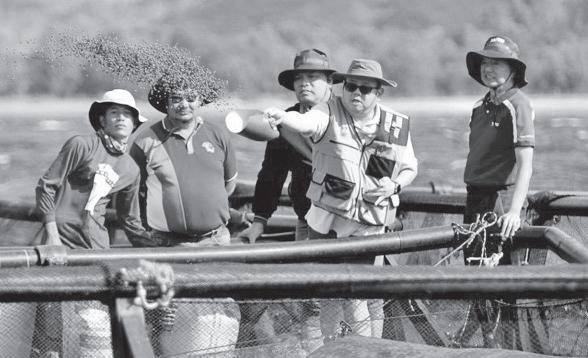
One of the major events it has hosted in recent weeks is the 7th Philippine Farm Tourism Conference in the resort island of Panglao which marked the post-pandemic resurgence of this industry subsector.
Returning after a five-year dormancy, the 3-day event was spearheaded by the International School of Sustainable Tourism (ISST) led by its president, Mina Gabor, and featured a powerhouse lineup of speakers from the government, business, and agriculture sectors.
The former Department of Tourism secretary noted that during the Covid-19 quarantine restrictions, farm sites were among the few establishments which continued to operate because of its vital role in securing food supply. She said that with the full reopening of tourism a few years back, Bohol can put its best foot (and food) forward and offering more diverse and immersive experiences to guests.
Themed, “Farm Tourism: Consciousness for Healthy Living and New Experiences,” the conference focused on the cultivation of fruit and vegetable farms, aquaculture and artisanal fisheries, and environmentally-sustainable investments.
And much like an intensive crash course, it included useful lectures on farm-to-table dining,



processing fruits and vegetables, right marketing and revenue, value-added benefits of artisanal fisheries, reviving the country’s multi-million seaweeds industry, and the prospects of pompano fish aquaculture in the coastal villages.
Bohol Governor Erico Aristotle Aumentado and first district
congressman Edgar Chatto led the provincial executives in welcomed the over 200 delegates and expressed appreciation for the opportunity to host the unique event. They noted that farm tourism will support the province’s earthfriendly initiatives after being given by the Unesco the prestigious
Global Geopark accolade last year because of its rich terrestrial and marine biodiversity.
The gathering also opened opportunities for networking and business matching among participants with the presence of regional and chapter heads of supporting institutions, Bureau of Fisheries
and Aquatic Resources (BFAR), and Philippine Exporters Confederation (Philexport).
Capping the conference is the prestigious Lakbay Bukid Awards which was conferred on five individuals and organizations which have contributed to the growth of farm tourism in Asia.
The fourth batch of awardees included millennial farmer Francis Joseph Perdigon from Butuan City; Dr. I Wayan Alit Artha Wiguna of Cau Chocolates of Bali, Indonesia; Tan Inong Manufacturers which produce artisanal rock salt, Borneo Eco Tours of Sabah, Malaysia headed by Albert Teo Chin Kion, and Malagos Agri-Ventures Corp.
of Davao City, which is known for its recreational facilities, cacao farm and chocolate museum.
The winners also received a US$1,000 prize from the family of the late tourism stalwart Bobby Joseph, which was personally awarded by his widow, Ida Rosario Joseph.
For a consummate and immersive experience, delegates toured Bohol’s farm tourism sites which are catching the attention of guests who are enamored with its fine beaches, islets, scuba diving sites and the iconic Chocolate Hills.
Farm sites which are now tourist-ready are the Loboc Cacao Farm, Asin Tibuok makers in Alburquerque, Lasang Cacao Farm in Maribojoc, Green Thumb Farm in Corella, Manay’s Farm in San Miguel, the Jagna Recycling Facility and Eco Farm, and the Ubay Stock Farm. The latter is the country’s oldest and largest government livestock facility with an area of 3,600 hectares.
Also in the itinerary were the more touristic Kinaiyahan Forest Park, a bamboo farm and restaurant in Bilar; South Farm, an upscale agri-site which is affiliated with the posh Oceanica Resort Panglao (formerly South Palms), and the multi-awarded Bohol Farms in Dauis, a farm tourism pioneer and a must-visit for its organic cuisine and quaint accommodation.
The confab is also supported by the Southeast Asian Regional Center for Graduate Study and Research in Agriculture (Searca), ASEAN Centre for Biodiversity, the Department of Tourism, Tourism Promotions Board, the Department of Trade and Industry, and Philippine Airlines.
With the mantle of hosting next year’s conference turned over to Gen. Santos City, farm tourism advocates can’t wait to fly down south in Mindanao to see its vaunted fishing industry, exotic culture, and the booming farm tourism sector of the Soccsksargen Region.

BusinessMirror Journey»life on the go Sunday, March 17, 2024 A4
Agriculture Secretary Francis tiu laurel at a Zambales pompano aqua farm
M Al Ago S chocolate Museum
rAFF A Weaving at Bohol Farms in Dauis Bernard L. Supetran
FAM ily escapade at South Farm Panglao
A Sin tibuok monument and showroom in Alburquerque Bernard L. Supetran
Kin AiyAh An Forest Park lagoon Bernard L. Supetran

3 new tilapia strains make aquaculture possible in brackish, estuarine waters
ARE you curious about the tilapia you have been eating? Did you know that tilapia strains that can be produced in both brackish water and estuarine environments have already been developed by Filipino researchers?
The University of the Philippines Visayas (UPV), with strong support from the Philippine Council for Agriculture, Aquatic and Natural Resources Research and Development of the Department of Science and Technology (DOST-PCAARRD), has developed the UPV-Saline-Tolerant Population of Improved Nilotica (SPIN) tilapia strain.
This strain was designed to thrive in brackish water and estuarine to prevent mass death due to saltwater (saline water) intrusions, caused by rising seawater levels, in tilapia-producing areas.
An estuary is an area where a freshwater river or stream meets the ocean. In estuaries, the salty ocean mixes with a freshwater river, resulting in brackish water. Brackish water is somewhat salty, but not as salty as the ocean, the National Geographic.org said.
Most affordable, but declining production
FOR years, tilapia has been one of the most affordable fish in the country, and has been significantly contributing to the national economy.
Moreover, tilapia is the second largest aquaculture-produced fish species in the Philippines with a total production of 281,114-metric tons, valued at P24.26 billion in 2021.
However, the tilapia industry is currently exhibiting minimal or slow growth with an average annual production rate of 0.82 percent from 2012–2021.
The declining production trend has been attributed to the congested and saturated production systems in lakes and cages.
Thus, tilapia harvests in freshwater lakes and fishponds appeared to have reached its maximum capacity.
Dwindling water quality caused by mismanaged production and eutrophication (excessive plant and algal growth) of rivers and lakes are also factors linked to declining tilapia production.
To advance the industry production, tilapia farming is expected to expand toward the estuarine and brackish coastal areas.
It is found that brackish water ponds and estuarine water cages have high potentials for the growth and expansion of tilapia farming.
Best performing Philippine tilapia strain
BESIDES the UPV SPIN, two other saline-tolerant tilapia strains were developed in the Philippines, the Bureau of Fisheries and Aquatic ResourcesBrackish water Enhanced Selected Tilapia (BFAR-BEST), and the BFARMolobicus strains.
To test the growth and production performance of these Philippinedeveloped saline-tolerant tilapia strains in different saline and brackish water ecosystems, UPV is conducting an investigatory research project, “Field testing and performance evaluation of saline-tolerant Philippine Tilapia strain cultured in different geographical brackishwater ecosystems.” It is also funded by DOST-PCAARRD.
The project aims to identify the ideal Philippine saline-tolerant tilapia strains for specific brackish water and high salinity coastal and riverine ecosystems.
Research results indicate that UPV SPIN and BFAR BEST tilapia strains exhibited faster growth and high survival rate in brackish water, high-saline pond culture systems, as well as in brackish water estuarine earthen ponds.
These strains attained the harvestable size of 250 grams in about 100 days of culture.
On the other hand, UPV SPIN showed the best growth performance in estuarine cage culture sites, compared to the two other tilapia strains.
Why the need for saline-tolerant tilapia strains?
THE Philippines, being archipelagic, is surrounded by a wide range of brackish estuarine waters.
Its freshwater is being used not only for the culture of inland aquatic resources, but also for human household needs, consumption and agricultural irrigation purposes.
Due to the limited carrying capacity of freshwater, and to mitigate the declining water supply for aquaculture use, tilapia aquaculture is expected to expand its production in brackish and estuarine waters.
But this is only possible through the use of saline- or salt-tolerant strains.
This initiative hopes to significantly broaden and improve tilapia quality and production.
The adoption of the UPV SPIN strain technology in brackish water cages presents a notable advantage over other marine fish being cultured.
With the technology’s simple and cost-effective fry production, along with less technical needs in tilapia culture operations, it is highly accessible to small-scale, coastal fisherfolk.
It eliminates the need for significant investments and highly skilled technicians to run the aquaculture operation, thereby ensuring economic benefits in estuarine and coastal communities. Rizza B. Ramoran/S&T Media Services

‘AI can provide more jobs if govt, biz set goals to augment human productivity’
By Reine Juvierre S. Alberto
SINCE the creation of artificial intelligence (AI) in the 1950s, humans have adopted the technology. In fact, AI does the work when you use Google to search or look for recommendations on what to watch on Netflix or YouTube.
However, after its rapid growth due to access to large amounts of data or “big data” a few years ago, large language models, a type of generative AI, such as ChatGPT, became popular for making tasks easier by generating text and content.
Since then, AI has always been subjected to scrutiny on whether it is good or bad for economic development.
This powerful technology, which is defined by McKinsey and Company as “a machine’s ability to perform the cognitive functions we associate with human minds, such as perceiving, reasoning, learning, interacting with an environment, problem-solving, and even exercising creativity,” has impacted the operation of industries, companies and businesses.
Studies have found that adopting AI, which is seen to progress given its accessibility, will definitely improve and bring efficiency to the workplace. However, it is feared that it may lead to job reduction as smart machines may be preferred over humans.
According to LinkedIn’s 2024 workplace trends survey, 55 percent of the Philippine workforce already use generative AI. The data also showed that seven out of 10 Filipinos believe their jobs will change because of AI.
During the Department of Science and Technology-National Research Council of the Philippines (DOST-NRCP) Annual (DOSTNRCP) Annual Scientific Conference and 91st General Membership Assembly, themed “Artificial Intelligence for Responsive Transdisciplinary Research toward Sustainable Scientific Future” on March 12, Filipino scientists weighed the impact of AI on whether it could lead to job losses and unemployment in a developing country like the Philippines, among other topics.
‘AI will create more jobs’
DE La Salle University Business Ethics Professor Dr. Benjamin L. Teehankee told the BusinessMirror that AI can generate more jobs if the government and businesses set a strategic goal to use AI to augment human productivity.
“It can end up increasing the volume of businesses and therefore, [create] more jobs,” Teehankee said at the sidelines of the DOST-NRCP event.
However, AI in the workplace


Rwithout any government policy or guidance, and without the private sector having a vision, will only push for efficiency, thus, lead to job losses, Teehankee warned.
On the bright side, he said if AI is coupled with human productivity for the common good, it could prevent job replacement.
He added that the national government needs to create more jobs to increase the quality of life to grow the economy and the middle class.
“Instead of a 5.6 percent GDP, or even 6 precent or 7 percent [GDP], we need to achieve growths of 8 percent every year,” he said, added that there is need to recognize the use of modern technology for this to be realized.
Even the top official of the country’s socioeconomic planning body is open to taking advantage of AI as a tool that enhances productivity rather than seeing it as a thing that will replace a person in the job.
Socioeconomic Planning Secretary Arsenio Balisacan, however, cautioned that employers may prefer automation, which may potentially lead to unemployment, now that the looming nationwide wage hike also poses a threat.
“The problem is you will just accelerate automation. The sharp increase in wages would incentivize firms to automate,” Balisacan added. (Related story: https://businessmirror.com. ph/2024/03/15/use-of-ai-inevitable-for-phl-best-to-prepareneda/)
Reskilling, retooling
THE experts discussed the concerns on AI at the event’s news conference.
University of the Philippines
Prof. Christine D. Villagonzalo said job losses due to AI are un -
likely but pressed for the need to “level up” Filipino workers.
“All the data that you feed to AI has to be validated. So someone has to check, there has to be someone that will input the data, someone has to check if the [data] is right,” Villagonzalo said in a mix of English and Filipino.
Meanwhile, Social Sciences
Prof. Maria Ana T. Quimbo pointed out that job displacements occurred because of AI.
Quimbo also cited a study by McKinsey and Company that revealed between 400 million and 800 million individuals could be displaced by automation and need to find new jobs by 2030 around the world.
Quimbo said this implies that soft skills can still never be replaced by AI, such as perseverance, self-efficacy, empathy, and being able to relate with peers and colleagues. Director Jeremaiah M. Opiniano of the University of Santo Tomas-Research Center for Social Sciences and Education said the impact of AI on jobs will depend on the level of technological advancement of the country.
Opiniano posed that the challenge for the Philippines, specifically for the education sector, is to upskill the way of teaching and to see the interdisciplinary relations, whether other disciplines where soft skills are needed see AI impacting jobs.
“Of course, we shouldn’t let AI lead to massive job displacement given the level of technological advancement in the Philippines, but we also hope to see the day that AI complements what human workers do, and then the soft skills will come eventually,” Opiniano said.
Teehankee said that he always tells his students to differentiate

attacks of biodeterioration agents. Proper maintenance is key to using indigenous materials like rattan,” Cabangon added.
DOST-FPRDI has studied various methods to protect NTFPs against biodeterioration agents—from processing, storage and transit. One method is applying wood preservatives to freshly cut and conditioned materials.
themselves from a chatbot while also showing that they have a mastery of using a chatbot, as he pushed for augmentation rather than job replacement.
‘AI must be regulated’
TEEHANKEE also raised the need for the regulation of the growing technology, citing his worry that when AI is left unsupervised, it could cause chaos instead of becoming helpful.
In 2017, Sen. Bam Aquino urged to conduct an inquiry into the government’s plan to address the negative impact of AI on employment.
Last year, Sen. Imee Marcos filed Senate Resolution 591 to call for an inquiry into the effects of AI on business process outsourcing (BPO) and original equipment manufacturing in the country.
The resolution called on the Departments of Information and Communications Technology, and of Trade and Industry to take measures that will support Filipino workers to “keep pace with the rapid advancements in AI.”
The DOST in its AI Roadmap said an upskilling program approach will be essential for workers in the IT-BPO industry since they are facing risks of losing their jobs because of process automation.
“Partnership with technology companies and universities offering AI courses are recommended for the training for AI. The government can offer scholarship programs to attract workers to participate in the upskilling program in exchange for applying the skills that they acquire from the program to Filipino companies,” it added.
DOST also said it must participate in national policy initiatives, such as the execution of DICT’s National Cybersecurity Plan 2022, which includes the updating of policies on protecting digitized transactions and electronic documents.
A framework for data security and management has to be established to help both researchers and industry adopters produce more accurate results from AI algorithms, the DOST added.
Awardees
THE DOST-NRCP event awarded experts in their respective fields. They were Dr. Victor B. Asio in agriculture and forestry; Dr. Inocencio E. Buot Jr. in biological sciences; Dr. Arvin Earvin S. Choi in engineering and industrial research; Dr. Remil L. Galay in veterinary medicine; Dr. Reynaldo L. Garcia in medical science; Dr. Maria Ana T. Quimbo in social s sciences; Dr. Mario Tan in chemical sciences; and Dr. Christine D. Villagonzalo in physics.
achieve low-moisture content and ensure proper drying of raw materials.
The institute is also researching ecofriendly ways to safeguard wood and NTFPs. One of which is through thermal modification.
According to DOST Scientist Juanito P. Jimenez, “Thermal modification uses high heat to change the kind of chemicals present in a piece of wood. This makes the material more durable as it becomes more stable [more weather-proof, less prone to swelling and shrinking] and less appetizing to termites.”
DOST-FPRDI recommends minimizing the exposure of treated materials to prolonged wetting to extend their service life.
materials, rattan furnitures and handicrafts are prone to
Another approach involves non-chemical control methods—such as kiln drying—to
“We urge the public not to be discouraged in using furniture made from rattan and other NTFPs. It is a triumph of Filipino ingenuity that indigenous materials have been showcased for public use in NAIA. Through science, technology, and innovation, we can continue to take pleasure in bug-free Filipino craftsmanship,” Cabangon pointed out. Apple Jean C. Martin-de Leon & Sheryll C. Micosa/S&T Media Service
Science Sunday BusinessMirror Sunday, March 17, 2024 www.businessmirror.com.ph • Editor: Lyn Resurreccion A5
ECENT reports of bed bugs infesting metal and wooden furnitures at Ninoy Aquino International Airport (NAIA) have raised health and safety concerns for airport facilities. To address this concern, the Department of Science and Technology (DOST) is offering support by introducing local innovations— which are already available—to enhance furnitures made from indigenous materials, such as rattan. “The news may have caused apprehension toward using rattan and other non-timber forest products [NTFP] for furniture, but the DOST-Forest Products Research and Development Institute would like to clarify that technologies and methods are available to prolong their service life,” explained DOSTFPRDI OIC Director Rico J. Cabangon. He clarified that bed bugs are attracted to the woven patterns of wicker furnitures, like rattan, not the material itself. Bed bugs thrive in items with tiny cracks and crevices, regardless of the material— whether rattan, metal, cloth, or concrete. Besides bed bugs, rattan furnitures can also be infested with biodeterioration agents, such as fungi, termites and powderpost beetles, or “bukbok.” “Rattan is one of the leading raw materials used in furniture and handicraft products. It is often combined with metals and wood to enhance its aesthetic appeal. Like any lignocellulosic
DOST provides measures for bug-free furniture These rattan materials are set for treatment against insects and other biodeterioration agents. Rattan, which is often used in furnitures are treated in order to prolong their service and protect the health of the users. DOST-FPRDI PHOTO
THE new three newly developed tilapia strains—BEST, SPIN and Molobicus—at 109 days of culture in high-salinity coastal estuarine ponds. PHOTO FROM UPV PROJECT TEAM
THE DOST-NRCP Annual Scientific Conference and 91st General Membership Assembly on March 12, themed “Artificial Intelligence for Responsive Transdisciplinary Research towards a Sustainable Scientific Future” awarded experts in their respective fields. DOST-NRCP PHOTO
A6 Sunday, March 17, 2024

Bishop against allowing civilians to own semi-automatic rifles
ACATHOLIC bishop has expressed reservations about the Philippine police move to allow civilians to own semi-automatic rifles.
Bishop Oscar Jaime Florencio of the military diocese said he is personally against allowing civilians to possess rifles, or any firearms for that matter.
“Why will we need those guns?
Give them to authorities. If civilians are allowed to have guns, it might cause another big problem,” Florencio said over Radio Veritas.
The bishop cited the situation in the United States as an example, where mass shooting incidents are
on the rise.
“In America [US], why do they have such a problem? Because they have a very lax law, wherein anyone can own a gun without that responsibility over a deadly weapon,” he lamented.
He also pointed out how such a scenario may only become acceptable if the country is in a state of war.
“[But] we are not in a state of war,” Florencio pointed out.
‘God never tires of forgiving’— Pope hears confessions at parish
ATICAN—On Friday evening last
Vweek Pope Francis traveled out of the Vatican to hear confessions and preside over a penitential service at St. Pius V Parish in Rome.
Choosing the theme “Walking in the New Life,” the pope said that the Lenten journey is a moment of interior reflection and transformation and that God never tires of forgiving.
The pope punctuated his homily several times with off-the-cuff remarks. At one point he turned to the faithful and asked them to repeat in unison: “God never tires of forgiving.”
The Holy Father implored the assembly to not “renounce God’s forgiveness, the sacrament of reconciliation,” stressing that it is “not a practice of devotion but the foundation of Christian existence.”

THE Vatican has granted permission to open the sainthood cause of a Filipino teenage girl, a Catholic bishop said.
The Vatican’s Dicastery for the Causes of Saints granted the “nihil obstat” (nothing stands in the way) document, allowing the Diocese of Laoag to start a local inquiry into the reputation and sanctity of Niña Ruiz Abad.
This indicates that Laoag Bishop Renato Mayugba, as the competent authority to initiate the diocesan process, could start the investigation.
Mayugba announced the news in a circular released last Sunday which was read in all Ilocos Norte churches.

“This new life,” the pope explained in his homily, “is the life that carries us forward in our truest identity, that of being beloved children of the Father, so that every sadness and obstacle, every effort and tribulation cannot prevail over this wonderful reality that grounds us.”
Highlighting the frenzy of modern life and the multitude of responsibilities that come with it, the pope observed the ease with which people can become distracted and led astray, forgetting “that there is already a new life that flows within us and that, like embers under the ashes, waits to blaze up and shed light on everything.”
BISHOP Oscar Jaime Florencio of the Military Ordinariate of the Philippines. CBCP NEWS
The Philippine National Police earlier made an amendment in the implementing rules and regulations of Republic Act 10591, or the Comprehensive Law in Firearms
and Ammunition. The amendment permits civilians to own and possess long firearms, but restricted to those not exceeding 7.62mm. CBCP News
Vatican allows inquiry into Filipino girl’s sainthood cause

The prelate started his letter by proclaiming “Lætare!” (Rejoice!) to the clergy, religious and lay faithful of the diocese, as the Vatican said that nothing stands in the way of the diocesan inquiry into the life of sanctity and heroic virtues of the “Servant of God.”
After securing overwhelming support from the Catholic Bishops’ Conference of the
Philippines during its July assembly last year, Mayugba submitted a detailed biography of the candidate to the Vatican dicastery and petitioned for permission to begin his investigation.
The granting of the nihil obstat by the Dicastery for the Causes of Saints is among the necessary stages in the preliminary phase
of a cause.
The bishop also announced that on April 7, Divine Mercy Sunday, the Beatification and Canonization Cause of Abad will be opened with the first session of the tribunal specially convened for this purpose
The session, which will be held at the St. William’s Cathedral Church in Laoag, will be open for the public to witness.
While awaiting the designated day for the opening of the Cause, the bishop urged the faithful “to pray for God’s blessing as we embark on this process.
Abad, the young girl from Sarrat, was described as having a strong devotion to the Eucharist and devoted her life to distributing rosaries, Bibles, prayer books, holy images, and other religious items.
Her unwavering Catholic faith made her an inspiration to numerous people in the Ilocos Norte province, as well as in her neighborhood and school in Quezon City.
Abad passed away at the age of 13 in 1993 from hypertrophic cardiomyopathy, an incurable heart disease. CBCP News
“It is not a question of knowing how to express sins well but of recognizing ourselves as sinners and throwing ourselves into the arms of Jesus crucified to be freed. It is not a moralistic gesture but the resurrection of the heart,” the pope continued.
The homily was the first public address in recent weeks, besides the past two Sunday Angeluses, that the pope delivered without having to rely on an aide to read.
The 87-year-old pontiff spoke for more than 15 minutes and seemed to be in better form nearly two weeks after the Holy See Press Office first announced that he was recovering from “mild flu” symptoms.
The pope’s visit to St. Pius V Parish, which sits about two miles from the Vatican, opened the 11th edition of the Lenten initiative “24 Hours for the Lord.”
The annual celebration, which the pope established in 2014, is promoted by the Dicastery for Evangelization and is held on the eve of the fourth Sunday in Lent, or Laetare Sunday. This year is the second time the pope will preside over the event outside of the Vatican.
“With the face of God clouded, those of our brothers clouded, the greatness we carry within us blurred, we remain on the path, but we need new signs, a change of pace, a direction that helps us find the way back to baptism, our original beauty, the sense of moving forward,” the pontiff continued.
Lent, the pope explained, is the best way to get recalibrated and to get back on a path of spiritual renewal. He observed that this task is contingent upon a willingness to connect with God and to seek his forgiveness.
It is “divine forgiveness” that “makes us new again,” the pope said, and “cleans us inside, making us return to the condition of baptismal rebirth. It makes the fresh waters of grace flow again in the heart, dried up by sadness and dusty by sins.”
Pope Francis closed his homily by asking the faithful to “welcome this new life,” after which the faithful joined the pontiff in repeating seven times aloud: “Jesus, if you want, you can purify me.”
Following the homily, the celebration continued with Eucharistic adoration while the pope moved from the sanctuary to the right aisle of the mid-20th-century church to hear confessions. Matthew Santucci/ Catholic News Agency via CBCP News

Meaning of Ramadan fasting for the hungry in Gaza, war zones
RAMADAN in the Gaza Strip this year will be anything but “normal.”
Malnutrition and disease are claiming dozens of lives. The Gaza Health Ministry said on March 6 that at least 20 people had died of malnutrition. Many others, it said, were “dying silently,” unable to reach medical facilities.
According to humanitarian organizations, the proportion of people in Gaza deprived of food exceeds any other place in the world.
What meaning can the holy month’s fast have for those who have nothing to eat?
Ramadan and the Quran FASTING in Islam requires believers to abstain from certain acts that are necessary for sustaining life—mainly eating, drinking and sex—from dawn to dusk.
But it is not just about food. It also requires that people abstain from lying or criticizing others behind their backs.
Muslims access “the sacred” primarily through the Quran, which is recited collectively from cover to cover in communal night nighttime vigils during Ramadan.

As a scholar of Islam and as a practicing Muslim, I often think of how Islamic scripture describes the purpose of this sacred month.
“Fasting is prescribed to you,” says the Quran, “that ye may learn self-restraint.”
The revelation of the Quran to Muhammad commenced in Ramadan, and Muslims take this time of the year to renew their connection
to God’s words.
Fasting in Ramadan was prescribed in 624 C.E., the second year of Islam. This was shortly after the Prophet Muhammad’s emigration from Mecca to Medina in today’s Saudi Arabia to escape persecution.
This episode, known as the Hijra, came to mark the first year of the Islamic calendar.
While Muslims may fast voluntarily throughout the year, it is mandatory in the month of Ramadan.
Sick or pregnant people, as well as travelers, must make up missed days. The chronically ill or elderly must make amends by feeding others.
Fasting in Ramadan is believed to rejuvenate spiritual strength. The Prophet Muhammad said the mere ritual of fasting without inner transformation results in nothing but hunger.
“Goodness does not consist in your turning your face towards East or West,” the Quran cautions, in reference to the orientation that is required in ritual prayer.
Rather, goodness consists in caring for the neighbor and stranger. These are principles that all religions have in common.
Ramadan and charity
IN Muslim culture, Ramadan is experienced primarily as a month of prayer, ascetic practice, family life and generosity.
A select few engage in a practice known as “i’tikaf,” a voluntary retreat in partial seclusion at the
mosque, typically during the last few days and nights.
A highlight of Ramadan is increased acts of charity and the feeding of others. Many mosques offer meals, which is believed to be an act of particular virtue at sunset to facilitate breaking of the fast, at this time of the year.
Muslims often pay their annual mandatory alms, known as “zakat,” during Ramadan in order to reap the special rewards of this month.
Islamic educational and humanitarian organizations increase their appeals for donations every year in Ramadan, and the rhythm of life in Muslim communities transforms with pre-dawn family meals, lazy mornings, working afternoons and communal feasts.
Ramadan in Gaza
THE meaning of Ramadan in a war zone is poignant for Muslims who are suffering directly. War is neither prescribed nor prohibited during Ramadan. Muhammad urged his troops to break the fast when entering into battle in order to preserve their strength.
The Battle of Badr, the first
of many military confrontations under Muhammad’s command, which became a turning point in early Islamic history, took place in Ramadan.
For those who witness that suffering on screens from the comfort of their homes, the question of moral responsibility still remains.
Muslims who seek to fulfill God’s command are “to spend out of what God has provided for them” in worthy charitable causes in Ramadan.
Many of them will ask what more could be done to feed the hungriest of hungry in the world, who are now in Gaza.
Religions help us come to terms with our mortality. They help us make sense of life beyond this life.
In a time of war and famine, when death is near, Ramadan can remind us that God is nearer: “closer than the jugular vein.”
For countless innocent victims of all ages and every gender who are breathing their last—in the direst of circumstances and the deepest of anguish—this thought can be a source of solace, if not joy.
Mahan Mirza,University of Notre Dame/The Conversation (CC) via AP
Faith
Sunday
Editor: Lyn Resurreccion • www.businessmirror.com.ph
NIÑA RUIZ ABAD DIOCESE OF LAOAG
BISHOP Renato Mayugba (right) of Laoag and Discalced Augustinian Fray Dennis Duane Ruíz (left), postulator of the Abad Cause, receive the “nihilobstat” document from Archbishop Fabio Fabene, secretary of the Dicastery for the Causes of Saints, in the Vatican on February 5. DIOCESE OF LAOAG
the
southern
on March 11. The
of communal joy
reflection, is
by the grim reality of a conflict that has claimed over 30,000 Palestinian lives and left vast swaths of Gaza in shambles. AP/FATIMA SHBAIR
RANDA BAKER (right), who was displaced by the Israeli bombardment of the Gaza Strip, prepares the Iftar (sundown meal) with her mother on the first
day of the Muslim holy fasting month of Ramadan at a makeshift tent camp in
Muwasi area,
Gaza,
holy month, typically a time
and
overshadowed
POPE Francis hears confessions after a penitential service at St. Pius V Parish in Rome on March 8. VATICAN MEDIA
 Editor: Lyn Resurreccion

V“It’s that time of the year again when we put the spotlight on our fellow inhabitants in this world, our wildlife. Wildlife can mean different things to different people,” said PEF Director of Operations Dr. Jayson Ibañez.
Despite differences in values on wildlife, Ibañez explained: “We can share a common belief that having a healthy wildlife population is good for the planet, and whatever is good for the planet should be conserved and cared for. That’s what we want to celebrate in this occasion,”
According to PEF, the World Wildlife Day commemoration aims to promote and remind people of the importance of wildlife conservation and the sustainable use of natural resources by highlighting and popularizing important themes, trends, or approaches in conservation.
With this year’s theme, “Connecting People and Planet: Exploring Digital Innovation in Wildlife Conservation,” the event encourages exploring how technological advancements can be harnessed to address the challenges of wildlife conservation, and strengthen the bond between people and the natural world, Ibañes said.
Biggest number of PHL eagle pairs
SEVEN years after the WIH started in 2018 in Davao City to promote the unique species in Davao Region and the conservation efforts of its stakeholders, it has grown into a larger campaign with the hopes of bigger impact toward empowering communities in Mindanao.
Last year, the celebration was in Sarangani province; the first time outside Davao.
“This year, this global celebration [is] in the beautiful province of Bukidnon. The province plays a significant role in the conservation efforts for the Philippine eagle and other wildlife,” Ibañez said.
PEF data reveal that Bukidnon holds the record of having the biggest number of wild Philippine eagle pairs in the country with 17 couples nesting in the province’s forests.
PHL eagle, the country’s version of Africa’s lion; apex predator
OUR Philippine eagle is our version of Africa’s lion or the Asian tiger. Our majestic
eagles are our apex predators. They help keep our biodiversity and ecosystem healthy by the distribution, abundance, and diversity of their prey. They regulate the lower species in the food chain,” Ibañez explained.
He added that the Philippine eagle is considered an umbrella species as it covers a large range of flora and fauna, citing its significance in a domino effect toward conserving other species in the wild.
“When an area is identified as nesting site, with the help of the Department of Environment and Natural Resources, the [LGU] and the Indigenous community where the nest is found, we can push that the site be declared a Critical Habitat, or a National Protected Area. This would ensure that not only the Philippine eagle is protected but would include the forest and all the species within the area,” Ibañez pointed out.
Ordinance on Bukidnon’s flagship species
FOR Bukidnon Vice Gov. Clive D. Quiño, he acknowledged that it was an honor to have WIH held in the province, where wildlife is part of the lives of the people and the province.
He said that he has been an advocate of environment protection since he was the mayor of Manolo Fortich municipality.
“The province is blessed that it currently holds the most number of Philippine eagle pairs in the entire country. Truly amazing that it also affords Bukidnon as the last frontier of environmental preservation in Mindanao,” he pointed out Quiño added that since he met Ibañez and heard of the inspiring story of Philippine eagle “Calabugao,” its strength, resilience and the message of hope, which her existence has given the people in his town, “I was moved to make concrete actions to help the [PEF] in its efforts.”
In July 2023, Quiño signed Ordinance 2023-034 “Declaring the Philippine Eagle as the flagship species in Bukidnon, under the Wildlife Resources Conservation and Protection Act, providing for the protection and conservation of the species, imposing penalties for violations and appropriating funds thereof.”
The ordinance was the first in Mindanao in creating an alpha species, or a protected flagship species.
“[It] primarily took concrete steps in penalizing persons who collect or possess the endangered eagle,” he said.
The ordinance provides incentives for wildlife enforcement officers from NGOs, citizens’ groups, community organizations and other volunteers, who have undergone training to seek illegally traded wildlife and to arrest violators of the ordinance.
The vice governor said the planet is already facing environmental problems, thus, the people should mitigate their effects to biodiversity to prevent the extinction of different species, including


the Philippine eagle.
“We have the power within our hands. We are the stewards of our planet. We must learn to work hand in hand,” he said.
Celebrating wildlife and IPs of Bukidnon
THE weeklong event recognized the importance of IP communities in Bukidnon as the primary stewards in spearheading the campaign for conservation and protection of wildlife as they live close to the forest and the different species that thrive within it.
IP groups from Guilang-guilang in Manolo Fortich; two communities of Manobo Tigwahanon from San Fernando; Umayamnon tribe from Kabanglasan; and the Bukidnon Higaonon tribe from Malaybalay attended the event.
PEF Executive Director Dennis Salvador explained the importance of IP communities in conservation initiatives.
“Our indigenous cultural communities are important for Philippine eagle conservation because being where they are, that is in the forest, they are basically the rational choice for defending the forest. They live there, take shelter, live off the land in an area in which they share with our wildlife,” Salvador said.
Since the PEF could not be in those areas all the time, he added that by empowering the communities, capacitating them, the IPs can protect their ancestral domains, at the same time protect the different wildlife species and the rich ecosystems.
“In return for clear conservation outcomes, we help in their [IPs] livelihood, educational needs, bridge access to health services, and others. We present
opportunities for our partner communities who are underprivileged to have a better life and future,” Salvador pointed out.
60% of PHL eagle in ancestral domains
DATA from PEF show that more than 60 percent of Philippine eagle habitats are within ancestral domains. Thus, partnership with the IP communities is a strategic move to strike a balance between development needs and conservation goals.
PEF started working with IP communities in 1994. It has been providing livelihood projects to villages close to identified eagle nesting sites, and assisting in formulating community development plans and livelihood support.
In 2011 PEF started training forest guards from IP areas.
Inspire Project
REBECCA R. PAZ , chief of party of Investing in Sustainability and Partnerships for Inclusive Growth and Regenerative Ecosystems (Inspire) Project, likewise, acknowledged the role of the IP communities in the management of their ancestral domain, while being guardians of the forests and the different species.
“We acknowledge and are thankful for the dedication of our IP communities toward the protection and conservation of our environment. This is where we come in supporting such communities,” Paz said.
The Inspire Project is one of the primary projects of USAID for the environment. It was established to help promote and support initiatives throughout the
Study: Europe not prepared for growing climate extremes
EUROPE is facing growing climate risks and is unprepared for them, the European Environment Agency (EEA) said in its first-ever risk assessment for the bloc a few days ago.
The agency said Europe is prone to more frequent and more punishing weather extremes—including increasing wildfires, drought, more unusual rainfall patterns and flooding—and it needs to immediately address them in order to protect its energy, food security, water and health.
These climate risks “are growing faster than our societal preparedness,” Leena Ylä-Mononen, the EEA’s executive director, said in a statement.
The report identified 36 major climate risks for the continent—such as threats to ecosystems, economies, health and food systems—and found that more than half demand greater action now.
It classified eight as needing urgent attention—like conserving ecosystems, protecting people against heat, protecting
people and infrastructure from floods and wildfires, and securing relief funds for disasters.
The report said Europe is the world’s fastest-warming continent and has been heating up twice as fast as other regions since the 1980s.
The heat has been linked to more intense rains and floods, and the report predicts rainfall decline and more severe droughts in southern Europe.
Without urgent and decisive action, it warns, many of the climate risks it identified could become catastrophic.
To reduce climate risks and improve adaptation to warming, it recommends that the EU and its member states collaborate with regional and local bodies.
The report is “a huge wake-up call” for the continent, said Manon Dufour, Brussels director for climate think tank E3G, and could have implications for climate policy at both the European and national levels.
At the European level, Dufour said the
report could “open the eyes” of European leaders who are currently most focused on security issues, as climate can affect economic and energy security.
On a national level, Dufour said finance ministers in particular should be spurred by the report “to make economic and social resilience the key priority.”
She pointed to the report’s finding that economic losses from heat waves and floods could reach €1 trillion ($1.1 trillion) a year by the end of the century.
“It’s clearly in our best interest to adapt to changing risks we can no longer avoid, including preparedness for bigger extremes and surprises, and to avoid the risks from getting further out of hand by reducing greenhouse gases,” said Maarten van Aalst, director-general at the Royal Netherlands Meteorological Institute.
Sven Harmeling, head of climate at Climate Action Network Europe, said Europe “can do more, even by 2030,” to slash emissions from the burning of coal, oil and gas, and can also step up its
investments in adapting to climate change, particularly by preserving ecosystems like wetlands and forests that can both absorb carbon and act as natural extreme weather barriers.
He urged that any efforts to reduce the impact of warming “must deliver this in a way that provides social and economic benefits for all.”
Greenpeace EU climate campaigner Silvia Pastorelli agreed, adding that the bloc should focus any resilience programs, like retrofitting homes to help with heating in winter and cooling in summer, on the most vulnerable communities. “Fairness in the climate response is essential,” Pastorelli said.
The report says the EU and its member states have made “considerable progress” in understanding their climate risks and preparing for them.
For example, Europe “has done well in relation to coastal flooding,” according to Julie Berckmans, an EEA climate risk expert.
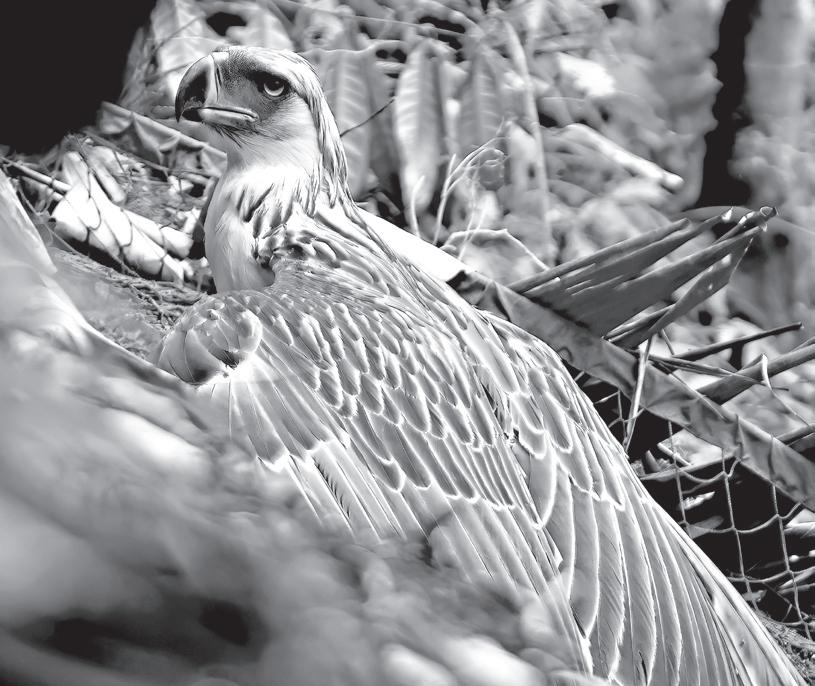
THIS January 2 photo shows 2-year-old Philippine Eagle “Lipadas” proudly sitting on the ground covering its prey, a rabbit, it just captured on the mountainside canyon along Lipadas River inside the Mt. Apo Natural Park in Davao City. The PEF prepared the prey in order to rescue the bird that was blind in its right eye. After a check by a veterinarian, Lipadas was brought to the rescue and research center in Malagos. On February 13, it was transferred to the new National Bird Breeding Sanctuary in Barangay Eden, Davao City, along with seven other eagles.

Philippines, whether in the forest or in the oceans, biodiversity conservation, the natural resources, especially towards the wildlife, she added.
It has provided funds to PEF and other NGOs in Bukidnon to support communities’ projects in conservation, and protection of wildlife and ecosystem.
“We recognize the tireless dedication of our IP’s in taking care of our environment. With their commitment, we hope to further enhance our partnerships,” Paz said.
‘One who kills the eagle also dies’ EACH IP community, including the GuilangGuilang, has its own cultural practice in protecting and conserving wildlife.
“We protect the [Philippine] eagle, and other wildlife. We believe that such majestic animals are sacred.... Anyone who kills the eagle will surely die. It is against our culture,” said Datu Honorio Sumohoy, chieftain of the Bukidnon tribe and Guilang-guilang Apo Datu Nanikunan Association Inc.
Sumohoy explained that they allow hunting only in designated areas.
They believe that the animals, the forest, the river and the land is not for just anyone to take. It was given for the people to protect and, hopefully, to pass on to their children and grandchildren to enjoy its fruits.
He said the PEF, with other partner NGOs and the LGUs, has been helpful in providing them support.
He expressed hope that more livelihood projects, training and other initiatives for livelihood will help the communities that are in the forefront of the fight for the environment.
‘IPs-based conservation works’
IN 2023, the PEF identified a juvenile Philippine eagle with the help of Sumohoy and the IPs’ forest guards, a milestone in the decades of conservation.
The mother of the juvenile bird was rehabilitated Philippine eagle, “Kalabugao,” which was rescued in 2008, when it was just a year old, and released in 2009 after rehabilitation.
In 2011, Kalabugao stayed in the forests of Guhian and Guilang Guilang. Unfortunately it managed to rip off its tracker.
Later, she paired with a male named “Gilang-gilang.” Her first egg failed to hatch,
In 2017 the pair successfully hatched their egg in the wild, named “Maluko.” The eagle family was filmed by a UK film outfit and Netflix.
“This means that our work toward conservation is one of the examples that with enough support and cooperation with our indigenous communities we can save not only the Philippine Eagle but the entire forest ecosystem as well,” Ibañez said.
He reiterated that the indigenous practices and the people who live within the forest are the best to find solutions in creating partnerships toward conservation based on existing cultural practices of the IP communities.
“We’ve seen examples of successful forest protection spearheaded by our forest guards. They have been instrumental in helping us locate eagle nesting sites and in identifying species found in their areas,” Ibañez said.
He added that it is a huge indicator that culture-based conservation works.

She said there have been no catastrophic storm floods on the continent in 60 years, and some progress has also been made in managing the health risks from heat and large river floods. But more action is needed in all these areas “because the risks are increasing rapidly,” she said.
As a case in point, heat stress to populations is at critical levels, Berckmans said. One solution, she said, is countries
and cities can improve their spatial planning to be more fit for the future health risk from heat.
The European Commission will present its plan of action on Tuesday in response to the report.
EU Commission Spokesman Tim McPhie said EEA’s report has “given a very clear warning and a very clear call to action of what’s
A7 Sunday, March 17, 2024
Biodiversity
BusinessMirror Asean Champions of Biodiversity Media Category 2014
Sunday
to come.” Carlos Mureithi & Dana Beltaji/Associated Press A GIRL drinks water from a public fountain tap to quench her thirst brought by the hot summer in Madrid, Spain, on July 18, 2023. AP/PAUL WHITE ‘WILDLIFE IS HERE’ IN BUKIDNON IPs recognized as prime wildlife stewards Story & photos by Erwin M. Mascariñas
ALENCIA CITY, Bukidnon—Indigenous Peoples’ (IPs) groups, students, environmental advocates, local government unit (LGU) representatives
and national agencies’ representatives gathered at a mall in Valencia City for the weeklong event, dubbed “Wildlife is Here” (WIH), that started on March 5. It was an annual event that started in Davao City in 2018 as part of Philippine Eagle Foundation’s (PEF) advocacy to commemorate the March 3 World Wildlife Day.
LEADERS from different Indigenous People groups gather for a ritual of thanksgiving for the success of the event.
INDIGENOUS People of Manobo Tigwahanon, from San Fernando, Bukidnon, perform a thanksgiving dance.
RIBBON-CUTTING marks the opening of the Wildlife is Here 2024 on March 5 at a mall in Valencia City, Bukidnon province. (From left, front) Datu Jimuel Perino; Rebecca R. Paz, Chief of Party Inspire Project; Bukidnon Gov. Rogelio Neil Roque; Bukidnon Vice Gov. Clive D. Quiño; Manolo Fortich Councilor Rina Quiño, (From left, back) Roger Datu Daag Limbo; PEF Director for Operation Jayson Ibañez.
Track, pool records bound to fall in Paris

ALBA, Italy—The purple pieces of vulcanized rubber track being produced at a factory in northern Italy will be run on by the world’s fastest athletes at the Paris Olympics. They have been made with one clear goal. Records.
After three world records and 12 Olympic marks were set on the track in Tokyo three years ago, expect more records to fall at the Stade de France.
That’s why Mondo, the company that has provided the track at every Summer Games since Montreal in 1976, went back to the drawing board after Tokyo.
With the help of athlete feedback and extensive testing, new generation granules that are more elastic and cohesive are being used to produce the upper layer of rubber for the Paris track.
Multiple algorithms were explored before finding a more optimal shape and dimension for the air cells inside the track, which have been designed to minimize energy loss and enhance performance.
In other words, the innovations are meant to enable Olympians to run faster, jump higher and leap further. Kind of like the Olympic motto: “Faster,
higher, stronger—together.”
“The athletes will find this track to be more reactive and better suited for their competition,” Maurizio Stroppiana, vice president of Mondo’s sport division, said during a press tour at the company’s factory in Alba, near Turin.
Produced in portions over two days this week and then rolled up for transport to France, the track will be installed at the Stade de France next week, weather permitting. It will mark the third time that Mondo has installed a new track at the Stade de France, which hosted the athletics world championships in 2003.
“It’s laid on the asphalt base and it’s glued in place,” Stroppiana said. “It’s a fairly quick process. We’re going to work 24 hours and overnight because of the limited time available and the weather.”
Another novelty for Paris is the color of the track, which will be purple for the first time at an Olympics.
“The color was a courageous decision of the local organizing committee,” Stroppiana said. “We

have never done this color before. It’s a light mauve and darker violet. It sort of recalls the landscape of France.”
REUSABLE POOLS
A THREE-HOUR drive across the country is the headquarters of another Italian company and supplier for big-time Olympic sports, Myrtha Pools.
Including training facilities, Myrtha is making 24 pools for swimming, diving, water polo and artistic swimming in Paris.
It’s the sixth Olympics that Myrtha will be providing pools for.
For the swimming races at La Defense Arena, Myrtha is installing two temporary pools inside the rugby stadium—one for competition and one for warmups and training.
Stainless steel modules being produced at the Myrtha factory in Castiglione delle Stiviere near Verona will be transported to France and bolted together to form the pool walls and floors.

CHICAGO—There is no one like Shohei Ohtani in the major leagues. Just last year, the two-way star took the mound and reached 103.5 mph during spring training with the Los Angeles Angels.
It was an incredible display by Ohtani after Tommy John surgery.
For the surgeon who performed the 2018 procedure, who heard about the impressive session through the Angels’ staff, it was a bit alarming.
“Everybody was ecstatic,” said Dr. Neal ElAttrache, the head team physician for the Dodgers. “I was maybe the only one concerned because a jump in velocity, especially after a Tommy John operation, over the course of two to three years to that magnitude is exponentially more
Player-to-player relationships: Challenge for coaches to manage
LONDON—Emma Hayes, the incoming coach of the US women’s national team, said player-toplayer relationships on teams are “inappropriate” because they present extra challenges to manage, although she acknowledged that “we’re dealing with human beings.”
Hayes is finishing out the season as manager of Chelsea in the Women’s Super League (WSL) and is expected to make her debut leading the US national team in a pair of friendly matches against South Korea in June.
Hayes spoke at a press conference Thursday ahead of a WSL match against Arsenal. She was asked about player safeguards in the context of reports in the British media that Leicester women›s manager coach Willie Kirk is being investigated by the club following an allegation of a player-coach relationship.
“We have to have safeguarding, make sure that’s it’s accessible for each and every club to protect players,” she said.
“Player-coach relationships they’re inappropriate, playerto-player relationships are inappropriate,” Hayes said. “But we have to look at it in the context of where the game has come from, and say ‘look we’re in a professional era now’ where the expectations in place for players and coaches is such that all of our focus and attention has got to be on having the top standards.”
Player-to-player relationships can be hard to navigate for a coach, she said.
“One player’s in the team, one’s not in the team,” she said in listing some of the situations that can arise.
“One might be in the last year of their contract, one might not be.
“We all know, those of us that have been in the women’s game for a long period of time, those things have been happening in dressing rooms. Longer term, it would be ideal...where you don’t have to deal with that.”
She added: “We’re dealing with human beings. We do talk about it internally.”
Hayes said it’s important to consider the historical contexts.
“Women’s football as we know has been a very amateur game for a long period of time, so—and I say this around player-to-player relationships as well—there’s challenges that we’re moving to a point where we should be moving past those places,” she said.
Pernille Harder and Magdalena Eriksson have been in a relationship for the past decade and played together at Chelsea for three seasons. They switched to Bayern Munich last summer. AP
INCOMING US women’s football team coach Emma Hayes says player-toplayer relationships on teams pose extra challenges to manage. AP
“[Building temporary pools] is a big advantage because this allows us to reinstall the pools after the event,” Myrtha CEO Roberto Colletto said.
For example, the pools used at the Tokyo Olympics in 2021— when six world records were set in swimming—were reused for the world championships in Fukuoka last year and reinstalled again at local
Ohtani’s TJ surgery, 103 mph fastball in spotlight
strain and stress on the ligament.”
ElAttrache’s concern proved prophetic, and he operated on Ohtani’s elbow again in September—this one an enhanced version of Tommy John surgery.
With the 50th anniversary of the first Tommy John procedure approaching in September, ElAttrache and Ohtani are at the center of what might be the operation’s most compelling case study. The Dodgers are betting on a successful conclusion, too. They handed a record $700 million contract to the 29-year-old Ohtani in free agency in December.
“Fifty years after the first Tommy John and 34 years after I learned how to do the operation, now a guy’s having his second operation and he’s not only expected to come back to [his] previous level of performance, it just so happens that he’s being paid to be the best player in the history of baseball,” ElAttrache said during a telephone interview with The Associated Press, “if you consider that $700 million contract.”
“And for him to stay back, because that’s a long-term contract, guaranteed money,” he continued. “It’s remarkable the confidence that the baseball world has in this procedure at this point. And, I think, rightly so.”
Following his first Tommy John procedure , Ohtani returned to the mound in July 2020. The two-time American League MVP went 34-17 with
a 2.97 ERA in 76 starts for the Angels over four seasons before he got hurt again Aug. 23 against Cincinnati.
Ohtani has dodged questions about his second elbow surgery. He said at his introductory press conference with the Dodgers in December that this operation was “completely different from my first time, so I don’t know what you want to call it. You could probably talk to my doctor about that.”
ElAttrache described Ohtani’s second operation as a hybrid procedure involving an internal brace—adding braided suture to repair the torn ligament—as well as the insertion of the tendon like what is done in a traditional Tommy John surgery.
The hybrid approach, combining the ligament replacement originated by Dr. Frank Jobe with the artificial internal brace developed by Dr. Jeffrey R. Dugas, was developed by Texas Rangers team physician Dr. Keith Meister.
“He and I are both doing the same thing, same philosophy, in adding braided suture to repair and enhance the existing torn ligament as well as putting in the new graft,” ElAttrache said. “So you’re getting all the benefits of an augmented what’s called internal brace, where you’re putting suture in to brace the elbow. I like to put that suture in the native tissue because then I know it’s perfectly anatomic and it’ll tighten at exactly the right time.” AP
schools in Japan.
Beyond the pool walls and floors, water treatment has added significance for Olympic pools.
“Transparency of water is very important because of the underwater [TV] cameras, especially now with the high definition, they need extreme transparency,” Colletto said.
“In order to achieve this we have developed a specific filtration and water treatment system. And we also have a variable speed bump system that will accelerate or reduce the speed of the water, depending on the competition mode or noncompetition mode.”
There’s also a new system designed to reduce the effects of chlorine in the water and the air that will be implemented for Paris.
So how much water does it take to fill an Olympic pool? Depending on the depth of the pools, which can range from two to three meters for swimming, between 2.5 and 4 million liters of water are needed.
“So there’s a lot of water,” Colletto said, “that needs to be poured into these pools.” AP
College swimmers, volleyball players sue NCAA regarding policies on transgenders

ATLANTA—Former Kentucky swimmer Riley Gaines was among more than a dozen college athletes who filed a lawsuit against the NCAA on Thursday, accusing it of violating their Title IX rights by allowing transgender woman Lia Thomas to compete at the national championships in 2022.
The lawsuit, filed in US District Court in Atlanta, details the shock Gaines and other swimmers felt when they learned they would have to share a locker room with Thomas at the championships in Atlanta. It documents a number of races they swam in with Thomas, including the 200-yard final in which Thomas and Gaines tied for fifth but Thomas, not Gaines, was handed the fifth-

place trophy.
Thomas swam for Pennsylvania. She competed for the men’s team at Penn before her gender transition.
Another plaintiff, Tylor Mathieu of Florida, finished ninth in the preliminary heats of the 500 free, which left her one spot from swimming in the final that Thomas would go on to win.
Thomas was the first openly transgender athlete to win a Division I title in any sport, finishing in front of three Olympic medalists for the championship. By not making the final, Mathieu was denied first-team All-American honors in that event.
Other plaintiffs included athletes from volleyball and track.
The lawsuit said the plaintiffs “bring this case to secure for future

generations of women the promise of Title IX that is being denied them and other college women” by the NCAA. “College sports are the premier stage for women’s sports in America, and while the NCAA does not comment on pending litigation, the Association and its members will continue to promote Title IX, make unprecedented investments in women’s sports and ensure fair competition in all NCAA championships,” the NCAA said in a statement.
Critics contend transgender athletes have an advantage over cisgender women in competition, though extensive research is still generally lacking on elite athletics and virtually nonexistent when it comes to determining whether, for instance, a sophomore transgender girl has a clear advantage over her cisgender opponents or teammates.
In 2022, the NCAA followed the lead of the US Olympic and Paralympic Committee and revised its policies on transgender athlete participation to attempt to align with national sports governing bodies.
The third phase of the revised policy adds national and international sports governing body standards to the NCAA’s rules and is scheduled to be implemented for the 2024-25 school year. AP
Sports BusinessMirror A8 SundAy, MArch 17, 2024 mirror_sports@yahoo.com.ph Editor: Jun Lomibao
FORMER University of Kentucky swimmer
Riley Gaines (second from right) joins a rally on January 12, 2023, outside of the NCAA Convention in San Antonio.
A WORKER checks the final surface of an athletics track at the Mondo factory in Alba, Italy, as Myrtha Pools Technical Director and Sustainability Manager Innocenzo Pochini, explains the rendering of the Paris Olympic Defence Arena pool at the Myrtha Pools factory in Castiglione delle Stiviere also in Italy. AP
SHOHEI OHTANI and the Dodgers’ chief doctor are at the center of what might be Tommy John surgery most compelling case study. AP


Equal education, unequal pay:
Why is there still a gender pay gap in 2024?
BusinessMirror March 17, 2024
MARCH 17, 2024
BRILLIANT ‘SOUNDTRACK’
Khavn and the Kontra Kino Orchestra’s new album salutes Pinoy stars of a bygone era.
By Rick Olivares
KHAVN and the Kontra Kino Orchestra’s Ang Babaeng Nauulol is one of those albums that totally slips under the radar and delivers a beautiful listen. For fans of Filipino music, this should be a welcome addition in their record collection.
When it comes to Khavn dela Cruz, I have learned to expect the unexpected. And that I have to go into every exhibit, every show, and every album with an open mind. Even a ruined heart if I may crib one of his poems and songs.
As Khavn is wont to say, “Wazak!”
Yes, indeed. Wazak nga ang pagiisip ko.
First and foremost, Khavn and the Kontra Kino Orchestra’s The Woman Who Went Mad is a soundtrack to an imaginary film! I have no idea if anyone has done that but still… what a brilliant concept. Or non-concept as Khavn will riposte.
“The concept is not to have a concept. But if push comes to shove…the concept/nonconcept or strategy is to play and record live music that is fully improvised based on live

Publisher :
T. Anthony C. Cabangon
Lourdes M. Fernandez
Editor-In-Chief :
Concept :
Aldwin M. Tolosa
Y2Z Editor :
SoundStrip Editor :
Group Creative Director : Graphic Designers :
Jt Nisay
Edwin P. Sallan
Eduardo A. Davad
Niggel Figueroa
Anabelle O. Flores
Contributing Writers :
Tony M. Maghirang
Rick Olivares
Jill Tan Radovan
Reine Juvierre S. Alberto
John Eiron R. Francisco
Pocholo Concepcion
Francine Y. Medina
Rory Visco
Bea Rollo
Photographers :
Bernard P. Testa
Nonie Reyes
Y2Z & SOUNDSTRIP are published and distributed free every Sunday by the Philippine Business Daily Mirror Publishing Inc. as a project of the
The Philippine Business Mirror Publishing, Inc., with offices on the 3rd Floor of Dominga Building III 2113 Chino Roces Avenue corner Dela Rosa Street, Makati City, Philippines.
Tel. Nos. (Editorial) 817-9467; 813-0725.
Fax line: 813-7025
Advertising Sales: 893-2019; 817-1351,817-2807.
Circulation: 893-1662; 814-0134 to 36. www.businessmirror.com.ph

instructions from me and based on a melody I have composed to an imaginary silent film that hasn’t been created,” Khavn explained.
“At that point of the recording circa 2016, neither me or the musicians have seen the story behind The Woman Who Went Mad. Maybe in our dreams.”
Second, the fact that Khavn got some 33 renowned musicians --- including Armi Millare, Cooky Chua, Ian Lofamia, Isha Abubakar, Isla Atinero, Paul Zialcita, Ronald Tomas, and Wendell Garcia among many others—top buy into this concept…ahem… or non-concept of scoring an imaginary film.
Aside from traditional instruments, The Konta Kino Orchestra made use of unconventional ones such as a blown leaf as well as drums made from plastic bottles and canisters.
“Brezel Goring recorded everyone on his four-track tape recorder and was hungry as it gobbled up as many TDK blank tapes as possible. This organic machine churned out
more than a thousand new songs in four days of extremely serious goofing around in my home studio in Mondo Manila.”
The result is a collection of 18 tracks spread across a two-record set straddling the organ music of Relly Coloma, Sylvia la Torre, free jazz, and a pioneer in Philippine music history that leads us to the third reason.
And third, to those familiar with comic books, it is like retconning an early Filipino classic. The Woman Who Went Mad is a modern take on Ang Babayeng Nauulol that was recorded by the Zarzuela Queen, Maria Carpena.
Carpena owns the distinction of being the first Filipino to be recorded on vinyl in 1908. And the Woman Who Went Mad is a nice way of paying homage to a singer who many Filipinos have never heard at all.
This mostly instrumental soundtrack also makes use of unusual instruments to complement the traditional ones to come up with something tender, beautiful, and

thought-provoking.
As a matter of fact, listening to The Woman Who Went Mad, I am reminded of that album, Rosas Epektos wherein Bing Austria and the Flippin’ Soul Stompers interpreted Khavn’s poems into song. It was far from their scorching soul music. There are traces, but I am reminded of the crooning of Victor Wood, Eddie Mesa, Bert Dominic, and Tirso Cruz III to name but a few.
Rosas Epektos was brilliant. And so is The Woman Who Went Mad…. If you like “soundtrack music” or scoring with a retro feel.
Khavn and the Kontra-Kino Orchestra’s The Woman Who Went Mad is a 2-LP set on black vinyl and in gatefold format and retails for Php 2600. This was pressed and released in Germany in late November 2023.
Precious few copies are available through independent record label Eikon Records or through Khavn dela Cruz’s personal Facebook page.
BusinessMirror YOUR MUSIC 2

March of the latest OPM singles
ALVIN CORNISTA—“Heartache’s Joy”
EMBARK on a profound odyssey with “Heartache’s Joy,” a contemporary jazz ballad that explores themes of chance, destiny, and the cyclical nature of existence. Drawing parallels from the life cycle of a dandelion, the single’s captivating music reflects on the lightness in simplicity while acknowledging the weight of external influences shaping our paths. Set on the course of its humble destiny, a dandelion, fleeting in the breeze, seeks to find a home, to grow, and to soar above its plain existence until it meets the cherishing eyes of its beholder, reflective of the true meaning of life and the eternal cycle of birth and rebirth.

PATRICIA HEART—“Kahit Di Ako ang Gusto Mo”
IN her debut single for a mainstream record label, Patricia Heart blends confessional songwriting style with a soul-stirring, crossover sound. The CamSur-based recording artist explains, “This song was written after losing one’s self in an obsessive, toxic relationship and eventually realizing the need to walk away from it in order to reclaim one’s, mined actually, sense of selflove. I have been in this kind of situation before. But it takes two to tango, so no matter how badly we want to keep a relationship, if the other person is not as invested as you do or you keep on sacrificing your worth as a person, it will never be saved.”
Buoyed by a suspenseful intro of synthesized strings and dramatic instrumentation, the soulful ballad unveils Ms. Heart’s experience as a young woman trapped in a bad situation where she struggles to find light at the end of the tunnel. Showcasing drama and, to an extent, dark humor to the mix, the budding pop/alternative talent marks her debut with an earworm that will surely gain traction among music fans of all ages, who can relate to Pat’s earnestness as a singer-songwriter.



DWTA and ARTHUR MIGUEL—“Tahan Na” THE MOTHERCAMPERS—“Kumusta?”
ON the heartfelt tune “ Tahan Na ,” acclaimed singersongwriter dwta teams up anew with chart-topping newcomer Arthur Miguel. Capturing the universal experience of longing for love and connection, “Tahan Na” expresses the realities of harbouring unrequited feelings for someone who’s not capable of reciprocating with the same level of affection. On the whole, the two recording artists capture and convey emotional vulnerability in the song.
According to the Bicolano recording star, “I realized Arthur Miguel’s singing style and emotions would add a lot to the song’s meaning and make it even more heartfelt. Our collaboration has opened up new opportunities for exploration and growth in our music. Working with Arthur Miguel is really enjoyable for me, and every time we work together, there’s always something new to learn, some adventure, and lots of fun moments.”

CLIFF—“Be Yours”
THIS track talks about how that person who swept you off your feet has made you feel the whole zoo in your stomach! While it is Cliff’s take on a Valentine’s Day anthem, its indiejazz fusion vibe with nostalgic video sounds will warm the hearts of those looking for another chance at love each time the song fills the air. It’s Cliff’s first release of 2024 that will leave love struck listeners wanting for more.
THE band told Soundstrip that this new song off their upcoming second album was originally composed in 2020 as a demo track. By the end of 2023, it has evolved into a powerful song with a simple message about connecting with people. The title’s a simple Pilipino word that can mean a lot just by saying it to anyone and once expressed, instant connection is made.
Kumusta?” is one of 15 songs the band was able to write following bursts of inspiration during three “wondercamps.” Currently, TMC is sending out demos and videos for their upcoming concept album titled “9-Hit Wonder.” “Kumusta?” Live Sa Rooftop performance is now available on social media and digital music platforms.

FILIPINO R&B stars Denise Julia and DEN Ý link up on the soulful, sultry jam “ don’t matter, an empowering track that showcases the duo’s sultry side while maintaining their individuality throughout the process. With Denise Julia’s powerhouse vocals blending hand-in-glove with DEN Ý ’s sensual coos the song transforms into an exciting singalong bop that’s centered on empowerment, freedom, and self-love—three virtues that triumph over the prospect of everything going wrong in a leap of faith. Both OPM darlings have set their personal bests on creative and commercial terms while maintaining their individuality against an overly saturated and hyper-competitive musical landscape.
MARCH 17, 2024 BUSINESS MUSIC 3
DENISE JULIA and DEN Ý—“don’t matter”
Equal education, unequal pay: Why is there still a gender pay gap in 2024?
By claire Savage The Associated Press
chIcaGO (aP)—
Not even education can close the pay gap that persists between women and men, according to a recent
US census Bureau report.
Whether women earn a post-secondary certificate or graduate from a top-tier university, they still make about 71 cents on the dollar compared with men at the same education level, Census Bureau research found.
That difference is coming into stark view on Equal Pay Day, celebrated this year on March 12, and in spite of the fact that women comprise more than half of college-educated workers and participate in the labor force at record rates.
‘substantial gap at every level’ Rath ER than comparing full-time working men to full-time working women, the Feb. 22 Census Bureau report juxtaposes men and women with the same education caliber: graduates of certificate degree programs and those who hold bachelor’s degrees from the most selective universities, explained economist Kendall h oughton, a co-author of the research. t he report also includes graduates who may have opted out of the labor force, such as women taking on child care responsibilities.
“The main point here is that there’s a substantial gap at every single level,” added Census Bureau economist and coauthor a riel Binder.
Field of study, choice of occupation and hours account for much of the discrepancy, but not all. Field of study, for instance, contributes to the pay gap much more for top graduates (24.6 percent), but for less selective degree holders accounted for only a sliver (3.8 percent). a nd the number of hours and weeks worked affect the pay gap more for certificate earners (26.4 percent) than selective bachelor’s degree earners (11.3 percent), suggesting there is a bigger gender difference in work participation for certificate holders, Binder said.
at the same time, about 31 percent of the gap for each education level remains

unexplained, suggesting less easily measured factors such as gender stereotypes and discrimination may be at play.
Worse for the minority
ChantEl aDa Ms says she isn’t surprised that the gender pay gap persists even among men and women with the same level and quality of education, or that the gap is wider for Black and hispanic women.
promoted while she was held back two years in a row.
“It’s unreasonable and unfair to hold someone’s strengths against them,” adams said. “I would consider that as something that is race-based.”
‘Fatherhood premium’
tributors to why the pay gap stubbornly remains.
For adams, the best strategy to overcome them has been to keep changing jobs—six times in 10 years, across multiple states in her case.
‘Broadly, younger women are closer to wage parity with younger men’
a senior marketing executive who holds an MBa from University of north Carolina’s Kenan-Flagler Business school, adams said her qualifications aren’t enough to counteract the headwinds she faces in her career as a Black woman.
Despite taking on extra responsibilities and an undisputedly strong performance, adams said she was turned down for a promotion because she was told that “I was so articulate and sharp that it was intimidating to some people.”
“I have nearly $300,000 of post-high school education. It would be surprising if I weren’t articulate and sharp,” said adams, who is based in Durham, north Carolina.
she said her peers at the company— one of whom did not have an MBa—were
BRoa Dly, younger women are closer to wage parity with younger men, according to Carolina a ragao, who researches social and demographic trends at Pew Research Center. But the gap widens between the ages of 35 and 44, which coincides with when women are most likely to have a child at home.
“That does not play out the same way for men,” a ragao said, adding that there is actually an opposite phenomenon known as the fatherhood premium, in which fathers tend to earn more than other workers, including men without children at home.
Despite women making vast gains in C-suite and high-earning industry representation, wage gap improvement has stalled for about 20 years, a ragao said. Uneven child care and household responsibilities, falling college wage premiums, and overrepresentation in lower-paying occupations are all con -

“I knew that I needed to be intentional and move with urgency as I navigated my career in order to work against that headwind,” she said. “When those opportunities were not afforded me within one company, I’ve gone elsewhere.”
adams said job coaching, mentorship, and support from Forte Foundation, a nonprofit focused on women’s advancement, have been instrumental to her success, while salary transparency laws— and even salary transparency within social circles—could help alleviate the significant pay gap challenges women of color face.
But corporate diversity initiatives have been subject to a growing list of lawsuits ever since the supreme Court struck down affirmative action in college admissions. adams said she worries that without affirmative action, corporate racial diversity could decrease, too.
according to adams, the big question looming over her head and “probably many other executive leaders is: What does that do to the pipeline of diverse candidates that we may or may not have 10 years from now?”
BusinessMirror march 17, 2024 4
Cover photo by Leeloo The First on Pexels.com
ChanTeL adams, a senior marketing executive, sits in her home office in durham, north Carolina. adams says she isn’t surprised that the gender pay gap persists even among men and women with the same level and quality of education, or that the gap is wider for Black and hispanic women. AP
