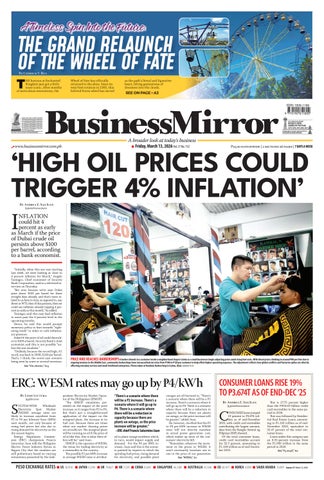
“Initially, when this war was starting last week, we were looking at close to 4 percent inflation for March,” Angelo Taningco, Chief economist of Security Bank Corporation, said in a televised interview on Thursday.
“But now, because we’ve seen Dubai price above $100 per barrel for three straight days already, and that’s more related to us here in Asia, as opposed to, say, Brent or WTI; then if this persists, then we could see inflation already topping 4 percent as early as this month,” he added.
Taningco said this may lead inflation to move past the 4-percent level in the upcoming months.
Hence, he said this would prompt monetary policy to lean towards “tightening mode” in order to curb inflationary pressure.
Asked if the price of oil could skyrocket to $200 a barrel, Security Bank’s chief economist said this is not possible “unless the war escalates.”
“Unlikely, because the record high, if I recall, was back in 2008, $140 per barrel.
That’s, I think, the worst-case scenario being seen by some or several investors.
By Lenie Lectura
ranges from P2 to P4. But that’s just a straightforward application of the impact on the marginal plant, the increase in its fuel cost. Because there are times when our market clearing prices are actually set. The marginal plant will be running on oil if the price of oil is like this, this is what their offers will be,” said Juan. IEMOP is the operator of WESM, the venue for trading electricity as a commodity in the country. The possible P2 per kWh increase in average WESM rates is attribut-
“There’s a scenario where there will be a P2 increase. There’s a scenario where it will go up to P4. There is a scenario where there will be a reduction in capacity because there are plants on outage, so the price increase will be greater.”
–ERC chief Francis Saturnino Juan
ed to plant outage incidents which, in turn, would impact supply and demand. For the P4 per kWh increase, Juan said this is the scenario painted by experts in which the spiraling fuel prices, rising demand for electricity, and possible plant
outages are all factored in. “There’s a scenario where there will be a P2 increase. There’s a scenario where it will go up to P4. There is a scenario where there will be a reduction in capacity because there are plants on outage, so the price increase will be greater,” added Juan.
He, however, clarified that the P2 to P4 per kWh increase in WESM rates will not directly manifest in actual power generation cost, which makes up most of the consumers’ electricity bill.
“Remember, whatever the movement in the prices in WESM, it won’t necessarily translate one to one in the price of our generation
By Andrea E. San Juan @andreasanjuan
CONSUMER loans jumped 19 percent to P3.674 trillion as of end-December 2025, with credit card receivables contributing the largest amount, data from the Bangko Sentral ng Pilipinas (BSP) showed. Of the total consumer loans, credit card receivables account for 32.5 percent, amounting to P1.194 trillion as of end-December 2025.
This is 27.75 percent higher than the P934.65-billion credit card receivables in the same period in 2024. This was followed by Residential Real Estate Loans, amounting to P1.193 trillion as of endDecember 2025, equivalent to 32.47 percent of the total consumer loans. Loans under this category saw an 8.55-percent increase from the P1.099 trillion in the same period in 2024.
Photo taken at Kambals
Barbershop in Cainta, Rizal. BERNARD TESTA
PHL won’t borrow to fund aid to war-impacted sectors
By Samuel P. Medenilla @sam_medenilla
ASthe government prepares for the rollout next week of its cash aid to sectors affected by the ongoing armed conflict in the Middle East, Malacañang said the government still has sufficient funds to help those affected by the crisis.
Citing a report from the Department of Finance (DOF), Palace Press Officer Claire Castro said the government currently has no plans to borrow from international lending institutions to finance the interventions.
“We have spoken and asked Secretary [Frederick] Go of the Department of Finance about it. As of now, there are no plans [to take such loans],” she said in a press briefing
On Wednesday, the Palace announced that the Department of Social Welfare and Development (DSWD) will coordinate with the Department of Transportation (DOTr), and local government units (LGU) for the first batch of distribution of the
P5,000 fuel subsidy in Metro Manila starting 17 March 2026. It will initially be distributed to tricycle drivers and will later also cover public utility vehicles (PUV), jeepneys, taxis, UV express, and Transport Network Vehicle Services. The subsidy aims to mitigate the impact of the surge in global oil prices after the United States and Israel attacked Iran.
DSWD said it has allocated P30 billion of its P60-billion funds for its Assistance to Individuals in Crisis Situation (AICS) program this year to assist the affected PUV drivers.
Castro said the Department of Agriculture (DA) is now also preparing
to distribute its fuel subsidy for farmers and fisherfolk using the Presidential Assistance to Farmers and Fisher Folk.
“With the help of the DA’s Fuel Subsidy, qualified farmers will receive five thousand pesos and three thousand pesos for fishermen,” she said.
“According to BFAR [Bureau of Fisheries and Aquatic Resources], the release of the subsidy may begin next week,” she added.
Aside from mitigating the economic impact of the high fuel prices, the government is also engaged in the repatriation of hundreds of Filipinos affected by the Middle East tensions.
The Department of Migrant Workers (DMW) will use its P2-billion Agarang Kalinga sa mga OFW na Nangangailangan (Aksyon) Fund and P3 billion to P4 billion in “operational expenses” for the repatriation.
DMW is closely monitoring the situation of overseas Filipino workers (OFW) in the countries affected by attacks from Iran, as well as ships passing through the Strait of Hormuz.
In a radio interview, DMW Secretary Hans J. Cacdac confirmed there were Filipino sailors onboard the two of the three ships hit by projectiles from Iran while passing through the waterway.
“One [of the ships] has 21 Filipino
crew and are all safe. The other has 17 Filipino crew and are all safe. They are being transported to safer ports at the moment.
The third is the Thai flag ship, there are no Filipinos there,” he said.
Based on its latest monitoring, the DMW chief said they already marked 7,313 seafarers in the Middle East, which it marked as safe.
because it depends on the exposure of the utilities to WESM. So what we’re also watching is how exposed they are.
Because if their WESM exposure is large and that’s the extent of the increases, they will bear the brunt. But if they are sufficiently contracted under power supply agreements, especially those power supply agreements that are financial in nature with no fuel pass-through, no automatic fuel pass-through, then at least their generation cost will be stable,” Juan explained.
In the case of the Manila Electric Company (Meralco), it sourced 6 percent of its requirement in the February supply month which was reflected in the March electricity bills.
Aside from WESM, power distribution utility firms source their requirements from independent power producers and power supply agreements. Juan said the upward adjustment in WESM rates will likely be reflected in the April bills of consumers.
Salceda said that interagency mechanisms already exist but need to operate faster to prevent price spikes from hitting Filipino households.
“Speed is essential. The agencies must run these programs without delay,” he added.
While excise tax relief provides temporary relief, broader supplyside emergency powers are necessary for the government to act decisively amid escalating global price shocks, Salceda argued.
“The Philippines did not choose this war, and we cannot end it. We will import many of the economic impacts. But we can do offsets, and it is incumbent upon the agencies to give the President all the tools that he needs to deal with this crisis,” he added.
On Wednesday, House Majority Leader Ferdinand Alexander Marcos of Ilocos Norte, a principal author of House Bill 8418 alongside Speaker Faustino Dy III and Ways and Means Committee Chair Miro Quimbo, said the approved measure is designed to help the government act quickly when global disruptions push up fuel costs, affecting transportation, food prices, and household expenses.
The measure approved on second reading in the House seeks to amend Section 148 of the National Internal Revenue Code of 1997, allowing the government to provide immediate relief without waiting months for new legislation during crises.
At present, petroleum products are subject to excise taxes of P10 per liter for gasoline, P6 per liter for diesel, P5 per liter for kerosene, and P3 per liter for liquefied petroleum gas (LPG).
Shift to cleaner transport
MEANWHILE, the ADB said rising oil prices could also accelerate the shift toward electric vehicles (EVs) and hybrid cars.
An ADB report showed EV demand in the Philippines remains relatively low compared with Southeast Asian peers such as Thailand, Indonesia and Vietnam, where adoption has been stronger.
ADB Chief Economist Albert Park said higher oil prices tend to strengthen the economic case for EV adoption and renewable energy investments.
“A higher oil price always helps the transition to electric vehicles. It also makes, from the government standpoint, the return to shifting to renewable energy much higher…I think it creates economic incentives to accelerate the green transition,” Park said.
Villafuerte echoed similar sentiments, noting that rising concerns over energy security— especially amid geopolitical tensions—are closely tied to discussions on the green transition.
“It’s cheaper, it’s more reliable then also investing in grids, which allows us to have power trading in the region, allows us to tap some of the renewable energy in the Northeast, Southeast Asia,” he said.
With Samuel P. Medenilla
4,500MW hour battery energy storage system.
“Through this project, we have proven that the combination of variable renewable energy with energy storage systems is a viable alternative to traditional sources of mid-merit supply which is reliant on imported fuels,” Rubio said.
Energy audits
MEANWHILE, the Department of Energy (DOE) is ramping up nationwide energy audits and spot checks in all government facilities to enforce compliance with energy efficiency standards and fully implement the Government Energy Management Program (GEMP).
All agencies must also designate Energy Efficiency and Conservation (EEC) professionals to lead implementation of conservation programs and ensure compliance with reporting requirements.
The DOE will publish compliance results of all government entities on its official website.
On fuel supply, DOE Secretary Sharon Garin assured the public that the country has enough fuel, with another batch currently in transit.
As regulator, Juan said his office can impose the secondary price cap (SPC) on the WESM to protect consumers from sustained high power prices during tight supply conditions.
The current P7.423 per kWh SPC, he explained, limits spot market clearing prices while allowing generators to recover verified costs during extreme conditions. The cap will be activated only when the three-day rolling average of spot market prices breaches P12.413 per kWh.
“First, our secondary price cap is in place, when the threshold is hit, the price needs to be lowered to a certain level. So, it will lower the average price or interval, and the sudden increases in offers in the market will not run away,” Juan said.
Another measure to avert the impact of global fuel shocks is to maximize the use of indigenous energy sources such as the Malampaya gas field. The ERC earlier convened power generation companies to discuss ways of ensuring a stable and reliable electricity supply.
“We should maximize the use of our indigenous energy resources, particularly Malampaya gas, especially in the coming months when LNG [liquefied natural gas] supply from abroad may be uncertain and global prices may not be favorable,” Juan said.
Meralco PowerGen Corporation (MGEN), the power generation arm of Meralco, said it continues to operate its generation facilities with high availability through rigorous plant maintenance and efficient operations. More important, MGEN assured the public it has sufficient fuel supply for its existing generation facilities, enabling it to meet current operational requirements, support current electricity demand, and contribute to overall grid stability.
MGEN’s reliable capacity stands at 5069.7MW. MGEN President Emmanuel Rubio said the company continues to invest in new capacities, including large scale renewable energy projects such as the 3,500MWpeak MTerra Solar combined with
“The fuel reserve, meaning what is already in the country, and what is coming in, is good for 50 days. That is enough. We are also looking for other suppliers to make sure that we have a supply after these 50 days,” Garin said.
The DOE will also make sure that oil firms are up-to-date with their fuel supply orders. “We are waiting for their report on how many new orders there are,” Garin said.
Meantime, the DOE and the Department of Information and Communications Technology (DICT) launched a new “Gas Station Concerns” feature on the eGovPH App. Through the eGovPH App, the public may report concerns involving the sale and distribution of petroleum products, including possible hoarding, unauthorized or excessive price increases, refusal to sell fuel, and other related concerns.
The DOE also reminded the oil firms that the sale of petroleum products in fuel-grade drums or containers is allowed for legitimate operational use, provided that such purchases are consistent with the customer’s normal operational requirements and comply with applicable safety standards for fuel dispensing.
This applies to end-users or consumers whose operations depend on such modes of delivery, including fishing vessels and marine equipment operators, sea transport services, hospitals and other facilities using generator sets, local government units, users of agricultural machinery and equipment, telecommunications facilities, port service transport units, and other businesses with legitimate operational requirements. Purchases must remain proportionate to a customer’s usual consumption and actual operational needs.
However, transactions that significantly exceed normal buying patterns may be subject to verification to ensure compliance with anti-hoarding regulations.
Salary-based general purpose loans
HOWEVER , the biggest jump in the data was seen in Salary-based general purpose consumption loans. Loans under this category expanded by 36.88 percent to P536.440 billion as of end-December 2025.
As defined by the BSP, this type of loan refers to “the amortized cost of unsecured loans for a broad range of consumption purposes, granted to individuals mainly on the basis of regular salary, pension or other fixed compensation, where repayment would come from such future cash flows, either through salary deductions, debits from the borrower’s deposit account, mobile payments, pay-through collections, over-thecounter payments or other type of payment arrangement agreed upon by the borrower and lender.”
However, this salary-based general purpose loans only occupy 14.60 percent of the total consumer loans as of end-December 2025. Another type of loan, Motor Vehicle Loans, saw a 14.38-percent increase to P688.02 billion as of end-December 2025 from the P601.523 billion in the same period in 2024. Of these motor vehicle loans, 94 percent were auto loans which amounted to P648.82 billion; while 6 percent were motorcycle loans, amounting to P39.20 billion. Motorcycle loans, as opposed to auto loans, saw a higher growth rate of nearly 23 percent, compared to the 13.9 percent growth rate of auto loans.
Meanwhile, “other consumer loans” amounted to P62.187 billion as of end-December 2025. Of the P3.674-trillion consumer loans, 81 percent or P2.96-trillion consumer loans flowed through universal banks; 2 percent were loaned out by commercial banks, while 17.28 percent were from thrift banks.
www.businessmirror.com.ph
House OKs on second reading two Ledac bills on education
By Jovee Marie N. dela Cruz @joveemarie
THE House of Representa -
tives has approved on second reading two priority education measures on the Legislative-Executive Development Advisory Council (Ledac) agenda of President Marcos aimed at expanding access to higher education and supporting academically outstanding students.
Approved by the chamber late Wednesday were House Bill 8477, which institutionalizes the Presidential Merit Scholarship Program (PMSP), and House Bill 8476, which proposes reforms to the Universal Access to Quality Tertiary Education Act to strengthen the Tertiary Education Subsidy (TES) and introduce a voucher pathway for poor students who choose to study in private institutions.
HB 8477 seeks to establish a permanent national scholarship system that will provide financial assistance to outstanding senior high school graduates belonging to the top 1 percent of their graduating class who enroll in priority degree programs identified by the Commission on Higher Education. The measure was principally authored by House Majority Leader Ferdinand Alexander Marcos and
several lawmakers and forms part of the administration’s priority legislative agenda under the Ledac.
Party-list Rep. Jude Acidre of Tingog, chairman of the House Committee on Higher and Technical Education, sponsored the bill and said the program aims to ensure that academically gifted Filipino students can complete their college education despite financial challenges.
The proposal traces its roots to the President’s 2025 State of the Nation Address, where he announced the creation of a meritbased scholarship program for top-performing senior high school graduates.
For the academic year 20262027, CHED has allocated more than P600 million to support around 20,000 graduates nationwide under the Bagong Pilipinas Merit Scholarship Program, which serves as the foundation of the proposed law.
Under the measure, scholars may receive stipends and other education-related allowances, subject to CHED guidelines. Students enrolled in state universities and colleges will continue to benefit from free tuition under Republic Act No. 10931.
See “Bills,” A6
DILG steps up program to push decentralization, empower LGUs
By Jonathan L. Mayuga @jonlmayuga
THE Department of the Interior and Local Government (DILG) is ramping up activities to decentralize national government functions by strengthening local autonomy and empowering local governments (LGUs) to lead governance reforms, sustainable resource management, and community development across the country.
Following President Marcos’ directive, the DILG said it has expanded its initiatives to equip LGUs with the policy tools, research support, and institutional platforms needed to lead reforms at the local level.
Through its Decentralization and Local Governance Reform Advocacy Program (DLGRAP), the Department has convened national forums, research conferences, and capacity-
building initiatives that place LGUs at the center of policy innovation and local development.
Boracay Declaration AMONG the key activities was the forum on Sustainable and Equitable Administration of Waters, Aquatic Resources, and Development in Aklan, which culminated in the adoption of the Boracay
Declaration and Call to Action.
The declaration reflects the collective commitment of local governments to protect coastal resources while ensuring that development remains inclusive and beneficial to local communities.
The forum also examined the implications of the Supreme Court ruling in Bureau of Fisheries and Aquatic Resources v Mercidar Fishing Corporation, highlighting the need for clearer policies on municipal water jurisdiction and stronger protection for municipal fisherfolk.
To further strengthen evidence-based policymaking, the Department conducted 20 decentralization conferences nationwide attended by representatives from government, civil society organizations, and academic institutions.
A total of 86 research studies were presented covering key governance issues such as fiscal autonomy following the Mandanas-Garcia Ruling, the professionalization of barangay officials, digital governance, and youth participation through the Sangguniang Kabataan. These studies will be compiled
into thematic publications this year to guide policy development and future governance reforms.
Youth engagement
DLGRAP also strengthened youth engagement through the National Youth Summit 2025 themed “Kasikat: Empowering Our Roots, Shaping Vibrant Governance,” highlighting indigenous peoples’ representation and youth leadership in local governance. Meanwhile, the Department launched a Barangay Merger Toolkit in Ormoc City to guide LGUs exploring barangay consolidation as a strategy to improve administrative efficiency and improve public service delivery.
This year, the DILG, through DLGRAP, will further expand stakeholder engagement through Talakayang Maihayag sa Bayan on Decentralization, a multisector platform that will surface reform proposals and policy recommendations from decentralization studies. The Department will also convene the 2026 ReDeCon to consolidate support for key reforms identified in last year’s commissioned research.
A6
Friday, March 13, 2026
Pharma investments may lift PHL market to ₧759B–BMI
By Bless Aubrey Ogerio
INCREASING investments and efforts to expand local drug manufacturing will drive the Philippine pharmaceutical market to grow to P759 billion ($12.1 billion) by 2030, BMI, a unit of Fitch Solutions, said.
In a recent report, BMI estimated that the market will grow from P525 billion ($9.1 billion) in 2025, translating to a five-year compound annual growth rate of 7.6 percent in local currency terms and 7.2 percent in US dollar terms. The company attributed the projected growth partly to rising investment commitments in the pharmaceutical sector and plans to expand domestic production capacity, which could strengthen the country’s manufacturing base for medicines.
In January 2026, the Philippine Chamber of Pharmaceutical Industry (PCPI) and the Food and Drug Administration (FDA) an -
nounced plans to establish a green lane system aimed at accelerating regulatory procedures for pharmaceutical companies planning to build manufacturing facilities in the country.
The framework seeks to shorten review timelines, clarify documentation requirements and improve coordination between regulators and manufacturers, while maintaining the agency’s safety, quality and efficacy standards for medicines.
“We expect these initiatives will further attract pharmaceutical companies into the Philippines, contributing to the growth of medicine manufacturing and
R&D activities,” BMI said.
Expanding local production is also seen as a way to reduce the country’s heavy reliance on imported medicines and pharmaceutical inputs, the company said.
In 2025, the Philippines posted a pharmaceutical trade deficit of $2.3 billion, reflecting its dependence on imported medicines, active pharmaceutical ingredients (APIs) and other medical products.
BMI said the deficit is largely driven by high-value imports of advanced biologics and specialty drugs, mainly sourced from the United States and the European Union. In contrast, domestic manufacturers mainly focus on generic formulations and basic medications.
The report also pointed to the country’s near-total reliance on imported APIs, particularly from China and India, as a major vulnerability in the local pharmaceutical supply chain.
Despite supportive policies and foreign investment interest, BMI said structural challenges continue to constrain the sector’s development.
“The most fundamental obstacle is the considerable gap in both financial resources and skilled human capital necessary for ad -
vanced pharmaceutical research, which limits the country’s ability to move beyond basic manufacturing into higher-value innovation activities,” the company said.
Regulatory delays also remain a concern. Although the FDA targets a 254-day timeline for drug approvals and the issuance of Certificates of Product Registration, the process often stretches to two to four years.
The research firm also cited the “lack of streamlined coordination” between key government agencies, particularly pointing to the Intellectual Property Office of the Philippines and the FDA, as another challenge affecting the industry’s growth.
Meanwhile, efforts are also underway to improve access to affordable medicines. In January, Philippine Pharma Procurement Inc. said it plans to open up to a thousand Pambansang Botika outlets this year as part of the government’s affordable medicine program through a franchise model.
PPPI President and chief executive officer Maria Blanca Kim Lokin said the expansion target could be achieved within a year if the FDA speeds up the processing of licenses to operate.
Apeco pushes Casiguran port as Pacific trade hub
THE Aurora Pacific Economic Zone and Freeport Authority (Apeco) is moving forward with its flagship infrastructure project, the Casiguran International New Port, aiming to position the country as a strategic Pacific-facing trade hub amid rising global maritime risks.
Apeco envisions the greenfield port in Aurora province as an alternative gateway for shipping and logistics, connecting Philippine manufacturing and exports
Under the modified program, the 2026 Dinamulag Festival will start on April 10, Friday, with the Dinamulag Fun Run kicking off the day’s events. This will be followed by a thanksgiving mass, the Dinamulag Mango Cooking Challenge, the 3rd Governor’s Cup Shootfest and Firearms Exhibit, and Drum and Lyre Competition.
On April 11, Saturday, the Dinamulag Mountain Bike Challenge take place, followed by the Dinamulag Airsoft Competition, Mango Industry Training, Day 2 of the 3rd Governor’s Cup Shootfest and Firearms Exhibit, and the Zamba-Tuklas Talento Grand Finals.
The last day of the festival, April 12, Sunday, will feature Day 3 of the 3rd Governor’s Cup Shootfest and Firearms Exhibit.
To spice things up, festival organizers will stage special events during the threeday program. These include the Dinamulag Cooking Vlog Challenge, Zambales Tourism Vlog Challenge, Zamba-Likha Float Design Contest, which took the place of the float competition; Mango Eating Challenge, and Pinaka-Kamanggahan Contest, that will provide prizes for the sweetest mango fruit, biggest mango fruit, and the mango tree bearing the most fruits.
Pre-festival events have also been scheduled for the Zamba-Tuklas Talento talent audition for Cluster 1 covering Olongapo City to Castillejos at SM City Olongapo Central on March 14; Cluster 2 audition for San Marcelino to Cabangan towns at the San Felipe Public mall on March 21; and Cluster 3 audition for Botolan to Santa Cruz at Balin Sambali in Iba on March 22. The Manaliw (buy) mango marketing event will also be held at SM City Olongapo Central on March 14 and 15.
to the broader Asia-Pacific region.
The project gained renewed urgency as geopolitical tensions in the Middle East and other key maritime chokepoints expose vulnerabilities in traditional trade routes.
“Apeco offers itself as a new gateway, a new trans-Pacific gateway,” Apeco president and chief executive officer Gil Taway IV said in a recent forum.
“I would say that even without wars, even without these geopo -
litical realities or risks, this new gateway is very significant for everyone to consider,” he added.
The western maritime corridor, linking Asia to Europe via the Suez Canal, the Strait of Hormuz, the Bab el-Mandeb Strait, and the Strait of Malacca, remains the backbone of regional trade but is susceptible to disruptions caused by conflict or geopolitical tensions.
Taway said the Casiguran port will provide an additional, resilient option for shipping
and logistics, strengthening the Philippines’ role in regional and global supply chains.
“By developing a modern port here, we create an alternative gateway that contributes to a more resilient maritime network,” he added.
Beyond trade, the project is expected to support logistics, manufacturing, and export activities, while expanding infrastructure on the Pacific side of the country.
Bless Aubrey Ogerio
Solon eyes regular govt program to provide help to sectors most affected by oil increases
By Jovee Marie N. dela Cruz @joveemarie
AMID a series of double-digit fuel price increases, a lawmaker has proposed establishing a regular government program that would provide targeted financial assistance to sectors most affected by rising petroleum prices.
Parañaque Rep. Brian Raymund Yamsuan filed House Bill 8340, which seeks to create a comprehensive fuel subsidy program for public transport workers, municipal fisherfolk, small farmers, agricultural producers, and other low-income groups whose livelihoods depend heavily on fuel.
The lawmaker also filed HB 8339, which would grant the President the authority to reduce or suspend excise taxes on petroleum products during national or global economic emergencies. Under the proposed measure, the President may exercise this power upon the recommendation of the secretaries of Finance and of Energy. Yamsuan said the two bills, along with his proposal to temporarily shift to work-from-home arrangements and online classes during severe oil price shocks, form a three-pronged strategy to soften the economic impact of global oil price disruptions triggered by the conflict in the Middle East.
The lawmaker emphasized that institutionalizing a fuel subsidy program would provide a stable support mechanism for vulnerable sectors instead of relying on
temporary government responses during crises.
Under the proposal, qualified beneficiaries would receive at least P7,000 per month in cash assistance. Funding for the program would be included in the annual General Appropriations Act under the budgets of the Department of Energy, Department of Transportation, Department of Agriculture, and Department of Social Welfare and Development.
“Several measures have been filed in Congress seeking to provide fuel subsidies to specific sectors, such as fisherfolk and farmers, and separate proposals focused solely on public transport drivers. This bill builds upon these efforts by integrating them into a single, comprehensive program that covers all sectors whose livelihoods are directly dependent on fuel,” Yamsuan said.
“While these occupations may differ, these beneficiaries share one reality—their ability to earn a living and the food they bring to their families’ tables are deeply and directly affected by the price of oil,” added Yamsuan, who is a vice chairperson of the House Committee on Transportation and former chairperson of the House Committee on Aquaculture and Fisheries Resources.
These databases include those maintained by the Land Transportation Franchising and Regulatory Board, the Municipal Fisherfolk Registration System, the boat registry of the Bureau of Fisheries and Aquatic Resources, and the Registry System for Basic Sectors in Agriculture.
“In this way, we would also be able to streamline the distribution of the aid,
strengthen our sectoral databases, and encourage others who should benefit from the subsidy but have not yet been captured by the system to register,” Yamsuan said. Yamsuan pointed out that these subsidies are not mere “ayuda” or dole-outs, but are necessary to help tame inflation resulting from sudden spikes in fuel prices.
“Studies done in the agriculture and fisheries sector show that subsidies, which reduce the cost of production inputs, enable small producers to sustain operations during price shocks, and maintain supply levels that help stabilize the prices of food and other basic commodities,” Yamsuan said.
The bill provides for the creation of an Advisory Council chaired by the Secretary of Transportation to review and adjust the amount of the cash subsidies whenever necessary.
Meanwhile, Navotas Rep. Tobias Tiangco is also pushing for a separate measure that seeks to institutionalize a national fuel subsidy program specifically for municipal fisherfolk.
Tiangco filed House Bill 8349, which proposes a permanent program granting P2,000 in monthly fuel assistance to qualified fisherfolk regardless of vessel classification.
He noted that while the Department of Agriculture and the Bureau of Fisheries and Aquatic Resources currently provide fuel assistance to some beneficiaries, these programs are largely temporary, limited in coverage, and dependent on annual appropriations.
www.businessmirror.com.ph
Cebu open to new Alegria oil exploration investor
By Carmel Pedroza
CEBU CITY—Cebu Gov. Pamela Baricuatro said the provincial government is open to a new investor interested in exploring the Alegria oil field, following the halt of operations by the company that managed the project.
In a news conference, Baricuatro confirmed that the earlier exploration activities in Alegria had already stopped.
The project had previously been handled by China International Mining Petroleum Ltd. Co. (CIMP), but operations stopped in 2023 following termination of contract by the Department of Energy (DOE).
Baricuatro said the provincial government has yet to formally discuss the renewed exploration proposal but acknowledged that potential investors have already approached the Capitol.
“We have yet to gather on this Alegria oil exploration. But there are already parties who have come to us,” she said.
When asked whether the province is continuously monitoring developments related to the site, the governor replied in the affirmative.
Baricuatro clarified that the previous operations in Alegria had stopped, reiterating that the earlier operator was a Chinese company that had been working in the area before she assumed office.
“Sa Alegria, na-stop na siya. The previous corporation that was operating there was a Chinese firm,” she explained.
THE Department of Trade and Industry (DTI) generated P129.68 million in sales from 335 participating micro, small, medium enterprises (MSME) over five days of the National Trade Fair (NTF).
From February 18 to 22 at SM Megamall Megatrade Halls, the DTI reported that the total sales figure covers direct cash purchases, booked orders and ongoing business negotiations initiated during the fair.
The NTF is among the government’s flagship platforms for helping small businesses expand their market reach, giving them a venue to display products and connect with potential buyers.
Throughout the five-day event, entrepreneurs showcased a wide range of locally made goods, such as home decor, fashion items, food products and environmentally friendly innovations.
Aside from retail selling, the fair also featured workshops aimed at strengthening the business capabilities of participating micro, small and medium enterprises (MSME).
Sessions covered practical topics such as the use of digital tools for marketing, shipping requirements for exports and sustainable production methods.
Further, the DTI said the event also served as a venue for business matching through the Business Connect Lounge, where entrepreneurs held meetings with corporate buyers and institutional partners.
The governor added that shortly after she took office, another group expressed interest in pursuing exploration activities in the area.
“Shortly after I took office, there were already people who approached us about it,” she said.
While no formal agreements have been announced, Baricuatro emphasized that the provincial government remains open to investments that could benefit Cebu.
“Of course, we encourage any investor would be welcome [if it offers a deal] beneficial to the province, we will work from there,” she said.
The Alegria oil field in southern Cebu previously drew national attention after oil deposits were discovered in the area, raising hopes of developing a local energy resource for the province.
At the time, oil service contractor CIMP reported that the Alegria oil field was already producing commercial volumes of both crude oil and natural gas. The discovery was estimated to contain about 27.93 million barrels of oil in place, with a projected recoverable output of roughly 3.35 million barrels—equivalent to a conservative recovery rate of about 12 percent of the total reserves. For natural gas, the recoverable resource was estimated at around 6.6 billion cubic feet, representing nearly 70 percent of the total gas present in the field. Overall gas reserves detected in the area were estimated to reach approximately 9.42 billion cubic feet.
Scholars will also receive a Certificate of Presidential Recognition signed by the president in recognition of their academic achievement.
Education subsidies HOUSE Bill 8476 seeks to widen access to free tertiary education by strengthening the Tertiary Education Subsidy (TES) and creating a voucher system for qualified beneficiaries of the government’s Pantawid Pamilyang Pilipino Program who opt to study in private higher education or technical-vocational institutions.
The substitute bill prioritizes students from 4Ps households by automatically including them in the TES once they qualify for admission to CHED-recognized higher education institutions.
For remaining slots, the measure introduces a more updated targeting system using the Community-Based Monitoring
Discussions focused on potential longterm supply agreements that could help small enterprises sustain operations beyond the duration of the fair.
Speaking to reporters on the sidelines of the fair’s opening, Trade Secretary Ma. Cristina Roque said the government plans to further expand similar initiatives this year to create more selling opportunities for MSMEs. (See: https://businessmirror. com.ph/2026/02/20/dti-plans-13-national-trade-fairs-for-2026-focus-onboosting-msme-participation-and-salesgrowth/)
Roque said the agency is targeting to hold at least 13 national trade fairs in 2026, part of a broader effort to widen market access for small businesses. The number could still increase as the department works to bring more entrepreneurs into the program.
The DTI is also looking to significantly raise the number of MSMEs to 3,000 that can participate in these trade promotion activities. Part of the plan includes staging trade fairs at the recently reopened Likhang Pilipino Exhibition Halls, which will serve as another venue for showcasing locally produced goods. At the same time, the department is working on helping MSMEs secure Halal certification, allowing them to participate in Halal-focused trade shows and access markets with growing demand for certified products.
Editor: Angel R. Calso
Iran’s unrelenting attacks on Mideast shipping and energy infrastructure send oil prices soaring
By Jon Gambrell, David Rising & Sally Abou Aljoud The Associated Press
DUBAI, United Arab Emirates— Unrelenting Iranian attacks on shipping traffic and energy infrastructure pushed oil above $100 a barrel Thursday, as American and Israeli strikes pounded the Islamic Republic with no sign of an end to the war in sight.
Iran hit a container ship off the coast of Dubai, caused a blaze near Bahrain’s international airport, targeted a major Saudi oil f ield with a drone and forced Iraq to halt operations at all of its oil terminals after attacking its port of Basra on the Persian Gulf.
Iran flouted a U.N. Security Council resolution from the previous day demanding that it halt s trikes on its Gulf neighbors with new attacks also reported in Kuwait and the United Arab Emirates.
Sirens wailed before dawn in Jerusalem after Israel said it was working to intercept missiles launched from Iran. Loud booms were heard in Jerusalem on Thursday morning but Israeli emergency s ervices said no casualties were reported so far. The country also said it began a “wide-scale wave of strikes” on Tehran. In Lebanon, where Israel says it is targeting Iran-linked Hezbollah militants, 11 people were killed in two early morning strikes.
Since the United States and Israel started the war with a Feb. 28 attack on Iran, Tehran has focused on inflicting enough global e conomic pain to pressure them to halt their attacks.
US President Donald Trump suggested that was not imminent, however, promising to “finish the job” even though he claimed Iran is “virtually destroyed.”
“We don’t want to leave early, do we? We’ve got to finish the job,” he said at an event Wednesday in Kentucky.
Iranian Supreme Leader Ayatollah Mojtaba Khamenei hasn’t y et made a statement or been seen since being chosen to succeed his father Ayatollah Ali Khamenei, who was killed in the opening day of the conflict. But Iranian President Masoud Pezeshkian suggested online Thursday that for the w ar to end, the world would need to recognize Iran’s “legitimate rights,” pay reparations and offer
guarantees against future attacks.
In addition to attacking energy infrastructure around the region, Iran has a stranglehold on the Strait of Hormuz, the waterway leading from the Persian Gulf toward the Indian Ocean through w hich a fifth of the world’s oil is transported. With traffic in the strait effectively stopped, the price of Brent c rude oil, the international standard, rose another 9% to more t han $100 a barrel, up some 38% over what it cost when the war started.
Iran fires at Gulf Arab countries and hits ship in Persian Gulf
THE U.N. Security Council voted Wednesday to approve a resolution demanding a halt to Iran’s egregious attacks” on its Gulf neighbors, but Tehran showed no signs of changing its strategy.
As the day began Thursday, a container ship in the Persian Gulf was hit with a projectile off the coast of Dubai, sparking a small fire, according to British military’s United Kingdom Maritime Trade Operations Center. It said the crew of the vessel were safe.
In Bahrain, an Iranian attack sparked a major fire on Muharraq Island, home to the country’s international airport. The airport h as jet fuel tanks, and other tanks in the area serve the kingdom’s oil industry.
Kuwait’s Defense Ministry said an Iranian drone smashed into a residential building, wounding two people. The UAE said it had activated air defenses twice to protect Dubai from attacks, and firefighters extinguished a blaze at a tower in Dubai Creek Harbor after a drone hit.
Saudi Arabia said it shot down a drone targeting the diplomatic quarter of the capital, Riyadh, and also reported downing drones in the kingdom’s east, including at least one trying to target its Shaybah oil field.
Following an attack on Iraq’s Basra port Wednesday that killed at least one person, officials said Thursday that operations were halted at all the country’s oil terminals. Farhan al-Fartousi, the director-general of the General Company for Ports of Iraq, said the a ttack targeted a vessel in a shipto-ship transfer area of the Persian Gulf port.
Explosions rock Jerusalem while Lebanon and Tehran are hit by Israeli strikes Sirens wailed and loud explosions were heard shortly after m idnight in Jerusalem and other parts of Israel. The Israeli military said it was responding with another “wide-scale wave of strikes” i n Tehran.
Overnight missile launches from Iran and Hezbollah also sent Israelis to shelters in multiple other areas, including Tel Aviv and the northern border with Lebanon. An Israeli strike hit a car Thursday in Ramlet al-Bayda, a major s easide tourist area of Beirut where dozens of displaced people have been sheltering. Eight people were killed and 31 others were wounded, the Lebanese Health Ministry said. The Israeli military press office told The Associated Press it was “not aware” of a strike at that location. In Aramoun, a town about 10 kilometers (6 miles) south of Beirut, a nother three people were killed and a child was wounded in another early Israeli attack. In Tehran, security force checkpoints came under attack for the f irst time on Wednesday night, the semiofficial Fars news agency reported. At least 10 people were killed i n the suspected drone assaults. Israel and the US military’s Central Command did not immediately r espond to requests for comment over whether they were behind the attacks.
Casualties continue to climb as conflict continues AT least 634 people have been killed in Lebanon since the latest fighting began, the Lebanese Health Ministry said Wednesday.
T he U.N. refugee agency said at least 759,000 people have been internally displaced in Lebanon. Iranian authorities say more than 1,300 people have been killed there, and Israel has reported 12 people dead. The US has lost seven soldiers while another eight have suffered severe injuries.
Abou AlJoud reported from Beirut and Rising from Bangkok. Associated Press writer Sam Mednick in Tel Aviv, Israel, also contributed to this report, along with AP journalists around the world.
SMOKE rises after an explosion at the airport in Irbil, Iraq, late Wednesday, March 11, 2026. AP PHOTO/LEO CORREA
Thai-flagged cargo vessel hit in Strait of Hormuz; 3 crew missing
By Patpicha Tanakasempipat & Suttinee Yuvejwattana
ATHAI-FLAGGED cargo vessel was struck in the Strait of Hormuz on Wednesday shortly after departing from the United Arab Emirates, as regional tensions continue to disrupt one of the world’s most critical shipping lanes. Three people are missing.
The ship, Mayuree Naree, a 30,000 deadweight-ton bulk carrier owned by Precious Shipping Pcl, was attacked while transiting the strategic waterway. Oman’s navy has rescued 20 crew members, who abandoned ship and evacuated in a lifeboat, and brought them ashore in Khasab, Thai navy spokesman Paraj Ratanajaipan said in a statement. The vessel was bound for Kandla on India’s west coast, the Indian government said in a statement that condemned the attack.
International efforts are underway to recover three remaining crew members from the vessel, Paraj said, adding that the attack remains under investigation. Pictures shared by the Thai navy showed the ship billowing thick smoke from the rear section, where it was likely hit.
Two projectiles of unknown origin struck the vessel, sparking a fire in its engine room, Precious Shipping said in a filing to the Stock Exchange of Thailand late Wednesday. Three crew members initially reported missing
are believed to be trapped in the compartment, the company said, adding that it is working with authorities to rescue them.
Precious Shipping—which operates 41 vessels under Thai, Singaporean and Panamanian flags—said it is coordinating with authorities to repatriate the crew members evacuated to Oman back to Thailand “as soon as practicable.” Omani officials reported that several crew members sustained injuries of varying severity.
Mayuree Naree is covered by warrisk insurance, and Precious Shipping said it does not expect the incident to have a material financial impact or disrupt overall operations at this stage. No cargo was lost as the vessel was sailing in ballast, it said. Precious Shipping shares slid 7.3% to 6.95 baht ($0.22) at Wednesday’s close.
Following the attack, the Thai National Shippers’ Council said the incident could further escalate tensions in the region and disrupt shipping. It advised Thai shippers carrying non-urgent goods to bring their containers back to Thailand to save costs and avoid being stranded at sea. They may also change
destination ports or temporarily store containers at transshipment ports, though these options may carry significantly higher costs.
Mayuree Naree is the only Thaiflagged vessel remaining in the area, Transport Minister Phiphat Ratchakitprakarn told reporters.
“The other Thai ships have already passed through the Strait of Hormuz,” he said. “We’ve moved beyond the most critical period. Only Mayuree Naree remains.”
Earlier Wednesday, the UK Navy said three ships were struck by suspected projectiles in the Strait of Hormuz and the Persian Gulf, though it did not identify the ships.
The incident comes amid heightened instability in the region. Traffic through the Strait of Hormuz — a vital chokepoint for global energy exports — has slowed sharply since US and Israeli airstrikes on Iran triggered retaliatory actions targeting shipping and regional infrastructure.
With assistance from Mihir Mishra/ Bloomberg
THIS image released by the Royal Thai Navy shows Thai cargo ship, Mayuree Naree, that was struck and set ablaze in the Strait of Hormuz Wednesday, March 11, 2026. ROYAL THAI NAVY
Cambodia aims to shut down all online scam centers within weeks
By Sopheng Cheang The Associated Press
HNOM PENH, Cambodia—Cam -
Pbodia hopes to shut down all of the country’s notorious online scam centers by the end of next month, the head of the Southeast Asian nation’s effort to combat the cybercrime said Wednesday.
Senior Minister Chhay Sinarith, in charge of the Commission for Combating Online Scams, told The Associated Press in an interview that the government since July had targeted 250 locations believed to be carrying out the lucrative criminal activity, and has shut down about 80%, or 200, of them.
He said police would carry out suppression activities after April in an attempt to keep the scam centers from reemerging.
Cambodia has launched previous crackdowns against online scam centers but without major effect.
“The real question is whether this effort targets the system that enables the industry, not just the buildings where scams happen,” commented Jacob Sims, an expert on transnational crime. “Past crackdowns in Cambodia have often left the financial and protection networks intact, allowing operations to quickly reconstitute.”
“So far there are few signs the current round of enforcement is reaching the key perpetrators among the Cambodian ruling elite,” said Sims, a Visiting Fellow at Harvard University’s Asia Center. “Moreover, continued restrictions on independent reporting and civil society actors make the government’s claims difficult to verify.”
Cybercrime has flourished in Southeast Asia, particularly in Cambodia and Myanmar, with scam victims around the world being bilked out of tens of billions of dollars annually, according to United Nations experts and other analysts.
The industry is closely involved in human trafficking, as foreign nationals are employed to run romance and cryptocurrency scams, often after be -
ing recruited with false job offers and then forced to work in conditions of near-slavery.
Chhay Sinarith said that in the latest crackdown the government launched 79 legal cases involving 697 alleged scam ringleaders and their associates.
At the same time, it has repatriated almost 10,000 scam center workers from 23 countries, he said, with fewer than 1,000 awaiting official repatriation. Others who have escaped or been released from raided centers have gone home on their own.
Cambodia works closely with countries, especially China and the United States, to combat the problem, he said.
Cambodian police on Tuesday raided a suspected scam center in a high-rise building in the capital, Phnom Penh, arresting about 60 Cambodians and Chinese nationals at their desks.
“They did chat to convince people in Europe to invest the money with them, but their investment is fake and fraudulent. It is not real,” said Bun Sosekha, a deputy commissioner of the Phnom Penh Municipal Police.
Earlier Wednesday, journalists were shown equipment confiscated in raids elsewhere, including uniforms and fake identification cards used by scammers to pose online as Japanese police officers to trick and intimidate victims.
Cambodia has been plagued by the illicit activity since it began on a much smaller scale around 2012, when it was primarily carried out using voice-over-internet-protocol — VOIP — phones, with the callers disguising their location and identities, Chhay Sinarith said.
The scams proliferated during the Covid-19 pandemic, when casinos, many already engaged in the gray-area activity of online gambling, no longer had in-person customers and turned to online scams on an industrial scale.
Scam centers have since spread around the world, as far as Africa and Latin America.
Associated Press writer Grant Peck in Bangkok has contributed to this report.
Iran targets busiest international airport as top UN body demands halt to attacks on Gulf neighbors
By Jon Gambrell, Sally Abou Aljoud & Lisa Mascaro
The Associated Press
DUBAI, United Arab Emirates—Iran targeted the world’s busiest international airport Wednesday and attacked commercial ships as US and Israeli strikes rocked Tehran, while the United Nations’ most powerful body demanded a halt to the Islamic Republic’s strikes on its Gulf neighbors that threaten global oil supplies.
The latest attacks marked an escalation in Iran’s campaign aimed at generating enough global economic pain to pressure the United States and Israel to end the war that started 12 days ago. But there were no signs that the conflict was subsiding. On Thursday, an Iranian attack sparked a major fire on Bahrain’s Muharraq Island, home to the island kingdom’s international airport. Authorities urged people to stay indoors and close windows to avoid smoke. The airport has jet fuel tanks, and other tanks in the area serve the kingdom’s oil industry.
Also, an attack on Iraq’s Basra port killed at least one person and forced a halt to operations at all the country’s oil terminals. Farhan al-Fartousi, the director-general of the General Company for Ports of Iraq, said the attack targeted a vessel in a shipto-ship transfer area at the port on the Persian Gulf. Iraq’s commercial ports remained open, though the oil terminals had been shut, according to his statement carried by the state-run Iraqi News Agency. The first week of war with Iran cost the United States $11.3 billion, according to the Pentagon, which provided the estimate to Congress in a briefing earlier this week, according to a person familiar with the situation who spoke on condition of anonymity to discuss the private meeting. The military reported spending $5 billion on munitions
South Korean lawmakers pass law to manage Seoul’s pledge of $350 billion US investments
By Kim Tong-Hyung The Associated Press
SEOUL, South Korea— South Korean lawmakers on Thursday passed a law to implement a pledge of $350 billion in US investments Seoul made last year to avoid the Trump administration’s highest tariffs.
Government officials had urged lawmakers to quickly pass the contested bill, submitted in November, as uncertainty mounts for the country’s trade-dependent economy, already rattled by President Donald Trump’s protectionist swing and now fearing the fallout from his war on Iran.
The bill’s passage came hours after the Trump administration increased pressure on trade partners by opening a new investigation into manufacturing in foreign countries, including China and US allies South Korea and Japan, which could result in new import taxes if US officials see their practices as unfair.
Trump and his team have made clear they’re seeking to use new tariffs to recoup lost revenue after the US Supreme Court invalidated his sweeping tariffs issued with emergency powers.
China expressed opposition to the move and called for negotiations to resolve any differences. “China opposes any form of unilateral tariff measures,” Foreign Ministry spokesperson Guo Jiakun said in Beijing. “Tariff wars and trade wars serve no one’s interests.”
The South Korean law, which passed 226 to 8, calls for establishing a public corporation to manage the promised US investments, including reviewing and selecting projects based on input from South Korean and US trade authorities.
sive Party. She said the bill does not give the legislature sufficient power to review and reject investments that could go against South Korean business or public interests.
Following months of tense negotiations, South Korea finalized an agreement with the United States in November to invest $200 billion in US semiconductor and other high-tech industries and another $150 billion in shipbuilding in exchange for Washington lowering reciprocal tariffs on Seoul from 25% to 15%.
The agreement, which followed a breakthrough at an October summit between Trump and South Korean President Lee Jae Myung, also caps South Korean investments at $20 billion a year to protect the country’s foreign currency reserves.
alone in the war’s first weekend.
Both sides have dug in, hoping to outlast the other as the conflict upends trade routes, chokes supplies of fuel and fertilizer coming out of the Gulf and threatens air traffic through one of the world’s mosttraveled regions.
Iran has targeted oil fields and refineries in Gulf Arab nations and effectively stopped cargo traffic through the narrow Strait of Hormuz, through which a fifth of all traded oil passes.
In response, the International Energy Agency agreed to release 400 million barrels of oil, the largest volume of emergency oil reserves in its history, in a bid to counter the war’s effects on energy markets. The US planned to release 172 million barrels of oil next week from its Strategic Petroleum Reserve to combat steep prices.
UN body demands Iran stop ‘egregious attacks’ on Gulf nations
THE U.N. Security Council voted Wednesday to approve a resolution demanding a halt to Iran’s “egregious attacks” on its Gulf neighbors.
Among the most recent attacks, four people were wounded after two Iranian drones hit near Dubai International Airport in the United Arab Emirates, though flights continued, the Dubai Media Office said. Firefighters extinguished a blaze early Thursday at a luxury apartment tower in Dubai Creek Harbor after an Iranian drone strike. At Oman’s Port of Salalah, crews battled a blaze at fuel storage tanks there, according to the Oman News Agency.
Abou AlJoud reported from Beirut. Mascaro reported from Washington. Associated Press writer Sam Mednick in Tel Aviv, Israel, also contributed to this report, along with AP journalists around the world.
Some lawmakers spoke against the bill ahead of the vote, expressing frustration over Trump’s new trade investigations and the potential impact of the war in the Middle East, which has exposed the vulnerability of South Korea’s export-dependent economy and reliance on imported fuel.
“We cannot be the money machine Trump wants us to be,” said Son Sol, a member of the minor opposition Progres -
Lee’s liberal Democratic Party introduced the legislation in November but faced resistance from opposition lawmakers worried about the economic impact.
The legislative holdup frustrated Trump, who in January threatened to raise tariffs on South Korean autos, pharmaceuticals and other goods back to 25%, increasing pressure on the opposition to move the bill forward.
Associated Press writer Ken Moritsugu in Beijing contributed.
THE National Assembly passes a law to implement hundreds of billions of dollars in US investments at the National Assembly in Seoul, South Korea, Thursday, March
‘Horrendously high’ airfares and bomb fears upend Asia–Europe spring travel
By K. Oanh Ha, Satviki Sanjay & Danny Lee
THE widening war with Iran
that’s roiled global travel is hitting Asia–Europe routes especially hard, sending fares soaring and leaving travelers facing record prices ahead of the Easter rush.
A cascade of more than 46,000 flight cancellations has been triggered across the region since the conflict began on Feb. 28, according to data from Cirium Ltd. The crisis wiped out as much as 10% of global airline capacity earlier this month, in the biggest aviation shock since the Covid-19 pandemic.
The sudden capacity drop from Gulf airport closures has sent airfares soaring on some key routes. One economy class round-trip ticket from Sydney to London from April 3-10 has increased by more than 80% over the past two weeks, while a business class ticket for the same route was running about 40% higher, according to a Bloomberg analysis of Google Flights data as of March 12.
A Singapore to London round-trip economy ticket, meanwhile, cost nearly triple for the same period. Fares are best-available departures ranked by Google with one or no stops, exclud -
ing flights that transit through the suspended Gulf airports.
One Sydney to London business class round-trip flight on Cathay Pacific Airways Ltd. is going for as much as $28,000. The flight departs March 31, returning April 10, and includes one segment in first class where business is sold out. Cathay blamed particularly strong demand on certain days in April, and said high load factors have resulted in elevated fares in some cabin classes on peak days.
“Current fare volatility reflects a short-term supply-demand imbalance as passengers prioritize alternative routes following recent disruptions at major Middle Eastern transit hubs,” the carrier said in a statement.
There was no letup overnight in the Middle East, with strikes hitting energy infrastructure. President Donald Trump said Wednesday that a massive release of emergency oil reserves approved by the International Energy Agency would ease energy price pressures while the US seeks to “finish the job” in its campaign against Iran. More than 2,440 people have died since the war began, with Iran and Lebanon accounting for most fatalities.
The conflict is weighing more heavily on travel than some other recent crises. Prices seen now “are unprecedented,” said Bryan Terry, managing
director of Alton Aviation Consultancy in New York.
“The demand for flights is still there, but up to half of the capacity evaporated on some routes. We’ve seen spikes during other events—9/11, the pandemic, Russian airspace closure, volcanoes—but none created the same level of demand and supply imbalance,” Terry said.
‘Grim’ sentiment KAYRA Gunawan’s spring break plans just evaporated. The 21-year-old Indo -
nesian student in the UK is foregoing her Emirates flight home to Jakarta via Dubai, unwilling to risk a lastminute scrub due to Middle Eastern strife—or pay triple to reroute away from the war-torn region.
“I won’t be going back because I don’t want to worry my family too much,” said Gunawan, who plans to travel within the UK instead. “I’m also afraid of the bombs.”
It’s not just vacationers: corporate travel is also taking a hit. Pamela Mar, an executive with the International
Chamber of Commerce in Singapore, canceled a Qatar Airways Ltd. flight this coming weekend to Frankfurt via Doha, where regular service remains suspended.
“It’s totally unpredictable and very complicated to plan travel right now,” Mar said. “You can’t rely on airlines to fly even if you can buy the ticket.” Mar rebooked on Deutsche Lufthansa AG, paying 25% more to fly via Munich just to improve her chances of making a planned meeting in time.
She’s now puzzled about the best way to get from Europe to other scheduled meetings in Nigeria and Tunisia, which typically transit through Middle Eastern hubs.
The turmoil comes as global aviation and tourism were finally nearing pre-pandemic levels, with Gulf hubs such as Dubai, Doha and Abu Dhabi cementing their role as key links between Asia and Europe. At the same time, volatile oil prices are squeezing airlines—fuel can account for up to a third of operating costs—pushing Asia-Pacific carriers from Japan Airlines Co. to AirAsia X Bhd to impose fuel surcharges.
“The sentiment in the industry and among travelers is very grim,” said Ajay Prakash, chief executive officer of Nomad Travels, which books trips for Indian travelers. “Fares are horrendously high. This is deterring all travel at the moment.” Inquiries from clients, mostly mid-sized businesses, have plunged 50% in recent days, Prakash said. India is among the most impacted markets, with the Middle East accounting for about 40% of all international flights outbound from India, according to the International Air Transport Association. The flight disruptions are prompting those still determined to travel to stay closer to home. Bookings from mainland China to the Middle East are down 40% week-on-week, said Subramania Bhatt, head of travel analytics firm China Trading Desk. Instead, there’s been a pickup in demand for shorter flights to Southeast Asia, with weekly bookings from China to Thailand up over 20% this month.
With assistance from Norman Harsono and Leen Al-Rashdan/Bloomberg
Roughly a third of traffic connecting Asia and Europe goes through the Gulf region—about 40 million passengers a year—according to consultancy Roland Berger. With many of those flights now inoperable, prices are spiking on those that bypass the Middle East, pricing some travelers out of the market.
As war spikes gas prices, drivers wonder how long it will last—and if they should go electric
By Alexa St. John & Tammy Webber
The Associated Press
WHEN Kevin Ketels bought an electric 2026 Chevrolet Blazer last year, he wasn’t thinking about the cost of gas. He just thought EVs were better and “wanted to be part of the future.” Now that the Iran war is spiking prices at the pump, the Detroit man is happy he is no longer filling up his 11-year-old gas-powered SUV.
“Electricity can go up, but it won’t go up
nearly as much as gas will and it won’t go up nearly as fast, either,” said Ketels, 55, an assistant professor of global supply chain management at Wayne State University. Experts say prolonged high gas prices may drive some EV interest and sales, especially if drivers assume their electricity prices won’t be affected by the crises. But many factors influence consumer EV purchases—and electricity rates. Are EV owners truly insulated from price hikes?
DRIVERS of gas-powered vehicles are
much more vulnerable to fluctuating prices that result from global conflict than those who charge their cars. The national average for a gallon of regular gas this week was $3.57, up from $2.94 a month ago, according to AAA.
Meanwhile, “residential electricity prices are regulated and are much less volatile than gasoline prices,” said University of California, Davis economics professor Erich Muehlegger. “As a result, EV owners are largely unaffected by oil price shocks.”
But experts say electricity prices have been increasing nationally for a variety of reasons, including surging power demand from new data centers.
“This is an inflationary event,” Holt Edwards, principal in Bracewell’s Policy Resolution Group, said of the war. “Is this the driver in electricity prices? I think probably not. But it’s certainly a contrib -
uting factor.”
To what extent oil and gas conflicts could translate to the electricity sector is yet to be seen.
What about how different grids are powered?
WHEN it comes to the electricity an EV owner is tapping, much of the cost depends on which sources of electricity are in a local grid’s power mix, experts say.
Because regulators set residential electricity prices annually, most households are sheltered from month-to-month changes in natural gas costs. Though experts say higher natural gas prices can increase the cost of generating electricity, natural gas prices haven’t risen as quickly or as much as oil prices have recently.
Those are just two of many energy sources—including coal, nuclear and re -
newables—that power the electric grid.
“The energy component varies depending on the energy you’re using and the price of the energy that you’re using to generate electricity,” said Pierpaolo Cazzola, an energy expert at Columbia University’s Center on Global Energy Policy.
“What happens is that in the US, the variation of the price of the energy component is smaller than it is elsewhere.”
The experts said persistent war could affect electricity bills in the future. And that is all the more reason for countries to transition to clean power, they said.
“Clean power and electrification combined is what provides the most security,” said Euan Graham, an analyst at energy think tank Ember.
Michael B. Klein, a 56-year-old software developer in Evanston, Illinois, has driven EVs for the past eight years to save
on fuel costs and because of environmental concerns.
Every time electrical grid efficiency improves—especially as renewables are added—“I get that benefit no matter what,” said Klein, who drives a Chevy Bolt. “They can improve the efficiency of gas engines, but you have to get a new car in order to reap the benefit of that.”
So will EV demand rise?
SEVERAL experts say high gasoline prices are a strong driver of EV sales, particularly if high prices persist. Drivers also consider more gasoline-efficient hybrid vehicles during these times.
Car-shopping resource Edmunds analyzed consumer shopping data for the week starting March 2, after the Iran war had begun. They found that interest in hybrids, plug-in hybrids and battery EVs accounted for 22.4% of all vehicle research activity on their site that week, up from 20.7% the previous week. Analysts also looked back at the last major nationwide fuel price surges in 2022, and they saw that consideration of electrified vehicles consideration rose sharply then, too. But whether this means more EV purchases depends on whether buyers expect to save not just now but also in the future, experts say.
Adding to the complexity: A sudden increase in EV demand could drive up prices, Graham said.
Iran and Lebanon urge UNESCO protection after strikes damage ancient historical sites
By Farnoush Amiri
The Associated Press
UNITED NATIONS—US and Israeli strikes on Iran have damaged at least four cultural and historical sites, including palaces and an ancient mosque, raising alarms about the impact of the widening war on protected landmarks that are important to Iranian identity and world history.
The speed and extent of the damage have so concerned Iran and Lebanon that they sent a request to the United Nations’ cultural agency, UNESCO, this week to add more sites to its enhanced protection list.
UNESCO confirmed that it has verified damage to the lavish Qajar-era Golestan Palace in Tehran as well as the 17th century Chehel Sotoun palace and the Masjed-e Jāme, the country’s oldest Friday mosque, both in Isfahan.
There also was verified damage at buildings close to the Khorramabad Valley, which includes five prehistoric caves and one rock shelter providing evidence of human occupation dating to 63,000 B.C. At Golestan Palace, shattered glass from the mirrored ceilings blanketed the floors alongside broken archways, blown-out windows and damaged molding scattered below its glassmosaic walls, according to Associated Press video taken March 3.
UNESCO said it provided all parties to the conflict with the geographical coordinates of the heritage sites ahead of time, “to take all feasible precautions to avoid damage.”
The impact to cultural sites has not been isolated to Iran but has been felt across the Middle East and beyond, with UNESCO tracking damage to the White City in Israel, Tyre in Lebanon and elsewhere.
Collateral damage to such places has been part of the fabric of war for decades, including in conflicts between Russia and Ukraine as well as
Israel and Hamas, in which dozens of sites have been damaged or destroyed.
“What is happening is clear to all: In these increasingly modern conflicts, it’s civilians who pay the price, it’s civilian infrastructure that pays the price, and we’ve all seen the destruction of priceless historical heritage,” U.N. spokesperson Stephane Dujarric said this week.
Damage to history
HUMAN rights advocates are echoing that sentiment, warning that the Iran war not only has killed more than 1,000 people but upended the institutions and historical places that communities rely on.
“It causes harm to civilians because it damages or destroys a piece of their history that can be significant both to the world and also to a specific region or community,” said Bonnie Docherty, senior researcher in the arms division at Human Rights Watch. “It undermines the sort of shared identity of a local community, which can often be important for bringing people together.”
Arash Azizi, who grew up in Iran before moving to the US as an adult, said that because his family couldn’t afford to travel abroad when he was a child, they visited historical sites across the country. This, he says, is how
he learned about his cultural identity and history.
“At times where school kids are killed, when human life is at stake, when the stakes are very high, people might think, ‘What are a couple of broken tiles or broken glasses?’” the 38-year-old New York resident said.
“I think this is the wrong attitude,” he added. “We need a cultural context. We need to know who we are, and where we come from, and what does it all mean?”
Iranian American sees one damage site as deeply personal
FOR Shabnam Emdadi, a 35-year-old Iranian American also in New York, the damage to the Safavid-era Chehel Sotoun Palace in Isfahan is deeply personal. She traveled there with her dad a few years before he died.
“Those Iran trips with him were my most fond memories of him at his happiest, where he felt most at home and alive, and I’ll never forget them,” Emdadi said. “Which is why every day when I see the damage of these sites that are the core of my memories, I feel like I am also losing a piece of him.”
It was unclear if it was US or Israeli strikes that caused the damage. The Pentagon did not provide comment. The Israeli Defense Forces said it was “unfamiliar” with claims of damage
to UNESCO sites.
One nonprofit group pointed to US Defense Secretary Pete Hegseth saying last week that America’s approach to the war would not include “stupid rules of engagement.”
“That’s an extremely important statement because it’s those rules of engagement that embody international humanitarian law, which is not just the protection of cultural heritage, but the protection of all civilian populations and structures, including your hospitals, your schools, etc.,” said Patty Gerstenblith, president of the US Committee of the Blue Shield, an international organization dedicated to protecting heritage in conflict, disaster and crisis.
UNESCO’s protections
THE affected sites are among the nearly 30 Iranian sites designated as under special protection as part of UNESCO’s World Heritage list.
Other notable landmarks on the list include the Great Wall of China, the Egyptian pyramids, the Taj Mahal and the Statue of Liberty.
The agency’s World Heritage Committee annually designates sites considered “of outstanding value to humanity” and intervenes when sites are in danger of destruction or damage. The program provides countries with technical assistance and professional training to preserve the sites.
The Trump administration announced last July that it would once again withdraw from UNESCO as it distances the US from some international organizations.
The White House cited similar concerns as it did in 2018, saying it believes US involvement is not in its national interest and accusing the agency of promoting anti-Israel speech. The decision won’t go into effect until December.
Associated Press writer Giovanna Dell’Orto in Minneapolis contributed to this report.
South Africa summons US ambassador to
explain ‘undiplomatic’ remarks on land and race laws
By Michelle Gumede & Gerald Imray
The Associated Press
JOHANNESBURG—The new US ambassador to South Africa has been summoned to explain his criticism, the country’s foreign minister said Wednesday, as a diplomatic rift continues over foreign policy that the Trump administration describes as anti-American and domestic policies it calls anti-white.
Ambassador Leo Brent Bozell III was summoned after speaking at a meeting of business leaders on Tuesday, where he challenged the South African government over its diplomatic ties with Iran and its affirmative action laws that advance opportunities for Black people ahead of other races.
The rift has grown between the former allies since President Donald Trump returned to office. Ties have plunged to their lowest point since the end of apartheid, or white minority rule, in 1994. Trump has been critical of South Africa’s Black-led government. Bozell, a conservative activist ap -
Oil prices…
Continued from A1
pointed by Trump, took up his role in Pretoria last month.
In his first detailed public comments on US-South Africa ties since arriving, B ozell said South Africa should change some of its affirmative action laws that were designed to redress the inequalities of South Africa’s decades of racial segregation under apartheid. He compared the laws to race laws that oppressed Black people during apartheid.
Bozell also called for changing a land law that allows the South African government to expropriate land without compensation in some circumstances.
“While South Africa welcomes active public diplomacy and the strengthening of bilateral ties, we emphasize that such engagements must remain consistent with established diplomatic etiquette and international protocols,” Foreign Minister Ronald Lamola told a press conference. “In this regard, we have called in the ambassador of the United States, Ambassador Bozell, to explain his undiplomatic remarks.”
Foreign ministry director-general Zane Dangor said Bozell met with South
We’re not there yet,” Taningco said, adding: “I don’t think we will reach that stage unless the war escalates.” Tracing back to 2022 when the RussianUkraine war occurred, he said the price of oil reached $120 per barrel. This, he said, brought the Philippines’s headline inflation to nearly 6 percent.
African officials and the ambassador “apologized and expressed regret.”
There was no immediate comment from the US government.
Trump’s central allegation against the South African government is his baseless claim that minority white farmers are being targeted in a campaign of violence and killings. Even some conservative white Afrikaner groups denied the Trump administration’s claims.
Trump confronted South African President Cyril Ramaphosa with those claims at a dramatic White House meeting last year that underlined the strained relationship.
Bozell did backtrack on one comment earlier Wednesday. At the meeting of business leaders, he criticized a South African court ruling that decided an apartheid-era chant repeated by a farleft opposition political party was not hate speech, despite it having the phrase “kill the Boer.” Boer refers to a white farmer in South Africa.
The Trump administration has branded the chant as anti-white hate speech. Bozell reiterated that view Tuesday: “I
“So that triggered several rate hikes back then. So if it goes up further towards that level, then we could see maybe not just one hike, potentially more than one, because of this inflation spike,” added Taningco. The research units of banks and think tanks are suspecting the Bangko Sentral ng Pilipinas (BSP) may adopt a wait-and-see approach on monetary policy, with inflation seen moving past the central bank’s 4-percent upper bound target due to “quick” passthrough from rising oil prices. Japan-based think tank Nomura said in
Young Cubans turn to church and state as cheap, synthetic drugs flood the streets
By Andrea Rodríguez The Associated Press
HAVANA—Several dozen people stood in circle in a room at a Havana psychiatric hospital, their hands held together as they chanted in unison, vowing to rid their bodies from “the toxins that enslave.” The collective plea to reclaim their freedom for just the next 24 hours was the first step of a 90-day detoxification before beginning rehabilitation.
Drug use was an almost-unknown phenomenon in Cuba until the beginning of this decade. However, a deepening economic crisis, shortages of basic goods and the emergence of low-cost synthetic drugs have combined to transform the landscape.
In Havana and other cities across the island, it is no longer unusual to see young people in public parks sleeping, walking with difficulty or lying unconscious.
According to authorities, the primary threat is the “químico,” (chemical)—a potent cocktail of synthetic cannabinoids and hazardous additives. Also known on the streets as “papelitos,” or “little papers,” the drug is absorbed into sheets of paper that are sliced into tiny doses and smoked. At roughly 250 Cuban pesos per hit (50 cents), it costs less than a basic loaf of bread or a can of soda.
“It’s very cheap...and it’s everywhere,” said David Morales, 25, who is in recovery after receiving help at government-funded health centers and is now in rehabilitation therapy at the Alcance Victoria Cuba evangelical Baptist church.
‘Zero tolerance’ ACKNOWLEDGING the rise in consumption, Cuba’s Ministry of Health and several state agencies in July established a National Drug Observatory, an initiative to research, monitor and mitigate the impact of illegal drugs on the island.
Although the government does not track the number of drug users, Dr. Tania Adriana Peón, head of mental health and addictions at the General Directorate of Health, pointed to emergency room data as a barometer for the trend. In 2024, 467 people sought help or were registered in emergency rooms in Havana. By 2025, that figure nearly doubled to 886.
am sorry, I don’t care what your courts say, it’s hate speech.” He said in an X post Wednesday his comment reflected his personal view and “the US government respects the independence and findings of South Africa’s judiciary.”
The Trump administration has taken other extraordinary steps against South Africa—its biggest trading partner in Africa—including expelling its ambassador to Washington last year and barring South Africa from meetings of the Group of 20 rich and developing nations in the US this year.
Bozell said he hadn’t come “to pick a fight” but the US had presented five requests to the South African government around a year ago to improve ties: distance itself from Iran, change parts of its affirmative action laws affecting American companies operating in South Africa, outlaw any expropriation of land without compensation, declare rural crime a priority and publicly condemn the “kill the Boer” chant.
Imray reported from Cape Town, South Africa.
its monthly economic outlook on Wednesday that the conflict in Iran “poses significant risks to the inflation outlook and external balances.”
“Reflecting changes to our oil price assumptions, we raise further our CPI inflation forecast for 2026 to 4.4 percent from 3.2 percent.”
Nomura said it expects BSP to leave its policy rate unchanged this year at 4.25 percent, instead of delivering a final 25-basispoint cut in April.
“Our higher CPI inflation forecast for
“The primary challenge Cuba faces today is related to new psychoactive drugs or synthetic cannabinoids, which originate mainly from the United States,” said Col. Juan Carlos Poey Guerra of Cuba’s Interior Ministry. He added that police laboratories detected 46 new synthetic formulations in the last year. Among the substances mixed with cannabinoids were the anticonvulsant carbamazepine, formaldehyde and fentanyl, among others. Between 2024 and 2025, he said, authorities thwarted 72 attempts to smuggle drugs into the country from 11 different origins. The United States is the primary source of the precursor substances that constitute químico, said Poey Guerra.
‘We win against drugs’ HEALTH care in Cuba is state-run and free, so neighborhood family clinics are typically the first to detect signs of drug use. Patients with more severe or complex conditions are referred by health authorities for longer, more intensive hospital stays.
The Associated Press recently toured a 40-bed men’s ward at the Havana Psychiatric Hospital, where patients aged 20 to 30 are undergoing a 90-day detox before beginning rehabilitation.
The space was divided into two-bed cubicles adorned with family photos. It featured a small reading area, a dining room and a recreation space. Each day, the patients—wearing white T-shirts emblazoned with the slogan “We win against drugs”—take responsibility for cleaning their surroundings.
“I was incredibly depressed...living on the streets; I just couldn’t take it anymore,” said 23-year-old Daniel Fulleda, who was admitted in January. His tone was enthusiastic as he shared his plans of getting married before the year end and start a family.
“Next year, I’ll start my own business.”
‘We have to pray a lot’ FOR decades, the highly centralized state was responsible for treating drug and alcohol users—especially alcohol users—but the magnitude of the challenge in recent times has opened the door for other actors.
“There are neighborhoods that are infested...I’ve seen young people using drugs right in front of me,” said Pastor Abel Pérez of the Alcance Victoria Cuba church.
Cuba has a zero-tolerance policy on drugs, and drug trafficking is punishable by up to life imprisonment. And while it’s not a drug-producing or stockpiling country, authorities acknowledge it is not immune to drug use.
Sporadically, seizures of packages of cocaine abandoned by traffickers during chases and washed ashore are reported; these are known as “recalos” or washups. Drugs are also smuggled into the country among imported goods, and, to a lesser extent, domestic marijuana plantations have been detected.
“As a pastor, I’m not called to sit idly by.” Last year, the church provided therapy to approximately 50 young people and their families and today more than a dozen individuals attend sessions regularly.
“In my youth, talking about drugs was extraordinary...The problem has grown so rapidly and in such a short time that, to some extent, it has overwhelmed the country’s capacity to address it,” said Alejandro Morales, a 57-year-old oceanographic engineer who accompanies his son David to meetings at the Alcance Victoria Cuba church.
2026 reflects a quick and full pass-through from rising oil prices,” the Japan-based think tank said. However, it noted that this could be partly mitigated by a “likely temporary cut in fuel excise taxes,” as proposed by President Ferdinand R. Marcos Jr., to which Nomura said: “Congress is likely to grant him that emergency power.” Meanwhile, Citi Research, the research arm of Citigroup Inc. (Citi), said it maintains its base-case forecast for an “extended” BSP rate pause.
“By our calculation, [the] Philippines’ trade deficit of mineral fuels [oil, gas and coal] of 3.4 percent of GDP in 2025 could easily widen to the 4-percent handle if current prices persist, thereby weakening the [balance of payments] BoP,” added Citi. The research arm of Citi said the case for immediate hiking is “not yet as compelling as during the 2022 oil shock” which led to rate increases. See:https://businessmirror. com.ph/2026/03/11/bsp-may-stay-cautious-evenas-inflation-accelerates-due-to-rising-oil-pricessays-analysts/
CHED, DOST forge stronger ties to boost PHL innovation, global competitiveness
By Claudeth Mocon-Ciriaco @claudethmc3
TO establish a clearer pathway for knowledge creation, innovation, and technology adoption, the Commission on Higher Education (CHED) and the Department of Science and Technology (DOST) unveiled key initiatives to strengthen research and innovation.
This included the memorandum of understanding between CHED and DOST-Philippine Council for Agriculture, Aquatic and Natural Resources Research (PCAARRD) and Development for the Tech -
MIAA shifts to four-day work week to cut costs
Tnology Business Incubation Program, and the introduction of the Philippine Technology Evaluation and Standards for Testing (PHITEST), aimed at enhancing testing infrastructure and boosting the global competitiveness of Filipino innovations.
Marking the second day of the three-day Higher Education Summit on Wednesday (March 11), the Action Summit: Higher Education, Science, and Technology at the SMX Convention Center Clark, brought together leaders from local and international government, academia, and industry to strengthen collaboration toward achieving the United Nations Sustainable Development Goals (SDGs).
Held under the theme “Towards a Unified Higher Education Path -
way for Achieving the SDGs,” the summit provided a platform for multi-sectoral dialogue and cooperation to drive innovation-led growth and national development. It focuses on aligning academic programs, research, and innovation with national science, technology, and innovation priorities.
CHED Chairperson Shirley Agrupis underscored the role of higher education at the forefront of achieving the SDGs.
“The Philippines already has the institutions, the talent, and the knowledge base necessary to accelerate progress toward the Sustainable Development Goals. What we must do now is align them more deliberately and mobilize them strategically,” Agrupis said.
OPAPRU hails House for passing bill resetting BARMM elections
By Rex Anthony Naval
DOST Secretary Renato Solidum added, “The Sustainable Development Goals cannot be achieved by any nation alone. Science thrives on collaboration, through partnerships with research institutions, universities, international organizations, local government units, and the private sector, the Philippines ensures that scientific discoveries become tools for national and global impact.”
The summit gathered officials from government agencies, leaders of State Universities and Colleges (SUCs), private Higher Education Institutions (HEIs), and industry partners. Discussions focused on policy convergence, research excellence, and developing future-ready skills through stronger industry–
academe–government collaboration. The fireside chat and panel discussion featured esteemed officials from DOST, the Department of Economy, Planning, and Development (DepDev), Philippine Accrediting Association of Schools, Colleges, and Universities (PASUC), Association of Local Colleges and Universities (ALCU), University of the Philippines (UP), Philippine Chamber of Commerce and Industry (PCCI), and Mariano Marcos State University (MMSU). Also present to provide global perspectives on SDG solutions were representatives from the UNESCO National Commission, the National Secretariat of the SDGs under the National Development Planning Agency of Indonesia, and Sunway University of Malaysia.
16 of the alleged 18 ‘marines’ show up before the NBI for questioning
By Nonie Reyes @Nonielonlon
O save on operational costs amid the ongoing conflict in the Middle East, the Manila International Airport Authority (MIAA) is implementing a four-day work week for its administration employees.
Following a directive from President Ferdinand Marcos Jr. for government agencies to tighten their belts, MIAA General Manager Eric Ines issued a memo on March 9, 2026, making the new schedule effective immediately.
Under the new setup, both regular and contract administration personnel will work onsite from Monday to Thursday, 8:00 a.m. to 7:00 p.m. They will have a three-day weekend from Friday to Sunday. The agency expects this shortened week to significantly reduce electricity and other utility expenses.
Essential services affected WHILE office workers shift to the new schedule, critical operational units will maintain their regular shifting hours. These include the Airport Police Department, Operations and Compliance Group, Engineering Services, and Medical Services.
These frontline units are essential for MIAA’s continuous oversight of the New NAIA Infra Corp (NNIC), the private operator managing the Ninoy Aquino International Airport.
Push for energy conservation
The four-day work week is part of a broader push by MIAA to conserve energy. The agency is strictly enforcing existing energy-saving rules, such as maintaining office air conditioning at 24°C, using LED bulbs, and arranging workspaces near windows to maximize natural sunlight and turn off unnecessary lights.
Moving forward, MIAA plans to invest more heavily in renewable energy. The agency recently installed solar panels on a building near the Our Lady of the Airways Parish.
“The long-term benefits of using solar panels in alleviating climate change far outweigh the significant investment that will be required initially,” Ines said.
THE Office of the Presidential Adviser on Peace, Reconciliation and Unity (OPAPRU) lauded the leadership of the House of Representatives for passing the bill that allowed the resetting of the first parliamentary elections in the Bangsamoro Autonomous Region in Muslim Mindanao (BARMM) on the second Monday of this coming September.
In a statement late Wednesday night, OPAPRU Secretary Carlito Galvez Jr. commended and expressed the agency’s gratitude to the House of Representatives, led by Speaker Faustino “Bojie” Dy and Majority Floor Leader Rep. Ferdinand Alexander Marcos for making this possible.
“We also thank Lanao del Sur Rep. Zia Alonto Adiong, the principal author of House Bill [HB] 8220, for the unwavering commitment and sense of urgency he
has shown in ensuring the bill’s passage, particularly in making his fellow legislators understand the profound significance of the BARMM elections and how it will enable the people of the Bangsamoro to chart the socioeconomic and political future of the region,” he added.
The House of Representatives passed this bill on its third and final reading last March 10.
A similar bill was passed by the Senate on March 2.
“With the approval of the House of Representatives and the Senate of their respective bills setting the date of the BARMM polls, the Commission on Elections can now focus on the equally important task of informing the people on the guidelines of the elections, and laying the groundwork that will ensure that the highly-anticipated political exercise will be held in a peaceful, orderly and credible manner,” Galvez said.
He also noted that since the
BARMM’s creation seven years ago, the region has gone through a remarkable transformation that has turned it from a once conflictridden area into a show window of peace and development.
“We believe that the upcoming regional elections will allow the region to sustain and build on the gains that have been achieved, while enabling its leadership to implement policies that will bring greater inclusivity, prosperity, and stability,” the OPAPRU chief noted.
Likewise, Galvez reiterated the agency’s esteem to legislators from both Houses of Congress for the genuine concern and steadfast support these lawmakers have given to our Bangsamoro brothers and sisters.
“We look forward to your upcoming bi-cameral session, wherein you will be deliberating on the final form of the bill that will officially set the date of the BARMM elections,” he concluded.
DAR empowers Cavite farmers with new heavy tractor to boost farm productivity
THE Department of Agrarian Reform (DAR) has awarded a group of agrarian reform beneficiaries (ARBs) in Cavite a new 50-horsepower heavy tractor with complete implements.
The tractor will make farming faster, easier, more productive, and more enjoyable for members of the Pacheco Agrarian Reform Cooperative (PAR-C).
The support is part of DAR’s continuing effort to help agrarian reform beneficiaries modernize farming in the rural areas.
DAR Secretary Conrado Estrella III earlier said the distribution of farm machinery is one of the agency’s ways of encouraging farmers to remain active in agriculture while making farm work more efficient.
“Making farming handy and fun is generally our main objective in our effort to revive the interest of our farmers and keep them busy as bees
while helping resuscitate our agriculture industry,” Estrella said
“This is our small way of helping our farmers, for the more they work harder, the higher their income will be. Everything will redound for the benefit of our rural economy,” he added.
PAR-C chairperson Ernie Somogod thanked the DAR for the new heavy tractor, which he said could make farming much easier and more encouraging.
“This is a big help for us farmers, for we can till a hectare of farm in just oneand-a-half hours compared to a week, using the traditional plowing tools with carabao or a hand tractor,” Somogod said in Filipino during a symbolic turn-over at the Buhay Resort in Magallanes, Cavite.
The farmers’ organization also benefited from a solarpowered irrigation system the DAR constructed for them, enabling year-round farming.
“Before, we could do farming
during the rainy season. Now, there is no limit,” Somogod said Director III and concurrent DAR-Cavite provincial agrarian reform program officer James Arthur Dubongco stressed that the use of the heavy tractor is not exclusively for members of the PAR-C but also for nonmembers.
“The PAR-C can charge an appropriate user’s fee for the use of the heavy tractor. The profits derived from it will be used for operations and maintenance and the creation of a reserve fund to buy a new one for future replacement,” Dubongco said.
Dubongco, however, stressed that misuse of the heavy tractor or misappropriation of funds derived from its operation would lead to the rescission of the grant and “the PAR-C shall reimburse the DAR for its acquisition cost without prejudice to the filing of appropriate criminal and/or civil actions against its officers.
Jonathan L. Mayuga
SBy Joel R. San Juan @jrsanjuan1573
IXTEEN of the 18 alleged members of the “marines” on Thursday heeded the subpoena issued by the National Bureau of Investigation (NBI) in order to shed light on their claims that they were tasked by resigned Ako Bicol Partylist Rep. Zaldy Co to distribute numerous luggage totaling to more than P800 billion to several political figures including President Marcos Jr. and former House Speaker Martin Romualdez.
Other individuals who were summoned and showed up before the NBI were their lawyer Levito Baligod, former congressman Mike Defensor and his wife Julie Defensor who allegedly provided transportation to the 18 Marines during their February 24 press conference at Club Filipino in Greenhills. During interview with mediamen, Baligod claimed that the NBI clarified that the 18 marines were invited as potential witnesses and not as suspects for any crime.
“The NBI cleared that they are not suspects but potential witnesses,” Baligod said During the proceedings, Baligod said the former soldiers were asked to present proof of identity, including serial numbers and government-issued identification cards.
He said another proceedings would take place to allow the former marines to present further evidence in support of their joint affidavit where they named several lawmakers and government officials who allegedly benefitted from the illegal cash distribution scheme.
Baligod refused to allow NBI investigators to interrogate the former soldiers on the contents of the affidavit, insisting that this was not covered by the subpoena.
“The subpoena states they just want to establish the identity of the 18. So, I told them we were okay as to the identifies agreed and we presented their serial numbers, government issued identification card, etc.,” Baligod said. “Today was a very productive day in our pursuit of justice for public funds that were stolen,” he said.
The lawyer also insisted that the individuals had nothing to gain from making the accusations.
“They don’t have anything to profit from accusing people,” Baligod said.
Meanwhile, NBI Director Melvin Matibag clarified that NBI has yet to treat the 18 marines as possible witnesses on alleged corruption activities under the current administration.
“The statement that they are all witnesses is part of what we are still evaluating – whether they can indeed be witnesses. But as of now, they are considered persons of interest,” Matibag said.
Matibag said the camp of the former marines rejected to be questioned on the contents of the joint affidavit submitted to the Office of the Ombudsman last February 26 seeking an investigation on their allegations.
“There was no one-on-one questioning that happened. That’s why there was a deadlock because they did not want to be questioned. What happened was they individually gave their personal circumstances, their names, addresses. But on their joint affidavit,…,” Matibag said.
However, Matibag said the camp of the 18 marines agreed to provide their individual affidavits during the next proceedings scheduled on March 17.
In their joint affidavit, the 18 marines claimed that they previously worked as personal assistants or security consultants of Co, one of the alleged masterminds of the multi-billion corruption scandal involving the government’s flood control projects.
They added that part of their duties were to escort Co’s executive assistants in delivering numerous luggage, paper bags, envelopes full of cash to several political figures, including the President and Romualdez.
They also claimed that former senator Antonio Trillanes IV received money to fund the hotel accommodations of investigators from the International Criminal Court (ICC), who were gathering evidence against former President Duterte and other accused in the crimes against humanity in connection with their war on drugs campaign.
Navy, Globalport Terminal Inc. sign MOA on reservist unit creation
By Rex Anthony Naval
THE Philippine Navy (PN)
has successfully expanded its reservist ranks following the March 11 signing of the memo randum of agreement (MOA) with Globalport Terminal Inc. (GTI) that will allow the two parties to create an affiliated reserve unit.
PAGCOR named MTFI ‘Forest Champion’ Partner
TEstrada. . .
Continued from A4
As to Estrada’s motion to lift the PHDO, Martinez said the DOJ has yet to receive a copy of the motion, thus, it would defer any comment or action on the matter.
However, Martinez said the DOJ would leave it up to the court to decide whether to temporarily lift the PHDO or not.
“We will defer to the court’s judgment on this,” Martinez said.
The senator is seeking permission to travel to Hong Kong, Macau, and Japan from March 31 to April 5.
Fines. . .
Continued from A4
Regional Field Office II logged the lion’s share at P28.5 million, followed by RFO I with P18.2 million and RFO III with P15.4 million.
In the Ilocos Region, the DA said the largest single penalty reached P14.1 million imposed on La Filipina Uy Gongco Corp. for the delayed delivery of complete fertilizer 14-14-14.
Leads Agricultural Products Corp. also paid P1.4 million in penalties for the late delivery of 29,278 bags of hybrid seeds, according to the agency.
Cagayan Valley recorded substantial penalties linked to farm inputs, the DA said, with liquidated damages reaching P20.1 million for seed deliveries and P5.9 million for fertilizers.
Among the companies cited were Farmex Corp., Jedeco Trading Corp., SL Agritech Corp., and fertilizer supplier Universal Harvester Inc.
In Central Luzon, the DA noted that infrastructure delays also drew sanctions, including the P1 million in penalties incurred by Verlin Konstrukt Inc. for delays in supplying labor and materials for a biosecure swine finisher facility. Agri Component Corp. was penalized P4.5 million for delays in two rice processing system (RPS) projects.
For the Cordillera Administrative Region (CAR), the agency said Modern Times Enterprises, Inc. incurred P643,490 in penalties after delivering only 39,575 out of 80,603 bags of inorganic fertilizer ordered by the government, leaving more than 41,000 bags undelivered.
The liquidated damages amounted to P3.1 million in Calabarzon (Cavite, Laguna, Batangas, Rizal and Quezon), P5.8 million in Mimaropa (Mindoro, Marinduque, Romblon and Palawan), P1.0 million in Bicol Region, P5.2 million in Western Visayas, P597,015 in Central Visayas, P295,187 in Eastern Visayas, P3.9 million in Zamboanga Peninsula, P1.8 million in Northern Mindanao, P453,156 in Davao Region, P7.1 million in Soccsksargen, and P811,822 in Caraga.
The DA explained that the contracts involved projects under several of its flagship programs, including rice, corn, livestock, organic agriculture, the Quick Response Fund (QRF), and the Special Area for Agricultural Development.
For Tiu Laurel, stricter enforcement of procurement rules would protect public funds and ensure that government assistance reaches farmers on time.
“Every peso entrusted to us must translate into real support for our farmers and fishermen,” he said. “Timely delivery of inputs and projects helps farmers improve productivity, increase income, and contribute to the country’s food security.”
“The agreement aims to es tablish an affiliated reserve unit within GTI to support national defense and ensure the continuity of critical port operations during times of national emergency. In partnership with the Armed Forces of the Philippines, GTI personnel will be organized and trained as
In a statement on Thursday, the PN said the MOA was signed by Navy chief Vice Admiral Jose Ma. Ambrosio Ezpeleta and GTI chair Shiela Marie Romero.
Oil
part of the reserve force,” it added.
The partnership highlights GTI’s role in maritime and port operations, with its terminals supporting the logistical and op erational requirements of the PN while strengthening civil mi litary cooperation.
“Your commitment to partnering with your PN reflects our shared vi sion aimed at advancing our mari time nation’s development for the
benefit of the present and future generations of Filipinos,” Ezpeleta said.
The PN said the MOA signing reflects the continuing partnership between the Navy and its partners in strengthening national resilience, enhancing maritime security, and ensuring the sustained operation of critical port infrastructure in sup port of the country’s development and defense efforts.
excise tax suspension must not derail spending for education, health, social services–Sen.
By Butch Fernandez @butchfBM
THE proposed suspension of the excise tax on petro leum products, once en acted into law, should not derail spending on the government’s most important programs for social services, education, and health, according to Senator Win Gatchalian.
“The reality is that there will be a tradeoff. But we should not sacri fice government support for social services, education, and health,” said Gatchalian, vice c hair of the
Senate Committee on Ways and Means, during a public hearing on the proposed measure to sus pend the excise tax on petroleum products as conflict in the Middle East rages on.
The Department of Finance had estimated that the proposed measure could cost P136 billion in revenue if implemented from May to December this year.
Gatchalian, chair of the Sen ate Committee on Finance, also asked the Department of Budget and Management for a list of projects or programs that could be scaled back to cover the rev
Chiz-led panel clears 35 key bills on human settlements
By Butch Fernandez @butchfBM
THE Senate Committee on Urban Planning, Housing and Resettlement chaired by Senator Francis “Chiz” Escudero has tackled all the 35 bills and resolu tions on its agenda, reinforcing the senator’s “no backlog” policy in the committees he leads.
Among those approved for com mittee report was Senate Bill No. 934, authored by Sen. Jinggoy Es trada, which strengthens the gov ernment’s authority to expropriate land for socialized housing.
“The measure amends Sections 9, 10, and 11 of the Urban Develop ment and Housing Act [UDHA] of 1992 to empower local government units and housing agencies to iden tify priority areas, streamline land acquisition, and allow expropriation of idle lands, including residential lands under litigation,” Escudero said, noting that the bill supports the administration’s Pambansang Pabahay Para sa Pilipino Housing (4PH) Program.
Also approved was SB 70, authored by Sen. Rodante Marcoleta, exempt ing the underprivileged and home less from the required payment of supersedeas bond to perfect an ap peal in ejectment cases. This measure strengthens protections for vulner able families facing eviction.
The committee likewise passed SB 1863, authored by Sen. Bam Aqui no, which institutes a loan restruc turing and condonation program for socialized and low‑cost hous ing. This aims to ease the financial burden of housing beneficiaries and improve repayment sustainability.
In addition, measures amending the Condominium Act were cleared: SB 922 (Estrada), SB 1442 (Sen. JV Ejercito), and House Bill No. 2286 (Representatives Victoria Co‑Pilar, Leila De Lima, et al.). These propos als modernize rules on dissolution and redevelopment of condominium
projects, ensuring safer and more responsive housing options for ur ban dwellers.
During the hearing, Escudero ordered the consolidation of simi lar bills, while several others were referred to new subcommittees for more focused deliberation. Among these is Senate Resolution No. 254, filed by Sen. Aquino, which calls for an inquiry into the implementation, challenges, and gaps in the govern ment’s housing and resettlement programs.
The committee also reviewed the recalibrated housing targets under the Marcos administration.
Instead of the earlier goal of one million units annually, the updated target is 1.13 million units for the entire term of the President until 2028. According to the Depart ment of Human Settlements and Urban Development (DHSUD), the current backlog stands at 2.2 mil lion units, with only 477,000 units delivered to date.
Escudero pressed DHSUD offi cials on the recalibrated numbers, recalling that former DHSUD Secre tary Jose Acuzar had cited a 6.5‑mil lion housing need.
“My problem with recalibrating numbers is that you are just mak ing the books look good . . . Let us not fool ourselves that our backlog is that small just so that we can say that we accomplished something during our term,” he said, under scoring the need for transparency and consistency in defining the country’s housing deficit.
He thanked fellow senators, gov ernment agencies, and private‑sec tor representatives for their partici pation, emphasizing that sustained coordination and accurate data are essential to crafting effective hous ing policy.
He said the committee’s action on all pending measures reflects a shared commitment to ensuring that every Filipino has access to safe, affordable, and dignified housing.
HE Million Trees Founda tion, Inc. (MTFI) has named the Philippine Amusement and Gaming Corporation (PAG COR), led by Chairman and CEO Alejandro H. Tengco, as “Forest Champion Partner” for its upcom ing “fun run” event in Pasay City this month.
PAGCOR has thrown its sup port for MTFI’s “A Run for a Mil lion Trees,” affirming its strong commitment to environmental stewardship and nation bu ilding.
Organized by the MTFI, the Earth Day fun run in Manila on April 11 at the Quirino Grand stand seeks to mobilize thousands of Filipinos in support of water shed rehabilitation and large s cale reforestation.
Win
enue gap from the excise tax suspension.
“The DBM should identify specific areas where the govern ment can scrimp. These items could include less travel for gov ernment personnel, lower fuel and electricity consumption as some government agencies begin implementing a four d ay work week,” he added.
The MTFI is a non pr ofit orga nization dedicated to watershed rehabilitation and environmen tal sustainability through large scale tree g rowing, nurturing, and monitoring programs in critical watershed areas
PAGCOR’s partnership with Million Trees Foundation under scores the agency’s expanding corporate social responsibility agenda—demonstrating that be yond its regulatory mandate, it re mains deeply invested in programs that protect natural resources and uplift communities, said MTFI.
As a Forest Champion Partner, PAGCOR’s support will directly fund the propagation of native tree
seedlings in accredited nurseries; tree g rowing, rebagging, and site preparation activities; monitoring and maintenance programs to en sure long t erm tree survival; and community b ased environmental awareness initiatives. Tengco’s leadership at PAGCOR reflects a vision of shared respon sibility—where public institutions actively safeguard the country’s wa tersheds that supply water to Metro Manila and adjoining provinces.
MTFI President and Executive Director Melandrew T. Velasco welcomed PAGCOR’s support, not ing that “strong institutions like PAGCOR play a vital role in build ing climate resilience. Their part nership strengthens our collective effort to restore forests and secure water for future generations.” A Run for a Million Trees is expected to gather thousands of environmental advocates, corpo rate partners, civic organizations, youth groups, and families in a unified call to action for sustain ability.
With PAGCOR stepping forward as Forest Champion Partner, the message is clear: environmental protection is a national priority— one that requires collaboration across sectors.
Registration is still ongoing un til March 20. Interested runners may visit the Million Trees Foun dation Facebook page for details.
Jonathan L. Mayuga
As oil prices bite, renewables offer a lifeline for PHL
‘PREPARE for the worst but hope for the best.” This age-old wisdom has become the unofficial motto of Filipino consumers and government officials alike as the nation grapples with yet another round of staggering oil price hikes. But as Energy Secretary Sharon Garin rightly acknowledges that “the worst is not yet over,” one cannot help but ask: How many more “worsts” must we prepare for before we finally chart a different course? (Read the BusinessMirror story: “Prepare for the worst,’ DOE counsels public,” March 11, 2026).
The numbers are sobering. Gasoline prices have jumped by as much as P13 per liter, diesel by P24.25, and kerosene by a devastating P38.50. Secretary Garin’s approach is pragmatic and commendable. Urging oil companies to order imports early and diversifying sources to include Canada, Brazil, India, and Australia demonstrates proactive governance. Her assurance that fuel rationing remains off the table—for now—provides some measure of relief.
Meralco’s multi-pronged strategy, from optimizing its energy mix to expanding the Interruptible Load Program and ensuring lifeline rates reach qualified beneficiaries, shows that the private sector is stepping up. But let us be honest with ourselves: These are coping mechanisms, not solutions.
The Institute for Climate and Sustainable Cities warns that the Philippines’ reliance on imported fossil fuels leaves it vulnerable to global shocks. The Middle East tensions caused oil, LNG, and coal prices to spike sharply in a single day—a recurring pattern where geopolitical tremors drive up costs and Filipino consumers pay the price.
What makes this particularly galling is that we are a nation blessed with abundant renewable energy resources. The sun scorches our islands yearround. The winds whip through our coastlines. Geothermal energy bubbles beneath our feet. Yet we continue to tie our economic fortunes to the volatility of Middle East politics and the whims of international oil traders.
Secretary Garin says she has “no vision of what will happen by next week.” But we should have a vision for the next decade. That vision cannot be simply finding new countries to buy fuel from. It must be about reducing what we need to buy in the first place.
Accelerating renewable energy is now a matter of national security and economic survival. Each solar panel, wind turbine, and geothermal plant acts as a shield against global price shocks. For off-grid areas reliant on diesel, this shift is both cost-effective and transformative.
Meralco’s comprehensive approach to protecting consumers is welcome, but it operates within a system still heavily dependent on imported fuel. The Interruptible Load Program helps manage demand, but it cannot shield us from supply-side price shocks. The lifeline rate protects the poorest, but it does nothing to address the structural vulnerability that makes such protections necessary in the first place.
It would do well for President Marcos and Congress to recognize that energy independence is not a luxury we can postpone. The necessary policy frameworks—streamlining permits for renewable projects, investing in grid modernization, providing incentives for energy efficiency—require political will and sustained commitment.
Secretary Garin is right to prepare for the worst. But true leadership means building a future where “the worst” no longer holds us hostage. The goal should not be to brace for impact, but to build a ship that can weather any storm. Filipino consumers are doing their part, adopting fuel-saving measures and managing consumption. They deserve a government that matches their sacrifice with systemic change. The question is no longer whether we can afford to transition to renewable energy. The question is whether we can afford not to.
BusinessMirror
T. Anthony C. Cabangon
Lourdes
Strengthening intellectual property protection in the PHL
THE Intellectual Property Office of the Philippines (IPOPHL) have formalized a partnership with the Intellectual Property Association of the Philippines (IPAP) and the Licensing Executives Society Philippines (LESP) that aimed at strengthening intellectual property (IP) protection in the country.
In two separate events, the IPO inked two memoranda of agreement (MOA) with the IPAP and LESP on March 2 and 6, 2026 respectively, in Taguig City.
The term “intellectual property rights” consists of (a) copyright and related rights; (b) trademarks and service marks; (c) geographic indications; (d) industrial designs; (e) patents; (f) layout-designs (topographies) of integrate circuits;
and (g) protection of undisclosed information.
IP laws lay down the remedies available to the IP owner in case of a violation of his rights through administrative, civil and criminal sanctions against violators.
The IP laws aim to protect and secure the exclusive rights of scientists, inventors, artists and other gifted citizens to their intellectual property and creations, particularly
when beneficial to the people, for such periods as provided in the law.
Established in March 31, 1977, IPAP is an organization of intellectual property law practitioners with the aim to professionalize the growing practice of IP law in the Philippines. It has assisted Congress and government agencies, including IPOPHL, in drafting IP-related legislation and continues to play a consultative role in strengthening the country’s intellectual property framework.
IPAP is the sole Philippine national group recognized by the APAA, the Asean Intellectual Property Association, and the Association Internationale pour la Protection dela Propriete Industrielle.
LESP is a national society of the LESI, a global umbrella organization of 33 national and regional member societies, representing more than 6,500 individuals involved and interested in the transfer of technology or licensing of IP rights, from technological know-how and patented inventions to software, copyrights
and trademark.
The MOA between IPOPHL and IPAP aims to institutionalize collaboration in capacity building, policy advocacy and public outreach wherein they will jointly conduct seminars, webinars, conferences and training programs for IP practitioners, lawyers, MSMEs and regional stakeholders. IPAP will also support IPOPHL’s regional outreach initiatives to broaden IP awareness and strengthen technical capacity across the country. For its part, IPAP commits to provide provision of pro bono or reduced-fee legal assistance to qualified MSMEs seeking to register, manage and enforce their IP rights. The parties will also develop practical educational materials on IP strategy, branding, franchising and technology commercialization to help enterprises maximize the value of their creations.
On the other hand, the MOA See “Gorecho,” A17
The distributional impact of fuel price increases
OCruz Jr.
Eduardo A. Davad Nonilon G. Reyes
D. Edgard A. Cabangon Benjamin V. Ramos Aldwin Maralit Tolosa Rolando M. Manangan
BusinessMirror is published daily by the Philippine Business Daily Mirror Publishing, Inc., with offices on the 3rd
817-1351, 817-2807. (Circulation) 893-1662; 814-0134 to 36. E-mail: news.businessmirror@gmail.com www.businessmirror.com.ph
EAGLE WATCH
IL prices have surged in the past two weeks, or since the Iran conflict escalated on February 28. Brent Crude Oil was trading at about $70 per barrel on February 26. On March 11, it was trading at about $97, equivalent to close to a 40 percent increase from the February 26 level. For a brief period on March 9, it went to as high as $116, and declined only when President Trump made statements, later tempered by him and his officials, that the war was nearing its end.
The main reason for the increase in oil prices is the disruption in supply routes. According to estimates, about 20 percent of global oil supply, or about 21 million barrels per day, used to pass through the Strait of Hormuz, part of which is within the territory of Iran. If one only considers oil that goes to Asia, then the share is even bigger with more than 80 percent estimated to pass through the Strait of Hormuz prior to the conflict escalation.
Iran has effectively closed the route as a consequence of the conflict with threats of mining and attacks on commercial ships that will attempt passage.
Combined with the peso depreciation that has also occurred since February 27 (by 2.7 percent from P57.6 per dollar to P59.14 per dollar), it is inevitable, and in fact it has already started to happen, that local fuel prices will drastically increase. But the effect has not fully translated yet, since
fuel is imported weeks in advance.
For Philippine households, the expenditure items that are most clearly sensitive to global oil price increases are (1) fuels that are directly used for cooking or lighting (liquefied petroleum gas (LPG) and kerosene), (2) electricity, which has a quick and large pass-through of fuel to generation, and (3) transportation, specifically gasoline and diesel for private transport and fares for public transport.
These are the same items that will be an easy target for a quick subsidy program to alleviate the effects of the current crisis.
Computations based on the latest Family Income and Expenditure Survey (2023) of the Philippine Statistics Authority show that, on average, Philippine households spent P6,335 annually on fuel for lighting and cooking (not including electricity). This was equivalent to about 1.8 percent of average household income. But this was not constant across
income groups. Lower income households tended to spend less directly on fuel for lighting and cooking but it accounted for a greater share of their income. For instance, the poorest 10 percent of households spent, on average, P4,988 on this item, which accounted for 3.5 percent of their total income. On the other extreme, the richest 10 percent of households spent, on average, P7,127 on this item, which only accounted for 0.8 percent of their total income. In between, there is a clear pattern of higher expenditure among higher income households but as a lower share of their total income.
Meanwhile, the same data shows that Philippine households, on average, spent P13,567 on electricity, accounting for 3.8 percent of their total income. The poorest 10 percent of households spent P3,760 annually on electricity while the richest 10 percent of households spent P32,229, on average. Again, there is a noticeable pattern across income groups: the higher the income group, the higher the expenditure on electricity, but in contrast to direct fuel consumption for cooking and lighting, there is no declining share in total income as income increases. Instead, there appears to be an inverse-U pattern. The share in total income of electricity expenditure increases from 2.6 percent for the poorest 10 percent of households, rises at higher income groups until it flattens at 4.3 percent for the 8th and 9th richest 10 percent of households, and then declines to 3.6 percent for the richest 10 percent of households. Now, looking at total fuel purchased for use in the operation of
transportation vehicles, the average expenditure of Philippine households was P8,292, going up from P3,036 for households in the poorest 10 percent of households to P23,070 for households in the richest 10 percent of households. By specific fuel type, this was mainly gasoline (P6,487 average) and diesel (P1,644). As a share of total household income, there is no monotonic pattern although the lowest share was among the poorest 10 percent of households and the highest share was among the richest 10 percent of households. But the rate was narrow, from 2.1 percent to 2.6 percent. Expenditure share on diesel increases with income, likely because many sports utility vehicles use diesel, although most jeepneys also run on diesel. Expenditure share on gasoline declines with income, likely because almost all motorcycle vehicle models in the country use gasoline. Finally, Philippine households, on average, spent P7,105 on land transportation fares (inclusive of bus, jeepney, tricycle, pedicab, railway, taxi, utility vehicles, and transport network vehicle service), rising from P3,233 for those in the poorest 10 percent of households to P9,129 for those in the richest 10 percent of households.
It also has an inverted-U relationship with total income, initially increasing from 2.3 percent for households in the poorest 10 percent of households and peaking at 2.6 percent for households in the 4th poorest 10 percent of households, and then declining in higher income deciles to end up at only one percent for the richest 10 percent of households. See “Eagle Watch,” A17
Amicus Cuariae
Dennis Gorecho
India cooking gas crunch fuels inflation fear as Iran war widens
By Anup Roy
TUSHAR DHADAM, who runs a small restaurant in one of Mumbai’s commercial hubs, was forced to raise the price of a vegetarian thali, a popular lunch dish on his menu, by 10 percent in the past week.
He paid a premium to buy a commercial cooking gas cylinder on the black market last week, as supply disruptions in the Middle East, where India sources most of its gas, created acute shortages in the formal market.
Dhadam said he paid more than 2,000 rupees ($21.729) for a cylinder, against the usual price of 1,750 rupees. “I am ready to pay 3,000-3,500 rupees for the next, but there’s none available,” he added. He said he now faces the real possibility of shuttering his business temporarily when the cylinder runs out.
The squeeze is even more acute for nearby roadside stalls selling Indian breads, eggs and tea, many of which operate on daily profits of just a few hundred rupees. Unable to afford scarce blue-tinted commercial cylinders, some are illicitly using subsidized domestic cylinders, which come in brick-red color, hidden inside gunny bags. Many have held off on raising prices for fear of losing customers.
The gas crunch is rippling through the economy, raising fears about a spike in prices and a drop in output in some sectors. Data on Thursday will likely show a pick-up in inflation even before the latest surge in global energy costs, a worrying outcome for policymakers.
Economists surveyed by Bloomberg predict inflation accelerated to 3.14 percent in February from 2.75 percent in the previous month. While still within the central bank’s 2 percent to 6 percent target band, economists are bracing for volatile fuel and cooking gas costs to filter through in the coming months, particularly if supply disruptions persist.
“The impact of elevated and volatile crude and gas prices will be reflected in the March CPI inflation numbers, underscoring their role as the single most important variable for India’s price stability,” said Rajeev Sharan, Head of Research at Brickwork Ratings.
The crisis in the Middle East shows no signs of easing. Fuel shipments through the Strait of Hormuz, a vital chokepoint, are all but halted, prompting the government to roll out emergency measures to protect the more than 300 million households that depend on the fuel.
Price hike
INDIA raised prices for its most widely used cooking gas for the first time in almost a year on Saturday, increasing rates by 7 percent to 913 rupees ($9.9) for 14.2 kilograms cylinder used by most middle-class households, according to its website. Poor households, that continue to get a subsidy of 300 rupees per cylinder, faced a steeper 11 percent increase. Rates for commercial consumers such as restaurants and hotels, typically revised at the start of each month, were raised
. . continued from A16
between IPOPHL and the LESP aims to strengthen intellectual property (IP) valuation and technology transfer in the country, aiming to support Filipino innovators and enterprises in assessing and realizing the economic value of patents, trademarks and other intangible assets.
IPOPHL and LESP will organize training programs and advanced learning courses focused on the valuation of IP assets, an emerging field that helps determine the economic value of patents, trademarks and other intangible assets.
LESP will contribute resource persons, technical expertise and learning materials from the global network of the Licensing Executives Society International (LESI) to support IPOPHL-led programs. The collaboration will also support research initiatives and potential publications on IP valuation in the Philippines, while contributing to the development of specialized IP courses for higher educational institutions.
Vanishing towns and cities
Ifor a second time in March on Saturday. However, supplies to commercial users have been halted.
Retail fuel prices in the pump has remained unchanged for now as oil marketing companies are absorbing the losses.
India revised its consumer price index last month, clubbing fuel light and gas with housing for a combined weight of 17.7 percent from 16.9 percent earlier. That means inflation data will take a bigger hit from the spike in global energy costs if those hikes are passed on to retail prices.
So far, the government is trying to curb the fallout for consumers. Sujata Sharma, an oil ministry official, told reporters Wednesday that the government absorbed a significant share of the increase in liquefied petroleum gas, and that market prices would have been much higher without its intervention.
“India’s economy may be sliding toward stagflation. That would mark a sharp turn from the Goldilocks conditions—mild inflation, healthy growth— before the Iran war broke out and sent oil and gas prices swinging,” said Bloomberg senior India economist Abhishek Gupta.
Inflation has remained well below the central bank’s 4 percent target in the past year, dropping close to zero at one point as food prices plunged. However, prices have started to climb now, and with a hotter than usual temperatures forecast for the summer, food prices are expected to rise even further.
Everyday price spikes can quickly become a political headache for Prime Minister Narendra Modi’s government, as Indian voters have shown acute sensitivity to rising household costs. In 2023, soaring onion and tomato prices triggered intense criticism and scrutiny, prompting swift government intervention to contain the fallout.
The gas crunch is adding to a gloomy picture for inflation. Restaurants in parts of the country have halted operations or curbed operation. One of Mumbai’s iconic eateries, Pancham Puriwala, reduced its menu by 80 percent, while a few popular Hyderabad biryani joints reportedly switched to cooking with wood. In a video posted on X, people were seen rushing to exchange their empty cylinders for a filled one in Uttar Pradesh. Sharma, the oil ministry official, said the panic and hoarding in the market has been triggered by misinformation.
The Mumbai vendors, however, remain unconvinced. A tea seller in Lower Parel, down to his last commercial cylinder, said he will keep the price of a cup of chai at 10 rupees for now. After that, he will simply shut his shop, he said, since his supplier told him the cylinders won’t be available, even at a cost of 5,000 rupees. With assistance from Rakesh Sharma/Bloomberg
In addition, LESP will provide pro bono commercialization support to under-resourced Filipino inventors and micro, small and medium enterprises (MSMEs) through the Inventor Assistance Program, aligned with global initiatives of the World Intellectual Property Organization and LESI.
The signing of the MOAs were led by the presidents of the respective organizations, Atty. Dino Tamayo for IPAP and Atty. Victor de Leon for LESP.
“Intellectual property does not arise out of thin air, but from hard work and innovation. Protecting these creations is simply just and we are grateful for the opportunity to work with IPOPHL to reach more people to benefit from the IP system,” Tamayo said.
“There must be a strong synergy between the protection and commercialization of IP rights that translates creativity and research into worthwhile commercial assets resulting in economic growth” de Leon said.
Atty. Dennis R. Gorecho heads the seafarers’ division of the Sapalo Velez Bundang Bulilan law offices. For comments, e-mail info@sapalovelez.com, or call 0908-8665786.
Tito Genova Valiente
ANNOTATIONS
Perhaps to love is to learn to walk through this world. Octavio Paz, Coda
USED to have this grand project of locating houses, statuaries, and landmarks. They need to fulfill a basic condition—they should have vanished from where I conjure them to be. Then their imagined representation shall be transferred onto massive tarpaulins and hanged on sturdy scaffolds, or framed and made to lean against a wall. If the ruins of that which have long vanished still exist, my act of recovery will involve the nearly-gone with the almost-present, which in the words of Octavio Paz state: “Between going and staying the day wavers,/ ln love with its own transparency.”
“Enamorado de su transparencia.” The Mexican poet captures the feeling when we contend with the vanished. It is as if there’s a reality, a past mirrored in front of us and we are shrouded in passion, embraced by an emotion akin to love. Paz guides us along with this lyricism: “All is visible and all elusive,/all is near and can’t be touched.”
In my old mind are summoned memories of the first time I became aware I was no longer on the island of Ticao, that I was in this city with its lights and huge advertising billboards. We had nothing of these back in the town of San Fernando. What we had were the church with its old, ancient bells and the Municipio, with its ornate staircase and a second-floor hall. This space, according to my grandmother Emilia, would usually be transformed into a formal ballroom. It was not the age of social equality; the invitation to those balls were never sought after; you were invited because you were de-facto declared known, important, respected.
Our house on the island was behind the church that was presided by priests generally trained in the Seminario Conciliar de Nueva Caceres. My great grandfather, Isidoro, came to
the island as the Sacristan Mayor of the priest assigned to San Fernando. He was from the lakeshore town of Buhi. Decades after, my father, who hailed from the same town, came to Ticao as one of the many young men who accompanied Padre Infante, also from Buhi.
My father is gone now. The good priest who was the first person my father visited during the many summers he traveled back to the island is also gone now. Even the ancestral home is long gone.
It was in summer when we moved to Naga. An uncle took it upon himself to scour the city to find a place for us. We were too young to be picky but my mother was unhappy with the choice. It was a house on the ground floor, with the owner occupying the upper floor. Unpainted, the place always seemed dark. That was not the problem; what bothered even us was the fact that the house did not belong to us. A new edict was issued by my father: Do not be noisy or the owner will scold you.
The greater issue was, while we carried with us the language of Ticao, we had left behind a house of warmth and gentle memories. We were not wealthy then but we were not poor either. My grandfather was for a long
time the first and only Sanitary Inspector on the island, a position that was important to Americans. These colonizers, following the words of Warwick Anderson in Colonial Pathologies, “had taken up the burden of cleansing their newly acquired part of the Orient, attempting to purify not only its public spaces, water, and food, but also the bodies and conduct of the inhabitants.”
In Naga, we lost whatever prestige we had back on the island. My father made the first move, and that was to transfer to another house. This time we occupied the second floor, with the rule unchanged—be quiet or you will disturb the people below.
The house was along Ateneo Avenue, perhaps the shortest in the world. The street was not that wide and no big trees lined the same. We were the last home, with the small road facing a large field of cogon grasses. One night, there was a commotion near the cogon field. Policemen in khaki uniform were running back and forth outside the perimeter of the grasses. We would learn later that a prisoner had bolted from the city jail. The authorities asked for some help and my father went out to hang a bulb close to the area fronting the grasses. My grandfather was alarmed—what if that criminal came back to seek revenge? The discussion was abruptly cut because a carabao arrived and was put into action. On a long leash, the beast of burden was tasked to stomp on the area where the prisoner may be crouching.
I do not remember anymore how this drama ended. What I do remember was how boisterous were the sounds of vendors all over the city. In Ticao, itinerant vendors merely walked with their baskets in their arms or on their heads. In this new home of ours, the vendors began selling at 5 a.m. In our area, there was only one young man with a hamper-like container: inside were the “pan de sal” from which the most pleasing aroma wafted, the “ensaimada” that caused the cover of the breads to be transparent. The coconut fillings for the “pan de coco” added to the welcome oiliness of the enterprise. This sound was repeated sometimes at 10 a.m. or at 1 p.m., when the boy selling “chakoy,” a long deepfried doughnut, began his wailing. At 4 p.m., the food landscape shifted, with the motherly entrepreneur came with her “tinumtuman,” a merienda, consisting of bamboo shoots cooked in coconut milk with the tiny clams and ginger added. By the time the clock struck 5, the old lady with her everspecial “pinangat” would sound off with her call that felt like she was producing a keening with her mouth closed. At 6, the cathedral bells would peal. No one, not even Bagyo” (because she went into a fit of madness when you called her that), the Madwoman of Ateneo Avenue, “Tiang Tacia” to us who loved her and saw through her insanity, would dare move. It was the Angelus. In Ticao, the sound of the bell was loudest from our home, now vanished. At 6 p.m., no “encantos” would dare defy the sacred. In the darkening backyard, the Atemoya tree remained standing, not disappearing but reaching out to stars and the moon enamored of its own transparency.
E-mail: titovaliente@yahoo.com
Trump touts oil supply moves, vows to finish the job in Iran
By Josh Wingrove
PRESIDENT Donald Trump said the massive release of emergency oil reserves approved by the International Energy Agency would ease energy price pressures while the US seeks to “finish the job” in its campaign against Iran.
Speaking in Kentucky on Wednesday evening, Trump said the move would “substantially reduce oil prices as we end this threat to America and this threat to the world.”
The confirmation did little to calm volatile markets. Brent crude jumped above $100 a barrel after Oman cleared all vessels from its key export oil terminal as a precautionary measure and two tankers were attacked in Iraqi waters— underscoring risks to shipping beyond the Strait of Hormuz, which remains effectively closed.
Hours after the president spoke, Energy Secretary Chris Wright announced that the administration planned to release 172 million barrels from the US emergency oil reserve. The release would take about 120 days to fully deliver, Wright said.
There was no letup overnight in the Middle East, with strikes hitting energy infrastructure. The attacks on oil tankers off Iraq’s coast killed at least one person, Agence France-Presse reported. Bahrain said Iran targeted fuel tanks, Dubai reported a drone strike on a building, and Saudi Arabia cited another incursion.
Trump repeated his assertion that the war would end soon, though also
Watch. . . continued from A16
Spending on these 3 expenditure items—(1) fuel for cooking and lighting, (2) electricity, and (3) transportation, fuel and fares for land transport—which are expected to be most sensitive to oil price increases, together already account for
suggested American forces would stay as long as it takes to finish their objectives. “We don’t want to leave early, right?” he told the crowd.
Asked earlier Wednesday whether Iran had laid mines in the Strait of Hormuz, Trump told reporters, “We don’t think so.” The Islamic Republic has placed about a dozen mines in the waterway, Reuters reported Wednesday, citing people familiar with the matter.
In the Kentucky speech, Trump praised the US military’s prowess in the conflict. “They don’t know what the hell hit them,” he said. “They didn’t expect anything like this.”
Earlier Wednesday, the IEA approved its largest-ever release—400 million barrels—more than double the 182 million barrels released after Russia invaded Ukraine in 2022. French President Emmanuel Macron said the discharges would be organized in the coming days.
The Strait of Hormuz has been all but impassable since the opening salvos of the war, which continued for a 12th day. Several energy giants have curbed production.
A one-month closure of the waterway would drive Brent toward $105 a barrel, while a three-month shutdown could push peak prices near $164, according
10 percent of total household income in the Philippines. Of course, other expenditure items will also be affected, such as food items that have high transport content, including imported rice.
As indicated in the data described above, all households regardless of income class will be affected.
If subsidies are to be provided by government, the type of subsidy
to a model of a prolonged halt in traffic from Bhargavi
and Ziad Daoud, economists at Bloomberg Economics.
Meanwhile, the US national average cost for a gallon of gasoline rose to $3.58 on Wednesday, its highest since May 2024, according to AAA data.
“Prices are coming down very substantially. Oil will be coming down,”
Trump said, adding that it’s “just a matter of war.” Prices rose “less than we thought” and will retreat “more than anybody understands,” he said.
Trump is preparing to invoke Cold War-era powers to clear the way for renewed oil production off the southern California coast, according to a person familiar with the matter. The US International Development Finance Corp. also announced that Chubb Ltd. is partnering with the agency on a $20 billion reinsurance backstop aimed at reviving shipping in the Strait of Hormuz.
Trump told Axios the war would end soon because there is “practically nothing left to target” in Iran, though Defense Secretary Pete Hegseth has said there is no timeline for total defeat. Iran has told intermediaries a ceasefire would require guarantees from the US and Israel against future attacks, according to several officials familiar with the matter.
Switzerland, which serves as the protecting power for the US in Iran, temporarily closed its embassy in Tehran due to increased security risks, though it said it would continue its mandate.
The UK Navy said three vessels were hit with suspected projectiles in the
Strait of Hormuz and the Persian Gulf. Oman reported that a Thai-flagged cargo vessel was also targeted. US Central Command in a social media post warned civilians to “immediately avoid all port facilities where Iranian naval forces are operating” along the strait. Iran staged more strikes against Israel, the United Arab Emirates, and other Gulf countries on Wednesday. Dubai International Airport briefly halted operations after drones struck the facility, resulting in four injuries at the world’s busiest international hub. The US and Israel continued strikes in Iran. Israel’s defense minister, Israel Katz, said the campaign would continue until “victory is achieved.” While the US and Israel remain publicly united and their militaries are working in tandem, officials have acknowledged that a prolonged campaign may start to drive a wedge between Trump and Prime Minister Benjamin Netanyahu. More than 2,440 people have died since the war began, with Iran and Lebanon accounting for most fatalities. The New York Times reported that an ongoing military investigation found that the US was responsible for a deadly strike on an Iranian school. Iran said 175 were killed. US officials say Iran’s attacks are down more than 80 percent, though Tehran continues targeting military and energy sites and retains key leverage over the Strait of Hormuz. With assistance from Michelle Jamrisko, Meghashyam Mali, Jon Herskovitz, Michael Heath, Hadriana Lowenkron, Tony Capaccio, John Bowker, Devika Krishna Kumar, Mike Cohen and Jeff Mason/Bloomberg
will determine the progressivity or regressivity of those subsidies. Subsidies on fuel for cooking and lighting will be highly progressive, disproportionately benefiting lower income households. Untargeted electricity subsidies will be more regressive, disproportionately benefiting higher income households, on average. Subsidies on fuel for transportation will be progressive, on average, but more the gasoline subsidy rather than the diesel subsidy. Land transportation fare subsidies are also progressive, benefiting especially households in the lower to the middle of the income distribution, on average.
Sakthivel
BusinessMirror
EDGARD CABANGON TO BE LAID TO REST BESIDE HIS FATHER IN PUBLIC CEMETERY
BUSINESS leader D.
Edgard A. Cabangon
(April 9, 1964–March 8, 2026), chairman of the ALC Group of Companies, will be laid to rest at the San Felipe Neri Catholic Cemetery in Mandaluyong City, beside his father, Ambassador Antonio L. Cabangon Chua, and his grandmother, Dominga Cabangon—whose resting place first inspired Ambassador Cabangon Chua to choose this cemetery for himself.
The Funeral Mass will take place on March 16, 2026, at 2:30 PM at the historic San Felipe Neri Parish in Mandaluyong City, to be officiated by His Eminence Jose F. Cardinal Advincula, Archbishop of Manila. Following the Mass, the funeral cortege will proceed to the cemetery for the final rites.
Although the family owns a chain of private memorial parks through Eternal Gardens, where many respected leaders, business figures, and personalities are laid to rest, Edgard chose to be laid to rest beside his dad—his mentor, guide, and best friend. Those who worked closely with him say this bond shaped every aspect of his life, from business decisions to how he treated colleagues and partners.
Throughout his life, Edgard often reminded colleagues of his father’s influence: “Vision ’yan ni Dad,” “Para sa Dad,” or “We will continue Dad’s
legacy.” He carried forward the lessons Amba lived by: in business, one must always be “tutok”—attentive to what is happening on the ground. He valued friendship and accountability, always mindful of his father’s guiding words, “Buntot mo, hila mo,” a lesson in taking responsibility for one’s actions.
Colleagues say Edgard’s stewardship went beyond running a company. He faithfully carried forward a vision, culture, and mission to serve others, inspired by the example of his father. Now, father and son are reunited. Many imagine Ambassador Cabangon Chua looking down with pride, seeing how his son faithfully protected and nurtured the dream he began, ensuring that it endures.
The legacy of father and son endures in the lives they uplifted, the communities they served, and the values that continue to inspire those who follow their path. As one colleague reflected, “I never met Amba ALC. But because of the life he lived and the son who faithfully continued his vision, I feel that in many ways, I have come to know him well.”
His wake, which began on March 9, 2026, will continue until March 15, 2026, at Chapel 6, The Heritage Park in Taguig City, with Holy Masses celebrated daily in the afternoon and evening.
Asean foreign ministers set emergency meeting
By Malou Talosig-Bartolome
FOREIGN ministers of the Association of Southeast Asian Nations (Asean) will hold an emergency meeting Friday afternoon to tackle the escalating crisis in the Middle East. Dominic Xavier “Dax” Imperial, spokesman of the Department of Foreign Affairs (DFA) on Asean matters, said the Special Asean Foreign Ministers’ Meeting on the Situation in the Middle East is Asean’s collective response to the unfolding developments. The agenda will focus on the energy crisis rattling Asean economies and on coordinated measures to assist nationals caught in distress across the region.
Recent flare-ups involving Iran have spotlighted the vulnerability of supply lines through the Strait of Hormuz, where disruptions could send oil prices soaring and cripple Southeast Asia’s economic engines. According to the Asean Centre for Energy (ACE), more than half of Asean’s crude oil imports come from the Middle East, par -
Full supply-side emergency powers for PBBM pushed
By Jovee Marie N. Dela Cruz & Justine Xyrah Garcia
ECONOMIST
and former Albay
Rep. Joey Sarte Salceda on Thursday called on Congress to grant President Ferdinand Marcos Jr. full supply-side emergency powers, emphasizing that rising global fuel prices require more than traditional demandmanagement tools.
Salceda’s statement coincides with the House of Representatives’ approval on second reading of House Bill 8418 that would allow Marcos to temporarily suspend or reduce excise taxes on petroleum products during extraordinary situations causing sharp fuel price spikes.
However, the Asian Development Bank (ADB) said targeted subsidies for vulnerable groups would deliver greater relief than across-the-board cuts in fuel taxes, as rising global oil prices beginning to ripple through the Philippine economy.
ADB Lead Economist for Southeast Asia James Villafuerte said providing food or income subsidies to vulnerable households would yield better social outcomes than
suspending excise taxes on fuel.
“I imagine that greater targeting of the assistance would be better than a blanket reduction in excise tax because if you reduce the excise tax, rich people who consume lots of cars would benefit more,” Villafuerte said at a media roundtable on Thursday.
The comment comes as President Ferdinand Marcos Jr. certified as urgent a bill granting the President special powers to suspend or reduce fuel excise taxes during emergencies. The measure has already been approved on second reading in the House of Representatives.
“Pursuant to the provisions of Article VI, Section 26 [2] of the 1987 Constitution, I hereby certify
to the necessity of the immediate enactment of House Bill No. 8418,” the President said.
The bill, he said, will allow the government to “promptly respond to extraordinary fuel price volatility and stabilize domestic fuel prices.”
HB 8418 grants the President the power to suspend to reduce excise taxes on petroleum products during the national or global economic emergencies by amending the National Internal Revenue Code of 1997.
Marcos issued the certification a day after the House of Representatives approved on second reading HB 8418.
The Senate version of the bill has been “approved in principle” by the committee on ways and means of the Upper House of Congress.
In pushing more for targeted subsidies than a blanket tax halt, ADB’s Villafuerte said targeted subsidies would not only reach those who need assistance the most but would also avoid sending the wrong signal to consumers.
“At the same time, you don’t give the wrong signal that because gasoline pollutes, then they wouldn’t have the incentive to really reduce the use of gasoline,” he added.
Earlier, the Department of Transportation (DOTr) said it partnered with the Department of Social Welfare and Development (DSWD) to
roll out
P5,000 in fuel assistance for public transport drivers.
Tricycle drivers in Metro Manila will receive the subsidy first, followed by jeepney, taxi, Transport Network Vehicle Service (TNVS), and bus drivers.
“The President has shown he understands the urgency, and the agencies have been responsive. But the scale of what is coming requires more than the standard toolkit,” Salceda said.
“I am asking Congress to give President Marcos the full supplyside emergency powers he needs. He should be able to intervene in supply chains, direct strategic procurement, manage buffer stocks across commodities, and coordinate across agencies without being slowed by normal procurement timelines. Speed is what the situation demands,” he added. Salceda also urged the Department of Agriculture (DA) to treat the rising food prices caused by surging oil costs as a supply-side emergency.
“Coordinated planting programs for staples, accelerated buffer stock releases, and targeted fertilizer support can limit food price amplification of the oil shock,” Salceda said. He noted that fertilizer costs are themselves oil-derived and increasing.
ticularly the United Arab Emirates, Saudi Arabia and Kuwait. The Philippines sources 96 to 98 percent of its oil needs from the region, followed by Vietnam at 80 to 87 percent, Thailand at 56 to 74 percent, and Singapore at 50 to 70 percent. The meeting will be held virtually under the chairship of DFA Secretary Ma. Theresa Lazaro.
Thailand’s Foreign Minister Sihasak Phuangketkeow had earlier urged Asean to convene a special session, warning that the conflict threatens energy security and the welfare of Asean nationals living and working in the region.
In a letter to Lazaro, Sihasak pressed for the meeting to be held “at the earliest opportunity.”
Parallel to the foreign ministers’ talks, Asean economic ministers are meeting in Manila for their annual retreat.
Trade Secretary Cristina Roque is presiding over the session, where the Middle East crisis is also on the agenda.
Asean Secretary-General Dr. Kao Kim Hourn is expected to brief the economic ministers on Iran’s situation and its ripple effects on oil and energy prices.
By Andrea San Juan @andreasanjuan
Editor: Jennifer A. Ng
Prime Infra adds Colombia oil firm to energy portfolio
By Lenie Lectura @llectura
BUSINESSMAN Enrique K. Razon Jr. is aggressively expanding Prime Infrastructure Capital Inc.’s (Prime Infra) oil and energy portfolio with the acquisition of Colombia’s largest independent oil and gas producer, SierraCol Energy Ltd. (SierraCol).
Global investment firm Carlyle Group announced it will sell to Prime Infrastructure Capital Inc. (Prime Infra) all of its shares in SierraCol.
The parties said the deal is still subject to regulatory approvals but they expressed confidence it will be closed next month. This is the Razon group’s first energy oversees investment deal.
“We are excited to have acquired SierraCol, the preeminent independent oil and gas company in Colombia, with a portfolio of high-quality assets and a world-class leadership team,” said Guillaume Lucci, President and CEO of Prime Infra.
He said this acquisition strengthens Prime Infra’s oil and gas business and complements existing asset base
in the Philippines. Razon’s businesses are all meant to support energy security and enable the integration of renewable energy.
Prime Infra’s natural gas exploration and development unit, Prime Energy, is the operator of the Malampaya gas field, which supplies around 20 percent of Luzon’s power needs.
Prime Infra also bought a 60-percent stake last year in Lopez-led First Gen Corp.’s gas business for about P50 billion. The partnership between FGen and Prime Infra extends through the acquisition of a 33-percent stake by the Lopez Group in Razon’s pumped storage hydropower (PSH) portfolio, covering the 600-MW Wawa PSH project in Rizal, and the 1,400-MW Ahunan PSH project in Laguna--both certified by the national government as “energy projects of national significance.”
Prime Infra also controls Manila Water Co.
“Together, these capabilities posi-
March 13, 2026
tion us to operate across the oil and gas value chain--from upstream to downstream, onshore to offshore— and to participate in the sector’s growth against the backdrop of a broader commodities supercycle,” added Lucci.
SierraCol Chairman Tony Hayward said Prime Infra’s entry will contribute to the sustainability of the business and provide SierraCol with access to long-term capital.
“I would like to thank Carlyle for the support and strategic guidance they have provided over the past five years, which has enabled us to develop SierraCol into the distinctive company it is today. SierraCol’s leadership team is pleased to remain and continue to deliver during this new and promising stage.”
SierraCol’s asset base include two giant fields--Cano and Limón and La Cira Infantas-- producing highquality crude and are connected to key infrastructure and markets.
Manila Water unveils growth blueprint
By Jonathan L. Mayuga @jonlmayuga
MANILA Water, the private water concessionaire of the Metropolitan Waterworks and Sewerage System (MWSS) for the East Zone, has detailed a “strengthened growth strategy framework” that sets the direction for the company’s long-term expansion and “value creation.”
The multi-year roadmap focuses on sustaining growth in its core business, improving operational efficiency, and developing new sources of revenue across domestic and international markets, supported by a disciplined approach to capital deployment and portfolio management.
According to the company, the strategy continues to anchor on the East Zone concession, which provides Manila Water with a stable base for predictable cash flows and long-term demand visibility.
In 2025, revenues from the East Zone grew 11 percent to P32 billion, driven by the full-year impact of the approved tariff adjustments and favorable shifts in customer mix. Investments in treatment and
supply capacity, network modernization, and efficiency enhancements are intended to maintain service reliability while supporting steady volume growth.
The company said building water security and network resilience is essential to ensuring sustainable expansion and securing the longterm fundamentals of the business.
Across the Philippines, the company is strengthening its position in fast-growing local markets through partnerships with water districts, bulk water supply arrangements, and the expansion of Estate Water. Estate Water and other non-East Zone (NEZ) operations contributed to a 6-percent topline increase in the NEZ PH portfolio. This was supported by 5-percent billed volume growth in key areas such as LARC, Metro Ilagan, and Cebu coupled with the implementation of approved tariff adjustments in its Clark, Boracay, and Estate Water concessions. These businesses delivered P1.6 billion in net income for the year, helping diversify the domestic revenue base and establish key growth anchors in the local water sector market.
Meanwhile, Manila Water said it continues to pursue opportunities abroad, focusing on markets where it can apply its operational expertise in network efficiency, water treatment, and sanitation. In 2025, its international business delivered P803 million in net income, supported largely by gains from its divestment of its East Water investment.
The company also said it invested P28.2 billion in capital expenditures in 2025, with 84 percent allocated to the East Zone to reinforce water security, network expansion, and service reliability.
“Sustainability remains integrated into capital planning and enterprise strategy. Initiatives in watershed protection, emissions reduction, resource efficiency, and WASH programs reflect the company’s commitment to responsible operations and risk management.”
To improve efficiency and support scalable growth, Manila Water said it is advancing its digital transformation across core operations.
Smart metering, automated billing, AI-assisted leak detection, digital
DMCI Homes to expand Taguig property
DBy VG Cabuag @villygc
MCI Homes Inc., the development arm of Consunji-led DMCI Holdings Inc., will expand its facilities in Acacia Estates, doubling its capacity in the coming years with its investment in the commercial segment of the 130-hectare property in Taguig.
Slated to be in full swing by 2028, the upscaling project focuses on improving internal connectivity, refining shared spaces and expanding resident-oriented amenities to meet homeowners’ evolving needs.
DMCI Homes President Alfredo Austria said the company will spend some P700 million to upscale the town center, and will invest some P4.5 billion more to build two residential condominium located on top of the commercial area.
Austria said the commercial strip will have two 18-storey residential towers built on top while the supermarket will be moved to the back to make way for a promenade, central
THE Energy Regulatory Commission (ERC) met with the Manila Electric Co. (Meralco) to thresh out concerns raised by other parties related to the utility firm’s application to impose a maximum average price (MAP) of P2.3436 per kilowatt hour (kWh) for regulatory year (RY) 2027.
The agency said Wednesday it conducted a pre-trial conference last March 10, as part of its continuing review of the Meralco application for proposed distribution rates for the First Regulatory Period (1RP), which covers the years 2027–2030.
Meralco previously filed its application seeking approval of its Annual Revenue Requirement (ARR), Performance Incentive Scheme (PIS), and Smoothed Maximum Average Price (MAP) for the First Regulatory Period covering RY 2027-2030. The application also includes the translation of the MAP into distribution rates for various customer classes, in accordance with the Rationalized Rules for Setting Distribution Wheeling Rates (RRDWR) under ERC Resolution No. 24, Series of 2025.
For RY 2027, the utility proposes a MAP of P2.3436 per kWh, equivalent to distribution, supply, and metering charges of P1.8142, P 0.2705, and P0.2589 per kWh, respectively.
twins, and upgraded customer platforms are being implemented to “strengthen operational discipline, reduce operating costs, and improve customer engagement.”
plaza and an activity center.
“Acacia Estates has been one of Metro Manila’s best kept secrets for almost 20 years now,” he said.
“This upscaling initiative is designed to sustain the township’s growth, improve connectivity, expand amenities, and enhance the overall living experience while preserving the suburban character that residents value.” Key infrastructure works include upgrades to internal access roads to improve mobility across condominium communities and connect residents more efficiently to essential services and communal facilities. These enhancements support the township’s walkable layout and strengthen overall accessibility within Acacia Estates.
“We are really proud of this project. It’s a project that cannot be replicated anymore; there’s no more space around Metro Manila. This is the best value for money for this product,” Isidro Consunji, DMCI’s chairman, president and CEO, said. Established in 2007, Acacia Estates represents DMCI Homes largest
land bank in Taguig. Over the years, it has grown into a resident-focused residential community, valued for its tree-lined roads, relaxed suburban vibe, and convenient proximity to Bonifacio Global City, Makati City, and the Ninoy Aquino International Airport.
Acacia Estates has developed about half of the property, or about 66 hectares, hosting 14 residential projects, a mix of condominium and house-and-lot developments, totaling more than 10,000 units and accommodating approximately 25,000 residents.
DMCI said more than 63 hectares are still available for future growth.
Currently, Acacia Estates has one ongoing residential development, Mulberry Place 2, following the completion of Alder Residences in 2025.
DMCI Homes said it is exploring ways to further grow the township through future developments. The company has over 63 hectares of undeveloped land—more than 30 of which are being considered for future projects.
During the pre-trial conference, the parties clarified key issues and addressed procedural matters in preparation for the succeeding hearings.
Representatives of Meralco also
manifested their denial of the proposed stipulations of facts submitted by the intervenor, the National Association of Electricity Consumers for Reforms Inc. (Nasecore), stating that they did not receive the intervenor’s pre-trial brief prior to the conference.
Nasecore asked the ERC to determine first whether the Regulatory Asset Base (RAB) of Meralco’s application complies with the Supreme Court directive in which it declared the use of optimized depreciated replacement cost method in evaluating the RAB. It also asked the commission to adopt a lawful valuation methodology that will result in the least-cost electricity.
The hearing likewise provided an opportunity for stakeholders, consumer groups, and other parties to raise comments and seek clarifications from the commission regarding the case.
“This pre-trial conference allows facts and issues to be consolidated so that proceedings can be resolved as quickly as possible,” ERC Chairperson and CEO Francis Saturnino C. Juan said.
The succeeding hearings for the Meralco rate reset application are scheduled on April 6-8 and 13-16. Meralco’s application was filed last February 2. Its average distribution tariff application is based on the company’s revenue requirement, primarily to fund its proposed 1RP capital expenditure (capex) totaling P272.2 billion. Lenie Lectura
By Bless Aubrey Ogerio
WOMEN entrepreneurs have been increasingly dominating the lending portfolio of the Small Business Corp. (SBCorp), its chief executive revealed.
Robert C. Bastillo, also president of the financing arm of the Department of Trade and Industry (DTI), women now account for about 60 percent of the agency’s borrowers, a share that has been gradually increasing.
“Our portfolio is increasingly growing and we’ve been noticing that women are also taking up that,” he said.
That portfolio has about P12 billion in loan funds currently available for micro-sized, small-scale and medium-sized enterprises (MSMEs), Trade Secretary Maria Cristina Roque told reporters last Wednesday.
The financing pool supports various lending facilities offered by SBCorp to help enterprises expand operations, strengthen working capital and sustain business activity.
“Ito lang yung bagong ni-launch. We have so much loans,” Roque said in a chance interview.
Earlier this year, the DTI earmarked P2 billion from SBCorp’s funds for a “Women’s Enterprise Fund,” which will provide financing support for women-led businesses.
Another P2 billion has been set aside for the OFW Negosyo Fund, which aims to help returning overseas Filipino workers start or expand businesses. Applications for the program opened on March 12. Roque said the department is studying additional financing initiatives for industries showing strong growth potential.
“We are still thinking... as long as we try to make it relevant,” she said.
According to Bastillo, SBCorp also works with wholesale lending
THE Social Security System announced last Thursday the launch of a facial authentication to allow pensioners to complete the Annual Confirmation of Pensioners (ACOP) requirement without visiting SSS branches.
SSS President and CEO Robert Joseph M. de Claro said the system uses biometric liveness checks to verify the identity of pensioners online.
“This makes compliance easier, faster, and more secure, ensuring uninterrupted pension payments,” de Claro said.
According to the SSS, the feature is available to pensioners registered in the National ID System (PhilSys). They include the following: retirement pensioners aged 80 and above residing in the Philippines; retirement pensioners living abroad; and, survivorship (death) pensioners.
De Claro explained that pensioners do not need to login to the My.SSS portal.
By visiting the SSS homepage (sss.gov.ph), pensioners can access a dedicated ACOP icon that “seam-
Banking&Finance
partners, including cooperatives, smaller banks and other financial institutions, to expand credit access to businesses.
“We have wholesale partners— the coops, smaller banks, financial institutions—the repayment rates are great, 100 percent,” Bastillo said.
He added that funds across lending facilities remain flexible and may be realigned depending on demand.
“If the fund runs out, and something is available that’s not moving very fast, we can realign it,” Bastillo said.
He also noted that SBCorp continues to record generally positive repayment performance, although repayment rates vary across business sizes.
“Last year 11.2 [percent],” he said when asked about repayment levels.
“It depends—the micro businesses, the small ones, they tend to have lower repayment rates. The big ones, the exporters, they have high repayment rates.”
Roque said borrowers are offered flexible repayment terms, including optional grace periods.
“Of course [the borrower] needs a little time to set up,” Bastillo said partly in Filipino. “The borrower has the option of three months, six months or one year, because if the repayment is delayed, the same thing happens.”
He noted that they streamlined the processing of loans through an automated credit scoring system that allows quicker evaluation of smaller loans. However, larger loan applications still undergo stricter review.
“There is a credit scoring system that is automated so we don’t have to conduct an elaborate loan evaluation process,” Bastillo said. He added, “But when it’s a bit bigger P3 million, P5 million—due diligence is really needed because the Bangko Sentral ng Pilipinas would require that we exercise due diligence.”
BSP taps ATRAM to expand retirement savings program
By Andrea San Juan
FILIPINOS now have more options for opening a Personal Equity and Retirement Account (PERA), the voluntary retirement savings program rolled out by the Bangko Sentral ng Pilipinas (BSP).
Under the project, BSP said GCash users and customers of Union Bank of the Philippines (UBP), Philippi National Bank (PNB), and Rizal Commercial Banking Corp. (RCBC), who choose ATRAM Trust Corporation as PERA administrator, can easily open accounts online and without manual forms and ID checks.
TBy Ada Pelonia
HE Department of Agricul-
ture (DA) has secured loans and grants through Official Development Assistance (ODA) for projects that include the construction of bridges, according to one of its officials.
Agriculture Assistant Secretary for Special Concerns and ODA Arnel V. de Mesa said the agency’s ODA has expanded its portfolio after securing $3.08-billion worth of loans and $76 million in grants.
“The international community is really supportive of the agriculture sector’s agenda, and we’re very happy to work with them,” De Mesa told reporters last Wednesday.
However, customers would need to register with ATRAM and open a PERA account via the asset management firm’s online platform.
“By participating in the project, G-Xchange Inc. (which operates GCash), UBP, PNB, and RCBC can now securely share customer information—with the customer’s
DA expands war-chest through loans, grants Allianz, Sun Life said to weigh bids for HSBC Life Singapore
ALLIANZ SE and Sun Life Financial Inc. are considering bids for HSBC Holdings Plc’s insurance unit in Singapore, according to people familiar with the matter, after the bank announced a strategic review of the business. Japan’s Dai-ichi Life Holdings Inc. and Nippon Life Insurance Co. may also bid for HSBC Life Singapore Pte, the people said, asking not to be identified because the deliberations are private. A sale process began this month and non-binding bids
lessly” guides them through the facial scan and biometric verification process using any camera-enabled device, through the Philippine Statistics Authority’s (PSA) National ID eVerify system, a statement from the SSS read.
De Claro said the verification process takes less than a minute and immediately updates SSS records while confirming that a live person is present, preventing fraudulent activity.
Meanwhile, pensioners without compatible devices may seek assistance at SSS branches through ECenters. Traditional options, including in-person visits or scheduled video appointments, remain available.
This initiative is part of SSS’ ongoing efforts to enhance digital services for nearly four million pensioners nationwide and abroad, making compliance to ACOP requirement more convenient while reducing travel burdens amid rising living costs.
“No travel. No hassle. Just quick, secure verification from home,” De Claro said. Andrea San Juan
could materialize as soon as the coming weeks, the people said. Considerations are ongoing and the companies might decide not to proceed, while other bidders could also emerge, the people said.
Representatives for Allianz, Dai-ichi Life and Nippon Life declined to comment. A Sun Life spokesperson declined to comment beyond saying the company always seeks opportunities that enhance its scale and capabilities and advance goals and strategy. A representative
Broken down, the agency has borrowed $1 billion from the World Bank to bankroll the Philippines Sustainable Agriculture Transformation (PSAT) program, which includes a $24.5 million grant component for the Technical Assistance for Sustainable Agricultural Transformation (TASAT) project.
The DA also took to the WB to borrow and additional $350 million for a project designed to improve micro-sized, small-scale and medium-sized enterprises (MSMEs) access to finance and resilience to climate shocks. The amount includes a $7.5-million grant component under the Global Shield Financing Facility (GSFF) program and another $1.21 million for project preparation.
The DA also secured a 350-million euro loan from France to bankroll the construction of bridges for farm-to-market road (FMR) projects.
The agency also bagged loans from the Asian Development Bank (ADB) for the Philippine Solar Powered Irrigation Project (PSPIP) totaling $500 million.
De Mesa said another $140
for HSBC said the Singapore insurance unit is under strategic review and no decision has been taken, declining to comment further.
HSBC started a review of the insurance business in January as part of a global streamlining, saying at the time Singapore is a priority market and that it would consider all options. A transaction might value HSBC Life Singapore at $2 billion or more, given the increasing interest from possible suitors, Bloomberg Intelligence analyst Steven
million loan from the ADB for the Agricultural Investment Preparation Facility (AIPF) would bankroll preparations for three projects on port, a pipe irrigation system, and aquaculture support infrastructure.
It secured a $83.25 million loan from the International Fund for Agricultural Development (IFAD) for the Integrated Support for Livelihoods Advancement in Agri-Fisheries (ISLA) project.
The DA also borrowed $95 million from the Asian Infrastructure Investment Bank (AIIB) for a food hub and $500 million from the Japan International Cooperation Agency (JICA) to bankroll postharvest facilities for rice slated to start in 2027.
Meanwhile, De Mesa said the DA received a $10.91 million grant from JICA for the rice processing system (RPS) in Cauayan, Isabela, and another $6.19 million for a technical cooperation program.
The agency also secured a $1.5 million grant from the AIIB to implement the transport connectivity and logistics improvement project.
The agency received a $250,000 grant under the Food and Agriculture Organization of the United Nations’ (FAO) Hand-in-Hand initiative, which will end this year.
The DA also secured a total of $11.5 million in grants from South Korea’s Ministry of Agriculture, Food and Rural Affairs for a project set to start in 2027.
Last year, the agency was awarded $12.47 million, which forms part of the $24.9-million grant from the FAO and the World Bank.
De Mesa said government’s agenda “is to help the agriculture sector. It’s not just about having sufficient production, but also ensuring security in terms of affordability, availability, and accessibility.”
Lam wrote in a note Thursday. Reuters reported on February 26 that HSBC had started the sale process and was engaging with potential buyers, including Dai-ichi Life and Nippon Life. HSBC completed a $529-million acquisition of AXA Singapore four years ago, under previous CEO Noel Quinn. His successor, Georges Elhedery, has cut management layers, jobs and businesses. HSBC’s share price has nearly doubled in Hong Kong since Elhedery took over in September 2024. Bloomberg
consent—to
Service Insurance System, and other savings and investment instruments.
Latest data from the Bangko Sentral ng Pilipinas (BSP) showed contributions to the PERA pool increased by 21.34 percent to P571.082 million as of end-September 2025,
According
IN a recent episode of “PCAAE Podcast: Association Matters,” we had the pleasure of speaking with Mr. Enrique I. Florencio, secretary general of the Association of Development Financing Institutions in Asia and the Pacific (Adfiap). Our conversation was refreshingly practical. We did not dwell on theory, but instead unpacked what makes strategic planning actually work, especially in a regional industry association serving 97 development finance institutions (DFIs) across Asia and the Pacific.
Here are the key takeaways from our conversation, lessons that any association leader can apply:
1. Alignment is non-negotiable.
For Mr. Florencio, strategic planning works only when it is firmly anchored on mission and stakeholders. Adfiap’s mission is clear: to advance sustainable development across Asia and the Pacific. Every initiative, i.e., capacity building, advocacy, partnerships must directly support that mission.
But alignment goes beyond a mission statement on paper. It means ensuring that programs resonate with members’ priorities. As he emphasized, associations exist because of their members. Strategy that does not reflect member realities is simply an academic exercise.
For Adfiap, this meant aligning initiatives with pressing concerns such as green financing and SME development. When strategy mirrors members’ needs, implementation becomes natural rather than forced.
2. Participation creates ownership. The second condition is inclusive participation. Plans work when they are co-created.
The Adfiap engages its members, partners, and Secretariat in shaping its strategic direction. This inclusive process builds buy-in and ensures relevance across diverse economies, from large national development banks to smaller specialized institutions. This is an important reminder for association leaders: strategic planning is not a board-only retreat output. It is a collective process. When members see their fingerprints on the plan, they are more likely to support and sustain it.
3. Practicality and adaptability are critical. Operating across different economic contexts requires flexibility.
Mr. Florencio said strategic goals must be realistic, measurable, and adaptable to external changes, whether regulatory shifts or global crises. The pandemic tested this
Self-employed individuals, 16 percent of the total contributors, allotted P83.924 million voluntarily. Meanwhile, overseas Filipino workers (12.91 percent) apportioned P90.620 million.
principle. Rather than pause operations, Adfiap pivoted quickly to virtual conferences and online training. The strategic agenda continued. The message to members was clear: “Your association is here and ready for you.” That adaptability ensured continuity and reinforced the association’s value.
Turning strategy into action A STRATEGY becomes actionable when broad aspirations are translated into concrete programs, timelines, and accountability. When Adfiap identified sustainability as a strategic priority, it did not stop at declarations. It launched the Sustainable Development Awards program, recognizing member institutions implementing green and socially responsible projects. This initiative transformed strategy into visible action. It motivated members, showcased best practices, and generated measurable impact. Actionability, Mr. Florencio noted, comes from clear projects, resource mobilization through partnerships, and regular monitoring through conferences and workshops.
Navigating challenges LIKE many membership organizations, Adfiap faces diverse member needs and resource constraints. The solution? Strong external partnerships and leveraging member expertise to stretch limited resources. The larger lesson is this: strategic planning is not about perfection. It is about disciplined alignment, inclusive design, practical execution, and resilient adaptation. As our conversation concluded, one insight stood out: associations cannot afford to “sit down and wait” in times of crisis. Strategic plans must be living frameworks that guide action, even in uncertainty. If strategic planning feels complicated, perhaps we should return to these fundamentals. Alignment. Participation. Practicality. Action. Adaptability. This is strategic planning that actually works!
Octavio Peralta is founder and volunteer CEO of the
Octavio Peralta
Celebrating women—and the reality of jug�ling it all
IT’S International Women’s Month and ironically, the airwaves and our social media are littered with voice clips or memes of male asswipes shooting off their mouths on how they obviously see or treat women.
It’s a pity that a few Neanderthals still exist today, and many women (and a few men, too!) have, rightly so, taken the former to task and berated them for their small minds. Even the usually silent spouse of one of these males still living in the Dark Ages spoke up in solidarity with all women, apologizing for the inappropriate comment made by her husband. Wild!
At home, everyday was Women’s Day. I grew up surrounded by women of all kinds of personalities and professions. They were strong women, subservient women, kind women, sensitive women, certifiable crazy women (though not in a homicidal way), and, yes, even mean women. And the men around them just had to deal with it.
I was raised thinking that all females are Superwomen or Wonder Women. We can do anything to which we earnestly put our minds or hearts. Women reigned supreme at home, like my Lola Ding who was queen of the kitchen, and fed us at all hours of the day. I watched her dicing and slicing meats or veggies on the chopping board, then sliding them all into a pot lined with oil, slowly heating up on the stove. Her special recipes remain with us to this day. Or like my Mama, who managed the household (and took Big Sister and I to movies!), then dressed up beautifully on some evenings to host fun parties, where she boogied merrily away with my handsome Papa.
Outside of her closest friends, most probably thought Mama had a charmed life. Many did not not know that underneath her immaculately made-up face and perfectly coiffured hair, she was agonizing over a perennial problem child (my brother), or trying to keep a marriage together with a husband who battled his own demons. But she is why I never leave home without putting on lipstick first.
We would often be visited by Lola Ding’s sisters: Lola Nena (a public school teacher), Lola Ching (a homemaker), Lola Cely (a dressmaker), and Lola Lily (the crochet princess). They were experts at their own profession or craft, from which I learned a trick or two.
Lola Lily, who stayed with us the longest, not only helped in putting me down for my afternoon nap but also taught me how to crochet properly when it was the subject of home economics for one year.
Each of the siblings had their own animated personalities, and their interaction with each other often amused me as a child. And in hindsight, it was a template for my future girl friendships. They cackled loudly at shared jokes, celebrated a child or grandchild’s good fortune, but also cried, often quietly holding each other’s hands, at personal agonies.
They also constantly bickered and bitched at each other (or behind each other’s backs), but they were sisters and best friends forever. They were there for each other. They picked up the other and firmly
supported each other through shared adversities like health challenges or the death of a spouse. And, yes, they would eat their feelings together too, like I do now with my gal pals (preferably with red wine on the side).
So, yes, the sisterhood is real and I celebrate it, not just this Women’s Month, but everyday. I don’t know what I will do without my gal pals. With them, I’m at my best, although they have seen me at my worst too. And I probably don’t say it often how much I cherish them all, but I really do, each one of them. I lift them up, all of these crazy bitches, as they do me.
YES, I’ve grown up to believe that women can do anything. But can we do everything, all at the same time? A video of former Pepsico CEO Indra Nooyi, the company’s first female head (2006-2018), popped up on my Facebook and Instagram a few days ago. And she talks about the so-called “work-life balance,” which is really a situation only women seem to be required to navigate. Seriously, who asks a male CEO how he handles the “work-life balance”, i.e., managing a Fortune 500 company then going home to take care of his kids?
This is Nooyi, talking about what happened when her child calls to remind her that she was the one supposed to make homemade chocolate-chip cookies that day:
“I didn’t see [the reminder], I was busy. So now it’s like 9 am, and I’m supposed to walk in with chocolate-chip cookies at 10 am. And [the daughter] says, ‘Do not bake those Nestlé Toll House cookies, because everybody knows that you’re supposed to make homemade cookies.’ When am I going to make homemade cookies? First, I don’t know how to make them, and I can’t do it in an hour.”
She continues: “So I called my cafeteria and said, ‘Guys, I need help. I need homemade cookies in an hour, [or] in 40 minutes. I’ll pay whatever it takes. Just give it to me.’ They say, ‘Go on, Mrs. Nooyi.’ So in 40 minutes, I get the most delectable homemade cookies in aluminum foil, so it’s not professional. I walk into school with it. Evidently, those cookies tasted fabulous, and my daughter was a hero.”
She underscores: “But, you see, I juggled priorities. Did I balance them? No, I didn’t schedule time to
bake cookies because I just didn’t have the time. And women already are super people, okay, because they somehow make it all work. But anybody uses the word ‘balance’ is crazy. I think at best you can juggle these priority boundaries.” (tinyurl.com/ybzbbzr8) So the moral of the story, sisters, is: Don’t fool yourselves. You can do anything, but you won’t be able to do everything all at once. And sometimes I look at my niece, now married and a mother, and managing a family company, while also being a good daughter to her parents and a loving sister to her one and only sibling, and I wonder how she can be who she needs to be to all these people without going bonkers.
For other women in similar situations, it’s awesome to take care of all things and of the people who are important to us, but the best thing we can do is to really to organize all that needs to be done in the limited time we have in a day, by prioritizing their importance. Go to work for a long-scheduled presentation that will lead to a promotion, or take your sick child to the doctor?
In tough times, it’s alright to ask for help. I know a few women who are prone to proving that they can go at it alone. Really, we don’t have to be ashamed about not being able to attend to everything. Listen, even Wonder Woman needed the Justice League to help her save the world.
help—a tender but hurting scenario.
There are actors in the supporting roles and they all acquit themselves wonderfully. There is the owner of the restaurant where Taiga works. He plays a plain character and yet he is a presence. There is the young woman who works at the restaurant but shells out her wages to a lover who spends the day in a “pachinko.”
The actress who plays Rin’s mother is Bang Eun Hee. She starts out as a virago, almost a caricature of a Korean mother but towards the end, she shows us her gentle side that even her face softened.
With Yamada Yoshitatsu credited as scriptwriter, Gimbap and Onigiri was originally released by TV Tokyo. It now streams on Netflix.
CANCER (June 21-July 22): Share your feelings, and find out where you stand. It’s time to invest in yourself and your future. Consider what you can add to your resume that will make you more marketable, unique or captivating, and prepare to put yourself and your talents on display. ★★★
LEO (July 23-Aug. 22): Socialize, communicate and charm your way into the hearts of those you encounter. Put your best foot forward, and dedicate time, effort and ingenuity toward being the best version of yourself. Self-preservation will help you gain respect and position you for perks that encourage you to take on projects that make a difference. Positive change requires action. ★★★
VIRGO (Aug. 23-Sept. 22): Look past negativity and roadblocks, and you’ll gain insight into what’s possible. Intelligence, along with desire and a strong push forward, will make onlookers take notice. Put more time and effort into wealth management and physical health and well-being. A change to your routine that includes fitness and greater interaction with proactive people will inspire you.
LIBRA (Sept. 23-Oct. 22): A change of perspective will help you adjust your goals to suit your situation. Put more energy into your relationships. Getting along will make a difference when it comes to hands-on help. An opportunity will arise at a social event that has a positive influence on your life, direction or reputation. ★★
SCORPIO (Oct. 23-Nov. 21): Speak up. Share your intentions, and talk to experts. Show enthusiasm, and stretch yourself to the limit to reach your goal. Mingle, promote your attributes and see who gravitates toward you. Clear a space for a project or activity you want to pursue. Refuse to let your emotions overrule common sense. You can’t buy love or respect. ★★★★
SAGITTARIUS (Nov. 22-Dec. 21): Look for creative lifestyle alternatives. Use discipline to achieve the comfort and convenience that will make your domestic life easier. Pay attention to how you look and how you present yourself to others. Steer clear of anyone looking for an argument or trying to use emotional manipulation to separate you from your money. ★★★
CAPRICORN (Dec. 22-Jan. 19): Think first; if you jump into something without hesitation, you’ll face discrepancies. Personal changes will offer satisfaction and give you the boost you need to move forward on your own. Make well-thought-out adjustments that advance your agenda. Opportunity is apparent in love, partnerships and financial gains. Don’t take risks that can lead to illness or injury.
GOLDEN GIRL
THE young actress is a network favorite. She always gets the best projects to the point that she’s disparagingly called “golden girl” behind her back. Recently, however, the network has had some difficulties giving her work. But she does not mind. She’s loyal to the network that made her a big star. Will she be tempted by a good offer from another network? It’s said that another network wants to poach her for a hefty amount. In fact, the rumors say the network is willing to buy off her contract if it hasn’t run it’s course yet. Why are they this eager? Again, if rumors are to be believed, the network wants to pair her with their own “golden boy” and she is a safe bet because she has a boyfriend.
UNBOTHERED?
THE pop star’s relationship with another artist is an open secret. She does not hide it nor does she proclaim it to the world but she and her rumored beau are often seen together in public. And when they’re seen together, they don’t hide or cover their faces. Meanwhile, her fans are fuming because of things he has been rumored to have done in the past. Some of these things, if true, are indeed problematic. Now, fans are saying the pop star does not care, despite what they are saying, but this may not be the case. Maybe it’s just her separating her private life from her professional one. Maybe she wants her fans to appreciate her for who she is and not for who she is dating. The pop star is actually known for being nice and sweet. It’s just sad that her once healthy relationship with her fans has turned to this.
HE HAS A TYPE
THE actor and his girlfriend, allegedly a minor, are often seen together in public dressed in what look like house clothes. People in the actor’s neighborhood say the minor practically lives there. If the girl is indeed a minor (she has previously denied this), then this is not the first time the actor has had a relationship with someone who isn’t of legal age yet. It will be recalled that his former girlfriend was not yet 18 when they became an item. This is why it took them so long to confirm that they were together. The ex, after the split, confirmed this. The actor is trying to stage a comeback since his career is very much tied to his ex’s. He is a good actor but it’s doubtful that he will be an A-lister again. In a business that puts a premium on looks, he is considered too old—which is an irony.
PART OF A LOVETEAM
HE is a matinee idol-type hounded by rumors of being gay, which should not be an issue in 2026 but he is part of a popular loveteam. His real boyfriend is said to be the brother-in-law of a popular actress although he has had other relationships with men in the past. But in general, he is well-liked and aside from diehard loveteam shippers, people don’t care if he is gay or not. The other half of the loveteam, meanwhile, is said to be the girlfriend of a popular star and this is a pairing that is not accepted by fans. Officially, the matinee-idol type and his onscreen partner are still working together.
GMA NETWORK NAMED AS TOP EMPLOYER FOR FRESH GRADUATES; TRIUMPHS AT 2026 PROSPLE AWARDS
TOP media company GMA Network further strengthens its position as one of the country’s leading employers for emerging talent, being named to the prestigious Top 100 Employers for Fresh Graduates list at the 2026 Prosple Awards. The latest recognition bestowed upon the network reaffirms its commitment to shaping and nurturing nextgeneration talent through mentorship, various training initiatives, and career progression opportunities.
In addition to this latest citation, GMA Network also earned multiple top-ranking distinctions on the career resource platform. The network was named as Top 1 in Reputation in Creative, Performing & Visual Arts in the category of Reputation Ranking, which is based on datadriven methodology consisting of surveys and authentic, nuanced insights from over 2,000 current and recent graduates. Under Career Pathway Ranking, GMA was also ranked the Top 1 Employer in the following key creative disciplines: Animation & VFX, Film & TV Production, and Music & Audio Production. “Besides our commitment to innovation, we at GMA Network believe in creating and nurturing an environment where creativity and talent thrive, and every project is an opportunity for mentorship, collaboration and excellence,” says GMA Network First Vice President for Human Resources Gerrome Y. Apolona.
GMA Network’s latest accolades further underscore its commitment to creating world-class programs and content that showcase Filipino artistry spanning animation, film, television, music and beyond. By highlighting innovation and creativity to reflect the constantlyshifting viewing preferences of audiences, GMA Network produces engaging content across multiple platforms while elevating Filipino talent and storytelling to the global stage.
Show BusinessMirror
‘Gimbap & Onigiri’: The raw and the ephemeral
IKNEW all the time where this love story was leading to. The signposts were all over and they pointed to that one aesthetic principle, staid when applied at modern cinema, the so-called mono no aware. The said philosophical principle says things are beautiful because they do not last. It was created by the 18th century philosopher Motoori Norinaga inspired by The Tales of Genji. Perhaps resorting to becoming facile with analysis, I first saw the light of this cultural possibility when our two young lovers in this tale, called Gimbap and Onigiri, first showed a sign of conflict. While it was a lot easier to see the fight as a result of the two protagonists each belonging to a different culture, there is the sad but lambent resignation of the young man regarding the young woman destined to return to her home country after her studies, after all the joys of young and pure love.
Immediately, two paths present themselves. One is inspired by the title of the series. The most familiar is onigiri, a common Japanese dish, which consists of Japanese short-grain rice rolled into a ball. The dish is so simple that the filling can come in the form of salted salmon, umeboshi or pickled plum, or even leftovers from chicken karaage (a version of fried chicken). The mounded rice is then wrapped with a nori or dried edible seaweed. The gimbap is often compared to onigiri, calling one’s attention to the process of making it. But while the onigiri is seen as minimalist with counter reference to the culture where it came from, the gimbap is always imagined as colorful with its many fillings. The Korean dish becomes a trope for a culture with manners and ways that are varied, deliciously tumultuous, and almost improvisatory.
Shall this film then be viewed as an exercise in comparative cultures? Do Rin, the Korean, and Taiga, the Japanese, be read according to the dish they represent? I refuse to follow this road, for the reason that the first few minutes into this film has brought me in contact with two characters who are able to transcend the frothiness embedded in the soul of this narrative. There are more to two people and the common dishes from each country. The correlation between cuisine and culture oftentimes can redound to fatal reductionism.
What we have are two parallel lives, both marked by failure: that of Rin is happening at the moment while Taiga’s happened in the past and continuing to the present. It is when their lives are viewed at present that the cultural comparison—the more predictable aspect of their biography—seems dissipated. What is left is the more nuanced and more exciting personas. Will they fall in love? Shall the writers avoid that cheesy part?
A real slow-burn of a film, the story of Rin and Taiga does frame their motives and ability to face their fate.
Rin is into the second year of her studies in an institute, focusing on animation. As for foreign
truth about her dorm, the occupancy of which is about to expire soon and whether she can move to another ideal place. Over and above these two factors is the nagging thought of whether there’s ever a chance for her to stay on in Japan after she graduates. The last factor is conflated by a traditional Korean mother who has a majority share in the futures of her daughter. As for Taiga, our young man has a past—one that is gutted by failure, stigmatized in a society that values success in one who has shown potential but who gave up too soon. To his peers, Taiga had no “gaman” or the spirit of persistence. Being the person who openly admits to being low in self-esteem, Taiga comes across as a loser. From the high school runner in rural Nagano, he is now an apprentice chef in a restaurant. Certainly a pitiful if not embarrassing figure before his former batchmates who never it seems to forget how he was dismissed by the coach from the team. Rin, however, manages to present herself to Taiga as one who will succeed. It does not matter if she falls short of pleasing her mentor. A factor that brings about this false sense of accomplishment is the circumstance where Rin’s school activities are hidden from Taiga.
As Rin, Kang Hye-won satisfies the modifier “pretty,” with a beauty that is warm and vulnerable at the same time. In her role as the girlfriend, she becomes intrusive, always citing how lovers in Korea must behave in certain ways, and yet her wan looks help her to make a comeback into the arms of Taiga. Somehow, we are ready to forgive her. As Hase Taiga, Eiji Akaso brings on the megawatt luster. Shamelessly good looking, this actor is given the big dramatic scenes in a drama series that is nearly lukewarm in rhythm and mood. The thing that makes the difference is written into his role. Two scenes should remain etched in our mind. The first cluster of scenes is when he decides to leave home for the big city. With his mother, his face is inscrutable until he reaches the bend of the road leading out of the home. There he breaks down quietly. The second cluster of scenes is there when he returns home for his father’s memorial. Unheralded unlike his brother, he leaves the banquet and goes to the kitchen where he chances upon his mother, like him invisible, washing the dishes. He tells his mother he would like to
DUDAMEL SAYS CHALAMET SHOWS IGNORANCE IN CLAIMING ‘NO ONE CARES’ ABOUT OPERA AND BALLET
NEW YORK—Famed conductor Gustavo Dudamel said Timothée Chalamet showed ignorance when the Oscar-nominated actor claimed “no one cares” about opera and ballet.
“Sadly sometimes it’s a little bit of ignorance but, look, that is why we have to open more spaces for people to connect with classical music,” Dudamel said on Tuesday night at an event to announce the programming of his first season as the New York Philharmonic’s music director. Dudamel spoke from the stage of Lincoln Center’s David Geffen to an audience that included donors, musicians, the orchestra board, community leaders and composers in addition to journalists. Dudamel’s remarks sparked loud applause.
During a conversation with fellow actor Matthew McConaughey at a CNN and Variety
town hall at the University of Texas at Austin’s Moody College of Communication in February, the 30-year-old Chalamet was asked by McConaughey about whether shortened audience attention spans have impacted studio decisions about the content of theatrical films, forcing more early action.
“I admire people, and I’ve done it myself, to go on a talk show and go: Hey, we’ve got to keep movie theaters alive. We got to keep this genre alive,’” Chalamet said.
“And another part of me feels like if people want to see it, like Barbie, like Oppenheimer, they’re going to go see it and go out of their way to be loud and proud about it. And I don’t want to be working in ballet or opera or things where it’s like where it’s like, ‘Hey! Keep this thing alive,’ even though no one cares about this anymore. All respect to the ballet and opera people out there. I just lost 14 cents in viewership.”
Chalamet received his third Academy Award nomination, for Marty Supreme His comments sparked an online backlash from arts organizations.
“Everybody has the right to say, but you have to do
things with knowledge, with facts. I think we have to say to the young generation, the opposite,” Dudamel said. “It’s very funny. Cinema is a result of opera, of music, of all of these kind of things.”
Matías Tarnopolsky, the New York Philharmonic CEO, was seated next to Dudamel and issued a public offer to Chalamet.
“He can sit with me anytime,” Tarnopolsky said. “I’ll give him a free ticket and he’s invited to come and hear the New York Philharmonic.”
Dudamel, 45, is among the world’s most famous conductors. He is leaving the Los Angeles Philharmonic this summer after 17 seasons as music director to become the music director of the New York orchestra.
At one point, Dudamel feigned not knowing Chalamet, saying: “Which is the name of that?” before cutting off as the audience laughed.
“That way of thinking has to end,” he said. “Music is reborn all the time and it brings us the values of empathy through the beauty of what it is. So this is the reality of music. This is the real dimension of music and we need that more for our young people.” AP
Changing Diabetes in Children program launched in Davao
Committed to improving the lives of children and youth with type 1 diabetes, the Changing Diabetes in Children (CDiC) program has launched an initiative aimed at transforming diabetes care across the Davao Region.
The program seeks to strengthen diabetes care by providing patient education, building the capacity of healthcare workers, establishing equipped primary healthcare facilities, and ensuring sustained access to insulin and essential medical supplies for children and young adults aged zero to 25. The initiative will cover Davao City and the provinces of Davao de Oro, Davao del Norte, Davao del Sur, Davao Oriental, and Davao Occidental.
For families like Aaron Jay’s, the program offers renewed hope.
AJ, a 15-year-old from Davao del Sur, was diagnosed with type 1 diabetes at the age of 14 after experiencing sudden weight loss, excessive thirst, fatigue, frequent urination, and bedwetting— symptoms that are often overlooked. When undetected early, type 1 diabetes can lead to severe diabetic ketoacidosis (DKA), which may require intensive care and can be life-threatening.
Children with type 1 diabetes are unable to produce insulin, causing uncontrolled blood sugar levels and a lifelong dependence on insulin treatment. Without proper management, the condition can lead to serious complications and premature death.
“It was in November 2025 when my vision started to become blurry, like a thin sheet of plastic covering my eyes,” AJ recalled. Because of irregular insulin injections and inconsistent blood glucose monitoring, largely due to financial constraints, he developed visual impairment. As his eyesight worsened, AJ stopped attending school and stayed home after experiencing bullying.
According to his mother, the cost of treatment has been overwhelming. “It is hard for us to get insulin. A pen costs around P1,200 and lasts less than two
Melanie Ruiz, Country Manager, Humanity & Inclusion
weeks. He has a device to check his blood sugar, but we cannot afford the strips, which cost P850. Not to mention his other needs such as medicines and food.”
In the Philippines, insulin pens range from P800 to P2,000 and may last only about a week depending on dosage. When combined with glucometers, testing strips, HbA1c tests, and doctor consultations, diabetes care for a child can cost at least P11,000 per month—an amount beyond the reach of many families.
AJ is one of thousands of Filipino children facing similar challenges. According to the International Diabetes Federation Diabetes Atlas 2025, more than 32,000 people in the Philippines are living with type 1 diabetes.
The launch of the CDiC program in Davao marks a major step toward improving access to care, particularly for children in geographically isolated and disadvantaged communities. Through the program, children like AJ will have access to free insulin, glucose monitoring devices, and other essential medical supplies through local health centers and government hospitals.
“Currently, type 1 diabetes has no cure; it is a lifelong condition,” said Kenneth Samaco, project manager of the Changing Diabetes in Children program. “Our approach focuses on strengthening the health system by empowering healthcare providers to address the gaps and needs of children living with type 1 diabetes.”
The program also prioritizes patient and family education. Parents will learn how to guide their children’s nutrition and daily activities, understanding that foods such as rice and occasional sweets are not necessarily prohibited but must be properly managed
through insulin therapy and monitoring.
Dr. Ellenieta HMV N. Gamolo, OIC Regional Director of the Department of Health Region 11, underscored the need for collective action. “According to the Philippine Statistics Authority, diabetes mellitus ranks among the top five causes of death in the Philippines, with 43,944 lives lost in 2024 alone. We fully support the Changing Diabetes in Children project, which fills a vital gap in our healthcare system.”
The program adopts a whole-community approach by training municipal and city healthcare workers on early detection, referral systems, and proper diabetes management. Public health teams are also strengthening referral pathways to ensure timely diagnosis and treatment.
Dr. Reden V. Bersaldo, Provincial Health Officer of Davao Oriental, emphasized the importance of accessibility. “In some barangays, families travel two to three hours just to reach a provincial hospital. We are committed to establishing insulin hubs in all district hospitals so families can access care closer to home.”
Despite his challenges, AJ continues to dream of returning to school. “I hope I will be able to see clearly again. I want to become a soldier someday so I can help my parents,” he said.
Through the support of Novo Nordisk Philippines and in partnership with Roche Diabetes Care, the CDiC program aims to ensure that children gain access to lifesaving insulin, essential supplies, quality healthcare, and education, empowering them to manage their condition and pursue the futures they envision.
Dr. Lauren Ko, Medical Affairs Lead for Metabolism at Boehringer Ingelheim (Philippines), Inc., discussed the interconnectedness of the kidney, heart, and diabetes at the 93rd PVMA Convention welcome dinner. She highlighted that understanding cardio-renal metabolic (CRM) conditions is essential for veterinarians, encouraging them to safeguard their own health and go beyond in promoting overall wellness in their practice
profession while safeguarding animal and public health.
In the Philippines, findings show veterinarians face significant challenges, including balancing quality care with client price sensitivity, limited public understanding of their value, and inadequate well-being support. Nearly half reports feel undervalued and at risk of burnout due to the limited public awareness of their work, affecting both their health and the quality of care.
Many veterinarians work over 40 hours per week, yet 64 percent of veterinary practices lack formal or informal wellbeing initiatives, leaving professionals without support to manage stress and prevent burnout. Seventy-four percent emphasize that better work-life balance is essential to motivate new veterinarians and ensure the profession’s long-term sustainability. While 44 percent say increased public recognition of their expertise and commitment could reduce stress, improve well-being, and foster greater support for the profession. These findings highlight opportunities to strengthen the veterinary profession and support the professionals who care for animals and communities. Collaboration among veterinarians, government, educational institutions, and the animal health industry through awareness campaigns, training, well-being programs, and industry recognition, can build a more resilient profession. Educating animal owners on preventive care can also foster stronger client-veterinarian relationships, creating a more supportive and sustainable environment for veterinary professionals in the Philippines.
Boehringer Ingelheim’s Going Beyond campaign honors the dedication, resilience, and passion of veterinarians working under challenging circumstances. The campaign highlights their vital role in advancing animal welfare, protecting public health, and ensuring food security, while inspiring greater public recognition of their impact beyond the clinic.
Through this initiative, Boehringer Ingelheim Animal Health Philippines, Inc., supports the veterinary community through ongoing forums, trainings, and programs that promote professional development and well-being, including the Boehringer Ingelheim Veterinary Scholars Program, which provides advanced research training and mentorship for veterinary students.
Regional conference for logistics, supply chain to be held on March 18
PROCUREMENT and Supply Institute of Asia’s regional conference for logistics and supply chain dialogue, will be held on March 18 to 19, 2026, at the Marriott Hotel Manila in Pasay City, Philippines. The event will convene chief executives, senior managers, policymakers, and industry specialists to discuss the forces influencing trade, transportation, and mobility across country and regional.
Carrying the theme, “Addressing Trade Challenges, Regulatory Shifts, Logistics Issues, Talent Gaps, Best Practices, AI Advancement, the Future of Mobility, Country and Regional Integration Impact, Current Developments, and Ethics,” the summit will highlight practical strategies that strengthen regional connectivity and operational efficiency.
Participants will gain actionable insights and forward-looking perspectives that support sustainable growth and deeper Country and Regional integration.
Sessions will explore economic trends, cross-border trade facilitation, digital transformation, infrastructure development, supply chain resilience, sustainability, cybersecurity, analytics, and emerging technologies reshaping logistics and warehousing.
Registration remains open please see below details with regular delegate rates available. Sponsorship and exhibition opportunities are offered to organizations seeking greater visibility among country and regional decision-makers.
Join us in shaping the future of Country and Regional logistics and we look forward to seeing you in Manila. For more details contact Jhullia Morales. Email: jhullia.morales@pasia.org / info@pasia.org / events@ pasia.org
Website: www.pasia.org
Mobile: +639542269720
SM Hotels advances Ilonggo culture, heritage with UNESCO-recognized programs
SM Hotels and Conventions Corporation (SMHCC) reinforces its commitment in championing regional pride and progress by celebrating Iloilo’s rich cultural and culinary legacy through Park Inn by Radisson Iloilo.
As the Philippines’ first UNESCO Creative City of Gastronomy, Iloilo continues to gain national and international momentum as it takes center stage through two landmark initiatives: the launch of the “Beyond the Plate” program and the “Kusina de Ilonggo: Mga Panubli Nga Sabor.” These efforts reflect SM Hotels’ broader vision of driving innovation while championing local identity among its properties across the region.
“At SM Hotels, our success grows with the communities we serve,” said SM Hotels and Conventions Corporation Vice President for Quality and Sustainability Leah Magallanes. “Through Park Inn by Radisson Iloilo, we proudly stand as a tourism partner in celebrating heritage, empowering local talent, and opening doors to authentic Filipino experiences.”
At the heart of this culinary showcase is Ani Restaurant, where the “Kusina de Ilonggo: Mga Panubli Nga Sabor” transforms every meal into a cultural journey. Inspired by heirloom recipes and the culinary traditions of distinguished Ilonggo families, each curated menu brings time-honored flavors to life, while bridging generations and introducing Iloilo’s gastronomic story to a wider audience.
Recognized by UNESCO as a best practice, “Beyond the Plate” underscores SMHCC’s advocacy to sustainable tourism. In collaboration with the Iloilo MICE Center, the initiative invests in skills development and professional growth for local talent to ensure that the community flourishes alongside the region’s expanding tourism landscape. In particular, through the “Beyond the Plate” program, journalists and vloggers are given the opportunity to elevate their craft through specialized training in food and wine storytelling. The initiative responds to the increasing demand from MICE groups and visiting delegations for more informed culinary coverage, in order to provide media practitioners with the skills they need to remain competitive and relevant in today’s dynamic content landscape. The program was led by a stellar roster of master teachers drawn from the fields of culture, hospitality, culinary arts, and digital storytelling.
Dr. Hazel P. Villa, Associate Professor from Western Visayas, is a respected writer and an academic whose work highlights Iloilo’s arts, culture, and gastronomy. Her contributions appear in landmark cultural publications. In 2024, she was named one of the Ten Outstanding Ilonggos for her achievements in journalism, education, and public service. Leah Magallanes, Vice President for Quality and Sustainability at SM Hotels and Conventions Corporation, brought more than three decades of expertise in food and
Adobado nga Lukon and Bitsokoy Custard beverage, culinary operations, and sustainability. A certified working chef with experience in Michelin-starred kitchens, she guided participants in understanding flavor, taste profiles, and the language used to describe food. Rouel Guanzon, General Manager of Park Inn by Radisson Iloilo, is a seasoned hospitality executive and respected educator. A founding professor of Enderun Colleges and Southville International School, he has long shaped the next generation of hospitality professionals. During the session, he shared his expertise in wine appreciation and sensory evaluation, helping participants understand how to thoughtfully
OLDILOCKS Bakeshop Inc., an iconic Filipino bakery brand, has been named
“Veterinarians go beyond caring for animals, they protect communities, food safety, and public health,” said Dr. Michael Banawa, Head of Animal Health, Boehringer Ingelheim Animal Health Philippines Inc. “Through the Going Beyond campaign, Boehringer Ingelheim recognizes their contributions and supports a resilient and sustainable profession that benefits animals, people, and communities alike.”
Boehringer Ingelheim partnered with TAGR, an independent strategic consultancy, to produce the white paper titled “Going Beyond: Charting a Sustainable Future for Veterinary Medicine in Southeast Asia.” The study surveyed 335 veterinarians and veterinary staff across the Philippines, Indonesia, Malaysia, Singapore, Thailand, and Vietnam, revealing the challenges they face and identifying strategies to strengthen the
Building on this commitment, holistic health and well-being education was delivered to veterinarians during the convention through an expert-led talk and digital engagement on cardio-renal-metabolic (CRM) diseases – reflecting a cross-disciplinary approach that underscores the interconnectedness of the heart, kidneys, and diabetes. Together, these efforts empower veterinarians to build a more resilient and sustainable future for animal health and the communities they serve.
Celebrate and support veterinarians who go beyond every day to keep animals and communities healthy. Learn more in the Going Beyond white paper: https:// www.boehringer-ingelheim.com/animal-health/our-responsibility/southeast-asiasveterinarians-untold-story-resilience.
In the photo are, from left, Luis Bueno Nieto, Vice President, MORS Group; Mikael Bienn Tan, Senior Vice President for Sales & Store Operations, Goldilocks Bakeshop Inc.; Jerson G. Uy, Chief Operating Officer, Goldilocks Bakeshop Inc.; and Dr. Shanggari Balakrishnan, President & CEO, MORS Group.
Henry Ford Awards Best Motoring Section 2007,2008,2009,2010
Motoring
Celebrating 50 strong: Isuzu Mandaluyong joins
IPC’s growing network
IBY RANDY S. PEREGRINO
SUZU Philippines Corp. (IPC) has officially completed its grand Road to 50 campaign. In partnership with long-time dealer principal Iconic Dealership Inc. (IDI) and ACMobility, IPC inaugurated Isuzu Mandaluyong, marking the latest addition to the leading truck manufacturer’s expanding nationwide dealership network. Strategically located along Shaw Boulevard, the new Isuzu Mandaluyong dealership strengthens IPC’s presence in Metro Manila’s dynamic business district. Built under the Isuzu Outlet Standard (IOS) design, the 2,201-sqm facility offers a modern, spacious environment that ensures a seamless customer journey— from vehicle purchase to dependable aftersales service.
IPC president Mikio Tsukui emphasized the significance of this milestone. “The completion of our Road to 50 campaign is a defining achievement for Isuzu Philippines. While we celebrate reaching fifty dealerships nationwide, we also recognize that this is not the end of the journey—it is the beginning of a new chapter. Through Isuzu Mandaluyong, we further broaden our market coverage in the national capital region and strengthen our commitment to serving businesses
and families with durable and reliable mobility solutions,” he said.
IOS DESIGN
ISUZU Mandaluyong boasts a 680-sqm showroom floor capable of displaying up to four vehicles, including lightduty trucks, providing customers with an immersive product experience. A dedicated New Vehicle Releasing area allows clients to celebrate their purchase in a memorable way, reflecting Isuzu’s commitment to every milestone. Complementing this is a comfortable lounge with café amenities for a relaxed browsing experience, while a wellstocked parts and accessories section supports personalization and aftersales needs—ensuring convenience, satisfaction, and a complete ownership journey for every customer.
The service area features three bays for Light Commercial Vehicles and a dedicated truck bay, both manned by world-class Isuzu technicians. Its unique front-loading layout ensures smooth ingress and egress, a vital advantage in Mandaluyong’s high-traffic setting. Bright, well-ventilated, and designed for efficiency, the facility also accommodates detailing and vehicle care requests, providing comprehensive aftersales support beyond routine maintenance.
THE racing season is on as the Toyota Gazoo Racing (TGR) Philippine Cup roars off today, March 13, featuring the new generation Tamaraw at Riverbank, Cavite.
Extending up to March 14-15, the innovative Tamaraw One-Make-Race (OMR) will blast off on a 2.4-km street race that promises anew infinite action of man and machine as Toyota Motor Philippines (TMP) pursues its mission to unleash only world-class rubber-burning extravaganza for the delectation of local racing fans.
“And, as usual, it is for free,” said Mixie Flavier, TMP’s hard-working drumbeater.
Allana Faith Rufo, TMP’s resident racing writer, will tell us more:
“The TGR Philippine Cup, the country’s premier OMR series since 2014, attracted more than 12,000 spectators last year as fans enjoyed exciting races and driving exhibitions, and musical performances by OPM (Original Pilipino Music) rock stars in the classic that also visited south of Manila in Bacoor, Cavite.
“Now on its 12th season, the TGR Philippine Cup is officially adding the Next Generation Tamaraw OMR to its lineup of locally made racing vehicles, alongside the Vios OMR. As an OMR event, same-spec Tamaraw OMRs will be going wheel-to-wheel in Sprint Races, showcasing driver skill and grit.
“The Tamaraw OMR was previewed to racing fans as the Tamaraw Racing Concept last year and has
foundation—long recognized as a cornerstone of its enduring leadership in the truck market and a trusted pillar of customer confidence nationwide.
“Isuzu Mandaluyong is designed to provide a premium and seamless dealership experience for our customers in this area. With its modern IOS facility, enhanced service capabilities, and customer-centered layout, we are confident that we can deliver an elevated growing community,” said Steve Gingco, Head of Auto Care and Retail of ACMobility.
Operated by IDI, one of IPC’s topperforming dealer principals, Isuzu Mandaluyong is backed by a proven track record of sales excellence and after-sales service. IPC expressed full confidence that IDI will deliver the same high standards of professionalism, reliability, and customer care that have distinguished its
Toyota Gazoo Racing roars off in Riverbank, Cavite
since been developed through continuous testing on track. In February 2026, TMP made the Tamaraw Race Car Package available to interested racers and racing teams.
“The new locally-made racing platform will be highlighting the event in the Sprint Race under a new racing class—the Tamaraw Racing Class.
“Racing for Team Toyota Gazoo Racing Philippines is no less than TMP President Masando Hashimoto, along with new racers Rhenee Jimenez, Alex Lim aka Banaweboy, Justin Buzzhype, Enzo Ison and Will Lucas.
“They will be up against former Vios Cup champions from other top racing teams in the Philippines such as Iñigo Anton, Dominic Ochoa, Alain Alzona and Jesse Garcia.
“The Sporting Class, Super Sporting Class and
Legacy Class will also be returning to the streets with the Vios OMR in the Sprint Races. The 2026 grid will be seeing 30 racers pushing their limits on the tracks.
“Fans can expect adrenaline-packed action as the racers take on the 2.4-km street track located in Riverpark, a Federal Land Community in General Trias, Cavite, 35 minutes southwest of Metro Manila.
“There will also be displays of TMP’s Toyota GR performance vehicles, Lexus favorites, as well as soonto-be-launched Toyota vehicles such as the RAV4 and Urban Cruiser.
“Those who want to get a feel of what it’s like to be a racer can head over the e-Motorsports display, where they can try their hand at the sim racing rigs. Original GR merchandise will also be available for sale at discounted prices.
“Members of Toyota car clubs can also look forward to an exclusive track day where they can experience the streets of Riverpark with their performance vehicles.
“It will be another thrilling year as we kick off a GRipping and GRitty season of the TGR Philippine Cup! By adding new playgrounds in Cavite and Batangas, it will surely make the hearts of all motorsports fans race. I recently tried out the Tamaraw OMR in a drift track in Pampanga and it really made me wow! I cannot wait for more people to experience what this car can do when pushed to its limits!” said Hashimoto.
operations in other territories.
THE ‘ROAD TO 50’ AND BEYOND THE inauguration of Isuzu Mandaluyong marks more than a milestone; it strengthens Isuzu Philippines Corporation’s nationwide footprint. Completing the Road to 50 campaign underscores IPC’s commitment to Filipino customers by delivering accessible, dependable, and long-term mobility solutions that instill confidence, enhance convenience, and ensure continuity wherever business and life may lead.
Looking ahead, IPC highlighted its continued drive for growth. “Today, we celebrate fifty dealerships. But tomorrow, we continue the journey—stronger, united, and ready for the road ahead. Our Road to 50 is complete, but our drive for excellence never stops. We remain committed to expanding our network, strengthening our partnerships, and delivering innovative business solutions that support the evolving needs of the Philippine market,” added Tsukui.
As IPC moves forward, the company remains focused on expanding its dealer network, maintaining its leadership in the truck segment, and introducing customer-centric products and business solutions that empower Filipino enterprises nationwide.
“Interested event goers can get their free passes at www.tgrphcup.com.
“Race Weekend 1 of the 2026 TGR Philippine Cup will be broadcast live on the Toyota Gazoo Racing Philippines Facebook and YouTube pages. The live stream will start at 9:00AM.
“The event is chiefly sponsored by GT Radial and Petron, with support from MOMO Italy, ROTA, Toyota Financial Services Philippines, Autoplus, Sparco Philippines and PIAA—plus robust backing from 3M, AVT, QUAD, Tuason Racing Sports Unlimited, Brakes by AutoPerformance, OMP, myToyota Wallet, Kinto One and AutoQuix.
“For more information on the TGR Philippine Cup and other TGR events, follow Toyota Gazoo Racing on Facebook and Instagram and TMP’s official pages— Toyota Motor Philippines on Facebook and Instagram, ToyotaMotorPH on X, and join the Viber community at Toyota PH.”
And here’s a band reveal: Lola Amour will perform on March 14 and Ben & Ben on March 15.
Isn’t this a blast?
See you there, fellas!
PEE STOP Lynk & Co is offering discounts up to March 31: PHEV P1,928,000—P150,000-P88,000; 02 BEV P1,988,000—P50,000-P168,000; 06 Origin SE P1,199,000—P100,000-P38,000; 08 EM-P P2,598,000—P174,000.
B8 Friday, March 13, 2026
Williams sees bright future for FiberXers
By Josef Ramos
Mikey
OMEBACKING
CWilliams played only in the fourth quarter and didn’t score
in Converge’s 102-94 victory over the Macau Black Bears on Wednesday night at the start of the Philippine Basketball Association Commissioner’s Cup at the Ninoy Action.
Converge management had to wait for Williams LoC, or Letter of Clearance, from the FIBA before he could be sent into action in the league.
A n LoC is a document from basketball’s world governing body confirming that a player is not legally bound to complete his obligations with any team elsewhere in the world.
D espite going scoreless, Williams dished out three assists and grabbed two rebounds while orchestrating plays in the fourth quarter where the FiberXers pulled away from the visitors.
Those numbers—and his commitment to his new team— were enough though for Williams to provide a sneak peek on what he could do at Converge.
“ Nothing comes easy,” the 6-foot-2 Williams told reporters after the game, referring to how he sees Converge’s future with him around. “It’s going to take time, it’s going take hard work…and coming together to continue to get the wins that we need.”
“ We are group of young guys, they are still learning themselves, so it is going to take time,” he added.
W illiams has what it takes to talk with authority—he was the top rookie and scoring champion in the PBA in 2021 and two-time champion and Finals MPV with TNT in 2021 and 2023.
B ut re-negotiations with his contract with TNT went south and he skipped two seasons before finding himself back in the league with Converge.
The FiberXers, he said, are a championship material.
The foundation is right here where it needs to be,” he said. “The right guys, the right people at the helm and at the reins to get us to go,” he said. “I just think it’s learning what to focus on and do the little things that we need to get those gut-wrenching wins.”
Despite the failure to score a single basket, Mikey’s presence was huge as it changed the momentum of our offense when he took charge as playmaker,” Converge head coach Delta Pineda said, citing Williams’s +11 efficiency on the court.
Remembering Kobe’s 81 points
By John Nadel The Associated Press
LOS ANGELES—Kobe Bryant kept shooting, from all over the court and from every angle. By halftime, he had 26 points—not a bad tally for most players. By the end of the game, he had put up the second-highest total in National Basketball Association (NBA) history.
The Los Angeles Lakers’ star scored a staggering 81 points Sunday night against the
Toronto Raptors in a 122-104 win.
O nly Wilt Chamberlain’s 100-point game stands ahead of him.
It just happened, man,” Bryant said. “It really hasn’t, like, set in for me. It’s about the ‘W,’ that’s why I turned it on. It turned into something special.
To sit here and say I grasp what happened, that would be lying. Not even in my dreams.”
T he NBA’s leading scorer left to a standing ovation with 4.2 seconds remaining, having shot 28-of-46 from the floor, including 7-of-13 from three-point range and
Scribes name Sarie, Dominguito NCAA co-Players of the Week
LETRAN’S Vanessa Sarie and Arellano University’s CJ Dominguito turned in productive performance in the recent week to emerge as the Collegiate Press Corps National Collegiate Athletic Association (NCAA) Season 101 Players of the Week honors presented by the Philippine Sports Commission. S arie, last season’s top rookie, remained as the Lady Knights’
in
of
under the new NCAA format—a 13-0 sweep of the Group B preliminaries— and they now head to the quarterfinals armed with a twice-to-beat bonus and plenty of momentum.
Dominguito, on the other hand, was the best male player of the week after the sophomore led the Chiefs to a 2520, 25-17, 19-25, 25-21 win against Red Lions with a double-double of 19 points and 18 receptions. He again exploded for 24 points, 12 digs and 23 receptions in a 25-19, 19-25, 25-21, 22-25, 16-14 comeback against Letran a few days later. Dominguito also delivered in Arellano University’s 25–15, 25–23, 25–19 payback win over Emilio Aguinaldo College last Wednesday with six points, six digs and 15 receptions as the Chiefs wrapped up the group stage atop Group B with a 9–4 record.
With the fans at Staples Center chanting “MVP! MVP!” Bryant made two free throws with 43.4 seconds remaining for his final points. He scored 27 points in the third quarter, 28 in the fourth. It feels great to put on a great show here,” he said.
C hamberlain scored 100 points
for Philadelphia against the New York Knicks at Hershey, Pennsylvania, on March 2, 1962, making 36-of-63 from the field and 28-of-32 from the foul line while playing all 48 minutes.
C hamberlain had 59 points in the second half—the only player with more points in a half than Bryant’s 55 after halftime in this game.
C hamberlain’s second-highest total was 78 against the Lakers in three overtimes on December 8, 1961. E lgin Baylor held the previous franchise record of 71 points at New York on November 15, 1960. Lakers assistant Kareem Abdul-Jabbar, the NBA’s all-time leading scorer, saw that game, too.
Elgin’s game was an incredible performance, also. I don’t think there’s any comparison. Elgin did it without 3-point lines. His game was attacking the hoop and hitting jumpers inside 20 feet. Kobe’s range is unreal, and he does it his way,” Abdul-Jabbar said.
“ It was a real treat. His ability to shoot from long range and also attack the hoop, split the defense and get in close for opportunities near the basket is unique. He’s made a niche for himself and he deserves it.”
M ichael Jordan’s career high was 69 points, and only four players had ever scored more than 70—Chamberlain, Baylor, David Thompson and David Robinson. The 27-year-old Bryant made it five. His previous career high was 62 points during a 112-90 victory over Dallas last month—he
Kobe Bryant scored a season-low 11 points in the Lakers’ 102-91 victory over the Raptors in Toronto last month. He had 14 in the first quarter of this game.... Bryant has led the Lakers in scoring in the last 21 games in which he’s played. He is averaging 45.5 points in 10 games since sitting out a two-game suspension.... Toronto C Rafael Araujo, who has made 30 starts this season, missed his second straight game and third of the season because of a sore right shoulder.... Bryant made his first five foul shots before missing late in the second quarter, snapping his streak of consecutive made free throws at 62. Michael Williams made an NBA-record 93 straight for Minnesota in 1993.... Bryant received a technical foul with 10:44 left—shortly after being accidentally struck above the right eye.
Berdel-Jammy show in Cebu pickleball tourney
BERDHEL GALON and Jammy Jueza-Entera combined sharp court awareness and steady net play to beat Bless Maiso and Gail Bercede, 15-11, and lead the gold medal winners in the Novice division of the Kosmas Pickle Fest 2026 Adult Categories at the Net and Paddle courts in Cebu City Wednesday. Galon and Jueza-Entera dictated the pace with controlled dinks and well-placed volleys, but they still had to fend off several spirited rallies from Maiso and Bercede before sealing the women’s doubles 20+ crown in the five-day tournament.
H azel Ceniza and Jonielyn Alburo completed the podium with a bronze-medal finish.
I n women’s doubles 35+ division, Karen Café and Mabel Aguirre showcased strong baseline consistency and quick transitions to the kitchen line to pull away for a 15-8 victory over Julie Ann Cantel and Hannah May Pepito for the gold medal. The men’s doubles 35+ final produced one of the most dominant performances of the day as Bill Santilla and Sean Javellana overwhelmed MJ Galura and Janrey Pepito, 15-1, behind aggressive drives and relentless net pressure.
A lso shining in the newcomers’ category were Levi Mercadal and Janice Lusaria, who delivered a flawless performance to blank Siler Geniebla and Mikay Galang, 11-0, and
MIKEY WILLIAMS—seen here in action against the Macau Black Bears’ Ramon Cau—gives a sneak peek of what he can do in a FiberXers uniform. PBA
KOBE BRYANT eludes the Toronto’s Matt Bonner during the Lakers’ game against the Raptors on January 22, 2006, in Los Angeles. AP