erated just 172,000 additional jobs last year—the lowest annual net employment gain in recent years. This marked a sharp drop from 664,000 new jobs in 2024 and 1.29 million in 2023. As a result, total employment stood at 49.01 million Filipinos in 2025, equivalent to 95.8 percent employment rate, down from 96.17 percent in 2024.
By Reine Juvierre S. Alberto @reine_alberto
WITH petroleum prod-
ucts contributing to about one-sixth of the Bureau of Customs’ (BOC) revenues, the agency may have to seek clearance to revise its collection target if excise taxes are reduced. On the sidelines of the electronic certificate of payment launch on Monday, Customs Commissioner Ariel F. Nepomuceno told the BusinessMirror that the BOC will “not yet” ask economic managers to adjust its P1.003-trillion collection goal for this year.
This comes as economic managers move to ask Congress to grant the President “special powers” to temporarily reduce fuel excise taxes as the war between Iran, Israel and United States escalates and makes oil more expensive.
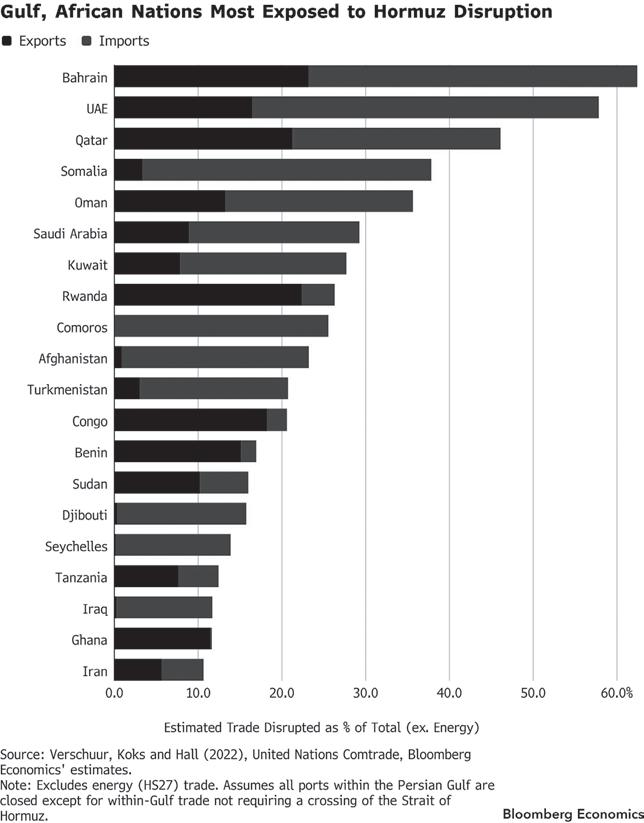
Oil prices have surged to around $100 per barrel as of writing, as the Strait of Hormuz—where one-fifth of global oil passes through—remains closed on heightened geopolitical tensions in the Middle East.
“Eventually, we will have to adjust,” Nepomuceno told this newspaper when asked how will the BOC achieve its revenue target. He noted that such developments were
not foreseen by the Development Budget Coordination Committee (DBCC), which sets revenue and macroeconomic targets.
Petroleum imports are the second-largest contributor to BOC’s revenues, accounting for about 15 to 16 percent of total collections, Nepomuceno said, next to imports of machinery and electronics.
“If excise taxes are reduced and the volume of imports will lessen, then our revenues will decline as well,” Nepomuceno said. Higher oil prices, however, could also lift customs revenues if import volumes remain steady and fuel excise taxes are not reduced, Nepo -
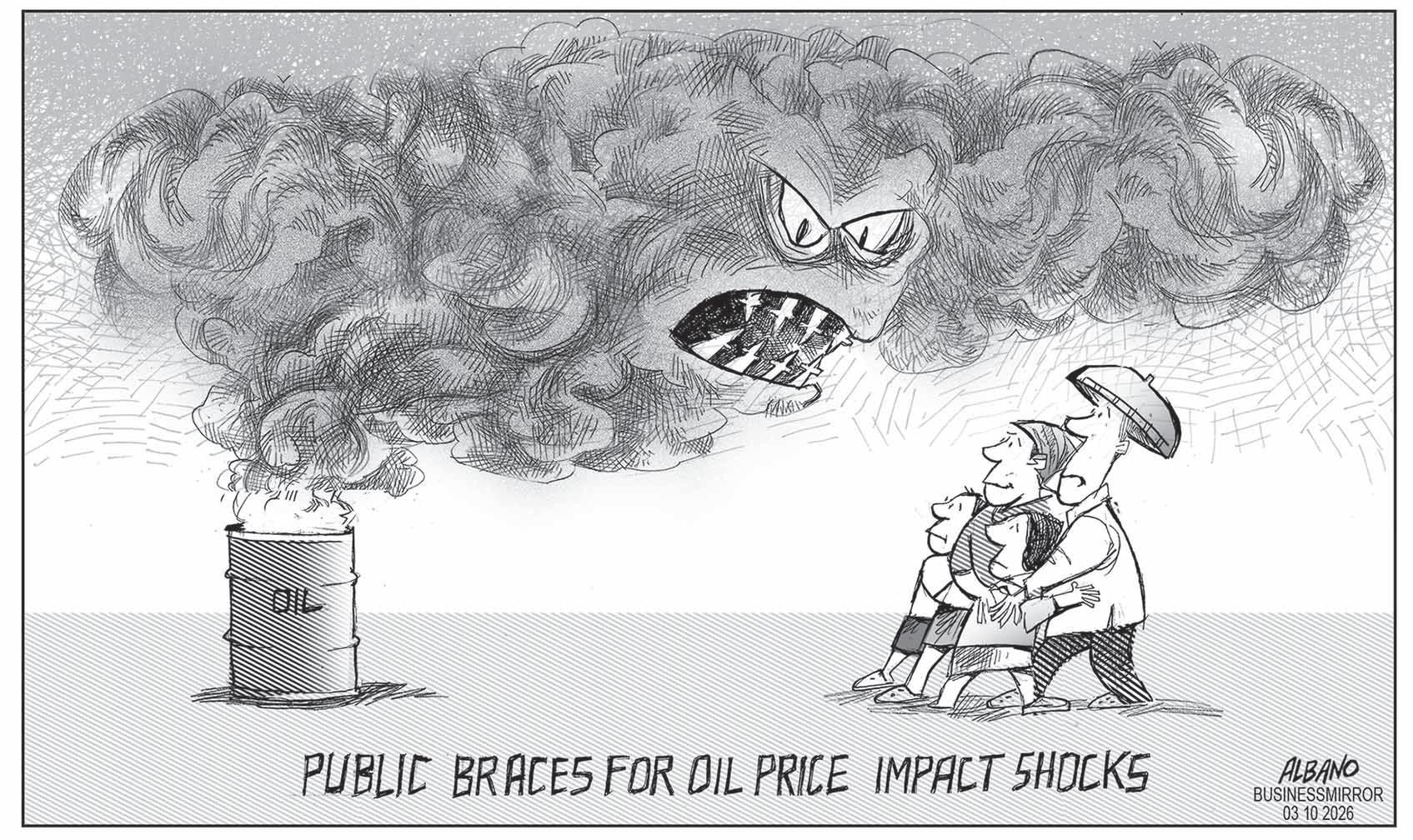
AMASSIVE, historic fuel price hike hits the country this week, and analysts said households should brace for the impact of expensive fuel on transport, food and electricity. However, the double-digit pump price hike will be implemented on a staggered basis, with most oil firms adjusting their pump prices from three days to seven days, to temper the impact.
Still, it is expected to hit hard. With global crude oil prices surging past the $100 per barrel level, Filipino consumers and households should cut “non-urgent spending,” manage electricity use, plan transport carefully, avoid new high-interest debt, and keep a “modest” stock of basic goods as higher fuel costs are now expected to spill over into transport, food, and electricity, according to analysts.
Ruben Carlo Asuncion, Chief Economist at UnionBank of the Philippines, told the BusinessMirror that households should expect higher transport fares, rising food costs, and more expensive electricity.
Based on an initial list released by the Department of Energy (DOE) on Monday, diesel price
muceno noted. Still, the BOC chief said the decision to reduce fuel excise taxes ultimately rests with Congress. Finance Secretary Frederick D. Go, who said that economic managers are moving to work with Congress to give the President the authority to reduce fuel excise taxes if global oil prices continue to rise, earlier expressed confidence that the BOC will hit the “elusive” P1trillion target this year.
“[That] was before the war,” Nepomuceno said. “They would have to balance somewhere… Meanwhile, we’ll just follow.”
Supply chains take spotlight at Asean business forum
By Bless Aubrey Ogerio
SUPPLY
chains, logistics and the movement of goods across Southeast Asia will be among the key issues expected to be discussed during the upcoming Association of Southeast Asian Nations (Asean) Business Environment Forum (ABEF), according to an official of the Department of Trade and Industry (DTI).
Benedict Uy, executive director of the DTI’s Foreign Trade Service Corps, said the forum is intended to create a platform where policymakers and businesses can jointly identify practical steps to improve the business climate not only in the Philippines but across Asean.
“All the senior officials and ministers who will be present will definitely take into consideration what will be discussed during the forum,” Uy said at a press briefing in Taguig City on Monday. “The discussions will cover the supply chain, logistics, and the move of products.”
The forum, scheduled on March 11
in Taguig City, is being organized as part of the Philippines’ activities under its 2026 chairmanship of Asean. It is organized with support from the Asian Development Bank and will serve as a side event ahead of the Asean Economic Ministers’ Retreat.
Discussions will also include the role of green and sustainable practices in regional trade and supply chains, Uy said, with opinion leaders and high-level officials to be invited to examine how businesses can adopt environmentally sustainable approaches in their operations.
“Hopefully that discussion will bring about a conscious thought on
how we can really implement green and sustainable practices in the actual practice of our businesses,” he said.
Another topic expected to be highlighted at the forum is regulatory reform, particularly efforts to simplify procedures for businesses. He noted that improving the ease of doing business can reduce the costs and delays faced by entrepreneurs.
“If there are many processes that businesses have to go through just to operate, there are cost implications— not only direct costs but also the time delays and the resources that they have to put in terms of compliance,” he said.
Public-private collaboration and digitalization as tools to improve transparency and efficiency in government services will also be touched.
The Philippines is hosting the event under its Asean chairmanship, guided by the theme “Navigating Our Future Together.”
Recent issues
THE discussions come at a time of heightened global uncertainty, including conflicts in the Middle East and ongoing trade tensions among major economies, developments that have disrupted supply chains and altered global trading relationships.
While declining to comment on the
impact of global energy price movements, Uy said the DTI continues to monitor how rising fuel costs affect businesses.
“Our agency and our colleagues on the ground—from our leadership down to our offices—are monitoring prices and are in constant dialogue with enterprises, both big and small companies,” he said.
In a chance interview at the same event, Uy told reporters that he could not comment on whether economic issues such as tariffs would be discussed during President Ferdinand Marcos Jr.’s two-day work visit to New York, noting the trip is linked to the country’s activities at the United Nations General Assembly.
Continued from A14
managers, to temporarily suspend or reduce fuel excise taxes when global oil prices reach extraordinary levels.
Energy officials also warned of a sharp spike in pump prices.
Energy Secretary Sharon Garin said fuel prices could increase by P17 to P24 per liter, which could trigger higher transportation costs and ripple through the prices of food and other goods.
She noted that diesel—widely used in public transport—carries a P6-per-liter excise tax, and suspending the levy could provide immediate relief to commuters and transport operators.
Finance officials, however, cautioned lawmakers about the fiscal impact of suspending fuel taxes.
Data presented during the briefing showed that fuel-related taxes generate an average of about P276 billion annually, including P160 billion in excise taxes and P116 billion in valueadded tax (VAT) collections.
Officials said suspending fuel excise taxes from May to December alone could result in about P136 billion in foregone revenues, though part of the losses may be offset by additional VAT collections if oil prices continue to rise.
Despite the potential relief, Quimbo said lawmakers want clear safeguards to ensure that consumers—not oil companies—benefit from any tax suspension.
He cited the experience under the Rice Tariffication Law, which lowered tariffs on imported rice but did not immediately translate into lower prices for consumers.
“That’s our biggest fear—that we might lower taxes but the people wouldn’t actually feel the benefits,” Quimbo said.
“We’re afraid that the only ones who might benefit from this are the big oil companies or the business owners selling fuel,” he added.
Quimbo said the goal of the committee is to ensure that any policy response to rising oil prices is grounded in solid economic data while protecting both vulnerable sectors and the country’s middle class.
Jovee Marie N. Dela Cruz
Continued from A14
technology, and institutional support,” Sentro Secretary-General Josua Mata said.
Mata added that employers should shoulder the cost of internet access, data, and other work tools needed for employees working from home.
For its part, the BPO Industry Employees Network (BIEN) urged Information Technology and Business Process Management (IT-BPM) companies to allow employees whose tasks can be done remotely to shift to work-from-home arrangements.
“Allowing employees to work from home is the fastest and most practical way to shield workers from the rising cost of daily commuting,” the group said.
will increase anywhere from a P17.5 per liter to as high as P24.25 per liter. Gasoline price increase ranges from P8.75 per liter to P13 per liter. Kerosene prices will shoot up anywhere from P32 per liter to P38.5 per liter. The new pump prices take effect starting March 10.
The resulting pump price for diesel will reach anywhere from as low as P60.5 per liter to as high as P63.19 per liter. Gasoline prices will be sold anywhere from P52.10 per liter to P60.40 per liter. Kerosene will be sold at an average of P86.67 per liter.
The price hike on petroleum products will be implemented gradually after the DOE and oil companies reached an agreement to stagger effectivity of the hikes, so that consumers will not suddenly feel the impact of the Middle East situation on oil prices.
The DOE list includes price advisories from Petron, Shell, Chevron, Seaoil, Total, and Jetti. Among them, Chevron will implement the pump price hikes daily from March 10 to March 16. Jetti will implement the upward adjustment for six days; Seaoil will spread it for four days; Petron and Shell for three days; and Total for two days.
“The price now is not the highest in history...what will be implemented tomorrow will be the highest jump,”
DOE Secretary Sharon Garin said at a news conference.
The DOE strongly encourages other oil companies to implement similar measures and implement the price increase gradually to help alleviate its impact on consumers.
The energy chief said her office does not have the power to regulate price increases due to the Downstream Oil Industry Deregulation Act. “The price is not regulated by the DOE. We cannot dictate to companies what price they can charge the public,” she said.
Oil firms implement their price adjustments every week to reflect movements in the world oil market. They cited the Middle East conflict following a joint US-Israel operation that launched airstrikes targeting Iran. “The rates are different. The price is pegged on Dubai crude oil and the international market,” added Garin.
Gas stations get SCOs MEANWHILE, Garin said her office issued show-cause orders to 55 retail stations for allegedly raising their pump prices ahead of schedule.
“We have asked oil companies to police their own stations and franchisees to comply with the law. We received reports and collated evidences. Let’s not hoard, we have enough supply. Let’s not take advantage of the situation,” Garin added.
The DOE list showed most of the fuel stations cited are from Metro Manila.
Garin stressed that domestic fuel inventories remain stable. She is also optimistic that prices will normalize once geopolitical tensions subside and global crude benchmarks retreat.
$100 is the ‘threshold’
IN a recent interview, Bangko Sentral ng Pilipinas (BSP) Governor Eli M. Remolona Jr. called the $100 per barrel of oil “the threshold,” saying that at this mark, the price of oil begins to have effects on the prices of many commodities. (See: https://businessmirror.com.ph/2026/03/07/ bsp-tracks-oil-dollar-as-pesobreaches-%e2%82%b1591/)
Asuncion pointed out that lower-income families—whose budgets are “dominated” by food and transport—are likely to feel “the biggest squeeze as cost-of-living pressures intensify.”
Transport-reliant essentials affected
ASUNCION said fuel products will bear the “immediate” impact. He underscored that gasoline, diesel, kerosene, and LPG are set for “sharp” price adjustments. The costs would then feed into food and electricity as logistics and production become more expensive, he noted.
Jonathan L. Ravelas, senior adviser at Reyes Tacandong & Co. explained to this paper that fuel costs “ripple through the economy,” so households will feel it in higher fares, power bills, and more expensive ba-
sic goods. “The biggest hits will be diesel, LPG, electricity, rice, vegetables, and other essentials that rely heavily on transport,” added Ravelas. For his part, Philippine Institute for Development Studies (PIDS) Senior Research Fellow John Paolo R. Rivera told the BusinessMirror that “other goods requiring cold storage and long-distance transport may also experience price increases due to higher distribution costs.” Meanwhile, Domini Velasquez, Group Chief Economist at Chinabank, told the BusinessMirror: “If fuel prices remain elevated for an extended period, second-round effects could emerge, including potential transport fare hikes—such as the proposed P2 increase for buses and jeepneys—and higher food prices as logistics costs climb.” Velasquez said rising inflation would “erode” the purchasing power of Filipinos and could prompt households to reassess spending priorities.
What households, consumers can do IN such an environment, Asuncion advised consumers to “prioritize essential spending, plan for higher transport and energy costs, and keep a modest stock of basic goods.” Ravelas said the key to families is to focus on essentials, hence the need to “cut non-urgent spending, manage electricity use, plan transport carefully, and avoid new high-interest debt.” Velasquez echoed the sentiments of these analysts, pointing out that consumers are likely to shift spending toward essential goods and services, while discretionary or non-essential purchases “may take a back seat.”
“As a result, households may need to prioritize basic expenses and adopt more energy-efficient practices, particularly if oil prices remain volatile or continue to increase,” added Velasquez.
Rivera said it may also be helpful to limit “unnecessary” travel as households improve energy efficiency during these times.
‘Emergency funds’ RIVERA pointed out that “maintaining a modest emergency fund can also help families manage shortterm price shocks.” Meanwhile, with sharp fuel price increases and the risk of temporary supply disruptions, Asuncion said having “readily available” cash can help families respond quickly to essential needs.
However, he said most funds should remain safely in bank accounts.
Ravelas, for his part, said it’s “wise” to keep some cash for emergencies. “But not too much—because high inflation eats into cash value,” he noted.
Rivera also cautioned that households should balance keeping some cash on hand with maintaining savings in “secure” financial institutions since holding too much cash may lose value over time when inflation is elevated.
Monitor government actions
MEANWHILE, Asuncion said it’s important to keep an eye on government actions such as possible fuel tax suspensions, as this may also help households plan ahead.
In a televised interview on Monday, Domini Velasquez, who previously held a post at the Department of Finance (DOF) prior to rejoining the private sector particularly with Chinabank, said the most important policy move the DOF is expected to make in the next 30 days is the “rollout of [transport] subsidies.”
“I’m looking back at 2025, we did have that in the GAA...the subsidies for transport workers, for agriculture workers, for fisheries, because they also use a lot of, they’re also very oil dependent. And you want to support that segment. So I guess faster rollout for those segments,” added Velasquez.
“So I think if I remember correctly, there’s still some, you know, allocation left behind in 2025. And the budget is, you can use it for two years. So you can still use it for this year,” added the former DOF official. According to a Bloomberg report: “Asia’s governments will have to stretch their budgets or risk unleashing an inflation shock as the deepening conflict in the Middle East pushes oil prices past $100 a barrel.”
THE Department of the Interior and Local Government (DILG) has assured private sector partners that all procurement transactions with the agency will be conducted fairly, transparently, and without corruption.
The policy aligns with President Marcos’ push for honest and transparent governance and Interior and Local Government Secretary
Juanito Victor Remulla’s directive to strengthen accountability across all government dealings. T he assurance was given during the DILG Procurement Summit in Quezon City, organized by the DILG Procurement Management Division under the Administrative
PNP on alert for anniversary of Duterte’s transfer to ICC
By Rex Anthony Naval
UNITS of the National Police (PNP) on Monday went on alert for possible protest actions on March 11, marking the anniversary of former President Rodrigo Duterte’s transfer to the custody of the International Criminal Court in The Hague, the Netherlands.
G en. Jose Melencio Nartatez Jr., National Police chief, said the service’s social media monitoring arm has flagged several posts calling for “a massive motorcade rally.”
T he planned route reportedly spans the length of Epifanio delos Santos Avenue, ending at Villamor Air Base in Pasay City to commemorate the first anniversary of the former President being taken into international custody to face charges for crimes against humanity.
We are closely monitoring developments and coordinating with local units to ensure public safety. While we respect the right to peaceful assembly, we also have the mandate to ensure that there will be no incident that will disrupt normal activities and threaten peace and order,” Nartatez said.
A s such, the PNP chief has instructed local police units to increase deployment in the area, as well as in Davao City, Duterte’s bailiwick, in preparation for any activities or rallies.
Nartatez also reminded police personnel to exercise maximum tolerance and always act in accordance with the rule of law.
Remember, our strength lies in professionalism and restraint. Uphold the law, protect our citizens, and lead by example,” Nartatez said.
He added that the police would coordinate closely with event organizers and local governments.
N artatez also advised participants of any protests on that day to exercise discipline and follow the instructions of authorities to avoid conflicts.
We respect your right to protest but I remind everyone to exercise discipline and comply with authorities’ directions to prevent unnecessary conflicts,” he said.
Service on Friday.
S upply officers, procurement personnel, and private sector suppliers and service providers attended the Summit, which aims to promote cooperation and transparency in public procurement.
I nterior Undersecretary for Operations Omar V. Romero, who also serves as the agency’s Head of the Procuring Entity (HoPE), emphasized Remulla’s firm directive to uphold integrity within the department and its attached agencies.
You have seen our Secretary and his initiatives against corruption within the DILG. If there are any irregularities or improper activities, the department will not hesitate to pursue cases to the full extent of the law,” Romero, a lawyer, said.
H e stressed that corruption
persists only when both sides tolerate irregular practices.
If a foolish supplier meets a foolish government employee, they will both be happy. But it will bring down the agency,” Romero warned.
R omero assured suppliers that the DILG is committed to build ethical partnerships with the private sector and ensure that legitimate suppliers are treated fairly in all procurement processes.
That’s my promise as Head of the Procuring Entity. We will treat you fairly,” he said.
He also encouraged suppliers to report any irregularities they may encounter.
“ If anyone in the DILG is asking for anything illicit, please let us know. Inform my office. The Secretary has a very strict ‘No Take’
policy,” Romero added.
R omero emphasized that procurement is a critical government function that must be carried out with integrity and efficiency. Procurement is an essential government function. No agency can perform without it. So we have to do it right and on time,” he said.
T he summit was attended by Assistant Secretary for Administration, Finance, and Comptrollership Ester A. Aldana; supply officers from the DILG Central Office; representatives from DILG regional offices in the National Capital Region, Cordillera Administrative Region, and Mimaropa (Mindoro, Marinduque, Romblon and Palawan); and private sector suppliers and industry partners.
Palace: UNSC seat to give PHL greater credibility, bigger voice in global affairs
MALACAÑANG defended the Philippines’ bid for a non-permanent seat membership in the United Nations Security Council (UNSC) saying it will give the country greater credibility and a bigger voice on global affairs.
Palace Press Officer Claire Castro made the statement in an interview with reporters in New York after Sen. Rodante D. Marcoleta questioned in a Senate hearing why the government is making so much effort to secure a UNSC seat.
M arcoleta said the position
of the UNSC are usually dictated by its five permanent members, namely the United States, Russia, China, France, and the United Kingdom since they have veto powers on resolutions, and not its non-permanent members.
The other 10 members of the UNSC are non-permanent members, who are elected to two-year terms.
C astro, however, stressed that a UNSC membership will still give the country the power to influence UNSC decisions, which can affect global peace and security.
This is not only in the interest of
our country – it is also in the interest of our region. And not only that, this will enhance our credibility and allow us to show that we are a leader for peace,” she said in Filipino. Even if we are just one country – if our country can show what is right for global peace and security, it will be listened to. At least that voice is needed,” she added.
T he Department of Foreign Affairs said the country will use its UNSC membership to espouse the country’s interests in the West Philippine Sea.
C astro slammed those who
Delfin Lee starts rebuilding life
By Ashley J. Manabat
CLARK FREEPORT—Real
estate developer Delfin Lee
said he wants to rebuild his reputation and return to developing housing projects for low-income Filipinos after a Pampanga court dismissed the long-running estafa case tied to his company’s housing developments.
L ee, founder of Globe Asiatique Realty Holdings Corporation, said during a news conference in Mabalacat City that the controversy surrounding the case had cost him 16 years and billions of pesos in losses, but he now hopes to move forward by completing unfinished projects and potentially launching new socialized housing developments.
Sixteen years have been lost to this issue,” Lee said. “It’s time to move on. My focus now is to clarify the issue and rebuild my name.”
T he Regional Trial Court in Pampanga dismissed last month the P6.65-billion estafa case against
Lee and four others after finding the prosecution’s evidence insufficient.
The ruling granted Lee’s demurrer to evidence, which is equivalent to an acquittal and bars the case from being refiled under the constitutional protection against double jeopardy.
Th e case involved allegations that Globe Asiatique misused housing loan proceeds tied to projects financed through the Home Development Mutual Fund (Pag-IBIG Fund), particularly developments in the Xevera housing community in Mabalacat City and Bacolor town in Pampanga.
Le e maintained that the allegations of “double sale” of housing units were unfounded.
More than 3,000 houses were built, and you cannot point to a single victim of double sale,” Lee said.
Some occupants had lived in the homes for years without making payments yet still filed complaints,” he added.
L ee also pointed to a separate civil dispute with the Pag-IBIG Fund
over about P630 million in escrow funds that he said were deposited to back a buyback guarantee for housing loan accounts.
U nder the arrangement, Lee said his company was obligated to repurchase loan accounts from Pag-IBIG within five years if borrowers defaulted. He argued that when the financing contract was discontinued, the escrow funds should have been returned.
“ If you compute that amount from before 2010 up to now, it would already exceed P1 billion,” Lee said. “That would be a big help if it were returned so I could start again.”
A ccording to Lee, records show that the civil case related to the escrow funds has been the subject of litigation that has reached the Supreme Court and remains pending in the Court of Appeals on issues related to damages.
L ooking ahead, Lee said he hopes to participate in the government’s flagship housing initiative, the Pambansang Pabahay para sa
are criticizing the country’s bid to become a UNSC member as people who want to bring down the country’s integrity and capacity before the international community.
P resident Marcos is in New York, United States from March 9 to 10 to attend the 70th session of the Commission on the Status of Women and the United Nations General Assembly special session.
D uring the working visit, the Chief Executive will reiterate the country’s bid for a UNSC seat.
Samuel Medenilla
SAF, HPG, CALABARZON GET NEW POLICE COMMANDERS
THREE senior police officers received new assignments in the latest reorganization of the National Police (PNP).
In an order dated March 9, the PNP Chief, Gen. Jose Melencio Nartatez Jr., named Brig. Gen. Hansel Marantan, head of the Highway Patrol Group (HPG), as director of Police Regional Office Calabarzon (Cavite, Laguna, Batangas, Rizal and Quezon) or Police Regional Office 4A. M arantan replaces Brig. Gen. Paul Kenneth Lucas, who was appointed director of the Special Action Force (SAF) ahead of the retirement of the SAF commander, Maj. Gen. Mark Pespes.
Taking over as HPG director is Brig. Gen. Jessie Tamayao, currently executive officer of the Directorate for Police Community Relations (DPCR). The reshuffle took effect on Monday. PNA
Pilipino Housing Program (4PH), which aims to address the country’s housing backlog. He said socialized housing for minimum-wage earners remains the largest segment of the market and emphasized the role of Pag-IBIG financinginenablinghomeownership.
“ You cannot develop low-cost housing without Pag-IBIG as a partner,” Lee said. “They play a pivotal role because they provide affordable financing.”
L ee added that developers must adapt to market demand rather than dictate it and noted that projects that target lower-income buyers remain the most viable segment of the housing market.
Despite the court ruling in his favor, Lee said the reputational damage from the case remains his primary concern.
A lot was lost, not only financially but in terms of the damage done,” he said. “That is what I want to correct. I don’t want to pass that on to my children.”
The organization explained that in many countries, legal restrictions and long-standing social norms continue to limit the types of work women can pursue, reinforcing occupational segregation and creating inefficiencies in labor markets that can ultimately dampen productivity and innovation.
Despite their higher exposure to workplace changes driven by AI, the ILO said women remain underrepresented in the sectors developing and deploying the technology.
The report noted that women account for only about 30 percent of the global AI workforce, limiting their influence on how these systems are designed and implemented.
Women continue to be underrepresented in STEM and AI jobs, and the design, and governance of AI systems. This not only limits their ability to benefit from emerging opportunities but also constrains enterprises from fully leveraging women’s talent and perspectives,” it said.
Still, the ILO emphasized that exposure to AI does not automatically translate to job losses. In many occupations, the technology is more likely to reshape tasks and workflows rather than eliminate jobs altogether.
T he report said addressing the risks will require ensuring that new technologies are developed and deployed with gender equality in mind.
T his includes improving datasets used to train AI systems, introducing safeguards to prevent bias, and ensuring that women and other underrepresented groups are actively involved in the development of AI technologies.
The choices made now will determine whether Gen AI becomes a driver of greater equality or a force that entrenches existing disparities,” the ILO said.
Dy vows: House to shield people from oil price increase shocks
By Jovee Marie N. Dela Cruz @joveemarie
THE leadership of the House of Representatives on Monday vowed passage of legislation and policy measures that would shield Filipinos from possible oil price shocks stemming from the ongoing conflict in the Middle East.
Speaker Faustino G. Dy III made the statement after the Palace said President Marcos will formally request Congress on Monday to
grant him emergency powers to reduce the excise tax on petroleum products amid the ongoing conflict in the Middle East.
D y said the chamber would work closely with the Executive branch to prioritize measures that could soften the impact of rising fuel costs on the economy.
“ We recognize that this is a challenge we must face headon, which is why the House of Representatives will work with the executive to focus on measures
that will help cushion the effects of rising oil prices on the various sectors of our economy—especially our workers, commuters, farmers, and small businesses,” he said.
D y said lawmakers and various House committees will pursue priority measures designed to cushion the impact of rising fuel costs on key sectors, particularly workers, commuters, farmers, and small businesses.
“ Together with my fellow lawmakers and various House
committees, we will push for priority bills and measures that will help ease the impact of global crises on our fellow Filipinos,” said Dy.
The Speaker said that tensions in the Middle East demonstrate how globaldevelopmentscandirectlyaffect the Philippines, especially through higher oil prices that ultimately burden Filipino households.
D y said the House will focus on policies that strengthen the economy and protect the livelihoods of ordinary Filipinos.
He also called for unity as the country confronts global uncertainty. In our nation’s history, we have faced many trials – typhoons, crises, and events that seemed beyond our control,” he added. We have confronted challenging moments before, and each time, the strength and unity of the Filipino people have carried us through.”
D y assured the public that government institutions will continue working to protect Filipinos and guide the country through global challenge.
Charges vs 18 ‘ex-marines,’ lawyer mount
By Joel R. San Juan | @jrsanjuan1573
MORE criminal complaints were filed before the Department of Justice (DOJ) on Monday against the 18 alleged former marines who recently came out to implicate several lawmakers and government officials in the multibillion illegal cash delivery scheme.
O n Monday, former senator and current Party-List Representative Leila de Lima of Mamamayang Liberal (ML) and Fr. Flaviano Villanueva filed perjury charges against the 18 “marines” before the DOJ, while cyber libel charges were filed against them and their lawyer Levito Baligod before the National Bureau of Investigation (NBI).
C orrections Director General Gregorio Catapang also filed a separate complaint before the DOJ against the former soldiers and
Baligod for perjury and cyber libel. A side from criminal complaint, Catapang also filed a disbarment case against Baligod before the Supreme Court. The 18 alleged former “marines” were identified as Belnard E. Tube, Rosebert M. Waupan, Benny S. Bulonte, Johnny A. Buduan, Rodante P. Orbillo, Reyneboy O. Julian, Christopher T. Esquivel, George O. Villalon Jr., Romeo Rommel Bobares, Gil Navidad Jr., Anselmo Taberdo, Walter
PSA reports slowdown in wholesale prices
By Justine Xyrah Garcia
WHOLESALE prices
continued to slowdown in January, reflecting easing price increases across several commodity groups, the Philippine Statistics Authority (PSA) reported.
Based on the General Wholesale Price Index (GWPI), wholesale price growth nationwide slowed to 1.6 percent in January 2026, down from 1.9 percent in December 2025 and 2.9 percent in January 2025.
T he PSA said the downtrend trend in wholesale was mainly driven by slower price increases in chemicals, including animal and vegetable oils and fats, which rose by 2.5 percent in January, down from 5.1 percent in the previous month.
Other commodity groups also posted slower growth during the month. The index for beverages and tobacco eased to 2.1 percent from 3.2 percent, while crude materials, inedible except fuels, decelerated sharply to 3.1 percent from 13.3 percent in December.
Gr owth in machinery and transport equipment also slowed to 0.3 percent from 0.8 percent.
A dding to the downward pressure, the index for mineral fuels, lubricants and related materials recorded an annual decline of 0.4 percent in January, reversing the 2.8 percent increase recorded a month earlier, the PSA said. The slowdown was also reflected in the country’s major island groups.
In Luzon, wholesale price growth slowed to 1.5 percent in January
from 1.8 percent in December 2025, and significantly below the 3.2 percent recorded in January 2025.
The downtrend in the annual growth rate of the GWPI in Luzon was mainly caused by the slower annual increase in the index of chemicals including animal and vegetable oils and fats at 2.1 percent in January 2026 from 5.0 percent in the previous month,” the PSA explained.
T he Visayas also posted a slight easing in wholesale price growth to 3.2 percent in January, compared with 3.3 percent in December, although this remained higher than the 1.6 percent recorded in January last year.
T he slowdown in the region was mainly attributed to declining prices of mineral fuels, lubricants and related materials.
Meanwhile, Mindanao registered a slower annual growth of 2.3 percent in January, down from 2.7 percent in December, although still higher than the 0.6 percent recorded in January 2025.
T he PSA said the slowdown was primarily due to the slower increase in food prices, which grew 2.9 percent from 4.1 percent in the previous month.
T he GWPI measures changes in the price levels of commodities sold in bulk to intermediaries. It serves as an important gauge of price movements in the wholesale trade sector and is used as a deflator in national accounts to express real value by stripping out the effects of inflation.
78 Filipinos Detained in Myanmar Scam Hub Crackdown
By Malou Talosig-Bartolome
@maloutalosig
SEVENTY-EIGHT Filipinos rescued from a scam compound in Myawaddy, Myanmar, are now detained for immigration violations, the Department of Foreign Affairs (DFA) confirmed.
Manalansan, Joely Cadiao, Rommel C. Galapon, Cecilio Larroder Jr., Bernard Gumban, Crisanie Dado, and Fidel Corpuz.
E arlier, National Security Adviser (NSA) Eduardo Año and former senator Antonio Trillanes IV also filed similar complaints against the 18 before the DOJ.
A ño specifically asked the DOJ to prosecute the 18, Baligod and former congressman Mike Defensor for of Unlawful Use of Means of Publication and Unlawful Utterances under Article 154 of the Revised Penal Code, in relation to Section 6 of Republic Act 10175 or the Cybercrime Prevention Act.
O n the other hand, Trillanes filed perjury, cyber libel and other criminal complaints against the respondents.
T he complaints all stemmed from the joint complaint-affidavit executed by the 18 claiming that they previously worked as personal assistants or security consultants of resigned Party-List Rep. Zaldy Co of Ako Bicol, one of the alleged masterminds of the multi-billion corruption scandal involving the government’s flood control projects. Co has been charged with graft
and malversation of public funds before the Sandiganbayan and is now considered as a fugitive.
They claimed that part of their duties were to escort Co’s executive assistants in delivering numerous luggage, paper bags, envelopes full of cash to several political figures, including President Marcos and former Speaker Martin Romualdez.
I n their joint complaint affidavit filed before the Office of the Ombudsman, the 18 alleged that de Lima, Año, Trillanes and Villanueva were among those who benefitted from Co’s illegal cash distribution scheme to facilitate the case build up of the investigators of the International Criminal Court (ICC) against former President Rodrigo Duterte.
T he 18, on the other hand, claimed that Catapang delivered eight suit cases containing cash to Co.
C atapang strongly denied the “baseless” accusations, stressing that “they are not only patently false but also defamatory, crafted with the intent to malign his character, undermine “his reputation, and subject him to public contempt.”
“First of all , I don’t even have
that much money. Second, the Bucor [Bureau of Corrections] also does not have that much money for me to steal. If Bucor has such funds, they were used for constructions. Also, we don’t have any DPWH [Department of Public Works and Highways] projects. We don’t have any ghost projects,” Catapang stressed.
“ My conscience is clear. My main role as Director General of the Bureau of Corrections is to follow the law as set by the Bureau of Corrections Act of 2013,” he added.
H e assured the public that the Bucor is dedicated to delivering essential services to the Filipino people.
“ While no institution is without its flaws, we remain resolute in executing our mandate with integrity and impartiality. Our commitment extends to promoting the general welfare and safeguarding the basic rights of every person deprived of liberty,” Catapang said.
T he BuCor chief also urged the public not to be swayed by politically motivated narratives that are “more about making noise than seeking truth.”
True justice must arise from due process, not from the sensationalism
of trial by publicity,” he said. C atapang, however, indicated his willingness to withdraw the complaint if the former Marines would retract their statement against him and issue a public apology.
D e Lima and Villanueva also strongly denied the accusations, saying their accusers failure to be consistent in their allegations— from accepting money in suitcases to then in a paper bag—clearly shows their claims are falsehood.
“Attorney Baligod tried to ‘clarify’ in interviews that it was an oversight and that I supposedly received a paper bag instead of a suitcase. That is still a lie. Whether in a suitcase, a paper bag, or any container, I never received any money.”
D e Lima also pointed to the Duterte camp as behind the smear campaign against them. This is clearly the handiwork of the Duterte camp,” she asserted.
“Look at the timing. We have impeachment proceedings against the Vice President and the ICC’s confirmation of charges. They are desperate to create confusion and instability to distract the public,” the lawmaker said.
Sandiganbayan freezes 16 properties of Co
THE Sandiganbayan has issued a writ of preliminary attachment (WPA) against 16 properties of fugitive and former Ako Bicol Party-list Rep. Zaldy Co to cover for his P215 million possible civil liability in connection with the anomalous flood control project in Naujan, Oriental Mindoro.
The WPA was issued upon the motion filed by the prosecution on January 30 before the Sandiganbayan Fifth Division where Co is facing a case for violation of Republic Act 3019 or the AntiGraft and Corrupt Practices Act.
C o is also facing a separate case for malversation of public funds through falsification of public
before the Sandiganbayan Sixth Division, also involving the flood control project in Naujan.
I n its motion, the prosecution argued that there is an urgent need to attach Co’s properties to serve as security for the satisfaction of the civil liability arising from the offense.
“ Unless his properties are immediately attached, the State may be unable to satisfy any future judgment as the accused may easily alienate or conceal his remaining assets in the Philippines,” the prosecutor said.
A ttached to the prosecution’s motion are copies of the original certificates of title (ICT), transfer certificates of title (TCT) and
condominium certificates of title (CCT) over the said properties with accused Co, his wife Mylene Recinto Co, or both spouses, as the registered owners. Under Rules 127 of the Rules of Court, “the provisional remedy of attachments on the property of the accused may be availed of to serve as security for the satisfaction of any judgment that may be recovered from the accused when the criminal action is based on claim for money or property embezzled or fraudulently misapplied or converted to the use of the accused who is a public officer…”
L ikewise, Rule 57 of the Rules of Court, provides that “attachment may issue ...in an action for money or property embezzled or fraudulently
misapplied or converted to his own use by a public officer…”
The anti-graft court held that the prosecution were able to comply with all all the requisites for the issuance of a WPA. It agreed with the prosecution’s position that unless Co’s properties are immediately attached, the State may be unable to satisfy any future judgment as the former lawmaker may easily conceal his remaining assets in the country. All told, the court in the exercise of its discretion, finds sufficient grounds for the issuance of the writ of preliminary attachment prayed for and the implementation of the same,” the resolution stated.
Joel R. San Juan
Marcos seeks strengthening of Telecommuting Act
By Jovee Marie N. Dela Cruz @joveemarie
HOUSE Majority Leader
Ferdinand Alexander A. Marcos on Monday filed a resolution seeking a House inquiry into how telecommuting and flexible work arrangements could help Filipino workers cope with rising electricity and fuel costs amid global energy uncertainties.
I n House Resolution 855, Marcos urged the House Committees on Labor and Employment and on Trade and Industry to conduct a joint inquiry, in aid of legislation, into the implementation of the Telecommuting Act and flexible work policies in government.
The panels are tasked to submit their findings and recommendations to Speaker Faustino G. Dy III, including possible legislative measures and policy actions that could strengthen and expand telecommuting arrangements nationwide.
The resolution comes as tensions in the Middle East threaten global
oil supply chains and raise concerns about possible increases in fuel and electricity prices that could affect workers and businesses.
Recent geopolitical tensions and armed conflict in the Middle East pose significant risks to global oil supply chains, potentially resulting in higher fuel prices and electricity costs that may inevitably affect the Philippine economy and the daily lives of Filipino workers,” Marcos said in the resolution.
The lawmaker noted that higher fuel and power costs directly translate into heavier financial burdens for families and businesses.
“ The increase in fuel and electricity prices translates into higher transportation costs, greater operational expenses for businesses, and additional financial burden on Filipino families already coping with inflationary pressures,” he said.
M arcos said flexible work arrangements, including telecommuting, could help reduce these pressures while maintaining productivity.
In times of economic disruption caused by global energy shocks, telecommuting arrangements may serve as effective policy mechanisms to reduce transportation demand, lower operational energy consumption in workplaces, and help shield workers and businesses from the adverse effects of rising fuel and electricity costs,” he said.
R epublic Act 11165, or the Telecommuting Act, allows employees in the private sector to perform their duties from alternative workplaces using telecommunications and computer technologies while ensuring that their labor rights and benefits remain protected.
T he Civil Service Commission (CSC) also adopted policies on flexible work arrangements in government through Memorandum Circular 6, Series of 2022.
Ho wever, Marcos noted that the level of adoption of these work arrangements varies widely across industries and government agencies.
The DFA said the group is being held in Hpa-An, Kayin State—an area where Karen rebels have long fought for independence from the Myanmar government. It remains unclear whether the Filipinos are under the custody of the Myanmar junta or rebel forces. M yawaddy, in southeastern Kayin State, is controlled by the
pro-junta Karen State Border Guard Force but remains heavily contested by Karen rebel groups.
T housands of foreign workers were lured there with promises of high-paying jobs, only to be forced into elaborate online scams that defrauded victims worldwide of billions of dollars.
A longside Filipinos, Chinese, Cambodians, and Thais were also among those arrested or rescued.
P hilippine Embassy staff in Yangon have conducted two welfare checks on the detained Filipinos in Hpa-An, located about 300 kilometers from the capital. The workers told officials they were victims of illegal recruitment and human trafficking.
H e said Congress must assess whether existing policies are sufficient and identify measures that could expand telecommuting arrangements.
“ The Embassy is actively coordinating continued access to provide welfare and legal assistance as approved by the host authorities. Communication with the families of the affected Filipinos is ongoing based on verified Embassy updates,” the DFA said in a statement.
The House of Representatives, in the exercise of its oversight function, must assess the extent to which the Telecommuting Act and flexible work arrangements in the government and private sector has been implemented by relevant government agencies and determine whether additional legislative or policy measures are necessary to maximize its benefits for workers, employers, and the national economy,” Marcos said. The proposed inquiry will examine the current level of telecommuting adoption in both the public and private sectors, the effectiveness of existing implementing rules, and the role of digital infrastructure and broadband connectivity in supporting remote work. It will also explore the potential contribution of telecommuting in reducing fuel consumption, easing traffic congestion, and lowering electricity demand in workplaces.
T he DFA stressed that safeguarding Filipinos abroad—especially victims of trafficking—remains a “key priority and an essential consideration for sustained diplomatic engagements.”
I t added that the agency is working with the Department of Migrant Workers Office in Bangkok and other government agencies to help resolve the cases.
Economy
Govt on track to roll out fuel subsidy program
By Jovee Marie N. Dela Cruz | @joveemarie
THE government is set to roll out a direct fuel subsidy program for the transport sector, aiming to ease the burden on drivers, operators, and delivery riders affected by high petroleum prices, the Department of Transportation (DOTr) said on Monday.
During a House Committee on Ways and Means hearing, Transport Undersecretary Ramon Reyes confirmed that preparations are underway for the subsidy project in coordination with the Department of Energy (DOE). The subsidy will be triggered once the DOE certifies that the aver-
age price of Dubai crude oil reaches $80 per barrel over a calendar month.
R eyes said funding for the program will come from the 2025 General Appropriations Act, with an available allocation of P2.5 billion.
He said no 2026 allocation has yet been secured, but additional funds may be requested from the Office of the President if needed.
R eyes outlined the scope of the subsidy, targeting 247,000 public utility vehicle operators and drivers, 150,000 delivery riders, and 723,000 tricycle operators.
He said subsidy rates will vary by vehicle type: modern jeepneys will receive around P10,500, traditional jeepneys P5,000, tricycles P1,150, and delivery riders P1,800 per unit. The allocation from the total fund
will be split among participating agencies: 55 percent to the Land Transportation Franchising and Regulary Board, 33 percent to the Department of the Interior and Local Government, and 11 percent to the Department of Information and Communication Technology.
The House Committee on Ways and Means chairman, Rep. Romero Federico Quimbo of Marikina emphasized the need for a subsidy scheme that is “truly impactful,” suggesting that support be provided on a monthly or bi-monthly basis rather than as a one-time handout.
Reyes assured lawmakers that discussions with the three agencies are ongoing to finalize mechanisms for the effective distribution of aid.
To ensure transparency and
prevent political interference, LTFRB Board Member Greg Pua clarified that subsidies will go directly to beneficiaries through existing fuel subsidy cards. Those without cards will coordinate with the LTFRB to access the funds.
Quimbo said, “Direct distribution ensures that the aid reaches drivers and operators without delays caused by political intervention.”
This is crucial to help those who struggle most in the transport sector,” he said.
T he program is expected to begin immediately after DOE certification, with the government aiming for a swift and organized rollout to cushion transport sector stakeholders against continued fuel price volatility.
The fight against corruption by the Youth
By Henry J. Schumacher
MY column a week ago focused on: How can Gen-Zers and Millennials fight corruption?
I came up with various suggestions.
I emphasized that many young people are fighting corruption and are making a big difference for the future. And we need to celebrate that!!
I received various responses to this exciting topic. Today, I would like to provide you with the response of one reader:
“I also believe a step in the right direction were protests and chants. I remember fondly a video from last year where kids aged roughly 6-11 years old were chanting “Ikulong na iyan, mga kurakot” (Jail all the corrupt), a famous chant that got traction. How did it become famous? Through chants in protests, which were brought not only in formal protests but also online and even concerts. Pushing through this exposure helped the youth, albeit not so much, to at least be aware that the corrupt mist go to jail. T he millennials and gen-zers,
I believe, should focus not only on making the corrupt pay for their crimes, but also push for a movement of educating the youth without colors. It is not enough for me to say “ally with Risa because she fights for women’s rights and fights for our national security.” I believe that’s not enough and it should not be. What I believe how our education should be directed is how we recognize these advocacies and if they are supported through actions. If you were to ask a kid, “was the K-12 education format successful?” They would say no. Their answer would probably be based on what they heard from their parents: added cost without great return. However, that should not be their answer at all. The children should recognize that K-12 was not successful because of the added stress, but rather because of what it failed to deliver. With great guidance, along with experience, their answer should be “it failed because the lessons we learned during K-12 were still being taught in college; the job market did not fully accept k-12 graduates; the lack of support and resources from our government.”
Their response based on a personal level is good, but not good enough. Children should be made to think critically, not solely on what they hear from their parents or friends. Make children think critically and independently.
W hy am I hellbent on this? Because millennials and gen-zs are this generation’s teachers and educators. For a generation to be this much politically aware, I would consider it to be a failure if the next generation were to come and the way our patronage politics remain the same. I shared too many words, but all I really want to add is: Gen-Zs and Millennials should teach children to
recognize what politics is about and make them discern how they value and scrutinize their own politics and values to think critically and independently.”
My respondent did a great job and I fully support his above messages.
I n this exciting context, I would like to add a few messages of important personalities:
L et me start with Nelson Mandela , the former great president of South Africa:
“As long as poverty, injustice and gross inequality exist in our world, none of us can rest”
My second personality I would like to quote is Albert Einstein: “ Three great forces rule the world: stupidity, fear and greed.”
My third personality is Martin Luther King Jr., a philosopher: “In the end we will remember not the words of our enemies, but the silence of our friends.”
A nd another one of Albert Einstein:
“ The world will not be destroyed by those who do evil, but by those who watch them
Crackdown vs overpricing gas stations in full swing
By Samuel P. Medenilla
M@sam_medenilla
ALACAÑANG said on Monday that 54 gasoline stations are now at risk of having their permits to operate cancelled for alleged overpricing.
I n an interview with reporters in New York, Palace Press Officer Claire Castro said the Department of Energy has issued show-cause orders to those gas stations. “The DOE has issued a show-cause order to 54 gas stations... so we can
determine if they violated the call not to increase gasoline prices. If it is proven that they have [committed] fraudulent acts, they can have their transaction permits canceled,” Castro said in Filipino.
DOE launched the initiatives when it got reports last week that some gasoline stations raised their prices beyond the prescribed range last week following a surge in demand a day President Marcos announced the projected increase in petroleum products this week.
T he agency has ordered all oil companies, gasoline stations, and downstream oil industry
participants “to strictly comply with existing fuel pricing rules and antihoarding regulations.”
Based on the guidelines it released,
DOE said the pump prices for petroleum products should be limited in the following ranges from March 6 to 9:
Gasoline (RON 97/100) at P53.70 to P76.50 per liter; Gasoline (RON 95) at P50.00 to P71.04 per liter; Gasoline (RON 91) at P49.00 to P64.70 per liter; Diesel at P49.00 to P66.59 per liter; Diesel Plus at P56.80 to P74.81 per liter; Kerosene at P78.90 to P99.89 per liter.
Castro urged the gasoline stations to
comply with DOE’s price increase limits so they can avoid possible sanctions.
“ If you take advantage of this, you will be in trouble. You will be sued and your business opportunities may be taken away,” she said.
The government has been trying to stem growing public concerns on the impact of higher oil prices.
M arcos announced several measures last week to mitigate the economic impact of the said crisis, which includes a four-day work week in the government, immediate release of fuel subsidies, as well as a request for
without doing anything.”
I hope you agree with me that the views of the personalities support the arguments of the respondent. When fighting corruption, keep the arguments in mind; they are supporting your important endeavors!!!
I n conclusion, let me repeat what I said at the beginning of my column last week:
It is exciting that many young people are fighting corruption and are making big difference for the future. And we need to celebrate this!
I w ould appreciate if the young people would read the views expressed by one of my respondents and the important personalities and get physically active in changing things and make the world in which we live a better place. Let’s have faith in the younger generation, as they will make this a better country. We are in standby to assist.
I would appreciate your comments; please contact me at hjschumacher59@ gmail.com
special powers from Congress to adjust excise taxes for petroleum products.
Castro said the President formally submitted his request to Congress for special powers on Monday. There are currently pending bills in the Senate and House of Representatives, which will enable the chief executive to lower or suspend the excise tax for fuel products.
A s for the fuel subsidy, she said the DOE will hold a news conference this week to disclose the details of the initiative, which is expected to benefit public utility vehicles, farmers and fishermen.
Cops monitor fuel refilling stations
By Rex Anthony Naval
THE National Police (PNP) Chief, Gen. Jose Melencio Nartatez Jr., on Monday ordered all chiefs of police and commanders of support units to include gasoline stations in their visibility measures.
N artatez issued the order in response to the request for assistance by the Department of Energy (DOE) amid concerns on hoarding and price manipulation over supply issues amid the tensions in the Middle East.
N artatez said the PNP will establish coordination protocol with the DOE in terms of monitoring oil prices and responding to complaints that will be coursed through the Energy department from motorists in relation to unfair and unreasonable pricing, especially in the provinces.
“ The government exists to strike a balance between the interests of the business sector and the protection and welfare of the consumers. We in the Philippine National Police will make sure that it goes that way amid the effects of the situation in the Middle East,” the PNP chief said.
Nartatez also urged gasoline station owners to strictly follow the oil pricing regulations set by the government through the DOE, as he emphasized the need for the Filipinos to work together to overcome the challenge.
T here are around 14,000 gasoline stations all over the country and Energy Secretary Sharon Garin said it already asked the PNP to help monitor the oil pricing against possible price manipulation.
I n response, Nartatez tasked all territorial units to include gasoline stations in the conduct of the routine patrol in their respective areas of responsibility.
I n addition, he said territorial units and other National Support Units like the Criminal Investigation and Detection Group, Maritime Group and Highway Patrol Group, were tasked to conduct operations against possible hoarding activities. Our intelligence units are monitoring warehouses for possible hoarding and other similar illegal activities. We will arrest anyone caught illegally withholding supply to spike prices,” Nartatez said.
H e said the PNP has also coordinated with other concerned agencies like the Department of Trade and Industry and the local governments to boost the conduct of spot checks on retailers to verify if businesses are complying with the DOE’s “no price change” order until March 10.
Nartatez said the monitoring assistance will continue until the situation normalizes.
Women could face greater disruption from AI in workplace—ILO research
By Justine Xyrah Garcia
WOMEN could face greater disruption from the rapid spread of generative artificial intelligence (Gen AI) in the workplace as they remain concentrated in occupations where tasks can be more easily reshaped or automated by the technology.
A ccording to a new research brief by the the International Labor Organization (ILO), 29 percent of female-dominated occupations are exposed to Gen AI, nearly double the 16 percent of male-dominated occupations facing similar exposure. Female-dominated occupations are also more likely to fall under higher exposure categories—
where a larger share of tasks could potentially be automated or significantly altered by AI.
A round 16 percent of femaledominated occupations fall under these higher exposure levels, compared with 13 percent of mixed occupations and only 3 percent of male-dominated jobs, the report said.
M any of these occupations are concentrated in clerical and administrative roles such as typists, accounting and bookkeeping clerks, payroll clerks, receptionists and secretaries – jobs where tasks involve processing written information or managing digital records that AI tools can increasingly perform or assist with.
Globally, women are also more exposed to the effects of Gen AI than men in 88 percent of the countries included in the study.
“ The highest levels of exposure [over 40 percent of female workers] is found in small island countries in the Pacific and the Caribbean, as well as in European countries such as Switzerland and the United Kingdom, and in the Philippines. This can be likely attributed to a higher share of women in the services sector and the rapid expansion of AI in these economies,” the ILO noted.
T hese male-dominated sectors often involve physical tasks that are harder for generative AI to automate.
Occupational segregation is shaped by a range of intersecting and mutually reinforcing structural barriers affecting supply and demand side constraints. These include social and legal norms that affect educational and occupational pathways,” the ILO said.
T he Geneva-based body said this pattern reflects persistent occupational segregation in labor markets, where women remain heavily represented in administrative, clerical and service jobs, while men dominate occupations in construction, manufacturing, transport and engineering.
Editor: Angel R. Calso
Crude oil prices spike above $115 per barrel as Iran war impedes production and shipping
By Alex Veiga & Elaine Kurtenbach AP Business Writer
CHICAGO—Oil prices spiked near $120 per barrel before falling back slightly on Monday as the Iran war intensified, threatening production and shipping in the Middle East and pummeling financial markets.
The price for a barrel of Brent crude, the international standard, surged to $119.50 per barrel but later was trading at $112.98.
West Texas Intermediate, the light, sweet crude oil produced in the United States, spiked at $119.48 per barrel but fell back to $110.17.
The war’s toll on civilian targets grew as Bahrain accused Iran of striking a desalination plant vital to drinking water supplies, and oil depots in Tehran smoldered following overnight Israeli strikes.
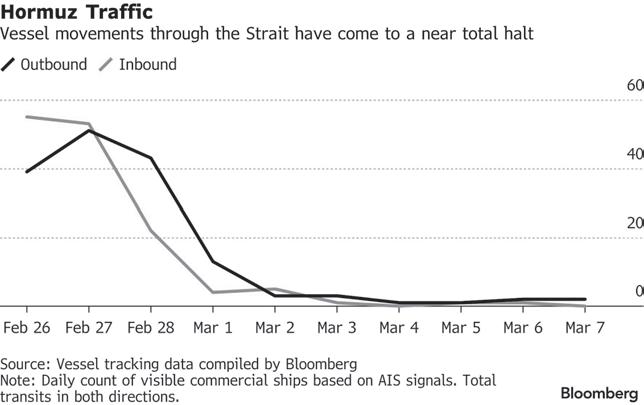
Oil prices have surged as the war, now in its second week, ensnares countries and places that are critical to the production and movement of oil and gas from the Persian Gulf. Roughly 15 million barrels of crude oil—about 20% of the world’s oil— typically are shipped every day through the Strait of Hormuz, according to independent research firm Rystad Energy. The threat of Iranian missile and drone attacks has all but stopped tankers from traveling through the strait, which is bordered in the north by Iran, carry oil and gas from Saudi
Arabia, Kuwait, Iraq, Qatar, Bahrain, the United Arab Emirates and Iran. Iraq, Kuwait and the UAE have cut their oil production as storage tanks fill due to the reduced ability to export crude. Iran, Israel and the United States also have attacked oil and gas facilities since the war started, exacerbating supply concerns. The surge in costs for oil and natural gas is pushing fuel prices higher, cascading through other industries and jolting Asian economies that are especially vulnerable due to the region’s heavy reliance on imports from the Middle East. The last time Brent and US crude futures traded near the current level was in 2022, after Russia invaded Ukraine.
Higher energy costs push inflation higher, straining household budgets and denting the consumer spending that is a main driver of many big economies. Tokyo’s
Balancing act: Can China fix its slowdown without losing sight of tech race with US?
By Ken Moritsugu & Chan Ho-Him
BThe Associated Press
EIJING—Two major economic plans unveiled at the annual meeting of China’s legislature outline top priorities that have different ramifications for the global economy.
In the government plan for 2026, the No. 1 task is “building a robust domestic market.” Then comes accelerating technological progress. But longer-term, a plan for the next five years gives more prominence to achieving advances in tech.
The subtle difference highlights the government’s balancing act. Its overarching goal is to transform from a low-cost manufacturing to a techdriven economy.
But a more immediate concern is dealing with a prolonged period of sluggishness that has depressed consumer and business confidence. China is such a large exporter that the choices it makes affect countries and jobs around the world.
The plans, presented at the recent opening of the National People’s Congress, offer a window into the government’s thinking. They are set to be formally endorsed by the rubberstamp legislature at the end of the eight-day session on Thursday.
Tech crucial to China’s future ANALYSTS believe technological prowess remains the far more important goal for Chinese leader Xi Jinping and his vision to build the nation into a major power that can contend with the United States on issues ranging from trade to Taiwan tensions.
Speaking to a provincial delegation at the National People’s Congress, Xi called for new breakthroughs, original innovation and “seizing the strategic high ground of science and technology,” according to a state media report.
China’s rapid growth into the world’s second-largest economy has lifted it to the level of a middleincome nation. To keep advancing, Xi has promoted polices that move the economy into higher-value industries.
A government-backed push into electric vehicles, for example, has transformed China into an emerging player in the global auto industry, while dovetailing with national climate goals.
The five-year plan vows to “target the frontiers of science and technology,” speeding up development in areas such as artificial intelligence, quantum technology, biotechnology and new energy.
Moves toward self-sufficiency THE push has expanded and morphed as technology has evolved into an area of competition with the US with national security implications.
The US has restricted the access of Chinese companies to the most advanced technologies, including semiconductors that drive AI. The justification is that these parts can wind up in weapons at a time when the two countries are military rivals as well.
China’s government has responded by pouring resources into trying to develop these components itself as well as engineer ways to remain competitive with less advanced parts.
China must “fight the battle for key core technologies,” the five-year plan said. Specific goals, apart from AI, electric vehicles and robotics, include making advancements in semiconductors, batteries, biomedicine and 6G mobile networks. The plan also pledged to expand production of China’s homegrown
SMOKE rises after an explosion in the industrial zone in Fujairah, United Arab Emirates, on Tuesday, March 3, 2026. Oil surged for a second day as the US and Israel stepped up their war against Iran, with a fire at a key storage hub in the United Arab Emirates underscoring the risk to energy supplies. BLOOMBERG PHOTO
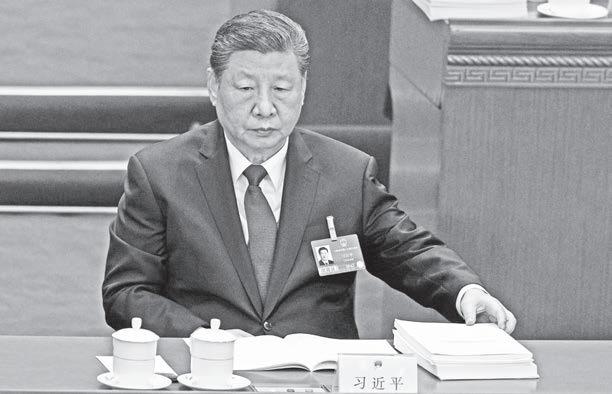
CHINESE President Xi Jinping reacts during the opening session of the National People’s Congress (NPC) in Beijing, Thursday, March 5, 2026. AP/NG HAN GUAN
A8 Tuesday, March 10, 2026
Iran names slain supreme leader’s son as successor amid oil price surge
By Jon Gambrell, David Rising & Samy Magdy
The Associated Press
DUBAI, United Arab Emirates— Iran named Mojtaba Khamenei, a son of its late supreme leader, the Islamic Republic’s next ruler on Monday, putting a hardline cleric in charge as the war spreading across the Middle East sent oil prices skyrocketing with Iran launching new attacks on regional energy infrastructure.
With Iran’s theocracy under assault by the United States and Israel for more than a week, the country’s Assembly of Experts chose the secretive, 56-year-old cleric with close ties to the country’s paramilitary Revolutionary Guard as the new supreme leader. The Guard has been firing missiles and drones at Israel and Gulf Arab states since the younger Khamenei’s father, Ayatollah Ali Khamenei, was killed Feb. 28 during the war’s opening salvo. Iran’s stranglehold on the Strait of Hormuz has also all but stopped tankers from using the shipping lane oil, the international standard, surged to more than $114 a barrel on Monday, about 60% higher than when the war started.
As global economic concerns grew, US President Donald Trump downplayed the spike in prices as temporary.
“Short term oil prices, which will drop rapidly when the destruction of the Iran nuclear threat is over, is a very small price to pay for U.S.A., and World, Safety and Peace,” Trump wrote on social media. Iran has been firing on Israel and American bases in the region since the start of the war, but has also been launching missiles and drones at energy and water infrastructure.
On Monday, a fire broke out at an oil facility that was attacked in Fujairah, United Arab Emirates. Bahrain’s only oil refinery was apparently also hit and Saudi Arabia said it had intercepted several drones attacking its Shaybah oil field. Israel, meantime, claimed strikes on targets in Iran’s city of Isfahan, saying it had hit command centers for the Revolutionary Guard and its volunteer Basij force there, as well as a rocket engine production facility and missile launch sites. There was no immediate confirmation from Iran.
New Iranian leader seen as even more hardline than his father
THE younger Khamenei, who had not been seen or heard from publicly since
the war started, had long been considered a potential successor—even before the Israeli strike killed his father and despite never being elected or appointed to a government position.
There appeared to be some dissension over his selection. Political figures within Iran have criticized the idea of handing over the supreme leader’s title based on heredity and thereby creating a clerical version of the rule of the shah, who was toppled during the 1979 Islamic Revolution. But top clerics in the Assembly of Experts likely wanted Khamenei to prosecute the war.
Khamenei, who is believed to hold views that are even more hardline than his late father, now will be in charge of Iran’s armed forces and any decision regarding Tehran’s nuclear program.
While the country’s key nuclear sites are in tatters after the US bombed them during the 12-day Israel-Iran war in June, there’s still highly enriched uranium in Iran that’s a technical step away from weapons-grade levels. Khamenei could choose to do what his father never did—build a nuclear bomb.
Israel has already described him as a potential target, while Trump had called him “unacceptable.”
“We want someone that will bring harmony and peace to Iran,” Trump had said.
Iran’s Revolutionary Guard issued a statement expressing support, as did the Iran-backed Lebanese militant group Hezbollah.
Top Iranian security official Ali Larijani, speaking to Iranian state television, praised the Assembly of Experts for “courageously” convening even as airstrikes continued in Tehran. He said the younger Khamenei had been trained by his father and “can handle this situation.”
Regional anger grows as attacks continue on energy infrastructure and oil prices spike
SAUDI ARABIA lashed out at Iran following a thwarted drone attack on its massive Shaybah oil field, saying Tehran would be the “biggest loser” if it continues to attack Arab states.
The Foreign Ministry said Iranian attacks mean “further escalation which will have grave impact on the relations, currently and in the future.”
In addition to targeting energy facilities also in the UAE, Iran on Monday also attacked Kuwait, Qatar and Bahrain, where it hit a residential area wounding 32 people, including several children, according to authorities.
Another attack appeared to have started a fire at Bahrain’s only oil refinery, sending thick plumes of smoke into the air, with online video purportedly showing the blaze. Bahrain’s government did not immediately identify the refinery itself as being hit, though it has been a target of repeated Iranian attacks since the war began.
Bahrain has also accused Iran of damaging one of its desalination plants, though its electricity and water authority said supplies remained online. Desalination plants supply water to millions of residents in the region and thousands of stranded travelers, raising new fears of catastrophic risks in parched desert nations.
On Monday, the island kingdom’s state oil company declared force majeure for its oil shipments, state-run Bahrain News Agency reported, a legal maneuver that releases a company of its contractual obligations because of extraordinary circumstances. It insisted that local demand could still be met.
In Iraq, air defenses shot down a drone as it attacked a US military compound inside the Baghdad International Airport, a security source told the AP on condition of anonymity because they were not authorized to speak to the press.
There were no reported injuries or dam -
age and it was not immediately clear who was behind the attack, but Pro-Iranian Iraqi militias have previously targeted the base. Elsewhere, the US military had said a service member died of injuries from an Iranian attack on troops in Saudi Arabia on March 1. Seven US soldiers have now been killed.
The US State Department early Monday ordered nonessential personnel and families of all staff to leave Saudi Arabia following the escalation in attacks. Eight other US diplomatic missions have ordered all but key staff to leave: Bahrain, Iraq, Jordan, Kuwait, Lebanon, Qatar, the United Arab Emirates and the consulate in Karachi, Pakistan.
The war has killed at least 1,230 people in Iran, at least 397 in Lebanon and at least 11 in Israel, according to officials. Israel reported its first soldier deaths Sunday, saying two were killed in southern Lebanon, where its military is fighting Hezbollah.
Rising reported from Bangkok and Magdy from Cairo. Associated Press journalists Sam Metz in Ramallah, West Bank, Sally Abou AlJoud in Beirut, Lebanon, Aamer Madhani in Doral, Florida, and Qassem Abdul-Zahra in Baghdad contributed reporting.
Continued from A1
The weaker pace of job creation also pushed the country’s full-year unemployment rate to 4.19 percent, or about 2.14 million jobless Filipinos.
Chikiamco also warned that tensions in the region could disrupt the hiring of Filipino workers in Middle Eastern countries.
“Deployment of [overseas Filipino workers] to the Middle East will slow down or stop entirely, resulting in lower remittances and higher unemployment,” he added.
Meanwhile, IBON Foundation Executive Director Jose Enrique A. Africa noted that the immediate labor impact may first appear in the form of worsening job insecurity and declining incomes, especially in sectors heavily dependent on fuel.
“The risks to employment in the country are at the very least in terms of worsening precarity of work, but possibly also outright job losses if the US’s attack on Iran drives up global oil prices to sustained record highs,” Africa told the B usiness M irror
Africa explained that oil remains a major component of the Philippines’s energy mix, meaning higher fuel prices quickly translate into higher production and transport costs across the economy.
The resulting inflation could then erode household purchasing power and weaken demand for goods and services.
Based on most recent data from the International Energy Agency (IEA), oil accounted for 29.5 percent of the Philippines’ total energy supply in 2023 and 51 percent of total final energy consumption.
Fuel-reliant sectors
AMONG the first to feel the pressure, Africa said, are workers whose livelihoods depend heavily on fuel, including jeepney,
Nepomuceno said the BOC has yet to feel the impact of the recent surge in oil prices because many shipments entering the country are old stocks.
“Look, you never know exactly the time frame of this, but, in the worst case, this is a weeks, this is not a months thing,” Wright added.
tricycle, taxi and bus drivers, delivery riders, as well as fisherfolk and farmers whose operating costs rise quickly when oil prices surge.
“Many will be quickly driven into poverty because they have such low earnings to begin with and barely any savings to fall back on, if at all,” he said.
Africa added that rising prices for food and other basic goods could further erode household purchasing power, forcing families to cut back on spending.
“If sales are reduced for too long, then firms in the trade, transport, and hotel and restaurant sectors will likely hold back on wage and salary increases to protect their profit margins. At worst, firms may eventually be pushed to scale back employment if the crisis drags on,” he also said.
Ateneo de Manila University (ADMU) economist Ser Percival K. Peña-Reyes said sustained increases in global oil prices could also put pressure on employment in several key industries.
These include transportation and logistics, agriculture and fisheries, manufacturing and export industries, construction, and small and medium enterprises (SMEs)—sectors that rely heavily on fuel for daily operations.
“These sectors rely heavily on fuel for operations, so they are particularly sensitive to sustained oil price increases,”
Peña-Reyes told the B usiness M irror
Early Monday, global oil prices surged past $114 per barrel, the highest level since 2022, as the Iran war intensified and raised fears of disruptions to oil production and shipping in the Middle East.
The international benchmark Brent crude climbed above $114, about 23 percent higher than its Friday closing price of $92.69. West Texas Intermediate (WTI), the benchmark for U.S. crude, also traded at around $114 per barrel, roughly 25 percent higher than its $90.90 close on Friday.
Should higher oil prices persist, however, Nepomuceno said the BOC’s collection hinges on what will happen in the Middle East in terms of logistics, as well as the government’s policy response on fuel excise taxes.
As of end-February 2026, the BOC has collected P154.747 billion or 15.42 percent of its full-year collection target.
If oil prices stay above $100 per barrel, some analysts and investors say it could be too much for the global economy to withstand. Iranian authorities said strikes by Israel on oil depots in Tehran and a petroleum transfer terminal early Sunday killed four people. Israel’s military said the depots were being used by Iran’s military for fuel to launch missiles. Mohammad Bagher Qalibaf, the speaker of Iran’s parliament, warned that the war’s impact on the oil industry would spiral. Iran exports roughly 1.6 million barrels
Continued from A7
passenger jet, the C919, and make breakthroughs in developing its own commercial jet engine. The US temporarily cut off the supply of Western-supplied engines for the C919 last year during an escalation in the trade war with China. Rare earths—where China is the global
leader—was highlighted as an area where it should maintain its competitive edge as the US and other countries seek to develop their own supplies of the critical elements for many advanced tech and military products.
Trump’s tariffs
World shares tumble as soaring crude prices fuel economic fears
By Elaine Kurtenbach AP Business Writer
BANGKOK—Japan’s benchmark
Nikkei 225 index plunged more than 5% and other Asian markets also tumbled Monday after oil prices soared to nearly $120 a barrel, casting a shadow over economies heavily dependent on imported crude and gas from the region.
The futures for the S&P 500, Nasdaq composite index and the Dow Jones Industrial Average were trading more than 1% lower after dropping more than 2% late Sunday.
A Chinese special envoy to the Middle East, Zhai Jun, called for an end to the attacks and said strikes on nonmilitary targets and civilians should be condemned. Meanwhile, South Korean President Lee Jae Myung warned against hoarding, panic buying and collusion between refiners and gas stations.
“Please respond proactively to the growing volatility in the financial and foreign exchange markets, which are the lifeblood of our economy,” Lee said.
Continued from A1
According to Ricafort, the local currency weakened “after global crude oil prices went up to new highs in nearly 4 years or since July 2022 amid the continued war on Iran since February 28, 2026 or for more than a week already.”
Jonathan L. Ravelas, senior adviser at Reyes Tacandong & Co. explained that, “The surge in oil prices past $100 a barrel is a key factor—it raises our import bill, fuels inflation expectations, and boosts dollar demand, all of which weaken the peso.”
Apart from the surge in oil prices, Union Bank of the Philippines Chief Economist Ruben Carlo Asuncion explained to this
of oil a day, mostly to China, which may need to look elsewhere for supply if Iran’s exports are disrupted, another factor that could increase energy prices.
The price of natural gas also has climbed during the war, though not by as much as oil. It was selling for about $3.33 per 1,000 cubic feet late Sunday. That’s 4.6% higher than its Friday closing price of $3.19, after rising about 11% last week.
EVEN as China’s economy has cooled at home, rising exports have kept it growing overall. But tariffs imposed by US President Donald Trump have exposed the risk of relying too heavily on overseas markets.
China was able to shift exports to other markets, but that is facing challenges as its record trade surplus of almost $1.2 trillion raises alarm about the threat to factory jobs and the broader economies in other countries.
That has added impetus to China’s push to pump up consumer spending, so the economy is less dependent on outside forces.
“Facing a complex and challenging international environment, we must remain com -
Oil prices rocketed higher after both sides in the war struck new targets over the weekend, including civilian ones. Bahrain accused Iran of hitting one of the desalination plants that are crucial for drinking water in Gulf countries. Israel struck oil depots in Tehran, sending up thick smoke and causing environmental alerts.
The Nikkei regained some of its earlier losses to shed 5.2% to 52,728.72. South Korea’s Kospi sank 6% to 5,251.87.
Chinese markets, which tend to be less affected by global trends, saw more moderate losses. Hong Kong’s Hang Seng fell 1.6% to 25,343.77 the Shanghai Composite index was down 0.7% at 4,097.69.
Taiwan’s benchmark dived 4.4% and other regional markets also swooned.
As of 0600 GMT, the price for a barrel of Brent crude was $103.54 a barrel. US benchmark crude rose to $107.35. Both were about 15% above their closing prices Friday.
Crude prices have spiked to their highest levels in at least 14 years as the war, now in its second week, ensnares
newspaper that the peso’s eight - da y slide “reflects multiple reinforcing factors” such as the elevated oil prices, heightened global risk aversion due to Middle East conflict, a stronger US dollar, lighter BSP foreign - e xchange intervention, and broader regional currency weakness.
“Together, these created sustained downward pressure on the USDPHP,” Asuncion also noted.
Mixed effects of weaker PHP PHILIPPINE Institute for Development Studies (PIDS) Senior Research Fellow John Paolo R. Rivera explained the mixed effects of a weaker peso: “On the negative side, it raises the cost of imports especially fuel, food inputs, and capital goods which can push inflation higher and increase the PHP
US stock index futures fell early Monday, pointing to likely losses for Wall Street’s main indexes when they open.
On Friday, the S&P 500 dropped 1.3% and the Dow plunged as many as 945 points before finishing with a loss of roughly 450. The Nasdaq composite sank 1.6%.
Kurtenbach contributed from Bangkok.
mitted to the strategy of expanding domestic demand,” the annual economic plan said.
But for all the strong words, analysts say the effort appears aimed at keeping the economy afloat rather than boosting it. The annual plan sets a growth target of 4.5% to 5% for 2026, leaving room for a drop from last year’s 5% rise.
Chan Ho-him reported from Hong Kong.
countries and places that are critical to the production and movement of oil and gas from the Persian Gulf. They last rose above $100 shortly after Russia invaded Ukraine in 2022.
“The market woke up to the sound every macro trader dreads. The oil alarm bell. And this time it was not a polite chime. It was a fire siren,” Stephen Innes of SPI Asset Management said in a commentary.
Surging oil and gas prices, if they persist, could ripple across the globe, further complicating matters for countries still adjusting to higher tariffs on exports to the United States under President Donald Trump.
Senior officials of Southeast Asian countries were meeting this week in Manila, the Philippines, where they were expected to discuss ways to counter the shock from higher energy costs.
“Oil prices will reach a peak at some point—maybe they already have, maybe there’s more to come—but they are likely to fluctuate at elevated levels for weeks, perhaps months,” Ipek Ozkardeskaya of Swissquote said in a commentary. “Eventually—even if the war
cost of servicing foreign debt.”
In contrast, Rivera said depreciation can improve the competitiveness of exports and remittances in Philippine peso terms.
“Key issues will be whether oil prices remain elevated and how the BSP manages exchange rate volatility while keeping inflation expectations anchored,” he added.
Ravelas said moving forward, the main risk is higher inflation and more expensive imports.
“So the focus should be on stabilizing the prices, managing FX volatility, and protecting consumers, even as exporters and remittance earners get some relief,” he pointed out.
Meanwhile, Asuncion said a weaker local currency could widen current account deficit and increase external financing pressures.
persists—energy prices will likely come down. But during this period, high energy prices will revive inflation globally and weigh notably on growth.”
On Friday, the S&P 500 dropped 1.3% after a report
The Dow plunged
Early
The Associated Press writer Kim Tong-hyung contributed from Seoul, South Korea.
“These conditions may prompt the BSP to delay easing or adjust policy, while households and businesses face higher expenses and tighter financial conditions overall,” he explained.
Analysts clarified, however, that the P59.50 level against the greenback is “not necessarily the weakest on record” but is approaching historical lows.
Rivera said the Philippine peso has traded near similar levels during previous episodes of global volatility.
“What matters more is the speed of depreciation which suggests strong external pressures rather than a sudden deterioration in domestic fundamentals,” he said.
Asuncion said the P59.50 level of the local currency is the lowest in 10 years.
‘A strategic reform’: DepEd, DBM ink deal to elevate teaching workforce
By Claudeth Mocon-Ciriaco @claudethmc3
THE Department of Education (DepEd) and the Department of Budget and Management (DBM) officially signed a landmark agreement on Monday to establish Teacher Education Excellence Centers (TEEC) nationwide, envisioned as a national research center, innovation hub and laboratory for teacher education.
Education Secretary and Teacher Education Council (TEC) Chairperson Juan Edgardo “Sonny” Angara signed the DBM-TEC Joint Memorandum Circular (JMC) No. 1, Series of 2026 with Acting DBM Secretary Rolando Toledo, formalizing the fiscal support to
the initiative. It aims to bridge the gap between theory and classroom reality by producing evidence-based training models, modernizing curricula, and integrating advanced technology into educator preparation.
Angara emphasized that while infrastructure is vital, the quality of instruction remains the heart of DepEd’s mission.
“The establishment of Teacher Education Excellence Centers represents a strategic reform that will strengthen and elevate our teaching workforce across the country,” Angara said.
“Ito ay patunay ng ating sama-samang pagkilos upang iangat ang kalidad ng edukasyon sa bansa. Sa pangunguna ni
PresidentBongbongMarcos,patuloynating isusulong ang mga repormang magtitiyak ng mas matibay na pundasyon para sa kinabukasan ng ating mga mag-aaral,” he added.
The TEEC will support a wide range of stakeholders, including pre-service and in-service teachers, teacher educators, school leaders, and specialized groups such as child development workers, pre-service student tutors, TVET trainers, multigrade teachers, and deans of colleges of education.
To ensure nationwide reach, the TEC signed a memorandum of understanding (MOU) with each of the six Teacher Education Institutions (TEIs) that will serve as the program’s inaugural implementers.
These are the Philippine Normal University-Manila (National Capital Region); University of the Philippines-Los Baños (South Luzon); University of San Carlos (Visayas); Mindanao State University-Iligan Institute of Technology (Northern Mindanao); Caraga State University (Eastern Mindanao); and Cotabato State University (BARMM).
The TEEC will function as the research arm of the TEC, tasked with developing programs that are not only high-quality but also contextualized to the unique needs of Filipino classrooms.
The establishment of the TEEC operationalizes the mandates of Republic Act No. 11713 or the Excellence in Teacher Education Act, which aims to elevate teacher education in the country.
New radar, weather station to boost monitoring in Western Visayas
By Bless Aubrey Ogerio
ANEW weather radar facility in Iloilo has been inaugurated while construction begins on a separate observation station, steps expected to strengthen weather monitoring and forecasting in Western Visayas.
The Philippine Atmospheric, Geophysical and Astronomical Services Administration (PAGASA) led the opening of the Iloilo Radar Facility and the groundbreaking of a new synoptic station in the province.
The Iloilo S-band Radar Facility is equipped with a dual-polarimetric Doppler radar system designed to improve the monitoring of weather disturbances across Western Visayas and nearby areas.
The radar provides high-resolution and near real-time data that can help track heavy rainfall, severe thunderstorms and tropical cyclones.
Science Secretary Renato Solidum Jr. expressed confidence in the technology but stressed that equipment alone is not enough to prevent disaster impacts. “It is the combination of technology, skilled scientists, proactive leaders, and a well-informed public that truly builds resilience.”
The S-band radar operates at lower frequencies and longer wavelengths, allowing it to detect atmospheric conditions even during intense rainfall. This capability makes it effective for large-scale weather monitoring, particularly during severe weather events. According to PAGASA, the system’s enhanced
detection capabilities will help the agency issue more accurate forecasts and timely advisories, which are used by national and local authorities in responding to extreme weather.
Alongside the radar facility, PAGASA also broke ground for a new synoptic station at Iloilo International Airport. Once completed, the station will continuously measure key meteorological conditions that support daily weather forecasting and help maintain longterm climate records.
These observations are also expected to support research, disaster preparedness planning and climate adaptation strategies.
Weather data gathered from the station will also be used to produce reports critical to aviation operations, helping ensure safe and
efficient flights while safeguarding passengers, crew and aircraft.
For his part, PAGASA administrator Nathaniel Servando said the facility will provide consistent and reliable observations of atmospheric conditions.
“These may appear to be simple measurements, but they form the very foundation of every forecast we issue,”Servando said.“Without accurate observations, there can be no reliable forecasts, and without reliable forecasts, effective preparedness becomes a challenge.”
For the past four years, the Philippines has consistently ranked among the world’s most disaster-prone countries, facing increasingly severe storms and floods intensified by climate change, according to this year’s World Risk Report.
Mining-affected communities intensify protest with barricades
MINING -affected communities have intensified their opposition to mining operations, citing the risk of catastrophic floods and landslides amid widespread corruption in flood control projects across the country.
At a press conference in Quezon City dubbed
Mining Hell Week, Jaybee Garganera, national coordinator of Alyansa Tigil Mina (ATM), said that despite protests and strong opposition to mining, the number of approved projects increased under the Marcos administration over the past three years.
Many mining communities have experienced
flooding and landslides as a result of mining, Garganera said, aggravating the worst impacts of climate change. This becomes even more alarming because of the recent expose of massive graft and corruption in the flood control projects of the Department of Public Works and Highways (DPWH), he said.
“Since July 1, 2022, the approved projects have increased, expanding the mining areas,” he said. “Mining triggered floodings in Palawan, in Sibuyan, Romblon, and in Surigao del Sur,” he said.
See “Mining,” A11
Kiko
pushes passage of agri co-ops, agricom and extension services bills
By Butch Fernandez @butchfBM
THREE measures seen to address pervasive and long-standing challenges in the agriculture and fisheries sector and achieve national food security, rural development, and uplift the lives of farmers and fisherfolk, are being pushed in the Senate, especially amid concern that geopolitical risks could worsen the outlook for the Philippine farm sector.
Senator Francis “Kiko” Pangilinan is pushing for the passage of the proposed measures—Agricultural Cooperatives Act of 2025, the Agriculture and Fisheries Extension Act of 2025, and the Congressional Commission on Agriculture, Fisheries, and Food Security (AGRICOM) Act, which he authored.
He recently met anew with President Ferdinand Marcos Jr. at Malacañang last Tuesday to discuss priority measures for the agriculture sector and seek the administration’s support for the passage of Senate Bill No. 1183 (the Agricultural Cooperatives Act of 2025), Senate Bill No. 1182 (Agriculture and Fisheries Extension Act of 2025), and Senate Bill No. 1624 (the AGRICOM Act).
This was brought about shortly after the “Evening With The Stars” Malacañang Gala attended by the senator and wife Sharon CunetaPangilinan last month. During the event, Pangilinan sought to schedule a meeting with President Marcos to discuss his proposed measures to reform the agriculture sector.
“There isn’t a day when we don’t hear a lament about hunger, and high prices. We promised to search for a solution to these woes that’s why we are here to ask the President for support for our proposed measures,” Pangilinan said, in Filipino.
The proposed measures, he explained, would transform agricultural cooperatives into “key partners for national food security and rural development,” renationalize extension services by making government aid easily accessible to farmers and fisherfolk, and identify the challenges in the entire food supply system.
The agricultural cooperatives bill seeks to provide funding to boost the productivity of
Cebu
agricultural cooperatives, encourage clustering and consolidation to achieve economies of scale, promote modern and climate-resilient farming practices and technologies, enhance access to credit, and build the capacity of smallholder farmers.
Re nationalizing the Department of Agriculture’s extension services will bring critical services to farmers and fisherfolk by ensuring their access down to the municipal level. The AGRICOM, on the other hand, will be a three-year intervention to seek concrete and targeted reforms in the agriculture and fisheries sector. The commission aims to streamline agriculture and fisheries-related bureaucracies.
At the meeting with the President, Pangilinan persuaded President Marcos to certify the three bills as urgent, highlighting how the empowerment of the agriculture and fisheries sector could address the country’s food crisis.
He also invited House Committee on Agriculture and Food Chairperson Mark Enverga and House Committee on Agrarian Reform Chairperson Leah Bulut-Begtang to work hand in hand in swiftly passing these bills in the lower house, so that together they can deliver critical aid to the sector and quickly improve the lives of farmers and fisherfolk. He also explained how the proposed agricultural cooperatives and extension services measures will complement his 2019 Sagip Saka Act, which allows national government agencies and local government units to buy food directly from farmers and fisherfolk without public bidding.
When Executive Order 101, which directs government agencies to fully implement the Sagip Saka Act, was signed last year, Pangilinan shared that farmers’ and fisherfolk’s organizations immediately reaped the benefits of government agencies and local governments buying their produce directly. Absorption of government interventions in the sector, he added, is essential to boost local food production. He pointed out that for 2026, the agriculture and fisheries sector can tap through the Sagip Saka Act the various feeding programs of the government agencies, amounting to more than P37 billion.
City mayor appeals vs panic buying of fuel as some Cebu stations report low supply
By Carmel Pedroza
CEBU CITY — Mayor Nestor Archival has called on vehicle owners to refrain from hoarding fuel as several gasoline stations in the city have reportedly begun running low on supply.
Archival urged motorists to avoid panic buying, warning that excessive fuel purchases could distort the market and worsen the situation.
“Ang mga tag-iya og sakyanan ayaw sab og panic. Kung mamalit mo og grabe kadaghan,maona’ymakadistortsamarketug motaasanglinyasamgagasoline stations [We are appealing to vehicle owners to not panic.
If you buy excessive amounts, it can distort the market and lines will be long in gasoline stations],” the mayor said in a press conference on Monday morning, March 9, 2026.
The appeal came as some gasoline stations in Cebu City, according to Archival, have already experienced depleted stocks, prompting the city government to temporarily lift the truck ban for fuel tankers delivering gasoline supplies.
Archival said he has instructed the Cebu City Transportation Office (CCTO) not to apprehend tanker trucks entering the city while the measure is in place.
“Depleted ang stock sa uban gasoline stations. Mao nga giingnan na nato ang CITOM [CCTO] nga dili sa dakpon ang mga tanker trucks sa delivery, especially Monday to Tuesday [Some gasoline stations have already depleted stocks. That is why we have instructed the Cebu City Transportation Office [CITOM/CCTO] not to apprehend tanker
See “Cebu City,” A11
DMW recalls staff in Bahrain for rude behavior toward OFWs in viral video
By Samuel P. Medenilla @sam_medenilla
THE Department of Migrant Workers (DMW) has recalled an employee of its Migrant Workers Office (MWO) Bahrain, whose video of his alleged rude behavior towards overseas Filipino workers (OFW) went viral online.
DMW Secretary Hans J. Cacdac made the announcement in his social media account after he announced the government already brought home over 300 OFWs and their dependents, who were affected by the ongoing armed conflict in the Middle East.
“I have issued the order recalling that MWO Bahrain employee being highly disrespectful to OFWs in a viral video,” Cacdac said.
“I assure our dear OFWs that we shall continue to serve with humility, respect, and hard work,” he added.
The almost a minute-video showed the supposed MWO personnel trying to
turn away OFWs, who were converging and appeared to be waiting for cash aid. The personnel said there were no more available funds.
Financial support
DMW also addressed the reports that only 20 dinars were distributed to qualified OFWs in Bahrain instead of the US$200, which was supposedly announced by Cacdac. In a Viber message, DMW Undersecretary Dominique R. Tutay explained that the 20 to 50 dinar were for food, clothing and medicines of OFWs, who are still in Bahrain.
“The 200 dollars is given to OFWs who are about to leave the airport and are homebound,” Tutay said.
She said the concerned OFWs will get additional support from other government agencies once they arrive home.
DMW is currently closely monitoring the situation of the over 2 million Filipinos in the
See “DMW,” A11
FTI to buy Occidental Mindoro onions to stabilize prices during harvest surge
SBy Ada Pelonia @adapelonia
TATE -run Food Terminal Inc. (FTI) is set to purchase onions from farmers in Occidental Mindoro to prevent a slide in prices of the crop ahead of the projected surge in harvest until April.
The FTI said the intervention comes as onion production is expected to rise until the start of the second quarter, a period when
farmgate prices tend to fall sharply due to oversupply and limited storage capacity.
With this, FTI executives inspected the WBI Cold Storage facility in the province, which can store up to 380,000 bags of onions, to prepare for the procurement program.
The cold storage facility is slated to start operations on March 10, allowing FTI to start purchasing onions from farmers by the third week of March.
Comelec backs retaining SK, calls for reforms
By Mary Jade Jadormio
HE Commission on Elections
T(Comelec) said it favors retaining the Sangguniang Kabataan (SK) while pursuing reforms to improve the youth council system.
Comelec spokesperson John Rex Laudiangco said the poll body respects the personal view of Interior Secretary Jonvic Remulla on the issue.
“We deeply respect the personal view of the honorable Secretary of the Interior and Local Government,” Laudiangco said. He noted that Remulla’s position may come from his extensive experience in governance.
Remulla previously served as governor of Cavite, one of the provinces with the largest number of voters, before becoming DILG chief.
However, Laudiangco said Comelec Chairman George Erwin M. Garcia earlier said the poll body prefers to retain the SK.
“The participation of the youth in
Cebu City. . .
Continued from A10
trucks making fuel deliveries, especially from Monday to Tuesday],” he said.
Despite the situation, Archival said information from the Department of Energy indicates that the overall fuel supply is not critically low.
The mayor also raised the possibility of reviving a price monitoring task force in coordination with the Department of Trade and Industry (DTI) to guard against profiteering, particularly as complaints of rising prices for some basic commodities such as rice have surfaced.
Archival said the city government had already discussed the matter with the DTI last week and may reactivate the task force that previously monitored market prices.
DMW. . .
Continued from A10
Middle East, which is now in turmoil after the United States (US) and Israel launched joint airstrikes against Iran. Iran retaliated by launching retaliatory attacks against its neighboring countries with US airbases.
Chartered flights
nation-building is clearly stated in the Declaration of Principles and State Policies of the Constitution,” Garcia said.
The Comelec spokesperson added that the SK helps train future leaders not only in the barangay but also in national and local government.
“Although there have been criticisms directed at some elected officials who have served, it provides very good training for those who may become leaders of our country in the future,” Laudingco said.
Comelec also believes reforms are needed in the laws and policies governing the SK.
“We believe there should be reforms in the laws and policies governing the SK so that the true goal of youth leadership, representation and engagement with local government can be better achieved,” Laudiangco said.
The SK currently serves as the youth council in every barangay and is composed of elected officials aged 18 to 24 who represent the interests of young people in their communities.
“I understand nisaka ang palaliton kay nisaka man gyud ang gasolina, pero hangyo lang nato sa mga vendors nga dili unta i-overprice ang ilang baligya [I understand that the prices of goods have increased because fuel prices have also gone up, but we are appealing to vendors not to overprice the items they are selling],” he said.
He urged businesses and vendors to exercise restraint in adjusting prices and consider the financial difficulties currently faced by many consumers.
“So far, wala pa man ta’y nadawat nga reklamo sa gasolina. Pero sa rice, naa’y reports nga nisaka og maayo ang presyo. Mao nga importante nga adunay price monitoring [So far, we have not received any complaints regarding gasoline. However, for rice, there are reports that prices have increased significantly. That is why it is important to have price monitoring.],” Archival added.
CACDAC said DMW already repatriated 309 OFWs and their 11 dependents, who were stranded in Dubai from March 5 to 8, 2026. He said they have ongoing efforts to bring home more OFWs form the eight Middle East countries, which are affected by the ongoing attack from Iran.
“We have identified in each of the eight countries involved certain points of exits for OFWs to be repatriated to safer grounds and eventually go back to the Philippines. Most airports in the 8 countries are closed,” the DMW chief said in a press conference last Sunday.
“Efforts are underway to get our people across the border of each of the 8 countries,” he added.
Cacdac said scheduling chartered flights in the coming days to bring home the said OFWs.
“We have, we are preparing charter flights within the coming weeks. So [this is] subject to future announcement when the proper time comes,” Cacdac said.
Agriculture Secretary Francisco Tiu Laurel Jr. said that by purchasing onions and keeping them in cold storage, the government can absorb part of the harvest supply and stabilize farmgate prices.
“With this intervention, we expect to limit the role of middlemen in determining onion prices and help growers obtain better prices for their produce,” Tiu Laurel said.
For his part, FTI President Joseph Lo noted that the procurement effort forms
4.2 percent under Scenario 1 and 4.5 percent to 4.8 percent under Scenario 2.
The DOE earlier estimated that power prices could increase by around 16 percent if oil prices remain elevated. Such increases would also reduce consumers’ buying power. Edillon said the price surge could erode purchasing power by around P1 for every P100 under the moderate scenario. Under the worst-case scenario, the erosion could reach P2.60 per P100.
Supply enough DURING the same hearing, Garin said the geopolitical situation could affect the country in two major ways—fuel supply and prices—but assured lawmakers that there is currently no risk of a supply shortage.
“On the supply side, this is a bigger issue because while we do not import directly
from the Middle East, most of the petroleum products we buy from countries like China are refined from crude oil coming from the Middle East,” Garin said. She explained that the Philippines primarily sources refined petroleum products from refineries across Asia, including China, Japan, and South Korea. However, around 90 percent of the crude oil used in these refineries originates from the Middle East, making the region’s stability crucial to global supply chains.
Despite these challenges, Garin said the DOE has already met with oil companies operating in the country and received assurances that they have sufficient stocks available.
“They have confirmed what stock is already here in the Philippines, what supplies are en route, and those that have already been ordered,” she said.
Based on current inventory and shipments already on the way, Garin said the country’s fuel supply is expected to last until April.
part of the government’s broader strategy to improve market stability and farmer income while ensuring steady supply of onions in the market.
“The directive of the President and the Secretary is to advance food security in the country and ensure that food remains affordable and accessible to all Filipinos,” Lo said. “The role of the FTI is to strengthen market linkages across the food value chain—from farmers to consumers.”
The FTI earlier implemented the program in other onion-producing areas, particularly in Nueva Ecija where it purchased 10,000 bags of red onions. It is targeting to procure around 3,000 bags daily starting March 6.
Meanwhile, the agency will also craft policies and guidelines for a “more transparent” onion trading system in Occidental Mindoro after conducting a consultative meeting with farmers and traders.
The meeting also recommended requiring the registration of onion traders to prevent illegitimate buyers from operating in the market.
“The combined measures such as direct procurement, expanded cold storage use, and tighter trader oversight are expected to help cushion farmers from sharp price swings during the harvest season while promoting fairer trading practices in the onion industry.”
Cebu Archbishop calls for energy conservation, aid to poor as oil prices rise
By Carmel Pedroza
CITY—The
EBU
CArchdiocese of Cebu has called on the faithful to intensify prayers for peace, practice responsible energy use, and extend greater assistance to the poor as global tensions continue to affect everyday life in the Philippines.
In a pastoral message addressed to priests, religious, and lay faithful, Cebu Archbishop Alberto Uy urged the Catholic community to respond with faith and solidarity amid growing uncertainty linked to the ongoing conflict in the Middle East.
“Recent developments in the Middle East remind us once again how fragile peace in our world can be. As war continues in that region, we are already beginning to feel its effects even here in our country,” the archbishop said.
Uy noted that one of the immediate consequences of the conflict is the rising
price of oil, which is expected to impact transportation costs, electricity rates, and the prices of basic commodities.
Call to pray for peace
THE archbishop first appealed to parishes across the archdiocese to pray for peace, especially during Mass.
He asked parishes to include special intentions in the Prayers of the Faithful for peace in the Middle East and for an end to the ongoing war. He also encouraged families and communities to pray the Rosary and offer personal prayers.
“War brings suffering especially to innocent civilians—children, women, and the elderly,”Uy said, adding that the faithful should ask God to guide world leaders toward dialogue and peace.
Encouraging responsible energy use
AMID rising oil prices, the archbishop also
urged people to be mindful of how they use electricity and fuel.
“With the rising cost of oil, electricity and transportation will also be affected,” he said.
Uy encouraged simple actions such as turning off unused lights, conserving electricity, and avoiding unnecessary fuel consumption. These practices, he said, can help families cope with rising costs while also showing care for the environment.
Attention to the poor
THE archbishop also highlighted the need for compassion toward the poor, who are often the most affected when prices increase.
“When prices rise, it is always the poor who suffer the most,” he said, noting that many families are already struggling to provide food and basic necessities.
He encouraged those who are able to share
their blessings with those in need, emphasizing that even small acts of generosity can offer hope to struggling families.
Quoting Proverbs 19:17, the archbishop reminded the faithful: “Whoever is kind to the poor lends to the Lord, and He will reward them for what they have done.”
Faith, simplicity, and solidarity IN closing, Uy called on the Catholic faithful in Cebu to respond to the present situation with deeper faith, simpler living, and greater generosity.
“In this time of uncertainty, let us respond with faith, simplicity, and generosity. Let us pray more, care for creation, and look after one another as one family,” Uy said. He also entrusted the people of Cebu to the protection of the Santo Niño and asked the intercession of the Blessed Virgin Mary for peace in the world.
₧568 million illegal drugs, 2,067 drug offenders nabbed in Zambo since ‘25
By Manuel T. Cayon @awimailbox
DAVAO CITY—Police in the Zamboanga Peninsula arrested more than 2,000 persons who were into illegal drugs and seized more than half a billion pesos worth of illegal drugs in scattered police operations that dated back to January last year.
The Police Regional Office (PRO) IX said its campaign against illegal drugs over the period
Mining. . .
Continued from A10
Garganera said historical flooding in 2023 and 2024 has worsened, while areas like Brooke’s point, Palawan, are now experiencing flooding because of mining.
During the press conference, community leaders from five anti-mining barricade sites called for an end to mining activities in their respective communities.
Brenie Morcilla, Secretary-General of Unahin Natin Lagi and Diyos (UNLAD) from MacArthur, Leyte, shared that they put up a barricade last February 2 to prevent a huge cutter suction dredger from passing through to extract black sand from their agricultural lands.
With the help of the local government unit of MacArthur, Leyte, the MacArthur Iron Projects Corporation (MIPC) pulled out the dredger from its location.
However, she said the MIPC’s decision to pull out the dredger is not enough since they can always resume their black sand mining
“If the pronouncements that the disruption will last only about four weeks prove accurate, the Philippines will still be in a good position,” she added.
Still, the DOE is preparing contingency measures should the global situation worsen. Garin said oil companies are already exploring alternative suppliers beyond their traditional sources in Asia.
“These companies are already talking not just to current suppliers but also to suppliers from South America, North America, Australia, and even Africa,” she said.
While supply remains stable, Garin warned that fuel prices could see significant increases due to market uncertainty and tightening global supply.
She said the price adjustment expected this week could be among the biggest increases recorded in the local market, although she clarified that the oil industry in the Philippines is deregulated.
To lessen the immediate burden on consumers, several oil companies have agreed to stagger their price adjustments
dating from January last year resulted to seizure of P568 million worth of illegal substances and the arrest of 2,067 drug offenders.
It said its consolidated operational reports show police had conducted a total of 1,867 antiillegal drug operations across the Zamboanga Peninsula during the 14-month period, from January last year to February this year.
“These sustained, intelligence-driven operations led to the confiscation of substantial quantities of illegal drugs and the dismantling of various drug networks
operations.
“We want a permanent stop to mining, so the DENR must cancel the company’s permit,” Morcilla said.
Elizabeth Ibañez, Coordinator of Sibuyanons Against Mining (SAM), wants the DENR to act on their petition to cancel the permit of Altai Philippines Mining Corporation (APMC), which they filed in March 2025.
“It’s already one year since we filed our petition for cancellation, yet we have not heard any word from the DENR,” she said, emphasizing that AMPC had violated several laws and had not secured necessary permits for their operations. Last month, Sibuyan residents commemorated the third anniversary of their barricade against the mining company.
On the other hand, Carmi Macapagao, President of Homonhon Environmental and Rights Defenders (HEARD), said their protest was triggered by the expansion of mining activities by Emir Mineral Resources Corporation (EMRC) into a tenement area that contains important water sources and is situated near a public school.
rather than impose a single large increase.
“Instead of a one-time increase of around P20 per liter, some companies will implement staggered hikes such as P2.50 per day or around P10 initially,” she said.
Garin noted that domestic fuel prices are largely tied to the international benchmark for Dubai crude oil, which determines the cost of petroleum imports.
Lawmakers raised concerns about the possibility of supply shortages similar to the fuel crises of the 1970s. Garin, however, assured the committee that the government does not expect such a scenario.
“No, Mr. Chair. Based on our meetings with the oil companies, we do not anticipate a situation where there will be no supply or rationing,” she said.
She also revealed that the Philippines imports roughly 70 to 75 percent of its finished petroleum products, with only about 25 to 30 percent supplied by the country’s lone operating refinery run by Petron Corporation.
“The issue is not the availability of sup -
operating within the region,” PRO IX said. Confiscated were 83,498.226 grams of shabu valued at P567,787,936.80 and 7,930.26 grams of marijuana valued at P951,631.20, bringing the total estimated value of seized illegal drugs toP568,739,568.00.
It said the 2,067 arrested persons faced appropriate charges in court for violation of Republic Act 9165, otherwise known as the Comprehensive Dangerous Drugs Act of 2002.
Police Brigadier General Edwin A. Quilates, PRO 9 director, lauded the operating units “for their unwavering dedication and operational discipline.”
“We also erected a barricade so their mining equipment won’t be able to pass through.
This is the reason the Mayor and the MGB suspended their operations, though there has been no written order,” said Macapagao.
“We are also monitoring and opposing any new permits and expansion activities of other mining firms in Homonhon.”
Elizabeth Cabal of Protect Manicani Island Society Inc. (PROMISI) said they are opposing the Manicani Nickel Mining Project of Hinatuan Mining Corporation (HMC) because “it threatens the island’s ecological balance and undermines the environmental protections that have been put in place.
Manicani Island is part of the Guiuan Marine Resource Protected Landscape and Seascape Area that serves as a critical habitat for numerous species unique to the region.
The residents’ barricade seeks to have the 15-year extension of HMC’s Mineral Sharing and Production Agreement (MPSA) cancelled.
As for Dupax del Norte, Florentino Daynos, known as “Bro Tinong” of Dupax del Norte Environmental Defenders (DDNED), said in a
ply worldwide,” she said. “It is really a matter of how much we are willing to pay for it.”
Mitigation measures
MEANWHILE Edillon said the government is studying the suspension of fuel excise taxes as one possible intervention.
Excise taxes currently amount to P10 per liter for gasoline and P6 per liter for diesel.
If suspended, diesel prices could fall from P74.22 to around P67.50 per liter in March under Scenario 1, while gasoline could drop from P70.20 to about P59 per liter, Edillon said.
The tax suspension could also help reduce inflation slightly. Under Scenario 2, the full-year inflation estimate could fall from 4.5–4.8 percent to around 4.0–4.3 percent if the suspension is implemented from March to September.
Still, Edillon emphasized that removing excise taxes alone would not fully offset the inflationary impact.
“These accomplishments reflect the commitment of Police Regional Office 9 in intensifying our campaign against illegal drugs. The confiscation of more than P568 million worth of illegal substances and the arrest of over 2,000 drug personalities send a strong and clear message that PRO 9 remains relentless in protecting our communities from the destructive impact of illegal drugs,” Quilates said.
statement that during the second hearing of the Senate Committee on Local Government, he called on the DENR-MGB not only to suspend but also cancel Woggle Corporation’s permit. He added that the mining company agreed to remove its equipment within three days and begin rehabilitation within a month. Daynos emphasized that Woggle Corporation was granted an Exploration Permit without proper and genuine consultations. He also noted that the company had cut at least sixteen trees without securing a treecutting permit.
“These violations of the terms and conditions under Woggle’s permit are valid grounds for its cancellation. We challenge the DENR to file a case against Woggle and hold the company accountable for its violations,” he said.
“By coming to Manila, the leaders are essentially bringing their barricades to the city, hoping the Department of Environment and Natural Resources (DENR) will urgently address their complaints and cancel existing mining permits,” Garganera said. Jonathan L. Mayuga
“On the demand side, we are recommending fuel conservation and subsidies for the most vulnerable sectors, particularly food producers like farmers and fisherfolk, as well as food logistics,” she said. Support for the transport sector may also be necessary to prevent higher fuel prices from translating into increased fares and higher food costs.
“These interventions are important so the rise in oil prices will not cascade too heavily into food prices and transport costs,” Edillon added. To cushion the impact of rising fuel prices, the government is also considering interventions, including the possible suspension of excise taxes on fuel and the release of financial assistance for drivers, farmers, and fisherfolk if global oil prices reach $80 per barrel.
Edillon said DepDev has also recommended a full package of interventions to the government. These include measures to stabilize supply, encourage fuel conservation, and provide targeted subsidies for vulnerable sectors.
From cash remittances to resilient enterprises: DTI unveils ₧2-billion OFW Negosyo Fund
THE launch of the OFW Negosyo Fund by the Department of Trade and Industry (DTI), through its Small Business Corporation (SBCorp), marks a meaningful and timely step in supporting overseas Filipino workers amid growing global uncertainties. With P2 billion earmarked for loans ranging from P30,000 to as high as P20 million, the program—opening for applications on March 12, 2026—offers returning migrants a genuine pathway to transition from wage earners abroad to entrepreneurs at home. (Read the BusinessMirror story: “DTI opens fund offering OFWs loans for business,” March 6, 2026).
This initiative arrives against the backdrop of escalating tensions in the Middle East, where many Filipino workers face sudden job losses and forced repatriation. Trade Secretary Cristina Roque captured the urgency well: access to capital remains the single biggest hurdle during these disruptive transitions. By providing a one-year grace period (no principal or interest payments required initially), repayment terms stretching up to five years, and a collateral waiver for loans up to P5 million, the fund meaningfully lowers entry barriers that have long discouraged returning OFWs from starting businesses.
The design reflects lessons from past efforts. Previous programs for repatriated workers sometimes offered limited amounts or burdensome requirements, resulting in low uptake or high default risks. Here, the tiered loan amounts accommodate everything from micro-ventures (sari-sari stores, food carts, or online selling) to larger-scale enterprises (poultry farms, small manufacturing, or service franchises). The digital application process—via the SBCorp mobile app or app.sbcorp.ph—further modernizes access, reducing red tape for OFWs who may already be comfortable with online platforms from years abroad. Beyond immediate relief, the fund carries broader economic promise. OFWs remit billions annually, but those remittances often fund consumption rather than productive investment. Redirecting even a portion of that financial capital toward sustainable local businesses can generate jobs, deepen domestic supply chains, and build household resilience against future overseas shocks. A successful cohort of OFW-led enterprises would also help rebalance the Philippine economy away from over-reliance on labor export—a structural vulnerability exposed repeatedly by global crises.
Of course, good intentions must be matched by rigorous execution, as several significant challenges lie ahead. First, the program requires transparent and efficient screening processes to ensure that funds are directed toward genuinely viable proposals rather than speculative or poorly planned ventures. Additionally, adequate business development support is essential, including mentorship and training in financial management, marketing, and regulatory compliance—especially since many OFWs have spent years in non-entrepreneurial roles and may lack direct business experience. Finally, consistent monitoring of repayment performance and the capacity for quick intervention when borrowers struggle will be critical to keeping default rates low and ensuring the fund remains sustainable and able to revolve for future applicants. If implemented with discipline and paired with complementary services from the DTI, DTI Negosyo Centers, and agencies like the Department of Migrant Workers, this facility could evolve into a flagship model for diaspora reintegration.
In the end, the OFW Negosyo Fund is more than a loan window; it is recognition that Filipino migrant workers deserve more than emergency repatriation—they deserve tools to build lasting futures on Philippine soil. For an economy that has long exported its most determined and hardworking citizens, giving them reasons and resources to stay and invest at home is both compassionate policy and smart nation-building. We commend the DTI for this forward-leaning move and urge swift, transparent rollout so the first wave of applicants can turn uncertainty into opportunity.
Opinion
HJohn Mangun
OUTSIDE THE BOX
OW it started. Sir Leon Brittan, then the European Commission Vice-President and speaking of global trade, said before the European-American Chamber of Commerce in 1995 that “Our goal is a rules-based international order, which ensures that the benefits of globalization are spread as widely as possible and that its risks are properly managed.”
How it’s going. German Chancellor Friedrich Merz at the 2026 Munich Security Conference: “The international order based on rights and rules is currently being destroyed. This order, as flawed as it has been even in its heyday, no longer exists.”
The world order of global rules that European leaders keep worrying about was never really the egalitarian utopia they imagined it to be. It was an Anglo-American construction, underwritten by the willingness of the United States to absorb the structural costs of economic, geopolitical, and military dominance that no other nation dared to touch. Washington provided the reserve currency, financed collective defense, and kept the sea lanes open. In order to do all that and be the Final Boss, it accepted
decades of trade deficits. That era has ended. The invoice for services rendered has been delivered, and it is being paid in tariffs.
The globalist experts continue to believe that the current US administration is simply ignorant. It is not, even if the execution has come with the characteristic “Trumpian” chaos. Washington’s “2025 Trade Policy Agenda” was clear: the old system had enriched elites at the expense of working Americans.
For example, the dollar’s reserve status kept it overvalued, hollowing out US manufacturing and creating a financial system built on debt.
A conscious decision was made by Trump to attempt to make it financially more desirable not to purchase foreign-made goods financed on the
The new emerging order has no obvious hero. The Philippines has navigated every previous version of this kind of transition by being useful to whoever was managing the system. That instinct actually remains valid. But the challenge now is that it is the system itself, not just who the Big Dog is, that is being renegotiated and replaced. Nobody alive today was around or maybe even remembers the last time that happened.
US government credit card.
For Manila, Trump’s trade arithmetic is uncomfortable but not catastrophic. Estimates are that it could reduce total export volume by more than $2 billion annually. That is not a crisis. But it is also not what the country needs right now.
The geopolitical dimension is the more interesting one. Along with its trade restructuring, the Trump administration released a “National Security Strategy” last December that formalized what observers had assumed for some time. European defense is no longer Washington’s primary concern.
Two hundred years ago the Monroe Doctrine asserted that the Western Hemisphere was the US sphere of influence. It has been revived as the
China inflation takes off after holiday boost as oil shock looms
T. Anthony C. Cabangon
Lourdes M. Fernandez
Jennifer A. Ng Vittorio V. Vitug
Lorenzo M. Lomibao Jr., Gerard S. Ramos
Lyn B. Resurreccion, Dennis D. Estopace Angel R. Calso, Dionisio L. Pelayo
Ruben M. Cruz Jr.
Eduardo A. Davad
Nonilon G. Reyes
D. Edgard A. Cabangon
Benjamin V. Ramos
Aldwin Maralit Tolosa
Rolando M. Manangan
BusinessMirror is published daily by the Philippine Business Daily Mirror Publishing, Inc., with offices on the 3rd floor of Dominga Building III 2113 Chino Roces Avenue corner De La Rosa Street, Makati City, Philippines. Tel. Nos. (Editorial) 817-9467; 813-0725. Fax line: 813-7025. (Advertising Sales) 893-2019; 817-1351, 817-2807. (Circulation) 893-1662; 814-0134 to 36. E-mail: news.businessmirror@gmail.com www.businessmirror.com.ph
CHINA’S consumer-price growth accelerated to the quickest in over three years and factory deflation moderated again, after a rally in energy markets and as household spending boomed during a later-than-usual Lunar New Year holiday.
The consumer-price index climbed faster than all forecasts in February and reached 1.3 percent from a year earlier, after a 0.2 percent rise in January, according to data released by the National Bureau of Statistics on Monday. The median estimate of economists surveyed by Bloomberg was 0.9 percent.
Producer prices narrowed their drop to 0.9 percent from a year earlier, the least since July 2024, even while declining for a 41st straight month. Core CPI, which excludes volatile items such as food and energy, hit 1.8 percent—the highest since 2019.
“There’s further inflationary pressure likely ahead in March thanks to the surge in oil prices,” said Lynn Song, chief economist for Greater China at ING Bank. “Unless the oil price shock is notably stronger and longer than expected, inflation is unlikely to inhibit PBOC easing this year.”
President Donald Trump’s war with Iran has sent oil prices surging, as more major Middle East producers curbed production and the Strait of Hormuz—a chokepoint for a fifth of global oil flows—remained all but closed. On Monday, Brent soared as much as 29 percent to near $120 a barrel, the biggest intraday move since April 2020, with the US threatening to deepen a conflict that’s upended energy markets.
China, the world’s biggest oil importer, faces possible inflationary spillovers, though it’s created a cushion by stockpiling crude at onshore sites over the past year at a rapid rate, including for strategic storage. Should oil stay at $100 this year, economists at Barclays Plc. estimate it would lift China’s CPI inflation by 0.3 percentage point versus their current forecast of 0.4 percent.
“The transmission impact of global geopolitical conflicts on energy prices is starting to manifest itself,”
The consumer-price index climbed faster than all forecasts in February and reached 1.3 percent from a year earlier, after a 0.2 percent rise in January, according to data released by the National Bureau of Statistics on Monday. The median estimate of economists surveyed by Bloomberg was 0.9 percent.
NBS statistician Dong Lijuan said in a statement accompanying the data release. China’s domestic fuel prices rose 3.1 percent in February from the previous month, according to Dong, though they still declined sharply from a year earlier.
The upheaval in oil markets has the potential to alter the calculus for policymakers, especially if the spike in crude prices persists. Until now, the People’s Bank of China has been telegraphing a cautious approach to monetary easing after delivering a single 10 basis-point reduction to the policy interest rate in 2025.
In comments last week, PBOC Governor Pan Gongsheng warned that external volatility could spill
“Trump Corollary,” explicitly refocusing American power in the Americas. Russia is discussed in the context of Europe, and China is framed as an economic competitor rather than a strategic threat requiring military containment. What this means for the Indo-Pacific is vague, which is itself a form of answer. But we do know this as the traditional rules-based international order crumbles. China has lost several hundred thousands of barrels of oil each day, roughly 80 percent of all Venezuelan exports, which it had been purchasing at a deep discount. Meanwhile, Iran has lost its Venezuelan logistics hub, the Western Hemisphere foothold it used to move drones and grey market drone parts beyond the reach of sanctions. That supply chain disruption hits Russia indirectly, as its Alabuga Special Economic Zone facility, currently producing an estimated 5,000 war drones per month, had depended partly on Iranian-sourced components routed through Caracas. For the Philippines, which sits at the intersection of the South China Sea, the US alliance system, and China’s expanding maritime claims, the uncertainty is not theoretical. Washington increased military cooperation with Manila as part of the July 2025 trade deal, and the two countries have strengthSee “Mangun,” A13
over into China, vowing that the central bank will try to insulate the domestic market from contagion.
While seeing room for a rate cut in the second quarter, ING’s Song said “odds are rising for policymakers to choose a more cautious route and push this back, assuming energy disruptions persist, and global inflationary pressures pick up.”
“It’s still too soon to call a rebound in China’s consumption. Although February’s CPI came in stronger than seasonality suggests, Lunar New Year data were mixed,” said Bloomberg economist David Qu. China has endured three years of economy-wide declines in prices, the longest such streak in decades. Deflationary pressures have been present since the end of the pandemic, in large part as a consequence of a prolonged slump in housing and weak consumer demand.
But the record spending surge during the long public holiday last month jolted some consumer costs upward, after signs already pointed to an easing of deflationary pressures in manufacturing and services. The extent of the uplift in last
Merz fails election test as Greens win German state vote
By Michael Nienaber
CHANCELLOR Friedrich Merz suffered a setback when his conservatives lost a regional election to the Greens, a stinging blow for the unpopular German leader compounded by a jump in support for the far right.
The Greens in the wealthy southwestern state of Baden-Wuerttemberg secured a narrow victory Sunday over Merz’s Christian Democratic Union, which for months had been projected to seize back power after 15 years of rule by the environmental party. Gaffes by the CDU’s lead candidate and Merz’s broader failure to connect with voters helped melt away a once-robust poll lead.
The defeat in the home of carmakers Mercedes-Benz Group AG and Porsche AG is ominous for the German leader, whose authority will be tested in four more regional elections this year. His conservative bloc faces a particular challenge from the far-right Alternative for Germany, or AfD, as it continues to gain ground above all in the former communist east.
Merz has made little progress on his promised effort to check the rise of the anti-immigrant party, which could win power in the eastern states for the first time in two elections there in September.
In Baden-Wuerttemberg, the Greens won 30.2 percent of the vote compared with 29.7 percent for the CDU, according to preliminary results. Support for the AfD nearly doubled to 18.8 percent compared with the previous election five years ago, while the Social Democrats saw their support halve to 5.5 percent, their worst-ever result in the region.
The Greens’ margin of victory shrank considerably over the evening as votes were tallied, with an exit poll initially showing a three-point lead. It has led a coalition with the CDU as junior partner for the last decade, an alignment the parties are likely to reprise.
Merz campaigned heavily in the state, hammering home a message that the CDU is the most reliable steward of economic recovery at a time of geopolitical turmoil. The party banked on victory after the state’s popular Green premier, Winfried Kretschmann, 77, announced he wouldn’t seek a fourth term.
But a series of slips by the CDU’s contender for the premiership, 37-year-old state lawmaker Manuel Hagel, drew national attention. He was forced to defend himself against charges of sexism after an old video clip resurfaced. Footage of a school visit, in which Hagel fumbled an explanation of climate change and traded barbs with a teacher, went viral last week.
A Greens victory means that Cem Özdemir, a one-time party leader who was federal agriculture minister under former Chancellor Olaf Scholz, is set to become Germany’s first state premier of Turkish descent. His campaign focused on a pledge to continue Kretschmann’s moderate policies as the answer to the state’s economic woes.
Özdemir, 60, whose parents
Mangun.
. . Continued from A12
ened their defense posturing under the EDCA. But the Trump Corollary is really saying that American commitments outside its sphere of direct power are optional, not guaranteed. What happens overseas is America’s business only when America decides it is. That is a different kind of guarantee than the one Manila is relying on. What emerges from all of this is a world in transition between arrangements, which is historically the most dangerous kind of world. The old order was imperfect and unequal, maintained by one coun-
Opinion
Al Jazeera breakdown: The financial and energy costs of escalation with Iran
Iemigrated to West Germany in the 1960s, said it’s important to keep Baden-Wuerttemberg in the political center at a time of both domestic and global upheaval.
“It’s not true that people no longer want climate protection or biodiversity, but rather the way we do it is perhaps the issue,” he told public broadcaster Phoenix. “If you bring climate protection and the economy together, you can find a lot of support.”
The once-upstart Greens shocked the political establishment months after the 2011 Fukushima nuclear disaster by defeating the conservatives in Baden-Wuerttemberg, who had governed uninterrupted since 1953.
The SPD’s single-digit finish was a heavy blow to the party, which governs with Merz’s CDU-led bloc on the national level. Vice Chancellor Lars Klingbeil, Germany’s finance minister and SPD co-party leader, called it a “completely bitter evening.” The party will look to the state election in neighboring Rhineland-Palatinate in two weeks, where polls show it with a narrow lead over the CDU.
Layoffs have dominated local headlines in Baden-Wuerttemberg, which has been hit by industrial transformation and technological disruption. Auto supplier Robert Bosch GmbH plans to cut some 10,000 jobs there and close or scale back plants as it shifts production to China.
Porsche, whose iconic crest mirrors the state’s coat of arms, is shedding nearly 4,000 positions, among cuts taking place across the car industry.
Much of the CDU’s performance rode on Hagel, who drew attention last month with a resurfaced video in which he can be seen describing a 2018 school visit, including an encounter with a girl with “brown hair, doe-like brown eyes.” While his broader point was about political communication, he defended himself against accusations of sexism. Hagel conceded that the clip was “awful,” though he raised questions about its appearance on social media days before the election.
Smear campaign
A MORE recent school visit drew further unwelcome attention. Hagel’s attempt to describe the mechanics of global warming to a classroom was widely lampooned. As cameras rolled, the candidate also grew irritated as he was taken to task by a teacher, snapping at her at one point when she interrupted him. Late Sunday, Hagel said he was subject to a “smear campaign” that went “well below the belt.”
The pro-business Free Democrats and the anti-capitalist Left party failed to draw enough support to enter the Baden-Wuerttemberg parliament. With assistance from Christoph Rauwald/Bloomberg
try that wrote the rules, selectively enforced them, and exempted itself whenever necessary. The new emerging order has no obvious hero. The Philippines has navigated every previous version of this kind of transition by being useful to whoever was managing the system. That instinct actually remains valid. But the challenge now is that it is the system itself, not just who the Big Dog is, that is being renegotiated and replaced. Nobody alive today was around or maybe even remembers the last time that happened.
E-mail
AAA Southeast Equities Inc.
By Angel R. Calso
N a recent episode of Al Jazeera’s “Counting the Cost,” the program delves into the escalating economic ramifications of the ongoing conflict in the Middle East, particularly how the US-Israel war on Iran is disrupting global energy supplies and driving up prices worldwide.
Titled “How will the Middle East conflict affect global energy prices?,” the 28-minute video highlights Iran’s retaliatory strikes on energy infrastructure as a key factor in choking off supplies, with ripple effects felt at gas pumps and in industrial sectors across the globe.
President Donald Trump ordered the launch of “Operation Epic Fury” on February 28, 2026, initiating a major combat operation to cripple Iran’s offensive capabilities. Al Jazeera’s analysis reveals that the war’s costs are mounting rapidly, with estimates suggesting hundreds of billions of dollars if the campaign extends to the projected four to five weeks.
According to a think tank report cited by Al Jazeera, the US has already incurred $3.7 billion in expenses during the first 100 hours of the war—averaging $891.4 million per day. This figure is driven largely by the massive use of munitions, with over 2,000 expended in the initial phase alone. Replenishing these stocks is projected to cost $3.1 billion, with daily increases of $758.1 million as operations continue. Notably, most of these costs—$3.5 billion—are unbudgeted, forcing the Pentagon to seek supplemental funding from Congress, potentially up to $50 billion for items like Tomahawk missiles, Patriot interceptors, and THAAD systems.
The video breaks down the early costs of Operation Epic Fury, high-
lighting the significant financial commitment required for such a large-scale military campaign. In the first 24 hours of strikes alone, an estimated $779 million was spent on the initial bombardment involving both air and naval assets. This was preceded by a pre-strike build-up costing approximately $630 million, which covered the repositioning of aircraft, deployment of naval vessels, and mobilization of regional forces. Throughout the operation, daily expenses for a Carrier Strike Group, such as that led by the USS Gerald R. Ford, added another $6.5 million per day to maintain power projection from sea-based platforms. Additionally, equipment losses, exemplified by the friendly-fire downing of two F-15 jets over Kuwait, accounted for $188 million. These immediate costs are contextualized by prior related spending since October 2023, which ranged from $31.35 billion to $33.77 billion, including $21.7 billion in military aid to Israel and an additional $9.65 billion to $12.07 billion allocated for regional operations.
Experts like Christopher Preble from the Stimson Center emphasize that while the US’s nearly $1 trillion annual defense budget can absorb these costs short-term, the real challenge lies in munitions inventory. High-value interceptors, such as those used in Patriot and THAAD systems, are in limited supply and cannot be replenished quickly, potentially limiting sustained operations
As the conflict evolves, Al Jazeera’s video and analyses warn that the true cost—financial, human, and geopolitical— may far exceed initial estimates, urging a reevaluation of escalation strategies. With energy markets on edge and billions at stake, the world watches closely for signs of de-escalation.
beyond a few weeks. This echoes concerns from Al Jazeera’s video coverage, where the strain on resources is portrayed as a strategic vulnerability for Washington.
Global energy disruptions and economic ripple effects
THE “Counting the Cost” episode underscores how Iran’s strategy of “raising the cost for Washington” through energy retaliation is amplifying the war’s global impact. By closing the Strait of Hormuz—a chokepoint for one-fifth of the world’s oil—and targeting facilities in Qatar and Saudi Arabia, Iran has triggered a surge in energy prices. Goldman Sachs projects it could reach $100 per barrel—or even $150—if disruptions continue for five weeks or longer. This volatility threatens to stoke inflation and hinder growth, with the IMF estimating a 0.15 percent reduction in global GDP for every 10 percent increase in oil prices. Higher costs for fuel, power, and goods are already affecting consumers, while stock markets have dipped amid uncertainty. Al Jazeera reports that shipping traffic through the Strait of Hormuz has plummeted 90 percent, exacerbating supply chain issues and potentially leading to production cuts in Gulf nations due to storage limits.
Thai PM seals new coalition after February election, local media say
By Patpicha Tanakasempipat
THAI Prime Minister Anutin Charnvirakul, whose party won last month’s election, has finalized his new coalition to form a government that will steer the nation’s $577 billion economy after decades of economic stagnation.
The 59-year-old leader, in power since September after the court-ordered ouster of a rival, has secured a 15-party alliance in the 500-seat House of Representatives after the Feb. 8 election, according to several local media including Thai PBS, which did not cite sources. The bloc commands the support of about 290 freshly-elected lawmakers and a vote to confirm the prime minister is expected in the coming weeks.
The shape of the new coalition emerged after the Election Commission last week certified results of the vote, confirming seats for 191 officials from Anutin’s ruling Bhumjaithai Party, the first conservative party to win an election in decades thanks to a campaign that emphasized national security in the wake of border clashes with Cambodia. One other official who had won a constitu-
China.
. . Continued from A12
month’s consumer inflation will probably prove temporary, since it was caused in large part by the timing of the Lunar New Year. The festival is a moving holiday that ran from January 28 to February 4 in 2025 but fell entirely in February of this year. A number of holiday-related items became far more expensive in February. Flight tickets, transportation rentals, travel agency fees, pet services and car maintenance all recorded double-digit increases in prices on year. Driven by a surge in the cost of fresh vegetables, beef, lamb and fruit,
ency seat remains to be certified by the election agency.
Anutin’s new 36-member cabinet will reserve 26 ministerial positions for Bhumjaithai officials across some of the top 14 ministries including finance, commerce, foreign affairs, interior and defense, according to the Thai PBS report. Its key ally, Pheu Thai Party, with 74 seats, will be allocated nine cabinet positions, including a deputy prime minister and minister of agriculture. Palang Pracharath, with five seats, will be given one ministerial position, the report said.
The lineup of cabinet members will be finalized after the prime ministerial vote, Thai PBS said.
The latest development comes ahead of the first meeting of the new lower house to pick a House Speaker, which Anutin has said would take
food prices were up 1.7 percent on year in February—in a reversal from the 0.7 percent drop in the previous month. The year-on-year decline in motor fuels prices narrowed to 9 percent from 10.4 percent in January.
Higher gold costs continued to feed into inflation. Gold jewelry prices soared 76.6 percent in February from a year ago, roughly the same as in the previous month.
China’s government kept this year’s consumer inflation target at 2 percent—though it’s viewed as a ceiling more than a goal—after trimming it last year to acknowledge deflationary pressures. Consumer prices were flat in 2025, marking the weakest inflation since 2009.
Top leaders last week issued their
Al Jazeera’s report finds that regional vulnerabilities are stark: Asia: Countries like the Philippines, India, Japan and South Korea, which rely heavily on Middle Eastern imports, face severe risks, as 80 percent of strait oil flows to the region. Europe: LNG prices have surged up to 50 percent following halts at QatarEnergy, straining markets with low stocks.
China: Better positioned with ample reserves to weather shortterm outages.
The video argues that prolonged conflict could draw in Gulf states, regionalizing the war and further elevating costs, as noted by correspondent Resul Serdar Atas.
Broader implications and historical context
AL JAZEERA’S reporting places this war in the context of US fatigue from past interventions, noting that post2001 conflicts in the Middle East and Afghanistan have already cost $5.8 trillion. Critics in Congress argue the price tag is unsustainable, especially amid domestic budget deficits and public weariness of “regime change wars.”
For Iran, already strained by sanctions, the targeting of oil facilities compounds economic woes, potentially harming the global economy more broadly.
As the conflict evolves, Al Jazeera’s video and analyses warn that the true cost—financial, human, and geopolitical—may far exceed initial estimates, urging a reevaluation of escalation strategies. With energy markets on edge and billions at stake, the world watches closely for signs of de-escalation.
As the Opinion and World Editor for the BusinessMirror , Angel R. Calso oversees the paper’s editorial voice and global coverage.
The shape of the new coalition emerged after the Election Commission last week certified results of the vote, confirming seats for 191 officials from Anutin’s ruling Bhumjaithai Party, the first conservative party to win an election in decades thanks to a campaign that emphasized national security in the wake of border clashes with Cambodia. One other official who had won a constituency seat remains to be certified by the election agency.
place within the coming week. That person will then call another meeting for lawmakers to formally pick a new prime minister, likely within the following week. The prime minister will then need to submit candidates for his new cabinet for vetting before he asks for royal endorsement, a process which may take a few weeks.
While the cabinet lineup is far from clear, Anutin has previously indicated that he will name three technocrats as his deputy
strongest pledge yet to end deflation, with a vow to “steer general price levels back into positive territory” this year.
While the focus of policymakers is shifting, the steps taken so far have been relatively measured. Since July, Beijing has tried to curb excessive competition within industries while at the same time making sure jobs are protected.
The government is intensifying efforts to rein in a glut in production. Economic planners singled out steelmaking and oil refining at the opening of the national legislative session on Thursday with promises of orderly reductions in capacity.
Dong said higher global non-ferrous metal and crude oil prices drove month-on-month increases in costs
prime ministers, including Ekniti Nitithanprapas, who will also double as finance minister. Suphajee Suthumpun will also head the commerce ministry and Sihasak Phuangketkeow will also be foreign minister. The conservatives’ win was seen as a best-case scenario for financial markets, spooked in recent years by several bouts of political deadlock and turmoil, particularly after a reformist party won the 2023 election only to be blocked from power by the royalist conservative establishment. Thailand’s benchmark stock index rallied strongly this year with Anutin’s win seen as limiting risks of political turmoil after being among the worst performers in the world last year. However, the war in the Middle East in the past week has nearly wiped out February’s gains. The baht appreciated more than 7 percent in the past year before the war, a strength policymakers have been trying to temper given the hit to exports and tourism. It has since weakened along with most global currencies to the lowest level since December 1. Bloomberg
across several industries, including gas and petroleum extraction. A government campaign against excessive competition, dubbed “antiinvolution,” also began to bear results, Dong added, with lithium-ion battery prices rising 0.2 percent— their first year-on-year increases after 33 months of declines.
“CPI inflation recovered last month, thanks to temporary factors such as an easing of oil price deflation and volatility in food and tourism prices around Lunar New Year,” Zichun Huang, China economist at Capital Economics, said in a note. “Tensions in the Middle East will push inflation higher for as long as global energy prices remain elevated.” Bloomberg
Tuesday, March 10, 2026
2nd Front Page
BusinessMirror
OIL DEREGULATION LAW’S LIMITS ON GOVT SPURS AMENDMENT BID
AMID rising fuel price concerns, lawmakers on Monday stressed the urgent need to amend the Oil Deregulation Law, acknowledging that under the current system, the government has little power to control petroleum prices despite their direct impact on Filipino consumers.
House Committee on Ways and Means
Chairman Miro Quimbo criticized the existing deregulated regime, pointing out the asymmetry in price adjustments.
“The competition is not alive. Oil companies raise prices immediately when the world market goes up, but when prices fall, the people don’t feel the benefit,” Quimbo said in an interview. He added that while oil firms are required to maintain a 30-day inventory, the speed at which prices increase suggests potential market abuse.
Department of Energy (DOE) Undersecretary Rino Abad acknowledged in a congressional briefing the limitations of the current law, explaining that under the deregulated system, oil firms can adjust prices at will. “No agency in the government has the power to set a formula or parameters. It’s purely market-based,” Abad said, noting that weekly price adjustments were only an informal arrangement.
“Whatever happens, to be fair, it is reflected,” Abad added, referring to the original purpose of deregulation. However, he admitted that the law lacks mechanisms for consumer protection during price surges, leaving the DOE without the authority to intervene effectively.
Manila Rep. Rolando Valeriano lamented the situation. “It means...you have no control over the oil company. That is the sad reality,” he said.
DOE Secretary Sharon Garin echoed these concerns, noting that while prices may not be the highest in history, the upcoming increase represents the largest single jump under the current system. “We monitor, they report, they justify, but DOE does not have teeth because of the law,” Garin said.
Quimbo called for a re-evaluation of the law, suggesting that amendments should provide the government with clear authority to review and regulate prices and prevent abuse. He also urged the Philippine Competition Commission to take a more active role in investigating potential violations.
Weighs proposal
MEANWHILE, the House Committee on Ways and Means began urgent deliberations on a proposal to temporarily suspend excise taxes on fuel following a request from President Ferdinand Marcos Jr. for Congress to study measures to shield Filipinos from the impact of surging global oil prices.
The committee was briefed by key government agencies on the economic, fiscal, and supply implications of rising petroleum prices amid tensions in the Middle East.
The panel will hold a full-blown hearing on Wednesday to take up the proposed bill authorizing the temporary suspension of fuel excise taxes.
“We have to fast-track this. We’re waiting for the presidential certification so we can actually approve it as soon as possible,” Quimbo said.
The proposal would authorize the president, upon recommendation of economic
‘Inflation may breach target in prolonged Mideast war’
By Jovee Marie N. dela Cruz
INFLATION
could rise beyond the government’s target if the conflict in the Middle East persists and global oil prices climb to as much as $140 per barrel, the Department of Economy, Planning, and Development (DepDev) warned on Monday, even as the Department of Energy (DOE) assured the public that the Philippines has a sufficient fuel supply to last until April despite ongoing global tensions.
During a House Committee on Ways and Means briefing, the DOE gave assurances that the government and the private sector are now working on a number of measures to prevent spikes in local pump prices.
DepDev Undersecretary for Policy and Planning Rosemarie G.
Edillon said rising global oil prices driven by tensions in the Middle East could push inflation in the Philippines above the government’s target this year and weaken consumers’ purchasing power.
“Looking at March 6, 2026, Dubai crude oil futures rose by about 39.5 percent to $99.8 per barrel, while
Brent crude jumped to around $92 for May 2026,” Edillon said.
She explained that DepDev ran simulations to assess the potential economic impact under two scenarios depending on how long global oil supply disruptions persist.
Under the first scenario, Dubai crude is projected to average around $98 per barrel in March, representing about a 40-percent increase from prices before the attack on February 27.
Oil prices are expected to remain above $80 per barrel until May before gradually easing, resulting in an estimated 14.1-percent average increase in 2026 and 9.2 percent in 2027, Edillon said.
However, a more severe scenario assumes that Iran sustains the closure of the Strait of Hormuz—a key route that handles about 20 percent of the world’s seaborne oil trade.
Under this worst-case scenario 2, Edillon said crude oil prices could spike to as high as $140 per barrel and remain elevated until September before easing.
The resulting impact on domestic fuel prices could be significant, as the DepDev official estimates diesel
Private firms nudged on 4-day workweek to
cut their, workers’ costs
By Justine Xyrah Garcia
FOLLOWING the government’s announcement that some agencies will shift to a four-day workweek to conserve fuel and energy use, the Department of Labor and Employment (DOLE) said private employers may also adopt similar arrangements.
DOLE-Bureau of Working Conditions (BWC) Director Alvin B. Curada said companies may implement a four-day workweek provided the arrangement is based on a mutual agreement between employers and workers.
“At DOLE, we advocate and promote the adoption of telecommuting and other flexible working arrangements...[However,] these should be the product of proper dialogue between employers and workers,” Curada said, mostly in Filipino.
Curada noted that the department has long maintained a policy framework that allows firms to implement alternative or flexible work arrangements. These measures were later institutionalized under the Telecommuting Law of 2019.
He gave assurances that workers’ wages and wage-related benefits would not be reduced even if employees physically report to work only four days a week.
At the same time, Curada said employers are unlikely to suffer losses as productivity can be maintained, particularly if companies identify which departments or tasks can be performed digitally.
Under the proposed setup, companies may either extend daily work hours beyond eight hours to complete the standard 40-hour workweek or shift to a work-from-home or hybrid arrangement on Fridays.
Curada added that these arrangements should apply to all workers, regardless of their employment status.
“What this is addressing is the...possible problem of conserving energy [while] at the same time preserving our productiv-
ity. Because if these situations in the Middle East continue, what we want to avoid is an impact on our employers, since that could also have an impact on our employment. So that is what we are monitoring,” Curada said.
Labor groups divided MEANWHILE , labor groups expressed differing views on the proposal to adopt a four-day workweek.
Kilusang Mayo Uno (KMU) criticized the four-day workweek proposal, saying it effectively shifts the domestic burden of geopolitical tensions in the Middle East onto workers.
KMU Secretary General Jerome Adonis said the arrangement would primarily benefit employers while forcing workers to complete the same workload within fewer working days.
“They will have to double or even triple their effort just to meet the quotas set by profit-driven capitalists, or their work hours may be extended to as much as 12 hours per day,” Adonis said. Adonis also criticized the implementation of the arrangement in the public sector, where he said the additional hours rendered each day may not be compensated.
“This is clearly an attack on labor standards that workers have fought for over decades,” he added. Instead of a four-day workweek, the labor leader urged the government to remove the valueadded tax and excise taxes on oil and raise wages to help workers cope with rising pump prices, which are expected to push up the cost of food and other basic commodities in the coming weeks.
Meanwhile, the Sentro ng mga Nagkakaisa at Progresibong Manggagawa (Sentro) said it is open to extending the flexible work arrangement to the private sector, provided the shift does not place additional burdens on workers.
“If government and employers want this to work, they must provide the necessary equipment,
See “Private firms,” A2
prices could rise by 13.65 percent in April under Scenario 1 and by as much as 53.92 percent under Scenario 2. The increase in fuel costs would translate into higher inflation, particularly because the country is coming from a low inflation base in 2025, Edillon noted.
“The CPI numbers last year were actually low from February to around June or July, which means we are coming off a low base,” she said. Based on simulations by the DepDev, inflation could rise significantly in the coming months depending on global oil price movements. For March, Edillon said inflation is projected to reach between 4.5 percent and 5.1 percent under Scenario 1, while Scenario 2 shows a sharper increase ranging from 6.3 percent to 7.5 percent. In April, inflation is expected to range from 4.5 percent to 4.8 percent in Scenario 1, and 6.4 percent to 7.5 percent in Scenario 2. For the full year, inflation could surpass the 3.6 percent baseline forecast set by the Bangko Sentral ng Pilipinas, with projections reaching 4.0 percent to
Permit reforms target MSMEs with two-track approach
MMEDIATE and long-term reforms are set to accelerate business permit processing across the Philippines, with a twopronged initiative that combines direct interventions and industry benchmarking against global standards.
The effort, led by the Philippine Chamber of Commerce and Industry (PCCI), the Anti-Red Tape Authority (ARTA) and the Philippine Ease of Doing Business Foundation (Ease.PH), aims to streamline permitting at a time when the Philippines assumes the Association of Southeast Asian Nations chairmanship this year. Under the first track, PCCI’s 126 local chambers will act as anti-red tape partners, functioning as decentralized one-stop shops for businesses to submit complaints and flag delays under the Ease of Doing Business and Efficient Government Service Delivery Act of 2018.
The system, they said, is designed to quickly identify bottlenecks, including duplicative requirements and inconsistent processing times, which affect micro, small and medium enterprises (MSMEs).
“We will activate nationwide early-warning system that puts SMEs, in particular—at the center of reform, not the margins,” PCCI president Ferdinand Ferrer said. For his part, PCCI chairman Jude Aguilar added that the chamber will work closely with ARTA to encourage active participation and feedback from MSMEs, which comprise the majority of businesses in the country. The second track focuses on sector-specific benchmarking, as Ease.PH said it will encourage industry associations to study how leading economies streamline permits in critical sectors such as manufacturing and services, translating international best practices into local reforms.
“Investment doesn’t wait for bureaucracy to catch up. We’re giving it no reason to wait,” Ease.PH president Roberto Alvarez said. Mechanisms will include a target 50-percent reduction in processing times for key permits by the fourth quarter of this year, monthly progress reports highlighting solutions for delays and a recognition program for top-performing local government units to incentivize compliance. Further, ARTA director general Ernesto Perez said the collaborative framework brings the government closer to its goal of zero red tape and a more business-friendly environment. According
Editor: Jennifer A. Ng
ABy Lenie Lectura @llectura
CEN Corp.’s net income last year plunged by 60 percent to P3.8 billion while revenues also declined by 14 percent to P32 billion, reflecting “the complexities of today’s energy landscape and the long-term energy transition.”
Consolidated net income was weighed down by softer spot prices in the Philippines and Australia, weaker solar irradiation in key geographies, and loss of generation from offline wind assets in Northern Luzon, most of which have since resumed operations.
Despite these headwinds, ACEN still delivered 7,009 gigawatt hours (GWh) in attributable renewable energy output, up 24 percent year-
on-year, supported primarily by contributions from new operating assets--Stubbo Solar in Australia and Monsoon Wind in Lao PDR.
The company said the lower spot market prices and reduced output in the Philippines and Australia were partially offset by stronger financial performances by the other international markets and continued growth in the Philippine retail electricity supply business.
“ACEN faced numerous macro and sectoral headwinds in 2025. Despite these headwinds, our core business and long-term outlook remain resilient. As we look ahead, we will continue to prioritize increasing our contracted capacity and accelerating investments in energy storage, while ensuring steady, continued progress on our pipeline projects,” said ACEN president Eric Francia.
In the last quarter of 2025, ACEN posted around P2 billion in net income, up 64 percent year over year, driven by the return to partial operationalization of Pagudpud and Capa Wind in the Philippines, contributions from newly operationalized Stubbo Solar and Monsoon Wind, and higher irradiance from New England Solar. In addition, Wholesale Electricity Spot Market (WESM) prices improved slightly in the quarter, as demand recovered toward the end of the year.
ACEN Renewable Energy Solutions (ACEN RES), the company’s retail electricity business, continued
to expand, with contracted capacity reaching 482 megawatts (MW) across 753 customers. New clients included San Beda College Alabang, Avida Towers Asten, and Eastwood Excelsior Condominium. ACEN RES now holds 57 percent market share of the Green Energy Option Program (GEOP).
Renewable energy (RE) generation from international markets grew 34 percent year-on-year to 5,143 GWh, supported by strong contributions from all markets and output from new operational plants.
“Notwithstanding softer financial performance, we continued to deliver solid generation growth. In 2026 our focus will remain on precise execution - operational efficiency, balance sheet strength, and project delivery. This continued, disciplined approach will help us navigate market and macro uncertainties while sustaining our long-term growth trajectory,” said ACEN Group CFO and Chief Strategy Officer Jonathan Back.
PCC clears Avon purchase of Natura
By Bless Aubrey Ogerio @blessogerio
THE proposed acquisition by Avon International Ltd. of the entire shareholding of Natura & Co. UK Holdings Ltd. does not pose competition concerns, the Philippine Competition Commission (PCC) said.
The PCC cleared the transaction following a Phase 1 review, finding no significant overlap between the two companies’ businesses in the Philippine market.
“The parties offer products and services that belong to different segments within the intimate apparel industry,” the PCC said in a statement
on Monday. “They are neither direct competitors (horizontal relationship) nor do they operate as supplier and customer to each other (vertical relationship).”
Avon International, a specialpurpose vehicle within the Regent L.P. group, is leading the proposed acquisition.
Regent is a global investment fund that owns several international brands, including La Senza, which focuses on intimate apparel, and Bally, known for luxury footwear and leather accessories. In the Philippines, the Regent Group does not directly sell or distribute its branded products. Instead, it licenses its business meth-
ods, including brand standards, operational guidance and training, to third-party franchisees.
Natura UK, meanwhile, manufactures and markets personal care, cosmetics and mass-market fashion products worldwide. Its products are distributed mainly through direct selling networks, e-commerce platforms and a limited number of retail outlets.
Locally, Natura UK operates through two entities: Avon Cosmetics Inc., which handles retail, wholesale and direct selling of mass-market beauty and personal care products; and Avon Products Manufacturing Inc., which produces cosmetic and personal care items for
domestic sales and export.
Even when considering the broader intimate apparel market in the Philippines, the PCC said the acquisition would not significantly increase market power or weaken competition.
“The combined market shares post-transaction will not materially alter market composition, and both parties face substantial competitive pressure from numerous other market players,” it said.
With the clearance, the PCC said the transaction may proceed, noting that sufficient competitive pressures remain in the market to protect consumer welfare and maintain fair competition.
Marco Polo Ortigas gains from MICE, business travel
By Ma. Stella F. Arnaldo @akosistellaBM Special to the BusinessMirror
FOREIGN business travelers and events kept the revenues flowing into Marco Polo Ortigas Manila last year, despite the overall sluggishness of the international tourist traffic into the country. In an interview with the BusinessMirror, Marco Polo Ortigas Director of Marketing and Sales Francis David said, “2025, while it was challenging, it was very good overall in our hotel, reaching quite a number of milestones, reaching certain gross revenue heights that were never achieved before. “Among all business segments, the five-star property, “did well in events.” He declined to reveal the hotel’s actual financial performance, he noted that room revenues likewise increased, due to “big sporting events like FIFA (Futsal Women’s World Cup 2025 from November 21 to December 7, 2025), and leading up to that, the medical conventions had been very stable all year round.” But he underscored that the “domestic tourism was the main market that sustained us. The local domestic MICE [Meetings Incentives Conventions and Exhibitions] kept us really afloat, and anything that was international, propelled us to the incremental growth that we had last year.”
Fintech firms drive Indian guests WHILE the domestic market supported much of the hotel growth last year, about 60 percent of the hotel occupancy was accounted for by foreign guests, specifically from the United States, Singapore, India, and Australia. Due to the property’s strategic location—
“We are surrounded by BPO [business process outsourcing] fintech companies”—Indian guests have increased, David said. Guests from the US, meanwhile, are both balikbayans (homecoming Filipinos) and mainstream Americans on official business.
“I see a potential to grow the American market more,” said David, but an increase in domestic travelers would also be welcome, thus the hotel initiating specific promotions to attract more locals to stay in the property.
He also said they are “closely monitoring” the Chinese market— being part of the Marco Polo Hotel network—“to see whether there is
an opportunity to seize.” Chinese tourists are now allowed to enter the Philippines visa-free for 14 days.
In terms of the hotel’s marketing budget this year, David said most of it will support digital initiatives “to cast a wide net. Whether mobile or desktop, people search for hotels on the Internet.”
He explained that while Marco Polo Ortigas does have partner travel agencies, both online and brick-andmortar companies, digital marketing through Facebook for instance, will drive “direct bookings” via the hotel’s website. “This also helps us get to know our guests better, and what booking channels they use,” he added.
Protecting relationships IN the age of dynamic pricing among hotels around the world, including the Philippines, David said group booking rates may still be negotiated with Marco Polo Ortigas. “Anyone can really approach us to get a special rate [on group bookings, MICE].… I understand why hotels have adopted
this. But we can’t push a business model that does not suit the market,” as he underscored the importance of “protecting relationships” with business clients and partners.
Destination management companies have decried the increasing use of the dynamic pricing model — where room rates are adjusted in real time based on demand, occupancy, pricing of competitors — as it makes it more challenging to attract more visitors from abroad. The higher local room rates is also among the reasons more Filipinos are traveling abroad for their holidays.
There were some 7.65 million Filipinos who traveled abroad last year, dwarfing the number of inbound tourists, which was recorded at 5.87 million. An increase in overseas Filipinos especially from the US and Canada, along with rising visitors from Japan, Australia, and India, accounted for most of the inbound traffic. (See, “Tourist arrivals barely hit 6M, still below pre-pandemic peak,” in the BusinessMirror, Jan. 20, 2026.)
Marco Polo Ortigas is under Wharf Hotels Ltd. of Hong Kong. While individual property operations were not reported, the parent firm disclosed HK$312 million (P2.4 billion) in hotel revenue in the first half of 2025, up 7 percent year-on-year. This includes fees from the management of its 16 hotels in Asia.
By VG Cabuag @villygc
CENTURY Properties Group Inc. (CPG) on Monday said it launched a new development in Gen. Trias in Cavite, from which it expects to earn some P6.6 billion. Spanning 23.8 hectares in Brgy. Biclatan, General Trias, the development will feature over 1,500 homes, which it upgraded every unit and lot size.
“The launch of Phirst Impressions Gen Tri underscores our strategic commitment to expanding in high-growth residential markets. It represents an elevated residential option in General Trias, following the success of our entry-level project in the area, Phirst Park Homes Gen Tri,” Ricky M. Celis, president of Phirst Park Homes Inc., said.
“By providing a premium yet accessible product with lifestyle-driven amenities, we are capturing emerging opportunities in South Luzon’s growing housing market.” Its unit called Calista End offers 40 square meters of floor area on a typical 60.5-square meter lot, while the Calista Mid features a 40-square meter floor area on a typical 44-
square meter lot area which will appeal to first-time buyers entering the property market. Both models retain the 40-square meter floor area but now sit on larger lots. Calista End expands to a typical 90 square meter lot, while Calista Mid increases to a typical 60 square meter lot, an average lot size increase of approximately 42 percent. While offering larger lots, units remain priced starting at P3.8 million for Calista End and P2.9 million for Calisa Mid.
The increased lot sizes open new possibilities for homeowners: space for gardens, play areas, additional parking, or future expansions, the company said.
Phirst recently marked its entry into Mindanao with the grand launch of Phirst Park Homes Gen San, reinforcing its transformation into a nationwide first-home developer, while Century Limitless continues to scale CPG’s premium portfolio in strategic locations.
The company announced last month that it will set aside some P12 billion for capital expenditures (capex) to fund its 2026 developments. The capex budget for this year is the same as last year’s allotment.
CONVERGE Information and Communications Technology Solutions Inc. is earmarking as much as P23 billion in capital expenditures (capex) this year mainly to fund its expansion programs as it continued to deliver double-digit revenue growth last year.
Net income reached P11.9 billion last year, up by 9.6 percent from last year. Revenues likewise grew 10.2 percent to P44.8 billion.
“With the company’s trajectory and the industry’s broad underserved market, the company’s wellengineered products are well-positioned to capitalize on this growth potential.
The company looks to grow consolidated revenues by 8 percent to 10 percent in 2026,” it said, adding that 2026 capex may reach anywhere
from P18 to P23 billion from last year’s P17.7 billion.
EBITDA margins, meanwhile, are expected to settle at the 58 percent to 59 percent levels. Also, return on invested capital is expected to reach 15.5 percent to 16.5 percent this year.
The budget is meant to finance network expansion program of up to about 900,000 ports, most of which are targeted for new areas in Visayas and Mindanao.
“We are actively improving our network for increased reliability and consistency in performance, at the same time as we work on enhancing connectivity in select parts of the country. We are looking at this from multiple perspectives, but definitely this is a badge of honor for us,” said Converge Chief Operations Officer Benjamin Azada. Lenie Lectura
PHOTO FROM WWW.PHIRSTPARKHOMES.COM
INDOOR pool at Marco Polo Ortigas, Manila. FROM WWW.MARCOPOLOHOTELS.COM
Banking&Finance
New Customs system seen to solve smuggling
By Reine Juvierre Alberto @reine_alberto
THE Bureau of Customs (BOC) is hitting two birds with one stone by rolling out the new “Electronic Certificate of Payment” (ECP) system to fully digitalize its customs processes while curbing motor vehicle smuggling in the country.
The ECP system integrates all major stages of vehicle importation—from submission, validation, processing and transmission—into
Practical considerations in hunt for condo unit
OWNING a condominium for personal use is both practical and appealing, as it offers convenient location, manageable living spaces and shared amenities that make everyday life easier.
One of the most obvious advantages is proximity. Depending on the location, a condominium can place residents within walking distance from offices and workplaces, as well as schools, grocery stores and public transportation. This reduced travel time translates into more time for rest, family bonding and pursuit of personal interest and makes daily routine more balanced and less stressful.
Beyond location, condominiums, especially the more modern ones, are modeled to provide efficient living spaces. They do more than being shelter, they allow residents to customize and improve their homes according to their wants and needs. Studios and one- and two-bedroom units are geared toward maximizing available spaces without sacrificing comfort. Newer projects often feature improved aesthetics and functionality, such as higher ceilings, larger windows and better ventilation, all of which make compact units feel more open and comfortable.
In addition to the unit itself, access to shared amenities is another major draw of condominium ownership. While not strictly essential, these amenities significantly enhance convenience. Amenities are generally understood as useful and desirable features within a condominium development. For many prospective buyers, the presence or absence of certain amenities can make the difference between a satisfying purchase and a disappointing one.
When evaluating a condominium project, whether pre-selling or ready-for-occupancy, it is important to consider which amenities will actually be used on a regular basis. A power generator, for instance, ensures continued access to electricity, internet and other electric-based essential services during power interruptions. Security is another feature. Trained personnel, controlled access points and round-the-clock CCTV coverage in common areas contribute greatly to residents’ safety and peace of mind. These measures help prevent unauthorized access, quick response to emergencies and create a secure environment.
Other shared spaces also add to daily convenience. A lounge or lobby area provides a comfortable place to receive guests or hold casual meetings, while a spacious driveway benefits residents with vehicles by allowing safe and convenient loading and unloading. Practical features such as waste disposal systems, including garbage chutes on every floor, further support cleanliness.
Safety remains top priority in any residential setting. Aside from trained security and CCTV coverage, there should be properly installed, fully functional and regularly maintained fire detection and alarm systems. These systems are essential not only in providing
one secure and automated workflow.
All motor vehicle transactions, including replacement parts, are covered by the system to ensure consistency and accuracy across the entire process.
Duties and taxes are automatically verified through the BOC’s “Electronic-to-Mobile,” or “E2M,” system, while enhanced review mechanisms ensure that only validated and taxcompliant vehicle information is sent to LTO for registration.
“[This is] bad news to the smugglers because it will be very difficult—almost impossible—now to do smuggling of vehicles. Mahihirapan na sila,” Customs Commissioner Ariel
protection and peace of mind, but also in alerting residents in case of emergencies.
Beyond safety, lifestyle amenities play a key role in encouraging recreation and social interaction and helping residents maintain a healthier and well-rounded lifestyle. Gym areas are great for promoting physical fitness among residents of all ages, providing a convenient space to maintain exercise regimen without having to join offsite fitness centers and clubs.
Swimming pools, ideally with kiddie pools, offer families and their children a safe place to relax, exercise and spend quality time together without leaving the property. Play areas allow children to interact, stay active and build social skills in a secure environment. Function rooms provide accessible venues for birthdays, anniversaries and other special occasions close to home and eliminate the need to rent outside venues or to travel long distances.
With the rise of remote work, coworking spaces have also become increasingly valuable by offering a quiet and productive setting for work or study, reducing the need to frequent coffee shops and cafés and helping residents better segregate work life from home life.
However, comfort and convenient often comes at a price. The more amenities and features a condominium can offer, the higher the cost of association dues. Association dues usually increase along with the number and quality of shared facilities; thus, buyers must assess whether these added features align with their lifestyle and budget.
Purchasing a condominium unit, a big-ticket item, is a major financial milestone that requires careful consideration. With numerous projects and well-known developers vying for their share in the market, buyers must weigh factors such as location, unit size and available amenities against their personal needs and financial capacity. The goal is not merely to acquire property, but to choose a home that supports a livable, sustainable and comfortable way of life.
Ultimately, for future homeowners, comfort should go hand in hand with practicality. Amenities should enhance daily living without causing long-term financial strain.
Taking the time to evaluate what truly adds value that a condominium purchase is not only convenient in the present, but also a wise and satisfying investment for the future.
Marion Irvin Sales Evangelista is a registered financial planner of RFP Philippines. The views and opinions Evangelista expressed herein do not necessarily represent the BusinessMirror. To learn more about personal financial planning, attend the 115th RFP program this March 2026. E-mail info@rfp.ph or visit rfp.ph to learn more about the program.
F. Nepomuceno said in his speech during the launch.
Before, the process coul be overridden since vehicle importers could be provided with a temporary release order even without complete payment, Nepomuceno said.
But under the new system, only vehicles with verified payment of taxes and duties can proceed to registration.
Built-in classification tools will prevent misdeclaration and misclassification of vehicle imports and bring in the correct duties and taxes for the government, Customs Deputy Chief of Staff Chris Noel A. Bendijo added.
Manulife urges clients to
By VG Cabuag @villygc
THE Manufacturers Life Insurance Co. (Phils.) Inc. is urging its clients to diversify as geopolitical risks, notably from the war in the Middle East, expand.
“We are in an unpredictable environment. We are in a economic environment where…surprises are always around the corner. And that is why for any customer to or even for a organization, a financial institution, to predict which part of the world which asset class will be generating a good return for the customer is becoming increasingly difficult,” Manulife PHL President and CEO
Rahul Hora said last Monday, the 10th day after the US and Israel attacked Iran on February 28.
According to Hora, they are still
evaluating the impact of the ongoing regional conflict on Manulife’s business in the Philippines.
He said the company is also teaching its customers on diversification.
“We are seeing a lot of uptake of the products and funds which cater to diversification on long term savings. Our focus has really been diversification, because we believe that whether it’s the Middle East crisis that is unfolding now or even prior to this,” he said.
Still, Hora said they are praying and hoping for a de-escalation of the crisis. “We’re really keeping our fingers crossed that it will not escalate to the point where it will become…a big disaster,” he said. Nonetheless, Hora said Manulife’s business have been “good” since January.
Govt fails to raise full ₧27B via T-bills sale
THE government failed to raise the full P27 billion it intended to borrow through short-term debt papers on sluggish investor demand that pushed yields higher.
On Monday, the Bureau of the Treasury’s (BTr) auction committee partially awarded bids for three tenors of Treasury bills (Tbills) it offered, generating only P19.2 billion.
This is the first time this year that the government made a partial award of T-bills after consistently raising the volume of debt papers awarded.
“The BTr rejected the higher offers of banks. They are trying to control increasing the done rates for T-bills,” Sun Life Investment Management and Trust Corp. President Mike D. Enriquez said. It could be that some banks anticipated that the government may need more short-term funds and submitted higher bids to get accepted, Enriquez added.
The amount raised by the Treasury is P7.8-billion short of the P27 billion the government planned to raise from the auction.
Tenders for the securities totaled P31.536 billion, or 1.2 times oversubscribed the offer. The auction committee rejected P12.336 billion in bids.
T-bill yields went up for the third straight week on rising inflation risks due to higher global oil prices, now at $100 a barrel, as geopolitical tensions in the Middle East escalates, according to Michael L. Ricafort, chief economist at Rizal Commercial Banking Corp.
These developments could lead to a potential rate hike by the Bangko Sentral ng Pilipinas (BSP), Ricafort said, to fulfill its mandate of keeping prices stable.
Ricafort cited BSP Governor Eli M. Remolona Jr. saying that a rate hike is possible if global crude oil prices breach $100 per barrel to stabilize inflation, which could crack the central bank’s target
The official added this bodes well for the BOC as it targets to collect P1.003 trillion this year, of which 7 percent to 10 percent will come from vehicle imports.
“This is just the start of our journey to modernizing the processes of the Bureau of Customs,” Nepomuceno said, as the agency has identified seven areas to develop, such as the Customs’s processing system, smart x-ray capabilities, risk management and accreditation, among others. Moreover, Finance Undersecretary Rolando U. Ligon Jr. said that the ECP system makes oversight stronger as transactions are more transparent and traceable.
“By improving visibility, accountability, and data integrity, we are creating a platform that supports fair competition and reinforces trust in our institutions,” Ligon said in his speech. “The new ECP system makes compliance easier for those who follow the rules, while strengthening enforcement against those who do not,” he added.
According to the BOC, the ECP system was developed by its Management Information Systems and Technology Group in coordination with the Department of Transportation, the Land Transportation Office and the Department of Finance.
diversify as risks expand
“But so far, things have been really good for us over the first couple of months; and things will continue to be like that for the rest of the year if the Middle East crisis does not go beyond (what is currently happening). So we are all hoping and praying for that,” he said.
Domestic economy
HORA said before the conflict erupted in the Middle East, the company plans to launch this April another product related to health, which he said continues to be one of the fastest growing propositions for the company. He considers the level of awareness on the company’s products and campaigns—on longevity and financial health—as high as many continue to invest in the products that it has launched.
“So we are seeing quite an increased trend around the propositions that we are focusing on,” he said adding that the drivers of growth will continue to be long-term savings and health proposition.
“Last year, we strengthened our health proposition by offering an additional product, which was a medical reimbursement product,” he said. The other popular product is long term savings, especially with the new funds the company launched, Hora added.
He said there is no single best product that will answer every question the customer looks.
When asked why the company has been trending, Hora said the primary reason “for that is that the local, domestic economic situation continues to be resilient.”
PCIC, German funder ink mangrove insurance deal
By Ada Pelonia
range of 2 percent to 4 percent.
With the Nymex crude oil now at $104 per barrel—the highest in nearly four years—Ricafort said “this could lead to higher import bill and prices, wider trade deficit, sharp increase in local fuel pump prices, also higher transport fares, wages, and other affected goods and services or second-round inflation effects.”
Yields up
INVESTORS’ asking yields for the 91-day T-bills averaged 4.677 percent, up by 36.6 basis points than the previous auction’s rate of 4.311 percent. The Treasury awarded rates ranging from a low of 4.550 percent to of high as 4.875 percent.
Bids for the tenor amounted to P13.723 billion, or 1.5 times the P9-billion offering. The auction committee only accepted P8.150 billion.
Meanwhile, the 182-day T-bills fetched a higher average yield at 4.795 percent, up by 37.8 basis points from last week’s 4.417 percent. Investors demanded returns as low as 4.594 percent to as high as 4.975 percent.
The debt papers received P10.913 billion in bids, or 1.2 times the P9-billion offering. Just P6.3 billion was raised from the tenor, as the Treasury rejected P4.613 billion in tenders.
Lastly, the average yield for the 364-day tenor rose by 28.5 basis points to 4.849 percent from the previous 4.564 percent. Accepted yields ranged from 4.690 percent to 5 percent.
The tenor only attracted P6.9 billion in tenders, of which P4.750 billion was awarded.
Average yields of all three tenors were higher compared to secondary benchmark rates.
The Philippine Bloomberg Valuation (PHP BVAL) rates stood at 4.537 percent for the threemonth, 4.588 percent for the sixmonth and 4.666 percent for the one-year tenors. Reine Juvierre S. Alberto
THE Philippine Crop Insurance Corp. (PCIC) forged an agreement with the German Society for International Cooperation to launch a mangrove insurance pilot in Eastern Visayas.
The agreement between PCIC and the Deutsche Gesellschaft für Internationale Zusammenarbeit (GIZ) GmbH formalizes a partnership aimed at cushioning the impact of typhoons on local fishermen by insuring mangrove forests.
Mangrove forests serve as natural coastal defenses by reducing wave energy, limiting coastal erosion, protecting communities, and sustaining fisheries and local livelihoods, according to the GIZ.
Nicole Kranz, the Climate Action Cluster Coordinator of GIZ Philippines and the Pacific Island Countries, said Eastern Visayas is on the frontline of climate change.
“By piloting mangrove insurance in this region, we demonstrate how naturebased solutions and innovative insurance mechanisms can work together to protect both ecosystems and coastal communities,” Kranz said.
Under the project, insurance payouts will be triggered by predefined parameters, such as typhoon wind speed or storm surge levels, allowing restoration activities to begin within days.
The insurance pilot introduces an innovative risk-financing mechanism designed
to enable rapid funding for mangrove assessment, clean-up, and restoration following climate-related events, especially typhoons.
The GIZ said the insurance project will be implemented under the 5.5-million euro “Strengthening Disaster Resilience and Risk Mitigation through Ecosystembased Planning and Adaptation,” or “E4DR,” program.
PCIC President Jovy C. Bernabe said the pilot expands the agency’s role in developing insurance products that respond to emerging climate risks.
“Protecting mangroves through insurance helps safeguard coastal livelihoods while reducing recovery costs after disasters,” Bernabe added.
With the project still in development, the PCIC did not disclose the projected cost of indemnity and premium.
However, the amount typically incurred by local government units (LGUs) for mangrove restoration following climate-related events will be used as the baseline for the cost of indemnity, according to the agency. The LGUs will be the policyholder for the insurance policy.
The PCIC is targeting to launch the project by December, after conducting a simulation in Southern Leyte and Northern Samar. The Philippines has a total mangrove area of 311,216 hectares, with Eastern Visayas accounting for 11 percent or 34,679 hectares.
Solons OK bill regulating debt collection practices
By Butch Fernandez @butchfBM
ABUSIVE lenders, especially
Marion Evangelista
Art BusinessMirror
Art in the Park marks 20 years of al fresco artistic showcase
ART in the Park has been delivering on its straightforward promise since June 2006, a literal serving of artistic showcase in a communal outdoor space. This weekend, the event returns for its 20th year with more of the same.
Still on a Sunday at the same location, Art in the Park 2026 is set on March 15 at the Jaime Velasquez Park in Salcedo Village, Makati City. This year’s edition continues the event’s legacy, featuring a curated selection of works from 55 exhibitors representing galleries, art collectives, independent art spaces, and student groups. Moreover, the event stays true to its founding principle to keep art prices accessible, with all artworks capped at P70,000.
This year’s fair also spotlights contemporary Filipina visual artist Ayka Go. Her work invites viewers into a world of memory and materiality, delicate and multi-dimensional, whether paper, collages, or paintings.
Art in the Park 2026 will also honor several artists who have headlined the event in previous years as a tribute to its 20th anniversary. The lineup of special exhibit artists joining Ayka Go includes Bjorn Calleja, Carlo Tanseco, Demi Padua, Jomike Tejido, Marina Cruz, Anna Bautista, AR Manalo, Charlie Co, Manny Garibay, Pepe Delfin, TRNZ, Clarence Chun, and Lynyrd Paras.
The showcase continues with the compelling works of Yvonne Quisumbing, Zean Cabangis, Maxine Syjuco, Richard Quebral, Robert Alejandro, and Rodel Tapaya, among others. Their creations will likewise be available in a commemorative portfolio box, which includes a curated collection of special edition prints. In a special nod to the occasion, works showcased under the special exhibit are exempt from the event price cap. The 20th anniversary exhibitors lineup presents Ang INK, Archivo 1984, Art Toys PH, Galerie Anna, Pintô Art Museum and Arboretum, The Photography Collective, The Thursday Group, and UP Artists’ Circle, to name a few.
More than just an outdoor fair, Art in the Park continues to serve a deeper purpose. A portion of the proceeds from every sale goes directly to the
Museum Foundation of the Philippines, supporting their vital projects and initiatives in preserving and promoting the nation’s cultural and historical heritage. In recognition of two decades of partnership, the Museum Foundation of the Philippines is also presenting a prestigious new grant named after the event: the “Art in the Park: The NMP Legacy Grant.”
This grant honors the fair’s valuable contribution to the foundation’s mission and its enduring impact on the local art community.
For years, Art in the Park has been as much about the atmosphere as it was about the art. Alongside a diverse selection of artworks is a wide-ranging lineup of food and beverage concessionaires, set to offer everything from artisan coffee and craft cocktails to choice local and other eats. Complementing the culinary experience, the park will stay alive with musical sets and live performances scheduled throughout the day.
■■■
THEATRE Group Asia (TGA) presents its production of A Chorus Line, set to run from March 12 to 29 at the Samsung Performing Arts Theater in Circuit Makati.
Directed and choreographed by Emmy Award-winner Karla Puno Garcia, this staging unites internationally
acclaimed talents with an extraordinary FilipinoAmerican ensemble.
A Chorus Line is coming off its 50th anniversary production last year at the Shubert Theater in New York. The Broadway classic brings to life the stories of performers vying for a place in a Broadway chorus— an ode to dedication, perseverance, and the artistry of the ensemble. The musical holds a rare distinction as one of the few to have won the Pulitzer Prize for Drama alongside multiple Tony Awards, including Best Musical, Best Direction, and Best Choreography.
Leading the cast for TGA’s upcoming production are Tony Award nominee and two-time Grammy Award nominee Conrad Ricamora as Zach and Filipino-American Broadway triple threat Lissa DeGuzman as Cassie. The full cast was selected through an extensive global search spanning New York and key Philippine cities, culminating in an intensive Manila bootcamp under Puno Garcia’s direction. Performances are scheduled on Thursdays and Fridays at 7:30 pm, and on Saturdays and Sundays at 2 pm and 7:30 pm. Tickets are available via TicketWorld, priced from ₱900 to ₱5,500.
More information is available at theatregroupasia. com, and on Instagram via @theatregroupasia and the Theatre Group Asia Facebook page.
Guggenheim Fellow shares creative process and practice in public lecture
THE Museum of Contemporary Art and Design (MCAD) welcomes guests into the creative process and practice of American interdisciplinary sculptor, installation artist, and Guggenheim Fellow Michelle Lopez in a talk scheduled for March 11, 2026.
The initiative is part of the MCAD Public Lecture Series, which brings together artists, curators, thinkers, and scholars from the Philippines and beyond to offer audiences the opportunity to directly engage with contemporary practices and pressing questions which define the arts today.
During the discussion, Lopez, a conceptualist, builder, and manipulator of
materials, will share how she inventively explores cultural phenomena—to stretch the limits of the industrial processes which craft consumerism in its many forms.
She is set to walk the attendees through her installations which draw from aesthetic languages of art movements, industrialization, and the built environment to critique the ways dominant narratives, power and authority shape space.
Tracing her work alongside feminist and queer lineages of abstraction, Lopez makes a case for the formal and political stakes of a present-day sculptural practice. She focuses as much on the volume created around
an object as the object itself—making the piece almost disappear as a reflection of our cultural moment.
Her notable creations span from Boy (1999) and Blue Angels (2011), to Halyard (2013), House of Cards (2019), and Lasso Reprieve (2023).
Her obras have been shown at The Museum of Modern Art (MoMA) PS1 in New York, the Institute of Contemporary Art (ICA) in Philadelphia and Los Angeles, Ballroom Marfa in Texas, and the Museum of Contemporary Art and Design (MCAD) in Manila.
Her large-scale Three Rope Prop,
open-ended steel ropes which form tenuous squares that appear to lean on one another, was recently acquired by the Whitney Museum of American Art in New York. Lopez is an Associate Professor of Sculpture and Installation at the University of Pennsylvania. The talk is set for March 11, 2026, at 3 pm. It will be held at the MCAD Multimedia Room at MCAD, De La Salle-College of Saint Benilde (DLS-CSB) School of Design + Arts Campus, Dominga Street, Malate, Manila. Interested participants may register through tinyurl.com/ MCADPublicLectureMichelleLopez.
will impact how others respond to you and the type of help you receive. Avoid emotional spending and acting in haste without thinking about the consequences. Personal gratification for your achievements will be worthwhile. ★★★★ VIRGO (Aug. 23-Sept. 22): Domestic issues will throw you off course. Don’t lose sight of your goal or neglect a situation that can influence how someone feels about you. Keep what’s meaningful to you in the forefront. Sharing, compromising and doing whatever it takes to maintain a strong home base are the cornerstones of finding success and happiness. ★★
LIBRA (Sept. 23-Oct. 22): Keep your personal life to yourself. Mixing business with pleasure will be counterproductive. A change that offers the freedom to use your skills to help others looks promising. You can dream big, but when it comes time to put your plans in motion, baby steps are in your best interest. ★★★★
SCORPIO (Oct. 23-Nov. 21): A move, renovation or trip will help you change your perspective on the possibilities and who you share your time and secrets with. Listen, and you’ll gain insight into how best to please those you deal with and maintain the status quo. An energetic approach to physical activity will set you apart from any competition you encounter. ★★★
SAGITTARIUS (Nov. 22-Dec. 21): Pay more attention to what’s happening at home than out in the streets. Don’t involve yourself in a fight that doesn’t concern you. Protect against outside interference and those looking for a confrontation. Check out incentive programs that encourage home upgrades or changes that can lower your overhead or add to your comfort and joy.
CAPRICORN (Dec. 22-Jan. 19): Fly under the radar if
GMA MUSIC SPOTLIGHTS JANNO GIBBS’ LEGENDARY CAREER
THE soulful sounds of Janno Gibbs will take center stage this March as GMA Music dedicates a monthlong celebration for the iconic Filipino singer. For the whole month, the label will highlight his extensive discography, including his moststreamed Spotify tracks and beloved television theme songs. The celebration will serve as a buildup to the release of his homecoming single “Pinay Pa Rin,” which is set to drop on April 10. Returning to the label where many of his most iconic hits were born, Gibbs described the experience as a natural fit.
“Really excited, nostalgic to be back home in GMA Music,” Janno shared.
“I’m also excited for the new single kasi this is a fun song but still anthemic. It’s like the counterpart of ‘Pinakamagandang Lalaki’ but about Pinay beauty naman.” Janno’s comeback single “Pinay Pa Rin” showcases his signature sound—smooth vocals paired with playful and soulful ad-libs that earned him his crown. The singer noted that, for him, the song fills a void in contemporary music by specifically celebrating the unique charm of the Filipina.
“I don’t think we write enough songs for Pinay beauty. It’s really rare that a song is specifically about the beauty of the Filipina. This is an honest opinion—I think Filipinas are the most beautiful among all races,” he says, sharing that one of his favorite lines from the track is “Cause I’ve been around the world for the perfect girl and it always brings me back to you.”
To set the stage for the song’s release, GMA Music is spending the entire month of March focusing on Gibbs’ singing career. Fans and lovers are encouraged to dive back into the singer’s catalogue on Spotify, where his top 20 moststreamed songs will be highlighted.
To keep the momentum going, GMA Music will be rolling out weekly content across its official social media platforms. These posts will feature deep dives into Janno’s most iconic songs, introducing him to the younger generation while giving longtime fans a nostalgic musical treat.
Rocco Nacino, Derrick Monasterio continue to shine with every new project
BOTH Rocco Nacino and Derrick Monasterio are considered gems in the Sparkle universe—professional, pragmatic, pleasant, passionate, and purpose-driven actors who continue to raise the GMA Network flag with every role they give life to and every project assignment they take on.
Nacino is one of the more successful alumni of the network’s artista search StarStruck who has been consistently given very good breaks after he charmed both the audiences and the network bigwigs during the 2010 edition. That was more than 15 years ago.
A year after his big win, Nacino stunned film aficionados with a heartfelt performance in Alvin Yapan’s Ang Sayaw ng Dalawang Kaliwang Paa, a movie that digs deep into the art of dance, unrequited love and the wide and complex spectrum of sexuality in human relations. From then on, there was no stopping Nacino as he evolved into the artist that he wanted to be. We are just in the first quarter of the new year, and Nacino has already surprised us with another twist in his colorful career. He is one of the stars that will showcase his moves in the new season of GMA’s Stars on the Dance Floor.
“I like trying out new things, so when the opportunity to be part of this dance show came along, I readily agreed to take on the challenge. I was fully aware of the kind of commitment needed in order to rise up to the weekly challenges of doing a show like this. I have to constantly remind myself that it is first and foremost a competition so I need to put my heart and soul and each part of my almost 40-year-old body into the game.”
When rehearsals started, Nacino realized that it was tougher than he thought it would be. “The other competing celebrities are younger and more agile, so they certainly have the edge. I’m glad that I’ve got some fitness and martial arts background and I know the importance of stretching, of movement, and, to some extent, ‘the art of war,’ since this is a competition, and every dance move and interpretation of the music is a complete coming together of the body, the muscles, the mind and the heart. Because the cameras will capture all these, and the judges will know if what you’re showing is not of
top-tier performance caliber.”
Nacino also shared that he is excited about the coming of his second child, due any time now.
“Fatherhood continues to teach me countless lessons and priceless realizations about myself, about responsibilities, about love and relationships, about my wife’s strengths, and about joys that are beyond happiness.”
DERRICK LIKES TO PLAN AHEAD
WHEN we spoke recently with Derrick Monasterio, he mentioned that he is a man who always likes to plan ahead, and he sees himself married, with kids, in the next five years or so.
“I am really fortunate that I have already found the woman that I want to share my future with, and she happens to be in the same industry as I am. Call it destiny but I believe Elle [Villanueva] and I were destined to meet each other doing the thing which we like doing, which is being actors.
Monasterio and Villanueva are once again featured in a GMA afternoon drama series about dysfunctional family relationships, obsession, betrayal and
REP Unplugged brings raw power of performance with reimagined staged readings
REPERTORY Philippines (REP) opens its anticipated 89th Season with the debut of REP Unplugged. Designed to bring the audience closer to the actors, this innovative series offers reimagined staged readings, stripping away grand sets to focus on the raw power of performance and text.
“Our goal is to create a more intimate and immersive theatrical experience, where the boundaries between performer and audience are softened,” says Mindy Perez-Rubio, REP president and CEO. “By inviting some guests to be seated on stage, incorporating interactive elements, and fostering dialogue through postperformance discussions, we aim to cultivate a sense of inclusivity and reaffirm our commitment to explore innovative theatrical forms.” With the theme “By love, transformed” anchoring the entire season’s line-up, REP Unplugge” presents two sophisticated plays featuring some of theater’s most notable names.
REP’s artistic director Jeremy Domingo points out, “It is a deliberate choice to do two radically different pieces divided by an entire century.” He continues, “In these plays, we offer both nostalgia—a familiar taste of ‘old Rep’ drawing-room comedies—and a surge forward with thoughtful, contemporary modern-day satire.”
Private Lives on March 21 and
22 counts Missy Maramara and Alfredo Reyes in the lead roles of this witty 1930s comedy of manners. Divorced couple Elyot (Reyes) and Amanda (Maramara) accidentally find themselves in adjoining hotel suites while on honeymoon with their respective new spouses, reigniting a volatile and chaotic passion.
The cast is rounded out by Karylle Tatlonghari and Hans Eckstein, who play the new spouses Sibyl and Victor, respectively, and Sevee Eslabra as Louise, the quirky and disdainful maid who offers a grounded contrast to the posh main characters. Written by Noël Coward, REP Unplugged’s Private Lives is directed by Jeremy Domingo. On March 28 and 29, Sole Survivor, the new play by Patricia Manuel Go, makes its Philippine debut through REP Unplugged.
Giannina Ocampo Van Hoven, Markki Stroem, Naths Everett, Ring Antonio, Chesko Rodriguez, and Becca Coates make up the cast of this fascinating story that follows FilipinoBrit twins Nina and Anton Wilde on a comic yet ruthless journey from Makati to Manhattan, centered around an obsession with a single designer shoe.
With Cara Barredo directing, Go is thrilled to present Sole Survivor to Philippine theater audiences. “Bursting with excitement doesn’t quite cover it. The REP stage is the perfect place
to debut Sole Survivor because I write in English and have a sensibility very similar to REP’s. I grew up watching all their productions.”
Go adds, “I’d like them [the audience] to start thinking about the fact that our actions show what we believe and value more than our words. Especially in this time of corruption, what do we believe about how the world’s resources should be shared?”
Barredo says that she was immediately drawn to how bold and specific the story is. “It’s funny on the surface, but underneath it’s asking real
questions about ambition, survival and value.” As for being the production’s first-ever director, Barredo considers it a thrill and honor: “It’s exciting because there’s no blueprint yet. We’re discovering who the characters are in real time, discovering them before anyone else has seen them, and that kind of first exploration is always special.”
REP Unplugged’s Private Lives on March 21 and 22, and Sole Survivor on March 28 and 29 will both be at 7 pm at the REP Eastwood Theater in Eastwood CityWalk 2, Quezon City. The audience can expect special features including some guests being seated onstage, interactive elements, and a Q&A Talkback for post-performance discussions. Wine and refreshments will also be made available to guests as they watch the performance.
Tickets available include the following: Two-Show Bundle at P3,000, Single Show at P1,500, Student Price Two Show Bundle at P 1,000 and Student Price Single Show at P500. REP Unplugged tickets are now available at Ticketworld and Ticket2Me. To avail the special prices, students can present their ID at the REP Box Office or purchase their tickets through REP’s social media channels.
More information can be found at www.repertoryphilippines.ph.
vengeance, titled Apoy sa Dugo. Both under the guidance of the network’s management arm Sparkle, the couple are happy that they are working together again. “I always feel safe with my boyfriend around,” Villanueva shared. “I feel inspired that I am always with Elle, because she truly lights up my day,” Monasterio enthused.
Monasterio volunteered that he is planning to build his dream house soon in a property he bought.
“It’s part of the grand plan. Of course I am building the home for ‘us’ so we can happily raise our future family there. I am the kind of man who likes to be prepared before I plunge into something major—like marriage. I want to save more than enough so I can give my future wife and our future children a truly comfortable life. I always like to plan ahead.”
For now, both Rocco Nacino and Derrick Monasterio continue to enjoy the many good breaks in their respective careers. Both are focused on making sure that each decision they make, whether big or small, will contribute to their fulfilment as actors and make them shine brighter in whatever task they decide to take on.
BRITNEY SPEARS ARRESTED ON SUSPICION OF DRIVING UNDER THE INFLUENCE OF ALCOHOL AND DRUGS
LOS ANGELES—Britney Spears was arrested on suspicion of driving under the influence of alcohol and drugs near her Southern California home and released, authorities said.
A statement from Spears’ representative calls the arrest “inexcusable.” The California Highway Patrol said officers received a report shortly before 9 pm on Wednesday that someone in a black BMW 430i was driving fast and erratically on US 101 in Newbury Park, California in Ventura County near the Los Angeles County line.
The 44-year-old pop star, the only person in the car, exited the freeway and pulled over, a CHP statement said. She appeared to be impaired, took a series of field sobriety tests, was arrested on suspicion of driving under the influence of a combination of alcohol and drugs, and was taken to a Ventura County jail, the CHP said. Chemical test results are pending and the case remains under investigation. Spears was booked early on Thursday morning and released at about 6 am, according to jail records.
“This was an unfortunate incident that is completely inexcusable,” a statement from a Spears representative said.
“Britney is going to take the right steps and comply with the law and hopefully this can be the first step in long overdue change that needs to occur in Britney’s life. Hopefully, she can get the help and support she needs during this difficult time.”
The Ventura County District Attorney’s Office will determine whether charges will be filed. Spears has a May 4 court date scheduled. Spears became a focus of tabloids in the early 2000s, and a source of public scrutiny, as she battled mental illness and paparazzi documented the details of her private life. Later, as cultural opinion evolved to recognize the misogynistic media coverage of the time, Spears’ fight to control her life became the focus of the #FreeBritney movement. In 2008, Spears was placed under a court-ordered conservatorship, run primarily by her father and his lawyers, that would control her personal and financial decisions for well over a decade.
It was dissolved in 2021. Two years later, she released a bestselling, tell-all memoir, The Woman in Me AP
ROCCO NACINO (left) and Derrick Monasterio
JANNO GIBBS
SHFC approves two new ECMP projects; total beneficiaries exceed 6,600 families
The Social Housing Finance Corporation (SHFC), an attached agency under the Department of Human Settlements and Urban Development (DHSUD), has surpassed 6,600 beneficiaryfamilies nationwide under its Enhanced Community Mortgage Program (ECMP) following the approval of two new housing projects that will benefit more than 360 families in Cebu and Laguna.
The approvals were granted during the February 26, 2026 Credit Committee session led by SHFC President and CEO Federico Laxa, covering projects of Dreamland Homeowners’ Association, Inc. (HOAI) in Barangay Tubigan, Biñan City, Laguna, and Bogoville HOAI in Barangay Quiot, Cebu City.
The ECMP forms part of the Expanded Pambansang Pabahay para sa Pilipino (4PH) Program of President Ferdinand Marcos Jr., which is being implemented by the DHSUD under the leadership of Secretary Jose Ramon Aliling.
In the two newly approved projects, the majority of identified beneficiaries are minimum-wage earners, informal workers, and households living below or near the poverty threshold. A significant portion are employed in the informal sector, including tricycle drivers, vendors, construction workers, delivery staff, security personnel, electrician, helper, among others, while others are salaried workers in retail, manufacturing, and service industries earning modest monthly incomes.
With these latest approvals, SHFC has now approved a total of 38 ECMP projects across the country, further extending access to secure and affordable housing for low-income families from both the formal and informal sectors. Honda Philippines Inc. celebrates Click125 new model, engine localization milestone
“These newly approved projects in Cebu and Laguna reflect SHFC’s firm commitment to provide inclusive and sustainable housing solutions, especially for low-income and informal sector families,” Laxa said. We remain aligned with the vision of President Marcos Jr. to ensure that every Filipino family has access to safe, secure, and affordable shelter.”
On February 16, President Marcos led
the awarding of checks for land acquisition and grant to cover the expenses for the processing of documentary stamp tax on mortgage and Certificates of Lot Award for two ECMP communities from Rizal Province. During the same event, President Marcos acknowledged the significant contribution of SHFC in the successful implementation of the Expanded 4PH.
Members of the Credit Committee who evaluated and approved Dreamland and Bogoville HOAs were Executive Vice President Atty. Junefe Payot, Resettlement Services Vice President Bob Flores, Treasury Vice President Jason Yap, at South Luzon Vice President Jimmy Manes.
Also present were Finance and Comptrollership Vice President Dante Anabe, at Title Unitization and Assets Management Vice President Marissa Diestro, and Compliance Officer and Board Secretary Atty. Karoline Abello-Tordecilla.
Club and Twenty First Meeting Space
SSpace are envisioned not only as refined venues for business and leisure, but as places where relationships are built, milestones are celebrated, and stories unfold. The relaunch marks a renewed commitment to thoughtful hospitality, offering Marriott Bonvoy Elite members and guests a welcoming space to work, unwind, and connect.
One of the most touching moments of the evening came from Marbee Shing-Go, guest of honor and a longtime storyteller in the Philippine weddings, travel, and lifestyle scene. As the founder and creative force behind Let’s Celebrate!, Marbee shared a personal and heartfelt memory of the former Pacific Lounge, reminding everyone in the room that hospitality is not just about design or service, but about how a place makes you feel at home. Her story bridged the past and the present, honoring the legacy of the space while welcoming its new chapter.
HONDA Philippines, Inc., the No.1 motorcycle manufacturer in the country, reinforces its leadership in the industry as the company celebrates another significant milestone in its continuing journey. The Line - Off Ceremony of the Click125 New Model and Engine Localization through a ceremony that was held at HPI Batangas.
The event was presided by Takeshi Kobayashi, President of Honda Philippines Inc., and attended by members of HPI’s Executive Committee and special guests Junichiro Imamura, General Manager, Honda Motor Co., Ltd; Taguchi Tetsuro, Expert Engineer, Honda Motor Co., Ltd and Hikaru Yokomura, Chief Engineer, LPL, Honda R&D Southeast Asia.
As the leading motorcycle manufacturer in the country, Honda’s Click125 New Model and Engine Localization is not only a celebration of a new product; it is a celebration of progress, capability, and the unwavering commitment of every associates and stakeholders who contributed to this achievement.
“The increase of localization initiative aims to promote flexibility. We must expand our capability to supply the increasing demand with the highest quality and innovative technology,” said Takeshi Kobayashi, President of Honda Philippines, Inc.
Click125 has significant contribution in HPI’s historical achievement in 2025.
Combining all models, we reached over 1Million mark with a total of 1,041,237 units in retail sales and 1,044,510 units in wholesales. This model is the No. 1 trusted partner among Filipino riders, for daily mobility whether for work,
school, or daily needs. With its new stylish design, smarter features and dependable performance, the Click125 reflects Honda’s promise for continuous innovations to make everyday mobility better for our riders.
The Philippine motorcycle market is expected to grow with the continuous demand for Honda products. Thus, HPI aims even higher, innovate even bolder, and continue building products that bring joy and mobility to every Filipino.
Click 125 Production Milestones are as follows:
December 2022: Click 125 Frame Assembly Localization, “#The Ultimate Game Changer” April 2024: Click 125 Model Refresh, “#The Ultimate Game Changer” April 2025: Click 125 Model Refresh, “#The Ultimate Game Changer” February 2026: Click 125 Engine Localization “#Game Changer Upgrade” This project represents the best of what Honda stands for: innovation, quality, and excellence. The introduction of this Click125 new model and the successful localization is a powerful assertion that HPI remains committed to delivering mobility solutions that bring joy to Filipinos and meet the highest global standards. For more information, visit www. hondaph.com. Stay updated on Honda’s newest products and promos by following Honda Philippines, Inc. on Facebook at facebook.com/hondaph, Instagram at instagram.com/hondaph_mc/, YouTube at Honda Philippines_Motorcycle, and TikTok at tiktok.com/@hondaphilippines. For inquiries, contact (02)-8581-6700 to 6799, and 0917-884-6632.
HERATON Manila Bay officially welcomed guests into the newly reopened Sheraton Club and Twenty First Meeting Space in an intimate launch that celebrated more than just a space, it celebrated the people and stories that give it life. The evening gathered hotel leadership, media partners, stakeholders, and corporate guests for a heartfelt unveiling of spaces designed to be the modern gathering place in the heart of Manila. True to Sheraton’s brand promise of being The World’s Gathering Place, the launch was anchored on community, connection, and meaningful moments shared over conversations, champagne, and memories old and new.
The launch concluded with a champagne toast with hotel leadership, key partners, and stakeholders—an expression of gratitude to the community that continues to shape Sheraton Manila Bay’s journey.
In his warm opening remarks, General Manager Richard Masselin spoke about the spirit behind the reopening, how the Sheraton Club and Twenty First Meeting
As the Sheraton Club and Twenty First Meeting Space open their doors once more, Sheraton Manila Bay invites guests to rediscover these spaces not only as destinations, but as part of their own stories—where meetings become meaningful, celebrations feel personal, and every visit becomes a moment worth remembering.
Craving for BuSolb Ihaw-Sarap group meal? Go for Mang Inasal Family Fiesta
WHETHER for potluck at a family reunion, instant picnic in the park with your classmates, or bonding with your officemates after a particularly tiring day, the Mang Inasal Family Fiesta is your go-to delivery bundle. Since its launch in 2022, the Mang Inasal Family Fiesta has been offering a satisfying box of either all-Chicken Inasal (paa or pecho), all pork (BBQ and Liempo), or a combo of both – served on a bed of java rice. Each Family Fiesta can feed up to six people.
“This bilao of Ihaw-Sarap faves has continued to drive Mang Inasal’s off-premise business, which has been growing steadily since more intentional efforts went to the takeout, delivery, and drive-thru customer access points,” said Mang Inasal President Mike V. Castro. “Customers appreciate how the
Hongqi Philippines, The Bellevue Manila to deliver five-star transportation service
HONGQI Philippines has partnered with The Bellevue Manila, a premier hotel in Alabang, to bring chauffeur-driven luxury mobility into a five-star hospitality setting known for high-level guest experiences. Weddings and VIP guests will have access to Hongqi’s luxury line up, extending the experience beyond the venue. The official contract signing was held last January 23, 2026, with David Zaballero, Vice President and General Manager of Hongqi Philippines; Brian Badilla, Sales and Marketing Head of Hongqi Philippines; John Patrick Chan, Managing Director of The Bellevue Manila; and Justine Delacerna, Assistant Director for Group Marketing of The Bellevue Manila, present at the momentous occasion.
As part of the partnership, Hongqi’s flagship models, the E-HS9 full-size SUV and the HQ9 luxury MPV will be available for hotel guests and VIPs, offering a composed and refined ride defined by spacious interiors, premium materials, and
features suited for milestone occasions.
“Hongqi has always stood for luxury, where design, comfort, and experience come together seamlessly, and we are proud that this partnership allows us to push that philosophy further” said President of EVOxTerra and TDG Group Co-CEO, Rashid Delgado. Through this partnership, Hongqi Philippines continues to position itself as the premier luxury choice, defined by experience, intention, and thoughtful service.
To those who are interested, starting February 2026, Hongqi Philippines will debut a six-month vehicle display at the Grand Ballroom lobby of The Bellevue Manila. Other car enthusiasts who would like to test drive the other Hongqi models may experience them first hand at the brand’s showrooms in Alabang, BGC, Manila Bay, or Quezon City. For updates and more information, visit www. hongqi.ph or follow Hongqi Philippines on Facebook (hongqi.philippines) and Instagram (@hongqi_ph).
Sheraton Manila Bay opens newest Sheraton
In the photo are, from left, Maria Fe Quijano, Honda Philippines Inc. (HPI), Assistant Vice President Finance; Juan Gerry Datario, HPI Assistant Vice President Administration Division; Seiki Futagoishi, Honda Parts Manufacturing Corp. (HPMC) President; Takeshi Kobayashi, HPI President; Junichiro Imamura, General Manager, Honda Motor Co., Ltd.; Reynaldo Lignes, Board of Investment (BOI), Acting Director, Manufacturing Industries Service; Elvin Garcia, Acting Division Chief, Heavy Industries Division, Manufacturing Industries Service; Taguchi Tetsuro, Honda Motor Co., Ltd Strategy Division; Hikaru Yokomura, Chief Engineer, LPL, Honda R&D Southeast Asia; Kohei Yamamoto, HPI Executive Vice President-Manufacturing Division; Jomel Jerezo, HPI Vice President-MC Sales Office & Supply Chain Management Division; Motomasa Komori HPI Vice President-Finance Division.
In the photo are, from left, Architect Paolo Suarez and team, General Manager Richard Masselin, Director of Sales and Marketing Kathy Salenga, Guest of Honor and Lifestyle Writer Marbee Go, Director of Engineering Anthony Estacio, Human Resources Director Roy Aguba
Family fights to keep control of 157-year-old firm in Japan
By Momoka Yokoyama, Kanoko Matsuyama, Hideyuki Sano & Koh Yoshida
ISHIKAWA is a remote, mountainous prefecture bordering the Sea of Japan, but the fate of a drug store chain whose local roots go back to 1869 has implications for Tokyo’s financial markets hundreds of kilometers away.
The company, Kusuri no Aoki Holdings Co., is run by two brothers who are the sixth generation of the founding family. They are fighting for control of the firm with their largest outside shareholders, Aeon Co. and the activist fund Oasis Management Co.
President Hironori Aoki and his younger sibling Takanori, who increased their personal stakes in the company through a controversial stock option issuance about a year and a half ago, have called for an emergency general meeting on Feb. 17. On the agenda is a so-called poison pill defense that threatens to dilute the holdings of Aeon and Oasis.
Nearly half of Japan’s listed companies are tied to a founding family, many of which no longer have enough equity to guarantee control. The Aoki brothers’ move runs counter to a broader trend in corporate Japan, where such defenses have been in decline since peaking in 2008. Both the Tokyo Stock Exchange and the government have discouraged such tactics in a bid to protect minority shareholders and make Japan a more attractive market for overseas investors.
“For founding families of listed companies, the question is what kind of commitment do they want to have toward their company and what should their capital policy look like to support that,” said Takahiro Kazahaya, a retail analyst at UBS Group AG. “This isn’t just a story about some rural company — it’s about Japanese companies in general.”
The fight over Kusuri no Aoki echoes the struggle over the privatization of Toyota Industries Corp., which pits the Toyoda family against minority shareholders including the activist fund Elliott Investment Management. If the Aokis lose the fight, it will likely embolden activists to go after more family companies. If they are able to enact the defense, it will be a sign that for all of the changes in Japan’s capital markets over the last decade, there is still resistance among some minority shareholders to displacing the families that are seen as pillars of the community and tied to the fate of the firms.
The backdrop is the business landscape of rural Japan. As the dwindling population can no longer support specialized retailers, drugstores have increasingly turned to selling food. A shrinking market means that the firms that can achieve economies of scale end up driving out their less efficient competitors. The chains also struggle to hire professionals, who are reluctant to live in small, regional cities.
The biggest threat to Kusuri no Aoki is Aeon, itself a company with deep historical roots which date back to 1758. The founding Okada clan is still represented by the company’s chairman.
For Aeon, Kusuri no Aoki represents a potential valuable addition to its strategy of consolidating Japan’s fragmented retail market. For years, the two companies had a partnership in which Kusuri no Aoki stocked Aeon’s private brand merchandise.
D espite being smaller, Kusuri no Aoki boasts an operating margin of 5.3%, more than double that of the 2.4% of the larger chain.
The relationship between the firms grew tenuous as Aeon made acquisition after acquisition among drug store chains. That culminated in buying a majority stake in Tsuruha Holdings Inc. and turning it into the country’s largest drugstore group, with more than 5,600 stores and about a quarter of the country’s market.
Sinc e Tsuruha already had a 5% stake in Kusuri no Aoki, that acquisition further tightened Aeon’s grip on the smaller firm.
In order to take control of Tsuruha, Aeon ended up buying a 13.6% stake in the company from the Aoki brothers’ nemesis, Oasis.
The founder of Oasis, Seth Fischer, has been trying for years to remove the Aokis from their namesake company. In a highly unusual move for Japan, the Hong Kongbased fund sued the two brothers over stock options the company had granted them. Their mother, who has no official role in the company, was included in the lawsuit as an heir to her husband, who was the company’s former president. “Activism is becoming more challenging,” said Daisuke Uchiyama, a senior strategist at Okasan Securities. “Oasis is taking a tough stance. Activists need to make more forceful demands to generate returns.”
The fund said the measure diluted the stakes of other shareholders and the options were priced far below their actual value.
This is one of the worst, if not the worst, cases of governance we’ve seen in Japan,” said Fischer. “We’ve seen the company issue stock options at a 99% discount to fair value, effectively enabling the brothers to buy shares at an incredibly low price.”
The risk for Kusuri no Aoki is that Oasis will sell its shares to Aeon in the same way it sold its stake in Tsuruha.
The breaking point came when Aeon started buying up shares of Kusuri no Aoki in small batches in the open market, which it said was in response to the dilution of its stake stemming from the stock options over a year ago.
With its independence threatened, Kusuri no Aoki ended the cooperation. The company demanded that Motoya Okada, a descendant of Aeon’s founding family, leave Kusuri no Aoki’s board, resulting in his resignation in January. The firm has also drawn up plans to stock its own private brands in its stores instead of relying on Aeon. The poison pill would give the brothers an edge in keeping control.
“As a shareholder of Aoki, Aeon places importance on whether it contributes to enhancing Aoki’s corporate value and in addition, common interest of its shareholders,” Aeon said.
Kusuri no Aoki is opposed to a single shareholder or group having a stake of 20% or more without approval from the board, according to a company statement. The poison pill defense would enhance corporate value and the common interest of shareholders, the statement added. The Aoki brothers declined a request for an interview.
In a statement on its website on Monday, the company reiterated its commitment to remaining independent and its opposition to becoming part of the Aeon Group.
B oth Institutional Shareholder Services and Glass Lewis, independent proxy advisory services, have recommended voting against the poison pill. ISS highlighted concerns about a lack of a critical mass of independent directors on Kusuri’s board and Glass Lewis flagged that there were insufficient safeguards for shareholders.
Victory will come down to who can better convince the other minority shareholders. The Aokis control about 36% of the shares while Aeon and Oasis have roughly 26%, according to Bloomberg’s calculations.
In Japan’s hinterlands, resistance to the demands of shareholder activists is more widespread than in the capital. While Oasis and Aeon flag corporate governance issues, the brothers are betting they will win support from minority shareholders because they are committed to a company that faces a declining customer base and workforce as more people move to the megacities of Tokyo and Osaka.
Aoki is typical of the kind of firms that survive in regional Japan,” said Seigo Uchida, an associate professor at Niigata University of Pharmacy and Medical and Life Sciences. “With a shrinking population and labor shortages, they depend on the strong leadership of their owners.” Bloomberg News
Global economy faces widening strains as Mideast war intensifies
By Brendan Murray & Laura Curtis
THE economic fallout from the war in the Middle East is spreading outside the region.
Persian Gulf ports have turned into military targets. The vital Strait of Hormuz is effectively closed, sending fuel costs and shipping rates soaring. Vessels can’t reach a container hub that handles more volume than Rotterdam between four continents. Air cargo halted for a week will need time to work through backlogs as local carriers look to resume flights soon.
The conflict between the USIsrael alliance and Iran is intensifying as it heads into a second week, straining global supply chains and raising questions about price spikes not seen since the pandemic.
For companies exposed to the region, the risks are shortages of crucial components, higher costs and thinner profit margins. If that trickles down to stores, it’s another potential squeeze on consumers at a time many are already struggling with day-to-day expenses.
Across financial markets, stocks, bonds and havens like the US dollar are reflecting those inflation concerns as well as the threats to households and businesses. Those are especially acute for countries still dealing with the legacy of Covid-era budget deficits, labor-market scars and subpar growth.
“The world economy has been remarkably resilient, shock after shock,” International Monetary Fund Managing Director Kristalina Georgieva told Bloomberg Television on Friday in Bangkok. “But this resilience is being tested yet again and many countries step into more uncertainty with depleted buffers.”
Successive shocks
SHE added that central bankers need to be more attentive and fiscal authorities must be “very careful” in deploying stimulus given existing debt loads in many countries.
“Every shock that comes on top of the previous one, the world faces it in a more difficult position,” Georgieva said.
Beyond the old infrastructure of goods trade, bombs are dropping on the underpinnings of the digital economy: data centers. Drone strikes damaged three facilities operated by Amazon.com Inc. in the United Arab Emirates and Bahrain.
For now, many economists say the overall impact on global GDP is likely to be modest and uneven, but that calculation will shift the longer the conflict drags on. Adding to the uncertainty in global trade is the lack of a clear roadmap for Washington’s tariff policy.
In the US, Federal Reserve Governor Christopher Waller said that consumers are likely to experience sticker shock as gas prices rise. He spoke before a Labor Department report Friday showed employers unexpectedly cut jobs in February and the unemployment rate rose, pointing to fragility in the job market.
According to a Bloomberg Economics analysis, the biggest global economic headwinds come from energy markets, with about a fifth of global oil and LNG supplies passing through Hormuz. Asian countries like China, India, Korea, and Japan are top buyers of Gulf oil. By region, the fallout will be uneven. At Capital Economics, chief economist Neil Shearing said Asia, the euro area and the UK are
more exposed than the US. Oxford Economics on Friday trimmed its UK economic growth forecast for 2026, saying the Iran conflict will push up inflation and household energy bills.
Officials from the European Central Bank indicated they’re staying vigilant in case of any inflationary flareups, and executives with operations to the region aren’t hitting the panic button yet.
“We see a world which is really under stress — that’s clear,” said Stefan Hartung, the chief executive officer of Robert Bosch GmbH, world’s biggest auto-parts maker.
But the difficulties might be short-lived and many companies boosted resilience since the pandemic. Facing less transport capacity, “you need to be more like in the Covid times,” Hartung said in an interview, downplaying the possibility of widespread industry shortages. “I suspect that for the long term, we’ll see a stabilization coming,” he said.
Fertilizer, cement
DONALD TRUMP’S administration is trying to relieve the energy supply crunch that’s helped push US retail gasoline prices to the highest level at any time under his terms as president. On Thursday, it cleared the way for India to temporarily increase its purchases of Russian oil, a policy reversal that reflects the concern about the energy fallout.
But the global economy’s worries extend past oil, natural gas, jet fuel and gasoline.
Bloomberg Economics estimates that almost 7% of global fertilizer exports, close to 6% of precious metals, 5.3% of aluminum and aluminum products and
4.4% of cement and other nonmetallic minerals were shipped out of Persian Gulf ports “and are at risk of disruption.”
“This is a significant event — not just in the Middle East, but for supply chains and for the world,” Jan Rindbo, CEO with Danish shipping company D/S Norden A/S, one of the world’s largest transporters of raw materials.
A Norden-chartered vessel that just offloaded grain in Saudi Arabia was about the leave the Gulf last Saturday when an Iranian order was broadcast for crews to turn around.
“The longer this conflict continues, the greater the concern about what it means for the world,” Rindbo said in an interview. “We’re seeing people take a step back. It may be that they’re not buying quite as many raw materials as they otherwise would, as they wait to see how the situation develops.”
Shipping through the region will soon come with a higher premium. German tire maker Continental AG on highlighted the risks on Wednesday, warning that the conflict may affect sales and earnings by driving up costs and disrupting its operations.
“We are very early in this situation,” Chief Executive Officer Christian Kötz said. But the war has already created “more uncertainty.”
In the short run, air cargo rates could double or triple on flights transiting the Middle East hubs, said Niall van de Wouw, chief airfreight officer with Xeneta, an Oslo-based digital freight platform. With freighters parked, as much as 18% of the world’s capacity disappeared this week.
Tourism and business travel
has suffered. London’s Heathrow Airport, the busiest in Europe, saw 300 flights scrapped since the conflict broke out, with more disruptions expected, Chief Executive Officer Thomas Woldbye said. He declined to say how much the disruption was costing per day.
“We’re not talking a significant amount — not yet,” he said. “If it continues for a very long time, then we’ll have to look at that.”
Much will depend on the resumption of flights and the return of capacity.
State-owned Etihad said Friday it will resume a limited commercial schedule between its hub in Abu Dhabi and a number of destinations in Europe, India, the US, and the Middle East, including Riyadh. Emirates plans to resume operations after flights were temporarily suspended on Saturday. Qatar Airways said it will operate limited flights to Doha on Sunday from London, Paris, Madrid, Rome, Frankfurt and Bangkok.
Container lines are adjusting, too, though they’re less flexible to quick moves and more susceptible to attacks. Daily bookings placed by cargo owners looking to import goods into ports east of Hormuz plummeted by 81% over two just days this week, according to Vizion, which provides supplychain visibility.
There are roughly 100 container ships inside the Gulf, unable to leave given the security risks despite Trump’s pledge earlier this week to ensure safe passage using navy convoys. Dozens more are waiting to enter it or have been rerouted to other gateways, stretching capacity and raising the risk of bottlenecks elsewhere.
Rerouting ships
GLOBAL shipping giants MSC Mediterranean Shipping Co., A.P. Moller-Maersk A/S and several others have suspended bookings for routes linking Asia to the Middle East, and services connecting that region with Europe. That means congestion is spreading quickly in the region, but also throughout Asia, as ships offload cargo that had been bound for the Mideast at the nearest safe port.
Nhava Sheva, India’s busiest container port sitting just east of Mumbai, was at 64% congestion as of Friday, skyrocketing from 10% since March 1, according to Xeneta’s Destine Ozuygur. Congestion at Singapore and Colombo is building as well, both are already above 40%.
“Some secondary ports that we expect to see used as relay hubs, like Dar es Salaam, already have a baseline of 50% congestion and are now seeing wait time surge to 5+ days per vessel,” Ozuygur said Friday in a post on social media. Shutdowns at major petrochemical and refining facilities in the Gulf region are reverberating far beyond fuel markets to pharmaceutical supply chains, medical packaging and other health-care products, van de Wouw said.
“Certainly this is a challenging situation,” DHL Group CEO Tobias Meyer said on Bloomberg Television this week, referring to the regional restrictions on air freight operations. “That will create some bottlenecks in the days and weeks to come, and similar on the ocean side – we’ll need to find new rotations for vessels.”
He said DHL is deploying its fleet of trucks “to move cargo to airports that are open.” With assistance from Ed Ludlow, Sara Sjolin, Haslinda Amin and Vonnie Quinn/Bloomberg
Patrick
Filipinas hang on in Asia Cup
THE PHILIPPINES scored a goal in each half in a tough encounter against the Iranian women’s team to clinch third place and maintain a chance of progressing to the playoff stage of the 2026 Asian Football Confederation (AFC) Women’s Asian Cup in Queensland, Australia.
The top two teams in each of the three groups advance to the quarterfinals along with the two best third place teams, meaning the Philippines will have to sweat on other results after placing third in Group A. Sara Didar had an early chance for Iran on Sunday night but her strike in the sixth minute was comfortably saved by goalkeeper Olivia McDaniel at Gold Coaast Stadium.
At the other end, 38 year old Iran goalkeeper Raha Yazdani kept it level with three saves in four minutes but Philippines opened the scoring in the 29th when Sara Eggesvik had a goal awarded after a VAR review.
Yazdani made three more crucial saves late in the first half to keep it to 1 0 at the break and it took until the 82nd minute before substitute Chandler McDaniel fired in the goal to give Philippines a two goal buffer.
Philippines coach Mark Torcaso is hoping the 2 0 w in would be enough
We are praying and hoping that a few goals is enough for us to make it out of the group,” said Torcaso.
The Filipinas seek to advance as one of the two best third placed teams in the preliminaries, with Vietnam and Uzbekistan also vying for those spots. The Philippines finished with a 1 0 2 w in d raw loss record after dealing the Iranians their third straight setback. The Iranians, who like the Philippines
and Japan through Group C. C hinese Taipei, which beat Vietnam, 1 0 , on Saturday is in contention for the last playoff seat.
Uzbekistan next plays Bangladesh.
Korea tops group SOUTH KOREA edged host Australia for top spot in Group A at the Women’s Asian Cup on goal difference after a 3 3 draw Sunday in front of a tournament record crowd at Sydney’s Stadium Australia. The Iranian women’s team exited the tournament on three losses and faces a return to a country embroiled in war. Organizers have not announced details for Iran’s departure from Australia.
South Korea will play the third place team from either Group B or Group C in the quarterfinals, while Australia will have to face either defending champion China or three t ime champion North Korea. A ustralia twice rallied from a goal down in front of a crowd of 60,279, with Chelsea forward Sam Kerr playing a key role and with Alanna Kennedy scoring twice, including the late equalizer in stoppage time. Both teams finished unbeaten in the group, but 2022 finalist South Korea finished with a goal difference one better than Australia’s. The crowd surpassed the attendance of 44,379 at Australia’s opening game aganist Philippines in Perth on March 1, which was a Women’s Asian Cup record.
K err and Caitlin Foord both missed scoring chances for Australia before South Korea opened with a counter attacking goal in the 13th minute after Jeon Yu g yeong outpaced the defense and set up Mun Eun ju for the score. K enney made it 1 1 i n the 32nd after lead i n work from Foord and Mary Fowler and Kerr gave Australia a 2 1 l ead going into halftime with Kerr scoring from close range just before the break. With AP
PHL to host inaugural SEA Plus Youth Games in 2027
By Josef Ramos
THE Philippines will host the inaugural Southeast Asian (SEA) Plus Youth Games from December 2 to 14 next year in multiple venues with the Rizal Memorial Sports Complex as main hub, according to Philippine Olympic Committee (POC) president Abraham “Bambol” Tolentino.
A nd Philippine Sports Commission (PSC) chairman Patrick Gregorio committed the agency’s full support to the SEAG Plus, which he said grooves perfectly with the PSC’s campaign for both grassroots development and sports tourism. This is my gift to the Philippine
sports— the SEA Plus Youth Games,” Tolentino said. “This is not just a preparation for the Asian Youth Games but also for our Palarong Pambansa and Batang Pinoy athletes.”
Their developmental period continues…it’s about sustainability,” he added.
We at the PSC are happy to support the Southeast Asian Youth Games Plus. This a great idea to empower our grassroots,” Gregorio said. “And this is what we are talking about—sports tourism.”
People are visiting and seeing our country all because of sports,” Gregorio said. “The PSC will always support this initiative.”
Tolentino and Gregorio jointly made the announcements in a press
conference on Monday at the PSC Media Center at the Rizal Memorial Sports Complex with both leaders agreeing on staging the games’ inaugurals at the Rizal Memorial Sports Complex and SMX Convention Center in Metro Manila and at the New Clark City Stadium and Aquatics Center in Çapas, Tarlac.
The games—exclusively for athletes no older than 16 years old—have SEA Games countries Brunei, Cambodia, Indonesia, Laos, Myanmar, Malaysia, Thailand, Singapore, Timor L este and Vietnam as members.
T he “Plus,” Tolentino explained, means the games aren’t exclusive to the region with participation expected from Central and East Asian countries—Bahrain, Bhutan, Japan,
‘Sportswomanship’
in Women’s Month
Taiwan and
South
Sri
C ompetitions are mandatory in the Olympic sports of athletics, swimming, triathlon, judo, boxing, golf, taekwondo, skateboarding, wrestling, fencing, basketball, tennis and gymnastics as well as in jiu j itsu, billiards, dance sports and mixed martial arts. Gregorio will chair the games’ organizing committee. The SEAG Plus inaugurals will be played after the 23rd SEA Games that host Malaysia scheduled for September 18 to 29, 2027, in Kaula Lumpur, Sarawal, Penang and Johore and ahead of the 2029 Asian Youth Games in Tashkent, Uzbekistan.
AA COMPASSIONATE Alex Eala checks on Coco Gauff and her heavily-bandaged arm after their match. BNPPARIBAS.COM PHOTO
Wong tops two divisions in Digos junior netfest
quarterfinals before overpowering Lucia Calingasan, 6 2, 6 1, to arrange a title clash with Wong. Wong, the rising star from Cagayan de Oro, entered the finals after dispatching Clare Lara, 6 0 6 4 , and Princess Obaniana, 6 3 6 1 . Banking on her steady baseline
Solid North! Team captain Japeth Aguilar and his Solid North teammates celebrate with their Philippine Basketball Association (PBA) Season 50 All-Star game trophy following their 147-142 victory over the South squad on Sunday night at the Candon City Arena. Joining them are Candon City Mayor Eric Singson, Vice Mayor Atty. Kristelle Singson, PBA commissioner Willie Marcial and governors Robert Non (San Miguel Beer) and Ronald Dulatre (NLEX) and North coach Leo Austria and his deputy Dayong Mendoza. PBA IMAGES
Sports tainted by ties
game and composure under pressure, Wong outlasted Placa to emerge as the only double g old winner in the fourth leg of the five s tage Mindanao swing of the tennis series backed by Palawan Pawnshop. The series, sanctioned by the Philippine Tennis Association (Philta) and presented by Dunlop, concludes in Tagum City this week.
A ika Salahuddin gave the home crowd another reason to cheer as she defeated Obaniana, 6 18 and under crown, while Cagayan de Oro’s Kyrie Ugay scored a 1 win over top seed
Daneea
LEXANDRA EALA gears up for the Round of 16 at Indian Wells against World No. 14 Linda Noskova of Czechia on Wednesday in California. The 20 year old Filipina, ranked No. 32 in the world, advanced after world No. 4 Coco Gauff of the US retired due to a left arm injury, with Eala leading, 6 2, 2 0, on Monday. Noskova defeated Sorana Cirstea of Romania, 6 7 (5), 6 4, 6 4 First and foremost, I want to say Happy Women’s Day, everybody. I want to say thank you to all the incredible women who have
her speedy recovery. Coco is an amazing competitor and great model.” It was a huge development, after Eala and American partner Iva Jovic bowed out of the doubles with a 2 6, 2 6 loss to Jelena Ostapenko of Latvia and American Hailey Baptiste in the first round. Gauff, who turns 22 this week, wished Eala good luck. “I felt weird pain in my left arm in the second game of the match. I tried to continue but it was getting more intense. As most of you know I rarely have to end matches with retirement but because it was such an unfamiliar pain, I decided it was best not to continue,” Gauff said on a social media post. I will go to MRI tomorrow to see what’s up, but I will be okay. Good luck to Alex the rest of the way, always a pleasure sharing the court with you.” Josef T. Ramos
Jungolf standouts battle for PGT slots
FORMER junior standouts are set to take the biggest step of their young careers as they chase berths on the Philippine Golf Tour (PGT).
Z achary Villaroman, Marc Nadales and Daichi Kobayashi, who just last season competed in the Junior Philippine Golf Tour, look to prove they are ready for the next level as they see action in the PGT Qualifying School starting Monday at Splendido Taal Golf Club.
Each has shown promise in the junior circuit.
Villaroman’s steady ball-striking, Nadales’ competitive fire, and Kobayashi’s composure under pressure make them intriguing prospects as they step onto a bigger stage.
Sinsuat to secure the 12 and under diadem in the tournament held in honor of Digos City Mayor Josef Cagas and sanctioned by Universal Tennis Ranking. A ction in the boys’ side proved just as intense, highlighted by several tightly contested matches decided by tiebreakers—underscoring the level playing field and rising competitiveness of the junior circuit.
ZACHARY VILLAROMAN looks to join the pro ranks after making waves in the youth events. PGT
The challenge is steep, with the young stars battling a field of over 100 for only 30 spots to the upcoming PGT season.
Splendido Taal, known for its hazards, rolling terrain and punishing winds, presents a tough challenge in a four-day test of skill and mental toughness.
Also in the hunt is a strong group of amateurs, including Luis Castro, Jacob Rolida, Alfredo Cabajar Jr., Benito Fregil III, Joaquin Gomez, Jose Javier Lazatin, Miguel Linaac, Jovencio Lusterio Jr., Marc Maceda, Colin Marapao, Lawrence Pepito, Graeme Tamayo and Ray Tolentino—each equally determined to break into the professional ranks.
Kyrgyztan, Macau, Nepal, Qatar, Saudi Arabia,
Korea,
Lanka,
Turkmenistan.
PHILIPPINE Sports Commission chairman
“Pato” Gregorio and Philippine Olympic Committee president Abraham “Bambol” Tolentino join forces again to gve young athletes across the region a platform to shine. PSC-POC MEDIA