




By Malou Talosig-Bartolome
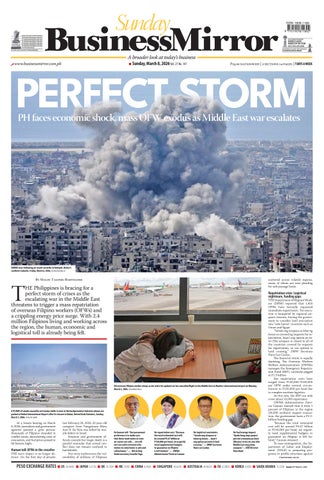
THE Philippines is bracing for a perfect storm of crises as the escalating war in the Middle East threatens to trigger a mass repatriation of overseas Filipino workers (OFWs) and a crippling energy price surge. With 2.4 million Filipinos living and working across the region, the human, economic and logistical toll is already being felt.






scattered across volatile regions, many of whom are now pleading for safe passage home.
Repatriation crisis: Logistical nightmare, funding gaps
THE Department of Migrant Workers (DMW) reported that 1,416 OFWs have formally requested immediate repatriation. Yet execution is hampered by regional airspace closures, forcing the government to consider land evacuation into “safe haven” countries such as Oman and Egypt.
“Sarado ang airspace sa lahat ng bansa na covered ng requests for repatriation, kaya’t ang option po natin [The airspace is closed in all of the countries covered by requests for repatriation, so our option] is land crossing,” DMW Secretary Hans Leo Cacdac.
The financial strain is equally daunting. The Overseas Workers Welfare Administration (OWWA) manages the Emergency Repatriation Fund (ERF), currently pegged at P1.5 billion.
But repatriation costs have surged from P135,000–P140,000 per OFW under normal circumstances to P150,000 per head due to complex wartime logistics.
At this rate, the ERF can only cover about 10,000 repatriates.
OWWA Administrator Patricia Caunan warned that if even 1 percent of Filipinos in the region (24,000 workers) request evacuation, the government faces a P2.2billion funding gap.
“Because the total estimated cost will be around P3.67 billion at P150,000 per head, we urgently need supplemental budgets to guarantee no Filipino is left behind,” Caunan stressed. To ease reintegration, the Department of Labor and Employment (DOLE) is preparing programs to profile returnees against
By Philip J. Heijmans Bloomberg
THE US submarine strike on an Iranian warship in the Indian Ocean marked a sharp escalation in the war between the two nations, raising fresh security and economic risks for governments across the Indo-Pacific.
By striking the warship IRIS
Dena about 40 nautical miles off Sri Lanka’s coast, Washington signaled no Iranian vessel is beyond reach. The move has drawn India and Sri Lanka closer to the fray. With Tehran vowing retaliation, the risk of naval clashes is rising along sea lanes vital to global commerce.
The sinking occurred far from Iran along a major shipping artery linking Asia, the Middle East and Europe. The presence of a US submarine conducting lethal operations near friendly nations such as India raises questions about how insulated Asia’s sea lanes are from outside threats.
“The US sinking of an Iranian warship in Sri Lanka’s EEZ is likely to further unnerve IndoPacific nations, both friend and foe alike,” said Derek Grossman, a former US intelligence official
who is now a professor of international relations at the University of Southern California. “Some will look elsewhere for their security needs, while others may hedge and hope for the best.” Sri Lanka intervened with a second Iranian naval vessel in its waters and moved it to the northeastern port of Trincomalee, partly for safety reasons. And there are more vessels out there. Bloomberg maritime data show that over the past 30 days, ships linked to Iran have operated from Africa to Sri Lanka, Southeast Asia and China. Potential targets could include what the US calls a “shadow fleet” transporting Iranian oil. The State Department last month blocked 14 shadow fleet vessels and in November designated 17 entities, individuals and vessels linked to the arms and oil trade for sanctions. The US rarely releases deploy-
ment details for security reasons, but it maintains a formidable fleet.
The Navy operates about 50 nuclear-powered attack submarines in three classes: Los Angeles, Virginia and Seawolf. Designed for stealth, they can tail enemy vessels undetected. It was not clear which submarine fired the torpedo.
Balancing act
THE conflict comes at a delicate moment for Asian governments balancing ties with their two most important partners, the US and China. Many remain unsettled by economic pressure from Washington since President Donald Trump’s return in 2025. The war has lifted energy prices and added inflationary strain to economies already hit by US trade measures.
US treaty allies including Japan, South Korea and the Philippines have scrambled to reach trade deals with the US to alleviate the blow from tariffs and now could see some American military assets in the region, which are there for their protection, being moved to the Middle East for the war.
“As the conflict continues to escalate, the risks of miscalculation will rise sharply in fast-moving situations,” said Reema Bhattacharya, head of Asia risk insight at Verisk Maplecroft. “An accidental strike, a misread signal, a vessel in the wrong place could bring the region’s carefully maintained



posture of neutrality under real strain.”
China maintains close ties with Tehran, and roughly 90% of Iran’s oil exports go to the Asian powerhouse, largely to independent refiners willing to buy discounted crude.
Asian dynamics
SO far, there hasn’t been any evidence from the battlefield that Chinese weapons have been deployed. But, the Pentagon warned last year that China’s defense ties with Iran include companies supplying dualuse components for missile and drone programs.
Experts say the submarine
strike does not mean the conflict is spreading to Asia, but it adds to security concerns already focused on a possible Chinese move on Taiwan and Beijing’s assertiveness in the South China Sea.
“These dynamics could also quietly accelerate maritime security conversations between Beijing and Asean states — not as an ideological pivot, but as a pragmatic hedge against a security environment that is becoming increasingly difficult to predict,” Bhattacharya said in reference to the regional block of nations known as the Association of Southeast Asian Nations.
For countries such as Malay-
sia, which host large numbers of Middle Eastern visitors, concern may shift to whether Israeli or American forces begin targeting individuals suspected of links to the Islamic Revolutionary Guard Corps or Hamas, said Shahriman Lockman, an analyst at Malaysia’s Institute of Strategic and International Studies.
In India, some former and current officials and opposition figures view the submarine strike as a strategic embarrassment. The Iranian frigate had participated in an Indian-hosted naval event in February, and India-US ties were already strained by the 50% tariffs Trump imposed last year.
Those were partially rolled back and tensions eased further Thursday when the US cleared the way for India to temporarily increase its purchases of Russian oil. The sinking in India’s backyard nevertheless complicates New Delhi’s balancing act with Washington.
“The US Navy is the world’s most powerful navy, no doubt. But can it act with such impunity in the Indian Ocean?” said C. Uday Bhaskar of the Society for Policy Studies in New Delhi. “The diplomatic optics are embarrassing for India.” (With assistance from Dan Strumpf and Swati Gupta / Bloomberg)
11,000 local job vacancies, while offering emergency employment and livelihood capital for those seeking to start microenterprises.
Energy shock: Fuel prices set to soar
BEYOND the humanitarian front, the Philippines faces an imminent energy crisis. The war has disrupted global oil chokepoints, particularly the Strait of Hormuz, a vital artery for world fuel supply.
DOE Director Rino Abad revealed that the country holds a 51day diesel inventory, but warned of sharp price hikes:
• Diesel: projected to hit P80 per liter next week, with possible spikes to P90 if the conflict drags on.
• Gasoline: expected to reach P64 per liter, with further increases looming.
“Ayoko hong mag- project pero ito’y masama pa doon eh, kasi dito Middle East ang pinag-uusapan [I don’t want to project, but it could be worse in this case, because we’re talking about the Middle East],” Abad cautioned, referencing the 2022 Ukraine crisis.
To cushion the blow, senators are pushing for the temporary suspension of excise tax and VAT on fuel. But the Bureau of Internal
Revenue (BIR) warned of massive revenue losses:
• P6 billion per month if excise tax on diesel is suspended.
• P7.2 billion per month if gasoline excise tax is removed.
Meanwhile, the Department of Transportation (DOTr) is scrambling to distribute a P2.5-billion fuel subsidy to public utility drivers. Senators noted that jeepney and tricycle drivers are already earning below minimum wage— P364 and P363 daily, respectively—due to soaring fuel costs.
The agricultural sector is also under threat. Department of Agriculture (DA) Assistant Secretary Nichols Manalo warned that higher fuel and fertilizer costs will push up farmgate and retail food prices, compounding inflationary pressures.
Maritime security: Filipino seafarers in war-risk zones
THE conflict has spilled into vital shipping lanes, prompting the International Bargaining Forum (IBF) to expand designated risk zones effective March 2, 2026. Critical maritime corridors now classified as Warlike Operations Areas include:
• The Red Sea (southern section)
• The Gulf of Aden
• The Sea of Azov
• The Northern Black Sea Region
• All Ukrainian ports Meanwhile, the Persian Gulf, Strait of Hormuz, and Gulf of Oman have been designated HighRisk Areas.
Filipino seafarers transiting these zones are entitled to:
• Hazard pay bonuses equal to basic wage.
• Double compensation for death or disability.
• The right to refuse sailing, with mandatory repatriation at company expense and compensation equal to two months’ basic wage. These measures aim to protect thousands of Filipino seafarers who remain vital to global shipping but are now exposed to unprecedented risks.
Government’s pledge: ‘No Filipino left behind’ DESPITE the daunting challenges, the government insists it will not abandon its citizens. DFA Acting Undersecretary Ezzedin Tago assured lawmakers: “Our paramount preference is to make sure that these land routes or even air routes are safe as instructed by our president. As long as this crisis continues, we will not rest until everyone who wishes to come home is safe and safely home.”

By Irene Casado Sanchez & Eric Fan
PRESIDENT Donald Trump announced Thursday that he would remove Kristi Noem as Homeland Security secretary after she faced bipartisan criticism for her handling of the department, including a $240 million ad campaign prominently featuring herself. A Bloomberg News investigation found that the bulk of the funds are allocated for placing ads through at least two firms with longstanding ties to Trump campaigns.
One of the DHS ad buyers, Virginia-based Strategic Media Services Inc., received more than $269 million to work on Trump’s 2024 campaign while Noem’s top aide, Corey Lewandowski, was advising the campaign’s senior leadership team, according to OpenSecrets.
this inquiry and did not hire those companies,” the spokesperson said in response to questions from Bloomberg.
The spokesperson said Noem and the White House Office of Management and Budget reviewed and signed off on “contract summaries.”
Previously, the agency had said Noem approves all DHS contracts over $100,000, but she disputed that at a US Senate hearing on Tuesday.
DHS awarded the largest contract, worth $143 million, to a newly incorporated company with no office, website or publicly listed phone number. The firm, Safe America Media LLC, then hired Strategic Media Services Inc. and Smart Media Group LLC as subcontractors to place the TV ads. Both firms have worked on multiple political campaigns during the past decade with Lewandowski and numerous other Trump allies and affiliated political organizations.

Louisiana Republican and Trump ally, quipped that the ad campaign was mostly “effective in your name recognition.” Two days later, Trump fired Noem. The DHS ad campaign drew scrutiny for bypassing full competitive bidding, awarding one of the contracts to what appears to be a shell company and engaging a production firm run
The second media buyer, Smart Media Group LLC, has a subsidiary that got more than $329 million in the same year working for Trump’s political action committee, Make America Great Again Inc. The DHS ad campaigns were designed to persuade undocumented immigrants to selfdeport and to recruit immigration officers. Of the $240 million, at least $54 million had been spent on TV ad placements through the end of 2025, according to data from AdImpact, an adtracking company. The ad campaign started after Trump declared a national emergency at the US-Mexico border on his first day in office. Officials at DHS used the declaration to justify bypassing full and open competition for contracts to run the advertising campaigns—the most ever spent on a DHS marketing effort. Federal procurement rules usually require agencies to seek out a large pool of bidders to secure the best value and avoid favoritism while promoting transparency and accountability. Instead, DHS officials picked three firms that bid on the work.
A DHS spokesperson said the agency doesn’t decide which media buyers its contractors hire or how much they pay them. “We have only become aware of these companies because of
The other lead contractor, People Who Think LLC, won a $52 million contract to execute an international version of the DHS ad campaign. That company was co-founded by Jay Connaughton, a former Trump media adviser who worked on the president’s 2016 campaign, among other MAGA-backed political candidates and right-wing causes. A federal procurement document obtained by Bloomberg shows that the sole losing bidder was Knox Strategies, a public relations firm that features a number of Republican political clients on its website, including Federal Bureau of Investigation Director Kash Patel.
“It looks like a textbook case of cronyism,”
said Dylan Hedtler-Gaudette, government affairs director at the Project on Government Oversight, a nonpartisan watchdog. “That’s precisely the opposite of how we should be making critical decisions on how to use taxpayer dollars.” A DHS spokesperson said the agency awarded the contracts “by the book” and that the campaigns have been “wildly successful.”
Ad-tracking data, though, raises questions about the effectiveness of the TV ads. The selfdeportation commercials, for example, skipped markets where DHS’s own estimates show more
undocumented immigrants live than in some of the border states targeted by the campaign. And roughly a third of the recruitment commercials ran in a handful of large Democratic cities, where experts say police are unlikely to leave departments that provide better pension and health benefits than the DHS jobs.
Democratic and Republican lawmakers alike have chastised Noem for conflicts of interest and profligate spending on the ads. In a heated exchange with Noem during a Senate hearing on Tuesday, Senator John Kennedy, a

By Mackenzie Hawkins
NVIDIA Corp. has long been the world’s AI kingmaker. Now, the Trump administration is considering taking a formal role in the industry that would include similarly sweeping powers.
Officials at the US Commerce Department have written draft regulations that would restrict AI chip shipments to anywhere in the world without American approval, giving Washington broad control over whether other countries can build facilities for training and running artificial-intelligence models—and under what conditions.
The proposed rule—which could change substantially or be shelved entirely—would require companies to seek US permission for virtually all exports of AI accelerators from the likes of Nvidia and Advanced Micro Devices Inc., a global expansion of curbs that currently cover around 40 countries, according to people familiar with the matter. These chips are the most coveted components in the tech world. Companies like OpenAI and Alphabet Inc. buy them by the thousands to install in data centers that run services like ChatGPT and Gemini.
Shares of Nvidia and AMD fell to session lows on the news Thursday. Nvidia dropped as much as 1.9%, while AMD declined 2.3%. President Donald Trump’s team has said repeatedly that they want the world to use American AI, and the Commerce Department’s draft rule isn’t meant to function as an Nvidia export ban. Rather, the regulations would set up the US government as gatekeeper for the AI industry: Companies — and in some cases, their governments—would have to seek Washington’s blessing to buy the precious accelerators. How Trump’s team decides to dole out those licenses
would then determine whether countries are able to build critical digital infrastructure, technology that many world leaders see as key to economic growth, corporate competitiveness and military sovereignty. The specific approval process would depend on how much computing power a company wants, said the people, who asked not to be named discussing an ongoing policy debate. Shipments of up to 1,000 of Nvidia’s latest GB300 graphics processing units, or GPUs, would undergo a fairly simple review with certain exemption opportunities. Companies building bigger clusters would need preclearance before seeking export licenses. They could face conditions such as disclosing their business models or allowing the US government site visits, depending on the specifics of the data centers in question.
For truly massive deployments—more than 200,000 of Nvidia’s GB300 GPUs owned by one company, in one country—the host government would have to get involved. The US would only approve such exports to allies that make stringent security promises and “matching” investments in American AI, the people said, noting that the draft rule doesn’t specify an investment ratio. For context, 200,000 GB300s is the number that NScale, a UK company that specializes in renting AI chips to third parties, is planning to provide to Microsoft Corp. across four sites in the US and Europe. The firm described this deal as “one of the largest AI in-
who is also president of Designated Market Media Inc.
port the DHS commercials to the FCC. But some did. A search of FCC records turned up 72 contracts and invoices covering about 4,400 DHS commercials. The documents came from 24 different stations located in nine states. Those records, along with ad-tracking data, show that Strategic Media Services Inc. purchased air time for the self-deportation TV commercials. In addition to its work on Trump’s 2024 campaign, SMS placed ads for his 2016 run while Lewandowski was the campaign manager. The stations submitted invoices and contracts to the FCC stating that there is a 15% agency commission on each DHS spot SMS placed. A lawyer representing the company, Chris Ashby, vehemently disputes that the company received a 15% commission on the ads it placed; rather, he said it represents “an industry standard discount.” Ashby did not respond to questions about how much SMS has been paid for its government work. Industry experts say media placement firms may operate under undisclosed compensation arrangements not reflected in public records. The DHS contractor that hired SMS, Safe America Media, incorporated in Delaware eight days before the agency awarded it the contract in February 2025. Federal records show the company is located at the home address of Republican media consultant Michael McElwain,
According to DMM’s corporate registrations, McElwain used the same office address as SMS between 2013 and 2021. McElwain has not responded to multiple requests for comment, including when reporters went to his home outside Alexandria, Virginia. SMS’s attorney, Ashby, did not respond to questions about the nature of his client’s relationship with McElwain or DMM.
In August 2025, DHS awarded another $40 million to Safe America Media and People Who Think to produce and place ads to recruit Immigration and Customs Enforcement agents. FCC records show that Smart Media Group LLC helped place those ads. SMG also placed ads for Louisiana Governor Jeff Landry’s 2024 gubernatorial race while Lewandowski and People Who Think were consultants for the campaign. (In December, Trump appointed Landry to be special envoy to Greenland.)
Lewandowski has worked for DHS as a Special Government Employee. Democrats and government watchdogs have criticized Noem for allowing him to exceed a 130-day limit on such positions. And, despite calls from the same quarters, Lewandowski has not filed public financial disclosures. SGEs are permitted to do business with outside clients while working for the government but are barred from personally benefiting from their government position. Neither DHS nor Lewandowski responded to questions about whether he is being paid as an SGE or if he

frastructure contracts ever signed.”
Nvidia, AMD and the Commerce Depart ment’s Bureau of Industry and Security, which is responsible for semiconductor export controls, didn’t respond to requests for comment.
The Commerce Department later said in a social media post that the agency “is com mitted to promoting secure exports of the American tech stack. We successfully advanced exports through our historic Middle East agree ments, and there are ongoing internal govern ment discussions about formalizing that ap proach.” That’s a reference to last year’s AI chip deals with the United Arab Emirates and Saudi Arabia, both of which have been subject to li cense requirements for accelerator shipments since 2023.
The agency’s framework is far from final ized, the people familiar with the situation emphasized, and officials from across the fed eral government are currently providing their input. Axios quoted a White House official as saying that the Commerce Department’s rule as drafted “does not reflect what President Trump has said on export controls nor does it reflect the direction of the Trump administration on encouraging export of the American AI stack.” Trump’s team is standing up several initiatives to promote American AI exports, especially in the Global South.

And lest they consider the latter, Washington has issued a warning that using Huawei AI accelerators anywhere in the world could violate American trade restrictions.
China’s AI ambitions are a central factor behind Washington’s AI policymaking. One focus is limiting China’s production of AI chips, which the US has done by restricting exports of semiconductor manufacturing equipment—and, more recently under Trump, allowing Nvidia back into China to compete on Huawei’s home turf. The Commerce Department’s latest global proposal wouldn’t change Washington’s approach to chip exports to the Asian nation, people familiar with the matter said, nor would it alter an effective ban on AI chip exports to around 20 other arms-embargoed countries. Trump’s team is currently weighing how many Nvidia chip exports to China would be enough to dampen Huawei’s rise without giving the country too much additional computing capacity.
Still, the proposed regulations mark the administration’s most substantive step toward a global chip export strategy since scrapping President Joe Biden’s approach in May, at which time they promised a replacement rule “in the future.” Trump officials have derided the previous administration’s so-called AI diffusion rule, which controlled AI chip sales to most countries and set caps on how much could be exported, as stifling American tech dominance. The Commerce Department reiterated that sentiment in its Thursday post, saying that “we will not” return to the AI diffusion framework, which it called “burdensome, overreaching and disastrous.”
Whether Trump’s approach ultimately proves more or less restrictive would be a function of how officials use the worldwide license
has been involved in the ad campaigns. A DHS spokesperson this week told ProPublica that he does not receive a salary or federal benefits.
During Tuesday’s Senate hearing, Noem was grilled about reports that a company run by the husband of former DHS Assistant Secretary Tricia McLaughlin, Ben Yoho, made at least one of the commercials while she still worked for the agency. Noem told lawmakers that the agency has “no legal authority to look into subcontractors.”
After the hearing, Yoho’s firm publicly confirmed that it provided “limited production services” to make 51 video and audio ads for the DHS campaign and that it received $226,137 from Safe America Media. That’s two-thirds of the total amount DHS had budgeted for domestic deportation ad production, according to task orders the agency provided to Bloomberg.
Lewandowski introduced Yoho’s firm, The Strategy Group Co., to Noem when she was governor of South Dakota, according to local news outlets. Noem tapped the company in 2023 for a national marketing campaign aimed at persuading workers to move to the state.
McLaughlin said last year that she “fully recused” herself from the DHS campaign to avoid conflicts of interest. Yet a March 2025 ad-placement request made by SMS lists McLaughlin as the government contact. DHS denied that any conflicts existed. “Ms. McLaughlin recused herself from any interaction or engagement with any subcontractors to avoid any perceived appearance of impropriety,” a spokesperson said in a statement.
The agency did not respond to questions about when, exactly, McLaughlin recused herself or if she had any interactions with the lead contractors, including the one that hired her husband’s firm. DHS announced last month that McLaughlin was leaving the agency, saying her departure had been previously planned.
Congressman Bennie Thompson, a Democrat from Mississippi, requested documents

requirements they are now considering. If Washington approves chip sales speedily and with few strings attached, the global AI infrastructure buildout could simply continue humming along—just with a lot more paperwork. Bureaucratic delays or drawn-out negotiations, meanwhile, would throw a wrench into project planning. It wasn’t until months after the Trump administration announced its UAE chip export deal that licenses began to flow, contingent on the Gulf nation investing $1 in the US for every dollar invested at home.
A big unknown is how much money the US would expect from countries like France or India, which also have ambitions to build large data centers of 1 gigawatt or more. Another factor is how Trump may wield chip curbs in broader diplomatic negotiations, especially as he recalibrates his tariff strategy. Last year, the president threatened semiconductor export controls in retaliation for digital services taxes that have been imposed in places like the European Union.
“We do not really like the idea of potentially
and communications related to the contracts in March 2025 and again in November. DHS still has not provided any records, Thompson’s office said.
“As they destroy the credibility of the department, they are all-too-willing to fleece American taxpayers to the tune of hundreds of millions to enrich their friends and family. It’s pure corruption,” Thompson said in a statement to Bloomberg. “The fact that they have refused to provide Congress any records or justification for this spending is damning.”
In February, Democratic Senator Andy Kim of New Jersey sent a letter to the Government Accountability Office requesting a review of, among other things, subcontractors working under DHS contracts. “We need transparent, independent investigations to make sure we’re uncovering all conflicts of interest and political favoritism,” said Kim, who sits on the Senate Homeland Security and Governmental Affairs Committee. “No one should be allowed to use the tools of governance for personal profit.”
According to its website, DHS’s Office of Inspector General recently opened an audit of contracts and grants awarded “through means other than full and open competition” to determine if DHS “complied with applicable laws and regulations when awarding contracts.” It’s unclear if the contracts for the DHS ad campaign are among the ones the OIG is auditing.
DHS officials have heralded the ad campaigns as a crucial component of their immigration enforcement efforts. But data tracking the TV ad placements indicate that thousands of DHS commercials ran in media markets that may have offered little return on investment.
Using data from AdImpact, Bloomberg analyzed more than 92,000 DHS TV ads that aired across 1,038 stations in all 50 states from February 2025 through the end of last year. Those figures are an undercount because AdImpact does not capture every station. (The CEO of AdImpact, Kyle Roberts, is also the owner of Smart


tying AI access to trade negotiations (or to any other of Trump’s assorted whims), which such a move clearly opens a door to,” longtime Bernstein chip analyst Stacy Rasgon wrote of the draft rule. Also unclear is how the US will handle restrictions on model weights, which are the numerical parameters that AI software uses to process data and make decisions—making them among the most valuable intellectual property in the world. Biden’s global chip framework included overarching restrictions on where companies could host frontier model weights, whereas Trump’s approach would handle that question through individual licenses. Foreign leaders are broadly uncomfortable subjecting their tech futures to Washington’s whims. But when it comes to computing power, they have little choice. Countries can either import chips from American companies like Nvidia, the market leader by a wide margin, or Chinese firms like Huawei Technologies Co., which makes less-powerful chips in much smaller quantities but has global ambitions.
Media Group, according to his LinkedIn profile.)
More than 60,000 commercials featured Noem narrating stern messages to “illegal aliens.” In the spots, she either explicitly thanks Trump or commends him for his leadership, at which point the ads show the president signing bills, striding into meetings or giving news conferences.
In January, the agency said the “unprecedented nationwide recruitment campaign has shattered expectations, hiring more than 12,000 officers and agents in less than a year.”
More than 31,000 recruitment ads aimed chiefly at local police officers have been aired across the country, Bloomberg’s analysis found.
Of those, about 8,200 targeted departments in major cities. Law enforcement experts say the ads were unlikely to draw large numbers of officers from those departments. Most of them receive generous benefits, including pensions and healthcare, said Jim Burch, president of the National Policing Institute.
Bloomberg contacted departments in Atlanta, Miami, Boston, Washington DC and Denver—media markets where the highest number of ICE recruiting ads ran. Those in Miami and Denver said the campaigns did not affect their ranks. The others did not respond or said they had no knowledge of officers leaving to join ICE.
An ICE recruiting commercial targeting Atlanta police officers ran at least 1,270 times from Sept. 29 through Oct. 13, proclaiming:
“You took an oath to protect and serve, to keep your family, your city, safe. But in sanctuary cities you are ordered to stand down while dangerous illegals walk free.”
Yet a 2024 law passed by the Georgia legislature mandates close cooperation between local law enforcement and ICE, and the Justice Department had removed Atlanta from its list of sanctuary cities before the ads ran.
While most networks aired a mix of selfdeportation and ICE recruitment ads, no ICE recruitment ads appeared on Spanish-language

But the global framework could have significant knock-on effects for China’s AI industry. One direct consequence of the draft
team conditioned some Nvidia shipments to the UAE on firms not providing computing services to any Chinese AI companies, according to people familiar with the matter. It remains to be seen whether they would impose similar license terms in other regions such as Southeast Asia, where firms like Alibaba Group Holding Ltd. rent the use of Nvidia chips they are unable to buy themselves. With assistance from Maggie Eastland/Bloomberg
networks such as Telemundo and Univision, according to AdImpact data. Historically, ICE and Customs and Border Protection looked to hire officers who speak Spanish.
“Going back 10, 15 years, they knew they needed to recruit people with language abilities.” said Anthony Chapa, executive director of the Hispanic American Police Command Officers Association. “It all has to do with communication and understanding.”
In response to questions about the effectiveness of the self-deportation ads, a DHS spokesperson said the campaign has been “wildly successful with over 2 million illegal aliens exiting the United States—shattering historic records.”
Experts say that assertion is overstated. Wendy Edelberg, a senior fellow in economic studies at the Brookings Institution, said the number is likely derived from a misinterpretation of survey data. She and her co-authors of a recent report assessing the impact of the Trump administration’s effort to curb both legal and illegal immigration estimated that between 210,000 and 405,000 people have voluntarily left the country beyond what would have been normally expected.
And the self-deportation ad buys sometimes didn’t align with DHS’s own estimates of where most undocumented immigrants live. The campaign aired four and six times as many such commercials in Nevada and Arizona as in Georgia, even though both Western states had fewer undocumented immigrants than Georgia. The campaign has affected immigrants and citizens alike, particularly Hispanics, according to business owners, community organizers and counselors. Gilda Pedraza, executive director of the Latino Community Fund Georgia, said it has contributed to some children bullying their Latino classmates by threatening to call ICE on their parents.
“Kids are being harassed by other children.” With assistance from Elena Mejía, Sophie Butcher, Bill Allison and Polly Mosendz/Bloomberg


By Albee Zhang The Associated Press
THE “Life in Venice” housing development, a multibilliondollar replica of the Italian city on the Chinese coast, stands silent. Many of the tens of thousands of homes are hollow husks of concrete and alabaster.
But in recent years the remote, partially abandoned complex has drawn unlikely new residents like Sasa Chen, a burned-out young Chinese woman who until recently worked a high-earning finance job in Shanghai, China’s bustling commerce hub.
The appeal?
CHEN pays just 1200 RMB, or $168, a month for her apartment in faux Venice in the eastern Chinese province of Jiangsu. It’s so cheap that it’s allowed Chen to retire at the tender age of 28.
Experts say Chen is part of a broader trend that has seen a growing number of young people across China migrating to small towns and cities, taking advantage of cheap real estate prices that have been plummeting since the Covid pandemic.
It’s a stark reversal from previous generations that prized upward mobility. In decades past, China’s ascendent middle class flocked to booming megacities to chase jobs and dreams, once abundant as the country went from rags to riches. But as the once red-hot economy cooled, expectations have soared, opportunities have dwindled and competition has grown fierce.
Most large Chinese companies, especially high-paying tech firms, requires a work schedule of 9 a.m. to 9 p.m. from Monday to Saturday, a grueling lifestyle popularly known as the 996 culture. Under the intense pressure, some young professionals have called it quits altogether and joined a resistance movement called “ lying flat “— shunning careers and capitalism for a “low-desire life.”
Some are redefining their dreams to focus on rest and relaxation, much like what some young adults in the West are doing under what they call FIRE: “Financial Independence, Retire Early.”
That’s much more achievable in China because the cost of living in some places can be so low compared to prices in the West.
Home prices at the massive “Life in Venice” development have more than halved since the downturn in China’s property market a few years ago, and a lunch of noodles or a rice dish costs under three dollars in the neighborhood’s restaurants.
The bargain prices have benefited young people like Chen willing to live in remote but affordable housing now available across the country. Chen describes it as the perfect life: a sea view, clean air, and cheap rent.
“I have all the time in the world, the freedom of doing whatever I want,” said Chen. “I am living the life that I want.”
The dream life “LIFE in Venice” was envisioned in the early 2010s as a weekend resort for wealthy residents from nearby
Shanghai, providing a luxurious yet peaceful life by the sea.
But demand for the vast complex’s 46,000 units cratered after China’s debt-fueled property market popped. The developer, real estate giant Evergrande, went bankrupt in 2024. Today the site is a ghost town, with many villas just empty shells. Less than one in five apartments are occupied. Abandoned boats founder off its rundown pier and “For Sale” signs and empty storefronts line its streets. But a smattering of residents has moved in, some of them fishing in the development’s tranquil waters.
Chen used to work in a glossy high-rise in Shanghai, making up to 700,000 yuan ($98,480) a year at a large finance firm. But she had never liked the idea of working. After three years, she began plotting her escape from the drudgery of China’s white-collar workforce.
Her plan was to save up and find somewhere to live with rent so low she could live off returns on her investments.
Last year, her dream came true: Chen saved 2 million yuan ($290,000) and found a spacious apartment at “Life in Venice”. With such low rent, she calculates she can live there for the rest of her life without ever having to work again.
Though “Life in Venice” doesn’t have a branch of her favorite sour soup hotpot restaurant, door to door delivery, or proximity to major hospitals, her new residence has plenty of conveniences like a grocery store and eateries.
Chen used to dread the grind of her nine-to-six job, which she said “felt like marching to my own death.” Now, she wakes at 10 a.m. every day, filling her days with cooking, chilling, and long walks on the beach.
“I never believed that work is the meaning of life,” Chen said. “My ideal state of life is not to work and stay at places that I like.”
Quitting the rat race
LIKE Chen, scores of young Chinese people have left big cities.
While there’s no available data about how many have left the Chinese workforce in recent years, figures show that from 2019 to 2024, Beijing lost 1.6 million people in their twenties and early thirties—around the total population of Philadelphia—according to China’s capital statistic office.
“People are quitting this competition, this very clear, linear, upward career track,” said Xiang Biao, director of the Max Planck Institute for Social Anthropology in Germany. “It’s a broader trend.”
China’s economy has cooled in recent years, growing just 5% in 2025—still higher than the US and other rich countries, but a far cry from the double-digit growth the country saw in past decades.

As the economy slows, young Chinese are struggling to find jobs. As of December, 16.5% of 16–24-year-olds who aren’t in school were unemployed.
Some, like 29-year-old Ban Zhao, are rejecting the corporate
rat race altogether.
Last summer, Ban moved from a bustling commercial city on China’s east coast to a small town in China’s southwestern Yunnan province. Tucked away in a lush valley, the town is famed for fresh,
clean air and healing hot springs.
There, for just 800 yuan a month ($110) Ban rents an apartment with three bedrooms, one of which she converted to a yoga studio.
She and her boyfriend work less than 20 hours a week, offering yoga classes online to make ends meet. The rest of the time, she walks around her scenic neighborhood surrounded by trees and blossoms, often enjoying the region’s famed sunshine.
“I can do whatever I want and not do whatever I don’t want,” Ban said. “I live in heaven.”
Apartments cheaper than cars
Some are flocking to places like Hegang, a cold and remote coal mining city in northeastern China famous for shockingly cheap housing prices. As resources dried up and mines closed, young people left, turning Hegang into a city with far more homes than people.
Apartments there are now cheaper than cars, making sales easy for realtor Yang Xuewei. Yang has sold more than 100 bargain-priced apartments to clients across the country—and even to some foreigners who contacted Yang after watching his online virtual tours. A one-bedroom apartment can be bought for $3,000, and $13,000 can buy a roomy fourbedroom place.
“I don’t know about big cities, I never lived in one,” Yang said. “I can only say that living in Hegang is easy.” Chen Zhiwu, a University of Hong Kong finance professor, said higher living costs and fewer job opportunities in bigger cities are driving people to move to cheaper places. “It’s natural,” Chen said. “Young people are facing reality and thinking hard about their futures.”

A6 Sunday, March 8, 2026
By Isabelle Lee & Vildana Hajric
IT wouldn’t have seemed possible a year ago. But Bitcoin has gotten caught in one of its deepest struggles yet, with no obvious way out.
The world’s largest cryptocurrency has plunged more than 40% from its peak, and the usual playbook isn’t working—dip buyers have vanished, and the forces that would normally fuel a rebound are now working against it. Gold is winning the macrohedge argument. Stablecoins are winning payments. Prediction markets are winning speculation.
The strange part: none of this is happening because the system failed Bitcoin. Washington has never been more accommodating. Institutional adoption has never been deeper. Wall Street has never been more bought in. Bitcoin got everything it wanted—and it wasn’t enough.
That means the defining struggle of this crypto era isn’t about price. It’s about purpose. And this selloff is forcing a question Bitcoin hasn’t needed to answer when prices were rising: if it isn’t the best hedge, the best payment rail or the best speculation—what, exactly, is it for?
“The central story of Bitcoin was ‘number go up’ and we don’t have that anymore,” said Owen Lamont, portfolio manager at Acadian Asset Management. “We have number go down. That is not a good story.”
The narrative problem UNLIKE stocks or commodities, Bitcoin lacks fundamentals. Its value rests almost entirely on belief—on the strength of narratives that persuade new buyers to join.
Those stories are faltering. Retail traders who bought into the Trump-fueled rally are now deeply underwater.
“New speculative venues such as prediction markets—and commodities exchanges!—are
siphoning away attention from crypto markets,” said Noelle Acheson, author of Crypto is Macro Now newsletter. “Now that BTC is a ‘macro asset,’ it has to compete with so many other alternatives, most of which are easier to understand and easier to explain to trustees, clients, your board, etc.”
The defections A CLEAR signal came in November. Jack Dorsey— long one of Bitcoin’s most vocal corporate evangelists— announced his Cash App would begin supporting stablecoins. For years, Dorsey treated Bitcoin maximalism as doctrine. His pivot was a signal: the payments race had moved on.
In Washington, stablecoins have become the center of gravity. The bipartisan Genius Act passed easily. Regulators are openly encouraging dollarbacked token infrastructure. Even within crypto, Bitcoin is no longer the sole focus. Tokenization, blockchainpowered derivatives and crossborder stablecoin payments are emerging as credible use cases— none of which require Bitcoin to function.
“If anything, stablecoin activity could be correlated with activity on Ethereum or on other chains. And stablecoins are for payments,” said Carlos Domingo, co-founder and CEO of Securitize, a tokenization platform. “I don’t think anybody today sees Bitcoin as a payment mechanism.”
The financialization trap IRONICALLY, Bitcoin’s unraveling began during its own rise. The 2025 bull run triggered a rush of institutional infrastructure that was meant to cement its legitimacy. Instead,
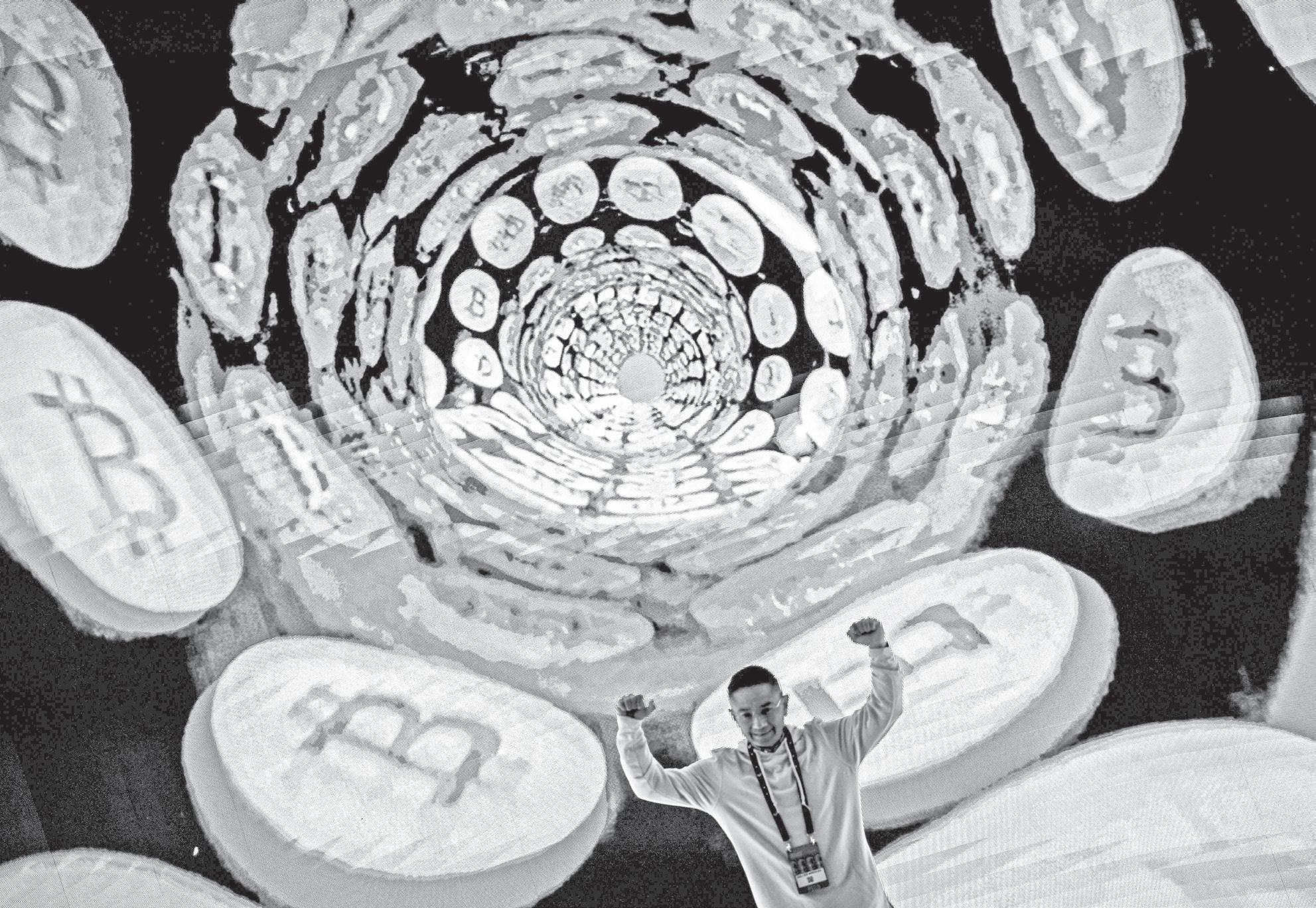
it stripped the asset of its mystique.
Once a cipher for libertarian escape, Bitcoin now resembles every other Wall Street instrument: a ticker in a dropdown menu, bundled with zero-day options and volatility products. What once required a rabbit hole now takes a brokerage login.
Bitcoin’s defenders still point to its engineered scarcity—the 21 million cap, halving cycles, hardcoded deflation. But in markets, the scarcity that matters isn’t just of supply—it’s of attention. And the supply of things competing for that attention is now effectively infinite.
Altcoins. Altcoin derivatives. Tokenized stocks. Structured leveraged products. Scarcity may be coded, but abundance is manufactured. And even the code itself is facing scrutiny— the rise of quantum computing has begun to fuel fears that Bitcoin’s cryptographic foundations, long assumed to be unbreakable, may not be permanent. It’s a distant threat, but in a narrative-driven asset, the mere possibility is corrosive.
The hedge that wasn’t EVEN after years of “digital

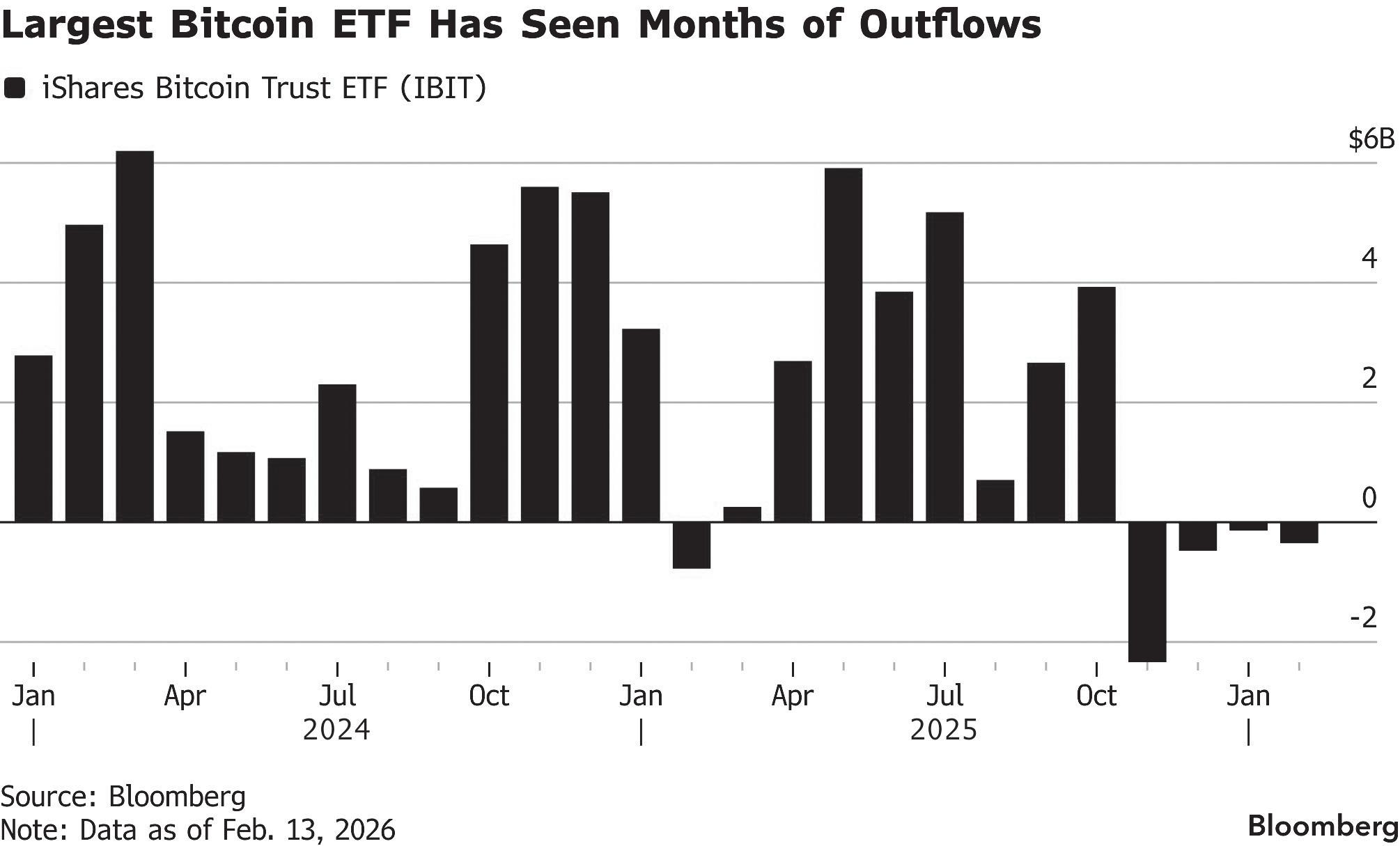
Despite geopolitical jitters and enduring dollar weakness, gold and silver have staged volatile rallies this year, while crypto has only gone down. Flows confirm the divergence. USlisted gold and gold-themed ETFs pulled in more than $16 billion in the past three months, while spot Bitcoin ETFs saw roughly $3.3 billion in outflows, according to data compiled by Bloomberg. Bitcoin’s market cap has shrunk by over $1 trillion.
“People are realizing that Bitcoin is what it’s always been—which is simply a speculative asset,” said Tom Essaye, president and founder of Sevens Report and a former Merrill Lynch trader. “Bitcoin is not replacing gold, it’s not digital gold, it doesn’t do the same thing, it doesn’t give people the same utility that gold does. It’s not an inflation hedge—there are other better hedges, frankly, where you don’t have to worry about the volatility. And it’s not a chaos hedge either.”
The treasury unwind THE digital-asset treasury model was supposed to be Bitcoin’s corporate identity. Companies like Strategy Inc. amassed Bitcoin during the bull run and issued shares against it, creating a self-reinforcing loop that conjured billions in market cap and gave institutional investors a way to express conviction without touching the asset directly. For a time, it worked.
Now the loop has reversed— and with it, the credibility of the model. The largest DATs have
plunged over the past year— some far more than Bitcoin itself. Many now trade below the value of their holdings.
The speculation it lost BITCOIN’S hold on speculative culture is slipping, too.
Prediction platforms like Polymarket and Kalshi—with binary outcomes, fast resolution and real-world stakes—are now playgrounds for the same dopamine-chasing traders who once rode meme coins.
This isn’t fringe: Polymarket’s weekly notional volume has surged over the past year.
Even Coinbase Global Inc. has added prediction contracts. The dopamine didn’t disappear. It just moved.
“The prediction markets are becoming the next craze for the same DIY investors who enjoy the speculative nature of crypto,” said Roxanna Islam, head of sector and industry research at ETF shop TMX VettaFi. “That could mean less overall interest in crypto,” she said, though she added that “it could also mean a shift to more long-term, serious investors.”
The hidden wiring
THEN there’s the growing mismatch between how Bitcoin is accessed, and how it trades. Spot ETFs have made it effortless to buy. But Bitcoin’s price is still influenced by offshore derivatives markets, where traders routinely run 100-to-1 leverage. These venues operate on automated liquidation engines: when positions breach margin thresholds, they are force-closed and sold into the order book
instantaneously, triggering cascading liquidations that can crash the spot price in minutes. That machinery was fully exposed in the October crash. Billions in leveraged positions were unwound in a flash. By the time most ETF holders checked their portfolios, the damage was done.
The bull case NONE of this means Bitcoin is over. It remains the most liquid digital asset, with deeper order books and broader exchange coverage than any rival. Spot ETFs have made Bitcoin a permanent fixture in portfolios. And the very regulatory clarity now benefiting stablecoins may ultimately lift the entire ecosystem. More to the point, it’s survived existential crises: the Mt. Gox collapse, the China mining ban, the 2022 crash— and plenty others. Each time, the network endured and prices began to set new records. Resilience is not nothing. In an asset class littered with failures, simply surviving confers a kind of legitimacy.
“There’s always somebody spreading fear, uncertainty, doubt. There’s always a problem,” said Dan Morehead, founder of Pantera Capital. “I just think it’s a natural desire of people who are skeptical on how important cellphone-based money is to the world, that they always come up with something new to worry about.”
The bull case isn’t that Bitcoin’s narratives are invincible. It’s that they don’t need to be—just durable enough to outlast each successive crisis of confidence. And history, so far, is on their side.
The drift BUT history also shows that survival and relevance are not the same thing. Bitcoin’s greatest threat isn’t a competitor—it’s drift. The slow bleed of attention, capital and conviction that comes when no single narrative can hold. The asset still exists. The network still runs. But the stories that gave Bitcoin its gravitational pull—digital gold, freedom money, institutional reserve— are fraying simultaneously. Whether that’s a temporary crisis or permanent is one of the biggest questions in the digitaleconomy era.
“It’s like a religion for many, and religious faith is hard to shake,” said Michael Rosen, chief investment officer of Angeles Investment Advisors. “It’s just not my religion.” With assistance from Muyao Shen and Chris Nagi/ Bloomberg

By John Eiron R. Francisco
STRESS is often seen as harmful, but a neurobiologist said it actually plays an important role in helping humans survive. However, problems can arise when the body’s stress response stays active for long periods.
During a webinar on February 28 titled “How Stress Shapes the Brain’s Function,” neurobiologist Dr. Janssen Kotah, a 2025 Balik Scientist awardee and postdoctoral researcher at the Molecular Neurobiology Group of the University Medical Center Groningen in the Netherlands, said the body’s stress system evolved as a protective mechanism.
“Stress is not necessarily bad. In some ways it is beneficial,” said Kotah, who is hosted by the National Institute of Molecular Biology and Biotechnology of the University of the Philippines Manila-National Institutes of Health.
He noted that throughout human evolution, individuals who were more cautious and alert to threats were more likely to survive. Being attentive to potential danger allowed them to respond quickly and improve their chances of staying safe compared with those who were less responsive to risks.
However, he emphasized that the stress system does not operate through conscious decisionmaking. People do not deliberately choose to activate it; rather, it is an automatic biological response designed to prepare the body for potential danger.
While this mechanism can be beneficial in risky situations, Kotah warned that staying in “survival mode” for too long can have harmful effects.
“If you’re always in survival mode and you cannot turn that
off, that could also affect you down the line,” Kotah added.
To illustrate how stress shapes behavior, he cited the example of someone who is bitten by a dog. After such experience, the body’s stress system may trigger changes that make the person more cautious around dogs in the future. A similar response may occur after a minor car accident, when a person becomes more careful when passing through the same intersection again. However, problems occur when the stress response becomes too intense or lasts too long. Kotah said a person may begin reacting with fear even toward dogs that are harmless. In neuroscience, this process is known as “generalization” in fear learning.
This response, he said, resembles what some people experience when they show symptoms of Posttraumatic Stress Disorder, where individuals can be easily startled by different stimuli. In other cases, a person may start feeling stressed even in environments where there is no actual threat. According to Kotah, this heightened state of alertness can resemble symptoms associated with Anxiety Disorders.
He said the key takeaway is that while the stress system helps people learn from dangerous experiences, it must remain controlled and specific.
“You want that system to be specific and controlled. You don’t

NEUROBIOLOGIST Dr. Janssen Kotah, a 2025 Balik Scientist awardee. PHOTO FROM HIS X (FORMERLY TWITTER) ACCOUNT
want to activate it when you don’t need it,” he said, noting that the stress response remains evolutionarily beneficial when it functions properly.
Early stress shapes the brain KOTAH explained that the effects of stress are closely linked to the brain’s ability to adapt, a process known as plasticity. The brain constantly changes in response to learning and environmental demands.
In children, this adaptation includes structural changes, such as the production of new neurons, or neurogenesis, which allows the formation of new neural circuits that support learning and development.
“The brain is highly plastic, especially in infants,” Kotah said. “But if there are stressors, resources may be diverted toward immediate survival rather than long-term brain development.”
He noted that early-life stress can influence how neural systems develop, affecting both brain structure and function.
Researchers are also investigating related factors, including maternal infection or inflammation during pregnancy, which studies suggest can increase the risk of various health problems in the offspring later in life.
Story & photo by Manuel T. Cayon
AVAO CITY—Ateneo de Davao
DUniversity (AdDU), the first Philippine university to launch unmanned rockets in two global competitions last year, launched on Wednesday another first in the country—a mobile robotics research laboratory to bring automation and artificial intelligence to the provinces and remote schools in the Davao Region. The university’s Robotics Engineering Department mounted a sleek pack of robots, robot-aided gadgets and instrument inside a utility van customized to resemble a miniature science laboratory room, which was sent on field immediately to public schools outside Davao City.
The P1.8-million RoboWheels, or robotics on wheels, project is intended to bring robotics and artificial intelligence (AI) education to the schools outside the cities
in the Davao Region, said Engr. Ottoman Montani Jr., the chairman of AdDU Robotics Engineering Department.
“Each [RoboWheels] visit to a school will last for one day and will engage the entire school population in animated and video presentations of the use of automation in many facets of human interaction,” Montani told the BusinessMirror after the blessing of the van.
Learners and teachers, including professionals, will be treated to visual presentation of the current development and application of robotics by local students, researchers and professionals, while others will get the first-hand glance of the actual robots made and assembled locally.
Mayan Jane Java Inni, assistant regional director of the Department of Science and Technology (DOST), said the RoboWheels “is an innovation by Ateneo de Davao to help address the digital divide, and the

more important part of this is how we are bringing robotics education to the provinces where there are also potentials.”
“Students in the cities have so many experience already in seeing and introduced to technology developments, while the provinces, especially the remote areas, have less opportunity to experience them,” she added.
Montani said the Marsam Drysdale Foundation Inc. partnered with the university in actualizing the RoboWheels, providing the funds to build the research laboratory on wheels.
He said the partnership happened during the Ateneo team’s presence and presentation during a science week celebration in Davao de Oro, where the company also attended.
Yvonne Biyo, executive director of the foundation, said the RoboWheels was not in the original sight of Marsman that time, “because we were focused yet on strengthening the STEM [science, technology, engineering and mathematics] education”.
The foundation did not hesitate to fund the project after learning that it was intended to be a mobile education platform intended for the provinces.
The university said the RoboWheels project is part of the Project PRIME, or Partnership in Robotics Intelligent Machine Education.
Besides Marsman Foundation, the Project Prime is being assisted by the DOST-Davao de Oro, and the Department of Education-Davao de Oro.

Early life adversity, Kotah said, can take many forms. While extreme cases may involve abuse, it can also stem from conditions beyond a family’s control, such as famine, war, premature birth, or parental struggles that affect the care children receive.
“These challenges remain relevant in many parts of the world, including the Philippines,” he said. Kotah compared early brain development to constructing a network of roads.
“The main highways are still being built in the brains of infants. If resources are diverted by the stress system to prioritize survival, it may affect the development of these neural pathways,” he explained.
He cited evidence from longterm population studies in Finland, which tracked individuals from birth into adulthood, showing that early adversity is associated with higher risks of health and developmental problems.
He also referenced research from the Netherlands on individuals exposed to famine during World War II, which found lasting changes in brain and metabolic health linked to prenatal exposure.
While these studies do not prove direct cause-and-effect, Kotah said they provide valuable
insights into how early-life environments can shape biological systems over time.
Mouse brain study
MOREOVER , Kotah shared that experiments using mouse models allow scientists to observe the biological mechanisms behind stress, which would be impossible to test directly in humans.
“These animal models give us a controlled view of how early stress can rewire the brain, affecting both structure and function,” he said.
One commonly used model involves placing mouse pups in cages with limited bedding and nesting materials. This “impoverished” environment increases stress in the mother, which, in turn, affects her care of the pups, leading to stress-related changes in the offspring.
“These early stress models show a variety of physiological changes,” he said. “They can affect weight gain, hormone levels, immune system development, and metabolism.”
In stressed pups, the hormone corticosterone, the rodent equivalent of human cortisol— the primary stress hormone— was elevated, and changes in thymus size and fat tissue were observed.
Behaviorally, stressed mice showed impairments in learning and memory. Tests such as object recognition and the water maze revealed that stressed animals explored less efficiently and had difficulty recalling the location of hidden platforms, suggesting disruptions in cognitive processing. Kotah noted that these effects are likely linked to altered neurogenesis, or the formation of new neurons, in the hippocampus, a region critical for learning and memory. His team also investigated changes at the molecular level, analyzing proteins in synaptic regions of the brain. They found that stressed mice had alterations in proteins related to mitochondria, the cell’s energy source, which may contribute to cognitive deficits.
Microglia, the brain’s immune cells, also showed impaired synaptic pruning, a process essential for refining neural circuits during development.
To connect these findings to humans, Kotah referenced collaborative research using donated brain tissue from individuals with a history of childhood abuse. The study suggested that microglial function and genes associated with synaptic regulation may also be altered in humans exposed to early-life stress, supporting observations from animal models.
“This work requires an interdisciplinary approach and could benefit from studies conducted across countries,” he said. “In the Philippine context, we need both prospective studies, which follow children over time, and retrospective studies that examine individuals’ early-life experiences.”
Kotah emphasized that stress is not solely a medical issue but also a societal one. Factors such as pandemics, war, and poverty can contribute to early-life stress— meaning its impact extends beyond biology and genetics to the environment in which individuals grow up.
Bohol’s heritage churches, buildings set for conservation via DOST, university project
‘
HERITAGE conservation is not just about preserving old structures; it is about keeping our history, identity, and culture alive. Through sciencebased partnerships like this, we empower local communities to be active stewards of their own heritage.”
Thus, said Science Science Secretary Dr. Renato U. Solidum Jr. as the Department of Science and Technology-Forest Products Research and Development Institute (DOST-FPRDI) and the Bohol Island State University (BISU) are partnering for a science-based conservation of heritage structures on the island.
The initiative aims to protect and preserve historic structures across Bohol by applying advanced non-destructive testing (NDT) methods and promoting compatible and sustainable conservation materials, DOSTFPRDI said.
Communities in Bohol are rich with heritage structures. They are more than architectural landmarks as they are living symbols of faith, identity, and shared history.
Many of the structures contain historic wooden elements—such as floors, retablos, and structural columns—that have endured centuries of natural wear.
According to DOST-FPRDI Director Rico J. Cabangon, preserving the structures requires not only care and commitment, but also scientific expertise as wood can suffer from decay, termite or fungal attack, and structural weakening that are not immediately visible.
“By equipping local institutions with the right tools and expertise, we help ensure that
conservation decisions are evidence-based, sustainable, and rooted in respect for cultural legacy,” Cabangon said.
In heritage homes like the 195-year-old Casa Rocha, decisions about repair, reinforcement, or replacement of materials must be guided by proper assessment to ensure structural safety while preserving historical authenticity.
DOST-FPRDI and BISU formalized their partnership through the signing of a Memorandum of Agreement on February 19.
Prior to this, Institute experts have already trained the BISU Epoch program team on wood identification—the scientific process of establishing the identity of a wood specimen based on its anatomical, physical and structural properties
BISU President Dr. Anthony Penaso acknowledged the vital role of DOST-FPRDI’s technical expertise in preserving the province’s cultural heritage.
“Through this partnership, we further strengthen our conservation initiatives to help secure a sustainable future for Bohol. We reaffirm our commitment to safeguard our rich heritage while empowering students and communities through innovative research and responsible stewardship,” Penaso said. The DOST-FPRDI team conducted site visits to key heritage locations in Bohol, including Casa Rocha, and the churches of Baclayon, Santa Monica, Loay, and Loboc. The partnership is anchored on the research program “Enhancing Heritage Preservation: Advancing Evidence-Based Conservation Through Advanced NDT and Alternative, Compatible Materials [Epoch].” It contributes to sustaining the values and conservation goals of the Bohol Unesco Global Geopark, reinforcing science-based stewardship of the province’s natural and cultural heritage. Monina Cheska C. de Mesa/S&T Media Services

A8 Sunday, March 8, 2026

Editor: Lyn Resurreccion • www.businessmirror.com.ph
S the war between Iran, Israel, and the United States continues, the shockwaves are spreading throughout the region. While US President Donald Trump promised four weeks of offensive action, Iran has responded with hundreds of retaliatory strikes.
This newly opened front has heightened fears of an uncontrollable escalation. On March 1, at the Angelus, Pope Leo XIV urged leaders to stop “the spiral of violence before it becomes an irreparable abyss.” This concern is shared by many Christians in the Middle East, even though their living conditions differ.
“As these past hours have profoundly shaken the Middle East— in Iran, the Holy Land, Lebanon, Iraq, and throughout the region— L’Œuvre d’Orient expresses its deep
concern over a new escalation of violence,” the association said in a statement on Monday.
“This morning, the Lebanese woke up in a climate of shock and dismay, but also fatigue and anger,” said Vincent Gelot, L’Œuvre d’Orient’s coordinator for Lebanon and Syria.
“People here know what a war with Israel is, and they feel like they are reliving what happened a year and a half ago, after the pager attacks and the death of Nasrallah,” he continued, referring to the
October 17, 2024 attack carried out by Israel against Hezbollah members’ pagers and walkie-talkies.
“The war that followed displaced 1.2 million people in Lebanon and caused major destruction,” Gelot recalled.
Shock in Lebanon
ON Monday morning, schools remained closed in Beirut after Israeli strikes targeted the southern suburbs of the Lebanese capital.
Thousands of people have also fled villages in southern Lebanon following evacuation calls issued by the Israeli army.
Tension is palpable everywhere.
“One of our partners, a school run by the Daughters of Charity, already damaged last year, is living in fear,” Mr. Gelot highlighted.
Beyond Lebanon’s borders, fear has also intensified.
“No one knows what will happen; there is great concern,” said Pascale Casati-Ollier, director of L’Œuvre d’Orient’s Iraq office in Erbil, along with her husband Jean.
“Our contacts are cautious and are staying at home, as the bombardments continue. It is total uncertainty,” he said.
The capital of Iraqi Kurdistan, which hosts American troops, has in recent days been targeted by several Iranian missiles.
Although the situation remains highly volatile, it is still too early to draw conclusions about the future of Christians in the region. The strikes are not targeting civilians but rather strategic military objectives.
“This new war will undoubtedly not facilitate the reintegration of Christians in the region,” CasatiOllier explained. “It is not impossible that this will encourage them to emigrate. For now, time stands still.”
Gulf Christians in lockdown IN the Gulf countries, which have been targeted by Iran’s retaliation, many Christian communities are now on lockdown. The small Catholic community in Bahrain is organizing as best it can to provide spiritual assistance to its 80,000 faithful.
For security reasons, they are currently forbidden from gathering for Mass or any other parish activity. Liturgies and catechism classes in various languages are being held online until further notice, according to a Facebook post by Sacred Heart Church in Manama, one of two parishes in Bahrain.
“In this difficult and tense context, let us not deprive our parishioners of their spiritual strength and communion,” wrote Fr. Francis P. Joseph, the parish priest. “As we find ourselves in this difficult and unusual situation, I ask you all to please stay strong and safe.”
Bishop Paolo Martinelli, Apostolic Vicar for Southern Arabia, called for a de-escalation and stressed the need for “authentic and responsible dialogue: mutual threats sow destruction; they do not build peace and stability.”
The vocation of the Holy Land IN the Holy Land, the past few days have also been marked by the sound of sirens as Iranian fire rained down on the State of Israel. At the French
Biblical School of Jerusalem, the semi-underground sacristy corridor served as a shelter for Dominican friars, students, and visitors to take refuge.
Masses for peace have been celebrated using the specific missal texts “in time of war or civil disturbance,” underlined Brother Olivier Poquillon, director of the French Biblical and Archaeological School of Jerusalem.
“Since Saturday, we have had one alert after another,” the Dominican friar said. “For us, it is all the more important to continue studying the texts in their context. It takes on its full meaning because conflicts are an integral part of the history of salvation. It reminds us of what Christ, the Prince of Peace, says at the heart of these conflicts.” As attention turns to the skies and radar systems focus on Iran, the Holy Land continues to suffer. Violence on the ground persists, particularly in the West Bank, where the Christian village of Taybeh is under constant harassment.
By Aie Balagtas See
AYS before Fr. Amado Picar-
Ddal died of a heart attack on May 29, 2024, the 69-yearold human rights champion had a rosy outlook for justice in the Philippines. He hoped the quarrel between the families of President Ferdinand Marcos Jr. and his vice president, Sara Duterte, could finally end the reign of the Dutertes in Philippine politics.
“He was very optimistic that this tension between the two camps was worsening and, you’ll never know, that this would be the end of the Duterte dynasty,” said Karl Gaspar, the religious brother whose friendship with Picardal spanned 37 years. “He was sort of very pleased with that.”
Gaspar spoke with Rights Report Philippines at Picardal’s wake in Cebu City, days after he died of heart attack while tending to his garden in the city.
Before Picardal’s passing, the feud between the Dutertes and the Marcoses had already erupted. Both families had coalesced for the 2022 elections that propelled Marcos Jr., the son of the late dictator, to the presidency.
Less than a week ago this February 2026, Sara Duterte announced that she’s running for president in 2028 and expressed regret for supporting Marcos Jr. in the 2022 elections. Many had assumed that Duterte would run for president in that election but chose instead to form what later became the “uniteam” with Marcos Jr. Gaudeamus
BOTH Gaspar and Picardal were members of the Redemptorist Church in Cebu. The two met weekly at their Monday get-together called gaudeamus (Latin for let us rejoice), where they talked and caught up with each other over a meal before dinner. Picardal, though living as a hermit since 2022, regularly joined the gathering as part of the Redemptorist community dynamics.
On the last two Mondays of his life, Picardal’s health was deteriorating. He had diabetes and hypertension but refused to see a doctor. But at the dining hall with his confreres, he was effervescent. And he never failed to put politics on the table. According to Gaspar, the priest “constantly” updated everyone about news on the International
Criminal Court (ICC), where the former president is facing crimes against humanity charges. Fr. Picx, as friends and colleagues fondly called him, insinuated that the developments might lead to an arrest warrant for Duterte.
“We have been very concerned because he is the number one concerned about what was going on. Apparently, people from ICC continued to be in touch with him. And so, he was very glad that the squabble could make Marcos allow the investigators from ICC to enter, and from there, this could lead to the downfall of Duterte,” Gaspar said.
Gaspar recalled one of them asking: “Will they arrest him? ICC has no police power.”
Picardal replied: “Yeah, but at least he cannot travel anymore. Because when he is in another country, they will arrest him. Maybe, not in the Philippines.”
As things turned out, acting on a warrant of arrest issued by the ICC, the Interpol arrested Duterte in March 2025 and was brought to The Hague, where he is now detained as a suspect. The Pre-Trial Chamber 1 of the court held a fourday confirmation of charges hearings against Duterte beginning on February 23, to determine if the evidence against him is sufficient to bring the case to trial.
Hermitage
PICARDAL died past noon on May 29, 2024, in Lahug, Cebu City, near the hut he built for the hermitage. The son of a health worker found him lying face up around 2 p.m. He was already dead. There was no foul play.
It was unclear why he refused to see a doctor, but Bro. Ciriaco Santiago III, a Redemptorist colleague, presumed that it was because Picardal detested hospital confinement so much. Being alone in a hospital room depressed Picardal. It reminded him of the torture and the seven-month imprisonment he endured under Marcos’s martial law.
Picardal also worried that Duterte’s henchmen might find it easier to kill him if found alone in a hospital bed.
Santiago said when caretakers found Picardal’s body, they noticed that his hands were in a position that seemingly wanted to move.
“It seemed like he still wanted to get up but couldn’t anymore,” Santiago told Rights Report Philippines.


op Emmanuel Cabajar, a friend of Picardal’s.
Mayor’s wrath
PICARDAL was one of the first to sound the alarm on the killings perpetrated by the so-called Davao Death Squad (DDS) when Duterte was still mayor. He cofounded the Coalition Against Summary Execution, which helped expose and document the killings from the late 1990s to the early 2000s.
His determination to stop the summary executions earned Duterte’s ire and raised eyebrows among his supporters.
In a 2006 blog post titled “Mayor’s Wrath, Prophetic Vocation,” Picardal recounted a warning he received from a friend: “The mayor is so mad at you, you’d better watch out he might order his death squads to go after you.”
“I want to live up to a hundred. I want to grow old and celebrate the golden jubilee of my ordination to the priesthood. But I choose not to be silent, I choose to speak up and denounce evil in our midst. If it means been (sic) picked up, imprisoned, or gunned down, so be it. I am not afraid to suffer, I am not afraid to die,” he wrote.
The priest persistently denounced extrajudicial killings in his sermons and writings. He was dogged in the documentation, which, 10 years later, would assist the ICC in its case build-up against Duterte.
“He was a main witness in the ICC but never elaborated his participation there,” said retired Bish-
Fearless
PICARDAL was assigned in Davao from 1995 to 2011. His life became entangled with victims of summary killings in 1998 after the youth group Tambayan repeatedly approached him each time they needed someone to hold a funeral Mass for members who unidentified gunmen shot.
Tambayan Center for Children’s Rights Inc. is a nongovernment organization based in Davao City. Several of its members were killed by the so-called Davao Death Squad. Picardal was fearless in his resolve to protect life and serve the poor. At times, he was also the only priest in Davao who went to these funerals and did it without any qualm.
The deaths in Davao eventually piled up to a number that was difficult for anyone to ignore. As the numbers grew, so did Picardal’s voice in denouncing it.
He wrote a detailed report which a lawyer, Jude Sabio, used in filing the first case against Duterte at the ICC in 2017.
Picardal’s participation was supposed to be limited to the documents. Still, in the winter of 2020, while the Covid-19 pandemic halted the world, he stood up and left his office in Rome to go to The Hague.
He never elaborated on his testimony even to bosom buddies. Those who knew refrained from inquiring to protect him and the
sanctity of the investigation.
“It was like there was an unwritten agreement among those in the know that we should never talk about it,” an insider told this reporter.
Duterte’s rise to power failed to cow Picardal who managed to bring his fight to a national level.
“Now is not the time to be afraid,” Picardal told Cabajar in November 2016, adding “There will be cases to be filed in the near future.”
Cunning THROUGHOUT his battle, Picardal openly condemned not only the killings but the “silence of the shepherds” as well. In 2018, he reminded members of the clergy that silence is consent.
In a blog post, he said he hoped priests would find their voice and courage “to form the moral conscience of their flock so that they may recognize and denounce the manifestation of evil and the culture of death.”
Cabajar described the priest as a cunning and calculated man who refused to make decisions based on speculations. This was why, the bishop believed, Picardal kept himself safe all these years.
The bishop said Picardal cultivated sources among the intelligence community who warned him of dangers that were about to come.
In 2018, the warnings became difficult to ignore, forcing him to cut his hermitage short. Men in motorcycles had been looking out for him, forcing Picardal to move to Lipa City while waiting
for his new assignment in Rome. The ICC would reach out to him from Rome.
Unfinished Business HE initially declined invitations to testify before the court. But as part of the ICC rules, witnesses must be present in its headquarters at the Hague when giving their testimony.
“I’m done,” he told two people close to him. After all, he had already given Atty. Sabio pertinent documents needed to look into the Davao killings. But when told about the gravity of his testimony, Picardal agreed to testify.
He quietly went home to Cebu in 2022 to continue his hermitage that was cut short by threats to his life.
As his hut made of amakan (a traditional Filipino building material of woven split-bamboo used for walls) neared completion, he spent more time under the sun. Caretakers had warned him that he should seek help or at least take a break when the heat was intense. But he refused both. The construction of its roof was nearing completion when he passed away.
“He was announcing that the hermitage will be finished sometime in June… telling us once it’s finished we will know immediately so we can all go up and celebrate and have a blessing,” Gaspar said.
Picardal had wanted to build the hut independently, cook his food, and tend to his garden. He believed life as a hermit was his next calling.
As he wanted to live up to 100, celebrate his 50 years with the Redemptorists, he would have wanted to witness the arrest warrant issued against Duterte.
Fr. Edilberto Cepe, the provincial superior of the Redemptorists in Cebu, said a big part of the community went away with Picardal’s death.
”When he died, a part of the generations of the Redemptorists was also gone. The big man at the forefront of human rights is already gone,” Cepe said.
Cepe said Picardal eagerly anticipated the day the court would issue the arrest warrant against Duterte.
“He was looking forward, and happy, that something would finally come out of his efforts,” Cepe said.

Editor: Lyn Resurreccion




By Jonathan L. Mayuga
RESEARCHERS recently dis -
covered a new plant species from the forests of Barangay Eva in Calanasan, Apayao province in the Cordillera Administrative region in the north of the Philippines. Medinilla calanasan was described in the international journal Phytotaxa in February 18.
The research titled “Medinilla calanasan [Melastomataceae], a new species from Apayao province, Philippines” was authored by Pieter B. Pielser, Breiden de la Cruz, Kristian J.E. Subtos, Julie F. Barcelona and Jayson Ibañez.
The Philippine Eagle Foundation (PEF) announced the plant’s discovery during Apayao’s 31st founding anniversary last month, saying it adds a new chapter to the province’s conservation milestones.
The researchers first discovered the species during a field expedition in November 2023 while documenting the botanical diversity of Apayao to strengthen its nomination as a Unesco Biosphere Reserve.
The inscription was granted on July 4, 2024, in recognition of the province’s vast forest as a site of global ecological value and community stewardship.
‘It’s
IUnique, ‘horn-leaf’ feature MEDINILLA calanasan has a feature not recorded in other known Medinilla species in Southeast Asia. It has a pair of small, hornlike protrusions at the base of each leaf blade.
The plant is a glabrous shrub that can reach about 2 meters to 3 meters in height and bears drooping clusters of white flowers that may blush soft pink as they mature. It has been observed in only two locations in Barangay Eva, about 700 meters to 800 meters above sea level, with two known plants roughly a kilometer apart.
According to the researchers, the sites fall within the Apayao Lowland Forest Key Biodiversity Area and are managed locally under the Indigenous “Lapat” protection system, which reinforces community rules for safeguarding places.
A Philippine eagle stronghold THE forest of Calanasan and the entire Unesco Biosphere Reserve of the yApatao (BRyA), as it is now known, is an ancient and lush Philippine eagle nesting territory validated by the PEF in 2015. It is home to a host of unique flora and fauna in the core zone of the BRyA.
In a statement, PEF Chairperson Felciia Atienza said the discovery underscores how protecting an apex species and its habitat can safeguard more than a single animal.
“When we protect the Philippine Eagle and its forest home, we protect entire ecosystems. The discovery of Medinilla calanasan within an eagle nesting territory shows that these forests still hold incredible secrets. Protecting apex predators safeguards countless other species, many of which we are only just beginning to discover,” Atienza said.
Strong local stewardship
MEANWHILE , Calanasan Mayor Shamir Bulut said, “As we celebrate the 31st Founding Day of Apayao province, this discovery affirms that our forests are globally important. Calanasan is proud of its Lapat system and strong local stewardship. Conservation is part of who we are,” Bulut said.
“The discovery reminds us of the Philippines’ status as a biodiversity hotspot—so much variety of life forms, so many active challenges. Protected areas and biosphere reserves provide opportunities for exploration and discovery to con-
tinue while keeping threats at bay. Collaboration among government agencies, NGOs [nongovernment organizations], and the private sector, like what we see in Apayao, is vital,” Mariglo Rosaida Laririt, assistant director of the Environment department’s Biodiversity Management Bureau, said for her part.
Sacred forest
IBAÑEZ , co-author of the report and a conservation biologist, told the BusinessMirror that Calanasan forest is protected by the indigenous Isnag.
“[We’re] so proud of Calanasan and its Isnag inhabitants because for decades, the threats have been very minimal, mainly because the eagle territory at Eva and Mount Calanasan habitat has been regarded as sacred forests or Lapat by its residents,” Ibañez, also the director of Operations at PEF, pointed out.
A town ordinance also affirmed the Lapat declaration as a local conservation area, he said via Messenger on February 21.
Ibanez said that besides being an ancient nesting habitat of “Banamba,” Isnag’s name for the Philippine eagle, the same forest is also home to several Northern Luzon endemic animals—such
LULISSAT, Greenland—Fisherman
Helgi Áargil no longer knows what to expect on Greenland ‘s fjords, where he spends up to five days at a time on his boat with his dog, Molly, and the ever-changing northern lights in the sky as company. Last year, his boat got stuck in ice that broke off the nearby glacier. This year, it’s been very wet instead. His income is just as unpredictable. An outing could bring him around 100,000 Danish kroner (about $15,700), or nothing at all.
The Arctic’s rapidly changing climate is bringing more questions for Greenland, the semiautonomous territory of Denmark that’s been shaken by US President Donald Trump’s interest in owning it.
While Trump’s approach to Greenland has shifted, the world has been unable to slow the effects of climate change. The Arctic is warming faster than any other region in the world, driven by the burning of oil, gas and coal.
What that means for the fishing industry that largely drives Greenland’s economy is unknown. Fishing accounts for up to 95 percent of exports, many to the territory’s biggest market, China, along with the United States, Japan and Europe.
Disappearing sea ice
WRAPPED in a wool sweater against the freezing wind, Áargil explained how he fishes for halibut and cod. Other top catches are shrimp and snow crab, which including legs can reach more than a meter (3 feet) in length.
Traditional ice fishermen who make up half the local industry are seeing the most dramatic changes to the way they fish.
“My father was fishing from the sea
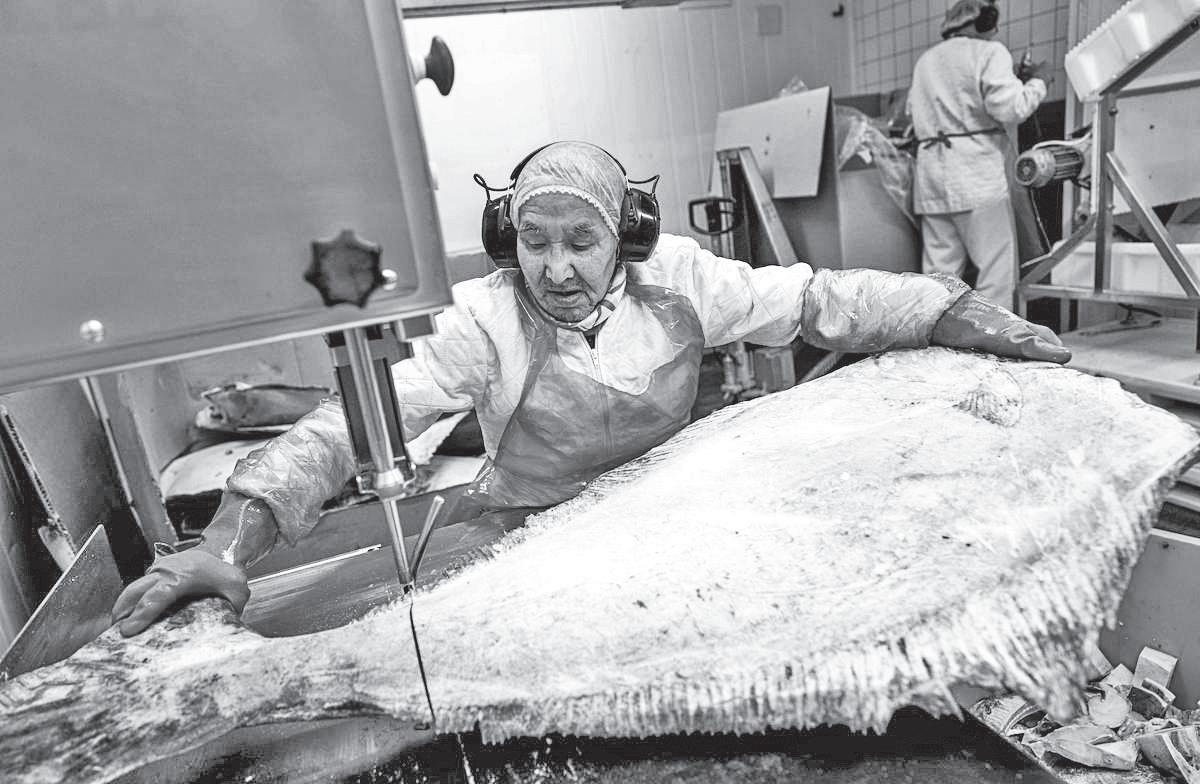
ice” one and a half meters (almost 5 feet) thick, recalled Karl Sandgreen, head of the Icefjord Center that documents climate change in the region and is based in the town of Ilulissat.
That sea ice started disappearing around 1997, Sandgreen said, and fishermen who drilled through the ice to fish increasingly started to fish by boat instead. The use of boats allows fishermen to reach larger areas, but that can come with extra costs and pollution that accelerates warming. Fishing has shaped Greenland’s communities. The harbor where fishermen return to sell their catch is at the heart of every town or village. Before heading out, some fishermen pick up boxes from the island’s fishing companies to pack their catch which, in the capital of Nuuk, is winched from the boat to the fish factory.
Toke Binzer, the chief executive of the island’s single biggest employer, Royal Greenland, said he is increasingly worried
about a future with greatly diminished sea ice.
That could push traditional fishermen toward larger communities and into the ranks of commercial fishing.
The challenge now is how to support traditional fishermen when there is sometimes “too much ice to sail, too little to go out on,” Binzer said. Already, that unpredictability has caused a “huge” problem.
Royal Greenland already loans fishermen money to buy a boat, which they repay from selling their catch, Binzer said.
If everyone turns to fishing from boats, that could help economically but lead to overfishing, said Boris Worm, an expert in marine biodiversity at Dalhousie University in Canada.
In Greenland, there are already signs of too much fishing close to shore as halibut are getting smaller, Binzer said. Worm agreed, calling it a classic sign of overfishing as
the bigger fish are caught and the smaller, younger ones are left.
That problem could worsen as the retreating ice makes fish more accessible. Fish stocks could rise as the warmer weather causes increased rain and melting ice to bring more nutrients for plankton, which the fish feed on, Worm said.
He warned, however, that the fish may not behave as “predictably,” as in the past, perhaps by seeking new food sources if they can no longer feed on the algae which grows under the sea ice.
Few options beyond fishing
On his boat near Nuuk, Áargil considered another challenge: Warm weather is making some fish harder to catch as they go deeper in search of colder waters.
“It’s too warm,” he said, looking at the hills around the fjord. “I don’t know where the fish is going, but there’s not so much.”
Options beyond fishing remain few in Greenland. Tourism is increasing but far from making up a significant part of the economy.
Tradition, too, is at the heart of worries about climate change. Already, dog sledders have been confined to land when there is no sea ice.
“It’s really important for many Greenlanders to have the ability to go out and sail,” said Ken Jakobsen, the manager at Royal Greenland’s factory in Nuuk. Fishing is the “most important” thing.
In the capital alone, he said, there are more than 1,000 boats in the harbor during summer—in a territory where the total population is little over 50,000. Emma Burrows, Kwiyeon Ha And Evgeniy Maloletka/Associated Press
as the Northern Luzon bitatawa (Varanus bitatawa), the Northern Luzon giant cloud rat (Phloemys palidus), the Northern rufous hornbill (Buceros hydrocorax), and the recently rediscovered forest beetle species, the Schadenberg’s jewel weevil (Pseudapocyrtus schadenbergi), after over 100 years of not being seen again or collected.
Rich biodiversity
CITING the wildlife expedition work by experts from the Mabuwaya Foundation, Ibañez said Calanasan has 139 species of birds, of which 123 are residents and 16 migrants.
Of the 139 bird species, 61 are endemic to the Philippines, or about 50 percent of resident bird species.
Meanwhile, the forest provides a haven for four species that were listed as threatened and eight species that were listed as nearthreatened.
Meanwhile, 12 species of bats were observed, five of which were endemic to the Philippines, and one bat was listed as near-threatened
Center of speciation
ACCORDING to Ibañez, it appears that Calansan forest is a center of
speciation—a process by which populations evolve to become distinct, reproductively isolated species—in the Cordillera, or an evolutionary “Garden of Eden” for flora and fauna.
The forest of Calanasan is approximately 125,615 hectares (ha), of which 115,000 ha are based on its local conservation designation Lapat.
He said about 92 percent of Calanasan’s total land area is forest, and the Philippine eagle nesting territory at Barangay Eva alone is about 7,000 ha to 8,000 ha.
Mt. Kilang, a popular climb spot for mountain trekkers, sits within the Calanasan forest.
While it is not a protected area, most of the forest id within the corezone of the Unesco BRyA, Ibañez said.
He said the estimated number of eagle pairs in Apayao is between 17 and 39 pairs based on the total extent of suspected high and medium-quality forest habitats for Philippine eagles.
“So far we have validated only five pairs across Apayao. More surveys and nest search are definitely needed as most of the forests of Apayao have yet to be explored,” he said.

and
BSP marks World Wildlife Day, supports biodiversity conservation via polymer banknotes
THE Bangko Sentral ng Pilipinas (BSP) commemorates World Wildlife Day by highlighting the role of Filipinos as stewards of the country’s natural resources.
Th BSP reflected this message in the First Philippine Polymer Banknote Series.
To raise awareness on biodiversity conservation, the polymer banknote series feature protected wildlife and rich flora across the archipelago.
The P1,000 note carries the Philippine eagle and the sampaguita flower.
The P500 shows the Visayan spotted deer and the endemic orchid Acanthephippium mantinianum.
The P100 highlights the Palawan peacock-pheasant and the orchid Ceratocentron fesselii. Lastly, the P50 depicts the Visayan leopard cat and Vidal’s lanutan.
Wildlife photographer Floyd Bermejo captured the image of the leopard cat “Kyle” featured in the P50 polymer bill, as well as the Philippine eagle in the P1,000 polymer note, pointed out: “People don’t
protect what they don’t know.” The United Nations General Assembly in 2013 proclaimed March 3 as World Wildlife Day to celebrate and raise awareness of the world’s wild fauna and flora. Since 2008, the Visayan leopard cat has been classified as a “vulnerable3” species due to habitat loss and declining populations. Found only in the islands of Negros, Panay, and Cebu, the nocturnal, treeclimbing feline survives mainly in sugar plantations, feeding on birds and rodents. Bermejo hopes that the image of Kyle will spark greater interest in protecting the species and its habitat—the reason he donated his photos of Kyle and the Philippine eagle for use in the polymer banknotes.
“That’s the ultimate goal of conservation photographers—to highlight our species so the Filipinos would see that we have these animals, and that we need to protect their habitats. So the future generations would see them not only in photos or banknotes, but also in real life,” he said partly in Filipino.
By Pablo S. Trillana III



on Friday for For mula 1’s first day of practice at its 2026 season opener, there were questions. Plenty of them. The first, and most pressing, at the milestone 40th Australian Grand Prix was the potential postponement or cancellation of upcoming F1 races in the Middle East on April 12 and 19 in Bahrain and Saudi Arabia.
That’s due to the war involving the United States, Israel and Iran which has made travel difficult due to closed air spaces and dangerous to be in the region. F1’s governing body, the FIA, has already postponed the Qatar curtain raiser for top sportscar category, the World Endurance Championship, that was slated to be held on March 26 28.
And while it, and Formula One Man agement, the sport’s commercial rights holder, are monitoring the situation in real time—with a focus on the safety and well being of all concerned—an an nouncement is expected soon.
In the F1 paddock, though, where performance is king, the biggest ques tion mark is the sport’s reshuffled peck
ing order as a result of new technical regulations—including the position of new American startup squad, General Motors sponsored Cadillac. F1 heads into a new era this year, with unprecedented changes across the chassis (car) and power unit, which now feature an almost 50:50 output split between the turbo 1.6 liter V6 engine and electrical energy harvested from the brakes, one that requires a new, often counterintuitive driving style from the drivers.
Leclerc led pre-season testing
FERRARI’S Charles Leclerc topped the final pre season test in Bahrain, just over eight tenths of a second clear of Mercedes young gun Kimi Antonelli. But it’s the Italian’s Silver Arrows team who go into the meeting as favorites, based on an alleged engine advantage that they’ve yet to run at full tilt. Should Mercedes set the track alight, with searing, dominant pace, it’s expected that it will be George Russell, though, and not Antonelli, who would lead the charge. The British driver has five career wins and has been very relaxed in the lead up to Friday’s two practice sessions. AP

of France steers his car during the first practice session for the Australian Grand Prix at Albert Park in Melbourne before the weekend. AP
play, how you recover, and how you show up again tomorrow.
The world first heard her footsteps loudly in Miami in 2025. A 19‑year‑old wildcard ranked outside the elite did the unthinkable: she defeated world No. 2 Iga Świątek to reach the semifinals, after already sending home Grand Slam champi ons Jeļena Ostapenko and Madison Keys. It did not feel like an accident. It felt like a professional statement: the Philippines had an athlete whose skill could withstand the brightest lights.
Then came the kind of milestone that nations remember. At the 2025 US Open, Eala won a women’s singles main‑draw match—an Open Era first for the Philippines—upsetting 14th seed Clara Tauson after staring down the familiar cliff of almost. It was not only a victory on hard court; it was a victory against the small, quiet voice that tells young Filipinos to aim lower because the world stage is “for others.”
This is what people miss when they watch only highlights: tennis is not a sport of occasional brilliance. It is a sport of repeated suffering. The body keeps receipts. The mind keeps ledgers. You pay, and you pay again, and you pay in public. Then you learn, if you are wise, to make payment mean something.
And so the lines that people started

repeating—“pain into purpose,” “from courts, not couches”—landed with force. They are not fancy philosophy. They are the athlete’s plain creed: the early mornings, the lonely practices, the injuries endured quietly, the temptations refused, the comfort postponed. In a world addicted to shortcuts, those words are a small rebellion: discipline that refuses to negotiate with excuses.
Now, to share draw sheets and tournament corridors with names like Elena Rybakina and Karolína Muchová is more than a scheduling detail. It is a symbol. Once, our athletes were footnotes in international brackets. Now a Filipina can walk into the same arenas, look across the net at a world‑class opponent, and belong there without apology.
And yet—here is the part we should not romanticize—this is still only the beginning. The Top 30 is not a finish line; it is a harsher neighborhood. The travel is heavier. The scouting is sharper. The pres sure is more cunning. The tour does not reward sentiment. It rewards readiness.
So what, finally, are we celebrating?
Not the fairy tale. Fairy tales end when the clock strikes twelve. We are celebrating a different Filipino tradition: the capacity to keep showing up. To build a life around a craft. To choose the court again tomorrow. To
accept that excellence is boring on most days—and to do it anyway.
Eala’s real gift to us is not only the wins. It is the correction of a national habit. We have spent too long praising “natural talent” as if it were destiny, and excusing poor preparation as if it were charm. She is teaching us— without speeches, without lectures— that greatness is structured. It is scheduled. It is paid for in sweat, and then paid for again in restraint.
If you want to honor Alexandra Eala, don’t just repost her clips. Pick one small discipline and keep it for thirty days. Walk when you said you would walk. Read when you said you would read. Practice what you claim you love. The couch is always kind; it never asks who you could have become. The court is harsher—and more honest.
Somewhere a Filipina kid is now gripping a racket a little tighter because she saw a countrywoman do the improbable, survive the grind of the tour, and climb into the world’s Top ranks. Dreams do come true, yes—but only for those willing to treat a dream like a job.
That, in the end, is Alexandra Eala’s quiet revolution: making the Philippines believe again in the dignity of work—and in the audacity of hoping.

hours offer cooler temperatures, the downside is that as the round progresses and fatigue sets in, the heat inevitably catches up. Late afternoon tee times present another alternative, but that often means beginning your round under the harshest sunlight and racing against the fading daylight to finish all eighteen holes. Of course, there are always cooler courses in higher elevations—places like Tagaytay, Caliraya, or even Baguio— where the mountain air offers some relief from the lowland heat. But unless you have the luxury of dedicating an entire day to travel or planning a weekend escape, those options aren’t always practical. For golfers who want to stay within Metro Manila during the hottest months of March to May, one course stands out for a very simple reason: you can play it at night.
Club Intramuros Golf Course remains the only golf course in the city where players can enjoy a full round under bright lights. Night golf has begun appearing elsewhere, with places like Mimosa Plus Golf Course and The Vineyard Golf Club offering illuminated fairways. However, those courses require a couple of hours of driving from the city, and the fees can be quite steep.
Intramuros, on the other hand, sits right in the heart of Manila. It may not be championship length, but it is far from an easy course. In fact, its compact layout often demands more strategy and discipline than sheer distance.
GENEVA—The Malaysian Football Association (FAM) lost its appeal on Thursday against a FIFA ruling it cheated by using false documents to naturalize foreign born players for the men’s national team.
The Court of Arbitration for Sport said its judges confirmed a 350,000 Swiss francs ($450,000) fine for the FA and one year bans for the seven players “given their complicit responsibility in this fraud.”
The players were given Malaysian passports and selected for the team’s 4 0 win over Vietnam last June in a qualifying game for the 2027 Asian Cup. That win should be overturned by the Asian Football Confederation (AFC).
“The CAS panel found that the
The course has also recently been in the news because of discussions about converting it into a public park, a proposal put forward by Manila Mayor Isko Moreno. As a golfer, it’s difficult to discuss the issue without bias, so perhaps the best perspective for now is simply this: while the course remains open, it’s worth appreciating what it offers. The last time I played Intramuros was a couple of years ago, and the main attraction was, of course, the chance to play under the lights. The best approach is to arrive in the late afternoon, around four or five o’clock. It gives you ample time to have a proper merienda, relax a bit, and tee off around six, just as the sun begins to set.
By the time you finish, it will likely be close to 10 in the evening, making that pre round snack a wise decision. Although for adventurous eaters like me, grabbing a quick nibble from the food carts along the pedestrian walkways along Intramuros’ perimeter is also an added attraction. I’ve bought everything from turon and kamote fries, to a host of other street snacks from the vendors there.
Despite its modest length, Intramuros offers a fascinating mix of scoring opportunities and punishing holes. The layout perfectly captures the essence of risk versus reward golf. There are driveable par fours that tempt aggressive players, but even the slightest miscalculation can easily turn birdie chances into double bogeys or worse. The par threes, though relatively short, are deceptively
infraction of falsifying eligibility documents was established and that the 12 month ban from playing matches was a reasonable and proportionate sanction for the players,” the court said. However, the court relaxed the FIFA punishments by ruling the players should be allowed to train and take part in soccer activities outside of games until their bans expire.
The Malaysia FA acknowledged its “institutional shortcomings,” the court said, “and did not dispute that it may bear responsibility in violating” FIFA disciplinary rules.
“It also stated that the players had a limited role in providing documents requested by [the federation] and did not prepare, nor alter them,” CAS said. AP
demanding. Many greens are raised, with multiple tiers and mounds, meaning even well struck wedge shots do not guarantee easy pars. Perhaps the most memorable hole is the signature par three 10th—a true island green


MARCH 8, 2026 | soundstrip.businessmirror@gmail.com
Story and photo by Bless Aubrey Ogerio
ACANCELLED show might have cut short his first visit to Manila, but it has not dulled Cavetown’s appetite for growth.
The English singer-songwriter, born Robin Daniel Skinner, arrived in the Philippines last month as part of the tour for his latest album, Running With Scissors, a 13-track release that dropped in January 2026.
Hours before he was set to take the stage on February 18, however, the Manila show was called off due to unforeseen issues at the venue.
In an Instagram story later saved to his highlights, Cavetown told fans that “due to unforeseen issues at the venue it is not possible for us to play the show.”
He described the decision as “really stressful and difficult,” adding, “I hope you all can trust me and my team that it is the right one given the circumstances.”

Publisher :
T. Anthony C. Cabangon
Lourdes M. Fernandez
Editor-In-Chief :
Concept :
Aldwin M. Tolosa
Y2Z Editor :
SoundStrip Editor : Group Creative Director : Graphic Designers :
Jt Nisay
Edwin P. Sallan
Eduardo A. Davad
Niggel Figueroa
Chow Jarlego
Contributing Writers :
Tony M. Maghirang
Rick Olivares
Jingo Zapata
Reine Juvierre S. Alberto
John Eiron R. Francisco
Patrick Villanueva
Ana Zoe V. Davad
Justine Xyrah Garcia
Ginger Franz S. Ocampo
Trixzy Leigh Bonotan
Bless Aubrey Ogerio
Photographers :
Bernard P. Testa
Nonie Reyes
Y2Z & SOUNDSTRIP are published and distributed free every Sunday by the Philippine Business Daily Mirror Publishing Inc. as a project of the
The Philippine Business Mirror Publishing, Inc., with offices on the 3rd Floor of Dominga Building III 2113 Chino Roces Avenue corner Dela Rosa Street, Makati City, Philippines. Tel. Nos. (Editorial) 817-9467; 813-0725. Fax line: 813-7025
Advertising Sales: 893-2019; 817-1351,817-2807. Circulation: 893-1662; 814-0134 to 36. www.businessmirror.com.ph
For an artist who has built a reputation on emotional honesty and close-knit fan connections, the cancellation was a disappointment. Yet it also underscored what has come to define this chapter of his career: unpredictability, risk, and a willingness to be unsettled.
DURING an exclusive media event in Cubao on February 17, Cavetown spoke less about setbacks and more about challenge—specifically about refusing to stay comfortable.
“I think with the whole album, I’ve been trying to re-challenge myself in lots of ways and also in the live performance part, I’ve been trying to challenge myself,” he said. “And I’ve been challenging my band too because there’s a lot of very difficult parts to play.”
Since launching his music career in 2012, Cavetown has evolved from bedroom pop introspection to increasingly layered and ambitious production. The current tour, he said, demands more from him vocally and instrumentally.
That confidence did not come without unlearning. Looking back at his earlier work, Cavetown admitted he once wrote songs according to what he believed were unspoken industry rules.
With Running With Scissors, he chose to disregard those limits. “With this new record, I really just wanted to let my mind flow and my creativity flow and not feel restricted by any kind of rules,” he said.
THE album reflects that shift. Cavetown described being heavily inspired by hyperpop production, alongside the pop-punk and metal he grew up listening to.
The result? A denser, more maximalist sound that contrasts with the stripped-down intimacy of his early releases. “I just kind of wanted to create a fusion of all those things and make my music more maximalist and have some harsher elements,” he said.
Working with several co-producers also helped push him further than he might have gone alone.
Though the album contains 13 tracks, Cavetown said there is no vault of fully finished songs left behind. “It’s hard to say because I wouldn’t finish a song if I don’t like it,” he said when asked how many tracks did not make the cut.


There are, however, additional songs in progress that could surface in a deluxe edition. “Anything that I feel drawn to, I’m going to see it through eventually,” he said.
DESPITE the setback, Cavetown described his first trip to the Philippines as affirming. He had long heard about Filipino crowds. “I’ve heard a lot that people are really respectful but also really excited and I love that. I feel like people are going to be singing along,” he said.
And of all the cities in Asia, he said the Philippines “just makes sense since we’re on this side of the world.” Streaming data has shown strong listenership from the country, something he felt more clearly once he arrived.
Further, he hopes next time to venture beyond the city. “I really wish I had more time here to kind of venture outside the city into more rural areas and more natural areas and visit some wildlife and stuff.”
BUT If there is a through line in Cavetown’s current era, it is instinct. “I think the biggest thing that I always try and internalize for myself is to trust yourself and trust your intuition in kind of all aspects of it,” he said.
He acknowledged that young artists often face pressure from industry figures who “seem like they know better than you… who have all these big ideas.” His advice is direct: “If something doesn’t feel right, it isn’t right for you.”
The year ahead leaves little room for pause. After returning to New York, he is scheduled to head back to the United Kingdom and Europe for his first headline tour there in a while. He is also producing music for other artists, including American singer Tessa Violet.
In between, he plans to carve out time to complete the additional songs he hopes to include in a deluxe version of Running With Scissors, possibly next year.
“Busy year, a lot of music,” he said.
0 year-old Filipino-American Yvng Jin’s latest single, “Wala Nang Iba (Nobody)” showcases the arrival of a major talent. Despite being born and raised in the US, Yung proudly declares he is a pureblooded Pinoy in the US.
Asked about his new single, Yvng Jin shared he highlighted his Filipino roots by dropping a Tagalog version titled “Wala Nang Iba.” Gifted with a smooth voice and strong songwriting skills, the young singer-songwriter-producer delivers an exciting track that “explores the feeling of finding somebody that nobody else you know compares to.” He is just as excited to experience being back in the motherland this time as a young man.

With the release of “VISA,” their first official single of 202, SB19 marks a watershed moment in P-Pop with a bold follow-up to the Simula At Wakas era. Delivering a more uncompromising approach in artistic direction, SB19’s “VISA” tackles another socially relevant theme that dares to challenge, provoke, and shake up comfort for conviction.
The new track is inspired in part by real-world events and ongoing conversations around visa denials. “This release will really define SB19’s sound, personality, and the way we present ourselves,” Stell admits. “We have always been known for being vocal, but this time it is even stronger. We are addressing sensitive and current topics
that people can relate to, even if not everyone agrees with us. We are ready to face any reaction.”

In their new single “My Love,” P-Pop group Hara makes a confident first impression with a bop about girlhood and self-worth. Bearing a name derived from a pre-colonial term for “beauty” and “strength, the six-member girl group Hara is a 100% homegrown P-Pop ensemble from Davao.
Buoyed by subtle piano chords and sophisticated grooves, “My Love” transports the listeners into clubland fantasia, where suave, confident vocals and magnetic dance-pop production create a singular sonic experience. Hara said, “Our song talks about heartbreak but also about realizing your worth.
At the same time, we also wanted to show that women aren’t just victims of heartbreak: we’re strong, we make choices, and sometimes we’re the ones who choose ourselves first. The message we hope listeners to take away is self-love, empowerment, and knowing your value.”
“Sa’yo Lamang”
In “Sa’yo Lamang,” Asia’s Romantic Balladeer, Christian Bautista embraces

his signature romantic charm while exploring a fresh sonic direction. His latest release pairs modern pop balladry with groove-driven polish. Imagine the neon glow of ‘80s Tokyo at twilight, yet the atmosphere feels distinctly Pinoy in its comforting glory. That’s how “Sa’yo Lamang sounds.
The award-winning OPM icon shares, “This year I’m all in. I want listeners to feel uplifted, have fun, and start the year with good energy.” The vibrant personality of “Sa’yo Lamang” seamlessly translates into its music video, which incorporates smooth retro styling, warm neon tones, and playful choreography.

With the release of her latest six-part EP “Ore,” Fil-Japanese avant-pop shapeshifter ena mori cements her position as one of the most compelling creative forces in Asian pop music. Sharper in tone and stronger in stance, “Ore” transforms cultural memory and adulthood into abrasive pop anthems.
Conceptually, “Ore” traces ena’s passage into adulthood, confronting emotions she once avoided and approaching them with greater clarity

and resolve. ena recounts. “Growing up in an Asian household, surrounded by its values, taboos, societal pressures, and hidden passions, has shaped the way I perceive the world. Navigating my twenties between two cultures— sometimes similar, sometimes polar opposites, braided together.” The EP carries the ambient imprints of her life as is: rainstorms, rice cooker chimes, arcade noise, hot wind against a truck horn.

Filipino bedroom pop soloist Peej drops his full-length debut album, “King of Sadtown,” where he confronts the loneliness that comes with choosing solitude. Inspired by Death Cab for Cutie, Bon Iver, Frank Sinatra, and Mac DeMarco, the 13-track new album unfolds as a series of interconnected stories about destructive habits, romantic disappointments, fleeting encounters, and, ultimately, the conscious decision to withdraw.
Written, produced, and primarily mixed by Peej in his bedroom “King of Sadtown” carries a deeply personal, almost diaristic quality. “Most times, writing songs is like a therapy session for me,” Peej admits. “I’ll often sing out a random line during the writing process—and it’s only then I realize that this topic is something that has been eating me up inside—so naturally I have lots of things to say about it, and the song slowly takes shape.”
By Mark Kennedy The Associated Press
NEW YORK—He’s British. She’s American. He’s a wide-eyed optimist. She’s world-weary. Naturally, they’re perfect for each other.
That classic opposites-attract setup is the basis for the new Broadway musical Two Strangers (Carry a Cake Across New York). It’s one of a clutch of popular new romantic comedies warming hearts across various media.
There’s the HBO Max hockey show and word-of-mouth sensation Heated Rivalry and the Netflix agnostic-falls-for-a-rabbi series Nobody Wants This, while the seeyou-next-year movie People We Meet on Vacation has become a huge Netflix hit. There’s also My Oxford Year, the upcoming Reminders of Him and the dependable Bridgerton, now in Season 4. Two Strangers (Carry a Cake Across New York) lands on Broadway beside the Tony-winning android rom-com Maybe Happy Ending
“They’re all the same story, really,” says Kit Buchan, who with Jim Barne wrote the Two Strangers musical. “How do two people inextricably drawn together but separated by an overwhelming obstacle melt into one another?”
‘There are waves’
PAUL EASTWICK , a psychology professor at the University of California, Davis, and author of Bonded by Evolution, studies romantic attraction and says the burst in rom-coms is welcome.
“I definitely get the sense that there are waves and this is the time of year when we get usually one or two surprise, probably streaming, hits in this genre,” says Eastwick, who also co-hosts Love Factually,

Wa podcast that uses science to explore the biggest rom-coms.
He says the genre no longer gets the respect it should, recalling that rom-coms used to be big movie events that garnered awards—like Ghost, the highest-grossing film of 1990, which earned five Oscar nominations and won two.
“It feels a little marginalized these days in the critic spaces and in the box-office spaces,” he says. “I hope that people don’t stop making these because people clearly want them.”
Some in the bumper crop of rom-coms this season take the formula and twist it slightly. Heated Rivalry, which had an average of 10.6 million viewers per episode in the U.S., makes the lovers same-sex. Nobody Wants This, whose second season garnered 8.6 million views in its first four days of streaming, explores religious conversion. People We Meet on Vacation, which drew 17.2 million views over its January launch weekend, flips the gender of the partner who is usually the wisecracking agent of chaos.
“I think that’s often what makes some
of these very compelling is where you’re able to wink and nod a little bit at the genre and have fun with it while conforming to people’s expectations at least somewhat,” Eastwick says.
An elevated rom-com
DIRECTOR Brett Haley had never made a rom-com before adapting People We Meet on Vacation from Emily Henry’s novel. To craft the film, he reached back to ones he adored, like Jerry Maguire, My Best Friend’s Wedding and When Harry Met Sally.
“They’re incredibly elevated. You care about the characters, the writing is impeccable, the performances are impeccable, the filmmaking is incredible,” he says. “To me, we just sort of lost some of that elevation. And I don’t think there’s anything wrong, by the way, with your Hallmark movies or other rom-coms that are a little fluffier, a little lighter. They’re just sort of meant to be put on and enjoyed and not taken really art.”
He took his two star-crossed lovers— Emily Bader and Tom Blyth, playing willthey-or-won’t-they friends—and earned
the viewer’s trust: “It was all about grounding the comedy, the romance, the yearning, in reality.”
Haley, too, argues that rom-coms aren’t respected by critics these days. The genre that kicked off with now-classics like It Happened One Night and Bringing Up Baby is too easily dismissed in 2026.
“If an action movie is elevated and checks all the boxes, you’ll find that critics go, ‘Hey, yeah, this did it. This was great,’” he says. “But when a romance does it and checks the boxes and does everything right, they go, ‘Oh, we’ve seen this before.’”
Haley says despite the critical reaction to rom-coms, he believes the average viewer yearns to sit on the couch or go to the theater and share the experience of falling head over heels.
“It’s especially dark right now. And I think that people want to believe in love,” he says. “I think there’s real value in a film that can genuinely make you feel good, even just for an escape for two hours. There is true worth in that.”
n Cover photo by Edward Eyer on Pexels.com
HEN the animal kingdom is faced with the threat of destruction, it’s up to a passionate animal-loving teenager to save the day, hopping her consciousness into a robot beaver. If that sounds like a loaded premise, it’s because it is; making Hoppers a wild and unexpected comedy that will leave audiences laughing out loud.
Now showing in Philippines cinemas nationwide, Hoppers delivers a unique comedic tone and fun characters as Mabel hops into beaver form to explore the many wonders of the animal kingdom.
“The thing that always guided us was the comedy and the characters,” says

director Daniel Chong ( We Bare Bears).
“That was what we chased the hardest. We knew it was our team’s strong suit,
and we made sure early on to establish a unique comedic tone with fun characters to build everything on.”
“A story like this, with characters arguing constantly, has to be funny,” adds producer Nicole Paradis Grindle ( Incredibles 2). “We wanted it to have emotion and feature a ton of action, too. It’s even a thriller when you get to the final scenes. But the humor was the initial key, since it brings people in. It’s an amazing story to tell in animation, this idea that we can see into that animal world and enjoy animals, as animals.”
In Hoppers , two worlds hang in the balance. The animal world, threatened by Mayor Jerry Generazzo (voiced by Jon

Hamm) and the human world, threatened by retaliation from the animals. Finding herself in a bit of a pickle is Mabel (voiced by Piper Curda), a passionate animal lover that will use new technology to “hop” into a life-like robotic beaver, and will try to mend the situation between both worlds. What follows is a story filled with a lot of fun twists and turns, with loads of laughter and gladesaving action in between.
Hoppers also features the voices of Bobby Moynihan, Dave Franco, and Meryl Streep. Hop to cinemas and see Disney and Pixar’s “funniest movie ever,” according to critics. Book your tickets now through: www.disney.ph/movies/hoppers