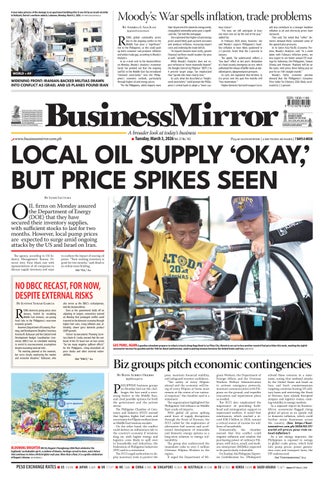
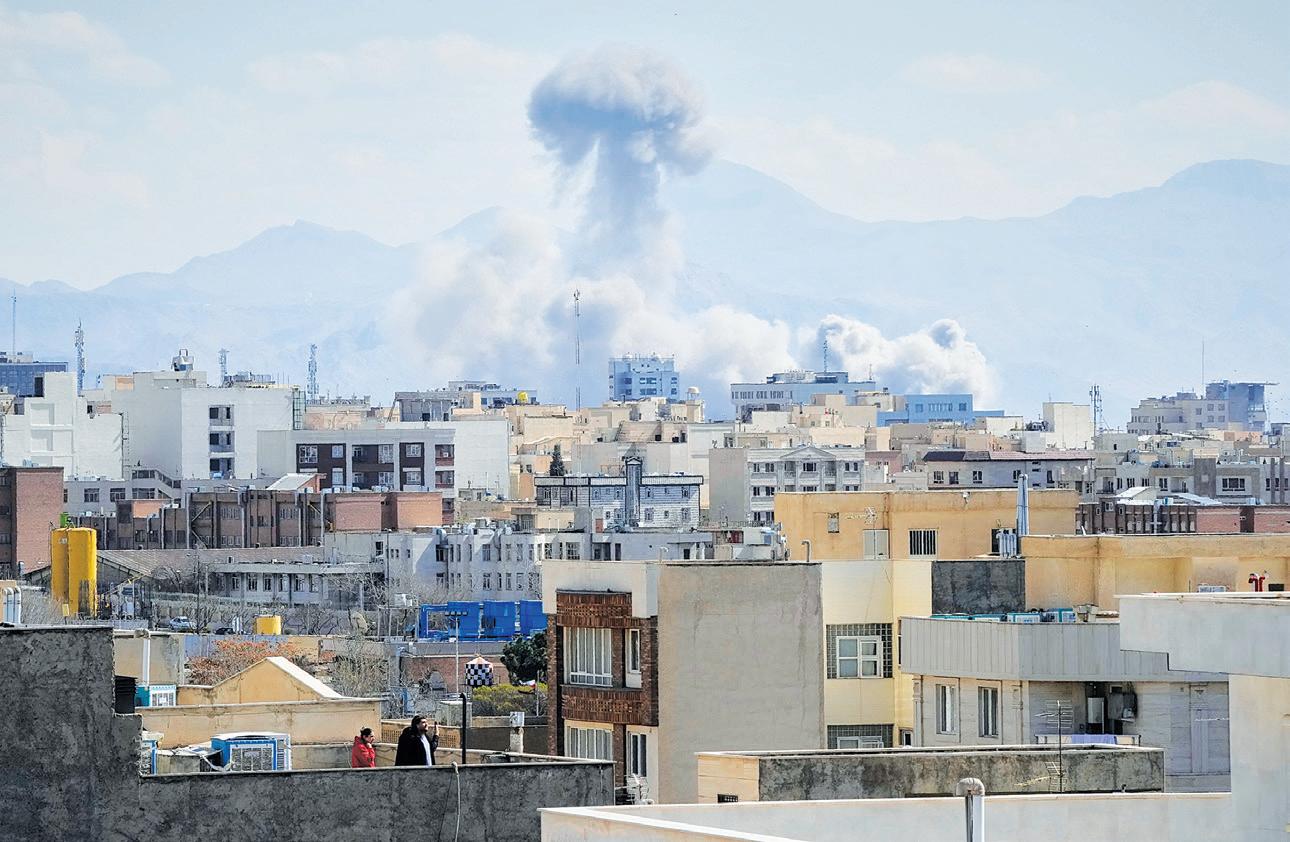
OILfirms on Monday assured the Department of Energy (DOE) that they have secured their inventory supplies, with sufficient stocks to last for two months. However, local pump prices are expected to surge amid ongoing attacks by the US and Israel on Iran.
The agency, according to Oil Industry Management Bureau Director Atty. Rino Abad, met with representatives of oil companies to discuss supply inventory and ways to cushion the impact of
oil prices. “Their existing inventory is good for two months,” said Abad in an online news briefing.
By Andrea E. San Juan
in the Middle East has introduced “renewed uncertainty” into the Philippines’s economic outlook, particularly through
“For the
By Justine Xyrah Garcia
RISING domestic pump prices since January, fueled by escalating Middle East tensions, are posing fresh risks to the Philippines’s near-term economic growth.
However, Department of Economy, Planning, and Development (DepDev) Secretary Arsenio M. Balisacan said the Cabinet-level Development Budget Coordination Committee (DBCC) has no scheduled meeting to revisit its macroeconomic assumptions despite mounting external risks.
“No meeting planned at the moment, but we’re closely monitoring the market and economic situation,” Balisacan, who
timately, slower gross domestic product (GDP) growth. Former Socioeconomic Planning Secretary Dante B. Canlas warned that the outbreak of the US-Israel war on Iran carries “far too many negative spillover effects” for the Philippines, citing immediate oil price shocks and other external vulnerabilities.
than 50 percent of its domestic energy needs, rising global commodity prices pose a significant risk,” Tan told this newspaper. She explained that higher oil and energy prices would likely push up both consumer and producer inflation, increasing import costs and widening the trade deficit.
“As imports become more costly, greater financial outflows would weaken the peso as well,” added Tan.
While Moody’s Analytics does not expect inflation to “move materially beyond” the Bangko Sentral ng Pilipinas’ (BSP) 2 to 4 percent target range, Tan emphasized that “upside risks have clearly risen.”
As such, what she described as “heightened uncertainty” could prompt the Philippines’s central bank to adopt a “more cau -
tious stance.”
“For now, we still anticipate at least one more rate cut by the end of the year,” added Tan.
In February 2026 alone, however, she said Moody’s expects Philippines’s headline inflation to have likely quickened to 2.3 percent, faster than the 2 percent in January.
The uptick, Tan underscored, reflects a “low base” effect as last year’s declaration of a food security emergency on rice, which authorized the release of buffer stocks at subsidized prices, dampened price pressures.
As such, she explained that declines in rice prices over the past few months will “lose momentum.” Higher domestic fuel and transport costs will also contribute to a
By Bless Aubrey Ogerio @blessogerio
PHILIPPINE business groups on Monday laid out the challenges the face amid a worsening fonlict in the Middle East, and cited possible options for both the government and the private sector.
The Philippine Chamber of Commerce and Industry (PCCI) warned that logistics, higher fuel costs and uncertainty for Filipino workers loom as Middle East tensions escalate. On the other hand, the conflict could deliver an inflationary jolt to the country’s economy if tensions drag on, with higher energy and logistics costs likely to spill over to households and industries, the Federation of Philippine Industries (FPI) said in a statement.
The PCCI urged authorities to deploy monetary tools to protect the
peso, maintain financial stability, and safeguard investor confidence.
“The safety of every Filipino abroad and the economic well-being of every Filipino at home must remain at the center of our national response,” the chamber said in a statement.
The organization highlighted the Philippines’ full reliance on Middle East crude oil imports.
With global oil prices spiking amid fears of supply disruptions through the Strait of Hormuz, the PCCI called for the exploration of alternative fuel sources and accelerated development of renewable and domestic energy options as a long-term solution to energy vulnerability.
The group also underscored the immediate risks to over 2 million Overseas Filipino Workers in the region.
It urged the Department of Mi-
grant Workers, the Department of Foreign Affairs and the Overseas Workers Welfare Administration to activate emergency protocols, maintain communication with Filipinos on the ground, and expedite evacuation and repatriation plans as needed.
The PCCI also emphasized the importance of providing livelihood and reintegration support to repatriated workers. It noted that remittances, which reached a record $38.3 billion in 2024, remain a critical source of income for millions of households.
Domestically, the chamber warned that this conflict could reignite inflation and weaken the purchasing power of ordinary Filipinos, with micro, small, and medium enterprises (MSMEs) expected to be particularly vulnerable.
On Sunday, the Philippine Exporters Confederation Inc. (Philexport)
echoed these concerns in a statement, noting that weekend attacks by the United States and Israel on Iran, and Iran’s countermeasures targeting countries hosting US military bases and restricting the Strait of Hormuz, have already disrupted airspace and logistics routes, creating volatility in energy markets. In a separate report by BusinessMirror, economists flagged rising global oil prices as an upside risk to domestic inflation, which could further strain businesses across the country. (See: https://businessmirror.com.ph/2026/02/27/ world-oil-prices-pose-risk-tolocal-inflation/)
As a net energy importer, the Philippines is exposed to swings in global crude prices, which feed into pump prices, power generation costs and transport fares, the FPI underscored.
By Lenie Lectura
Peso’s sharp drop vs dollar reflects a ‘perfect storm’
By Andrea E. San Juan @andreasanjuan
THEPhilippine peso’s sharp drop against the dollar on Monday reflects a “perfect storm” amid the “risk-off” sentiment from Middle East tensions and higher oil prices.
Data from the Bankers’ Association of the Philippines (BAP) showed the local currency closed at P58.2 per $1 on Monday. The peso plunged by 53 centavos from its previous finish of P57.665 on Friday, February 27,2026.
“The peso’s sharp drop reflects a perfect storm—stronger US dollar expectations, risk-off sentiment from Middle East tensions, and higher oil prices, which hurt oil-importing countries like the Philippines,” Jonathan L. Ravelas, senior adviser
No DBCC recast, for now…
Continued from A1
“The price and output effects down the road depend on how soon and how deep the effects of the short-run impacts of the war on exchange rate and inflation,” Canlas told the BusinessMirror Market attention has focused on the Strait of Hormuz—a critical shipping chokepoint between Iran, Oman, and the United Arab Emirates (UAE) through which about 20 percent of the world’s oil supply passes—as escalating hostilities threaten global supply flows.
at Reyes Tacandong & Co. said in a Viber message on Monday.
Philippine Institute for Development Studies (PIDS) Senior Research Fellow John Paolo R. Rivera echoed Ravelas’s sentiment, saying the sudden drop “reflects global risk-off sentiment particularly geopolitical tensions.”
He added that the peso may have plummeted on Monday due to the “stronger demand for USD as a safe haven.”
The state think tank’s senior research fellow pointed out that rising oil prices may have also pressured the Philippine peso due to concerns over a wider trade deficit and higher inflation.
“Also, US rate expectations and higher T-yields could have strengthened the USD, while technical trading and hedging demand may have ampli-
As of early Monday, Reuters said Brent crude rose 9 percent to $79.41 per barrel, while US benchmark West Texas Intermediate (WTI) climbed 8.6 percent to $72.79.
The global rally has begun spilling over into domestic pump prices. Diesel and kerosene prices have increased for 10 consecutive weeks, rising by P1.20 and P1.50 this week, respectively.
Gasoline prices have climbed for eight straight weeks, with the latest increase at P1.90.
fied the move,” the PIDS senior research fellow said.
At this point, he said the weakening of the peso appears “more driven by external factors than a sudden shift in domestic fundamentals.”
Rizal Commercial Banking Corp. (RCBC) chief economist Michael L. Ricafort said the weakening of the local currency on Monday could be attributed to the “recent geopolitical risks” since February 28,2026.
Ricafort said the conflict between the United States and Iran has since “led to higher global crude oil prices to new 8-month highs that could lead to higher local fuel pump prices and some pick up local inflation.”
Earlier, this newspaper reported that escalating geopolitical tensions overseas could also push up domestic inflation, especially as pump prices continue to rise. (See: https://businessmirror.com. ph/2026/02/27/world-oil-prices-poserisk-to-local-inflation/).
For University of Asia and the Pacific (UA&P) economist Peter Lee U, sustained oil price increases could constrain policy support for the economy, increasing the risk of slower GDP.
“Much depends on how long this Iran war will last. Oil prices are already high because of the strikes. So that will find its way into inflation in a few weeks. This will leave less scope for further interest rate cuts,” U told this newspaper.
Philippine Institute for Development Studies (PIDS) Senior Research Fellow John Paolo R. Rivera raised similar sentiments, saying prolonged pump-price increases could weaken household purchasing power, raise transport and logistics costs, and prompt businesses to delay spending.
“Growth could be shaved by a few tenths of percentage points rather than a full percentage point in the near term. A mild, short-lived spike might have only a small impact, a sustained surge that meaningfully lifts inflation expectations and forces tighter financial conditions would be the scenario that could more noticeably slow expansion,” Rivera told the BusinessMirror
However, both U and Rivera declined to provide a specific timeline on how long the conflict would need to persist before growth is materially affected.
“Nothing definite but this shock cannot be prolonged otherwise our economy may run out of shock absorbers,” Rivera added.
Remittances, tourism affected BEYOND oil and economic growth, some economists also flagged potential spillovers to remittances and tourism.
De La Salle University (DLSU) economist Maria Ella C. Oplas said the conflict could disrupt remittance flows if overseas Filipino workers (OFWs) in affected oil-producing countries face income or employment uncertainties, which could in turn dampen domestic household consumption.
“Just imagine the OFWs in those countries. They will not be able to send money to their families here in the Philippines,” Oplas told the BusinessMirror.
Asked for an estimate, Oplas said firstquarter GDP growth could settle between 4.5 percent and 5 percent.
Meanwhile, Ateneo de Manila University economist Luis F. Dumlao said the tourism sector could face headwinds, noting that many flights from Europe to Asia pass through the Middle East. He added, however, that the immediate impact on first quarter growth may be limited, since “we are two-thirds done with the quarter.”
The caution comes as the Philippine economy expanded by 4.4 percent in 2025, following weaker-than-expected fourth quarter data that showed growth slowing to 3 percent at year-end.
Against this backdrop, the DBCC’s latest medium-term macroeconomic assumptions project GDP growth at 5 to 6 percent this year, lower than the earlier 6 to 7 percent target.
For 2027, the DBCC narrowed its forecast to 5.5 to 6.5 percent from the previous 6 to 7 percent range. The growth target for 2028 was retained at 6 to 7 percent.
Continued from A1
Oil companies are currently mandated to maintain at least a 30-day inventory of crude oil and a 15-day inventory of finished petroleum products.
Jetti Petroleum Inc. said most oil firms have already secured their respective supplies for the medium term, even prior to the US-Israel attacks on Iran. “For now, prices are expected to remain elevated over the coming days. The uncertainty on how long this fresh escalation could be sustained would likely put more upside risk to prices,” said Jetti President Leo Bellas.
Asked if government can compel oil firms to adjust their inventory for a longer period, Abad said this would have to be carried out via an executive order.
For her part, DOE Secretary Sharon Garin said in a radio interview that oil firms remain complaint with their mandated inventory levels. However, adjusting this is risky due to additional carrying costs for storing the supply.
“I don’t know if we can increase it but it’s a bit expensive. Maybe, the government and the private sector can work on this together,” she said. Further price hikes certain THE energy chief is certain that pump prices in the coming weeks will increase. “The price will increase, I will not sugarcoat that. Even if you say there’s oil coming, it will increase because of the tension. The stress it is putting on the market will eventually increase the price until it stabilizes. So, we need to expect that,” Garin said.
For now, the DOE is actively monitoring oil prices and supply levels following significant, immediate upward pressure caused by geopolitical tensions. For the oil firms’ part, they assured that they will continue offering discounted pump prices for public utility vehicles.
“What we can do is focus on what the DOE can contribute. During the meeting, the oil firms were closely reminded to monitor prices, remain vigilant, and implement staggered price increases if succeeding price adjustments are too high.”
In case of a big-time adjustment next week, stakeholders at the meeting discussed the possibility of “staggered implementation,” said Abad.
Oil firms adjust their pump prices weekly to reflect movements in the world oil market.
This week, gasoline prices will shoot up by P1.90 per liter, diesel by P1.20 per liter, and kerosene by P1.50 per liter. This is the eighth straight week of increases for gasoline, and the 10th for both diesel and kerosene. The new pump prices take effect Tuesday, March 3.
The adjustment does not yet include the global impact of ongoing strikes between the US and Iran.
“The next trading days are critical. At the end of this five-day trading period, we will know how much it will go up,” said Abad.
Bellas said the chances of prices being pushed to $100 per barrel and beyond are high if the current disruption to supply flows in the Strait of Hormuz is prolonged. The strait carries about 20 percent of the world’s oil and gas.
Continued from A18
remittances, he said: “There should not be any effect on the OFW remittance yet.”
If the conflict drags for months, however, he said, “that is when it can get affected.”
At a forum on Friday, Ravelas laid out recommendations on how Philippine households and businesses can navigate a “volatile landscape.”
“Protect your purchasing power. So inflation is easing but remains uneven. Households should stay disciplined, manage debt, build buffers, and prioritize essentials over lifestyle inflation,” he said. As for dealing with stocks, Rave -
Meanwhile, lawmakers are calling on the government to fast-track contingency measures, including fuel subsidies for vulnerable sectors, to protect Filipinos from potential inflationary pressures.
Deputy Majority Leader Luigi Villafuerte and Camarines Sur Rep. Migz Villafuerte said the government’s contingency plans should prioritize fuel subsidies for public utility vehicle drivers and operators, fisherfolk, and other sectors most exposed to rising transport costs if the Middle East conflict worsens, driving up the retail prices of diesel, gasoline, and other petroleum products. The lawmaker-brothers emphasized that the Philippines’s high vulnerability to oil supply shocks— highlighted by the ongoing Middle East tensions—is another reason to accelerate the country’s shift toward renewable energy and reduce overreliance on fossil fuels for power generation.
Analysts warn that unless the so-called joint “preemptive strikes” by the United States and Israel and Iran’s retaliatory counterattacks end quickly, the strategically crucial Strait of Hormuz could remain closed, further disrupting oil supplies and pushing Brent crude prices—the international benchmark—to $90 or more from $61 at the start of 2026.
Domestic oil prices have already climbed sharply in recent months, with diesel up by P7.70 per liter and gasoline by P6.70 from January to February. The Villafuertes warned that continued crude price hikes could accelerate inflation, affecting the prices of fish, meat, vegetables, electricity, and other utilities and transportation.
Even before the latest conflict, the Villafuertes had pushed for legislation to support small-scale fishers, proposing a monthly fuel subsidy of P1,000 and automatic enrollment in the National Health Insurance Program (NHIP).
TRAIN allows excise tax suspension
RELATEDLY, Senator Bam Aquino reminded the government that the Tax Reform for Acceleration and Inclusion (TRAIN) Law allows the automatic suspension of excise taxes on fuel products once the prices of oil in the world market breach the $80 per barrel.
The safeguard, which was pushed by Aquino, automatically suspends the excise tax on petroleum products if the average price of oil in the global market reaches $80 per barrel in the next three months. The senator warned that the surge in oil prices will trigger a domino effect on food and other goods, imposing an additional burden on Filipinos. He is expected to submit a resolution on the matter.
In the 20th Congress, Aquino filed Senate Bill No. 265 seeking to abolish the excise taxes imposed on diesel, kerosene, liquefied petroleum gas (LPG), fuel oil, and unleaded gasoline under the Tax Reform for Acceleration and Inclusion (TRAIN) Law.
In the 20th Congress, Aquino filed Senate Bill No. 265 seeking to abolish the excise taxes imposed on diesel, kerosene, liquefied petroleum gas (LPG), fuel oil, and unleaded gasoline under the TRAIN Law. With Reine Alberto, Butch Fernandez, Sam Medenilla and Jovee Marie N. dela Cruz
las advised traders to “be selective and not speculative.”
“Volatility creates opportunities but only for investors. Focus on fundamentals, quality companies, dividends, and long-term things matter more than the hype,” he said. For jobs, he underscored the need to prioritize skills over security amid the shift in the labor market.
“Upskilling and adaptability is our key to be able to sustain growth in our economy,” Ravelas pointed out.
On the local currency, he said Filipinos should “expect swings, plan ahead,” adding: “The peso will remain sensitive to global rates, policy uncertainty, capital flows, and geopolitics. Businesses, OFWs, importers, and investors should hedge whenever possible and avoid timing currency.”
Two impeach complaints vs VP ‘sufficient in form’
By Jovee Marie N. Dela Cruz | @joveemarie
THE House Committee on Justice on Monday declared that the third and fourth impeachment complaints filed against Vice President Sara Duterte are sufficient in form, allowing the proceedings to move forward after setting aside one complaint and approving the withdrawal of another.
In separate motions without objection, the panel ruled that the complaints filed by Fr. Jose Saballa et al and by lawyer Nathaniel Cabrera met the formal requirements under House rules.
The Saballa et al complaint was endorsed by Party-list Rep. Leila de Lima of Mamamayang Liberal.
The Cabrera complaint was endorsed by Deputy Speaker Francisco Paolo Ortega V and Manila Rep. Bienvenido Abante Jr.
The rulings send the two complaints to the next stage—determination of sufficiency in substance—where the panel will examine whether the allegations, if true, constitute impeachable offenses under the Constitution.
The committee emphasized that both complaints comply with the Supreme Court ruling, which permits only one impeachment proceeding against an official per year and requires at least one endorser from the lower chamber.
De Lima insisted there is sufficient “smoking gun” evidence for the House to impeach Duterte again, potentially paving the way for a Senate impeachment trial.
She said the allegations and supporting documents in the third complaint are largely the same as those cited in the articles of impeachment forwarded to the Senate in February 2025.
“I reiterate, this House has impeached Vice President Sara Duterte before. The records are clear. This House already determined at least once that the allegations against her were serious enough to trigger the constitutional process,” de Lima said.
She emphasized that last year, 215 House members—well above the one-third threshold—endorsed the Articles of Impeachment against Duterte.
De Lima dismissed claims that the current complaints lack merit. “It is absurd to belittle the accusations in the Saballa et al petition and other complaints, precisely because these are the same accusations and evidence that led to the Vice President’s impeachment last year,” she said. She added that the grounds, facts, and evidence remain valid and should
TBy Justine Xyrah Garcia
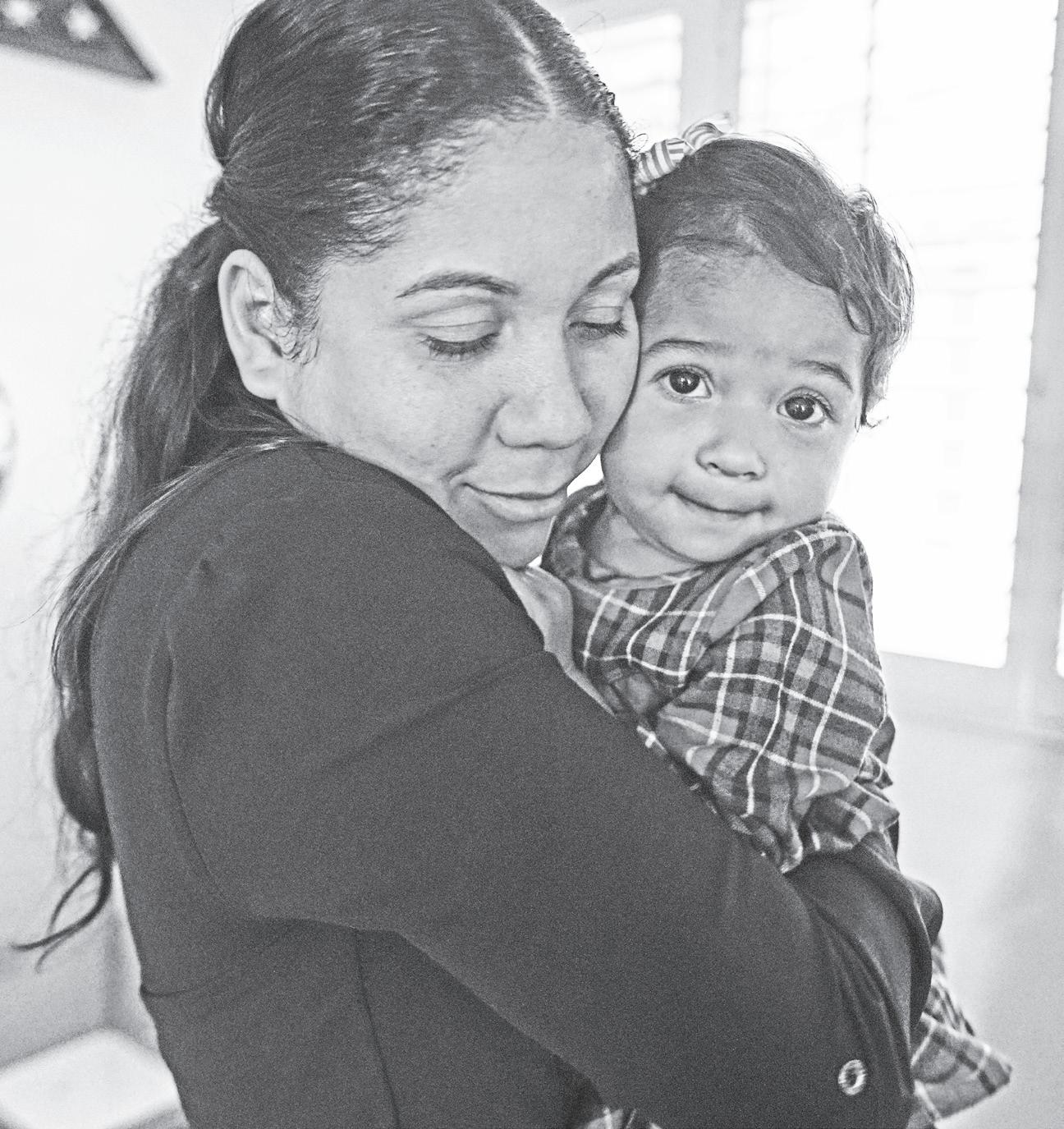
HE Philippines remains above its 2030 target for reducing maternal deaths, despite steady improvements over the past five years.
Data from the 2024 Civil Registration and Vital Statistics (CRVS) system released by the Philippine Statistics Authority (PSA) show that the maternal mortality ratio (MMR) declined to 119 deaths per 100,000 live births in 2024, from 151 in 2020. While the drop indicates progress, the current level is still significantly higher than the Sustainable Development Goal (SDG) target of fewer than 70 maternal deaths per 100,000 live births by 2030.
Commission on Population and Development (CPD) Undersecretary
Lisa Grace S. Bersales stressed that
suffice for impeachment once again. The lawmaker also noted that the Supreme Court, in dismissing last year’s impeachment complaint, did not absolve Duterte of the charges.
She highlighted key pieces of evidence, including a video where VP Duterte allegedly threatened to kill President Marcos, First Lady Liza Araneta Marcos, and former Speaker Ferdinand Martin G. Romualdez, as well as media interviews and documents showing millions in disbursements of confidential and intelligence funds to untraceable recipients.
“Saballa et al’s complaint is replete with many other documentary evidence, which are also smoking guns. And even assuming…that the evidence in the articles is not or is no longer a smoking gun, we have it this time. We will produce them in the form of compelling testimonies and newly discovered material evidence, one more time with feelings, as the lyrics of a song go,” de Lima said.
Two remaining THE House Committee on Justice, at the same time, set aside the first impeachment complaint against Duterte, ruling that it violated the constitutional one-year bar. The panel also approved the withdrawal of a second complaint, leaving only two impeachment cases on record.
Luistro said the first complaint, filed February 2, 2026, by former activist lawmakers and civil society groups and endorsed by the Makabayan bloc, will no longer be part of the committee’s proceedings.
“With 22 votes in the affirmative and 10 votes in the negative, with zero abstentions, the Chair sets aside the first impeachment complaint, the Castro et al impeachment complaint, on the ground of violation of the oneyear prohibition period. So ruled,” Luistro declared.
The debate centered on whether the February 2 filing fell within the one-year constitutional bar under Article XI, Section 3(5) of the 1987 Constitution. The complaint, signed by figures including former lawmakers France Castro and Neri Colmenares, alleged betrayal of public trust over Duterte’s use of P612.5 million in confidential funds, submission of
maternal deaths are not inevitable outcomes of childbirth, but failures in systems meant to protect women.
“For CPD, every maternal death represents a preventable and unacceptable loss. As the country advances toward 2030, the Commission calls for collective action to ensure that every pregnancy is wanted, every birth is safe, and every mother survives and thrives—leaving no woman behind in the pursuit of sustainable development,” Bersales said. She also underscored the need to strengthen “adolescent health, expand access to voluntary family planning, and ensure quality prenatal, delivery, and postnatal care.”
Based on CPD’s Strategic Development Plan2026-2028,thecommissionwillfocus on strengthening demand generation for family planning, supporting supply chain
allegedly fabricated Commission on Audit reports, and refusal to recognize congressional oversight.
Manila Rep. Joel Chua warned that the committee needed to resolve the timing issue to avoid legal challenges.
“Otherwise, this will all be inutile, useless, if eventually this will again be used in the court to question the legality and constitutionality of this first impeachment complaint,” Chua said.
Quezon City Rep. Jesus Suntay cited the Supreme Court’s 2025 ruling, which emphasized the word “commenced,” not “initiated,” noting that impeachment proceedings cannot start before February 6, 2026. Cagayan de Oro Rep. Lordan Suan agreed, calling the one-year bar a “constitutional shield, not a technical obstacle.”
Bukidnon Rep. Jonathan Keith Flores moved to set aside the complaint, invoking statutory interpretation rules. Bicol Saro Partylist Rep. Terry Ridon argued that impeachment is deemed “initiated” only upon referral to the Committee on Justice—not upon filing.
“As such, the first impeachment complaint against the vice president should not technically be precluded by the one-year bar, as it was filed only prior to 6 February 2026 and not initiated prior thereto,” Ridon said, noting the referral occurred on February 23.
Cagayan de Oro City Rep. Rufus Rodriguez also defended the timing of the filing, arguing that computation of the one-year period—whether by calendar or session days—placed the February 2 complaint within constitutional bounds.
“Clearly, the Feb. 2 filing is within the constitutional provisions,” Rodriguez said, calling the matter a threshold issue grounded in constitutional supremacy.
In a related development, the committee approved the withdrawal of the second impeachment complaint after complainants led by Francis Joseph Aquino Dee of Tindig Pilipinas confirmed in open session their decision to consolidate behind the third impeachment complaint.
The move, described by the complainants as a step to “make the process towards accountability more expedient,” streamlines the proceedings and narrows the active complaints before the justice panel.
Appearing before the committee, Dee formally declared that the group intended to withdraw its complaint and support the third filing. Luistro placed the confirmation on record, noting that the withdrawal was made in the presence of committee members and the public.
Flores moved to accept and approve the withdrawal, adding that Party-list Rep. Percival Cendaña of Akbayan and de Lima had also withdrawn their endorsement.
Currently, there are only two remaining impeachment complaints against Duterte.
The third complaint alleges the misuse of around P612 million in
management for modern contraceptives, and enhancing technical assistance to local government units to better integrate population and development strategies into health planning. The plan also prioritizes improved data systems, research capacity, and evidence-based policymaking to help anticipate service gaps and guide targeted interventions at the regional and local levels.
According to the United Nations Children’s Fund (Unicef), disparities in maternal care remain pronounced in the Philippines. In rural areas, 81 percent of women completed at least four antenatal care visits, compared to 88 percent in urban areas. The gap widens further during delivery: only 64 percent of births in rural communities are attended by skilled health personnel, versus 83
confidential funds and claims of corruption within the Department of Education during Duterte’s tenure as secretary. It also revives accusations that Duterte threatened to assassinate President Ferdinand Marcos Jr., First Lady Liza Araneta Marcos, and former Speaker Ferdinand Martin G. Romualdez.
The fourth complaint centers on alleged omissions in Duterte’s Statements of Assets, Liabilities, and Net Worth, and claims of unexplained wealth that is disproportionate to her lawful income.
Fairness
SPEAKER Faustino G. Dy III on Monday vowed that the impeachment proceedings against Duterte will be handled with fairness, transparency, and strict adherence to constitutional rules, as lawmakers began deliberations on multiple verified complaints.
“We will allow the process to take its course fairly, lawfully, and transparently. The House of Representatives will do its duty,” said Dy.
The Speaker said that impeachment is a constitutional responsibility, not a political spectacle. The committee’s role, he said, is limited at this stage to determining whether complaints are sufficient in form and substance under the Constitution and House rules.
“I want to be clear about one thing: this is a constitutional process. It is not a political performance, and it is not a venue for trial by publicity,” Dy said.
He added that all parties are entitled to due process, noting that elected officials must be treated fairly while complainants are likewise entitled to have their filings examined under the law.
Dy emphasized he would not influence the panel’s work, saying his responsibility is to ensure professionalism and order within the chamber.
‘Impeachment fatigue’
THE justice committee formally opened deliberations on impeachment complaints, underscoring that constitutional accountability cannot be deferred.
“That mandate is not optional. It is not seasonal. It is not subject to fatigue. It is a duty,” said Luistro, adding that the House has no discretion to ignore impeachment complaints once properly referred.
The panel clarified that it is currently evaluating procedural compliance—including verification, endorsement, and conformity with constitutional requirements—rather than determining guilt.
Luistro also addressed claims circulating online that previous allegations had been dismissed by the Supreme Court, explaining that the Court’s earlier ruling dealt only with the one-year bar rule and did not rule on the merits of any allegations.
“Impeachment is a constitutional process—not a social media contest,” she said, warning against misinformation surrounding the proceedings.
percent in urban areas. Income levels also shape outcomes. Among the poorest households, only 42 percent of deliveries are assisted by a skilled birth attendant. In contrast, 96 percent of births among the wealthiest households are attended by trained professionals.
Deaths due to NCDs still high BEYOND maternal health, premature deaths caused by noncommunicable diseases (NCDs) continue to weigh heavily on the country’s mortality profile.
In 2024, the PSA said mortality rate attributed to cardiovascular diseases, cancer, diabetes and chronic respiratory diseases stood at 5 deaths per 1,000 population. The national target for 2030 is 3.1 deaths per 1,000 population.
TBy Joel R. San Juan @jrsanjuan1573
HREE lawyers on Monday filed a petition for the issuance of a writ of mandamus before the Supreme Court (SC) to compel the Senate BlueRibbon committee (SBRC) to release to the public its draft partial committee report on the multi-billion anomalous flood control projects of the government.
The petition, which was filed by lawyers Eldrige Marvin Aceron, Sikini Labastilla and Purificacion BartolomeBernabe, also sought the issuance of a temporary restraining order or a status quo ante order or both in order to preserve the original version of the draft report that bears the signatures of Sens. Juan Miguel Zubiri, Joseph Victor Ejercito, and Sherwin Gatchalian.
Aceron is the lead complainant in the pending ethics complaint against Sen. Francis Escudero involving P30 million in campaign donations from the owner of Centerways Construction and P16.67 billion in DPWH contracts awarded to the company.
The petitioners said they filed the petition after the SBRC denied their request for an official copy of the document, invoking the deliberative process privilege to prevent the “chilling effect on frank deliberation within government bodies.”
They argued that the privilege can no longer be invoked after the SBRC chairman, Sen. Panfilo Lacson, disclosed the report’s contents to the public in numerous occasions. The petitioners also cited official statements and media interviews of confirming that the draft report recommended plunder and other charges against named sitting senators and was based on testimonial and documentary evidence gathered in hearings.
Lacson earlier confirmed that the draft SBRC report recommended the fil-
TBy Rex Anthony Naval
HE Department of National Defense (DND)
on Monday said that it is highly unlikely that the Enhanced Defense Cooperation Agreement (EDCA) sites will be targeted as conflict escalates in the Middle East following the US and Israel strikes against Iran over the weekend.
Defense spokesperson Assistant Secretary Arsenio Andolong made this statement following comments from some groups that these EDCA could be attacked amid the ongoing conflict in the above-mentioned region.
“It must be stated, however, that the hostilities are confined to the Middle East. The Philippines is not a participant in the theater of conflict. As such, there is no credible direct threat to the Philippines or facilities therein. Iran launched attacks on US facilities in countries that it shares maritime or land borders with,” he added.
Likewise, Andolong said the Philippines poses no threat to Iran and the EDCA sites in the country are Philippine facilities.
“They do not belong to the US nor are they being used to launch or stage assaults against another country. They are for joint training, HADR [humanitarian assistance and disaster response] and the defense and security of our country. They fulfill an important role in the capacity and capability building of the AFP
ing of plunder and other criminal charges against Sens. Francis Escudero, Joel Villanueva and Jinggoy Estrada and former Party-list Rep. Zaldy Co of Ako Bicol.
However, Zubiri, Ejercito and Gatchalian have withdrawn their signatures after the draft report was leaked to the public last February 3.
In their 29-page petition, the petitioners argued that the public has the right to information under Article III, Section 7 of the 1987 Constitution.
“This provision confers the right to information as a personal constitutional right of every citizen, to be asserted affirmatively against the state. Petitioners are Filipino citizens. The SBRC letter denied their direct, written, formally filed petition for access to a specific document. Their injury is not abstract or speculative—it is concrete, completed and personal,” the petitioners said.
“The subject matter—findings of a public Senate investigation into multibillion peso flood control corruption, with recommendations of plunder charges against sitting senators—is unambiguously a matter of public concern within the meaning of Article III, Section 7…,” they added.
The petition likewise asks the Court to order Zubiri, Ejercito, and Gatchalian to submit written explanations for withdrawing their signatures from the draft report, and to direct the SBRC to furnish a certified true copy of the draft to the Senate ethics committee for use in pending ethics complaints against Escudero and Ejercito.
It further seeks an order directing Ejercito to inhibit himself from all Ethics Committee proceedings involving Escudero until the resolution of the petition, citing his direct conflict of interest as both a signatory who withdrew from the BlueRibbon report and the presiding officer in the related ethics case.
SC asked: Compel Senate Blue-Ribbon panel to bare report on flood control investigation EDCA sites unlikely to be attacked in spite of Middle East conflict
[Armed Forces of the Philippines],” he added. Likewise, Andolong said that President Ferdinand R. Marcos Jr. had made it very clear that EDCA sites “will not be used for offensive action.” Meanwhile, AFP spokesperson Col. Francel Margareth Padilla clarified that EDCA sites remain Philippine sovereign installations.
“They are not US bases. Access granted to U.S. forces is rotational and primarily geared toward interoperability, logistics prepositioning, disaster response, and humanitarian assistance. These arrangements enhance our defensive readiness and our capacity for humanitarian assistance and HADR, rather than diminish our security,” she added. Padilla also stressed that it is also worth noting that the Philippines’ strategic relevance in the region is shaped by geography—particularly in the context of developments in the South China Sea and the Taiwan Strait—regardless of EDCA. “Strengthening alliances and improving our defense posture does not create vulnerability; it contributes to deterrence, preparedness, and stability. We encourage the public to remain discerning and to rely on verified information. Security matters require calm assessment, not speculation. The AFP remains focused on its mandate: defending our sovereignty, ensuring territorial integrity, and contributing to regional peace and stability,” she added.
Residents ask mayor: Remove obstruction on our road
By Jonathan L. Mayuga @jonlmayuga
RESIDENTS of Purok Keon, in barangay Bitnong, Dupax del Norte, Nueva Vizcaya, have formally sought government intervention over the alleged obstruction of an established road easement leading to their community.
They raised concerns that the continued road blockade, which they believe is connected to anti-mining protests in the area, may constitute an unlawful restriction of access and a potential violation of property and civil rights.
In a petition submitted to Dupax del Norte Mayor Juan Paolo E. Cayton, 100 residents detailed claims that barricades were installed along the road easement by individuals who the petitioners said were not even from their communities, limiting ingress and egress for families in the area. The petitioners attached photocopies of documents purporting to establish the road easement, along with photographic evidence of the barricades and a list of signatories. They are requesting a formal review of the legal status of the easement and the authority under which the barricades were allegedly erected.
According to the residents, the obstruction has had tangible consequences on mobility and access to essential services, citing instances in which individuals requiring urgent medical attention had to traverse the damaged portion on foot or transfer to motorcycles due to the blocked passage.
See “Residents,” A13
Gatchalian moves to revise fuel subsidy trigger formula
By Butch Fernandez | @butchfBM
AMID concerns over the global oil price spikes caused by the war in the Middle East— and projections that the uptrend in prices will persist indefinitely—Sen. Sherwin Gatchalian moved to revise the fuel subsidy trigger formula for the public transport sector, which was laid down years ago to act as buffer in times of crisis.
Gatchalian wants to shift from a fixed price threshold to a percentagebased system to provide immediate relief for public utility vehicle (PUV) drivers amid expectations of further fuel price spikes. Under the current Pantawid Pasada program, fuel subsidies are
triggered only when world oil prices hit the $80-per-barrel threshold.
Gatchalian is proposing that a certain percentage increase within a week should automatically trigger the release of fuel subsidies for PUV drivers.
Global oil prices are expected to rise substantially in the days ahead amid the ongoing conflict in the Middle East. Dubai crude oil last closed at $68.34 per barrel.
Gatchalian said a percentage-based trigger would allow the government to release fuel subsidies when volatility strikes, instead of waiting for prices to reach a fixed threshold.
Mabilis ang pagtaas ng presyo ng langis pero hindi naman mabilis ang pagtaas ng pamasahe dahil nireregulate din ito ng LTFRB kaya ang mga naiipit dito ay ang mga PUV drivers [The prices of petroleum are rising fast, but the transport fares are not rising as much because these are regulated by the LTFRB; so the PUV drivers are the ones caught in the middle],” said Gatchalian.
The Senate Finance committee chairperson wants to conduct an oversight to determine the cause of the delay in the release of the Pantawid Pasada funds in the past.
Prices at the pump are projected to rise substantially at midnight Tuesday, March 3. Starting Tuesday, March 3, prices of gasoline will increase by P1.90 per liter, diesel by P1.20 per liter, and kerosene by P1.50 liter amid escalating tensions in the Middle East.
The global oil markets went wild at the weekend after the US and Israel launched massive attacks against Iran, which then retaliated with missile and drone attacks on strategic sites hosting US bases in certain Middle East countries.
Iran also restricted access to the Strait of Hormuz, through which a quarter of the world’s oil and gas shipments pass, further roiling the market and creating logistical nightmares for shippers and commerce.
How can Gen-Zers and Millennials fight Corruption?
IBy Henry J. Schumacher
T is exciting that many young people are fighting corruption and are making a big difference for the future. And we need to celebrate that. For those who are interested in tackling corruption, but don’t know where to start, here are some ideas:
1. FOLLOW THE MONEY
GOVERNMENTS have vast sums of public money to spend, and this can pose a serious corruption risk. By keeping tabs on government expenditure, you can help shed light on how Philippine taxes are being spent and expose any abuses. You can also join the Integrity Circles that have been set up by various local governments throughout the country.
2. COUNT SUPPLIES
SCHOOLS receive lots of supplies from government, like textbooks, lab equipment or other classroom necessities. It’s not rocket science to keep track of this. It just takes commitment and transparency. Ask to see how many Bunsen burners are supposed to be in the biology labs and if the numbers don’t add up—ask what’s happened.
3. TECH SOLUTIONS
IF you’re tech-savvy—and many of you are—you can help communities
document cases of corruption by developing reporting platforms on the web or through mobile apps. Social media, in particular, is an effective way to address corruption in real-time, but is a bit risky.
4. COMICS AND CARTOONS COMICS are a powerful way of raising awareness about anti-corruption. Through a combination of images and text, comics can also help spark debate— and they are easy to produce. All you need is a pen and paper.
5. SPORTS WHAT’S your favorite sport? From running against corruption to scoring a goal for transparency, you can raise your community’s anti-corruption awareness through any sport you want. It’s time that we create Integrity Runs again!
6. YOUTH GROUPS
YOUTH groups share their disapproval of corruption and are found at local and
national levels. Different groups have different goals, but they have one thing in common: a willingness to talk openly about their opposition to corruption and raise awareness about its adverse effects on society. These groups can be formed to take part in a one-off event, around a single issue or for longer term campaigns
7. PROTESTS
AS we see almost daily, protest events are a way for citizens and groups to come together in public to show large scale support for or against a particular issue. Protests, marches, demonstrations and rallies are certainly a powerful tool for anti-corruption campaigners.
8. PETITIONS
A PETITION is a collection of signatures from people supporting your cause. That petition is then presented to decision makers—like government or education officials—that have the power to create the change you want.
9. ELECTION PLEDGES
POLITICIANS may be running for office—but they shouldn’t be able to hide. During the lead-up to elections, candidates are in the spotlight and this is a good time to hold them accountable for their campaigning and election promises. You can ask your local candidates to
sign a pledge against corruption and agree to take specific steps to stop corruption. They can, for example, pledge not to buy or sell votes during the election, a very common form of corruption. And you young voters should definitely not sell your votes!!
10. CROWD SOURCING ELECTION MONITORING
TWEET. Text. E-mail. From accessing your mobile phone to surfing the web on your computer, it’s never been easier or quicker to monitor elections in realtime. Through online crowdsourcing you can let the world know of voting irregularities in your country with just a few clicks. Some of the information can even be plotted onto an interactive map online, allowing you also to see what others in your community are reporting. I hope you find these suggestions useful! If you have more suggestions that are not already on this list, I would love to hear from you!
Let me conclude with a note of caution. There is risk in exposing people involved in corruption. Work in a group rather than alone.
And remember: the youth deserve an end to corruption. Young people are not just our future, they are key to creating a just, peaceful and prosperous world right now!
By Ma. Stella F. Arnaldo @akosistellaBM Special to the BusinessMirror
ASCOTT Limited is looking to further expand its portfolio to 35 properties by 2028, equivalent to some 10,000 keys.
In an interview with select media, Country General Manager for the Philippines Patrick Vaysse said, “We have 18 properties signed already, and under construction.” Speaking on the sidelines of the company’s recent event for partners and media, he added that more properties will be opening this year: Somerset in Cebu, Ascott Ortigas (formerly Joy-Nostalg) by the fourth quarter, and Citadines Davao by yearend.
In 2027, he said, six more properties will open, further bringing this to a total of 35 properties by 2028 “and signed 50, that’s the largest [among international hotel brands]…across 14 brands.”
Most of Ascott’s properties in the country are partnerships with private developers through management or franchise contracts, although the company owns Ascott Makati and a stake in Somerset Millennium on Aguirre Street.
Ascott is the lodging management business of the Singapore-based publicly listed CapitalLand Investment (CLI) which has more than 1,000 properties in over 230 cities, in more than 40 countries in Asia-Pacific, Central Asia, Europe, Middle East, Africa and the United States. P16B revenue
INVESTOR-RELATIONS documents showed Ascott generated S$350 million (roughly P16 billion) in revenue for CLI last year, up 2 percent from $343 million (P15.65 billion) in 2024. Ascott revenues are driven mostly by fees from the management and franchise contracts signed with developers. The company did not disclose fee breakdowns per country.
Ascott Philippines still has a long way to go to catch up with Indonesia, which has has over 80 properties, making it currently the largest Ascott market in Southeast Asia.
Vaysse said new brands that will be brought in include “Preference, Harris, but we are pushing for Lyf. We have two Lyf—one in Manila, and one in Cebu.” Ascott’s brands in the Philippines already include Ascott, Citadines, Oakwood, Lyf, and Somerset.
You can contact me at hjschumacher59@gmail.com By Jonathan L. Mayuga @jonlmayuga
DOTr, BCDA team up with NGO for greening of local watersheds
ANGELES CITY—The Department of Transportation (DOTr) and the Bases Conversion and Development Authority (BCDA) have partnered with local environment group Abacan River and Angeles Watershed Advocacy Council Inc. (Araw-Aci) for the greening of two watersheds in Pampanga. The move came after Transportation Assistant Secretary Irish Calaguas and BCDA Vice-President
Richard Cepe with Araw-Aci officers inspected the Sapangbato Watershed in Angeles City and the Sacobia Watershed covering Mabalacat City, Pampanga, and Bamban, Tarlac on February 27. The group also visited two of the 15 planting sites managed by Araw-Aci at the Sapangbato watershed sponsored by various private sector companies and organizations under the Araw-Aci’s Adopt-AWatershed Reforestation Program (AWRP), a program
started in 2020 in cooperation with and the support of the Local Government of Angeles City under then mayor and now Congressman Carmelo Lazatin Jr.
In a letter to Araw-Aci President Abe Tayag dated February 24, Calaguas said DOTr is currently undertaking the implementation of the NorthSouth Commuter Railway (NSCR) System which is comprised of three segments that will connect the National Capital Region to Region 3 and Region 4A: the NSCR Extension Projects, the Malolos-Clark Railway Project (MCRP), and the Subic-Clark Railway Project (SCRP) which is a joint project of the DOTr and BCDA.
Calaguas stated in the letter that as part of
DOTr’s commitment to the environment, the SCRP is fully aligned with the conditions in the Special Tree-Cutting and Earth-Balling Permits (STCEP) issued by the Department of Enviroment and Natural Resources-National Capital Region.
The SCTEP mandates the implementation of a Greening Program (GP) to offset the environmental impact of tree-cutting activities during the construction of the project. The greening program offers a sustainable solution to mitigate the ecological impact of the project and fosters environmental resilience in the long term.
See “DOTr,” A13
THE Philippines and Brunei Darussalam are moving a step closer toward stronger maritime and geospatial collaboration, with the National Mapping Resource Authority (Namria) committing to provide its technical expertise.
Brunei Ambassador to the Manila Megawati Manan paid a courtesy visit to the Namria last week and was met by Namria Administrator Peter N. Tiangco.
“Last week, the Ambassador of Brunei came to visit. Among others, she asked for our help in connection with their submission of a claim for an Extended Continental Claim for Brunei,” Tiangco said.
The Brunei envoy’s visit came two years after President Marcos’s official visit to Brunei in May 2024, marking the 40th anniversary of diplomatic relations between the two countries.
During the visit, Marcos met with Sultan Haji Hassanal Bolkiah to strengthen bilateral cooperation in several areas, including maritime activities and cooperation, and the recognition of seafarers through training and certification standards.
Lyf (Live Your Freedom) is a coliving brand targetting Millennials, who are digital nomads, creatives, and so-called “next-generation travelers.” It offers flexible, sociallydriven spaces featuring communal kitchens, co-working areas, and curated community events.
Preference is a luxury hotel brand offering boutique and art-inspired experiences, while Harris Hotels is a mid-scale, lifestyle brand offering health and wellness options.
Looking at RE VAYSSE admits that among the challenges of building and operating a hospitality establishment in the Philippines is the expensive utilities, “[like] the cost of the water. So you have the design the property using alternative materials, but everything [i.e., construction and design materials] are imported.”
In the case of its upcoming Balai Dajao by Preference Hotels in Siargao, which is scheduled to open in 2028, the developer has chosen to use solar energy, he said, because of the intermittent power supply in the province. “We are working with solar energy, so 70 percent of the energy that will be produced will be used by the property,” he said. He added that Ascott and its partners are also moving into using more renewable energy “at different levels of percentage.”
The Philippines is notoriously among the most expensive countries to invest in Southeast Asia, with power accounting for 25 percent of an establishment’s operating costs. Published reports indicate that in the Philippines, the average cost of power is US$0.18 per kilowatt-hour (kWh), compared to Thailand (US$0.13 per kWh), Indonesia (US$0.10 per kWh), Vietnam (US$0.08 per kWh), and Malaysia (US$0.03 per kWh).
According to the Department of Tourism, the country faces a shortfall of 456,055 room keys to meet the agency’s earlier projected 10- to 12-million international arrivals by 2028. A recent private sector report estimated some P250 billion investments in 158 accommodation establishments, accounting for 40,084 keys in the pipeline. Many of these hotels are located in areas outside of Metro Manila. (See, “Investors are putting up hotels, but where’s infra?,” in the BusinessMirror, Sept. 18, 2024.)
She also highlighted the value of technical collaboration with the Philippines, noting Namria’s established expertise in mapping, charting, and geospatial intelligence.
Tiangco said that as both Brunei and the Philippines are maritime nations situated in Southeast Asia, accurate and up-to-date geospatial information plays a critical role in maritime safety, coastal resource management, environmental protection, disaster risk reduction, and national development planning.
He said strengthening technical collaboration in these areas is seen as mutually beneficial, particularly amid the increasing regional emphasis on sustainable ocean governance.
Tiangco described the meeting as productive and forward-looking, laying the groundwork for possible bilateral agreements and future technical engagements between the two countries.
“As you know, Namria led the preparation and defense of our ECS claim [for] the Benham Rise, which was later renamed as Philippine Rise before it became part of our territory, under RA 12064,” Tiango, who was the head of the delegation during the country’s defense of the country’s claim for the Philippine Rise at the United Nations Conference on the Law of the Sea (Unclos), explained. The meeting underscored the growing importance of geospatial information in strengthening regional cooperation, maritime governance, and sustainable development, Tiangco said. During the visit, Manan expressed Brunei’s strong interest in enhancing its national geospatial capabilities, particularly in areas related to hydrography, digital mapping, and spatial data management.
The visit also reaffirmed the shared commitment of Brunei and the Philippines to advancing cooperation in science, technology, and maritime affairs. Ascott
Widening front: Iranian-backed militias drawn into conflict as Israel and US planes pound Iran
By Jon Gambrell, David Rising & Sally Abou Aljoud The Associated Press
DUBAI, United Arab Emirates—A witness says he saw smoke over a Kuwait neighborhood that is home to the US Embassy as Americans had been urged to stay away.
Ayman Moawad, an Egyptian worker living near the US Embassy in Kuwait, told The Associated Press that he saw smoke over the area on Monday. However, he didn’t know if it was specifically the embassy hit in an ongoing Iranian attack targeting the small Mideast nation.
The US earlier issued an urgent warning to Americans there to take cover and remain indoors. It said: “Do not come to the Embassy,” without elaborating.
Iran and Iranian-backed militias fired missiles at Israel and Arab states, and Israel and the United States pounded targets in Iran as the war expanded on Monday with statements of defiance and increasing casualties.
As the American and Israeli airstrikes continued, top Iranian security official Ali Larijani vowed defiantly on X that “we will not negotiate with the United States.”
In Iraq, a pro-Iranian militia claimed responsibility for a drone attack targeting US troops at the Baghdad airport, the day after it said it fired at a US base in the city of Irbil in the north, and Cyprus said a drone attack targeted a British base on the Mediterranean island nation.
Israel and the US bombed Iranian missile sites and targeted its navy, claiming to have destroyed its headquarters
and multiple warships. More than 200 people have been killed since the start of the strikes, according to Iranian leaders.
As the bombardment continued, Hezbollah said it fired missiles from Lebanon into Israel early Monday in response to the killing of Iranian Supreme Leader Ali Khamenei and “repeated Israeli aggressions.” It was the first attack the Lebanese militant group has claimed in more than a year. There were no reports of injuries or damage, and Israel said that it had intercepted one projectile while several fell in open areas.
Israel retaliated with strikes on Lebanon, killing at least 31 people and wounding 149 others, according to Lebanon’s Health Ministry. About two thirds of the dead were in the country’s south.
Following its initial strikes on Beirut, Israel urged civilians in nearly 50 villages in eastern and southern Lebanon to evacuate ahead of more possible attacks, sending people fleeing.
Iran has been firing missiles at Israel and Arab states in a counteroffensive since the joint America-Israeli attack Saturday that killed Khamenei and many top Iranian officials.
Gulf Arab states have warned that they could retaliate against Iran after strikes that hit key sites and killed at least five
civilians, and US President Donald Trump promised Washington would “avenge” the deaths of three American troops who were killed in Kuwait.
“Sadly, there will likely be more before it ends,” Trump said. “That’s the way it is.”
Trump has urged Iranians to “take over” their government and, while he has also signaled he would be open to dialogue with new leadership there following the death of Khamenei, suggested Sunday there was no end in sight to the military operations.
“Combat operations continue at this time in fullforce, and they will continue until all of our objectives are achieved,” he said in a video message. “We have very strong objectives,” he added, without elaborating.
The US military said B-2 stealth bombers struck Iran’s ballistic missile facilities with 2,000-pound bombs. Trump said on social media that nine Iranian warships had been sunk and that the Iranian navy’s headquarters had been “largely destroyed.”
In an indication the conflict could draw in other nations, Britain, France and Germany said they were ready to work with the US to help stop Iran’s attacks, and a group of Gulf Arab countries said it reserved the right to respond to Iranian strikes.
The weekend attacks were the second combined strikes in eight months from the US and Israel against Iran. In the 12-day war last June, Israeli and American strikes greatly weakened Iran’s air defenses, military leadership and nuclear program. But the killing of Khamenei, who ruled Iran for more than three decades, creates a leadership vacuum, increasing the risk of regional instability.
Rising reported from Bangkok and Abou AlJoud from Beirut.
US futures and Asian shares open lower, oil prices soar as US and Israel attack Iran
By Elaine Kurtenbach AP Business Writer
BANGKOK—The US and Israeli attacks on Iran rattled world markets on Monday, with US futures falling more than 1% and oil prices soaring, though gains for defense contractors and oil companies helped limit losses in Asian trading.
The future for the S&P 500 sank 1.4% while the contract for the Dow Jones Industrial Average was down 1.2%.
Shares did fall in most Asian markets but they rose in Shanghai, where higher oil prices lifted some oil company stocks such as CNOOC, China Petroleum & Chemical and PetroChina to the 10% limit.
The Shanghai Composite index climbed 0.5% to 4,185.29, while in Hong Kong, the Hang Seng lost 2% to 26,102.53. Japan’s Nikkei 225 index initially fell more than 2%. It closed 1.4% lower at 58,057.24. Offsetting other losses, shares in defense-related stocks including Mitsubishi Heavy Industries and IHI Corp. advanced. In India, which could face disruptions to its access to oil due to
the hostilities, the Sensex fell 1.8%.
Taiwan’s benchmark lost 0.9% and Singapore’s dropped 1.9%. In Bangkok, the SET fell 1.9%.
Australia’s S&P/ASX 200 ended flat, at 9,200.90. Markets were closed in South Korea for a holiday. The price of gold, which usually is viewed as a safe haven for investment in times of uncertainty, rose 2.7% to about $5,392 per ounce.
The US dollar also gained, rising to 156.99 Japanese yen from 156.27 yen late Friday. The euro slipped to $1.1732 from $1.1762.
Traders are betting the supply of oil from Iran and elsewhere in the Middle East will slow or grind to a halt. Attacks throughout the region, including on two vessels traveling through the Strait of Hormuz, the narrow mouth of the Persian Gulf, have constrained oil exports to the rest of the world.
“Roughly one-fifth of global oil and LNG (liquefied natural gas) flows squeeze through the Strait of Hormuz. This is not an obscure canal. It is the aorta of the global energy system,” Stephen Innes of SPI Asset Management said in a commentary.
The price of a barrel of US benchmark crude oil initially surged about 8%. By mid-afternoon Tokyo time it was up 7.5% at $72.06 per barrel. Brent crude jumped 8% to $78.69 per barrel. A prolonged war would likely result in higher prices for other fuels and gasoline and could cascade throughout the global economy, adding to production costs overall. Prolonged interruptions to oil flows through the Middle East would have “huge implications for oil and LNG and every market everywhere if it occurs. Energy is an input to ALL production,” RaboResearch Global Economics & Markets said in a report. Iran exports roughly 1.6 million barrels of oil a day, mostly to China. It may need to look elsewhere for supply if Iran’s exports are disrupted, another factor that could increase energy prices. The size of China’s strategic oil reserves is a state secret. But a recent report by John Kemp of Base Research estimated them at 1.1 billion to 1.2 billion barrels—equivalent to around 100 days or just over three months of imports.
Trump urges Iran leadership change as report points to talks
By Arsalan Shahla & Patrick Sykes
PRESIDENT Donald Trump said the bombing campaign against Iran will continue until its objectives are achieved, calling on the nation’s leaders to capitulate as a report indicated at least one top official in Tehran sought to resume nuclear talks with the US.
Trump on Sunday reconfirmed the death of Iran’s supreme leader, Ayatollah Ali Khamenei, and said the US and Israel had struck hundreds of targets in Iran including Revolutionary Guard facilities and air defenses. The US military’s Central Command announced Sunday that three US service members were killed and five “seriously wounded” during operations against the Islamic Republic, but gave no further details.
Trump, who won the presidency by promising not to endanger American troops in the Middle East, called their deaths part of “the righteous mission” in a video posted on social media. “There will likely be more before it ends. That’s the way it is.”
“Combat operations continue at this time in full force and they will continue until all of our objectives are achieved,” Trump added, without elaborating on the objectives. He called on Iranian military and police to surrender “for full immunity or face certain death.”
Trump said he has agreed to talk with Iran’s new leadership, The Atlantic reported, citing a conversation with him. In a brief interview with the New York Times on Sunday, Trump said the assault on Iran could last “four or five weeks” while calling on Iran’s generals to either hand power to the nation’s people or embrace a model similar to Venezuela, whose new leader has been compliant with US demands after the ouster of Nicolas Maduro.
“What we did in Venezuela, I think, is the perfect, the perfect scenario,” Trump told the newspaper. He added that he had “three very good choices” to lead Iran, without elaborating. Trump later told ABC News that the initial attack “was so successful it knocked out most of the candidates,” adding: “It’s not going to be anybody that we were thinking of because they are all dead.”
Separately, the Wall Street Journal reported that Iranian security chief Ali Larijani has made a fresh push to resume nuclear talks with Washington through Omani mediators. Larijani, chief of Iran’s Supreme National Security Council, said earlier that a temporary leadership council would meet Sunday as the nation moves to determine a successor to Khamenei.
Asian shares fell 1.3% and US equity-index futures declined 0.6%, paring earlier losses as the reports pointed to a possible way forward. The US dollar gained against major peers in early trading, while the Australian dollar and South African rand led risk-sensitive currencies lower. Brent crude oil surged as much as 13%
before paring gains, while gold was around 1% higher.
The war spread across the Middle East on Sunday, as Iran sent waves of missiles at targets in multiple countries that host US military facilities. Iranian projectiles struck buildings in Tel Aviv, while defenses in Saudi Arabia, Qatar, Bahrain and Kuwait intercepted incoming fire.
Nearly all civilian air traffic is closed across the Gulf after Dubai’s main airport, the world’s busiest aviation hub, was hit over the weekend. Dubai landmarks including the luxury Palm Jumeirah island and Burj Al Arab hotel incurred damage during a series of blasts that shook the financial hub. Skyscrapers in Abu Dhabi were also damaged. The conflict has reverberated across global energy markets. OPEC+ on Sunday agreed to resume production increases next month to counter an expected further rally in crude prices, which have already gained almost 20% this year. The Strait of Hormuz, a critical transit for oil and gas linking the Persian Gulf to the open sea, was described by Iran’s Tasnim news agency as being practically shut, with tankers increasingly avoiding the waterway. Two ships were reportedly struck around the coast of Oman.
Iran’s Foreign Minister Abbas Araghchi said his country has no intention of closing the route. He told Al Jazeera that Iran is capable of defending itself and doesn’t expect anyone to intervene on its behalf. Oman, which acted as mediator in the nuclear talks between the US and Iran that preceded the war, said Tehran is open to “serious efforts” that contribute to de-escalation.
Iran’s President Masoud Pezeshkian vowed “revenge and retribution” for Khamenei’s death, while other officials vowed to intensify the country’s military response. Tehran confirmed Khamenei’s death on Saturday, saying the government will observe 40 days of national mourning for the 86-year-old ruler, who was killed in his office compound. Iran said more than 200 people have been killed in strikes on its territory.
Khamenei didn’t publicly designate a successor, and the Assembly of Experts, the clerical body responsible for selecting the supreme leader, is required to appoint a new one. In the interim, a council comprising the president, the head of the judiciary and a jurist from the Guardian Council assumes the leader’s duties.
Videos from inside Iran flooded social media following news of the death, showing crowds dancing and chanting in the streets in celebration.
Other clips showed mourners. In Pakistan, at least nine proIranian protesters were killed on Sunday in clashes with police as they tried to storm the gates of the US consulate in Karachi.
Speaking on Sunday, Israeli Prime Minister Benjamin Netanyahu said his country’s forces are striking Tehran “with increasing strength, and this will only increase even more in the coming days.” Iran-backed Hezbollah, based in Lebanon, said it delivered strikes on neighboring Israel in retaliation for the killing of Iran’s supreme leader. In response, the Israel Defense Forces said it is striking targets in Lebanon.
The prospect of a weekslong regional war is a nightmare scenario for US allies in the Gulf such as the UAE, Saudi Arabia and Qatar. They pushed hard for Iran and the US to agree to a diplomatic solution over Tehran’s nuclear activities, fearing the chaos and flight shutdowns now unfolding could hit their economies and deter tourists as well as foreign investment.
Anwar Gargash, a senior adviser to the UAE leadership, urged Iran via X to “return to your senses,” warning that the Islamic Republic is now isolated at a critical time. The UAE, which also announced fatalities from the Iranian attacks, on Sunday said it will shut its embassy in Tehran. Logistics giant DP World temporarily suspended operations at the Jebel Ali port in Dubai, according to a notice sent to customers and seen by Bloomberg. The UAE said the Abu Dhabi Securities Exchange and Dubai Financial Market will be closed on Monday and Tuesday.
Saudi Arabia summoned Iran’s ambassador in response to what it called “blatant” attacks which targeted the kingdom.
Israel estimates its strikes destroyed hundreds of Iranian ballistic missiles and knocked out about half of the nation’s launchers, an Israeli military official said. About 200 of Iran’s missile launchers were destroyed and dozens more rendered inoperable, the official said, asking not to be identified discussing sensitive information.
Trump also said on social media earlier Sunday that US forces sank nine Iranian naval vessels and that the headquarters of Iran’s navy was “largely” destroyed in a separate attack. The US successfully defended against hundreds of Iranian missile and drones, Central Command said in a statement.
US targets in Iran included Islamic Revolutionary Guard Corps command and control facilities, Iranian air defenses, missile and drone launch sites and military airfields, according to Centcom. Israel said the IRGC’s commander, Mohammad Pakpour, was killed.
Iranian media reported strikes on military and civilian sites, including one that killed over 140 people at a school in Hormozgan. Several large explosions have been reported in Tehran, the capital.
Trump said the military operation was required after Iran refused to renounce nuclear weapons, which Tehran has repeatedly said it isn’t pursuing. The most recent round of talks took place on Thursday. With assistance from
A12
Tuesday, March 3, 2026
Editor: Angel R. Calso
Macron’s nuclear strategy: A quantitative breakdown
By Sylvie Corbet The Associated Press
PARIS—French President
Emmanuel Macron is delivering a keynote speech Monday on France’s nuclear deterrence policy, as his European allies express growing concerns over possible US disengagement and Russian threats.
France is the European Union’s only nuclear power and its deterrence doctrine relies on a strictly defensive strategy intended to safeguard the country’s “vital interests.” Macron has long maintained that those “vital interests” have a “European dimension.”
While France is a member of NATO, it maintains full independence over its nuclear forces while contributing to the alliance’s
broader deterrence posture. Under the French Constitution, the president is commander-in-chief of the armed forces and the sole to decide on the potential use of nuclear weapons. Here is a look at France’s nuclear capabilities, by the numbers:
1 warship
FRANCE’S aircraft carrier
Charles de Gaulle is the only
surface warship in Europe capable of carrying nuclear weapons deployed by Rafale fighter jets using catapult-assisted takeoffs.
The navy’s flagship has in recent weeks operated in the North Atlantic and the Baltic Sea, making a stop in recent days in the Swedish port of Malmo.
Because the carrier undergoes lengthy periodic overhauls, France does not have a permanent seabased air nuclear capability.
Macron confirmed in December that the country will build a new nuclear-powered aircraft carrier to replace the Charles de Gaulle by 2038.
4 submarines
FRANCE has four nuclear-armed submarines: Le Triomphant, Le Téméraire, Le Vigilant and Le Terrible (The Triumphant, The Fearless, The Vigilant, and The Terrible). They are based in Ile Longue on the Atlantic coast, one of the nation’s most secretive military sites.
Each 138-meter (453-foot) submarine is operated by a crew of
about 110 and can carry 16 M51 intercontinental ballistic missiles armed with multiple warheads.
Since 1972, at least one nucleararmed submarine has been on patrol at all times, ensuring France’s permanent capacity to carry out a strike.
500 kilometers (310 miles)
THE ASMPA air-launched cruise missile—short for enhanced medium-range air-to-surface missile—has an estimated range of about 500 kilometers (310 miles).
Launched by Rafale fighter jets, it is designed to serve as a final warning before any potential escalation to large-scale nuclear conflict.
The missiles are operated by the Strategic Air Forces, which was created in 1964 and is based at three sites across France. They can also be launched by jets operating from the Charles de Gaulle.
8,000 to 10,000 kilometers (5,000 to 6,200 miles)
THE M51 submarine-launched
ballistic missile has an estimated range of 8,000 to 10,000 kilometers (5,000 to 6,200 miles). The exact range has not been made public.
The upgraded M51 entered operational service in October and features improved accuracy and enhanced ability to penetrate missile defenses, according to the French Defense Ministry. Each missile carries multiple independently targetable nuclear warheads.
290 warheads
FRANCE has an estimated 290 nuclear warheads, according to latest figures released by the Stockholm International Peace Research Institute (SIPRI) and the Federation of American Scientists (FAS). Over 80% of France’s warheads are submarine-launched, according to the Bulletin of the Atomic Scientists.
That makes France the world’s fourth-largest nuclear power after Russia (more than 4,300 warheads), the United States (about
3,700) and China (about 600). The United Kingdom—no longer an EU member but a NATO ally—is estimated to have about 225 warheads, according to SIPRI and FAS.
All five nations are nuclearweapon states recognized under the Nuclear Non-Proliferation Treaty.
India, Pakistan and North Korea have acknowledged possessing nuclear weapons. Israel is widely believed to have them but has never publicly confirmed it.
Exact stockpile numbers are closely guarded state secrets. Iran long has insisted its nuclear program is for peaceful purposes only. But it has in recent years been enriching uranium to up to 60% purity—near weapons-grade levels of 90%.
UN nuclear watchdog said it was unable to verify whether Iran has suspended all uranium enrichment, in a report seen Friday by The Associated Press before US and Israeli forces launched a major attack on Iran.
Breaking this down, cardiovascular diseases accounted for 3.1 deaths per 1,000 population, the largest share among the four major NCDs. Cancer followed at 1.1, diabetes at 0.6, and chronic respiratory diseases at 0.3 per 1,000.
“By sex, mortality rates from cardiovascular disease, diabetes, and chronic respiratory disease were higher among males, at 4.1, 0.7, and 0.4 deaths per 1,000 population, respectively.
On the other hand, mortality rate attributed to cancer was higher among females with corresponding rate of 1.2 deaths per 1,000
Farmers and vegetable producers have reportedly been compelled to transfer goods from one vehicle to another at the excavated section, increasing costs and logistical burden.
The petition also references ongoing excavation activities in the area, which, according to residents, remain unrehabilitated and continue to pose inconvenience and safety concerns.
“The people, most especially the young ones, are already wondering whether these acts are legal and normal, and why they need to be deprived of the normal life that they rightfully must enjoy,” the petition added.
Residents emphasized that access to the road easement is not merely a matter of convenience but a recognized legal right
She said they have identified the 10,000-hectare Sacobia Watershed and the 527-hectare Sapangbato Watershed as the sites for the SCRP greening program.
“We have been monitoring your organization’s accomplishments and strengths in terms of your advocacy and management of existing planting sites in Sapangbato, Angeles City. And we are highly considering ARAW-ACI to be our partner for the GP for SCRP,” Calaguas said.
For the MCRP, a site in Mount Arayat has been identified where the DOTr has partnered with upland farmers in Magalang and Arayat.
Meanwhile, Araw-Aci Vice-President Sonny Dobles said the partnership with DOTr and BCDA is a welcome development for the rehabilitation of the Sapangbato watershed, especially the provision of
However, DFA later clarified that there was still no alert level for Qatar, UAE, Bahrain, and Kuwait, which means that there is not deployment ban in the said countries.
It also noted Israel and Iran were under Alert Level 2.
“Alert Level Two is good enough to impose a deployment ban, especially for newly hired workers...we will take appropriate action to enforce or to implement the alert level,” Cacdac said.
Last Saturday, the US and Israel launched joint air strikes against Iran to
population,” the PSA added.
Road safety presents another gap between current levels and national targets. The mortality rate due to road traffic injuries in 2024 was estimated at 12.2 deaths per 100,000 population—three times higher than the country’s goal of reducing this to 4 per 100,000.
Mental health indicators also show persistent challenges. Suicide mortality stood at 2.7 deaths per 100,000 population in 2024, with males recording a rate of 4.4 compared with 1 among females.
Meanwhile, deaths attributed to unintentional poisoning were estimated at 0.4 per 100,000 population.
The Philippines aims to eliminate such deaths by 2030.
necessary for connectivity to education, health services, livelihood, and other essential facilities.
They are urging local authorities—and, if necessary, relevant national agencies— to determine the verified legal status of the road easement; and whether due process was observed in the installation of the barricades.
Lastly, they also asked the mayor whether any civil or criminal liabilities may attach to parties responsible for the obstruction.
“We humbly request you to kindly look into the matter and take immediate action,” the petitioners stated, appealing for a resolution grounded in law, due process, and protection of established property and access rights.
Residents said they remain optimistic that appropriate legal intervention will restore normal access to purok Keon and prevent further disruption to the community.
honoraria for the Aeta stewards from the DOTr Greening Program. Dobles said the Aeta stewards and partners of Araw-Aci managing the plantations in Sapangbato have been struggling since July last year after the City Environment and Natural Resources Office (Cenro) terminated their food subsidy from the local government.
“Simula July 2025, nawalan na ng honoraria ang mga kapatid nating katutubo na katulong namin sa pagtatanim sa Sapangbato. Malaki sanang tulong ito sa mga Ayta na nag-aalaga ng mga halamang itinatanim doon. Kaya nagpapasalamatkamikay ASec. IC Calaguas, sa DOTr, at sa BCDA sa kanilang malasakit para sa mga katutubo at sa watershed. Sa pamamagitan ng partnership na ito, mabibigyan na ng direktang sahod o honoraria ang mga katutubo dahil sila rin ang makakatulong natin sa daangdaang libong halaman na itatanim para sa SCRP,” Dobles pointed out.
end its supposed global threat and links to terrorist groups. Among those who were killed in the attack was Iranian Supreme Leader Ayatollah Ali Khamenei.
Filipino casualties IRAN retaliated by launching attacks in nearby countries with US bases such as UAE, Bahrain, Oman and Israel, which resulted in some casualties, including two Filipinos.
Mary Ann Velasquez De Vera, a 32-year old Filipino caregiver, was among those killed in the attacks in Israel, hit by bomb shrapnel while helping her elderly ward.
Cacdac has spoken to her family to arrange for the repatriation of her remains and provide them with financial aid and
Hedge funds, banks forced into contingency mode in the UAE
By Nishant Kumar, Dinesh Nair & David Ramli
S missiles and drones flew over the United Arab Emirates, traders and Wall Street executives who have flocked to the Gulf in recent years found themselves confronting a threat few expected to materialize in a country that had pitched itself as the region’s safest hub.
Several hedge funds began reviewing business-continuity arrangements immediately, according to people familiar with the matter. Banks including Goldman Sachs Group Inc., JPMorgan Chase & Co., Citigroup Inc. and Nomura Holdings Inc. instructed employees to work from home, while others urged staff to shelter in place and avoid sensitive areas around embassies and military installations. Meanwhile, many firms rushed to size up their regional exposure.
The moves came as air defense systems intercepted projectiles over the skylines of Dubai and Abu Dhabi over the weekend, with debris and smoke visible near high-profile commercial districts and luxury developments including Palm Jumeirah.
A suspected aerial strike partially damaged facilities at Dubai International Airport, while debris from an intercepted drone struck a building facade at Etihad Towers, a site housing diplomatic missions in the UAE capital.
The attacks, part of an unprecedented Iranian response to US and Israeli strikes that killed Supreme Leader Ayatollah Ali Khamenei, punctured the long-nurtured perception that the UAE was insulated from the volatility of its neighborhood. That image has underpinned its rapid rise as a magnet for hedge funds, private capital and global banks.
On Saturday night, Singapore-based hedge fund Dymon Asia Capital’s senior executives jumped on a call to work out— among other things—what to do if the conflict spiraled into full-on war. Deputy Chief Executive Officer and Managing Partner Kenneth Kan, who like most Singaporean men had served in the country’s armed forces, helped draft guidelines eventually sent to staff across the region.
Aside from its office in the Dubai International Financial Centre with 17 employees, it also had other staff stuck in transit as flights were canceled and airspace closed. The measures are mostly common sense, recommending employees stay indoors and away
funeral support.
He said they also got another report of another OFW from Kuwait, whom he did not identify, who was injured while working in a fast food chain in an airport.
Cacdac said they are closely monitoring the status of OFWs, who are yet to be pulled out from US bases in the Middle East.
“Although, at this stage, it’s not an issue for them to stop working or anything else, because they are properly compensated for that as well,” he said.
Travel disruptions
THE ongoing conflict in the Middle East has resulted in the disruption of numerous flights bound for the region as well
from glass windows, military installations and large public gatherings. Affected workers are now checking in daily and maintaining a roster so the firm can track their travels and assist where needed; hotel rooms have been booked for those unable to leave the city.
“We previously had to deal with Covid and the Hong Kong riots but in terms of wartime related safety issues, this is a first,” said Kan.
Over the past couple of years, Dubai has emerged as a fast-growing hedge fund hub. The DIFC now hosts more than 100 firms, including Millennium Management and ExodusPoint Capital Management, while others, like Ken Griffin’s Citadel, have outlined plans to expand there. Abu Dhabi is also scaling up, with Hudson Bay Capital Management, Marshall Wace and Arini setting up offices, and an entity based in the emirate taking a minority stake in Brevan Howard Asset Management.
At the same, buyout firms like Blackstone Inc., Brookfield Asset Management and BlackRock Inc. have also been adding resources and ramping up dealmaking in the region. Attacks on Dubai and Abu Dhabi may challenge that momentum, though, KKR & Co. said the region had strong structural fundamentals and remains important.
The firm has invested about $2 billion over the past year in the region. Employees in the Middle East have been advised to work from home, and KKR said it will monitor developments closely and adjust its approach as needed “as circumstances evolve.”
“We take a long-term approach to investing and regularly assess geopolitical and macroeconomic developments as part of our process,” a spokesperson said. “We are engaging closely with portfolio companies in, or with exposure to, the region to confirm the safety of their teams and assess any operational needs.”
Contingency plans
WHILE the initial expectation among some executives had been that tensions would ease quickly, the breadth of the attacks forced firms to rethink. Some hedge funds worked with employees to secure hotel accommodation outside the finance hub, DIFC, and others explored evacuation routes via Muscat in Oman, which was spared from the strikes until earlier on Sunday.
International financial institutions moved cautiously, balancing staff safety with the need to provide business continuity to clients.
A Citigroup representative said it is taking steps to keep employees and their families safe, while continuing to serve clients, backed
as the blockade of the Strait of Hormuz by Iranian vessels.
Caunan said hundreds of OFWs were stranded, after flights had to be abruptly cancelled just before takeoffs as certain countries closed their air space shortly after Saturday’s attacks. At least 768 OFWs were stranded at the Ninoy Aquino International Airport; 100 at the Clark International airport; and 33 in Changi Airport in Singapore.
“So, we also provided temporary accommodation and then travel assistance, of course, transportation assistance, meal assistance for our countrymen,” Caunan said.
by robust contingency plans. JPMorgan said staff will work from home for the next 48 hours as it assesses the situation. BlackRock said its immediate focus is ensuring staff and clients are safe and have the support they need.
At least one large asset manager in the region said their leadership was in touch with officials in Abu Dhabi, who reassured executives that authorities would take necessary measures to safeguard residents and businesses.
“It’s a very serious situation, and we’re all taking extra precautions and being mindful of what’s happening around the region,” said Kish Desai, who moved from London to Dubai last year to open Tourmaline Partners. “The UAE is doing an incredible job in terms of defending itself and its residents and I think the vast majority of people continue to feel safe here. We all hope the situation will resolve itself quickly and is just a short term blip.”
Still, the mood across the UAE’s commercial centers was subdued. Roads in both Dubai and Abu Dhabi were unusually quiet for a weekend, with many shops closed even as delivery services and taxis continued operating.
Authorities advised residents to work remotely, defer business travel, limit unnecessary movement and follow official guidance.
Supermarkets saw bouts of panic buying, prompting the government to urge people not to stockpile and stressing that strategic reserves of essential goods remained robust—even as some shelves were temporarily stripped of staples.
Global aviation was heavily disrupted, with key transit points in the UAE and elsewhere in the Gulf, including Qatar, facing closures or severe restrictions. Authorities moved to help stranded passengers, urging hotels to extend stays and agreeing to cover hosting and accommodation costs.
With flights grounded, some travelers sought other options to leave the UAE. Hussein Nasser-Eddin, chief executive officer of Dubai-based security firm Crownox, said it evacuated scores of high-net-worth individuals and chief executives across the border into Oman. “Most requests we are getting are from the UAE to Oman and also from Qatar to Saudi, over land,” he said.
First real test
THE events threaten both Dubai’s emergence as a hedge-fund hub and Abu Dhabi’s expansion as a sovereign-wealth powerhouse— twin ambitions built on a reputation for stability that drew capital during the Arab
The DMW also issue advisories to ships, which will pass through the Strait of Hormuz to ensure the right to refuse sailing by their Filipino sailors will be
Nasdaq composite fell 0.9%.
FPI noted that while local oil firms’ existing inventories may help temper immediate price increases, this buffer is temporary.
“If the conflict escalates or becomes prolonged, inventories will be replenished at higher global prices—resulting in sustained upward pressure on domestic fuel costs,” FPI chairperson Elizabeth Lee said. For manufacturers reliant on imported inputs, she said this could mean higher freight charges, longer transit times, and costlier raw materials.
Currency movements could add another layer of pressure. During periods of geopolitical uncertainty, global investors tend to move toward the US dollar, strengthening it against other currencies, per FPI.
While a stronger dollar may help exporters, Lee said it could squeeze margins for import-dependent industries as a weaker peso raises the cost of imported inputs. “The real risk is duration. Markets can typically absorb short geopolitical disruptions, but prolonged instability will translate into sustained pressure on inflation, logistics, and growth,” Lee said. What to do?
Given such, the FPI said businesses may need to tighten cost controls and manage financial risks more actively. Lee pointed to the need for “quick, low-hanging” reforms that lower the cost of doing business and reduce what she described as “hidden taxes” on local manufacturers and micro, small, and medium enterprises, to help soften the impact of mounting global pressures.
The war’s impact on markets was muted somewhat because the attacks were anticipated, with a massive buildup of US forces in the Middle East. So, traders had adjusted their positions to take that risk into account.
The conflict has shifted attention, for now, away from issues surrounding artificial intelligence that have dominated markets in recent months.
On Friday, the S&P 500 fell 0.4% to finish just its second losing month in the last 10. The Dow industrials dropped 1.1%, and the
Treasury yields fell in the bond market as investors sought safer places for their money.
“When markets are fragile, they do not need a knockout blow. They just need another weight on the bar,” Innes said.
Spring, the pandemic and the post-Ukraine influx of wealth.
That carefully cultivated “safety premium” is now being dented. Some executives told Bloomberg News that the pace of people coming in could slow if instability persists, with contingency plans like relocation options already being discussed.
Others struck a more measured tone, telling colleagues and family abroad that daily life remained functional despite dramatic images circulating online, pointing to operating transport networks and open restaurants. A hedge fund executive watching missiles being intercepted from a hotel bar on Sunday said his fellow patrons were similarly unfazed, noting those hailing from Russia in particular are familiar with such situations.
But Hasnain Malik, head of emergingmarkets equity and geopolitics strategy at Tellimer, said the scale of escalation heightened regional risks, adding that Dubai’s asset prices in particular could be exposed given how rare such disruptions have been and how elevated valuations became after a strong post-pandemic rally.
Property prices in Dubai have surged about 70% over four years, while Abu Dhabi has deployed vast sovereign capital in global dealmaking as the Gulf competed with financial center globally to attract talent and assets. Some executives argued that the UAE has historically managed to turn crises into catalysts for growth and expect it to do so again, noting how swiftly it reopened during Covid-19 and absorbed capital flows following Russia’s invasion of Ukraine. And some headhunters said professional opportunity and tax advantages may, over time, outweigh security concerns for many expatriates already embedded in the ecosystem. But that thesis could be tested by one critical factor: How long the attacks last. As one executive put it, a prolonged period of disruption risks challenging one of the UAE’s central propositions—that it offers certainty in an uncertain region. Viswanathan Shankar, a former top executive at Standard Chartered Plc and founder of Gateway Partners, sounded an optimistic note.
“I don’t anticipate UAE’s standing as a rising financial center to be impacted,” he said. “Historically, UAE has been brilliant at converting every crisis into an opportunity. I expect the same will happen.” With assistance from Zainab Fattah, Alex Dooler, Omar El Chmouri, William Shaw, Ambereen Choudhury, Filipe Pacheco and Laura Gardner Cuesta/Bloomberg
Executive Secretary Ralph G. Recto called an
respected.
Mindanao investment push gains PEZA-MinDA backing
By Bless Aubrey Ogerio
THE Philippine Economic Zone Authority (PEZA) and the Mindanao Development Authority (MinDA) have strengthened their partnership to accelerate economic zone development in Mindanao.
Under the agreement signed on February 24, both agencies will coordinate on annual planning, investment promotion, and technical support, while jointly conducting businessmatching and promotional activities to attract domestic and foreign investors.
Lacson weighs ‘believability’ of ex-soldiers’ cash delivery story
By Butch Fernandez @butchfBM
operating economic zones already in the region, he added that “there is significant potential to strengthen Mindanao’s investment footprint.”
The collaboration also highlights public-private partnerships as a key driver of inclusive growth, with ecozones positioned as platforms for industrialization, job creation, and competitiveness.
“Expanding and diversifying ecozone development in Mindanao is central to PEZA’s mandate,” PEZA Director General Tereso Panga said. With 42 of the country’s 436
“By aligning ecozone expansion with regional development strategies, the partnership ensures that investments translate into sustained economic opportunities for Mindanao communities,” PEZA said in a statement.
PNP units in alert as tensions broke out in Middle East
WHILE there are no security threats for the moment, the Philippine National Police (PNP) on Monday said all of its units have been ordered to maintain its vigilance as tensions broke in the Middle East as the US, Israel and Iran came to blows over the weekend.
“While there is no specific threat being monitored at this time, all units have been directed to maintain vigilance and continue standard security measures as part of routine precautionary efforts,” PNP chief Gen. Jose Melencio Nartatez Jr. said in a statement.
Likewise, the PNP also expressed its concern over recent global developments and their potential impact.
“We remain in close coordination with relevant agencies and stakeholders to ensure preparedness and safeguard key establishments and the public nationwide,” Nartatez said.
He also assured the public that the PNP will continue to maintain peace and order even as it remains steadfast in our commitment to protect and serve every community. Earlier, the Department of National Defense (DND) said it is closely monitoring the situation in the Middle East along with other government agencies in order to safeguard Filipino citizens working in the region. In a statement, the DND said it is monitoring the situation along with the Department of Foreign Affairs (DFA) and Department of Migrant Workers (DMW).
See “PNP ,” A15
PEZA will guide investors on ecozone registration, incentives and project facilitation to ensure that opportunities result in tangible economic gains.
For his part, MinDA chairman Leo Tereso Magno emphasized the agency’s commitment to working closely with stakeholders to promote existing ecozones and identify new sites under the Mindanao Development Corridors framework.
The initiative aims to convert
strategic investment opportunities into real benefits for local communities.
February last year, Panga said PEZA is exploring economic zones in off-grid areas across Visayas and Mindanao. (See: https:// businessmirror.com.ph/2025/02/19/ peza-ecozone-development-in-isolatedvisayas-and-mindanao-areas-will-beour-priority/)
Data from the Philippine Statistics Authority showed that the country’s largest provincial economies outside the National Capital Region are mostly in Luzon, with Cebu as the only Visayas province in the top 10, all of which host economic zones.
DSWD assures sufficient aid, resources for OFWs returning from Middle East
By Jovee Marie N. Dela Cruz @joveemarie
THE Department of Social Welfare and Development
(DSWD) has assured the public that it is ready to assist overseas Filipino workers (OFWs) and their families in the Middle East amid rising tensions following recent airstrikes. The agency said it has adequate resources and programs to support returning workers.
DSWD Secretary Rex Gatchalian said he has coordinated with Department of Migrant Workers (DMW) Secretary Hans Leo Cacdac and reaffirmed the DSWD’s readiness to assist in the possible repatriation of OFWs affected by the crisis in the Gulf region.
“I told Sec. Hans that the DSWD
is ready to back DMW up in assisting OFWs affected by this turmoil,” Gatchalian said.
DSWD spokesperson Irene Dumlao said that the department is closely coordinating with the DMW and the Department of Foreign Affairs (DFA) to obtain updates on Filipino workers affected by tensions in the Middle East. Dumlao emphasized that, under the directive of President Marcos, the DSWD is maintaining strict coordination with partner agencies should repatriation be necessary in areas impacted by airstrikes in the Gulf region.
She added that the DSWD has sufficient resources and programs ready to assist returning OFWs and their families. These include financial assistance through its crisis support programs, as well
as psychosocial services from social workers to help ease stress or trauma caused by the conflict.
The Department is also prepared to provide livelihood assistance to repatriated workers and will continue working with government partners to ensure comprehensive, whole-of-nation support.
“We have various interventions that can be provided to them upon their arrival in the country. These include our Assistance to Individuals in Crisis Situation [AICS], a social safety net program for our distressed and in-crisis fellow citizens. Our social workers are also ready to provide psychosocial interventions to help, even in some small way, reduce the stress or trauma caused by the incident,” said Dumlao.
DSWD receives $1M from China to support rehabilitation after typhoons ‘Tino,’ ‘Uwan’
THE Philippine government, through the Department of Social Welfare and Development (DSWD), received a $1 million cash assistance from the Government of the People’s Republic of China.
The aid comes in response to the devastating typhoons “Tino” and “Uwan” that struck the Philippines
in November 2025, causing significant loss of life and widespread damage to property. In addition to the cash assistance, China pledged 10 million RMB in emergency supplies to help affected communities rebuild.
During the ceremony, Ambassador Extraordinary and Plenipotentiary Jing Quan expressed solidarity with the Filipino people:
“We felt your pain as our own and expressed our deepest sympathy and condolences. To show our deep friendship and humanitarian care, the Chinese government decided to provide $1 million in cash and emergency supplies. We hope this help reaches the affected people as soon as possible, so they can get through the hard times and return to normal life.”
The ambassador said $1 million in cash assistance was delivered in December 2025, while preparations for the distribution of emergency supplies are ongoing.
Local governments in China, Chinese companies in the Philippines, and Filipino-Chinese communities
have also contributed additional donations to aid disaster-stricken areas.
“The $1 million in cash was already delivered last December, and we are actively preparing the emergency supplies,” he added.
He said that China’s support extends beyond disaster relief, noting ongoing cooperation in livelihood programs, infrastructure projects, and poverty alleviation efforts.
“Philippines and China—we are neighbors, we are friends. As neighbors, as friends, we should always respect each other, learn from each other, and help each other,” the Ambassador emphasized.
DSWD Secretary Rex Gatchalian extended the Philippine government’s gratitude for China’s generosity. “We extend our deepest appreciation and sincerest gratitude to the Government of the People’s Republic of China for your generous donation in support of families affected by Typhoons Uwan and Tino,” Gatchalian said.
THE math doesn’t lie - and right now, the story of 18 ex-military men on supposedly delivering P805 billion in cash to certain individuals still doesn’t add up, Senate President Pro Tempore and Blue Ribbon Committee Chairman Panfilo “Ping” M. Lacson said on Monday.
A still-wary Lacson said that if all the details of the 18 ex-soldiers were true, those behind the cash delivery scheme would not have finished their deliveries until 2028 at the earliest.
“Even as we speak, I continue to fact-check the claims. It would be hard to call a hearing if these were lacking in believability,” he said in a mix of English and Filipino, in an interview on DZMM radio.
Lacson noted the logistical nightmare in unloading P805 billion in cash from the banks or contractors, and counting, repacking and distributing it to the intended recipients.
Citing the computation of the late Sen. Ramon Revilla Sr. that P1 million weighs one kilo, he said the P805 billion would have weighed 805 metric tons. Add to this the weight of the lightest possible big maletas (suitcases) capable of containing an average of P60 million each at four kilos each - and one faces the task of transporting 858 metric tons.
On the other hand, Lacson said that assuming those involved in the cash delivery scheme can process P500 million a day working 24/7 - including unloading, counting, bundling and delivering the money - this would take five-and-a-half years or mid2028, if they started in 2023.
“If they started in 2023, they would still be delivering the cash now,” he said.
As for former Rep. Elizaldy Co who supposedly ordered the distribution of the cash, Lacson questioned if Co had access to the entire P805 billion, since there are other personalities who admitted to receiving and facilitating kickbacks from ghost projects.
FISH unloading volume in regional ports inched up by 2.7 percent in January, the Philippine Fisheries Development Authority (PFDA) said.
The PFDA said the fish unloading volume last month rose to 40,459.91 metric tons (MT) from the 39,399.10 MT posted in the same period last year.
The agency said the General Santos Fish Port Complex accounted for over half of the fish unloading volume in January at 24,907.81 MT, higher than the 15,161.366 MT recorded in the previous year.
The PFDA said the sole port in the Visayas—Iloilo Fish Port Complex—managed to supply 1,749.69 MT of fish to consumers and stakeholders last month. This was also higher than last year’s 1,591.91 MT. Furthermore, the Mindanao ports also registered year-onyear increases in fish unloading volume, according to the agency.
The unloading volume in Davao Fish Port Complex leaped threefold or 274.17 percent to 1,719.23 MT from 459.47 MT in the previous year.
Zamboanga Fish Port Com -
“Of the P805 billion that was supposedly delivered, how much was left for Co, zero? Was he just a messenger? So we’re talking here of trillions of pesos in kickbacks,” he said.
“It’s hard to mentally compute the figures involved. But P805 billion just for one person? As chairman of the House appropriations committee, Co has the power to make insertions but he has limited access to implementation,” he added.
‘Background check’ SEN. Lacson said he is still looking into the reason why many of the ex-military men were dishonorably discharged. He said this is important to him as a former member of the uniformed services, since dishonorable discharge follows due process.
“To be discharged dishonorably, there is due process to be followed. What kind of administrative cases did they face? Did it involve moral turpitude or grave misconduct? It is important to know so we can assess their credibility. We are assessing the credibility of the source and the credibility of the information,” he said.
“What I am saying is that for the majority in the Senate, if we start a hearing and end up citing the 18 in contempt, we would be painted as the villains for ‘harassing’ them. How do we deal with the 18 if they lie?” he added. He also said it is important to find Mark Ticsay and Paul Estrada, who were mentioned as Co’s trusted assistants.
‘Joyride’ LACSON said he does not want the Senate Blue Ribbon Committee to be dragged into a “joyride” especially if the assessment of their information turns out to be not worth a hearing.
“If we allow the 18 to appear, it may become a circus. It’s like inviting people to a joyride, especially if we give them a platform knowing that their stories do not add up at the outset - if they are lacking in believability or incredible. Why dignify them if that’s the case?” he said.
plex also supplied 425.46 MT of fish in the reference month, from 346.47 MT.
For the Luzon ports, the agency said the Lucena Fish Port Complex unloaded 1,601.64 MT of fish products in January, an uptick from the previous year’s 1,592.37 MT. Despite the increases, the PFDA said some of its fish ports also posted contractions on an annual basis. The agency said the Navotas Fish Port Complex, the largest regional fish port (RFP) in the country, unloaded 14,843.10 MT of fish, a decline from the 19,120.85 MT in the same month of 2025. Fish delivered from the Bulan Fish Port Complex also fell to 1,040.9 MT in January, from last year’s 1,126.55 MT.
“The RFPs continue to strive to provide an adequate supply of fish for clients and stakeholders,” the PFDA said.
“An even greater increase in unloading is also expected in February with the opening of the annual fishing season in the waters of Zamboanga Peninsula, Northern Palawan, and Visayan
Davao Oriental PHO to establish insulin hubs
By Manuel T. Cayon @awimailbox
DAVAO CITY - The Provincial Health Office of Davao Oriental will decentralize the distribution of free insulin to children with diabetes, the state-ran Philippine Information Agency said in its weekend communication dispatch.
It said the move to put up more insulin hubs across the province was being worked out with the international group, Changing Diabetes in Children, in a private-public partnership arrangement with the provincial government.
“We will be establishing insulin hubs in the different hospitals of Davao Oriental. We only have one insulin hub, which is in Mati City in our provincial health office,” said Provincial Health Office Dr. Reden Bersaldo.
Under the program, the partnership will set up services in primary care facilities nearest to the patients.
The insulin hub aims to provide free insulin treatments to children with type 1 diabetes in Davao Oriental, with as young as pediatric age up to 24 years old.
He said the insulin, including the syringes, will be deployed immediately to the different district hospitals to help children keep up to their treatment schedule or get their supplies on time.
Aside from insulin, the program will also provide glucometer testing to measure their blood sugar levels and HbA1c or glycated hemoglobin testing where a machine was already provided to the provincial hospital.
Dr. Ivy Nolasco, senior technical specialist for inclusive health humanity and inclusion, said that aside from the provincial government, the Changing Diabetes in Children group has also partnered with the Department of Health.
“The project is making sure that children with Type 1 Diabetes have access to services available only in hospitals,” Nolasco said.
Type 1 Diabetes is an autoimmune condition where the immune system destroys insulin producing cells in the pancreas which leads to little or no insulin being produced. According to Nolasco, patients with Type 1 Diabetes need to have access to insulin.
Nolasco says Type 1 Diabetes is the most common type of diabetes among children.
In the Philippines, based on the Type 1 Diabetes index, about 32,000 people are living with the condition.
Bersaldo said the free insulin for children project in Davao Oriental started 2024 and started with capacity building among health workers in the province.
“One of the initial steps we did in Davao Oriental in order to push for the program is capacity building, all our nurses from the Department of Education where we identified as primary demand generation, our sources for the patients, we trained them,” Bersaldo says.
DepEd ready to welcome home Pinoy teachers amid Mideast security concerns
By Claudeth Mocon-Ciriaco @claudethmc3
THE Department of Education
(DepEd) affirms its readiness to support Filipino teachers who may be affected and are considering returning to the Philippines, amid evolving security situation in parts of the Middle East.
Secretary Juan Edgardo “Sonny” Angara emphasized the Department’s commitment to supporting returning educators by saying, citing the In the Philippines, You are the Ma’am at Sir (SPIMS) Program.
Under this program, DepEd, in coordination with the Department of Migrant Workers (DMW), provides a reintegration pathway for licensed Filipino teachers employed overseas to transition into the public school system.
Qualified applicants may be hired and appointed as Teacher under permanent status, subject to compliance with established qualification standards and existing hiring guidelines.
The SPIMS Program is an employment reintegration convergence initiative led by the National Reintegration Center for OFWs
(DMW-NRCO) and implemented in coordination and partner agencies, including DepEd, the Commission on Higher Education (CHED), and the Technical Education and Skills Development Authority (TESDA), and other relevant government offices.
The program ensures institutional coordination for a structured and orderly transition of returning Overseas Filipino Workers (OFWs) into the public education system.
Specifically, SPIMS aims to provide returning OFW-Licensure Examination for Teachers (LET) passers with gainful em -
DMW-7 activates help desk; Cebu officials coordinate aid for OFWs amid ME tensions
By Carmel Loise Matus
CEBU CITY — The Department of Migrant Workers in Central Visayas (DMW-7) has activated its Help Desk for Requests for Assistance (RFA) to support overseas Filipino workers (OFWs) affected by escalating tensions in parts of the Middle East (ME). The help desk will cater to OFWs from Central Visayas currently in Qatar, Bahrain, Kuwait, Israel, and nearby areas, as well as their families in the Philippines who may need urgent coordination and support.
Cebu City Councilor Harold Kendrick Go said he is also working closely with national agencies to monitor the situation.
“I am currently in coordination with the Director of OWWA to get an official update regarding the status and safety of our OFWs in the Middle East,” Go said in a statement posted on his Facebook page.
“Our primary concern is the safety and welfare of Cebuanos working abroad. We are closely monitoring the situation in coordination with OWWA and other concerned national agencies to ensure that timely assistance will be extended
should the need arise,” he added.
Go assured families in Cebu that efforts are underway to secure verified information.
“To families here in Cebu who have loved ones in the Middle East, we understand your concern. We are actively seeking verified information and updates,” he said.
Families needing assistance may directly message his office or reach them through Viber or WhatsApp at 0917 728 8882. The councilor said his office will coordinate with proper agencies to assist affected Cebuanos.
At the Mactan-Cebu International Airport, DMW said stranded OFWs may proceed to the OFW Facilitation Center at Terminal 2 Arrivals.
Assistance is likewise available at the Overseas Workers Welfare Administration (OWWA) and Department of Migrant Workers (DMW) kiosks located at Terminal 2 Departures.
Authorities urged affected workers and their families to remain calm but vigilant as the situation continues to develop.
The activation of assistance services comes as thousands of flights bound to and from the
Middle East remain grounded for the third straight day.
As of Monday, March 2, Dubai-Cebu-Dubai services of Emirates Airlines did not operate as scheduled, according to Aboitiz InfraCapital Cebu Airport Corporation.
Passengers booked on affected flights were advised to coordinate directly with their airlines for rebooking and alternative travel arrangements.
Emirates Airlines has suspended flights to and from Dubai following temporary airspace closures in several Middle Eastern countries.
According to a report from the Associated Press, travelers were stranded or diverted beginning Saturday, February 28, after Israel, Qatar, Syria, Iran, Iraq, Kuwait, and Bahrain shut down their airspace.
Flight tracking website FlightRadar24 reported no flight activity over the United Arab Emirates after the government announced a “temporary and partial closure” of its airspace.
The disruptions forced the closure of key aviation hubs in Dubai, Abu Dhabi, and Doha, resulting in more than 1,800 canceled flights by major Middle Eastern airlines.
No suspension of overseas voter registration in ME—Comelec
THE Commission on Elections (Comelec) said overseas voter registration in Philippine embassies and consulates in the Middle East continues despite escalating tensions in parts of the region.
In a statement, the poll body said Philippine Foreign Posts in affected areas remain operational and open for consular services, including overseas voter registration.
“As of today, 2 March 2026 [Monday], overseas voter registration activities in Philippine Embassies and Consulates in the Middle East affected by the ongoing tensions and escalations in the region continue as Philippine Foreign Posts remain operational and open for consular services, including overseas voter registration,”
the Comelec said.
The assurance comes as geopolitical strain in the Middle East has prompted concerns among overseas Filipino workers about access to government services.
Comelec encouraged Filipinos in the region to remain vigilant and stay informed about developments in their respective areas.
“The Commission on Elections highly encourages our fellow Filipinos in the Middle East to stay alert and keep updated of the current situation in their respective areas,” the statement read.
The poll body also warned against misinformation and disinformation, urging overseas Filipinos to rely only on credible sources.
It advised them to heed notices and adviso -
ries issued by the Department of Foreign Affairs (DFA), as well as by the Philippine Embassy or Consulate in their host country.
Filipinos were also reminded to contact embassy or consular hotlines if they find themselves in distress.
Comelec did not announce any suspension of overseas voter registration activities as of Monday.
The overseas voter registration process is part of preparations for the upcoming national elections, allowing qualified Filipinos abroad to register and participate in the polls.
The poll body said it will continue to monitor developments in coordination with the DFA and concerned foreign posts. Mary Jade Jadormio
School deal puts ten hectares of Clark land to use
SHe highlighted the challenges faced by the Philippines last year, citing a series of disasters including 6.9- and 7.2-magnitude earthquakes in Cebu and Davao, volcanic eruptions of Mount Kanlaon and Mount Mayon, and the subsequent typhoons that displaced thousands of families. In response, President Ferdinand R. Marcos Jr. declared a national state of calamity to accelerate disaster response and recovery efforts.
“This act of kindness reflects the true spirit of humanity and partnership between our nations. With partners like China, the DSWD is empowered to reach farther, respond faster, serve better, and help restore hope to communities striving for their recovery,” Gatchalian said.
The DSWD has been providing emergency services, including food and nonfood relief, hot meals, cash assistance, and psychological support to affected families. Gatchalian emphasized that such assistance is made more effective through partnerships with foreign governments, local agencies, and civil society groups.
Jovee Marie N. Dela Cruz
OUTH Korean-led firm Hann Philippines, Inc. has set aside 10 hectares within Hann Reserve for the development of an international school in New Clark City, following a partnership with the Bases Conversion and Development Authority (BCDA). Under the agreement, the planned campus will offer the International Baccalaureate (IB) program and will be designed to accommodate approximately 1,500 students. Construction is targeted for completion by 2030, BCDA said.
BCDA president and chief executive Joshua Bingcang described the project as a key addition to New Clark City’s long-term development plans, citing education as a foundation for building sustainable communities.
“This marks yet another significant milestone
Continued from A14
And if the situation so requires, the DND said the Armed Forces of the Philippines (AFP) is ready to assist in humanitarian and evacuation operations, if directed.
“At the moment, the conflict is contained within the Middle East and there is no credible direct threat to our territory and Filipino and
for New Clark City. We recognize that education is the bedrock of nation-building, and the impact this project will have on our economic development is truly beyond words,” Bingcang said.
For his part, BCDA chairman Larry Paredes said the agreement reflects a broader vision for the city, beyond its physical infrastructure.
“Years from now, people may not remember the documents we signed today. But they will experience the community built here in the classrooms, workplaces, and public spaces,” Paredes said.
New Clark City is being developed as a smart, green, disaster-resilient, and inclusive metropolis, with about 60 percent of its land area allocated to parks, green spaces, and
foreign citizens in the country. We urge vigilance against disinformation and condemn those who unnecessarily rouse panic during these circumstances,” it added.
Despite these, the DND and the AFP are ready to respond to probable contingencies, including possible repatriation support and crisis response coordination of Filipinos in affected countries should conditions warrant further action.
“The protection of our nationals overseas
ployment in public schools, help address teacher shortages in support of the K to 12 curriculum, and offer online refresher courses for those who may need to update their pedagogical competencies in line with current educational standards.
Eligible applicants must be Filipino citizens or Philippine passport holders who are LET passers with at least one year of accumulated teaching experience within the last five years and who have not resided in the Philippines for more than three consecutive years based on their latest arrival record.
For guidance on the application process and documentary requirements, applicants may coordinate with the Department of Migrant Workers (DMW) or the National Reintegration Center for OFWs (NRCO) through their official channels. Required documents include a valid PRC ID, Certificate of Board Rating, and proof of employment abroad. DepEd recognizes the valuable contributions of Filipino teachers abroad and remains steadfast in strengthening the country’s teacher workforce while upholding support mechanisms for educators, both at home and overseas.
Manila archbishop asks Catholics to pray for peace amid ME tensions
By Mary Jade Jadormio
MANILA Archbishop Cardinal Jose F. Advincula has asked Catholics to pray for peace in the world and in the Middle East amid escalating tensions in the region.
In a circular, the Archdiocese of Manila relayed Advincula’s request for the faithful to include special intentions in their daily Masses.
“His Eminence Jose F. Cardinal Advincula requests that we pray the additional intentions in the Prayer of the Faithful during all our daily Masses starting today, 1 March 2026,” the circular read.
The directive was addressed to all the clergy, communities of consecrated persons, and lay collaborators in the Archdiocese of Manila.
Among the additional intentions is a prayer for “those who suffer because of the scourge of war,” particularly in the Middle East.
“We earnestly pray for peace in the Middle East and the world. May God purify the world of all violence, greed, and misuse of power that bring suffering and death to
ATOTAL of 40,886 barangays nationwide operate functional Barangay Violence Against Women (VAW) and Anti-Sexual Harassment Desk, strengthening the frontline protection for women and children across the country, the Department of the Interior and Local Government (DILG) said.
The figure represents roughly 97 percent of all barangays in the country.
These desks are assessed against clear functional indicators under the Seal of Good Local Governance for Barangays, including the presence of trained desk officers, the accessibility of services for victim-survivors, and effective coordination and referral mechanisms.
sustainability-focused development.
The planned international school adds to the city’s growing profile as an education hub. Several major institutions already have a presence or ongoing projects in the area, including the University of the Philippines, the Philippine Science High School and the National Academy of Sports.
BCDA said the concentration of academic institutions supports New Clark City’s broader goal of pairing infrastructure development with investments in human capital.
“Together, these institutions reinforce New Clark City’s core proposition that a modern city must be as invested in people as it is in roads, buildings, and broadband,” the agency said.
Bless Aubrey Ogerio
remains a paramount concern, particularly amid rapidly evolving security developments,” it said.
In a separate statement, the AFP said it continues to closely track the developments in the Middle East in coordination with the DND, DFA, and DMW.
It also confirmed that tensions remain limited to the Middle East region, and there is no verified direct threat to Philippine territory or to Filipinos and foreign nationals within the country. Rex Anthony Naval
Republic Act No. 9262 or the AntiViolence Against Women and Their Children Act of 2004, and Republic Act No. 11313 or the Safe Spaces Act mandate barangays to establish VAW and ASH Desks as first responders to cases of abuse and gender-based sexual harassment.
These desks are responsible for documenting cases, facilitating referrals to health, legal, and psychosocial services, and supporting the issuance of Barangay Protection Orders when warranted.
While the DILG does not directly handle individual VAWC complaints, it ensures that barangay-level mechanisms are present, functional, and capable of providing immediate assistance.
The DILG monitors the existence and functionality of BaRANGAY VAW Desks.
To strengthen implementation on the ground, the DILG continues to conduct gender sensitivity training, orientations on anti-VAW laws, and survivorcentered case management programs for designated VAW Desk Officers nationwide.
The Department also encouraged
many. Let us pray to the Lord,” the statement read.
Another intention calls for prayers that people affected by conflict may soon experience peace and live in tranquility and freedom.
“We pray for those who suffer because of the scourge of war that peace may be granted to them soon, and may every people live in tranquility and freedom. Let us pray to the Lord.”
The circular also cited an appeal from the Apostolic Vicar of Southern Arabia, who urged Catholics to remain united in prayer amid instability in the region and to pray the rosary daily for peace and reconciliation. The archdiocese said the additional petitions are to be incorporated into the Prayer of the Faithful during daily Masses beginning March 1. The directive applies to all parishes, chapels, shrines and religious communities under the Archdiocese of Manila.
The call comes as global attention remains focused on rising tensions in parts of the Middle East, where hostilities have raised concerns over civilian safety and humanitarian conditions.
victims of gender-based violence and sexual harassment to seek help through their Barangay VAW or ASH Desks, or to call the Unified 911 for immediate assistance.
With more than 40,800 functional desks across the country, the DILG underscored that protection for women and children is no longer distant or abstract, but present, accessible, and embedded in communities nationwide. VAW, children: Public crimes Meanwhile, the DILG and the Philippine Commission on Women (PCW) reiterated that violations under the Anti-Violence Against Women and Their Children Act of 2004 or Republic Act No. 9262 are public crimes, underscoring the State’s obligation to pursue justice even if a complainant later withdraws support. As public crimes, prosecution does not depend solely on the victim’s continued participation once a case has already been initiated. The PCW underscored that this legal framework reflects the government’s firm stance against domestic violence and abuse.
“This means that our State cares. We must do something to establish that these types of violations are serious crimes.”
Reports continue to show that many VAWC survivors hesitate to pursue cases due to fear of retaliation, economic insecurity, or victim-blaming. Some worry about losing financial support if their abusive partner is prosecuted, while others fear social stigma or lack confidence in the justice system.
To address these concerns, local government units are strengthening barangay-level response mechanisms, including ensuring that Violence Against Women Desk Officers are fully trained to provide survivor-centered, confidential, and responsive assistance.
Jonathan L. Mayuga
The global sports tourism gold rush: Can the Philippines get off the sidelines?
THE global surge in sports tourism represents one of the most dynamic opportunities in modern travel, and a recent YouGov survey underscores this vividly. Conducted from November 14 to December 12, 2025, across 17 diverse markets—including Australia, Canada, Denmark, France, Germany, Great Britain, Hong Kong, India, Indonesia, Italy, Mexico, Poland, Singapore, Spain, Sweden, the United Arab Emirates, and the United States—the study reveals that sportsdriven travel has become an international phenomenon. Notably, 45 percent of respondents who have traveled for sporting events were Millennials (born 1981-1996), closely followed by Gen Z (born 19972012) at 40 percent. In some markets, enthusiasm runs even higher: UAE residents led with 57 percent having traveled for sports, while Mexico followed at 49 percent, and Australia topped the list for younger demographics. (Read the BusinessMirror story: “Young travelers power growth of sports tourism,” February 27, 2026).
An average of 26 percent of respondents across these markets expressed plans to embark on a sports leisure trip in the coming 12 months (January to December 2026), drawn particularly to marquee single-sport international spectacles like the FIFA World Cup, Rugby World Cup, and others. With 2026 poised to be a landmark year— featuring the Winter Olympics in Milan-Cortina (February 6-22), the FIFA World Cup co-hosted by Canada, Mexico, and the United States (June-July), ICC T20 World Cup events, Formula 1 races, the Tour de France, and more—the economic ripple effects will be substantial. Events like these not only fill stadiums but also boost hotels, restaurants, local transport, and retail, turning host destinations into global showcases.
Yet amid this booming landscape, the Philippines finds itself on the sidelines, struggling to translate its passionate sports culture—especially in basketball, volleyball, boxing, and emerging pursuits—into meaningful international visitor inflows. While the country has made strides, including the establishment of the National Sports Tourism Inter-Agency Committee (NST-IAC) via Administrative Order No. 38 in late 2025 to better coordinate efforts and position the country as a host for global events, previous initiatives have often faltered due to inadequate marketing and fragmented promotion.
The missed opportunities are clear. Young travelers, particularly Millennials and Gen Z, prioritize experiences that blend competition with culture, adventure, and social media-worthy moments—precisely the kind of authentic, vibrant appeal the Philippines could offer through beach volleyball tournaments, diving expeditions tied to surf or adventure sports, or even leveraging its basketball fervor for fan pilgrimages and regional leagues with international draw. Instead, major global events dominate headlines elsewhere, while Philippine destinations remain underrepresented in the sports tourism conversation. This lag is not inevitable. The government, tourism authorities, and sports bodies must treat sports tourism as a strategic priority rather than an afterthought. Key steps include: Aggressive, youth-targeted digital marketing campaigns highlighting unique Philippine experiences (e.g., hosting regional basketball or volleyball invitationals with fan zones, or promoting adventure sports in Palawan and Siargao linked to international competitions). Infrastructure investments to ensure venues meet global standards, paired with seamless visa processes and connectivity for international visitors. Partnerships with global sports federations to bid for or co-host mid-tier events that build momentum toward larger ones.
Integrating sports into broader tourism branding, emphasizing how attending (or participating in) events here delivers more than just the game—think island-hopping, local cuisine, and warm Filipino hospitality.
The data is unequivocal: sports tourism is no longer a niche; it’s a powerhouse fueled by younger generations eager to travel for passion. Countries that invest smartly and market boldly are reaping massive rewards in revenue, jobs, and prestige. The Philippines, with its natural assets, sporting talent, and cultural warmth, has every ingredient to join them—but only if we finally up our game with sustained, creative, and well-funded action. The 2026 sporting calendar offers a wake-up call. Will the Philippines remain a spectator, or step onto the global field as a serious contender in this lucrative arena? The choice—and the investment—must come now.
Opinion
YOUTSIDE THE BOX
OU have probably heard of Jordan Belfort, the Wolf of Wall Street, whose particular genius ran more toward fraud than finance. Jay Gould, the so-called Wizard of Wall Street, was a 19thcentury railroad speculator whose appetite for manipulation made him one of the most despised men in American financial history.
These are the names that get remembered and retold and turned into films, because destruction, apparently, makes better copy than discipline. And then there is Daniel Drew. He was spectacular in his era, “remarkable for his immense and long-continued success, followed by utter failure and hopeless bankruptcy,” and a man whose legacy of watered stock—the selling of fictitious shares—found its way, with some local creativity, into the Philippine Stock Exchange. Does Abra Mining and Industrial Corp. trading qualify?
The person you should actually know was called the “Witch of Wall Street.” That tells you something about how financial markets name things, and about who gets to assign the names.
Hetty Green was born in 1834 into a Quaker whaling family in Massachusetts. At the age of 2, she was sent to live with her grandfather, Gideon
Howland, who ran a whaling company. She was reading stock quotations and trade reports for her grandfather before most children had learned to read for pleasure. She was absorbing, from that age, something that cannot be taught in a classroom and is rarely acquired on a trading floor: the ability to see the pattern underneath the noise.
She inherited money and chose to do something more demanding with her time than simply preserving it. During the Civil War, she bought United States government bonds when the greenback was collapsing against gold. She had analyzed the two sides and concluded that the North, as the industrial economy, would prevail over the agricultural South.
That was not sentiment but was a structural read executed with patience and without the approval of consensus. When Congress eventu-
ally brought the dollar to parity with gold more than a decade after the war, Hetty doubled her money on a single, correctly reasoned macro position.
She repeated the framework through every panic that followed, including 1907, when she was lending money at 25 percent to keep New York City solvent while the men who normally ran things were drowning their sorrows at the bar. The other men who ran Wall Street had spent years calling her eccentric, peculiar, dangerously thrifty.
They called her the Witch. Then they came to her office and asked for loans. She gave them the money, at her interest rate, on her terms, and with an unsympathetic smile.
When she died in 1916 as the richest woman in the world, her estate would be valued today at a couple of billion dollars. Nobody called her a witch that day.
Filipino investors have inherited a version of the same opportunity she exploited, dressed in different circumstances but operating on identical logic. The Bangko Sentral ng Pilipinas has spent the last two years in a rate environment that penalized ordinary savers while rewarding those patient enough to position ahead of the easing cycle.
When the BSP began cutting its benchmark rate in 2024, investors who had already moved into longerduration government securities were and are still sitting on capital gains that the retail crowd parked in 90day time deposits.
But here is the “buyer beware” caveat.
The PSEi has spent years moving sideways in a range that exhausts the impatient. The businesses beneath that index still serve millions of Filipinos. They do not become structurally diminished because a foreign fund reduces emerging market exposure or because the peso softens against the dollar.
The many great traders like Green have been contrarians. Not because contrarianism is a philosophy worth adopting for its own sake, but because the crowd, by definition, usually moves the wrong way. And as I said on ANC a couple of weeks ago, the index is trading at 2013 levels. But are we at the beginning of a major breakout and uptrend? I will whisper a quiet “Yes.”
The PSEi is trading above the 2025 prevailing weekly trend, and my longer-term indicators are beginning to turn in its favor. Momentum is improving slightly, breadth is stabilizing, and sentiment feels closer to the bottom of the stock market psychology cycle. If this is indeed the base of the current cycle, the opportunity will not announce itself loudly. It will simply begin, quietly. My bank account is hopeful. Onward and upward.
E-mail me at mangun@gmail.com. Follow me on Twitter @mangunonmarkets. PSE stock-market information and technical analysis provided by AAA Southeast Equities Inc.
Reeves reaps £22 billion windfall as Britain’s tax take surges
By Tom Rees
CHANCELLOR of the Exchequer Rachel Reeves has been given a £22 billion ($30 billion) windfall ahead of her spring update this week, an unexpected boost as she seeks to show her efforts to stabilize the public finances are working.
Cash tax receipts have come in far stronger than the budget watchdog had forecast with billions extra generated from self-assessed income tax and the UK levy on sales, according to Bloomberg analysis of official data. Much lower debt-interest spending is also helping to drive the improvement.
The outperformance raises the prospect of a sharp reduction in bond sales this year, easing the pressure on gilt yields that are still the highest in the Group of Seven despite falling in recent weeks.
The central government net cash requirement—the amount of money the Treasury needs to raise from bond markets to cover its spending commitments—was under £100 billion in the first 10 months of the 2025-2026 fiscal year. Just three months ago, the Office for Budget Responsibility had forecast a short-
fall of £120 billion.
In updated projections released alongside the spring statement, the Debt Management Office is expected to cut planned gilt sales to the lowest in three years. Primary dealers surveyed by Bloomberg expect it to announce £245 billion of issuance for 2026-2027 to cover the budget deficit and redemptions of maturing gilts, down £59 billion on a year earlier. Reeves has faced occasional bouts of bond market turmoil since becoming chancellor almost two years ago as investors fretted over the state of the public finances. They’ve had to absorb a record glut of gilts with the Bank of England adding to the supply as it unwinds its vast quantitative easing purchases.
After building a bigger fiscal buffer at the budget in November, the March 3 spring statement is expected to be a muted affair containing little
more than the latest economic and fiscal forecasts from the OBR. Closely scrutinized will be the amount of headroom Reeves has against her fiscal rule that taxes cover day-to-day spending by the end of the decade, a figure based on accrued rather than cash accounting.
The cash receipts data look at the amount paid over by HM Revenue and Customs to the Treasury as the money is received. In the first 10 months of 2025-26, it totaled £770 billion—£11 billion more than the OBR was expecting.
Bruna Skarica, chief UK economist at Morgan Stanley, said this improvement was partly due to receipts related to “capacity markets scheme and extended producer responsibility fees” that have not shown up yet in the headline deficit data. However, she said there is also likely to be “a genuine outperformance” in cash tax receipts.
“Even if we assume some of the December and January cash receipts beats will translate to February and March misses, it is prudent to start the fiscal calculus assuming the central government net cash requirement over fiscal year 2025/26 beat
estimates by £15 billion,” Skarica said. The OBR’s full-year forecast is £149.2 billion.
The figures show strong contributions from value added tax and selfassessed income tax, with healthy wage growth and frozen thresholds pushing more people into higher tax brackets. Capital gains tax is also generating higher-than-expected returns, though this is expected to be a one-off triggered by a tax hike in Reeves’ first budget.
On the spending side, meanwhile, debt-interest payments are running almost £10 billion below forecast with lower-than-anticipated inflation driving down the cost of servicing index-linked gilts. Some of the undershoot is likely to unwind in the final two months of the fiscal year, however.
On Tuesday, Reeves is almost certain to highlight the latest public finance data showing the budget surplus in January was the largest ever recorded. However, the fiscal backdrop remains precarious after a rise in UK public debt to 93 percent of GDP—around levels last seen in the early 1960s. With assistance from Will Standring, James Hirai and Alice Gledhill/Bloomberg
John Mangun
Indian refiners eye Russian oil again as Iran crisis hits supply
By Rakesh Sharma
INDIAN state refiners and government officials met over the weekend to hammer out contingency plans for a crisis in Iran that has all but stopped flows through the Strait of Hormuz, a narrow waterway vital for roughly half of the nation’s oil imports.
The world’s third-largest oil importer is considering options that include turning to Russian cargoes currently loitering near its waters, according to people familiar with the discussions. India became the single most important buyer of Moscow’s seaborne crude after the invasion of Ukraine, but the country has been cutting back in response to US pressure—particularly after a US trade deal struck last month that rolled back punitive tariffs.
India has since kept Russian oil purchases to a minimum, and in February loaded just over 1 million barrels a day—roughly half of the amount imported at the peak, and the lowest level since September 2022. Much of that shortfall has been filled with Middle Eastern barrels. Oil ministry officials—indicating India has supplies that could last up to two weeks, between commercial and state reserves—are now pushing for the Ministry of External Affairs to seek some room for maneuver from Washington. As of late last week, there were 9.5 million barrels of Russian oil sitting in Asian waters.
A spokesperson for the oil ministry did not respond to Bloomberg queries.
Processors also have a limited number of other alternatives, including tapping India’s strategic petroleum reserve, fast-tracking supplies from Venezuela and pushing domestic producers to raise output, the people said, asking not to be named as the conversations are not public. They added refiners were also asking Saudi Aramco to ship more crude via
pipeline to the Red Sea port of Yanbu, which would avoid Hormuz.
Should the crisis drag on and continue to curb flows, the government could consider curbing fuel exports to secure enough supply for domestic consumers, the people said. It can prioritize household gas and piped supplies, potentially directing industrial users to switch fuels.
Officials could also press private giant Reliance Industries Ltd. to divert more fuel to the domestic market, while other refiners tweak output to maximize liquefied petroleum gas production at the expense of products such as naphtha, the people said.
A Reliance spokesperson did not immediately respond to a request for comment.
India has been filling its strategic oil reserve, but the stockpile remains far more modest than China’s. Oil Minister Hardeep Puri told lawmakers last month that India holds about 30 million barrels—equivalent to roughly six days of consumption. It is also limited to crude, meaning official reserves do not include liquefied petroleum gas or liquefied natural gas.
That, combined with the sheer volume of demand, leaves the country particularly vulnerable to a drawn-out war in the Middle East.
About 2.5 million to 2.7 million barrels a day of India-bound crude pass through Hormuz, according to Kpler. Nearly two-thirds of LNG shipments and about 95 percent of LPG supplies also come from Middle East, mostly through the chokepoint. With assistance from Santosh Kumar/Bloomberg
Opinion
Lowering individual income tax rates
TAtty. Rodel C. Unciano
TAX LAW FOR BUSINESS
HERE is a bill introduced by Senator Bam Aquino that seeks to amend the income tax rates for individual taxpayers. The measure aims to revisit the current rate schedule and provide relief to individuals, many of whom earn purely compensation income. The proposal is a welcome development and deserves serious consideration, particularly in light of the continuing rise in the cost of living.
Currently, under Section 24 of the 1997 Tax Code, as amended, individual taxpayers are subject to a graduated income tax system with a tax-exempt threshold of P250,000 annually and a maximum marginal rate of 35 percent. While the TRAIN Law (Tax Reform for Acceleration and Inclusion) previously reduced rates for individual income earners, the structure still reflects a low threshold for exemption and relatively steep progression at the higher brackets.
Under the bill, the personal income tax exemption is being proposed to increase from P250,000 to P480,000 annually. The progressive tax rates are retained with slight adjustments, starting at 15 percent for the lowest bracket, gradually increasing to 20 percent and 30 percent for higher earnings, while the maximum rate of 35 percent remains for the highest income bracket.
While the proposal will provide a sigh of relief particularly for lower-income earners, in my view, the reform can go further. Perhaps, we can consider increasing the taxexempt threshold to P600,000, and the maximum marginal rate reduced to around 25 percent, or at least aligned more closely with the corporate income tax rate of 20 percent to 25 percent. The progressive rates on the other hand could start from 5 percent to 10 percent and
increase gradually up to the maximum. Such a recalibration would, to my mind, better reflect current economic realities.
A P600,000 tax-exempt threshold, which is equivalent to a monthly income of P50,000, would at least provide income earners and their families a more decent standard of living, closer to the quality of life seen in more advanced economies. If taxed at the current rates, or even with the proposed rates, an earner would probably still struggle to maintain such a standard. While this income level may be sufficient for basic commodities, this would likely fall short of meeting a more decent housing needs and other essential needs for a good quality of life.
Individual compensation earners should be treated with greater leniency because their income is primarily for family consumption. Unlike corporate taxpayers, individuals earning purely compensation income have virtually no deductions available to them. Corporations may deduct ordinary and necessary business expenses before arriving at taxable income. Individual employees, on the other hand, are taxed largely on gross compensation, with limited available deductions, mostly on mandatory contributions to the government’s social security and healthcare system. They shoulder housing costs, education expenses,
A P600,000 tax-exempt threshold, which is equivalent to a monthly income of P50,000, would at least provide income earners and their families a more decent standard of living, closer to the quality of life seen in more advanced economies. If taxed at the current rates, or even with the proposed rates, an earner would probably still struggle to maintain such a standard. While this income level may be sufficient for basic commodities, this would likely fall short of meeting a more decent housing needs and other essential needs for a good quality of life.
healthcare bills, transportation, and daily subsistence, which are not deductible for individual income tax purposes.
The cost of living in the Philippines continues to rise. Hospitalization and healthcare expenses are substantial. Quality education, particularly private education, remains costly. Even basic utilities and transportation expenses have increased significantly over the years. In many high-tax jurisdictions, elevated individual income tax rates are balanced by robust social benefits such as accessible public healthcare systems, subsidized or free tertiary education, reliable public transportation, among others. In contrast, Filipino taxpayers often shoulder these expenses directly. If the government does not provide comparable public services, it is reasonable to be more generous at least on the tax burden imposed on individual earners.
Trump presses on with Iran strikes as focus shifts to path ahead
By Jennifer A. Dlouhy & Eric Martin
PRESIDENT Donald Trump looked to rally support for his military operation in Iran in a new social media video on Sunday, casting the effort that killed Ayatollah Ali Khamenei as a mission “not merely to ensure security for our own time and place, but for our children and their children.”
Arguing the bombing campaign was the duty of the “strongest military the world has ever seen,” Trump in a social media video reiterated his calls for Iranian officials to lay down their arms, while conceding that more American troops would likely perish in a conflict that has engulfed much of the Middle East.
Trump in an interview with the New York Times said he intends the bombardment of Iran to continue for the next four to five weeks.
Still, even as Trump returned to Washington buoyed by another audacious military strike that has decapitated a longtime US enemy, he does so facing familiar questions about what, exactly, the objectives are and the plan going forward. The death of three US service members underscored the risk of a conflict that in just two days has destabilized security, travel and trade across the Middle East.
Trump navigated this sort of tension just weeks ago, after the capture of Venezuelan strongman Nicolas Maduro in a nighttime raid. With Iran, he so far seems to be following a similar playbook— offering broad justifications for his actions rooted in longtime grievances, while threatening further violence in hopes of limiting future retaliation or chaos.
“These intolerable threats will not continue any longer,” Trump said in the video posted shortly before he departed his Mar-a-Lago
estate to return to Washington. “I once again urge the Revolutionary Guard, the Iranian military police, to lay down your arms and receive full immunity or face certain death.”
Yet Trump’s gambits in the Middle East and South America are fraught with risk.
While the interventions have effectively beheaded regimes in Venezuela and Iran, that can leave power vacuums that produce more instability. Now, with Khamenei and possibly other top Iranian officials removed, it remains to be seen whether Trump can avoid a longer entanglement, like those that bedeviled his predecessors in other foreign involvements.
The president and his supporters point out that the US action in Venezuela has had only limited blowback—without the regional retaliatory attacks and repercussions already sweeping across the Middle East. It’s also yielded some swift changes.
Interim authorities have released hundreds of prisoners— including some Americans. A US mission to control Venezuela’s crude sales has edged out Beijing’s influence in the region. And in recent weeks, Trump has repeatedly praised US interactions with the country’s post-Maduro leadership, led by interim President Delcy Rodriguez.
Trump has already signaled that Venezuela could serve as a template for his vision for a post-mis-
sion Iran, with a more compliant version of the existing regime retaining power rather than the type of full overhaul American presidents have traditionally sought.
“What we did in Venezuela, I think, is the perfect, the perfect scenario,” Trump told the New York Times, also adding that he’d be willing to consider sanctions relief for Iran if the country proved to be a cooperative partner.
In an interview with The Atlantic, Trump said he’d agreed to resume negotiations with Iranian officials. “They want to talk, and I have agreed to talk,” he said.
Iran’s national security chief Ali Larijani on social media Monday morning disputed that, saying the country “will not negotiate with the United States.”
After Maduro’s capture, Trump reveled in the people dancing, singing and waving the Venezuelan flag in Miami streets. Similar scenes are now playing out in Tehran, where cheering crowds gathered to rejoice, and in communities of Persian expatriates across the US.
Yet past interventions in the Middle East have underscored the risk of unintended consequences. In Iran, previous efforts to install favored governments by the US and UK hardened nationalist movements and gave rise to the regime Trump is now seeking to topple.
More recently, Iraq and Afghanistan have shown the danger posed by weakening authoritarian regimes without a clear plan for the future, ultimately allowing extremist movements to gain or regain a foothold.
In Iran, there’s a risk that Khamenei will be replaced by hardliners who want to continue the war, said Dennis Ross, President
Still, even as Trump returned to Washington buoyed by another audacious military strike that has decapitated a longtime US enemy, he does so facing familiar questions about what, exactly, the objectives are and the plan going forward. The death of three US service members underscored the risk of a conflict that in just two days has destabilized security, travel and trade across the Middle East.
Bill Clinton’s envoy to the Middle East, who is now a fellow at the Washington Institute for Near East Policy.
“The supreme leader is gone, but we don’t know what we’re going to face,” he added.
Trump said he’d identified three “very good” contenders to be the next leader of Iran, but later told ABC News that most would-be successors had died in the attacks.
Nation-building efforts PREVIOUS wars have also soured the American public on the prospect of prolonged nation-building programs, and Trump’s inclination to do little of the groundwork to win over public opinion—before or after the operation—leaves him on somewhat tenuous ground. Only one in four Americans supported the strikes in Iran, according to a Reuters/Ipsos poll published Sunday, and Trump is yet to speak to the public beyond prerecorded videos and short media interviews.
“Trump has decided he is going to use military force on whims, however he sees fit, to achieve objectives that he frankly does not seem to feel the need to explain or justify to the American people in
Further, aligning the maximum individual rate closer to the corporate rate promotes equality in tax policy. At present, the maximum individual rate of 35 percent is significantly higher than the 20 percent to 25 percent corporate income tax rate. Such disparity may appear inequitable. Entrepreneurs and professionals who operate as individuals may be taxed more heavily than corporations, even though their economic capacity may not be greater. A more balanced rate structure would enhance fairness and equitable taxation.
It is worth noting that some jurisdictions around the world impose no personal income tax at all, relying instead on consumption taxes and other fiscal mechanisms. While such models may not be applicable to the Philippines, we can at least adopt an alternative approach by lowering tax on individual income.
Understandably, lowering rates would reduce government revenues. However, tax policy must balance revenue needs with economic growth and taxpayer equity. A tax system should recognize that individual income—particularly compensation income—represents the livelihood of families. It funds food, shelter, education, healthcare, and other basic needs. A tax system that leaves individuals with more disposable income not only promotes fairness but also strengthens domestic demand that will ultimately fuel economic growth. The author is a partner of Du-Baladad and Associates Law Offices (BDB Law) (www.bdblaw. com.ph).
The article is for general information only and is not intended, nor should be construed as a substitute for tax, legal, or financial advice on any specific matter. Applicability of this article to any actual or particular tax or legal issue should be supported, therefore, by a professional study or advice. If you have any comments or questions concerning the article, you may e-mail the author at rodel.unciano@bdblaw.com.ph or call 84032001 local 380.
Increasing the exemption threshold and lowering the maximum rate would, in fact, stimulate consumption and economic growth. When individuals retain a larger portion of their income, they spend more on goods and services. This additional purchasing power circulates through the economy, benefiting businesses and ultimately, the country’s economy.
muscular, showy ways, and then sort of saunter off stage on cue,” said Rosemary Kelanic, director of the Middle East program at Defense Priorities, a policy institute that’s skeptical about the use of force.
Trump will also have to reconcile his actions with his pledge to usher in lasting change and guarantees of protection for US interests.
“Building up of something durable afterward, and something that’s legitimate domestically afterward, is the hard part,” said Kori Schake, a former State and Defense Department official who now directs foreign and defense policy studies at the American Enterprise Institute. “I am worried the result of this can be the removal of the religious leadership and the installation of an even worse and more repressive force domestically in Iran.”
At a meeting of the United Nations Security Council on Saturday, after a torrent of criticism was directed toward the US by UN Secretary-General Antonio Guterres and various nations, US Ambassador Mike Waltz argued that the greater good of getting rid of Khamenei and the Iranian leadership justified the means.
“You know who is not complaining tonight? You know who is not citing the vagaries of international law? You know who is celebrating in the streets around the world?” Waltz asked. “The Iranian people.”
Global alliances
TRUMP’S moves also risk angering allies, including nearby nations who’ve already found themselves the target of Iran’s retaliatory strikes, as well as those who’ve championed negotiations in a bid to deliver a peaceful, diplomatic
resolution. Trump has now twice attacked Iran in the midst of ongoing negotiations he deemed weren’t adequately progressing.
And it further strains global alliances that Trump’s already put under pressure—including Nato— as European leaders rushed Saturday to emphasize they took no part in the attack.
Oman Foreign Minister Badr Albusaidi, who’d helped mediate talks and told CBS News’s Face the Nation hours before the attacks that a peace deal was within reach, later lamented the strikes that he said had undermined “active and serious negotiations.”
The risk, said Kelanic, is in deepening distrust of a less-predictable US—with consequences from Brussels to Beijing.
“The seats in Geneva were barely cold from the last meeting before bombs started falling in Iran,” she said. “Who is going to want to negotiate with the US government right now? Who’s going to trust that we’re going to keep our promises?”
For now, Trump and top deputies may look at the US operations in Venezuela and Iran as affirming their approach—and validating the strength and prowess of American armed forces the president has frequently extolled as the best in the world.
“So far, I think the president actually has a lot of basis for celebration,” Schake said. “The intelligence and military expertise to pull a final attack on the Iranian leadership so successfully is really quite extraordinary and could well redound to the benefit of the people of Iran. But it’s just too early to tell.” With assistance from Courtney
Tuesday, March 3, 2026
2nd Front Page
BusinessMirror
PICKUP IN FEBRUARY OUTPUT BOOSTS MANUFACTURING–S&P
By Bless Aubrey Ogerio
ASHARP pickup in factory output
pushed the country’s manufacturing to its strongest footing in more than eight years in February, lifting business confidence and brightening the sector’s outlook for the rest of the year, according to the Standard & Poor’s (S&P) Global Market Intelligence.
In its report released on Monday, the Philippines Manufacturing Purchasing Managers’ index (PMI) climbed to 54.6 in February, up from 52.9 in January and 51 in the same month last year, marking the third straight month of improving operating conditions.
The latest reading points to solid expansion, with output growth the fastest since November 2018 and overall sector performance the strongest since late 2017.
“The Philippines manufacturing sector has had a solid start to 2026, with February marking its strongest performance since late 2017,” S&P Global Market Intelligence economist Maryam Baluch said.
Per Baluch, a strong inflow of new orders drove the surge in production, with both indicators posting historically pronounced expansions and reaching multi-year highs.
Manufacturers responded by ramping up purchasing activity at a faster pace, S&P said, reflecting expectations that demand would remain firm in the coming months.
Order books expanded sharply, with the pace of increase accelerating to its strongest in more than eight years.
Per S&P, firms cited new client acquisitions and bulk buying by customers as key drivers of higher sales. While domestic demand led the growth, export orders also rose for a second consecutive month, though at a modest and
steady pace.
Higher production levels prompted firms to step up input buying in February, with purchasing activity growing at its fastest rate since January 2025.
Manufacturers also increased inventory holdings, building up stocks of both inputs and finished goods as they positioned for stronger demand ahead.
Moreover, it indicated that employment in the manufacturing sector continued to rise, with staffing levels increasing for a second straight month. However, job growth remained modest overall and was not enough to prevent a further buildup of backlogs, as output volumes outpaced workforce expansion.
This contrasted with data from the Philippine Statistics Authority, which showed manufacturing employment fell by 255,000 year on year.
S&P noted that the subdued pace of hiring left room for manufacturers to add more workers in the months ahead if demand continues to strengthen.
Supply chains, meanwhile, came under renewed pressure. Increased purchasing activity, coupled with poor weather and port congestion, led to longer delivery times for inputs for a third consecutive month. The incidence of delays was the most pronounced in 14 months.
On the price front, manufacturers reported a slight easing in operating costs, allowing firms to trim their selling prices marginally. Both declines were modest, suggesting limited relief from cost pressures. Looking ahead, business confidence improved markedly from the lows seen at the start of the year.
“Panelists that foresee growth in production volumes largely linked this to hopes of further improvements in underlying demand trends,” it said.
Protecting Mideast OFWs fraught with complications
By Samuel P. Medenilla
TRAVEL restrictions hamper
efforts to bring home Over-
seas Filipino workers (OFW) in the Middle East as tension in the region mounts following the joint weekend attack by the United States and Israel against Iran. However, the Department of Migrant Workers (DMW) on Monday gave assurances plans are in place for a possible mass repatriation.
The agency also announced a deployment ban, to take effect this week, for newly-hired OFWs bound for the United Arab Emirates (UAE), Bahrain, Kuwait, and Qatar due to growing security concerns in these countries.
In a press conference in Malacañang, DMW Secretary Hans J. Cacdac announced around 80 to 100 OFWs in Dubai are seeking to be repatriated, but they have yet to be brought home due to a closure of the airport in the city.
“As I said, at an appropriate time, there will be an opportunity to bring them to designated exit points and if not, to the airport in Dubai once it opens...at an opportune time there will be opportunity to repatriate them,” Cacdac said, partly in Filipino.
He said they got similar requests for repatriation from 52 OFWs in Israel and from an unspecified number in Bahrain and Qatar.
“At this stage, there is a difficulty in terms of transporting [them] by air, so we are finding better ways, but I can’t disclose those means first for security reasons, but rest assure, we are doing this, because part of the means to handle the volume essentially is already to start thinking of ways to move them out as early as we could,” Cacdac said.
A Bloomberg report underscored how migrant workers are crucial to the Middle East economy, accounting for—per data of the International Labor Organization—over 40 percent of the region’s labor force, the highest proportion in the world.
“Many of them are in low-income work and often lack adequate protection. Previous conflicts in the Middle East have seen some migrant workers abandoned by employers, often without their wages or travel documents,” added the Bloomberg report.
Repatriation preparations
IF tension in the Middle East worsens, DMW’s Cacdac said they are ready to bring home the estimated 2.5 million OFWs in the region once
Mideast war boosts demand for higher returns
By Reine Juvierre S. Alberto
Ypercent by the Bangko Sentral ng Pilipinas (BSP), will be released this week. (See: https://businessmirror.com. ph/2026/02/28/bsp-projects-inflation-at2-3-3-1-in-feb/)
to the tenders in almost all weeks since the start of the year, but remained oversubscribed as total amount offered reached P76.546 billion, or 2.8 times the target borrowing. Average yield on the 91-day tenor settled at 4.311 percent, higher by 7.1 basis points from last week’s 4.240 percent. The highest interest rate for the tenor reached 4.311 percent and a low of 4.260 percent. The 91-day debt papers received P27.666 billion in bids, or three times the P9-billion offer, prompting the Treasury to reject P18.666 billion. Meanwhile, the 182-day government IOUs fetched an average yield of 4.417 percent, up by 6 basis points from the previous 4.357 percent. Awarded rates were as low as 4.389 percent to as high
T-bills,
basis points to 4.564 percent from the 4.501 percent recorded in the previous auction. Yields accepted ranged from 4.500 percent to 4.600 percent. The tenor attracted as much as P18.380 billion in bids, or twice the Treasury’s offer, leading to the rejection of P9.380 billion. Compared with secondary market levels, average yields for all three tenors were lower than the current Philippine Bloomberg Valuation (PHP BVAL) rates. The PHP BVAL stood at 4.431 percent for the three-month, 4.524 percent for the six-month and 4.620 percent for the one-year tenors. Ricafort said movements in T-bill yields in the coming weeks would depend on how long geopolitical risks and global oil price volatility persist. “T-bill yields are still among the lowest in more than three years,” he added.
it becomes mandatory.
“We are ready for such an eventuality and with the proper resources, the private sector as well as the public sector resources in terms of transport, by sea, by air or by land,” he said.
A mandatory repatriation of the 2.4 million Filipino workers in the Middle East if the situation worsens is fraught with complications, the Bloomberg report noted, however.
It’s a decision that will have to be considered carefully as such a large-scale relocation could have a “devastating” impact for both the Philippines and the host country, Interior and Local Government Secretary Jonvic Remulla said in a text message to Bloomberg.
“It’s not as simple as it sounds.
The Filipinos run maybe 50 percent of the health and service capacity of the Emirates,” Remulla said. “We will have to prepare for all contingencies.”
The DMW is coordinating with the Department of National Defense and private companies to organize the needed transportation such as mass repatriation.
DMW and the Overseas Workers Welfare Administration (OWWA) will deploy augmentation teams to the Middle East to facilitate evacuation and repatriation efforts in the region.
The DMW said it can tap its P2billion Agarang Kalinga sa mga OFW na Nangangailangan (AKSYON) Fund and P3 billion to P4 billion “operational expenses” which it can tap to bring home Filipinos from the Middle East. OWWA also has a separate fund, which can be used for repatriation.
“There is no mass repatriation for now because it is for Mandatory [Repatriation Phase], which is Alert Level 4,” Cacdac said.
“It is important to say that although there is no mass repatriation, our countrymen still need to be careful, which is why advisories are coming out from our embassy, from our one country team leaders, our ambassadors on the ground, consuls general to indicate an advisory which is essentially to abide by host country protocols,” he added.
Deployment ban
CITING the Department of Foreign Affairs (DFA), the Overseas Workers Welfare Administration (OWWA) Administrator Patricia Yvonne M. Caunan initially claimed that the following countries were placed under security Alert Level 2 or the Restriction Phase: Bahrain; Kuwait; Qatar; UAE; and Israel.
‘hold up well’ if ME war is not prolonged
By Andrea E. San Juan @andreasanjuan
AMID geopolitical conflicts, analysts said the Philippine peso could experience temporary swings against the US Dollar while OFW remittances are expected to “hold up well” as long as the conflict would not drag on for months.
However, an analyst underscored the need to closely monitor “employment risks” for Overseas Filipino Workers (OFWs) over time if the conflict between the United States and Iran “directly affects” Gulf economies.
“Geopolitical conflicts typically increase global risk aversion. Investors move toward safe haven assets like the USD which can weaken emerging market currencies, including the PHP. If oil prices rise sharply given that the PH is a net oil importer, this can widen the trade deficit and add depreciation pressure,” Philippine Institute for Development Studies (PIDS) Senior Research Fellow John Paolo R. Rivera told the BusinessMirror in a Viber message.
As for the impact of the US-Iran conflict on OFW remittances, Rivera said this “depends on where the conflict intensifies.”
“If disruptions directly affect Gulf economies where many OFWs
are, there could be employment risks over time. However, historically, remittances have been resilient, and in periods of uncertainty, some OFWs even send more as precautionary support to families,” Rivera also told this newspaper. He pointed out that the key risk would be “prolonged economic slowdown or labor displacement in host countries.”
For his part, Jonathan L. Ravelas, senior adviser at Reyes Tacandong & Co., told this newspaper that “Geopolitical conflicts usually mean more market noise—investors rush to the dollar, so the peso can become more volatile or temporarily weaker.”
“That said, OFW remittances tend to hold up well and can even stretch further in peso terms when the currency softens,” Ravelas said. The key takeaway, he noted, is to “stay calm and manage FX risk, avoid panic decisions, and for families, save part of remittances to build a buffer in case global conditions worsen.”
To Ateneo De Manila University (ADMU) Department of Economics
Associate Professor Luis F. Dumlao, the peso and most currencies around the world “will weaken against the dollar at least in the short term.”
As for the impact on OFW
Editor: Jennifer A. Ng
PCC: New M&A thresholds reflect economic conditions
By Bless Aubrey Ogerio @blessogerio
THE Philippine Competition Commission (PCC) has raised the thresholds that determine whether mergers and acquisitions must be notified to the regulator, saying the figures were adjusted to reflect changes in economic conditions.
Under the revised rules, the Size of Party (SOP) threshold has been increased to P9.1 billion from P8.5 billion. The Size of Transaction (SOT) threshold was raised to P3.8 billion from P3.5 billion.
PBy Lenie Lectura @llectura
ANGILINAN-LED PXP Ener-
gy Corp. (PXP) is focused on managing liquidity, allocating capital wisely, and monitoring all of its obligations this year after it reported Monday that last year’s consolidated net loss ballooned to P80.4 million.
Core net loss stood at P50.2 million last year from P33.3 million in 2024, primarily due to lower production volumes from the Galoc Field (formerly SC 14C-1, now covered by SC 88), softer crude prices, and higher financing and foreign exchange-related charges. Consolidated reported net loss, meanwhile, amounted to P80.4 million from P28.6 million a year ago.
Consolidated petroleum revenues stood at P49.8 million. This was brought about by weaker sales
DOE sets 5th green energy auction
THE Department of Energy (DOE) has set the fifth green energy auction (GEA-5) for offshore wind (OSW) on August 27. The agency released Monday the timeline of activities for GEA5, three months after the auction was formally launched. “Activities for the DOE’s GEA-5 is set to officially commence on March 2, 2026 with the registration of qualified suppliers,” it said, adding that the last day of registration is on March 16. Under the terms of reference, registration period will commence one working day following the release of the Green Energy Auction Reserve (GEAR) price, which the Energy Regulatory Commission (ERC) released last February 27. The P11-per kilowatt hour (kWh) GEAR price serves as the ceiling price for bid offers under GEA-5. After which, a pre-bid evaluation will take place from March 17 to July 3, which will be the day when the list of qualified bidders is released.
The new thresholds took effect on Sunday, March 1. From that date, parties to a merger or acquisition will be required to notify the PCC when both the SOP and SOT exceed the updated levels.
“The adjustment ensures that the notification thresholds reflect inflation, economic growth, and prevailing market conditions, while enabling the commission to effectively allocate its resources toward transactions that are more likely to have a substantial impact on competition in Philippine markets,” the PCC said in a statement on Monday.
According to the PCC, the changes apply to transactions covered under Section 17 of Republic Act 10667, also known as the Philippine Competition Act, as well as Rule 4, Section 3 of its implementing rules.
The revised thresholds likewise cover joint venture transactions under the same rules.
The PCC is authorized to set and periodically adjust the thresholds
for compulsory merger notification.
Further, the commission said the updated thresholds were computed using nominal gross domestic product growth from the previous calendar year, based on official estimates from the Philippine Statistics Authority.
The resulting figures were rounded up to the nearest hundred million pesos.
As part of its merger control mandate, the PCC reviews notifiable transactions to assess whether a deal could substantially lessen competition in relevant markets.
The commission also retains the authority to examine transactions that fall below the notification thresholds, either on its own initiative or when initial findings suggest potential harm to competition.
By Joel R. San Juan @jrsanjuan1573 & VG Cabuag @villygc
Tat 414,124 barrels, 17 percent lower than 2024’s 498,168 barrels, and a 12.5-percent drop in average realized crude price to $70.0 per barrel, amid weaker crude benchmarks. Galoc operations continued to contribute to production, albeit at lower levels, as the field remains at a mature stage of its life cycle.
Consolidated costs and expenses rose moderately to P94.7 million, driven by modest increases in petroleum production costs to P39.3 million and general and administrative expenses to P55.4 million. The company said the increase was contained, and overhead remained manageable as management maintained tight cost discipline during the year.
“Overall, 2025 marked a year of portfolio expansion and contractual renewal, positioning the company to preserve value in producing assets while strengthening its exploration footprint.
The company remains focused on liquidity management, prudent capital allocation, and compliance with its contractual and regulatory obligations across its portfolio,” PXP said in a disclosure on Monday.
The Department of Energy (DOE) earlier awarded PXP and its joint venture partners three petroleum Service Contracts (SCs).
These are SC 80 and SC 81 in the Sulu Sea, and SC 86 (Octon-Malajon Block) in Northwest Palawan. These awards expand PXP’s exploration portfolio, adding both frontier acreage and positions within a proven petroleum basin. SC 80 and SC 81 are jointly administered by the DOE and the Bangsamoro Autonomous Region in Muslim Mindanao (BARMM) through its Ministry of Environment, Natural Resources and Energy (MENRE). SC 86, formerly SC 6A, encompasses the
Octon-Malajon Block in Northwest Palawan. PXP is in the early phase of the contractual term and will carry out the required technical and work program commitments.
A new Service Contract, SC 88, was executed between the government and the consortium led by NPG Pty. Ltd. as operator, with The Philodrill Corporation and PXP subsidiary Forum Energy Philippines Corp. as partners. Covering approximately 83,450 hectares in the Northwest Palawan Basin, SC 88 replaces the former SC 14C-1 (Galoc) and ensures continuity of production operations at the Galoc Field under a new contractual framework.
Meanwhile, SC 40 (North Cebu Block) remains a key asset within the company’s portfolio. The company continues to evaluate pathways to advance drilling activities, including discussions relating to potential farm-in arrangements.
Tanco increases stake in DigiPlus
DIGIPLUS Interactive Corp.
Chairman Eusebio H. Tanco has expanded his shareholdings in the company by buying more shares through the open market.
Tanco purchased an additional 63.11 million shares, equivalent to 1.4 percent of the company’s total issued and outstanding shares, at a price of P16.40 per share, or P1.03 billion.
His total shares in the company is now at 723.04 million, or about 16 percent of the outstanding shares of DigiPlus.
The company said the transaction reflects Tanco’s “strong conviction in DigiPlus’ disciplined growth strategy” as it accelerates the scale of its platforms through deeply localized digital entertainment offerings built specifically for the Philippine market.
“DigiPlus is entering an exciting phase of growth. We have built market-leading platforms anchored on responsible innovation, disciplined execution, and long-term growth,” he said.
“I firmly believe in our ability to capture the significant opportunities ahead and deliver enduring value to our shareholders. The fundamentals of the digital entertainment industry remain strong, and DigiPlus is wellpositioned to lead.”
The company said it continues to invest in proprietary research
and development, new technologies and user experience capabilities to strengthen its competitiveness.
It is also institutionalizing a “robust responsible gaming and player protection framework,” positioning the company for sustained, longterm value creation.
The online gaming firm had said it continues to recover its lost traction amid an evolving regulatory and competitive environment.
In recent months, the company said its online gross gaming revenues have improved, reflecting its “proactive measures” to strengthen
platform resilience, enhance player experience and ensure operational continuity.
To support this momentum, DigiPlus accelerated efforts to transition players to its proprietary appbased platforms, as it reinforces security, accessibility and control over the overall user experience.
As part of these initiatives, the company partnered with Tanco-led PhilFirst Insurance to introduce a surety bond program that insures player funds, providing an added layer of financial protection and reinforcing player confidence. VG Cabuag
HE Department of Justice
(DOJ) has found basis to conduct a preliminary investigation (PI) into the complaint lodged by the Securities and Exchange Commission (SEC) against several members of the Villar family for alleged market manipulation, insider trading and misleading disclosures.
DOJ spokesman, lawyer Polo Martinez confirmed that subpoenas have been issued upon the respondents to answer the allegations.
“After undergoing initial evaluation, the complaint lodged by the SEC against Villar [Land] Holdings Corp. et al with the DOJ will proceed with preliminary investigation for alleged violations of the Securities Regulation Code,” Martinez said.
“The DOJ will determine if there is merit to the allegations by the SEC.” Martinez assured that all the respondents will be given an opportunity to present their defenses.
Villar Land Holdings Corp. said Monday the company, including several of its directors, were officially notified of the complaint from the DOJ in connection with market manipulation charges filed by the SEC. Villar Land said its officers welcome the opportunity to explain their side and respond to the allegations in the complaint at the proper forum.
“The company and its directors are fully prepared to cooperate with the proper authorities and are confident that an impartial panel will find that no violation of law was committed,” the company said in a statement.
“In view of the ongoing preliminary investigation by the DOJ, the company and its directors will refrain from making further statements on the matter at this time.”
In a complaint filed last January before the DOJ, the SEC accused Villar Land , formerly Golden MV Holdings Inc., of violating the provisions of the Securities Regulation Code (SRC) for making false or misleading statements and engaging in acts that operated as fraud or deceit upon investors.
Named as respondents are Villar Land Chairman and former senator Manuel B. Villar Jr.; former senator Cynthia A. Villar; directors Cynthia J. Javarez, Manuel Paolo A. Villar,
SM Investments Corp. (SMIC) said it is thinking of disposing its 30-percent stake in Ramoscontrolled Atlas Consolidated Mining and Development Corp. Frederic C. DyBuncio, SMIC president and CEO, said mining has been “an outlier” in all of SM’s business, which he said is synergistic with each other.
“That’s something we’ve discussing in the board level whether we want to take out Atlas from the portfolio or not, but that’s something which could happen in the near future,” DyBuncio said.
He said the Sy family entered Atlas in 2011, and was the first portfolio investment of SMIC when it was expanding its business.
“Mining is actually an outlier, because all the other businesses have a synergy with the entire group.
A. Villar, and Mark A. Villar; and independent directors Ana Marie V. Pagsibigan and Garth F. Castañeda.
The SEC also charged related entities Infra Holdings Corp. and MGS Construction, together with their officers and authorized signatories Virgilio B. Villar, Josephine R. Bartolome, Jerry M. Navarrete and Joy J. Fernandez.
The complaint was filed following SEC’s investigation on Villar Land’s public disclosures and trading activities, which allegedly misled investors and distorted the market price of the company’s shares.
Villar Land’s public disclosure of its 2024 financial statements reported a substantial increase in total assets to P1.33 trillion and net income of P999.72 billion, from P1.46 billion in the previous year.
The company attributed the increase to a revaluation of its real estate holdings.
However, the SEC claimed that these figures were disclosed to the investing public prior to the completion of the company’s external audit. The company’s independent auditor subsequently clarified that the financial statements had not yet been fully audited, particularly with respect to the valuation of major properties.
When the audited financial statements were later submitted, Villar Land reported total assets of only P35.7 billion—significantly lower than the amounts earlier disclosed.
The complaint also accused related entities, including Infra Holdings Corp. and MGS Construction, of engaging in trading activities that created artificial demand and supported the price of Villar Land shares. The conduct of the first preliminary investigation on the complaint is scheduled on March 16.
“Building investor confidence in the Philippines is crucial in driving the inclusive and sustainable growth of our capital market and business sector for national development,” SEC Chairman Francis E. Lim said.
“In this light, the SEC is firm in addressing fraudulent and manipulative acts that mislead the investing public and distort our capital markets. The commission likewise enjoins publicly listed companies to uphold the highest standards of good corporate governance to help strengthen and sustain investor confidence badly needed by our capital markets.”
“It’s really a cyclical business, and right now it’s probably a good time to be able to dispose of it, given the need for copper, for all of these EVs and whatever else that’s being done. And also, with gold being as high… it’s probably a good time to dispose of our shares in at last. That’s the intention.”
Atlas shares closed on Monday at P9.32. Last December, the SM Group said it is optimistic that 2026 would be better for the conglomerate after the country grappled with corruption issues that eroded the public’s confidence in government in 2025. VG Cabuag
It’s the mining that more or less is mentioned outside the area. What we wanted to grow faster this year is we want to grow faster (on) the renewable energy, the logistic space.” Mining, he said, is a very cyclical business. If the dollar goes down, prices go up. If dollar goes up, prices go down.
Camille
TBy VG Cabuag @villygc
HE Philippine Stock Exchange Inc. (PSE) on Monday said its net income last year reached P1.22 billion, almost flat compared with the P1.21 billion recorded in 2024.
PSE’s operating revenues doubled to P2.84 billion from P1.4 billion in the previous year, mainly as a result of the consolidation of Philippine Dealing System Holdings Corp. (PDS) in its financial report.
Revenues were supported by higher trading and capital raising activities and the incorporation of depository income.
“Despite the negative impact on investor sentiment of political and economic headwinds, our markets still had commendable results. As government continues to address corruption issues, we are hopeful that investor confidence in the market will be restored,” PSE President and CEO Ramon S. Monzon said.
Both PSE and the Philippine Dealing and Exchange Corp. (PDEx), the fixed income market operator, showed increases in trading activity. PSE’s total value turnover climbed 19 percent to P1.78 trillion from P1.49 trillion, while PDEx recorded a 60-percent hike in trading value to P15.91 trillion from P9.89 trillion.
Listing-related revenues were up by 40 percent as listing fees rose to P764.50 million from P546.95 million.
The PSE raised P144.13 billion
DOE sets 5th green energy auction
Continued from B1
Thereafter, the DOE will receive, review, and reply to the comments submitted by qualified bidders from July 6 to 24.
From July 27 to September 8, the auction process begins with the submission and review of bid bonds followed by the actual bid on August 27. Thereafter, the agency will evaluate the bids.
The list of potential winning bidders will be released on September 11.
The last phase in the GEA-5 auction will run from September 14, 2026 to July 14, 2027. During this period, the notice of award, submission of post-auction documents, and certificate of awards will be processed.
Dedicated exclusively to fixedbottom OSW technology, GEA-5 will offer a total capacity of 3,300 megawatts, for delivery between 2028 and 2030.
“The implementation of GEA5 marks a major stride towards a more sustainable energy future for the Philippines. The initiative aims to expand the share of renewable energy in the national energy mix, strengthen grid reliability, and enhance the country’s long-term energy security through large-scale offshore wind development,” the DOE said. Lenie Lectura
in capital from two initial public offerings, seven follow-on offerings, one stock rights offering and 14 private placements.
The PDS, meanwhile, had 51 corporate bond listings that raised P454.18 billion.
The surge in revenues was tempered by an 80-percent drop in the PSE’s other income to P166.20 million from P836.32 million. Other income in 2024 included gains on remeasurement of previously held equity interest and equity in net income of an associate amounting to P462.86 million and P98.56 million, respectively.
Monzon expressed cautious optimism on the prospects of listing and trading activities. “The first two months of 2026 were bullish and we expected higher earnings results and dividend yields to further spur trading activity. However, geopolitical tensions in the Middle East have prompted investors to be on risk-off mode again and the uncertainty from this recent development may linger for some time.”
“Regardless of these headwinds, we will continue to implement our strategic plan, which includes developing products and pursuing sustainability initiatives to support interest in the market. We likewise have upcoming technology upgrades to ensure the operational efficiency and resiliency of our platforms. On the regulatory front, we hope to see the positive impact of reforms in REIT and IPO float requirement rules in encouraging more listings and attracting more investments,” Monzon said.
Banking&Finance
‘Thrift banks to spur MSME e-payment adoption’
By Andrea San Juan
THE vital role of thrift banks in encouraging small merchants to adopt electronic payments is being emphasized by a key central bank official as key to enjoy the benefits of digital banking.
ecosystem, he also emphasized the need for these institutions to encourage more participation by microsized, small-scale and medium-sized
The big-ticket purchase:
Is it a want or a need?
BUYING a big-ticket item, whether it is a house, a car, or any other piece of property, is a milestone for many of us. The decision to purchase a big-ticket item is often wrapped in excitement, pressure, and a fair amount of fear and trepidation.
A big-ticket purchase often signifies progress and is proof that one is moving up in life. But a big-ticket item also carries long-term consequences that do not show up at the signing ceremony or social media posts.
Unlike everyday expenses, big-ticket purchases demand lasting commitment. They do not just take a chunk of our hard-earned money; they take a chunk of our future cash flow.
Thus, the question “What do I want?” becomes “Can I actually afford this?”
Take shelter, for example. Shelter is a basic human need.
But, as I often mention to clients, our perception of that “basic” human need changes as we grow. First, from our childhood to until college and when we are already working, we reside with our parents. Second, when we are already working, we may rent a place. Third, and especially for starting families, we may buy condominium units. For those with bigger families or can afford such, some of us might opt for a house and lot. Lastly, we may acquire multiple condominium units or houses and lot for passive income.
At every stage, the real question is not just whether we can afford the purchase, but also whether we are financially capable of sustaining its ownership over time arises. Thus, we should be asking ourselves the following: Is this purchase a need or a want?
We should be able to distinguish the two. We often confuse what we want as what we need as this makes it easy for us to justify spending our hard-earned money, with dire consequences. With property, the distinction becomes clearer when we ask ourselves if the purchase is for personal use (i.e. shelter or housing) or for investment. If the property purchase is for personal use, we should reflect more on our daily convenience than long-term goals. Is the place near work? Are there groceries, schools, hospitals, and other public services nearby? If there is a need for travel, are there reliable ways to get around? A swanky condominium or a grandiose house and lot which nevertheless adds hours to your daily commute can slowly drain both one’s energy and wallet. If the purchase is for investment, we should be even more realistic. Can we pay the monthly amortization and association dues, property taxes, and maintenance expenses even if the said property does not generate in-
enterprises (MSMEs).
“We are pleased to note that thrift banks are already playing a meaningful role in the digital payment ecosystem. And the numbers are striking,” Tangonan said during the General Membership Meeting of the Chamber of Thrift Banks (CTB) last Monday.
While thrift banks processed just over 10 million InstaPay transactions in January 2025, the head of the BSP’s Payments and Currency Management Sector said that number has grown by December to nearly 70 million. The latter reflects about a sevenfold increase in a single year.
At the peak in September, Tangonan added that thrift banks accounted for 31 percent of total InstaPay
come (i.e. no tenants available)?
Leasing property is a good source of income, if properly managed. But it also has its share of headaches.
Vehicles also fall into bigticket purchases. Owning a car can make our lives easier and more efficient, but it also adds responsibilities. Parking space is essential, without one, searching for a place to park our car everyday can be exhausting and financially draining. There are also fuel costs which rise with traffic, and unavoidable maintenance expenses, especially when manufacturers require servicing at authorized dealerships. If these may strain one’s budget, delaying the purchase may be the prudent choice.
At the end of the day, our income or cash flow decides everything. For big-ticket purchases, we can buy in cash or through financing. But neither option works without discipline in our part.
Paying in cash means there will be no monthly interest or debt. One’s expenses are limited to maintenance, taxes and registration fees, and fuel and other operating costs. But not everyone is well-off, thus, financing is an option. But this is only viable if one’s income can comfortably cover the monthly amortization aside from and on top of the other expenses already mentioned.
To make this happen, budgeting is key. Know where the money goes. Learn to identify and distinguish the wants from the needs. Cut back on discretionary expenses such as unused subscriptions, impulsive shopping, and unnecessary upgrades. Look for additional sources of income, and turn skills such as writing, baking, tutoring, and selling into earning. Small side hustles can make a big difference in creating additional income.
Big-ticket purchases are not about proving one’s success. They are about sustaining it. If the income and cash flow is tight, postponing the purchase or selecting a smaller but more viable property or vehicle is a smart move, not a step backward. After all, the goal is not just to buy, but to live comfortably and enjoyably after the purchase.
Marion Irvin Sales Evangelista is a registered financial planner of RFP Philippines. The views and opinions expressed herein are those of the author and do
value across the entire system.
“But participation is uneven,” he nevertheless emphasized.
On QRPH merchant payments, the channel most directly relevant to MSMEs, Tangonan pointed out that thrift banks account for only 13 percent of system participants.
“Given that thrift banks are among the primary financiers and deposit takers of small businesses in this country, we bank on your support to help close that gap and invite more MSME clients to enjoy the benefits of digital payments if not on the issuing side, definitely on the accepting side,” he added.
Tangonan’s report during the meeting also underscored the im-
portance for thrift banks to onboard MSME clients as QR Ph merchants, adding that thrift bank participation in [Person-to-Merchant] P2M is “an area with clear room to grow.”
Obligation, opportunity
ALSO during the meeting, CTB President Jaime Valentin L. Araneta reported that as of December 31, 2025, the thrift banking industry’s total assets reached P1.38 trillion, up 25 percent year-on-year. Araneta, also president of Citystate Savings Bank Inc., said thrift banks “are not only stable” but “expanding responsibly and competitively.”
“However, in a world of rapid digital transformation, geopolitical
shifts and evolving regulations, the head of the thrift bank industry said:
“Informed leadership is our issue.”
“The BSP’s push towards 24-7 commitments, interoperability, and enhanced digital infrastructures presents both obligation and opportunity. We cannot afford to be passive participants in this transformation,” Araneta added.
He said the chamber will continue to ensure that thrift banks remain connected ,competitive and digitally capable as relevance in banking today is increasingly defined by technological readiness.
The CTB represents 36 thrift banks and over 3,000 branches in the country.
Middle East conflict seen boosting BOC collections
By Reine Juvierre Alberto @reine_alberto
AFTER the Bureau of Customs (BOC) surpassed its revenue target in February, its collections could get a temporary boost as widening tensions in the Middle East push global oil prices higher.
“Higher oil prices can boost government revenue collections, particularly for the BOC. Since imports are taxed on value, a rise in global crude prices increases the value-added tax base,” Domini S. Velasquez, former chief economist of the Department of Finance (DOF), told the BusinessMirror.
Velasquez, who is now the chief economist of the China Banking Corp., said that even if the Philippines imports the same amount of oil, the government collects more taxes.
The government imposes a
12-percent VAT on petroleum products. This is on top of excise taxes levied under the Tax Reform for Acceleration and Inclusion (Train) law (Republic Act 10963).
The BOC has collected P247.12 billion in import duties and other taxes last year under the government’s fuel marking program.
“However, while this may be positive for revenues in the short term, it is negative for the broader economy,” Velasquez warned.
When fuel becomes expensive, it will increase transport and logistics costs, result in higher food prices and lessen the disposable income of households, among others, she explained.
An abrupt spike in oil prices can therefore push inflation higher and dampen economic growth, Velasquez added.
“So while collections may improve
mechanically due to a higher VAT base, the overall macroeconomic impact is negative if elevated oil prices are sustained,” she said.
Velasquez’s views came after the BOC reported last Monday of exceeding revenue target of P72.592 billion by 1.7 percent or P1.206 billion by end-February.
The collection for the month is also higher by 2.8 percent from the P71.765 billion the agency collected in February last year.
During the first two months of the year, the BOC collected a total of P154.747 billion, 2.5 percent higher than the P150.972 billion raised in the same period last year.
“The entire Bureau delivered more than the expected financial target for February. This is contrary to the expectation that, during the month of the Chinese New Year, our collection will decline,” Customs Commissioner
Ariel F. Nepomuceno was quoted as saying in a statement. “[We] were able to prove, with the efforts of everyone, especially our port collectors, that it can be done—with the proper assessment, with the stricter implementation of enforcement rules, and with the due diligence of our deputy commissioners, who keep on budging everyone to collect properly,” Nepomuceno added.
As the government’s second-largest revenue source, the BOC is tasked to collect P1.003 trillion this year.
Finance Secretary Frederick D. Go expressed confidence that the BOC will reach the “elusive” P1-trillion mark in revenue collections. Nepomuceno said the goal is achievable if the government’s economic assumptions are also attained and will not be “drastically changed.”
SEC releases guidelines on issuances of Sukuk
By VG Cabuag @villygc
THE Securities and Exchange Commission (SEC) has released new rules on Sukuk issuances in the Philippines, promoting the continued development of the country’s Islamic capital market and further expanding the range of Shari’ah-compliant investment opportunities for both issuers and investors.
Sukuk refers to certificates of equal value representing undivided investment, interest in or rights to the underlying assets, usufructs and services or projects undertaken in accordance with Shari’ah principles.
The guidelines establish the regula-
Banking
tory framework for Sukuk issuances, outlining rules on registration, permissible structures, as well as reporting and disclosure requirements for issuers, among others, to ensure transparency, reinforce investor protection, and uphold Shari’ah compliance.
“The SEC recognizes Sukuk as a strategic instrument for capital raising and investment activities, both locally and internationally,” SEC Chairman Francis E. Lim said.
“Through these guidelines, the SEC aims to further strengthen the domestic Islamic capital market and encourage broader investor participation. This initiative supports our commitment to the national government’s goal of advancing finan-
cial inclusion and driving economic growth,” Lim added.
Under the new guidelines, Sukuk issuances may be made using Shari’ah-compliant structures, including hybrid structures, as well as other Sukuk structures that may be approved by the SEC in accordance with Shari’ah principles.
For guidance and oversight, issuers shall either establish its Shari’ah Committee or appoint a Shari’ah advisor, which will operate independently from its board of directors, to certify that all aspects of the Sukuk transaction are Shari’ah-compliant.
Sukuk intended for public offering should be registered with the SEC. However, listing, trading, and
settlement are still subject to compliance with all applicable rules and regulations of the relevant exchange or organized market and shall not be deemed automatic or guaranteed solely by virtue of such registration.
“Special Purpose Entities” may be created specifically for Sukuk issuances, provided that they are incorporated and registered as a separate entity with the SEC and compliant with the SEC’s regulations. They must also abide by the international standards for Sukuk issuance, and the applicable provisions of the Revised Corporation Code. Other eligible Sukuk issuers include publicly listed companies and non-listed stock corporations.
seen as ‘sweet spot’ for AI by trilateral tech firms
By John Eiron R. Francisco
FOLLOWING the signing of a trilateral collaboration, executives from three companies announced prioritizing the banking sector as a key entry point in their first year of operations in the country, citing its strong potential as a “sweet spot” for adoption of artificial intelligence (AI).
IPS Inc. President and CEO Koji Miyahista told the BusinessMirror that their venture plans to approach around 20 potential clients as part of its early rollout this year, with banks identified as the primary focus.
Miyahista spoke after the signing of an agreement binding IPS’s Tokyo, Japan subsidiary IPS Pro Inc., Japanese-Filipino telecommunications firm InfiniVAN Inc. and India-based AI technology company Gnani Innovations Private Ltd.
Gnani supports over 30 million voice interactions daily across more than 40 languages while IPS Pro specializes in call center operations, Miyahista said during a news conference last Monday that one of the technologies being introduced is voice biometrics, which enables banks to verify customers through voice authentication.
“That [technology] is basically for the bank operation. It can really save a lot of time. It also can show the differentiation of another bank operation,” said the IPS executive. “Mainly this year, we wanted to focus on the bank industry. Aggressively we wanted to do that.”
Miyahista also noted that many manpower-driven systems still rely on manual coordination, where availability and deployment are confirmed individually. He said automation could help address these inefficiencies by reducing the need for time-consuming manual processes. While similar solutions are already in use in Japan, he acknowledged that the Philippine market is at an earlier stage of adoption.
Gnani Co-founder and Chief Technology Officer Ananth Nagaraj, meanwhile, said the company has recorded successful deployments in the banking sector across India, the Middle East, and other markets. Nagaraj noted that banks globally face common challenges, particularly in customer management, manpower shortages, and operational inefficiencies in contact centers.
“That is the reason why we think banking is a very sweet spot for AI adoption, both from the accessibil-
ity of technology to people and from banks to private investors,” he said.
Loan collections also remain a concern for financial institutions amid rising early-stage defaults, Nagaraj added, noting that AI applications could support banks in improving recovery processes while enabling more efficient capital deployment.
He said adoption is expected across different segments of the financial sector, including digital banks, small finance institutions, and larger lenders. While banking will serve as the initial focus, Nagaraj emphasized that the technology is designed for broader application across industries that manage high volumes of customer interactions.
The group plans to begin deployment in the Philippines and Japan before expanding to other markets in the Asia-Pacific region through local partnerships.
Asked about differentiation from other AI providers, Nagaraj said the company offers a complete technology stack built from the foundation model to the application layer.
He said this allows enterprises to host solutions within their own data centers and retain control over where their data resides, unlike systems that rely heavily on global thirdparty platforms.
According to Nagaraj, maintaining the full stack enables lower latency, particularly for voice-based systems that require real-time transcription, processing, and response. Hosting data locally also minimizes transmission delays, he said. Nagaraj added that the company has developed its own speech-tospeech models and configurable language models that can be finetuned for specific enterprise needs. This approach, he said, helps reduce processing costs and limits inaccuracies by setting defined operational boundaries for AI systems.
“I think we have all reached a stage in business that unless you keep up with AI, innovate with AI, you will be left behind,” IPS Pro President and CEO Yoshiko Tanaka said, noting that companies need to adapt quickly as demand grows for more personalized services.
Tanaka added that enterprises must adjust their offerings to meet these changing expectations, as AI is expected to play a transformative role in business operations.
He noted that the collaboration marks the start of broader AI integration in society, particularly in addressing workforce shortages.
While Bangko Sentral ng Pilipinas (BSP) Deputy Governor Mamerto E. Tangonan cited the significant role of thrift banks in the digital payments
PERSONAL FINANCE
Marion Evangelista
Art BusinessMirror
Louvre Museum director resigns in the wake of October’s brazen French crown jewels heist
PARIS—The Louvre Museum’s director resigned on Tuesday after months of pressure following the October theft of the French crown jewels, as the world’s most visited museum faced widening scrutiny over security failures, labor unrest and a suspected ticket fraud scheme. Laurence des Cars quit after a punishing year for the former royal palace—the high-profile jewels heist from the Apollo Gallery, a mid-February burst pipe near the Mona Lisa, water leaks damaging priceless books, staff walkouts and a wildcat strike over overcrowding and understaffing.
The landmark has faced a narrative of an institution spiraling out of control.
And that pressure deepened in recent weeks when French authorities revealed a suspected decadelong ticket fraud operation linked to the museum that investigators say may have cost the Louvre €10 million ($11.8 million).
President Emmanuel Macron accepted des Cars’ resignation as “an act of responsibility” at a moment when the Louvre needs “calm” and new momentum for security upgrades, modernization and other major projects, according to a statement from his office.
Macron wants to give des Cars a new mission during France’s presidency of the Group of Seven leading industrialized nations, focused on cooperation among major museums, the statement said. For many in France’s cultural world, the resignation answers months of head-scratching over why no top official had fallen after the heist: a daylight robbery that many in the country saw as the most humiliating breach of French heritage security in living memory.
It also came as lawmakers and cultural officials widened scrutiny of the museum’s leadership and security practices in the months since the breach.
BRAZEN THEFT
THIEVES took less than eight minutes in October to steal crown jewels valued at €88 million ($102 million)
from the Louvre, in a weekend operation that stunned visitors, exposed glaring vulnerabilities and left one of France’s most symbolically charged collections in criminal hands.
Several suspects were later arrested, but the stolen pieces remain missing.
Des Cars, one of the most prominent museum directors in Europe, had offered to resign on the day of the robbery, but it was initially refused by the culture minister.
In remarks after the theft, she described the moment as a “tragic, brutal, violent reality” for the Louvre and said that, as the person in charge, it had felt right to offer her resignation.
LIGHTNING ROD
IN an interview published on Tuesday by daily newspaper Le Figaro, des Cars said that she had tried to steer the Louvre through the fallout from the heist, but had concluded that she could no longer carry out the museum’s transformation in the current institutional climate.
Staying on, she said, would have meant managing the status quo when the museum still needs deep reform. “I was there to take the lightning” as museum director, she said.
Des Cars also said that the October break-in exposed problems that she had been warning about since taking office, including aging infrastructure, obsolete technical systems and severe congestion.
She had led the Louvre since 2021, taking over one of the museum world’s most prestigious jobs as the institution emerged from the coronavirus pandemic and mass tourism returned.
MULTIFACETED
CRISIS
IN June, a wildcat strike by front-of-house staff and security workers forced the Louvre to halt operations, stranding thousands of visitors outside the glass pyramid and underscoring the depth of anger among employees over overcrowding, understaffing and
what unions called untenable working conditions.
Workers said that the pressure of daily visitor flows—particularly around the Mona Lisa—had become unmanageable and that promised reforms were arriving too slowly. There were growing complaints that the infrastructure and staffing of the crumbling medieval structure haven’t kept pace with the crowds pouring through its galleries.
The resignation came at an especially punishing moment, less than two weeks after French authorities revealed the separate ticket fraud scheme.
That case widened scrutiny beyond the jewels robbery and toward the museum’s day-to-day controls.
NEW RENAISSANCE
THE succession of crises has put new political weight on a project Macron has heavily championed: the Louvre’s sweeping overhaul plan, branded the “Louvre New Renaissance.”
Unveiled by Macron in January 2025, the renovation, which could take up to a decade, aims to modernize a museum widely seen as overstretched and physically worn down by mass tourism.
The plan includes a new entrance near the Seine River to ease pressure on I.M. Pei’s pyramid, new underground spaces and a dedicated room for the “Mona Lisa” with timed access—all intended to improve crowd flow and reduce the daily crush that has become a symbol of the Louvre’s success and its dysfunction.
The project is expected to cost roughly €700 million to €800 million ($826 million to $944 million), with funding from ticket revenue, state support, donations and Louvre Abu Dhabi-related income. The scale and cost of that plan now loom over the search for des Cars’ successor.
Macron has framed the overhaul as a national priority, comparing its ambition to other landmark French restoration efforts and casting it as part of a broader defense of French cultural prestige. AP
how you think, live and feel about the future. Romance is in the stars.
LEO (July 23-Aug. 22): Dig in, and don’t stop until you are satisfied with your progress. Discipline, open-mindedness and finding meaning in what you do will be rewarding and offer insight into how to use your skills, connections and experience for a worthy cause. An unlikely partnership will form with someone who complements what you have to offer. ★★★
VIRGO (Aug. 23-Sept. 22): Take the initiative, follow your heart and put your plans in motion. Communication will bring you closer to your dreams and to those who want to help you reach them. A change to how you earn your living or handle your money will pay off. Invest in you, your future and your relationships with others. ★★★
LIBRA (Sept. 23-Oct. 22): Say what’s on your mind, and follow through. Having the drive to finish what you start will attract attention and the support you need to exploit your talents and make the most of your personal and professional life. Stick to basics and forge ahead with a tight budget, intent on making a difference. ★★★
Fashion design students immerse in Japanese art and culture
A GROUP of Filipino students recently engaged in a week-long immersion trip in the cities of Kyoto and Osaka to draw inspiration from Japan’s rich cultural heritage, traditional craftsmanship, and contemporary fashion innovation.
Geared toward the pursuit of global competence, this initiative by the Fashion Design and Merchandising Program of the De La Salle-College of Saint Benilde sought to promote artistic appreciation and expose learners to interdisciplinary design thinking across different creative domains.
The program opened doors for cultural exchanges between Filipino and Japanese students, professional development opportunities, and worldwide collaborations with partner institutions where they can share best educational practices.
The Kyoto City Kyocera Museum of Art, which featured an extensive collection spanning both Japanese and Western craftsmanship, familiarized the team with local and global art movements.
The group had the opportunity to witness the latest print works of worldfamous avant-garde artist Yayoi Kusama.
Kyoto, such as historic shrines, temples, and old districts which display classic Japanese architecture and design.
The second leg of their educational tour was held in Osaka, a modern metropolis known for its innovation and youthful vibrance. It covered a two-day academic and cultural exchange with Voutrail, formerly known as the Osaka Institute of Fashion.
Voutrail is renowned for its progressive approach to design and technical training, and offers specialized programs in fashion design, styling, garment construction, and the fashion business.
Atelier Research creative director
She is also the co-founder of TAYO Fashion Week.
Madlangbayan shared her expertise in art direction, graphic and fashion design, and cross-cultural collaboration.
The workshop delved into several techniques in portfolio storytelling, digital content creation, and mood board development for a more effective communication of fashion narratives.
SCORPIO (Oct. 23-Nov. 21): The coast is clear for you to promote what you can do. Networking, cold calls and trade shows will help you drum up interest and find a clear path forward. Social events will offer a platform to practice your spiel on those you trust to critique you with kindness and positive suggestions. Romance is on the rise. ★★★★
SAGITTARIUS (Nov. 22-Dec. 21): Stick to what you know and do best, and work alone to avoid interference, arguments and risky situations. Discussions will spin out of control if you aren’t careful about what you say or do. Protect against emotional manipulation. Take time to rethink your plans before you proceed. Be resourceful and do the work yourself to avoid debt. ★★
CAPRICORN (Dec. 22-Jan. 19): Look for opportunities, partnerships and interesting ways to use your skills to further your agenda. Financial growth is evident through wise investments and budgeting. Verify information before you participate in an offer that comes your way. Not everyone will have your best interests at heart. An event, conversation or better opportunity will result in a change of plans.
The hands-on experience allowed participants to explore pattern-making through historical Japanese methods and use contemporary applications in their own fashion practice.
Aside from the museum visits, they wandered around the iconic heritage sites of
Their itinerary also included partaking in a workshop at the Kyoto Shibori Museum and learning more about the traditional textile craft of Itajime Shibori, a resist dyeing technique.
Oleg Mitrofanov, an educator and fashion consultant with a background in fashion communication, photography and design theory, conducted a comprehensive visual presentation workshop for the team.
Mitrofanov has likewise worked with high-profile clients such as the Metropolitan Museum of Art, Musée des Arts Décoratifs, Armani, and Chanel Beauty.
He facilitated the activity alongside Benilde FDM alumna Pamela Madlangbayan, an Osaka-based Filipino visual artist and multidisciplinary professional who is now carving her name in Japan’s fashion scene.
Benilde and OIF students also imparted their design works, processes and portfolios in an open studio environment to foster peer-to-peer learning and constructive feedback. There was a personal styling workshop which enhanced their understanding of various body types, identity, and visual harmony in dresses.
It was followed by a kimono-styling activity where they customized traditional kimonos in contemporary, streetwearinspired, and avant-garde ways to advocate diverse reinterpretation of heritage garments and creative teamwork between the schools.
To cap off the international engagement, the learners had a Japanese tea ceremony that symbolized
respect and success of the shared endeavor.
AQUARIUS (Jan. 20-Feb. 18): A high energy level will help you make personal changes. Whether you alter your lifestyle or space, the outcome will benefit you more than you anticipate. A job opportunity or partnership looks rewarding. Discuss your interests, concerns and a plan that offers equality and the promise
Show
‘Sinners’ wins best ensemble at Actor Awards, setting up Oscar showdown
AFTER a near awards-season sweep by One Battle After Another ensemble at the Screen Actors Guild’s 32nd Actor Award on Sunday, setting up a potential nail-biter finale in two weeks at the Academy Awards.
The guild’s awards, formerly known as the SAG Awards, are one of the most closely watched Oscar precursors. Actors make up the largest slice of the Academy of Motion Picture Arts and Sciences and their choices at the Actor Awards often align.
The victory for Ryan Coogler’s blues-soaked vampire saga showed that it has a strong chance to win at the Oscars, too, despite a long run of awards for Paul Thomas Anderson’s including top prizes from the Golden Globes, the Producers Guild Awards, the BAFTAs and the Directors Guild Awards.
Michael B. Jordan also won best male actor, upsetting the category favorite, Timothée Chalamet, and handing the 39-year-old Jordan the most significant prize of his acclaimed career.
Jordan’s win, for his performance in Ryan Coogler’s Sinners Jordan looked shocked as the Shrine Auditorium audience in Los Angeles rose to its feet.
“I wasn’t expecting this at all,” said Jordan, who reflected on starting out as actor before he paused to appreciate the moment. “Yeah, man, this is pretty cool.”
As expected, Jessie Buckley won best female actor for her performance in races have been harder to call. On Sunday, Sean Penn won best supporting male actor for After Another female actor for The 75-year-old Madigan, who had never before been nominated by the guild, was visibly surprised. Partway through her winding and charming acceptance speech, she looked down at the statuette.
“It’s like when you were little and you had the Barbie and then you got Ken and whipped down his drawers and went, ‘Hey, that’s nothing,’” joked Madigan before apologizing for getting distracted. Catherine O’Hara posthumously won best female actor in a comedy series for her performance as a movie executive in the showbiz satire The Studio O’Hara died at the age of 71 on January 30 from a blood clot in the lungs.
At the Shine Auditorium in Los Angeles, the crowd stood in a standing ovation for O’Hara after she was announced as the winner.
Seth Rogen, co-creator of The Studio, accepted the award on her behalf. He recalled a passionate collaborator who would, the night before a scene, invariably send a polite e-mail with suggested rewrites. Rogen said O’Hara “showed that you could be a genius and you could be kind.”
“If you have people in your lives who don’t know her work,” Rogen said, “show them O’Hara dancing to Harry Belafonte in Beetlejuice, show them O’Hara hurting her knee in ‘Best in Show’ and doing that amazing thing where she hobbles around, and tell the people as they are laughing that that’s Catherine O’Hara and we were lucky that we got to live in a world where she so generously shared her talents with us.” With two weeks to go until the Academy
Many more chances
LIFE certainly gives us many chances—to rectify what has not been done right, to renew friendships and heal old wounds, to stay healthy and fit again, to reconnect with old friends, and to find the person who will treat and love us the way we deserve to be treated. Recently local show business has been abuzz with inspiring stories about second chances. Topping the list is the blossoming love affair between actress Bea Alonzo and supermarket scion Ferdinand Vincent Co. Photos and videos of the two holding hands together in public have surfaced for months now and even if the two have not confirmed or denied anything yet, their eyes and smiles certainly do not lie. Their most recent public appearance was at a Puregold music event at the Philippine Arena where
MICHAEL B. JORDAN accepts the award for outstanding performance by an actor in a leading role for Sinners during the 32nd Actor Awards on March 1, 2026. AP
Awards, the 32nd Actor Awards on Sunday are the final pre-Oscars showdown for One Battle After Another and Sinners.
The ceremony, presented by the actors guild SAG-AFTRA, was streamed live on Netflix. Kristen Bell, returning as host, kicked off the show on a light, song-and-dance note despite the war in Iran and entertainment industry upheaval.
The Actor Awards were the biggest Hollywood bash since Paramount reached an agreement to acquire Warner Bros. Discovery for $111 billion. The merger, which awaits regulatory approval, sent shock waves through Hollywood.
Netflix chief executive Ted Sarandos, whose company lost out to Paramount competing bid, walked the red carpet in jeans.
Before the ceremony began, the award for best stunt ensemble went to a Paramount release: Mission: Impossible—The Final Reckoning. Among the TV awards, The Studio won for comedy series and The Pitt won for drama series. Individual winners included Keri Russell (The Diplomat), Rogen (The Studio), Michelle Williams (Dying for Sex), Owen Cooper (Adolescence) and
the attendees, numbering tens of thousands, cheered when the two made their way to their seats.
Alonzo, reeling from a controversial 2024 separation from her former beau Dominic Roque, deserves a man that will pamper her, and Co certainly can do that and treat her like a princess. It also works well because Co’s parents are not the usual conservative and traditional Chinese-Filipino who would insist that their son marry a person of Chinese descent too.
Lucio and Susan Co of Puregold Price Club are said to be happy to have Alonzo, a British-Filipina whose real surname is Fagestrom, as a future daughterin-law. Many are saying that it will most likely be a whirlwind affair that will lead to a grand wedding very soon since Alonzo is turning 38 this year and the Co’s unico hijo is 45. If that happens, we will be so happy for dear Bea because she is such a fine lady with a big heart.
ALL IS FORGIVEN
ALL is well between Kiko and Sharon Pangilinan and talk show host Cristy Fermin. The Pangilinans have withdrawn the cyber libel case they filed against Fermin. The parties finalized an out-of-court settlement and affirmed such before the Makati Regional Trial Court last week.
CHORALE TRIUMPHS AT KOREA INTERNATIONAL CHOIR COMPETITION
INCHEON, South Korea—The Philippine Charity Sweepstakes Office (PCSO) Chorale on March 1 emerged as Grand Prix Champion at the Korea International Choir Competition 2026, besting 47 other chorales in the highly competitive event held at the Incheon National University.
Facing chorales from Indonesia, South Korea, Russia, Taiwan, Malaysia, the United States, Poland, and the Philippines, the PCSO Chorale secured the championship with its performances of “Puer Natus in Bethlehem” and “Te Lucis Ante Terminum” during the finals, which was adjudicated by a 14-member international jury composed of choral experts and music professionals.
Apart from winning the top prize, the PCSO Chorale also clinched gold medals in both categories it competed in: the Sacred Music Category and the Mixed Category.
As the Grand Prix winner, the group secured a spot in the prestigious Asia Choral Grand Prix, which gathers topwinning choirs from major international choral competitions across the region.
In other category results, Central Bicol State University won a gold medal in the Pop and Jazz Category and a silver medal in the Mixed Category.
Special awards were also presented during the competition. Eunmi Yu of the Gyeyang District Boys and Girls Choir (South Korea) received the Best Conductor Award, while The Children’s Choir of the Ekaterinburg State Opera and Ballet Theater (Russia) won Best Choreography.
The PCSO Chorale was led by choir conductor Robert Delgado and choir master Tristan Ignacio.
PCSO general manager Melquiades Robles said the 2026 KICC marked the first time the PCSO Chorale joined an international competition.
Noah Wyle (The Pitt). Paul Thomas Anderson’s One Battle After Another came in the heavy favorite, having won at the Golden Globes, the BAFTAs, the Directors Guild Awards and at Saturday’s Producers Guild Awards. The film comes in with a record seven nominations and is seen as the most likely winner of the night’s top award, best ensemble.
Harrison Ford was honored with the SAG-AFTRA Life Achievement Award, presented with warm sarcasm by Woody Harrelson. The 83-year-old actor said he was humbled.
“I’m in a room with actors, many of whom are here because they’ve been nominated to receive a prize for their amazing work, while I’m here to receive a prize for being alive,” said Ford, who called it “the half point” of his career.
Ford teared up for much of his speech, reflecting on a career that he noted was “not an overnight success.” He called the award “very encouraging.”
“I’m indeed a lucky guy,” said Ford. “Lucky to have found my people. Lucky to have work that challenges me. Lucky to still be doing it.”
“Kung nakapanakit tayo ng kalooban, marunong naman tayong humingi ng tawad,” Fermin said in all humility. “All is well now. We just do not throw away old friendships. My heart is happy and at peace,” Mrs. Pangilinan remarked. Fermin thanked her former prodigy and now popular showbiz personality Ogie Diaz, who brokered the reconciliation between the two parties. We are very happy with this new development as both camps are our friends.
RECONNECTED BY DESTINY
WE also learned that former 1980s commercial model turned part-time actress Irene Celebre, now 67, received an engagement proposal recently from Artie Perez de Tagle, the 69-year-old son of the late musical artist Sylvia La Torre.
She was surprised at the proposal that coincided with her birthday celebration two weeks ago. Celebre, who appears from time to time on television, is the mother of actor Gabby Eigenmann, “Artie was Mom’s first love before she met my Dad, and nobody expected that their paths would cross again after more than 50 years. What is happening is like the consummation of an unfinished business, and part of life’s many beautiful surprises!” her son Gabby shared.
“This remarkable achievement reflects the extraordinary talent and dedication of the PCSO Chorale. Their victory brings pride not only to our institution but to the entire Filipino nation. Through music, they have once again demonstrated the excellence and global competitiveness of Filipino artists,” Robles said.
Established in 1998, the PCSO Chorale is composed of employees of the Philippine Charity Sweepstakes Office. The group was revitalized in September 2023 under the leadership of General Manager Melquiades Robles and Choir Conductor Robert Delgado.
The Korea International Choir Competition is a premier international choral event that debuted in Songdo, South Korea, and features competitions, guest performances, workshops, masterclasses, and a K-pop concert.
The PCSO Chorale’s qualification to the 7th Asia Choral Grand Prix in Manila in August 2027 marks another milestone for the group following its first foray into international competition.
Robles assured continued institutional support for the chorale as it prepares for the next stage.
“We will continue to support the PCSO Chorale in its pursuit of excellence. Their dedication and hard work inspire us, and we remain committed to providing them opportunities to grow and represent the Philippines with pride,” he said.
Makati Medical Center named one of the World’s Best Hospitals for 2026
Makati Medical Center (MakatiMed) has earned a place among the Top 250 World’s Best Hospitals for 2026, as ranked by Newsweek in partnership with Statista. MakatiMed is one of only two hospitals from the Philippines to be included in the prestigious global list.
The World’s Best Hospitals ranking evaluated more than 2,500 hospitals worldwide across 32 countries. Hospitals were assessed based on medical expert recommendations, hospital quality metrics, patient experience data, and Patient-Reported Outcome Measures (PROMs), which reflect patients’ perceptions of their well-being and quality of life.
The 2026 ranking marked the first time the Philippines was included in
the global evaluation, making MakatiMed’s recognition a significant milestone for the institution and for Philippine healthcare. This achievement highlights MakatiMed’s continued commitment to
patient-centered care, clinical excellence, and adherence to international standards, reinforcing its reputation as one of the country’s leading hospitals and a trusted healthcare institution on the global stage.
Time Medical brings patient-centered, PICA Open MRI innovation to the PHL
GLOBAL medtech company Time Medical has formally inaugurated the first PICA Open MRI in the Philippines, expanding its international presence and bringing US-engineered imaging technology to Filipino hospitals and diagnostic centers. MRI machines, from their creation, have significantly impacted how the doctors study internal organs and diagnose certain diseases. Through MRIs, doctors can diagnose and study brain diseases more accurately, as well as ENT conditions, musculoskeletal and spinal problems, cancer and other difficult-todiagnose conditions in their earliest stages.
However, in the Philippines, there are less than 200 MRI systems operating in the country, making the required diagnostic imaging unavailable and expensive to patients, especially in remote areas.
From those patients who need MRI scans, many are not able to finish the procedure because of fear and discomfort of being inside a closed tunnel with a loud banging noise for a long time.
According to radiologists, about 20 percent of the patients are unable to finish the required MRI scans due to anxiety and discomfort. Thus, medtech company Time Medical has added the PICA open MRI in its portfolio of MRI systems.
Unlike traditional closed MRI systems, which Time Medical also produces, the PICA model features an open design intended to improve patient comfort — particularly for claustrophobic, elderly, pediatric, overweight or anxious patients with restricted mobility.
It is a whole-body MRI system that has an open architecture with an advanced hardware platform and cutting-edge clinical applications to provide patient comfort, fast acquisition times, and excellent image quality that has the capability to deliver almost the same level of performance as1.5T MRI machines – but easier to maintain and less-costly.
As the country’s first open MRI that does not require helium, it enhances patient comfort, reduces
operational complexity, and is environmentally sustainable. It is innovation aligned with compassion—technology that serves both people and the planet.
For hospitals, this means fewer incomplete scans, improved patient compliance, and a more welcoming imaging environment — while maintaining highperformance diagnostic capability.
Beyond hardware, the PICA MRI integrates digital solutions designed for real-world healthcare challenges.
The system includes a secured, HIPAA-compliant Teleradiology platform and Open PACS, with software developed by DigiHealth Specialists. This allows highresolution scans to be securely transmitted and interpreted remotely, helping facilities manage radiologist shortages and reduce turnaround time.
For provincial hospitals and growing health systems, this interoperability can significantly expand diagnostic reach without requiring immediate in-house specialist expansion.
Time Medical combines US technology with international certifications including US FDA and CE, ensuring the PICA system meets globally recognized safety and performance standards.
In recent years, the company expanded its manufacturing operations through a facility at the Andhra Pradesh MedTech Zone (AMTZ), where one of the first exported units was produced, making the Philippines
the recipient of the first Make-in-India MRI that was exported outside of India.
The medtech company’s first venture in the country is initially focused on making its MRI products available. Time Medical is a subsidiary of listed company, Fischer Medical Ventures. “MRI systems are not one-size-fits-all. Many countries, including the Philippines, are not able to maximize their healthcare potential and find solutions because of its financial strain on both institutions and patients. Time Medical has products designed to help developing countries better cater to their medical imaging needs,” shared Fischer Medical Ventures Group Chairman Ravi Govindan.
For hospital administrators, radiologists, and government decision-makers, the PICA Open MRI presents a compelling combination:
Open, patient-friendly design Digital interoperability and teleradiology capability International and local certifications (USFDA, CE, Philippine FDA)
Operational efficiency
Advanced technology positioned for competitive investment
“Patients have already gone through a lot of stress with their sickness. A little comfort while going through the procedures help. That’s what patient-centered care means”, said Time Medical Philippines CEO Joyce Socao who also serves as the region’s patient safety ambassador.
As healthcare institutions modernize and expand services, imaging systems must do more than produce scans; they must integrate, adapt, and support longterm growth.
With its expanding international footprint and patient-centered engineering, Time Medical positions the PICA Open MRI as a forward-looking solution for the evolving needs of Philippine healthcare.
For inquiries, email ceo@digihealth.ph or call +63919.0700771
SM Foundation upgrades health center for Zamboanguenos
vitamin A supplementation for infants, and regular deworming for children aged one to below 19.
The center also offers family planning services for women of reproductive age, including natural family planning, oral contraceptives, Implanon, IUD insertion, and counseling for eligible women.
Maternal care services include prenatal, natal, and postnatal care, while the National Tuberculosis Program focuses on case finding, directly observed treatment, and care for patients with multidrug resistant tuberculosis. The health center also monitors and supports patients with non-communicable diseases such as hypertension, diabetes mellitus, and cardiovascular diseases, subject to the availability of medicines.
In addition, the facility conducts surveillance and monitoring of emerging and re-emerging infectious diseases and implements environmental sanitation programs to promote public health and disease prevention.
The turnover of the rehabilitated Putik Health Center is part of SM Foundation’s Health and Medical Program, which aims to strengthen public healthcare facilities across the country. To date, the Foundation has supported more than 200 health centers nationwide, serving over seven million patients, particularly in vulnerable communities.
Philippine
Agency Named Global PR and Communications Agency of the Year
PAGEONE has made history for the Philippines after being named Global PR and Communications Agency of the Year at the World Public Relations and Communication Awards 2025, a landmark recognition that signals the growing influence of Filipino communication professionals on the global stage.
The award, conferred by the Global Alliance for Public Relations and Communication Management, represents one of the highest distinctions in the global communication profession. The 2025 awards drew 89 entries from 19 countries, evaluated by an international panel of industry leaders, academics, and communication experts, reflecting the scale and competitiveness of the recognition.
The Global Alliance for Public Relations and Communication Management is the worldwide confederation of leading PR and communication associations, representing over 360,000 practitioners and academics globally.
Adding to the significance of the win, PAGEONE is the first-ever recipient of the Global PR and Communications Agency of the Year recognition, making the milestone particularly meaningful as it is achieved by a Philippine agency.
PAGEONE’s campaign #BusogLusog100: Empowering Homemakers also earned global recognition as Winner in the Public Service Relations Campaign category and was likewise named Winner in Digital and Social Media, highlighting the agency’s ability to deliver both strong social impact and digital communication excellence.
For PAGEONE, the global recognition arrives at a defining moment as the agency celebrates its 10th anniversary.
“This recognition is deeply meaningful because it comes from the global community of professionals who understand the strategic role of communication in shaping organizations, societies, and public trust,” said Dr. Ron F. Jabal, APR, Chairman and President of PAGEONE Group. “As we celebrate our tenth year, this achievement affirms that Filipino talent, when guided by strategy, discipline, and purpose, can stand shoulder to shoulder
with the best in the world.”
The World Public Relations and Communication Awards recognize agencies and campaigns that demonstrate innovation, measurable outcomes, and meaningful impact. According to the Global Alliance, this year’s submissions reflected the diversity and strength of the global PR profession, showcasing work that advances communication as a strategic and trustbuilding discipline. Vonj Tingson, President and Chief Operating Officer of PAGEONE Group, said the recognition reflects the collective effort behind the agency’s growth over the past decade.
“Recognition at this level validates the professionalism, resilience, and creativity of our teams,” Tingson said. “Receiving this honor during our tenth anniversary makes it even more meaningful because it reflects a decade of disciplined execution and collaboration. The success of #BusogLusog100 demonstrates how strategic communication can deliver real social impact, and this win belongs to our teams, our clients, and the broader Philippine communication community.”
Founded in the Philippines and built on the belief that communication creates long-term reputational value, PAGEONE has grown into a strategic communications and reputation management agency known for integrating storytelling, analytics, and stakeholder engagement into high-impact programs. Over the past decade, the agency has contributed to raising the standards of communication practice in the Philippines while engaging in global conversations on trust and reputation.
The official presentation of trophies to the winners will take place during the World Public Relations Forum 2026, scheduled from November 15 to 21, 2026 in Abuja, Nigeria, where communication leaders from around the world will gather to discuss the future of the profession.
As PAGEONE enters its second decade, the recognition stands as both a celebration of organizational achievement and a proud moment for the Philippines, demonstrating that Filipino agencies are increasingly shaping the global communications landscape.
FOUNDEVER® has become the first company in the Philippines to receive a Certificate of Program Registration (CTPR) from the Technical Education and Skills Development Authority (TESDA) for its Customer Experience (CX) and Communications Training Level II, marking a significant milestone in industry-led workforce development. This certification designates Foundever as a key player in the Philippines’ new, nationwide EnterpriseBased Education and Training (EBET) program.
The CX and Communications Training Level II prepares individuals for entry-level roles in the Information and Communication Technology and service sectors, focusing on customer interaction, complaint handling, and efficient service delivery across voice and non-voice channels. Under the Enterprise-Based Education and Training (EBET) framework, the program aligns TESDA-accredited curriculum development, trainer certification, site compliance, and trainee monitoring with the hiring and operations of Foundever. This integrated approach enables faster transition from training to employment while supporting the IT-BPM industry’s goal of building a sustainable, hire-ready talent pipeline. Developed with guidance from the Information Technology and Business Process Association of the Philippines (IBPAP), the certification reinforces the role of Foundever as a strategic partner and primary expert in addressing the CX industry’s persistent skills gap. In 2026, the company will train more than 2,900 individuals through the program. Training will be delivered through the Language
Academy at Foundever, launched in 2022 as a pioneering CX skills development initiative structured across seven targeted programs, from near-hire and assessment readiness to language upskilling, CX immersion, local government-supported initiatives, and leadership pathfinder programs. Since its launch, the academy has trained 34,793 learners, achieved a
Worms in food, poor medical care, lights on 24/7: Families describe life in a Texas detention center
By Garance Burke, Adam Geller & Valerie Gonzalez The Associated Press
LAREDO, Texas—A month after ICE agents sent the young Ecuadorian mother and her 7-year-old daughter to a sprawling detention center 1,300 miles from their Minnesota home, they were finally free.
But when the bus pulled up to a migrant shelter in the border city of Laredo, dropping off a half-dozen families lugging bags stuffed with belongings, the stress of recent weeks tracked mother and daughter like the long shadows on that mid-February afternoon.
Night after night inside south Texas’ Dilley Immigration Processing Center with hundreds of other families, the grade-schooler wept and pleaded to know why they were being held.
“She would tell me, ‘Mom, what crime did I commit to be a prisoner?’ I didn’t know what to tell her,” said the 29-year-old, who spoke on condition of anonymity for fear being identified could negatively affect their immigration case. Her husband was deported to Ecuador soon after they were taken into custody.
Many Americans were alarmed last month when photos circulated showing US Immigration and Customs Enforcement agents in Minneapolis detaining a 5-yearold boy wearing a bunny hat and carrying a Spiderman backpack. The concern followed Liam Conejo Ramos and his father when they were sent to Dilley, surrounded by chain-link fences on a dusty plain about 75 miles south of San Antonio.
But Liam was hardly an outlier. ICE has been holding hundreds of children at Dilley—many for months.
“We are all Liam,” Christian Hinojosa, an immigrant from Mexico, said by phone from Dilley, where she and her 13-yearold son were held for more than four months. They were released this month and allowed to return home to San Antonio where she works as a health aide. She noted that Liam and his father were released from Dilley after 10 days, when members of Congress and a judge intervened.
“My son says, ‘That’s unfair, Mama. What’s the difference between him and us?’”
Ramping up family detentions WHEN the Obama administration opened Dilley in 2014, nearly all families detained there had recently crossed the border from Mexico. Detentions at the facility were scaled back by the Biden administration in 2021, before it was closed three years later. Since being reopened by President Donald Trump’s administration last spring, life inside Dilley— a compound of trailers and other prefabricated buildings—has been shaped by three decisive changes.
The number of detained families has risen sharply since last fall. The government is holding many children well beyond the 20-day limit set by longstanding court order. And many detainees have lived in the US for several years, with roots in neighborhoods, workplaces and schools, according to lawyers and other observers.
“Just imagine that you’re a child and you’re taken out of your surroundings,” said Philip Schrag, a
Georgetown University law professor and author of “Baby Jails: The Fight to End the Incarceration of Refugee Children in America.”
Suddenly you’re in “a completely strange environment with the doors locked and guards in uniform roaming around,” said Schrag, who counseled Dilley detainees as a volunteer lawyer during the Obama administration.
ICE booked more than 3,800 children into detention during the first nine months of the new Trump administration, according to an Associated Press analysis of data from the University of California, Berkeley’s Deportation Data Project. On an average day more than 220 children were held, with most of those detained longer than 24 hours sent to Dilley. More than half of Dilley detainees during that period were children.
Nearly two-thirds of children detained by ICE were eventually deported and almost 1 in 10 left the country when their parents accepted voluntary departure, according to an AP analysis of the latest comprehensive data. About a quarter were released in the US, requiring their parents to check in regularly with ICE as their legal cases proceed.
The number of detainees at Dilley has risen sharply since the period covered by the data, nearly tripling between last fall and late January to more than 1,300, according to Relevant Research, which analyzes immigration enforcement data.
“We’ve started to use 100 days as a benchmark because so many children are exceeding 20 days,” said Leecia Welch, the chief legal director at Children’s Rights, who visits Dilley regularly to ensure compliance. In a visit this month, Welch said she counted more than 30 children who had been held for over 100 days.
The increased detention of children comes as the Trump administration has gutted a Department of Homeland Security office responsible for oversight of conditions inside Dilley and other facilities.
“It’s a particular concern that family detention is being increased,” said Dr. Pamela McPherson, a child and adolescent psychiatrist contracted by DHS from 2014 until last year to inspect and investigate conditions at Dilley and other ICE facilities holding children.
“Just who’s providing that check-and-balance now?”
REP. Tony Gonzales, who represents the congressional district where Dilley is located, said multiple visits have convinced him criticism of the center is unfair.
He said he’d been impressed by Dilley’s facilities and the professionalism and dedication of staff.
“They’re not doing policy. They’re just fulfilling a duty,” said Gonzales, a Republican.
DHS did not respond to detailed questions about Dilley submitted by the AP. But both DHS and ICE
sharply refuted allegations of poor care and conditions there.
“The Dilley facility is a family residential center designed specifically to house family units in a safe, structured and appropriate environment,” ICE Director Todd M. Lyons said in a statement this week. Services include medical screenings, infant care packages as well as classrooms and recreational spaces.
But concerns about Dilley are personal for Kheilin Valero Marcano, a Venezuelan immigrant detained with her husband and 1-year-old daughter, Amalia, in December and held for nearly two months.
When the child got a high fever, Valero Marcano said Dilley staff told her it was just a virus. Two weeks later, Amalia started vomiting, then losing weight. Valero Marcano said she took her to the Dilley doctor’s office at least eight times but was offered Tylenol and ibuprofen.
The baby was eventually sent to two hospitals, where doctors diagnosed Covid, bronchitis, pneumonia and stomach virus, she said.
ICE disputed Valero Marcano’s account, saying in a statement the baby “immediately received proper medical care” at Dilley before being sent to the hospital. Back in Dilley, “she was in the medical unit and received proper treatment and prescribed medicines,” it said.
The family’s return to Dilley coincided with a measles outbreak there. They were released earlier this month after their lawyers petitioned the court.
“I’m so worried for all the families who are still inside,” Valero Marcano said.
A teen in distress
AFTER more than two months in a cramped room at Dilley with three other families, the 13-year-old girl’s depression turned increasingly dark.
The eighth grader stopped eating after finding a worm in her food, family members said. Staff sometimes withheld medications she’d long been prescribed to keep her anxiety in check and help her sleep.
When a total lockdown was imposed, a guard blocked the teen from leaving the crowded room to join her mother and sister in the bathroom. She spiraled into crisis, and used a plastic knife from the cafeteria to cut her wrist.
“She said she didn’t want to live anymore because she preferred to die rather than having to keep living in confinement,” her mother, Andrea Armero, told the AP in a video call from Colombia, where the family was deported this month. The AP generally avoids identifying people who attempt or die by suicide.
The girl’s struggles began before she arrived at Dilley. Soon after starting middle school in Colombia, she learned a family member had sexually abused her younger sister. Armero said she saw no option but to leave and in early 2024 she and her daughters traveled to the US border with Mexico, applying for asylum.
Living with family in Florida, the 13-year-old was doing well in school but sometimes experienced panic attacks about being sent back to Colombia. Under a psychiatrist’s care, she was prescribed anti-anxiety and anti-depression medications and regularly saw a therapist. Then, in December, ICE agents detained Armero and her daughters during a routine check-in.
At Dilley, the 13-year-old
calmed herself by drawing, producing haunting pictures of a girl locked inside gates. But when she and other detainees took part in a protest after 5-year-old Liam and his father got to Dilley, guards took away drawing materials and ordered everyone to stay inside.
The teen’s mental health collapsed. She tried to harm herself with the plastic knife, Armero said, and repeatedly hit her head. The family was put into isolation without seeing a doctor, then deported to Colombia on Feb. 11 after a judge ordered them removed, she said.
Dilley discharge documents described “active problems,” including a “suicide attempt by cutting of wrist” and “self-harm,” in addition to a “history of posttraumatic stress disorder” and “history of anxiety.” AP also spoke with detainees and attorneys who independently described the girl’s suicide attempt.
Responding to questions from AP, a DHS official acknowledged there had been “a case of selfharm” inside the facility, but did not specify what had happened, or how staff handled the incident. When AP asked for details, DHS did not respond to followup questions.
“No child at Dilley...has been denied medical treatment or experienced a delayed medical assessment,” said Ryan Gustin, a spokesman for CoreCivic, the for-profit prison company that operates the facility under contract with ICE. Gustin declined to answer specific question about the 13-year-old girl, citing privacy rules.
Detention weighs on children
ON a phone call from inside Dilley, 13-year-old Gustavo Santino-Josa introduced himself to a reporter by name and the 9-digit identification number ICE assigned him when he was taken into custody with his mother.
“Until today I don’t know what we did wrong to get detained,” Gustavo said. “I’ve seen my mom cry almost daily and I ask God that we can go out and go home soon.”
He worried they might never be released.
“My mom says that as long as there is hope it is worth fighting for,” Gustavo said before handing the phone to his mother, Christian Hinojosa, the health care aide originally from Mexico.
“All his friends have left already,” his mother said. “Some were deported. Some got released
recently. And it hurts. It hurts to see people leaving and you’re staying here.”
Dilley was built to hold 2,400 people, housed in clusters ICE calls “neighborhoods.” Bunk beds are arranged side-by-side for up to four families, frequently putting parents with young children in close quarters.
Once in full operation, Dilley is expected to generate about $180 million in annual revenue for CoreCivic, according to the company’s recent filing with securities regulators.
In a video on its website, CoreCivic says Dilley’s “open campus layout allows residents to move freely and unescorted throughout the day.”
It does not mention that parents and their children are locked inside.
In response to questions from the AP, CoreCivic’s Gustin said the staff at Dilley includes a pediatrician, pediatric nurse practitioner, other trained medical professionals, as well as mental health services to “meet the needs of children and families in our care.”
In talks with parents of children held at Dilley, however, the same problems come up repeatedly, said Welch, the children’s rights lawyer.
Kids cry often and don’t get enough sleep, in part because lights are on around the clock, she said. The water tastes terrible and causes stomachaches and rashes, so some families stick to what they can buy in the commissary.
Their children don’t eat enough and have lost weight, Welch said. There are classrooms, but instruction is limited to an hour daily, mostly filling out worksheets.
A 14-year-old girl, identified in court papers by the initials NVSM, reported there were tensions with up to 12 people sharing their room. At night when she and her mother tried to sleep, others insisted on turning up the TV.
“I feel very sad and stressed to be here,” the teen said in an account filed with the court that oversees a binding settlement governing detention and release of children. “My nerves are so high. I don’t know what is happening. My muscles will twitch because I’m so nervous and on edge.”
Concerns about oversight
AS the government’s detention of parents and their children came under scrutiny in 2014, an ICE official insisted that family detention
centers, equipped with basketball courts and medical clinics, were “more like a summer camp.”
The characterization irritated McPherson, the child psychiatrist who, along with another physician, was retained in 2014 by DHS to inspect family detention centers. Their contracts were not renewed by the Trump administration last year after DHS announced sweeping staff reductions.
“Having a clean place to sleep, having food, that’s not the same thing as having family and community,” McPherson said.
The doctors’ investigations of family detention centers exposed consistently inadequate staffing and disregard by administrators for the trauma caused by detention, concerns they reported in 2018 to a Senate caucus set up to hear from whistleblowers.
At Dilley, the doctors noted a persistent shortage of pediatricians and the inability to hire a child psychiatrist from the time they began their inspections until they alerted senators.
Employees unsure how to deal with 2-year-olds biting and hitting each other placed the children and their parents in medical isolation for days, McPherson and her colleague told senators. Without supervision, a nurse at Dilley gave adult-strength hepatitis A shots to about 250 children in 2015, the American Immigration Lawyers Association reported.
DHS responded to many of the findings by making changes before a special committee recommended in late 2016 that the government discontinue family detention except in rare cases. The first Trump administration increased family detention before the Biden administration began phasing it out in 2021.
That the Trump administration is again holding families at Dilley after so many warnings feels “dystopian,” McPherson said.
“The decision to knowingly traumatize children and subject them to chronic stress, I just have no words for it,” she said.
Worries even after release HUDDLED around picnic tables at the Laredo migrant shelter, parents released from Dilley searched anxiously for flights back to the homes they left behind. They called relatives, friends, teachers, anyone who might help with money to get there.
The young Ecuadorian mom talked of returning to Minneapolis, where her 2-year-old daughter, born in the US, was staying with a friend. With her husband deported, parenting will be entirely her responsibility.
That means getting her 7-yearold back in school. Then the woman, who had a work permit and a job in a Minneapolis restaurant before being detained, needs to keep her children fed.
“Let’s go home, Mom, but don’t go back to work because ICE is going to pick you up again,” the little girl said. Her mother tried to reassure her.
That won’t happen, she said, because now they have a special paper telling ICE to leave them alone. She hopes that’s a promise she can keep.
AP Data Reporter Aaron Kessler contributed from Washington.
EDITOR’S NOTE
KHEILIN VALERO MARCANO hugs her 18-month-old daughter, Amalia Arrieta Valero, in Southern California on Tuesday, Feb. 10, 2026. AP/DAMIAN DOVARGANES
By Josef T. Ramos
CJ
PEREZ
didn’t get his rhythm in the lopsided loss to Australia on Sunday night at the SM Mall of Asia Arena.
He only had three points in 21 minutes of action in the Boomers game.
“Everything was good in the first two quarters, but we lost our way in the second half,” said Perez on Monday, reeling from the lopsided 66-93 loss to the visiting Aussies
ELITE Filipino standouts
Erika Burgos, Joshua Ramos, Kim Remolino and Matthew Hermosa headline the inaugural 5150 Triathlon Guimaras set Sunday on Guimaras Island.
Members of the national elite under-23 team, the four young aces will lead a stellar field in the Olympicdistance race—a 1.5-km swim, 40-km bike and 10-km run—on a new championship course designed to test both strategy and stamina.
Backed by the Philippine Sports Commission, the elite category underscores the government’s sustained push to develop both grassroots and high-performance sports and enjoys support from the Tourism Infrastructure and Enterprise Zone Authority and the National Sports Tourism-Interagency Council. International participation further boosts the event’s stature with athletes from Belgium, Denmark, Finland, Greece, Guam, India, Ireland, New Zealand, the United States and the United Kingdom competing across agegroup divisions from 16 to 69. Adding excitement to race weekend is the Sunrise Sprint (S2) Guimaras— 750-meter swim, 20-km bike and 5-km run—tailored for newcomers and speed-focused racers seeking a fast, furious challenge without the full Olympic-distance grind.
Tom Wilson keeps the Gilas
and nailed one triple after another to go unreachable at 88-59 with still three minutes remaining in the fourth quarter.
The Aussies thus remained unbeaten in Pool A of the qualifeirsafter four games, while the Filipinos fell to 2-2 won-lost after also bowing to New Zealand, 66-69, on Friday night in the same Pasay City arena.
“Against New Zealand, we can beat them…only because of the breaks of the game,” said Perez, who had 15 points, three rebounds and three assists in the game against the Tall Blacks.
But Perez believes it would be payback time when the qualifiers resume in July.
“We know our coaching staff will find a way to address our offensive
struggles,” he said. “Our defense is okay so far, but we must be aggressive and we must stay in good shape as we wait for the third window.”
“It will be tough playing on the road in July, but anything is possible,” he added.
Cone, meanwhile, acknowledged his shooters went dud all night long.
“We have the shooters on the team, but didn’t generate the shots that we wanted to generate,” he said. “It’s not about the shots going in or out, it’is about getting the quality of shots.”
Justin Brownlee bounced back from his anemic four-point game against the Tall Blacks and scored 20 points with eight rebounds and seven assists against the Boomers.
“We’re going to take a look a little bit at our offense and maybe try to simplify things a little more,” Cone said. “We are not here just to win games but our priority here in the qualifiers is
THE president of Iran’s football federation says he does not know if the national team can play World Cup matches in the United States following the surprise US and Israeli bombardment of his country.
SHAUN GLOBASA dethroned top seed and doubles partner Krelz Gecosala, 7-5, 6-3, to seize the boys’ 18-and-under crown in the Mayor Oscar Valdevieso National Junior Tennis Championships at the Matalam Municipal and Cotelco courts in Cotabato Sunday.
Ranked No. 2, Globasa rebounded emphatically after withdrawing in the second round of the Palawan Pawnshop-Palawan Express Pera Padala (PPS-PEPP) Mindanao circuit’s Isulan leg in Sultan Kudarat.
Relay competitions in the men’s, women’s and mixed divisions will also showcase some of the country’s top triathlon clubs.
Organized by Sunrise Events Inc. in partnership with the Province of Guimaras, the 5150 Triathlon marks a major milestone in the island’s ascent as a triathlon and endurance sports
The Midsayap standout rediscovered peak form and turned back Julius Otoc, 6-4, 6-3, in the quarterfinals; Aljaven Lumambas, 7-6(1), 6-1, in the semifinals; and Gecosala’s title run in a gripping clash between two rising Cotabato stars in the premier Group 2 division.
Gecosala earlier ground out a 4-6, 6-1, 6-2 victory over Otoc to secure the 16-and-under title, sustaining his dominance of the age group after ruling the General Santos and Isulan legs of the nationwide talent search backed by the Palawan Pawnshop junior tennis program headed by president and CEO Bobby Castro.
But his bid for a double crown was foiled by a resolute Globasa in the centerpiece finale.
While Globasa surged, Jan Cadee Dagoon continued to reign supreme on the girls’ side, fashioning another two-title sweep to cement her growing stature in the circuit.
The Olongapo City ace once reasserted mastery over Justine Gumbao of Sultan Kudarat with a commanding 6-1, 6-1 victory in the 16-and-under final, then outclassed Kirsten Gorre, 7-5, 6-1, to bag the 18-andunder championship and add another MVP trophy to her expanding collection.
With a third straight double-title romp, Dagoon positioned herself for a possible sweep of the five Mindanao legs, with the fourth stop set in Digos City before the circuit wraps up in Tagum City. For details and registration, contact tournament director Bobby Mangunay at 0915-4046464.
In other results, Mlang’s Kresthan Belacas also repeated in the boys’ 14-and-under class with a 6-3, 6-2 win over Joaquin Dacyon, while Gumbao captured the girls’ 14-andunder crown with a 7-5, 6-2 decision over Chandra Felecio.
“What is certain is that after this attack, we cannot be expected to look forward to the World Cup with hope,” Mehdi Taj told sports portal Varzesh3 as Iran traded strikes with Israel as part of a widening war
to make it to the World Cup.” New Zealand helped the Philippines into the second round of the qualifiers—despite Gilas losing to the Boomers—after the Tall Blacks routed Guam, 99-67, in its home court at the Calvo Field House earlier Sunday.
“But that doesn’t mean that we’ll just going to give these games up against New Zealand and Australia,” said Cone, referring to this July away games for his team.
Guam lies at the bottom of the pool with a 0-4 card and although the team still has a mathematical chance of matching the Filipinos’ two victories, Gilas already secured its ticket to the next round by virtue of its two-game sweep of the Guamanians.
The top three teams from each of the four pools advanced to the next round.
The FIBA 2027 World Cup is set August 27 to September 12 in Doha.
prompted by the bombardment. The US-Israeli strikes on Iran continued for a second day on Sunday after the killing of Iranian Supreme Leader Ayatollah Ali Khamenei threw the future of the Islamic Republic into uncertainty and raised the risk of regional instability. Iran has been drawn in Group G at the World Cup and is scheduled to play in Inglewood, California, against New Zealand on June 15 and Belgium on June 21 before finishing the first round against Egypt in Seattle on June 26. The US is hosting the tournament with Canada ERIKA
driven by a charisma-driven format. The show’s strengths are its quick pacing, crossover appeal and highly shareable segments.
For all of the show’s strengths, it does have limited analytical depth, jokes risk being repetitive and sports purists may find it lightweight.
If you compare it to in-depth sports storytelling like the tone of serious athlete documentaries, “Good Sports” operates almost at the opposite end of the spectrum as it’s closer to locker-room riffing than investigative sports storytelling.
The show reflects a larger shift in sports media whereas it used to be authority-driven analysis, now it is personalitydriven conversation. Hart and Thompson embody the influencer-era sports fan—loud, funny, competitive and meme-aware.
PEOPLE watch from a rooftop as a plume of smoke rises after a strike in Tehran Sunday. AP