


 By Jonathan L. Mayuga
AS the Philippines struggles to revive its moribund salt industry, experts
have warned against increasing the areas dedicated to the production of the so-called white gold, citing its adverse environmental impacts.
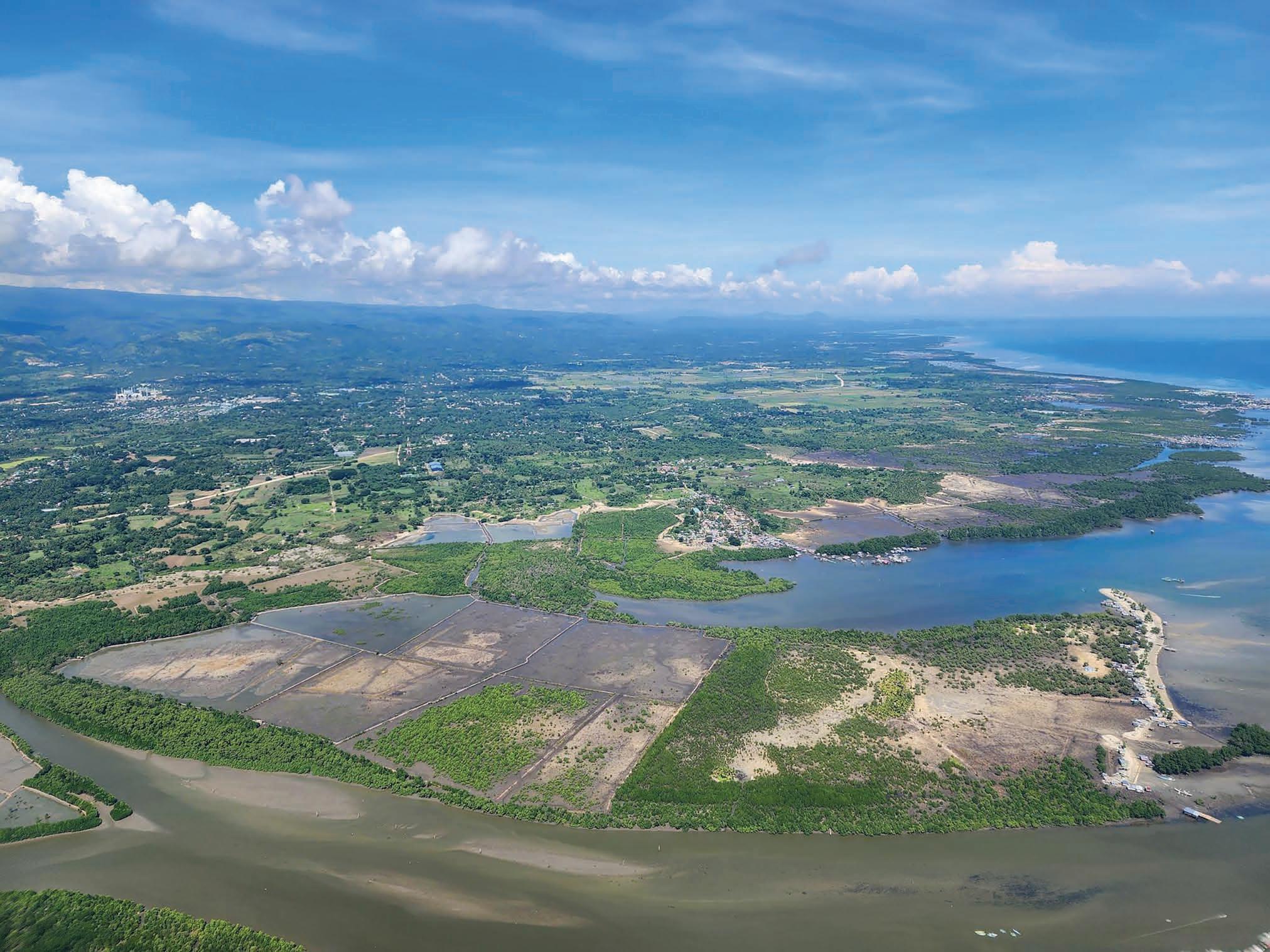
On Wednesday, environmental group Wetlands International Philippines warned against the proposal to convert abandoned, underdeveloped and underutilized (AUU) fishponds into salt farms.
The aggressive promotion of salt farming is emerging as the latest threat to the already dwindling mangrove forest cover and wetland ecosystems in the Philippines.
Wetlands, according to the Biodiversity Management Bureau (BMB), are important habitats and staging grounds of migratory shorebirds or water birds, and their destruction weakens global conservation efforts for these endangered species.
Dwindling mangrove forest
IN its Philippine Forestry Statistics 2020, the Forest Management Bureau (FMB) said the country’s mangrove forest cover is down to just 300,411 hectares, from as much as 500,000 hectares in the 1920s, mainly due to conversion to aquaculture areas and deforestation.
Mangroves are often harvested for various uses, for construc-

“We are already in a race
Reviving salt industry
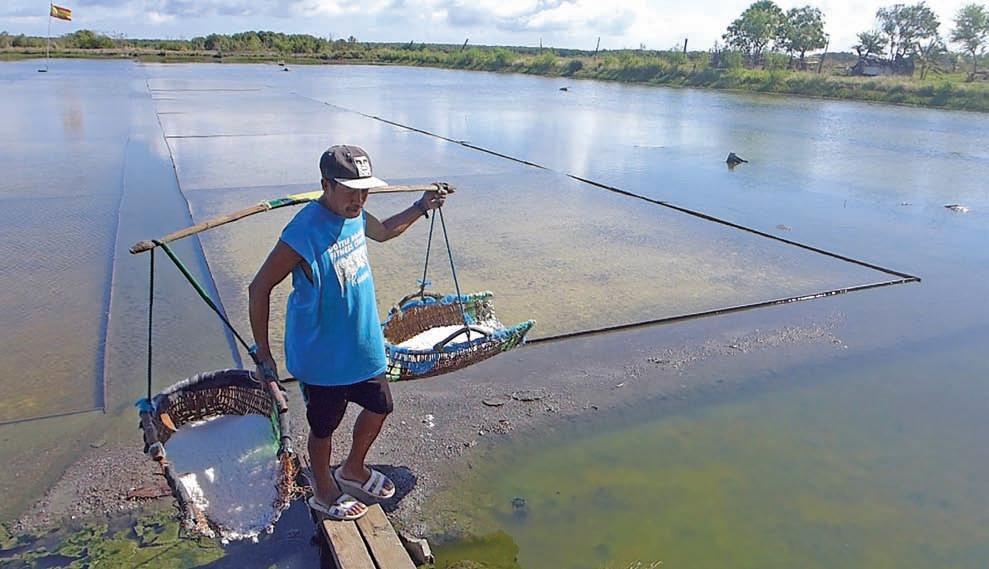
IN May last year, the House of Representatives’ agriculture and food panel approved a bill aiming to arrest the declining local salt production industry by boosting production and mandating stronger government and financial support for salt farmers.
tion material purposes, for nipa and wood for fuel. Charcoal making has also been identified as a major cause of deforestation.
According to the 1990 Forestry Statistics Report of the DENRFMB, there are 75,000 hectares of fishponds in the Philippines. Many fishponds in the Philippines, however, are now classified as AAUs.
House Bill 1976 or the Philippine Salt Industry Development Act, aims to draw up a government strategy that will upscale local salt production to achieve salt selfsufficiency and shield the country from the global supply chain vulnerabilities.
The measure also seeks to pro -
vide funding, training, technical support, trade and export assistance to salt farmers and producers to achieve salt production targets and decrease reliance on imports. However, environmentalists said converting more areas to fishponds is “a bad idea,” considering it might lead to the conversion of more areas into salt farms.
From fishponds to salt farms? AUU fishponds that used to be thriving mangrove areas are now being eyed for conversion into salt farms. Environmental advocate Jimely Flores, a fisheries and ma-
rine scientist, highlights concerns regarding salt farming on ponds, emphasizing its adverse effects on biodiversity. Flores warns that this practice is susceptible to the accumulation of nano and microplastics, along with other harmful contaminants.
Converting AUU fishponds into salt farms, she said, is not a good option, adding that abandoned fishponds can economically be best used for extensive aquaculture of native species or just be reverted into mangrove areas. She said there are best practices in small-scale salt farming, which is done on raised bamboos
or raised tiled platforms.
“Bamboo is less capital-intensive and does not need a fixed space. But it is not on a commercial scale,” she said. She cited Iloilo where salt farmers use bamboo for salt making.
In northern Philippines areas like Ilocos, Flores said the practice is cooking seawater collected from the sea. But this, she said, is energy intensive but with renewable energy, it might be feasible although they combined it with the mined salt from Australia.
Revert fishponds to mangrove
MEANWHILE, instead of entertaining the idea of converting these idle fishponds into salt farms, the group called on the government to rehabilitate the country’s coastal and marine ecosystem by fast-tracking the reversion of these fishponds back to mangroves to enhance the country’s natural defense against tsunamis, storm surges and sea-level rise, and boost the replenishment of the country’s fish stock, Wetlands International said.
Specifically, Wetlands International urged the Bureau of Fisheries and Aquatic Resources (BFAR) to revoke and transfer all fishpond lease agreements for AUU ponds back to the Department of Environment and Natural Resources (DENR). This action aims to facilitate mangrove reforestation efforts under the purview of the DENR. DENR, DA-BFAR mandate
“THE Department of Environment and Natural Resources originally had jurisdiction over many of the
www.businessmirror.com.ph
THE US and its European allies say they’re determined to use frozen Russian assets to help Ukraine—somehow. In Brazil this week, they’re arguing about the best way to do it without getting into legal or financial jeopardy.
Western nations have frozen about €260 billion ($282 billion) in securities and cash, more than two-thirds of it in the European Union. They all agree those funds should remain off-limits from Russia unless it pledges to help with Ukraine’s reconstruction.
But they’re at odds over whether it’s lawful to cross the Rubicon by seizing the assets outright—so the challenge is to squeeze funds out without depleting them.
With Russia on the front foot militarily as its invasion enters a third year, and aid from the US facing roadblocks in Congress, there’s growing willingness to consider what once were viewed as high-risk moves.
The US has been leading the push, with Treasury Secretary Janet Yellen this week, saying the legal and moral case is strong, and seeking to assuage European doubts. The UK has also expressed support for seizing the assets.
France and Germany, along
with the European Central Bank, have expressed the most caution. They worry about Russian retaliation targeting European assets there, and also the impact on financial stability and the euro’s status as a reserve currency, according to people familiar with the matter.
The danger, it’s argued, is that such a drastic move would set a precedent—pushing other nations to avoid holding their reserves in Western currencies in case they’re one day subject to similar penalties.
We don’t have the legal basis to seize the Russian assets now,” French Finance Minister Bruno Le Maire said Wednesday after a meeting of Group of Seven finance ministers in Sao Paulo. “We need to work more.”
Non-collateral collateral G-7 officials and lawyers are examining a range of options they can offer to national leaders at their June meeting in Italy, since any move will require a political deci-
sion at the highest level, the officials said.
A ll proposals carry risks of some kind. Some involve using the Russian assets as collateral to raise cash, via bond sales that would be issued by or steered toward Ukraine.
W hile that would avoid the optics of a flat-out seizure, it ultimately raises the same legal objections—because the assets would have to change hands in the first place before they could be used as a basis for new fundraising.
The EU is focused on finding “a legally secure step that can also be implemented in the short term” to use proceeds from the frozen assets to help Ukraine, German Finance Minister Christian Lindner told reporters in Sao Paulo Wednesday.
A sked about pressure from the US, he said G-7 leaders have given a mandate “to look at the technical level to see what is legally and financially possible.”
One workaround that’s being floated, and might be more palatable to the doubters, involves using the principal without actually seizing it. The idea—as outlined by the Atlantic Council’s Charles Lichfield—is that G-7 governments would provide a “guarantee” to markets that the frozen assets would not be returned to Russia unless it agrees to pay the cost of Ukraine’s reconstruction.
Essentially, they’d be promising that if necessary, they will seize the assets in the future to pay back Ukraine’s loans. That way, they can provide collateral for Ukraine without touching the assets in ques-


tion—for now—and avoiding that legal minefield. Meanwhile, creditors who put up cash for Ukraine on the basis of the plan would know that the Russian assets were ultimately backing their loans.
Th is plan kicks the confiscation risk down the road—but wouldn’t remove it entirely. That means it still could still raise the same issues about the role of G-7 currencies as global reserves.
Yellen downplayed that concern earlier this week. Still, such objections are one reason why previous proposals struggled to find favor.
Windfall tax
IN the US view, so-called “coun-
termeasures” offer a legal basis for a future seizure. That term refers to measures that would be unlawful if imposed against a state that hasn’t violated its international obligations—but are permitted if taken against an offending state, with the intent of pressuring it to end unlawful behavior and provide compensation. If pressure fails, the assets in question can then be used to fund the reparations.
Some legal experts have put forward this argument, but several European nations remain unconvinced—just as they’ve opposed a more straightforward seizure that’s seen as a “cleaner” option by the US.
Other paths considered include leaving the assets untouched and using them as collateral for bonds sold in global markets to raise funds for Ukraine.
Pending a more ambitious policy, the EU is slowly making progress with plans for a windfall tax on profits generated by the immobilized funds. On Wednesday, European Commission President Ursula von der Leyen suggested using those proceeds to fund weapons for Ukraine.
The profits amounted to €4.4 billion ($4.8 billion) last year. As of December, the World Bank estimated Ukraine’s reconstruction needs at $486 billion.
Continued from A1
mangrove areas that were lent to the Bureau of Fisheries and Aquatic Resources under the Department of Agriculture (DA-BFAR) for aquaculture production. However, many of those fishponds have been idle or largely underutilized for over five years,” Dr. Annadel Cabanban, Country Manager of Wetlands International Philippines, said in a statement.
Cabanban said under the Philippine Fisheries Code, as amended, BFAR is required to return the lease agreements for aquaculture areas of unutilized fishponds back to the DENR so that the areas can be reverted to their original mangrove state or functions, she added.
Section 49 of Republic Act No. 8550 mandates the DENR, in coordination with the Department of Agriculture, local government units, other concerned agencies, and Fisheries and Aquatic Resources Management Councils, to identify AUU fishponds covered by Foreshore Lease Agreements to be reverted to their original mangrove state or functions.
Meanwhile, Section 99 of RA 10654 likewise prohibits any person from converting mangroves into fishponds or for any other purpose.
Climate change
“WE are already in a race against climate change. If we lose any more mangroves, the more vulnerable our country will be to coastal flooding, erosion and storm surges,” said Cabanban.
Cabanban said the new proposal of the DA-BFAR to use AUU ponds as salt farms is a new threat to mangroves. Mangroves need brackish water and can hardly survive or grow in conditions too high in salinity. So salt farming and mangrove survival are unlikely to coexist,” she explained.
Costly and tedious proposal
ACCORDING to Cabanban, converting salt farms back to mangrove forests will be tedious and costly.
“Some studies say that mangrove restoration can still happen in former saltbed areas, but it is costly and tedious,” she said.
Moreover, she said it would only allow species that can tolerate high salinity. It will not be reverted to a multispecies mangrove area.
“ We thus urge the DA-BFAR to thoroughly reconsider and revise its draft FAO 197-2 as it may exacerbate the further degradation of mangroves,” Cabanban said.
According to Cabanban, excessive water salinity can stunt the mangroves’ growth, reduce biomass, and impair photosynthesis. It can also interfere with the way the mangroves’ roots absorb water and nutrition from the ground, which makes it difficult for the mangroves to survive.
A better alternative
INSTEAD of using the AUU fishponds for salt farming, Wetlands International Philippines recommends implementing the Associated Mangrove Aquaculture (AMA) approach as a mangrove-friendly aquaculture strategy. The Associated Mangrove Aquaculture is both mangrovefriendly and socioeconomically viable. It adapts the restoration of mangroves along waterways and a win-win situation for sustainable use,” said Cabanban.
A MA restores mangrove greenbelts in the estuary along inland waterways and protects adjoining fishponds. It uses mangroves’ ability to enhance biodiversity in an area to increase aquaculture production and is a more sustainable alternative to the silvofishery systems, which are being practiced by some fish
farms in the Philippines.
Wetlands International Philippines said it is working to pilot the AMA approach in the Philippines as a means of reconciling the need to restore mangroves and ensure ample fisheries supply.
Blue carbon projects
ANOTHER opportunity the Philippine government should consider is developing robust, high-quality blue carbon projects following the Ecological Mangrove Restoration guidelines, suggested Cabanban, adding that a ratio of 4:1, mangrove area to fishpond, along the coastline is one aquaculture practice in a blue carbon project or economy.
This presents a timely opportunity to secure sustainable financing, including access to carbon markets, that conserves critical ecosystems while enhancing livelihoods and resilience. Policy reforms, institutional coordination, and local governance support are vital for project success,” said Cabanban.
“Mangrove forest rehabilitation in fishponds can be a strategy for increased blue carbon investments. So we recommend the DENR, DA-BFAR, other related agencies, and our policy makers to come up with the policy and implementing rules and regulations for increased blue carbon investments in the Philippines,” Cabanban said.
She suggested encouraging corporate social responsibility programs and public-private partnerships focused on mangrove and seagrass rehabilitation, ecotourism, and blue carbon ventures.
“ We are willing to work with all involved agencies, groups and communities for solutions that would ensure both food security and mangrove conservation and rehabilitation,” Cabanban assured.

Fawning coverage of India’s political leaders. Newsroom censoring of reporters who ask the government tough questions on the economy, public policy and conflict.
These are some of the changes journalists attribute to a management shakeup at New Delhi Television Ltd., which billionaire Gautam Adani acquired more than a year ago through a hostile takeover. Ahead of India’s national elections, NDTV has morphed into a government mouthpiece, according to current and former employees. They say the channel— akin to India’s CNN—has shed its reputation as one of the country’s most fearlessly independent news outlets.
“Journalism is dead,” said Ravish Kumar, a popular anchor who resigned from NDTV ahead of Adani’s takeover. These days, he said in an interview with Bloomberg News, “the only use of newspapers and channels is to create propaganda for Narendra Modi.”
On the face of it, India still has a vibrant media. With more than 20,000 newspapers and 300 TV channels, the industry reflects the vast diversity of a democracy with 1.4 billion people. But to many journalists, leadership changes at NDTV and diluted coverage across India illustrate how Prime Minister Modi has effectively brought to heel a once-riotous media.
Newsrooms are being reshaped, they say, by India’s richest press barons, many of whom are close to the ruling party and depend on millions of advertising dollars from the government.
Adani, one of Asia’s richest tycoons and a longtime friend of Modi, is a high-profile case study. After his conglomerate acquired NDTV, the channel commissioned an adulatory nine-part documentary about Modi and now lands exclusive interviews with senior officials in the ruling Bharatiya Janata Party. Just a few years ago, sit-downs with top cabinet members were rare and managers fretted about federal agencies raiding NDTV’s offices.
Pressure to avoid sensitive topics extends beyond Modi, according to nearly a dozen current and former employees, who asked not to be identified to protect their jobs in the industry. After a US short seller accused the Adani Group of “brazen fraud” in January of last year, the conglomerate shed $150 billion in market value at one point. NDTV’s new leaders ordered journalists not to cover the story, according to three employees, even as Adani-related shares plunged on the stock market and local and foreign media outlets published reports. Over the next 48 hours, reporters pushed back, eventually convincing senior editors to publish an article from a newswire.
There’s much at stake for Adani. NDTV recently launched two new regional channels and several more are in the works. In December, Adani also purchased IndoAsian News Service, one of India’s oldest newswires.
“The owners of key media houses are known to have close relations with the ruling BJP party and the current prime minister,” said Somdeep Sen, an associate professor at Denmark’s Roskilde University. That “close alliance,” he added, “has been an important means of shaping and controlling India’s media.”
The Adani Group’s media operation “is politically neutral and is deeply committed to supporting professional and independent journalism and NDTV will be no exception,” said a spokesperson in a written reply to Bloomberg’s queries.
The “insinuation” that there was deliberate delay in NDTV’s coverage of the Hindenburg incident is “misinformed and based on biased information,” the spokesperson said.
With elections expected in April, many Indian journalists across the board predict deferential coverage of Modi as he seeks a third term in office. Over the past year, more than a dozen senior staff have resigned from NDTV over directives to avoid storylines that entangle government allies, current and former employees say. Fear of eroding press freedom runs alongside a broader concern about a democratic backslide in India. Human rights watchers accuse the BJP of weakening minority rights, fueling religious intolerance, and undermining independent institutions, including the media.
In a country accustomed to major corporate scandals and questions around the quality of economic data, increasing restrictions on the press could add to investor risks in India. Hasnain Malik, a Dubai-based strategist at emerging-market research outfit Tellimer, said “infringements of rights” become a problem when there’s a high risk of sanctions, in particular.
But for now, at least, Modi’s India remains a hot investment destination. Last month, the prime minister greeted hundreds of local and global business houses at a biennale summit in his home state of Gujarat. Many lavished him with praise. Ahead of the NDTV takeover in 2022, Adani called his investment in media a “responsibility” rather than a business undertaking.
“Independence means if government has done something wrong, you say it’s wrong,” he told the Financial Times. “But at the same time, you should have courage when the government is doing the right thing every day. You have to also say that.”
For years, NDTV cultivated a reputation as an aggressive and anti-establishment voice.
Founded in the 1980s by husband-and-wife team Prannoy and Radhika Roy, the company steadily built out its content as India’s economy liberalized. In 1995,

NDTV became the first private producer of national news and soon after launched India’s first 24-hour channel.
“We had a very clear mission that we would question and we would hold power to account,” said Maya Mirchandani, a former NDTV foreign affairs editor and now an associate professor at Ashoka University. “I loved the place.”
Previous governments have also been harsh on the press. During the 21-month Emergency rule imposed by former Prime Minister Indira Gandhi from the Indian National Congress party, members of Modi’s BJP famously said India’s press “crawled” when they were asked to “bend.” Following the 2014 election of Modi, many reporters and commentators, including from the political opposition, have said an “undeclared Emergency” is in place and India’s fourth estate has less scope to push back against censorship. The country’s constitution doesn’t grant ironclad media freedom like in the US. Instead, ill-defined amendments have provided plenty of leeway for federal and local governments to muzzle journalists.
Under Modi, state agencies have increasingly used money laundering laws and tax inspections to pressure editors and media owners perceived as antagonistic or “anti-national.” By one estimate, 15 journalists are currently facing charges under India’s antiterror laws.
Intolerance towards reporters isn’t limited to the BJP. This month, journalists in West Bengal accused the police and the ruling Trinamool Congress party of blocking access to report on civil unrest in the Sundarbans. In 2022, a journalist in the central state of Chhattisgarh was arrested for writing satirical stories about the Congress-led government.
In turn, India’s media freedom ranking has steadily declined, falling to 161 out of 180 countries in the latest survey from the World
After the ranking was released, S. Jaishankar, India’s foreign minister, rejected the report, saying something was “fundamentally wrong” with the methodology. Modi, too, has pushed back. During a June visit to the US, the prime minister said in a rare press conference that he was “really surprised” to hear India’s commitment to democratic values questioned.
Yet many of the most successful channels today publish reliably pro-government content, including Rajat Sharma’s India TV and Arnab Goswami’s Republic TV. Others, including Aroon Purie’s Aaj Tak and India Today, are frequently laudatory of Modi. “He has the Midas touch,” read a tweet from India Today’s official handle on X, formerly Twitter. India TV, Republic TV and India Today didn’t respond to requests for comment.
Concerns about dwindling avenues for dissent are further complicated by changes to the media business. Like in many parts of the world, a subscription model hasn’t taken off in India, forcing outlets to rely on government and corporate advertising to stay afloat, said Kalyani Chadha, a journalism professor at Northwestern University.
“That’s a really significant problem,” she said.
Adani is not the only India billionaire buying up media operations. Mukesh Ambani, a tycoon whose corporate interests are often aligned with the government, acquired Network18 Group—giving him access to more than 70 media outlets followed by at least 800 million Indians.
Of course, many media organizations, including Bloomberg News, are owned by wealthy entrepreneurs. In that respect, India is no different. But what does set the nation apart is that figures like Ambani and Adani are chief executors of the government’s development goals in industries as varied as renewable energy and
WITH more than 20,000 newspapers and 300 TV channels, the industry reflects the vast diversity of a democracy with 1.4 billion people. But to many journalists, leadership changes at NDTV and diluted coverage across India illustrate how Prime Minister Modi has effectively brought to heel a once-riotous media.
digital commerce.
Ambani’s Reliance Group didn’t respond to a request for comment.
The Adani Group’s takeover of NDTV was achieved through complex corporate maneuvering, buying out the channel’s biggest creditor and other shareholders, and boosting the conglomerate’s ownership stake to nearly 65%. One estimate pegged the cost of the deal at more than $100 million.
During a broadcasting break in August 2022, Kumar, who anchored shows in Hindi, picked up his phone and scrolled through a barrage of messages about the leadership change. A few months later, Kumar announced his departure, calculating that his editorial independence would be curtailed.
“NDTV will never remain the same,” he remembered thinking.
At first, the Adani Group vowed to turn the channel into an international media group. Sanjay Pugalia, the head of Adani’s media arm and a veteran journalist, was appointed executive director. He told senior staff that he didn’t want to get involved in journalistic decisions or even sit in the New Delhi newsroom, according to people familiar with the matter.
But on Jan. 2, days after the Roys resigned from NDTV’s board citing a change in leadership, Pugalia took over the couple’s corner office. Journalists said the new managers’ initial reluctance to cover the short seller’s fraud allegations against Adani that month illustrated the complexity of juggling competing priorities. Though NDTV eventually republished articles from the Press Trust of India, Reuters and Bloomberg News, staffers said harder-hitting pieces on the saga were blocked.
Pugalia didn’t respond to req uests for comment.
A standoff grew within NDTV. Pugalia hired two managing editors, sidelining more experienced staff that were part of the organization for over a decade. Several reporters said the new managers micromanaged coverage, dropped sensitive stories and instead opted for soft features. Coverage of opposition politicians was also fraught. In October, when the BJP accused opposition lawmaker Mahua Moitra of graft and misconduct, NDTV ran multiple discussions on the topic. Employees said panelists were handpicked during the first few weeks, leveling personal attacks against Moitra that went unchallenged. It was only when the company brought in a new editor that balance was restored, the employees said, with senior politicians from Moitra’s party also participating in
interviews and panel discussions.
The lawmaker was eventually expelled from Parliament. She attributed that decision to her criticism of the government and the Adani Group, including how NDTV covered the story. Government officials attributed Moitra’s expulsion to sharing the password to the parliamentary website with someone on the outside.
“Multiple reach outs were made to TMC to participate,” said the Adani Media Group spokesperson, referring to Moitra’s party. “We made sure there were independent voices and representation from other opposition parties.”
Key talent also left the company, though managers linked the attrition rate to restructuring.
In May, Sarah Jacob, a journalist with over 20 years of experience at NDTV, anchored a segment called “How PM Shows Respect Towards Women.” The next day she resigned. In a statement, she thanked the Roys for “building what was one of India’s great media institutions.”
“Every management transition and transformation leads to employee churn,” said the Adani Media Group spokesperson, adding that NDTV has been on a posttakeover hiring spree with more than 200 staffers added and the attrition rate dropping by 58% from before the change in ownership.
For Kumar, leaving NDTV—and watching colleagues follow—signals the end of an era for Indian journalism. Since resigning, he’s struggled to find a place in another mainstream newsroom. Instead, he’s become something of a recluse, working from an apartment on the outskirts of India’s capital and filming YouTube videos covering topics traditional outlets will no longer touch.
Kumar’s following is still huge—8.59 million subscribers— but he worries that the government could try to block his channel or arrest him. He hesitates to leave his apartment complex.
“This is the kind of environment where everybody thinks that they’re being monitored,” Kumar said.
For now, India remains a country where freedom of expression is often tolerated in larger doses than Asian nations like Thailand or Singapore. Unlike China, social media in India is still a relatively freewheeling space. Some opposition-controlled states also offer more varied coverage, according to Sadanand Dhume, a senior fellow at the American Enterprise Institute in Washington.
“The government hasn’t been able to snuff out all criticism simply because of India’s size and federalism,” he said.
But that freedom is fragile even in vernacular or regional media.
A few years ago, India’s information ministry temporarily cut off the broadcast of a prominent news channel in the southern state of Kerala for covering a mob attack between Muslims and Hindus in India’s capital. The government justified their decision by saying the segment was “critical toward Delhi Police and R.S.S.,” using an acronym for a far-right Hindu group.
The fear remains, Dhume said, that India’s “little islands of free expression” could sink beneath “the rising tide of government repression.” With assistance from Jinshan Hong/Bloomberg
COLM KELLEHER whipped up a storm at the end of last year when the UBS Group AG chairman warned of a dangerous bubble in private credit. As investors dive headfirst into this booming asset class, the more urgent question for regulators is how anybody could even know for sure what it’s really worth.
important Wall Street banks and into specialist firms, but the ardor’s cooling in some quarters. Regulators are doubly nervous because of the economy’s febrile state. These funds charge interest pegged to base rates, which has handed them bumper profits—and made their borrowers vulnerable.
“As interest rates have risen, so has the riskiness of borrowers,”
Lee Foulger, the Bank of England’s director of financial stability, strategy and risk, said in a recent speech. “Lagged or opaque valuations could increase the chance of an abrupt reassessment of risks or to sharp and correlated falls in value, particularly if further shocks materialize.”

“There are big differences in how managers approach valuations, and a lack of transparency and comparability between them,” says Florian Hofer, director for private debt at Golding Capital Partners, an alternative investment firm.
Private fans
FOR private credit’s many champions, the criticism’s overblown. Fund managers argue that they don’t need to be as brutal on marking down prices because direct loans usually involve only one or a handful of lenders, giving them much more control during tough times. In their eyes, the beauty of this asset class is that they don’t have to jump every time there’s a bump in the road.
like one of its greatest potential flaws.
Data compiled by Bloomberg and fixed-income specialist Solve, as well as conversations with dozens of market participants, highlight how some private-fund managers have barely budged on where they “mark” certain loans even as rivals who own the same debt have slashed its value.
In one loan to Magenta Buyer, the issuing vehicle of a cybersecurity company, the highest mark from a private lender at the end of September was 79 cents, showing how much it would expect to recoup for each dollar lent. The lowest mark was 46 cents, deep in distressed territory. HDT, an aerospace supplier, was valued on the same date between 85 cents and 49 cents.
This lack of clarity on what an asset’s worth is a regular complaint in private markets, and that’s spooking regulators. While nobody cared too much when central bank interest rates were close to zero, today financial watchdogs are fretting that the absence of consensus may be hiding more loans in trouble.
“In private markets, because no one knows the true valuation there’s a tendency to leak information into prices slowly,” says Peter Hecht, managing director at US investment firm AQR Capital Management. “It dampens volatility, giving this false perception of low risk.”
The private-lending funds and companies mentioned in this story all declined to comment, or didn’t respond to requests for a comment.
Code of silence?
PRIVATE credit was embraced at first for shifting risky company loans away from systemically
Values are especially cloudy outside the US, because of poor transparency. And it’s the same for loans made by funds that don’t publish quarterly updates or where there’s a single lender with no one to judge them against.
Tyler Gellasch, head of the Healthy Markets Association, a trade group that includes pension funds and other asset managers, says policymakers have been caught napping. “This is simply a regulatory failure,” says Gellasch, who helped draft part of the Dodd-Frank Wall Street reforms after the financial crisis. “If private funds had to comply with the same fair value rules as mutual funds, investors could have a lot more confidence.”
The Securities and Exchange Commission has nevertheless begun to pay closer attention, rushing in rules to force private-fund advisers to allow external audits as an “important check” on asset values.
Some market participants wonder, however, whether the fog around pricing suits investors just fine. Several fund managers, who requested anonymity when speaking for fear of endangering client relationships, say rather than wanting more disclosure, many backers share the desire to keep marks steady—prompting concerns about a code of silence between lenders and the insurers, sovereign wealth funds and pensions who’ve piled into the asset class.
One executive at a top European insurer says investors could face a nasty reckoning at the end of a loan’s term, when they can’t avoid booking any value shortfall. A fund manager who worked at one of the world’s biggest pension schemes, and who also wanted to remain anonymous, says valuations of private loan investments were tied to his team’s bonuses, and outside evaluators were given inconsistent access to information.
Will private credit outperform this year? Share your views in the Markets Live Pulse survey.

THE thinly traded nature of this market may make it nigh on impossible for most outsiders to get a clear picture of what these assets are worth, but red flags are easier to spot. Take the recent spike in so-called “payment in kind” (or PIK) deals, where a company chooses to defer interest payments to its direct lender and promises to make up for it in its final loan settlement.
This option of kicking the can down the road is often used by lower-rated borrowers and while it doesn’t necessarily signal distress, it does cause anxiety about what it might be obscuring. “People underestimate how dangerous PIK products are,” says Benoit Soler, a senior portfolio manager at Keren Finance in Paris, pointing out the sometimes enormous cost of deferring interest: “It can embed a huge forward risk for the company.”
And yet the value of loans even after these deals is strikingly generous. According to Solve, about three-quarters of PIK loans were valued at more than 95 cents on
Private
credit
the dollar at the end of September.
“This raises questions about how portfolio companies struggling with interest servicing are valued so high,” says Eugene Grinberg, the fintech’s cofounder. An equally perplexing sign is the number of private funds who own publicly traded loans, and still value them much more highly than where the same loan is quoted in the public market.
In a recent example, Carlyle Group Inc.’s direct-lending arm helped provide a “second lien” junior loan to a US lawntreatment specialist, TruGreen, marking the debt at 95 cents on the dollar in its filing at the end of September. The debt, which is publicly traded, was priced at about 70 cents by a mutual fund at the time. Most private credit portfolios “remain above their public market peers,” the BoE’s Foulger noted in his speech on “nonbank” lenders.
And it’s not just the comparison with public prices that’s sometimes out of whack. As with Magenta Buyer and HDT there are eye-catching cases of separate
was embraced
at first for shifting risky company loans away
from
systemically important Wall Street banks and into specialist firms, but the ardor’s cooling in some quarters. Regulators are doubly nervous because of the economy’s febrile state. These funds charge interest pegged to base rates, which has handed them bumper profits—and made their borrowers vulnerable.
private credit firms seeing the same debt differently. Thrasio is an e-commerce business whose loan valuations have been almost as varied as the panoply of product brands that it sells on Amazon, which runs from insect traps and pillows to cocktail shakers and radio-controlled monster trucks.
As the company has struggled lately, its lenders have been divided on its prospects. Bain Capital and Oaktree Capital Management priced its loans at 65 cents and 79 cents respectively at the close of September. Two BlackRock Inc. funds didn’t even agree: One valuing its loan at 71 cents, the other at 75 cents. Monroe Capital was chief optimist, marking the debt at 84 cents. Goldman Sachs Group Inc.’s asset management arm had it at 59 cents.
The Wall Street bank seems to have made the shrewder call on looming distress. Thrasio has been weighing a debt restructuring and today one of its public loans is quoted well below 50 cents, according to market participants. Oaktree lowered its mark to 60 cents in December.
“Dispersions widen when a company is falling into distress as well as when a lot of funds are marking the same asset,” says Bloomberg Intelligence analyst Ethan Kaye. “When a company is either stressed or distressed, it becomes less certain as to what future cash flows might look like.”
In an analysis of Pitchbook data from the end of September, Kaye found that in one in 10 cases where the same debt was held by two or more funds, the price gap was at least 3 percent. When three of four funds own the same loan, something that’s common in this industry, the differences get starker still.
Distressed companies do throw up some especially surprising values. Progrexion, a credit-services provider, filed for bankruptcy in June after losing a long-running lawsuit against the US Consumer Financial Protection Bureau. Its bankruptcy court filing estimated that creditors at the front of the queue would get back 89 percent of their money. Later that month its New York-based lender Prospect Capital Corp. marked the senior debt at 100 cents.
In data pulled together by Solve on the widest gaps between how a lender marks its loans versus other parties’ valuations, Prospect’s name appears more regularly than most. BI finds that smaller firms in general appear to mark their loans more aggressively.
Some investors point as well to the shortcomings of the leveraged-loan market, private credit’s biggest rival as a source of corporate finance, where Wall Street banks gather large syndicates of mainstream lenders to fund companies.
“There are a lot of technicals that influence the broadly syndicated loan market, like sales encouraged by ratings downgrades or investors getting out of cert ain sectors,” says Karen Simeone, managing director at private markets investor HarbourVest Partners. “You don’t get this in private credit and so I do think it makes sense that these valuations are less volatile.”
Direct lenders also use far less borrowed money than bank rivals, giving regulators some comfort that any market blowup could be contained. They typically lock in cash they get from investors for much longer periods than banks, and they don’t tap customer deposits to pay for their risky lending. They tend to have better creditor protections, too.
Third-party advisers such as Houlihan Lokey and Lincoln International are increasingly assessing loan marks, adding scrutiny, though it’s paid for by the funds and is no panacea. “We don’t always get unfettered access to credits,” says Timothy Kang, co-lead of Houlihan’s private credit valuation practice. “Some managers have access to more information than others.”
In the US, direct lenders often set up as publicly listed “business development companies,” requiring them to update their investors every quarter. BDCs do give better visibility on their loan prices but their fund managers are paid according to the portfolio’s worth so there’s an incentive to mark debt high.
“Part of the problem stems from the decision makers for portfolio marks, which include the thirdparty valuation firms and the BDC boards, who have a lot to lose if they decide not to play along,” says Finian O’Shea of Wells Fargo Securities, a BDC analyst.
For Hecht at AQR the real fear isn’t so much the wilder cases of value gaps, more that the very purpose of private credit is lending to risky businesses and that isn’t shown in overall asset values, echoing the UBS chairman’s lament.
“The part I’m also worried about is for normal credit risk environments where they mark nearly all assets at 100,” he says. “Most of the time, people are looking at these asset valuations and thinking they have no risk.” With assistance from Paula Seligson, Boris Korby and David Papadopoulos/Bloomberg
 Editor: Lyn Resurreccion
‘WE can rehabilitate any mined-out areas in the Philippines.”
This is the response of Dr. Nelly Aggangan, lead scientist of the Department of Science and Technology-National Research Council of the Philippines’ (DOST-NRCP) banner program “Greening Mined-out Areas in the Philippines (GMAP),” when asked if there is any specific type of mine tailings that their team cannot rehabilitate using the NRCP and Biotech developed microbial technology.
GMAP is an ongoing NRCP-funded project which successfully worked on the re-greening efforts of the 35-year abandoned copper mined-out area in Mogpog, Marinduque.
The Marinduque Bioremediation Protocol, which was established through GMAP, intends to address any environmental damage from mine operations, such as habitat destruction, soil degradation, and water pollution. Emer Gastiada, an associate member of NRCP and a team member of Aggangan, said that the Marinduque Bioremediation Protocol can be adopted in rehabilitating mined-out areas in the Philippines irrespective of the kind of heavy metals present, as long
as the protocol is strictly followed. Bioremediation is a cost-efficient and effective approach to bringing mined areas back to life, and renewed productivity using helpful soil microorganisms.
“This bioremediation protocol using microbial technology is the key to its [GMAP] success,” Gastiada said.
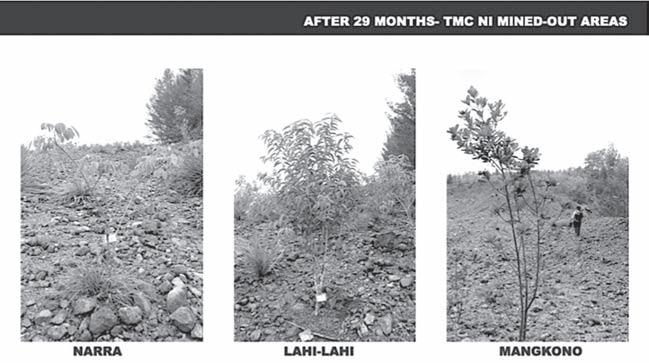
This scientifically-proven and safe alternative to rehabilitate minedout areas used 6-month old native seedlings with microbes. The native plant species are lahi-lahi, narra, and mangkono.
The use of indigenous species instead of invasive or exotic species for reforestation can prevent possible harm to native species present in the area.
From abandoned mined-out area, NRCP replicated the established protocol in two other active mining sites: the Taganito Mining Corp. (TMC) in Claver (nickel mined-out area) and the Manila Mining Corp. (MMC) in Placer (gold mined-out area), as experimental areas in Surigao.
In less than three-years of working on the rescued sites, native plants with microbes have grown tall.
Aggangan is hopeful that through this study, other mining companies will reach out for rehabilitation of


Thave jurisdiction to exercise regulatory control over all sources of ionizing radiation, both from nuclear and radioactive materials as well as radiation devices.
Besides the creation of the PhilAtom, the bill also revamps the current nuclear legislative framework of the country,
TIn his message during the opening program, DOST Undersecretary for Special Concerns Dr. Teodoro M. Gatchalian shared his hope that the visit will provide useful information to further develop S&T in the countryside and make it more responsive to the challenges of the times.
“We hope to prove to you that every centavo we receive from the national government are being put into maximum use so that our people can really benefit from the services that we deliver,” Gatchalian said.
bringing it up to speed with international safety standards, particularly those of the International Atomic Energy Agency (IAEA).
The bill also has fresh provisions on nuclear safety, security, safeguards, radiation protection, and emergency preparedness and response—reflecting the country’s commitment in fulfilling its long-standing obligations to the IAEA and the international community through various treaties, conventions, and other agreements.
The bill is sponsored by Sens. Francis Tolentino, Ramon Revilla Jr., Sherwin Gatchalian and Francis Escudero.
Spearheading the discussions is the Senate Committee on Science and Technology, chaired by Sen. Alan Peter
Cayetano, who held several joint meetings and public hearings in mid-February with the Senate Committees on Energy, Ways and Means, and Finance, aiming to hasten the legislative process for all priority bills on science and technology.
He was joined by Sens. Raffy Tulfo and Sherwin Gatchalian in expressing their full support for the bill as an indispensable means of oversight on the safety aspects of nuclear energy in the Philippines. Tulfo and Gatchalian are the chairmen of the Senate Committees on Energy and Ways and Means, respectively.
Officials from the Department of Science and Technology-Department Legislative Liaison Office attended the meetings with

House Committee delegates were given an exclusive tour of the state-of-the-art facilities at DOST-FPRDI. Delegates witnessed demonstrations and presentations that showcased innovations in the use of wood and non-wood forest products. “We highly value the Committee’s role in stirring a vibrant S&T environment in the country, and in pushing for scientific innovations that are beneficial to the Filipino people. DOST-FPRDI looks forward to engage in more meaningful discussions that highlight the importance of continued support for R&D initiatives,” said DOST-FPRDI OIC Director Rico J. Cabangon. He added, “Through the visit, we were able
to present the Institute’s efforts in developing technologies for the sustainable use of forest resources, and in helping address concerns that include job creation, human security and environment protection through our R&D programs and technology transfer activities.” Committee members and legislative staff were toured around DOST-FPRDI’s Fire Testing Laboratory that houses equipment to verify the fire resistance of small samples from wall panels; Furniture Testing Center that evaluates the product strength, durability, and stability of chairs, tables and other furniture using local and global test standards; and the Wood Library and Herbarium that has the most complete wood collection in the Philippines
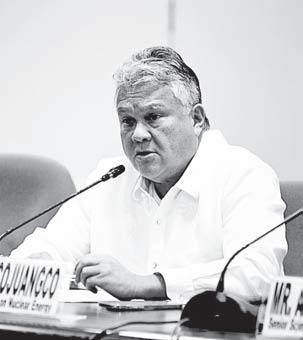
scientists and regulators from the DOSTPhilippine Nuclear Research Institute (DOSTPNRI), headed by DirectorCarlo Arcilla, as well as Rep. Mark Cojuangco, principal sponsor of the bill in the House of Representatives and Chairman of the House Special Committee on Nuclear Energy.
Also in attendance were officials and representatives from the Departments of Energy, Department of Health-Center for Device Regulation, Radiation Health and Research, National Defense, and Justice, Strategic Trade and Management Office; Bases Conversion and Development Authority, and the Development Bank of the Philippines, among others.
Late in November l2023, the PhilAtom bill was passed by the House of Representatives in record time on third reading, with an overwhelming 200 votes in favor.
with more than 4,000 tree species to date.
At the Forest Products Innovation Center (FPIC), various products derived from DOSTFPRDI’s R&D Programs on bamboo & other non-wood forest products, creative industry, flavors and fragrances from the forests, human security, and climate change were displayed.
Emphasizing the role of science and research in “creating meaningful governance thru policy making and legislation,”Yu stated, “We need to strengthen the cooperation of the DOST family and the members of the House of Representatives by providing opportunities to converge our efforts so that we may be able to solve pressing problems. I appeal to everyone present today—let us work and join hands together to make this partnership accomplish its task for the advancement of science and technology in the country.”
Besides DOST-FPRDI, other DOST agencies that were visited included the Philippine Council for Agriculture, Aquatic and Natural Resources Research and Development and DOST Region IV-A.
DOST-FPRDI is a research and development institute tasked to develop and transfer technologies and information on the efficient use of forest-based products. Together with other DOST agencies, the DOST-FPRDI works toward improving the competitiveness of local industries by using science, technology and innovation. Apple Jean C. Martin-de Leon/S&T Media Service
mined-out areas.
“With our goal to re-green minedout areas in the country by 2033, we are looking for partners in the regions to implement GMAP in other areas.”
In 2025, the team of Aggangan will rehabilitate some mined-out areas in Palawan and Leyte.
To cover more sites, the team is looking for more partners and collaborators, specifically the NRCP Division of Agriculture and Forestry regular members to implement the study in other areas.
At present, there are 21 mined-out areas in the country, with GMAP being currently implemented in Surigao and Cebu.
The study, Greening Nickel and Gold Mined-out Areas in Claver and Placer, Surigao, Mindanao, were presented to the House of Representatives during the-day fourth NRCP-Congress policy research forum for public policy development held recently. Ricardo P. Mira of the House of Representatives’ Congressional Policy and Budget Research Department, expressed support to the GMAP program through the government’s stricter implementation of Philippine Mining Act of 1995.
Besides governing mining activities in the country, the Act also highlights the requirement for mining contractors to implement environmental protection and enhancement programs that involves rehabilitation of mined-out areas.
“The study of Dr. Aggangan will substantially help in improving the revegetation efforts of mining companies using effective and inexpensive measures such as the bioremediation protocol of GMAP,” Mira said.
He also added that with higher survival rate of trees, the government through the Mines and Geoscience Bureau (MGB) and the Department of Environment and Natural Resources (DENR) should replicate the GMAP project in all mined-out areas in the country.
The House Committees present in the forum recommended the updating of the Mining Act, particularly to include the definition of terms specifically ‘bioremediation,’ the technology used in greening mined-out areas, as well as the different plants used.
It also suggested that Indigenous Peoples be involved in the consultation, planning and during implemetation stage of every activity. Jenny Leigh A. Daquioag/S&T Media Service
UPD professors at Senate hearing: Procurement woes slow down R&D

COLLEGE of Science (CS) Dean
Giovanni Tapang held up a little white device as he finished his presentation: “This is a P150,000 component,” he said.
Tapang said in Filipino that only one company in the world makes the devise, but it is having difficulty in registering with Philippine Government Electronic Procurement System (PhilGEPS) as foreign companies are required to register to the agency before they can sell products to local scientists, said Harvey Sapigao of UPD-CS Science Communication.
Marine Science Institute (MSI) Deputy Director Dr. Irene Rodriguez explained that the small device is a resin that filters metals in water.
She said they have a budget but their problem is the availability of the resin. This and other bottlenecks brought about by the procurement law, or the Government Procurement Reform Act (RA 9184), slow down research and development in the country.
University of the Philippines Diliman (UPD) leaders were invited to the Senate hearing to discuss the proposed revision of the procurement law at the House of Representatives on February 21.
Besides Tapang and Rodriguez, among those present were CS Associate Dean Dr. Eizadora Yu, CS Associate Dean Dr. Deo Florence Onda, National College of Public Administration and Governance Dean Dr. Kristoffer Berse, NCPAG Assistant Professor Herisadel Flores, and NCPAG Atty. Lawrence Villanueva.
The procurement law, enacted in 2003, is a set of rules and regulations for using government funds to acquire goods and services. Although meant to deter corruption and promote transparency, the law introduces numerous problems for researchers and scientists.
Among the problems is that products become exorbitantly priced, which hinders research progress.
Berse said that when a product cannot be locally produced, foreign-sourced products can be bought through local suppliers. But this method increases and even doubles the products’ prices.
“In the event that no local suppliers are interested,” he added, “this will result in the loss of access to the target equipment.”
When researchers fail to procure the necessary equipment, they cannot meet project objectives and need to realign budgets. This will “ultimately delay the dissemination of knowledge and information and in providing solutions to our country’s pressing problems,” Berse said.
Moreover, the procurement law impacts the retention of local scientists.
“Once frustrated, they leave [the country] for greener pastures,” Tapang said.
The proposed amendments to the procurement law aim to solve these problems. The revised law, for example, would allow for direct sales and direct acquisition of products in certain circumstances, bypassing the slow bidding process.
Under the proposed amendments, the sole supplier of resin needed for. Rodriguez’s research would not need to undergo bidding.
UPD professors fully support the amendments to the procurement law. They also proposed further improvements and recommendations, such as on how to counteract “abnormally low bids” or bids that offer equipment and services at suspiciously low prices. One of the authors of the revised law, Sen. Sonny Angara, stated that it is already in its finalization stage and is expected to be finalized in the next two weeks.
A6 Sunday, March 3, 2024

Editor: Lyn Resurreccion • www.businessmirror.com.ph
CCLAIMED Broadway singer and actress Lea Salonga and the equally world-renowned Utah, USA-based Tabernacle Choir at Temple Square wowed the full-house capacity audience at SM Mall of Asia (MOA) Arena with their praise and inspirational songs on February 27.
The concert was the second time for Salonga singing as the featured artist of the Choir. The first was in Salt Lake City, Utah, in the “Season of Light: Christmas with The Tabernacle Choir and Orchestra at Temple Square” in December 2022.
Meanwhile, it was the first time the 400-strong Choir and Orchestra performed in the Philippines. The concert was part of its four-year world tour of “Hope.”
“It’s like God absolutely exists. When you hear this kind of [music]. when you experience it...it gets to a part of you that you can’t always explain,” Salonga described the Choir’s spiritual music in reply to B usiness M irror during the interview with print media at a hotel in Pasay City on February 26.
The concert’s repertoire of 18 songs— including Alleluia from Psalm 150, The Spirit of God, Sephardic Wedding Song and a Nigerian Carol—were greeted with roaring applause, especially Salonga’s rendition of “Hahanapin Ko,” about Filipinos who left home to work abroad, and “The Story Goes On, from Broadway musical Baby,” about an expectant mother excited to have a baby.
The Choir’s singing “Bahay Kubo” with Salonga made the audience explode with lauder applause and cheers.
Another Filipino singer-songwriter who was featured in the concert, Ysabelle Cuevas, sang “If You Believe” with Filipino youth.
The Filipino song, “Hawak Kamay,” with the message of faith, was sang with Filipino youth as narrators.
The Choir’s Philippine concert tour on February 27 and 28 was under the direction of Mack Wilberg, music director of the Choir, and Ryan Murphy, associate music director.
The Tabernacle Choir and Orchestra also performed before business owners, CEOs and government officials at a hotel in Taguig City on February 23, and at the University of Santo Tomas on February 25.
The all-volunteer Tabernacle Choir and the Orchestra at Temple Square serve as musical ambassadors for The Church of Jesus Christ of Latter-day Saints.
Tabernacle Choir President Michael O. Leavitt was part of the concert tour to the country.
A former three-time governor of Utah state, from 1993-2003, Leavitt later worked at the Environmental Protection Agency and then as Secretary of the Department of Health and Human Services. TV personalities and news anchors. husband and wife Paolo Abrera and Suzie
THE


Entrata-Abrera acted as narrators during the performances.
Besides the live performances, the concert will later be streamed online.
The speakers urged the public to listen to the Tabernacle Choir music online. “But don’t just listen with your ears, concentrate on what you feel. Thats the beauty of music; we hear it and we feel it,” Leavitt said.
Bucket list
A MULTIPLE awarded actor and singer renowned worldwide, and best known for her Tony Award–winning role in Miss Saigon, Salonga said that when she was invited to join the Choir as part of its Philippine tour she immediately said “yes.”
She said that after working and having a great experience with the Choir and its music director Wilberg in 2022, “it was memorable not only from the musical standpoint but I remember feeling this is something that I will never ever gonna forget.”
“I don’t know if there are many artists who have had the opportunity to work more than one time with the Choir. So this is a big bonus to be able to do it again. And to be able to do
Edsa Shrine to seek ‘national shrine’ status

Tit in my home country is very very special.... I think the warmth of the people will definitely be felt by everyone,” she added during the news conference on February 26.
S alonga reiterated that the music the Choir produces “really gets into the heart.... There is a reason why the choir is so renowned globally.”
She explained that these factors placed the Choir on the bucket list of her manager for her to even get the first invitation.
“And then it happened [in 2022]. So the second one coming so soon after the first. ya we’ll definitely do that,” she added.
Time, patience gives excellent result
SALONGA explained that working with the Tabernacle Choir and Wilberg confirms that in order to get an amazing result, “one really have to put in time, and really put in the work.
“Nothing is instantaneous. Things do take time, and there are some things that take more time than others” she pointed out She added: “It requires patience, not just general patience, but patience with one’s
HE head of the Catholic bishops in the country believes that the EDSA Shrine, a historic landmark built in remembrance of the 1986 bloodless revolution that toppled the Marcos dictatorship, may be declared a “national shrine.”
“Why not?” said Bishop Pablo Virgilio David of Kalookan and president of the Catholic Bishops’ Conference of the Philippines (CBCP), during Mass at the shrine to mark the 38th anniversary of the popular people power uprising on February 25.
“EDSA Shrine is not just a shrine for the Archdiocese of Manila, but of the entire Philippines,” he pointed out.
The Archdiocesan Shrine of Mary, Queen of Peace on EDSA was built in 1989 to commemorate the February 25, 1986 people power revolution.
The shrine was also the site for the second peaceful demonstration that overthrew former president Joseph Estrada in 2001.
Edsa Shrine Rector Fr. Jerome Secillano welcomed the bishop’s statement, as they had long planned to apply for the national shrine status.
“We are grateful with your [David] statement that the EDSA Shrine can become a national shrine,” Secillano said.
Secillano said the EDSA Shrine has been an “archdiocesan shrine” since its establishment in 1989.
The CBCP has the pastoral oversight for national shrines, and its approval is required for a shrine to be designated national. CBCP

self to constantly remind oneself that this is a process. Let’s not try to make it done with breakneck speed. Let’s take time to have an excellent result.”
Salonga explained that many people “see the end without knowing the time put in it.”
“People are asking, ‘Why do you cost this much?’ It’s because of how many hours and how much hard work it takes to create that,” pointed out Salonga, who produced excellent work, for which she won the prestigious Olivier, Drama Desk, Outer Critics Circle, and Theatre World Awards in the field of musical theatre.
THE Choir that was formed 177 years ago is one of the world’s most recognized and admired choirs, Leavitt said. A diverse group of people; who emigrated to US, formed the choir.
The Emmy and Grammy award-winning Choir earned worldwide acclaim for its signature sound It has also earned five gold and two platinum records in the United States.
Since its first tour to Chicago in 1893,
it has traveled and performed extensively across the United States and abroad. The Choir has also performed at the inaugurations of seven US presidents.
Leavitt, who heads the Choir with his wife Jacalyn, said its mission is “to help people feel a sense of peace, healing and a sense of hope.”
He said the 400 plus Choir singers and Orchestra members “are devoted people” who are united in their faith and love of music. They give 750,000 hours of volunteer service in their performances when they leave their jobs and families.
860,000 plus Filipino members
In choosing where the Choir will perform in its four-year “Hope” world tour, Leavitt explained that The Church of Jesus Christ chooses populations where there is a combination of concentration of its members, with an interest in the Choir and where the performance of the Choir “will bring a sense of peace, a sense of healing, and in some way spark the feeling we all have of having a bit of divinity in us.”
The Philippines, with more than 860,000
The Church of Jesus Christ members, makes it qualify as the tour’s venue.
Leavitt confirmed this: “It is very clear that we needed to be in the Philippines for all of those reasons, And we felt we are drawn here because we knew it is a place, where we would find friendship; we would find a sense of purpose.”
‘Helped her faith grow’
FOR her part, Cuevas said she grew up watching the Tabernacle Choir, which “helped her faith grow.”
On the Tabernacle’s invitation for her to perform at its Manila tour, she said: “There was no words [to describe her feelings]. I was screaming in my head.”
She added that her experience was only on YouTube filming in her bedroom.
“I know it [Tabernacle guest singing] will gonna change my life,” she said.
She added she has to get over the fear of performing before a big crowd, and let the Holy Spirit take its course, just be purposeful and enjoy the moment.
Cuevas’s original song “Daunted,” released through Warner Music Philippines, marked milestone in her career, with fans across East Asia and North America.
She has gained world acclaim for her covers, winning music contests and earning features in major publications. Her adept translations of Korean songs into Filipino and English demonstrate her unique ability to merge diverse musical traditions and appeal to a global audience.
LEADING the Choir for 25 years, Wilberg said he completely supports the concept of Choir singers coming from throughout the world.
He said two participants from the Philippines were with the Choir a year ago, and participated in the February Manila concert.
“It was so great to see them. Our global participants bring special spirit to what we do. and special enthusiasm. I think that catches on to the entire choir,” he said.
There are three other Choir members who have Filipino backgrounds.
At the same time, he said they want the Choir music to be relevant, especially to the youth, the “future listeners.”
He explained that they have “something for everyone,” with classical, folk, youth oriented. with a mix of sacred, secular and spiritual.
He explained that the disciplined and hard working Choir members are not amateur but are highly skilled, and give great sacrifice of time and their family. They have no physical reward, but with joy and love in their hearts, and produce a magnificent wall of sound.
“As one has said, it was more than a concert but more of an experience,” Wilberg said.
AVATICAN official presented a “golden rose” from Pope Francis to Our Lady of Peace and Good Voyage, calling it a reminder for pilgrims of “the life of faith, hope and charity.”
Italian Archbishop Rino Fisichella brought the papal gift and presided over the Mass at the Antipolo Cathedral on February 26 to celebrate its recent declaration as an international shrine.
“May this golden rose remain as an enduring sign for future generations,” said Fisichella, the Pro-Prefect of the Dicastery for Evangelization’s Section for Evangelization, in his homily.
The golden rose, according to Vatican News, has ancient roots, symbolizing the papal blessing. The tradition of this gift dates back to the Middle Ages.
Over the centuries, it’s been given to monasteries, shrines, sovereigns, and prominent figures, recognizing their commitment to faith and the common good.
Since his election to the papacy, Pope Francis has already presented several golden roses to Marian shrines, including Aparecida in Brazil in 2017 and Fatima in Portugal in the same year.
In his homily, Fisichella said that being

an international shrine is not just a privilege “but a mission that must be shared.”
“The presence of such a shrine is a sign of grace that calls all of us to a deep witness of faith,” he said.
The archbishop also said that the grace experienced by pilgrims to the shrine “needs to be communicated and passed on to others.”
“This international shrine...therefore open to the mission of having no boundaries, but instead, opening wide its doors to
welcome all, especially the poor and those in need of consolation and peace,” he said.
Fisichella also took the opportunity to request prayers for peace, especially in places “where people suffer unjustly because of the dominance of the violence of war.”
“To all of us falls the responsibility not only to be heralds of Christian hope, but above all, builders of hope, creating concrete signs that give credibility to our worlds,” he said. CBCP News
 Editor: Lyn Resurreccion

WITH renewed interest in beetle research, researchers continue to discover more beetle species that were previously unknown to science.
The most recent beetle species discovered were two Cacia Newman species from the Mindoro Biogeographic Region of the Philippines.
The study published in December in Researchgate by Milton Norman Medina of the Davao Oriental State University, Analyn Cabras of the National Museum of Natural History, and Arvids Barsevskis of Daugavpils University describes the new beetle species in detail.
Before the discovery, there was only one species of Cacia Newman known to science from Mindoro— Cacia estrellae Hudepohl— which was discovered in 1989.
Now, it has two more—Cacia (Cacia) aeschyae sp. nov., and Cacia (Ipocregyes) katrinae sp. nov.
“With the addition of these new species, Mindoro Island now has three species, and the Philippines with 51 species and 2 subspecies of Cacia,” the authors said in their paper.
A welcome development
ASEAN Centre for Biodiversity
(ACB) Executive Director Theresa Mundita S. Lim said that the renewed interest in the beetle study and the emergence of experts, as well as budding researchers focusing on the insect, is a positive development.
Lim said the Philippines needs more entomologists, saying that insects, including beetles need to be studied to know more about the ecosystem and their important roles, in conserving and protecting them better against various threats.
“This is a good development. We need more entomologists in the Philippines. Insects, including beetles, are the least studied yet are probably the most diverse,” she told the BusinessMirror via Messenger on February 7
Agents of biodiversity
IN an earlier interview, Lim highlighted the tangible and intangible benefits of insects in general, not only in the Philippines but in ts neighboring Asean countries, as well.
“Tangible because some species can be alternative protein sources for local communities. Some serve as ingredients for farm feeds,” she says. Lim is a former director of the Department of Environment and Natural Resources’s Biodiversity Management Bureau (DENRBMB) director.
Some insects, like the pollinators, help in naturally propagating trees and plants, allowing them to bear fruit that serves as food, and a source of planting materials, which can boost natural reforestation.
“Some are detritus feeders, helping to break down organic materials to help enrich the soil. Some [bees] produce byproducts [honey] that can be important as part of the diet for humans and animals, and if properly packaged, can also be a source of livelihood for communities,” she adds.
“All these benefits, directly or indirectly, contribute to biodiversity in Asean,” she says.

THE Philippines has the highest species diversity of Cacia in the world with 49 species and two subspecies, and four subgenera.
One of the reasons why the Philippines is a megadiverse country is its biogeographic origin wherein each island has differing continental, oceanic, or volcanic origins which can be explained through the Pleistocene Aggregated Island Complex (PAIC) theory.
Citing a 1986 study, the authors said the Philippines is divided into several regions: Greater Luzon (14 species of Cacia), Greater Palawan (two species of Cacia), Romblon Islands, Negros-Panay (12 species of Cacia), Greater Mindanao with Camiguin as a separate island (16 species of Cacia), Greater Sulu, and Mindoro Island (1 species of Cacia).
Majority of the species are island endemic with few having longer distribution ranges.
CABRAS , one of the authors and

experts in the beetle study, said Longhorn beetles are generally known for their role in forest regeneration.
“They help recycle dead and dying trees, reducing them to humus that can be absorbed back by plants. Although some species are considered as serious pests in timber weakened by storms, fires, or severe infestations of other insects,” she said in an interview via Messenger on February 22.
According to Cabras, protecting and conserving the species is as important as the role they play in the ecosystem.
Because they are endemic species to the Philippines, Cabras said they cannot be found elsewhere on the planet.
“Species found on islands are most vulnerable to extinction due to their limited and often narrow geographic range,” Cabras said. She pointed out that there is a need to strengthen forest management efforts on Mindoro Island, adding that conserving the general forest habitat is key to preventing
WASHINGTON—Government scientists have cooked up a new concept for how to potentially cool an overheating Earth: Fiddle with the upper atmosphere to make it a bit drier.
Water vapor—water in its gas form—is a natural greenhouse gas that traps heat, just like carbon dioxide from burning coal, oil and gas.
So researchers at the National Oceanic and Atmospheric Administration and NASA figure if they can just inject ice high up in the air, water vapor in the upper atmosphere would get a bit drier and that could counteract a small amount of the humancaused warmth.
It’s just the spark of an initial idea, said the lead author of a study in Wednesday’s journal Science Advances.
The idea of drying the upper atmosphere is the newest addition to what some scientists are calling a last-ditch toolbox to deal with climate change by manipulating the world’s atmosphere or oceans.
Known as geoengineering,” it’s often rejected because of potential side effects, and is usually mentioned not as an alternative to reducing carbon pollution, but in addition to emission cuts.
“This isn’t something that we can even implement right now,” said Joshua Schwarz, a NOAA physicist who is lead author of a study in Wednesday’s journal Science Advances.
“This is about exploring what might be possible in the future and identifying research directions.”
The way it would conceivably work

is that high-tech planes could inject ice particles about 11 miles (17 kilometers) high, just below the stratosphere, where the air slowly rises. Then the ice and cold air rise to where it’s coldest and gets the water vapor to turn to ice and fall, dehydrating the stratosphere, Schwarz said.
So far there is no workable injection technique, he said.
At its maximum, injecting 2 tons a week, it could conceivably take out enough water vapor to reduce heating a small amount, about 5 percent of the overall warming created by carbon from the burning of fossil fuel, Schwarz said. It’s not much and shouldn’t be used as
an alternative to cutting pollution, he said.
Schwarz is not quite sure about what side effects could occur, and that’s the problem, other scientists said.
Purposely tinkering with Earth’s atmosphere to fix climate change is likely to create cascading new problems, said University of Victoria climate scientist Andrew Weaver, who wasn’t part of the study.
He said the engineering side of this makes sense, but he compared the concept to a children’s story where a king who loves cheese is overrun with mice, gets cats to deal with the mice, then dogs to chase away the cats, lions to get rid of the dogs and elephants to eliminate the lions and then goes back to mice to scare off the elephants.
their extinction.
“If the forest is not yet a protected area, make it one,” she said. Natural ecosystem foundation
ANOTHER author of the study, Dr. Milton Norman Medina, said these amazing critters, referring to insects in general, serve as the foundation of natural ecosystems.
“If their population is gone, all of our ecosystem will collapse. They serve various ecologic roles from macro to micro decomposition, pollination, nutrient cycling, and so on,” he said.
According to Medina, the largest group in the animal kingdom is beetles.
“One in every four animals in the world is a beetle. In the Philippines, we have an estimated of at least 25,000 beetles and so far there are around 8,000 described. This makes this group a very least studied animal group in our country,” he said.
Study focus on beetles
ACCORDING to Medina, his fellow team researchers are focused on species discovery, particularly on beetles, with the hope of eventually increasing the species diversity in the Philippines.
“Ultimately, our work will eventually aid policies or legislations that will protect our natural resources, especially beetles. We have a long way to go, hence, we encourage everyone to take part in this noble initiative,” he said.
Medina lamented the lack of funding for insect studies in the Philippines. He said to allow them to do research, they are compelled to source funds elsewhere as the government is not keen on funding research on beetles, or any other insect for that matter.
“Right now we are working with the International Union for Conservation of Nature to assess each of our beetle species, giving them a voice in global conservation efforts,” Medina said.
“Unfortunately our work is in the snail phase primarily since
It makes more sense to deal with the initial problem—the cheese or the carbon dioxide, Weaver said.
Scripps Institution of Oceanography atmospheric chemist Lynn Russell, who wasn’t part of the research, said the idea is worth examining, but the study “doesn’t have a lot of answers given all the uncertainties.”
Groups from the US National Academy of Sciences to the United Nations Environment Programme (UNEP) have looked at the ethics, side effects, legal complications and benefits of geoengineering with various degrees of skepticism and cautious interest.
At the UN environment assembly, nations are considering a resolution to study solar radiation modification—essentially putting particles in the air to reflect sunlight and cool the atmosphere—and possible regulations on countries or companies that would do it.
“If you’re going to do lab experiments indoors, maybe that’s all right,” UNEP Executive Director Inger Andersen told The Associated Press. “But we do believe, from a UNEP perspective, that the moment we step outdoors and we begin to do small- and large-scale experimentation outdoors we actually need to have a global conversation.”
“I do think that solar radiation modification is a little bit like artificial intelligence,” Andersen said. “Once a genie is out of the bottle, you can’t put it back in. It’s a technology that is there. We do not think in any way shape or form that it should be considered as a climate solution.”
Seth Borenstein/Ap Science Writer
we only rely on our resources and a little support from our institution. There is very little available funding for basic science in the Philippines,” he added.
Wanted: More insect researchers
ALONG with Cabras, Medina is among the very few authorities on beetle study in the Philippines. He expressed hope that more researchers will invest time and effort in the study of beetles, encouraging young and budding researchers to do fieldwork to enhance their skills.
However, he cautioned budding researchers to exercise due diligence in publishing scientific papers.
“One of the messages I wish to convey is do not be ashamed to tap the experts for consultation or guidance, especially those who wish to study beetles in the Philippines. We are very much willing to extend our help. Because as researchers we have the moral obligation to produce accurate science, especially for Filipinos,” Medina said.
He noted that a recent study on beetles wrongfully identified the subject of the study.
Consult peers, specialists OFFERING his advice, he said errors could be easily avoided if the authors at least consulted workers and specialists in the field before submitting the paper.
“Publishing in noncredible journals will do more harm than good. Errors like this can be easily corrected with a proper review. Moreover, taxonomic accuracy is not necessarily guaranteed even if a journal is indexed in indexing bodies,” he said.
According to Medina, taxonomic accuracy can only be ensured if taxonomists and specialists are consulted or tapped as peer reviewers of the paper.
“As researchers and academics, we have the moral obligation to publish good science. Publishing in reputable journals should be the norm in academia,” he said.
EW YORK—New York City’s c elebrity owl Flaco died from a traumatic impact, zoologists confirmed a day after he reportedly flew into a building, with further testing planned to determine if the Eurasian eagle-owl may have been sick. What happened in Flaco’s final hours is top of mind for his fans across the city, who cheered him on as he defied the odds by fending for himself despite a life in captivity. Police are still seeking to arrest whoever let him out of his enclosure at the Central Park Zoo a year ago.
Flaco had been in good physical shape, the necropsy found, succeeding in catching prey even though he had no experience hunting because he came to the zoo as a fledgling 13 years earlier. According to the necropsy report released Saturday, the owl weighed 1.89 kilograms (4.1 pounds), just 2% less than when he was last measured at the zoo.
Flaco was found dead Friday on a sidewalk after apparently hitting a building on Manhattan’s Upper West Side.
“The main impact appears to have been to the body, as there was substantial hemorrhage under the sternum and in the back of the body cavity around the liver,” the report said.
The Central Park Zoo put the blame squarely on the person who cut open Flaco’s enclosure. But they’re investigating illness as a possible factor, and plan to release an
A

update in around two weeks.
“This will include microscopic examination of tissue samples; toxicology tests to evaluate potential exposures to rodenticides or other toxins; and testing for infectious diseases, such as West Nile Virus and Avian Influenza,” the zoo’s statement said. Eulogies from his admirers poured in over the weekend. So did speculation about which of the many urban threats to wildlife may have contributed to his death.
Flaco fans who listened for his nightly hooting in on the Upper West Side reported he’d gone quiet in the days before his death, and theorized that he may have been ill. Cedar Attanasio/Associated Press

Warm weather has upended winter recreation across North America and Europe this year, cancelling a 250mile dog sled race in Maine, opening golf courses in Minnesota, and requiring snow saved from the previous year to run a ski race in Austria.
DENVER—US ski areas lost $5 billion from 2000 to 2019 as a result of humancaused climate change and could lose around $1 billion annually in the 2050s depending on how much emissions are reduced, a new study found.
People “may not care about the loss of the species halfway around the world, or a flood that’s happening in some other part of the world. But sport is often something people care about,” said Daniel Scott, a scientist at the University of Waterloo and study co-author. “And they can see some of these changes happening.”
Warm weather has upended winter recreation across North America and Europe this year, cancelling a 250-mile dog sled race in Maine, opening golf courses in Minnesota, and requiring snow saved from the previous year to run a ski race in Austria. A warm, dry El Niño weather pattern coupled with global warming is to blame, scientists say, and has put the threat to winter on center stage.
“ It’s a now problem, not a future-looking problem,” said Auden Schendler, senior vice-president of sustainability at Aspen One, a ski and
hospitality company that helped fund the study, published in Current Issues in Tourism.
It models what average ski seasons would have looked like from 2000 to 2019 in the four major US markets—the Northeast, Midwest, Rocky Mountain and Pacific West— without climate change. Its baseline comparison is ski seasons from 1960 to 1979—a period when most ski areas were operating and before significant trends of human-caused warming began.
It found the average modeled season between 2000 and 2019 was shorter by 5.5 to 7.1 days, even with snowmaking to make up for less natural snow.
Under an optimistic emissions reduction scenario, the future of the US ski industry would see seasons shortened by 14 to 33 days in the 2050s, even with snowmaking. A high-emissions scenario would nearly double the days lost.
Countries meeting for annual climate talks agreed in December that the world needs to be “transitioning away” from the fossil fuels that are heating the planet to dangerous levels, but set no concrete targets for doing so. Earth last year had its hottest year on record, and monthly
records have continued this year.
“ The future of the ski industry, if that’s something you care about, is really in our hands and it will play out over the next 10 to 15 years in terms of the policies and actions that we take to reduce emissions,” Scott said.
The researchers calculated economic losses based on increased operating costs for snowmaking along with lost skier revenue. Scott called the estimates “probably somewhat conservative,” noting that they don’t include such things as the loss of money that skiers spend on goods and services in winter sport communities.
The researchers said they undertook the study in part to fill a void in good data about how much climate change was costing the ski industry. They also suggested such data would be needed if the industry pursued lawsuits against fossil fuel producers, citing as a precedent ongoing litigation by several Colorado communities that are suing oil companies ExxonMobil and Suncor Energy for the cost of adapting to the impacts of climate change.
The researchers wrote that snowmaking is “no longer able to completely offset ongoing climate changes” and said “the era of peak ski
FMacron boldly promised to swim in the River Seine being cleaned up for the Paris Olympics as he toured the new complex that will house athletes on Thursday.
M acron cited pollutionreduction in the Seine as one of the Games’ positive long-term impacts. He noted “extraordinary” publicfunded investments being poured into making the river—largely off limits to bathers since 1923— swimmable again.
A sked by a journalist whether he would bathe in it, Macron replied, “Me, yes, I’ll go.”
But he refrained from saying when.
“ I’m not going to give you the date: There’s a risk you’ll be there,” he said.
R egardless of whether he does indeed don trunks, Macron’s visit to the future high-security Olympic
village served to highlight how the Paris Games are helping to transform some disadvantaged neighborhoods in the French capital›s poorer suburbs.
The eco-friendly village led to nearly 2,000 jobs being created, with 1,136 going to local residents. It cost about 2 billion euros ($2.2 billion), most of it investment by property developers but also including 646 million euros ($700 million) from public funds. The Olympic construction company, Solideo, transferred the village to Paris Games organizers on Thursday, symbolically handing over a large key, with Macron watching. “ It’s a very big day,” Macron said. “It’s a demonstration that France is a nation of builders.”
I n a city repeatedly hit by deadly extremist attacks, security

Obviously,
UNITED City Football Club secured a strategic partnership with Blocksport, a pioneering Swiss-based company founded in 2019 that’s been a trailblazer in the sports technology arena.
The collaboration marked a significant milestone for United City FC as it embraces the power of

seasons has likely passed in most US markets.”
David Robinson, a Rutgers University researcher and the New Jersey state climatologist, made the same point as he called the study interesting and solid.
It’s not going to stop snowing,” said Robinson, who wasn’t involved in the work. But “things such as snowmaking are only going to be able to go so far where it’s being done now” as the planet continues to warm.
Julienne Stroeve, a senior scientist at the National Snow and Ice Data Center, who also wasn’t involved in the work, said the study doesn’t address how skiers and snowboarders might respond to declining quality of the snow that does fall. She wondered whether skier behavior will change if poor snow conditions become more frequent.
Th at change in skier behavior is known as substitutability, Scott said. If skiing isn’t an option or doesn’t provide good snow conditions, will people travel to another ski area? Turn to mountain biking? Scott said he would like to find out.
“ That’s another one of those things we’d love to know more about, because then you could improve the modeling,” he said. AP
The Olympic village is a formerly run-down area transformed into an international hub for the Paris Games.
The village sits in the suburb of Saint-Denis, known in the sports world as the home to the Stade de France where France’s national soccer and rugby teams play.
B ut the area itself is one of France’s poorest, and it saw rioting last year after a police officer fatally shot a teenager of north African descent in another Paris suburb.
The Paris Games and Paralympics may help raise prospects and leave a lasting legacy—for locals and for the environment.
Building the eco-friendly village led to nearly 2,000 jobs being created, with 1,136 going to local residents. It was Macron’s first visit to the site since October 2021. The inauguration saw the construction company of Paris Olympic venues, Solideo, handing over the village keys to Paris Games organizers. AP
ATOTAL of 146 swimmers experienced the breathtaking waters, intimate interaction with nature and a surprise cash prize in the Western Visayas International Open Water Swim Circuit hosted by Sipalay City recently.
The advocacy swim event at the top beach destination in southern Negros Occidental marked the first of four legs of the Department of Tourism Region VI (DOT-6) efforts to campaign for sustainable tourism.
T he next three legs will be in Sicogon Island in Carles, Iloilo, on April 14; Taklong Island in Nueva Valencia, Guimaras, on June 30; and in Boracay Island in Malay, Aklan, on September 22.
The Western Visayas International Open Water Swim Circuit is not just a race, it’s a testament to our country’s commitment to environmental conservation and community engagement,” DOT Secretary Christina Garcia-Frasco said.
“ Through the DOT-6 spearheaded event, we aim to tap into new markets of adventurers and sports enthusiasts,” Frasco said. “This successful kick off in Sipalay City underscores the importance of responsible tourism, emphasizing the significance of caring for our environment.”
T he open water swimming is a low-impact activity that promotes human-nature connections, engaging the community and creating awareness in terms of taking care of our environment, according to DOT-6 Regional Director Crisanta Marlene Rodriguez.
Tapping into a new market segment of adventurers and sports enthusiasts is a key priority for the region which boasts of being the most accessible in terms of aviation connectivity, as well as having beautiful natural landscapes and waters.
The race route in CampomanesBallo Marine Reserve and Sanctuary is a protected marine area where hobby and competitive swimmers had the opportunity to swim within an immersive view of the island’s coral reef.
We’re very proud of where we are now. We are a small city but we’re very big on environmental conservation,” Sipalay City Mayor Maria Gina Lizares said. “We take care of our remaining resources. It’s all geared toward saving, not just conserving, what we have and to optimize what we have.”
O rganized in partnership with the Zamboanga Open Water Swimming Club Inc., the event featured races in the 1.5K, 3K and 5K categories in five age groups from 12 to 50 years old.
T he event gathered local and foreign swimmers from across the world with the youngest being eightyear-old twins.
Birgit Koschischek, a two-time Olympian swimmer from Austria who was in Sipalay City for vacation, topped the 1.5K category.
It was a great swim. I enjoyed the ocean,” Koschischek said. “There were lots of fish and the reef was good. The ocean and the weather conditions were fine.”
Japy Silapan, one of the organizers, said that swimmers should expect to have a different experience in the future legs.
There will be more exciting swim routes and distances that are friendly for beginners and veteran swimmers,” Silapan said. “We will still support the locally sourced food in the areas and the green advocacy that will promote sustainable tourism. Of course, the hospitality of Western Visayas will still be there.”
F inishers of the Sipalay City leg were awarded medals, while podium finishers received wooden trophies crafted by a local artisan and a cash prize sponsored by Negros Occidental Governor Eugenio Jose Lacson and Lizares.



Women athletes showed their wares in a 3x3 tournament bigger than basketball
MARCH 3, 2024
Text and Photos By Trixzy Leigh BonotanMANILA celebrated as the Jonas Brothers— consisting of Kevin, Joe, and Nick, announced their return for THE TOUR (Celebrating Five Albums) at Mall of Asia Arena on February 22nd, Thursday. Filipino fans couldn’t help but gush over how thrilled they were to have the brothers back in the country, with some even posting throwback photos with them from 12 years ago.
The announcement alone was enough to trigger a wave of euphoria. It felt like I was nine years old again with my mp4 blasting “Hold On” at full volume. The years melted away, replaced by pure, unbridled anticipation for a night reliving my childhood and adolescence.
Seeing that the setlist would span their entire career, from 2007 (the year I first fell under their musical spell) to their latest hits, sent a jolt of electricity through me—a delightful mix of anticipation and sheer terror (because, let’s be honest, most of those songs are my all-time favorites, and the pressure to sing along flawlessly was intense!). These weren’t just songs; they were the anthems of my childhood, the soundtrack to countless late-night singalongs with friends, the music that fuelled countless memories. The prospect

Publisher :
Editor-In-Chief :
T. Anthony C. Cabangon
Lourdes M. Fernandez
Concept :
Aldwin M. Tolosa
Editor :
Y2Z
SoundStrip Editor :
Jt Nisay
Edwin P. Sallan
Group Creative Director : Graphic Designers :
Eduardo A. Davad
Niggel Figueroa
Anabelle O. Flores
Contributing Writers :
Tony M. Maghirang
Rick Olivares
Jill Tan Radovan
Reine Juvierre S. Alberto
John Eiron R. Francisco
Pocholo Concepcion
Francine Y. Medina
Rory Visco
Bea Rollo
Photographers :
Bernard P. Testa
Nonie Reyes
Y2Z & SOUNDSTRIP are published and distributed free every Sunday by the Philippine Business Daily Mirror Publishing Inc. as a project of the
The Philippine Business Mirror Publishing, Inc., with offices on the 3rd Floor of Dominga Building III 2113 Chino Roces Avenue corner Dela Rosa Street, Makati City, Philippines.
Tel. Nos. (Editorial) 817-9467; 813-0725.
Fax line: 813-7025
Advertising Sales: 893-2019; 817-1351,817-2807.
Circulation: 893-1662; 814-0134 to 36. www.businessmirror.com.ph

of reliving them live was simply electrifying. Excitement swept through the Philippines like a live wire as the concert date loomed closer, each day a notch tighter on the collective belts of Filipino fans eager to see the Jonas Brothers.
T he trio’s music washed over me like a wave, each beat propelling me forward with a skip in my step and a smile that wouldn’t fade. Everywhere I looked, I saw people sporting Jonas Brothers merch with their hand-made banners, singing along to preshow tunes, and exchanging excited chatter. The air crackled with anticipation as we weaved through the crowds of fans—it was a melting pot of nostalgia and anticipation, a shared experience that transcended age and background.
T he deafening roar of the crowd as the opening chords of “What A Man Gotta Do” ripped through the Mall of Asia Arena sent shivers down my spine. It was a moment 17 years in the making, and I, a lifelong JoBros fan, was finally living it. Thousands of voices, young and old, blended in a harmonious roar, echoing off the walls.
Nick’s ment (that’s K-speak for comment) after the first song left an indelible mark. I never thought I’d be standing before my
childhood heroes, singing along to the songs that soundtracked my adolescence. As they launched into medleys from their albums throughout the years, from the early hits like “S.O.S”, “Year 3000” and “Lovebug” to the more recent bangers like “Sucker,” each song felt like a homecoming, transforming the arena into a giant singalong.
One song that made me, or the whole crowd rather, get emotional was “When You Look Me in the Eyes”—with Nick, Joe, and Kevin scanning through the crowds’ eyes (I swear, the delulu in me would agree that I locked eyes with Joe). When the ‘I catch a glimpse of heaven, I find my paradise, When You Look Me in the Eyes’ line came up, I was swooning and belatedly realized that my eyes were welling up (with tears of joy, of course).
A surprise also awaited that night: a trip down Disney memory lane with “Introducing Me,” “Play My Music,” and my night’s highlight, “Gotta Find You” from their “Camp Rock” days. Solo cuts like Nick’s “Jealous” and DNCE’s “Cake by the Ocean,” added a contemporary twist to the nostalgic journey.
A nother song that turned the Arena upside down was “Burnin’ Up” (with me unapologetically rapping Big Rob’s rap lines, earning a fellow fan’s enthusiastic thumbs up), each line being sung by the fans louder than the last one. The show wasn’t just a walk down memory lane, though. The brothers

brought an infectious energy to the stage, their playful banter and genuine connection with the audience keeping the excitement level at an all-time high.
BEYOND the music, the concert was a testament to the enduring power of the Jonas Brothers. Seeing them live after years of anticipation was a reminder of the music’s ability to connect with us on a personal level, evoking memories and emotions that transcend time. Whether you were a die-hard fan from the beginning or a newfound convert, the Jonas Brothers delivered a show that was both nostalgic and exhilarating, leaving Filipino fans with a night they won’t soon forget.
A s for me, seeing them live after all these years felt like a full-circle moment. Each song transported me back to a specific place in time, a kaleidoscope of emotions swirling within me. It was a night of pure nostalgia, a celebration of the music that shaped my childhood and continues to hold a special place in my heart.
“I just wanna live in my imagination
Where hatred does not exist
Here the moonlight is brighter than ever
And the stars shine just for us…”
TRANSITIONS are often accompanied by anticipation and excitement. With Justin de Dios known simply as Justin, the enigmatic fifth of the sensational Filipino group, SB19, officially had his debut as solo recording artist and had released his single titled “Surreal” under Sony Music Entertainment.
D uring the launch event at Novotel Manila Araneta City on February 27, one immediately notices Justin’s logo at the venue. However, it’s more than just a symbol; Justin explains that it represents his personal journey and aspirations.
C omprising three elements—the boot, the sprout, and the imperfect lines—each element carries deep meaning in his artistic expression.
T he boot symbolizes his journey and the importance of staying grounded, while the sprout represents growth and the emergence of new ideas.
The imperfect lines emphasize the beauty found in imperfections, reflecting Justin’s commitment to authenticity in his craft.
Furthermore, in his first solo music video, elements of nature are prominently featured. This reflects how Justin’s journey began long before he received applause, rooted in childhood memories of grassy fields, whispering forests, and a deep connection to nature that ignited something within him.
A lso, his desire to create dreamy and fantasy-like music stems from his love for acoustic pop, drawing inspiration from artists like Ed Sheeran and Stephen Speaks.
Surreal [Pre-chorus]
“And your eyes can see everything You and I are imagining
[Chorus]
While we walk slowly under the streetlights We hold each other’s hands, oh, so tight And I, I can feel it, like it’s real, so real…”
T he lyrics, penned by Justin himself, and produced by RADKIDZ (Pablo and Josue). The song “Surreal” captures the magic of shared moments, blurring the boundaries between what is real and what exists only in the mind.
It is a song about escaping to a world of imagination where love and positivity thrive.
T he lyrics depict a dreamlike scenario of being with someone special and experiencing moments that feel so real,


even though they are imagined.
T he song’s combination of indie pop and alternative pop elements creates a calming melody and rhythm that is soothing to listen to.
Working on his debut first single, Justin collaborated with his fellow SB19 members and embraced diverse interpretations and perspectives.
W ith that, Justin found joy in the
collaborative process, exceeding his expectations and creating a unique musical experience.
The enchanting visuals of Justin’s music video take viewers on a journey through picturesque locations in Atok Benguet, Zambales, and Korea. From lush forests to snowy landscapes, each scene captures the essence of the song’s lyrics, adding depth to the surreal experience.
REFLECTING on his journey so far, Justin recalls surreal moments, from SB19’s viral success to traveling the world and experiencing different cultures.
Now, as he released his solo debut, Justin embraces the surrealism of his current situation, grateful for the opportunities and experiences that have shaped his career.
W hen asked about the dedication of “Surreal,” Justin’s wit shines through as he explains that the song is not dedicated to anyone in particular but is meant for everyone who can relate to its message.
W ith his inclusive approach, Justin invites listeners to find their own meaning in his music.
A s Justin ventures into his solo career, he aims to explore various facets of the entertainment industry, including film, acting, and directing.
A nd so, with courage and a heart tuned to the rhythm of his dreams, Justin steps into the spotlight. The world leans in once more, ready to witness the surreal—a solo symphony composed by a nature lover, a dreamer, and now, an official recording artist.
IN a country where the most common idea of family bonding is a Sunday stroll in an airconditioned mall, many were surprised with what was taking place at the Sm mall of asia (mOa) music hall during one, sunny February weekend.
The glaring speakers, dancing lights, and the sound of a bouncing ball meant there was a basketball event, a catnip for any Filipino. As husbands asked their wives to visit the festivities—who then gathered their children to follow suit—the venue suddenly got packed with viewers from all ages.
The event was free, and celebrities, including basketball stars, were walking around larger than life. The biggest surprise for most, however, were the actual players on the court. They were women, some foreigners, mostly Filipinas, duking it out in a high-level contest.
It was the second season of the Manila Hustle 3x3 competition. Designed as an invitational international tilt to advance women’s basketball in the country, the tournament promised a “bigger and better” run on its sophomore year following a successful debut campaign.
The venue, for one, moved from Robinsons Magnolia to the more spacious SM MOA Music Hall. The number of teams, too, expanded from the initial 12 to 16. The roster included sponsored local squads competing against guest teams from Japan, Korea, Singapore, and Thailand, alongside newcomers from Australia and India.
“We want everybody to be aware of how women’s basketball has developed,” says Manila Hustle 3x3 tournament director Peachy Medina. “We like everyone to see how [the game] has progressed.”
THe love for basketball runs deep for Medina, who has been a proponent of the women’s game for years. Her dad, a “big sports fan,” exposed her early to the beauty of basketball, bringing her regularly to PBA games since she was seven years old. From then on, sports became a way of life.
Medina is a former athlete who played competitively from Grade 6 until she graduated college from the Ateneo de Manila

University, where she was a three-sport star while being an academic standout. She led the Lady eagles to title berths in both basketball and football, while representing the country in the RP Youth Team of 1986.
While her playing years may be long behind her, Medina, who’s also the managing director of Uratex, stays plugged in with all things sports. She still follows the big leagues whenever she can, from the UAAP to the NBA and, of course, the WNBA.
When the pandemic hit, Medina’s schedule blew open. Not only was she able to watch sports, but she also used the time to reexamine her goals. That included evolving from a fan into an active participant in sports. Medina proceeded to put up her own three-on-three women’s basketball team, which she did twice over by organizing Uratex Dream and Uratex Tibay.
The twin teams made strong and immediate waves in the local 3x3 circuit. Uratex Dream, in particular, bagged back-to-back championships in the WNBL 3x3 tournament. The two squads also competed in regional meets around Southeast Asia, where Medina was also able to establish relationships with international teams.
Soon, the WNBL faded, and Medina wondered how to sustain the momentum of women’s basketball in the Philippines. She recognized that the community was growing, and so much more could be done. Medina decided to take the lead, gathering resources and tapping her international network to organize Manila Hustle 3x3.
The tournament’s launch last year was a resounding success. Led by UAAP Rookie of the Year and Ateneo star Kacey Dela Rosa, the Lady Macbeth Riots drubbed Army Altama, 21-11, to take home the maiden Manila Hustle championship.
Heading to this year’s follow-up season, Medina had said that fans should expect a bigger and more exciting competition. As she did the first time, the tournament director delivered on her promise.


‘We feel fulfilled’
MeDINA blended with the crowd as she watched the thrilling Manila Hustle 3x3 Season 2 Final from the designated viewing area. She shared the space with fans like her, some of whom came with their families on that peaceful Sunday, coming in only to peek at the event but deciding to stay after getting a taste of the action.
Zoos Tokyo from Japan and local side Titans were the last two teams standing. In the end, it was the visitors who came out on top, as world no. 25 and top-ranked Japanese player Aoi Katsura powered Zoos Tokyo to a 21-13 championship-clinching victory.
“We’re very happy that we came back with my favorite roster and we’re happy with the result,” said Katsura, who was named tournament MVP. “We really wanted to come back so bad.”
Aside from Manila Hustle’s competitive field, Katsura also expressed gratitude to the basketball-crazy Filipino fans who brought the venue to life with their tremendous passion and high energy. “You have amazing fans here. They really know basketball and it’s fun to play in front of them,” said Katsura.
Several local and international players share the sentiment, testifying to how far the women’s basketball has come in the Philippines. Uratex Tibay’s Spanish guard Ari Geli, a crowd favorite, said that Manila “feels like home” with how much support she gets from the local audience. Mean-

while, Filipina Jolzyne Impreso of Australia’s Royals Basketball team added that the experience has been great.
“This is the biggest women’s tournament here so I’m grateful to be part of it,” she said.
For Medina, the tournament director, these statements mean the world. The local teams thank her for the opportunity of testing their mettle against high-level competition, as guest teams express their desire to come back. Fans are also grateful for the tournament and were quick to request for a Manila Hustle 3x3 Season 3.
“Happy is an understatement. We feel fulfilled,” said Medina, while remaining the ever-humble leader that she is. “I really feel people give Manila Hustle too much credit for pushing women’s basketball. I have been in the community for a long time, and I know every step and every hand that led us to this possibility of holding an international 3x3 invitational. But to hear the appreciation of everyone, we are really inspired to continue to do our part.”
Medina’s ultimate hope is to one day have a year-round professional or semi-professional women’s basketball tournaments for both 3x3 and 5-on-5 formats. “This way, our most talented women ballers could continue to play after college, continue to hone their skills, and perhaps at least one would be good enough to play in the WNBA.”
For now, she knows that they have to remain steadfast in their pursuit of advancing the sport and empowering women. While Medina and her team are happy with how far women’s basketball has come in the Philippines, the sport still has ways to go, she said. At least now, with the help of Manila Hustle, Philippines women’s basketball is starting to pick up.
“More and more eyes are noticing that the girls also got game,” Medina said, “na hindi lang mga lalaki ang pwede maglaro ng basketball.”