


GOVERNMENTS AND COMMUNITIES ARE IN A RACE TO BUILD WALLS AS CLIMATE CHANGE SPAWNS MORE FREQUENT, MORE DESTRUCTIVE STORMS; BUT BLUE CARBON ECOSYSTEMS LIKE MANGROVES HOLD THE MOST SUSTAINABLE

By John Eiron R. Francisco
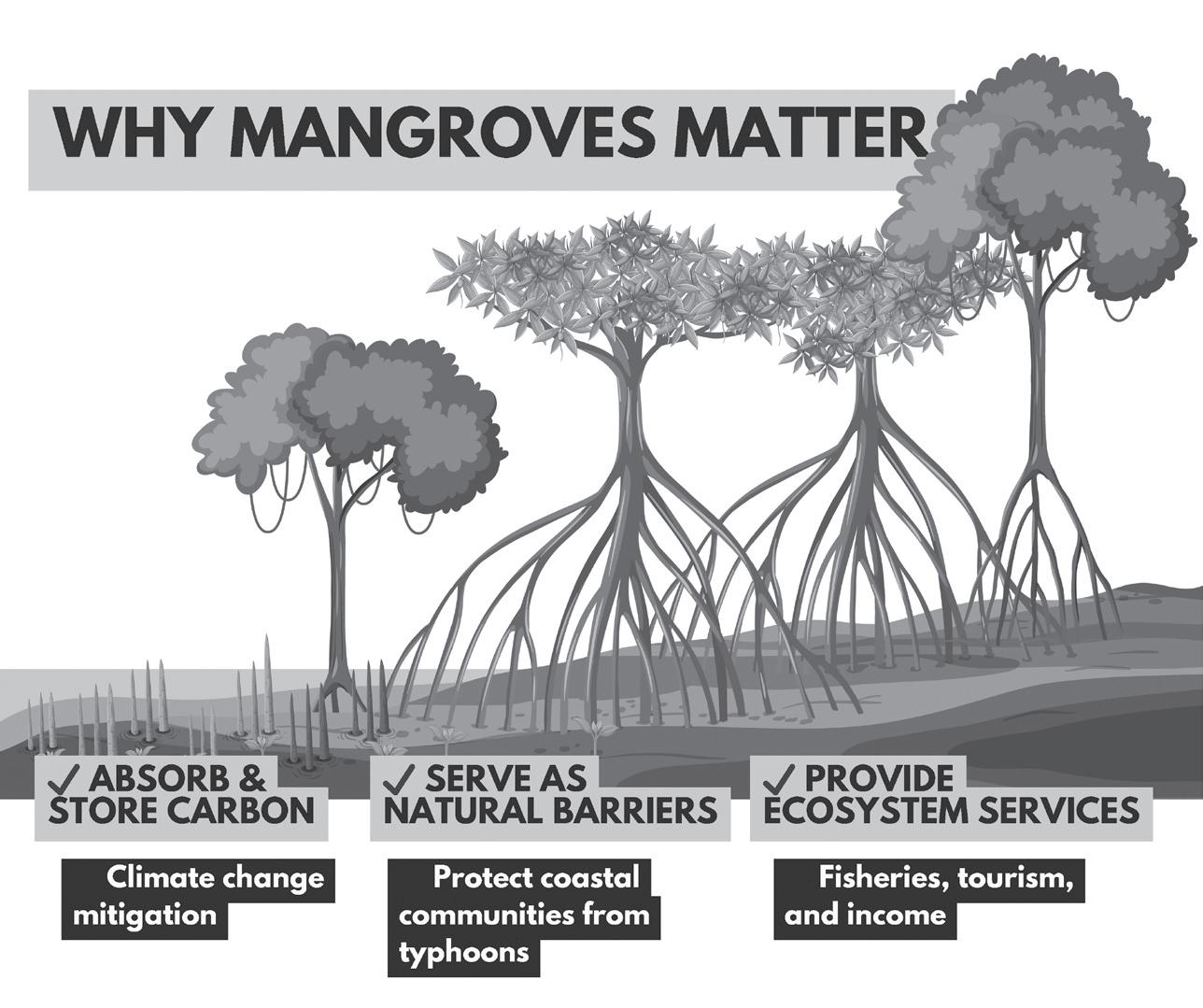
WITH sea levels expected to rise by 0.4 meters in the western Philippines by 2060, environmental scientists and academic leaders are pushing the immediate prioritization of blue carbon ecosystems, such as mangroves, to counter the impacts of climate change. This, while emphasizing the need for a policy roadmap that outlines conservation strategies, enterprise opportunities, financial support, communication initiatives, and community and biodiversity benefits.
At a recent press conference for the launch of the Philippines’ National Blue Carbon Action Partnership (NBCAP), Dr. Severino Salmo II, a restoration ecologist and associate professor at the UP Diliman Institute of Biology, emphasized the importance of conserving and restoring mangroves to ensure a steady supply of ecosystem services, including food, tourism, livelihood, and income.
“The good thing about blue carbon is that it directly contributes to climate change adaptation and mitigation,” Salmo said, explaining that effective mangrove management leads to better blue carbon outcomes. Conversely, he warned that neglecting conservation efforts would result in reduced carbon storage, contributing to greenhouse gas emissions. Salmo expressed optimism about the NBCAP, describing it as a strategic platform to showcase the Philippine government and communities’ contributions to global climate change adaptation. He emphasized that prioritizing conservation should be linked to biodiversity hotspots, citing areas like Surigao, Siargao, Palawan, and Tawi-Tawi. However, he also noted that regions like Palawan and Isabela, though understudied, could hold significant carbon stock potential.

“future-proof,” warning that delays in conservation would make restoration more challenging.
“We need to start preparing now while we still have mangroves to protect us,” Gevaña said.
Dr. Dixon T. Gevaña, a professor and UP scientist from the Department of Social Forestry and Forest Governance, echoed the urgency of safeguarding coastal ecosystems. He emphasized the need to “move smart” to become
Gevaña pointed out that the race against environmental degradation is not limited to the Philippines, as other countries are also grappling with the challenge. He observed that many nations prioritize seawalls and other infrastructure over natural barriers like mangroves, which remain a more sustainable option.
“That’s the problem. We are in
a race—nature and green solutions versus degradation,” he said, advocating a shift in coastal protection strategies.
He also highlighted the need to rehabilitate abandoned fishponds, which, under existing laws, should be reverted to mangroves. However, he acknowledged the complexities of implementing this due to overlapping government priorities.
“We’re talking about at least three or more departments with stakes in these coastal areas,” he explained. “Through the NBCAP, pushing for this prioritization re-
mains a major challenge.”
“Above all, there should be non-negotiable areas dedicated to conservation as a green belt,” he emphasized.
Led by the Department of Environment and Natural Resources (DENR) and supported by the Zoological Society of London (ZSL) as the secretariat, the NBCAP is part of the World Economic Forum’s Ocean Action Agenda, backed by the Blue Planet Fund. The initiative aims to strengthen coastal communities’ resilience by protecting and restoring blue carbon ecosystems, including

mangroves and seagrasses.
“These ecosystems are essential not only for climate resilience and biodiversity but also for the livelihoods of countless communities that depend on their health and sustainability,” said Jonas Leones, DENR Undersecretary for Policy, Planning, and International Affairs, during his opening remarks.
Leones recalled that last year, the DENR established strategic partnerships that advanced the blue carbon conservation roadmap. Notably, it collaborated with the Philippine Space Agency to create a comprehensive geo-database for environmental and natural resources. This collaboration, he said, led to the development of a nationwide mangrove extent map for 2020, which continues to be updated through citizen sciencebased ground validation.
“Later this year, we plan to expand this initiative by mapping the extent of our country’s seagrass and coral reef ecosystems,” Leones added.
‘Living document’ MEANWHILE, Edwina D. Garchitorena, country director of the ZSL, said the roadmap under the NBCAP must be completed before June this year.
“While it does not have to be perfect, it should serve as a foundation that can be refined over time,” she said, noting that the roadmap is designed as a “living document” that evolves as it is implemented.
She also highlighted the importance of aligning the roadmap with international climate commitments, particularly the United Nations Framework Convention on Climate Change (UNFCCC) targets for 2030.
This involves setting specific goals, such as the extent of mangrove conservation and restoration, estimating carbon sequestra-
tion, and determining greenhouse gas reduction targets. Although specific figures for greenhouse gas reductions are not yet determined, she expressed optimism that these would be integrated soon.
Regarding localization, she explained that the roadmap will serve as a general framework adaptable to different regions. Given that environmental challenges vary by area, the approach will involve prioritizing local needs and opportunities.
This is why stakeholders, including local government representatives, are involved—to tailor the roadmap based on specific regional conditions, Garchitorena said.
‘More cooperation than competition’ ASKED by the BusinessMirror about the Philippines’ current standing in blue carbon conservation and restoration compared to other Southeast Asian nations, experts said the country is consistent with its initiatives but struggles with sustainability.
The Philippines made significant progress until around 2015 or 2016, but Indonesia has since surpassed it. Despite this, the country still maintains a head start in terms of documented efforts. One key factor that sets Indonesia apart is its participation in the carbon trading platform, which is reliant on accurate carbon stock assessments.
Dr. Salmo explained that the country faces challenges in this area due to its archipelagic geography, making comprehensive evaluations difficult. Despite these challenges, he recognized that In-
donesia also faces complex cultural and societal factors but has managed to advance more rapidly.
“In terms of efforts, we were leading in Southeast Asia at one point, but now we’re lagging behind Indonesia,” Dr. Salmo admitted. Malaysia and Thailand might soon overtake the Philippines, he said, and advocated action to keep pace with Indonesia.
From a science perspective, Dr. Gevaña emphasized that the Philippines started documenting carbon stocks as early as 2004, even before the term “blue carbon” was coined in 2009. He pointed out that the country is not lagging in research and community-based studies on blue carbon governance.

However, the challenge lies in translating these studies into actionable blue carbon projects.
Meanwhile, Garchitorena explained that the country was one of the first to implement the NBCAP. Currently, Indonesia and Vietnam are at a similar stage in terms of partnership development and roadmaps for blue carbon initiatives. She emphasized the importance of collaboration with neighboring countries, particularly Indonesia and Vietnam, given their similar programs.
She also noted that blue carbon conservation in Southeast Asia is more about cooperation than competition. Asean nations, including the Philippines, are exploring the possibility of creating a regional mangrove or blue carbon roadmap. She acknowledged that while Indonesia is currently leading, other countries are navigating their own policy challenges.
“It’s more of a cooperative effort,” she explained, adding that the ultimate goal is for Asean countries to collaborate on shared environmental resources, such as interconnected habitats and fish stocks.
“That’s the dream,” she said. Mangrove economics
DR. Yasmin Primavera-Tirol, dean of the College of Fisheries and Marine Science at Aklan State University, emphasized the need for unified action among government agencies to advance blue carbon conservation and management in the country.
She stressed the importance of clearly defining objectives, such as whether the priority is fish production or long-term sustainability. Dr. Tirol pointed out that aquaculture ponds planted with 20 percent to 80 percent mangroves have lower risks compared to those without, especially in the face of more frequent and intense typhoons brought about by climate change.
“You can project your sustainability and ROI for a longer number of years,” she said, highlighting the protective benefits of mangroves.
Dr. Tirol underscored the need to persuade stakeholders by presenting pilot studies or business models that demonstrate the economic value of blue carbon initiatives.
She suggested exploring alternative income sources such as carbon credits, biodiversity credits, or bonds through local government units.
“The key is to have the economics of it,” she said, emphasizing that economic incentives could encourage stakeholders to invest in blue carbon conservation and management.
Asked about the cost per hectare to plant, restore, or maintain mangroves, seagrasses, and salt marshes in the Philippines, Dr. Salmo explained that expenses vary depending on the restoration approach used.
He noted that natural restoration, which involves leaving an abandoned area to recover on its own, is the least expensive option as it is essentially cost-free. However, this method can take around 20 to 25 years for the ecosystem to
fully recover. In contrast, more challenging sites—such as those with damaged soil or lacking natural sources of seedlings—require more intensive and costly measures. This may involve engineering solutions like removing barriers and reconnecting hydrological systems, which expedite recovery but come with higher costs.
Dr. Salmo cited historical data: in 1995, restoration costs were approximately at P10,000 per hectare. However, expenses have significantly increased since then. He estimated current costs to range from P50,000 to over P100,000 per hectare, depending on the site and method used.
Garchitorena also highlighted the hybrid approach—a combination of planting and green infrastructure. She shared an example from ZSL’s site in Ajuy, Iloilo, where the community collaborated with engineers to build a temporary seawall that promoted soil accumulation before planting mangroves.
“This approach not only restored the ecosystem but also provided a sheltered area for local boats,” she said. She added that restoration is not a one-time investment. It also involves community capacity building, continuous monitoring, and maintenance to ensure the long-term survival of the restored ecosystems.
Innovative financing for blue carbon conservation DURING the panel discussion, Dr. Reuben Clements, Sustainable Finance Specialist at ZSL, outlined several innovative approaches that could help fund conservation efforts.
One potential strategy involves generating carbon credits by converting abandoned fish ponds back into mangrove areas. According to feasibility analyses, this approach shows promise as a viable revenue stream.
Dr. Clements also discussed the possibility of creating Mangrove Credits or Certificates, which involves calculating the cost of protecting a specific area over a period of time and dividing that by the number of years. This could generate a fixed amount in US dollars per hectare for up to 30 years.
Another approach is payment for performance mechanisms, where funding is allocated based on the achievement of specific conservation outcomes. This model involves long-term financial support from private companies to safeguard ecosystems.
Lastly, he highlighted the potential of developing an Outcome Bond for mangroves, inspired by ZSL’s Rhino Bond used in South Africa. This financial model involves investors funding restoration projects with the promise of returns based on measurable conservation outcomes. He noted that this model could also integrate carbon credits to create additional revenue streams.
Dr. Clements expressed hope that a similar Mangrove Impact Bond could be introduced in the Philippines to support long-term mangrove restoration and conservation initiatives.
Mangroves shield and sustain
THE importance of prioritizing blue carbon ecosystems, particularly mangroves, is underscored by the success of community-led conservation efforts in Aklan.
Tirol shared the case of the Bakhawan Eco-Park in Kalibo, where local residents began planting mangroves in the late 1980s to protect their homes from typhoons, strong winds, and storm surges. Over the years, the initiative evolved into a protected ecotourism site which provides both livelihood opportunities and food security through the harvesting of shellfish, crabs, and fish farming.
With the implementation of the Blue Carbon Project, she said the mangrove coverage in the
area has expanded nearly tenfold, demonstrating the effectiveness of long-term conservation efforts. The project also allowed researchers to analyze how hydrological patterns and sediment flow impact not just Kalibo’s coastline but also neighboring municipalities. Tirol noted that some of these effects are not always beneficial, highlighting the need for adaptive and collaborative management to address interconnected coastal challenges.
She emphasized that addressing these issues requires a broader, integrated approach, pointing to the establishment of Aklan’s Rivers and Coast Integrated Management Council. This initiative aims to unite municipalities in tackling problems like coastal erosion and flooding, which may appear isolated but are actually interrelated when viewed on a larger scale.
For Tirol, conserving blue carbon ecosystems is not just about carbon credits or economic sustainability—it is about ensuring daily survival.
She emphasized that while weather forecasts can now predict typhoons up to two weeks in advance, people on the ground continue with their daily routines, often uncertain about their level of preparedness.
Tirol stressed the urgency of institutionalizing disaster preparedness into local governance, as most local government budgets focus on response rather than prevention.
“More than anything, we need strong communication and collaboration among communities, stakeholders, government agencies, and academic institutions to ensure science-based and community-led conservation and management of blue carbon ecosystems,” she said.
Adding to this perspective, Garchitorena emphasized the role of traditional knowledge in coastal management, noting that it is often local wisdom that prompts communities to seek conservation assistance. She acknowledged a case shared by Tirol, where community members understood that planting mangroves would protect their homes and improve food security. However, Garchitorena stressed the need for better documentation of these community insights, as much of the evidence supporting improved food security and fisheries from mangrove conservation remains anecdotal.
She illustrated how community knowledge could enhance scientific methods by sharing an example from ZSL. When the organization introduced a scientific germination process for Pagatpat, a mangrove species, the initial success rate was low. Collaborating with local communities, they discovered a way to shorten the germination period and increase success rates.
“This is where we need to engage with communities and exchange knowledge both ways. They can definitely improve on what science identifies,” Garchitorena explained.
Dr. Gevaña supported this approach, noting that while traditional knowledge forms the foundation of many conservation practices, the increasing complexity of environmental challenges requires scientific innovation.
“We’re not erasing traditional methods; we’re enhancing them to address more complicated problems,” he explained. Gevaña emphasized that the shift toward science-based approaches is crucial as environmental challenges have evolved due to climate change and human activities.
“Many of the successful approaches were actually traditional, but we need to innovate without fully erasing those very good narratives,” Gevaña concluded, underscoring the importance of integrating traditional wisdom with modern science to effectively manage and conserve blue carbon ecosystems.

By Lorne Cook The Associated Press
BRUSSELS—Over the last five years, European Union countries have been forced to adapt to unprecedented circumstances. They pulled together to purchase tens of millions of vaccines and devised an innovative debt financing scheme to resuscitate their Covid-19-ravaged economies.
After President Vladimir Putin ordered his troops into Ukraine three years ago and hiked energy prices to weaken Western support, the 27 nations weaned themselves off a dependency on Russian natural gas in record time. Now, they face the challenge of ending their reliance on the United States to provide security.
In recent weeks, senior Trump administration officials have made clear that US priorities lie elsewhere—in Asia and along America’s southern border—and that Europe should take care of itself, including Ukraine.
“For me, the absolute priority will be to strengthen Europe as quickly as possible so that we can really achieve independence from the US step by step,” Friedrich Merz, the likely next chancellor of Germany, told broadcaster ZDF after winning Sunday’s election.
“I never thought I would have to say such a thing on a television program,” Merz said, admitting surprise at apparent American indifference to the fate of Europe.
Despite being sidelined from Ukraine peace talks, he and other EU leaders appear determined to adapt to the new security realities. But it’s unclear whether they can drum up the military and financial resources, or muster the political will, to defend their interests.
Europe’s yawning security gap
NATO believes allies should spend at least 2 percent of gross domestic product on their defense budgets.
Two EU heavyweights, Italy and Spain, do not come close. Nor do Belgium, Croatia, Luxembourg, Portugal and Slovenia.
NATO Secretary-General Mark Rutte has said member countries probably should spend 3.5 percent
to 3.7 percent to execute the alliance’s plans for defending Europe. Russia, Rutte worries, could be capable of mounting an attack on a European country by the end of the decade.
Those defense plans include US participation. Without US forces, the Bruegel think tank in Brussels estimates, Europe could need 300,000 troops and an annual spending hike of at least 250 billion euros ($262 billion) to deter Russia.
Bruegel said stopping a Russian advance might require 1,400 tanks, 2,000 infantry fighting vehicles and 700 artillery pieces. “This is more combat power than currently exists in the French, German, Italian and British land forces combined,” it said.
In Ukraine alone, President Volodymyr Zelenskyy has called for 150,000 European troops to ensure the conflict doesn’t flare up again after a ceasefire, but Europe’s armies are too small. One proposal would see fewer than 30,000 European troops on the ground, backed by air and sea power. Finding even that many poses a challenge.
The funding predicament
Defense spending throughout Europe has gone up since Russia’s invasion began in earnest. Much is spent on weapons to keep Ukraine in the fight and back fill depleted European stocks, but demand is driving up prices.
Europe lacks military transport and logistics chains. Manpower shortages abound. The continent’s combined armies total around 2

million personnel but few can be effectively deployed. Talk of conscription is mounting.
To help address shortfalls, the European Commission is easing its fiscal rules so EU member countries can spend more on defense, at least temporarily. It’s not a magic bullet but could provide an incentive to boost military budgets. It remains to be seen whether Merz will soften Germany’s opposition to EU defense bonds. As with Europe’s post-pandemic recovery, this would use joint borrowing to provide grants and low-interest loans. France, Italy, Poland and Spain already support defense bonds.
On March 19, the commission will unveil its “white paper” containing ideas for major military
projects, ways to boost Europe’s defense industry, and how to fund it all.
Long term, the EU’s next sevenyear budget will reorient spending toward security.
“The appetite to debate seriously the question of the defense capabilities of Europe is back,” EU Budget Commissioner Piotr Serafin said last week. But he warned that the impact of the new budget might only be felt in 2030, so any action on defense “should take place now.”
Political will, that rare European commodity FINDING money to adapt to the new security reality poses huge challenges. Also in short supply is the political courage and unity
required to confront an adversary like Russia. Europe has relied on a US security umbrella for decades and old habits die hard.
The EU “cannot become a truly regional and global actor without a relevant military dimension,” former EU Council President Herman Van Rompuy said in 2016, before Donald Trump became US President for the first time.
Getting 27 countries to agree has never been easy, and more than eight years on, Europe is arguably at its weakest as the steady rise of a hard right that is often proRussian undermines the old order. Merz may bring stability to Germany, even though the far right came second in elections there. But France’s latest government is fragile. Spain relies on small parties to keep its coalition intact, and the Dutch cabinet dominated by hardright leader Geert Wilders is shaky. Poland appears strong under Prime Minister Donald Tusk. However, a presidential election looms and a right-wing candidate is well placed. Belgium just got a new government after long months of wrangling.
Italy is probably most stable but also somewhat unpredictable, under Premier Georgia Meloni, whose ruling party has neo-fascist roots. Among smaller countries, Hungary and Slovakia have proved disruptive, undermining EU support for Ukraine.
Only a shared understanding of the security threat that Europe faces is likely to spark real action. Geir Moulson in Berlin and Raf Casert in Brussels contributed to this report.
By Gary Fields & Ellen Knickmeyer
The Associated Press
ASHINGTON—US
WAgency for International Development workers—many in tears—carted away belongings through cheering crowds in a final visit to their nowclosed headquarters Thursday as the Trump administration’s rapid dismantling of the congressionally authorized agency moved into its final stages. Notices sent out in mass mailings this week are terminating over 90 percent of USAID’s contracts for humanitarian and development work around the world, and the Supreme Court has temporarily blocked a judge’s order requiring the administration to release billions of dollars in foreign aid.
The administration notified most USAID staffers in recent days that they were on leave or being fired, then gave thousands of those who worked in the Washington headquarters 15-minute time slots to clear out their desks under the escort of federal officers. Some staffers wept as they carried out grocery bags and suitcases with what was left from their life’s work.
“Heartbreaking,” 25-year-old Juliane Alfen said, carrying a small bag with a stuffed rabbit sticking out. Like hundreds of colleagues, Alfen received a form notice Monday that her firing “was in the best interest of government.”
“I felt like we made a difference,” Alfen said. “To see everything disappearing before our eyes in a matter of weeks is very scary.”
Supporters shouted encouragement and waved signs outside or

drove by tapping their car horns. A little girl stood next to her mother holding a handwritten sign saying, “I am proud of you Daddy.”
A woman who left the building loaded down with bags burst into tears at the cheers greeting her. A small crowd enveloped her in hugs. USAID has been one of the biggest targets of a broad campaign by President Donald Trump and cost-costing chief Elon Musk’s Department of Government Efficiency, or DOGE, to slash the size of the federal government. Their actions have left only a small fraction of USAID employees on the job, slashed $60 billion in assistance overseas and upended decades of US policy that foreign aid helps American interests abroad by stabilizing other countries and building alliances.
Trump and Musk have called USAID programs out of line with the Republican president’s agenda and asserted without evidence that its work is wasteful. In ad -
dition to its scope, the effort is extraordinary because it has not involved Congress, which authorized the agency and has provided its funding.
Already, organizations reported that thousands of USAID contracts for HIV programs in South Africa were permanently canceled. And despite an assertion from Musk that funding to fight Ebola outbreaks had been restored, The Associated Press obtained a termination notice for a project by the Baylor College of Medicine Children’s Foundation that was poised to respond to Ebola cases in Uganda.
Others warned of profound strategic implications from USAID’s shutdown.
“The American people deserve a transparent accounting of what will be lost—on counterterror, global health, food security, and competition,” Liz Schrayer, head of the US Global Leadership Coalition, a nonprofit that promotes
US diplomatic and humanitarian efforts, said in a statement.
Devon Behrer, a USAID worker hired just three months ago, said helping carry out that work had always been her dream.
“My plan was to come here and go into development work. My plan went up in smoke Monday,” she said.
The way people’s lives were being swept away was “incredibly disrespectful,” Behrer, 34, added. “There seems to be a lack of acknowledgment that we’re human.”
Staffers had pressed for weeks for permission to reenter the building to collect work shoes, family photos and other belongings. Some took flowers from a bucket on their way inside to place at a memorial wall honoring 99 USAID workers killed in the line of duty over the agency’s six decades. Staffers said security stopped them from placing the flowers.
Randy Chester, vice president of the American Foreign Service Association, a union representing USAID staffers, said he and others gathered outside “to say thank you for your service. We appreciate everything you’ve done and all the sacrifices you’ve made in service to your country.”
His is among several groups suing the Trump administration over the staff cuts and more than monthlong freeze on foreign assistance. While the administration’s efforts to slash the size of the federal government are embroiled in various lawsuits, court challenges to halt the shutdown of USAID have been unsuccessful so far.
Late Wednesday, the Supreme Court temporarily blocked a judge’s order that had given the Trump administration a deadline this week to release billions of dol -
lars in foreign aid. Chief Justice John Roberts said that order will remain on hold until the high court has a chance to weigh in more fully.
The court’s late-night intervention is a temporary step as the justices consider the case, but their eventual determination could be pivotal in the increasingly fraught legal battles playing out nationwide.
It halted a decision from a federal judge who said the administration had given no sign of complying with his nearly two-week-old order to pause the funding freeze. Trump paused foreign aid in an executive order on his first day in office.
A report from the Congressional Research Service this month said congressional authorization is required “to abolish, move, or consolidate USAID.” Republicans, who hold slim majorities in the House and the Senate, have made no pushback against the administration’s actions.
That includes placing 4,080
staffers who work across the globe on leave Monday. That was joined by a “reduction in force” affecting an additional 1,600 employees, a State Department spokesman said.
It’s unclear how many of the more than 5,600 USAID employees who have been fired or placed on leave work in Washington. A notice on the agency’s website said staff at other locations will have the chance to collect their personal belongings at a later date.
Virginia Democratic Rep. Gerald Connolly said in a statement that targeting USAID employees was “unwarranted and unprecedented.”
Connolly, whose district includes a sizable federal workforce, said they’re part of the “world’s premier development and foreign assistance agency” who save “millions of lives every year.”
contributed.

By Anne D’innocenzio & Haleluya Hadero Ap Business Writers
YORK—A grassroots organization is encouraging US residents not to spend any money Friday as an act of “economic resistance” to protest what the group’s founder sees as the malign influence of billionaires, big corporations and both major political parties on the lives of working Americans.
The People’s Union USA calls the 24 hours of spending abstinence set to start at midnight an “Economic Blackout,” a term that has since been shared and debated on social media. The activist movement said it also plans to promote weeklong consumer boycotts of particular companies, including Walmart and Amazon.
Other activists, faith-based leaders and consumers already are organizing boycotts to protest companies that have scaled back their diversity, equity and inclusion initiatives, and to oppose President Donald Trump’s moves to abolish all federal DEI programs and policies. Some faith leaders are encouraging their congregations to refrain from shopping at Target, one of the companies backing off DEI efforts, during the 40 days of Lent that begin Wednesday.
Here are some details about the various events and experts’ thoughts on whether having consumers keep their wallets closed is an effective tool for influencing the positions corporations take.
Who’s behind the ‘24-hour Economic Blackout?’
THE People’s Union USA, which takes credit for initiating the no-spend day, was founded by John Schwarz, a meditation teacher who lives near the Chicago area, according to his social media accounts.
The organization’s website said it’s not tied to a

political party but stands for all people. Requests for comment sent to the group’s email address this week did not receive a reply.
The planned blackout is scheduled to run from 12 a.m. EST through 11:59 p.m. EST on Friday.
The activist group advised customers to abstain from making any purchases, whether in store or online, but particularly not from big retailers or chains. It wants participants to avoid fast food and filling their car gas tanks, and says shoppers with emergencies or in need of essentials should support a local small business and try not to use a credit or debit card.
People’s Union plans another broad-based

economic blackout on March 28, but it’s also organizing boycotts targeting specific retailers—Walmart and Amazon—as well as global food giants Nestle and General Mills. For the boycott against Amazon, the organization is encouraging people to refrain from buying anything from Whole Foods, which the e-commerce company owns.
What other boycotts are being planned?
There are a number of boycotts being planned, particularly aimed at Target. The discounter, which has backed diversity and inclusion efforts aimed at uplifting Black and LGBTQ+ people in the past, announced in January it was rolling back its DEI initiatives.
A labor advocacy group called We Are Somebody, led by Nina Turner, launched a boycott of Target on February 1 to coincide with Black History Month.
Meanwhile, an Atlanta-area pastor, the Rev. Jamal Bryant, organized a website called targetfast.org to recruit Christians for a 40-day Target boycott starting March 5, which marks Ash Wednesday, the beginning of Lent. Other faith leaders have endorsed the protest.
The Rev. Al Sharpton, founder and president of the National Action Network, a civil rights organization, announced in late January it would identify two companies in the next 90 days that will be boycotted for abandoning their diversity, equity and inclusion pledges. The organization formed a commission to identify potential candidates.
“Donald Trump can cut federal DEI programs to the bone, he can claw back federal money to expand diversity, but he cannot tell us what grocery store we shop at,” Sharpton said in a statement posted on the National Action Network’s website.
Will the events have any impact?
Some retailers may feel a slight pinch from Friday’s broad “blackout,” which is taking place in a tough economic environment, experts said. Renewed inflation worries and Trump’s threat of tariffs on imported goods already have had an effect on consumer sentiment.
“The (market share) pie is just so big,” Marshal Cohen, chief retail advisor at market research firm Circana, said. “You can’t afford to have your slices get smaller. Consumers are spending more money on food. And that means there’s more pressure on general merchandise or discretionary products.”
Still, Cohen thinks the overall impact may be limited, with any meaningful sales declines more likely to surface in liberal-leaning coastal regions and big cities.
Anna Tuchman, a marketing professor at Northwestern University’s Kellogg School of Management, said she thinks the economic blackout will likely make a dent in daily retail sales but won’t be sustainable.
“I think this is an opportunity for consumers to show that they have a voice on a single day,” she said. “I think it’s unlikely that we would see long-run sustained decreases in economic activity supported by this boycott.”
Other boycotts have produced different results.
Target saw a drop in sales in the spring and summer quarter of 2023 that the discounter attributed in part to customer backlash over a collection honoring LGBTQ+ communities for Pride Month. As a result, Target didn’t carry Pride merchandise in all of its stores the following year.
Tuchman studied the impact of a boycott against Goya Foods during the summer of 2020 after the company’s CEO praised Trump. But her study, based on sales from research firm Numerator, found the brand saw a sales increase driven by first-time Goya buyers who were disproportionately from heavily Republican areas. However, the revenue bump proved temporary; Goya had no detectable sales increase after three weeks, Tuchman said.
It was a different story for Bud Light, which spent decades as America’s bestselling beer. Sales plummeted in 2023 after the brand sent a commemorative can to a transgender influencer. Bud Light’s sales still haven’t fully recovered, according to alcohol consulting company Bump Williams.
Tuchman thinks a reason is because there were plenty of other beers that the brand’s mostly conservative customer base could buy to replace Bud Light.
Afya Evans, a political and image consultant in Atlanta, said she would make a point of shopping on Friday but will focus on small businesses and Blackowned brands.
Evans is aware of other boycotts but she said she liked this one because she believes it could have some effect on sales.
“It’s a broader thing,” she said. “We want to see what the impact is. Let everybody participate. And plan from there.”

By John Eiron R. Francisco
FILIPINO researchers and entrepreneurs face major challenges in turning their innovations into commercially viable products, including difficulties in developing market-ready solutions, navigating intellectual property (IP) concerns, and securing financial resources.
The Department of Science and Technology’s (DOST) program Propel aims to address this situation, according to Assistant Secretary Napoleon K. Juanillo for Technology Transfer, Communication, and Commercialization.
In an email interview with the BusinessMirror, Juanillo explained that Program Propel is designed to assist local scientists, innovators, startups, and other stakeholders in transforming their ideas into marketready products.
An earlier news release said “the program seeks to bridge the divide between groundbreaking research and market-ready solutions, positioning Philippine innovations to compete effectively globally.”
Juanillo pointed out to the BusinessMirror that many startups struggle with bridging the gap between research and market demands. Despite having promising innovations, they often fail to align their technologies with business or consumer needs, a challenge further compounded by limited collaboration with industry players.
“With these challenges, Propel would assist innovators through Technology Readiness Level [TRL] and Market Readiness Level [MRL] assessments,” he said. Beyond product development, he
emphasized that intellectual property (IP) concerns remain a major obstacle for startups. Conflicts over IP ownership and the complexities of patenting often prevent innovators from fully securing their rights and gaining a competitive edge.
Juanillo said that Propel aims to provide legal support to navigate IP concerns to ensure innovators can protect and maximize the value of their technologies.
Another major barrier for startups is securing financial backing to scale up their businesses. While product development and IP management are critical, these processes require significant investment—something many local innovators struggle to obtain, Juanillo pointed out.
“The program Propel would also want to help the participants in finding the right investors for their specific technology or innovation,” he added.
Anchored on the Philippine Development Plan 2023-2028, Propel integrates existing DOST programs with new strategies to create a comprehensive one-stop-shop platform that streamlines technology commercialization.
Propel includes the following menu of core components: market-driven research and development; Juan2Know DOST knowledge banks; science and industry network; customer, market, and trade intelligence portals; systems and regulatory portals; Technology Readiness Level (TRL) and Market Readiness Level (MRL) assessments; science, technology and innovation laboratory and facilities network; intellectual property management; legal support; tiered seed funding; physical spaces and other support; technology

business incubation and business sustainability mentorships; and spinout management with access to local and global funding networks.
Comprehensive support innovation
TO bridge the gap between research and market-ready solutions, Propel offers comprehensive support, including business model development, technology and market validation, legal guidance, and access to both local and international venture capital networks.
Juanillo explained that the initiative would also provide mentorship and resources through the Propel Enterprise Development Program, which includes:
n End-to-end innovation support, guiding participants from idea development to commercialization, ensuring they receive assistance at
every stage
n Industry connections, linking researchers, scientists, and entrepreneurs with business and industrial networks to create opportunities for funding, collaboration, and market entry
n Risk assessment and management, helping participants identify critical development pathways and minimize potential obstacles n Technology transfer and commercialization strategies, advising participants on whether to license their technology or establish a spinoff company to optimize market potential.
Business planning assistance, ensuring participants develop sustainable business models for long-term success.
Skills development through the Propel Enterprise Academy, provid -
DENGUE cases in the country are currently on the rise, with numbers being 40 percent higher compared to the same period last year, the Health department reported. In response to the viral infection that spreads through mosquito bites, a research on mosquito repellent may be an answer to this concern.
Experts from the Department of Science and Technology-Forest Products Research and Development Institute (DOST-FPRDI) have looked at the potential of cinnamon barks, and pili and almaciga resins made into incense cones and sticks as insect repellent. The materials used for the repellent are residues or wastes from essential oil production, and naturally possess insectrepelling properties.

detected from the smoke emitted by the incense products suggests the potential of the incense formulations as disinfectant, fungicide and pesticide. Further studies may be conducted to optimize their application for such products,” explained Forester Florena B. Samiano, leader of the Institute’s Flavors and Fragrances from the Forest Technology Program.
DOST-FPRDI Director Rico J. Cabangon said: “The Philippine forests are replete with natural resources that can help combat dengue and other viral diseases.
This prompted DOST-FPRDI researchers to optimize the use of aromatic raw materials by transforming spent cinnamon barks, almaciga and pili resin, and hydrosol into incense.
“Through a circular economy approach, the DOST-FPRDI has initiated converting wastes into valuable products as an opportunity to reduce environmental harm while creating income-generating projects. This also provides natural alternatives to chemical insect repellents,” Samiano said.
ing training in entrepreneurship and business management through interactive learning with industry experts.
Sustainability and growth strategies, helping startups and spin offs establish strong foundations for longterm viability in competitive markets.
Asked whether the existing Science for Change Program (S4CP)— which includes initiatives like Collaborative R&D to Leverage PH Economy (Cradle), Niche Centers in the Regions for R&D (Nicer), Research and Development Leadership (RDLead), and Business Innovation through S&T (BIST)—was insufficient in supporting commercialization, the Assistant Secretary clarified: “S4CP primarily focuses on research aimed at building the country’s long-term innovation capacity.”
In contrast, ”Propel is specifically designed to help innovators bring their technologies to market,” he further explained.
“This program will help them gain exposure and increase their global market access,” Juanillo explained. He added that Innovation Hubs (I-Hubs)—which are being established in various regions across the country—will also serve as Propel resources that provide wider national and international networking opportunities for startups. To measure its success, Propel will use comprehensive quantifiable indicators, including:
1. Participation and Engagement: Tracking the number of S&T ventures and DOST units involved in Propel’s Enterprise Development and Innovation Management Program, as well as participant engagement and satisfaction levels.
2. Funding and Resource Generation: Monitoring the amount of funding and resources allocated to participating ventures.
3. Capacity Building: Assessing the number of participants completing training programs and measuring their knowledge and skill improvements through pre- and post-training assessments.
Juanillo emphasized that periodic program reviews and feedback mechanisms from startups, mentors, and stakeholders would be implemented to evaluate Propel’s progress.
“These activities will provide information on areas for improvement and future iterations of the program,” he said.
With continuous monitoring and data-driven decision-making, Propel aims to ensure that its objectives are met, ultimately propelling participating S&T enterprises toward sustained growth and global competitiveness.

“DOST is one with the nation in finding ways to curb the ‘worrisome rise’ of dengue cases. The Department has consistently and actively contributed to addressing health concerns through R&D [research and development], technological advancements, and community-based interventions. As dengue cases continue to soar, so does the need for sustainable solutions to it,” DOST Secretary Renato U. Solidum Jr. pointed out. After testing the formulations, the produced incense cones and sticks showed high potential to ward off mosquitoes and houseflies. The chemical components were analyzed to identify repellent substances and sources of the scents.
Through DOST-FPRDI’s expertise and years of extensive research on forest products, we continue to harness the potential of wood and non-wood products to address pressing concerns of the nation.”
Common in tropical countries like the Philippines, the dengue virus is passed on to humans by infected mosquitoes.
Green and sustainable
“The presence of creosol and furfural
DURING the production of essential oils, volumes of residue usually go to waste such as spent barks, leaves, resins and hydrosols.
“While initial study has shown the DOST-FPRDI-formulated incense to be effective, further sensory and acceptability testing of the products, and industry-scale application, are recommended,” she added.
The DOST-FPRDI, a R&D arm of the DOST, is at the forefront of scientific research on wood and non-wood utilization and conservation, pioneering initiatives that promote the responsible use of forest resources while safeguarding the biodiversity. Apple Jean C. Martin-de Leon/S&T Media Service


RANSPARENT aluminum oxide
(TAlOx), a real material despite its sci-fi name, is incredibly hard and resistant to scratches, making it perfect for protective coatings on electronics, optical sensors, and solar panels.
On the sci-fi show Star Trek, it is even used for starship windows and spacefaring aquariums.
Current methods of making TAlOx are expensive and complicated, requiring high-powered lasers, vacuum chambers, or large vats of dangerous acids.
That may change, thanks to research co-authored by Filipino scientists from the Ateneo de Manila University (AdMU).
Instead of immersing entire sheets of metal into acidic solutions, the researchers applied microdroplets of acidic solution onto small aluminum surfaces and applied an electric current.
Just two volts of electricity—barely more than what’s found in a single AA household flashlight battery—was all that was needed to transform the metal into glass-like TAlOx, said an AdMU news release.
This process, called “droplet-scale anodization,” is not only simpler than existing manufacturing methods but also environmentally friendly, cutting
down on chemical waste and energy use. The technique relies on a special effect called “electrowetting,” where an electric field changes the properties of a liquid droplet, allowing precise control over the anodization process. This new approach might make TAlOx cheaper and more accessible for applications in everything from touchscreens and lenses to ultra-durable coatings for vehicles and buildings. It could also lead to advances in miniaturized electronics, as scientists now have a way to convert metal surfaces into insulating, transparent layers on a microscopic scale. The breakthrough research, “DropletScale Conversion of Aluminum into Transparent Aluminum Oxide by LowVoltage Anodization in an Electrowetting System,” was published in the
A6 Sunday, March 2 , 2025

By Nicole Winfield & Silvia Stellacci
ROME—Pope Francis continued to improve from double pneumonia as of late Thursday, the Vatican said, working from his hospital room and going to his private chapel to pray, though doctors said he needs more days of “clinical stability” before they revise their guarded prognosis.
The 88-year-old pope, who had part of one lung removed as a young man, was able to begin alternating high-flow supplemental oxygen, delivered by a nasal tube, with a mask in a sign of his improved respiratory condition, the Vatican said in a late update.
For the second day in a row, doctors avoided saying Francis was in critical condition.
But they said that given the complexity of his lung infection, “further days of clinical stability are needed” before they revise their prognosis and decide he is out of danger.
Francis has been in Rome’s Gemelli hospital since February 14 after a bout of bronchitis worsened.
He has shown steady, albeit slight improvements since a respiratory crisis and kidney trouble over the weekend sparked fears for his life.
The improvements, as he nears the two-week mark on Friday, beat back speculation of an imminent death, resignation or conclave and signaled that he was still very much in charge.
Upcoming calendar in question
NEVERTHELESS , his near-term upcoming calendar of events was being changed: The Vatican cancelled a Holy Year audience
scheduled for Saturday, and it remained to be seen if Francis would skip his Sunday noon blessing for the third week in a row.
Longer term, Ash Wednesday loomed on the horizon March 5, the start of the church’s Lenten season leading up to Holy Week and Easter, which this year falls on April 20.
In past years, when Francis has battled bronchitis and influenza in winter, he has had to cut back his participation in Ash Wednesday and Holy Week events, which call for the pope to be outdoors in the cold leading services, participating in processions and presiding over prayers in the solemn period in which the faithful commemorate Christ’s crucifixion and resurrection.
Beyond that, Francis has a few major events coming up that he presumably would hope to keep if well enough.
On April 27, he is due to canonize Carlo Acutis, considered to be the first millennial and digital-era saint. The Vatican considers the Italian teenager, who died of leukemia in 2006 at the age of 15, as an inspiring role model for today’s young Catholics.
Another important appointment is the May 24 commemoration of the 1,700th anniversary of the Council of Nicea, Christianity’s first ecumenical council.
The spiritual leader of the world’s Orthodox Christians, Patriarch Bartholomew I, has invited Francis to join him in what is today’s Iznik, Turkey to commemorate the anniversary, which he has called an important sign of reconciliation between the Catholic and Orthodox churches. Before he got sick, Francis said he hoped to go, though the Vatican hasn’t confirmed the trip.

ANAL
Mlooks back fondly on childhood memories from the month of Ramadan. She would break her fast at the mosque with family and snack on sweet semolina flour cookies that she’s since learned to bake herself.
Ramadan is about spiritual reflection and the value of having enough to eat, she said. For about a month, many Muslims don’t eat or drink from dawn to sunset. This year, it’s set to begin this weekend. While it’s safe for most people to fast, planning ahead and keeping nutrition in mind can make the month that much more meaningful, said Elfakhani, a nutrition expert at Pennsylvania State University. Young children, the elderly and those who are pregnant, menstru-

Prayers nevertheless continue PRAYERS for his heath continued to pour in from near and far, with a group of Mexican pilgrims in Rome for the Holy Year taking a detour to pray for Francis outside the Gemelli hospital.
Lili Iparea Fernandez, from La Cruz, Mexico, had come to Rome with plans to attend Francis’ Wednesday general audience this week, but it was cancelled.
“However, we firmly believe that the pope will recover because he is a very strong man,” she said Thursday outside Gemelli. “So I invite everyone to believe firmly, with certainty, with confidence, with hope that the pope is going to be well.”
Francis keeps governing while being treated BY now a certain rhythm appears to have emerged from the Vatican’s updates: The pope receives treatments in the morning, including respiratory physiotherapy, receives the Eucharist and resumes work in the afternoon from his
“Having sustained fuel that can last for as long as possible is critical,” she said.
She suggests foods with healthy fats in them—like avocados and nuts—as well as high-fiber, hydrating vegetables and fruits.
Sugary foods aren’t the best idea since they digest quickly and can trigger cravings.
While that cup of coffee or tea may be tempting, experts say it’s best to fight the urge. Instead, hydrate with water and non-caffeinated drinks.
Break the fast in moderation
THE daily fast’s duration can vary by location depending on the hours of daylight. Experts say to take it easy and listen to the body while fasting.
ating or breastfeeding are exempt from fasting.
People with diabetes, heart disease or other chronic conditions should talk to their doctor when deciding to fast, especially if they take medications regularly.
“You should be in a very good, healthy state in order to do this,” Elfakhani said.
Fuel up at the pre-dawn meal
FOR the pre-dawn meal called suhoor, nutrition experts recommend fueling up with a variety of food groups.
When Sonya Islam was too tired to crawl out of bed for suhoor as a child, her mother would bring her a banana and a glass of milk. Now a dietician at VCU Health, she sees the wisdom in that meal: a combination of fiber and protein.
Elfakhani tries to slow down during the day in between teaching stints and catches up on work after the evening iftar meal.
Going for a short walk or stretching can help boost energy levels and keep the mind active. People who exercise regularly may want to work out right before breaking the fast or later in the evening to avoid dehydration.
At the evening iftar meal, avoid overeating as this can make the body feel sluggish.
Some choose to break their fast with a glass of water or a hot drink and fiber-rich dates. After that, consider having a few appetizers and a small entree. Wait a few hours and then snack as needed.
“It’s more so about mindful eating and listening to when your body’s actually hungry as opposed to just overloading,” said Zaiba Jetpuri from UT Southwestern Medical Center. Adithi Ramakrishnan/ Associated Press
hospital room. (A BusinesMirror editor dubbed this “work from hospital,” a play on the current common work arrangement of “work from home”).
On Thursday, the Vatican said he had gone to the chapel located down the hall in the papal suite on the 10th floor of Gemelli to pray.
The Vatican said Wednesday that he had appointed four new bishops and approved the creation of a new fundraising initiative to encourage donations to the Holy See, which has been enduring a financial crisis for years.
Francis likely approved the bishop appointments a while back and the new norms for the fundraising entity were approved February 11, before he was hospitalized. But the announcements made them official and suggested Francis was still very much in charge and governing.
The pope was always reported that after receiving the Eucharist in the morning he “resumed work activities” despite his health being described “critical.”
ON February 26 Vatican announced some major governing decisions that suggest he is getting essential work done and looking ahead.
The Vatican’s Tuesday noon bulletin contained a series of significant decisions, most importantly that he had met on Monday with Cardinal Pietro Parolin and Archbishop Edgar Peña Parra, the Vatican “substitute” or chief of staff.
It was the first known time the pope had met with Parolin, who is essentially the Vatican prime minister, since his February 14 hospitalization and the first outsider known to have called on Francis since Italian Premier Giorgia Meloni visited February 19.
During the audience, Francis approved decrees for two new saints and five people for beatification—the first step toward possible sainthood. Francis also convened a consistory, or a formal meeting of cardinals, to set the dates for the future canonizations. A consistory is a necessary ceremonial step in that saint-making process, and it is normal that no date is given at first.
The signing of the decrees did serve to show the pope fully in charge and provided a public way to announce Parolin’s audience.
The Holy Father authorized the Dicastery for the Causes of Saints to promulgate various Decrees concerning those on the path to sainthood.
He recognized the “offering of life” of the Servants of God, Fr Emil Joseph Kapaun, who served as a United States Army chaplain during World War II and the Korean War; and Italian layman Salvo D’Acquisto.
The category of “offering of life” is “a new cause for the beatification
and canonization procedure, distinct from the causes based on martyrdom and on the heroism of virtues.”
This cause was introduced by Pope Francis in 2017 to recognize as saints “those Christians who, following more than closely the footsteps and teachings of the Lord Jesus, have voluntarily and freely offered their life for others and persevered with this determination unto death.”
Moreover, the Pope recognized the heroic virtues of three Servants of God:
1. Michele Maura Montaner, diocesan priest and founder of the Congregación de las Hermanas Celadoras del Culto Eucarístico, born in Palma de Mallorca (Spain) on September 6, 1843, and died there on September 19, 1915;
2. Servant of God Didaco Bessi, diocesan priest and founder of the Congregation of the Dominican Sisters of Saint Mary of the Rosary, born on February 5, 1856, in Iolo (Italy) and died there on May 25, 1919;
3. Servant of God Cunegonda Siwiec, lay faithful, born on May 28, 1876, in Stryszawa - Siwcówka (Poland) and died there on June 27, 1955. The Supreme Pontiff approved the favorable votes of the Ordinary Session of the Cardinals and Bishops of the Dicastery for the canonization of two Blesseds:
1. Blessed Giuseppe Gregorio Hernández Cisneros, lay faithful, born in Isnotú (Venezuela) on October 26, 1864, and died in Caracas (Venezuela) on June 29, 1919
2. Blessed Bartolo Longo, lay faithful, born in Latiano (Italy) on February 10, 1841, and died in Pompeii (Italy) on October 5, 1926. The Associated Press with Vatican News and BusinessMirror
IN celebration of the 100th canonization anniversary of St. Therese of the Child Jesus and Holy Face, nonprofit pilgrimage organizer Green Faith Travels will embark on a Lenten pilgrimage to 12 churches in Zambales honoring the Carmelite saint from March 29 to 30.
The pilgrims will hear Mass and pray at the Carmel of the Holy Spirit chapel in Castillejos and the Diocesan Shrine of St. Therese of the Child Jesus in Subic.
They will venerate the episcopally crowned image of the patroness of Zambales, Ina Poonbato, at her shrine in Botolan and visit the lone Jubilee 2025 pilgrim church of the Cathedral Parish of St. Augustine in Iba.
They will also pray at the following heritage churches: Diocesan Shrine of San Andres Apostol in Masinloc, St. Michael the Archangel in Sta. Cruz, St. Nicholas de Tolentino in Castillejos, Holy Infant Jesus in San Antonio, St. Sebastian in San Narciso, San Roque in San Felipe, and Sta. Monica in Botolan.
The pilgrims will hear Sunday Mass and pray at the chapel of Poggio Bustone Renewal Center in Botolan and visit the Museo ni Ramon Magsaysay in Castillejos.
Pilgrimage fee is P12,000 per pilgrim, which covers tourist bus transport, overnight accommodation, all meals and snacks, and a pilgrim’s kit. Deadline of payment is on or before March 16.
Formed in 2012, Green Faith Travels has organized more than 30 major pilgrimages in Luzon and Visayas to reach out to the

Catholic faithful, especially those who are inactive, passive or even “unchurched,” creating a community of pilgrims through its annual Lenten, Easter and Marian pilgrimages while promoting the protection of the Philippine ecology, furthering
evangelization and appreciation and preservation of the
or

Asean Champions of Biodiversity Media Category 2014
Editor: Lyn Resurreccion

By Jonathan L. Mayuga
THE Department of Justice (DOJ) and the Department of Environment and Natural Resources (DENR) have recently signed a Memorandum of Agreement (MOA) to enhance coordination in investigating and prosecuting environmental crimes.
The MOA also aims to develop policies to support the efforts of the two government agencies in fighting environmental crimes.
The signing took place at the DOJ Justice Hall on February 21, with Justice Secretary Jesus Crispin C. Remulla and Environment Secretary Maria Antonia Yulo-Loyzaga leading the event.
Joining them were the DOJ Undersecretary Cluster Jesse Hermogenes T. Andres for the Law Enforcement, Deputy State Prosecutor Margaret V. Castillo-Padilla, DENR Undersecretary Ernest D. Adobo Jr. for Legal and Administration, and DENR Assistant Secretary Michelle Angelica D. Go for Inter-Agency Relations and Land Matters.
Environmental crimes: On the rise
THE Philippines is not oblivious to environmental crimes. Illegal fishing, illegal logging, and illegal wildlife trade remain a challenge to law enforcement, especially for an agency with no environmental enforcement unit of its own.
To fight environmental crimes, the DENR has, over the years, led the creation of special task forces in coordination with various law enforcement agencies, including the National Bureau of Investigation (NBI), Philippine National Police (PNP) Armed Forces of the Philippines (AFP), and the Philippine Coast Guard (PCG). Illegal wildlife trade (IWT), a major driver of biodiversity loss, has been a global concern. Its value is estimated at $10 billion to $23 billion per year, making it the fourth biggest crime, according to a DENR study jointly conducted with the Global Wildlife Program, Asian Development Bank, and Global Environment Facility.
It is considered the most lucrative illegal business after narcotics, human trafficking, and arms.
The value of IWT in the Philippines is estimated at P50 billion (roughly $1 billion) a year, which includes the market value of wildlife and its resources, their ecological role and
Aboitiz leads

value, damage to habitats incurred during poaching, and loss in potential ecotourism revenues.
AT the MOA signing, Andres underscored the importance of the partnership, emphasizing that it represents a key step in reinforcing the nation’s commitment to environmental justice, and highlighted the shared responsibility of both agencies in enforcing environmental laws.
“The key point is that we will all eventually retire from our current positions, but the question is, what legacy will we leave behind? This partnership is not just a temporary measure; it is an institutional effort that we hope will endure for many lifetimes, benefiting generations to come,” Remulla said in a statement.
He pointed out that the collaboration is a direct response to the urgent need for stronger environmental law enforcement in the Philippines.
Yulo-Loyzaga, for her part, revealed that DENR is developing a pool of experts and scientists to assist in environmental investigations.
“Thank you very much to our team from the DOJ; without your guidance, wisdom, and energy, this momentous occasion would not be possible,” she said.
Pledge of support THE partnership was warmly welcomed by key officials.
PCG Commandant Ronnie Gil Gavan and PNP-Maritime Group Director Jonathan Cabal emphasized the vital role of the PCG and the PNPMaritime Group in ensuring effective law enforcement, particularly in
mangrove
planting efforts in Batangas
Aaddressing environmental crimes in coastal and marine areas.
Atty. Antonio Oposa Jr., a renowned environmental lawyer, commended the two Cabinet secretaries for their leadership in the important endeavor, expressing his appreciation for the proactive steps taken by the DOJ and DENR in protecting the environment.
He described the collaboration as a significant milestone for environmental protection in the country.
DENR lawyers as special prosecutors
CASTILLO-PADILLA , head of the Task Force on Environmental Cases of the DOJ-National Prosecution Service, said the DOJ and DENR will soon issue a joint circular outlining the guidelines for deputizing DENR lawyers as special prosecutors in wildlife and forestry cases.
She bared that a workshop held in December 2024 helped lay the groundwork for a unified manual to guide prosecutors and law enforcement agencies on presenting expert witnesses in environmental cases, an initiative also agreed upon in the MOA. Adobo, for his part, expressed optimism about the partnership’s positive impact.
He emphasized that the joint commitment of both agencies would not only enforce environmental laws but would also build lasting partnerships that will ensure the protection of the country’s natural resources for future generations.
Unified approach
THE signing of the MOA marks a significant milestone in the Philippine government’s efforts to combat environment crimes. It highlights
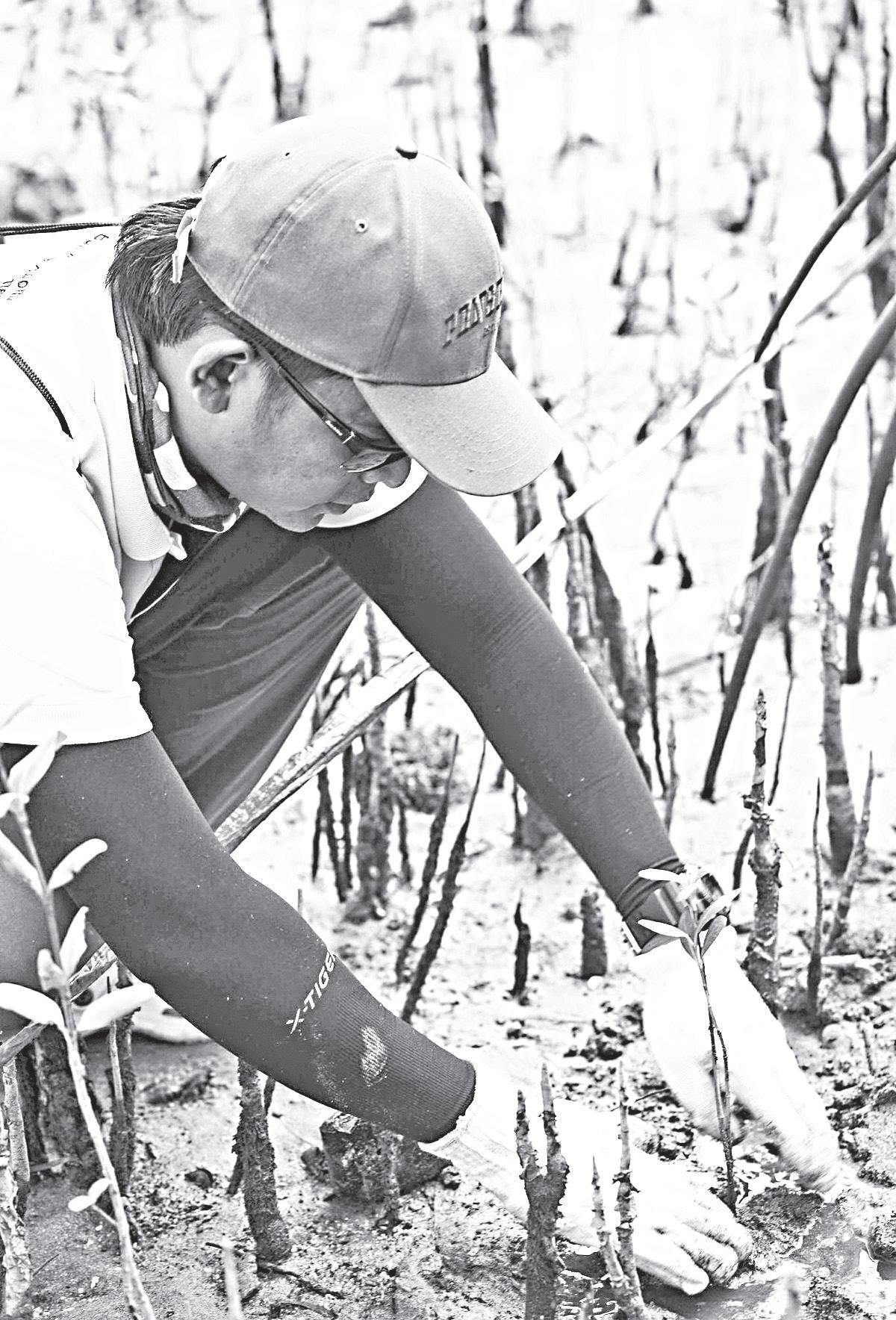
BOITIZ Construction team members capped off the planting of over 1,000 mangrove seedlings, in line with its ongoing environmental sustainability efforts, during a reforestation work in Sitio Sulok, Barangay Lumaniag, Lian, Batangas, on February 15.
The activity was part of Aboitiz Construction’s Mangrove Enhancement Project, in partnership with the Ramon Aboitiz Foundation Inc. (RAFI) and Aboitiz Foundation Inc. (AFI).
The event saw participation from the Samahan ng Mangigisda sa Sitio Sulok (SAMLOK), staff of the Lian Municipal Environmental and Natural Resources Office, and volunteers from the Philippine Coast Guard to enhance local biodiversity and foster community involvement in environmental conservation.
“Mangroves are essential to coastal ecosystems, helping mitigate climate change, protect biodiversity, and strengthen community resilience. Through initiatives like this, we not only restore vital ecosystems but also provide opportunities for local communities to thrive,” said Karmine Andrea Ching, senior AVP for Business Transformation at Aboitiz Construction.
The Mangrove Enhancement Project aims to plant and grow 1,455 mangrove seedlings by 2026, with a focus on empowering local communities, especially Samlok. A thousand seedlings were already planted by the group through RAFI last year.
The project has provided training to Samlok in mangrove plantation design, nursery establishment, seedling production, and plantation maintenance, equipping members of the organization with new skills and alternative income sources.
This reforestation effort is part of Aboitiz Construction’s broader environmental sustainability initiatives.
Last year, the company’s team members planted a combined total of 1,300 seedlings in Laguna, Cebu, and Surigao del Norte.
In 2022, Aboitiz Construction also signed a three-year partnership with the National Power Corp. to adopt 2.6 hectares of land and plant
2,600 trees on Mt. Makiling in Santo Tomas City, Batangas.
Through these efforts, Aboitiz Construction continues to make significant strides in environmental sustainability, promoting both ecological restoration and community empowerment.

the importance of a unified approach that involves not only government agencies but also key stakeholders, such as civil society organizations, which play a critical role in advocating for environmental protection and holding authorities accountable.
With the agreement in place, the DOJ and DENR reaffirmed their dedication to safeguarding the environment, ensuring that environmental justice is served through effective law enforcement and prosecution.
It was not the first that the DENR and DOJ have come together to fight environmental crimes.
In 2008, the Supreme Court designated 117 municipal and regional trial courts as environmental courts. Along with this, the DOJ designated environmental prosecutors who will investigate and prosecute environmental law offenders.
On October 18, 2010, the DENR secretary issued Memorandum Circular 2010-17 adopting the “Wildlife Law Enforcement Manual of Operations” as guide in the enforcement of Republic Act 9147 and other relevant wildlife laws, rules and regulations by designated/deputized wildlife enforcement officers, environment and natural resources officers and members of the Wildlife Traffic Monitoring Units.
Welcome development
“ANY move that strengthens our onthe-ground enforcement efforts to curb wildlife crime is highly welcome,” Best Alternatives Executive Director Gregg Yan told the BusinessMirror when asked to comment on the issue.
“The Philippines has strong wildlife laws, but enforcement remains lax as wildlife crimes are not given as much attention as narcotics and
other crimes,” he said.
“This is an excellent move by both the DENR and the DOJ, and we all look forward to seeing a stronger ‘followthrough’ in convicting and jailing wildlife crime offenders,” Yan added.
Only by making high-profile examples “can we convince traders and smugglers—both from within the Philippines and from other countries—that we are serious not just about protecting our biodiversity, but the world’s wildlife by minimizing our role as a transshipment point for protected plants and animals which were illegally plundered from other nations,” he said.
Emerson Sy, an anti-illegal wildlife trafficking advocate, told the BusinessMirror in a telephone interview on February 25 that the move is a welcome development.
According to Sy, the Philippines has sufficient environmental laws to protect the country’s rich biodiversity.
“The challenge or one of the challenges, is enforcement,” he told the BusinessMirror in Filipino.
Second, he said despite the efforts of law enforcement, prosecution often becomes the problem.
“In many cases, the court and prosecutors allow plea bargaining, wherein the accused [are given] reduced sentence or penalty upon entry in a guilty plea,” Sy explained.
He said that often, an arrested illegal wildlife trader gets away without even spending a day in jail and merely pays a fine of a measly amount, sometimes not even exceeding P5,000.
Typically, if the crime or offence is punishable by less than six years, the court allows probation, which illegal wildlife traders take advantage of.
“This is also why there are recidivist or repeater violators of the
Wildlife Act,” he said. “It is a welcome development for the DOJ and DENR to institutionalize this partnership and for the DOJ to allow the DENR lawyers as special prosecutors,” he said.
Crucial step against IWT
FOR Dr. Theresa Mundita S. Lim, former Asean Centre for Biodiversity executive director and DENR Biodiversity Management Bureau (BMB) director, the renewed collaboration between the environment and justice sectors is also a welcome development.
“While there seems to be a recent rise in the confiscations of illegally harvested and traded wildlife and forest products, as well as apprehensions of environmental law violators, it is crucial to ensure that these cases lead to successful prosecutions and appropriate penalties. Without this, there will be little deterrence against repeat offenses,” she told the BusinessMirror via Messenger on February 25.
Environmental lawyer Gloria Estenzo-Ramos, vice president of Oceana Philippines, an international ocean conservation advocacy nongovernment organization, also agreed the positive development was a refreshing testament to the willingness of both the DOJ and the DENR under the leadership of Justice Secretary Remulla and DENR Secretary Yulo-Loyzaga to enter into a crucial and much-needed collaboration to protect the country’s vastly threatened natural life support systems, including the protected seascapes.
“A continuing capacity building program is not just on enhancing the knowledge of the law but also appreciating the science and interconnectedness among ecosystems, including people among DENR lawyers but also prosecutors, judges, and justices is long overdue,” she told the BusinessMirror via Messenger on February 26.
“I hope the two agencies work with other stakeholders as well, including small-scale fishers, local governments, and nongovernment organizations,” Estenzo-Ramos added. She pointed out that Oceana is offering its expertise and rich experiences gained from its campaigns to fight and deter illegal commercial fishing, establish science-based fisheries management, boost livelihood and income for the country’s coastal communities, marine habitat protection and fighting plastic pollution, among others.
THE significant benefits of renewable energy for Philippine businesses was revealed in a new study by The Climate Reality Project Philippines.
By enabling companies to switch to 100 percent renewable energy without infrastructure costs, the Green Energy Option Program (GEOP) is disrupting the Philippine energy market, empowering businesses to significantly reduce costs and accelerate their sustainability goals.
The report “Enabling the Renaissance of Renewable Energy in the Philippines: A Preliminary Study on the Socioeconomic Impacts of the Green Energy Option Program” analyzed the experiences of 36 GEOP-switcher companies that collectively saved P71.7 million, slashed their carbon emissions by an average of 79 percent, and fast-tracked their journey toward net-zero goals.
GEOP brings cheaper power to businesses
GEOP enables businesses to break free from traditional electricity supply chains.
The voluntary program allows consumers with an average monthly peak demand of 100 kW to source their electricity entirely from renewable energy suppliers, rather than being tied to their distribution utilities, or electric cooperatives.
Participants in Climate Reality PH’s 2024 survey reported securing electricity rates between P4 and P5 per kWh, resulting in
average monthly savings of P355,000 and a 20 percent reduction in electricity costs.
In a country where imported fossil fuels account for 78 percent of the power generation mix, the report found that GEOP provides an immediate, cost-effective solution to shield businesses from the volatility of global energy markets and the resulting spikes in domestic electricity rates.
Achieving net-zero goals with GEOP
BEYOND cost savings, participating business entities in the study have also found themselves accelerating their netzero journey with GEOP after citing an average of 79 percent carbon emission reduction, amounting to at least 38.9 million kg carbon dioxide, immediately after switching.
“The capacity of our private sector to boost the country’s renewable energy transition is indispensable. Scaling up GEOP across industries could drive even greater reductions in the national greenhouse gas emissions,” said Giancarlo Pocholo Enriquez, energy analyst of Climate Reality Philippines. GEOP’s success in reducing costs and emissions underscores its vital role in the Philippines’ clean energy transition. However, its implementation faces significant challenges, including limited public awareness, regional disparities, bureaucratic hurdles, and a constrained
supply of renewable energy.
As of September 2024, 80 percent of GEOP users are based in Luzon, with limited adoption in Visayas (20 percent) and none in Mindanao.
Expanding GEOP’s reach requires a concerted effort by the Department of Energy (DOE), local government units, energy suppliers, and other stakeholders to conduct targeted campaigns in untapped markets like Visayas and Mindanao; improve renewable energy infrastructure; streamline bureaucratic processes for easier participation; and foster the growth of renewable energy suppliers to meet rising demand. In 2024, the DOE initiated efforts to amend GEOP implementation rules to broaden consumer participation and encourage more renewable energy suppliers to join the program.
Proposed changes include allowing enduser aggregation for entities with average peak demand below 100 kW and introducing greater flexibility in replacement power requirement for suppliers.
“Getting more industries to participate in the GEOP market raises the demand for cleaner and more sustainable energy, driving down power prices in the country. It offers a clear and easy choice for companies—one that delivers short-term financial savings and longterm sustainability,” said Ian Soqueño, Energy Program lead of Climate Reality Philippines.




SAKHIR, Bahrain— Max Verstappen and Lando Norris dismissed suggestions their Formula 1 rivalry has become a personal feud, going so far as to joke on Thursday that they’d been reduced to brawling in a pub.
Norris was Verstappen’s closest challenger last season as the Dutch driver won a fourth consecutive F1 title. Hard-edged and controversial battles on track sparked debate about whether F1 rules do enough to deter aggressive or risky driving.
“It’s a terrible relationship. We don’t get on anymore. It’s taken its toll,” deadpanned Verstappen as Norris chuckled next to him in a news conference on the second day of preseason testing.
“We had a fight the other day in a local pub,” Norris chimed in.
“We had to get escorted [out],” Verstappen added. “I always say, ‘You

Athletes have long used sports as a forum for civil rights activism, but today’s sports figures have a unique position of influence, with more money and celebrity status than ever, and social media to get their message to millions. With that also comes the potential for backlash and retaliation. Speaking out could cost their reputations, their connections, their careers, experts say.
It’s a danger Black athletes have always faced, whether boxing great Muhammad Ali risking his freedom to take an anti-war stance in the 1960s, or more recently, NFL quarterback Colin Kaepernick putting his job on the line to denounce police brutality in Black communities.
Black athletes who speak out for political or social change have often paid a price for their actions.
that mean the most to me?” Cloud believes it’s more imperative than ever for athletes across American professional sports to speak out against racial discrimination in the face of President Donald Trump’s sweeping orders to end government diversity, equity and inclusion programs, and as corporations and major institutions face pressure to roll back DEI policies aimed at creating opportunities for minority groups.
“The systems of power are working as they always were intended to work,” Cloud said. “And it’s time to break down a system that has only been about white men.”
“One of the most definitive characteristics of pursuit of social justice, particularly by athletes today, is the idea of sacrifice,” said Len Elmore, a former NBA player and now a senior lecturer in sports management at Columbia University. “They have to be willing to sacrifice because the broad society for a period of time—as it did to those past heroes—is going to penalize you.”
A ‘fight for human dignity’
WITH his attempt to abolish diversity and inclusion programs, Trump has sought to ban transgender athletes from girls’ and women’s sports and has
directed schools and universities to eliminate diversity initiatives or risk losing federal money. That includes no longer teaching material dealing with race and sexuality—part of his effort to end “wokeness” in schools.
Companies—including Target, Google, Walmart and McDonald’s— have scaled back or set aside diversity initiatives endorsed by much of corporate America during a 2020 nationwide reckoning on race to help root out systemic barriers that have hindered the advancement of marginalized groups.
“On a basic level, it’s just a fight for human dignity and human rights,” said Joseph N. Cooper, a professor of Counseling, School Psychology and Sport at the University of Massachusetts Boston.
While he doesn’t believe the weight of social justice reform should solely fall on the shoulders of Black athletes, Cooper said it’s important for sports stars to leverage their visibility to champion causes they’re passionate about.
Cloud, who used her social media to call for WNBA arenas to serve as polling places for the 2020 presidential election and helped with voter registration, believes the NBA and WNBA—where African American players are in the majority—should stand with the communities their players come from, as many feel the social and economic progress of Black Americans is in jeopardy. AP
should have seen the other guy,’ but actually he still looks good.” Norris said this month he’d learned from the experience of challenging Verstappen last year, and indicated he’d have an “elbows out” approach when racing Verstappen in future.
“I know there are going to be tough battles and I’m sure some of them are not always going to end the way I want or hopefully Max wants but we’re racing drivers. We get along,” Norris said on Thursday.
“I know everyone tries to make their own points and say what’s correct and what’s not correct, but we respect each other a lot and we look forward to more racing on track.”
Norris’ strong form in the second half of 2024 means he’s considered a strong candidate to dethrone Verstappen this year, and he was fastest on the first day of preseason testing in Bahrain on Wednesday.
HOUSTON—Takashi Murakami’s artwork has graced luxury goods from top fashion houses and album covers of superstar musicians.
Now the famed contemporary Japanese artist has teamed with Major League Baseball for an exclusive merchandise collaboration to celebrate next month’s Tokyo Series.
The Takashi Murakami x MLB Tokyo Series collection presented by Complex was announced Thursday and launches March 7 in advance of the series between the Dodgers and Cubs that opens the MLB season at the Tokyo Dome on March 18-19.
“I think this new collection builds upon the historical friendship between Japan and the United States,” Murakami said. “I feel lucky to be able to work alongside Complex, MLB and highlight Shohei Ohtani, an outstanding athlete who has emerged from Japan and made a name for himself on the global stage. This is something I am overwhelmed with gratitude to be a part of.”
Murakami, initially known for paintings and sculptures, saw his popularity explode when he paired with Louis Vuitton in 2002 for a line of bags featuring his artwork. The bags, which featured his iconic flower motifs and quirky characters in bright colors, quickly became some of the brand’s most coveted items.
Often referred to as the Andy Warhol of Japan, he created the cover art for several hip hop and rap albums, most notably Kanye West’s hit 2007 album “Graduation.”
“This collaboration with a world-
ATLANTA—Georgia’s state House has backed away from changes to the state’s hate crimes law that could have removed protections for crimes against transgender people, even as it moves forward with efforts to put into law restrictions
Hamitlon enjoying Ferrari car
LEWIS HAMILTON said he’s “really enjoying” driving his new Ferrari after he was narrowly beaten in Formula 1 testing results by the driver he replaced at Ferrari, Carlos Sainz Jr.
Hamilton’s time from the morning session was the fastest for much of the day until new Williams driver Sainz beat it by .031 of a second.
Hamilton’s Ferrari teammate Charles Leclerc was third fastest, .083 off the pace, with a much larger gap to Mercedes’ George Russell in fourth, 0.43 off Sainz’s time.
Hamilton and Sainz were over a second faster than the best lap from the first day of testing Wednesday, which was set by Lando Norris for McLaren.
“I am really enjoying the car. We’re slowly bonding, I think,” Hamilton said in televised comments. “Today was a bit more of getting to explore my interaction with my engineer, but
“So far so good,





Get motivated to exercise regularly like these gym rats in their 70s and 80s
MARCH 2, 2025 | soundstrip.businessmirror@gmail.com


Publisher :
T. Anthony C. Cabangon
Editor-In-Chief :
Lourdes M. Fernandez
Aldwin M. Tolosa
Concept :
Y2Z Editor :
SoundStrip Editor :
Group Creative Director : Graphic Designers :
Jt Nisay
Edwin P. Sallan
Eduardo A. Davad
Niggel Figueroa
Anabelle O. Flores
Contributing Writers :
Tony M. Maghirang
Rick Olivares
Jill Tan Radovan
Reine Juvierre S. Alberto
John Eiron R. Francisco
Pocholo Concepcion
Francine Y. Medina
Justine Xyrah Garcia
Bea Rollo
Trixzy Leigh Bonotan
Bless Aubrey Ogerio
Photographers :
Bernard P. Testa Nonie Reyes
Y2Z & SOUNDSTRIP are published and distributed free every Sunday by the Philippine Business Daily Mirror Publishing Inc. as a project of the
The Philippine Business Mirror Publishing, Inc., with offices on the 3rd Floor of Dominga Building III 2113 Chino Roces Avenue corner Dela Rosa Street, Makati City, Philippines. Tel. Nos. (Editorial) 817-9467; 813-0725. Fax line: 813-7025
Advertising Sales: 893-2019; 817-1351,817-2807. Circulation: 893-1662; 814-0134 to 36. www.businessmirror.com.ph
By Bless Aubrey Ogerio
THIS just in: flowerovlove, more than a name, is a phenomenon.
At 19, Joyce Cissé is building a world where dreamy indie pop meets bold self-expression, and she’s inviting everyone in. Since kicking off her music career in 2020, the London-raised Ivorian artist has released three EPs—Think Flower (2021), A Mosh Pit in the Clouds (2022), and Ache in My Tooth (2024)—each one peeling back another layer of her evolving artistry.
But flowerovlove is not just about sound. As a model, she has walked for Gucci, fronted campaigns for Pangaia and Swarovski, and carved out a fashion identity as fearless as her music.
She also calls herself a “mini skirt warrior,” a reflection of her confidence, individuality and refusal to shrink herself for anyone.
That’s the latest on her. But the hot question is still at hand: Where does all this creativity come from? What fuels her sonic universe?
Turns out, it all started at home.
Dateline: Beginnings REALLY, the indie-pop sensation is destined to the tunes. At just six years old, she was already drawn to melodies as her older brother, Wilfred, created songs of his own.
“What inspired me to pursue a career in music was my brother originally,” she shared during her Manila press conference on February 14.
More than an influence, he played a direct role in shaping her sound, even helping with the production of her first track. “He’s 27. We have an eight-year age gap, but he inspired me…. he’s also a songwriter and he can sing,” she said.
Beyond family ties, there was something deeper pulling her toward music. “What really fully inspired me to pursue it all the way was the love that I do have for music,” she said. “It’s the only thing I truly care about in this world, and it makes me feel so deeply.”
That feeling, so raw, intense and all-consuming, is exactly what defines her artistry. But her influences? A mix of worlds.
turns music into a headline moment
“I would say my influences are Tame Impala and Harry Styles— two very, very different kinds,” she said, with the contrast being so intentional. “Tame Impala, for how the music makes me feel. Psychedelic rock was a genre I’d never heard before.”
“[Then] Harry Styles because I love pop music and it’s like such an open sound and very free and lyrically very expressive.”
Live on the scene: Manila
MANILA isn’t just a backdrop for the breakout star. When the city embraced her hit “breaking news,” she knew she had to return the energy. She did this by filming an alternative version of the music video right in the heart of city.
“Everyone had shown so much love to the song,” she explained. “I was like, I want to give something back.” And what better way than to capture the city’s vibe in her visuals?
The track, a woozy, feel-good anthem about being so smitten it feels like breaking news, quickly became a fan favorite.
“I thought to capture how beautiful the city is to me through the colors I see and the way I see people and the way I felt love through the video,” she said. “And I feel like the video did a good job of that.”
Her first impression of Manila? “Everyone is really, really nice. Everyone was so nice. Yeah, I loved it. I still do.” No overthinking, no pretense.
The love went both ways. On February 14, she took her music to the Wish Bus, performing “breaking news”
and a fresh track, “i’ve seen your ex.” The next day, she lit up Ayala Malls Trinoma for a much-anticipated live show.
More story unfolds
With “breaking news” racking up close to a million views on YouTube and 17 million streams on Spotify as of February 22, it’s easy to see why many listeners associate flowerovlove with the viral hit. But for her, there’s so much more to the story.
“I have a lot more other music, other songs other than ‘breaking news,’” she said. “I would say I’ve tried to carve into a world that hasn’t been done before.”
“There is not someone who looks like me who makes the kind of music that I make. I think it’s really important that we have that person that I would have loved to have seen growing up. I hope to be that person for people growing up now,” she added.
Looking ahead, the alt-pop trailblazer has her sights set on even bigger things. “My plans as an artist [are] to keep creating amazing stuff and hopefully it becomes impactful to people and make beautiful art,” she shared.
And for 2025 and years to come?
“Becoming more global.”

grentperez on realizing he was meant to play
By John Eiron R. Francisco
IN the quiet corners of his room, where sunlight danced through the blinds and curiosity hummed softly, a young boy held a guitar as if it were a secret. Fingers stumbled over strings, awkward and unsure, yet determined. He was just fourteen then, eyes wide with admiration for the melodies his siblings played so effortlessly. But shyness was a stubborn shadow, and practicing in front of others felt like standing on stage without a script.
So, he practiced in secret, whispering chords under his breath, fumbling through notes with the patience only dreams could inspire. It wasn’t until he stumbled upon the gentle tune of “Lemonade” by Jeremy Passion that the world shifted. Each strum was a word, each chord a sentence, and suddenly, he was fluent in a language he never knew existed. It was a language that didn’t require courage to speak aloud, just the quiet confidence to feel.
“I felt like I was unlocking a new language. It was so cool how to get to experience music through me, like I was able to produce, not just my voice, but I had an instrument as well to help me and accompany me,” grentperez shared in an exclusive interview with SoundStrip.
“I remember feeling so powerful. I felt blessed. I felt like it was given a gift to make music from that moment in a way,” he added.
Now, a decade later, that once-shy boy is known to the world as grentperez (aka Grant Perez), a Filipino-Australian singer artist who’s no longer playing in the shadows.
As of this writing, he has over 760,000 subscribers on YouTube and more than 3.4 million monthly listeners on Spotify, making waves in the global music scene. With every lyric and every note, he invites listeners into his world, sharing the language he once discovered in secret—now loud enough to echo across the globe.
His journey started with uploading music covers on YouTube, a choice that ultimately paved the way for his rise as an artist. He admitted he was stunned when his gold-certified debut single, “Cherry Wine”—released in 2021 and topping Spotify’s Viral 50 chart in multiple countries— became an international hit.
“I didn’t think that was possible,” grentperez said.
“That was when I realized, ‘I could do this,’” he said. “People enjoy listening to my music. I want to turn music into my reality.”
‘Boredom and beyond’
THE Sydney-born musician revealed that his
creative process often begins from a place of boredom—a need to fill an empty space with music. He explained that his songwriting typically starts with picking up a guitar and playing a chord progression that resonates with him.
“I use a lot of major chords because they sound really pretty,” he shared.
From there, he experiments with different melodies, drawing inspiration from 70s soft rock. Depending on how the combination of melody and guitar makes him feel, he then writes lyrics to match that vibe.
“When I write lyrics, I usually draw from love or loss—experiences that I don’t always have to go through myself but ones I’ve heard about from others,” grentperez said.
To bring authenticity to his music, he often asks people about their emotions and experiences, living through them vicariously. “I do that a lot in my music too,” he admitted, revealing how he channels others’ feelings into his songwriting.
His sound is a blend of bossa nova, R&B, and bedroom pop. “It’s a very interesting mix,” Grentperez said. He described bossa nova as the “heartbeat” of his music, giving it a danceable pulse, while R&B influences his lyrical themes, often exploring love. Bedroom pop, on the other hand, ties everything together with its nostalgic, oldschool melodies. “It flows like an arbiter,” he added.
While his signature sound remains distinct, grentperez embraces musical experimentation, a direction that shines through in his latest album, “Backflips in a Restaurant.” The 13-track album explores a variety of styles, reflecting his evolving artistry.
“It’s pretty evident in my recent releases,” he said, pointing out how “Fuzzy Feelings” sounds different from “2DK,” while “Dandelion” and his latest track, “Movie Scene,” each bring their own unique flavor.
“Movie Scene” is said to perfectly embody grentperez’s signature sound, seamlessly blending soothing melodies and captivating rhythms that

have resonated with fans since his gold-certified debut, “Cherry Wine.” The track effortlessly fuses elements of R&B, soft pop, and his distinct alternative style, reinforcing his growing influence in the industry.
Following the success of “Dandelion,” each of his recent releases has steadily climbed the charts, earning widespread praise from both fans and critics. With “Movie Scene,” grentperez makes it clear—this new chapter in his career is not just a passing moment, but a lasting evolution.
‘Authentic as possible’
AS grentperez continues to carve out his place in the music industry, the pressure to consistently create songs that resonate with his audience is inevitable. However, the 24-year-old singersongwriter remains grounded, acknowledging that he is still in the early stages of his career, having been in the industry for just five years.
“I think I still have a lot to offer,” grentperez shared.
Rather than succumbing to external expectations, he chooses to focus on authenticity as his guiding principle.
“The way I’ve been dealing with the pressure is by trying to be as authentic as possible. At the end of the day, the art is coming from me. I’m not trying to cater to expectations or be someone I’m not because once I start doing that, that’s when I lose myself. That’s when I start feeling unhappy and overwhelmed by the pressure.”
Reflecting on his journey, he shared a message he would give his 14-year-old self if he could go back in time: “Just keep doing what you’re doing. Enjoy music because you enjoy music, not because you’re trying to impress anyone. Just let that take you wherever it leads.”
‘A Spirited journey’
LOOKING back on his path so far, grentperez described his musical journey as “spirited”—one that required both courage and perseverance.
“It took a lot of trust, not only in myself but also in the people I work with,” grentperez shared. He recalled his early days of touring when he was willing to do whatever it took to make his performances happen. Whether it meant carrying as many bags as possible or facing challenging circumstances, he was determined to push through.
Even now, grentperez admits that the fighting spirit that got him started continues to drive him forward. Despite feeling sick, tired, or even lazy at times, he remains committed to overcoming obstacles and staying true to his passion for music.
Unplugged ambitions
AS he looks ahead, grentperez remains optimistic about his artistic evolution. He envisions a future where he can freely explore and experiment with his sound without limitations.
“If I wanted to create an entire folk unplugged album, I’d like to have the freedom to do that,” he said.
Beyond musical exploration, he also dreams of performing on a grander scale. “In the next five years, it would be amazing to play in a stadium. That’s a huge dream of mine, one that has developed as my career has progressed,” Grentperez revealed.
Initially, he never saw stadium shows as a necessity, but witnessing other artists perform at that level—along with the unwavering support from his fans—changed his perspective.
“I want to give back to them. I want to create something special for those who believe in me,” he concluded.
By Stephen Wade The Associated Press
YOU know you should develop a regular exercise routine, but you lack motivation. Promises to yourself are quickly broken, and you never establish enough of the workout habit to experience any rewards.
Exercising as you age is important. It’s not only good for physical health to help prevent falls or enable you to do basic tasks— exercise is also superb for the mind.
“If you want to be cognitively active, it is so important to be physically active,” explained Dr. Amy Eyler, a professor of public health at Washington University in St. Louis. “There is a such a strong connection between these two behaviors.”
How to get started
GETTING into the habit of doing regular physical activity can be difficult for some. The motivation to get moving is different for everyone.
Initially you’ll need external motivation—I want to be able to play with my grandkids or keep driving the car—until you see results and the motivation shifts to internal, Eyler said.
“When you set a goal, you should ask yourself on a scale of 1 to 100, how confident am I that I can do this?” Eyler explained. “It has to be over the 90 percent level of confidence or you’re not going to do it. Lots of people set these goals too high and then fail.”
Build to your goals.
“Just walk whenever you can,” Eyler said. “You can walk for 10 minutes pretty much anywhere—indoors, at work, at home.”
And, if you’re trying to encourage others, look for positive reasons rather than nagging.
“Telling someone they will be more independent if they take their blood pressure


medicine is better than—take your blood pressure medicine,” she said.
Here are some tips about how to start— and how to stay with it—from three gym rats between the ages of 77 and 86. All got started late and have stayed with it. All three work out with Dr. Irv Rubenstein, an exercise scientist who runs STEPS Fitness in Nashville, Tennessee.
‘I always hated gym class’
KATHRYN DETTWILLER , 77, got pushed into exercising 34 years ago by her husband.
“I always hated gym class,” she said. “I always hated getting down on the floor.”
She works out in a gym twice a week with a trainer, which she said gives her added discipline and motivation.
“The external has become internal because I realize I need it,” she said. She cautioned beginners to expect some setbacks— minor injuries—and not to be discouraged.
“Try it as soon as your body starts playing out on you,” she said. “It’s like a game of Whack-A-Mole. One time your leg hurts, the next time it’s your back.”


‘I had a sense of feeling better’
RICK BOLSOM , 82, enjoys the structure of having a trainer. In his case, his wife got him started almost two decades ago and he’s into a three-times-a-week routine.
“I kept doing it because I had a sense of feeling better,” he said. “The key to me was probably doing it with a trainer. The structure really helped me to continue with it. Now it’s just become part of my life.”
“I couldn’t imagine quitting it,” he added. “I work out as vigorously as I did 15, 18 years ago. It turned out to be the smart thing to do.”
Bolsom also added in the social aspect to training in a gym or studio.
“I retired a few years ago. You do miss the connectivity with people.”
‘Medicine was basically my life’
DR . Grover Smith, a retired radiologist, is 86 and still going strong. He attributes this partly to training regularly in a gym three
times a week, a habit he didn’t start until he was 74 and well into retirement. He was coaxed to go after several visits to his cardiologist.
He said he went after the fourth time his cardiologist suggested it, although he was not having any specific heart problems. His plan was to go once to appease the cardiologist and that would be it. That was more than a decade ago.
“Medicine was basically my life and it was very time consuming,” Smith said. “It was sometimes seven days a week and I didn’t have time for a lot of other things.”
He’s not only fit, but now he also gets flattered.
He tells the story about a recent visit to a doctor who, after looking at his charts, told him: “Dr. Smith, you look 15 years younger than your age.”
Smith laughed as he added the punchline.
“I would have told her to get her eyes examined—except she’s an ophthalmologist.”
n Cover photo by Mikhail Nilov on Pexels.com
IM AGINE you have just finished a workout. Your legs are like jelly, your lungs are burning and you just want to collapse on the couch.
But instead, you pick yourself up and go for a brisk walk. While this might seem counterintuitive, doing some light activity after an intense workout–known as “active recovery”–has been suggested to reduce soreness and speed up recovery after exercise.
But does it work or is it just another fitness myth?
ACTIVE recovery simply describes doing some low-intensity physical activity after a strenuous bout of exercise. This is commonly achieved through low-intensity cardio, such as walking or cycling, but can also consist of low-intensity stretching, or even bodyweight exercises such as squats and lunges.
does active recovery do?
ACTIVE recovery helps speed up the removal of waste products, such as lactate
and hydrogen, after exercise. These waste products are moved from the muscles into the blood, before being broken down and used for energy, or simply excreted.
This is thought to be one of the ways it promotes recovery. In some instances, active recovery has been shown to reduce muscle soreness in the days following exercise. This may lead to a faster return to peak performance in some physical capabilities such as jump height.
There’s evidence to the

contrary too
NOT all research on active recovery is positive. Several studies indicate it’s no better than simply lying on the couch when it comes to reducing muscle soreness and improving performance after exercise. In sport science, however, studies often have small sample sizes, which can make it hard to see small effects. But there doesn’t seem to be any research suggesting active recovery is less effective than doing nothing, so at worst it certainly won’t cause any harm. The Conversation