
Philippine diplomacy
A recently launched book shows how treaties tell the story of
foreign policy shifts across administrations




By Malou Talosig-Bartolome
SPEECHES fade. Press releases are forgotten. Summit photo-ops capture only a single moment in time. If you want to understand a nation’s true geopolitical priorities, look past the rhetoric and follow the ink. The real language of foreign policy is written in treaties.
These legally binding commitments—painstakingly negotiated, signed, and ratified—are the ultimate mirror of a country’s shifting allegiances and evolving goals. For the Philippines, more than 1,800 treaties signed since 1946 quietly chronicle the nation’s modern trajectory: from rebuilding a fractured democracy and protecting overseas workers, to asserting maritime sovereignty and embracing climate responsibility. This reality took center stage at the recent launch of the 2025 revised edition of Treaties: Guidance on Practices and Procedures Co-authored by Ambassador J. Eduardo Malaya and U.P. College of Law Assistant Professor Rommel J. Casis, the 240-page guidebook was unveiled at an event hosted by the Department of Foreign Affairs (DFA) and the UP College of Law. It served as a powerful reminder that treaties are not dusty legal archives—they are the living instruments of statecraft.

Why treaties matter more than speeches
AMBASSADOR Malaya, author of the foundational Philippine Treaty Patterns 1946–2020, emphasized the sheer scale and cross-sector nature of the country’s treaty-making. With over 1,800 agreements

concluded since 1946, he noted that treaty negotiations extend far beyond the DFA, requiring massive inter-agency coordination across finance, trade, labor, and defense.
However, the complexity of this process often breeds confusion. To ensure predictability and transparency, Malaya breaks down the concept of a “treaty” into three distinct definitions:
• The Constitutional Definition: Agreements that explicitly require Senate concurrence to take effect.
• The International Law Definition (Vienna Convention): The standard that distinguishes legally binding treaties from non-binding
Memoranda of Understanding (MOUs).
• The Procurement Law Definition: A framework that adds essential technical parameters for government transactions.
“When practices and procedures are clear, entry into agreements and the ratification of concluded agreements can be facilitated,” Malaya explained, noting that clarity allows these agreements to impact the real world much sooner.
Professor Casis echoed this practical approach. The guidebook, which began in 2016 as a simple ring-bound internal manual, was engineered for utility. “What practitioners need is not eloquence but precise, clear guidance on process, obligations, and limits,” he said. The post-EDSA pivot: Presidents and their treaty footprints TREATIES act as the institutional fingerprints of presidential priorities. A closer look at the data from 1986 onward reveals exactly how each administration leveraged international law to advance its specific vision for the Philippines: Corazon Aquino (1986–1992) | Development Diplomacy EMERGING from dictatorship and facing economic stagnation, Aquino prioritized recovery. She signed 46 bilateral agreements, 41 percent of which focused on economics, including air services, agriculture, and foreign investment attraction. Fidel V. Ramos (1992–1998) | Economic Integration RAMOS accelerated the economic
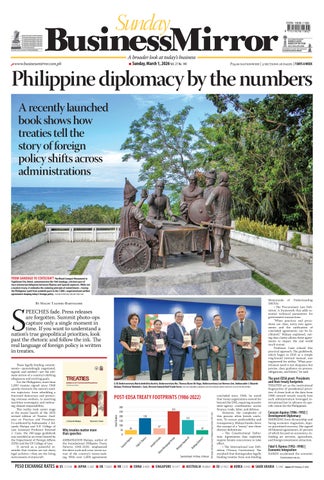
FROM SANDUGO TO STATECRAFT The Blood Compact Monument in Tagbilaran City, Bohol, commemorates the 1565 Sandugo, a historic pact of trust and mutual obligation between Filipinos and Spanish explorers. While not a modern treaty, it embodies the enduring principle of commitment—tracing the Philippines’ path from symbolic pacts to the 1,800+ negotiated and ratified agreements shaping today’s foreign policy. EVGENII MITROSHIN DREAMSTIME.COM
(L-R) Undersecretary Maria Andrelita Austria, Undersecretary Ma. Theresa Dizon-De Vega, Undersecretary Leo Herrera-Lim, Ambassador J. Eduardo Malaya, Professor Rommel J. Casis, Director General Neil Frank Ferrer.
China’s $112-B cargo gap shows record US tariff evasion
TBy Laura Curtis & James Mayger | Bloomberg
HE messages arrive via WhatsApp and e-mail, promising a deal that seems too good to be legal: a way to move goods from China to the US while avoiding President Donald Trump’s tariffs.
For Michael Kersey, president of the American Lawn Mower Company, these solicitations represent an existential threat. His century-old firm, famous for its push-reel mowers and gardening shovels, plays by the rules. His competitors, he suspects, are somehow bypassing steep trade barriers that Trump is seeking to maintain even after the Supreme Court ruled many of them were illegal.
“Tariff cheating is much, much worse than tariffs for us,” said Kersey, who began outsourcing production to China two decades ago and paid as much as 45% to bring those goods into the US over the last year. “The tariffs are just the cost of doing business, but the tariff cheats are the ones that are very, very damaging.” Kersey is among a dozen business owners, shipping merchants, trade attorneys and former customs officials who spoke to Bloomberg News sounding the alarm over apparent tariff fraud surging to record proportions. Fueled by aggressive Chinese logistics tactics and the highest duties in a century, the suspected evasion is blunting Trump’s trade agenda while penalizing compliant companies.
The scale of the problem is staggering. Trade data released Thursday showed a record $112 billion gap be -
tween what China reported exporting to the US and what US Customs said actually arrived last year. Put simply, that suggests as much as a quarter of what Asia’s top economy shipped to American shores last year slipped under the tariff radar.
While tariff dodging has frustrated the US government for years, this discrepancy now dwarfs the anomalies seen during Trump’s first term. Federal Reserve research at the time found that nearly two-thirds of such gaps stemmed from tariff evasion, although other factors such as China’s tax rebate policy also contributed to misreporting.
The widening gulf since Trump’s first trade war shows that his steeper duties have spawned an underground economy of shipping schemes to get around tariffs. Such tactics raise doubts about whether his signature economic policy can deliver on his promise to revive American manufacturing.
Some advertisements, like those Kersey received, promise China-to-US shipping for as little as $0.70 per kilogram, taxes included — a red flag in itself.
“You can’t have an all-in rate per kilo,” said Ryan Petersen, CEO of digital logistics platform Flexport, explaining that the tariff bill for finished goods is calculated by value, not weight. “It’s obviously fraud. They’re
sort of egregious about it.”
Flexport and others have raised the alarm in Washington over the flood of offers targeting US businesses struggling to pay duties and stay competitive. Some explicitly offer to “share the tariff risks,” claiming customers have seen cost savings of 40%–50%.
However such savings are secured, Kersey believes they help rival companies undercut his prices online by 10% to 20%, eroding market share and preventing him from moving manufacturing back to the US. And even if Kersey manages to claw back the duties he paid after the Supreme Court ruling, continued tariff fraud is likely to keep him at a competitive disadvantage.
“When competition is cheating on tariffs this makes it very difficult,” he said.
Ram Radhakrishnan, CEO of USbased freight forwarder Silq, said he’s lost smaller customers who’ve received offers to deliver $1,000 worth of goods for $1,200 all in. But when the duties alone should cost another $1,000, that’s possible only because someone didn’t pay their dues, he said.
“I don’t blame them,” Radhakrishnan said. "They are competing against somebody who is doing the same thing.”
Phantom importers
ONE way to avoid tariffs is through a mechanism called Delivered Duty Paid. Under that system the overseas seller handles everything — shipping, customs clearance and, when things are done by the book, even the tariffs.
While DDP isn’t necessarily fraudulent, the promise of low hassle shipping appeals to American buyers facing an increasingly costly and complex tariff regime. The crime comes

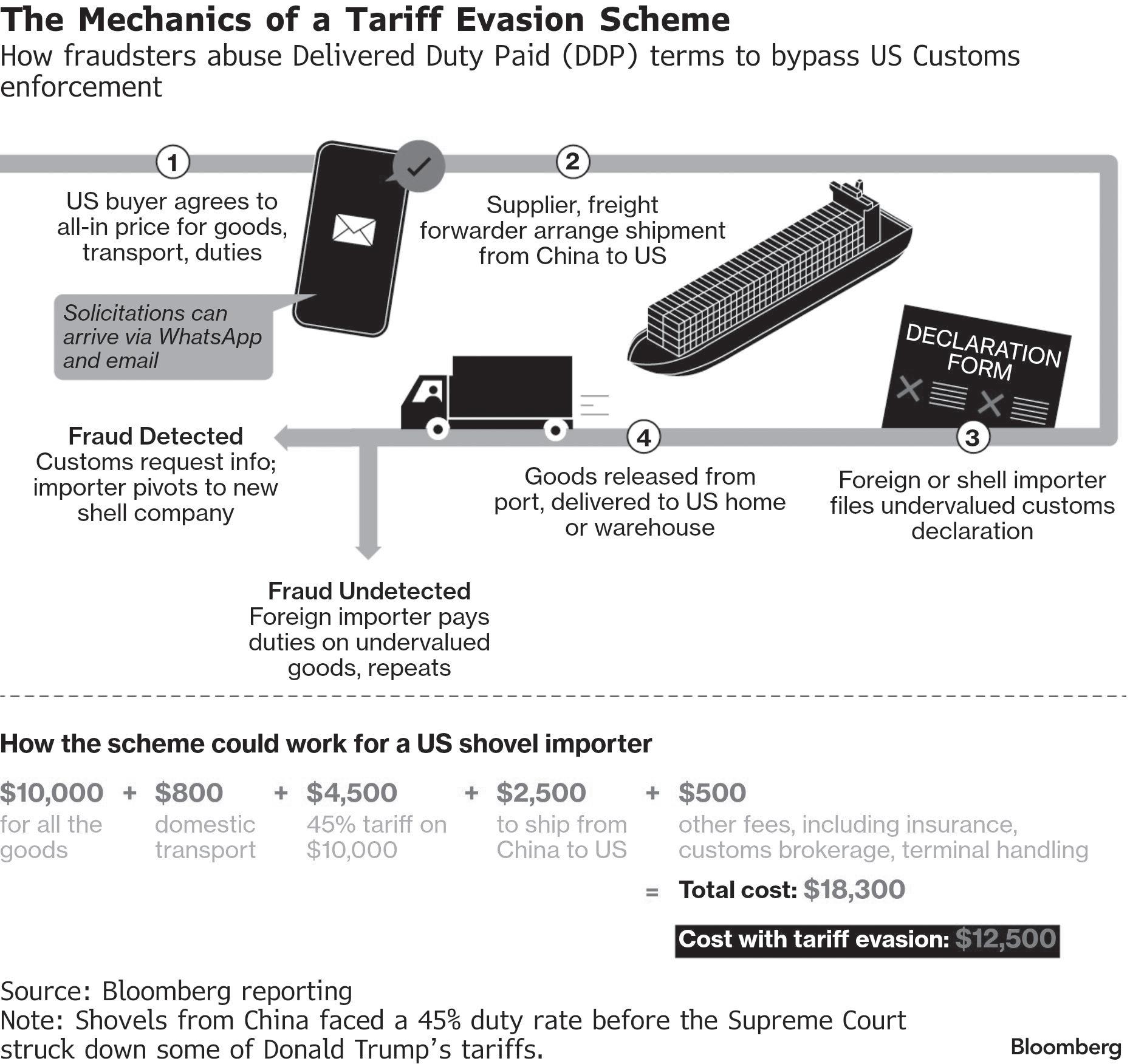
when those tasked with bringing goods through customs deliberately underreport their value or otherwise misclassify them to get a favorable tariff rate. Buyers don’t necessarily know any law has been broken. Fraudsters combine that process with the use of shell companies or non-resident entities as the importer of record. If the authorities eventually do come knocking, they’ll often find a fake address or phone number listed for a shell firm that’s already been shuttered.
“If you want to commit fraud, this is how you would do it,” said Carrie Ow-
ens, who recently left the Department of Homeland Security’s intelligence office and previously led the Enforcement Operations Division at US Customs and Border Protection. “You would take on the liability, put it onto a shell company, who then you can run away from very easily and start a new one up.” Owens, now a partner at the law firm Kelley Drye & Warren, said these shell companies are such a problem because they proliferate rapidly and appear to authorities as any other domestic business, making them hard to detect. Entities can be set up overnight with modest bonds, often by Chinese
suppliers in league with aggressive freight forwarders, she said.
Compounding the problem, the Department of Homeland Security, which oversees both CBP and ICE, has redirected resources and staffing from several units responsible for investigating global trade crimes to immigration enforcement efforts, according to a US official familiar with current DHS operations, who requested anonymity for fear of retaliation.
The official website of the division in charge of the units, Global Trade and Investigations, was archived between last October and January, according to public web records. The DHS didn’t respond to requests for comment.
Catching up
The US stands nearly alone among advanced economies in allowing nonresident companies to act as official importers even if they have no meaningful physical presence in the country. Washington isn’t blind to the problem. The non-resident importer program, designed to streamline imports for integrated industries like automobiles along the US-Canada border, is one of several trade policies under increasing scrutiny. One bipartisan proposal would increase the US assets required for foreign importers, enough to cover potential tariff liabilities. But the bill, introduced early last year, hasn’t advanced.
Another bill introduced earlier this month would scrap the so called “first sale” rule that allows importers to value their goods based on the sale price when they first left the factory, which critics say creates more opportunity for under-reporting.
Philippine diplomacy...
Continued from A1 ments were marginal, accounting for just 20 pacts (6.95 percent of the total).
agenda, signing an impressive 178 agreements. His crowning diplomatic achievement was acceding to the World Trade Organization in 1995. He signed 14 bilateral investment treaties (BITs) and 10 double taxation agreements, while also initiating a pivot toward protecting Overseas Filipino Workers (OFWs) in the wake of the Flor Contemplacion case.
Joseph Estrada (1998–2001) | Baseline Continuity
DESPITE a truncated tenure, Estrada signed 67 agreements. His administration maintained a steady, consistent focus on trade and sociocultural ties rather than radical innovation.
Gloria Macapagal Arroyo (2001– 2010) | The “Nine Realities”: ARROYO’S nearly decade-long term produced 255 agreements— the highest post-1986 tally. Aligning closely with her “Nine Realities of Foreign Policy,” she expanded economic treaties and dramatically deepened ties with China, signing 18 agreements with Beijing.
Benigno Aquino III (2010–2016) | Sovereignty First:
AQUINO’S 157 agreements were heavily shaped by escalating threats in the West Philippine Sea. As his administration initiated arbitral proceedings against China, bilateral agreements with Beijing plummeted, new BITs dropped to zero, and defense treaties surged.
Rodrigo Duterte (2016–2022) | The Independent Pivot:
DUTERTE’S shift was the most stark. Agreements with China rebounded to 14, and Russia suddenly emerged as a primary partner with 33 agreements. By 2020, the traditional dominance of the US had faded to eighth place, replaced at the top by China, Russia, Spain, Thailand, and South Korea.
The rise of security and defense pacts
BEYOND economic shifts, the data reveals a massive transformation in national security strategy. Prior to 1986, security agree-
Post-1986, that number jumped to 89 agreements (10.15 percent).
This surge reflects a strategic diversification beyond the traditional US alliance, encompassing maritime security, anti-terrorism, and transnational crime.
This trend peaked under Benigno Aquino III, as the state scrambled to fortify its sovereignty amid escalating maritime disputes.
Economic diplomacy and the retreat from BITs
HISTORICALLY, attracting foreign capital through Bilateral Investment Treaties (BITs) and double taxation agreements was a cornerstone of Philippine diplomacy.
Presidents Ramos and Arroyo aggressively pursued these legal frameworks to integrate the Philippines into global markets.
However, by the Aquino III administration, global and local enthusiasm for BITs had frozen. A major catalyst for this chilling effect was the Fraport case.
When the German airport operator sued the Philippine government over the Naia Terminal 3 concession at the International Centre for Settlement of Investment Disputes (ICSID), it exposed the severe risks of investor-state arbitration clauses.
Although the tribunal ultimately found that illegalities in Fraport’s initial investment deprived it of jurisdiction, the threat of costly litigation lingered.
As legal scholar Georg Nolte noted, the aggressive expansion of investment treaties in the 1990s gave way to deep skepticism in the 2000s.
Governments realized these tribunals often favored investors at the expense of sovereign policy choices. Consequently, by the Duterte years, the Philippines had largely abandoned BITs, pivoting instead toward direct infrastructure and energy cooperation agreements.
The Diaspora dimension: Institutionalizing OFW protection IF economic and security treaties
map the Philippines’s geopolitical strategy, its labor agreements reflect its deepest human commitment. Initiated under Ramos, the protection of OFWs has become an enduring pillar of the nation’s foreign policy.
To date, the Philippines has signed 27 labor agreements, predominantly with Middle Eastern nations hosting millions of Filipino workers, including Kuwait, the UAE, Saudi Arabia, and Israel.
The country has also championed migrant rights on the global stage:
• Regional Leadership: The Philippines spearheaded the 2017 Asean Consensus on the Protection and Promotion of the Rights of Migrant Workers, extending protections to 200,000 Filipinos across Southeast Asia.
• Global Governance: The nation was a pioneer signatory to the 1993 UN Migrant Workers’ Convention and a primary campaigner for the 2018 Global Compact on Migration.
• Complementary Protections: Diplomacy is further reinforced by targeted agreements on consular matters, human trafficking prevention, the transfer of sentenced persons, and 13 international social security accords.
Harmonizing the future FOR the Philippines, treaties are not merely international milestones; they are domestic imperatives that demand precise execution.
As Professor Casis warned, domestic laws must be continuously harmonized with international standards to eliminate legal friction between ratification, entry into force, and executive implementation.
Failing to align domestic reality with international commitments risks internal confusion and weakened credibility on the world stage. The challenge ahead for the Philippines is not just signing new agreements.
It is ensuring that its internal legal framework speaks the exact same language as the global system—guaranteeing that Philippine diplomacy remains credible, actionable, and ready for the future.
World BusinessMirror

Growing more complex by the day: How should journalists govern use of AI in their products?
By David Bauder | The Associated Press
LIKE so many sectors of the economy, the news industry is hurtling toward a future where artificial intelligence plays a major role— grappling with questions about how much the technology is used, what consumers should be told about it, whether anything can be done for the journalists who will be left behind.
These issues were on the minds of reporters for the independent outlet ProPublica as they walked picket lines earlier this month. They’re inching toward a potential strike, in what is believed would be the first such job action in the news business where how to deal with AI is the chief sticking point.
Few expect this dispute will be the last.
AI has undeniably helped journalists, simplifying complex tasks and saving time, particularly with data-focused stories. News organizations are using it to help sift through the Epstein files. AI suggests headlines, summarizes stories. Transcription technology has largely eliminated the need for a human to type up interviews. These days, even a simple Google search frequently involves AI.
Yet rushing to see how AI can help a financially troubled industry has resulted in several cases of publications owning up to errors.
Within the past year, Bloomberg issued several corrections for mistakes in AI-generated news summaries. Business Insider and Wired were forced to remove articles by a fake author named Margaux Blanchard. The Los Angeles
Times had trouble with AI and opinion pieces. Ars Technica said AI fabricated quotes, and the publication that has frequently reported on the risks of overreliance on AI tools embarrassed itself further by failing to follow its policy to tell readers when the tool is used.
The ProPublica dispute is noteworthy for how it touches on issues that are frequently cause for debates.\
The union representing ProPublica’s journalists, negotiating its first contract with the outlet known for investigative reporting, says it wants commitments that mirror those sought elsewhere in the industry about disclosure and the role of humans in the use of AI.
Along with holding informational pickets, union members pledged overwhelmingly that they would be willing to strike without a satisfactory agreement, said Jen Sheehan, spokeswoman for the New York Guild, the union that represents many journalists in the city.
“It feels to me pretty monumental when we think about the trajectory of AI and journalism,” said Alex Mahadevan, an expert on the topic at the Poynter Institute jour-
nalism think tank.
ProPublica has rejected its requests, the union said. Insight into why can be found in an essay, “Something Big is Happening,” that circulated widely this month.
Author and investor Matt Shumer, who said he’s spent six years building an AI startup, wrote that the technology is advancing so quickly that “if you haven’t tried AI in the last few months, what exists today would be unrecognizable to you.”
THE RELUCTANCE OF NEWS OUTLETS TO PUT POLICIES ON RECORD
SMALL wonder, then, that news executives are reluctant to put guarantees in writing that could quickly become outdated.
Rather than make promises that can’t be kept, ProPublica is exploring how technology can create more space for investigative reporting, company spokesman Tyson Evans said. In the “unlikely event” of AI-related layoffs, ProPublica is proposing expanded severance packages for those affected, he said.
“We’re approaching AI with both curiosity and skepticism,” Evans said. “It would be a mistake to freeze editorial decisions in a contract that will last years.”
Fifty-seven of 283 contracts at US news organizations negotiated by the NewsGuild-USA contain language related to artificial intelligence, said Jon Schleuss, president of the union that represents more journalists than any in the country. The first such deals happened in 2023, and The Associated Press was one pioneer. He wants provisions in more contracts. It won’t be easy, judging by the reluctance of many outlets to be tied down. The organization Trusting News, which encourages news or-
Young woman says she was on social media ‘all day long’ as a child in landmark addiction trial
By Kaitlyn Huaman & Barbara Ortutay The Associated Press
LOS ANGELES—A young woman who is battling against social media giants took the stand Thursday to testify about her experience using the platforms as she was growing up, saying she was on social media “all day long” as a child. The now 20-year-old, who has been identified in court documents as KGM, says her early use of social media addicted her to the technology and exacerbated depression and suicidal thoughts. Meta and YouTube are the two remaining defendants in the case, which TikTok and Snap have settled.
The case, along with two others, has been selected as a bellwether trial, meaning its outcome could impact how thousands of similar lawsuits against social media companies are likely to play out. KGM, or Kaley, as her lawyers have called her during the trial, started using YouTube at age 6 and Instagram at age 9.
A TURBULENT HOME LIFE
KALEY took the stand wearing a pink floral dress and a beige cardigan and said she was “very nervous” after her attorney, Mark Lanier, asked how she was doing Thursday morning. Lanier displayed childhood photos of Kaley and her family and asked about positive memories from her upbringing in a quiet cul-de-sac in Chico, California. She spoke of themed birthday parties, trips to Six Flags and her mom’s consistent efforts to make her childhood special.
Still, Kaley’s relationship with her mother was challenging at times. Kaley said most of their arguments were over the use of her phone. Both the defendants and the plaintiff have pointed to a turbulent home life for Kaley. Her attorneys say she was preyed upon as a vulnerable user, but attorneys representing Meta and Google-owned YouTube have argued Kaley turned to their platforms as a
coping mechanism or a means of escaping her mental health struggles. When asked about claims that her mother had hit her, abused her and neglected her, Kaley said “she wasn’t perfect, but she was trying her best,” and clarified that she doesn’t think she would label her mother’s past actions as abuse or neglect today. But later Thursday, during her cross-examination, Kaley did agree that her mother was being physically and emotionally abusive during the time that she was self-harming around when she was in the 6th grade. Kaley, who works as a personal shopper at Walmart, lives with her mother in the home she grew up in.
NOTIFICATIONS
GAVE HER A ‘RUSH’ AS a child, Kaley set up multiple accounts on both Instagram and YouTube so she could like and comment on her posts. She said she would also “buy” likes through a platform where she could like other people’s photos and get a slew of likes in return. “It made me look popular,” she said. Kaley was asked specifically about the features the plaintiffs argue are deliberately designed to be addictive, including notifications. Those notifications on both Instagram and YouTube gave her a “rush,” she said. She would receive them throughout the day and would go to the bathroom during school to check them—something she still does. Kaley said while she uses YouTube less often now, she believes she was previously addicted to it. “Anytime I tried to set limits for myself, it wouldn’t work and I just couldn’t get off,” she said. Filters on Instagram, specifically those that could change a person’s cosmetic appearance, have also loomed large in the case and were also a constant fixture of Kaley’s use. Lanier and his colleagues unfurled a nearly 35-foot-long canvas banner with photos Kaley has posted on Instagram. She said “almost all” of the photos had a filter
on them. The jury was also shown Instagram posts and YouTube videos Kaley posted as a child and young teen. One video showed her saying she was “crying tears of joy” after surpassing 100 YouTube subscribers—but then she quickly turned to her looks, apologizing for her “ugly appearance.”
“I look so fat in this shirt,” the young Kaley says in the video.
Kaley said she did not experience the negative feelings associated with her body dysmorphia diagnosis before she began using social media and filters.
META FOCUSES ON PLAINTIFF’S HOME LIFE, CONTRADICTING STATEMENTS
META has argued that Kaley faced significant challenges before she ever used social media. The company’s lawyer, Paul Schmidt, said earlier this month that the core question in the case is whether the platforms were a substantial factor in Kayley’s mental health struggles. Meta attorney Phyllis Jones took a polite, respectful tone in her cross-examination Thursday, acknowledging that it could be uncomfortable for her to speak about her private life in front of a room of strangers. Jones proceeded to zero in on Kaley’s home life.
Jones pulled up text exchanges and posts Kaley had made on Instagram about her mental health and her relationship with her mother and played videos Kaley took of her mother yelling at her.
On nearly 20 occasions during the Meta cross-examination, Jones asked Kaley to look at the transcript from her 2025 deposition, which contradicted some of the responses she gave during her testimony. Many of those questions were about how a specific action by her family members or a specific experience impacted her mental health, with Kaley saying on Thursday they either didn’t have an impact or didn’t significantly contribute to anxiety and depression.
ganizations to develop and make public its policies on AI use, estimates that less than half of US outlets have done so.
“I think it is becoming harder,” Schleuss said, “because too many newsrooms are being run by the greedy side of the organization and not by the journalism side of the organization.”
The guild pushing for contracts that guarantee AI won’t eliminate jobs. That’s no surprise; unions exist to protect jobs. Schleuss characterized a proposal that ensures an actual journalist is involved when AI is used as a way to prevent errors and help an outlet build trust with its readers.
“Humans are actually so much better at going out, finding the story, interviewing sources, bringing back the relevant pieces, asking the hard follow-up questions and putting that in a way that people can understand and see, whether it’s a news story or a video,” he said.
“Humans are way better at doing that than AI ever will be.”
Apparently, not everyone in journalism agrees. Chris Quinn, editor of The Plain Dealer in Cleveland, Ohio, wrote this month of his disgust with a recent college graduate who turned down a job offer because the person had been taught
that AI was bad for journalism. Quinn’s newspaper has been sending some of its journalists out to cover stories by interviewing people, collecting quotes and information, then feeding it to a computer to write. While a human will edit what the computer spits out, an integral part of the process—a reporter using his or her judgment about how to tell a story—has been stripped from their hands. Quinn defended it as the best use of limited resources.
A ‘CATCH 22’ IN PUBLIC ATTITUDES TOWARD AI DISCLOSURE
RESEARCH shows that a vast majority of American consumers believe that it’s very important that newsrooms tell the public when AI is used to write stories or edit photographs, said Benjamin Toff, director of the Minnesota Journalism Center at the University of Minnesota. But here’s the rub: Such disclosure makes them trust the outlet’s stories less, not more.
A significant minority—30 percent in a study Toff conducted last year—doesn’t want AI used in journalism at all.
Telling a reader that AI was used is not as simple as it sounds. “There are just so many, many uses of AI in journalism, from the very
beginning of the reporting process to when you hit publish, that just broadly declaring that when AI is used in the newsgathering process that you have to disclose it, just seems like it is actually a disservice to the reader in some cases,” Poynter’s Mahadevan said.
Two lawmakers in New York state—the nation’s publishing capital—introduced legislation this month requiring clear disclaimers when artificial intelligence is used in a published content. There’s no immediate word on its chances for passage, but both sponsors are Democrats in a legislature controlled by that party. Mahadevan believes it’s fair to have policies that requires human involvement—editing to prevent slip-ups, for example. But even these declarations are open to interpretation, he said. If an outlet uses chatbots to answer reader questions, are they being edited by a human being?
“Speaking realistically, the newsroom of the future is going to look completely different than it does today,” he said. “Which means people will lose jobs. There will be new jobs. So, I think it’s important that we are having these conversations right now because audiences do not want a newsroom completely taken over by AI.”

AI startups Suno and Udio angered the music industry; now they’re seeking deals with labels
By Matt O’brien & Rodrique Ngowi The Associated Press
CAMBRIDGE, Massachusetts—
Suno CEO Mikey Shulman pulls up a chair to the recording studio desk where a research scientist at his artificial intelligence company is creating a new song.
The flute line sounds promising.
The percussion needs work.
Neither of them is playing an instrument. They type some descriptive words—Afrobeat, flute, drums, 90 beats per minute—and out comes an infectious rhythm that livens up the 19th century office building where Suno is headquartered in Cambridge, Massachusetts. They toggle some editing tools to refine the new track.
Much like early experiences with ChatGPT or AI text-to-image generators, trying to make an AIgenerated song on platforms like Suno or its rival, Udio, can seem a little like magic. It takes no musical skills, practice or emotional wellspring to conjure up a new tune inspired by almost any of the world’s musical traditions.
But the process of training AI on beloved musicians of the past and present to produce synthetic approximations of their work has angered the music industry and brought much of its legal power against the two startups.
Now, after their users have flooded the Internet with millions of AI-generated songs, some of which have found themselves on streaming services like Spotify, the leaders of Suno and New Yorkbased Udio are trying to negotiate with record labels to secure a foothold in an industry that shunned them.
“We have always thought that working together with the music industry instead of against the music industry is the only way that this works,” said Shulman, who cofounded Suno in 2022. “Music is so culturally important that it doesn’t make sense to have an AI world and a non-AI world of music.”
Sony Music, Universal Music
and Warner Records sued the two startups for copyright infringement in 2024, alleging that they were exploiting the recorded works of their artists.
Since then, the pair have strived to make peace with the industry. Suno, now valued at $2.45 billion, last year struck a settlement with Warner, and Udio has signed licensing agreements with Warner, Universal and independent label Merlin. Only one major label, Sony, has not settled with either startup as the lawsuits move forward in Boston and New York federal courts. Suno also faces legal challenges in Europe brought by groups representing music creators.
The first of the settlement deals, between Udio and Universal, led to an exodus of frustrated Udio users who were blocked from downloading their own AI-generated tracks. But Udio CEO Andrew Sanchez said he’s optimistic about what the future will bring as his company adapts its business model to let fans of willing artists use AI to play with and potentially alter their works.
“Having a close relationship with the music industry is elemental to us,” Sanchez said in an interview. “Users really want to have an anchor to their favorite artists. They want to have an anchor to their favorite songs.”
Many professional musicians are skeptical. Singer-songwriter Tift Merritt, co-chair of the Artists Rights Alliance, recently helped organize a “Stealing Isn’t Innovation” campaign by artists—including Cyndi Lauper and Bonnie Raitt— to urge AI companies to pursue licensing deals and partnerships rather than build platforms without regard for copyright law.

“The economy of AI music is built totally on the intellectual property, globally, of musicians everywhere without transparency, consent, or payment. So, I know they value their intellectual property, but ours has been consumed in order to replace us,” Merritt said in an interview in Raleigh, North Carolina.
Shulman contends technology “evolves very often faster than the law,” and his company tries to be thoughtful about “not breaking the law” but also “deliver products that the world really wants.”
SUNO CEO DOESN’T REALLY THINK ‘PEOPLE DON’T ENJOY’ MAKING MUSIC
WHEN the music industry first confronted Suno over alleged copyright infringement, the company’s antagonistic response alienated professionals like Merritt.
Symbolizing the divide was a clip last year in which Shulman was quoted as saying, “it’s not really enjoyable” to make music most of the time. Shulman started learning piano at age 4 but later dropped it. He took up bass guitar at 12, playing in rock bands in high school and college. He said that experience gave him some of the best moments of his life.
“You need to get really good at
an instrument or really good at a piece of production software,” Shulman said on the “The Twenty Minute VC” podcast. “I think the majority of people don’t enjoy the majority of the time they spend making music.”
“Clearly, I wish I had said different words,” Shulman told the AP. The context, he added, was that “to produce perfect music takes a lot of repetitions and not all of those minutes are the most enjoyable bits of making music. On the whole, obviously, music is amazing. I play music every day for fun.”
UDIO CEO PITCHES HIS COMPANY AS THE FRIENDLY ALTERNATIVE
SANCHEZ , the Udio CEO, also loves making music. He’s an operaloving tenor who’s sung in choirs and grew up crooning Luciano Pavarotti in his family’s home in Buffalo, New York.
Founded in 2023 by a group that included several AI researchers from Google, the startup now employs about 25 people. It has fewer users and raised less venture capital than Suno, which likely gave Udio a stronger incentive to be first to settle with record labels, said copyright lawyer Brandon Butler.
“A service [like Suno] that gets more venture backing is in some
sense hungrier to find revenue streams and more on the hook to all those backers to make sure that they achieve profitability, which would make settling and compromising less attractive,” said Butler, director of the copyright advocacy group Re:Create. “Whereas a company with fewer backers, with less capital, with less access would be weaker and less able to resist the risk that they’re incurring by being involved in litigation.”
Still, Udio embraces its underdog status.
“So many tech companies actively cultivate this I-am-a-techcompany-crusader and that’s part of their identity,” Sanchez said.
“That alienates people who are creative and I am uniformly opposed to that.”
Sanchez said he knows not every artist is going to embrace AI, but he hopes those who leave the room after talking with him realize he’s not imposing a kind of “AI bravado.”
“If you took what we’re doing and pretended that the word AI wasn’t a part of it, people would be like, ‘Oh my gosh. This is so cool.’”
SOME SEE POTENTIAL IN AIASSISTED MUSIC CREATION
IN the basement office of his Philadelphia, Mississippi home, Chris-
topher “Topher” Townsend is a one-man band, making and marketing Billboard-chart-topping gospel music—none of which he sings himself—and doing it in record time.
The rapper, whose lyrics reflect his political conservatism, downloaded Suno in October and, within days, created Solomon Ray, a fictional singer that Townsend calls an extension of himself. Townsend uses ChatGPT to write lyrics, Suno to generate songs and other AI tools to create cover art and promotional videos under the Solomon Ray name.
“I can see why artists would be afraid,” Townsend said. “[Solomon Ray] has an immaculate voice. He doesn’t get sick. You know, he doesn’t have to take leave, he doesn’t get injured and he can work faster than I can work.”
Trying to dispel that fear for aspiring artists is Jonathan Wyner, a professor of music production and engineering at the Berklee College of Music in Boston, who sees generative AI as just another tool.
“To the creative musician, AI represents both enormous potential benefits in terms of streamlining things and frankly making kinds of music-making possible that weren’t possible before, and making it more accessible to people who want to make music,” he said. Such a vision remains a tough sell for artists who feel their work has already been exploited. Merritt says she’s particularly concerned about labels making deals with AI companies that leave out independent artists.
An open letter she co-signed this week says “many in our community are embracing responsible AI as a tool for creation” but targets Suno as a “smash and grab” business that artists should avoid.
“Artists need to know the difference—all AI platforms are not the same, and Suno, which is being sued for copyright infringement, is not a platform artists should trust,” says the letter from Merritt and six others. (O’Brien reported from Cambridge, Massachusetts and New York. Ngowi reported from Cambridge and Somerville, Massachusetts. AP journalists Sophie Bates in Philadelphia, Mississippi and Allen G. Breed in Raleigh, North Carolina, contributed to this report.)
One Tech Tip: Unspoken group chat rules you’re probably ignoring, but shouldn’t
By Kelvin Chan The Associted Press
COMMUNICATING on group chats has quickly become a way of life, but what are the rules?
We used to use email, the phone or talk in person. Now we use platforms like iMessage, WhatsApp or Slack to coordinate a night out with friends, a kid’s birthday party, a work project or even to discuss sensitive military information—as US Defense Secretary Pete Hegseth did by sharing details of airstrikes in a Signal chat.
But while group chats have exploded in popularity because of their informality, that also creates its own challenges: Discussions can veer off topic, repetitive or basic questions can irritate group members, and that viral meme you think is funny could also offend. The principles of digital etiquette remain the same as other kinds of etiquette, but they are also “context specific and many of the rules are implicit rather than explicit,” said Rupert Wesson, a director at Debrett’s, the British etiquette guide, who outlined key tips for The Associated Press.
THINK BEFORE MESSAGING Etiquette is always based on the
idea of care and consideration for others, Wesson said. So, it helps to think about how the recipients might be affected by your message.
That means, for example, not wasting other members’ time by asking questions that could be easily answered by doing a Google search, or scrolling up or searching through the previous posts.
The Trent Windsurfing Club near Nottingham, England, which communicates with members using both WhatsApp and email, spells out other considerations in a 15-point list on its website.
“Don’t get angry if someone doesn’t respond to your messages in a group. No one is obliged to do so. Better send him/her a direct message,” the club says. Also, “Before sending a video, picture, meme or any content, analyze if such material will be in the interest of the majority of the members of the group.”
And avoid sending videos or files that are very large, because “nobody likes to saturate the memory of their smartphone or waste their data/Internet plan on nonsense,” its guidance says. The club did not respond to a request for comment.
REMEMBER THE AI OF THE CHAT
ALWAYS consider the chat group’s
purpose. For those created with a specific and practical function in mind, just stick to the task and don’t post any more than you need to, Wesson said.
On the other hand, “some groups are there for frivolity and here, more is more,” he added.
It should be obvious, but don’t post personal stuff in a company or business-related chat, and refrain from posting work-related material in a group with friends or family.
It doesn’t hurt to lurk first before weighing in, partly because on some chat platforms new members can’t see what was posted before they joined.
“It is always best to err on the side of caution until you are very clear on the purpose and culture of the group,” Wesson said.
CONSIDER THE SIZE OF THE GROUP
DO you need to respond to every message? There’s often someone who feels the need to type out a reply to every post, even if it’s just to say “thanks.”
But doing so in a big group might be somewhat akin to an email reply-all storm.
Wesson advises considering how many people are in the chat.
“If there are three of you in the group, a response, if only an emoji,
is almost expected,” Wesson said.
“In group of 50 or more it is practically a criminal offense.”
KEEP IT CLEAN AND DECENT, ESPECIALLY AT WORK
THIS is an especially important point when it comes to work communications, with many white collar workers now using chat platforms like Slack and Microsoft Teams rather than email to communicate.
These platforms feel less formal than email but don’t forget to follow the same guidelines as you do with other company communications.
“Assume anything messaged can be forwarded and be especially cautious of work chats [however informal they appear],” Wesson said.
“As countless people have discovered at employment tribunals, any diversion into anything indecorous can be career limiting.”
LESS CAN BE MORE IN CHATS CHAT messages should be short and sweet. One reason is that your words could come across differently depending on the person reading the message, so stick to using short sentences to avoid being misinterpreted.
If it’s about work, and you want
to discuss something in more length and detail, consider an inperson meeting, a phone call, or email instead.
“No one wants to read a 7-inchlong unformatted message when an organized attachment would have worked better,” the American etiquette experts at The Emily Post Institute, advised in a blog post on business communications.
MESSAGE CLARIT AND STYLE MATTER
IT’S not a college essay, so the rules around grammar, punctuation or even emoji don’t need to be too strict.
“You should not feel too constricted and nor should you judge others for playing fast and loose with the King’s English,” Wesson said. “Just let brevity and clarity be your guide.”
Speaking of emoji, they’re fun and can convey your meaning as well as the most thoughtful turn of phrase, Wesson said. But don’t abuse them because they can be a “minefield.”
There’s a world of difference between, for example, the crying emoji and the crying with laughter emoji, he said. It’s best to play it safe and avoid emoji when, for example, sending condolences, Wesson said.
HOW TO PROPERLY LEAVE A CHAT GROUP IF you’re getting annoyed by the number of message notifications from a big chat group, or you feel uncomfortable because of some of the comments, just put it on mute. And don’t be afraid to leave the group if you don’t need to be in it. Before leaving, consider letting the chat administrator know.
“The group administrator has a responsibility to ensure the chat serves its purpose and that things don’t get too out of hand,” Wesson says. What should admins do if certain people are causing problems?
“If things are going awry, deleting a member is an option but perhaps a little drastic. A quiet DM or a brief muting should always be considered first,” Wesson says. If you do leave the chat, should you say farewell?
Again, it depends on the context. If it’s for a one-off event with a lot of people you don’t know, there’s probably no need. But if, say, you’re part of a remote work project, it would be a good idea to notify everyone.
“When leaving make it clear that you are removing yourself immediately so the chat does not fill up with people wishing you farewell,” Wesson said.
MIKEY SHULMAN (right), one of the founders of AI music generator startup Suno, right, and research scientist Christian Steinmetz, collaborate on creating a song, Tuesday, January 13, 2026, in Cambridge, Massachusetts. AP

PHL, US scientists survey submarine volcanoes, faults, internal waves for renewable energy
Studies were held in Sulu Sea, Celebes Sea, and southern Philippine Sea
UNIVERSITY of the Philippines
Marine Science Institute (UP MSI)
scientists reported that submarine volcanoes, active faults, internal waves, and a region with potential for renewable energy were surveyed in the Sulu Sea, Celebes Sea, and southern Philippine Sea.
Dr. Fernando Siringan and Dr. Charina Lyn Amedo-Repollo shared the results from a recent expedition to Sulu Sea, Celebes Sea, and the southern Philippine Sea in their talk “Mapping the ocean environment through acoustics: Field data of the RV Thompson TN 447 Cruise” held at the Edgardo D. Gomez Hall on February 3, said a news release from UP MSI.
The expedition was conducted by the UP MSI jointly with scientists from the University of California-Santa Cruz and Mindanao State University-Naawan in December 2025. The Philippine team included geological oceanographers, physical oceanographers, and chemical oceanographers.
Siringan led the Philippine team, while Dr. Daniel Orange led the whole expedition as the principal investigator.
The hull-mounted multibeam of R/V
Thomas G. Thompson provided detailed bathymetry and seafloor roughness of suspected submarine volcanoes based on National Mapping and Resource Information Authority, and General Bathymetric Chart of the Oceans maps.
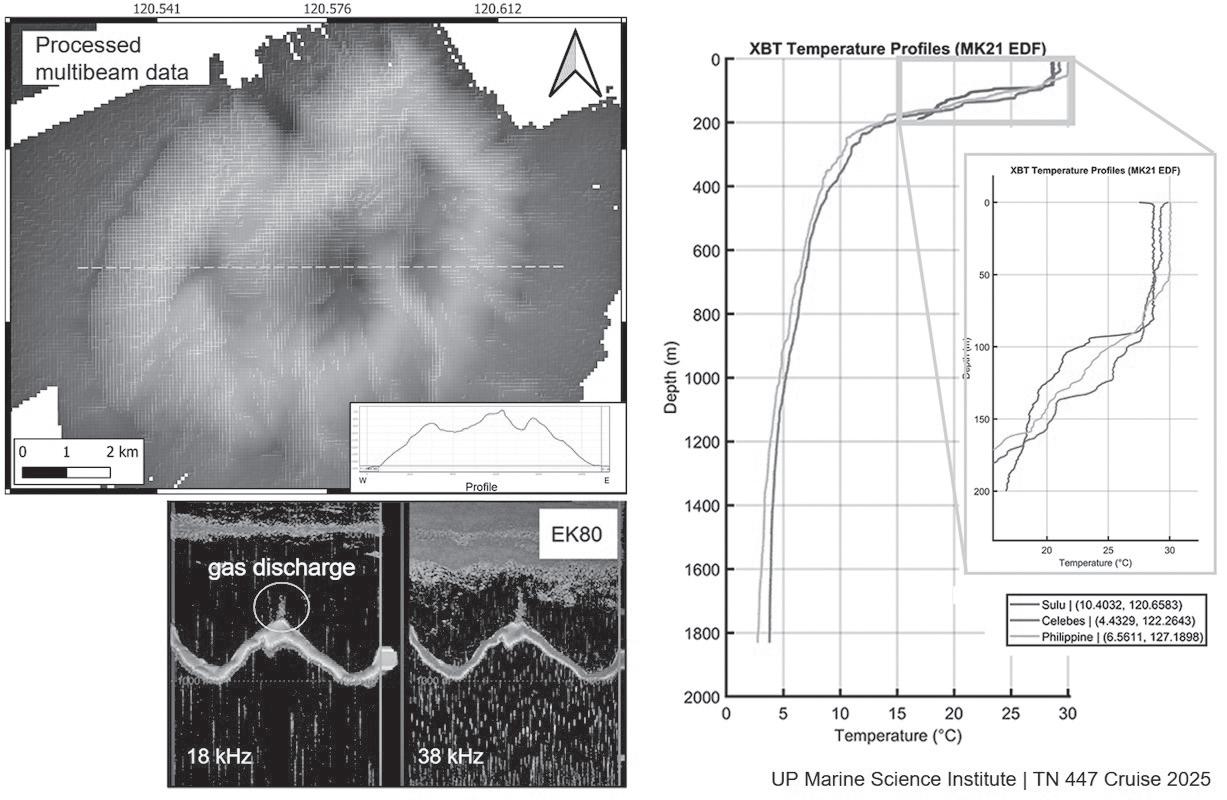
In one of targeted volcanic features in the Sulu Sea, the EK80—a sonar device which scans the water column—imaged a vertically-oriented anomaly extending by about 30 meters from the top of the volcanic feature into the water column.
This anomaly is likely caused by hydrothermal gases discharged by the volcano, said Siringan, who leads the Geological Oceanography Laboratory.
In the Celebes Sea, a volcanic feature just south of Balut Island was found to have a morphology indicative of a caldera.
Siringan said that volcanic edifices are conducive to unique marine life, which may yield unique bio-compounds potential for industrial and pharmaceutical products.
He shared his previous experience at the Philippine Rise, where his team found sea stars, sea lilies, and Iridogorgia corals at depths of 1300 meters.
“Anywhere you have gas seeps and hydrocarbon seeps, the biodiversity is relatively unique compared to surrounding areas. That’s why it’s an area of interest for both geologists and biologists,” Siringan explained.
The UP MSI has several studies on the potential of Philippine marine biodiversity
for drug development. Though no compounds have been sourced from the deep sea yet, research on shallow water cone snails has led to the development of the analgesic ziconotide.
More recently, significant progress has been made on using compounds from the Philippine blue sponge to assist in the treatment of breast cancer.
Palawan, often dubbed “the safest place in the Philippines” due to its lack of earthquakes, is commonly thought to have no active faults. However, on this voyage, researchers found previously unmapped faults off eastern Palawan.
Along the continental slope, the fault, which cuts through the surface, shows a displacement of about 10 meters.
Meanwhile, along the projected extension of the Ulugan Bay Fault, a series of faults cut through the sediment packages over a span of about 20 kilometers.
Siringan explained that the findings are consistent with the findings of French and German scientists, who previously mapped several faults while doing hydrocarbon exploration-related research in the Sulu Sea.
Researchers of the Philippine Institute of Volcanology and Seismology attributed the 5.1 magnitude earthquake that hit Palawan on June 11, 2024, to one of the previously mapped faults in the area.

Siringan hypothesized that the alignment of volcanic features on the west side of Sulu Sea with the Manguao Volcano in Taytay, Palawan, may also be related to one of these faults.
He advocated for a reassessment of the
geology of Palawan, especially because of the identification of Palawan as a possible site for a nuclear power plant.
In the southern Philippine Sea, physical oceanographers uncovered deep ocean processes that can support a productive
Ateneo leads intl cooperation for future light-based electronics
PHOTONICS— the next generation of electronics technology, which uses light instead of electricity—is gaining a foothold in the Philippines thanks to the Ateneo de Manila University’s Research on Optical and Electronic Systems (ROSES) Laboratory, the country’s first and only facility dedicated to locally designing Photonic Integrated Circuits (PICs) and training PIC designers.
Established by physicist Dr. Benjamin B. Dingel in 2017, the ROSES Lab grew from a volunteer effort to bolster Ateneo’s research capacity into what is now the Philippines’ leading center for optical sciences and photonics engineering.
It is now positioning itself as a driver of international collaboration in photonics research and innovation.
To date, the Ateneo ROSES Lab has over 85 scientific publications and support from the Philippine Department of Science and Technology- Philippine Council for Industry, Energy and Emerging Technology Research and Development (DOSTPCIEERD), the Ateneo Research Institute of Science and Engineering (ARISE), and various global partners.
This sets the stage for the Philippines to play a key role in the development of
future computers, smartphones, telecommunications systems, medical devices, and other advanced technologies.
Already, photonics is poised to be implemented in the near future in hybrid systems that combine electronic and optical technologies for optimized performance.
Dingel’s vision of collaboration and technological shift was underscored at the Workshop on Advanced Photonics Technologies for Emerging ICT and Sensing Applications held on February 20 at Escaler Hall, inside the Ateneo de Manila University’s Loyola Heights campus.
The workshop convened leading researchers from Japan, Thailand, Taiwan, and the Philippines under initiatives such as the DOST-PCIEERD’s e-Asia Joint Research Program (JRP) and Japan’s NICT’s Asean IVO JRP.
Participating institutions included Waseda University, National Institute of Information and Communications Technology, Chiang Mai University, Thai Microelectronics Center, and industry partner Xinyx Design and Consultancy Services Incorporated.
Dingel emphasized that the ROSES Lab aims to serve as a satellite hub for global
partnerships and is actively expanding its objectives to foster international research, development and innovation collaborations.
“If we continue with our current technology, then we are already left behind. We can never move forward and compete. So, our laboratory takes an experimental side, in which we try to be as open as possible to outside collaborations,” he explained.
“The Ateneo ROSES Laboratory is a great and important step forward for research in optical science and engineering in the Philippines. It embodies the Ateneo de Manila University’s long-standing commitment to build local capability and strengthen research and development in photonics, which has the potential to produce revolutionary change,” said Dr. Filomeno Aguilar Jr., Ateneo de Manila University Assistant Vice President for Research, Creative Work, and Innovation, in his opening remarks.
Calling for deeper collaboration among Philippine universities, the ROSES Lab continues to seek and nurture talent to help advance both Ateneo and the nation—especially in PIC design, an area where the Philippines leads in design expertise but lags in fabrication and technology assimilation.
According to Dingel, with dynamic collaboration, the country remains wellpositioned to make significant technological leaps in the years ahead.
fisheries industry and new ventures into renewable energy.
Recent oceanographic observations reveal that the southern Philippine Sea could be a prime location for ocean energy operations.
Ocean Thermal Energy Conversion (OTEC) is technology that harnesses this temperature difference between warm surface waters and colder waters at depth. To operate efficiently, OTEC systems typically require a temperature contrast of at least 20 degrees Celsius, which in many parts of the world means drawing cold water from depths of 800 meters to 1,000 meters or deeper.
According to Dr. Charina Lyn AmedoRepollo, who leads the Physical Oceanography and Observation Laboratory, this critical 20°C temperature difference between the surface and the depths is already observed at approximately 200 meters.
The sharp contrast in temperature, as measured with the expendable bathythermograph, is considerably shallower than what is observed in many other tropical regions.
This is explained by the unique characteristics of the southern Philippine Sea. It is an open-ocean environment exposed to strong solar heating and shaped by large-scale ocean circulation.
These conditions create the warmest and most consistent upper-ocean temperatures among the surveyed seas, and its water temperatures drop rapidly with depth.
“The strong surface-to-deep temperature contrast observed in the southern Philippine Sea meets the thermal requirements for OTEC, indicating high potential for continuous baseload renewable energy, with additional applications for desalination, and seawater cooling,” Amedo-Repollo said.
She further explained that this pronounced thermal structure is influenced by the major currents along the eastern coast of Mindanao.
Measurements collected during the R/V Thompson expedition reveal that the interaction between the southward-flowing Mindanao Current and the northward-flowing Mindanao Undercurrent produce a deep shear layer that is observed approximately 600 meters to 700 meters deep. It is characterized by sharp velocity and density gradients that affect stratification in the water column.
Critically, this interaction between such strong currents also gives rise to internal waves and internal tides—large, slowmoving waves that travel beneath the ocean surface.
The scientists said that when strong currents flow across rugged sea floors and through narrow passages, they generate
powerful underwater waves that mix the ocean from below.
In places like the Basilan Strait and over the Sangihe Arc, the ocean floor is steep and highly complex. As a result, these areas become natural hotspots for internal waves, enhancing ocean mixing and supporting life beneath the surface.
This mixing plays a vital ecological role.
As internal waves break and fade, they help carry nutrients from deeper waters toward the surface, fueling the growth of plankton—the foundation of marine food webs.
Over time, this process helps explain why regions influenced by strong internal wave activity often coincide with productive fishing grounds, linking ocean physics directly to food security and fisheries sustainability.
Amedo-Repollo explained that these findings show how understanding the ocean’s layered structure—from surface currents to deep-water interactions—can guide decisions on renewable energy development, fisheries management, and the broader blue economy of the Philippines.
“We don’t only see water. We see opportunities for future work,” Amedo-Repollo said. From clean, continuous energy to resilient fisheries, the southern Philippines highlights how processes beneath the waves can help shape sustainable solutions for communities above them.
Despite being bordered by the world’s deepest waters, the depths of the Philippines remain underexplored. Most marine research in the country focuses on shallow, coastal waters.
Venturing into the open ocean and going deeper often requires external support. The expedition to the Sulu Sea, Celebes Sea, and South Philippine Sea was conducted aboard the R/V Thomas G. Thompson, an American deep-sea research vessel, and was funded by the US Office of Naval Research.
Notably, this expedition marked the first time water samples were collected from a depth of 5200 meters in the Celebes Sea.
Captain Armil Angeles (Ret.) of the Presidential Office for Maritime Concerns expressed his support for more Philippine deep-sea studies.
“There’s a need for marine science research and to support marine science research. On our part as policymakers, we will do our part to support it,” Angeles said. The UP Marine Science Institute remains committed to serving national interests through marine science research.
“There’s a lot of attention on us because of the Coral Triangle, but I bet our deep sea is just as interesting,” said Director Dr. Laura David.
DOST, Maynilad provide Eco-Dryer to power year-round livelihood for Muntinlupa weavers
THE rainy season no longer signals a halt in income for around 100 Muntinlupa weavers as they look forward to a more stable, year-round production—all thanks to the Eco-Dryer developed by the Department of Science and Technology-Forest Products Research and Development Institute (DOST-FPRDI).
The Eco-Dryer is an innovation that delivers reliable drying and ensures harvested water hyacinths are ready for weaving into high-end handcrafted goods, regardless of weather.
Last February 4, Maynilad Water Services Inc., in partnership with DOST-NCR, formally turned over the water hyacinth drying facility to the City Government of Muntinlupa.
For years, the creative weavers under the Gender and Development Office of the Muntinlupa City local government unit endured unpredictable weather, leaving their raw materials vulnerable to mold and rot.
This led to wasted harvests and stalled production during the rainy season, causing a significant gap in their income. While the water hyacinth is one of the world’s fastest-growing freshwater plants, its potential as a sustainable material has long been hampered by these drying challenges.
With the new facility, the community can now consistently produce a wide array of sustainable products, including assorted bags, bayong, trays, placemats, slippers, and coasters.
“Our mission is to ensure that science serves as a bridge to prosperity, making the concept of Agham na Ramdam a daily reality for Filipino
families,” said Science Secretary Renato U. Solidum, Jr.“By using this drying system, Muntinlupa weavers can overcome the barriers of nature so they can focus on their craft and compete in the global market with confidence and pride.”
Muntinlupa City Mayor Ruffy Biazon expressed his gratitude for the collaboration, noting how it transforms an environmental challenge into an asset.
“This project proves that when science, environmental responsibility, and innovation come together, we create real and lasting impact. What was once seen as a problem is now an opportunity,” Biazon said.
“Through this partnership, we are not only addressing an environmental challenge, we are strengthening livelihoods and giving our weavers the stability they deserve. This is the kind of convergence we want to continue: solutions that are practical, sustainable, and centered on uplifting every Muntinlupeño,” he added.
For Maynilad, the project is an extension of their environmental and social commitment to the communities surrounding Laguna Lake.
“Maynilad supports this initiative in partnership with DOST-FPRDI and the City Government of Muntinlupa to help promote sustainable livelihood opportunities linked to water and the environment,” said Marie Antonette H. De Ocampo, head of Corporate Affairs and Communication of Maynilad Water Services Inc.
“With Laguna Lake as one of our water sources, efforts like this highlight the value of environmental stewardship while helping local
communities sustain their income,” she said. The DOST-FPRDI Eco-Dryer addresses production hurdles through efficient engineering. The facility features a simplified heating system that reduces fabrication costs by 60 percent and biomass consumption by 35 percent compared to conventional models.
“By maximizing heat distribution and retention, the system allows weavers to achieve consistent drying temperatures without the need for high volumes of firewood,” explained Engr. Wency H. Carmelo, Supervising Science Research Specialist of DOST-FPRDI.
To ensure the long-term success of this initiative, DOST-FPRDI experts are scheduled to provide comprehensive technology demonstrations and training for the local staff on the proper operation and maintenance of the facility in the coming weeks.
“At DOST-FPRDI, we see our role as supporting the real champions of this effort—the community weavers who are reshaping their environment through their craft,” said DOSTFPRDI Director Rico J. Cabangon. “We hope to help our partners in Muntinlupa achieve levels of productivity that were once out of reach during the rainy season.”
As DOST’s research and development arm on forest products utilization, the Institute continues to provide technical assistance and innovative technologies that empower local industries and marginalized communities across the Philippines. Maria Greatchin S. Brucal/S&T Media Service
THE height and shape of a submarine volcano spotted in the Sulu Sea (top left). Echosounder data (bottom left) shows gas discharge likely emanating from the volcano. On the right, temperature profiles of the Sulu Sea, Celebes Sea, and Philippine Sea show their potential for renewable ocean energy.
THE members of the R/V Thompson Team are (from left) Dr. Fernando Siringan, Dr. Remika Gupana, Jherome Co, Capt. Eric Haroldson, Marjorie del Mundo, Laurice Dagum, Jenny Nomura, Todd Schwartz, Dr. Charina Lyn Amedo-Repollo, Christina Ramirez, Dr. Anand Hiroji, Dr. Daniel Orange, Dr. Alex Higgins, Tolu Akande, Sophia Pamati-an, Will Segal, Dr. James Gibson, Janell Sihay, and Dr. Iris Orizar. Not present for this photo: Dr. Janelli Lea Soria and Kristel Occeña. PHOTO TAKEN BY STEPHEN LUCES
A6 Sunday, March 1, 2026
Faith Sunday

Catholics return to confession focused on grace, not a get-out-of-hell-free card
THE Lenten period for penance started the week with Ash Wednesday, and some Catholic priests are happily bracing for long lines outside the confessional. The faithful across the United States are embracing anew the sacrament that has shifted from embarrassing recitation of sin to cathartic quest for grace.
“They come to confession feeling as if they are terrible, but… they are displaying the fact that they want to be good,” said the Rev. Patrick Gilger, a Jesuit priest in Chicago.
“The fact that somebody shows up to confession is a lived act that they desire holiness,” he said. Most faith traditions have rites of self-restraint, repentance and atonement, often in a prescribed annual period before major holidays.
For Catholics, the sacrament of penance and reconciliation is supposed to be a regular weekly or monthly practice. Penitents tell a priest their sins, pledge not to commit them again, receive forgiveness, and go on their way with a penance, able to receive Communion again since they’re not supposed to without first confessing any grave sins.
“This becomes kind of a marker for Catholics. It’s something they do, which their Protestant and other non-Catholic neighbors don’t do,” said James O’Toole, a Boston College professor emeritus and author of a new history of confession.
Old sins, new confessions UNTIL the last decades of the 20th century, Catholics knew the drill.
Parishes and schools had lists of sins by grievousness—from the commandment-breaking mortal ones like adultery to venial offenses like talking in church.
Confession was often a quick affair—a recitation of how and how often one sinned, followed by an act of contrition, and a penance like saying 10 Hail Marys.
Then came a rapid, steep decline in confession, O’Toole said. It was driven by the growth of psychology and the complexities it revealed in human behavior, major cultural changes on issues like sexual mores, and the clergy abuse scandals. The Catholic Church does not gather data on confession, so it’s hard to quantify current trends, according to the Rev. Thomas Gaunt, who leads Georgetown University’s Center for Applied Research in the Apostolate.
But US parishes are noticing an uptick and priests say that, while acknowledging sins and receiving absolution remain core, confession is turning more into a conversation focused on God’s mercy and love.
“There’s only so many ways to go wrong. There’s an infinite number of ways to be right and to have God’s life coursing through you,” said the Rev. Mike Nugent, who was ordained in 2023 and is parochial vicar at Saint Ambrose
My journey towards the truth
By Soo Oh
I’M a Bible teacher at Zion Christian Mission Center (ZCMC).
As a child, my family lived in poverty and the whole family had to share a room. Every morning when I woke up, the first thing I saw was my mother’s back as she knelt to pray in front of a candle and a statue of the Virgin Mary. My mother was a devout Catholic, and when I was 10 years old, I took her hand and went to church for the first time. This was the beginning of my life of faith.
From a very young age, heard stories of God and Jesus from my mother. I became an altar boy and attended Mass almost daily. As I experienced numerous miracles, my love for God deepened.
Then, one Sunday, I was learning about the book of Genesis from a nun in Sunday school.
She told me that the fruit from the tree of the knowledge of good and evil, which would lead to death if eaten, was an apple.
Even though I was young, I could not understand this answer because ate apples often. I wanted an explanation, so I asked the nun what the tree of life was, what the tree of knowledge of good and evil was, and why their fruit was an apple. But I did not get an answer.
Since I served alongside the priest during Mass, I asked the priests the same questions but I received no satisfactory answers.
I couldn’t resist my curiosity so I asked my mother, who copied the Bible every day. She replied, “I don’t know either,” and bought me a small Bible.
Giving it to me, she said, “God is the Word (John 1:1), and since your desire to understand
is good, the Lord will grant you the answer (truth).” She then instructed me to pray and read the Bible over and over again.
After that, I read the Bible extensively, but while I memorized and remembered the historical and moral content, I couldn’t understand what was recorded in the prophetic books. So, I entered seminary for seven years, became a Catholic priest, and served for 12 years. But I still struggled to understand the prophetic writings.
Then one day, a ZCMC Bible teacher came to my office and said he wanted to talk about the Bible with me. So I served him a cup of coffee and we talked about the Bible.
One of the questions he asked was, “What are the lamp and oil that the wise virgins must prepare to enter the wedding feast [salvation] in Matthew 25?” I answered without hesitation that the lamp represents the church and the oil represents the Holy Spirit and love.
The Bible teacher then explained that the lamp represents the Word of God, that is, the revealed word that has been opened (Psalm 119:105, 130), and the oil represents the word that testifies to the fulfillment of the prophecies which is proclaimed by the Lord’s chosen witness (Zechariah 4:11-14; Revelation 11:3-4).
In other words, just as at his first coming when the prophecies of the Bible and their fulfillment were being testified, we must be prepared with the knowledge and faith in the prophecies and their fulfillment when Jesus returns (John 14:29; Hebrews 4:2). He also biblically explained the meaning of the wise virgins and foolish virgins at Jesus’ return, as well as the meaning of the wedding banquet. His answer was far more biblical and authoritative than mine, and I was speechless,
Catholic Church in Annandale, Virginia.
It’s not that confessors today are handing out get-out-of-hellfree cards—the priest cannot give absolution, or God’s forgiveness, if the penitent isn’t willing to change. But they try to bring the same mercy that the Gospels show Jesus showering on all manner of sinners.
“What sinfulness is in the Catholic Church’s theological understanding is the intentional, willful distancing of oneself from God,” said Gilger, who also teaches at Loyola University. “The point of confessing your sins, of attending to sins, is only to allow the God who wants to be with us to rush back into the emptiness that those sins have created.”
That’s why several priests talk about confession as “therapeutic”—both for the penitent and for the confessor—especially in a society that’s keener to judge than to forgive.
“The individual can both confront him or herself, sort of acknowledge these things, and at the same time experience, from God through another person, mercy, forgiveness, and hope,” said the Rev. Brendan Hurley. He oversees the penance preparation program at the Pontifical North American College, next to the Vatican, where Nugent studied.
What the sinners want, and confession can provide THE “seal of the confessional” is so absolute that the Vatican has repeatedly fought legislative efforts to compel certain disclosures.
But when they kneel in front of a screen in a wooden confessional, or sit face-to-face with a confessor, most people want to offload a burden and hear a concrete word of encouragement, priests say.
“It’s about healing,” said the Rev. John Kartje, rector of Mun -
acknowledging it as a truly excellent response.
I enjoy boxing and have sparred extensively so while I feel bad when I’m knocked out by a good punch from my opponent, I also know that I should humbly acknowledge my opponent’s skill and learn from it. Sharing about the Bible was just as simple for me.
After this exchange of questions and answers, the ZCMC Bible teacher asked me,“Father, are you familiar with the Book of Revelation?”
I admitted that I studied it in seminary, but the truth was that it had been so long since I’d studied it that I didn’t remember much.
I decided to study my theology books for a month before meeting him again for another “sparring session” so I made an excuse and said, “Let’s talk about the Book of Revelation in a month.” I then scheduled our next Bible sharing session for a month later.
In the next article, I will share what we discussed about the Book of Revelation.
Zion Christian Mission Center is the theology arm of Shincheonji Church of Jesus and it offers a full theology course for free. You can sign up here or scan the QR code. You can also download the ZCMC SPS app for free.


delein Seminary in Illinois and a priest for nearly a quarter century.
“You need trust, you need openness, you need vulnerability, you need honesty.”
That’s why confession has “a strong customer satisfaction rating,” said Nugent, with a chuckle. At the end of the month, his parish and all others in the Diocese of Arlington will start holding confessions on Wednesday nights at the same time.
“Knowing that I’m loved even with my struggle, even with sin, even with the things that are challenging and shameful in my life, that I am still loved perfectly—my gosh, that is good news,” Nugent added.
Priests can bring relief in dramatically urgent confessions, from those who have hours left to live or who tell the confessor a major fault that they have never spoken
out loud, like cheating or stealing.
Other times, they might need to nudge an overly vague penitent who only mumbles, “I haven’t been true to myself,” or finds it hard to accept that the church considers sinful something that’s broadly accepted, like contraception.
What priests say they do not do is roll their eyes, literally, at whatever revelation—or strike the fire-and-brimstone tone.
Instead, they focus on reminding people that God’s love is still close.
“Then people know what the thing that they’re doing is that’s keeping them away from God,” Gilger said.
Preparing for a heavy duty that becomes a highlight of ministry
HISTORICALLY , seminarians studied moral theology and manuals that amounted to “clear rule
books,” which were broadly reflected in what people learned through catechism, according to O’Toole.
While there are still penance classes toward the end of seminarians’ studies, today’s emphasis is on “creating a space where the penitent can feel comfortable,” Hurley said.
That’s why seminarians practice with professors and each other, and also go to confession themselves regularly—something that all priests do, including the pope. Ultimately, going to and administering confession is an act of faith.
“I think the learning curve when you first get out [of seminary] is…don’t fall in the trap of thinking this is all on you, because sometimes that leads to being overly strict,” Kartje said. “I’m hearing your confession. I’m saying the words of absolution. But the only real healer is the Holy Spirit.”
The belief that they’re the conduit for God’s grace to a struggling person is what makes many priests love spending hours listening to a litany of bad behaviors.
“You’re not just there for what Jesus is doing in healing that person. You also have this privileged role in being present as someone shows incredible virtue,” Nugent said. “When someone comes and says, ‘Father, these are the things I’ve done,’ there’s so much honesty, there’s so much humility, a great generosity of spirit, a great faith in the God who will forgive them.”
Yes, sitting on the other side of the confessional’s grille can be grueling—but also rewarding, Gilger added.
“I remember some confessions, the hard things people said, but…mostly what I remember is how amazing people are, and it’s immensely consoling,” he said. Giovanna Dell’orto/Associated Press
Pope to priests: Use your brains, not AI, for homilies
IN a private exchange with priests of the Diocese of Rome on Thursday, Pope Leo XIV responded to four questions, advising them on prayer, study, and priestly fraternity.
The off-camera moment took place after Leo gave a public speech to the priests, inviting them to “rekindle the fire” of their ministry.
“The first priest to speak was a young man who asked the pope how the Gospel can be embodied in the world of young people,” according to a priest present at the February19 meeting in the Vatican’s Paul VI Hall.
The priest told ACI Stampa, the Italian-language sister service of EWTN News, that Leo’s answer to this question was: “First of all, what is needed is the witness of the priest; and then, when meeting young people, they must broaden their horizons to reach as many young people as possible. For this, it is necessary to rediscover the value of communion.”
Responding to a second question, the pope recommended knowing well “the community in which one lives and works. It is necessary to know the reality well. To love your community, you must know it. Therefore, a real shared effort is needed to understand it better and thus face together all the challenges that arise.”
“The pope also invited us to use
our brains more and not artificial intelligence [AI] to prepare homilies, as he now sees and hears happening,” the priest said.
“And here the pope made a strong recommendation regarding prayer: We priests must pray—remain with the Lord, that is—not reduce everything to the breviary or to a few brief moments of prayer, but truly learn again to listen to the Lord,” he added.
The third question was more reflective: Today, as priests, we are unable to rejoice in the success of another fellow priest.
The pope responded that “we are all human, but we should set a good example, especially the example of priestly fraternity.”
He dwelt at length on how to cultivate priestly friendship. The pope also reminded them to continue studying.
“It must be ongoing study; we must always stay up to date. But the fundamental thing is to cultivate priestly friendship, priestly fraternity,” the priest from Rome said. The final question concerned elderly priests and their loneliness. According to the priest, Leo’s response “reaffirmed the need for fraternity, for the joy of being together. We must give thanks, truly live gratitude for the fact of being priests, from the day of our ordination every single day, and thank God for this great gift, and live the priesthood with gratitude. And here, a great deal of humility is also required.”
“Personally, I was happy,” the priest concluded. “We greatly appreciated the pope for a very, very concrete speech.” Marco Mancini/Ewtn News Via Cbcp News


Editor: Lyn Resurreccion

Biodiversity Sunday


Invasive water hyacinth an economic option for Naujan’s women-led group
By Jonathan L. Mayuga
AN invasive alien species, water hyacinth is considered a problem in many areas around the country as they infest water bodies—lakes, rivers, swamps, or marshes.
However, in the rural eco-tourismoriented Barangay Dao in Naujan, Oriental Mindoro, a group led by enterprising women has found a way to make the pesky water lilies useful.
Like turning garbage into gold, the Dao Waterlily Association (DWA) harvested, dried, processed, and used the plants to make artistic handicrafts—hitting two birds with one stone: helping protect and conserve biodiversity, on one hand, and providing a source of income to the women, on the other.
Biodiversity-friendly enterprise
THE effort of the enterprising DWA members did not go unnoticed. The Department of Environment and Natural Resources (DENR), through the Biodiversity-Friendly Enterprises (BDFE) under the Mindoro Biodiversity Corridor (MBC) Project, is now providing the much-needed boost.
The BDFE initiative is anchored on DENR Administrative Order 2021-13, which institutionalizes the recognition and support to enterprises that sustainably utilize biological resources while generating economic benefits for local communities. Through this mechanism, people’s organizations are empowered to align conservation objectives with incomegenerating activities in biodiversity-rich
landscapes, such as the MBC.
Butas River
THE DWA’s activities help protect the Butas River from the adverse impact of overgrowing water hyacinth, BDFE Officer Jhoanne Mae Dapito told the BusinessMirror via Messenger on February 15. Approximately 20-km long, the river serves as a vital outlet for Lake Naujan.
Butas River acts as the primary drainage channel for the 216-sqkm lake, considered a key area for assessing the migration of fish species—such as mullet (banak), snapper (maya-maya), and jack (talakitok).
Research also identified the river as a critical migratory path for milkfish or bangus.
“They harvest water lily from Butas River, and make handicraft from dried stems,” Dapito said.
It should be noted that the area’s residents, and in many parts of the country, interchangeably identify water hyacinths with water lilies.
Water hyacinths (Eichhornia species) and water lilies (Nymphaeaceae) are distinct aquatic plants. Although both are invasive.
Water lilies are rooted in soil with flat, floating leaves and singular flowers, while water hyacinths are free-floating, featuring thick, bulbous stalks and lavender flowers. Originating from South America, hyacinths are considered a major, fast-multiplying pest plant.
Naujan Lake National Park
THE Butas River as well as the Naujan Lake
Trump admin ends protections for rare dancing prairie bird
FORT COLLINS, Colorado—A grounddwelling bird known for elaborate mating dances on the southern Great Plains will no longer be federally protected after the Trump administration agreed with arguments by three states and the beef and petroleum industries that the species was listed improperly.
Thursday’s delisting by the US Fish and Wildlife Service formalized a recent court ruling that acknowledged the federal agency has now sided with opponents of federal protections for the lesser prairie chicken. The ruling by a federal judge in Midland, Texas, in effect ended Endangered Species Act protections for the bird last summer. The protections required the energy industry and ranchers to take steps to avoid disrupting the birds’ habitat, especially their mating areas, called leks.
The crow-sized birds once numbered in the millions. Habitat loss from energy and agriculture development has shrunk their population to about 30,000 across parts of Colorado, Kansas, New Mexico, Oklahoma and Texas. Wildlife watchers delight in the male birds’ spring dances and their warbling, clucking and stomping ruckus to attract mates.
Native American tribes mimic the flamboyant displays—also a behavior of the more common greater prairie chicken—in some of their dances.
The lesser prairie chicken has been federally protected twice in recent years. In 2015, a federal judge in US District Court in Midland reversed the bird’s listing as a threatened species the year before, siding with petroleum developers who argued that sufficient protections were already in place.
In 2022, President Joe Biden’s administration listed the lesser prairie chicken as
threatened in the northern part of its range in Colorado, Kansas, Oklahoma and Texas, and as endangered in a “distinct population segment” to the south in New Mexico and Texas.
The listing prompted a lawsuit filed by Kansas, Oklahoma and Texas and groups, including the Permian Basin Petroleum Association and National Cattlemen’s Beef Association.
After President Donald Trump took office last year, the Fish and Wildlife Service reevaluated the bird and agreed with the states and groups that it lacked justification to classify the lesser prairie chicken into two distinctly different populations.
Last August, another judge in US District Court in Midland granted a Fish and Wildlife Service motion to reverse its Biden-era listings for the lesser prairie chicken.
“Fish and Wildlife’s concession points to serious error at the very foundation of its rule,” District Judge David Counts wrote in his August 12 ruling praised by Texas officials. Texas oil and gas regulatory officials including Texas Railroad Commission Spokesperson Bryce Dubee and Texas Land Commissioner Dawn Buckingham welcomed the delisting.
“It will ensure American oil and gas production in the Permian Basin remains robust and our economy steadfast,” Buckingham said in an emailed statement.
Environmentalists vowed to fight on in court.
“It’s shameful that the Trump administration sees fit to sacrifice these magnificent birds for oil and gas industry profit,” Jason Rylander, legal director at the Center for Biological Diversity’s Climate Law Institute, said in a statement. “Lesser prairie chickens may be lost forever without Endangered Species Act protections.” Mead Gruver/Associated Press
are considered as the veins and heart of the Naujan Lake National Park. They are havens not only for native fish species, but also for native and migratory birds.
Naujan’s status as a National Park was established on March 27, 1956, through Proclamation 282. It became an initial component of the National Integrated Protected Areas System (Nipas) under Republic Act 7586
On November 12, 1999, it was designated as a Wetland of International Importance and became Ramsar Site 1008, making it the second of such sites in the Philippines, after the Olango Island Wildlife Sanctuary in Lapu-Lapu City in Cebu.
As a Ramsar Site, it was identified as a critical stopover on the East AsianAustralasian Flyway, serving as a vital wintering ground for thousands of waterbirds.
Studies show that it supports at least 19 species of migratory birds, particularly the tufted duck.
Many endemic birds take refuge in the surrounding forest of the Naujan Lake, including the Philippine duck and Mindororestricted species, the Mindoro tarictic hornbill and Mindoro hawk owl.
Remarkable role
ANNABELLE M. BARQUILLA, Provincial Environment and Natural Resource Officer (Penro) of Oriental Mindoro and the concurrent MBC Project Manager, said the DWA play an important role in keeping the ecological balance in the Butas River.
From only 15 all-women members in 2015, the group now has 38 members—25
Young
FLOREANA ISLAND, Galapagos— Juvenile tortoises with Floreana ancestry were brought to their native island from the Galápagos National Park’s breeding center on Santa Cruz Island, as part of a project to restore the species to its native habitat
The original Floreana giant tortoise was driven to extinction in the 19th century largely after sailors and whalers took tortoises for food.
Later, introduced animals such as rats and feral cats preyed on eggs and hatchlings, while other invasive species degraded habitat and food sources.
Scientists later found tortoises with Floreana ancestry on other islands and began selectively breeding hybrids for reintroduction once juveniles are large enough to survive.
Dolores Ochoa/Associated Press
women and 13 men—who have ventured into various biodiversity-friendly enterprises.
“By harvesting water lily in the river, they were able to keep the water flowing freely,” she told the BusinessMirror in Filipino during a telephone interview on February 24.
Because of DWA, she pointed out, the problem brought about by the water hyacinth overgrowth is solved.
“Today, the [water hyacinth] is no longer a problem because the group is harvesting them. Actually, it [harvesting the plant] has a dual purpose—it unclogs the river of water hyacinth, and they [residents] use it for their livelihood,” she said.
More importantly, the livelihood activities of the group is highly beneficial to ensure the ecological balance in the river.
Because water hyacinth is fast-growing, its growth becomes dense. It covers the surface of a water body, such as the Butas River, acting as a biological barrier that limits the growth of phytoplankton or microalgae, leaving the zooplankton with nothing to feed on, thereby leaving many fish species nothing to feed on.
Without a healthy supply of zooplankton, the fish population in Naujan Lake would eventually starve and disappear.
Lakbay-Aral
DW A President Rochelle Martinez said they came to know of the entrepreneurial opportunity during a Lakbay Aral (Study Tour) led by their barangay in Paranaque City.
“When we learned that water lily
can be used for handicraft, our barangay sought the help of the local government, which organized a training,” she told the BusinessMirror in Filipino on February 25.
Through handicraft making using water hyacinth, she said they are able to generate income and help protect the environment, at the same time.
According to Martinez, the income from handicraft making and ecotourism is a big help to DWA members.
“As proof, we are being invited now to trade fairs to sell our handicrafts. It’s a big help because of the extra income. Actually, our members are now busy weaving and are seldom [tinkering with] their cellphones,” she said.
Livelihood opportunities
ACCORDING to Barquilla, members of the group produce fashionable accessories like bags and purses, footwear and headwear, and home décor and utility items, including baskets, canisterss and multi-purpose bins, storage boxes, organizers, and tabletop accessories, such as placemats, coasters, and trays.
As a bonus, harvesting the water hyacinth made them realize the beauty of their barangay and turned a small waterbody into a park that is now considered a tourist magnet in Naujan— allowing them to generate added income from various tourism-related activities like boating and rentals of floating cottages in the Waterlily Mini Park.
To help boost the livelihood of the group, a P250,000 seed money was provided by DENR through the BDFE-MBC Project.
“We provided them 12 solar panels with 600-watt capacity and solar-powered water pump for their domestic use,” Barquilla said. She said that across Mindoro Island, which includes the Oriental and Occidental Mindoro, a total of 14 groups are receiving support from the DENR through the MBC Project.
Possible expansion BECAUSE of the success of their endeavors, the DENR and its development partners are considering to expand its support for the group, following a technical visit in Barangay Dao. The visit formed part of the MBC Program Mission on February 9 to 13 to monitor project implementation and assess the progress of assisted people’s organizations within the corridor.
Leading the delegation visit was DENR Undersecretary Analiza Rebuelta-Teh for Finance, Information Systems, and Climate Change. She was joined by Foreign-Assisted and Special Projects Service Director Al O. Orolfo; United Nations Development Programme Analyst Maria Theresa EspinoYap; MBC National Project Manager Dr. Mary Jean A. Caleda; DENR Mimaropa Regional Executive Director Felix S. Mirasol Jr.; PENRO Oriental Mindoro Annabelle M. Barquilla; CENRO Socorro Rodel M. Boyles; and representatives from the local government unit of Naujan. Teh said she is looking at endorsing the group for expanded coverage to receive more funding support to sustain their activities.
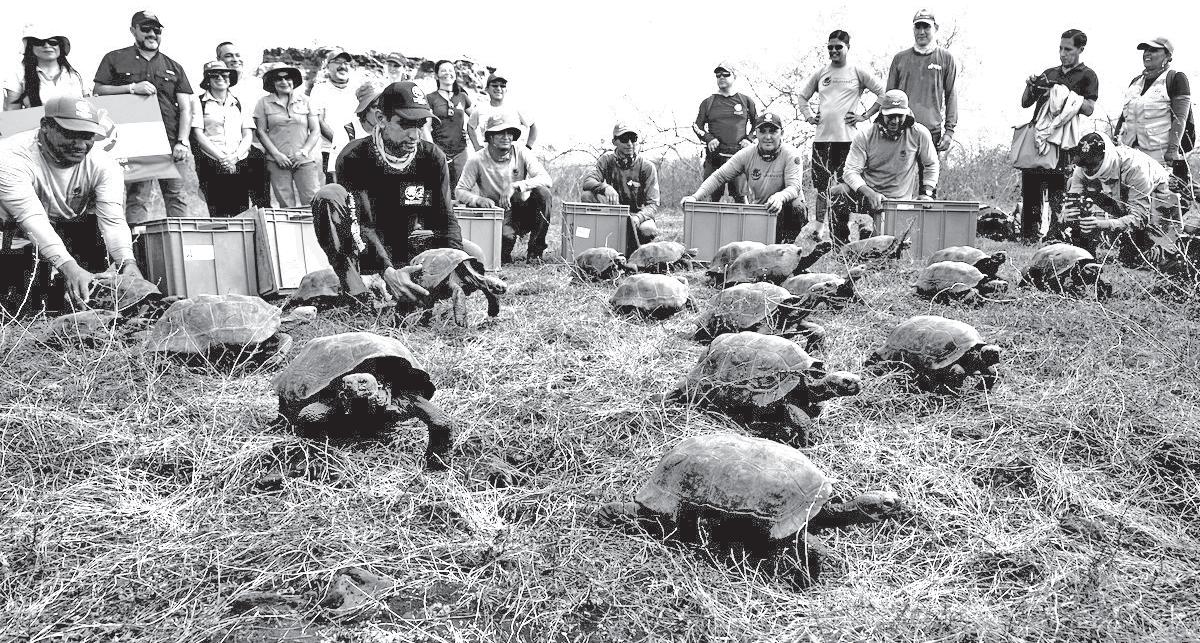
UN data: 6.5M people in Somalia at risk of severe hunger from drought
MOGADISHU, Somalia—Nearly 6.5 million people in Somalia are facing severe hunger as worsening drought, conflict and global aid cuts intensify the country’s humanitarian crisis, the federal government and UN agencies said Tuesday.
New data from the Integrated Food Security Phase Classification report shows that 6.5 million people are projected to face crisis or worse levels of food insecurity by the end of March.
The report also estimates that 1.84 million children under the age of 5 are expected to suffer acute malnutrition in 2026, including nearly 500,000 who will be severely malnourished.
Somalia’s population is estimated at 19.7 million to 20.3 million in 2026, according to recent UN data.
Officials said that the food security situation is deteriorating because of water shortages, insecurity, conflict and historically low levels of humanitarian assistance linked to global funding cuts.
The intensified drought, linked to lower-than-average rainfall, has triggered widespread food insecurity, crop failures, livestock losses, food price increases and displacement.
“The drought emergency in Somalia has deepened alarmingly, with soaring water prices, limited food supplies, dying livestock and very little humanitarian funding,” said
George Conway, the UN humanitarian coordinator for Somalia. He said that urgent lifesaving assistance is essential in the coming months, with no rainfall expected until the main rainy season, which runs from April to June.
Even if the upcoming rains perform at average levels, 5.5 million people are expected to remain in crisis or worse later in 2026. Recovery from the extreme drought will take time, officials said. Water shortages are intensifying in southern and central Somalia and aren’t expected to substantially improve, even if upcoming rains are average.
Drought and conflict displaced about 278,000 people between July and December,
disrupting agricultural production, market access and aid delivery, according to UN estimates.
“The severity of this drought is undeniable and deeply alarming,” said Mohamud Moallim Abdulle, commissioner of the Somalia Disaster Management Agency. He called on international partners, the Somali diaspora, businesses and civil society to scale up immediate support.
The United Nations and the Somali government warned that substantial funding cuts have forced humanitarian partners to decrease or suspend critical lifesaving programs, including food security, health, nutrition and water and sanitation projects. Omar Faruk/Associated Press
JUVENILE giant tortoises are released on Floreana Island as part of a project to reintroduce the species to its native habitat on the Galapagos Islands, Ecuador, on February 20. AP/DOLORES OCHOA
MEMBERS of Dao Waterlily Association at their Mini Park.
DAO Waterlily Association members with their water hyacinth handicrafts.
DAO Waterlily Association floating cottage at the Mini Park. PHOTOS
F1’s new era demands new driving style
CHAOTIC starts, tricky overtaking, lifting off the gas on straights. Formula 1’s new era of regulations could upend the series in unexpected ways when the season begins with the Australian Grand Prix next week.
Max Verstappen and Lewis Hamilton, the two most successful drivers on the grid, were critical in testing of cars whose electrical hybrid systems promote unusual driving styles and make racing more strategic.
Four-time champion Verstappen branded the cars “no fun” and suggested they might be a factor in considering retirement, while seven-time champ Hamilton suggested the rules are too complex for fans to grasp.
It’s a crucial season for F1, which expanded rapidly over the last decade by putting drivers’ personalities center stage and not focusing on technological detail.
“We need to stay calm because, as always when there is something happening as a new regulation, there’s always the doubt that everything is wrong,” F1 chief executive Stefano Domenicali said last week at testing. Despite big changes, the top four teams are the same after Mercedes, Ferrari, McLaren and Red Bull all showed promise in testing.

The ‘big four’ in 2026
THE “big four,” as McLaren boss Zak Brown calls them, seem broadly similar on pace, with Mercedes and Ferrari perhaps having a slight edge in race simulations in testing. At the final test, Ferrari revealed a rear wing that turns upside down for straight-line speed and an innovative mini-wing behind the exhaust. It also stood out as the fastest in practice starts after other teams, especially Mercedes, were sluggish off the line.

Scotland fans get FIFA approval to don sporrans at World Cup
GLASGOW, Scotland—Scotland supporters can wear their kilts in all their customary glory at the World Cup.
The Scottish Football Association told The Associated Press on Wednesday that it had reached agreement with FIFA for sporrans—the traditional fur or leather pouch worn in front of the kilt—to be permitted at games despite contravening security limits for entry into stadiums in the United States, which is co-hosting the tournament with Canada and Mexico from June 11 to July 19. Scotland has been drawn in Group C with Brazil, Morocco and Haiti, and it has two games in Foxborough, Massachusetts, and one in Miami Gardens, Florida.
“FIFA have confirmed that sporrans will be permitted into the stadiums following the standard search and inspection procedures and will continue to work together with the Scottish FA to educate their matchday staff as they prepare to welcome fans to Boston and Miami,” Scottish FA spokesperson Graeme Thewliss said.
Officials are restricting World Cup ticket holders to only bringing clear see-through bags, or small bags that are about half the size of a typical sporran.
It was causing concern among Scotland supporters who feared they’d be denied a vital and decorative part of kiltattire. Kilts, which resemble knee-length skirts, do not have pockets, so the wearer would carry their personal belongings in the accompanying sporran.
“The ticketing and membership team at the Scottish FA are in continued dialogue with the tournament hosts to ensure that the Scotland fans will be welcomed to venues in the way they have been across the world,” Thewliss said. Many Scotland fans, collectively known as the Tartan Army, are expected to travel to the US as their country makes its first World Cup appearance since 1998. AP
Vanity in Golf
I RECENTLY saw a post on who is/was the best golfer among American presidents. Right up on top, unsurprisingly is number 45 and 47, Donald Trump, with a handicap index of 2.8. In theory, whoever wants to beat The Donald should be right at or close to scratch. I am in no position to comment on the accuracy of the claimed handicap and skill level, but anyone watching videos of Trump playing golf can see that the man is a decent golfer even at his age. While there are numerous reports and suggestions that The Donald isn’t very strict with rules when he plays, that is not as easy to prove. Vanity Handicaps IT is said that golfers have two handicaps: one for
and one for betting. We all wish we had
in
Rivals have praised Red Bull for mastering the electrical power technology, while champion Lando Norris and Oscar Piastri seem consistently strong again for McLaren, which uses a Mercedes engine.
Mercedes’ mix of power and reliability could make George Russell a true championship contender. There’s extra attention on Mercedes’ engine, which was fast in testing following weeks of speculation from rivals about its legality. Mercedes says
50 split between power from the engine and from electrical hybrid technology means driving in 2026 is all about compromise.
Drivers in preseason testing were revving the engines hard on the grid for a fast getaway, lifting off the gas on straights to charge the onboard battery and shifting down aggressively to first gear in corners. The FIA could intervene to tweak the regulations if the first few races throw up bizarre scenarios.
Standing starts off the grid required a tricky procedure in testing because the hybrid system doesn’t kick in until 50 kph (31 mph). After some sluggish practice starts,
the design is perfectly legal. Some teams sacrificed the 2025 season to seek big gains in 2026. It hasn’t worked.
Even with star designer Adrian Newey in charge, Aston Martin was late to testing, unreliable, and often slower than new team Cadillac. Williams and Alpine have also struggled but Haas may be able to challenge the top teams.
Compromise to optimize THE push by the FIA for a 50-
Behind Michael Jordan and Denny Hamlin, 23XI Racing aims for
HUNTERSVILLE, NORTH CAROLINA —There’s a sign that hangs on a wall in Airspeed, the headquarters of 23XI Racing, that clearly states the vision of the NASCAR team owned by Michael Jordan and Denny Hamlin.
“To be the world’s most recognizable motorsports team, winning on and off the track, moving forward together, and setting the standard for excellence,” it reads.
Any questions about how 23XI would emerge from December’s federal antitrust lawsuit against NASCAR have been immediately silenced at the start of the new year.
Tyler Reddick won the season-opening Daytona 500 and last weekend’s race at Atlanta to open 2 for 2, while teammate Bubba Wallace led a combined 86 laps in the two events and easily could have been the winner.
Reddick and Wallace head to Circuit of the Americas road course in Texas for this Sunday’s race ranked 1-2 in the Cup Series points standings. It’s made for a festive atmosphere at Airspeed, a 114,000-square-foot headquarters where personal touches like the 45 pairs of Air Jordan sneakers arranged to form a No. 23 wall display make it one of the coolest teams to work for in motorsports.
“All we’ve been doing since the season started is eating, drinking and celebrating,” 23XI President Steve Lauletta told the 100-plus employees this week during a luncheon to celebrate Reddick’s Daytona 500 win.
The 23XI culture
MICHAEL JORDAN, the Pro Basketball Hall of Famer, and Denny Hamlin, a three-time Daytona 500 winner, have created a culture inside 23XI designed to build a championshipwinning organization that will be the go-to destination for aspiring drivers, engineers, mechanics and anyone who wants to work in NASCAR.
A victory flag flapped in the wind outside Airspeed, where wins are celebrated with a pizza party when the team plane returns. Then comes company-wide celebratory luncheons, and an end-of-day shot of Jordan-owned Cincoro Tequila.
Employees get preloaded cards each month to use in the vending machines, have access to a state-of-the-art gym equipped with a sauna, hot and cold tubs and a physical therapist, and work in a building many legacy NASCAR teams only dream of owning.
Employees are all given pairs of Jordan’s namesake sneakers and the pit crews for the 23XI teams debuted a custom shoe at the Daytona 500.
All this for a team that was only conceived in 2020, launched in 2021, and now ranks among the top in NASCAR with the likes of Hendrick Motorsports, Joe Gibbs Racing and Team Penske.
“There’s no question that we’re building fast cars and cars that are capable of winning week in, week out. We don’t always


Jordan and Hamlin promised to pay employees through 2026 regardless of the lawsuit outcome. That vow put the company at ease as everyone focused on their jobs.
is
No quit despite
23XI has
fight against
put a
a
the
over
The
on 23XI, which raced unchartered all of last season and won just once—Wallace’s win at the Brickyard 400 at Indianapolis Motor Speedway—as employees worried a courtroom defeat would put the team out of business. NASCAR settled the suit on the ninth day of the trial—a win for all the teams, but especially plaintiffs 23XI and Front Row Motorsports—and 23XI never missed a beat. Lauletta said part of the early 2026 success is because
Betting/Tournament Handicaps
THIS is where handicapping becomes an issue, when sandbaggers maintain handicaps that are way, way higher than their actual skill level. This is a recurring issue in many big tournaments. Some players just keep scoring amazing rounds in the toughest conditions. It is said that golf exposes a person’s true identity, and some of these Low Net champions have announced theirs. But as a community, we really have to unite and come up with a solution. Golf should be fun, and someone playing well, shooting a good round should be applauded, not doubted. There must be a way to weed out sandbaggers and render their dishonesty pointless and useless. The difficulty is in determining a limit to how much under par can a golfer shoot without raising eyebrows. Is 4-under par acceptable? How about someone shooting 6 under their handicaps? How about 10 strokes better? While statistics and probabilities can help determine the answer, it is not foolproof. I will again use myself as an example. My best round ever was a 68. I shot that score at a tournament in Sta Elena maybe 15 years ago. My handicap then was around 5 or 6. So on my best ever round, I shot 10 strokes below my handicap.
“The guys worked hard all summer. I know we had our little ordeal, but they never gave up,” Jordan said after Reddick’s win at Atlanta. “They kept working hard, and this is the fruit of their labor. You know, they put forth the effort, and for us to come out and win the first two races says a lot about our whole team.”
Reaching new heights
AS 23XI attempts to become an industry leader, the organization has been thinking outside the box in marketing and partnership opportunities. San Diego State University wears Jordan brand and 23XI partnered with the basketball team the night before the Daytona 500 for a game against the University of Nevada. AP
A
SCOTTISH soccer fans wearing kilts sit on the steps in Trafalgar Square after attending a service to mark Armistice Day in London on November 11, 2016 photo. AP
LANDO NORRIS gears up for the races after solid runs in testing. AP


Why adults pursuing career growth or personal interests are the ‘new majority’ student
MARCH 1, 2026 | soundstrip.businessmirror@gmail.com
A NIGHT OF TIMELESS BALLADS
Josh Groban captivates Manila fans anew
Story and photos by Justine Xyrah Garcia
Long before he became a household name in the United States, Manila had already claimed Josh Groban as its own.
At a time when American radio was still figuring out where a teenage classical-pop singer fit between R&B hits and boyband mania, Filipino listeners had no such confusion. They embraced him—fully, loudly, and without hesitation.
So when Josh returned to Manila for the third time on February 18 for his Gems World Tour at the Mall of Asia Arena, it didn’t feel like a foreign act visiting. It felt like someone coming home.
And Manila welcomed him like family. From the moment he opened the show with “You Are Loved (Don’t Give Up),” it was clear this wasn’t the same Josh who first arrived here years ago.
The voice remains powerful—rich, soaring, unmistakable—but there’s more weight behind it now. More lived-in emotion.

Publisher :
T. Anthony C. Cabangon
Lourdes M. Fernandez
Editor-In-Chief :
Concept :
Aldwin M. Tolosa
Y2Z Editor :
SoundStrip Editor : Group Creative Director : Graphic Designers :
Jt Nisay
Edwin P. Sallan
Eduardo A. Davad
Niggel Figueroa
Chow Jarlego
Contributing Writers :
Tony M. Maghirang
Rick Olivares
Jingo Zapata
Reine Juvierre S. Alberto
John Eiron R. Francisco
Patrick Villanueva
Ana Zoe V. Davad
Justine Xyrah Garcia
Ginger Franz S. Ocampo
Trixzy Leigh Bonotan
Bless Aubrey Ogerio
Photographers :
Bernard P. Testa
Nonie Reyes
Y2Z & SOUNDSTRIP are published and distributed free every Sunday by the Philippine Business Daily Mirror Publishing Inc. as a project of the
The Philippine Business Mirror Publishing, Inc., with offices on the 3rd Floor of Dominga Building III 2113 Chino Roces Avenue corner
Dela Rosa Street, Makati City, Philippines. Tel. Nos. (Editorial) 817-9467; 813-0725.
Fax line: 813-7025
Advertising Sales: 893-2019; 817-1351,817-2807. Circulation: 893-1662; 814-0134 to 36. www.businessmirror.com.ph
In an earlier interview, Josh once admitted that when he first recorded many of his early songs as he hadn’t yet experienced grief and loss deeply himself.
“I really love singing my songs from my first album now more than I like singing them then because I’ve actually lived the songs now. I know what a song like ‘To Where You Are’ feels like,” he once shared.
You could hear that difference.
He followed with “The World We Knew (Over and Over)” and “Pure Imagination.” Neither originally his, but both unmistakably Josh by the end. He doesn’t just reinterpret songs—he slows them down just enough, leans into the phrasing, and lets the emotion settle instead of rush.
Backing him that night were the UP Concert Chorus and the Manila Symphony Orchestra, elevating the entire experience. The live orchestra gave the concert a cinematic feel, almost like watching a Broadway production unfold inside an arena. Every swell of strings and choral harmony added depth to Josh's already expansive vocals.
And if there was ever doubt about how special Manila is to him, he made it clear. “I’ve said it all along my career, like my fans here in the Philippines have been with me from day one,” he told the crowd. “Even as I was just barely breaking in my own country, I was getting word that the Philippines were putting me on MTV and the radio.”
Josh also joked about being somewhat introverted onstage, but that modesty hardly showed.
His rapport with the audience was warm and natural. Between songs like “February Song” and “Angels,” he carried the room with ease—letting the music speak when chitchats weren’t necessary.
One of the show’s highlights was his collaborations with Filipino artists.
GMA Sparkle artist Julie Anne San Jose joined Josh for “Both Sides Now,” and the duet felt magical. Her vocals were at par with Josh's, creating a performance that carried the same emotional weight as his original duet with Sara Bareilles. The song’s poetic lyrics about aging, disillusionment, and acceptance were matched by the emotional depth both singers brought to the stage.
Concert King Martin Nievera also joined the stage for “What I Did for Love.” It was interesting to watch two seasoned balladeers share the stage without overshadowing one another. And just when it seemed the night couldn’t get any




bigger, Josh brought out Asia’s Songbird Regine Velasquez.
For many in the crowd, that moment alone was worth the ticket. The pair performed “All I Ask of You” from The Phantom of the Opera. Regine, who has recently spoken about her recent struggles with performance anxiety, delivered a performance that was both controlled and deeply emotional.
While different from her iconic 1995 performance, this version carried its own emotional weight—soulful, controlled, and deeply felt. Together, they turned the duet into one of the evening’s most memorable highlights.
Beyond the showcase of Filipino talent, of


course, the night’s biggest sing-along moments came from Josh's karaoke staples: “You Raise Me Up,” “Bridge Over Troubled Water,” and “She’s Out of My Life”—a track he noted he performs exclusively in Manila. And Filipinos did what they do best. They sang.
The crowd was a tapestry of generations: Gen Z listeners who likely first heard his songs through family karaoke sessions, millennials who grew up with his CDs on repeat, and senior fans who cherish his interpretations of timeless classics. It was shared nostalgia across age brackets. Ultimately, Josh's voice does what few voices can: it transcends age.
Josh Groban. Photos by Justine Xyrah Garcia
PINO IS PLAYING IT BY EAR
Story by Zoe Davad
In an industry often measured by decibels—of sound, of persona, of social media hype—Pino operates differently. Though Pino is a selfconfessed man of few words, this trait mirrors the way he makes music —- a well-tuned instrument only needs a few chords to strike true.
Pino is a Filipino-Canadian R&B artist and producer, one of those resurrecting and recontextualizing the soundscapes of early-2000s R&B. Short for rhythm and blues, R&B is a genre rooted in African-American musical traditions that has evolved into a blend of tender vocals, intricate harmonies, and rhythms that can both make you dance and bring you to tears.
From Shoveling Snow to Chasing Sun
His month-long stay in the Philippines is less a homecoming and more a practical career move. The last time Pino visited, it was as a teenager island-hopping with his family. This time, his days are meticulously structured around studio sessions, collaborations, and preparing his upcoming releases.
However, that doesn’t mean he has no leisure plans. After arriving fresh from a biting Toronto snowstorm, Pino admits that he’s enjoying the tropical climate and has planned one or two beach days to unwind.
More significantly, he’s begun actively engaging with the local music scene—a rich ecosystem he confesses he hadn’t deeply explored before.
“Until recently, Filipino artists weren’t a regular part of my listening rotation,” he admits. That’s changed rapidly. Through friends and collaborators, he’s been immersed in the local sound, discovering icons like Kyla, hailed as the Philippines’ Queen of R&B. “The scene is bubbling. It’s really nice. It’s active,” he observes.
Avoiding the Throwback Trap
To understand Pino’s present, it’s crucial to rewind to his beginnings. His decade-long love affair with R&B may be his defining feature now, but his first musical crush was on rap. Circa 2016, as a high school student first tinkering with production software and finding his voice, he was
able to hone the skills that would become the invisible backbone of his later work.
The pivot to R&B came in 2020, a year of global pause thatformanyartistsbecameaperiodofintenseinternalfocus.
Despite starting young and with clear direction, the dream wasn’t an overnight launch. The reality for the vast majority of artists is a grueling grind of balancing economic survival and creativity. Passion rarely pays the rent. For years, he balanced creative work with part-time jobs, and only stepped into making music full-time in 2023. “I was always committed,” Pino said matter-of-factly. “The jobs were just there to hold me down.”
Labeling Pino’s music as “early-2000s R&B” is accurate, but incomplete. He’s cautious about not letting that influence overtake innovation. He defines his music as nostalgic while blending it with more contemporary influences; after all, nostalgia is a feeling that requires a past to reminisce on and a present to compare it to.
Alongside classic influences, he cites trap soul and modern R&B as equally formative for his music. He avoids creating what can only be called throwback music, pursuing a sound that feels familiar without being dated.
With 10 years of experience now under his belt, Pino has developed a hard-won trust in his creative instincts. Intimately familiar with the temptation to overthink and keep tweaking until it’s just right, Pino’s locked down what works for him and his art. “If the song goes to more than ten versions, that’s crazy,” he laughs. “I know a lot of artists who are perfectionists; to each their own. But I don’t like to overthink.”
His songwriting often begins with the most primal element: melody. A solid, compelling melody is the non-negotiable foundation. He works lyrics around the contours of that musical phrase, allowing the feeling of the notes to guide the narrative. This melody-first approach ensures the immediate emotional hook, a hallmark of


the greatest R&B, is always front and center.
What’s Next is the Now
While the studio is his creative home, Pino is deliberately expanding his horizons. “I’d say I definitely feel more comfortable in the studio. I’m a studio artist,” he admits. “But I want to put more into the stage.” He cites Michael Jackson as a primary inspiration throughout his career. As a child, he studied the King of Pop’s performances closely — how he took up space, how he combined music and performance with an almost surgical precision that few can match.
The same applies to producers like Timbaland, whose work shaped Pino’s early listening. “They made the music I grew up on,” he says. “Even just being in the studio with them would mean a lot.”
So, what’s next for an artist balancing such deliberate craft with such fluid influences? Characteristically, Pino embraces the unknown. “I’m so caught up in the process,” he admits. “Right now I’m playing it by ear.”
Far from chasing a distant horizon, Pino is following the rhythm of the now. As evidenced by latest
single “Can’t Leave Alone”, featuring Toronto-based acts Avenoir and Maz B, his work honors his influences without being bound to the past. The upcoming deluxe release of his ‘02 EP this February stands as a promise of an expansion of the sonic world he is constructing.

Pino at recording studio Hit Productions, Inc. | Photo by Zoe Davad
Photo from Hit Productions, Inc.
Why adults pursuing career growth or personal interests are the ‘new majority’ student
By Cheyanne Mumphrey The Associated Press
FLAGSTAFF,
Ariz.—Interested
in starting a business, learning about artificial intelligence or exploring a new hobby? There’s a class for that.
Millions of US adults enroll in credit and non-credit college courses to earn professional certificates, learn new skills or to pursue academic degrees. Some older students are seeking career advancement, higher pay and job security, while others want to explore their personal interests or try new things.
“They might have kids, they might be working full-time, they might be older non-traditional students,” said Eric Deschamps, the director of continuing education at Northern Arizona University in Flagstaff, Arizona. But returning to school “opens doors to education for students that might not have those doors open to them otherwise.”
Older students, many of whom bring years of work and life experience to their studies, often are juggling courses with full-time jobs, caregiving and other family responsibilities. It is a challenging balancing act but can also sharpen priorities and provide a sense of fulfillment.
Here’s what experts have to say about returning to school, what to consider beforehand and how to balance coursework with work and personal commitments.
Why more people want to continue learning
UCLA Extension, the continuing education division of the University of California, Los Angeles, offers more than 90 certificate and specialization programs, from interior design, early childhood education and accounting to photography, paralegal studies and music production. Individual courses cover a wide range of topics, including retirement planning, writing novels, the business of athletes and artists, and the ancient Japanese art of ikebana, or flower arranging.
About 33,500 students—nearly half of them older than 35—were enrolled during the last academic year. UCLA reported a full-time enrollment of about 32,600 degree-seeking undergraduate students during the same period.
“I prefer calling our (adult) learners not only continuous, but the new majority student. These are learners who

tend to already be employed, often supporting a family, looking for up-skilling or sometimes a career change,” Traci Fordham, UCLA’s interim associate dean for academic programs and learning innovation, said.
Higher education experts say some adults take classes for professional development as economic concerns, technological advances and other workforce changes create a sense of job insecurity.
“A great example of that is artificial intelligence. These new technologies are coming out pretty quickly and for folks that got a degree, even just 5 or 10 years ago, their knowledge might be a little bit outdated,” Deschamps said.
What to ask yourself before returning to school
ADULTS interested in becoming students again may want to assess their time and budgets, and weigh the potential benefits and consequences, including the financial impact, the potential for burnout and rewards of education that may take a while materialize, academic advisors say.
Deschamps suggests asking where you want to be in 5 or 10 years and how the training and knowledge received through an additional class or certificate can help get you there. For example, if you want to start a microbrewery, learning to brew your own beer or launching a business will help. If a promotion or career change is the goal, training for a new job, refreshing skills or understanding a different industry may help show you are qualified.
Schools like UCLA and Northern Arizona University are working to make continuing education courses accessible by keeping the cost low in comparison to degree-track classes and offering financial assistance. A variety of learning environments usually are offered—
in-person and online classes, accelerated and self-paced instruction—to help adults integrate schoolwork with their home and work lives.
Katie Swavely, assistant director for academic advising and student success at UCLA, started at community college before transferring to UCLA to study anthropology. She said it took her 10 years after graduating to go back for her master’s degree in counseling with a focus on academic advising. Swavely completed that degree in 2020 and credits access to the program through
hopes to continue her education and enroll in that through the university soon.
Overcoming barriers to returning at any age
SOME experts say one of the main barriers to returning to school is psychological. There might be concerns that their writing skills are rusty and that they don’t know enough math or technology, bringing up feelings of uncertainty or failure.
“I think this is tied to access. Many
‘The biggest piece of advice is for people to realize you’re never too old to learn’
employer-sponsored tuition assistance from her job at the time.
“I felt like in so many ways I didn’t really know who I was or what I wanted to do other than just pay the bills and survive,” said Swavely, who is married and has two children. “It was hard. And I thought about quitting many times. We had to budget to the extreme and find additional ways to make it work.”
She added: “There are questions of how are we going to make it work and do we have the money. As a parent, sacrifices are there all the time. You make those judgment calls every day. But making sure that you’re investing in yourself. There’s always gonna be reasons why it’s not today, not this month, not this year, but it’s also OK to just jump in and go for it and see how it works out.”
As an avid book lover, Swavely now wants to take a book editing course and

of our learners, not all of them, haven’t imagined themselves in any kind of higher education, post-secondary education environment,” Fordham said.
Swavely said it was important for her to build a support network and take advantage of the counseling and advising options that were available to her as a student.
She encourages adults who are furthering their educations to spend time “finding your community.” Having people around who helped build up her confidence at home and during classes got her through graduate school, Swavely said. She also suggests setting boundaries and giving yourself grace when you need help.
She said, “The biggest piece of advice is for people to realize you’re never too old to learn.”
n Cover photo by kaboompics.com on Pexels.com
RETURNING to school “opens doors to education for students that might not have those doors open to them otherwise,” according to Eric Deschamps, the director of continuing education at Northern Arizona University in Flagstaff, Arizona. PHOTO BY JULIA M CAMERON ON PEXELS.COM


March 1, 2026
HIGH PRICE OF HISTORY:
Edited by Jose F. Lacaba
Rizal’s signed 1st edition of ‘El Fili’ fetches a record P21 million
By Von Zyron Alimorong
IT is justifiable to wonder if certain priceless items—ones that are perhaps best kept in museums— should even be sold to private hands.
But, should there even be a price for the priceless?
I heard a quote from Jaime Ponce de Leon—art dealer, auctioneer, and the director of the respected León Gallery (who himself is quoting the well-known art dealer Joseph Duveen)—that sums it up perfectly: “When you pay high for the priceless, you’re getting it cheap.”
In the case of a 134-year-old novel that significantly helped change the course of Philippine history, written by undoubtedly the most prominent and historically important Filipino writer, the price can get absurdly high.
On February 14, a signed first edition of Jose Rizal’s 1891 novel El Filibusterismo went up for sale at the León Gallery during this year’s iteration of the Asian Cultural Council Auction for a staggering P21 million, making it the most expensive book sold in the country. It came from the collection of Don Trinidad Pardo de Tavera who, like Rizal, was also a Filipino physician, and a historian-politician to boot. Inside the copy was a special inscription that reads: “A mi querido amigo el doctor T. H. Pardo de Tavera, Jose Rizal, Gante, 16/ IX 1891” (To my dear friend, the doctor T. H. Pardo de Tavera, Jose Rizal, Ghent, 16 September 1891).
More than that, as we come closer to the 130th anniversary of Rizal’s death, it becomes apparent that the grievances aired in “El Fili” continue to ring true even to this day.
A return to ‘El Fili’
CRISÓSTOMO IBARRA—the idealist protagonist of Rizal’s Noli Me Tangere, returns in El Fili as Simoun, who was out for vengeance, having seen the reform fall short and thus,

turned to revolutionary ways. A fiercer passion grows through the second novel, captured in one of Ibarra’s statements:
“Humihingi kayo ng pagkakapantaypantay sa karapatan, pag-uugaling Kastila sa inyong mga hilig, at hindi niyo nakikitang ang hinihingi ninyo’y ang kamatayan, ang pagkapawi ng inyong pagkamamamayan, ang pagkaduhagi ng inyong inang-bayan, ang pananagumpay ng paniniil! Ano kayo sa araw ng bukas? Bayang walang budhi, bansang walang kalayaan; ang lahat ng taglay ninyo’y pawang hiram, sampu ng inyong mga kasiraan.”
[You ask for equal rights, the Hispanization of your customs, and you don’t see that what you are begging for is suicide, the destruction of your nationality, the annihilation of your fatherland, the consecration of tyranny! What will you be in the future? A people without character, a nation without liberty—everything you have will be borrowed, even your very defects!”]
Such sentiments are echoed throughout rallies and in online

posts, especially as of late when news broke in the latter half of 2025 about the widespread corruption in public infrastructure—namely, the flood control projects.
The timeliness and continuing relevance of El Fili might have had a hand in the classic copy of the book being sold at such a meteoric price. Initially set at P5 million, the price ballooned beyond expectations, reaching a 320-percent hike from its original price.
Prestige and pieces LEÓN GALLERY is known for acquiring historically-important pieces, and is fêted for their acquisitions. The historical pieces that they auctioned

off are only a slice of the prestigious gallery’s collection.
Among their achievements was a work of National Artist Jose Joya, which went off in the 2018 Asian Cultural Council Auction for a whopping P112,128,000. Titled Space Configuration, the gigantic artwork is an important piece in the national artist’s catalogue as it marks a critical part in Joya’s evolution, venturing into large-scale experimental works.
Another León Gallery feature is National Artist Fernando Amorsolo’s Mango Gatherers, which sold for P46,720,000 back in 2018; and the artist’s Under the Mango Tree, which carried a price tag of P57 million in 2024, initially pegged at P18 million.
Not all of the items auctioned off at Leon Gallery start in the realm of millions of pesos, with many starting off in the thousands. But the figures could quickly balloon to astronomical prices, as already seen in the more-than-threefold difference in the starting price of the signed first edition of El Fili.
Leon Gallery has many different auctions, and not all of their auctions are live ones. The famous gallery also hosts an online auction: the Leon Exchange. The number of lots (or items up for auction), like in their recent auction that happened at the end of January, easily went past 800.
Often, many items emanate from the same collection, usually from an affluent individual, and vary from earrings to furniture, wristwatches to trinkets, paintings to a grand piano. But when price is stamped to priceless items, what becomes of the worth of an object? Does it migrate from pricelessness to expensive?
The intrinsic worth of an item could be judged by the historical importance of the object, the narrative that it holds, and/or the rarity or uniqueness of it. Though a monetary value is now attached to the said copy of El Filibusterismo that originated from the collection of Dr. Tavera, who died a hundred years ago, its worth and its place in the history of the Philippines does not diminish.

THE signed first edition of Jose Rizal's El Filibusterismo sold for P21 million. PHOTO COURTESY OF LEÓN GALLERY.
WOULD the “Great Malayan” have ever imagined that a first print of his novel would be worth a staggering amount, more than a century after his martyrdom?
LEÓN Gallery operations during an online León Exchange auction. PHOTO BY VON ALIMORONG
ROWS of art and furniture from León Gallery's collection to be auctioned off. Photo by Von Alimorong.
Sunday, March 1, 2026
Tony&Nick
NHCP brings ‘Noli’ to Arabic readers, launches new volumes from Portugal
THE Philippine Embassy in Baghdad recently partnered with the National Historical Commission of the Philippines (NHCP) for the translation and printing of 500 copies of Jose Rizal’s Noli Me Tangere into Modern Standard Arabic (MSA), expanding the seminal novel’s readership into Arabic-speaking nations.
The agreement was formalized during a ceremonial signing between Ambassador Charlie P. Manangan and NHCP Chairman Regalado Trota Jose Jr. It was witnessed by Office of Cultural Diplomacy Acting Head Arlene T. Magno of the Department of Foreign Affairs and NHCP Executive Director Carminda R. Arevalo.



they may be, they tell our stories, our narratives—for us and for the world to know.”
The Arabic translation of Noli Me Tangere was undertaken by Prof. Reyadh Mahdi Jasim Al-Najjar of the University of Baghdad—the largest in Iraq and the secondlargest tertiary institution in the Arab region. The manuscript was first presented in the Iraqi capital city on December 10, 2025 during the 50th anniversary celebration of the Philippines-Iraq diplomatic relations.
able documents recounting Philippine history through Portuguese perspectives.
After the ceremonial signing, the NHCP also unveiled “Historia Obscura: The Philippines in 16th and 17th Century Portuguese Sources”—a two-volume compendium of valu-
Historia Obscura is the product of international collaboration among the Centre for the Humanities at the Universidade Nova de Lisboa, the National Quincentennial Committee,
Phil. missions abroad mark Natl Arts month, conduct Baybayin lectures and workshops


IN commemoration of National Arts Month, the Philippine Embassy in Kuala Lumpur, Malaysia and the Philippine Consulate in Agana, Guam held lectures and workshops on Baybayin, which is the country’s traditional pre-colonial writing system, with emphasis on its continuing relevance in contemporary artistic expression.
The embassy in Kuala Lumpur hosted “Baybayin at Sining: Reviving Filipino Identity through Contemporary Calligraphy” on February 7 and 8 at the Sentro Rizal and at the Migrant Workers Office-Overseas Workers Welfare Administration (MWO-OWWA) Training Center, respectively.
George Ian Joseph “Taipan” Figueras Lucero—a graduate of the University of the Philippines-Diliman’s College of Fine Arts, National Commission for Culture and the Arts (NCCA) grant awardee and recognized as “Asia’s Most Outstanding Contemporary Calligraphy Artist” in 2025—led the workshops. He regularly conducts Baybayin lectures, workshops, and art exhibits in Philippine embassies and consulates around the world.
In her welcome remarks, Ambassador Maria Angela Ponce underscored the importance of the arts as a vital force in shaping national identity, preserving cultural heritage, and strengthening community bonds. She highlighted the workshop as an opportunity to reconnect with a pre-colonial writing system, revisit historical truth, and courageously reclaim and reinterpret Filipino heritage through contemporary artistic practice, in line with this year’s National Arts Month theme: “Ani ng Sining: Katotohanan at Giting.” The event saw the participation of embassy personnel and their dependents, members of the Filipino community, Filipino and local students, and faculty members of the International Islamic University Malaysia and Universiti Malaya, as well as Malaysian art enthusiasts. It featured a lecture on the history of writing forms and cultural symbols in the Philippines, an introduction to Baybayin, and discussions on the etymology of Baybayin characters.
Lucero also shared insights into the development of his distinctive calligraphic style for pre-colonial Filipino writing, which he calls “CalligraFili-


pino,” blending historical foundations with modern artistic expression.
The activity included a hands-on Baybayin writing workshop and allowed participants to practice writing using correct forms and principles. The session culminated in a collaborative art creation, as participants contributed by writing their names and messages in Baybayin on a pre-designed circular canvas. The completed artwork symbolized shared heritage, collective learning, and creative collaboration.
‘For expression, artistic use’
MEANWHILE, the Philippine Consulate General in Guam conducted its lecture and workshop on February 14 at the Sentro Rizal Agana.
The hybrid event, with both inperson and virtual participants composed of students and teachers who represented the University of Guam, St. John’s School and John F. Kennedy High School, was also attended by leaders and members of the Filipino community in Guam and Consulate General personnel.
In her welcome remarks, Consul General Rosario P. Lemque said the activity’s aim was “to share knowledge
about Baybayin as an ancient Philippine writing system, foster cultural identity by reconnecting FilipinoAmericans with their heritage, and provide participants with hands-on practice in writing Baybayin for personal expression and artistic use.”
Lucero—who was also the lecture’s resource person—discussed the history and relevance of Baybayin in Philippine arts and culture. He shared his own experiences of how his learning of Japanese calligraphy deepened his appreciation for Filipino culture. This, he said, inspired him to explore Baybayin and develop his own calligraphy style and design as the proprietor of CalligraFilipino.
Lucero’s lecture was followed by a workshop where participants practiced writing Filipino words into Baybayin characters.
After the workshop, light refreshments were served at Sentro Rizal Agana, where guests enjoyed Filipino delicacies such as puto puti, kutsinta, empanada and turon
National Arts Month is annually celebrated in February as declared under Presidential Proclamation 683 (1991) by former president Corazon C. Aquino.
the NHCP and the DFA through the Philippine Embassy in Lisbon. The project aimed to preserve and make accessible Portuguese accounts of the Philippines that have remained largely unknown to scholars and the public.
Former Philippine ambassador to Lisbon Celia Anna M. Feria, who delivered the keynote message during the book launch, underscored the importance of reclaiming these historical narratives: “Obscure as
Copies of the “Noli” in Arabic and Historia Obscura were distributed to members of the diplomatic corps and key national libraries in Metro Manila, including the National Library of the Philippines, Manila City Public Library, Quezon City Public Library, Miguel de Benavides Library of the University of Santo Tomas, University of the Philippines-Diliman Library, and the Far Eastern University Library, ensuring wider public access to the publications.
Ilocos Sur’s youth keep heritage alive, showcase modern zarzuela festival

By Joyah Mae C. Quimoyog & Ejen Glenn T. Torda
IN an era dominated by digital trends, members of “Generation Z”—those born in the late 1990s and early 2000s—are often seen as detached from traditional culture.
Yet, the recent Gen Z-arzuela competition in Ilocos Sur proved otherwise, as it showed the province’s heritage thriving in young, creative hands.
Zarzuela—a Spanish-influenced theatrical genre combining dialogue, music, and performance—took center stage at the Ilocos Sur Festival on February 12. Seven teams from across the province presented original or adapted performances that highlighted narrative depth, musicality, and stagecraft while keeping local cultural identity intact.
Panlalawigang Pederasyon ng Sangguniang Kabataan (PPSK) president Victor Singson said the event was more than a showcase of talent: It was a platform linking cultural heritage with modern creativity.
“This [was where tradition met innovation; and where the rich heritage of Ilocos Sur connected] with the energy of today’s youth,” Singson said. Governor Jeremias Singson reinforced this message, as he urged young Ilocanos to actively preserve and promote the province’s culture.
“You are the instruments for cherishing and protecting our culture, while leading the province toward development and success,” the governor stated.
Breaking barriers
THIS year, the PPSK of Santa Cruz town won the competition, as Kayaw Teatro and Talento Likha Production captured second and
third places, respectively.
Outstanding performers also received special awards for Best Actor and Best Actress, Best Script, Best Poster, and Best Production—and took home cash prizes.
Jeronimo Valdez, 22, from the winning team, also claimed the Best Actor award.
He described the recognition as “surreal,” but emphasized that the real reward was seeing their collective effort appreciated. Their winning performance tackled LGBTQIA+ inclusivity. It told the story of Chris—a lesbian student who dreams of joining an all-boys chorale and Vince—a teacher who defends her right to belong.
In a compelling twist, Vince revealed he is gay, which bolstered his advocacy for inclusion.
The narrative highlighted breaking barriers between tradition and modernity, promoting acceptance and equality.
Evolving heritage VALDEZ expressed gratitude to the provincial government for creating platforms that showcase Ilocano artistic talent.
“Events like this give young artists the opportunity to demonstrate that our heritage can evolve, while remaining deeply rooted in our identity,” he said. Through their performance, Gen Z artists demonstrated that cultural preservation, inclusivity, and progressive social values can exist together, even in the digital age. By bridging the past and present, Gen Z-arzuela underscored the role of youth as both
guardians and innovators of Philippine culture. AMB/JMCQ/EGTT, PIA Ilocos Sur
“GEN Z-ARZUELA” from Ilocos Sur
AMBASSADOR Charlie P. Manangan (left) and NHCP Chairman Regalado Trota Jose Jr. FB: NATIONAL HISTORICAL COMMISSION OF THE PHILIPPINES/DEPARTMENT
WORKSHOP proper at the Philippine Embassy in Kuala Lumpur DFA
IN-PERSON participants in the Agana consulate general answering the Baybayin worksheets. AGANA PCG/DFA
PARTICIPANTS at the embassy
CONSUL GENERAL Rosario P. Lemque delivers her welcome remarks. AGANA PCG/DFA


Luxent Hotel’s Celestial Ballroom
Where Quezon City’s Corporate Events Take Center Stage
In the bustling heart of Quezon City, where commerce, media, and culture converge, Luxent Hotel’s Celestial Ballroom rises as a venue that defines corporate elegance. Located on Timog Avenue, just steps from major broadcasting networks and corporate hubs, the ballroom combines convenience with prominence, making it the natural choice for organizations that value both accessibility and impact.
Step inside, and the space reveals its true distinction: a grand, pillarless hall designed to accommodate every type of corporate gathering, from high level conferences and product launches to formal banquets and awards ceremonies. Sleek, contemporary interiors meet state-of-the-art lighting, sound, and audiovisual systems, creating an environment that is at once sophisticated and purposeful. Every presentation, every performance, every celebration feels elevated.
But the Celestial Ballroom is more than just architecture. Backed by Luxent Hotel’s signature service, a dedicated sales team works closely with clients to ensure flawless execution. From technical requirements to curated menus and meticulous coordination, each detail is thoughtfully managed, turning every event into a seamless, memorable experience.




Here, milestones are honored, partnerships are strengthened, and celebrations are transformed into moments that linger long after the lights dim. In Quezon City’s dynamic corporate landscape, the Celestial Ballroom isn’t just a venue—it’s a stage where events truly take center stage.
luxenthotel.com | sales@luxenthotel.com | 51 Timog Ave., Diliman, Quezon City