


N keeping pace with the Artificial Intelligence boom or the tool that can think like humans, the Philippines needs to make the tool consumable, inclusive and realistic, according to a top official of a leading Information Technology (IT) firm.
“The fundamental problem we need to address for the country is to make sure that AI consumers are educated on how to consume AI. To be very blunt about it, if you don’t know any better, you will be very easily used by AI,” Aileen Judan-Jiao, President and Country General Manager of IBM Philippines Inc., told reporters at a recent roundtable discussion.
To be a stronger force to reckon with, the IBM executive stressed that the tool has to be “very inclusive,” such that it can be easily responsive to and embrace the needs of all economic classes.
Having the demographic dividend advantage, the Philippines, Judan-Jiao said, houses the users of technology. However, she pointed out, “But if the tech users are not knowledgeable, it’s a problem. Right?”
To have every Filipino ride the AI wave, the use cases of the tool should be “relatable and inclusive,” so as to make it last, the IBM executive emphasized. With this, Judan-Jiao said IBM “advocates” that AI regulation should not be a one-size-fits-all.
FOR instance, an industry’s initiative in embracing AI should be tailored to its specific business needs.
“If you are in the IT-BPM [IT and Business Process Management] industry then you have IBPAP [IT and Business Process Association of the Philippines], you collaborate so that you know what is the right regulation for your business. If you are SEIPI [Semiconductor and Electronics Industries in the Philippines Foundation Inc.], you collaborate so you know what is relevant to semicon,” she noted.
Meanwhile, Judan-Jiao pointed out that local industries need to adopt AI independent from how the government and the academe integrate AI into their respective systems.
Calling it a realistic approach, she said, “It’s about industry-government-academe collaboration. The point is, if you don’t collaborate, don’t complain why there is general regulation. The industries that can collaborate better, I’ll tell you, they are farther along…because they care.”

Aileen Judan-Jiao, President and Country General Manager of IBM Philippines Inc.: “The fundamental problem we need to address for the country is to make sure that AI consumers are educated on how to consume AI. To be very blunt about it, if you don’t know any better, you will be very easily used by AI.”
“So I would say, it’s commensurate to the effort you put in to the regulation,” said Judan-Jiao. Sprout exec: Raise the bar ON the issue of AI being inclusive, Arlene de Castro, Chief People and Customer Officer of Sprout Solutions, spoke along the same lines as she raised the need to “raise the notch higher” of the AI adoption not only in Metro Manila but also spreading across the provinces.
“Right now, we’re talking about AI already, and they’re still in automation, right? So they should at least raise the bar a little. Just so they would be [on a] par with the industry standard that we have,” De Castro told reporters during a roundtable discussion last Tuesday.
“The risk is real, but sticking

Arlene de Castro, Chief People and Customer Officer of Sprout Solutions: “Right now, we’re talking about AI already, and they’re still in automation, right? So they should at least raise the bar a little. Just so they would be [on a] par with the industry standard that we have.”
to the status quo isn’t any safer,” according to a CEO Study of the IBM Institute for Business Value. It added that CEOs understand that “they can’t stay the course and stay in the race.”
In fact, the 2024 CEO study revealed that more than two-thirds of managers say the potential productivity gains from automation are “so great that they must accept significant risk to remain competitive,” with 62 percent of the company chiefs saying they’ll take more risk than the competition to maintain their competitive edge.
However, Sprout Solutions, the Philippines’ homegrown business-to-business (B2B) software as a service (SaaS) company, presented in its State of HR Report 2024 the readiness of HR teams to adopt AI in their organizations.
AI vs privacy risks
WHILE Human Resource (HR) teams in the Philippines view AI as essential in staying competitive, companies are slower in adopting AI in their operations due to privacy and security risks, among others, according to Sprout Solutions’ State of HR Report 2024.
Data from the report showed varying levels of preparedness among organizations for using generative AI in strategic HR initiatives.
For one, a significant number of businesses, or 39 percent, are “Moderately Ready,” indicating caution due to uncertainty or lack of preparation. Meanwhile, 31 percent fall under “Unready” and “Extremely Unready,” likely due to perceived risks, such as security and privacy concerns, lack of transparency and fear of job replacement.
In contrast, the report said 30 percent are “Ready” and “Extremely Ready” in adopting AI.
“With HR professionals reporting that they feel unprepared for generative AI, organizations must address this gap,” the report said. This should be addressed, it added, by offering training and upskilling opportunities, providing strategic guidance and investing in subscriptions and tools.
The report emphasized that offering these types of assistance to organizations can “better equip” HR departments with the generative AI skills needed for the future of work.
The State of HR report also noted that amid concerns on cybersecurity and data privacy, there is a need for a “robust” AI governance which should include frameworks to ensure ethical use,
transparency, and trust. Meanwhile, the report also revealed that 88 percent of HR professionals have minimal to moderate exposure to AI.
“This shows that AI, while present, faces barriers like lack of expertise, resources, or strategic alignment,” the report said.
Sprout conducted a survey on over 100 HR professionals, managers and practitioners in the Philippines which ran from February to March 2024.
In terms of employee satisfaction with current AI technologies in HR processes, the report noted that there’s a “high level” of dissatisfaction, as the survey showed that 35 percent of the respondents are moderately satisfied and 37 percent are dissatisfied or very dissatisfied.
With this, the report said there is a “clear need” for improved AI integration processes, including training and workshops.
While 83 percent of employees who use their personal AI tools and applications at work raise privacy and security risks, the report said, “Adoption is promising, with major sectors racing to implement AI.” For instance, the report noted that Microsoft Philippines supports AI regulation but warns against over-regulation.
Further, the report noted that a bill in Congress seeks to establish an Artificial Intelligence Development Authority (AIDA) to regulate AI, with support from government agencies.
As Patrick Gentry, CEO of Sprout Solutions, puts it, “As we navigate the digital age, it’s clear that embracing technology and AI is critical for organization success.”
ADRIAN PERKINS was running for reelection as the mayor of Shreveport, Louisiana, when he was surprised by a harsh campaign hit piece.
The satirical TV commercial, paid for by a rival political action committee, used artificial intelligence to depict Perkins as a high-school student who had been called into the principal’s office. Instead of giving a tongue-lashing for cheating on a test or getting in a fight, the principal blasted Perkins for failing to keep communities safe and create jobs.
The video superimposed Perkins’s face onto the body of an actor playing him. Although the ad was labeled as being created with “deep learning computer technology,” Perkins said it was powerful and resonated with voters. He didn’t have enough money or campaign staff to counteract it, and thinks it was one of many reasons he lost the 2022 race. A representative for the group behind the ad did not respond to a request for comment.
“One hundred percent the deepfake ad affected our campaign because we were a down-ballot, less resourced place,” said Perkins, a Democrat. “You had to pick and choose where you put your efforts.”
While such attacks are staples of the rough-and-tumble of political campaigning, the ad targeting Perkins was notable: It’s believed to be one of the first examples of an AI deepfake deployed in a political race in the US. It also foreshadowed a dilemma facing candidates in scores of state and local races this year as generative AI has become more widespread and easier to use.
The technology—which can do everything from streamlining mundane campaign tasks to creating fake images, video or audio— already has been deployed in some national races around the country and has spread far more widely in
elections across the globe. Despite its power as a tool to mislead, efforts to regulate it have been piecemeal or delayed, a gap that could have the greatest impact on lower-profile races down the ballot.
Artificial intelligence is a double-edged sword for candidates running such campaigns. Inexpensive, user-friendly AI models can help them save money and time on some of their day-to-day tasks. But they often don’t have the staff or expertise to combat AI-generated falsehoods, adding to fears that an eleventh-hour deepfake could fool enough voters to tilt races decided by narrow margins.
“AI-enabled threats affect close races and low-profile contests where slight shifts matter and where there are often fewer resources correcting misleading stories,” said Josh Lawson, director of AI and democracy for the Aspen Institute.
National safeguards lacking SOME local candidates already have faced criticism for deploying AI in misleading ways, from a Republican state senate candidate in Tennessee who used an AI headshot to make himself look slimmer and younger to Philadelphia’s Democratic sheriff, whose reelection campaign promoted fake news stories generated by ChatGPT.

One challenge in separating fact from fiction is the decline of local news outlets, which in many places has meant far less coverage of candidates running for state and local office, especially reporting that digs into candidates’ backgrounds and how their campaigns operate. The lack of familiarity with candidates could make voters more open to believing fake information, said US Sen. Mark Warner of Virginia.
The Democrat, who has worked extensively on AI-related legislation as chair of the Senate Intelligence Committee, said AIgenerated misinformation is easier to spot and combat in high-profile races because they are under greater scrutiny. When an AI-generated robocall impersonated President Joe Biden to discourage voters from going to the polls in the New Hampshire primary this year, it was quickly reported in the media and investigated, resulting in serious consequences for the players behind it.
More than a third of states have passed laws regulating artificial intelligence in politics, and legislation aimed specifically at fighting election-related deepfakes has received bipartisan support in each state where it has passed, according to the nonprofit consumer advocacy group Public Citizen.
But Congress has yet to act, despite several bipartisan groups of lawmakers proposing such legislation.
“Congress is pathetic,” said Warner, who said he was pessimistic about Congress passing any legislation protecting elections from AI interference this year.
Travis Brimm, executive director of the Democratic Association of Secretaries of State, called the specter of AI misinformation in down-ballot races an evolving issue in which people are “still working to figure out the best way forward.”
“This is a real challenge, and that’s why you’ve seen Democratic secretaries jump to address it and pass real legislation with real penalties around the abuse of AI,” Brimm said.
A spokesperson for the Republican Secretaries of State Committee did not respond to the AP’s request for comment.
How do you regulate integrity?
WHILE experts and lawmakers worry about how generative AI attacks could skew an election, some candidates for state or local office said AI tools have proven invaluable to their campaigns. The powerful computer systems, software
or processes can emulate aspects of human work and cognition.
Glenn Cook, a Republican running for a state legislative seat in southeastern Georgia, is less wellknown and has much less campaign cash than the incumbent he is facing in a runoff election on Tuesday. So, he has invested in a digital consultant who creates much of his campaign’s content using inexpensive, publicly available generative AI models. On his website, AI-generated articles are peppered with AI-generated images of community members smiling and chatting, none of whom actually exist. AI-generated podcast episodes use a cloned version of his voice to narrate his policy positions.
Cook said he reviews everything before it is made public. The savings—in both time and money—have let him knock on more doors in the district and attend more in-person campaign events.
“My wife and I did 4,500 doors down here,” he said. “It frees you up to do a lot.”
Cook’s opponent, Republican state Rep. Steven Sainz, said he thinks Cook “hides behind what amounts to a robot instead of authentically communicating his opinions to voters.”
“I’m not running on artificially generated promises, but real-world results,” Sainz said, adding that he isn’t using AI in his own campaign.
Republican voters in the district weren’t sure what to make of the use of AI in the race, but said they cared most about the candidates’ values and outreach on the campaign trail. Patricia Rowell, a retired Cook voter, said she likes that he’s been in her community three or four times while campaigning, while Mike Perry, a selfemployed Sainz voter, said he’s felt more personal contact from Sainz.
He said the expanded use of AI in politics is inevitable, but wondered how voters would be able to differentiate between what’s true and what’s not.
“It’s free speech, you know, and I don’t want to discourage free speech, but it comes down to the integrity of the people putting it out,” he said. “And I don’t know how you regulate integrity. It’s pretty tough.”
Local campaigns are vulnerable
DIGITAL firms that market AI models for political campaigns told the AP most of the AI use in local campaigns so far is minimal and designed to boost efficiency for tedious tasks, such as analyzing survey data or drafting social media copy that
meets a certain word limit.
Political consultants are increasingly dabbling with AI tools to see what works, according to a new report from a team led by researchers at the University of Texas at Austin. More than 20 political operatives from across the ideological spectrum told researchers they were experimenting with generative AI models in this year’s campaigns, even though they also feared that less scrupulous actors might be doing the same.
“Local-level elections will be so much more challenging because people will be attacking,” said Zelly Martin, the report’s lead author and a senior research fellow at the university’s Center for Media Engagement. “And what recourse do they have to fight back, as opposed to Biden and Trump who have many more resources to fend off attacks?”
There are immense differences in staffing, money and expertise between down-ballot campaigns— for state legislator, mayor, school board or any other local position— and races for federal office. Where a local campaign might have just a handful of staffers, competitive US House and Senate campaigns may have dozens and presidential operations can balloon to the thousands by the end of the campaign. The campaigns for Biden and former President Donald Trump are both experimenting with AI to enhance fundraising and voter outreach efforts. Mia Ehrenberg, a spokesperson for the Biden campaign, said they also have a plan to debunk AI-generated misinformation. A Trump campaign spokesperson did not respond to the AP’s questions about their plans for handling AI-generated misinformation.
Perkins, the former Shreveport mayor, had a small team that decided to ignore the attack and keep campaigning when the deepfake of him being hauled into the principal’s office hit local TV. He said he viewed the deepfake ad against him as a typical dirty trick at the time, but the rise of AI in just two years since his campaign has made him realize the technology’s power as a tool to mislead voters.
“In politics, people are always going to push the envelope a bit to be effective,” he said. “We had no idea how significant it would be.” Burke reported from San Francisco, Merica from Washington and Swenson from New York.
This story is part of an Associated Press series,
international
AS the boss of the world’s biggest oil company flew around the world in early June to drum up investor interest in one of the biggest share sales in recent years, he could breathe a sigh of relief.
Five years after Aramco’s $29.4 billion listing had been marred by temper tantrums and U-turns that left it almost entirely reliant on local investors, Amin Nasser and a coterie of top Wall Street bankers had finally delivered the international deal Crown Prince Mohammed bin Salman always wanted. A large chunk of this month’s $11.2 billion share sale was allocated to foreign investors, leading one person involved in the process to describe it as the deal the IPO was supposed to be. Its success could create a template for future Aramco sell downs, which now seem likely as the Crown Prince—who’s known as MBS—seeks cash to help fund his multitrillion-dollar Vision 2030 economic transformation project.
“We’re seeing an ‘all of the above’ attempt to raise investment capital for the Vision 2030 gigaprojects,” said Jim Krane, a fellow at Rice University’s Baker Institute for Public Policy in Houston. “Since the hoped-for FDI flows haven’t fully materialized, the Saudi government has turned to its tried-and-true backstop: Aramco.” This account of the share sale, which Bloomberg News first reported in January, is
based on interviews with dozens of people directly involved in the offering, who asked not to be identified discussing private meetings and conversations. Representatives for Aramco and the Saudi government did not respond to requests for comment.
Two years out BACK in 2019, Aramco’s initial public offering was marked by bitter clashes between investment banks and Saudi officials, who were angry that the IPO ultimately achieved a valuation of $1.7 trillion, much lower than the $2 trillion they’d hoped for at the time.
This year’s share sale went off much more smoothly. In truth, the offer has been in the works for years and bankers were able to work together more cohesively, allowing the deal to progress in recent months even as war raged across the Middle East, sending the price of oil gyrating in response.
“The increased interest from foreign investors is testament to Saudi Arabia’s success so far in keeping the war in Gaza and its regional repercussions at arms’ length,” said Torbjorn Soltvedt, an associate director of political risk at the consultancy Verisk Maplecroft.
Shortly after the IPO process was finished, Nasser got internal teams preparing for a secondary sale knowing that the kingdom was likely to want to further sell down its Aramco stake. He wanted Aramco ready to sell more shares whenever the government called.
About two years ago, MBS’s closest advisors—including Aramco Chairman Yasir Al Rumayyan—started to hold secret
June 23, 2024 A3

sale exceeds expectations, attracts $65 billion in orders
meetings with bankers, investors and consultants to gauge when they could sell off more of the oil giant, which has long been considered one of the kingdom’s crown jewels.
The Finance Ministry had been adding up how much it would cost to deliver MBS’s vision. As it pondered the outlook for oil prices, estimates for government revenue and how much it could borrow while sustaining its credit rating, it foresaw a funding gap ahead.
Foreign direct investment had been picking up, but was still nowhere near where Saudi Arabia needed it to be. Selling off another stake in Aramco offered a good way to help the government bring in more cash.
“The selloff is small enough so that domestic opponents won’t get too upset, and it brings in foreign buyers to test the waters in the kingdom,” Rice University’s Krane said. “If Aramco shares perform as touted, who knows, maybe a few of those buyers will become future foreign investors?”
Russia’s invasion of Ukraine had also caused oil prices to soar to their highest level in years. That’s left Aramco sitting on billions of dollars of cash that it could use to boost dividend payouts. As the largest shareholder, that would help the Saudi state. Boosting the dividend yield would also address one of the major gripes of foreign investors.
Banks ultimately pitched the government committee on a variety of options—including having the sovereign wealth fund, which Al Rumayyan also runs, sell part of its stake in Aramco. Another proposal was a direct sale to other investors. In the end, a committee
including Al Rumayyan, Finance Minister Mohammed Al Jadaan, and Economy and Planning Minister Faisal Al Ibrahim, settled on the government paring down its holding. By the end of last year, the committee had given the deal a greenlight. Now, it was just a question of timing.
Bring back bankers
ONE of the first steps was to bring back the legendary rainmaker Michael Klein as well as bankers at Moelis & Co. as advisers. Both firms had managed to maintain their relationships with the Saudi government after working on Aramco’s IPO. (The failure of that deal to reach the $2 trillion valuation had burned Saudi Arabia’s relations with several other Wall Street institutions.)
They later brought on a series of banks, including Citigroup Inc., Goldman Sachs Group Inc. and HSBC Holdings Plc. Those firms were eventually joined by Bank of America Corp., JPMorgan Chase & Co. and Morgan Stanley.
Unlike during the IPO process, Aramco shares were already trading, meaning there was daily visibility into how investors valued the company. As a result, tensions were markedly lower. Without the backdrop of trying to bridge the expectations of mercurial owners and wary investors, bankers worked better together.
Still, it was difficult to find the right time for the deal: A potential launch in February was planned and then abandoned on concerns about political tensions in the Middle East. A sale in April was considered, but then dropped
after Iranian airstrikes against Israel once again heightened tensions.
Markets seemed to be brushing aside each instance of geopolitical tension. Rather than spiking on the threat of widening conflict in the region, the price of oil was rarely above $90 a barrel. Investors, it seemed, were more worried about weak demand than supply disruptions.
The government told Aramco to get the deal done before the second half of June. By then, the fear was that investors had already made most of their allocations for year and that the specter of the US presidential elections would cause turmoil in markets.
Late in the evening on May 30, as bankers across Riyadh unwound amid the increasingly stifling desert heat, phones started ringing.
Aramco had formally launched the share sale just a few hours ago. The company already had a large group of banks, but was now spreading the net wider.
Those calls came with a message: You’ve been hired as a bookrunner. Aramco had already secured enough demand to cover the deal but the oil giant wanted to leave no stone unturned. These bankers were told to get ready to join a kickoff call within minutes.
With that, firms including BOC International, BNP Paribas SA, China
EIRUT—He is among the very last survivors of his Gaza family, a clan so close they knew without thinking how blood and marriage bound them across generations and city blocks. Then, branch by branch, 173 of Youssef Salem’s relatives were killed in Israeli airstrikes in a matter of days in December. By spring, that toll had risen to 270. Bones and flesh strewn over the ruins of family homes. Blond curls of a young cousin peeking through bricks. Unrecognizable bodies piled on a donkey cart. Lines of burial shrouds. These images are what survivors are left with from hundreds of families in Gaza like the al-Aghas, Salems and Abu Najas.
To a degree never seen before, Israel is killing entire Palestinian families, a loss even more devastating than the physical destruction and the massive displacement. An Associated Press investigation identified at least 60 Palestinian families where at least 25 people were killed—sometimes four generations from the same bloodline—in bombings between October and December, the deadliest and most destructive period of the war.
Nearly a quarter of those families lost more than 50 family members in those weeks. Several families have almost no one left to document the toll, especially as documenting and sharing information became harder.
Youssef Salem’s hard drive is stocked with photos of the dead. He spent months filling a spreadsheet with their vital details as news of their deaths was confirmed, to preserve a last link to the web of relationships he thought would thrive for generations more.
“My uncles were wiped out, totally. The heads of households, their wives, children, and grandchildren,” Salem said from his home in Istanbul.
In the last two decades, 10 members of his family were killed in Israeli strikes. “Nothing like this war,” he said. The AP review encompassed casualty records released by Gaza’s health ministry until March, online death notices, family and neighborhood social media pages and spreadsheets, witness and survivor accounts, as well as a casualty data from Airwars, a London-based conflict monitor.
The Mughrabi family: more than 70 were killed in a single Israeli airstrike in December. The Abu Najas: over 50 were killed in October strikes, including at least two pregnant women. The large Doghmush clan lost at least 44 members in a strike on a mosque; AP documented over 100 family members killed in following weeks. By the spring, over 80 members of the Abu al-Qumssan family were killed.
“The numbers are shocking,” said Hussam Abu al-Qumssan, who lives in Libya and has taken over documenting the family death toll as his relatives in Gaza struggled to keep track.
In the 51-day war of 2014, the number of families that lost three or more members was less than 150. In this one, nearly 1,900 families have suffered multiple deaths by January, including more than 300 that lost over 10 members in the first month of the war alone, according to Gaza’s health ministry.
Ramy Abdu, chairman for the Geneva-based EuroMed Human Rights Monitor, which monitors the Gaza war, said dozens of his researchers in Gaza stopped documenting family deaths in March after identifying over 2,500 with at least three deaths.
“We can hardly keep up with the total death toll,” Abdu said.
The killing of families across generations is a key part of the genocide
case against Israel, now before the International Court of Justice. Separately, the International Criminal Court prosecutor is seeking arrest warrants for two Israeli leaders for war crimes and crimes against humanity, including for the intentional killing of civilians, as well as for three Hamas leaders over crimes connected to the October 7 attack.
Palestinians will remember entire families that have disappeared from their lives, Abdu said: “It is like a whole village or hamlet has been wiped out.”
Without warning
THE deaths across generations slice through the Palestinian society, history, and future. Entire families are buried in mass graves, in hospital courtyards or beneath staircases in the homes where they were killed.
Getting detailed images and documentation is difficult even for Palestinians. Power is limited to hospitals and Israel cuts communication networks frequently. Nearly all of Gaza’s 2.3 million population has been displaced, dividing families and severing contacts between parts of the small territory. Homes that normally would shelter a nuclear family fill with multiple generations of displaced relatives.
Hamas militants from Gaza attacked Israel on October 7, killing 1,200 people in the deadliest day of the Jewish state’s 75-year history. Israel promised to destroy Hamas’ leadership and its estimated 35,000 fighting force in response. Within five days, Israel Air Force dropped 6,000 bombs on Gaza, including many unguided missiles.
Israel’s relentless bombing since has killed more than 37,000 Palestinians by early June, including many women and children.
Eleven members of the al-Agha family were killed in a single strike on a family home in the first week of the war. Then death reached Khamis al-Agha’s home in the second week.
Back in 2021, Khamis al-Agha, an employee at a Hamas-linked charity, received a phone call from an Israeli soldier alluding to his ties to the militant group and warning him to evacuate his house in Khan Younis to avoid an impending airstrike nearby. Al-Agha recorded the call and posted it online. He didn’t evacuate and no one was killed.
On October 14 there was no warning. The airstrike killed Khamis alAgha and 10 others: his wife, their four young children; his brother and his 9-year-old son and 3-year-old daughter; his cousin and her 18-year-old boy. Only the brother’s wife survived. Jaser al-Agha, a second cousin of Khamis, helped medics pull bodies from the debris.
“Nothing is left of the house,” said Jaser al-Agha.
Israel refused to comment on specific strikes. In general, Israel has said it targets Hamas and accuses the militant group of endangering civilians by operating among the population and in tunnels below them.
A senior Israeli official told reporters in December that the army calculated two Palestinian civilians were killed for every Hamas militant, a ratio an army spokesman called “tremendously positive” but which experts said showed a higher tolerance for civilian casualties than in previous wars.
Israel estimates 15,000 Hamas militants had been killed by June, but has not given evidence or explanation. It is not clear whether the count includes men like al-Agha, who worked in one of the hundreds of Hamaslinked organizations or officials in the government that administered life in Gaza for over 16 years.
Israel has said it takes measures to mitigate against civilian harm, such as direct warnings to civilians in past

conflicts. But in this war, that method has been partly replaced by evacuation orders for entire areas that not everyone is willing or able to obey. Standards have clearly been relaxed, fueled by anger over the October 7 attacks and domestic politics, said Craig Jones, a lecturer at Newcastle University who studied the role of Israel’s military lawyers.
The law of war allows for a “sort of rushed form of warfare” with higher civilian casualties where a military needs to respond quickly and in changing circumstances. But “Israel is just so clearly violating the law because it’s pushing the rules so far,” he said.
The AP geolocated and analyzed 10 strikes, among the deadliest from October 7 to Dec. 24, and found they hit residential buildings and shelters with families inside. In no case was there an obvious military target or direct warning to those inside, and in one case the family said they had raised a white flag on their building in a combat zone. Together, the strikes killed more than 500 people, including the two bombings that wiped out the Salems and three others that killed 30 members of the al-Agha family. AP also consulted six weapons investigators, open-source analysts and experts.
By the spring, AP documented nearly 100 members of the al-Agha family were killed in Israeli strikes. Jaser al-Agha has buried almost more relatives than he can count, including three cousins he considered brothers.
“I was waiting for my turn,” he said.
When afternoon becomes night RAMZY ABU ALQUMSSAN’s family lived in the Jabaliya refugee camp since his family was displaced in 1948 from Deir Sneid, a village north of Gaza in what is now Israel. Like the majority of Palestinians in Gaza, they are officially refugees, and the territory is filled with semi-permanent camps that have developed into urban communities over generations.
The Jabaliya refugee camp, in northern Gaza, was among the most densely populated. On the afternoon of October 31, Abu al-Qumssan heard warplanes overheard, then a quick succession of explosions.
“In a matter of seconds, it turned into night,” Abu al-Qumssan said. “It felt like containers of explosives and iron were dropped on us. It was a very strange and bloodcurdling sound.”
Israel said it targeted a Hamas command center in the camp. Videos, including one filmed by Abu alQumssan, showed deep craters and destroyed buildings as far as the eye could see.
“I couldn’t make out the streets from homes,” he said. “People and bodies evaporated.”
He went to his uncle’s house, only to find the flimsy metal structure had been crushed into nothing.
Airwars identified 112 civilians killed in Jabaliya that day, including
69 children and 22 women. In all, 37 members of Abu al-Qumssan’s family were killed in the shack and two nearby buildings, including four of his cousins, his aunt, her daughter and granddaughter, whose bodies were locked in an embrace.
Of the 10 strikes analyzed by AP, it was the only one in which Israel named a target. The toll on innocent Palestinians was immense.
The airstrikes left several craters, and weapons experts said they were likely caused some of the largest bombs in Israel’s arsenal, probably 2,000-pound missiles aimed at tunnels, that are hardly used in populated areas.
Two weeks later, Abu al-Qumssan’s own house, only several meters from the large explosion, was bombed. His wife, 5-year-old daughter, mother, two sisters and 10 other relatives died. He and his three sons survived because their upstairs room caved into the crater.
Abu al-Qumssan called his daughter Nour’s name over and over.
“My friend pretended to be trying to save her to calm me down,” said Abu al-Qumssan, who as a journalist has a rare phone connection to send his images outside Gaza. “I knew she was not coming back and that she wouldn’t be pulled out of under the rubble.”
In all, 55 members of his family perished in Jabaliya in two Israeli bombings two weeks apart. By the spring, the family managed to document at least 82 killed, most in Jabaliya.
For the Okasha family, the killing of at least 33 members, including grandparents, children and grandchildren, in the October 31 bombing “was a huge calamity. We are not a big family,” said Abdeljawad Okasha, 61, who lives outside of Gaza.
By May, the family documented at least 57 members killed.
Brian Castner, a weapons investigator with Amnesty International, said any war crimes investigation in Gaza is complicated by the pace of the bombings, limited access for independent entities, and a lack of forensic evidence. Since October, Amnesty has found evidence of direct attacks on civilians, unlawful and indiscriminate attacks in at least 16 Israeli strikes it investigated that killed 370 civilians, including 159 children and “decimated families.” The strikes included three as recent as April.
The last bombing analyzed by AP hit the Maghazi refugee camp in central Gaza on Dec. 24.
Mohamed Abed, a journalist who arrived soon after the strikes, said three explosions came less than an hour apart. The first decimated the Musallem family. The second hit the same road and killed several members of the Abu Hamdah family, including a drama teacher. The last hit a house further away.
A total of 106 people were killed from at least eight families, according
to handwritten hospital records that listed the numbers from each family, obtained by the AP. The UN had earlier tallied 86 dead.
Israel said it was going after Hamas militants and “mistakenly” struck two adjacent targets. The statement is the first and a rare one in which Israel acknowledged an error and expressed regret for the “injury to those not involved.” A military official told Kan, the Israeli public broadcaster, that the wrong weapon was used.
The line between military necessity and disproportionate civilian casualties is “based on the good faith judgment of the commander making the decision” said Geoffery Corn, a former Judge Advocate General officer and director of the Center for Military Law and Policy at Texas Tech University. “That line is incredibly amorphous.”
In all, the AP record included 2,700 killed from over 70 families, with some previously unknown details on their deaths, such as where they were killed or who died along with them.
“Everything we build vanishes” KINSHIP reaches far beyond the nuclear family in Gaza. Compounds, frequently multiple buildings of three stories or more, are occupied by an entire bloodline.
Extended family is an independent economic unit, and relatives pay each other’s debts, pitch in for schools. Often, a family lends its name to a block or even an entire neighborhood. And when formal governing structures are contested, families in Gaza usually step in as enforcers of order—or sources of violence at times, said Ilana Feldman, anthropology professor at George Washington University, who studied the history of rulers of Gaza.
When the Salem family home in northern Gaza was destroyed in 2009, Youssef and his brothers chipped in to rebuild it for their father and uncles. It was damaged again in 2014. Now it is a skeleton, torched from the inside.
“Everything we build vanishes with any escalation, any war,” Youssef Salem said.
After the 2021 war, he told his wife it was time to leave with their toddler daughter. He found work as a legal analyst in Istanbul and begged members of his extended family to join him. He took a little bit of Gaza with him—his books, his traditional checkered kuffiyeh scarf. His wife packed wedding and family photos and her favorite trinkets.
After October 7, he took advantage of the safety of exile to coordinate for relatives in Gaza as they chased shelter and food. He connected them to one another and kept them updated with the news.
“I left Gaza, but I still belong,” said Youssef Salem, who told AP his family story over a series of telephone interviews.
On Dec. 11, the square that carries the family name was brimming with 150 relatives, some displaced there and others who came for the funeral of two of their own, killed in an earlier strike.
Battles had been raging between Hamas and Israeli forces for days about a half-mile (kilometer) away. Just before dawn, airstrikes hit the Salem compound. The explosions knocked down one building, leaving a pile of debris, and sheared the facades off several others.
Survivors deny any fighters were in the compound. Videos showed men clawing through crushed concrete to remove the bodies of men, women and children. A donkey cart waited at the top of the street to transport the bodies.
Sufyan Salem, a second cousin to Youssef, survived only because he had given over his apartment to visitors and was sleeping down the street.
Among the 80 Salem family dead: his mother, three brothers, his only sister and her four children. At least 27 are missing beneath rubble that has yet to be cleared away.
“Those who left us are the ones who received some comfort. The survivors are longing for relief,” Sufyan Salem wrote on Facebook.
In Istanbul, Youssef Salem updated the spreadsheet.
Three days later, most of the surviving Salems followed orders from an Israeli pamphlet dropped from an airplane to head to the Rimal neighborhood. More than 200 people were crammed inside the abandoned twostory villa, mostly women, children, and the elders. They raised a white flag above the home.
Israeli troops in Rimal were establishing bases and set up snipers on roofs. A curfew was in place for four days. The sounds of combat echoed from an adjacent neighborhood. Munir, his uncle, snapped a reassuring photo of the men playing cards, a family tradition. They even secured coal for their water pipes.
On Dec. 18, Israeli tanks rolled in, tearing down the fence and ordering the family out. Mohamed Salem, Youssef’s 21-year-old cousin, overheard Munir and other men of the family, who spoke Hebrew, refusing to leave.
It was the fourth time they’d been ordered out of a shelter, and they said nowhere was safe. Besides, they argued, the Israeli army controlled Rimal.
Mohammed Salem slipped out to fetch water for another cousin, who was pregnant, and Sham, a baby girl born during a brief truce in November. Shortly after midnight, Mohamed Salem, standing on a building across the street from their villa, counted four direct hits from airstrikes. The villa collapsed, and bodies were flung outside.
With snipers and soldiers everywhere, he didn’t dare approach until daybreak brought an end to the Israeli curfew and he and a cousin watched tanks roll over relatives half-buried in the debris. It took days longer to pull out the decomposing bodies of his uncles, Saeed and Munir.
“There are bodies in the ground still. No one can reach them yet,” Mohamed Salem said. He said from the house packed with more than 200 Salems, only 10 are still alive. Nine-year-old Abdullah is the only survivor of his bloodline—Israeli strikes killed his father, mother and seven sisters. In May, Mohammed Salem survived two strikes on his home that he returned to in north Gaza. Seven family members perished.
Of Gaza’s 400,000 families, none has been spared, said Omar Shabaan, an independent researcher and economist from Gaza, hurting Gaza’s society, history, and future.
“Everyone is targeted; families from all classes, poor, Bedouins, farmers, businessmen, wealthy people who are nationalist but unaffiliated with political action. There is no distinction,” said Shabaan, whose family counts many dead, including nine women.
“It is becoming clear that this is a targeting of the social structure.” People of Gaza will be preoccupied for months after the war ends with looking for their missing and removing those under the rubble, Shabaan said.
“If they find the bodies, they will start going after the paperwork. They will start looking for papers to prove them as humans: Their death and birth certificates, their graduation papers, their land or home deeds,” he said.
Wafaa Shurafa in Deir al-Balah, Gaza, Kareem Chehayeb in Beirut, Lee Keath in Cairo, and Samya Kullab in Baghdad
to



studying a family plagued by early-in-life Alzheimer’s found some carry a genetic oddity that delays their initial symptoms by five years.
The finding points to novel ways of fighting the mind-robbing disease—if researchers can unravel how a single copy of that very rare gene variant offers at least a little protection.
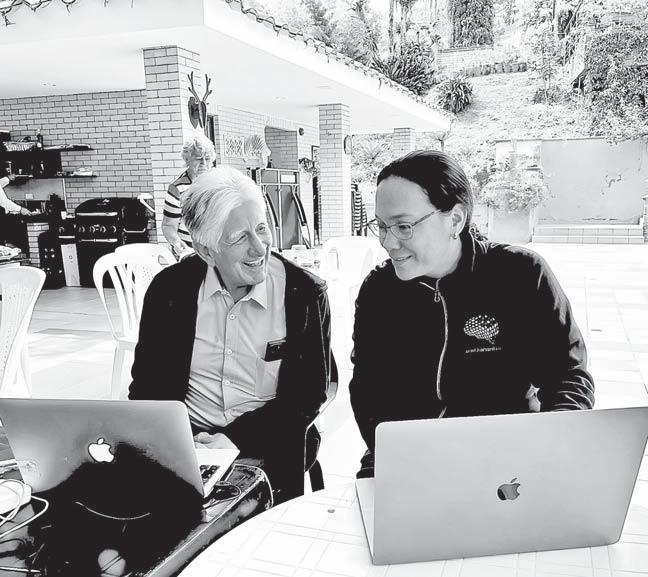
“It opens new avenues,” said neuropsychologist Yakeel Quiroz of Massachusetts General Hospital, who helped lead the study published on Wednesday.
“There are definitely opportunities to copy or mimic the effects,” Quiroz added.
The first hint of this genetic protection came a few years ago.
Researchers were studying a huge family in Colombia that shares a devastating inherited form of Alzheimer’s when they discovered one woman who escaped her genetic fate. Aliria Piedrahita de Villegas should have developed Alzheimer’s symptoms in her 40s but instead made it to her 70s be-
fore suffering even mild cognitive trouble.
The big clue: She also harbored something incredibly rare, two copies of an unrelated gene named APOE3 that had a mutation dubbed Christchurch.
That odd gene pair appeared to shield her, staving off her genetic predisposition for Alzheimer’s.
Quiroz’s team then tested more than 1,000 extended family members, and identified 27 who carry a single copy of that Christchurch variant.
But would one copy be enough to offer any protection?
Those Christchurch carriers on average showed their first signs of cognitive trouble at age 52, five years later than their relatives, concluded a collaboration that includes Mass General Brigham researchers and Colombia’s University of Antioquia.

THE Science department recently met and discussed with major plywood makers in the Caraga region the possibility of establishing a satellite plywood testing laboratory (SPTL) in Mindanao.
During the dialogue, attended by representatives from 11 plywood companies in the region, Department of Science and Technology-Forest Products Research and Development Institute (DOSTFPRDI) experts underscored the necessity of ensuring plywood quality in compliance with the Department of Trade and Industry’s (DTI) Department Administrative Order (DAO) 20-06 Series of 2020, which mandates product certification for both locally manufactured and imported plywood.
Under this policy, plywood makers must secure the Philippine Standard Quality Certification Mark License before their products can be sold or distributed in the market.
“The proposed SPTL in Caraga will be beneficial to Mindanaobased makers, who comprise of at least 40 percent of the country’s plywood producers,” said DOSTFPRDI OIC Director Dr. Rico J. Cabangon.
“We initiated this dialogue because we want to hear their issues, and present to them the advantages of having a plywood testing laboratory in the region. Aside from lessened transportation cost, it will also ensure faster and more reliable test results,” Cabangon explained.
During the discussion, local
manufacturers raised several issues, including high transportation and testing fees, the credibility of testing centers, and delays in test-result releases.
They also noted that imported plywood, despite often being of lower quality, is preferred due to its cheaper price.
During the event, Engr. Freddie M. Ordinario presented the services at DOST-FPRDI’s Plywood Testing Laboratory (PTL).
The PTL conducts tests and product certification using Philippine National StandardsInternational Organization for Standardization (PNS ISO) 12465:2017, and is among the Institute’s ISO 17025:2017 accredited laboratories.
It offers basic tests measuring thickness, moisture content, density, and bond quality test, as well as full tests that include bending and classification by surface appearance.
The proposed SPTL aims to serve local plywood manufacturers with existing wood processing plant (WPP) permits in Caraga and nearby provinces.
Held on April 15 in Butuan City, Agusan del Norte, the dialogue was attended by the regional offices of the Department of Environment and Natural Resources, DTI, and Caraga State University. It was organized by DOSTFPRDI represented by Dr. Maria Cielito G. Siladan and co-organized with the DOST-Caraga represented by Regional Director, Engr. Noel M. Ajoc. Apple Jean C. Martin-de Leon/S&T Media Services
ILLUSTRATIONS
The findings, published in the New England Journal of Medicine, are encouraging, said Dr. Eliezer Masliah of the National Institute on Aging.
“It gives you a lot of comfort that
modifying one of the copies could be really helpful,” at least in helping to delay the disease, he said.
Already some very early work is beginning to explore if certain treatments might induce the protective mutation, he added.
More than 6 million Americans, and an estimated 55 million people worldwide, have Alzheimer’s.
Less than 1 percent of cases are like the Colombian family’s, caused by a gene passed through generations that triggers the disease at unusually young ages.
Alzheimer’s usually is a disease of people over age 65 and while simply getting older is the main risk, the APOE gene has long been known to play some role.
It comes in three main varieties. Carrying one copy of the notorious APOE4 gene increases the risk—and recent research found that having two copies of APOE4 can actually cause Alzheimer’s in seniors.
Another variety, APOE2, seems to reduce the risk while APOE3 has long been considered neutral. Then came discovery of the Christchurch variant’s seemingly protective role.
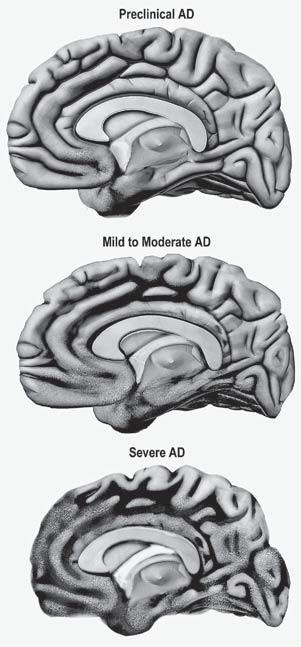
Silent changes in the brain precede Alzheimer’s symptoms by at least two decades—including buildup of a sticky protein called amyloid that, once it reaches certain levels, appears to trigger tangles of another protein, called tau, that kill brain cells.
Earlier research has suggested something about the Christchurch variant impedes that tau transition.
Wednesday’s study included brain scans from two people with a single Christchurch copy and autopsy analysis of four others who’d died.
Quiroz cautioned there’s still a lot to learn about how the rare variant affects the underlying Alzheimer’s process—including whether it affects the common old-age type—but said tau and inflammation are among the suspects. Lauran Neergaard Ap Medical Writer
THERE’S a new kid on the block ready to break new ground in yet another challenging field of science: the International Nuclear Science Olympiad (INSO), the Philippine Nuclear Research Institute (PNRI) announced.
To spearhead this new frontier for nuclear science in the global education scene, the Philippines will host the first INSO in August in New Clark City, Pampanga.
The newly established olympiad will become an annual international competition for junior- and seniorsecondary school students younger than 20 years old.
Besides the aim of increasing global awareness on the peaceful applications
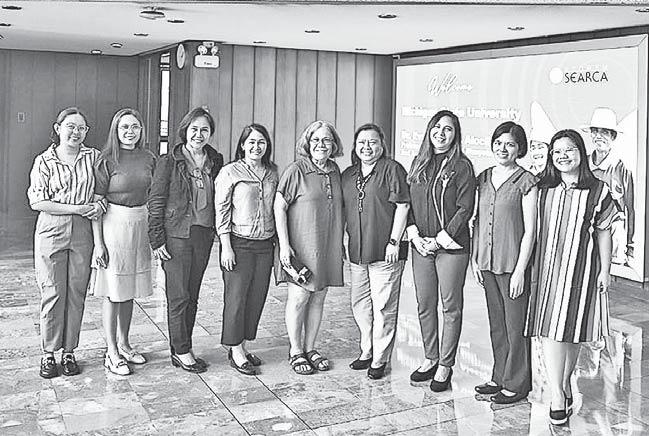
APROFESSOR from Michigan State University (MSU) recently visited Southeast Asian Regional Center for Graduate Study and Research in Agriculture (Searca) at its headquarters in Los Baños, Laguna, and discussed with the center’s executives some opportunities for collaboration on research, innovation, capacity build cing, and publication projects.
Dr. Evangelyn Alocilja, a professor at MSU’s Department of Biosystems and Agricultural Engineering, and senior fellow of Searca, was oriented on Searca’s mandate, core programs, and offerings. said Zara Mae Estareja in Searca’s news release.
Dr. Gerlie Tatlonghari, program head of Searca’s Research and Thought Leadership Department, shared the center’s plan to establish the Consortium for Agricultural Development, Research, and Extension (Cadre), a regional network of high-caliber, like-minded institutions that will collaborate to deliver research and extension support on the issues and challenges faced by the Southeast Asian agriculture sector.
Tatlonghari explained Cadre’s concept and expressed interest in involving Alocilja in its operationalization.
Tatlonghari also introduced theAgriculture, Forestry, and Natural Resources Knowledge Platform, a knowledge generation to knowledge utilization community of practice.

of nuclear science and technology (S&T), the INSO particularly intends to enhance the interest of secondary-school students and to improve the teaching of nuclear concepts in educational institutions, the DOST-PNRI said.
In the long-term, the INSO aims to
eventually motivate participants to pursue courses and professions related to nuclear S&T.
This remains particularly relevant in Asia and the Pacific, which is home to a fastgrowing population of young professionals in a wide variety of sectors using nuclear and radiation-related applications.
Pioneering participants in the INSO are from the Asia-Pacific region, such as Bahrain, Iran, Jordan, Malaysia, Mongolia, Oman, Pakistan, the Philippines, Qatar, Saudi Arabia, Singapore, Sri Lanka, Thailand and United Arab Emirates.
Meanwhile, Syria will join as observer.
Co-organizers of the first INSO include the Departments of Science and Technology, and Education; DOST-National Research
Darlyn Angeles, a program specialist from Searca’s Emerging Innovation for Growth Department, showcased the innovation competitions, including the recently concluded Young Agripreneurs Building Opportunities, Nurturing Growth Bootcamp, a three-month training that aimed to help young farmers succeed in vegetable farming and entrepreneurship.
Moreover, Angeles also discussedInnovation Olympics 2.0, an agri hackathon for the youth to develop innovative solutions
to the challenges faced by urban and rural smallholder vegetable farmers.
Alocilja noted that MSU also has an annual innovation challenge, which focuses on the most pressing global challenges and is open to students and professionals worldwide.
Meanwhile, Dr. Maria Cristeta Cuaresma, senior program head of the Education and Collective Learning Department, talked about Searca’s collaboration with leading universities for the Erasmus+ capacity-
Council of the Philippines; and the Philippine Nuclear Science Foundation. Partnering with the DOST-PNRI for the INSO are Meralco, Aboitiz, E-Beam, ALVTechnologies, and GNPower Ltd. Co. The Philippines’ hosting of the first INSO is likewise supported by the International Atomic Energy Agency via IAEA Technical Cooperation Project RAS/0/091 “Supporting Nuclear Science and Technology Education at the Secondary and Tertiary Level,” the DOST-PNRI added. Organizations interested to sponsor the olympiad may send their email to information@pnri.dost.gov.ph or check out www.insofirst.ph/sponsoring for details. For more information on the first INSO, please visit: https://insofirst.ph/.
building project on Postgraduate MicroCredentials for Food Security and Climate Change.
In response, Alocilja proposed working with the center on MSU’s certificate course on entrepreneurial engineering. She suggested co-developing the second phase of the course, adding a mentorship component.
Lanie Reyes, head of Searca’s Applied Knowledge Resources Unit, led the discussion on the 20th anniversary issue of the Asian Journal for Agriculture and Development (Ajad), in which eminent authors, including senior Searca fellows, were invited to contribute.
Alocilja will be writing on a roadmap for the reengineering agricultural innovation in Southeast Asia.
Ajad, Searca’s international refereed journal, has been creating greater awareness of the latest findings in research, state-of-the-art technologies, new methodologies, and policy concerns in inclusive and sustainable agricultural and rural development since 2004. Alocilja was received by Searca’s Director Dr. Glenn Gregorio, together with Cuaresma, Tatlonghari;. Sharon Malaiba, head of the Partnerships Unit (PU); Reyes; Beatrisa Martinez, executive coordinator of the Office of the Director; Monalinda Cadiz, program specialist from AKRU; Angeles; and key PU staff, Estareja said.

A6 Sunday, June 23, 2024
VATICAN—In Pope Francis’ reflection on the recent Gospel, the pope encouraged people to trust that God the Father often works in hidden ways under the surface before bringing the seeds of the Gospel to full bloom.
Reflecting on Jesus’ parable comparing the kingdom of God to a mustard seed in the Gospel of Mark, the pope said Christians should have an attitude of “confident expectation” in the Lord.
“In sowing, no matter how good or abundant the seed the farmer scatters or how well he prepares the land, the plants do not sprout immediately: It takes time,” Pope Francis said in his Angelus address.
“Underground the miracle is already in progress,” he added. “There is enormous development, but it is invisible, it takes patience, and in the meantime it is necessary to to keep tending the turf, watering it and keeping it clean, despite the fact that on the surface nothing seems to be happening.”
Pope Francis explained that the kingdom of God likewise requires patience, to “wait confidently” as it takes time to grow.
“The Lord places in us the seeds of his word and his grace, good and abundant seeds, and then, without ever ceasing to accompany us, he waits patiently. He continues to
BABA NAGRI, India—The road to the Baba Nagri forest shrine in India-controlled Kashmir was a colorful spectacle.
Tens of thousands of men in vibrant attires, henna-dyed beards and bright headgears thronged the Muslim shrine nestled at the base of a mountain to pay their obeisance last week.
Worshippers raised their hands and cried their wishes. Some also tied multicolored threads around the trees at the shrine, which represented their prayers.
The shrine to Mian Nizamuddin Kiyanwi has its origins in the 19th century and provides free meals all year to the devotees, most of them from Kashmir’s nomadic pastoral community.
Devotees believe their wishes are granted at the shrine.
Kiyanwi, originally from Kashmir, migrated to the Hazara region of modern-day Khyber Pakhtunkhwa province in Pakistan during the late 19th century.


POPE Francis waves to pilgrims gathered in St. Peter’s Square for his Angelus address on Sunday, June 16, 2024. VATICAN MEDIA
take care of us, with the confidence of a Father, but he gives us time, so that the seeds open, grow, and develop to the point of bearing the fruits of good works,” he said.
The pope added that the Lord teaches us by his example “to sow the Gospel confidently wherever we are and then to wait for the seed that has been sown to grow and bear fruit in us and in others.”
Speaking from the window of the Apostolic Palace, Pope Francis encouraged the Catholic pilgrims gathered in St. Peter’s Square below to not become discouraged if they do not see immediate results
from their efforts.
“In fact, often even among us, beyond appearances, the miracle is already underway, and in due course it will bear abundant fruit,” he said.
“May the Virgin Mary, who welcomed and made the seed of the Word grow within her, help us to be generous and confident sowers of the Gospel.”
After praying the Angelus in Latin with the crowd, the pope urged people not to stop praying for peace in Ukraine, the Holy Land, Sudan, Myanmar, and wherever people are suffering from war.


Pope Francis said he was pained to hear of the “massacres carried out in the eastern part of the Democratic Republic of Congo” and appealed to the government and international authorities to “do everything possible to stop the violence and to safeguard the lives of civilians.”
“Among the victims, many are Christians killed in hatred of the faith. They are martyrs. Their sacrifice is a seed that germinates and bears fruit, and teaches us to witness to the Gospel with courage and consistency,” he said.
Pope Francis greeted pilgrims visiting the Vatican from Lebanon, Egypt, and Spain, England, Poland, Hungary, and many parts of Italy.
The pope also expressed great joy at the news of the beatification of Blessed Michael Rapacz, a Catholic priest who was killed by communist authorities in Poland in 1946.
Pope Francis praised Rapacz as a “pastor after the heart of Christ” who witnessed to the Gospel amid both Nazi and Soviet persecution “and responded with the gift of his life.”
Approximately 1,800 people attended the Polish priest’s beatification Mass on June 15 in Krakow’s Divine Mercy Shrine.
Courtney Mares/Catholic News Agency

There he was mentored by a Sufi saint and later returned to Kashmir to preach Islam. After he died, the shrine was built as a mark of respect towards him—a manifestation of the region’s unique ties with Sufism.
Abdul Razaq, a devotee, said that he has been visiting the shrine since he was 6 and feels blessed by paying obeisance there.
“I remember as a kid we had to travel a lot by foot, but things have
changed, and today we can reach the shrine in a day,” he said.
Another devotee, Mohammad Farooq, who is blind, said: “It would have been great if I could see things for myself, but I find peace when I visit the shrine.”
Kashmir, divided between India and Pakistan and claimed by both in its entirety, is a Muslimmajority region.
Rebel groups have been fighting since 1989 for Kashmir’s independence, a goal supported by a large number of Muslims in the disputed territory.
The region has remained embroiled in civil strife for decades and the shrine, including hundreds of others strewn around its landscape, has been and continues to be, far more than a mere spiritual retreat for Muslims.
Many worshipers find these shrines a rare space far removed from unrelenting political tensions in the region.
Dar Yasin/Associated Press
ONE month after his ordination as coadjutor bishop of the Diocese of Rarotonga in the Cook Islands, Bishop Reynaldo Bunyi Getalado expressed his aspiration to “spiritually nourish” the people of God in the Pacific Ocean nation and develop a “harmonious relationship” with the priests of the diocese.
Getalado was ordained bishop at St. Joseph’s Cathedral in the Cook Islands’ capital city, Avarua, on April 27 in the presence of Father Giosuè Busti, the first deputy-head of mission at the apostolic nunciature of the Holy See in Wellington and representative of Pope Francis, as well as hundreds of Catholic faithful.
Together with the passionate singing of hymns in Cook Islands’ Māori, English, Fijian (iTaukei), and Filipino at Getalado’s ordination Mass, several men, women, and clergy also wore traditional neck garlands, called Ei Kaki, as a symbol of welcoming, love, and belonging in a community.
“Catholic communities in general
are friendly, generous, and active in participating in the life of the parish,” Getalado told the Catholic News Agency (CNA).
“My hope is to look after the sheep of God in Cook Islands, spiritually nourish them, organize the diocese, and develop a good harmonious relationship with my priests in the diocese.”
Also present at his ordination was Father Reginaldo Lavilla, the head of the Mission Society of the Philippines (MSP), to which Getalado belongs.
”I have the impression that people from the Pacific are uniquely vibrant. I have seen in my visit for the ordination of Bishop Rey that they have a strong community spirit, working together to make the celebrations fully alive and festive,” Lavilla shared with CNA.
“Now with Bishop Rey taking over, we hope to continue the work of evangelization that began in 1894,” Lavilla added. In a predominantly Protestant country,
17 percent of the population (approximately 2,900 people) are Catholic.
The Catholic Church is also one of seven Christian churches that are part of an advisory body that mediates with government and traditional leaders on issues affecting the social, economic, and cultural development of the country.
“We have an association of seven different churches called the Religious Advisory Council where we try to maintain harmony and advise the government,” Getalado explained on the relationship between the church and civic leaders in promoting the well-being and development of local communities.
In the history of Catholicism in the Cook Islands, Getalado is the first bishop iof Asian origin. His predecessors were from France, Belgium, the Netherlands, and New Zealand.
As part of the MSP, and prior to his current appointment in the Cook Islands, Getalado served as a missionary responding

ACATHOLIC archbishop has joined calls to outlaw Chinese offshore gambling operations because of their harmful effects on the country.
Archbishop Socrates Villegas of Lingayen-Dagupan wrote a pastoral letter saying it’s time to end the Philippine offshore gaming operator (Pogo) industry.
He said any promised benefits of allowing them to operate are far outweighed by the serious threats and harm they bring.
“Whatever benefits that allow them to operate may have been promised are overshadowed completely by the threat they carry with them and, in fact, the dreadful harm of their presence,” Villegas said. Pogos are Chinese-run online gaming companies serving customers abroad, which grew in the Philippines during former President Rodrigo Duterte’s time.
Calls to ban Pogos have come up again due to increased reports of the industry being linked to crimes like kidnapping, human trafficking, and murder. Some government officials also want to stop Pogo operations after raiding large illegal gambling hubs in Tarlac and Pampanga.
Alejandro Tengco, the head of the state gaming regulator Pagcor, said in a news report that around 250 to 300 Pogos were operating in the Philippines without a license. This is six times more than the 46 legal operators.
“The recent raids that revealed the extent of the evil at these Pogo hubs including incidences of human trafficking and torture and money laundering make it a moral imperative that no longer should they be granted the protection of the law and that they, in fact, should be outlawed,” Villegas said. CBCP News

Tto the needs of local churches in Papua New Guinea, New Zealand, the Philippines, and Tuvalu since 1987.
“The MSP priests and our own bishop [Getalado] will hopefully be instruments of renewal in the Church and carry the light of Jesus Christ to continue to give hope to the people by their witness of life and their words of preaching,” said Lavilla, expressing his joy and gratitude for the evangelizing charism he sees spread throughout the world because of his apostolic society.
The Cook Islands are comprised of 15 small islands that share the same time zone as Hawaii.
The islands are known for their white sandy beaches, lush green mountains, and picturesque lagoons.
According to one of its tourism websites, there are no branded resorts on the Cook Islands, no stop lights, and no buildings taller than a coconut tree. Kristina Millare/ Catholic News Agency via CBCP News
ASHIROJIMA, Japan—On a small island off Japan’s northeastern coast, visitors make offerings at a shrine for unlikely local guardians: cats.
The “Neko Jinja,” or Cat Shrine, mythologizes cats as guardian angels of Tashirojima, where the cats’ population of 100 double that of humans’ 50.
Legend says the island used to be famous for sericulture and farmers would keep cats because they would chase away rats, protecting the silkworm cocoons from the rodents.
Fishermen on the island have also traditionally believed that cats bring good luck, including large hauls of fish.
Another legend says fishermen used to watch the cats’ behavior for tips on the coming weather before heading to sea.
The islanders have long coexisted with the cats. One day, however, a fisherman accidentally injured a cat while working.
Feeling sorry for the injury, the islanders built the shrine for cats.
Tashirojima is part of the city of Ishinomaki in Miyagi prefecture in the Tohoku region, which became well known after a tsunami devastated the area following a massive magnitude 9 earthquake on March 11, 2011. Over 100 cats inhabit Tashirojima, along with about 50 humans, according to the city’s website.
Along a paved road running about 2 kilometers (1.2 miles) between the island’s two ports, cats groom themselves and mingle with other cats.
There are a few cafes and inns, but no car rental shops, gas stations or public transportation. Tourists are expected to walk up and down the island’s hills while visiting.
Most of the cats are used to tourists, who can be seen petting the friendly felines throughout the island. Hiro Komae/Associated Press
 Editor: Lyn Resurreccion


THE Earth is losing animals, plants and other living things so fast that some scientists believe the planet is entering its sixth mass extinction.
But there’s some surprising good news: Urban areas may be key to slowing down or even reversing this crisis.
This idea may seem counterintuitive, since studies show that urbanization is a big driver of biodiversity loss.
Cities alter the environment with artificial lighting and noise pollution, which affect many species. And urban land cover is expected to increase by 2.5 percent globally between 2000 and 2030 as more people move to cities.
As one measure of urbanization, half of the continent of Europe is less than 1 mile (1.5 kilometers) from a roadway or railway line. No location on the continent is more than 6 miles (10 kilometers) from these features.
Nature-based solutions
BUT there are ways for cities to use nature-based solutions to slow species loss within their borders.
At a major international conference on biodiversity loss in 2022, global leaders agreed to ambitious goals for restoring natural ecosystems across the planet, including targets aimed at “ensur[ing] biodiversity-inclusive urban planning”.
We are conservation and ecology researchers who work in Southern California and other settings. In our new study, we worked with colleagues to identify pockets within Los Angeles that host diverse native species communities. We even found that some groups of organisms seem to benefit from increased levels of urban development. And we developed a
new metric for measuring how different species respond to urbanization, which city managers can use to develop local conservation strategies.
LOS Angeles is a city of nearly 3.9 million people, with a heavily urbanized landscape that’s epitomized by its vast network of freeways and a mostly tame and channelized Los Angeles River.
In the mid-20th century, car exhaust and industrial emissions produced thick smog that made going outside a health hazard and eventually spurred enactment of the 1970 Clean Air Act.
While smog does still regularly cloud the city’s skies, Los Angeles’s air is cleaner now than at any point in the past 50 years. And city leaders are setting ambitious targets for preserving nature across the metro area.
In the 2019 “Sustainable City pLAn,” then-Mayor Eric Garcetti set a goal of achieving no net loss of biodiversity by 2050—in other words, preventing losses of living species or offsetting losses by adding new species.
To track its progress, the city created a custom index to measure and assess biodiversity throughout Los Angeles. We helped to calculate a component of this index that measures the association of native species in Los Angeles with urbanization.
Los Angeles sits within the California Floristic Province, a global biodiversity hotspot. It’s one of 36 designated areas
BRUSSELS—European Union countries this past week gave final approval to a major and long-awaited plan to better protect nature in the 27-nation bloc, a divisive issue after months of protests by farmers, who argued that EU environmental and climate laws were driving them toward bankruptcy.
After surviving a razor-thin vote by lawmakers last summer, the so-called Nature Restoration Plan faced opposition from several member states, leaving the bill deadlocked for months.
The law, which aims at restoring ecosystems, species and habitats in the EU, was finally adopted at a meeting of environment ministers in Luxembourg after rallying the required support from a qualified majority representing 15 of the 27 member states and 65 percent of the EU population.
Austria’s vote in favor of the plan helped to break the stalemate.
“This is the final step before this law can enter into force,” said the Belgian presidency of the EU Council.
The Nature Restoration plan is part of the EU’s European Green Deal that seeks to establish the world’s most ambitious climate and biodiversity targets, and make




in the world containing high amounts of endemic plants— species found nowhere else in the world—and that have experienced significant losses of their original plant communities.
Even in the most urbanized parts of the city, Angelinos share the streets with bats, thousands of birds, and even large predators like mountain lions.
But scientists don’t know yet exactly how levels of urbanization affect the wide variety of native animal species that call Los Angeles home.
Slugs and snails lead the pack TO support the city’s efforts to assess biodiversity and slow regional species loss, we collected data from iNaturalist, a free, publicly available app that anyone can use to identify and document observations of animals, plants and other living species.
The app has amassed over 189 million records, and its data bank continues to grow.
We filtered this crowd-sourced data on species occurrence to control for the potential effect of observer bias—effects of how individuals choose to collect observations, which can show up in the data.
For example, several people might upload observations of a single animal, making it seem as though multiple animals had been sighted.
Or people might only upload observations from areas near roads, making it appear that wildlife was more abundant there, without looking for animals in more remote locations.
Our filtered dataset included over 500,000 observations recorded by 71,000 community scientists. This yielded occurrence records for 967 native species within about 93 miles (150 kilometers) of the city of Los Angeles.
We modeled species responses to measures of urbanization and summarized the average response of all native species across the city.
Overall, we found that most native species were more likely to be observed in natural areas around Los Angeles than in urban parts of the city.
One surprising exception was slugs and snails, which, on average, were more often found in urbanized zones than in natural areas.
This finding mirrors a 2018 study in Tennessee, which also showed that native snail species can persist in highly urbanized environments—perhaps because people add water to parks and gardens for landscaping.
Across all native species in the study, butterflies and moths, as well as mammals, were least likely to be found in heavily developed areas.
The absence of key host plants for particular butterfly species may explain why butterflies are relatively rare in highly urbanized areas.
For mammals, our findings are similar to a 2023 study conducted across the United States,
which found that mammals, and especially large-bodied mammals, avoided extremely urban areas.
Even within the most urban zones, such as Pershing Square in downtown Los Angeles, we found some communities of species that favored natural spaces. Examples included house wrens (Troglodytes aedon) and urbane digger bees (Anthophora urbana)
This indicated that in some cases, cities can support native biodiversity. A next step for this research is to understand what underlying factors of the landscape might be drawing these native species in.
Making cities wildlife-friendlier OUR study demonstrates that pockets of biodiversity can exist even in the most urbanized areas of cities. The urban association metric that we created is meant to serve as a tool for city managers to develop strategies for encouraging wild species to continue to thrive in the city.
As one example, Los Angeles recently proposed an ordinance that encourages wildlife-friendly home construction. For example, housing developments with fences that don’t limit wildlife movement enable animals on the move to pass through.
Data from the iNaturalist app provides researchers with invaluable information about where native species occur and how abundant they are.
Anyone who wants to contribute to conservation science can download it and record what they see on a walk, bike ride or ferry trip, or in their garden. You may find more nature in your neighborhood than you expect.
Joseph Curti, University of California, Los Angeles/The Conversation (CC) via AP
the bloc the global point of reference on all climate issue
Under the plan, member states will have to meet restoration targets for specific habitats and species, to cover at least 20 percent of the region’s land and sea areas by 2030.
“The result of hard work has paid off,” said Belgian Environment Minister Alain Maron.
“There can be no pause in protecting our environment. The EU Council makes the choice to restore nature in the EU, protecting its biodiversity and our living environment,” Maron added.
Austria’s environment minister, Leonore Gewessler, voted for the plan after months of domestic political debate.
The move by Gewessler, a member of the Green party, infuriated the senior partner in the coalition government—Chancellor Karl Nehammer’s conservative Austrian People’s Party—ahead of a national election set for September 29.
“My conscience tells me unmistakably [that] when the healthy and happy life of future generations is at stake, courageous decisions are needed,” Gewessler wrote on social network X.
Ahead of the vote, the chancellery said Nehammer informed the

Belgian EU presidency that a vote in favor of the plan by Gewessler would be unlawful, the Austria Press Agency reported.
Nehammer’s office said after the decision that Austria will file a suit at the European Court of Justice to nullify the vote.
An EU official said Gewessler’s vote was legally binding and that the Council’s legal service had confirmed this point. The person was not authorized to speak publicly in
line with EU practices.
In the buildup to the EU elections that saw a shift to the right earlier this month, European farmers complained about the many environmental laws governing the way they work, arguing that the rules were harming their livelihoods and strangling them with red tape.
Under the new law, EU countries will be required to restore at least 30 percent of habitats—
such as forests, rivers, grasslands, wetlands, lakes and coral beds— deemed in poor condition by 2030.
This percentage is set to increase to 60 percent by 2040 and 90 percent by 2050. The law also introduces specific requirements for measures to reverse the decline of pollinators.
The EU’s main agricultural group, Copa-Cogeca, said the plan lacks clear and consistent funding and that the law cannot be implemented on the ground.
Environmental organizations and a coalition of big companies insisted last year that the legislation was crucial to tackle both climate change and nature loss.
But the plan lost some of its progressive edge during negotiations because of fierce opposition from the EU Parliament’s main political group, EPP, which along with other conservatives and the far right has insisted the plans would undermine food security, fuel inflation and hurt farmers.
As a result, the nature restoration plan was weakened. For instance, until 2030 member states can only prioritize sites designated under the Natura 2000 network, which covers Europe’s most valuable species and habitats.
There is no obligation to implement the law in other natural areas.
EU countries must restore at least 30 percent of drained peatlands by 2030, but the target for rewetting is set at national level— meaning that individual farmers and private landowners will not have responsibility for meeting it. The law also provides for an emergency brake, as requested by Parliament. Targets for agricultural ecosystems can be suspended under exceptional circumstances if they severely reduce the land needed to produce sufficient food for EU consumption.
Environmental lobby group Greenpeace said a failure by EU governments to approve the law would have been embarrassing ahead of the next UN biodiversity meeting in Colombia in October.
“Despite the weakening of the law, this deal offers a ray of hope for Europe’s nature, future generations and the livelihoods of rural communities,” said Greenpeace biodiversity campaigner Špela Bandelj Ruiz.
“Healthy ecosystems offer protection against extreme weather, water shortages and pollution,” Ruiz added.
Samuel Petrequin/Associated Press
YOU might think electrolytes are some kind of lab-made superfuel for elite athletes and those who want to be like them.
Electrolytes are indeed powerful, and in some circumstances, your body might benefit from a boost. But like comic book heroes with mildmannered alter egos, they might already be hanging around in your life by another name. And like a movie franchise with one sequel too many, more is not always better.
“The simplest way to think about electrolytes is that they are essential minerals and that they provide many different things that the body needs,” said Dr. Sara Rosenkranz, an associate professor in the department of kinesiology and nutrition sciences at the University of Nevada, Las Vegas. They’re called electrolytes because they have an electric charge—positive or negative—when dissolved in fluids, such as blood. Those electric charges signal muscles and nerves. Our bodies would not work without electrolytes.
“They have a number of different, really important and critical functions,” Rosenkranz said, including helping to regulate blood pressure, blood glucose, heart rate and rhythm and the body’s water balance.
You might know these minerals by their everyday names—among them, calcium, magnesium, phosphorus, sodium and potassium.
Although you might think of electrolytes as something that comes in a powder, tablet, droplet or sports beverage, you’ll find plenty in a healthy diet, Rosenkranz said. “For most people, it is absolutely true that we get adequate amounts in the foods and beverages that we consume already,” she said.
For example, calcium—which helps regulate blood clotting, heart rhythm and how blood vessels dilate and contract—can be found in tofu, lowfat dairy products and some plant-based milks. Magnesium, which lets many enzymes function, is usually found in foods that contain fiber, including leafy greens, beans, nuts and whole grains. Getting enough of some electrolytes, such as potassium—which helps regulate blood pressure— can be challenging, “particularly if you’re not eating a lot of fruits and vegetables,” Rosenkranz said.
Many people have the opposite problem with sodium. Paired with chloride, it’s salt. It’s also added to many processed foods.
Sodium helps restore the body’s fluid balance after prolonged sweating, illness or if someone has taken diuretic medications, said Dr. Mindy L. Millard-Stafford, director of the Exercise Physiology Laboratory at the Georgia Institute of Technology in Atlanta. “Water can do the job also, but without sodium, it tends to be retained less effectively.”
Water alone also quenches thirst quickly, while sodium makes a person want to drink more, which can be helpful at times.
But excess sodium also raises blood pressure, and most Americans are already eating too much. Federal dietary guidelines recommend adults eat no more than 2,300 milligrams of sodium a day, or about 1 teaspoon. The ideal daily limit for most adults is 1,500 mg, according to the American Heart Association. Yet Americans consume an average of 3,400 mg a day.
If you’re not eating excess sodium, Rosenkranz said, your
Getting enough of some electrolytes, such as potassium—which helps regulate blood pressure—can be challenging,
‘particularly if you’re not eating a lot of fruits and vegetables.’
body does a pretty good job of keeping electrolytes in balance. The kidneys process them and filter any excess into urine.
Sodium and chloride (which helps regulate fluids) also can be lost through sweat. So at times, our bodies might need a little more. But while Rosenkranz said most adults don’t need to seek out ways to take in extra electrolytes, she said there’s not a one-size-fits-all answer to the question of who needs extra.




Children who have prolonged periods of vomiting or diarrhea due to illness might be given electrolyte drinks. A child’s body has a greater ratio of body surface to overall weight, Rosenkranz said, so they lose fluids through sweat more easily than adults.
People who work long hours outdoors, particularly in hot, dry climates, or athletes doing “prolonged, vigorousintensity exercise” might also benefit from an electrolyte drink, she said, as might athletes at higher altitudes, where staying hydrated can be a challenge.
Research on electrolyte supplementation is mostly aimed at athletes, she said. Some sources say that water is fine for anyone in an activity that lasts less than an hour; some say even more activity is needed before anything beyond water is helpful.
Rosenkranz agrees with a general principle that if your exercise lasts less than 75 minutes, and it’s not very high intensity, “then there’s absolutely no need for electrolyte supplementation in those cases. And you can really just hydrate with plain water.”


But, she added, “the reality is that there is a lot of variability in what people need.” It’s not just individual differences in sex, body weight and genetics, she said, but factors such as heat, humidity, how much water someone drank before the activity, the intensity of the activity, and more.
Millard-Stafford, a past president of the American College of Sports Medicine, drew a distinction between sports drinks and electrolyteinfused waters.
Sports drinks, she said, were designed to provide fluid and energy during exercise or physical labor, so they contain carbohydrates as well as electrolytes. “Electrolyte-infused waters can help maintain hydration but are not designed for improving exercise performance,” she said.
Although ingredients of sports drinks vary, those carbohydrates are often in the form of simple sugar. According to the US Department of Agriculture, one popular sports drink, for example, has 79 calories, 140 mg of potassium, 299 mg of sodium and 21 grams (5 teaspoons) of total sugars per 12-ounce serving. Another sports drink has similar levels of sugars and calories but only 36 mg of potassium and 151 mg of sodium.
Although sugar can provide quick energy for an endurance athlete, most people are already getting too much, and the excess is linked to a variety of health problems. The AHA recommends limiting added sugar to 6 percent of total calories. For most women, that›s no more than 100 calories a day, or about 6 teaspoons. For men, it’s 150 calories a day, or about 9 teaspoons. Meanwhile, some electrolyte waters contain only traces of minerals, while an electrolyte powder pack might be mostly sugar, along with sodium and potassium.
Don’t cry just yet Argentina

BUENOS AIRES, Argentina—It’s sad but true, Copa America could mark Lionel Messi’s final chapter with Argentina’s national soccer team.
The World Cup winner will turn 37 during the tournament in the United States. He’s clearly past his peak at Inter Miami after two decades of playing at the highest level in Europe.
Messi has not set a date for his retirement and has kept
the door open to playing in a sixth World Cup in 2026 to defend his title from Qatar. But he already recognizes his shortcomings.
“I don’t think about that yet. The moment I feel that I am not going to help my team, I will retire,” Messi said in March in an interview with Saudi broadcaster Riyad Season.
“I always ate well, trained. But as I grew I became aware that the physical effort we make is getting harder. As you grow old, things become more difficult.”
Last year, the eight-time Ballon d’Or winner struggled with muscular injuries while playing in Major League Soccer and for Argentina. That didn’t change much in 2024.





DA8 | SUNDAY, JUNE 23, 2024

mirror_sports@yahoo.com.ph
Editor: Jun Lomibao

UESSELDORF, Germany—With outrageous goals flying in from all angles, Euro 2024 has started with a bang.
Could a $170 high tech soccer ball be to thank for this?
“When you strike it, it stays hit,” England captain Harry Kane said.
The adidas Fussballliebe, meaning “love of football” in German, is the official match ball of the European Championship. And players appear to have quickly mastered it with a slew of stunning, long-range goals.
“It’s quick,” Kane said. “For me, personally, it is better for the strikers or the goal-scorers than it is for the goalkeepers, so I’m not going to complain about that.”
Nor are the fans after so many spectacular strikes.
There was Arda Guler’s curling effort into the top corner from around 20 meters in Turkey’s 3-1 win against Georgia. That was rivalled by his teammate Mert Muldur’s volley from the edge of the box in the same game.
Romania’s Nicolae Stanciu struck another from distance against Ukraine and nearly scored direct from a corner kick which hit the crossbar.
Xherdan Shaqiri scored a stunner for Switzerland against Scotland, and there were rockets from Italy’s Nicolo Barella and Czech Republic’s Lukas Provod.
“Any footballs for these tournaments aren’t exactly made with
goalkeepers in mind,” Denmark keeper Kasper Schmeichel said. “It’s a pleasure to strike. You can get good distance. They are certainly not made for the grip for the goalkeeper.”
Official tournament balls have been criticized in the past. Some players complained that adidas’s Jabulani ball for the 2010 World Cup was unpredictable.
UEFA says the Fussballliebe has been designed for “accuracy and consistency, supporting fast, precise play with maximum shape and air retention.”
It is made of recycled polyester and more “sustainable bio-based materials” than balls used for previous tournaments, including corn fibers, sugar cane and wood pulp.
The ball, which was reduced to $85, sold out on adidas’s online store in America.
How it has contributed to the likes of Guler’s wonder goal is not clear, but smart technology within the
UEFA

Messi has shown he enjoys going out at night with his wife, Antonella, and his friends in Miami.
He spends time with his three children, starts new businesses and lives as if soccer is slowly becoming a smaller part of his life. Still, he has 12 goals and 13 assists for Inter Miami this season. “I have a good time at the club. I am lucky to have teammates and friends [Luis Suárez,


‘Editing and advocacy’ a course for future lawyers, others to become better editors
JUNE 23, 2024
My son PJ was about three years old when I started bringing him along to concerts. Wifey and I would cover his ears when we thought the music was getting too loud—but he seemed oblivious to the ruckus and would be content to suck on his milk bottle while lying down.
LAST week, we found ourselves in the mosh pit of a concert, the second night of the Malaya Music Festival, held at Cove Manila in Okada. No cause for worry since this was not a punk gig, which meant no slam dancing. Still, there was a bit of hesitancy since I, all of 61 years old, had no more tolerance to be standing up all night watching a succession of bands cranking out rock ’n’ roll.
But PJ is only 15 and was game enough to be with his Gen Z peers.
The performers’ roster included Maki, Ace Banzuelo, SUD, Mayonnaise, and Parokya Ni Edgar. PJ whispered to me that he knows the music of Maki: “Siya kumanta ng ‘Dilaw.’”
I thought Maki was Korean. He was

Publisher : Editor-In-Chief : Concept : Y2Z Editor : SoundStrip Editor : Group Creative Director : Graphic Designers :
T. Anthony C. Cabangon
Lourdes M. Fernandez
Aldwin M. Tolosa
Jt Nisay
Edwin P. Sallan
Eduardo A. Davad
Niggel Figueroa
Anabelle O. Flores
Contributing Writers :
Tony M. Maghirang
Rick Olivares
Jill Tan Radovan
Reine Juvierre S. Alberto
John Eiron R. Francisco
Pocholo Concepcion
Francine Y. Medina
Rory Visco
Bea Rollo
Trixzy Leigh Bonotan
Photographers :
Bernard P. Testa
Nonie Reyes
Y2Z & SOUNDSTRIP are published and distributed free every Sunday by the Philippine Business Daily Mirror Publishing Inc. as a project of the
The Philippine Business Mirror Publishing, Inc., with offices on the 3rd Floor of Dominga Building III 2113 Chino Roces Avenue corner Dela Rosa Street, Makati City, Philippines.
Tel. Nos. (Editorial) 817-9467; 813-0725. Fax line: 813-7025
Advertising Sales: 893-2019; 817-1351,817-2807.
Circulation: 893-1662; 814-0134 to 36. www.businessmirror.com.ph

pretty good—not only good-looking, but also impressive as a singer who writes his own songs. He was down to his last song when we caught his performance. At home, I listened to his tenor vocals gliding into a sweet falsetto on “Dilaw,” which describes the warm, sunny feeling of finding one’s love match.
Banzuelo was confidence personified. He danced and played the electric guitar with intensity while singing of heartaches and other youthful concerns: “Hinding hindi ko kayang umibig muli/Habang-buhay na lang kitang hihintayin…”
He also had a version of the Eraserheads’ “Huling El Bimbo,” a sign that ’90s OPM truly had a lasting impact on the younger generation of Pinoy musicians.
THE next act, SUD (pronounced “sood”), slowed things down in a jazz-rock vein. Composed of Sud Ballecer (vocals and guitar), Carlos de la Fuente (saxophone), Kohl Aguilar (keys), Raisa Racelis (bass), and Patrick Felipe (drums), the band coaxed the crowd to sing along to its cover of Kitchie Nadal’s “Huwag na Huwag Mong Sasabihin.”
I looked at PJ, who nodded and smiled, enough indication that he was OK. I’m not sure if he’s also into rock—we don’t talk about music at home—but I guess he felt elated like everyone around him when Mayonnaise took the stage.
Frontman and guitarist Monty Macalino led the band in elevating the mood in the humongous hall to flights of ecstasy with a dash of humor. The songs of Mayonnaise have a peculiar

twist—for instance, I like the honesty of blurting “sinungaling” after the forlorn speaker in the tune realizes love has failed him again. Macalino is a damn good singer and guitar player.
The mosh pit crowd had thickened by the time Parokya started its set. I couldn’t move without bumping the arms of the lady beside me. I looked again at PJ, and again he gestured that he was OK.
Lead singer Chito Miranda was in his element as he began his spiel with a joke that, since Parokya is the last band on the bill, it would be playing 87 songs.
What followed was a joyful ride back to the heady days of Pinoy alternative music—in Parokya’s case, pop-rock with a twist as in the bittersweet lyrics in “Buloy,” along with dozens of other conversational tunes that have made the band a household name.
PJ sent a message from his phone: “Masakit na paa ko.” I felt the same, in fact, I thought I was on the verge of falling—except that the music kept lifting me up.
We were tired and famished upon leaving Okada, so I treated the family to a nice late dinner at Café Adriatico at its original location in Malate. The food was consistently good, and service was impeccable.









 By Reine Juvierre S. Alberto
TIME has finally come for Stell Ajero to show on his own what he’s got under his sleeves.
Stell, the main vocalist and lead dancer of the nation’s leading P-pop boy group SB19, has risen to fame alongside Ken, Justin, Pablo and Josh since their career boomed in 2018.
With half a decade passed and other members releasing their own songs, Stell was the last among the four to go on solo—and invite everyone to his room.
“This is Stell’s room where I can be myself [and] be confident. In this room, I can do anything I want without hesitation. I can do a lot of things na hindi na pinagiisipan kung ano ang sasabihin ng ibang [that I don›t have to think about what other people might say],» Stell said during his launch of his debut single “Room” at Teatrino Promenade on June 14.
In his most authentic self of dwelling on other people’s perception of him, Stell pointed out that he does not care about their judgment of him
“Basta alam ko po masaya ako at masaya yung mga taong naniniwala sa akin [What I know is that I am happy and the people who believes in me are happy too],” Stell beamed.
But before he reached these heights, Stell had always doubted himself if he was capable of doing things on his own.
Stell was candid on his journey to becoming more confident and stepping out of the comfort of being with SB19 all the time, which took him long enough to go solo.
Solo but not alone
“WHEN I started performing as a member of
SB19’s Stell finally goes solo with ‘Room’

SB19, na-feel ‘ko na agad na mas gusto ‘ko lang sila kasama mag-perform. Hindi ako sanay na mag-perform nang mag-isa [I felt immediately that only wanted to perform alongside them. I›m not used to performing alone],» Stell admitted.
He recalled the time he was asked to become a coach in the singing reality competition The Voice Generations and the members pushed him to take the opportunity and show what he got in a different way.
It was the first project he got where he expressed himself on his own and then more gigs came for him after that.
Known as the “Heavenly Voice” of SB19, Stell was given the opportunity to perform The Lion King’s “Circle of Life” and duet Frozen 2’s “Into the Unknown” with Janella Salvador and Zephanie for Disney.
It doesn’t end there because Stell once again made noise in social media after his powerful impromptu performance of Celine Dion’s “All By Myself” alongside David Foster in Hitman: David Foster and Friends. Stell was the opening act in the concert and sang Adele’s “All I Ask” and Wicked’s “Defying Gravity.”
Stell said whenever he would be offered projects outside of SB19, he would always question himself, “Kaya ko ba ‘to? [Can I do this?]” or almost back out, afraid of not giving enough justice to the project.
At the end of the day, Stell realizes that the opportunity landed on him because he is capable of it. “Binigay siya sa akin for a reason so dapat i-grab ‘ko na [It was given to me for a reason so I should grab it],” he said.
With these solo projects, being by himself does not mean that he is alone.
In “Room,” all the members of SB19 rallied behind Stell’s back. Pablo was actually the one who wrote the song, together with his brother Josue who produced it, while Justin directed the music video. Ken and Josh also chimed in with their suggestions on how the music video should be edited.
“Nararamdaman ko yung 100 percent support nila [ I can feel their 100 percent support] so thank you guys. I love you so much,” Stell said.
Stell also mentioned SB19’s dedicated fans A’TINs, and his Berries who all waited patiently for him to pursue a solo career.


“Ganitong side pala gusto niyo. Dahil hiningi niyo, ibibigay ko sa inyo [This is the side that you wanted. Since you asked for it, I will give it to you],” Stell said to his fans.
Can you read the room?
IT was Pablo who offered to write “Room,” incorporating the sound Stell wanted, which is inspired by the works of Michael Jackson and Bruno Mars mixed with a theatrical flair.
The funk-filled pop track showcased Stell’s wide vocal range marked by his signature soaring high register. The intriguing and sultry song invites listeners to break free, let loose and never leave the room.
The music video, meanwhile, is inspired by the film Burlesque and shot inside a bar. In the music video, Stell is auditioning as a performer and all eyes are on him.
Drag queen Tita Baby and musical artist Lance Reblando were also highlighted in the music video, just in time to be recognized during Pride Month this June.
“[This] is our way to say thank you and maipakita sa lahat na yung community niyo po ay dapat respetuhin din at karapat dapat i-represent nang tama. Sakto Pride Month po ngayon. Mabuhay po ang mga katulad niyo [to show to everyone that your community deserves to be respected and represented right. It’s exactly Pride Month. Long live the LGBT community],” Stell said.
The next door
THE release of “Room” is just a prelude to Stell’s upcoming EP to be released in August this year which will feature all original songs. Despite Stell’s ability to give his rendition of other artists’ songs, he remained the door open for this possibility as well.
A nationwide tour and hopefully, a possible international tour is also underway, according to Stell.
Stell, known as a balladeer for his mesmerizing vocals, also expressed interest in venturing into jazz music and playing a role in a theater play next.
“My sound is very explorative so it’s possible that I will release something different. I’m very open to doing anything under the sun,” he said in a mix of English and Filipino.
 By Patrick Barry Clinical Assistant Professor and Director of Digital Academic Initiatives, University of Michigan Law School
n Uncommon Courses is an occasional series from The Conversation U.S. highlighting unconventional approaches to teaching.
“editing and
What prompted the idea for the course?
In part, I wanted to improve the career prospects of the law students, business students and other aspiring professionals I teach. People who can consistently improve the sentences and paragraphs that come across their desk each day have the opportunity to improve the way ideas and messages are communicated. Who wouldn’t want to add someone like that to their company, government agency or nonprofit organization? Mostly, though, I designed the course so that my students can experience the empowering magic that comes with being able to take
a string of words—whether drafted by themselves or somebody else—and transform them into a revised version that is undeniably better than the original.
What does the course explore?
S TU den TS edit emails. They edit contracts. They edit memos, articles, speeches, proposals, text messages, blog posts— pretty much anything that lawyers and other professionals compose. Sometimes they edit alone. Other times they edit as part of a team. But the goal is always the same: learn and practice a skill that is fundamental to becoming an excellent advocate.
Why is this course relevant now?
I FIRST starting teaching “ e diting and Advocacy” a few years before the launch of ChatGPT and other generative AI tools. But now that those tools have significantly reduced the cost of producing drafts, the course’s focus on revising drafts—for accuracy, for clarity, for persuasive power—has taken on a newfound relevance.
For instance, when asked how AI might affect what he and other members of the knowledge economy do, tech journalist Charlie Warzel suggested that “the greatest skill that we can all have now is to be ‘editors.’” We may, he noted, start to spend an increasing amount of time correcting and refining AI-produced material.
Ilona Logvinova, associate general counsel and head of innovation for the legal department at consulting giant
McKinsey, made a similar point, telling attendees at a recent conference on the use of AI in law: “I really believe that we’re at a moment where we, as lawyers, can transition from being ‘drafters’ to being ‘editors.’”
What’s a critical lesson from the course?
One of the most critical lessons is something I put front and center on the syllabus: “Good editors don’t just see the sentence that was written. They see the sentence that might have been written. They know how to spot words that shouldn’t be included and summon up ones that haven’t yet appeared. Their value comes not just from preventing mistakes but also from discovering new ways to improve a piece’s style, structure, and overall impact.”
The current generation of AI tools is really good at proofreading. But so far, I haven’t encountered any large language model that has the vision, empathy and deep understanding of both context and nuance—not to mention of personal voice—required of a truly exceptional editor.
That doesn’t mean that a technology with those capacities won’t eventually develop, nor that the technology we already have can’t provide enormously useful editing assistance. In fact, more and more of my assignments in “ e diting and Advocacy” give students a chance to play around with ChatGPT-like tools. I have also created an entirely separate course called “ d igital Lawyering: Advocacy in
the Age of AI” that explores the possibilities, and pitfalls, of using artificial intelligence as a kind of co-counsel. But as I often remind students in both classes, editing is as much about imagination, emotional intelligence and restraint as it is about syntax, semicolons and subject-and-verb agreement. A good way to become better at it is to cultivate the parts of you that are most human.
What materials does the course feature?
HOPI nG to save my students some money—and wanting to make the materials of the course easily available online—I worked with the publishing team at the University of Michigan to create a set of open-access books that anyone with an internet connection can read for free. These include Editing and Advocacy, Notes on Nuance, Punctuation and Persuasion and Feedback Loops: How to Give and Receive High-Quality Feedback.
What will the course prepare students to do?
edITInG involves reliably making informed, value-creating decisions. You need to know what to add. You need to know what to delete. You need to know what to separate, combine and rearrange. Students in the course study, evaluate and regularly participate in those types of decisions. In the process, they develop an extremely important and highly transferable skill: good judgment. The Conversation
n Cover photo by Ron Lach Pexels
In the legal sphere of mergers and acquisitions (M&A), strategic innovation is essential for success. It’s a philosophy that enabled young Filipino lawyer Roxanne Joyce L. Mercado to make waves in the US corporate law scene. With her deep knowledge and dedication to economic inclusivity, Mercado is changing the way M&A deals are put together, focusing on how strategic planning and thorough due diligence can be used together to successfully complete these complex deals.
Mercado, 33, a graduate of Columbia Law School and Ateneo Law School, is a dual-qualified attorney in both the Philippines and new York. Her professional career spans significant roles, from a corporate associate at SyCip Salazar Hernandez & Gatmaitan, one of the largest law firms in the Philippines, to her current position as a Senior Associate at a distinguished law firm in new York. Today, she specializes in private mergers and acquisitions, steering intricate transactions with a keen eye for strategic integration and risk management.
Components of M&A success
One of the pillars of Mercado’s approach is proactive due diligence. This strategy is critical in scrutinizing the financial and operational health of the target company, ensur-

ing that potential risks are identified and mitigated early in the transaction process.
“In M&A, surprises are rarely pleasant,” Mercado said. “Proactive due diligence is our first line of defense, ensuring that we understand every facet of the deal. It’s not just about assessing what we’re buying, but also planning how it will integrate with our existing operations seamlessly.”
The method is particularly relevant in the Philippine market, where the economic landscape is as diverse as it is dynamic. For companies in the Philippines looking to engage in cross-border M&A, Mercado’s strategy offers a blueprint for minimizing risks associated with regulatory and market differences.
Mercado also believes that the power of M&A lies in the identification and inte-
gration of synergies, a strategy that aligns perfectly with the needs of expanding Philippine companies. By focusing on how the acquiring and acquired entities can achieve greater efficiencies or market power than they could independently, Mercado aims for each M&A deal to not only be a transaction, but a transformation.
“Identifying and effectively integrating synergies is what makes the merger worth more than its parts. It’s about creating new value that neither company could have achieved on their own,” she said. “This is where innovative thinking meets strategic execution.”
For Philippine businesses, where local companies are increasingly looking to expand on a global scale, such strategic synergy identification can be the key to successful international M&A. Mercado’s expertise not only guides these companies through the complexities of the deal, but also helps them leverage their unique strengths in new markets.
BeYOnd her work as a Senior Associate, Mercado is a passionate advocate for economic inclusivity.
Understanding the essential role that ac-

cess to capital plays in fostering economic growth and innovation, she champions policies that support economic equality. Her advocacy work aims to empower underrepresented communities, ensuring that they have a stake in the economic advancements facilitated by corporate actions like M&A.
MeRCA dO’S career is as bridge between the legal settings of the Philippines and the United States, brought together by her deep understanding of corporate law and her commitment to inclusivity. Her work serves as an inspiring model for companies and legal professionals in the Philippines and abroad, as she continues to advocate for fair economic policies and navigate the complexities of M&A.
Mercado’s innovative strategies and advocacy are not just shaping her career; they are influencing the broader narrative of M&A in the Philippines and the U.S., guiding it towards a future where transactions are not only successful but also socially responsible and inclusive.
“The true measure of our success in M&A isn’t just the numbers on a balance sheet. It’s about the lives we impact and the communities we uplift,” Mercado said. “This is the heart of sustainable business practices.” Y2Z