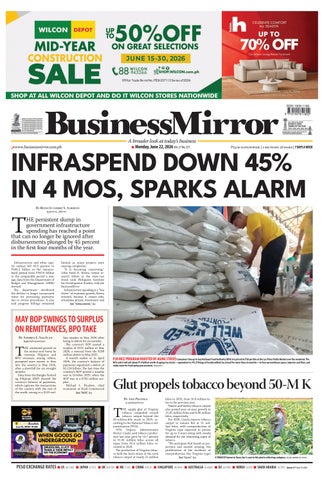
THE persistent slump in government infrastructure spending has reached a point that can no longer be ignored after disbursements plunged by 45 percent in the first four months of the year.
Infrastructure and other capital outlays fell 45.6 percent to P189.3 billion in the JanuaryApril period from P347.6 billion in the comparable period a year ago, data from the Department of Budget and Management (DBM) showed.
The department attributed the decline to longer turnaround times for processing payments due to review procedures. It also said progress billings remained
By Andrea E. San Juan @andreasanjuan
THE continued growth in the money sent home by overseas Filipinos and BPO revenues, among others, prompted more money to flow into the country in May 2026, after a shortfall for six straight months.
Data from the Bangko Sentral ng Pilipinas (BSP) showed the country’s balance of payments, which captures the transactions of the country with the rest of the world, swung to a $131-mil-
limited as many projects were nearing completion.
“It is becoming concerning,” John Paolo R. Rivera, senior research fellow at the state-run think tank Philippine Institute for Development Studies, told the BusinessMirror
Infrastructure spending is a “key driver” of economic growth, Rivera stressed, because it creates jobs, stimulates private investment and
A2
lion surplus in May 2026 after being in deficit for six months.
The country’s BOP posted a surplus of $131 million in May 2026, a reversal from the $298 million deficit in May 2025. A month earlier or in April 2026, the country’s balance of payments registered a deficit of $2.124 billion. The last time the country’s BOP posted a surplus was in October 2025, when the BOP was at a $706 million surplus.
Michael L. Ricafort, chief
economist
at Rizal Commercial
See “BOP,” A2
TBy Ada Pelonia @adapelonia
HE supply glut of Virginia tobacco catapulted overall tobacco output beyond the 50-million-kilo mark in 2025, according to the National Tobacco Administration (NTA).
NTA Deputy Administrator Nestor Casela said tobacco production last year grew by 13.7 percent to 51.61 million kilos across all types from 45.4 million kilos recorded in 2024.
The production of Virginia tobacco held the lion’s share of the total tobacco output at nearly 21 million
kilos in 2025, from 16.8 million kilos in the previous year.
Native and burley tobacco output also posted year-on-year growth to 21.81 million kilos and 8.86 million kilos, respectively.
For 2026, Casela expects tobacco output to remain flat at 51 million kilos, with overproduction of Virginia type expected to persist for up to 3 years along with steady demand for the remaining types of tobacco.
“We anticipate that based on projections and market sensing, the proliferation of the incidents of overproduction [for Virginia type]
views. Disagreements are expected,” he said.
“But nothing unusual happened during the pretrial,” he added.
Despite the detailed review of evidence, Diokno said there is no indication that the trial schedule will be delayed.
Diokno also said many Filipinos are still waiting to hear Duterte directly respond to the allegations against her as the impeachment trial approaches.
“This is the opportunity for the vice president to face the court, present her evidence, and present her arguments,” he said.
‘Lower pump prices won’t lead to lower inflation soon’
By Justine Xyrah Garcia
WHILElocal pump prices are expected to ease in the coming weeks following recent developments in the Middle East, the Philippine Institute for Development Studies (PIDS) said lower fuel costs may not immediately translate into slower inflation.
higher proportions in the higher ICT skill categories than males.
Among females, 24.1 percent had above-basic skills compared with 21 percent among males. Likewise, 23.3 percent of females demonstrated skills in four of the five ICT areas, compared with 22.2 percent among males.
Among the estimated 13.09 million internet users with above-basic ICT skills, the most commonly performed activities were setting up effective security measures and changing privacy settings on devices, accounts or applications, both at 100 percent. These were followed by sending messages at 98.7 percent, verifying the reliability of information found online at 96.8 percent, and making calls at 96.1 percent.
PIDS President Philip Arnold P. Tuaño said inflation tends to exhibit “momentum,” meaning elevated prices can persist even after the factors driving them begin to ease.
“We will still expect inflation to stay
elevated. It will take maybe several months before we see low levels of inflation to come,” Tuaño told reporters in a chance interview last week.
His assessment echoes concerns raised by the Bangko Sentral ng Pilipi-
May BOP swings to surplus…
Banking Corporation (RCBC), traced the improvement in the BOP data partly to lower global crude oil prices as well as the “continued” growth in
nas (BSP), which recently raised its key policy rate by 25 basis points for the second time this year.
The Monetary Board said the move was intended to keep inflation expectations anchored and mitigate the risk of second-round effects, or the broader pass-through of higher fuel and transport costs to other goods and services.
Latest data from the Philippine Statistics Authority (PSA) showed inflation slightly eased to 6.8 percent in May from the three-year high of 7.2 percent in April.
Despite the slowdown, inflation remained well above the BSP’s 2- to 4-percent target range.
The BSP also raised its 2026 inflation forecast to 6.4 percent from 6.3 percent and now expects inflation to average 4.5 percent in 2027.
Inflation is projected to return within the target range only by
the country’s “structural US dollar inflows” such as OFW remittances, BPO revenues and foreign direct investments.
5-month data: Still wider than ‘25’s full-year deficit WHILE the surplus in May helped narrow the cumulative deficit from $7.4 billion in January to April 2026, to $7.3 billion in January to May 2026, the yearto-date deficit still exceeds the $5.66-billion gap for all of 2025.
In its statement, the BSP explained that the year-to-date BOP position reflected the “continued trade in goods deficit, and net outflows from foreign portfolio investments.”
“However, this was partly offset by the sustained net inflows from personal remittances of overseas Filipinos [OFs], foreign borrowings by the NG, trade in services, and foreign direct investments,” the central bank explained further.
Dollar reserves at 16-month low MEANWHILE , BSP said the revised gross international reserves (GIR) level remained adequate at $103.987 billion as of end-May 2026.
“These provide sufficient foreign currency to meet the country’s import needs, service its external debt obligations, and serve as a buffer against external economic shocks,” the central bank said.
Year-on-year, the GIR fell by
2028. Tuaño said energy markets remain under pressure despite the reported US-Iran ceasefire agreement, noting that supply-side disruptions are unlikely to be resolved immediately.
“It will take some time even before all of the supply problems are resolved,” he said.
On June 17, the United States and Iran signed a memorandum of understanding extending their ceasefire and paving the way for the reopening of the Strait of Hormuz, a critical maritime chokepoint that handles about one-fifth of global oil shipments.
However, the agreement came under strain days later after Iran accused the US of violating its terms and announced on June 20 that it would again close the strait.
1.13 percent from the $105.18 billion in end-May 2025.
In its statement, the BSP said the modest decline in reserves was mainly driven by national government’s (NG) drawdowns on its foreign currency deposits with the BSP for external debt service.
Other reasons behind the decline are the downward value adjustments, primarily driven by changes in prices of the BSP’s gold holdings and foreign currencydenominated reserve assets, and the central banks’ net foreign exchange operations.
However, the central bank said these were partly offset by: NG’s net foreign currency deposits with the BSP and BSP’s net income from its investments abroad.
According to the central bank, the May GIR level can cover up to 6.7 months’ worth of imports of goods and payments of services and primary income.
It can likewise service about 3.9 times the country’s short-term external debt based on residual maturity.
GIR consists of eligible foreign assets, including securities, currency and deposits, reserve position in the fund, gold, special drawing rights, and other reserve assets, held by the central bank. Short-term debt based on residual maturity refers to the sum of outstanding external debt without original maturity of one year or less, and principal payments on medium- and long-term loans of the public and private sectors falling due within the next 12 months, the BSP explained.
Infraspend down 45% in 4 mos, sparks alarm Continued from A1
improves long-term productivity.
For April alone, infrastructure spending contracted by 51.7 percent to P41.5 billion versus the P85.8 billion a year earlier. The DBM said the weak outturn reflected slower spending by the Department of Public Works and Highways (DPWH), where implementation of this year’s budget and completion of prior-year projects remain underway. Payment claims are also subject to stricter validation procedures.
The government’s infrastructure spending began to slow in the second half of 2025 as authorities tightened oversight of public works following the flood control corruption scandal that emerged last year, leading to closer scrutiny of contractor payments and cash releases.
Described as the biggest scandal to rock the country in decades, it ensnared, among others, several ranking district engineers and even the former DPWH secretary Manuel Bonoan, who is facing plunder charges before the Sandiganbayan. A former undersecretary was found dead at the bottom of a cliff in Baguio, declared a suicide.
Dozens of contractors are also being investigated.
Rivera warned that prolonged delays in project implementation may worsen logistics bottlenecks and reduce competitiveness.
“If [the] decline persists, it could further dampen economic growth, especially since private investment is already weak,” he said.
What should be a priority now, Rivera said, is to accelerate infrastructure disbursements and improve budget execution to support growth and restore confidence.
While the DBM is responsible for budget releases and expenditure management, Rivera said infrastructure spending is ultimately a shared responsibility among DBM, implementing agencies, procurement units and project managers.
The DBM said it released P403.3 billion to DPWH in May to fund various infrastructure projects nationwide.
The release should help support a recovery in infrastructure spending in the coming quarters, the DBM said. Once contracts are awarded, agencies may request mobilization funds to begin construction activities, including equipment transport and site preparation, subject to procurement rules.
A rebound in infrastructure spending could be expected in the second half of this year, Rivera said, if the delays are primarily due to validation, review and administrative bottlenecks, but historically, government spending tends to accelerate in the latter half of the year.
will pervade,” Casela recently told reporters.
The NTA official, however, flagged the potential effect of El Niño on tobacco production this year, particularly on the quality of leaves.
“Even though the tobacco crop is resilient to drought, intense heat [from] the El Niño phenomenon will definitely affect the quality. The leaves’ long exposure to sunlight reduces its quality,” Casela explained.
Virginia glut EARLIER , NTA officials announced that tobacco traders have committed to buy all locally produced flue-cured Virginia (FCV) tobacco leaves at “reasonable prices” using the approved floor prices as basis.
The agency attributed the pro -
jected 5,000 metric tons (MT) overproduction to the increasing number of non-contracted tobacco farmers cultivating traditional Virginia tobacco varieties with strong support from the local government units (LGUs). This encouraged them to expand their area due to strong market demand in the past two trading seasons.
The projected figure, however, is around 27 percent more than the 18,050 MT purchase commitment by trading companies and cigarette manufacturers for this season, the NTA said.
Poor-quality tobacco leaves were observed this season due to limited irrigation water supply and unfavorable agro-climatic conditions propelled by extreme heat, Casela said.
This year’s public sector infrastructure budget stands at P1.289 trillion, 21.61 percent lower than last year’s P1.644 trillion allocation.
From January to April, allotment releases reached P5.523 trillion, equivalent to 81.3 percent of the P6.793-trillion 2026 national budget. Some P1.27 trillion remains in the balance.
The DBM expects maintenance expenditures to further drive spending growth due to the implementation of various social protection programs of the Department of Social Welfare and Development. Education sector-related expenditures, such as school operating expenses and various educational subsidies and scholarship grants, are likewise seen to pick up in the succeeding months as the school year officially began this June.
PHL among 22 highest-risk countries for El Niño impacts
By Jonathan L. Mayuga @jonlmayuga
THE Philippines has been identified by the United Nations Food and Agriculture Organization (FAO) and the World Food Program (WFP) as one of only 22 countries worldwide at the highest risk from extreme weather events associated with El Nino, the Kilusang Magbubukid ng Pilipinas (KMP) reported.
As such, millions of Filipino farmers and rural communities face heightened risks from the looming El Niño, the group said.
According to a joint FAOWFP Global Appeal launched this month, the Philippines is required to implement urgent anticipatory action to protect vulnerable populations from droughts, floods, storms, crop failures, and food insecurity.
The appeal seeks US$202 million or equivalent to P12.275 billion, to protect 8.8 million people across Africa, Asia-Pacific, Latin America, and the Caribbean from the expected impacts of a strong El Niño event in the second half of 2026.
“The inclusion of the Philippines on this list of El Niño highest-risk countries is a damning indictment of the Marcos administration’s failure to build climate resilience in agriculture and rural communities,” KMP said.
The group noted that the Philippines now finds itself grouped with countries suffering from severe humanitarian crises, conflict, and chronic food insecurity, including Sudan, South Sudan, Somalia, Afghanistan, Haiti, and Venezuela.
“That the Philippines is being flagged alongside war-torn and crisis-stricken countries should alarm the public. This reflects not only our extreme vulnerability to climate disasters but also decades of government neglect and the continued failure of the Marcos administration to protect farmers and food producers,” KMP said.
The FAO and WFP warned that strong El Niño conditions could trigger severe droughts, floods, and storms across affected countries. Planned interventions include climateresilient agricultural support, livestock protection, cash assistance, and flood-control measures—precisely the kinds of support that Philippine farmers have long demanded but have been denied.
KMP criticized the Department of Agriculture (DA) and the Marcos administration for their continued inaction despite repeated warnings from scientists, weather agencies, and international organizations regarding worsening climate extremes.
“Instead of preparing communities and strengthening local food production systems in the country, the government remains focused on import dependence, public relations campaigns, and infrastructure projects plagued by corruption and inefficiency,” KMP said.
The KMP claimed that Marcos and the DA have been using the Bente Bigas caravan to dispel the government’s failure to address the worsening state of agricultural production and food insecurity in the country.
Legislator: Expect close public scrutiny of all participants in impeachment trial
ABy Jovere Marie N. Dela Cruz @joveemarie
LAWMAKER said the upcoming impeachment trial of Vice President Sara Z. Duterte is expected to attract widespread public attention, turning the proceedings into a national conversation as evidence and arguments are presented in open session, helping raise awareness and clarify issues surrounding the case.
House Deputy Speaker Paolo Ortega V said the formal start of the trial would allow Filipinos to closely follow the presentation of evidence, observe the conduct of key personalities, and reach their own conclusions
based on what is shown in the proceedings.
Ortega, who represents La Union, said the impeachment process would inevitably become a widely discussed topic across communities nationwide.
“As the trial begins, the discussion on impeachment will really come alive. It will become part of everyday conversations across the country,” Ortega said.
According to him, the public airing of evidence and arguments will help increase awareness and clarify issues surrounding the case.
“This will create awareness. People will see the facts, and they will see how the evidence is laid out,” he added.
Ortega also noted that the trial will place not only the accused but also all participants—senatorjudges, prosecutors, defense lawyers, and the presiding officer— under close public observation.
“People will see how the senator-judges behave and how the prosecutors and defense perform, and even the presiding officer will be under public scrutiny,” he said. He stressed that the impeachment court must begin proceedings so that questions and specula -
Lacson hails return of 24
Pinoy detained in Russia
SBy Butch Fernandez @butchfBM
EN. Panfilo Lacson on Sunday expressed gratitude for the return of 24 Filipinos who were detained in Russia for nine months after President Marcos personally raised their case with Russian President Vladimir Putin. Lacson said the freedom granted to the 24 Filipinos— who returned in two batches on late Saturday and early Sunday— is one of the most significant achievements of the President’s
recent visit to Russia.
“24 souls, 24 families, most of all, 24 Filipinos who would still be languishing in an eastern Siberia jail, probably for the rest of their lives—one of the biggest achievements of the President’s visit to Russia that almost escaped public notice and appreciation. Thank you!” Lacson said.
The 24 repatriated Filipinos arrived at the Ninoy Aquino International Airport (Naia) Terminal 1 in two batches from Bangkok, Thailand.
According to reports, the
Department of Foreign Affairs (DFA) said the repatriation was coordinated with Russian authorities, with assistance from the Department of Migrant Workers (DMW) and the Overseas Workers Welfare Administration (Owwa).
On Thursday, Marcos said Putin authorized the release of the 24 Filipinos, who worked as cleaners in Russia.
Earlier reports indicated the Filipinos were detained over immigration issues, after being victimized by illegal recruiters.
Group worries over Gibo stance on China
THE Center for People Empowerment in Governance
(CenPEG) expressed on Friday grave concern over what it said as “the increasingly adversarial stance adopted by Defense Secretary Gilberto Teodoro Jr. toward China” and his apparent alignment with the strategic objectives of the United States in the Indo-Pacific region.
Citing the 1987 Philippine Constitution that clearly mandates that the State “shall pursue an independent foreign policy,” CenPEG said the constitutional bedrock was established to ensure that the Philippines remains sovereign in its decisions and is never drawn into the geopolitical designs of any foreign power.
CenPEG said crafting and executing a truly independent foreign policy is not a mere bureaucratic choice but a constitutional imperative vital to preserving national sovereignty.
While the Philippines has legitimate concerns regarding developments in the West Philippine Sea-South China Sea and must ardently defend its sovereign rights and maritime entitlements, these challenges must be met with strategic autonomy.
CenPEG pointed out that national security should be addressed through a calibrated approach that combines robust diplomacy, bilateral dialogue, confidence-building measures, and strict adherence to international law. CenPEG said the pursuit of security must never be
compromised at the expense of the country’s independence.
First and foremost, the government should actively utilize the bilateral consultative mechanism established in 2017 as the primary platform to resolve differences through peaceful engagement,” CenPEG said.
CenPEG expressed deep concern on the recent statements and actions by Teodoro aligning the Philippine security concerns through the lens of Washington’s geopolitical competition with Beijing. It said such an approach risks transforming the Philippines from a sovereign, independent actor into a vulnerable frontline state in a conflict driven purely by major-power interests.
“By echoing Washington’s strategic narrative and treating China primarily through the lens of military confrontation, Secretary Teodoro risks subordinating Philippine foreign policy to external interests. Such a course departs from the constitutional vision of an independent foreign policy and exposes the nation to dangers that diplomacy and strategic autonomy are meant to prevent,” emphasized Bobby M. Tuazon, CenPEG director for policy studies.
Tuazon exhorted the government to remain vigilant against any policy shift that compromises its constitutional commitment to independence. According to Tuazon, crafting an independent foreign policy requires maintaining productive and constructive relations
with all nations while ensuring that decisions are made based solely on Philippine national interests.
While China remains a vital trading partner and the United States stands as a traditional defense ally, Tuazon said the alliance between Manila and Washington must not compromise Philippine sovereignty. He described the ongoing expansion of US military access under the defense treaty, possibly transforming the country into a launchpad for foreign conflicts, that would put the Philippines in an unnecessary war between superpowers.
Tuazon stressed the country’s long-term interests are best served not by choosing sides in an intensifying rivalry between great powers, but by pursuing balanced engagement, peaceful diplomacy, and uncompromising strategic autonomy.
Further, he said the country should never be allowed to be a springboard for military strategies crafted elsewhere, while Filipino lives, resources, and national security be placed at risk to serve foreign geopolitical agendas beyond our control.
“CenPEG calls on the Marcos administration and all national security officials to firmly uphold the Constitution’s mandate of an independent foreign policy. The government must resist frameworks that unnecessarily heighten regional tensions or deepen the country’s entanglement in great-power confrontations,” said Tuazon. Rizal Raoul S. Reyes
tion surrounding the case may be addressed through a formal and transparent process.
“There are many issues and uncertainties right now, which is why it is important that the trial finally begins and a presiding officer is designated so these doubts can gradually be settled,” Ortega said.
The House leader acknowledged that the Senate has yet to proceed to full trial, with questions still being raised regarding leadership arrangements and procedural direction.
He said the situation reflects an unusual political atmosphere surrounding the case.
Ortega said the unusual developments inside the Senate show that this impeachment case is moving under a political and institutional atmosphere unlike any previous impeachment proceeding.
Still, Ortega expressed confidence that once the trial officially begins, the public will be able to form clearer judgements based on what they witness firsthand.
“People can already see what is happening every day in terms of how things are being handled. Once the trial starts, they will be able to judge for themselves,” he said.
“Then people will decide, people will probably see some people pressuring. You will see movements arise,” he added.
He added that the formal opening of the trial would help reduce speculation and unanswered questions surrounding the case.
“Many of the doubts and questions will fade once everything gets underway,” Ortega said.
“It’s a different atmosphere, a different type of impeachment. It has never been done before,” Ortega said, adding that the evolving dynamics inside the Senate have made the process more complex and highly watched.
PNP to secure Edsa rally on June 28
By Rex Anthony Naval
HE National Police (PNP)
TChief, Gen. Jose Melencio Nartatez Jr., on Sunday said the force will deploy full security and coordination measures for the planned “White Ribbon Movement” rally at the Edsa People Power Monument on Epifanio delos Santos Avenue on June 28. These measures aim to ensure peace and order, and the safety of participants and the general public, Nartatez said in a statement.
Likewise, Nartatez directed the National Capital Region Police Office (NCRPO) and concerned regional offices to conduct a comprehensive security threat assessment around the Edsa People Power Monument and nearby critical infrastructure.
“While we respect the public’s right to peaceful assembly and freedom of expression, the PNP will remain completely apolitical and focused solely on maintaining public order and safety during the scheduled June 28 mobilization,” Nartatez said.
Religious and civil society groups led by the Interreligious
Leaders Council for National Transformation have called for the nationwide march to push electoral reforms, stronger accountability in government, and action against corruption and political dynasties. The gathering is expected to draw participants from faithbased organizations and civil society groups.
“We have already initiated strategic security assessments and directed the NCRPO alongside concerned local units, to exercise maximum tolerance while strictly enforcing traffic management and civil disturbance protocols,” Nartatez said.
“Our priority is to ensure that the ‘White Ribbon Movement’ march at the EDSA People Power Monument remains completely peaceful, prevents any form of lawlessness, and causes minimal disruption to the commuting public and nearby business establishments,” he added. Meanwhile, Nartatez ordered all operational units to enforce a maximum tolerance policy. Field commanders were told to reinforce human rights-based policing protocols across all deployed units.
Lopez Group volunteers join Las Piñas–Parañaque Wetland Park clean up
EMPLOYEES of leading renewable energy producer
First Gen Corporation joined a coastal cleanup drive on May 30 at the Freedom Island portion of the Las Piñas–Parañaque Wetland Park in Metro Manila as part of the Month of the Ocean celebration in the Philippines.
The activity, coordinated by First Gen volunteers under their Employee POWER (EmPOWER) program, brought together employees and dependents from the First Gen Group and the broader Lopez Group community.
It was held in collaboration with First Gen’s Create for the Climate program and in partnership with Communities Organized for Resource Allocation
(Cora), a nonprofit organization that mobilizes volunteers to help address social and environmental challenges such as marine pollution and climate change. Located within the Las Piñas–Parañaque Wetland Park, Freedom Island forms part of an internationally recognized wetland and one of Metro Manila’s important remaining coastal ecosystems. Its mangroves, mudflats, and coastal habitats provide refuge for marine life and migratory birds, while also helping buffer nearby communities from flooding, storm surges, and other climate-related impacts.
Dismantle cigarette smuggling syndicates, hunt down protectors in govt–Remulla
By Rizal Raoul S. Reyes @brownindio
INTERIOR Secretary Juanito Victor Remulla issued a stark warning on Friday to law enforcement agencies that the country’s massive P141 billion revenue leak from illegal cigarettes and vapes is a symptom of a much deeper disease.
Remulla said that seizures alone “will never plug” this multibillion-peso hole and “to stop the bleeding authorities must dismantle the syndicates themselves— and aggressively hunt down the corrupt officials protecting them.”
Remulla made the remarks during the Third International Tobacco Summit organized by the Department of Agriculture (DA) and the National Tobacco Administration (NTA).
“Corruption is number one. All of this illicit trade is only possible because corruption is endemic,” he said in his speech.
Nevertheless, Remulla assured the audience that President Marcos had personally instructed him and law enforcement agencies to pursue offenders without compromise.
“The President has given very
clear instructions: no compromises, no bribes, prosecute to the fullest extent of the law,” Remulla said.
“You have to remember that our President is an Ilocano, and every day, every week that he goes home to the province, he sees how his constituents whom he has been serving for the longest time are being affected.”
The DILG chief stressed that enforcement efforts should be “propoor,” targeting major operators rather than small-scale sellers.
“I’d rather hit the rich, the foreigners, and the big syndicates than the small people who will be punished,” he said, adding that arresting small vendors does little to dismantle the larger criminal networks involved in illicit trade.
Remulla led government officials, law enforcement agencies and private sector stakeholders
Steel sweep nets ₧48M in substandard products
By Bless Aubrey Ogerio
THE Department of Trade and Industry (DTI) and the National Bureau of Investigation (NBI) have confiscated P48.28 million worth of steel products that failed to meet national quality standards.
In a joint enforcement operation in the cities of Manila and Valenzuela, authorities seized 200,730 pieces of construction materials, including galvanized iron pipes, black iron pipes, welded lightweight steel tubes, deformed steel bars, rerolled steel bars and low-carbon steel wires.
The operation stemmed from a test buy conducted by the NBI, which prompted a DTI-accredited facility to conduct laboratory testing of steel samples.
Results showed that the products failed to comply with Philippine National Standards (PNS) covering safety, quality, and labeling requirements.
Based on the findings, the DTI’s Fair Trade Enforcement Bureau
THE Marcos administration is ramping up efforts to ensure that overseas Filipino workers (OFWs) displaced by the Middle East conflict can rebuild their lives back home, with President Marcos approving an additional P3 billion to strengthen reintegration programs.
Executive Secretary Ralph Recto said the funding will not only support the safe return of Filipinos but also provide them with opportunities to restart through employment, livelihood, and social services.
“The fund augmentation will finance the whole repatriation chain, from post-departure assistance to
(FTEB) and the NBI inspected five stores. Four establishments were found selling products that violated mandatory standards and consumer protection regulations.
The DTI has issued Notices of Violation against the firms involved, with further investigation and possible legal action underway.
The latest crackdown comes as industry groups push for stricter enforcement of construction material standards following two recent incidents that renewed concerns over building resilience.
Last month, a building under construction in Angeles City, Pampanga collapsed, while a magnitude 7.8 earthquake off the coast of Mindanao caused structural damage in several areas, prompting renewed calls for tighter compliance with construction standards.
For its part, the Philippine Iron and Steel Institute (PISI) has since urged the government to immediately implement Philippine National
See “Steel,” A9
flights to reintegration,” Recto said. Recto said Marcos topped up the OFW assistance fund “because the President does not want repatriation to be a mere airport-toairport thing.”
The additional funds will cover the entire repatriation process, from post-departure assistance and transportation to reintegration services such as job placement and livelihood support.
As of June 17, the Department of Migrant Workers (DMW) has successfully repatriated 10,446 Filipinos from the Middle East through humanitarian flights. Of this num-
who gathered at the Summit, and who pledged to move beyond product seizures and intensify efforts to secure convictions against the syndicates behind the country’s multibillion-peso illicit tobacco trade.
They called for a “whole-ofgovernment and whole-of-society approach” to address the problem, which they said continued to undermine tax collection, public health programs and agricultural livelihoods.
Citing recent numbers from Euromonitor, Philippine Tobacco Institute (PTI) president Bayen Elero Tinga said illicit cigarettes now accounted for more than a quarter of the domestic market.
“This is not a statistical variance,” Tinga said. “This is P141 billion stolen directly from the public treasury.”
She warned that the continued growth of the illicit market threatened both government revenues and the welfare of tobacco farmers who depend on legal production and sales.
NTA Administrator Belinda Sanchez echoed the concern, saying illicit tobacco trade weakened legitimate businesses and put the livelihoods of farmers and workers at risk.
“We must examine our policies, regulatory frameworks, tax systems, enforcement mechanisms, and regional cooperation. We must
ask where the gaps are, how illicit actors exploit them, and how government, industry, and communities can work together to close them,” she said.
Stronger prosecution
WHILE the government achieved recent gains to crack down on the illicit tobacco trade, Remulla said there was still a gap between arrests and successful prosecutions.
Brig. Gen. Ponce Rogelio Peñones, a former National Police (PNP) regional director, said the agency conducted 8,986 anti-smuggling operations from January to June this year, resulting in 2,560 arrests and the seizure of illicit goods worth P8.63 billion.
Peñones said authorities were now focusing on building stronger cases against the criminal organizations behind the trade.
“The true measure of success lies in ensuring that every operation leads to strong evidence-based cases that result in successful prosecution and conviction,” he said.
NTA Deputy Administrator Nestor Casela said the agency is determined and remains focused on protecting the livelihoods of some 45,000 tobacco farmers nationwide.
He noted that government support programs, including fertilizer subsidies and technology assistance, were designed to keep farmers within the legal supply chain.
Casela also urged lawmakers to consider granting the NTA greater enforcement authority to strengthen its role in anti-smuggling operations, arguing it would make its efforts to curb illicit trade “more forceful and efficient.”
The summit also highlighted the role of international cooperation in combating illicit trade, which was particularly timely as the Philippines prepares for its ASEAN chairmanship.
Valentin Dinca, Japan Tobacco International (JTI) AITO Director for North and South Asia, stressed that regional coordination was useful particularly in monitoring cross-border shipments and strengthening oversight of free trade zones often used by smugglers.
But “one thing that I feel is missing in the Asia Pacific region is a regional body that takes coordination from a law enforcement perspective,” he said.
He suggested that the Philippines, through its ASEAN chairmanship, should champion upstream control among its regional neighbors to replicate Philippine legislation requiring exporters to comply with the packaging and labeling laws of the destination country.
Meanwhile, European Chamber of Commerce of the Philippines (ECCP) director for advocacy and government Kathyrin Pioquinto
Lawmaker tells local govts, groups: Tap ₧1-B fund to gird for El Niño
By Jovee Marie N. dela Cruz @joveemarie
ALEADER of the House of Representatives on Sunday called on the local governments (LGUs) and community organizations to prepare for the looming El Niño phenomenon by tapping the P1-billion People’s Survival Fund (PSF) to finance climate adaptation projects, particularly rainwater harvesting systems.
House Minority Leader Marcelino Libanan emphasized that the 2026 General Appropriations Act earmarks P1 billion for the PSF to support initiatives that will strengthen communities’ resilience against water shortages and other climate-related risks.
“In the 2026 General Appropriations Act, Congress allocated P1 billion for the People’s Survival Fund to help finance climate adaptation initiatives, including the installation of functional rainwater collection and storage systems
ber, 8,281 are OFWs, alongside 1,803 dependents and 362 stranded individuals.
“If you will recall, these flights became medevacs for sick Filipinos as well. The DMW, through the brilliant leadership of Secretary Hans Cacdac, brought medical personnel on board to care for them,” said Recto.
Upon arrival, returning OFWs are provided with a standard assistance package that includes financial aid, psychosocial counseling, medical assessments, reemployment guidance, and livelihood support.
that can strengthen communities’ resilience against potential freshwater shortages,” Libanan, the nomimee of the party-list group 4Ps, said.
He stressed that both LGUs and accredited community organizations are eligible to access PSF financing for projects designed to reduce vulnerability to climate change impacts.
The lawmaker issued the call following a warning from the Philippine Atmospheric, Geophysical and Astronomical Services Administration (Pagasa) that Metro Manila and at least 47 provinces may experience below-normal rainfall in the coming months due to the developing El Niño phenomenon.
“We should make rainwater harvesting a regular practice so communities can build up additional freshwater reserves before severe dry periods set in,” Libanan said.
“Every liter of rainwater captured and stored today can help cushion households and communities from
To accelerate their return to the workforce, the DMW has rolled out 15 Bayanihan Para sa Balikbayang Manggagawa National Reintegration Network and job fairs nationwide. These one-stop-shop events connect OFWs to job opportunities, financial literacy programs, and business support.
The Overseas Workers Welfare Administration ( OWWA ), through its Balik Pinas, Balik Hanapbuhay Program, has also extended livelihood assistance to 664 OFWs, with grants of up to P20,000 to help start small businesses.
water shortages tomorrow. Investing in rainwater harvesting is one of the simplest, most practical, and most cost-effective climate adaptation measures available to us,” he added.
Pagasa predicts that by November, Metro Manila and several provinces in Luzon—like Abra, Albay, Batangas, Bulacan, Cavite, Laguna, Pampanga, Pangasinan, and Quezon—might face “dry conditions,” which means they will have two months in a row with less rain than usual, showing a 21 to 60 percent drop from the average rainfall.
Pagasa defines “dry condition” as two consecutive months of below-normal rainfall, equivalent to a 21 percent to 60 percent reduction from average precipitation.
Camarines Sur, meanwhile, may experience a “dry spell,” which involves three consecutive months of below-normal rainfall within the same range.
“Fund,” A9
Recognizing the value of skills gained abroad, Recto emphasized that returning OFWs contribute to the local economy through “brain gain” and knowledge transfer.
Meanwhile, the Department of Education has opened a hiring pathway for returning licensed teachers, enabling them to join the public school system. Data show that around 10,000 former OFWs have already transitioned into teaching roles over the years.
“War or not, there are Filipinos in extreme distress that we should bring home,” he added. Jovee Marie N. dela Cruz
said authorities must improve information-sharing as criminal groups increasingly use digital technologies and encrypted communications.
She noted that within Asean, there was already an “appetite for action…What’s missing is the connective tissue between us. Our Asean chairmanship this year gives us a rare chance to set the agenda.”
“Let the Philippines champion track and trace standards that are interoperable by design from day one, not a dozen national systems that cannot talk to each other, but a region that understands the illicit trader already thinks across borders and decides to think that way too,” she added. Officials also pointed to Republic Act 12022, or the Anti-Agricultural Economic Sabotage Act, as a key tool in the campaign. The law classifies large-scale agricultural smuggling, including tobacco smuggling, as economic sabotage and imposes penalties of life imprisonment for offenders.
Prosecutor General Richard Anthony Fadullon said the law strengthened the government’s ability to pursue major economic crimes but emphasized that sustained coordination remains essential.
“No one agency will be responsible for making these efforts successful. It has to be a whole-of-government approach,” Fadullon said.
Gatchalian eyes more incentives for electric vehicles
By Butch Fernandez @butchfBM
SENATE President Sherwin Gatchalian has filed a bill seeking to accelerate the country’s transition to electric vehicles (EVs) through additional incentives aimed at reducing dependence on oil imports.
Noting that spikes in global crude and refined petroleum prices have led to some of the steepest increases in domestic fuel prices, Gatchalian said, “We need to break our economy’s dependence on foreign oil by accelerating the transport sector’s shift to EVs.” Senate Bill 2270 seeks to amend
Escudero to file bill removing some tasks from FDA
TRANSFERING several regulatory functions of the Food and Drug Administration (FDA) to other government agencies can make government approval processes more efficient and business compliance easier, said Sen. Francis Escudero, who is eyeing a measure that will make such transfer possible. Escudero pointed out that FDA’s mandate is so broad that its functions have led to overlaps and delays, and as such, calls for the redistribution of its powers that would allow specialized departments to handle regulation more efficiently and effectively in a timely manner.
Mexico, Colombia meat plants secure PHL nod
November 9, 2025.
TBy Ada Pelonia @adapelonia
HE Philippines may now buy pork and beef from Mexico and Colombia after the government approved the accreditation of the meat plants in the Latin American countries.
Agriculture Secretary Francisco Tiu Laurel Jr. signed separate documents granting accreditation to foreign meat establishments (FMEs) in Mexico and Colombia to export pork and beef to the Philippines.
Mexico received system accreditation, while Colombia was given individual accreditation of its FMEs.
Under Department Circular (DC) 23, the DA said 16 FMEs in Mexico that were audited by the in -
‘Smart agriculture, not just funding, is key to food security’
By Butch Fernandez @butchfBM
TECHNOLOGY, and not just ensuring funding or the integrity of projects, is key to food security, according to the comebacking chairman of the Senate Agriculture committee.
Keynoting the recent “10th ClickConEx: Convergence of Luzon I.C.T. Champions and Exhibitions” in Naga City, Senator Francis Pangilinan stressed how technology could be a game-changer for farmers and fishers. He called on local governments, technology innovators, academic institutions, and the private sector to unite in adopting smart agriculture and climate-resilient solutions to ensure national food security.
“Ang kaalaman ay kapangyarihan [Knowledge is power],” he said, noting that farmers and fisherfolk could easily access information about weather forecasts, pest warnings, market prices, and planting advice through their smartphones. Information and communications technology (ICT), he added, can directly connect producers to consumers through a seamless, digitally enabled supply chain.
The four-term lawmaker allayed fears that the use of technology in the agriculture and fisheries sectors would replace traditional farming. Rather, he said it would build on generations of indigenous and farming knowledge—from farmers who have passed down wisdom about nature and planting to fisherfolk who best understand the rhythm of the sea—and strengthened by science, data, and technology.
“If we want to have ample food supply, we must mobilize resources towards the weakest link and provide them with capacity, with technology, with organization, with
extension service.”
After weeks of a Senate impasse, two of the senator’s twin measures to reform and modernize the agriculture and fisheries sectors passed on second reading.
Re-nationalizing extension services will give farmers and fisherfolk access to technical assistance, training, modern farming practices, veterinary services, pest management, and new technologies down to the municipal level.
At the same time, re-establishing the Bureau of Agriculture Cooperatives would strengthen farmers’ and fisherfolk’s capacity to organize themselves and compete effectively. As a cooperative, they can buy inputs at lower prices, access credit more easily, invest in equipment and machinery, process their products, and negotiate better prices in the market.
“What is the point of technology if our food producers, our farmers and fishers, are not organized? Whatever intervention the national and local governments do, if our farmers and fisherfolk are not organized and capacitated, no intervention will be sustainable,” Pangilinan said.
“The lessons of superpowers in agriculture in the region is that they have a strong organized farming and fishing cooperatives regulations and associations,” added the senator, who has previously cited Taiwan, Vietnam, and Thailand for their strong agriculture and fisheries sectors.”
Pangilinan, who resumes his role as chair of the Senate Committee on Agriculture, Food, and Agrarian Reform after the three-week Senate presidency of Alan Peter Cayetano ended, vowed to continue his advocacy of not only reforming and modernizing the agriculture and fisheries sectors, but also protecting the rights and livelihoods of farmers and fisherfolk.
Aftershocks prompt structural review of General Santos fish port
THE Department of Agriculture (DA) has ordered a “more comprehensive” structural review of the General Santos Fish Port Complex after the 7.8-magnitude earthquake that struck Mindanao.
Agriculture Secretary Francisco Tiu Laurel Jr. issued the directive following an initial postearthquake assessment, which warranted the temporary closure of Market Halls 1, 2, and 3 and the limited use of Market Hall 4 pending further evaluation.
Preliminary findings from a recent report suggested that the port remains “structurally sound,” but the agency noted that a detailed assessment would further validate its condition and provide a guide for necessary interventions.
The DA chief said there is a need to complete the comprehensive assessment “as quickly as possible.”
“Although the wharf generally appeared structurally sound, we should expedite further inspection of subsurface conditions. We cannot risk the lives of our people who rely on this fish port for their livelihood.”
To provide a complete understanding of the facility’s condition, the DA said a geotechnical investigation and further inspections will be added to the evaluation because of subsequent aftershocks.
The DA said no casualties or injuries were recorded among employees, traders, and other stakeholders despite the strong tremor.
Meanwhile, the agency noted that fish port operations have largely continued through contingency measures, helping maintain the flow of fish products and export activities while safety assessments are underway.
It added that the stakes are “particularly high for General Santos City,” dubbed the country’s tuna capital.
The DA said the fish port complex serves as a vital gateway for the tuna industry and supports a broad supply chain across Mindanao and international export markets.
“As climate-related disasters and seismic events become recurring risks, the resilience of food logistics infrastructure is emerging as an increasingly important economic issue.”
With this, the agency said ports, cold storage facilities, and trading centers are critical assets.
“They are critical links in ensuring food security, export competitiveness, and the livelihoods of more than 200,000 Filipinos who depend directly and indirectly on the General Santos fishery sector.” Ada Pelonia
spection team were compliant with the country’s quarantine and meat inspection systems procedures.
The inspection was conducted from November 15 to December 5, 2025, as part of efforts to assess the Latin American country’s veterinary services, animal health, and food safety control.
“After thorough evaluation, the application of the Government of Mexico for system accreditation to export beef and pork meat into the Philippines is satisfactory.”
In DC 24, the agency noted that 11 FMEs in Colombia audited by the inspection team also followed the Philippine quarantine and meat inspection systems procedures. The inspection was carried out from October 25 to
“The application of 11 FMEs of the Government of Colombia for accreditation to export beef and pork into the Philippines has been found to be satisfactory.”
The Philippine government grants foreign meat exporters either system-wide accreditation for a country or individual accreditation for their FMEs.
A system accreditation means that any FME accredited by the exporting nation could ship meat products into the Philippines. An individual accreditation allows only certain companies to export meat products to the Philippines.
Under existing rules and guidelines, foreign meat exporters should secure the accreditation of
their FMEs to ship meat and meat products into the country.
The accreditation would ensure that inbound shipments of farm products are safe for human consumption and do not pose a threat to the domestic livestock and poultry industry.
Data from the Bureau of Animal Industry (BAI) showed that the country’s meat shipments jumped by 22 percent to 577,689 metric tons (MT) in January to April, from the previous year’s 473,461 MT.
Pork was the top meat product imported by the Philippines during the period. Purchases went up by 17.83 percent to 295,718 MT, from the previous year’s 250,970 MT. Pork cuts accounted
for a chunk of the shipments at 134,362 MT, followed by offals at 85,050 MT.
The imported products will plug the supply shortfall caused by African swine fever, a disease that continues to crimp local hog production. As tight supply has jacked up retail pork prices, the government increased the volume of foreign pork that may enter the Philippines at a lower tariff.
BAI data also indicated that chicken imports soared by over a quarter or 27.8 percent to 197,454 MT during the period, from 154,540 MT a year ago. Mechanically deboned meat imports reached 113,078 MT; chicken leg quarters, 36,273 MT; and chicken cuts, 34,191 MT.
Virginia Farms invests ₧2.8B in Cebu piggery facility
By Carmel Pedroza
CEBU City A new state-ofthe-art breeder farm in Aloguinsan, Cebu is expected to strengthen food security efforts in Central Visayas and help ensure a more stable supply of pork as Virginia Farms Inc. (VFI) officially inaugurated its third piggery facility last June 18.
Located on a 45-hectare property in Barangay Saksak, the modern breeder farm represents a P2.8-billion investment and is designed to accommodate up to 5,000 sows once fully operational. The facility currently houses 2,500 sows and is expected to reach full capacity within the next two years.
VFI President Rolando Tambago said the project marks a significant step in the company’s expansion while supporting the modernization of the country’s swine industry.
“The inauguration of the third piggery farm in Aloguinsan, Cebu marks a major milestone for the company. It demonstrates not only significant business expansion but also a strong commitment to modernizing the Philippine swine industry,” Tambago told BusinessMirror in an interview.
He added that the facility reflects the company’s commitment to maintaining high standards in food production while adhering to animal welfare practices.
According to Tambago, the breeder farm incorporates ad -
vanced technologies aimed at improving productivity, disease prevention, and operational efficiency.
Among its key features are enhanced biosecurity structures designed to minimize disease risks and maintain strict hygiene standards throughout the production process. The farm also utilizes premium pig genetics sourced through partnerships with global industry leaders, allowing production targets of up to 4,200 kilograms per sow annually.
The facility is equipped with automated feeding and penning systems, climate-controlled housing, and precision-feeding technology that adjusts nutritional requirements according to the animals’ age and condition.
These systems are complemented by comprehensive workforce training programs.
“These modern innovations on pig farming methods collectively
ensures consistent, high-efficiency production while safeguarding animal welfare and overcoming the limitations of traditional farming which normally affected by seasonal fluctuations,” Tambago said.
He noted that the investment was driven by Aloguinsan’s strategic location, characterized by low livestock density, as well as strong support from local government officials and the Department of Agriculture in Central Visayas (DA-7).
Tambago said the project is expected to generate jobs, contribute to local revenues, improve infrastructure, and support related industries in the area.
Beyond its economic benefits, he emphasized the farm’s role in securing the country’s food supply.
“This new breeder farm plays a vital role in the future of the Philippine and Cebu swine industries to food security by providing a
steady, high-quality pork supply at better affordability to general consumers.”
He added that increasing domestic pork production would help reduce reliance on imports.
“We believe that food security is something we should not outsource from other countries.”
The new facility expands Virginia Farms’ swine production network, which already includes two 3,000-sow farms in Asturias, Cebu. The company operates an integrated pork business covering livestock production, slaughterhouse operations, meat processing, and retail distribution through its chain of Pork Shops.
Officials from DA-7 joined the inauguration and underscored the importance of the investment to the region’s livestock sector. In a statement, DA-7 Regional Executive Director Angel Enriquez said Virginia Farms has played a major role in strengthening the swine industry in Central Visayas and helping the region achieve a leading position in pork production.
She expressed optimism about the future of the industry, noting that investments such as the new breeder farm would further enhance the region’s capacity to produce pork and contribute to national food security.
Enriquez also thanked the company for its continued contribution to the livestock sector and assured Virginia Farms of the agency’s support for its future expansion plans.
El Niño is turbocharging the record heat wave searing Europe
WESTERN Europe’s heat wave is forecast to intensify this weekend, turbocharged by El Niño and putting France on track for record temperatures.
The heat wave is being fueled by a dome of high pressure over continental Europe, which raises temperatures as sinking air compresses toward the ground. The pattern is being reinforced by the developing strong El Niño and a cold pool of water in the North Atlantic, which is helping create a dip in the jet stream over the ocean and driving the high pressure over Europe, said William Henneberg, a meteorologist with Commodity Weather Group.
“This is very unusual,” he said, adding that the pattern is likely linger and lead to above-normal temperatures through early July.
The heat dome spans most of the region but its epicenter is over France, where the mercury soared above 40C (104F) on Thursday. Even higher temperatures are forecast in the coming days, with 42C possible in western France, and Paris poised to hit a June record on Monday,
according to Vaisala.
The searing heat, which is likely to continue through much of next week, is disrupting daily life in France, with schools canceling endof-year festivities and dismissing schools early, and a thunderstorm delaying 60 flights late Thursday at the capital’s Charles de Gaulle airport, Agence France-Presse reported. The condition of the French wheat crop is deteriorating, while power output from the country’s nuclear reactors is set to be curbed next week.
The heat is straining Europe’s energy grid, as households and businesses are expected to run air conditioners hard enough to push cooling demand to all-time highs, according to analysis from Vaisala and Commodity Weather Group.
At the same time, Electricite de France has warned that reactors drawing cooling water from the Rhône and Garonne may have to curb generation as river temperatures rise. That recurring summer constraint — designed to keep plants from discharging water that is too hot — may come as early
as Tuesday, EDF said. Government forecaster MétéoFrance raised the number of departments on amber alert for extreme heat to 58 for Friday and said red warnings are possible if conditions worsen as expected on Sunday.
French transport company SNCF has canceled more than 70 train services due to concern about airconditioning failures, and endof-year oral examinations for the national baccalaureate have been postponed for 4,500 students at 84 schools in western France, ICI reported.
The weather pattern is set to drive up temperatures in Spain, Germany and in the UK, which is likely to see heat wave conditions start on Sunday in southern England, according to the UK Met Office. The heat and absence of rain are drying vegetation and raising the risk of drought in the UK and for wildfire conditions in France and Spain, forecasters said. Those conditions are likely to worsen, with weather models and analysis from Vaisala showing unusually warm
temperatures lingering until July. Many departments across the country have imposed water restrictions of varying degrees, including bans on watering, according to government water-use platform VigiEau. Three months after drought conditions ended in the UK, the threat of prolonged dryness is rising fast in southern England, which received about 50 percent of its typical spring rainfall, the UK government’s National Drought Group said Friday.
Authorities have warned about the mounting health effects of heat during the day and at night. Many parts of Europe are set to see evening temperatures stay above 20C — socalled “tropical nights” — that can increase fatigue and heat illness, especially among children, older adults and people with medical conditions.
Red heat alerts have been issued in Germany and Switzerland, with amber alerts in effect across southern England, parts of Austria, Belgium, the Czech Republic, Italy and Spain. Yellow alerts cover much of mainland Europe. Bloomberg News
VIRGINIA Farms Inc.'s modern breeder farm in Barangay Saksak, Aloguinsan town in southwest Cebu. CONTRIBUTED PHOTO
Technical talks begin Sunday as US, Iran discuss details of war-ending agreement
By Kareem Chehayeb, Bassem Mroue, Seung Min Kim & Munir Ahmed The Associated Press
YRE, Lebanon—US and Ira -
Tnian negotiators headed to a Swiss venue Saturday for talks on adding key details to their interim agreement to halt the war, hours after Tehran said it closed the Strait of Hormuz because of Israel’s attacks in Lebanon and warned that little might be achieved if the fighting doesn’t stop.
US President Donald Trump, in response, unleashed a new threat to impose American tolls in the crucial waterway if a final deal with Iran isn’t reached in 60 days, saying the money would be for “services rendered as the Guardian Angel to the countries of the Middle East.” The agreement calls for toll-free travel for 60 days.
The announcements indicated a rough start to the technical-level talks that key mediator Pakistan said will begin Sunday, with Qatari mediators also participating.
US Vice President JD Vance left for Switzerland on Saturday evening, just as Iranian state TV posted video showing Iran’s negotiators arriving there. They are led by parliamentary Speaker Mohammad Bagher Qalibaf and include Foreign Minister Abbas Araghchi and central bank and oil officials, among others. The deal calls for billions of dollars of Iran’s assets to be unfrozen.
Pakistan’s Prime Minister Shehbaz Sharif and army chief Field Marshal Asim Munir also left for Switzerland late Saturday.
Talks were meant to start Friday, but the Iranians canceled plans to attend because of escalating fighting in Lebanon. Negotiators for the US and Qatar, with help from Iran, worked out an agreement between Israel and the Iranian-backed Hezbollah militant group to tamp down hostilities, according to US and regional officials who spoke on the condition of anonymity because they were not authorized to comment publicly.
Vance told reporters he would be in Switzerland “for a day or two” but was optimistic about making progress in talks about Iran’s nuclear program and on a ceasefire in southern Lebanon. He earlier confirmed that top negotiators Jared Kushner and Steve Witkoff were already in Switzerland. But Iranian Foreign Ministry spokesperson Esmail Baghaei told state TV that negotiations toward a final agreement will begin once key
By Nicole Winfield & Brian Hendrie
SThe Associated Press
ANT’ANGELO LODIGIANO, Italy — Pope Leo XIV on Saturday exalted the first American saint, Mother Frances Cabrini, as a model for Christians today to care for migrants in need, as he visited her birthplace during a day trip to northern Italy.
Leo, who has clashed with the Trump administration over its migrant crackdown, urged young people in particular to learn about Cabrini’s life and service, once again confirming history’s first US pope as the heir to Pope Francis in prioritizing the plight of migrants.
Leo prayed before Cabrini’s tomb in a basilica named for her in her birthplace in Sant’Angelo Lodigiano, near Milan, and presided over an evening prayer service. The visit to northern Italy is part of Leo’s summertime grand tour of Italy to visit key cities to get to know his flock. Cabrini, the patron saint of migrants, is well known to many Americans for her work caring for Italian immigrants in the United States at the turn of the last century. Her work went beyond the US, however, as she crisscrossed the globe building schools, hospitals and orphanages for those
commitments are upheld. If they are not, “the memorandum of understanding as a whole will be jeopardized.”
The strait once again becomes a challenge THE strait has emerged again as a focus. Iran’s joint military command said it was closed because of the US “clear breach of its commitments” by failing to end the war. The interim deal is meant to stop fighting on all fronts, including Lebanon.
The US disputed Iran’s announcement.
“Iran does not control the Strait of Hormuz. Traffic continues to flow, and US forces are monitoring the situation to ensure this remains the case,” said Capt. Tim Hawkins, a spokesperson for US Central Command. The military said that 55 merchant ships transited Saturday with more than 17 million barrels of oil.
The global economy braced for more uncertainty.
Ships began transiting after the interim US-Iran agreement was signed earlier in the week, a milestone that left plenty of questions unanswered. The US lifted its blockade of Iran’s ports and now allows Tehran to sell its oil freely—terms that have left some in US Congress asking whether the war was worth it.
The interim deal signed by Trump and Iranian President Masoud Pezeshkian gives negotiators 60 days to reach a nuclear agreement, but the issue is intricate and the time can be extended.
Israeli attacks in Lebanon kill at least 16 EARLIER Saturday, as mediators tried to get the parties to Switzerland, a Hezbollah official told The Associated
who had nothing. After she died in 1917, as a naturalized U.S. citizen in Leo’s native Chicago, Cabrini was beatified and then canonized in 1946 as the first American saint.
Leo asks what Francis would do IN praising Cabrini on Saturday, Leo said she was inspired by her faith to help those migrants who had left everything behind to try to find a better life.
“What could be more relevant today than a missionary charism dedicated to serving migrants?” he said.
“Let us ask ourselves: if Mother Francesca were alive today, what would her missionary spirit tell her?” Leo said. “And what would a pope like Francis—who, as the son of Italian immigrants, made service to migrants one of the key priorities of his pontificate—ask of her?”
“I therefore take this opportunity to make an appeal, especially to young people: get to know St. Frances Cabrini!” Leo said, urging them to read her writings, travel journals and notes from retreats.
A July 4 with migrants
Press that Iran informed the militant group that Tehran won’t reopen the strait until Israel announces publicly that it will comply with a “comprehensive ceasefire” in Lebanon and an end to military operations there. The official spoke on condition of anonymity because he wasn’t authorized to speak publicly.
The official said that Hezbollah would commit to a ceasefire if Israel does.
An Israeli military official, speaking on condition of anonymity in line with regulations, later said that the military had received “updated directives from the political echelon to cease fire.” The official said that the military is operating in a defensive manner in Lebanon, which includes the right to respond to Hezbollah attacks.
The official also said that five Israeli soldiers had been killed in the past 48 hours in southern Lebanon.
Neither Israel nor Hezbollah are signatories to the deal between the US and Iran.
Israeli strikes on southern Lebanon on Saturday killed at least 16 people, including two children. Seven people were trapped under rubble after strikes hit the southern city of Nabatiyeh and nearby villages, Lebanon’s National News Agency said.
An Israeli military official said that Hezbollah fired more than 50 projectiles at Israeli forces in southern Lebanon overnight. Israel’s army said that it struck dozens of Hezbollah targets and militants.
The death toll in the latest IsraelHezbollah war has surpassed 4,000, Lebanon’s health ministry later announced.
Hezbollah and Israel went to war two days after the US and Israel
launched strikes on Iran on Feb. 28, with Hezbollah firing rockets and drones at northern Israel and Israel seizing large swaths of southern Lebanon.
A new round of US-backed talks between the Lebanese government, and Israel is expected in Washington next week.
Israeli Prime Minister Benjamin Netanyahu has vowed to keep Israeli forces in southern Lebanon until any threat to Israel is eliminated. Hezbollah has refused to halt its attacks unless Israel commits to withdrawing from Lebanon.
Fighting continues near the Israel-Lebanon border
THE dead in Lebanon included parents and two children in Barish village. In Arab Salim village, a body was pulled from a destroyed house, and in Doueir and Kfar Rumman villages, drone strikes killed a person on a motorcycle and a Lebanese soldier. Nine people were killed in strikes in Qannarit, Sohmor and Shehour villages.
Israeli jets flew low over the coastal city of Tyre.
“Our entire lives would change if there’s a ceasefire,” said one resident, Hussein Khoshman.
Some residents of northern Israel doubted the fighting would stop.
“I don’t believe in a ceasefire because it doesn’t exist,” said Miriam Hod in Metula.
Mroue reported from Beirut, Ahmed from Islamabad and Kim from Washington. Abby Sewell in Beirut, Samy Magdy in Cairo, Konstantin Toropin in Washington, Josef Federman in Jerusalem, and Jamey Keaten in Zurich, Switzerland, contributed to this report.
Meloni slams Trump’s claim she ‘begged’ for photo with him as Italy’s foreign minister cancels US trip
By Nicole Winfield The Associated Press
ROME—The Italian government closed ranks on Friday to slam US President
Donald Trump over his claim that Premier Giorgia Meloni had “begged” for a photo with him during the recent G7 summit, a pushback that suggested America’s longtime European ally had had enough of Trump’s boasting and criticism.
Italian Foreign Minister Antonio Tajani abruptly cancelled a planned trip to the United States this weekend, calling Trump’s claims “serious and offensive” toward Meloni and all of Italy. The Foreign Ministry later announced that the business and scientific forum Tajani was to attend in Miami had also been called off.
Meloni for her part posted a video calli ng Trump’s claims “completely fabricated” and expressing astonishment that he would invent such things about an ally.
“Italy and I do not beg,” she said pointedly.
Trump had made the comments in an interview broadcast Friday on the La7 network. The La7 correspondent had asked Trump about Ukraine, but Trump raised Meloni and the conversation turned to their meeting during the just-concluded G7 meeting in Evian-les-Bains, France. Meloni and Trump were filmed speaking at several moments, including alone on a small sofa.
According to La7, Trump said Meloni had “begged” him for a photo-op. Trump said he wasn’t obliged to do it but that he felt sorry for her and agreed, La7 said. The broadcaster put a dubbed version of the conversation online, not the original English audio.
Meloni is astonished and defiant TRUMP’S posturing underscored how his alliance with Meloni—long seen as one of his closest friends in Europe—has frayed over his war in Iran, his tariffs against Europe and his complaints when anyone disagrees with him.
He turned on Meloni in April after she refused to support his war in Iran and stood up for Pope Leo XIV when Trump lashed out at the pontiff.
But Meloni’s strong response on Friday suggested she no longer fears Trump’s verbal attacks—attacks that could actually play in her favor in a country where public opinion of the American president has chilled, said Lorenzo Castellani, a political scientist at Rome’s Luiss Guido Carli University.
“In some ways this was a favor to Giorgia Meloni, in the sense that she was accused until a few months ago of being a sort of Trump’s vassal in Europe,” he said.
In her video, Meloni said she was responding to Trump’s claims because “certain
LEO has embraced the Catholic Church’s Gospel-mandated call to “welcome the stranger” in his ministry to migrants. Last week, Leo spent two days in Spain’s Canary Islands, a major destination for migrants leaving West Africa, where he called for welcoming and integrating those fleeing hardship and conflict.
Leo’s next Italy day trip is on July 4, when he heads to Lampedusa, the Sicilian island that is a major destination for migrants fleeing North Africa for Italy.
Leo’s clash with the Trump administration over migration has given added symbolic significance to his decision to spend July 4—US Independence Day—in Lampedusa, which was where Francis chose to make his first trip outside Rome as pope, in 2013.
things deserve an immediate response.”
“Donald Trump’s statements are completely fabricated. I am frankly stunned,” she said. “I don’t know why the president of the United States behaves this way toward his own allies. After all, this isn’t the first time this has happened.”
It was an apparent reference to an interview Trump gave to Italian daily Corriere della Sera in April in which he criticized Meloni’s refusal to back the US-Israel war in Iran. Meloni didn’t respond publicly at the time. By Friday, it appeared she had had enough of his boasts and broadsides.
“I can only say that it’s a shame he doesn’t show the same resolve toward the enemies of the West, toward the enemies of the United States—toward leaders with whom he, on the other hand, is much more accommodating,” Meloni said Friday. “But there’s one thing he must remember: Italy and I do not beg.”
The White House did not return an immediate request for comment on Meloni’s remarks.
Meloni had initially sought to build on longstanding strong US-Italian ties when Trump began his second mandate, and had positioned herself as a “bridge” between Washington and the European Union. She was the lone EU head of state to attend his inauguration.
But relations have frayed over the US war in Iran, which Meloni has said was illegal, and Trump’s position on Ukraine, which Italy strongly supports. Trump’s tariffs and strong US support of Israel over its war in Gaza have been other points of contention.
Italian officials close ranks around Meloni BY Friday afternoon, solidarity for Meloni had poured in from across the government and political spectrum, and included a call from President Sergio Mattarella, Italy’s respected head of state.
“Whoever attacks @GiorgiaMeloni attacks all of us,” posted Transport Minister Matteo Salvini.
Justice Minister Carlo Nordio referenced the sacrifice of American troops in World War II in underlining the harm to US-Italy relations caused by Trump.
“The thousands of crosses marking the graves of American soldiers who died to free us from Nazi-Fascist dictatorship did not deserve such a painful blow to our fraternal ties,” Nordio said on X. Defense Minister Guido Crosetto said he didn’t believe Meloni would ever beg someone for a photo, “not even under threat.”
Associated Press writer Joseph Wilson in Barcelona, Spain, contributed to this report.
Like many once-Christian strongholds in Europe, Italy has seen its churches empty in recent years amid secularizing trends, with fewer and fewer Italians getting married in the church or going to Mass regularly.
“At a time when many people seem to have lost their spiritual appetite or, for various reasons, no longer find the Christian faith appealing for their lives, we are called first and foremost to proclaim the Gospel,” Leo said. He pointed to Augustine as a source of inspiration for today’s faithful. Augustine was born in 354 in what is today Algeria, but he lived for five years in and around Milan, where he converted to Christianity. He later became a bishop, developed a rule for monastic life and wrote some of the most important works of Western thought, including “Confessions” and “The City of God.”
A prayer at the tomb of St. Augustine LEO arrived in Cabrini’s hometown after first stopping in nearby Pavia to pray at the tomb of St. Augustine, the fifth-century inspiration of his religious order. There, he encouraged Italians to rediscover their lagging Catholic faith.
“His thought, the story of his conversion, and his spirituality remind us of the value and primacy of interiority,” of finding meaning inside oneself, Leo said. Leo proclaimed himself a “son of St. Augustine” on the night of his election and has cited Augustine prolifically in his first year, making clear that the saint is the guiding inspiration of his pontificate.
Nicole Winfield reported from Rome.
IRANIAN Foreign Minister Seyyed Abbas Araghchi, center, arrives at the Buergenstock resort in Obbuergen, near Lucerne, Switzerland, early Sunday, June 21, 2026. URS FLUEELER/KEYSTONE, POOL VIA AP
FAITHFUL reach out to Pope Leo XIV as he leaves Pavia Cathedral in northern Italy, Saturday, June 20, 2026. AP PHOTO/ANTONIO CALANNI
Water choice exists, but barriers remain–PCC
By Bless Aubrey Ogerio
HOUSEHOLDS may be al -
lowed to choose their water service provider under existing regulations, but switching suppliers remains largely impractical for many consumers, according to a market study released by the Philippine Competition Commission (PCC).
The study, which examined competition and consumer choice in the country’s residential water distribution sector, found that while multiple water service providers (WSPs) operate in some areas, barriers such as high costs, limited information and the absence of viable alternatives continue to limit consumers’ ability to change suppliers.
Water distribution is generally considered a natural monopoly because of the extensive infrastructure required to deliver services, it added.
However, the PCC noted that multiple providers exist in certain locations owing to supply gaps and geographic constraints, creating opportunities for both competition for the market and competition within the market.
At the district level, consumers have little influence over the selection of their water service provider, as market entry is typically determined through public bidding processes or legislative mandates, such as the creation of local water districts.
At the household level, the study found that consumer choice remains limited despite the absence of legal restrictions requiring households to stay with a single provider.
According to the survey, 73.6 percent of respondents nationwide
In the Visayas, provinces such as Iloilo, Samar, and Southern Leyte are also expected to face dry conditions, along with Dinagat Islands and Surigao del Norte in Mindanao.
The People’s Survival Fund is managed by a multi-sectoral board composed of key government agencies, including the Departments of Finance, Budget and Management, Interior and Local Government, and Economy, Planning and Development, along with representatives from the Climate Change Commission, the Philippine Commission on Women, the scientific community, the business sector, and nongovernment organizations.
Also, the House Committee on Public Order and Safety chairman, Manila Rep. Rolando Valeriano raised alarm over the looming threat of El Niño, urging government agencies and local disaster officials to prepare for extreme and unpredictable weather conditions in the coming months.
Citing Pagasa’s updated Climate Outlook report dated May 26, Valeriano noted that “the majority
El Niño. . .
Continued from A3
Citing official government data, KMP said palay or unhusked rice production in the first quarter of 2026 declined by 6.26 percent year-on-year. Local palay harvest stood at 4,40,567.90 metric tons during the January to March 2026 period, down from 4,698,724.31 in the same period last year, based on the latest data from the Philippine Statistics Authority (PSA).
reported having no alternative water service provider in their area.
“This lack of choice is intensified within subdivisions and condominiums, where property developers may have a predetermined provider that could be an affiliated private water utility or the developer’s own water supply system,” the PCC said.
Further, the PCC said that even in areas where alternative providers are available, switching remains difficult because of significant transition costs and limited access to information needed to compare services.
As a result, consumers often have little practical recourse when faced with concerns such as poor service quality, low water pressure or issues related to water potability.
To improve competition and strengthen consumer choice, the commission recommended measures that would make it easier for households to evaluate and switch providers where alternatives exist.
The imposition of regulatory restrictions on exclusive arrangements between property developers and water service providers is among its suggestions, which the PCC said could help prevent consumers from being effectively locked into a single supplier.
The commission also proposed the creation of a centralized and user-friendly online platform that would map service coverage areas, publish authorized tariffs and provide performance indicators, allowing both developers and households to compare available providers more easily.
“Where alternative options can practically exist, consumer choice must not be artificially or inadvertently suppressed,” the study said.
of climate models suggest that El Niño will emerge soon,” with a 92 percent probability during the June-July-August season and a likelihood of persisting until early 2027.
With this, Valeriano strongly urged the Office of Civil Defense, the Bureau of Fire Protection, and all Disaster Risk Reduction and Management Offices (DRRMOs) to intensify preparedness measures.
He also called on the Department of Public Works and Highways to strengthen flood control and water management efforts, urging Secretary Vivencio Dizon to take proactive steps in mitigating the potential impact of extreme weather.
Additionally, the Department of Energy and the Energy Regulatory Commission were advised to prepare for possible widespread power disruptions, including risks of failing power plants, toppled transmission lines, and damaged utility infrastructure due to severe weather conditions.
“With the severity and unpredictability of El Niño, a whole-of-government approach is necessary to safeguard communities and ensure resilience,” Valeriano said.
The Philippines’ farm output decreased by 0.3 percent to P437.52 billion in value during the first quarter of 2026. This is attributed to decreases in the value of crops and fisheries production. Crops decreased by 2.4 percent to P243.62 billion, contributing 55.7 percent to the overall production value. Fisheries posted the biggest decline of 6.1 percent among sub-sectors, valued at P52.34 billion. These figures will worsen at the onset of El Nino’s onslaught and impact.
‘No work, no pay’ should apply to govt officials–Erwin Tulfo
SBy Butch Fernanddez @butchfBM
EN. Erwin Tulfo will push for a legislation that would enforce a “no work, no pay” for high-ranking officials when they are absent without a clear reason, in an apparent bid to redress the highly publicized sixmonth absence of Sen. Ronald dela Rosa, who was still getting his pay while staying away from the Senate amid reports of an arrest warrant from the International Criminal Court (ICC).
Tulfo said in an interview at the weekend that the proposed bill includes the President, Vice President,
senators, congressmen, other elected officials, Cabinet secretaries, and department heads.
“It’s embarrassing that our staff or ordinary government employees don’t get paid when they are absent without prior notice, but we officials still get paid even if we are absent for weeks or months,” Tulfo said.
Tulfo’s proposal will also include stripping allowances from officials who are absent without proper leave. According to the lawmaker, “It has become a habit, and no one calls it out even if someone is absent but still receiving a salary. Because they are high-ranking officials, who would dare call us out, right?”
“It should be equal—whether you are an ordinary employee or a high-ranking official, it should be no work, no pay for everyone,” the neophyte senator remarked.
It can be recalled that dela Rosa has been absent from the Senate for six months but continued to receive his salary. That is why when Sen. Jose Ejercito alias Jnggoy Estrada was arrested last month, he himself requested that his salary be cut. “I salute Senator Jinggoy because even though he hasn’t been convicted yet, since he can no longer attend Senate hearings, he took the initiative and said he should no longer be paid. That is the right thing to do,” Tulfo added.
Zambales to get more classrooms
By Henry Empeño
IBA, Zambales—Four schools in this province will receive additional classrooms under the Basic Education Facilities Program (BEFP) of the Department of Education (DepEd), which targets the construction of 20,000 new learning spaces this year. This after DepEd and the Zambales provincial government signed a memorandum of agreement last week, to include the province among the beneficiaries of the program.
Gov. Hermogenes Ebdane Jr., who signed the MOA with Education Assistant Secretary Aurelio Paulo Bartolome, said the new classrooms will be built in four locations: Bangantalinga Elementary School and Paulo Abastillas Sr. Memorial Elementary
Through the cleanup, volunteers helped remove marine litter from the shoreline while deepening their appreciation of the role of healthy coastal ecosystems in sustaining biodiversity, strengthening climate resilience, and supporting nearby communities.
“True environmental stewardship moves beyond awareness into meaningful action. Through efforts like this, we enjoin our em -
“In my view the current mandate of FDA now is so broad that it has slowed down and complicated the process. It is better to transfer to the relevant agency some of its functions so that regulation becomes faster and clearer,” Escudero said at the weekend. Under his proposal, key functions of the agency would be absorbed by concerned government agencies. For example, he said, the regulation of fresh food would be transferred to the Department of Agriculture (DA), processed food and cosmetics to the Department of Trade and Industry (DTI), and medicines to
Republic Act 11697, or the Electric Vehicle Industry Development Act (EVIDA), mainly authored by Gatchalian. The bill extends the validity of fiscal and non-fiscal incentives from eight to 12 years and imposes a zero percent import duty on electric vehicles, as well as related equipment and infrastructure.
School in this capital town; Carael Integrated School in the municipality of Botolan; and Sta. Rita Elementary School in Cabangan.
Under the agreement, the DepEd will provide funds for the school projects and set technical standards for classroom construction, Ebdane said.
The provincial government, meanwhile, will be in charge of construction and project implementation, he added.
The Schools Division of Zambales operates a total of 315 public schools in the 13 towns in the province, and local authorities noted that school population swells alongside an annual demographic growth rate of more than 2 percent.
Estimates place the number of learners under the Schools Division of Zambales from 140,000 to 150,000.
ployees, communities, and other stakeholders to safeguard the essential ecosystems that sustain us,” First Gen Vice President Shirley Cruz said.
The coastal cleanup drive also reaffirmed First Gen’s continuing commitment to environmental stewardship by helping protect a vital coastal ecosystem that sustains biodiversity, strengthens climate resilience and supports nearby communities. Through the EmPOWER and the Create for the Climate programs, the company continues to open opportunities for employees and communities to turn everyday
the Department of Health (DOH).
“If it’s for food, to DA. If processed food or cosmetics, let’s lodge it with DTI; and if medicine or drugs, the DOH. It should not all be concentrated with FDA,” Escudero said. He argued that the redistribution would streamline government functions and reduce overlapping mandates. “For the longest time, the FDA has become a catch-all agency. I think, it is about time that we fix this and move some of its functions to the right departments or offices.”
T he senator emphasized that his proposed bill aims to ease compliance for businesses while ensuring consumer protection remains intact. Speaking in Filipino, he explained: “We are not removing
The measure introduces additional non-fiscal incentives for EV users, including waived or discounted parking fees, toll-free access to dedicated EV expressway lanes, and a Buy Now, Register Later program. The bill also increases the minimum allocation of exclusive EV parking slots to 20 percent of total parking spaces, with a 5-percent increase every five years.
The DOE earlier said that permitting delays are slowing the rollout of EV charging stations in the Philippines.
PhilSA probes impact of magnitude 7.8 earthquake using satellite data
THE Philippine Space Agency (PhilSA) said it is currently analyzing available satellite data on the 7.8-magnitude earthquake that struck the southern portion of Mindanao on June 8, 2026. S o far, it has identified landslides in 12 different barangays in Glan, Sarangani, and Jose Abad Santos, Davao Occidental, two of the most severely affected areas in Southern Mindanao.
Ebdane said the classrooms project would significantly help the provincial government in making education more accessible to Zambaleños. He personally thanked Education Secretary Juan Edgardo Angara for the agency’s support for the local schools.
DepEd has expressed optimism to achieve a “record-breaking” year in the government’s classroom construction program after it signed a MOA with the Department of Public Works and Highways (DPWH) for the implementation of the BEFP on Thursday, June 18.
Public Works Secretary Vivencio Dizon said the DPWH expects to complete more than 9,000 classrooms this year. These include at least 5,000 classrooms for FY 2026 and the completion of 4,000 backlogs from 2025, he added.
action into meaningful impact.
This year’s cleanup gathered more than 63 volunteers, who helped remove together 248.8 kilograms of waste from the coastal area.
The Month of the Ocean is observed in the Philippines under Presidential Proclamation No. 57, series of 1998, reminding Filipinos of the need to protect the country’s marine and coastal resources for present and future generations.
The activity served as a meaningful prelude to Philippine Environment Month in June, when the Lopez Group marked its annual
the regulation. What we’re doing is moving parts of it to the more appropriate agency.”
Past efforts have already seen certain FDA functions transferred to other agencies through memoranda of agreement (MOA) and similar arrangements. Some regulatory responsibilities over agricultural products were already moved to the DA.
Esc udero’s bill, however, seeks to institutionalize this through a law that would effectively transfer FDA’s vast functions to proper government agencies.
The FDA has also drawn concern from industry groups and oversight agencies over delays in processing applications, particularly for emergency medicines.
The Anti-Red Tape Authority or Arta has
According to PhilSA, it has produced maps showing earthquake-induced landslides affecting barangays Calabanit, Ilaya, San Vicente, Congan, and Calpidong in Glan, Sarangani; and barangays Butuan, Patulang, Sugal, Nuing, San Isidro, and Batulan in Jose Abad Santos, Davao Occidental. The total combined area possibly affected by landslides is about 137.87 hectares (1.38 square kilometer), or more than half the land area of Bonifacio Global City. The National Disaster Risk Reduction Management Council (NDRRMC) reported that most of the fatalities reported since the earthquake were killed by landslides and falling debris from collapsed buildings and houses. So far, the NDRRMC reported 78 confirmed dead, 1,339 injured, and 30 others missing— buried under rubble, mud and soil. PhilSA in a statement said landslide areas were identified through observing vegetation loss between pre-disaster (June 1, 2026) and post-disaster (June 14, 2026) images from Sentinel-2A and Sentinel-2B satellites of the European Space Agency. Areas that appear green and covered in vegetation in the top (pre-disaster) image that now appear brown in the bottom (postdisaster) image indicate bare soil, and are possible landslide areas. Vegetation loss was quantified by a significant decrease in Normalized Difference Vegetation Indices (NDVI) between the satellite images. The maps are subject to ground validation. PhilSA’s support through the analysis of satellite data provides wide-area coverage that assists the NDRRMC in monitoring the situation and prioritizing areas for response. By making space data accessible to stakeholders, PhilSA enables informed decision-making and strengthens disaster response. PhilSA said it will continue monitoring satellite data as the situation requires. Please follow local and national agencies for the latest advisories. Jonathan L. Mayuga
Lopez Envi Festival. First Gen Corporation is a leader in renewable energy in the Philippines. With 1,764 megawatts of renewable energy generation capacity, First Gen supplies about one-third of the country’s total renewable electricity through a portfolio that includes geothermal, hydro, wind, solar, and battery storage. Through its clean energy portfolio and environmental programs, First Gen continues to champion decarbonization while supporting a resilient and just energy transition.
reported that the FDA received a high number of complaints among government agencies, citing bottlenecks in its evaluation process. Business groups have pointed to prolonged product registration timelines and complex regulatory requirements as barriers to market entry. Several countries also operate without a single, catch-all FDA-type regulator. In Singapore, food oversight is handled by the Singapore Food Agency while medicines and cosmetics fall under the Health Sciences Authority. The United Kingdom likewise splits responsibilities among the Food Standards Agency, the Medicines and Healthcare products Regulatory Agency for medicines, and the Department for Business and Trade for cosmetics. Butch Fernandez
Standard (PNS) 49:2026, which updates requirements for steel bars used in concrete reinforcement and removes grades that do not meet seismic performance standards.
In a June 8 letter to Trade Secretary Ma. Cristina Roque, the industry group called for stricter
monitoring and enforcement among manufacturers, distributors, contractors, and other stakeholders to ensure compliance with the revised standards. The DTI said the latest enforcement operation forms part of its ongoing campaign against unsafe construction materials, aimed at preventing non-compliant products from reaching projects and consumers.
Beyond remittances: Building an inclusive Philippine economy editorial
THE needle of Philippine economic policy has not moved. For decades, we have celebrated our OFWs as modern-day heroes, and rightly so. The steady stream of dollars sent home has insulated the national economy from global shocks, kept consumption afloat, and built homes in villages across the archipelago. However, the World Bank’s latest “Poverty and Equity Assessment” delivers a sobering reality check that should force a fundamental rethinking of our labor export model. (Read the BusinessMirror story: “Remittances not benefitting poor families—World Bank,” June 15, 2026).
The data is stark and uncomfortable: remittances are not a tide that lifts all boats. In fact, they are increasingly a luxury of the secure middle class. The bank’s finding that the poorest regions—those that need help the most—are the least likely to send an OFW exposes a cruel irony. The Ilocos Region benefits from a 10.5 percent income boost from abroad, while poorer provinces remain stagnant, unable to afford the exorbitant “gatekeeper” costs of migration. This is not a failure of ambition; it is a failure of access. We are witnessing the creation of a “migration aristocracy.” As the World Bank notes, moving overseas is an expensive gamble. It requires upfront capital for placement fees, documentation, and training. For a family living on the edge of subsistence, the risk of taking out a high-interest informal loan to pay a recruiter is simply too high. Consequently, the poor are locked out of the very system that could offer them a pathway out of poverty.
The numbers are damning: the richest 10 percent of Filipino households will continue to hoard 43 percent of all remittances by 2040, even under the best-case scenarios, while the poorest 10 percent will receive less than one percent. Remittances are thus becoming a mechanism of inequality, not redistribution. They are widening the gap between the “haves” and “have-nots” rather than bridging it.
To simply accept this disparity as a byproduct of the free market is an abdication of state responsibility. The government cannot continue to rely on the OFW economy for fiscal stability while ignoring the structural barriers that prevent the poorest from participating in it.
The World Bank offers a critical prescription: reduce the credit constraints. The government, in partnership with the private sector, must step in to provide micro-loans or scholarships specifically targeted at pre-migration training and certification for individuals in “lagging regions.” Furthermore, the concept of “Global Skill Partnerships,” where training costs are co-financed based on the needs of destination countries, should move from the realm of theory to pilot programs. We cannot simply process the already-privileged; we must actively finance the poor to enter the labor market. However, we must also confront an uncomfortable truth: even if we solve the access problem, the scenario suggests inequality will persist. Therefore, we must stop treating remittances as the sole cure for poverty and start treating them as a bridge—a temporary lifeline. The ultimate goal must be to use the domestic investment spurred by these inflows to build local industries. We need to create an environment where a Filipino does not have to sell his or her labor on the other side of the world just to survive.
The Filipino worker is resilient, hardworking, and globally competitive. But the system that governs their deployment is extractive and biased. If we are to honor the sacrifices of our OFWs, we must ensure that the opportunity to work abroad is not a privilege reserved for the rich. It is time to democratize the promise of migration. Otherwise, we are merely exporting our best while ensuring our poorest stay behind.
AI is closing the door on first jobs
FRISING SUN
RESH graduates today face a quiet but serious problem: the entry-level “grunt work” that once let new hires earn their footing—answering routine calls, drafting first-draft memos, combing through spreadsheets—is vanishing because AI now handles those very tasks.
And this is happening fastest in the Philippines, according to Abraham Cuevas, country general manager of Salesforce Philippines, who wrote about the trend in a recent newspaper column. This leaves young job seekers with strong credentials but no clear way to break in, since the work that used to train them no longer exists.The point is plain enough: the rite of passage for junior employees is fading because AI now executes the routine tasks that used to be a new hire’s training
ground. When AI drafts the first version of the email, audits the spreadsheet, and answers the routine ticket, what exactly is the 22-year-old supposed to spend her first year doing?
The World Economic Forum’s Youth Pulse 2026 survey found that two-thirds of young respondents worldwide fear AI will shrink entrylevel roles over the next three years.
The Philippine BPO sector, the single largest absorber of fresh graduates into formal employment, runs almost entirely on the kind of routine
work generative AI automates best: customer service scripts, data entry, first-pass document review. The International Labor Organization, in a separate assessment, estimates that up to 89 percent of BPO jobs face high automation risk.To be fair, the sector still added tens of thousands of jobs last year, and some firms insist AI should support rather than replace workers, shifting them toward higher-value tasks. There’s an argument that if companies commit to building new entry-level roles around judgment and oversight rather than rote execution, the transition doesn’t have to mean fewer opportunities, just different ones.
But that’s a big “if.” It requires companies to actively redesign roles, and it requires a policy response that treats this as the urgent, presenttense problem that it is. What we have, instead, is a labor market quietly absorbing the shock with no real transition plan attached. There is no income support for workers who lose this particular race. No mandate requiring a company that automates a role to also fund retrain-
ing for the person who used to fill it. No incentive, beyond goodwill, pushing firms toward a role redesign rather than simple headcount reduction.
There are pieces of a foundation already in place. The Philippine Skills Framework for Artificial Intelligence and TESDA’s upskilling programs exist because someone in government has clocked the stakes. What’s missing is the throughline connecting that recognition to something enforceable—paid transition periods, retraining mandates with real teeth, and incentives strong enough to make companies build new junior roles instead of quietly eliminating the old ones.Young applicants aren’t asking for a philosophical debate about the future of work. They’re asking for an entry point, a job at the bottom of the ladder. And if that’s not available, the least they deserve is a government and an industry willing to admit the ladder has disappeared. That isn’t a tall order. It just requires honesty, courage, and the humility to admit that one did not prepare enough.
The deep lesson of Kazan: Building participatory resilience at home amid global uncertainty
WPresident Ferdinand Marcos Jr. joined fellow leaders at the Russia-Asean Summit in Kazan this month, much of the discussion understandably focused on food security, energy cooperation, and the uninterrupted flow of critical commodities. For the Philippines, these are not abstract concerns.
Angel R. Calso, Dionisio L. Pelayo
Ruben M. Cruz Jr.
Eduardo A. Davad Nonilon G. Reyes
D. Edgard A. Cabangon Benjamin V. Ramos Aldwin Maralit Tolosa Rolando M. Manangan
BusinessMirror is published daily by the Philippine Business Daily Mirror
Inc., with offices on the 3rd floor of Dominga Building III 2113 Chino Roces Avenue corner De La Rosa Street, Makati City, Philippines. Tel. Nos. (Editorial) 817-9467; 813-0725. Fax line: 813-7025. (Advertising Sales) 893-2019; 817-1351, 817-2807. (Circulation) 893-1662; 814-0134 to 36. E-mail: news.businessmirror@gmail.com
Food, fuel, and fertilizer determine whether inflation accelerates or retreats, whether farmers can plant profitably, whether factories can operate competitively, and whether ordinary families can stretch their household budgets a little further. In that sense, the agreements emerging from Kazan represent something valuable: an economic safety valve in an increasingly uncertain world.
The logic is straightforward. Stable fertilizer supplies help farmers. Stable food supplies help consumers. Stable energy supplies help the broader economy. Together, they form a shield against t he external shocks that have become an unfortunate feature of modern life. Yet while these agreements are important, they also reveal a deeper truth.
A n ation can import commodities, negotiate trade agreements, or diversify energy sources. But a nation cannot import resilience. Resilience must u ltimately be produced at home. And
this is where the conversation becomes larger than Kazan. For decades, Filipinos have become accustomed to viewing national development as something delivered from above.
A new law. A new president. A new foreign investment. A new government program. A new international agreement. Each arrives carrying the promise of transformation. Yet the history of successful nations suggests something else. The countries that prospered did not simply wait for opportunities. Their citizens participated in creating them. The farmer participated by producing food. The entrepreneur participated by creating jobs. The teacher participated by preparing future workers and leaders. The scientist participated by discovering solutions. The engineer participated by building the infrastructure of growth. The overseas Filipino worker participated by extending the economic reach of the nation beyond its shores.
Progress was not outsourced. It was shared. This may be the most important lesson hidden within the Kazan Summit where President Marcos underscored the need for “shared security obligations.” The Kazan Summit provides us a new doorway for nationhood, anchored first on resilience that can arise from a geopolitical crisis such as that in Iran.
In a sense, food, fuel, and fertilizer, which Russia promises to provide, may help protect the nation from external shocks. But only participation can unlock its full potential. The challenge before the Philippines therefore extends beyond economic policy. It is cultural. It is civic. It is national. We must move from a culture of spectatorship to a culture of participation.
Too often, we ask what the government will do. Too rarely do we ask what we can build. Too often, we wait for change. Too rarely do we become part of it. Yet every meaningful advance in our history has come from Filipinos who chose participation over observation. The farmer who improved his harvest. The teacher who stayed after class. The entrepreneur who risked capital. The nurse who cared for patients. The journalist who pursued t he truth. The scientist who pursued discovery. The community leader who organized neighbors. Each became a builder of nationhood. And perhaps that is the doctrine t he country needs as it navigates an uncertain future. Not merely resilience. But participatory resilience. Not merely growth. But growth that invites contribution. Not merely hope. But hope translated into action.
The agreements forged in Kazan may help secure the country’s food, fuel, and fertilizer. That is important. But the future of the Philippines will ultimately be secured elsewhere. It will be secured in classrooms, farms, factories, laboratories, offices, communities, and homes where ordinary Filipinos make an extraordinary decision. A flood comes, people rebuild. That is participation. An economic crisis comes, entrepreneurs adapt. Again t hat is participation. Oil prices rise and farmers continue planting. Participation, once again. Nationhood is the daily accumulation of millions of acts of participation. Every nation that transformed itself understood this truth. Its citizens ceased asking, “What will happen to my country?” And began asking, “What can I contribute to it?” That shift—from spectatorship to participation—is where renewal begins. A nd that is the lesson from the Kazan Summit: with food, fuel and energy, we strengthen our resilience but that is not all to achieve for us nationhood. It is participation. A world of uncertainty surrounds us. Economic disruptions, technological change, geopolitical rivalries, climate pressures, and social challenges test our institutions and our resolve. Yet within these challenges lies an opportunity. To build not merely a stronger economy. Not merely a more efficient government. But a culture of participation. A republic where citizenship is understood not only as a collection of rights but also as an invitation to contribute.
HEN
Atty. Jose Ferdinand M. Rojas II
Fighting Ebola means going door to door to explain it’s real
By Ashleigh Furlong
FACED with a combative crowd demanding to see the body about to be buried in the trading hub of Bunia, the Red Cross team proposed a compromise borne from past Ebola outbreaks: They offered to open the coffin as long as onlookers brought protection to avoid infection.
The rejection was swift. The crowd in this war-torn part of eastern Congo assaulted the volunteers, seriously injuring two of them, and opened the coffin, unwittingly exposing themselves to the virus at its most contagious.
“Maybe some felt that this is like a tactic to avoid opening the coffin or buying time,” said Alex Lock, a communications coordinator from the French branch of the International Federation of Red Cross who just traveled to Bunia. “So the tension became higher and higher and some of our volunteers were physically attacked. Unfortunately, it’s hard to prevent a whole crowd from doing what they want to do in such a situation.”
The violence was at least the fifth recent attack on burial teams, hindering the response in an area where some tactics honed in prior outbreaks are foundering amid mistrust caused by decades of conflict, displacement and neglect. The task is complex but urgent, experts say: as long as people hide when they’re ill, flee from treatment centers and touch corpses, Ebola will spread and risk igniting the biggest outbreak to date.
“Dealing with this is going to be difficult,” said Kenneth Kobba, who works at the Infectious Diseases Institute in Kampala, in neighboring Uganda, and is heading to Congo next week to run a treatment center. “The responders have to think outside the box.”
The fragile context isn’t the only challenge. The form of Ebola that’s officially killed more than 200 people so far is a rare strain that has no approved vaccine or treatment. Yet people know both exist and have been deployed in other outbreaks, and the apparent contradiction has given rise to conspiracy theories. Beliefs spreading on social media and in communities include that Ebola isn’t real, it’s just a business, prevention doesn’t work and the coffins are empty, according to government reports and volunteers on the ground.
“Ebola creates distrust and denial wherever it shows up,” said Megan Coffee, an infectious disease doctor who works with the International Rescue Committee. And people who were left to die from tainted water, lack of medicines or malaria are more likely to believe conspiracy theories when aid vehicles and funding for treatment centers are suddenly back, she said.
Honor the dead CORE among the rumors and misinformation spreading on social media are concerns around how to bury and honor the dead in cultures where touching and washing the body are seen as essential to grant a peaceful passage into the next life.
“There’s a reason people resist,” said Gwendolen Eamer, head of emergency operations at the IFRC. “If you tell me my wife and unborn child are going to purgatory or are not going to proceed into the afterlife or terrible things will happen to them, then I might be willing to take quite a risk to prevent that from happening.”
That’s in part why many attacks center on burials, even though prior outbreaks have taught responders to try to humanize the process. Body bags now come with a clear view window so family members can recognize the deceased. Burial teams will also go talk to the family and those who live nearby before the event, said Lock.
The workers are paid better than those only focused on other aspects of the response because of the risks they face. They get security training to help them manage tense and po -
To surrender is better
Itentially violent situations.
Alien look
THE volunteers are very courageous people because even though there are some risks, they are still engaged in doing what should be done,” he said, “in order to protect not only themselves but also and mainly the community.”
Sometimes responders will show the personal protective equipment and explain its purpose before donning thick gowns and head gear that give them an alien, potentially frightening appearance, according to Bronwyn Nichol, a public-health emergency expert at the IFRC who is on the ground in Congo. “It could be a demonstration of how it goes on, how it comes off.”
Ebola spreads through contact with an infected person’s body fluids and contaminated objects like bedding. Funerals are crucial because a patient’s viral load often peaks around the time of death, when infectious bodily fluids can almost coat the body, making touching a corpse especially dangerous and turning a single burial into a potential superspreader event.
Door to door
DOZENS of radio stations in Congo have started playing pre-recorded broadcasts to convey safety messages. In one, an upbeat female voice tells listeners they can wash their hands with chlorine if water isn’t available. In Uganda, television must devote 30 minutes of broadcasting to Ebola each day. Religious leaders including the archbishop of Goma have called on people to embrace prevention.
Communities need to understand that “they are the ones who have the power to stop it,” said Grace Wairima Ndungu, senior manager for Africa communications and media at Mercy Corps. Now volunteers have also started bringing the information directly into people’s homes. Unicef, through a partnership with the NGO Remed, helped train 900 men and women from various villages and communities in the health zones of Mongbwalu and Nyankunde last week to go around door to door and speak to people they know. The program is scaling up every week.
‘Ebola is here’ THE one-day training teaches people about prevention, how to help trace contacts, and where to take someone who is ill, according to Boureima Konate, chief of social and behavior change at Unicef in Congo.
“People will be more inclined to listen to someone they trust, someone they know is serious and credible,” he said. “Someone who knows your wife, who knows your children, who attended your daughter’s wedding. He’s the one who will come over and tell you Ebola is here, it’s real, we need to be careful.”
Some unexpected groups are also joining the fight. On June 10, dozens of motorcycle taxi drivers swarmed the streets of Bunia and Rwampara in a honking procession, wearing tshirts with the words ‘Stop Ebola’ emblazoned in red capitals. They shared safety instructions and distributed hand gel.
Key is also responding to health problems beyond Ebola, which has taken hold in an area where the impacts of conflict have been compounded by a drop in aid from major donors like the US. That means stocking a local hospital with medicines for malaria or antibiotics, and ensuring that people have access to food amid reports of patients fleeing Ebola wards due to hunger. With assistance from Jason Gale, Marthe Fourcade and Michael J. Kavanagh/Bloomberg
THE PATRIOT
T is finally settled: one Senate and one set of leaders. Former Senate President Alan Peter Cayetano has conceded, albeit somewhat reluctantly. In the days following the resumption of the Senate’s regular session, the Atenean lawmaker referred to some senators as “tuta” or lapdogs of the Marcos administration. Ultimately, he abandoned his claim to the Senate presidency only an hour before the Senate’s special session last week.
Announcing the end of his reign on Facebook, Cayetano wrote: “Offices are temporary, titles are temporary, even majorities are temporary—but your right to the truth is not.” I am confident he still has a lot of things to fight for. His concession inevitably invites comparisons with notable examples of political statesmanship. After losing to Barack Obama in the highly polarized 2008 US presidential election, John McCain urged his supporters to put country above party. In his concession speech, McCain declared: “I call on all Americans…to not just offer him your goodwill, but offer him your willingness to get to work.”
Similarly, following one of the closest and most contentious elections in American history, Al Gore accepted defeat after the Supreme Court’s ruling in the 2000 election dispute. Seeking national unity, he famously said: “Partisan feeling must yield to patriotism...”
Such gracious concessions remain rare in Philippine politics. Even the
generally respected Leni Robredo did not deliver a traditional concession speech after losing to Ferdinand Marcos Jr. in 2022. Rather than contesting the result, she shifted her focus to launching Angat Buhay, a nongovernment organization dedicated to public service.
The reality is that many political leaders find it difficult to concede. Allegations of fraud, coercion, or manipulation often follow electoral defeats or leadership contests. In the recent Senate leadership struggle, Cayetano likewise accused Malacañang of exerting pressure to secure the votes necessary to remove him.
Yet, for a politician who frequently invokes Scripture and Christian principles, one cannot help but ask whether there comes a point when yielding becomes a virtue rather than a defeat. The Bible contains numerous examples of leaders who struggled to submit to God’s sovereign will. King Saul, driven by pride, failed to obey God’s command regarding the Amalekites and chose
self-justification over repentance. King Solomon, despite his wisdom, allowed personal desires to supersede divine instruction, marrying foreign wives and eventually accommodating their worship practices.
Yielding is never easy for those who possess power. Political dynasties often cling to office as though family name alone entitles them to lead. Competence, experience, and authority can make leaders less receptive to counsel. Even in military history, surrender has often been viewed with disdain.
Some commanders have prolonged hopeless conflicts rather than accept defeat, sometimes at tremendous human cost. Their stories remind us that pride can be more destructive than failure itself.
In the recent Senate dispute, Senator Francis Escudero claimed that his flip-flop actions were guided by duty, attending sessions that many legal observers believed constituted a valid quorum. Cayetano, for his part, yielded the office but appeared unwilling to fully accept the outcome. He continued to raise questions about the process, even elevating the matter to the Supreme Court.
Some may ask: what is God’s will in such circumstances? While no one can presume to know God’s purposes with certainty, Scripture consistently associates His work with reconciliation, humility, and peace. For that reason, it is difficult to reconcile Cayetano’s recent rhetoric with the biblical call to unity and grace.
Yet there remains ample opportunity for reconciliation. As someone who openly professes his Christian faith, Cayetano can still choose to
embrace the command found in 2 Corinthians 5:20: “We are therefore Christ’s ambassadors, as though God were making his appeal through us. We implore you on Christ’s behalf: Be reconciled to God.” He still has many years ahead of him, whether in politics or elsewhere. Wisdom would suggest that this is a season for rebuilding relationships rather than deepening divisions. There is no need for inflammatory rhetoric or public feuds that further weaken an institution he once led. Disagreements may remain, but they can be expressed with restraint, humility, and respect. When leaders lose or stumble, they inevitably lose face. The natural human reaction is often to resist, justify, or fight on. Yet leaders whose lives are firmly anchored in faith understand that God’s purposes are not defeated by personal setbacks. They learn to surrender pride, accept circumstances beyond their control, and trust in a higher plan. Ultimately, we choose our own path. To concede is commendable. But to surrender—to God, with humility, towards reconciliation is far better!
Siegfred has a diversified set of education and experiences which has made him a game changer and a servant leader in organizations. His professional degrees came from the United States Military Academy at West Point in New York, Ateneo Law School, and University of Southern California, Los Angeles, USA. His corporate experiences include stints as general counsel for the country’s flag carrier, a food exporter with manufacturing plants in Davao and in Laguna, and a sports distributor company. Siegfred is a former soldier and a lawyer by profession, a teacher and inspirational speaker by passion, and a book author and a writer with a mission.
From manual files to tax computerization: Where my BIR digital journey began
THE story of the Bureau of Internal Revenue’s (BIR) digital transformation is one of the most compelling and important modernization journeys in the Philippine bureaucracy. Before the term “digital transformation” became popular, the BIR was already engaged in what was then called “computerization” the ambitious effort to move a large, complex, paper-heavy revenue agency from manual records, physical files, and fragmented taxpayer information toward system-supported tax administration.
T his was not merely a technical project. It was a governance reform, a management challenge, a taxpayer service initiative, and a nation-building effort rolled into one. The Tax Computerization Project (TCP) of the BIR was from August 1994 to December 1999, with the conceptualization and negotiations for the Asian Development Bank loan that funded the TCP starting as early as 1990.
For me, this journey has also been deeply personal and professional. I have seen the BIR’s transformation through several lenses: as a former BIR official who participated in the early tax computerization project, including as Assistant Commissioner for Management and Planning Service from 1993 to 1998, Senior Deputy Commissioner in 2009, and Commissioner of Internal Revenue from 2009 to 2010
Starting this column and the forthcoming articles, I would recall the BIR’s journey from manual files to computerization, from computerization to digitalization, from digitalization to data-driven and AI-enabled tax administration, and ultimately to the broader aspiration of Philippine global tax leadership. I also fondly recall that I was an integral insider participant in all these developments.
The first article begins where this journey truly started—in the era of manual records and the first comprehensive BIR Tax Computerization Project. It was a time when tax administration was measured not by dashboards, portals, data analytics, or artificial intelligence, but by paper files, logbooks, tax returns piled in
cabinets, and the memory of revenue officers who knew where documents were kept. The BIR was then a vast organization powered by people, paper, procedure, and patience. It was also an institution already preparing, perhaps without yet using today’s language, for the digital future.
In those years, the phrase “digital transformation” was not yet fashionable. Instead, the term commonly used was “computerization.” But even then, the objective was already ambitious: to move the BIR from a largely manual tax administration to a system-supported institution capable of handling registration, filing, assessment, collection, audit, enforcement, and taxpayer assistance in a more organized and reliable manner.
I had the privilege of participating in that early transformation journey as Project Head for the Management Information System (MIS) component of the BIR Tax Computerization Project. I have often described the MIS as one of the “brains” of the tax computerization effort. Systems could record taxpayer data, process returns, and track collections, but management information was needed to help the institution understand what the data meant. It was not enough to know that a return was filed or a tax was paid. The BIR needed to know who filed, who did not file, who paid, who underpaid, where collections were rising, where compliance was weak, and what interventions were needed.
That was my early exposure to a doctrine that remains valid today: tax
administration is information administration. Taxes are not collected only by laws and audits. They are collected through reliable information, timely analysis, disciplined processes, and institutional follow-through.
The first wave of BIR computerization was not easy. It required hardware, software, funding, consultants, change management, process mapping, training, and the difficult task of persuading people that machines would not replace their judgment but would support it. In any bureaucracy, a new system is never merely technical. It changes workflows, authority lines, reporting habits, and sometimes even comfort zones.
There were also practical limitations. Connectivity was not what it is today. Data quality was uneven. BIR personnel and taxpayers had to be trained. Legacy processes had to be re-examined. The BIR had to learn that computerizing a flawed manual process could simply produce a faster flawed process. Thus, computerization had to be accompanied by process improvements.
But despite the difficulties, that first comprehensive computerization project planted a seed. It showed that the BIR could aspire to become more than a paper-driven enforcement agency. It could become a knowledgedriven tax administration. It could generate reports not after months of reconciliation, but with increasing speed. It could begin to see taxpayers not only as individual files in district offices, but as part of a national tax base.
The conceptual framework presented in the BIR’s continuing digitalization roadmap remains familiar to those of us who were involved in earlier modernization efforts. It places taxpayer assistance at the center, surrounded by registration, filing, payment, audit, and enforcement, supported by IT services, management information initiatives, internal administrative systems, and facilities and processes. This is important because it reminds us that digitalization is not only about the taxpayer portal or the front-end application. It must include the entire tax administration cycle.
My journey through BIR transformation did not end with computerization. I would later observe and partici-
pate in reform from various lenses: as a high-level official of the BIR as earlier mentioned, as a tax practitioner in SGV & Co. and Reyes Tacandong & Co., as consultant to taxpayers large and small, as a resource person in several international tax conferences, as academic, as the Dean of the UP Diliman School of Business and now as a Doctoral Program of Public Administration, a student at UP NCPAG, completing my dissertation. These lenses have helped me appreciate that tax systems are never merely systems. They are public institutions. They carry the burden of financing government, enforcing the law, serving taxpayers, and sustaining trust. When they modernize, the country modernizes with them.
The early BIR Tax Computerization Project was therefore more than an IT project. It was an institutional turning point. It introduced the idea that technology could support better governance. It prepared the ground for electronic filing, electronic payment, digital registration, third-party matching, data analytics, e-invoicing, and eventually AI-enabled tax administration.
Looking back, I see that my journey with BIR digital transformation began not with artificial intelligence, but with a simpler question: Can the BIR know itself better through information?
The answer then was yes. The answer today is even more compelling. The first tax computerization project was the beginning of the BIR’s long journey from paper to platforms, from records to intelligence, and from manual administration to digital governance. It was also the beginning of my continuing journey to understand how tax administration can become a vehicle not only for revenue collection, but for national development and global tax leadership.
Joel L. Tan-Torres was the former Dean of the University of the Philippines Virata School of Business. Previously, he was the Commissioner of the Bureau of Internal Revenue, the Chairman of the
of Accountancy, and
DEBIT CREDIT
Joel L. Tan-Torres
Siegfred Bueno Mison, Esq.
2nd Front Page
A10
Monday, June 22, 2026
DIGITAL CONTENT CREATION LAST OF PINOYS’ 5 ICT SKILLS
By Justine Xyrah Garcia
COMMUNICATION and collaboration emerged as the most common information and communications technology (ICT) skill among Filipinos aged 15 to 64 in 2024, according to data released by the Philippine Statistics Authority (PSA).
Results of the 2024 Functional Literacy, Education and Mass Media Survey (FLEMMS) showed that 92.3 percent of internet users aged 15 to 64 demonstrated communication and collaboration skills, which include interacting, communicating, and engaging through digital technologies.
Information and data literacy ranked second at 85.1 percent, followed by problem solving at 72.6 percent, and safety skills at 64.8 percent.
Digital content creation posted the lowest share among the five ICT skill areas at 52.8 percent. The category covers activities such as programming, and producing or modifying digital content.
The survey results form part of the country’s monitoring of the United Nations’ Sustainable Development Goal (SDG) 4 on quality education.
Under SDG Target 4.4, countries aim to substantially increase by 2030 the number of youth and adults with relevant skills, in-
cluding technical and vocational skills, for employment, decent jobs and entrepreneurship. The indicator measures the proportion of youth and adults with ICT skills by type of skill.
Among internet users, communication and collaboration likewise recorded the highest proportion of individuals with above-basic skills at 80.1 percent. Information and data literacy followed at 72.2 percent, while safety and problem solving registered 54.3 percent and 50.4 percent, respectively.
Digital content creation had the lowest proportion of internet users with above-basic skills at 35 percent.
The PSA said 57.91 million Filipinos, or 78.2 percent of the population aged 15 to 64, used the internet in the three months before the survey, while 16.17 million, or 21.8 percent, did not use the internet during the reference period.
By overall ICT skill level, the largest share of internet users fell under the “4 of 5” category, accounting for 22.7 percent or 13.16 million individuals.
This was followed by those with above-basic skills in all five ICT areas at 22.6 percent or 13.09 million and those with skills in three of the five areas at 17.5 percent or 10.11 million.
Female internet users posted
BusinessMirror
Prosecution ready for legal challenges in Duterte trial
By Jovee Marie N. Dela Cruz
AHOUSE
prosecutor said on Sunday that the prosecution panel is gearing up for the legal challenges anticipated from Vice President Sara Z. Duterte’s defense team once the impeachment trial begins next month, as the pretrial conference is expected to wrap up within the week.
Akbayan Party-list Rep. Chel Diokno said House prosecutors are undergoing standard trial preparations similar to any major court case, including the presentation of witnesses, documentary evidence, and anticipation of defense arguments.
“We are preparing in the same way we would prepare for any case before a court,” Diokno said in a radio interview.
He said the prosecution team is finalizing its witnesses and documentary evidence ahead of the July 6 start of the trial.
“There are witnesses, the presentation of witnesses, the presentation of
documents, and preparation for possible arguments from the opposing side,” he added.
Diokno noted that statements already made publicly by members of Duterte’s defense team allow prosecutors to anticipate possible legal objections and motions before the Senate impeachment court.
“We have already heard many statements from the defense lawyers regarding the impeachment case,” he said. “We are anticipating objections and various types of motions. Of course, we are preparing for those as well.”
The House prosecution panel has
repeatedly said it is ready to present evidence supporting the four Articles of Impeachment against Duterte, which include allegations of misuse of confidential funds, unexplained wealth, bribery, and threats against President Ferdinand R. Marcos Jr., First Lady Liza Araneta-Marcos, and former Speaker Ferdinand Martin G. Romualdez.
The Senate impeachment court is expected to wrap up pretrial proceedings this week ahead of the formal trial scheduled to begin on July 6.
Strong, convincing evidence
DIOKNO also said the prosecution team remains focused on presenting strong and convincing evidence against Duterte, rather than speculating on the number of votes needed for conviction.
Diokno dismissed discussions on vote thresholds in the impeachment trial, stressing that the prosecution’s priority is to clearly present its case before the Senate impeachment court.
“For us in the prosecution, our focus is to properly present the evidence,” Diokno said.
“We are not thinking about how many votes are needed. Our goal is simply to present our evidence in a
convincing and persuasive manner.”
He said ongoing debate over the constitutional two-thirds vote requirement is not influencing the prosecution’s trial preparations.
On track for July 6 THE impeachment trial of Duterte remains on schedule despite ongoing pretrial proceedings before the Senate impeachment court, Diokno said. The pretrial conference is expected to conclude within days and will not affect the July 6 start of the formal trial, Diokno added.
“The pretrial will likely be finished either tomorrow [Monday] or the day after,” he said. He explained that both the prosecution and defense are required to identify, mark, and organize the documentary evidence they will present, which naturally takes time.
“It is not only the prosecution marking evidence but also the defense. Each side has its own markings, so it really takes time,” he said. Diokno also downplayed reports of tensions during the June 18 pretrial conference, saying differences between opposing sides are normal in legal proceedings.
“In pretrial, even in court, it is natural for both sides to have different
See “Trial,” A2
FPI Chairman Dr. Jesus Arranza: ‘Private sector should get involved in anti-smuggling drive’
By Francine M. Marquez
Illicit trade continues to undermine legitimate businesses, reduce government revenues, and threaten consumer safety, creating ripple effects across the Philippine economy.
In the latest episode of BusinessMirror’sweekly podcast, “Freshly Brewed,” Dr. Jesus Arranza sits down with Trade and Industry reporter Bless Ogerio. Dr. Arranza is Chairman Emeritus of the Federation of Philippine Industries (FPI) and discusses the realities behind smuggling and illicit trade.
According to Dr. Arranza, illegal smuggling, which has cost the government billions of pesos, can be mitigated through the quality of leadership in the country.
“Years back, about two to three years ago, our computation is that we are losing about P250 billion a year due to smuggling. There are many ways to steal money, but it wouldn’t exist if the leadership were straight and honest.”
“It’s hard to fight smuggling when those tasked with doing the job and catching them are the ones doing it. We have two enemies: the smuggler and the one condoning it,” he explained. He said that there are three elements in the web of smuggling: the importer, the customer, and the Bureau of Internal Revenue (BIR).
“You need all three. If you remove one, smuggling will not push through. We need to cure it. It’s killing the confectionery and steel industries, nearly all industries, because people will look for cheaper products. Some people think
they get goods for a lower price, but they don’t know the consequences.”
Ilicit trade
HE cited tragic incidents where cheap, substandard steel bars, presumably from illicit trade, caused the collapse of many buildings, the latest being the one in Angeles City, Pampanga.
Dr. Arranza also shared his personal account of the collapse of Ruby Tower in 1968 after a 7.3-magnitude earthquake hit Manila. He said that his company had a contract with its owners to supply steel bars for the building’s construction. After the first delivery, however, the client decided to get another supplier with cheaper steel bars. The result was the fatal collapse of the structure due to its weak foundation caused by inferior materials.
In 2022, the government recorded a loss of P230 billion, a massive amount that has a big impact on the lives of ordinary Filipinos through budgetary deficits.
Offshore outsourcing FOR the private sector, Dr. Arranza observed that many major Philippine companies are now engaging in offshore outsourcing to leverage
cheaper supplies and manufacturing costs. This, considering the customs clearing costs.
He mentioned a popular laundry powder detergent brand by a multinational company is made in Vietnam and sold in the Philippines at an affordable price.
“How can we compete with Vietnam? The raw materials are brought there at an extra cost, and the finished product is brought here through a vessel. The manufacturer paid for the distribution, yet the product is competitive. So, the cost there (in Vietnam) must be cheap.”
“The Department of Trade and Industry should be very active in reviewing this. The Philippines can become a supply hub for those companies. We have the advantage because we have wide shorelines. Water is the cheapest form of transport.”
He urged government to be stringent in implementing existing laws.
“In the steel industry, aside from losing money, sub-standard products are entering the market. In China, for instance, steel made through an induction furnace is being rejected because it cannot remove the impurities of steel, and thus does not produce high-grade steel. It cannot be as strong as a reinforcing bar. But we have it here,” he added.
“The Department of Science and Technology allows them to operate. The evidence is obvious, but the eyes are covered. Maybe money is blinding, right? But we have to do something about it. Or else, pity our country,” he added.
Potential suppliers
SINCE the government has standards for detecting
traders, Dr. Arranza proposes that evaluating potential suppliers should not be conducted abroad.
“We proposed to the government that a standard examination should be done in the Philippines. They should not allow examiners to check the quality abroad—in China, for instance— and then talk to them. Pagbalik, they will now issue a license directly to the supplier in China.”
“I oppose that. That should stop. But they (the government) are still insisting. That’s the difficulty, our purpose for stopping is not sincere. We have a lot of smugglers who are able to evade getting caught,” he said
In another Senate hearing attended by Dr. Arranza, he stated that one question asked was why few cases have been won against technical smuggling, which is a violation of the Customs and Tariff Rule.
“It’s easy. The moment it is violated, you don’t need evidence because that is the evidence already,” noted Dr. Arranza.
He recalled that a Customs agency lawyer answered that it is because they catch a lot of smugglers on site.
“I said, ‘You mean you have more people investigating the boats and at shipyards? That’s impossible.’ I didn’t continue debating because I took pity on the guy. They catch more from the shipyards than those who pass through x-ray machines (in the airports). There is a case where refrigerated vans containing onions were declared as assorted hand tools,” he noted.
At that time, Dr. Arranza told then Senate President Sen. Juan Ponce Enrile in jest that a new kind of tool is now being developed to be able to turn bolts.
“Sometimes, I just crack jokes because I’m already fed up,” he admitted.
On the other hand, Dr. Arranza expressed his satisfaction over the actions taken by President Ferdinand “Bongbong” Marcos, Jr.
“I’m happy today because the President is taking charge of all these. I’ve got many letters I sent him that have been addressed. As a matter of fact, there was this company that imported charcoal and mixed it with biodiesel. The BIR filed a complaint against the company for P50-million worth of liabilities and penalties. So, the Importation was stopped. As I’ve said, he’s the only President who said, Your days are numbered, smugglers,” he commented.
There are several government agencies involved in curbing the country’s illicit trade problem.
Still, Dr. Arranza said more reinforcements need to be implemented without closing the gap between slowing down operations and legitimate trade.
“The first thing that I requested from Customs is to submit the Inward Foreign Manifest (IFM) from incoming vessels and aircraft detailing all cargo they are carrying and importing to the country.”
“You can’t cheat with that because it involves the stowage plan of the vessel. But the thing is, we haven’t been receiving the documents,” he confessed.
He recalled that during the time of Bureau of Customs Secretary Angie Reyes, Dr. Arranza was a member of the task force against smuggling. The IFM showed what was actually being ferried by the vessels even before they reached local shores.
“The IFM helped us prepare and detect which ones are bringing in smuggled goods and which vessels to apprehend. That’s what we should be doing today, but we’re not implementing it because there are complaints that it’s unfair competition. These are coming from businessmen namagalingmagpalusot.”
Dr. Arranza encouraged the public to keep a careful watch on unlawful trade operations and unscrupulous practices.
“My
Dr. Jesus Aranza, Chairman Emeritus of the Federation of Philippine Industries and Fight Illicit Trade, talks about the serious challenges brought about by smuggling and illicit trade with Bless Aubrey Ogerio, BusinessMirror's Trade and Industry reporter.
Dr. Jesus Aranza, Chairman Emeritus of the Federation of Philippine Industries and Fight Illicit Trade Bless Aubrey Ogerio, BusinessMirror's Trade and Industry reporter.
Editor: Jennifer A. Ng
Megaworld cuts 2026 capex, new launches as costs soar
PB1
June 22, 2026
By VG Cabuag @villygc
ROPERTY
developer Megaworld Corp. said it will reduce its capital expenditures (capex) and scale back residential launches this year due to the rising cost of raw materials and higher interest rates.
Megaworld Executive Director Kevin Andrew L. Tan said the company’s capex will settle at P55 billion this year while residential launches could reach P50 billion.
and continued expansion of our recurring income base,” Tan said.
“We are not waiting for the environment to improve, and our strategy is built to perform within it.”
Tan said he still sees strength in the company, as its township model continues to set it apart from other developers.
our ability to keep delivering this year and beyond.”
Meanwhile, Alfonso said there is “strong demand” for the company’s provincial offerings.
Its project called Ilocandia Coast Town, a beach village, was 100 percent sold out just a few weeks after its launch while another residential village, Paragua Beach Village, in San Vicente, Palawan, has also been sold out.
Early this year, Megaworld President and CEO Lourdes GutierrezAlfonso said the company will raise its 2026 capex to P65 billion from P50 billion last year. The company had initially targeted to launch approximately P65 billion worth of residential projects this year in Metro Manila and in key cities in the provinces.
“By integrating residential, office, retail and hospitality within each community, we create demand within our townships and income that compounds, giving the business resilience when times are challenging, and grow faster when times are better,” he said.
“Megaworld enters 2026 with a strong momentum. Our plan reflects measured but meaningful growth
“Add to that our growing provincial footprint, where we are present in more high-growth regions than any other major developer, and the financial discipline that has guided this company through every cycle, and we are confident in
“We continue to see strong growth from multinational companies and global capability centers expanding in the Philippines, many of which prefer the township location that offers convenience, accessibility and lifestyle amenities,” Alfonso said on the company’s office business.
Traditional office demand from large local and multinational companies remain healthy, she said.
Piki asked to explain Prime Infra deal
THE Lopez Inc. majority said they have asked Federico
“Piki” R. Lopez and First Gen Corp.’s board to explain and justify why the company agreed to pay for virtually all of Prime Infrastructure Capital Inc.’s hydropower projects in exchange for only a 33- percent minority stake.
The group aligned with Eugenio “Gabby” Lopez said Enrique Razon Jr.’s Prime Infra, in effect, had been reimbursed for all its development expenses through an original P50billion premium, now down to P42 billion.
Even at this reduced level, Prime Infra needs to put up only a net amount of about P625 million for the P62-billion project, or 1 percent,
STOCK-MARKET OUTLOOK
LAST WEEK
SHARE prices surged on optimism over an interim deal between the United States and Iran, which enabled the main index to return to the 6,100-point level.
The benchmark Philippine Stock Exchange index (PSEi) gained almost 4 percent or 225.29 points to close at 6,135.35 points.
The main index started the week on a positive note, gaining 6 percent on Monday, before losing a fraction of it during the succeeding days.
“Last week, the US and Iran have already signed a memorandum of understanding where both approve to further work on a permanent peace deal and reopen the Strait of Hormuz. This caused global oil prices to decline, a source of relief for the market,” Japhet Louis O. Tantiangco, senior research analyst at Philstocks Financials Inc., said.
The Bangko Sentral ng Pilipinas raised policy rates by 25 basis points and signaled the possibility of more rate hikes down the road to bring inflation back to the target, he said. The US Federal Reserve, meanwhile, kept its rates steady, as expected, under its new chairman, but the updated its summary of economic projections, which delivered a hawkish pivot. Average daily trading was
in return for 67 percent of profits, with all risks borne by First Gen, the majority said.
“Piki went all in with First Gen’s money all for the pittance of keeping his job. He and the board must explain why they failed to protect First Gen and agreed to pay P42 billion, or a 200-percent premium”, it said.
This deal, they added, was discussed for only an hour in an executive session and was concealed in the agenda under other matters. No advance info was given to the board for its members to study, the group claimed.
The group said the independent directors of First Gen – Manuel Ayala, Alicia Rita Morales and Edgar Chua
high—reaching P8.64 billion. Foreign investors, who took in 58 percent of the trades, were net buyers at P1.55 billion.
All sub-indices ended in the green, led by the broader All Shares index that gained 90.82 points to close at 3,380.77 points, the Financials index surged 157.35 to 1,936.63, the Industrial index rose 177.81 to 8,448.58, the Holding Firms index climbed 70.03 to 4,293.69, the Property index soared 78.50 to 1,860.20, the Services index added 56.69 to 3,243.78 and the Mining and Oil index was up 223.22 to 15,890.45. For the week, gainers outnumbered losers 145 to 69 and 29 shares were unchanged.
Top gainers were Asiabest Group International Inc., Supercity Realty Development Corp., APC Group Inc., Forum Pacific Inc., LBC Express Holdings Inc., DigiPlus Interactive Corp. and Repower Energy Development Corp.
Top losers, meanwhile, were IPM Holdings Inc., Acesite (Phils.) Hotel Corp., United Paragon Mining Corp., Ferronoux Holdings Inc., Global Ferronickel Holdings Inc. and Swift Foods Inc.
THIS WEEK
SHARE prices may extend its gains this week, as investors may hold on to optimism, but mainly on optimism but analysts caution that signifi -
– have come out publicly in support of the deal.
“But how can they fully study such a complex transaction in one hour? Did they even know that there were poison pills that would cost First Gen at least P24 billion if Piki is removed from his job?”
First Gen was eventually forced to disclose these after months of not telling its shareholders and the investing public, and added that a standby letter of credit would put First Gen and its sister companies in cross default if Piki is removed from work, the majority said.
“If this were a government corporation, the key phrase that would immediately kill the board directors’ claim that everything was good and
cant downside risks against a sustainable rally remain.
“Hence, investors are advised to maintain caution,” Tantiangco said, adding that risks of disagreement and a reversal of current developments remain.
“If cracks within the interim deal appear, we may see a pull back in the local bourse.”
Broker 2TradeAsia said the combination of easing energy costs and defensive-but-nolonger-panicking monetary policy calls for some releasing in capital, supporting the case for 6,000-point as a base for the main index.
“However, upside targets must remain realistic; what is likely to keep the PSEi from breaking through its next major resistance, of around 6,600, is the concentration of liquidity events in (the second half of the year), which will continuously cap broader index upside by absorbing finite secondary market capital,” the broker said.
“In the short-run, monitor US-Iran talks as both parties have track records of erratic diplomacy, and related headlines will dictate broader risk.”
Trading range for the main index is seen from 6,000 to 6,150 points.
STOCK PICKS
RCBC
acceptable is: it is grossly disadvantageous to the government,” it added.
“How can a corporation, a listed one at that, be made to pay billions of pesos and be potentially in default for the job of one man and at the expense of hundreds of thousands of investors? No man’s job security is higher than the interest of a listed company anywhere in the world.”
There are other risks, such as increased project costs and payment of transmission charges, it added.
They said First Gen does not have protection for these risks as it has already paid a significant premium, and there is no negotiated price adjustment mechanism with Prime Infra as found in other investment deals. VG Cabuag
from a 10-year discounted cash flow valuation.
“As the leading water utility player operating the largest water concession by population served within a single concession area in Southeast Asia, Maynilad shows promising potential for growth, providing the best service and return potential to its stakeholders,” the broker said.
At its current and target price, the total return potential is 32.5 percent, paired with a 2026 dividend yield of 5.7 percent, the broker said.
Maynilad’s shares closed Friday at P22.40 apiece.
Meanwhile, it gave the same advise on Globe Telecom Inc. as it started the year strong, driven by resilient mobile data demand expected to persist as tech investments ramp up.
“GCash also remains a powerful bottom-line driver, with core payment and transfer volumes already pushing earnings past pre-gaming delinking levels. This operational momentum is reflected in the market.”
Its share price is up 9 percent year-to-date, outperforming the PSEi by 6 percent.
The broker said it is retaining its 12-month target price for the stock at P2,210 per share.
Globe’s share price was last traded last week at P1,800 apiece. VG Cabuag
By Lenie Lectura @llectura
THE National Grid Corporation of the Philippines (NGCP) said it will “thoroughly evaluate” the new transmission rules released by the Energy Regulatory Commission (ERC) over the weekend.
The grid operator said over the weekend that it recognizes the importance of timely transmission development in support of the country’s energy security objectives.
“We are presently evaluating the newly issued rules in light of our rights, obligations, and responsibilities under the Concession Agreement, Republic Act No. 9511, and other applicable laws, and we will take the appropriate steps to ensure that the integrity of the national transmission framework is preserved.”
The ERC said the delays in transmission infrastructure often prevent new power plants from delivering their full capacity to the grid. This prompted the agency to issue new rules allowing other entities to finance and construct transmission projects identified by the Department of Energy (DOE) as Associated Transmission Projects (ATPs) or Priority Projects.
These projects include new transmission lines, substations, switchyards, and other facilities necessary to accommodate additional power generation capacity and strengthen the country’s transmission network.
This move was formalized through ERC Resolution No. 18, Series of 2026, establishing the implementing rules for the development, ownership, and operation of point-topoint limited transmission facilities and for the financing and construction of transmission projects by entities other than the NGCP.
The new rules, the ERC said, are designed to accelerate the completion of critical transmission facilities needed to connect new power plants to the national grid and deliver electricity to consumers more quickly and reliably.
“Reliable and adequate transmission infrastructure is essential to ensuring that electricity generated by new
power plants actually reaches Filipino homes and businesses. Through these Implementing Rules, we are providing a clear regulatory pathway to enable critical transmission projects to be completed faster while maintaining transparency, accountability, and consumer protection,” said ERC Chairman Francis Saturnino C. Juan.
Qualified generation companies may finance and construct ATPs. Meanwhile, the National Transmission Corp. (Transco) may undertake Priority Projects (PPs) or engage other government agencies, government-owned or -controlled corporations (GOCCs), or private entities to construct such projects on its behalf pursuant to DOE circular no. 2026-02-0007.
“For consumers, this means helping bring more power supply into the grid, reducing bottlenecks, supporting the integration of renewable energy, and ultimately contributing to a more secure, reliable, and affordable electricity system. At the same time, the ERC will continue to conduct prudency reviews and allow only just and reasonable costs to be recovered and passed on to consumers,” added Juan.
The new rules also establish terms and conditions governing project approvals, construction timelines, turnover of facilities to the Transmission Network Provider, and the recovery of project costs. Juan said his office will review and determine the fair and reasonable value of transmission projects before any cost recovery mechanism maybe implemented.
A CYCLIST passes by a National Grid Corporation of the Philippines substation in Las Piñas City in this BusinessMirror file photo. NONIE REYES
Banking&Finance
AI at scale: Driving value with governance, security
AS intelligent systems extend across the enterprise, organizations are becoming more dynamic, interconnected and able to respond in real time. AI is no longer simply a standalone technology initiative. It is increasingly embedded in decision-making, execution and value creation. Advantage now depends on operating as an intelligent enterprise: one that can adapt continuously, grow sustainably, operate efficiently, modernize at pace and build trust at scale.
Most organizations, however, are not designed for this reality. They are increasing transformation activity without redesigning how the enterprise operates to absorb it. As a result, complexity is compounding faster than performance—slowing execution, constraining growth and eroding accountability. This is not a transformation challenge. It is a leadership challenge.
As change accelerates, leaders must balance agility with control while ensuring the organization can continue to perform, adapt and grow. Delivering this requires strengthening the enterprise as an integrated system. Leaders must rebuild technology and data foundations to enable AI at scale, while establishing trust, governance and resilience that accelerate confident adoption. At the same time, they must redesign how work flows end-to-end across value streams, embedding human-AI collaboration into how the enterprise operates and adapts.
The intelligent layer: Why AI fails to scale AI adoption is now widespread and accelerating, but most organizations are not designed to scale intelligence across the enterprise. Rather than operating as integrated systems, many enterprises are deploying AI through fragmented data, technology, and decision environments that were never built to work together. As a result, insights do not reliably translate into coordinated action.
According to the 2026 Transforming the Enterprise report by KPMG, while 47 percent to 60 percent of organizations surveyed report wide AI use across multiple activities, only 19 percent to 27 percent say AI is fully embedded into core operations, and nearly two-thirds report little or no productivity improvement.
This gap reflects a foundational constraint: AI is expanding faster than the enterprise’s ability to align data, decisions, and execution into a coherent system. Until organizations rebuild the intelligent layer that connects platforms, data, business context, and decision logic, AI will continue to deliver localized gains rather than sustained enterprise-wide performance.
Trust: The foundation of scaling transformation AS AI becomes embedded across workflows, decisions, and customer interactions, trust is no longer a safeguard applied after execution, it is a prerequisite for performance. Leaders increasingly recognize this shift, with 60 percent viewing trust and governance as a strategic or core differentiator. However, trust remains unevenly operationalized.
The same study found that only 24 percent of organizations proactively integrate AI risk management into strategy and the technology lifecycle, and just 28 percent measure operational or revenue outcomes tied to trusted AI. Where governance, risk, and accountability are applied reactively, they introduce friction and slow scale. Where trust is embedded into how decisions are made, executed, and governed, it enables organizations to move faster with confidence, apply decisions consistently, and sustain alignment as complexity increases. Trust, when designed into execution, accelerates transformation rather than constraining it.
In the Philippine context THE Philippines is facing many of the same challenges seen globally as organizations accelerate their AI adoption journeys. Across both the public and private sectors, AI is increasingly being integrated to improve decision-making, enhance service delivery, and drive operational efficiency. However, adoption remains uneven, as many organizations are still navigating challenges related to data readiness, workforce capabilities, cybersecurity, and governance. As AI becomes more deeply embedded in business processes and public services, organizations must not only focus on expanding AI use cases, but also on ensuring that data, systems, and decisionmaking processes remain secure, trusted, and resilient. At the same time, efforts to strengthen the country’s AI ecosystem continue to gain momentum. Recent government initiatives, including the establishment of the National Artificial Intelligence Center for Research and Innovation (NAICRI), the continued development of a National AI Strategy, and investments in digital infrastructure and data center capacity, reflect a growing recognition that successful AI adoption requires more than technology investment alone. Governance, security, and long-term capability building are becoming increasingly important as organizations move from experimentation toward enterprise-wide deployment. In this environment, trust is shaped not only by how AI systems perform, but also by how effectively organizations protect data, manage risk, and maintain accountability.
According to Doris Aura B. Pastoriza, Technology Consulting Principal of R.G. Manabat & Co., “for many organizations, the challenge is no longer whether to adopt AI, but how to scale it responsibly. Sustainable value comes from combining innovation with strong governance, trusted data, cybersecurity, and clear accountability.”
“Organizations that strengthen these foundations today will be better positioned to scale AI confidently and realize its full potential in the years ahead,” Pastoriza added.
As organizations move beyond experimentation and toward enterprise-wide adoption, the conversation is increasingly shifting from AI deployment to AI governance, security, and trust. These themes will take center stage at the 2nd “MAP x KPMG Technology Summit” on June 30, 2026, where business leaders, policymakers, technology practitioners, and innovators will come together to explore how organizations can scale AI responsibly, manage risk, and unlock sustainable value in an increasingly digital and interconnected world.
This excerpt was taken from the KPMG Thought Leadership publication “Transforming the Enterprise.”
Tobacco admin, BIR included in trade facilitation platform
THEBy Reine Juvierre S. Alberto
government is accelerating the rollout of the National Single Window (NSW), with more than 20 agencies expected to join the trade facilitation platform this year to curb smuggling and streamline import processing.
On the sidelines of the recent International Tobacco Summit, Finance Undersecretary Rolando T. Ligon Jr. told reporters that the National Tobacco Administration and the Bureau of Internal Revenue have been onboarded in the platform.
About 20 trade regulatory government agencies are targeted for
onboarding during the first phase this year, mostly from the Department of Agriculture, Ligon said. More than 60 agencies are expected to be integrated into the platform by the end of 2027, he added.
According to Ligon, the platform is intended to combat smuggling
by reducing opportunities for the use of falsified import documents and improving coordination among regulatory agencies.
It is also expected to ease the burden on importers by consolidating permit applications and approvals into a single filing process, he added.
The NSW is being implemented under a public-private partnership through a build-operate-transfer arrangement, with the Department of Information and Communications Technology serving as the implementing agency.
It is a unified platform that will serve as a one-stop-shop for the submission and processing of traderelated documents and permits across various government agencies involved in the regulation, facilitation or oversight of trade processes.
The platform will operate under a user-pays model, under which importers and exporters will pay transaction fees for filing of docu-
ments, including manifests, import entry declarations, export entry declarations, import permits and export permits, through the platform. Ligon said the cost is minimal, at about P70 per filing.
Projected revenue from regulated fees under the NSW amounts to a total of P10.282 billion over an 11year period, based on the project information memorandum seen by the BusinessMirror. A predefined share of the transaction revenue of at least 10 percent of the gross revenues shall be allocated to the government. The Philippines has long been constrained in international trade by inadequate digital infrastructure and inefficient, resource-intensive border control procedures. By implementing the NSW, the customs clearance process is expected to be more efficient and transparent, resulting in a better trade experience for stakeholders.
SC denies miner’s plea for tax refund of over ₧200M
By Joel R. San Juan
THE Supreme Court (SC) has denied the plea of Oceanagold (Philippines) Inc. for a tax refund amounting to more than P200 million the gold mining and exploration company said represented “erroneously paid: excise taxes for the period 2013 and 2014.
In a 45-page decision penned by Associate Justice Maria Filomena D. Singh, the Court en banc upheld its February 15, 2022, decision in General Register Number (GRN) 251453. That decision denied Oceanagold’s petition seeking to set aside the 2019 Court of Tax Appeal’s (CTA) en banc ruling.
That ruling denied the company’s claim for refund or for issuance of a tax credit certificate (TCC) in the amounts of P25,843,462 and P42,785,549 for the periods of February to April 2013 and April to June 2013.
Likewise, the High Tribunal denied Oceanagold’s petition for review (GRN 263004) seeking the reversal of the May 2022 decision of the CTA. This ruling denied the firm’s claim for refund of erroneously paid excise taxes of P136.4 million for the period of June to December
The SC denied Oceanagold’s demand for refund of excise taxes it paid in 2013 and 2014 for lack of merit.
In GRN 251453, the High Tribunal maintained that it did not commit a reversible error in denying Oceanagold’s refund claim for its failure to establish that the excise
taxes, which are the subject of its claim, were collected within the recovery period.
On the other hand, in GRN 263004, the SC agreed with the CTA en banc that Oceanagold’s claim for refund of excise taxes should be denied due to its failure to prove that the excise tax payment was not detrimental to recovery of its pre-operating and property expenses.
It may be recalled that on June 20, 1994, a financial and technical assistance agreement (FTAA) was executed between the government and Oceanagold. The FTAA was for the large-scale exploration, development and commercial utilization of mineral deposits over an area spanning the provinces of Nueva Ecija and Quirino, also known as the Didipio Gold-Copper Project.
After conducting mineral exploration activities, Oceanagold identified a portion of the exploration contract area as being suitable for the Didipio Project. The company subsequently filed a partial declaration of mining feasibility with the Department of Environment and Natural Resources (DENR).
In 2007, Oceanagold filed with the Bureau of Internal Revenue (BIR) a request for ruling, requesting confirmation that it is exempt from the payment of excise tax on minerals during the recovery period.
The BIR responded to Oceanagold’s request and declared that it is exempt from the payment of excise tax from the date of approval of its mining project feasibility study up to the end of recovery period.
The recovery period according to the BIR, shall be reckoned from the date of commercial operation and shall be for a maximum period of five years, or until the date of recovery of pre-operating expenses and exploration and development expenditures, whichever comes earlier.
However, in 2008, Oceanagold halted further mine development in the Didipio Project citing increasing costs and uncertainty in the financial markets. Thus, it placed the project under “care and maintenance” from December 2008 to December 2010
In 2012, the company commenced the commission of the Didipio Project and mined and stockpiled around 800,000 metric tons of ore for further processing.
In September 2012, the BIR issued a mission order authorizing revenue officers to search Oceanagold’s premises for articles subject to excise tax and detain packages containing taxable article. The BIR also prevented Oceanagold from making removals of copper concentrates without payment of excise tax.
The mission order led to the seizure of 800,000 metric tons of mineral ores.
Oceanagold eventually paid excise taxes under protest to be able to transport its articles to buyers.
On February 15, 2015, the company asked the BiR for the refund of the excise taxes it paid for period subject of its petitions.
After the BIR failed to act on its demand, the firm filed the peti-
tions before the CTA. In upholding its ruling in GRN 251453, the SC insisted that Oceanagold was not able to prove that it paid the subject excise taxes within the recovery period.
“Although Oceanagold is given latitude in setting the reckoning point of the five-year recovery period , there is specific and strict timetable for the conduct of preoperation activities, including the period within which Oceanagold should start commercial production,” the SC held. The SC stressed that “Oceanagold cannot delay pre-operation activities without following the conditions specified in the FTAA.”
“In this case, there is insufficient evidence that Oceanagold complied with the conditions that would justify the suspension of the performance of its obligations under the FTAA, and consequently, the deferment of the reckoning point of the recovery period,” the SC added. Meanwhile, in GRN 263004, the SC did not give weight to Oceanagold’s arguments that its failure to strictly comply with timetable under the FTAA constitutes a mere slight breach of contract.
“Having failed to comply with the pertinent provisions of the FTAA, Oceanagold cannot now seek a refund under the very same agreement it did not adhere to,” the SC declared.
“Although it paid the excise taxes within the recovery period, it did not satisfy the conditions necessary to avail of the corresponding benefit,” the High Tribunal added.
ANZ, Nomura expect more 25bp rate hikes
By Andrea E. San Juan
THE research arms of global financial groups are expecting the Bangko Sentral ng Pilipinas (BSP) to deliver two more quarter-point rate hikes this year as prices of both oil and fertilizer remain elevated and persist at that level in the coming months.
In separate commentaries, ANZ Research and Nomura Global Markets Research both expect the BSP to hike rate two more times this year, taking the policy rate to 5.25 percent. Nomura maintains its forecast that the monetary authorities will hike by another 50bp this year to 5.25 percent, “but it will still take a measured approach, in line with today’s guidance from BSP.”
“As such we expect BSP to hike by 25 [basis points] at each of the next two meetings, i.e. in August and October,” the Japan-based think tank said. According to Nomura, these hikes remain “warranted” based on its forecast that head-
line inflation remains above BSP’s 2 to 4 percent target range in coming months, even if already peaking.
“Importantly we continue to think core inflation remains on an upward trajectory until Q4, which BSP will continue to see as a risk of a buildup in second-round effects, requiring more monetary tightening,” according to Nomura analysts.
Based on its latest baseline forecasts, Nomura sees a short hiking cycle as it expects headline inflation to return to the central bank’s target by the second quarter of 2027.
The risk surrounding its forecast is nonetheless “two-way.”
“If the US-Iran deal holds and crude oil prices ease further, this could encourage BSP to hike by less than our forecast of 50bp,” it noted.
On the flip side, if the risk of an “intense” and/or extended El Niño materializes, Nomura said this could prompt BSP to hike by more, in response to the potential impact of a signifi-
cant increase in food prices to inflation expectations.
While ANZ Research also expects the BSP to hike rate twice by 25bp in August and October 2026, it has a different inflation forecast. ANZ Research expects inflation to remain above target through 2027 with a return to target only in 2028. The research arm of the ANZ Group anchors its forecast on the inflation projections of the BSP which were revised higher to 6.4 percent for 2026 and 4.5 percent for 2027.
“These projections do not incorporate the potential impact of El Niño, which is acknowledged as an upside risk,” ANZ Research said.
“Core inflation is expected to remain slightly above 4 percent this year, reflecting persistent second-round effects from earlier supply shocks,” its analysts added.
On its third scheduled policy meeting for the year held last Thursday, the Monetary Board, the highest policy-making body of the BSP, decided to raise the target reverse re-
marks the second meeting in a row that the BSP hiked its policy rate by 25bps. A statement issued by the BSP read monetary authorities decided to raise the key policy rate as “inflationary pressures remain strong.” “Global oil and fertilizer prices remain elevated and continue to drive domestic fuel and food prices. Rising core inflation indicates broadening price pressures and second-round effects, including higher inflation expectations,” the central bank noted. Nomura said the BSP’s tone last Thursday was “decisively hawkish” but it may prefer to keep a “measured approach” in its hiking cycle. “We maintain our forecast of BSP hiking by another 50bp this year before cutting 75bp in H2 2027,” Nomura added.
Monday, June 22, 2026
THE ROAD TO HORMUZ
Iran, Israel and the US: The timeline behind the conflict
By The Associated Press
THE United States and Iran have signed an interim deal aimed at ending the war and reopening the Strait of Hormuz. However, questions remain over how further negotiations will go over the next 60 days on Iran’s nuclear program.
Here’s a timeline of the tensions over Iran’s atomic program:
Early days
1967—Iran takes possession of the Tehran Research Reactor supplied by America under the “Atoms for Peace” program.
1979—US ally Shah Mohammad Reza Pahlavi, fatally ill, flees Iran as popular protests against him surge. Ayatollah Ruhollah Khomeini returns to Tehran and the Islamic Revolution sweeps him to power. Students seize the US Embassy in Tehran, beginning the 444-day hostage crisis. Iran’s nuclear program goes fallow under international pressure.
August 2002—Western intelligence services and an Iranian opposition group reveal Iran’s secret Natanz nuclear enrichment facility.
June 2003—Britain, France and Germany engage Iran in nuclear negotiations.
October 2003—Iran suspends uranium enrichment under international pressure.
February 2006—Iran announces it will restart uranium enrichment following the election of hard-line President Mahmoud Ahmadinejad. Britain, France and Germany walk out of stalled negotiations.
June 2009—Iran’s disputed presidential election sees Ahmadinejad reelected despite fraud allegations, sparking protests known as the Green Movement and a violent government crackdown.
October 2009—Under US President Barack Obama, the US and Iran open a secret back-channel for messages in the sultanate of Oman.
July 2012—US and Iranian officials hold secret face-to-face talks in Oman.
July 2015—World powers and Iran announce a long-term, comprehensive nuclear agreement that limits Tehran’s enrichment of uranium in exchange for the lifting of economic sanctions.
The nuclear deal collapses May 8, 2018—US President Donald Trump unilaterally withdraws the US from the nuclear agreement, calling it the “worst deal ever.” He says he’ll get better terms in new negotiations to stop Iran’s missile development and support for regional militias. Those talks don’t happen in his first term.
May 8, 2019—Iran announces it will begin backing away from the accord. A series of regional attacks on land and at sea blamed on Tehran follow.
Jan. 3, 2020—A US drone strike in Baghdad kills Gen. Qassem Soleimani, the architect of Tehran’s proxy wars in the Middle East.
Jan. 8, 2020—In retaliation for Soleimani’s killing, Iran launches a barrage of missiles at military bases in Iraq that are home to thousands of American and Iraqi troops. More than 100 US service members suffer traumatic brain injuries, according to the Pentagon. As Iran braces for a counterattack, the Revolution-
ary Guard shoots down a Ukrainian passenger plane shortly after takeoff from Tehran’s international airport, reportedly mistaking it for a U.S. cruise missile. All 176 people on board are killed.
July 2, 2020—A mysterious explosion tears apart a centrifuge production plant at Iran’s Natanz nuclear enrichment facility. Iran blames the attack on Israel.
April 6, 2021—Iran and the US under President Joe Biden begin indirect negotiations in Vienna over how to restore the nuclear deal. Those talks, and others between Tehran and European nations, fail to reach any agreement.
April 11, 2021—A second attack within a year targets Iran’s Natanz nuclear site, again likely carried out by Israel.
April 16, 2021—Iran begins enriching uranium up to 60%—its highest purity ever and a technical step from weapons-grade levels of 90%.
Feb. 24, 2022—Russia launches its full-scale invasion of Ukraine. Moscow ultimately will come to rely on Iranian bomb-carrying drones in the conflict, as well as missiles.
July 17, 2022—An adviser to Iran’s supreme leader, Kamal Kharrazi, says Iran is technically capable of making a nuclear bomb, but has not decided whether to build one.
Mideast wars rage
Oct. 7, 2023—Hamas militants from the Gaza Strip storm into Israel, killing around 1,200 people and taking 251 others hostage, beginning the most intense war ever between Israel and Hamas. Iran, which has armed Hamas, offers support to the militants. Regional tensions spike.
Nov. 19, 2023—Yemen’s Houthi rebels, long supported by Iran, seize the ship Galaxy Leader, beginning a monthslong campaign of attacks on shipping through the Red Sea corridor that the U.S. Navy describes as the most intense combat it has seen since World War II. The attacks mirror tactics earlier used by Iran.
April 14, 2024—Iran launches an unprecedented direct attack on Israel, firing over 300 missiles and attack drones. Israel, working with a U.S.led international coalition, intercepts much of the incoming fire.
April 19, 2024—A suspected Israeli strike hits an air defense system by an airport in Isfahan, Iran.
July 31, 2024—Ismail Haniyeh, a Hamas leader, is assassinated during a visit to Tehran after the inauguration of reformist President Masoud Pezeshkian. Israel later takes responsibility for the assassination.
Oct. 1, 2024—Iran launches its second direct attack on Israel, though a U.S.-led coalition and Israel shoot down most of the missiles.
Oct. 16, 2024—Israel kills Hamas leader Yahya Sinwar in the Gaza Strip.
A SMALL motorboat passes anchored vessels in the Strait of Hormuz off Bandar Abbas, Iran, Thursday, June 11, 2026. AMIRHOSEIN KHORGOOI/ISNA VIA AP
Oct. 26, 2024—Israel openly attacks Iran for the first time, striking air defense systems and sites associated with its missile program.
Trump returns and reaches out Jan. 20, 2025—Trump is inaugurated for his second term as president.
Feb. 7, 2025—Iran’s Supreme Leader Ayatollah Ali Khamenei says proposed talks with the U.S. are “not intelligent, wise or honorable.”
March 7, 2025—Trump says he sent a letter to Khamenei seeking a new nuclear deal with Tehran.
March 15, 2025—Trump launches intense airstrikes targeting Houthi rebels in Yemen, the last members of Iran’s self-described “Axis of Resistance” capable of daily attacks.
April 7, 2025—Trump announces the US and Iran will hold direct talks in Oman. Iran says they’ll be indirect talks.
April 12, 2025—The first round of talks between Iran and the US take place in Oman, ending with a promise to hold more talks after US Mideast envoy Steve Witkoff and Iranian Foreign Minister Abbas Araghchi “briefly spoke” together.
April 19, 2025—The second round of talks between the US and Iran are held in Rome.
April 26, 2025—Iran and the US meet in Oman a third time, but the negotiations include talks at the expert level for the first time.
May 11, 2025—Iran and the US meet in Oman for a fourth round of negotiations ahead of Trump’s trip to the Mideast.
May 23, 2025—Iran and the US meet in Rome for a fifth round of talks, with Oman saying the negotiations made “some but not conclusive progress.”
The Iran-Israel war begins June 9, 2025—Iran signals it won’t accept a US proposal over the nuclear program.
June 12, 2025—The Board of Governors at the International Atomic Energy Agency finds Iran in noncompliance with its nuclear obligations. Iran responds by announcing it has built and will activate a third nuclear enrichment facility.
June 13, 2025—Israel launches its war against Iran. Over 12 days, it hits nuclear and military sites, as well as other government installations.
June 22, 2025—The US intervenes in the war, attacking three Iranian nuclear sites.
June 23, 2025—Iran responds to the US attack by targeting a military base in Qatar used by American troops, causing limited damage.
June 24, 2025—Trump announces a ceasefire in the war.
July 25, 2025—Iranian and European diplomats hold talks in Istanbul over Iran’s nuclear program.
Aug. 8, 2025—France, Germany and the United Kingdom warn Iran in a letter that it will reimplement UN sanctions if there is no “satisfactory solution” to the nuclear standoff by Aug. 31.
Aug. 28, 2025—France, Germany and the United Kingdom say they’ve started the process to “snapback” UN sanctions on Iran.
Sept. 9, 2025—Iran and the International Atomic Energy Agency reach a deal over potentially starting inspections, but questions remain over its implementation.
Sept. 19, 2025—UN Security Council declines to stop “snapback” sanctions on Iran.
Sept. 26, 2025—UN Security Council rejects China and Russia’s lastminute effort to stop “snapback.”
Sept. 28, 2025—UN reimposes “snapback” sanctions on Iran barring any last-minute diplomacy.
New protests roil Iran
Dec. 28, 2025: Protests break out in two major markets in downtown Tehran after the Iranian rial plunges to a record low—1.42 million rials to one US dollar—compounding inflationary pressure and pushing up the prices of food and other daily necessities.
Jan. 3, 2026: Khamenei says “rioters must be put in their place,” in what is seen as a green light for security forces to begin more aggressively putting down the demonstrations.
Jan. 8, 2026: Following a call from Iran’s exiled crown prince, a mass of people shout from their windows and take to the streets in nationwide protests. The government responds by blocking the internet and international telephone calls to cut off the country from outside influence. An ensuing security force crackdown kills thousands and sees tens of thousands detained.
Jan. 13, 2026: Trump says he has called off any meetings with the Iranians and promises that unspecified “help is on its way.”
Jan. 26, 2026: The aircraft carrier
USS Abraham Lincoln and three accompanying warships arrive in the Middle East amid Trump’s threats to attack.
Feb. 3, 2026: A US Navy fighter jet shoots down an Iranian drone approaching the Lincoln in the Arabian Sea. Iranian fast-attack boats attempt to stop a US-flagged ship in the Strait of Hormuz.
Feb. 6, 2026: Iran and the US hold indirect nuclear talks in Oman, with the head of the US military’s Central Command also coming.
Feb. 17, 2026: Iran and the US hold talks in Geneva while Tehran says it has temporarily closed the Strait of Hormuz, the narrow mouth of the Persian Gulf through which a fifth of all oil traded passes.
Feb. 26, 2026: Iran and the US hold another round of talks in Geneva as America assembles the largest fleet of warplanes and aircraft in the Mideast in decades.
The Iran war
Feb. 28, 2026: Israel and the US launch a war on Iran, killing Khamenei in the conflict’s first moments.
March 9, 2026: Iran names Ayatollah Mojtaba Khamenei, the late supreme leader’s son, as country’s new paramount ruler.
April 7, 2026: A fragile ceasefire in the Iran war is announced, with talks to continue. Israel is not included in negotiations.
April 8, 2026: Israel bombards Lebanon’s capital, Beirut, killing over 300 people in a 10-minute attack.
April 11, 2026: US Vice President JD Vance leads an American delegation to Islamabad, meeting with Iranian team led by parliament speaker Mohammad Bagher Qalibaf, the highest-level direct talks between the two nations since the 1979 Islamic Revolution. The talks end after 21 hours without a deal.
May 31, 2026: Israel’s ground invasion of Lebanon makes its deepest incursion in over a quarter century.
June 15, 2026: The US and Iran reach an initial agreement to open the Strait of Hormuz and further extend a shaky ceasefire in the Iran war.
June 17, 2026: Trump and Pezeshkian each sign the interim deal remotely, with Trump in France and Pezsehkian in Tehran.
A MAN walks past a mural depicting a satirical version of the Great Seal of the United States on the wall of the former US Embassy, now a museum, in Tehran, Iran, Friday, June 12, 2026. AP/VAHID SALEMI
national dress—one of the most iconic elements of Philippine fashion—will be the highlight of an upcoming workshop conducted by Slim’s Fashion & Arts School of the De La SalleCollege of Saint Benilde (DLS-CSB).
Originating from the traditional baro’t saya and popularized by Philippine National Artist for Fashion Design Ramon Valera in the mid 1900s, its structured and stiffened upward-curving silhouette remains a hallmark of Filipina pride, grace and femininity. The initiative is part of a series of Saturday workshops on couture Filipiniana techniques which aim to provide participants with a deeper appreciation of local cultural dressmaking traditions.
The attendees will be equipped with the technical skills, from pattern drafting, cutting and hand-sewing to finishing methods. By the end of the course, they will be able to create their own distinct, well-structured, and fully handmade butterfly sleeve without the use of machine stitching.
The workshop is in partnership with Technical Education and Skills Development Authority (Tesda) through Juana Creatives, an inclusive co-working and skill-building hub for women freelancers, hobbyists, cultural practitioners, and design entrepreneurs. It provides enterprise support through industry-led classes across a wide range of creative disciplines. Through the Department of Trade and Industry (DTI), all participants will be granted the opportunity to feature and promote their creations and products in various trade fairs. The sessions will be facilitated by Joseph Richard Papa, award-winning fashion practitioner, educator, and Tesda National Lead Expert for Fashion Design NC II and Garment Production NC II.
Papa’s collections have graced both local and international runways, such as the Concours International des Jeunes Créateurs de Mode in Paris in 1995. His recognitions include being a finalist of Mega Young Designers in 1999, and the Grand Winner and Designer’s Choice of the prestigious Flores de Mayo of The Manila Hotel in 1999. He once again earned the top prize of the same competition in 2007.
The session is open to the public and will run for two Saturdays, July 4 and 11, 2026, from 1 to 6 pm. The registration fee is P7,500. Materials will be provided. It will be held at the Juana Creatives Hub at the Tesda Complex, East Service Road, South Superhighway, Taguig City. Interested participants may sign up via bit.ly/ ButterflySleeve. More information can be found at tinyurl. com/422re4xk.
Habitude’s approach to skincare is basic and earnest
IDON’T use a lot of Filipino skincare because my mature dry-combination skin needs more moisture, more complex ingredients, and more TLC. But I do use Habitude and its simple and effective three-step routine works for me.
“Habitude plays well with others. It’s skincare built for rotation—not to replace everything on your shelf, but to make all of it work better. Just like the white shirt you rely on, season after season,” said Habitude co-founder Noelle Hui.
Habitude takes care of your skin barrier to make sure that it is resilient and absorbs other products more effectively.
“We think about skin the way we think about the things that hold us together—the barrier that knows what to let in and what to keep out, the habit you reach for without second-guessing. That’s what Habitude is trying to be—Filipino skincare that becomes a habit because it first became a trust,” said Habitude cofounder Nikki Rivera.
Habitude’s current lineup puts that philosophy into practice across three products.
The Thicc Water Toner (P985/100ml) is where the routine starts. This is a pH-balancing toner for oily and sensitive skin that doesn’t strip. Powered by VB9+, pomegranate, and centella asiatica, it calms, regulates sebum, and prepares skin to absorb everything that follows.
The Dew It All Essence (P1070/100ml) bridges toner and serum. This galactomyces ferment filtrate brightens and balances the skin’s microbiome, while a heritage botanical complex hydrates and revitalizes.
The Skin On Holiday Serum (P1270/30ml) is a niacinamide serum built around a clinically backed duo of barrier-boosting niacinamide and skinrenewing EGF oligopeptides that visibly reduces fine lines, evens tone, and soothes sensitivity. If I could only use one product from the brand, this would be it.
‘Model Mom 2026’: Jennylyn de los Santos
JENNYLYN DE LOS SANTOS is the ultimate multihyphenate. She is a hotel owner, longevity-space curator, capital-business strategist, film producer and juris doctor.
From the highlands of Itogon, Benguet, she has scaled the heights of success to become one of the Cordilleras’ most remarkable women.
Jennylyn, 46, was recently honored at the “Model Mom Advocacy Queens 2026 Awards Night” held at Viva Café in Araneta City, by self-styled “Awards Guru” Richard Hiñola. With her husband Raffy Floresca, she operates RNJ Hotel in Baguio City.
A proud Cordilleran weaving culture, capital and wellness into one ecosystem, Jennylyn, moves between business and the creative world with the same grounded conviction. Here, she opens up about faith, family, fashion, and the spaces she is building for people and the planet.
ORIGINS
“MY childhood has always been simple and exciting. My biggest challenge was overcoming the provincial mindset—learning to think beyond the limits that one’s surroundings sometimes set.
“My core is my faith in our Creator, Jehovah. I always remember that we came from dust and to dust we shall return—so attitude is everything. That perspective keeps me grounded, no matter how much I take on.”
MOTHERING
“IN 2009 I worked abroad as an OFW. A nursing graduate here in the Philippines, I served as a nurse assistant to a Chinese acupuncture doctor—and that was when I realized our education was not yet at par with international standards.
“When I came home, I partnered with my former university head to establish Ray Education Filipinas, a brand built to bridge that gap by creating programs that connect Filipinos to accredited academic pathways in first-world countries.
“I believe the best way to be globally competent is through international education, so after Grade 10, both my children were already exposed to international studies. It was my choice, and I had to practice what I preach.
”And I did—today I have two globally competent children: Dexter is an architect based in the United Kingdom, and Jamir is a software engineer in Tokyo, Japan. I am a proud mom.”
PURSUITS
“I WEAR several hats—hotel owner, longevity-space curator, and capital-business strategist. My main venture is hotel development, where I work as a capital business developer—structuring both the capital and the vision that brings these spaces to life.
“I create sustainable, high-impact ‘ecosystems’ that empower the human spirit. It is rooted in culture and in nature. Building this kind of ecosystem gives people a way of life and clarity of purpose—goals anchored to nature and to our roots, woven together with capital economy curation.
“RNJ is the first Blue Zone-inspired hotel in the Philippines. Blue Zones are five regions, studied over 20 years by Dan Buettner, where people regularly reach 100 years old without dementia or chronic disease. They live by simple principles: strong community and social ties, a plant-based diet, a glass of wine at five, eating until they are about 80 percent full, and moving naturally throughout the day.
“Yes, these principles are universal and they can absolutely be applied beyond Baguio. I started with a vision that excited me, put up the capital, tapped into my warm leads, and poured my heart into every detail of the longevity and wellness experience.”
PASSIONS
“What we build builds us,” said Habitude cofounder Romina Nañaga. “So we strive to do it right at every step—science-led and barrier-first in our development; local excellence and globally forwardthinking ingredients in our sourcing; artist-led, recyclable, and considered in our packaging; and honest—including about the unglorious aspects—in our approach.”
SM BEAUTY’S SO MUCH PRIDE THEME IS DISCO PROUD!
SM Beauty is celebrating Pride Month once again with the theme “Disco Proud: Shine Loud, Shine Proud.” This year, the authority when it comes to makeup, skincare, and haircare in the country spotlights the LGBTQIA+ community to inspire visibility and self-expression.
True experts and enthusiasts know that much of the creativity we see in the beauty space takes from LGBTQIA+ culture.
The community proves that it’s really that deep when it comes to makeup and personal care. Our
routines and chosen products don’t only help us look good, but also help us actualize our identity and personality.
SM Beauty aims to strengthen that message and celebrate it in an unapologetic way.
Shoppers will enjoy special discounts, bundles, deals, and exclusives from brands like BLK, Happy Skin, BYS, IMMA, OTWOO, Absidy, Issy, Maybelline, Avon, Vice, Skintific, Chic Centre, Bobbie, Hued, Nivea, YOU, Dazzle Me, Glamfx, Sola, BBIA, OMG, Barenbliss, Revlon, Lavojoy, Too Cool for School, Ready Set Glow, and Timephoria.
Join the “Disco Proud: Shine Loud, Shine Proud” celebration from June 25 to July 1, 2026 at the SM North Edsa Pop-Up and across SM Beauty’s 79 stores nationwide. Experience exciting in-store activities, discover and explore different beauty looks across categories, and celebrate self-expression through beauty.
Plus, SMAC members can enjoy exclusive discounts and special gifts with purchase, making the Pride celebration even more rewarding.
“MUSIC and films have always been close to my heart. I am passionate about creating systems and about the creative arts. My pursuit is to curate spaces for longevity—for the people and for the planet.
“Film has been my passion since elementary school. I always asked myself how I could help the
“The company has gone on to win international accolades, including at the Manhattan [New York] Film Festival, and I was honored as Best Screenwriter and Best Director at the Dangal ng Lahi awards in 2022.
“My film Dayas tells the story of two miners. One disrespected the anitos—the gods—and was
struck down by Typhoon Ompong, while the other, who honored the gods, was rewarded with gold and great fortune. Jeyrick Sigmaton won Best Actor internationally for this film.
Cordillera: Ti Ima ti Gubat was made for Team Lakay and celebrates the beauty of the Cordillera through Libnos, portrayed by my daughter. Set in 1941 during the Japanese invasion, it depicts how the Cordillerans fought for their freedom, interwoven with a love story between a military leader and a Filipina, who sacrifices everything for her people’s liberty.”
PERSONAL STYLE
“THROUGH my fashion brand, Klimawear International, my advocacy is sustainability. I have brought competition to the Philippines and to the Cordilleras with almost 30 nationalities taking part, and I have even brought them to Apo Whang-Od, our national living treasure.
“My personal style, though, is simple—jeans, shades, and Cordilleran fabric. We become distinct and memorable by respecting and embodying our culture. That principle helped me build a unique selling proposition for how people perceive me internationally. I see myself as a walking advocate for Philippine tourism.
“My favorite local and international brands? For clothes, Kultura, Abel by Easter Weaving, and Narda’s. For bags, it is usually Louis Vuitton or Gucci, though a woven backpack will always do.”
FUTURE PLANS
“I AM strong, resilient, and God-fearing. I am the same person in private and on social media. Same vibe, simple and educated. There is less stress when what you see is what you get. Love me or hate me, that is not my problem.
“My biggest fear is not being able to make our Creator happy, and not being able to provide for my babies. I have Jehovah in me, and I am detached from material things. I see them as numbers and figures to decipher, because everything will perish sooner or later. “As for my upcoming projects and events, I am creating a constellation of wellness-hotel spaces built around membership and partnership.
“What else would I like to achieve? A peaceful ministry with my family—without worrying about what tomorrow will bring.”
Sun Life’s Financial Resilience Index 2026 highlights growing financial pressure among Filipinos
Rising living costs are reshaping how Filipinos manage their money, often at the expense of longterm financial security.
This was the pressing reality underscored in Sun Life’s latest Financial Resilience Index 2026. The study reveals that while Filipino households continue to meet their day-to-day needs, confidence in their financial future is weakening. The proportion of highly resilient households dropped significantly from 33 percent to 19 percent, reflecting a shift toward more vulnerable financial positions.
With 95 percent of Filipinos saying inflation has made it harder to cover monthly expenses, the findings highlight how cost pressures are influencing both financial behavior and mindset. Essential expenses such as utilities (99 percent), transportation fuel and groceries (98 percent), cooking fuel (97 percent), and healthcare (95 percent) are driving this strain.
The study shows that many Filipinos are making short-term adjustments to cope with rising costs, decisions that may impact future financial stability. About 22 percent report drawing down their savings, 30 percent are reducing or skipping essential spending, and nine percent have paused retirement contributions.
As a result, overall financial preparedness remains limited. Only seven percent of Filipinos feel very financially secure, and just 24 percent say they can sustain themselves for more than six months without income.
Managing daily expenses has now become the top financial priority for more than half of respondents over the next 12 months, surpassing saving and long-term planning.
Sun Life’s latest study highlights financial literacy and long-term planning as key drivers of resilience. Filipinos with higher financial literacy are significantly more prepared for
rising costs and more confident about their financial future.
Those who plan ahead are also more than three times as likely to feel confident in achieving their long term goals, yet only 22 percent of Filipinos currently have financial plans that extend beyond five years.
Digital tools are also playing an increasingly important role in financial decision-making. The Index shows that 52 percent of Filipinos now use generative AI for financial guidance, with 65 percent expecting their usage to grow in the next year.
While technology offers convenience and accessibility, respondents continue to value human advice – particularly for more complex, long-term financial decisions.
“These findings reinforce why empowering Filipinos to take control of their financial journey matters now more than ever,” said JJ Moreno, Country Head and CEO of Sun Life Philippines. “As Sun Life marks Financial Independence Month this June, we reiterate our commitment to helping Filipinos become more financially resilient.”
For Financial Independence Month, Sun Life is rolling out a series of initiatives throughout June, designed to help Filipinos build better habits and take action towards a more financially secure and healthier future:
FinLit Fridays featuring Donny
Pangilinan: Bite-sized financial education content aimed at making money conversations more relatable and easier to understand.
Sun Day Collective: Community events that bring together wellness and financial empowerment in accessible, engaging ways. The launch event will happen on June 28, 2026, from 6:00AM – 10:00AM at Ayala CarFree Sundays in Makati.
Stories to Live Bright Now: A new video series highlighting real Client journeys, including business owners and overseas Filipino workers, and how they are building resilience
Financial Literacy Content from Influencers: Practical and relatable money content from Jax Reyes, Jan Ocampo (The Present PH), and Nicole Alba, aimed at helping Filipinos take control of their finances through everyday insights and actionable tips
Employee Diaries: A content series featuring real employees sharing the practical ways they manage their finances
Shine Pinoy Moments: A spotlight on the stories of Overseas Filipino workers, celebrating their resilience and commitment to securing their families’ financial futures
Through these initiatives, Sun Life aims to make financial conversations more accessible, relatable, and actionable. Catch these content series on Sun Life Philippines’ Facebook page here: www.facebook.com/SunLifePH
“Financial independence is not achieved overnight,” Moreno added. “It is built through consistent, informed decisions. Sun Life is here to help them strengthen their financial knowledge and provide the right guidance, so Filipinos can live brighter today while building for tomorrow.”
View the Philippines findings of the Sun Life Asia Financial Resilience Index here 2026: www.sunlife.co/FinancialResilienceIndex2026
To learn more about how Sun Life can help you live bright now, visit www.sunlife.co/ LiveBrightNow. Stay updated by following @ sunlifeph on Facebook, Instagram, and TikTok.
How Miss Manila’s 21 candidates are spreading hope across the city
FOR many, beauty pageants are synonymous with crowns, gowns, and the excitement of competition.
But for the 21 candidates of Miss Manila 2026, the journey has been about something much deeper: discovering the many ways they can create positive impact in the city they hope to represent.
Throughout their reign-in-the-making, the candidates have participated in a series of experiences that brought them closer to the communities, businesses, and causes that shape Manila’s identity.
One of the most meaningful stops on their journey was a visit to Boys Town, where the candidates spent time with children and young people, sharing stories, laughter, and words of encouragement. The experience served as a reminder that even the smallest acts of kindness can leave a lasting impact.
The candidates also championed local entrepreneurship by supporting proudly Filipino brands such as Gibi Shoes, celebrating the craftsmanship, innovation, and resilience of homegrown businesses. They likewise explored several beloved local restaurants across Manila, shining a spotlight on the city’s vibrant food culture and the entrepreneurs who continue to keep it thriving.
Sustainability and environmental awareness also became a central part of their journey.
The candidates experienced a unique tour around the historic district of Intramuros aboard bamboo bicycles through Bambike Ecotours, an initiative that promotes eco-friendly tourism while showcasing Filipino innovation and craftsmanship. The activity encouraged the candidates to see how sustainability can
ROOTED in a deep appreciation for Iloilo’s rich sports heritage and driven by a vision for the future, Filinvest Land, in partnership with the Philippine Football Federation, officially broke ground on the Iloilo Centrale Football Pitch. Located right at the heart of the township, this 9-a-side football pitch marks a major milestone in reintroducing Iloilo Centrale as a vibrant, lifestyle-driven destination.
More than a ceremonial launch, the groundbreaking highlights the township’s vision of building an integrated, future-ready community that promotes active, modern living. Inspired by legendary football stories of passion, perseverance, and humble beginnings, this initiative reflects a fierce commitment to preparing and empowering the next generation of Ilonggo athletes.
The upcoming sports facility is meticulously engineered to offer a space built for grassroots development, youth tournaments, and local leagues. Strategically located, the pitch directly anchors Iloilo Centrale’s vibrant 1.6-hectare commercial block, serving as an accessible recreational landmark for residents of Futura Rise and the broader community. Engineered for all-weather play, the pitch will feature an artificial turf, ensuring a durable, consistent, and safe playing surface capable of handling continuous training and year-round matches. To comfortably accommodate match plays and community programs, the development features spectator bleachers and night lighting to allow for evening matches and after-work leagues.
The sports zone further enriches the master-planned township’s active philosophy, standing alongside an expansive open lawn within the commercial development.
be seamlessly integrated into everyday experiences while appreciating one of Manila’s most iconic destinations. Their environmental journey continued with a visit to Manila’s City Materials Recovery Facility, where they gained a deeper understanding of waste management, recycling, and responsible consumption. The delegates also participated in a coconut shell upcycling workshop, transforming discarded materials into handmade crafts and eco-friendly creations—proving that sustainability can be both purposeful and creative.
Together, these experiences reflect a broader vision of what Miss Manila stands for today.
Rather than simply advocating from a stage, the candidates immersed themselves in real-world experiences that allowed them to learn, engage, and contribute.
What makes this journey even more meaningful is that every single Miss Manila 2026 candidate took part. They learned together, served together, and discovered together the many stories that make Manila a city worth celebrating.
As coronation night approaches, one thing has become clear: Miss Manila is about more than beauty. It is about supporting local communities, championing Filipino excellence, and caring for the future of the city.
Inspired by their journey? Now it’s your turn to support the next ambassador of Manila.
Vote for your favorite Miss Manila 2026 candidate and help bring her one step closer to the crown. Online voting is officially open until June 26, 2026. Cast your vote now and be part of her journey to becoming the next voice of hope for the city.
Vote here: Miss Manila 2026 Official Voting Page
Voting Period: Until June 26, 2026.
One city. Twenty-one women. Countless stories of hope. Who gets your vote?
ENCHANTED Kingdom (EK), the first and only worldclass theme park in the Philippines, reaffirmed its longstanding partnership with the Department of Education (DepEd) in its 12th year of supporting Brigada Eskwela through the turnover of its 15th adopted kindergarten classroom to Sinalhan Elementary School in Santa Rosa, Laguna on June 5, 2026.
Brigada Eskwela is an annual nationwide school maintenance program that mobilizes stakeholders to contribute their time, efforts, and resources in ensuring all public schools are prepared for the opening of classes. This year’s theme is “Bayanihan Para sa Paaralan: Nagkakaisa Para sa Kaayusan at Kaalaman,” which also aligns with EK’s Education Program that aims to provide a fun, safe, and magical learning environment for students.
As part of this initiative, EK tapped its maintenance team to repair and upgrade the adopted classroom’s fixtures, while artists turned the walls into a vibrant mural featuring its Storyverse characters and the rich
“Iloilo is an undisputed football country; the passion for the sport is woven deeply into our culture,” said Louie Carandang, Filinvest Land Visayas, VP and Visayas Regional General Manager. “With this football pitch, we aren’t just laying down turf; we are establishing a sanctuary where local talent can be discovered, honed, and elevated. We are immensely proud to build a space that honors our roots while giving our future athletes the platform they deserve to excel on the national and global stage.”
Through this development, Iloilo Centrale continues to set itself apart from traditional master-planned areas by creating meaningful spaces that blend athletic excellence with everyday lifestyle needs.
“Our goal for Iloilo Centrale has always been to build a township that breathes life into the aspirations of the community,” shared Gerard Marcelo, Filinvest Land FVP and Residential Township Head. “This partnership with the PFF allows us to anchor our township in shared values of wellness and unity. The football pitch will be the beating heart of a dynamic hub where sports, modern lifestyle, and sustainable community engagement seamlessly come together.”
The collaboration with the Philippine Football Federation ensures that the facility complies with standard specifications conducive to grassroots development programs, youth tournaments, and rigorous training sessions.
“The Philippine Football Federation is thrilled to partner with Filinvest Land in this monumental undertaking,” stated Johnny Gutierrez, PFF President. “True grassroots football development relies heavily on accessibility and quality infrastructure. By bringing a dedicated football pitch to the center of Iloilo Centrale, we are expanding our reach and ensuring that the future generation of football players has the right environment to foster their discipline and love for the game.”
The groundbreaking of the football field accelerates the development of Iloilo Centrale, signaling a vibrant future for its primary residential component, Futura Rise. This exclusive, modern Spanish-themed walk-up condominium community offers a low-density, wellnesscentered lifestyle where everyday essentials are within walking distance. By integrating residential spaces with active lifestyle amenities, Filinvest Land is transforming the 11.4-hectare estate into Metro Iloilo’s next economic and recreational heartbeat. As construction begins, the Iloilo Centrale Football Field stands as a testament to local heritage meeting forward-looking community development—proudly shaping the future of Iloilo, one goal at a time.
biodiversity of Philippines, including some of the endemic species highlighted in its award-winning attraction, AGILA The EKsperience: SARIBUHAY. The mural also highlighted EK’s five core values and ways to promote environmental responsibility among young learners.
In addition to this, the Santa Rosa-based theme park revitalized
RIGHT TO CARE CARD In line with the celebration of Pride Month, the Right to Care Card was launched in Biñan on June 8, 2026, the first of its kind in the province of Laguna. Vice Mayor Jonalina Reyes authored City Ordinance No. 22-(2026), “An Ordinance Requiring the Recognition of Health Care Proxies by All Health Facilities within the City of Biñan, Providing for the ‘Right To Care’ Card, and for Other Purposes.” Mayor Angelo Alonte approved the ordinance in support of Biñan residents who are members of the LGBTQIA+ community.
Representatives from the Municipality of Leganes, the Philippine Football Federation, and Filinvest Land Inc. (FLI) gather for the groundbreaking ceremony of the Iloilo Centrale Football Field.
Culture, community, and communications at the FIFA World Cup 2026
IN a country where basketball is an obsession, it is fascinating to know how Filipinos are among others taking an interest in soccer with events like the ongoing 2026 FIFA World Cup 2026. Held in three countries in North America—the United States, Canada, and Mexico, the 2026 FIFA World Cup has been met with unprecedented global enthusiasm, record-breaking demand, and a massive scale as the first 48 team edition.
In a roundup in PR News, Nicole Schuman mentions that “new data from Meltwater, the 2026 World Cup Conversion has grown nearly sixfold since January and is still accelerating— with recent weeks, generating more engagement per mention than any earlier period.
It has certainly gone a long way since the first FIFA (which stands for the Federation Internationale de Football Association) held the inaugural World Cup in 1930 in Uruguay with thirteen teams.
The tournament is tracking to shatter the historic cumulative attendance of 3.5 million fans, boosted by the expansion to 48 teams and the utilization of massive North American stadiums
How is this becoming possible? IN her article, FIFA World Cup Fever is Everywhere. So Who’s Breaking Through? Schuman says that culture, talent, and yes, communications are the real engagement engines.
The World Cup Song, DNA (More than a Game) brings together world class talents Andrea Bocelli, David Guetta, EJAE amd Megan Thee Station.
PEDIGREE LAUNCHES
CAMPAIGN TO HONOR MUTTS AND CHANGE THE MEANING OF THE TERM IN BRAZIL
Just as Brazil is turning its eyes to football, PEDIGREE launches “PEDIGREE Mutt,” a new national campaign that invites Brazilians to change the way they see mutts and celebrate mixed-breed dogs as symbols of love, belonging, and national pride.
The campaign is a natural next step after the Caramelo platform, created by AlmapBBDO for PEDIGREE in 2025, which put this instantly recognizable “breed” of mutt at the center of the conversation and helped make it one of the country’s most beloved icons. After going beyond the pet ecosystem and taking root in popular culture,
on social media, in memes, products, public homages and conversations about national identity, now the Caramelo will star in a new chapter developed by the agency, a broader saga which speaks to the essence of being Brazilian.
Rather than focusing on a specific dog, “PEDIGREE Mutt” highlights a collective sentiment: the pride, affection, and identification Brazilians feel toward mixed-breed dogs. The initiative underscores that every dog deserves care, respect, quality nutrition, and the chance to find a loving, responsible home, regardless of their breed.
“For over 17 years, PEDIGREE has worked toward its goal of encouraging responsible adoption and providing greater visibility for mixed-breed dogs. Mutts are part of millions of Brazilians’ life stories, and we believe they should be upheld as symbols of affection, companionship, and pride. In this campaign, we want to pass along a very simple message: that every dog deserves love, care, and recog -
Additionally, FIFA released Dai Dai by Shakira and Burna Boy, which serves as a prominent official song of the tournament. This and player-driven content drove the top 50 highest engaging posts, which so far have combined for 148 million engagements.
For brands, “the data cuts against normal sponsorship logic. Non- sponsor collaborations produced nearly double the total engagement. Within the sponsor category, Adidas and Coca-Cola alone account for over fourfifths of sponsor engagement, leaving 31 other tracked sponsors sharing almost nothing.
LEGO—a non-sponsor— is the stand-out of the entire group, outperforming the sponsor average by more than 12 times per mention—winning at product development and organic athlete anticipation with world renowned soccer players being LEGO sets on social video.
As PR PROs, Communication Takeaways matter a lot:
“The 2026 World Cup is doing something our data rarely captures in real time: converting passive observers into ac -
nition, no matter their breed,” says Ricardo Marinho, Marketing Manager at PEDIGREE.
To kick off the campaign, on June 12th, Ronaldinho Gaúcho posted on his social media that “Brazil is a mutt.” The post sparked curiosity and spontaneous engagement among followers, the press, and content creators—and then the iconic footballer revealed that he was teaming up with PEDIGREE.
The choice of Ronaldinho Gaúcho reinforces the campaign’s goal to connect two national symbols. One of the biggest names in Brazilian sporting history, recognized worldwide for his authenticity, joy, and spontaneity, meets the adorable mutt, which has made a home for itself in the national imaginary.
With the conversation is heating up around football, Ronaldinho helps insert the campaign’s message and make it heard far and wide. His presence helps scale up the conversation and connects the initial, provocative message to one
tive fans,” says Jennifer Musil,
the
“More than one in four Americans say they’re newly interested in soccer specifically because of this tournament. That’s not just a sports story— it’s a signal about how major cultural moments reshape consumer behavior.”
Patrick Wixted, Managing Director at Golin Ketchum Sports, says the World Cup isn’t just a soccer tournament, but one of the world’s greatest celebrations of culture, community, and connection, where some of the world’s greatest stories will take place.
“At a time when audiences are increasingly fragmented, it remains one of the few events capable of bringing people across borders and backgrounds,” he says. “For communicators, the opportunity is not to simply market around the tournament, but to tell stories that capture the shared experiences and sense of belonging that makes global sports so powerful.”
Wixted also offered these storytelling tips for communicators:
of the territories in which Brazil most sees itself and expresses itself culturally.
“Ronaldinho represents authenticity, joy, and Brazilian pride. We wanted someone who could help us broaden the conversation in a genuine way. Just as mutts have found a special place in Brazilians’ hearts, Ronaldinho has formed a powerful bond with the nation. That connection makes all the sense in the world for our narrative,” adds Marinho.
“The new PEDIGREE campaign frames the mutt as a true symbol of belonging and national pride,” says Camilla Massari, Chief Impact Officer and VP of Client Services and Business at AlmapBBDO. “By bringing on Ronaldinho Gaúcho, we connect his authenticity to the unique blend that defines both the Brazilian people and mixed-breed dogs. Our goal is to redefine the term in an affectionate light, transforming cultural identification into real impact for the cause of adoption and the brand’s business.”
The campaign will also feature
n Lead with people, not products . “The best World Cup storytelling isn’t about soccer,” he says. “It’s about people” The fact that three countries in North America – the US, Canada, and Mexico -says a lot about its ability to bring about connections, community, pride, and belonging. In fact, there are 48 teams in the final tournament.
These stories—including seemingly trivial social media posts of fans about discovering great basic American food like In and Out Burger, waffles, and biscuits are gravy—will outlast any campaign built around brand visibility alone.”
n Know the rules before you activate. FIFA’s guidelines govern what sponsors and non-sponsors can and cannot say, show, and associate with. After all, “understanding these boundaries is the starting point, not a footnote.”
other content creators and beloved figures such as Péricles, Gil do Vigor, and Heloísa Périssé, who will join the conversation over the weeks to come, amplifying the campaign’s message and inviting the public to reflect on the symbolic, emotional, and cultural value that mutts hold in Brazil.
Rather than a one-off initiative, “PEDIGREE Mutt” represents the evolution of a proprietary creative platform that has gained traction and relevance both within the pet industry and beyond it. In 2025, PEDIGREE put the Caramelo at the heart of Brazilian culture with a campaign created by AlmapBBDO, transforming an everyday mutt into the protagonist of a national conversation about love, responsible adoption, and pride. The platform’s impact went well beyond the ad world, and was honored internationally at the 2025 Cannes Lions, one of the world’s biggest creativity festivals. The campaign brought home a Titanium Lion, one of the most important
n Plan beyond the final whistle. The audience relationships being built now “have a longer shelf life than the tournament. Have a post-tournament content plan ready, and start mapping the Women’s World Cup and a broader soccer calendar now.” In the Philippines, where football is administered by the Philippine Football Federation, there have been four projects accepted by FIFA to build and upgrade football facilities in the country. These include the building of six technical centers, the construction of the PFF headquarters in Pasig, and the building of a technical center in Bukidnon which includes a national grass pitch, dormintories, changing rooms, lecture rooms, and offices.
A number of foreign countries and clubs have also offered to help promote and popularize the sport with the country. In SM, our tie-ups with the Portuguese embassy for the UEFA Euro 2004 and the German Embassy for the World Cup 2006, included exhibits and viewing parties at the Podium which created a lot of excitement.
Today it is said that around 40 million people in the Philippines or about 35 percent of the population is a football fan. And we like to think the number is still growing.
PR Matters is a roundtable column by members of the local chapter of the United Kingdom-based International Public Relations Association (IPRA), the world’s premier association for senior professionals around the world. Millie Dizon, the Senior Vice President for Marketing and Communications of SM, is the former local chair.
n Use the full roster of talents. With powerhouse players like Lionel Messi (Argentina), Kylan Mbappe (France), Cristiano Ronaldo (Portugal) Harry Kane (England) participating, this can help amplify storytelling. There are also young talents and rising stars like Lamine Yamal (Spain), Arda Guler and Kenan Yildiz of Turkey, as well as Endrick (Brazil) that are shapng the global tournament.
We are devoting a special column each month to answer the reader’s questions about public relations. Please send your comments and questions to askipraphil@gmail.com.
categories in the competition, as well as other awards, firmly establishing the Caramelo as a Brazilian success story of creativity, purpose, and cultural impact. Now, with “PEDIGREE Mutt,” the brand is taking another step to open up the conversation: from the Caramelo as national icon to the mutt as a symbol of the Brazilian spirit, belonging, and pride. Within the same territory, this new campaign works to put a new, positive spin on the term “mutt” and reinforce that every dog, purebred or no, deserves care, respect, quality nutrition, and a chance at finding a loving home. By celebrating the mutt as a symbol of affection, belonging, and pride, PEDIGREE reaffirms its legac y of fighting for mixed-breed dogs and shows how a brand can make a cause into a relevant cultural conversation. The campaign underscores the brand’s commitment to keep helping more dogs find loving homes and making them seen, valued, cared for, and recognized by Brazilians.
Global Head of Research at
Harris Poll.
B8 Monday, June 22, 2026
SEVEN extraordinary athletes whose legacies have shaped the nation’s sporting history were honored during the Fifth Philippine Sports Hall of Fame Enshrinement Ceremony held at the newly-transformed Philippine Sports Commission (PSC) House inside the Rizal Memorial Sports Complex.
The evening celebrated the remarkable journeys of Ramon Fernandez, Mansueto “Onyok” Velasco, Isidro del Prado, Adeline Dumapong, Cecil Mamiit, Bea Lucero -L huillier and the late Eduardo “Eddie” Pacheco, each representing different disciplines yet united by their enduring impact on Philippine sports.
From Fernandez’s dominance on the basketball court, Velasco’s Olympic silver in boxing and del Prado’s record-breaking sprints, to Dumapong’s trailblazing Paralympic medal, Mamiit’s international tennis success, Lucero-Lhuillier’s dual-sport brilliance, and Pacheco’s rare versatility in football and basketball, the enshrinees embody the resilience, sacrifice and triumph of the Filipino athlete.
The ceremony also marked the unveiling of the PSC House, a transformation from an old building into a modern hub for sports governance and heritage.
“Your achievements have transformed the national imagination,’’ Philippine Sports Commission Chairman Patrick Gregorio told the enshrinees. “In the same spirit, we seek to do more than create beautiful spaces, we want to continue the work of transforming hearts and minds.”
Gregorio is also the chairman of the Philippine Sports Hall of Fame.
Gregorio emphasized that the renovation was more than infrastructure, it was a tribute to the athletes themselves and the legacies they create.
“Amid the issues in the country and in the entire world, it is this spirit of transformation that allows us to keep hoping,” he said. “Let us honor legacy not only by remembering it, but by living it. We are very proud of you, honorees. Salamat sa inyo. Salamat sa paglaban.” Salamat sa hindi pagsuko. Salamat sa puso at alab. Just like the flag that
THE Batch of 2026—Ramon
PHL Sports Hall of Fame: Meet ‘The Magnificent 7’
you have worn so proudly, kayo ang maningning na mga bituin at araw ng bayang Pilipinas kailan pa ma’y di magdidilim. Mabuhay ang atletang Pilipino,’’ he added.
Gregorio also highlighted the agency’s ongoing transformation, particularly the establishment of Regional Training Centers nationwide to decentralize opportunities for young athletes. Gracing the momentous oc -
ALEX EALA resumes her preparations for Wimbledon in the Women’s Tennis Association (WTA) 500 Homburg Open that starts on Monday in Germany.
Eala is paired against Belgium’s Elise Mertens hoping to bounce back from her a 2-6, 4-6 loss to world No. 13 Linda Noskova of Czechia in the semifinals of the Berlin Open last Saturday. The 21-year-old Eala is ranked No. 32 by the WTA while Mertens is No. 24—they’re facing each other on grass for the first time.
Eala had a magnificent run in the Berlin Open, beating No. 8 Elina Svitolina of Ukraine in the quarterfinals, Elena Rybakina of Kazakhstan and Donna Vekic of Croatia before missing out on a final opportunity.
Eala beat Mertens in the Jasmin Open in Tunisia in 2023, but lost to the Czech in the round of 64 of the Madrid Open earlier this year.
Eala, gold medalist at the Bangkok Southeast Asian Games last year, is a wild card in Homburg where she will team up with legend Venus Williams in doubles. Josef Ramos
OLYMPIC.COM
Ecasion were NSA presidents—Philippine Athletics Track and Field Association’s Terry Capistrano, Philippine Football Federation’s John Gutierrez, Samahang Basketbol ng Pilipinas’s Ricky Vargas, Association of Boxing Alliances in the Philippines’ Marcus Manalo and Philippine Tennis Association’s secretarygeneral John Rey Tiangco. Senator Christopher “Bong” Go was the guest of honor in the ceremony. Alongside Gregorio, the sev-
en- m an Selection Committee was composed of Games and Amusement Board chairman Atty. Francisco Rivera, Pilipinas Curling Federation secretary general Jarryd Bello and Vovinam Federation of the Philippines secretary general Jose “Jop” Malonzo. Completing the committee were Philippine Olympic Committee President Abraham “Bambol” To lentino, Ayala Foundation’s Xavier Virata and MVP Sports Foundation president Al Panlilio.
Yulo brothers make presence felt
ARLOS YULO won gold and Karl Eldrew snatched the bronze medal as the Yulo brothers started to make a statement in the world of elite gymnastics at the Asian artistic championships in Zunyi, China, last Saturday.
Yulo is now a 12-time Asian championships gold medalist with his conquest of the floor exercise final with 14.700 points and Karl Eldrew announced he could be like his double Olympic gold medalist
elder brother by claiming the bronze with 14.300.
Japan’s Shoma Tsukiyama posted 14.600 points to prevent a 1-2 finish by the Yulos—who competed together for the first time.
“Eldrew will learn a lot and be successful as he goes along with his journey,” Carlos Yulo told BusinessMirror through national team coach Aldrin Casteñeda on Sunday.
Those medals were enough for the Yulos to make the grade for the Aichi-Nagoya 20th Asian Games in September and the world championships in Rotterdam in October.
“I’m glad that we are both qualified for the Asian Games … so happy, and satisfied,” elder Yulo added.
LET me get this out of the way so it is clear—
Ateneo should be held accountable for what happened in Aurora.
Now, I would like to address some things related to this.
Why do educational institutions poorly respond to controversy?
WHEN I think about the various controversies that previously embroiled certain schools—Far Eastern University (the Mac Baracael shooting), De La Salle (fielding ineligible players), University of Santo Tomar (the Covid-19 lockdown protocol violations) and Ateneo (the deaths of two players during training), the response or poor lack of it has all been similar.
There is a general lack of silence and a poor response that leaves much room for speculation. My editor opined that it is because they are from the academe and aren’t good at this. How-
RNEST JOHN “EJ” OBIENA was in his worst elements in years at the Wanda Diamond League Doha where he would up last in ninth place with a forgettable 5.42 meters.
A two-time Olympian and Asia’s undisputed pole vault king, Obiena, 30, couldn’t clear 5.62 meters in the event Paris Olympics bronze medalist Emmanouil Karalis of Greece won with 5.92m. The US’s Chris Nilsen and Norway’s Sondre Guttormsen finished 2-3 with the Paris silver medalist Nilsen getting the advantage via the countback in the competitions staged at the Khalifa International Stadium in Qatar. That 5.42 meters in Doha was worse than the 5.45m which Obiena cleared in winning gold at the 2019 Southeast
Asian Games at the New Clark City and the 5.46m he cleared in Hanoi in 2022 that kept the gold to his possession.
Obiena’s adviser, Jim Lafferty, said Obiena would come back stronger in the Hengalo Diamond League on Sunday evening in The Netherlands.
“We must understand that despite all this, he is human and he can have an off day,” Lafferty said. “We all do. Last Saturday was not his night. He was moving poles to find his groove and unfortunately, he ran out of tries.”
Obiena is shifting camp from Formia in Italy to Athens in Greece and will be training under new coaches— but Ukrainian Vitaly Petrov will remain as his personal consultant.
Josef Ramos
ever, if we elevate that to a macro level—the Luneta Hostage Crisis, SAF 44, the takeover of Marawi among others, it is the same. Even the police are not spared from this ineptness. The emergency responders in the Aurora incident are said to have not continued with the CPR and instead brought Divine Adili to the hospital that took 15 minutes.
And in my opinion, the Criminal Investigation and Detection Group put out comments like “hindi aksidente” in their investigations when it is not finished or conclusive. Even if it is, why not elaborate? Instead, it further inflames passions, hate, and speculation not to mention disinformation.
Is it a matter of being reactive and caught unprepared instead of being proactive with proto-
Editor: Jun Lomibao
USA, Czechia in thrilling victories in VNL Pasig City
TBy Aldrin Quinto
EAM USA overcame its first stumbling block of the week and completed a sweep of its matches, while Czechia refused to bow out quietly with a gritty victory in Week Two of the Women’s Volleyball Nations League on Sunday at the PhilSports Arena.
The Americans shrugged off their first dropped set of the week and came through with a 25-22, 18-25, 25-16, 25-19 over Serbia.
The Czechs notched a 17-25, 24-26, 25-18, 31-29, 15-10 victory over the Dominican Republic, ending a run of three straight losses.
With the sweep, the USA hiked its total to 20 for the provisional lead in Week Two of the FIVB’s premier annual international competition.
Avery Skinner and Logan Eggleston scored 32 of the USA’s 62 attack points. Eggleston wound up with 18 points and Eggleston 17, while Jordan Thompson scored 14 and Asjia O’Neal chipped in with 10 for the USA, which next plays in Pool 9 in Week Three in Osaka.
Nina Cajic scored 10 of her 18 points in the second set, while Anja Zubic had 12 points as Serbia, which hosts Pool 7 in Belgrade for Week Three, wound up 1-3 at Philsports Arena for a total of 11 points. It was a nerve-racking but satisfying end to a brutal week for the C zechs, who had finished Week One among the top contenders with a 3-1 win-loss record, only to slide down the leaderboard with consecutive defeats to powerhouse Italy, USA and Japan.
“We just played like crazy,” Monika Brancuska said after the Czechs
salvaged their stint in the VNL’s Pasig City leg presented by the Philippine Sports Commission. Brancuska scored 28 on 23 attacks, three blocks and two aces as the C zechs improved their record to 4-4 provisionally in the top 10 after raising their total to 11 points with several matches still to be played in other pools of the elite 18-team field.
Magdalena Jehlarova and Michaela Mlejnkova scored 14 each for Czechia, boosting their bid for a spot in the final in Macau. The top eight after the n ine-city, three-week preliminaries advance to the finale. Helena Grozer, who also played in the Philippines in the 2024 FIVB Women’s Volleyball Challenger Cup, had 13 points, all on attacks for Czechia, which looks to fortify its bid when it sees action in Pool Seven in Belgrade, Serbia in Week Three. The Dominican Republic looked set to score a follow-up to their breakthrough victory over Japan when it took a two-set lead over Czechia. But Jehlarova and Brancuska caught fire in the third and the Czechs seized control in the closing stretches. Flormarie Heredia had 17 points to lead the Dominican Republic, which ended with a 1-3 record in the
The Yulos, however, missed the podium of the parallel bars and horizontal bar on Sunday.
Eldrew, already 18 and is now a senior gymnast, thanked God for his performance and aims to be on the same arena with his brother in the future.
“I just do my best, but I won’t push myself hard. My goal is to qualify for the Asian Games and the ultimate goal is to compete alongside my big brother Carlos … that’s an answered prayer,” Eldrew said.
Yulo, who missed the vault final after placing 12th in the qualification, placed sixth in the parallel bars with 13.566 points. Josef Ramos
cols? Is it a lack of foresight? Is it poor leadership and management skills? Now, if you base this on many comments about the deaths of Divine Adili and Rene Baterbonia due to jealousy and it wasn’t an accident (the Philippine National Police based in Aurora said there were no contusions so ano ba Talaga?) ergo, they should man up, this leads to my next question.
Was this premeditated and done on purpose?
I LOOKED up the legal definition of murder and found this: the killing of a person or persons is attended by treachery and evident premeditation. Assuming they wanted to harm Adili and Baterbonia, why in the water where there are many unknown and uncontrollable variables? It doesn’t make sense. Doing so will certainly cast attention to this.
Why do aqua training? What does training in the water have to do with basketball?
THIS is a common comment that we see in social media. Obviously, they do not play sports. Having said that, almost every sport utilizes cross training.
THE third leg of the Philippine Golf Tour (PGT) couldn’t have found a more fitting title than the International Container Terminal Services Inc. (ICTSI) Pinewoods Challenge with the country’s leading pros and rising stars converging at Pinewoods Golf and Country Club in Baguio City from June 30 to July 3. Making its PGT debut, Pinewoods presents a fresh puzzle for every player in the field as it debuts in the PGT—no course records, no competitive history and no reliable blueprint for success, just 6,614 yards of mountain golf that could prove deceptively tame yet brutally exacting once the first shots are made. That uncertainty promises to add another intriguing layer to the P2.5-million championship, which will also feature the Ladies PGT competing simultaneously on one of the country’s most scenic and potentially treacherous layouts. Perched high in the Cordilleras, Pinewoods offers breathtaking views of Baguio City’s rolling terrain and, on clear days, the distant Bay of La Union.
Cross training complements the regular training to further build strength, endurance, flexibility and mental toughness.
Ice skaters also run among others. So, what does running have to do with ice skating?
Runners engage in swimming, strength training and even yoga.
Combat sports practitioners even engage in dancing to improve footwork.
As for aqua training, many athletes do that.
Even local college teams do so. Some in the pool while others do it in the sea.
I think the proper question there is: Were there enough safety mechanisms in place?
Should Ateneo play next season?
BARRING an institutional or league decision— yes. Yes, the circumstances are tragic, but that shouldn’t stop life from moving on.
This past Premier League season, Liverpool Football Club lost key player Diogo Jota to a car accident that claimed his and his brother’s lives right on the eve of training camp. But they played on. Remember Marshall University? They lost 37 members of their football team, their head coach, athletic director and 25 boosters to an air accident
Designed by golf legend Gary Player, the par-72 course winds through towering pine trees and dramatic elevation changes, creating a setting as beautiful as it is demanding. The P1-million Ladies PGT championship is also shaping up to be a fiercely contested 54-hole battle.
Tipped
on November 14, 1970.
The nine players who did not
Fernandez, Mansueto “Onyok” Velasco, Isidro del Prado, Adeline Dumapong, Cecil Mamiit, Bea Lucero Lhuillier and the children of the late Eduardo “Eddie” Pacheco—Eduardo Pacheco and Catherine de Santos-Pacheco.PSC Photo
TEAM USA’s Jordan Thompson (12), Avery Skinner (3) and Jordyn Paulter (2) celebrate a point as Czechia’s Michaela Mleynkova shows her digging prowess. NONIE REYES
CARLOS YULO and brother Karl Eldrew finish 1-3 in the men’s floor exercise final at the Asian championships in Zunyi, China.