
Quake casualties count: 38 dead, 478 injured
By Jonathan L. Mayuga
HE casualty count in the magnitude 7.8 offshore earthquake near Maasim, Sarangani, continued to rise on Tuesday as first responders stepped up search and rescue in severely affected areas. This as strong, successive aftershocks continue to rock Southern Mindanao, compelling residents to camp outside their homes as a safety precaution. The National Disaster Risk Reduction and Management Council (NDRRMC) issued a Situational Report at 6 a.m. on Tuesday say-

THEfirst visible impact of the Middle East conflict on the Philippine labor market may be showing up not in outright job losses but in shrinking incomes and reduced work opportunities, as underemployment climbed to a nearly three-year high in April, economists said.
By Ma. Stella F. Arnaldo Special to the BusinessMirror
THE campaign to keep the Philippines top of mind in foreign markets will continue despite the Department of Tourism’s (DOT) current direction to encourage more Filipinos to travel domestically due to the Middle East crisis.
In an interview with the BusinessMirror, Acting Tourism Secretary Ma. Bernadita AngaraMathay said the agency will “definitely” continue to advertise the Philippines especially in
its key markets abroad. “That’s why we’re trying to get BINI,” a popular Filipino girl group, who, she said, can probably collaborate with a popular Korean artist on a song, or put Korean lyrics to one of the group’s most popular hits and sing it. This will hopefully encourage more Koreans to visit the Philippines.
BINI recently made their international debut at the worldfamous Coachella Valley Music and Arts Festival in California.
The DOT has a P1 billion branding budget this year, double from 2025’s allocation. This

ing the earthquake, the strongest since the 1976 Moro Gulf earthquake and tsunami event, affected 19,529 families or 88,000 persons in 51 barangays in 23 cities and municipalities across 9 provinces in 4 Mindanao regions.
So far, over 32,000 persons have been reported displaced; the evacuees are being provided with support in 39 different centers.
The OCD, which acts as Secretariat of NDRRMC, said reports from local DRRMC indicate the death toll is now 38, with 478 injured and 4 persons reported missing.
The Bureau of Fire Protection (BFP), led by Officer-in-Charge Fire Chief
Superintendent Wilberto Rico Neil A Kwan Tiu, activated its Emergency Operations Center (EOC) in Manila.
BFP Regions 11 and 12 are currently on Code Red or full alert status starting on June 8. Fire personnel are working with local disaster reduction and management offices, helping clear debris, monitor evacuation centers, and assess damage to infrastructure. Teams have successfully evacuated a total of 969 individuals in the affected areas.
Sarangani hard-hit SARANGANI has reported one of the worst battered places in
southern Mindanao, sustaining five dead and damage to a score of buildings and infrastructure.
The municipality of Malapatan, 49 kilometers southwest of General Santos City and just across the bay east of the epicenter in Maasim town, also in Sarangani province, also recorded 70 injuries to landslide, building debris and traffic accident. The highway leading to and going outside the town sustained damage in sections of it in four barangays. Almost all the town’s major buildings and infrastructure posted partial to heavy damage, from school buildings, barangay and población




By Andrea E. San Juan
AWEAK industrial base and underdeveloped agriculture, combined with excessive dependence on low-productivity services, have made it difficult for the Philippines to manage its current account (CA), a “crucial” measure of an economy’s health and its relationship with the global economy.
The Bangko Sentral ng Pilipinas (BSP) highlighted this in a book titled, “Current Account Dynamics and the Philippine Economy: Developments and Prospects,” which it launched recently.
The central bank said managing the current account is “becoming increasingly challenging” for the Philippines, particularly due to the pattern of its economic development diverging sharply from the traditional industrialization route followed by many successful East Asian economies, which evolved from agriculture to industry on the way to a services-dominated economy.
“This ‘premature de-industrialization’ of the economy, characterized by a weak industrial base and underdeveloped agriculture, combined with excessive dependence on lowproductivity services, presents various challenges for CA management in the country,” the BSP book noted.
Despite the resilient remittance inflows and the “booming” information technology and business process management (IT-BPM) industry, the book noted that long-standing trade deficits in goods suggest that its structural weaknesses persist.
With the global landscape rapidly changing, the BSP underscored the increased uncertainty in international trade policy, particularly from major economies such as the United States through the announced tariffs as well as global trade volatility which it said may result in a larger current account deficit.
Moreover, the BSP said the new US tariffs imposed on Philippine exports could prove to be “hurdles” for exporters, as they worry about
a drop in American demand due to higher prices, being “outcompeted” by other countries, and losing market share if costs are added to the prices of their products.
The book noted that the global landscape is marked by so-called “megatrends.”
These include the digitalization and automation (Industry 4.0) that put the employability of overseas Filipino (OF) workers as well as of those doing routine BPO operations in question, power shifts in the global economy towards Asia, and the “imperative” to green industrial production, the BSP added.
“These forces pose both challenges and opportunities for the Philippines, requiring a proactive and flexible policy response to achieve a sustainable CA balance,” the central bank underscored.
Recommendations
GIVEN these challenges, the book outlined recommendations to manage the country’s current account.
On top of the list is the need to maintain fiscal discipline. In particular, the BSP underscored the importance of freeing up fiscal pace for “growth-enhancing” public investment in activities, such as workforce upskilling and reskilling as well as research and development (R&D) that will benefit productive sectors of the economy without furthering external imbalances and reinforcing the dependence on external borrowing.
“Maintain prudent debt management and strengthen fiscal transparency to improve national savings and achieve a healthy current account balance,” it added. Another proposed solution is to adopt a “forward-looking” exchange rate management. The BSP said it will still need to rely on a mix of “macroprudential” instruments,
exchange trading intervention and “deliberate” monetary policy responses to
By Justine Xyrah Garcia
Surge in exports cuts farm trade deficit in April–PSA
By Ada Pelonia
THE country’s agricultural trade deficit narrowed sharply to $600.09 million in April as exports surged and overall imports fell, according to the Philippine Statistics Authority (PSA).
Data from the PSA showed that the country’s agricultural trade deficit plunged by 34.7 percent to $600.09 million in April, from $919.64 million in the same period last year.
Exports rose by a third or 33.2 percent to $1.029 billion in the reference month, from $772.68
Underemployment…
Continued from A1
This pushed the underemployment rate to 15.2 percent in April 2026, the highest reading since July 2023 when underemployment reached 15.9 percent.
million.
Despite the increase in outbound shipments, import receipts still accounted for the bulk of the farm trade at $1.629 billion, down by 3.7 percent from $1.692 billion in the previous year.
Overall, the country’s total agricultural trade grew by 7.8 percent to $2.658 billion, faster than the 5.2 percent posted in April 2025. However, it is slower than the 11.2 percent growth in March 2026. Animal, vegetable, or microbial fats and oils and their cleavage products were the top farm export in the reference month, earning
$443.57 million or 43.1 percent of total farm export revenues.
This was followed by edible fruit and nuts; preparations of vegetables, fruit, nuts, or other parts of plants; and tobacco and manufactured tobacco substitutes.
Malaysia was still the leading buyer of agricultural products from the Philippines in the Asean region in April, purchasing $70.01 million worth of exports, or 58.4 percent of total farm shipments to Asean member countries.
Among European Union (EU) member countries, the Netherlands also maintained its position as the country’s major trading
partner, accounting for $182.21 million or 61.6 percent of shipments to the bloc.
Meanwhile, cereals remained as the country’s leading farm import in April at $321.65 million or 19.7 percent of total agricultural inbound shipments.
The top 10 commodity groups totaled $1.39 billion, down by 1.8 percent from the same month of 2025, based on PSA data.
Among its Asean partners, the Philippines continued to source the majority of farm products from Vietnam, valued at $226.14 million or 34.9 percent of the total shipments from the region.
industries.
On renewing manufacturing for higher value-added, the central bank said there is a need for the government to make a “conscious effort” to build technological capacity, attract and retain skilled workers, and raise research and development (R&D) resources to develop a high-value-added manufacturing industry.
As for agricultural modernization, the BSP said there is a need to transition from lowvalue staples to high-value, export-oriented commodities such as fruits, vegetables, coffee, cacao and fish.
“Revitalize irrigation systems to support crop diversification and enhance agricultural productivity,” the central bank said.
The BSP also proposed to develop agriculture business incubation centers and encourage “value-adding” activities such as processing and packaging to add significant value and profitability to agricultural exports.
On “intensification of servicification,” the central bank stressed the need to provide well-targeted incentives (fiscal and nonfiscal) to manufacturing firms for “progressively” using or providing services, particularly for exports.
The BSP said the government should establish policies favoring smaller companies at the “fringe” of the corporate network of the economy, especially regarding access to capital and competition.
It noted that the country’s corporate network is “quite fragmented and exhibits uneven connectedness,” with financial investments concentrated in a few large, highly central business groups that effectively limit the small firms’ access to capital.
The central bank explained that current account records a country’s inflows and outflows of foreign currency from trade in goods and services, remittances, offshore investment profits, grants, and donations to and from abroad
“These flows matter for policymakers, as they influence the country’s external position, foreign exchange movements, inflation pressures, and broader economic conditions,” the BSP said. The latest balance of payments (BOP) data from the BSP showed that the current account deficit narrowed to $16.3 billion in 2025 from $18.6 billion in 2024.
“This was supported by an improved trade -in- goods balance on the back of robust export growth as well as higher income receipts from overseas Filipinos, consistent with record full-year cash remittances in 2025,” the BSP said.
‘Deteriorating conditions’
FOR University of Asia and the Pacific (UA&P) economist Marco C. Agonia, the rise in underemployment
Of the total, 4.21 million were visibly underemployed, or workers who rendered less than 40 hours of work a week and wanted additional work. Meanwhile, 3.2 million were invisibly underemployed, or workers who already worked 40 hours or more a week but still sought additional work or longer working hours.
suggests that the ripple effects of the oil crisis are beginning to surface through “deteriorating labor market conditions.”
“Factories may not be able to produce as much as they ought to, while transportation operators are forced to reduce hours due to lower margins,” Agonia told the BusinessMirror PSA data showed 3.87 million underemployed workers were in the services sector, followed by 2.06 mil-

lion in agriculture and 1.49 million in industry.
Within the services sector, wholesale and retail trade accounted for the largest number of underemployed workers at 1.14 million. This was followed by transportation and storage with 677,000, other service activities with 504,000, and accommodation and food service activities with 422,000.
Transportation and storage recorded one of the most notable increases in underemployment, adding around 160,000 workers from a year earlier. The increase was concentrated among passenger land transport workers, including jeepney drivers, taxi drivers, and bus drivers.
Former Socioeconomic Planning Secretary Dante B. Canlas said the increase in underemployment also reflects a labor market that had already been losing momentum amid slower economic growth before being hit by fresh external shocks.
Canlas noted that labor mar-
ket conditions have softened since the start of the year as real economic growth slowed to 2.8 percent in the first quarter, while the geopolitical tensions and the temporary closure of the Strait of Hormuz added further pressure on businesses and workers.
“As real wages stagnated from the Iran war, even employed workers were impelled to look for additional work, thereby swelling the ranks of the underemployed,” Canlas told the BusinessMirror
Job quality concerns DE LA SALLE UNIVERSITY (DLSU) economist Ella C. Oplas said the latest figures also point to persistent concerns over job quality rather than simply the availability of work.
According to Oplas, many of the jobs being generated appear to be temporary, short-term, or otherwise insufficient to provide workers with adequate income-forcing many Filipinos to accept work while continuing to search for better-paying opportunities.



“People would rather still get underemployed given the set up. People are desperate,” she added.
Too early to tell HOWEVER , Ateneo de Manila University (ADMU) economist Ser K. Peña-Reyes cautioned against drawing a direct link between the rise in underemployment and the Middle East conflict.
He said the increase in underemployment is consistent with workers facing pressure on earnings and working hours, but it may also reflect a broader deterioration in job quality rather than a collapse in labor demand.
Peña-Reyes said a clearer picture will emerge in the coming months. If elevated oil prices persist and are accompanied by rising underemployment, shorter work hours and eventually higher unemployment, it would strengthen the case that the external shock is feeding through to the Philippine labor market.
“The bigger nearterm risk is weaker earnings and reduced working hours rather than a sharp rise in outright unemployment. This pattern would be consistent with the way the Philippine labor market has historically absorbed external shocks: income and hours tending to ad -
just before headcount does,” he told the BusinessMirror
Job creation
WHILE underemployment has emerged as a growing concern, economists also warned that job creation could come under pressure in the months ahead.
“We may expect a reduction in labor force participation as workers may decide to instead pursue further schooling or avoid the labor market altogether, if economic expectations deteriorate further,” he said.
PSA data showed 2.41 million Filipinos were unemployed in April, higher than the 2.06 million recorded a year earlier, but lower than the 2.96 million posted in January.
Of the total unemployed, around 240,000 were new labor force entrants who had yet to find work.
“Current economic stress may amplify the seasonal graduation effect, with laid-off workers forced to compete with a fresh intake of labor market participants,” Agonia also said.
He added that firms facing higher costs and persistent uncertainty may become more cautious in hiring, potentially affecting both the quantity and quality of jobs created.
Peña-Reyes agreed, saying the greater risk is not necessarily a sharp increase in unemployment but a labor market that continues to generate jobs that offer fewer hours, lower pay, or less stability.
Building resilience FOR his part, Department of Economy, Planning, and Development Secretary Arsenio M. Balisacan said the government is working to expand market access and attract investments in emerging and high-growth industries, including artificial intelligence, through stronger economic partnerships, and initiatives such as the Luzon Economic Corridor.
Balisacan also stressed the need for closer collaboration between government and industry to equip workers with skills demanded by a rapidly evolving economy and help workers transition into more stable and productive jobs.
“These initiatives are essential to building a more resilient labor market that can withstand shocks while creating better opportunities for Filipino workers,” Balisacan said.
The Department of Labor and Employment (DOLE) likewise said it would continue expanding pathways to quality employment, strengthening workforce competitiveness and protecting labor rights.
“These valuable efforts are part of the Department’s broader vision to build a future-ready workforce that can thrive in a changing economy while contributing to sustained, inclusive, and people-centered growth under the Bagong Pilipinas agenda,” it said.
Cops capture ex-police officer in ’18 killing of Korean exec
By Jonathan L. Mayuga @jonlmayuga

FORMER police lieutenant colonel Rafael
Dumlao, who was tagged in the killing of a Korean businessman, was arrested by the police on Tuesday, Interior Secretary Juanito Victor Remulla reported.
Remulla said Dumlao was arrested by Criminal Investigation and Detection GroupNational Capital Region (CIDG-NCR) operatives at around 5:00 a.m. inside a house in Pasong Tamo, Quezon City, pursuant to a court-issued arrest warrant.
Dumlao was arrested with the help of an informant, Remulla said in a news conference.
Dumlao had a P1 million bounty for information leading to his arrest.
Remulla said the police were able to determine Dumlao’s whereabouts, and it took a week of surveillance to finally catch him flatfooted at the house that he used as hideout.
Dumlao was sleeping inside the house when CIDG operatives barged in, Remulla said, adding that he appears to have been hiding in the area for quite some time.
Dumlao was tagged in the killing of South Korean businessman Jee Ick-joo briefly after his alleged abduction on October 18, 2016, in his home in Angeles City by armed men using the “tokhang for ransom” scheme.
Despite ransom payments, Jee was killed inside his SUV at Camp Rafael T. Crame, Quezon City, the PNP national headquarters. His body was later burned and the ashes flushed down the toilet to conceal evidence.
While a local court acquitted Dumlao in 2019, the decision was later reversed by the Court of Appeals in September 2020, convicting the dismissed police officer of the crime of kidnapping and homicide and sentenced him to reclusion perpetua or at least 40 years imprisonment.
The decision was later upheld by the Supreme Court.
Remulla said “tokhang,” which was implemented during the incumbency of former President Rodrigo Duterte, gave the police, led at the time by now fugitive Sen. Ronald dela Rosa, the power to arrest without a warrant, which happened in the case of the South Korean businessman.
Sen. Panfilo M. Lacson also on Tuesday welcomed the arrest of Dumlao nearly a decade after the crime was committed.
Lacson, who initiated and chaired the Senate investigation that led to the filing of charges against those involved, said the arrest of Dumlao showed law enforcement “never sleeps.”
“Law enforcement never sleeps. The long arm of the law is always stretched to close in and snatch its quarry,” Lacson, who served as Philippine National Police chief from 1999 to 2001, said in a post on X.
He also reiterated the need for the PNP to continue its internal cleansing efforts, so cases similar to those of Jee would not happen again.
When he chaired the Senate Committee on Public Order and Dangerous Drugs, Lacson filed Senate Resolution 265, seeking an investigation in aid of legislation into Jee’s abduction and killing—among other reported incidents of kidnap-for-ransom perpetrated by PNP personnel in the guise of enforcing “Operation Plan Tokhang,” the Duterte administration’s anti-drug war.
The Senate inquiry and investigation led to the filing of criminal charges against Dumlao and other personalities.
Dumlao was dismissed from the service in 2018.
Lacson initially described Jee’s killing as “probably the most unwelcome wake-up call” for de la Rosa. He exhorted the PNP leadership to address the issue by “going hammer and tongs against all rogue cops who only care about their personal gains to the detriment of the entire police organization.”
With Butch Fernandez
Abante files charges vs Baligod, 18 ‘porters’
By Jovee Marie N. dela Cruz
ASENIOR lawmaker on Tuesday filed criminal charges for cyberlibel and libel against lawyer Levitio Baligod, 18 individuals identified as former porters of a disgraced congressman, and radio station dwSI 864 over allegations that he received luggage filled with cash, which he described as false and malicious.
In a complaint-affidavit submitted before the Manila City Prosecutor’s Office, Manila Rep. Bienvenido Abante Jr. asked that the respondents be charged for cyberlibel under Article 355 in relation to Article 353 of the Revised Penal Code and the Cybercrime Prevention Act or, alternatively, libel under the Revised Penal Code.
Named respondents include Belnard Tube, Rosebert Waupan, Benny Bulontate, Johnny Buduan, Rodante Orbillo, Reyneboy Julian, Christopher Esquivel, George Villalon Jr., Romeo Rommel Bobares, Gil Navidad Jr., Anselmo Taberdo, Joely Cadiao, Rommel Galapon, Cecilio Larroder Jr., Bernard Gumban, Crisanie Dado, Fidel Corpuz, and Walter Manalansan.
Also included in the complaint is radio station dwSI 864, owned and operated by Swara Sug Media Corporation—the same company behind Sonshine Media Network International (SMNI)—which allegedly disseminated the statements through its Facebook page and other platforms.
The complaint stemmed from the publication of an unsigned and unnotarized “Pinagsamang Sinumpaang Salaysay” dated February 23, 2026, which supposedly claimed that Abante and other lawmakers received public funds delivered in cashfilled luggage.
“For the record, I vehemently deny the incorrect, baseless, and/or misleading allegations made by the complainants in the libelous salaysay distributed and made known to the media and public during the libelous press conference and thereafter published on respondent dwSI’s Facebook page through the libelous post,” Abante said in his affidavit.
Abante, in his affidavit, strongly denied the allegations, saying they were “incorrect, baseless, and misleading” and were widely circulated during a February 24 news conference.
National govt heightens relief, rehab efforts in quake-hit areas
By Jovee Marie N. dela Cruz @joveemarie
THE national government on Tuesday assured earthquake-hit communities in Mindanao that they will not be abandoned, as a fullscale, multi-agency response remains in full force following the magnitude 7.8 tremor that struck Sarangani and nearby areas on June 8.
Acting on the directive of President Marcos to accelerate assistance, Social Welfare Secretary Rex Gatchalian joined top Cabinet officials on the ground on Tuesday to ensure immediate aid delivery and assess damage in the hardesthit communities.
Gatchalian, alongside Health Secretary Teodoro Herbosa and Public Works Secretary Vivencio Dizon, personally inspected affected areas and ongoing response operations.
“The DSWD stands committed—we are ready to help; we are ready to respond. In fact, I am here now, and Secretary Herbosa and Secretary Dizon are also here, because we were instructed, and the President’s directive is to ensure a swift response,” Gatchalian said.
“The respondents falsely insinuated that I [among others] received luggage containing cash from public funds. These allegations are entirely false, maliciously fabricated, and without any basis in fact or law,” Abante said.
The affidavit further stated that the group claimed around P805 billion in public funds was distributed in luggage to several individuals, which Abante dismissed as implausible and intended to inflame public outrage.
He also criticized the respondents for allegedly airing the accusations publicly instead of first bringing them before proper legal authorities.
“Clearly, the mention of P805 billion is only to incite further outrage from the public and not to reveal supposed truths,” he said.
Abante argued that the respondents chose to publicly air their allegations instead of bringing them first before the proper authorities.
The lawmaker added that discrepancies between the unsigned document presented during the news conference and a later notarized affidavit filed before the Office of the Ombudsman further undermined the credibility of the allegations.
He also noted a reported admission by Baligod that the inclusion of Party-list Rep. Leila de Lima of Mamamayang Liberal in the earlier document may have been an “oversight,” calling it evidence of inconsistency and bad faith.
Abante said the accusations lacked essential details such as specific dates, places, and circumstances of the alleged cash delivery, arguing that the claims were unsupported by evidence.
“This discrepancy all the more exposes their malicious intent and recognition of the original’s falsity, forcing revision before swearing to its contents under oath,” Abante said.
“This blatant vacillation not only shreds their credibility but also cements the tale as malicious fiction,” he said. Abante said the allegations failed to provide specific dates, places, or circumstances supporting the claims.
“Significantly, the allegations lack any specific date or circumstance of the claimed
Within hours of the powerful tremor, Gatchalian flew to General Santos City to oversee relief operations, underscoring the administration’s push for rapid, onthe-ground intervention.
Authorities identified the towns of Glan, Maasim, and Malapatan in Sarangani, as well as Malita, Don Marcelino, Jose Abad Santos, and Balut Island in Davao Occidental, as among the most severely affected areas requiring
urgent government support.
Even before the disaster struck, the DSWD had prepositioned more than 1.1 million family food packs (FFPs) across Mindanao, enabling immediate distribution to displaced families.
To address urgent medical needs, the agency released financial assistance worth P10,000 each to 126 patients at Sarangani Provincial Hospital and 295 patients at Dr. Jorge P. Royeca Hospital.
Ready-to-eat food packs were also distributed to mothers in hospital obstetrics wards, while temporary shelters, including outdoor tents, were set up for evacuated patients. Modular and family tents were likewise installed in evacuation centers, including in Jose Abad Santos, to accommodate displaced residents.
“We will make sure that we will not let go until we are able to help our fellow Filipinos recover from this tragedy. We will ensure that we will not abandon them, and we will stand by them all the way through recovery,” Gatchalian said.
According to the latest reports, the DSWD has extended over P4.23 million in humanitarian assistance to affected families and individuals.
The agency continues to maintain substantial standby resources, including P839.89 million in its Quick Response Fund and more than P4.46 million worth of food and non-food items.
With landslides blocking key roads, the government has shifted to air and sea logistics to sustain relief delivery. The Air Force (PAF) has deployed helicopters for airlifting supplies, while the Coast Guard (PCG) and the Navy (PN) are assisting in transporting additional food packs to isolated communities.
“The Air Force is now set to airlift additional goods using Black Hawk helicopters so they can be delivered immediately. We are also coordinating with the Coast Guard and the Navy so we can send more family food packs by sea,” said Gatchalian.
Based on the latest Disaster Response Operations Monitoring, Information, and Communication (DROMIC) report, a total of 145,693 individuals or 32,926 families across 163 barangays in Regions 9, 11, and 12 have been affected by the earthquake.
Meanwhile, relief efforts from nongovernment groups have complemented the national response. Tingog Party-list group deployed teams on the day of the earthquake to distribute 300 relief packs containing ready-to-eat food and bottled water in General Santos City.
Assistance was extended to hospitals, including Sarangani Bay Specialists Medical Center and R.O. Diagan Cooperative Hospital, as well as to frontline responders such as Bureau of Fire Protection personnel and barangay officials.
“What is important now is a response that is swift, orderly, and continuous… Tingog remains committed to listening to and serving our fellow Filipinos affected by the earthquake,” the group said.
Relief operations are set to
Navy hails Marcos modernization support
By Rex Anthony Naval
THE Navy flag officer in command, Vice Adm. Jose Ma. Ambrosio Ezpeleta on Tuesday said the service’s successes can be attributed to the strong support provided by President Marcos and his administration.
Ezpeleta made the statement as the Navy celebrated its 128th anniversary with the Chief Executive as the guest-of-honor and speaker.
“As the Flag Officer in Command, I indeed take pride in what we have achieved. Success after success, we have shown what we can do as a unified branch of
our Armed Forces. It is my honor to share the highlights of the PN in the last year, which would not have been possible if not for our Commander-in-Chief’s vision and guidance and the support of our SND [Secretary of National Defense] and our Chief of Staff, and undoubtedly the readiness and bravery of the men and women of the PN,” Ezpeleta stressed. He was referring to the newly-acquired naval assets by the PN which he said “critically augmented our frontline forces.”
“Notably, we have had the commissioning of the Barko ng Republika ng Pilipinas [BRP] Miguel Malvar, and Diego Silang, our most modern and most
sophisticated gray ships,” he added.
“We have likewise had commissioned today the BRP Rajah Lakandula, and for this year, the following key assets, BRP Rajah Sulayman, BRPAlbert Majini, and BRP Audrey Banares, all of which have strengthened our capability to better patrol and secure our maritime domain,” Ezpeleta added.
Aside from these naval vessels, the Ezpeleta said that the BrahMos shore-based anti-ship missiles have been delivered and greatly boosted the Navy and Armed Forces’ capabilities.
See “Navy,” A4
Senators seek timeout from Senate standoff to focus on quake victims
ABy Butch Fernandez @butchfBM
MID the chaos engulfing the Senate that is embroiled in a standoff over leadership, senators have separately called for a pause from the power play to better focus on the Mindanao communities affected by Monday’s magnitude 7.8 earthquake in Mindanao.
Sen. Panfilo M. Lacson on Monday called for a timeout in the power play in the Senate, and instead focus on prayers and assistance for communities.
Lacson said that amid the political noise in the Senate, attention must be directed to the suffering of Filipinos in the South in the aftermath of the disaster.
“Let’s take a break from the Senate power play and pray for the people of Mindanao, especially the fatalities and the
injured, as well as those whose properties were damaged and destroyed by the 7.8 magnitude earthquake this morning,” he said on X.
On Monday morning, a magnitude-7.8 quake hit offshore Sarangani causing a wide swathe of destruction in Mindanao.
The Office of Civil Defense was reported as saying the death toll from the quake stood at 35 as of Monday evening, with over a hundred injured.
Authorities are still assessing the grave devastation wrought on homes and public infrastructure, including roads, bridges and schoolbuildings which were hit at the time when classes opened on Monday.
Sen. Francis Pangilinan echoed Lacson’s call for a pause and said his office was coordinating with disaster response agencies on the ground.
Pangilinan said they are particularly
worried over communities in coastal areas that were hard-hit by the quake and tsunami in Sarangani and other parts of Mindanao.
He is pushing for interventions for schoolchildren who suffered trauma on their first day of school.
Also on Monday, Senate President Alan Peter Cayetano called for a pause from the political turf war, even as he remained in a standoff with the new majority bloc led by acting Senate President Sherwin Gatchalian.
Members of the Senate majority bloc have taken steps to help victims of the magnitude 7.8 quake that devastated parts of Mindanao on Monday and invited their colleagues from the minority to join them in this effort.
continue as both government and private sector responders scale up assistance, with national authorities emphasizing sustained support through rehabilitation and recovery efforts.
PRC heightens relief efforts
AS the humanitarian group continued to coordinate with local authorities and partner agencies to restore critical lifelines and deliver humanitarian assistance to affected communities by the magnitude 7.8 earthquake, the Philippine Red Cross (PRC) chairman and chief executive officer, Richard J. Gordon, ordered the deployment of satellite phones, communication units and generators in General Santos City and Sarangani province, particularly in communities isolated by damaged infrastructure.
Gordon also ordered the distribution of hot meals, and food packs to the affected communities.
“We are receiving reports from our RC143 volunteers that some communities have become isolated because bridges have been rendered impassable. I would like to assure them that help is on the way,” Gordon said.
Among the affected infrastures are the Aquino Bridge in Glan and the Sapumalsa Bridge in Malapatan, both of which were damaged, limiting access to several communities in Sarangani.
Gordon said that the PRC will bring food packs, water filtration systems for clean and potable water, satellite communications for easier reach within the communities, and other essential assistance to affected residents.
“We will use every available resource, including our logistics trucks and emergency response assets, to reach those who need help,” Gordon said.
With Claudeth Mocon-Ciriaco
House prepares for Sona
PREPARATIONS for President Marcos’ fifth State of the Nation
Address (Sona) formally began on Tuesday as the House of Representatives convened the initial inter-agency coordination meeting for the July 27 event, with organizers setting a tone of simplicity for this year’s program. House Secretary General Cheloy Velicaria-Garafil, who presided over the meeting as host, said simplicity will guide the overall conduct of the 2026 Sona.
“There will be no red carpet, no long gowns,” Garafil said, adding that the guidance shall be indicated in the official invitation. She, however, encouraged attendees to still come in simple but dignified attire appropriate for the occasion.
Representatives from the House of Representatives, Senate, Office of the President, security agencies, local governments, and other concerned offices attended the coordination meeting to finalize logistical, security, protocol, and operational preparations for the president’s annual address before Congress.
The Senate delegation was led by Secretary Renato Bantug Jr., who affirmed the chamber’s readiness to work closely with partner agencies to ensure an orderly and successful event.
Chief of Presidential Protocol Undersecretary Reichel Quinones, representing the Office of the President, thanked the House for hosting the initial coordination meeting and expressed confidence in its preparations for the upcoming Sona. Marcos’ fifth SONA is scheduled on July 27 at the Session Hall of the House of Representatives. Jovee Marie N. dela Cruz
Searchers recover 30th fatality from rubble of collapsed 9-story building in Angeles
By Ashley J. Manabat
ANGELES CITY—Responders recovered the remains of another fatality from the site of the collapsed building in Barangay Balibago shortly after midnight Tuesday, June 9, raising the confirmed death toll to 30.
In a Facebook post, the Bureau of Fire Protection-Central Luzon said the victim’s remains were extricated from the rubble at 12:18 a.m.
The recovery came hours after
authorities retrieved the remains of the 29th victim at 9:37 p.m. Monday. Before that, the last victim was recovered Saturday night during ongoing search and
retrieval operations.
Authorities earlier said about 40 percent of the debris at the collapse site had been cleared. Search and retrieval teams, along with heavy equipment, remain deployed despite intermittent rains.
The nine-story building under construction collapsed before dawn on May 24 and trapped dozens of workers under tons of concrete and steel.
Preliminary findings from a government fact-finding body have yet to be released as authorities continue to investigate the cause of the collapse.
Meanwhile, the Angeles City government has begun coordinating with business groups to assist establishments affected by the incident.
Representatives of the Hotels
and Restaurants Association of Pampanga met with officials from the Angeles City Tourism Office and the City Legal Office to discuss support measures for hotels, restaurants and other hospitality businesses operating within the affected area.
Mayor Carmelo Lazatin II earlier directed the city tourism office, through the Angeles City Tourist Information and Visitors Engagement team, to assess the condition of businesses near the collapse site and determine what assistance may be needed.
City officials said the effort is part of a broader response to help affected establishments, employees and stakeholders cope with the impact of the incident.
Retrieval and clearing operations continue.
Philippines, Egypt eye deeper trade ties
THE Philippines and Egypt are exploring ways to deepen trade ties, including the possibility of introducing Egyptian cotton-related investments in the country, as both governments seek to expand economic cooperation despite relatively modest trade volumes between them.
Trade Secretary Ma. Cristina Roque said Egyptian officials and business groups have expressed interest in exploring opportunities involving Egyptian cotton, although discussions remain at an early stage and no firm investment commitments have been made.
“[What we discussed was] how to strengthen trade between the Philippines and Egypt. They are interested in producing Egyptian cotton. They want to introduce us to some companies that are interested in exploring the opportunity,” Roque
Continued from A3
“Mr. President, your drive to see to it that our forces are equipped and cared for have clearly translated to mission accomplished and objectives achieved, felt and appreciated by our countrymen,” he added.
Newest patrol ship
WITH the commissioning of BRP Rajah Lakandula on Tuesday, Marcos said the country is now better equipped to enforce its “resilient maritime defense posture” amid emerging global threats.
The Chief Executive said the addition of BRP Rajah Lakandula with bow number PS21 is part of the ongoing modernization initiatives of the Armed Forces (AFP) to help reduce the country’s reliance on external support for its security.
“Global instability, shifting alliances,
told reporters.
“Actually, there is nothing definite yet. We are simply exploring the possibility of producing Egyptian cotton from seeds for fabric production,” she added.
Roque stressed that talks with Egypt are currently focused on broadening trade and business engagement rather than negotiating a free trade agreement.
Asked about the state of bilateral trade, the trade chief said economic exchanges between the two countries remain limited, prompting both sides to identify new areas for cooperation.
“Not too much. So they’re trying to find ways for us to really strengthen the trade. So it’s really exploratory. Meaning they’ll bring in businessmen here, or we can go there,” Roque said.
Her remarks came after a meeting with Egyptian Ambassador
and emerging threats demand that we maintain a resilient maritime defense posture,” Marcos said in his speech at the 128th Anniversary of the Navy at the Navy Headquarters in Manila on Tuesday.
“In this environment, a credible Navy is indispensable to regional peace,” he added.
Constructed by HD Hyundai Heavy Industries, the patrol vessel named after one of the country’s pre-colonial leaders, was completed in June 2025 and arrived in the country last May.
It is the second Navy ship to be named after Rajah Lakandula, the last leader of the Kingdom of Tondo.
It has length of 94.5 meters, a breadth 14.3 meters, and a displacement 2,400 tons and has a maximum speed of 22 knots.
The ship is equipped with a 76-millimeter naval gun as main armament, remote controlled secondary gun systems, modern navigation and communications

Nader Zaki last week to discuss preparations for the visit of Egyptian Foreign Minister Badr Abdelatty and explore opportunities to strengthen economic relations between the two countries.
According to the Department of Trade and Industry (DTI), discussions covered a proposed business roundtable, trade and investment opportunities, and potential partnerships in agriculture and the Suez Canal Economic Zone.
The latest engagement builds on efforts by both governments to expand commercial ties. Last year, the country sought deeper agricultural trade cooperation with Egypt, particularly for high-value products such as mangoes and bananas, as well as durian.
Trade data indicated that bilateral commerce remains relatively small. In 2023, Egypt exported
systems, air and surface search radar, and other mission essential equipment necessary for maritime security and surveillance operations.
Never intimidated
MARCOS said the strengthening of the Navy’s capabilities will allow the country to better protect its interest in the West Philippine Sea (WPS), which is being encroached by China’s ships.
The WPS, which is part of the South China Sea, is an important waterway and serves an important economic lifeline in the Indo-Pacific region, according to the President.
He said the additional assets of the Navy will help augment the country’s coordination with its allies such as the United States and Japan to beef up its defense.
“Truly, this is a pivotal step towards realizing the Navy’s vision of a modern and self-reliant force. This vessel enhances our capacity to safeguard our resources and assert our sovereignty,” Marcos said.
“To the crew of this ship, may you sail her with pride and let the world know that the Filipino spirit will never be intimidated.”
Floating structure
EARLIER, the National Task Force for the West Philippine Sea (NTF-WPS) confirmed the presence of a floating structure in Bajo de Masinloc, which is within the WPS and inside the Philippines’ exclusive economic zone (EEZ).
“The Department of Foreign Affairs has already undertaken appropriate diplomatic action with the government of the People’s Republic of China in connection with the illegal presence of this floating structure,” the NTF-WPS said in a statement.
“The government will continue to take actions consistent with international law
about $12 million worth of goods to the Philippines, while imports from the Philippines reached approximately $12.5 million.
Despite strong growth in trade flows in recent years, Egypt has yet to enter the Philippines’ top 40 trading partners, according to the trade chief.
Earlier this year, Egypt proposed the creation of a joint business council with the Philippines to facilitate trade and investment cooperation in sectors such as agriculture, pharmaceuticals, infrastructure and energy.
Abdelatty proposed during a telephone conversation with Foreign Affairs Secretary Maria Theresa Lazaro in February, suggesting that private sector representatives be included to strengthen business-to-business engagement a nd help identify new commercial opportunities.
and in defense of the country’s national interests,” it added.
Meanwhile, detained Sen. Jose Pimentel Ejercito alias Jinggoy Estrada said the discovery by the AFP of a moving structure inside the lagoon of Bajo de Masinloc “is a matter of serious concern and warrants immediate attention from the government, particularly if its presence and activities are found to be detrimental to the country’s maritime entitlements and sovereign rights.”
In a statement in Filipino, Estrada pointed out that “under international law and the 2016 Arbitral Ruling, the Philippines’ rights in the Bajo de Masinloc or Scarborough Shoal are clearly recognized. We should not let such rights be infringed upon or set aside. It is ours.”
He cited “the need for continued, thorough aerial and maritime surveillance in order to pinpoint the real purpose of the said moving structure and implement the needed interventions and action against those behind it.”
He expressed surprise at how such a structure was able to enter the shoal undetected. He called on the Armed Forces of the Philippines and Philippine Coast Guard to be constantly vigilant and step up their presence in the area. “We must make sure no activities that could harm our legitimate rights and interest are conducted in Bajo de Masinloc.”
He added: “Any attempt to encroach upon or establish a permanent or semipermanent presence within our territorial waters and maritime zones must be addressed promptly and decisively. We must remain steadfast in protecting our sovereign rights in the West Philippine Sea while continuing to pursue peaceful, lawful, and rules-based measures consistent with international law.” With Butch Fernandez and Samuel P. Medenilla
TBy Bless Aubrey Ogerio
HE Philippines-European Union Free Trade Agreement (EU FTA), long under negotiation and repeatedly pushed for conclusion within 2026, is being framed by industry leaders as a potential driver of faster access to medicines and more stable drug supply and pricing in the country.
Diana Edralin, European Chamber of Commerce of the Philippines president, said the agreement remains a key priority for stakeholders seeking more predictable market conditions, particularly for healthcare products.
For the healthcare sector, Edralin, also the general manager of Swiss healthcare company Roche Philippines, pointed to what she described as the most immediate impact: improved access timelines for medicines, vaccines, and medical devices.
“So right now, because of multiple factors, the lag time is about one to three years before a drug or a medical device is approved in the Philippines,” Edralin said in a televised interview on Monday.
“And that’s a significant delay considering how many innovative and life-changing medicines there are already available globally, especially in Europe,” she added.
Under a potential “reliance pathway” framework discussed in trade negotiations, approvals already granted by regulators such as the European Medicines Agency could be used as a reference, potentially shortening local evaluation timelines.
This gap, she said, has practical consequences for patients, such as access to newer treatments that are already available abroad but reach the Philippine market later.
Beyond market access, Edralin said supply chain stability remains a persistent concern for pharmaceutical companies operating in the country.
“We continue to absorb all of the increase in the jet fuel prices, even the local distribution costs. And actually, the third impact for us is the peso devaluation,” she said.
While companies have so far absorbed some of the cost pressures, Edralin said sustained increases could eventually affect pricing dynamics if global conditions remain unstable.
To address these risks, the ECCP head said stakeholders have been discussing pooled procurement systems, which would allow forecasting of medicine and vaccine requirements over longer periods.
Better demand planning could help manufacturers and suppliers manage production and logistics more efficiently, potentially reducing cost fluctuations in the long term, she said.
However, she cautioned that the system remains sensitive to external disruptions, particularly in global shipping routes and geopolitical hotspots.
Any major interruption in supply chains, she said, could still translate into upward pressure on prices, especially in an importdependent market like the Philippines.
Continued from A3
“The Senate New Majority stands with the families and communities in Mindanao who are now facing the painful work of rescue, relief, rebuilding and recovery after the powerful earthquake,” they said in a statement.
They said that they have agreed to donate one month’s salary to help those affected by the disaster.
“As a personal contribution to the relief effort, members of the Senate New Majority are prepared to donate one month of our salary to help support affected communities,” they said in the statement.
“While this is a small contribution, we hope our colleagues in the minority will join us in this effort. After all, we are senators of all Filipino people. This is a moment when the Senate, whatever its internal divisions, can still speak through one act of shared compassion.”
As of early Tuesday, Office of Civil Defense deputy spokesperson Diego Mariano said that as of 6 a.m., the quake left at least 37 people dead, 456 people were injured, and four were reported missing.
It affected 17,689 families or 77,186 people. At least 5,343 families or 19,365 people are staying in evacuation centers.
Beyond the financial value of the contribution, the Senate New Majority sought to stress the emotional weight of the gesture for communities that are still dealing with fear, loss and uncertainty.
“What we hope to give is not only
financial assistance, but a clear message that Mindanao is not facing this burden alone,” they said.
Naniniwala kami na ang unang hakbang ng sinserong pakikiramay ay ang ipaabot sa mga taga-Mindanao ang mensahenghandaangpamahalaangtumulong sa oras ng pangangailangan,” they added.
The group said the assistance should follow the needs identified by those on the ground, particularly in areas where families require basic supplies and temporary support while damage assessments continue.
“Our contribution should go to immediate needs such as food, clean water, medicine, temporary shelter and other assistance identified by local communities and responders on the ground,” they noted.
The Senate New Majority also widened its appeal beyond the chamber, urging Filipinos who are able to extend assistance to Mindanao through prayer, donations or other forms of help.
“We ask the entire nation to keep Mindanao in their prayers and, where able, to give in any way they can, because in moments of calamity, every act of kindness becomes part of the country’s healing,” they expressed.
The group said coordination with government agencies and local officials will be necessary to ensure that assistance supports both immediate relief and the longer process of restoring communities.
“We will continue to coordinate with the proper national and local authorities to support relief, reconstruction and the safe restoration of essential services in affected areas,” they added.
www.businessmirror.com.ph
DA pushes action for aquaculture productivity at Laguna de Bay
TBy Ada Pelonia @adapelonia
HE Department of Agriculture
(DA) is pushing for coordinated action to sustain the productivity of aquaculture powerhouse Laguna de Bay.
Agriculture Secretary Francisco Tiu Laurel Jr. and Undersecretary for Fisheries Drusila Esther Bayate stressed the need for stronger coordination among government agencies and the private sector following a series of consultations with fisherfolk and aquaculture operators around the lake.
These include the DA, the Department of Environment and Natural Resources (DENR), the Laguna Lake Development Authority (LLDA), the Coast Guard (PCG), the Metropolitan Manila Development Authority (MMDA), and water concessionaires. Through a whole-of-government approach, the DA aims to balance fisheries production, environmental sustainability, water security, and flood mitigation through a unified management strategy for the country’s largest freshwater lake.
“Laguna Lake must continue serving multiple national priorities at the same time,” Bayate said. “We need to sustain
DTI chief: Business talks remain focused on trade
By Bless Aubrey Ogerio
THE business community has remained focused on trade and investment opportunities despite recent political developments, Trade Secre
-
tary Ma. Cristina Roque said.
Speaking to reporters, Roque said conversations with the private sector under the Department of Trade and Industry’s (DTI) purview continue to center on expanding trade, attracting investments and exploring new business opportunities.
“I haven’t spoken to them about the politics,” Roque said when asked about the business sector’s perception of recent political events. “Business as usual.”
Pressed on whether the business community appeared unfazed by the political noise, the trade chief said such issues have not been raised in her engagements with investors and trade partners.
“We haven’t spoken about that. It’s just to move forward,” she said.
Asked whether business groups had expressed concerns about the political situation, Roque replied: “Well, not at our level, at least. Since we’re focused on trade,
they just want to increase trade and find other opportunities.”
Her remarks come as some economists and business observers have warned that prolonged political uncertainty could weigh on economic prospects.
Last week, former Bangko Sentral (BSP) deputy governor Diwa Guinigundo said in a commentary that the Philippine economy could become the “largest collateral damage” from the political tensions that have gripped the Senate in recent weeks.
Guinigundo also argued that sustained political instability could eventually affect investor confidence and the country’s longterm economic viability. Roque, however, indicated that discussions involving the DTI and its stakeholders remain focused on economic activity, trade promotion and investment generation.
The trade chief has recently been involved in talks with foreign governments and business groups aimed at expanding market access, attracting investments and strengthening economic partnerships, including discussions with Egypt on trade cooperation and potential business opportunities.
Likhang Filipino takes Manhattan
CURATED selection of furniture, lighting and home décor by leading Philippine manufacturers and exporters is now on display at the Philippine Center on Fifth Avenue in New York City until September 30. Since opening on May 4, the Likhang Filipino window display has welcomed hundreds of guests from the design, architecture and trade communities. Visitors have been drawn to the exhibition’s distinctive presentation—a mix of elegant, rustic, modern and functional pieces reflecting the craftsmanship, creativity and design sensibility of contemporary Philippine makers using various materials. Featuring the works of 11 Philippine exporters [For Furniture & Furnishings: A. Garcia Lifestyle Inc.; Fifty One All Weather; Filipino Creazione; Mejore; South Sea Veneer; and Tadeco], [For Décor & Accessories: Aerostone; Larone; Nature’s Legacy; That One Piece; and Weave Manila]—the Center for International Trade Expositions and Missions (Citem) mounted the exhibition as part of ongoing efforts to bring Philippine products closer to international buyers, industry stakeholders and global audiences. Set in one of the world’s most vibrant commercial
and cultural corridors, the showcase offers Philippine design brands a strategic pla tform to strengthen market presence, cultivate new business opportunities and expand international visibility. As Executive Director Leah PulidoOcampo conceived: “Bringing Likhang Filipino to New York is a strategic move to establish our foothold in the US market, complementing our participation in the world’s largest home furnishings industry tradeshow, the Highpoint Market in North Carolina.”
This eventually opened possibilities for future collaborations between Philippine manufacturers and the International Furnishings and Design Association (Ifda).
More than a product display, Likhang Filipino underscores the Philippine’s growing reputation as a source of finely crafted, globally competitive, and design driven products. Through initiatives such as this, Philippine-made creations continue to gain recognition in the international marketplace while celebrating the country’s rich tradition of craftsmanship. Leading its launching early last month were Consul General Senen T. Mangalile,
the lake’s productivity to protect livelihoods, secure fish supply, and maintain a dependable water source for Metro Manila.”
Historically, Laguna de Bay has supplied about 40 percent of Metro Manila’s bangus and tilapia requirements, which Bayate said makes it a crucial food production area whose decline could negatively affect fish availability and prices in the region.
“The government has long recognized the need to protect Laguna Lake’s fisheries sector because any decline in production has immediate implications for food security,” she added.
Agencies, including the MMDA, also
agreed to keep the Manggahan and Napindan floodgates open until the official onset of the rainy season to improve water exchange while preserving Metro Manila’s flood protection requirements.
In addition, the DA said the MMDA is also considering long-term options for dry-season floodgate operations, although closures will remain necessary once heavy rains begin.
To support science-based policymaking, the Bureau of Fisheries and Aquatic Resources (Bfar) said it will expand water profiling activities and conduct year-round monitoring of algal blooms, plankton popu -
lations, dissolved oxygen levels, and other key water-quality indicators.
Bayate also cited the support of PCG Commandant Admiral Ronnie Gil Gavan, who committed to improving services for fisherfolk and aquaculture operators.
The DA said the Coast Guard plans to establish additional stations closer to key navigation routes for faster issuance of dispatch permits and safe-passage clearances.
Additional detachments will also be deployed along routes often used by fishing vessels and boats transporting fingerlings into the lake, according to the DA.
Bayate noted that efficient transport is crucial for aquaculture operations, as prolonged travel can stress fingerlings before they are stocked in fishpens, affecting survival rates and productivity.
The DA chief said the lake’s long-term sustainability will depend on sustained cooperation among all stakeholders.
“The challenge is no longer identifying the issues,” Tiu Laurel said. “The challenge is ensuring that all agencies work together so Laguna Lake can continue supporting food production, water security, environmental sustainability, and flood management for future generations.”
DA lifts ban on poultry products from Argentina
ARGENTINA can now resume exporting poultry products to the Philippines following its bird flufree status, according to the Department of Agriculture (DA).
Agriculture Secretary Francisco Tiu Laurel Jr. signed Department Circular (DC) 29, which allowed the entry of poultry products, including meat, day-old chicks, eggs, and semen from the South American nation.
The DA decided to lift the ban after veterinary officers from Argentina reported zero new cases of highly pathogenic avian influenza (HPAI) to the World Health Organization for Animal Health (WOAH).
“The official report […] has reflected that the reported case of HPAI has ended with resolved status and no additional outbreaks,” the circular read, adding that Argenina is now free from bird flu.
Citing the agency’s evaluation, the DA noted that the risk of contamination from importing live poultry, poultry meat, day-old chicks, eggs, and semen is negligible.
“Nonetheless, all import transactions of the above commodities slaughteredproduced after the issuance of this circular may commence again in accordance with existing regulations of the Department of Agriculture.”
The DA issues temporary country-wide import ban as a precautionary measure against transboundary animal diseases such as bird flu and African swine fever (ASF) to shield the country’s livestock and poultry industries.
Both industries are critical to the country’s farm sector, which the DA said drives rural empoloyment and investments while also contributing to food security.
Under the rules, only DA-accredited countries that have secured a regionalization agreement with the Philippines can continue to export animals and their byproducts amid cases of bird flu, subject to certain conditions.
Cebu strengthens tourism culinary destination push
By Carmel Pedroza
CEBU CITY—Cebu is intensifying its bid to become one of the Philippines’ premier culinary destinations with the holding of the fifth iteration of the annual Cebu Food & Wine Festival (CFWF) with expanded partnerships involving the Cebu provincial government, local farmers, hospitality stakeholders, and international industry groups.
Festival organizers said this year’s edition highlights a shared effort between the private sector and government to strengthen food tourism, support local agriculture, and drive economic activity across the province.
“We are more than just sand,” said Mia Singson-Leon, president of the Hotel, Resort & Restaurant Association of Cebu (HRRAC) and general manager of Crimson Resort & Spa Mactan.
“We are all about flavors, culture, and heritage. We’re working closely with government and the private sector to push forward the agenda of making Cebu a culinary destination,” she added.
The collaboration aligns with the provincial government’s broader vision of promoting Cebu as the “Province of Charm,” with food and agriculture playing central roles in tourism development.
Gov. Pamela Baricuatro, who attended the festival news conference said the event presents opportunities not only for chefs, restaurants, and hotels, but also for farmers, fisherfolk, and local food producers.
“Food is not just something we enjoy. It is connected to livelihood, agriculture, tourism, culture, and economic growth,” Baricuatro said.
She emphasized the importance of strengthening farm-to-table partnerships, allowing local producers greater access to hotels and restaurants while creating new market opportunities for Cebu-grown products.
Among the initiatives being explored is the establishment of farmers’ markets within festival venues.
She also thanked Marco Polo Plaza Cebu for opening its facilities to local farmers, enabling them to directly sell produce to suppliers and consumers.
The governor highlighted the province’s ongoing Agri-Link program, which connects agricultural producers with markets across Cebu.
She revealed plans to develop what she described as the largest mega food hub outside Metro Manila, supported by the Department of Agriculture.
The proposed facility, to be located in Naga City, will include much-needed post-harvest and cold storage infrastructure aimed at reducing food spoilage and improving food security.
“One of our biggest challenges is the lack of post-harvest facilities. This food hub will help extend the shelf life of agricultural products and improve access to markets,” Baricuatro said.
Australian lamb
A MAJOR highlight of this year’s festival is the launch of “I Love Aussie Lamb: Cebu Food & Wine Festival Edition,” an initiative backed by the Australian Trade and Investment Commission (Austrade) and Meat & Livestock Australia (MLA).
AKate Anzani, a member of the Cebu Food & Wine Festival Board of Directors, international partners deliberately selected Cebu over Manila as the venue for the campaign.
“A lot of foreign entities, like the Australian Trade Commission, wanted to enter the Philippines to showcase their meat and lamb, and they graciously chose Cebu over Manila,” Anzani said.
She revealed that more than US$10,000 worth of Australian lamb has been supplied
to participating chefs and establishments across Cebu.
Hotels and restaurants involved in the festival have each developed at least two special dishes featuring Australian lamb, which will be available throughout a month-long promotion.
Participating establishments include leading hospitality and dining destinations such as Crimson Resort & Spa Mactan, Shangri-La Mactan, Marco Polo Plaza Cebu, Sheraton Cebu Mactan Resort, Mercure Mactan Cebu, Fairfield by Marriott Cebu Mactan, Seda Ayala Center Cebu, Seda Central Bloc Cebu, Anzani Restaurant, The Pig & Palm, Acacia Steakhouse, ATO-AH, and Tales & Feelings.
This initiative began with an Aussie Lamb Butchery Masterclass at Anzani Restaurant, where chefs received training on carcass utilization, innovative cuts, cooking techniques, and menu development from Australian meat specialists.
The program culminates with a showcase event on June 13 at Crimson Resort & Spa Mactan, where guests will be able to sample specially curated Australian lamb dishes created by participating chefs.
Beyond the launch event, diners can explore exclusive lamb and beef creations through the Festival of Flavours, a month-long restaurant promotion running throughout the Cebu Food & Wine Festival.
Festival organizers said the event’s broader goal is to encourage residents to spend locally and support Cebu’s hospitality sector amid a slowdown in tourism.
“The role of the Food and Wine Festival is really to get people to spend locally rather than spend outside. That’s how the circle needs to evolve in order for businesses to survive,” Anzani said.
See “Cebu,” A17
delivery and receipt, while photographs show only cash, luggage, and strangers, establishing nothing. Coupled with their groundless tale, this amounts to nothing more than smoke and mirrors slander,” he said.
The complaint also cited statements made during a June 4 proceeding described by Abante as a Senate Blue-Ribbon committee hearing led by senators aligned with former Senate President Alan Peter Cayetano.
According to Abante, this constituted a “fresh and separate publication” of the same allegedly defamatory claims, showing a continuing pattern of malicious intent.
He further argued that the respondents deliberately circulated an unsigned and unnotarized document despite having legal remedies available, calling it a “trial by publicity” intended to damage his reputation and influence public perception.
The complaint seeks the filing of appropriate charges and any other cases prosecutors may find warranted based on the evidence presented. As this developed, Sen. Erwin Tulfo filed a complaint for grave oral defamation against three former bodyguards of former Party-list Rep. Zaldy Co of Ako Bicol over allegations aired during a June 4 news conference at the Senate linking him to alleged cash deliveries and human-trafficking activities.
In a 13-page complaint-affidavit filed
on Monday, Tulfo asked the Pasay City Prosecutor’s Office to indict Bernard Gumban, Rosebert Waupan and Benny Bulontate for grave oral defamation under Article 358 of the Revised Penal Code, in relation to Section 6 of Republic Act 10175, or the Cybercrime Prevention Act of 2012.
Tulfo said the respondents made the statements during what he described as an irregular Senate proceeding that was streamed live on social media and later amplified through news reports, interviews and online commentaries.
He said the June 4 activity was held despite a prior notice postponing and resetting the Blue-Ribbon committee hearing to a later date, and following the June 3 shift in Senate majority leadership that led to the election of a new committee chairperson.
Tulfo said Gumban accused him during the proceeding of receiving luggage allegedly containing millions of pesos in cash.
“These malicious accusations against my person was elicited through the questioning of former SP [Senate President] Alan Cayetano on why the name of Senator Erwin Tulfo was included in the ComplaintAffidavit,” Tulfo said.
He denied receiving illegal money from Co or any other person.
“I have never authorized, facilitated, or benefited from any flood-control project or from any illegal transaction,” Tulfo said in his complaint.
Tulfo described the allegations as “fantastic and outright lies,” arguing that Gumban could not even categorically state the specific address of his alleged house in
Greenhills, while details regarding the size of the luggage and the amount of money it supposedly contained were inconsistent.
He said the accusations caused him
“public ridicule, contempt, scorn, suspicion, and humiliation” and damaged his reputation as a senator, public servant, broadcaster and family man.
The complaint also cited statements made by Waupan and Bulontate, who allegedly implicated Tulfo in human trafficking-related activities involving women supposedly brought to him at hotels.
Tulfo, likewise, denied the allegations, saying the statements were baseless and malicious.
A regionalization agreement means that the Philippines will restrict shipments of the commodity only from certain areas with confirmed bird flu cases instead of imposing a country-wide ban. The measure ensures a sustained trade of poultry goods, since imposing a temporary ban for the entire country curbs sources of raw materials that could potentially place pressure on prices.
Currently, the Philippines has a regionalization agreement for bird flu with Belgium, United Kingdom, France, the United States, the Netherlands, Brazil, the Czech Republic, Russia, and Poland. Ada Pelonia
BCDA, SBMA kickstart LEC program in Subic
By Henry Empeño
SUBIC BAY FREE PORT—The Bases Conversion and Development Authority (BCDA) and the Subic Bay Metropolitan Authority (SBMA) signed a memorandum of agreement (MOA) here last week to further spur the flagship Luzon Economic Corridor (LEC) project designed to supercharge Central and Southern Luzon into a world-class industrial hub. Under the agreement, the SBMA allocated an 800-square meter residential lot at the Kalayaan Heights to serve as workspace for BCDA employees involved in the Subic-ClarkManila-Batangas (SCMB) Railway Project and the Subic-Clark-Tarlac Expressway (SCTex) interchange expansion.
BCDA President and Chief Executive Officer Joshua M. Bingcang, who signed the MOA with SBMA Chairman and Administrator Eduardo Jose L. Aliño, said the prepositioning of BCDA staff in Subic would also allow the agency to monitor and mobilize its assets in nearby Bataan province for the LEC program. The multi-billion-dollar LEC project will connect the ports of Subic Bay, Clark, Metro Manila, and Batangas to accelerate infrastructure, supply chain resilience, and economic development in Luzon. Originally starting as a trilateral initiative by the Philippines, the United States, and Japan, the LEC has expanded to include eight other nations that pledged to contribute funds, technology, and private sector investments to the project.
Bingcang said the LEC project is expected to further boost investment inflows and increase personnel movement and operational demands in and around the Subic-Bataan-Clark growth area.
See “BCDA,”
“I vehemently deny that such engagements ever occurred and took place at any given time and on any of those mentioned places,” he said.
Tulfo said the respondents should not use privilege or immunity as a shield because the June 4 proceeding was not a duly constituted Blue Ribbon committee hearing and was held outside what he described as proper legislative processes. He said the statements were made despite the pendency of their own submissions before the Office of the Ombudsman, where the allegations could have been tested through the proper legal process.
Tulfo said the public airing of the allegations inflicted substantial injustice on his reputation and standing in the community. The complaint-affidavit also sought the filing of the corresponding information in court against the three respondents. With PNA

₧235M allocated for ‘learning continuity spaces’ in quake-hit regions–Angara
By Claudeth Mocon-Ciriaco @claudethmc3
EDUCATION Secretary Juan Edgardo
“Sonny” Angara has ordered an initial allocation of P235.1 million to deploy 130 fully equipped Learning Continuity Spaces (LCS) — featuring emergency power and Starlink Wi-Fi connectivity — across regions affected by the magnitude 7.8 earthquake, as part of the department’s immediate interventions.
Angara also directed a comprehensive disaster response for 267 schools in Mindanao, deploying emergency classrooms, learning packets, and clean-up operations to the affected areas.
Initial assessments revealed that 1,391 classrooms suffered varying degrees of structural damage across 267 public schools in 15 schools divisions across 14 provinces spanning five regions, with Sultan Kudarat and South Cotabato recording the highest
Bam to investigate slow rollout of ₧67-billion classroom fund
RETURNING as chairperson of the Senate Committee on Basic Education, Senator Bam Aquino outlined key reforms he intends to pursue to help address the country’s education crisis, including the 166,000-classroom backlog.
At the same time, Aquino called on the government to fast-track the release of funds for the repair of classrooms in areas devastated by the Magnitude 7.8 earthquake in Mindanao.
“According to DepEd, over 1,000 classrooms were damaged by the quake in Mindanao. We must speed up the release of funds to repair this as soon as possible,” he said in Filipino.
Aquino said one of his top priorities is scrutinizing the slow rollout of the P67-billion allocation that he helped secure in the 2026 national budget for the construction of 25,000 classrooms.
Despite the substantial allocation under the historic P1.34-trillion education budget, the Senator noted that classroom construction has yet to begin even as the rainy season approaches, raising concerns about possible delays in project implementation.
“We are focused on the crisis in education. First, we will investigate the P67 billion set aside for classrooms,” said Aquino, who regained the Basic Education chairmanship following the recent Senate leadership change under acting Senate President Sherwin Gatchalian.
“We all know that the deployment of this usually takes time, and we aim to find out how this can be accelerated especially now that it’s the rainy season and it’s hard to construct classrooms,” he added.
Aquino also committed to pushing for the passage of a National Feeding Program that would institutionalize the provision of free and nutritious meals to all kindergarten to Grade 3 students.
He also vowed to reform the reforms in the nutrition program for schoolchildren, saying,“it’s important for them to have healthy food; and with this reform. We will ensure that children from Kinder to Grade 3 have nutritious food,”said Aquino, who is slated to sponsor the proposed measure expanding the country’s National Feeding Program in July.
The senator also identified other priority reforms, including the passage of the School Safety Act to combat bullying and the Schoolto-Employment Program to help ensure that K-to-12 graduates can secure jobs after completing their studies.
Aquino expressed optimism that the Senate would unite behind measures that address the country’s education challenges.
Napakaramipapongkailangangtugunan atsanapomagkaisatayoparatugunanangmga problemang ito, mabigyan ng tutok natin ang mgaproblemangkabataanatngkinabukasan ngatingbansa,” he said.
At the same time, Aquino reiterated his call for the passage of his Citizen Access and Disclosure of Expenditures for National Accountability (CADENA)-Blockchain the Budget Bill, which seeks to improve transparency and accountability in government spending.
Butch Fernandez
number of affected schools.
Latest data as of June 9 showed that 896 classrooms sustained minor damage, 296 suffered major damage, and 199 classrooms were totally destroyed.
Following the validation of affected schools, DepEd shall utilize its stand-by P3-billion Quick Response Fund (QRF) to facilitate the structural reconstruction or replacement of damaged school buildings and facilities.
In response to this crisis, Angara emphasized that while resource deployment is fasttracked, the immediate safety and welfare of the academic community remain the agency’s paramount priorities.
“Alinsunod sa direktiba ni Pangulong Bongbong Marcos na maging mabilis ang pagtugonngpamahalaansapanahonngkalamidad,gumagamittayongmgakonkretong datos upang masigurong mabilis at tamang tulongangnakakaratingsamgaapektadong komunidad,” said Angara.
“Ang prayoridad natin ngayon ay ang kaligtasan at kapakanan ng ating mga guro atmag-aaral.Kailanganmunanatingmaiayos at mapatag ang sitwasyon sa ground bago natinligtasnamaibalikangnormalnadaloy ngedukasyonsamgasilid-aralan,” he added. The massive mobilization followed a powerful earthquake in Maasim, Sarangani, which struck at around 7:30 a.m. on June 8, 2026, just as schools were holding their opening-day flag ceremonies.
Class suspensions
TO protect the welfare of learners, DepEd enforced class suspensions across 8,208 schools, while 818 schools have already resumed in-person classes as of June 9.
Furthermore, DepEd secured P258.98 million to guarantee the printing and rapid delivery of prepositioned learning packets to disrupted learner populations.
Angara also ordered the downloading of P7.7 million for clean-up and clearing operations
across 267 affected schools, as well as P43.9 million to fund minor classroom repairs. In terms of academic adjustments, the Department implemented Level 4-Hinto (Stop) in severe-risk areas and is preparing a transition to Level 3-Hinga (Check-in) utilizing unstructured learning materials, in accordance with its newly established Guidelines on Learning Continuity in Emergencies.
Mental health
FURTHERMORE , DepEd has deployed registered guidance counselors to provide critical Psychological First Aid (PFA) and mental health screenings to traumatized learners and staff.
The Department emphasized that the safe return to face-to-face classes will strictly be determined on a school-by-school basis, and resumption will only be allowed once DepEd engineers, local coordinators, and structural experts officially inspect and clear the facilities.
Senate records confirm longstanding validity of 12-member quorum–Win
SBy Butch Fernandez @butchfBM
ENATE President Pro Tempore Senator Win Gatchalian said official Senate journals from 2008 to 2020 conclusively show that the Philippine Senate has long recognized a 12-member quorum.
On May 21, 2008, and February 11, 2009, a quorum on 12 members present was declared based on a 23-man membership count following Senator Alfredo Lim’s resignation after getting elected as Manila Mayor in 2007. On both occasions, Senator Antonio Trillanes was under detention and unable to attend the sessions.
On September 29, 2010, the Senate declared a valid quorum with 12 senators
present out of 23 members following Senator Noynoy Aquino’s resignation after winning the presidency. Senator Antonio Trillanes was again unable to attend because he was under detention.
On May 8 and 15, 2012, the Senate declared a quorum and conducted official business with 12 senators present out of 23 members following Aquino’s resignation. On both occasions, several senators were on sick leave, on official missions, or arrived after the roll call.
On May 5, 2015, the Senate adjusted its quorum base to 17 as four senators were abroad, while Senators Juan Ponce Enrile, Bong Revilla, and Jinggoy Estrada were in detention. With 12 members present, the presiding officer declared a quorum.
On June 2, 2015, a similar quorum was
declared with 12 members present, as Senators Enrile, Revilla, and Estrada were in detention, while others were on official missions, on extended medical leave, or arrived after the roll call.
Lastly, on May 23, 2020, a quorum was again declared with 12 senators present. At that time, Senator Leila De Lima was under detention, while others were unable to physically attend the session.
“Hindi natin pwedeng baguhin ang kasaysayan. Ang Senate records mismo ang nagpapatunay na hindi na bago ang nangyaring sesyon noong June 3 at ito ay lehitimo [We cannot change history. The Senate records will attest that what happened in the June 3 session is not new, and it is legitimate],” he emphasized.
BOI clears ₧2-B housing, industrial park projects
By Bless Aubrey Ogerio
THE Board of Investments (BOI) has approved nearly P2 billion worth of housing and industrial development projects in Central Luzon, paving the way for the construction of more than 1,700 mass housing units and a new industrial park.
In a statement, the BOI said it approved the registration of two mass housing projects in Nueva Ecija and a domestic industrial park project in Pampanga with a combined investment value of P1.98 billion. The largest share of the investment will come from the housing developments of Borland Development Corporation, which are
expected to deliver more than 1,700 economic housing units for Filipino families seeking affordable homeownership options.
The projects, with a combined cost of about P1.35 billion, are scheduled to begin commercial operations in June 2026. Further, the BOI said the projects are expected to generate jobs during both the construction and operational phases.
Meanwhile, Fortunetown Properties Corp. received approval for the development of a 24-hectare domestic industrial park in Mexico, Pampanga.
The industrial park will provide serviced industrial land and facilities intended for manufacturing, logistics, warehousing and other business activities. The project is also
expected to reinforce Central Luzon’s position as a major manufacturing and logistics hub outside Metro Manila.
Commercial operations for the industrial park are, likewise, targeted to begin this month.
For Trade Secretary and BOI Chairman Ma. Cristina Roque, the approved projects address multiple development needs, including housing accessibility, employment generation and regional economic growth.
For her part, BOI Infrastructure and Services Industry Service Director Mary Ann Raganit said the approvals demonstrate how investments can be translated into tangible projects that benefit communities and businesses.
Flood Cebu movement collects 372.5 kg of PET bottles across partner schools
By Carmel Pedroza
CEBU CITY—A total of 372.5 kilograms of PET bottles have been collected through the Cebu Chamber of Commerce and Industry’s (CCCI) Flood Hero Cebu Movement, highlighting the growing support of educational institutions in transforming plastic waste into practical environmental solutions.
Since the initiative’s rollout, participating schools have contributed significant volumes of plastic bottles through strategically installed receptacle bins.
According to CCCI’s database, the University of the Visayas collected 33 kilograms in November 2025, followed by the College of Technological Sciences–Cebu with 63 kilograms in December 2025. The University of San Jose–Recoletos recovered 100 kilograms in February 2026, while Cebu Institute of Technology–University recorded the highest volume at 151.5 kilograms in March 2026.
Most recently, Southwestern University–PHINMA collected 25 kilograms in April 2026.
The latest installation of a Flood Hero receptacle bin is now located at the University of
Southern Philippines Foundation (USPF), where students, faculty, and staff are encouraged to deposit used PET bottles. The bin will remain on campus until August to maximize collection efforts and promote environmental awareness among the university community.
Every plastic bottle dropped into the receptacle is given a second purpose.
Rather than ending up in waterways and contributing to flooding and pollution, collected PET bottles are sorted and prepared for repurposing into environmental river interceptors or floating booms.
These materials are endorsed to the Cebu City Environment and Natural Resources Office (CCENRO), which utilizes them in constructing floating boom systems installed in rivers and waterways.
These structures help intercept floating waste before it reaches the sea, supporting efforts to reduce plastic pollution, improve water flow, and mitigate flooding in urban areas.
The installation at USPF was made possible through the support and coordination of Dr. Janet Arcana, Vice President for Support Services and External Affairs, and Grace Clabisillas, Student
Affairs Services Director. Their collaboration enabled the university to join a growing network of academic institutions supporting the Flood Hero Cebu Movement.
Prior to the USPF deployment, CCCI facilitated the retrieval of PET bottles from the previous installation at Southwestern University–PHINMA, contributing to the steadily increasing volume of plastics recovered through the campaign. Beyond waste collection, organizers said the initiative serves as an educational platform that demonstrates how discarded plastic can be transformed into practical environmental solutions through collective community action. By encouraging responsible waste disposal, the movement empowers students and communities to take an active role in environmental protection and flood resilience. The campaign continues to expand its reach, with Cebu Technological University (CTU) already confirming its participation as the next host institution for a Flood Hero receptacle bin. CCCI said it is also engaging with other academic institutions and stakeholders interested in supporting the initiative.

www.businessmirror.com.ph
Govt
optimistic it
can sustain lower 4.7% unemployment rate despite Mideast crisis
By Samuel P. Medenilla @sam_medenilla
MALACAÑANG
said the government remains optimistic about sustaining the slowdown in the unemployment rate, which fell to 4.7 percent equivalent to 2.41 million people last April, by continuing efforts to cushion the impact of the Middle East crisis and by attracting more investors. This was lower compared to 5 percent unemployment rate last March, which is equivalent to 2.58 million people, during the onset of the war in the Middle East based on the latest Labor Force Survey of the Philippine Statistics Authority (PSA) as the government rolled out its interventions for those affected by the conflict.
However, the latest unemployment rate figures were still higher compared to the 4.1 percent in April 2025, which is equivalent to 2.06 million.
Under the Unified Package
for Livelihoods, Industry, Food, and Transport (UPLIFT) initiatives, the Marcos administration provided fuel and rice subsidies, service contracting, emergency employment and cash aid to workers, which were affected by the Middle East crisis.
The efforts also include reintegration services for displaced overseas Filipino workers (OFW), which includes livelihood, upskilling, as well as local or overseas placement.
The Department of Labor and Employment (DOLE) said the government also continues to generate quality and productive employment and enhance the skills of workers
“Government interventions continue such as creating quality and productive jobs, encouraging investments, providing livelihoods to repatriated OFWs who have lost their jobs and those who have returned to OFWs. The results [in the labor force survey] have been good, but we will not rest on our laurels,” Palace
Press Officer Claire Castro said in Filipino in a press briefing last Tuesday quoting the position of the Department of Economy, Planning, and Development (DEPDev) on the matter.
The Presidential Communications Office undersecretary said she is optimistic they can sustain the said gains in the coming months.
Quoting DEPDev Secretary Arsenio M. Balisacan, she said the thrust of the government “is to grow the economy while creating high quality jobs, investing skills and other productivity enhancing measures addressing gaps in social protection systems and building national and local state capacity toward accessible, resilient public services.”
“We must always be positive [when it comes to projections] because the government never stops working, especially since the President is always working, and it is absolutely necessary to give our countrymen and people what they [deserve],” she said.
House prosecution: No need to respond to VP Sara’s ‘procedural’ answer; impeachment trial must proceed
By Jovee Marie N. Dela Cruz @joveemarie
THE impeachment trial of Vice President Sara Z. Duterte should move forward, as her response to the articles of impeachment failed to directly address the evidence and instead focused on seeking the case’s dismissal through procedural, technical, and constitutional objections, the House prosecution panel said on Tuesday.
Lanao del Sur Rep. Zia Alonto Adiong, spokesperson of the House prosecution panel, said on Tuesday that the prosecution sees no need to file an additional pleading, noting that the vice president’s submission was aimed at dismissal rather than a substantive contest of the charges.
“There’s no need for the House prosecution to submit its pleading because technically, what they have been saying all along is questioning the procedure, the constitutionality of the entire process. So, we’ve heard that since last year, and we’ve been hearing that during the press conference of the defense team,” Adiong said.
According to the prosecution, this approach shifts the focus of the case to the Senate impeachment court, where both parties are expected to present their arguments under formal trial rules.
“So, there are no substantive arguments or counterarguments that they have actually supplied in their answers to the articles of impeachment. It was purely procedural and constitutional objections,” Adiong said.
Adiong said the defense strategy appears aimed at securing an outright dismissal of the case before the evidence can be fully presented.
“There is no point for the House prosecution team to respond to the Vice President’s answer. What her legal team is seeking is the outright dismissal of the case based on procedural, technical, and constitutional grounds,” he added.
He also noted that the prosecution anticipates the defense will rely heavily on technical objections once the trial formally begins.
“It’s basically because of the non-answer, and so I would expect, and we would expect, that once the trial comes to a fullblown scenario, the House prosecution or the court itself would be hounded by a lot of objections, technical objections, since they don’t have anything to offer to counter the evidence of the prosecution. So, we would expect a lot of objections, motions to strike, et cetera,” Adiong said.
The prosecution is now preparing for the pre-trial conference, where the Senate impeachment court is expected to establish the rules governing the presentation of evidence, witnesses, and other proceedings.
“The next process would be the pre-trial conference. And I believe that the Senate has already indicated the dates for the pre-trial conference and for the actual impeachment trial, which would be on July 6, if I’m not mistaken,” Adiong noted.
He explained that the pre-trial conference will allow the prosecution to formally submit its evidence and identify potential witnesses.
“So, come next week; we are hoping, and we’re expecting, that the court will convene for the pre-trial conference so that the House Prosecution team will be able also to submit the evidence and also to submit the list of the names of our potential witnesses. So, basically, the pretrial conference is laying down the ground rules for the people to know what the flow of the trial would be,” Adiong added.
Procedural step
THE Senate impeachment court has scheduled the pre-trial conference in the impeachment case against Vice President Duterte on June 18, 2026, marking a key procedural step ahead of the formal presentation of evidence and witnesses, House prosecutor Terry L. Ridon of the Bicol Saro Party-list said on Tuesday.
Ridon said a notice of a pretrial conference issued on June 9 and signed by acting Senate President and Presiding Officer Sherwin Gatchalian directed Duterte and the House prosecution panel to appear before the
impeachment court at 9 a.m. on June 18 at the Sen. C.M. Recto Room in the Senate. The notice stated that both parties may appear personally or through counsel and are expected to tackle major pre-trial matters, including stipulation of facts, simplification of issues, marking of documentary and object evidence, identification of witnesses, scheduling of trial dates, and the order of presentation of evidence, among others to ensure an orderly and expeditious trial.
Ridon said the impeachment court also required both sides to submit their pre-trial briefs not later than June 15, which must include a summary of admitted facts, proposed stipulations, issues for resolution, and a list of available documents, exhibits, and witnesses.
The notice further requires parties intending to reserve evidence or witnesses to disclose their identities or describe the evidence and its purpose at least three days before presentation before the court.
For security considerations, the impeachment court allowed limited withholding of witness identities until actual presentation, provided they are included in the total number of witnesses and reflected in the trial schedule.
It also stated that the pre-trial conference will not be open to the media or the public in order to encourage candid discussions and facilitate the proceedings.
“The pre-trial conference proceedings shall not be open to the media or public,” the notice stated.
Ridon warned that failure to file the required pre-trial brief on time or absence without valid justification may result in the waiver of the right to present certain evidence or witnesses. He added that the court may proceed to issue a pre-trial order based on available records should any party fail to comply.
Ridon said the June 18 conference is expected to define the framework of the impeachment trial by narrowing issues, organizing evidence, and setting the timetable for the proceedings.
A14 Wednesday, June 10, 2026
US-brokered truce holds as Israel, Iran step back from full-scale war
By Jon Gambrell & Melanie Lidman
The Associated Press
UBAI, United Arab Emir -
Dates—Israel and Iran appeared to back away from further strikes Monday, hours
after they traded fire for the first time since the US agreed to a ceasefire with Tehran two months ago. Both countries warned that they were ready to launch retaliatory attacks if provoked. The renewed hostilities raised concerns that the Middle East


could plunge back into a fullscale war.
Since the US and Israel began striking Iran on Feb. 28, the war has shaken the global economy, driven up energy prices around the world and made many basics, including food, more expensive. Officials have been unable to turn the April ceasefire into a deal to permanently end the conflict.
The new attacks prompted US President Donald Trump to call for an immediate stop to fighting between Israel and Iran.
Soon after, the Iranian military’s joint command issued a statement that said it was halting offensive strikes. The statement said further “aggression and hostile acts” by Israel and its supporters, including in southern Lebanon, would be met with “much more severe and crushing measures than before.”
Israeli Prime Minister Benjamin Netanyahu, speaking in a videotaped statement, implied that the current round of fighting was over. But he also warned that if Iran “makes the mistake and returns to attacking us, we will respond with force.”
Netanyahu said Israel is continuing to operate in Lebanon against the Iranian-backed militant group Hezbollah, and that Israel “has full right to self-defense, and we will exercise it to the full extent necessary.”
Meanwhile, the Lebanese Health Ministry said an Israeli airstrike on the village of Zefta killed seven people Monday, including a Syrian child. Eight people were wounded. Another strike on the coastal city of Tyre killed five and wounded eight, some of them members of the Lebanese Red Cross, the ministry said.
See “Truce,” A16

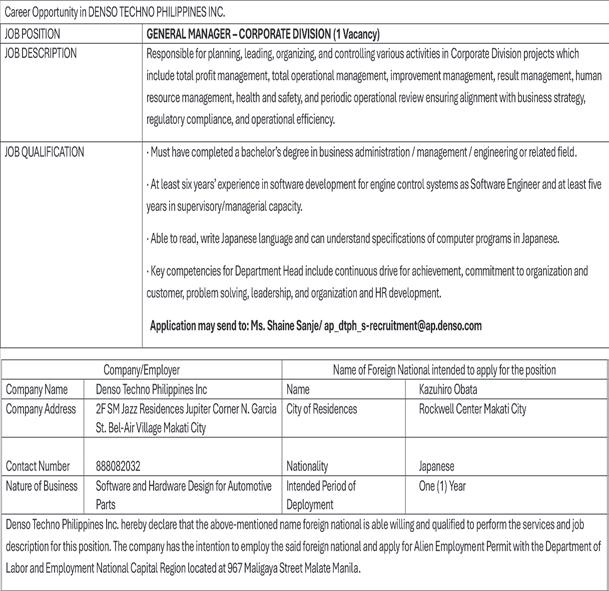

Editor: Angel R. Calso
Zelenskyy arrives in Estonia to attend Nordic-Baltic summit
TALLINN, Estonia—Ukrainian President Volodymyr Zelenskyy arrived in Estonia on Tuesday to attend a summit of Nordic and Baltic leaders and to meet with Estonian President Alar Karis, Estonian public broadcaster ERR reported.
Estonia is hosting the summit in its capital, Tallinn. The country holds the rotating presidency of the NB8, a regional grouping of the five Nordic countries and the three Baltic states. It brought together the bloc’s prime ministers, along with Zelenskyy.
The Ukrainian leader was accompanied by first lady Olena Zelenska, whom Estonia’s Foreign Ministry welcomed in a post on the social platform X.
The visit comes amid friction over Ukrainian drones, which have repeatedly strayed into the region in recent months as Kyiv steps up strikes on Baltic Sea ports Russia uses to export oil in a bid to make Moscow pay an economic cost for its war in Ukraine.
Meanwhile, Russia kept up its strikes across Ukraine. In the northeastern Kharkiv region, three people were killed and 25 others, including three children, were wounded in attacks over the past 24 hours, said Oleh Syniehubov, head of the regional administration.
In the Dnipropetrovsk region, three
people were wounded when several districts came under attack overnight, said regional administration head Oleksandr Hanzha.
Russia launched 166 long-range strike drones and two guided missiles at Ukraine overnight, the Ukrainian air force said. Air defenses shot down 146 of the drones, it said.
Russia’s Defense Ministry said that air defenses downed 140 Ukrainian drones overnight. A woman was killed when a Ukrainian drone hit an apartment building in the Belgorod region, regional emergency officials said.
Ukrainian Foreign Minister Andrii Sybiha also traveled to Tallinn, where he met his Estonian counterpart, Margus Tsahkna. The two discussed Ukraine’s security, pressure on Russia, and Kyiv’s bid to join the European Union, Tsahkna said.
“Estonia will continue to stand by Ukraine for as long as it takes,” Tsahkna wrote on X. “As Putin intensifies his attacks and shows no sign of abandoning his imperial ambitions, our responsibility is to increase pressure, not offer concessions.”
In May, Foreign Minister Margus Tsahkna said Estonia supports Ukraine’s bid to join the European Union and wants the bloc to keep advancing the process. AP



Exports jump 19%, imports soar 27% as global
AI investment supercycle powers China’s trade
By Bloomberg News
CHINA’S exports and imports expanded rapidly in May, topping forecasts as a global investment supercycle in artificial intelligence drives up prices and demand for hardware made by the world’s manufacturing powerhouse.
Exports jumped more than 19% from a year earlier, the most in three months and higher than all but one estimate in a Bloomberg survey. Imports soared over 27% in May, according to data released by the General Administration of Customs on Tuesday, leaving a trade surplus of $105.4 billion — the biggest since January.
Chips and computers contributed to about half the growth in both exports and imports, Bloomberg calculations showed. Overseas sales of semiconductors soared 111% to $36 billion, the fastest expansion since 2013. The strong export growth “suggests continued support from AI-related hardware demand and
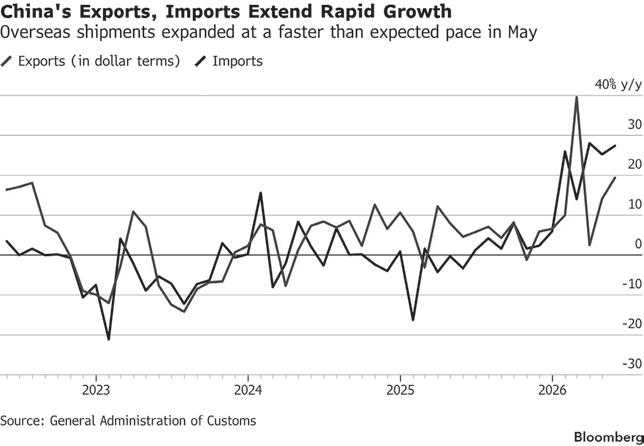
Netanyahu and Trump are at odds over the war they started together
By Julia Frankel & Aamer Madhani Associated Press
JERUSALEM—Israel’s latest strikes on Lebanon and Iran have made clear that US President Donald Trump and Israeli Prime Minister Benjamin Netanyahu, who started the war in lockstep, want different things.
Trump had publicly warned Israel not to strike Beirut in its war with Iran-backed Hezbollah militants. When it did, on Sunday, Iran responded by firing ballistic missiles at Israel for the first time since the April ceasefire. Israel then struck Iran, with which Trump has been engaged in weeks of high-stakes negotiations.
The fighting has since died down, but the differences between the two leaders are likely to persist.
That’s because Trump, whose party faces elections later this year, wants to wind down an unpopular war and reopen the Strait of Hormuz to ease gas prices. Iran says a full ceasefire in Lebanon is key to any deal.
Netanyahu, who also faces elections this year, is under pressure to stop Hezbollah’s attacks and prove that he is winning the war with Iran and its allies. He also needs to manage relations with Israel’s most important ally without appearing to kowtow to it.
Political considerations push in opposite directions
WHEN the United States and Israel attacked Iran on Feb. 28, the allies appeared shoulder to shoulder.
Netanyahu said the goal was to degrade the Islamic Republic’s military, eradicate its nuclear and ballistic missile programs, and topple its government. Trump announced the death of Iran’s supreme leader in the opening barrage and urged Iranians to “take back” their country.
But it soon became clear that while Trump was seeking a quick win—like the one he secured in Venezuela—Netanyahu wanted to vanquish Iran and its allies, even if it required
an extended conflict.
As Iran withstood weeks of heavy strikes and kept the Strait of Hormuz closed, Americans and Israelis grew increasingly frustrated—but for different reasons.
In the US, the price of gas and other goods soared as even some erstwhile supporters accused Trump of breaking a campaign promise and plunging the US into another Mideast quagmire. He has pushed back against those critics as rising anger threatens Republicans in November’s congressional elections.
In Israel, anger grew over Netanyahu’s failure to secure a lasting victory in the wars sparked by Hamas’ Oct. 7, 2023, attack, which happened on his watch. More than two years on, Hamas still rules part of Gaza, Hezbollah still fires rockets and Iran’s government and nuclear program remain intact, despite heavy losses.
Israel’s bombardment of Lebanon strains relations
THE collision course runs through Lebanon, where fighting still rages between Israel and Hezbollah despite ceasefire announcements.
Iran wants Lebanon included in any wider regional truce, a demand Trump seems to have accepted in order to get a deal. Iran has threatened to attack Israel again if it keeps striking Lebanon.
Israel is determined to keep the theaters separate and continue its campaign in Lebanon, where it has occupied large swaths of the south, until the threat from Hezbollah has been eliminated.
The tensions spilled into the open last week, when Trump acknowledged holding a tense call with Netanyahu about Lebanon. He admitted to using expletives and calling the Israeli leader “crazy,” saying he’d grown frustrated that Israel’s war on Hezbollah threatened the Iran talks.
In a series of interviews, Trump made clear that he was not happy about Israel’s
possibly some front-loading of overseas orders amid geopolitical uncertainty,” said Hao Zhou, chief economist at Guotai Junan International Holdings. “Strong export performance is providing a meaningful buffer to domestic softness.”
The global AI infrastructure buildout has emerged as a key force propelling Asian trade this year, cushioning the impact of a global energy crisis stemming from the conflict in the Middle East. It’s leading to a huge windfall for companies like the South Korean giant Samsung Electronics Co. as well as lesser-known Chinese hardware suppliers such as Zhongji Innolight Co., a maker of optical modules critical to data centers.
Outbound shipments of computers and parts soared 66% in May from a year ago, the fastest pace since 2010 and up from a 47% gain in the previous month. High-tech exports climbed 51%, the most since 2021.
Much of the surge came as a result of soaring chip prices at a time when a global race among tech giants to build data centers is leading to a shortage that could last for years. In volume terms, China’s chip exports rose only 2%.
In another sign of the impact from the AI rush on the world’s No. 2 economy, South Korea’s semiconductor exports to China jumped over 200% in May from a year earlier. China still relies on imported chips as restrictions imposed by the US block its access to many of the machines needed to make advanced semiconductors.

Apart from AI hardware, car exports continued to post solid growth at nearly 40%. Automakers have no choice but to step up efforts to sell overseas, as domestic sales plunged 22% in May from a year ago in the sixth straight month of double-digit declines.
“The report allays concerns that the Iran war is taking a toll on China’s export engine, and highlights increasing linkages between the global tech cycle and trade flows,” said Bloomberg economist Eric Zhu.
Exports to the US rose almost 36% — the most since 2021 — extending their recovery after a long streak of double-digit declines during the tariff war started by Donald Trump. The increase may have been exaggerated by the statistical effect of a low base from a year ago, when China and the US
were locked in tit-for-tat tariff hikes that at one point brought levies to over 100%.
Export growth accelerated across most major regions in May, with the exception of the European Union and Latin America.
Shipments to the Southeast Asian nations in the Asean group soared nearly 25% and climbed almost 19% to Africa.
Though China’s sales in the EU expanded less than 8%, its imports from the bloc shrank for the first time in three months, meaning the trade surplus actually grew slightly and remained above $30 billion in May.
The imbalance will do little to soothe trade tensions with Europe. Officials there are preparing the ground for possible new tools to counter China’s export surge, which they partly blame on insufficient domestic demand, an
undervalued currency and generous subsidies.
Back home, the AI boom is driving K-shaped expansion across China’s trade, factory production and industrial profits. In contrast to high-tech exports, overseas sales of traditional items like clothes and toys declined by 4% and 7% in May, respectively.
The divergence complicates China’s economic policymaking, as a large portion of the economy is still suffering from anemic consumer demand, even as some factories in AI-related fields prosper. The export strength is potentially making Chinese authorities more comfortable with a stronger yuan. In contrast to labor-intensive products, high-tech exports are less sensitive to domestic currency appreciation.
With the cost of oil, chips and metals sharply on the rise, China’s export prices jumped at their fastest rate in three years in April, a reversal from years of an almostunbroken contraction. But such increases have yet to spread to most Chinese goods, suggesting intense domestic competition still limits what factories can charge buyers.
And despite being the world’s biggest oil importer, China is buying far less crude from abroad, with inbound shipments falling 5% in the first five months of 2026 from a year ago in volume terms.
“The external demand engine remains one of China’s key drivers,” said Lynn Song, chief economist for Greater China at ING Bank NV. “Domestic demand, though, continues to lag behind.”
Indonesia delivers shock rate hike to reverse market selloff
By Grace Sihombing & Prima Wirayani
INDONESIA’S central bank took aggressive action to reverse a market selloff and support its currency, hiking interest rates in a surprise decision to halt foreign outflows triggered by policy uncertainty under President Prabowo Subianto.
B ank Indonesia raised its benchmark BI-Rate by 25 basis points to 5.5% on Tuesday, more than a week ahead of its next scheduled meeting, when analysts expect further increases.
The country’s rupiah has hit successive record lows, bond yields have soared and the stock market has sold off amid a swirl of concerns over Prabowo’s spending plans, policy interventions and populist economic agenda. Worries over MSCI Inc.’s decision on whether to downgrade Indonesia has also cast a months-long shadow over its stock market.
The surprise rate decision “does show a sense of proactiveness in preventing any further backsliding in sentiment,” said Oversea-Chinese Banking Corp. economist Lavanya Venkateswaran. “However, its sustainability will also depend on clearer policy direction of the broader authorities to address perceived risks around recent announcements.”
Angus MacKintosh, an analyst at Aletheia Capital, was more blunt: “In some ways, this smacks of desperation.”
The early response from equity and currency markets was positive. Indonesia’s benchmark stock index extended gains to over 7%, the most in more than six years, led by banking stocks. “Stemming the cur -
rency decline may help to stimulate local buying,” MacKintosh said.
The rupiah was also up 0.7% against the US dollar, retreating from the record low on Monday. But government bonds continued to sell off, with yields on the 10-year note climbing 23 basis points.
An alysts expect the central bank to take more action, with Barclays Plc, BNY and PT Mega Capital Sekuritas saying after the decision that they expect further rate hikes at the June 18 meeting, with another 50-basis point increase a possibility.
Higher interest rates can support a currency by making local bonds and deposits more attractive to global investors, helping draw in capital flows. That may provide just temporary relief, according to Capital Economics.
“What investors are looking for are a shift in the policy direction of President Prabowo and his government, and so far that doesn’t seem to be in the works,” said Jason Tuvey, its deputy chief emerging markets economist.
Under Prabowo, the finance ministry and central bank have coordinated even more closely on fiscal and monetary policy to help stabilize markets and restore investor confidence.
The already strong fiscal-monetary coordination will be continuously strengthened and sustained over time to remain mutually supportive and aligned,” BI said in its statement Tuesday.
But in vestors have also balked at Prabowo’s move to appoint his nephew to the central bank’s top leadership. A law passed last week also expands the bank’s mandate to boost economic growth, and subjects its officials to a performance
evaluation by parliament.
Bank Indonesia and the government had pledged on Saturday to join forces to boost the appeal of Indonesian assets and attract portfolio inflows. That did little to encourage markets, with the selloff continuing when markets opened Monday.
T he central bank has now raised the rate by 75 basis points over three weeks, following a larger-than-expected 50 basis-point hike in May. While that raises borrowing costs, Bank Indonesia Governor Perry Warjiyo told parliament Tuesday that
the latest increase was to attract foreign inflows. Warjiyo also pledged to keep intervening to stabilize the rupiah, even as Bank Indonesia’s sustained currency defense has drained its foreign exchange holdings. Reserves fell for a fifth month in May, the longest losing streak since 2018. The rupiah is the biggest loser among major currencies this year, weakening nearly 8% against the greenback. The

A CHINESE vessel docked at a port in Hong Kong. Chips and computers contributed to about half the growth in both exports and imports. BLOOMBERG PHOTO
A16 Wednesday, June 10, 2026
The World
Pope’s speech to Spain’s parliament demands respect for migrants and gets 7-minute ovation
By Suman Naishadham & Nicole Winfield The Associated Press
ADRID—Spanish lawmak-
Mers gave Pope Leo XIV a standing ovation on Monday after he called for respect for migrants’ rights and international law in a historic address to parliament that signaled a new level of acceptance of the Catholic Church in the overwhelmingly secular country.
In the first-ever papal address to Spanish lawmakers, the American pope said a “moral renewal” was necessary in legislatures and public life to ensure respect for the inherent dignity of all people, including migrants, the unborn and the most vulnerable.
“The moral greatness of a nation is manifested, above all, in its capacity to accompany, protect and love those lives that are most fragile,” Leo said. Speeches by popes to foreign legislatures are rare, since they can imply recognition of a religious leader by lawmakers. Pope Francis addressed a joint session of the U.S. Congress in 2015, and Pope Benedict XVI addressed his native German Bundestag in 2011.
That Leo was invited to speak to Las Cortes Generales showed a level of acceptance for the Catholic Church in a political setting that might have been unthinkable even a few years ago. The Catholic Church was a pillar of Gen. Francisco Franco’s dictatorship, enjoying broad control and influence over Spanish society, but that waned after democracy took root in the 1970s.
While many Spaniards still identify as Catholic, religious observance has dropped sharply amid secularizing trends seen in other once-staunchly Christian countries.
And yet lawmakers gave Leo a 7-minute standing ovation with chants of
Continued from A15
Sunday strike in Beirut, which came without warning and hit a residential building, killing two people and wounding 20, according to Lebanese authorities.
He then urged restraint from Israel after Iran launched its first barrage of missiles later that day. “I call all the shots,” not Netanyahu, Trump told the Financial Times. Hours later, Israel bombed Iran.
Officials downplay differences
TRUMP had initially urged restraint in order to calm markets and keep negotiations from falling apart, according to a person familiar with the US-Israel deliberations who spoke on condition of anonymity to discuss the sensitive conversations.
Continued from A14
Both countries lift restrictions BOTH countries lifted restrictions they had imposed as safety precautions. The Israeli military said most schools in Israel that closed Monday would reopen. Iran’s official Mizan news agency reported that the Islamic Republic had lifted airspace restrictions affecting civilian flights.
During the truce, Iran has maintained its stranglehold on the Strait of Hormuz—a crucial passage for the world’s oil and natural gas whose closure was the primary reason global fuel prices skyrocketed. Israel has continued to strike Hezbollah, Iran’s ally in Lebanon, and pushed deeper into that country.
The US military continues to impose a blockade on Iranian ports. US Central Command said its forces on Monday fired on and disabled a Palau-flagged oil tanker, the M/T Marivex, in the Gulf of Oman after the ship attempted to breach the blockade.
“Viva el Papa!”—“Long live the pope!”
Leo’s weeklong visit to Spain—the first since Benedict visited in 2011—has drawn large crowds, with an estimated 1.5 million people turning out for Mass on Sunday in a downtown plaza and 600,000 young people for a prayer vigil.
Pope calls for peace as Israel and Iran trade strikes
LEO’S speech came Monday as Israel and Iran traded fire, threatening to drag the Middle East back into a fullscale regional war. The pope repeated his demand for dialogue, “diplomatic courage” and the “the obligation of states to resolve their disputes through the peaceful means offered by international law.”
He also lamented that European defense budgets were being built up as countries confront the threat posed by Russia following its full-scale invasion of Ukraine and the Trump administration’s threats to reduce financial and military support for the continent.
“It is therefore a cause for concern that, in various parts of the world—and in Europe as well—rearmament is once again being presented as an almost inevitable response to the fragility of the international situation,” Leo said.
He repeated his demand for “rigorous ethical oversight” of automated weapons systems created by artificial intelligence “so that decisions regarding life and death are never left to automated systems nor removed from the moral responsibility of the human person.”
Pope urges dignity, acceptance and integration for migrants SPAIN’S Socialist-led government has bucked a trend in Europe and the United States by defending immigration on economic and humanitarian grounds, launching a legalization push earlier this year for hundreds of thousands of immigrants without
Israeli officials made the counterargument that the US would not tolerate attacks without a swift response. The person added that it was also understood by both sides that not responding to the Iranian strikes would put Netanyahu in a difficult position politically.
Netanyahu has downplayed any perceived differences.
After the latest strikes, he told reporters in Hebrew that “Israel has a full right to self-defense, and we are exercising it to the extent necessary.”
“I say this to you, just as I say this, with appreciation and respect, in my good conversations with my friend, President Trump,” he added.
It’s unclear if there will be lasting damage
IT’S not the first time that Trump has been publicly at odds with Netanyahu about a military operation.
Officials in India said the tanker’s crew of 24 Indian sailors were all reported safe after a fire broke out on the vessel. It was the seventh commercial vessel the US military has disabled to enforce its blockade, which began in mid-April.
Diplomats race to save the ceasefire PAKISTANI Prime Minister Shehbaz Sharif expressed concern Monday over the surge in violence. In a post on X, Sharif urged all parties to “exercise restraint and give peace a little more chance.”
Two regional officials said Egypt, Saudi Arabia, Turkey, Pakistan and Qatar had all urged the Trump administration to pressure Israel to halt strikes on Iran and Beirut. Those countries also pushed for Iran to stop attacking Israel, the officials said. Both spoke on condition of anonymity because they were not authorized to speak to reporters.
Iran’s ambassador to the United Nations said Monday that Iran and the US are still working to negotiate a peace deal. After
authorization. Prime Minister Pedro Sánchez has highlighted the benefits to the economy with an aging workforce and low birth rate.
Leo called for strengthened international efforts to prevent the smuggling of migrants and create conditions where they can choose to stay home.
For those who flee conflict, poverty and climate change, he called for welcome and integration. Pope Francis made the plight of refugees reaching Europe a hallmark of his papacy, and Leo has insisted especially on the dignity of migrants in his native United States amid the Trump administration’s crackdown.
“This gives rise to a twofold demand for social justice: to offer safe and legal pathways, a respectful welcome and real opportunities for integration; and, at the same time, to promote the right to remain in one’s own land, working to ensure that no one has to leave their home due to a lack of peace, security or decent living conditions, including economic inequalities and the effects of the climate crisis,” Leo said.
Leo references the Spanish conquest and the slave trade LEO cited the 16th century Spanish intellectual tradition, known as the School of Salamanca, that gave rise to concepts of international law and inherent human rights after Spain’s colonial conquests of the Americas.
He praised the theologians involved in the movement who “understood that reason could not be invoked to legitimize whatever force or self-interest that seemed convenient” and that there were “moral limits of power.”
“It must be acknowledged that society and the church herself did not always live up to these insights found in their own Christian tradition,” Leo said.
It was a reference to the Catholic Church’s own role in the trans-Atlantic
In March, less than three weeks into the conflict, Trump was riled by Netanyahu’s decision to attack a critical Iranian gas field, which prompted Iran to retaliate against energy infrastructure in the Gulf.
“I told him, ‘Don’t do that,’” Trump said at the time. “We get along great. It’s coordinated, but on occasion he’ll do something.”
While Trump publicly disagreed with the decision, two people familiar with the matter who were not authorized to comment publicly said the US was made aware of Israel’s plans ahead of the attack.
It’s unclear whether the latest dispute will cause lasting damage.
“It’s not so uncommon for the USIsrael relationship to have these kinds of tensions. What’s so different right now is how publicly it’s playing out,” said Michael Singh, managing director at the Washington Institute for Near East Policy.
He noted that Trump has had similar public
speaking at a U.N. Security Council meeting, Amir Saeid Iravani told The Associated Press he was hopeful that “very soon” the two sides would reach “a conclusion.”
Explosions sound in Tehran and central Israel IRAN launched waves of attacks on Israel on Monday, and Israel launched strikes on central and western Iran.
Iranian state media reported at least 15 people were wounded after explosions sounded in Tehran and other cities. There were no immediate reports of fatalities.
The semiofficial Fars and Mehr news agencies said Israeli strikes hit a petrochemical factory in the city of Mahshahr. They did not elaborate on any damage. The Israeli military confirmed the strike on the plant, saying it targeted sites that produce materials for ballistic missiles.
Israel said it also targeted truck-based missile launchers.
Israel said its strikes were in response to an Iranian missile attack. Tehran warned
slave trade and colonial conquest, and recalled Leo’s recent apology for the role the Holy See played in legitimizing slavery.
Pope visits at a delicate political moment
LEO’S visit comes at a delicate time for Sánchez.
Sánchez’s Socialist Party has been hammered by corruption scandals, though none have directly implicated him. Probes have touched some of Sánchez’s closest confidants, as well as his wife and brother.
As they play out in the courts, Spain is increasingly frayed by political polarization. Sánchez’s minority government has been unable to pass legislation, including a budget for the past three years.
Leo, in an apparent reference to polarization, warned that “political pluralism should not degenerate into the constant disparagement of one’s adversary.”
Spain’s progressive leader, who is an atheist, and the pope have converged on major issues including opposing the war in Iran. Both have been outspoken critics of the Trump administration.
Last month, after visiting Leo in the Vatican, Sánchez called the pope’s voice “a moral compass in the fight against injustice.”
Traditionally, the Catholic Church in Spain has been closer to the conservative Popular Party than the Socialist Party, which championed social issues including same-sex marriage and abortion rights.
However, by placing issues of justice at the center of their public discourse, Pope Francis and now Leo have narrowed the gap between the Vatican and progressive governments, said Rafael Ruiz Andrés, a sociology professor at Complutense University of Madrid who specializes in religious dynamics.
spats with other heads of state, including close allies.
Eytan Gilboa, an expert on US-Israel relations at Israel’s Bar-Ilan and Reichman universities, said he doubted the rift seriously threatened the alliance. He said Netanyahu had been careful not to push things too far.
“If there was a big threat, like if Israel were to continue the war in Iran and drag the US into it, that would have been a different situation,” he said. “But that is not happening.”
He noted, though, that there are still “basic disagreements between Netanyahu and Trump on Iran, Lebanon and Gaza” that remain unanswered.
Madhani reported from Washington. The Associated Press reporters Bassem Mroue in Beirut and Farnoush Amiri in New York contributed.
Sunday that it would retaliate after Israel struck Beirut’s southern suburbs without warning. When Israel struck back, Iran fired again.
Explosions could be heard in central Israel as air defenses sought to intercept incoming Iranian fire. Iran’s paramilitary Revolutionary Guard said it had targeted two military bases in Israel.
Iran blamed the United States for the escalation.
“No one believes that the Israeli regime would take any action without coordination with the United States,” Iranian Foreign Ministry spokesman Esmail Baghaei told journalists in Tehran.
Tensions appear to grow between Trump and Netanyahu TRUMP and Netanyahu launched the war in a closely coordinated attack, with Israeli officials proudly boasting of unprecedented “shoulder to shoulder” cooperation.
The conflict reached 100 days on Monday, and the two leaders have moved
Continued from A1
is still a small fraction of what is spent by its Southeast Asian neighbors on promotions, which reach as high as P15 billion, in the case of Malaysia. Among the DOT’s advertising strategies abroad include billboard campaigns, bus wraps, and visitor activation events.
Speaking with reporters on the sidelines of President Marcos Jr.’s State Visit in Japan, Angara-Mathay said while DOT will keep the “Love the Philippines” (LVP) branding slogan, “[We’ll] make it less emotional and aggressive. Make it something like, ‘Discover your First Love,’ or ‘Love Your Own,’ or ‘Love Boracay.’” (https://tinyurl. com/5esme536)
In addition, this paper’s sources intimated that discussions will be held with previous marketing and advertising agencies which had worked with the DOT, to see how the LVP campaign can be tweaked or refreshed.
Arrivals boost from China, India
A FEW Koreans have been recent victims of petty crime even in upscale areas like the Bonifacio Global City in Taguig, which is tagged as among the reasons visitors from South Korea have been slipping. Last year, tourists from South Korea dropped by 18.5 percent to 1.35 million,
Continued from A15
Indonesian stock market’s 35% drop has also made it the world’s worst performer.
It is the second off-cycle rate increase under Warjiyo since he took the reins at Bank Indonesia about eight years ago.
In May 2018, the central bank raised the benchmark rate by 25 basis points to counter an emerging-market selloff triggered by rising US interest rates.
“This increase is a follow-up measure to strengthen the stabilization of the rupiah exchange rate against the impact of heightened global volatility caused by the war in the Middle East,” the central bank said in a statement.
It also “sees the need to take further steps to strengthen the stabilization of the rupiah exchange rate by raising yields and
in opposite directions, with tensions sometimes spilling out into the open.
Netanyahu appears to have openly defied Trump with the strike Sunday in Beirut and subsequent attacks in Iran. Trump has voiced his displeasure with Israel, including belittling Netanyahu by declaring to the Financial Times that “I call all the shots.”
Their differences appear to be rooted in each leader’s domestic considerations.
Netanyahu faces elections this fall and is under public pressure to strike back against ongoing Hezbollah attacks on northern Israel. He also is wary of appearing too subservient to Trump.
The US president also faces elections— for Congress in November—and is eager to end a war that has jolted the global economy and raised prices for consumers.
The Houthis claimed an attack on Israel YEMEN’S Iran-backed Houthi rebels claimed an attack on Israel on Monday and said Israel-affiliated vessels would again
although it was still the top source of foreign visitors for the Philippines.
The Department of Interior and Local Government announced on Tuesday the capture of a former police officer, who allegedly masterminded the killing of South Korean businessman Jee Ick-joo in 2016. Interior Secretary Juanito Victor “Jonvic” Remulla has said before that tourists avoid the Philippines due to safety concerns. (See, “Tourists aren’t coming to the PHL because they don’t feel safe—Jonvic,” in the BusinessMirror , June 20, 2025.)
Latest DOT data showed there 2.74 million inbound tourists from January to May this year, up 7.5 percent from the same period in 2025, with significant increases recorded from the Chinese and Indian markets, which now have visa-free privileges. Of this year’s total tourists, foreign nationals grew by 8.34 percent, year on year (yoy), to 2.53 million, while overseas Filipinos (OF) were less 1.44 percent yoy, to 217,627. OFs are Philippine passport holders permanently residing abroad.
Korea still top market VISITORS from South Korea dropped by 9.58 percent to 499,944, although they remained the top source market. This was followed by tourists from the United States at 480,813
See “Crisis,” A17
offering various incentives to encourage foreign inflows.” Those further steps include: Intensify its interventions in both onshore and offshore markets to stabilize the currency.
Raise the yields on its rupiah-denominated securities. Reduce the hedging swap rate by 10% to “compensate for the costs that investors currently bear.” Meanwhile, the regular swap rates will be determined in accordance with market mechanisms.
Reopen the repurchase agreement auction for 3, 6, 9, 12-month tenors for banks to ensure sufficient liquidity in the money and banking markets. The move is aimed at maintaining primary money growth above 10%.
Monitor banks and corporations that buy dollars in bulk to ensure they have underlying documents. With assistance from Bernadette Toh/Bloomberg
be a target in the Red Sea, putting the waterway in danger along with the Gulf of Aden and the narrow Bab el-Mandeb Strait connecting them. The statement from Brig. Gen. Yahya Saree was broadcast on the Houthis’ al-Masirah satellite news channel.
The Houthis made a similar threat during the Israel-Hamas war in the Gaza Strip and launched attacks that killed at least nine mariners and sank four ships. They often targeted vessels with tangential or no ties to Israel. The assaults upended shipping in the Red Sea, through which about $1 trillion of goods passed each year before the war.
Lidman reported from Tel Aviv, Israel. AP journalists Munir Ahmed in Islamabad; Matthew Lee in Washington; Michelle L. Price in Bridgewater, New Jersey; Elena Becatoros in Athens, Greece; Samy Magdy in Cairo; Josef Federman in Jerusalem; Edith M. Lederer at the United Nations; and Russ Bynum in Savannah, Georgia, contributed.
World leaders, Manila embassies pledge support after 7.8 Mindanao quake
By Malou Talosig‑Bartolome
INTERNATIONAL leaders and foreign missions in Manila have conveyed condolences and solidarity with the Philippines following the magnitude 7.8 earthquake that struck Mindanao on June 8, 2026, killing at least 37 and injuring more than 400.
Japan
PRIME Minister Takaichi Sanae expressed deep sadness over collapsed buildings and loss of life, extending condolences to bereaved families. She affirmed that “Japan always stands with the people of the Philippines” and pledged readiness to provide assistance based on local needs.
United Arab Emirates
PRESIDENT Mohamed bin Zayed
integration and greater use of digital technologies to improve grid efficiency and reliability.
Among the initiatives expected to take center stage during the forum is the Pan-Asia Power Grid Initiative (PAGI), which seeks to expand crossborder electricity trade and transmission networks across the region (Related: https://businessmirror.com. ph/2026/05/04/adb-bets-70b-onpower-digital-push/).
Launched by ADB last month, PAGI aims to move countries away from fragmented bilateral power arrangements and toward a more interconnected regional system capable of sharing electricity resources across borders.
ADB aims to mobilize $50 billion for the initiative by 2035, with the program envisioned to strengthen energy security, facilitate the integration of renewable energy, and improve access to reliable electricity across Asia and the Pacific.
It is expected to connect about 20 gigawatts of renewable energy across borders and build 22,000 circuitkilometers of transmission lines, while also reducing regional power sector emissions by 15 percent.
(8.5 percent); Japan at 204,726 (+7.9 percent); China at 186,860 (+63.2 percent); Australia at 153,098 (+13.4 percent); and Canada at 141,557 (+18.9 percent).
Other top markets include: Taiwan at 93,727 (+12 percent); the United Kingdom at 82,533 (+2.6 percent); Singapore at 64,754 (+1.54 percent); India at 52,077 (+47.43 percent); France at 46,369 (+12.5 percent); and Malaysia at 45,821 (+16.23 percent).
Prior to Angara-Mathay’s appointment, the DOT had already switched to a domestic tourism tack, recognizing the challenges brought on by rising fuel costs, which is expected to cut inbound tourists. The agency’s arrivals target this year is 6.7 million.
On Monday, Angara-Mathay administered the oath of office to new undersecretaries, who she hopes will be able to help her accomplish the agency’s goals under the National Tourism Development Plan of 20232028, which include promoting the Philippines effectively here and abroad.
(See, “Seasoned execs tapped for DOT posts,” in the BusinessMirror, June 8, 2026.)
Al Nahyan sent condolences to President Ferdinand Marcos Jr. The UAE Ministry of Foreign Affairs conveyed sympathy to victims’ families and wished speedy recovery to the injured.
Australia
FOREIGN Minister Penny Wong said Australia’s thoughts are with the Filipino people and the Australian‑Filipino community. She pledged humanitarian aid if requested, stressing solidarity with “our close friends at this time of great difficulty.”
India
PRIME Minister Narendra Modi expressed condolences and prayers for the injured, affirming India’s solidarity with the Philippines.
New Zealand
PRIME Minister Christopher
offices and gymnasium to public market and mosques, from water tanks, sewerage treatment plant and the river control dikes.
Malapatan is one of the heavily damaged towns in Sarangani province, which belonged to Region XII. The region sustained 33 deaths, 456 injured persons and four missing persons.
Its adjacent region, the Davao Region, sustained four dead and 23 injured, the Regional Disaster Risk Reduction Management Council has reported as of Tuesday.
Some buildings in the cities of Davao, Panabo and Tagum remained unused as inspection was yet to be concluded.
The RDRRMC XI said it has already spent P2.04 million in humanitarian assistance and disaster response.
Energy updates THE Department of Energy (DOE) said stakeholders are doubling efforts to restore electricity service in affected areas.
In a news conference, DOE
Undersecretary Mario Marasigan said four power generation facilities went offline as a result of the automatic tripping of protection systems designed to ensure the safety and security of power facilities during seismic events. At the time of the incident, a total of 835 megawatts (MW) of generating capacity was lost.
The affected facilities included the SMC Malita Coal Power Plant Units 1 and 2, which have a capacity of 150 MW each, Therma South Unit 2 with a capacity of 150 MW, and Sarangani Energy Corporation (SEC) Units 1 and 2 with a combined capacity of 237 MW. In addition, the Pulangi IV Hydroelectric Power Plant was affected, with all three of its generating units initially impacted by the earthquake.
Pulangi IV Units 1 and 3 were restored on the same day. Unit 2, meanwhile, was not immediately returned to service because it was already scheduled for preventive maintenance. Marasigan said the operator took advantage of the outage to proceed with the planned maintenance activities, which are scheduled to continue until July 7.
Therma South Unit 2, meanwhile, was restored to full operation at 150 MW on
Luxon noted his country’s own earthquake experience, extending sympathy and readiness to assist.
Pakistan
DEPUTY Prime Minister Ishaq Dar voiced sorrow over the loss of lives and damage, pledging Pakistan’s full solidarity with the Philippines.
Taiwan
PRESIDENT Lai Ching‑te said Taiwan stands ready to provide assistance as a close neighbor, offering prayers for swift recovery and rebuilding.
Maldives
PRESIDENT Mohamed Muizzu extended condolences to President Marcos and the Filipino people, expressing sorrow over the tragic loss of lives and injuries.
the same day. SEC Units 1 and 2, with a capacity of 118.5 MW each, are scheduled to return to operation on Wednesday.
For SMC Malita, Unit 1 is targeted for restoration also on Wednesday, while Unit 2 remains under further assessment. Full restoration of Unit 2 is currently targeted by June 13.
Marasigan said that despite the plant outages, there was no significant impact on the electricity market in Mindanao, as generation capacity was enough to meet demand and provide ancillary services.
“Based on reports from the Independent Electricity Market Operator of the Philippines (Iemop), the Mindanao grid has remained under normal operating conditions since the earthquake. We also assessed the potential effects on neighboring regions, and both the Luzon and Visayas grids continue to operate normally,” added Marasigan.
“To our people in Mindanao, we want you to know that you are not alone. The DOE and entire energy sector are working hard to return electricity service safely and quickly.
“We need to be safe. We continue to work together, to assist and serve until we return the energy needed by every Filipino family to recover and restart. Our restoration efforts and assessment are ongoing,” said DOE Secretary Sharon Garin.
The agency also said it is fully prepared for the “The Big One,” saying contingency measures have been put in place.
Meanwhile, the DOE reported the eight-megawatt modular generator sets are being installed and connected to the Catanduanes grid, with testing and commissioning underway. Once fully operational, these gensets are expected to end the rotational brownout in the province.
“The energization of these generating units is an immediate intervention to help close the supply gap, reduce rotational brownouts, and provide the people of Catanduanes the reliable service they urgently need,” said National Power Corporation (NPC) president Jericho Jonas B. Nograles.
The NPC and National Electrification Administration (NEA) are doing supply augmentation to stabilize electricity services in the province and bring relief to affected consumers.
DPWH, Caap assessment
MEANWHILE , the Department of Public
Brazil
SENATOR Leila do Vôlei conveyed prayers and solidarity, praising Filipino resilience: “You will overcome this, as you always have.”
United States
THE U.S. Embassy expressed sympathies and said it is coordinating with Philippine authorities, ready to support Philippine‑led response efforts.
China
THE Chinese Embassy voiced sadness over the damage and loss of life, extending sympathies to affected communities.
European missions
n France: Expressed solidarity with the Filipino people and authorities managing disaster response.
Works and Highways (DPWH) and the Civil Aviation Authority of the Philippines (Caap) reported infrastructure damage and aviation disruptions.
Caap’s Operations Center Division listed dozens of flight cancellations spanning four days — June 8 to 11, 2026 — affecting routes to and from General Santos City across three carriers: PAL Express, Philippine Airlines (PAL), and Cebu Pacific.
The cancellations cover multiple daily flights on the Cebu-General Santos, Manila-General Santos, General SantosManila, and Iloilo-General Santos routes.
DPWH Secretary Vince Dizon led inspections in General Santos City, visiting collapsed private structures including a Jollibee branch and buildings at Notre Dame of Dadiangas University.
He also inspected the collapsed portion of the Barangay San Jose, General Santos City-T’boli-Surallah Road, a critical artery linking General Santos City to Surallah in South Cotabato.
He ordered a technical assessment of a detour road near the collapsed section to restore motorist access. DPWH clearing teams were also deployed along landslideaffected stretches of the road.
DTI: Structural checks ongoing
THE Department of Trade and Industry (DTI) said government agencies are validating building standards and materials used in structures affected by the Mindanao earthquake, as authorities continue to assess widespread damage.
Trade Secretary Ma. Cristina Roque said a designated department is inspecting collapsed and heavily damaged buildings, including those in General Santos City, where several structures were reduced to rubble.
“There’s a department that’s checking. Once they complete their assessment, they will report to us [on the condition of the buildings],” Roque told reporters on Tuesday afternoon.
Roque said government field offices remain active on the ground to ensure basic goods remain available in affected areas and that prices of essential items are kept stable.
Following the declaration of a state of calamity by the General Santos City government through its Sangguniang Panlungsod, a price freeze on basic necessities and prime commodities (BNPCs) is automatically enforced.
n Germany: Extended heartfelt thoughts to victims and families, affirming support for recovery efforts.
n Czech Republic: Offered condolences to the injured, displaced, and grieving.
Mexico
Conveyed condolences and sympathy following the quake off Sarangani.
Canada
Extended sympathy to affected provinces, pledging coordination with Philippine agencies and humanitarian partners.
EU Ambassador Massimo Santoro: Said he was “deeply saddened” by the devastating earthquake, extending thoughts to affected communities and responders. He affirmed that the European
Affected micro, small, and medium enterprises (MSMEs) have support mechanisms available for them, including access to government lending programs and rehabilitation financing.
BFP mobilizes assets
MEANWHILE the BFP mobilized multiple assets, including 130 Search, Rescue, and Retrieval (SRR) personnel, 14 rescue trucks, 1 ambulance, and an Incident Command Vehicle to the response effort.
It also sent 103 fire trucks with 257 crew members, along with 22 ambulances with 109 Emergency Medical Services (EMS) personnel.
The Collapsed Structure Search and Rescue Teams of the BFP search and rescue operation is ongoing at Savemore and CPAVI Warehouse Calumpang, both in General Santos City, as of this writing.
According to the NDRRMC report, a total of 127 infrastructure, including schools, buildings, roads, and bridges, were damaged by the earthquake.
OCD Administrator, Undersecretary Harold Cabreros reported on Monday that based on initial assessment, General Santos was the hardest hit by the earthquake. Incidentally, the BFP reported that its quick assessment in Sarangani indicate that a total of 14 buildings collapsed, or were severely damaged.
Aftershocks
THE Philippine Institute of Volcanology and Seismology reported that as of 6 a.m., the aftershock count had reached over 1,100 aftershocks. Of these, 313 were plotted and 23 were strongly felt. The magnitude of the aftershocks range between 1.3 to 6.4, as Phivolcs said it has downgraded earthquake information no. 2, which earlier indicated the strength of the tremor reaching magnitude 6.7.
Following Malacanang’s directive, a total of 182 cities and municipalities have declared class suspension in all levels, while 123 cities and municipalities have declared work suspensions.
The NDRRMC also reported that 10 road sections, including two bridges were affected.
One airport—the General Santos City International Airport—and 2 seaports were also affected. With reports from Manuel T. Cayon, Lenie Lectura, Lorenz Marasigan, Bless Aubrey Ogerio
program. Last month, Aliño also met with US Ambassador Heather Variava, who is senior advisor and US head of delegation for the LEC Steering Committee, and discussed LEC-related infrastructure projects in Subic.
Union stands in solidarity with the people of Mindanao and the Philippines.
United Nations THE UN in the Philippines expressed deepest sympathies, commended authorities’ swift response, and reaffirmed commitment to support recovery and resilience.
International Red Cross
SECRETARY‑GENERAL Jagan Chapagain said the IFRC stands in solidarity, ready to mobilize global support as the Philippine Red Cross provides relief and evacuation assistance.
European Union Civil Protection EU Civil Protection and Humanitarian Aid said teams and partners are monitoring the situation and “stand ready to help.”
Hotels, restaurants, and culinary professionals have embraced the initiative, creating special menus and experiences designed to attract both locals and visitors.
At Crimson Resort & Spa Mactan’s Signature Flavors event on June 13, guests will be able to sample dishes from the resort’s restaurants, including Azura, Enye, and Aka, alongside masterclasses on wine, whisky, and rum-and-chocolate pairings. The event will also feature the resort’s “Live Love Local” suppliers—small Cebubased producers who provide ingredients and specialty products used across participating hotels.
Singson-Leon said the hospitality industry is increasingly focused on integrating locally sourced ingredients into menus while working directly with farming communities, including producers in Mantalongon, to better align agricultural production with industry demand.
“We want to show the world excellent food using world-class service and cooking skills while showcasing Cebuano ingredients,” she said.
As the Cebu Food & Wine Festival celebrates its fifth anniversary, organizers hope the event will not only elevate Cebu’s culinary reputation but also strengthen connections among tourism, agriculture, and local enterprise. For Baricuatro, the festival represents a model for sustainable development rooted in local identity.
“Imagine more Cebu-grown produce finding its way onto the tables of visitors from around the world. This is exactly the kind of collaboration we want to encourage,” she said.
Rice at the core: Easing inflation, persistent pressure
THE inflation print in May as well as the latest Food Price Index of the Food and Agriculture Organization of the United Nations (FAO) may have given the Philippines a welcome break from a string of bad news related to the Middle East crisis. Data from the Philippine Statistics Authority (PSA) indicated that while the inflation rate in May was higher on an annual basis at 6.8 percent compared to last year’s 1.5 percent, it was lower than the 7.2 percent recorded in April. (See, “Transport, food costs ease; May inflation is 6.8%,” in the BusinessMirror, June 5, 2026). Also, FAO said its Food Price Index—the benchmark measure for world food commodity prices— eased in May compared with the April level.
However, one thing that stands out from the data provided by PSA and FAO is the significant impact of rice. PSA said rice inflation was the single biggest contributor to the inflation print in May, when it accelerated by 15.6 percent. FAO said its All-Rice Price Index in May went up by 2.7 percent from the previous month as “weather concerns and higher crude oil and derived product prices underpinned quotations in some leading Asian exporting countries.”
What’s concerning is that the average price of the staple food still went up despite the interventions implemented by the government to keep retail prices stable in recent months. Some of the measures rolled out to prevent rice prices from skyrocketing are the sale of cheap rice in Kadiwa outlets as well as the price cap on imports, which took effect late last month. Some government officials also conducted periodic price monitoring, at least in wet markets in the metropolis, to determine the vendors’ compliance with the price cap. Figures from the Department of Agriculture showed that the average price of regular milled rice sold in Metro Manila markets rose to P45 per kilo for the week ending May 30, higher than last year’s P38.59 per kilo. The retail prices of the well milled and premium variants were also higher at P49.74 per kilo and P54.93 per kilo, respectively. A year ago, the prices for the two variants were at P44.70 per kilo (well milled) and P51.63 per kilo (premium).
These developments have been largely influenced by the ongoing Middle East conflict, which has made key inputs like fertilizer more expensive. The increase in the cost of production is discouraging some farmers from planting the crop, while others are reducing their fertilizer application, which could result in low yield. The threat of El Niño will also put pressure on farmers who will surely incur losses if they make the wrong call.
Rice planters and consumers are counting on the government to come up with a viable plan and the necessary interventions that will counter the negative impact of geopolitical tensions as well as weather-related shocks on food prices and the local agriculture sector. Policymakers will have to be more proactive to enable the Philippine agrifood sector to feed the nation even in the face of natural and man-made calamities.

Restoring the Filipino purchasing power

TMark Villar
THE BUILDER
RUE economic growth is not merely about production and services expansion. It happens in the grocery aisles, at the gas pumps and in the monthly utility bills of ordinary citizens.
Real economic expansion only occurs when the rise in production and services outpaces both population growth and the increase in consumer prices.
While the gross domestic product (GDP) is computed using constant prices to account for standard market shifts, inflation can quietly erode these real numbers, and population growth can artificially inflate the aggregate figures.
When macro achievements fail to translate into household relief, the economic narrative is distorted. Today, the widening gap between income growth and household realities requires a closer review.
The Philippine Statistics Authority (PSA) reported a sobering reality. Inflation reached 7.2 percent in April 2026. Coupled with a firstquarter GDP growth of just 2.8 percent, it is undeniable that the real income of Filipino households is being eroded.
The surge in prices is largely led by external pressures, especially the ongoing Middle East crisis. The conflict has triggered a domino ef-
Lebanon
FAngel R. Calso, Dionisio L. Pelayo Ruben M. Cruz Jr.


fect, causing increases in the global prices of fuel, which quickly trickled down to inflate the cost of food, utilities and public transportation in the import-reliant Philippines.
While the cost of essential goods and services rises, the daily minimum wage—which ranges from P350 to P695 depending on the region—remains largely stagnant. If wages are not adjusted by at least to the equivalent of 7.2 percent inflation, the real purchasing power of families is diminished.
If regional wage boards cannot or will not immediately mandate a 7.2-percent across-the-board wage hike, the government should consider another tool at its disposal, which is fiscal relief. If we cannot immediately raise what workers take home from their employers, we should reduce what the government takes away from their paychecks.
Article VI, Section 28 of the Constitution explicitly mandates that taxation shall be uniform and equitable, and that Congress shall evolve a progressive system of taxation.
A progressive system implies that
By Ethan Bronner
ROM the beginning of the US-Iranian negotiations to end the war in the Middle East, Israel has repeatedly demanded its conflict with Lebanon’s Hezbollah be left out.
Iran, by contrast, has been insisting that its Lebanese ally stay under its umbrella, while US President Donald Trump seems focused on getting a peace deal done to ease oil prices and calm voter fury before November’s midterm elections.
But Israeli Prime Minister Benjamin Netanyahu has his own election this fall to worry about, and a growing challenge for him is a concern— expressed by numerous opposition leaders—that his alliance with the US has grown too tight, and Israel is turning into a vassal state unable to make its own security decisions.
Naftali Bennett, who’s close to Netanyahu in opinion surveys, last week assailed what he called “a government that has lost control over Israeli sovereignty.”
After Iran and Israel traded fire on
Sunday, Trump called on both sides to stop and told Axios he was going to call Netanyahu to tell him not to retaliate. Neither side listened: by Monday morning, Israeli warplanes had struck a petrochemical site and explosions were heard across Tehran, while Iran and its Yemeni proxy the Houthis fired on Israel.
“Iran is attempting to create a new equation by carrying out direct fire into our territory in response to our strikes in southern Beirut. We will not allow this,” Israeli military spokesman Brigadier General Effie Defrin said.
Army Radio reported that the military believes the exchanges with Iran will last several days. The military is preparing for a broad call-up and is expected to mobilize several reserve battalions while reinforc-
taxes should adapt to the taxpayer’s ability to pay. Currently, existing tax obligations continue to deplete the take-home pay of citizens, placing an unsustainable burden on lowand middle-income earners who are already living on the margins.
The current income tax exemption threshold no longer reflects the financial realities faced by ordinary workers. It was designed for an economic landscape that no longer exists. To address this crisis, I filed Senate Bill 2137.
Senate Bill 2137 seeks to amend the National Internal Revenue Code of 1997 by raising the country’s annual personal income tax exemption ceiling to P360,000 from the current P250,000. By adjusting the graduated income tax brackets to align with prevailing economic trends, this measure ensures that individuals earning up to P30,000 a month will be completely exempt from paying income tax. This allows working-class Filipinos to retain a larger share of their hard-earned salaries for essential household expenses, acting as a direct fiscal buffer against inflation.
The urgency of this bill is supported by data. The Bangko Sentral ng Pilipinas forecasts show inflation surpassing the government’s target range.
PSA data show that inflation for the bottom 30 percent of income households surged from a mere 0.1 percent in April 2025 to a crushing 8.5 percent in April 2026. This means the poorest Filipinos are bearing the heaviest brunt of the price spikes in food and fuel.
ing border forces particularly along the West Bank and Jordan. A largescale reserve mobilization began on Monday, including search-andrescue units prepared to deploy to impact sites.
All of this renewed activity, while defying Trump, poses an acute dilemma for Netanyahu, who is running for reelection on the argument that he’s most capable of protecting Israel against its many enemies and that his special relationship with the US president is key to that. He often talks of his ties with Trump as a partnership. Trump frames it differently—he told the Financial Times this weekend that Netanyahu “won’t have any choice” but to accept whatever deal the US negotiates.
“I call the shots. I call all the shots,” Trump said. “He doesn’t call the shots.”
But now Netanyahu’s numerous political rivals, hoping to unseat him, are saying he must show Trump and the region that Israel doesn’t take orders from anyone. Across the political
SB 2137 does not leave behind our vibrant entrepreneurial sector. The proposal offers an alternative tax structure for self-employed individuals and professionals. Those whose gross sales or receipts do not exceed the value-added tax (VAT) threshold can opt for a simplified 8 percent tax rate on gross sales in excess of P360,000, instead of navigating complex, standard graduated income tax rates.
Upon passage, the implementation framework is designed for rapid deployment. The Secretary of Finance and the Commissioner of Internal Revenue will be required to issue the implementing rules and regulations within 60 days. The law would take effect just 15 days after its publication in the Official Gazette or in two newspapers of general circulation. Now is the opportune time to pass this measure. I believe it will deliver meaningful, non-inflationary and much-needed relief to millions of households within the lower middleincome sector.
The backbone of our economy has always been the resilient Filipino workforce. Passing SB 2137 is a crucial step toward giving them the fiscal stability, dignity and quality of life they deserve during these trying times.
It is time for Congress to fulfill its constitutional mandate and ensure our tax system remains fair, equitable and human-centric.
For feedback e-mail to senatormarkvillar@ gmail.com or visit our web site: https://markvillar. com.ph
spectrum, Israelis are demanding a much tougher posture toward Iran and its proxies.
Avigdor Liberman, an opposition leader, tweeted, “Enough with containment, we must respond immediately and damage Iran’s strategic infrastructure.”
In the centrist newspaper Maariv, Avi Ashkenazi wrote, “Israel must not accept the American fiat to sit by and not to retaliate. If Israel blinks, it will be game over for it in the region. It will become the entire Middle East’s doormat. If the prime minister stops the Israel Air Force, he first ought to stop by the President’s Residence to tender his resignation.”
Some Israeli analysts see an Iranian strategy to increase the daylight between Trump and Netanyahu over Lebanon, where its invasion has killed thousands and displaced more than 1 million people. When Israel attacks, Iran retaliates directly, hoping the US will rein in Israel in order to seal a deal to end the unpopular war.
See “Lebanon,” A19
Alibaba, Baidu accused by Pentagon of aiding China military
By Kate O’Keeffe
THE Pentagon accused some of China’s biggest companies, including Alibaba Group Holding Ltd., Baidu Inc. and BYD Co. of supporting the Chinese military, doubling down on an earlier decision to label crown jewels of the country’s corporate world as threats to US national security.
The Defense Department announced the designations Monday in an update to a roster of companies that it has determined aid the People’s Liberation Army. The companies were included in a previous version that was posted briefly in February before being withdrawn minutes later without any explanation, sowing confusion about the Pentagon’s intentions.
With the move, the US has now declared that three of China’s most prominent artificial intelligence champions — Alibaba, Baidu and Tencent Holdings Ltd. — are aiding the Asian country’s armed forces. Tencent was added to the list in 2025 and has been seeking its removal. The designation of BYD singles out China’s top electric-vehicle company. Alibaba shares fell as much as 1.4% in Hong Kong trading on Tuesday, while Baidu pared earlier gains to trade 0.6% higher. The relatively muted response in Asian markets suggests investors have become accustomed to recurring regulatory broadsides from Washington.
“I believe it’s just geopolitical posturing. Fundamentally there’s limited impact to business operations for these companies,” said Nigel Peh, a portfolio manager at Timefolio Asset Management in Singapore.
The newest version of the Pentagon’s so-called 1260H list also restored two Chinese memory chipmakers—ChangXin Memory Technologies Inc. and Yangtze Memory Technologies Co.—that had been previously designated by the Defense Department but were removed from the version that briefly appeared in February. Other hardware manufacturers, including robotics developer Unitree Robotics—rendered as Hangzhou Yushu Technology Co., Ltd. on the list—were also swept into the expanded roster. While the list carries few immediate legal repercussions, the Pentagon is increasingly using it to restrict companies’ abilities to contract with the American military or to receive research funding.
A 1260H designation also serves as a warning to US investors, and is widely considered a red flag that can precede more punitive trade restrictions.
Despite the limited immediate commercial impact, some of the designated companies issued sharp rebuttals.
“Alibaba is not a Chinese military company nor part of any military-civil fusion strategy,” the firm said in an emailed statement to Bloomberg. “We will take all available legal action against attempts to misrepresent our company.”
Baidu similarly rejected the Pentagon’s assessment, vowing in a statement to “use all options available” to have the company removed from the list. BYD and Unitree didn’t immediately respond to requests for comment.
The list was released less than a month after President Donald Trump met with his Chinese counterpart Xi Jinping in Beijing, where the two leaders discussed some of the sticking points on trade between the world’s two largest economies. Their closely watched summit failed to yield a significant easing in tensions over advanced technology, especially AI.
“The Pentagon’s republished Chinese military companies list serves as a post-summit reality check,” said Craig Singleton, senior China fellow at the Foundation for Defense of Democracies. “The Xi-Trump meeting did not pause competition; it clarified where competition will continue,” added Singleton, who tracks the 1260H designations closely.
The Chinese Embassy in Washington criticized the move, accusing the US of overreaching on security matters to disadvantage Chinese commercial entities. The official response, however, didn’t mention any potential countermeasures, signaling an intent to keep the dispute contained within the broader trade truce reached at the Busan summit last year. Also named on the list was WuXi AppTec Co., a pharmaceutical contractor that has performed various services for many of the world’s largest pharmaceutical companies. As of 2024, WuXi was producing much of the active base ingredient used in Eli Lilly & Co.’s obesity drug Zepbound, Bloomberg has reported. The
Why the impeachment trial of Vice President
Sara
Duterte is a test of democracy

Tlisting could threaten its business and risks complicating research being done by American drugmakers.
WuXi AppTec called its inclusion on the Pentagon’s list a mistake. “We do not meet the statutory criteria for designation as a ‘Chinese military company,’” the company said in an emailed statement to Bloomberg, adding that WuXi AppTec isn’t controlled or affiliated with any Chinese military or government entity. In releasing its updated list, the Pentagon said the named entities qualify as “Chinese military companies” operating directly or indirectly in the US based on their alleged activities “providing commercial services, manufacturing, producing, or exporting.”
Bloomberg News reported in May that the Pentagon’s initial decision to remove YMTC and CXMT was the reason the list was quickly withdrawn in February. Trump national security officials thought that removing the chipmakers—especially before a planned meeting between the US and Chinese leaders set at the time for late March— would incorrectly suggest that the US no longer considered them a threat, according to people familiar with the matter.
Officials also feared the move would strengthen the Chinese companies at the expense of Micron and two other major memory players from US ally South Korea: Samsung Electronics Co. and SK Hynix Inc., according to the people. Immediately after the list’s publication, a senior White House official called the Pentagon to express displeasure that their concerns had been ignored, Bloomberg reported. Defense officials raced to get the list taken down just minutes after it had been posted.
The snafu gave companies a monthslong opportunity to press for further changes via a mix of lobbying and legal strategies. In the end, the version published in June was substantially similar to the version published in February and then withdrawn—except for the reinstatement of the two chipmakers.
Congress first ordered the Defense Department to make a list of Chinese military companies operating in the US in 1999. The Pentagon finally began doing so more than two decades later, after lawmakers and the first Trump administration revived the issue.
Due to China’s “military-civil fusion” policy, under which Beijing mandates private-sector collaboration with the country’s armed forces, the Pentagon could theoretically justify designating almost any Chinese company with a US presence.
The version that was briefly published in February and essentially republished Monday is among the most significant updates in the list’s history, targeting nearly 200 companies — many of them among China’s most prominent. John McEntee, a former senior Trump White House official who lobbies for Tencent, criticized the company’s continued inclusion on the list.
“By expanding the list to Chinese car companies like BYD and NIO, they’re revealing how ridiculous the justification is. By their logic, Ford and GM should be classified as American military companies,” he said.
One remaining point of confusion emerging from the newest update is the addition of China-based TP-Link Technologies Co. Ltd. — which is focused on selling products to customers in China — rather than US-headquartered TP-Link Systems Inc., which has come under US scrutiny for the possible national security risks posed by its dominance in the market for wireless routers.
To be added to the list, a company must operate directly or indirectly in the US.
“As a US-based company incorporated in California, TP-Link Systems Inc. is not subject to this posting or its associated restrictions,” said a company spokeswoman. She added that TP-Link’s founder and CEO, Jeffrey Chao, lives in California “and is not and never has been a member” of the Chinese Communist Party. With assistance from Tony Capaccio, Lynn Doan, Gerry Smith, Zheping Huang, Debby Wu, Jeanny Yu, Charlotte Yang, Alan Wong and John Harney /Bloomberg
Dr. Jesus Lim Arranza MAKE SENSE
HERE are moments in a nation’s life when the weight of accountability rests on a few shoulders, and the air in the room grows heavy not with rhetoric, but with consequence. This is one of those moments.
On a historic day in the House of Representatives, 257 to 25 votes affirmed what many Filipinos had been watching with weary hope: Vice President Sara Duterte was impeached for the second time. The articles are grave—misuse of confidential funds, unexplained wealth, bribery, and even grave threats and sedition. The latter stems from a chilling November 2024 press conference where an assassin was allegedly hired to target the President, the First Lady, and the former Speaker. These are accusations that go to the core of public trust. And yet, in the theater of our democracy, the loudest voices often drown out the quiet work of justice. That’s why the social media kudos addressed to Congresswoman Atty. Gerville “Jinky Bitrics” R. Luistro stand out—not as a political manifesto, but as a citizen’s tribute to the kind of leadership that fights for what is right.
The lead prosecutor
CONGRESSWOMAN Luistro, as Chairperson of the House Committee on Justice, reviewed multiple complaints against Vice President Duterte, found them sufficient in form and substance, and shepherded the articles through a process many feared would collapse under its own
political weight.
Accepting the role as the lead public prosecutor representing the House of Representatives in the Senate impeachment trial, Luistro then assigned a prosecution team across four distinct articles—each handled by capable prosecutors including Reps. Gutierrez, Ridon, Diokno, Flores, Defensor, and De Lima. That is not the work of someone seeking limelight. That is the work of a meticulous legal mind who understands that impeachment is not a weapon but a scalpel.
What struck me enough to write this column was Luistro’s public stance. She did not frame this trial as a political victory. She called it a constitutional mandate. She said it would provide the public with necessary clarity regarding the Vice President’s fitness for future national leadership. In an era where everything is spun as “political persecution,” she refused to take the bait. Instead, she kept her eyes on the document that binds us all: the Constitution.
The pressure of principle I CAN only imagine the pressure. The allies who whisper, “Is this worth it?” The opponents who shout betrayal. Yet Luistro has navigated the procedural turbulence without losing sight of the ultimate question: Was
the people’s trust honored or broken?
As a Filipino citizen who believes in accountability, I extend my gratitude not only to Luistro, but also to the 257 representatives who voted yes, and to each prosecutor assigned to the specific articles—confidential funds, unexplained wealth, bribery, and grave threats. Together, they form the fabric of a case that will either repair—or further tear—our moral compact.
To the prosecutors, I have one message: prosecute not with vengeance, but with evidence. Speak not for headlines, but for history.
Observations on public will and political smoke
AN OCTA Research Group poll revealing that 74 percent of adult Filipinos support proceeding with a Senate impeachment trial for Vice President Sara Duterte is striking. The dominant sentiment, it appears, is not bloodlust but fairness: let her face the allegations in the proper forum, respond directly, and have the chance to clear her name. This reflects a healthy public appetite for due process over backchannel resolutions or premature closure.
Yet the road to that clarifying trial is being muddied with remarkable precision. Eighteen former military men have now implicated several of the House of Representatives’ chosen prosecutors in the “maleta” cashdelivery scandal. The timing raises immediate questions. These same individuals previously held a press conference at Club Filipino. They did not level these specific accusations against the prosecutors then. Why introduce them only now, as the Senate trial nears?
Compounding the suspicion is the recurring role of former Congressman Mike Defensor. Earlier, he brought a former Marine before a Blue Ribbon hearing to testify about
maleta deliveries—only for that witness to later retract his claims. Defensor has now surfaced the 18 ex-military men to target the House prosecutors. The pattern is difficult to ignore. It suggests a deliberate campaign to besmirch the reputation and credibility of the very panel tasked with presenting the impeachment case.
In Philippine politics, such maneuvers are rarely accidental. They function as pre-trial attrition—casting doubt on the prosecutors’ integrity so that the evidence itself arrives in the Senate already tainted in the public mind. If the objective were truly transparency, the cleaner route would be to let the trial test all claims through cross-examination rather than orchestrate parallel scandals.
A nation watching THE trial will begin in July. The Senate will convene as an impeachment court. Cameras will roll. Commentators will dissect every objection and every exhibit. But beneath all that noise, there is something simpler: a nation watching to see if the rule of law still breathes.
What Congresswoman Luistro has already done is remarkable. She has shown that leadership is not about popularity—it is about procedure, principle, and the courage to see a difficult job through. And my encouragement? Do not lose heart when the trial becomes a spectacle. Do not falter when the defense throws sand in the gears. Remember that beyond the session halls, there are citizens like me who sleep better knowing that someone in power still believes that no one— not even a Vice President—is above the Constitution. Maraming salamat, Congresswoman. We are watching. We are hoping. And when you stand to present the people’s case, you do not stand alone.
‘Skillful populism’ has Swiss set for tight population cap vote
By Bastian Benrath-Wright, Levin Stamm & Dylan Griffiths
SWITZERLAND is set for a nail-biter vote on a proposal to cap the population at 10 million, after a two-pronged push by campaigners that paired a polished appeal to sustainability-minded moderates with harsher anti-immigrant messaging.
Ahead of the ballot on Sunday, the Swiss People’s Party, or SVP, has cast the initiative as a solution to housing affordability and a defense of the environment, arguing that immigration is forcing the country to pave over its renowned Alpine scenery.
At the same time, groups further to the right have tapped into baser fears about foreigners. An online game released by the Egerkinger Komitee—which says it resists “claims to power of political Islam in Switzerland”—allows players to control a border guard and repel dark-skinned immigrants pictured begging or holding weapons.
The population cap is an unprecedented proposal, one never before tried by a modern economy, and critics say it threatens investment, growth and the country’s reputation for openness.
The SVP needed a strong campaign to sell such an idea to a largely pragmatic nation. To do that, it’s largely avoided dabbling in racist memes like in the past, instead targeting concerns that resonate with a wider demographic.
“It’s skillful populism,” said Jacob Funk Kirkegaard, a senior fellow at the Bruegel think tank. “They managed to capture the imagination of a wide range of groups by tapping
The latest round with Hezbollah offered Tehran an opportunity to test that assumption. For now, it failed. But that doesn’t mean Israel is winning. The claim
into a variety of fallacies, welding together fears embracing environmental concerns and access to housing with traditional anti-immigration sentiment about changing the face of Switzerland.”
Switzerland’s population is about 9.1 million, having risen by some 2 million this century.
Against that backdrop, the broad concept of “too many people” has been getting through, with polls at one point showing a majority in favor of the cap. Support has since slipped, with opposition rising above 50% for the first time last week, but the result may still be close.
The latest polls were largely conducted before a knife attack in the city of Winterthur by a man with ties to Islamist groups. Police called it a “terrorist” incident, and it may sway some voters.
“This country already has way too many immigrants—particularly of the wrong ones,” said 55-year-old Thomas Friedli, a former relationship manager at various banks who emigrated to Ecuador and now runs a hotel. “Every time I come back to Switzerland it’s getting worse.”
Direct democracy
ANTI-IMMIGRATION sentiment isn’t exclusive to Switzerland, but its
after Israel-US joint assaults on Iran a year ago and then a few months ago was that the Islamic Republic, deprived of its leadership and much of its military equipment, is on the verge of collapse. Yet Monday’s events showed how its leaders feel strong enough to attack Israel directly again. The
direct democracy means there have been repeated votes on the issue.
The system allows people a greater say in parliament decisions, or to propose their own initiatives if they gather enough signatures. The June 14 ballot is the latest in a series going back decades that have tried to put stricter restrictions on immigration.
“Right-wing parties are getting more popular everywhere,” said Michael Hermann, a researcher who oversees public opinion polls for Swiss public television. “If you could cast a ballot against immigration in Germany, the UK or the US, you would get similar results—Switzerland just sticks out because we’re actually voting four times a year.”
In many of the immigration votes, the SVP has played a key role. Since the 1990s, it’s grown into a formidable political force, now the largest in the parliament, largely by focusing on concerns about sovereignty and protecting Switzerland from outside influence.
In 2007, it ran controversial election posters in which white sheep kicked a black sheep off a field covered in the Swiss flag.
The party has become well practiced at crafting emotional, patriotic narratives aimed at overriding economic arguments. And it’s had victories, notably in 2014 when an initiative to impose immigration curbs was passed.
After failures in subsequent years, it proposed the population cap, trying to sway more moderate voters.
Opponents call it the “chaos initiative,” saying it will damage the
missiles were intercepted by Israel’s well-developed air defense system, but the attack demonstrated Iranian confidence and willingness to fire even while it negotiates.
economy and hurt businesses. They also warn that it will jeopardize trade relations with the European Union, Switzerland’s biggest trading partner, at a time when fractured globalization means the country needs strong alliances.
“Such a policy would be a costly mistake for a small, open economy whose prosperity depends notably on attracting skilled workers and boosting productivity. Restricting access to foreign talent would undermine a key source of economic growth,” said Bloomberg economists Jean Dalbard and Antonio Barroso.
Jan Kedzior, a retired dentist from Morschach, about 30 miles south of Zurich, says the SVP has tapped into public frustration, but concern about economic fallout may have the edge.
“People sometimes vote out of spite. Many want to teach our politicians a lesson,” he said. “It will be a very close race. But most Swiss vote with their wallet, so I don’t think it will pass in the end.”
Last year, Switzerland rejected a proposed 50 percent inheritance tax on super-rich residents, deciding the threat of wealthy people leaving the country was too much. Finance Minister Karin Keller-Sutter said at the time that voters were against a “risky fiscal policy experiment” that would have damaged Switzerland’s attractiveness.
If the population cap does secure voter approval, lawmakers may try to water it down later to limit any economic fallout. With assistance from Hugo Miller/Bloomberg
Now Netanyahu must decide whether to defy Trump again and risk his ire but please the electorate, or yield to the US leader’s demand and risk losing votes. Just after 5:30am in Washington—around the time Netanyahu was convening his security cabinet to discuss next steps—Trump posted to his social network: “Israel and Iran must immediately stop ‘shooting.’ President DONALD J. TRUMP.” Bloomberg
A20
Wednesday, June 10, 2026
2nd Front Page
FIL-CHINESE BIZMEN TO DONATE CLASSROOMS IN QUAKE-HIT AREAS
By John Eiron R. Francisco
THE Filipino-Chinese business community is set to allocate a portion of its P200-million schoolhouse program to fund the construction and donation of classrooms in Mindanao communities affected by the recent magnitude 7.8 earthquake.
“We understand there might be a few schoolhouses that were damaged from yesterday’s earthquake. So, FFCCCII will definitely donate more to Mindanao, especially those in GenSan [General Santos],” said Jeffrey Ng, executive vice president of the Federation of Filipino Chinese Chambers of Commerce and Industry Inc. (FFCCCII), in a side interview with the BusinessMirror during an event in Quezon City on Tuesday.
Ng said the organization has earmarked more than P200 million this term for the nationwide construction of school buildings, while also launching a fundraising campaign within the Filipino-Chinese community to raise additional support for disaster-hit areas, particularly families who lost their homes. He added that the group is also considering providing emergency assistance, including food and clothing, to affected communities.
“We’re waiting for the report
of DepEd on how many schools or classroom buildings are needed to be constructed. But we definitely would want to help the government,” Ng said.
Based on a statement posted on the DepEd website as of June 9, initial assessment showed that a total of 1,391 classrooms sustained varying levels of structural damage across 267 public schools under 15 schools divisions in 14 provinces across five regions. Sultan Kudarat and South Cotabato recorded the highest number of affected schools.
Latest data as of the same date also showed that 896 classrooms sustained minor damage, 296 were reported with major damage, while 199 classrooms were completely destroyed.
“I think the private sector can move faster, so we can mobilize faster to help repair or put up new schoolhouses so that schoolchildren in the affected areas will be able to resume their studies as soon as possible,” he added.
Ng noted that the cost of constructing a two-room schoolhouse currently ranges from around P650,000 to P750,000. He also said that since the launch of the group’s flagship program, Operation: Barrio School, FFCCCII has already donated more than 6,500 school buildings nationwide.
‘PHL factories less exposed to China export pressures’
By Bless Aubrey Ogerio
THEPhilippines is among the more insulated economies in Southeast Asia from the growing pressure of redirected Chinese exports, although vulnerabilities remain in selected manufacturing industries, according to a recent report by Moody’s Ratings.
The credit rating agency said the impact of China’s export redirection is not uniform across the region, with differences largely determined by each country’s industrial structure and sectoral exposure to import competition.
China’s expanding export presence poses challenges for manufacturers across the Asean-5 economies—Indonesia, Malaysia, the Philippines, Singapore and Thailand—as it intensifies competition, compresses prices, squeezes profit margins and could slow efforts to move industries up the value chain.
“The Asean-5, long a beneficiary of China’s growth and supply-chain in-

tegration, has navigated earlier trade frictions largely from the sidelines,” Moody’s said.
“But this positioning is becoming harder to sustain as Chinese export pressures broaden across sectors, increasing risks to operating performance for affected manufacturers in the next five to 10 years,” it added.
Among the five economies, Moody’s identified the Philippines and Malaysia as relatively more insulated, while Indonesia and Thailand are the most exposed to displacement risks from redirected Chinese exports.
The report noted that the Philippines has the second-largest share of low-risk manufacturing sectors in
the Asean-5, with most of its industrial base falling within the low- to medium-risk range.
Higher-risk industries in the country include coke and refined petroleum products, as well as basic and fabricated metals. However, Moody’s noted that these sectors account for only a relatively small portion of total manufacturing output.
“Lower aggregate vulnerability reflects more contained direct trade exposure to China rather than broadbased industrial competitiveness,” the report said.
The assessment was based on Moody’s Manufacturing Vulnerability Index, which measures displacement risks, economic sensitivity and export capacity across industries.
The index evaluates where exposure to Chinese competition is most concentrated, how important these sectors are to national economies and whether export strength helps offset vulnerabilities.
For the Philippines, electrical and optical equipment accounted for 29 percent of the sectors assessed, while machinery and a broad group of other manufacturing industries each represented 9 percent.
The latter category includes food and beverage products, tobacco,
OSG asks SC: Apply ‘operative fact’ if UA in budgets is junked
By Joel R. San Juan @jrsanjuan1573
THE Office of the Solicitor General (OSG) has urged the Supreme Court to apply the “doctrine of operative fact” to avoid disruption of government operations should it decide to declare unconstitutional the unprogrammed appropriations (UA) in the 2024, 2025, and 2026 national budgets.
Solicitor General Darlene Berberabe made the plea during the fourth oral argument on the petitions assailing the constitutionality of the various adjustments made by the Bicameral Conference Committees that inflated the national budgets under the Marcos Jr. administration.
The SC has defined the operative fact doctrine as an equitable principle that mitigates the retroactive effects of a declaration of nullity.
The doctrine applies when the nullification of an act would result in unfairness or injustice, particularly when individuals or the public have relied on the invalid act in good faith.
In numerous cases, the Court has held that the doctrine of operative fact recognizes that while an invalid law or act cannot create legal obligations going forward, its effects prior to its invalidation may still be given legal recognition to avoid undue prejudice to parties who acted in good faith.
During interpellation, Associate Justice Samuel Gaerlan asked Berberabe to cite possible remedies to mitigate the impact on government operations if the Court finds infirmity in the UA in the national budgets.
In response, Berberabe told the Court that there are current bills pending before the House of the Representatives and Senate that put a cap on UA and a recommended level for the deficit target.
“In other words, whatever is being discussed in the medium-term fiscal framework will be enacted into law. That is one,” the chief government counsel noted. Berberabe said if the Court would eventually rule against the government and issue guardrails against Executive spending through UA, another remedy is for it to apply the doctrine of operative fact.
“If it cannot be avoided and the Su -
preme Court makes a decision, the remedy with the least adverse impact on the Executive is the doctrine of operative fact. If the Supreme Court issues guardrails, that would probably be the least disruptive,” Berberabe said.
On the other hand, former Senate President Franklin Drilon, one of the amici curiae (friends of the court), told the SC that it is well-within the power of Congress to enact laws that would allow unprogrammed appropriations.
Drilon, however, stressed that there should be certain constitutional guideposts and limitations that must be observed.
“My submission is there is nothing in the Constitution that prohibits unprogrammed appropriations but it is in the compliance with guardrails that has resulted in the abuses that we saw,” Drilon pointed out.
However, when asked by Associate Justice Amy Lazaro-Javier if there are existing guardrails on UA, Drilon replied:
“Not in this particular case because unprogrammed appropriations, to my understanding and my knowledge, is a case of first impression.”
The SC will continue its oral argument on the issue on June 16.
Among the petitioners questioning the unprogrammed appropriations in the GAAs were former Camarines Sur Rep. Gabriel Bordado Jr., former Basilan Rep. Mujiv Hataman, former senator Aquilino “Koko” Pimentel III, former House speaker Pantaleon “Bebot” Alvarez, and the late Albay 1st District Cong. Edcel Lagman. They are seeking to nullify the alleged P449.5-billion insertion in the 2024 national budget.
Another petition filed by Caloocan
Second District Representative Edgar Erice and Mamamayang Liberal party-list Rep. Leila de Lima assails provisions authorizing unprogrammed appropriations in the 2026 GAA.
On the other hand, the petition filed by Filipinos for Peace, Justice and Progress Movement Inc., questions amendments involving special accounts and appropriations in the 2025 GAA, including the reported increase in the budget allotted to the Department of Public Works and Highways’ Special Road Fund from P16.756 billion to P34.748 billion.
pharmaceuticals, paper products, rubber and plastics, wood products, non-metallic mineral products, and refined petroleum products. Moreover, sector-level risks vary considerably, with Moody’s classifying coke and refined petroleum products, along with basic and fabricated metals, among the country’s more vulnerable industries. Meanwhile, food and beverages, wood products, rubber and plastics, and non-metallic mineral products were assessed as carrying lower levels of risk.
Across the region, electrical and optical equipment and machinery were identified as the sectors facing the greatest displacement pressures because of intense competition from Chinese imports and their heavy reliance on Chinese upstream inputs.
Moody’s also observed that many domestically focused industries across Asean remain relatively resilient, largely because of their limited exposure to international trade rather than stronger competitive advantages. The report comes as Southeast Asian economies seek to preserve manufacturing competitiveness amid shifting global trade flows and a growing influx of Chinese exports into regional markets.
AI data centers fuel electricity demand
By Justine Xyrah Garcia
THE rapid expansion of artificial intelligence (AI) data centers is fueling an unprecedented surge in electricity demand across Asia and the Pacific, prompting the Asian Development Bank (ADB) to warn on Tuesday that countries can no longer rely on standalone power systems to sustain economic growth.
Speaking at the opening of the 21st Asia Clean Energy Forum (ACEF), ADB President Masato Kanda said rising electricity consumption is being driven not only by urbanization but also by the proliferation of power-intensive AI facilities and the broader electrification of economies.
“This isn’t just being driven by rapid urbanization. It is being fueled by the explosive expansion of powerintensive AI data centers and deep electrification of our economies,” Kanda said.
The growing demand comes as severe heatwaves place additional pressure on domestic power grids and geopolitical tensions heighten energy security risks across the region. Kanda cited the ongoing conflict in the Middle East as a key vulnerability for Asia and the Pacific, warning that disruptions to global supply chains could reverberate through fuel markets, freight costs, manufacturing activity, and household spending.
According to the ADB chief, these pressures are exposing the limitations of national energy systems.
“The old way of doing business is no longer viable. We cannot afford slow, country-by-country, isolated development responses,” he said. “If we attempt to operate our national energy systems in total isolation from one another, we will fail.” The challenge is particularly acute as more than 350 million people in the region still have limited access to electricity, while over 53 million remain without power, Kanda noted. To address these issues, ADB is advocating deeper regional energy
Editor: Jennifer A. Ng
PLDT aims to reduce debt load via Vitro REIT listing

By Lorenz S. Marasigan @lorenzmarasigan
PLDT Inc. expects to raise around $400 million from the initial tranche of its planned Vitro Inc. real estate investment trust (REIT) listing, which would cover eight mature data centers with a combined capacity of 27 megawatts (MW).
Speaking to reporters on the sidelines of the company’s Annual Stockholders’ Meeting (ASM) on Tuesday, PLDT Chairman and CEO Manuel V. Pangilinan said the eight data centers would form the core assets to be injected into the REIT, with a fourthquarter launch targeted this year. Proceeds from the listing would go primarily toward reducing PLDT’s debt load.
A second, larger tranche is already being contemplated. Pangilinan said
the company’s data center in Santa Rosa, Laguna—significantly larger than the initial portfolio at 50 megawatts—could be injected into the REIT at a later stage, potentially adding at least $1 billion in value.
“Santa Rosa will be about, at least, a billion (dollars),” Pangilinan said. The decision to pursue a REIT listing over a direct sale to strategic investors came down to valuation.
Pangilinan said potential buyers
were not offering the prices PLDT believed the assets warranted.
“We’re not getting the kind of values we think we ought to get for the data centers.”
Pangilinan said a 49-percent economic stake priced at $300 million-based on certain dividend yield assumptions — implies a total valuation of roughly $600 million for the 27-MW portfolio. Raising the offer to $400 million for a comparable stake pushes the implied total to around $800 million, a figure Pangilinan said more accurately reflects what the assets are worth.
“If you get $300 million, it’s only for 49-percent economic interest—then you look at $600 million or so for 100 percent,” Pangilinan said. “You get $400 million, then it’s $800 million. Just for the 27 megawatts.”
PLDT’s board on Tuesday approved the pursuit of a Vitro REIT.
The approval follows the Securities and Exchange Commission’s (SEC) issuance of Memorandum Circular No. 1, Series of 2026, which
revised the Implementing Rules and Regulations of Republic Act No. 9856, or the Real Estate Investment Trust Act of 2009.
The amended rules broadened the REIT framework to include digital infrastructure assets such as information and communications technology (ICT) infrastructure and data centers—a regulatory change that effectively unlocked the listing path PLDT had been waiting on.
The decision ends years of deliberation over how best to monetize what has been valued at around $1 billion in data center assets.
PLDT had previously weighed a REIT listing at least twice — first in 2024, when Pangilinan floated it as a contingency should equity talks with Japan’s NTT Data collapse, and again in 2025 as the company sought to reduce debt and build liquidity. Those NTT negotiations eventually broke down.
UBS AG and BPI Capital are advising ePLDT Inc. on the proposed Vitro REIT listing.
‘NMIA will have first runway by 2028’
By VG Cabuag @villygc

SAN Miguel Corp. (SMC) said the New Manila International Airport’s (NMIA) first runway will be available by the second quarter of 2028.
SMC Chairman and CEO Ramon S. Ang also said during the company’s stockholders’ meeting that its logistics center may be completed by the end of the year.
Petron to install more storage tanks
PETRON Corp. is proposing to expand the capacity of its storage tanks in Limay, Bataan to accommodate the increasing demand for jet fuel.
In a filing, Petron said it wants to increase the fuel storage capacity from 20,746 kilo liters (KL) to 32,785 KL. The Petron Limay Terminal is situated within the Petron Bataan Refinery complex.
“The demand for jet fuel in the service area of the Limay Terminal has significantly increased in recent years. As a result, the current fuel inventory can now support operations for only about 3.4 days, which is considered below the preferred level for maintaining a stable and uninterrupted fuel supply.
Because the terminal serves as a key distribution hub for jet fuel supplied to other terminals and airports, maintaining adequate storage capacity is essential to prevent fuel shortages that could disrupt aviation operations and related economic activities,” Petron said. As such, the oil firm has proposed the installation of additional fuel storage tanks to allow the terminal to maintain a more reliable fuel reserve, thereby ensuring continuous availability of jet fuel even during periods of high demand or possible supply delivery delays. Lenie Lectura
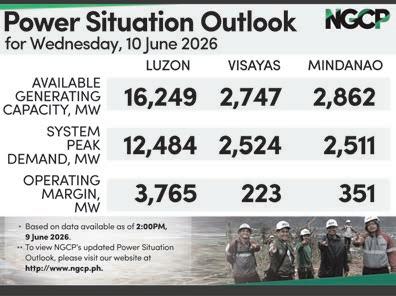
One World Deli ties up with Sinaya Seafood for marketing program

O“The logistics center, which requires about 7 million (cubic meters) of sand, which was supposed to be finished by 2025, but now I think we’ll be able to finish it by the end of 2026,” Ang said. “But at least the first runway can operate in 2028.” NMIA in Bulakan, Bulacan sits on a 2,500-hectare of coastal site and is aimed at decongesting the Ninoy Aquino International Airport, still the country’s main gateway despite its state.
San Miguel also won the bid to rehabilitate the airport.
The Bulacan airport, worth about P735 billion, is slated to begin phase 1 operations in late 2028.
The phase 1 of the project will handle up to 35 million passengers annually. Once fully completed, it is designed to scale up to 100 million passengers per year.
The airport will feature four parallel runways allowing for simultaneous aircraft operations.
It includes a passenger terminal with over 1.2 million square meters, and a dedicated cargo terminal.
“For more than 135 years, generations of San Miguel employees have worked hard and kept their faith in what this company and our country can achieve. We have seen difficult years before, and still we keep building, because San Miguel was built for times like these,” Ang said.
Armscor wants to expand gun factory
RMSCOR Global Defense
AInc., a local maker of guns, firearms and ammunition, said the company is scouting for a site in Luzon for its new facility as it aims to expand its operations.
Gina Angangco, the company’s new president and CEO, said the company’s initial plan to put up a facility in Baras, Rizal is no longer feasible as the area now has more residents.
“We have plans of really setting up a different location. We’re very crowded here (in Marikina) right now, and there’s no more space for expansion, so we have been eyeing different areas. We’ve looked at it and studied it, and we’ve talked to the owners, and we’re looking at different sites for our expansion program for us may not be possible anymore,” she said.
Its 7-hectare facility in Marikina houses advanced automated and robotic production lines capable of manufacturing about 250,000 firearms and over 420 million to 560 million rounds of ammunition annually.
Angangco also said current geopolitical tensions have created uncertainties for businesses like Armscor.
“So many of our projects we have to study very carefully for the appropriate timing,” she said.
“Many of the raw materials are difficult to come by because of all the shipping challenges, logistics, and of course many countries want to have their own stockpile to defend their own countries. So, it is really important that we, the Fili -

pinos, start really seriously going on that path to become self-reliant in (firearms).”
Angangco said 2026 is a recovery year for the company which had to lay off some 500 its workers in 2025 due to the uncertainty caused by US President Donald Trump’s tariffs.
She said most of the fired employees have been re-hired and have beefed up its workforce to about 1,000. The company has also received refund for the excess tariffs imposed on the company.
“Last year, there was the sixmonth gun ban (because of the elections). Right after the gun ban came the 19-percent tariff rates (on the Philippine exports) to the US.”
That affected the company as more than half of its production are all for export. Today, she said, exports are picking up. She also said the company is not directly affected by the war in the Middle East.
Angangco also said the company was able to secure the Tatak Pinoy seal.
“With the Tatak Pinoy, nine strategic industries were chosen as priorities of the government, and one of them was the defense manufacturing, which we are part of.”
With the seal, the government will assist the company to scale its operations on a global level.
“They help us in preparing the venues for expos. They now require government procuring entities to give preference to domestic industries in the past under the Republic Act 9104 the Procurement Act, procuring entities may honor domestic preference,” she said.
“So that’s a good thing, because you know when our economy thrives, then everyone benefits from the economic multiplier effect of more funds into our economy.” VG Cabuag
By Ada Pelonia @adapelonia
stroys ocean habitats.
NE World Deli has forged a partnership with Sinaya Seafood in their bid to empower coastal enterprises and train the spotlight on local seafood.
Central to the collaboration was traceable, responsibly sourced seafood from small-scale fishing communities across the country, helping increase profit margins for fishers.
Mary Adelyn Tecson, founder and CEO of Sinaya Seafood, told the BusinessMirror that the partnership focuses on marketing local seafood to Filipino consumers, deviating from the usual catch-to-export pipeline.
“For now, we’re prioritizing local because we have prioritized export for a long time and we Filipinos are either losing out or oftentimes the seafood that remains for us is not of good quality,” Tecson told this newspaper on the sidelines of the partnership’s launch in Taguig City on Monday.
“So, we wanted to change that, and we also wanted Filipinos to enjoy the seafood that we have in our waters. At the same time, we’re trying to make sure markets can also contribute to protecting the ocean since they’re the ones building demand.”
Tecson noted that the collaboration will help in safeguarding marine ecosystems from the persistent threats posed by illegal, unreported, and unregulated (IUU) fishing, which depletes fish stocks and de-
“This kind of partnership prevents (IUU fishing) because we’re also teaching markets like One World Deli what type of fish they can (market), including the correct size and seasonality,” she said.
“In return, the (coastal) community is rewarded for its proper fishing practices, which weren’t valued or given importance before.”
Sinaya Seafood empowers smallscale coastal community enterprises and builds sustainable food systems through responsible sourcing, valueadded processing, and direct market access.
Through its fisher-to-market (FishNet) model, the social enterprise creates traceable and transparent seafood value chains while delivering responsibly sourced local seafood that generates social, economic, and environmental impact.
The partnership launch featured discussions on local sourcing, ethical supply chains, and ocean stewardship, while also tackling Filipino culinary heritage and Slow Fish principles. Collaborators CCA Manila, Slow Food Manila, and Purple Yam Manila also joined the celebration, promoting biodiversity, traditional foodways, and local food cultures.
“It’s more than a meal—it’s a way to reconnect with where our food comes from and to honor the fisherfolk who nourish our communities and safeguard marine resources,” Tecson said.

PHOTO shows fishers from Carles, Iloilo. From the Facebook page of Sinaya Seafood
RACE program for local auto sector back on the table—DTI
By Bless Aubrey Ogerio @blessogerio
THE Department of Trade and Industry (DTI) is moving to revive a support program for internal combustion engine (ICE) vehicles as the government recalibrates its incentives scheme for the automotive sector.
industry players and recognition that the shift to electric vehicles does not yet cover all transport segments in the country.
“We never stopped talking about possibilities and incentives we can give,” she said.
“We recognize electric vehicles are important, but there are still vehicles that are being produced like the (Toyota) Tamaraw and all that don’t yet have an electric counterpart,” she added.
ous automotive incentive schemes, but will follow a similar structure of government support for local production and industry participation.
Roque added that the government’s broader direction is to support both electric and traditional vehicle segments as part of a transitional strategy for the industry.
“The Marcos administration wants to offer incentives for both electric vehicles and commercial vehicles,” she said.
“We will revive it. The government will revive it,” Roque told reporters on Tuesday afternoon when asked about renewed calls from industry stakeholders for support beyond electrification.
She said the proposal stems from continuing discussions with
Trade Secretary Ma. Cristina Roque said the administration is preparing to bring back the Revitalizing the Automotive Industry for Competitiveness Enhancement (RACE) program, which is intended to provide incentives for the production and use of non-electric vehicles, particularly those still widely used in commercial and public service applications.

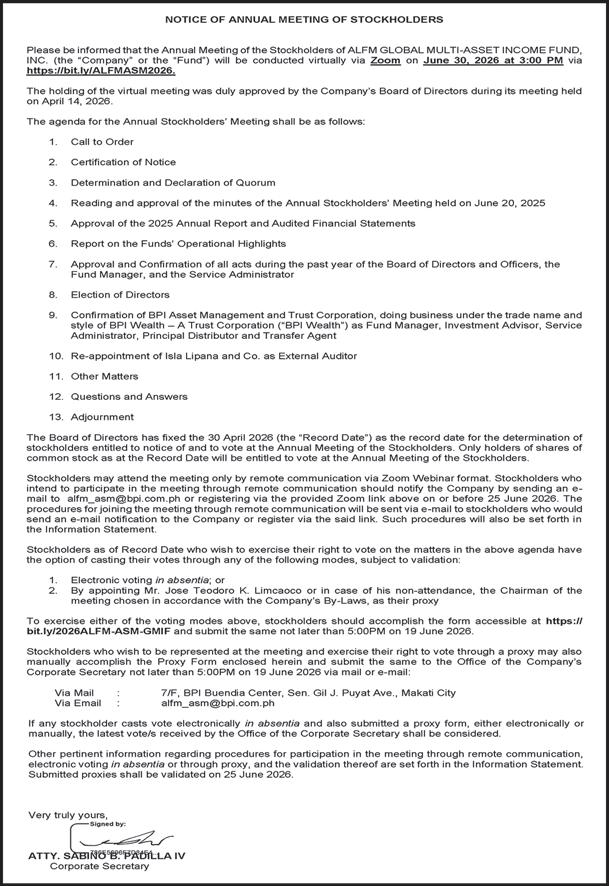
The DTI chief clarified that while the agency is working on guidelines for the revived program, it is not yet at the stage of executive or inter-agency approval.
“We will issue the guidelines,” Roque said, adding that the matter is still under internal discussion within the department.
She also said the revived program will not be identical to previ -
Asked about the approval process, Roque said the program is still being refined and has not yet been elevated for final interagency clearance.
In April, the DTI said the government had shelved the RACE program to shift its focus toward accelerating a new incentive framework centered on electric vehicles.





Banking&Finance
Cautiousness marks bank lending to MSMEs
By Andrea E. San Juan
LBy Justine Xyrah Garcia
THE World Bank has extended the closing date of a $300-million project in the Philippines after delays in civil works prevented the program from meeting key targets, including the retrofitting of public buildings in Metro Manila.
A restructuring paper released by the Washington-based lender showed that the Philippines’s “Seismic Risk Reduction and Resilience” project’s closing date has been moved by six months to December 31, 2026 from the original June 30, 2026 deadline.
Approved in June 2021, the project seeks to improve the seismic safety of around 425 public buildings in Metro Manila, including schools and other government facilities, while strengthening the emergency response capabilities of the Department of Public Works and Highways (DPWH).
Nearly five years after its approval, however, no retrofitting works have been completed.
“The Project is currently rated Moderately Unsatisfactory on the achievement of the [Project Development Objective] and Implementation Progress. The first PDO indicator is not met because no civil works have been completed and the second PDO indicator is partially achieved with equipment procured,” the World Bank said. Data from the lender showed that only $66 million, or 22 percent of the project’s $300 million financing, had been disbursed as of the latest assessment, leaving more than $231 million undisbursed.
The World Bank attributed the delays largely to bureaucratic bottlenecks, citing “complex internal review and approval processes” as well as “heavy documentary and signatory requirements.”
“This has delayed project implementation, especially civil works, the largest component in the project,” it said.
Despite the setbacks, the lender noted signs of progress in recent months. Contracts for the retrofitting of the first 67 schools were awarded in May, while procurement for additional buildings is expected to proceed in the coming months.
Still, the World Bank said the six-month extension is only an interim measure as the government completes internal approval processes for a more comprehensive restructuring that would likely include a longer implementation period and revisions to project targets needed to achieve the project’s development objectives.
“The second restructuring will be processed upon completion of all necessary internal procedures. The PDOs will be achievable under extended implementation timeframe, after the second restructuring,” it added.
ATEST data released by the Bangko Sentral ng Pilipinas (BSP) showed that while loans extended by banks to micro-sized, small-scale and medium-sized enterprises (MSMEs) posted growth in the first quarter, it remained flat, reflecting cautiousness by the lenders and borrowers.
Based on the data from the central bank, loans made available to MSMEs climbed to P574.8 billion as of end-March, up 5.12 percent from the P546.82 billion recorded in the same period last year. The same amount was made avail-
able to small merchants in the previous quarter or in the last quarter of 2025, at P574.8 billion.
The industry’s total loan books jumped by 2.71 percent to P12.14 trillion as of end-March 2026 from P11.82 trillion in the same
period last year.
Out of the loan portfolio extended by all banks, the percentage compliance by banks to MSMEs grew to 4.73 percent as of end-March 2026, from the 4.63 percent compliance in the same quarter a year ago.
Still, this is less than half the 10 percent required by the law.
Under the Magna Carta for MSMEs, all lending institutions, whether public or private, are required to set aside at least 8 percent for micro and small enterprises and at least 2 percent for medium enterprises of their total loan portfolio.
Broken down, data showed that loans extended to micro and small enterprises only amounted to P238.45 billion as of end-March. This is equivalent to only 1.96 percent of the industry’s loan books, way below the 8 percent required by the law to be earmarked for micro and small merchants.
For medium enterprises, banks
were able to extend P336.35 billion.
This is equivalent to 2.77 percent of the industry’s loan books, above the 2 percent required by the law for medium-sized businesses.
Ateneo De Manila University Professor of Economics Leonardo A. Lanzona Jr. said that despite economic recovery and expanding loan portfolios, banks continue to allocate less than half of the legally-intended share of credit to the MSME sector.
“This suggests that banks still perceive MSMEs as relatively risky borrowers and that alternative lending channels, rather than traditional bank financing, may be increasingly serving the sector,” Lanzona told the BusinessMirror.
“Unless incentives are provided by the government this situation is unlikely to change.”
Jonathan L. Ravelas, senior adviser at Reyes Tacandong & Co. noted that while MSME lending is still growing, “the pace is clearly easing.”
“That reflects a more cautious environment on both sides,” Ravelas said.
He noted that higher borrowing costs, tighter bank risk assessments and more conservative MSMEs are all contributing to this slowdown. Ravelas added that the flat quarter-on-quarter numbers indicate that both lenders and borrowers are in a “wait-and-see” mode, looking for clearer signals on rates and demand. Moving forward, he said there is a need to “unlock” lending through better risk-sharing mechanisms, stronger credit data, and more incentives for banks to support the sector.
“But the bigger message is this: MSMEs should not just focus on survival. They need to pivot, adapt, and repurpose their business models to fit the new economic landscape,” Ravelas said.
“In today’s environment, adaptability, not just access to credit, is what will drive sustainable growth,” he added.

By Reine Juvierre Alberto @reine_alberto
THE government failed to raise its borrowing target from the domestic market after yields on the 3-year and 8-year Treasury bonds (T-bonds) ticked higher on tepid investor demand.
During Tuesday’s auction, the Bureau of the Treasury made a partial award of both reissued debt papers, raising a total of P35.94 billion out of the P50-billion planned borrowing.
Investor appetite was moderate, as the auction was oversubscribed by 1.26 times, with tenders amounting to P56.460 billion.
“Demand was relatively subdued as investors remained cautious amid evolving interest rate expectations and preferred to stay on the sidelines ahead of clearer policy signals,” Ruben Carlo O. Asuncion, chief economist at UnionBank of the Philippines, said. “The sizeable offer also met a market that is pricing in higher yields, prompting dealers to submit more conservative bids, which led to the partial award.”
Adding to this is the large P50 billion supply, which Jonathan A. Ravelas said naturally caused some auction fatigue.
“Liquidity is there—but investors are being selective and are asking for better yields before stepping in,” said Ravelas, senior adviser at Reyes Tacandong & Co.
THE Procurement Service-Department of Budget and Management
(PS-DBM) is preparing to expand its eMarketplace catalog to include laptops, fire trucks and ambulances in its bid to help government agencies generate savings amid the energy crisis.
PS-DBM Executive Director Genmaries Entredicho-Caong told reporters that the government’s central purchasing agent will onboard more common-use supplies and equipment (CSE) and motor vehicles to its online procurement platform. Specialized vehicles, such as fire trucks and ambulances, are being considered for inclusion in the lineup of multi-purpose vehicles, passenger and utility vans and mini buses available in the eMarketplace, Entredicho-Caong said. Fire trucks are already part of PSDBM’s market study following a request from the Department of the Interior and
Elevated yields were driven by a combination of continued geopolitical tensions in the Middle East, higher crude oil prices and expectations of further monetary tightening from the Bangko Sentral ng Pilipinas (BSP), according to Michael L. Ricafort, chief economist at Rizal Commercial Banking Corp.
On external factors, Ricafort cited a global bond sell-off and higher longend yields in developed markets. These trends, along with expectations of sustained US fiscal deficits and heavier bond issuance, have contributed to upward pressure on global yields.
“Investors are waiting for the peak in bond yields or to top out before taking investment positions to maximize the yield to be locked in amid higher inflation and inflation expectations/ estimates recently as the Strait of Hormuz remains closed,” Ricafort added.
The 3-year securities fetched an average yield of 7.307 percent, rising by 37.4 basis points from the previous auction’s 6.933 percent.
Compared with the secondary market, the average yield on the three-year Treasury bonds was 21.1 basis points higher than the corresponding Philippine Bloomberg Valuation (PHP BVAL) rate of 7.095 percent.
Yields awarded by the auction committee ranged from 7.150 percent to 7.4 percent.
The debt papers, which have a remaining term of three years and three months, carry a coupon rate of
Local Government (DILG) for the Bureau of Fire Protection (BFP).
Entredicho-Caong said the PS-DBM seeks to onboard fire trucks within the year, while ambulances are expected to follow due to growing demand from local government units.
The PS-DBM is also preparing to relaunch laptops on the eMarketplace after suspending procurement of the items following the Department of Education’s procurement of overpriced laptops, added the PS-DBM official.
She said the agency has reviewed its specifications and pricing guidelines to ensure that future procurements offer better value for money. Laptops could return to the platform as early as June.
Due to the energy crisis, PS-DBM is also targeting to onboard more alternative fuel vehicles (AFVs), such as electric, hybrid and battery-operated vehicles,
7 percent.
Demand for the 3-year T-bonds reached P37.520 billion. The Treasury only raised P27.617 billion, out of the P30-billion offering, and rejected P9.903 billion in bids.
Meanwhile, the 8-year yield reached 7.580 percent, up by 39.1 basis points from 7.189 percent in the previous auction.
The average yield on the 8-year Tbonds is also exceeded the corresponding PHP BVAL rate of 7.448 percent by 13.2 basis points.
Accepted yields were as low as 7.450 percent to as high as 7.650 percent.
The bonds still had a tenor of eight years and four months. The coupon rate for the securities stood at 9.250 percent.
Tenders for the tenor reached P20.940 billion, of which P8.323 billion was accepted and P12.617 billion was rejected by the Treasury.
Tuesday’s auction results slightly dented the national government’s plan to raise P268 billion from the local market this month through the tender of Treasury bills and T-bonds.
The Treasury is planning this month to borrow up to P140 billion from the sale of six T-bonds—with tenors of 3 years, 4 years, 5 years, 7 years, 8 years and 10 years.
For the whole year, the national government plans to borrow P2.628 trillion with a 77:22 mix in favor of domestic sources.
Entredicho-Caong said.
The agency has included electric vehicles from Cross Country Motors Inc., Foton, and Mobility Access Philippines Ventures Inc., the distributor of BYD vehicles in the country, last May. Offerings from Kia and VinFast are still under evaluation for inclusion in the eMarketplace.
“If more green products are available in the PS-DBM catalog, agencies will see them as viable options and may purchase them instead of conducting separate procurement,” Entredicho-Caong said. Centralized procurement enables the government to secure lower prices through bulk purchasing.
“Our prices are typically 32 percent to 40 percent lower than market prices,” Entredicho-Caong said, noting that the government saved around P711 million in 2020. “This demonstrates the benefits of bulk procurement.” Reine Juvierre S. Alberto
What makes Dumaguete City sparkle?
E always wondered why
WTagbilaran City, the capital City of Bohol—the only Unesco Geopark island in the country—seems deserted by nine in the evening.
That’s about the time the last full show of the movie houses end and it seems people have nowhere to go. No more restaurants, bars, ballroom dance floor or bands playing except for one or two. It seems the city has lost “by default” to the nearby tourist island of Panglao, where the “action” is: food and entertainment.
The province, one of the most preferred tourist destinations, is contemplating building two more bridges from the mainland to Panglao. Sadly, those two can become a one-way affair: people going to Panglao and hardly the other way to the city.
Hopping on a two-hour ferry to nearby Dumaguete City, we were forced to compare the cities, which have almost identical endemic populations of about 140,000.
Dumaguete is a beautiful city for retirement. The air is fresh, helped by giant acacia trees and other fauna that litter the streets—preserved by design by an environmentally-conscious government for decades. It is one of the cities with the coolest temperatures, as a result. Its main thoroughfare is the splendid, long stretch of Rizal Boulevard set against a sparkling crystal-blue seawater. There is a long collage of eateries that operate till late nights and with very reasonable prices compared to Tagbilaran and even Cebu cities. And there is entertainment.
Most of the leading Manilabased food franchises are there, as well. Sylvanas and sans rival are the city’s staple “pasalubongs.” There must be so much money in circulation in Dumaguete City.

and Foundation University. The city is a virtual “University Town.”
In fact, during the day, some 300,000 out-of-town workers and businessmen add to the 140,000 residents of the city, creating a voracious demand for food, goods, and services. The city also benefits from the operational unification via the “One Negros” law, ensuring a bigger infrastructure budget from the national government. It also has its “on-island” source of power through the geothermal source in Valencia, just off the city.
What people also forget is that Negros Oriental itself is a tourist destination, not as well-advertised as neighboring Bohol, but it has its charms.
In 2025, tourism receipts in Negros Oriental registered P13.3 billion in receipts after a tremendous surge in tourist numbers, from 2024’s 528,888 to 2025’s 954,000. This is not counting the 273,000 tourists who use Dumaguete City as a jump-off point to the nearby attractive Siquijor island, now bursting at the seams with resorts and restaurants. Some of them stay for a day or an overnight in the city before going to Siquijor. There are 13 trips daily to Siquijor (5 Ocean Jet, 5 Montenegro, and 3 StarCraft) from Dumaguete.
strong long-term value appreciation.
The e-bidding will also offer other Luzon properties, comprising 35 residential lots, 18 agricultural lots, and five mixed residential/agricultural properties with areas ranging from 42 square meters to 4.5 hectares. These properties are located in Metro Manila, Albay,
the
The key element in the city’s progress is the presence of 30 ICT-BPOs, hiring about 15,000 people; their lowest rank and file staff are paid the minimum regional daily wage thrice. Statistics show that ICT-BPO salaries alone contribute P300 million monthly to the city’s business artery or P3.6 billion a year. The city has the infrastructure, digital sophistication, an easier cost of living, and a platoon of competent graduates.
The competent talents are sourced out not only from the campuses of the five other cities in Negros Oriental (Bayawan, Bais, Tanjay, Sibulan and Kanlaon) but the city itself, which has four big universities: Silliman, Negros State University, Saint Paul University,
The known tour spots in Negros Oriental are: Apo Island, Valencia Casaron Falls, Bais City Majuyod Whit Sand Beaches, Valencia Hot Springs, Twin Lakes Nature Bay, Mount Talmes (trekking), and Mabinay Cave (cave capital of the Philippines). On the other hand, Siquijor has the following tourist magnets: (Falls): Cambuganay, Lagaan and Lugnason; (beaches)—Salagdoon and Palitan; (Marine Sanctuaries)—Tubod, Talapos and Cantabor Cave.
For many years, the city had also benefited from the aboveboard management of former Mayor E, Remollo, who is one of the founding members of the Mayors for Good Governance. Dumaguete is a clean city with huge consumer demand and an inexpensive culinary
Batangas, Bulacan, Camarines Sur, Isabela, Laguna, La Union, Oriental Mindoro, Pangasinan, Quezon, Rizal, and Zambales, read a statement
PDIC issued last Tuesday.
Chaos, calm, and clearheaded choices

YOUR alarm rings late, traffic refuses to move, your inbox grows faster than your patience, and someone asks for one more favor when you already feel stretched thin. Everyday stress rarely arrives as one dramatic event. More often, it appears in small moments that slowly drain your energy and shorten your temper. Emotional regulation is not about pretending that stress does not exist. It is about learning how to respond without allowing stress to control your mood, decisions, or relationships.
Many people believe emotional regulation means staying calm at all times. That idea creates even more pressure. You are human, and difficult emotions are part of daily life. You will feel frustrated, disappointed, anxious, and exhausted from time to time. The goal is not perfection but awareness and recovery. When you understand your emotional patterns, you become less likely to react in ways that create regret later.

One helpful strategy is to pause before responding. Stress often pushes you toward immediate reactions. You may snap at a family member after a difficult meeting or send a harsh message that you later wish you had deleted. A short pause gives your mind an opportunity to catch up with your emotions. Before responding, take one slow breath and ask yourself whether your reaction will improve the situation or worsen it. That brief moment can prevent unnecessary conflict.
Your body also plays a big role in emotional
regulation than many people realize. Stress lives not only in your thoughts but also in your muscles, breathing, and sleep habits. When your shoulders tighten and your breathing becomes shallow, your brain interprets those signals as danger. One practical way to break that cycle is through controlled breathing. During a stressful moment, inhale slowly for four counts and exhale for six counts. A longer exhale tells your nervous system that you are safe. You can practice this while waiting in traffic, sitting at your desk, or standing in a grocery line.
Another effective strategy involves naming your
A chapter a day keeps the doctor away
FULL-BRAIN WORKOUT

mystery thriller or swoonworthy romance. Few people realize that both your mind and body benefit when this favorite pastime becomes a regular part of your routine.
EXPERTS describe reading a book as a full-brain workout,” says Cymbeline Perez-Santiago, MD, Neurologist and Head of the Neurology Unit of top hospital in the Philippines, Makati Medical Center (MakatiMed, www.makatimed.net.ph).
“In a study conducted in 2020, researchers noted that increased gray matter in the left superior temporal cortex part of the brain, which is crucial to cognitive function, is linked to better reading performance among children. For the older generation, keeping the mind engaged through book reading delays cognitive decline and positively impacts physical and mental health.”
A 2017 survey that tracked over 3,000 adults in a 12-year period discovered that those who specifically read books had a 20 percent reduction in mortality. In a study conducted by Yale University, people added an average of 23 months to their lifespan when they read 30 minutes a day.
“Reading, of course, broadens one’s vocabulary and knowledge, which proves helpful in entrance exams, job opportunities,

emotions clearly. Many people say they feel “stressed” when they actually feel disappointed, embarrassed, overwhelmed, or lonely. Specific language creates clarity. For example, if you recognize that you feel overlooked rather than angry, you may choose a more honest conversation instead of a defensive argument. Emotional awareness often reduces emotional intensity because you understand what truly needs attention.
Daily routines also shape emotional resilience. When stress becomes constant, basic habits are
SEE “CHAOS,” B5
and life in general,” adds Perez-Santiago. “Moreover, it develops one’s ability to empathize—to put oneself in other people’s shoes. Experts call this ‘theory of mind,’ or skills needed to build, navigate and maintain social relationships.”
WHY BOOKS?
WHAT is it about a book that makes our mind work differently? Reading words (as opposed to looking at pictures or watching a video) prompts us to use our imagination to supply the imagery that corresponds with the sentences.
“Books, particularly long-form content, train us to focus and pay attention at a time when the digital world’s fast-paced, shortform content has reduced our attention span,” explains Perez-Santiago. “Reading books also strengthens memory, challenges your analytical thinking, and makes you a better writer.”
But who has the time to pick up a book these days? In a national readership survey commissioned by the National Book Development Board in 2023, the number of Filipino adults who read non-school books
in the past 12 months was 42 percent—a major plunge from the 80 percent who read books in 2017.
“The trick,” Perez-Santiago points out, “is to make it an enjoyable experience, something to look forward to.”
■ START BY ALWAYS HAVING A BOOK ON HAND. Keep a book in your car, your bag, or your desk drawer at work. “When you’re waiting in the bank, at a doctor’s appointment, or for a friend to arrive for a meeting, pass the time away by getting in a few pages,” says Perez-Santiago.
■ SET DOABLE GOALS. Does the sight of a thick pocketbook intimidate you? Pick a quick read or go for an anthology of short stories. “They can help you build your attention span and ability to focus as you work your way to reading longer stories,” Perez-Santiago recommends.
“Also, there are no rules that you should finish a book in a week, or that you should finish one book before starting another. Read several books all at once and go at your own pace. As proven by studies, even a few minutes of reading can do wonders for your health.”
Eugenia Last

others, uncomfortable situations and your responsibilities. ★★
LEO (July 23-Aug. 22): Plant your feet firmly on the ground and think twice before you jump into anything you know little about. Research is your ticket forward, so don’t scrimp when it comes to positioning yourself for victory. A steady pace will far exceed cutting corners or giving your all. Observe, learn as you go and turn your experience into a work in progress. ★★
VIRGO (Aug. 23-Sept. 22): Reach out, ask questions and offer solutions. Your input will help you win favors and encourage others to be a help, not a hindrance. Don’t buy into what others do—or pay for their mistakes. Offer a solution and send them on their way. Your strength comes from telling it like it is and taking care of your responsibilities.
LIBRA (Sept. 23-Oct. 22): Distance yourself from trouble and those who are eager to pick a fight or alter your plans. Pay attention to the changes happening around you and take advantage of the information you gather from reliable sources. Partnerships require monitoring to avoid a misunderstanding or a manipulative situation. Say no to temptation and taking risks. ★★★
SCORPIO (Oct. 23-Nov. 21): Push forward with enthusiasm. Do your own thing and gain experience in areas that help you add to your qualifications and skills. An encounter with someone special will change your perspective regarding relationships, lifestyles and how you want to move forward. Personal growth and self-improvement are favored, and love and romance are on the rise. ★★★
SAGITTARIUS (Nov. 22-Dec. 21): Consider the changes you want to make at home or to yourself, and set a strict budget. Refuse to buy into someone else’s vision or lavish attitude. Use your imagination to devise a plan that’s within your means and that will impress those trying to get you to take unnecessarily expensive alternatives. Do the work yourself where applicable.
CAPRICORN (Dec. 22-Jan. 19): Opportunities are apparent, but if you let outsiders interfere with your plans, you’ll end up redoing what you don’t like at a high cost. Put your time and energy into hands-on projects that offer both a learning experience and a chance to upgrade your lifestyle. A conversation with someone close to you will change the dynamics of your relationship. ★★
AQUARIUS (Jan. 20-Feb. 18): Tidy up loose ends and give yourself a pat on the back. Refuse to let what others do anger you when your energy is best used to satisfy your needs and add to your comfort and convenience. A work-from-home idea will help you branch out in a diverse direction. Keeping up with what’s trending is in your best interest.
PISCES (Feb. 19-March 20): A networking event will give you plenty to consider. Someone you encounter will grab your


TALE OF TWO STARLETS
THE two starlets are considered rivals. Of course in front of the public, they greet each other and say hello. They aren’t really enemies, but they’re not friends either. What differentiates the first starlet from the second is it the first may be more popular and have more endorsements, but the second is known to be kind and authentic. The first starlet is someone who will say what people expect her to say. Meanwhile, the second starlet, who is not perfect, is more likable simply because she is genuine with her interactions.
JUST A FLING
THE young actress has always liked the actor, who had a girlfriend, also an actress. That didn’t stop the actor from having a fling with the young actress, who is beautiful and talented. He thought that was the end of it. Well, the young actress, who turned out to be very immature, had other ideas. She went to the actor’s girlfriend and told her everything. To the actor, it was a one-time thing. To the young actress, it was serious. Of course, at this point the girlfriend was fed up with her boyfriend and just wanted a peaceful life. And that is how they broke up. The actor and his ex are already happily involved with other people. The young actress seems to be in a loving relationship, too.
SHE’S
DONE
AFTER she was fired from her job, the female executive was thought to replace a bigwig at a sister company. Months later, that has not happened despite the persistent rumors. The rumors have now stopped and according to the grapevine, it was a female executive who spread the rumors. No one wanted her at any of the conglomerate’s companies. Her rash and bad decisions while she was in position and the financial losses that resulted from these decisions have finally been exposed. And for now, she is done.
FO IT’S so strange that these two starlets, once the best of friends, are no longer talking to each other. Is it because of a man? Well, in a way it is. Starlet 1 thought Starlet 2 was her friend. She was shocked to learn that the latter had hooked up with her former suitor. It’s not that she still liked the guy. She already has a boyfriend. She was just surprised that her supposed good friend didn’t tell her and she had to learn about it from social media. These days, the two starlets just ignore each other. As for the guy, he says he has always liked Starlet 2 and Starlet 1 was just a good friend.
Chaos...
usually the first to disappear. You may skip meals, sleep less, and spend hours scrolling through upsetting news or social media. Those choices quietly increase emotional exhaustion. Small routines create stability during chaotic periods. Drinking enough water, taking a short walk, or stepping away from a screen for 10 minutes may seem simple, but those actions help your mind recover. Emotional regulation is often built through ordinary habits rather than dramatic breakthroughs.
You can also benefit from adjusting your inner dialogue. During stressful situations, many people become harsher toward themselves than they would ever be toward another person. A single mistake becomes proof of failure. One difficult day becomes evidence that life is falling apart. Instead of asking, “Why can I never handle anything properly?” try asking, “What would help me manage this situation better?” The second question encourages problem-solving rather than self-punishment.
Boundaries are another important form of emotional regulation. Constant availability can leave you emotionally depleted. You do not need to answer every message immediately or accept every request that comes your way. Protecting your time and energy is not selfish. It is necessary. For example, if work messages continue late into the evening, consider setting a specific hour during which you stop checking notifications. That boundary allows your mind an opportunity for rest. Connection also matters more than many people admit. Stress often convinces you to isolate yourself, especially when you feel emotionally exhausted. Yet a brief conversation with someone trustworthy can provide perspective and comfort. You do not always need advice. Sometimes you simply need someone who listens without judgment. Human connection reminds you that you are not carrying every burden alone.
There will also be days during which your emotions feel heavier than usual despite your best efforts. During those moments, give yourself permission to slow down instead of criticizing yourself for struggling. Emotional regulation does not mean suppressing emotions until they disappear. It means responding to yourself with patience while choosing actions that support your wellbeing.
Life will continue to bring deadlines, disappointments, and unexpected frustrations. Stress cannot always be avoided, but your response can be strengthened. Every calm breath, thoughtful pause, healthy boundary, and honest conversation help you build emotional steadiness over time. Progress may feel gradual, but small consistent choices often create the greatest emotional change. When everyday stress no longer controls your reactions, you create more space for clarity, connection, and peace within your daily life.
Steven Spielberg on his faith in alien life, the future of the movies and the power of empathy
By Jake Coyle The Associated Press
NEW YORK—A moment early on in Disclosure Day will instinctively feel familiar to anyone who grew up with Steven Spielberg films. A TV weather report predicts hail. The camera pans downward, from television set to kitchen table. Plinking sounds begin. Cereal falls into a bowl.
“Those were Froot Loops,” Spielberg says, smiling. “My favorite.”
Spielberg’s latest, like some of his earliest and most beloved films, again concerns what might fall from above. Disclosure Day, which Universal Pictures releases June 11, returns Hollywood’s preeminent bigscreen craftsman to one of his most abiding questions: Are we alone?
Coming nearly half a century after Close Encounters of the Third Kind, Disclosure Day is a grand bookend for one of the most cosmically-minded moviemakers of our time, whose dreams of extraterrestrial life have shaped all of ours. It’s a distant answer to the final notes of Close Encounters. But while Spielberg grants his 1977 film was “speculative,” Disclosure Day, he insists, is the real deal.
“It’s my first film that will be considered science fiction that I do not consider to be science fiction,” Spielberg said in a recent interview. “It’s much more reflective of the world as it is evolving and discoveries that are being made as we speak.”
Spielberg, at 79, is trying to revive and reconsider the alien wonder that’s long lingered in his mind, from E.T. to War of the Worlds Disclosure Day, Spielberg’s first summer movie in a decade, is already being hailed as one of his best in years. But this time, Spielberg is testing whether he can conjure some of his trademark movie magic less with imagination than with conviction.
“I’ve been a believer since I made Close Encounters 50 years ago,” Spielberg says. “But I would always say: Until I’ve seen a UAP or a UFO with my own eyes, I’m not going to categorically state that life from out there has come here.
“But I’ve changed that,” he adds. “I’m now willing to change my mind because of the circumstantial evidence which is overwhelming.”
ALIENS AGAIN, BUT DIFFERENT
DISCLOSURE Day stars Josh O’Connor as a cybersecurity whistleblower with government evidence, long suppressed, chronicling a history of alien encounters. Guiding him in his escape from a corporate executive (Colin Firth) trying to keep it all under wraps is the disclosure movement’s leader (Colman Domingo). Meanwhile, a meteorologist named Margaret Fairchild (Emily Blunt) begins having a mysterious epiphany.
When he first began thinking about the movie, Spielberg called up the screenwriter David Koepp, a longtime collaborator who wrote Jurassic Park and War of the Worlds.
“I said, ‘Sure, what’s it about?’” recalls Koepp. “And he said, ‘Oh, you know, aliens again. But different this time.’”
Spielberg was coming off an unusually long break by his breakneck standards. His 2022 film
The Fabelmans pulled from his own childhood, dramatizing his parents’ painful divorce and his own origins as a filmmaker. Spielberg’s first gutwrenchingly autobiographical movie left him unsure of what was next.
“It was the hardest question I ever had to ask myself because there was such completion in resolving so many personal issues that I had never aired in public before The Fabelmans,” Spielberg says.
“I didn’t care whether people thought The Fabelmans was just a tale, a yarn, or if they cared that it was all true. I didn’t care about that. It was something I did for myself. I always used to say it was $40 million of therapy that I didn’t have to pay for.
Universal did,” he says, laughing.
But Spielberg, having long followed reports of alleged alien encounters, was inspired by the 2023 House Subcommittee on National Security hearing on UAPs: Unidentified Anomalous Phenomena. Among the witnesses was whistleblower and former Air Force intelligence officer David Grusch, who testified that the government concealed a program investigating UAPs.
The Pentagon then denied it. Yet in April, President Donald Trump said the Pentagon is preparing to release some “very interesting” UFO files. Those 2023 testimonies and others so fueled Spielberg that he produced a 50-page treatment on what would become “Disclosure Day.” During the writing process with Koepp, he texted him more notes, he says, “than I’ve ever sent to anyone in my life.”
“There was a period in there where I believe he re-

read the script every single day for a year,” Koepp says.
“We’d be in different time zones and I would wake up to 30 or 35 texts from his most current reading of the script. When the leader of the project has that level of commitment, it tends to bring along everyone. You up your game.”
EXTRATERRESTRIAL EMPATHY
SPIELBERG has long considered his filmography split in two, between the filmmaker who made Jaws and E.T. and Raiders of the Lost Ark, and the one who, after 1985’s The Color Purple, was increasingly drawn to darker and more serious material with films, like Schindler’s List, Saving Private Ryan and Munich Disclosure Day is a kind of bridge between both modes of Spielberg—a thrilling chase movie filled with wonderment that’s nevertheless grounded in reality and recent history.
And its most ardent message is quite earthbound. Blunt’s character’s clarity comes from looking people in the eye. As much as it’s about aliens, Disclosure Day is about empathy.
“I think every movie should have a great emphasis on empathy because empathy sometimes feels like it’s in short supply,” Spielberg says. “We have it, sometimes we can’t use it. Sometimes it’s not allowed to be used if you want to stay aligned with your friends and your belief systems. But I think empathy is there for all of us.”
Disclosure Day opens in a much different movie world than Spielberg’s earlier alien adventures. It’s one of few big, original studio movies this summer—a moviegoing season that the Jaws filmmaker pioneered. But neither franchise domination, AI nor streaming make Spielberg fret for the future of movies.
“The audience gives me faith in the movies,” says
LAND and human rights are spotlighted in ST (Southern Tagalog) to SF (San Francisco), a free screening of documentaries, shortform works, and music videos, part of MCADxMoving Image, a program of the Museum of Contemporary Art and Design (MCAD) of the De La Salle-College of Saint Benilde (DLS-CSB).
The event looks at culture, society and politics through the media of the moving image—from hybrid documentaries and video essays to narrative experiments, filmed performances, and archival audiovisions. Meticulously selected by Con Cabrera, a visual artist and independent curator, the lineup gathers works from multimedia collective and organization Southern Tagalog Exposure from Laguna, Philippines, and housing advocates People Power Media from California, USA. The roster includes documentations of narratives on displacement, oppression, and state violence which are resisted by various manifestations of activism.
The lineup is headlined by 43, a short
Spielberg. “Even though the numbers are still not pre-Covid level numbers for any films being released now, it’s more robust than it has been for many years. The audience gives me belief that people still want to congregate in a dark space in the company of strangers to share an experience of a film made by storytellers. And that gives me faith to continue making films.”
Spielberg will turn 80 this December. Around the same age, Martin Scorsese began to frankly ponder how many movies he had left. Spielberg doesn’t think the same way.
“I never think about how many more I have,” he says. “I’m just hopeful that I will be inspired when something comes along, as I was with Disclosure Day as I was with Fabelmans, as I was with West Side Story.
More inspiration is already on the way. Spielberg hopes that his next movie will be a Western. Despite his deep fondness for the genre and an indelible encounter with John Ford, it’s one genre that’s eluded him.
“I always feel like parts of the Raiders adventure movies are like Westerns,” he says.
“Whenever Harrison [Ford] was on a horse, it made me wistful for wanting to direct a full Western, a real Western.”
Margaret Fairchild in Disclosure Day has some echoes with another Spielberg protagonist: Richard Dreyfuss’ Roy Neary in Close Encounters. Both are compelled by a strange force beyond their control. It’s a character type that Spielberg, a compulsive moviemaker, grants he connects with. Disclosure Day is his 35th feature film.
“I identify with characters who aren’t afraid of mysterious things happening to them,” Spielberg says, “and who are fighting for their survival by trying to discover what they don’t know.”
docu on health workers who were arrested and accused of being members of the New People’s Army during their medical training in Morong, Rizal; and WWIII, an animated music video of a song by Dong Abay, renowned Filipino singer-songwriter, which communicates the collective consciousness of those who question the unjust war perpetrated by those in power. Likewise included in the series is Red Saga. Produced by Mowelfund Film Institute (MFI), it is a vivid landscape of metaphors on contemporary Philippine politics and a poetic take on the peasant struggle and the protracted people’s war in the Philippine countryside. Oyayi sa Kanlungan ng Digma depicts how militarization drove the Mangyans, Dumagats, and peasants from their homes.
Sa Amin: Our Place narrates the untold story of Filipino activists, artists, and intergenerational families in San Francisco’s South of Market neighborhood in their fight against displacement caused by urban renewal, real estate speculation, and tech
booms. Rights is a one-hour pioneering compilation of independently produced human rights-themed short films and public service announcements (PSAs) which exposes the incessant human rights hostilities in the Philippines and serves as an open and continuing call for filmmakers to participate in the growing movement to defend and uphold human rights.
ST (Southern Tagalog) to SF (San Francisco) is free and open to the public. It will run from June 17 to June 19, 2026, from 12 noon to 2 pm.
A talkback with the former members of ST Exposure will be held on June 17. It will be moderated by Mary Ann Pernia, MCAD Learning and Special Projects head. It will be held at the M302 Case Room of the De La Salle-College of Saint Benilde (DLSCSB) Taft Campus in Malate, Manila. Interested participants may register through forms.gle/bFUVDaDSqBhq2dKW8 The complete calendar can be viewed at www. facebook.com/MCADManila or mcadmanila. org.ph.
AWARD-WINNING director Steven Spielberg (center) with actors Emily Blunt (left) and Wyatt Russell on the set of the highly anticipated Disclosure Day.
UBS Women and Finance series looks into the art of crafting a lasting legacy
UBS gathered some of the country’s leading women changemakers for the latest edition of its Women and Finance series, titled “Crafting a Legacy,” featuring philanthropists and advocates Elizabeth “Lizzie” Eder Zobel de Ayala, Co-founder of Teach for Philippines and Nanette Medved-Po, Founder & Chairwoman, HOPE and PCX Groups. The discussion, moderated by Susan Sy, Executive Director at UBS, centered on purpose driven leadership, philanthropy, and creating impact across generations.
“Through our Women and Finance series ‘Crafting a legacy’, we continue to empower our clients to create a family legacy. Here in Asia, we are seeing more women taking charge of family businesses, leading innovative startups, and making impactful investment decisions. What is striking is that women tend to approach wealth beyond financial returns,” said Robby Go, Country Head of UBS Philippines.
Speaking about her work with Teach

for the Philippines, Zobel de Ayala shared how her advocacy was rooted in listening to communities and addressing systemic gaps in education. “At the heart of Teach for the Philippines is a commitment to addressing a systemic problem, and we believe that true change begins with genuinely listening to the needs of the communities we serve,” she said.
Founded in 2012, Teach for the Philippines works to ensure that all Filipino children have access to excellent, inclusive and relevant education by building a movement of leaders committed to transforming the country’s public school system.
Meanwhile, Medved-Po reflected on the journey of building HOPE and PCX into organizations focused on creating sustainable and scalable impact.
“Our approach from the start was to build a business model that is both scalable
and financially sustainable, ensuring that our efforts can create lasting impact,” Medved-Po shared. “We are dedicated to building a brand that unites everyone in the community around a shared vision of educating one child, constructing one classroom, and ultimately building one school at a time.”
HOPE has become widely recognized for investing its profits into public school infrastructure, environmental initiatives, and programs supporting local communities, while PCX has emerged as one of the leading plastic responsibility platforms.
Since its launch in the Philippines in 2023, the UBS Women and Finance series has brought together more than 200 women leaders, entrepreneurs, and executives for conversations on financial empowerment, leadership, and building meaningful careers and lives.
One last summer adventure with Dad at Megaworld Hotels & Resorts

Family-friendly getaway at Savoy Hotel Boracay Newcoast.
AS summer slowly winds down and families prepare for the return of school routines, Father’s Day presents the perfect opportunity for one last adventure together. Before packed schedules and homework take over, families can make the most of the season by treating Dad to a memorable getaway, a hearty feast,
a food-filled gathering by the beach in Boracay, a restorative retreat in Iloilo, a feast in Cebu, or a staycation in Manila, there are plenty of ways to celebrate the man who has spent countless summers creating unforgettable memories for his family. A highland escape with a view in Batangas FOR families seeking a quick getaway, Twin Lakes Hotel in Batangas offers a refreshing retreat overlooking the Taal Lake. The property’s 122 rooms all feature unobstructed views of the iconic landscape, making it an ideal destination for quality family time. Its Father’s Day stay package starts at P9,888 nett and includes an overnight stay with breakfast for two, a P1,200 dining credit, celebratory amenities such as a cake, balloons, TV greeting, plushie, double-wall tumbler, bottle of wine, and
waived pet fees for pet-friendly rooms. For those looking to indulge Dad a little more, a premium package starts at P12,888 nett and comes with breakfast for two, a one-hour massage for two at L’Uva Spa, a P1,500 dining credit, wine, wellness amenities, and special keepsakes that make the stay even more memorable.
Gather around the table in Boracay SUMMER and Boracay have always gone hand in hand, and this Father’s Day, the island serves up more than just spectacular sunsets. At Savoy Hotel Boracay, families can choose from three specially curated Father’s Day set menus. The Big Boss Set, good for four persons, is available for P3,299, while the Captain’s Catch Set costs P2,899 and the Papa’s Grill Set is offered at P2,399. Families can also participate in the hotel’s fun “Rate My Dad” activity, adding a playful touch to the celebration.
At Chancellor Hotel Boracay, dads can enjoy a hearty Chancellor Burger paired with a Vodka Mule for P899, or indulge in Whisky Glazed BBQ Ribs with a Vodka Mule for P999. Meanwhile, Belmont Hotel Boracay offers Dad a complimentary round of brandy and 20 percent off food and non-alcoholic beverages when families dine from the à la carte menu. Signature dishes such as Crispy Pata, Seafood Platter, Cashew Kare-Kare, and Sinugbang Pampano make for a festive island feast.
Relax and recharge in Iloilo FOR fathers who deserve a little rest and relaxation, Richmonde Hotel Iloilo presents its “Dedicated to Dad” room package starting at P6,300 nett. The package includes overnight accommodations for two adults and two children, breakfast buffet for two, a massage service, and a special token for Dad. Food-loving fathers can also look forward to a Father’s Day buffet featuring Southern and Texas-style barbecue, premium deli meats, live grill stations, and hearty carvery selections. Available for both lunch and dinner, the buffet is priced at P1,800 per person.
A feast fit for Dad in Cebu IN Mactan, Cebu, Mercure Mactan Cebu invites families to
celebrate with an evening of bold flavors and cherished moments. For P1,499 nett, guests can enjoy a Father’s Day feast designed especially for the man of the hour, complete with hearty dishes and refreshing beer pairings.
Head to Savoy Hotel Mactan Newtown for Papi’s Feast. For only P899, experience Savoy’s Chi Hao or Street Eats buffet with a round of draft beer.
Meaningful Metro staycations
FOR families who prefer to celebrate closer to home, Metro Manila offers plenty of opportunities for memorable Father’s Day experiences. At Eastwood Richmonde Hotel, guests can enjoy an overnight stay with breakfast for two, along with a special amenity for Dad, exclusive discounts on dining, spa treatments, and wellness services, while Richmonde Hotel Ortigas provides a rejuvenating staycation experience for as low as P3,000 that includes a special token for Dad, wellness treatments from Vine Aesthetics Rockwell Ortigas, discounts on in-room massage services and dining, and access to the hotel’s health club facilities. On June 21, 2026, treat Dad to a special Father’s Day lunch buffet during your Richmonde stay and get discounted rates.
Kingsford Hotel Manila offers an overnight stay package at P7,999 nett inclusive of breakfast and Father’s Day dinner buffet for two, plus dining and massage discounts. Grand Westside Hotel’s Father’s Day staycation package starts at P7,888 nett, providing dads with a well-deserved urban escape. The offer includes breakfast for two, a family set menu for lunch or dinner for two adults and two kids, and 50 percent off the Best Available Rate on a second room or night. Belmont Hotel Manila’s “Dadication” package starts at P5,899 nett and includes an overnight stay with breakfast for two, a special gift set, and 20 percent off Sunset Draft Nights at Rooftop 11. At Hotel Lucky Chinatown, families can enjoy a relaxing city break for P5,488 nett, inclusive of an overnight stay, breakfast buffet for two, a one-hour deep tissue massage for two, and a special gift for Dad. For families who simply want to gather over
Love languages of fatherhood served with Ihaw-Sarap and Unli-Saya
Fmany Filipino dads, love looks like picking up the kids from school despite a long workday, bringing home food for the family, fixing things around the house, or simply making time to share a meal. While they may not always say “I love you” out loud, their actions often speak louder than words.
This Father’s Day, Mang Inasal celebrates the many ways fathers express their love—from quality time and acts of service to shared experiences that bring families closer together. For dad content creator Paul Santiago, some of the most meaningful conversations happen around the dining table.
“As a father, I realized that bonding does not always have to be big or elaborate,” he shared. “Sometimes, the best moments happen over simple meals where everyone gets to talk about their day. Those are the moments my kids will remember.” In many Filipino households, food naturally becomes part of family connection. Whether it is a quick lunch
after errands or a weekend dinner tradition, shared meals create opportunities for families to pause, reconnect, and enjoy each other’s company.
Mang Inasal has become one of the places where many families gather for these moments—sharing favorites like
Chicken Inasal and Pork BBQ paired with Java Rice or UnliRice, while creating memories together over hearty meals.
For Jonathan Uy, fatherhood has taught him that love is often shown through consistency and presence.
“Filipino dads are not always expressive, but we show love in practical ways,” he said. “We make sure our family eats well, spend time together despite busy schedules, and simply show up whenever our children need us.”
Acts of service remain one of the most common ways
Filipino fathers care for their families. From working long hours to prioritizing their children’s needs, many dads quietly express affection through sacrifice, reliability, and everyday acts of care.
Meanwhile, content creator Marc Mascardo shared that some of his favorite memories as a father are often
San Marino Consulate expands education efforts through partnerships for Filipino youth
AS education continues to evolve in a rapidly changing world, meaningful partnerships have become increasingly important in expanding learning opportunities for students beyond the classroom. Through collaborations with local organizations, schools, and community groups, the Consulate General of the Republic of San Marino in the Philippines continues to strengthen programs that help young Filipinos grow academically, culturally, and socially.
By working closely with educational institutions and community stakeholders, the Consulate has expanded initiatives that promote lifelong learning and expose students to broader cultural and global perspectives. These efforts reflect the growing understanding that education today extends beyond textbooks and traditional instruction—it also involves nurturing creativity, cultural awareness, and a deeper appreciation of the world.
According to Consul General Jean Henri Lhuillier, education must equip young people with the skills and mindset needed to navigate an increasingly interconnected future.
“Education today must prepare students not only to read and write, but also to understand the world around them, appreciate culture, and adapt to the future. Young learners need opportunities that encourage curiosity, confidence, and a lifelong desire to learn,” said Lhuillier.
This vision has guided several educational and cultural initiatives supported by the Consulate over the years. Beyond promoting literacy, these programs seek to create enriching learning experiences that help students become globally aware while remaining grounded in their communities and cultural identity.
Among the Consulate’s longstanding collaborators is Cebuana Lhuillier Foundation Inc. (CLFI), whose partnership has further strengthened efforts to make educational and community-based programs more accessible to Filipino youth. Together, they continue to support initiatives that encourage literacy, creativity, and inclusive learning opportunities beyond the classroom.
One such initiative is the Consulate’s partnership with Bookmark, Inc. to publish “Pamilyang Papel,” a children’s activity and storytelling material designed to make cultural education more engaging and accessible. The publication promotes reading, creativity, and the formation of values through interactive learning experiences that introduce young readers to culture and heritage.
Building on these efforts, the Consulate, in collaboration with Cebuana Lhuillier and LINKS Philippines, has continued to strengthen the Hooked on Books Program, an initiative aimed at enhancing learning environments and fostering a

stronger culture of reading among Filipino students. The latest project under the program is the development of the JHL-RSM Library, the 30th milestone Hooked on Books (HOB) library established through the initiative.
As part of the project, Leonor Petra G. Elepaño met with representatives of the local government and the city administration of Manila, including city administrator Atty. Eduardo Quintos, who expressed support for the initiative and its potential impact on the community.
Currently under construction at Graciano Lopez Jaena Elementary School, the JHL-RSM Library forms part of the Consulate’s broader commitment to creating more inclusive and supportive spaces for learning. In preparation for its opening, volunteers and partners participated in a three-day community effort that included mural painting activities, library setup, and storytelling sessions for students. These activities reflect the program’s holistic approach to literacy, combining access to books with creative learning experiences that encourage children to develop a lifelong love for reading. The project has also received support from several private-sector partners. Boysen donated mural paints that helped transform the facility into a vibrant and engaging space for students, while TOSOT served as the project’s airconditioning sponsor.
Meanwhile, Archispace Design Inc. contributed to the construction and design of the learning space alongside JAS Design and Build Development Corp., led by Sandy Ocampo and Alvin Lu, further highlighting the collaborative effort behind the initiative.
As the project continues to take shape, it reflects San Marino’s enduring commitment to supporting educational programs that expand access to knowledge, encourage cultural appreciation, and help prepare young Filipinos for the opportunities and challenges of the future. Through initiatives such as the JHL-RSM Library, the Consulate continues to demonstrate how partnerships can help create meaningful learning experiences that empower the next generation of Filipino learners.
SM Hotels’ Park Inn by
marks
Radisson Iloilo
seven years of heartfelt service

PARK Inn by Radisson Iloilo officially marks its seventh year in the City of Love and Creative Gastronomy, celebrating a journey defined by Ilonggo hospitality, culinary showcase, and deep-rooted community partnerships.
The hotel’s continued success underscores the strength of the long-standing alliance between Radisson Hotel Group (RHG) and SM Hotels and Conventions Corporation (SMHCC).
As the property celebrates this seven-year milestone, it reflects SMHCC’s larger commitment to developing worldclass properties that boost local economies, foster regional tourism, and bring global hospitality standards to booming urban centers outside of Metro Manila.
“Seven years ago, we envisioned Park Inn by Radisson Iloilo as a landmark property that would add to the vibrant tourism landscape of Western Visayas,” said Peggy Angeles, Executive Vice President of SM Hotels and Conventions Corporation. “Seeing it flourish into a beloved destination that marries global standards with local heart is immensely rewarding. This achievement is a testament to SMHCC’s enduring mission to create meaningful experiences and support sustainable community growth across the Philippines,” Angeles added.
the simplest ones.
“The older get, the more realize that children remember experiences more than anything else,” he said. “Even ordinary meals can become meaningful when everyone is together laughing, sharing stories, and simply enjoying each other’s company.”
These shared experiences often become family traditions that children carry with them for years—Sunday lunches after church, celebratory dinners after milestones, or spontaneous food trips after busy days.
This Father’s Day, Mang Inasal celebrates fathers whose love is expressed not only in words, but in everyday actions, quiet sacrifices, and meaningful moments shared with family. Because for many Filipino dads, love is not always spoken. Sometimes, it is simply served at the table.
Want more Mang Inasal exclusives NOW?
Visit https://manginasal.ph for the latest news, https:// manginasaldelivery.com.ph for delivery deals, and follow Mang Inasal on social media for more Ihaw-Sarap and UnliSaya updates.
Since its opening in 2019, the hotel has evolved into a cornerstone of Iloilo’s tourism landscape. This year’s anniversary theme, “Seven Years of Ilonggo Hospitality,” serves as a tribute to the warmth and authenticity that team members bring to every guest interaction.
The past year has been marked by notable accomplishments that reflect the hotel’s pursuit of excellence while staying rooted in local identity. Most notably, Park Inn by Radisson Iloilo earned the Safehotels Certification, an internationally recognized benchmark affirming the property’s rigorous safety and security standards, while reinforcing its commitment to delivering trusted, world-class hospitality.
At the same time, the hotel continued to elevate regional flavors on the national stage. During the 16th National Food Showdown, the property’s culinary team earned a Gold medal for its signature Bibingka and Silver for Valenciana in the Professional Category, celebrating recipes deeply inspired by Ilonggo heritage.
“Food is more than nourishment. It is one of the
strongest connections we have to our culture,” said Rouel Guanzon, General Manager of Park Inn by Radisson Iloilo.
“These recognitions honor the passion and dedication of our chefs, who continuously elevate the traditions that inspire us every day,” Guanzon added.
Beyond culinary recognition, the property has embraced innovation as a way to deepen guest engagement and create more meaningful experiences. Recently, the hotel introduced StayPlease, a digital platform that allows guests to conveniently browse menus and order dining services directly from their devices that bring added ease and personalization to every stay.
That same spirit of innovation extends into preserving and sharing local narratives. Through Beyond the Plate, a masterclass developed in partnership with the Iloilo MICE Center, the hotel provided students and digital creators with opportunities to explore gastronomic storytelling and discover how food can become a medium for culture and identity.
The property also launched Panubli-on, a documentarystyle series unveiled at its signature restaurant, Áni, spotlighting the stories behind iconic local dishes and the families who preserve them. Featured narratives included the Varonas family’s “Adobado nga Lukon,” Pinky GorricetaJalandoni’s “Bibingka,” and the culinary heritage behind Kap Ising’s Pancit Molo.
Together, these initiatives reflect Park Inn by Radisson Iloilo’s belief that hospitality goes beyond service. Rather, it is also about creating spaces where traditions are celebrated, stories are shared, and communities remain connected.
The anniversary celebration also shines a spotlight on the individuals driving the hotel’s continued success. Ms. Lucky Alunan was recently recognized as the Front of House Winner at the SMHCC President’s Go Beyond Awards. Meanwhile, Guanzon continues to strengthen industry collaboration through his leadership roles as Public Information Officer of the Iloilo Hotels, Restaurants and Resorts Association (IHRRA) and Committee Director of the Philippine Chamber of Commerce and Industry (PCCI) Iloilo. Beyond professional excellence, the hotel’s anniversary observance reflected its commitment to extending hospitality beyond its walls. In a gesture of gratitude to the city and
In the photo, from left, are Kristen Quintos, Executive Director, UBS AG; Nanette Medved-Po, Founder & Chairwoman, HOPE and PCX Groups; Lizzie Zobel de Ayala, Co-founder of Teach for Philippines; Susan Sy, Executive Director UBS, Kristina Chua, Executive Director UBS AG, and Robby Go, Country Head of UBS Philippines
Façade of Park Inn by Radisson Iloilo
Editor: Tet Andolong

CEBU, BACOLOD, AND ILOILO DRIVE IT-BPM GROWTH OUTSIDE NCR

By Rizal Raoul S. Reyes @brownindio
THE Philippines’s IT-BPM industry is undergoing a significant geographic decentralization, spreading economic growth far beyond the National Capital Region (NCR).
The IT & Business Process Asso -
ciation of the Philippines (IBPAP) confirms that a growing share of the sector’s expansion is concentrated in regional hubs like Cebu, Iloilo, Bacolod, Davao, Cagayan de Oro, and Clark. The Department of Information and Communications Technology’s (DICT) Digital Cities program further institutionalized this shift by classifying cities into Centers of Excellence, Next Wave Cities, and emerging New Wave Cities—providing investors and developers with a clear provincial growth roadmap. In an email interview with the BusinessMirror , Sheila Lobien, Chief Executive Officer of Lobien Realty Group (LRG), says her firm tracks these provincial office destinations based on five key dimensions: talent demographics, peace and order, LGU governance quality, infrastructure, and digital connectivity.
Meanwhile, Mervyn Valenzuela, Vice President for Tenant Representation and Office at Prime Philippines, highlighted that the IT-BPM industry remains the primary growth driver for the office sector, expanding steadily by about 1 percent. However, he noted that this provincial momentum is uneven. “The IT-BPM sector's growth outside Metro Manila is concentrated in established Tier 1 and Tier 2 cities, as security,
infrastructure, and incentive gaps temper investor confidence in Tier 3 locations,” Valenzuela explained.
LRG’s centers of excellence LRG named Cebu City, Bacolod City, Cagayan de Oro City and Davao City as the the cities that have contributed to the growth of the IT-BPM.
Cebu City, according to Lobien, continues to expand beyond its original IT Park corridor into Mandaue, Mactan, and the South Road Properties (SRP).
A large university base, a highly bilingual talent pool, and improving airport connectivity make it the most liquid office market in the Visayas. Notably, Lobien says vacancy rates in Cebu’s IT corridors remain materially tighter than those in Metro Manila.
Driven by a strong governance record, safety rankings, competitive labor costs, and a rapidly expanding PEZA-accredited office inventory, Lobien points out that Iloilo emerged as one of the country’s most compelling BPO markets. Further, she says the city’s consistent recognition by the DICT as a Center of Excellence reflects its robust fiber infrastructure, the high caliber of local university graduates, and an active local government that aggressively courts IT-BPM investments through business facilitation and incentive packages.
Consistently ranked among the top

BPO destinations, Lobien mentions that Bacolod offers one of the country's most favorable labor cost profiles, an abundance of English-proficient graduates, and a commendable peaceand-order record. It boasts an active BPO ecosystem anchored by several major multinational operators.
As the premier destination in Mindanao, Lobien mentions that Davao consistently ranks at the top of the DTI’s Cities and Municipalities Competitiveness Index (CMCI), driven by strong scores in economic dynamism, government efficiency, and resilience.
Where legacy stands, new spaces emerge
IT is said that Brutalist architecture asked for patience. Its language was not immediately inviting and resisted quick affection for it stands firm in raw concrete and heavy, geometric forms.
Appreciation for this style came with distance. That return happened around 2019 across cities, including in the Philippines when the culture began to look again and see intent behind the weight. Buildings that were once dismissed as severe began to draw in a new audience. Architects, designers, and the public revisited them with a fresher perspective.
Iconic properties of the Metro skyline IN Makati and Pasay, two such structures are among those that gained renewed attention: the PNB Makati Center and the PNB Financial Center, properties managed by PNB Holdings Corporation (PHC).
From the street, both buildings read as resolute. The PNB Makati Center, designed by Filipino architect Carlos Arguelles, a key figure in modern and Brutalist architecture, holds its place along Ayala Avenue with a sense of order, set against a district in constant evolution.
On the other end, the PNB Financial Center, found nearer the bay, stretches across a wide footprint of almost 90,000 sq m. Designed by noted Filipino architect Gabriel Formoso, it carries the same material honesty, set against an open horizon. When PHC assumed stewardship, the shift began at the threshold. They ensured not to erase time but work with it, leaning toward adaptive redevelopment. They ensured that the structure remains legible and that interventions respond well to present-day use.
When one steps inside the PNB Makati Center, the experience becomes less mea -

sured. Light softens the entry as the lobby leads with clarity. Materials move from exposed concrete to finishes that are easier on the eye and touch.
Workspaces, found from second to penthouse levels, follow a similar intent. Color pops in controlled accents and seamlessly blends with the structure. They feature layouts that support employee interaction without forcing it. There are open zones for team collaboration, alongside areas that allow for focus. The choices reflect the building’s current priorities—health, safety, and a more human-centered way of working. At the PNB Financial Center, the narrative expands. The building has long functioned as a headquarters. Its expansiveness allowed it to house offices and institutional tenants over time. Under PHC’s direction, parts of the complex have taken on a new role. Certain interiors have been adapted into event venues. This move leans on the asset that Brutalism provides, volume. Large spans and high ceilings offer a flexible canvas. The spaces can host formal gatherings or more relaxed assemblies. The bay area setting adds another layer.
Natural light shifts across the day and gently spills through the windows. The edge between inside and outside becomes part of the event experience.
This reprogramming extends the building’s original identity. Where there were once purely administrative spaces, there are now areas, such as The Grand Atrium, that invite the public in a variety of ways.
Both buildings show that preservation is not fixed, but a process where change unfolds with discipline, allowing the original architecture to remain clear as new interventions settle in with intent. And, when updated with care, they can support contemporary life without losing character. The current work at PNB Makati Center and PNB Financial Center reflects precisely this. For those who pass by, the first impression may still be distant. The silhouettes have not softened. Yet beyond the facade, the spaces tell a whole new story, one that considers how people move, gather, and work today. In this way, the buildings continue to shape the spaces they hold. They define their legacy not only by what they were, but by how they are used today.


and the North-South Commuter Railway gives Clark the unique advantage of nationwide connectivity within a master-planned business environment,” Lobien explains.
Next Wave cities with high investment potential
SHE underscores Clark Freeport as one of LRG’s highest-conviction provincial office markets. She says this is bolstered by its designation as an IT-BPO Center of Excellence, its proximity to the New Manila International Airport in Bulacan, and recent real estate data noting a massive 538,000 square meters of office supply in Pampanga—where a 17 percent vacancy rate has improved by 780 basis points year-on-year. “The convergence of NLEX, SCTEX, TPLEX,
Other rising hubs AS one of the rising hubs, Lobien asserts that Cagayan de Oro (CDO) offers a large talent pool and improving digital infrastructure. Serving as northern Mindanao’s commercial hub, its lower occupancy costs relative to Davao make it an attractive secondary market for operators seeking provincial diversification
She notes that Lipa is quietly becoming one of the most compelling BPO real estate stories in Calabarzon. Situated at the intersection of the STAR Tollway and the forthcoming SLEX TR4, “Lipa offers proximity to Metro Manila without the capital’s high operational costs. Its young workforce, expanding tertiary education system, and strong manufacturing sector create a diversified economic environment that mitigates single-sector dependency,” says Lobien. Baguio, a mainstay in Next Wave City rankings, is uniquely positioned to benefit from IBPAP’s push into highervalue Knowledge Process Outsourcing (KPO) functions that match the city’s highly specialized talent profile. LRG says provincial BPO office demand will continue to be driven by labor cost arbitrage, talent availability outside NCR, and infrastructure.
Philippine GDP takes a dip, property tightens grip

Conclusion
METRO Manila’s retail sector is stabilizing, but not without headwinds.
Total stock reached 7.9 million sq m as of Q1 2026, with new supply moderating sharply versus pre-pandemic highs. Vacancy improved to 10.8 percent, driven by sustained demand from F&B and fashion, although store closures persist. We see vacancy normalizing by H1 2027, but risks are rising. The Middle East crisis could dampen remittances, inflate costs, and temper consumption. Still, premium and experiential malls are leading the recovery. In our view, developers with strong leasing income and curated retail formats are best positioned to navigate volatility and sustain growth. As of end-Q1 2026, total retail stock in the capital region reached 7.9 million
sq meters with about 96,000 sq meters completed from Q4 2025 to Q1 2026. From 2026 to 2028, we project the annual average completion of 113,000 sq metres of new supply, significantly lower than the 332,000 sq meters completed annually from 2017 to 2019.
Colliers data showed that Metro Manila retail vacancy improved to 10.8 percent in Q1 2026 from 11.4 percent in Q3 2025. While Colliers recorded sustained take - u p from the F&B and clothing and footwear segments, we also noted closures of several brick - a nd - m ortar stores following the expiry of their leases. Given the geopolitical tensions in the Middle East, Colliers now expects that vacancy will likely return to pre-pandemic levels by H1 2027.
Upscale and premium malls are driving the next phase of retail growth from 2026 onwards, as developers double down on experiential, high value formats. In our view, differentiation and curation will be key in sustaining the retail sector’s recovery post-Covid. More foreign brands are entering the Philippine market, and more premium retail spaces are being developed within and outside the capital region. These should help future-proof retail in the years to come.
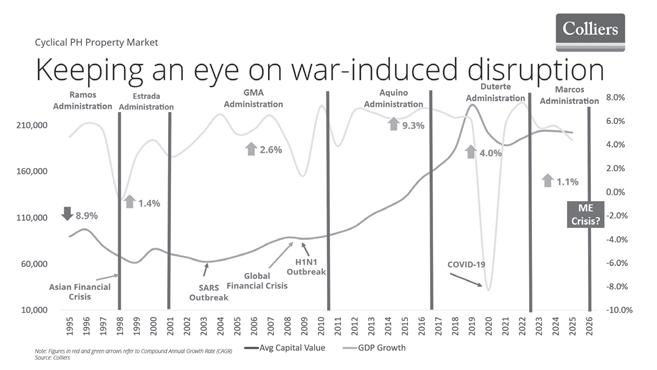
Navigating the impact of the Middle East crisis PHILIPPINE property is constantly challenged by domestic and external factors. Right now, we are seeing the emergence of new challenges. The Middle East crisis and the ensuing rise in the price of oil are likely to disrupt supply chain operations, raise prices of construction materials, and temper demand.
Property developers are closely monitoring the Middle East situation as remittances from the region covered nearly a fifth of total remittances in 2025. Remittance-receiving households, especially those depending on remittances from the Middle East, might hold off major big-ticket purchases including property. The retail and leisure sectors could also face headwinds from slower remittances and rising inflation. The industrial segment is expected to remain relatively resilient. However, rising oil prices are also increasing logistics costs, which could shift demand toward warehouses located near ports, major roads and residential areas. Facilities with strategic access and modern, efficient designs are likely to see stronger demand as companies seek to optimize costs.
Slower economic expansion in Q1 2026 and rise in inflation are major concerns for the Philippine property. But developers with massive retail and office footprint continue to remain cautiously optimistic especially as we see foreign mall tenants and occupants still taking up massive office and retail spaces
MERVYN VALENZUELA,
Philippines
PSC backs Alas amid AVC grind
By Aldrin Quinto
CITY OF CANDON— Philippine Sports Commission (PSC) chairman Patrick “Pató” Gregorio urged Alas Pilipinas to focus on the bigger picture—the road to the 2029 FIVB Women’s Volleyball World Cup—amid the crisis in the national volleyball federation.
Gregorio said support for athletes continues even as the PSC froze the funding for the Philippine National Volleyball Federation, stressing that campaigns in major events such as the ongoing Asian Volleyball Confederation (AVC) Women’s Volleyball Cup in Candon and the Asian Games in Nagoya later this year will be key to the success of Alas Pilipinas in the world meet.
“This AVC Cup is a great springboard so that we can really excel in the next two and a half years,” Gregorio said. Before you know it, it’s 2029, we’ll
be hosting the world championship. You don’t want to lose the chance, we don’t want to lose the opportunity,” Gregorio said during a dinner Monday hosted by Candon City Mayor Eric D. Singson. To better focus on the team’s missions, Gregorio said players need to t une out the turmoil in the Philippine National Volleyball Federation, while also setting aside club loyalties. T he long-time sports administrator said he is confident the crisis i n the PNVF will be resolved soon, with the guidance of the Philippine Olympic Committee and the world governing body for volleyball FIVB, allowing players to concentrate solely on their matches. There is a time for commercial volleyball and there is a time for the national team. When it comes to Alas Pilipinas, we should always be united,” Gregorio said. “Wearing the Philippine jersey is the best gift you can give yourself and the nation.”
Nothing compares to the national team, no commercial league is bigger than the national team. So please, with all your heart, we trust you, we know you can do it, I’m here to motivate you… to help you embrace the plan we have for Philippine volleyball.”
It was not until recently that a national pool was formed for the AVC Women’s Cup. And

just before the AVC Women’s Cup opener, the PNVF was suspended by the FIVB over governance concerns and alleged violation of its code of ethics. Over the weekend, nine board members announced
TBy Josef Ramos
HE Philippine Sports Commission
(PSC) announced on Tuesday the creation of a multi-stakeholder body to look into the drowning of two young Ateneo de Manila basketball players as Aurora police was quick to dismiss the tragic incident as an accident.
PSC chairman Patrick “Pató” Gregorio said that the body will be composed of representatives from the Samahang Basketball ng Pilipinas, University Athletic Association of the Philippines, Commission on Higher Education and the National Youth Commission.
They will meet at the PSC offices at 1:30 p.m. on Wednesday.
“ The goal is not only to understand what happened, but to ensure t hat lessons learned lead to safer, more responsive systems that protect athletes while sustaining high-performance sport,” Gregorio said.
Gregorio said that the panel will “examine existing policies, protocols and training practices toward resolutions to strengthen safeguards in athletic training environments.” Excellence in sport requires environments that push human potential, but never at the expense of safety,” he added.
R ene Baterbonia, 19, of Agusan del Sur, and Divine Adili, 21, of Nigeria, drowned during the Ateneo Blue Eagles’ training camp activities off Dipaculao beach in Aurora province.
R eports say the training camp under head coach Tab Baldwin resembles a m ilitary boot camp—as recalled by former Ateneo de Manila players in various social media posts.
A urora Provincial Police Office Chief Col. Percival Pineda told a press conference on Tuesday that the incident was “purely an accident and no f oul play happened.”
This incident was purely accident.
It was a natural accident, and it was not expected. As of now, we do not see any foul play in this accident,” Pineda said.
“We are saddened about the tragedy occurred in our province. We extend condolences to the family, friends, and associates of the players.”
Members of the Ateneo
coaching staff didn’t answer calls or messages from the BusinessMirror Baterbonia, a 6-foot-4 forward, was the 2025 Palarong Pambansa’s Most Valuable Player in Laoag City playing for champion Davao Region and also collected various individual awards in the ASEAN School Games in Brunei and NBTC finals.
T he 6-foot-10 Adili is considered a prize catch for the Blue Eagles in UAAP Season 88.
I n a joint statement from the House of Representatives, Deputy Speakers Paolo Ortega V and Jefferson Khonghun and Lanao del Sur Rep. Zia Alonto
A diong said the incident warrants a full congressional inquiry to determine possible lapses in safety protocols, supervision and emergency preparedness.
W hile expressing condolences to the bereaved families and the Ateneo community, the lawmakers said that accountability and fact-finding must take priority to ensure justice and prevent similar tragedies.
We mourn the untimely loss of these two promising young athletes whose lives were cut short while participating in what should have been a safe and enriching activity,” they said in the statement.
They said they will file a House resolution seeking a congressional investigation to examine the circumstances surrounding the drowning, i ncluding risk assessment procedures and compliance with safety standards for school and sports-related activities.
With Jovee Marie N. Dela Cruz
series. AP
Slim chances for Alas SOUTH Korea and Chinese Taipei continued
their withdrawal of support for its president Tony Boy Liao.
A las Pilipinas, meanwhile, will continue to compete with the support of the PSC. We want all of you to stay focused. Forget about the politics in your federation,” Gregorio said. C hinese Taipei and Korea are unbeaten in three matches, as Alas Pilipinas at 2-2 scrambles to catch up. The top two from each pool advance to the round of four, with Kazakhstan and titleholder Vietnam having the inside track in Pool B of the event presented by the PSC and the City of Candon.

6 modern pentathlon athletes make Asiad grade
FOUR male and two female athletes earned qualification in modern pentathlon as the Team Philippines grows bigger by the week for the NagoyaAichi 20th Asian Games in September. Just last week, two poomsae and kyorugi athletes in taekwondo made the grade for the Asian Games with Philippine Olympic Committee
(POC) president Abraham “Bambol” Tolentino gaining more confidence for a better performance in the games set September 19 to October 4. “ We got the email from the organizers about the qualification of six modern pentathlon athletes and that’s another good news for our campaign,” Tolentino said. “The opportunities to do better in Nagoya and Aichi continues to grow wider.” The Philippines got four gold, two silver and 12 bronze medals in the Hangzhou 2022 (2023) edition and with Paris 2024 Olympics gymnastics double gold medalist Carlos Yulo and reigning champion and record holder pole vaulter EJ Obiena leading the charge, Tolentino
loss, looks to improve its 1-1 record when it takes on winless Kyrgyzstan.
A s the tournament takes a break on Wednesday, Alas Pilipinas gears up for the match against Chinese-Taipei, needing a convincing win even as its semifinal hopes now also hinge on the results of Korea and Australia. V aldez said the team will fight to the end.
“We will give our best. We have learned a lot and we will face the fight with all our heart,” Valdez said. A gainst Korea, the Philippines managed to pull off some impressive plays
said the chances are getting bolder. “ We’re hoping that more of our athletes will qualify for the Asian Games, where the competitions have gotten close to the level of the Olympics,” Tolentino said. O ne of the more welcome developments for the Asian Games was the qualification of the men and women teams in indoor volleyball—women’s beach volleyball was a
Ginebra eyes commanding 3-1 Finals series lead


Tragedy and ecstasy

and Marketa Voundrosova and Karolina Muchova. Muchova beat Eala in the Miami Open last March in the Round of 16. I would have wanted to win this together [with Nikola],” said Eala, tightly embracing Bartunkova at center court after the match.
E ala and Bartunkova, both 21, lost to the British pair of Dart Harriet and Maia Lumsden 4-6, 6-2, 11-9 in the Round of 16 on June 1. A b ig bonus accompanied Eala’s June 7 victory as it came exactly nine months after she won her first WTA 125 victory last year.
to boost our confidence and hoping we can ride on the momentum looking forward,” said Ginebra’s resident import Justin Brownlee, who posted 41 points, seven rebounds and seven assists in Game 3. Scottie Thompson was amazing with a triple-double of 17 points, 11 rebounds and
Th is was on September 7, 2025, when Eala rallied to defeat Hungary’s Panna Udvardy 1-6, 7-5, 6-3 in Guadalajara, Mexico—the first triumph by a Filipino in a WTA event. But a bigger bonus came Eala’s way when her Lexus win in Birmingham fattened her bank account to $19,700 (roughly P1.21 million)—besides earning 125 more points that would surely improve her 37th WTA ranking.