
Amortization drives NG debt payments over ₧1T
By Reine Juvierre S.
tization more than doubled and outpaced interest payments.
Debt payments surged by 68.92 percent to P1.052 trillion from January to April this year, compared to the P622.921 billion in the same period last year, according to data released by the Bureau of the Treasury (BTr).
Ruben Carlo O. Asuncion, chief economist at UnionBank of the

THEBy Andrea E. San Juan @andreasanjuan
country’s foreign reserves, its buffer against external shocks, dropped to a 16-month low as of the end of May, due to lower gold holdings and foreign investments amid increased market volatility due to the Middle East conflict.
Sentral ng Pilipinas (BSP) showed the country’s gross international reserves (GIR) level settled at $103.97 billion as of end-May 2026, the lowest since January 2025. This is 0.34 percent lower than the $104.33 billion recorded in end-April 2026. Year-on-year, the GIR fell by 1.14 percent from the $105.18 billion in end-May 2025. In a statement, the BSP said the month-on-month decrease in reserves was mainly driven by the national government’s drawdown on its foreign currency deposits with the Bangko Sentral ng Pilipinas (BSP) for external debt service. Other reasons behind the decline are the downward valuation adjustments in the BSP’s gold holdings due to decline in global gold prices and BSP’s net foreign exchange operations. For his part, Jonathan L. Ravelas, senior adviser at Reyes Tacandong & Co., said: “The
IBy Ada Pelonia @adapelonia
NTERNATIONAL quota-
tions for urea, a key farm input imported by the Philippines, soared nearly two-fold in May, according to the World Bank. Figures from the World Bank showed that global urea prices leaped by almost 97 percent to $770.5 per metric ton (MT) last month, from the $392 per MT recorded in May 2025.
Despite the surge posted yearon-year, average urea prices in the reference month fell by 10




percent from $856.88 per MT in April.
Meanwhile, DAP prices continued their rally, averaging $769.5 per MT in May, 15 percent higher than $669.2 per MT in the same period last year.
The Middle East war, which resulted in the closure of the Strait of Hormuz, triggered supply disruptions in the Persian Gulf and jacked up prices of fertilizers.
The Gulf region is a critical supplier of fertilizers, especially urea, which is heavily reliant on natural gas.



Philippines, said the “sharp rise” in debt servicing appears to be largely driven by timing effects.
“[This] is not unusual for a single month and does not necessarily signal underlying fiscal stress,” Asuncion told the BusinessMirror
The increase in debt servicing was fueled by amortization, which reached P715.634 billion in endApril.
The repayment of principal loans grew by 113.32 percent from P335.474 billion in the same period a year ago.
Asuncion said the maturity of government securities tends to create “lumpiness” in amortiza-
tion payments. Domestic amortization rose by 269.92 percent year-on-year to P630.367 billion from P170.403 billion. Meanwhile, amortization paid to foreign creditors declined by 48.34 percent to P85.267 billion from P165.071 billion.
On the other hand, interest payments grew by 17.11 percent to P336.656 billion in end-April from P287.447 billion in the same period last year. Both domestic and external interest payments posted a 21.64-percent and 5.04-percent year-on-year increase, respectively.
Local lenders were paid
P254.285 billion in interest payments, of which P185.330
and P17.087
for Treasury bills. Foreign financiers were also paid P82.371 billion during the four-month period.
“While the uptick in interest payments should be monitored, the overall spike is best viewed as a reflection of scheduled obligations rather than a structural concern,” Asuncion said. For April alone, the government’s debt payments amounted




By Justine Xyrah Garcia
CREATING more highquality and productive jobs is critical to building a resilient Filipino middle class and sustaining the country’s poverty reduction gains, the Department of Economy, Planning and Development (DepDev) acknowledged. Speaking at the launch of the World Bank’s Poverty and Equity Assessment report, Socioeconomic Planning Secretary Arsenio M. Balisacan said the government remains focused on reducing poverty, but recognizes that many Filipino households remain vulnerable to economic shocks.
Official data showed that poverty incidence declined to 15.5 percent in 2023 from 18.1 percent in 2021,
but Balisacan noted that many households continue to face risks from food price volatility, health emergencies, climate-related disasters, and labor market disruptions.
“While we remain focused on our efforts to reduce poverty, we acknowledge that recent economic disruptions continue to challenge our economy. The government is carefully calibrating its strategies to ensure that we meet our development objectives,” he said.
To help more Filipinos achieve economic security, Balisacan said the government is prioritizing the creation of quality jobs under the Philippine Development Plan 2023-2028.
The push for quality employment comes as the World Bank recently found that 95 percent of poverty
reduction between 2012 and 2023 came from Filipinos moving into wage employment outside agriculture and fisheries.
However, productivity growth has remained weak, limiting the creation of higher-quality jobs that could help more Filipinos attain middle-class status.
Balisacan said sustaining inclusive growth will require policies that promote competition, encourage innovation and investment, and strengthen labor market institutions that balance worker protection with flexibility and adaptability.
“Building a resilient middle class is therefore more than a social aspiration. It is a socioeconomic imperative that underpins robust domestic demand, broadens the country’s tax base, supports human capital
investment, and strengthens social cohesion and institutional stability,” he also said. Apart from generating quality employment, Balisacan said the government must also improve public service delivery, strengthen resilience against emerging risks, and enhance economic governance. The country’s chief economist also called for addressing persistent disparities in health, education and nutrition outcomes, particularly in remote areas, through stronger local institutions, more effective fiscal transfers, and better implementation capacity. According to Balisacan, building a predominantly middle-class society requires creating conditions that provide
with
to P314.885 billion, up by 12.09 percent from P280.898 billion in the same month last year.
Interest payments increased by 36.77 percent to P63.525 billion from P46.446 billion a year ago.
A total of P42.894 billion was paid to local lenders, while P20.631 billion went to external creditors.
Amortization also rose by 7.21 percent year-on-year to P251.360 billion from P234.452 billion.
The bulk, or P243.632 billion, was settled to domestic lenders, while the remaining P7.728 billion was cleared to foreign financiers.
This year, the government has allotted P2.005 trillion for its debt service, with P1.005 trillion set for principal amortization and P950 billion for interest payments.
From January to April, the government’s gross borrowings reached P1.133 trillion, slightly down by 0.17 percent from P1.135 trillion a year ago.
The government’s outstanding debt hit P18.470 trillion as of endApril.
Continued from A1
“economic security, opportunity and resilience against future shocks.”
“By advancing reforms that promote quality jobs, effective institutions, and responsive public services, we can move closer to our vision of a matatag, maginhawa, at panatag na buhay for every Filipino,” he added.
Gas policy devt project now complete, DOE touts gains
By Lenie Lectura @llectura
ANOTHER
step to achieving a more reliable and sustainable downstream natural gas industry has been completed.
Energy Secretary Sharon Garin announced over the weekend the completion of the Gas Policy Development Project Phase 3 (GPDP 3), a major step in strengthening the foundations of the country’s natural gas sector.
“Last month, we marked an important milestone with the completion of the Gas Policy Development Project Phase 3,” Garin said. “As we expand renewable energy in the country, it is also important to develop the right policies, regulations, and systems that will ensure the safe, orderly, and reliable development of our natural gas industry. This is important because it is not just about making policy. It is about preparing the Philippines for a more resilient energy future—one
where energy supplies for our homes, schools, hospitals, and businesses are more reliable,” the energy chief said.
The regulatory instruments, research studies, and major project outputs of the GPDP 3 were turned over to the Department of Energy (DOE) and the project completion report to the Economic Research Institute for Asean and East Asia (ERIA), an intergovernmental organization that provides policy-relevant research to support sustainable and equitable economic development across the Asean and East Asia region.
The formal turnover marks the culmination of two and a half years of policy, regulatory, research, and capacity-building initiatives supporting the country’s downstream natural gas industry.

“Since its implementation, the project has helped strengthen the institutional and regulatory foundations of the downstream natural gas industry. It has turned policy direction into practical tools that help make the sector safer, more coordinated, and more responsive to the realities of implementation,” Garin said.
The turnover ceremony brought together government agencies, development partners, and private stakeholders to strengthen the institutional and regulatory foundations of the Philippine downstream natural gas sector.
Implemented by the UP Statistical Center Research Foundation Inc. (UPSCRFI) with support from the ERIA, GPDP 3 was undertaken as a direct support for the DOE’s mandate to develop a comprehensive regulatory framework for the industry.
GPDP 3 project director Dr. Rizalinda de Leon presented the project’s main output across its three components: codes of
standard practice, agency-specific regulations and circulars, and the integrated inspection and monitoring manual under the regulation creation component; three studies under the research component covering LNG demand mapping, technoeconomic feasibility of natural gas use in special economic zones, and an environmental life cycle’s assessment of natural gas utilization in the Philippines; and 22 capacity-building activities that engaged more than 600 stakeholders from government, the private sector, and academe.
Garin emphasized the importance of policy clarity, credible regulation, sound planning, and strong institutions in supporting the country’s transition toward a more reliable and sustainable downstream natural gas industry.
“As we address the challenges of power supply in the Visayas, it is important that we also prepare long-term solutions for our energy sector,” Garin said.
Foreign investments DIP cited in GIR
main drag came from gold— prices have softened due to a stronger dollar, higher global interest rates, and some profittaking after the earlier rally.”
Naturally, the foreign exchange analyst said that pulls down the market-to-market value of the country’s gold holdings.
This was echoed by Michael L. Ricafort, chief economist at Rizal Commercial Banking Corporation (RCBC), who said the drawdown in the GIR was “largely due to lower gold reserves” which declined to $19.48 billion in May, down 1.5 percent from the $19.78 billion in April.
However, Ricafort said the gold holdings in May were still higher by 42 percent compared to the $13.73 billion in May 2025.
The RCBC’s chief economist said the country’s foreign reserves continued to decline due to “lower foreign investments amid global bond sell off/increased market volatility recently due to the effects of the war in the Middle East since February 28,2026 that led to higher global crude oil prices.”
BSP data showed the foreign investments component under the GIR plunged to $79.25 billion, 8 percent down from the $86.128 billion in May 2025. Despite the decline, the central bank said this level still provides a “robust” external liquidity buffer, equivalent to 6.9 months’ worth of imports of goods and payments of services and primary income.
In its latest outlook report, the World Bank expects global urea prices to settle at a four-year high of $675 per MT in 2026 due to the disruptions. If realized, historical data indicates that this would be the highest level recorded since the $700 per MT posted in April 2022.
“The surge reflects a near halt in exports from the Middle East region following the closure of the Strait of Hormuz, a critical shipping route for nitrogen-based fertilizers produced in the region,” the World Bank said. In the same report, the international organization cited reports that China may also curb exports of nitrogen-based fertilizers starting in the second quarter to prevent domestic fertilizer prices from rising. China is the world’s largest producer and second-largest exporter of nitrogen-based fertilizers. Should the projection materialize, the World Bank warned that this could affect crop production and trickle into farmers’ margins. Reuters, however, recently reported that China has allowed fresh urea exports following a March clampdown on outbound shipments to shield its domestic industry from price hikes triggered by the closure of the Strait of Hormuz.
This would ease concerns from net importers like the Philippines, which relies heavily on foreign shipments of the input to boost local production, according to the Department of Agriculture (DA).
Agriculture Secretary Francisco Tiu Laurel Jr. had confirmed to the BusinessMirror that some firms in the Philippines have secured urea fertilizer supplies from China.
“One company told me they have 20,000 bags,” Tiu Laurel previously told this newspaper. He added that this would ease ongoing government-to-government (G2G) negotiations with China for additional fertilizer supply.
“In general, the negotiations will be easier since it seems China is more open to assist,” Tiu Laurel said.
Furthermore, the DA chief also expects urea fertilizer prices to further ease in the succeeding months, likely hovering around $680 per MT. The best part here is that our supply and production cost are more secure and not as high as earlier projections with the use of biofertilizers,” Tiu Laurel said.
It covers about 3.6 times the country’s short-term external debt based on residual maturity.
GIR consists of eligible foreign assets such as securities and deposits, including gold.
GIR helps ensure sufficient foreign currency liquidity to meet the country’s import needs, service external debt obligations, address currency volatility, and provide a buffer against external economic shocks, the central bank explained.
“By convention, GIR is considered adequate if it can finance at least three-months’ worth of the country’s imports of goods and payments of services and primary income,” the BSP noted.
For the coming months, Ricafort said GIR “would partly continue to be a function of world gold prices that corrected to among 2-month lows recently” as well as any improvement in global and local market conditions should there be a continued de-escalation of the war in the Middle East.
This is the third consecutive month the country’s GIR has fallen.
Ravelas said the Philippines would need a “favorable” mix of lower global rates, a weaker dollar, and sustained inflows from remittances and exports to return to the $113 billion peak of the foreign reserves.
“So this is really a temporary dip, not a deterioration—the external buffer of the Philippines remains sold,” the analyst also noted.
very least, controlled by the government. In the case of PEMC, the CA noted that it was organized as a a nonstock, non-profit corporation; its functions are imbued with public interest as it directly impacts the stability and integrity of the electricity market; and the government has a controlling interest over it. The CA noted that it was only on June 27, 2018 that the DOE Secretary stepped down as PEMC Board Chairperson, following PEMC’s replacement as operator of the WESM by the Independent Electricity Market Operator of the Philippines, Inc. on May 15, 2018.
“All told, this Court finds no reason to depart from ERC’s finding that PEMC is a GOCC,” the CA stressed. The CA also ruled the disallowances ordered by the ERC were justified as it provided a thorough explanation of PEMC’s budget components and the reasons for their partial or full disallowances.
“Given its statutory mandate and responsibilities, ERC has developed specialized knowledge in matters under its jurisdiction, making its factual findings worthy of full deference. Absent a compelling justification, ERC’s factual determinations pertaining to the disallowances should not be disturbed, changed, or overturned,” the CA declared.
House open to holding special session
By Jovee Marie N. dela Cruz @joveemarie

THE House of Representatives will support any special session that may be called by President Marcos, with a House leader expressing hope that such a move could also help settle the ongoing leadership dispute in the Senate.
The Committee on Public Accounts chairman, Party-list Rep. Terry Ridon of Bicol Saro said Congress would convene if the President called a special session, noting that the move appears more necessary for the Senate owing to pending legislative measures. Ridon, a member of the House prosecution panel in the impeachment trial of Vice President Sara Duterte, said there is no objection from the lower chamber to hold a special session and assured that the House is prepared to support it if needed.
“There is no objection to the holding of a special session that may be called by the President. Since Congress consists of both the House and the Senate, of course, on our part, we will also need to convene,” Ridon said in a news forum.
He added that the special session could also help bring clarity to the leadership situation in the Senate, saying it is important to determine the chamber’s actual status.
“But I think this is really more for the Senate because of the delayed measures over the past couple of weeks. So, of course, that is something the House will support,” Ridon said.
Capable
THE House of Representatives has recognized
the Senate bloc led by Senate President Sherwin Gatchalian as the group capable of convening both the Senate and the Senate Impeachment Court, Ridon said, adding that the House considers the Gatchalian-led bloc the only group with sufficient numbers to convene both the Senate plenary and the Impeachment Court.
“From the perspective of the House of Representatives, there is already recognition of Senate President Pro Tempore Sherwin Gatchalian,” Ridon said.
According to Ridon, concerns about the possibility of rival impeachment proceedings are unfounded, as only one bloc currently has the support needed to initiate proceedings.
“We believe that separate trials will not happen because there is only one group that has the capacity to convene both the plenary and the Senate Impeachment Court,” he said.
“There is no other group capable of doing so except the one led by Senate President Pro Tempore Sherwin Gatchalian,” he added.
The leadership dispute arose after 11 senators moved to oust Senate President Alan Peter Cayetano, while another 11 remained aligned with him.
The deadlock was further complicated by the absence of Sen. Ronald dela Rosa, who is reportedly in hiding following the issuance of an arrest warrant by the International Criminal Court, and Sen. Jose Pimentel Ejercito alias Jinggoy Estrada, who is currently detained on plunder and other charges.
The stalemate was eventually broken
New Senate majority braces for more chaos
By Butch Fernandez @butchfBM
MEMBERS of the new Senate majority are bracing for yet another chaotic week, even though the chamber is in sine die adjournment, mainly because of the refusal of Sen. Alan Peter Cayetano to yield the Senate presidency to Sen. Sherwin Gatchalian.
This, despite Wednesday’s (June 3) session, when the previously “Solid Bloc 11” in the minority was
joined by Sen. Francis Escudero to allow them to declare a quorum and declare all committee seats vacant, including those of the Senate President and the Blue-Ribbon committee.
The turf battle over the vital Blue-Ribbon committee could be reignited in the hearing called by the new leadership Monday—after the June 4 “bogus hearing” conducted by Cayetano’s camp and led by his sister Sen. Pia Cayetano Sebastian who eventually turned over presiding duties to
Sen. Rodante Marcoleta. Sen. Erwin Tulfo, the new BlueRibbon panel chairman, has vowed a fair and impartial inquiry when he presides at the June 8 hearing.
However, Tulfo apologized on Sunday for his “aggressive remarks” last Friday, when he urged the Cayetanos and Marcoleta to abandon their “bogus hearing.”
“Over the past few days, we witnessed intense tension and emotion within the Senate.”
PCP slaps 6-month suspension on Leachon
By Claudeth Mocon-Ciriaco @claudethmc3
THE Philippine College of Physicians (PCP) has suspended Anthony Leachon for six months for engaging in defamatory allegations and insinuations or claims of corruption and unethical practice against his colleagues.
Leachon, a former PCP president, was suspended for engaging “in defamatory allegations and insinuations or claims of corruption and unethical practice against colleagues, in a public and official forum,
even without any personal knowledge or sufficient evidence to support the aforesaid allegations,” the PCP said in a 26-page decision.
The doctors’ group said that Leachon should be held accountable for the intentional and deliberate breach of his sworn duties and responsibilities as a member of the college, “thereby warranting the imposition of corresponding penalties and sanctions for violation of the ethical standards and principles in the Code of Ethics.”
Despite PCP suspension, however,
Leachon can still practice his profession since the PCP does not have the authority over professional practice that the Board of Medicine of the Profession Regulation Commission has.
The grounds of the ethics complaint against Leachon included misrepresentation as an expert witness and disseminating false information in the context of his stand against the anti-dengue vaccine Dengvaxia.
The PCP regents found that he didn’t commit the said violations.
KOR to launch 12-unit certificate training program
By Jonathan L. Mayuga @jonlmayuga
THE Knights of Rizal will launch this month a 12-unit certificate program on Rizalian Leadership as part of a wider initiative aimed at strengthening patriotism and civic responsibility among leaders in the Knights of Rizal and other public servants around the globe.
The program will be offered in online (synchronous and asynchronous) classes and will be implemented through De La Salle University-Dasmariñas, the Knights of Rizal (KOR) said. In a statement, KOR Supreme Commander Emmanuel Calairo said the course is designed to reinforce Rizalian philosophy and its relevance to contemporary political, social and civic challenges.
“Starting June 14, the KOR will offer a 12-unit certificate program worldwide to reinforce Rizalian leadership philosophy that can offer a viable blueprint toward addressing many of our nation’s leadership concerns,” Calairo said.
He said the initiative forms part of the organization’s broader effort to engage Filipino leaders in civic education and nation-building, anchored on the ideals and writings of Dr. Jose Rizal. The project is also in commemoration of the 75th Charter Anniversary of the Knights of Rizal (Republic Act 646) and 70th Anniversary of the Rizal Law (RA 1425).
Megaworld Lifestyle Malls Reinforces Retail Leadership with Four Retail Asia Wins
MEGAWORLD Lifestyle
Malls strengthened its standing in the Philippine retail industry after earning four recognitions at the 2026 Retail Asia Awards held at Marina Bay Sands in Singapore.
Leading the wins is Lucky Chinatown, which was named Mall of the Year in the Philippines, marking Megaworld Lifestyle Malls’ fourth consecutive victory in the category. Previous Mall of the Year wins were awarded to Festive Walk Iloilo in 2023, Eastwood City in 2024, and Uptown Bonifacio in 2025.
The group also earned three other awards across the Philippines categories: Lifestyle Mall of the Year for Uptown Bonifacio, Themed Mall of the Year for Venice Grand Canal, and Integrated Mixed-Use Mall of the Year for Festive Walk Iloilo.
The recognitions reflect Megaworld Lifestyle Malls’ ability to develop differentiated retail destinations across various formats, from heritage retail and metropolitan lifestyle malls to immersive themed environments and integrated township anchors.
At the center of this year’s Mall of the Year win is Lucky Chinatown, located in Binondo, Manila, the world’s oldest Chinatown and one of the Philippines’ most historic centers of trade. The mall continues to elevate the area’s retail landscape while preserving its Filipino-Chinese cultural identity. Its latest milestone is the

Lucky Chinatown Imperial Wing, a three-level expansion developed from the mall’s former annex. The wing introduced new retail, dining, grocery, lifestyle, and entertainment concepts, complemented by refreshed interiors, upgraded retail spaces, immersive cultural experiences, and the country’s first suspended LED cylinder. Uptown Bonifacio was recognized for shaping contemporary urban retail in Taguig City through global brands, chefdriven dining, wellness, nightlife, premium entertainment, and community experiences.
Venice Grand Canal at McKinley Hill, Taguig City earned its award for its immersive Venetian-inspired concept in McKinley Hill, anchored by its man-made canal, gondola rides, European-inspired architecture, canal-side dining, live performances, and signature attractions.
Festive Walk Iloilo received Integrated Mixed-Use Mall of the Year for its role as the lifestyle and commercial core of Iloilo Business Park, connecting retail, dining, culture, nightlife, offices, hotels, transport hubs, and tourism-driven experiences within one township environment.

The Retail Asia Awards recognizes excellence, innovation, and leadership across the Asia-Pacific retail industry, honoring companies and retail destinations that continue to shape customer experience, store formats, and retail development in the region. With these wins, Megaworld Lifestyle Malls further strengthens its position as one of the country’s leading lifestyle mall operators, with destinations across Metro Manila, Luzon, Visayas, and Mindanao that bring together retail, culture, tourism, enterprise, and community-centered experiences.




Peza projects seen to generate $3-B exports
By Bless Aubrey Ogerio
PROJECTS approved by the Philippine Economic Zone Authority (Peza) in the first five months of 2026 are expected to generate nearly $3 billion in exports, almost three times the projected export value recorded in the same period last year, the agency reported.
Peza data made available to the media showed that approved projects from January to May are projected to generate $2.966 billion in exports, significantly higher than the $1.092 billion recorded a year earlier.
The export outlook accompanied a sharp rise in investment approvals, with Peza approving 135 new and expansion projects worth P124.836 billion during the five-month period, up 88 percent from the P66.340 billion approved in the same period in 2025.
Peza Director General Tereso Panga said the strong growth in approved investments and projected exports indicates that investors continue to view the country as a viable destination for expansion despite uncertainties in the global economy. “Amid global economic head -
winds, Peza ecozones remain attractive because of our stable business environment, skilled workforce, strategic location, and strong government support for export-oriented industries,” Panga said.
For May, the Peza Board approved 31 projects worth P15.408 billion, a 446.89-percent increase from the P2.817 billion approved in May last year.
The projects approved during the month are expected to generate $364.734 million in exports, 48.29 percent higher than the level recorded in May 2025.
Among the largest approvals in May were three export manufacturing projects located in Pampanga, Laguna, and Cebu, which together account for more than P11 billion in investments.
Of the 31 projects approved
during the month, 16 were export manufacturing enterprises, seven were information technology and business process management (ITBPM) projects, two were domestic market enterprises, two were ecozone development projects, two were logistics enterprises, one was a facilities enterprise and one was a tourism enterprise.
In terms of location, Luzon accounted for 24 projects, led by the Calabarzon (Cavite, Laguna, Batangas, Rizal and Quezon) region with 16. The National Capital Region registered six projects, while Central Luzon recorded two.
The Visayas accounted for four projects, including three in Cebu and one in Iloilo. Mindanao posted three projects located in Cagayan de Oro, Davao del Sur and South Cotabato.
While projected employment from approved projects reached 20,012 jobs from January to May, lower than the 22,337 jobs generated by approved projects during the same period last year, Peza said the current investment pipeline is increasingly composed of technology-driven, export-oriented and capital-intensive ventures.
The agency added that investor interest remained diversified, with companies from the Netherlands, South Korea, Indonesia, Germany, Japan and Singapore among those behind the approved projects.
Updated SIPP
THE approval of the 2026 Strategic Investment Priority Plan
(SIPP) would help attract more high-value and technologyoriented investments into the country, Peza said.
Under Memorandum Order 47, President Marcos approved the updated SIPP, which expands the list of priority sectors eligible for fiscal incentives.
The plan provides three tiers of incentives aligned with the government’s long-term development goals under Ambisyon Natin 2040, Pagtanaw 2050, the Trabaho Para sa Bayan Plan, and the Philippine Development Plan 2023-2028.
“The 2026 SIPP is a significant step forward in positioning the Philippines as a destination for high-value, technology-driven, and sustainable industries,” Panga said.
“Its stronger focus on advanced manufacturing, innovation, and Industry 4.0 technologies aligns closely with PEZA’s investment promotion strategy and our efforts to attract projects that generate higher-value exports, strengthen local industries, and deepen the country’s participation in global value chains,” he added.
Panga also said the updated priority plan could help strengthen trade linkages within the region, including with Vietnam and other members of the Association of Southeast Asian Nations (ASEAN), through the development of strategic artificial intelligence-driven supply chains.
House-passed bill aims to cushion shocks on economy
By Jovee Marie N. dela Cruz @joveemarie
THE national emergency re -
sponse bill approved by the House of Representatives before its sine die adjournment aims to cushion the impact of rising fuel and commodity prices on Filipinos by granting President Marcos targeted and time-bound powers, including the authority to suspend value-added tax (VAT) and excise taxes on petroleum products.
Camarines Sur Rep. Miguel Luis Villafuerte said House Bill 9305, or the Komprehensibong Alalay sa Livelihood, Inflation, Negosyo at Goods Assistance (Kalinga) Program, was passed on third and final reading last week with a vote of 294-3 and no abstentions. The measure also mandates the imposition of a 15 percent windfall profit tax on oil companies earning extraordinary profits whenever the President declares a state of national energy emergency.
Villafuerte explained that the bill authorizes the President to suspend the collection of VAT or excise taxes or both on petroleum products for up to 60 days. This is subject to reporting requirements to Congress on revenue losses, inflationary impact, fuel price move -
ments, cost-benefit analysis, and potential market distortions.
“The Kalinga bill aims to institutionalize the national response mechanisms for the government to quickly assist Filipinos, especially the most vulnerable, in dealing with surges in fuel and commodity prices that increase the cost of living,” Villafuerte said. He added that the program is designed to strengthen and expand government interventions during prolonged crises, including social safety nets for sectors most affected by global energy shocks and economic downturns.
Among the key interventions under the bill are emergency cash aid, fuel subsidies, electricity bill assistance, food security programs, and support for workers and overseas Filipino workers (OFWs), as well as aid for farmers, fishermen, and micro, small, and medium enterprises (MSMEs).
The measure also promotes long-term resilience by accelerating the adoption of energy efficiency programs, renewable energy, and electric mobility. These include the solarization of farms, fisheries facilities, cold storage, public markets, transport hubs, and government buildings.
Villafuerte noted that Camarines Sur, which he represents, is

emerging as a renewable energy hub, with several multibillionpeso offshore and onshore wind projects expected to generate nearly 8,000 megawatts of electricity.
House Bill 9305 was endorsed by the Ad Hoc Multi-Committee Legislative Energy Action and Development (LEAD) Committee, created in April to address the global oil shock triggered by the Middle East conflict. Villafuerte is among the co-authors of the bill, which was principally authored by Speaker Faustino Dy III and Majority Leader Alexander Ferdinand Marcos.
Under the bill, the President may declare a national energy emergency upon the recommendation of the proposed Kalinga National Response Council if Dubai crude oil prices reach at least $80 per barrel for 30 consecutive days, domestic fuel prices increase by at least 30 percent within the same period, or national fuel reserves fall below a 30-day supply buffer.
Once an emergency is declared, the President may exercise limited powers, including the release, realignment, or augmentation of funds for emergency relief programs, subject to constitutional and budgetary safeguards.
The proposed program targets low-income and near-poor households, minimum wage earners, displaced and underemployed workers, informal sector workers, public utility vehicle drivers and operators, delivery riders, logistics providers, commuters, farmers, fisherfolk, MSMEs, OFWs, and
their families.
While the bill is intended to address the current oil price surge linked to the Middle East conflict, Villafuerte said it is designed to serve as the government’s default response framework for future crises.
He earlier backed a proposal within the LEAD Committee to suspend VAT on petroleum products for two months to ease the burden of rising fuel prices, warning that as many as 1.34 million to 3.5 million Filipinos could fall into poverty if no intervention is made.
Citing projections from the Philippine Institute for Development Studies (PIDS), Villafuerte said the national poverty rate could rise from 13.2 percent in 2025 to 14.4 percent if crude oil prices remain at around $105 per barrel.
He stressed that poor households are most vulnerable to inflation driven by fuel price increases, as they spend a larger share of their income on essential goods and have little to no savings.
Before the February airstrikes by the United States and Israel on Iran, global oil prices ranged from $70 to $99 per barrel, with local pump prices at P48 to P65 per liter for diesel and P49 to P63 for gasoline.
After peaking at $138 per barrel in April, oil prices have since eased to around $98 to $102 per barrel. Local pump prices have also declined to P69 to P99 per liter for diesel and P71 to P99 for gasoline.
Gatchalian seeks probe into frequent power red, yellow alerts
SENATE President Pro Tempore Win Gatchalian has filed a resolution seeking an inquiry into the alarming frequency of red and yellow alerts issued by the National Grid Corporation of the Philippines (NGCP) in Luzon and the Visayas.
“Projections that the El Niño weather phenomenon may strengthen in the last four months of the year, up to January next year, could exacerbate the power-supply gap in the country,” Gatchalian said, as he filed Senate Resolution 425. He noted that from May 12 to May 31 alone, the NGCP placed the Visayas grid under red alert for approximately 22
interval hours and yellow alert for about 93 interval hours. Over the same period, the Luzon grid was under red alert for around 27 interval hours and yellow alert for approximately 5.5 interval hours.
Gatchalian said the focus of the inquiry includes determining the country’s true power supply situation, ensuring grid reliability, holding erring stakeholders accountable, ensuring generation companies meet the highest industry standards, crafting effective government interventions, and strictly enforcing energy laws including demand-side management under the Energy Efficiency and Conservation Act. Butch Fernandez
IPOPHL pushes updates to aging IP Code
THE Intellectual Property Office of the Philippines (IPOPHL) is seeking amendments to the nearly three-decadeold Intellectual Property (IP) Code, saying changes in technology, commerce and consumer behavior have outpaced parts of the existing legal framework.
In a statement, IPOPHL Director General Teodoro Pascua said the agency is advancing key amendments to the IP Code and related legislation to strengthen intellectual property protection and address emerging challenges in governance and enforcement.
“It is only natural that the innovation landscape would change significantly over nearly three decades. In particular, the advent of the internet and the rise of a more discerning consumer base now call for corresponding updates to the IP Code and related legislation,” Pascua said.
He noted that while IPOPHL has introduced various policy measures over the years, legislative action is needed to give the agency clearer authority and stronger tools to effectively carry out its mandate.
Republic Act 8293, or the Intellectual Property Code of the Philippines, was enacted in 1997 and has undergone several amendments.
In 2001, Republic Act 9150 established legal protection for the layout designs or topographies of integrated circuits.
The law was amended again in 2008 through Republic Act 9502, or the Universally Accessible Cheaper and Quality Medicines Act, which revised several provisions to improve access to affordable medicines while maintaining intellectual property protections.
The most extensive changes
came in 2013 with the passage of Republic Act 10372, which created the Bureau of Copyright and Related Rights, strengthened copyright enforcement provisions, and required schools and universities to adopt intellectual property policies.
Last year, IPOPHL said it was preparing a broader review of the IP Code but would defer potential provisions related to artificial intelligence, noting that AI-related issues require more extensive discussions across multiple areas of law.
Several intellectual propertyrelated measures are now pending in the 20th Congress.
Among these are four bills seeking to establish a dedicated legal framework for the governance of geographical indications (GIs), three bills that would expand siteblocking powers against online piracy platforms, and a proposal allowing the registration of nontraditional trademarks.
Currently, the country’s sui generis framework for geographical indications is governed by IPOPHL Memorandum Circular 2022-022, which contains the rules on geographical indications.
The proposed measures have gained traction in the House of Representatives after receiving approval from the House Committee on Trade and Industry, subject to amendments.
Pascua said sustained cooperation among government institutions would be crucial in moving the proposed reforms forward.
“The advancement of these measures shows how government institutions can work together for the greater good of creating more opportunities in the present and the future of the ordinary but creative and innovative Filipino,” he said.
Green Lane gains inch up in Jan-May stretch


A new exchange of fire with Iran in Gulf tests the fragile ceasefire
By Samy Magdy & Michelle L. Price The Associated Press
CAIRO—Iran fired ballistic missiles and drones toward Bahrain and Kuwait that were intercepted early Saturday, Bahrain’s government said, and called on Tehran to halt attacks on Gulf neighbors that test a fragile ceasefire in the Middle East conflict.
Iran said that it targeted American military assets in both countries, after the US attacked surveillance facilities on Qeshm Island and near Sirik that Iran said were used to protect borders and “ensure the security of navigation in international waters.” Tehran called the attack a ceasefire violation.
Later Saturday, US Central Command said US forces had shot down two Iranian attack drones over the Strait of Hormuz.
The latest exchanges came as the Trump administration presses Iran to make a deal to end the war, which has strained the global economy and threatened a hunger crisis in some of the world’s most vulnerable countries.
Pakistan’s interior minister, Mohsin Naqvi, arrived in Iran on Saturday as part of mediation efforts.
Meanwhile, the US is seeking to ratchet up economic pressure on Iran.
The US Treasury Department is considering allowing Gulf allies to tap into frozen Iranian assets to pay for damages they sustained in the war, according to a person familiar with Secretary Scott Bessent’s thinking who spoke Saturday on condition of anonymity to share internal deliberations.
Iran says it targeted US air base and Navy
THE US military said earlier that it had shot down several Iranian missiles and drones launched toward the Strait of Hormuz and Gulf Arab allies, and struck some of the Islamic Republic’s coastal surveillance radar sites in response.
“The attack drones posed an immediate threat to regional maritime traffic,” US Central Command said.

Iran’s Revolutionary Guard said it had targeted the Ali Al Salem air base, which hosts US forces in Kuwait, and the US Navy’s 5th Fleet in Bahrain, according to the state-run IRNA news agency.
The US military said there were no reports of harm to US personnel.
Earlier in the week, Iranian drones heavily damaged a passenger terminal at Kuwait’s main airport, killing one person and wounding dozens.
The US military kept up its blockade on Iranian ports in response to Tehran’s grip on the strait, a crucial corridor for global oil and natural gas shipments.
Energy prices have spiked, posing political problems for US President Donald Trump’s Republican Party before the midterm congressional election.
Deals remain elusive
TRUMP increasingly appears to be boxed in. US and Iranian negotiators reached a tentative agreement a week ago to extend the ceasefire by 60 days and start a new round of talks on Iran’s nuclear
program. Trump, however, has called for unspecified changes, and Iranian officials have shown no public sign of agreeing to the deal.
The fighting in Lebanon, where Israeli forces have seized large swaths of the south while saying it targets the Iranian-backed Hezbollah militant group, also challenges efforts to end the Iran war and reopen the Strait of Hormuz. Iran has demanded that any lasting truce extends to Lebanon.
The Trump administration has touted the latest ceasefire agreed to earlier in the week by the Lebanese government and Israel after US-brokered talks in Washington. However, Hezbollah has rejected the agreement.
Ratcheting up financial pressure
MIAD MALEKI, a senior fellow at the Foundation for Defense of Democracies and former Iranian sanctions expert at the Treasury Department, said it’s significant that the US is signaling it could allow Gulf countries to access some of
the $24 billion in frozen Iranian assets stored abroad. Iran had been seeking some of the funds as part of a deal, and rather than offering Tehran that concession, the US is pressuring them to move quickly. “So, the US government is saying: ‘Hey, not just that we’re not going to give you these funds. As a matter of fact, we’re going to take these funds from you, and we’re going to help Gulf states to take it,” Maleki said. Allowing Gulf states to use the frozen assets would also bolster US ties there, he said. It would send a clear signal that America is sticking with its partners as they’ve sustained attacks and repercussions from the war.
However, Maleki said some Gulf states may be reluctant to use the funds out of concern that they could face retaliation from Iran for doing so.
Michelle L. Price reported from Bridgewater, New Jersey. Munir Ahmed contributed to this report from Islamabad.
keeps door open for a call to Taiwan’s President Lai Ching-te despite China’s warning
By Aamer Madhani & Michelle L. Price
The Associated Press
BOARD AIR FORCE ONE—President Don -
Aald Trump on Friday indicated that he may still speak with Taiwan’s President Lai Ching-te—even after China has publicly urged him not to directly engage with the leader of the self-ruled island that Beijing claims as its own.
Trump first raised the idea last month on his way back from meeting President Xi Jinping in Beijing, saying that he intended to speak directly with Lai as he weighs whether to go ahead with a $14 billion arms sale for Taipei that Congress approved earlier this year.
The US president on Friday suggested that a call with the Taiwanese leader is still in play.
“I’ll always talk to him,” Trump told reporters when asked if he still intended on calling Lai. Such a call would mark the first direct dialogue between sitting American and Taiwanese presidents in many decades, and Beijing has discouraged Trump against such an engagement.
The Chinese embassy in Washington in a statement to the Associated Press this week said that kind of phone call could undermine progress in the delicate US-China relationship and urged the Republican administration to “handle the Taiwan question with utmost prudence” and “avoid sending wrong signals” to officials in the democratically run island that China views as a breakaway province.
It would be an unprecedented phone call
TRUMP raised China’s ire when he took a congratulatory call from Taiwan’s then-President Tsai Ing-wen after winning the 2016 presidential

election but before taking office.
Trump has raised the idea of a direct engagement with Lai even as he’s been more circumspect about whether he’ll move forward with a major arms package for Taiwan after hearing concerns about it from Xi in Beijing. Congress greenlit the arms deal in January but it still needs Trump’s approval,
The president said last month he sees arms sales with Taiwan as a “negotiating chip” in the administration’s approach to Pacific policy.
At last month’s Beijing summit, Xi warned Trump that the “Taiwan question” is the most important issue in ties between China and the US, and that the two nations will “have clashes and even conflicts” without proper handling of the matter, according to Chinese officials.
Trump had an unusual consultation on Taiwan during his Beijing visit TRUMP’S discussion with Xi about the arms sales to Taiwan seemed out of step with the
US policy principles known as the Six Assurances. The nonbinding principles, formulated in 1982 under President Ronald Reagan, have helped guide the U.S. relationship with Taipei, according to analysts.
The second of the Six Assurances states that the US “did not agree to consult with the People’s Republic of China on arms sales to Taiwan.”
Secretary of State Marco Rubio during a series of congressional hearings earlier this week said that the United States’ Taiwan policy has not changed.
But Trump’s rhetoric has added a foggier dynamic to the US-Taiwan relationship, said Craig Singleton, a China expert at the Foundation for Defense of Democracies.
“Trump’s comments about Taiwan arms sales as a negotiating chip, combined with uncertainty around a possible Lai call, have created more ambiguity than Taipei would like,” Singleton said. “The real test is not the rhetoric. It is whether the pending arms package moves, and on what timeline.”
Taiwan’s president is ready for a Trump call
IF the call were to happen, Lai has said he would emphasize to Trump that peace and stability in the Taiwan Strait are crucial for global security, and make the case that China was acting as the “destroyer” of the strait’s peace.
Lai said he also would tell Trump that Taiwan’s increasing defense budget was a response to threats, and purchases of US arms would be an essential means to safeguard the strait’s stability.
In 1979, Washington ended diplomatic ties with Taiwan as part of recognizing the People’s Republic of China, and the Chinese have reacted strongly after other engagements by senior US
leaders with Taiwan’s leadership. After an August 2022 visit to Taipei by then House Speaker Nancy Pelosi and five other Democratic lawmakers, China responded with largescale military exercises that included launching short-range ballistic missiles over the island.
Trump repeats plans to call Lai despite Beijing pressure THE United States, under the “One China” policy, recognizes the Chinese position that Taiwan is part of China, while still allowing for informal US relations with the self-governing island. At the same time, the US has long agreed to ensure Taipei has the resources to defend itself though Washington has remained ambiguous about how far it will go militarily to counter Beijing should it decide to take Taiwan by force. After Trump’s Friday comments, the Taipei Economic and Cultural Representative Office in Washington reiterated its position that it intends to “maintain close contact” with the US on arms sales and other
www.businessmirror.com.ph
Davao City residents dump garbage in front of DENR-XI office
By Jonathan L. Mayuga @jonlmayuga
THE Environmental Management Bureau (EMB) has issued a statement strongly condemning the dumping of garbage in front of the Region XI office of the Department of Environment and Natural Resources (DENR).
management. Our focus must remain on protecting lives, rehabilitating the landfill, and ensuring compliance with environmental standards,” EMB Director Michael Drake Matias said.
To recall, the Davao City Mayor Sebastian Duterte directed the city’s garbage collection unit to designate the front office of the DENR Region IX as a garbage collection point after the agency suspended the operation of the city’s landfill.
and protect workers and nearby communities.
EMB also reiterated that claims linking President Marcos to the landfill suspension are false and misleading, emphasizing that the decision was made solely on technical and safety grounds.
Garbage started to pile up in the place after residents and commercial establishments started to dump their garbage in front of the DENR office.
“Dumping trash in front of government offices is not only unlawful; it undermines the very principles of ecological solid waste
In a statement, the DENR-EMB said the act is a violation of environmental laws and a dangerous distraction from ongoing efforts to secure public safety following the May 20 trash-slide at the Davao City Sanitary Landfill (SLF) that killed two people and injured two others. Officials stressed that such actions contravene Republic Act 9003, the Ecological Solid Waste Management Act of 2000, which prohibits littering and illegal dumping. The law imposes fines, community service, or imprisonment for violators.
The suspension order on the SLF was issued on May 21, a day after the trash-slide that left two dead, two injured, and one individual still being retrieved. The order was a technical decision to secure retrieval operations, enable geotechnical assessments,
While corrective measures are underway—including slope stabilization, drainage controls, and stricter safety protocols—EMB has presented the LGU with options to manage waste responsibly. These include coordination with neighboring local governments, co-processing arrangements with Holcim-Geocycle, fast-tracking the use of a new SLF, and establishing a temporary disposal area inside the current site subject to engineering interventions.
Matias emphasized that the landfill could be reopened as early as next week, provided that all corrective actions for safety are fully complied with and verified.
DMW seeks reopening of Hungary for Pinoy workers
THE Department of Migrant Workers (DMW) is now in talks with Budapest for the possible reopening of the Hungarian labor market for Filipino workers, who were affected by the European country’s decision to stop issuing resident permits to guest workers.
The new policy, however, will not apply to direct hires allowing some Filipinos to still work in Hungary, which is one of the new fastest growing destination markets for OFWs.
During the weekend, the Hungarian government announced that it will stop issuing residence permits to guest workers from third-countries starting June 5.
Search teams recover 28th victim from Angeles collapse site after 2-day gap
By Ashley J. Manabat
NGELES CITY—
AAfter nearly two days without a recovery, search and retrieval teams at the site of the collapsed structure in barangay Balibago here recovered another victim late Saturday.
This brought the number of fatalities retrieved from the rubble to 28, authorities said.
with responders and heavy equipment operators maintaining the clearing and retrieval activities at Ground Zero.
The Department of Public Works and Highways said about 40 percent of the debris at the collapse site has been cleared.
In a news conference on Sunday, Migrant Workers Secretary Hans J. Cacdac said the new policy will cover the following countries in foreign guest worker program, which was announced in December 2024: Armenia, Georgia, and the Philippines.
He said while the country respects the decision of Hungary, it will work with the Department of Foreign Affairs (DFA) to negotiate with the European country to reconsider the restriction.
The law-abiding reputation of the OFWs in Hungary will help convince Budapest to allow more Filipinos in the labor market.
“I will work closely with [Foreign Affairs] Secretary Tess Lazaro
As of Saturday, the Philippine Embassy reported no new residence permit was issued for eligible countries including the Philippines.
along these lines,” Cacdac said.
“Through the DFA, we will continue our lines of open communication and very strong bilateral labor relations with Hungary,” he added.
DMW said the new policy will not cover permits, which were being processed and those which were issued, prior to last Friday.
“Those which have a valid residence permit for guest workers and residence permit for employment purposes can stay in Hungary until the end or expiration of their permit,” DMW said in Filipino in a social media post citing information from the Philippine Embassy in Hungary.
Also exempted from the new policy, Cacdac said, are OFWs, who are hired by Hungarian employers without going through recruit -
ment agencies.
“The [Hungarian] government decree suspends the possibili ty of employing third country nationals under a third country residence permit scheme primarily used by staffing agencies under the accelerated guest procedures, which means there is possibility of employment through direct employer,” the DMW chief explained.
As of press time, Cacdac said they are still assessing how many prospective OFWs, who want to work in Hungary, will be affected by the new policy.
From January to April, DMW reported 2,350 OFWs were deployed to Hungary—7.88 percent fewer compared to 2,551 in the same period last year.
Samuel P. Medenilla
The victim, identified by the Unified Command as “Casualty No. 28,” was extricated from Quadrant 3 of the collapse site at 9:56 p.m. and turned over to the concerned agencies for identification and post-recovery procedures, according to the Angeles City Information Office.
Operations continue despite intermittent rain,
Continued from A3 Leachon.
Continued from A3
In a statement posted on his Facebook Page on Saturday, Leachon said that such developments should not distract from the central issue, stressing that the Dengvaxia cases are now proceeding before the courts after years of delay.
“Despite the challenges at the site, responders and partner agencies remain united in carrying out operations safely, orderly and systematically,” Angeles CIO said in an update. The fact-finding committee is expected to release preliminary findings on the cause of the collapse within the week as recovery operations continue. Authorities have also not yet announced when operations are expected to conclude.
visible spokesperson.”
“The complainants included other respondents in the pending Dengvaxia cases, including Iloilo Rep. Janette Garin, the Secretary of Health when Dengvaxia was administered to some one million children, and former Department of Health officials who are facing criminal and civil cases arising from the Dengvaxia controversy,” he said. Likewise, he said “the announcement of the PCP decision coincided with the filing of my cyberlibel complaint against Garin.”
Facebook livestreaming to project himself.
Tulfo apology “IN recognition of the high institution to which I belong, I sincerely apologize to my colleagues for my aggressive remarks regarding the arrest, manhandling, and dragging of Senator Cayetano and other individuals out of the session or plenary hall,” said Tulfo.
This—referring to his threats to have these senators collared and dragged out if they persist in holding another “illegal” hearing—is “not how an official, much less a senator, should behave,” said Tulfo. “Those words, though inappropriate in public, came from my deep desire to stop delaying the work we owe the people. However, it was still wrong. I also ask forgiveness from our countrymen.”
Also on Sunday, former BlueRibbon committee chairman, Sen. Panfilo Lacson, said that Tulfo could direct the disrupted Senate inquiry on the flood-control scandal towards a satisfactory ending. Lacson had issued an earlier “partial report” encapsulating the key points from hearings held under his helm, and Tulfo was among the six senators who signed the report.
Both Tulfo and Lacson expressed concern that as a result of the Senate intramurals, the first regular session of the 20th Congress adjourned without advancing crucial legislation. “Because of the seemingly endless arguments on politics, our mandate was paralyzed. And the Filipino people are the real losers here,” Tulfo said.
He urged other senators: “let us end this division. Because outside of the Senate, some of us are friends, or even close peers and companions. So, let us just get back to work.”
Tulfo concluded: “Let’s craft laws, investigate irregularities without fear, and put every Filipino’s welfare first. Unity doesn’t mean backing down from the fight—it means joining forces to protect our nation. In these trying times for our nation, let’s set aside personal interests. Let’s win this for the Filipino people. Let’s unite to restore the Senate’s integrity and strength.”
Lacson on Cayetano: What is he?
LACSON, meanwhile, raised a rhetorical question Sunday as to the legal precariousness of Cayetano’s position, i.e., having refused to convene the last three session days before the June 3 sine die adjournment, yet frequently resorting to
Continued from A4
“The families who lost their children deserve answers. They deserve justice. The truth must be established through evidence and due process, not through attacks on witnesses or efforts to discredit those who continue to speak out.”
“While I fully respect the PCP as an institution, the timing raises serious questions, especially since the rules provide a 15-day period within which any party may appeal an adverse decision,” he said, adding that his legal team is already studying the available remedies and appropriate courses of action. Senate.
“With virtually everyone who matters no longer recognizing disgraced ex-Senate President Alan Peter Cayetano as leader of the chamber, what is he?” Lacson asked. He said Cayetano’s penchant for livestreaming— “including running the Senate via Facebook Live, reflects his weakness on both the law and the facts.”
Lacson also dismissed Cayetano’s latest claims that he connived with Malacañang to pin the flood control scandal on certain personalities while covering up for others, pointing to the Ombudsman and the Sandiganbayan’s validation of the Blue-Ribbon committee findings during his tenure.
“The Executive Department, House of Representatives, Integrated Bar of the Philippines, law deans, law professors, former Senate presidents and many others do not recognize Senator Alan Cayetano as the President of the Senate. So, what is he?” Lacson said on X.
“When you’re strong on the law, pound the law. When you’re strong on the facts, pound the facts. When you’re weak on both… mag -Facebook Live ka na lang ,” Lacson added.
On June 3, 12 senators convened despite a Cayetano-led boycott by the then majority. The
new majority elected Sen. Sherwin Gatchalian as Senate President Pro Tempore and acting Senate President. The leadership change was recognized by Malacañang, the House leadership, and the Integrated Bar of the Philippines, among others.
Despite this, Cayetano insisted that he is still the Senate president, leading a “bogus hearing” on June 4 and claiming he would serve as presiding officer in Vice President Sara Duterte’s impeachment trial.
Meanwhile, Lacson brushed aside the disgraced ex-Senate president’s claims on Facebook Live Saturday evening, that he selectively implicated some personalities and covered up for others in the flood control mess.
“The fact that the Ombudsman and the Sandiganbayan have already validated the Blue-Ribbon committee’s recommendations belies Cayetano’s accusations,” he added.
He stressed that the BlueRibbon committee hearings he chaired merely followed the evidence, which led to charges filed against some personalities, including fellow senators.
While Lacson said he was pained over the fate of some of his colleagues, he cannot turn his back on his duty as Blue-Ribbon committee chairman at the time.
BOI data showed that the pipeline remains heavily weighted toward earlier-stage projects. Around 159 projects, valued at roughly P5.47 trillion, are still in pre-development, while 47 projects worth P377.44 billion are under construction.
A smaller share has reached advanced stages, with nine projects valued at P190.20 billion in pre-operation and 22 projects worth P277.37 billion already in operation. Bless Aubrey Ogerio
Leachon said that recent reports have created the mistaken impression that former Health undersecretary Kenneth Go was solely responsible for the complaints filed against him before the PCP.
“This is not accurate,” he said, as he expressed belief that Go was “merely the
Continued from A3
To support its rollout, Calairo said KOR has tapped newly appointed Special Adviser for Media Affairs Michael Raymond Apacible Aragon to help expand information campaigns across traditional and digital platforms.
Aragon said the program seeks to reach young Filipinos who are increasingly exposed to political and social issues that shape their views on governance and national conditions.
“The youth are aware of the challenges confronting the country and are looking for ways to contribute meaningfully to change,” Aragon said.
He added that KOR aims to promote informed civic participation, particularly among young voters, who made up a significant share of the electorate in recent national polls.
Alongside the certificate program, KOR will also launch the Rizal Learning Module System (RLMS), Rizalismo Lecture Series and the Rizal 2.0: Decoding Rizal for Generation Z,” a community-based outreach initiative targeting grassroots youth groups nationwide.
The organization said it is likewise seeking partnerships with local government units, national government agencies, and non-government organizations for collaborative youth programs promoting patriotism and nation-building. KOR is also preparing to roll out a weekly Dr. Jose Rizal Media Forum that will serve as a venue for discussions on issues of national interest.
Established under Republic Act 646 in 1951, the Knights of Rizal is a civic and patriotic organization dedicated to preserving and promoting the life, works, and ideals of Dr. Jose Rizal.
Continued from A3
when Sen. Francis Escudero joined the antiCayetano bloc, giving the Gatchalian-led group a 12-member majority.
The Gatchalian bloc maintains that 12 senators are enough to constitute a quorum, noting that only 22 senators are currently available to participate in Senate proceedings.
Ridon emphasized that the issue ultimately boils down to which bloc has sufficient numbers to validly convene both the Senate and the impeachment court.
“I think that point needs to be emphasized, because his group is the only one that can open the proceedings, as it has the numbers required to convene the Senate impeachment court,” he said, referring to Gatchalian.
Meanwhile, the House prosecution panel is continuing its preparations for the impeachment trial of Duterte. Pre-trial proceedings are expected to begin in midJune, while the formal trial is scheduled to start on July 6.
Despite the leadership dispute in the Senate, Ridon said the prosecution remains focused on presenting its case before the impeachment court.
Strong dollar fails to dent PHL meat imports
MBy Ada Pelonia @adapelonia
EAT imports jumped by more than a fifth in the first four months of the year as the Philippines stepped up its purchases of pork and chicken in its bid to tame inflation, based on the latest data from the Bureau of Animal Industry (BAI).
Despite the weakening of the peso in March and April, data from the attached agency of the Department of Agriculture indicated that the country’s imported meat shipments rose by 22 percent to 577,689 metric tons (MT) in January to April, from the previous year’s 473,461 MT.
Data from the Bangko Sentral ng Pilipinas showed that the US dollar to peso exchange averaged P59.4069 in March and P60.2913 in April, higher than last year’s P57.4246 and P56.8529, respectively.
Pork was the top meat product imported by the Philippines during the period. Purchases went up by 17.83 percent to 295,718 MT, from the previous year’s 250,970 MT. Pork cuts accounted for a chunk of the shipments at 134,362 MT, followed by offals at 85,050 MT.
The imported products will plug the supply shortfall caused
by African swine fever, a disease that continues to crimp local hog production. As tight supply has jacked up retail pork prices, the government increased the volume of foreign pork that may enter the Philippines at a lower tariff.
BAI data also indicated that chicken imports soared by over a quarter or 27.8 percent to 197,454 MT during the period, from 154,540 MT a year ago. Mechanically deboned meat (MDM) had the lion’s share at 113,078 MT. This was followed by chicken leg quarters and chicken cuts at 36,273 MT and 34,191 MT, respectively.
Shipments of beef also went up by 15.67 percent to 65,157 MT from 56,331 MT. Beef cuts made up the bulk of imports at 42,626 MT, followed by fats at 12,654 MT.
Among all meat products, duck imports recorded the highest growth rate as purchases skyrocketed to 749 MT in January

to April from last year’s 18 MT. Industry sources attributed the leap in shipments to the cheaper price and lower tariff rate of whole ducks from Thailand.
BAI figures also indicated that buffalo and lamb shipments rose to 18,227 MT and 380 MT, respectively.
Of all the meat imports, only shipments of turkey declined on an annual basis, plunging by 98 percent to 1 MT during the period from 54 MT last year.
Brazil continued to dominate the country’s meat supplies, particularly for pork (151,263 MT, chicken (118,924 MT), and beef (26,490 MT).
Despite the surge in shipments, importers have started to reconsider increasing their purchases due to the lackluster demand for meat products and the peso’s deprecia -
tion. (See: https://businessmirror.com.ph/2026/05/13/weakpeso-soft-demand-deter-meatimports/)
Meat Importers and Traders Association (Mita) President Emeritus Jesus Cham made the pronouncement after the Department of Agriculture (DA) issued Department Circular (DC) 22, which granted bilateral recognition of regionalization for African swine fever (ASF) to Spain.
The same circular also lifted the temporary ban Manila slapped on pigs and pork products from Spain, which was imposed last December 2025.
“The reopening is welcome, though current conditions are not ideal. The weak (Philippine peso) and weak consumption are discouraging imports,” Cham had told this newspaper.
Deadly screwworm pest revives old fears on Texas ranches
THE Nieto family hasn’t had to fight the New World screwworm in decades.
Lupe Nieto, 80, battled the deadly pest with a team of 30 cowboys on the HP El Sauz Ranch in the 1960s and 1970s. They started every day with full saddlebags: In one pocket, they carried lunch, and in the other, putrid supplies of medication used to treat cattle infested with screwworm larvae, which can kill an animal in weeks. The parasitic fly was eradicated from Texas in the 1970s, but now it has returned.
USDA inspectors earlier this week detected larvae in a three-week-old calf in La Pryor, Texas, while a second case was confirmed close by on Friday. That’s around 220 miles from El Sauz, where Nieto’s son, Freddy, may soon have to take up his father’s fight.
“The ag industry are tough people, and nothing’s ever really easy in what we do,” Freddy Nieto, 49, said.
Beef’s old nemesis is back in Texas at one of the worst times, with the US herd at its lowest level in 75 years. Monitoring for screwworm typically requires hands-on inspections across hundreds or even thousands of acres, but the ranching workforce has dwindled. Just three cowboys patrol El Sauz now.
Freddy Nieto is considering shifting calving season to colder months, when it’s harder for the pest to spread. He also says new technologies like drones and preventative medications can make up for some of the lost manpower.
But the beef industry remains anxious as the screwworm threatens more upheaval to a business already battered by drought and rising feed costs.
Stephen Diebel, a fifth-generation cow-calf producer in Victoria, Texas, has been tracking the screwworm’s slow path back to the state for around 18 months.
Ranchers watching the pest’s resurgence have wondered when — not if — it would arrive.
“It’s not super surprising that we see this,” said Diebel, who is also the president of the Texas & Southwestern Cattle Raisers Association. Still, he plans to shift calving season to colder months, and he’s also considering changes to vaccination protocols, ear tagging, branding and castration schedules, all to avoid giving screwworm opportunities to infest his herd.
Ranchers across the state are preparing to make similar changes while the USDA rebuilds its capacity to fight back against the pest.
In the 1970s, the government eradicated screwworm by releasing hundreds of millions of sterilized flies over infested areas. Screwworms only reproduce once in their lives, so the sterile flies drove down populations. But after eradication, production of the flies was decreased and consolidated in a single facility in Panama.
The USDA is investing $750 million in a new production facility at Moore Air Base in Edinburg, Texas, but it isn’t expected to begin releasing substantial amounts of flies until late 2027. Texas Governor Greg Abbott, who issued a disaster declaration in January to direct more state resources to the screwworm response, on Friday updated the declaration to accelerate construction of the fly facility.
The agency has banned imports of Mexican feeder cattle for over a year in an attempt to prevent screwworm from coming across the border. The move has forced some feedlots, which relied on Mexican feeder cattle, to shutter. It has also contributed to rising beef costs, a critical issue in the upcoming midterm elections.
Secretary of Agriculture Brooke Rollins, a Texas native, defended the move in a conference call Thursday.
“There is no doubt that closing the ports last May caused higher prices in beef, which we’re obviously very focused on affordability,” Rollins said. “But the president agreed when we briefed him that we had to keep our livestock producers as safe as possible with this outbreak moving through Mexico.”
Since confirming the first case in La Pryor, the USDA has dispatched 28 people to handle the logistics of trying to quarantine the screwworm. They established a 20-kilometer (12-mile) “control zone” with surveillance and movement limitations for animals. No warm-blooded species can leave the area without an inspection from an animal health official.
The second case is within that zone, Dudley Hoskins, Under Secretary for Marketing and Regulatory Programs, said in a statement Friday.
Responders have rerouted existing sterile fly supplies to the control zone, where they plan to release 8 million sterile flies each week by a combination of ground and aerial dispersals.
Sid Miller, the Texas Agriculture Commissioner, panned the USDA for
a “slow, bureaucratic, and incomplete response,” and called for increased deployment of baits and insecticides to kill screwworms.
Some ranchers fear an overly burdensome response with extended quarantines could smother an already struggling industry. Georgia on Friday said it would restrict the movement of both livestock and pets into the state from a dozen Texas counties. Ranchers are also worried about the reputational harm an outbreak could cause to Texas beef. There is the risk that screwworm could prompt import bans on American beef.
Tucker Brown, a sixth-generation cattle rancher at RA Brown Ranch in Throckmorton, Texas, has been hearing about the screwworm from his father, Donnell, for months. Donnell, who encountered the pest as a child, has stocked up on aerosol sprays to treat infested cattle. If the pest reaches Throckmorton, he will give calves DuraMectin, a deworming medicine, to protect them through the vulnerable newborn stage.
“I’ve only heard the stories, and hope never have to treat one,” Tucker Brown said, “but reality is that may be the case sooner rather than later.” Bloomberg News

AmCham: Pork imports allocation shake-up has importers uneasy
By Bless Aubrey Ogerio
ASUDDEN overhaul of pork import allocation rules is unsettling established supply chains, even as the government expands access under Executive Order (EO) 116, according to the American Chamber of Commerce of the Philippines (AmCham).
In a statement dated June 5, AmCham said it supports the policy intent of EO 116, which raises the pork minimum access volume (MAV) to 204,210 metric tons (MT) in 2026 from 54,210 MT, citing the need to ease supply constraints, address African swine fever (ASF) pressures and stabilize food prices for consumers.
However, the business group warned that recalibrating long-standing allocation frameworks is creating “severe unpredictability” for compliant importers who have built logistics and cold storage systems over decades to support nationwide food distribution.
“These operators have invested heavily in the country’s critical agricultural infrastructure, including specialized logistics and cold storage networks, ensuring the safe and efficient nationwide distribution of food,” AmCham said.
It added that abrupt changes to these integrated systems could trigger market instability and affect both the availability and pricing of pork.
Under EO 116, 30,000 MT of the MAV will be allocated to processors, while 120,000
TMT is earmarked for Food Terminal Inc. (FTI) and the Kadiwa program. The remaining 54,210 MT regular MAV allocation will be divided among meat processors (50 percent), FTI (20 percent), and “others” (30 percent).
Agriculture Secretary Francisco Tiu Laurel Jr. earlier defended the increase in MAV, saying the proposal was made in 2025 when pork prices were high and domestic supply remained tight due to ASFrelated losses.
He also pointed to additional inflation pressures, including global fuel costs and seasonal disease risks during the monsoon period.
He noted, however, that EO 116 is not yet being implemented as its implementing rules and regulations are still being drafted by the Department of Agriculture.
AmCham, for its part, said that while its efforts to improve transparency and curb abuse in the system are commendable, reforms must remain predictable, proportionate and grounded in data.
“Abrupt policy shifts undermine investor confidence and threaten the very supply chains tasked with delivering food security,” it said, adding that it supports calls for a temporary pause on implementation while the policy is reviewed.
The group said a more careful review would help ensure that final rules balance immediate consumer welfare with long-term market stability.
pineapples
HE Philippines has exported fresh pineapples to the United Arab Emirates (UAE) despite the logistical bottlenecks created by the Middle East war.
Agriculture Secretary Francisco Tiu Laurel Jr. called it a “strategic step” in expanding overseas markets for Philippine agricultural products while creating broader economic benefits for farming communities.
“Every box of Philippine produce that reaches a new or existing market represents more income for farmers, more jobs for workers, and more value created at home. That is why we are aggressively pursuing new export opportunities for Philippine agriculture,” he said.
This development comes despite persistent logistical disruptions and elevated freight costs linked to the ongoing crisis, which the Department of Agriculture (DA) said underscored the resilience of Philippine exporters and the growing competitiveness of the country’s highvalue crops sector.
The DA, through the Bureau of Plant Industry (BPI) and Regional Field Office 12, led the official send-off ceremony last June 6 at the Unifrutti Port in Davao City, bound for Khorfakkan Port in the UAE.
The shipment consists of 18 metric
tons (MT) of fresh MD2 pineapples packed in 1,500 boxes and sourced from farms in Tampakan, South Cotabato. The cargo is expected to arrive in the UAE on June 25 or 26. Citing data from the Philippine Statistics Authority, the DA said pineapple has become
BLOOMBERG
Rebuilding buffers: OECD’s blueprint for survival and prosperity editorial
THE Organisation for Economic Co-operation and Development (OECD) has delivered a sobering reality check: the Philippines is staring down one of its weakest growth years since the pandemic, with GDP projected to limp to just 3.2 percent in 2026. That is not merely a statistical adjustment from February’s 5.1 percent forecast—it is a dramatic alarm bell ringing from Paris to Manila. (Read the BusinessMirror story: “OECD cuts PHL growth outlook from 5.1% to 3.2%,” June 4, 2026).
Worse still, this slowdown comes packaged with accelerating inflation, projected to average 6.8 percent—far above the government’s 2-percent to 4-percent target. The OECD’s economist Cyrille Schwellnus did not mince words: this is a “stagflationary shock.” Slow growth plus high inflation is the worst of both economic worlds, and the Philippines is now squarely in its crosshairs.
What makes this forecast particularly troubling is that the country was already losing momentum before the Middle East conflict sent oil prices soaring. Household consumption—the engine of Philippine growth—has been steadily decelerating for over a year, from 5.3 percent in early 2025 to just 3 percent in the first quarter of 2026. Investment activity has cratered, with gross fixed capital formation plunging by 9.4 percent in the fourth quarter of 2025. Public investment remains anemic following corruption investigations. The labor market is softening. These are not external shocks alone; these are homegrown vulnerabilities that have left the economy without a buffer.
And then there is the energy exposure. The country imports 95 to 98 percent of its crude oil from the Middle East. That is not dependence— that is a single point of failure. Every spike in regional tensions translates directly into higher pump prices, higher transport costs, and higher electricity bills. Every household feels it. Every business bears it. And with 15 percent of remittances coming from Gulf economies, even the money sent home by overseas Filipino workers is at risk.
The OECD’s prescription is both urgent and painfully clear. First, the Philippines must accelerate investments in renewable energy and grid modernization. This is no longer an environmental luxury; it is an economic necessity. Every dollar spent on solar, wind, and geothermal is a hedge against the next Middle East crisis. Second, governance reforms to restore public investment are nonnegotiable. Corruption investigations should not lead to a paralysis of infrastructure spending. Stronger safeguards, faster project implementation, and credible accountability are the only way forward. Private investors will not commit capital to a country where public works grind to a halt every time allegations surface.
The OECD projects a rebound to 5 percent growth in 2027—but that outcome is far from certain. It is a conditional forecast, one that hinges on whether our economic managers take action now. The window is narrow. The Middle East conflict may be beyond the Philippines’ control, but the strength of its public institutions, the resilience of its energy grid, and the credibility of its investment climate are not. This is not a reason to panic—it’s a reason to act. The pandemic showed the Philippines can survive a severe downturn, but survival is not the same as prosperity. To avoid losing a year or more to stagflation, the government should see the OECD’s outlook for what it really is: a final warning before the storm. No panic required—just preparation.
BusinessMirror
Opinion BusinessMirror
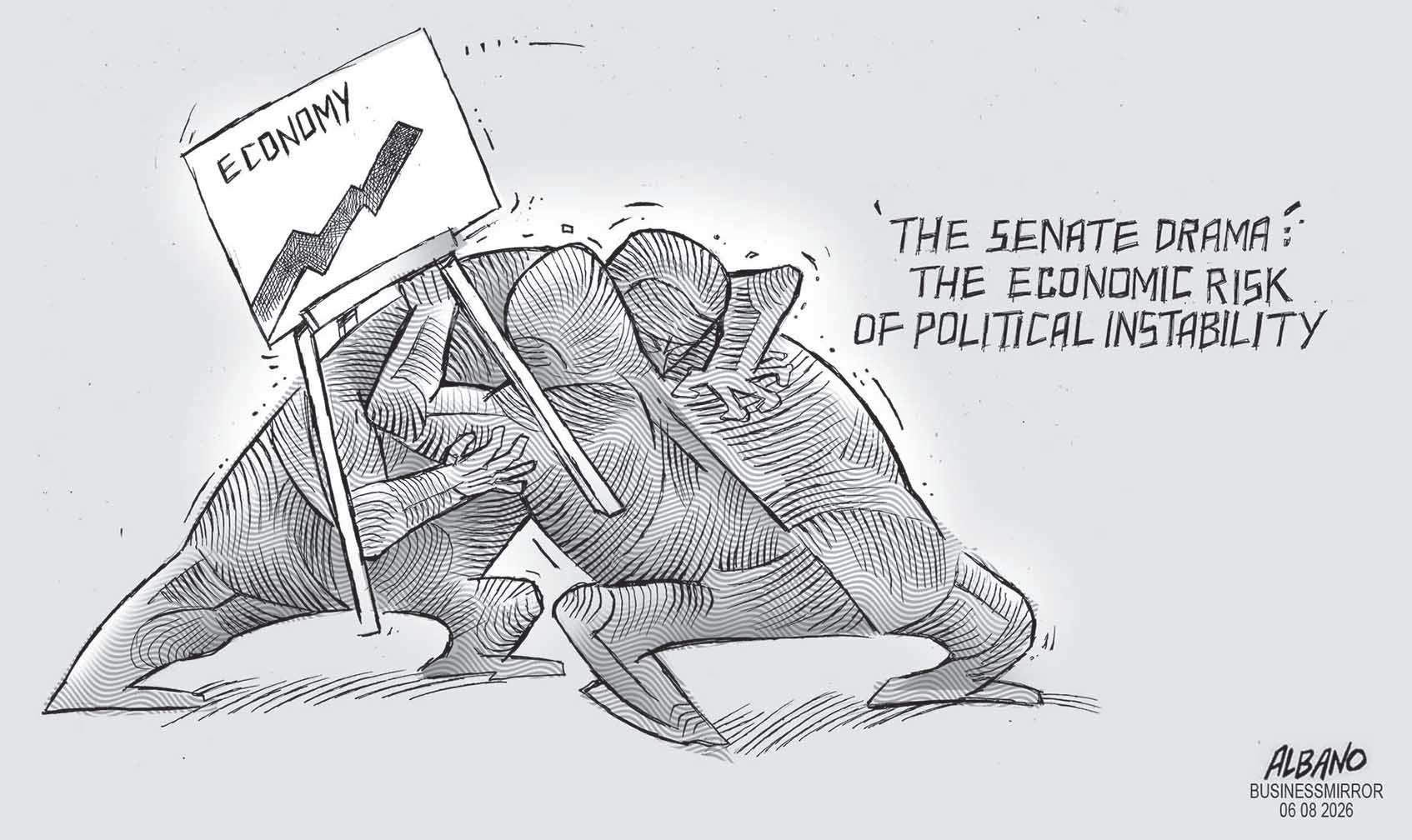
When chambers burn: Lessons history offers the Philippine Senate

TRISING SUN
HERE is a particular kind of vertigo that sets in when you watch your country’s legislative chamber become a theater of the absurd, and then realize that the world has seen this before, more than once, and rarely with happy endings.
In the span of a single month, the Philippine Senate has absorbed enough drama to fill a TV series: a fugitive senator singing hymns to his former colleagues while eluding ICC arrest warrants, gunfire echoing through the GSIS Building, a Senate president deposed mid-session, a two-day shutdown, and an impending impeachment trial looming in July. And the hard part hasn’t even started.
For investors, business leaders, and anyone whose livelihood depends on predictable governance, this is not merely political spectacle. It is a flashing yellow light.

ALorenzo M. Lomibao


History offers some lessons. First, Institutional dysfunction is contagious and expensive. The Roman Senate was not brought low in a single day. It gradually degraded amid procedural crises, factional vetoes, and strongmen exploiting legislative chaos for personal gain. By the time Caesar crossed the Rubicon, the Senate had already hollowed itself out. Closer to our era, Brazil’s impeachment politics in the 2010s chilled foreign direct investment and delayed infrastructure spending by years. South Korea’s 2016 impeachment of President Park Geun-hye showed that even transparent, rules-
bound proceedings suppress private capital deployment. The lesson is not that impeachments are wrong; it is that the manner institutions handle them—their steadiness, their adherence to procedure—determines how much economic damage the process inflicts beyond the political.
A second lesson would be this: Walkouts and quorum wars are symptoms, not causes. The 1856 caning of Senator Charles Sumner on the US Senate floor, and the filibuster wars of the 1960s civil rights era, both revealed what happens when a chamber becomes a battlefield for a conflict it has no consensus to resolve. What the Philippine Senate is experiencing is not really about teleconferencing rules or committee chairmanships. It is about the collision of two massive political forces— the Marcos and Duterte camps— that once allied out of convenience and have since become rigid rivals. Businesses and investors should look past the parliamentary theater and assess the underlying power dynamics directly, because those dynamics will shape regulatory environments and government spending priorities well into 2028.
And, finally: Accountability proceedings demand institutional armor. When Parliament impeached Warren Hastings in 1788—a sevenyear trial ending in acquittal—Edmund Burke’s prosecution still established that power was answerable to law. The proceedings mattered not for their verdict, but because the institution held its shape under pressure. With 74 percent of Filipinos supporting the Duterte trial, public trust in the accountability process remains intact. That mandate must not be squandered. The Philippines has navigated turbulence before. EDSA 1986 is proof that institutions can reset. But resilience is not automatic; it must be defended by the actors inside the institutions themselves. The Senate reconvening in July is not only adjudicating charges against a vice president. It is demonstrating, to citizens and capital markets alike, whether Philippine democratic institutions have the tensile strength to hold.
History’s verdict on chambers that failed that test is very clear. The question is whether this Senate has read the signs.
LITO GAGNI
BS-CBN would like the public to view the allegations raised by director Federico “Piki” Lopez as nothing more than an internal family dispute. The characterization is understandable. Family disagreements are often messy affairs, filled with old grievances, competing loyalties, and emotions that rarely belong in public view.
There is only one problem. ABS-CBN is not merely a family company. It is a publicly listed corporation. And it is governed by transparency and governance rules that have to be strictly adhered to by listed companies such as ABS-CBN.
And when allegations involving billions of pesos, executive compensation, capital expenditures, accounting practices, and the stewardship of shareholder funds are raised by a sitting director, the issues cease to be private matters. They become matters of public interest.
That is the disconnect that makes the controversy worth watching.
The legal battle itself has already generated an avalanche of headlines. Piki Lopez has been subjected to a torrent of criticism from other members of the Lopez family, including moves that led to his removal from leadership positions within the family’s business empire. The temptation, therefore, is to
view the dispute solely through the lens of a family feud.
But doing so risks overlooking the larger questions now before regulators and investors. In his complaint before the Securities and Exchange Commission, Piki Lopez raised allegations that strike at the heart of corporate governance. And they bear watching from the standpoint of regulators and the investing public.
Among them is the claim that ABSCBN accumulated approximately P45.5 billion in losses from 2020 to 2025, yet management allegedly distributed some P10.6 billion in compensation packages, advances, and related benefits to executives and favored individuals during the same period.
The complaint likewise questions approximately P12.1 billion in spending on property and equipment. Given the loss of the company’s broadcast franchise, Piki Lopez argues that share-
holders deserve a clearer understanding of the economic rationale behind those expenditures.
He further raises concerns regarding certain accounting treatments involving subsidiaries and dividend declarations, alleging that some transactions may have created an impression of financial strength that was not fully reflected in actual cash generation. These are serious allegations. Whether they are accurate is a matter that regulators—not columnists— must determine. But seriousness alone is enough to justify scrutiny. Transparency does not require proof before questions may be asked. Transparency requires that questions be answered.
The controversy deepened when Piki Lopez objected to a proposed P2-billion capital infusion into ABS-CBN, arguing that unresolved audit issues should first be addressed. He has consequently petitioned the SEC to appoint an independent management committee to oversee the company’s affairs and safeguard its remaining enterprise value.
For its part, ABS-CBN has defended its management and recovery efforts, describing Piki Lopez’s public criticisms as unfair and uncalled for while urging that the company not be dragged into what it characterizes as an internal family dispute.
That response may resonate within the context of family relations. It is less persuasive within the context of public markets.
Listed corporations operate under a different standard. They enjoy access
to public capital and, in return, assume obligations to public disclosure. Matters that may be private in a family corporation often become material information in a publicly traded one. In broadcasting, credibility is currency. In the investment community, transparency is capital. Both are difficult to earn and easy to lose. The SEC’s task is not to determine which branch of the Lopez family deserves to prevail in this latest boardroom confrontation. Its responsibility is far more important. It must determine whether investors have been given a complete and accurate picture of the company’s affairs and whether corporate governance standards have been faithfully observed. Ultimately, the issue is not whether Piki Lopez should win the argument. The issue is whether shareholders deserve to hear the answers. After all, listed issues have a duty to disclose any material information that will have an impact on its share price. That is why companies that declare dividends are bound by rules to immediately disclose the same. In much the same way, any possible impairment in the listed company’s capital has also to be disclosed. Public companies are not judged merely by how they perform when times are favorable. They are judged by how willing they are to confront difficult questions when those questions arrive. In broadcasting, silence creates dead air. In the capital markets, unanswered questions create uncertainty. Neither serves the interests of investor confidence.
Atty. Jose Ferdinand M. Rojas II
Estate tax amnesty:
After the deadline, there is still much work to do

TJoel L. Tan-Torres
DEBIT CREDIT
HE article published in the June 1, 2026 issue of my Debit Credit column was inadvertently taken from my inventory of previously written articles.
The said article was written about a year ago. Consequently, some of the information contained therein had already lapsed as of June 2025 and is no longer applicable or current in 2026. I take full responsibility for this mix-up and apologize for the confusion it caused.
But even after the lapse of the estate tax amnesty availment period on June 14, 2025, there are still many things that families, heirs, estate administrators, and their advisers must do, whether they availed themselves of the amnesty or not. The end of the filing and payment period of the amnesty does not end the work of estate settlement. In many cases, it merely closes one tax and settlement window and opens the next, more practical stage. This includes completing the documents, securing the electronic Certificate Authorizing Registration or eCAR, transferring titles, cancelling encumbrances on the properties, resolving disputes among heirs, and finally putting inherited assets to productive use. The estate tax amnesty program helped many families settle unpaid estate tax obligations at a more manageable cost. However, payment of the estate amnesty tax is not the same as completion of the entire inheritance and estate process. Families that filed and paid within the prescribed period must still make sure that their documentary submissions are complete and that the proper Bureau of Internal Revenue (BIR) Revenue District Office can process the issuance of the eCAR. This is particularly important for real properties. Without the eCAR, the Register of Deeds cannot proceed with the transfer of title from the deceased’s name to the heirs, buyers, or other transferees. Without a transfer of title, the heirs may still find themselves unable to sell, mortgage, partition, develop, or fully use the inherited property. The same practical concern applies to personal properties such as bank deposits, shares of stock, vehicles, and other assets, where financial institutions, corporations, or government offices require proof of tax clearance and authority before transfer.
One important clarification issued by the BIR relates to the proof of settlement of an estate, such as an extrajudicial settlement or court order. Under Revenue Memorandum Circular (RMC) No. 40-2025, the proof of settlement of the estate was not required to accompany the Estate Tax Amnesty Return at the time of filing and payment of the estate amnesty tax if it was not yet available. The non-submission of the extrajudicial settlement or court order at that stage did not invalidate the application for estate tax amnesty. However, the same proof of settlement remains required during the processing and issuance of the eCAR.
This clarification is necessary. Many families were able to file and pay the estate tax amnesty even though the extrajudicial settlement (EJS) had not yet been completed. The settlement of the estate and agreement as to its distribution of the assets of the deceased can be a very complicated process. This may happen where some or all of the heirs are abroad, where a patriarch or family decision-maker cannot personally attend to the documents, where an heir has not yet signed any legal document, like the EJS, or where family discussions on
11
or 12 or 13?

IThe real value of estate settlement is reached only when the inherited properties can finally be used. A land title placed in the proper names of the heirs can be sold, leased, mortgaged, developed, subdivided, partitioned, or used as capital for a family enterprise.
partition are still ongoing. But families should not misunderstand this BIR clarification. The BIR may allow payment without the proof of settlement at that stage, but the heirs must still submit the settlement document to obtain the eCAR and complete the transfer process.
For this reason, families should now focus on completing the estate documentation. The extrajudicial settlement should identify the decedent, the heirs, the estate properties, the agreed sharing or partition, and the persons authorized to process the tax clearance and transfer. If the estate settlement is judicial, the court order or judgment should be secured and submitted. If an heir is abroad, the special power of attorney and other documents executed overseas should comply with consular or apostille requirements.
For real properties, the heirs must prepare and submit the required titles, tax declarations, certifications from the assessor, location plans where needed, valuation reports and estimates, and other documents required by the BIR and the Register of Deeds. For bank deposits, investment accounts, shares of stock, vehicles, and other personal properties, the heirs must coordinate with the banks, corporations, transfer agents, government agencies, and other custodians of the property. The objective is not only to prove payment of estate tax, but to complete the legal transfer of ownership. There is also the matter of encumbrances. Many inherited properties carry annotations, mortgages, adverse claims, notices of lis pendens, liens, unpaid real property taxes, or other burdens that prevent clean transfer or productive use. These should be reviewed, settled, cancelled, or resolved. A property may be inherited, but if its title remains burdened by an unresolved encumbrance, it may still be difficult to sell, lease, mortgage, develop, or contribute to a family corporation or business venture. The real value of estate settlement is reached only when the inherited properties can finally be used. A land title placed in the proper names of the heirs can be sold, leased, mortgaged, developed, subdivided, partitioned, or used as capital for a family enterprise. Bank deposits and shares of stock can be transferred, consolidated, invested, or distributed. Idle family assets can become productive assets. This is the larger purpose of estate settlement.
To be continued
Joel L. Tan-Torres was the former Dean of the University of the Philippines Virata School of Business. Previously, he was the Commissioner of the Bureau of Internal Revenue, the Chairman of the Professional Regulatory Board of Accountancy, and a partner of Reyes Tacandong & Co. and the SyCip Gorres and Velayo & Co. He is a Certified Public Accountant who garnered No. 1 in the CPA Board Examination of May 1979. He is now back to his tax practice with
Siegfred Bueno Mison, Esq.
THE PATRIOT
T was a numbers game after all. The question of what base number should determine a quorum in the Senate has become a subject for legal pundits and constitutional scholars alike. Before the latest series of political strikes and counterstrikes between the camps of recently unseated Senate President Tito Sotto and newly deposed Senate President Alan Peter Cayetano, the Senate was evenly divided: 11 senators aligned with the minority and 11 with the majority. It was, in effect, a deadlock—until one senator chose to fulfill his constitutional duty by attending and joining the other faction.
Some continue to argue, consistent with Senator Cayetano’s position, that he remains Senate President despite jurisprudence dating back to 1949 that appears to suggest otherwise. I am neither a constitutionalist nor a professor of political law, so I defer to colleagues in the legal profession who are more familiar with the constitutional and procedural questions surrounding a deeply divided Senate. Do 12 senators constitute a quorum for purposes of declaring committee positions vacant and even declaring the office of Senate President vacant, given that the Senate has 24 members but two are currently indisposed and apparently beyond the Senate’s coercive powers? Constitutional scholars may continue to debate the issue.
I would not be surprised if one of the factions eventually seeks relief from the Supreme Court. I would rather see the High Court refrain from intervening in the internal affairs of a co-equal branch unless events spiral beyond control to the detriment of the Filipino people.
What is certain is that an important impeachment trial could be delayed indefinitely while this impasse remains unresolved. For my part, I simply wish to reflect on a rather inconspicuous number that now finds itself at the center of national attention: 11.
The number 11, coming imme-
diately after 10, which is a number often associated with law and order, is rarely viewed positively in symbolic traditions. Numerologists often associate 11 with disorder, imbalance, and uncertainty. Being one short of 12, a number traditionally representing perfection and completeness, 11 can signify confusion or instability. Even in common Filipino usage, the Spanish word onse (eleven) has taken on a colloquial meaning associated with being fooled or deceived. In popular speech, to be “na-onse” is to have been taken advantage of. Whether by coincidence or not, 11 has long carried uncomfortable associations.
This symbolism becomes even more interesting when viewed through the lens of our Constitution. Article XI (eleven) of the 1987 Constitution introduced the principle of public accountability through the powers of the Ombudsman and the impeachment process for certain high officials. Whenever Article XI is invoked, it is usually because questions have arisen regarding the conduct of public servants and the need for correction or punishment.
Perhaps providentially, “XI,” the Roman numeral equivalent of 11, is the very article that reminds public officials of their obligations to the people: “Public office is a public trust. Public officers and employees
must, at all times, be accountable to the people, serve them with utmost responsibility, integrity, loyalty, and efficiency; act with patriotism and justice, and lead modest lives.”
At a time when the Senate finds itself divided and an impeachment proceeding hangs in the balance, Article XI serves as a timely reminder that public office ultimately exists not for political factions but for the Filipino people.
Biblical history likewise offers intriguing reflections on the significance of 11. Most people are familiar with the story of the 12 disciples who became 11 after Judas Iscariot betrayed Jesus. His departure created uncertainty among the remaining disciples until Matthias was chosen to fill the vacancy. Only when the 12 were restored did the apostles embark upon their mission to spread the Gospel throughout the world. Although Matthias remains one of the lesser-known figures in Scripture, his selection restored completeness to the apostolic body and enabled the Church to move forward in unity and purpose.
Another interesting parallel may be found in the 11th book of the Bible, 1 Kings. The book begins with a united kingdom under Solomon but gradually transitions into the tragic story of a nation divided between Judah and Israel. One cannot help but think of contemporary political divisions. A central lesson of 1 Kings concerns leadership and the counsel leaders choose to follow.
King Rehoboam rejected the wisdom of experienced advisers in favor of younger and less prudent counsel, a decision that accelerated division within the kingdom.
Whether one agrees with the group’s politics is secondary to the larger principle that public officials must remain accountable to the people they serve. “Na-onse na tayo noon, na-onse tayo ulit ngayon.” We have been fooled before; we are being fooled again. Perhaps that sentiment explains why the number 11 continues to resonate. It evokes moments of division, uncertainty, and public frustration.
Yet, both Scripture and history suggest that disorder need not have the final word. The failures of kings recorded in 1 Kings were met with divine judgment, but God’s commitment to His people endured. Likewise, our present political difficulties should not lead us to cynicism or despair.
Amid the noise and drama surrounding the Senate leadership, believers are called to remain steadfast in faith, patiently awaiting His guidance and justice. May “11,” figuratively speaking, become “12” once more so that completeness may again characterize our institutions and our national life. Whether the majority is 12 or 13, this Bible verse is numerically and literally apt—“Now all has been heard; here is the conclusion of the matter: Fear God and keep his commandments, for this is the duty of all mankind.” (Ecclesiastes 12:13).
Siegfred has a diversified set of education and experiences which has made him a game changer and a servant leader in organizations. His professional degrees came from the United States Military Academy at West Point in New York, Ateneo Law School, and University of Southern California, Los Angeles, USA. His corporate experiences include stints as general counsel for the country’s flag carrier, a food exporter with manufacturing plants in Davao and in Laguna, and a sports distributor company. Siegfred is a former soldier and a lawyer by profession, a teacher and inspirational speaker by passion, and a book author and a writer with a mission.
Even amid political turmoil, the message of 1 Kings is not ultimately one of despair. Throughout the failures of kings and kingdoms, God’s faithfulness to His people remained constant. The theme of 11 also finds expression in contemporary civic life. A recently formed watchdog group called Artikulo Onse, led by former congressman and current Liberal Party president Lorenzo Tañada III, has adopted the language of Article XI as a rallying point for public accountability. Some observers may view Artikulo Onse through partisan lenses—as liberal, “yellow,” or left-leaning. For me, however, corruption has never had a political color. Public accountability should be color-blind.
Indonesia’s crisis of confidence as markets decode Prabowo
By Grace Sihombing, Claire Jiao & Norman Harsono
INDONESIA spent much of this week confronting a question that might have seemed unthinkable a few short years ago: what happens when investors stop believing in Southeast Asia’s largest economy?
The answer played out across trading screens around the world and at government offices in Jakarta. Stocks sank to their lowest levels since the pandemic, the rupiah breached the psychologically important 18,000-per-dollar level for the first time and rumors swirled that Finance Minister Purbaya Yudhi Sadewa was on the way out.
By the end of the week, Purbaya and senior government officials were on the defensive. “I’m not the type to quit,” Purbaya said at a state budget briefing Friday. He was at pains to talk up the country’s fiscal position, saying the nation’s assets remain stable and inflows healthy.
“Optimism about the Indonesian economy remains strong,” he said. “Why are people saying the economy is heading toward a recession when economic stimulus is sufficient, liquidity is sufficient, and credit growth is also sufficient? Don’t be swayed by a single news report.”
But the damage was largely done. Investors increasingly see Indonesia as a market where policy uncertainty, political intervention and execution risks are beginning to outweigh one of the developing world’s most compelling long-term growth stories—a sentiment that’s been growing since President Prabowo Subianto took office less than two years ago.
Investors are “concerned about the direction of policymaking in Indonesia,” Jason Tuvey, deputy chief emerging markets economist of Capital Economics, said. “Especially so, after widespread protests
in the middle of last year led to the sacking of respected finance minister Sri Mulyani Indrawati. Since then, the government has adopted increasingly populist and interventionist policies.”
Speculation over Purbaya’s departure wasn’t the only thing sending markets into a tailspin. There were also mounting concerns over the government’s economic management, confusion regarding new commodity export rules and a widening corruption investigation involving Prabowo’s flagship $15 billion free meals program.
Rising oil prices driven by the conflict in the Middle East are also adding to pressure on Indonesia’s economy, forcing the government to spend more on fuel subsidies while facing higher import costs for crude oil and LPG. Like several of its Southeast Asian neighbors, Indonesia imports a significant share of its crude from the region, making it particularly vulnerable to supply disruptions and price shocks.
“Indonesia isn’t alone in Asia in feeling considerable financial market pressure but in its case, the global energy shock has seemingly brought pre-existing concerns about the fiscal outlook and institutional dynamics more sharply into investors’ focus,” said Peter Mumford, who heads the Southeast Asia practice of Eurasia Group. “While the government has been sending stronger signals about fiscal discipline recently with the aim of reassuring investors, new policies have created more uncertainty.”
Indonesia’s benchmark stock index has now fallen more than 35% this year, making it the worstperforming major equity market tracked by Bloomberg. The rupiah has dropped roughly 14 percent since Prabowo took office and is Asia’s weakest currency in 2026. Foreign investors have cut holdings of Indonesian sovereign bonds by about 86 trillion rupiah ($4.8 billion) since last August.
The plunging currency is also making the repayment of US dollar-denominated debt a daunting prospect.
According to data compiled by Bloomberg, the government and companies in Indonesia have some $12.6 billion of foreign currency bonds due in 2027 and $11.3 billion to $16.3 billion in each of the four years thereafter. The government has issued more than $11 billion in foreign-currency notes so far this year, the data show.
Putting additional downward pressure on the rupiah, according to Mumford, is Bank Indonesia’s expanded growth mandate. The parliament on Thursday passed revisions to a sweeping financial-sector law that grants it power to conduct performance evaluations of Bank Indonesia, the Financial Services Authority and the Deposit Insurance Agency. That “risks exacerbating concerns about institutional independence,” Mumford said.
For many, the current turbulence isn’t the result of a single week but the cumulative effect of a series of policy shifts under Prabowo, who this week kept largely out of sight and mum on market developments.
Since taking office, the former defense minister has pursued a far more interventionist economic agenda than many anticipated. He’s expanded the state’s role in strategic
industries, seized some 4 million hectares of palm oil plantations, mine concessions and processing facilities—an area roughly the size of Switzerland—channeled billions of dollars into sovereign wealth fund Danantara and repeatedly emphasized the need for stronger government direction of economic activity. Supporters argue such measures are necessary if Indonesia is to escape the middle-income trap and accelerate economic growth toward Prabowo’s stated target of 8 percent. “There’s a false impression that fiscal policy is being poorly managed,” Purbaya said Friday. “All of the president’s policies have been calculated accurately and in detail by the president and us.”
But investors see a huge expenses bill. The departure last year of Indrawati removed one of the market’s most trusted advocates of fiscal discipline. Since then, concerns have mounted about rising government spending, the sustainability of Indonesia’s fiscal framework and the independence of key economic institutions. Those worries deepened this week when Prabowo revealed he had ordered an investigation into alleged misconduct at the National Nutrition Agency after receiving reports of irregularities. He subsequently dismissed agency head Dadan Hindayana and his two deputies, and the three are now detained as part of a corruption probe. They could not be reached to comment.
Prabowo sought to turn the free meals scandal into evidence of his anti-corruption credentials, warning officials in a speech in West Java on Wednesday evening that “my eyes and ears are everywhere” and pledging unlimited support for law enforcement agencies pursuing
Monday, June 8, 2026
2nd Front Page
BusinessMirror
APPEALS COURT UPHOLDS ERC FINDING THAT PEMC IS A GOCC
By Joel R. San Juan @jrsanjuan1573
THE Court of Appeals
(CA) has affirmed the Energy Regulatory Commission’s (ERC) finding that the Philippine Electricity Market Corporation (PEMC) is a government-owned and controlled corporation (GOCC), thus, it is not entitled to certain components of its budgetary requirements for 2018 in the amount of P373.2 million.
In a 20-page decision penned by Associate Justice Lorenzo Dela Rosa, the CA’s Second Division denied PEMC’s petition seeking to nullify the ERC’s decision issued in March 2022 which approved with modifications its application for the approval of the level of market transactions fees (MTF) for the year 2018 in the amount of P448.9 million out of its P822.2 million.
The PEMC argued that the ERC’s decision was arbitrary and unjust as it also imposed retroactive disallowances and ordered the refund of expenditures already incurred in good faith pursuant to its valid authority. It stressed that the proposed amount of P822.2 million was reasonable, necessary, and supported by legal and regu-
latory basis. It also argued that the ERC gravely erred and acted beyond its regulatory authority when it unilaterally declared that PEMC is a GOCC and ruled that only one entity should operate and govern the wholesale electricity spot market (WESM).
On June 8, 2001, Republic Act No. 9136, or the Electric Power Industry Reform Act of 2001 (Epira) was enacted. Among the reforms introduced is the establishment of a mechanism for identifying and setting the price of actual variations from the quantities transacted under contracts between sellers and purchasers of electricity, thus, serving as a venue for trading electricity as a commodity. PEMC was incorporated on November 18, 2003, to serve as the autonomous group market operator and governance arm of the WESM, as mandated by Section 30 of Epira.
The CA pointed out that based on existing provisions and rulings of the Supreme Court, an entity is considered GOCC if all three attributes are presents: (1) the entity is organized as a stock or non-stock corporation; (2) its functions are public in character; and (3) it is owned or, at the
Cabinet tweaks economic goals after weak Q1 growth
By Reine Juvierre S. Alberto @reine_alberto
THEweak first-quarter economic growth has prompted the country’s economic managers to review their targets, but they remain optimistic that stronger government spending and investment activity will revive growth.
Budget Secretary Kim Robert C. De Leon told reporters last Thursday that economic managers are “trying to really be bullish” after the 2.8-percent economic growth in the first quarter and the higher inflation data in the past months.
The Cabinet-level Development Budget and Coordination Committee (DBCC), composed of the country’s economic managers, met last May 25 to discuss the government’s macroeconomic and fiscal assumptions.
Here, De Leon said the DBCC is eager to catch up after the firstquarter growth and “utilize what -
ever” to support the economy.
“ Di naman tayo pwedeng paatras [We can’t go backwards]. If there are correcting measures that we can implement, we will do that— if that is what is needed for us to be back to our trajectory,” De Leon said.
This optimism among economic managers is rooted in this year’s P6.793-trillion national budget, which De Leon described as a “tool for growth,” and how it will be spent.
“If there is still room within the budget that we can take advantage of, then let’s use all of those,”
the Budget chief said.
De Leon said the government is aiming for an improvement from the first quarter’s performance.
“We target to do better than [the first quarter], of course. That’s the target. Better than 2.8,” he said, although he declined to provide a specific growth estimate.
Aside from government spending, De Leon said economic growth hinges on private-sector investment and the government’s ongoing efforts to facilitate investment that supports broader economic activity.
As for the government’s part, De Leon said the Department of Budget and Management would continue to release funds, which are spent accordingly and lawfully by government agencies.
De Leon also pointed to improvements in government fund releases and said the focus now is on ensuring agencies implement their projects on time.
“We saw a difference in terms of releases, so it now depends on how the agencies are implementing their respective budgets because government spending plays a role in our overall growth,” De Leon said.
“We saw an uptick now in terms
of our available releases. So it’s now up to the agencies. They have until June to actually implement their projects, and hopefully that will contribute to our [secondquarter] growth,” he added.
DBCC still recalibrating assumptions
DE LEON said the DBCC is not yet done with its macroeconomic assumptions and fiscal program, as economic managers are still looking closely and recalibrating the figures they saw during the meeting. Asked if there were some adjustments made, De Leon said the DBCC is sensitive to the developments in the macroeconomic environment.
“We saw some changes. So we have to consider all of those in making the assumptions moving forward,” he added. “We’re just ensuring that whatever estimates we’ll be recommending to the President, that’s sound and realistic based on what we’re currently experiencing.”
The DBCC lowered its GDP growth projections to 5 to 6 percent for 2026 from the previous 6 to 7 percent target range. The inflation target and forecast remained at 2 to 4 percent.
MakatiMed’s Dr. Amado Flores III: Knowing the difference between ER and urgent care leads to better patient outcomes
By Francine M. Marquez
Every year, thousands of Filipinos head straight to the emergency room (ER) for a wide range of medical concerns—from coughs and allergies to sprains, injuries, and even heart attacks.
While these visits are often driven by discomfort, pain, or concern, the conditions range from life-threatening emergencies requiring immediate intervention to minor illnesses that can be treated without hospitalization.
However, due to limited access to healthcare, many patients with less severe conditions still go directly to the ER, where they may have to wait while more acute cases are prioritized.
To streamline triage, improve care for patients with minor conditions, and help decongest its emergency room, Makati Medical Center recently launched its Urgent Care Center.
In the latest episode of “Freshly Brewed,” BusinessMirror’s weekly podcast, Dr. Amado A. Flores III, Head of the Emergency Department and Urgent Care Center of Makati Medical Center, joins Anne Ruth Dela Cruz, BusinessMirror’s Health and Fitness Editor, for a practical guide to making the right care decisions when every minute counts.
“The MakatiMed Emergency Center is a very crowded department. We have a high volume of patients. And sometimes, if our

patients need medical attention, they go to the emergency department. Sometimes they wait for a while due to overcrowding. And this basically inspired us to give them a new place where they can still seek consultation even when they’re not in the emergency room,” Dr. Flores explained. He noted that the hospital receives between 200 and 250 patients every 24 hours, with cases ranging from simple coughs and colds to critical trauma injuries.
“When you say ‘emergency,’ we try to respond to all cases,” clarified Dr. Flores. “But the main difference between an emergency and an urgent case lies in the symptomology, the acuity, or severity of the illness.”
ER vs. Urgent Care IN ERs, life- and limb-threatening conditions are treated.
“These include major traumas, the complex medical emergencies wherein every minute matters. It’s very critical that we give patients timely treatment because they are in a life-threatening state. If we miss by simple seconds, it is a thin line between life and death.”


Cases handled by the Urgent Care Center, on the other hand, require immediate care but are generally non-lifethreatening.
“There is a lower acuity of cases that still need immediate attention. These could be light or minor traumas, patients with stable conditions such as cough, and not the usual requirement of a typical emergency room,” he explained.
If a patient twists an ankle but remains ambulatory, for instance, he may be directed to the Urgent Care Center for assessment and treatment. However, if the injury resulted from a severe accident and is accompanied by numbness, swelling, or severe pain, immediate treatment in the ER may be necessary.
Dr. Flores said patients experiencing difficulty breathing, low oxygen saturation, dangerously low blood pressure, rapid heart rate, or chest pain should seek emergency care immediately.
“If your hands are clammy and you’re unstable, if your fever is too high and you’re very weak and have chills, these are life-threatening emergencies—anything threatening your vital signs. If you have these symptoms, then you have to go to the emergency department,” he advised.
Urgent care, meanwhile, is appropriate for minor traumas such as cuts, wounds, and minor burns.
“If you have infections like cough, colds,
and fever, but you’re stable enough—you can still walk and talk—then you can go to the Urgent Care Center,” he explained. “And if you have some pains, we can give you oral medications instead of IV medications.”
Twelve-hour operations
FOR now, the hospital’s Urgent Care Center operates daily from 10 am to 10 pm. The schedule was designed in response to the high volume of patients seen by the Emergency Department during those hours.
Located in the Makati Business District, the center primarily caters to working professionals who often seek medical consultation after office hours.
Knowing when to go to the emergency room or the urgent care center is important not only for receiving appropriate treatment but also for helping hospitals manage patient flow more efficiently.
“For us Filipinos, time is very important. When they go to the emergency department, they think their case is an emergency and want immediate attention. What they don’t know is that every case in the department is different, so doctors see them based on their acuity,” he said.
Awareness of the distinction between the two units also contributes to better patient care and more efficient use of hospital resources.
“When patients with non-critical conditions overcrowd the department, they
utilize the resources of the hospital. When doctors and nurses are doing their job to save a life, they cannot immediately attend to them. When patients are overutilizing the resources, they are not just wasting the time of the hospital, but also money and patient safety.”
“It’s important that we separate these two patients, those in life-threatening conditions and those in non-life-threatening conditions, while still giving them the proper care that they need.”
Meanwhile, patients at the Urgent Care Center can expect a calmer environment compared to the unpredictable and highintensity atmosphere typical of an ER. There are no bloodied patients or resuscitation cases competing for attention.
Because of the lower acuity of cases, turnaround time for receiving medical attention is estimated at around 60 minutes, with patient disposition typically completed within three hours.
This is faster than in the ER, where turnaround time ranges from one to four hours, with additional waiting time if the patient needs to be admitted.
Facilities at the Urgent Care Center are basic but modern. These include a treatment room, two consultation rooms, and a medication area. Patients may also avail themselves of minor blood tests, urinalysis, ECG, and chest X-rays. The center is staffed by a dedicated
team of emergency care specialists, ensuring efficient and streamlined service while patients wait comfortably in a quieter setting.
Seek medical attention
IF there is discomfort or a change in one’s condition, Dr. Flores encouraged patients not to delay seeking professional advice.
“Trust the specialist who can tell you that you need immediate attention. We have a triage specialist who can gauge your condition.”
“But please do not delay seeking medical help because it’s very difficult if we see you late. If you’re feeling dizzy or have some discomfort that is unusual to you, seek medical consultation,” he continued.
Health care navigation not only improves patient outcomes but also helps hospitals deliver better and safer care.
“When we say patient navigation, it’s really separating two streams of the patient: the emergency and urgent care. So, when we have two separate streams of patients, we don’t get into that gridlock. That’s the usual emergency care problem where those with lower acuity are waiting anxiously; they don’t know what’s happening.”
“Now, if you have two streams of services, delivering care services is faster, and it is a safer way of patient care,” he added. According to Dr. Flores, being in tune with one’s body and recognizing physical warning signs are essential to making the right health care decisions.
“It depends on the context or perception of the individual. If you feel that the symptoms need immediate attention, then it can be considered an emergency. But not all emergencies are true emergencies— the life-threatening conditions that we, the doctors, have to address first.”
“For patients who are not really in a lifethreatening condition but still need to be seen in a responsive manner, if they were to overcrowd the emergency department, they would have lower customer satisfaction because of the waiting time.”
“So, it’s learning and knowing where to go. If your condition is not that serious, and you’re stable enough, you can go to the MakatiMed Urgent Care Center.” For more information, visit the
Dr. Amado A. Flores III, Head of the Emergency Department and Urgent Care Center of Makati Medical Center,
Care Center with Anne Ruth Dela Cruz, BusinessMirror's Health and Fitness Editor.
Dr. Amado A. Flores III, Head of the Emergency Department and Urgent Care Center of Makati Medical Center Anne Ruth Dela Cruz, BusinessMirror's Health and Fitness
Editor: Jennifer A. Ng
SEC: Amended MSLA rules to reduce compliance costs

By VG Cabuag @villygc
THE Securities and Exchange Commission (SEC) is streamlining the securities borrowing and lending framework by centralizing administrative functions with the Philippine Stock Exchange (PSE) in line with government efforts to build a more “efficient and integrated” short selling market in the country.
The SEC cleared the 2026 Revised Guidelines for Master Securities Lending Agreements (MSLAs) and Accession Agreements to multilateral MSLAs proposed by the PSE. Under the revised guidelines, the PSE will serve as the sole reviewing
and pre-clearing body for MSLAs and multilateral MSLAs. Such designation of the PSE removes the requirement for SEC pre-clearance and certification prior to registration with the Bureau of Internal Revenue.
This effectively reduces the MSLA registration processing timeline to five working days from the current seven working days. Meanwhile, pre-clearance for Accession Agreements will be completed within one working day.
The streamlined process also lowers compliance costs for market participants through the removal of the SEC processing and certification fee worth P5,030.
The PSE will now act as a one-stop shop for applicants and regulators, managing the entire administrative cycle, including the receipt of documents and fees, coordination
of reviews and the transmission of pre-cleared documents to the BIR. It will also handle the assignment of MSLA reference numbers for BIR registration purposes, a function previously performed by the SEC.
Copies of all endorsed and transmitted documents will be furnished to the SEC for regulatory oversight and post-audit purposes, consistent with SEC Memorandum Circular No. 7, Series of 2006, or the SEC Rules on Securities Borrowing and Lending (SBL).
The PSE said an MSLA is as a written contract between a lender/lending Agent and the borrower that defines and specifies the general terms and conditions under which shares of stock listed and traded through the PSE are lent or borrowed under an SBL arrangement.
PAL set to join global airline alliance

By Lorenz S. Marasigan @lorenzmarasigan & Carmel Pedroza
LEGACY carrier Philippine Airlines (PAL) said over the weekend it is joining the oneworld Alliance, which will give it access to a global network of nearly 1,000 destinations across more than 170 countries and territories.
PAL has signed a Memorandum of Understanding during the International Air Transport Association’s (IATA) 82nd Annual General Meeting in Rio de Janeiro which will con-
clude on June 8.
The move marks a significant milestone for the Philippines’s flag carrier, which will become the alliance’s 16th member airline and only the second full member based in Southeast Asia.
This development is expected to strengthen the Philippines’s role in global aviation while expanding PAL’s international reach through one of the world’s leading airline alliances. PAL Holdings President Lucio Tan III described the announcement as “a transformative step” for the airline and the region.
“This represents a major milestone in Philippine Airlines’ history,” Tan said in a statement.
“Joining oneworld enhances Southeast Asia’s presence within the alliance and creates new opportunities to connect the Philippines more closely with the rest of the world. Together with our alliance partners, we aim to provide greater travel options, seamless journeys, and service that reflects genuine Filipino hospitality,” he added.
The invitation was extended by the oneworld Governing Board, which is composed of the chief ex-
ecutives of the alliance’s member airlines. According to Robert Isom, CEO of American Airlines and chairman of the oneworld Governing Board, PAL’s addition aligns with the alliance’s long-term growth strategy in the Asia-Pacific region.
“Philippine Airlines brings a strong legacy and an important network that will enhance our presence across Southeast Asia,” Isom said in a separate statement.
“Its membership will strengthen connectivity in key markets and support future growth across the region.”
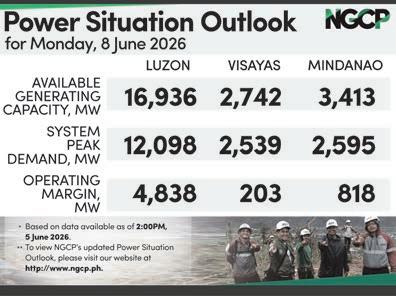

By Lenie Lectura @llectura
FIRST Gen Group has partnered with HMR Envirocycle Philippines Inc. (HMR Envirocycle) for “Drop IT for Good,” a campaign encouraging employees across the Lopez Group to recycle discarded IT and electronic waste.
Launched last June 4 at the Rockwell Business Center, the initiative facilitates responsible handling and processing of broken or obsolete devices from employees and subsidiaries. HMR Envirocycle, in turn, will support the responsible processing and recycling of the collected e-waste.
“Through this partnership with HMR Envirocycle, the First Gen Group aims to help keep e-waste away from landfills, waterways, and informal disposal channels, while promoting greater awareness of circular and responsible waste management,” said First Gen Vice President Shirley Cruz.
Cruz and other officials from the Lopez Group underscored the shared commitment of the conglomerate to advance practical and collective environmental action. They launched the campaign to kick off also the monthlong Lopez Group Envi Festival in observance of the Philippine Environment Month.
“Drop IT for Good reflects this broader commitment by making environmental action practical and accessible for employees. By

providing workplace-based collection points and building awareness on proper e-waste disposal, the campaign turns sustainability from a broad commitment into an everyday choice,” Cruz said.
Engr. Wilssie Sanchez of HMR Envirocycle conducted an awareness talk regarding the proper handling, recycling, and disposal of e-waste to reduce environmental hazards, allowing employees a simple way to contribute to pollution prevention and circularity.
HMR Envirocycle is an environmental services and circular economy solutions provider that supports responsible e-waste management through proper handling, recovery, recycling, data security, asset disposition, and disposal services. Its work helps organizations manage used and end-of-life electronics in ways that support circularity and environmental compliance.
This initiative aligns with First Gen Group’s existing environmental programs, including BINHI and the Create for the Climate program, which focuses on youth climate awareness.
The BINHI project is the country’s largest private sector-led forest restoration initiative that supports as well biodiversity conservation and the protection of native tree species.
First Gen has 1,764 megawatts of renewable energy capacity from a power plant portfolio running on geothermal, hydro, wind and solar energy, as well as from battery storage systems.
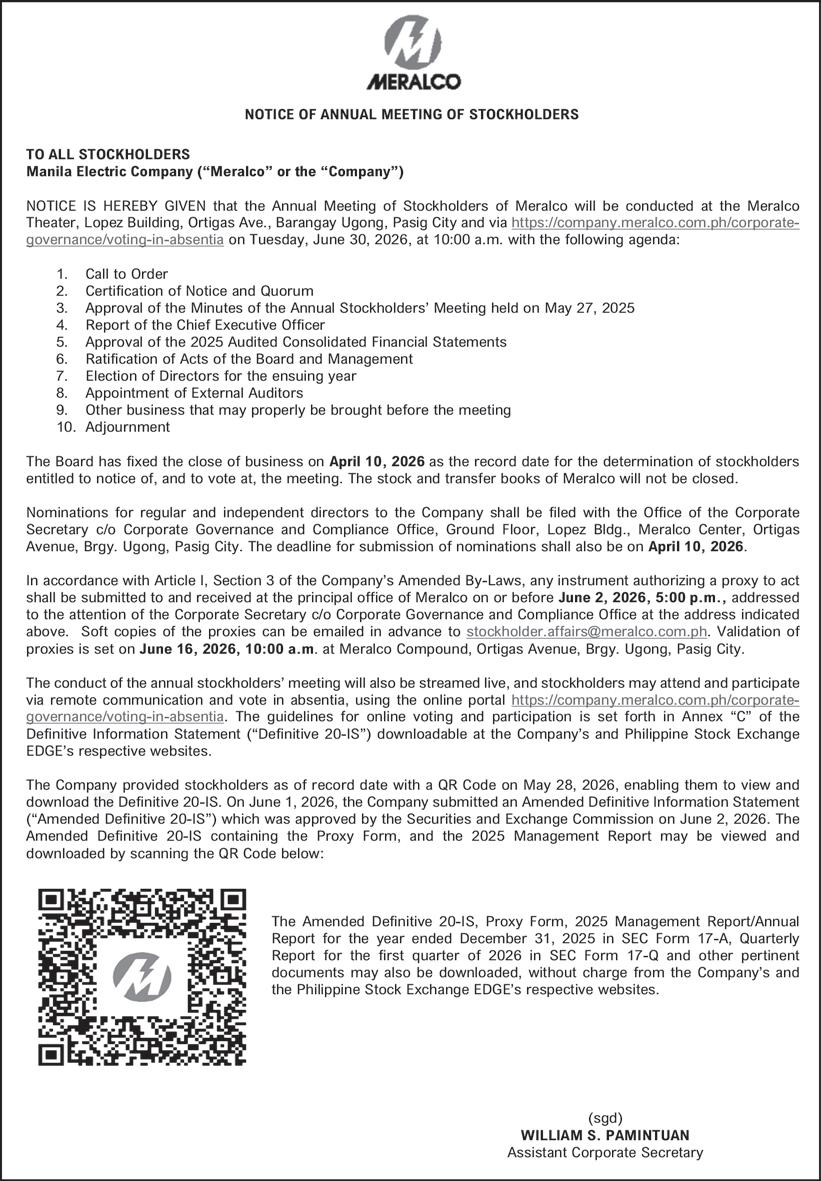
Banking&Finance
Prepping the workforce for autonomous security
AS security becomes automated, agents are taking on more intelligence-driven tasks, especially in the security operations center (SOC), but also in other parts of the cyber domain, including compliance, risk and identity management. In this context, what is the role of security professionals? What are the future skills of the cybersecurity workforce?
Let us explore first how agents and automation are transforming the cyber function.
The rise of agents AGENTS are making decisions and scanning the multitude of alerts that reach an incident desk, at a pace SOC analysts cannot match.
As non-human identities proliferate—including machine credentials, service accounts, and digital agents capable of creating and deleting other agents—autonomous security will play a critical role in identifying and monitoring their activity. AI and automation can accelerate the onboarding process, which now takes place primarily in the cloud. Traditional on-premises data centers cannot cope with such large data volumes.
To exploit vulnerabilities, cyber attackers are increasingly targeting and exploiting machine credentials through non-human identities, often via third parties such as hyperscalers and software as-a-service (SaaS) providers. This puts intense pressure on cybersecurity teams to identify a rapidly growing body of agents, monitor access permissions, and record their presence in inventories.
Robust cloud and data governance are crucial for implementation of AI systems—and deployment of agents by other agents—to ensure that data is securely stored and managed, and that AI systems are compliant with regulatory requirements. However, many organizations are dependent on a single hyperscaler, which leaves them vulnerable to any service disruption. Banks, retailers, telecommunications networks, government departments and other entities have all suffered due to temporary cloud provider shutdowns, leaving service account identities (SAIs) unable to access their services.
Building resilience with technology
CISOs are adopting a dynamic risk management approach to autonomous AI, using accepted principles of zero trust, clear policies, and access controls. Security teams are partnering with AI specialists and data science teams, and building safeguards, to demonstrate resilience to internal audit and external regulators.
With new agents emerging continually, CISOs are concerned that they are unable to identify and catalog these agents, or to determine which ones are vulnerable.
‘Shadow agents’ (autonomous or semi-autonomous AI agents) are popping up everywhere, from SaaS providers to existing agents that are even creating their own agents. This requires robust safeguards and policies to establish AI security posture management (AI-SPM), supported by continuous monitoring and improvement of AI models, data, and infrastructure. Although still nascent, AI-SPM focuses on identifying vulnerabilities and unauthorized access in line with AI security policies. As AI solutions proliferate, CISOs should establish red-teaming of these solutions, to build in AI security.
A new role for humans
AS agents become ever more autonomous, organizations and the security function will need to retrain and reposition their workforce to carry out more meaningful tasks— such as advanced threat analysis, strategic cyber decision-making, and AI integration. New roles may include AI agent managers—to oversee agent activity—and data governance specialists.
This is no longer a niche technical concern. In a tech report conducted by KPMG, 92 percent of technology executives say that

managing AI agents will become an essential skill within the next five years, highlighting a broader shift toward human oversight, governance, and intervention in autonomous systems. CISOs may also have to find ways to attract engineers to work in the internal audit function, to satisfy demand for greater AI capabilities.
Agentic-led cybersecurity presents a big opportunity to gain greater visibility and control over an organization’s digital assets. Supported by a strong security data lake, such an approach can shift cybersecurity from manual to automated and restore the balance of power to CISOs and their teams.
In the Philippine context THE Philippines is likewise experiencing the growing impact of cybersecurity threats amid the rapid adoption of artificial intelligence (AI) and accelerating digital transformation across industries. As AI increasingly influences decisionmaking, platform operations, and digital interactions, the need for a workforce equipped to manage emerging cyber risks, oversee AI systems, and strengthen cyber resilience is becoming more pronounced.
Recognizing these challenges, the Philippine government continues to strengthen its cybersecurity initiatives through programs focused on advanced threat assessment, workforce capability building, and improving national cyber resilience. Among these efforts is the implementation of the National Cybersecurity Plan and the recent partnership with the South Korean government to establish the National Cybersecurity Center (NCSC).
In the private sector, organizations are also recognizing that cybersecurity is no longer solely a technology function. The CEO, CFO and CISO must operate as a cohesive triad. Each contributes a unique perspective—strategy, value creation, and protection—but only through collaboration can digital and AI investments generate measurable business outcomes while managing risk effectively.
According to Frits Gerald M. Enriquez, deputy head of technology consulting and cybersecurity lead at R.G. Manabat & Co., “Preparing the cyber workforce for autonomous security requires a collective effort across government, industry, and academia.”
“As cyber threats and AI capabilities continue to evolve, organizations must invest not only in technology, but also in the people, governance structures, and capabilities needed to manage these technologies responsibly and securely,” Enriquez added.
As organizations continue to adopt AI and automation, the future of cybersecurity will depend as much on people as it does on technology. Building a future-ready cyber workforce, strengthening governance, and fostering collaboration across sectors will be essential to ensuring that innovation is accompanied by resilience, trust, and long-term security.
This article draws on insights from the KPMG Thought Leadership publication “Cybersecurity Considerations 2026: Building trust and enabling innovation in a dynamic world.”
Copyright 2026 R.G. Manabat & Co., a Philippine partnership and a member firm of the KPMG global organization of independent member firms affiliated with KPMG Int’l Ltd., a private English company limited by guarantee. All rights reserved. This article is for general information purposes only and should not be considered as professional advice to a specific issue or entity. The views and opinions expressed herein are those of the author and do not necessarily represent the BusinessMirror, KPMG International or R.G. Manabat & Co. For more information, you may reach out through phkpmgmla@kpmg.com, social media or visit www. home.kpmg/ph.
Rate cut effects seen as bank lending, liquidity post growth
By Andrea E. San Juan
THE Philippine economy may see a “measured expansion” in the upcoming quarter as the previous rate cuts delivered by the central bank are now taking shape through increased money supply and borrowing activity.
Jonathan L. Ravelas, senior adviser at Reyes Tacandong & Co., said the rebound in bank lending and the sharp pickup in domestic liquidity (M3) are being driven by the lagged effects of earlier rate cuts, stronger corporate borrowing, steady consumer demand, and ongoing government spending.
“In simple terms, more credit is flowing through the system and liquidity is building up—both of which are critical in supporting consumption and investment,” Ravelas said.
The analyst’s view explained the latest data from the Bangko Sentral ng Pilipinas (BSP) that showed loans from universal and commercial banks grew by 11.4 percent in April— the fastest growth of bank lending in nine months or since July 2025. In the same vein, the amount of money circulating in the economy or domestic liquidity expanded by
12.2 percent in April—the fastest in 5 years and 8 months or since August 2020.
Ravelas said these latest figures are “positive for growth,” especially as it helps cushion the economy against external headwinds and recent “softness” in the data.
Further, the analyst pointed out this suggests that domestic demand is stabilizing and could even improve in the second quarter.
“That said, we’re likely to see a more measured expansion rather than an aggressive surge, given lingering risks from inflation—particularly oil—and global uncertainties like the Middle East tensions,” added Ravelas.
Lending
A STATEMENT the central bank issued over the weekend read that loans from universal and commercial
banks increased from the 10.7-percent upswing recorded in March.
Loans outstanding for production and consumer loans amounted to P14.75 trillion. Outstanding loans to residents expanded by 11.8 percent year-on-year in April from 11.1 percent in March, according to the BSP.
Resident loans account for the bulk of total outstanding loans, while a small portion constitute loans to non-residents. Loans for business activities grew in April by 10.7 percent, up from 9.7 percent in March.
Lending rose for the following key industries: real estate activities (8.1 percent); electricity, gas, steam, and air-conditioning supply (25.8 percent); wholesale and retail trade, and repair of motor vehicles and motorcycles (11.8 percent); manufacturing (1.0 percent), and financial and insurance activities (6.7 percent).
Consumer loans to residents rose by 19.6 percent, although slower than the 20.5 percent in the previous month, reflecting a moderation in credit card use and motor vehicle loans.
Balance
DOMESTIC liquidity grew by 12.2 percent to P20.3 trillion in April, “broadly” similar to the 12.1 percent recorded in the previous month.
According to the BSP, the higher money supply was driven primarily by the continued expansion in borrowings to non-financial private
corporations and households. Claims on the private sector, which cover borrowings by nonfinancial private corporations and households, grew by 12.6 percent in April from 11.9 percent in March.
Meanwhile, net claims on the central government increased by 15.1 percent in April, driven mainly by higher outstanding government securities (GS) and lower deposits with the BSP and banks.
Net foreign assets (NFAs) in peso terms rose by 8.9 percent year-onyear in April, from 8.6 percent in March.
The BSP’s NFA position expanded by 7.9 percent. Similarly, banks’ NFA position grew, primarily on account of larger holdings of foreign currency-denominated debt securities.
The BSP said monetary authorities will continue to ensure that domestic liquidity and bank lending conditions remain aligned with the price and financial stability objectives of the central bank.
Moving forward, Ravelas said credit and liquidity should remain supportive but may level off, as the BSP stays cautious and datadependent.
“The key now is balance—ensuring there’s enough liquidity to sustain growth, but not too much that it reignites inflation. Overall, this puts the economy on firmer footing, with a modest but meaningful pickup in momentum in the near term,” Ravelas underscored.
May’s inflation print seen as calm before the storm
MANILA must not let its guard down even after inflation surprisingly eased last month as the central bank now sees a “heightened risk” of de-anchoring inflation expectations.
The slide in May’s inflation print of 6.8 percent from 7.2 percent in April is below market expectations and the forecast range by the Bangko Sentral ng Pilipinas (BSP) of 7.1 percent to 7.9 percent. Likewise, a banker also warned of the looming threat of severe El Niño between June and August, which could weigh on the country’s agricultural output and put upward pressure on prices.
According to the central bank, the lower May inflation print “mainly reflected lower transport-related costs following the gradual decrease in domestic pump prices.” The BSP added that lower prices of key food commodities also contributed to the slowed pace of price spikes.
Nonetheless, what it called “the rapidly evolving situation” in the Middle East still warrants close monitoring.
“The inflation environment continues to be challenging with the BSP projections indicating an elevated inflation path,” the central bank said, adding that average inflation is seen to move past the 4-percent tolerance ceiling for both 2026 and 2027.
The central bank also underscored that inflation expectations have also risen further, heightening the risk of de-anchoring from the 3-percent
target due to “more persistent inflation pressures and broadening price pressures.”
Second-round effects
THE central bank’s pronouncement was echoed by Bank of the Philippine Islands (BPI) Lead Economist Emilio S. Neri Jr.
Neri also warned that secondround effects have yet to fully materialize as the absence of fare adjustments and an official increase in the minimum wage has limited the pass-through of higher costs to consumers.
“Inflation could accelerate further once businesses begin incorporating these additional costs into their pricing,” he said. Neri also emphasized that current food prices may not yet fully reflect the impact of the conflict. He also pointed out that aside from higher oil prices, fertilizer costs have also risen sharply.
“The impact on food prices is likely to emerge with a lag, as these higher input costs will only be reflected in crops currently being planted and scheduled for harvest in the second half of the year,” added Neri.
He explained that inflation risks are compounded by forecasts of a severe El Niño developing between June and August.
“With rice accounting for nearly 9 percent of the consumer basket, any significant disruption to supply could have a meaningful impact on headline inflation in the latter part
of the year,” Neri said.
Not yet over DESPITE the rollback in pump prices which helped ease inflation in May, another economist explained how the days ahead will unfold in a country where oil and majority of its goods are being sourced from other countries.
Ateneo de Manila University (ADMU) Department of Economics
Chairman Alvin P. Ang explained in his column for the BusinessMirror last week that falling oil prices do not mean the problem is solved.
“Oil prices did not go down because oil started flowing again. They went down because the world has been spending its emergency oil savings,” Ang wrote.
He explained that when the Strait of Hormuz closed, “those savings started being used up.”
“Prices stayed manageable only because of that temporary buffer. People kept driving, fishing, farming, and cooking as normal because the pump prices were saying that things were okay. But here is the problem— that emergency oil savings account is almost empty now,” Ang said.
He cited as example “someone with no income coming in, but with money still in the ATM.”
“As long as the balance is there, one keeps spending normally. But since no new money is replenishing it, the savings will eventually dry up. That is exactly what is happening in
the global oil market,” he explained. Ang also pointed out that oil executives already warned that inventories are approaching “dangerously” low levels.
“Their models show Brent could shoot to $150-$160 per barrel within two to three weeks once the operational floor is reached,” he said.
(See: https://businessmirror. com.ph/2026/06/04/the-daysahead/)
Other economists earlier said the Philippines would see its inflation rate accelerate by as much as 3 percentage points if oil prices skyrocket to $160 per barrel. They sounded the alarm after New York-based data and analytics firm Moody’s Analytics warned that the prolonged conflict in the Middle East could jack up oil prices to more than $160 per barrel, which could hit “highly import-dependent economies.”
For John Paolo R. Rivera, senior research fellow at the Philippine Institute for Development Studies (PIDS), this oil price scenario “would be a major shock for the Philippines.”
“As a net oil importer, the country would face higher fuel, transport, electricity, and logistics costs, which would feed into inflation and erode household purchasing power,” Rivera told the BusinessMirror last week.
(See: https://businessmirror.com. ph/2026/06/01/analysts-oil-at160-barrel-a-major-shock-foreconomy/)
Andrea E. San Juan
PHL bags World Bank funding to ready vs pandemics
By Justine Xyrah Garcia
THE Philippines has secured an $18.85 million grant from the World Bank to strengthen the country’s ability to detect, monitor, and respond to future disease outbreaks.
Documents recently released by the Washington-based lender showed the grant will finance the “Pandemic Fund-Resilient Philippines” project, which seeks to improve the country’s “capacity to detect, report, and respond to existing and emerging pathogens with epidemic potential among hu-
mans, animals, and wildlife.”
The project will be jointly implemented by the Department of Health (DOH) and the Department of Agriculture (DA) and will run until March 2028. The funding will come from the Pandemic Prevention, Preparedness and Response Trust Fund and will not add to the country’s debt burden as it is structured as a grant, the agreement stated.
A major component of the project involves establishing an integrated “One Health” surveillance system that links human and animal health monitoring to improve the early detection
of disease threats.
The project will also support the development of a One Health Dashboard, a digital platform that will consolidate and analyze health data from multiple agencies.
The grant will likewise finance the modernization of laboratory systems, including the establishment of an integrated Laboratory Information Management System (LMS) and the creation of a One Health Genomics Consortium that will strengthen the country’s genomic surveillance capabilities. Under the animal health compo -
nent, the project will fund upgrades to the Philippines Animal Health Information System (PhilAHIS) Command Center and selected regional animal disease diagnostic laboratories. The initiative will also support the acquisition of laboratory equipment, testing supplies, and digital infrastructure. According to the World Bank, the project is designed to strengthen coordination between human and animal health agencies and improve the country’s preparedness against future pandemics and other emerging public health threats.
PLAYING DEFENSE
The security risks surrounding the largest World Cup in history
By Jake Offenhartz, Michael R. Sisak & Rebecca Santana
The Associated Press
NEW YORK—The World Cup, a 48-team, 104-match behemoth kicking off next week across 16 cities in the United States, Mexico and Canada, presents an unprecedented security challenge, with more countries, games and a larger footprint than ever before.

It also comes against the backdrop of the US and Israel’s war with Iran, mounting political violence in President Donald Trump’s orbit and growing fears of artificial intelligence-fueled disruptions, creating a complex threat environment for authorities.
Overseeing the sprawling security apparatus is a legion of federal agencies, state and local police departments and private entities. Their responsibilities range from securing stadiums and fan zones to escorting teams and protecting dignitaries. Their tools include hunter drones that can shoot nets over objects in restricted airspace, bag-inspecting robot dogs, giant X-ray trucks and thousands of AI-powered cameras trained on public spaces soon to be thronged by fans.
In the US, it’s “78 Super Bowls over 39 days,” said Andrew Giuliani, executive director of Trump’s World Cup task force, which is overseeing the multiagency effort.
“There’s never been a summer like this in American history from a security angle,” said Giuliani, son of former New York City Mayor Rudy Giuliani.
“We’re as prepared as we can be.” An unprecedented security col -
laboration
The tournament has the same high-level federal security designation as the Super Bowl, just below a presidential inauguration or a national political convention, ensuring federal, state and local coordination. It coincides with other major events linked to the 250th anniversary of America’s founding. So far, Giuliani said, there are no credible threats.
The Department of Homeland Security, focused on Trump’s immigration enforcement crackdown and hit by a funding lapse only recently resolved, estimates up 7 million people will visit the US for the World Cup.
The US Secret Service, under scrutiny after security breaches and attempts on Trump’s life, is in charge of protecting world leaders who show up to cheer on their countries. Trump has expressed interest in attending a match.
“I feel very comfortable where we’re at, and we feel like we have a zero-fail mission,” Homeland Security Secretary Markwayne Mullin told Congress this week, noting that the Secret Service was understaffed by about 860 agents. “But it’s going to
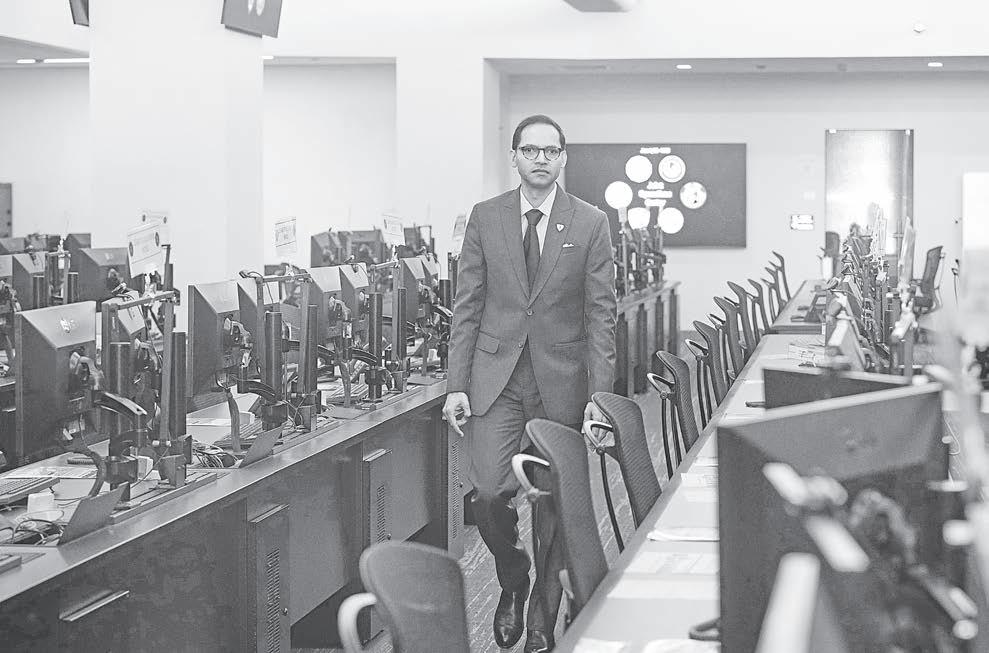

be complicated.”
Officials have indicated they are confident they can keep Trump safe because they will be integrating his usual security into the robust World Cup plan on days he may watch a match.
The FBI has spent two years developing its security plan, incorporating lessons from other major events such as the Macy’s Thanksgiving Day Parade and New Year’s Eve ball drop in New York and testing them at smaller ones, including last week’s Israel Day parade in the city.
“We prepare for the worst day,” FBI Special Agent in Charge Amit KachhiaPatel in New York told The Associated Press. “And that’s how we go into any single event.”
To help cover security costs, the Federal Emergency Management Agency has distributed $625 million

to the 11 US host cities. An additional $250 million is being directed toward tracking and neutralizing suspect drones.
The disbursement of those funds was held up by the department’s funding delay, which the Republican administration has argued hindered security planning.
Others involved in the planning effort said the federal government could have played a more hands-on role even before the shutdown.
John Cohen, a former senior DHS official who has been briefing state leaders before the matches, said the government was largely absent from planning meetings last year and did not begin sharing threat intelligence with host regions until recently.
“With an event of this magnitude, one would expect the federal government would’ve played a more
active role,” Cohen said. “It felt like a missed opportunity to showcase that collaboration.”
Evolving threats from drones and AI
IN January, thousands of officials involved in World Cup security gathered for exercises simulating crowd surges, vehicle attacks and mass shootings.
A month later, the U.S. and Israel launched a war with Iran.
“The security picture fundamentally changed,” said Stefano Ritondale, chief intelligence officer at Artorias, a defense intelligence company not involved in the security preparations.
“There’s a major difference in preparing for a lone wolf radical who rams his car into a public place and a terrorist who is bankrolled by a foreign country we’re at war with.”
Among the greatest concerns are drones.
Since the last World Cup in Qatar in 2022, drones have become a prominent weapon in conflicts including Russia’s war in Ukraine and Hamas’ attack on Israel on Oct. 7, 2023.
“If there is one threat that keeps me up at night, it is from drones,” said New York City Police Commissioner Jessica Tisch, whose department is partnering with the FBI on drone mitigation.
Drones are prohibited over stadiums and fan zones, and KachhiaPatel said the FBI has a “full suite of options” to thwart incursions. They include agents monitoring the sky and a “variety of means” to safely down the devices, he said without elaborating.
Before this year’s World Cup, the
growing sophistication of AI videos was a particular concern, with officials warning that state actors can harness the technology to sow misinformation and panic.
On match days, the FBI will activate joint operations centers in each host city, bringing together local, state and federal law enforcement agencies to monitor and investigate threats.
“If there’s a video that shows an explosion going off at a site, and it’s AI generated, we have people on the ground who can validate whether or not that’s true,” said Kachhia-Patel.
A scoring opportunity for private tech
SOME AI companies have pitched themselves to police departments in host cities, promising to comb through data and surveillance on game days to prevent threats, including unruly fan behavior.
“We know sports fanaticism around here in terms of the NFL and baseball to some extent, but nothing like international soccer,” said Jake Becchina, a police spokesperson in Kansas City, Missouri, which is hosting six matches.
The department has contracted with Peregrine Technologies, which promises to sift through police data and publicly available information such as team practice locations and the country affiliation of popular bars, to get ahead of possible conflict.
In Dallas, a recent $120 million tech upgrade will give local police body cameras capable of real-time translations, helping law enforcement communicate with international visitors soon to descend on the region.
Several drone detection and mitigation companies are joining efforts to help federal agencies secure the skies.
One of those companies, Fortem, has claimed to have signed a multimillion-dollar contract with DHS before the World Cup for an unusual drone mitigation strategy: quadcopters that can shoot nets at encroaching drones to trap them in midair. A spokesperson for DHS declined to discuss the contract.
Just as the teams will aim to perform their best on the pitch, Giuliani said the security planning was a unique chance to “show off American exceptionalism.”
“If we do our job right,” Giuliani added, “nobody will be talking about security at the World Cup.”
Santana reported from Washington. Associated Press writer Alanna Durkin Richer in Washington contributed to this report.

FBI Special Agent in Charge Amit Kachhia-Patel, Mission Services Division, walks through a portion of the agency’s Joint Operations Center in New York, Thursday, June 4, 2026, ahead of the World Cup soccer tournament. AP /RICHARD DREW
IRAN’S players kiss the Muslim’s holiest book Quran as they leave to Antalya airport, southern Turkey, Saturday, June 6, 2026, before departing to Tijuana, Mexico, for the World Cup soccer tournament. AP/KHALIL HAMRA
Style











TOP DRY SHAMPOOS THIS 2026 TO COMBAT OILY HAIR IN PHL
WITH rising temperatures, high humidity, and increasingly fast-paced routines, more Filipinos are turning to dry shampoo as a practical solution for maintaining fresh-looking hair throughout the day. No longer a niche product, a dry shampoo has now become a staple in many beauty routines. It is a convenient way to manage oil, add volume, and extend time between washes.
As demand grows, both international and local brands are stepping up with formulations designed to suit different hair types, preferences and lifestyles. We’ve tried them all, and here are the best dry shampoos in the Philippines.
■ BEST OVERALL: HELLO GLOW HAIRSAVER DRY SHAMPOO. Among the newer entries in the category, Hello Glow Dry Shampoo has quickly gained attention for its ability to refresh hair without leaving a visible white or powdery residue. Whereas traditional dry shampoos can sometimes appear chalky, Hello Glow absorbs excess oil while keeping hair looking clean and natural. With a finish that avoids the usual gray cast and a lightweight feel suitable for everyday use, it offers a balanced option for those looking for both performance and wearability in local conditions.
■ BEST DRUGSTORE CLASSIC: BATISTE DRY SHAMPOO.
A widely recognized global brand, Batiste remains a staple for its strong oil absorption and ability to add volume at the roots. It is a dependable choice for a quick refresh, especially after long days or workouts.
■ BEST FOR SENSITIVE SCALP: KLORANE DRY SHAMPOO WITH OAT MILK. Known for its gentle formulation, this dry shampoo is often preferred by those with sensitive scalps. Its lightweight finish helps minimize buildup, making it suitable for more frequent use.
The increasing interest in dry shampoo reflects a broader shift toward time-saving beauty solutions that fit modern lifestyles. Consumers are becoming more discerning, looking beyond oil control to factors such as finish, residue, and suitability for different hair types. Products that perform well in humid climates and cater to naturally darker hair tones are beginning to stand out in the growing Philippine market.
Star International Show

ONE frenetic afternoon in early May, I watched as hundreds of kids and teens strutted their energetic stuff at the Asian Star International Show at The Podium, Ortigas Center, in Mandaluyong City
Previously known as the Asian Star International Fashion Week, the overwhelming visual extravaganza is the brainchild of Kathy Mangahas of Manila Runway Republic (MRR).
Founded in 2018, MRR is a platform for everyone in Southeast Asia who wants to showcase and hone their talents in modeling, singing, hosting and dancing. In an earlier feature, I highlighted the sisters Shekinah Maruzzo and Sofia Maruzzo, and Athena Limcauco. Just like these three kids who showed tremendous promise in becoming future stars on the runway, the following trio also has a bright future in the limelight ahead of them.
As part of Sparkle GMA Artist Center, the precocious siblings RD and Reign appeared in the TV shows Atty. Lilet Matias and Walang Matinik na Pulis sa Matinik na Misis. They were also part of the film Sinagtala with Glaiza de Castro, and the international short film Moudifa, directed by Jag Cruz.
7
BESIDES being a doctor, Olivia wants to be a professional model.
“I see modeling as a career because as I grow older, I see a lot of opportunities along the way,” says the bubbly kid from the Little Champions Academy.
Though she is always excited to be strutting her stuff, Olivia is also honing her talents in singing, drawing and dancing.
Encouraged by her mother Loricel Picorro, Olivia has been participating in kiddie fashion shows for about a year now. At the Asian Star show, she walked the runway for MRR, Alicio (Thailand) and Robby Rabbit. “With modeling. I have gained self-confidence and good communication skills, and I can travel and meet new friends from the runway,” she shared. “If given the chance, I would model any brand or designer that fits my personality. I will always do it with love and passion.”
EDUARDO ‘RD’ JOSON II, 9
THIS multitalented kid recently appeared with Janice de Belen in a Magpakailanman episode directed by Adolf Alix Jr.
At the Asian Star show, RD walked the runway for MRR, Philippine Junior Models, Angeline Teoh, DKNY, Alicio (Thailand) and Robby Rabbit. He also strutted at the Bangkok City International Fashion Week in 2025.
Besides being a fashion model, RD wants to become a famous actor, like Miguel Tanfelix, Ruru Madrid, Dingdong Dantes and Tom Cruise, and a pop star like Justin Bieber.
The Grade 4 pupil at Cabanatuan Confucius School Inc. also loves gymnastics, taekwondo, table tennis and basketball.
“I love modeling and my parents [mom Rizalyn Salvador and dad Eduardo] support me as well. It helps boost my confidence and I get to meet a lot of friends,” said the SM Little Stars 2023 first runner-up. “Of course, it takes discipline to do something good but it makes me happy because I love what I’m doing. But I need to finish my studies first.”
EDRIENNE YZABELLE ‘REIGN’ S. JOSON, 11
JUST like her younger brother, Reign has been an ambassador of Manila Runway Republic for two years. While RD wants to be a pilot, she wants to be a pediatrician someday.
A Grade 5 student at Cabanatuan Confucius School Inc., she loves gymnastics and playing sports like badminton.
“I love wearing girlie outfits and casuals. But if given the chance, I would love to endorse DKNY, Louis Vuitton, Gucci, Fendi and Dior because it will give me an opportunity to be known globally,” Reign shared.
Citing Gabbi Garcia, Catriona Gray and Naomi Campbell as role models, she sees modeling as a viable career: “When I grow up and finish my studies, I’d like to pursue modeling further—as long as modeling still makes me happy. That is important.” At the Asian Star show, Reign walked the runway for MRR, Philippine Junior Models, Angeline Teoh, DKNY, Alicio (Thailand) and Robby Rabbit. With RD, she also strutted at the Bangkok City International Fashion Week in 2025.
“It was my own decision to become a model because I love modeling. It helps a lot in meeting different kinds of friends and also in boosting my confidence,” Reign noted. “As a young model, it takes more challenges to be in a runway. It takes time management to balance your passion and studies. And at the end of the day, modeling makes me happy.”
Chinese fast-fashion juggernaut Shein to buy eco-friendly Everlane in an unlikely fit
NEW YORK—Everlane, the retailer that bucked the fast-fashion industry by promising affordable ethically sourced and sustainable clothing, is being acquired by the king of fastfashion Shein, founded in China.
A letter to Everlane employees from CEO Alfred Chang confirming the deal was obtained by The Associated Press on Friday. Everlane, based in San Francisco, didn’t disclose a purchase price. Shein declined to comment. Everlane’s majority owner L Catterton couldn’t be immediately reached for comment.
Everlane was founded in 2011 by Michael
Preysman and Jesse Farmer with a mission to produce eco-friendly and affordable clothing.
The company publicized regular audits of its pay and working conditions, as well as the brand’s environmental impact. The online retailer opened its first physical store in 2017.
But the company in recent years has been embroiled in controversies surrounding treatment of its workers, according to media reports.
Everlane, which was joined by other ecofriendly brands like Allbirds, also found that offering a more transparent look at its factories wasn’t enough for consumers, according
to independent retail analyst Bruce Winder. Winder said shoppers were also seeking more affordable prices, and “the novelty wore off.”
L Catterton began acquiring significant stakes in Everlane in September 2020, becoming its majority owner. It also owns a significant stake in brands Boll & Branch, Etro and Birkenstock.
Preysman officially stepped down in 2022.
The online retailer Shein was founded in China in 2012 and become extremely popular with teens and young shoppers with $15 trendy dresses and sandals. A majority of items are mass produced and stitched together by
Belo Genesis Lift promises to lift and restore skin

INNOVATION, aside from the pursuit of beauty and wellness, is at the heart of treatments at Belo Medical Group. A new treatment requires just 60-90 minutes to give you a glow-up!
Belo Genesis Lift is a doctor-created treatment
pairing designed to lift and restore skin from within.
By combining the contour-defining expertise of Belo
Liftera Prima with the reparative strength of the Belo Beauty Cocktail, the treatment works across multiple layers of the skin to reveal a visibly fresher, more sculpted look. “We always innovate with our patients in mind,” said Gina Lorenzana, CEO are of Belo Medical Group. “How can we deliver an even better combination than our last? How can we improve on our signature lifting treatment?”
The answer, it turns out, is a treatment that goes beyond lifting to also provide excellent skin quality. Leveraging the expertise of Belo doctors, this treatment integrates pioneering, science-led technology to lift and define the facial structure. Then, the application of a concentrated blend of rejuvenating actives stimulates regeneration at the cellular level—a testament to the clinical rigor behind every Belo treatment. The result is a profound improvement in elasticity, hydration, and overall skin quality.
workers in a web of factories in China. It has moved its headquarters in Singapore.
Chang, who became CEO in 2024, wrote that the deal will enable the business to invest more in its product, innovation and staff. He emphasized that Everlane will remain an independent brand, staying true to its “sustainability” commitments.
Chang said he will continue as CEO and its leadership will remain in place.
company needs new ownership to survive, and Shein can provide that financial stability, he said. Shein can establish a presence outside of fast fashion through Everlane, Saunders said, as growth within the industry becomes more difficult. Tariffs and other trade restrictions under the Trump administration have upended imports of the inexpensive clothing that dominates fast fashion.

The takeover bid arrives at a time when Everlane is struggling. Sales are down and debt has mounted, according to Neil Saunders, managing director of GlobalData Retail. The
Winder noted that Shein also has an opportunity to redefine its brand by creating a portfolio of eco-friendly brands like Everlane. But Everlane and Shein are an odd couple, analysts noted. AP
Performed in a doctor-led session that typically lasts 60 to 90 minutes, Belo Genesis Lift addresses both the framework of the face and skin quality in one treatment. The result is a noticeable glow-up that lasts and continues to refine itself in the weeks ahead. For inquiries or to schedule an appointment, call 8819BELO (2356).
Miss Universe 2015 Pia Wurtzbach is the face of Belo Genesis Lift. “I am very happy that I was the one chosen for this campaign,” said Pia. “It’s true that you see the effects immediately on the day, but it also gets better as the days and weeks go by. Sobrang sumakto timing sa akin because it really settled in just in time for my events. I felt really confident.”
For Pia, Belo Genesis Lift is not about drastic change but looking refreshed, lifted, and beautifully renewed.
“I can’t wait for everybody to try this out for themselves, to really see and appreciate [it],” she said.
OLIVIA VEIN NICOLA MUYOT,
MDH expands cardiovascular care with new Bi-Plane Fluoroscopy System in Cathlab
Reinforcing its legacy of medical excellence and innovation, Manila Doctors Hospital (MDH) marked another milestone in cardiovascular care, with the launch of its new Bi-Plane Fluoroscopy System on May 11, 2026, at its Cardiac Catheterization Laboratory. The inauguration was attended by the MDH distinguished physicians, senior management, and key hospital leaders.
Opening the inauguration, Dr. Jessore Isidro, Chairman of the Cardiac Catheterization Laboratory and Training Officer of the Interventional Cardiology Department delivered an inspiring message, acknowledging the commitment of MDH physicians and medical leaders in driving the laboratory’s continuous success, alongside the management’s steadfast support.
Patients can benefit from smart, faster procedures, improved diagnostic accuracy, and enhanced safety during complex cardiovascular interventions— making it suitable for patients of all ages, including younger individuals. This new machine also marks a milestone as the first installation of Philips 3.0 Azurion Biplane in the Philippines and the first of its kind equipped with ClarityIQ technology. It allows the hospital to perform minimally invasive procedures and expand its range of cardiovascular care services.
Dr. Alberto Roxas, Medical Director

of MDH, emphasized that “Through this Cardiovascular Center, Manila Doctors Hospital provides a wide range of cardiac services for all types of patients with heart and vascular conditions that require angiography, clot lysis, stenting, open heart surgery, and cardiac rehabilitation, among others.”
With cardiovascular disease remaining as the leading health concern among Filipinos, this new technology not only advances the capabilities of the MDH Cardiovascular Center but also has a significant impact that truly lies in meeting the needs and improving the experience of patients with cardiovascular health conditions. This underscores the institution’s continued commitment to bringing world-class heart care closer to people through innovation, compassion, and expertise.
As Dr. Dante Morales, Chief of the MDH Cardiovascular Center, meaningfully reflects on the significant journey of this laboratory, he mentioned that “From 2010 to 2026, the Cardiac Catheterization Laboratory has grown by 270 percent in number of patients served, 32 percent in number of procedures

AS part of its 23rd anniversary celebration, The Coffee Bean & Tea Leaf® Philippines brought its Philippine-exclusive anniversary collection to life through a series of heritage walks held from May 22 to 24, 2026, celebrating Filipino culture, history, and community.
In partnership with WanderManila, The Coffee Bean & Tea Leaf® invited members of its community to rediscover Manila through three curated heritage tours inspired by the brand's 23rd Anniversary Collection: the Talâ Tour in Binondo, the Lakbay Tour in Intramuros, and the Pamana Tour in Quiapo.
More than guided city walks, the initiative reflected the stories behind the anniversary tumblers while
encouraging participants to connect more deeply with Manila's cultural heritage. Through the experience, guests were invited to slow down, rediscover local history, and appreciate the stories that continue to shape Filipino identity today.
The Talâ Tour explored Binondo, the world's oldest Chinatown, highlighting the district as a living archive of culture, resilience, and transformation. Guests visited Escolta and the historic First United Building, discovering how stories are preserved not only in written history, but also through architecture, tradition, and generations of lived experiences.
Inspired by the spirit of exploration, the Lakbay Tour guided guests through the historic streets
done, and 332 percent in number of medical staff.” He further expressed his pride, highlighting three defining strengths that drive this center forward: “First, we have the expertise, second, we have a dedicated, loyal, and hardworking team, and third, we have the opportunity to train the country’s future Interventional Cardiologists.”
Dr. Rogelio Tangco, Section Chief of Cardiology and Head of Interventional Cardiology in MDH, believes that MDH is a future-ready institution, saying that “The future demands that a cardiovascular team be formed in every cardiovascular center—so that the collegial decisions are made by a team composed of a cardiologist, a cardiovascular surgeon, an anesthesiologist, a noninvasive cardiac imager, and critical care.”
As the hospital continues to invest in innovation-driven healthcare, patients can move forward with greater confidence knowing that the top-tier heart care is now even more precise, responsive, and accessible at MDH, solidifying the hospital’s position as one of the leaders in advanced cardiovascular care in the Philippines.
of Intramuros, where every street and structure carries the weight of Philippine history. Participants visited iconic landmarks such as San Agustin Church and Fort Santiago, immersing themselves in stories of heritage, resilience, and national identity.
Meanwhile, the Pamana Tour highlighted the enduring cultural richness of Quiapo, where history remains deeply woven into everyday life. The tour emphasized that pamana, or heritage, is something continuously lived, shared, and passed on through generations. Guests explored landmarks including Plaza Miranda and Bahay Nakpil-Bautista while gaining a deeper appreciation for Quiapo's vibrant community and traditions.
At the heart of the initiative was The Coffee Bean & Tea Leaf® Philippines' commitment to creating meaningful moments through its Caring Cup philosophy. Beyond celebrating 23 years of serving coffee and tea, the heritage walks honored the communities, stories, and shared experiences that continue to shape the brand today.
As The Coffee Bean & Tea Leaf® Philippines continues its 23rd anniversary celebration, the heritage walks serve as a reminder that every cup, every place, and every shared experience carries a story worth remembering.
To learn more about Caring Cup and CBTL’s 23rd anniversary, visit coffeebean.com.ph.
GSIS expands mall-based service hubs across Metro Manila, nearby areas
THE Government Service Insurance System (GSIS) continues to bring its services closer to members and pensioners through the expansion of its mallbased Ginhawa Service Hubs in key commercial centers in Metro Manila and nearby provinces. GSIS members and pensioners may now conveniently access frontline services at the following locations:
• Festival Mall, Alabang
• Robinsons Galleria, Ortigas
• Robinsons Novaliches
• Robinsons Place Dasmariñas
• SM Mall of Asia, Pasay City
The mall-based hubs aim to provide easier, faster, and more accessible government service for members who may find it difficult to visit GSIS branch offices during regular working hours.
“Mas pinalalapit natin ang serbisyo ng GSIS sa ating mga miyembro at pensioner.
Sa pamamagitan ng ating Ginhawa Service Hubs sa mga mall, mas nagiging accessible, maginhawa, at mabilis ang kanilang transaksyon [We are bringing GSIS services closer to our members and pensioners. Through our Ginhawa Service Hubs in malls, their transactions become more accessible, convenient, and fast],” GSIS President and General Manager Wick Veloso said. Available services include:
• GSIS Touch assistance and registration
• APIR assistance for pensioners
• Loan and claims inquiries
• Document submission and compliance
• Lease with Option to Buy and Housing Accounts Restructuring and Condonation Program inquiries and applications
• Non-life insurance inquiries
• Status checking of applications and claims
• Other member and pensioner assistance services
The service hubs are designed to

complement GSIS’s digital transformation initiatives by providing accessible touchpoints in high-foot traffic areas while encouraging greater use of digital platforms such as the GSIS Touch mobile app. Veloso said the initiative forms part of GSIS’ continuing efforts to improve member experience and expand service accessibility beyond traditional branch offices.
“Hindi na kailangang bumiyahe nang malayo ng ating mga miyembro at pensyonado para sa kanilang mga pangangailangan sa GSIS. Dinadala natin ang serbisyo kung nasaan ang tao [Our members and pensioners no longer need to travel far for their GSIS needs. We bring the service to where the people are],” he said. Schedules and available services may vary per location. Members and pensioners are encouraged to monitor the official GSIS social media pages for updated advisories and operating hours.
DoubleDragon revenue surges 56% in 2025 as overseas operations fuel growth
DOUBLEDRAGON Corporation reported a strong financial performance in 2025, posting total revenues of P27.91 billion, a 56.3 percent increase from P17.86 billion recorded in 2024. The P10.05 billion increase was largely driven by fresh contributions from the company’s overseas operations. The company said 2025 marked the beginning of a significant transition in its revenue structure. After years of benefiting from fair value gains generated by its expanding portfolio of leasing assets, DoubleDragon noted that most of these projects have now been completed and stabilized. As a result, recurring core revenues have begun to account for a larger share of total revenues, with a full shift toward core revenue generation expected by 2028.
As of December 31, 2025, DoubleDragon’s total assets stood at P225.3 billion. The company maintained a healthy balance sheet, with a debt-to-equity ratio remaining below 1.0x, significantly lower than its 2.33x debt ceiling.
DoubleDragon also highlighted a milestone achievement as the first and only Filipino company with a subsidiary listed on the U.S. NASDAQ Stock Market. The listing provides the company access to deeper capital markets in support of future fundraising initiatives and global expansion plans.
Looking ahead, DoubleDragon has outlined an ambitious long-term growth strategy. By 2035, the company aims to increase annual revenues to P500 billion, representing an eighteen-fold increase from its 2025 revenue base. It also targets annual net income exceeding P50 billion, annual cash dividends of more than P12 billion, and a debt-free balance sheet. The company expects stronger core revenues and earnings beginning in 2026 as it moves beyond one-time expenses related to its NASDAQ listing and costs associated with executive and employee stock option programs tied to the expansion of Hotel101 Global. These investments form part of DoubleDragon’s broader strategy to accelerate growth both in the Philippines and overseas.
Among its strategic goals, DoubleDragon aims to complete its nationwide footprint across all 82 provinces of the Philippines while continuing to nurture its portfolio of community malls, industrial warehouses, office buildings, and hospitality assets. Through Hotel101 Global, the company is targeting a presence in 100 countries by 2035.
A key component of DoubleDragon’s growth strategy is Hotel101, which the company describes as a unique and scalable hospitality platform designed for global expansion. Unlike traditional hotel models, Hotel101 combines elements of property technology and hospitality operations in a standardized format that can be replicated across international markets. The company believes this innovative model positions it to capture significant opportunities worldwide.
DoubleDragon also emphasized its preparations for the potential disruptions that artificial intelligence may bring to various industries. Over the past four years, the company has deliberately avoided exposure to large business process outsourcing (BPO) tenants and has exited the condominium development sector, citing concerns about oversupply and the potential impact of AIdriven automation on demand. Instead, it has focused on developing exportable and scalable business models such as Hotel101.
The year 2026 is expected to be a milestone year for Hotel101, with a total of 2,229 new rooms scheduled to become operational. This includes 680 rooms in Madrid, Spain; 519 rooms in Davao; 548 rooms in Cebu; and 482 rooms in Niseko, Hokkaido, Japan. Meanwhile, the existing 518-room Hotel101-Manila and the 606-room Hotel101-Fort continue to maintain high occupancy levels. DoubleDragon expects 2026 to mark the beginning of substantial recurring revenue generation from its portfolio of provincial community malls, industrial warehouses, office spaces, and hospitality assets both in the Philippines and abroad.

The Coffee Bean & Tea Leaf® Philippines celebrates 23 years with heritage walks across Manila
The inaugural ribbon-cutting ceremony at the Cardiac Catheterization Laboratory with the MDH medical leaders
The Talâ Tour
THE PR IN ADVERTISING
A conversation with Ricky Gonzales on campaigns, credibility, and the reputation economy

ADVERTISING and public relations have often been explained by their differences. Advertising is associated with paid communication, visibility, and creative recall. Public relations is associated with credibility, relationships, and reputation. But today’s communication environment has made these boundaries less fixed.
This was the starting point of my conversation with Ricky Gonzales, current president of Association of Accredited Advertising Agencies of the Philippines, partner/creative, Over the Moon Agency, and an advertising lecturer at Ateneo de Manila University. When I was Dean at Colegio de San Juan de Letran, I invited him to teach advertising courses because I knew he could bring both practice and discipline into the classroom.
My question for him was direct. If PR is used for credibility, relationships, and reputation, can advertising also serve these in another way?
Ricky’s answer was equally direct: “Oh yes, of course.” Advertising and PR, he said, work “hand in hand.” The difference is that advertising is sometimes paid, while PR often works through credibility channels. But in communicating messages, the two disciplines move together.
I asked him a basic question, what comes first, a PR campaign or an advertising campaign.
His answer was practical: “It depends.” It depends on the marketing issue being addressed. Sometimes a campaign starts with PR and is supplemented by advertising. Sometimes advertising provides the initial salvo, and PR sustains the campaign after. But from his own experience, Ricky said PR almost always starts it off. His reason was simple: “PR lays on the foundation. It prepares the groundwork for a communication campaign.”
Ricky also pointed to something PR practitioners know well. There are things advertis -

Feelings,” out now. Lifted from their forthcoming album Ritual, arriving August 14 via Ultra Records/Iconic Sound Recordings, “Butterfly Feelings” finds Icona Pop leaning into the dizzy emotional rush of falling in love hard and fast. Co-written by the duo, the track pairs futuristic synths, bittersweet pop melodies, and a snappy club-ready beat with the euphoric vulnerability that has long defined the duo’s music. An -


ing cannot fully explain because of the limits of space, time, and format. Advertising must compress. It must catch attention quickly.
PR, he said, can carry what cannot always be conveyed in an advertising campaign. In PR, “you can explain everything.” You can expound on the copy points or the platform that the campaign wants to communicate to the public.
The digital shift
RICKY described the advertising and marketing communications industry as going through a major landscape of evolution.
chored by the hook, “My heart is beating, do you feel the same?” the song captures the electric uncertainty and excitement of new love through Icona Pop’s unmistakable high-energy lens. Speaking on the track, Icona Pop shares, “‘Butterfly Feelings’ is a little song about falling stupidly in love. We were thinking of all the times when we had that feeling. You try to deny it in the beginning, but you can’t stop thinking about this person.”
Everything, he said, is being digitalized. Traditional media is slowly being eroded, and digital has changed the speed of work.
In the past, campaigns passed through several sessions, research, client discussions, and testing. Today, the first release of a material can already serve as a testing ground. If it works, the campaign is sustained. If it does not, the agency adjusts. In platforms such as Instagram and TikTok, he said, reception from the public can be seen within 24 hours.
Ricky was also careful about virality. A viral campaign does not automatically mean sales,
“Butterfly Feelings” follows the release of “Dance To This” and the album’s powerful title track “Ritual” featuring Daya, alongside an official music video directed by Gustav Stegfors. Built around themes of survival, movement, and selfreclamation, the song introduced a more vulnerable and emotionally grounded side of the duo. Written during a deeply transformative chapter in the duo’s lives, Ritual finds Icona Pop at their most emo-
patronage, or success. He said even when a campaign goes viral, it does not always follow that it will bring in sales.
This led to one of the clearest points in the conversation: “a campaign must go viral for the right reasons.”
Ricky said every platform is now a major touch point. It is no longer only a question of legacy media or traditional placements.
Blogs, influencers, endorsers, ambassadors, YouTube, TikTok, Instagram, and other platforms all have their place, depending on the market and the kind of engagement needed.
For younger audiences, TikTok may work. For longer engagement, YouTube may be more useful because audiences can return to the material. The point is not to use every platform for its own sake. The point is to understand where the public is and how the message will be received.
AI and the human spirit
ON artificial intelligence, Ricky was not resistant. He said AI improves productivity because it can help with the laborious parts of work. But he also recognized its limits. AI can generate and assist, but it cannot provide everything, especially when the material or insight is not available to it.
His view is that people in the industry must evolve with AI. If AI moves fast, then practitioners must also learn how to move further, think better, and use it well.
tionally fearless, liberated, and creatively confident. Across the album, Caroline Hjelt and Aino Jawo explore themes of friendship, reinvention, healing, heartbreak, motherhood, and joy—reshaping the dancefloor into a place for release and renewal.
Speaking on the project, Icona Pop reveal: “Healing requires you to slow down and reflect, but you can’t work on yourself 24/7 forever. Eventually, you have to get back out into the world and see what hap -

His strongest line was simple: “I still believe in the human spirit.” That point matters both in advertising and PR. AI can improve production and speed, but it cannot replace judgment, responsibility, cultural understanding, and discernment.
What Ricky’s interview affirms is that advertising and PR should not be treated as separate worlds. They are different disciplines, but they work in the same communication environment. For many brands, advertising gives a campaign the boost it needs, but the cost can be prohibitive. When the going gets tough, PR, as an allied discipline, can help build relationships and strengthen credibility.
A PR Matter.
PR Matters is a roundtable column by members of the local chapter of the United Kingdom-based International Public Relations Association (Ipra), the world’s premier organization for PR professionals around the world. Rowena Capulong Reyes, PhD is the vice president for Corporate Affairs of Far Eastern University (FEU). She is an executive committee member of the Metro Manila Film Festival 2025 and heads its education committee. She was formerly the Dean of FEU Institute of Arts and Sciences and Colegio de San Juan de Letran. She is the immediate past president of the Philippine Association of Communication Educators (PACE), serving two terms.
We are devoting a special column each month to answer our readers’ questions about public relations. Please send your questions or comments to askipraphil@gmail.com.
pens. You might mess up—but that could be exactly what you need. For us, the dance floor has always been a place where we find ourselves and each other again. It’s where we can disappear into the music and let go of everything else.” More music and news from Icona Pop coming soon. Ritual, the new album from Icona Pop, arrives August 14. “Butterfly Feelings” is available now on all streaming platforms.
RICKY GONZALES (fourth from left) during the induction of the new 4As Philippines board. His leadership in the advertising industry frames a conversation on how advertising and PR work “hand in hand” in the reputation economy. 4AS PHILIPPINES
THE author with Ricky Gonzales, her University of Santo Tomas Communication Arts classmate. Their MOB barkada has remained tight for almost four decades, from student days to parallel careers in communication practice and education. JEAN GO
AS chair of the AOY Best in Industry Leadership & Community Service category, Ricky Gonzales announces the winner at the 27th Agency of the Year Awards of 4As Philippines. 4AS PHILIPPINES
Mirra overcomes ‘demons’ in Paris
PARIS—Bent over with her hands covering her face, her knees getting dirtied on the red clay court, Mirra Andreeva was celebrating— processing might be the more appropriate word—how she had finally overcome “so many demons inside” that came with being a teenage tennis phenom.
A fter bursting onto the scene at 15, Andreeva became a Grand Slam champion at 19 when the Russian ended the r un of 114th-ranked Polish qualifier Maja Chwalinska with a 6-3, 6-2 victory in the French Open final on Saturday.
“I’ve done a lot of visualizations before. Not just this tournament, but I’ve had dreams, I’ve had a lot of thoughts on how it’s going to happen, if it’s going to happen, when it’s going to happen, where,” Andreeva said, still hardly breathing as she talked quickly in true teenage style. “The feeling in real life is so much better than in your dreams.
“ I can call myself a Grand Slam champion,” Andreeva added.
The biggest challenges for Andreeva have not been on the court—she already has one of the best attacking baseline games in the sport—it’s been the mental side. And her stubbornness.
Her attitude is difficult,” said Conchita Martinez, Andreeva’s coach and a former Wimbledon champion.
“You tell her something, and maybe she’s not open to listening....When she
works hard and when she listens and she does everything, she has no limits.”
A ndreeva acknowledged as much during the trophy ceremony.
I know I can be a tough cookie sometimes and it’s pretty hard to put up with me,” Andreeva said. The victory took Andreeva one step further than Martinez, who lost the 2000 French Open final to Mary Pierce.
P ierce presented the winner’s trophy to Andreeva, who became the youngest woman to win the clay-court Grand Slam since Monica Seles was 18 when she claimed her third straight French Open in 1992.
“ You’re so young and talented. It’s so annoying,” the 24-year-old Chwalinska told Andreeva.
A ndreeva took the unusual step of thanking herself “for believing in myself, always giving my 100 percent, even when it’s tough, trying every day to be better as a person and as a player, believing that I can do this, fighting so many demons inside of me.”
Only I know how tough it was for me,” Andreeva added. “How nervous I was throughout these two weeks.”
A ndreeva also thanked her psychologist, who she said was watching from Florida: “Everything that you’ve told me I’ve been trying to
use these two weeks.”
A ndreeva has been considered a Grand Slam contender since she burst onto the scene as a 15-year-old at the 2023 Madrid Open, where she became the third-youngest player to win a main draw match at a Women’s Tennis Association 1000 tournament and made the quarterfinals.
L ately, Andreeva has had to contend with playing under neutral status and without her country’s flag because of the war with Ukraine.
W hen she beat Marta Kostyuk in the semifinals, Kostyuk refused to shake her hand, as has been the custom for Ukrai nian players facing Russians ever since the war started in 2022.
“ Every person doesn’t want to have a war in the world,” Andre eva said. “I never think about t hose things when I play.”
Mastering the wind

Fortune Life Insurance supports AgSur Palaro
FTHE final was played under a mostly sunny sky, though wind was a factor in the first Grand Slam final for both players.
M aja Chwalinska double-faulted on the opening point of the match, but she was the first player to hold serve in the fifth game for a 3-2 lead.
take balls on the rise.
“ She definitely handled wind much better than me,” Chwalinska said. “She was not running away from the ball.”
A ndreeva produced 25 winners to Chwalinska’s 10 and also had fewer unforced errors: 26 to 29. There was a strong Polish presence in the crowd. AP
Veteran Alas Women yield to young Aussies
By Aldrin Quinto
CANDON City—A youthful Australian squad endured relentless pressure from the veteran-laden Philippine team and a charged Candon City Arena, pulling off a thrilling 25-22, 23-25, 18-25, 25-15, 15-11 victory on Sunday in the Asian Volleyball Confederation (AVC) Women’s Volleyball Cup on Sunday. There were lapses here and there for both squads, but the Aussies, with an average age of 21, managed to string together points in the nerve-racking fifth set, short bursts that put them in control including one capped by an Anni Tang ace for a 10-7 lead.
O n the other end, the lack of chemistry showed at crunch time for Alas Pilipinas.
T he Aussies struck from every direction, getting double digit contributions from four wing spikers and two m iddle blockers.
C aitlin O’Dea had 17 points on 14 attacks and four blocks, and fellow outside hitter Ella Schabort had 12 points on 10 attacks and two blocks.
O pposite hitter Lara Maric scored 16 on 11 attacks, three blocks and two service aces, Tang had 12 points on eight attacks, two blocks and two aces,
THE International Container Terminal Services Inc. Negros Occidental Junior Philippine Golf Tour Championship blasts off in Bacolod City Monday serving as the final battleground for standouts in the Visayas and Mindanao fighting to keep their championship dreams alive.
while fellow middle blocker Chloe Walker delivered 10 points on six attacks and four blocks.
The staggering difference was block points, with the Aussies registering 16, while Alas had a total of five in the marathon match.
A lyssa Solomon came up with quite a few hits that broke the Aussie wall, leading the Philippines with 23 points on 22 attacks and a block.
A ustralia coach
Russell Borgeaud lauded Alas Pilipinas for a solid effort, particularly praising Solomon, a late addition to the home squad.
The opposite No. 6 [Solomon] was excellent, she really made it difficult. I know there were some players that were missing, but the players that came out

L ocal talent Ana Marie Aguilar roared back into contention following a crucial victory at the Bacolod Golf and Country Club last week and currently sits at No. 5 with 25 ranking points.
A m aximum of 15 points is up for grabs this week winner and another victory at the Negros Occidental Golf

and Country Club would easily propel Aguilar into the Finals. But she faces stiff competition in the 12-player field, including from No. 2 Vanya Go (39 points) and No. 4 Zoey Mascariñas (28 points)—No. 3 Akeisha Yocte (33 points) opted to skip the final leg, hoping that her current standing will hold.
played exceptionally well in periods and made it difficult for us,” Borgeaud said. Nina Ytang scored 13 and skipper Alyssa Valdez had 11 points.
B orgeaud was also pleased as Australia ended a run of futility against the Philippines and got off to a solid start in the tournament presented by the Philippine Sports Commission and Candon C ity headed by Mayor Eric D. Singson.
It’s been a long time since we beat the Philippines, I expected it to be very tight, we knew it would be a difficult game,” Borgeaud said. “We probably made it harder for ourselves with some errors, the Phlippines took advantage and played very well in that period. It was always gonna be a tough game.”

To control the crowd you have to control the ball, you know when we can control the ball and win some points, keeps the crowd a little bit quieter,” he said. “But having said that the crowd , they’re a beautiful crowd, they make a very positive noise, they’re not cheering against us, they’re cheering for their team as they should, and that’s always a fun crowd to play in front of.”


AUGUST BENEDICTO turned back the clock and Bea Quiambao kept her throne in the 10th Century Tuna Ironman 70.3 Subic Bay on a moody and storm-threatened Sunday in Zambales.
I n a thrilling showcase of grit over youth, the 42-year-old Benedicto ruled the men’s race in four hours, 40 minutes and 38 seconds, leaving his younger eat dust with Russia’s Ilya Fedorov coming in second in 4:41:50 and Iceland’s Geir Omarsson placing third in 4:44:49. I f Benedicto’s race was a thriller, Quiambao’s was a class in execution. Undeterred by the dark, heavy skies that eventually opened up into a torrential downpour, Quiambao clocked five hours, 37 minutes and 14 seconds to secure the women’s championship in the event organized by Sunrise Events Inc. She nipped Mitsuki Tanaka-Tan of Japan, who came up short in 5:37:21, while Anne Nuñez clocked 5:39:19 seconds to finish third.
B oth athletes were honored with the prestigious Bagong Bayani Award, a fitting tribute to elite Filipino racers who continue to elevate the nation’s status on the international endurance stage.
B enedicto didn’t start strong and fell behind in the 1.9km swim leg. I came out of the water with a big gap to close,” Benedicto said. “I knew I had to empty the tank on the bike [90 kms] just to put myself back in contention, especially
took the 1976 title, we saw Portland (1977), Washington (1978) and Seattle (1979) annex the crown.
A s much as the league had drug problems and a PR problem back in the 1970s, there was parity. However, by the 1980s, we began to see the rise of dynasties or multiple champions with the Celtics, Lakers, Detroit Pistons, Chicago Bulls, Houston Rockets, San Antonio Spurs and Warriors.
So all this is a welcome change. While we have seen the Lakers and the Celtics win championships recently, it is also good—should the Knicks go on to win this NBA Finals series— that some of the big market teams get their due. G rowing up a Chicago Bulls fan, I didn’t like the Knicks. But having lived in New York for a spell, I began to root for them. In fact, I purchased a jersey then— Latrell Sprewell, John Starks and Jeremy Lin.
T he New York Yankees and the New York Islanders were the only NYC teams I rooted for. Today, you can add the Giants and the Knicks. I a m not suggesting the NBA Finals are over. A 2-0 lead is nice, but it doesn’t


BEA QUIAMBAO is a class in execution in Subic.
THE Philippines’ Alyssa Valdez scores against Australia’s Mikaela Stevens. AVCWCC PHOTO