



When retirement ends too soon: Why more Filipino seniors are staying on the job


By Mary Jade Jadormio
FOR nearly two years after retiring, pharmacist Josephine Ballares tried to settle into a quieter life at home.
But the transition to retirement did not feel as expected.
After decades of working in a busy pharmacy environment, she found the lack of routine and social interaction difficult to adjust to. At home, the days felt slower and more repetitive.
“I feel like I’m often sickly,” Ballares said in Filipino, recalling how she began to feel physically weaker during her time away from work.
Used to being constantly engaged with people and tasks, she said the sudden shift affected both her physical and emotional wellbeing. Eventually, she decided to return to work.
Today, Ballares is back as a pharmacist at Mercury Drug, where she says staying active has helped her regain both structure and energy.
“Sa trabaho, nag-e- enjoy ako
at di ko nararamdaman ang pagod,” she said. “I feel younger being with them.”
While her pension was sufficient for basic expenses, she said rising maintenance medicines eventually made her retirement budget tighter.
“My pension could have been enough, but because of my maintenance medicine, it becomes insufficient,” she said, mostly in Filipino.
Her experience reflects a broader trend gradually emerging in the Philippines: more senior citizens remaining in or returning to the workforce amid rising living costs, limited retirement income, and growing policy interest in “active aging.”
Push for senior employment
THE idea of encouraging senior citizens to remain economically active has gained attention in recent years as policymakers respond to
demographic and labor market concerns.
In 2022, Sen. Joel Villanueva supported proposals to expand employment opportunities for senior citizens after the Department of Economy, Planning, and Development (formerly Neda) Secretary Arsenio Balisacan said workers aged 65 and above remain “very productive” and should continue to have access to work opportunities.
Villanueva has since pushed for measures promoting equal employment opportunities for senior citizens and encouraging private firms to hire or retain older workers.
The proposal aligns with broader discussions on aging populations across Asia, where governments are increasingly reassessing retirement systems and labor participation policies.
Countries such as Japan and Singapore have already implemented policies extending working life, including re-employment programs, retirement age adjustments, and incentives for firms hiring older workers.
However, economists note that these countries also developed stronger institutional support systems—including pension reforms,

“These elderly workers become the salva vida of their grandchildren” — Labor economist Rene E. Ofreneo, describing intergenerational dependency where older workers financially support younger household members.
healthcare coverage, and retraining programs—before or alongside these labor policy shifts.
Firms remain cautious on older workers
WHILE the Philippines is still considered relatively young compared with rapidly aging economies in East Asia, economist Dante B. Canlas said demographic shifts are slowly beginning to reshape the labor landscape.
But for employers, age in the workforce still comes with practical considerations.
Canlas said firms typically weigh older workers against young-

“We need a more robust pension and social protection system that is sufficiently funded.”—Labor economist Benjamin Velasco, underscoring how weak pension adequacy and rising living costs are forcing many Filipino seniors to stay in or return to work.
er applicants in terms of cost and productivity.
“Firms normally find older age groups in the labor force to be more costly to hire and with diminishing productivity than those in the younger age groups,” he said.
Rising living costs and pension gaps
IF employer caution defines one side of the labor market, rising household costs are shaping the other.
Labor economist Benjamin Velasco said the growing number of seniors staying in the workforce is closely tied to higher living expenses in the post-pandemic period, alongside long-standing weaknesses in retirement systems. He said the trend is not entirely new, as many elderly Filipinos have long remained economically active due to poverty and informal employment. But inflation and stagnant incomes have made the situation more visible in recent years. At the core of the issue, he added, is the adequacy of retirement support.
“We need a more robust pension and social protection system that are sufficiently funded,” Velasco said, pointing out that Social
Because of this, he added, decisions to retain or rehire older employees are usually made on a case-by-case basis—depending on the nature of the work and whether the employee remains efficient in the role. He also noted that while labor migration has created shortages in some sectors, particularly in healthcare and education, this does not automatically translate into greater demand for older workers locally, except in specific roles such as nursing and caregiving where experience and licensing remain key.
By James Malm, College of Charleston The Conversation
‘W
HAT happens to debt when someone dies?”—Lucy, age 17, Cincinnati, Ohio
Imagine everyone has a large piggy bank that represents everything they own. Inside it are items such as cash in a bank account, a home, a car, clothing, jewelry, furniture, investments and other valuables. On the outside of the piggy bank are sticky notes labeled IOU—promises to repay borrowed money some day.
These IOUs represent the debt people owe others. Examples of consumer debt include credit card balances you haven’t paid off, outstanding car loans or home loans, unpaid medical bills and student loans.
As a finance professor who teaches and studies how money works, I can explain that most debts don’t disappear when the person who owes money dies.
Usually, executors manage estates WHEN someone passes away, their assets and debts become what’s known as an estate. Estates include everything that person owned, such as cash in bank accounts, any homes, boats, vehicles, clothing, jewelry, furniture, stocks, bonds, retirement accounts, intellectual property—copyrights, patents and trademarks—and other valuable things.
Then, someone is appointed to manage the estate. This person, called an executor, manages the distribution of anything left in the estate. In most cases, the deceased names an executor in their will, a document that spells out what should happen to their assets after death.
Going through probate IF no executor was named before death, or if someone was named but either cannot or will not serve, a special court that deals with estates, called a probate court, appoints an administrator to handle the estate.
If the person died without a legitimate will and has no living relatives, their property goes through a process called escheatment, where the assets pass to the government after debts are paid off. When someone has written a will, their estate—with some exceptions—goes straight into the probate process. The court confirms the will, appoints the executor and ensures that all debts and taxes are paid off before the remaining assets are distributed to people and organizations known as beneficiaries that the person who owned the assets named in their will. They

When someone dies, their debts don’t just disappear. Instead, any money or property they left behind is used to pay those debts first. Only what’s left after that goes to their family. Importantly, the family doesn’t automatically have to pay the debts from their own money—unless they legally agreed to it.
may include any combination of relatives, friends and charities. The executor looks at everything the deceased had left and adds up its total value. Next, they identify and total all debts and use the estate’s assets to pay off its debts.

As long as the estate’s assets are worth more than its debts, beneficiaries receive money and other items of value from the estate.
If someone dies without a will, they are considered intestate. In that case, the probate court appoints an administrator, often a close relative, such as a spouse or child. Later, the contents of the estate are distributed to the deceased’s relatives in accordance with state law, even if this differs from the deceased’s unwritten wishes.
In some cases, this process can take many years, and even decades, to wrap up.
When the piggy bank falls short THERE are times, however, when estates are insolvent, meaning that their debts are worth more than their assets. That means they can’t afford to cover all of their IOUs. In such cases, some creditors—the people or companies owed mon-
ey—may not be paid in full.
Importantly, relatives of a deceased person are not responsible for paying off any remaining debts with their own money.
However, the estate may end up using funds it would have otherwise inherited to pay off the deceased person’s outstanding debts.
And there are some situations in which others may still be responsible for repaying those debts, especially for bills tied to the medical treatments they received as part of their end-of-life care.
Different rules in some states FOR example, a deceased person’s spouse may need to help pay debts if they are what’s known as a cosigner for the medical treatment or if they live in a community property state, such as Arizona, California and Texas, where spouses share ownership of most assets and debts acquired during the marriage. Some states have
filial responsibility laws that could require adult children to help pay a deceased parent’s unpaid medical or nursing home bills, though these laws are rarely enforced. Also, if someone agreed to take responsibility for a debt while the deceased person was alive, they may still be required to pay it. Furthermore, if that person shared a credit card with someone else, the surviving cardholder is typically responsible for any remaining balance. This law depends on the type of account held and may vary in some states. If the deceased had a mortgaged property, their beneficiaries can keep it—as long as they continue to make the necessary payments. Families and friends in that situation can also sell homes and use some or all of the proceeds to pay off the loans.
When a property is underwater—meaning it’s worth less than the remaining home loan—the lender takes the loss on the unpaid balance. Heirs are not personally responsible for the deceased’s home loan, but the lender will first seek repayment from the estate. Financial data shows that about 73% of Americans die with some unpaid debt. Each year in the United States, about 160,000 to 340,000 people die with more debt than assets. But this situation might change within two or three decades as younger Americans inherit an estimated $110 trillion after the death of today’s older generations.
Although this topic is sad, it’s a good reminder that having money comes with responsibilities and that planning ahead can protect your loved ones. I also think that understanding how things work, even after death, can make what you need to do in your lifetime much clearer and less overwhelming.
James Malm is Associate Professor of Finance and Director of the Global Business Resource Center, College of Charleston. This article is republished from The Conversation under a Creative Commons license. Read the original article here: https://theconversation.com/what-happens-todebt-when-someone-dies-282930.
I’m old, I owe, so off to work I go!
Continued from A1
Security System pensions are widely seen as insufficient, while assistance for indigent seniors remains even more limited.
Velasco also flagged another emerging pressure point: digitalization. As more work shifts toward technology-driven processes, older workers who are not digitally trained risk being further excluded from formal employment, unless retraining programs are strengthened.
Informal work as default retirement path BEYOND formal employment and policy frameworks, labor economist Rene E. Ofreneo said the reality for many older Filipinos is shaped less by retirement planning and more by day-to-day survival.
“Economic reality tells us that the majority of Filipino families are unable to earn enough to cover their needs,” he said.
In many cases, he said, older workers are absorbed into informal or flexible forms of employment— driving taxis or tricycles, vending goods, or taking on skilled but irregular work such as plumbing and electrical services.
He also pointed to agriculture as another sector where aging workers dominate, largely because younger Filipinos are no longer entering farming in significant numbers.
What emerges, he said, is a
labor structure where older workers often remain economically active not just for themselves, but for their families.
In some households, he added, seniors become the primary financial lifeline for younger dependents, including grandchildren.
“These elderly workers become the salva vida of their grandchildren,” Ofreneo said.
Social protection remains fragmented POLICY studies from institutions such as the Philippine Institute for Development Studies and the Department of Social Welfare and Development have long flagged gaps in the country’s social protection system, particularly among informal workers.
While pensions and assistance programs exist, coverage remains uneven and benefits often fall short of retirement needs.
The DSWD’s social pension for indigent seniors provides limited monthly assistance, intended only to supplement basic necessities such as food and medicine.
As a result, many Filipinos reach old age without sufficient financial security, relying instead on continued work or family support.
Healthcare and family pressures
RISING healthcare costs further strain retirement security.
At the same time, traditional family-based support systems are weakening as younger households face higher living costs, unstable employment, and migration-related separation.
This has increased reliance on continued work among older Filipinos across both formal and informal sectors.
A quiet structural shift FOR Ballares, returning to work is also tied to routine and social connection.
Sa trabaho, nag-e -enjoy ako,” she said. “I feel younger being with them.”
The Philippines remains a relatively young country compared with East Asian economies, but economists say early signs of demographic transition are already visible.
The growing presence of older workers reflects not only policy discussions on “active aging,” but also structural gaps in pensions, healthcare, and labor market inclusivity. For some, continued work reflects choice and purpose. For many others, it reflects necessity shaped by economic constraints.
As more seniors remain in the workforce, economists warn that the line between the two continues to blur. And in that blurred space, retirement is no longer guaranteed.
Maintenance medicines, hospital care, and regular checkups become more frequent with age, often consuming a large share of fixed incomes.
www.businessmirror.com.ph
By Troi Santos
EW YORK—Ma. Theresa “Tess”
NLazaro had been working this city for months. The Philippine Secretary of Foreign Affairs—a career diplomat who had served at the Philippine Consulate General in New York a quarter century ago, who knew these corridors and rhythms and the particular social grammar of UN lobbying— had been directing the final diplomatic push for Manila’s Security Council bid from this city since at least early March, when she stood at Baruch College and made the case personally to foreign policy audiences for the Philippines as a stabilizing middle power in a destabilizing Indo-Pacific. President Ferdinand Marcos Jr. joined her here on March 10, attending a reception at UN Headquarters for the Philippines’ candidature, lending presidential weight to a campaign the government formally declared at the 77th UN General Assembly in September 2022. On June 3, 2026, the result of that campaign arrived. The fourth round of voting for the Asia-Pacific non-permanent seat produced a decisive result: Kyrgyzstan 142, Philippines 49. A country that had never once held a Security Council seat in its entire history as an independent state beat a fourtime Council member by nearly three to one in the decisive ballot. Kyrgyzstan cleared the required threshold. The Philippines did not reach half. What the numbers said— and what the months that produced them actually meant—demands more than a diplomatic postmortem. It demands an honest account of how a country with a genuinely distinguished multilateral record arrived at 49 votes in a 193-member body. The result landed at a moment of obvious domestic strain in Manila. The Marcos administration was locked in a prolonged political rupture with the Duterte camp, the Vice President was facing impeachment, and the former president, Rodrigo Duterte, had been transferred to the International Criminal Court in The Hague with the government’s cooperation. That last decision, however legally defensible at home, carried real political costs abroad. In parts of the Global South, the ICC is still seen less as a neutral tribunal than as an institution whose reach has too often fallen unevenly on developing countries. Manila’s handling of the Duterte case may have looked, to some delegations, like rule-of-law governance. To others, it looked like a ruling coalition using international machinery to settle a domestic score. That distinction mattered in a room where votes were already hard to win. Then there was the question of what Manila was selling—and whether anyone believed it. The Marcos administration built its campaign around a pitch of studied centrism: the Philippines as a “bridge builder,” uniquely positioned to mediate between American security architecture and Chinese economic influence, capable of giving voice to the Indo-Pacific’s middle powers in a Council dominated by the permanent five. Lazaro made this case in New York in March, framing Manila’s ASEAN chairship and its Security Council bid as two expressions of the same coherent vision—a confident, sovereign Philippines navigating great-power competition on its own terms. The problem was that the bridge had been weakened long before anyone was asked to
cross it. By the campaign’s final stretch, the Philippines had agreed to host American Typhon ground-based missile systems capable of reaching deep into Chinese territory. It had expanded US basing rights under the Enhanced Defense Cooperation Agreement to include facilities along the first island chain, the geographic corridor most critical to any Taiwan contingency. It was conducting more joint military exercises with the United States than at any point in a generation. In Washington’s strategic planning, the Philippines was not a bridge between competing powers. It was the western anchor of a containment architecture.
When Marcos addressed UN member states during his personal lobbying visit to New York in March, he said almost nothing about the South China Sea—a deliberate omission designed to avoid inflaming delegations aligned with Beijing. But the silence produced its own damage. A country whose multilateral credibility rests partly on the most significant maritime legal ruling of the past 30 years chose not to mention that ruling to the body that should be its most natural audience. The omission did not neutralize the geopolitical signal. It simply added incoherence to convenience.
For the many General Assembly member states with close ties to China, a vote for the Philippines was never a vote for a neutral middle power. It was a vote for Washington’s Indo-Pacific posture. That calculus— arrived at not through ideology but through a straightforward reading of observable facts—explains much of where the coalition collapsed.
The vote trajectory confirmed it. In a two-candidate restricted ballot, momentum is everything—the direction of travel tells you more than any single tally. Kyrgyzstan opened Round One with 105 votes to the Philippines’ 85. Neither candidate reached the required threshold, but the gap was already 20 votes, and the Philippines was on the wrong side of it. Round Two: Kyrgyzstan 110, Philippines 81. The gap widened. Round Three: Kyrgyzstan 123—five votes from victory—Philippines 68. The Philippines was not merely failing to grow its coalition. It was hemorrhaging it, losing votes with each successive ballot in a zero-sum contest where every migrating vote is a two-point swing. By the time Round Four arrived, the arithmetic had become an autopsy.
Russia and China backed Kyrgyzstan.
The United States, the United Kingdom, and France backed the Philippines. In a General Assembly where no bloc commands a majority, and where Chinese and Russian influence in the developing world has deepened considerably over the past decade, the Western P3 coalition is powerful but structurally insufficient. Kyrgyzstan ran directly into this reality and ran with it. Its campaign argument—that Central Asia has never held a Security Council seat, that the region’s voice has been absent from the table, that correcting this historical exclusion is itself a matter of multilateral equity—is not a legal argument under the UN Charter, which explicitly prioritizes substantive contributions to peace and security. But it is a political argument, and in the current General Assembly, political arguments about
See “Manila,” A4
The story of Manila’s campaign for a seat at the world’s most powerful table is, in the end, a story about what multilateral institutions actually reward—and it is not what their founding documents say it is.

BACK-TO-SCHOOL season always arrives with a mix of excitement and intention—new beginnings, fresh routines, and the quiet hope that the year ahead will be a good one.
For international model and mother of three Vanessa Matsunaga, preparing her children for school is less about ticking items off a list and more about choosing pieces that reflect who her kids are.
“Being a mom has changed the way I approach even the smallest decisions,” Vanessa shared. “I’m always asking myself how I can show up for each child in a way that makes them feel secure and supported since that’s something they carry every day.”
A recent visit to SM Store turned that intention into a seam-



less, thoughtful experience. With the help of SM Store’s Personal Shopper, Vanessa set out to stock up on school essentials for her daughter and two sons, free from the usual stress that comes with back-to-school shopping. SM Store’s Personal Shopper helped narrow down options based on each child’s age and preferences, making sure everything Vanessa got would be something her kids would genuinely enjoy using.
The first stop was the shoe section, where she found the perfect school shoes from Florsheim, Gibi, and Tough Kids. Designed for comfort, durability, and everyday wear, the shoes balanced function and style, making them ideal for long school days.




them feel seen,” Vanessa shared.


Next came the fun part: school supplies. She picked up a Hawk trolley bag that easily converts into a backpack for lighter days, colorful Smiggle backpacks and notebooks featuring familiar characters her kids love. She also got markers that help bring out her kids’ creativity.
She also stocked up on containers for her kids’ school lunches and snacks. Her first choice was the Atlantic Vacuum Flask Bottle and Lock and Lock glass food containers to ensure each one of her kids had something suited to their day-to-day routine, whether it was keeping drinks cold, meals warm, or snacks neatly packed.
To make everything extra special, Vanessa passed by the Custom Lab. Here, the tumblers were engraved with each child’s name for a personal touch.
“It’s the little details that make
“When something is made just for them, they take more pride in it.” Throughout the day, her Personal Shopper quietly elevated the experience by anticipating needs, suggesting thoughtful add-ons, and making the entire process efficient, even enjoyable. For a mother who values presence and intention, that support made all the difference. With
Sunday, June 7, 2026
By Toqa Ezzidin & Wafaa Shurafa The Associated Press
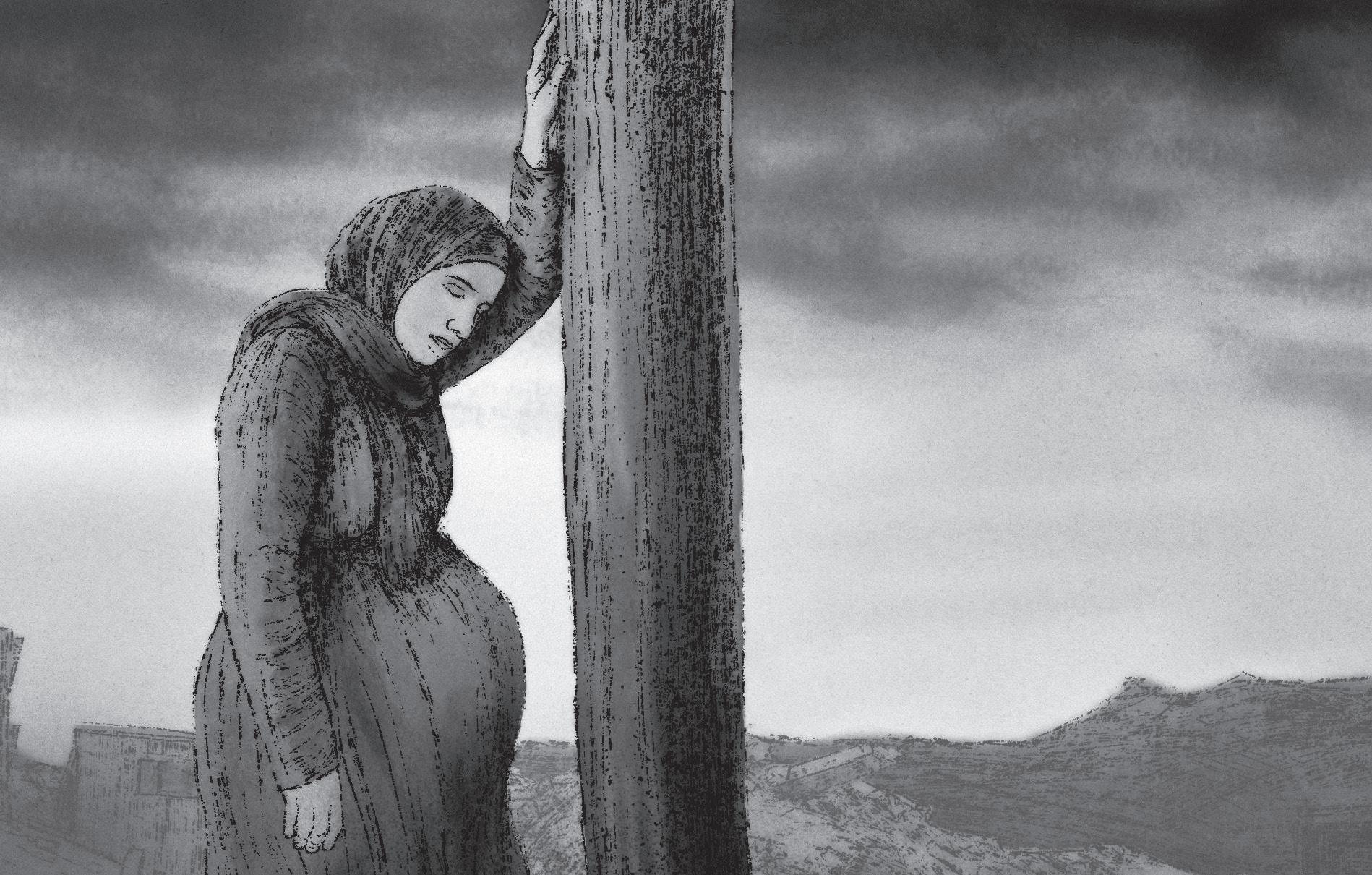
Majda was destitute. Her husband and eldest son had been killed by Israeli airstrikes. Living in a ragged tent in Gaza with rats and the stench of sewage, she couldn’t support her children and feared her daughters would be harassed going to the communal latrine in a camp with hundreds of strangers.
So, she made a decision she now deeply regrets. She married off her 13- and 14-year-old daughters to men who promised safety and support.
“I thought I was protecting them,” she said. “Fear was slaughtering me.”
The devastation that Israel’s campaign has wreaked in Gaza has helped fuel an increase in marriages of young girls, according to experts and official data. With almost the entire population driven from their homes, most living in squalid camps and dependent on aid, some parents have sought some financial stability for their teen daughters by giving them away in marriage.
For the girls, it meant a loss of their childhood and future—and, often, dangerous pregnancies.
For Majda’s daughters, it meant horrific physical abuse.
Child marriage was declining before the war BEFORE the war, child marriage had been slowly declining in Gaza, according to the Palestinian Central Bureau of Statistics. In 2022, the last tally released by the bureau, 17.8% of marriages involved a girl under the age of 18, down from more than 22% in 2015.
The minimum legal age for marriage in Gaza is 17, with
Manila. . .
Continued from A3 historical exclusion carry a weight that legal texts cannot easily deflect. For small states, landlocked states, and the many countries that have experienced their own marginalization from the post-1945 international order, sending a new voice to the table is itself a form of reform— regardless of whether that voice, once seated, proves worth listening to. Strip away the diplomatic language and what was lost

some exceptions allowed; the U.N. and most humanitarian groups categorize marriages of girls under 18 as early marriage. That trend appears to have reversed.
After an Associated Press request, the Supreme Shariah Court in Gaza, where marriages are registered, gathered data from court employees. According to its figures, 20.6% of the 35,474 marriages recorded in 2024 and 2025 involved a girl under 18, including 627 marriages of girls under 15.
The real rate could be much higher because many marriages went unregistered during the chaos of the war, said Amal Siyam, director of the Women’s Affairs Center in Gaza. The number of marriage contracts recorded by the court dropped 35% in 2024, the first full year after Hamas’ Oct. 7, 2023, attack triggered the war.
The AP spoke to six girls in Gaza who got married between 13 and 16 and their parents, all on condition they not be identified by their full names because of the deep sensitivity of the issue. The AP does not identify rape victims. Majda agreed to be identified by only her first name.
All of the parents said that if not for the war, they would have never resorted to marrying off their daughters so young.
is concrete and serious. A Security Council seat for 2027–2028 would have placed Filipino diplomats inside the room where sanctions regimes are constructed, peacekeeping mandates negotiated, and ceasefire resolutions drafted— at a moment of historically concentrated consequence for the Indo-Pacific. For a country with active territorial disputes in its own maritime backyard, a geographic position at the fulcrum of the era’s defining great-power competition, and a climate vulnerability that makes


Editor: Angel R. Calso
One mother is paralyzed by grief
AFTER her husband and son were killed in separate strikes in April 2024, Majda descended into severe depression.
She begged the doctors for sedatives, which kept her asleep for days at a time. She couldn’t care for her girls in their patched-up tent by the sea, battered by wind, cold and rain in the winter. Charity kitchens, on which they depended for food, were scarce and irregular.
“I was entirely shaken from the inside,” Majda said.
Two brothers in their 20s, from a family that had been their neighbors in Gaza City before they were all forced to flee, asked to marry her daughters.
Majda, who got married at 14, didn’t want a similar fate for her girls. But her father joined the brothers’ family in insisting it was the only way.
international coordination a matter of survival rather than preference, that access carries strategic value no bilateral relationship can replicate. The Security Council is where the architecture of international response gets built. Being outside the room when it is being built is not a neutral position. The Marcos administration spent considerable presidential and diplomatic capital on this bid. Marcos traveled personally to New York to make the case. Lazaro spent months there, working every margin available

They promised, Majda said, that they could sign the marriage contracts but wait until after the war to bring the girls to live with their husbands.
“I was not in my right mind. I am still not in my right mind,” Majda said. “I don’t know how I agreed to this.”
Majda’s eldest daughter, who was 14 at the time, didn’t want to accept. “I felt lost,” the daughter said. “I thought if I got married, someone would be financially responsible for me…I truly regretted it.”
Marriage is seen as a way to ease the family burden MOST of the girls who spoke to the AP said they were not coerced by their parents to marry. But they felt a duty to ease the burden on their families.
By marrying, they were counted with their husbands as a separate family to receive aid from relief groups, rather than being
to her, absorbing in the process the street protests of her own diaspora outside the very events where she was lobbying for her country’s credibility. The return on all of that investment is 49 votes, and a mandatory wait of years before the next credible candidacy can be mounted.
The version of this story in which the Philippines did everything right turns out to be incomplete. The Philippines did many things right. Its substantive record was genuine. Its peacekeeping contributions were real. Its UNCLOS victory was historic.


under their parents’ allotment.
Several girls also said that since schools largely shut down during the war, they saw no hope of continuing their education.
One girl said she and her parents and seven brothers and sisters were displaced more than 25 times during the war. Her father had been totally against early marriage and wanted her to enroll in university. But the family was so desperate that he agreed to a suitor.
She said she agreed as well. She was 16.
“I couldn’t forgive myself for taking a share of the little food my family had,” she said. She also worried that she and her siblings would be left without support if her parents were killed in an airstrike. Now 17, she was five months pregnant when she spoke to the AP.
Another girl also cited her family’s multiple displacements, each draining the little money they had. When they were
Its diplomats, Lazaro among them, were skilled and serious.
The problem is that the General Assembly vote is not a merit review, and it has never been.
It is a political contest among 193 sovereign actors, each calculating its vote according to bilateral relationships, strategic interests, great-power pressure, and the accumulated ledger of diplomatic obligation that no official account will ever fully document. In that contest, a strong record is the price of admission, not the guarantee of a ticket. The ticket is built through the slow, unglamorous

sheltering at a hospital in Khan Younis, a 25-year-old man staying there asked to marry her. Then 17, she said she agreed.
“Marriage felt like the only sense of normalcy I could restore to my life,” she said. The law in Gaza allows exceptions to the minimum age of 17 with parental consent and authorization by a judge. The Supreme Shariah Court has rules for court officials not to approve exceptions below the age of 14 years and seven months. But parents sometimes enter informal agreements without officially registering the marriage. Two mothers who spoke to the AP did so, one of them after an official refused because her daughter was 14.
In the Israeli-occupied West Bank, the Palestinian Authority in 2019 set the minimum age at 18, and early marriages have plunged since to around 5%, according to
See “Gaza,” A6
work of relationship management—vote by vote, delegation by delegation—in bilateral meetings where what matters is not the strength of your legal case but the specific thing you can offer or ask of the specific country sitting across the table. The Philippines had four years to build that ticket from its formal declaration of candidacy. The evidence of June 3 suggests the work, somewhere and at some point, stopped being done with the seriousness the moment required. The world’s most powerful deliberative body will have a new member from Central Asia beginning January 1, 2027. What Kyrgyzstan does with its historic first seat will be instructive. What the Philippines does with this loss— whether it produces honest institutional reckoning or the soft consolation of diplomatic near-miss language—may matter more. Tess Lazaro was in this city when the number came in. She saw it. The question now is what her government is willing to see in it.
By Olivia Rudgard
THE property ladder that has helped generations of young Britons achieve wealth and stability is breaking down. Rising service fees on apartments and a tight market for homes have left many millennials stuck in place or falling behind.
Shenali Jashani and her partner thought they were setting themselves up for life when they bought their apartment in west London five years ago. They planned to stay for a few years then use the equity to buy a house outside London once they were ready to have children. “We were really proud that we had saved the money,” the 32-year-old management consultant said. That plan hasn’t worked out the way they expected. Escalating service fees and charges on the apartment made it difficult to sell when they tried to move last year. Estate agents pressured the couple to drop the price so low that affording a house to move into would be a struggle. They ended up taking the flat off the market, spending thousands of pounds to cap some of the fees and are trying again to sell for at least £355,000 ($477,000), the amount they paid. But when Jashani did the sums, she realized they’d be better off now if they’d just continued to rent.
“We did everything that you’re supposed to do,” she said. “I don’t want to regret it, but it’s really hard to not feel angry about the whole thing.” Britons, like Americans, are obsessed with homeownership.
Buying property represents not just shelter and stability, but also financial security, and the vast majority would rather buy than rent. Average home prices rose by 263% across the UK and by 507% in London between 1996 and 2016. For those lucky enough to have bought in time, the uplift in values created millions of pounds in property wealth and has allowed many to graduate to larger and more valuable homes. Property wealth makes up 40% of UK household wealth, much of it held by older generations.
The picture has changed in the last decade, especially for Londoners, apartment owners and first-time buyers of smaller properties. In the leafy, semi-
suburban parts of outer London where many young professionals buy their first homes, flat prices have dropped by 5.5% since January 2020, while house prices have risen by more than 10%, according to an analysis by Knight Frank, an estate agency. As a result, millennials, the generation born in the 1980s and early 1990s, are finding that moving onto the next stage of homeownership is unexpectedly difficult.
Apartments in England and Wales are usually leasehold, an arrangement in which the purchaser, or leaseholder, effectively buys the right to live in a property for a set number of years. They can sell that right, but the freeholder remains the “real” owner of the property and usually charges fees for its upkeep. The second property-ownership step is often a leap from leaseholder to freeholder, which usually means more control over costs and more stable property values.
“For many millennials, the housing ladder has stopped working,” said Conor Nakkan, senior researcher at the Intergenerational Foundation, a UK think tank. “Flat prices have stagnated, moving costs are high and the larger homes they might once have expected to move into are often out of reach.”
Spiraling costs
THE market for houses has overtaken the apartment market for a host of reasons.
A glut of apartments has hit the UK market in the past two years, as new, tougher regulations around property-letting have prompted many landlords to sell up. Some tax breaks and other government incentives for firsttime buyers have been removed or reduced, while others cap the value of properties they can be used for, severely limiting their utility in the expensive London market. A Lifetime ISA, a tax-efficient savings wrapper


that allows holders to put up to £4,000 a year towards a first home (topped up to £5,000 with a 25% government “bonus”), can only be used on homes worth less than £450,000, well below the average asking price for a London apartment.
In addition, the aftermath of the Grenfell Tower fire, which killed 72 apartment dwellers in west London in 2017, left thousands of homeowners in legal and financial limbo over who was responsible for ensuring their homes were safe from similar accidental blazes.
Mortgage lenders refused to lend to apartment owners in buildings deemed at a higherthan-acceptable fire risk. Building owners were often slow to pay for costly repairs and safety upgrades, while a shortage of surveyors to inspect and certify buildings also caused delays.
Spiraling fees and unfair terms set by freeholders or their property managers can also make selling up more difficult for apartment owners.
Opaque or unreasonable charges increase the financial burden of leasehold apartments,
reducing their value and putting buyers off. The UK government has announced plans to cap these charges and give leaseholders more control, but most of the overhaul is yet to take place.
“All this talk about reforming leasehold but it not actually happening yet is really putting a damper on the market,” said Paula Higgins, chief executive officer of Homeowners Alliance, an advice and campaign group.
Amber Needham, 29, bought her first home nearly five years ago, about 20 miles outside London. She sold the onebedroom apartment in Dartford, Kent, for £162,000 earlier this year — £7,500 less than she paid for it, even after successfully campaigning to change her building’s managers because of the extremely high service fees they were charging. The experience was “really upsetting, to the point I actually just started to resent the flat so much,” she said. Needham is now renting.
“It almost feels like I’ve gone backwards in life.”
Higher interest rates are also weighing on the property market for prospective buyers.

In December 2021, the average mortgage rate for a buyer with a 10% deposit, fixed for two years was 2.51%. Now it’s more than 5%. That’s a particular problem for would-be homebuyers with big mortgages and small deposits.
Stamp duty, the upfront tax charged in the UK when you buy a property, has also risen. That all means there are fewer purchasers, with less buying power. “Normally what you find, in a strong market, is that the buyers are competing for property,” said Lucian Cook, head of UK residential research at Savills, an estate agency. At the moment, “the property is competing for buyers.”
Delayed milestones
FOR many would-be “secondsteppers,” the bottleneck in the housing market means delaying life milestones like having a family. Childcare costs in the UK are among the highest in the world, eating up about 25% of household income on average. Space is another issue: The average 670-square-foot London apartment is not necessarily the ideal set-up for children. In
Britain’s capital city, making the jump from a two-bedroom home to a three-bedroom one costs about £234,000 more on average, a Savills analysis from March found, and roughly an extra £15,000 a year in mortgage costs (based on a 25-year mortgage at “prevailing” rates).
Many young parents cope by moving out of the city and closer to family who are willing to help out, but that strategy is harder to implement in a sluggish property market. Birth rates have fallen to record lows, and are falling faster than average in London.
Sitting tight until the market improves is one option, said Tom Bill, head of UK residential research at Knight Frank, but there’s no obvious sign a turnaround is imminent. Conflict in the Middle East and political instability at home in the UK are threatening to keep interest rates higher for longer. “Hopefully, things will become clearer over the next couple of months,” Bill said. “There’s a lot to weigh up. But some people can’t think about their timing too much, because they need to move.”
That is the dilemma faced by Sam Shaw, 31, who tried to sell the two-bedroom apartment he and his wife own in a centuryold converted house in southeast London earlier this year. They had planned to move to a fourbedroom house in west London close to both their parents, with a view to starting a family, but the purchase collapsed after they failed to get any offers at or above the price they paid for their apartment five years ago.
“Childcare is expensive, you work full-time jobs and people can’t afford to give up jobs,” Shaw said. “You need help from your parents, but you can’t sell your flat to move closer to home to get that help. So it does feel tricky.” The couple will try again to sell at a profit later this year, but at some point they may have to cut their losses and move on, he says. “I am worried that it will turn out to be a bad investment.” Bloomberg News

By Bloomberg News
CHINA’S solar industry is tacitly admitting something it has feared for years: it doesn’t know how to escape chronic overcapacity that has weighed on profits.
The main message from executives at the world’s largest solar conference in Shanghai this week was an acknowledgment that the sector should shift to new areas of growth, like batteries or even projects in space. A relentless race to outdo rivals has created a glut of manufacturers that, while helping drive down solarpanel prices and fueling a global clean-energy boom, has left producers mired in losses for more than two years.
“The entire industry is locked
in a zero-sum game, with only one outcome—fighting in the mud leaves no winner,” Zhu Gongshan, chairman of GCL Technology Holdings Ltd., said at the SNEC PV+ conference.
“The past strategy—centered on expanding production, cutting prices, and chasing scale—has reached its physical limits.”
Chinese solar companies have proposed a number of measures over the last few years in an attempt to reduce output and set a price floor. Their efforts, however, have been unable to
curb excess capacity or deliver a meaningful recovery in prices.
Against that backdrop, executives are now focusing increasingly on energy storage as a potential escape route. The traditional concept of a standalone solar manufacturer will gradually fade as companies seek to capture growing demand for batteries, particularly from power-hungry data centers, said Zhu.
Longi Green Energy Technology Co., China’s largest solar-panel maker by market value, entered the storage business only late last year. The company is now aiming for a storage division that will grow to the same scale as its solar business within about five years.
Still, the rush into batteries has prompted concerns that the industry could repeat the mistakes that led to today’s solar glut. Several executives at the conference cautioned that investment is already pouring into energy storage at a pace

that risks creating another oversupplied market. The government has also delivered such warnings.
“All those who are involved in solar are now focusing on energy storage,” Shi Zhengrong, founder of Suntech Power Holdings Co., said during a panel discussion.
“I don’t know whether this is a
good thing or a bad thing. But looking at the current trend, it makes me feel a bit scared.”
Some executives are looking even further ahead. GCL’s Zhu pointed to space-based solar power as a potentially vast source of future demand.
While the concept remains largely theoretical, solar panels
deployed in orbit could support about 200 gigawatts of demand from space-based data centers over the next decade, Dennis Ip, an analyst at Daiwa Capital Markets Hong Kong Ltd., wrote in a note earlier this year. In a more speculative scenario, lunar artificial intelligence facilities could eventually create more than 10,000 gigawatts of demand— roughly equivalent to current global electricity consumption.
Thirteen founding members, including GCL, Trina Solar Co. and several research institutes, used the opening day of the conference to launch the Space Energy Development Alliance. But industry groups caution that such projections remain far removed from commercial reality. The China Photovoltaic Industry Association, the main solar lobby, has said that most space-solar technologies are still confined to laboratories or earlystage testing. Bloomberg News
By Edith M. Lederer The Associated Press
NITED NATIONS—
UPortugal and Austria defeated Germany for seats on the powerful but deeply divided U.N. Security Council on Wednesday in a hotly contested race after intense campaigning. The 10 rotating seats on the 15-member Security Council are earmarked for different regions of the world. The assembly elects five countries by secret ballot every year to serve two-year terms alongside the council’s five permanent veto-wielding members—the United States, Russia, China, Britain and France. In the other contested race, after four rounds of voting in
the 193-member General Assembly, Kyrgyzstan defeated the Philippines by a vote of 14349 and will join the council for the first time.
Zimbabwe, the African candidate, and Caribbean candidate Trinidad and Tobago had no opponents and both were elected with more than 180 votes.
The Security Council is mandated under the U.N. Charter with ensuring international peace and security, but it has failed in the three major current conflicts because of the veto power of Russia on Ukraine and of the United States, Israel’s closest ally, often on Gaza and on Iran. There have been decades of efforts to reform the

Security Council to reflect the geopolitical realities of the current world, not of the postWorld War II era 80 years ago, when the United Nations was established. But they have all failed, though a new attempt is underway.
In the race for the two seats for the group of mainly Western nations, Portugal received 134 votes and Austria 131 votes, while Germany, Europe’s economic powerhouse which had served six previous terms on the council, received 104 votes.
“Obviously, the result is a real disappointment,” German Foreign Minister Johann Wadephul told reporters. He said Russia campaigned against Germany because of its strong support for Ukraine.
“It also may have cost us votes that

up my hands above my head,” the daughter said. The husband then raped her.
official statistics.
Siyam said that at times of widespread displacement in conflicts with Israel, some Palestinians have seen marriage as a way to bring stability for their daughters. “Wars and conflicts lead to a return to more conservative traditions,” she said.
Younger girls who marry are more vulnerable to rape and violence, including abuse from in-laws as they load household chores on them, Siyam said. Because divorce rates in early marriages are high, “the girl ends up returning home with one or two children.”
Some girls were abused and fled
MAJDA said the in-laws broke their promise and soon demanded her elder daughter be brought to her 23-year-old husband, who was living in his family’s tents in Deir al-Balah.
For the first 10 days, the girl screamed whenever her husband approached her. “I kept screaming and he hit me,” the elder daughter said. Eventually, his mother “tied
After that, he repeatedly threatened to bring his mother to tie her up if she screamed, she said. She recounted repeated instances of rape and said on one occasion, she had to be taken to the hospital with bleeding.
A few months later, the family came to take her 13-year-old sister to join her 21-year-old husband. She “kept screaming that she did not want to get married,” Majda recalled.
The younger sister told the AP that she too was tied up by her mother-in-law and raped by her husband. She said she had two miscarriages, both after her husband kicked her while she was pregnant.
Majda’s elder daughter gave birth to a son. Months later, in November, she fled, carrying her son for 15 kilometers (9 miles) to her mother’s tent.
Not long after that, the younger sister also fled back to Majda. They then discovered that she was pregnant.
Girls experienced high-risk pregnancies THE maternity ward of Awda Hospital in central Gaza saw an
increase in the rate of teenage pregnancies during the war, said the ward’s head, Yasser Shaaban. Many suffered severe health complications from getting pregnant so young, he said.
On top of that, the vast majority were malnourished, as Israeli restrictions on aid drove Gaza’s population to the brink of famine at times.
Four of the girls who spoke to the AP had given birth, and all described dangerous pregnancies or births. Three had at least one miscarriage.
One of them almost died during childbirth from severe bleeding, her mother said. She was 16 and severely malnourished at the time.
“I was unconscious for many days (after birth), and I couldn’t hold my daughter for a while,” the girl said.
The family faced another painful choice BACK with their mother, Majda’s daughters were terrified at any talk of going back to their husbands. Speaking to the AP in April, her youngest said returning would be akin to “death.”
Majda said her younger daughter had always been a talkative, playful girl. But since her marriage, “she does not talk
Germany must always assume a special responsibility for Israel with regard to the Middle East conflict,” he said.
Austria’s foreign ministry said its election capped a 15year campaign and is a “strong international sign of confidence” in the country.
Kyrgyzstan’s Foreign Minister Jeenbek Kulubayev told reporters “we understand now is a turbulent time” and said Kyrgyzstan will work together with other council members. The five new members will take up their seats on Jan. 1. They will replace Denmark, Greece, Pakistan, Panama and Somalia.
to anyone, not to her husband and not to me,” she said.
The girls had returned to school, but the elder said she felt excluded and ashamed because she was the only student who was married with a baby. She described herself as a child mothering a child.
“I am tired,” she said. “I want to die.” Majda was coming under heavy pressure from her father and her in-laws, who said she couldn’t afford to care for her daughters, the grandson and the baby on the way.
Women can divorce their husbands in Gaza, but the process is expensive and complicated. Divorce also carries stigma, mainly for women, and would make it difficult for the girls to ever remarry.
The in-laws assured Majda that her daughters would be treated well.
Feeling she had no choice, she relented. The girls returned to their husbands, now in Gaza City, in early May. Majda hasn’t been able to contact her daughters since then.
“They did not want to return,” she said. “They were crying.”
Ezzidin reported from Cairo.

GASTROSCHISIS is a rare but serious congenital condition where a newborn’s intestines protrude outside of the body through a hole in the abdominal wall.
In the Philippines, hospitalbased studies have reported high mortality rates among babies with this defect, with numbers reaching up to 80 percent, or 31 out of 35 newborns.
Requiring intensive care and treatment, there is an urgent need for accessible interventions. While devices for the management of gastroschisis exist internationally, they are imported and costly, limiting access for many Filipino families.
Science Secretary Renato Solidum Jr. introduced a Department of Science and Technology (DOST)funded project at the University of the Philippines (UP) Manila which is developing the first locally-made pediatric abdominal wall defect assistive device for gastroschisis.
“With our support for Filipino researchers, we create health solutions that lessen our reliance on international technologies and make quality care accessible to our communities,” Solidum said.
In the DOST-Philippine Council for Health Research and Development’s (DOST-PCHRD) Talakayang
HeaRT Beat news conference, project leader Dr. Alvin D. Caballes of UP Manila shared updates regarding the development of the device. Caballes described that the international standard for the management of gastroschisis is a medical-
THE Philippines placed among the top three national delegations at the recent 2026 Northern Eurasia Olympiad in Artificial Intelligence (NEOAI), marking a major international showing for the country’s young artificial intelligence (AI) talents.
The Philippine delegation was selected through the International Olympiad in Artificial Intelligence Philippines (IOAIPH), hosted by the Ateneo de Manila University Business Insights Laboratory for Development (BUILD) of the John Gokongwei School of Management.
The Philippine team competed against 224 young computer scientists from national delegations and independent competitors from major technology education hubs, including Russia, Romania, Iran, Malaysia, Serbia, Cyprus, and Mongolia.
All 12 members of the Philippine delegation earned official international certificates from Central University and the AI Alliance Russia after completing the rigorous two-day competition hosted by Central University and SberUniversity.
The contest tested participants in advanced AI engineering tasks, including machine learning, computer vision, and audio processing.
Leading the Philippine team was Juan Mateo J. Desuasido of Brent International School Manila, who placed 17th globally with 365.79 points. His performance put him in the equivalent gold tier and made him the highest-ranking competitor from outside the Russian and Romanian delegations.
Daphne Eunice U. Acena of De La Salle University-Dasmariñas High School and Theo Lorenzo T. Bustamante of Philippine Science High School (PSHS)-Calabarzon Region
grade, cylindrical plastic bag called a silo bag, which is sutured to the opening of the abdomen to cover the exposed organs.
This assists in the placement of the intestines back in the body and closure of the abdominal hole. Currently, there are no local manufacturers for the fabrication of the bag.
He shared that the team has produced a prototype of the locallymade assistive device’s bag component, along with the development of its fabrication method.
Unlike existing silo bags, which are single-use, the prototype developed is reusable, making it more cost-effective.
In addition, the device will also feature a physiological monitoring unit, providing additional safety features.
Although the completion of the device will take time due to the required tests it will undergo, Caballes said that the project will generate a high-quality, safe, and accessible health solution for Filipinos.
Following this first phase, the team will further refine the fabrication process before gearing up for in vivo testing.
The development of the pediatric abdominal wall assistive device, along with prenatal detection, is envisioned to result in improved survival outcomes among newborns with gastroschisis.
The development of the device was funded by the DOST-PCHRD under its Biomedical Engineering for Health Program, with Phase 2 of the project underway.
Campus placed in the equivalent silver tier, ranking 51st and 56th globally, respectively.
Five other Filipino students finished within the equivalent bronze tier: Ryan James L. Alfaro of PSHSCalabarzon Region Campus, Conrad Jeffrey C. Tan of Grace Christian College, Troy Dylan T. Serapio of PSHS-Main Campus, Tristan Japheth L. Marquez of PSHS-Central Luzon Campus, and Aretha Cai Faustine M. Sy of St. Scholastica’s Academy of Marikina.
Ellison Matthew S. Ang of PSHSMain Campus earned an equivalent honorable mention, highlighted by a strong Day 2 performance that placed him 110th globally for that competition block.
Completing the national delegation were Almond Rose M. Obedoza of Stanford Online High School, Jhareign S. Solidum of University of Mindanao Ilang High School, and Noe Nathan Y. Arreza of PSHSCalabarzon Region Campus, all of whom earned official certification.
Based on the average score of each nation’s top three competitors, the Philippines ranked third among national delegations, behind only from Russia and Romania.
Eight members of the Philippine team also placed in the global top 100 and achieved a 100 percent certification rate.
The team’s preparation and participation were supported by sponsors including Joy Nostalg, Times Paint, and the Tiu family, with support from community partners, such as the Analytics and AI Association of the Philippines. The results signal a strong emerging foothold for the Philippines in international AI education, underscoring the depth of the country’s young talent in AI, data science, and mathematical computing.

THE Philippines’ famous “ube” (purple yam) is currently a hot item in the global food scene. From the local favorite halo-halo ingredient, to cake, halaya or to ice cream, it is now the craze for drinks, pastries, and even in culinary dishes across the globe. As featured on various social media platforms, New York City has recently kicked off its very own Ubeland food festival, dedicated to Philippines’ vibrant ube delicacies.
A well-known international cafe has also launched its seasonal “Ube Spring Drinks” series available in the USA, United Kingdom, New Zealand, Australia, Italy and the Netherlands.
It is even tagged as “the new macha,” taking over coffee and macha, the Japanese green tea powder.
This growing global traction of ube has raised concerns over whether the Philippines can meet the surge in global demand.
However, purple yam or ube production in the country has significantly slowed down even before its global craze.
Data from the Philippine Statistics Authority (PSA) showed that the Philippines produced 30,074 metric tons of ube in 2006. However, there is more than 50 percent lower total recorded production of 14,000 metric tons in 2020.
Historically, Bohol province in Central Visayas is the largest producer of ube in the Philippines, accounting for about 35 percent of the country’s total production.
The Philippines is considered an important center of origin and diversity for ube, with thousands of years of history and highly prized local varieties like Bohol’s “Ube Kinampay,” which is widely celebrated as the “queen of Philippine yams” for its red-purple flesh and is highly prized for its sweet aroma and taste.
However, Director Marlon M. Tambis of the Philippine Root
Crop Research and Training Center of the Visayas State University (VSU-PhilRootcrops] said that Bohol farmers are facing significant challenges in farming the root crop.
“First is the lack of planting materials. Based on our scoping studies, their production practices are really not very scientific. So, there is a low adoption of necessary recommended practices or S&T [science and technology]-based practices, which we need to address to improve the yield,” Tambis said.
To address this problem, the VSU-PhilRootcrops together with the Bohol Island State University led the development of advanced propagation techniques and introduce it to Bohol ube farmers.
Through the project titled “Enhancement of Ubi Production through Trials and Demonstrations of S&T-Based Farm Practices to Support Industry Development in Bohol” the Root Crop Center was able to train farmers in producing quality planting materials using advanced methods like the minisett.
Minisett is a method used in agriculture, as a rapid propagation technique specifically in yams, which involves cutting a healthy, whole “mother” tuber into small pieces.
Tambis also explained that in traditional planting, farmers can only produce seven to 10 planting materials from one kilo of ube. But through the minisett propagation technique, farmers can produce more than 30 quality planting materials.
Tambis said the planting materials cannot be directly planted in the field. Being smaller than those used in traditional planting, they would need “extra care” before planting, including preparing on a seedbed for germination.
Moreover, Tambis said their team is also working on a project to craft protocols on the use of the tissue culture method to produce

more quality planting materials in the future.
“We target to produce millions of ube planting materials next year from the tissue culture. We haven’t released it yet because we are still establishing hardening protocols,” he said.
The VSU-PhilRootcrops chief explained that hardening is a crucial part in growing tissue cultured ube as this will determine whether the plant is ready to be transferred to the field.
“When we say tissue culture, it means it is produced from the lab [laboratory]. It goes through a very artificial condition and there is a long process before you can put it in the actual conditions in the field. It first goes through incubation and hardening, [which] is the critical part that will determine if it is really ready to be transferred to the field,” he further explained.
Besides the lack of quality planting materials, another challenge for farmers is that ube is considered a seasonal root crop, when they can only plant it in May and June, using the traditional planting method.
With that, Tambis’ team has also identified ube varieties appropriate for year-round planting, including commercial varieties like “Baligonhon,” “Inoringnon,” “Kabus-ok,” and “Zambal (VU2),” as well as the popular “Ube Kinampay.”
These varieties are also grown in other provinces across the country.
“In our project, we have proven [that] February planting is possible. There are only aids in how to germinate ube in that month when it shouldn’t have germinated. So far,
we have shown that we also have a breaking of dormancy and propagation protocol in months when it doesn’t really grow naturally. And so far, we have demonstrated that [to farmers],” Tambis said.
Funded by the Department of Science and Technology-Philippine Council for Agriculture, Aquatic and Natural Resources Research and Development of the Department of Science and Technology (DOST-PCAARRD), the project intends to address the insufficient supply of ube planting materials and increase the production of purple yams in the Bohol province.
Using these S&T-based interventions, the Philippines could meet the global ube demand, especially when farmers from across the country will adopt these advanced propagation techniques developed by the VSU-PhilRootcrops.
“Of course, it’s a big help to the farmers because that can potentially increase their income from root crops. So, it will become a tool to expand the value chain and benefit more people,” Tambis explained. Thanking the DOST-PCAARRD for support, he said the Center is also hoping for sustained or further increased funding support from DOST-PCAARRD for more research and development projects in the future.
DOST-PCAARRD is one of the attached agencies of the DOST which drives national research, development, and innovation to secure the country’s food supply, protect aquatic ecosystems, and ensure resilience. Claire Bernadette A. Mondares/S&T News Services
World Media Organization urges global citizens to protect planet’s biodiversity
By Gautam Karve
ON the occasion of World Environment Day, I urge citizens across the globe to recognize that biodiversity is the foundation of life on Earth. Every species, ecosystem, and natural habitat plays a vital role in maintaining the balance of our planet.
The loss of biodiversity threatens food security, clean water, climate stability, and the well-being of future generations. Today, humanity faces unprecedented environmental challenges, including deforestation, pollution,

habitat destruction, and climate change. These threats are accelerating the decline of countless plant and animal species.
Protecting biodiversity is not solely the responsibility
of governments and organizations; it requires collective action from every individual, community, and nation.
Simple actions—such as reducing waste, conserving
natural resources, supporting sustainable practices, planting trees, and protecting wildlife—can make a meaningful difference. By embracing environmentally responsible lifestyles, we can help preserve the rich diversity of life that sustains our planet and strengthens our resilience against global challenges. Protecting biodiversity is not merely an environmental responsibility—it is a global duty. Together, we can build a greener, healthier, and more sustainable world for all.
Gautam Karve is the editor-inchief of World Media Organization.
A8 Sunday, June 7, 2026
EVERY year in March, tens of thousands of Americans take to the streets—and bars—to celebrate St. Patrick, the patron saint of Ireland. Similarly, Mexican-Americans celebrate the Feast of Our Lady of Guadalupe, Mexico’s patron saint, in December.
Did you know that the US has its own patron saint?
Nearly 200 years ago, in May 1846, Catholic priests and bishops named the Virgin Mary patroness of the United States of America—specifically, under her title as the Immaculate Conception, referring to the belief she was conceived without sin.
According to the Catechism of the Catholic Church, which summarizes doctrines, a saint is a holy person who “leads a life in union with God through the grace of Christ and receives the reward of eternal life.” Catholics may venerate saints and ask them to intercede with God on their behalf.
Some are recognized, whether formally or informally, as “patrons” of particular situations, conditions, identities or places, often inspired by their life on Earth.
We are librarians at the University of Dayton who work in the Marian Library and the US Catholic Special Collection. We recently created a digital exhibit with objects pointing to the history of this devotion to Mary as the Immaculate Conception in the United States—objects that reflect both patriotism and faith.
The Immaculate Conception MARY is known by many names and titles, including the Virgin Mary, Mary of Nazareth, Our Lady of Lourdes, Holy Mother of God, Queen of Heaven, Seat of Wisdom and Mystical Rose. One important title is Immaculate Conception, referring to the Catholic belief that Mary was free of “original sin” and therefore suitable to be the mother of Jesus Christ.
The Catholic Church teaches that all other people are conceived with original sin

Editor: Lyn Resurreccion • www.businessmirror.com.ph
as a result of Adam and Eve’s disobedience to God in the Garden of Eden.
Originally, the idea that Mary was free of original sin was widely debated within the Catholic Church. But the teaching was defined as dogma on December 8, 1854, by Pope Pius IX.
The feast day of the Immaculate Conception is now celebrated by Catholics on December 8 each year. Even before its official acceptance, devotion to the Immaculate Conception influenced the art and teachings of the Catholic Church.
Patroness of the United States HOW did Mary, as the Immaculate Conception, become patroness of the United States?
John Carroll, who became the first American bishop in 1790, was devoted to Mary throughout his life. In 1791, he and other American Catholic clergy consecrated the Diocese of Baltimore to Mary, asking her to “[preserve] from all evil” the people of the diocese.
Half a century later, in 1846, a council of priests and bishops from across the country officially named Mary, under her title as the Immaculate Conception, the patroness of the entire United States, asking her for “the aid of her prayers.”
Devotion to the Immaculate Conception has remained an important part of the faith lives of many American Catholics, even if they are unaware of her patronage of the United States.
This devotion is demonstrated by the many churches that are named for the Immaculate Conception, jewelry depicting the Immaculate Conception and the inclusion of the Feast of the Immaculate Conception as a holy day of obligation in the US—a day when Catholics are expected to attend Mass.
On February 7, 1847, the Vatican approved the request to make Mary, as the Immaculate Conception, the patroness of the United States. This was seven years before the dogma was defined by the pope,

pointing to the popularity of this devotion even before official recognition.
Bicentennial holy card
MANY items in the Marian Library’s collection, such as holy cards, also demonstrate

AREVERED image of Our Lady of Guadalupe from Mexico will arrive in the Philippines next week, launching a monthslong nationwide pilgrimage that Church leaders hope will inspire prayer, Marian devotion and spiritual renewal.
The pilgrimage will formally open with a Mass at the Manila Cathedral on June 13, to be presided over by Cardinal Jose Advincula.
From there, a replica of the Mexican Marian icon and an image of St. Juan Diego will travel to more than 50 cathedrals, shrines and parish churches across the country until December.
In a pastoral exhortation, the Catholic Bishops’ Conference of the Philippines called on the faithful to take part in the spiritual journey and renew their relationship with Jesus Christ through Mary.
Archbishop Gilbert Garcera, CBCP president, said churches hosting the pilgrimage will recite the Act of Consecration and Entrustment to Our Lady of Guadalupe during all Masses while the images are present.
American Catholics’ devotion to Mary as the Immaculate Conception.
A holy card is a small portable devotional tool, often including an image of Jesus or a saint on the front. Typically, a prayer, devotion, scripture passage or commemoration
of an important event is printed on the reverse side.
One of our cards features an image of Mary as the Immaculate Conception above the words: “Immaculate Mary, Patroness of the United States, Pray for Us.”
The reverse commemorates the bicentennial of the United States in 1976, followed by the motto of the United States, “In God We Trust.”
The image of Mary is a reproduction of “The Immaculate Conception of El Escorial,” a painting by 17th-century Spanish painter Bartolomé Esteban Murillo in the collection of Madrid’s Museo del Prado. The painting reflects artistic traditions that symbolize the theology behind the Immaculate Conception.
Mary is shown with a blue garment: a color associated with faith, humility, the heavens and the sea. Since blue pigments were very expensive during the Renaissance, the color was reserved for important figures, particularly paintings of Mary. Other symbols, though, are specific to Mary as the Immaculate Conception. She stands with a moon beneath her feet, inspired by the “apocalyptic woman” from the Bible’s Book of Revelation: “a woman clothed with the sun, with the moon under her feet, and on her head a crown of 12 stars.”
Catholic theologians interpret this figure as a reference to Mary, establishing her as mother of all Christians.
In other artwork of the Immaculate Conception, Mary is depicted with a snake beneath her feet, a crown of 12 stars or a dragon—also inspired by Revelation, Chapter 12.
American rosary ANOTHER important object of Catholic devotion, the rosary, encourages reflection on the lives of Jesus and Mary.
The word can refer to a physical object—a set of 50 beads or knots on a
string—or certain sets of prayers, including Hail Mary and Our Father. Touching the beads as they pray helps Catholics keep track as they recite the prayers.
The “American Rosary” in our collection was designed by Marie George of New York in 1956, though archivists do not know exactly who she was.
It uses beads in the patriotic colors of red, white and blue, and it includes a Miraculous Medal, which depicts Our Lady of the Immaculate Conception. A card included with the rosary encourages Catholics to offer prayers “for World Peace, with Justice and Charity.”
Across centuries FOR much of US history, Catholics in the United States often faced prejudice and discrimination.
In the mid-19th century, when Mary as the Immaculate Conception was named patroness, the Protestant majority of the US was deeply suspicious of Catholics’ loyalty to the pope.
The bicentennial holy card and the American rosary from the following century, both dedicated to the Immaculate Conception, reveal how American Catholics still sought to demonstrate that their faith and their patriotism did not conflict with each other.
In 2026—the 250th anniversary of the United States, and the 180th anniversary of Mary’s patronage—some of that history may feel distant.
The Catholic Church elected the first American-born pope, Leo XIV, in 2025, and the United States has seen a surge in Catholic conversions in 2026. But Catholics still ask Mary, as patroness of the US, for her intercession: not only in their lives, but for their country.
Stephanie Shreffler and Bridget Retzloff, University of Dayton/The Conversation (CC) via AP
BARCELONA, Spain—The motto for Pope Leo XIV’s upcoming visit to Spain is “Lift up your eyes.” That’s exactly what millions of visitors to Barcelona’s Sagrada Familia already do as the unfinished basilica continues rising skyward a century after Catalan architect Antoni Gaudí’s death.
On June 10, Leo will bless the recently completed central tower of Gaudí’s masterpiece which, topped by a white cross, has made it the world’s tallest church.
A dozen other cream-colored towers and spires stretch into the blue sky, rivaled only by the mountains surrounding the Mediterranean city.
Inside, sunlight filtered through towering stained-glass windows bathes tourists and worshippers in shifting colors.
Gaudí’s Catholic faith infused every detail with sacred meaning, but the experience transcends religion and culture.
Nearly 5 million people visited in 2025 alone, with Americans, Spaniards and Chinese making up the three largest groups, according to the church.
Some visitors peer into the crypt, where regular services are held, or attend multilingual weekend Masses in the main nave.

ROME—Pope Leo XIV took a step Tuesday toward overhauling the Vatican’s communications operations by naming the Mexican-American president of the Catholic US media conglomerate EWTN News as its new head.
Maria Montserrat Alvarado replaces Paolo Ruffini as prefect of the Dicastery of Communications, the office that controls the Vatican’s television, radio, online, publishing and newspaper operations. Ruffini was appointed by Francis in 2018 as the first lay prefect of a dicastery of the Roman Curia. He will be 70 in October.
The dicastery enjoys one of the big -
gest budgets of any Vatican department. By naming a layperson and a woman to head a major Vatican department, Leo is following in the footsteps of Pope Francis who promoted several women to leadership positions in the Holy See governing hierarchy, which remains dominated by male clergy.
The Chicago-born Leo has indicated he wants to reform the way the Catholic Church at large, and the Vatican in particular, communicates its message to the world.
Toward that end, he has summoned cardinals to the Vatican later this month
for a meeting to “reassess the effectiveness of ecclesial communication, including at the level of the Holy See, from a more explicitly missionary perspective,” among other topics.
Established by Pope Francis on June 27, 2015, as part of the reform of the Roman Curia, the Dicastery for Communication oversees the Holy See’s communications systems, including Vatican News, Vatican Radio, L’Osservatore Romano, Vatican Media (photo, audio and video services), the Holy See Press Office, the Vatican publishing house, the Vatican Printing press, and the Filmoteca Vaticana
(Vatican Film Library). In addition to the operational and technological functions assigned to it, the dicastery also deepens and develops the properly theological and pastoral aspects of the Church’s activity in the field of communication.
Alvarado is currently president and chief operating officer of EWTN News, which says it is the largest Catholic media organization in the world. Its Washington, D.C.,-based operations include television, radio, online and publishing operations in seven languages.
The EWTN family, which generally
skews conservative, includes the Catholic News Agency, National Catholic Register and ACI Group news agencies, among other branches.
Born in Mexico City, Alvarado joined EWTN as a news anchor after holding leadership positions in the Becket Fund for Religious Liberty, which has waged church-state legal battles in the US to protect religious freedom.
During Pope Francis’ pontificate, EWTN’s programming often featured English-speaking critics of the Argentine pope. In 2021, Francis blasted such media criticism as “the work of the devil” in
comments widely interpreted as being directed at EWTN.
In a statement released following the announcement, Alvarado said: “While this appointment was unexpected, I receive it with a sincere desire to serve the Holy Father as he begins his pontificate. And I am grateful to Paolo Ruffini for his leadership throughout the last years and look forward to continuing, in friendship and hope, the important work of strengthening the dicastery so it may continue to serve the Church in Rome and everywhere to communicate Christ to the world.” The Associated Press and Vatican News

Editor: Lyn Resurreccion

By Jonathan L. Mayuga
Aon a tree branch inside a steel cage at the Ninoy Aquino Parks and Wildlife Center (NAPWC) in Quezon City.
Aged and maimed, “Girlie” is past her prime—no longer able to fly and glide up in the sky because of an injured wing, and could no longer hunt like other eagles because of a blind right eye.
Yet this old female bird stands as a symbol of the strength and greatness of the country’s national bird, the majestic Philippine eagle.
While a Philippine eagle’s life expectancy in the wild is between 30 and 40 years, Girlie’s story of rescue, rehabilitation, and survival under human care overshadowed all other Philippine eagle in captivity. She continues to serve a higher purpose of educating people about the importance of wildlife conservation, and as a living testament that saving the rarest bird on the planet from extinction is possible.
DISCUSSING the situation of the Philippine eagle, including Girlie, is significant at this time as the Philippine Eagle Week is being celebrated from June 4 to 10. The event aims to raise awareness about the critically endangered bird of prey, among the largest and rarest of birds of prey in the world.
Established by Presidential Proclamation 79 in 1999, the nationwide observance marks its 28th year, highlighting the national bird as a vital part of the country’s biodiversity.
This year’s celebration has the theme: “Lahat Kasali, Lahat may Papel, Sama-sama para sa [“Everyone included, everyone has a role, together for the] Philippine eagle.”
Philippine Eagle Foundation (PEF) Executive Director Dennis J.I. Salvador, in an email message to the BusinessMirror , said: “We are reminded that saving the Philippine eagle is not only the job of scientists, conservation groups, or the government. Every person can help heal nature in ways we may have taken for granted for so long.”
A nonprofit organization, the PEF is the Department of Environment and Natural Resources’ (DENR) partner in the eagle conservation.
Critically endangered
WITH fewer than 400 pairs in the wild, the Philippine eagle is considered critically endangered. Efforts to conserve the species and save it from extinction began as early as 1969 with the establishment of the Monkey-eating Eagle Conservation Program.
In 1977, the bird’s name was changed from “monkey-eating eagle” to Philippine Eagle when Peace Corps volunteer and researcher Robert S. Kennedy lobbied with the government.
The project transitioned into a private not-for-profit nongovernment organization in 1987 through the PEF, which turned 39 in February.
Emblem of conservation alliance RESCUED as a juvenile in 1982 after a slingshot wound blinded her right eye
and damaged a wing, Girlie has lived under human care for more than four decades.
Since then, Girlie has become the living emblem of an alliance between the DENR and PEF.
“Girlie is more than a resident of a city park; she is a living reminder of our shared responsibility,” Environment
Secretary Juan Miguel Cuna said in a statement ahead of the Philippine Eagle Week celebration.
“The DENR will continue to work with partners like the [PEF] to protect habitat, support science-based recovery, and bring conservation into the daily lives of Filipinos,” he said.
‘Senior citizen’
DURING the DENR and PEF kick-off of the celebration at the NAPWC, Girlie, approximately 45 years to 46 years old, was identified as a “PWD” for her disabilities, and “senior citizen” for old age.
She is the oldest Philippine eagle in captivity and the only bird of its kind accessible to the public for viewing in Metro Manila.
With her age, Girlie is among the oldest living bird in captivity in the world.
Captive breeding IN the 1980s, Girlie was paired with male eagle, “Tsai.” They produced the first fertile egg laid by a natural pair of Philippine eagles in captivity—a milestone that proved what conservationists had long hoped was possible.
However, the chick did not survive.
The experiment altered the calculus of captive breeding and helped cement the PEF’s role as the country’s leading field organization for eagle recovery. The collaboration shifted from experimental breeding to a broader portfolio—habitat protection, community engagement, and public education.
“The government brings policy and reach; PEF brings field science and years of hands-on experience,” Cuna said.
“Our collaboration shows what government and civil society can achieve when we align expertise with policy.”
Eagle in the city
GIRLIE’S presence in Metro Manila after having been transferred to the NAPWC in 2009 is strategic.
According to the PEF, a nation where only a few hundred breeding pairs exist in the wild is a story where people can see and respond to a tangible, aging creature, whose scars and longevity make abstract statistics feel immediate.
Conservationists say that such encounters matter.
“She [Girlie] gradually emerged as the park’s ‘poster bird’ for Philippine Eagle conservation,” Salvador said.
Girlie’s role
THERE is an irony in Girlie’s role. She is a nonreleasable bird, her life is shaped by human intervention. Yet she has become a bridge between the remote, difficult work of field conservation and the urban public, whose votes and attention can determine policy.
Her story is not a tidy success. It is a ledger of small victories and persistent losses. It is also, increasingly, a test of whether a government and a nonprofit group can translate decades


of collaboration into the political will and resources necessary to protect the forests that sustain the eagle.
PEF Director of Operations Dr. Jayson Ibañez said that nonreleasable eagles that are permanently injured or cannot survive in the wild remain central to conservation.
“They serve as breeding individuals, genetic reservoirs, and education ambassadors, supporting a critically slow-reproducing species where every adult is vital to long-term recovery,” he told the BusinessMirror via Messenger on June 3.
He explained that the release of a rescued eagle is only pursued when survival prospects are high and habitat conditions are secure.
“Many eagles cannot be released due to injury, human imprinting, or lack of established territories. In such cases, managed captive breeding provides greater, long-term conservation value than high-risk release attempts,” Ibañez pointed out.
Beyond numbers
INTERNATIONAL biodiversity expert
Theresa Mundita S. Lim said biodiversity is not only about the number of species, but also about ecosystems, their functions, and the genetic diversity that allows life to adapt and survive.
“The recent news on the results of the genomic analysis done on the Philippine eagle is both sobering and deeply important. It means that conserving the Philippine eagle should go beyond just saving individual birds,” said Lim, a former executive director of the Asean Centre for Biodiversity.
A study released in December 2025 says that Philippine eagles in Mindanao, Samar and Leyte show “little genetic variation,” confirming that the country’s national bird is close to extinction, highlighting its status as a critically endangered species.
Low genetic variation limits a certain species’ ability to adapt to changes in the environment, like disease or climate change.

habitats for the eagles in Zambales, Subic, Bataan, Mt. Banahaw, and the Bicol Peninsula.
“Reintroduction efforts in Leyte, where local eagle populations were devastated by Typhoon Yolanda in 2013, suggest that releasing founder populations into these recovering habitats is possible,” he added.
DENR-PEF alliance
THE PEF-DENR alliance has increasingly emphasized the hard work of habitat protection. This includes securing large tracts of continuous forest, working with local communities to reduce hunting and disturbance, and applying science to monitor the remaining population.
“Years spent tracking eagle pairs, mapping their forest territories, and studying population trends in the field help the government use this data to create official protection zones and enforce environmental laws,” Salvador said.
“The partnership has been succeeding because it connects our research directly to national enforcement. Saving our national bird requires basing our joint actions on verified field data,” he added.
“It makes a particular species susceptible to being wiped out by a single threat,” the Philippine Information Agency reported.
Lim explained: “Each eagle could carry genetic variation that may no longer be easily replaced. Thus, conservationists must now be more conscientious and science-based in making breeding decisions, in genetic monitoring, and in the careful management of remaining populations.
She pointed out that genetic diversity is strongly linked to the health of the habitat.
“A genetically resilient eagle needs a safe, connected, and thriving forest. So, as we celebrate the Philippine Eagle Week, we must be reminded that the responsibility of protecting our national bird cannot rest solely on environmentalists and conservationists.
The evidence of the declining genetic diversity tells us that the survival of the Philippine Eagle must now be treated as a shared national responsibility,” she explained.
“To ensure its survival as an irreplaceable part of our natural heritage and as a living national icon, we need a truly multisectoral and whole-of-government approach—one that brings together science, policy, communities, institutions, and citizens in a sustained and coordinated effort,” said Lim, a former director of the DENR-Biodiversity Management Bureau.
ACCORDING to Salvador, saving the Philippine eagle means securing the future of this generation and the next.
“We have the science. We have laws, conservation tools, skilled people, and clear plans to help protect our national bird and its forests. Today, Philippine eagles continue to hang on in the remaining forests of the Cordillera mountains, the Sierra Madre, Samar Island, and Mindanao,” he pointed out.
The PEF has identified suitable
Modern conservation innovations ACCORDING to Ibañez, over the years, the captive breeding program have greatly improved with key innovations in conservation breeding and release.
Modern Philippine eagle conservation now integrates advanced reproductive, incubation, monitoring, and spatial planning systems.
He said this includes natural pairing in near-wild forest conditions at the National Bird Breeding Sanctuary on Mt. Apo in Davao City, supporting natural courtship, nesting, and parental behavior while reducing human imprinting.
Moreover, he said cooperative artificial insemination enabling the strategic use of genetically valuable males across multiple receptive females to enhance genetic diversity remains effective and applied.
Sperm banking FOR long-term storage and potential remote or international genetic exchange when needed, the PEF is employing cryopreservation, or sperm banking.
At the same time, artificial intelligence (AI)-assisted incubators are now being used by the PEF to regulate temperature and humidity to optimize hatching success under controlled, natural-mimicking conditions . When necessary, PEF also employs assisted incubation and hatching interventions for high-risk eggs.
“Philippine Eagle conservation has evolved into a fully integrated, science-driven system, combining advanced captive breeding, reproductive biotechnology, AI-assisted incubation, spatial GIS [Geographic Information System]-based planning, and high-tech post-release monitoring—ensuring that every release is not experimental in isolation, but strategically guided by ecological data and long-term survival probability,” Ibañez said.
A broken rudder at dawn. Unreadable wind. A finish so close photographers were still checking frames. The Bonds Flying Roos didn’t just win New York, demonstrated something harder to quantify than boat speed.
By Troi Santos
NFlying Roos’ F50 struck something submerged and came away with a broken rudder. Debris. Timber. A mooring remnant the Hudson had been keeping. Whatever it was, it handed Australia’s championship-leading team a structural problem on the worst possible morning, against a clock that has never once offered an extension.
Their shore crew fixed it. They made the start.
Then they won. For the third consecutive time.
That sequence is the correct frame for everything that followed at the Mubadala New York Sail Grand Prix on May 31—not as a feel-good subplot but as operational evidence. Championships are not built on boat speed alone, or even primarily. They are built on the accumulated competence of every person in the program, ashore and afloat, and the Bonds Flying Roos, at this point in the 2026 Rolex SailGP Championship season, are demonstrating what it looks like when that competence extends all the way down the chain.
The F50 is not, in any defensible sense, a sailboat. It is a 50-foot foiling catamaran—rigid, carbon-intensive, aerodynamically engineered—that reaches racing speeds approaching 100 kilometers per hour by lifting itself entirely clear of the water on hydrofoil blades and driving forward through a wingsail 27.5 meters tall.
That wingsail is not fabric. It does not fill with wind in any way a traditional sailor would recognize. It is a
composite structure that generates lift according to aerodynamic principles, the logic of an aircraft wing rotated to work horizontally.
These machines are built to fly just above the surface of the water. In stronger breeze, they are spectacular and slightly terrifying. They are also, when something breaks, exceptionally unforgiving to repair under race-day conditions.
Tash Bryant didn’t reach for metaphor after the final. She simply said the MVP of the day was the shore team— “because a lot of shore teams wouldn’t have gotten their boat racing, but ours did.” No elaboration necessary. The statement is structurally accurate and carries its own weight.
A word on Saturday, because Sunday cannot be understood without it.
The opening day of the New York event was unmanageable in ways that forced an exceptional administrative decision: SailGP officials determined that the conditions had been sufficiently unequal—only four of the competing national teams were able to race at all—that scoring the results would corrupt rather than measure competitive standing.
The scores were wiped. Championship Sunday began with every team on zero points. Clean slate, leveled field, high stakes.
This is the kind of call that inevitably draws scrutiny. Teams that had navigated Saturday’s conditions competently watched their performance erased alongside everyone else’s. The discomfort is legitimate.
The logic, though, is sound—a championship built on results from racing that most competitors couldn’t safely access is a championship built on something other than sailing. The officials made the harder call. Sunday’s racing, it turned out, justified it.
What arrived Sunday was a 15 to 30 kph southwesterly that behaved, as New York harbor wind reliably does, like it was being assembled by committee.
Pressure bleeding off the New

Jersey waterfront. Thermals rising from lower Manhattan’s concrete mass.
Competing fetch from the Narrows creating shifts that arrived without reliable announcement and departed the same way. Technically ideal foiling conditions. Tactically, a problem that required continuous human interpretation rather than algorithmic trust.
Tom Slingsby said one sentence in the post-race mixed zone that is worth keeping: “You had to trust what you could see rather than rely too heavily on the software, because it could only tell you so much.”
Set that against what we know about how these programs operate.
The F50 fleet runs onboard telemetry, real-time tactical data overlays, and computational decision support that would have been fantasy in offshore racing 15 years ago.
Slingsby’s program is not running a stripped-down analytical operation—it is one of the most sophisticated technical setups on the circuit. His chase boat tactician Kinley was feeding updated course intelligence throughout the final. The



Mr. C’s music featured in Rock ‘n’ Roll Manila
AT least 10,000 runners are expected to hit the iconic streets and landmarks of the country’s capital as the Rock ‘n’ Roll Running Series Manila returns for its fifth edition on November 29.
This year’s edition features a first-time collaboration with National Artist for Music Ryan Cayabyab, according to organizer Sunrise Events Inc. president and general manager Princess Galura during the event’s launch at City Hall last week.
Original Pilipino Music (OPM) and Filipino culture will be celebrated during the run, transforming Manila’s race route into a showcase of local heritage.
Participants in the marathon, half marathon, AIA 10KM, 5KM and AIA Kids Run categories will race through OPM-themed course activations, expanded entertainment and cheer zones and live performances before culminating in a concert at the Quirino Grandstand.
The finishers’ medals, personally conceptualized and designed by Cayabyab himself, draws inspiration from Manila’s landmarks and his iconic compositions.
The marathon medal features “Kay Ganda ng Ating Musika,” while the half marathon highlights
THE Women’s US Open is underway at the iconic Riviera Country Club. As of this writing, the first round has just concluded with Jennifer Kupcho leading the way at -5. Our very own Bianca Pagdanganan is in the mix, after finishing with a -1 to end the day tied for 14th. Hopefully, she can build on her good start and climb the leaderboard in the next three days.
Riviera is a demanding layout, requiring accuracy off the tees and accurate distance control on approach shots. Elevated greens, penal bunkering and tree trouble all put a
on not just playing from the short grass, but also forces players to come from the correct angles. That makes the holes even tighter. Not only will
need to hit fairways, they need to hit the correct side of the fairways to have any chance of attacking.
“Wala Kang Katulad.”
The 10KM, 5KM and Kids Run medals are themed after “Mamang Kutsero” and “Paraiso,” “Limang Dipang Tao,” and “Da Coconut Nut” and “Kumukutikutitap,” respectively.
The course, which starts at Luneta Park and passes through key heritage and business districts including the National Museum, Manila City Hall, Fort Santiago, Binondo and the Manila Bay area, is certified by the Association of International Marathons and Distance Races (AIMS), meeting international standards for safety and accuracy and serving as a qualifier for major global marathon events.
Manila Mayor Francisco “Isko Moreno” Domagoso said the event underscores the city’s role in promoting sports tourism, noting its potential impact on both local and international participation.
“We’re just happy being the capital of the country and a window of opportunity for everyone,” Moreno said. “This will generate more traction, more business and more jobs for our people here in Manila.” John Eiron Francisco

data was present. The network held. And still. At the last bottom mark. Championship on the line. What decided it was Slingsby watching GBR’s bow with his own eyes, reading the overlap by sight, making the call in compressed time that cleared them through. Four decades of accumulated racing instinct operating faster than any system could be queried.
“At that last bottom mark,” he said, “I was able to watch exactly where GBR’s bow was, which allowed us to clear the overlap and make it through the finish line.” No software writes that sentence. And no software made that call.
The final itself moved the way races move when two evenly matched programs are pushing against the same unstable conditions.
Australia led early, with the confidence of a team that knew the water and trusted its positioning. Emirates GBR, sailed by Dylan Fletcher, found a pressure lane through a mid-race shift and moved to the front—the sort of gain that in SailGP’s compressed formats can settle into permanence before the trailing team has processed what happened.
Fletcher’s program has spent two seasons building toward exactly this kind of moment. When GBR assumed the lead, the thousands watching from the Race Stadium on Governors Island and from official spectator boats on the Upper Bay had reason to believe the hat trick was done.
Then the wind moved again. New York is impartial about this.
A late shift on the final approach realigned the strategic picture, and Australia—positioned by Kinley’s intelligence and Slingsby’s reads to exploit it—moved. The bottom mark exchange came down to hull lengths. Slingsby cleared the overlap. Fletcher pressed hard through the final leg without finding the angle. The margin at the finish line was narrow enough that it required review.
resolve, not just his game. In the 2025 US Open, the weather, the breaks, the mental side of the game all needed to align to determine a winner. Spaun had a terrible start, with so many unlucky breaks going against him. But he soldiered on, and after a rain delay, came out with the shots when it mattered most. Just when the leaders were faltering, JJ unearthed clutch shots and won it in the end. In two weeks, it will be another exciting major at an iconic venue that should give the sternest of tests. Are there favorites? I think specifically for US Opens, there is no such thing as a favorite or a sure winner. There are just too many variables for anyone to be assured of contention.
Back to Aaron Rai ALLOW me to go back to the PGA Championship and Aaron Rai, specifically his bag set-up. While it is not uncommon for PGA Tour players to have a favorite club
“Three wins in a row?” Slingsby said afterward, with a flatness that read as genuine rather than performed. “Pretty wild, to be honest. It hasn’t really sunk in yet.” Then: “We just scraped into the final, but we performed when it mattered.” That last part is the thing. Scraping into a final and winning it anyway is not a contradiction—it’s a description of a program with reserves. The Bonds Flying Roos are now eleven points clear of Emirates GBR in the overall championship standings. Bermuda. Rio de Janeiro. New York. The wins are accumulating in the way that real advantages accumulate: quietly, then all at once. The other story the weekend produced was less triumphant and more structurally complicated. In the third and final fleet race of Championship Sunday, a collision in the start sequence involved Red Bull Italy, Mubadala Brazil, and the US SailGP Team simultaneously—ending America’s prospects for a podium finish after what had been an otherwise disciplined and competitive day on the Hudson.
Taylor Canfield, the US driver, called it “disappointing” and then said something more pointed: that the incident needed examination not just internally but at the league level. “No one likes to be involved in a big collision, and whenever boats can avoid them, we need to make sure that’s happening.”
The officiating panel applied Rule 14—the Racing Rules of Sailing’s requirement to avoid contact where reasonably possible—and handed the US team a seven-point deduction. Red Bull Italy received four points. Mubadala Brazil was not penalized. These distinctions reflect the officials’ assessment of culpability in a sequence Canfield himself described as fast-moving and without much warning. “Things unfolded quickly,” he said. “When we noticed it, we did everything we could.”
that’s a few years old, Aaron’s Taylormade M6 is a curious choice for the Englishman.
Drivers are often at the forefront of golf tech. As such, players tend to go for the latest and best.


Are gyms replacing bars in Gen Z’s social, dating lives?
JUNE 7, 2026 | soundstrip.businessmirror@gmail.com
“I’m Fine,” Maximilian says—In his new album, he means it
Story by Bless Aubrey Ogerio
WHEN asked how he has really been lately, Maximilian answered with a laugh that felt both casual and strangely fitting.
“The best answer would probably be to say I’m fine,” Maximilian told SoundStrip in an exclusive interview.
Behind the humor, however, sits an artist whose newest album was shaped by exhaustion, anxiety, and the difficult process of learning how to slow down after years of emotional overload.
I’m Fine, Maximilian’s third studio album, came out on May 15 and consists of 13 pop tracks that delve into the theme of the strain of appearing “fine” while dealing with inner turmoil.
Ever since, Maximilian—known globally for "Beautiful Scars," an anthem that resonated heavily with listeners navigating heartbreak and emotional survival—built much of his early career around vulnerability.
This, along with how the Danish singer

Publisher :
T. Anthony C. Cabangon
Lourdes M. Fernandez
Editor-In-Chief :
Concept :
Aldwin M. Tolosa
Y2Z Editor :
SoundStrip Editor : Group Creative Director : Graphic Designers :
Jt Nisay
Edwin P. Sallan
Eduardo A. Davad
Chow Jarlego
Niggel Figueroa
Contributing Writers :
Tony M. Maghirang
Rick Olivares
Jingo Zapata
Reine Juvierre S. Alberto
John Eiron R. Francisco
Patrick Villanueva
Ana Zoe V. Davad
Justine Xyrah Garcia
Ginger Franz S. Ocampo
Trixzy Leigh Bonotan
Bless Aubrey Ogerio
Photographers :
Bernard P. Testa
Nonie Reyes
Y2Z & SOUNDSTRIP are published and distributed free every Sunday by the Philippine Business Daily Mirror Publishing Inc. as a project of the
The Philippine Business Mirror Publishing, Inc., with offices on the 3rd Floor of Dominga Building III 2113 Chino Roces Avenue corner
Dela Rosa Street, Makati City, Philippines. Tel. Nos. (Editorial) 817-9467; 813-0725. Fax line: 813-7025
Advertising Sales: 893-2019; 817-1351,817-2807.
Circulation: 893-1662; 814-0134 to 36. www.businessmirror.com.ph
admitted that the sadness embedded in his earlier music came from emotions he had not fully processed at the time.
Went through a lot
OVER the last decade, songwriting became both an expression and a coping mechanism for the Copenhagen-based artist, who explained that much of I’m Fine emerged after a period marked by negative feelings.
“I just had too much on one plate,” he recalled. “I kept thinking, ‘Let’s go, let’s go, let’s go,’ instead of realizing I needed a break.”
The years surrounding the viral success of his famous hit also coincided with personal and professional turbulence, including the pandemic, television commitments in Denmark, and relationship struggles—all unfolding simultaneously.
“I probably should have told someone, ‘Can we just dial it down just one second?’” he said.
Rather than hide those experiences, Maximilian eventually chose to transform them into music. “If someone else is going through it, maybe they can listen to my music and realize they’re not alone,” he said.
While the record still contains ballads, Maximilian said there is now a greater contrast between darkness and healing. Because when you look back at it, you realize you survived it.”
THE number of tracks itself was deliberate. “The funny thing is, 13 is supposed to be an unlucky number,” he explained to this newspaper. “But it’s always been lucky for me.”
Each song, for him, represents a different emotional stage leading toward the album’s title track.
At the same time, he sees the album as a commentary on the pace of modern life, particularly among younger people navigating hyper-digital environments. That nonstop pressure, he believes, pushes people into emotional exhaustion without realizing it.
Out of all tracks, Maximilian admitted one song still affects him more deeply than the others. “That’s definitely 'I’m Fine,'” he said, revealing that part of the song’s sonic structure was inspired by psychological tension techniques often used in horror films.
Referencing The Dark Knight by Christopher Nolan, he described becoming fascinated with how sound frequencies create discomfort and anticipation before frightening scenes occur. “There’s this rising sound underneath certain Joker scenes that makes you anxious before anything even happens.”
Curious about how those techniques worked emotionally, he studied horror films and incorporated similar sonic tension. “I thought, how do I put that feeling into a song?”

Post-’Beautiful Scars’
WITH millions of streams across platforms, Maximilian acknowledged that success can sometimes feel strangely detached when experienced purely through numbers on screens. “You forget each number is actually a human being.”
When he remembers that listeners are emotionally connecting with his lyrics and voice, he said the experience becomes overwhelming in a more meaningful way. “It’s insane how many people have listened and experienced something through my music.”
At one point, however, he admitted he became trapped by the pressure of trying to create another "Beautiful Scars"-level hit. “I kept thinking about making the next 'Beautiful Scars,'” he said. “And that actually made it harder to make music.”
Eventually, he stopped approaching songwriting competitively and instead focused on reconnecting with his original intentions as an artist. “That’s when music became easier again.”
MAXIMILIAN hinted at upcoming collaborations and projects scheduled for later this year, though he declined to reveal details. “We’re working toward something right now, but let it be a surprise.”
And outside music, the singer also described himself far differently from the emotionally heavy image many listeners associate with his songs. “When nobody’s listening?” he said with a smile. “I’m a nerd.”
Away from recording studios and performances, Maximilian spends much of his free time cooking, gaming, and staying home, like what he calls a “totally regular dude.”
The new album still carries sadness, but no longer treats pain as identity. Instead, it documents someone slowly learning how to exist beyond survival mode. And for an artist once known primarily for heartbreak anthems, that may be the coolest evolution of all.



Story and photos by Justine Xyrah Garcia
For many independent record labels, success comes with a difficult question: How much are you willing to change to get bigger?
Ten years after its founding, Offshore Music finds itself in a position few independent labels ever reach. It has built a respected roster, championed vinyl culture, forged partnerships with global music companies, and established itself as one of the country's most recognizable independent labels.
Yet as Offshore celebrates its first decade with a five-part documentary series chronicling its journey, its founders insist that growth was never the ultimate goal.
What mattered more was staying true to the principles that inspired the label from the beginning.
"Managing to last this long and being able to do what we want and being true to our principles definitely makes it sweeter," said Offshore Music Founder and Chief Executive Officer Ely Buendia.
The documentary, Offshore Music: 10 Years of Staying Independent, serves as both a celebration and a reflection. Across five episodes, it revisits the label's origins, key milestones and the challenges that came with sustaining an artist-focused company in an industry increasingly shaped by algorithms, streaming numbers and viral moments.
For Offshore, however, the past decade has been defined by a different challenge: how to grow without abandoning the values that shaped the label from the beginning.
"We always put the artists' creativity and music first before anything else," said Offshore Music General Manager Audry Dionisio. "I think we've shown the industry that it's possible to have fair
contracts and collaboration that benefit both the label and the artist."
Unlike many companies that increasingly rely on social media metrics and streaming performance, Offshore takes a different approach.
"We like to push artists that introduce something new and interesting to the local music scene," said Pat Sarabia, the label's A&R director. "We don't use online following or stream count as criteria to sign an artist."
Instead, the label focuses on an artist's music, potential and long-term development.
For Offshore, the search for talent still begins in a place many in today's music industry have moved away from: the live stage.
During a media roundtable, the label's founders revealed that many of Offshore's artists were discovered through live performances rather than online submissions.
Buendia said watching artists perform in front of an audience remains the most effective way to evaluate talent.
"There's really no better way to size up and check out an artist than seeing them live," the Eraserheads frontman said.
The approach may seem old-school in an era dominated by streaming platforms and viral content, but for Offshore it reflects a larger belief that meaningful artist development takes time, trust, and human connection.
That commitment was tested during the Covid-19 pandemic.



Like much of the music industry, Offshore faced an uncertain future as live events disappeared and lockdowns stretched on far longer than many expected.
For Sarabia, the experience became one of the lowest points in the company's history.
"Everything just seemed kind of pointless, honestly," she recalled. "I just wanted to kind of call it a day and let everything go."
Buendia, however, refused to see the situation as the end.
"I just kept fighting," he said.
Coincidentally, the pandemic was also when Dionisio joined the company. While some members of the team were questioning how long the label could survive, she found himself helping keep it afloat.
"So I went on a signing spree of artists," Dionisio said. "And yeah, we survived, I guess."
More than surviving, Offshore continued releasing music, producing online content and expanding its roster throughout one of the most challenging periods in the industry's recent history.
The documentary revisits that period alongside other milestones, including the label's early embrace of vinyl records, artist development
efforts, and the financial and personal sacrifices involved in sustaining an independent company.
"The reality is that it's not a glamorous job," Sarabia said. "It involves a solid system, lots of communication, and interpersonal connections for it to work."
That perspective has become increasingly relevant as discussions about artist-label relationships continue to evolve.
Dionisio said transparency remains a key part of Offshore's culture, with the label encouraging open communication and collaboration between artists and management.
Maintaining that balance, Buendia believes, becomes even more critical as a company grows.
While he hopes Offshore continues to expand, he remains cautious about the pitfalls that often accompany success.
"I don't think we'll ever be major," he said. "And even if we could, I don't think we should."
After a decade of championing Filipino creativity, Offshore Music enters its next chapter with the same mission that inspired its beginnings.
"We're just avid fans of music and will continue to contribute to the betterment of OPM," Buendia said.
By Sarah Rappaport Bloomberg
AT 7 p.m. on a Friday in London, the lobby of Third Space in Soho looks more like a members’ club than a gym. There’s a humming smoothie bar, twentyand thirtysomethings in color-coordinated workout sets and a steady stream of arrivals heading to reformer Pilates classes.
A decade ago, this crowd might have been outside the pub, drinking anything but a smoothie.
Across the UK and US, younger consumers are redirecting their discretionary income from nightlife to fitness. Gym-related spending among Gen Zs and millennials is rising as alcohol consumption continues to decline, according to a February report from Bank of America. And, according to market intelligence firm Mintel, 30 percent of US Gen Z consumers say they’re spending more on gym memberships and classes than a year ago, as fitness takes a broader role in their lives.
“We’re seeing consumers across the board becoming more focused on their wellbeing,” says Claire Tassin, principal strategist for wellness at Mintel. “But Gen Z in particular is driving a lot of that energy.”
TASSIN says gyms and studios are filling a gap once occupied by bars, restaurants and even offices. Meeting people at a gym or through pickup sports activities is nothing new, but younger people are investing in fitness as their must-do social activity instead of just a healthy habit for their bodies.
As a result, boutique fitness and premium gyms are increasingly functioning as social hubs for younger consumers, offering the structure, familiarity and community they’ve lost elsewhere. That’s the case for Nicolette Brewer, 25, a technology consultant who lives in New York’s West Village. Her main gym, Equinox, costs over $300 a month. She estimates she spends around $500 monthly on fitness between her SoulCycle spinning classes, boutique PilatesBarre fusion studio the Silhouette Method, and entry fees to run races.
She says she met her boyfriend at a run club, and made other friends by attending

the same workout classes week-in, weekout. “It reminds me of being in school and sitting next to someone in class and becoming friends because you’re in close proximity,” Brewer says. At the very minimum, if you need a conversation starter, there’s always the fitness class you just sweated through together.
Brewer, who attended college during the pandemic, says she appreciates the chance to do more in-person activities. “People are more comfortable living digitally now because of Covid. So it’s nice to have a space where we can go out and it’s OK to socialize and start conversations,” she says.
Drink? Let’s take a class instead
OLIVIA ANTONELLI, 26, also sees group fitness as a key part of her social life.
“Every friendship I have now, no matter what phase of my life I met them, we always say, ‘Let’s go take a class’ instead of let’s go to drinks or dinner,” the Manhattan resident says. “There’s something so empowering about it.”
If older millennials made athleisure acceptable daywear, Gen Z has turned wellness into a full-fledged identity. On TikTok and Instagram, gym routines, Pilates classes and “What I eat in a day” videos have become a core genre, with more than 3.4 million posts under #Pilates alone.
“Gen Z is very visually motivated,” says India Gay, a 23-year-old Atlanta-based content creator, who posts about beauty, lifestyle and wellness. “There’s definitely an aesthetic tied to fitness and nutrition right now.” She spends about $100 a month on an all-inclusive gym membership. She’s one of many young adults who treat fitness as an investment. “For many people in our generation, that includes going to the gym,
taking classes, prioritizing healthy eating and focusing on wellness overall,” Gay says. She’s up at 5 or 6 am to the gym. That means avoiding the bar the night before. She strength-trains with the same group almost every morning. They encourage her to lift heavier weights or push through extra reps.
In a first-time survey by Mintel, 77 percent of US Gen Z consumers say they are more focused on wellness than they were a year ago, while 45 percent report actively prioritizing physical fitness, followed by sleep at 34 percent.
marketing officer Lauren Wilson. “They’re more likely to take a greater variety of classes, and their frequency of visits is significantly higher.” The gym overall has a fairly even gender split, she says, but women book more of the group classes.
Prisha Anand, a 23-year-old software engineer in Mountain View, California, can access a free gym provided by her employer. Despite that, she pays to attend weekly Solidcore sessions—strength classes on a reformer style machine—since she moved to the Bay Area in August after finishing college.
“I didn’t know many people when I first moved here,” Anand says. “And one of the first friends I made was from Solidcore.” They both signed up for the beginners classes, and ended up graduating into the advanced class, where they still work out together regularly.
‘It’s totally worth it’ BEYOND meeting people, workout spaces are also great hangout and celebration spots.
At Sentiré Pilates in London’s Belgravia, founder Iza Recelj says younger clients often use the space for social events. “We have a lot of birthday parties and bachelorette parties,” she says. “People are booking the whole studio, doing a class together and then staying for mocktails or food afterwards.” Packages can run from around £600 for a basic private group session to more than £1,000 for extended events with extras. Bookings can generally accommodate up to eight peo -
‘Younger consumers are redirecting their discretionary income from nightlife to fitness, with gym-related spending rising and alcohol consumption declining.’
In the US, single classes at boutique studios like Solidcore or Barry’s Bootcamp can start at about $40. Packages and memberships can easily climb into the hundreds per month. Memberships at high-end London gyms like Third Space can exceed £3,400 a year ($4,576), while a boutique program like Surrenne or the new Tramp Health can cost as much as £15,000.
Despite facing high rents, student debt and a challenging job market—plus the threat of AI coming for entry-level jobs— younger members are driving usage at these fitness spots. “They come more often and they do more,” says Third Space chief

ple, which puts the starting cost at about £75 per person.
For many wellness-obsessed consumers, the costs feel easier to justify than a long dinner or a night out.
In New York, Brewer says she’s blessed to have a job where she knows she can afford her $800-a-month fitness habit.
“It’s totally worth it,” she says. “The endorphins after a workout brighten my mood, and I can put my best self out there to hang out with my friends or meet new people.”
n Cover photo by MART PRODUCTION on Pexels.com