THE Marcos administration is likely to miss its goal of reducing poverty to single-digit levels by 2028, with the World Bank warning that millions of Filipinos remain caught between escaping poverty and attaining the economic security needed to join the middle class. Reducing poverty is one of President Ferdinand R. Marcos Jr.’s key social commitments, with the government aiming to bring the poverty incidence rate down to 9 percent and eradicate hunger before the end of his term. But the Washington-based lender projects poverty incidence to settle at 12.3 percent by 2028, well above the administration’s target despite an improvement from the 15.5-percent rate recorded in 2023.
“It will be above the goal. As of this moment, we’re not projecting poverty in single digits by 2028 and that’s following just what we’ve seen so far,” said World Bank Senior Economist Liliana Sousa at a briefing on Thursday. The bank’s assessment reinforces earlier warnings from economists that the government faces an increasingly difficult path toward achieving its poverty target, as repeated shortfalls in economic growth could weaken job creation and income growth—two key drivers of poverty reduction. (See: https://businessmirror.com. ph/2026/05/12/uphill-climb-to-reachpoverty-goal-by-2028/).
By Bless Aubrey Ogerio
practices of the economies under review were unreasonable and burdened or restricted US commerce, making them subject to action under Section 301 of the US Trade Act of 1974. It is accepting public comments before making a final decision.
“The failure of our most important trading partners to address the importation of goods made with
Continued from A1
Sousa said the country’s poverty challenge is no longer simply helping Filipinos escape poverty but enabling them to achieve lasting economic security.
Data from the lender’s latest Poverty and Equity Assessment showed that while poverty incidence has declined, only 23.8 percent of Filipinos belong to the secure middle class or high-income groups—a share that, according to Sousa, has remained largely unchanged since 2018.
By contrast, nearly a third of the population, or 32.9 percent, belonged to what the World Bank calls the “emerging middle class”—households no longer considered vulnerable to poverty but still lacking the financial security associated with the middle class.
Another 27.7 percent of Filipinos remained vulnerable, meaning they still face a significant risk of falling back into poverty when confronted with job losses, illness, natural disasters or spikes in food prices.
“We see families exiting poverty, exiting vul-
Continued from A1
geopolitical tensions and inflation pressures.”
Asuncion said while hot money remains important for financial market liquidity and foreign exchange (FX) stability, “its inherently volatile nature makes it highly sensitive to shocks.”
China Banking Corp. (Chinabank) Group Chief Economist Domini Velasquez said net portfolio outflows in April were driven by foreign selling of both government securities and equities.
nerability. However, this is not necessarily a story about a growing middle class,” Sousa said.
“It’s a story about many people being stuck in the middle, where they’ve exited poverty, but they’re not quite economically secure yet.”
The report also found that the Philippines continues to lag many of its regional peers in reducing poverty.
Over the past two decades, poverty reduction in the Philippines reached 36 percent, below the 50- to 60-percent gains posted by most neighboring economies, excluding Indonesia.
Using the World Bank’s upper-middle-income poverty threshold of $8.30 per day, 58.7 percent of Filipinos were still considered poor in 2023. This was significantly higher than the 33.8 percent average among regional peers and the 29.4 percent average among upper-middle-income economies.
Income gaps also remain wide. The World Bank estimated that the average Filipino worker would need 4.4 days to earn what a worker in a highincome economy earns in a single day.
Quality jobs needed WORLD Bank Country Director Zafer Mustafaoğlu
BSP data showed that government securities like Treasury bonds and Treasury bills posted a net outflow of $1.06 billion in April. Likewise, the local equities market posted a $545-million net outflows in the same period.
“Higher global interest rates, persistent US-Iran tensions, and a more hawkish Federal Reserve continued to weigh on risk appetite, prompting investors to reduce exposure to emerging markets such as the Philippines,” Velasquez said.
‘Volatile flows’
THE hot money net outflows in April, however, was 18.19 percent lower than the $1.96 billion recorded
said creating more formal and higher-paying jobs will be critical if the Philippines hopes to move millions of households from the emerging middle class into the ranks of the economically secure.
“Most poverty reduction comes from jobs, formal jobs, and wage-earning jobs,” Mustafaoğlu said, adding that job creation should remain at the center of the government’s poverty-reduction strategy.
“Business opportunities, educational opportunities, access to markets will be very important to move people towards secure middle class and expand the middle class,” he added.
The report found that 95 percent of poverty reduction between 2012 and 2023 came from workers moving into wage employment outside agriculture and fisheries.
However, productivity growth has remained weak, limiting the creation of higher-quality jobs that could help more Filipinos attain middle-class status.
The World Bank said the economy has been relatively successful at raising incomes among lower-income households but less successful at generating the high-productivity jobs needed to support a larger middle class.
in the previous month.
The contraction was largely because total outflows plunged to $3.11 billion in April, down 17.72 percent from the $3.78 billion that exited the country in March.
As to the short-term investments that entered the country, the $1.51 billion total inflows in April was 17.03 percent lower than the $1.82 billion that entered in March.
As such, Jonathan L. Ravelas, senior adviser at Reyes Tacandong & Co. explained that the smaller outflow in April reflects a “pause” rather than a “reversal.”
“Global risk sentiment improved a bit, local yields and valuations became more compelling after earlier
Sousa also noted that despite having a young and growing labor force, many capable workers continue to struggle to access quality employment opportunities.
She said broadening access to formal jobs would require a balanced reform agenda that promotes greater regularization of low-wage workers while giving employers enough flexibility to respond to economic shocks.
Despite the bleak outlook for 2028, the World Bank said the country’s long-term goal of becoming a predominantly middleclass society remains achievable.
Its simulations showed that combining reforms that boost productivity, create better jobs, strengthen social protection and improve public services could reduce poverty incidence to 2.9 percent by 2040 while expanding the share of Filipinos in the secure middle class to 55 percent.
“With policies that support growth and job creation, the country will be able to reach the Ambisyon Natin 2040 goal of a predominantly middle-class society,” Sousa said.
sell-offs, and the peso stabilized, reducing the urgency to exit. That said, we’re not [yet] out of the woods,” added Ravelas. He said short-term investment flows will remain volatile and largely driven by external factors like US interest rates, the dollar, and geopolitics.
“The good news is we’re seeing outflows moderate, not worsen. If global rate cuts become clearer, we could see stabilization or even a turnaround. For now, the strategy is simple: stay selective, focus on quality assets, and keep a close eye on interest rate signals,” Ravelas added.
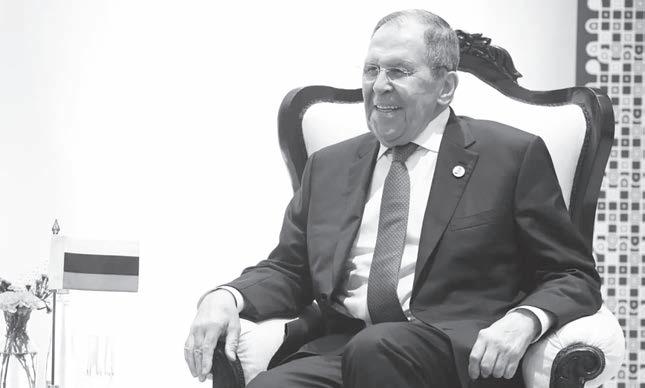
China-Russia nexus seen decisive in PHL’s UNSC…
Continued from A12
“political noise,” which includes the ongoing leadership dispute in the Senate and the impeachment trial of Vice President Sara Duterte.
The government has allocated P20.78 million to campaign for the seat, which was expected to give the country a greater voice in global security matters.
Palace Press Officer Claire Castro said the country’s political “noise and tensions” hurt the country’s chances during the voting period for the UNSC seat.
“All these political noise and political tensions affect the impression of the entire nation and the entire world on the Philippines. These [impressions] become negative because of the noise coming from obstructionists,” she said in Filipino.
The Presidential Communication Office Undersecretary noted the same issues affect the country’s economy since it discourages investors from doing business in the country.
“We know that political tensions affect not just one or two persons, but the entire country and even the economy because the Philippines’s reputation in other countries or the entire world is tarnished by the said noise,” she said.
Castro said if the ongoing leadership dispute in the Senate will persist in the coming weeks, it may also be included in the 5th State of the Nation Address (Sona) of the President next month.
The Senate is currently embroiled in a leadership dispute between the factions led by Senator Sherwin T. Gatchalian and Senator Alan Peter S. Cayetano.
“So, whoever should be the authority or act in the Senate, they should take the lead. Right now, we recognize the leadership of acting Senate President Sherwin Gatchalian,” she said.
With a report from Samuel P. Medenilla
US tariff…
Continued from A1
forced labor is unacceptable,” US Trade Representative Ambassador Jamieson Greer said.
“This creates a dynamic where American workers are forced to compete globally on an unlevel playing field. We will no longer tolerate this disparity,” he added.
Philippine export industry leaders, however, maintained that the country has existing safeguards and labor standards that make forced labor practices unlikely within export-oriented manufacturing operations.
Foreign Buyers Association of the Philippines (FOBAP) President Robert Young told the BusinessMirror that garment factories serving the US market are subject to regular compliance checks by economic zone authorities and must also meet labor standards required by foreign buyers.
Young noted that many export manufacturers operate inside economic zones where labor practices are routinely monitored, including compliance with laws on wages, child labor and working conditions.
Before production contracts are awarded, he said manufacturers are also required to sign agreements with overseas buyers affirming compliance with international labor standards.
“How can products shipped to America be produced through forced labor when we are already subject to all these compliance requirements?” Young said in a phone call.
He warned that additional tariffs would further weaken the competitiveness of Philippine-made garments at a time when manufacturers are already facing pricing pressures in global markets.
“If they add this kind of tariff, we may be erased from the radar of American buyers,” he said.
For his part, Federation of Philippine Industries (FPI) Chairman Emeritus Jesus Arranza said the proposed duties could create new challenges for exporters even if the Philippines is not known for forced labor violations.
“Normally, when tariffs are increased, it creates setbacks for exports,” Arranza told this newspaper in a call, adding that Philippine shipments to the US could be affected if the proposal pushes through. Meanwhile, Philippine Exporters Confederation Inc. (Philexport) President Sergio Ortiz-Luis Jr. told the BusinessMirror the US should clearly identify the basis for its allegations before imposing additional trade barriers.
“If they have specific concerns, they should identify them so we can examine them,” Ortiz-Luis said. He also noted that electronics products—which account for a significant portion of Philippine exports to the United States—remain exempt from certain tariff actions, helping cushion the potential impact on overall exports. The USTR’s proposal follows the release of a comprehensive report examining the forced labor policies and enforcement practices of the economies covered by the investigation. Interested parties have until June 22 to submit requests to participate in public hearings, while written comments will be accepted until July 6. Hearings on the proposed tariffs are scheduled for July 7. Earlier, Trade Undersecretary and Board of Investments Managing Head Ceferino Rodolfo expressed confidence that the Philippines could justify its inclusion in the labor-related probe being conducted by the USTR.
“I’m very confident that if we’re given the opportunity to provide more information and greater interaction and engagement with the US side, we will be able to fully explain why we should not be part of the investigations under Section 301 on labor practices,” Rodolfo said.
Cebu’s growing infra needs…
Continued from A12
political will, and strong cooperation between the public and private sectors,” he said.
Central Visayas growth AT the summit, Department of Economy, Planning, and Development Region 7 (DepDev-7) Assistant Director Evelyn NacarioCastro presented the region’s economic outlook: while growth remains positive, significant vulnerabilities persist.
Castro said Central Visayas remains the country’s fourth-largest regional economy, with gross regional domestic product reaching P1.32 trillion in 2025, up from P1.15 trillion in 2023.
The regional economy expanded by 3.7 percent in 2025 despite facing multiple domestic and global challenges.
Among the factors weighing on growth were back-to-back typhoons, declining tourist arrivals, higher United States tariff rates affecting manufacturing, and the lingering effects of a fund control scandal that weakened government spending and investor confidence.
The region’s economy remains heavily dependent on services (71 percent of total output), followed by industry at 24 percent and agriculture at 4.8 percent.
Services continued to drive economic growth, expanding by 5.2 percent, while agriculture registered a slight decline.
Key contributors included wholesale and retail trade, financial and insurance activities, real estate, and human health and social work activities.
Human health and social work emerged as the fastest-growing sector at 12.2 percent, followed by public administration and defense, as well as financial and insurance services at 6.4 percent.
However, manufacturing remained a drag on regional growth, posting a contraction of 0.9 percent.
“Trade, manufacturing, and fi-
nancial services continue to dominate the regional economy, confirming Cebu’s role as a major economic hub,” Castro said. Despite the expansion, Central Visayas grew below the national average and continues to face challenges related to inflation, external shocks, and infrastructure constraints.
Inflation biggest concern CASTRO identified inflation among the region’s most pressing economic challenges.
Central Visayas recorded higher inflation than the national average in 2025, largely due to supply disruptions from disasters, increased transport costs, reduced food supply, and higher fuel prices linked to geopolitical tensions.
The region’s inflation rate reached 10.8 percent, significantly higher than the national figure, as rising energy and logistics costs filtered through transportation and food prices.
“As an island region, Central Visayas is particularly sensitive to inflation because of its dependence on shipping, fuel, and external markets,” Castro said.
Outlook
LOOKING ahead, Castro said the Philippine and regional economies are expected to continue growing, but growth will increasingly be shaped by global uncertainties and domestic constraints.
She warned that Central Visayas’ openness to global markets, while a strength, also exposes it to downturns in tourism, remittances, and trade.
At the same time, rapid urbanization is creating congestion, rising costs, and infrastructure gaps that could limit productivity if left unresolved.
“We are seeing an economy that continues to grow, but one that is increasingly shaped by both global shocks and domestic constraints,” Castro said.
Jinggoy withdraws bail, transfer of detention pleas at Sandigan
THE Sandiganbayan’s Fifth Division has deferred until June 30 the arraignment of Sen. Jose Pimentel
Ejercito alias Jinggoy Estrada and former Public Works secretary Manuel Bonoan in the P573-million plunder case and a separate graft case in connection with their alleged involvement in the multi-billion anomalous flood control projects of the government.
Estrada and Bonoan were scheduled to be arraigned on Wednesday but the Fifth Division chaired by Associate Justice Zaldy Trespeses decided to reset the proceedings owing to pending motions to quash the criminal cases.
Likewise, Bonoan has a pending motion seeking to be placed under hospital arrest because of his current medical condition.
Estrada, on the other hand, withdrew his earlier motion to fix bail and transfer of his detention from the New Quezon City Jail in Payatas, Quezon City, to the Camp Crame Detention Center, where he was once detained, to give way for the anti-graft court to resolve first his pending motion to quash the plunder and graft case.
The arraignment of their three co-accused in the plunder and graft charges—Public Work Manila assistant district engineer Denryl Caesar Cortuna and district engineers Manny Bulusan and Arturo Gonzales, Jr.—pushed through as they did not file a motion seeking to quash the information. The three pleaded not guilty to the charges.
In its complaint filed before the Sandiganbayan, the Office of the Ombudsman accused Estrada of receiving kickbacks from the government’s flood control projects amounting to more than P573 million.
The Ombudsman claimed the respondents were involved in an “intricate mechanism involving illegal budgetary insertions and project allocations” within the DPWH infrastructure portfolio for the year 2025.
The anti-graft body said its evaluation of the records shows that “substantial public funds were deliberately funneled into designated infrastructure projects in exchange for pre-determined commission fees or kickbacks.”
Estrada and Bonoan are facing a separate graft charge before the Sandiganbayan’s Second Division also in relation to the flood control mess. Joel R. San Juan
House imposes penalties on Suntay
THE House of Representatives on Wednesday formally disciplined Quezon City Rep. Jesus Suntay after adopting a Committee on Ethics and Privileges report that found his controversial remarks involving actress Anne Curtis-Smith violated the chamber’s Code of Conduct and the standards expected of public officials.
In adopting Committee Report No. 299, the House voted 263 in favor, eight against, and seven abstentions, affirming the Ethics Committee’s finding that Suntay committed disorderly behavior and conduct unbecoming of a member of Congress over statements made during a March 3, 2026 hearing of the House Committee on Justice.
The panel, chaired by Party-list Rep. Jonathan Clement M. Abalos of 4PS, concluded that Suntay’s remarks during the hearing, as well as related statements posted on social media, were inappropriate and had the effect of undermining the dignity, integrity, and reputation of the House of Representatives.
It recommended that Suntay be reprimanded under Section 52(b)(2), Rule IX of the Committee Rules. The committee also proposed that he perform voluntary community service, attend a gender sensitivity seminar to be conducted by the House Committee on Women and Gender Equality, and issue a public apology to Anne Curtis-Smith and all women through a statement to be aired on broadcast media.
The case stemmed from statements Suntay made during impeachment proceedings against Vice President Sara Duterte, where he recounted seeing Curtis at a hotel and made remarks that were widely criticized as inappropriate.
During the hearing, Suntay said: “Lastly, alammominsannasaShangri-la akonakita ko si Anne Curtis ang ganda-ganda pala niya may desire sa loob ko na nag-init
talaga…na imagine ko na lang kung anongpuwedengmangyariperohanggang imagination na lang.”
Lawmakers immediately objected to the remarks, prompting the Justice committee to have them stricken from the record.
However, the Ethics committee ruled that deleting the statements from the transcript did not erase their impact, stressing that inappropriate remarks with sexual undertones have no place in legislative proceedings.
In adopting the report, the House agreed that Suntay violated Section 141(a) of the House Code of Conduct, which requires members to act in a manner that reflects creditably on the institution.
The committee also found him liable under Sections 4(A)(b) and (c) of Republic Act 6713, or the Code of Conduct and Ethical Standards for Public Officials and Employees, which mandate professionalism, respect for others, and adherence to moral standards.
Suntay admitted making the remarks during the Ethics committee proceedings and issued an apology to those who were offended.
The committee emphasized that lawmakers are held to a higher standard of behavior, noting that congressional deliberations must remain respectful and free from discriminatory or offensive language.
“Remarks with demeaning sexual overtones do not reflect the core values of the House of Representatives and its members,” the report said, adding that the chamber has consistently upheld advocacies promoting women’s dignity and equality and “should not tolerate any actuation from any member that diminish these values.”
The adoption of the report marks the House’s final action on the case, imposing a formal disciplinary sanction on the lawmaker. Jovee Marie N. dela Cruz
Sara impeachment must proceed without distraction–lawmakers
THE impeachment trial of Vice President Sara Z. Duterte must proceed in the proper forum and should not be derailed by what lawmakers described as “false testimony, political distractions, and an unauthorized Senate Blue-Ribbon committee proceeding.”
Party-list Rep. Terry Ridon of Bicol Saro, one of the House prosecutors, along with former Surigao del Norte Rep. Robert Ace Barbers, pushed back against the rump Senate hearing involving alleged witnesses, saying the proceedings appear aimed at shifting public attention away from the impeachment case towards issues already under judicial review. Ridon firmly denied allegations raised during the disputed Senate proceeding linking him to the alleged delivery of a suitcase.
“The testimony of Jowly Cadiao is false.
Ombudsman files charges vs Discayas, DPWH execs
TAt no time and in no place was any suitcase delivered to me,” said Ridon, who also chairs the House Committee on Public Accounts.
He stressed that the impeachment process will move forward despite attempts to distract from it.
“Let it be clear: the impeachment trial will continue. No falsehood or fabricated testimony will stop the House prosecution panel from presenting the truth in the trial of the Vice President,” Ridon said. Barbers, for his part, said the individuals who testified before senators should bring their claims before the courts, especially since they are already facing legal complaints filed by personalities they previously implicated during Senate hearings.
“You should explain yourselves in court,” said Barbers, who served as lead chairman
See “Impeachment,” A9
By Joel R. San Juan @jrsanjuan1573
HE Ombudsman has filed graft and malversation charges against contractor-couple Cezarah Rowena Cruz Discaya and Pacifico F. Discaya II, and several officials of the Department of Public Works and Highways (DPWH) Bulacan First District Engineering Office (DEO), in connection with the P53.9 million substandard flood control project in Calumpit, Bulacan.
Aside from the Discayas, also named as accused in the complaint filed before the Regional Trial Court in the City of Malolos, Bulacan were St. Timothy Construction Corporation managing officer Ma. Angeline Discaya Rimando, and former DPWH officials Merg Jaron Caparas Laus, Brice Ericson Diaz Hernandez, Jaypee de Leon Mendoza, Ernesto Cosay Galang,
Norberto de Leon, Santos Lorenzo, Alcoriza Pagtalunan, Juanito Coronel Mendoza and Floralyn Yutuc Simbulan.
St. Timothy is owned by the Discayas, who are among the country’s top contractors being linked in the multi-billion flood control scandal.
Sarah is currently detained in the Lapu-Lapu City Jail Female Dormitory in Mactan, Cebu, for the non-bailable charges of graft and malversation in connection with the alleged P96.5 million “ghost” flood control project in Davao Occidental.
On the other hand, Pacifico has been in the Senate custody since September last year after he was cited in contempt for giving conflicting reasons on why his wife failed to attendthe Blue-Ribbon committee investigation into the flood control scandal.
The accused are facing one count of violation of Section
3(e) of Republic Act 3019, the Anti-Graft and Corrupt Practices Act, and one count of Malversation of Public Funds or Property Through Falsification of Public Document under the Revised Penal Code.
The case stemmed from the rehabilitation of the River Construction Structure at Bulusan, Calumpit, Bulacan.
Investigation conducted by the Ombudsman showed “utter and flagrant disregard for government auditing and accounting regulations.”
Specifically, investigators discovered that payments for the project’s first billing were released despite an unapproved disbursement voucher.
Likewise, full payments for dredging and embankment items were made without any basis for computation or the supporting documents required to prove project accomplishment.
“These collective actions resulted in an unwarranted benefit to St. Timothy Construction Corporation totaling approximately P53,917,731.92, causing significant financial injury to the government,” the Ombudsman said.
The Ombudsman further determined that the accused DPWH officials allowed the contractor to take possession of and misappropriate these funds, which constitutes the illegal act of malversation of public funds.
The Ombudsman said former DPWH district engineer Henry Alcantara, and project engineer Paul Jayson Duya, were excluded as accused in the case following immunity agreements with the agency.
The recommended bail for the violation of Section 3(e) of RA 3019 has been set at P90,000 for each of the accused, while notably, no bail has been recommended for the malversation charge.
Senate media denounces Marcoleta
MEMBERS of the Senate media on Thursday denounced Sen. Rodante Marcoleta over his claim that many members of the mainstream media are “paid hacks,” saying the sweeping accusation unfairly maligns journalists and undermines public trust in legitimate journalism.
In a statement, the Senate media described Marcoleta’s remark during the Senate Blue-Ribbon committee proceedings as “not only irresponsible” but also a “reckless attack” on an institution vital to a functioning democracy.
“We, the members of the Senate media, condemn in the strongest possible sense the sweeping claim by Sen. Rodante Marcoleta that many members of the mainstream
media are nothing more than paid hacks,” the statement read.
The group said the accusation unfairly targets media workers who face intimidation, harassment, and even threats to their lives while informing the public and holding those in power accountable.
It added public officials must exercise greater restraint and responsibility in their statements, particularly at a time when disinformation and political polarization continue to erode public discourse.
“Marcoleta’s accusations against the press, if not supported by evidence, erode public trust in legitimate journalism and contribute to a climate of hostility against media practitioners simply doing their jobs,” the group said.
The Senate media said journalists do not serve politicians, political parties, or competing factions in the country’s political conflicts.
Rather, it said, the Fourth Estate exists to serve the public interest by pursuing facts, verifying information, and scrutinizing those in power without fear or favor.
“Journalists should never be dragged into the rivalries, feuds, or power struggles of political figures,” the group said.
It added the media should neither be weaponized by one political camp against another nor treated as collateral damage in political warfare.
The group said criticism of media coverage is both fair and healthy in a democracy. However, it said public officials who level serious allegations against
journalists must present evidence rather than rely on inflammatory rhetoric.
“A free press can only perform its constitutional role when it is allowed to operate independently—free from pressure, threats, intimidation, or political coercion from any side,” it said.
The Senate media likewise stressed that the press is neither the enemy of any political faction nor an extension of any political machinery.
“Its allegiance must remain solely to the truth and to the public it serves,” it said. The group added that journalists deserve neither blind praise nor baseless condemnation, but rather the freedom to report without being branded, bullied, or sacrificed in the political battles of others. PNA
Navy frigate, contingent off to Rimpac 2026
By Rex Anthony Naval
THE Navy (PN) on Thursday sent-off the guided-missile frigate, BRP Miguel Malvar (FFG-6), with Naval Task Group 84 aboard, to take part in this year’s iteration of the Rim of the Pacific (Rimpac) exercises which be held from June 24 to July 21 in the waters off Hawaii.
Send-off ceremonies took place at Naval Operating Base-Subic in Zambales.
“The send-off ceremony attended by the Flag-Officer-In-Command, Vice Admiral Jose Ma. Ambrosio Ezpeleta, together with members of the crew, support personnel, and distinguished guests marked the commencement of the contingent’s deployment
to the multinational maritime exercise,” the PN said in a statement.
In the same statement, Ezpeleta said the PN’s participation is important since the Philippines’ last ship deployment to Rimpac dates back to 2022.
“As such, our return to this multinational activity highlights our commitment to becoming a ‘credible partner’ under our Sail Plan 2040 vision. We likewise strengthen maritime cooperation with partner nations and navies in order to continue advancing a free and open Indo-Pacific,” he added.
BRP Miguel Malvar has a contingent composed of Navy personnel who will participate in a series of professional exchanges
and operational activities alongside naval forces from participating nations.
This year’s exercise likewise marks the inaugural participation of the Coast Guard (PCG) in Rimpac, highlighting strengthened inter-agency maritime cooperation and a more integrated Philippine representation in multinational maritime engagements. Ezpeleta emphasized the importance of professionalism, discipline, and excellence in representing the country and the PN throughout the exercise.
“I trust that every sailor and marine who will embark on this mission will demonstrate excellence and a forwardlooking mindset in everything that you
will do—epitomizing a new era of maritime capability for the Philippines,” he expressed. It will be the second international engagement for BRP Miguel Malvar, early this year, the frigate sailed to India to participate in another exercise, where it had the distinction of being the only foreign ship to detect a submarine submerged in the Bay of Bengal. The deployment of PN assets and personnel forms part of the Navy’s continuing efforts to enhance interoperability, strengthen maritime partnerships, and improve operational capabilities through realistic and complex training environments.
PPSC strengthens cybersecurity workforce
By Jonathan L. Mayuga @jonlmayuga
THE Philippine Public Safety Col -
lege (PPSC) is strengthening the country’s cybersecurity workforce to help keep communities safe in an increasingly connected world, the Department of the Interior and Local Government (DILG) said.
The DILG highlighted the role of the PPSC’s National Cyber Training Institute (NCTI) in preparing law enforcement personnel to address emerging cyber threats, strengthen digital investigations, and enhance the government’s capacity to protect the public from online crimes.
The initiative supports President Marcos’ vision of building safer, smarter, and more resilient communities while advancing the
administration’s digitalization and cybersecurity agenda.
“As technology evolves, so do the threats faced by our communities. Our law enforcement personnel must be equipped not only to respond to crimes on the ground, but also to crimes committed in cyberspace. Through the NCTI, we are building the expertise needed to protect Filipinos in the digital age,” the department said in a statement.
The NCTI provides specialized training designed to help law enforcement officers identify, detect, investigate, and respond to cyber threats while strengthening the protection of public institutions and critical systems against digital risks.
At present, the Institute has 183 students enrolled in three specialized programs and
has already produced 514 graduates through its Cyber Leadership Executive Course (CLEC), Cyber Orientation Course (COC), and Cyber Intermediate Course (CIC).
Recognizing that cybersecurity is a shared responsibility, the NCTI has also expanded its training initiatives to the youth sector through the Cyber Youth Leadership Course (CYLC), implemented in partnership with the National Youth Commission (NYC).
The program’s first batch consists of 45 scholars composed of Sangguniang Kabataan officials, Local Youth Development Officers, and Youth Organization Registration Program (YORP) officers from the National Capital Region, Calabarzon (Cavite, Laguna, Batangas, Rizal and Quezon), and Central
the
A4
Friday, June 5, 2026
Green Lane investments slip Jan-April
IBy Bless Aubrey Ogerio
NVESTMENT approvals under the government’s Green Lane system fell in early 2026, with total project value dropping 46.1 percent year-onyear owing to fewer certified projects, data from the Board of Investments (BOI) indicate.
From January to April this year, the BOI recorded 14 Green Lane projects worth P340.07 billion, significantly lower than the 27 projects totaling P631.22 billion approved in the same period last year. (See: https://businessmirror.com.ph/2025/05/01/ boi-203-projects-worth-p5-17-ton-green-lane/)
Despite the decline in volume and value, Trade Secretary and BOI chair -
person Ma. Cristina Roque said the initiative continues to reflect strong investor confidence in the Philippines and its positioning as a destination for strategic and sustainable investments in Southeast Asia.
“These figures reflect strong investor confidence in doing business in the Philippines, supported by the ease of doing business under the Green Lane Initiative,” Roque said.
She added that the latest approvals send a signal that the country remains open to high-value investments expected to generate jobs and stimulate economic activity.
While fewer projects were approved compared to last year, employment projections rose significantly. The 14 certified projects are expected
to generate 37,828 jobs, more than double the 18,272 jobs estimated in the same period in 2025.
Renewable energy continued to dominate the Green Lane pipeline, accounting for 85.71 percent of total certifications. This segment alone attracted P339.09 billion in investments and is projected to generate 37,726 jobs.
The remaining share came from the food security sector, which accounted for two projects or 14.29 percent of total approvals, with combined investments of P980 million. The BOI said these projects are expected to support agricultural output and improve supply chain resilience.
Since its launch in February 2023, the Green Lane system has approved
a total of 237 projects with a combined value of P6.32 trillion and an estimated 421,451 jobs.
The investment approvals span sectors including renewable energy, digital infrastructure, public-private partnerships, manufacturing, water systems, pharmaceuticals, and food security.
Renewable energy remains the largest segment, with 182 projects approved since the program began, representing P5.42 trillion in investments and about 272,583 jobs.
The Green Lane was established under Executive Order 18 to fast-track strategic investments by providing a single-entry system for approvals through the One-Stop Action Center for Strategic Investments.
ILO chief urges ‘human-centered’ approach to AI
By Justine Xyrah Garcia
GOVERNMENTS, employers, and workers must adopt a humancentered approach to artificial intelligence (AI) to ensure that technological advances create decent jobs rather than deepen inequality, according to International Labor Organization (ILO) Director-General Gilbert F. Houngbo.
Opening the 114th International Labor Conference (ILC), Houngbo said the future of work would depend not only on technological innovation but also on the policies and institutions that shape its impact on workers.
“The future of work will not be determined by technology alone, but by the policies, institutions, and social dialogue
that guide it,” Houngbo said. Houngbo urged countries to place workers at the center of the AI revolution and ensure that productivity gains generated by the technology are shared broadly through better wages, stronger labor protections and more inclusive growth.
“Those gains must be distributed fairly through better wages, stronger labour protections and more inclusive growth,” he said. The call comes as studies continue to show that exposure to AI varies significantly across occupations and demographic groups, raising concerns that technological change could widen existing disparities.
In the Philippines, data from the ILO showed that 40.3 percent of occupations predominantly held by women are ex -
posed to AI, compared to 19.3 percent for occupations largely held by men.
Women account for around three in five clerical support workers and service and sales workers, as well as more than half of technicians and associate professionals, occupations identified as having higher potential exposure to generative AI.
The gap is even wider in the National Capital Region or Metro Manila, where potential AI exposure among women reached 51.7 percent, compared to 35.1 percent among men.
“The choices we make today will determine whether AI broadens opportunity and shared prosperity or deepens inequality and insecurity,” Houngbo said.
AI and digitalization are expected to be among the major issues discussed during the conference, alongside gender equality, social dialogue, and proposed international labor standards for workers in the platform economy.
AI and digitalization are expected to be among the major issues discussed dur -
ing the conference, which brings together representatives of governments, employers, and workers from the ILO’s 187 member states.
One of the key agenda items is the second discussion on decent work in the platform economy, which could pave the way for new international labor standards covering digital platform workers.
Delegates will examine draft provisions on employment promotion, worker protections, and the use of automated systems by digital labor platforms.
The conference will also tackle gender equality in the world of work, including policies aimed at ensuring that technological, environmental, and demographic transitions create more inclusive labor markets.
Another major discussion will focus on social dialogue and tripartism, examining how governments, employers, and workers can work together to navigate digital transformation, demographic shifts and rising inequalities.
www.businessmirror.com.ph
Visayas power grid back to normal
By Lenie Lectura @llectura
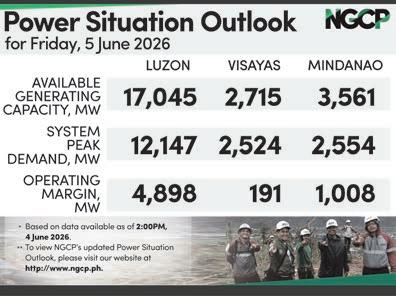
THE Visayas power grid on Thursday returned to a normal state after operating under a series of yellow and red alerts.
The National Grid Corporation of the Philippines (NGCP) said all grids are normal based on current supply and demand forecast.
In the Visayas, grid conditions improved with Unit 2 of the Kepco-SPC Power Corp. (KSPC) back on line and lower demand forecast.
However, a major plant outage may still trigger a yellow alert, the NGCP said in an advisory.
A yellow alert is issued when the operating margin is insufficient to meet the transmission grid’s contingency requirement.
Baseload power plants are those that operate continuously while mid-merit plants are designed to operate during high and fluctuating demand.
“What the Visayas needs is a steady baseload,” Energy Secretary Sharon Garin said. “The Visayas is one of the areas in the country that has a lot of renewable energy.” Garin said the DOE continues to look for solutions to temporarily address the supply constraints while waiting for new generating facilities to come online. These include the deployment of power barges, modular diesel generating units, and battery energy storage systems (BESS).
A 30 megawatt (MW) BESS facility in Mactan, Cebu, is currently undergoing final testing and commissioning, while negotiations are underway for at least 20 MW of modular diesel generation capacity.
Last week, the Department of Energy (DOE) said the Visayas needs additional and continuous baseload and mid-merit power plants to guarantee grid stability despite having significant renewable energy (RE) capacity.
PCG to secure power grid facilities
POWER transmission network system provider National Grid Corporation of the Philippines (NGCP) and the Coast Guard (PCG) officially formalized a strategic partnership through the signing of a Memorandum of Agreement (MOA) to fortify the security, resilience, and emergency response capabilities surrounding the nation’s critical maritime energy infrastructure.
The ceremony, held at the PCG National Headquarters, was attended by key officials from both institutions led by the NGCP President and Chief Executive Officer Anthony L. Almeda, and the PCG Commandant, Adm. Ronnie Gil L. Gavan.
NGCP expressed its gratitude to the Coast Guard for its vital support, emphasizing its importance in ensuring the grid’s security and reliability. “With this partnership, we aim to strengthen coordination so we can respond faster during emergencies and disasters, while
DTI holds ground on solar standards
THE Department of Trade and Industry (DTI) is standing by its proposal to require certification for key solar energy products, saying the measure is necessary to protect consumers and ensure the long-term reliability of equipment entering the Philippine market.
The proposed regulation comes as more households, businesses, and communities invest in solar power systems to manage electricity costs and reduce dependence on conventional energy sources.
In a statement, Trade Secretary Ma. Cristina Roque said the planned certifica -
tion requirement is intended to ensure that solar products sold in the country comply with Philippine National Standards (PNS), amid concerns over the entry of low-quality equipment.
According to the DTI, the proposal seeks to establish minimum quality and safety benchmarks for solar products and shield consumers from equipment that may fail prematurely or pose safety risks after installation.
The agency also argued that stronger standards would help prevent the Philippines from becoming a destination for substandard
solar products that may no longer be accepted in other markets.
By requiring compliance with recognized standards, the government hopes to give consumers greater confidence that the solar systems they purchase have undergone proper testing and can deliver reliable performance over their expected lifespan.
The DTI clarified that the proposed rules would recognize test reports issued by accredited and recognized testing laboratories, allowing manufacturers to demonstrate compliance through established certification processes.
The agency also stressed that the measure is limited to product quality and safety requirements and does not cover the installation, mounting, or construction aspects of solar energy systems.
continuing to uphold maritime safety, environmental protection, and national security,” Almeda said.
The PCG said that the agreement—its most challenging yet essential partnership to date—is a win-win undertaking for both institutions, representing a significant step forward in interagency cooperation and information sharing.
“We recognize that without power, we cannot progress, exist, or survive. This MOA reflects our shared commitment to protect the submarine cable systems and infrastructure that play a vital role in government operations, economic stability, and public safety.” Gavan said. Under the newly signed MOA, the PCG will help secure NGCP’s submarine cables, including its fiber optic network, critical in power transmission and communication across the grid, acting as first responder to any emergencies involving NGCP’s maritime assets.
Earlier, the DTI disclosed that it is drafting regulations that would make product certification mandatory for major components used in solar power installations. The Bureau of Philippine Standards, an attached agency of the DTI, proposed a certification regime that would apply to solar panels, inverters, charge controllers, battery storage equipment, and associated cabling for residential and commercial use. The department said the initiative forms part of broader efforts to support the country’s transition to cleaner energy while ensuring that consumers are protected from defective or unreliable products.
“As the country continues its transition toward cleaner and more affordable energy, ensuring the quality and safety of solar products is critical to protecting consumers, strengthening trust in renewable energy, and supporting the sustainable growth of the solar industry in the Philippines,” the DTI said. Bless Aubrey Ogerio
New Senate leadership to address plight of 29 AFP, 86 FSOs whose confirmations were delayed - Lacson
By Butch Fernandez @butchfBM
PART of the collateral damage from the Senate skirmishes and leadership gridlock were 29 Armed Forces of the Philippines generals, as well as 86 foreign service officers (FSOs), whose confirmations were stalled. Resolving their plight will be one of the priorities of the new Senate leadership, Sen. Panfilo “Ping” M. Lacson said late Wednesday. Lacson said the leadership under Acting Senate President Pro Tempore Sherwin Gatchalian is exploring various measures, including asking Malacañang for an ad interim appointment for the affected officers, and a special session to let the Commission on Appointments (CA) confirm these.
“ Naaawa kami una sa nakabinbin na confirmation na AFP officers. Kawawa sila kasiangkanilangnomination was made when Congress was in session. Kanina lang kami nag adjourn sine die (We sympathize with the stalled confirmation of the AFP officers whose nominations were made when Congress was still in session; we just adjourned sine die this afternoon),” he said.
Alangalangsamagigitingnatingopisyal, hihiling kami sa pangulo kung pwedeng tumawag ng special session para ma-convene ang CA [For our fine officers, we will ask the President for a special session to convene the CA so their plight will be addressed],” he added.
“Dalanaminito,satamangtiyempoang kanilangpagnominateperodahilnagkagulo sa Senado hindi ma-convene ang CA [This is our obligation because their nominations were made on time but the CA could not convene because of the Senate leadership issue],” Lacson noted.
Following a leadership change in the Senate that installed Alan Peter Cayetano as Senate President last May 11, no senators were elected as CA members. The CA is tasked to confirm the appointments of AFP and foreign service officers.
On Wednesday, another leadership change took place in the Senate, with Gatchalian elected as Senate President Pro Tempore and acting Senate President. This, after Senate President Alan Peter Cayetano refused to convene session for the third straight day, with the “boycott” impacting the Senate’s ability to properly adjourn sine die until July 28, as provided in the legislative calendar of the First Session of the 20th Congress. After being administered the oath as Senate President Pro Tempore, Gatchalian had explained that if they did not move to break the boycott, it would have put the chamber “on the brink of a constitutional violation,” since the Charter prohibits cancellation of session for three consecutive days without notice being given to the other house of Congress.
DMW appeals case of 3 Pinoy seafarers detained in Algeria on drug charges
THE Department of Migrant Workers (DMW) has appealed the case of three Filipino seafarers who remain detained in Algeria on drug charges, Malacañang said. The three were among the eight Filipino crew members of the commercial vessel CV Harris, who were arrested on July 28, 2023 by Algerian authorities for possessing 35.8 kilograms of cocaine.
The case against the other five crew members of the CV Harris was already dismissed.
Last April, DMW reported that the sentence of the three Filipino sailors was reduced from 20 years to 15 years.
“The three remaining seafarers had their sentences reduced and are awaiting the results of the appeal,” Palace Press Officer Claire Castro said in a press briefing last Thursday.
“The DMW is continuously monitoring the status of the case,” she added. She said while the said sailors were detained, the owner of CV Harris continued to provide remittances to their families.
The Presidential Communications Office undersecretary said DMW also continues to provide support of the affected families.
Samuel P. Medenilla
‘Time for world to get a taste’: PHL sends first Carabao mango shipment to Canada
TBy Ada Pelonia @adapelonia
HE Philippines on Wednesday exported its first-ever commercial shipment of fresh Carabao mangoes to Toronto, Canada, as part of government efforts to diversify export markets beyond traditional buyers.
The Department of Agriculture (DA) was part of a send-off ceremony at the Philippine Airlines cargo terminal in Pasay City last June 3, describing it a “breakthrough” for one of the country’s leading fruit exports.
“This is another step toward our goal of widening and diversifying the global market for our farm products such as bananas, coconuts and mangoes,” Agriculture Secretary
Francisco Tiu Laurel Jr. was quoted in the statement as saying.
“It is time for other parts of the world to get a taste of the Philippines,” he added.
The DA said the shipment followed the inaugural export of fresh Philippine mangoes to Rome in 2025, citing the government’s bid to expand the global footprint of Philippine agricultural products.
For his part, Agriculture Undersecretary Philip Young said the mango shipment to Toronto shows how government support and private-sector initiative can open new markets for Filipino farmers.
“The government is helping pave the way for the private sector to showcase to the world the products of Philippine farms. This is what happens when a nation works
together,” Young said.
The DA said the Philippine Agriculture Office in Washington, DC. coordinated the shipment with the Philippine Consulate General in Toronto, the Philippine Trade and Investment Center in Toronto and mango industry stakeholders.
Philippine exporters Hi-Las Marketing Corp. and Castillo Import Export Ventures Inc. supplied the fresh mangoes, with Ontariobased TSI Tropicals Inc. as the importer.
Flagship carrier PAL will transport the fresh mangoes through a commercial air freight program, the DA said.
Beyond mangoes and coconuts, the DA has been ramping up its efforts in promoting a portfolio of high-value crops (HVC).
This includes several varieties of ba -
Lawmakers, progressive leaders dismiss ‘18 ex-Marines’ allegations as ‘diversion’ ahead of impeachment trial
By Jovee Marie N. Dela Cruz @joveemarie
LAWMAKERS and progressive leaders on Thursday dismissed as a “desperate diversion” the allegations linking them to illicit activities—claims made by “18 ex-Marines”—saying the accusations are baseless and politically motivated, aimed at derailing the upcoming impeachment trial of Vice President Sara Duterte.
Lanao del Sur 1st District Rep. Zia Alonto Adiong categorically rejected accusations that he received money or any form of benefit, stressing that the claims were fabricated to distract from Congress’ constitutional duty.
“First of all, I categorically deny all their accusations against me. I did not receive any suitcase, money, or anything from anyone, and I did not pick up anything anywhere,”Adiong said.
He described the allegations as part of a broader attempt to shift public attention away from the impeachment proceedings.
“I believe these allegations were deliberately made to serve as a distraction from our important constitutional duty—the upcoming impeachment trial against Vice President Sara Duterte,” he added.
Adiong further characterized the controversy as “political theater,” saying the accusations were intended to create noise, silence voices calling for accountability, and derail legislative work.
“I will not be intimidated by baseless accusations, recycled narratives, or cheap political machinations. I will remain firm and faithful to my oath: the Constitution and the welfare of the people,” he said, urging a return to legislative work.
Mamamayang Liberal Rep. Leila de Lima also denied the accusations, revealing that she has already initiated legal action against those behind the claims.
“I have already responded to these blatant lies and filed a libel/cyberlibel
By Manuel T. Cayon @awimailbox
AVAO CITY—The Bangsamoro government opened for traffic its longest locally-funded bridge last week in Maguindanao del Norte which would link the scattered barangays in North Cotabato and which have been clustered to form the loosely categorized Special Geographical Area.
The Libungan Toretta-Kabuntalan Bridge spans a total length of 150 meters, the longest among all the bridge infrastructures that the regional government have built so far on its own funds. The bridge cost the Bangsamoro government P180 million.
The bridge connects the municipality of Pahamuddin in the Special Geographic Area (SGA) and Kabuntalan, Maguindanao del Norte and cuts travel time between them.
The Bangsamoro Ministry of Public Works said the bridge was officially opened on May 25 as it also turned over 17 other
complaint before the NBI and perjury complaint before the DOJ,” De Lima said.
She reiterated that she never received money in any form, dismissing the allegations as fabricated.
“I will repeat: whether it’s a suitcase, a paper bag, or anything else, I did not receive any money. It is no longer surprising that the story and the accusations against me are getting tangled because what they are saying is purely made up,” she said.
Palawan Rep. Jose “Pepito” Alvarez also denied allegations that he received a suitcase of cash, saying his name was dragged after he refused to endorse an impeachment complaint against President Ferdinand R. Marcos Jr.
Alvarez also revealed he was earlier asked to support an impeachment complaint against the president, allegedly circulated by former congressman Mike Defensor, which he immediately rejected.
He added that only after declining the request did his name surface in the controversy.
Meanwhile, former Makabayan bloc lawmakers France Castro, Arlene Brosas, and Raoul Manuel issued a joint statement condemning the allegations made by the so-called “18 ex-Marines,” describing them as a “desperate act of political demolition.”
The group said the accusations— including claims that they met with individuals and received money in paper bags—were “outright lies” unsupported by any evidence.
“All they have are conjectures, vague insinuations, and outright lies, because they have no evidence of any wrongdoing by Makabayan,” the statement read.
They emphasized that Makabayan has no involvement in infrastructure projects, rejecting insinuations of kickbacks or participation in alleged anomalies.
“We have no projects, allocables, or infrastructure insertions in our names. We will not receive any kickbacks because we
newly completed road concreting projects and Level II water systems elsewhere in the province.
These projects targeted the locations in and around the geographically isolated and disadvantaged areas, or GIDA, to remove rural isolation and boost agricultural trade.
The MPW said the Libungan TorettaKabuntalan Bridge is the longest locally funded bridge in the Bangsamoro Autonomous Region in Muslim Mindanao. It was financed from the regional government’s Block Grant.
Director General Danilo Ong delivered the message of Public Works Minister Eduard Guerra who said the bridge “serves a purpose beyond physical connectivity.”
“Bridges do not simply connect two pieces of land. They connect people, livelihoods, aspirations, and opportunities,” Ong said.
He said the structure was designed to serve as a critical diversion route, allowing motorists to bypass heavy traffic
do not have any projects,” the group said.
The group also questioned the timing of the allegations, noting that these surfaced as the impeachment trial against Vice President Duterte approaches and as international proceedings against former President Rodrigo Duterte continue.
“This is a classic, desperate diversion,” they said, accusing Duterte allies of launching attacks when faced with accountability.
Bogus hearing
GABRIELA Rep. Sarah Elago, ACT Teachers Rep. Antonio Tinio, and Kabataan Rep. Renee Co on Wednesday condemned what they described as a “bogus hearing” and “manufactured evidence” being presented in a Senate investigation, warning that it is being used as a tool for political demolition against progressive leaders.
In a press statement, lawmakers criticized proceedings under the Senate Blue Ribbon Committee, saying the hearings were being conducted amid internal political tensions in the Senate and were being used to circulate unverified accusations.
They dismissed the allegations linking them to a flood control controversy as baseless, stressing that Makabayan representatives do not handle infrastructure allocations or projects, and therefore could not have received any form of kickbacks.
“The so-called evidence is not evidence at all but stories, insinuations, and outright lies,” the group said, adding that the testimonies presented reportedly change depending on shifting political alliances.
They also argued that inconsistencies in witness statements undermine the credibility of the allegations, describing the proceedings as politically motivated rather than a genuine fact-finding inquiry.
They further urged the Senate to uphold credibility in its investigations, saying public funds and institutional processes should not be used for what it called “demolition jobs disguised as hearings.”
in Cotabato City.
The MPW said the bridge and the 17 other road concreting projects “formed part of a broader rural development initiative designed to uplift vulnerable communities, sustain regional peace, and provide remote barangays with access to clean water and reliable farm-to-market roads.”
Local leaders said the immediate benefits of the bridge were removing the dangers from residents who previously relied on difficult river crossings.
“For years, our students and farmers endured the daily challenge of crossing the river to go to school or sell their products,” Pahamuddin Vice Mayor Ibrahim Rahman said. “Today, what used to be a long and difficult journey now only takes a few minutes.”
Northern Kabuntalan Mayor Datu Umbra Dilangalen also welcomed the project.
“We cannot describe how happy we are to finally have this beautiful bridge. This connects our communities to progress and serves as a bridge of peace,” he said.
nanas like cavendish, cardaba or saba, cacao, pomelo, rambutan, dalandan, mango, pineapple, okra, asparagus, pili, durian, avocado, dragon fruits, calamansi and ube.
Aside from expanding market access, the DA is also seeking at least P1 billion investments from the private sector through a national investment forum to boost exports of key high-value commodities.
Agriculture Secretary Francisco Tiu Laurel Jr. said securing a minimum of P1 billion investment in the DA’s coming national investment forum will enhance cacao, mango, seaweed, and coffee industries. The forum is anchored on the United
Nations Food and Agriculture Organization’s (FAO) global Hand-in-Hand (HIH) initiative that presents agricultural projects to private investors.
The DA explained that the initiative links data-driven agricultural priorities with financing and technical expertise.
Bringing the forum to the Philippines, Tiu Laurel said, would bridge the gap between global capital and local stakeholders.
“We want to grow these industries as soon as possible,” Tiu Laurel previously told reporters.
“We
CICC to public: Don’t let fake news fuel confusion amid Senate shakeup
By Lorenz S. Marasigan @lorenzmarasigan
THE Cybercrime Investigation and Coordinating Center (CICC) on Thursday warned the public against the spread of misinformation and disinformation online as the country navigates a leadership shakeup in the Senate.
The agency said its online monitoring efforts have detected discussions and activities across digital platforms indicating that certain groups may be organizing rallies and other public assemblies in the wake of recent leadership changes in the upper chamber.
The CICC urged Filipinos to verify information seen on social media through credible and official sources before participating in any event, and to refrain from sharing unverified content that could mislead the public, heighten tensions, or deepen confusion during this period of heightened political conflict.
“Cyberspace is not only a platform for expressing opinions but also a shared space where every Filipino has a responsibility to ensure that the information you consume and share is accurate and constructive,” CICC Undersecretary Renato Paraiso said. The agency also called on organizers, participants, and social media users to avoid sharing content that encourages violence, promotes unlawful activities, or threatens public safety and order.
While affirming citizens’ constitutional rights to freedom of expression, peaceful assembly, and political participation, Paraiso stressed that these rights must be exercised responsibly — both online and in physical gatherings.
“We appeal to Filipino netizens to be discerning and responsible online. Let us not add fuel to confusion, division, or conflict by spreading unverified information or inflammatory content. Instead, let us promote respectful dialogue based on facts and digital responsibility,” he said.
Former security adviser, businessman, Chinese agronomist receive 2026 APPCU awards
By Justine Xyrah Garcia
THREE individuals were recognized Wednesday for their contributions to strengthening understanding and cooperation between the Philippines and China during the 2026 Award for Promoting PhilippinesChina Understanding (APPCU) held in Manila.
The annual recognition, conferred by the Association for Philippines-China Understanding (APCU), honors Filipinos and foreign nationals whose work has helped foster dialogue, cooperation, and people-to-people exchanges between the two countries.
This year’s honorees were former National Security Adviser Clarita Carlos, businessman Peter Leung Ng, and Chinese agronomist Prof. Zhang Zhaodong.
Speaking during the ceremony, APCU Chairman and President Raul Lambino said the awardees were selected at a significant period in Philippines-China relations and exemplify the values of dialogue, cooperation and mutual understanding.
Lambino noted that exchanges between the two countries continue in the academic, cultural, and economic spheres, citing partnerships among local governments, educational institutions, and business groups.
“Judging from the frequency of the recent exchanges, the enthusiasm displayed by our sister LGUs and the quality of engagement and cooperation between our two peoples in the academic, cultural and economic spheres, I can say with certainty tonight that we are in a good place in our
people-to-people relationship,” he said. Carlos was recognized for her work as a political scientist, educator, and national security expert, particularly her advocacy of dialogue and strategic engagement in addressing issues affecting relations between the Philippines and China.
Ng, meanwhile, was honored for decades of work promoting friendship and cultural harmony between Filipinos and Chinese through civic, cultural, and business initiatives.
Zhang became the first non-Filipino recipient of the APPCU award. APCU cited his more than two decades of work in helping localize hybrid rice technology in the Philippines, contributing to higher productivity and food security.
Chinese Ambassador Jing Quan, who attended the event, cited Zhang’s work as an example of practical cooperation between the two countries.
According to the ambassador, farmers adopting hybrid rice technology have seen income gains of around P40,000 to P60,000 per hectare annually.
“And the yield has gone up from 45 tons to 78 tons per hectare, which means about a 60 percent increase in farmers’ income,” he added. Jing also highlighted opportunities for cooperation in agriculture, tourism, and clean energy, which he said continue to generate benefits for both countries.
Launched in 2021, the APPCU has recognized individuals from government, business, academe, and civil society whose work has helped build bridges between Filipinos and Chinese.
BARMM opens region’s longest, locally funded bridge in Maguindanao
AMID CHANGING TIMES, KEEPS THE SPIRIT OF
By Justine Xyrah Garcia
THE flower may no longer blanket San Pedro, Laguna’s fields the way it once did, but for nine days in May, its presence was felt more strongly across the city.
Across San Pedro, traces of Sampaguita could be found everywhere— from elaborate festival costumes and floral installations to paintings celebrating local life and culture.
Volunteers planted new seedlings in hopes of strengthening the industry, while residents gathered to reflect on the history and heritage that remain intertwined with the flower.
Held from May 22 to 30 under the theme “Pamana ng Nakaraan: Kahusayan at Kaunlaran,” the 2026 Sampaguita Festival unfolded amid changing times.
W hile local governments across the country navigate economic pressures and calls for prudent spending, San Pedro chose an approach that emphasized sustainability, community participation, and cultural preservation.
R ather than defining success through bigger productions or grander spectacles, this year’s festival focused on something more enduring: keeping the spirit of Sampaguita alive.
For San Pedro Mayor Art Joseph Francis Mercado, that mission has guided the city’s efforts since he assumed office.
Ever since I took office in 2022, we’re trying to bring back, to revive the Sampaguita industry in our country through festivals like this,”
Mercado told the BusinessMirror
I know it won’t be easy, but little by little, we’re bringing back the Sampaguita industry.”
The weeklong celebration became both a showcase of local talent and a reflection of a larger question confronting the city: How does San Pedro preserve a heritage rooted in Sampaguita when the flower itself is no longer as visible as it once was?
More than a flower
For decades, Sampaguita was more than a symbol of San Pedro.
The flower provided livelihoods for generations of families who cultivated, traded, strung and sold Sampaguita throughout the region.
Its influence became so closely associated with the city that San Pedro earned the distinction of being known as the Sampaguita Capital of the Philippines. O ver the years, however, urbanization transformed the landscape. Former agricultural areas gave way to residential communities, commercial establishments and new infrastructure.
A s the city grew, the vast Sampaguita plantations that once characterized San Pedro gradually disappeared.
To many, that change suggest-
ed the industry itself had faded. But San Pedro City Chief Information Officer (CIO) Jhe-Rico Sam Colina believes otherwise.
The absence of plantations does not mean the industry is no longer alive,” he said.
W hile large-scale cultivation has declined, many of the artisans and vendors responsible for turning the flower into garlands and decorative pieces remain in San Pedro.
In fact, city officials discovered that many of the Sampaguita garlands sold in churches, markets, and transport terminals throughout Metro Manila and Southern Luzon continue to be woven by San Pedrenses.
We may no longer have plantations, but many of the people who string the garlands—the ones we see being sold by vendors—are from San Pedro,” Colina said.
For the local government of San Pedro, preserving Sampaguita therefore means preserving more
than a flower. It means protecting the knowledge, craftsmanship, and stories built around it.
Th at belief shaped the direction of this year’s festival.
A return to its roots
The celebration officially opened on May 22 with a Civic Parade and Grand Opening Salvo at the San Pedro City Plaza.
L ed by city officials, community organizations and various sectors, the opening ceremonies emphasized the festival’s heritagecentered theme.
The atmosphere quickly transformed into a celebration of local identity during the Lakambini ng San Pedro Barangay Fiesta Costume Competition.
Fourteen candidates representing different barangays took the stage wearing elaborate costumes inspired by local traditions, history, and community narratives.
The competition turned the
plaza into a moving gallery of San Pedro’s cultural heritage. One costume highlighted agricultural roots.
Another drew inspiration from local festivities. Others reflected historical landmarks and traditions unique to their communities.
The opening day’s activities established the tone for the rest of the week.
Every year, there are people who ask why we celebrate the Sampaguita Festival. Personally, I hope we reach a point where we no longer have to answer that question—or where people no longer need to ask why we celebrate it,” Colina explained.
“ That’s why our approach this year was very historical and very heritage-focused.”
Creativity takes center stage
If the opening days focused on identity, the weekend showcased creativity.
A mong the festival’s most distinctive events was the first-ever
Para sa Turismo: Sampaguita Festival Pedicab Float Parade. Instead of relying on large motorized floats, participants transformed ordinary pedicabs into colorful moving displays of local artistry. Decorated with flowers, heritage symbols and handcrafted materials, the pedicabs rolled through the city as spectators gathered along the route to take photographs and cheer on participants.
The parade became a visual representation of the festival’s sustainability message. Creativity—not scale— became the measure of success.
The winning entry by Ramon Mamawag of Barangay Sto. Niño stood out for its detailed craftsmanship and imaginative interpretation of the festival theme.
The City Plaza also transformed into an open-air performance venue as dance groups filled the stage with synchronized routines, energetic choreography and dramatic formations.
Salindayog ultimately emerged as champion of the Sampaguita Blooms 2.0 Dance Battle, closing one of the festival’s most competitive events.
A nother highlight of the weekend was the Sampaguita Artistry: Disenyo Sampaguita Competition.
Inside Robinsons Galleria South, the fragrance of freshly woven Sampaguita filled the venue as artisans and designers transformed the flower into wearable pieces, decorative installations, and innovative garland designs.
Some entries reimagined traditional weaving techniques through contemporary fashion. Others explored how Sampaguita could be
From left, Laguna Governor Sol Aragones, Board Member Angelica Jones Alarva, Provincial Administrator Atty. Nathalie Irene M. Velasquez, and City Chief Information Officer and Officer-in-Charge of City Tourism Culture and Arts Office Jhe-Rico Sam Colina, with Board Member Raffy Campos at the back, attend the Agos ng Musika Concert during the 2026 Sampaguita Festival.
San Pedro City Mayor Art Mercado, Laguna 1st District Congresswoman Ann Matibag, NBI Director Melvin Matibag, together with other elected City Officials are all out for the 2026 Sampaguita Festival
National Bureau of Investigation (NBI) Director Melvin Matibag delivers a message of support during the opening ceremony of the Sampaguita Festival 2026, assuring San Pedro City of the agency’s continued assistance and cooperation.
In his keynote message during the Grand Opening Salvo, Mayor Art Francis Joseph Mercado underscores the importance of preserving the Sampaguita tradition, describing the flower as an enduring part of San Pedro City’s identity.
Students from Lyceum of San Pedro stage an interpretative dance depicting the colorful history of San Pedro—from its roots as a center of the Sampaguita industry to its evolution into a thriving urban community and source of skilled workers.
Members of the Uno Dance Ministry perform before festivalgoers during the opening program of the Sampaguita Festival 2026.
Local performers bring energy to the festival stage as community participation and cultural expression take center stage during the opening festivities.
Padyak
FESTIVAL
TIMES, SAN PEDRO
SAMPAGUITA ALIVE
incorporated into modern home décor while remaining faithful to its cultural roots.
Team Hiraya captured top honors in the Avant-Garde Wearable Category, while the Sampaguita Vendors of San Pedro Apostol Parish led by John Allan Patriarca won the Sustainable Home Accents Category. Antonia Silang topped the Sampaguita “Legacy” Lei Innovation Category.
Preserving heritage
As the festival entered its second half, attention increasingly turned toward history, education, and preservation.
The Tertulya: San Pedro Heritage Forum gathered historians, cultural advocates and residents for discussions on local history, traditions, and the evolution of the Sampaguita industry.
The forum encouraged participants to look beyond celebrations and consider the stories that shaped the city’s identity over the decades.
Visual artists contributed to that effort through Pintura ng Pamana, where participants of different ages produced works inspired by the theme “Sampaguita and San Pedronian Way of Life.”
Throughout the activity, easels filled with images of flowers, daily life, and local landmarks gradually transformed the exhibition area into a visual portrait of the city.
The sounds of brass instruments and percussion echoed through the City Plaza during the Indayog Sampaguita Marching Band Exhibition, where local marching bands demonstrated a musical tradition often seen during fiestas, religious processions and civic events.
One of the festival’s most symbolic activities also took place on May 28 through the Sampaguita Planting Activity conducted in partnership with SM Center San Pedro. City employees, private-sector representatives, barangay officials, and community volunteers gathered to plant Sampaguita seedlings as part of continuing efforts to strengthen the industry.
The activity reflected a simple but important message: preserving heritage requires not only remembering the past but also investing in the future.
Celebrating community
The latter days of the festival highlighted the people who continue to shape San Pedro’s cultural life.
One of the week’s most anticipated events was the coronation night of the inaugural Lakambini ng San Pedro. Candidates once again represented their barangays on stage, celebrating local identity through poise, presentation and cultural awareness. By the end of the evening, Ryza Rose Erise of Barangay Nueva was crowned the first Lakambini ng San Pedro. Beyond the major competitions
and heritage-centered programs, the festival also featured activities that brought different sectors of the community into the celebration.
Residents visited the Kadiwa ng Pangulo Weekend Market, joined the Sampaguita Zum-Bloom fitness gathering, and attended Governor’s Night and Congresswoman’s Night activities.
The festival likewise opened
spaces for self-expression and inclusivity through events such as the San Pedro Gay Queen pageant, while the third Sampaguita Petsival brought together pet owners in a lighthearted celebration of Filipino heritage and creativity.
Faith, music, and a look ahead
As the festival approached its conclusion, faith and music took center stage.
Hundreds joined the annual Lolo Uweng festivities, beginning with a procession and continuing through the Lakbay Lawa Fluvial Parade across Laguna de Bay before culminating at the Lolo Uweng Pilgrim Church in Barangay Landayan.
The observance highlighted how faith, history, and community remain deeply intertwined in San Pedro.
On the evening, residents
opportunities for homegrown talent.
The celebration continued into the festival’s final day with a Kite Flying Competition that brought families and hobbyists together, followed by
tic Night at SM
ng
The more intimate musical gathering provided a fitting close to a week that had balanced entertainment with heritage, artistry, and community participation.
For Mercado, the festival remains part of a long-term effort to ensure that future generations continue to appreciate the significance of Sampaguita.
That’s
Laguna Provincial Board Member and 6cyclemind frontman Tutti Caringal rocks the stage of the Agos ng Musika concert last May 29, 2026.
Members of the Polytechnic University of the Philippines San Pedro Campus’ Dulaang Oyayi Theater Arts shows off their moves during the Blooms 2.0 Dance Competition
A participant of the Sampaguita Festival’s Sampaguita Artistry Competition fuses sampaguita weaving, innovation, and creativity in their sampaguita lantern.
San Pedrenses from all walks of life joined the Sampaguita Festival’s Sampaguita Planting Activity held last May 28, 2026 at the SM Center San Pedro grounds.
The Makabagong Ina at Kababaihan tungo sa Asenso (MIKA) exhibited their creative acumen during the Sampaguita Festival’s Padyak Para sa Turismo: Pedicab Float Parade last May 23, 2026.
Mayor Mercado, together with Vice Mayor Sheriliz “Niña” Almoro and members of the City Council, unveils the commemorative stamp issued by the Philippine Postal Corporation (PHLPost) for the Sampaguita Festival 2026. The stamp features an artwork by Rodante Mercado alongside an image of the historic Manila Central Post Office.
Harana
Pamana Acous-
Center San Pedro.
Sampaguita industry here
San Pedro,” he said. Celebrity historian Dr. Xiao Chua discusses the importance of preserv-
local history and heritage, emphasizing how the stories, traditions, and values passed down through generations help shape the identity of San Pedro and guide the city’s future.
Jhe-Rico Sam Colina, City Chief Information Officer and Officer-in-Charge of the City Tourism, Culture and Arts Office, reminded residents that the Sampaguita Festival is more than a celebration of San Pedro’s rich history and cultural heritage, but also
tribute to the city’s identity as the country’s Sampaguita Capital and the enduring unity, pride, and resilience of its people.
From left: 2nd Runner-Up Sarriah Joyce Anaya of Brgy. San Antonio, Lakambini ng San Pedro–Sampaguita Alyanna Claveria of Brgy. San Antonio, Lakambini ng San Pedro 2026 Ryza Rose Erise of Brgy. Nueva (center), Lakambini ng
Iran says no progress in US talks as Lebanon sees more clashes
By Omar Tamo
IRAN said there had been no recent progress in talks with the US over an interim peace deal, while fighting persisted in Lebanon despite Washington’s declaration of a ceasefire between Israel and the country.
Iranian Foreign Minister Abbas Araghchi said late Wednesday that “no tangible progress has been achieved in the negotiation process” with the US, according to the semi-official Tasnim news agency.
His comments came as the US and Iran struggle to finalize the details of a deal that is meant to see the sides extend their truce by two months and Iran reopen the Strait of Hormuz to commercial ships.
Tensions remain high and the sides saw their worst skirmishes this week since the ceasefire took hold on April 8. On Wednesday morning, Iran fired missiles and drones at Kuwait and Bahrain— injuring scores of people and killing one person at Kuwait’s main airport—after the US struck an oil tanker headed to the Islamic Republic.
Still, both Iran and the US broadly say the talks are ongoing and signal they want to reach a deal, which would lead to more and complicated discussions on Tehran’s nuclear program.
Oil prices dipped slightly on Thursday, with Brent trading 0.8% lower at $97.09 a barrel as of 9:05 a.m. in London.
Late Wednesday, the US said Israel and Lebanon agreed to a ceasefire if Hezbollah also stops fighting and withdraws militants from areas near the border with Israel. The agreement would require the Lebanese army to take over after a withdrawal by Israeli troops, a test of the local military’s ability to keep Hezbollah out.
It was the latest attempt by US President Donald Trump to keep peace talks with Iran on track and deescalate tensions in Lebanon, where Israel is fighting the
Tehran-backed militant group.
Iran insists a deal with the US requires a ceasefire in Lebanon but Trump said he’d like to keep the two separate.
Yet clashes continued in southern Lebanon, much of which is now occupied by Israel, overnight. There were no reports of Hezbollah attacks into northern Israel since the ceasefire announcement.
The White House said the Lebanon agreement was contingent on “a complete cessation” of attacks by Hezbollah.
“In that part of the world, ceasefire is when you’re shooting in a more moderate manner,” Trump said Wednesday in reference to the broader Middle East.
“Israel and Lebanon reaffirmed that they have no hostile intent toward one another and committed to continuing direct negotiations to build confidence, resolve all outstanding issues, and work toward a comprehensive agreement between the two countries,” according to the statement.
There was no immediate indication whether Hezbollah had accepted the agreement. Trump earlier this week said he spoke with representatives of Hezbollah and they agreed all shooting would stop.
In Washington, Trump was dealt a blow when the Republican-led US House
voted Wednesday to halt the US war, underscoring the political anxieties over an unpopular foreign conflict that is taking an escalating economic toll on Americans—five months before midterm elections decide control of Congress. The House vote won’t end the US military campaign against Iran, but it marked the latest in a series of setbacks for a president who has bent Congress to his will for most of his second term. The war and the closure of the Hormuz strait have sent global energy prices soaring. That’s fueled inflation, eroding Americans’ purchasing power ahead of November’s midterm elections, which could determine whether Republicans retain control of Congress. The Wall Street Journal reported that Trump has privately told aides he would consider ending the ceasefire with Iran if Tehran kills American troops. The president, however, is reluctant to reignite the conflict and could overlook smaller flare-ups for weeks to avoid a broader regional war, the Journal reported, citing unidentified US officials. No US troops were reported to have been hurt in this week’s attacks on Bahrain and Kuwait, which host thousands of American service members. Bloomberg
A WOMAN holds a poster of the Iranian Supreme Leader Ayatollah Mojtaba Khamenei
House prosecution team confident of Sara conviction
By Jovee Marie N. dela Cruz @joveemarie
THE House of Representatives prosecution panel remains confident in securing a conviction against Vice President Sara Z. Duterte, stressing that their case is anchored on solid evidence—not on the legal troubles faced by some of her perceived allies in the Senate.
The House trial spokesperson, Lanao del Sur Rep. Zia Alonto Adiong, made the statement when asked if the panel’s confidence had been boosted by separate legal issues involving senators linked to Duterte, including Sen. Ronald dela Rosa and Sen. Jose Pimentel Ejercito alias Jinggoy Estrada.
Continued from A3
of the House Quad Committee during the 19th Congress.
“The House prosecution panel has confidence in our evidence that we have already obtained and we will present to the impeachment court,” Adiong said.
The House prosecution team is preparing to present its case before the Senate Impeachment Court, where Duterte faces allegations including misuse of confidential funds, unexplained wealth, bribery, and threats against top government officials.
Adiong emphasized that the legal cases involving certain senators have no bearing on the impeachment proceedings.
“If you look at the individual cases that the senators are facing, these have no connection to this impeachment trial,” he said. He added that it is beyond the control of the
prosecution panel if some senators currently facing legal challenges are associated with the Vice President.
“That is not something that is deliberately done by any of the agencies in our government nor any individual or group that might also be supporting this impeachment trial,” he pointed out.
Adiong reiterated that the prosecution’s focus is on upholding the Constitution and ensuring accountability.
“Again, let me also reiterate that we don’t have any ill will against anyone, especially our members of our co-equal branch. But then again, we have to also stand side by side with the Constitution and allow accountability for any public officers,” he said.
Adiong said all public officials are bound by their oath to uphold the Constitution and answer allegations through lawful processes.
“Because in the first place, before our election, we have sworn to abide by the Constitution. And we have sworn that we will face any charges that may lay before us,” Adiong said. He also said the rule of law must be respected regardless of one’s position on the impeachment case.
Adiong also rejected claims that the impeachment case is tied to the 2028 elections, insisting that the proceedings are about constitutional accountability.
“This is about the Constitution. This is about holding impeachable officers to account. This is about making sure that the Constitution
stands despite political pressure,” Adiong said. Adiong warned that framing the impeachment as a political exercise is an attempt to weaken accountability mechanisms.
“One of the political pressures to influence the decision is to appear that this is a political issue. So that’s one of the things that is part of the narrative that they’ve been employing to bail and weaken the accountability mechanism,” he said.
The former chairman of the House Committee on Dangerous Drugs described the ongoing Senate activity as a political maneuver designed to cloud the impeachment proceedings against Duterte while undermining both the House of Representatives and the International Criminal Court (ICC). He emphasized that the appropriate venues for such matters are the courts and the ICC, which has repeatedly upheld its jurisdiction over complaints involving former President Rodrigo Duterte. Barbers also questioned the credibility of the allegations presented, noting the lack of direct evidence.
talk about are suitcases, paper bags, and envelopes. Any competent lawyer would not dignify such storytelling. I hope the
“It is unbelievable. This is the narrative now being pushed. Not one of them has seen or handled the alleged money. All they
proper courts take note of this charade in the name of justice,” Barbers said.
Jovee Marie N. dela Cruz
Adiong stressed that the central issue remains whether public officials can be held accountable under the Constitution.
“At the end of the day, this is about showing the Filipino people that no matter how high a public official rises, they can still be held accountable under the Constitution,” he said.
He noted that some Duterte supporters are linking the impeachment to the 2028 presidential race instead of addressing the substantive issues raised in the case.
‘The Senate drama’: The economic risks of political instability
POLITICAL instability can pose a major economic risk for a country by undermining the predictable legal and regulatory frameworks that stable markets require for investment and growth. Over time, political unrest erodes trust in the economy’s core systems, discouraging innovation and limiting inclusive development. These shortcomings can lower productivity and encourage capital flight—often resulting in slower GDP growth, higher unemployment, and increased vulnerability to external shocks.
The warning from former Bangko Sentral ng Pilipinas Deputy Governor Diwa Guinigundo should not be dismissed as mere alarmism. When a seasoned monetary authority figure explicitly connects political instability to long-term economic viability, it is a signal that the country’s institutions are under a stress test—one that investors are watching closely. (Read the BusinessMirror story: “Weak institutions may dim growth prospects,” June 1, 2026).
Guinigundo’s observation is brutally straightforward: the recent “Senate drama” coincided with the Philippine peso sliding from 60 to 61 against the US dollar. That correlation is not coincidence. It is confidence draining in real time. Credibility, once eroded, does not return overnight. And when the Senate—a co-equal branch of government together with the House of Representatives—is perceived as operating inconsistently with constitutional principles, the damage ripples outward: bond risk premiums rise, investment decisions are deferred, and social cohesion frays.
The former central bank deputy governor is correct that the situation is “not beyond repair.” But repair requires more than procedural tweaks. It demands that the Senate reaffirm its constitutional independence with tangible actions, not just statements. Transparency in leadership and strict adherence to established rules are non-negotiable. Without these, the upper chamber cannot credibly signal stability to either domestic entrepreneurs or foreign capital.
What makes this moment particularly delicate is that the BSP is left carrying an unfair burden. Monetary policy can anchor inflation expectations and guide exchange rate movements—but it cannot legislate political credibility. As Guinigundo noted, the central bank has “little control over what the Philippine Senate is doing.” Yet when political noise intensifies, the BSP’s job becomes harder, and systemic risks multiply.
The deeper truth, echoed by PIDS Senior Research Fellow John Paolo Rivera, is that an economy’s strength ultimately reflects the strength of its institutions. Political instability is not an external shock—it is an institutional failure. And investors, whether from Tokyo or New York, price that failure into every peso.
The question before the country is not whether political turbulence can be avoided entirely. Democracies are rarely quiet. The question is whether the Senate can move swiftly to restore its credibility—not for the sake of politics, but for the sake of every Filipino who depends on a stable, viable economy. Delay is not neutral. Every day of uncertainty tightens the noose around long-term growth.
The BSP will continue to do its part. But monetary policy cannot be the country’s only shock absorber. The Senate must act—fast, transparently, and constitutionally—before political noise becomes permanent economic damage.
BusinessMirror
T. Anthony C. Cabangon
Lourdes M. Fernandez
Jennifer A. Ng Vittorio V.
Psychological incapacity in declaration of nullity of marriage
PAmicus Curiae
SYCHOLOGICAL incapacity sufficient to declare a marriage void is established when three requisites concur: juridical antecedence, incurability and gravity.
The Supreme Court reiterated this principle in connection with the declaration of marriage as null and void based on both parties’ psychological incapacity (Juanito B. Soto vs. Cassandra Reyes-Soto (GR 249759, April 22, 2026).
First, the incapacity must be marked by juridical antecedence, in that it existed at the time of the celebration of the marriage, even if it manifested only after. It does not require proof that the psychological incapacity was clinically diagnosed at the time of the celebration of the marriage. It may be proven through narrative and testimonial evidence.
Second, it must be incurable in a legal, not medical, sense, referring to a condition so enduring and persistent, particularly in relation to the specific spouse, that the marriage is renewed beyond repair. Incurability may be inferred from an undeniable pattern of failed marital functioning over time, that the parties’ incapacity was not situational or remediable.
Third, the incapacity must be of
such gravity that it arises from a genuinely psychic cause, a standard that does not require medical severity but excludes situations where the failure of the marriage is attributable merely to refusal, neglect, or ordinary difficulty in making the marital relationship work. Gravity is established when the evidence reveals an utter inability or insensitivity to give meaning and substance to the marriage.
These requisites are not abstract or mechanical standards. They are assessed from the totality of the evidence and considered in the context of the spouses’ lived marital realities.
The Court ruled in the Soto case that the evidence revealed a marriage impaired at its very core by the parties’ incompatible and mutually reinforcing psychological limitations.
On the one hand, the husband entered the marriage emotionally dependent on his mother, unable to express affection or reach outward with emotional assurance, and con-
The days ahead
DG. Reyes
D. Edgard A. Cabangon Benjamin V. Ramos Aldwin Maralit Tolosa Rolando M. Manangan
BusinessMirror is published daily by the Philippine Business Daily Mirror Publishing, Inc., with offices on the 3rd floor of Dominga Building III 2113 Chino Roces Avenue corner De La Rosa Street, Makati City, Philippines. Tel. Nos. (Editorial) 817-9467; 813-0725. Fax line: 813-7025. (Advertising Sales) 893-2019; 817-1351, 817-2807. (Circulation) 893-1662; 814-0134 to 36. E-mail: news.businessmirror@gmail.com www.businessmirror.com.ph
ROWNED amid the current political situation is a looming actual global oil and gas shortage. Conditioned by the potential peace deal, diesel prices have come down from their April peak of P153/L to around P82/L today. So, is the oil crisis over? No. Not yet. Falling oil prices do not mean the problem is solved. Oil prices did not go down because oil started flowing again.
T hey went down because the world has been spending its emergency oil savings. When the Strait of Hormuz closed, those savings started being used up. Prices stayed manageable only because of that temporary buffer. People kept driving, fishing, farming, and cooking as normal because the pump prices were saying that things were okay. But here is the problem—that emergency oil savings account is almost empty now. Think of someone with
no income coming in, but with money still in the ATM. As long as the balance is there, one keeps spending normally. But since no new money is replenishing it, the savings will eventually dry up. That is exactly what is happening in the global oil market. This reality is validated this week. The IMF, World Bank, WTO, IEA, ExxonMobil, and Chevron all warned about the exact same issue -global oil inventories are being drawn
“To compel individuals to remain bound in a union that, from the start, functioned as a psychological case rather than a shared life of freedom and meaning does not strengthen marriage. It only transforms marriage into a site of quiet misery, erodes its dignity, and risks deterring others from entering it at all.”
strained by unresolved emotional conflicts that inhibited intimacy and partnership. His difficulty in separating filial attachment from marital commitment prevented him from becoming emotionally present to his wife and child.
On the other hand, the wife came into the marriage bearing the imprint of emotional deprivation in her formative years, longing for affection and affirmation, yet responding to disappointment not with engagement but with withdrawal, passivity, and unexpressed resentment. Her expectations of love remained unmet, while her manner of coping rendered her unable to bridge the growing emotional distance between them.
The Court concluded that the case falls squarely within Article 36 of the Family Code, which recognizes that some unions are void from the beginning not because of moral fault, but because the spouses were never psychologically capable of entering into the kind of partnership that marriage demands.
Much of what is happening in global oil markets and the shifting weather is entirely beyond our control. But we do have control over our preparation and how we handle this information. If this prognosis turns out wrong, well and good. We lose nothing, we simply became more disciplined. But if it turns out right, we will not be caught off guard. The right response is disciplined preparation.
down at a record pace of 8.5 million barrels every single day. The IMF, World Bank, IEA, and WTO stated that if shipping flows do not normalize ahead of peak summer demand, this rapid depletion will create severe risks for fuel security, markets, and economic resilience. While oil executives warned that inventories are approaching dangerously low levels. Their models show Brent could shoot to $150–$160 per barrel within two
“Every relationship bears its own shape. Some marriages are void from the very beginning, not because of loud or conspicuous dysfunction but because of quiet and deeply rooted tears, anxieties, and limitations that prevent the spouses from understanding and assuming the essential obligations of marriage. The unspoken inability to fully connect with one’s partner can be as destructive as conflict that is overt and volatile. Silent dysfunction, manifested in emotional distance, withdrawal, and resignation, can be no less corrosive to the marital bond than more visible forms of incapacity, and it is no less within the contemplation of Article 36 of the Family Code.”
The Court emphasized that “the law protects the institution of marriage not by insisting on its preservation at all costs but by distinguishing true marriages from those that, from their inception, lacked the essential psychological foundations for mutual commitment, intimacy, and shared life.”
The Court clarified that Article 36 of the Family Code is not hostile to marriage.
“It is, in truth, protective of this institution, it acknowledges that marriage is among the most meaningful acts two people can undertake together. To compel individuals to remain bound in a union that, from the start, functioned as a psychological case rather than a shared life of freedom and meaning does not strengthen marriage. It only See “Gorecho,” A11
EAGLE WATCH
Dr. Alvin P. Ang
Dennis Gorecho
Eagle Watch. . .
this time driven by an actual physical shortage, not just fear of war. Higher oil prices = higher transport costs = higher food prices. Higher energy costs will push electric bills up. And a weaker peso, which always follows oil shocks, will make everything imported more expensive all at once. The people who will again feel this first are our public utility drivers, fisherfolk, farmers, small businesses, and lowermiddle-income families who do not have enough savings to act as a cushion. Worst of all, our government’s fiscal position is heavily limited this time around to provide massive relief. This potential energy shock is arriving alongside a predicted strong El Niño season. High oil prices drive up chemical fertilizer costs, compounding weather-driven crop shortages. If both oil and weather shocks hit at the exact same time, our depleted national fiscal space means the state cannot afford a blanket subsidy defense.
The government must rise above these political issues and prepare well for this eventuality. It must do things right and do it now. Target help precisely where it matters which are public transport, farmers, food logistics, and vulnerable households. Communicate transparently about rationing protocols just in case. The Department of Agriculture should buy fertilizers NOW before oil costs drive them out of reach and aggressively
Gorecho. . . continued from A10
transforms marriage into a site of quiet misery, erodes its dignity, and risks deterring others from entering it at all.”
build our national rice buffer stocks beyond the minimum required by law. As host of ASEAN 2026, we must push for a regional emergency oil-sharing agreement. Other critical elements such as mandating an automatic LTFRB fare formula, the digital PhilSys transfer machinery for vulnerable households, and fixing the strategic petroleum reserve deficit must be prioritized.
Businesses must protect cash flow, eliminate logistical fuel waste, review supply contracts, and actively prepare corporate budgets for higher power overheads. Churches and communities must prepare localized benevolence funds, run basic household budgeting workshops, and establish verified information channels to prevent neighborhood panic. Families must prioritize the absolute essentials such food reserves, transport, utility bills, medicine, school needs, immediate debt payments, and emergency savings.
Much of what is happening in global oil markets and the shifting weather is entirely beyond our control. But we do have control over our preparation and how we handle this information. If this prognosis turns out wrong, well and good. We lose nothing, we simply became more disciplined. But if it turns out right, we will not be caught off guard. The right response is disciplined preparation.
“The prudent see danger and take refuge, but the simple keep going and pay the penalty.”—Proverbs 27:12.
The Morning Blues of May
AGING has brought me to this: to naturally wake up at four in the morning, and linger in my bed. Certain afflictions have added a layer of act and this was to lazily gaze outside. But I am being harsh to myself, for I would rather call this newfound state of mine as meditative. For others, they may perhaps claim this dawninduced susceptibility as prayerful. But I would not go into that, for a prayer in the yet dark skies of the morning had the weight of the monastic, which to a layman like me subjected him to humility and purity of heart that to a monk may be aspirational but to me just another of those mortal trials.
Was this tinge of blueness above me possessing magic?
The Court added: “In recognizing and ending marriages that were void from the beginning, Article 36 of the Family Code affirms the social and human value of marriage as an institution meant to elevate, not diminish, the lives of those who enter into it.”
Atty. Dennis R. Gorecho is the junior partner who heads the Seafarers’ Division of the Sapalo Velez Bundang Bulilan Law Offices. For comments, e-mail info@sapalovelez.com, or call 09088665786.
My bed on the ground floor is one and a half meters from a window composed of three pairs of glass sliders. The left and right sliders are closed and only the middle one is open. It was through this gap that I, in between wakefulness and sleep, saw a color of the sky washed all over it. In languor, I immediately called it in my mind as blue. It was a lazy option but one that had a reason: if I did not name this hue, like the mystical formation of clouds giving you shapes of angels or unicorns, it could vanish, or be wasted away. There could be other reasons why blue was the default answer because the color answers to a provenance of rarity and privilege. History tells us the blue pigment was so precious it was known as the invisible color. For a long time as well, cultures or civilizations have had no word for blue. Scholars would point out that in the Homeric epic called “Odyssey” the sea that appears in journeys and conquests is described as “wine-dark.”
History was the witness when the Egyptians produced the first synthetic blue pigment. It immedi-
ately accrued a divine status as it was highly prized by pharaohs. Its use was limited to sarcophagi and royal amulets, among other things. Sometime within the 15th century, blue generated from lapis lazuli transformed into ultramarine was brought to Europe. It was a color so expensive and sublime the Catholic Church decreed such color be devoted to the robes of Virgin Mary.
But let me bring you back to that morning, personally fateful to me. The long gaze I offered through that gap in my window made me aware I was being facile about definition. It was not blue or any common derivative I was looking at; I was seeing something I have not seen before— a grayness that had withdrawn its drab neutrality and had now slowly crept to the other gradations of blue. Not teal—too bright for comparison; not sky blue—too withdrawn and common.
This was my blue, I told myself. To ease me out of presumption, I thought of Henri Matisse who famously said, “A certain blue enters your soul.” Of course, I was being
presumptuous but who really cared at 4 (it was half past that time), or even 5. The color was mine. Its apprehension wholly mine, its perception selfishly mine, too. The tone was monochrome and yet it did not give out boring monotone. Staring at that patch up there, I sensed a density in the hue, a relentless shading but it was not burdensome. The opposite was true—it exuded lightness, with a bit of flippancy but not rudeness.
It was almost five but the color had retained what I thought was an ephemeral tint, something that would go away and leave you pining for it. Maybe because the color exhibited a faded quality. In real life though, colors as on clothes or worn-out beloved sofas, when fading, would show patches of white where the original color of its cover was and black where grime and dirt had deposited their stubborn shadow. Something singular—remarkably extraordinary—about this hue was that it did not talk of sadness, nor of isolation, nor of angst. It was not a cliche dawn; it was not also the romantic transition between night and day.
50 years of diplomatic relations between Russia and the Philippines: Friendship across the ocean and time
By Sergey Lavrov
ON June 2, 1976, the Soviet Union and the Republic of the Philippines established diplomatic relations. This step, the significance of which cannot be overestimated, was the deliberate choice of President Ferdinand Marcos Sr. to pursue an independent foreign policy regardless of the realities of the Cold War. Half a century later, this day can be rightly called the starting point of the formation of mature and generally quite successful RussianPhilippine partnership based on mutual respect and consideration of mutual interests.
It is notable that the history of our relations is rooted deep in the past. Back in 1817, one official of the Russian Empire, Piotr Dobel, presciently envisioned this remote archipelago as a promising trading port in the Pacific Ocean and opened the first Russian consulate in Manila. Decades later, Filipinos welcomed Russian travelers and sailors, including Vasily Golovnin, Fyodor Litke, Nikolay Miklukho-Maklai and Ivan Goncharov. Travel notes of our outstanding compatriots introduced readers to the amazing culture of the island people. The events of the Russo-Japanese War of 1904–1905 take a special place in the joint annals of our countries. It was the Manila Bay where the legendary cruiser Aurora found salvation after the tragic battle of Tsushima. The Filipinos then showed genuine human compassion to the injured crew members that yet had unbroken spirit. Another historical page relates to the middle of the last century when almost 6,000 Russian refugees from China found temporary shelter on the island of Tubabao, where local residents kept the memory of the “White Russians,” including the famous Saint John of Shanghai. The common pages of history continue to serve as an important tool in developing our cooperation at the current stage. The official visit of the President of the Philippines Rodrigo Duterte to Russia in May 2017, as well as his meetings with President Vladimir Putin at the platforms of the APEC forum and the Valdai In-
ternational Discussion Club made a significant contribution to broadening cooperation.
Inter-parliamentary ties are also expanding. The meetings are held “on the sidelines” of the events of the Asia-Pacific Parliamentary Forum, the Assembly of the Inter-Parliamentary Union, and other multilateral associations. The Philippine-Russian Parliamentary Friendship Group of the Senate of the Philippine Congress has been working productively. Interregional exchanges are gaining momentum. Large-scale “Moscow Days” are regularly held in the Philippines; last time this was in May this year to mark the anniversary of the establishment of diplomatic relations. The City of Cebu maintains twinning relations with the cities of St. Petersburg and Vladimir. Since 2024, there has been a cooperation program between Moscow and the City of Cebu. A similar document was signed with Manila this May. Russia and the Philippines have a positive experience of military and technical interaction. In 2017, when ISIS-affiliated terrorist groups attacked the island of Mindanao, Russia provided the Philippines with Ural trucks and weapons for the Republic’s army. Since 2021, the ships of the Russian Pacific Fleet have made six friendly visits to Philippine harbors. Practical cooperation projects are being carried out. Amid the aggravating situation in the world energy markets, at the request of Philippine partners, supply of Russian oil resumed this spring, while over 2.4 million barrels have already been
shipped. This step clearly demonstrates the Russian suppliers’ reliability.
In September 2025, Moscow hosted the 4th meeting of the Joint Russian-Philippine Commission on Trade and Economic Cooperation. It outlined promising areas for joint efforts, including transport infrastructure, peaceful atom, space, information and communication technologies. Rosatom State Corporation is working with Philippine partners on projects to construct small nuclear power plants, as well as the non-energy use of nuclear technologies in medicine, agriculture, and industry. The spirit of partnership characteristic of bilateral relations manifested itself in 2013, when Russia provided humanitarian assistance to the Filipino people in dealing with the consequences of the devastating typhoon Haiyan, as well as during the Covid-19 pandemic when 20 million doses of the Russian Sputnik V vaccine were sent to the archipelago.
Cultural and educational ties foster an atmosphere of friendship and trust in relations between our peoples. The Russian audience fell in love with Philippine ballet thanks to Lisa Macuja-Elizalde, who studied at the Vaganova Ballet Academy. In 2023, the Moscow State Academical Dance Theatre “Gzhel” successfully performed in Manila. Filipino students are studying in Russian universities, specializing in information technologies, nuclear energy, medicine and linguistics. In the 2025–2026 academic year, 34 Filipinos studied in Russia.
The Russian center in the Province of Cebu, which opened on November 20, 2025, is helping to strengthen mutual sympathy between citizens of our countries. The center is gathering everyone interested in learning the language of Alexander Pushkin and Leo Tolstoy. In October 2025, a Russian language conference was held in Manila. We are delighted that it will be henceforth organized on an annual basis.
Our interfaith dialogue is advanc-
ing. The Russian Orthodox Church maintains contact with the Catholic Church in the Philippines. A new Orthodox church dedicated to the icon of the Mother of God Quick to Hearken was consecrated on November 23, 2025 on Panglao Island.
I would like to highlight the effective foreign policy coordination between our countries, particularly at the United Nations. It is based on the unity or close alignment of our approaches to key challenges of our times and commitment to democratization of international relations based on the principles of the UN Charter in their entirety and interrelation.
We express our sincere gratitude to our Filipino partners for their cosponsorship of the resolution titled “Eightieth anniversary of the end of the Second World War,” submitted by Russia to the UN General Assembly. During the dark years of the war, our peoples bravely resisted the aggressors, fighting for the triumph of good and justice.
We are grateful to the Philippine authorities for their long standing support of Russian resolutions aimed at combating the glorification of Nazism, strengthening trust in outer space activities, keeping outer space free from all kinds of weapons and preventing it from becoming a zone of geopolitical tensions.
We appreciate the principled position of the Philippines on the issue of neocolonialism. We commend the Philippines for its support, alongside other countries of the World Majority, of the UN General Assembly Resolution proclaiming December 14 the International Day Against Colonialism in All Its Forms and Manifestations.
Russia notes with appreciation the balanced position taken by the Philippines’ leadership on the settlement of the Ukrainian conflict and its understanding of the root causes of the conflict, that is, the infringement of Russia’s fundamental security interests and violation of the rights of Russian and Russian-speaking population in Ukraine.
Russia opposes the militarization of the Asia-Pacific and rejects the expansion of military blocs threatening to undermine the central role of ASEAN in the regional security architecture.
We are convinced that the key to a peaceful development of the Asia-Pacific region, like that of other regions of the world, lies in the commitment to the principle of equal and indivisible security and development of broad cooperation based on equality. Our country is guided by these very principles in its active efforts to strengthen the strategic partnership with ASEAN,
If it did, this must be the distinctive color for farewells with no regrets. This must be the shade of guilt when a person was brave enough to ask for forgiveness and promised to his spirit he would be kinder from hereon. I could see this color in a light creeping through the slats of a door that had remained massively locked because the owner of the home had ceased to think of any beloved returning, without anger and without feeling the loss of love either. Certainly, this must be the color of sorrow. Sorrow exists because grieving is embedded in humanity. Together with happiness, we are dealing with what poets say the same Unmeaning. It was almost past five and I knew the color had to go. No worries though because at that moment I was convinced the color would be the last in the vision of a soul about to choose between life and death, this color that was called by the Colombian poet Amparo Osirio as “Azul inhabitado” or the “Uninhabited Blue.”
E-mail: titovaliente@yahoo.com
chaired by the Philippines in 2026. This year marks the 35th anniversary of the establishment of relations between Russia and the ASEAN. Both our countries take an active part in the work of joint mechanisms, including the Foreign Minister’s Meeting and Economic Ministers’ Meeting, Consultations of High Representatives for Security Issues, Dialogue on ICT SecurityRelated Issues and others.
I am pleased to note that our Filipino partners readily participate in our socio-cultural initiatives. In April last year, Filipino diplomats won nearly all awards at an online chess tournament among foreign ministries, the first in the history of Russia-ASEAN relations. The Russia-ASEAN Summit, scheduled to take place in Kazan on June 17–18, is set to become the centerpiece of the commemorative events dedicated to the anniversary of our relations. We look forward to welcoming in Kazan the heads of all ASEAN member states, especially the President of the Philippines Ferdinand Romualdez Marcos Jr. The forthcoming summit will allow us to consolidate the achievements of three and a half decades of cooperation between Russia and the ASEAN and outline an agenda for future mutually beneficial cooperation in such areas as trade, investments, energy, agriculture, digitalization, science, technology and innovation, education, tourism, cultural and humanitarian ties. Together with our friends from Southeast Asia, we will strive to identify new promising directions for our joint endeavors. In conclusion, I would like to congratulate all our friends in the Philippines on the 50th anniversary of our diplomatic relations. We are optimistic about the future and ready for new joint initiatives for the benefit of our citizens and in the interests of peace and prosperity.
The author is the Minister of Foreign Affairs of the Russian Federation.
Tito Genova Valiente ANNOTATIONS
SERGEY LAVROV, Minister of Foreign Affairs of the Russian Federation.
Friday, June 5, 2026
2nd Front Page
BusinessMirror
‘CEBU’S GROWING INFRA NEEDS MERIT MORE PPP INVESTMENTS’
By Carmel Pedroza
CEBU CITY—Business and government leaders were urged to deepen investments in public-private partnerships (PPPs) to address Cebu’s growing infrastructure needs and sustain economic growth, as officials highlighted both the opportunities and challenges facing Central Visayas during the Investment and Entrepreneurship Summit on Thursday, June 4, 2026, as part of Cebu Business Month 2026.
Discussing “PPPs as a catalyst for Cebu’s economy,” Aboitiz infraCapital Vice President & Head of Water Business
Eduardo Aboitiz, called on stakeholders to continue embracing PPPs as a practical and effective framework for developing critical infrastructure, attracting investments, and improving the quality of life for residents.
“We should continue embracing PPPs as a framework to develop critical infrastructure and attract investments,” Aboitiz said, citing the successful partnerships behind the MactanCebu International Airport (MCIA) and the Davao City Bulk Water Supply Project.
Aboitiz said Cebu’s rapid economic expansion over the past decade has outpaced the capacity of its existing infrastructure, resulting in worsening traffic congestion, water supply concerns, flooding, and waste man-
agement challenges. “If left unaddressed, these challenges may affect the quality of life of Cebuanos, slow urban development, and risk Cebu’s competitiveness, including its ability to attract investments,” he said.
He pointed to the MCIA as a model PPP project that combined government oversight with private-sector capital and operational expertise.
The partnership helped expand airport capacity to 12 million passengers annually, generating economic benefits that extend beyond tourism to local businesses, transport operators, market vendors, and small enterprises.
Aboitiz also cited the Davao City Bulk Water Supply Project, a long-term PPP initiative that now supplies approximately 300 million liters of potable water daily to more than 1 million residents, providing reliable access to water and strengthening the city’s resilience against drought.
He said Cebu could benefit from similar long-term investments in water security and climate-resilient infrastructure, expressing support for ongoing efforts to fast-track critical dam and river-based water projects in the province.
“Building Cebu’s water security and infrastructure resilience cannot be done overnight. It requires long-term planning, policy consistency, regulatory predictability,
China–Russia nexus seen decisive in PHL’s UNSC loss
By Malou Talosig-Bartolome
SEOUL,
South Korea—The Philippines failed in its bid for a non-permanent seat on the United Nations Security Council (UNSC), losing to Kyrgyzstan after four rounds of voting at the UN General Assembly in New York on June 3, 2026.
In the final ballot, Kyrgyzstan secured 142 votes against the Philippines’s 49 votes, surpassing the required two-thirds majority of 128 in the 191-member assembly. Presiding over the vote was Annalena Baerbock, President of the 80th UNGA session, who announced the results and formally concluded the election process. Foreign Affairs Secretary Ma. Theresa Lazaro congratulated Kyrgyzstan and affirmed Manila’s commitment to multilateralism and peacekeeping. The Philippines had launched its candidacy in September 2022, campaigning for two years to secure regional and global support. Kyrgyzstan’s victory is historic— it will be the first time the Central Asian nation takes a seat on the Council since joining the UN in 1992. Delegates from Bishkek’s mission celebrated inside the Gen-
eral Assembly Hall, applauded by other diplomats.
The five newly elected members—Kyrgyzstan, Portugal, Austria, Zimbabwe, and Trinidad and Tobago—will serve from January 1, 2027 to December 31, 2028, replacing Denmark, Greece, Pakistan, Panama, and Somalia.
China–Russia backing ANALYSTS point to the China–Russia nexus as a decisive factor in Kyrgyzstan’s success. While the Philippines enjoyed support from Western powers including the US, UK, and France, Kyrgyzstan benefited from the backing of Beijing and Moscow. Observers described the contest as an “Indo-Pacific vs Eurasia” race. Kyrgyzstan’s membership in the Shanghai Cooperation Organization and its close security and eco-
nomic ties with both powers made it a natural choice. Analysts say China and Russia preferred a candidate less likely to raise South China Sea disputes or challenge their positions on sovereignty and human rights.
Kyrgyzstan’s votes rose steadily—from 105 in the first round to 142 in the final ballot—showing Eurasian influence consolidated support across Africa, Asia, and Latin America.
European contest: Portugal and Austria defeat Germany
THE June 3 elections also saw a dramatic contest in the Western Europe and Others Group (WEOG). Portugal (134 votes) and Austria (131 votes) defeated Germany (104 votes), despite Berlin’s six previous terms and strong UN contributions. According to AP News, German Foreign Minister Johann Wadephul admitted “real disappointment,” citing Russia’s campaign against Germany due to support for Ukraine and its “special responsibility for Israel.” Austria’s foreign ministry described its win as the culmination of a 15-year campaign, while Portugal’s success reinforced its diplomatic standing.
UN context: Peace under pressure UN News emphasized that the incoming members will take their seats at a time when the Council faces deep divisions over conflicts
including Ukraine and Gaza, with vetoes often blocking resolutions.
Secretary-General António Guterres has repeatedly warned that the Council remains “stuck in the world as it was in 1945, not the world of today,” urging reforms to reflect contemporary geopolitical realities. African states and Global South countries have been among the strongest advocates for expanded representation.
While non-permanent members lack veto power, they play an influential role in shaping negotiations, building coalitions, and advancing regional concerns.
Implications for the Philippines THE loss means Asean will remain unrepresented, continuing a gap since Viet Nam’s 2020–2021 term.
Despite over 60 years of UN service and 14,000-plus personnel deployed to 21 missions, Manila’s credentials were outweighed by geopolitical alignments. The setback underscores the difficulty of converting foreign policy narratives into influence within global institutions. Manila reaffirmed its commitment to multilateralism, peacekeeping, and rulesbased order.
Palace blames ‘political noise’ MALACAÑANG said the Philippines lost its bid for a non-permanent seat in the UNSC due to the
By Reine Juvierre S. Alberto
budget resources.
“I would like to see how the [Maintenance and Other Operating Expenses] items emerge because we have very limited fiscal space,” Budget Secretary Kim Robert C. De Leon said at a project launch by the European Union, the United Nations Development Programme (UNDP) and the Philippines on Thursday. De Leon said accountability should not be limited to large government contracts and infrastructure projects, but for all forms of public spending, regardless of size.
“If we have a standard of accountability, it should be applied uniformly, not only to big-ticket contracts, but even to your purchase of supplies, even to your travels, even to your seminars, even to your representation expense,” De Leon said. This year’s MOOE amounts to P2.980 trillion— accounting for nearly half, or 43.87 percent, of the P6.793-trillion national budget. MOOEs also in-
creased by 25 percent from P2.384 trillion in 2025. MOOE includes financial assistance or subsidies, as well as expenses for supplies and materials, repairs and maintenance, training and scholarship, among others.
“For some, it would be government agencies who would be the first to defend a transaction even if it is not really something that passes the ethical mark,” De Leon said.
“If accountability is expected from a billionpeso flood control project, accountability should also be at the same level for
Editor: Jennifer A. Ng
BusinessMirror
B1 Friday, June 5, 2026
Campi: Auto sales unlikely to decline by double digits
By Bless Aubrey Ogerio @blessogerio
THE local automotive industry said the reduction in vehicle sales this year will be smaller than initially projected after the Department of Energy declared that fuel prices is inching closer to pre-crisis levels.
The Chamber of Automotive Manufacturers of the Philippines Inc. (Campi) said it now sees industry sales falling by 5 percent to 8 percent in 2026, an improvement from its earlier forecast that it will contract by as much as 10 percent when pump prices rose sharply.
“Weeks ago, we said around 8 to 10 percent lower than last year. But now we’ve recalibrated and we’re looking at around 5 to 8 percent,” CAMPI President Jose Maria Atienza told reporters on the sidelines of the Philippine International Motor Show in Pasay City on Thursday.
“We hope there’s a faster way to peace in the Middle East and the fuel prices will stabilize faster or go back to their old levels.”
Based on Campi estimates, total vehicle sales this year could range from 400,000 units to 460,000 units. The revised forecast comes after a weak start to the year. Combined sales of members of Campi and the Truck Manufacturers Association (TMA) reached 132,867 units from January to April, down 11.81 percent from 150,654 units in the same period last year. April sales hit 27,225 units, lower by 24.59 percent from the 36,104 units recorded in March and 18.92 percent below the 33,580 units sold in April 2025. Including non-Campi members, total industry sales in April stood at around 32,400 units. Preliminary industry data indicated that sales in May rose slightly
to around 33,600 units, about 800 units higher than April levels. However, Atienza said the increase was modest and still roughly 20 percent below year-ago levels.
“Considering that May, in terms of seasonality, is better than April, that’s quite low,” he said. “No one can really point to a good number in the next few months because we don’t see the pipeline of supply.”
EV demand
ONE of the key challenges facing the industry is the limited supply of electrified vehicles (EV), despite strong consumer demand triggered by higher fuel costs earlier this year, Atienza said.
He noted that electrified vehicles accounted for about 35 percent of total industry sales in April before falling back to around 20 percent in May.
Electric vehicle sales continued to grow rapidly, climbing 158.87 percent to 17,655 units in the first four months of 2026 from 6,820 units a year earlier.
“Everyone was surprised. This fuel crisis was not planned. So, there was a big demand (for EV) last March and April,” Atienza said.
He added that some brands may
Tstill be catching up with orders, resulting in a gap between demand and available inventory.
Despite the supply constraints, Atienza said prospects for electrified vehicles remain strong.
He noted that the segment’s share of industry sales has climbed steadily in recent years—from almost negligible levels 5 years ago to around 10 percent last year and as high as 35 percent during the recent surge in demand.
Atienza also reiterated the industry’s support for expanding government incentives for vehicle manufacturing, saying both conventional internal combustion engine (ICE) vehicles and electrified vehicles should be covered by future programs.
While acknowledging the government’s support for electric vehicle production through the Electric Vehicle Incentive Strategy (EVIS), he said the country still needs broader manufacturing policies to support the entire automotive sector.
“The Philippines also needs manufacturing locally. It can be electrified vehicles or ICEs or conventional vehicles. Both are important.”
API borrows ₧2B for solar project
ABy Lenie Lectura @llectura
NGELES Power Inc. (API), the parent company of Raslag Corp., has secured a P2-billion loan from a local bank to partly finance its first solar power project in Tarlac. It said Thursday that the Bank of the Philippine Islands agreed to support the development of its 49.9-megawatt alternating
current (MWac) PALDO CT Solar Project.
The financing will help advance the construction of the project and strengthen API’s commitment to expanding clean and renewable energy generation. According to Raslag President and CEO Robert Nepomuceno, API decided to put up its own solar power facility to replace a 30MW embedded power plant and align with the renewable energy
goals of the Department of Energy (DOE).
By 2030, the DOE is expecting renewable energy hit a 30-percent share in the country’s power mix, rising to 50 percent by 2040.
The first batch of solar panels for the PALDO CT Solar Project recently arrived at the Concepcion site. The delivery marks the start of a critical phase in the project’s development, bringing it one step closer to contributing
sustainable and reliable power to the grid. Last January, Raslag said it is setting aside as much as P3 billion in capital expenditure (capex) this year, significantly higher than last year’s P500-million programmed capex.
Nepomuceno also said the company is interested to secure any of the RE service contracts that were terminated by the Department of Energy (DOE) to further boost is portfolio of 77 MW.
SM Group expands use of renewable
TBy Henry Empeño
HE SM Group of Companies, one of the largest conglomerates in the country, said it is now leading the way in sustaining a vast business ecosystem with a renewable energy strategy.
Frederic C. DyBuncio, president and CEO of SM Investments Corp. (SMIC), said SM Group has expanded its use of clean energy across its business portfolio by sourcing approximately 730 million kilowatt hours (kwh) of its total power consumption from geothermal plants, and installing 100 megawatts (MW) in rooftop solar capacity. Accordingly, geothermal energy now supplies fully 31 percent of the conglomerate’s power demand, up from 27 percent in 2024.
The shift to renewable power, DyBuncio said, allowed the SM Group to cut carbon emissions by 370,644 metric tons and enabled the delivery of better service to customers and tenant companies.
“For us, investing in renewable energy is both a sustainability and business decision,” DyBuncio said in a statement. “It helps us manage long-term energy costs, improve operational efficiency and resilience.”
While the SM Group is largely known for its flagship SM Su -
permalls, property developer SM Prime Holdings, and its banking arm BDO Unibank, it also owns the Philippine Geothermal Production Company (PGPC), which operates the Makiling-Banahaw (Mak-Ban) and Tiwi steam fields in Batangas, Laguna and Albay. PGPC, a wholly owned subsidiary of SMIC, currently generates up to 400 megawatts (MW) of clean renewable energy and is now aggressively developing new geothermal sites in six locations across Luzon with a potential capacity of up to 400 MW.
Its geothermal-rich concessions include one area in Kalinga, the Daklan prospect in Benguet, Baua-Sikaw prospect in Cagayan, and the Mt. Labo prospect that spans part of Quezon, Camarines Norte, and Camarines Sur.
“We believe renewable energy, particularly geothermal, can help strengthen the country’s longterm energy security while pursuing economic growth,” DyBuncio said.
He said Mak-Ban and Tiwi steam fields in Laguna and Albay alone can generate enough geothermal steam to power up to one million households annually.
The SMIC said it is pouring some P3 billion annually for exploration and development of these new geothermal sources that are expected to be com -
mercially operational in five to seven years. To further broaden its renewable energy program,
energy
the SM Group has also installed more than 200,000 solar panels across its 69 properties.
HE Securities and Exchange Commission (SEC) signed a letter of intent with the Ministry of the Environment of Japan (MOEJ) and the Department of Environment (DENR) and Natural Resources on its shared commitment to advancing climate transparency and reinforcing cooperation on greenhouse gas accounting.
SEC Commissioner McJill Bryant Fernandez, MOEJ Vice Minister for Global Environmental Affairs Kentaro DOI and DENR undersecretary for Finance, Information Systems, and Climate Change Analiza Rebuelta-Teh.
The collaboration forms part of the Partnership to Strengthen Transparency for co-Innovation (PaSTI), an initiative of the MOEJ launched in the Philippines in 2019.
Through PaSTI, the SEC has
PRESIDENT Ferdinand R. Marcos Jr.’s Expanded Pambansang Pabahay para sa Pilipino Program continued to deliver new homes to Filipino families as the Department of Human Settlements and Urban Development and Pag-IBIG Fund turned over house-and-lot units at Nuvista Homes Lipa to Pag-IBIG Fund housing loan borrowers who purchased homes in the residential project on Wednesday, June 3. The turnover followed recent government visits and similar activities in Expanded 4PH projects in Pampanga, Nueva Ecija, Laguna, Bacolod and other areas, reflecting the continued rollout of the administration’s housing program across the country.
DHSUD Secretary Jose Ramon P. Aliling and Pag-IBIG Fund Chief Executive Officer Marilene C. Acosta led the inspection and turnover activity, together with officials of P.A. Properties, the project developer. During the event, Pag-IBIG Fund housing loan borrowers formally received the keys to their new homes. Aliling, who also chairs the Pag-IBIG Fund Board of Trustees, said the turnover reflects the Marcos administration’s resolve to make homeownership more accessible to Filipino workers and their families.
“We are pleased to report that the Expanded 4PH Program continues to benefit more Filipinos by helping families gain access to safe, decent and affordable homes,” Aliling said. “Through stronger collaboration between the public and private sectors, we are able to heed the directive of President Marcos to enable more Filipinos to move from aspiration to actual homeownership.”
Aliling said the continued rollout of the Expanded 4PH Program shows that the President’s housing directive is being translated into actual homes for more Filipinos.
“We will continue to accelerate housing delivery, strengthen partnerships and expand access to homeownership in more areas across the country,” Aliling said. “The direction set by President Marcos is clear: build faster, deliver better and make decent housing more attainable for Filipino families.”
Aliling, who recently marked his first year since his appointment as DHSUD secretary, said the government remains focused on sustaining the momentum of the national housing program through stronger coordination with key shelter agencies, other government agencies, financing institutions and private developers.
Nuvista Homes Lipa is developed by P.A. Properties and offers house-and-lot units under three
participated in technical activities that have enhanced its understanding of international approaches to emissions measurement and verification systems, as well as the linkage between environmental reporting frameworks and corporate sustainability disclosures.
The SEC said Thursday its participation in this undertaking further aligns with its ongoing efforts to strengthen sustainability and climate-related disclosures in the Philippines, including the adoption of the IFRS Sustainability Disclosure Standards S1 and S2 for publicly listed companies and large non-listed entities.
Fernandez emphasized the importance of institutional coordination in strengthening climate transparency frameworks amid increasing demand for reliable sustainabilityrelated information. VG Cabuag
models, Marya, Yasmin and Solida, with prices ranging from P950,000 to P2.2 million. The residential project has a total of 1,160 ready for occupancy units with over 2,000 more units set for construction.
The project’s socialized housing component will be offered through the Solida house model, its most affordable unit option. With a selling price of about P950,000 and the benefit of the 3 percent subsidized interest rate under the Expanded 4PH Program, monthly amortization may be as low as P4,005 for qualified borrowers.
The visit also highlighted how Pag-IBIG Fund’s housing loan programs now support a wider range of homebuyers. Officials inspected Idesia, another residential project of P.A. Properties in Lipa, which offers units priced from P3.5 million to P7 million and may be financed through Pag-IBIG Fund following the recent increase in the maximum housing loan amount from P6 million to P10 million per borrower.
Acosta emphasized that PagIBIG Fund continues to make homeownership financially realistic for more Filipino workers across income segments.
“The Expanded 4PH Program is making more quality housing options available to Filipino families. Pag-IBIG Fund complements this by making these homes more affordable through financing terms that keep monthly payments within reach,” Acosta said. “Through our affordable housing loan programs, we help make monthly amortizations lighter and more manageable, so that more members can move closer to owning a home of their own.”
She said Pag-IBIG Fund’s housing loan programs are designed to support both low-income families seeking socialized housing and middle-income workers looking for homes in the open market.
“Every peso saved from monthly housing payments matters to our members. It can help pay for food, education, utilities, health care and other daily needs of the family,” Acosta added. “By offering affordable rates, long repayment terms and monthly payments designed to be easier on the family budget, Pag-IBIG Fund gives more Filipino workers a real and practical path to owning a safe and decent home.”
She noted that Pag-IBIG Fund continues to provide the 3 percent subsidized rate for eligible socialized housing borrowers under the administration’s Expanded 4PH
BSP warns vs illegal use of derivatives contracts
By Andrea E. San Juan
HE Bangko Sentral ng Pilipi-
Tnas (BSP) has warned banks against enabling the use of non-deliverable derivative FX derivatives for “speculative position or arbitrage-driven” activities.
The warning is contained in BSP Memorandum M-2026-022, which clarifies the intent of Circular 1212 that the central bank issued last year on non-deliverable FX derivative transactions, particularly nondeliverable forward transactions (NDFs) involving the sale for their own account of FX against the Philippine peso to non-resident financial institutions.
A statement issued by the central bank read that the BSP made it clear that NDFs should have underlying legitimate economic activities supported by proper documentation.
The BSP said the memorandum was issued to promote a “common understanding” as to the policy intent of the circular issued a year ago.
Through Circular 1212 issued on April 11, 2025, the BSP amended FX regulations to broaden access to FX hedging instruments and enhance banks’ ability to service customer requirements and transact in FX derivatives for their own account.
Item 2 of Section 88 of the Manual of Regulations on FX Transactions, which focuses on FX derivatives
transactions for the banks’ own account, emphasizes that authorized agent banks (AABs) authorized to transact in non-deliverable FX derivatives are required to ensure that such instruments are “used strictly for legitimate economic purposes.”
In line with this, the central bank said AABs are reminded that non-deliverable FX derivatives transactions for their own account involving the sale of FX against the Philippine peso by AABs to non-resident financial institutions shall have underlying economic purposes, such as hedging of their own investments.
“This type of non-deliverable FX derivatives transactions involving the sale of FX against the PHP that is not supported by specific, identifiable underlying exposures and documentation, particularly those for speculative positioning, directional peso exposure, or arbitrage-driven activities are not allowed,” the BSP pointed out.
Further, the central bank said all new contracts and/or renewals of nondeliverable FX derivatives involving the sale of FX against the Philippine Peso (PHP) shall be in accordance with the foregoing guidance.
“AABs are expected to maintain adequate internal controls, governance processes, and audit trails, including the necessary supporting documents, to ensure compliance,” the central bank said.
How associations can unlock real member value from their data
IN a recent episode of the PCAAE podcast “Association Matters,” we had the opportunity to speak with Denny Lengkong, President of Intellidata based in Virginia, USA, on a topic that many associations quietly struggle with today: data overload without meaningful insight.
Associations collect enormous amounts of information, from membership records and event registrations to surveys, education participation, and donor activity. Yet many organizations still find it difficult to answer a basic question: “What is our data actually telling us?”
One statement from Denny particularly stood out to me. He said associations are often “data rich but insight poor.” That observation perfectly captures the reality facing many organizations today. Data alone does not automatically create value. Simply collecting information is not enough. The real advantage comes when associations transform raw data into insights that improve member experience, strengthen engagement, and guide smarter decisions.
Denny used a simple but effective analogy. Having data without insight is like being a chef with a kitchen full of ingredients but has no idea what recipe to create. The ingredients are there, but unless you know how to use them strategically, they remain underutilized. Associations may already be sitting on a “gold mine” of information without realizing its potential. What makes this conversation encouraging is Denny’s reminder that it is never too late to start. Whether an association has five staff members or 150, the important thing is simply to begin. Associations do not need sophisticated systems immediately. In fact, he encouraged organizations to start small, even with Excel spreadsheets and basic charts. Visualization, he explained, is often the first breakthrough. When numbers are transformed into graphs and dashboards, patterns become easier to understand, discussions become more productive, and curiosity begins to grow within the organization.
One of the strongest takeaways from the interview was the importance of evidence-based decisionmaking. Many associations operate largely on instinct or anecdotal ob -
Expensive non-oil imports, high petrol prices favor BOC
By Reine Juvierre Alberto @reine_alberto
MORE expensive non-oil imports and higher petroleum prices pushed up the Bureau of Customs’ (BOC) collections in May.
Preliminary data from the second-largest revenue-generating agency showed it amassed P80.664 billion in May, higher by 6.62 percent than the P75.657 billion it collected in the same month last year.
THE country’s first agricultural co-insurance pool is expected to be launched five months before the May 2028 elections.
This was announced by Agriculture Assistant Secretary Arnel V. De Mesa after the creation of the insurance pool has been approved by the Cabinet-level Investment Coordination Committee.
De Mesa said during the Philippine Insurance Summit the the project, part of an $873-million World Bank initiative is scheduled for a Cabinet Committee review on June 25 and is expected to receive approval from the World Bank’s Board of Directors on October 8.
servations. Data provides the hard evidence needed to validate assumptions and uncover hidden issues.
Denny shared several compelling examples. One medical association noticed a dramatic drop in membership renewals after its annual conference. Through data analysis, they discovered that many conference speakers were receiving complimentary memberships. After the event, these individuals no longer had incentive to renew. What initially seemed like a broad retention problem turned out to be a very specific issue hidden within the data.
Another association in the fundraising sector analyzes four decades of donor information to determine which campaigns generate the highest engagement and revenue. By studying donor behavior across email, mail, phone, and text campaigns, they can focus resources on strategies that actually work instead of wasting money on ineffective approaches.
Perhaps the most important part of our discussion centered on artificial intelligence. Today, many organizations are excited about AI, but Denny emphasized a critical reality: AI is only as good as the quality of the data behind it. Poor, incomplete, or duplicated data can lead to inaccurate conclusions or “hallucinations.”
Before associations rush into AI adoption, they must first focus on building clean, complete, and reliable datasets. The future of associations will not simply belong to organizations with the most data. It will belong to those that know how to turn data into insight, insight into action, and action into member value.
Octavio Peralta is founder and volunteer CEO of the Philippine Council of Associations and Association Executives, the “association of associations.” PCAAE will hold its 14th Annual Associations Summit (AS14) on November 24, 2026 at the Asian Institute of Management. The views he expressed herein do not necessarily reflect those of the BusinessMirror E mail: bobby@pcaae.org
The World Bank project aims to increase access to credit and insurance for agri-MSMEs, farmers and fisherfolk towards higher firm productivity and resilience to climate shocks.
“Right now, we’re almost there for the creation of the agri-insurance
BITCOIN is poised for its longest losing streak since August, weighed down by the Middle East conflict, liquidations of bullish bets and this week’s rare sale of tokens by the dominant corporate buyer.
The original cryptocurrency fell for the fifth straight day last Thursday, tumbling as low as $61,322 before recouping some losses.
Bitcoin is now trading at a four-month low and close to testing the market bottom of early February. A week marked by Strategy Inc.’s first sale of Bitcoin since 2022, unprecedented ETF outlows and a further decoupling from record-breaking tech stocks has sapped confidence throughout the sector.
“This week has been painful in crypto. There is really no other way of putting it,” Geoffrey Kendrick, Standard Chartered Plc’s head of digital asset research, said in a note.
Traders wrong-footed by the steep selloff have been left nursing large losses. Almost $4 billion of bullish bets have been
THE Bank of the Philippine Islands (BPI) revealed last Thursday it is working on a cross-border money transfer product that the lender plans to launch next year. According to the lender’s head of strategy, products, and support for institutional banking, the product would be offered on the BPI app and use Visa Direct, one of the world’s largest digital payment networks that connects cards, currencies and markets across the world.
Revenues were collected from import duties and taxes, value-added tax on imports and excise taxes raised from the BOC’s fuel-making program.
The bureau attributed the rev-
pool,” De Mesa said last Wednesday. “We’re hoping that the private sector [and] the private insurers, are ready to partner with us in the government.”
He said insurance reduces risks, improves climate resilience and unlocks potential for farmers to adopt better technology and have highquality farm inputs. An insurance pool combines funds by investors to share financing risks.
The Department of Agriculture will provide policy leadership and stewardship, while the Philippine Crop Insurance Corp. (PCIC) and the Philippine Insurers and Reinsurers Association (Pira) will manage the pool, De Mesa explained.
Israel Q. Dela Cruz, PCIC’s business development and marketing manager, told the BusinessMirror that more than 25 insurers expressed interest in joining the pool and are participating in the sub-committee
enue growth to higher values of non-oil imports, even as the volume of these shipments declined during the period.
This means importers may have brought in more expensive products, resulting in higher customs duties and taxes for the BOC.
Increased oil import volumes, coupled with “favorable” global oil prices, also lifted the value of petroleum trade, the BOC added.
“Together, these factors strengthened the revenue base and highlighted the Bureau of Customs’ role in supporting fiscal stability,” it said.
meetings.
World Bank will shell out $70 million for the co-insurance pool to finance a first loss for the co-insurance pool, partially support the insurance premiums of select uninsured farmer segments and the startup and operating costs of the pool manager.
Dela Cruz said more than 60 percent of the agriculture sector remains uninsured, and the insurance pool will close this gap.
De Mesa echoed the same sentiment, noting that the majority of PCIC’s insurance coverage is for rice and corn farmers, while coverage for livestock and fisheries is only about less than 1 percent.
“There’s a lot of room for improvement to cover the needed insurance of our farmers and fisheries,” he added.
Agriculture Undersecretary Asis G. Perez said agricultural risks are evolving faster than traditional in-
surance systems.
“The risks are larger, shocks are more frequent, and the capital required to absorb what we call in insurance terms, catastrophic losses, is becoming greater than what any single institution, public or private, can bear on its own,” Perez said in his speech during the summit. Insurance pools, Perez noted, organize risks and transform uncertainty into insurable structure. “It changes access to insurance. It changes investors’ confidence. And ultimately, it changes the willingness of the market.”
“Together, we can build a system where agricultural risk is managed more scientifically, financed more sustainably and safe for the people. A system that gives farmers not only protection after a disaster, but more importantly, confidence before any perceived disaster,” Perez added. Reine Juvierre S. Alberto
losing streak since Aug in bruising week
AN inflatable Bitcoin sign during the Bitcoin 2026 conference in Las Vegas, Nevada, US, on April 28, 2026.
wiped out since the start of the week, data from CoinGlass show, with Bitcoin leading the way.
Meanwhile, Bitcoin exchangetraded funds—a major source of buying since they launched in early 2024—have turned into a drag on the market.
Investors have pulled nearly $4.4 billion from US-listed Bitcoin ETFs over the past 13 sessions in a record-long streak of outflows, according to data com -
“The need for secure, real-time, and affordable cross-border payments has become increasingly important,” Joel A. De Vera said. According to De Vera, the lender plans to roll out this system in the first quarter of next year. The announcement comes after the BPI app recorded in 2025 a 28-percent year-on-year increase in transaction count. BPI’s cross-border and domestic transaction volumes also surged by 71 percent year-onyear, while the average daily balance
piled by Bloomberg. The market swoon isn’t confined to Bitcoin. Runner-up token Ether has fallen to its lowest since April 2025, trading around $1,750 at 11 a.m. in London on Thursday.
Of critical importance now, according to Kendrick, is what Michael Saylor’s mega-accumulator Strategy does on Monday, when it typically announces Bitcoin purchases. Strategy’s
of overseas Filipinos and beneficiary account holders grew by 22 percent. According to the lender the product targets the four million active users of the BPI app. The bank said transaction fees can be as low as $5. Nonetheless, the World Bank has said that banks remain the most expensive type of service provider in the remittance industry or money-transfer operations. (See https://remittanceprices.worldbank.org/ ) Still, De Vera claims his company
sale of 32 Bitcoin this week was minuscule compared to its $53 billion reserve, but the bearish environment in which it landed dealt a huge blow to confidence.
Kendrick noted that days after its previous sale of Bitcoin in December 2022, Strategy bought more tokens than it had sold. “This time I suspect the buying following the selling will be more aggressive,” or as much as 100 times the number of tokens Strategy divested, Kendrick wrote.
This week’s selloff underscored Bitcoin’s divergence from technology stocks, which hit records even as the token retreated. Bitcoin has lost about half its value since hitting an alltime high above $126,000 last October. The token remains vulnerable to macro risks, falling further in the wake of overnight strikes that have threatened US-Iran talks for an interim peace deal. For equities, it’s been more of a mixed picture, with European benchmarks mainly in the green on Thursday, while US futures pointed lower. Bloomberg
“continuously invest in digital solutions that make everyday financial transactions simpler and more convenient for our clients.” He added they expect their new product would enable the bank’s clients in the Philippines to send money abroad “with greater ease and
Octavio Peralta
A ssociation World
PHOTOGRAPHER: IAN MAULE/BLOOMBERG
PHOTO BY RENE BERNAL ON UNSPLASH
Wearing our blues in black
IT seems that everywhere I go these days, I see groups of people in black.
Has someone died? I wonder. It’s been a terribly scorching summer with temperatures reaching close to 42 degrees Celsius in Metro Manila, so what’s with the black clothes?
So at a recent lunch in Makati, I asked the other guests at our table, a few even dressed from head to foot, why they were in black. One said, “Nakakapayat [It makes me look thin],” said he who was actually tall and thin to begin with. Another said, “It hides the patches of sweat.” But wouldn’t you sweat more if you’re wearing black? You know, it’s basic science: black absorbs sunlight more than light-colored clothing?
One other guest told me that she wore black because it took her from day-to-night events. Which was a more acceptable reason, I guess. But as someone who gets the ick feels in summer, I can’t stand wearing the same top the entire day especially if I’ve perspired through it. I usually bring an extra shirt in my humongous bag, so I can change into a fresh top for an evening appointment.
But then I’m someone who actively rotates my wardrobe between summer and the wet season. So during summer, all my light or colorful, flowery, flowy clothes come out, while all my dark tops (black, navy blues, browns) go into storage. I set aside just one or two black tops, which I may need for an evening or elegant event. The only staple in my closet, whatever the season, are jeans.
I have a different theory about people wearing an abundant amount of black these days, however. It could be a reflection of the national mood.
Wherever I go, and whomever I am with, everyone is talking about current events, and our general situation as citizens of this country. It started with
those dastardly corrupt flood-control projects, the impeachment of Vice President Sara Duterte, then came the high prices of consumer goods because of the ongoing Middle East tensions, and our rising power bills. Oof!
Then followed the merry-go-round in the Senate, where Alan Peter Cayetano was elected Senate President by a slim majority, the hiding followed by the escape of Bato dela Rosa from the clutches of the International Criminal Court, the apparent staging of the “siege” on the Senate, and the refusal of Cayetano to convene the upper chamber of late.
How can we not all be affected by all these? We think about how we’ll pay for our mounting bills, debate on the merits of moving abroad versus staying here, and think deeply about the future of our children amid all this madness.
So wearing black isn’t just fashion. It’s a statement on the sombre mood of the nation.
THE TAKEOVER
MEANWHILE, Wednesday’s bid by the former
5 vaccines to get when you’re 50 and up
WHILE vaccinations are usually associated with babies and children, adults need them just as much. This is especially true for those who are already in their golden years as their immune systems naturally weaken over time. That’s where vaccines come in to support their health.
“Vaccines were created to help you build resistance against illnesses that could land you in the hospital, render you disabled, or threaten your life,” says Ryan Raymond Y. Bautista, MD, of leading Philippine hospital Makati Medical Center (MakatiMed, www. makatimed.net.ph). “As we grow older, our immune system weakens, whether due to age or diseases like cancer, autoimmune disorders, and HIV. Vaccinations not only protect us; they protect others too by preventing the spread of contagious viral and bacterial infections.”
MakatiMed recommends these five shots for those in their 50s and above.
■ FLU VACCINE. While news of a fast spreading “super flu” at the beginning of the year had everyone scrambling to have themselves vaccinated, adults are
encouraged to get their influenza shot annually, particularly between February and June, the months right before flu season, which in the Philippines happens from June to November. Constantly mutating viruses coupled with older adults’ declining immune system make the flu vaccine a necessity for seniors and the immunocompromised.
■ RSV VACCINE. If respiratory syncytial virus (RSV) is often mistaken for the common cold, that’s because they share similar symptoms—runny nose or nasal congestion and persistent cough. The difference lies in RSV’s two telltale signs: rapid or difficulty breathing (note how the chest pulls inward with every breath and how a patient finds comfort in sitting rather than lying down) and wheezing. Complications include pneumonia, asthma, and middle ear infections.
“The RSV vaccine is available locally through hospitals and private clinics,” reveals Bautista. “Because it’s not considered an annual vaccine, at-risk adults aged 50-74 years old and the elderly aged 75 and up can do with a single dose.”
minority bloc to take over the reins of the Senate was just brilliant.
Many have attributed its success to Senator Tito Sotto’s remarkable knowledge of the rules of the chamber, which is grounded in history. Apparently, this isn’t the first time a similar Senate coup happened and as ruled by the Supreme Court decision in 1949 in the case of Avelino vs Cuenco, it declared 12 out of 23 seneators as a “legal quorum,” according to our new favorite lawyer Jesus Falcis.
And thus, following this legal precedent, Sen. Sherwin Gatchalian was elected by the new Senate Majority (because of the presence of Senator Chiz Escudero in Wednesday’s session) as Senate Pro Tempore, or acting Senate President.
So, goodbye to the useless Cayetano who had seen it fit to do his job as Senate President by going on Facebook Live, instead of actually going to work at the Senate. The same goes for his colleagues, the new Senate Minority, many of who are facing investigation
CONTINUED ON B5
■ PNEUMOCOCCAL VACCINE.
Streptococcus pneumoniae bacteria does not only cause pneumonia; it can lead to other fatal diseases like meningitis and sepsis. To protect yourself, get two types of pneumococcal vaccines: Pneumococcal Conjugate Vaccines (or PCVs, which include PCV13, PCV15, and PCV20) and Pneumococcal Polysaccharide Vaccine (or PPSV23, which prevents you from getting 23 types of pneumococcal bacteria).
“The pneumococcal vaccine is recommended for adults aged 50 years old and above,” says Bautista. “I advise those who are immunocompromised to receive shots for these vaccines, and those aged 65 and up who are in relatively good health to get one dose of PVC20, or one dose of PCV15 followed by one dose of PPSV23.”
■ SHINGLES VACCINE. The risk of getting shingles increases with age, but overcoming its trademark burning, pusfilled rashes on the torso or face doesn’t guarantee permanent immunity. Though rare, a second bout of shingles is possible.
“Given in two doses, the shingles
vaccine protects you from the varicellazoster virus by nearly 100 percent, and by about 85 percent four years after your shots,” explains Bautista. “In case you get shingles again despite the vaccines, expect to experience less severe symptoms.”
■ TDAP VACCINE. Short for Tetanus, Diphtheria, and Pertussis (or whooping cough), Tdap is a booster shot first administered to kids from ages 7 to 18, then every 10 years to adults.
All three are serious diseases. Tetanus, which affects the nervous system, comes from a bacteria found in soil, dirt, and animal manure. Once in the respiratory system, the bacteria of diphtheria make breathing and swallowing a challenge and destroy the heart, kidneys, and nerves. And the bacteria of pertussis triggers coughing that pose a serious health threat to the elderly.
“The Tdap vaccine can protect you against tetanus and diphtheria by 95 percent, and pertussis by 70 percent,” says Bautista. “Best of all, it is convenient. You do not need to have the shot annually, just every decade after one shot.”
and rewards will follow. A loving gesture will change how you feel about someone. A commitment will lead to a positive lifestyle change. ★★★ VIRGO (Aug. 23-Sept. 22): You have more choices than you realize. Reach out, get the lowdown on what’s available and align yourself with people who are heading in a similar direction. Sharing with others will motivate you to let go of the past and to discover your passion. Don’t shy away from opportunities, friendship or romance.
LIBRA (Sept. 23-Oct. 22): Be a good listener. Show compassion and understanding, and engage in discussions that allow you to share your skills, objectives and what you find uplifting. A partnership or joint venture will come with problems. Clear up any misconceptions before agreeing to participate. Time is on your side, and other opportunities are heading your way. ★★★★★
SCORPIO (Oct. 23-Nov. 21): Envision what you want to pursue. Thoughts followed by actions will not disappoint. Steer clear of anyone trying to push you in a direction that benefits them more than you. Choose your words carefully, and don’t pass along information you have yet to confirm. Pay attention to how you present yourself to others. Romance is in the stars. ★★
SAGITTARIUS (Nov. 22-Dec. 21): A diversion that sparks your imagination and encourages you to make a lifestyle adjustment will prompt a different perspective regarding the possibilities and motivate you to embark on something creative or energizing without taxing your emotions, health or finances. Don’t let anyone stifle your plans or bully you into following their dream instead of your own.
CAPRICORN (Dec. 22-Jan. 19): It will be tempting not to withhold information when under pressure. Think twice, and consider avoiding situations and people who bring out the worst in you. Putting energy toward home improvement and personal growth is in your best interest. When approached by people who ask for too much or try to back you into a corner, walk away. ★★★
AQUARIUS (Jan. 20-Feb. 18): Fire up your enthusiasm and finish off those home improvements that will make your life easier and more fulfilling. Creative thinking, coupled with discipline and desire for convenience and comfort, will help you make better lifestyle decisions. A networking function will be misleading regarding possibilities and financial prospects.
Show BusinessMirror
SHE IS THE REASON
SO why did the elusive couple suddenly decide to be more open about their relationship? Netizens are guessing that one of the reasons is a pretty starlet who is a big fan of the guy. While he has always been polite to the pretty starlet, he has definitely never encouraged her. In fact, he is known to be aloof to other women in the business. The first time it was fine with him but the second time, the guy felt sorry to his girlfriend that she had to be subjected to speculations and innuendoes of fans. The pretty starlet and her weird behavior is not the only reason for the big reveal but it’s certainly one of the more important reasons. The guy wonders why she behaved that way when everyone knows she has a boyfriend.
NEPO BABY
A STARSTRUCK nepo baby is taking a beating in social media these days, which is not surprising. She comes from families of corrupt politicians on both sides. The nepo baby tried to enter showbiz but there were no takers because, to be honest about it, she isn’t very pretty. To satisfy her showbiz cravings, she hooked up with a male starlet and everytime she’d throw a party or he would mark his birthday, the nepo baby would ask him to invite his showbiz friends and there would be lots of photo opps. Some of the stars don’t even know her. They’d just go to the parties because of her boyfriend. The boyfriend, by the way, does not love the nepo baby because he is in love with someone else.
NEW COLLAB
‘K-Everything’: History, identity and contradictions
THE collaboration was so successful that it spawned a part two, which didn’t make as much noise but enough money. The winners of the show still got good projects and endorsements. So what happens now? A part three, of course. So how will the part three be any different from the first two versions? So the participants will be a mix of celebrities and real people, which should be exciting. And it will not be held in the old iconic spot but a new location. So there will be many changes. Will people still love the show? Will there still be many sponsors? Let’s see.
FIRED SOON?
THERE are rumors that a starmaker will be fired soon from a network very soon. That’s because the big boss is not really happy with his work, calling it archaic. Yes, the starmakes still has an eye but his taste is already outmoded and not really inclusive. A lot of money was spent to hire him and acquire his talents but so far, none of the new faces is making any noise at all. The starmaker allegedly makes enough money to qualify him as a star and the network boss is not sure he is worth it. That and his insistence on pushing the mestiza/mestizo look will seem to be his downfall.
Using his homecoming as the entry point, Daniel Dae Kim looked at four domains of society, culture, economics, and history. Not in the ponderous, academic sense of it but the lived part of the ordinary goings-on of the regular Korean citizen. These areas of interest then became K-pop, K-drama, K-food, and K-beauty.
The series has a compelling premise, which they located in the previous documentary about Korea—the beautiful, exotic East Asian nation and the sudden blooming of its arts and cultures. What K-Everything hopes to achieve—and indeed it has to a great degree—is to paint Korea as not being perfect (no nation is). That this so-called cultural renaissance in music, film, food, and beauty is a product of the ups and downs of a nation.
All throughout, there is the recurring national trait of fierce competitiveness. Within it though is embedded the genes of competing and in the process doing or looking good so one could belong to the larger community. In relation to this, Kim has resurfaced the three pillars of Korean psychology and culture: Han, Heung, and Jeong. Han is deep sadness and I must assume pain. Koreans (South Koreans) never lose
their memories when their nation was dirt poor and their grandfathers did not have what they want now. It could mean frustration and collective trauma. The result though is not resignation but resilience, and the act to better things. Heung appears to be the opposite, because it means joy, vitality and energy that brings about the solution through laughing (most primal), singing and dancing—and always with the communal sense to it. Jeong is the most complex; it is love but not the romantic type or one we connect to gratification. It is love that develops through time, as between the consumer who buys from the same vendor, with one of them giving an extra favor with no thought of return. Jeong happens in a community whose inhabitants know each other and care for each other In music or food, Kim brings up one of these pillars. From those he talked with, he would hear a combination of, let’s say, Han and Heung, which after all are viewed to be tandem themes in the Korean psyche. K-pop was a bit problematic
due to its lack of referencing. To cite an example, nowhere is there a reference to its counterpart, the neighboring Japan that used to be its colonizer. Could that be the reason? Anyhow, K-pop presents the ultimate reason why it has overtaken J-pop, the music genre that was a phenomenon in the foreign market of the 1990s. J-pop for all its innovation was using the traditional music of Japan and mixing it with rockand-roll and other Western components but it was for the Japanese market. K-pop brought along a sound that was synchronized, fusing EDM with hip-hop. Most importantly, it looked outside, addressing the international market. And it worked.
K-film, as discovered by Kim, attracted the world because its plot was always unpredictable. And yet directors always looked back to the past as the spirit that pushes this new artistic enterprise. There was also the highly opinionated film-loving audience who would not tolerate a filmmaker doing the same thing over and over again. Thus, Parasite would win the Academy Awards for Best Picture and, as if that’s not enough, the Palme d’Or from Cannes.
DANCE
STAR DUO OF ‘STARS ON THE FLOOR 2026’
THE dance floor witnessed its most electrifying showdown yet, as Stars On The Floor Season 2 staged its highly anticipated Grand Finale on May 31, with one duo ultimately emerging victorious in the season’s biggest dance battle.
After 16 weeks of breathtaking performances, intense challenges, and unforgettable transformations, Sugar Mercado and HORI7ON Jeromy—also known as SUMY—triumphed as the Ultimate Dance Star Duo of the second season of the hit original dance competition.
Hosted by Alden Richards, the grand finale featured spectacular final performances from the season’s five powerhouse Dance Star Duos, each collaborating with their chosen star choreographer to deliver their most ambitious showcase yet.
Joining Sugar and HORI7ON Jeromy in the grand finals were Jasmine Curtis-Smith x 1ST. ONE Joker, Rocco Nacino x KAIA Sophia, Paul Salas x CALISTA Denise, and Chanty x ALAMAT Jao. Each duo pushed their creativity and artistry to the limit, presenting high-concept performances that blended storytelling, emotion, and worldclass choreography on one stage. Following the combined scores from The Dance Authority, led by Marian Rivera, alongside Rayver Cruz and Jay Joseph Roncesvalles, as well as The Dance Universe’s online poll votes, the competition narrowed down to its top two duos.
Sugar x HORI7ON Jeromy and Chanty x ALAMAT Jao earned their spots in the season’s ultimate Final Dance-Off.
Wearing our blues in black
CONTINUED FROM B4
and possible jail time relating to questionable flood-control projects. They remained idle, not wanting to do their work, in the face of the millions of pesos paid by taxpayers on their salaries. (For those who still don’t know, each senator receives close to P4 million annually. For the new Senate minority, that is P44 million—a total waste!)
With this latest episode in the Senate telenovela, I echo the same hope as other Filipinos that the job of lawmaking by the upper chamber finally resumes, and important actions are immediately taken, like the naturalization of athletes who are slated to compete in international matches, and the confirmation and promotion of Armed Forces of the Philippines generals, among others.
As per Senator Erwin Tulfo, who now heads the Blue Ribbon Committee, a hearing on the anomalous flood control projects will be held on Monday, June 8.
In the end, it was Sugar and HORI7ON Jeromy who rose above the competition, delivering a finale performance that captured both the hearts and the approval of The Dance Authority and The Dance Universe. Adding to the excitement of the season-ender was a massive all-star performance featuring Alden, Marian, other judges, A-Team, and all the dance star duos in one unforgettable collaboration. Stars On The Floor Season 2 concludes its groundbreaking season as one of the Philippine television’s biggest and most talked-about dance competitions, celebrating artistry, passion, and the power of performance every Sunday night.
Of course, we are in uncharted territory, and anything can still happen between Wednesday, as I’m writing my column, and Monday. But let’s pray that a few of those in the new Senate Minority finally wake up and put a stop to this madness. They ought to get a conscience and do what is right for all Filipinos, and not for what is good for just Cayetano or themselves. Abangan ang susunod kabanata!
‘PROMOTING TOURISM FOR ALL, ALWAYS’ MY friend Matt Poonin, who is vice president of Visayas and Mindanao of the Philippine Travel Agencies Association (PTAA), clued me in on the activities the stakeholder group has scheduled for June, or Pride Month.
This month, she said, “We celebrate diversity, inclusivity, respect, and tourism for all. Together, let us build a tourism industry where every traveler feels welcomed, valued, and safe to be themselves.”
SUGAR MERCADO, HORI7ON JEROMY CROWNED ULTIMATE
For the first time in its history, the PTAA has hung the Rainbow Flag at its office in Mandaluyong, as it joins the worldwide celebration of Pride Month. The flag symbolizes inclusivity, equality, diversity and respect.
As one of the country’s leading travel associations, PTAA stands proudly in support of a tourism sector “where everyone is welcomed, valued, and respected regardless of gender identity, sexual orientation, race, culture, or background.”
Matt said the group will hold a series of webinars on Gender Sensitivity in Tourism (June 9), Inclusive Customer Training (June 16), Pronouns and Respectul Communications Workshop (June 23), and Sharing of Best Practices from Inclusive Destinations and Hotels (June 30). The public has been invited to participate in these web sessions. Kindly check out the PTAA’s Facebook page for more details. Ditch the black, friends. Let’s allow some color into our lives!
In K-food, Kim encounters chefs and respondents who developed cuisines out of Korean ancient traditions. But here in this part of the documentary, we see that conscious effort of making the world be aware of Korea’s culinary with local chefs inviting foreign chefs to come over and sample the variety of food locally.
Economics enter the picture here with the government providing hundreds of thousands of dollars so that men and women could study to become chefs. This generous support was extended to entrepreneurs so that they could set up restaurants abroad and introduce Korean food that, by this time, has already developed a fine-dining tradition. The generous support given to food was also given to film. The perfect example is Busan, a place built to showcase what Korean cinema has evolved into. And, yes, the focus is divided between the fiercely devoted local supporters and the global market.
K-beauty is presented last, the most controversial aspect of Korean culture but also one that reveals its inner universe. There’s a scene where Kim visits a makeup laboratory that nurtures snail for the white liquid they produce called mucin. The softening element of mucin is used in serums and other cosmetic procedures, discovered in France by chefs who handled escargot and realized it made their hands soft. This is an indication of Korea not afraid of looking to foreign sources. What they do is adopt an element, improve upon it. The result: Korea is the second biggest exporter of beauty products; France, which was overtaken by Korea at one point, remains No. 1. There’s also a record number of foreigners traveling to Korea for cosmetic procedures because, as a by-product of the nation’s competitiveness, has made the procedures cheaper and more accessible.
In the end, Daniel Dae Kim summarizes the secret behind the Korean wave, which will not only be a wave anymore, to these: history, culture, clever investment policies, and talented artists to flesh out all this.
K-Everything streams on HBOMax. CNN’s Original Series is supported by Hyundai.
The spirit of sampaguita shines in the ASEAN Summit 2026
Guided by the values of love, honor, dignity, and healing, the Spirit of Sampaguita, Megaworld Hotels & Resorts’ signature brand of service, came to life at the 48th ASEAN Summit in Cebu, further elevating the city’s stature as a rising ASEAN MICE destination.
Cebu strengthened its place as a rising MICE hub in Southeast Asia as the Summit returned in 2026, marked by a meaningful display of Filipino hospitality where thoughtful service, seamless coordination, and genuine warmth shaped the experience of regional leaders and delegates throughout the international gathering.
According to ASEAN National Organizing Council Director General for Operations Hellen B. De La Vega, the successful hosting of the 48th ASEAN Summit and Related Meetings was made possible through “shared commitment, close coordination, and collective spirit of service.”
Megaworld Hotels & Resorts brought the spirit of Sampaguita into motion through Savoy Hotel Mactan Newtown and Mercure Mactan Cebu, which played a key role in accommodations, culinary operations, and integrated service coordination between the hotels and the Mactan Expo within The Mactan Newtown.
The summit followed the province’s hosting of the ASEAN Tourism Forum 2026 early this year, which gathered tourism stakeholders and industry leaders across Southeast Asia.
“The ASEAN Tourism Forum earlier this year already demonstrated Cebu’s growing strength as a MICE destination, but hosting the ASEAN Summit and ministerial-level meetings further affirmed that Cebu is fully prepared for events of global significance. Through Megaworld Hotels & Resorts’ Sampaguita brand of service, we were able to showcase not only operational excellence, but also the genuine warmth and gracious hospitality that define the Filipino spirit,” Megaworld Hotels & Resorts Managing Director and Cebu MICE Alliance President Cleofe Albiso said.
Many core activities and logistical operations took place in Lapu-Lapu City and the Mactan Newtown served as a strategic hub for coordination and support.
The township model demonstrated a clear operational advantage by bringing together accommodations, convention facilities,
CATHOLIC lay renewal movement
Couples for Christ (CFC) will host the annual Clergy–Lay Congress on June 18, 2026, at SPACE at One Ayala, Makati, with the theme “One in Christ in His Heart for the Poor.”
The Catholic Church remains widely recognized as the largest nongovernmental provider of healthcare, education, and social services in the world. Couples for Christ has long worked alongside the Church through its social action initiatives and programs executed by CFC ANCOP Global Foundation, Inc. (ANCOP), Give Kare Foundation (GKare), and Missio Amare.
ANCOP’s main program, the Educational Sponsorship Program (ESP), supports poor yet deserving children in their education. It currently serves 12,000 scholars from elementary,
Awith “Noted, thanks,” and somehow get excited about grocery discounts. But when it comes to digestive problems, many Pinoys still handle every “sakit ng tiyan” the same way. Kabag? Acid? Constipation? Hilab? Same solution: inom
dining establishments, transport access, and essential services within a single, connected environment. This integration enabled smoother collaboration across multiple event requirements.
For international gatherings of this scale, such synergy minimizes logistical complexity and enhances security, mobility, and coordination among delegates, organizers, and media partners.
The summit also highlighted one of Cebu’s strongest assets: its people. Long recognized for their warmth and hospitality, Cebuanos demonstrated that world-class events are elevated not only by venues and systems, but also through genuine human connection and attentive service.
Behind these operations were hundreds of hospitality professionals whose work remained largely unseen but essential to execution, reinforcing the importance of human capital in delivering international-scale events.
Savoy Hotel Mactan Newtown and Mercure Mactan Cebu showcased the Sampaguita brand of service in welcoming their guests. Both properties as well as Megaworld Corporation’s Mactan Expo received the Certified Sanitation Standard from the Department of Health in preparation for the ASEAN Summit and high-profile attendees.
“It was a distinct honor for us to host His Excellency President Ferdinand R. Marcos Jr. and the Philippine delegation during the 48th ASEAN Summit and Related Meetings.
To warmly welcome our distinguished guests, our team curated local experiences that reflected the warmth and identity of Cebuano hospitality - while championing the initiative of “Feeling Local Everywhere,” Gwendolyn Dela Cruz, General Manager of Mercure Mactan Cebu, said.
“We were always guided by the ASEAN Philippines Summit 2026 theme, “Navigating
junior and senior high school, technicalvocational, college, even seminarians. Meanwhile, GKare focuses on medical and surgical mission partnering with local government units (LGUs) and dioceses.
Missio Amare (Send Out to Love) has programs focusing on environmental care, serving persons deprived of liberty (PDLs), offering reform and rehabilitation for individuals struggling with substance use disorders (SUDs), and empowering migrant workers and their families, among others.
Joined by bishops and priest spiritual advisers of CFC from different parts of the world, partners and volunteers of ANCOP and Missio Amare, and CFC leaders, the congress will serve as a venue for dialogue between clergy and laity.
Official delegates from the Vatican Dicastery for Laity, Family and Life will
This World Digestive Health Day, the reminder is simple: stop playing digestive roulette and start listening to what your gut is actually telling you. Because real adulting isn’t just powering through discomfort—it’s knowing what’s wrong and choosing the right care for it. The “Same Tiyan, Different Problem” Reality Check “Pangangasim” or heartburn Isn’t the same as kabag Not every “kumukulo ang tiyan” moment is just plain kabag. That burning feeling in your upper stomach or chest may actually be pangangasim ng sikmura or heartburn—usually linked to hyperacidity, acid reflux, or indigestion. And since the problem is acid-related, Antacids can help calm excess stomach acid and properly ease the burn, instead of
Trail Venture Epic Trophy set for September 24 to 27, 2026 at Cavinti
Agroup of off-road enthusiasts composed of Eddie Alvarado, Armand Bunag, JC Joseph and actor Albert Martinez held a press conference at the Pandan Café along Scout Limbaga in Quezon City to announce their plans for the upcoming Trail Venture Epic Trophy (TVET), which is scheduled to take place from September 24 to 27, 2026 in Cavinti, Laguna.
Our Future Together,” which strongly aligned with the Sampaguita brand of service and our shared values of loving and honoring our country. Whether through eagerly welcoming delegates upon arrival, showcasing Cebuano culture and cuisine, or ensuring every detail of their stay was thoughtfully prepared, our goal was to create a guest journey that reflected genuine Filipino hospitality and proudly represented our country on an international stage,” she added.
Meanwhile, the team of Savoy Hotel Mactan Newtown created a multi-sensory experience for their guests that truly reflects the Sampaguita brand.
“During the ASEAN Summit, our team focused on the core value of honor. Hosting world leaders was not just an operational responsibility but a privilege to present the best of Cebu and the Philippines. This vision came alive through a curated sensory journey. Upon arrival, delegates stepped into halls filled with our signature Sampaguita scent, welcomed by our team dressed in traditional Filipiniana. In their rooms, guests discovered an artisanal chocolate-coated kakanin collection. The local showcase extended into the evening with premium Cebuano turndown treats, including otap, dried mango chocolate, and rosquillos. More than just hosting a summit, we extended a heartfelt embrace of authentic hospitality that truly honored Cebu, our nation, and our global guests,” Josef Chongbian, General Manager of Savoy Hotel Mactan Newtown, said.
Beyond its immediate impact, the 48th ASEAN Summit reinforces Cebu’s position as a fully established MICE hub in Southeast Asia. Through the collective efforts of government and industry partners like Megaworld Hotels & Resorts with its Sampaguita brand of service, the summit became a powerful showcase of Filipino hospitality on the global stage.
be present in this year’s congress. His Excellency Most Rev. Dario Gervasi, Adjunct Secretary of the Dicastery for Laity, Family, and Life, will deliver the inspirational message and Rev. Fr. Giovanni Bountempo, Responsible for Relations with Ecclesial Movements and Associations of the Faithful for the Dicastery, will deliver the second session.
The congress will also be graced by Most Rev. Sam Agcaracar, SVD, D.D., the newly-installed Bishop of San Jose (Nueva Ecija) and a former CFC Singles for Christ member who will give the first session.
CFC Chairman/ President Arnel Santos, and CFC International Council member George Campos will present the laity’s response, highlighting Couples for Christ’s commitment in its mission with the poor, as well as its milestones, future plans and partnerships with the Church.
Envisioned to be a landmark gathering within the off-road and overlanding community, the TVET 2026, in association with the Philippine Charity Sweepstakes Office (PCSO), is being promoted as the first-of-its-kind international team-based off-road challenge in the Philippines and in the ASEAN region. The event promises to be an immersive off-road expedition combining technical driving, strategic navigation, team coordination, and real-world endurance. The course will traverse a disused logging road, ensuring a controlled and professionally managed environment around the forests of Cavinti.
TVET 2026 Event Director Eddie Alvarado explained that teams of five participants consisting of four members each on four modified off-road vehicles and one enduro motorcycle rider will navigate through a virgin jungle trail that’s more than 20-kilometers long within a set time. The participants will rely on skill, teamwork, and their vehicles’ capabilities while strictly adhering to safety and environmental protocols.
Joseph estimates that around 20 teams from Luzon, Visayas, and Mindanao consisting of some of the best off-road competitors in the country are going to participate in the TVET 2026 Trophy Competition. The winning team will represent the Philippines in region’s biggest off-road events, including the Borneo Safari, TransBorneo, and Meratus Expedition
Indonesia. As an additional incentive, a cash prize pool of over P1,000,000 awaits the winning team.
Martinez, who’s an avid off-roader himself, likens the Trail Venture Epic Trophy to the “Binibining Pilipinas Universe” contest where the winner gets to compete abroad while carrying the Philippine flag and the country’ pride. Aside from the off-road competition, the event will include camping and overlanding activities, displays and demo drives of the latest 4x4 vehicles in their natural element, radio-controlled (RC) miniature 4x4 competition, outdoor activities, a bonfire night, and entertainment plus fun games for the entire family. The TVET 2026, which is composed of Trophy, Overlanding and Expo components, offers a lot for 4x4, off-road
of a lifetime! Trail Ventures Epic Trophy 2026 is supported by the PCSO, the Provincial Government of Laguna, the Municipal Government of Cavinti, The Hamptons Caliraya, Fast Cat (Official RORO Transport Partner), AM4x4, Gigglepin Winch (Official Recovery Partner) and powered by Rizal International Off-road Track (RIOT). For more information about this first-of-its-kind international off-road event in the country, please contact Neil Palabrica at +63 927 214 3210 for Trail Competition or Shawie Dizon at +63 0916 786 7722 for Sponsorships, Partnerships and Exhibitors.
Where legacy stands, new spaces emerge
IT is said that Brutalist architecture asked for patience. Its language was not immediately inviting and resisted quick affection for it stands firm in raw concrete and heavy, geometric forms.
Appreciation for this style came with distance. That return happened around 2019 across cities, including in the Philippines when the culture began to look again and see intent behind the weight. Buildings that were once dismissed as severe began to draw in a new audience. Architects, designers, and the public revisited them with a fresher perspective.
In Makati and Pasay, two such structures are among those that gained renewed attention: the PNB Makati Center and the PNB Financial Center, properties managed by PNB Holdings Corporation (PHC).
From the street, both buildings read as resolute. The PNB Makati Center, designed by Filipino architect Carlos Arguelles, a key figure in modern and Brutalist architecture, holds its place along Ayala Avenue with a sense of order, set against a district in constant evolution.
On the other end, the PNB Financial Center, found nearer the bay, stretches across a wide footprint of almost 90,000 sqm. Designed by noted Filipino architect Gabriel Formoso, it carries the same material honesty, set against an open horizon.
When PHC assumed stewardship, the shift began at the threshold. They ensured not to erase time but work with it, leaning toward adaptive redevelopment. They ensured that the structure remains legible and that interventions respond well to present-day use.
When one steps inside the PNB Makati Center, the experience becomes less measured. Light softens the entry as the lobby leads with clarity. Materials move from exposed concrete to finishes that are easier on the eye and touch.
Workspaces, found from second to penthouse levels, follow a similar intent. Color pops in controlled accents and seamlessly blends with the structure. They feature layouts that support employee interaction without forcing it. There are open zones for team collaboration, alongside areas that allow for focus. The choices reflect the building’s current priorities—health, safety, and a more human-centered way of working.
The PNB Financial Center, the narrative expands. The building has long functioned as a headquarters. Its expansiveness allowed it to house offices and institutional
area skyline. Photo from the PNB One Hundred Years of Service Commemorative Coffeetable Book. tenants over time. Under PHC’s direction, parts of the complex have taken on a new role.
Certain interiors have been adapted into event venues. This move leans on the asset that Brutalism provides, volume. Large spans and high ceilings offer a flexible canvas. The spaces can host formal gatherings or more relaxed assemblies. The bay area setting adds another layer. Natural light shifts across the day and gently spills through the windows. The edge between inside and outside becomes part of the event experience. This reprogramming extends the building’s original identity. Where there were once purely administrative spaces, there are now areas, such as The Grand Atrium, that invite the public in a variety of ways.
Both buildings show that preservation is not fixed, but a process where change unfolds with discipline, allowing
tiis Lower belly cramps are more than just “tiisin mo na lang.” If you’re feeling hilab, ipit, or tusok pain around or below the navel— especially the kind that comes and goes— your gut muscles may be going into full drama
are used today.
helping support good gut health, better digestion, and a stronger gut when your stomach seems to be acting up than usual. When it’s more than the stomach Sometimes, it’s not just your stomach filing complaints. Feeling unusually heavy, fatigued, or uncomfortable after one too many “deserve ko ’to” moments may also point to liver strain. While occasional discomfort happens, persistent symptoms shouldn’t be brushed off. Supporting liver health with Liver Support—and knowing when it’s time to see a doctor—can help prevent bigger problems later on.
At its core,
Megaworld Hotels & Resorts brings the spirit of Sampaguita in ASEAN 2026 in Mactan, Cebu.
Directors of the Trail Ventures Epic Trophy (TVET 2026) answer questions from the media guests during the press conference held at Panda Café in Quezon City. From left, they are JC Joseph, Albert Martinez, TVET 2026 Event Director Eddie Alvarado, and Armand Bunag.
A brutalist landmark, the PNB Financial Center continues to shape the bay
BusinessMirror
Motoring
BYD Sealion 7’s arrival signals intent
built-in leg rest, while the front passenger seat offers six-way adjustment. Both are ventilated, ensuring comfort in varying climates.
THE Philippine automotive landscape continues to evolve as electrification gains momentum.
For BYD Philippines, the arrival of the all-new BYD Sealion 7 AWD marks a significant milestone. Previewed earlier at the Manila International Auto Show, the latest all-electric SUV now takes center stage as BYD’s most performanceoriented SUV in the lineup. Its launch underscores BYD’s determination to redefine electric mobility in the country, offering a model that blends exhilarating performance with everyday usability.
“With the BYD Sealion 7, consumers no longer need to choose between high-performance thrill and everyday practicality,” said Bob Palanca, Managing Director, BYD Cars Philippines. “Bridging sustainability and dynamic, exhilarating mobility, this vehicle marks another key milestone as we continue to lead the country’s charge towards electrification.”
COUPE SILHOUETTE, SUV STATURE
EXTERIOR-WISE, it reflects a deliberate balance of sportiness and utility.
Measuring 4,830 mm long, 1,925 mm wide, and 1,620 mm tall, it carries a fastback-inspired silhouette that sets it apart from conventional SUVs. The design is accentuated by hidden flush door handles, 20-inch alloy wheels, and a panoramic glass roof that enhances both aesthetics and cabin ambiance.
Up front, LED headlights with daytime running lights provide sharp illumination, while the rear features full-width LED taillights with sequential indicators. Practical elements include electrically retractable and heated mirrors with memory function, soundproof double-glazed glass on the windshield and front doors, and a handsfree power tailgate with kick sensor for added convenience.
IMMERSIVE CABIN, EVERYDAY UTILITY
INSIDE is a premium five-seat layout. The driver’s seat comes with eight-way power adjustment, memory presets, and a
Upholstery is finished in PVC leather, complemented by dynamic ambient lighting with rhythm function.
Technology defines the cabin experience, thanks to a 10.25-inch digital gauge cluster ahead of the driver, paired with a Heads-Up Display (HUD). At the center, a 15.6-inch rotating infotainment touchscreen supports Apple CarPlay and Android Auto, connected to a 12-speaker Dynaudio sound system. Additional features include dual-zone climate control with rear vents, a wireless device charger, and voice assistant functions. Practicality is reinforced by a front trunk (frunk) and BYD’s Vehicle-to-Load (V2L) technology, enabling the SUV to power external devices during outdoor activities or emergencies.
DUAL MOTORS, ‘BLADE BATTERY’ CONFIDENCE
THE all-new Sealion 7 rides on BYD’s e-Platform 3.0, engineered for performance EVs. It pairs a 160-kW induction asynchronous motor up front with a 230-kW permanent magnet synchronous motor at the rear, delivering a combined 522 hp and 690 N-m of torque. This allows the SUV to sprint from 0–100 km/h in 4.5 seconds, with a governed top speed of 215 km/h.
Energy comes from BYD’s proprietary 82.56 kWh Blade Battery, a lithium-iron phosphate (LFP) pack renowned for its safety and durability. Range is rated at 542 km under NEDC and 456 km under WLTP, supported by 11 kW AC Type 2 charging and 150 kW DC CCS2 fast charging.
A rapid charge from 10–80 percent can be achieved in about 30 minutes.
The Sealion 7 also offers four distinct drive modes, allowing drivers to tailor performance to road conditions and preferences.
TECHNOLOGY THAT WATCHES OVER SAFETY is anchored by BYD’s DiPilot Advanced Driver Assistance System (ADAS). Key features include Adaptive
Cruise Control, Automatic Emergency Braking, Lane Departure Assistance, Blind Spot Detection, and a 360-degree camera with see-through mode, among others.
Also integrated is a Driver Attention Warning system that monitors fatigue and distraction through interior sensors. Passive safety is equally comprehensive, with six airbags (front, side, curtain, and knee), ISOFIX child seat anchors, ABS with EBD, traction control, stability control, and both front and rear parking sensors.
Together, these systems elevate the EV SUV’s safety credentials to match its performance pedigree.
VALUE IN ELECTRIFIED FORM
THE all-new BYD Sealion 7 AWD retails at P2.588 million. It comes with a 6-year/160,000 km bumper-to-bumper warranty and an 8-year/160,000 km battery warranty. Ownership costs are reduced through once-a-year Periodic Maintenance Service (PMS), with estimated savings of up to 50 percent compared to conventional C-segment SUVs.
Color options include Shark Gray, Cosmos Black, Aurora White, and Deep Sea Blue, all paired with a black interior. Financing packages through BPI provide an all-in low downpayment of P388,000 with one-year free comprehensive
Mitsubishi and Toyota take lead at PIMS in World Trade Center
THE ongoing 10th Philippine International Motor Show (PIMS) set June 4-7 at the World Trade Center in Pasay City continues to draw its usual fare of car enthusiasts despite mobility issues plaguing the industry. When it comes to cars, the Filipino’s appetite for simply ogling at brands and new models is simply matchless.
Surely, our vehicle buffs will not miss Mitsubishi Motors Philippines Corp.’s (MMPC) new offerings at the event opening daily at 10 a.m. and closing at 9 p.m.
Nelda Castro says that with MMPC’s theme “Premium Adventure,” Mitsubishi aims to give visitors an immersive brand experience filled with innovation, entertainment and next-generation mobility solutions.
Nelda’s discourse: “Premium Adventure” comes from the “Forever Adventure” theme that Mitsubishi Motors Corp. (MMC) used in the last Japan Mobility Show in Tokyo in 2025. MMPC’s participation and usage of the said theme to reflect the brand’s commitment to empowering customers to embrace every journey with confidence, excitement and unwavering spirit of exploration. The booth experience is designed to capture Mitsubishi Motors’ adventurous DNA while showcasing how the brand continues to evolve for the future of mobility. This year’s PIMS with the theme “Forward in
Every Drive” will serve as the perfect stage for MMPC to showcase its latest vehicle lineup, featuring models that continue to redefine style, performance, comfort and driving confidence for Filipinos.
Visitors to the MMPC booth can expect an exciting display of the brand’s adventure-ready vehicles, offering guests a closer look at Mitsubishi Motors’ signature design and advanced features.
Adding to the excitement, MMPC will also unveil an All-New electrified model—indicating the brand’s continued commitment to innovation and sustainable mobility solutions for the Philippine market. Beyond the vehicle displays, MMPC also prepared daily interactive programs, engaging activities, and special performances from well-known performers and influencers for people of all ages to enjoy
throughout the event.
ABOUT MMPC
MITSUBISHI Motors Philippines Corp. (MMPC) is one of the country’s leading automotive assemblers and distributors. It is the longest staying automotive company in the Philippines.Occupying a 23-hectare plant in Sta. Rosa, Laguna, MMPC’s manufacturing plant has a maximum production capacity of 50,000 units. MMPC locally manufactures the Mirage, Mirage G4 and L300.
In fiscal year 2024, MMPC posted a record retails sales volume of 91,639 vehicles, representing a 12 percent year-on-year growth. Reinforcing its legacy of excellence, MMPC has captured the second-highest market share in the Philippine automotive industry, demonstrating its unwavering commitment to delivering high-quality vehicles and exceptional service to Filipino customers.
TOYOTA CHOICE & MULTI-PATHWAY APPROACH
AT the Toyota booth of the PIMS, Benjo Villavieja tells us that visitors can see featured models up close and explore the Toyota Choice theme through the many ways Toyota supports every journey, from choosing the right vehicle and powertrain to enjoying after-sales care through its trusted quality and the country’s largest dealer network.
insurance until June 30, 2026.
TURNING POINT
THE all-new Sealion 7’s arrival marks a pivotal moment in the Philippine EV market. With its coupe-inspired design, immersive cabin, dual-motor AWD performance, advanced safety suite, and practical ownership benefits, it stands as a formidable entry in the electrified SUV segment.
More than a showcase of speed and technology, the Sealion 7 underscores BYD’s intent to make electrified mobility both aspirational and attainable for Filipino motorists.
Anchored on Toyota’s Multi-Pathway approach, the booth will highlight a range of options for different lifestyles and priorities, including the efficiency of internal combustion engines (ICE), the strength of diesel, the practicality of hybrids (HEV) and the innovation of battery electric vehicles (BEV), all aligned with Toyota’s global Beyond Zero vision.
Visitors are encouraged to drop by the Toyota booth to find the model, technology and ownership solution that feels right for them.
Whether you are planning to own their first Toyota, considering a hybrid or BEV, or simply curious about what comes next in mobility, PIMS 2026 is the place to experience Toyota’s choices firsthand. Get your PIMS tickets by going to Philippine International Motor Show and learn more about the latest news about PIMS 2026 by following the official CAMPI Facebook page.
PEE STOP Mark Luigi Bautista of Toyota Motor Philippines writes to say that the Wigo 1.0 G CVT runs at 18.2km/Liter fuel consumption in urban driving and 23.3km/L
Story and photos by Randy S. Peregrino
THE all-new BYD Sealion 7 AWD carries a fastback-inspired silhouette that sets it apart from conventional SUVs
FOUR slots in taekwondo have been added to the Philippine delegation for the Nagoya Aichi 20th Asian Games, adding potential sources of medals in the highly-competitive event set September 19 to October 4. Philippine Olympic Committee President Abraham “Bambol” Tolentino aired his confidence that the added berths—two each in poomsae and kyorugi—enhances the country’s chances of improving on the four gold, two silver and 12 bronze medals hauled from Hangzhou 2022.
Competition at the Asian Games has already become that high level and elite so winning medals are close to the degree of difficulty in the Olympics,” said Tolentino, adding that the Japanese host cities also allocated one slot for para taekwondo.
Just recently, the men’s and women’s indoor volleyball teams got their qualification for the games, triggering excitement in the national volleyball community.
The POC is bound to send more than 700 athletes to Nagoya and Aichi with Paris 2024 Olympics gymnastics double gold medalist Carlos Yulo and reigning champion and record holder pole vaulter EJ Obiena leading the charge.
The spotlight will also be on the men’s 5x5 basketball team which regained the gold medal under coach Tim Cone to the disappointment of the Chinese hosts, including former National Basketball Association star Yao Ming, in Hangzhou.
Jiu-jitsu contributed the other two gold medals in Hangzhou through the now retired Meggie Ochoa and Annie Ramirez.
The POC is expecting to qualify more athletes in esports and modern penthatlon and kurugi.
Side events ignite Ironman fever in Subic
ORGANIZERS lined up a high-octane weekendlong festival for the 10th Century Tuna Ironman 70.3 Subic Bay and full-distance fifth Ironman Philippines in Subic Bay. The side events are meticulously designed to serve as a vibrant, highenergy appetizer spicing up the atmosphere and priming the community for the main course on Sunday. The energy builds early on Friday with the Sun Life Underpants Run and the momentum intensifies on Saturday as the future stars of the sport take over in the RLC Residences IRONKIDS Triathlon and Kids’ Run.
A lso on Sunday, adults looking for a rapid-fire challenge have the Birch Tree Adult Boost Sunrise Sprint—a 750-meter swim, 20-km bike and 5-km run race. Adding even more flavor to the weekend is the debut of the Super Sprint featuring a beginner-friendly 400-meter swim, 10-km bike and 2.5-km run event that offers a gateway for first-timers. For the premier athletes, the main events carry monumental weight—the Ironman 70.3 Subic Bay opens a rare and prestigious pathway for Filipino triathletes seeking to compete on the global stage at the Ironman
and
Ginebra braces for TNT fightback after nip-and-tuck series opener
By Josef T. Ramos
ANA MARIE AGUILAR and Stephen Clementer braved windless but still grueling conditions to spearhead a gripping charge in the International Container Terminal Services Inc. Bacolod Junior Philippine Golf Tour (JPGT) Championship in Bacolod City on Thursday. Under an overcast sky that offered no reprieve from the heat, players battled a humid, stagnant atmosphere as the wind veered away from the Bacolod Golf and Country Club course entirely.
A keisha Yocte finished third (76-152) to sit third in the rankings with 33 points, while Vanya Go’s final-round 72 placed her fourth at 154, slipping her to second overall in the VisayasMindanao Series standings (39 points).
Zoey Mascariñas struggled with an 80 to finish fifth at 157, holding onto the final qualification spot with 28 points.
In the boys’ 7-10 division, Clementer left no room for drama, completing a spectacular wire-to-wire triumph.
Despite the stifling air, Aguilar carded a steady even-par 70 to dominate the girls’ 7-10 division with a 36-hole total of 144, cruising to a commanding six-stroke victory over Soleil Molde. Heavy overnight
The Cagayan de Oro standout gutted out a final-round 72 for a 152 total, burying runner-up Thomas Ngo (93-176) by a massive 24 strokes. Ashton Araw-araw placed third at 183 after a 90. Clementer’s second consecutive victory—following a playoff win ver finalist Ethan Lago at Pueblo de Oro—officially punched his ticket to the grand finals.
rain softened the short but challenging par-70 course, prompting officials to implement preferred lies.
Entering the week buried at joint ninth in the rankings with just 10 points, Aguilar’s triumph fueled a dramatic backdoor bid for the North vs. South Elite Finals this August at Pueblo de Oro.
W hile her total rose to 25 points— moving her up to fifth—she remained just outside the crucial top four cut-off.
Fortunately for Aguilar, the final leg of the six-stop series starts Monday at the Negros Occidental Golf and Country Club, her home course.
I had a good game. I just tried to hit fairways and greens,” Aguilar said. 10.
“My short game saved me—I had a lot of steady chips and solid one-to-two putts.”
Molde carded a 77 to finish second at 150, a result that propelled her to the top of the division standings with 42 points.
He now sits comfortably in second in the standings with 40 points, just behind Lago’s maximum 45. “ I’m very happy to win again. I had a pretty good game today,” said Clementer, 8, in Filipino, who bounced back in style by firing five birdies after going birdie-less in the opening round. Despite his absence, Lucas Revilleza virtually secured the third spot with 36 points. Meanwhile, Ngo’s runnerup finish boosted him to 26 points, leapfrogging absent Darren Ong (20) for the fourth spot, while Araw-araw stayed in the hunt with 22 points. T he 11-14 divisions featured equally commanding performances. In the boys’ class, Mico Woo ignited his championship run on the par-4 No. 14, thrilling the gallery with a pitch-in eagle. His 76 gave him a 158 total and a six-shot romp over Jordino Mesina (76-164). Isaac Locsin faltered with an 84 to finish third at 173.
JB outduels Wemby as Knicks stun Spurs
SAN ANTONIO—The New York Knicks’ winning streak lives on, and they struck first in the National Basketball Association (NBA) Finals. Jalen Brunson scored 30 points, Karl-Anthony Towns finished with 18 points and 12 rebounds, and the Knicks erased a 14-point secondhalf deficit to beat the San Antonio Spurs, 105-95, in Game 1 of the finals on Wednesday night.
OG Anunoby had 17 points for New York—which has won 12 consecutive playoff games, the seventh team to have such a streak in NBA history, and is the third to do it in a single season.
Brunson scored 13 points in the fourth, only six fewer than San Antonio managed as a team in that quarter, and sealed it with a spinning jumper while falling to the court with 38 seconds left.
He’s a gamer, man,” Knicks coach Mike Brown said. “In the biggest moments, he shows up. That’s what MVPs are supposed to do.”
A nd the Knicks, who finished on an 11-0 run, made a little more history. They became the first team to beat San Antonio in a Game 1 of the title series—the Spurs were 6-0 in those— and this is also the first time the Spurs have trailed a finals before the finish.
A s far as single-season playoff winning streaks— Golden State won 15 straight games in the 2017 postseason on its way to the title. San Antonio won 12 straight in 1999 on its way to the title. And now New York has won 12 in a row, with its title
status to be determined. I think we know what we have to do,” Brunson said. “I think we’re a pretty together group.”
V ictor Wembanyama had 26 points and 12 rebounds for the Spurs, but he shot 6 for 21 from the field in his finals debut. Stephon Castle scored 17, while Julian Champagnie and Dylan Harper each had 16 for San Antonio. I was bad tonight,” Wembanyama said. “It’s not more complicated than that.” Game 2 is Friday in San Antonio. Former San Antonio coach Gregg Popovich was at the game, as he’s been for every finals game in Spurs history, albeit watching from a suite and not stomping the San Antonio sideline. The Spurs legends—David Robinson, Tim Duncan, Manu Ginobili, Bruce Bowen and more—were there, too. S o were Knicks great Patrick Ewing and the world’s most recognizable New York fans: Spike Lee, Tracy Morgan, Ben Stiller, Fat Joe, Timothée Chalamet
Alcantara, 6-3, 6-2, to set up a showdown with Braeden Dee, a 6-3, 6-2 winner over Zion Andugo.