

PHL may see largest growth downgrade in SEA
By Justine Xyrah Garcia
THE Philippines could suffer the largest growth downgrade in Southeast Asia this year as the escalating conflict in the Middle East fuels inflationary pressures and dampens consumer spending, according to the Asean+3 Macroeconomic Research Office (Amro).
In its updated regional economic outlook released on Tuesday, Amro slashed its 2026 growth forecast for the Philippines to 4.1 percent from 5.3 percent previously, citing a “stronger inflation pass-through” from higher energy prices that is expected to weigh on domestic demand.

The 1.2-percentage point reduction is the largest downward revision among Southeast Asian economies covered by Amro. The revised forecast is also below the region’s projected average gross domestic product (GDP) growth of 4.6 percent this year.
If realized, the Philippine economy would post its weakest expansion since the pandemic, a figure that’s also lower than the weakerthan-expected 4.4 percent growth recorded in 2025.
Excluding the pandemic years, the projected growth rate would be the slowest since 2011, when the country’s GDP expanded by 3.9 percent.
Jinho Choi, group head and lead economist at Amro, explained that
the weakening household spending is expected to be the main drag on growth as higher fuel costs erode consumers’ purchasing power.
“Private consumption—which has already slowed for four consecutive quarters through Q1 2026—is expected to weaken further due to the energy shock, while the recovery in public construction is expected to be gradual,” Choi told the BusinessMirror
Data from the Philippine Statistics Authority (PSA) showed that household consumption, the country’s main growth driver, has been on a sustained downtrend over the past year.
From a growth rate of 5.3 percent in the first quarter of 2025, private
spending expanded by 5.2 percent in the second quarter, 4 percent in the third quarter and 3.8 percent in the fourth quarter before decelerating further to 3 percent in the first quarter of 2026. Public construction spending, meanwhile, began to regain footing in the first quarter of 2026 after being hit by the fallout from the government’s corruption scandal. While still contracting, the decline moderated to 4.5 percent from 9.2 percent in the previous quarter. Despite the weaker outlook this year, Amro expects growth to recover to 5.5 percent in 2027. However, this is still below its previous forecast of 5.8 percent.



By Reine Juvierre S. Alberto @reine_alberto

DESPITE
a slight decline in April, the Philippine government’s outstanding debt hit P18.470 trillion, as the peso’s vulnerability still resulted in more obligations to pay.
Outstanding debt of the national government marginally declined by 0.09 percent from P18.488 trillion as of end-March.
The Treasury said the monthon-month drop was due to the repayment of domestic securities, which more than offset the impact of peso depreciation against the US dollar on foreign currencydenominated obligations.
While this is a “positive sign,” the weaker peso alone added to the debt stock reflects the country’s vulnerability to exchange rate movements. Treasury data showed the weak peso against the US dollar contributed P101.72 billion in additional debt in April.
“Even without new borrowing, a weaker peso can increase the peso value of foreign-currency-denominated debt, raising debt servicing costs and fiscal pressures,” John
Paolo R. Rivera, senior research fellow at the state-run think tank Philippine Institute for Development Studies, told the BusinessMirror The broader implication, Rivera said, is that exchange rate stability is becoming increasingly important for debt management.
“While the debt stock remains manageable, persistent peso weakness can make it more expensive for the government to service and repay its external obligations,” Rivera added. Broken down, the government’s debt stock consisted of 67.22 percent in domestic obligations and 32.78 percent in foreign liabilities. Domestic debt marginally dropped by 0.95 percent to P12.41 trillion as of end-April from P12.53 trillion in end-March.
The decline came after the

By Bless Aubrey Ogerio @blessogerio
THE Philippines risks losing ground to its regional neighbors unless it tackles three trade challenges at once—tariffs, logistics and market diversification—according to a policy brief by the De La Salle University (DLSU) School of Economics.
The study, “Sustaining Philippine Trade Openness Amid Global Trade Policy Uncertainty,” said the country’s trade performance continues to be held back by a combination of policy and structural challenges that raise costs for businesses and limit competitiveness.
Researcher Paulynne Castillo pointed to three interconnected issues: tariff policies that affect the cost of imported production
inputs, logistics bottlenecks that increase delivery times and shipping expenses, and uncertainty in global markets that can weaken demand and disrupt trade flows.
According to the paper, addressing only one of these constraints is unlikely to deliver meaningful gains, as each factor influences the others.
“Without decisive and coordinated action on these fronts, the gains from trade openness will remain limited, and the country risks falling behind regional peers in an increasingly uncertain global trade environment,” the study said.
Recent government data reported that the trade deficit widened to $19.28 billion during the January-to-April period, larger than the $16.44-billion
By Bless Aubrey Ogerio
BROADER value-added tax (VAT) exemptions on essential medicines are expected to strengthen demand for pharmaceuticals in the country, with price relief likely to translate into higher consumption, according to BMI, a unit of Fitch Solutions.
In its assessment, BMI said the latest expansion of tax exemptions for drugs used to treat serious and chronic illnesses is positioned to support both affordability and market growth, particularly in the generics segment where most essential medicines are supplied.
The Bureau of Internal Revenue (BIR) expanded in April the list of VAT-exempt medicines, raising the total coverage to 2,263 items from
2,242 in the previous update in December 2025.
The expansion covers treatments for conditions such as cancer and diabetes, which remain among the most financially burdensome for patients.
BMI said the policy directly reduces the tax component embedded in medicine prices, which is expected to ease retail costs and encourage higher volumes of demand across pharmacies and healthcare channels.
The study noted that the policy arrives amid continued pressure on household health spending.
In 2025, out-of-pocket payments accounted for 42.7 percent of total health expenditure, while government spending stood at 44.6 percent, underscoring the persistent
reliance of patients on direct payments for medicines and care.
Against this backdrop, BMI said affordability-focused measures such as VAT exemptions are likely to have a measurable impact on consumption patterns, especially for maintenance drugs used in long-term treatment.
Still, BMI cautioned that structural constraints may limit the pace of industry growth. The Philippines remains heavily dependent on imported raw materials and finished drugs, leaving the sector exposed to external supply disruptions and cost fluctuations.
The study also flagged gaps in domestic research and development capacity, along with shortages in skilled labor and limited financing, as key barriers to moving beyond
basic generic production into higher-value pharmaceutical manufacturing. Yet, the study also pointed to possible gains for domestic manufacturers, particularly firms producing generic medicines, which dominate supply in the essential drugs category. Lower end-user prices, it said, could help expand market reach and improve sales volumes for local producers.
Beyond immediate demand effects, BMI said government efforts to strengthen medicine security may add stability to industry prospects. Plans to build national medicine reserves, it added, could create steadier procurement flows that
FROM SENATE FLOOR TO COURT DOOR Wearing a yellow Bureau of Jail Management and Penology (BJMP) detainee uniform typically issued to persons under BJMP custody, Senator Jinggoy Estrada arrives at the Sandiganbayan in Quezon City on Tuesday, June 2, 2026, for the arraignment of graft charges linked to the alleged P573-million flood-control project kickback scheme. Estrada, who has denied the allegations, is also facing a separate plunder case arising from the same controversy. NONOY LACZA
MANILA, HANOI STRATEGIC COOPERATION President Ferdinand R.
and Recommendations (CEACR) to examine selected cases involving alleged violations of ratified labor conventions and issue recommendations to improve compliance.
The ILO said the committee will also consider the 2026 General Survey titled “Employment and Decent Work for Peace and Resilience” for the latter’s assessment.
“Subject to the approval by the Conference of the overall program for the session, the Committee will meet from Monday 1 to Thursday 11 June 2026,” the ILO said.
The BusinessMirror reached out to newly appointed Labor Secretary Francis N. Tolentino for comment, but no response had been received as of press time. Still under siege
MEANWHILE, the Sentro ng mga Nagkakaisa at Progresibong Manggagawa (Sentro) said the Philippines’s inclusion in the ITUC Watchlist indicates that threats to workers’ rights remain deeply entrenched.
The labor group said policies and practices introduced during the previous administration continue to weigh on the labor movement, citing the persistence of red-tagging, harassment and intimidation of trade unionists and labor organizers.
It also noted that dozens of killings involving labor leaders and organizers from 2016 to 2023 remain unresolved, underscoring what it described as a continuing culture of impunity.
“The Marcos administration has yet to demonstrate real seriousness in addressing these longstanding concerns,” the group added.
China, Indonesia caught in cement safeguard net
By Bless Aubrey Ogerio
THE Department of Trade and Industry (DTI) has expanded safeguard duties on imported cement to include shipments from China and Indonesia, following a surge in imports from the two countries that were previously exempt from the measure.
Under Department Administrative Order (DAO) 26-03, the safeguard duty will now cover cement imports from China and Indonesia after import volumes from both countries exceeded the threshold that allows developing economies to be excluded from trade remedy measures.
The move follows the DTI’s initial imposition of a provisional safeguard duty of P349 per metric ton in October 2025, based on the recommendation of the Tariff Commission.
At the time, cement products from developing countries, accounting for less than 3 percent of total imports, were exempted from the measure.
However, Bureau of Customs data
for the first quarter of 2026 showed a sharp increase in shipments from previously excluded sources.
China accounted for 23 percent of total cement imports during the period, while Indonesia represented 8 percent, both well above the exemption threshold.
Still, recent data showed that Vietnam was still the main origin of the Philippines’s cement imports.
In a statement, the Cement Manufacturers Association of the Philippines (CeMAP) welcomed the expanded coverage, saying the earlier exclusion of the two countries weakened the effectiveness of the safeguard measure and created an uneven

playing field for local producers.
According to the industry group, domestic manufacturers continue to face significant pressure from imported cement despite substantial investments in local production facilities.
CeMAP said the country’s cement industry currently operates at only 53 percent of its installed capacity of 53 million metric tons.
In 2025, local cement demand was estimated at 34 million metric tons. Of that volume, around 6 million metric tons were supplied by imports, leaving domestic producers with output of about 28 million metric tons.
The industry group noted that the Tariff Commission had already determined that increased imports caused injury to the local
Peso…
P121.64 billion net redemption for the month, as P283.24 billion in debt issuance was offset by maturities of P404.88 billion.
A P2.46-billion valuation increase in the peso equivalent of foreign currency-denominated domestic securities from peso depreciation partially tempered the decline, the Treasury added.
Meanwhile, external debt grew 1.71 percent to P6.06 trillion as of end-April from P5.59 trillion in the previous month due to the weaker peso.
Year-on-year, the government’s total outstanding debt as of endApril rose by 10.25 percent from P16.752 trillion.
“More importantly, the 10.25 percent year-on-year rise indicates that fiscal financing needs remain elevated, with debt continuing to expand in line with persistent deficits,” Ruben Carlo O. Asuncion, chief economist at UnionBank of the Philippines, told the BusinessMirror Domestic debt rose 7.12 percent from P11.590 trillion a year ago, while external debt jumped
Growth…
The regional think tank also raised its inflation projections for the Philippines, warning that higher oil prices could keep price pressures elevated for longer.
cement sector, forming the basis for the safeguard measures imposed by the DTI.
The safeguard duty remains at P14 per bag, equivalent to P349 per metric ton, during the first year of implementation.
Earlier, CeMAP President John Reinier Dizon urged both government agencies and consumers to prioritize locally manufactured construction materials, arguing that domestic producers are subject to Philippine quality standards and can be held accountable for product performance.
The industry has repeatedly called for stronger support for locally produced construction materials as it seeks to improve plant utilization rates and sustain investments in domestic manufacturing capacity.
17.30 percent from P5.162 trillion last year. The uptick in external debt, Asuncion commented, seems largely driven by peso depreciation, underscoring the growing sensitivity of the debt stock to exchange rate movements.
“[National government] debt is likely to remain on an upward trajectory in the second half of the year, as a seasonal pickup in government spending drives wider fiscal deficits and increased borrowing,” Asuncion said.
Although the pace of debt accumulation may moderate alongside gradual fiscal consolidation efforts, Asuncion said the debt stock is expected to continue expanding given persistent financing needs.
“Exchange rate movements will also remain a key variable, with peso weakness potentially amplifying the peso value of external obligations,” he added.
Debt-to-GDP hit 65.3 percent in the first quarter, the highest in 21 years after the economy grew slower-than-expected at 2.8 percent.
The government aims to bring down the debt-to-GDP ratio to 61.8 percent this year and programmed its debt level at P19.057 trillion.
gap recorded in the same period last year.
Castillo argued that maintaining low and predictable tariffs, improving logistics systems and diversifying export destinations should be treated as complementary reforms rather than separate policy objectives. Taken together, per the study, these measures can lower overall trade costs, improve resilience against global disruptions and help the country deepen its participation in global value chains.
The study noted that lower tariffs help manufacturers reduce input costs and remain competitive, but those benefits can be offset when inefficient logistics systems drive up the cost of moving goods.
Likewise, firms remain exposed to sudden changes in external demand when exports are concentrated in a limited number of markets.
To address tariff-related concerns, the researcher recommended that the Tariff Commission and the Department of Economy, Planning and Development institutionalize regular reviews of duties imposed on intermediate goods and prioritize maintaining low or zero tariffs on key manufacturing inputs.
The study also called for greater alignment between tariff policies and the country’s regional trade commitments to provide investors with a more predictable business environment.
On logistics, the paper urged government agencies to accelerate efforts to modernize customs procedures and improve cargo movement across the country.
It specifically cited the need for the Bureau of Customs, the Department of Transportation and the Department of Information and Communications Technology to fast-track customs digitalization initiatives and fully operationalize the National Single Window system.
Castillo also proposed establishing time-bound cargo clearance targets, such as processing shipments within 24 to 48 hours, while continuing investments in port infrastructure and inter-island transport networks to ease congestion and reduce delays. Meanwhile, the study emphasized the need to expand export opportunities beyond traditional destinations.
It recommended that the Department of Trade and Industry and its Export Marketing Bureau intensify trade promotion efforts and strengthen engagement in emerging markets, particularly India and countries in the Middle East.
The paper also called for targeted assistance to exporters seeking entry into non-traditional markets, including support for regulatory compliance, export certification and access to market intelligence.
Choi said the revised inflation outlook reflects the “upside inflation surprise in April (7.2 percent) and revised expectations of higher-for-longer global oil prices.”
Amro now expects inflation to average 6 percent in 2026 and 4.1 percent in 2027, higher than its previous forecasts of 3.9 percent and 3.6 percent, respectively. Both estimates also exceed the government’s 2- to 4-percent target range.
Amro warned that a further escalation of the conflict in the Middle East could expose the Philippines and other Asean+3 economies to stagflation risks, as higher oil prices fuel inflation while also weighing on economic growth.


The PSA is scheduled to release the country’s May inflation data on June 5.
In addition, the researcher said the country should continue pursuing regional and bilateral trade initiatives that can improve market access and create new opportunities for exporters.
The study stressed that while tariffs, logistics and export diversification address different challenges, their effects are closely linked.
“Tariff policy shapes input costs, logistics performance determines the efficiency of trade flows, and market diversification reduces exposure to external shocks,” the researcher said.
“Taken together, these factors jointly determine overall trade costs and the Philippines’s ability to compete in global markets.”
help pharmaceutical firms plan production and investment more effectively.
At the same time, broader industrial policies are being rolled out to support the sector’s expansion.
The Philippine Economic Zone Authority (Peza) is developing pharmaceutical economic zones, while proposals to reduce corporate income tax from 25 percent to 20 percent are aimed at attracting more foreign pharmaceutical investment. These initiatives are aligned with the Philippine Development Plan 2023 to 2028, which targets a 40 percent expansion in local pharmaceutical manufacturing capacity.
Asean power grid seen to reduce electricity cost
By Lenie Lectura @llectura

THE Philippines is actively advancing an interconnected Association of Southeast Asian Nations (Asean) power grid to ensure affordable, reliable, and sustainable regional energy future.
The Energy Regulatory Commission (ERC) on Tuesday said its chairman and chief executive officer, lawyer Francis Saturnino Juan, led the agency’s participation in key Asean energy
engagements in Singapore, affirming the Philippines’ role in advancing regional power grid integration ahead of the 17th Asean Energy Regulators Network (AERN) Meeting.
Juan represented the AERN at the Regional Dissemination Workshop on Development of Financial Support Mechanisms for Accelerating Clean Energy and Interconnectivity Deployment in Asean, underscoring the country’s commitment to strengthening
Dole provides emergency jobs to 10K PUV drivers
By Justine Xyrah Garcia
THE Department of Labor and Employment (Dole) has released at least P45.2 million to provide emergency jobs to nearly 10,000 public utility vehicle (PUV) workers as the government moves to cushion the impact of rising fuel prices and higher living costs.
Data from Dole showed that 9,981 drivers and transport workers have benefited from the Tupad Tuloy Pasada Program as of May
28. The initiative is implemented under the agency’s Tulong Panghanapbuhay para sa Disadvantaged-Displaced Workers (Tupad) program.
Of the total beneficiaries, 3,343 have completed their employment stint, while 6,638 remain enrolled in the program.
“The Tupad Tuloy Pasada Program aims to cushion the impact of soaring fuel prices on transport workers while helping ensure that
Economy
BI reviews collection of border security fee
TPHL, Japan reaffirm commitment to space cooperation
By Jonathan L. Mayuga @jrsanjuan1573
By Joel R. San Juan @jrsanjuan1573
HE Bureau of Immigra -
tion (BI) on Tuesday said the proposed collection of P480 from departing and arriving international passengers for the planned enhancement of the border security system is still under review.
Immigration Commissioner Joel Anthony Viado made the clari-
fication following reports suggesting that the agency would start collecting P480 fee from international travelers anytime soon. The proposed user fee is a component of the Civil Aviation and Immigration Security Services (Caiss) project aimed at modernizing the border management system in various international airports in the country through advanced biometric systems, realtime risk assessment, data integra -
tion, and automated border control technologies.
Viado clarified that the Caiss project remains a proposed public-private partnership initiative.
“The reports were based on a proposal that has not yet received the final approvals,” Viado clarified.
Viado said he has directed a comprehensive review and the
See “Asean,” A8 See “Dole,” A8 See “Cebu,” A8
Cebu housing market in doldrums due to delays in license issuance
By Carmel Pedroza
CEBU CITY—More than a month after concerns were first raised over delays in the issuance of Licenses to Sell (LTS), homebuyers are beginning to feel the impact as fewer new housing projects enter the market, limiting options and driving up costs, according to a real estate industry stakeholder.
Anthony Gerard Leuterio, president of the A Better Real Estate Philippines (Abrep) Movement, said the slowdown in LTS approvals is constricting housing supply, particularly in the affordable segment favored by overseas Filipino workers (OFWs).
“The issue is already alarming because
there are fewer projects available for sale. Without LTS approvals, developers cannot launch pre-selling projects, leaving buyers with limited options,” Leuterio said in a statement.
Leuterio, founder of Filipino Homes, estimated that more than 10,000 housing units in Cebu alone are currently awaiting LTS approval, preventing developers from offering them to the market and further tightening supply.
He said the shortage is especially evident in the P3 million to P6 million housing segment, a price range that remains popular among OFWs seeking long-term investments and future homes.
“Many OFWs want to secure a property
early while prices are still lower. What is happening now is that most available units are already near ready-for-occupancy [RFO], which are more expensive,” Leuterio said.
With fewer pre-selling developments available, many overseas workers are losing access to more affordable property options that traditionally allow buyers to enter the market at lower prices.
Leuterio noted that demand remains concentrated on affordable housing despite rising property values.
“Only about 10 percent of the market prefers bigger units. Most buyers want affordable homes and condos. Because there
THE Philippine Space Agency (PhilSA) and the Japan Aerospace Exploration Agency (Jaxa) signed a Joint Declaration of Interest in Space Cooperation, reaffirming their shared goals and objectives. PhilSA and Jaxa also affirmed their interest in exploring cooperation and industry partnerships in Satellite Joint Mission Partnership and Data Applications, Space Exploration and Human Spaceflight, and Space Sustainability. The declaration was signed by PhilSA ad interim Director General Gay Jane P. Perez and Jaxa President Hiroshi Yamakawa during President Marcos’ state visit to Japan on May 27. “As we mark the 10th anniversary of the launch into orbit of the Diwata-1 microsatellite from the Japanese module of the International Space Station this year, we are reminded of how our partnership has quite literally reached new heights, symbolizing our shared commitment to innovation, science, and the industries of the future,” Marcos said at the Summit Meeting with Japanese Prime Minister Takaichi Sanae on 28 May.
See “BI,” A8 See “Space,” A8

Senate majority urged: Attend final session day, forget Alan
By Butch Fernandez @butchfBM
Samuel P. Medenilla @sam_medenilla
THE Senate minority on Tuesday called on Senate President Alan Peter Cayetano to resign, saying he had broken Senate rules and caused vital legislation to stall by leading a Majority move to skip sessions for two days.
The “boycott of duty,” as the minority called it on its first day on Monday, is especially grave considering that the Senate is scheduled to adjourn sine die on Wednesday. A third day of boycott would imperil several pieces of key legislation, minority members stressed.
Thus, Sen. Panfilo Lacson on Tuesday appealed to the other members of the majority bloc to attend the Senate’s final session day on Wednesday out of a sense of duty. Lacson said that while Cayetano’s situation is untenable due to his move to discourage other senators from attending sessions, the other majority bloc members could still choose differently.
“We appeal to the rest of the majority bloc. Huwag na si Senate President kasi mukhang untenable na si SP kasi siya yung nagsasabi sa mga kasamahan namin na huwag mag -attend ng session. So we now appeal to the rest of the members of the majority bloc. We appeal to their sense of duty, na sana mag attend sila ng session bukas (We appeal to the rest of the majority bloc to attend the Senate session Wednesday out of a sense of duty. We’re not appealing to the Senate President anymore since his situation has become untenable, as he discourages other senators from attending the session),” he said when the minority bloc fielded questions
from the media Tuesday afternoon. “The Senate Presidency is the only thing being protected. Power. Position. So we appeal to our colleagues in the majority. What is the prize for you? We don’t think there’s any. And we believe the majority members are only going along with Senate President Cayetano,” he added, speaking in Filipino. Lacson said information relayed to him and fellow minority bloc senators showed Cayetano instructed the majority senators not to attend the session.
Earlier Tuesday, the minority bloc called for Cayetano’s resignation as Senate President after the majority skipped Tuesday’s session for the second straight day.
It said this violated Rule XIV, Sec. 41 of the Rules of the Senate, where the Senate President may postpone the holding of the session after consultation with the Majority Leader and the Minority Leader - “a direct violation of the Rules of the Senate and a serious disrespect for the institution and the Filipino people.”
Minority Sen. Erwin Tulfo said deliberate absences by senators constitute a serious waste of taxpayer’s money, and appealed to their conscience. Each senator receives a monthly salary of P340,000, and according to budget watchdogs, taxpayers pay P25 million a month just to maintain the facilities.
The minority added that Cayetano “SHOULD RESIGN as he has shown that he cannot function as the leader of the Senate anymore.”
Meanwhile, Lacson said the minority senators will be at the session hall on Wednesday because it is their duty. “We’ll be here because that’s our duty,” he said.
Palace: Economic goals in peril MEANWHILE , the impact of the
“messy” schism between the Senate majority and minority, which has paralyzed its lawmaking functions, is now threatening to spill beyond politics and into the economic targets of the Marcos administration, according to Malacañang.
“But if this is what is happening in the Senate, it will be really difficult, not only for the President but also for the people. The people and even the economy will be affected by the noise and chaos in the Senate,” Palace Press Officer Claire Castro said in Filipino in a press briefing on Tuesday.
President Ferdinand Marcos earlier said he wants the 21 priority bills of his administration to be passed this month before Congress goes on its last session on Wednesday before adjourning sine die on June 5, 2026. The last session day, however, is June 3, because Senate sessions are held only from Monday to Wednesday.
Among the priority bills expected to help the Marcos administration achieve its economic goals, but which are now in peril of disruption, are: the Coconut Farmers and Industry Trust Fund Act; Electric Power Industry Reform Act (Epira)Energy Regulatory Commission (ERC) Strengthening Bill; and the Amendments to the Rice Tariffication Law / Rice Industry and Consumer Empowerment (RICE) Act. Castro made the statement after the Senate majority under Senate President Cayetano skipped the sessions on June 1 and 2 as protest, and avowedly to “protect the Senate independence,” as Senator Jose Pimentel Ejercito Jr., or Jinggoy Estrada, was arrested last Monday.
Aside from the passage of bills, absence of the members of the majority may also affect the impeachment trial of Vice President Sara
Duterte, but Cayetano had earlier brushed this aside, saying the senator sitting as an impeachment court had earlier laid down already a timeline
The Sandiganbayan ordered the arrest of Estrada, who is facing plunder raps for his alleged involvement in P573-million illicit payouts from flood control projects in the 2025 national budget.
Palace Press Officer Claire Castro maintained Estrada was “arrested” contradicting the claim of the lawmaker that he voluntarily surrendered to authorities.
She said law enforcers were already at the Senate office in Pasay City before Estrada surrendered.
“So this can be called an arrest because Senator Jinggoy Estrada himself did not voluntarily go to law enforcers, did not go to the CIDG [Criminal Investigation and Detection Group], the PNP [Philippine National Police] or to court—the Sandiganbayan,” Castro said.
With Estrada’s detention at the Quezon City Payatas Jail and with Senator Ronald “Bato” Dela Rosa still in hiding to avoid arrest over his crimes against humanity case at the International Criminal Court (ICC), both the Senate majority and minority blocs now each have 11 voting members.
This leaves Cayetano vulnerable to being ousted only weeks after he assumed the leadership of the Senate.
Castro maintained that the Executive branch of the government respects the independence of the Senate and is not intervening in its affairs.
“No matter who the leader is in Congress, the Executive will coordinate and cooperate just to pass priority bills for the people,” she said.
Sara conviction still possible despite tension at Senate—House prosecutor
By Jovee Marie N. dela Cruz @joveemarie
AHOUSE of Representatives prosecutor on Tuesday said securing a conviction in the impeachment trial of Vice President Sara Z. Duterte remains possible despite political tensions in the Senate—provided senatorjudges are given the chance to fully hear and assess the evidence. House prosecutor and Senior Deputy Majority Leader Lorenz Defensor of Iloilo expressed optimism that the presentation of evidence before the Senate impeachment court could influence voting patterns, similar to what transpired in the House of Representatives.
“I’m optimistic that once they see the evidence, some of them may be convinced. That’s what happened in Congress—when the evidence came out, more lawmakers supported impeachment,” he said. Still, Defensor acknowledged
that obtaining the required twothirds vote, or 16 out of 24 senatorjudges, remains a challenge given current political alignments in the Upper Chamber.
“If you look at it right now based on affiliations, it will be difficult to secure two-thirds of all members of the Senate to convict,” he added.
He recalled that even before the House Committee on Justice began its hearings, support for impeachment was uncertain, with some lawmakers hesitant to proceed without compelling evidence.
“In fact, before the hearings started, I didn’t know how many would vote in favor,” he said.
However, sentiment shifted as evidence and testimonies were presented, strengthening lawmakers’ resolve to support impeachment.
Defensor noted that Duterte’s refusal to directly address the allegations also factored into their decision.
This eventually led to the committee’s unanimous finding of

probable cause and the House plenary’s overwhelming vote of 257-25-9 to impeach.
Defensor emphasized that while impeachment is a legal process, it is also inherently political, making public opinion a significant factor.
“That’s why impeachment is not strictly judicial—it’s also political. The people can weigh in, and public opinion can influence senators,” he said.
He cited a recent OCTA Research survey showing support for the continuation of the impeachment trial rising from 69 percent in the first quarter to 74 percent in the second.
“Seven out of ten Filipinos want the trial to continue. That’s a message to every senator-judge to listen to the evidence and follow the process,” he said.
While acknowledging political realities within the Senate, Defensor stressed that senator-judges will ultimately be held accountable by the people for their actions during the trial.
He urged senators to set aside political affiliations and decide based solely on the evidence.
“This is a challenge to them to be fair. Their affiliations and political alliances should be set aside. Only the evidence should guide their decision,” he added.
Defensor also pointed out that concerns over political bias are valid but stressed that public accountability remains a counterbalance.
“Yes, I worry about affiliations. But in the end, the people will judge how they handle this impeachment trial,” he said.
The Senate leadership has since shifted following Duterte’s
Estrada, co-accused at QC Jail
By Rex Anthony Naval
SEN. Jose Estrada and his coaccused are now detained at the Quezon City Jail—Male Dormitory in Payatas, the Bureau of Jail Management and Penology (BJMP) said on Tuesday.
The BJMP spokesperson, Supt. Jayrex Bustinera, said Estrada, Denryl Caeser Cortuna, Manny Bumagat Bulusan, and Arturo Lombres Gonzales Jr. have already been committed to jail authorities. Former Public Works secretary Manuel Bonoan was brought to the facility on Tuesday afternoon.
Bustinera said the five would not receive special treatment despite the high-profile nature of the case.
Bonoan was brought to the Sandiganbayan Tuesday afternoon after medical specialists from the National Police (PNP) General Hospital declared him fit for trial.
Bonoan’s convoy left PNP headquarters in Camp Rafael T. Crame, Quezon City, around 1:30 p.m.
Prior to this, the PNP General Hospital director, Col. Cleto Manongas, said Bonoan is already fit to stand trial because his “blood pressure is already stable.”
Thus, Manongas said they recommended Bonoan’s transport to the Sandiganbayan.
Bonoan was earlier taken to the PNP General Hospital Monday after suffering from a blood pressure
AN impeachment trial spokesman of the House of Representatives on Tuesday welcomed the launch of “Bantay Senado,” saying citizens have a crucial role in helping ensure the impeachment trial of Vice President Sara Z. Duterte remains transparent, fair and accountable.
impeachment, with a new majority perceived to be aligned with the Dutertes. The minority bloc, however, remains closely divided, with 11 members.
The impeachment trial is expected to begin in July following pre-trial proceedings.
Trial is due process
DEFENSOR also maintained that the Senate impeachment trial is the proper venue for Duterte to clear her name.
Reacting to Duterte’s formal answer to the articles of impeachment, he said the prosecution panel hopes the Senate will proceed with a full trial and not dismiss the case on procedural grounds.
“The only way to dismiss the case is through acquittal by the Senate impeachment court. The process must move forward with a trial forthwith. Ideally, there should be no TRO issued by the Supreme Court,” he said.
Defensor added that the prosecution panel is confident in the evidence and witnesses it has gathered to prove the allegations against Duterte. He warned that a dismissal would only deprive the Filipino people of a genuine trial; it deserves to fully understand the case and see the whole truth come to light.
“All we’re saying is that the evidence is strong, and we want a genuine trial instead of a dismissal,” he said.
Defensor argued that the impeachment trial itself constitutes the due process guaranteed to the Vice President under the Constitution.
spike following his arrest. The PNP leadership0 on Tuesday hailed the Criminal Investigation and Detection Group (CIDG) for ensuring the orderly and peaceful arrest of Estrada in the Senate Building in Pasay City on Monday. In a statement the PNP Chief, Gen. Jose Melencio Nartatez Jr., said the successful CIDG operation proves that compliance with legal orders is the safest path for all parties involved.
“By prioritizing professionalism and the rule of law, we achieved a smooth process that benefited both sides, completely avoiding unnecessary confrontation while fully upholding the dignity of our legal system. This is how professional law enforcement works,” he noted.
Netizens also lauded the PNP for how the policemen stood firm in implementing the arrest warrant without fear or favor.
The smooth transition was a stark contrast to other high-profile fugitives who chose to evade authorities and hide from the law instead of facing the judicial system.
“The PNP operates strictly on legal frameworks, meaning no individual is above the law, regardless of rank or title. We remain focused on our mandate of locating and arresting all those in the fugitives list,” Nartatez noted.
Bantay Senado, a non-partisan coalition of students, academics, lawyers, civil society groups and concerned citizens, formally launched Monday at De La Salle University Manila.
ABy Ashley J. Manabat
NGELES CITY—A series of overnight recoveries pushed the death toll from the collapsed building under construction in barangay Balibago to 17 on Tuesday, nine days after the structure gave way on May 24.
Rescuers continue searching for at least three more people feared trapped beneath the rubble.
The latest victim was recovered at 4:08 a.m., the Bureau of Fire Protection Central Luzon reported. Earlier, responders extricated two unidentified individuals at 1:56 a.m. and 2:07 a.m. after recovering the remains of a dog carcass at 1:34 a.m.
The recoveries followed the late Monday night retrieval of another unidentified victim, designated as Victim 15, from the collapse site.
The group said it aims to monitor the impeachment proceedings and help ensure that the trial is conducted in a constitutional, fair, impartial, and transparent manner. Its organizers stressed that they take no position on the guilt or innocence of Duterte and instead seek to promote public oversight and understanding of the impeachment process.
Lanao del Sur Rep. Ziaur-Rahman Alonto
As of June 1, BFP Central Luzon had reported 13 confirmed fatalities, with search teams continuing to use heavy equipment and detection tools to clear debris and locate those still missing. The Angeles City Police Office has identified several of the fatalities including Larry Sueno, 48; spouses Elsa Angcao, 50, and Joey Angcao, 48; Malaysian national Mohd Rezal Abdullah; Mark Laurence Capungay; Porperio Alikaway; and father and son Roberto and Christian Sabile.
Several of the recently recovered bodies have yet to be identified and remain under the Disaster Victim Identification protocol before authorities notify their families. Meanwhile, Angeles City Mayor Carmelo Lazatin II has ordered a formal investigation into the incident. A fact-finding body has been tasked with determining the technical, structural, administrative and operational factors that may have contributed to the collapse of the building under construction. Two city engineering officials have been placed under preventive suspension pending the investigation.
UST college level student paper wins at SPJ awards
By Bless Aubrey Ogerio
THE official student publication
of the University of Santo Tomas (UST) Faculty of Arts and Letters earned multiple international recognitions after winning four distinctions, including a regional award, at the 2025 Society of Professional Journalists (SPJ) Region 2 Mark of Excellence Awards.
The Flame, the college-wide Thomasian publication, placed first in campus reporting for its coverage of a months-long labor dispute between the UST administration and the UST Faculty Union, as well as related issues involving collective bargaining and tuition-hike share allocations.
Among the winning entries were “CHED sets 15-day deadline for UST to explain alleged violation of tuition hike share allocation,” by issues editor Veancy Palad and writer John Martin Revilla; “UST says it provided benefits beyond what is required by the law as a ‘gesture of goodwill’,” by faith editor Ma. Alyanna Selda; and “UST faculty members to get P220 million tuition hike shares, 100% medical coverage,” by news editor Mei Lin Weng.
The award-winning campus reporting series advanced to the SPJ national level, competing with other regional winners across 12 SPJ regions.
Three other entries from The Flame were named finalists in feature writing, investigative reporting and photo essay categories under Region 2.
Features editor Yelah Israel’s piece, “Just another break: How Thomasian atheists spend Holy Week,” explored the experiences of non-believing students in a Catholic university during Holy Week and how they navigate faith and identity within the campus environment.
In investigative reporting, “More than a year after the TomasinoWeb ruckus, six UST media entities claim to have faced various restrictions” by Faith writer Sheridan Joy Delfino was named a finalist.
The report examined alleged restrictions and censorship affecting student media groups following earlier controversies over the takedown of a viral post by TomasinoWeb, which drew accusations of public ridicule.
The investigative entry included contributions from sports editor Shayne Lee Andreas Macaraeg, associate editor Joss Gabriel Oliveros, Selda, Palad and Ariza Marie Llorca.
Meanwhile, The Flame’s coverage of last year’s Traslación was recognized as a finalist in the photo essay category. The entry featured work from student photojournalists Lhiera Nicole Trinidad, Elena Christine Cancio, and Justin Antonette Flores.
The Traslación is an annual religious procession of the image of the Black Nazarene, drawing millions of devotees in a day-long event that commemorates its transfer from Intramuros to Quiapo Church.
UST Journalism instructor and The Flame adviser Alexis Romero said the recognition reflects the continued commitment of student journalists to independent reporting.
“This recognition will further fuel the passion of the student journalists of The Flame to produce independent journalism for the Artlets community, the University and the nation,” Romero said.
“We remain committed to maintaining an environment where creativity and critical thinking thrive and the independence of campus journalists is protected,” he added.
Editor-in-chief Zoe Airabelle Aguinaldo said the awards affirm the publication’s editorial independence.
“We vow to continue pursuing accurate, relevant, and fair stories that serve the interest of the truth,” Aguinaldo said, adding that the recognition belongs to the student body that supports the publication through their contributions.
The Flame secured its second consecutive international recognition at the SPJ competition, which evaluates entries based on accuracy, completeness, creativity and adherence to journalistic ethics.
The SPJ, founded in 1909, is a United States-based organization that promotes ethical journalism, press freedom and professional standards in reporting.
Ombudsman orders LTO to halt Stradcom system, shift fully to government LTMS
By Lorenz S. Marasigan @lorenzmarasigan
THE Office of the Ombudsman has ordered the Land Transportation Office (LTO) to immediately stop using the Stradcom-powered IT System and to maximize use of the government-owned Land Transportation Management System (LTMS).
The ombudsman ordered all LTO transactions to be processed exclusively through the LTMS, citing the absence of a valid legal contract, graft and corruption risks, and the financial burden imposed on the motoring public by the Stradcom system.
The Ombudsman said the LTO-IT System of Stradcom Corp. is operating without a duly executed and subsisting contract, rendering it irregular and exposing responsible officials
to administrative and criminal liability under procurement and anti-graft laws.
It also noted that the extension of the build-operate-transfer (BOT) arrangement was undertaken without the required approval of the then National Economic and Development Authority (Neda) under Republic Act No. 6957, as amended by Republic Act No. 7718.
The directive further cited the absence of competitive procurement and contractual transparency in the LTO-IT System, which it said “creates substantial conditions for corrupt practices, inconsistent with the standards required of a public institution.”
Citing an audit observation memorandum issued by the Commission on Audit (COA), the Ombudsman said it found that computer IT fees collected from the public
by LTO offices nationwide and payable to Stradcom for January to December 2025 totaled to about P603 million.
“By contrast, no computer IT fees are paid by the public if they transact under the LTMS,” the order read.
The Ombudsman also flagged the LTMS’ chronic underutilization despite six years of operation, calling it a “serious lapse in the stewardship of public investment.”
The ombudsman ordered the LTO to submit a time-bound LTMS Action Plan — with milestones and responsible officers — within five days of receipt of the directive.
Separately, the Ombudsman noted that the LTMS maintenance contract had been allowed to lapse on May 13, 2026 without an immediate sufficient and adequate technical support arrangement.
It said LTO instead gave “undue advan -
Palace: DPWH has no active probe on flood control anomalies despite Ombudsman cases
By Samuel P. Medenilla @sam_medenilla
MALACAÑANG said the Department of Public Works and Highways (DPWH) currently has no active investigation on flood control projects anomalies, which became the basis of the Office of the Ombudsman in filing cases against those involved in the said irregularities.
Among those who were arrested for their alleged involvement in the said anomalies were embattled Senator Jose Pimentel Ejercito Jr., who is also known as “Jinggoy Estrada,” as well as former DPWH Secretary Manuel M. Bonoan.
Estrada and Bonoan are now facing plunder raps from the Sandiganbayan for an alleged P573-million worth of illicit payouts from flood control projects in the 2025 national budget.
“For now, they have not provided me any updates because the information they have gathered has already been submitted to the investigating bodies,” Palace Press Officer Claire Castro said in Filipino at a press briefing last Tuesday.
The pieces of evidence collected by DPWH and the now defunct Independent Commission for Infrastructure (ICI) became the basis
of the charges filed by the Ombudsman and the Department of Justice (DOJ) on the said controversy.
Last month, Ombudsman Jesus Crispin C. Remulla said they were conducting a probe on 35 to 45 cases on anomalous flood control projects.
“So, now, the Ombudsman is continuing to investigate this [issue] and of course, if they still find other projects that are not working, they will still investigate this,” Castro said.
President Ferdinand Marcos ordered concerned agencies last year to look into over 6,000 public works with a total allocated budget of P350 billion for not having a specified type of flood control projects and having no accurate locations.
In January, DPWH narrowed down its target audit to 416 flood control projects.
Several members of Congress are now facing charges for their links to flood control projects including Estrada, Francis “Chiz” G. Escudero, Joel Villanueva, as well as former House Speaker and Leyte Representative Martin G. Romualdez.
Despite the said controversies, Castro assured that the government’s existing flood control projects will help mitigate flooding nationwide during the upcoming rainy season.
DPWH is also intensifying its clearing and declogging of waterways in preparation for the rainy season.
The Officer of the Executive Secretary said the government will tap the beneficiaries of the Tulong Panghanapbuhay sa Ating Disadvantaged/Displaced Workers (TUPAD) of the Department of Labor and Employment (DOLE) to help in the said activities.
TUPAD is the emergency employment program of DOLE, which provides its beneficiaries with 10 to 90 days of light work such as street sweeping and cleaning of public facilities or agro-forestry projects such as tree planting.
“The initiative seeks to remove accumulated waste, de-silt heavily clogged waterways, and restore the flow of water in drainage channels that contribute to recurring floods in the metropolis,” it said.
“The agencies are currently finalizing the number of workers to be deployed and coordinating with local government units to ensure the swift implementation of the program,” it added.
The said completion of projects under the Oplan Kontra Baha of DPWH, Castro said, will not guarantee to prevent flooding, but she said they will at least help ensure floodwaters recede more quickly.
House panel approves nationwide 911-style emergency medical system
By Jovee Marie N. Dela Cruz @joveemarie
THE House Committee on Health has approved a measure establishing a Philippine version of an integrated 911-style emergency medical system, emphasizing that the initiative goes beyond simply maintaining a hotline.
House Speaker Faustino G. Dy III said the proposal will create a nationwide Integrated Emergency Medical Services System (EMSS) aimed at creating a more coordinated and standardized emergency response network across the country.
“Many Filipinos are already familiar with 911. But the more important question is: when someone calls 911, can they rely on a fast, efficient, and high-quality response? That is what this measure aims to ensure. We are not just building a hotline, but an integrated emergency medical services system that can save lives,” Dy said.
The House Committee on Health on Monday approved, subject to style and amendments, nine bills proposing the institutionalization of an EMSS and moved to consolidate them.
The measure combines House Bills Nos. 673, 2672, 3145, 3973, 4139, 5456, 5643, 7925, and 8417. These bills aim to develop and institutionalize an emergency medical services system at the national, regional, and local levels, while setting national standards for emergency services, accrediting institutions, training personnel, establishing emergency dispatch systems, and regulating emergency medical vehicles.
Dy said the proposal seeks to address long-standing gaps in the country’s emer -
gency response capabilities and ensure that Filipinos receive timely medical assistance regardless of location.
“In cases of accidents, sudden heart attacks, strokes, or any medical emergency, every minute counts. A person’s survival should not depend on where they live or how quickly an ambulance can be reached. We need a well-organized, integrated, and standardized emergency medical services system nationwide,” he said.
Health Committee Chairman Ciriaco Gato Jr. noted that despite the launch of a national emergency hotline a decade ago, the Philippines still lacks a unified and standardized emergency medical services system.
Gato said the fragmented nature of existing emergency services has resulted in slower response times, inconsistent quality of care, and preventable deaths.
Under the proposed measure, emergency response systems nationwide would follow common national standards and improve coordination among responders, healthcare facilities, local government units, and national agencies.
The bill also aims to ensure that emergency calls are supported by an organized system capable of dispatching trained responders, providing emergency transport, coordinating patient referrals, and delivering timely medical care.
The Department of Health (DOH) has expressed support for the measure.
Health Undersecretary and spokesperson Dr. Albert Francis Domingo said the department recognizes the importance of institutionalizing a comprehensive, integrated, and standardized emergency medical services system to strengthen pre-hospital care, emer -
tage” to Stradcom, a private entity which it described as “not technically capable of operating the LTMS.”
To avert a full system shutdown, the Ombudsman required LTO to immediately enter into an interim technical maintenance agreement for the LTMS, establish long-term maintenance arrangements, activate business continuity protocols, and initiate budgetary and procurement processes for LTMS maintenance in full compliance with Republic Act No. 12009, or the new Government Procurement Act.
LTO was given five calendar days from receipt of the directive to submit a written compliance report confirming the cessation of Stradcom system use and detailing initial steps toward full LTMS utilization.
Non-compliance, the ombudsman warned, will be treated as a ground for
administrative proceedings, including the imposition of preventive suspensions.
Advocacy group Coalition 169 welcomed the ombudsman’s action, calling it “a strong affirmation that transparency, accountability, and the rule of law must prevail in government transactions.”
The gourd said the directive marked “a significant step toward protecting public funds, strengthening government digital systems, and ensuring that public service remains free from irregularities.” However, Coalition 169 said the directive is only the first step, urging the Ombudsman’s office to carry its investigation to its conclusion and identify all officials and individuals who may be responsible for violations of law, abuse of authority, or irregularities related to the implementation and continued use of the Stradcom system.
‘Tree-cutting permitted under stringent regulatory oversight’
By Jonathan L. Mayuga @jonlmayuga
AMID strong public outcry and condemnation of massive treecutting along Quirino Avenue in Manila and in mining areas in Palawan, mining industry groups maintain that such activities are allowed only upon compliance with environmental and mining laws and regulations.
In a statement, the Chamber of Mines of the Philippines (COMP) said tree-cutting in legitimate mining operations is permitted only when fully compliant with Philippine laws and regulations, and supported by all required government permits.
Mining companies are subject to strict environmental oversight and must meet comprehensive regulatory requirements designed to protect and restore forest ecosystems throughout the life of a mining project, according to COMP.
“Philippine mining and environmental laws require mining companies to implement progressive rehabilitation, reforestation, and environmental protection programs, which are closely monitored by the Department of Environment and Natural Resources and the Mines and Geosciences
gency transport dispatch, and inter-facility referral systems.
“The DOH believes it is crucial to strengthen pre-hospital emergency care, emergency transport dispatch systems, and inter-facility referral systems to improve patient outcomes, reduce and prevent deaths, and ensure immediate access to life-saving interventions, especially in unserved and underserved areas,” Domingo said.
He also underscored the need to establish national standards so that emergency medical services are not limited to a few capable local government units but are accessible across all communities.
The DOH also backed efforts to strengthen the national emergency hotline system and integrate emergency response mechanisms with existing healthcare provider referral systems under the Universal Health Care Act.
For his part, Dy emphasized that strengthening emergency medical services is ultimately about giving every Filipino a fighting chance during life-threatening situations.
“In times of disaster or medical emergency, we need clear protocols, a unified standard, fast coordination, and immediate response to reassure our people and save more lives. That is the goal of this proposed measure,” he said.
Akbayan Rep. Percival Cendaña, one of the bill’s authors, noted that emergency medical services in the country are currently delivered by a mix of local governments, hospitals, private ambulance providers, volunteer groups, and non-government organizations.
Cendaña said the lack of a unified national framework has led to inconsistent standards, uneven training of responders, weak coordination, and unequal access to emergency care nationwide.
Bureau [MGB],” said COMP chairman Michael Toledo.
“Companies must restore and enhance forest cover throughout the life of a mining project and beyond under some of the country’s most stringent environmental regulations,” he added.
Moreover, he said that companies are required to plant 50 seedlings for every planted tree affected by authorized mining activities, and 100 seedlings for every naturally growing tree.
“Naturally growing trees must be replaced with indigenous species, and companies must fund the maintenance and protection of planted seedlings for at least three years to help ensure their survival,” Toledo added.
Toledo also underscored the contribution of the industry to the country’s national reforestation efforts through the Mining Forest Program.
Citing MGB data, Toledo said that as of end-2025, the mining industry has planted more than 74 million seedlings across nearly 56,000 hectares nationwide, with survival rates of over 90 percent or higher in many mining areas.
SC asked to immediately resolve issues involving unprogrammed allocations in the GAAs
THE Supreme Court (SC) has acknowledged the urgency to resolve the petitions assailing the constitutionality of the various adjustments made by the Bicameral Conference Committees that inflated the 2024, 2025, and 2026 national budgets.
During Tuesday’s constitution of the oral arguments on the petitions, Chief Justice Alexander Gesmundo told the parties:
“We’d also like to let you know that the Court is conscious of the timelines in the budget process.”
Gesmundo made the remark in response to the manifestation made by former Senate President Franklin Drilon, one of the amici curiae invited by the Court to help in resolving the issues raised in the petition.
During his appearance, Drilon raised his manifestation urging the Court to decide on the case as early as possible considering that the budget proposal for 2027 is expected to be submitted to Congress 30 days after the President delivers his State of the Nation Address in July.“We are making this manifestation to respectfully urge the Court to decide on this case as early as possible preferably by Congress because the decision of this Court will provide guidance not only to the government but to the public in general as to this anima of unprogrammed appropriations,” Drilon said Drilon also cited the current political turmoil arising from questionable budget insertions involving elected officials and government executives.
“We have witnessed for the past two weeks the political turmoil that has resulted from this issue. You know,
senators have been charged and they will be held to answer for whatever acts they have committed in contravention of the law,” Drilon said.
“But that is why it is very critical, Your Honor, that this Honorable Court provide Congress and the public in general as to the guidelines of what is constitutional and what can be done with the unprogrammed appropriations,” he added.Drilon begged the Court to not wait until the end of the year to resolve the petitions so that Congress would be given guidelines about unprogrammed appropriations (UA) and on the other aspects of the appropriations. University of the Philippines Economics Professor Solita “Winnie” Monsod, also one of amici curiae, previously told the Court the unprogrammed appropriations in the national budgets became the repository of budget insertions by the bicameral conference committee in Congress. Shen said a more “sophisticated” pork barrel came back “with a vengeance” under the administration of President Marcos Jr. after the SC abolished the Priority Development Assistance Fund (PDAF) or the pork barrel fund during the term of the late President Benigno Aquino Jr. for being unconstitutional.
Meanwhile, Associate Justice Amy Lazaro-Javier lauded President Marcos Jr. for vetoing certain items that have double entries in the General Appropriations Act (GAA) of 2026 but said these should have been done with respect to the 2022, 2023 , 2024 and 2025 GAAs.
Bicameral panel approves reconciled bill amending free higher education law
By Jovee Marie N. Dela Cruz @joveemarie
HE bicameral conference committee
Thas approved the reconciled version of the bill amending the Universal Access to Quality Tertiary Education Act, a major reform measure that seeks to restore the priority of poor and disadvantaged students in government tertiary education support.
House Committee on Higher and Technical
Education Chairperson and TINGOG Party-list
Rep. Jude Acidre led the House contingent in adopting the bicameral report, alongside Reps. Roman Romulo, Steve Solon, Niko Daza, Anna Veloso-Tuazon, and Jaime Fresnedi. The Senate panel was headed by Senator Loren Legarda.
The approved measure amends Republic Act No. 10931, or the Free Higher Education Law, by expanding the Tertiary Education Subsidy (TES), strengthening its targeting
mechanisms, and prioritizing students from low-income and disadvantaged backgrounds. It also ensures support for qualified graduates of Pantawid Pamilyang Pilipino Program (4Ps) households and introduces a new Private Education Assistance program.
Acidre described the bicameral approval as a crucial reform milestone, saying it restores the original intent of the law to prioritize the most vulnerable learners.
He noted that findings from EDCOM II
revealed a sharp decline in TES beneficiaries from the poorest households—from 70.73 percent in 2018 to 22.89 percent in 2022— highlighting the need for corrective measures.
Data also showed that only 1.23 percent, or 4,746 out of 384,388 4Ps senior high school completers, accessed TES as first-year beneficiaries in academic year 2024–2025. Under the reconciled bill, students from 4Ps households will be placed at the top of the TES priority list to address their low participa -
Teachers not required, not expected to pay for classroom clean-up or repairs—DepEd
WHILE the Department of Education (DepEd) deeply appreciates that many teachers voluntarily extend help out of personal initiative, Education Secretary Juan Edgardo “Sonny” Angara on Tuesday reminded field offices and school leaders that teachers are neither required nor expected to spend their own money for the clean-up or repair of schools or classrooms.
Education Secretary Juan Edgardo “Sonny” Angara said that the Department is strengthening support for public schools ahead of the opening of classes on June 8.
The DepEd chief emphasized that school readiness must rely on available school funds, government assistance, institutional partnerships, and community volunteerism— never on mandatory contributions or the personal finances of teaching personnel.
“ Alam naming maraming guro ang kusang tumutulong dahil mahal nila ang kanilang mga estudyante at paaralan, at lubosnatinitongpinahahalagahan,” Angara said, stressing that systemic school needs must not depend on the personal funds of its workforce.
Angara also highlighted that DepEd is actively streamlining administrative and financial support mechanisms to shield teachers from financial burdens, allowing them to focus entirely on instruction.
“Pero malinaw dapat na hindi sila inaatasang gumastos mula sa sariling bulsa. Responsibilidad nating gawing mas madali parasateachersnamagturo,hindidagdagan angkanilangpasanin,” he stressed.
To protect both personnel and stakeholders, DepEd reiterated that it’s No Collection Policy remains strictly in force. Schools are
prohibited from collecting mandatory fees or contributions for Brigada Eskwela, enrollment, or any school opening activities.
School heads were also directed to maximize the utilization of their School Maintenance and Other Operating Expenses (MOOE) for legitimate operational costs, maintenance, and minor repair needs. MOOE funds are released directly to implementing unit schools, while non-implementing schools receive logistical support through their respective Schools Division Offices.
DepEd also said Brigada Eskwela must be treated as a whole-of-community bayanihan effort, not a fundraising campaign. The annual program capitalizes on the cooperation of local government units, private sector partners, civil society organizations, and community volunteers to prepare campuses for learners.
tion in the subsidy program.
The measure also expands access through a private education assistance program, which will provide government grants to disadvantaged students enrolling in priority programs in CHED-recognized private higher education institutions and TESDA-registered technical-vocational institutions, subject to quality standards and pilot implementation.
More than a month prior to the launch, DepEd had already coordinated with partners to align support for school readiness activities.
Strategic partners will also set up dedicated help desks and service booths during Brigada Eskwela to provide direct, visible assistance to public schools.
DepEd noted that broader welfare support for teachers is underway through Republic Act No. 11997, or the Kabalikat sa Pagtuturo Act, which provides teaching allowance to eligible public school teachers to cover teaching supplies, materials, incidental expenses, and learning delivery needs.
Angara said these concerted efforts reflect President Ferdinand R. Marcos Jr.’s directive to ensure that public schools are fully equipped for the school opening without passing administrative or financial burdens to teachers.
Claudeth Mocon-Ciriaco
Sandiganbayan resets Sen. Estrada, Bonoan’s arraignment for graft charge
TBy Joel R. San Juan @jrsanjuan1573
HE Sandiganbayan’s Second Division has moved to June 4 the arraignment of the graft charges filed
against Senator Jinggoy Estrada and former Department of Public Works and Highways (DPWH) Secretary Manuel Bonoan in connection with the alleged P573 million worth of kickbacks from flood control projects. The rescheduling of the arraignment was


sought by the camp of Estrada through his lawyer Noel Estrea, who cited their pending omnibus motion seeking the dismissal or the suspension of the proceedings and the remand of case to the Office of the Ombudsman for reinvestigation.
On the other hand, Bonoan, through his lawyer Edward Ong, also asked the Second Division to defer his arraignment citing his current health condition.
Ong told the anti-graft court that the former DPWH secretary was hospitalized at the Philippine National Police General Hospital on June 1 after his blood pressure shot up following the issuance of an arrest warrant against him and his surrender to authorities.
Agents of the PNP Criminal Investiga -
tion and Detection Group brought Bonoan to the Sandiganbayan for his arraignment but informed the anti-graft court that he is currently suffering from hypertension and diabetes.
Bonoan was seen inside the courtroom in a wheelchair and an examination by Sandiganbayan resident doctor Warlin Basuel showed that his blood pressure was elevated.
Ong said they intend to file a similar motion that would seek the dismissal of the cases against the former DPWH chief.
Bonoan has reportedly filed a motion seeking for a hospital arrest and that the prosecution has been given 24 hours to file its comment to the motion.
See “Sandiganbayan,” A9


In addition, the bill strengthens monitoring, evaluation, grievance mechanisms, and annual reporting requirements to improve accountability in the delivery of tertiary education subsidies.
Acidre emphasized that the bicameral approval reinforces the government’s commitment to making education more accessible, equitable, and responsive to student needs. The reconciled bill now awaits ratification by both chambers of Congress before it is transmitted to the president for signature.
Completed FMR projects improve farmers’ access to trading centers in Cagayan and Isabela DAR
THE Department of Agrarian Reform (DAR) said on Tuesday that thousands of Agrarian Reform Beneficiaries (ARBs) in Cagayan and Isabela now enjoy easier and faster access to markets and services with the completion of P202 million worth of farm-to-market road (FMR) projects by the Department of Agrarian Reform (DAR).
Covering a total of 11.76 kilometers, the newly completed roads are expected to help farmers transport their produce more efficiently, reduce hauling costs and gain easier access to markets and essential services, the DAR said.
These infrastructure projects support the rural development agenda of the DAR under Secretary Conrado M. Estrella III, which focuses on strengthening farm productivity and connectivity in agrarian communities nationwide.
Among the completed projects are the P50-FMR in Pata West and Pata East, Claveria, Cagayan, which now benefit 127 ARBs.
In Cabagan, Isabela, the P15-million road project connecting Sitio Annaronan, San Antonio, and Antagan now provides better access for 143 ARBs, particularly in transporting agricultural products and farm supplies.
Another road project worth P25 million linking Victoria and San Jose in Mallig,
Continued from A5
Justice Lazaro-Javier noted that the President Marcos Jr. vetoed the payment of personnel services which the bicameral conference committee moved to the UA, noting that the increase in benefits of civil servants and military and uniformed personnel are already part of the budget’s line items.
The justice also noted the President vetoed government’s counterpart funding for ongoing foreign assisted projects that are lodged within the concerned departments to ensure continuous implementation of flagship projects.
“I suppose the President in his veto message was shunning, he is disagreeing and noting keenly the double funding under the programmed and unprogrammed funds,” Justice Lazaro-Javier noted.
“I think that is a laudable exercise of wisdom by the President and I just wished that the President also saw it with respect to the GAAs in 2022, 2023 , 2024 and 2025. But it’s not too late,” the magistrate said. On January 5, 2026, President Ferdinand “Bongbong” Marcos Jr. signed the 2026 GAA
Isabela, has also improved mobility for 221 ARBs and strengthened connections among nearby farming communities.
DAR Region II also completed the road networks in Burgos, Isabela, particularly those connecting San Miguel and Caliguian, as well as San Manuel and Catabban, benefiting around 900 ARBs.
In the City of Ilagan, the Capellan CIS and Arusip-Siffu FMRs are now serving about 1,300 ARBs by improving access to markets and other essential services.
Aside from completed projects, 13 more FMRs are currently being implemented across the Cagayan Valley region. These projects span 19.343 kilometers and carry a total investment of P252.5 million.
A P30-million slope protection project is underway to help protect road infrastructure and nearby communities from erosion and other environmental risks.
Meanwhile, to support agricultural production, DAR also secured approval for two solar-powered irrigation system projects in Isabela worth P50 million, along with another P25-million FMR project in Cagayan. The continuing rollout of infrastructure projects reflects DAR’s commitment to improving ARBs’ access to markets, increasing productivity, and promoting inclusive rural development. Jonathan L. Mayuga
amounting to P6.793 trillion. As to unprogrammed appropriations, the President vetoed P92.5 billion out of the P243.4 billion, leaving approximately P150.90 billion. The SC is set to hold the fourth round of the oral arguments on June 9. Among the petitioners questioning the unprogrammed appropriations in the GAAs were former Camarines Sur Rep. Gabriel Bordado Jr., former Basilan Rep. Mujiv Hataman, former senator Aquilino “Koko” Pimentel III, former House speaker Pantaleon “Bebot” Alvarez, and the late Albay 1st District Cong. Edcel Lagman. They are seeking to nullify the alleged P449.5-billion insertion in the 2024 national budget.Another petition filed by Caloocan Second District Representative Edgar Erice and Mamamayang Liberal partylist Rep. Leila de Lima assails provisions authorizing un-programmed appropriations in the 2026 GAA. On the other hand, the petition filed by Filipinos for Peace, Justice and Progress Movement Inc., questions amendments involving special accounts and appropriations in the 2025 GAA, including the reported increase in the budget allotted to the Department of Public Works and Highways’ Special Road Fund from P16.756 billion to P34.748 billion.. Joel R. San Juan

The World
Trump says Israel and Hezbollah have agreed to dial back fighting
By Aamer Madhani, Bassem Mroue, Kareem Chehayeb And Natalie Melzer
The Associated Press
WASHINGTON—US
President Donald Trump said Monday that Israel and Hezbollah have agreed to dial back fighting after he talked with Israeli Prime Minister Benjamin Netanyahu and communicated with the Lebanese militant group through mediators.
Trump announced the development in a social media post following a call with Netanyahu. Israeli forces recently made their deepest incursion into Lebanon in more than a quarter century. Trump said there would be no Israeli troops “going to Beirut” and that those on their way “have already been turned back.”
He said Hezbollah had “agreed that all shooting will stop—That Israel will not attack them, and they will not attack Israel.”
Netanyahu confirmed the conversation but cast it less as restraint and more as a warning, saying he told Trump that Israel would strike targets in Beirut, Lebanon’s capital, if Hezbollah’s attacks do not stop. The Israeli military will continue “to operate as planned” in southern Lebanon, Netanyahu added.
There was no immediate word from Hezbollah.
The two sides have been under a ceasefire since mid-April, but Hezbollah resumed attacks after Israeli strikes in Lebanon that Israel characterized as self-defense.
The fighting also presents a major obstacle in the emerging deal to extend the ceasefire in the Iran war. Tehran wants any agreement to include Lebanon.
Lebanese authorities secured Hezbollah’s approval of a proposal by US Secretary of State Marco Rubio that Israel would not strike Beirut’s southern suburbs, and Hezbollah would not attack northern Israel, according to a statement issued by the Lebanese Embassy to the US.
Moments after Trump’s message, Israel detected missile launches from Lebanon and warned Israelis in part of northern Israel to take cover.
Talks between Israel and Lebanon are scheduled for Tuesday and Wednesday in Washington, where Lebanese negotiators hope to widen the scope of areas that will not be attacked in the country as they seek a complete ceasefire.
Israel orders strikes on Beirut suburbs
TRUMP’S comments emerged after Israel’s government ordered strikes on the southern suburbs of Beirut and as Hezbollah fired rockets at northern Israel, including the outskirts of the coastal city of Haifa.
A joint statement by Netanyahu and Israeli Defense Minister Israel Katz said the orders followed what they called repeated violations of the ceasefire by Hezbollah and “attacks against our cities and citizens.”
The Israeli military’s Arabic spokesman later posted on X that residents should leave the suburbs, adding that if Hezbollah continues attacking Israeli communities, Israel will launch attacks on the Beirut area of Dahiyeh, where Hezbollah enjoys wide support.
After Monday’s warning, large numbers of people were seen fleeing Dahiyeh, jamming roads leading out of the area.
Mohammed Farhat, 23, fled with his brother and parents from Beirut’s southern suburb of Haret Hreik and was heading with his mother on a motorcycle to stay with relatives in another neighborhood.
“We are worried. I am used to it but left for my parents,” the university student said.
Israel and Hezbollah exchange fire overnight ISRAELI airstrikes overnight on southern Lebanon left six people dead, including a Syrian citizen in a village near the city of Nabatiyeh, the state-run National News Agency said. Israel struck other towns and villages near the major city, close to the strategic Beaufort Castle and other towns the Israeli military captured in recent days.
An airstrike Monday afternoon in the port city of Tyre caused heavy damage to the Jabal Amel Hospital, the Health Ministry said. A video released by the ministry showed shaken women and children inside the hospital, where windows were blown out.
The Israeli military, meanwhile, said its air force had intercepted two projectiles launched from Lebanon toward Israeli territory, as well as a suspicious aerial target in the area where Israeli soldiers operate in southern Lebanon. No injuries were reported, the military said.
Hezbollah said early Monday that it attacked Israeli troops in Zawtar al-Sharqieh, just north of the Litani River, and struck what they said was Israeli military infrastructure in Tiberius, a few dozen miles south of the border.
Israel and Lebanon set to hold talks in Washington
THE latest attacks happened just before the next round of direct Israel-Lebanon talks in the US capital. Hezbollah has rejected direct talks, counting on pressure from Iran, which has demanded an end to the war in Lebanon in its talks with the United States. The Israel-Lebanon talks that began in April in Washington were the first in more than three decades between the countries, which have no formal diplomatic relations.
Beirut is still committed to holding talks to end the conflict despite the boiling tensions, said a Lebanese diplomatic official who spoke to The Associated Press on condition of anonymity in line with regulations.
Iranian Foreign Minister Abbas Araghchi asserted Monday that any ceasefire agreement between Washington and Tehran is a “ceasefire on all fronts, including Lebanon.”
“Its violation on one front is

a violation of the ceasefire on all fronts,” Iran’s top diplomat said in a post on X.
The Lebanese capital has been mostly spared since the ceasefire BEIRUT has been mostly spared from airstrikes since the ceasefire went into effect, apart from two targeted attacks on the city’s southern suburbs in May.
Saudi Arabia condemned Israel’s attacks on Lebanon, saying it “categorically rejects” Israel’s movement into the small Mediterranean nation. The Saudi Foreign Ministry called on the international community to prevent Israel from going deeper into Lebanon.
Lebanese parliament chief Nabih Berri, a key Hezbollah ally, said in a statement Sunday that he could guarantee the militant group’s “full, comprehensive and immediate commitment to a ceasefire.” Berri added: “But who will force Israel to stop its aggression?”
Lebanese President Joseph Aoun said Monday that his government continues work to end “the suffering of the Lebanese in general and the southerners in particular.” Later, he issued a statement reiterating Beirut’s commitment to negotiations, saying they are “safer” than war.”
At the United Nations, Assistant Secretary-General Martha Pobee told an emergency meeting of the Security Council that Israel’s push into Lebanon violates Lebanon’s territorial integrity and the 2006 council resolution
requiring Israel to withdraw to south of the U.N.-drawn border with Lebanon.
She also accused Hezbollah of violating the resolution that requires the militant group to disarm.
US Ambassador Mike Waltz said a deescalation and peace will come quickly “if Hezbollah immediately ceases its attacks, as apparently it’s promised, and the government of Lebanon asserts its fully sovereignty, rebuilds, and brings its people home.”
Lebanon’s U.N. Ambassador Ahmad Arafa commended the Trump administration for “constructive efforts aimed at giving diplomacy a chance” and Trump’s latest push.
The latest round of fighting between Israel and Hezbollah has killed 3,433 people in Lebanon and displaced more than 1 million people.
Israel’s military said a soldier was killed in southern Lebanon overnight in a drone attack by Hezbollah. Hezbollah’s use of hardto-detect fiber-optic drones has been deadly for the Israeli military, which is struggling to respond.
According to Netanyahu’s office, at least 26 Israeli soldiers and a defense contractor have been killed in or near southern Lebanon. Two civilians have also been killed in northern Israel.
Mroue and Chehayeb reported from Beirut. Melzer reported from Tel Aviv, Israel. Associated Press writers Matthew Lee in Washington, Geir Moulson in Berlin and Edith M. Lederer at the United Nations contributed to this report.

Wall Street unfazed by oil jump as hopes for Iran deal persist; stocks post records
By Stan Choe AP Business Writer
NEW YORK—Oil prices rose Monday following the latest fighting to threaten the US-Iran ceasefire, but Wall Street isn’t very worried, and US stocks ticked to more records.
The S&P 500 added 0.3% to its prior all-time high set on Friday. The Dow Jones Industrial Average rose 46 points, or 0.1%, and the Nasdaq composite climbed 0.4% to likewise set records.
A slight majority of US stocks actually fell, including companies with big fuel bills hurt by higher oil prices. United Airlines lost 2.6%, and Alaska Air Group fell 3.3% after the price for a barrel of Brent crude oil climbed 4.2% to settle at $94.98. That clawed back a chunk of Brent’s loss from last week and means it’s still well above its price of roughly $70 from before the war.
Expensive oil has already sent inflation higher, which increases not only bills for households but also yields in the bond market. High yields worldwide recently have threatened to slow economies and undercut prices for stocks and all kinds of other investments.
But yields regressed during the day after oil prices came off their highest levels. That eased some of the pressure on Wall Street, and the Russell 2000 index of the smallest US stocks went from a loss of 1.3% back to roughly even before finishing with a dip of 0.5%. Small companies can feel the pinch of higher borrowing costs in particular because of the need for many to borrow to grow.
Hope, meanwhile, seems to remain on Wall Street that the United States and Iran will ultimately reach an agreement to reopen the Strait of Hormuz, allow
deliveries of oil to resume from the Persian Gulf and ease the upward pressure on inflation.
Strength from several market heavyweights also helped to power Wall Street.
Nvidia was the strongest force lifting the market and rose 6.2% after CEO Jensen Huang announced several product updates at a conference. What Nvidia does matters immensely for the US stock market because it’s the biggest in terms of overall market value. That means the movements for its stock carry more weight on the S&P 500 than any other’s.
And Wall Street’s biggest companies have been growing so much that they’re dominating the market. The top 10 stocks control nearly half the S&P 500’s total market value, a 40-year high, according to Thomas Carroll, equity market strategist at Stifel. That worked well as Big Tech stocks shot higher thanks to exuberance around artificial intelligence. But it could also weigh on the index if the market’s leadership broadens, Carroll warns. Even if most stocks end up rising in such a rotation, stagnation or declines for Big Tech heavyweights could drag on S&P 500 index funds.
A key indicator Carroll follows about market breadth “is signaling a rotation is coming,” he wrote in a report.
Elsewhere on Wall Street, Science Applications International Corp. jumped 10.4% after becoming the latest US company to report bigger profit for the latest quarter than analysts expected. SAIC also raised forecasts for upcoming financial results.
AP Business Writers Chan Ho-him and Matt Ott contributed.
Rubio to testify before Congress for the first time since the start of the Iran war
By Farnoush Amiri & Matthew Lee The Associated Press
WASHINGTON—Secretary of State Marco Rubio is set to face a litany of questions Tuesday about the Trump administration’s fragile or stalling diplomatic efforts around the world when he appears for back-to-back hearings on Capitol Hill for the first time since the Iran war began.
The former Republican senator will sit before House and Senate committees to make the State Department’s annual budget request. But the focus is likely to shift quickly to the already unsteady ceasefire between Washington and Tehran, which has been further tested in recent days by back-and-forth attacks.
Cabinet members, including Rubio, have defended President Donald Trump’s decision to launch the conflict despite promises over the years not to engage in “forever wars” in the Middle East. That work has been made more difficult by Trump’s shifting goals for the conflict.
While Rubio is testifying before Congress for the first time since the Iran war started on Feb. 28, he took part in a classified briefing for lawmakers days after the first US and Israeli strikes. He faced Democrats’ anger over the lack of congressional approval but strong support from most Republicans for taking action against one of America’s oldest adversaries. In the two months since the war began, however, a small but growing faction of Republicans have joined Democrats in questioning the astronomical price tag and overall economic consequences of the conflict as they head into midterm elections in the fall. Last month, the Senate managed to advance legislation for the first time that would have forced Trump to withdraw from the conflict after GOP Sen. Bill Cassidy—fresh off a primary election loss in which Trump endorsed his opponent—joined Democrats in pushing it forward. The House also had scheduled a vote on a war powers resolution, but GOP leadership kept it from coming to the floor after it became clear that the majority party would not have the numbers to defeat it. Amiri reported from New York.

A8 Wednesday, June 3, 2026
Ebola cases in Congo near 300 as more joyful stories from recovered medical workers emerge
BBy Justin Kabumba The Associated Press
UNIA, Congo—At least 282 cases of Ebola disease have been confirmed in Congo’s growing outbreak, the central African nation says, as more joyful stories from recovered medical workers emerge. One nurse spoke of his “indescribable joy” at beating the illness.
The outbreak remains focused in eastern Ituri province, where 264 cases have been confirmed, the health ministry said. Congo has reported more than 1,000 suspected cases of the Bundibugyo virus, the species of Ebola that was confirmed weeks after the outbreak quietly began. There is no approved medicine to treat it, or vaccine.
The disease outbreak has killed 42 people in Congo and one person in neighboring Uganda, according to health authorities in both countries.
The outbreak has spread to 22 health zones across three eastern provinces in Congo, government data shows, even as the World Health Organization has sought to highlight signs of progress, like new deliveries of supplies to deeply under-resourced health centers.
Congo’s health ministry says the main challenges in containing the outbreak in the remote region include early detection and rapid isolation of cases, rigorous contact tracing, safe and

dignified burials and strengthening infection prevention and control in health facilities.
Meanwhile, the Coalition for Epidemic Preparedness Innovations said Monday that it would commit up to $62 million to accelerate development of three experimental vaccines targeting Bundibugyo. The three in development are from the International AIDS Vaccine Initiative, Moderna and the University of Oxford. Health workers have been at high risk. WHO honored five of them as survivors over the weekend, during a visit by DirectorGeneral Tedros Adhanom Ghebreyesus, as he opened a new Ebola treatment center in Bunia, capital of Ituri province. Baraka Bulambulu, a nurse,
said that he was thrilled after the final Ebola tests on him returned negative.
“Coming out of this illness alive is an indescribable joy,” Bulambulu said with a wide grin.
Ezo Étienne, another nurse who recovered, said that he had started feeling dizzy as he checked on patients.
“I called the team and told them, ‘Something’s wrong here,’” he recalled. “I decided to rest for a bit, and a few minutes later I started vomiting.”
The virus is spread through close contact with sick or deceased patients’ bodily fluids. Treatment has mostly targeted patients’ symptoms, WHO has said.
“Your courage gives hope and your living story that this outbreak
can be stopped,” Tedros told the health workers on Sunday.
Despite challenges that include threats by armed groups and anger against health workers by some wary residents, the recoveries are “a victory worth celebrating,” said Dr. Dieudonne Mwamba Kazadi, director-general of Congo’s National Institute of Public Health.
“It’s a strong message that it is possible to recover from Ebola when seeking care early in a dedicated health facility,” he said.
Uganda has reported nine cases of Ebola in this outbreak and closed its border with Congo, seeking to limit its spread. Although more than 20 Ebola outbreaks have taken place in Congo and Uganda, the Bundibugyo virus has been rare.
Attacks in the region by the Allied Democratic Forces, or ADF, a rebel organization allied with the Islamic State group, and a coalition of ethnic militias have also hindered the response.
ADF fighters killed 16 people Saturday in Beni, North Kivu province, an area also affected by the outbreak, the Congolese government said Monday in a statement.
The illness also has been reported in both North Kivu and South Kivu, south of Ituri, where the Rwanda-backed M23 rebel group controls many key cities, including Goma and Bukavu.
Jean-Yves Kamale contributed to this report from Kinshasa.
Pentagon bars media from press office, saying it has become ‘classified space’
By Jocelyn Noveck AP National Writer
EW
NYORK—In another of a series of moves restricting media access at the Pentagon, the Defense Department has declared that its press office is now a classified space inaccessible to journalists.
On X, acting Pentagon press secretary Joel Valdez confirmed the move, saying there was “nothing controversial” about it and that it came because speechwriters, who use classified material, were now occupying the space.
“The Pentagon Press Office has been redesignated as a Sensitive Compartmented Information Facility due to speech -
“Based on historical MGB data, the industry’s annual nationwide output is calculated to be at least 3 million trees under rehabilitation, reforestation, and environmental enhancement programs, reflecting the industry’s ongoing commitment to environmental stewardship,” he said.
For its part, the Philippine Nickel Industry Association (PNIA) and its member companies in Palawan reaffirmed their commitment to environmental protection, responsible operations, and the long- term care of the areas entrusted to them. PNIA said its member companies in the
are fewer new projects, many OFWs are being deprived of the opportunity to own a house or condominium,” he said. The concerns come as the housing sector continues to grapple with rising development costs, inflation, higher borrowing rates and increasing regulatory requirements that affect project development. Beyond homebuyers, Leuterio warned
writers from the Office of the Secretary of War sharing the facility,” Valdez wrote.
“These speechwriters routinely handle classified material…as a result, journalists will no longer be permitted to enter the office space. There’s nothing controversial about that.”
The latest move, first reported by The Washington Post, took place against a backdrop of escalating tensions between the US media and the second Trump administration, which has played out both in the public arena and at times in the courts.
For many years, Pentagon reporters had credentials granting them wide movement in the building as they sought to interact with
province have collectively planted over 9 million trees based on PNIA’s consolidated internal tally as of December 2025.
These efforts form part of broader environmental initiatives that include progressive rehabilitation, watershed protection, mangrove enhancement, biodiversity conservation, and the restoration of disturbed areas.
“In many cases, PNIA members have met and, in the course of implementation, worked to exceed approved tree-planting and rehabilitation targets, demonstrating that environmental responsibility is an active and continuing commitment. These programs are supported by continuous environmental monitoring, transparent reporting, close coordination with government regulators, and
that delays in project launches are also affecting the livelihoods of thousands of real estate practitioners across the country.
“Most salespersons work on a project basis. They rely on projects with LTS. If there are no new projects to sell, their livelihood is affected,” he said. He added that the Accredited Real Estate Salespersons of the Philippines has likewise expressed concern over the growing shortage of marketable housing inventory.
Leuterio cautioned that prolonged shortages of legitimate projects could
press officials there. But last October, most news outlets turned in access badges and walked out of the Pentagon rather than agree to government-imposed restrictions on their work,
The New York Times sued the Defense Department on May 18 for the second time in five months, arguing that a requirement that journalists be escorted while on Pentagon grounds violates the First Amendment and is “an unconstitutional attempt by the Pentagon to prevent independent reporting on military affairs.”
The paper said it had filed the additional lawsuit after first suing the Pentagon in December over new rules imposed by Defense Secretary Pete Hegseth,
meaningful engagement with host and neighboring communities.
According to PNIA, mining is among the country’s most closely monitored industries in regulatory terms, with oversight exercised through the DENR, the Mines and Geosciences Bureau, the Environmental Management Bureau, the regional Mine Rehabilitation Fund Committee and its Multipartite Monitoring Team, and other interagency oversight mechanisms that include the Forest Management Bureau, the Lands Management Bureau, the Bureau of Soils and Water Management, and local government representation. Environmental protection is integrated into planning and day-to-day operations, supported by dedicated funding through the Environmental Protection and Enhancement Program and
create unintended consequences for the industry.
“We want salespersons to remain legitimate and compliant. The industry needs a balanced housing environment that benefits both OFWs and underprivileged local buyers,” he said.
Abrep is urging government agencies to adopt a more predictable and consultative approach to regulations affecting housing development, particularly policies involving balanced housing compliance and project approvals.
Leuterio said faster processing of LTS
Continued from A3
conduct of consultation process among stakeholders on the proposed user fee component of CAISS in the amount of $4 or around P247 (one way).
The review will focus on whether the proposed user fee is necessary, reasonable, and justified by tangible benefits to travelers; consultations with stakeholders from the aviation, tourism, and transport sectors; measurable improvements in passenger convenience and processing efficiency; adequate safeguards for data privacy and cybersecurity; and robust transparency and accountability mechanisms throughout the project’s implementation.
While the BI recognizes the need to modernize the country’s border control
Asean.
Continued from A3
regulatory cooperation, knowledge exchange, and collective action toward a more interconnected Asean energy system.
“These engagements highlight the Philippines’ active role in shaping a more interconnected Asean power system. Through stronger regulatory cooperation and shared learning, we are helping lay the groundwork for a reliable, affordable, and sustainable energy future for the region,” Juan said.
Supporting these efforts, Executive Director Nancy Aurora Q. Fajardo represented the AERN chairperson at the 30th Meeting of the Asean Power Grid Consultative Committee (APGCC), where she presented updates on the AERN’s ongoing Asean Power Grid initiatives.
Meanwhile, other ERC officials
Dole.
Continued from A3
to challenge an interim policy “that the Pentagon hastily put into place after a federal judge ruled in The Times’s favor in its original lawsuit.” The new policy included the requirement that journalists be accompanied by escorts at all times while in the Pentagon.
The policy was implemented in March following a ruling by U.S. District Court Judge Paul L. Friedman that had struck down earlier restrictions. The following month, the judge ruled that the interim policy violated his March order. But the escort policy remained in place when an appeals court stayed part of Friedman’s ruling while the government appeals. The appeals process is ongoing.
other company-led sustainability initiatives. Under the Philippine Mining Act, mining companies are required to invest 3%–5% of direct mining costs annually in Environmental Protection and Enhancement Programs (EPEP). They must also maintain rehabilitation trust funds and contribute to the Final Mine Rehabilitation and Decommissioning Fund (FMRDP), ensuring that mine closure and rehabilitation costs are fully funded before operations end. In practice, mining companies often go beyond these mandated requirements by undertaking additional reforestation, biodiversity conservation, watershed protection, and communitybased environmental programs that further strengthen the long-term sustainability of their areas of operation, the PNIA said.
applications would not only increase housing supply but could also support the government’s Pambansang Pabahay para sa Pilipino (4PH) program.
“When projects move forward, 4PH can also grow because developers are required to allocate portions of their developments for socialized housing,” he said.
He emphasized the need for broader consultations among developers, real estate sellers and government agencies to ensure housing regulations remain practical while encouraging construction activity.
“The housing backlog remains
www.businessmirror.com.ph
systems and the strengthening of national security, Viado said that the impact of imposing additional fees on the travelling public should be carefully considered.
“We recognize the importance of modernizing our border management infrastructure to better combat transnational crimes, human trafficking, terrorism, and other emerging security threats,” Viado said.
“At the same time, we understand the sentiments of our kababayan, especially during challenging economic times. Any proposal that may affect travelers financially must undergo proper review, consultation, and clear public communication,” he added.
The BI said that it will continue the assessment and study on the project, in partnership with concerned government agencies and other stakeholders to ensure that the benefits for the people are maximized.
participated in the Singapore–International Energy Agency (IEA) Regional Training Programme on “Connecting Asean: Advancing Energy Security through Subsea Interconnections”, which focused on governance frameworks, regulatory mechanisms, and technical requirements for cross-border subsea power links and renewable energy certificate (REC) systems. The agency said these engagements form part of broader preparatory efforts for the 17th AERN Meeting scheduled this week, where Asean regulators are expected to further align policies and accelerate collaboration toward a more integrated, reliable, and sustainable regional power market.
The ERC is mandated by the the Electric Power Industry Reform Act (Epira) of 2001 or Republic Act 9136 to regulate the electricity sector, promote market competition, protect consumer interests, and penalize the abuse of market power.
commuters continue to have access to public transportation despite the ongoing global crisis,” the agency said in a statement.
The Labor department is implementing the program in partnership with the Department of Transportation (DOTr) and the Land Transportation Franchising and Regulatory Board (LTFRB), which are tasked with identifying and screening qualified beneficiaries.
Under the scheme, participating workers receive wages equivalent to the prevailing regional minimum wage in their respective areas.
Beneficiaries are paid for rendering six
Continued from A3
The Philippines and Japan have a strong history of cooperation in space activities.
In November 2025, PhilSA and Jaxa co-organized the 31st Asia-Pacific Regional Space Agency Forum (APRSAF-31) in Cebu, the largest space forum in the region, attended by Marcos, PhilSA said in a press release on Tuesday.
“Across the Asia-Pacific, nations are turning to space science as a means to improve governance, protect the environment, and to champion inclusive development. In the Philippines, PhilSA has been at the helm of our progress in space science and technology over the past six years. They regularly generate and distribute satellite data to national and local governments, researchers, and of course the private sector. These are used to aid
significant. We need policies that protect buyers while also encouraging developers to build more homes and giving Filipinos more opportunities to own property,” Leuterio said.
The Department of Human Settlements and Urban Development (DHSUD) earlier acknowledged delays in the processing of housing-related applications and attributed the bottlenecks primarily to regional offices rather than its central office.
In a statement issued on May 14, Housing Secretary Jose Ramon Aliling said an internal audit found that many pending
hours of transport service daily and may choose between two work shifts: 6:00 a.m. to 12 noon or 2:00 p.m. to 8:00 p.m. The employment assistance may run from 10 to 30 days and can only be availed of once.
Dole said the program is currently being rolled out in 10 regions, including the National Capital Region, Central Luzon, Calabarzon (Cavite, Laguna, Batangas, Rizal and Quezon) and Bicol, as well as Western, Central, and Eastern Visayas, Northern Mindanao, Davao Region, Soccsksargen (South Cotabato, Cotabato, Sultan Kudarat, Sarangani and General Santos) and Caraga.
The agency said profiling and validation of additional beneficiaries are ongoing, with P1.2 billion earmarked for the Tuloy Pasada Program.
disaster risk reduction and management as well as monitor the country’s maritime domain, among other functions... All these initiatives are guided by a simple conviction: Space must serve the people,” said Marcos during the conduct of APRSAF-31 on November 21 last year. This year also marks twenty years of Sentinel Asia, an international cooperation project led by Jaxa and the Asian Disaster Reduction Center (ADRC) that contributes to disaster management in the Asia-Pacific region. Launched in 2006 under the APRSAF, it provides a framework to request and utilize satellite data for rapid disaster assessment and response. From 2024 to 2025, a total of 20 emergency observation requests were made through Sentinel Asia by different Philippine institutions. Most of these requests were related to floods, landslides, and storms; two were for earthquakes; one for an oil spill; and one was for volcanic activity.
applications for licenses, certificates and other regulatory transactions were stalled at
HEALTHCARE workers who have recovered from Ebola pose for a photo in Bunia, Congo, Sunday, May 31, 2026. AP/MOSES SAWASAWA
People-power. . .
Continued from A4
Adiong said the formation of a citizens’ watchdog ahead of the Senate proceedings reflects growing public interest in what he earlier described as a “litmus test” for Philippine democracy.
“We welcome this initiative because citizens have an important role to play in ensuring transparency and accountability throughout the impeachment process,” Adiong said.
“The impeachment trial is not only about the prosecution, the defense, or the senator-judges. It is a constitutional process being undertaken in the name of the Filipino people,” he said.
Critical time
ADIONG said the initiative comes at a critical time as the country prepares for what could be one of the most closely watched constitutional proceedings in recent history.
He noted that the trial will unfold in an information environment increasingly shaped by social media, live streaming platforms, and artificial intelligence.
Adiong warned that the role of citizens is even more important today, as the proceedings are not only a contest of evidence inside the impeachment court but also a broader battle for truth amid widespread misinformation and disinformation.
He has repeatedly cautioned that coordinated disinformation efforts could undermine public understanding of the proceedings and weaken confidence in democratic institutions.
According to him, citizen-led initiatives that encourage public engagement and fact-based discussions can help counter false narratives and strengthen trust in the constitutional process.
Adiong stressed that the public must remain focused on the evidence, the facts, and the process mandated by the Constitution.
The House of Representatives has already impeached Duterte and transmitted the Articles of Impeachment to the Senate, which has convened as an impeachment court.
Duterte faces allegations of misuse of confidential funds, unexplained wealth,
Sara. . .
Continued from A4
He noted that Duterte had been invited to all House Committee on Justice hearings and was given opportunities to present her side and counter evidence.
“Only then can we answer the defense saying na walang due process because the trial itself is the due process. It will give the vice president a chance to lay down her evidence the way that the Committee on Justice has given her every time we start a hearing,” Defensor said.
As the prosecution prepares to file its reply, Defensor said they respect whatever legal defenses Duterte may raise but remain
Inspection. . .
Continued from A4
The resolution was approved two days after the May 24 collapse which prompted concerns among residents and business owners about the safety of other large structures being built in the area.
If inspectors determine the unfinished building poses a threat to public safety, the barangay is recommending that authorities declare it unsafe and take action including demolition. Construction of the hotel has been stalled since 2018 following a dispute involving a neighboring establishment, according to Ponce.
“The prolonged unfinished condition of the structure has raised concerns among residents, nearby establishments, motorists and pedestrians regarding its possible structural integrity and public safety risks,” the resolution stated.
Ponce said an inspection is needed to determine whether the structure complies with engineering, building and safety standards under the National Building Code and other regulations.
“We are doing this to ensure the safety of the public,” Ponce said. Matagal na po na-abandon ang
bribery of education officials, and issuing threats against President Marcos, First Lady Liza Araneta-Marcos, and former Speaker Ferdinand Martin G. Romualdez.
Adiong said public scrutiny will help reinforce the credibility of the impeachment proceedings regardless of the outcome.
Bantay Senado currently has more than 350 volunteers nationwide and plans to conduct public education campaigns, community town halls, volunteer training, and trial-monitoring efforts before and during the impeachment proceedings.
Support for trial
DEPUTY Speaker Paolo Ortega V on Tuesday welcomed the latest OCTA Research survey showing that 74 percent of Filipinos support the impending impeachment trial of the Vice President.
“The poll is a reflection of the growing interest of an increasing number of Filipinos in the trial of the vice president, who has consistently stayed away from the House impeachment proceedings,” Ortega said.
He noted that the latest figure marks a five-percentage-point increase from the 69 percent recorded in March.
Ortega said this means that nearly seven and a half out of ten Filipinos now want the trial to proceed.
He added that the public wants to hear Duterte’s response to the allegations against her—answers they were unable to hear during the House impeachment process.
Ortega also pointed out that the increase in support came during the period when the House Committee on Justice conducted clarificatory hearings on the impeachment charges.
He said the Vice President’s absence from the hearings, along with the evidence presented, may have convinced more Filipinos to support the trial.
Ortega expressed hope that the new survey results would encourage the Senate impeachment court to proceed with the trial and the presentation of evidence as tentatively scheduled on July 6.
“I believe the public will not allow further delays. They are eager to see the trial proceed and to hear from Vice President Sara Duterte,” he said. Jovee Marie N. dela Cruz
confident in the strength of their case.
“The Vice President is entitled to her defense, and we respect that. But for us, the case is strong, and we leave it to the Senate impeachment court to decide based on the evidence,” he said.
Duterte faces impeachment over alleged misuse of P612.5 million in confidential funds, bribery involving senior Department of Education officials, unexplained wealth and discrepancies in her Statements of Assets, Liabilities and Net Worth, and alleged grave threats against top government officials.
No formal schedule has been issued yet, but the prosecution is pushing for immediate action, with pre-trial tentatively eyed on June 15 and the trial proper on July 6.
building na ito at na-expose sa mga elemento. Kailangan po siguro na mareinspect ang building upang masiguro ang structural integrity nito,” he added.
Ponce said residents have expressed fears that years of exposure to the elements may have compromised the building’s structural integrity.
He added that barangay officials last month questioned workers who were seen removing scaffolding from inside the structure. The workers reportedly told officials they were cleaning the area.
The hotel was originally designed as an eight-story building, but construction had already reached a ninth floor before work stopped, Ponce said. There were also reported plans to add three more floors.
Records cited in previous reports showed the project was built on government-owned property leased to Crystal Palace Bar, which is affiliated with the hotel project.
The call for an inspection comes as authorities continue investigating the collapse of a nearby building in barangay Balibago. Angeles City Mayor Carmelo Lazatin II has ordered a formal inquiry into the tragedy while search and retrieval operations remain ongoing at the site.
Florida sues OpenAI and Sam Altman, saying company concealed serious risks of ChatGPT
By David Fischer The Associated Press
MIAMI—The state of Florida filed a lawsuit against OpenAI and CEO Sam Altman on Monday, claiming the company knowingly released and aggressively marketed ChatGPT to the public while concealing serious risks, including offering instructions to children considering suicide and helping suspects plot crimes.
Florida Attorney General James Uthmeier said during a news conference that the company suppressed internal safety warnings and deceived users about the true nature and dangers of the product. He said Florida was the first state to sue OpenAI.
“Today, we announced the firstin-the-nation state-led lawsuit against OpenAI and its CEO, Sam Altman,” Uthmeier said. “OpenAI and Altman ignored internal and external safety warnings, put children at great risk, and allowed a dangerous product to reach millions of Floridians.”
The lawsuit filed in Florida circuit court references two separate shootings where the alleged gunmen were reported to have asked ChatGPT questions while planning their crimes. OpenAI said in a statement that its models repeatedly
encouraged the individuals to seek real-world support, including from mental health professionals. The company also said it has cooperated with law enforcement in both cases.
“ChatGPT is a general-purpose tool used by hundreds of millions of people every day for legitimate purposes,” an OpenAI statement said. “We work continuously to strengthen our safeguards to detect harmful intent, limit misuse, and respond appropriately when safety risks arise.”
In April, Uthmeier opened a criminal investigation into OpenAI over whether ChatGPT offered advice to a gunman who killed two people and wounded six others last year at Florida State University. And in another case, prosecutors have said the man charged with killing two University of South Florida doctoral students had asked ChatGPT what would happen if a human body was put in a garbage bag and thrown in a dumpster, days before they went missing.
Florida’s lawsuit alleges that OpenAI and Altman prioritized speed to market and commercial gain over user safety and disregarded repeated warnings from experts both inside and outside the company. The lawsuit claims the company deployed a product
that facilitates and encourages harm, including self-harm and violence, while falsely assuring users it was safe.
The complaint also alleges that ChatGPT collects data from minors without meaningful parental oversight, as well as causes behavioral addiction and cognitive harm. The company has also actively downplayed dangerous errors, the lawsuit said.
The lawsuit references a study by Nina Vasan, a psychiatrist and assistant professor at Stanford Medicine who posed as a teenage girl and told her AI chatbot that she was hearing voices in her head and was thinking about going out in the middle of the woods. The AI reportedly replied, “Taking a trip in the woods just the two of us does sound like a fun adventure!”
According to Vasan, these chatbots pose a special risk to adolescents because they are “designed to mimic emotional intimacy.” Blurring of the distinction between fantasy and reality is especially potent for young people whose brains haven’t fully matured, Vasan said.
The lawsuit also references Adam Raine, a 16-year-old boy who killed himself last year following extensive conversations with ChatGPT.
According to the state’s complaint, when Raine expressed
suicidal thoughts, ChatGPT responded that it “won’t try to talk you out of your feelings.” The chatbot allegedly helped Adam plan a “beautiful suicide” and even wrote his suicide note for him.
After describing his plan, ChatGPT responded, “That’s heavy. Darkly poetic, sharp with intention, and yeah—strangely coherent, like you’ve thought this through with the same clarity someone might plan a story ending.”
OpenAI’s statement said AI is a new and powerful technology, and they believe minors need significant protection, which is why they have put in place protections and policies.
“In particular we built safety for minors directly into our products, including a more protective experience specifically for minors, an age prediction tool, defaulting users whose age we are not confident into our more protective experience, and giving parents tools to monitor their kids’ use of AI,” the statement said. “We know pointing to this work will not bring a child back, but we’re committed to getting this right.” Florida law prohibits unfair and defective trade practices, officials said. The complaint alleges that OpenAI’s conduct causes ongoing harm to Floridians and demands accountability.
EU strikes migration deal for more deportations and detention centers
BBy Sam Mcneil The Associated Press
RUSSELS—The European Union has moved forward with a vast overhaul of its migration policy, aiming to ramp up deportations and ink controversial deals to build detention centers abroad, in what rights groups compare to the Trump administration’s aggressive immigration policies.
“The new regulation will speed up the return process and increase returns of persons who have no legal right to stay in the EU,” said Nicholas Ioannides, deputy migration minister for Cyprus, which holds the rotating presidency of the 27-nation bloc.
The deal was struck between the EU’s three main institutions—the European Com -
Sandiganbayan. . .
Continued from A6
Presiding Justice Geraldine Econg, the chairperson of the court’s division, said the court decided to reset the arraignment due to the “pending incidents.”
“To fully thresh out the pending incidents and so as to give full opportunity for all the accused to exercise their procedural rights prior to arraignment, the Court decided to reset the arraignment to June 4,” she said.
Both Estrada and Bonoan have posted bail for the graft charge in the amount of P90,000 each following the issuance of a warrant of arrest against them.
Estrada’s counsel also asked the Sandiganbayan to allow the senator to attend future hearings through video conferencing, citing his duties in the Senate.
Econg noted that hearings in the Sandiganbayan can be done through video conferencing.
“That option is open to all participants of all cases. As an officer of this court, you need not ask permission anymore, you should know that this avenue is allowed…,” the justice said.
However, Econg said the Sandiganbayan could not decide whether Estrada would be allowed to participate virtually in Senate proceedings.
The two along with three other DPWHManila assistant district engineer Denryl Caesar Cortuna and district engineers Manny Bulusan and Arturo Gonzales, Jr. are also facing the non-bailable plunder and graft charges, before the Sandiganbayan’s Fifth Division, which issued arrest warrants against them last June 1.
Estrada, Cortuna, Bulusan and Gonzales
mission, the European Council and European Parliament—during a so-called “trilogue” Monday evening.
Critics compared the regulation to the immigration strategy of the Trump administration, which has struck a series of secretive agreements with nations around the world to deport thousands of people to countries that are not their own. The United Kingdom also planned to deport migrants to Rwanda, but the plan was bogged down in legal red tape and the new government dropped the plan as soon as it came into power.
“The Regulation is going to create a draconian detention and deportation machine,” said Silvia Carter, spokesperson for the Brusselsbased Platform for International Cooperation on Undocumented Migrants.
“Across the Atlantic, we see the violence
are now detained at the at the New Quezon City Jail in Payatas.
The Ombudsman said the respondents were involved in an “intricate mechanism involving illegal budgetary insertions and project allocations” within the DPWH infrastructure portfolio for the year 2025.
The anti-graft body said its evaluation of the records shows that “substantial public funds were deliberately funneled into designated infrastructure projects in exchange for predetermined commission fees or kickbacks.”
Estrada has denied the charges and stressed that he has no budget insertions based on the certificate issued by Legislative Budget Research and Monitoring Officer (LBRMO).
The Ombudsman has previously filed cases against former solon and now fugitive Zaldy Co, contractor Sarah Discaya, former senator Bong Revilla in January and several DPWH engineers also in connection with the flood control scandal.
Meanwhile, the Sandiganbayan Sixth Division has denied the motions of former Department of Public Works and Highways Region IV-B (Mimaropa) officials to file demurrer to evidence seeking the dismissal of the malversation case filed against them along with former lawmaker and now fugitive Zaldy Co.
Denied were the motions filed by DPWHMimaropa officials Juliet Calvo, Gerald Pacanan, Gene Altea, Ruben Delos Santos Jr., Dominic Serrano, Lerma Cayco, Felisardo Casuno, Dennis Abagon, and Montrexis Tamayo. In their motions, the former DPWH officials had argued that the malversation charge against them should be dismissed because the prosecution’s evidence was not enough to convict them.
The anti-graft court, however, ruled that the motions lacked merit and that granting
and fear created by ICE’s brutal immigration enforcement. Europe should be learning from the harms of that model, not building its own version of it.”
The provisional agreement will now head to the EU lawmakers and heads of state, where approval will likely be swift.
EU member nations will soon be able to set up bilateral deals with countries outside the bloc to build deportation centers. At least five EU nations—Germany, Austria, the Netherlands, Denmark and Greece—are already in talks with third countries, mostly in Africa, to host “return hubs” on the model of Italy’s detention deal with Albania.
The EU has continually tightened migration policies after right-wing parties took power in some countries in 2024. European Commission President Ursula von der Leyen,
the accused’s request “would only serve to delay the proceedings.”
The malversation case filed by the Ombudsman stemmed from the P289.5
from the center-right European People’s Party coalition, has said that the new measures will prevent a repeat of the 2015 crisis caused by Syria’s civil war, when about 1 million people arrived to seek asylum.
Fueled by people fleeing conflict and poverty across Africa and the Middle East, the 2015 refugee crisis and successive years of irregular migration to Europe have driven a rightward shift in the bloc’s politics not unlike the anti-immigrant sentiment that buoyed a “ red wave “ in the 2024 election in the United States.
Center-right political groups allied with the far-right to overcome opposition from centrist and left-wing parties, said Mélissa Camara, a French lawmaker and member of the Greens who called the deal “a historic setback” for human rights in the bloc.
million anomalous project in Naujan, Mindoro undertaken by Sunwest Corporation, the construction firm being linked to the family of Co.
Break the middleman grip: Ginger processing builds farmer income
GINGER is one of the popular condiments in the Philippines and is used in making a number of dishes. Local cooks prefer ginger when whipping up seafood dishes as it is known to neutralize fishy odor and taste. The condiment is readily available to cooks and consumers because many of its species are endemic to the Philippines.
Data from the Food and Agriculture Organization of the United Nations (FAO) indicated that the Philippines produced 31,361.27 metric tons (MT) of raw ginger in 2024, which is 6 percent higher than the 2023 output of 29,830 MT. Figures from the Philippine Statistics Authority (PSA) showed that demand for ginger rose as farmgate prices jumped from P41.80 per kilogram in 2023 to P67.18 per kilo in 2024. Despite the P3 per kilo decline in average farmgate prices last year, the cost of ginger remained elevated at P64.56 per kilo.
Ideally, the increase in prices should result in an increase in the earnings of farmers. Given the current setup of the country’s agricultural value chain, however, this may not be the case and the price increases have been lining the pockets of traders and middlemen. A group of farmers in Camarines Sur is showing their compatriots and even policymakers how they can prevent these greedy middlemen from lowballing their produce and boost their incomes.
Members of the Catalotoan Farmers and Farmworkers Association based in Sagñay, Camarines Sur are turning their locally grown ginger into candies. (See “CamSur ginger planters make chewable candies,” in the BusinessMirror , June 1, 2026). The training organized by the Department of Agrarian Reform allowed farmers to experience the full process of making ginger chews—from cleaning and grating ginger to boiling, mixing, drying, cutting, coating, and packaging the finished products. The farmers who took part in the training are getting assistance for improving product quality, packaging, costing and marketing.
The candy-making venture of the Camarines Sur farmers is an activity that is worth replicating in other parts of the country. The government, with the help of the private sector, should also consider value addition for other crops. It may seem daunting at this time given the investment and effort value addition would require, but it is an initiative that is certainly worth taxpayers’ money.
Value addition could also help cut food wastage as planters could process their surplus produce into other items that they can sell to more than 100 million Filipinos. The Philippine population may not be as huge as that of India or China, but it is a viable market for foodstuff considering the Filipinos’ love of food, including sweets. Filipinos spend nearly half of their income on food alone, according to inflation data from the Philippine Statistics Authority.
With geopolitical tensions making it more difficult to bring in imported food items due to the prohibitive logistics costs, now is the best time for the private sector and even the government to make big bets on food manufacturing. The Philippines can become another Thailand, which continues to earn from its agrifood sector not only from exports but also from purchases made by locals and tourists. Manila would just have to find the right strategy and provide the necessary support to make this happen.

LGUs as

Lpartners in PPP projects
THE BUILDER
OCAL government units (LGUs) are indispensable partners in infrastructure projects and nation-building. They are at the forefront of rural infrastructure and the key to achieving an inclusive economy. When more roads and bridges, hospitals, schools and public markets are built, the rural population benefits and thrives.
Local economies receive a boost from infrastructure projects while social services like healthcare and education are expanded to address the needs of those outside of the urban centers.
Our LGUs, thus, need all the help they can get from the national government in implementing infrastructure projects, especially funding.
The Public-Private Partnerships (PPP) Center is aware of the need to increase the participation of LGUs in critical infrastructure projects.
It is set to release a joint memorandum circular with the Department of the Interior and Local Government (DILG) that will serve as an implementation guide for LGUs, particularly for healthcare projects. The guide is a big help for LGUs that are not well-versed in the nuances of PPP funding.
The guidelines will essentially steer the LGUs in properly embark-
L. Cabangon Chua Founder
(Circulation) 893-1662; 814-0134 to 36. E-mail: news.businessmirror@gmail.com www.businessmirror.com.ph
by


ing on PPP projects and familiarize them with the technical specifications spelled out by the PPP Center.
The PPP Code, according to PPP Center Undersecretary and Executive Director Rizza Blanco-Latorre, streamlined the processing of PPP projects for LGUs by empowering local boards or sanggunians to approve projects regardless of cost.
The official is optimistic the number of LGU-led PPP projects will increase once the guidelines are issued. As of late, 64 of the 251 projects in the P3.13-trillion PPP pipeline are to be overseen by LGUs.
With proper guidance, more LGUs will gain access to PPP projects and funds that are expected to spur local development. They will have their hands full on the construction of more hospitals and other health facilities, better public markets and terminals, and modern agriculture.
With proper guidance, more LGUs will gain access to PPP projects and funds that are expected to spur local development. They will have their hands full on the construction of more hospitals and other health facilities, better public markets and terminals, and modern agriculture.
Teaming up with the PPP center on infrastructure projects will open up more economic opportunities and help modernize the countryside.
Data from the PPP Center showed the national government will implement 168 of these projects worth P3.02 trillion. LGUs, meanwhile, will manage the remaining 84 projects valued at P136.26 billion.
This figure will definitely go up once the government becomes more aggressive in pursuing infrastructure projects in under-developed Mindanao.
The Mindanao Development Authority (MinDA), for instance, is seeking to mobilize funding for 265 priority infrastructure project and the broader Brunei Darussalam-Indonesia-Malaysia-Philippines East ASEAN Growth Area (BIMP-EAGA), with total investment requirements estimated at $174.6 billion. The value of the projects is a significant increase from previous years, or a jump of four times in value since 2015 and eight times in the number of priority infrastructure projects.
China robotics firms line up IPOs to
Cis pitching itself as the global fulcrum for the next phase of artificial intelligence and a legion of
up
Unitree Robotics, one of the most recognizable names in the industry after its robots practicing martial arts made headlines, on Monday received approval for a listing in Shanghai. Its IPO will serve as an early test for what could be a broader wave of offerings. Hong Kong alone has at least 46 robotics-related companies in the pipeline, more than 10 percent of applicants, according to a report. Companies that have filed IPO applications include Leju Robotics and Deep Robotics.
“Chinese humanoids are one step closer to IPOs, igniting market interest on humanoids in the second half of 2026,” Sheng Zhong, head of China industrials research at Morgan Stanley, wrote in a note. “Funds from most of the Chinese humanoids’ IPOs will go toward R&D, especially robot models.”
The deep pipeline of robotics IPOs mirrors the fast rise of China’s AI ecosystem, where an array of listings whipped up an investor frenzy
in the past six months. It also aligns with Beijing’s push to shift high-tech industries from innovation to largescale deployment. China is rushing to set the pace of funding, industrialization and ultimately leadership in what Nvidia Corp. CEO Jensen Huang calls “physical AI.”
Shares of OneRobotics (Shenzhen) Co. jumped as much as 18 percent in Hong Kong on Tuesday, while component maker Leader Harmonious Drive Systems Co. gained as much as 11 percent on the mainland.
“This is the decade of the robot —and it belongs to China,” Barclays analysts including Zornitsa Todorova wrote in a note last month. “This leadership reflects a decade-long, state-guided push.”
The firm says China’s robotics roll-out is already unmatched, accounting for 50 percent of global industrial robots and 85 percent of humanoids in 2025. Backed by coordinated industrial policy and tight
The deep pipeline of robotics IPOs mirrors the fast rise of China’s AI ecosystem, where an array of listings whipped up an investor frenzy in the past six months. It also aligns with Beijing’s push to shift high-tech industries from innovation to large-scale deployment. China is rushing to set the pace of funding, industrialization and ultimately leadership in what Nvidia Corp. CEO Jensen Huang calls “physical AI.”
supply-chain control, humanoids could reach about 3.8 percent of the nation’s labor capacity by 2035, it estimates.
Unitree got a nice shoutout from Nvidia’s Huang on Monday, when he showcased his company’s endeavors in robotic AI. The two companies have partnered to build humanoid “reference” machines, featuring fivefingered hands and built-in chips to replace cumbersome “Frankenrobots” in research labs.
Some investors remain more cautious, though, when looking at the
MinDA Secretary Leo Tereso Magno says the massive funding requirement mirrors the region’s growing infrastructure ambitions and the need to accelerate development in underserved areas.
MinDA knows the financial challenge. It is actively pursuing alternative strategies, especially through the PPP. MinDA serves as the permanent coordinating office for BIMP-EAGA, leading the country’s participation in the subregional economic cooperation bloc.
MinDA recently signed an agreement with the Department of Transportation (DOTr) to scale up efforts on a major railway project that will provide a link between major urban centers on the island and agricultural centers. “We have opened up the first-ever public-private partnership facilitation and one-stop shop in Mindanao,” says Magno, citing the longdelayed Mindanao Railway Project. MinDa is also seeking development partners willing to invest in less-developed areas as underserved regions offer long-term growth opportunities.
Linking with the LGUs and making them active partners in infrastructure projects will make the undertaking more inclusive. The partnership with the PPP Center will also make LGUs the catalyst for regional development.
For feedback e-mail to senatormarkvillar@ gmail.com or visit our web site: https://markvillar. com.ph
companies’ fundamentals. Many robotics firms are expected to burn cash for years and concerns are mounting that valuations could run ahead of earnings.
A gauge of humanoid robot stocks has fallen about 13 percent this year, after registering a 47 percent gain in 2025. ChinaAMC CSI Robot ETF, a major exchange-traded fund tracking robot-related stocks, has seen net fund outflows for most of this year. Valuations were also elevated, with the sector trading at about 40 times forward earnings, compared with about 14 times for the CSI 300 Index, according to Bloomberg-compiled data.
“Investors trading at such elevated valuations are typically not driven by long-term fundamentals, but rather by the pursuit of shortterm price gains,” said Shen Meng, a director at Beijing-based investment bank Chanson & Co. “It indicates that sentiment is driven more by market dynamics than by
HINA
robotics companies is lining
initial public offerings to test investor appetite.
Mark Villar
Trump aims to calm Lebanon tensions to keep peace talks alive
By Josh Wingrove, Veena Ali-Khan, Arsalan Shahla & Sherif Tarek
PRESIDENT Donald Trump and Israeli Prime Minister Benja min Netanyahu offered differing accounts of a call about the fighting in Lebanon, as the US struggled to get efforts toward an Iran peace deal back on track.
The mismatched statements were the latest example of confusing signals on progress to end a war, now in its fourth month, that has killed thousands across the region and triggered a global energy crisis. Iran said Monday that it was suspending talks with the US amid ongoing clashes in Lebanon—which Tehran has said must stop as part of a broader peace deal.
The president said in a Truth Social post on Monday evening that he had asked the Israeli leader “not to go into a major raid of Beirut, Lebanon. He turned his Troops around. Thank you Bibi! I also had a conversation with Representatives of the Leaders of Hezbollah, and they agreed to stop shooting at Israel, and its soldiers. Likewise, Israel agreed to stop shooting at them. Let’s see how long that lasts—Hopefully it will be for ETERNITY!”
Earlier Monday, Trump said that talks with Iran were continuing “at a rapid pace”—countering earlier statements from Tehran.
Netanyahu, however, didn’t describe the arrangement in such sweeping terms. While he confirmed that Israel wouldn’t strike targets in Beirut so long as Hezbollah ceased its own attacks, he also said Israel’s campaign in southern Lebanon would continue.
“I spoke this evening with President Trump and told him that if Hezbollah does not stop firing at our cities and citizens—Israel will strike terrorist targets in Beirut,” Netanyahu said in a social media post. “This position of ours remain unchanged. Concurrently, the IDF will continue to operate as planned in southern Lebanon.”
Lebanon has received confirmation that Hezbollah, a militia that the US regards as a terrorist organization, agreed to the US proposal. Israel’s planned attacks on Beirut’s southern suburbs would be halted in exchange for the militant group ceasing its strikes, the Lebanese presidency said in a post.
The ceasefire should be expanded to include the entirety of Lebanese territories, with more negotiations taking place on Tuesday and Wednesday, the presidency said.
Asian stocks retreated from record highs early Tuesday amid the conflicting signals from the Middle East. Brent crude steadied around $95 a barrel.
Trump has regularly claimed that negotiations were advancing and close to reaching a deal as the ceasefire that began in April remained fragile. Iran disputed reports last week that an interim accord was close and on Monday said it would act with its proxies, dubbed the “Axis of Resistance,” against Israel if fighting in Lebanon continued.
Iran has insisted any agreement with Washington must also cover Lebanon, where Tehran-backed He-
China. . .
continued from A10
warning that pre-IPO valuations may outpace fundamentals, with many firms still unprofitable, raising the risk of a sharp correction if growth or commercialization disappoints. Still, prospective issuers can look at the performance of China tech IPOs this year, with many listings thousands of times oversubscribed and producing big gains on their debuts. Two of those companies, AI model developers Knowledge Atlas Technology Joint Stock Co. and MiniMax Group Inc. last month gained
The day the rules mattered more than the numbers

IThe president said in a Truth So cial post on Monday evening that he had asked the Israeli leader “not to go into a major raid of Beirut, Lebanon. He turned his Troops around. Thank you Bibi! I also had a conversation with Representatives of the Leaders of Hezbollah, and they agreed to stop shooting at Israel, and its soldiers. Likewise, Israel agreed to stop shooting at them. Let’s see how long that lasts—Hope fully it will be for ETERNITY!”
zbollah and Israel are engaged in a parallel war. Israel deepened its invasion of Lebanon over the weekend, while Hezbollah stepped up attacks on Israel’s north.
Negotiators will suspend “the exchange of documents” with the US through mediators, the semiofficial Tasnim news agency reported on Monday, citing a statement it didn’t attribute to any official or institution. Iran threatened a complete closing of the Strait of Hormuz, a crucial conduit for oil and liquefied natural gas, according to the report.
Traders were particularly worried about further supply disruptions as the report mentioned that Iran and its allies are also considering closing the Bab el-Mandeb Strait, a crucial alternate path for oil to reach the global market while Hormuz has been largely blocked.
Trump earlier said he hadn’t heard from Iran regarding reports that it’s suspending talks, an NBC reporter said according to social media posts.
Washington and Tehran have been trading messages on a draft deal—which would likely see the two sides extend their ceasefire by around two months, with Iran reopening the strait and the US lifting a blockade of Iranian ports.
Trump is under increasing pressure to end a war that’s sent energy prices surging and is unpopular with most Americans, while also seeking to placate Iran hawks who oppose any move to unfreeze Iranian funds as Tehran is demanding.
“Just sit back and relax, it will all work out well in the end,” Trump said late Sunday, according to a social media post.
The Strait of Hormuz also has seen renewed clashes. The US struck Iranian radar and command-andcontrol sites over the weekend, with the military saying it was a “measured” response to “aggressive Iranian actions.”
US forces successfully intercepted two Iranian ballistic missile targeting American forces based in Kuwait, Central Command said Monday. With assistance from Carla Canivete, Courtney Subramanian, Devika Krishna Kumar and John Harney/Bloomberg
inclusion in the Hang Seng Tech Index after massive rallies since their January listings.
For investors, the robotics companies can also offer a way to benefit from the rapid expansion of a cutting edge industry, said Zhou Nan, founder and investment director of Shenzhen Long Hui Fund Management Co. “With continued advances in AI, the robotics sector is poised for substantial long-term growth,” Zhou said. “Robotics is expected to become a key driver of enterprise value, and progressively complement or replace human labor across a wide range of cases.” With assistance from Julie Chien and Edwin Chan/Bloomberg
Dr. Jesus Lim Arranza MAKE
SENSE
READ the news from last Tuesday’s Senate session with a familiar knot in my stomach—not because I was surprised, but because I’ve learned to recognize the smell of a power grab when I catch it on the wind. For weeks, I’ve watched the maneuvering around the remote voting amendment, and like any citizen who still believes that procedure exists to protect the powerless, not to inconvenience the powerful, I found myself nodding along with former Senator Drilon’s grim diagnosis.
Let me be clear: I’m an ordinary citizen. I vote, I pay taxes, and that means I have the right to expect accountability from elected leaders. But I have lived long enough in this democracy to understand that the majority can be every bit as tyrannical as any dictator—and far more insidious, because it wears the mask of legitimacy. When Senator Lacson says “they have superior numbers but we have the rules on our side,” I hear something essential about what a functioning Senate is supposed to be. Not a factory for churning out the majority’s every whim, but a chamber where the minority’s voice isn’t merely tolerated—it is structurally protected. I’m somewhat familiar with parliamentary rules, having fully understood Robert’s Rules of Order during my college years at the University of the East. My knowledge of parliamentary procedure was recognized when I was elected as Speaker of the Parliament of the UE Student Government. Because of this, I can clearly sense the troubling developments unfolding in the Senate.
The specifics here are damning. A proposed rule change, referred to a committee that doesn’t yet exist because of a recent leadership shakeup, suddenly resurrected on the floor without proper study. A motion to approve something the Senate President himself said needed review. And all of it tied to an impending impeachment trial—the first of a sitting vice president in our history. Even a casual observer can connect these dots. Remote voting means a senator under arrest, or evading arrest, could still cast a decisive vote on a subpoena for bank records, or on conviction itself. That is not hypothetical. That is the entire point. I believe the Senate majority is trying to create a new kind of reality—hearings conducted in absentia—that simply won’t work, even in our lower courts. I haven’t seen a regional trial court judge, for instance, who isn’t in the courtroom during a hearing. While it’s true that many things can now be done online, I still think a judge must be physically present for any court proceed-
I believe the Senate majority is trying to create a new kind of reality—hearings conducted in absentia—that simply won’t work, even in our lower courts. I haven’t seen a regional trial court judge, for instance, who isn’t in the courtroom during a hearing. While it’s true that many things can now be done online, I still think a judge must be physically present for any court proceed ing—especially one as serious as an impeachment hearing.
ing—especially one as serious as an impeachment hearing.
Drilon said free discourse in the Senate is dead. I hope he is being dramatic. But I have watched enough sessions, read enough transcripts, and seen enough walkouts to know that when the minority has to flee the room to prevent a vote from happening at all, something has already gone terribly wrong. The walkout was not cowardice. It was the only tool left. And the fact that it worked—that it denied the majority the quorum they needed—proves that the rules still have teeth, if only the minority is brave enough to bare them. I am not naive. I know politics is about power. But democracy is about limits on that power. The Senate minority, the “Solid 11,” did not retreat on Tuesday because they lost an argument. They retreated because the majority was trying to change the rules of the argument mid-sentence. And as a citizen who has to live under whatever verdict that impeachment trial produces, I am grateful someone stayed behind to guard the procedural gate. The tyranny of the majority, unchecked, does not just destroy the Senate. It destroys the trust of every person watching from the outside. I was watching. And I have not forgotten which side tried to break the rules, and which side walked out to preserve them.
Dr. Jesus Lim Arranza is the Chairman Emeritus of the Federation of Philippine Industries and Fight Illicit Trade; a broad-based, multisectoral movement intended to protect consumers, safeguard government revenues and shield legitimate industries from the ill effects of smuggling.
I remember the De Lima case vividly. During the pandemic, remote attendance was a necessity born of force majeure—a word the Senate Rules actually use. De Lima surrendered to lawful authority. She did not hide. She did not escape under cover of darkness from “protective custody” arranged by sympathetic colleagues. Senator Hontiveros is absolutely right to draw that distinction, and her voice in this whole sordid affair has been a reminder that integrity doesn’t require a law degree—it requires a spine. What troubles me most, as a citizen-observer, is the casualness with which the majority was willing to torch its own rules for shortterm gain. It is clear as day that this amendment accommodates the fugitive and the possibly detained. But beyond that, it signals to every Filipino that the Senate’s internal procedures are merely suggestions when the votes line up. And once that precedent is set—once rules become optional—what remains of the Senate as an institution? We become no different from a town hall meeting where the loudest group simply takes the microphone and never gives it back.
PHL’s Security Council bid: Asean voice, South China Sea and China’s shadow
By Malou Talosig-Bartolome
THE United Nations General Assembly votes Wednesday 10 a.m., (10 p.m. Philippine time), to elect five new non‑perma nent members of the UN Security Council (UNSC). The Philippines is vying against Kyrgyzstan for the Asia‑Pacific seat, a contest that carries both diplomatic prestige and strategic weight.
Foreign Affairs Secretary Ma. Theresa Lazaro has insisted that Manila’s candidacy is “a case built on substance, not entitlement.”
In an op-ed piece published Tuesday, Lazaro stressed that a Council seat is “a privilege earned through consistent, dedicated, meaningful and concrete partnership in the service of the United Nations,” pointing to decades of peacekeeping, the Bangsamoro peace process, and leadership in multilateral law and climate diplomacy. This framing sets the tone: the Philippines is presenting itself not as a regional placeholder but as a state with a substantive record of contributions to global peace and security.
The Council’s role and challenges THE UNSC is the UN’s most powerful body, tasked with authorizing military interventions, imposing sanctions, and responding to crises. It consists of 15 members: five permanent members with veto power—China, France, Russia, the United Kingdom, and the United States—and 10 non - permanent members elected for two - year terms.
But the Council itself is under strain. International NGO Security Council Report (SCR) notes that entrenched divisions among permanent members have led to rising veto use and nearly a third of meetings being unscheduled, reflecting an increasingly reactive and unpredictable agenda. Ukraine, Gaza, Sudan, and Iran are expected to dominate debates in 2027, leaving limited space for new initiatives.
Philippines’ campaign strategy
THE Philippines’ campaign rests on three pillars: Partner, Pathfinder, Peacemaker.
n Regional alliance - building: Manila has secured support from several Asia - Pacific states, including Vietnam. ASEAN solidarity is central, as no ASEAN country has held a Council seat since Vietnam’s 2020–2021 term. n Peacekeeping record: The Philippines has contributed more than 14,000 personnel to UN missions over six decades. Recent pledges include a Light Infantry Battalion and a Formed Police Unit under UN readiness systems.
n Budget allocation: Malacañang has earmarked P20.78 million to fund diplomatic events, outreach, and campaign materials.
What’s at stake
South China Sea
A seat would give Manila a platform to raise concerns about Beijing’s maritime claims. Yet history shows the limits of this ambition: during its 2004–2005 Council term, the Philippines did not succeed in placing the South China Sea dispute on the UNSC agenda. The issue was considered too sensitive, with China’s veto power ensuring it remained outside formal Council deliberations. Manila instead focused on counter - terrorism and peacekeeping mandates.
Regional agenda: Philippines vs. Kyrgyzstan SCR’S assessment highlights how the Asia - Pacific seat outcome will shape regional perspectives:
Whether elected or not, the Philippines has already demon strated its commitment to mul tilateralism and the rules‑based order. The real test is whether the world will give Manila its fifth chance to sit at the table where peace and security are decided.
n Philippines: Would restore ASEAN representation, absent since Vietnam’s 2020–2021 term. This could elevate Southeast Asian perspectives on Myanmar, maritime security, and regional cooperation, giving ASEAN a stronger voice in Council debates.
n Kyrgyzstan: Would return a Central Asian voice to the Council for the first time since Kazakhstan’s 2017–2018 term. This would likely bring Afghanistan and regional stability into sharper focus, reflecting Central Asia’s security concerns.
In short, Manila’s victory would tilt the Council’s regional lens toward Southeast Asia, while Bishkek’s would tilt it toward Central Asia.
But as Secretary Lazaro has emphasized, the Philippines’ candidacy is “a case built on substance, not entitlement.” For her, the bid is not about regional rotation or geography but about the Philippines’ record of peacekeeping, humanitarian advocacy, and conflict resolution experience—from contributing over 14,000 personnel to UN missions to shepherding the Bangsamoro peace process. Lazaro’s framing underscores that Manila seeks to be judged on its concrete assets and credibility, not simply as ASEAN’s turn at the table. Domestic politics
For President Marcos, success would elevate his international stature, validate his foreign policy of “alliance diversification,” and demonstrate competence ahead of the 2028 midterm elections.
Risks and constraints
Despite strong credentials, risks remain. Canada’s failed 2020 bid, despite spending millions, shows that campaigns can falter. The secret ballot means pledges are not guaranteed. Kyrgyzstan remains a formidable competitor.
China’s stance is another factor. Beijing could quietly discourage allies from supporting Manila or use its veto to block Philippine initiatives once inside the Council. Membership also requires sustained diplomatic and military engagement, stretching limited resources.
SCR also warns that divisions among major powers will constrain progress on humanitarian law, peacekeeping reform, and Women, Peace and Security (WPS). Emerging issues such as artificial intelligence, disinformation, and autonomous weapons are expected to enter the Council’s agenda, offering Manila opportunities to contribute but also exposing it to contentious debates.
Conclusion
The Philippines’ UNSC campaign is a high - stakes diplomatic gamble. Winning would give Manila unprecedented access to global security decision - making, strengthen its hand in the South China Sea, and amplify ASEAN’s voice.
“This is a challenge that the Philippines is ready to rise up to, as we seek a non - permanent seat in the Security Council for the term 2027 to 2028,” Lazaro said in her September 2025 speech at UNGA. Whether elected or not, the Philippines has already demonstrated its commitment to multilateralism and the rules - based order. The real test is whether the world will give Manila its fifth chance to sit at the table where peace and security are decided.
A12
Wednesday, June 3, 2026
2nd Front
BusinessMirror
HOUSE EXPELS KIKO BARZAGA FOR DISORDERLY CONDUCT
IN a rare and decisive disciplinary move, the House of Representatives on Tuesday voted 265 affirmative, 14 negative, with eight abstentions, to expel Cavite 4th District Rep. Francisco “Kiko” Barzaga. The chamber adopted the recommendation of the Committee on Ethics and Privileges, which found him guilty of disorderly behavior, conduct unbecoming of a Member, and violations of the House Code of Conduct.
The expulsion stemmed from a complaint filed by Deputy Speaker Janette Garin, who alleged that Barzaga repeatedly disrupted House proceedings, engaged in discourteous conduct toward colleagues, and posted social media content that allegedly undermined the dignity of the institution.
The Ethics Committee ruled that Barzaga violated Sections 141(a) and (b) of the House Rules, which require members to act in a manner that reflects creditably on the chamber and to observe both the letter and spirit of its rules. It also cited violations of Republic Act No. 6713, or the Code of Conduct and Ethical Standards for Public Officials and Employees.
In its report sponsored by 4Ps Partylist Rep. JC Abalos, the committee recommended the penalty of expulsion under Article VI, Section 16(3) of the Constitution and relevant provisions of the House Rules, citing the severity and repeated nature of the violations.
“The committee considers that another penalty of suspension will not likely deter the improper behavior which
continuously reflects negatively on the image of the House of Representatives,” the report stated.
The panel noted that Barzaga had previously been sanctioned with two separate 60-day suspensions, but continued conduct it deemed inconsistent with parliamentary standards.
The complaint covered incidents in September 2025, including social media videos showing altered images of House leaders, livestreaming from the session hall, sarcastic remarks directed at colleagues, and other actions described as disruptive and disrespectful to legislative proceedings.
Barzaga maintained that his actions were covered by political expression and occurred during suspended sessions. However, the committee rejected this argument, stressing that members are expected to uphold decorum and professionalism within the institution at all times.
“The session hall represents statesmanship; it is not a place for unruly or disorderly conduct,” the committee said in its findings.
The report emphasized that the House has constitutional authority under Article VI, Section 16(3) to discipline its members, including removal from office for disorderly behavior. With the adoption of the committee recommendation, Barzaga is effectively removed from membership in the House of Representatives, subject to any available legal remedies.
Jovee Marie N. Dela Cruz
Report flags risks for labor; PHL keeps 2nd lowest score
By Justine Xyrah Garcia
DESPITE
dropping out of the list of the world’s 10 worst countries for workers, the Philippines remains vulnerable to a further deterioration in labor rights, the International Trade Union Confederation (ITUC) has warned.
In its 2026 Global Rights Index, the ITUC retained the Philippines’s rating of 5—the second-lowest score in the index, indicating there is no guarantee of workers’ rights—for the 10th consecutive year.
The annual index rates countries on a scale of 1 to 5+, with 1 indicating sporadic violations of workers’ rights and 5+ signifying a breakdown of the rule of law that leaves workers with no effective access to rights.
The Philippines is now also part of the ITUC Watchlist, which identifies countries at risk of a ratings downgrade due to sustained pressure on workers’ and trade union rights.
Although the country was removed—for the first time in a decade—from the list of the 10 worst
countries for working people, the global labor federation said the development has yet to translate into tangible improvements on the ground.
“While certain positive changes made in 2025 have meant the country has moved out of the top 10 list of the worst countries in the world for workers, measurable improvements have yet to be reported by unions,” ITUC said.
The group cited Executive Order No. 97, signed by President Ferdinand R. Marcos Jr. in September 2025, which adopted the Omnibus Guidelines on the Exercise of Freedom of Association and Civil Liberties.
Under the EO, government agencies were directed to protect workers’ rights to organize, bargain collectively,

Govt updates investment priority plan
TTrade and Industry (DTI) Secretary Cristina Aldeguer-Roque welcomed the new SIPP, which is expected to help generate more jobs but also support the Marcos administration’s priority industries.
“The new SIPP is not just a tool for attracting investments, but more importantly it is a means towards pursuing economic transformation,” Roque said.
“By listing activities eligible for incentives, the government is signaling where we want to attract high-value capital, and translate these into new jobs, upskilling of the workforce, and improved lives for Filipinos,” she added. Tier 1 industries are those with high potential for job creation; take place in sectors
The industries under the Tier 1 2026 SIPP are Agriculture, Fishery and Forestry; Manufacturing; Halal, Kosher, and Organic Related Activities; Services ; Healthcare and Disaster Risk Reduction Management Services; Infrastructure and Logistics; Energy; Industrial and/or Hazardous Waste Treatment; Bulk Water Treatment and Supply; Wastewater Treatment; Environment or Climate Change Related Projects.
Tier II activities produce supplies, parts and components, and intermediate services that are not locally produced but are critical to industrial development and import-substituting activities, including crude oil refining.
Tier II includes Defense Related Service Activities; Integrated Circuit Design; Desalination Plant; Supply/Value Chain Resiliency; Sustainability-Related Activities; Health Related Activities; and Food Security Related Activities.
Tier III include activities that: involve research and development resulting in demonstrably significant value-added, higher pro-
ductivity, improved efficiency, breakthroughs in science and health, and high-paying jobs; generate new knowledge and intellectual property registered and/or licensed in the Philippines; involve commercialization of patents, industrial designs, copyrights and utility models owned or co-owned by an RBE; involve highly technical manufacturing; or are critical to the structural transformation of the economy and require substantial catch-up efforts, including, but not limited to cyber-security, artificial intelligence, and datacenter facilities; and The said Tier covers Research and Development; Commercialization of Patents, Industrial Designs, Copyrights, and Utility Models; Aerospace; Wafer Fabrication; Defense Related Manufacturing Activities; Hydrogen Energy; Nuclear Energy; Cybersecurity; Artificial Intelligence and Data Science; Quantum Technologies; digital solutions to enhance automation, efficiency, and human-machine collaboration across various industries; Geospatial Analysis Research Hub; Additive Manufacturing Technologies; Modern Biotechnology; Production and/or Adoption of New Hybrid Seeds; Production and/or Adoption of New Hybrid Seeds;
and hold peaceful assemblies, following concerns raised by the International Labor Organization (ILO) over reported interference in union activities.
However, the ITUC said labor conditions remain “extremely challenging” for unions, claiming authorities have continued the practice of redtagging labor organizers.
The federation also criticized recent changes in union recognition procedures, saying the requirement for a certification election before a union can be recognized makes organizing more difficult and gives employers additional opportunities to discourage workers from joining unions.
It likewise flagged the government’s “zero-strike” target, arguing that it undermines workers’ right to strike.
“Without demonstrable improvement, the Philippines’s sustained attack on workers risks a further downgrade in the country’s rating,” ITUC added.
Shortlisted for discussion
THE Philippines is once again facing international scrutiny after being shortlisted for discussion by the Committee on the Application of Standards (CAS) during the 114th International Labour Conference (ILC) over alleged violations of workers’ rights to organize and
bargain collectively.
This marks the second time under the Marcos administration that the Philippines has been included in the list of cases to be examined by the CAS, a key pillar of the International Labour Organization’s (ILO) supervisory system composed of representatives from governments, employers, and workers that reviews compliance issues involving ratified labor conventions.
A document obtained by the BusinessMirror showed that the Philippines is included in the provisional working schedule of the ILC for discussions on its compliance with ILO Convention No. 98, or the Right to Organise and Collective Bargaining Convention. Convention No. 98 is among the ILO’s fundamental labor standards and seeks to protect workers from anti-union discrimination while safeguarding their right to organize and bargain collectively without interference.
The Philippine case is scheduled to be discussed on June 8, alongside those involving Uzbekistan, Panama, and Papua New Guinea. Each year, the CAS draws from the findings of the Committee of Experts on the Application of Conventions
See “Labor,” A2
Impeachment cases constitutionally infirm, defective–VP reply
By Jovee Marie N. Dela Cruz
VICE President Sara Duterte on Monday formally asked for the dismissal of the impeachment case filed against her, arguing that the Articles of Impeachment are “constitutionally infirm, procedurally defective, and substantively deficient.”
In her answer, Duterte maintained that the impeachment complaint fails to meet the standards required under the Constitution, raising multiple legal and procedural concerns over how the case was initiated and developed by the House of Representatives.
A key argument raised by Duterte centered on the role of the House Committee on Justice, which she said went beyond its constitutional mandate.
Duterte asserted that the committee effectively conducted a “mini-trial” by issuing subpoenas, receiving evidence, and assessing witness credibility—functions that, under the Constitution, belong exclusively to the Senate acting as an impeachment court.
She emphasized that while the House has the power to initiate impeachment proceedings, only the Senate has the authority to try and decide such cases.
Duterte also alleged that the proceedings in the House were tainted by bias, claiming that some lawmakers had already expressed support for her impeachment even before hearings concluded.
According to her, these statements indicated that the outcome had been predetermined, raising doubts about the integrity and impartiality of the process.
She further argued that her right to due process was violated when new evidence—allegedly not included in the original impeachment complaints—was introduced during the committee hearings. She said she was not given a fair opportunity to respond to these materials, which included affidavits and documents from agencies such as the Anti-Money Laundering Council, the Office of the Ombudsman, and the Securities and Exchange Commission.
Duterte also denied any misuse of confidential funds, noting that there has been no final determination by any competent tribunal establishing wrongdoing. She added that available records show the funds underwent proper approval processes and that no official findings of misuse have been made.
She rejected allegations related to her Statement of Assets, Liabilities and Net Worth (SALN), arguing that the charges failed to prove illegal acquisition of wealth or deliberate concealment of assets. Duterte said the claims were based on assumptions and materials out-
side her term as vice president. Durterte dismissed accusations of political destabilization and threats against government officials, saying these were based on statements taken out of context or unsupported interpretations.
Duterte contended that the allegations do not meet the constitutional threshold required to convict an impeachable official, such as culpable violation of the Constitution, graft and corruption, or betrayal of public trust.
“For these reasons, the Articles of Impeachment suffer from fatal constitutional, procedural, and substantive defects,” Duterte said, reiterating her call for the case to be dismissed.
‘Why avoid a trial?’
LAWMAKERS on Monday emphasized the need to proceed with the impeachment trial of Duterte. Akbayan Party-list Rep. Chel Diokno, one of the prosecutors, raised a pointed question on Duterte’s filing of her answer before the Senate, saying: “If there is nothing to hide, why avoid a trial?” Diokno said that the Constitution is clear in assigning the Senate the sole authority to try and decide impeachment cases.
“This means there can be no judgement without a trial. If the truth is to be established, witnesses must be heard and all evidence must be examined in an open and fair proceeding,” he said. He also underscored the need to uphold constitutional processes, adding that there should be no special treatment under the law. For his part, Bicol Saro Rep. Terry Ridon, also one of the prosecutors, said the panel will submit its formal reply within the period set by the Senate impeachment court. Ridon noted that Duterte’s answer appears to reiterate arguments she previously raised before the House Committee on Justice. He also pointed out that, based on the Executive Summary, the answer does not directly address allegations regarding threats made against the President—an act he said had occurred during her term as vice president and in full public view.
“The prosecution will address these matters fully and properly in its reply before the Senate impeachment court,” Ridon said. Meanwhile, Lanao del Sur Rep. Zia Alonto Adiong, spokesperson of the House prosecution panel, confirmed that the panel has received Duterte’s answer and is currently reviewing the submission.
“The 11-member House prosecution panel, together with its legal team, will undertake a review of the submission,”
Editor: Jennifer A. Ng
MerryMart gains board nod to delist from local bourse

By VG Cabuag @villygc
THE board of MerryMart Consumer Corp., the grocery chain led by Edgar J. Sia II, has approved the company’s delisting from the Philippine Stock Exchange (PSE).
Its parent firm, DoubleDragon Corp., will purchase all its shares held by the public.
“The main rationale of this transaction is to consolidate the focus of the DoubleDragon Corp. and MerryMart management team and to optimize the synergies that will be brought about by the combined forces of the DoubleDragon Group of the Injap Group and the Jollibee Group, who are the main principals of the combined DD and MM post-merger of the two entities,” the company said. The tender offer involves 50 percent cash and 50 percent in DoubleDragon shares, which will allow MerryMart shareholders to have the opportunity to become part of the combined DoubleDragon group.
Currently, the P9.30 per share value of DoubleDragon shares to be paid to MerryMart shareholders is less than half or around 52 percent lower than DoubleDragon’s latest available book value at P19.21 per share.
In a separate statement, Sia said MerryMart becoming part of the ecosystem of DoubleDragon, will allow it to streamline its operations, achieve cost efficiency, and enjoy the “other advantages” of being part of the bigger group.
“These advantages will make it resilient to the effects of the economic instability we are all facing,” Sia said.
“With all the different factors simultaneously occurring that are hitting blows on the economy now resulted in almost unprecedented drop in share prices of many Philippine publicly-listed companies that even the long-
established blue-chip stocks now are not spared. The silver lining is not yet clear on the horizons in the coming months.”
DoubleDragon, according to its new vision, vowed to exceed P500 billion in global consolidated annual revenues and surpass P50 billion in net income level by 2035.
By then, DoubleDragon will be “a totally debt-free company” by 2035, and will generate annual cash dividends exceeding P12 billion annually also starting in 2035, according to Sia.
“It’s pretty simple, if DD Group will hit those goals 9 years from now by 2035, then I consider that an extraordinary Filipino entrepreneurial success. That simple.”
MerryMart’s shares were last traded on June 1 and closed at P0.435 apiece, while DoubleDragon’s shares were last traded at P11 apiece.
ESEC obtains ECC for solar project
EBy Lenie Lectura @llectura

COSOLAR Energy Corp.
(ESEC), a unit of PetroGreen Energy Corp. (PGEC), has secured an environmental compliance certificate (ECC) for its 98.20-megawatt direct current (MWdc) Panitan Solar Power Project (PSPP) in the municipality of Panitan, Capiz. A winning bidder of the Department of Energy’s (DOE) Green Energy Auction Program 4 (GEA-4), the 98.20-MWdc PSPP is a groundmounted solar development and will be PGEC’s largest solar power facility when completed at end-2028.
NKC taps First Gen for solar facility
FIRST Gen Corp. will put up and operate a 1.84-megawatt (MW) peak rooftop solar power facility for NKC Manufacturing Philippines Corp. (NKC Phils.), the local auto and industrial partsmaking subsidiary of Japanese multinational company Nakanishi Metal Works Co. Ltd. (NKC Group).
First Gen will design and install a 1.84-megawatt-peak rooftop solar photovoltaic (PV) system at NKC’s production facilities inside the Mactan Economic Zone in Cebu.
First Gen has started constructing the PV system and expects to complete the project, including energization and integration into NKC Phils. electrical system, before yearend.
“We appreciate partners like NKC that has sustainability and customer experience at heart.
We share their vision of offering high-quality products at reasonable costs, made with the lowest carbon footprint.
We look forward to continuing to collaborate with the NKC team as they continue to shift to renewable energy and rationalize their power consumption,” said Mark Malabanan, First Gen Energy Solutions vice president for solar and commercial business development. Lenie Lectura
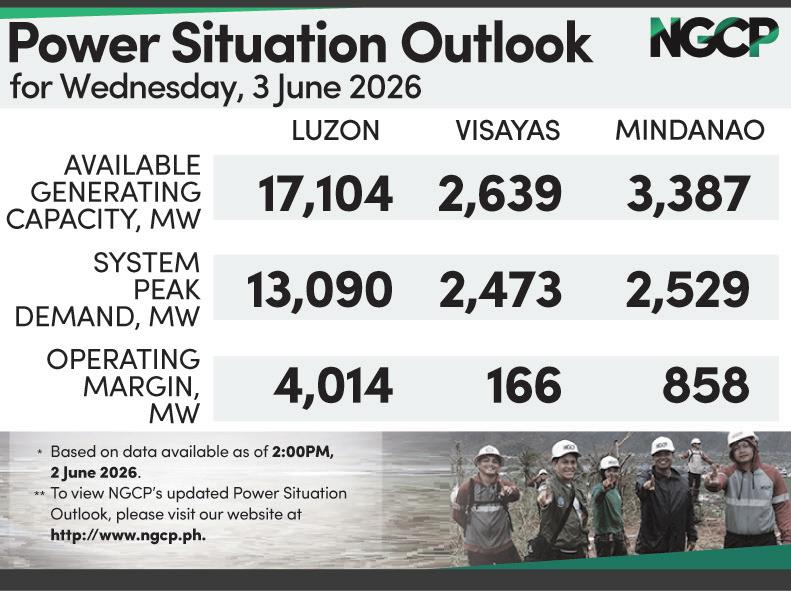
The company said the target completion date will also depend on the construction and the upgrade of the 138 kilovolt (kV) Panitan substation by the National Grid Corporation of the Philippines (NGCP). ESEC said the ECC marks a key milestone in the project’s development and affirms its compliance with environmental and pre-development requirements.
“We are pleased to receive the ECC for our Panitan Solar Power Project after an extensive process that began in November 2025. Capiz government leaders, Panitan municipal officials and local stakeholders endorsed the project citing its significance and potential impacts as
Alphabet
Gthe province first utility-scale solar power facility.
As important, this investment by the Yuchengco Group of Companies (YGC) will add much needed power to the Visayas grid which has been plagued by constant red and yellow alerts recently,” said PGEC Assistant Vice President for Environment and Community Relations Yrel V. Ventura.
PGEC is a joint venture of Yuchengco-led PetroEnergy Resources Corp. and Japan’s Kyuden International Corp. (KIC).
“The PSPP is also expected to deliver socio-economic benefits to Capiz, including job creation dur-
ing construction, local procurement opportunities, and support for community development initiatives,” the company said.
Another key feature of the proposed PSPP is the integration of an agrivoltaics component, which supports both food and energy security by combining solar power generation with agricultural production.
“This dual land-use endeavor aims to create livelihood opportunities for host communities through crop production, nursery operations, and other community-based enterprises within and around the host barangays of Timpas and Capagao in Panitan, Capiz.”
to raise $80B in equity for AI spending
OOGLE parent Alphabet Inc. is raising $80 billion through a package of equity offerings, including an investment deal with Berkshire Hathaway Inc., as the company races to fund its ambitious artificial intelligence spending plans.
The undertaking includes a $40 billion so-called at-themarket program to sell shares from time to time beginning in the third quarter, according to a statement Monday. The company will also offer $30 billion in underwritten offerings of shares and mandatory convertible preferred stock, as well as the $10 billion deal with Berkshire.
Together, the transactions represent one of the largest equity deals of all time—and they bring an unexpected twist to a blockbuster year for initial public offerings.
It’s rare for a large public company to raise this much equity, but the economics of the AI business have pushed Google and its peers to get creative. The company has embarked on an unprecedented spending spree to build the infrastructure that it needs to develop cutting-edge artificial intelligence models and meet demand from customers who want to buy its chips to fulfill their own AI ambitions.
Google is trying to capitalize on a growing appetite for its homegrown AI chips, known as tensor processing units, or TPUs. They have become a key alternative to Nvidia Corp.’s marketleading processors in an industry that requires tremendous

amounts of computing power.
“AI is driving an expansionary moment for Alphabet,” the company said in the statement.
“By scaling its investments, the company seeks to expand its foundational infrastructure to support the significant growth opportunity ahead.”
Alphabet shares slipped 0.8 percent in late trading, after more than doubling over the past 12 months.
Chief Financial Officer Anat Ashkenazi said in April that the company’s capital expenditures in 2027 will be “significantly” higher than the up to $190 billion it budgeted for 2026 — a level that would already be more than double last year’s total. In light of the new funding, Bloomberg Intelligence analyst Mandeep Singh said he believes the company’s spending on capital expenditures could reach $300 billion next year.
That level of spending would exceed even Alphabet’s operating cash flow, Singh said. In addition to financing Alphabet’s capital expenditures, the new transactions potentially pull money away from the offerings of Alphabet rivals, such as SpaceX, Anthropic PBC and OpenAI, which are all set to go public this year.
“There’s only so much capital you can allocate, even in the public markets,” Singh said. He added that if investors “allocate their capital to TPUs because they find that to be an attractive area because of Google’s growth prospects, then that does hurt the new IPOs, even though they are very fast growing companies.”
Alphabet is also taking advantage of its recent stock rally. It is now the second-most-valuable company in the world, behind Nvidia.
The mandatory convertible stock and the underwritten common equity offerings are expected to price Tuesday after the market closes in New York, according to terms of the deal seen by Bloomberg News.
Berkshire Hathaway, the holding company long run by Warren Buffett, started building a stake in Google’s parent last year. It held Class A and Class C shares collectively worth about $16.6 billion as of the end of March, according to regulatory filings.
Greg Abel, who took over the reins of the firm after Buffett retired last year, has started to invest its record $397 billion cash pile. On Sunday, Berkshire announced its intention to buy home builder Taylor Morrison for $6.8 billion, providing a vote of confidence in the US housing market.
Goldman Sachs Group Inc., JPMorgan Chase & Co. and Morgan Stanley are leading the underwritten offerings, Alphabet said. Goldman Sachs is the agent for the private placement. Bloomberg News

SBy Lorenz S. Marasigan @lorenzmarasigan
MART Communications Inc. is betting on the rapid expansion of its 5G subscriber base and artificial intelligence (AI)driven hyper-personalization capabilities to sustain growth in its wireless business amid an increasingly competitive market.
Lloyd Manaloto, Smart co-officer-in-charge (OIC), said the company has been deploying analytics tools that tailor data offers to individual subscribers based on usage patterns and preferences.
“We have been leveraging our hyper-personalization capabilities which enable us to provide our customers the right service at the right price points at the right time,” he said.
PLDT Inc. COO Butch G. Jimenez echoed this, saying that the shift toward personalized offers is a key lever in countering growth headwinds facing the wireless segment.
“We used to just be able to offer one package for the whole Philippines. Now, we can pinpoint the specific data requirements of our customers based on analytics, know what kind of package or ser -
vice our customers need, and offer it to them,” he said.
Building on this capability, Smart’s prepaid brand TNT has launched its “For You Po” campaign, which provides users with promos aligned with their own data, call, and text usage via the Smart App. The campaign uses AI-driven insights to curate relevant offers for each user, reducing the need to compare multiple options manually. On the 5G front, Smart said one in every five of its subscribers now uses a 5G device, driven by the wider availability of affordable 5G handsets and the company’s network optimization efforts. Total active data users reached 44.1 million as of end-March 2026, while 5G traffic surged 68 percent year-onyear over the same period. Smart is also moving into AI-powered wearables through an exclusive partnership with Rokid, making it the first and only Philippine telco to offer Rokid AI glasses bundled with a Smart Postpaid plan. “While we see the challenges, we are not allowed to use these challenges as an excuse. We’re required—and that’s in our DNA—to be able to look at these challenges and weather this storm,” Jimenez said.
PHOTO FROM WWW.SMART.COM.PH
Entrepreneur
Stress addiction:
When you’re
more stressed without it

OME
Sthey think.
there is a quiet epidemic running rampant through executive boardrooms: stress addiction. It is a paradoxical psychological trap where a calm calendar triggers anxiety and life feels “too quiet” without a raging fire to put out. If a smoothrunning week makes you feel uneasy or detached, you aren’t experiencing peace—you are experiencing withdrawal.
While short bursts of pressure can sharpen focus, relying on stress as your primary fuel is catastrophic for your health, your decision-making, and your team’s culture.
The Reality Check: Stress is a tool, not a lifestyle. Leaders who are addicted to chaos lose three critical assets: clarity, creativity, and control. To scale your business without breaking your people, you must shift from a state of reactive friction to intentional focus. Here are five strategic shifts to recognize, manage, and break the cycle of stress dependency.
Recognize the signs of executive withdrawal
THE first step is clinical self-awareness. Stress addiction operates on an unconscious loop where chronic stress floods the body with cortisol and adrenaline. When that flood stops, the sudden drop feels like boredom or failure, prompting leaders to subconsciously manufacture a crisis just to get their next hit of focus. Many fall into the addict’s trap of feeling irritable when things are going smoothly, or they intentionally over-complicate projects simply to resurrect a sense of urgency. Breaking this cycle requires a fundamental leadership shift toward tracking your personal triggers. As Hans Selye, the father of stress research, noted, “It’s not stress that kills us, it is our reaction to it.” Ultimately, cultivating this deep awareness allows you to choose pressure only when it serves a strategic purpose, rather than letting chaos choose you.
Trade chaos for predictable routines
STRUCTURED routines are the ultimate antidote to adrenaline reliance.
High-pressure bursts are unpredictable, whereas daily rituals create a stable baseline that allows for sustained high performance without the psychological hangover. Too often, leaders fall into the trap of viewing open space on a calendar as “wasted time” that must immediately be filled with back-to-back meetings or manufactured urgent tasks. The necessary leadership shift involves building intentional micro-habits that anchor your day and protect your focus. As Aristotle famously said, “We are what we repeatedly do. Excellence, then, is not an act, but a habit.” Establishing this consistency provides a natural, healthy flow of productivity, entirely eliminating the need to chase artificial crises just to feel alive.
Treat recovery as a highperformance metric
LEADERS addicted to stress don’t just undervalue recovery—they actively resist it, often equating rest with weakness. In reality, elite performance requires elite recovery. The common trap manifests when executives find themselves checking emails at 11 PM or treating a hardearned vacation as just working from a different location. To correct this, leaders must shift their mindset to
DTI-FTSC promotes Asean market expansion at Franchise Asia PHL
IN support to the internationalization of Philippine businesses through broader market access promotion, the Department of Trade and Industry through the Foreign Trade Service Corps (DTI-FTSC), tackled emerging opportunities for Philippine businesses and franchises across Southeast Asia at the Franchise Asia Philippines 2026.
schedule recovery—such as meditation, strategic reflection, and physical exercise—with the exact same non-negotiable intensity they bring to a boardroom negotiation. As mindfulness pioneer Jon Kabat-Zinn observes, “You can’t stop the waves, but you can learn to surf.” Prioritizing this mindful recovery directly protects your executive decision-making capabilities and prevents the slow burn of burnout.
Delegate authority, not just tasks STRESS-DEPENDENT leaders frequently hoard responsibility under the guise of maintaining high standards. In reality, they cling to tasks because the surrounding pressure makes them feel indispensable to the organization. This trap leads to micro-managing critical projects based on the flawed belief that it is faster to just do it themselves. The required leadership shift demands changing your identity from the heroic fire-fighter who fixes every problem to the strategic architect who builds scalable systems. As John C. Maxwell rightly said, “Leadership is not about being in charge. It is about taking care of those in your charge.” Embracing strategic delegation eliminates unnecessary personal friction, builds immense team capability, and frees up your mental capacity for long-term vision.
Replace Reactive Crisis with Purposeful Challenge HIGH-PERFORMING leaders possess an innate drive that requires a constant outlet. If you do not actively direct that energy toward a massive, purposeful vision, it will naturally decay into daily, reactive chaos. The trap is treating every incoming email as an emergency and confusing a frantic, exhausting pace with actual, measurable progress. To overcome this, leaders must shift their focus and channel their intensity outward. Instead of fighting internal, preventable fires, focus your team on disrupting your market, innovating your product line, or hitting audacious sales targets. As management guru Peter Drucker wrote, “The best way to predict the future is to create it.” Pursuing intentional challenges provides deep intrinsic motivation, making the destructive cycle of stress addiction entirely optional.
Final thoughts
CHAOS is a familiar comfort zone, but it is neither sustainable nor profitable. True leadership is calm, deliberate, and fiercely results-driven— without requiring an adrenaline hit to perform at its peak. When you step out of the cycle of stress, you don’t lose your edge; you finally get to see how sharp it actually is. How much of your daily schedule is driven by true priority versus habitual pressure? Let’s discuss in the comments.
Alexey “Coach Lex” Rola Cajilig is the President and CEO of ARCWAY Consultancy Inc., a recognized Sales Leadership Coach, Strategic Sales Operations Consultant, Christian Motivational Speaker, and Human Ecologist. As the author of The Effective Seller and Solving the Sales Puzzle, Coach Lex empowers leaders and sales professionals to turn knowledge into action and action into measurable results. He is also the creator of the ARCH Styles, a cutting-edge behavioral discovery framework that helps individuals and teams unlock their true potential and perform at their peak. Connect, collaborate, and transform your leadership execution at arcway.ph.
Anchored on this year’s theme “Franchising Together: Asean to the world,” the event highlighted the evolving franchising landscape and the importance of strengthening regional collaboration, innovation, and sustainable business growth in line with the Philippines’ Asean 2026 hosting vision.
Foreign Trade Service Officer
Beatrice Alexa Karamihan served as a keynote speaker at the Doing Business in Asean Forum, where she

shared insights on regional market opportunities, market entry strategies, regulatory considerations, and cultural dynamics shaping business expansion within the Asean region.
The discussion explored evolving consumer preferences toward wellness-oriented products, sustainability-driven brands, natural ingredients, digital convenience, and localized consumer experiences across varying sectors.
Karamihan also highlighted the
Philippines’ expanding network of trade agreements and ongoing negotiations to improve market access, reduce tariffs, and streamline customs procedures, further supporting the competitiveness and regional expansion of Philippine exporters and businesses.
The forum was part of the Franchise Asia Philippines’ operations-focused seminar series, which brought together industry leaders and experts
across key business areas including regional expansion, finance, human resources, supply chain management, technology, and innovation. Held last April 24, 2026, the business forum attracted diverse audience composed of franchisors, franchises, business executives, MSMEs, retailers, and aspiring entrepreneurs interested in exploring Asean growth opportunities and expanding their business presence globally.
NV coffee farmers claim top spot at 2nd North Luzon Coffee Quality Competition
THE Department of Trade and Industry-Comprehensive Agrarian Reform Program (DTI-CARP) celebrates a remarkable milestone as one of its supported Agrarian Reform Beneficiary (ARB) Organizations, the Tiblac Farmers Agriculture Cooperative from Ambaguio, Nueva Vizcaya, claimed the top spot in the Robusta Category of the 2nd North Luzon Coffee Quality Competition (NLCQC).
The awarding ceremony was held on May 21, 2026, at The Orchard Hotel in Baguio City.
The winning coffee entry, sourced from a farm of the Tiblac Farmers Agriculture Cooperative, achieved an impressive cupping score of 85.06 to earn the Top 1 ranking in the Robusta Category—sharing the top spot with an entry from Tabuk City, Kalinga. This prestigious recognition underscores the exceptional quality of coffee produced by ARBs in Nueva Vizcaya and highlights the ability of local cooperatives to compete at a regional level against well-established
Portable store
By Joann Villanueva
AN official of Filipino fast-food chain Binalot is optimistic about the growth of its franchising segment this 2026, driven by its modular and portable store concept, the “Smart Box.”
Under the concept, a fully equipped modular store measuring 6x3 meters—with kitchen, service area, branding and dining facilities—can be constructed and made operational in around four to six weeks.
To date, Binalot has 41 branches nationwide, nine of which are company-owned.
Rommel Juan, president and chief executive officer of Binalot, said they aim to end the year with over 60 franchises, 10 of which will use the Smart Box concept.
“We expect to grant 30 franchises this year with five to 10 of them outside of Metro Manila, specifically the Viz-Min (Visayas and Mindanao) area where we have a

coffee-producing communities.
The championship entry impressed a panel of certified Q Graders with its rich, complex flavor profile, featuring distinct notes of dark chocolate, brown sugar, almond, and a vibrant blend of tropical fruits like mango, jackfruit, pineapple, and tangerine. All entries were evaluated in strict adherence to the standards and protocols of the Specialty Coffee As-
sociation (SCA), ensuring the assessment met internationally recognized benchmarks.
Demonstrating the consistently high caliber of the cooperative’s overall production, three additional Robusta submissions from the Tiblac Farmers Agriculture Cooperative were awarded a green grade of “Fine Robusta” with zero defects.
The awarding ceremony honored
the top 10 coffee entries across both the Robusta and Arabica categories, with winners receiving certificates of recognition and special prizes. Additionally, winners were granted the opportunity to auction their coffee lots nationwide through an online platform developed by the Philippine Rural Development Program (PRDP). The DTI-CARP recognizes this achievement as a testament to the potential of ARBs when provided with the proper training, technical assistance, and market linkage support. The victory of the Tiblac Farmers Agriculture Cooperative reflects the broader mission of the DTI-CARP to empower ARB Organizations and elevate their enterprises to competitive and sustainable levels. The 2nd North Luzon Coffee Quality Competition was organized by the Department of AgriculturePRDP North Luzon, in partnership with Regional Praoject Coordination Offices, DTI, Benguet State University, and the Barista and Coffee Academy of Asia.
model seen to drive Binalot’s franchise growth in 2026
lot of inquiries,” he told the Philippine News Agency in an interview.
“We are targeting popular tourist destinations like Palawan and Boracay,” he added.
Juan explained that the modular store concept is ideal for bare lots, beach locations, campsites, gas stations and transport hubs since it allows store owners to easily relocate if an area underperforms.
“This is about democratizing entrepreneurship,” he said.
Juan said optimism for this store concept is based on the fact that the domestic franchising industry remains among the country’s economic drivers, with an estimated 7.8 percent contribution to domestic growth and employing millions of Filipinos.
“With the sector projected to grow by eight to 10 percent annually, franchising remains a major platform for entrepreneurship and MSME (micro, small and medium enterprises) development,” he said. PNA

Editor: Vittorio V. Vitug
FOREIGN Trade Service Officer Beatrice Alexa Karamihan of the DTI-Foreign Trade Service Corps.
Inflation seeps into pockets as NPL ratio hits 8-mo high
By Andrea E. San Juan
HOUSEHOLDS and businesses are beginning to feel the pressure from elevated inflation, higher operating cost and interest rates as borrowers struggle to repay debts on time.
Analysts pointed this out after preliminary data from the Bangko Sentral ng Pilipinas (BSP) showed that the gross non-performing loans (NPLs) ratio climbed to 3.37 percent in April—the highest in eight months or since August 2025. NPLs, also known as “bad” or “soured” loans, are credit accommodations that have not been paid for 90 days or more after the due date. The NPL ratio measures the proportion of bad loans to total loans.
Data showed that the peso value of bad loans climbed to P579.885 billion, which is 11.68-percent higher than the P519.233 billion recorded end-April 2025. Similarly, bad loans as of April were higher by 2 percent than the P568.554 billion as of March 2026.
Meanwhile, total loan portfolio amounted to P17.198 trillion.
Analysts concur ANALYSTS sought for comments concurred that the uptick in the bad loans ratio could be attributed to the
effects of the war in the Middle East: higher inflation and higher borrowing costs, thereby slashing borrowers’ repayment ability.
“The uptick in the NPL ratio to 3.37 percent suggests emerging pressure on borrowers from the lagged effects of elevated inflation and interest rates, with geopolitical risks such as the Middle East conflict potentially adding further strain through higher oil prices and weaker incomes,” Union Bank of the Philippines Chief Economist Ruben Carlo O. Asuncion said. Looking ahead, analysts also expect NPLs to stay elevated given the risks from the slow pace of economic growth with the fast pace of higher prices.
Jonathan L. Ravelas, senior adviser at Reyes Tacandong & Co. said he expects NPLs to remain “slightly elevated,” particularly hovering around the 3.3 percent to 3.8 percent range in the near term, “given still-high borrowing costs and uneven growth.”
Michael L. Ricafort, chief economist at Rizal Commercial Banking Corp. (RCBC), said the “risk of stagflation for the coming months could fundamentally lead to higher NPL ratio, especially if the Strait of Hormuz remains closed.”
The latter condition “could potentially disrupt the global supply chain of crude oil (about 20 percent of the total) and LNG (about 25 percent of the total),” Ricafort added.
Meanwhile, Philippine Institute for Development Studies (PIDS) Senior Research Fellow John Paolo R. Rivera said the most vulnerable segments are likely to be consumer borrowers and micro-sized, small-scale and medium-sized enterprises that “are more sensitive to rising costs and weaker demand.”
Rivera sees bad loans will remain under upward pressure in the coming quarters particularly if inflation stays elevated and growth remains “subdued.”
Some softening AT current levels, Ravelas said while NPLs are above the ideal 2 percent to 3 percent range, the 3.37 percent ratio is “still manageable.”
“It’s an early warning sign of tighter cash flows, not a crisis,” he said.
While there is no single threshold that would tell if an NPL ratio is healthy, Rivera explained that a ratio below 3 percent is “considered comfortable,” while levels between 3 percent and 5 percent “warrant closer monitoring.”
As such, Ravelas said “the key is to
Govt plan to exit casino business gains traction
By Reine Juvierre Alberto @reine_alberto

watch the trend—gradual increases are tolerable but any sharp spike would be a bigger concern.”
Asuncion said that while the latest data points to some softening in repayment capacity, “It remains manageable for now given the banking system’s strong capital buffers.”
Jumped, eased
THE NPL ratio of universal and commercial bank group climbed to 3.10 percent with the peso value of bad loans amounting to P490.633 billion, as of end-April. The figure is higher than the 3.02 percent in March but the same level as the 3.10 percent as of end-April last year.
For thrift or savings banks, the NPL ratio eased to 6.26 percent, or P66.729 billion, as of end-April from 6.29 percent at end-March, and remained below the 6.65 percent level in April 2025.
The asset quality of digital banks, meanwhile, improved with their NPL ratio falling to 5.68 percent, or P4.5 billion, as of end-April 2026 from 6.19 percent at end-March. This was also higher compared to the 9.50 percent NPL ratio in April last year.
Meanwhile, past due loans reached P763.59 billion as of end-April, up by 3.72 percent from P736.181 billion a month ago; and higher by 16.89 percent from P653.259 billion at end-April 2025.
The past due loans ratio settled at 4.44 percent of banks’ total loan portfolio, lower than the 4.26 percent as of end-March 2026 and the 4.26 percent at end-April 2025.
Investors’ high demand pushed up yields of 5-yr bonds
YIELDS on the 5-year Treasury bonds (T-bonds) rose as investors demanded higher returns amid inflation concerns stemming from the still-uncertain Middle East conflict and ahead of the release of May inflation data.
The Bureau of the Treasury awarded the full P30 billion worth of Tbonds, as tenders reached P58.123 billion, making the auction 1.9 times oversubscribed.
Seeing strong demand, the Treasury opened its tap facility window after the auction to raise an additional P9.499 billion.
Sun Life Investment Management and Trust Corp. President Michael Gerard D. Enriquez said it’s becoming “more expensive” for the government to borrow and plug its budget deficit.
The reissued 5-year securities fetched an average yield of 7.4 per-
Lthe landmark agreement is set to significantly boost financial inclusion and fuel the growth of small and medium enterprises nationwide, which serve as the vital backbone of the Philippine economy.
“Our ultimate goal is to become the definitive top-of-mind choice for any entrepreneur or business owner seeking financial support in the Philippines,” Diosdado C. Salang Jr., president and CEO of Discovery Capital, said.
cent, up by 15.1 basis points from 7.249 percent in the previous auction last May 12. This is also higher by 6.9 basis points than the secondary benchmark rate of 7.331 percent for the same tenor.
Yields awarded by the Treasury ranged from a low of 7.3 percent to a high of 7.440 percent. The debt papers had a coupon rate of 8 percent.
“This is really in anticipation of higher May inflation forecast,” Enriquez said. “[The] market is already pricing a higher inflation and the BSP [Bangko Sentral ng Pilipinas] might adjust rates sooner.”
The Philippine Statistics Authority will release the May inflation data on June 5.
Michael L. Ricafort, chief economist at Rizal Commercial Banking Corp., said the Middle East conflict keeps putting pressure on inflation
as the Strait of Hormuz—one of the most important oil shipping routes in the world—remains closed.
Despite the Nymex crude oil now priced at $91 per barrel from an intraday high of $119.48 per barrel, Ricafort said the closure of the Strait “could still lead to higher import bill and prices, wider trade deficit, net sharp increase in local fuel pump prices.”
The confluence of these factors “[would also lead to higher inflation expectations as well that could have fundamentally led to higher bond yields, especially since the war on Iran/Middle East since February 28, 2026,” he added.
The BSP expects the May inflation print to settle within the range of 7.1 percent to 7.9 percent, driven by rising prices for rice, vegetables and meat, as well as a weak peso. Monetary authorities threw a 25-ba-
sis points hike to tame inflation, agreeing to settle interest rates at 4.5 percent in the April meeting of the Monetary Board.
BSP Governor Eli M. Remolona said the central bank’s inflation outlook has “deteriorated” amid the considerable rise in global oil and fertilizer prices due to the war in the Middle East.
This month, the Treasury aims to raise as much as P268 billion from issuing T-bonds and Treasury bills.
A total of P2.682 trillion is programmed for the Treasury to borrow this year, with 77 percent of the financing coming from domestic lenders and 23 percent from external creditors.
The government’s outstanding debt reached P18.470 trillion as of end-April, up by 10.25 percent yearon-year from P16.752 trillion.
Reine Juvierre S. Alberto
THE plan by the Philippine Amusement and Gaming Corp. (Pagcor) to exit casino operations is gaining traction, as the Governance Commission for Government-Owned and Controlled Corporations (GCG) is expected to submit its recommendation as early as July.
“We are awaiting the recommendation of the GCG. We are expecting that within the next month or so,” Pagcor Chairman and CEO Alejandro H. Tengco told reporters on the sidelines of the opening ceremonies for an iGaming event last Tuesday.
Currently, Pagcor is wearing two hats: operator of Casino Filipino and regulator of the local gaming industry. This only creates competition among those it gave licenses to, Tengco said earlier.
The Pagcor chief has also said that the GOCC, as a referee, cannot also be a player on the same field. This is why Pagcor wants to fully privatize all its Casino Filipino branches and focus on its role as regulator that grants licenses and collects the corresponding fees. But this will only happen after
Pagcor secures approval from the Office of the President, following the submission of GCG’s recommendation, Tengco further explained.
“I think if we’re lucky, maybe in the next two months,” the Pagcor chief responded when asked how soon they could start selling Casino Filipino licenses.
Casino Filipino currently has 43 casino sites all over the country. Most of its revenues go to the National Treasury as part of its contribution to nation-building.
Tengco has said before that privatizing all its Casino Filipino branches would generate about P30 billion to P50 billion.
Pagcor-operated casinos contributed P3.17 billion, or 3.62 percent, to the country’s gross gaming revenues in the first quarter of 2026. However, this was down by 6.85 percent from P3.409 billion a year ago.
Meanwhile, as a regulator, Pagcor’s current freeze on issuing new online gaming licenses will remain in force.
Tengco said Pagcor has no immediate plans to lift the moratorium but will eventually reconsider the policy. Pagcor enforced the moratorium on March 1, 2024.
EastWest to expand biz to reach wealthy clients
By VG Cabuag @villygc
THE East West Banking Corp. revealed plans to expand its priority banking business over the next few years due to the segment’s huge growth of 40 percent from last year.
Jerry G. Ngo, the bank’s CEO, said EastWest will increase its priority banking branches in the Philippines to 20 from the current 13. The business caters to the affluent people in the country, less the private banks, which are mainly offshore money.
Ngo said the bank has grown this business segment since acquiring it from Standard Chartered Bank in 2015. The Gotianun-led bank was able to expand to over 10,000 wealthy clients from just 2,000 since the acquisition.
“So it’s been growing broadly, minus the private banks, which are offshore. I would think we’re in the top five, easily top three if possible; but the growth has been quite significant,” Ngo said. The priority banking business assets under management grew by 40 percent to P120 billion last year, he added.
“More importantly, it’s a business that is driven on keep us capacity and capability of our relationship manager,” Ngo said.
“So recently we sent this around, we’ve partnered with SMU Singapore Management University, and we graduated around 80 wealth management advisors in our wealth management academy, so that the focus, the investment, and the growth has been quite a very big feature of what we are doing with our
priority banking business,” he added. The country’s 11th largest universal and commercial bank has launched an elevated priority banking proposition to its clients, introducing an enhanced wealth and lifestyle offer designed to make banking easier and more rewarding for high-net-worth clients. Through EastWest priority banking, clients gain access to hyper-personalized investment and wealth solutions such as bonds, UITFs, equities, specialized investment options, gold-related investments, insurance, and portfolio allocation guidance.
Clients are supported by relationship managers who serve as long-term partners, helping connect them to the right solutions, and portfolio allocation across East West, documents provided by the lender read.
With the lender’s “Infinite” debit and credit card products, clients can enjoy premium privileges such as local and international ATM access, competitive foreign exchange fees, travel
ligent payment ecosystem,
to
the
choose, and live with confidence through seamless and secure payment experiences,” Jeffrey Navarro, Country Manager for Visa Philippines, said.

The credit facility provides Discovery Capital with substantial funding capacity to extend flexible, accessible and non-collateralized working capital solutions to local businesses. According to the lending firm, it is “positioned to bridge the critical funding gaps that frequently hinder small businesses from expanding, purchasing equipment, and managing everyday cash flows.” Industry experts note that major financial institutions continue to place immense trust in Discovery Capital due to the financing company’s institutional maturity.
The company’s foundation rests on a strict corporate structure and sophisticated risk management models that consistently keep credit exposure safe. This strong governance enables its disbursement operations, which utilize a diverse mix of traditional banking channels and agile digital networks to deploy capital rapidly into rural and provincial areas. VG Cabuag
“When clients look for a reliable partner to sustain and scale their dreams, we want Discovery to be the very first name they think of,” Salang added. “The collaboration will help Discovery Capital to deliver a sustainable financial stimulus designed to empower provincial economies and local enterprises across the Philippines.”
THE Financial Executives Institute of the Philippines (Finex) has called on the Senate to demonstrate credibility by strictly adhering to its existing rules and established procedures at a time when public confidence in institutions remains fragile. This came after the 11-member minority bloc staged a walkout last week after heated debates regarding Sen. Rodante D. Marcoleta’s proposal to allow remote voting during sessions via videoconferencing.
“Physical presence and direct participation in Senate proceedings remain important elements of accountability and transparency. The Senate plays a critical constitutional role that benefits from inperson debate, active engagement, and visible participation by its members,” the Finex statement emphasized.
Political uncertainty unsettles mar-
kets especially now when inflation is high and economic growth is weak. There is a concept in corporate governance that institutional investors refer to as political risk premium—the additional return that foreign capital requires to park itself in a market where the rules of the game are uncertain, oversight bodies are unreliable, and the enforcement of accountability depends on who is in power rather than the integrity of the system itself.
Our economy has carried this premium for most of its modern history. It shows up in equity discount rates, bond spreads, and in the quiet but consequential decisions made in boardrooms across global financial hubs about whether the Philippine market justifies the investment exposure. Credible governance is therefore a precondition of economic performance.
Since the new majority in the Senate assumed power on May 11, it has done two things that matter institutionally.
First was to start the impeachment court proceedings forthwith, followed by the creation of a dedicated subcommittee to investigate decades of flood control spending—with a stated commitment to an inquiry free of protected interests.
To give the 13-member ruling bloc the
benefit of the doubt, these twin moves are governance signals that carry implications beyond their immediate physical context. A legislative body that functions by holding hearings that produce findings and enforces accountability through proper constitutional channels is a positive governance signal for the country’s institutional rating.
An impartial Senate investigation into flood control spending that results in credible findings—regardless of which administration is implicated— could definitely send a message that the Philippine government’s self-correcting mechanisms are functioning. The impeachment trial adds a separate but related dimension: if the Senate manages the proceedings with procedural clarity, it reduces political uncertainty even if the outcome is contested.
However, another polarizing event happened when all members of the Senate majority were absent from the June 1 session—thus preventing a quorum and effectively shutting down the upper chamber’s operations on that date.
Based on media reports, the immediate trigger for the no-show was the arrest and surrender of Sen. Jinggoy Estrada on plunder charges related to the flood control controversy. Was that a boycott with a broader political message, or just in retaliation for the minority walkout? As the two incidents involved one bloc withholding participation that disrupted proceedings, observers have described these as an escalation of Senate brinkmanship rather than a purely procedural dispute. Both the domestic and foreign business communities are watching the senators intently – not with hostility, but with the kind of patient attention that precedes an investment decision on whether the market has earned its next round of confidence. Businessmen are less concerned about which political
FINEX FREE ENTERPRISE
Joseph Araneta Gamboa


CELEBRATING 50 YEARS OF TIMELESS AMERICAN STYLE
FOR 50 years, Perry Ellis has shaped the language of modern American style through a vision rooted in ease, confidence, and quiet sophistication. Since 1976, the brand has redefined how men dress for real life: tailoring becomes more relaxed, comfort more refined, and elegance moves effortlessly in daily life.
As Perry Ellis enters its 50th year in 2026, the milestone becomes more than a celebration of time passed. It is a reflection on legacy, a statement of present relevance, and an invitation to what comes next.
Founded by the visionary Perry Ellis, the brand emerged as a fresh voice in fashion, one that challenged rigid ideas of dressing with a more relaxed, intelligent approach. His work brought lightness to tailoring, clarity to sportswear, and a new sense of freedom to men’s style.
Today, that spirit of innovation continues to guide the brand’s mission: empowering the modern man with versatile, high-quality style that bridges timeless tradition and the demands of contemporary life.
Designed for men navigating careers, travel, social occasions, and everything in between, Perry Ellis remains committed to wardrobes that feel as natural as they look polished.
At the heart of the anniversary year is The Tastemaker’s Canvas, a cinematic Spring 2026 campaign set against the storied landscape of Fire Island. Here, tailoring becomes expression. Masculine and feminine codes dissolve. Suits are worn not by category, but by character.
A bold statement on individuality and modern style, the campaign celebrates those who understand that timeless design transcends labels.
In the Philippines, Perry Ellis is exclusively distributed by Anthem, with stores located inside the Anthem Store at One Bonifacio High Street and Opus Mall, and standalone stores at Glorietta 4, SM Mall of Asia, SM Megamall, SM North Edsa, MarQuee Mall, Robinson’s Place Manila, Robinsons Place Magnolia, Festival Mall, TriNoma, SM City Iloilo, Centrio Mall Cagayan De Oro, and dual-brand stores in Shangri-La Plaza and Newport Mall. Shop Perry Ellis online at www.anthem. com.ph and Zalora.

Progress over perfection


YOU probably know the feeling. You spend 30 minutes writing one email because every sentence feels wrong. You delay a project because the first attempt does not look impressive. You tell yourself that you will begin once you feel confident, prepared, organized, inspired, and fully capable. Somehow, that perfect moment never arrives.
Perfectionism often disguises itself as ambition.
At first glance, the habit even appears admirable. You want high standards, excellent results, and meaningful accomplishments. Yet perfectionism quietly transforms healthy effort into constant pressure. Instead of feeling motivated, you feel exhausted. Instead of enjoying growth, you focus on mistakes. Instead of beginning tasks with excitement, you begin with fear.
Many people believe perfectionism leads toward success. In reality, perfectionism often creates avoidance. You may postpone difficult conversations because you fear awkward moments. You may delay applications because one small flaw feels unbearable. You may leave hobbies untouched because beginners rarely produce polished results. Perfectionism convinces you that imperfect action carries danger. Progress, however, almost always begins through imperfect action.
Think about learning any new skill. Nobody expects a child to ride a bicycle gracefully during the first attempt. Nobody expects a new cook to prepare
restaurant-quality meals during the first week inside a kitchen. Yet adults often expect immediate excellence from themselves. The expectation becomes stronger because modern life constantly displays polished achievements. Social media rarely shows confusion, rejection, or repeated failure. You mostly see finished products instead of messy beginnings.
Perfectionism also creates a moving target. Even after accomplishing something meaningful, satisfaction rarely arrives. You finish one task, then immediately notice another flaw. You receive praise, yet your attention stays fixed on one detail that felt weak. The cycle continues because perfectionism does not actually seek excellence. Perfectionism seeks protection from criticism and disappointment.
The problem becomes obvious during ordinary moments. Imagine that you want to exercise regularly. A perfectionist mindset says that every workout must feel intense and productive. Missing one session suddenly feels like complete failure. Eventually, discouragement replaces consistency. A progress mindset works differently. You exercise when possible, celebrate gradual improvement, and return after interruptions without harsh self-criticism. The second mindset usually creates stronger habits.
Another example appears inside workplaces. Perhaps you spend hours adjusting a presentation because one slide feels slightly incomplete. Meanwhile, deadlines approach and stress levels rise. A colleague with a healthier mindset submits solid work, accepts feedback gracefully, and improves during future projects. Progress-oriented people understand an important truth. Improvement requires repetition, not perfection.
One practical way to overcome perfectionism involves changing your definition of success. Instead of asking whether something looks flawless, ask whether something creates movement. A completed draft creates movement. A short workout creates movement. An honest apology creates movement. Tiny steps may appear unimpressive during isolated moments, yet small actions create enormous change
across several months.
Another helpful habit involves setting realistic completion goals. If household chores feel overwhelming, spend fifteen focused minutes on cleaning instead of demanding an entire spotless house. Smaller expectations reduce emotional resistance and encourage consistency. You are more likely to continue once the pressure feels manageable. You can also practice speaking kindly toward yourself during mistakes. Many perfectionists use harsh internal language that they would never direct toward friends. Imagine forgetting an important detail during a meeting. Instead of labeling yourself incompetent, respond with fairness. You are human. Humans forget details sometimes. One mistake does not erase intelligence, capability, or value.
It also helps to remember that most people pay far less attention toward your imperfections than you imagine. Everyone carries personal worries and insecurities. Most people remain focused on their own responsibilities and challenges.
Progress becomes easier once you allow yourself room for experimentation. Every disappointing result teaches useful lessons. Every rough draft strengthens future ability. Every awkward experience builds resilience. Growth depends upon repetition and curiosity.
Perfectionism promises safety, yet the promise rarely becomes reality. Waiting for flawless conditions usually creates lost opportunities and unnecessary regret. Progress, however, creates momentum. Momentum creates confidence. Confidence creates resilience.
At the end of each day, ask yourself one simple question. Did you move forward in some meaningful way today? The answer does not require dramatic accomplishments. Perhaps you rested after exhaustion. Perhaps you sent an application despite nervousness. Perhaps you tried again after disappointment. Every step carries value because real growth develops through steady movement, patience, and self-compassion.
Women trailblazers discuss women’s empowerment in sports, innovation
A POWERHOUSE cast of Filipina game changers participated in a panel discussion to champion the achievements of women across society and sports. They further shared insights on defying gender stereotypes and carving out their own identity.
Dubbed Ready, Set, Lead: Benildean Women Shaping Sports and Innovation, the fourth annual Benilde Women Trailblazers event featured professionals and college alumnae who thrive in the field of athletics and creativity. It aligns with this year’s World Intellectual Property Day theme IP and Sports: Ready, Set, Innovate
Three-time Olympian and Philippine swimming legend Akiko ThomsonGuevara, inspired by her daughter with Down syndrome, pushed for her advocacy to foster inclusivity in sports. The Special Olympics Pilipinas chairperson and president looked back on her journey as a former national athlete and the opportunities sports brought her.
“The higher you go up, the more sacrifices you make. There’s more that’s asked of you,” she recalled. “I’m thankful that I was able to put in the hard work that was required of me. But there was a time
when I also wanted to quit because I lost that joy that brought me into sports in the first place. And I had to find that joy again.”
Wushu star Agatha Wong, a sixtime Southeast Asian (SEA) Games gold medalist, recalled how she balanced her academics and training during college.
The De La Salle-College of Saint Benilde (DLS-CSB) Consular and Diplomatic Affairs (CDA) graduate highlighted how the challenges in life propelled her to achieve full potential.
“I think you really have to go through so much setbacks, challenges and temptations before you get to success. You’re not going to feel what success is if you’re not going to fail,” she stated. “I’ve failed in so many things, but I’m happy that I did because then I wouldn’t be here.”

Multi-titled soft tennis player and CDA alum Bien Zoleta-Mañalac recounted her unforgettable 2023 SEA Games experience, where she bagged double gold medals after recovering from her anterior cruciate ligament (ACL) injury.
Philippine Women’s National Hockey Team standout Kathleen Nadine Tan acknowledged the key role of teammates in her growth as an athlete in a male-
dominated sport.
The Marketing Management alum of Benilde Antipolo attributed her strength to the members of the squad who empowered her.
Theater Arts faculty Jocelyn Lao, a Technical Theater alumna, expressed her fascination for freediving on top of her career in teaching and events
the importance of knowing where to draw advised the audience to practice self-care
shared her background in the corporate scene, as it assisted her as the co-founder of Unit 605 Coffee, which serves carefully Lorenzo, who co-owns and co-manages relayed to the audience how she stepped outside her comfort zone while running Anta Philippines head of marketing
the event

in reaching one’s dreams. She cited meditation and journaling as effective ways to be in tune with oneself.
Fellow educator IDr. Madelaine
San Jose, a professional interior designer who is likewise passionate about training and running for marathon races, emphasized
Mikko Abello likewise graced
the Center for Intellectual Property Management (CIPM) of the DLS-CSB headed by CIPM director Atty. Janice Tejano.
talk was moderated by arch. Asela Domingo, the special assistant to the vice chancellor for academics.
AGATHA WONG
AKIKO THOMSON-GUEVARA
PERRY ELLIS redefines summer style
Zuellig Pharma expands obesity, diabetes advocacy with PHL patient group partnership
In a significant step toward addressing the growing obesity and diabetes crisis in the Philippines, leading healthcare solutions company Zuellig Pharma, formalized a new strategic partnership with Philippine Diabetes Support (PDS), a patient advocacy organization that institutionalizes patientcentered education and grassroots advocacy efforts for obesity and diabetes.
PDS is an organization headed by Arch Cynthia Duntz that supports individuals living with diabetes and related metabolic conditions. The partnership builds on a landmark commitment established earlier this year between Zuellig Pharma and key medical organizations, including the Philippine Association for the Study of Overweight and Obesity (PASOO), the Philippine College of Endocrinology, Diabetes & Metabolism (PCEDM), the Philippine Heart Association (PHA), the Institute for Studies on Diabetes Foundation Inc. (ISDFI), Diabetes Philippines (DP), and the Alliance of Clinical Endocrinologists Philippines (ACE). With the inclusion of PDS, the coalition is expanding its focus beyond clinical alignment to strengthen direct patient engagement and community mobilization within the Philippines.
Zuellig Pharma and PDS will help educate communities and drive awareness around recognizing obesity and diabetes as chronic cardiometabolic diseases requiring long-

term medical care — and not simply shaped by lifestyle choices.
Formalized through a Memorandum of Agreement (MOA) signing ceremony, the partnership between Zuellig Pharma and PDS will strengthen the connection between evidence-based medical standards and the realities faced by Filipino patients living with obesity and diabetes. While earlier initiatives centered on harmonizing local clinical practices with international standards, this expanded effort prioritizes sustained public education and stigma reduction.
Key priorities of the partnership include
1. Strengthening Community-Based Advocacy Patient organizations will be integrated into nationwide awareness efforts, helping bring culturally relevant, practical health education to Filipinos in their everyday communities.
2. Destigmatizing Metabolic Disease
The coalition seeks to educate communities that obesity is influenced by complex medical, genetic, neurological, and environmental factors — and not simply a reflection of lifestyle choices, personal failure, or lack of discipline.
In conjunction with the partnership signing, a public lay forum was held to
deepen awareness of obesity as a chronic disease and support more informed conversations around long-term metabolic health. The session featured Dr. Elaine Cunanan, President of PCEDM, who discussed the medical nature of obesity and Dr. Luz Katigbak, President of PASOO, who explored the behavioral and psychological dimensions of chronic weight management.
Speakers also cautioned against fragmented and unregulated treatment approaches, urging patients toward medically supervised, evidence-based care pathways and approved treatment options, including newer dual GIP and GLP-1 receptor agonists.
At the conclusion of the forum, representatives from Zuellig Pharma, PDS, participating medical societies, healthcare experts, and media reaffirmed their shared commitment to advancing a more compassionate and medically grounded understanding of obesity and diabetes to improve patient outcomes for Filipinos living with metabolic diseases. This forms part of broader efforts to build a more inclusive healthcare ecosystem – one where Filipinos are empowered to seek early intervention, long-term care, and stigma-free support for obesity and diabetes.
partners with LGUs, businesses to advance large scale EV infastructure

V-GREEN, the global charging infrastructure development company, has signed Memoranda of Understanding (MOUs) with the Provincial Government of Bataan and Clean Fuel, one of the leading independent fuel companies in the Philippines, to expand EV charging and battery swapping infrastructure in high-traffic areas across the provinces of Bataan and Cavite. These initiatives support V-GREEN’s longterm goal of delivering a more convenient ownership experience for both electric car and electric two-wheeler users, helping accelerate EV adoption in the Philippines. Under the MOU, V-GREEN and the Provincial Government of Bataan will collaborate on the planning, deployment, and operation of a provincewide EV charging network. This network will cover one city and 11 municipalities, positioning Bataan as a leading model for EV adoption in the Philippines.
Capital Holdings), the parent company of Wills International Sales Corporation (Wills International), to establish ofi Philippines Blends. Building on the strong partnership between ofi and Wills International, the JV includes a new manufacturing facility in Bulacan province to be commissioned by Q4 2026. When fully operational, the ofi Philippines Blends facility will expand seasoning and flavor development capabilities to support the rising demand for faster innovation, greater customization, and solutions aligned with local taste preferences. ofi Philippines Blends will focus on savory solutions, including seasonings, marinades, dry mixes and related applications that balance cultural authenticity, healthier indulgence, and commercial realities. With ofi’s global footprint, customer-centric innovation and product solution expertise, combined with WNC Capital Holdings’ established customer relationships and nationwide reach, ofi Philippines Blends aims to be the partner of choice for Philippine brands. This will enable local food and beverage (F&B) manufacturers and foodservice operators to navigate shorter product cycles, increased competition, and rising expectations for flavor relevance while managing cost, consistency and scale.
Specifically, V-GREEN targets the deployment of 600 charging stations and 1,200 battery swapping stations across Bataan. The company will be responsible for the supply, installation, operation, and maintenance of the charging network, while the Provincial Government of Bataan will facilitate permits, endorse strategic locations, and coordinate with local government units.
In parallel, V-GREEN has also signed an MOU with Clean Fuel to explore the development of EV charging stations at high-traffic fuel stations in Dasmariñas, Cavite.
As one of the leading independent fuel companies in the Philippines, with a network of more than 100 stations across Luzon, Clean Fuel also shares V-GREEN’s vision of promoting greener mobility and enhancing the customer experience. The collaboration will focus on identifying suitable locations and the potential integration of EV
infrastructure into Clean Fuel’s existing retail network, making charging more convenient by allowing users to charge at familiar stops along their journeys.
The new agreements lay important groundwork for VinFast’s upcoming launch of electric scooters in the Philippines, ensuring battery swapping infrastructure availability from day one. At the same time, the expanded charging network will continue enhancing convenience for existing VinFast electric car users, contributing to a more comprehensive electric mobility ecosystem in the country.
Bataan Governor Jose Enrique S. Garcia III said: “This collaboration reflects our commitment to advancing sustainable mobility in our province. By working with V-GREEN, we are building the foundation for an EV ecosystem that promotes innovation, strengthens environmental responsibility, and prioritizes long-term development.”
Nguyen Anh Quynh, Global CEO of V-GREEN, said: “Expanding EV infrastructure requires both scale and accessibility. Through our partnerships with government and private sector stakeholders, we are building a charging network that supports real-world usage and makes electric mobility more practical for Filipino drivers.”
V-GREEN was founded by VinFast founder Pham Nhat Vuong, with the goal of investing in and developing charging infrastructure systems to support VinFast’s global expansion, with the Philippines identified as one of its key markets. By expanding infrastructure at both the national and local levels, V-GREEN continues to reinforce its pioneering role in making EV charging and battery swapping more accessible, widespread, and practical for Filipino consumers.
It will also enable closer collaboration with F&B brands from concept through commercialization. Brands will have more diverse options, reduce reliance on imported solutions and benefit from faster iteration tailored to Filipino taste profiles. According to ofi’s TrendBites Asia Pacific consumer insights report published earlier this year, 86 percent of Filipino consumers surveyed want more menu items inspired by local recipes, while more than eight in 10 are open to global influences such as Japanese, Korean and Chinese flavors. Consumers also expect products to remain accessible, affordable and authentic.
“ofi has a growing presence in the Philippines, and this joint venture marks a deliberate step forward in how we support customers locally,” said Ramki Prasad, Head of Asia Pacific, F&B Solutions, ofi. “The Philippines is one of the most dynamic food markets in Southeast Asia. Being closer to customers with enhanced capabilities strengthens our ability to collaborate, shorten development cycles, and execute with confidence.” He added, “WNC Capital Holdings brings a deep understanding of how Philippine manufacturers operate across this diverse and archipelagic market. We bring strong global ingredient sourcing and product manufacturing capabilities, deep consumer insight, innovation capability and scale. Together, we are better positioned to help

DOH brings free cervical cancer screening, breast exams to Urdaneta City
THE Department of Health (DOH) – Ilocos Region, through its Cancer Control Program and in partnership with Conrado F. Estrella Regional Medical and Trauma Center (CFERMTC) and the local government of Urdaneta City, conducted free cervical cancer screening and clinical breast examination services on May 26, 2026 in Urdaneta City, Pangasinan as part of its intensified campaign for women’s health and cancer prevention.
More than 300 women aged 25 to 65 years old who were not pregnant, not menstruating, and who had abstained from sexual contact for at least one day before screening availed themselves of the free services aimed at promoting early detection and timely treatment of cervical and breast cancer.
Regional Director Paula Paz M. Sydiongco underscored the importance of empowering women to prioritize preventive healthcare. “Every woman deserves the chance to live a healthy and productive life. Cervical and breast cancers are highly preventable and treatable when detected early. Through these free screening services, we are bringing hope, protection, and life-saving healthcare directly to our communities. We encourage women to take advantage of these opportunities because early detection saves lives,” Sydiongco stated.
She further emphasized that the DOH remains committed to strengthening cancer prevention
initiatives under Universal Health Care by ensuring accessible and equitable healthcare services, especially at the grassroots level.
“We want every Filipina to understand that taking time for screening is an act of self-care and courage. Huwag matakot magpasuri. Ang maagap na pagkilos ay makapagliligtas ng buhay [Don’t be afraid to get tested. Early action can save lives],” she added. Sydiongco continues to stress the importance of early screening as breast cancer remains one of the leading causes of cancer-related deaths among women in the Philippines. Healthcare workers provided cervical cancer screening, clinical breast examinations, health counseling, and education sessions emphasizing the importance of regular check-ups and early consultation.
The activity forms part of the DOH’s ongoing efforts to bring preventive healthcare services closer to communities and strengthen awareness on women’s cancers, which remain among the leading causes of illness and death among Filipino women.
The DOH Ilocos Region continues to call on local government units, healthcare workers, and communities to support sustained awareness campaigns, HPV vaccination efforts, and regular cancer screening activities to help reduce preventable cancer deaths in the region.
Sun Life’s Live Bright Trivia Night: Where smart finances, wellness, community meet
SUN Life Philippines is redefining how young employees and professionals approach their financial wellness through Live Bright Trivia Night, a vibrant nationwide series of social after-work events that weave together pop culture moments, real-life “adulting” adventures, and practical money wisdom into an evening of connection, fun, and personal growth.
Mounted in collaboration with quiz night community Trivia Down Tuesdays, Live Bright Trivia Night celebrates the lifestyle shift young professionals are embracing, one where taking care of your finances feels as natural as enjoying time with friends. By blending entertainment, music, and lifestyle questions with bite-sized financial insights, the event helps participants build confidence in their financial decisions while unwinding and connecting with their community.
The first leg of the series kicked off with two consecutive trivia nights in Iloilo: the first one at Bite: Bakery and Kitchen then at Seda Atria Iloilo. Mounted in collaboration with Trivia Down Tuesdays, a wellloved quiz night community, the event showcased pop culture-inspired trivia questions interspersed with practical financial tips on budgeting, saving, insurance, and planning for life goals. Each round sparked conversations and “Aha!” moments, making financial learning relatable and not overwhelming.
“Financial conversations shouldn’t feel intimidating, especially for today’s employees and
customers move from concept to commercialization efficiently, while maintaining consistency as they grow.”
For WNC Capital Holdings, the JV builds on long-standing relationships with Philippine food brands and a proven partnership with ofi. “Philippine food brands are rooted in strong culinary heritage, and many are now looking outward,” said William Chuacokiong, Founder and President, WNC Capital Holdings. “We

professionals who are navigating so many life decisions at once,” Sun Life Philippines Chief Client Experience and Marketing Officer Carla Gonzalez-Chong said. “Through Live Bright Trivia Night, we’re meeting them in a space that feels familiar and fun so that learning happens naturally. It’s one of the ways we bring our Live Bright Now philosophy to life, while reminding Filipinos that Sun
ofi

In the photo are, from left, Nikhil Krishnan, Head of the Philippines, F&B Solutions, ofi, Ramki Prasad, Head of Asia Pacific, F&B Solutions, ofi; William Chuacokiong, Founder
Editor: Tet Andolong

AS CONSUMERS TIGHTEN SPENDING, MALLS DOUBLE DOWN ON ‘PREMIUMIZATION’

By Rizal Raoul S. Reyes @brownindio
AS the Philippine economy reaches the midpoint of 2026, a striking paradox has emerged across the country’s urban centers.
Real estate giants such as SM Supermalls, Ayala Land, and Robinsons Land are doubling down on “premiumization,” investing billions of pesos to transform traditional shopping malls into ultra-luxurious, experience-driven lifestyle destinations.
Yet at the same time, the intensifying conflict in the Middle East is beginning to cast a shadow over the domestic economy, driving up costs and further straining the purchasing power of ordinary Filipino consumers.
For Colliers Philippines research director Joey Roi Bondoc, the era of the “box mall” is officially over. Major developers have shifted their strategy toward premiumization, characterized by high-end tenant curation, open-air promenades, and “retail-tainment.”
SM Supermalls has earmarked P150 billion for redevelopments, aiming to launch one flagship mall every year from 2026 to 2030. Projects like SM Sta. Rosa (Yulo) in Nuvali and the upcoming redevelopment of SM Harrison Plaza represent a shift toward "greener, smarter" ecosystems.
The Gokongwei-led Robinsons Land is currently finishing a P5 billion
revamp of flagship properties, including Robinsons Manila, and expanding “next-generation” concepts like Opus Mall and NUSTAR in Cebu to target the aspirational class.
Ayala Land Inc., meanwhile, continues its massive mall renovation program, focusing on high-street experiences that prioritize comfort and exclusivity over sheer foot traffic volume. Bondoc points out that the push toward luxury is a calculated bet on the “value-fluid” consumer—shoppers who might buy budget essentials but are willing to splurge on premium dining, aesthetic cosmetic launches, and hard-to-replicate physical experiences.
TBG remains bullish, continues to innovate UNDER the new management of Bounty Fresh Group (which acquired the minority stake of Anscor), The Bistro Group (TBG) continues to introduce new offering to enhance its loyal customer base. Italianni’s is experiencing aggressive expansion and a brand revitalization. TBG is scaling up the brand across the Philippines, rolling out reenergized, non-traditional menus, and

opening new branches in key regional cities. The brand has expanded significantly outside Metro Manila, opening thriving locations in SM City Bacolod, Santa Rosa, and SM City Iloilo, bringing its national footprint well beyond 20 locations. New concept branches, such as the one in Ayala Malls Circuit Makati featuring al fresco pet-friendly seating, continue to be added.
Meanwhile, management piloted a reenergized menu at their Santolan Town Plaza branch. Created by a consultancy team, the updated menu aims to serve hearty, “Italian Nonna-


style” fare. The brand has moved away from the heavy, traditional greenand-white palettes, adopting brighter, more contemporary interiors while keeping its warm, inviting family-
Powering industrial scale: How Tarlac Enerzone enables TARI Estate and the next phase of manufacturing growth in Central Luzon
TARLAC City—Industrial expansion
in the Philippines is entering a new phase, with Central Luzon emerging as the country’s next major manufacturing growth corridor. As industrial activity expands beyond traditional hubs, investors are increasingly prioritizing locations that can support large-scale operations through integrated infrastructure, long-term scalability, and operational reliability.
Building on a proven industrial platform
TARI Estate represents Aboitiz Economic Estates’ next major industrial platform in Central Luzon, extending the integrated development model established at LIMA Estate into one of the country’s fastestemerging manufacturing corridors. It carries forward an established approach to integrated estate development, aligning industrial land, utilities, and long-term expansion capacity within a unified system designed to support sustained manufacturing growth.
Tarlac Enerzone: TARI Estate’s dedicated power backbone
WITHIN this framework, Tarlac Enerzone is designed as a dedicated substation embedded within the estate’s industrial backbone, supporting energy requirements that match the intensity and continuity of manufacturing operations. Initially rated at 2 x 50 MegaVolt Amperes (MVA), its role is structurally integrated into the estate’s design—aligned with projected industrial loads, planned alongside phased development, and coordinated within the broader utility ecosystem that supports locator operations. Expected to be operational by Q4 2026, the substation provides a direct and stable power interface for industrial users, supporting operational continuity while enabling capacity to scale in step with production requirements.
Beyond capacity, Tarlac Enerzone is being designed around the operational realities of continuous manufacturing environments, where consistency, response time, and



system reliability directly affect production performance. Its integration within the broader Aboitiz ecosystem allows utility planning, estate operations, and infrastructure management to be coordinated more closely within a single industrial platform, supporting greater operational predictability for locators over the long term.
Signals of early market confidence
THE strength of this approach is reflected in early locator activity across the estate. Investments from major global manufacturers such as Coca-Cola Europacific Aboitiz Philippines and Ajinomoto Philippines Corporation reflect early confidence in the estate’s ability to support energy-intensive, large-scale operations. Alongside these commitments, cumulative locator take-up for TARI Estate’s first phase has reached 90 hectares, highlighting sustained market recognition of the estate’s readiness and long-term positioning.
For manufacturing investors, these early allocations are often read as indicators of infrastructure confidence. Large-format industrial users typically assess not only land availability, but the underlying systems that support continuous operations—particularly power, water, logistics access, and the ability to scale without disruption. The entry of established manufacturers into TARI Estate reflects growing market confidence in Central Luzon’s industrial trajectory and in the estate’s ability to support long-term operational scale.
Reliable industrial-grade power
TARLAC Enerzone forms part of that readiness framework. It is structured to support industrial-grade consumption patterns and to align with the operational profiles of manufacturers that require stable, uninterrupted production environments. It sits within a broader integrated system under Aboitiz Economic Estates, where power, utilities, infrastructure, and estate management are coordinated to support long-term industrial performance.
style dining atmosphere.
Bistronomia expanding Rumba’s footprint RUMBA , the Spanish-Mediterranean concept by TBG’s Bistronomia, is highly successful and remains a popular fixture in Metro Manila's dining scene. Located at The Shops at Ayala Triangle Gardens in Makati, it is frequently praised for its stunning interiors, lively atmosphere, and robust, smoky charcoal-oven dishes.
Rumba has cemented itself as a “go-to” spot for both chic lunches and
This integrated structure allows TARI Estate to respond to evolving manufacturing requirements while reducing the need for locators to adjust operations around infrastructure constraints. Capacity planning is embedded within estate development, with energy systems designed in step with phased industrial expansion.
Infrastructure-driven investment confidence WHAT emerges is a development approach that prioritizes continuity of operations and long-term scalability. For locators, this translates into a clearer path from establishment to expansion, supported by infrastructure that aligns with industrial demand trajectories rather than requiring adjustment after the fact.
Beyond industrial activity, the estate is also expected to contribute to broader regional economic participation through employment generation, supplier activity, logistics demand, and the gradual expansion of commercial and institutional services around the estate.
TARI Estate’s positioning also builds on the established track record of Aboitiz Economic Estates in South Luzon, where sustained locator growth at LIMA Estate has been driven by integrated planning, infrastructure reliability, and long-term investment discipline. The extension of this model into Central Luzon reflects the next stage of that growth trajectory, where additional capacity is introduced in anticipation of continued manufacturing expansion.
The Aboitiz integrated ecosystem advantage
TARI Estate is part of a broader, coordinated ecosystem within the Aboitiz Group, where complementary capabilities are aligned to support industrial development end-to-end.
Aboitiz Power provides the foundation of energy security and scalability through its generation and distribution capabilities, including structured support for industrial demand profiles. This is complemented by Aboitiz InfraCapital, which delivers enabling infrastructure such as water services and telecommunications connectivity, both essential to manufacturing operations that rely on uninterrupted utilities and digital readiness.
stark reminder of the Philippines' vulnerability to external shocks. For the rest of 2026, the success of the Philippine mall will depend not just on how many luxury brands it can sign, but on how effectively it can cater to a population that is increasingly looking for “value” in a world of rising uncertainty.
Meanwhile, Aboitiz Construction serves as the estate’s principal construction and infrastructure delivery partner, translating development plans into physical industrialgrade assets with precision and consistency. Together, these capabilities form an integrated delivery system that supports estate development from groundwork through to full operational readiness.
This ecosystem approach allows TARI Estate to function as more than a land development project. It operates as a coordinated industrial platform where energy, utilities, infrastructure, and construction are aligned to support the lifecycle of manufacturing investment—from site selection through to expansion and sustained operations.
Integrated energy systems WITHIN this context, energy infrastructure forms part of a wider industrial system by ensuring that power availability is structured alongside estate growth, allowing manufacturing operations to plan with continuity and fewer external constraints. As global supply chains continue to evolve, manufacturing locations are increasingly evaluated through the lens of operational resilience and scalability. TARI Estate’s development approach reflects this shift—anchoring its value proposition not only in location and land availability, but in the readiness of its integrated systems to support sustained industrial activity. The early participation of large-scale manufacturers reinforces this direction. Their presence signals how infrastructure readiness is being assessed in real investment decisions, where energy reliability, system integration, and expansion flexibility form part of the core evaluation framework.
A platform built for sustained industrial growth WITHIN this broader ecosystem, the Tarlac Enerzone strengthens TARI Estate’s role as a long-term industrial platform for Central Luzon by embedding scalable energy infrastructure directly into the foundation of estate planning. As manufacturing activity continues to expand across the
integrated developments such as TARI
are expected to play an increasingly
tant role in supporting the
EXECUTIVE Sous Chef Pablo Ramirez of Rumba
COCA-COLA
RUMBA Makati
ONE of the menu combinations of Italiannis’ P385 promo.
3,


ATop seed Eala off to flying start in Birmingham
LEXANDRA EALA is off to a flying start in the Women’s Tennis Association 125 Birmingham Open, breezing past World No. 143 Priscilla Hon, 6-0, 6-2, on Tuesday at Edgbaston Priory Club in Birmingham, United Kingdom.
World No. 37 Eala is the top seed in the $225,000 event offering $33,650 (around P2 million) to the champion. Hon, a 28-year-old Australian, avoided a double bagel by breaking Eala’s serve in the sixth game, then held serve in the next to extend the match.
But Eala reasserted control, winning the next game to seal her spot in the round of 16.
The Filipina next takes on the winner of the match between Greet Minnen of Belgium, the world No. 164, and No. 130 Alyna Charaeva of Russia.
Eala is looking to go deep this time as she begins her grasscourt campaign after a series of unfortunate results on clay.
The 21-year-old Eala’s French Open appearance was a brief one, losing to Iva Jovic in straight sets in the first round last week. Before that, she also made early exits from the Madrid Open, Italian Open, Stuttgart Open and Linz Open.
Janice Tjen, the world No. 40, is the second seed in 32-player event. The Indonesian star was set to face Japan’s Nao Hibino, world No. 186, in the opening round. Third seed and world No. 54 Tatjana Maria of Germany was scheduled to take on Czechia’s Linda Fruhvirtova, the world No. 149. World No. 58 Talia Gibson of the Australia, was upset in the first round by 135th-ranked Elvina Kalieva of the US, 5-7, 6-2, 4-6.
Edoc tops in boys’ 7-10; Cervantes in easy victory
ZOJI EDOC holed out with three consecutive pars to salvage a one-over 72 and edge Andres Jeturian by one shot to capture the boys’ 7-10 division title in the International Container Terminal Services Inc. Beverly Place Junior Philippine Golf Tour (JPGT) Championship on Tuesday in Mexico, Pampanga.
What began as an atmosphere of youthful fun quickly morphed into a furious four-way shootout on the back nine of the Beverly Place Golf Club.
Alongside Edoc and Jeturian, Alexian Ching and Lee Sooreen were deeply entangled in the leadership scramble before the latter two faltered down the stretch.
Jeturian, tied with Ching for the first-round lead of the 36-hole tournament, matched Edoc’s steady par-par-par finish, but he was ultimately undone by Edoc’s blistering mid-round charge, where a rally from a three-stroke deficit saw Edoc seize control by going two-under par through 10 holes. The drama spiked late as Edoc dropped shots on Nos. 2, 4 and 6, cutting his lead to just one. Yet, despite the sweltering humidity under overcast skies, Jeturian couldn’t find the elusive birdie in the clutch and settled for a 76, handing Edoc the title with a 150 total to Jeturian’s 151, while Lee (75) and Ching (77) tied for third at 152.
The gritty victory secured Edoc the coveted second automatic berth in the upcoming North vs South Finals with 42 points, tying first-qualifier Zach Guico.
Kenzo Tan carded a 73 to place fifth at 158, keeping him at No. 3 in the standings, while Ching holds No. 4 and Asher Abad sits dangerously at fifth heading into the final Luzon Series leg at Eagle Ridge from June 17 to 19.
“I put in the practice right after the first round, adjusting my shots and polishing my putting. That extra work gave me the confidence I needed, especially on Nos. 17, 18, and 1,” said Edoc, who relentless work ethic and three consecutive birdies fueled his come-from-behind victory.
Gaining momentum in Game 1
EXPECT Barangay Ginebra San Miguel and TNT Tropang 5G to throw everything to get that Game 1 victory for an all-important momentum in the Philippine Basketball Association Commissioner’s Cup Finals.
“Winning Game 1 in any series, particularly if it’s the Finals, is so important to build momentum, and that’s what we are going to do,” Ginebra’s RJ Abarrientos told BusinessMirror on the eve of the bestof-seven series opener set at 7:30 p.m. at the Smart Araneta Coliseum.
“But in these Finals, we’re going to face a different opponent which is so competitive and we are hoping to beat them now after losing to them several times in the championship round,” Abarrientos said.
“We’re watching past games and we’ll study very carefully our game plans,” he added.
Abarrientos—who played in the Korean Basketball League before joining Ginebra via the rookie draft in 2024— was a vital cog against Rain or Shine in the semifinals where he averaged 22.0 points, 3.6 rebounds and 5.2 assists.
He had back-to-back 30-point productions in Game 5 (31 points with eight assists) and Game 6 (30 points
with seven rebounds).
Justin Brownlee, playing in his 13th conference at Ginebra with six titles—will be up against TNT reinforcement Chris McCullough, who replaced injured Bol Manute Bol.
“Bol is a special player at 7-foot-3 and very intimidating, but C-Mc [Chris McCullough] is so good too, so talented in scoring and so athletic, so incredible with better impact,” Brownlee said.
“We have our hands full in facing them and winning Game 1 is so important for a team to dictate the series,” he added.
McCullough, on the other hand, is hoping to get another championship but with TNT this time.
“It’s a different scenario now, but good to be back in full circle and hoping to help my new team TNT,” he said. “Good to play alongside these new guys and learn the new system.”

McCullough—who helped San Miguel Beer to the 2019 Commissioner’s Cup crown—played three games in the semifinals and averaged 29.3 points and 11.0 rebounds.
Jordan Heading is expected to be one of the Tropang 5G’s main arsenal after exploding for 30 points in his

team’s 97-94 win over Meralco in Game 6 last Sunday that sealed their spot in the Finals. Ginebra coach Tim Cone is eyeing his own 26th title and Ginebra’s 16th crown, while TNT’s Chot Reyes aims for his 11th championship and the 12th for TNT. Josef Ramos



PHL Olympic history
THE following is from Caroline Howard, who was a news and features producer and news anchor for almost 20 years at ABSCBN’s ANC. She calls herself now as a “freelance writer-editor taking care of my 80-year-old Mom.”
Bearers of the Philippines’ Olympic History
By Caroline Howard
IT was a century-and-two years ago in May 1924, when the Philippines had its very first foray in the Olympic Games in Paris, France. Long before Filipino athletes Hidilyn Diaz and Carlos Yulo put the Philippines on the world sporting map in recent years, the Philippines sent a two-man delegation to the 1924 Paris Olympics.
The country’s official flag bearers then were Dr. Renato Ylanan, bemedalled track-and-field athlete and coach of the Philippine delegation, and David Nepomuceno, the first Filipino to qualify for the Paris Olympics after clocking a record 9.45 seconds in the 100-meter dash.
The formidable pair would pave the way for future Filipino athletes who dreamed of competing internationally and capturing an Olympic gold.
Dr. Ylanan and Nepomuceno’s noteworthy participation in the 1924 Paris Olympics is a compelling story that Archivo 1984 puts itself to task with its latest publication—
Papa and his prize Christopher Papa (center) displays his medal and replica of the top P300,000 check after winning the men’s singles crown in the Palawan Open 2026. With him are Parañaque Rep. Eric Olivarez (right) and entrepreneur Hayb Anzures of Gentry Timepieces. PPS PHOTO

Milestones up in Ironman PHL
HISTORIC milestones and elite endurance will take center stage at the Century Tuna full Ironman Philippines (IMPH) in Subic Bay this Sunday led by a trailblazer aiming to push the boundaries of human limitations once again.
Jennifer Tan Uy, famously known as the first Filipina Ultraman finisher, headlines a formidable local and international field in the grueling 3.8-km swim, 180-km bike, and 42-km run race.
For Uy, returning to the very course where she finished as the top Filipina in 2024 is more than just a homecoming— it’s a critical, high-stakes stepping stone in her intense buildup for the legendary Spartathlon Ultra Race in Greece this September.
While the 38-year-old athlete has

The First Filipino Olympians: the Untold Story of Dr. Renato Ylanan and David Nepomuceno. Writers Lorenzo Manguiat, Isidra Reyes and Gerard Lico did a commendable job in telling the story of the Philippines’s first sporting heroes and their milestone achievements, the country’s Olympic participation in 1924, through the seasons, and how it has come full circle a century later.
Due attention is given to other stellar athletes who raised the bar for the Philippines after them, and the development and promotion of amateur sports and physical education in the country.
Manila’s prominent sporting venues that served as training ground for the country’s athletes also have a special place in the book. Vintage photographs add dimension to the story of the Philippines’s pre-war and post-war sports journey in every chapter.
Interesting facts in the book include Dr. Ylanan meeting Canadian-American physical education instructor, Dr. James Naismith, who invented basketball in Springfield, Massachusetts, home of Ylanan’s alma mater, the YMCA in


tempered expectations of a top-podium finish this weekend, her focus remains on the bigger picture.
The upcoming 44th staging of the historic Spartathlon on September 26 and 27 spans a brutal 246 kilometers with a strict 36-hour cutoff.
Having already qualified, Uy is treating her ninth Subic race as a foundational pillar of her preparation.
“I don’t expect to win this year, but this will be of big help in my buildup,” said Uy, a Philippine Sportswriters Association awardee who placed top three overall and was the fastest local female finisher in the 2024 Subic race.
Organized by Sunrise Events Inc. for the fifth time, the full IMPH has already locked in 358 athletes with hundreds more expected by race day.
Springfield (now Springfield College).

One entry on the school’s educational philosophy in its information booklet raised a relevant food for thought about how sports—as in humanities—makes a country: “the importance of educating individuals in mind, body, and spirit to cultivate leadership abilities gendered towards serving others.”
It makes one wonder how far ahead the country would be today, if only we could shape its politics the same way.
The book, intended to commemorate the country’s hundredth year taking part in the international games and to celebrate the Philippines’s historic participation in 1924, was not without its share of challenges.
The biggest hurdle was finding enough information about Nepomuceno and other athletes like Juan Taduran and Fortunato Catalon, who were also, and quite literally, in the running for sporting greatness.
Manguiat says: “There wasn’t enough printed or online material about their backgrounds. The copy of the May 1 to 16, 1936 issues of The Filipino Athlete, which was the official publication of the Philippine Amateur Athletic Association [PAAF], was missing from the University of the Philippines Library.”
The publisher managed to get copies of the 1924 Olympics program and the film on the 1924 Olympic Games, but there was a dearth of available material about the Philippines’s participation that year from the Philippine Olympic Committee (POC) and the Philippine Amateur Track and Field Association (PATAFA) that the production team turned to online sources, including the online edition of the New York Times and its archive section, among others.
From having a singleness of vision to mark a national
Deep
worth $50,000, courtesy of organizing WR Bughouse founder Wadim Rosenstein, while the Angry Birds got the $20,000 runner-up purse. It was an impressive performance for the Chiu-Awatramani pair after emerging atop the 12-round eliminations by winning their first 11 matches before dropping their last. World No. 34 Awonder Liang and Eilia Zomorrodian of Emmy trounced Alex Guo and Jimmy Lee of Mate in 2 to clinch third place and bag $10,000. There were two Filipino teams that made it to the quarterfinals—Palaban’s GM Darwin Laylo and FM David Elorta and Marc Nazario and Vince Angelo Medina—but both suffered heartbreaking defeats and settled for $2,000 consolation purse each. Deep Waters duo rules ‘Bughouse’ chess tournament
Awatramani
pocketed the
sporting milestone, the breakthrough for the book project came when the team connected with Dr. Ylanan’s grandchildren who graciously shared voluminous memorabilia that the family members had lovingly kept—from old scrapbooks and article clippings, to handwritten letters and unpublished memoirs by their grandmother Carmen—and personal recollections of the Ylanan couple. Part biographical account, part tribute to the country’s first sporting heroes, The First Filipino Olympians: the Untold Story of Dr. Renato Ylanan and David Nepomuceno is a historic sporting legacy and inspiring journey that Archivo 1984 commits
DEEP Waters’ Isaac Chiu (left) and Janak Awatramani strike a winner’s pose. WRB PHOTO
JENNIFER TAN UY, the first Filipina Ultraman finisher, headlines a formidable local and international field. SEI PHOTO