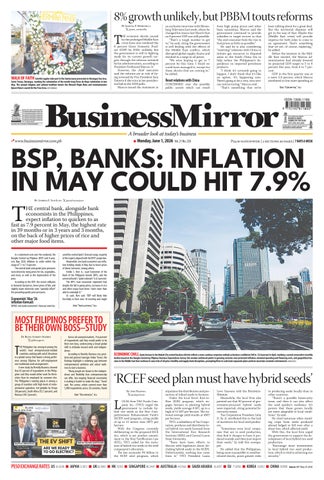
THEcentral bank, alongside bank economists in the Philippines, expect inflation to quicken to as fast as 7.9 percent in May, the highest rate in 39 months or in 3 years and 3 months, on the back of higher prices of rice and other major food items.
In a statement sent over the weekend, the Bangko Sentral ng Pilipinas (BSP) said it projects May 2026 in ation to settle within the range of 7.1 to 7.9 percent.
The central bank said upside price pressures were driven by rising prices for rice, vegetables, and meat, as well as the depreciation of the peso. According to the BSP, the recent rollbacks in domestic fuel prices, lower prices of
THE economic shocks caused by the prolonged Middle East crisis have now rendered the 8 percent Gross Domestic Product (GDP) by 2028, unlikely, but the government is still in fighting mode for its current growth targets through the reforms initiated by his administration, according to President Ferdinand Marcos Jr. However, the chief executive said the reforms are at risk of being reversed by Vice President Sara Duterte if she wins in her presidential bid in the 2028 polls.
Marcos issued the statement in
an exclusive interview with Bloomberg Television last week, where he changed his stance last March that an 8 percent GDP was still possible.
“ at’s a tough number to get to,” he said, citing the government is still dealing with the effects of the Middle East confl ict, which disrupted global supply chains and resulted in a surge in oil prices.
“We were hoping to get to 7 percent by this time. I think we could have managed it, except for these shocks that are coming in,” he added.
Reset relations with China CONCERNED over the possible public unrest which can result
from high pump prices and other basic necessities, Marcos said the government continued to provide subsidies to target sectors so that “the end consumer feels the rise in fuel prices as little as possible.”
He said he is also considering “resetting” relations with China to initiate gas resources in disputed areas in the South China Sea to help reduce the Philippines’s dependence on imported petroleum products.
“I think it’s certainly going to happen. I don’t think that it’s like an option. It’s happening now. ere’s going to be a very, very serious restructuring,” Marcos said.
“ at’s something that we’ve
been talking about for a great deal. But the territorial disputes will get in the way of that. Maybe this [Middle East crisis] will provide impetus for both sides to come to an agreement. at’s something that we are, of course, exploring,” he added. Before the tensions in the Middle East started, the Marcos administration had already lowered its projected GDP target to 5 to 6 percent this year, from 6 to 7 percent. GDP in the fi rst quarter was at a mere 2.8 percent, which Marcos attributed to low state spending as
@blessogerio
THE Philippines has emerged among the world’s most entrepreneurial-minded countries, ranking sixth out of 28 nations in a global survey that found a strong preference among Filipinos for self-employment over traditional work arrangements.
A new study by Remitly Business showed that 83 percent of respondents in the Philippines said they would rather work for themselves than be employed by someone else. The Philippines’s ranking places it among a group of countries with high levels of entrepreneurial aspiration, led globally by Kenya (98 percent), South Africa (92.7 percent), and Morocco (90.7 percent).
Across all surveyed markets, 74.6 percent of respondents said they would prefer to be their own boss, underscoring a broad global shift in attitudes toward work and independence.
According to Remitly Business vice president and general manager Ankur Tiwari, the ndings highlight a widening gap between entrepreneurial ambition and actual readiness to start a business.
“Many people are drawn to the independence and exibility that entrepreneurship can o er, but ongoing nancial uncertainty is making it harder to make the leap,” Tiwari said. The survey, which covered more than 5,000 respondents across 28 countries, found
LOCAL fi rm TAO Foods Company Inc. (TFCI) urged the government to include hybrid rice seeds in the Rice Competitiveness Enhancement Fund’s (RCEF) seed program, citing yields of up to 12 metric tons (MT) per hectare.
With the Congress currently deliberating on the proposed RICE Act, which is yet another amendment to the Rice Tariffication Law (RTL), TFCI called for the inclusion of hybrid rice seeds in the seed component’s allocation.
e law earmarks P6 billion to the RCEF seed program, which
stipulates the distribution and promotion of inbred seeds to farmers.
Under the local fi rm’s Rice-toRise (R2R) program, which engages farmers in planting hybrid seeds, yields average 8 MT, up to a high of 12 MT per hectare. e national average yield stands at 4MT per hectare.
TFCI, a subsidiary of Tao Corporation, produces and distributes local hybrid rice seeds licensed from the International Rice Research Institute (IRRI) and Central Luzon State University.
“ ere have been efforts to discuss with legislators about [including hybrid seeds in the RCEF]. Unfortunately, nothing has come from it,” TFCI President Laura
Love Guevara told the B-
Meanwhile, the local fi rm also pointed out that 90 percent of government-procured hybrid seeds were imported, citing potential biosecurity issues.
Tao Corporation President Julio D. Sy Jr. attributed this to the lack of incentives for local seed producers.
“Sometimes even local companies that are in seed production, they fi nd it cheaper to have it produced outside and then just import their seeds,” Sy told this newspaper. He added that the Philippines, being more susceptible to weatherrelated shocks, poses greater risks
in producing seeds locally than in other countries.
“ ere’s a possible biosecurity issue, and then it can also affect the seed quality’s resilience. It’s proven that those grown locally are more adaptable to local conditions,” Sy said. He cited instances when standing crops from seeds produced abroad lodged or fell over after a shear line, which affected yield. With this, the local fi rm urged the government to support the development of local hybrid rice seed production.
“Encourage more investments in local hybrid rice seed production, which is vital in achieving rice security.”
a cargo port terminal, which stakeholders have said are too tight and too basic to accommodate international cruise passengers. (See, “PHL, premier cruise hub? Why not? But first, have a better passenger facility,” in the BusinessMirror, Nov. 25, 2024.)
PPA also said in a recent news statement that it received 26 cruise calls nationwide, with passengers coming from China, Europe, and the United States landing speci cally in Manila, as of April this year.
Additional cruise ports being developed are in Coron, Alegria in Buruanga in Aklan, Catagbacan in Loon in Bohol, and Balbagon in Mamajao in Camiguin, the agency added.
Digitizing crew, passengers processes
AT the same meeting, the Department of Foreign A airs said it will nalize the “updated guidelines for the Multiple-entry 9C crew list visa, including applicable fees, and communicate the clearance to stakeholders once completed.” Shipping agent Wallem Philippines raised the measure as a way to ease the mobility of cruise ship crews and improve the operational e ciency, overall, of shippers and port service agents.
For its part, the Department of Information and Communications Technology said it will help streamline the processing of cruise passengers by “batch uploading of passenger data through the e-Travel system as a short-term solution and the development of a long-term Application Programming Interface [API] for cruise operators.”
The Bureau of Immigration, likewise, committed to schedule technical workshops with private sector stakeholders to ensure they are aligned and ready for the API System implementation, according to the DOT report.
Meanwhile, Swan Hellenic’s SH Minerva, a luxury expedition ship, recently sailed across the Philippines from May 9 to 20, 2026, with 53 foreign tourists. Included in its “Philippines to Japan Cultural Discovery Cruise,” the tourists were able to visit the Hundred Islands in Pangasinan, Salomague, Batanes and Sabtang Island, said the DOT on its Facebook page.
SH Minerva made its maiden voyage to the Philippines from April 28 to May 9 for its “Raja Ampat and Philippines Cruise: The Last Paradise on Earth,” which ferried more than 90 passengers to Casulian Island in Siargao, Loay in Bohol, Cuatro Islas in Leyte, Romblon, Marinduque, and Manila.
Asean’s Defa to be signed in Nov as final issues resolved
NEGOTIATORS from Southeast Asia have concluded talks on the region’s first comprehensive digital economy agreement after resolving “all remaining issues” that had delayed the conclusion of negotiations, paving the way for the pact’s signing in November this year.
e Senior Economic Officials Meeting (SEOM) of the Association of Southeast Asian Nations (Asean) announced that all outstanding matters in the negotiations for the Asean Digital Economy Framework Agreement (Defa) were settled during the second meeting of the 57th Asean SEOM held in Manila from May 27 to 29. e development marks the formal conclusion of negotiations for what Asean describes as its fi rst
be forced to deliver an o -cycle adjustment if the print surprises on the upside.”
Just a little below the upper bound of the BSP’s in ation forecast range for May were projections of Jonathan L. Ravelas, senior adviser at Reyes Tacandong & Co. and Union Bank of the Philippines chief economist Ruben Carlo O. Asuncion, at 7.8 percent. Ravelas said he expects in ation to come in at around 7.8 percent year-on-year, re ecting “still-elevated” price pressures. “The main drivers remain food—particular rice, meat, and
region-wide digital economy agreement, a key initiative aimed at creating a more integrated, secure, competitive and inclusive digital market across the region.
e breakthrough came weeks after Asean economic ministers, meeting during the 27th Asean Economic Community Council in Cebu on May 7, instructed senior officials to settle the remaining negotiating issues and bring the talks to a close. While Asean did
vegetables—due to supply constraints and weather disruptions, alongside a recent uptick in global oil prices that is feeding into transport and utility costs [freight],” Ravelas said in a Viber message. The foreign exchange analyst also noted that softer peso is adding to “imported in ation,” while base e ects, he pointed out, are “no longer as supportive.”
Asuncion, likewise, said Union Bank expects May in ation to have accelerated to 7.8 percent as “second-round price e ects mirror higher transport costs of basic commodities while base e ects fade.”
Meanwhile, leaning towards the lower bound of the central bank’s in ation forecast scope is China Banking Corporation’s (Chinabank) 7.2-percent estimate for May,
not disclose the specific issues that remained under discussion, officials said their resolution clears the path for the agreement’s scheduled signing in November during the 49th Asean Summit.
e proposed Asean Defa is expected to become a cornerstone of the region’s digital integration agenda.
is establishes common rules and frameworks governing digital trade, cross-border e-commerce, data governance, privacy, digital identity systems, electronic payments, cybersecurity cooperation, competition policy, emerging technologies such as artificial intelligence, and digital talent mobility.
Further, Asean said the agreement is expected to unlock significant economic opportunities across the region. Studies cited by the bloc estimate that Asean’s digital economy could reach up to $2 trillion by 2030 under current growth trajectories.
e agreement also builds on existing regional digital initiatives, including the Asean Single Window, digital payment connectivity
which is just the same level as the actual in ation print in April.
Domini Velasquez, Chinabank’s Group Chief Economist, said upward price pressures for the month came from higher prices of gasoline and LPG prices, along with increased service prices such as in restaurants.
“These gains were tempered by lower prices of diesel, kerosene, and key food items such as rice, meat, vegetables, fruits, and eggs. There was also downward adjustment in electricity rates in Meralco-serviced areas,” Velasquez explained.
In ation path
LOOKING ahead, Velasquez said Chinabank estimates headline in ation to hover around the 7-percent mark for the remainder of the year.
Key upside risks include prolonged elevated oil prices and second-round e ects from rising energy costs.
In addition, the Chinabank chief economist said limited fertilizer supplies and the possible onset of El Niño could dampen agricultural production and push food prices higher.
Ravelas, for his part, reminded households and investors that in ation remains “sticky and above target,” adding: “We should expect the BSP to stay cautious and keep policy tight for longer.”
In the near term, he said managing exposure to food and energy volatility—and staying defensive—remains “the prudent strategy.”
Asuncion said after pushing past 8 percent
projects, cross-border data initiatives, online consumer protection measures, and the Asean Unique Business Identification Number (UBIN) system.
Beyond facilitating digital trade, Asean said the framework is intended to make participation in the digital economy easier, safer and more seamless for businesses and consumers operating across borders. e bloc emphasized that the agreement is also designed as a development tool aimed at ensuring that the gains from digital transformation are more broadly shared among member states.
Asean said the pact is expected to help narrow development gaps within the region, strengthen the participation of micro, small and medium enterprises (MSMEs), support economies at varying levels of digital development, and promote more inclusive and sustainable growth.
e Asean Defa is expected to play a central role in implementing Asean 2045: Our Shared Future and the AseanEconomic Community Strategic Plan 2026-2030.
in succeeding months, in ation could “plateau and gradually ease” into the second half of 2026 as weak demand “caps momentum—weather shocks permitting.”
“Absent a severe El Niño, easing oil prices and a USDPHP move back toward the 60-level should temper non-food in ation including transport, which anchors roughly 60 percent of the CPI basket,” he also noted.
Monetary policy path
AS for the monetary policy direction, Neri of BPI said that should the in ation print in May exceed the 9 percent mark, the central bank may deliver “a jumbo series of hikes” between the June 18 and their August policy meeting.
Velasquez, for Chinabank’s part, expects the BSP to raise policy rates by 25 basis points at both its June and August meetings.
“We forecast in ation to average around 7 percent for the remainder of the year, bringing full-year 2026 in ation to approximately 6 percent. However, we expect the tightening cycle to be relatively shallow, as there are few signs of excess demand in the economy,” she also noted.
Meanwhile, Asuncion of Union Bank said in ation near or above 8 percent in May could prompt a “potential preemptive” BSP hike ahead of the June 18 policy meeting.
“[Around] 8 percent or higher: Raises odds of a 25bp o -cycle hike [as early as June 4 or 11]—reinforces a defensive stance,” the Union Bank’s commentary read.
the government initiated a crackdown on anomalous flood control projects last year.
Ongoing reforms
MARCOS is confident the government can still achieve a 6-percent economic growth by bringing in more investments in the country, implementing digitalization in the government, and upskilling and reskilling the country’s workforce so they can utilize new technologies such as Artificial Intelligence.
He said the government will also continue with the construction of its fl agship infrastructure projects like roads, bridges, and railways to help bring down the cost of doing business in the country.
“For you to be an attractive investment destination, the cost of doing business, the ease of doing business, hence the cost of doing business, must be competitive. And we have to work hard on that, and we have been,” Marcos said. As to international concerns of rampant corruption in the government after the flood control projects were exposed last year—dragging down the country’s ranking in the Corruption Perception Index 2025 to 120th to 114th in 2024— the President said his government has already done enough to address the matter. He said the now defunct Independent Commission on Infrastructure (ICI) successfully did its task to gather pieces of evidence and forward these to the Office of the Ombudsman and the Department of Justice (DOJ), which will conduct the formal investigation on the said cases.
“All of these things have really just started in the last year and a half. is is ongoing, and we’re changing it, and we’re doing something about it, and we’re going to make it better,” Marcos said.
Continuity issue
THE chief executive, however, expressed concern that the reforms may be reversed by Duterte.
“ at is a great worry for me. Because we have just started, and these are big things that we are trying to do. We’re changing the whole way that we govern,” Marcos said.
“We are trying to reform the bureaucracy. ese things don’t get done instantly. And it’s very, very easy to go off the rails,” he added. When asked if he was still willing to mend ties with VP Duterte, Marcos noted that he is not engaged in a “war” with the Vice President.
that independence and control over work were the top reasons for preferring self-employment, cited by 72.7 percent of respondents.
Flexibility in working time and location followed at 68.7 percent, while better work-life balance ranked third at 60.3 percent. Financial gain placed only fth at 48.2 percent, suggesting that autonomy weighs more heavily than income in driving entrepreneurial interest.
Interest in cross-border work also appears strong. About 58.1 percent of respondents said they would prefer some form of international exposure in their business activities.
Of those, 36.4 percent said they would want a mix of local and international clients, 16 percent said they aim to build businesses operating across multiple countries, and 5.7 percent said they would focus mainly on international clients. Meanwhile, 35.8 percent said they would prioritize their domestic market.
Tiwari noted that entrepreneurship is becoming increasingly global in orientation, with many aspiring business owners thinking beyond national borders from the outset.
“Handling nances across countries has traditionally been complex, but the right tools can make it far more seamless and accessible for small businesses,” he said.
Yet, despite a strong interest in self-employment, only 33.3 percent of respondents said they are likely to take concrete steps toward starting a business within the next year.
Financial uncertainty remains the biggest barrier, with 56.5 percent citing unstable in-
come as their primary concern. This is followed by di culty in securing clients or work at 51.9 percent, and fear of failure at 50.6 percent. The study also found that more than half of respondents would only consider selfemployment if it generated at least 1.5 times their current income, while 22.9 percent said they would require at least double their present earnings. However, not all countries share the same enthusiasm for entrepreneurship. Australia (40.6 percent), New Zealand (39.5 percent), and the Czech Republic (37.1 percent) recorded the highest preference for traditional employment.
Respondents in these markets cited job security and bene ts such as pensions and sick leave (61.7 percent), lower nancial risk (61.1 percent), and reluctance to manage a business (56 percent) as key reasons for preferring salaried work.
The report also pointed to skepticism surrounding entrepreneurship narratives online. More than 84 percent of respondents said social media makes self-employment appear more attractive than it really is, while 81 percent said the “hustle culture” places excessive pressure on individuals to constantly work or earn. Meanwhile, 78.1 percent of respondents said people tend to underestimate the risks involved in self-employment, and 64 percent said current economic conditions make entrepreneurship riskier than before.
Tiwari said those considering entrepreneurship should take a gradual approach rather than making abrupt transitions. “Testing an idea alongside a stable source of income can help reduce risk, create con dence, and give you the foundation to grow sustainably over time,” he said.
“I’m just trying to do my job. It is par for the course that you will be attacked, that you will be criticized. All I worry about is work,” he said. He also stressed that such “continuity” in government policy can be achieved by making changes in the Constitution, like its provisions on three-year terms of Congressman, which he said is too short.
“Look at the more successful economies in the region. e key to their success is continuity. But the way our Constitution is written, it actually encourages a lack of continuity,” he said.
“And that is the only way for us to strengthen our institutions. Look at the more developed democracies. Whatever happens in politics, the government continues to function,” he added.
PHL now hub for rules-based order–Teodoro
By Rex Anthony Naval
THE Philippines is fast becoming a hub for nations interested in keeping rules-based order in the maritime domain, Defense Secretary Gilberto Teodoro Jr. said on Sunday.
“With our defense of international law and strategic location, unlike any other, the Philippines has emerged as a hub for convergence among those committed to a rules-based order in the maritime domain, insofar as Philippine interests are concerned. Indeed, our allies and partners, some with differences among themselves, have nonetheless found common ground in our waters,” he said during the plenary session of the International Institute for Strategic Studies (IISS) Shangri-La Dialogue (SLD), in Singapore.
And in a fragmenting world, Teoodoro said the Philippines is “providentially blessed to convene international actors of every stripe in defense of shared principles, particularly freedom of the seas, respect for the rule of law, particularly the rights of smaller and archipelagic states.”
“This is a role we are very fortunate to play and one that we do not intend to take lightly. In that spirit today,” he added.
And with Philippine archipelagic waters at the heart of busy and vital maritime trade routes
that link the Indian and Pacific Oceans, Teodoro said the country is well-placed to safeguard maritime liberty.
“And we will continue to adhere to international law, including the UN Charter, the 1982 Unclos [United Nations Convention on the Rule of the Sea], and the 2018 Arbitral Award, which binds the Philippines to Unclos, as well as the peaceful settlement of disputes through existing UN systems, dispute settlement systems which are fair, transparent, and aimed not to gloss over major contradictions or problems, but to solve the root causes of our disputes,” Teodoro added.
“Through Unclos, the international community has recognized the extent of sovereignty, rights, and entitlements that we seek to protect. And on the basis of Pacta sunt servanda [agreements must be kept], we in turn will exercise these rights and entitlements in full accord with the norms and expectations of the international community. We do this openly and transparently, with nothing to hide,” he stressed.
‘Iron-clad’ alliance
THE Philippines and the United States reiterated their “iron-clad alliance” following a high-level bilateral meeting of the two nations’ ranking defense officials at the sidelines of the IISS ShangriLa Dialogue (SLD) in Singapore on May 30, the Department of National Defense (DND) announced on Sunday.
The meeting between Teodoro and US Secretary of War Pete Hegseth took place as both countries are marking the 75th anniversary of the Philippines-US Mutual Defense Treaty (MDT) which was signed on August 30, 1951.
“Secretary Teodoro congratulated Secretary Hegseth on his plenary address delivered earlier in the day and underscored the Philippines’ strong support for the US’ commitment to strengthening partnerships in the Indo-Pacific.
Secretary Teodoro emphasized that the Philippines stands as a witness to the robustness of US partnerships in the region, noting that such efforts contribute to greater resilience and deterrence in the Indo-Pacific,” the DND said in a statement.
For his part, Hegseth said the meeting marked the fifth engagement between the two defense leaders, underscoring the depth and consistency of Philippines-US defense cooperation.
“He [Hegseth’ also commended the successful conduct of the recent Balikatan Exercise, noting it as the largest iteration to date and a testament to the growing
interoperability and readiness of both armed forces. The US likewise reaffirmed its commitment to support the monitoring of the Philippines’ Exclusive Economic Zone [EEZ] and expressed continued support for the Philippines’ defense interests,” the DND added.
At the same time, the DND said the Philippines and the US renewed the Communications Interoperability and Security Memorandum of Agreement (Cismoa) for another 15 years, showcasing the two nations’ commitment to information, communications, and cyber security.
This was done by the Armed Forces (AFP) and the United States Indo-Pacific Command, it added.
“Secretary Teodoro also invited Secretary Hegseth to the Asean [Association of Southeast Asian Nations] Defence Ministers’ Meeting [ADMM] Plus, recognizing the occasion as an opportunity to strengthen engagement not only with the Philippines but also with defense counterparts,” the DND said.
The meeting reaffirmed the Philippines and the United States’ shared commitment to deepening defense cooperation in support of a free, open, and secure IndoPacific.
Also on Saturday, Teodoro and Australian Deputy Prime Minister and Minister for Defence Richard Marles met on the sidelines of the IISS SLD to discuss efforts to further strengthen defense cooperation between the two nations.
Fake ‘survivor’ of Angeles City building collapse arrested
By Ashley J. Manabat
ANGELES CITY—Authorities have taken into custody a man who allegedly falsely claimed to be a survivor of the collapse of a building under construction in Barangay Balibago, Angeles City, police said.
Investigators said the person, identified as Rexcy Flores, 26, recently went viral on social media after claiming he survived the tragedy. A video circulating online showed him claiming that he had gone out to buy beer, while three others were left inside the barracks at the time of the incident. He said they had been drinking earlier that night.
He allegedly fabricated a story that
he was in the area when the structure collapsed.
Initial investigation revealed that the man was able to receive financial assistance from the Department of Social Welfare and Development on May 28.
Authorities became suspicious after he allegedly attempted to seek additional assistance, prompting officials to verify his identity and background. Further investigation conducted by the Angeles police confirmed that the individual was neither a survivor nor connected to any of the victims of the incident. Police also found that he is not a resident of Angeles City.
the public and members of the media to remain vigilant against individuals falsely posing as victims or survivors of the tragedy.
Mayor Carmelo Lazatin II condemned those allegedly taking advantage of the incident for personal gain.
“This is a very painful incident that has deeply affected many families. A lot of people have suffered and continue to suffer because of this tragedy,” Lazatin said.
“What we need right now is empathy, honesty and understanding—not exploitation,” he added.
PHL, US units conduct 26’s third cooperative sail at WPS
FILIPINO and American naval and air units from May 26 to 30 conducted the third bilateral maritime cooperative activity (MCA) in the waters off Bajo de Masinloc, West Philippine Sea, the Armed Forces (AFP) announced on Sunday.
In a statement, the AFP said the Coast Guard (PCG) and the US Indo-Pacific Command (USIndopacom) took part in the successful training drills.
“Philippine assets including the BRP Antonio Luna [FFG-15], AW-109 ‘Power’ helicopter, FA-50 ‘’Fighting Eagele’ fighter jet, and Sokol helicopter. The PCG deployed the BRP Melchora Aquino [MRRV-9702], while USIndopacom participated with the USCGC Midgett [WMSL-757] and an MH-65 ‘Dolphin’ helicopter,” it added.
Search, retrieval
The AFP said that it is the third MCA for the Philippines and US this 2026. The first and second bilateral MCAs took place in January and March this year, respectively.
During the five-day activity, the AFP said allied forces conducted a series of maritime exercises, including search and rescue, visit, board, search and seizure, maritime law enforcement training, rotary wing deck landing qualifications, vertical replenishment, and communication exercises.
“The successful conduct of the recent MCA reflects the enduring commitment of the Philippines and the United States to deepen defense cooperation, strengthen maritime domain awareness, and uphold a rules-based international order,” it added. Rex Anthony Naval
teams find
3 more bodies in collapsed Angeles building
ANGELES CITY—The official death toll from the collapsed building under construction in barangay Balibago here has risen to nine, as search and rescue teams recovered the bodies of three more victims.
At 7:50 a.m. Sunday, Angeles City Mayor Carmelo Lazatin II received the report of the retrieval of the remains on the victim after a search and retrieval team recovered the remains of the seventh fatality.
Later in the day, the Bureau of Fire Protection (BFP) Region 3 confirmed that the eighth fatality was recovered 2:51 p.m. while that of the ninth was taken out of the rubble at 3:43 p.m.
Angeles City Information Officer Jay Pelayo IV said authorities are still searching for 14 missing persons.
Lazatin also said search, rescue, retrieval and clearing operations will continue until all the missing construction workers were recovered. He added that the city government also said it will continue providing assistance and support to the families affected by the tragedy.
Labor inspectors
FOLLOWING the deadly collapse of a building under construction in Pampanga, the Department of Labor and Employment ( DOLE ) is now looking to expand its corps of labor inspectors as it seeks to strengthen workplace safety enforcement nationwide.
“If you can provide around 200 young people, that would be a significant addition to our labor inspector workforce. Through Tesda, we can tap about 200 trainees whom we can train to become labor inspectors,” Tolentino said, mostly in Filipino. Based on DOLE data, only 477 of the agency’s 1,210 labor inspectors stationed across 17 regional offices are authorized to conduct labor inspections, including checks on compliance with occupational safety and health (OSH) standards.
Tolentino said the current number is far from sufficient given the thousands of establishments that must be inspected each year.
The labor chief said Tesda has already committed to helping Dole increase the number of inspectors, a move he believes will improve the government’s ability to monitor workplace compliance and prevent accidents. However, he acknowledged that expanding the inspectorate will require additional funding from Congress.
“As we enter the budget hearings, we will ask our former colleagues in Congress to provide additional funding, including better compensation for labor inspectors, whose work is extremely important,” Tolentino said.
AS the late afternoon sun cast golden reflections upon the waters of the Pasig River, an ancient spirit quietly sailed once more through the heart of Manila.
Docked at the historic Escolta port in Binondo is the B.B. Florentino Das, a modern replica of the ancient Filipino balangay boat, carrying with it not only sails and timber, but centuries of shared Southeast Asian history, culture, and identity.
For those who witnessed the vessel glide through the Pasig River on May 28, the journey was more than a river cruise. It was a moving reminder that long before modern borders existed, the peoples of Southeast Asia were already connected by the sea.
The all-wooden vessel retraced historic waters from Binondo toward Manila Bay, passing beneath the Del Pan Bridge, alongside Fort Santiago, and within view of the Pasig River Esplanade, a civic project championed by First Lady Louise Araneta-Marcos.
Aboard the one-hour voyage were officials from the Presidential Communications Office (PCO), members of the media, and advocates seeking to revive appreciation for the country’s maritime heritage.
Former Department of Transportation and Department of Environment and Natural Resources Undersecretary Art T.
Authorities said the man later admitted to fabricating the story. He is currently in police custody awaiting charges to be filed against him.
The city government also urged the public to verify information responsibly and refrain from spreading unconfirmed claims on social media.
The Angeles City Government warned
The Balangay: A shared Asean heritage and symbol of unity
Valdez, one of the strongest advocates of the balangay revival movement, described the voyage with humor and symbolism.
“Kompletoangatingpaglalayag,”Valdez said with a smile. “Nagkaroon ng malakas na alon dahil sa squall o hangin sa Manila Bay, nakita natin ang mga basura, umulan pa,sumadsadngkonti,nottomentioniyong mga mababang tulay na ating dinaanan.”
Yet beneath the lighthearted remark was a deeper message: the voyage reflected the many challenges confronting the Pasig River and the continuing struggle to restore one of the country’s most historic waterways.
“We have to keep this advocacy of bringing the Pasig River back to life,” Valdez emphasized. “And it can only be done kung tayong lahat ay magtulung-tulungan.”
The mission of the B.B. Florentino Das goes beyond nostalgia. The vessel has become a floating symbol of Asean solidarity and shared maritime roots. This is precisely why the ancient balangay was chosen as the centerpiece of the official logo of the Philippines’ hosting and chairmanship of the Asean Summit in 2026. The balangay symbolizes unity in diversity—Asean nations journeying together aboard a single vessel despite their different languages, traditions, and histories.
It reflects the Philippine chairmanship theme: “Navigating Our Future, Together,”
with President Marcos as the current Asean Chairman.
“Fittingly, our Asean Chairmanship 2026 logo distinctly features the balangay, a traditional Filipino boat that carried communities across open waters long before borders were drawn,” Marcos said at the Asean Tourism Forum last January.
“It reminds us that Asean has always been a region that moves forward together, sailing on as one fleet towards a common horizon,” he added.
Historians believe the original balangay boats were used by early Filipinos centuries ago for trade, migration, diplomacy, and cultural exchange throughout Southeast Asia. The oldest known balangay was discovered in 1977 in a swamp in Butuan City and is believed to date as far back as 320 BC, making it among the oldest seafaring vessels ever found in the region.
The word “barangay,” the smallest political unit in the Philippines today, is also believed to have originated from “balangay,” symbolizing communities journeying together toward a common destiny.
The modern B.B. Florentino Das was built in 2024 using durable Philippine ironwood sourced from Siargao Island. Measuring 24 meters long and 5 meters wide, the boat has already sailed hundreds of miles across Philippine waters.
In May-June 2024, it journeyed from
Butuan, stopping in Palawan before reaching Pag-Asa Island at the West Philippine Sea and finally returning to dock near the CCP Complex on Roxas Boulevard.
Named after legendary Filipino yachtsman Florentino Das, the vessel is now crewed by a dedicated team that includes Balangay captain Carolino, skipper de Grano, Engineer Officer Poi Meljun L. Villacura of the Coast Guard, Petty Officer
2 Ricard Mark D. Yamba III, PO2 Gaude C. Gaylon, PO3 Ernie B. Oquendo, Seaman 2 Jade M. Castillo, along with crew members Boboy, Adam, and Fred Jamil.
Valdez, who has led all Balangay expeditions since 2009, revealed that this is already the sixth balangay replica constructed in the country, though the earlier vessels are no longer operational.
“Kailangan natin magparami,” he said, underscoring the importance of preserving and multiplying these cultural treasures for future generations.
As the B.B. Florentino Das slowly returned to port, its silhouette against the Manila skyline seemed to bridge ancient history and modern aspirations.
In a rapidly changing world, the humble balangay continues to tell an enduring story—that nations, like communities, move farther and stronger when they journey together.
Naz Rodriguez, Presidential News Desk
Acting Labor Secretary Francis N. Tolentino said over the weekend that the Labor department is coordinating with the Technical Education and Skills Development Authority (Tesda) to recruit technical-vocational graduates who could be trained and deployed as labor inspectors.
Under the Labor Code, the Department of Labor and Employment ( DOLE ) is mandated to conduct workplace inspections to ensure compliance with labor laws, particularly those covering working conditions, wages, occupational safety and health, and workers’ welfare benefits.
Non-compliance with labor standards may result in administrative fines and penalties. Ashley J. Manabat and Justine Xyrah Garcia
High survey rating prompts Nartatez to vow to work harder
THE National Police (PNP) Chief, Gen. Jose Melencio Nartatez Jr., on Sunday welcomed the results of the latest nationwide “Boses ng Bayan” Index of Governance (IOG) survey released recently by RPMD Foundation Inc. as it recognized him as one of the highest-rated government officials in the country.
The survey, conducted from April 1 to 8 with 5,000 respondents, showed that Nartatez got an overall governance score of 78.8 percent, along with a 78.5 percent trust rating and 79.1 percent performance rating.
Nartatez said this reflects strong public approval of the PNP’s peace and order efforts and ongoing reforms under the administration of President Marcos.
“The recent governance and trust ratings are a welcome affirmation of the hard work of every police officer in the field. This is not a personal achievement but a reflection of the collective efforts of the National Police in serving the public with integrity and professionalism,” he said in a statement on Sunday.
“We thank the public for their trust. We take this as a continuing responsibility to improve our service, strengthen accountability, and ensure that every police action reflects fairness, respect for human rights, and genuine public service,” he said. He said reforms will focus on sustained community policing programs and stricter accountability mechanisms to maintain credibility and public confidence.
Nartatez directed concerned units to intensify barangay-level engagement and strengthen internal disciplinary measures, sustaining public trust and translating survey gains into long-term institutional performance improvements.
Crime data systems
THE PNP is set to further modernize its crime data systems through a partnership with South Korea aimed at boosingt investigative efficiency, speeding up response times, and strengthening case resolution across all units.
This, as the PNP and the Department of the Interior and Local Government signed
He said the result highlights the continued responsibility of the organization to maintain public confidence as reform programs expand across local police units and community engagement initiatives are strengthened nationwide.
Caap: Don’t point lasers at aircraft
THE Civil Aviation Authority of the Philippines (Caap) on Sunday the public that the intentional projection of laser beams and other high-intensity lights toward aircraft is strictly prohibited, as such actions pose serious risks to aviation safety.
Laser illumination can impair a pilot’s vision, cause distraction or temporary disorientation and adversely affect the safe operation of an aircraft, particularly during critical phases of flight such as takeoff and landing.
Philippine Civil Aviation Regulations (PCAR) Part 8.5.1.29 stated that “no person shall intentionally project a laser beam or direct a high-intensity light at an aircraft which can result in distraction, disruption, disorientation and, in extreme cases, incapacitation, adversely affect the ability of the flight crew to carry out their responsibilities, especially during take-off and landing.”
Violators may face serious legal consequences. Under Republic Act 9497, Section 81(b)(6), any person found guilty of such acts may be punished with imprisonment of up to three years, a fine of not less than fifty thousand pesos (P50,000.00) but not more
than P500,000.00, or both, at the discretion of the court.
“We appeal to the public to exercise caution and responsibility, as even a brief distraction can affect flight operations. By remaining mindful of our actions and complying with aviation regulations, we can all contribute to keeping Philippine skies safe for everyone,” said Caap Director General Raul del Rosario.
Aside from laser illumination, Caap also reminded the public that other hazardous activities within airport vicinities and operational areas are strictly regulated. These include the operation of unauthorized aerial objects, raising of birds that may pose bird strike risks, animal intrusions, construction of unauthorized structures, improper vegetation management, and activities that may interfere with aviation communications and navigation systems.
Caap remains steadfast in its mission to uphold the safety, security, and efficiency of Philippine civil aviation operations in line with the directives of President Marcos and Transportation Secretary Giovanni Lopez, the agency said in a statement. Nonie Reyes
AmCham seeks tweaks to cable vessel Customs rules
By Bless Aubrey Ogerio
HE American Chamber of Com -
Tmerce of the Philippines (AmCham) has backed a proposed Customs framework governing international cablelaying and repair vessels, while urging the government to refine several provisions to make implementation more predictable and operationally efficient.
In a statement, AmCham welcomed the proposed Customs Administrative Order (CAO) of the Bureau of Customs (BOC), which seeks to establish a clearer framework for the temporary admission of International CableLaying and Repair Vessels (ICLRVs) operating in Philippine waters.
The business group said the measure aligns with the objectives of the Customs Modernization and Tariff Act (CMTA) and international best practices aimed at facilitating the installation, maintenance, and repair of submarine cables.
AmCham said undersea cable systems are critical to the country’s digital infrastructure, economic competitiveness, and connectivity security.
“A more efficient and predictable regulatory environment for these operations will also help strengthen the Philippines’ competitiveness and attractiveness as an investment destination by reinforcing the country’s reliability as a regional digital and connectivity hub and supporting continued investment in digital infrastructure,” the chamber said.
While expressing support for the proposed order, AmCham recommended targeted refinements to address potential implementation issues.
Among its recommendations is a clearer and more standardized approach to security requirements imposed on vessels seeking temporary admission.
The group noted that the current provision requiring proof of posting a security equivalent to 100 percent of duties, taxes,
Nartatez. . .
Continued from A4
a partnership with the Korea International Cooperation Agency (Koica) last week to develop the Criminal Investigation Data Management and Analysis System (Cidmas), a unified crime data platform designed to modernize law enforcement operations nationwide.
Nartatez said the bilateral initiative seeks to further improve the handling of the law enforcement database system in line with the instruction of President Marcos.
“By consolidating our separate crime databases into a single platform, we are eliminating redundant data encoding and giving our field investigators rapid access to critical, actionable information,” he said in a statement on Sunday.
Under the agreement, Cidmas will consolidate fragmented crime investigation databases into a single system, reducing
Study: PHL firms wary of letting AI make final hiring decisions
By Bless Aubrey Ogerio
ARTIFICIAL intelligence
(AI) is increasingly taking over repetitive human resource (HR) functions in the Philippines, but strategic judgment and final hiring decisions remain firmly in human hands, according to global talent solutions firm Robert Walters.
Kimberlyn Lu, Robert Walters Southeast Asia CEO, said the first wave of AI adoption in workplaces has largely focused on automating routine and administrative tasks, while companies continue to exercise caution over allowing the technology to independently make critical workforce decisions.
“While the initial phase of AI adoption focuses on automating routine tasks, the real work lies in strategic evaluation,” Lu said.
New research from Robert Walters showed that only 28 percent
and other charges may lead to valuation uncertainty, inconsistent application, and operational delays.
“While we recognize the importance of safeguarding government revenue, the current requirement of proof of posting of a security equivalent to 100 [percent] of duties, taxes, and other charges may create valuation uncertainty, inconsistent application, and avoidable operational delays,” AmCham said.
“A more clearly defined, capped, or standardized methodology would help promote predictability and efficient implementation,” it added.
The chamber also called for extending the allowable short-term presence period for cable-laying and repair vessels.
Under its proposal, ICLRVs should be allowed to remain in the country for up to 30 days, with an option to extend for another 30 days if necessary.
AmCham said cable repair and installation activities are often highly time-sensitive and subject to weather conditions and other operational complexities, making flexibility essential to ensure projects are completed without disruption.
“Cable repair and installation operations are often highly time-sensitive, weatherdependent, and operationally complex, requiring flexibility to ensure uninterrupted and timely completion of critical works,” the group said.
The chamber stressed that the suggested revisions would not weaken customs oversight but instead help improve clarity, consistency, and efficiency in implementing the rules.
“AmCham believes these refinements would further strengthen clarity, consistency, and operational efficiency while preserving effective customs administration and regulatory oversight,” it said.
The group also reiterated its support for government efforts to improve policies that facilitate digital infrastructure investments and strengthen the country’s role in regional connectivity.
manual encoding and improving data verification, coordination, and access to critical information for investigators.
Nartatez said the system is expected to speed up case resolution, strengthen crime analysis, and enhance overall crime prevention efforts through a more integrated and data-driven policing approach.
The PNP has been working with South Korean counterparts as they are known for their integrated law enforcement systems and technology-driven policing approach.
“This modernization will significantly reduce our reaction times and substantially increase our case resolution rates across all regional units,” Nartatez said.
Nartatez said South Korea’s advanced law enforcement model demonstrates the power of using integrated technology for proactive, rather than reactive, policing.
“Through this collaboration, the PNP is adopting world-class methodologies in bigdata crime analysis and strategic monitoring,” he added. Rex Anthony Naval with PNA
of HR leaders in the country are confident in using AI to make final hiring decisions without human supervision.
The firm said the low figure reflects how companies still see AI primarily as a support tool for processing data and improving operational efficiency rather than replacing human decision-making in recruitment.
Despite this caution, AI adoption across HR functions continues to accelerate.
The study found that 45 percent of large organizations are already using AI for recruitment-related tasks such as screening candidates, scheduling interviews and generating job descriptions.
Meanwhile, 65 percent of companies said they plan to invest in AI and automation technologies for HR functions over the next two years, signaling long-term commitment to digital transformation
in talent management.
Lu said AI is reshaping HR operations by reducing the burden of repetitive, high-volume work, allowing professionals to focus on more people-centered responsibilities.
“This shift allows HR professionals to focus on strategic human-centric activities, such as employee engagement, change management, and high-level negotiations,” she said.
“The real value of AI lies in augmenting, not replacing, the expertise of human recruiters and HR managers,” she added.
Still, concerns over the technology’s limitations remain widespread among employers.
According to the report, 48 percent of employers expressed concern that AI could compromise data confidentiality, while 30 percent said algorithmic bias may lead to unfair conclusions
during recruitment and employee assessment.
Another 23 percent acknowledged that AI systems can still produce errors despite their capacity to analyze large amounts of information.
Further, the report noted that companies are adopting a more deliberate approach to AI integration by balancing automation with human oversight, particularly in decisions involving ethics, judgment and employee welfare. Robert Walters said businesses are now focusing on two key priorities: maximizing AI tools for operational efficiency while ensuring that final decisions remain under human supervision.
The company added that the cautious but expanding use of AI reflects a broader shift in how organizations are redefining workforce management amid rapid technological change.
PSA notes retail prices spike in Metro Manila
By Justine Xyrah Garcia
RETAIL prices in Metro Manila further accelerated in April as higher fuel costs continued to push up prices of goods sold by retailers, the Philippine Statistics Authority (PSA) reported.
PSA data showed the General Retail Price Index (GRPI) in the National Capital Region (NCR) grew 4.5 percent in April, faster than the 3.3 percent increase recorded in March and significantly higher than the
0.9 percent expansion posted in the same month last year.
The April reading pushed the average GRPI for the first four months of 2026 to 3 percent, more than double the 1.2 percent recorded in the January-to-April period of 2025.
The statistics office noted that the faster increase was largely driven by mineral fuels, lubricants and related materials, whose index surged 51.3 percent in April from 29.2 percent in March.
Higher annual increases were also re -
corded in beverages and tobacco, which rose 1.6 percent from 1.4 percent; crude materials, inedible except fuels, at 4.6 percent from 3.1 percent; and chemicals, including animal and vegetable oils and fats, at 2.9 percent from 2.4 percent. Meanwhile, PSA said manufactured goods classified chiefly by materials posted a faster increase of 1.8 percent from 1.6 percent, while machinery and transport equipment accelerated to 2.8 percent from 1.5 percent.
Miscellaneous manufactured articles
likewise edged up to 1.1 percent from 0.9 percent. Food prices were unchanged, retaining their previous month’s growth rate of 3.2 percent.
The PSA also noted that none of the commodity groups recorded slower price growth during the month.
The GRPI measures changes in the general level of prices at which retailers sell goods to consumers or end-users, making it a key indicator of consumer inflation trends in the region.
Legislator urges setting up of local e-libraries
ACONGRESSMAN from Quezon City is pushing the establishment of electronic libraries (e-libraries) in local neighborhoods, starting with a pilot program in Novaliches, to help students read better and pass their examinations.
Through House Bills 3752 to 3765, Quezon City Rep. Patrick Michael Vargas wants to build computerized learning hubs that are cheap to set up in 14 barangay of the city’s Fifth District.
If the project succeeds in Novaliches, the government can copy the formula to build e-libraries in every barangay across the Philippines, Vargas said.
Sisimulan namin sa distrito para mapakita na it is a viable solution. Hopefully, the rest of Quezon City will also adopt it and later on the rest of the country,” Vargas said.
Hub. . .
Continued from A4
“The meeting focused on advancing bilateral defense collaboration and deepening practical cooperation between the Philippines and Australia in support of shared security interests and regional stability,” the DND said.
Teodoro and Marles also exchanged views on enhancing collaboration with likeminded partners, including Japan and the United States, underscoring the importance of sustained cooperation in promoting peace, stability, and a rules-based order in the Indo-Pacific region.
Teodoro also had separate bilateral meetings with his South Korean and Singaporean counterparts on the sidelines of the IISS JLD this Saturday.
“In his meeting with [ROK Defense] Minister Ahn Gyuback, Secretary Teodoro expressed appreciation for the ROK’s continued support for the AFP Modernization Program and underscored the importance of sustained cooperation in enhancing defense capabilities. Both sides acknowledged the strong and steadily expanding defense partnership between the
The project comes at a critical time when many young Filipinos are struggling to read. Recent data from the Second Congressional Commission on Education (Edcom II) shows an alarming trend: nearly half (48.76 percent) of Filipino students cannot read properly at their grade level by the end of Grade 3.
Even worse, international tests like the Program for International Student Assessment (Pisa) show that 76 percent of 15-year-old Filipino students fail to meet basic reading standards.
“Kailangan nating gumawa ng mga hakbang upang suportahan ang mga nakukuhang aral ng mga estudyante mula sa ating public schools. These e-libraries are cost-effective means to extend that support,” Vargas said.
Vargas explained that traditional
Philippines and ROK,” the DND also said.
Teodoro likewise highlighted the enduring historical ties forged during the Korean War, underscoring the importance of preserving the legacy of Filipino soldiers who fought alongside Korean forces and promoting greater awareness of this shared history among future generations.
“The two defense leaders exchanged views on regional security developments, including the Korean Peninsula and the West Philippine Sea, and discussed opportunities to expand cooperation, particularly in defense logistics and defense industry. Both sides extended invitations for future engagements, including the ASEAN Defence Ministers’ Meeting [ADMM]-Plus and the Seoul Defense Dialogue later this year,” the DND said.
Teodoro also met with Singaporean Defense Minister Chan Chun Sing to discuss how to further strengthen bilateral defense relations between the Philippines and Singapore.
During the meeting, Teodoro underscored the value of expanded joint training and exercises between the AFP and the Singapore Armed Forces in enhancing interoperability and readiness.
“The two defense leaders also discussed
libraries made of concrete and filled with paper books cost a lot of money to build and maintain. Because of high construction and delivery costs, many local governments struggle to build libraries for their communities.
By shifting to a digital system, the elibrary project skips these expensive steps.
Under the bill, the Department of the Interior and Local Government (DILG) will help buy the computers and set up the internet networks, while the local barangay will help maintain the equipment and the facility.
According to Vargas, unlike regular paper books that can get torn, lost, or outdated, digital books last forever and can be updated instantly.
“ Sa ganitong paraan, mas maraming estudyante ang makikinabang. Mas mapapamahal ang mga bata kung sila ay
humanitarian assistance and disaster relief cooperation, with Secretary Teodoro noting the mutual benefits of Singapore’s continued participation in exercises aligned with its expertise and capabilities. Minister Chan welcomed the Philippines’ offer to further expand defense cooperation,” the DND added.
Teodoro expressed appreciation for Singapore’s hospitality in hosting the SLD, while
kailanganpangbumilingtig-isangphysical textbook,” the lawmaker said. Under the bills, the digital libraries will be loaded with files, interactive programs, and reference papers that match the lessons being taught inside public school classrooms. Students can easily walk from their school to the barangay e-library to do their homework, research for reports, and improve their vocabulary
The project updates older laws like Republic Act 7743, or the Philippine Library Law, which requires local governments to establish public reading centers.
Tiwalakaminaangmgapilote-library sa distrito ay magiging epektibo. Once we prove that, we hope to see this replicated across every district in the country to ensure no Filipino child is left behind in reading,” Vargas also said.
Minister Chan conveyed Singapore’s support for the Philippines’ Asean Chairmanship.
“During the two engagements, Secretary Teodoro also put forward a vision of the Philippines as a hub for convergence among like-minded partners, underscoring its vital role in preserving the freedom of the seas and the peace and stability of the Indo-Pacific Region,” the DND added. With PNA
Hegseth tells US allies China won’t control Indo-Pacific, despite more constructive tone
By David Rising The Associated Press
SINGAPORE—US Defense
Secretary Pete Hegseth assured Pacific allies on Saturday that Washington remained committed to the region, but toned-down previous comments calling China a threat.
Speaking to a group of world leaders, diplomats and top security officials at the Shangri-La defense conference in Singapore, Hegseth said that the region “has profound implications for US security and prosperity” and that Washington’s priority was to “achieve a lasting and favorable balance of power in the Pacific.”
It was his second time addressing the forum, hosted by the International Institute for Strategic Studies. Last year, he raised the ire of Beijing by warning of rapidly developing threats from China, particularly its aggressive stance toward Taiwan. He said China is no longer just building up its military forces to take Taiwan, it’s “actively training for it, every day.”
This year, however, the meeting comes only about two weeks after US President Donald Trump visited Chinese leader Xi Jinping in Beijing, following which Trump called Xi a “great leader” and said that they were going to have a “fantastic future together.”
Hegseth says China won’t be allowed to dominate the region HEGSETH , who was with Trump in Beijing, said the two leaders had agreed that China and the US should “build a constructive relationship of strategic stability, based on fairness and reciprocity, reaffirming that while our nations will vigorously protect our respective interests, we can secure practical, mutually beneficial agreements where our interests align.” However, he said it was still an American priority to ensure that China is not allowed to dominate the Indo-Pacific.
“There is rightful alarm regarding China’s historic military buildup and the expansion of its military activities in the region and beyond,” he said. “We share a clear-eyed assessment of that security environment and a mutual understanding that a Pacific dominated by any hegemon would unravel the regional balance of power and undermine the equilibrium we all
seek to preserve.”
Later in the day, Chinese Maj. Gen. Meng Xiangqing praised Hegseth’s remarks about the meeting between Xi and Trump, saying the consensus the leaders reached “should provide strategic guidance for China-U.S. relations over the next three years and beyond.”
“During his meeting with President Trump, President Xi Jinping made it clear that such constructive strategic stability should be a positive form of stability centered on cooperation, a healthy form of stability in which competition remains within reasonable bounds, a normal state of stability in which differences are managed and kept under control, and a lasting form of stability that offers the prospect of peace,” he said.
US Sen. Tammy Duckworth, part
of a congressional delegation to the conference, accused the Trump administration of “cozying up” to China.
“I worry that this administration is being distracted into wars that they’ve started in other parts of the world at the expense of our commitment here in the Indo-Pacific,” the Illinois Democrat told reporters on the sidelines.
“I am concerned that it seems like our president is entering into, you know, policies where he’s doing what Beijing wants him to do,” she added.
After the meetings between Xi and Trump, the American president raised questions about Washington’s willingness to defend Taiwan, calling a new $14 billion arms package that he has yet to greenlight “a very good negotiating chip for us” with China.
China claims the democratic self-
US allies warn division weakens deterrence in calls for global unity to meet new threats
By David Rising
The Associated Press
SINGAPORE—American allies stressed the need for unity at a top defense conference Sunday, saying that as threats increasingly transcend regions, cooperation is more important than ever, even as Washington has become more critical of its traditional friends.
US President Donald Trump has been extremely harsh about NATO, and the comments at the Shangri-La conference came the day after US Defense Secretary Pete Hegseth again chided Western European allies at the forum for not devoting enough resources to defense.
Japanese Defense Minister Shinjiro Koizumi praised Hegseth for his commitment to the Indo-Pacific, but at the same time stressed the continued need for strong coalitions globally.
“Division weakens deterrence, unity strengthens deterrence,” he told the conference, hosted by the International Institute for Strategic Studies.
“If gaps emerge among the United States, Europe, and allies and likeminded countries, forces which take it as an opportunity will surely come
in,” he said. “We must prevent such a situation. We must keep our cooperation going on. Now is the time to make our cooperation even stronger.”
As China has been rapidly expanding and modernizing its military, Japan has been reshaping its own defense policy. Last month, Prime Minister Sanae Takaichi’s Cabinet scrapped a ban on lethal weapons exports, a major change in its postwar pacifist policy.
China criticized the change, with Foreign Ministry spokesperson Guo Jiakun saying China would “resolutely resist Japan’s reckless moves toward a new type of militarism.”
Koizumi scoffed at that accusation as ironic, coming from China.
“Think about it, there is a country that has a huge arsenal of nuclear weapons and strategic bombers,” he said, speaking in English. “Japan has neither of such weapons, and yet Japan is labeled new militarism. Isn’t it strange?”
He said that transparency comes from “discussion and dialogue” and lamented that China had not sent its defense minister to the conference.
In his speech Saturday, Hegseth applauded many Asian partners for their efforts to step-up defense spending, while reiterating criticism of European allies, who he suggested got “distracted by empty globalist rhetoric about
the rules-based international order, while European capitals threw open their borders and hollowed out their militaries.”
“You can have all the rules you want and rules are great,” Hegseth said. “But if you can’t back them up with hard power, the rules are not worth the paper they are written on.”
Many NATO countries failed for years to meet alliance defense spending commitments, but since Russia’s invasion of Ukraine in 2022, many dramatically increased military expenditures and plan more in the future.
Speaking to reporters on the sidelines of the conference Sunday, Australian Defense Minister Richard Marles, said he agreed with Hegseth’s point that “the rules-based order needs to be underpinned by power,” but at the same time said strong rules were “more important today than they have ever been.”
“We are all committed to a rulesbased system, because that is actually what gives middle powers like Australia or smaller countries agency,” he said.
He also said alliances remain critical to the region’s defense.
“This is a collective challenge and it demands a collective response, which is actually what the rules-based order is all about,” he said.
Netherlands Defense Minister Dilan Yesilgöz-Zegerius said the current conflicts have global implications and demand a shared response.
“A war in Europe involves drones from Iran, soldiers and ammunition from North Korea and various types of support from China,” she said. “The lesson is clear: regional tensions are no longer regional. Our security is interconnected.”
She said that if middle powers do not work together, they risk becoming spectators or the “subject of conversations,” but with coalitions they can help preserve stability.
governing island as its own, and Xi has not ruled out using force to take it. The US is required by law to help provide Taiwan with the means to defend itself, though follows a policy of “strategic ambiguity” on whether it would intervene militarily if China were to attack the island.
Hegseth told the forum that there was “no change in our status” toward Taiwan, but would not comment on the arms deal.
“Any decision about future Taiwan arms sales, as the president said, will rest with him,” he said.
US praises countries that spent more on defense
HE underscored the Trump administration’s insistence that allies increase defense spending, saying “we need partners, not protectorates.”
He lauded several countries in Asia for their efforts, while reiterating criticism of European allies, without naming names, who he suggested got “distracted by empty globalist rhetoric about the rules-based international order.”
“Our partners in Asia have long understood that the bedrock of a durable partnership is not based on idealistic values but on the concrete alignment of national interests,” he said.
“When our interests diverge, we adjust pragmatically, without the drama or the moralizing,” he added. “I think Western Europe might take note — this is a mindset we fully embrace.”
Hegseth did not mention either the war in Ukraine or Iran war in his speech. When asked about Iran,
he only said that Trump had assured him that when negotiations with Tehran had concluded, “any deal will be a good deal.”
Australian Defense Minister Richard Marles, whose country was among those Hegseth praised for increased military spending, said that while the international rules-based order is not perfect, the “task before us, all of us, including the great powers, is the renovation of that order, not its dismemberment.”
“When the rules apply, smaller states have agency,” Marles said in a speech that followed Hegseth’s. “When the rules yield to power, sovereignty becomes, as others have put it, the purview of the powerful, and no state in this room today, whatever its size, is well served by that outcome.” UK, US and Australia announce new undersea drone initiative AT an event held outside the conference, Hegseth, Marles and British Defense Secretary John Healey announced a new initiative in their AUKUS partnership, whose primary focus has been the development and construction of nuclear-powered submarines.
Under the so-called second pillar of AUKUS, the three said they would together invest in the development of improved capabilities for underwater drones.
“Together we produce a range of cutting-edge sensors or weapons systems for undersea drones,” Healey said, adding it will help detect threats including to underwater cables and pipelines.
WHO chief visits epicenter of Ebola outbreak in eastern Congo as cases outpace response
By Justin Kabumba & Mark Banchereau The Associated Press
BUNIA, Congo—The head of the World Health Organization on Saturday visited eastern Congo’s Bunia, a city at the heart of an outbreak of a rare type of Ebola, where the virus is spreading faster than the response despite better-organized health facilities and new aid arrivals.
WHO Director-General Tedros Adhanom Ghebreyesus stressed the importance of building community trust, ensuring safe burials to prevent the spread of the outbreak and urged countries to reconsider travel bans and border closures, saying they “discourage transparency.”
“The Democratic Republic of Congo has faced Ebola before, 16 times, and has ended every outbreak. This is the 17th. That history gives me real confidence,” Tedros said during a news conference Saturday alongside Congo’s health minister.
The health organization said Friday latest official figures showed 906 suspected cases and 223 suspected deaths. Neighboring Uganda has confirmed nine cases and one death, the Ugandan Health Ministry said Friday.
The Bundibugyo virus, the current species of Ebola, has no approved treatment or vaccine.
Medical aid donated by the European Union arrived in Bunia in Ituri province on Thursday. More shipments are expected in the coming days. The US announced $80 million in additional aid on the same day, bringing its total commitment to more than $112 million.
Response efforts at Bunia’s Rwampara and General hospitals appeared more organized, with additional staff, protective gear and medical supplies, though patients continue arriving around the clock, according to an Associated Press reporter.
The response has not kept pace with one of the fastest-spreading outbreaks on record, Doctors Without Borders, or MSF, warned on Saturday.
“Never before has an Ebola outbreak re -
corded so many cases so soon after its declaration,” Dr. Alan Gonzalez, MSF’s deputy director of operations, said in a statement.
“Nobody knows the true scale and severity of this outbreak.”
Gonzalez called for an immediate expansion of testing, faster deployment of aid workers and sustained access for medical supplies.
The dangers faced by health workers have been heightened by anger among residents over the stringent medical protocols for handling the victims’ bodies, which clash with local burial rites. Residents have launched at least three attacks against health centers.
“We are not here to tell people what to do, we are here to listen,” Tedros said Saturday. “Building trust takes time, and it starts with listening.”
“I understand how painful it is to lose someone, and how much it means to honor them properly, but certain practices, including touching the bodies of those who have died from Ebola, can spread the virus further,” Tedros said.
Attacks in Ituri by the Allied Democratic Forces, a rebel group allied with the Islamic State group, and a coalition of ethnic militias have also hindered the response. The illness also has been reported in the Congolese provinces of North Kivu and South Kivu, south of Ituri, where the Rwanda-backed M23 rebel group controls many key cities, including Goma and Bukavu. The rebels have reported two cases. Uganda and Rwanda have closed their borders, while the Trump administration last week banned entry of non-US passport holders who had recently visited Congo, Uganda or South Sudan.
“I would also ask countries that have imposed travel bans or border closures to reconsider,” Tedros said, saying such measures “discourage the transparency that saves lives.”
Banchereau reported from Dakar, Senegal. Associated Press writer Saleh Mwanamilongo in Bonn, Germany, contributed to this report.
JAPAN’S Defense Minister Shinjiro Koizumi delivers a speech during the Shangri-La Dialogue, Asia’s annual defense and security forum, in Singapore, Sunday, May 31, 2026. AP PHOTO/ACHMAD IBRAHIM
US Defense Secretary Pete Hegseth gestures as he speaks during the Shangri-La Dialogue, Asia’s annual defense and security forum, in Singapore, Saturday, May 30, 2026. AP PHOTO/ACHMAD IBRAHIM
Ukraine keeps up assault on Russian oil sites as Kyiv expects more strikes
By The Associated Press
UKRAINIAN drone strikes caused fires at more Russian oil facilities overnight into Saturday, Russian officials said, in what appeared to be the latest attack on Moscow’s vital oil industry.
gion said falling drone debris sparked a fire that damaged an oil depot and tanker in the port of Taganrog, while officials in the neighboring Krasnodar region reported a fire breaking out at an oil depot in Armavir for the same reason.
“Another facility of Russia’s oil industry has been reached—Armavir,”
Ukrainian President Volodymyr Zelenskyy wrote on X, referring to the Krasnodar attack, and noting that Armavir is “500 kilometers from our state border.”
“We are rightfully bringing the war back to where it came from,” he wrote.
Ukraine has expanded its mid- and long-range strike capabilities, deploying drone and missile technology that it has developed domestically to battle Russia’s 4-year-old inva -
sion. Attacks on Russian oil assets that play a key part in funding the invasion have become almost daily occurrences.
For its part, Russia has used its long-range ballistic missiles to damage Ukraine’s power grid and hammer its cities. The Ukrainian capital is bracing for further heavy bombardments after what the Russian Foreign Ministry said earlier this week would be upcoming “systemic strikes” on Kyiv.
Zelenskyy said Thursday that he’s being “very persistent” in pressing the United States to provide his country with more Patriot air defense missiles that can counter devastating Russian ballistic missile attacks.
The attacks on Russian oil infrastructure came a day after a Russian drone that was part of an attack on Ukraine struck an apartment build -
ing in eastern Romania, injuring two people in the NATO member country. The incursion added to concerns that the war could spread across the alliance’s borders, and drew strong condemnation across Europe.
Meanwhile, Russia’s state-owned nuclear energy company Rosatom said Saturday that a Ukrainian drone struck the Russian-controlled Zaporizhzhia nuclear power plant.
There was no damage to key equipment, but the attack left a hole in the wall of a turbine hall, Rosatom CEO Alexei Likhachev said. He was quoted as saying by Russian state media that
BBy Bassem Mroue The Associated Press
EIRUT—Israeli troops en -
tered a southern Lebanese village early Friday, pushing deeper into the country as Lebanese and Israeli military officials held direct talks at the Pentagon over the deadly conflict.
The entrance of Israel’s troops into the village of Dibbine, near the town of Marjayoun, came as Israeli airstrikes killed at least six people.
Five were killed in an airstrike on the villages of Deir Qanoun al Nahr and Abbasiyeh, while a municipal policeman was killed in the village of Ebba, state media reported.
the fact that the drone was controlled via fiber optics “completely rules out the possibility of an accidental impact.” Ukraine did not immediately comment on the incident.
The plant is in an area under Russian control since early in Moscow’s full-scale invasion of Ukraine and is not in service, but it needs reliable power to cool its six shutdown reactors and spent fuel to avoid any catastrophic nuclear incidents.
The International Atomic Energy Agency has repeatedly expressed alarm about the nuclear plant, Europe’s biggest.
Zelenskyy warns: Belarus could again become Moscow’s springboard for renewed offensive
By Yuras Karmanau
The Associated Press
OVER four years ago, Belarus’
authoritarian President Al -
exander Lukashenko allowed longtime ally Russia to use his territory to invade Ukraine. Now officials in Kyiv are warning that Lukashenko could again allow his land to serve as a launchpad for more attacks by the Kremlin’s forces.
While Belarus has not contributed troops to battle, Lukashenko has backed President Vladimir Putin’s war effort by hosting Russia’s nuclear weapons and military infrastructure, as well as producing components for Moscow’s military industries. Earlier this month, the countries held joint drills of nuclear forces involving Russian weapons deployed in Belarus. Lukashenko, in power for over three decades, has ruled the nation of 9.5 million with an iron fist, relentlessly cracking down on dissent and relying on its close ties with Russia, as well as subsidies from the Kremlin’s coffers, to counteract repeated Western sanctions. Military cooperation between Moscow and Minsk is increasingly worrying Ukraine’s allies.
Belarus’ role in Ukraine
WHEN Putin began the full-scale invasion of Ukraine on Feb. 24, 2022, Russian troops that gathered in Belarus under the guise of drills dashed toward Kyiv, only about 90 kilometers (56 miles) south of the border.
Putin’s hope of capturing Kyiv quickly was shattered by staunch Ukrainian resistance, and convoys of Russian tanks stretching along narrow roads became easy prey.
A little over a month after the invasion, Russian troops that suffered heavy losses and struggled to maintain their supply lines pulled back from Kyiv and other areas they captured in northeastern Ukraine in what the Kremlin cast as a “goodwill gesture.”
When Moscow tried to negotiate a quick end to the conflict weeks after its start, Belarus hosted the first talks between Russian and Ukrainian delegations. The talks moved to Istanbul
but failed to produce a deal. As the conflict became a war of attrition, Belarus has played a key role in supporting Moscow’s war effort. Belarusian plants have produced important components, including microchips and other electronics, optical guidance systems, artillery munitions and heavy trucks that carry Russian ballistic missiles.
Ukraine’s presidential envoy on sanctions policy, Vladyslav Vlasiuk, said fragments of an Oreshnik ballistic missile that Russia fired at Ukraine on May 24 contained microchips from Belarus. He urged Western allies to tighten sanctions enforcement against Belarus.
Belarus also provided training grounds for Moscow’s troops, hosted joint drills and offered its hospitals to treat wounded Russian soldiers.
BELPOL, a group of former military and law enforcement officers who oppose Lukashenko, said the Belarusian industries have effectively been integrated into the Kremlin’s war machine. It says that over 500 Belarusian industrial plants are involved in manufacturing weapons and ammunition, repairing military equipment and providing logistics.
“Lukashenko’s regime is quite seriously involved in the war,” BELPOL head Uladzimir Zhyhar told The Associated Press. “Lukashenko is helping
Russia in every way he can.”
In the Gomel region that borders Ukraine, construction has begun of a big firing range and barracks for large numbers of troops, Zhyhar said. Ukraine has been forced to maintain many forces at the border with Belarus, he added, keeping them from fighting Russian troops along the more than 1,000-kilometer (600-mile) front line.
Under Russia’s nuclear umbrella BELARUS , which also borders NATO members Latvia, Lithuania and Poland, has hosted some of Russia’s tactical nuclear weapons. In December, Russia announced that its latest intermediate range nuclear-capable Oreshnik missile system entered service in Belarus.
Russia has used a conventionally armed version of the Oreshnik to strike facilities in Ukraine three times—in November 2024 and then again in January and earlier this month.
In 2024, the Kremlin revised its nuclear doctrine, placing Belarus under the Russian nuclear umbrella. Putin has said that Moscow will retain control of its nuclear weapons deployed in Belarus but would allow its ally to select the targets in case of conflict.
Earlier this month, Russia and Belarus held massive drills that included the delivery of nuclear warheads to missile units and launch preparations.
As part of the exercise, a Belarusian missile crew test-fired a nuclear-capable Iskander missile from a range in southern Russia.
“Belarus lacks military sovereignty, and as soon as Moscow sees it as necessary for its strategy, Moscow will naturally use Belarus as a launchpad for a new invasion of Ukraine or some kind of armed conflict with NATO countries,” Zhyhar said, noting that Belarus offers a “very convenient springboard” for such an invasion.
Zelenskyy warns of an attack from Belarus LAST week, Ukrainian President Volodymyr Zelenskyy said his intelligence services had learned Moscow recently stepped-up efforts to “draw Belarus much deeper into the war and launch additional aggressive operations precisely from Belarusian territory.” He said the target could be along the Chernihiv-Kyiv area or against a NATO country bordering Belarus.
Zelenskyy said he ordered the military and security agencies to prepare a response and strengthen northern defenses.
Lukashenko has denied any aggressive plans, declaring Belarus will not enter the conflict unless attacked.
Sergei Shoigu, Russia’s former defense minister and now secretary of its Security Council, also rejected Zelenskyy’s claim, describing it as a scare tactic to attract more Western aid for Kyiv.
But in a sign of growing Western concern, French President Emmanuel Macron spoke to Lukashenko on May 24 to underscore the risks for Belarus of being dragged into the war, their first call since the invasion began. Lukashenko said that next week he will host a French envoy for talks on European security and prospects of easing EU sanctions.
Andrii Demchenko, a spokesman for Ukraine’s Border Guard Service, said last week that while intelligence data indicate that Russia has increasingly pressured Belarus to directly enter the war, Ukrainian forces haven’t yet spotted any buildup of troops and weapons near the border.
In Washington, a six-member Lebanese military delegation met Friday with Israeli military officials in the first direct military talks between the two countries in decades.
The Pentagon, in a statement released late Friday, said the talks were “productive” but stopped short of noting any accomplishments or achievements. It said the talks “focused on building practical frameworks for regional security and stability” and the “tangible outcomes” from their discussions will directly inform the negotiations with political leaders being conducted by the State Department next week.
Talks between senior officials from Israel and Lebanon have been going on since last month but are complicated by the fact that Hezbollah, Israel’s target, is not participating in the discussions and has refused to accept their results.
A nominal ceasefire went into effect on April 17. A senior Lebanese military official told The Associated Press earlier on Friday that the Lebanese delegation, led by the army’s head of operations Brig. Gen. George Rizkallah, would aim to make it comprehensive.
The official added the Lebanese delegation will request the reactivation of the committee monitoring the enforcement of an earlier USbrokered ceasefire that halted the war between Israel and Hezbollah in late 2024.
Another Lebanese official, who was briefed throughout the day about the talks at the Pentagon, also said the delegation would seek the comprehensive implementation of the ceasefire and a stop to ongoing hostilities.
He said implementation would be followed by talks at a later date on matters such as deploying the Lebanese army along the border and the withdrawal of Israeli troops from southern Lebanon.
Both officials spoke on condition of anonymity because they were not authorized to speak to the media about the ongoing talks in Washington.
President Joseph Aoun’s office said he received a call Friday from US Secretary of State Marco Rubio and they discussed the situation in Lebanon and the latest developments in the Middle East. Aoun’s office said the president told Rubio that efforts should concentrate on implementing
the ceasefire as it is “the essential entry point for transitioning to any other issues.”
In April, Lebanon and Israel held the first direct talks in Washington in more than three decades.
The Israeli military issued several evacuation warnings for southern Lebanon on Friday, forcing hundreds of families to flee to safer areas further north.
Israeli troops fought Hezbollah fighters inside the villages of Yohmor and Zawtar al-Sahrqieh near the city of Nabatieh after they crossed the strategic Litani River, which the Israeli military has used as a de facto boundary. Large areas to the south are under Israeli military control, despite the April ceasefire.
Hezbollah, whose members have been fighting Israeli troops for days in the area, said in statements that its members struck Israeli troops inside Yohmor.
The two villages are close to the Crusader-built Beaufort castle that is about 15 kilometers (9 miles) from the Israeli border and overlooks wide parts of southern Lebanon. It was not clear if Israeli troops are trying to capture the castle, which lies north of the Litani.
Israel’s Prime Minister Benjamin Netanyahu visited the northern front Friday where he spoke to members of the military. “I must tell you that there are very impressive results here. Our forces have crossed the Litani; they have advanced to controlling positions,” he said. “We are operating in Beirut, in the Bekaa, across the entire width of the front, and we are dealing Hezbollah a crushing blow,” Netanyahu said referring to Lebanon’s eastern Bekaa Valley and Beirut’s southern suburbs where Israel’s air force struck on Thursday.
The violence in southern Lebanon came as US and Iranian negotiators reached a tentative agreement Thursday to extend the ceasefire in the 3-month-old war by 60 days and start a new round of talks on Iran’s nuclear program, according to a US official familiar with the matter. Iran did not immediately confirm any deal. Vice President JD Vance on Thursday evening confirmed there was a tentative agreement, but said it was unclear if President Donald Trump would approve it.
Hezbollah legislator Hassan Fadlallah said Friday that any deal between Iran and the US would stop Israel’s offensive in Lebanon. Officials in Iran, Hezbollah’s main backer, have said that they insist that a deal with Washington would stop the latest Israel-Hezbollah war that started on March 2, when Hezbollah fired rockets
IN this photo released by Belarusian Presidential Press Service, Belarus’ President Alexander Lukashenko, center, speaks to officers as he attends the joint nuclear drills held by Russian and Belarusian armed forces in Asipovichy district of Belarus, Thursday, May 21, 2026. BELARUSIAN PRESIDENTIAL PRESS SERVICE VIA AP
Soaring prices during the Iran war jeopardize travel to tourism-dependent countries in Asia
By Anton L. Delgado & Chan Ho-Him The Associated Press
BANGKOK—With
summer around the corner, soaring prices and other complications from the war with Iran are straining the tourism-dependent economies of countries in Southeast Asia, including Thailand and Vietnam.
The region’s peak tourist summer season is at risk as elevated jet fuel costs coupled with ceasefire uncertainties prompt flight cancellations and higher ticket prices. Tourism in Asia has yet to fully recover from the Covid-19 pandemic. Now, many countries are coping with the war’s repercussions for global energy supplies and prices, which hit Asia first and hardest. Some families are pulling back on travel as visiting gas stations and grocery stores gets more expensive worldwide. Crowds have thinned at some places once synonymous with travel.
“With gasoline prices rising and tourism declining, how can we make money?” asked Siv Pech, a 58-year-old tuk-tuk driver in Siem Reap, home to Cambodia’s centuries-old Angkor Wat temple complex.
Tourism is an economic lifeline for many developing nations. It contributes nearly 13% of gross domestic product in Thailand and nearly 9% in Vietnam, and it underpins millions of jobs in Cambodia. Travelers bring in muchneeded foreign currency for import-dependent economies such as the Philippines and Nepal.
Those tourism dollars are more critical than ever as war-driven spikes in oil prices push up the cost of fuel imports, especially for parts of the world that relied on the Strait of Hormuz off Iran’s coast as a conduit for much of their oil and gas.
The war will determine which tourism businesses can survive long enough to benefit from the eventual return of travelers, said Jitsai Santaputra of The Lantau Group, an energy industry consulting firm. “This, happening within five years of each other, first the pandemic and now the war, is horrible for the tourism industry,” she said.
Iran war raises travel costs
JET fuel shortages and surging costs have led Vietnam Airlines, the Malaysia-based AirAsia group, Hong Kong’s Cathay Pacific and other carriers to cut flights or re-adjust schedules.
European carriers face a squeeze from similar issues.
Airspace closures across the Persian Gulf early in the war and the intermittent closures of certain Gulf airports cut off key layover locations for Asia-bound flights or forced commercial airplanes to take longer, costlier routes.
Airfares have jumped, with airlines like Air India and Cathay Pacific implementing sharp increases in fuel surcharges.
Cathay Pacific’s fuel surcharge for mediumhaul flights has jumped to 633 Hong Kong dollars ($80) from 264 Hong Kong dollars ($34) before the war. For long-haul flights, it increased to 1,362 Hong Kong dollars ($174) from 569 Hong Kong dollars ($73).
“Jet fuel prices remain at highly elevated
China’s factory activity slows in May, raising questions over its economy
BEIJING—China’s factory activity was flat in May, according to an official survey released Sunday, raising questions about how much further the country’s economy can shield itself from the fallout of the ongoing Iran war and pressure on demand.
The official manufacturing purchasing managers index moderated to 50 from 50.3 in April, according to the National Bureau of Statistics. Measured on a scale between 0 and 100, a PMI reading above 50 indicates expansion, while a reading below 50 reflects contraction.
The new orders sub-index dropped to 49.9 from 50.6 in April, while the sub-index on production edged down to 51.2 from April’s 51.5. The sub-index for raw material stockpiles fell to 48.6 from 49.3 in April.
China has been less affected by the global energy shock from the Iran war than many other countries, which face inflationary pressures as oil prices have surged due to the closure of the Strait of Hormuz, through which a fifth of the world’s oil is shipped in peacetime.
Analysts say China’s ample oil reserves and diversified sources of energy have helped the world’s second-largest economy weather the war nearly unscathed.
“Though the energy crisis remains the dominant headwind for Asia, China is relatively more shielded given its robust energy security set-up,” Frederic Neumann, Chief Asia Economist at HSBC bank, wrote
in a research note last week.
Meanwhile, exports remain key for China’s broader economy, HSBC said.
While China’s exports to the United States have dropped year-on-year during most months in the past year, its global exports have been robust, particularly to Europe and Southeast Asia.
Hopes for a recovery in exports to the US have risen following President Donald Trump’s summit with Chinese leader Xi Jinping in Beijing in mid-May, and after the two countries agreed to set up separate boards of trade and investment.
Autos, technology and artificial intelligencerelated exports have been helping to drive export growth, but some economists also point to concerns over the broader economy. Domestic demand remains sluggish in the wake of a years-long property sector slump that has clobbered consumer confidence and investment.
“Domestic demand is lagging, but high-end manufacturing and exports are holding the line,” Robin Xing, Chief China Economist at Morgan Stanley, wrote in a research note last week.
Chinese leaders have set an annual economic growth target of 4.5% to 5% for this year. That’s the lowest target since 1991, albeit only slightly lower than the “around 5%” target set in 2025.
Morgan Stanley said China will still likely meet its 2026 target, but oil prices and the easing of uncertainties around global oil supplies would be key factors determining where things might be heading. AP
levels” and have increased cost pressures, said Lavinia Lau, Cathay’s chief customer and commercial officer. Travelers are booking closer to their departure dates, she said, indicating growing unease.
Sandra Awodele, a freelance travel writer in the Washington area, often plans year-round international trips and hoped this summer would finally be the one she crossed Asia off her bucket list.
In March, she began planning a long-awaited vacation to Thailand, envisioning one to two weeks of exploring. Her plans hit a wall when she checked airfares.
“I looked at flight options and that’s where it ended,” Awodele said.
On the ground, rising fuel costs in tourismdependent Southeast Asia are squeezing taxi and ride-hailing app drivers.
Pech, the Cambodian tuk-tuk driver, said he used to earn up to $20 a day toting tourists around Siem Reap. That’s plummeted to about $5 a day.
His gas bill eats half of that. The rest goes
to food. “Some days, I don’t earn even a cent,” he said.
Southeast Asia could face a slow summer TOURISM is vital for many regional economies, accounting for nearly 11% of economic activity in the Association of Southeast Asian Nations in 2019, according to the World Travel and Tourism Council.
An analysis by Moody’s Analytics estimated effects from the war would likely reduce economic growth across the Asia-Pacific region by 0.1 to 0.4 percentage points in 2026.
“The conflict will weigh on growth mainly through higher production costs and consumer prices, along with weaker external demand from trade and tourism,” said Albert Park, chief economist at the Asia Development Bank.
Higher airfares and weaker travel confidence can quickly spill over into household livelihoods and public revenues in economies where visitor arrivals are a major source of jobs, income and foreign exchange, according to a recent report by the United Nations Development Program.
Travel is often the first expense people cut when the economy worsens, said Le Tuyet Lan, who runs bed-and-breakfast properties in Vietnam’s Hanoi and Ho Chi Minh City.
In times of crisis luxury travelers tend to shift toward midrange options, midrange travelers move toward budget hotels, and the cheapest tier of the market becomes the most vulnerable.
“This will disrupt the whole industry,” she said.
Tourism-dependent nations bear the brunt
TOURISM in Thailand is “a big industry and we are feeling it,” said Santaputra with The Lantau Group in Bangkok, one of Southeast Asia’s most visited cities.
The number of visitors to Thailand fell 7% year-on-year in April, while European arrivals fell almost 16% and Middle Eastern arrivals sank 57%, according to the Ministry of Tourism and Sports.
In neighboring Cambodia, Sokha Sambo, owner of the
profitable and difficult to cover employees’ salaries,” said Sambo, who has 14 staff members.
In the first four months of 2026, the number of recorded international and domestic visitors to Siem Reap dropped by 37.5% compared to the same period last year, according to the province’s tourism department.
“This has greatly affected all of us,” Sambo said.
Chan reported from Hong Kong. Associated Press writers Aniruddha Ghosal in Hanoi, Vietnam and Rio Yamat in Las Vegas, as well as freelance journalist Sinorn Thang in Phnom Penh, Cambodia, contributed to this report.
As Ebola scourges Congo, experts warn of link to eating wild animals
By Rodney Muhumuza
The Associated Press
KINSHASA, Congo—The vendors of wild meat at the sprawling Masina Market in the Congolese capital don’t always display their goods openly. Customers must ask for whatever they’re looking for, whether it is a giant swamp rodent or the severed parts of an antelope.
Others occasionally sell in the open, like the women who preside over impossibly large baskets of squirming caterpillars at the market in Kinshasa.
For many in Congo and elsewhere in Central and West Africa wild meat is a craving and a key part of the cultural milieux. Even a disease as punishing as Ebola, currently ravaging a remote part of eastern Congo, has failed to stem demand for wild meat from the Congo Basin, an expansive forested ecosystem sometimes called Earth’s second lung.
The Congo Basin is rich in all kinds of wildlife, from great apes to serpents—both of which are hunted for their meat. One consequence for locals is exposure to zoonotic diseases such as Ebola.
Although Ebola is generally not spread by food, cases in Africa have been associated with hunting, butchering and processing meat from infected animals, the US Centers for Disease Control and Prevention has said.
“Once there is human, animal and environment interface, we have these kinds of outbreaks on a frequent level,” said Dr. Tolbert Geewleh Nyenswah of the Africa Centres for Disease Control and Prevention. “And this is why one health approach in dealing with virus outbreaks is important, because we still interact with the bats, and our hunters are still killing monkeys, and we are close to the environment.”
The link between wild meat and Ebola
THE Congolese government has confirmed more than 1,000 suspected cases, with at least 220 deaths, since it declared an outbreak of Ebola on May 15. It appears the virus spread undetected for weeks, and the World Health Organization suspects it is much larger than what has been reported.
Ebola, named for a tributary of the Congo River, was first discovered in 1976 in simultaneous outbreaks in Congo and present-day South Sudan. Outbreaks are believed to start with the virus spilling over into humans from an infected animal such as a fruit bat. These cross-species infections often happen when people handle and eat wild meat, experts say.
But since Ebola outbreaks happen only sporadically in communities that regularly eat wild meat, some people “don’t believe the linkage” and others are “totally ignorant” of the health threat from eating wild meat, said Dr. Misaki Wayengera, a microbiologist who advises Uganda’s Ministry of Health on epidemics.
“It is very difficult to change some of these core practices,” he said. Locals have paid a heavy price for occasional outbreaks of Ebola, whose bloody symptoms can terrorize entire villages and cause many to believe they are under an evil spell.
The Ebola virus is responsible for 17 outbreaks in Congo and many others elsewhere in the region. The deadliest outbreak, in West Africa between 2014 and 2016, infected an estimated 28,000 people and killed more than 11,300.
According to the Food and Agriculture Organization—which studied the Ebola risk stemming from the eating and handling of wild meat after West Africa’s epidemic—animal-to-human spillovers of Ebola are rare, but “their consequences are nonetheless disastrous.”
Once Ebola has infected one person, the virus then spreads through close contact with sick or deceased patients’ bodily fluids, such as sweat, blood, feces or vomit. Health workers without sufficient protective gear are seen as highly vulnerable.
The current outbreak in eastern Congo is caused by the Bundibugyo virus, a rare type of Ebola that has no approved medicines or vaccines.
The outbreak is occurring in a part of Congo that also faces armed violence by rebel groups and the
displacement of large numbers of people fleeing the violence.
A need for education
WHILE Congolese authorities have prohibited hunting endangered wildlife, including great apes sent to the brink of extinction by poachers, there is no blanket ban on the wildlife trade and illegal hunting persists for totemic creatures like the bonobo.
Many in and around the Congo Basin have wild meat as their primary source of animal protein. The yearly extraction rate of wild meat from the Congo Basin is estimated at 4.5 million tons, according to the Center for International Forestry Research. Viande de brousse, as wild meat is known in French, is a popular food, even served in trendy restaurants. That’s intensified pressure on the dwindling resources of the Congo Basin. Despite the ongoing biodiversity losses, the Congo Basin remains the world’s largest carbon sink, surpassing the Amazon in its ability to capture and store carbon.
Public health campaigners need to step up education campaigns on how Ebola starts and is spread among communities that face recurring outbreaks, said Gladys Kalema-Zikusoka, founder of the Uganda-based Conservation Through Public Health group. People need to be told that “eating meat from an unknown source, or a dead animal, is a no-no,” Kalema-Zikusoka said. “It’s a very cultural thing.”
Some fruit bats are believed to be natural hosts of the viruses that cause Ebola, according to the WHO. Yet bats are known to be a delicacy in many parts of Central and West Africa. The soup of a roasted fruit bat is highly sought after, as are the parts of a wide range of monkeys.
In Kinshasa’s Masina Market one recent morning, before the latest Ebola outbreak, traders said they sold antelope, rodent and snake meat sourced from the Congo Basin.
They said they long ago stopped selling the meat of monkeys, possible reservoirs of the Ebola virus. One vendor, Guyva Mputu, was selling python, whose frozen flesh started to steam in the humid weather.
Another, Charles Ntanga, wielded a flywhisk to swat flies that settled on the rancid carcass of a giant rodent, with a kilogram going for about
PHL appetite for US soybean meal seen growing
TBy Ada Pelonia @adapelonia
HE country’s purchases of soybean meal (SBM) from the United States will rise sharply in marketing year (MY) 2025/2026 on strong demand from the poultry sector and local feed millers.
Carlos Salinas, US Soybean Export Council (USSEC) Executive Director for East Asia, expects shipments to the Philippines will jump by at least 40 percent.
“For the full year (exports), it’s going to be very strong. It’s going to be at least 40 more than we had the previous year,” Salinas told reporters in an interview last Friday.
Salinas noted that total US
soybean meal commitments to the Philippines as of May 7 are up 53 percent or more than 1 million metric tons (MMT) compared to the same period last year.
Data from the United States Department of Agriculture (USDA) showed that the US exported 2.74 MMT of SBM to the Philippines in the 2024/25 marketing year, which ended September 30. This was higher
Asia rice surges 20% in May as war, weather threaten output
ASIAN rice prices posted their biggest monthly jump in nearly two decades in May, and could rally further as weather risks and war-driven surges in energy and fertilizer costs threaten production.
Thailand white rice, an Asian benchmark, rallied 20 percent in May, the most in a month in data going back to 2008. Rice futures on the Chicago Board of Trade also jumped 15 percent this month.
Prices will continue to trend higher, said Bin Hui Ong, a commodities analyst at BMI, a unit of Fitch Solutions, which lifted its forecast for Chicago futures earlier this month. An expected El Niño event—which can bring hotter, drier weather to parts of Asia—presents further upside, she added. With fuel and fertilizer supplies still disrupted due to the near-closure of the Strait of Hormuz, farmers across import-reliant Asia are bracing for the high input costs to start weighing on rice production—a key cornerstone of the region’s economies. The crop is critical to the region’s food security and countries including Thailand, Vietnam and India are also major suppliers abroad.
As planting for the main crop season gets underway in many parts, some farmers have been forced to skip or delay sowing the staple crop.
Tran Van Be Bay, a 60-yearold farmer in the southern Vietnamese province of Vinh Long used to plant three crops
a year. But as fertilizer prices surge, he plans to skip one round this time.
“With costs rising and weather this hot, it’s not a good time to sow a new crop,” he said. “Applying more fertilizer not only costs more but also harms the plants.”
Rice is known for being a fertilizer-intensive grain and the irrigation pumps used to flood fields often run on diesel.
Prices of nitrogen fertilizers in Thailand, Cambodia, and the Philippines have surged about 40-50 percent since the start of the war in February, according to the International Rice Research Institute. Though countries had enough reserves in the March-May period, shortages could emerge soon unless the fertilizer trade normalizes, said Alisher Mirzabaev, senior scientist for policy analysis and climate change at the institute.
Any reductions in Asia’s output is likely to impact global supply. The Philippines has already warned that a strong El Niño could slash paddy rice production by as much as 700,000 tons or 3.5 percent of the annual production target.
Still, price gains could be capped on the international markets thanks to ample rice stocks, particularly in major producer India, and relatively weak global demand, said Peter Clubb, market analyst at International Grains Council. Bloomberg News
than the 2.6 MMT posted in the previous MY.
Steady growth in the domestic poultry industry and rising SBM rates in feed rations amid a tight supply of other ingredients would propel shipments to the country, Salinas said.
Demand for American SBM remains strong despite the fact that the Philippines is still grappling with crimped swine output due to the devastating effects of African swine fever (ASF).
“We’re certainly banking on the poultry and layer industry,” he said. “Among the other drivers is the inclusion rate of soybean meal in the feed rations.”
“This is happening because the relative value of soybean meal is very attractive (compared) to other feed ingredients.”
Salinas noted that some synthetic amino acids that compete with SBM “are either
WWW.USSEC.ORG
unavailable or extremely expensive,” prompting players to add more of the plant-based feedstuff in their formulations.
For his part, USSEC CEO Jim Sutter said the Middle East conflict has triggered a supply crunch for some synthetic products used in animal diets.
“Soybean meal is a very
attractively priced ingredient for people today, and there’s a shorter supply for these synthetic products,” Sutter said. “The Iranian situation has impacted that, so we’re seeing people go back to a more historic feed ration, which includes more soybeans.”
He also expressed confidence
that the price of SBM will remain competitive for the Philippine market.
“If you look at a five-year chart or a 10-year chart for soybean and soybean meal prices, we’re at low levels. Prices of many other commodities have jumped. Soybean meal hasn’t jumped so much.”
World Bank data showed that quotations for SBM averaged $366 per metric ton (MT) in 2025, lower than the previous year’s $442 per MT and the $541 per MT in 2023.
USSEC said the Philippines has been the top export market for US SBM for nine consecutive years, adding that it remains committed to supporting the domestic feed and livestock industry’s continued growth.
“As the Philippines continues to demand more, I think they will look to the US, and I think this will be a priority market for our production,” Sutter said.
Govt wants to export local ornamental plants to Japan
THE Department of Agriculture (DA) has forged an agreement that will expand the country’s export portfolio to Japan.
During the contract signing last May 25, Agriculture Secretary Francisco Tiu Laurel Jr. said Manila’s participation in the International Horticultural Expo 2027 reflects deepening agricultural and economic ties between the two nations.
“For us, this is more than an expo participation. It is a celebration of friendship, sustainability, innovation, and the shared belief that agriculture is not only about sustenance of our people,” he said. “It is also about creating
opportunity, resilience, and happiness.”
With Japan being one of the world’s largest food importers, the Philippines aims to open more opportunities for floriculture, ornamental plants, and natural fibers in the East Asian nation. The Philippines is a net exporter of cut flowers.
The country also aims to increase its exports of highvalue crops, including banana, mango, pineapple, coconut, coffee, cacao, calamansi, durian, avocado, ube, papaya, okra, and abaca.
The DA chief noted that several Filipino farm products have become staples in many Japanese households, which
shows the strong consumer trust built over decades.
At the 2027 expo, the DA said the Philippines will unveil its pavilion and garden under the banner “Bukás: Gardens of the Bayanihan Spirit,” aligned with the expo’s theme, “Scenery of the Future for Happiness.”
The pavilion will showcase Filipino culture, indigenous knowledge, tropical biodiversity, and sustainable farming practices.
It will also demonstrate how modern technology is reshaping agriculture in one of the world’s most climate-vulnerable nations.
The DA chief said the Philippine participation will
serve as a “living business and innovation platform” linking Japanese investors, technology providers, retailers, and logistics companies with Filipino farmers and exporters.
The Japan Association for the International Horticultural Expo 2027 Yokohama has allotted the Philippines a 436-square-meter space for its garden and pavilion. The expo is set to run from March 19 to September 26, 2027. Japan purchases nearly $90 billion worth of agri-fisheries products annually. It is the Philippines’s second-largest market for agricultural exports, with outbound shipments reaching $1.1 billion in 2025. Ada Pelonia
CamSur ginger planters make chewable candies
By Jonathan L. Mayuga @jonlmayuga
MEMBERS of the Catalotoan Farmers and Farmworkers
Association (CatFFA) based in Sagñay, Camarines Sur have learned how to turn their locally grown ginger into candies for young and old alike.
The ginger chews—candysize soft and sweet ginger chews—are available in the local market in plastic or bottle jars.
The members of the group learned to process ginger and create marketable products through a hands-on training
activity supported by the Department of Agrarian Reform (DAR).
The training aimed to help Agrarian Reform Beneficiaries (ARBs) create additional sources of income by adding value to their farm products instead of selling them only as raw produce.
The activity was led by Dr. Ma. Rovie T. Andayog-Chavez of the Bicol State College of Applied Sciences and Technology (BiSCAST), together with DAR Agrarian Reform Program Officer Desiree Morante and Product Development Focal Person Meryl Anne Madrigalejo.
Before the actual processing,
participants attended discussions on food safety, sanitation, hygiene, and the proper measurement of ingredients. They also learned about the business potential of ginger-based products.
During the workshop, the farmers experienced the full process of making ginger chews—from cleaning and grating ginger to boiling, mixing, drying, cutting, coating, and packaging the finished products.
CatFFA President Lorna B. Salon said the training opened new opportunities for their association, showing that ginger can become a product that
provides additional income for their members and families.
Cataloan Barangay Captain Sherwin Dela Vega also joined the activity to show support for programs that help farmers improve their livelihood opportunities.
While the successful production of their first batch of ginger chews marked a significant milestone, DAR continues to assist CatFFA in improving product quality, packaging, costing, and marketing as part of its commitment to strengthening agrarian reform communities through agripreneurship and skills development.
‘Accessibility, affordability of quality food vital for food security’
THE Food and Agriculture Organization of the United Nations (FAO) said food security is not a problem of food production alone but a combination of food availability, food accessibility and food affordability, as well as the quality of food.
Last week, FAO Director General QU Dongyu addressed the high-level event “Delivering as One for Coherent Nutrition Action” during Rome Nutrition Week 2026 at the FAO headquarters in Rome.
“We must produce sufficient, diverse, and safe food, but food availability is not just about calories--it is about the quality of what we grow,” he said.
Referring to the “Four Levels of Food” framework, he outlined a pathway from basic staples that prevent hunger, to nutritious foods that provide essential vitamins and minerals, healthy diets that
reduce disease risks, and functional foods with scientifically proven benefits beyond basic nutrition, such as fermented products or bio-fortified crops
He affirmed that “FAO is working with countries to reshape agrifood systems, so they deliver not just basic staples, but nutritious, healthy, and functional foods.”
This involves diversifying production, reducing post-harvest losses, and protecting biodiversity to ensure food diversity on our plates.
Regarding food accessibility, Qu highlighted the need for targeted interventions for vulnerable populations: “For rural communities, indigenous peoples, and women-headed households, we need targeted interventions such as school feeding programs, local food procurement, and support for smallholder farmers to connect to markets.”
On the issue of food affordability, he noted: “Today, healthy diets are simply too expensive for billions of people; with the cost of a nutritious diet exceeding average incomes in many low-income countries,” highlighting that 2.6 billion people cannot afford a healthy diet. He urged that “we cannot solve this by production alone – we need social protection, income support, and policies that lower the price of fruits, vegetables, and proteins.”
The FAO official said the “Four Levels of Food” provide a crucial roadmap for enhancing food security. However, he noted that implementation requires systemic coherence.
“That is why ‘Delivering as One’ is so critical,” he said. No single agency can fix food affordability, and no single ministry can ensure accessibility. “We need inter-
institutional, cross-government, and effective collaboration with all stakeholders,” he added.
FAO said it is working with all partners to achieve the following objectives: align agrifood policies with nutrition outcomes, strengthen food environment monitoring, and promote biofortification and functional food innovations.
“On this World Nutrition Day, let us move beyond fragmented efforts and commit to working together in an efficient, effective, and coherent manner to ensure that basic, nutritious, healthy, and functional foods reach those who need them most,” Qu said. Later this year, FAO will publish its first High-Level Report on the State of Healthy Diets, aimed at strengthening the global evidence base for nutrition policymaking and supporting countries in designing more effective responses to malnutrition.
Sputtering tourism engine: PHL’s
natural beauty alone can’t
beat the competition
THE numbers from the Philippine Statistics Authority (PSA) make for troubling reading. While 2025 saw the country’s tourism industry continue to provide jobs for millions of Filipinos, the sector’s engine appears to be sputtering. Tourism’s share of the country’s Gross Domestic Product fell to 8.1 percent, down from 8.7 percent the previous year. More alarmingly, inbound tourism expenditure—money spent by foreign visitors—dropped by a significant 6.4 percent. (Read the BusinessMirror story: “Tourism’s share in PHL economy dips to 8.1%,” May 28, 2026).
On its face, the data presents a paradox. Domestic tourism is rising (up 3 percent), and more Filipinos than ever are traveling abroad (a 3.5 percent surge). Yet, compared to our ASEAN peers, the Philippines remains a relatively small player in the international tourism arena. We are losing the battle for the foreign tourist’s wallet.
This decline should be a five-alarm fire for economic planners. While the 7.7 million jobs tied to tourism (15.7 percent of total employment) are a testament to the sector’s resilience, job quantity cannot mask the problem of quality and revenue. The fact that Filipinos are spending more overseas than foreigners are spending here is a net drain on our economy. It suggests that while our citizens have the disposable income to explore Hanoi or Bangkok, foreign travelers do not yet see the Philippines as a comparable value destination.
Why are we lagging? The usual excuses—infrastructure and connectivity—are valid but incomplete. While we have made strides in airport upgrades, we still trail Singapore, Thailand, and Vietnam in ease of access and visa policies. But the deeper issue may be one of perception and strategy. Thailand sells experience; Vietnam sells history and value; Singapore sells efficiency. What are we selling? Too often, the answer has been “beaches,” which, while stunning, are a commodity our neighbors also possess.
The 6.4 percent drop in foreign spending suggests that even those who do come are either staying for fewer days or spending less due to higher costs, limited attractions, or persistent frustrations with transportation and connectivity between islands.
We cannot rely on the “pity factor” of post-pandemic recovery forever. To compete with ASEAN peers, the Philippines needs a tourism shock therapy. This means aggressive marketing that diversifies beyond Boracay and Palawan; improving digital nomad visa schemes to capture the remote-work market; and, most critically, lowering the cost of domestic airfare to make multi-destination itineraries feasible.
The PSA data shows that domestic tourism is our bedrock, and that is a strength. But a healthy tourism economy requires balance. If inbound spending continues to shrink while outbound spending grows, we are effectively exporting our purchasing power and importing very little in return. The Philippines is blessed with unparalleled natural beauty and genuine hospitality. But in the competitive tourism market of Southeast Asia, blessings are not enough. We need a clear strategy, sustained investment, and an unwavering focus on the visitor experience. Without that, the 8.1 percent share of GDP will keep shrinking—and the region will move ahead of us.
Opinion BusinessMirror
Stay alive and continue to thrive
TRISING SUN
HE Shield Framework is a survival and growth model created for professionals working in uncertain times, in particular, a work landscape characterized by disruption due to artificial intelligence, instability brought about by economic and political crises, and uncertainty due to climate change and other devastating situations. Creative professionals can learn a thing or two from it, as well as entrepreneurs, and anyone navigating various types of crises while trying to survive and even thrive economically.
It includes five pillars: Shift with AI (S), Hedge your income (H), Insulate with savings (I), Extend visibility (E), and Lead with resilience (LD). Adaptation is important. Instead of competing with AI, workers must learn how to collaborate with it. For
example, use AI for research, writing drafts, doing outlines, brainstorming, creating structures, and so on. And then, elevate the output with human expertise, experience, and strategy.
Diversification is all about never putting all your eggs in one basket.
For professionals managing clients, that means not relying on a single client for more than 25 percent to 30 percent of one’s income. It’s wise to add various income streams and to explore opportunities to gain regular or consistent income.
It’s true that we all need safety nets during uncertain times, but those who will thrive in crisis know that this safety net should be built before it is needed. In other words, save early and as much as you can, or at least have a six-month emergency fund that is separate from your business account. When things are quiet, when clients are cutting budgets, or when business people are trying to lie low and save cash, the wise working professional will try and stay visible. A strong online presence and portfolio, for example, will be useful. Business contacts must be nurtured and specialization or expertise have to be developed even further. Markets will
always reward expertise, even during times of crisis. Finally, we can’t overemphasize the importance of protecting the mind. Uncertainty is exhausting. Dealing with constant stress and pressure is draining. And as we watch the world in chaos even as we try to pay the bills and take care of business in our own backyard, we feel defeated somehow. For those who have dependents, and those who are breadwinners, the pressure is real and it is heavy. But market disruptions open opportunities, so instead of panicking, position yourself to win. It’s also helpful to find a community and talk to people who understand this life and its challenges, because isolation makes hard times harder. We are living and working through an extraordinary time, and the workers who will make it and thrive are not necessarily the most talented. They are the most adaptable, diversified, and the most resilient.
‘Hey Jude’ diplomacy: Investments, resilience, and warmth beyond communiqués
Antonio L. Cabangon Chua
T. Anthony C. Cabangon
Lourdes M. Fernandez
Jennifer A. Ng Vittorio V. Vitug
Lorenzo M. Lomibao Jr., Gerard S. Ramos
Lyn B. Resurreccion, Dennis D. Estopace Angel R. Calso, Dionisio L. Pelayo
Ruben M. Cruz Jr.
Eduardo A. Davad
Nonilon G. Reyes
D. Edgard A. Cabangon
Benjamin V. Ramos Aldwin Maralit Tolosa
Rolando M. Manangan
BusinessMirror is published daily by the Philippine Business Daily Mirror Publishing, Inc., with offices on the 3rd floor of Dominga Building III 2113 Chino Roces Avenue corner De La Rosa Street, Makati City, Philippines. Tel. Nos. (Editorial) 817-9467; 813-0725. Fax line: 813-7025. (Advertising Sales) 893-2019; 817-1351, 817-2807. (Circulation) 893-1662; 814-0134 to 36. E-mail: news.businessmirror@gmail.com www.businessmirror.com.ph
PRESIDENT Ferdinand Marcos Jr.’s recent visit to Japan may ultimately be remembered not only for the agreements signed and the investments pledged, but for a small, unexpected diplomatic moment that revealed the warmth behind the formalities. It was the duet of President Marcos and Japanese Prime Minister Sanae Takaichi when they enthusiastically shared the Beatles classic Hey Jude.
That song of our youth, where we gamely threw all our vigor into it—gesturing with our hands to every word of that refrain… “Na na na nananana, nananana, hey Jude...” reveals the kind of diplomacy unspoken in the language of communiqués but which show the kind of enthusiasm that the state visit of President Marcos has elicited from our neighbor, Japan. And in that duet, one could almost hear the deeper message behind the music: a partnership comfortable enough to move beyond protocol and into genuine camaraderie. That matters because the timing of the visit could not have been more crucial.
The world is once again facing uncertainty arising from the Iran crisis and the resulting spike in crude prices that saw our inflation rate hit 7.2 percent. Thus the fact that the President’s visit generated approximately P56.3 billion worth of investment commitments from
Japanese firms, particularly in electronics, semiconductors, data centers, manufacturing, and related industries, show a template for a new kind of diplomacy: singing that produces an array of possibilities for the economy.
Those figures are not mere statistics. Behind every investment commitment lies the possibility of employment. Behind every factory lies the prospect of livelihoods. Behind every semiconductor facility, data center, or industrial expansion lies an ecosystem of suppliers, contractors, transport providers, and small businesses that benefit from economic activity.
In moments when external shocks threaten the economy, governments must build internal resilience. And resilience does not emerge from slogans. It emerges from investments. It emerges from jobs. It emerges from ensuring that when global storms arrive, the domestic economy has
enough ballast to stay upright.
This is why Japan’s red-carpet welcome carried significance beyond diplomatic courtesy. Japan was signaling confidence in the Philippines. As the image of President Marcos and Japan’s Emperor Naruhito conversing while tiptoeing on the red carpet suggests, Japan is prepared and ready to again unroll the carpet for its ODA grants and help build confidence for the Philippines.
And confidence is one of the most underrated currencies in economics. Capital follows confidence. Investors follow confidence. Expansion plans follow confidence. And confidence, when sustained, becomes jobs for workers and opportunities for families.
Yet perhaps the most memorable image of the trip remains that Hey Jude moment. For those of us who grew up hearing that song in our youth, the refrain still lingers: It is one of the most recognizable communal choruses in modern music. Nobody sings it alone. The magic comes when voices join together.
In many ways, that refrain became an accidental metaphor for what the visit represented. The Philippines and Japan standing not as distant governments exchanging formalities, but as partners navigating uncertainty together.
One voice joining another reveals the significance of Japan’s support, which goes far beyond the fresh investment pledges announced during the visit. For generations, Japan has quietly stood as one of the Philippines’ most dependable development
partners through its vast Official Development Assistance (ODA) program.
From 1967 to 2008 alone, Japan extended more than $20 billion in development assistance to the Philippines, accounting for roughly a third of all ODA received by the country during that period. Today, Japan remains the Philippines’ largest development partner, contributing about $13.23 billion in active ODA commitments in 2024, or nearly one-third of the country’s total development assistance portfolio. What makes Japanese ODA distinct is that it is rarely discussed with fanfare. Its presence is often felt not through ribbon-cutting speeches but through the daily routines of ordinary citizens. A commuter riding a railway line, a farmer benefiting from irrigation support, a family protected by flood-control infrastructure, or a community connected by a bridge may not always see the Japanese flag attached to the project.
Yet for decades, Japanese assistance has quietly helped build many of the arteries through which Philippine economic activity flows. In many respects, Japan has not merely invested in projects; it has invested in the country’s capacity to grow. Perhaps that is why the duet between President Marcos and Prime Minister Takaichi resonated beyond the novelty of two leaders singing a Beatles classic. The famous refrain —“na na na nananana, nananana, hey Jude”—goes on for nearly four minutes, repeating itself almost hypnotically, transforming a song into a communal experience.
Atty. Jose Ferdinand M. Rojas II
Europe is facing up to a painful vulnerability to drone warfare
By Ott Tammik, Andra Timu & Irina Vilcu
THE crash of a Russian drone into a Romanian apartment building on Friday laid bare Europe’s lack of preparedness in confronting modern aerial warfare even as fighting rages across the border in Ukraine for a fifth year.
The conflict’s latest spillover into European Union territory, which Romanian officials denounced as a “serious and irresponsible escalation” by Moscow, was among the most serious incidents on civilian life to date.
A mother and her 14-year-old child were injured as they slept some 20 kilometers (12 miles) from the Ukrainian border.
The violation underscored the extent to which drone incursions into EU and Nato airspace have become a near-daily experience in a region stretching from the Black Sea north to Finland. Emergency alerts flashing on smartphones, civilians rushing to shelter and threats bearing down on energy facilities have become common.
Even when unmanned aerial vehicles are neutralized, the volleys expose Europe’s vulnerability, exacerbated by the US scaling back its military presence on the continent. European leaders, whose pledges to erect a “drone wall” to protect against Russian aggression stretch back years, have yet to come up with an adequate response to the growing menace.
Mircea Geoana, a former Nato deputy secretary general, condemned in a Facebook post the “inadequacy of sensor and interceptor systems” in Romania and the broader eastern flank.
“The delays in learning the lessons over the past four years and the lack of military and technological equipment,” Geoana said, “create a vulnerability that must be removed without delay in the country and at the allied level.”
Romanian authorities have tallied 47 drone incidents on its territory since the beginning of Russia’s all-out invasion in 2022. Poland invoked Nato’s Article 4, involving consultation among allies, after shooting down more than a dozen drones that crossed into its territory last September, calling it an “act of aggression.” Finland and the three Baltic states—Latvia, Lithuania and Estonia—have dealt with repeated breaches.
The development has raised difficult security questions for a region lagging behind as Russia stockpiles vast numbers of lowflying and evasive attack drones. The drone that crashed in Romania—in the Danube port city of Galati—was tracked by a radar system and caused two F-16 fighter jets to scramble before dropping in altitude to evade detection, Brigadier General Gheorghe Maxim said.
“The Romanian defense response was limited by the level of equipment,” Interim Prime Minister Ilie Bolojan, who cut short a visit to neighboring Moldova, said Friday. He added that the government will accelerate purchases of anti-drone ordinance under an EU defense-financing scheme, Security Action for Europe, or SAFE.
The incident prompted a raft of familiar responses across the region. European Commission President Ursula von der Leyen said it “crossed yet another red line.” German Chancellor Friedrich Merz, posting on X, said the incursion “once again underscores the need for strong Nato posture on the Eastern flank.”
“We are ready to defend every inch of Allied territory,” Merz wrote. That’s becoming a challenge.
Permission always granted but not free for all
GRussia and Ukraine have both dialed up technological knowhow on drones, with Kyiv escalating strikes on Russian energy assets in the Baltic region.
That’s included a larger number of Ukrainian drones crossing into Baltic airspace, exposing a gap and prompting von der Leyen this week to call for a NATO-coordinated assessment of anti-drone and early-warning systems in the region.
The low altitude of most of the warring parties’ drones means they can vanish from traditional radars. Aerial vehicles can be aloft in EU airspace for some time before being detected. Capital cities including Helsinki and Vilnius have had to contend with the incidents.
Conventional defenses, including scrambling jets and deploying air-defense missiles, are far too cumbersome to neutralize such a low-cost threat. Debris and stray missiles also pose a threat to civilian populations, leaders have stressed.
Progress toward modern antidrone detection and weapons has been slow, partly because of the disparity between long procurement processes and rapidly evolving technology, rendering some new systems outdated, experts have said.
Iulia Joja, director of the Black Sea program of the Washington-based Middle East Institute, said the ultimate issue for Nato leaders is credibility.
“If Russian drones can repeatedly enter Romanian airspace, reach populated areas, and still avoid interception, citizens will inevitably ask whether Nato’s security guarantees are operational in practice or primarily declarative in nature,” Joja told Bloomberg.
Frontline countries have begun purchasing radar systems, deploying acoustic sensors and radio-frequency detection equipment, as well as testing interceptor drones, remotely controlled guns and low-cost miniature missiles.
The US has supplied Romania’s military with a Merops counterdrone system. Maxim, the general who briefed on the incursion Friday, said the system is operational but has yet to be integrated into the country’s protection mechanism—even though it would not have been deployable in the incident in Galati.
Latvia is planning to send counter-drone crews to the border, while laws in Estonia and Lithuania are being changed to allow operators of critical infrastructure such as power plants to shoot down and jam drones. Poland said it’s building the most “integrated, intelligent anti-drone system” in Europe.
Matti Sarasmaa, the permanent secretary of Finland’s Interior Ministry, pointed to the risk of more frequent drone deployment from Russia as a means to protect its interests in border regions. Finland’s 1,300-kilometer (800-mile) border with Russia is by far the biggest in the EU.
“If Russia expands its countermeasures and begins intercepting drones outside its own territory, this is a potential threat that has been identified in Finland with great seriousness,” Sarasmaa said. “As the war drags on and expands, the likelihood of such a scenario increases.” With assistance from Aaron Eglitis, Milda Seputyte, Slav Okov and Kirsi Heikel/Bloomberg
THE PATRIOT
OD and Scripture have been invoked repeatedly in the ongoing turmoil in the Senate. Prayers have been offered, Bible verses quoted, and divine guidance sought as senators grapple with a controversy that has damaged the institution’s dignity and credibility.
The chamber is evidently deeply divided, but disagreement itself is not the problem. In any collegial body, dissent is expected and even necessary. The Senate, like the Supreme Court or any functioning board, benefits when members bring different perspectives to difficult issues.
Leadership transitions, likewise, need not be chaotic. Senate presidents serve at the pleasure of their peers, and changes in leadership have long been part of the institution’s political reality.
Following a particularly contentious transition in 1992, senators informally agreed that future leadership changes should be conducted with respect befitting elected representatives of the nation. Unfortunately, that principle was never institutionalized.
Today, that spirit appears absent. The Senate has increasingly become a battleground for personal and political interests rather than public service. Critics argue that many members of the current majority are motivated less by principle than
by self-preservation. Most of them are burdened with accusations of irregularities, criminal conviction of which is another matter.
What is clear is that the decision to install a new Senate president on the very day the House transmitted articles of impeachment has fueled public suspicion that political survival will be the force driving future events. The controversy deepened when proposals emerged to amend Senate rules, including allowing remote voting.
Defending the move, newly elected Senate President Alan Peter Cayetano argued that the proposal involved no inherent moral wrong. In his words: “We’re not proposing murder. We’re not proposing abortion, which is inherently wrong, or things that we should not even be discussing because the Constitution says it’s wrong.” Yet the minority questioned not only the substance but also the process, asking why rule changes were being debated on the floor rather than formally referred to the appropriate committee. The dispute ultimately led to a walkout
and adjournment, depriving the Senate of a quorum. Rules, of course, can be amended. Laws, procedures, and institutions must adapt to changing circumstances. The question is not whether a change is permissible, but whether it is beneficial. That distinction lies at the heart of the biblical principle found in 1 Corinthians 10:23 “Everything is permissible, but not everything is beneficial.”
In politics, as in life, self-preservation is understandable. Protecting one’s position, reputation, or interests is a natural human impulse. But public office demands a higher standard. Accountability, justice, transparency, and sacrifice should outweigh personal advantage.
The same principle applies to believers. Scripture acknowledges human freedom but reminds Christians that freedom is not a license for selfinterest. The measure of any action is not simply whether it can be done, but whether it advances the common good. This is particularly relevant for leaders who openly invoke God’s name. If senators seek divine guidance, they must also submit themselves to divine standards.
Before asking whether an action is legal, procedural, or politically advantageous, they should ask whether it is constructive, whether it serves others, and whether it honors God. There is the timeless challenge: “No one should seek their own good, but the good of others.” (1 Corinthians 10:24). That standard is especially urgent as the Senate confronts a historic impeachment process. Actions driven by anger, greed, fear, or political expediency may be permissible within the rules, but
Estate tax amnesty: The final call for families to settle inherited properties
MANY Filipino families have inherited properties that remain frozen in the names of deceased parents, grandparents, or relatives. These assets may consist of family homes, ancestral lands, farms, commercial properties, bank deposits, shares of stock, vehicles, and other properties that are legally part of the estate of the deceased.
The problem is that the legal and tax settlement of these estates is often postponed for years. In some cases, the heirs are not aware of the procedure. In others, family members cannot agree on the sharing, partition, or sale of the properties. There are also families where the patriarch, matriarch, or principal decision-maker is abroad and cannot devote time to the tedious estate and inheritance proceedings. The administrator or lead heir may also lack the money, documents, or professional support needed to move the settlement forward. These practical realities explain why many estates remain unsettled. The title stays under the name of the deceased. The heirs cannot easily sell, mortgage, donate, partition, or develop the property. Potential buyers hesitate. Banks refuse to accept the property as collateral. Family members argue over use and possession. What should have been a blessing from the deceased becomes a continuing source of delay, cost, and conflict.
This is why the estate tax amnesty program is important. It gives families a more affordable and practical route to settle unpaid estate taxes and unlock inherited assets. With the amnesty period set to end on June 16, 2026, unless extended, families with unsettled estates should treat the remaining period as a final call to act.
The legal framework for the current estate tax amnesty is found in Republic Act No. 11213, or the Tax Amnesty Act, as amended by Republic Act No. 11569 and further amended
by Republic Act No. 11956. RA 11956 extended the period of availment and expanded the coverage of the estate tax amnesty to estates of decedents who died on or before May 31, 2022, whether or not assessments had been issued, provided the estate taxes remained unpaid or had accrued as of May 31, 2022. The estate tax amnesty deadline is on June 14, 2026, but since this date falls on a Saturday, the practical filing and payment deadline is moved to Monday, June 16, 2026, the next working day.
The amnesty tax is six percent of the net taxable estate of the decedent at the time of death, without penalties. If an estate tax return had previously been filed, the six percent applies to the net undeclared estate. The law also provides a minimum estate amnesty tax of P5,000 per decedent. The valuation, computation, and deductions to arrive at the net taxable estate are generally determined under the estate tax law applicable at the time of death of the decedent. This means that the date of death still matters in determining what law and valuation rules apply. This rule provides the most challenge for those availing of the amnesty since consideration must be given as to the situation of the properties and decedent at the time of death, which may have occurred years and decades ago.
The persons who may avail include the executor or administrator of the estate. If no executor or administrator has been appointed, the legal heirs, transferees, benefi-
they are not necessarily constructive. For instance, accommodating an absent senator or senators to vote or participate online during a critical trial is not beneficial to the Filipino people who demand accountability. Too often, public officials invoke God’s authority while acting contrary to His teachings. They forget that before they are politicians, they are Filipinos; and before they are Filipinos, they are accountable to God. They all swore “So, Help Me God,” after all. Authority bestowed to public office exists not for self-preservation but for service to God, Country, and People, in that order. In the end, powerful leaders such as these senator-judges can do almost anything at this point for as long as it is not contrary to law, morals, and public policy. Yet, whatever they do, even if permissible under the rules, the law, or by the Constitution, must be beneficial for the common good one. Pray if they must, but they must practice the principles the Almighty God has called them to do —justice, accountability, and sacrifice.
Siegfred has a diversified set of education and experiences which has made him a game changer and a servant leader in organizations. His professional degrees came from the United States Military Academy at West Point in New York, Ateneo Law School, and University of Southern California, Los Angeles, USA. His corporate experiences include stints as general counsel for the country’s flag carrier, a food exporter with manufacturing plants in Davao and in Laguna, and a sports distributor company. Siegfred is a former soldier and a lawyer by profession, a teacher and inspirational speaker by passion, and a book author and a writer with a mission.
ciaries, or authorized representatives may avail. Filing and payment may be made manually or electronically through the authorized channels allowed by the BIR, including authorized agent banks, the Revenue District Office through the Revenue Collection Officer, or authorized tax software providers, subject to applicable BIR procedures.
The basic benefit is that the estate may settle the unpaid estate tax at the amnesty rate of six percent, generally without the accumulated surcharge, interest, and penalties that would otherwise apply under the regular rules. This is a major relief. Under ordinary estate tax rules, delay can be expensive. Although the estate tax rate is now six percent, late filing and late payment may trigger surcharges, interest, and other additions. For old estates, these increments can become significant and intimidating. The amnesty removes this fear and gives families a clean, defined, and more manageable path to compliance for estates covered by the amnesty.
The advantages are many.
First, the amnesty helps unlock idle or trapped family assets. Once the estate tax is settled and the required clearances are issued, the heirs can move toward the transfer of title, sale, partition, mortgage, or productive use of the property. Land and buildings that have been dormant for years can finally be placed in the hands of the living heirs who can use them for family, business, or investment purposes.
Second, it reduces family conflict. Many inheritance disputes are worsened by uncertainty. Who should process the estate? Who will advance the money? Who will sign the regulatory and legal documents? Who will get which property? A tax amnesty does not automatically solve all family disagreements, but it gives the heirs a practical deadline and a structured process. It can force families to organize documents, identify heirs, appoint representatives, and move the settlement forward.
Third, it helps overseas family members. In many Filipino families, the eldest child, main heir, or family patriarch is working or residing
abroad. He may have the moral authority to lead the settlement, but not the physical presence or time to attend meetings, visit the BIR, secure documents, or sign papers. The amnesty should encourage these families to appoint an authorized representative, execute the proper special power of attorney, and start the process before the deadline. Fourth, it assists families with limited cash. Some estates are landrich but cash-poor. The administrator may know that the estate should be settled, but does not have enough funds to pay the tax, professional fees, publication costs, notarization, transfer fees, or documentary expenses. The amnesty’s lower tax burden and installment payment feature can make compliance more feasible. This is particularly helpful where the heirs intend to sell or develop the property only after the title issues are cleared. Lastly, it provides peace of mind. Upon full compliance, the estate can enjoy the immunities and privileges provided under the amnesty law. The estate is relieved from the estate taxes, increments, and additions arising from failure to pay estate taxes for the covered period, and is protected from related civil, criminal, and administrative cases and penalties under the Tax Code.
The last day for availing of the amnesty program and reaping these benefits is fast approaching on June 16, 2026. Affected taxpayers have less than 15 days to move forward with their amnesty tax applications. I am always available to provide my professional assistance to those who will require it.
To
DEBIT CREDIT
Joel L. Tan-Torres
Siegfred Bueno Mison, Esq.
Special to the BM
AT least 63,000 cruise pas-
sengers from 129 scheduled cruise calls are projected to arrive this year. is was disclosed by the Department of Tourism (DOT) after affi rming cruise tourism as a key pillar of the National Tourism Development Plan (NTDP) for 2023–2028. Under the NTDP, the DOT aims to develop Manila as premier cruise port in the country.
e projected cruise arrivals are over a two-fold increase from last year’s 25,000 via 136 cruise calls, as cruise lines deploy larger “mega cruise ships and luxury liners,” according to a DOT report shared with the BM
e report said scheduled port calls as of March 27, 2026 showed that the top destinations this year are Puerto Princesa, Coron, Boracay, Manila, and Salomague in Ilocos Sur. e agency also highlighted the “Turquoise Triangle,” as a high-potential growth corridor “that can be leveraged to attract more international cruise lines.” e triangle combines Manila, Boracay and Puerto Princesa.
Like last year, the cruise line which will bring the most number
of passengers to the Philippines is Star Dream Cruises (formerly Genting Cruises Hong Kong).
New Manila cruise terminal
DURING a high-level meeting that reconstituted the Cruise Tourism Development Committee in March, several government agencies and bureaus updated participants on projects that will strengthen cruise tourism in the country. e meeting also included private sector cruise tourism stakeholders.
“Key initiatives include the completion of the Siargao Cruise Terminal, the upcoming construction of a dedicated international cruise terminal in Manila to replace temporary facilities at Pier 15, and major road connectivity improvements in Siargao, Boracay, and Metro Manila,” said the DOT report of updates reported by Departments of Transportation, Public Works and Highways, and the Philippine Ports Authority (PPA).
PPA in early May announced it would be constructing a P5billion cruise terminal in Pagcor Entertainment City, where the port can receive up to four cruise ships at the same time. Pier 15 of Manila’s South Harbor is actually
Exporters must adapt as trade rules evolve, risks rise—DTI
PHILIPPINE exporters must remain agile as global trade conditions continue to shift, with businesses expected to navigate new market requirements and external risks despite the country’s sustained export growth, according to Trade Secretary Ma. Cristina Roque.
Roque said the country’s latest export performance reflects ongoing efforts to strengthen the competitiveness of local exporters and prepare them for a rapidly changing international trading environment.
“As international trade environment continues to evolve, it is important that our exporters are prepared to adapt to new requirements and challenges,” Roque said in a statement.
“We continue to collaborate closely with industry partners, the private sector, and international organizations to help Philippine
exporters become more competitive, market-ready, and globally connected,” she added.
Preliminary data from the Philippine Statistics Authority showed merchandise exports rose by 6.3 percent to $7.21 billion in April 2026 from the same month a year earlier.
e latest figure marked the country’s 16th straight month of export growth, extending a recovery that has been largely supported by electronics shipments and improving demand from key overseas markets.
From January to April, export
earnings reached $29.93 billion, surpassing the $26.93 billion recorded during the same period last year. e amount represents the highest export value generated during the fi rst four months of the year in more than four years.
Electronics products remained the country’s biggest export earner in April, accounting for $3.44 billion or 47.7 percent of total outbound shipments.
e Department of Trade and Industry (DTI) attributed the performance partly to continued demand for consumer electronics, telecommunications equipment and office devices used in emerging technologies such as artificial intelligence and the Internet of ings. Other major export contributors included other mineral products, which generated $458.95 million, and machinery and transport equipment, which reached $423.36 million.
Among export categories, machinery and transport equipment posted the largest year-on-year increase in value, followed by coconut oil and other mineral products.
e DTI also noted continued strength in coconut-based exports, which benefited from growing
global demand for food ingredients and plant-based alternatives.
e United States remained the Philippines’ largest export market in April, accounting for $1.30 billion or 18 percent of total exports. China followed with $926.66 million in purchases, while Japan accounted for $914.64 million. Hong Kong and Singapore rounded out the top five export destinations with $914.59 million and $332.75 million, respectively.
Despite the positive export performance, imports continued to outpace exports. e former climbed 22.4 percent to $13.17 billion in April from $11.03 billion a year earlier.
As a result, the trade deficit widened to $19.28 billion during the January-to-April period, larger than the $16.44 billion gap recorded in the same period last year. For its part, the DTI said exporters continue to face uncertainties stemming from geopolitical tensions, including the ongoing confl ict in the Middle East, which has raised concerns over oil supply and energy costs. Foreign exchange volatility also remains a challenge, with its impact varying depending
Editor: Jennifer A. Ng
Support for CKD operations will benefit MSMEs—Toyota
By Bless Aubrey Ogerio @blessogerio
JAPANESE automaker Toyota has called on the Philippine government to expand support for complete knocked-down (CKD)-based vehicle manufacturing, saying stronger local production policies could deepen supply chains, attract investments, and generate more jobs across the automotive industry.
The appeal was raised during a recent high-level business roundtable in Tokyo attended by President Ferdinand Marcos Jr. and executives from leading Japanese firms, where discussions focused on strengthening economic cooperation between the Philippines and Japan.
Representing Toyota Motor Corp. (TMC), Asia Region CEO Masahiko Maeda highlighted the company’s nearly four decades of operations in the Philippines and reiterated its commitment to supporting the coun-
try’s industrial development.
“Toyota remains committed to being a reliable, long-term partner to the Philippines supporting industrial development and Asean cooperation,” Maeda said during the meeting.
“We encourage the government to promote CKD-based local manufacturing across all technologies.”
According to Maeda, expanding CKD manufacturing would help strengthen the country’s automotive ecosystem by sup -
porting micro, small and medium enterprises (MSMEs), increasing localization, developing domestic suppliers and conversion industries, attracting new investments, and sustaining employment opportunities.
CKD manufacturing involves assembling vehicles locally using imported parts and components, a system widely used to build domestic manufacturing capabilities while integrating local suppliers into global production networks.
Toyota’s Philippine manufacturing operations are led by Toyota Motor Philippines Corp. (TMP), which locally produces models such as the Vios, Innova and Tamaraw.
The company said continued government backing remains important to sustain CKD operations in the country amid evolving global supply chains.
It also emphasized that support should extend to internal combustion engine vehicles (ICEVs), noting that these remain closely linked to existing supply chains and continue to serve the mobility needs of a broad segment of consumers.
A key component of Toyota’s man-
ufacturing footprint in the country is Toyota Aisin Philippines Inc. (TAP), which produces and exports automotive transmissions.
Through TAP, the Toyota Group has exported more than $3.8 billion worth of manual transmissions to markets across Asia, Africa, and Latin America, helping position the Philippines as a manufacturing hub within the global automotive value chain.
Beyond vehicle manufacturing, Toyota also highlighted opportunities for collaboration under the Asian Zero Emission Community (AZEC) framework.
Maeda identified biofuels as a critical component of energy security and a potential growth area for the country’s agricultural sector.
He said wider adoption of biofuel blends such as E20 and B5 could support a cleaner transportation system while creating additional economic opportunities for local farmers by integrating them into the energy supply chain.
According to Toyota, such initiatives could help advance decarbonization efforts while promoting a more inclusive and self-reliant energy ecosystem.
Apolaki Four plans to build solar farm
APOLAKI Four Inc. is proposing to construct a 320-megawatt peak (MWp) solar power plant and a 141.8-megawatt hour (MWh) battery energy storage system (BESS) in Surigao del Sur which will cost over P15 billion.
The renewable energy (RE) developer’s Titan V Solar Power Project is expected to be ready for commercial operations in the last quarter of 2027.
PLDT unit deploys AI tools
PLDT Inc.’s home broadband unit has deployed artificial intelligence (AI) tools to keep its sales and customer acquisition operations running 24 hours a day, seven days a week, starting June 1. Through the arrangement, prospective subscribers can apply for a fiber connection, browse product offerings, and complete their subscriptions at any time of day.
AI-powered tools handle afterhours inquiries by responding to frequently asked questions and guiding customers through the order process, ensuring no transaction is left unattended outside business hours.
Human agents remain responsible for all other customer interactions.
PLDT Home Head John Palanca said the move was designed with the company’s business process outsourcing (BPO) customers in mind, a segment known for keeping unconventional schedules.
“Filipinos sometimes work odd hours, especially our customers who are BPO workers. We wanted them to know that we’re here for them—and for them to be able to reach us whenever it’s convenient— kahit madaling araw,” Palanca said. He added that the AI deployment was intended to free up human agents for more complex customer needs. Lorenz S. Marasigan
Meralco backs govt bid to lower electricity rates
TIt is now in the process of securing the necessary permits. It has been certified by the Department of Energy (DOE) as an Energy Project of National Significance (CEPNS).
“The indicative project cost is estimated at P15,663,600,000.00,” it added.
The company said the Titan V solar project will help the government achieve its RE goals. According
STOCK-MARKET OUTLOOK
LAST WEEK
SHARE prices plummeted and sent the main index sliding to 5,700 points on bearish market sentiment as tensions between the United States and Iran again escalated. The benchmark Philippine Stock Exchange index (PSEi) fell 192.64 points to close at 5,768.76 points. The main index was down almost all week long except on Monday when it gained less than 1 percent.
“The PSEi first quarter financial results, in general, have underperformed amid the economic growth slowdown. This sets up weaker expectations for the second quarter which is still dealing with the economic effects of the conflict in the Middle East,” Japhet Louis O. Tantiangco, senior research analyst at Philstocks Financials Inc., said.
Average daily trading reached P9.52 billion, as investors sell shares following renewed military actions in Iran. Foreign investors, who cornered 67 percent of the trades, were net sellers at P8.22 billion. Most sub-indices closed in the red, led by the broader All Shares index that fell 75.86 points to close at 3,280.97 points, the Financials index gained 7.94 to 1,787.91, the Industrial index declined 233 to 8,336.36, the Holding Firms index retreated 74.59 to 4,379.70, the Property index shed 61.30 to 1,865.41, the Services index plunged 204.98 to 2,821.45 and the Mining and Oil index rose 91.96 to 17,873.99. For the week, losers led gainers 139 to 80 and 32 shares were unchanged.
Top gainers were United Paragon Mining Corp., Harbor Star Shipping Services Inc., Berjaya Philippines Inc., National Reinsurance Corp. of the Philippines, NexGen Energy Corp., Waterfront Philippines
to the Philippine Energy Plan (PEP) 2023–2050, electricity demand in the country is expected to grow steadily in the coming decades. Total electricity sales are projected to increase from 91.3 terawatt-hours (TWh) in 2022 to about 408.11 TWh by 2050, equivalent to an average annual growth of 5.5 percent.
Peak demand is also expected to rise significantly, from 16.6 giga-
Inc. and Asiabest Group International Inc.
Top losers, meanwhile, were PTFC Redevelopment Corp., DigiPlus Interactive Corp., Medco Holdings Inc., Kepwealth Property Phils. Inc., Century Pacific Food Inc., MRC Allied Inc. and Robinsons Land Corp.
THIS WEEK
SHARE prices may remain subdued this week, but there may be some bargain hunting episodes along the way as prices become cheaper.
Tantiangco said the local market is expected to continue taking cues from the developments between the US and Iran.
“It is also expected to look forward to the upcoming inflation data. The bourse is also expected to take cues from other financial markets. Weaker corporate expectations for second quarter may weigh on sentiment,” he said.
“Global oil prices have declined with Brent crude going below the $100 per barrel mark amid hopes that the US and Iran would extend their ceasefire and eventually reach a peace deal.”
The May inflation data is up this week. The market is looking forward to this as it would give clues on the direction of the country’s household consumption and the central bank’s policy outlook.
An inflation print which remains elevated, especially one which exceeds April’s 7.2 percent, is expected to weigh on the local bourse.
Broker 2TradeAsia said in times like these, standard backward-looking economic indicators fail to capture the ground-level consumer fatigue that ultimately dictates corporate top-line growth. “Thus, tactical opportunities will likely emerge first via micro-level relief,
watts (GW) to 68.5 GW, growing at about 5.2 percent per year. The Luzon grid will continue to carry the largest share of demand, accounting for around 70 percent of the total.
To meet this increasing demand, the country will need to add about 122.7 GW of new generating capacity by 2050. RE is expected to play a major role in this expansion. Lenie Lectura
beginning with pullbacks in gas pump prices. Look out for rebalancing and capital events such as initial public offerings and delistings that artificially bump liquidity,” it said.
“At the end of the day, navigating this macro squeeze requires deep analytical discipline, remembering that ‘we respond to the worst of times with the best of ourselves.”
Immediate support for the main index is seem at 5,800, resistance is at 6,050, secondary at 6,300.
STOCK PICKS
BROKER Maybank Securities gave a buy rating on Philippine Seven Corp. as the stock has been derated steeply in 2025. The reasons for its derating were its negative same-store sales growth amid store-specific issues, such as platform downtimes, vape inventory and a tight competitive landscape.
“But we think the stock is on the cusp of a recovery, sequentially posting positive SSSG [same store sales growth] for the first quarter, a trend in place since third quarter 2024.”
It placed a target price of P52 per share, or 20.4 times of its price to earnings ratio. Philippine Seven shares closed last week at P34.40 apiece.
Meanwhile, broker Regina Capital Development Corp. gave a trade the range recommendation on the stock of LT Group Inc. as the stock is currently in bearish position. Its technical readings show the stock is currently experiencing balanced market sentiment with neither buyers nor sellers overwhelmingly dominating the momentum.
By Lenie Lectura @llectura
HE Manila Electric Co. (Meralco) said it is fully supportive of government initiatives to lower electricity rates via sustainable and proactive measures.
“Meralco strongly supports the government and the energy industry’s efforts to explore sustainable measures to lower electricity rates. We have always been very proactive in seeking ways to ease the burden on all power consumers and implement initiatives that mitigate increases in rates, under the leadership of DOE [Department of Energy] and guidance of the ERC [Energy Regulatory Commission],” said Joe Zaldarriaga, Meralco vice president and head of corporate communications.
The country’s power rates, he added, reflect the true cost of power as these do not have government subsidies unlike those in neighboring countries.
He said generation charge, a major component of an electric bill, is mainly affected by market forces, fuel prices, actual supply conditions, and foreign exchange movements.
“Meralco remains fully committed to transparency. Customer bills are unbundled to clearly show where every peso goes — from generation,
transmission, and system loss charges, to taxes and other governmentmandated charges. Most of which are pass-through costs. It is also important to emphasize that Meralco’s own distribution , which accounts for only around 12 percent on average of the total customer bill, has not increased for more than 15 years despite the yearon-year increase in the cost of basic goods and commodities brought about by yearly inflation and continued weakening of peso against the US dollar,” added Zaldarriaga. Meralco rates in May slid by P0.0151 per kilowatt hour (kWh) to P14.3345 from P14.3496 per kWh in April. While the May rates remained stable, Meralco urged customers to continue practicing energy efficiency and conservation to better manage their consumption which directly affects electricity bills.
“While our customers stand to benefit from relatively stable rates this May, we would like to advise our customers that the bills that they will receive may still go up depending on their actual consumption, which usually increases during the summer months,” Zaldarriaga said. He said the dry season is typically marked by higher consumption, especially from cooling appliances, which can still drive bills upward.
ONLINE gaming firm DigiPlus Interactive Corp. said it is expecting “decent” second-quarter results as business continues to improve amid current headwinds.
Andy Tsui, the company’s former president, said DigiPlus’ secondquarter results are “quite stable” after the company rolled out initiatives for improving its profit margin.
“So, I think we should have a very decent quarter compared to the first quarter. We haven’t come up with the final number yet still, but that what we’re seeing is that it is a very stable quarter,” Tsui said, as he announced that he is stepping down as the company’s president.
Tsui will be replaced by Ping Chen, an investment banker, as he was appointed to the post on Friday during the company’s annual stockholders’ meeting. Chen will assume both executive and board responsibilities, effective immediately, the company said.
Tsui has stepped down after serving as the company’s president and director for over four years.
He has expressed confidence that the relaunch of the Brazil operation will happen within next
month as the company approache the final stage of the launch plan. DigiPlus is also in the middle of building the team that will develop the country’s South Africa venture, in time for its launch in 2027, Tsui said.
“So, we’ll first work on the Brazil project first, and then will continue to work on the South Africa project in the coming year.”
Meanwhile, Chen said the company will continue to leverage on its technology infrastructure as well as understanding of the regions it ventures into to drive the growth of the company.
“We have a lot of potential. Do we want to be global? Yes, we want to be. Do we want to be a market leader in a region? Yes. Do we want to do well in offline? Yes, we do,” he said.
“So, we do it well in Southeast Asia. And you know, we try to go out and target a country, which has a similar culture to us. And beyond that is obviously innovations, it’s about products and offerings. If there’s a new one building products out there, then we would work it out and try to offer it, and that’s what’s going to really drive this company to the next stage.” VG Cabuag
BUSINESSMIRROR
Banking&Finance BSP seen to focus on taming inflation despite weak GDP
By Andrea E. San Juan
TGovt reined in borrowing on eased funding needs
By Reine Juvierre Alberto @reine_alberto
THE national government borrowed less in April than a year ago, as a budget surplus—thanks to seasonal tax payments—eased financing requirements at a time when inflation concerns are driving up long-term borrowing costs.
Latest data from the Bureau of the Treasury (BTr) showed the government raised a total of P130.185 billion from local and external financiers in April, down 66.62 percent from the P390.060 billion it borrowed in the same month last year.
Part of the decline reflected a high base comparison because the Treasury tapped the domestic debt market with a jumbo 10-year bond issuance in April last year.
According to Michael L. Ricafort, chief economist at Rizal Commercial Banking Corp., April’s annual tax filing season typically leads to budget surpluses and reduces the need for borrowing.
“May have to do also with frontloaded [national government] borrowings earlier this year,” Ricafort said, noting the $2.75-billion US dollar bond sale in January and the nearly P300-billion 10-year Treasury note issuance in February.
Meanwhile, Union Bank of the Philippines said in a separate note that the narrower April budget surplus—at P31.4 billion—implies a “weak fiscal impulse” despite pockets of targeted interventions.
“The policy mix remains one of expenditure restraint, with subsidies and transfers selectively deployed to mitigate effects of the oil shocks,” read a document the bank provided to reporters.
Financial conditions are also becoming tighter due to the higher inflation print in April, rising gov-
‘Green’
Eernment bond yields and the Bangko Sentral ng Pilipinas’ shift to a more hawkish stance, added the lender.
“Year-to-date declines in net and gross borrowings, alongside a smaller cash position draw, point to a slower pace of debt accumulation from April onward,” it said.
“Against this fiscal backdrop and with likelihood of debt supply risks stabilizing, the sell-off in government bonds is less about fiscal pressure and more about repricing of rate risks across the curve,” the bank added.
Zooming in on the Treasury’s data, the government borrowed mostly from domestic creditors in April—a move aimed at reducing its exposure to foreign exchange risks.
Local borrowings amounted to P122.276 billion, down 68.21 percent from P384.710 billion a year ago.
External financing, meanwhile, climbed by 47.83 percent year-onyear to P7.909 billion from P5.350 billion.
This sent four-month total borrowings to P1.133 trillion, slightly down by 0.17 percent from P1.135 trillion a year ago.
The government raised P853.377 billion from local lenders, while P280.469 billion came from foreign financiers.
Thus far, the government has secured 42.24 percent of the P2.682 trillion it intended to borrow this year. A 77:33 financing mix, in favor of domestic sources, will be followed by the government this year.
About P2.054 trillion will be borrowed from domestic creditors and P627.104 billion from foreign lenders.
Outstanding debt of the national government hit a fresh record high of P18.159 trillion as of the end of February 2026, a level that could rise further on a weaker peso and heightened global uncertainty.
HE central bank is seen to place “greater weight” on containing inflation despite the weaker-than-expected growth momentum as commodity prices are likely to remain elevated for some time, feeding into domestic price pressures in the Philippines, according to New York-based data and analytics firm Moody’s Analytics.
Sarah Tan, Assistant DirectorEconomist for Moody’s Analytics told the BusinessMirror that “the quick and sharp acceleration in inflation suggests that upside price pressures is an immediate policy
concern” for the Bangko Sentral ng Pilipinas (BSP).
“While the weaker-than-expected [gross domestic product] GDP outturn highlights emerging growth headwinds, we believe the BSP will
place greater weight on containing inflation and preventing a further de-anchoring of inflation expectations,” Tan said.
As such, she said Moody’s Analytics expects the BSP to deliver a 25-basis-point rate hike at its upcoming June 18 policy meeting.
Tan said this as the firm revised upwards its 2026 inflation forecast to 4.5 percent from 3.8 percent on the back of “stronger-than-expected” price pressures. This now exceeds the upper bound of BSP’s inflation target band for this year, which is 2 to 4 percent.
According to her, inflation is likely to remain elevated at least through the third quarter, given the ongoing conflict in the Middle East and its impact on global energy markets.
“Even as tensions eventually ease, a return to preconflict commodity flows could take time, as damage to oil and gas infrastructure may delay the recovery of production and exports,” Tan explained.
As a result, global commodity prices are likely to remain elevated for some time, feeding into domestic price pressures in the Philippines.
Beyond monetary policy, however, the Moody’s Analytics economist underscored supply-side measures from the government “will also be important” in containing inflation, particularly efforts to improve food supply conditions and mitigate the pass-through from higher global energy prices. Tan also provided the institution’s revised forecast for gross domestic product (GDP), which has been slashed to 4 percent from 4.5 percent, given the “softer” domestic demand conditions.
“We have revised our 2026 inflation forecast higher to 4.5 percent on the back of stronger-than-expected price pressures, while trimming our GDP growth forecast to 4 percent to reflect softer domestic demand conditions,” Tan told the BusinessMirror
‘Trade shock’s severity manifesting in PHL inflation’
THE
“Negligible” level of energy subsidies in the Philippines may be opening the floodgates for quicker pass-through of oil shock-tied inflation, according to the research division of the Australia and New Zealand Banking Group.
In a commentary sent over the weekend, ANZ Research said thatr against the “already difficult” backdrop in the Philippines, the Middle East conflict has jolted the country’s “only stable major macro parameter,” which is inflation.
“The severe terms of trade shock arising from higher energy prices is now manifesting through inflation, the one major macro parameter that had been stable,” ANZ Research said, pinning this down on the “negligible level of energy subsidies.”
According to the ANZ Banking Group’s division, the subsidies earmarked for this year, largely in the form of cash assistance to transport operators and farmers, will add up to only P3 billion or .01 percent of the gross domestic product (GDP). Other Asian economies were pegged at 0.5 percent to 1.1 percent of their GDP.
Consequently, price pressures have built up at a “comparatively” faster pace, the research institution underscored further.
One of three reasons behind the
goods in govt eMarket
LECTRIC vehicles (EVs) and cloud computing services (CCS) are now part of the government’s eMarketplace lineup of green technology products, an agency attached to Department of Budget and Management (DBM) announced.
According to the Procurement Service (PSDBM), the inclusion of EVs and CCS in the eMarketplace, the government’s first and official electronic commerce platform, aims to promote sustainable and cost-efficient procurement across government agencies.
EVs are priced about 6 percent to 7 percent below market price, while CCS are marked down by up to 30 percent through committed-use discounts with a 1-year lock-in period, according to the PS-DBM, the central purchasing agent of government agencies for common-use supplies and equipment (CSE), Participating EV suppliers include Cross Country Motors Inc., Foton and Mobility Access Philippines Ventures Inc., the distributor of BYD vehicles in the country.
According to the agency, the PS-DBM is also evaluating electric vehicle offerings from Kia and VinFast for possible inclusion in the eMarketplace.
“This [launch of green technology products] is part of a larger transformation agenda that seeks to build a government that is greener, more innovative, digitally empowered, futureready, and truly deserving of the trust of the
Filipino people,” Budget Secretary Kim Robert C. De Leon said.
The PS-DBM Virtual Store currently features 146 CSE items, of which 39 are classified as green products.
PS-DBM Executive Director Genmaries Entredicho-Caong said the inclusion of EVs and cloud services into the agency’s product catalogue helps government agencies achieve cost efficiency and sustainable procurement practices.
“All these collective efforts from both the government and the private sector clearly demonstrate that the shift toward sustainable and energy-efficient solutions is no longer a distant aspiration, but a shared and pressing responsibility,” Entredicho-Caong said.
The eMarketplace in December 2024 to streamline the procurement process through features similar to the mainstream online ordering platforms that allow procuring entities to search, select, compare, purchase and review CSE.
PS-DBM data showed total sales in the eMarketplace reached P2.284 billion as of end-May.
Motor vehicle sales amounted to P1.578 billion, while airline tickets and software and licenses sales reached P441.911 million and P263.267 million, respectively.
Motor vehicles, airline tickets, CCS and software and licenses are currently available for procurement in the eMarketplace. Reine Juvierre S. Alberto
“negligible quantum of energy subsidies” is limited fiscal space, according to ANZ Research. The analysts pointed out that the Philippines’s budget deficit has “structurally widened” in the post-pandemic period.
While it had marginally declined in 2024 and 2025, the “broader point” is that the pace of correction has been slow warranting a “frequent revision” of medium-term fiscal targets.
Consequently, ANZ Research said public debt has remained above 60 percent of GDP and the objective of reducing it to below 60 percent has been pushed out to 2028 from the original target date of 2025.
Also among the culprits behind the trivial energy subsidies, the research institution said, are “legacy policy constraints.”
It added that the Oil Deregulation Law of 1998 that had liberalized the downstream oil industry and removed price controls “is difficult to reverse.” The same goes for electricity, prices of which were deregulated under the 2001 Electric Power Industry Reform Act, ANZ Research said.
Finally, the research institution noted there are political challenges that are slowing down policy implementation.
“Though the government does have the authority to reduce or re -
move excise duties on retail fuel prices should global oil prices remain above $80 per barrel, implementation has been difficult,” it stressed.
‘Difficult backdrop’ WHILE giving highlight to inflation, the research arm of the ANZ Banking Group cited the “three major preexisting weaknesses” of the Philippine economy: weak growth, public finances and external balances.
ANZ Research explained that the latter two have, in its view, “become a structural feature of the economy.”
“Since 2022, the current account and budget deficits have averaged 3.7 percent and 6.2 percent of GDP, respectively, with narrow fluctuations,” ANZ Research said.
Meanwhile, from the second quarter of 2025, growth has “faltered” due to a pullback in public spending.
Over time, this pullback has eroded both household and business confidence.
“In the first quarter of 2026, public spending recovered moderately but not enough to impart strength to household consumption, which increased by a meagre 3.1 percent year-on-year. Excluding the pandemic period, the pace of increase was the slowest since 2010,” ANZ
Research said.
Prospects for a “meaningful turnaround” are also not favourable with household expectations of economic conditions weakening anew, the research institution said. This renewed weakening is also consistent with the recent uptick in both unemployment and underemployment rates, it further noted.
Unique problem
ACCORDING to ANZ Research, “though most economies in the region are facing a deterioration in terms of trade, a unique problem in the Philippines is that this deterioration has come amid high pre-existing levels of current account and budget deficits.”
It also noted that the resulting limited fiscal flexibility alongside other policy constraints to address high energy prices has “disproportionately” shifted the burden of inflation management to monetary policy.
According to ANZ Research, monetary policy tightening can only be effective if domestic demand “compresses.”
“Unfortunately, for the Philippines, this will need to come from already weak levels,” it pointed out. Andrea E. San Juan
CA affirms freeze order on drug-linked accounts
By Joel R. San Juan @jrsanjuan1573
THE Court of Appeals (CA) has affirmed the asset preservation order (APO) issued by the Regional Trial Court (RTC) of Manila on several bank accounts believed being used as “passthrough” accounts for proceeds from illegal drug activities.
In a 16-page decision penned by Associate Justice Ronaldo Roberto B. Martin, the CA’s Twelfth Division held that there was no grave abuse of discretion on the part of RTC’s orders issued on October 5, 2023 and April 22, 2024. The RTC denied the motions filed by petitioners Annie Mateo Ty, her husband Jacky Mateo Ty, Crystalline Trading (CT), and CRS Foreign Exchange seeking to discharge the APO.
The case stemmed from a civil forfeiture petition filed by the Anti-Money Laundering Council (AMLC) with an application for issuance of a provisional APO against at least 39 respondents, including the petitioners in this case, on December 14, 2011.
The petition was filed in relation to five criminal cases filed in 2011 for violation of various provisions of Republic Act 9165, otherwise known as the Comprehensive Dangerous Drugs Act of 2022.
The AMLC alleged in its complaint that the bank accounts of the petitioners were
being used to funnel proceeds from manufacturing and trafficking of illegal drugs.
The petitioners have denied all the allegations against them and asserted that they were legitimate businessmen engaged in various ventures.
Petitioners claimed that Annie, as a sole proprietor, operated CT and CRS, which they claimed were registered under Department of Trade and Industry (DTI) and the Bangko Sentral ng Pilipinas (BSP), respectively.
In an order dated January 5, 2012, the Manila RTC issued an APO enjoining all the respondents to refrain from transacting or disposing the covered bank accounts.
The trial court also denied the motion to dismiss and discharge the APO filed by the petitioners which prompted them to elevate the case before the CA.
In their appeal, the petitioners insisted that the subject bank accounts are not related to any unlawful activity.
The petitioners also argued that the trial court committed grave abuse of discretion in denying their motion to discharge APO considering that more than a decade has already elapsed from the time the civil forfeiture case was instituted without the government pursuing its case diligently.
However, the CA ruled that the petitioners failed to prove that the money that hat
passed through their accounts came from legitimate sources that would warrant the lifting of the APO.
The CA noted that the Supreme Court has already ruled that once an APO has been issued, the burden shifts to the petitioners to prove that the bank accounts are not related to money laundering and/ or illegal activities.
“Since the burden shifted to them to prove that the same are legitimate transactions, petitioners could have presented documentary proof to support the money transfers, which it opted not to do,” the CA pointed out. Likewise, the CA denied the petitioners’ claim that there was an unreasonable delay or failure on the part of the government to promptly prosecute the civil forfeiture case which should warrant the lifting of the APO.
The CA noted that based on the records the petitioners waited 10 years before they requested to check the records of the case then filed a motion to discharge APO on June 9, 2023, without previously filing any motion to expedite proceedings.
“The RTC did not violate petitioners’ right to speedy disposition of cases since the reason for the delay is understandable, and petitioners’ failure to assert their right for 10 years shows that they have not been unduly prejudiced by the said APO,”
CA stressed.
the
189 PTVS This Tuesday, May 26, 2026, photo courtesy of the Philippine Amusement and Gaming Corp. shows one of seven patient transport vehicle donated by the Pagcor to local government units and other agencies. The newest recipients are the LGUs of the City of Dumaguete in Negros Oriental; the municipalities of Narra in Palawan, Manay in Davao Oriental, and Sibalom in Antique; as well as the Metropolitan Manila Development Authority, the Bureau of Corrections, and the Subic Bay Metropolitan Authority. PHILIPPINE AMUSEMENT AND GAMING CORP.
CROSSING THE STRAIT: Breaking down the proposed Iran agreement
By Samy Magdy, Darlene Superville & Cara Anna The Associated Press
THE United States and Iran appear to be closing in on a deal to end the war and open the Strait of Hormuz.
US and Iranian negotiators on Thursday reached a tentative agreement to extend the ceasefire in the 3-month-old war by 60 days and start a new round of talks on Iran’s nuclear program, according to a US official familiar with the matter.
Iran did not immediately confirm any deal. Vice President JD Vance on Thursday evening confirmed there was a tentative agreement, but said it was unclear if President Donald Trump would approve it.
The emerging memorandum of understanding came as the fragile ceasefire between the US and Iran appeared to be wavering. The latest flare-up in fighting happened less than a day earlier, when Kuwait intercepted missiles fired from Iran, according to US Central Command.
Here’s what we know and don’t know:
The war would end IN the 12 weeks since the US and Israel launched the war with attacks that killed Iran’s Supreme Leader Ayatollah Ali Khamenei and other top officials, Tehran has insisted that any deal focus on ending the fighting on all fronts. That includes Lebanon, where the Iranian-backed Hezbollah militant group has been fighting Israel since two days into the war.
A fragile ceasefire has held since April 7, despite occasional drone and missile attacks on the United Arab Emirates and some exchanges of fire in the Strait of Hormuz. Kuwait announced that its air defenses intercepted missiles and drones on Thursday, without detailing what had been targeted. Iran said it had retaliated for strikes earlier in the week by firing on a US base in a Gulf state it did not name.
The exchange took place after US officials said late Wednesday
that American forces launched more strikes on Iran, shooting down four one-way attack drones that posed a threat around the strait and hitting an Iranian ground-control station in Bandar Abbas that was about to launch a fifth drone.
A more permanent truce would allow for global shipping, including an estimated 20 percent of the world’s oil, to begin flowing through the strait again. It also would allow the rebuilding of energy and other infrastructure in the region.
Two regional officials, who spoke on condition of anonymity due to the sensitivity of the situation, said the draft deal includes an end to the war between Israel and Hezbollah, as well as a commitment to not interfere in the domestic affairs of countries in the region. That’s a reference to Iran’s support for proxies, including Houthi rebels in Yemen, Hamas militants in Gaza and Shiite armed groups in Iraq.
But tensions deepened Thursday in Lebanon as Israel conducted an airstrike on a southern suburb of the capital, Beirut, and other strikes in the southern coastal city of Tyre. At least 14 people were killed across the country’s south.
The US wants Israel to have a free hand to respond to what they view as threats in Lebanon, while Iran rejects it, one regional official said. The US official said the deal would guarantee Israel’s right to act against imminent threats in self-defense.
The Strait of Hormuz would reopen gradually THE stated objectives of the US and Israel were to dismantle Iran’s nuclear program, curb its missile program and end its support for armed proxies.
But Iran’s chokehold on the Strait of Hormuz, which was open to international shipping before the war, quickly shot to the top of global concerns as hundreds of ships carrying oil, natural gas, fertilizer and other supplies were stranded, causing a spike in prices far beyond the region.
Under the emerging agreement, the strait would gradually reopen in parallel with the US ending the blockade of Iran’s ports it imposed on April 17, the regional officials said. The blockade has limited Iran’s ability to ship its oil and bring in badly needed cash for its long-suffering economy.
The memorandum makes clear that Iran will not be able to impose tolls on the strait and it will have
to remove all mines from the waterway within 30 days, according to a US official familiar with the matter who was not authorized to comment publicly and spoke on condition of anonymity.
The US would allow Iran to sell its oil through sanctions waivers, said one of the regional officials, who has been briefed on the negotiations. Sanctions relief and the release of billions of dollars in frozen Iranian funds would be negotiated during a 60-day period, the official said.
Iran would give up its stockpile of highly enriched uranium IRAN’S nuclear program and international concerns over its possible pursuit of a nuclear weapon underlie the tensions. The US and Israel have considered highly complex military operations to go in and take out its highly enriched uranium.
Under the potential deal, Tehran would agree to give up that
stockpile, according to the regional officials. One official, with direct knowledge of the negotiations, said how Iran would give it up would be subject to further talks over the 60-day period. Some would likely be diluted and the rest transferred to a third country, the official said. Russia has offered to take it.
A separate US official confirmed the 60-day period and said if Iran doesn’t give up its stockpile, there will be no sanctions relief. Esmail Baghaei, the Iranian spokesperson, said “the focus of the negotiations is on ending the war, and at this stage we are not discussing the details of the nuclear issue.”
Iran has 440.9 kilograms (972 pounds) of uranium that is enriched up to 60 percent purity, a short, technical step from weapons-grade levels of 90 percent, according to the International Atomic Energy Agency. Iran says it has an “inalienable” right to nuclear technology while insisting its program is peaceful. On Sunday, President Masoud Pezeshkian told state TV they were ready “to assure the world that we are not after a nuclear weapon.”
What appears to be missing NEGOTIATIONS with the Islamic Republic of Iran are proceeding nicely!” Trump wrote on social media Monday. “It will only be a Great Deal for all or, no Deal at all—Back to the Battlefront and shooting, but bigger and stronger than ever before—And nobody wants that!”
Despite the claims of progress, several issues appear to be unsettled, including whether Iran would be able to enrich uranium and to what level, and the fate of its missile program, which Israel in particular views as a major threat.
While the United States and Israel entered the war with the stated hope of seeing Iranians rise up against their government after nationwide protests early in the year, any discussion of leadership change in Tehran appears to be out.
As for Iran’s past stated aims during negotiations, there appears to be no mention of any withdrawal of US forces from the region, or for reparations for the
THE theme of Watsons HWB Awards 2026, Watsons’ annual partners’ night, was Excellence in Full Bloom
This year’s event, which took place at held at ShangriLa The Fort, honored Watsons’ 185 years of trusted global expertise in beauty and wellness.
The event’s theme also showcased the brand’s leadership in the Asian market and its commitment to shaping the future of retail through cutting-edge O+O strategies and stronger collaboration with its partners.
“This evening, we celebrate the partners behind our success, the brands and suppliers who have helped make Watsons the country’s most loved health and beauty O+O retailer. Your collaboration, innovation, and shared passion have touched millions of Filipino lives, and that’s something we are deeply proud of.
Tonight also marks a meaningful milestone as we are celebrating 185 years of AS Watson,” said Jeff Go, Watsons Philippines chief operating officer, during his opening remarks.
Watsons Philippines once again convened the most distinguished leaders and innovators in health, wellness and beauty for its highly anticipated annual partners’ night, Watsons HWB Awards 2026, held at Shangri-La The Fort on May 15, 2026. The event served as a premier gathering of the industry’s leading names, celebrating excellence and partnership.
This year’s theme, Excellence in Full Bloom, honored Watsons’ 185 years of trusted global expertise in beauty and wellness. It underscored the brand’s leadership in the Asian market and its commitment to shaping the future of retail through cutting-edge O+O strategies and stronger collaboration with its partners.
A highlight of the event was a commemorative segment honoring Watsons’ 185th anniversary. The segment featured performances by Jayda Avanzado, Arabelle Dela Cruz and Gary Valenciano.
The performances recalled Watsons’ “Grow As One” journey, which spans two centuries of partnerships and success. It also told the brand’s story from its humble origins in 1841 to its rise as Asia’s most-loved health and beauty retailer.
The showcase also highlighted Watsons’ strategic expansion into European markets, driven by its powerhouse network of brand partners and visionary market strategies.
The event also offered valuable strategic insights. This segment was highlighted with a commitment from commercial leaders, Kim Reyes, Beauty Business Unit director; Cecille Uy, Health Business director; and Lovenna Cadano, Online Business and CRM director.
“The future of beauty is no longer just about products. It is about inspiration, discovery and experiences that customers choose to come back to. And together with you, we will continue pushing boundaries, driving innovation, and shaping what beauty looks like for the next generation of customers,” said Reyes.
“Health today is no longer just about curing illness. It is about empowering people to live better every day through prevention, wellness, and trusted support they can count on. That is why Watsons continues to make healthcare more accessible, more connected, and closer to the communities we serve through expert care, meaningful wellness solutions, and stronger customer engagement,” said Uy.
“For O+O and CRM, our commitment is simple: to create one connected experience for every customer, a seamless, personal, and meaningful one wherever they choose to engage with us. Because the future of retail is no longer online or offline. It is about how we grow together around the customer,” said Cadano.
IN celebration of the annual Flores de Mayo tradition, Sagala, a contemporary fashion initiative, challenged budding designers to introduce textile manipulation and advanced garment techniques to innovate the iconic Philippine terno. The project was derived from the Filipino word for young maidens who participate in the month-long series of events, which culminates in Santacruzan. It was conducted under the Surface Design and Advanced Clothing Construction courses of the De La Salle-College of Saint Benilde (DLS-CSB) Fashion Design and Merchandising (FDM) students.
Textile and surface designer, visual artist, and faculty member Olivia Jaro Lopez explained that the activity fostered a deeper appreciation of the Philippine national dress among the young artists.
“Sagala promoted the preservation and reinterpretation of Philippine customs through contemporary fashion practice,” Lopez explained.
“It highlighted fashion as a medium for heritage appreciation, cultural storytelling, and creative innovation, while it encouraged students to engage with Philippine identity through research, design and craftsmanship,” she added.
Under the mentorship of Lopez, together with fellow industry experts and educators which included dye artist DK Katigbak, modern weaver Judith Basco,
INSTANT whitening, is that even possible?
“Instant whitening, there’s no magic. Wala talaga. We don’t believe in magic. So, let’s not be fooled. Because, guys, let’s be safe also with our bodies. It’s our body. And if someone promises instant, well, it’s most likely budol,” reminded top cosmetic surgeon and medical aesthetics specialist Dr. Carmeline Santi Beronilla.
She held a lifestyle-focused talk attended by the Binibining Pilipinas 2026 candidates and the media on May 19 at the Novotel Hotel in Quezon City, about topics relevant to today’s modern women such as glutathione and wellness, stress, sleep, and skin health. She also delved into topics like confidence and inner wellness, healthy daily habits, wellness routines and supplementation. The event also marked the collaboration between the heritage pageant and SnowCaps (www.snowcapsgold. com), the premium wellness supplement formulated to support everyday radiance, antioxidant protection, and skin wellness through a synergistic blend of clinically recognized ingredients. An informative presentation was made by Akihito Nishimura, the marketing leader at Kyowa Hakko Bio, the Japan-based manufacturer of Setria Glutathione, known as the master antioxidant that helps reduce oxidative stress and supports a healthy, radiant glow.
Also among the ingredients are L-Citrulline, which helps support healthy blood flow and overall vitality; Sodium
and fashion designers Milka Redoble, Jan Paul Martinez and AJ Bernabe Tungpalan, the participants adopted creative experimentation through fabric manipulation techniques.
Drawing inspiration from the pieces of National Artists in Fashion Design available at the Benilde Fashion Museum (BFM) archives, they conceptualized and created original works which explored themes of grace, faith, devotion, and femininity deeply rooted in the country’s heritage.
Several pieces paid homage to the lilies bestowed upon the Blessed Virgin Mary. Another creation was a tribute to Lagang, the Cebuano art of floral arrangement. A look also referenced Lakapati, goddess of harvest.
Deep crimson tones revered patron saint San Clemente. Meanwhile, one was a reminder of Santa Elena, regarded as the main character of the Santacruzan. An ensemble served as an ode to the artist’s grandmother, viewed through memories of said pageantry and the elegance of Reina de las Flores. The collection likewise carried personal preferences, such as delicate touches reminiscent
pleating, and beading as it honored various saints. Lila at Ginto by Zoe Ann Victoria Garcia showcased chevron-pleated butterfly sleeves and laser-cut floral geometric patterns.
Esperanza by Dean Hilao was a physical manifestation of the saying “hold on to that string of hope,” while its color palette took inspiration from purple and blue iris flowers and its message of courage and wisdom.
Magdalene in Bloom by Josh Rivera reimagined the conservative form of the terno with creatively cut flowers as appliques with beadings and a pleated bubble silhouette with a dramatic trail.
Flor In-Il by Juliane Chancoco invited wearers to embody the essence of a bloom in a graceful procession of faith, beauty, and renewal.
Abaniko by Dianella Soriente was a direct interpretation of the traditional Filipino fan, while The Heart of Gold by Jemica Sandra Echon transformed the gown into a coat-like ensemble with emphasis on the iconic butterfly sleeves.
Barleria Meadow by Seiya Sakamoto spotlighted pintuck manipulation for a more A-line gown with
overall skin health; Vitamin E, which helps protect cells from oxidative stress and supports skin barrier; Astaxanthin, which helps protect skin cells and supports a youthful-looking complexion; and Black Pepper Extract, which helps enhance the absorption of nutrients for better results.
“Today’s Filipina radiates with confidence, ambition, wellness and authenticity. Through SnowCaps, we want to inspire women to invest in themselves, embrace self-care, and pursue their own version of radiance every single day,” said Erick C. Armigos, president and CEO of Vida Nutriscience Inc. (VNI), one of the country’s leading health and wellness companies. At the tail-end of the event, the special title of Ms. SnowCaps Radiance was awarded to the gorgeous Gwendoline Meliz Soriano of Baguio City, Candidate No. 12. Gwendoline, 27, was a Top 10 finalist at Miss Millennial Philippines 2019, Miss Universe Philippines 2025 Top 12
Makeup by Brew and hair by Hair by Lui Reyes, and wearing accessories by Jerold Dominguez and pantsuit by Alan Laserna as styled by Yeoh Egwaras. Her special award makes Gwendoline an early frontrunner for the right to represent the Philippines at Miss International 2027 or The Miss Globe 2026. The coronation night is scheduled on July 18, 2026,
LILA AT GINTO by Zoe Ann Victoria Garcia
THE HEART OF GOLD by Jemica Sandra Echon
ABANIKO by Dianella Soriente
WATSONS Philippines COO Jefferson L. Go and managing director Danilo S. Chiong lead the celebration at the Watsons HWB Awards 2026
How Filinvest Malls is building more than shopping destinations
In the Philippines, malls have always been more than places to shop. They are where families celebrate milestones, friends reconnect over coffee, and communities come together for life’s everyday moments.
For Filinvest Malls, this understanding has shaped the way it builds.
As the retail business unit of Filinvest Land, it continues to grow its footprint across the country through a portfolio of regional malls, community centers, and amenity retail developments designed around how Filipinos live, work, gather, and connect.
By the end of 2025, Filinvest Malls spanned 258,000 square meters of Gross Leasable Area nationwide. By 2026, that footprint is projected to grow to 310,000 square meters, driven by the opening of Filinvest Malls Mimosa (22,345 square meters) and Filinvest Malls Cubao (18,352 square meters).
Growth, however, has never been measured by square meters alone, but by the communities it helps shape— guided by three pillars that define every development: strategic locations, curated retail ecosystems, and experience-driven destinations.
For Filinvest Malls, location is never just about where a mall stands; it is about where communities come alive.
Integrated within Filinvest Land’s master-planned estates, each mall is designed to become a social and commercial anchor that gives every development its pulse.
At the heart of Filinvest City stands Festival Mall, the flagship of Filinvest Malls. With 170,000 square meters of GLA, it has become the lifestyle centerpiece of one of the country’s most established business and residential districts.
In City di Mare, IL Corso transforms Cebu’s waterfront into a destination where retail, dining, and leisure meet the sea.
Soon, at Mimosa Plus, Filinvest Malls Mimosa will bring that same energy to Filinvest’s emerging leisure and business destination in Clark.
Across every estate, Filinvest Malls proves that retail does not simply complement development; it helps define it.
No two communities are alike—and neither are Filinvest Malls.
Every tenant mix is thoughtfully curated around the lifestyle, needs, and aspirations of the people each mall serves.
In Tagaytay, Fora Mall offers cafés, dining concepts, cinemas, and recreational attractions, complemented by wellness and leisure offerings for residents and weekend travelers.
In Bacoor, Main Square serves a growing suburban community, bringing together a mix of dining, everyday essentials, convenience retail, and recreational spaces for the whole family.
In Dumaguete, Filinvest Malls
Dumaguete blends national brands with local concepts that reflect the energy of a thriving university and tourism city.
This same philosophy extends to amenity retail formats such as Filinvest Shoppes Makati and The Shoppes at Studio 7, bringing convenience retail closer to where people live and work.
For Filinvest Malls, tenancy is never about filling space—it is about building ecosystems that feel relevant, intuitive, and deeply local.
Today’s malls are no longer defined by transactions alone. They are defined by experiences.
Across its portfolio, Filinvest Malls
ECNO, the AI-driven innovative technology brand, and Lonely Planet, the globally recognized travel guidance leader, recently announced the co-hosted Shot On CAMON Contest 2026, the third edition of TECNO’s annual global photography competition. Rooted in a shared spirit of exploration and expression, the collaboration expands the contest beyond technology alone to celebrate the people, places and stories behind every image. Through expert co-judging, co-branded content, and photo-essay-style storytelling, TECNO and Lonely Planet aim to inspire users around the world to see more, feel more and tell richer visual stories. Three Lonely Planet photographers will contribute original imagery shot on the CAMON 50 Series, while one Lonely Planet photographer will serve on the final-round jury panel alongside TECNO’s imaging team.
“Great photos are not just about equipment; they are about how deeply the photographer can immerse themselves in a destination,” said Melissa Killian, Vice President of Integrated Marketing at Lonely Planet. “TECNO’s technology makes that immersion easier, helping users stay present, observe more closely and capture meaningful moments as they happen. We are excited to partner on Shot On CAMON Contest 2026 and look forward to seeing how photographers around the world bring their journeys to life.”
Under the theme “Seeing is Believing,” this year’s contest runs from May 15 to October 11, 2026, inviting smartphone photographers worldwide to capture real, beautiful and unrepeatable moments using the TECNO CAMON 50 Series. In a year increasingly shaped by AI, the theme is TECNO’s call to celebrate the authenticity of real life through photography, honoring diverse skin tones, fleeting emotions, and real-world observations. Even the contest’s AI category starts with a real photograph, encouraging users to start from authentic observation and personal expression.
To further ignite local passion for authentic mobile photography, TECNO Philippines has appointed Kelvinmarkulit, a highly respected Filipino visual storyteller
Nostalgia meets discovery at the first Nintendo Authorized Store in the PHL
Fcreates spaces where families can gather over meals, friends can linger over coffee, and communities can come together in open, welcoming environments designed for connection.
At IL Corso, waterfront promenades turn dining into an experience. At Fora Mall, alfresco spaces framed by Tagaytay’s cool breeze make every visit feel like an escape.
But the experience goes beyond dining.
From recreation and entertainment to wellness and family-friendly attractions, Filinvest Malls continues to create destinations where every generation can find something to enjoy.
At Festival Mall, generations of families have grown up with experiences that go beyond shopping. Home to Pixie Forest and X-Site, recognized as the country’s first indoor amusement park inside a shopping mall, Festival Mall helped redefine what a mall experience could be, where shopping naturally blends with play, discovery, and shared moments.
Behind every store opening is employment created. Behind every restaurant launch is an entrepreneur empowered. Behind every gathering place is a community brought closer together.
This is how Filinvest Malls help power local economies, one community at a time. And as its footprint grows, Filinvest Malls continues to prove that retail is no longer simply an amenity within a development. It is the heartbeat of the communities it serves.
Kelvin’s own journey, from shooting candid street moments to earning international recognition, inspires a new generation to believe that with observation, emotion, and the right tool, anyone can transform the ordinary into the unforgettable.
The five categories of Shot On CAMON Contest 2026 are designed to inspire different ways of seeing, encouraging participants to capture real moments, emotions and perspectives from everyday life and travel.
Faces·Unfiltered – This category celebrates authentic portraits that reflect people as they really are, capturing diverse skin tones and individuality in a quiet close-up, a candid street portrait, or a moment shared between friends.
Night·Unveiled – This category invites participants to capture the atmosphere, mystery and emotion that emerge after dark, from neon-lit streets and reflections after rain to still moonlit scenes and late-night city life.
Culture·Unscripted – This category focuses on capturing the rhythm of a place as it naturally unfolds, whether through festivals, crafts, food moments or unplanned interactions between people.
Snapshot·Unspotted (Telephoto Special) – Participants are invited to capture distant details that reveal something surprising, intimate or easily overlooked, from textures on far-off peaks to a fleeting expression within a crowd.
AI·Unimagined (AI Gallery Special) – First capture a real-world photo with a TECNO phone, then transform it into an artistic style using TECNO’s AI Gallery. Both the original photograph and the AI-styled image must be submitted together. This category is designed to explore how AI can extend creative expression while keeping real-world photography as the starting point.
“‘Seeing is Believing’ is both a creative brief for our contestants and a reminder that the most powerful images begin with real life,” said Jack Guo, General Manager of TECNO. “Through Shot On CAMON Contest 2026, we hope to inspire users around the world to observe more closely, express themselves more freely and celebrate the beauty of authentic moments through photography.”
To recognize exceptional creativity, Shot On CAMON Contest 2026 will reward outstanding work across its major award tiers with both cash prizes and exclusive travel prizes sponsored by Lonely Planet. Selected winners will embark on a curated journey to explore the wonders, to experience is to believe, and only by witnessing can miracles truly be seen.
As rewards for the competition, one outstanding photographer will be awarded the TECNO Photography Master prize ($8,000). Additionally, there will be five winners for the Gold Prize ($3,000), five winners for the Silver Prize ($2,000), and five winners for the Bronze Prize ($1,000). Ten participants will also be selected as a TECNO Friend and will receive a CAMON 50 Series Smartphone. As an exclusive bonus, the TECNO Photography Master and the five Gold Prize winners will also be invited to a bespoke trip to the Philippines. In addition to the global prizes, TECNO Philippines is introducing the Filipino Special Award to recognize and reward local creative talent. Philippine users may submit either images (standard entry) or videos (via Instagram/Facebook Reels, and TikTok). While video submissions are considered informal entries and are not eligible for global awards, they will automatically be considered for the Filipino Special Award. A total of six additional winners will be chosen as CAMON Photography Endorsers in Philippines, each receiving a Lonely Planet Bespoke Trip and a CAMON 50 Series Smartphone. The breakdown is as follows: five winners from image submissions (across any of the five contest categories) and one winner from video submissions. This special award underscores TECNO Philippines’ commitment to celebrating homegrown visual storytellers, whether they freeze a moment in time or bring it to life through motion.
game for the first time or revisiting a favorite, it’s a space designed for play, curiosity, and connection.
Surrounding this interactive zone are rows of shelves and displays filled with the latest Nintendo products, creating an immersive environment that captures the
Occupational therapy @ Sunshine Place
AGE-related changes, illness, or disability can make many everyday activities such as eating, bathing, dressing, caring for loved ones, cooking, socializing, attending church, and enjoying hobbies more difficult.
Occupational therapy helps individuals who experience challenges with mobility, strength, coordination, sensory changes, or memory, supporting them in maintaining independence and continuing to engage in daily activities that matter most to them.
Ongoing at Sunshine Place every Thursday by appointment is a specialized therapy session for adults being conducted by Aaron Goco, OCT, a licensed Occupational Therapist focused on improving independence and daily functioning through personalized care.
For older adults, occupational therapy supports individuals and their families develop practical strategies to improve safety and function, including the use of assistive devices, home modifications, and adaptive techniques.
Working with a licensed occupational therapist also supports emotional and psychosocial well-being by addressing concerns such as loneliness, loss of motivation, and adjustment to life changes. In palliative and hospice care, it focuses on comfort, dignity, and meaningful participation, helping individuals and their families maintain quality of life.
Goco is currently finishing his Doctor of Occupational Therapy degree and brings with him a long history of community outreach and meaningful service. His connection with older adults began early in life, and over the years, that genuine love for seniors has grown into a strong commitment to helping them live with dignity, purpose, and joy. In every
session, Goco aims to make therapy fun, meaningful, and centered on what matters most to each person. He has a special interest in psychosocial dysfunction and a deep respect for people across all stages of life. There are two sessions available: four and eight sessions with an initial evaluation session. For inquiries, please contact M. (0917) 801-6440
ZCMC introduces free mobile theology app, offering structured Bible study
AT a time when many Filipinos are searching for clarity, purpose, and reliable truth amid global uncertainty, international theological education institution Zion Christian Mission Center (ZCMC) introduces a new digital learning platform designed to make structured Bible education accessible to everyone at no cost. Recent studies on Filipino values reveal a significant shift over the past decade. While faith remains present, priorities have expanded toward health, work-life balance, and overall well-being. In a fast-paced, digitally driven world, many are now seeking a more holistic sense of direction that integrates both spiritual and practical aspects of life.
As the world continues to experience rapid change, information overload, and deeper questions about meaning, initiatives that promote guided learning and personal reflection are becoming increasingly relevant.
The ZCMC SPS (Self-Paced Bible Study) app is launched to highlight how faith education is adapting to the digital age. With the campaign theme, “Faith On the Go,” the SPS app demonstrates that spiritual learning can take place not only in traditional settings, but also in everyday spaces where people live, work, and connect.
With its simple, portable, and structured design for today’s busy generation, the SPS App allows users to study the Bible progressively from Genesis to Revelation through a guided curriculum led by real theology instructors. Developed by and for Filipinos, the platform is designed to meet the needs of local learners while remaining accessible to a wider audience. Lessons are available in both Filipino and English, ensuring inclusivity and better understanding across different users.
The program is fully Bible-based, with lessons drawn directly from Scripture as its primary source, without reliance on external references, ensuring a focused and consistent approach to learning.
The curriculum begins with foundational teachings
of the Bible and gradually leads learners into deeper understanding, including the meaning of parables, key historical events, and the relationship between prophecy and fulfillment in the Book of Revelation. Through this step-by-step structure, SPS aims to help learners develop a clearer and more comprehensive understanding of Scripture as they progress through each level of study.
The SPS App responds to the realities faced by students and young professionals who often struggle to balance work, studies, personal well-being, and spiritual growth. As Filipinos place greater importance on health, balance, and overall well-being, accessible tools like SPS aim to integrate faith into everyday life in a practical and sustainable way.
By making theology education simple, portable, and structured, ZCMC encourages consistent Bible study not as an occasional activity, but as part of a balanced and meaningful daily routine. Through SPS, learners can study anytime and anywhere, follow lessons guided by real instructors, track their progress through structured modules, earn certificates, and complete a clear path toward graduation—all completely free of charge. This initiative reflects a broader movement toward making purposeful learning more accessible through technology. Developed by ZCMC, the SPS app provides progressive and guided Scripture education by combining structured lessons, real instructors, and digital accessibility, helping learners grow in faith wherever they are. The ZCMC SPS App is available for free download on Google Play for Android and the Apple App Store for iOS. Users may also sign up directly at lms.zcmc-edu. com/signup.
For those interested in onsite and online learning options, free classes are also available. Slots may be reserved at forms.gle/A2iPWiBCaSg73QTs5. For updates, follow @zcmcsps @zcmc.ph on Facebook.
Set within Filinvest City, Festival Mall Alabang highlights how retail becomes central to a growing community, at the heart of a dynamic urban district.
What PR pros can learn from the Devil Wears Prada 2’s branding blitz
WITH my professional roots in fashion, I was among many style lovers who applauded the first “The Devil Wears Prada” film 20 years ago. It was fascinating to be part of the adventures of Runway editor Miranda Priestly (Meryl Streep), her assistant Andy (Anne Hathaway), and the rest of the staff.
Just as the film “Barbie” celebrated the power of pink, Miranda gave us an unforgettable master class in fashion when she pointed out to Andy that her so called “lumpy blue sweater” was actually the color cerulean.
With this, we were delighted when the sequel “The Devil Wears Prada 2” directed by David Frankel and written by Aline Brosh McKenna was launched this May with the original cast reprising their roles. I found interesting how it truthfully portrays how much fashion and media have changed over the past 20 years. Think fast fashion and online shopping. Social Media. Andy, who has since become a respected reporter in New York, is aghast when her entire newsroom is laid off by text during an awards gala. Miranda is under fire for failing to vet a puff piece about a brand that uses sweatshop labor.
Despite all the challenges, “The Devil Wears Prada 2” has so
SOMEONE HAD TO TELL THEM THEY WEREN’T GOOD ENOUGH: THE CREATIVE NERVE THIRD DOMINGO BUILT—AND THE ILAGAN BROTHERS NOW CARRY THERE was no evident display of superiority or trace of bravado as Jasper Ilagan, Jedd Ilagan, and Third Domingo stood together and played beer pong with adobo Magazine. While occasional self-admonishment insisting on complete honesty surfaced every now and then, all three comfortably chugged and requested refills of free-flowing craft beer as they answered the most pressing questions.
You’d think they were brothers. Well, there’s truth behind that; Jasper and Jedd are brothers by blood, with five years between them and a shared professional evolution having pulled them closer together. Third, whose surname sets him apart, nonetheless identifies himself as an Ilagan both in spirit and in practice. The three of them speak with neither distance nor hesitation, but with ease rooted in the accumulation of shared risks,
shared disappointment, and shared experiences that have shaped how each of them understands creative work and responsibility.
The work that tests you THAT familiarity does nothing to dilute their honesty. When asked what kind of work scares them, Jedd’s response—articulated after a few sips of Jade’s Temple Craft Beer—pits pragmatism against principle.
“There’s always the whole argument wherein: Is it something that you have to do to put food on the table? Or is it something that is very much aligned with your values?”
As Chief Executive Officer of IdeasXMachina Hakuhodo, Jedd no longer makes decisions that affect only himself. He acknowledges that leadership introduces a dimension of accountability that complicates creative idealism. While certain projects may not align perfectly with personal values, they often serve a larger purpose in sustaining the agency and the people who depend on it. There are moments, he admits, when agencies accept work from less-than-ideal parties not for the sake of creative fulfillment, but out of responsibility.
“There are times you decide to work with unsavory clients,” he says, “because you know that you’re doing it for the greater good.”
far grossed $608 million at the worldwide box office, bringing in $200 million domestically in North America, and $408 million internationally since it opened in May. Produced on a $100-million budget, it is one of the highestearning films of the year.
More than that, the film has received generally positive review from critics, with audiences praising the nostalgia-driven story and returning cast.
How was this possible? In an article in PR News, Nicole Schuman highlights The Devil Wears Prada 2’s Brand Blitz, and what we as communicators can learn from this.
“Disney mounted what it’s calling the most ambitious brand marketing partnership in the studio’s history,” she says.
The key to understanding the campaign “is the distinction between official collaborations
Jasper, who leads NJYN Hakuhodo as Chief Executive Officer, describes a different kind of fear—one that speaks less to ethics and more to trust.
“I think the scariest part is presenting the second campaign,” he says. “Because it might not work as good as the first campaign, and I value that relationship more than the ideas that we put out.”
His answer reflects a shift that comes with creative maturity. Success creates expectations, and the pressure to sustain creative relationships becomes as significant as the work itself. The challenge lies not only in producing strong ideas, but in protecting the confidence clients place in them.
The discipline of friction
MUCH of how Jasper and Jedd understand creative leadership can be traced back to their proximity to Third, long before they assumed leadership roles themselves. When asked whether they would rather spend the rest of their careers managing people or focusing solely on creative work, both admit the distinction is not as clear-cut as it seems.
Jasper expresses his preference for remaining creatively involved, but emphasizes that effective management demands creative instinct.
and licensing deals. On the official side, the film partnered with L’Oreal Paris, Smartwater, Diet Coke, Starbucks, Samsung Galaxy, Lancome, TRESemme, Havaianas, Grey Goose, Mercedes-Benz, Tiffany & Company, and more. Licensing deals brought in brands like Walmart, Old Navy, Lulus and Tweezerman.
Although it is not officially an official partner, M&M’s dropped a limited edition All Cerulean pack timed with the film’s May 1 release, available for free starting at 11am on MMS.com, while supplies last.
“They aren’t just blue M&Ms,” says Schuman. “They are cerulean. And apparently the color is everywhere.”
Disney’s EVP of Partnerships Lylle Breier told Marketing Dive that the goal was intentional curation, not a free for all. Roughly
Managing people, he explains, involves navigating personalities, motivations, and emotional realities that cannot be resolved through rigid systems alone.
Jedd shares this view, reflecting on his experience leading IdeasXMachina Hakuhodo over the past three years. “It’s always finding a way to ensure that whole creative energy is not lost,” he says.
At this point, Third, who now leads Hakuhodo International Asia Pacific as its Chief Creative Officer, turns the question toward himself, asking whether he had managed them properly. The question is direct, almost humble—less a bid for praise than an honest evaluation of his own influence.
“You have creatively placed us where we will blossom,” says Jasper, affirming Third’s intentionality, which might have been misunderstood by others.
Rather than shielding them from difficulty, Third exposed them to situations that demanded growth. Jedd elaborates further, admitting that this approach was not gentle but ultimately formative.
“Your teaching style is my learning style,” Jedd says of Third’s brand of uncompromising sharpness.
“There’s a certain level of pagiging kupal that is necessary to bring out the best in people. You have to be told
20 brands were chosen each owning a category. This was in contrast to Wicked’s 400 plus licensing partners. Marketing Brew noted that competition to get in on Prada 2 was fierce—TRESemme’s agency began lobbying the studio as early as fall 2024 just to lock in the haircare category.
And the most filling? Meryl Streep wore a cerulean sweater made by J Crew on “The Late Show with Stephen Colbert”. Old navy sold a $49.99 replica as part of its licensing deal and it sold out.
Our communication takeaways:
n Regardless of how “perfect” a partnership may seem from the outside, says Christian Gonzales, Vice President of Earned Media at RUTH, choosing partners very carefully is a no-brainer. His biggest caution to brands
that you’re not good enough. That’s when you get good.”
Forged by the same fire THEIR influence on one another, however, extends beyond mentorship. Third credits Jasper, his first employee, with teaching him the value of patience and forcing him to articulate his instincts more clearly.
Jedd, in turn, brought structure and analytical clarity.
“He’s the method to madness,” Third says of Jedd.
Jasper learned to embrace differences through Third, making sense of his unyielding and unflinching bravery in creativity. It gave him a deeper understanding of creativity not as mere embellishment, but as problem-solving—a means of offering concrete solutions.
Jedd, meanwhile, credits Jasper for opening his perspective, which led to greater things.
“He was able to show me perspective and open me up to a world that I never knew about, and it turns out to be the best thing I never knew I needed.”
Jedd’s most profound learning, however, came from Third. He recalls how Third consistently urged his team to find their “unfair advantage.” Unlike Third and Jasper, Jedd did not have formal training in marketing, communications, or ad -
jumping on these cultural bandwagons is that new products and partnerships need to be authentic. Think green macaroni and cheese ala Wicked.
n Know the difference between official collaborations and licensing deals. This will guide you in choosing partners. The primary difference between a brand collaboration and brand marketing is the level of creative co-creation versus commercial permission. In a collaboration, two or more brands actively work together to design and market a joint, limited- edition product. In licensing, one simply “rents” its intellectual property to a third party manufacturer to use their own products for a fee.
n It’s all about creativity. The second trailer for the Devil Wears Prada 2 included a preview of “Runway” an original song by Lady Gaga and Goechii. In April 2026, Anna Wintour, the former Vogue editor in chief and whom Streep’s character Miranda Priestly is said to be based on, appeared on the cover of the magazine alongside the actress. There were also cameo roles by fashion figures like Donatella Versace, Marc Jacobs that added excitement to the film.
PR Matters is a roundtable column by members of the local chapter of the United Kingdom-based International Public Relations Association (IPRA), the world’s premier association for senior professionals around the world. Millie Dizon, the Senior Vice President for Marketing and Communications of SM, is the former local chair.
We are devoting a special column each month to answer the reader’s questions about public relations. Please send your comments and questions to askipraphil@gmail.com.
vertising. With undergraduate and postgraduate degrees in Biology, his path to the industry was unconventional. Yet it was precisely this difference that became his edge.
Third taught him that science was something unique—something few others in the room could claim—and that it should be leveraged rather than concealed. “Science is something that probably you’re the only person here who knows about, so use it to your advantage,” Jedd recalls Third saying. And so he did, using research to find the method within advertising’s madness.
Third frames legacy not as something an individual completes, but as something that continues far beyond them.
“You can only start things,” he says. “You can only begin things. And then it’s the others who hopefully, we wish, can build on those things that we make.”
For him, legacy is not defined by awards won or campaigns launched, but by continuity. He looks at Jasper and Jedd not simply as successors, but as extensions of the work he began.
“You are my legacy. Build on what we have built and trust that you know that our clients trust you also,” he tells them. “Believe it or not, I just want to create things that people will continue to build.”
B8
Dramatic battle
up
in JPGT stop in Mexico
AERIN CHAN, Ronee Dungca and Tyra Garingalao find themselves
locked in a fierce, dead-heat battle for fifth place to inject drama into the International Container Terminal Services Inc. Beverly Place Junior Philippine Golf Tour Championship that unfolds Monday in Mexico, Pampanga.
With 18 points apiece in the girls’ 11-14 division, the trio is fueling a desperate, backdoor bid to crash the Junior PGT Elite Grand Finals party.
While Garingalao amassed her output over three tournaments, Chan and Dungca have been incredibly efficient, hitting the same mark in just two, but because league rules mandate a minimum of three tournament appearances to qualify for the finals, this Pampanga leg is an absolute mustplay for all three contenders. The high-stakes showdown comes as the race for the highly coveted spots in the Junior PGT Elite Grand Finals hits a fever pitch.
Volleyball won’t stop: Eyes on Candon City BusinessMirror
CANDON City started rolling out the red carpet for early birds Kazakhstan, Kyrgyzstan and Iran for the Asian Volleyball Confederation (AVC) Women’s Volleyball Cup that starts Saturday at the Candon City Arena. And life goes as a rejuvenated vigor cascaded down the Philippine volleyball community that only two days ago got aced by the International Volleyball Federation, or FIVB.
“Life goes on in volleyball and we’re here to help make sure the athletes and the programs are brought back to intense levels,” said Abraham “Bambol” Tolentino, president of the Philippine Olympic Committee (POC).
Philippine Sports Commission (PSC) chairman Patrick “Patò” Gregorio welcomed the development as the volleyball community braces
for another chapter in its seesawing history—proof that the sport has dug deep into the Filipino fans’ consciousness.
“Sports must never sleep, there mustn’t be lulls,” Gregorio said. Gregorio went further.
“Volleyball is coming of age—that really comes with challenges. But this is the most important time to support our national athletes,” he said. “No distractions. Play for the country with your hearts, Alas—PSC will
always back you up.”
The national sports association Philippine National Volleyball Federation was ultimately suspended by the FIVB effective last Friday.
As a result, an FIVB Ad Hoc Committee was created to mind the country’s volleyball affairs although it’s expected that the POC, in collaboration with the PSC, will eventually take another “caretaker” role in the domestic affairs of the national federation.
With just two legs remaining in the six-stage regional circuit organized by Pilipinas Golf Tournaments Inc., the country’s top young golfers are bracing for a pair of dramatic finishes, starting at Beverly Place and concluding at Eagle Ridge from June 17 to 19. At stake is the honor of representing the North team in the Elite Junior Finals from August 17 to 20 at the Pueblo de Oro Golf and Country Club in Cagayan de Oro.
Only the top four performers from each age division will advance.
Mavis Espedido comfortably holds the inside track on the top seat with 33 points, followed closely by Cailey Gonzales (27) and Georgina Handog (25)—Quincy Pilac currently clings to the precarious fourth spot with 19 points.
In the boys’ 11-14 bracket, the battle for the final ticket is equally intense.
While Vito Sarines (39), Javie Bautista (37) and Chan Ahn (35) hold comfortable advantages at the top of the leaderboard, No. 5 Jacob Casuga (24) and No. 6 Race Manhit (23) are within striking distance of Ryuji Suzuki, who currently sits on the bubble in fourth place with 28 points.
NCR repeats as overall champ in AgSur Palarong Pambansa
THE National Capital Region (NCR) kept the overall crown in the 66th Palarong Pambansa for the 19th time in a row with another gold rush on Saturday night in Prosperidad, Agusan del Sur.
NCR athletes won 91 of the 456 gold medals that were at stake and with 71 silver and 71 bronze medals to dominate anew the school-based championships supported by the Philippine Sports Commission.
Calabarzon (Region 4-A) finished runner-up with a 55-50-60 goldsilver-bronze haul while Davao Region (Region 11) was third with 34-32-34, followed by Central Visayas (32-30-44 haul) and Western Visayas (31-36-45).
Unbeaten in the games since 2005 in Iloilo City—the 2020 to 2022 editions were shelved due to the pandemic—NCR garnered most of its medals in the high school
FILIPINO players and fans get the chance to see World No. 2 Hikaru Nakamura in person as he plunges into action in Monday’s inaugural WR Bughouse Championship at the Grand Hyatt Hotel at BGC in Taguig City. The American Grandmaster flew in Sunday along with his playing partner, Germany’s Wadim Rosenstein, who founded the organizing WR Chess that shelled out the total cash pot worth $100,000, or a whopping P6.1 million. “Good morning from Manila,” said Nakamura via social media. “Through chess, I’ve been able to travel around the world, and this is now the 63rd unique country I’ve been to.” Nakamura will play a different kind of
chess as he wades into battle in bughouse, or transfer chess, that drew 52 teams of two including foreign entries vying for the top prize of $50,000. Also seeing action is another American, world No. 34 GM Awonder Liang, who will team up with Canadian Eilia Zomorrrodian, along with GMs Anton Smirnov of Australia and American Timur Gareyev and Indonesian
GM Novendra Priasmoro and Woman
GM Ardhiani Anastasia.
GM Daniel Quizon and International Master (IM) Eric Labog, GM Darwin Laylo and FIDE Master David Elorta, WGM
Janelle Mae Frayna and Woman IM Ruelle Canino and IMs Pau Bersamina and Jem Garcia are spearheading the local challenge.
League, and this season, despite underperforming in the worst way, still got the team to the Champions League.
Truthfully, I was worried during the summer of last year when they lost Luis Diaz, Darwin Nuñez, Trent ArnoldAlexander and Harvey Elliot. And of course, Diogo Jota who passed away right before training camp. Those are massive losses—all goal scorers or assist men.
As good as the new signings were on paper, I previously opined that they had not gone through the disappointment and success as the old guard did. Coming into a new team doesn’t mean they have imbibed the culture.
Inserting that many new players was a recipe for disaster and it did happen. The service from Alexander-Arnold and Andy Robertson stopped as new players took their spots. I thought that Slot sending Wataru Endo to the bench was wrong. Endo starred under Klopp and all of a sudden, he had this crisis of confidence.
division with a 73-51-50 production. Calabarzon was a far second (31-32-35) while Caraga (Region 17-11-30) was in third place in the sportsfest organized by the Department of Education and hosted by the Agusan del Sur provincial government led by Governor Santiago B. Cane Jr. Calabarzon topped the elementary division (24-18-25), followed by Davao Region (21-116), while NCR could only muster third place (18-20-21).
NCR swimmer Patricia Mae Santor emerged as the most bemedalled athlete with seven gold medals—five individual and two relays—on her last stint in the competition.
Based on the incentive scheme of the PSC upon orders of President Ferdinand “Bongbong” Marcos Jr., the newly-graduated 12th grader
FThe Alas Women is on status quo for the Candon City tournament
from University of Santo Tomas will receive a total bonus of P35,000—P5,000 each for each gold.
St. Agnes grade schooler
Riley Maddaleigh Alindogan of Legazpi City was the top performer for the Bicol Region with six swimming mints, the same output of Calabarzon’s boys’ elementary tanker Charles Nathan Boneo of Elizabeth Seton School in Cavite.
World No. 2 Nakamura brings elite act to Filipinos Papa, Alcantara bag doubles crown Another change in Liverpool
WHAT
The academy players hardly played.
Granted, it was Slot’s way. Any time there is a new coach, he is not obliged to play the old way but to put in his style, his system.
Speaking of systems, what I was more shocked about was
ILIPINO-AMERICAN Christopher Papa primed himself for his much-awaited singles showdown against Alberto Lim Jr. by teaming up with doubles maestro Casey Alcantara to capture the men’s doubles crown at the Palawan Open 2026 at the Rizal Memorial Tennis Center late Saturday.
Papa and Alcantara put on a masterclass to repel the formidable duo of Eric Jed Olivarez and Nilo Ledama, 7-6 (4), 6-3 victory.
Papa’s superb all-around game blended seamlessly with Alcantara’s doubles expertise. The tandem imposed their will early, allowing them to cushion a fierce, late first-set comeback from Olivarez and Ledama.
how during Slot’s first year, he had all the answers to counter opposing teams. All of a sudden, he had nothing to offer. They clearly ran out of ideas.
And the two times Mohammed Salah spoke out were damaging.
It isn’t always that management will side with a player, especially someone exiting the club. But the two times he spoke— remember his threat under Klopp of “there will be fire?”
It did get Slot fired. The funny thing is, I remember how Curtis Jones praised Slot in his first year and he was given more playing time and responsibility than under Klopp. Jones conveniently forgets that the midfield had Jordan Henderson, James Milner, Gini Wijnaldum, Naby Keita, Thiago, and then Dominic Szoboslai, Alexis Mac Allister, and Wataru Endo. The first five names left and it stands to reason, he was now the senior player and is going to be given that chance. Whether he fell out of grace or what, Jones “stabs” Slot behind the back by liking Salah’s Instagram message (and then he backtracked and deleted it). Stand for your belief, man! I remember when Liverpool management fired Brendan
After dropping their serve in the opening game of the second set, Papa and Alcantara roared back with a three-game blitz. Olivarez and Ledama threatened to turn the tide by evening the score at 3, but the Papa-Alcantara duo countered with a brilliant three-game sweep—highlighted by a crucial break in the eighth game— before wrapping up the match and the championship with a flawless love game. The doubles triumph, worth P150,000, served as a big confidence booster and the perfect dress rehearsal for Papa as he was set to face the country’s premier player, Lim, for the men’s singles crown on Sunday at 5 p.m. for a juicy P300,000 purse and the honor of becoming the inaugural champion of this annual tournament on the line.
Rogers when Jurgen Klop became available. I think it is the same now. They pulled the trigger because a couple of really good managers are now available in Luis
SUZARA SINGSON
hosted by Mayor Eric Singson and presented by the PSC, FIVB, Volleyball World and AVC and set to kick off from Saturday to June 14. They are due in Candon City on Monday, after which teams from South Korea, Indonesia, Chinese Taipei, Hong Kong, Uzbekistan, Australia, Vietnam and Lebanon will check in one after another.
Wembanyama MVP, Spurs in Finals Victor Wembanyama relishes his Western Conference Finals Most Valuable Player trophy after leading the San Antonio Spurs past the Oklahoma City Thunder, 111-103, in Game 7 on Saturday in Oklahoma City. The Spurs face the New York Knicks in the Finals starting Wednesday. AP
THE Palarong Pambansa is not all about winning medals, but enjoying the spirit of competition, camaraderie and sportsmanship. PSC PHOTOS
HIKARU NAKAMURA is in town for a unique tournament. IG PHOTO
MARIAN CAPADOCIA flashers her veteran smarts. PPS PHOTO