H1 trade gap widens as imports hit record high By Justine Xyrah Garcia
T SEARCH AMID TENSIONS A Philippine Coast Guard personnel aboard the BRP Malapascua (MRRV-4403) conducts search-and-rescue operations near a Chinese-occupied shoal in the South China Sea after the reported sinking of the Vietnamese cargo vessel Khoi Nguyen 18 on Tuesday, July 28, 2026. The operation highlights the Philippines’s continuing maritime presence in disputed waters, where humanitarian response efforts often unfold against the backdrop of competing territorial claims. PHILIPPINE COAST GUARD VIA AP
ROTARY CLUB OF MANILA JOURNALISM AWARDS
2006 National Newspaper of the Year 2011 National Newspaper of the Year 2013 Business Newspaper of the Year 2017 Business Newspaper of the Year 2019 Business Newspaper of the Year 2021 Pro Patria Award PHILIPPINE STATISTICS AUTHORITY 2018 Data Champion
HE country’s trade gap widened in the first half of 2026 as the Philippines’s import payments soared to a 35year high, data from the Philippine Statistics Authority (PSA) showed. Based on the International Merchandise Trade Statistics (IMTS), the country’s import bill in January to June rose by 17.8 percent to $77.53 billion from $65.79 billion in the same period last year. The PSA said the latest figure was the highest first-half import value since the trade series began in 1991. Export earnings rose by 13.1 percent to $46.72 billion in the
first half, but this was slower than the recorded increase in imports. As a result, the country’s trade deficit widened by 25.9 percent to $30.81 billion from $24.48 billion a year earlier. Former Tariff Commissioner George N. Manzano said the record import bill partly reflected developments in the electronics industry, which remains heavily reliant on imported components for domestic production and exports. PSA data showed that electronic products continued to dominate first-half imports, with their value surging by 62.1 percent to $23.68 billion. Within electronic-product imports, semiconductors accounted
for the largest share at $18.23 billion, followed by electronic data-processing equipment worth $2.02 billion and telecommunications and radar equipment valued at $907 million. Manzano said the rise in electronic-component imports could support the country’s manufacturing and export sectors, as local electronics firms use imported parts to produce goods for overseas markets. “Without these imported components, Philippine manufacturers would struggle to produce and export higher-value electronic products,” he added. The increase in the import bill, however, was not limited to electronics. Imports of mineral fuels,
lubricants and related materials climbed by 28.8 percent to $11.03 billion. Transport-equipment imports, meanwhile, contracted by 17.6 percent to $5.36 billion. Manzano said the higher fuel import bill likely reflected elevated world oil prices and the country’s limited ability to reduce petroleum purchases, as fuel remains essential to transportation, manufacturing, power generation and household activities. He added that the decline in transport-equipment imports could partly indicate weaker investment demand, as higher fuel and operating costs may discourage firms and consumers from See “Trade gap,” A2
BusinessMirror A broader look at today’s business
EJAP JOURNALISM AWARDS
BUSINESS NEWS SOURCE OF THE YEAR
(2017, 2018, 2019, 2020, 2021) DEPARTMENT OF SCIENCE AND TECHNOLOGY
2018 BANTOG MEDIA AWARDS
GOVT DEBT HITS ₱19T BY JUNE, MORE THAN FULL-YR PROJECTION www.businessmirror.com.ph
n
Friday, July 31, 2026 Vol. 21 No. 290
P25.00 nationwide | 3 sections 32 pages | 7 DAYS A WEEK
Excise on sin products to cover for tax relief nixed
By Reine Juvierre S. Alberto
T
@reine_alberto
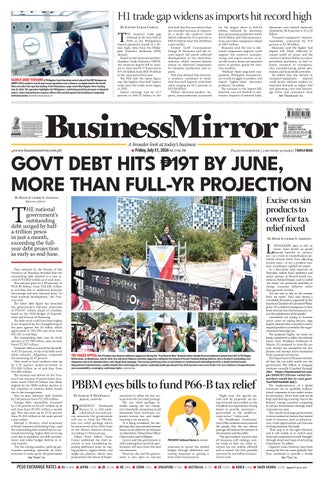
HE national government’s outstanding debt surged by halfa-trillion pesos in just a month, exceeding the fullyear debt projection as early as end-June. Data released by the Bureau of the Treasury on Thursday revealed that the outstanding debt climbed to a new record of P19.065 trillion as of end-June. This amount grew by 2.80 percent, or P518.98 billion, from P18.546 trillion at end-May due to additional domestic borrowings and new external loans “to fund national development,” the Treasury said. The latest debt figure has breached the government’s full-year projection of P19.057 trillion ahead of schedule, based on the 2026 Budget of Expenditures and Sources of Financing. The debt stock could have been higher if not tempered by the strengthening of the peso against the US dollar, which appreciated to P61.290 end-June from P61.501 in end-May. The outstanding debt rose by 10.41 percent, or P1.798 trillion, year-on-year from P17.267 trillion. Domestic debt accounted for the bulk, or 67.33 percent, of the total debt stock while external obligations comprised the remaining 32.67 percent. Debt owed to local creditors went up by 2.74 percent month-on-month to P12.838 trillion as of end-June from P12.495 trillion. The increase was driven by the Treasury’s net issuance of government securities worth P342.93 billion, but offset slightly by the P600-million decline in the valuation of onshore dollar bonds due to the stronger peso. Year-on-year, domestic debt climbed by 7.43 percent from P11.950 trillion. Foreign debt, meanwhile, increased by 2.92 percent to P6.227 trillion as of end-June from P6.051 trillion a month ago. This also went up by 17.13 percent from P5.316 trillion in the same period a year earlier. Michael L. Ricafort, chief economist at Rizal Commercial Banking Corp., said the outstanding debt swelled due to continued borrowing, higher debt servicing costs due to pandemic-era debt accumulation and wider budget deficits in recent months. “For the coming months, catch-up government spending, especially on infrastructure to make up for the government See “Debt,” A2
By Reine Juvierre S. Alberto
L
THE HAGUE APPEAL Vice President Sara Duterte addresses supporters during the “Free Duterte Now” demonstration outside the International Criminal Court (ICC) in The Hague, Netherlands, on Wednesday, July 29, 2026. The rally drew Filipinos and other supporters calling for the release of former President Rodrigo Duterte, who is facing ICC proceedings over allegations tied to his administration’s anti-illegal drug campaign. The overseas gathering comes as Sara Duterte is simultaneously defending herself in a closely watched Senate impeachment trial back home, a political battle that could shape the country’s leadership landscape ahead of the 2028 elections even as her father’s ICC case continues to deepen divisions over accountability, sovereignty, and human rights. AP/MOUNEB TAIM
PBBM eyes bills to fund ₧66-B tax relief By Samuel P. Medenilla
P
@sam_medenilla
RESIDENT Ferdinand Marcos Jr. is still undecided which tax and nontax measures the government will use to fund the P66-billion tax relief package which he announced in his fifth State of the Nation Address (Sona), according to Malacañang. Palace Press Officer Claire Castro confirmed the chief executive is now considering imposing additional taxes on vaping products, sugary drinks, and single-use plastics, which were proposed by the House of Repre-
sentatives to offset the lost revenue from the tax relief package. The tax relief package includes raising the tax exemption threshold, exempting small businesses from minimum corporate income tax, and implementing a tax amnesty. “It is being considered. We simply hope that any potential revenue losses can be offset by tax increases on other items,” Palace Press Officer Claire Castro said in Filipino. Castro said the government is still studying how much the government will earn from the said tax measures. However, she said the government is also open to non-tax
PRESIDENT Ferdinand Marcos Jr. PNA PHOTO
measures to secure the needed budget through additional cost cutting measures or getting it from other fund sources.
“Right now, the specific details and all proposals are being reviewed and studied, as the President has expressed a strong desire to provide assistance— particularly to the middle-income sector,” Castro said. The Presidential Communications Office undersecretary assured the people that the tax reform package will balance the interest of the investors and the public. “The government assures that all measures will undergo careful study so that our other investors are not unduly affected and to ensure the best possible outcome for our fellow citizens,” Castro said.
AWMAKERS’ plan to rely on excise taxes levied on goods deemed harmful to consumers—as a move to counterbalance potential revenue losses from adjusting income taxes—is not a prudent measure, according to a global tax expert. In a discussion with reporters on Thursday, Ashok Kaul, professor and senior partner at Munich-based consultancy Roland Berger, said so-called “sin taxes” are primarily intended to change consumer behavior rather than generate revenue. “It’s not wise to rely on the revenue from sin taxes,” Kaul said during a roundtable discussion organized by the American Chamber of Commerce Philippines. “It’s a desired consequence to have lower revenue over time because you correct the misbehavior of the people.” Lawmakers are eyeing to increase excise taxes on vaping devices, vape liquids, heated tobacco products and to expand products covered by the sugarsweetened beverage tax. The proposed higher sin taxes are being considered to offset the revenue losses from President Ferdinand R. Marcos Jr.’s proposal to raise the annual income tax exemption for employees and exempt micro businesses from corporate income tax. The Department of Finance estimated that the tax relief would cost the government P66 billion in foregone revenues annually if pushed through. (See: https://businessmirror.com. ph/2026/07/29/tax-relief-forworkers-small-biz-to-cost-govt%e2%82%b166b-dof/). The implementation of a global minimum tax on qualified multinational companies is also under review by lawmakers, which Kaul said would help curb the long-running “race to the bottom” among countries competing to attract investments through lower corporate tax rates. This would encourage governments to focus instead on factors that matter more to investors, such as infrastructure, trade opportunities and the ease of doing business, Paul said. “That step is in the right direction and it will enable us to switch away from rate competition to well-thoughtthrough structured ways of attracting investment,” he added. Cigarette taxes, however, have been among the few sin taxes globally that have continued to provide a steady See “Tax,” A2
PESO EXCHANGE RATES n US 61.4840 n JAPAN 0.3763 n UK 82.2164 n HK 7.8406 n CHINA 9.0912 n SINGAPORE 47.7064 n AUSTRALIA 42.7129 n EU 70.4853 n KOREA 0.0426 n SAUDI ARABIA 16.3769 Source: BSP (July 30, 2026)
News
BusinessMirror
A2 Friday, July 31, 2026
Tax…
Continued from A1
stream of revenues, although these remain modest compared with income taxes, Kaul noted. “But we shouldn’t design cigarette and nicotine taxes or redesign it in a way to generate more revenue,” he added. Instead, Kaul said the government should focus on the public health objectives of excise taxes, such as reducing smoking rates, discouraging young people from taking up nicotine products and encouraging consumers to shift to less harmful alternatives. Although the country has made significant progress in tobacco taxation, with a simplified tax structure and automatic increase in tax rates, illicit trade remains a big challenge in further reducing smoking prevalence, Kaul said. “Illicit trade data are nowhere in the world covered in a satisfactory way, and I think this is a major shortcoming. That would be, by the way, one of the policy recommendations for the Philippines and for all other countries in the world,” Kaul said. Policymakers need better measurement through sales data and emptypack surveys, among others, and determine which regions, age groups and vulnerable populations consume illicit products, he said. “Once you have that illicit market under control with a measurement, you can play around with the tax rates, generate more revenue, and if something goes wrong, you see that immediately,” he added. The tobacco industry could help fund a data project on illicit trade, Kaul said, to steer the market more precisely and understand where the losses are coming from.
www.businessmirror.com.ph
BIR gets clearance to send Sara tax records to Senate
P
By Samuel P. Medenilla
RESIDENT Ferdinand Marcos Jr. has finally authorized the Bureau of Internal Revenue (BIR) to submit the tax records of Vice President Sara Duterte and her husband, Manases Carpio, to the Senate to shed light on the allegations against his former running mate of amassing unexplained wealth and having Statement of Assets, Liabilities and Net Worth (SALN) discrepancies since it was what the “situation demands,” according to Malacañang. This comes days after the Palace said that it is already leaving the decision to open the tax records of Duterte to the Senate. The Senate is currently conducting an impeachment trial against Duterte for the said allegations as well as her alleged misuse of government confidential funds, and issuing grave threats against Marcos and his family. In a press briefing on Thursday, Pal-
ace Press Officer Claire Castro confirmed Marcos allowed the transmission of the said tax records since the Senate impeachment court continues to seek his authorization before opening such records. The House of Representatives maintains that the approval is necessary before it can open and examine the tax records without violating the National Internal Revenue Code (NIRC).
Trial presiding officer Senator Francis “Chiz” G. Escudero said the tax records will be used to establish the financial baseline and capacity of Duterte. “The President will abide by what the law dictates and the established processes. So, if the law requires him to grant approval to the BIR to open the tax records of VP Sara and Atty. Mans Carpio— and doing so serves the truth—he will not withhold the truth from our fellow citizens,” Castro said. The Presidential Communications Office undersecretary said Marcos initially opted not to be involved in the matter since other Presidents who may face allegations similar to the Vice President and are being impeached, may use his decision as a precedent to block any access to their tax records. She said the chief executive decided to reconsider his decision to end the impasse in the Senate
since senators continue to wait for his authorization on the tax records issue. “President Marcos Jr. will not stand in the way of the truth coming out,” Castro said. Marcos, she said, made the decision despite knowing that some groups may deem it as “politically motivated” since he and the Vice President had a falling out after the government cooperated with the International Criminal Police Organization (Interpol) to serve the arrest warrant on Duterte’s father, former President Rodrigo R. Duterte, from the International Criminal Court last year. “No matter what others say, as long as the President knows he is adhering to the process and the law—even if he faces criticism or negative perceptions—he remains unswayed, steadfast in his commitment to the law and the process,” Castro said.
Graft cases…
Cyberlibel, a Senate ethics complaint and a civil action for damages remain possible remedies, but Diokno maintained that taking action at this stage could be interpreted as an attempt to pressure a member of the impeachment court. Several civil society groups, including one led by the former chair of the Commission on Higher Education (CHED), earlier filed a complaint with the Senate ethics committee chaired by Sen. Vicente Sotto III.
Continued from A17
million out-of-school children and youth. During the open forum, Diokno also deferred a decision on whether to pursue legal action against Sen. Pia Cayetano over an allegedly spliced video, citing his current role as a prosecutor in the impeachment proceedings.
BOI-led panel soon to vet… Continued from A17
or assembly of enrolled electric passenger vehicles and commercial vehicles. The PVI under the EVIS Program will last for a maximum period of 10 years from the start of production of the enrolled models. The fiscal support for registered and eligible participants shall be evidenced by a non-transferable Tax Payment Certificate. The Department of Budget and Management (DBM) will include allocations in the National Expenditure Program (NEP) of P60 billion for the FIS and PVI of the
Illegal…
Continued from A17
“The response will be quick because there are also people on the ground,” Bayate told the BusinessMirror on the sidelines of the center’s launch here. “There are BFAR and PCG vessels
Debt…
Continued from A1
underspending since the latter part of 2025, largely due to the anomalous flood-control projects, could partly lead to wider budget deficits and could again require additional government borrowings,” Ricafort said. “That, in turn, [could] lead to new record highs [uncharted territory] for the national government outstanding debts, but could lead to faster economic/ GDP growth as a calculated tradeoff,” he added. With the larger debt stock, the government needs fiscal reform measures, including intensified
enrolled models. Each enrolled model qualified for fiscal support will receive an amount not exceeding P15 billion per model. The BOI shall submit to the DBM an annual report on the availment of fiscal support by registered participants under the EVIS Program, which will be reviewed every 3 years from the effectivity of EO 121. “Through this, we will encourage large companies to set up operations and manufacture electric vehicles and their parts right here in the Philippines,” Castro said.
there, and the National Maritime Center is also present. We are now working together because not one agency can address this,” she added. Fish Right said it will also support the establishment of three additional centers in Zambales, the Batangas-Mindoro area, and the Pangasinan-La Union-Ilocos corridor.
tax collections and more disciplined government spending, coupled with faster economic growth, Ricafort said. The country’s debt-to-GDP ratio increased to 65.2 percent in the first quarter after the economy grew by only 2.8 percent while the outstanding debt reached P18.488 trillion. A lower ratio indicates a more sustainable debt level, which affects the country’s ability to secure financing, attract foreign investments and settle its obligations. According to the Treasury, the national government “continues to implement a borrowing mix in favor of domestic sources to reduce exposure to foreign exchange risks and support a more stable debt profile.”
Trade gap… Continued from A1
purchasing big-ticket equipment.
Consumption-driven
ATENEO de Manila University (ADMU) economist Leonardo A. Lanzona also pointed to increases in non-electronics imports, including cereals and cereal preparations. In June alone, imports of cereals and cereal preparations surged by 48.1 percent to $489.24 million, while mineral-fuel imports increased by 6.3 percent to $1.62 billion. “Fuel and rice/cereal imports are pure consumption/energy-security drags with no offsetting export leg—that’s the part of the import bill that’s ‘bad’ in the classic sense,” Lanzona told this newspaper. By major type of goods, PSA said raw materials and intermediate goods, or products used as inputs in the production of other goods, accounted for the largest share of imports in the first half of the year at $29.68 billion. These were followed by capital goods, or machinery and equipment used for production, at $22.70 billion; and mineral fuels, lubricants and related materials at $11.03 billion, and consumer goods at $13.82 billion. The PSA said China remained the country’s largest source of imports, accounting for 24 percent of the total import bill in the first half. It was followed by South Korea with an 11.6-percent share; Japan, 8.2 percent; the United States, 6.7 percent; and Indonesia, 5 percent.
Peso, inflation risks
BUT what does a high import bill and widening trade gap truly mean for the economy? University of Asia and the Pacific economist Marco C. Agonia said the increase could place additional pressure on the country’s external position because local importers need more dollars to pay foreign suppliers. Importers need dollars to pay foreign suppliers. If these payments are not sufficiently matched by export earnings and other foreign-currency inflows, the peso could weaken. “The growing import bill does pose some concerns for the macroeconomy. Our perennial current account deficit puts the country at risk for unfavorable balance-ofpayments positions, causing dollars to flow out of the economy,” Agonia told the BusinessMirror. “This tends to depreciate the peso as dollar demand heightens. Sudden depreciation swings arising from such may also heighten exchangerate pass-through to domestic inflation,” he added. Manzano similarly said a weaker peso could make imported fuel, food, raw materials and other production inputs more expensive in peso terms, with businesses potentially passing part of the additional costs on to consumers. He stressed, however, that the trade deficit is only one factor affecting the exchange rate as remittances, tourism receipts, export earnings, foreign investments, interest rates and global investor sentiment also influence the peso. Lanzona said the inflationary impact would be felt more directly through fuel and cereal imports than through electronic components, which are largely used in export production. “If the trade gap keeps widening and adds to peso weakness, the passthrough shows up first in headline CPI via transport fares and food prices, and—given the core inflation acceleration—potentially reinforces the wage-price feedback loop rather than just a one-off headline blip,” he added. With core inflation already accelerating, he said continued price pressures could also lead to further increases in wages and business costs instead of producing only a temporary rise in headline inflation. The higher import bill comes as economic managers expect merchandise imports to continue expanding over the medium-term. The interagency Development Budget Coordination Committee (DBCC) earlier raised its goods import growth assumption for 2026 to 5 percent from the 4 percent projection released in January.
www.businessmirror.com.ph
Friday, July 31, 2026
Marcos approves opening of Sara’s, husband’s tax records to impeach court By Samuel P. Medenilla @sam_medenilla
P
RESIDENT Marcos has authorized the Bureau of Internal Revenue (BIR) to submit the tax records of Vice President Sara Duterte and her husband, Manases Carpio, to the Senate. Malacañang immediately defended Marcos’s move saying that saying the decision was guided by the law and the administration’s commitment to truth and due process. Palace Press Officer Claire Castro said the President merely
allowed legal processes to take their course after the Senate impeachment court subpoenaed the records from the Bureau of Internal Revenue (BIR). “Whatever the law requires and whatever the process provides, the President will follow. This is in pursuit of the truth. He will not withhold the truth from the Filipino people,” Castro said in Filipino. Castro stressed that Marcos would not stand in the way of evidence sought through lawful judicial processes. See “Tax,” A14
US launches ₧30.8-M counter-terrorism training program
T
H E Un ite d St ates h a s launched a P30.8-million law enforcement training program to help the Philippines deter terrorist threats against Americans and Filipinos. The initiative was formalized
with the signing of an agreement between the US Embassy in Manila and the Zamboanga del Sur provincial government in a ceremony on Thursday. See “Terrorism,” A14
A3
Estrada, Defensor seek bail By Joel R. San Juan
S
@jrsanjuan1573
EN. Jose Pimentel Ejercito alias Jinggoy Estrada on Thursday filed a petition for bail before the Sandigabayan in connection with the plunder case filed against him by the Office of the Ombudsman. In a seven-page petition, Estrada, through his lawyers, insisted that the senator is entitled to bail on the ground that the evidence of his guilt is not strong. Estrada filed the petition a day after the Fifth Division denied his motion to fix bail for being “premature.” The antigraft court stressed that bail may be availed of only after the required evidentiary hearing on the prosecution’s evidence is conducted. Estrada pointed out that under Article III, Section 13 of the Constitution, an accused may be denied bail only if evidence of guilt is strong. “Here, there has been no showing that the evidence against accused Estrada is strong. The Honorable Court issued a warrant of arrest against him on the basis merely of
‘probable cause,’ which is a much lower standard of proof than ‘strong evidence,” the petition read. “Unless this high burden is met, the accused is entitled to bail as a matter of right,” it added. Estrada is facing trial before the Sandiganbayan for plunder and graft in connection with the complaint filed by the Office of the Ombudsman accusing him of receiving kickbacks from the government’s flood control projects amounting to over P573 million for the period 2024-2025. The Ombudsman claimed that Estrada along with former Public Works Secretary Manuel Bonoan and several individuals were involved in an “intricate mechanism involving illegal budgetary insertions and project allocations” within the Department of Public Works and Highways infrastructure portfolio
for the year 2025. The antigraft body said its evaluation of the records shows that “substantial public funds were deliberately funneled into designated infrastructure projects in exchange for pre-determined commission fees or kickbacks.” However, Estrada maintained that there is no strong evidence to prove that he demanded or solicited from former Public Works Undersecretary Roberto Bernardo or his aide any “kickbacks” of “commitment” from DPWH flood control or infrastructure projects.
Defensor, Espiritu
FORMER congressman Michael Defensor and businessman Joseph Espiritu have also filed a petition for bail in connection with the plunder case filed against them for giving campaign contributions for the 2025 senatorial bid of their coaccused Sen. Rodante Marcoleta. Defensor and Espiritu insisted that the evidence against them is not strong to warrant their continued detention pending proceedings on the case. “There is no strong evidence that accused Defensor gave a donation of P30 million to accused Marcoleta ‘by reason of his office or position,’” the petition read. “There is no strong evidence that accused Espiritu gave a donation of P25 million to accused Marcoleta
‘by reason of his office or position,’” it added. Likewise, the petitioners said there is no strong evidence that they conspired with Marcoleta and another co-accused Aristotle Viray in order that the senator may amass or acquire ill-gotten wealth in the amount of P75 million. The case stemmed from Marcoleta’s admission on national television that he received campaign contributions from Defensor, Espiritu and Viray in the amounts of P30 million, P25 million and P20 million, respectively, on various dates in January 2025. The Ombudsman noted that Marcoleta failed to declare the amount in his statement of Contributions and Expenditures (Soce) submitted to the Commission on Elections or in his Statement of Assets, Liabilities and Networth (SALN), which is tantamount to “unjust enrichment.” Marcoleta has denied the accusations against him. All of the accused are currently detained at the Quezon City Jail Male Dormitory in Payatas. Aside from plunder, Marcoleta and his co-accused are facing trial for violation of Presidential Decree No. 46 which prohibits public officials from receiving gifts. PD46 also prohibits private individuals from offering gifts to government officials.
Friday, July 31, 2026
A4
www.businessmirror.com.ph
Legislators seek House probe of Pax Silica deal By Jovee Marie N. dela Cruz @joveemarie
S
EVERAL congressmen have filed a resolution directing the concerned committee of the House of Representatives to conduct an inquiry, in aid of legislation, into the Pax Silica Agreement and its implementation. House Resolution 1247 was filed by Caloocan Rep. Edgar R. Erice, together with Mamamayang Liberal Rep. Leila M. de Lima, Albay Rep. Cielo Krisel Lagman, Philreca Rep. Presley C. De Jesus,
and Kamanggagawa Rep. Elijah San Fernando. Related story on page B8 The proposed inquiry seeks to assess the agreement’s implications for national sovereignty,
national security, data governance, environmental protection, and economic security. It will also examine whether existing Philippine laws are adequate to regulate artificial intelligence, strategic digital infrastructure, and foreign participation in critical industries. Erice emphasized that the resolution is not intended to discourage investments. Rather, it seeks to ensure that projects of national significance are implemented with transparency, accountability, and safeguards for the Filipino people. “The Philippines should welcome investments that create jobs, advance innovation, and strengthen our position in emerging technologies. However, Congress has a constitutional duty to ensure that projects of this magnitude
are economically sound, fiscally responsible, environmentally sustainable, legally transparent, and genuinely beneficial to the Filipino people,” said the resolution. The lawmakers noted that the inquiry aims to determine whether sufficient legal and regulatory safeguards are in place before large-scale strategic projects are fully implemented. Key issues to be examined include the total projected public and private investments and the extent of firm financial commitments; government incentives and the expected return on public investment; the ownership, operation, and control of strategic infrastructure; national security, cybersecurity, and data governance safeguards; the adequacy of power and water resources without adversely affecting existing con-
DILG seeks to boost local economies through digitalization By Jonathan L. Mayuga @jonlmayuga
T
HE Department of the Interior and Local Government (DILG) is accelerating digital transformation in local governments (LGU) nationwide to create a more business-friendly environment, attract investment, and stimulate economic growth in communities. T he nationw ide dig ita lization effort aligns with President Marcos’s initiatives to boost local economies. During his fifth State of the Nation Address (Sona), Marcos underscored the vital role of digitalization and streamlined government processes in reducing bureaucratic delays, promoting ease of doing business, and driving economic development. “Foreign investments continue to pour in because of our beneficial policies, especially those promot-
ing ease of doing business and accelerating digital transformation that curb red tape and corruption,” the President said. In support of the President’s directive and in compliance with Republic Act 11032, or the Ease of Doing Business and Efficient Government Ser v ice Deliver y Act of 2018, the DILG reported that 1,414 or 92.18 percent of the country’s 1,534 cities and towns are compliant with the prescribed Business Permitting and Licensing System (BPLS) standards for new applications, while 1,429 or 93.16 percent comply with the Building Permits and Certificate of Occupancy (BPCO) standards for renewal applications. The department said the high compliance rates translate to faster, more efficient, and more predictable business permitting and licensing services, making it easier for entrepreneurs and investors to establish and expand their
operations while helping increase local revenues and generate employment opportunities. The DILG likewise recognized the commitment of LGUs to embrace digital innovation and continuously improve public service delivery, noting that their efforts have not only enhanced the ease of doing business but also made government services more accessible and convenient for the public. To further strengthen digital governance, the Department reported that 1,030 LGUs have already adopted the e-LGU System, allowing citizens to conveniently access government services online, including applications for business permits and licenses, payment of local taxes and fees, civil registry services, and other frontline transactions. Jointly launched by the DILG and the Department of Information and Communications Technology (DICT) in July 2023, the
e-LGU System serves as a unified, people-centered digital platform that enables faster, more transparent, and more efficient government transactions. At the barangay level, more than 25,000 barangays have also been oriented on the Barangay Information Management System (BIMS), a free digital platform designed to improve data accuracy, strengthen reporting, and support more efficient day-to-day governance through streamlined administrative and operational processes. As the primary agency mandated to supervise local governments, the DILG reaffirmed its commitment to advancing digital transformation across all levels of local governance, empowering LGUs to deliver faster, more responsive, and investor-friendly services while creating greater opportunities for economic growth and improving the quality of life of every Filipino community.
Capital town unveils Zambales’ first fully digitized public market By Henry Empeño
I
BA, Zambales—The capital town of Zambales has transformed its public market into the first fully digitized public market in the province with the recent launch of Project Metro, a digital monitoring and compliance system that, alongside the PalengQR Ph Plus program, use innovation for improved public service and governance. Met ro, whic h st a nd s for Mon itor i n g , En force me nt & Tracking Resource Online, is touted to create a more efficient, transparent, and accessible marketplace where technolog y enhances public ser vice deliver y and economic opportunities, said Iba Mayor Irenea Maniquiz-Binan.
Using the system, buyers can simply scan the QR code installed in every market stall to access digital endorsements and information, and then conveniently make purchase transactions. The digital platform also improves data management and strengthens monitoring mechanisms for the LGU, and provides vendors access to digital banking. “Project Metro represents a modern approach to market governance and operations, integrating digital technologies into the daily activities of vendors, consumers, and market administrators,” the Iba local government said in introducing the project. “With the PalengQR program, Project Metro will benefit buyers, vendors, suppliers, and other stakeholders with fast and conve-
nient transactions through digital payments, safe and secure transactions, access to financial services and credit facilities, transparent and accountable operations, and multiple payment options,” it added. The digital market system was developed in partnership with information technology developers from Gordon College in Olongapo City, and with the support of OneDevPH, Bangko Sentral (BSP), the Department of the Interior and Local Government (DILG), and the Department of Trade and Industry. The system was pilot-tested last April before starting full operations early June. BSP and DILG introduced last year in Zambales the PalengQR Ph Plus program, a nationwide ini-
tiative which promoted cashless payments in public markets and local transportation, particularly tricycles. The program had since been adopted in the towns of San Marcelino, Botolan, Cabangan, and, lately, San Antonio in this province. Project Metro upped the digital shift further by complementing digital payments with access to financial services and credit facilities, transparent and accountable operations, and multiple payment options that also boost data-driven governance. “More than a technological advancement, this initiative empowers vendors, enhances consumer convenience, promotes financial literacy, and supports the nation’s digital transformation agenda,” Binan said.
Investment forum aims to promote community led forest management
T
HE Department of Environment and Natural Resources (DENR) recently convened more than 200 representatives from government, development partners, financial institutions, civil society, the diplomatic corps, and people’s organizations for an investment forum on forest management. The DENR’s Investment Forum 2026, a national gathering for key stakeholders in forest management, is aimed at expanding inclusive investments and strengthening community pa r t nerships for sust a inable forest management.
Organized through the Forest Management Bureau (FMB), the forum highlighted communityrun forestry enterprises, innovative financing pathways, and crosssector collaborations that support sustainable livelihoods, forest rehabilitation, and climate resilience. It also reinforced the goals of the Forests for Life: 5 Million Trees by 2028 Program, which seeks to mobilize investments that empower upland communities while protecting forest ecosystems. See “Investment,” A14
sumers; environmental impacts and sustainability measures; technology transfer commitments and the development of Filipino expertise; employment opportunities for Filipinos across all skill levels; the participation of local enterprises in the project’s supply chain; and measurable public benefits and accountability mechanisms throughout the project’s life cycle. The resolution also seeks to determine whether current Philippine laws remain sufficient to govern rapidly evolving technologies, particularly artificial intelligence and strategic digital infrastructure, or whether legislative reforms are necessary. The authors stressed that Congress has an essential oversight role in ensuring that investments involving critical industries serve
the country’s long-term national interest. “Support for investments of this scale must be anchored on transparency, independent technical validation, legal accountability, and measurable public benefits. Economic growth and innovation should always be pursued in a manner that protects our sovereignty, strengthens national security, and secures lasting benefits for future generations,” the resolution stated. T hey ex pressed confidence that the proposed congressional inquiry will produce a comprehensive and evidence-based assessment to guide future legislation and public policy on artificial intelligence, strategic infrastructure, and foreign investment in critical sectors.
Dole, NAPC renew pact to widen workers’ access to training, jobs By Mary Jade Jadormio
T
HE Department of Labor and Employment (Dole) and the National Anti-Poverty Commission (NAPC) have renewed their partnership to expand formal and migrant workers’ access to government training, livelihood and employment programs. Labor Secretar y Francis N. Tolentino, NAPC Secretary Lope B. Santos III and National AntiPover t y Com m i ssion-For m a l Labor and Migrant Workers Sectoral Council (FLMWSC) Sectoral Representative Danilo A. Laserna signed a memorandum of agreement on Tuesday at the DOLE Central Office in Manila. The agreement extends the council’s access to training grants under the Bureau of Labor Relations’ Workers’ Organization Development Program (WODP) Plus. Tolentino said the partnership also aims to strengthen government engagement with workers’ groups through sustained dialogue. “Narito po tayo hindi lamang para magbigay-linaw sa isang kasunduan, kundi magbigay-puwang para makinig sa iba’t ibang sektor, para isulong ang tamang adbokasiyang sinusulong at para makilahok na rin sa malawakang gawain ng NAPC,” he said. DOLE said the renewed collaboration is expected to improve
workers’ access to scholarship grants, youth employability initiatives, livelihood assistance and employment opportunities. Following the signing, Tolentino met with representatives of the NAPC-FLMWSC to discuss concerns affecting workers and labor organizations. Among the issues raised during the dialogue were workers’ participation in national labor policy mechanisms, labor-management cooperation, occupational safety and health, and other sectoral priorities. The meeting also allowed workers’ representatives to present policy recommendations aimed at improving government labor programs. Dole said the partnership forms part of its efforts to strengthen workers’ organizations, expand social protection and promote participatory governance. The department said these initiatives are intended to ensure that labor policies remain responsive to the changing needs of Filipino workers. Since 2017, Dole has approved around P1.4 million in WODP training grants for the NAPCFormal Labor and Migrant Workers Sectoral Council to strengthen workers’ organizations and increase their participation in labor policy development and governance.
Decrease in issuance of LTS depresses residential property market–Colliers By Rizal Raoul Reyes @brownindio
T
HE residential property market is facing a major supply bottleneck as the issuance of Licenses to Sell (LTS) dropped to its lowest level in more than two decades during the first half of 2026, Colliers Philippines said. In its Q2 2026 Property Market Briefing, Colliers research director Joey Roi Bondoc said residential units covered by LTS approvals plunged by 82 percent year-onyear, with only about 38,000 units issued in the first half of 2026 compared with much higher historical levels. Moreover, Bondoc said that the average annual residential units covered by LTS issuances from 2016 to 2025 stood at 271,000 units, underscoring the severity of the slowdown. Colliers attributed the sharp decline primarily to the centralized approval process for LTS applications and the submission
of incomplete documentary requirements, both of which have delayed project approvals and constrained the launch of new housing developments. Bondoc said the slowdow n comes at a time when developers are already grappling with softer pre-selling activity, elevated financing costs, and cautious consumer sentiment brought about by economic uncertainties. He noted that reduced LTS approvals are likely to limit the pipeline of new residential projects, potentially affecting housing availability in the coming years despite the country’s persistent housing demand. Bondoc pointed out that both condominium and house-andlot developments experienced a significant slowdown in LTS issuances. From 2016 to 2025, Colliers data pointed out that condominium projects averaged 105,000 units covered by LTS approvals See “LTS,” A14
www.businessmirror.com.ph
Fortune Life News A BusinessMirror Special Feature
Friday, July 31, 2026 A5
A6
Friday, July 31, 2026
BusinessMirror
www.businessmirror.com.ph
The World Friday, July 31, 2026
A7
US-Iran conflict enters new phase as Saudi helps hit proxies and diplomacy stalls again By Farnoush Amiri, Matthew Lee, Aamer Madhani & Konstantin Toropin
W
The Associated Press
ASHINGTON—The stop-start fighting between the United States and Iran appears to have entered a new phase as Saudi Arabia has publicly joined military escalations against Tehran-backed proxies. At the same time, an already untenable diplomatic effort to end the war has faltered once again as mistrust deepens between the longtime adversaries. Despite several days of relative calm, both sides carried out military strikes in the last 24 hours that once again risk a return to all-out war—and further expansion in the region—while little is clear about what strategy, if any, American or Iranian officials have for a path forward. While President Donald Trump and his allies have spent recent days arguing that Iran is begging to return to the negotiating table, Iran’s deputy foreign minister said Tuesday that his country has made no requests to restart the diplomatic track in more than two weeks. Following a thwarted attack on the US base in Jordan, Trump turned back to threats Wednesday even while sustaining the prospect of continued talks. “They’ve already apologized, but, you know, we got to smack them a little bit,” he told reporters in the Oval Office. He added: “It’s our turn, and we’ll see if we get there with an agreement at some point. But we’re going to hit them very hard.” Hours later, the strikes followed as the US military said it launched a “a powerful response to yesterday’s attempted Iranian attacks on US forces based in the Middle East” in a social media post. It did not immediately disclose the targets of the attack. There’s a sense of déjà vu as the Republican president has vacillated for the past several months between insisting a deal was near to end the war and Tehran’s nuclear program and then using vulgarities and threats to get Iran to capitulate to US demands—to no avail. The stakes for continued US military action have never been higher for Trump and his party as the conflict, unpopular among many Americans, has jolted the world economy just months before critical midterm elections in November. The renewed fighting also has killed and injured more American troops and been complicated by concerns that the US is further drawing down stockpiles of key air defense systems needed to defend its bases and allies. In the past day, Iran said it fired ballistic missiles at Jordan’s Muwaffaq Salti Air Base, a key US military hub for the region, which Trump said were intercepted. And Saudi Arabia joined the US in striking multiple logistics and weapons sites used by Iranian-backed militias in Iraq. The first publicly announced joint US-Saudi strikes followed drone attacks on the kingdom, complicating a conflict that now includes nearly every country in the region. A US official, who spoke on condition of anonymity to detail sensitive military operations, said the two attacks were not connected.
Saudi defense minister makes White House visit
SAUDI Defense Minister Khalid bin Salman met separately Wednesday with Trump and Vice President JD Vance, according to two people familiar with the matter who were not authorized to comment publicly about the private meeting. The defense minister conveyed the view of Crown Prince Mohammed bin Salman, the kingdom’s de facto leader, that Iran has lost leverage in Syria and Lebanon but is still managing to provide support to the Houthis in Yemen and militias in Iraq, according to one of the people familiar with Prince Khalid’s talks with Trump and Vance. The Iran-aligned Houthi group earlier this week said it fired ballistic missiles at a Saudi oil tanker, days after declaring it was imposing a naval blockade on Saudi vessels in the Red Sea. The Saudi decision to join the US attacks against the Iraqi militias was meant to send a message to Iran that it wouldn’t tolerate Iran or its proxies targeting the Saudi oil industry and other critical infrastructure, the person added. At the same time, the defense minister underscored to Trump and Vance that the Saudis want to see a de-escalation in the war and want Washington and Tehran to return to negotiations. Drone strikes also ignited fires on two natural gas vessels at a port in Egypt, a close US ally and regional mediator that is one of the only countries in the Middle East to have been spared from direct military action during the war. A strike by Iran or its allies, if confirmed, would mark a significant widening of the conflict. See “Proxies,” A14
A8
Friday, July 31, 2026
BusinessMirror
www.businessmirror.com.ph
The World Friday, July 31, 2026
A9
Russian strikes across Ukraine, from east to west, kill at least 8 and wound dozens
RESCUERS search through the rubble of a residential building following air attack in Lviv, Ukraine, Thursday, July 30, 2026. AP/MYKOLA TYS By Hanna Arhirova
K
The Associated Press
YIV, Ukraine—Russian attacks across Ukraine overnight into Thursday killed at least eight people and wounded dozens of others, officials said, with the heaviest casualties and aftermath reported in the eastern Dnipropetrovsk and western Lviv regions. The attacks were the latest in a series of large-scale Russian strikes on Ukrainian cities that Russia has intensified over the summer, now occurring on a nearly weekly basis. Ukraine’s President Volodymyr Zelenskyy said Kyiv and the surrounding region, along with the Dnipro, Lviv, Poltava, Kharkiv, Mykolaiv, Sumy, Vinnytsia, Cherkasy and Ivano-Frankivsk regions, were attacked overnight, with dozens of homes, businesses and infrastructure facilities destroyed or damaged. He said Russia used more than 70 missiles in the strike, a significant number of them ballistic, along with more than 280 attack drones, of which more than 260 were intercepted. “Given the critical shortage of air defense missiles from our partners, our warriors are accomplishing truly incredible things, demonstrating a very high level of professionalism,” he said. “This Russian terror once again proves that protection against the Russian missile threat is the most important task when it comes to saving the lives of our people.” In the Dnipropetrovsk region, Russian forces carried out a mass attack that killed six people and wounded 10 and damaged or destroyed civilian infrastructure, said Oleksandr Hanzha, head of the regional military administration. Children were among the dead, he said on Telegram—a 6-year-old girl and boys aged 11 and 17 in the Kryvyi Rih area. Zelenskyy specified in his post on X that the parents of the kids were killed as well in the same attack, but two more children were pulled alive from under the rubble. “It was an ordinary home, blown into smithereens by a ballistic missile... “ he said. Ukrainian leader said untimely assistance and delays in the delivery of anti-ballistic missiles lead to the kind of destruction and casualties seen in the attack, adding that it is important to support the protection of life. In the Poltava region, next to Dnipropetrovsk region in the west, a drone strike hit warehouses at a private enterprise, killing one person, said regional head Vitalii Diakivnych. He said a delivery hub also was attacked, sparking a fire at warehouses that was quickly extinguished by State Emergency Service units, with no injuries reported there. In Lviv, the number of people injured in a Russian missile attack rose to 30 as a rescue operation continued, said Maksym Kozytskyi, head of the Lviv regional military administration. The city was struck at about 4:45 a.m., with the worst damage to two residential buildings, Lviv Mayor Andrii Sadovyi said. More than 20 residential buildings were damaged, along with a school and two kindergartens, he said, adding that children were among those injured, including one who was hospitalized. In Kyiv, Russian forces struck the capital with ballistic missiles, killing a 31-year-old man and wounding two others, the National Police press service said. Residential buildings, a market, a garage cooperative, storage facilities and vehicles were damaged in the city, police said. In the Kyiv region, five people were wounded in the Brovary district, including a minor and two women, acting regional administration head Ruslan Oliinyk said on Facebook. In Moscow, the Defense Ministry said the Russian armed forces overnight launched a massive strike on air bases, arms factories and military telecommunications and logistics facilities in Kyiv, Lviv and in the Ivano-Frankivsk, Zhytomyr, Rivne, Vinnytsia and Dnipropetrovsk regions. It said the military also hit a ship in the Pivdennyi port and two ships east and south of Odesa. Meanwhile, Russia’s Defense Ministry said that air defenses downed 258 Ukrainian drones overnight. Penza Gov. Oleg Melnichenko said a depot belonging to Wildberries online retailer was set ablaze. He said one person was injured and 200 workers were evacuated. Wildberries also reported that its warehouse in Sarapul in the region of Udmurtia was struck by a Ukrainian drone and set ablaze. It said the workers had been safely evacuated. The attacks were the latest in a series of Ukrainian strikes that hit depots belonging to Wildberries, the country’s largest online retailer, causing massive damage.
A10 Friday, July 31, 2026
A11 Friday, July 31, 2026
A12 Friday, July 31, 2026
The World
Friday, July 31, 2026 A13
Iranian strike hits Chinese firm’s building, killing 1, hours after Jordan downs missiles By Samy Magdy & Elena Becatoros
C
Associated Press
AIRO—An Iranian strike hit a Chinese firm’s building in northern Kuwait Thursday morning, severely damaging the structure and killing a worker, Kuwait’s military said, hours after Jordan’s air defenses shot down five missiles launched from Iran.
The attacks came after the US military said it had completed “a heavy wave of strikes against Iran,” conducted in response to an earlier Iranian missile attack on a US base in Jordan. Central Command said in a social media post that the US had struck “dozens” of targets belonging to Iran’s Revolutionary Guard Corps, including military command centers as well as missile and drone facilities, and coastal surveillance and defense sites. No casualties were reported from Jordan’s interception of the missiles, Jordan’s state-run Petra news agency said, quoting the spokesman for the country’s armed forces. The flare-ups on multiple fronts after several days of relative calm raised the risk of a return to all-out war. It also underscored the difficulty of winding down a five-month conflict that has jolted the world economy and is unpopular among Americans. The fighting was likely to add to concerns that the US is further drawing down already diminished stockpiles of sophisticated munitions needed to defend its bases and allies.
US strikes Iran
THE US Central Command said in a social media post that the United States had struck “dozens” of targets belonging to Iran’s Revolutionary Guard Corps, including military command centers as well as missile and drone facilities, and coastal surveillance and defense sites. The new strikes came hours after US President Donald Trump vowed to hit Iran “very hard” after it targeted a base in Jordan that hosts US troops. Iran’s official IRNA news agency said three people were killed and two were wounded in a strike on the island of Qeshm, which lies just off the Iranian mainland in the Strait of Hormuz. The latest barrage came after the US partnered with Saudi Arabia to strike Iran-backed militias in neighboring Iraq, killing at least 20 fighters and six Iranian advisers on Wednesday.
Fires reported on two natural gas vessels in Egyptian port
ELSEWHERE, British maritime security firm Ambrey said drone strikes ignited fires on two natural gas vessels at the Egyptian port of Damietta on Wednesday. It was not immediately clear who was responsible for the strikes on a US-owned floating storage facility and a Greek-owned tanker. No injuries were reported. The office of the Egyptian prime minister said initial investigations showed the fires on the two vessels had been caused by a drone. Egypt, a close US ally and regional mediator, is one of the only countries in the Middle East to have been spared direct military action during the war. A strike by Iran or its allies, if confirmed, would mark a significant widening of the conflict. Asked during an Oval Office event if Iran was responsible for the strikes on the natural gas vessels, Trump responded: “It’s a little more of the same.” “In the meantime, we’re going to be hitting them very hard because it’s our turn to hit them,” he added.
Saudi Arabia accuses Iraq militias of targeting its oil facilities
SAUDI ARABIA had accused the Iraqi militias of firing drones against its oil facilities over the past days. An umbrella group of Iraqi militias initially denied the allegations, while another Iran-backed group—the Houthi rebels in Yemen—said they had attacked Saudi energy facilities as part of a separate but related conflict. Saudi Defense Minister Khalid bin Salman met separately on Wednesday with Trump and Vice President JD Vance, according to two people familiar with the matter who were not authorized to comment publicly about the private meetings. They said the Saudi decision to join the US attacks against the Iraqi militias was meant to send a message to Iran that it wouldn’t tolerate Iran or its proxies targeting the Saudi oil industry and other critical infrastructure. At the same time, the defense minister underscored to Trump and Vance that the Saudis want to see a de-escalation in the war and for Washington and Tehran to return to negotiations. Before the latest eruption, mediators had expressed optimism about bringing the US and Iran back to the negotiating table. An interim agreement collapsed in recent weeks over renewed fighting in the Strait See “Strike,” A14
TheWorld
A14 Friday, July 31, 2026
The fastest growing Ebola outbreak is worsening hunger in eastern Congo, UN agency chief warns By Constant Same Bagalwa, Prosper Heri Ngorora & Edith M. Lederer
B
The Associated Press
UNIA, Congo—The fastest growing Ebola outbreak ever recorded is leaving thousands more people hungry in eastern Congo, a region engulfed in conflicts and a fight over precious minerals, the head of the U.N. food agency warned on Wednesday.
The World Food Program’s acting executive director, Carl Skau, told The Associated Press during a visit to the hardhit Ituri province that the outbreak is a “crisis on top of a crisis” that has compounded a catastrophic situation with over 5 million Congolese already experiencing emergency-level food insecurity. The long-running conflict in eastern Congo has driven nearly 10 million people into crisis or emergency levels of hunger, with Ituri—the epicenter of the Ebola outbreak—among the most affected with 1.9 million in need of food, according to the WFP. “My number one message is that this situation requires much, much more attention,”
Strike. . . Continued from A13
of Hormuz, a crucial waterway for global energy supplies that Iranian attacks have again effectively closed. A regional official said mediators are “still trying with both sides” to restore calm and get the ceasefire back on track. He gave no details on whether progress was being
Proxies. . . Continued from A7
The US-Saudi strikes came hours after Israeli Prime Minister Benjamin Netanyahu departed his first meeting with Trump since they launched the war against Iran on Feb. 28. An Israeli official briefed on the meeting Tuesday at the White House said Netanyahu assured Trump that it is the US, not Israel, that is in the driver’s seat with Iran, attempting to push back on the notion that he’s increasingly out of step with his closest ally on the way ahead. Yet, Israeli officials also have privately expressed concern that Trump, with midterm elections looming, is trying to “keep this war on a low flame,” according to a person familiar with Netanyahu’s government’s internal deliberations. The person and the Israeli official were not authorized to comment and spoke on the condition of anonymity. The person added that Israeli officials have become increasingly concerned about Trump’s sensitivity to surging oil prices as the Strait of Hormuz remains effectively closed to global energy shipments and
Skau later told a video news conference with U.N. correspondents. “This is the fastest growing Ebola crisis ever.”
Ebola’s impact is spiraling
SINCE the outbreak was declared on May 15, it took just over two months for 1,000 people to die of Ebola in eastern Congo, compared to the 2014-2016 outbreak in West Africa that had been considered the worst in history and when it took about eight months to reach that number. The dramatic surge shows the urgent need to scale up food, protective equipment, trained staff and funding, Skau said, stressing that the lack of money has forced WFP to cut made and spoke on condition of anonymity to discuss the closed-door diplomacy.
Attacks on Saudi oil facilities could worsen global energy crisis
SAUDI ARABIA is also locked in a renewed conflict with the Houthis. The rebels have declared a blockade of Saudi shipping that could choke off another crucial Middle East trade route, the Bab el-Mandeb strait from about the growing trepidation among some in the US administration about the burn rate of critical missile interceptors. The recent fighting with Iran used up more of the US military’s already diminished stockpiles of Patriot and THAAD interceptors, potentially putting American troops at more risk if hostilities resume, according to an analysis released this week from the Center for Strategic and International Studies, a Washington think tank. Gen. Dan Caine, chairman of the Joint Chiefs of Staff, has told Trump that the state of the munitions stockpile could have an impact on military operations in Iran, according to another US official. The official, who spoke on condition of anonymity to discuss sensitive conversations, said the message was delivered as part of Caine’s regular duties of providing military advice and options to Trump.
A history of failed diplomacy plagues US-Iran prospects
THE Trump administration does not seem to have a strategy to resume negotiations with Iran over ending the conflict. Despite efforts by some mediators to get talks restarted—or at least find a point at which they could begin again—the
the number of people it is assisting in Congo from 3 million last year to 1 million this year. U.N. senior Ebola coordinator Julien Harneis, who was with Skau on the visit to Ituri, said the $2.1 billion humanitarian appeal for Congo is only 45% funded. The separate Ebola response appeal is being revised upward because it only covered two provinces and now there are four, he said. The outbreak has been particularly difficult to fight because the Bundibugyo virus responsible for it has no approved vaccines or treatments, unlike most of Congo’s past outbreaks. Harneis said a vaccine trial is underway, but getting a vaccine to Congo is months away. The United Nations is working with the government and community workers to build trust so that people with symptoms will seek treatment quickly, Harneis said. If they do, he added, “they have a very good chance of surviving Ebola.”
Ebola drives up malnutrition in affected communities
ACROSS some 48 health zones affected with Ebola, WFP said more than 2.7 million people face acute food insecurity, including 628,000 in emergency conditions. “Now with the Ebola crisis, this is getting worse. Markets are impacted, supply routes are impacted and so people are struggling even more to have enough to eat,” Skau told
the AP, and malnutrition is rising. Since it erupted, the ongoing Ebola outbreak has recorded 3,360 confirmed cases, including 1,487 deaths. Harneis said that in the last 24 hours, 50 people died of Ebola. Measures introduced to slow the spread—including border closures and restric tion of movements and large gatherings—have disrupted life and businesses, driving up food and fuel prices, the WFP has said. The agency said it has so far delivered more than 160,000 hot meals to patients, contacts and front-line workers in 17 treatment and isolation centers. In Mongbwalu, a mining town about 69 kilometers (43 miles) from Bunia, Ituri’s provincial capital, residents said Ebola and the measures introduced to fight it have made it difficult for some families to feed their children. Kahambu Deborah, a 40-year-old mother of six, said she had been struggling to access her farmland due to rebel violence, and that the restrictions linked to Ebola had made things more challenging. “Sometimes, because of the insecurity, we can’t even go to our fields, and our children are suffering as a result,” she said. Lederer reported from the United Nations. Associated Press writer Wilson McMakin in Dakar, Senegal, contributed to this report.
the Red Sea into the Gulf of Aden. On Monday, the Houthis said they had launched drones targeting oil facilities used to transport oil across Saudi Arabia to the Red Sea port city of Yanbu, a key bypass for Saudi exports blocked by Iran’s chokehold on the Strait of Hormuz. The rebels said the attack was in response to a Saudi drone they said had breached Yemen’s airspace. Planet Labs satellite imagery from
Monday analyzed by The Associated Press showed damage to Saudi Aramco’s Abqaiq oil-processing facility. The massive facility is capable of processing approximately 7 million barrels of crude oil per day.
administration is not actively pursuing talks at the moment, a senior US official said. The official, who spoke on condition of anonymity to discuss internal deliberations, said the latest developments in the region suggested that any resumption in direct diplomacy was not imminent. Analysts called the uncertainty and lack of strategy a result of deep, growing mistrust between Washington and Tehran, especially after an interim ceasefire proposal signed in mid-June collapsed in recent weeks. Ali Vaez, Iran project director at the International Crisis Group, said senior Iranian officials were nearly unanimous in their decision to approve that memorandum of understanding with the US. “But now none of them believe that Trump is a reliable negotiating partner,” he said. “The problem, I think, is that Trump also has now the same impression about the Iranians.” In some respects, the on-again, offagain nature of talks and back-and-forth military attacks should not be surprising. The history of US negotiations with Iran after 1979 is littered with failure, false starts and stops, and military actions that have nonetheless stopped short of the kind of conflict the two countries are now in.
Despite its flaws, the 2015 nuclear deal with Iran secured by the Obama administration was the first major agreement between the two countries since the Algiers Accords in 1981 that ended the American hostage crisis and laid a patchwork path for the resolution of other issues, including the unfreezing of Shah-era Iranian assets seized by the US after the Islamic Revolution. However, even from the beginning, both sides accused each other of violating the terms of these deals. Accusations of violations of the Algiers Accords, which led to a period of great animosity, including US support for Saddam Hussein’s Iraq during the 1980-88 Iran-Iraq war, became the norm. D espite the semi-rapprochement around the 2015 nuclear deal, Trump’s withdrawal from it in 2018 during his first term, his imposition of a “maximum pressure” sanctions campaign against Tehran, and the US assassination of Iran’s top military leader Qassem Soleimani in early 2020, sent the relationship to new lows.
Investment. . . Continued from A4
“Our communities are the frontliners of forest protection,” Environment Secretary Juan Miguel Cuna said. “By investing in them, we invest in the future of our forests—and in the resilience of the families who depend on them,” Cuna said.
Forests for Life
A KEY feature of the event was the signing of Memoranda of Understanding between the DENR and partners from the private sector, professional organizations, and local governments. Signatories included B. Braun Medical Supplies, Megaworld Corporation, the Association of CPAs for Sustainability, National Grid Corporation of the Philippines, Isla Lipana & Co., FDC Misamis Power Corporation, and the local
Becatoros reported from Athens, Greece. The Associated Press writers Konstantin Toropin in Washington and Qassim Abdul-Zahra in Baghdad, Iraq, contributed.
Amiri reported from New York. Associated Press writer Ben Finley contributed to this report.
government of Iba, Zambales. These agreements establish a shared framework for forest rehabilitation and longterm sustainable forest management. The DENR also unveiled the Sustainable Forest Land Management Agreement (SFLMA) Module under the Frontline Services Transaction System (FSTS), a new digital platform designed to streamline the processing of forest land management agreements. The system aims to improve efficiency, transparency, and accessibility for stakeholders seeking permits and approvals. CBFMPOs presented their enterprises to prospective investors, demonstrating organizational capacit y, successful community initiatives, and opportunities for scaling. Financial institutions and development partners outlined financing mechanisms and strategies to enhance the bankability of communitybased enterprises. Jonathan L. Mayuga
Editor: Angel R. Calso
Capas. . . Continued from B8
He said local officials met with BCDA about three weeks ago to discuss an unrelated project. During that meeting, BCDA presented several upcoming developments in New Clark City and briefly mentioned Pax Silica but did not discuss it in detail. “They only mentioned it in passing. The details about the project, none,” he said. Pax Silica is a proposed high-technology manufacturing and innovation hub planned withinthe some 1,600 hectares of New Clark City in Capas town. The project seeks to position the Philippines as a regional center for artificial intelligence, semiconductor manufacturing, critical minerals processing, and advanced technology industries under the Luzon Economic Corridor initiative. BCDA has said the development could attract between $40 billion and $70 billion in
Tax. . . Continued from A3
This comes days after the Palace said that it is already leaving the decision to open the tax records of Duterte to the Senate Impeachment Court. The Impeachment Court is conducting Duterte’s trial for among others alleged misuse of government confidential funds, unexplained wealth and threatening the President, his wife and former speaker Martin Ferdinand Romualdez with death. The Impeachment Court earlier said that Marcos’s approval is necessary before it can open and examine the said tax records without violating the National Internal Revenue Code (NIRC) but early this week, Impeachment Court Presiding Officer ordered the issuance of a subpoena for the tax records. Escudero said the tax records will be used to establish the financial baseline and capacity of Duterte. “The President will abide by what the law dictates and the established processes. So, if the law requires him to grant approval to the BIR to open the tax records of VP Sara and Atty. Mans [Manases] Carpio—and doing so serves the truth—he will not
Terrorism. . . Continued from A3
Under the deal, the US’s Department of State’s Antiterrorism Assistance (ATA) program will provide permanent and dedicated training facilities in Pagadian City to host recurring specialized training courses for the National Police (PNP). “This investment in Pagadian reflects our confidence in the PNP and our conviction that a safer, more capable PNP means a safer Philippines, a safer United States, and a stronger alliance between our two nations,” said US Embassy Acting Senior Regional Security Officer Daniel Art. Zamboanga del Sur Gov. Divina Grace Yu, for her part, hailed the initiative as a step towards further enhancing the capabilities of Filipino law enforcers,
LTS. . . Continued from A4
annually, while house-and-lot developments averaged 128,000 units. However, issuances for both housing types fell sharply in the first half of 2026, reflecting the broader regulatory bottleneck. Despite the slowdown, Bondoc said Colliers sees opportunities for recovery following the Department of Human Settlements and Urban Development’s (DHSUD) move to decentralize the processing of regulatory applications. Under Memorandum Circular 2026012, issued on June 9, 2026, DHSUD authorized regional offices— except those in the Negros Island Region—to process, evaluate and approve regulatory applications. The policy aims to speed up approvals and improve the delivery of housing projects. Bondoc said faster LTS approvals could particularly benefit residential developments outside Metro Manila, where demand for housing remains healthy. In key provincial markets such as Cavite, Bulacan, Pampanga, Laguna, Batangas,
investments and generate more than 130,000 high-quality jobs once fully developed. The proposal has also drawn scrutiny from various groups including the science advocacy organization Agham and the Unyon ng mga Manggagawa sa Agrikultura who have called for greater transparency on the project’s projected water use, environmental impacts and potential effects on farming communities. BCDA has said the development will comply with Philippine environmental laws and international environmental, social, and governance standards. Rodriguez said the town supports investments that create jobs but expects government agencies to provide local officials and residents with sufficient information before construction begins. “So for the local government of Capas to know its stand on Pax Silica, we hope BCDA will give us time to discuss this. We will be asking for some conditions before we make a stand.” withhold the truth from our fellow citizens,” Castro said. She said Marcos initially chose not to be involved on the matter since Presidents in the future, who may face allegations similar to the Vice President and are being impeached, may use his decision as a precedent to block any access to their tax records. She said the Chief Executive decided to reconsider his decision to end the impasse in the Senate since senators continue to wait for his authorization on the tax records issue. The Senate impeachment court earlier granted the House prosecution’s request to issue subpoenae for Duterte’s tax records, bank records and other financial documents as part of the impeachment proceedings. House prosecutors have said the tax documents will support allegations of unexplained wealth. During House hearings on the impeachment complaints, lawmakers cited alleged bank transactions totaling P6.77 billion from 2006 to 2025 that they claimed were inconsistent with the Vice President’s declared assets. Duterte’s defense team has opposed the subpoenas, arguing that the requests are illegal, unreasonable, and violate the constitutional rights of the Vice President and her spouse. especially in Mindanao. “This partnership will enhance the capabilities of our law enforcers in deterring and preventing acts of terrorism. It will strengthen the security and stability of our government not only in the province of Zamboanga del Sur but most especially in Mindanao and even the whole country,” she said. The US had facilitated ATA courses for more than 10,000 Filipino law enforcement personnel since 2006. An estimated 2,000 PNP, as well as other law enforcement personnel, are expected to train at these new facilities in Pagadian every year. The US Embassy in Manila said the investment is aligned with the two nations’ push to further secure their relations as they mark 80 years of diplomatic relations this 2026. PNA Iloilo, Cebu, Cagayan de Oro and Davao, house-and-lot projects posted take-up rates ranging from 88 percent to 96 percent, while condominium projects registered take-up rates of 82 percent to 91 percent. The lower mid-income segment accounts for nearly half of the remaining inventory. As of Q2 2026, the remaining inventory was 32,600 units from 27,900 units in Q1 2026. Looking ahead, Bondoc identified slower LTS issuance as one of the major challenges confronting the Philippine residential sector beyond 2026. He said accelerating regulatory approvals, alongside government initiatives such as Pag-IBIG Fund’s lower housing loan rates, amendments to the Balanced Housing Development Program, and the decentralization of housing application processing, will be crucial in supporting new project launches and addressing the country’s housing backlog. Bondoc said streamlining the approval process will help ensure that developers can bring new housing supply to the market more quickly, improving affordability and giving buyers more choices amid sustained housing demand.
Friday, July 31, 2026 A15
DPWH chief vows full probe into Taguig ‘ghost projects’ allegations
T
HE Department of Public Works and Highways (DPWH) will investigate allegations of “ghost” flood control projects in Taguig City, Secretary Vince Dizon said, committing the agency to cooperate with anybody that opens a formal inquiry into a controversy that has pulled two senators into an open feud. “We will have to investigate,” Dizon said in a televised interview. “Even if it’s just [a report from] a non-government organization [NGO] or an ordinary Filipino, we will
take that seriously. Wherever it is, it doesn’t matter.” The secretary said the DPWH will open its records to any investigating body.
Tiangco refiles measure to abolish system loss charges on electricity bills
I
NSISTING that electricity consumers should not shoulder the costs arising from inefficiencies and losses beyond their control, a lawmaker is pushing for the passage of longpending measure seeking to remove system loss charges from consumers’monthly electricity bills. Navotas Rep. Toby Tiangco refiled House Bill No. 10273, or the“System Loss Charges Abolition Act of 2026,” in support of the administration’s push to make electricity more affordable. The proposal was first introduced in 2010 and subsequently refiled in 2013 and 2016, but has yet to gain traction in Congress. With Malacañang
now backing the measure, Tiangco expressed optimism that it could finally be enacted. Tiangco underscored the urgency of the measure, noting that electricity rates in the Philippines remain among the highest in the region. “If we are serious about lowering electricity costs, we must remove charges that are not the fault of consumers. This is a concrete step that will provide immediate relief to Filipino families in their monthly bills,” he added. With President Marcos now backing the See “Tiangco,” A16
“If there’s an investigation—whether it’s the Senate, Ombudsman, Department of Justice (DOJ), National Bureau of Investigation (NBI), any one—DPWH will always cooperate,” he said. Dizon cautioned, however, against reading the Independent Commission for Infrastructure’s (ICI) initial findings as a complete accounting of the department’s exposure, noting the volume of work the agency carries. “You have to understand, there’s thousands and thousands of projects all over the country,” he said. “In the 400 projects that were checked by the ICI, there was no mention of Taguig.” He said he has visited the city once in connection with the matter. The allegations stem from an independent investigation by Senator Panfilo “Ping” Lacson into public works in Taguig, the political bailiwick of Senate Minority Leader Alan
@jrsanjuan1573
T
HE Department of Justice (DOJ) on Thursday announced that its Task Force on Anti-Illegal Drugs (TFAID) will now be handling only high-profile drug cases involving at least 10 kilos of illegal drugs seized in Metro Manila, at least 15 kilos intercepted outside the metropolis. DOJ Undersecretary Ian Norman Dato, at a press briefing, said the decision was made following the recommendation made by Prosecutor General Richard Anthony Fadullon to amend Department Order No. 161 which created TFAID in order to address the congestion of cases being handled by the task force.
The senator said his initial findings included projects involving firms owned by the detained Discaya couple but implemented by a different contractor under a five-percent royalty arrangement, as well as projects awarded to Topnotch Catalyst Builders, one of the top 15 flood control contractors named by President Ferdinand Marcos Jr. last year. Lacson turned over his documentary and testimonial evidence to the Office of the Ombudsman this week. Cayetano has rejected the allegations, adding that the Ombudsman had earlier looked into projects in the city and found no anomalies, and that another law enforcement agency reached the same conclusion in a separate review. He said his own office, likewise, reviewed the city’s infrastructure projects after the allegations surfaced and found none that were paid for but not built.
NEA releases ₧1.642B in loans to 23 electric co-ops in H1 2026
T
HE National Electrification Administration (NEA) has released P1.642 billion in loans to 23 electric cooperatives (ECs) during the first half of the year to improve power services. Of the total amount, P1.619 billion funded the capital expenditure (CAPEX) and system upgrades of 22 ECs. The remaiing P23 million went to Romblon Electric Cooperative, Inc. (ROMELCO) for its working capital for power bill payments. The beneficiaries include Ilocos Sur Electric Cooperative, Inc. (ISECO), Zambales I Electric Cooperative, Inc. (ZAMECO I), Zambales II Electric Cooperative, Inc. (ZAMECO II), Pampanga Rural Electric
DOJ’s anti-illegal drugs task force to handle only ‘syndicated-legal’ drug cases By Joel R. San Juan
Peter Cayetano. Lacson has described the city as employing both old and new schemes—among them passing off an illegal reclamation project as slope protection structures, ghost projects, double appropriations, and the reuse of photographs from already completed contracts to bill and collect payment for new ones—all of which he said were controlled by one person and date back to 2019. Lacson has pegged the amount involved at P14.4 billion covering 2020, when Cayetano was Speaker of the House of Representatives, through 2025. He separately reported finding three additional P100-million slope protection projects under the 2025 General Appropriations Act (GAA), raising the total insertions he has identified in Taguig to P2.385 billion from an earlier P2.085 billion, and flagged two budget items that appear to fund the same project twice.
Dato said under the revised DA No. 161, only cases involving illegal drugs with 10 kilos within Metro Manila and 15 kilos elsewhere will be referred to the task force. Likewise, Dato said the task force will only also accept drug cases if these involve public officers or law enforcement agents, foreign nationals, and considered grave crimes or acts such as clandestine laboratories. “So only in those instances will the Task Force on Anti-Illegal Drugs will exercise jurisdiction,” Dato stressed. “So it elevates this task Force into an elite that will only go after the syndicate-level offenders and everything else wil be delegated to the local prosecution services who know their localities best,” the DOJ official said.
Service Cooperative, Inc. (PRESCO), Tablas Island Electric Cooperative, Inc. (TIELCO), Occidental Mindoro Electric Cooperative, Inc. (OMECO), Camarines Sur I Electric Cooperative, Inc. (CASURECO I),Camarines Sur II Electric Cooperative, Inc. (CASURECO II), and ROMELCO in Luzon. In Visayas, NEA identified Camotes Electric Cooperative, Inc. (CELCO) and Bohol II Electric Cooperative, Inc. (BOHECO II). In Mindanao, the list include Zamboanga del Norte Electric Cooperative, Inc. (ZANECO), Misamis Oriental II Electric Cooperative, Inc. (MORESCO II), Misamis Occidental I Electric Cooperative, Inc. (MOELCI I), Bukidnon II Electric Cooperative,
Inc. (BUSECO), Davao del Sur Electric Cooperative, Inc. (DASURECO), Sultan Kudarat Electric Cooperative, Inc. (SUKELCO), South Cotabato II Electric Cooperative, Inc. (SOCOTECO II), Cotabato Electric Cooperative, Inc. - PPALMA (COTELCO-PPALMA), Cotabato Electric Cooperative, Inc. (COTELCO), Agusan del Sur Electric Cooperative, Inc. (ASELCO), Agusan Del Norte Electric Cooperative, Inc. (ANECO), and Surigao Del Sur II Electric Cooperative, Inc. (SURSECO II). “As part of its mandate to pursue total electrification in the country, NEA continues to provide financial assistance to ECs through its Enhanced Lending Program,” it said. Lenie Lectura
Asean leaders set to review PHL’s proposal for fair and equitable recruitment practices
D
AVAO CITY—Top-rankinggovernment leaders across the 10-member nation Association of Southeast Asian Nations are set to review the proposed region-wide declaration on standardized recruitment fees of migrant workers as the Philippines hoped other member nations would come up with a fair and ethical rates of recruitment fees. Assistant Secretary Jerome A. Alcantara of the Department of Migrant Workers said the declaration will likely be reviewed in the October or November meeting of senior officials. The Philippines filed the proposal with the Asean to avoid confusion in the rates collected by member countries, which were reported to be collecting other fees, he said. He said the Philippines was working on the Asean declaration “of a fair, ethical and sustainable recruitment fees and related costs.” He said member states “must come up with policy benchmark on placement fees.” “I wish all Asean members also exercise this kind of due diligence,” Alcantara told a news briefing after he spoke with attendees of the Mindanao Migration Summit 2026 at the Pinnacle Hotel here on Tuesday. He said it was time for Asean to come up with a standard on recruitment fees and related costs. The declaration will also be Asean’s declaration that “it will take care of migrant workers.” Alcantara also mentioned at the migration summit the Philippine-authored Asean declaration of fair and ethical standard of recruitment and placement fees. The summit disclosed the continuing abuses suffered especially by Filipino migrants seeking shortcuts and illegal pathways to exit the Philippines and to work in underpaid jobs in the farms and households abroad, including digital scamming operation, $33.49 billion. Manuel T. Cayon
Auditors set to take the stand in Senate trial over disallowed OVP, DepEd funds
T
HE prosecution will next present current and former state auditors who examined Vice President Sara Z. Duterte’s P612.5 million in confidential funds to trace the flow of the money, explain the audit process, and detail the findings that led to the issuance of notices of disallowance. House lead prosecutor Gerville Luistro of Batangas announced that the prosecution had requested subpoenas for witnesses scheduled to appear when the trial resumes next week. “Today also, we requested the issuance of a subpoena for a testificandum and a subpoena duces tecum for our witnesses next week. That will be Au-
gust 3, August 4, and August 5,” Luistro said. The next phase will take the case beyond the physical encashment of four Office of the Vice President (OVP) checks totaling P500 million and three Department of Education (DepEd) checks totaling P112.5 million, which two former Land Bank of the Philippines branch managers authenticated on Wednesday. “The witnesses will include the former state auditor of the ICFAO [Intelligence and Confidential Funds Audit],” Luistro explained. Based on Luistro’s manifestation in open court, the witnesses to be summoned are Roderick C. Wamil, former state auditor of the Commission on Audit’s Intelligence and Confidential Funds Audit Office, with an address at the COA Central Office on Commonwealth Avenue, Quezon City, and Celine May L. Del Campo, the current state auditor of the same office and with the same address. Their testimonies are expected to cover separate periods in the examination of the funds. Marivic Pareja, director of the House of Representatives Legislative Information Resources Management Department at the Batasang Pambansa Complex in Batasan Hills, Quezon City, will also be subpoenaed. “The first witness is the former state auditor, while the second is the current state auditor. These two witnesses will complete the account of how the confidential funds were audited,” Luistro noted. The prosecution expects the two auditors to explain the procedures applied to the submissions of the OVP and DepEd, the
supporting records they examined, and the conclusions reached by the audit team. “We expect to hear from the witnesses, namely former state auditor Roderick Wamil and current state auditor Celine May L. Del Campo, about the audit process and the findings they reached concerning the confidential funds of the OVP and DepEd, respectively,” Luistro stressed. The House Committee on Justice proceedings previously examined notices covering questioned confidential-fund expenditures. However, the Senate trial will allow the auditors themselves to formally present the audit process and resulting decisions before the Impeachment Court. “In other words, during the next hearings on August 3 and 4, we will hear about the audit process, including its findings. This may include the matters previously discussed during the proceedings of the Committee on Justice, such as the notices of disallowance and the COA decision sustaining those notices,” Luistro explained. An official from the House legislative bureau will also be called to identify documents originating from the chamber and establish their place in the prosecution’s evidentiary record. “The third witness is the head of our legislative bureau, who will identify the documents originating from the House of Representatives,” Luistro added. “Our presentation of evidence concerning the confidential funds will continue without interruption,” Luistro said. See “OVP,” A16
A16 Friday, July 31, 2026
Unified Grand Central Station to start partial operations by early 2028
C
OMMUTERS will be able to use portions of the Unified Grand Central Station, or more commonly known as the Common Station, by the first quarter of 2028, the Department of Transportation (DOTr) said, after the Economy and Development (ED) Council approved a variation order that revived the long-delayed interchange project. Tr a n s p or t at ion S e c re t a r y Giovanni Lopez said the approval clears the way for the agency to
push for interim operations at the station, which will link the Light Rail Transit Line 1 (LRT 1), the
Tiangco. . .
OVP. . .
Continued from A15
proposal as he announced during his recent SONA, Tiangco expressed hope that the measure will finally gain enough support in Congress to become law. The lawmaker also called on his colleagues to support what he described as a long-overdue consumer protection measure, emphasizing that existing policies allowing utilities to recover system losses have failed to adequately shield consumers from rising power costs. The bill provides that electricity users would no longer shoulder costs stemming from technical losses, pilferage, and other inefficiencies in the power system. Under Republic Act No. 9136, distribution utilities may recover an allowable portion of these losses from customers. Jovee Marie N. Dela Cruz
Continued from A15
Article 1
ARTICLE 1 is confined to determining whether Duterte properly used, accounted for, and liquidated P612.5 million in confidential funds. It does not question whether the OVP and DepEd were legally permitted to receive such allocations. Luistro clarified the scope after Senator Panfilo Lacson raised the possible need for a witness familiar with the operational use of intelligence and confidential funds. “The allegation concerns the misuse, misappropriation, and irregular liquidation of confidential funds,” Luistro said. She emphasized that the charge does not challenge the propriety of Congress
Metro Rail Transit Line 3 (MRT 3) and the Metro Rail Transit Line 7 (MRT 7), and eventually the Metro Manila Subway. The project was reset after the government terminated the original construction contract. The DOTr then negotiated with the Light Rail Manila Corp. (LRMC) to take over the remaining works through a variation order, a route that required the agency to go through standard government procurement and approval procedures before construction could resume. “What happened here is we terminated the contract. And when we terminated that, we talked to LRMC if they can continue the
project by way of variation order,” Lopez said. “Since it’s a variation order, we will follow the government process, and recently, the ED Council approved the project itself. So we can now start, because we are trying to catch at least the partial operations by the first quarter of 2028.” Lopez said the timeline is dictated largely by signaling works, which must be completed before any rail segment can be certified for passenger service. Once the North Avenue station and MRT 7 are finished and functional, he said, commuters will be able to use the concourse and platform even while the rest of the structure re-
mains under construction. To keep transfers manageable in the interim, the DOTr has arranged with the management of Trinoma to provide an access way leading to MRT 3, sparing passengers from walking along the road and exposing themselves to the sun and rain. “What we will do now is to ensure that once North Avenue and MRT 7 are done and functional, our commuters can use the concourse and platform. And we have also talked to Trinoma about providing an access road or access way going to our MRT-3. In that way, they will not have to walk along the road,” Lopez said.
The full Common Station is targeted for completion in 2030, at which point transfers among the three operating lines are expected to be fully integrated under one roof. The Common Station has been among the most delayed rail projects in Metro Manila, held up for years by disputes over its location and design before construction finally began. Once completed, it is intended to function as the northern anchor of the capital’s rail network, consolidating what are now separate and physically distant stations along North Avenue and Edsa into a single interchange.
granting confidential funds to either agency. Instead, it focuses on the conduct of the official entrusted with those funds. “Our allegation is confined to whether the funds were used correctly, whether any amount was lost, and whether the proper requirements were submitted for liquidation purposes,” Luistro noted. Luistro applied the same principle to questions about whether LandBank witnesses established that Duterte personally ordered the encashment of the seven checks. The prosecution said it will discuss Lacson’s suggestion. However, it will first determine whether testimony comparing the OVP and DepEd with intelligence or law enforcement agencies would clarify the charge or distract from it. “We will assess Sen. Ping Lacson’s suggestion. We do not intend to compare how
the OVP and DepEd use their confidential and intelligence funds with how other agencies use theirs,” Iloilo Prosecutor Lorenz R. Defensor noted.
He argued that the constitutional grounds for removal encompass official conduct that damages public confidence and violates the responsibilities attached to high public office. “Betrayal of public trust and culpable violation of the Constitution cover a very broad range of offenses under the Constitution,” Defensor noted.
office,” Adiong said. The COA issued notices of disallowance covering confidential-fund expenditures by the OVP and DepEd. Article 1 separately asks the senator-judges to determine whether the alleged misuse of those funds constituted impeachable conduct. “I believe restitution is an entirely separate matter. The Vice President’s repayment of the exact amount to COA would be a separate issue,” Adiong explained. The Senate Impeachment Court is determining political and constitutional accountability. Any audit, civil, or criminal liability arising from the same transactions would proceed separately through the appropriate processes. “Any other cases that the Vice President may be facing before COA are entirely separate matters,” Adiong clarified. Adiong pointed out that the audit findings had already provided the prosecution with grounds to question whether the confidential funds were used in accordance with governing requirements.
Not a simple crime
THE case against Duterte must be judged as a constitutional proceeding that examines her fitness for public office. It should not be reduced to the elements and evidentiary standards of an ordinary criminal prosecution. Defensor of Iloilo made this distinction amid attempts to frame every questioned transaction according to whether it immediately established a specific criminal offense. “I want ordinary citizens to understand that what we are seeking to prove is a violation of the Constitution, not merely the commission of an ordinary crime,” Defensor said. “Remember that we should not become overly technical during a Senate impeachment trial. Again, this is not an ordinary judicial proceeding,” Defensor explained.
Tests fitness
THE impeachment case extends beyond whether Duterte must return the questioned confidential funds. The constitutional issue is whether her alleged conduct demonstrates that she remains fit to hold the country’s second-highest public office. House trial spokesperson Zia Alonto Adiong of Lanao del Sur distinguished the impeachment proceeding from the separate audit process through which the Commission on Audit may order the restitution of public funds. “What we are discussing in this impeachment trial is her fitness for public
www.businessmirror.com.ph
2nd Front Page BusinessMirror
COMMUNITY HUB VS. ILLEGAL FISHING LAUNCHED IN PUERTO By Ada Pelonia
P
@adapelonia
UERTO PRINCESA, Palawan—The Philippine government and a United States-led program on Thursday launched a community hub against illegal, unreported, and unregulated (IUU) fishing to bridge the gap between fisherfolk reporting and government response. Through the US Embassy Manila’s Fish Right Program and the Palawan Council for Sustainable Development (PCSD), the Community IUU Fishing Reporting Center aims to streamline fisher observations and appropriate response from the relevant government agency. Fish Right and PCSD will also collaborate with other government agencies, such as the Bureau of Fisheries and Aquatic Resources (BFAR), the National Maritime Center (NMC), and the Province of Palawan. Fish Right Program Chief of Party Nygiel Armada said IUU fishing threatens waters that support over 450,000 registered fishers in the provinces along the West Philippine Sea, an area crucial to food security and coastal economies. In 2025, Fish Right said the West Philippine Sea supplied
roughly 20 percent of the country’s marine catch valued at P40.05 billion. “In the Western Philippine Exclusive Economic Zone, fishers may also encounter unfamiliar vessels, unsafe activity, and other maritime concerns that affect their fishing operations and their communities,” Armada said in a speech here. Under the initiative, participating fishers in Palawan voluntarily report possible illegal fishing and other maritime concerns they encounter. Fish Right provided 20 highfrequency radios to fisher organizations, but reports will mostly be obtained through fisherfolks’ mobile phones. “But an observation is only useful when it reaches the right institution in a clear, timely, and organized form. That is the gap that the center is designed to address,” Armada said. Once the reports are received and analyzed, the Center will send these to government agencies for appropriate response. For Agriculture Undersecretary Drusila Esther Bayate, the turnaround time for government response could take less than 12 hours upon the receipt of a validated report through interagency collaboration. See “Illegal,” A2
Friday, July 31, 2026 A17
BOI-led panel soon to vet availers of ₧60-B tax perks
T
By Samuel P. Medenilla @sam_medenilla
HE new interagency committee led by the Board of Investments (BOI) can soon accept applicants for its P60-billion tax incentive scheme, which aims to make the country an Electric Vehicle (EV) manufacturing powerhouse, after President Ferdinand Marcos issued Executive Order (EO) No. 121 on Wednesday. The seven-page issuance, posted at the website of the Official Gazatte on July 30, 2026, created an Inter-Agency Committee on Electric Vehicle Industry Development (IAC-EV) to implement the Electric Vehicle Incentive Strategy (EVIS) Program. EO 121 will take effect immediately upon its publication in the Official Gazette or in any newspaper of general circulation.
In a press briefing on Thursday, Palace Press Officer Claire Castro said the new EO aims to draw more EV manufacturers to set up operations in the country and to make the country less dependent on petroleum products. “Overall, the goal of the EO is to create more jobs, attract new investments, boost local manufacturing, reduce our dependence on imported oil, and position the Philippines as
a key part of the global EV supply chain,” Castro said in Filipino. The IAC-EV will be chaired by BOI and its members include the Department of Finance (DOF), Department of Energy (DOE), Department of Transportation (DOTr), and the Department of Budget and Management (DBM). Among the IAC-EC’s functions is to evaluate applications of the registrations under the EVIS Program and to recommend to the BOI the issuance of the Certificate of Registration for the participants, approval for entitlement to fiscal support, and the withdrawal/forfeiture of the fiscal support in the event that the registered participant fails to comply with the terms and conditions of the Certificate of Registration. It will also monitor overall EVIS performance and audit compliance of the EVIS Program. The BOI is tasked to complete the necessary guidelines for the implementation of EO 121 within a month from its effectivity. Under EO 121, companies may enroll up to two EV models under the EVIS Program using the procedures contained in the implement-
ing rules and regulations. Among the criteria to be used for such evaluation of the applicants are the investments in the manufacture or assessment of EVs, total production volume, expected economic impact, compliance with applicable local standards, and after-sales support. The BOI will issue a Certificate of Registration to a qualified participant covering each approved EV model, subject to the posting of a performance bond.
Tax incentive
QUALIFIED applicants can avail themselves of Fixed Investment Support (FIS) equivalent to the applicable percentage of total capital expenditure used for tooling, equipment, research and development cost, and engineering changes to manufacture the model/platform, including initial start-up expense and training costs for the start-up operation for the use thereof, excluding land, They may also avail of Production Volume Incentive (PVI) of up to 12 percent of the ex-factory unit price but not to exceed P200,000 per unit, for the domestic manufacture See “Panel,” A2
Airport fee cuts give airlines a lift, but fuel prices delay recovery By Ma. Stella F. Arnaldo Special to the BusinessMirror
P
TURNING THE CONVERSATION AKBAYAN Party-list Rep. Jose Manuel Tadeo “Chel” Diokno joins Rotary Club of Manila President Reginal T. Yu during the club’s 4th weekly membership meeting at the Shangri-La Hotel in Makati City on Thursday, July 30, 2026. Rotary gatherings regularly bring together leaders from government, business, and civil society to discuss public policy, governance, and community service initiatives that shape national development. Story below, “Unresolved graft cases: system failure.” NONOY LACZA
Unresolved graft cases: System failure By Mary Jade Jadormio
T
HE government’s campaign against corruption will remain ineffective unless it addresses court delays that have left some graft and ill-gotten wealth cases unresolved for nearly four decades, according to Akbayan Rep. Chel Diokno. At least 10 cases before the Sandiganbayan have been pending since 1987, based on a case timeline presented to lawmakers during previous budget deliberations. Meanwhile, more than 200 other corruption and ill-gotten wealth cases have remained unresolved for 10 to 20 years, which Diokno says reflect deeper problems within the country’s justice system. “How can we have a justice system
that addresses corruption if we allow corruption cases to last for decades, almost half a century?” Diokno said during the Rotary Club of Manila’s weekly meeting in Makati on Thursday. “[This] is totally unacceptable,” he added. The lawmakers stressed that delays allow accountability cases to outlive administrations and weaken the deterrent effect of prosecuting public officials accused of misusing government funds. Filing corruption charges, according to Diokno, would accomplish little if courts and other institutions cannot resolve them fairly and within a reasonable period. To identify the causes of these delays, the lawmaker is pushing for the creation of a Joint Congressional
Commission on Justice Reform that would conduct a comprehensive review of the judicial system. The proposed commission would be patterned after the Second Congressional Commission on Education, which was tasked with assessing long-standing problems in the country’s education sector and recommending reforms. A similar review of the justice system could examine case congestion, institutional weaknesses and other bottlenecks that prevent courts from delivering timely decisions. Diokno also linked the slow administration of justice to the country’s business climate, warning that unpredictable legal outcomes undermine investor confidence and create an uneven playing field. “You cannot operate when cases
are unpredictable. You cannot operate when others are given better opportunities than you are,” he said. The Philippines’s ranking of 97th among 143 countries in the Rule of Law Index further underscores the need to strengthen institutions against interference regardless of who holds political power, he noted. Alongside judicial reforms, Diokno is seeking the passage of a comprehensive Right to Information law with limited exceptions to give the public greater access to government records. His legislative agenda also includes reducing the value-added tax to 10 percent from 12 percent, reviewing charges collected through electricity bills and expanding assistance for an estimated seven million to eight See “Graft cases,” A2
HILIPPINE carriers were grateful for government relief measures that provided them some relief from the impact of the ongoing Middle East tensions. But they said surging jet fuel prices continue to buffet the industry with strong headwinds. This developed as the Department of Transportation (DOTr) said these relief measures, referenced by President Ferdinand R. Marcos Jr. in his recent State of Nation Address (Sona), resulted in significant savings on airline operations and travel expenses of the public. In a Viber message, Philippine Airlines Executive Vice President and Chief Operating Officer Carlos Luis “Carlu” Fernandez said the DOTr and Civil Aviation Authority of the Philippines (Caap) “provided relief to air carriers and passengers from April 1, 2026 to June 30, 2026 to help stabilize travel and operational costs through temporary reductions in landing and takeoff fees at Caap-operated airports. These helped cushion the impact of high jet fuel prices.” He said, however, “the sheer magnitude of the fuel price increases has proven very difficult to manage.”
Nearly P240M in discounts, savings
ECHOING this, Cebu Pacific President and Chief Commercial Officer Alexander “Xander” Lao said, “The lower landing and takeoff fees provided some relief to airlines, while the reduced terminal fees benefited passengers. These measures were in effect for approximately three months at the height of the war.” He expressed appreciation for the government’s support “as it helped ease some operating costs during a particularly challenging period. However, the savings from the reduced airport charges were outweighed by the significant increase in fuel prices, which continued to have a much larger impact on our overall operating costs.” In his Sona, Marcos Jr. said the government implemented measures to lower the financial burdens on travelers and the transportation sector. In Filipino, he said, “At our airports and ports, we temporarily reduced the various fees charged for the use of these facilities. These includes terminal fee, landing and take-off fee, harbor fee, anchorage and berthing fee, even storage fees.” Transportation Undersecretary for Aviation and Airports Capt. Jim C. Sydiongco disclosed that, “The reduction in Domestic Passenger Service Charges [PSC] benefited 670,683 passengers, translating to approximately P117 million
in savings. Likewise, the reduction in International Passenger Service Charges provided approximately P7.6 million in discounts to 38,245 international travelers.”
Amending Epira
THIS excludes the privately managed Ninoy Aquino International Airport (Naia), MactanCebu International Airport (MCIA), and other airports under concession agreements. The Caap operates 44 commercial airports across the Philippines, of the total 84 government-owned airports, including noncommercial and community airstrips. “Complementing these initiatives, air carriers also realized approximately P115 million in savings through the temporary reduction of Landing and Take-Off Fees over the three-month implementation period,” Sydiongco added. Meanwhile, the hospitality industry applauded the President’s order to remove the systemloss charge and value-added tax from the power bills of consumers. He also urged lawmakers to amend the 25-year-old Electric Power Industry Reform Act (Epira). They also welcomed other government initiatives seen enhancing the tourism industry in general.
2nd biggest cost for hotels
PHILIPPINE Hotel Owners Association Executive Director Benito “Bong” C. Bengzon said the group “welcomes the announcement and appreciates the administration’s firm commitment to bring down electricity bills, improve strategic infrastructure, and enhance digital connectivity. Lowering energy costs through a review of Epira directly lightens one of the heaviest operating expenses for hotels.” Electricity accounts for 15-25 percent of a hotel’s operating expenses. “It’s the second biggest line item after labor costs,” said Leechiu Property Consultants Director for Hotels, Tourism, and Leisure Alfred Lay. For city hotels, power is around 15 percent of total operating expenses, and “20-25 percent in resort and provinces, where they rely on generators and there are a lot of power interruptions,” he noted. Despite having raised room rates, accommodation establishments have been recording thinning margins as they grapple with higher electricity bills. In a recent survey, 64 percent of respondenthotels reported “significant to severe operational impact” from the energy crisis. (See, “Opportunity in crisis: PHL hotels attract foreign capital,” in the BusinessMirror, April 8, 2026.)
A18 Friday, July 31, 2026 • Editor: Angel R. Calso
Opinion BusinessMirror
www.news.businessmirror@gmail.com
editorial
From digital footprints to real credit: How open finance can empower unbanked Filipinos
F
OR millions of Filipinos, getting credit has depended on credentials the country has not evenly provided—bank accounts, credit cards, or at least a record of repayment in the formal system. That requirement is increasingly out of step with how Filipinos actually live and pay today. In a nation where digital transactions have become mainstream, it is both illogical and unfair for access to loans to hinge on whether someone has previously been connected to traditional banking. That is why the proposed Open Finance and Consumer Data Empowerment Act of 2025 (House Bill No. 9149) deserves serious attention. The bill would let consumers—by choice—authorize accredited lenders to access up to 24 months of financial and transactional data for credit evaluation. Instead of relying solely on legacy banking relationships, lenders could use alternative information already generated in daily life: e-wallet activity, utility payments, subscriptions, and rewards-card behavior. In short, it aims to convert existing digital footprints into financial opportunity. (Read the BusinessMirror story: “Bill seeks to expand credit access through open finance,” July 28, 2026). The reform is compelling because credit scoring should reflect capability, not paperwork. If a person consistently pays utilities on time, manages recurring subscriptions responsibly, and maintains stable digital wallet usage, there is good reason to believe they can repay. The central problem has not been whether borrowers can show reliability; it has been whether the system is allowed—and required—to recognize it. Supporters also correctly note that the digital economy has advanced faster than regulatory infrastructure. Payment platforms move quickly, while rules often lag, leaving many consumers’ transaction histories unable to translate into access to credit. HB 9149 seeks to close that gap by creating a pathway for converting digital behavior into responsible lending. But inclusion alone is not automatically good. Open finance can empower or exploit depending on governance. For the bill to succeed, consent must be meaningful—not a checkbox. True consent should include clear explanations of what data is shared and how it will be used, limited scope (as reflected by the 24-month cap), easy withdrawal and protections against “data creep,” and safeguards against punitive treatment for refusing data sharing beyond what is necessary for fair credit evaluation. Otherwise, empowerment collapses into coercion. Implementation will determine whether trust is built or eroded. Since the bill expands data access across banks, financial institutions, telecoms, utilities, and other data holders, oversight is the real battleground. The proposed Consumer Data Commission (CDC) is pivotal for enforcing technical and security standards, ensuring strict accreditation of legitimate entities, conducting compliance audits with credible enforcement, and aligning privacy protections with risk management. Because consumer data is sensitive, HB 9149 must also address fairness: how alternative data may introduce bias, how scoring decisions are interpreted, how errors are corrected, and how adverse decisions are explained. Alternative data can widen credit—but only if handled responsibly. Without safeguards, digital signals can become proxies for disadvantage tied to structural barriers like connectivity gaps. Therefore, the system must guard against discriminatory scoring, require transparent reasoning when feasible, and establish strong procedures to correct inaccurate data. Credit evaluation is not only a mathematical exercise; it is a social decision that requires accountability. The Philippines is already living in a digital reality, with digital payments dominating retail transactions and millions relying on e-wallets. HB 9149 moves toward aligning law with that reality by turning daily digital participation into an opportunity for responsible lending. Yet open finance is more than sharing data—it is building trust and institutions capable of protecting consumers while enabling innovation. The CDC’s standards, accreditation powers, audits, and enforcement mechanisms will decide whether reform empowers Filipinos or simply rearranges risk. HB 9149 should pass—with one condition: the framework must protect Filipinos as earners and borrowers, not just as sources of data.
Since 2005
BusinessMirror A broader look at today’s business ✝ Ambassador Antonio L. Cabangon Chua Founder Publisher Editor in Chief Associate Editor News Editor
T. Anthony C. Cabangon Lourdes M. Fernandez Jennifer A. Ng Vittorio V. Vitug
Senior Editors
Lorenzo M. Lomibao Jr., Gerard S. Ramos Lyn B. Resurreccion, Dennis D. Estopace Angel R. Calso, Dionisio L. Pelayo
Online Editor
Ruben M. Cruz Jr.
Creative Director Chief Photographer
Eduardo A. Davad Nonilon G. Reyes
Chairman of the Board President Advertising Sales Manager Group Circulation Manager
D. Edgard A. Cabangon ✝ Benjamin V. Ramos Aldwin Maralit Tolosa Rolando M. Manangan
BusinessMirror is published daily by the Philippine Business Daily Mirror Publishing, Inc., with offices on the 3rd floor of Dominga Building III 2113 Chino Roces Avenue corner De La Rosa Street, Makati City, Philippines. Tel. Nos. (Editorial) 817-9467; 813-0725. Fax line: 813-7025. (Advertising Sales) 893-2019; 817-1351, 817-2807. (Circulation) 893-1662; 814-0134 to 36. E-mail: news.businessmirror@gmail.com
www.businessmirror.com.ph
Printed by BROWN MADONNA Press, Inc.–Sun Valley Drive KM-15, South Superhighway, Parañaque, Metro Manila MEMBER OF
Publishers Association of the Philippines Inc.
9 full length films and 10 short films compete in Cinemalaya 2026 Dennis Gorecho
Kuwentong Peyups atbp.
I
T was during the first Cinemalaya Philippine Independent Film Festival in July 2005 when “Pepot Artista” won as its inaugural Best Film winner and “Ang Pagdadalaga ni Maximo Oliveros” as the Special Jury Prize.
The 22nd Cinemalaya will run from August 6 to 18, 2026 with the theme “Reel Reflections” as the festival “explores cinema as a mirror that reflects the realities, aspirations, struggles, and triumphs that shape the Filipino experience.” There will be nine competing full length films and 10 short films. “2 VALID IDs” by Ma-an L. Asuncion-Dagñalan and Abet Pagdagdagan Raz is about a poor farmer, unable to claim a remittance because she lacks the required two valid IDs, finds herself in a situation that challenges her character, beliefs, and morality. “A.NI.MÁL” by Dustin Celestino Explores the intense political fallout, dynamics of local political dynasties, and moral corruption following the surfacing of the incriminating footage of a powerful family friend abusing his dog. “GANGGANG” by JL Burgos tells the story of three boys with an unlikely bond to find the best fighting spider (Ganggang) against the school bully’s spider, until their own search puts their friendship to a test.
“HAND OF GOD” Mark Duane Angos is about a young soldier who finds in football the unexpected refuge while in a remote village scarred by years of conflict. But as hope for a different life grows, he must decide whether to follow the path laid out by war or choose a future of his own. “KAKA SA YAWAN (BROTHERS BY THE RIVER)” by Alpha Habon celebrates the richness of MangyanTadyawan traditions, intergenerational healing, and how the poignant memory of a friend can bring forth healing and the courage to rewrite one’s future. “STATUS: REJECTED” by Vahn Leinard Pascual is about a grandmother longing for love and the promise of a better life abroad is swept into an online romance that challenges her sense of worth, family, and the dreams she refuses to let go of. “ TAYO L ANG ANG NAK AKAALAM” by David R. Corpuz explores queer intimacy, chosen family, and the invisible bonds that connect them. It attempts to create a space for stories that are often kept hidden, known only to a few.
“MAG-IINA” By Giancarlo Abrahan and Guelan Varela-Luarca tells the story of a woman who returns to her family’s ancestral home near the 40th day of her estranged father’s death where three generations of women are bound together by grief, madness, and evil thicker than blood. “TIRIK” by May-i Guia Padilla features the gritty journey of a priest, a parishioner and a taxi driver to make peace with their moral conflicts while eluding an assassination attempt. The competing short films are “Hoy, Hoy, Ingat!” by Norvin de los Santos, “Honey, My Love, So Sweet” by JT Trinidad, “Para-Paraan” by Mae Chan Li, “Silkscreen” by Rey Anthony Villaverde, “Runo!” by Lysa Catolico & Jazmine Gin Pateña, “The River Flows in Different Places” by Lot-Lot Hermosura, “Elenita Elena Elaine” by Gabriela Serrano, “Kung Paano Kakalas” by Joseph Vitali, “Sorbetes” by Jennissie Gilbuena, and “The Keeper” by Nolan Rae Fabular & TRNZ. The opening film, “Enjoy Your Stay,” explores a mother’s enduring love for her daughter, while the closing film, “Filipiñana,” follows a teenage girl whose job at a country club leads to unexpected discoveries. Cinemalaya is held annually at the Cultural Center of the Philippines (CCP) and various cinemas. Its films, often called “indie films,” embody Cinemalaya’s vision: “the creation of new cinematic works by Filipino filmmakers that boldly articulate and freely interpret the Filipino experience with fresh insight and artistic integrity.” The past winning films in the New Breed category are “Pepot Artista” (2005), “Tulad ng Dati” (2006),
“Tribu” (2007), “Jay” (2008), “Last Supper No. 3” (2009), “Halaw” (2010), “Ang Babae sa Septic Tank” (2011), “Diablo” (2012), “Transit” (2013), and “Bwaya” (2014). The winners in the Directors’ showcase are “Donor” (2010), “Bisperas” (2011), “Posas” (2012), “Sana Dati” (2013) and “Kasal” (2014). The winners in the Main competition are “Pamilya Ordinaryo” (2016), Respeto (2017), “Kung Paano Hinihintay ang Dapithapon” (2018), and “John Denver Trending” (2019), “The Baseball Player” (2022), “Iti Mapukpukaw” (2023), “Tumandok” (2024), and “Bloom Where You are Planted” (2025). Bloom “Where You are Planted,” directed by Noni Abao, narrates the story of three land rights activists in Cagayan Valley: Agnes Mesina (a development worker), Amanda Echanis (a jailed mother-artist-activist), and Randy Malayo (a slain peace consultant). The film was recognized for “its powerful and deeply humane portrayal of political activists uprooted by violence yet steadfast in their pursuit of justice and belonging; for transforming the struggle for land, peace, and dignity in Cagayan Valley into a meditation on home, hope, and resilience.” Main screenings take place at Red Carpet Cinemas—Shangri-La Plaza, Gateway Cineplex 18, and select Ayala Malls Cinemas. Peyups is the moniker of the University of the Philippines. Atty. Dennis R. Gorecho heads the Seafarers’ Division of the Sapalo Velez Bundang Bulilan Law Offices. For comments, e-mail info@ sapalovelez.com, or call 0908-8665786.
Rethinking poverty through the psychology of scarcity Daniel Isaac (Dax) Fabella
EAGLE WATCH
P
ICTURE this: it is the middle of the month, and Sarah, a single mother who runs a sari-sari store, has just enough budget for this week’s groceries and her child’s school allowance. Then her landlord reminds her that rent is due tomorrow. Sarah draws from her child’s allowance to cover the shortfall, but she can’t stop thinking about how she’ll explain it to her child. Distracted, she undercharges a customer at her store—money she can’t afford to lose. This situation is a consequence of the scarcity mindset. The scarcity mindset, from researchers Sendhil Mullainathan
and Eldar Shafir’s book Scarcity, is a behavioral economics phenomenon wherein people have limited mental capacity to use when faced with multiple tradeoffs. This mindset causes people to “tunnel,” or to focus singlehandedly on the immediate problem at hand, often at the cost of neglecting other more important things. In their theory of scarcity, the
authors refer to “bandwidth” as an umbrella term to refer to mental capacity. Bandwidth, which can be measured by several psychological tests, includes our computational capacity, our ability to pay attention, make good decisions, stick to our plans, and resist temptations. The research on scarcity can be summarized as follows: by being forced to tunnel, scarcity taxes our bandwidth (called the bandwidth tax) and limits our cognitive capacities. One study Mullainathan and Shafir conducted to test this theory was with shoppers at a New Jersey mall. In the study, subjects were divided by median split into poor and rich using self-reported household income. The subjects were then asked hypothetical questions involving money: “Your car broke down and would require X dollars for servicing. Do you pay in full, take a loan, or forego the service and hope it lasts
longer?” For a randomly selected half of the subjects, the dollar amount in the question was increased tenfold ($150 vs $1,500). Prior to answering the question, subjects were administered cognitive tests measuring fluid intelligence (the ability to solve problems and identify patterns) and cognitive control (the ability to override natural impulses). The study found that after being asked the easy question (involving $150), there was no significant difference between the cognitive test scores of the poor and rich subjects. However, after being asked the hard question (involving $1,500), the poor subjects performed significantly worse in cognitive tests, both for measures of fluid intelligence and cognitive control. This experiment implies that being faced with a large monetary concern limits cognitive capacity, particularly for those with See “Rethinking,” A19
www.news.businessmirror@gmail.com
Opinion BusinessMirror
Friday, July 31, 2026 A19
Bond rout sends warning Is there male beauty in this country? to Warsh that tough talk is not enough Tito Genova Valiente ANNOTATIONS
By Michael MacKenzie, Ye Xie & Greg Ritchie
T
HE message from the bond market was clear: For all of Federal Reserve Chairman Kevin Warsh’s tough talk about taming inflation, he’s in no rush to use the power of the central bank to do it. After the Fed kept interest rates unchanged for a seventh straight month, investors dumped 30-year Treasury bonds, sending the yield shooting up as much as 14 basis points to nearly 5.23 percent, a 19year high. Market measures of inflation expectations rose, the dollar slid, and even stocks tumbled as investors wagered Warsh was only delaying the inevitable. The moves revealed investors are growing increasingly concerned that Warsh won’t manage to rein in inflation that has run above the Fed’s target for five straight years. As a result, bondholders both pushed down yields on the most short-term Treasuries—a reflection of how they rapidly scaled back bets on immediate hikes—and demanded higher payouts on longer-term bonds to compensate for inflation risks in the years ahead. The drop in two-year yields coupled with the rise in 30-year rates made for one of the biggest such steepenings of the yield curve after a Fed meeting since at least the mid-1990s. T hat steepening indicates Warsh’s “policy strategy lacks credibility,” said Ben Emons, managing director of fixed income at Highline Asset Management and founder of FedWatch Advisors. “Being hawkish without taking action is a convenient way to let markets judge for themselves and let markets tighten Fed policy,” Emons said. But, he noted, “this could backfire when inflation accelerates, and the market judges the Fed is once again behind the curve.” The decision to hold the benchmark interest rate steady at 3.5 percent to 3.75 percent, where it has been since the central bank’s last cut in December, comes a little over two months since Warsh was elevated by President Donald Trump to lead the Fed. Trump has downplayed inflation and repeatedly lashed out at Warsh’s predecessor Jerome Powell for not slashing interest rates. That fanned fears about Fed’s continued political independence, which is key to its credibility. Since his first meeting last month, though, Warsh has repeatedly emphasized that the Fed will do what it takes to bring inflation back to its 2% target. Even so, the central bank has maintained its wait-and-see approach, despite what Warsh characterized as a still strong economy. When asked repeatedly during his press conference why the Fed has delayed—even with the consumer price index still rising at a 3.5 percent pace—he pointed to the jump in longer-term market rates as doing some of the Fed’s work for it. Jack McIntyre, a portfolio manager at Brandywine Global Investment Management, said he “can’t remember another time when reporters
Rethinking. . . continued from A18
lower incomes. Similar effects have since been found outside the lab: being poor makes monetary concerns top of mind, allowing scarcity to deteriorate performance at other cognitive tasks. In other words, poverty makes a person more susceptible to making irrational decisions. Let us put this into perspective using microdata from the 2023 Family Income and Expenditure Survey. Consider two people, Pedro and Ryan, who are both the heads of their families. Pedro represents the
said they were confused and asked for more clarity. The market thinks the same thing.” He said the sharp jump in longerterm yields indicated a lack of confidence. “The long end doesn’t buy into his inflation fighting story,” he said. Warsh’s comments drove traders to push back the likely timing of a Fed rate hike until later this year. Two-year Treasury yields dipped, with traders now depending on upcoming data on inflation and the job market to help gauge the Fed’s path. But stocks tumbled, sending the S&P 500 Index down 1.5 percent by the closing bell, as investors wagered that the Fed will face increasing pressure to act, as evidenced by a trio of dissents by members who wanted the Fed to raise rates now. Treasuries extended losses in the Asian session on Thursday, with the yield on 30-year bonds rising as much as three basis points to 5.23 percent. Benchmark 10-year yields climbed two basis points to 4.70 percent. “You’re starting to see a little bit of that family fight come out into the public with the three dissenters,” said Kevin Flanagan, head of investment strategy at WisdomTree. In the days leading up to the meeting some Wall Street firms had started to predict that the Fed would hike rates. Traders ratcheted up the odds steadily to as much as 40 percent, showing a rare lack of consensus so soon before a decision. That sort of uncertainty is likely to persist, given that Warsh is jettisoning his predecessors’ long practice of telegraphing where the Fed is heading, wary that it could leave policymakers boxed in. Cindy Beaulieu, chief investment officer for North America at Conning, noted that Warsh also declined the opportunity to flag what he may discuss at his late August appearance in Jackson Hole, a venue where central bankers frequently telegraph their views. “He referred to it as a blank page,” she said. “That probably gives people a little bit of a pause as to how serious is this Fed about getting ready to raise rates.” The bond market’s moves, instead, are starting to tap the brakes on the economy by pushing up longer-term rates. That’s been driven by stubbornly high inflation as well as other factors, like the continually swelling federal debt and a surge of borrowing by the big tech companies that are spending hundreds of billions of dollars on artificial intelligence. “The market has already tightened for the Fed,” said WisdomTree’s Flanagan. “But that only goes so far and if Warsh continues to talk hawkishly and the numbers point in the direction for a rate hike, then his credibility is at stake.” Bloomberg poorest 10 percent of Filipinos. His family of six has a combined income of P12,000 a month. On the other hand, Ryan represents the richest 10 percent. His family of three earns a combined income of P75,000 a month. Pedro’s family, on average, spends P8,000 monthly on food, rent, and utilities combined, leaving P4,000 for other expenses. For the same categories, Ryan’s family spends P30,000 monthly on average, leaving P45,000 for other expenses. A flu outbreak occurs, and both Pedro’s and Ryan’s daughters get sick. Their children would need medicine worth P2,000 to get treated. Ryan, who has a larger budget, does not hesitate to buy the medicine for his
W
ITH the preponderance of male beauty pageants—complete with flashy titles like Mr. Cosmopolitan, Mr. Global, Mr. International, and Mr. Universe—these events are often globally linked to their international counterparts, which not only secures franchise recognition but also signals legitimacy. When you listen to the local handlers, you could hear how they articulate certain features as more appropriate to a particular pageant than in the other. How true is that we can only guess.
In the Japanese society, where the notion of male beauty has greatly evolved through literature and other genres, there is a more gently confusing and convoluted way to navigate the concept of male allure or attractiveness. The Japanese notion of male beauty focuses on the slender body, good neutral scent, and hairless essence. This is the rarely imagined “bishonen.” It’s a term that refers to “beautiful boy” -- the beginning of a delicate and androgynous appearance. Transposed to Philippine society, we are looking at an effeminate man, not necessarily in sexual orientation but in movements, certainly still a difficult situation to locate a man in a society that is hypermasculine. Think of frats and basketballs. In his book, Masafumi Moden talks of “The Continuum of Male Beauty in Contemporary Japan.” He states how “this may be surprising for those who are unfamiliar with Japanese culture, for beauty is often regarded in English-speaking cultures as a female-gendered clothed body. Indeed, we have not yet veered away from talking of male beauty from a female-gendered perspective. When we utter the words “Maganda siya,” in our mind and vision is a woman. Why the mention of a clothed body? The naked body was never considered an erotic object? It fol-
lows therefore that à nude boy was never desired by samurais and shoguns. What we see in those fabulous prints are young men -- and young women -- partly in deshabille, the back displayed and, for the women, à part of a nubile breast exposed. A magnificent shoji or screen blocking them from each other as they listen to one reciting “haiku.” Once more stillness or the ellipses win over the verbose. The cultural scholar then looks at advertisements “where in reality, male beauty is a continuum as recent TV commercials created for the Shiseido men’s grooming product line indicate.” Continuing, he argues how these advertisements offer a male image that is situated somewhere in the middle of the continuum between a rugged, mature, and brawny image thought to be preferred by men, to the slender, delicate, and youthful images designed to appeal to women. In the 1960s, the popular detective, derived from James Bond, is the Dial Man. He is supposed to save women from the villains but he should smell good after. The makeup for men never rose to prominence but our fathers, uncles and brothers ultimately took to liking the Japanese hair products. In present day Japan, there is a group of young men noted for utilizing a wide array of facial skin care. This covers foundation and those
other products that are parallel to what young women use. These young men prepare their faces before they minister layers and layers of foundation. They make sure that after they are through, they have achieved what their female counterparts have mastered through the years: à face that looks fresh and yet untouched, cheeks that highlight their attractive cheekbones without other men noticing it. In a way, our source underscores how these different modes of male beauty in Japanese culture “also signal à degree of flexibility in appreciating male beauty in Japan.” The book clarifies how this appreciation “depend on the sexual orientation and class of those evaluating beauty.” One might as well talk of gender and sexuality as fluid. Our main reference is this enthralling, sweeping discourse on beauty by Denis Donoghue. Covering the philosophy of Santayana and Walter Benjamin, bravely quoting from Ezra Pound and W. B. Yeats. Shakespeare is here; Virginia Woolf with a room of her own has warm words to support any position. Plato? Why not? Introducing the Greek ideas,
Donoghue says taking beauty seriously has long been a difficult enterprise “mainly because it has been an equivocal issue.” He continues with reference to the old philosophers: “In Plato, as in Greek thought generally, it was not found necessary to distinguish with any insistence the beautiful, the true and the good.” Plato, according to this scholar, “took human beauty as the paradigm of this value; a far-reaching decision it made more difficult to protect the beautiful person from being desired.” It was not long ago that the dictator’s wife stumbled upon this definition of the beautiful, the good and the truthful. She made a humongous business out of these Platonic concepts. Extracted from the dense and deep wellspring, from which Plato developed these coherent and eloquent ideas, she created a simplistic account of beauty. Somewhere, Donoghue points to class as a concern for beauty: “In some countries and among certain classes, talk of beauty is regarded as shocking unless the speaker is homosexual.” In some places and classes, maybe the world has not changed yet. E-mail: titovaliente@yahoo.com
Japan’s Takaichi calls for food sales tax cut to 1% for two years By Erica Yokoyama & Akemi Terukina
J
APANESE Prime Minister Sanae Takaichi has decided to temporarily cut the sales tax on food and soft drinks to 1% from April next year, a top executive in the ruling party said, in a sign the premier is moving ahead with a key pledge after months of political deadlock.
The move may help shore up popular support for Takaichi, whose approval ratings have begun to slip as the enthusiasm in the wake of a landslide electoral triumph in February begins to cool. Voters have grown frustrated as the premier focused on passing a series of laws seen as less urgent than the rising costs of living.
The government will also give handouts to eligible households to further reduce their burden on purchases of food, Liberal Democratic Party Secretary General Shunichi Suzuki said Thursday. He added that there’s a strong determination to restore the tax rate to the current 8% after two years. “The prime minister indicated her intention to ensure the necessary financial resources without relying on special deficit-financing bonds, in order to maintain market confidence,” Suzuki said. The move may help shore up popular support for Takaichi, whose approval ratings have begun to slip as the enthusiasm in the wake of a landslide electoral triumph in February begins to cool. Voters have grown frustrated as the premier focused on
passing a series of laws seen as less urgent than the rising costs of living. Suzuki said the government would work out a plan for funding the sales tax cut before proceeding with the move, but the dearth of details could unsettle markets. Japan’s debt-to-GDP ratio remains the world’s highest, and investors have telegraphed concern about Takaichi’s fiscal expansionism making the trajectory unsustainable. A lower food sales tax would be a tailwind for Japanese retailers, although investors will need to wait until April for the benefits to kick in, said Koji Takeuchi, a senior research fellow at Itochu Research Institute. “It will be positive for domestic demand, and if the situation in the Middle East settles down, there’s a
good chance that funds will flow into Japanese consumer stocks,” he said. “We’re already starting to see that trend, as investors look for opportunities beyond the AI trade.” The LDP and its junior coalition ally, the Japan Innovation Party, promised ahead of a lower house election in February to speed up talks on reducing the consumption tax rate on food to zero for two years. The government later floated the idea of a 1% tax rate after retailers said a zero-rate was incompatible with their cash register systems. Takaichi originally asked a crossparty panel to work out the details
daughter. For Pedro, on the other hand, the price of the medicine is half of his remaining budget. He needs the medicine now to treat his daughter, but he also has three other children who have separate needs. Faced with multiple tradeoffs, Pedro decides to take an informal loan for P2,000 with a 20 percent interest rate. He gets to buy the medicine for his daughter and solves the problem at hand. All is well, until he must pay back P2,400 the following month. This example shows how scarcity has a more significant effect on the poor. The authors describe this concept as slack, which is the mental luxury Ryan experienced because he was not forced to think of tradeoffs.
Having slack gives people more room for error and reduces the effect of scarcity on decision-making. The example also illustrates how scarcity can create more scarcity, which can lead to a scarcity trap. With many needs and a limited budget, Pedro tunnels on the most immediate problem—his daughter’s medicine. His bandwidth is taxed, causing him to lose sight of the long term. This traps Pedro in a cycle of scarcity since he might be forced to take another loan the following month just to make ends meet. This emerging research on the scarcity mindset offers a new perspective on why the poor fall short in many ways. It offers an alterna-
tive explanation for why the poor may take high-interest loans, fail to save, fail to invest in health and education, and so on. While there are limitations and criticisms of this body of research, it offers a valuable framework for designing policies that improve the lives of the poor. In the Philippine context, cash transfers like the 4Ps and UPLIFT program, aside from providing financial assistance, also give beneficiaries much-needed slack. This restores their bandwidth, enabling them to make challenging decisions with more cognitive capacity. Furthermore, abolishing PhilHealth guarantee letters, which patients previously
for the tax cut on food purchases. After months of debate, the panel failed to reach a consensus. The group was divided not only over how to fund the tax cut, but also over whether it was the most effective way to ease the burden of rising food prices, with some members favoring direct cash handouts instead. Ahead of the debates, the chairman of the cross-party panel proposed that the government offer about ¥600 billion ($3.7 billion) in cash handouts to lower income households, effectively reducing the tax burden to zero for eligible families. “We were informed by Takaichi that the chair’s proposal was judged to be the best approach,” Suzuki said. The widely expected announcement had little impact on financial markets. Still, the lack of a clear financing plan is likely to keep upward pressure on bond yields, particularly as Takaichi pursues other costly initiatives including a longterm growth investment program and higher defense spending as debt-servicing costs also increase. With assistance from Alice French /Bloomberg
secured from government offices, removes the bandwidth tax associated with accessing healthcare and encourages more people to redeem their health benefits. For people like Pedro, these policy design choices can mean the difference between a temporary setback and years of financial hardship. By designing with scarcity in mind, we can improve the implementation of social programs, and ultimately, the lives of the poor. Daniel Isaac (Dax) Fabella is a graduate student in Economics at the Ateneo de Manila University. He earned his BS in Applied Mathematics from the same university, where he also works as a research assistant.
Sports BusinessMirror
A20 Friday, July 31, 2026
mirror_sports@yahoo.com.ph | Editor: Jun Lomibao
EALA’S ON A ROLL IN DC, DETHRONES FERNANDEZ F
OR the second tournament in a row, Alex Eala dethroned a tournament’s defending champion as four weeks after upsetting Iga Swiatek at Wimbledon, the Filipina sensation took out No. 7 seed Leylah Fernandez, 6-2, 7-6(1), in the Mubadala DC Open second round, overturning a 5-1 deficit in the second set. In her only previous meeting with Fernandez, Eala had lost 6-1, 6-4 in the Stuttgart first round on clay in April. On her preferred hard courts, the 21-year-old’s game proved more potent as she took advantage of an inconsistent performance from last year’s winner. The opening set was largely characterized by Fernandez’s mistakes—14 unforced errors in eight games, to be exact—the Canadian double-faulted to
drop serve for 2-0 and her forehand abandoned her with three errors from that wing in the final game. Eala needed to strike just two clean winners to take the set. The turning point for Fernandez came in the second game of the second set, an arduous six-deuce slog in which she alternated between hitting her targets and committing yet more mistakes. After saving one break point, she finally converted her sixth game point with a backhand winner—a shot that seemed to unleash her best form. Fernandez ran off five straight games as her rally tolerance, forehand accuracy and touch at net all improved, and seemed poised to force
a decider when she advanced to 5-1. However, Fernandez was unable to even reach set point. A 15-30 opportunity on Eala’s serve at 5-1 was squandered as her groundstrokes went awry again, and another sequence of unforced errors followed as she failed to serve it out at 5-2. Sensing opportunity, Eala struck and came out on top of the best point of the match to break back for 5-5, an absolute steal of a defensive rally in which she punished Fernandez’s reluctance to take the ball out of the air with a forehand winner. Eala dominated the ensuing tiebreak and once again, she was given a head start by Fernandez’s mistakes—the former US Open finalist tallied 42 unforced errors in total—but
took charge to close it out. The final two points were two brilliant allcourt exchanges that saw Eala out-maneuver Fernandez to find consecutive forehand winners. “I know that she was playing a little better, and maybe my level dropped a little bit,” Eala said of her second-set comeback. “Those are very tricky moments, when you know your level has dropped and you want to do better, but things for one reason or another just aren’t coming out.” “I think patience was key there, just trying to work it out, and a strong mentality in terms of trying to find solutions,” she added. Eala will next face either No. 2 seed Elina Svitlona or Uzbek qualifier Polina Kudermitova. WTA Tennis News
78 kids attend Dwight Ramos basketball camp
S
EVENTY-EIGHT young basketball players took part in two basketball clinics conducted by the SportsPlus Foundation and Dwight Ramos. The first clinic drew 67 participants, while the DR Elite program featured 11 selected high school basketball players. Coaches Paul Bordador, Kiel Forteza, Wed Perez, Abel Lopez and Wawie Barroga joined Ramos in the two clinics held at SportsPlus Gameville Ball Park in Mandaluyong City which were organized in collaboration with the Dwight Ramos Foundation. “They’ll learn the fundamental skills because that’s the way I approach the game,” Ramos said. “Once those fundamentals are solid, you can build on them, continue improving and develop into a more skilled player.” Ramos said he has observed common strengths and areas for improvement among young players. “I would say the top two skills I saw were shooting and dribbling,” he said. “A lot of them are athletic, which also helps them on defense. If there’s one area they can continue to improve, it’s passing. When you’re young, everyone wants to score, but developing that ability to create opportunities for others is important.” Ramos, SportsPlus’s Official Brand Ambassador, expressed his appreciation for SportsPlus’s continued support in helping organize and bring his basketball clinics to young athletes. “Thank you to SportsPlus for the continued support,” Ramos said. “They have always been there to help me, and I truly appreciate it.” Looking ahead, Ramos said he hopes to continue expanding the reach of his basketball camps to more communities across the country. “I have this camp every year, and recently we had one in my hometown in Narvacan,” Ramos said. “It would be nice if I could continue having it here and also bring players from other places to come play here in Manila.” SportsPlus and the SportsPlus Foundation remain committed to supporting sports initiatives that provide meaningful opportunities for young athletes, in partnership with organizations that share the same vision for youth development through sports.
KOSMAS Athletic Ventures Corp Head of Operations Richard Bachmann (left) with (from left) Chief Operating Officer West Shaw, co-founder of Johns Design and Consulting Collin Johns and director Sophia Lapus. KOSMAS PHOTO
Landmark deal for pickleball program sealed
T
HE Kosmas Athletic Ventures Corporation (KAVC) officially signed a landmark partnership with the US-based Johns Design and Consulting (JDC)—a firm cofounded by international pickleball superstars Ben and Collin Johns. The partnership—sealed Tuesday at Atleta 63 Inc. in Bridgetowne in Pasig City—paves the way for the construction of the Helios Pickleball Center. Slated to open in 2028, the Bridgetowne mega-facility under the Robinsons Land Corporation will boast 25 tournamentgrade courts and a 2,000-seat championship center court capable of hosting top-tier international events like the Professional Pickleball Association (PPA) and Major League Pickleball (MLP). Former Philippine Sports Commission (PSC) chairman and current KAVC Head of Operations Richard Bachmann said the project will cement the country’s status in the fastgrowing sport. “We have seen the sudden rise of the sport in the country and we are aware of new courts appearing everywhere,” Bachmann said. “If we can sustain this popularity for a new sport like pickleball, maybe we can also give the Philippines an instant foothold in the sport worldwide.” Bachmann noted that Helios is designed to be an entire sports ecosystem, blending daily community play with high-level international broadcasting capabilities. He said that the Pasig site is just the flagship, with plans to build similar world-class hubs across the country.
Aaron in full control
AARON FULLER—in action under the basket against Japeth Aguilar and teammate Mike Malonzo for good measure in Rain or Shine’s 110-99 rout of Barangay Ginebra San Miguel—is expected to lead anew the Elasto Painters who are eyeing to extend their two-game win streak against the Magnolia Chicken Timplados at 5:15 p.m. Friday in the Philippine Basketball Association Governors’ Cup at the Mall of Asia Arena. The other game at 7:30 p.m. pits Ginebra against Meralco. PBA Images
ABAP conducts box off in 2 weights for Asiad team By Josef Ramos
T
HE Association of Boxing Alliances in the Philippines (ABAP) will conduct a best-of-three box off to determine who will compete in the lightweight and welterweight divisions in the Aichi-Nagoya 20th Asian Games in September. Day 1 of the box off will be held at the Tagaytay City Combat Arena on Saturday, according to ABAP president Marcus Manalo. Cambodia 2023 Southeast Asian Games gold winner Paul Julyfer Bascon and Marvin Ogayre will face off in the lightweight or 60 kgs division
while Marjon Piañar and Norlan Petecio will battle it out in the 70 kgs or welterweight class in the box off organized by professional boxing promoter Joven Jimenez and Tokyo Olympics bronze medalist Eumir Felix Marcial. “All the four boxers have proven themselves in international competitions and that they are all equally qualified, so make it fair and square, it will be decided by a box off,” national coach Pat Gaspi told the BusinessMirror on Thursday. Already seeded in the team to the Asian Games are Tokyo Olympics silver medalist Carlo Paalam (55 kgs/bantamweight) and Marcial (80 kgs/light heavyweight) as well as Tokyo Games silver winner
Nesthy Petecio (60 klgs/featherweight), Risa Pasuit (54 kgs/bantamweight) and Paris Olympics bronze medalist Aira Villegas (51 kgs/flyweight). Manalo also said that the ABAP’s elite program director, British coach Kevin Smith, wanted to form a national squad composed of veteran internationalists and young aggressive fighters. The boxers will hold training camps in Bangkok and Nishio City, according to Manalo. Flyweight Rey Saludar was the last Filipino to win an Asian Games gold medal at the 2010 Guangzhou edition. The Japan Asian Games are set September 19 to October 4.
To ensure the facilities meet strict global standards, KAVC tapped JDC to deliver comprehensive technical consulting, architectural design and facility planning. JDC Co-founder Collin Johns, a 35-time PPA doubles champion, sad the country is ready for the international spotlight. “Pickleball is experiencing explosive growth globally, and the Philippines is poised to become a major hub for the sport in Asia,” Johns said. “Our goal is to ensure facilities are built with precise technical standards—from court surfaces and lighting to player flow.” KAVC President Kim Lapus said that bringing in global experts like JDC aligns with their core mission to “build world-class environments that empower athletes and elevate sports infrastructure nationwide.”
PATIENCE was key there, just trying to work it out, and a strong mentality in terms of trying to find solutions. WTA Photo
Hernandez takes control, Sarines ahead in Lubao
J
ET HERNANDEZ and young Lisa Sarines stayed hot and unrelenting on Thursday, opening up huge leads in their respective divisions in the National Golf Association of the Philippines’s (NGAP) National Strokeplay Championship that has now left their fields scampering for the crumbs heading into the final two rounds. The 21-year-old Hernandez gunned down 10 birdies in submitting a second straight sevenunder-par 65 to now lead Rolando Bregente by a whopping 12 shots at the halfway mark of the men’s division with a 130 aggregate, while the 14-year-old Sarines matched par in a trying day at the Pinatubo layout of Pradera Verde for a 142 and a seven-shot lead over Tashanah Balangauan. With the weather clearing somewhat, men’s scoring was a little lower compared to the first round, but Hernandez did not in any way cool off as he opened birdie-birdie and finished the same way for another effort no one in the field even came close to matching. Effectively the defending champion after having won this event in 2024 before it wasn’t held last year, Hernandez said that he will come out for the next two days with the same mindset as he did in Day 1. “There are still two rounds to be played,” said Hernandez, a Psychology senior at University of Denver. “I will have the same mindset, the same goals and will stay in the present and stay calm [for the last two rounds].” Chris Remata, also a member of the national men’s pool like Hernandez and Bregente, fired a 72, and Jed Dy returned a 71 to be a stroke behind Bregente and well within range of a podium finish even as Vito Sarines, the 13-year-old who started the day in second spot seven shots behind, skied to a 78 to now be 20 strokes off the pace. Also in the mix for a top three finish in the men’s race are Paolo Barro and Emilio Hernandez, who fired a 74 and 75, in that order, to be at 148, just a stroke behind Remata. Jacob Rolida is another two shots back like Vito Sarines after shooting a 76. Lisa Sarines, meanwhile, labored under a slow start, as she actually rallied from a two-over card after her first 10 holes as birdies on the 11th and 17th salvaged her level round. Balangauan, a multiple leg winner in the Junior PGT series, had seven bogeys in a 76 and would need a really low third round to make a case for the title on Friday. She is, however, still five shots clear of the third-running Precious Zaragosa, who also submitted a 76. Johanna Uyking was 16 shots behind Lisa Sarines after a 77, with Crista Minoza another stroke off after skying to an uncharacteristic 80 littered by an 18th hole double bogey and seven bogeys. JET HERNANDEZ and Lisa Sarines are showing the way following superb first-round performances in Lubao. NGAP PHOTO
Editor: Jennifer A. Ng
Companies BusinessMirror
Friday, July 31, 2026
B1
Mitsubishi Motors to invest ₧7B in manufacture of HEVs By Bless Aubrey Ogerio @blessogerio
M
ITSUBISHI Motors Philippines Corp. (MMPC) said it will align its planned P7-billion investment in local hybrid electric vehicle (HEV) production with the government’s newly launched Electric Vehicle Incentive Strategy (EVIS). The company said the issuance of Executive Order (EO) 121, which establishes the EVIS program, provides a framework to encourage investments in electric vehicle production while strengthening the country’s
automotive manufacturing base. “In line with this national direction, MMPC will participate in the program through Mitsubishi Motors Corp.’s P7-billion investment to locally produce hybrid electric vehicles in the Philippines,” the company said in a statement. MMPC Chairman Noriaki Hirakata said the investment will support the government’s objective of expanding local vehicle production while improving the country’s manufacturing competitiveness. “Backed by Mitsubishi Motors Corp.’s P7-billion investment commitment, we are ready to support
the government’s vision through the local production of hybrid electric vehicles, further enhancing the country’s manufacturing capabilities and competitiveness.” Signed by President Ferdinand Marcos Jr., the EVIS executive order allocates up to P60 billion in fiscal support for EV manufacturing projects. Under the program, participating companies may register up to two EV models, with fiscal support capped at P15 billion per enrolled model. Projects must invest at least P5 billion, target production of 10,000 units per model, and bring
their products to the domestic or export market within three years of registration. Instead of cash incentives, qualified participants will receive nontransferable tax payment certificates, which may be used to settle corporate income tax, value-added tax, excise tax and import duties. The program also provides fixed investment support covering expenditures on tooling, equipment, engineering and research and development, excluding land acquisition. HEVs qualify for government support equivalent to 30 percent of eligible capital investments, while
battery electric vehicles are entitled to 40 percent. Participants are likewise required to maintain after-sales service and spare parts support for at least 10 years, alongside a battery recycling or disposal plan. MMPC said its planned hybrid vehicle production marks another phase of its manufacturing operations in the Philippines, where it has operated since 1963. The company currently manufactures the Mirage G4 and L300 at its 23-hectare production facility in Sta. Rosa, Laguna, which has an annual production capacity of 50,000 units.
According to MMPC, local hybrid vehicle production is expected to support the expansion of domestic manufacturing capabilities, encourage further development of the automotive supply chain and contribute to the country’s transition toward electrified transportation. “Through this investment, we look forward to creating greater value for the Philippine economy, supporting the country’s sustainability objectives, generating opportunities across the automotive ecosystem, and contributing to the continued growth of local vehicle manufacturing,” Hirakata said.
ALTERNERGY TANAY WIND FARM TO POWER LUZON HOUSEHOLDS
A
LTERNERGY Holdings Corp. has energized its 128-megawatt (MW ) Tanay wind project, with commercial operations expected to kick off in the fourth quarter. Once fully operational, it will generate approximately 283.5 gigawatt hours (GWh) of renewable electricity annually, enough to power around 118,125 households while avoiding approximately 197,780 metric tons of carbon dioxide emissions each year. The first delivery of its power to the Luzon grid was achieved three years after winning the project under Department of Energy’s Green Energy Auction Program II (GEAP II) held in July 2023. Through the National Grid Corporation of the Philippines’ (NGCP) 500-kilovolt (kV) transmission network, electricity generated by the Tanay wind project can now be transmitted across Luzon. “We thank NGCP for its partnership and support throughout the project’s grid integration process. Through its transmission network, NGCP enables renewable energy projects like Tanay to deliver electricity to homes, businesses, and industries across the country,” said Alternergy Presi-
dent Gerry Magbanua. The Tanay wind project is one of two assets recently backed by A Brown Co. Inc.’s P2.3-billion investment in the company’s wind projects. Magbanua said this milestone underscores the company’s broader renewable energy expansion strategy as it continues to advance its growing “triple play portfolio” of wind, solar, hydro, and battery storage projects across the Philippines. “This is the moment every renewable energy developer looks forward to—the moment a project begins fulfilling its purpose. Three years after being awarded to develop this project under GEAP II in July 2023, we are proud to see the Tanay Wind Project delivering clean electricity to the grid.” Beyond supplying clean power, the project has created jobs and economic opportunities for host communities during development and construction. The company said it continues to work closely with local government units, host community leaders, and other stakeholders to ensure that the project’s benefits are shared across the communities it serves. Lenie Lectura
EATING HABITS AFFECT SALES
Magnum Ice Cream Co. posted lower quarterly sales growth compared with a year ago, dragged down by the Americas, where the rise of weight-loss drugs has shifted consumer behavior. Shares fell as much as 6 percent in Amsterdam, before paring back some of the losses. The stock is up 16 percent so far this year. The world’s largest ice cream company, which also produces Carte D’Or and Wall’s brands, said organic sales grew 4.9 percent in the second quarter of the year. This was ahead of the 2.9 percent growth anticipated by analysts surveyed by Bloomberg but fell short of the 7 percent growth the company achieved a year ago. Photo shows tubs of Ben & Jerry's ice cream PHOTOGRAPHER: HOLLIE ADAMS/BLOOMBERG
Aboitiz H1 earnings soar on Kansai invests in Wawa project ‘AI influencing office space strong results of power unit space decisions in NCR’ O BOITIZ Equity Ventures Inc., A (AEV) the listed holding company RTIFICIAL intelligence (AI) is increasingly shaping the office rental market, at least in the National Capital Region (NCR), as companies mull over their office space requirements. Joey Radovan, country head of property consultant Jones Lang LaSalle Philippines Inc. (JLL), said it saw a slowdown in terms of activity during the past quarter, as companies have yet to make up their minds. He said AI has become increasingly part of the decision-making process on how a company will shape its office portfolio, “whether that’s going to translate into smaller space or a more optimized space.” “I think there’s an increasing role of Al in terms of shaping decisions now compared to before.” Janlo de los Reyes, the company’s head of research and advisory, said the slowdown in activity was merely deferred deals. “Meaning that deals are still in place and will be probably locking in by the next couple of quarters. So, these are just delayed deals, not necessarily terminated deals in terms of the office space.” Leasing demand fell by half quarter-on-quarter to just 145,000 square meters for April to June, with 125,000 square meters vacated during the period. Demand favored mostly flexible
spaces over traditional spaces as tenants prioritized flexibility during the downturn of the property market. JLL said a shift will likely reverse if conditions stabilize. “I think one aspect that we’re also looking at is the emergence of AI and how that is impacting portfolio decisions by multinational companies in general and corporate occupiers,” de los Reyes said. JLL said it saw around 67,000 square meters of net take-up during the quarter, bringing the total first half absorption to around 162,000 square meters alone. “Net absorption remained positive, indicating that demand is still there. Demand is still healthy and steady moving forward.” JLL said it expects around 1.5 million square meters of space to enter the market within the second half of this year through 2030, majority from Makati. “These are basically the headquarter offices of the different banks that will complete in 2029. I think what you might see in the next couple of years is that this supply pressure will weigh down on rentals and vacancy,” de los Reyes said. The company still expects that vacancy levels will remain elevated moving forward, as well as a bit of softening or flattering of rental rates as new supply comes in online. VG Cabuag
A
By VG Cabuag
@villygc
of the Aboitiz Group, on Thursday said its income jumped 62 percent to P13.6 billion in the first half from the previous year’s P8.38 billion, mainly on the recovery of its power business. For the second quarter alone, the company said its income rose 40 percent to P7.3 billion from the previous year’s P5.22 billion. The company did not indicate its revenues. “Every investment we make today is intended to strengthen our businesses, satisfy our customers, and support our nation’s continued growth,” said Aboitiz President and CEO Sabin M. Aboitiz. Aboitiz Power Corp. contributed a huge chunk of AEV’s income at P10 billion. For the period, it strengthened its generation capacity through the integration of the 797-megawatt Caliraya-Botocan-Kalayaan hydroelectric power plant complex, one of the country’s most important pumped-storage hydroelectric facilities that helps balance the power
grid and support the integration of renewable energy. Union Bank of the Philippines posted P6.9 billion in net income during the first half and contributed P3.4 billion to AEV. The country’s 10th largest lender served a customer base of 19.3 million, supported by continued investments in digital banking platforms, automated customer services, card products, wealth management, bancassurance and consumer lending. Consumer loans also remained strong, particularly unsecured lending, while digital transactions continued to support customer convenience and operational efficiency. Food and beverage remained AEV’s second-largest earnings contributor, accounting for 24 percent of
total net income contributions from strategic business units. Through Aboitiz Foods and CocaCola Europacific Aboitiz Philippines, the group continued strengthening food production and distribution across the region. Growth was supported by stronger demand for flour, regional livestock feeds, trading operations, pet food, specialty nutrition products, and aqua feed. “Coca-Cola Philippines maintained its market leadership while increasing sales volumes and continuing to make its products more accessible to Filipino consumers.” Together, these businesses contributed P4 billion in net income during the first half of 2026. AEV said Aboitiz InfraCapital continued expanding infrastructure that supports tourism, trade and national connectivity. Its airport portfolio—which includes Mactan-Cebu International Airport, Laguindingan International Airport, and Bohol-Panglao International Airport—served growing passenger demand during the first half of the year. While passenger traffic at Mactan-Cebu softened during the second quarter compared with the strong first quarter, the addition of Laguindingan and Bohol-Panglao airports provided full first-half operational contributions.
SAKA-BASED Kansai Electric Power Co. Inc. (Kansai) is acquiring a 14-percent stake in PMJVCo Holdings Inc., marking its first overseas pumped storage hydropower investment in a 600-megawatt (MW) Philippine project. The deal involves the Wawa pumped storage hydro power project in Rizal, which uses variable-speed technology for 6,000 megawatthours (MWh) of daily energy storage capacity. Commercial operation of the project, which has been certified as an Energy Project of National Significance, is scheduled in 2030. Kansai’s investment in the project will leverage its knowledge and expertise, and promote the development and expansion of renewable energy both in Japan and overseas. With this investment, Kansai’s total attributable generation capacity in its overseas power portfolio increases to 2,500 MW. PMJVCo, a subsidiary of Prime Infrastructure Capital Inc. (Prime Infra), is the parent company of Olympia Violago Water & Power Inc. (OVWPI), the owner and operator of the Wawa pumped-storage hydro power project (PSP) in Rizal. Following the Kansai investment, PMJVCo will be effectively owned 86 percent by Prime Hydropower Energy Inc., which is in turn owned 33 percent by FGen Aqua Power Holdings Inc., a subsidiary of First Gen Corp. Lenie Lectura
B2
Companies BusinessMirror
Friday, July 31, 2026
PSE STOCK QUOTATIONS
July 30, 2026
Net Foreign Stocks Bid Ask Open High Low Close Volume Value Trade (Peso) Buy (Sell) FINANCIALS
ASIA UNITED BDO UNIBANK BANK COMMERCE BANK PH ISLANDS CHINABANK CITYSTATE BANK EAST WEST BANK METROBANK PB BANK PBCOM PHIL NATL BANK PSBANK RCBC SECURITY BANK UNION BANK BRIGHT KINDLE COL FINANCIAL DOMINION HLDG FIRST ABACUS MEDCO HLDG MANULIFE NTL REINSURANCE PHIL STOCK EXCH SUN LIFE VANTAGE
48.4 125.4 10.18 103.4 54.6 13.96 11.78 67.5 7 14.78 62.4 53.45 22.9 67.15 25.75 0.51 1.32 8.32 0.56 0.096 2,478 0.99 201.4 4,800 0.79
48.5 126 10.44 104 55.1 14.78 11.8 67.7 7.05 14.88 62.5 54 23.35 67.25 26 0.54 1.35 8.34 0.62 0.099 2,540 1 203.8 4,876 0.81
48.8 127 10.36 102 54.4 13.96 11.8 66.95 7.03 14.8 61.9 53.35 22.8 67 25.4 0.57 1.32 7.7 0.56 0.095 2,498 0.99 204 4,880 0.8
48.8 128.7 10.54 105.4 55.2 13.96 11.82 68.2 7.03 14.8 62.6 53.5 23 67.6 26.1 0.57 1.36 8.33 0.56 0.1 2,498 1.04 204 4,880 0.81
48.4 125.4 10.36 102 54.4 13.96 11.76 66.95 7 14.78 61.6 53.25 22.8 67 25.4 0.52 1.31 7.7 0.56 0.095 2,478 0.97 201.4 4,880 0.8
48.5 125.4 10.44 103.4 54.6 13.96 11.8 67.5 7 14.78 62.4 53.45 22.9 67.25 26 0.54 1.32 8.32 0.56 0.099 2,478 1 203 4,880 0.81
66,900 3,447,120 32,200 2,502,450 888,230 100 360,400 3,439,660 1,400 2,000 339,320 10,810 56,500 209,060 119,200 112,000 100,000 5,187,600 2,000 90,000 45 1,581,000 2,010 5 56,000
3,248,255 438,184,499 338,142 261,098,797 48,594,948 1,396 4,251,806 233,184,668.50 9,817 29,572 21,123,392.50 576,749 1,295,100 14,063,391 3,085,345 58,310 134,160 42,099,075 1,120 8,780 112,210 1,576,180 406,430 24,400 45,310
586,850 -12,511,088 -1,048 16,072,067 10,263,035 -499,000 48,796,624.50 4,900 10,823,829 -468,904.50 358,683.50 -215,595 -14,960 4,178,068 560 -4,870 12,390 132,110 4,000
INDUSTRIAL ACEN CORP 3 3.01 3.03 3.1 3.01 3.01 18,982,000 57,619,730 18,308,150 ALSONS CONS 0.75 0.76 0.75 0.75 0.71 0.75 2,303,000 1,710,430 270,510 ALTERNERGY HLDG 0.78 0.79 0.79 0.79 0.79 0.79 10,000 7,900 ABOITIZ POWER 43.9 44.35 44.5 44.75 43.85 43.9 479,600 21,284,835 136,890 RASLAG 1.03 1.04 1.04 1.04 1.04 1.04 34,000 35,360 BASIC ENERGY 0.11 0.112 0.111 0.114 0.11 0.11 22,540,000 2,513,940 287,150 CITICORE RE 4.31 4.48 4.32 4.5 4.3 4.4 373,000 1,635,850 -1,069,150 FIRST GEN 20.1 20.25 20 20.45 19.9 20.25 843,400 16,946,840 -1,489,268 FIRST PHIL HLDG 94.4 94.45 93.5 95 93.5 94.45 260,200 24,643,393.50 -2,060,874 MERALCO 552.5 560 567 568.5 552.5 552.5 377,180 211,261,985 287,165 MANILA WATER 35.8 35.85 35.1 36.4 35 35.85 930,800 33,406,760 1,825,240 MAYNILAD 19.66 19.68 19.64 19.86 19.62 19.68 7,674,300 151,116,268 -26,215,340 PETRON 2.4 2.42 2.42 2.43 2.4 2.42 751,000 1,809,450 101,090 PRYCE CORP 14.96 15.06 15.08 15.08 15 15.06 103,100 1,546,634 -9,048 REPOWER ENERGY 8.9 9.2 9.02 9.22 9.02 9.22 1,400 12,708 SEMIRARA MINING 20.9 21.3 21 21.5 20.85 20.9 2,235,500 46,986,295 7,457,705 SYNERGY GRID 28.25 28.35 28 28.5 27.9 28.25 1,807,700 51,077,800 23,726,550 SHELL PILIPINAS 8.75 8.85 8.5 8.85 8.5 8.85 257,100 2,212,339 242,543 SPC POWER 10.24 10.28 10.28 10.28 10.24 10.24 55,300 567,596 -103,626 SP NEW ENERGY 1.41 1.42 1.46 1.48 1.42 1.42 14,876,000 21,385,010 3,762,830 TOP LINE 1.6 1.61 1.6 1.62 1.58 1.61 231,000 367,420 -266,760 AXELUM 2.77 2.79 2.78 2.78 2.77 2.77 171,000 474,160 0 CENTURY FOOD 31.2 31.8 30.8 31.9 30.8 31.2 689,300 21,721,360 5,473,945 DEL MONTE 4.01 4.07 4.08 4.08 4.07 4.07 6,000 24,470 DNL INDUS 3.5 3.51 3.47 3.5 3.45 3.5 1,064,000 3,702,080 -792,150 EMPERADOR 15.5 15.6 15.72 15.74 15.46 15.6 2,236,200 35,025,114 19,895,910 SMC FOODANDBEV 48.75 49.15 48.7 49.3 48.7 49 38,200 1,873,670 -1,116,130 FIGARO GROUP 0.55 0.57 0.56 0.58 0.55 0.55 202,000 111,790 ALLIANCE SELECT 0.29 0.325 0.3 0.3 0.3 0.3 10,000 3,000 FRUITAS HLDG 0.64 0.66 0.65 0.66 0.64 0.64 69,000 44,580 650 GINEBRA 266.2 266.6 266.2 267 262.2 266.6 5,300 1,412,164 -423,748 JOLLIBEE 148.9 149 147.6 150.5 147.6 149 895,430 133,773,326 22,329,448 KEEPERS HLDG 1.99 2 1.99 2.02 1.98 2 2,409,000 4,817,410 -804,140 LIBERTY FLOUR 23.5 24 24.45 24.45 23.5 24 4,800 113,705 MAXS GROUP 2.1 2.14 2.12 2.15 2.1 2.1 170,000 363,790 -182,640 MG HLDG 0.071 0.074 0.075 0.075 0.075 0.075 10,000 750 MONDE NISSIN 7.04 7.1 6.98 7.17 6.98 7.04 2,376,600 16,937,387 6,049,669 SHAKEYS PIZZA 5.99 6 5.99 6 5.99 6 2,000 11,981 -10,783 ROXAS AND CO 2.32 2.39 2.39 2.39 2.39 2.39 4,000 9,560 RFM CORP 5.4 5.41 5.48 5.49 5.38 5.41 292,400 1,586,523 -615,916 UNIV ROBINA 60.05 60.1 59.95 60.7 59.95 60.1 2,739,070 164,938,181 -52,487,853 VITARICH 0.51 0.52 0.5 0.52 0.495 0.51 1,024,000 516,160 -1,000 ATN HLDG A 0.415 0.43 0.415 0.415 0.415 0.415 160,000 66,400 ATN HLDG B 0.41 0.415 0.415 0.415 0.415 0.415 100,000 41,500 CONCRETE A 51 53 53 53 53 53 2,500 132,500 CONCREAT HLDG 0.89 0.9 0.92 0.92 0.9 0.9 1,206,000 1,092,090 -2,760 EEI CORP 2.05 2.09 2.09 2.09 2.05 2.05 9,000 18,770 MEGAWIDE 4.16 4.23 4.18 4.3 4.14 4.23 941,000 3,956,750 100,690 PHINMA 14.94 14.96 14.94 14.94 14.94 14.94 35,700 533,358 EUROMED 1.04 1.07 1.05 1.05 1.05 1.05 1,000 1,050 MABUHAY VINYL 5.05 5.25 5.1 5.24 5.05 5.24 6,300 32,183 CONCEPCION 11.4 11.42 11.2 11.42 11.2 11.42 13,900 156,768 48,186 GREENERGY 0.136 0.139 0.14 0.14 0.136 0.139 380,000 52,500 -1,440 INTEGRATED MICR 6.3 6.39 6.58 6.82 6.3 6.3 3,920,100 25,599,046 -3,742,884 IONICS 1.35 1.36 1.37 1.37 1.33 1.36 225,000 303,640 PANASONIC 7.5 7.99 8.31 8.31 7.5 7.5 94,300 733,659 CIRTEK HLDG 1.07 1.08 1.16 1.18 1.07 1.07 8,364,000 9,195,620 124,120 STENIEL 1.85 1.91 1.81 1.9 1.81 1.9 29,000 54,000
HOLDING & FRIMS
ABACORE CAPITAL 0.32 0.325 0.315 0.325 0.315 0.325 1,220,000 387,050 73,600 ASIABEST GROUP 44.75 44.8 44.35 45 43.9 44.8 794,800 35,335,180 12,921,405 AYALA CORP 505 512 490 512 490 512 436,360 221,689,343 115,170,955 ABOITIZ EQUITY 36.5 36.55 34.6 37.25 34.6 36.5 7,920,900 288,116,765 50,210,845 ALLIANCE GLOBAL 8.54 8.55 8.35 8.66 8.35 8.55 1,983,700 16,970,019 7,578,822 ANSCOR 17.08 17.1 17.2 17.2 17.1 17.1 81,100 1,394,820 -920,200 ANGLO PHIL HLDG 1.17 1.2 1.17 1.17 1.17 1.17 270,000 315,900 44,460 COSCO CAPITAL 8.4 8.45 8.39 8.4 8.32 8.4 57,200 479,303 403,034.00 DMCI HLDG 7.4 7.41 7.45 7.58 7.41 7.41 4,810,700 35,926,989 13,910,490 FILINVEST DEV 3.54 3.82 3.6 3.99 3.5 3.83 1,262,000 4,484,780 2,919,920 GT CAPITAL 499.2 500 495 517 494 500 344,950 174,863,904 51,981,005 HOUSE OF INV 4.62 5 4.75 4.75 4.75 4.75 49,000 232,750 JG SUMMIT 23.9 24.3 23.6 24.5 23.6 23.9 2,936,900 70,975,585 -6,329,235 LODESTAR 0.35 0.365 0.37 0.37 0.37 0.37 10,000 3,700 LOPEZ HLDG 5.76 5.77 5.76 5.91 5.76 5.77 624,800 3,622,819 -650,926 LT GROUP 14.7 14.84 14.6 14.84 14.6 14.7 1,615,600 23,867,626 12,546,378 PRIME MEDIA 0.77 0.85 0.85 0.85 0.85 0.85 298,000 253,300 SOLID GROUP 1.21 1.24 1.2 1.25 1.2 1.23 12,000 14,840 6,200 SM INVESTMENTS 598 599.5 590 605 590 599.5 410,530 246,235,760 65,311,555 SAN MIGUEL CORP 67.5 67.6 67.5 68.25 67.3 67.6 218,150 14,747,208.50 -448,801.50 SEAFRONT RES 2.18 2.29 2.18 2.18 2.18 2.18 20,000 43,600 TOP FRONTIER 52.6 53 53.5 53.5 53.5 53.5 2,520 134,820 ZEUS HLDG 0.051 0.052 0.051 0.051 0.051 0.051 20,000 1,020 PROPERTY ARTHALAND CORP 0.44 0.455 0.44 0.44 0.44 0.44 10,000 4,400 AYALA LAND 16.96 16.98 16.88 17.04 16.88 16.98 10,784,500 183,155,308 21,699,628 AYALA LAND LOG 1.2 1.21 1.24 1.32 1.19 1.2 3,575,000 4,458,140 -536,310 ALTUS PROP 10.2 10.28 10 10.2 10 10.2 2,100 21,200 8,000 ARANETA PROP 0.26 0.28 0.265 0.265 0.255 0.26 260,000 67,250 AREIT RT 37.2 37.25 37.15 37.6 37.1 37.25 2,403,800 89,779,785 10,414,750 A BROWN 0.66 0.7 0.7 0.71 0.65 0.7 450,000 304,670 660 CITYLAND DEVT 0.59 0.6 0.59 0.6 0.59 0.6 38,000 22,460 -1,760 CROWN EQUITIES 0.087 0.089 0.087 0.089 0.087 0.089 1,040,000 90,540 CEB LANDMASTERS 2.2 2.23 2.22 2.22 2.19 2.22 129,000 285,980 -2,220 CENTURY PROP 0.68 0.7 0.7 0.7 0.68 0.7 421,000 290,530 CITICORE RT 3.4 3.42 3.42 3.44 3.36 3.4 1,262,000 4,281,770 -2,673,600 DOUBLEDRAGON 11.64 11.8 11.66 11.92 11.58 11.8 352,500 4,152,976 -237,110 DDMP RT 1.05 1.06 1.05 1.06 1.05 1.06 3,229,000 3,408,640 0 DM WENCESLAO 4.85 5 4.9 4.9 4.85 4.85 7,000 34,200 EVERWOODS 0.027 0.03 0.029 0.03 0.029 0.03 300,000 8,800 EMPIRE EAST 0.098 0.1 0.098 0.1 0.098 0.099 150,000 14,840 FILINVEST RT 2.87 2.88 2.9 2.91 2.88 2.88 2,940,000 8,487,810 0 FILINVEST LAND 0.7 0.71 0.71 0.71 0.69 0.7 715,000 500,420 -6,260 GLOBAL ESTATE 0.6 0.62 0.61 0.61 0.61 0.61 120,000 73,200 18,300 JACKSTONES 1.56 1.89 1.56 1.56 1.56 1.56 2,000 3,120 3,120 KEPPEL PROP 2.53 2.61 2.62 2.62 2.53 2.53 2,000 5,150 MEGAWORLD 2.2 2.22 2.12 2.24 2.12 2.22 10,282,000 22,619,610 12,273,420 MRC ALLIED 0.77 0.79 0.8 0.8 0.77 0.79 8,280,000 6,474,410 -276,530 MREIT RT 14.02 14.04 13.92 14.04 13.92 14.02 1,207,700 16,913,920 3,439,722 OMICO CORP 0.102 0.104 0.102 0.102 0.102 0.102 30,000 3,060 PRMIERE HORIZON 0.151 0.154 0.151 0.155 0.151 0.151 460,000 69,590 PHIL ESTATES 0.375 0.43 0.38 0.38 0.38 0.38 40,000 15,200 PREMIERE RT 1.04 1.07 1.08 1.08 1.04 1.04 198,000 208,130 1,040 RL COMM RT 7.1 7.14 7.05 7.25 7.05 7.1 6,583,800 47,087,350 25,863,473 ROBINSONS LAND 16.84 17 16.58 17.1 16.58 17 1,177,800 19,980,934 14,272,230 PHIL REALTY 0.096 0.099 0.096 0.096 0.096 0.096 10,000 960 -960 ROCKWELL 2.54 2.57 2.46 2.58 2.46 2.57 942,000 2,351,610 31,980 SHANG PROP 3.2 3.26 3.2 3.27 3.2 3.21 77,000 246,870 STA LUCIA LAND 2 2.05 2.05 2.06 2.05 2.06 6,000 12,310 SM PRIME HLDG 18.34 18.62 18.22 18.62 18.22 18.62 3,593,200 66,634,286 39,732,160 SUNTRUST RESORT 0.415 0.425 0.425 0.425 0.425 0.425 10,000 4,250 WELLEX INDUS 0.28 0.31 0.31 0.31 0.28 0.28 3,280,000 1,016,200 -979,600 SERVICES ABS CBN 3.48 3.54 3.47 3.59 3.47 3.54 180,000 633,360 GMA NETWORK 4.5 4.52 4.51 4.54 4.48 4.48 221,000 994,440 DITO CME HLDG 0.74 0.75 0.74 0.75 0.73 0.74 3,378,000 2,485,970 -55,490 GLOBE TELECOM 1,838 1,850 1,850 1,860 1,836 1,838 16,095 29,683,150 1,895,970 PLDT 1,240 1,248 1,228 1,248 1,227 1,248 69,465 86,271,005 7,497,570 APOLLO GLOBAL 0.0061 0.0062 0.0062 0.0064 0.0061 0.0061 132,000,000 820,900 CONVERGE 10.5 10.52 10.72 10.92 10.52 10.52 4,471,300 47,551,502 -10,865,976 DFNN INC 0.65 0.67 0.65 0.67 0.64 0.67 109,000 71,890 ISLAND INFO 0.143 0.144 0.14 0.145 0.138 0.145 17,160,000 2,449,490 NOW CORP 0.52 0.53 0.52 0.53 0.52 0.53 127,000 66,180 TRANSPACIFIC BR 0.115 0.118 0.115 0.118 0.115 0.118 30,000 3,480 CHELSEA 0.75 0.76 0.78 0.81 0.74 0.76 223,000 174,630 -17,600 CEBU AIR 28.9 29.2 29.2 29.2 28.85 28.9 7,000 203,250 -69,900 INTL CONTAINER 979.5 980 997 1,014 980 980 1,679,520 1,665,345,065 -846,905 LORENZO SHIPPNG 0.64 0.66 0.64 0.64 0.64 0.64 4,000 2,560 1,280 MACROASIA 3.78 3.81 3.76 3.82 3.74 3.82 164,000 614,610 METROALLIANCE B 0.77 0.78 0.78 0.78 0.78 0.78 2,000 1,560 PAL HLDG 2.15 2.19 2.23 2.24 2.15 2.19 860,000 1,882,240 -1,146,510 HARBOR STAR 1.08 1.12 1.15 1.15 1.08 1.08 668,000 733,280 -18,680 BOULEVARD HLDG 0.034 0.036 0.035 0.036 0.035 0.036 3,400,000 119,400 WATERFRONT 0.365 0.43 0.38 0.38 0.38 0.38 40,000 15,200 CENTRO ESCOLAR 14.86 15.18 14.8 15.18 14.8 15.18 2,100 31,312 0 IPEOPLE 6.92 7.27 6.92 6.95 6.92 6.95 3,600 25,017 24,325 STI HLDG 1.2 1.23 1.21 1.22 1.2 1.2 1,322,000 1,602,930 292,880 BELLE CORP 1.18 1.22 1.21 1.23 1.2 1.22 434,000 521,330 360,000 BLOOMBERRY 2.18 2.19 2.2 2.27 2.17 2.18 12,330,000 27,361,010 -6,333,340 PACIFIC ONLINE 1.87 1.89 1.88 1.89 1.88 1.89 40,000 75,220 DIGIPLUS 9.99 10 9.99 10.1 9.95 9.99 6,605,900 66,053,946 27,276,451 PHILWEB 13.18 13.2 13.18 13.5 13.1 13.2 987,400 13,090,678 -4,588,066 METRO RETAIL 1.04 1.06 1.04 1.06 1.04 1.06 20,000 21,020 2,100 PUREGOLD 41.3 41.4 40.2 41.5 40.2 41.3 2,919,200 120,534,010 -35,138,450 PHIL SEVEN CORP 34.9 35 34.6 35.5 34.6 35 60,400 2,125,115 -991,540 SSI GROUP 2.07 2.08 2.07 2.19 2.04 2.06 39,000 81,410 2,040 UPSON INTL CORP 0.68 0.7 0.68 0.7 0.68 0.7 104,000 71,760 1,360 WILCON DEPOT 5.71 5.72 5.68 5.72 5.64 5.71 519,700 2,958,495 -295,981 IPM HLDG 1.65 1.7 1.65 1.65 1.65 1.65 20,000 33,000 MEDILINES 0.205 0.209 0.202 0.205 0.202 0.205 90,000 18,330 PHILCOMSAT 1.6 1.65 1.6 1.62 1.6 1.62 40,000 64,200 MINING & OIL ATOK 1.65 1.86 1.87 1.88 1.87 1.88 2,000 3,750 APEX MINING 13.96 13.98 13.9 14.1 13.8 13.98 1,825,200 25,500,862 4,180,726 ATLAS MINING 12.1 12.14 12.24 12.46 12.1 12.1 2,041,500 24,932,030 2,600,536 BENGUET A 6.4 6.42 6.3 6.49 6.3 6.45 9,800 62,128 BENGUET B 6.3 6.46 6.4 6.47 6.3 6.3 6,000 37,861 -35,290 DIZON MINES 3.2 3.3 3.25 3.25 3.25 3.25 10,000 32,500 -19,500 EC VULCAN 0.255 0.26 0.255 0.255 0.255 0.255 10,000 2,550 FERRONICKEL 1.91 1.92 1.92 1.94 1.9 1.91 281,000 537,680 11,410 LEPANTO A 0.18 0.181 0.18 0.181 0.18 0.18 6,740,000 1,215,190 LEPANTO B 0.177 0.183 0.183 0.184 0.178 0.183 1,200,000 213,870 5,500 MANILA MINING A 0.0069 0.007 0.007 0.007 0.007 0.007 18,000,000 126,000 MARCVENTURES 0.64 0.65 0.65 0.65 0.64 0.65 292,000 187,200 NICKEL ASIA 3.71 3.72 3.72 3.72 3.69 3.72 2,565,000 9,525,870 69,790 OCEANAGOLD 32.5 32.65 32.55 32.9 32.45 32.5 868,200 28,281,990 267,590.00 ORNTL PENINSULA 0.44 0.455 0.455 0.455 0.455 0.455 20,000 9,100 PX MINING 8.18 8.23 8.42 8.7 8.03 8.18 4,929,400 40,669,048 -6,699,647 ENEX ENERGY 3.38 3.69 3.16 3.75 3.1 3.38 157,000 511,010 -6,030 ORNTL PETROL A 0.013 0.014 0.014 0.014 0.013 0.014 5,500,000 76,300 PHILODRILL 0.008 0.0081 0.0081 0.0083 0.008 0.008 24,000,000 193,600 -24,600 PXP ENERGY 2.49 2.53 2.49 2.5 2.48 2.48 213,000 529,810 PREFFERED ACEN PREF B 1,049 1,055 1,049 1,050 1,049 1,049 5,700 5,979,310 () AC PREF B3R 1,921 1,964 1,962 1,962 1,962 1,962 10 19,620 AC PREF B4R 1,940 1,950 1,945 1,945 1,940 1,940 2,340 4,539,625 4,471,700 ALCO PREF D 486 499 495 496 495 496 2,800 1,387,600 ALCO PREF F 482 499.8 485 485 485 485 430 208,550 BRN PREF A 99 100.3 101.5 101.5 101.5 101.5 10 1,015 BRN PREF B 103 104 103 103 103 103 40 4,120 BRN PREF C 105 106 106.3 106.3 106.3 106.3 470 49,961 CEB PREF 30.3 30.9 30.95 30.95 30.95 30.95 100 3,095 CLI PREF A1 1,010 1,020 1,020 1,020 1,020 1,020 15 15,300 CLI PREF A2 1,015 1,025 1,028 1,028 1,025 1,025 15 15,405 CPG PREF B 99.1 99.4 99.4 99.4 99.4 99.4 300 29,820 DD PREF 93.5 93.7 93.7 93.7 93.35 93.7 3,580 334,325.50 EEI PREF B 95 96.95 95.05 96.9 95 95 13,180 1,252,294 GLO PREF ANV 1,963 1,999 1,971 1,971 1,960 1,960 1,000 1,961,275 GLO PREF BNV 2,010 2,012 2,010 2,010 2,010 2,010 255 512,550 512,550 GTCAP PREF B 980 999 979 979 979 979 50 48,950 MWIDE PREF 6A 97.25 99.95 97.7 97.7 97 97 10,000 972,043.50 630,500 MWIDE PREF 6C 103 106.9 103.5 103.5 103.5 103.5 4,680 484,380 MWIDE PREF 7A 101.9 102 101.5 101.9 101.5 101.9 30 3,053 MWIDE PREF 7B 102.9 103 102.9 102.9 102.9 102.9 20 2,058 PCOR PREF 4B 989 1,000 989 989 989 989 1,000 989,000 () PCOR PREF 4C 969 970 985 985 970 970 2,800 2,731,200 26,400 PCOR PREF 4D 971 985 980 985 980 985 510 499,850 490,000 PCOR PREF 4E 990 998 990 990 990 990 500 495,000 SMC PREF 2L 77.6 79.7 77.5 79.1 77.5 79.1 26,800 2,098,440 SMC PREF 2N 77.05 78 78 78 77.05 77.05 3,050 236,142.50 SMC PREF 2O 78.5 79 78.5 79 78.45 79 26,970 2,119,254.50 SMC PREF 2P 74 75 73.5 74 73.5 74 17,400 1,287,100 () SMC PREF 2Q 72 74.5 74.5 74.5 74.5 74.5 620 46,190 SMC PREF 2S 73.25 73.5 73.5 73.5 73.25 73.5 245,800 18,063,800 -17,331,300 SMC PREF 2U 75 75.2 75 75 75 75 44,600 3,345,000 () TECH PREF B2C 8.99 9 9 9 9 9 700 6,300 TOP PREF A1 100.1 100.2 100.1 100.2 100.1 100.2 310 31,035 TOP PREF A2 100.9 101 100.9 101 100.9 101 990 99,911 64,576
PHIL. DEPOSITARY RECEIPTS ABS HLDG PDR GMA HLDG PDR
WARRANTS
AGI WARRANT
3.16 4.21
3.3 3.17 3.17 3.17 3.17 7,000 22,190 4.46 4.31 4.31 4.2 4.2 5,000 21,230
1.07
SM A L L, M ED I U M & EM E R G IN G
CTS GLOBAL HAUS TALK LFM PROP MAKATI FINANCE XURPAS NEXGEN ENERGY
0.355 1.35 0.023 2 0.213 2.75
1.13
1.14
1.14
1.05
1.05
5,000
5,580
-1,050
0.375 1.38 0.025 2.39 0.225 2.8
0.355 1.39 0.024 2 0.22 2.73
0.37 1.39 0.024 2 0.22 2.73
0.355 1.35 0.024 2 0.212 2.73
0.37 1.38 0.024 2 0.22 2.73
120,000 46,000 100,000 1,000 330,000 1,000
42,900 62,640 2,400 2,000 71,430 2,730
-3,700 -100 -
EXHANGE TRADE FUNDS FIRST METRO ETF
107.1
4,300
107.8
106 108 106 107.8 10,430 1,117,769 -221,458
www.businessmirror.com.ph
ICTSI gets nod to operate Manila terminal until 2063
I
By Lorenz S. Marasigan
@lorenzmarasigan
NTERNATIONAL Container Terminal Services Inc. (ICTSI) said on Thursday it has secured a 25-year extension of its concession to operate the Manila International Container Terminal (MICT), keeping the listed port operator at the facility until May 2063. In a regulatory filing on Thursday, ICTSI said it signed the renewed concession contract with the Philippine Ports Authority (PPA), extending the agreement’s expiration from May 2038. The company did not disclose the financial terms and investment com-
mitments covered by the renewed agreement. MICT, located at the Port of Manila, is ICTSI’s flagship terminal and one of the country’s main gateways for international containerized cargo. “The renewal underscores ICTSI’s
long-term commitment to further developing MICT to support the continued growth of Philippine trade and the country’s economic development,” the filing read. In May, ICTSI secured $300 million from the Asian Infrastructure Investment Bank (AIIB) to bankroll the expansion and modernization of three container terminals, including the MICT. Under the financing program, MICT’s annual throughput capacity is targeted to reach 3.7 million twenty-foot equivalent units (TEUs) by 2027. ICTSI’s recurring net income attributable to equity holders climbed 29 percent to $308.27 million in the first quarter of 2026 from $239.54 million in the same period last year. Reported net income attributable to equity holders reached $293.57 million, up 23 percent from $239.54 million a year ear-
lier. Gross revenues from port operations surged 29 percent to $961.11 million from $745.42 million a year earlier, while Earnings Before Interest, Taxes, Depreciation and Amortization (Ebitda) rose 26 percent to $617.87 million from $489.59 million. ICTSI has earmarked $740 million in capital spending for the year. The Razon-led company operates container terminals and port facilities across Asia, the Americas, Europe, the Middle East and Africa. The port operator closed at a record market capitalization of P2.01 trillion last July 14, making it the first domestic company to achieve this milestone on the Philippine Stock Exchange (PSE). ICTSI’s market cap rose to P2.02 trillion, after its share price closed at an all-time high of P999. It surpassed the P1-trillion market cap on September 17, 2025.
PHL ready for AWS data hub–DICT T
HE Department of Information and Communications Technology (DICT) is hoping Amazon Web Services (AWS) will move the needle for the Pax Silica project, with the American cloud giant set to return to the Philippines in August after completing an initial site survey last month. DICT Secretary Henry Aguda said AWS’s requirement for three data center locations aligns squarely with the three industrial corridors identified for the initiative--Cagayan, Pampanga, and Batangas. “Fingers crossed, hopefully AWS (will be the first to locate). They need three locations, so it aligns perfectly. The only question is, how fast? So, they’ll be here again by August. Their initial survey team finished last month,” Aguda told reporters in a roundtable interview last Wednesday. The Philippine News Agency reported last July that President Ferdinand R. Marcos Jr. met with AWS executives to tackle the company’s proposed investment in the Philippines, including plans to establish an AWS Region that could bring up to $5 billion in investments over the next 15 years. The DICT chief said he has been personally pitching the country to hyperscalers as part of the agency’s investment promotion drive. “When I go around now, I talk to AWS, to Google... ‘Locate here instead.’ AWS came here—we
brought them to the President.” Landing a locator of AWS’s scale would bring Pax Silica closer to its employment targets. Aguda said the project is expected to generate between 180,000 and 500,000 digital and digital-related jobs once it takes off. The 500,000-job estimate was first floated by United States Under Secretary Jacob Helberg during a meeting with President Ferdinand R. Marcos Jr. Pax Silica is a component of the broader Philippine artificial intelligence (AI) master plan, though its scope extends beyond AI to include semiconductor manufacturing. The project will rise on some 1,200 hectares in Clark, with the Bases Conversion and Development Authority (BCDA) as lead agency. Aguda said Clark was chosen for its logistics operations, an international airport, and its economic zone status, which eliminates permitting issues. The DICT, which provides technical assistance to the project, estimates Pax Silica will require around 300 to 400 megawatts of power, while the wider Philippine infrastructure master plan calls for at least 1.5 gigawatts. Aguda downplayed power supply concerns, citing a newly operational facility in Nueva Ecija and incoming liquefied natural gas (LNG) from Malampaya. “Even if nuclear power is 5 to 6
Uniqlo details long-term retail strategy in PHL
J
APANESE clothing retailer Uniqlo said it sees further room for growth in the Philippines, with plans to continue expanding its footprint beyond Metro Manila to make its concept products more accessible to consumers nationwide. Uniqlo Philippines Chief Operating Officer Geraldine Sia said the company’s long-term strategy extends beyond simply opening more stores. “Our expansion is about more than just the number of stores,” Sia told reporters after the Uniqlo Philippines-Japan 70th Anniversary event in Makati City on Wednesday. “It’s not just opening stores, but making sure that LifeWear (Uniqlo’s every-
day apparel concept) is available and accessible to our Filipino customers.” She said the retailer will continue investing in different store formats as it expands across Luzon, Visayas and Mindanao. “Fifteen years and beyond, we continue to have our long-term commitment to Filipinos by expanding our stores across the Philippines,” Sia said. The apparel retailer currently operates 81 stores in the country and is preparing to celebrate its 15th anniversary in 2027. Over the past several years, it has introduced new retail concepts in the country, including a global flagship store, roadside stores and large-format outlets. Bless Aubrey Ogerio
years away, there is enough power for the data center and for households,” he said, noting that locators’ bigger concern is water. He said data centers recycle rather than continuously drain water, and
MUTUAL FUNDS
Clark can draw from and recirculate water from a nearby river. Aguda also allayed fears of farmer displacement, saying the 1,200-hectare site has no farmland. Lorenz S. Marasigan July 30, 2026
NAV ONE YEARTHREE YEAR FIVE YEAR Y-T-D PER SHARE RETURN* RETURN STOCK FUNDS PRIMARILY INVESTED IN PESO SECURITIES (SHARES) ALFM GROWTH FUND, INC. -A221.42 0.34% 0.94% 1.14% -2.2% 3.41% ATRAM ALPHA OPPORTUNIT Y FUND, INC. -A 2.1544 2.09% 13.28% 9.34% 4.49% -0.33% ATRAM PHILIPPINE EQUIT Y OPPORTUNIT Y FUND, INC. -A 2.9099 -1.92% -0.83% 0.16% -4.06%2.07% CLIMBS SHARE CAPITAL EQUIT Y INVESTMENT FUND CORP. -A 0.7768 2.17% 4.08% 1.07% N.A2.44% FIRST METRO CONSUMER FUND, INC. -A 0.5201 -14.65% -7.89% -6.49% N.A -6.44% FIRST METRO SAVE AND LEARN EQUIT Y FUND, INC. -A 4.4509 -4.44% -2.45% -0.71% -2.24% 1.78% FIRST METRO SAVE AND LEARN PHILIPPINE INDEX FUND, INC. -A 0.6758 0.07% -1.88% -0.35% N.A5.3% MBG EQUIT Y INVESTMENT FUND, INC. -A 75.87 -8.61% -3.65% -4.9% N.A -14.24% PAMI EQUIT Y INDEX FUND, INC. -A 44.1635 2.4% -0.23% 0.66% -1.92% 6.77% PHILAM STRATEGIC GROWTH FUND, INC. -A 464.46 0.11% 0.51% 0.64% -2.11% 3.31% PHILEQUIT Y DIVIDEND YIELD FUND, INC. -A 1.6461 10.93% 11.04% 8.33% 2.21% 5.42% PHILEQUIT Y FUND, INC. -A37.3036 4.96% 2.35% 2.99% -0.21% 8.33% PHILEQUIT Y MSCI PHILIPPINE INDEX FUND, INC. -A 1.0044 12.09% 4.35% 3.86% N.A 13.15% PHILEQUIT Y PSE INDEX FUND, INC. -A 4.7768 3.41% 0.93% 1.73% -1.01% 6.88% PHILIPPINE STOCK INDEX FUND CORP. -A 785.65 2.88% 0.51% 1.38% -1.25% 6.89% SOLDIVO STRATEGIC GROWTH FUND, INC. -A 0.7131 1.29% 0.94% 1.2% -2.83% 1.57% SUN LIFE PROSPERIT Y PHILIPPINE EQUIT Y FUND, INC. -A 3.2798 -4.96% -1.86% -0.48% -2.74%2.19% SUN LIFE PROSPERIT Y PHILIPPINE STOCK INDEX FUND, INC. -A 0.8811 2.67% 0.1% 1.02% -1.5%6.93% UNITED FUND, INC. -A3.55042.69% 3.99% 2.91% -0.09% 8.03% PRIMARILY INVESTED IN PESO SECURITIES (UNITS) COL EQUIT Y INDEX UNITIZED MUTUAL FUND, INC. -A 1.1031 1.87% 0.54% N.A N.A 6.8% COL STRATEGIC GROWTH EQUIT Y UNITIZED MUTUAL FUND, INC. -A 1.0855 -0.1% N.A N.A N.A 4.02% PHILEQUIT Y ALPHA ONE FUND, INC. -A 0.9504 -2.29% -3.74% -1.83% N.A 0.62% PHILIPPINE STOCK INDEX FUND CORP. -A 947.92 2.86% 0.3% N.A N.A 6.93% EXCHANGE TRADED FUND (SHARES) FIRST METRO PHIL. EQUIT Y EXCHANGE TRADED FUND, INC. -A,C 107.1845 3.11% 0.77% 1.71% -0.81%7.17% PRIMARILY INVESTED IN FOREIGN CURRENC Y SECURITIES (SHARES) ATRAM ASIAPLUS EQUIT Y FUND, INC. -B $1.1817 25.26% 10.39% -0.19% 3.06% 15.34% SUN LIFE PROSPERIT Y WORLD VOYAGER FUND, INC. -A $2.3663 13.87% 13.62% 5.57% 8.65% 6.44% PRIMARILY INVESTED IN FOREIGN CURRENC Y SECURITIES (UNITS) PHILEQUIT Y GLOBAL FUND, INC. -A,2 1.0397 N.A N.A N.A N.A N.A BALANCED FUNDS PRIMARILY INVESTED IN PESO SECURITIES (SHARES) ATRAM PHILIPPINE BALANCED FUND, INC. -A 2.1969 2.98% 0.39% 0.43% -0.91% 2.64% ATRAM UNICAPITAL DIVERSIFIED GROWTH FUND, INC. -A 1.7023 6.96% 5.25% 0.61% -0.9%4.03% FIRST METRO SAVE AND LEARN BALANCED FUND, INC. -A 2.5269 0.43% -0.36% 0.17% -0.7%2.66% FIRST METRO SAVE AND LEARN F.O.C.C.U.S. DYNAMIC FUND, INC. -A 0.2324 0.3% 5.61% 4.57% N.A0.22% NCM MUTUAL FUND OF THE PHILS., INC. -A,1 2.03 2.87% 0.61% 1.32% 0.37% 1.47% PAMI HORIZON FUND, INC. -A3.8211 2.97% 2.44% 1.37% -0.29% 0.84% PHILAM FUND, INC. -A16.1373-0.23% 1.18% 0.19% -0.85% 0.81% SOLIDARITAS FUND, INC. -A2.1487 1.38% 1.75% 1.48% -0.02% 2.2% SUN LIFE OF CANADA PROSPERIT Y BALANCED FUND, INC. -A 3.466 -1.38% 0.42% 0.36% -1.27%0.94% SUN LIFE PROSPERIT Y DYNAMIC FUND, INC. -A 0.909 -2.17% 0.2% 1.45% -0.96% -0.19% PRIMARILY INVESTED IN PESO SECURITIES (UNITS) BPI WEALTH BUILDER MULTI-ASSET MUTUAL FUND, INC. -A,3 10.64 N.A N.A N.A N.A N.A SUN LIFE PROSPERIT Y ACHIEVER FUND 2028, INC. -A 0.981 0.71% 1.48% 0.39% N.A 0.21% SUN LIFE PROSPERIT Y ACHIEVER FUND 2038, INC. -A 0.8513 -0.8% -0.39% -0.36% N.A 1.13% SUN LIFE PROSPERIT Y ACHIEVER FUND 2048, INC. -A 0.8245 -1.15% -0.78% -0.6% N.A 1.64% PRIMARILY INVESTED IN FOREIGN CURRENC Y SECURITIES (SHARES) COCOLIFE DOLLAR FUND BUILDER, INC. -A$0.03272 -0.76% -0.13% -3.05% -0.92% -4.47% PAMI ASIA BALANCED FUND, INC. -B $1.148 -1.91% 7.43% 1.04% 2.22% -5.53% SUN LIFE PROSPERIT Y DOLLAR ADVANTAGE FUND, INC. -A $5.5363 9.13% 9.87% 3.11% 5.67%3.75% SUN LIFE PROSPERIT Y DOLLAR WELLSPRING FUND, INC. -A $1.1881 3.84% 5.33% 0.07% 2.27%0.42% BOND FUNDS PRIMARILY INVESTED IN PESO SECURITIES (SHARES) ALFM PESO BOND FUND, INC. -A 422.86 2.59% 3.21% 2.54% 2.48% 0.7% ATRAM CORPORATE BOND FUND, INC. -A 1.9836 2.35% 1.23% 0.62% 0.39% 1.28% COCOLIFE FIXED INCOME FUND, INC. -A 3.5845 1.58% 2.88% 2.07% 3.16% 0.11% EKKLESIA MUTUAL FUND, INC. -A 2.4287 0.87% 2.92% 1.36% 1.28% -1.03% FIRST METRO SAVE AND LEARN FIXED INCOME FUND, INC. -A 2.496 -1.18% 1.09% 0.42% 1.04%-2.83% PHILAM BOND FUND, INC. -A4.4816 -0.53% 2.38% -0.06% 0.52% -2.75% PHILAM MANAGED INCOME FUND, INC. -A 1.5334 2.84% 4.45% 3.07% 2.89% 0.81% PHILEQUIT Y PESO BOND FUND, INC. -A 4.312 1.58% 2.97% 1.6% 1.67% -0.06% SOLDIVO BOND FUND, INC. -A1.1243 2.39% 2.73% 1.6% 1.55% 0.34% SUN LIFE OF CANADA PROSPERIT Y BOND FUND, INC. -A 3.4293 -1.98% 2.05% 1.28% 1.68% -3.41% SUN LIFE PROSPERIT Y GS FUND, INC. -A 1.8202 -1.79% 1.74% 0.77% 1.08% -3.41% CORPORATE DEBT VEHICLE (UNITS) ATRAM UNITIZED CORPORATE DEBT FUND 2 -A,5 1.0032 N.A N.A N.A N.A N.A PRIMARILY INVESTED IN FOREIGN CURRENC Y SECURITIES (SHARES) ALFM DOLLAR BOND FUND, INC. -A $532.34 2.22% 2.85% 1.8% 1.97% 0.64% ALFM EURO BOND FUND, INC. -A Є222.83 0.49% 1.72% 0.23% 0.56% -0.38% ATRAM TOTAL RETURN DOLLAR BOND FUND, INC. -B $1.058 -1.26% 0.05% -2.42% -0.6% -1.58% FIRST METRO SAVE AND LEARN DOLLAR BOND FUND, INC. -A $0.0258 -0.39% 1.88% -0.23% 0.28%-2.64% PAMI GLOBAL BOND FUND, INC. -B $1.0458 -1.57% 7.38% 0.05% -0.57% -1.29% PHILAM DOLLAR BOND FUND, INC. -A $2.4284 0.83% 2.45% -0.69% 0.54% -2.08% PHILEQUIT Y DOLLAR INCOME FUND, INC. -A $0.0635312 -0.07% 1.65% 0.16% 1.13% -1.41% SUN LIFE PROSPERIT Y DOLLAR ABUNDANCE FUND, INC. -A $2.8624 0.68% 0.98% -2.11% -0.73%-2.4% MONEY MARKET FUNDS PRIMARILY INVESTED IN PESO SECURITIES (SHARES) AIB MONEY MARKET MUTUAL FUND, INC. -A 1.1835 2.74% N.A N.A N.A 1.47% ALFM MONEY MARKET FUND, INC. -A 152.08 4.16% 4.05% 3.12% 2.83% 2.17% FIRST METRO SAVE AND LEARN MONEY MARKET FUND, INC. -A 1.2195 3.39% 3.75% 2.96% N.A1.84% SUN LIFE PROSPERIT Y PESO STARTER FUND, INC. -A 1.5104 3.67% 3.56% 2.94% 2.74% 1.95% PRIMARILY INVESTED IN PESO SECURITIES (UNITS) ALFM MONEY MARKET FUND, INC. -A 116.52 4.13% 4.3% N.A N.A 2.28% PRIMARILY INVESTED IN FOREIGN CURRENC Y SECURITIES (SHARES) SUN LIFE PROSPERIT Y DOLLAR STARTER FUND, INC. -A $1.1925 2.56% 3.3% 2.42% N.A 1.36% FEEDER FUNDS PRIMARILY INVESTED IN PESO SECURITIES (UNITS) ALFM GLOBAL MULTI-ASSET INCOME FUND, INC. -A 47.6118 6.12% 3.95% N.A N.A 2.71% MBG ASIA FRONTIER FEEDER UMF, INC. -B,4 1.7772 N.A N.A N.A N.A N.A SUN LIFE PROSPERIT Y WORLD EQUIT Y INDEX FEEDER FUND, INC. -A 2.4477 25.9% 20.6% 13.08% N.A12.79% SUN LIFE PROSPERIT Y WORLD INCOME FUND, INC. -A 1.1696 9.23% N.A N.A N.A 4.87% PRIMARILY INVESTED IN FOREIGN CURRENC Y SECURITIES (UNITS) ALFM GLOBAL MULTI-ASSET INCOME FUND, INC. -A $0.8069 -0.64% 0.28% -4.01% N.A -1.49% A - NAVPS AS OF THE PREVIOUS BANKING DAY. B - NAVPS AS OF TWO BANKING DAYS AGO. C - LISTED IN THE PSE. 1 - EFFECTIVE OCTOBER 1, 2025, ITS FUND MANAGEMENT IS WITH BPI WEALTH. 2 - LAUNCH DATE IS FEBRUARY 2, 2026. 3 - LAUNCH DATE IS DECEMBER 18, 2024. MEMBERSHIP WITH PIFA WAS OFFICIALLY APPROVED ON SEPTEMBER 12, 2025. 4 - MEMBERSHIP WITH PIFA WAS OFFICIALLY APPROVED ON MARCH 26, 2026. 5 - LAUNCH DATE IS APRIL 17, 2026, AND IT REPRESENTS THE SECOND TRANCHE OF THE ATRAM UNITIZED CORPORATE DEBT VEHICLE, INC. “While we endeavor to keep the information accurate, the Philippine Investment Funds Association (PIFA) and its members make no
warranties as to the correctness of the newspaper’s publication and assume no liability or responsibility for any error or omissions. You may visit http://www.
pifa.com.ph to see the latest NAVPS/NAVPU.”
www.businessmirror.com.ph
Banking&Finance
Pagcor pins 85% profit plunge on externalities By Reine Juvierre Alberto @reine_alberto
T
HE chief executive of the Philippine Amusement and Gaming Corp. (Pagcor) pinned the plunge in Pagcor’s first-half net earnings to external actors, including the Supreme Court. The state gaming regulator and operator reported last Thursday its net income plunged by 85.29 percent to P1.58 billion from January to June 2026 from P10.74 billion recorded in the same period a year ago. Pagcor Chairman and CEO Alejandro H. Tengco said the 85-percent drop in the agency’s net income was due to higher mandated remittances to the Philippine Sports Commission (PSC). The remittances was mandated after the Supreme Court last January affirmed with finality its 2014 decision that Pagcor should remit to the PSC the full amount of 5 percent of its annual gross income from 1993 to the present. Remittances by the Pagcor to the PSC rose by 58.68 percent to P2.01 billion in the first half. Aside from the SC ruling, Pagcor’s total revenues also dropped by 26.64 percent to P43.32 billion in the first half from P59.05 billion a year earlier. Earnings from gaming operations slipped by 27.11 percent to P38.92 billion, with electronic gaming posting its sharpest decline. Income from eGames, eBingo and bingo grantees tumbled 41.85 percent to P18.60 billion from P32
billion a year earlier. Income generated from licensed casinos and Pagcor-operated casinos likewise slumped by 3.85 percent and 8.67 percent, respectively. “Our first-half revenue results reflect the continuing impact of geopolitical tensions in the Middle East which dampened consumer spending during the first quarter and affected overall industry performance,” Tengco said. Despite lower earnings, Pagcor said its contribution to nationbuilding reached P30.16 billion in the first semester. T his includes the national government’s 50 percent share in Pagcor’s gaming revenues worth P18.49 billion, P7.36 billion for socio-civic projects, P1.94 billion in 5 percent franchise tax, P340.05 million in host cities’ share and P9.87 million in corporate income tax. Aside from its contributions to PSC, Pagcor also remitted P4.46 million in sports incentives and benefits for winning athletes, coaches and trainers under Republic Act No. 10699. “While market conditions improved in the second quarter, uncertainties remain, particularly with the recent uptick in global fuel prices,” Tengco said. “ We r e m a i n f o c u s e d o n strengthening industry performance through sound regulation and close collaboration with our stakeholders to ensure that the gaming sector continues to generate meaningful revenues for nation-building,” he added.
Banks expect to maintain lending standards—SLOS
M
OST Philippine banks expect to maintain their lending standards in the third quarter of 2026, indicating the banking system’s “stability and capacity” to support the economy through credit despite persistent geopolitical uncertainty, the Senior Bank Loan Officers’ Survey (SLOS) conducted by Bangko Sentral ng Pilipinas (BSP) revealed. The SLOS showed that banks generally expect lending standards to remain unchanged in the third quarter, with 75.5 percent of respondents indicating no change in credit standards for enterprise loans and 80 percent expecting stable standards for household loans. According to the BSP, these are improvements from responses in the second quarter of 2026, when a smaller percentage of banks noted unchanged credit standards. For those expecting credit standards to tighten, the central bank said survey responses suggest a “moderation” in tightening bias among banks for loans to both enterprises and households. Meanwhile, the BSP said there are a few banks anticipating lending standards to ease in the third quarter for loans to enterprises. The central bank explained that these results are based on the modal method, which gauges the direction of banks’ credit standards—whether banks will tighten, ease, or maintain
their credit standards. The SLOS consists of questions on loan officers’ perceptions relating to the overall credit standards of their respective banks, as well as the factors affecting the supply of and demand for loans to enterprises and households, the BSP explained. The analysis focuses on the quarter-on-quarter changes in respondent banks’ perceptions. Responses for the Q2 2026 SLOS were gathered from June 3 to July 7 from 56 respondent banks out of 60 surveyed banks, representing a 93.3 percent response rate, the central bank noted. Senior loan officers from universal and commercial banks, thrift banks, and rural banks participated in the Q2 2026 survey, the BSP said. Compared with Q2 2026, fewer banks expect demand to remain unchanged or decline, while more expect it to increase. “The expected increase in enterprise loan demand may be attributed to higher customer inventory financing needs, higher accounts receivable financing needs, and an improved customer economic outlook,” the central bank explained further. Meanwhile, it noted that banks expecting higher household loan demand cited “stronger” household consumption, lack of other sources of funds, higher housing investment, and more attractive bank financing terms as the key drivers. Andrea E. San Juan
BusinessMirror
T
@villygc
HE Yuchengco-led Rizal Commercial Banking Corp. (RCBC) reported a net income of P4.11 billion for the first half of the year, down by 23 percent from the previous year’s P5.34 billion. The bank said its profit was impacted by credit impairment provisions in response to heightened geopolitical uncertainties. Despite these headwinds, the bank’s core business sustained its
momentum, it said. “We are navigating a complex and shifting macroeconomic landscape,” Reginaldo B. Cariaso, bank president and CEO, said through a statement issued last Thursday. “However, we have been building up our defenses, strengthening our balance sheet, and pursuing measured portfolio growth to protect, scale, and elevate the strong franchise that is RCBC,” Cariaso added. According to the lender, its net interest income grew 18 percent as stra-
B3
Digital transactions to corner 60% of retail trade-DICT study
A
By Andrea E. San Juan
STUDY by the economic team of the Department of Information and Communications Technology (DICT) points to the share of digital transactions to total retail transactions jumping to 60 percent by the end of 2026—a bit behind the upper end of the target of the country’s economic blueprint. “Right now, we’re around 57 percent of digital transactions. We still have a lot of cash. As a banker before, I really don’t like handling cash because it’s expensive to handle cash and hard to track,” DICT Secretary Henry R. Aguda said during a conference organized by the Bank of the Philippine Islands. “From 57 percent, we did a study
from my economic team in DICT. Most probably using various AI tools, the 57 percent right now, by the end of 2026 it will jump to 60 percent,” Aguda said last Thursday. He emphasized that this 2026 estimate is still far from the 70 percent goal intended to be achieved by 2028, as set in the Philippine Development Plan (PDP).
Natl ID allowed for use to open BPI account
F
ILIPINOS who are already registered with the Philippine Identification System (PhilSys), the official national ID system in the country, will now find it easier to open a bank account with the Bank of the Philippine Islands (BPI), and other banks, by only taking a selfie during the registration process— eliminating layers such as several IDs and documents previously required to open a bank account. “National ID holders no longer need to upload a photo of their ID or any ID. Instead, they simply take a selfie, which is securely verified against their PhilSys record, making the account opening process faster, more convenient, and seamless.,” BPI President and CEO Jose Teodoro K. Limcaoco said during the signing of a Subscription Contract between BPI and the Philippine Statistics Authority (PSA) last Thursday in Makati City. According to BPI, the integration with the “National ID eVerify” allows the bank to make financial services “more accessible,” especially for individuals who may have limited documentation. “By linking accounts to a legitimate and uniquely verified individual through a governmentbacked ID system, the enhanced verification process also helps reduce the risk of opening fake accounts,” read documents provided by the lender. The reduction of risks comes as the impact of the National ID continues to grow. PSA Assistant Secretary Rosalinda P. Bautista said that as of June 30, more than 92.9 million Filipinos have already been issued their National ID number, meaning those with “verifiable credentials.”
Meanwhile, she said 91.8 million individuals can now access their digital National ID through the eGovPH app. According to the PSA official, through the use of the various formats of the National ID, the National ID Authentication Services (Nidas) has recorded more than 124 million “successful” authentications as of June 30, with over 44 million transactions coming from financial and private institutions that are actively using the system. “These figures highlight the trust and confidence of institutions and individuals in leveraging the National ID for a secure and seamless everyday transactions,” Bautista said. “We are pleased to welcome BPI to the growing number of financial institutions that have successfully integrated with NIDAS. With BPI’s nationwide presence and long-standing commitment to innovation, millions of Filipinos can look forward to a more secure and trusted account opening and identity verification experience,” added the PSA official. Bautista said apart from BPI, other banks it partnered with to integrate this type of service in the system are: GoTyme, Asia United Bank (AUB), and Philippine National Bank (PNB). With this initiative, the PSA official said: “So you don’t have to go to the bank, fill up the forms, and then present several IDs. Yun yung dating process e you go to the branch personally, fill up the form, yung maraming pirma including specimen card with three signatures and then present at least two IDs.” Andrea Louise San Juan
Credit impairment provisions drag down RCBC’s H1 By VG Cabuag
Editor: Dennis D. Estopace • Friday, July 31, 2026
tegic loan expansion and improved funding efficiency lifted margins by 5 percent. The RCBC also cited to have reduced cost-to-income ratio to 53.6 percent. Total customer loans went up by 9 percent to P806 billion, led by the consumer segment, which jumped 22 percent to P402.4 billion. This reflects the bank’s data analytics capabilities and key strategic partnerships, enabling targeted customer acquisition. RCBC continued to pursue selec-
tive portfolio growth through prudent underwriting and risk selection. Total assets stood at P1.41 trillion, while total capital reached P150.84 billion, with a capital adequacy ratio of 13.4 percent, well above regulatory minimum requirements. Total deposits reached P1.06 trillion, providing a stable funding base, it said. As of end June 30, the bank has 471 branches, 1,518 automated teller machines and 5,086 ATM terminals, according to the lender.
“Mind you, the original target of BSP was 70 percent by end of 2028. Medyo nalilihis tayo doon but that single act of the industry to making InstaPay and Pesonet very affordable will bring it back on track. So from 57, we’ll be at 60 percent,” Aguda added. His optimism could be anchored on the recent launch of three new digital payment initiatives by the central bank and the Philippine Payments Management Inc. (PPMI) last Wednesday. At that event, BSP Deputy Governor Mamerto E. Tangonan said the slashing of fees and the full-commercial launch of facilities in fund transfers makes him “doubly confident” that the target set under the economic blueprint will be reached and even exceed it. The three new digital payment initiatives were: InstaPay Cash-In, InstaPay for Business and Direct Debit PH. InstaPay Cash-In enables a user to send a request for funds to another user, who can then send the funds.Both users do this from their
bank or e-wallet accounts, according to documents provided by the central bank. Another digital payment initiative launched last Wednesday was “InstaPay for Business,” which the BSP said increases maximum transfers by registered business by 10 times from P50,000 to P500,000. According to the BSP, “InstaPay for Business” (IFB), built on the InstaPay ACH rail, is a fund transfer facility that supports “higher value, real-time, interoperable cash disbursements for businesses, enabling seamless business-to-consumer and business-to-business payment transactions of participating financial institutions.” Another digital payment service launched last Wednesday was “Direct Debit PH.” According to the central bank, the latter “allows customers to authorize billers to automatically collect payments from their accounts on scheduled due dates.” (See: https://businessmirror. com.ph/2026/07/29/digital-payments-share-may-exceed-70-target-by-2028/)
What associations can learn from Europe on sustainability
F
OR the third episode of the fourpart “Europe Insights” series of the Philippine Council of Associations and Association Executives’ (PCAAE) podcast Association Matters, we had the pleasure of speaking with Magali Horbert, sustainability and communications manager at FIDI Global Alliance and co-chair of the Sustainability & Legacy Community of Practice of the European Society of Association Executives (ESAE). Our conversation explored a topic that is increasingly finding its way into association boardroom discussions, strategic plans, and member conversations: sustainability. What struck me most was that despite Europe’s reputation as a global leader in sustainability, associations there are facing many of the same challenges confronting organizations around the world. One of Magali’s key insights is that sustainability remains a complex and often overwhelming concept for many associations. European organizations have had to navigate a rapidly evolving landscape of sustainability regulations over the past several years. The ambitious European Green Deal and related legislation created both opportunities and uncertainties, leaving many associations struggling to interpret what sustainability means for their sectors and how they can help members respond effectively. The challenge is particularly significant for small and medium associations. Unlike large corporations, many associations lack dedicated sustainability staff, specialized expertise, or sufficient resources. As a result, they often find themselves trying to understand complicated legislation, emerging standards, and stakeholder expectations without a clear roadmap. Magali said the most effective response is not to seek perfection but to focus on practical actions. Associations can play a critical role by translating complex sustainability concepts into simple, actionable guidance for members. Another important takeaway is the value of collaboration. Rather than developing solutions in isolation, associations can work with peer organizations, industry partners, and sister associations to share knowledge and best practices. Sustainability challenges are rarely unique to a single sector, making collective action both efficient and impactful. When discussing how associations can become more sustainable themselves, Magali emphasized that sustainability extends beyond environmental initiatives. Certainly, associations can reduce their operational footprint
Association World Octavio Peralta through measures such as using renewable energy, minimizing paper consumption, encouraging sustainable transportation, and adopting environmentally responsible event practices. However, sustainability also includes social dimensions such as employee well-being, diversity, inclusion, and healthy workplace cultures. Events, in particular, present significant opportunities for improvement. Associations can choose accessible venues, reduce waste, embrace digital materials, and work with suppliers committed to sustainable practices. Even simple decisions regarding catering, sourcing local food, or reducing food waste can contribute meaningfully to sustainability goals. Perhaps the most thought-provoking part of our discussion centered on sustainability impact and legacy. Measuring long-term impact remains difficult because associations often influence outcomes indirectly through their members. The effects of today’s initiatives may only become visible years or even decades later. Likewise, legacy is not something that can be measured through a simple set of metrics. Magali offered a refreshing perspective: instead of becoming overly focused on measuring legacy, associations should focus on their mission, vision, and values. If an association consistently advances positive change, builds industry standards, influences behavior, and supports its members in meaningful ways, its legacy will naturally emerge over time. For associations in the Philippines and across Asia, this lesson is particularly relevant. Sustainability is no longer a niche concern or a passing trend. It is becoming an essential part of organizational leadership. The question is no longer whether associations should engage with sustainability, but how they can do so in practical, collaborative, and mission-driven ways that create lasting value for both their members and society.
Octavio Peralta is founder and volunteer CEO of the Philippine Council of Associations and Association Executives (PCAAE), the “association of associations.” The PCAAE will hold its 14th Annual Associations Summit (AS14) on November 24, 2026 at the Asian Institute of Management. The views he expressed herein do not necessarily reflect those of the BusinessMirror. E mail: bobby@pcaae.org
B4
Relationships
Friday, July 31, 2026 • Editor: Gerard S. Ramos
BusinessMirror
businessmirror.lifestyle@gmail.com • www.businessmirror.com.ph
TODAY’S HOROSCOPE By Eugenia Last
CELEBRITIES BORN ON THIS DAY: Rico Rodriguez, 28; B.J. Novak, 47; Zac Brown, 48; Annie Parisse, 51. HAPPY BIRTHDAY: Research before you expand your interests or buy into something that’s foreign to you. The more time and space you give yourself, the better. Trust your instincts over what others imply, and you’ll bypass mistakes that can cost you emotionally or financially. Put more energy into your health and financial wellness, and expand your mind to accommodate your interests and goals. Your numbers are 8, 13, 19, 28, 33, 40, 43.
THE popular John Van De Steen (JVDS) Male Choir
ARIES (March 21-April 19): Expand your circle of friends or interests, or revisit someone or something that’s been missing from your life. Stop fretting over things you can’t change and living in the past or through someone else’s dreams, hopes and wishes. Be true to yourself and invest more time and effort into pursuing your goals. Refrain from making hasty decisions. ★★★
The morning a�ter Sona: Reality bites
L
IKE many people, I was incredibly surprised when President Ferdinand R. Marcos Jr. announced in his State of the Nation Address (Sona) his aim to ease the burden of consumers, especially in regard to power costs. Speaking in Filipino, the President said: “I believe it’s time to remove the system loss charged to consumers. It is passed on to the consumer and tacked on the bill on which value-added tax (VAT) is also imposed. System loss is not the fault of consumers. So it’s not right that they are paying for this.” Thus, he directed the immediate amendment of the Electric Power Industry Reform Act (Epira) to prohibit power companies from charging their system loss to consumers, and to remove the VAT in power bills. This reaped immediate applause from Sona guests as well as from ordinary Filipinos such as myself watching or listening to the President’s speech. Whew! What a relief! Or so we thought. Days later, after the applause had died down, and the experts have weighed in, we realize this policy direction isn’t so quickly implementable. Even Energy Secretary Sharon Garin said in a presser, “It’s not that easy...it will really take time” for electric cooperatives to implement the policies, even if her agency issues them. System losses, according to a BUSINESSMIRRO� report, “refers to electricity that is generated or purchased by utilities but is not ultimately billed to customers. Some losses occur naturally as electricity travels through transmission and distribution lines, while others result from pilferage, illegal connections, and meter tampering.” (See “Will systems-loss charge ban work?,” BUSINESSMIRROR, July 28, 2026.) These system loss charges can range anywhere from 5 percent to 16 percent of the power bill, depending on where consumers get their electricity supply (e.g. Meralco, Visayan Electric Co., Davao Light and Power, or electric cooperatives). Yet as one Energy Regulatory Commission insider said, the supposed elimination of the system loss charge will result in said cost just being “tucked
into the generation, transmission, and distribution charges. So the power bill will still rise. This time though, via hidden and unmeasured costs.” Toink! Another payabang of Marcos Jr. in his Sona are his administration’s policies easing the travel costs of consumers. “We had temporarily reduced the various fees on the use of facilities at our airports and ports. These include the terminal fee, landing and take-off fee, harbor fee, anchorage and berthing fee, even storage fees.... At our airports, we decreased the service charge paid by passengers,” he stressed. As per my sources in the aviation industry, the policy covers only government airports, or those managed and operated by the Civil Aviation Authority of the Philippines, and it already expired on June 30. No wonder I didn’t notice any reduction in the cost of my airline tickets or terminal fees, as I had been using private airports lately like those in Manila, Cebu, and Caticlan. Meanwhile, the Civil Aeronautics Board has just announced an increase in the fuel surcharge to Level 13 (August 1 to 15) from Level 8, due to renewed uncertainties in the global oil market following the continuing Middle East tensions. This means carriers can raise the cost of an air ticket between P432 and P1,237 on domestic flights, or from P1,396.74 to P10,385.42 on international flights. So whatever little benefit travelers may have received from the reduction in fees at CAAP airports will have already been negated by the higher fuel surcharges. Initially, we also welcomed Marcos Jr.’s plea to lawmakers to “increase the number of workers who will not have to pay income tax if they earn less than P350,000 every year.” This, of course, will require an amendment in the Tax Reform for Acceleration and Inclusion (Train) Law, where those currently exempted are workers earning P250,000. How soon that proposed amendment will be filed and passed is anybody’s guess, considering lawmakers are neck-deep in the Impeachement Trial of Vice President Sara Duterte. And while the President trumped that “foreign investments continue to pour in because of our beneficial policies...,” data from the Bangko Sentral ng Pilipinas shows the unfortunate truth. From a peak of $11.98 billion in FDI in 2021, the levels have actually thinned out such that the Philippines received just $6.7 billion in 2025. From January to April this year, FDI dropped by 26.5 percent to $1.97 billion, year on year. Overall, there seemed to be nice sound bites from the President’s Sona. He announced policies or measures that are supposed to make us taxpayers
TAURUS (April 20-May 20): Overreacting will be your downfall. Try to think matters through, and proceed with a well-thought-out budget-friendly plan. Don’t mix business with pleasure or mislead anyone regarding your motives or intentions. Show restraint when money and emotions collide. Invest more time and effort into saving, not splurging or trying to buy favors. ★★★★
hopeful for some measure of economic relief in our daily lives. And yet, there are realities in governance and politics that make us revert to our usual cynicism and think that things will likely remain the same until President Marcos Jr. steps down in 2028. It’s just that I’ve lived too long to expect any meaningful change from our government. If all these promises of the President actually get fulfilled before his term ends, then well and good. For now, my state of mind is: Prepare for the worst, and perhaps be surprised with the best.
MUSIC FOR OUR SOULS
THE popular John Van De Steen (JVDS) Male Choir will be performing at 4 pm on August 15, at the beautiful Centro de Turismo in Intramuros, in a free concert titled Awit, Kwento, Kaibigan. The hour-and-a-half concert celebrates JVDS’s 17th year and will feature sacred songs, English and contemporary music (Broadway showtunes, too, yay!), and Filipino favorites, according to the group’s member and manager Oscar Palabyab, a former Tourism Undersecretary. I have been watching and listening to JVDS ever since I can remember, as one of its prominent soloists is my “favorite” brother-in-law Doodz Policarpio, head of the Executive Training Institute. (He’s my favorite since I have only one sister. Hehehe!) So, ever since he became part of our family, in a way JVDS became family as well, although then they were still called the Ave Maria Male Choir of Makati. JVDS traces its roots to the Manila Cathedral Boys Choir who was earlier led by Father John Van De Steen from 1958 to 1987. Many of its alumni continued to get together and sing, even when they were already in college or were already working professionals. Eventually, the Makati choir and alumni from Tayuman, Tondo joined to form JVDS, inspired by their beginnings as members of Manila Cathedral Boys Choir, and their founder Father John. Others came from the Tiples of Sto. Domingo Church and recruits from other chorale groups. JVDS has performed at many churches, events and, just recently, in Rome and at the Vatican, where they performed for our kababayans in a local fiesta, Masses, and at the Pontificio Collegio Filippino, the college for diocesan priests from the Philippines. So, friends, if you want a divine respite from all the political goings-on, check out the JDVS concert. Aside from beautiful lyrical arrangements of religious songs, energetic pop tunes, and swoon-worthy Filipino love songs to which guests will be treated, the exhibit of sacred religious treasures at Centro Turismo are also a must-see. See you there!
GEMINI (May 21-June 20): Take a lively approach to life and learning. Your enthusiasm will rub off on others, turning your achievements into something special and conducive to forming strong alliances. Engage in physical activities and fitness goals. Taking care of yourself will help ward off injuries or illness. Home improvements will be more satisfying if you do the work yourself. ★★★★★
CANCER (June 21-July 22): Emotional energy will be difficult to direct. When in doubt, take a pass. Your reluctance to let anyone into your inner circle or to share private information is warranted. Pay attention to your surroundings, and keep your environment safe, comfortable and convenient. Choose your words carefully to avoid being misinterpreted or taken advantage of. ★★★
LEO (July 23-Aug. 22): Pay attention, ask questions and be ready to take advantage of situations that introduce you to new people, information and groups that can help you advance your interests. Take precautions in situations that require physical strength or endurance to avoid injury or exhaustion. A conversation regarding a concern will escalate quickly if you don’t compromise or retreat. ★★★
VIRGO (Aug. 23-Sept. 22): Stay out of trouble. Acting in haste or making decisions based on emotions will cost you your reputation, position or finances. Spend more time fact-finding and less time believing what you hear from unverified sources. A direct and articulate assessment of a situation and the people involved will help you avoid worry. ★★★
LIBRA (Sept. 23-Oct. 22): Distance yourself from unsafe or unsavory situations. Read the room and take a pass if someone is being pushy or aggressive. Your best efforts will result from changes you implement that encourage you to be updated with the latest information and technology that can further your agenda. ★★★
SCORPIO (Oct. 23-Nov. 21): Simplify your life by walking away from situations that amplify stress. Target what your needs are, and turn your attention to satisfy your soul, not someone else’s ego or bank account. Invest more time and effort into being and doing your best and to feeling comfortable with the decisions you make. Quiet environments and romance are favored. ★★★★★
SAGITTARIUS (Nov. 22-Dec. 21): Pay attention to how much you spend on luxury items or investing in yourself. Refuse to let anyone talk you into something you don’t need, and be cognizant of the risks involved in procedures or investments that have time restrictions or high costs. Choose to make home improvements that make life easier and less stressful and don’t add debt. ★★
CAPRICORN (Dec. 22-Jan. 19): Pay more attention to how you look and feel. Take time out to nurture and pamper yourself. A vacation or adventure will give you the boost you need to pursue information and knowledge and connect with those who can help you achieve your goals. Spending time with someone you love will lead to promises, prospects and commitment. ★★★★
AQUARIUS (Jan. 20-Feb. 18): Look at your financial situation, how you earn a living and how you manage your money, and make adjustments that help you stay out of debt. An opportunity to share expenses with someone you enjoy spending time with will help you save for something you need or want and stabilize your living conditions. Financial gain is apparent. ★★★
PISCES (Feb. 19-March 20): Monitor the changes you encounter. Don’t feel the need to join in or to pay for someone else. Discuss sensitive issues and put your mind at rest regarding what you will and will not do to accommodate others. A kind gesture will help you navigate your way through conflict or disappointing someone close to you. ★★★ BIRTHDAY BABY: You are optimistic, expressive and resourceful. You are outgoing and enthusiastic.
‘summer 2026, puzzle 5’ BY KAREEM AYAS AND RAFAEL MUSA The Universal Crossword • Edited by David Steinberg/Anna Gundlach/Jared Goudsmit/Andrian Johnson/Taylor Johnson
ACROSS 1 Facial treatments that may make you look like Shrek (temporarily!) 13 Words of resignation? 15 Organized mess 16 Cone cousin 17 ___ canto 18 Pic taker 19 One of two in an oxygen molecule 21 Droop 23 Attracted to all genders, for short 24 Open up, as a flower 26 Red, in Spain 28 100-meter ___ 32 Garment similar to a bodice 34 “The Temptation of St. Anthony” painter Salvador 36 Salt Lake City athlete 37 Sea serpent of Scottish superstition 40 “I wandered lonely ___ cloud” (Wordsworth) 41 Deceptive hockey move 42 Ice cream amounts 43 Moistens
45 The whole ___ yards 47 Emerge from an egg 48 JFK alternative 50 23andMe sample 52 “No jumping on the bed,” for one 53 Overly 54 Second-busiest airport in Florida, after MCO (Orlando) 56 Aye’s opposite 57 “I have no idea” 63 National park off the coast of Southern California 64 On occasion DOWN 1 Insect with ghost and fire varieties 2 Sink or swim? 3 Woodwinds higher than bassoons 4 Place to store wine 5 “I’m ___ done!” 6 Roll with it! 7 Green-lighted 8 City that only Muslims can visit 9 Readily accessible 10 Phony
11 “CSI” actor Archie 12 Ave. crossers 13 1984 Kenny Loggins hit from a film of the same name 14 Animal curled up on a heating vent, perhaps 15 Certain crustacean appendage 20 ___ pit 22 Extremely helpful boon 23 Collared tops 25 Fix, as metaphoric fences 27 Word after “Space” or “traffic” 29 Like digitally enhanced notes? 30 Group workout with elevated platforms 31 ___ Kisses (chocolates produced at a rate of 80 million per day) 33 Singer ___ Marie 35 Ruler division 38 Go downhill fast? 39 Get high? 44 Tennis star Stephens 46 Tangle up 49 “Never ___ Give You Up”
51 What a bride walks down 53 Resident of Russia’s Alexander Palace, until 1917 55 Petri dish gel 57 German pronoun 58 More of ___ same 59 Currency in Kobe 60 From back in the day 61 Quibble 62 A, in France Solution to today’s puzzle:
www.businessmirror.com.ph • businessmirror.lifestyle@gmail.com
Show BusinessMirror
Editor: Gerard S. Ramos • Friday, July 31, 2026
‘Until the T-shirt Dries’ FOR APPEARANCE ONLY
So many people are wondering if the actress and her rich husband are still a couple because they have not been seen together in maybe over a year. While it is true that the actress was annoyed with her husband for a while, he has too much money for her to leave him. She just does not want to be seen with him in public due to certain allegations that will affect her career and reputation. The fact is, they still live in one house and he still finances her travels so there is no proof that they are separated.
HE’S GOT ATTITUDE
He is one of the country’s most popular and talented creatives but his attitude leaves much to be desired. He has been rude to netizens and even some of his fans. He has picked fights with brands but they’re too scared of him. No one dares oppose him or tell him to change his attitude. One of his most recent enemies is a brand that he used to work with a lot. He has been making moves on social media that have left many eyebrows raised as to his relationship with said brand. Some people who work with the brand have said that the creative indeed has attitude and it’s not a good one.
JUST MARRIED?
How true is the rumor that a certain couple—an actor and an actress—have gotten married abroad? Their romance has always been low-key to the point that so many people have been unsure about their relationship status? There are also rumors that the actress is pregnant. She does not look pregnant right now but who knows what the truth is? Maybe she is, maybe she is not. The actor is a confirmed bachelor type so everybody who loves the actress is hoping that she will be his last love.
GENEROUS FATHER
The actress has admitted to her friends that what she earns isn’t enough to maintain her lifestyle. She has kids with her ex-husband, an actor, and he so generously provides her an ample monthly allowance so she can continue to live where she does with the children. Many showbiz fathers should actually learn from the actress’ ex-husband, who provides the same amount of support, whether or not he has work. The husband is known for his generosity and that hasn’t changed. If he can be generous with other people, he can certainly be generous with his kids.
‘FAST TALK WITH BOY ABUNDA’ MOVES TO EARLIER TIMESLOT AS ‘MARIA CLARA AT IBARRA’ RETURNS ON GMA AFTERNOON BLOCK BEGINNING August 3, GMA’s afternoon block is making an exciting change, with an earlier timeslot for Fast Talk with Boy Abunda and the much-awaited return of the groundbreaking series Maria Clara at Ibarra. The well-loved talk show hosted by “King of Talk” Boy Abunda is moving to an earlier timeslot at 4:05 pm on GMA. Every afternoon, the program delivers not only revelations, but also real-life drama and stories straight from celebrities and personalities. With his wisdom and commanding presence, the multiawarded Boy Abunda brings out the most candid conversations and genuine emotions from his guests, making Fast Talk with Boy Abunda a part of viewers’ daily habit. Meanwhile, the historical fantasy drama Maria Clara at Ibarra first aired on GMA primetime in 2022 and took Philippine television by storm. Inspired by Dr. Jose Rizal’s novels, the hit series is headlined by Barbie Forteza, Julie Anne San Jose, David Licauco, and Dennis Trillo. It follows the story of Klay (Barbie), a Gen Z nursing student who fails her Rizal Studies class, which she regards as irrelevant. Her professor gives her a chance to pass the subject and lends her a copy of Noli Me Tangere. Klay somehow finds herself transported into the world of Rizal’s novels and learns about Philippine history firsthand. Avid fans can now relive the heartwarming lessons and Klay’s magical journey. Catch the rerun of Maria Clara at Ibarra every Monday to Friday at 4:30 pm on GMA. Viewers can also stay inspired by the music and drama brought by Born to Shine every Monday to Saturday at 2:30 pm, while Kamao fills the screens with touching familial stories and action-packed scenes, weekdays at 3:20 pm.
W
AS it the title that drew me to this TV series? Who takes a series seriously with this title? There must be first a material that will convince me a film or a series has something serious going for it—a major actor I am familiar with, a screenplay, a direction, or a logline maybe. I didn’t have to wait for a logline, although there was: “A bus accident rocks the marriage of two happy marriages.” That was not enough. For those familiar with good Japanese actors, the press release dangled the photos and achievements of Yu Aoi, noted for her powerful performances in, among other things, the magnificent series on Rurouni Kenshin. With an all-star cast, Yu Aoi, nevertheless, was unforgettable—an image of Japanese female pulchritude and sword skills in the series. This is not commonly done in Japanese cinema but I am tempted to say Yu Aoi’s beauty harks back to the period of Setsuko Hara, the cinematic muse of Ozu. Either I hear protests or a quiet murmur. Think of Yu Aoi now in a different setting, away from the so-called “jidai-geki “ or period films. In Until the T-shirt Dries, the plot follows Sakiko, a cool, well-dressed editor in a wedding magazine. She is comfortable in loose cotton blouses and smart pants, the better to breeze through her daily tasks. Her editor is laid-back. In their regular lunches, she is naturally amoral, a trait that surprises Sakiko but only for the moment. This seems to be a trait commonly accepted in their company, or one that is not crucial to building sophistication in a style magazine. Sakiko is married to Mitsuru, a strappingly handsome man, rough and sexy. His movements are natural by-products of being a cafe owner who also works as “barista.” We follow him in the cafe and sees him totally at ease in that world. (Kenichi Matsuyama’s gripping versatility is captured by a filmography that includes Death Note 1, Death Note 2 and Haruki Murakami’s Norwegian Wood.) There is almost an imbalance in the presentation of the other couple, not that we need a black-andwhite comparison of the two homes. In fact, we can almost drool over the Scandinavian cleanliness of their respective households. No meanings can be derived from how their homes would reflect the secrets in their lives… until the accidents and unraveling happened. Their differences happen in their personalities. Ayumu Nakajima plays Itsuki Sonoda, dapper in a corporate manner. You would not see him with collars skewed. He is married to Kaho, who essays the role of Azusa Onoda. While both Sakiko, Itsuki Sonoda and, to a degree, Mitsuru hold stable jobs, Azusa Sonoda has an “arubaito,” a part-time job in a second-hand bookshop. I wouldn’t be surprised given how enamored the Japanese are of Audrey Hepburn if the inspiration to choose Azusa is based on her. With a gamin charm, Azusa stands differently from Sakiko, perhaps a counterpoint to Sakiko. The first encounter between Sakiko and Itsuki Sonoda takes place, of course, in a coin laundromat. Awkward at first, it involves lending leftover softener, gradually growing into conversation about fixing dryers. No malice. Just a typical elliptical chatting,
with nuances and meanings either lost or left floating for the listeners to discern, or disturb him. This will be the rule of the day when the accident takes place. One day, a bus plunges into a ravine. The otherwise quiet and orderly home of Sakiko is upended. She has to identify the identification cards, the papers, and other things arranged by the police on the table. Sakiko’s husband is the only survivor. He is missing and the search is being done on the river. Sakiko trusts the survivor’s instinct of her husband having swam during his high school days. We next see Sakiko and Itsuki Sonoda in—of all places—in the coin laundromat. They are there to dry what remains of their respective husbands’ papers. Seriously, one does not really think of these two as draining the matters left; one can almost feel two lost souls contemplating the desiccated memories that come to them unforgivingly early. Sakiko and Itsuki Sonoda do not seem to recognize each other, caught as they are in their grief. Leave it to the Japanese to frame drama in a small space, a laundromat. Slowly, Sakiko and Itsuki Sonoda discover tiny things that appear to point to pattern. Mitsuru, the husband of Sakiko, and Azusa Sonoda, as witnessed by the assistant of Mitsuru, meet regularly on the the third Friday of each month (the dai-san Kinyoobi). When they traveled by bus, it was the third Friday of the month.
What’s wrong with that? Mitsuru and Azusa Sonoda were seated together in the bus. It was Itsuki Sonoda who first brings up the word “affair.” To this Sakiko countered the concept “ethics”. If two people are ethical, will they go into an affair? With all the proofs facing them and basically supported by ill will, the Filipino audience can really go to town, convinced and convicted that Mitsuru and Azusa are having a hot affair. Woe to them that karma pushed their bus into the ravine of guilt. And yet, this is a Japanese film—and Japanese culture—and there lies among the gestures and languages the vibrant and the stillness of questions. There is more to savor in the internal struggles of a persona than laying raw on the tables vulgar confessions. Ayumu Nakajima seems dull at first but the film allows him a breakdown so rare we want to look away. This is enough for an actor—to do more is an embarrassment. We leave the disturbing moments to Yu Aoi, because she represents the home that was once clean and clear. Presently, she shows herself with all the imperfections—the outbursts, the tears. The local audience has the compulsion to embrace her but, as you see, culture can be manipulative. The ending may support my stand on cinema as the end-result of a greater film machinery—culture Until the T-shirt Dries is directed by Nobuhiro Doi, Renpei Tsukamoto, and Sakura Komaki. The screenplay is credited to Miku Ubukata. The TV series is released through TBS/Netflix.
MYTH-INSPIRED PLAY EXPLORES HUMANITY’S DISCONNECT FROM FILIPINO FOLKLORE, ENVIRONMENT ABAY ang Tropa sa Kasal ng mga Tikbalang, a magic realist play which transports viewers into the hidden world of Filipino mythical beings, explores childhood experiences and investigates contemporary humanity’s growing disconnect from memory, imagination, and the environment. It follows a group of children whose innocent game unexpectedly leads them to a mysterious old mansion. Inside, creatures from traditional Filipino folklor—tikbalang, duwende, manananggal, and lamanglupa—prepare for a much-awaited wedding. As the protagonists slowly uncover stories shaped by abandonment, discrimination, environmental destruction, and grief, they earn a deeper understanding of the creatures’ struggles and desires for peace. The 90-minute drama is directed by Anthony Peñaranda with assistant director Erich Baldove, both Theater Arts students from the De La Salle-College of Saint Benilde (DLS-CSB). It was based on the original piece by fellow Benildean thespian YOJ, co-written
with laurence de vera. A study on the importance of preserving both imagination and cultural heritage, Abay ang Tropa sa Kasal ng mga Tikbalang blends Filipino mythology and humor to explore themes of identity, empathy, and the fear of the unknown. It tackles childhood experiences, such as emotional neglect, and the values of friendship, acceptance, and belonging. It mirrors the loss of harmony between persons and the natural world, offers a symbolic space where a child can wonder, and where stories of the past and forgotten lore may continue to co-exist with human emotions despite a rapidly changing world. Abay ang Tropa sa Kasal ng mga Tikbalang is produced by Benilde Theater Company, a group from the Benilde School of Arts, Culture and Performance (SACP). Their goal: to make theater accessible to younger audiences through an entertaining yet thought-provoking piece. “It was a personal experience that everybody resonated with, which was looking back into our
childhood while simultaneously giving light to the importance of supporting the narrative of Filipinos, from the stories of our grandparents about mythological creatures to re-enacting the knowledge passed down to us,” the students shared in a statement. Abay ang Tropa sa Kasal ng mga Tikbalang will premiere on August 7, 2026, at 2 pm. It will be staged in the Fifth Floor Theater of the Design + Arts Campus, 950 Pablo Ocampo Street, Malate, Manila. Tickets for the gala are priced at P499. Additional show dates include August 7 at 7 pm, August 8 at 2 pm, August 10 at 7 pm, August 11 at 2 pm and 7 pm, and August 12 at 2 pm and 7 pm. Regular tickets are P299, and discounted to P239 for senior citizens and persons with disabilities (PWDs). Bundles are likewise available: Duwende offers three tickets for P850, Katropa includes five tickets for P1,350, and Lamang Lupa is ideal for groups of seven for P1,780. Tickets are available at tinyurl.com/ BenildeTheaterCompany.
B5
B6
Friday, July 31, 2026
SHFC accelerates ECMP housing program, benefiting over 8,100 families in first year
MicroSourcing, Beepo open new T service delivery center in Clark
I
nformation TechnologyBusiness Process Management (IT-BPM) firms MicroSourcing and Beepo have officially opened a new Service Delivery Center in Clark, Pampanga. The new joint facility reinforces both companies’ commitment to invest in expanded capability and growth beyond the national capital and across the country. MicroSourcing and Beepo’s new site has a total floor area of 747.97 squaremeters located at the 6th Floor, Tower 2 of Clark City Front Mall within the Clark Freeport Zone, a robustly growing business and investment hub supported by world-class and ISO-compliant facilities, excellent and uninterrupted connectivity, and a mature business ecosystem. It seats up to 400 professionals at a time, facilitating services ranging from back-office operations to healthcare, finance, technology, and more. The newly opened facility marks the continued expansion of MicroSourcing, a pioneer in offshore staffing solutions, beyond Metro Manila. The Clark site strengthens the company’s delivery network, reinforcing its capability to support clients with greater resilience, scalability, and access to talent across the Philippines. For Beepo, the other half of the MicroSourcing Group, the new facility represents a move into a larger, purposebuilt workspace that supports its continued growth in the region. Having established its first Clark office in 2010, Beepo was among the first outsourcing companies to recognize the area’s longterm potential. Since then, it has built dedicated teams serving clients across Australia, further reinforcing Clark’s position as a strategic hub for offshore service delivery and innovation. Clark has established itself as an ideal destination for BPO centers, making it a highly strategic alternative location to the heavily congested Metro Manila. Aside from the robust infrastructure, the area is also noted for being a flood-free special economic zone and for its highly competitive operating costs, governmentbacked tax incentives, and an easy access to a diverse pool of skilled talent from Pampanga and the neighboring Tarlac, Bulacan, Pangasinan, and other nearby
In the photo, from left, Zameer Ahmed, Chief Finance Officer of MicroSourcing; Haidee Enriquez, CEO of MicroSourcing and Beepo; Atty. Noelle Mina Meneses, Vice President of the Business Development and Business Enhancement Group of Clark Development Corporation; and Jelyn Escano Abella, Officer-in-Charge of the Department of Labor and Employment–Clark Satellite Office, join hands to mark the opening of the new MicroSourcing and Beepo Service Delivery Center in Clark, Pampanga. cities and provinces (it is also just an hour or an hour-and-a-half drive/bus ride away from the north of the metro). As a key backup destination for Metro Manila-based BPO operations, Clark is home to over 20,000 outsourcing professionals. Aside from IT-BPM firms, companies from other growth industries (including manufacturing, automotive assembly, semiconductors, food processing, and pharmaceuticals) have also built presence in the area. “As we continue to expand beyond Metro Manila, Clark represents exactly the kind of regional growth we believe in—thoughtful, capability-led, and anchored in long-term partnerships,” said Haidee Enriquez, CEO of MicroSourcing and Beepo. “We continue to invest in Clark not just because of its infrastructure, but because of its people. The strength of the talent pipeline here allows us to build high-performing teams that help our clients scale with resilience and confidence.” Growth should not be limited by geography. When we create meaningful career opportunities in regions like Clark and across Central Luzon, we enable businesses to grow, strengthen local communities, and contribute to the longterm sustainability of our industry. The future of the Philippine outsourcing industry will be built not only in our major cities, but wherever high-quality talent exists and has the opportunity to thrive on the global stage,”added Enriquez, who is also the current President of the Customer
Xperience Association of the Philippines (CXAP). The move by MicroSourcing and Beepo is aligned with the IT-BPM industry’s aggressive expansion to other cities and provinces outside the National Capital Region. Such a strategy not only decentralizes operations but also brings more income growth opportunities for BPO firms and professionals across the Philippines. The nationwide expansion is among the top factors cited for the outsourcing industry’s consistent revenue growth. In 2025, consolidated revenues from local-based IT-BPM firms were projected to have reached more than $40 billion (around P2.48 trillion), based on data from the IT and Business Process Association of the Philippines (IBPAP). Notably, the estimated figure exceeded the total annual remittances from overseas Filipino workers (OFWs), which hit about $39.62 billion (around P2.46 trillion) in the same year, according to the Bangko Sentral ng Pilipinas (BSP). MicroSourcing and Beepo reiterate their commitment to contribute to the industry’s solid growth by helping further strengthen regional talent development, particularly in their joint Clark service delivery center. Professionals working in the new facility can take advantage of opportunities offered, including global exposure, collaborative culture, workplace security, and stability, while attaining professional and personal actualization from assisting global businesses scale with confidence.
Korean Beauty Corp. renews exclusive partnership with Asianwhiteskin for Compact Tinycap®
The partnership signing
K
OREAN Beauty Corp. and Asianwhiteskin have officially renewed their strategic partnership through a new supply and distribution agreement for the renowned Compact Tinycap®, recognized as the smallest foodgrade empty gelatin capsule on the market. For more than three years, Asianwhiteskin has been the pioneer manufacturer and product developer to introduce and utilize Compact Tinycap® technology. The innovation first made its market debut through the widely popular ISHIN Lipothione® in its signature white empty gelatin capsule format and has since been adopted by other successful brands, including Ohayo TYO, Ovarsitol, Melanocare, and others. Compact Tinycap® is officially registered with the Intellectual Property Office (IPO) of the Philippines under Korean Beauty Corp.›s trademark, protecting its distinctive shape, design, and compact appearance. As a registered intellectual property, unauthorized
copying, imitation, or replication of the product is prohibited under Philippine law. Amid increasing market imitations targeting Asianwhiteskin’s innovations, Korean Beauty Corp. expressed its appreciation for the opportunity to celebrate another milestone in their exclusive partnership. Korean Beauty Corp. commended Asianwhiteskin for its professionalism, integrity, and commitment to innovation, describing the company as a trusted long-term business partner. “We extend our highest respect and admiration to Asianwhiteskin for its exceptional professionalism, authenticity, and unwavering dedication. The company has set a benchmark for honesty, innovation, and genuine passion in the beauty and health industry.” The company also highlighted Asianwhiteskin’s pioneering role in introducing Compact Tinycap® to the Philippine market. “We are proud that Asianwhiteskin became the first to introduce Compact Tinycap® to consumers. Because its unique design is protected by an IPO trademark, its distinctive appearance cannot be legally replicated in the Philippines. Despite attempts by others to imitate Asianwhiteskin’s innovations, we are honored to celebrate this milestone together.” Korean Beauty Corp. also underscored the strength of its long-standing business relationship with Asianwhiteskin. “We stand behind Asianwhiteskin with complete confidence. Despite being one of the country’s leading health and beauty supplement companies, they have consistently demonstrated genuine respect for their partners and a long-term approach to doing business.”
The company added that Asianwhiteskin has remained committed to the partnership even during periods of fluctuating raw material costs. “Rather than seeking alternative suppliers during challenging times, Asianwhiteskin chose to work closely with us to ensure business continuity. Their loyalty, professionalism, and commitment to honoring partnerships distinguish them within the industry.” Beyond its innovative capsule technology, the partnership continues to provide premium manufacturing solutions, including metallicfinish capsules as well as vegan and bovine capsule options. To support growing demand across the Philippines, Asianwhiteskin has also demonstrated strong manufacturing capabilities, with production capacity ranging from 1,000 to 50,000 tons of stock. Korean Beauty Corp. said the partnership reflects the shared belief that sustainable business success is built not only on commercial growth but also on mutual trust, strong relationships, and respect for innovation. “To the entire leadership and team of Asianwhiteskin, we salute you. Thank you for your unwavering trust and inspiring partnership. We wish you continued success, steady growth, and lasting prosperity for your company and your valued clients.” Following more than three years of successful collaboration, the renewed agreement reinforces both companies’ commitment to expanding the presence of Compact Tinycap® in the Philippine market while delivering innovative, high-quality products to consumers and business partners alike.
HE Social Housing Finance Corporation (SHFC), a key shelter agency under the Department of Human Settlements and Urban Development (DHSUD), is accelerating the implementation of the Enhanced Community Mortgage Program (ECMP), expanding access to secure and affordable housing for organized communities. Within its first year of implementation, SHFC has approved 47 new projects nationwide, benefiting more than 8,100 families and providing over P870.6 million in total loan assistance. The ECMP forms part of President Ferdinand R. Marcos Jr.’s Expanded Pambansang Pabahay para sa Pilipino (4PH) Program, implemented under the leadership of DHSUD Secretary Jose Ramon Aliling. Aliling directed the full-scale implementation of the ECMP in line with the administration’s push for people-centric housing solutions. To further protect beneficiary communities, SHFC enhanced the program by integrating site development components to build safer, more livable communities. Out of the 47 approved ECMP projects, 25 communities have already received land acquisition checks totaling about P415 million, directly benefiting over 4,000 member-beneficiaries. DHSUD and SHFC officials personally led the distribution of assistance, underscoring the government’s commitment to bringing shelter services closer to local communities. This milestone reflects SHFC’s resolve to fast-track housing delivery across the country,” said SHFC President and CEO Federico Laxa. “Through the ECMP, we are helping more Filipino families secure land tenure and move closer to the dream of owning a safe and decent home.” This week alone, SHFC released land acquisition loan assistance to four additional ECMP communities: Divine
President Marcos, Jr. leads the distribution of Certificates of Lot Award to ECMP communities during the National Housing Expo in Pasay City in October 2025. Mercy HOAI (Puerto Princesa City, Palawan), Virginia Project 5 HOAI (Puerto Princesa City, Palawan), Golden Springville HOAI (Daet, Camarines Norte), and Plaridel Village CMP HOAI (Santiago, Isabela). The newly released funding will enable these communities to complete their land acquisition process and secure land titles for their member-beneficiaries. SHFC continues to work closely with homeowners’ associations, local government units, and other stakeholders to guide communities through the process and assist them in completing documentary requirements. Regular Task Force and Credit Committee meetings are held to review and evaluate project proposals promptly. As implementation gains momentum, SHFC remains committed to expanding the ECMP to more communities, advancing the Marcos administration’s goal of providing Filipino families with safe, decent, and affordable homes. For more information on SHFC projects and application procedures, the public may visit www.shfc. gov.ph or call (02) 5322-7300.
RCBC Wealth named Private Wealth Bank of the Year in the Philippines
R
IZAL Commercial Banking Corporation’s Wealth Management Group has been named Private Wealth Bank of the Year in the Philippines at the 2026 Asian Banking & Finance Awards. Organized by Charlton Media Group, the Asian Banking & Finance Awards recognizes banks across Asia for excellence in performance, innovation, and client service. For RCBC Wealth, the recognition reflects a year of strong growth and a continued commitment to helping clients manage, protect, and grow their wealth with purpose. RCBC Wealth Management Group Head Jacqueline Wieneke said the award affirms the group’s clientcentered approach to private banking, anchored on thoughtful advisory, long-term relationship management, and a deeper understanding of the needs of families across generations. “This award underscores our position as a leading private banking franchise in the region, one that was built not only on strong financial performance, but on a deliberate, client-
centric approach to managing and sustaining family legacies across generations,” Wieneke said. Over the past year, RCBC Wealth recorded strong momentum, with assets under management and its primary client base both growing by 23 percent, reflecting the growing trust of clients in RCBC Wealth’s advisory platform. The group’s asset growth was supported by a 96.02 percent increase in Treasury assets and a 12.72 percent growth in Trust assets, as clients continued to seek more diversified and sophisticated wealth solutions amid a changing investment landscape. According to Wieneke, this growth was strengthened by RCBC’s One-Bank strategy, which allowed the Wealth Management Group to work closely with the broader RCBC network in identifying and serving affluent clients already within the bank ecosystem. Beyond business growth, RCBC Wealth continues to invest in relationship manager productivity, client engagement, data analytics, and back-end support, bolstered by NextGen training programs designed to deepen advisory capabilities and strengthen the client experience. The recognition from Asian Banking & Finance further affirms RCBC Wealth’s commitment to delivering private banking solutions that go beyond portfolio performance, helping clients and their families approach wealth as a legacy to be thoughtfully managed, protected, and passed on with purpose. For more information on RCBC Wealth Management, visit https://www.rcbc.com/wealth-management.
Diamond, Shulammite: A guide to Harmony & Wellness’bestselling skincare lines
F
OR nearly two decades, Filipino consumers have reached for two names from Harmony & Wellness Enterprises: Diamond and Shulammite. Both lines are proudly Philippine-made and FDA-notified, sold in Watsons stores nationwide and through the brands’ official online stores. Here is what each line is known for and the products that anchor them. The Shulammite Carrot Soap is the company’s signature product, the same soap that started Harmony & Wellness from a drugstore counter in Santa Cruz, Manila. It is formulated for both face and body because breakouts do not limit themselves to the face. Customers use it on the back, shoulders, and yes, everywhere body breakouts show up. Its real proof is time. Many of its most loyal customers first used the soap as students. In their stories, it became the family soap, the one bar everyone in the household reached for, and eventually the soap they recommended to their own children. For customers who found it during their own battles with acne, it has remained part of their routine years later as their maintenance soap. Few products in the Philippine skincare aisle can claim two generations of the same family as customers. Shulammite Carrot Soap can. If Carrot Soap is the loud favorite, Placenta Soap is the quiet classic. It takes the anti-aging approach: a soap for mature skin, made for customers who care about firmer-looking, nourished skin and a reduced appearance of fine lines. Its blend features placenta paired with pearl and argan oil, a combination built for skin that needs richness rather than stripping. Many of its customers grew up when placenta soaps were among the most trusted names in Filipino skincare, and Shulammite Placenta has served that audience faithfully, without
noise, for years. The Diamond line’s flagship is the Orange Peel range: soap, toner, and gel designed as a simple threestep routine for brightening and renewal. Step 1: Diamond Orange Peel Soap. Cleanses while supporting brighter-looking skin through gentle micro-peeling, revealing fresher-looking skin underneath. Step 2: Diamond Orange Peel Toner. Used after bathing, the toner completes the cleanse and preps the skin. Heading out? It doubles as a clean base before makeup. Staying in? It leaves skin feeling bright and light on its own. Step 3: Diamond Orange Peel Gel. A brightening gel with a cooling effect that leaves skin soft and pinchable. Like the toner, it works as a smooth base under makeup or as the finishing step of a bare-skin routine. The routine logic is what sets Diamond apart at its price point. Instead of asking customers to assemble a regimen from different brands, the Orange Peel line works as a set: cleanse, tone, finish. Harmony & Wellness continuously improves its formulations. The company is currently enhancing its products with upgraded hero ingredients while keeping the core identity customers have trusted for 18 years.
Motoring BusinessMirror
Henry Ford Awards Best Motoring Section 2007, 2008, 2009, 2010 2011 Hall of Fame
www.businessmirror.com.ph
Editor: Tet Andolong • Friday, July 31, 2026
B7
➊ THE new
Sportage wears Kia’s “Opposites United” design philosophy. KIA
PHILIPPINES
➋ THE entirely
redesigned and tech forward interior layout. KIA
PHILIPPINES
➌ UNDER the
➋
➊
hood is a 1.6‑liter turbocharged gasoline engine paired with an electric motor, and a 1.49kWh lithium‑ion battery
➌
Kia Sportage returns, recharged as Turbo Hybrid Story & photo by Randy S. Peregrino
T
HE Kia Sportage has long been a fixture in the Filipino SUV story. When it first arrived, it helped define what a compact SUV could be—rugged, practical, and aspirational. Now, in its fifth generation, Kia Philippines reintroduces the Sportage with a sharper edge and a greener heart. “The Kia Sportage has occupied a special place in the hearts of Filipino motorists as a pioneer of the compact SUV segment. By moving forward with this new generation, we honor the Sportage’s rich heritage with a sustainable hybrid SUV that respects its roots while delivering the premium comfort and bold design modern drivers demand,” said Kia Philippines managing director Jay Lopez.
DESIGN THAT SPEAKS IN BOLD LINES
THE latest Sportage wears Kia’s “Opposites United” design philosophy. The Tiger Nose Grille remains the anchor, but it is now framed by Star-Map LED headlights and projector fog lights that sharpen its gaze. The side proportions
are balanced—longer wheelbase, shorter overhangs, and a rising beltline. Those 18‑inch alloys come standard along with roof rails. At the rear, the Sportage maintains clean lines with LED tail lamps connected by a slim horizontal strip. The Smart Power tailgate integrates seamlessly, opening hands‑free for convenience. A rear spoiler and shark‑fin antenna complete the look, underscoring both function and style. Also included are body‑colored door handles with chrome accents, power‑folding side mirrors with integrated turn signals, and rain‑sensing wipers.
PRACTICAL COMFORT MEETS MODERN TECH
AT the center is a 12.3-inch LCD infotainment display paired with a digital instrument cluster, giving clear access to navigation, media, and vehicle data. Wireless Apple CarPlay and Android Auto come standard, along with wireless charging and multiple USB-C ports positioned for front and rear use. Seating is finished in premium leather across variants. The SX trim adds power-adjustable front seats with driver
memory, plus heating and ventilation for added comfort. Rear seats fold in a 60:40 split, expanding cargo space when needed—the panoramic sunroof is exclusive to the SX. Climate control is automatic and dual-zone, while rear passengers benefit from dedicated vents. Storage solutions are practical: a deep center console, dual cup holders, and wide door pockets. The Smart Power tailgate adds convenience, opening hands-free when sensors detect the key nearby. Sound quality is handled by either a six-speaker system in the EX or an eight-speaker Harman Kardon setup in the SX. Driver-focused features include a head-up display projecting speed and navigation prompts onto the windshield, and a 360-degree Surround View Monitor on the SX. Ambient lighting adds subtle refinement, adjustable to suit mood or time of day.
HYBRID POWER, NO HALF MEASURES
UNDER the hood is a 1.6‑liter turbocharged gasoline engine paired with an electric motor, and a 1.49kWh lithium‑ion battery. Together, they deliver a combined system output of 231
hp and 367 N-m of torque. This hybrid system is designed to provide responsive acceleration in city traffic while maintaining fuel efficiency on longer drives. Power is transferred through a six‑speed automatic transmission. The hybrid system integrates seamlessly, with the electric motor assisting during low‑speed driving and stop‑and‑go traffic, while the turbocharged engine takes over for sustained highway runs. Ride quality is anchored by a suspension setup that balances comfort with control. The Sportage uses a front MacPherson strut system, while the rear has a multi‑link suspension. An electric power‑assisted system handles steering.
SAFETY THAT STAYS AHEAD
KIA’S DriveWise suite ensures the Sportage’s safety. Standard features include cruise control, six airbags, and tire pressure monitoring. The SX variant adds advanced systems like Forward Collision Avoidance Assist, Smart Cruise Control, Autonomous Emergency Braking, Lane Keep Assist, and Blind Spot Collision Avoidance Assist. Braking is supported by ventilated front discs and solid rear discs,
with electronic brake‑force distribution and ABS standard across all variants.
VARIANTS, PRICING, AND COLORS
TWO trims define the lineup. The EX, versatile and well-equipped, carries an introductory price of P1.898 million until month’s end (regularly P1.978 million). The SX, premium and feature-packed, starts at P2.098 million, with a two-tone interior option at P2.128 million. Color choices include Heritage Blue, Wolf Grey, Snow White Pearl, and Gravity Grey. The SX offers all four, while the EX is limited to three. Both come with Kia’s 5-year or 160,000-kilometer vehicle warranty, plus an 8-year/160,000km battery warranty.
MOVEMENT, REIMAGINED
LOPEZ framed the launch as more than a product reveal: “We invite Filipino drivers to step into the future with a vehicle that perfectly balances high performance and efficiency. The new Kia Sportage is a bold statement of what modern mobility can be: smart, sophisticated, responsible, and truly embodying a Movement That Inspires.”
9th generation Hilux now in the market MY son’s first vehicle was a Toyota Hilux. He loved it so much his romance with it lasted for decades. It only ended when he accidentally drove his Hilux into floodwaters deep enough to swallow King Kong. He now drives a Fortuner. But with the new Hilux now in the market, the Hilux fire in my son’s heart seems to have been rekindled. “’Tay, how much is the new Hilux 4x4?,” he asked. “It starts at P1,772,000 for the ICE variants, and the BEV [battery electric vehicle] is pegged at P2,990,000,” I said. “Thanks, ‘Tay,” he said. “Will check my budget.” The ninth generation Hilux now comes in a new design, bringing with it an expanded lineup of updated dieselpowered variants and including the Hilux nameplate’s firstever 4x4 BEV variant. Let’s hear more from Toyota Motor Philippines’ (TMP) Benjo Villavieja, Mixie Flavier’s trusted vehicle tekkie:
‘CYBER SUMO’
BUILT to be powerful, simple and truly reliable, the Hilux is a car that highlights the foundations of society, now improved for the modern era. Combining off-road capability with comfortable on-road agility, the Hilux is a car designed for people who want a rigid utility vehicle with sporty dynamics. The all-new Hilux adopts Toyota’s “Cyber Sumo” design philosophy, combining the pickup’s long-standing toughness with sharper and more sophisticated styling. The front fascia now features distinctive C-shaped LED headlamps integrated into a wider honeycomb-pattern grille. On the back, the rear receives a cleaner design with updated lighting and a newly integrated deck-side step that provides easier access to the cargo bed. Exclusive styling
clearance reaches up to 312 mm on all ICE variants and 287 mm for the BEV variant, allowing the Hilux to maintain the off-road capability that has defined the nameplate through successive generations. The Hilux BEV’s interior include a 12.3’’ infotainment display with wireless Apple CarPlay and Android Auto, a wireless charging pad, and a Panoramic View Monitor. Eight-way power-adjustable seats and synthetic leather material can also be found in the BEV variant, sharing similarities with the Conquest variant.
ICE cues differentiate each model within the range.
CONQUEST
THE Conquest variant receives a rugged front bumper designed for customers who enjoy overlanding and outdoor adventures, while the Hilux BEV features a solid, enclosed grille that improves aerodynamic efficiency while distinguishing it from its diesel counterparts. The all-new Hilux ICE lineup is built on a 3,085-mm wheelbase, providing a stable foundation for both on-road comfort and off-road capability. The flagship Hilux 2.8 4x4 Conquest A/T measures 5,320 mm long, 1,885 mm wide, and 1,865 mm high. The Hilux 4x4 V M/T, 4x2 G, and 4X4 E share the same overall dimensions as the Conquest. The 4x2 E A/T variant measures 5,320 mm in length, 1,855 mm in width, and 1,865 mm in height. Meanwhile, the BEV variant measures 5,320 mm in length, 1,855 mm wide, and 1,845 mm high. Ground
ALL internal combustion engine (ICE) variants of the all-new Hilux are powered by Toyota’s 2.8-liter 1GD-FTV fourcylinder Variable Nozzle Turbo diesel engine. The powerplant develops 204 PS between 3,000 and 3,400 rpm, while manual transmission variants produce 420 Nm of torque and automatic variants generate up to 500 Nm, both providing the pulling power expected from a pickup built for both work and recreation. The suspension system continues to pair independent double wishbones at the front with a rigid rear axle supported by leaf springs, preserving its load-carrying ability while improving ride comfort.
PEACE OF MIND
TO support charging for the Hilux BEV’s charging needs, the car comes with a complimentary wall charger and home installation, allowing owners to charge their vehicle at home from day one conveniently. Charging is supported through both AC Type 2 charging and DC CCS2 fast charging. Beyond home charging, the Hilux BEV is also backed by TMP’s growing network of authorized BEV dealers equipped
with EV charging stations, including Toyota Alabang, Toyota Commonwealth, Toyota Global City, Toyota Makati, Toyota Manila Bay, Toyota North Edsa, Toyota Pasig, Toyota Quezon Avenue, Toyota San Fernando Pampanga, Toyota Santa Rosa Laguna, Toyota La Union, Toyota Batangas, Toyota Mandaue South Cebu, and Toyota Mabolo, ensuring customers have access to charging-ready facilities and specialized BEV support across key locations nationwide. The all-new Toyota Hilux is available in the following variants: The Toyota Hilux lineup starts with the Hilux 2.8 4x2 E A/T at P1,772,000, followed by the Hilux 2.8 4x2 G M/T at P1,798,000 and the Hilux 2.8 4x2 G A/T at P1,849,000. The Hilux 2.8 4x4 E M/T is priced at P1,903,000, while the Hilux 2.8 4x2 Conquest A/T costs P2,273,000 and its PC variant is priced at P2,293,000. The Hilux 2.8 4x4 V M/T is available for P2,533,000, while the PC version costs P2,553,000. Meanwhile, the Hilux 2.8 4x4 Conquest A/T is priced at P2,611,000, with its PC variant available for P2,631,000. At the top of the range is the Hilux 2.8 4x4 BEV, priced at P2,990,000.
PEE STOP To celebrate the arrival of the all-new Hilux,
Land Cruiser FJ and Land Cruiser HEV, TMP will hold the Toyota Legacy Experience from July 31 to August 2 at the Eton City Square Village Walk, Santa Rosa Laguna. Guests have the rare chance to test-drive the iconic vehicles. For more information, visit www.toyota.com.ph/hilux or head to their nearest local Toyota dealership. Follow TMP on Facebook, Instagram and X, and join the ToyotaPH community on Viber to get the latest updates on products, services and promos.
B8
News
Friday, July 31, 2026
www.businessmirror.com.ph
Group welcomes renewable energy push By Jonathan L. Mayuga @jonlmayuga
T
HE Institute for Climate and Sustainable Cities (ICSC) welcomed President Marcos’ recognition of the role of renewable energy and energy storage systems in strengthening the country’s energy security. In a statement, ICSC said the addition of new renewable energy facilities and storage capacity reflects progress in harnessing the Philippines’ indigenous energy resources and reducing reliance on imported fuels. “As the country expands these investments, it is important to ensure that energy policies and investments deliver the benefits of an affordable, reliable, and secure power system for Filipinos,” the group said. The group, however, stressed
that expanding renewable energy capacity must be matched by investments that modernize the power system itself, saying the Philippines cannot rely solely on a centralized grid built around large power plants, suggesting that a more distributed and flexible system that integrates renewable energy, storage systems, and other flexible resources, will improve resilience, reduce dependence on imported fuels and give consumers greater control over their electricity costs.
In the same statement, ICSC hailed the President’s call to protect consumers from paying for system losses arising from inefficiencies beyond their control, say ing consumers should not shoulder costs resulting from system inefficiencies that they did not cause. To strengthen consumer protection, the group said existing mechanisms under the Electric Power Industry Reform Act of 2001 (Epira) should be fully utilized to ensure that only justified and efficient costs are recovered from consumers. The two-decade-old law continues to provide the Department of Energy (DOE) and the Energy Regulatory Commission (ERC) with the legal authority and regulatory tools to promote affordability, accountability, and consumer protection. However, the group stressed that the immediate priority is for the DOE and ERC to fully exercise their existing mandates and authorities to ensure that Epira delivers its intended protections and benefits to Filipino consumers.
It said that while the original legislative intent under Section 6 of Epira was aimed to protect consumers by making sales of generated power value-added tax ( VAT) zero-rated, subsequent tax amendments—specifically through Republic Act No. 9337 or the Expanded Value-Added Tax (E-VAT) Law—have shifted this burden back to end-users. The group said the administration and the Congress should then review these tax frameworks, particularly the 12 percent VAT passed on to consumers. In addition, it said Section 43 of Epira authorizes the ERC to determine recoverable system loss caps based on load density, sales mix, cost of service, delivery voltage, and other technical considerations, to promote efficiency.
Strengthen energy plans, operations
ACCORDING to ISCS, distribution utilities and electric cooperatives must also strengthen energy planning and efficient system operations to minimize avoidable costs passed on to consumers.
PAL brings to Davao long-haul aircraft for Kadayawan festival By Manuel T. Cayon @awimailbox
D
AVAO CITY—Flagcarrier Philippine Airlines will deploy its newest wide-bodied aircraft, used in long haul flights, to this city in time for the Kadayawan fruit-harvest festival, the company announced. It said it will fly Airbus 350-1000 aircraft to this city “to give travellers the chance to experience the airline’s newest and most advanced wide-body jet during the height of the festivities.” The wide-bodied aircraft will ply the Manila-Davao route on August 13 and on August 16. The Kadayawan Festival is considered Mindanao’s “festival of festivals” and is held to observe the annual harvest of fruits widely grown and some endemic to Davao, that include durian, the King of Fruits, lanzones, rambutan, marang and mangosteen. The festival runs the whole month of August. PAL said the A350-1000 is configured with 42 full flat business class seats, 24 premium economy seats, and 316 economy seats. This aircraft offers quieter cabins, larger overhead bins, mood lighting and the latest inflight entertainment system with 4K screen. “Bringing our newest flagship aircraft to Davao for this occasion is our way of joining the festivities in true PAL fashion—giving our passengers a flight experience as memorable as the destination itself,” said Justin Warby, PAL vice president for sales and distribution. He said Kadayawan “is one of the most vibrant celebrations of Filipino culture, and Davao holds a special place in the hearts of our kababayan and travellers alike.” PAL currently operations the Airbus 350-1000 on its Manila-New York and ManilaToronto routes.
AFTER THE FLOOD. Public Works Secretary Vince Dizon checks on the progress of the P83 million storm drainage project in Dacudao, Davao City, almost a week after heavy rains flooded many parts of the city. Dizon has ordered an investigation into the flood control projects of the city, which was given hundreds of millions of pesos for flood control projects in the past 10 years. PNA
‘Gunman’ remark mere diversion from bank records, legislator says By Jovee Marie N. dela Cruz @joveemarie
A
RECENT remark about hir ing a g unman for P5,000 cannot distract from bank records and sworn testimony tracing the encashment of P612.5 million in confidential funds under Vice President Sara Z. Duterte, a member of the House of Representatives prosecution panel said Thursday. Party-list Rep. Terry Ridon of Bicol Saro, a member of the House prosecution panel, described the reported statement at the “Free Duterte Now” rally in The Hague as another diversion following the testimony of two former Land Bank of the Philippines branch managers before the Senate Impeachment Court. “This is another diversion after the documented encashment of P612.5 million was presented before the Impeachment Court. She may try to change the conversation, but she cannot make the checks, bank records, and sworn testimony disappear,” Ridon stressed. Duterte was quoted as saying that she could hire a gunman in the Philippines for P5,000, using as an example what she could supposedly do if her husband had a mistress. “The problem runs deeper: Why does the Vice President repeatedly talk about killing? From cutting off heads to hiring an assassin and now a P5,000 gunman, violence is no longer an isolated figure of speech. It has become a recurring language of power,” Ridon noted. The remark followed Duterte’s earlier statements about imagining herself cutting off President Marcos’s head and arranging for the President, First Lady Liza Araneta-Marcos, and former Speaker Ferdinand Martin G. Romualdez to be killed if she herself were slain. “A public official, especially the Vice President, should help reduce tension in public life, not make contract killing sound cheap, casua l, or ordinary. Leadership must not normalize the idea that death is a convenient response to anger, infidelity, or political conf lict,” R idon emphasized.
On Wednesday, the Senate Impeachment Court heard former LandBank branch managers Violeta Constantino and Nenita Camposano testify about four Office of the Vice President checks totaling P500 million and three Department of Education checks totaling P112.5 million, respectively. “ Yesterday [July 29], two former LandBank managers appeared before the court with records, dates, and amounts. Today, the response is another shocking statement about a gunman. However, spectacle is no substitute for an explanation of where the people’s money went,” Ridon pointed out. Both former bank managers described the size of the cash transactions as “unusual.” Testimony concerning the DepEd money trail indicated that the P37.5 million encashments were placed in bags and carried out through a fire exit. “The DepEd funds were not handled like an ordinary government transaction. The checks were encashed, and the money was carried out through a fire exit. When P112.5 million leaves a government bank in bags, the public has the right to ask who received it, where it went, and what public purpose it served,” Ridon explained. Article 1 accuses Duterte of the misuse, misappropriation, and irregular liquidation of P500 million in OVP confidential funds and P112.5 million in DepEd confidential funds. The prosecution must prove these allegations, while the defense may challenge them before the senator-judges. “ T he Vice President may dispute the prosecution’s case, cross-examine its witnesses, and present her own evidence. What she cannot do is ask Filipinos to look away whenever the documentary trail becomes uncomfortable,” Ridon maintained. “This trial concerns fitness for public office as much as financial accountability. A leader entrusted with public funds and constitutional authority must respond with documents and restraint, not diversions and further references to killing,” Ridon added.
Capas mayor welcomes Pax Silica jobs, but.... Moderate earthquakes rock Quezon, Bicol By Ashley J. Manabat
C
A PA S , Ta r l a c — M a y o r Roseller Rodriguez of this town welcomes the economic opportunities the proposed Pax Silica industrial hub could bring to the locality but expressed serious apprehension over its potential impacts and the lack of detailed discussions from the Bases Conversion and Development Authority (BCDA). “As the mayor of Capas, and Pax Silica is projected to be built inside New Clark City which is in Capas... of course that will benefit our municipality insofar as generation of employment is concerned,” Rodriguez said in an interview. “ M ay b e my d e s c r ipt ion i s t h at I a m e x c it e d but w it h s e r iou s ap p re he n s ion .” Rodriguez said his primary concern centers on the project’s potential environmental footprint and noted that local officials have
yet to receive clear explanations from the BCDA on how potential environmental and infrastructure impacts will be addressed. “Nothing is clear on how BCDA will cushion the potential environmental impact once they start building Pax Silica,” the mayor said. Among the issues Rodriguez raised were water availability, electricity demand, wastewater discharge, emissions, and the expected increase in truck traffic transporting raw materials into the project site. Rodriguez also questioned how mineral ores would be transported to the facility and said the increased truck traffic could affect roads in Capas. “I don’t know any surface water source in the area that they can harvest from,” Rodriguez said. “What I heard is that they will harvest rainwater, but we cannot predict the volume of water. So those are our concerns—water
supply, electric supply, discharge, possible emissions, and where the trucks carrying minerals will pass. Will they use Capas roads?” During a Malacañang press briefing on July 23, BCDA said the proposed project will rely on surface water harvesting, rainwater collection, storage, treatment and recycling systems instead of drawing from existing community water supplies. The agency also said it plans to develop dedicated power-generation facilities to meet the projected energy requirements. Rodriguez also said the municipal government has yet to receive formal coordination from BCDA regarding Pax Silica. “As of today, there is none,” he said when asked whether BCDA had coordinated with the local government. He added that he was not consulted before the project was announced. See “Capas,” A14
T
WO successive moderate earthquakes rocked Southern Luzon on Thursday night, the Philippine Institute of Volcanology and Seismology (Phivolcs) reported. The earthquakes occurred separately and were felt in nearby provinces and as far as Metro Manila. T he f irst ear thqua ke, a 5.6-magnitude offshore earthquake, struck at exactly 10:11 p.m. some 93 kilometers northeast of Jomalig, Quezon province. It had a depth of 10 km. It triggered an Intensity III earthquake in Quezon City. Other instruments recorded Intensity III in Jose Panganiban and Mercedes, Camarines Norte, as well as Guinayangan and Infanta, in Quezon. Intensity II was felt in Ragay, City of Iriga, Pili, Sipocot, and Sagnay, in Camarines Sur. An hour later, at exactly 11:10 p.m., a magnitude 5.3 offshore
earthquake struck the nearby province of Catanduanes anew. The epicenter of the earthquake was traced 60 km East of Baras town and had a depth of 23 km. It registered Intensity III in Virac, Catanduanes, and Intensity II in the City of Tabaco, Albay; Bulusan, Prieto Diaz, and the City of Sorsogon in Sorsogon, as well as in Rosario, and San Roque, Northern Samar. Phivolcs said Intensity I was felt in the City of Legazpi, Albay; Pili, and Sagnay in Camarines Sur; Mapanas in Northern Samar; and Gandara in Samar. In both earthquakes, Phivolcs said it is not expecting any damage but expects aftershocks to occur. Phivolcs said that the earthquakes were tectonic and not related to any volcanic activity. No tsunami alert was also issued in both earthquake events. Jonathan L. Mayuga
GOCC GOVERNMENT-OWNED AND -CONTROLLED CORPORATIONS
www.businessmirror.com.ph
A BusinessMirror Special Feature
Friday, July 31, 2026 C1
GOCC ‘Billionaire’s Club’ grows to 50, boosting government’s non-tax revenues As more state-owned corporations join the Billionaire’s Club, the government gains a larger pool of non-tax revenues that can help finance national priorities. By John Eiron Francisco
G
OVERNMENT-OWNED and -controlled corporations (GOCCs) are becoming an increasingly important source of government revenue, with a record number of staterun firms now generating enough profits to join what officials call the “GOCC Billionaire’s Club.” While the name may sound exclusive, the distinction simply refers to GOCCs that remit at least P1 billion in dividends to the National Treasury in a year. This year’s roster has grown to 50 government corporations, which are expected to contribute a combined P147.15 billion in dividends, the highest amount collected so far. Of the total, about P140 billion has already been remitted, with the balance expected to be remitted before the end of the year. The growing list is more than a financial milestone. It signals that more governmentowned corporations are generating stronger earnings, allowing them to return a larger share of their profits to the national government while continuing to perform their public mandates.
What exactly are GOCCs?
GOCCs are corporations owned wholly or primarily by the Philippine government. Unlike regular government agencies that rely almost entirely on the national budget, many GOCCs generate their own income by operating businesses, collecting service fees, or managing public assets. They can be found in sectors that directly affect everyday life and economic activity, including banking, transportation, ports, airports, energy, agriculture, infrastructure and industrial development. Many of these corporations were created because certain services are too costly, too risky,
Vital role. According to Finance Secretary Frederick D. Go, GOCCs have become key partners in converting government assets into investments that benefit the public. PHOTO SOURCED FROM PNA. GOCCs can be found in sectors that directly affect everyday life and economic activity, including banking, ports, infrastructure and industrial development. In photo, corporate and government buildings along Manila Bay. PHOTO BY BERNARD TESTA/BUSINESSMIRROR.
or not profitable enough for the private sector to provide on its own. Others exist to manage industries that are considered strategic or natural monopolies, while some help stabilize the supply of essential goods or provide financing to key sectors of the economy. In other words, GOCCs are expected to fulfill two objectives: provide public services and manage government assets responsibly.
Why do GOCCs remit dividends?
Because the government is their owner, profitable GOCCs must share a portion of their earnings with the National Treasury. Under Republic Act No. 7656, or the Dividend Law, state-run corporations must remit at least 50 percent of their annual net earnings as dividends. In recent years, however, the Depart-
ment of Finance (DOF) has encouraged GOCCs to increase their dividend payouts to 75 percent, allowing the government to unlock more resources without creating new taxes. These remittances have become an increasingly important source of non-tax revenue, giving the government additional fiscal space to finance programs and public investments.
What is the GOCC Billionaire’s Club?
The GOCC Billionaire’s Club is not a separate organization but an informal recognition for government corporations that remit at least P1 billion in dividends in a single year. Joining the club indicates that a GOCC has generated enough earnings not only to sustain its operations but also to make a significant fi-
nancial contribution to the government. This year, the Bangko Sentral ng Pilipinas topped the list after remitting P62.39 billion, followed by the Land Bank of the Philippines with P25 billion and the Philippine Deposit Insurance Corp. with P9.69 billion. Other members include the Manila International Airport Authority, Philippine Amusement and Gaming Corp., Philippine Ports Authority, Power Sector Assets and Liabilities Management Corp., Bases Conversion and Development Authority, Clark Development Corp., Philippine Guarantee Corp., Philippine Charity Sweepstakes Office, Philippine Economic Zone Authority, Maharlika Investment Corp., Philippine National Oil Co. and the Civil Aviation Authority of the Philippines. The record number of billion-peso con-
tributors reflects stronger earnings across stateowned corporations and improved collections for the National Treasury.
Why does a bigger Billionaire’s Club matter?
For the average Filipino, the significance of a larger Billionaire’s Club lies in where the money goes. Every peso remitted becomes additional funding that the government can use for public programs without imposing new taxes or relying entirely on additional borrowing. During the 2026 GOCC Day celebration in Malacañang, Finance Secretary Frederick D. Go said GOCCs have become key partners in converting government assets into investments that benefit the public. “As our economy continues to grow, our GOCCs remain vital partners in turning national assets into national progress,” Go said. He added that the dividends help
strengthen public finances and expand investments in infrastructure, education, healthcare and other priority programs. President Ferdinand R. Marcos Jr. likewise emphasized that stronger dividend collections increase the government’s capacity to deliver services while easing pressure on taxpayers. “Every peso that you have remitted strengthens the government’s capacity to deliver better services without imposing additional tax burdens on ordinary Filipinos,” Marcos said. According to the President, the nearly P140 billion already remitted this year could finance nearly 40,000 classrooms, provide around 165,000 housing units, or build approximately 8,700 to 9,300 kilometers of farm-to-market roads.
More than profits
Government officials stressed, however, that profitability should never become the primary objective of GOCCs. Many of these corporations were created to deliver services that promote economic growth, improve connectivity, support industries and address market gaps that private companies may not be able or willing to fill. Marcos reminded GOCCs that financial success should ultimately strengthen their ability to serve the public. “Profit is never the end in itself. It is just a means to better serve our people,” he said. As more state-owned corporations join the Billionaire’s Club, the government gains a larger pool of non-tax revenues that can help finance national priorities. At the same time, the growing dividend collections suggest that more GOCCs are becoming financially stronger while remaining accountable for managing public assets entrusted to them.
GOCC GOVERNMENT-OWNED AND -CONTROLLED CORPORATIONS
A BusinessMirror Special Feature
C2 Friday, July 31, 2026
www.businessmirror.com.ph
Tracing the trajectory of GOCC subsidies in the first half of 2026 The big shift from 2025’s spending lull to 2026’s record-breaking subsidy surge underscores the double-edged nature of government intervention. By Vincent Peter Rivera
I
N 2025, state-owned entities in the Philippines recorded their lowest annual financial support in nearly a decade. But just six months into 2026, national subsidies to GovernmentOwned and -Controlled Corporations (GOCCs) have already surpassed the entire previous year’s total—reflecting the nation’s ongoing effort to cushion the economy against mounting local and international pressures. Data from the Bureau of the Treasury (BTr) showed that subsidies disbursed to state-run agencies dropped to P106.9 billion in 2025, down 23 percent from P138.74 billion in 2024. It marked the lowest annual total since 2016, when allocations stood at P103.19 billion. Subsidies granted to corporate entities owned or managed by the government serve as direct financial allocations to cover operational deficits and maintain key public services. While GOCCs generate their own revenue, these government lifelines help keep public utilities, healthcare, and agricultural products affordable for everyday Filipinos.
Understanding the government support
The National Government provides financial assistance to GOCCs through three primary mechanisms, according to the Congressional Policy and Budget Research Department (CPBRD). The most common mechanism takes the form of direct subsidies—non-repayable financial grants designed to cover daily operational costs or fund specific public projects when agency revenues fall short. Beyond direct grants, the state can also provide equity infusions, which function as long-term investments in a GOCC’s capital stock with the expectation of generating future financial returns. Finally, the government utilizes net lending to provide shortterm cash advances that help agencies meet their foreign or domestic
Speaking at the GOCC Day 2026 program on July 8, President Marcos encouraged GOCCs to uphold fiscal discipline after the latter remitted Php1.4 billion in dividends. PHOTO SOURCED FROM PNA/RTVM SCREENGRAB.
debt obligations. To ensure accountability for these allocations, Department of Budget and Management (DBM) guidelines require every subsidized state firm to feature a prominent “Transparency Seal” on its official website. Through this digital portal, citizens can review approved Corporate. Operating Budgets and inspect precise financial support figures received from the national government.
The 2026 First-Half Surge
While 2025 was a story of a subsidy slump, the trajectory shifted dramatically at the beginning of 2026—with subsidy disbursements accelerating as early as the first quarter amid rising geopolitical tensions in the Middle East. Between January and March 2026, total allocations rose 18.83 percent year-over-year to P26.84 billion, up from P22.59 billion in the same period last year. The surge was driven by a 70 percent spike in March alone as the government ramped up intervention measures. Disbursements continued to climb rapidly, reaching P66.28 billion in April. By the end of the first half (1H) of 2026, total government subsidies surged to P114.58 billion—an 118.25 percent increase from the P52.50 billion allocated during the same six-month window in 2025.
Of the total, P90.85 billion went to other government corporations, while P22.73 billion and P1.00 billion were allocated to major non-financial government corporations and government financial institutions, respectively. Leading the list of individual recipients for the first half was the Philippine Health Insurance Corporation (PHIC), which received P60 billion to fund annual insurance premiums for indigent beneficiaries, followed by Food Terminal Incorporated (FTI) with P10 billion.
Bolstering food security and agriculture
During the first half of 2026, the government also directed higher financial support toward key agricultural entities, signaling a strategic push to bolster national food security and support domestic farmers. The National Irrigation Administration (NIA) received P8.96 billion in subsidies, while the National Food Authority (NFA) was granted P8.71 billion during the six-month period. On April 22, 2026, DBM Secretary Rolando “Rolly” U. Toledo met with NFA Administrator Dr. Larry del Rosario Lacson to discuss key interventions, including the Buffer Stocking Program. According to a post from DBM’s official Facebook page, the
Buffer Stocking Program serves as the government’s safety net for rice, helping maintain steady market supplies and price stability during disasters and economic shocks. Under the FY 2026 General Appropriations Act, P11.18 billion was allocated to procure 300,000 metric tons of palay (unhusked rice) for the program. Pursuant to Republic Act No. 8178 (the Agricultural Tariffication Act), buffer stocks must be purchased exclusively from local farmers, cooperatives, and associations. In line with the administration’s broader agricultural targets, these sustained subsidies aim to reinforce local production, stabilize domestic food supply, and insulate both farmers and consumers from external price volatility. The big shift from 2025’s spending lull to 2026’s record-breaking subsidy surge underscores the double-edged nature of government intervention. While aggressive spending provides an essential cushion for vulnerable sectors against external headwinds, it also intensifies the fiscal pressure on national coffers. As the government continues to leverage state-owned corporations to absorb market volatility, the challenge will lie in sustaining this aggressive support without overextending the country’s broader macroeconomic stability.
Strategic push. During the first half of 2026, the government directed higher financial support toward key agricultural entities to bolster national food security and support domestic farmers. In photo, farmers in Guiguinto, Bulacan start the planting season. PHOTO BY BERNARD TESTA/BUSINESSMIRROR FILE PHOTO.
MIC remits P1.37 billion to national treasury, declares 75% dividend payout in support of national priorities
T
AGUIG CITY, PHILIPPINES—The Maharlika Investment Corporation (MIC) has remitted a total of P1.376 billion in cash dividends to the National Government through the Bureau of the Treasury, representing seventy-five percent (75%) of its fiscal year 2025 net earnings. The remittance exceeds the fifty percent (50%) minimum dividend requirement prescribed under Republic Act No. 7656 for government-owned and -controlled corporations. In approving the dividend payout, the MIC Board recognized the current State of National Energy Emergency and the need for additional government resources to support national priorities arising from the situation. Consistent with MIC’s strong financial position and commitment to public service, the Board authorized an additional dividend declaration above the statutory minimum requirement. “This remittance reflects MIC’s contin-
ued commitment to responsible stewardship of public resources and support for the National Government’s priorities,” said Rafael D. Consing, Jr., President and Chief Executive Officer of MIC. “As the country responds to the challenges arising from the State of National Energy Emergency, MIC is working to contribute additional resources while continuing to pursue its mandate of generating sustainable returns for the Filipino people.” The dividend remittance underscores MIC’s ability to deliver value both as an investment institution and as a government corporation that contributes directly to national development objectives. The Maharlika Investment Corporation is the sole vehicle responsible for mobilizing and utilizing the Maharlika Investment Fund for investments that generate sustainable returns while contributing to long-term economic growth, infrastructure development, and national prosperity.
LANDBANK leads GOCCs as top dividend contributor for third consecutive year
President Ferdinand Marcos Jr. confers LandBank president and CEO Lynette V. Ortiz the recognition of LandBank as the country’s top dividend-contributing GOCC,
R
EINFORCING its strong support for national development, LANDBANK and its subsidiaries declared a total of P32.57 billion in dividends to the National Government, emerging once again as the country’s top dividend contributor amongst the Government-Owned or -Controlled Corporations (GOCCs). The Bank’s leadership was highlighted during the 2026 GOCC Day celebration on 08 July 2026 at
Finance Secretary and LandBank chairman Frederick Go (enter) with LandBank President and CEO Lynette Ortiz (fourth from left) during the GOCC Day celebration at Malacañang Palace on July 8, 2026. With them are, from left, FVP Atty. Nikkolas Tolentino, EVP Marilou Villafranca, EVP Charlotte Conde, Director Virginia Orogo; Director Omar Byron Mier; and EVP Atty. Roderick Sacro.
Malacañang Palace, led by President Ferdinand R. Marcos Jr. and Finance Secretary and LANDBANK Chairman Frederick D. Go. At the event, the Department of Finance (DOF) recognized GOCCs for collectively contributing a record P147.15 billion in dividends in 2026 — a 29% increase from the previous year. Of the total LANDBANK Group contribution, the Bank declared P32.35 billion from its 2025 earnings. This follows a
record P33.53 billion remitted in 2025 and P32.12 billion in 2024, solidifying LANDBANK’s position as the National Government’s top dividend-contributing GOCC for the third consecutive year. LANDBANK President and CEO Lynette V. Ortiz received the citation on behalf of the Bank. “LANDBANK’s consistent dividend contributions demonstrate how financial strength can be translated into public value. As
President Marcos awards a citation to the LandBank Leasing and Finance Corporation through Board Member Nanziancino Dilay as its representative.
the largest government bank, we remain committed to supporting national development through meaningful contributions that help fund programs benefiting millions of Filipinos,” said President and CEO Ortiz. The Bank’s overall contribution was bolstered by its subsidiaries, namely LANDBANK Insurance Brokerage, Inc. (LIBI), represented by Chairman Tomas T. de Leon Jr.; LANDBANK Leasing and Finance
President Marcos hands over a citation to LBP Resources and Development Corporation, represented by its president and CEO Ricardo Juliano.
Corporation (LLFC), represented by Board Member Nanziancino M. Dilay; and LBP Resources and Development Corporation (LBRDC), represented by President and CEO Ricardo C. Juliano. LANDBANK also earned recognition for participating in the GOCCs’ Service Caravan held in Cagayan de Oro City on 29–30 June 2026, which brought essential government services closer to local communities.
The remittances are made pursuant to Republic Act No. 7656, or the Dividend Law, which requires GOCCs to remit at least 50% of their annual net earnings to the National Government. These contributions highlight how GOCCs transform national assets into progress, driving LANDBANK’s broader commitment to funding vital infrastructure, healthcare, and inclusive growth across key development sectors nationwide.
BusinessMirror
www.businessmirror.com.ph
Friday, July 31, 2026 C3
PEZA Achieves Three-Peat in Dividend Remittances, Contributes PhP 1.44 Billion to National Government T
HE Philippine Economic Zone Authority (PEZA) has reaffirmed its position as one of the government's strongest-performing revenue-generating agencies as it remitted PhP 1.44 Billion to the National Government for fiscal year 2025. The dividend remittance was formally turned over by PEZA during the annual GOCCs Day 2026 held at the Malacañang Palace in Manila. President Ferdinand R. Marcos Jr. was joined by Finance Secretary Frederick D. Go, Executive Secretary Ralph G. Recto, and GCG Chairperson Atty. Marius Corpus in handing the certificates to 50 GOCCs who remitted a record amount of PhP 147.15 Billion in dividends. The ceremony was also attended by PEZA Board Chair and Secretary of Trade and Industry Cristina A. Roque, together with members of the PEZA Board of Directors, who joined PEZA Director General Tereso O. Panga in representing the Authority during the event. During the event, President Ferdinand R. Marcos Jr. also took the opportunity to remind all GOCCs never to lose sight of their duty to serve the Filipino people while exercising fiscal discipline and responsible stewardship of public resources. “Profit is never the end in it-
self. It is just a means to better serve our people. And that is why I challenge every GOCC to continue modernizing your systems, embracing innovation, and eliminating inefficiencies wherever they may exist. At the same time, let us remain steadfast in practicing fiscal discipline. Public resources must never be treated as privileges to be spent, but as responsibilities to be managed wisely, transparently, and intentionally. For every decision we make ultimately affects the lives of our people. It is their trust that sustains our institutions. It is our duty to preserve to prove ourselves worthy of that trust every single day,” said President Marcos Jr.
Three-peat PhP 1 Billion remittance
PEZA ranked 12th among the 15 GOCCs who are in the Billionaires Club, an elite circle of GOCCs that turned over more than 1 billion pesos in remittances. This marks PEZA's third consecutive year as one of the leading GOCCs in dividend contributions, with above PhP 5 billion dividends turned over to the Marcos Jr. Administration from fiscal years 2022 to 2025. DG Panga attributed the agency's sustained performance to the confidence of investors, the resilience of PEZA-registered enterprises, and
the collective efforts of the PEZA Board, management, and employees. "This milestone reflects the confidence of our investors, the resilience of our ecozones, and the dedication of every member of the PEZA family to deliver results that directly benefit the Filipino people despite the various headwinds we are facing," said DG Panga. He added, "Our three-peat
in dividend remittances demonstrates that investment promotion and sound public financial management go hand-in-hand. As we continue to attract high-value investments, we are likewise ensuring that the gains from economic growth are shared with the National Government and ultimately with the Filipino people." As one of the country's premier
investment promotion agencies, PEZA continues to facilitate investments that generate employment, expand exports, encourage technology transfer, and stimulate inclusive regional development. PEZA has maintained investor confidence by pursuing strategic reforms, enhancing the ease of doing business, accelerating digital transformation, and promoting the
Philippines as a competitive investment destination. This is notable with its continued upward performance for the first half of the year, as it registered more than 150 new and expansion projects worth PhP 140.689 Billion, 94% higher as compared to the same period in 2025 and about 47% of its PhP 300 Billion target for the year. Under Republic Act No. 7656, or the Dividend Law, GOCCs are required to remit at least 50 percent of their annual net earnings to the National Government. As a selfsustaining and resource-generating agency, PEZA has consistently fulfilled—and surpassed—its obligations while sustaining its operational excellence and delivering investor-focused public service. Director General Panga said, "PEZA's sustained financial performance reflects not only our commitment to sound governance and fiscal responsibility but also the strength of our investment promotion efforts. As a self-sustaining and resource-generating agency, we will continue to be a reliable partner of the National Government by attracting high-quality investments, generating employment and export opportunities, and advancing the Marcos administration's vision of a more competitive, innovative, and inclusive Philippine economy."
PEZA Opens Second Half of 2026 with total Php151.9-Billion Investment Approvals
T
HE Philippine Economic Zone Authority (PEZA) entered the second half of 2026 on a strong footing, reporting Php151.901 billion investments approved for the first seven months of the year. This comes as the PEZA Board approved an additional 17 new and expansion projects worth Php11.212 billion during its Board meeting on 16 July 2026. "The first seven months of 2026 demonstrate that investor confidence in the Philippines remains strong. More importantly, we are seeing investments that are increasingly export-oriented, technology-driven, and aligned with the country's long-term industrial development goals. These are the kinds of investments that generate quality jobs, strengthen our export sector, and deepen the Philippines' participation in global value chains," Director General Tereso O. Panga said.
Seven-Month Performance (January-July 2026 Approvals)
From January to July 2026, the PEZA Board approved 174 new and expansion projects, up 16% from 150 projects in the same period last year, with total approved investments reaching Php151.901 billion, a 66.99% increase from Php90.961 billion in 2025. The approved projects are projected to generate US$5.905 billion in exports—nearly three times the US$2.003 billion recorded in the same period last year, or a 194.82% increase— and create 26,047 direct jobs nationwide. While investment values naturally reflect the mix and scale of projects approved during each Board cycle, the strong export growth underscores PE-
ZA's success in attracting higher-value, exportoriented investments. Manufacturing remained the backbone of PEZA's investment portfolio, accounting for 76 approved projects, followed by 28 IT-BPM, 26 ecozone development, 15 facilities, 13 logistics, 10 domestic market, 4 tourism, and 2 utilities projects, highlighting the continued strength and diversity of investments across Philippine economic zones. Geographically, 141 projects are to be located in Luzon, 22 in the Visayas, and 11 in Mindanao, supporting PEZA's push for more balanced regional development while reinforcing established industrial corridors. Investor confidence likewise remained broad-based, with the Netherlands emerging as the top investment source, followed by South Korea, Singapore, Indonesia, and Germany. The agency's performance was further driven by 25 big-ticket projects worth a combined Php131.661 billion, accounting for nearly 87% of total approved investments during the seven-month period, highlighting strong investor commitments to large-scale, long-term operations in the country.
July Board Approvals Reinforce Export-Led Growth
Building on the strong performance recorded during the first half of the year, the PEZA Board approved 17 new and expansion projects amounting to Php11.212 billion in investments. Although the month's investment value was lower than the Php18.599 billion approved in
July 2025, the latest approvals demonstrate significantly stronger export potential. Projected exports from the July-approved projects reached US$2.538 billion, a remarkable 241.12% increase from the US$744 million recorded during the same month last year, while projected employment slightly increased to 2,907 direct jobs, from 2,891 in July 2025. "These figures tell us that, despite the economic headwinds both locally and abroad, today's investments are increasingly moving back toward more export-intensive and higher-value operations," said DG Panga, "While monthly investment values naturally vary depending on the mix of projects approved by the Board, what matters is that the investments entering our ecozones continue to strengthen the
country's export base, create quality employment, and position the Philippines deeper within global value chains,” he added. By industry, the July approvals consisted of six (6) export manufacturing projects, four (4) IT-BPM enterprises, three (3) domestic market enterprises, two (2) ecozone development projects, and two (2) facilities projects, underscoring PEZA's continued emphasis on exportoriented production and industrial expansion. The month’s performance was further bolstered by four (4) big-ticket projects worth PhP 8.818 billion, accounting for nearly 79% of July's total approved investments. These include two (2) manufacturing projects to be located in Batangas, an export enterprise to engage in domestic market for its project in Davao del Norte, and an ecozone project to be developed in Cavite.
Converting Investor Confidence into Economic Growth
PEZA attributed the sustained investment momentum to the country's improving investment climate, reinforced by the implementation of the CREATE MORE Act, the Strategic Investment Priority Plan (SIPP) 2025–2028, and the agency's sustained investment promotion efforts in key markets across Asia, Europe, and North America. The agency noted that recent investment missions and high-level engagements with global companies are increasingly translating into actual project registrations and Board approvals. With more than half of its annual investment target already secured in just seven months, PEZA remains bullish that the second half of 2026 will be marked by continued conversion
of investment leads into concrete projects that will expand the country's production capacity, exports, and employment. "Despite the trade headwinds and global geopolitical challenges, the encouraging results of our first seven months reflect the stronger investment pipeline we have been building together with the Philippine economic team and our private sector partners. As global companies continue to diversify their operations and strengthen supply chain resilience, PEZA is well-positioned to convert these opportunities into new investments, quality jobs, higher exports, and long-term industrial growth for the country. We remain fully committed to our 'No Red Tape, Only Red Carpet' approach as we work toward achieving our investment targets and supporting the administration's broader economic agenda." DG Panga said.
PEZA STATEMENT ON THE 5TH STATE OF THE NATION ADDRESS (SONA) OF PRESIDENT FERDINAND R. MARCOS JR.
T
HE Philippine Economic Zone Authority (PEZA) reaffirms its strong support for the priorities outlined by President Ferdinand R. Marcos Jr. in his Fifth State of the Nation Address (SONA), particularly the Administration's commitment to strengthening the Philippine economy amid an increasingly uncertain global environment. As the Administration advances policies that strengthen economic resilience, energy security, quality employment, and national competitiveness, PEZA remains steadfast in translating these priorities into tangible investments, stronger exports, technological advancement, and inclusive regional development.
PEZA takes pride in the President's recognition that "Our productive ecotones lay down the fertile ground word that brings these investments into actual fruition." This affirms the vital role of economic zones in transforming investment commitments into operating enterprises, quality jobs, exports, and inclusive regional growth. As highlighted in the SONA, PEZA's economic zones have posted consistent growth over the past three years while expanding investment opportunities beyond Metro Manila. The continued development of new economic zones—including the proposed Philippine Mega Ecozone in Palawan and future ecozones supporting the Halal indus-
try—further reflects the Administration's commitment to balanced regional industrialization. Through sound macroeconomic policies, the implementation of the CREATE MORE Act, and the President's proactive investment promotion efforts, PEZA has maintained a strong upward trajectory in investment approvals. Since the start of the Marcos Administration, PEZA has approved over P900 billion in investments from new and expansion projects across its economic zones. These milestones reaffirm PEZA's role as a catalyst for attracting foreign direct investment, exports, technology transfer, and quality employment that contribute to
the country's long-term growth and industrial transformation. Under the leadership of PEZA Director General Tereso O. Panga and DTI Secretary and PEZA Board Chair Cristina A. Roque, together with the Administration's economic team, PEZA continues to strengthen the country's investment ecosystem through the Strategic Investment Priority Plan (SIPP), enhanced One-Stop, Non-Stop Shop services, and the continued digitalization of investor transactions through the PEZA One Portal System (PTOPS). These reforms reinforce transparency, improve ease of doing business, and provide investors with a more efficient, predictable, and globally competitive business environment. PEZA likewise welcomes the President's emphasis on expanding the country's international economic engagement through a growing network of free trade agreements. As the Philippines strengthens its position within the global trading system, PEZA remains committed to helping investors maximize these opportunities by providing globally competitive economic zones that advance exports, diversify supply chains, and integrate Philippine industries more deeply into regional and global value chains. As global economic conditions continue to evolve, PEZA is intensifying its efforts to support its existing investors and attract strategic investments in advanced manufactur-
ing, electronics and semiconductors, artificial intelligence, global capability centers, data centers, pharmaceuticals, renewable energy, and modern logistics, among other innovationdriven industries that strengthen the country's industrial base. These priority sectors are fully aligned with the President's vision of positioning the Philippines in strategic and emerging industries that will secure the country's role in international trade and production networks. The country's greatest competitive advantage remains its people. Through initiatives such as the PEZA AI Tech Academy and partnerships with industry, government, and educational institutions, PEZA is helping prepare Filipino workers—particularly the next generation of professionals—with the skills required by emerging industries. By investing in workforce development and innovation, PEZA ensures that economic growth translates into better jobs, higher incomes, and greater opportunities for Filipino youth. Complementing these efforts, PEZA continues to promote investments in reliable and sustainable energy while advancing transformative initiatives that will expand the country's industrial and logistics capabilities. These include the Luzon Economic Corridor, which will strengthen industrial and logistics connectivity across the country's key growth centers; the Pantao Ecozone in the Bicol Region as the coun-
try's gateway to the Pacific; and the Philippine Mega Ecozone in Palawan, which will help connect the western Philippines to the BIMP-EAGA growth corridor. For over three decades, PEZA has served as one of the country's primary engines of investment promotion, export generation, and regional economic growth. PEZA ecozones account for approximately 50% of the country's total exports, contribute around 13-15% of the Philippine Gross Domestic Product (GDP), and have generated more than 1.8 million direct jobs for Filipinos—supporting the livelihoods of millions of families and helping sustain the country's growth and competitiveness as an upper-middle-income economy. As the Philippines builds on its progress as an upper-middle-income economy, PEZA will continue to serve as the country's premier investment promotion agency and a steadfast partner in nation-building. Together with the Administration, government agencies, investors, industry leaders, and development partners, PEZA remains committed to attracting transformative investments, enhancing export competitiveness, accelerating technology transfer, expanding quality employment, and developing world-class economic zones that foster innovation and create lasting opportunities for every Filipino toward an inclusive, resilient, and sustainable Bagong Pilipinas.