THE government’s infrastructure spending slumped in the first five months of the year, weighed down by a temporary halt in public disbursements during the midterm elections.
Latest data from the Department of Budget and Management (DBM) showed infrastructure disbursements slowed to P557.8 billion, down by 0.9 percent from P562.6 billion a year ago.
Infrastructure components of subsidies and equity provided to state-owned corporations, as well as transfers to local government
units (LGUs), form part of infrastructure disbursements.
DBM data showed that while disbursements for current operating expenses rose, infrastructure and other capital outlays slipped to P471.5 billion from January to May.
This was dragged by the “temporary and unintended” effects of the public spending ban during the election season, particularly in April and May, the DBM explained.
For May alone, infrastructure and other capital outlays dropped by 9.2 percent year-on-year to P123.8 billion from P136.4 billion.
“The lower outturn was mainly attributed to the lagged effects of
the election-related prohibition on public spending that in turn affected the disbursement performance of the Department of Public Works and Highways [DPWH] for its road infrastructure programs,” the DBM said.
Likewise, the DPWH had around P12.2 billion in uncashed checks as of end-May, which were yet to be presented for payment by its contractors.
Disbursements for the Department of National Defense’s modernization projects and direct payments for the Department of Transportation’s foreign-assisted rail projects also dipped in April. Even so, fund releases for the government’s share in foreign-
assisted rail projects, such as the North-South Commuter Railway, Metro Manila Subway and Metro Rail Transit Line 3 Rehabilitation Project, helped soften the overall drop in infrastructure spending.
According to John Paolo Rivera, senior research fellow at the Philippine Institute for Development Studies (PIDS), the dip in infrastructure spending is a recurring pattern during election cycles and does not reflect a shift in government priorities. “In the coming months, we can expect a catch-up in spending, especially as agencies resume project implementation in the second half of the year,” Rivera said.
BTR: GOVT DEBT BREACHES
By Reine Juvierre
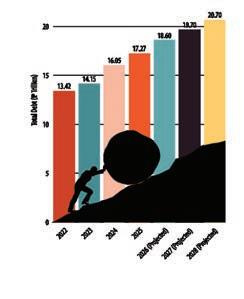
DOUBLE-DIGIT increase in the government’s borrowings pushed outstanding debt past the P17-trillion mark, climbing to P17.267 trillion as of the first semester of 2025.
By Lorenz S. Marasigan
THE Department of Public Works and Highways (DPWH) is planning to start the long-delayed rehabilitation of Edsa by as late as 2027, with a construction strategy that minimizes traffic disruptions on the country’s busiest road.
DPWH Secretary Manuel Bonoan told reporters that the agency has submitted its recommendation to President Ferdinand R. Marcos Jr., noting that the plan focuses on fast-track technologies to avoid extended
lane closures. “We are looking at technologies that will allow faster completion without shutting down traffic along Edsa. The total surface rehabilitation will take only about six months,” Bonoan said at the sidelines of the Post State of the Nation Address (Sona) briefing on Wednesday. The timeline, however, makes a 2025 start unlikely due to major events such as the Asean meetings next year.
“Maybe by next year or 2027,” Bonoan said, assuring that the rehabilitation could
EVEN after the tariff lines have been drawn in terms of the rates imposed on goods coming from several Asean countries like the Philippines, local economists said regional cooperation and coordination can still contribute to the fight against high United States tariffs.
In a paper, Philippine Institute for Development Studies (PIDS)
Emeritus Research Fellow Josef T. Yap and Senior Research Fellow Francis Mark A. Quimba said Asean countries missed an opportunity to leverage regional interests against high tariffs before they negotiated with the United States.
Yap and Quimba said the Asean, as a regional bloc, could have advocated for adherence to World Trade Organization (WTO) rules instead of following the “dubious configuration” of Trump’s tariffs.
“It would have been prudent for
regional blocs to adopt a unified stance. For example, Asean could have advocated for respect for WTO rules without having to flag the dubious configuration of the TTP [Trump Tariff Plan],” Yap and Quimba said.
“This could have given cover for its member countries when they negotiated with the US. Instead, Indonesia, Viet Nam and the Philippines carried out negotiations without any imprimatur from Asean, leaving them with an inferior position vis-à-vis the US,” they added.
Nonetheless, the economists said there is still an opportunity for the Philippines, who chairs the Asean next year, and other Southeast Asian economies to leverage regional cooperation against high tariffs.
The primary recommendation of the economists is to strengthen coalitions. Quimba told Business-
Mirror via email that this can be done by creating a permanent body within the Asean to analyze and respond as a group to external trade pressures.
As the Chair of the Asean next year, Quimba said the Philippines can also push for the acceleration of the implementation of the Regional Comprehensive Economic Partnership (RCEP), which was ratified by the Philippine Senate in 2023.
Quimba said the Philippines can also throw its support behind the expansion of the Chiang Mai Initiative Multilateralization (CMIM) in order to better deal with the US and China in the face of higher tariffs and global uncertainty.
In May, Finance Ministers and Central Bank Governors backed the full and robust implementation of the RCEP Agreement to ensure supply chains are not disrupted
and supported the flexibility of the CMIM. (See: https://businessmirror.com.ph/2025/05/05/ asian-central-bankers-revisitbuffers-amid-uncertainties/).
“We have to remember we are committed to RCEP and also regional financial arrangements like CMIM. Being the chair, the Philippines is in a delicate position because the Asean member countries have varying degrees of affiliation with both US and China. And the Philippines is viewed as being more aligned with the US,” Yap told BusinessMirror in an email.
Quimba also recommended that the region coordinate alternative supply chains within the RCEP agreement and reduce dependence on any single market as well as pursue joint investment promotion targeting non-US markets to diversify economic partnerships.
S. Alberto @reine_alberto
He added that the Asean can also “champion strategic autonomy.”
This concept, Quimba said, will resonate across the region regardless of individual countries relationships and orientations with the US and China.
“There should be a mechanism by which Asean negotiating teams can consult with each other so that we give the same general concessions and we ask for the same general concessions. Consistency with WTO rules, e.g. MFN, has to be emphasized. Of course there would be unique bilateral circumstances,” Quimba said.
In the paper, Yap and Quimba said, the TTP was “unsound” and that the formula used to arrive at the 19-percent tariff on Philippine goods was “nonsensical.” This only means the higher tariffs are not reciprocal and is not clear on how the US and the Philippines could benefit from this.
They also expressed concern that granting zero tariff and other preferential treatment to the US may cause future problems for the Philippines when it negotiates with other countries.
Yap and Quimba also said Trump policies such as the withdrawal from USAID have adversely affected health and education in the country.
“Relying on the good faith of the Trump administration in the tariff deal seems to be misplaced.”
Cai U. Ordinario
DPWH: Hard to track ahead
‘inserted’ flood control works
By Lorenz S. Marasigan
THEDepartment of Public Works and Highways (DPWH) has no system to monitor certain flood control projects, as these were supposedly inserted by lawmakers into the national budget without undergoing any technical review.
In a radio interview, DPWH Secretary Manuel Bonoan revealed that the agency only discovers these projects after the General Appropriations Act (GAA) is signed into law, leaving no opportunity for validation before implementation.
“We do not have monitoring capabilities because we are not part of the bicameral conference committee. We are the ones that implement the projects, but it will take some time to do assessments and validations,” he said in Filipino.
He said the situation worsened after the budget for project preparation and engineering activities was “drastically deleted,” stripping the agency of resources needed to scrutinize pro -
posals.
Despite these gaps, the DPWH is pressing ahead with flood control programs amid rising climate risks.
Bonoan said the agency will seek about P150 billion to P175 billion for 2026—slightly lower than this year’s P200 billion—to fund redesigned projects that include massive river dredging and climate-resilient measures.
“No matter how much revetment walls are built, if we don’t address siltation, the water will still overflow,” he said, stressing that decades of neglect have left riverbeds shallow.
The agency plans to acquire heavy equipment to support dredging nationwide.
Since the Marcos Jr. administration began, the DPWH has completed roughly 9,800 flood control projects, with 5,700 still ongoing.
In his fourth State of the Nation Address (Sona) last July 28, President Ferdinand Marcos Jr. denounced the apparent corruption plaguing billions of flood-control projects, a dire situation that is being blamed
still be completed within the Marcos administration.
The planned overhaul marks the first comprehensive rehabilitation of Edsa in decades. Edsa, which stretches 23.8 kilometers from Caloocan to Pasay, carries an estimated 400,000 vehicles daily—far beyond its original design capacity. The Edsa Rebuild Program—initially set at around P15 billion—was placed “back to the drawing board” earlier this year, as the original plan would stretch for two years even with a phased approach.
Bonoan said the cost of rebuilding Edsa may be “lowered” given the new technologies that the government will employ.
for the massive floods in several regions of the country the past two weeks, when serial storms compounded the heavy rains from the southwest monsoon. Marcos Jr. has ordered the department to submit a full inventory of projects the past three years to identify delays, assess performance, and flag possible ghost projects.
5-month infra spending slows to ₧557.8B
Rivera said the government is ramping up infrastructure spending to help fuel domestic demand, generate employment and drive economic momentum amid persistent global headwinds.
Although absorptive capacity and procurement bottlenecks will remain critical challenges, Rivera said ensuring timely and efficient rollout of big-ticket projects under the administration’s infrastructure program will be crucial to sustain GDP growth and enhance long-term competitiveness.
Overall disbursements
MEANWHILE , overall government spending climbed to P2.477 trillion as of end-May, larger by 9.7 percent from P2.257 trillion a year ago.
In May, government disbursements saw a 3.8- percent increase to P578.2 billion from last year’s P557 billion.
Personnel services expenditures grew by 10.7 percent to P181.9 billion from P164.4 billion due to the implementation of salary hikes and mid-year bonuses of government employees, retirement payouts for uniformed personnel and newly filled positions in the Armed Forces of the Philippines.
Combined allotment and capital transfers to LGUs rose
14.8 percent to P93.4 billion from P81.3 billion, boosted by higher National Tax Allotment shares and annual Block Grant to the Bangsamoro Autonomous Region and Muslim Mindanao.
New bond issuances, global bond coupon payments and the impact of foreign exchange movements and shifts in the Secured Overnight Financing Rate pushed interest payments to 70 billion, 14.5 percent higher from P61.1 billion.
Meanwhile, maintenance and other operating expenses dipped 4.3 percent year-on-year to P98.5 billion due to lower disbursements for health and social aid programs.
Subsidies also fell by 18.7 percent to P7.9 billion from P9.7 billion, resulting from lower releases to the National Irrigation Authority (NIA) as nearly half of its 2025 subsidy is still pending.
For the first semester, the DBM expects government disbursements will be “roughly in line with the program.”
Disbursements are projected to reach P6.082 trillion in 2025, or 21.4 percent of GDP.
Data from the Bureau of the Treasury showed disbursements reached P3.026 trillion, 9.49 percent higher than last year’s P2.763 trillion.
at the same level at P160 million year-on-year. From the start of the year through June, debt owed to Filipinos gradually increased by 9.3 percent from P10.930 trillion in December 2024. For June, domestic borrowings inched up by 1.4 percent from P11.780 trillion in May.
On the other hand, external debt grew 8.3 percent to P5.316 trillion in the first semester from P4.910 trillion in the same period a year ago.
Offshore debt securities saw a 3.7-percent year-on-year increase to P2.714 trillion from P2.617 trillion. These consist of P2.260 trillion in US dollar bonds, P252.43 billion in euro-denominated bonds and P59.32 billion in Japanese yen debt papers. There are also P56.38 billion in Islamic certificates and P54.77 billion in Peso global bonds. The government also took out P2.602 trillion in direct loans as of end-June.
Since the start of the year, external borrowings went up by 3.8 percent from end-December’s P5.120trillion level. Month-on-month, external debt saw a slight uptick of 3.5 percent from P5.138 trillion in May. Overall, the government’s outstanding debt grew by 2.1 percent from the previous month’s P16.918 trillion.
The Treasury maintained that debt “remains sustainable” and that it continues to prioritize domestic borrowings to boost the local capital market while lowering foreign exchange risks.
“The national government’s prudent debt management approach strategy reflects the Marcos Jr. administration’s commitment to safeguarding fiscal sustainability, supporting inclusive growth, and ensuring that every peso borrowed is used to build a stronger economy for the Filipino people,” the Treasury added.
The country’s debt-to-GDP ratio, or outstanding debt compared against its economy, rose to 62 percent in the first quarter. A lower ratio means that the country has a more sustainable debt level, which can affect its ability to source financing, attract foreign investments and pay off its obligations.
By the time President Ferdinand R. Marcos Jr. ends his term, the government’s debt is expected to swell to P20.7 trillion.
RESIDENTS of Tañong, Malabon City wade through knee-deep floodwaters caused by the southwest monsoon rains. PNA FILE PHOTO BY BEN BRIONES
www.businessmirror.com.ph
Young congressmen get key House posts
IN a resounding push for generational renewal and progressive governance, the House of Representatives has ushered in a wave of young leaders into key positions—signaling a new era of leadership under the 20th Congress.
Among the most notable appointments is FPJ Panday Bayanihan Rep. Brian Poe-Llamanzares, who was named assistant majority leader, becoming one of the youngest legislators to hold a strategic post in the House.
A first-term lawmaker, Poe’s swift ascent in the legislative branch highlights Congress’ growing openness to youthful, reformoriented public servants.
“This appointment is not just a win for our party-list, but for every Filipino who believes in humane, patriotic, and forwardlooking governance,” Poe said. “I am deeply honored and grateful for the trust extended to me by the House leadership.” He vowed to prioritize people-
first policymaking. Within just his first week in office, he has championed legislation supporting small entrepreneurs, protecting informal workers, and proposing responsible artificial intelligence (AI) integration in public service—areas often overlooked in traditional legislative agendas.
Political observers see young leaders’ appointment as part of a broader generational shift in Congress.
“This signals a generational shift in leadership—one that values competence, innovation, and integrity,” said Ricky Mallari, spokesperson for the Political Officers League of the Philippines.
Poe is not alone in this historic wave. Many other young legislators have been appointed assistant majority leaders, a critical role in steering legislative priorities.
See “Congressmen,” A9
PCG divers recover human skulls, bones in Taal Lake
By Joel R. San Juan @jrsanjuan1573
JUSTICESecretary Jesus Crispin
Remulla on Wednesday revealed that human skeletal remains were recovered by Coast Guard (PCG) divers who have been conducting retrieval operations at the Taal Lake where the remains of the 34 missing cockfighting enthusiasts or “sabungeros” were believed to have been dumped more than four years ago.
In an interview, Remulla told reporters that the remains include the skull with its upper teeth completely intact and these are now being examined at the Philippine National Police (PNP) Crime
Laboratory.
“You can see that the witness’ statement is reliable, that [bodies of] people who were killed were dumped, thrown and disposed of in the area. Maybe, these are
not just related to cockfighting, it could be related to drug war or other crimes involving a death squad,” Remulla said.
He said the recovery of the skeletal remains, including the teeth, would hasten the identification of the victim through dental records.
The PCG divers resumed their retrieval operations on Monday after being suspended for several days due to bad weather.
The retrieval operation was launched after whistleblower Julie Patidongan, alias “Totoy,” disclosed to authorities that the bodies of the missing sabungeros were dumped in a fishpond area in Taal Lake.
Patidongan is one of the six accused in the kidnapping and serious illegal detention case filed in connection with the missing sabungeros case.
He also tagged businessman Charlie “Atong” Ang as the mastermind behind the disappearance of the cockfighting enthusiast.
Ang has denied Patidongan’s accusations and accused the latter of trying to extort P300 million from him in exchange of not dragging him on the case.
Remulla also disclosed that the prosecutorial team of the DOJ, together with the investigators and witnesses, are now preparing the documents and affidavits for the filing of charges against those responsible for the disappearance of the sabungeros. He added that the case is already “ripe” for filing.
“I will tell our colleagues to hasten things up since we have been waiting for this for so long. The crime happened in 2020 and it’s already 2025. Time does not wait, time passes, we really need to move forward,” Remulla added.
Remulla added that he would soon talk to the new witness who earlier offered to cooperate not only by giving testimonies but also by providing hard evidence against the culprits behind the missing sabungeros.
Lawyers file contempt charges vs critics of impeachment resolution
PEx-SC justice asks Senate to defer action on impeachment complaint
RBy Joel R. San Juan @jrsanjuan1573
ETITIONS were filed yesterday before the Supreme Court seeking to cite for indirect contempt several individuals for issuing “offensive statements” against the justices in connection with their unanimous decision declaring as unconstitutional the impeachment complaint filed by the House of Representatives before the Senate against Vice President Sara Duterte.
Lawyers Mark Kristopher Tolentino and Rolex Suplico filed one of the petitions naming political analyst Richard Heydarian and Akbayan Rep. Percival Cendaña as respondents.
A separate petition was also filed by lawyer Ferdinand Topacio, Partido Demokratiko Pilipino (PDP) spokesman on matters related to Duterte’s impeachment, against disbarred lawyer and now Presidential Adviser for Poverty Alleviation Larry Gadon.
The petitions seeking Court’s sanctions against the respondents were filed following their allegedly malicious public statements against the members of the 15-man High Tribunal who unanimously junked the impeachment complaint in a ruling issued on July 25 for violation of the one-year bar rule and Duterte’s right to due process.
The petitioners claimed that Heydarian and Cendaña used their influential platforms to discredit the Court and its members.
Appointees
HEYDARIAN, according to the petitioners, immediately posted on his verified X (formerly Twitter) account: “FACT: DUTERTE had APPOINTED as many as 13 out of 15 SUPREME COURT justices by 2022!! No wonder the SC is now the Supreme Coddler. Welcome to the Philippines.”
“The post was not mere commentary on appointments or a general critique of political influence. It deliberately and maliciously framed the Justices as beholden to former President Rodrigo Duterte, thereby attributing impropriety, lack of independence, and judicial bias to the Supreme Court as an institution,” the petition read.
“The use of the term ‘Supreme Coddler’ was a clear contempt and implied that the Court had abandoned its constitutional duty in favor of political loyalty,” it added.
The said post, according to the petitioners, was cross-shared on Heydarian’s verified Facebook page and received over 2.4 million impressions, 12,000 shares, and
thousands of comments, many of which attacked the independence, competence, and integrity of the members of the SC.
On the same day, Cendaña echoed Heydarian’s statement during a news conference where he declared: “ The Supreme Court has reduced itself to being the Supreme Coddler of Sara Duterte. This is a betrayal of the Constitution and an insult to the people’s right to demand accountability.”
Uphold respect
“THE statements of Rep. Cendaña were not confined to policy disagreement. As a public officer and legislator, he holds a duty to uphold respect for co-equal branches of government, particularly the Judiciary,” the petitioners said.
“His statement directly accused the Court of betraying its constitutional mandate, thereby suggesting judicial dereliction of duty and willful complicity in political shielding,” they added.
Their statements, according to the petitioners, scandalize the Court by “undermining public confidence in its independence and integrity.”
The petitioners pointed out that their statements constitute an “unlawful interference with and derogation of judicial authority,” which directly violated Section 3(d), Rule 71 of the Rules of Court.
Aside from citing the respondents in indirect contempt, the petitions also asked the Court to issue a cease-and-desist order to prevent further statements undermining the judiciary.
Topacio, on the other hand, asked the Court to cite Gadon in indirect contempt for his offensive remarks by openly calling the Supreme Court “tuta ng mga Duterte.”
Gadon’s public statements, according to Topacio, were “contemptuous and punishable” for indirect
House reaffirms priorities
By Jovee Marie N. dela Cruz @joveemarie
WITH rising trust and performance ratings from the public, the leadership of the House of Representatives on Wednesday reaffirmed the commitment to prioritize legislation that directly addresses the needs of ordinary Filipinos—with a focus on food security, jobs, education, and public health.
In response to the latest Octa Tugon ng Masa survey, which
showed a notable increase in his trust rating (57 percent) and performance rating (59 percent), Speaker Ferdinand Martin Romualdez said the results reflect growing public confidence in the House’s push for transparency, budget integrity, and efficient service delivery.
“This is not a victory lap,” he said. “It’s a reminder to stay focused, stay grounded, and stay accountable. People are paying attention. They want honest leadership and real results.” Romualdez laid out a pro-people
contempt under Section 3, Rule 71 of the Rules of Court.
De Lima statement
MAMAYANG Liberal Rep. Leila de Lima, meanwhile, in a statement expressed her “firm solidarity” with Cendaña and Heydarian “amid this latest effort to file indirect contempt charges against them for their remarks on the recent Supreme Court decision on the Vice President’s impeachment case.”
De Lima in her statement said:
“We’ve seen tactics like this before. Legal processes are being used not to advance justice, but to intimidate critics and deflect attention from serious questions of public accountability. These efforts are concerning, not only because they target individuals with strong democratic convictions, but because they risk chilling legitimate public discourse.
“Let’s be clear: the statements of Rep. Perci and Prof. Heydarian fall well within the bounds of free expression. Criticism of judicial decisions, especially those with profound political impact, is part of the democratic process. In moments like these, courts are expected to demonstrate openness to scrutiny, not to react defensively.
“I am confident that the Supreme Court will not allow itself to be weaponized by those who wish to score political points. The justices are seasoned, independent-minded professionals who understand the constitutional balance between free expression and respect for judicial authority. This is not the time to allow the Court to be dragged into a political spectacle.
“The truth is, what’s being challenged here is not the dignity of the Court, but the discomfort that comes with public accountability. Public commentary is not contempt. It is conscience.”
NDRRMC
legislative agenda anchored on key pillars aimed at uplifting the daily lives of the Filipino majority—the struggling 99 percent, not just the privileged few.
“We will build an economy not just for the top 1 percent, but for the struggling 99 percent—an economy where ordinary people don’t just survive, they succeed,” he said.
At the heart of the House agenda is ensuring access to affordable and sufficient food. Romualdez said the House will pass the proposed Rice Industry and Consumer Empowerment (RICE) Act, which balances consumer affordability with farmer protection.
He also vowed to eliminate smuggling, hoarding, and price manipulation through stronger enforcement and reforms, while expanding irrigation systems and post-harvest infrastructure to improve agricultural productivity.
See “House,” A9
warns vs debris from China rocket
DEBRIS from a Long March 8A rocket of the People’s Republic of China, that was launched on Wednesday afternoon may may hit Puerto Princesa City, Palawan, and Zamboanga City, Zamboanga del Sur, the National Disaster Risk Reduction and Management Council (NDRRMC) said.
In its July 29, warning for the Philippine Coast Guard, Bureau of Fisheries and Aquatic Resources, and Department of Environment and Natural Resources - National Mapping and Resource Information Authority (DENR Namria) and concerned NDRRMC satellite offices, the agency said debris frrom the Long March 8A rocket are expected to drop within the identified drop zone which is approximately 120 NM away from Puerto Princesa City, and some 42 nautical miles away from Zamboanga City.
The NDRRMC recommended to the PCG, BFAR, DILG, and DENR-Namria to consider temporary restrictions and the issuance of Notice to Mariners, Coastal Navigational
See “Debris,” A9
ETIRED Supreme Court (SC) Senior Associate Justice Antonio Carpio on Wednesday urged the Senate to defer action on the Court’s decision that declared as unconstitutional the impeachment complaint filed by the House of Representatives for violating the one-year bar rule and the right to due process of Vice President Sara Duterte.
Carpio made the appeal during the Kapihan sa Manila Bay media forum where he also renewed his call for his former colleagues in the High Tribunal to reverse its unanimous ruling issued on July 25, which granted Duterte’s petition to junk the impeachment complaint on technicalities.
The retired justice stressed that the decision, although immediately executory, is not yet final since it is still subject for a motion for reconsideration.
“We have to wait for another occasion when it could be reversed. But it’s not yet final. It’s only executory but not yet final because the House still has a motion for reconsideration,” Carpio noted. “So, I would think that the Senate should just hold in abeyance any action because it’s not yet final, because there’s still a chance it could be reversed or changed because there’s a motion for reconsideration,” he added.
The House earlier said it would file a motion for reconsideration of the Court’s decision.
The Senate, on the other hand, has deferred until August 6 its discussion and possible action on the SC’s decision although some of the senators have expressed their desire to have the impeachment complaint filed by the 19th Congress be dismissed outright in line with the ruling.
Lament
WHILE he remains optimistic that the impeachment proceedings against Duterte would eventually push through, Carpio lamented that the due process requirements laid down by the Court in its ruling would practically make its impossible to file an impeachment complaint.
He noted that the deliberations of the Constitutional Commission (ConCom) which drafted the now 1987 Constitution showed that the requirements should be relaxed in order to make it easy to file impeachment complaints.
Carpio, however, said all parties should respect the Court’s decision once it has become final but warned of its possible consequences.
“But, we have to be aware of history. Isn’t that during former President Estrada’s impeachment, they did not open the envelope? And we cannot control what happens after that,” he added.
Other options
FOR his part, lawyer Christian Monsod, one of the framers of the 1987 Constitution, said the people may also explore other options to hold the justices accountable for coming out with the questionable ruling.
Monsod said the Ombudsman may be asked to investigate and find out the truth in connection with the SC ruling.
“Well, as I’m saying, the people cannot be out of options. We have a democracy. People are accountable for their actions and so on…. If they think they are immune from people’s actions, they’re wrong,” Monsod pointed out.
“Don’t think that they are free and they can freely do what they want, even when it’s wrong, as the Ombudsman can investigate and then get to the truth ,and that can go public. When they get to the truth of the situation, there may be cases filed separately…,” Monsod added.
In a unanimous decision issued on Friday, the SC declared as unconstitutional the impeachment complaint for violating of the one-year-bar rule under the Constitution and her right to due process.
The Court’s ruling, which is immediately executory, stressed that under Article XI, Section 3 (5) of the Constitution, no impeachment proceedings should be initiated against the same official more than once within a period of one year. Based on the decision, the one-year-bar rule is reckoned from the time an impeachment complaint is “dismissed or no longer viable.”
The Court noted that the three impeachment complaints were archived, thus, deemed dismissed on February 5, 2025 when the House filed the fourth impeachment complaint. Thus, no new impeachment complaint should be filed earlier than February 6, 2026, according to the Court.
Likewise, the Court declared that due process applies to the impeachment process and laid down seven due process requirements with regard to impeachment proceedings.
Joel R. San Juan
“Yes, I am a rule of law person. So, I accept that the Supreme Court is the final arbiter. So, we have to follow. Even if it is wrong, even if we think it is wrong, that is the final decision,” Carpio stressed.
Tsunami threat prompts DILG to order preemptive evacuation
By Jonathan L. Mayuga @jonlmayuga & Rex Anthony Naval
THE Department of the Interior and Local Government (DILG) ordered local governments in areas fronting Pacific Ocean to conduct immediate preemptive evacuations in coastal communities following the 8.7 magnitude earthquake that struck off the east coast of Kamchatka, Russia early Wednesday.
Phivolcs’ Tsunami Information 2 issued at 7:50 a.m. on July 30 warned of the “minor sea-level disturbance” off the East Coast of Kamchatka, Russia.
It has a depth of 74 kilometers.
“Based on the reviewed magnitude calculations and tsunami wave models in the Pacific Tsunami Warning Center, coastal areas in the Philippines fronting the Pacific Ocean are expected to experience a tsunami wave height of less than one meter. The first tsunami is the largest, and these waves may continue for hours,” the advisory stated.
Phivolcs advised the public to be on alert for unusual waves and stay away from the beach and not to go to the coast of affected areas until further notice.
The following areas have been identified by Phivolcs: Batanes Group of Islands, Cagayan, Isabela, Aurora, Quezon, Camarines Norte, Camarines Sur, Albay, Sorsogon, Catanduanes, Northern Samar, Eastern Samar, Leyte, Southern Leyte, Dinagat Islands, Surigao del Sur, Surigao del Norte, Davao del Norte, Davao Oriental, Davao Occidental, Davao del Sur, and Davao de Oro.
Phivolcs added that people whose houses are located very near the shoreline of these provinces are advised to move farther inland.
Meanwhile, owners of boats in harbors, estuaries or shallow coastal waters of the said areas should secure their boats and move away from the waterfront.
“Boats already at sea during the period should stay offshore in deep waters until further advised,” Phivocs said.
The DILG urged the concerned local goveernments to also undertake the following critical preparedness measures:
n Establish evacuation routes, directional signs, and safe zones for atrisk communities
n Activate their respective Emergency Operations Centers (EOCs) and Incident Management Teams (IMTs) n Strictly implement actions based on Operation Listo and Listong Pamayanan Tsunami Toolkit
n Coordinate closely with regional and provincial DRRMCs, DOST-PHIVOLCS, and other relevant agencies . The DILG also advised residents to remain vigilant and stay away from beaches and coastal waters until the official cancellation of the tsunami advisory by DOST-Phivolcs.
The DILG also directed its regional directors in the Cagayan Valley, Central Luzon, Calabarzon (Cavite, Laguna, Batangas, Rizal and Quezon), Bicol, Eastern Visayas, Southern Mindanao, and Caraga to ensure all local governments are on high alert and are closely coordinating with their respective Regional Disaster Risk Reduction and Management Councils (RDRRMCs).
Economy
Kadiwa stores to sell 100K tons of cheaper pork
TBy Ada Pelonia @adapelonia
HE Department of Agricul-
ture (DA) said most of the additional pork shipments that will enter the country under a lower tariff will be sold through Kadiwa sites to tame the spike in retail prices of the key protein source.
Agriculture Secretary Francisco
Tiu Laurel Jr. said the agency is seeking a minimum access volume (MAV) Plus of 150,000 metric tons (MT) for pork. Of which, 100,000 MT will be allocated to the Kadiwa system, 30,000 MT for meat processors, and 20,000 MT for the food service industry.
“What we’re aiming for is that if this gets approved, pork and rice will be cheaper, and there won’t be much
of a spike by December. So hopefully, our Christmas will be lighter for all of us,” Laurel told reporters on the sidelines of the post-State of the Nation Address forum in San Juan City on Tuesday. The DA chief noted that if the MAV Plus for pork pushes through next month under the 20th Congress, the measure will run for one year.
Pork imported via the MAV scheme enjoys a lower tariff of 15 percent for shipments falling under the in-quota allocation while the out-quota allocation is slapped a tariff of 25 percent. Under the law, modifications or adjustments of the MAV are allowed in case of shortages or abnormal price increases. It stipulates that the President
DOE targets 5K households for electrification
TBy Lenie Lectura @llectura
HE Department of Energy (DOE)
is targeting to energize 5,000 more households this year to help accelerate the government’s Total Electrification Project (TEP).
As of December 2024, the national household electrification level is at 94.75 percent, equivalent to 27.9 million households with electricity access. Until 2028, the DOE estimated that around 3.08 million households will require electricity connection.
“For the DOE’s TEP, the goal is to energize additional 5,000 households nationwide this year. This is on top of the 17,000 households to be energized by NEA [National Electrification Administrations] covered by previous years TEP allocation,”
DOST funds ASF research, farm support
THE Department of Science and Technology (DOST) has allotted some P1 billion for African Swine Fever (ASF)-related initiatives since the virus was first detected in the Philippines in 2019, the agency chief said on Monday.
Science Secretary Renato Solidum Jr. said the amount includes support for vaccine and virology research, alongside funding for small-scale deployment and industry incubation projects.
“About P30 million was released under the Grants-in-Aid program since 2022, and another P16 million supported business incubation through science and technology for the industry,” Solidum said in the PIGusapan media forum in Quezon City on Monday.
By Andrea San Juan @andreasanjuan
THE Department of Trade and Industry (DTI) said it will push for a bigger 2026 budget, which it hopes to pour into its priority sectors such as creative industries, micro, small and medium enterprises (MSME), the Halal sector, and marketing of local products in the global arena.
“We don’t have the exact amount yet but nandoonnakamisaplanning. But of course there are some areas where we can really ask for more budget so iyon ang itutulak natin,” Trade and Industry Secretary Cristina A. Roque told reporters on the sidelines of the Post-Sona Discussion on Tuesday.
Among the sectors that the DTI chief wants to prioritize is the creative industries, underscoring that the Philippines can use this as one of its “aces” to drive the tourism and trade sectors in the Philippines.
Roque said another sector that the DTI needs to push is the Halal industry given the $4.5 trillion global potential of the sector.
“And we feel that we are ready because all we need nalang are certifications. Doon talaga kami hihingi ng funding to get the products certified kasi ang dami na natin ine-export na products. Certification nalang ang kulang talaga and so many industries
the agency said on Wednesday. The DOE and NEA are fully committed to energize the remaining unserved households and communities across the country in the next three years. To help achieve this, the DOE will undertake a Competitive Selection Process (CSP) for Microgrid System Providers. Through this initiative, approximately 12,000 households in off-grid areas, located in Quezon, Camarines Norte, Palawan, Masbate, Samar, Negros Occidental, and Zamboanga del Sur, are targeted to be energized through microgrid systems (MGS).
These MGS, each equipped with self-contained power generation units and localized distribution networks, are designed to provide reliable and sustainable electricity in areas that existing distribution utilities (DUs) and electric cooperatives
(ECs) can no longer reach.
Moreover, the DOE said there are 2.018 million households located in areas already within the coverage of ECs and DUs that can be connected through regular service applications. To fast track the processing of these applications, the DOE and NEA are working in coordination with the Department of the Interior and Local Government (DILG) to streamline the permitting process and reduce or potentially waive, related fees imposed by local governments (LGU)and DUs.
Meanwhile, for households located in remote and mountainous areas that are completely inaccessible to conventional power distribution lines, the DOE will deploy Solar Home Systems (SHS).
Each SHS unit includes a solar panel, a battery-powered home system, and basic components that can power four LED bulbs,
charge a mobile phone, and operate a built-in radio.
For this year, NEA aims to bid out SHS to energize 100,000 households until the first quarter of 2026. Similarly, NEA will conduct early procurement for 54,000 SHS for its target household energization in 2026, benefitting a total of 154,000 households for the next two years.
Also, the DOE and NEA are collaborating with the Department of Education (DepEd) to electrify 295 last-mile schools using solar power systems. With funding under DepEd’s P1.295 billion allocation for 2025, each solar installation will be capable of powering essential educational equipment, including a 55-inch television per classroom, 40 tablets, and other key digital learning tools, thereby enabling more resilient and inclusive learning environment in remote communities.
Congressmen file bills in support of Sona goals
IBy Jovee Marie N. dela Cruz @joveemarie
N support of President Marcos’ national vision, lawmakers have filed key measures focusing on livelihood, health, education, and empowering coconut farmers—areas emphasized in his fourth State of the Nation Address (SONA).
Quezon City Rep. Patrick Michael Vargas filed several priority bills aligned with the president’s goals, including the Growth and Recovery for MSMEs Act (HB 2271), Shared Service Facilities for MSMEs Act (HB 2268), Financial Literacy in Schools Act (HB 2270), Digital Public Libraries and Reading Centers Act (HB 2264), and the Last Mile Schools Act (HB 2266). These proposed laws aim to strengthen the country’s education system, provide greater support for the youth, and ensure that MSMEs have better access to institutional assistance and reduced business costs—key concerns highlighted by the President in his address. Vargas emphasized that legislation must
pa,” the Trade chief also noted.
She said the DTI also needs to prioritize marketing of Tatak Pinoy, adding: “We need to show the products that we have globally. Of course the trade fairs iyon. Before we used to do five but now, we’re doing 12 fairs this year.”
In fact, the three-day Bridal Trade Fair alone that was recently held, generated P113 million.
“This was phenomenal for a three-day trade fair considering 80 booths lang and considering unknown iyong mga nagparticipate. This just shows that there’s really potential, we just have to provide the avenue and landscape for them,” added Roque.
Meanwhile, for MSMEs alone, Roque said DTI will surely push for an increased allocation of funding for small merchants especially after President Marcos in his State of the Nation Address (Sona) vowed to earmark more funding for micro enterprises at low interest rates and with no collateral.
“Ipagpapatuloynatinangpagbibigayng puhunan sa mas marami pang negosyante paramakapagsimulangmaliitnanegosyo o microenterprise, sa mababang interest, atwalangkolateral.Patinarinangkapital at proteksyon para sa mga yamang-isip,” Marcos said in his fourth Sona last Monday.
be responsive to the real and urgent needs of Filipinos. “We must translate the national agenda into concrete laws that better lives and ensure that no one is left behind,” he added.
During his speech, Marcos reaffirmed his administration’s firm commitment to fight poverty and hunger by generating more employment, supporting small businesses, and expanding strategic industries nationwide.
As more jobs are being created, the President instructed the Departments of Labor and Employment (Dole), of Trade and Industry (DTI), of Social Welfare and Development (DSWD), and of Tourism (DOT) to intensify efforts to support the 4 percent of the labor force still unemployed. He also reiterated support for microenterprises, particularly through access to low-interest, non-collateralized capital.
To ensure continued access to higher education, Marcos also announced a significant increase in investments in free public college education and technical-vocational (Tech-Voc) training. Nearly P60 billion will be allocated for tuition in public colleges and tech-voc
programs, benefiting millions of students.
Meanwhile, Albay Rep. Raymond Salceda has filed the first measure responding to Marcos’ call to revise the Coconut Farmers and Industry Trust Fund Act, stressing the need to better serve coconut farmers.
“President Marcos is right—there are inefficiencies in the system. It takes too long under the current arrangement, and it seems it’s by design,” Salceda said. “We’re simply trying to respond to that by making sure the fund moves toward the farmers faster and more directly.”
House Bill 2336 grants the Trust Fund Management Committee the authority to reallocate unused shares from agencies that fail to submit or implement projects.
These unspent funds can then be redirected to other eligible agencies with qualified but underfunded proposals. The measure also earmarks significant funding for coconut
should propose any revisions of the MAV to Congress. The latter should act within 15 days from receipt of the proposal; otherwise, it will be deemed approved.
Laurel said the agency met with the MAV Management Committee where the proposed measure was “more or less” agreed on.
The Philippines previously implemented the MAV Plus of
200,000 MT in 2021 to address supply shortage and pull down retail prices of the commodity as African swine fever (ASF) took a toll on domestic output.
Currently, retail prices of pork ham in Metro Manila markets range from P320 to P410 per kilo, while pork belly is being sold from P360 to P480 per kilo, based on the government’s price monitoring report.
Legislator seeks amendments to tax code
IN a move to empower micro, small, and medium enterprises (MSMEs), a lawmaker has filed House Bill 2271, aimed at reducing the cost of business compliance by amending key provisions of the National Internal Revenue Code of 1997.
Quezon City Rep. Patrick Michael Vargas filed a bill to lower the tax burden on MSMEs by cutting the optional income tax rate from the current 8 percent to 5 percent for self-employed individuals and professionals whose gross sales or receipts fall below the value-added tax (VAT) threshold.
This option, introduced under the Tax Reform for Acceleration and Inclusion (TRAIN) Law, will be offered in lieu of the graduated income tax and percentage tax, said Vargas.
“MSMEs are the lifeblood of the Philippine economy. They make up 99.5 percent of all registered business establishments and employ around 63 percent of the labor force. But they often struggle to grow due to limited resources and the high cost of compliance,” Vargas said.
Vargas said his bill supports President Marcos’ fourth State of the Nation Address (SONA), where the Chief Executive emphasized the need to empower MSMEs, generate more jobs, and expand strategic industries across the country.
“These adjustments will ease compliance procedures and free up resources for MSMEs to reinvest in their operations. It is a strategic move to fuel business recovery, especially in rural areas where small enterprises play a crucial role in community development,” Vargas added in the bill’s explanatory note.
“Through these amendments to the National Internal Revenue Code of 1997, this measure hopes to provide additional funds for business expansion for the MSMEs and grow their capability to contribute to economic development,” he said.
The bill mandates the Department of Finance (DOF), in coordination with the Bureau of Internal Revenue (BIR), to issue the implementing rules (IRR) within 30 days from the effectivity of the proposal. It also includes a separability clause to ensure that unaffected provisions remain valid even if any part of the law is declared unconstitutional.
Once passed and enacted, Vargas said the measure is expected to create a more favorable and competitive environment for Filipino entrepreneurs, enabling them to scale up, generate more jobs, and contribute more meaningfully to national development.
House Bill 2271 also proposes to streamline the creditable withholding tax system, setting the withholding tax at 1 percent for purchases of goods and properties and 2 percent for services, including professional fees and leases. These rates, which will be credited against the income tax liability of the taxpayer, aim to reduce the administrative burden on MSMEs and improve their cash flow.
Jovee Marie N. dela Cruz
See “ASF,” A9
See “Sona,” A9
A6 Thursday, July 31, 2025
UN conference backs 2-state solution, condemns Hamas and Israeli actions
By Edith M. Lederer & Farnoush Amiri The Associated Press
UNITED NATIONS—Highlevel representatives at a U.N. conference on Tuesday urged Israel to commit to a Palestinian state and gave “unwavering support” to a two-state solution, signaling widespread international determination to end one of the world’s longest conflicts.
The “New York Declaration” sets out a phased plan to end the nearly eight-decade conflict and the ongoing war in Gaza. The plan would culminate with an independent, demilitarized Palestine living side by side peacefully with Israel, and their eventual integration into the wider Mideast region.
The meeting is taking place amid the latest reports that starvation and famine are taking place in Gaza, and growing global outrage at Palestinians not getting food due to Israeli policies and practices— which Israel denies. Planned for two days, the meeting was extended into Wednesday because representatives of about 50 countries have not spoken.
Israel rejects the notion of two states
ISRAELI Prime Minister Benjamin Netanyahu opposes a two-state solution and has rejected the meeting on both nationalistic and security grounds. Israel’s close ally, the United States, is also boycotting, calling the meeting “unproductive and ill-timed.” Israel’s U.N. Ambassador Dan -
ny Danon late Tuesday sharply criticized some 125 countries participating in the conference, saying “there are those in the world who fight terrorists and extremist forces and then there are those who turn a blind eye to them or resort to appeasement.”
The conference, which was postponed from June and downgraded from world leaders to ministers, for the first time established eight high-level working groups to examine and make proposals on wide-ranging topics related to a two-state solution.
The declaration’s plan says conference co-chairs France and Saudi Arabia, the European Union and Arab League, and 15 countries that led the working groups agreed “to take collective action to end the war in Gaza.”
Saudi Foreign Minister Prince Faisal bin Farhan urged the rest of the 193 U.N. member nations “to support this document” before the start of the 80th session of the U.N. General Assembly in midSeptember.
The declaration condemns “the
attacks committed by Hamas against civilians” in southern Israel on Oct. 7, 2023. It marks a first condemnation by Arab nations of Hamas, whose attacks killed about 1,200, mainly Israeli civilians, and whose militants took about 250 people hostage. Some 50 are still being held.
The declaration condemns Israel’s attacks on civilians and civilian infrastructure in Gaza and its “siege and starvation, which have produced a devastating humanitarian catastrophe and protection crisis.” Israel’s offensive against Hamas has killed over 60,000 Palestinians, according to the Gaza Health Ministry, which doesn’t distinguish between civilians and combatants.
Plan would give Palestinian Authority governing power THE conference plan envisions the Palestinian Authority governing and controlling all Palestinian territory, with a transitional administrative committee immediately established under its umbrella after a ceasefire in Gaza.
“In the context of ending the war in Gaza, Hamas must end its rule in Gaza and hand over its weapons to the Palestinian Authority,” the declaration says.
It also supports deployment of “a temporary international stabilization mission” operating under U.N. auspices to protect Palestinian civilians, support the transfer of security to the Palestinian Authority and provide security guarantees for Palestine and Israel—“including monitoring of the ceasefire and of a future peace agreement.”
The declaration urges countries to recognize the state of Palestine, calling this “an essential and indispensable component of the achievement of the two-state solution.”
Without naming Israel but clearly referring to it, the document says “illegal unilateral actions are posing an existential threat to the realization of the independent state of Palestine.”
French President Emmanuel Macron announced ahead of the meeting that his country will recognize the state of Palestine at the General Assembly’s meeting of world leaders in late September. The French Foreign Ministry on Tuesday pushed back on Israeli claims that recognition of Palestine would “reward” Hamas, saying that “on the contrary, it has contributed to isolating Hamas.”
United Kingdom Prime Minister Keir Starmer announced Tuesday that Britain would recognize the state of Palestine before September’s meeting, but would refrain if Israel agrees to a ceasefire and long-term peace process in the next eight weeks. The countries are now the biggest Western powers and the only two members of the Group of Seven major industrialized nations to make such a pledge.
A separate one-page statement titled the “New York Call” was circulated by France, but the language was considered too strong, especially for Arab nations. It was only approved by 15 Western nations, including six that have recognized the state of Palestine and nine others: Andorra, Australia, Canada, Finland, Luxembourg, Malta, New Zealand, Portugal and San Marino.
The statement, issued late Tuesday, says the 15 countries have recognized, “expressed or express the willingness or the positive consideration ... to recognize the state of Palestine, as an essential step towards the two-state solution, and invite all countries that have not done so to join this call.”
Editor: Angel R. Calso
Russian missiles hit Ukrainian army training ground, killing 3 soldiers
By Illkia Novikov The Associated Press
KYIV, Ukraine—A Russian missile hit a Ukrainian army training ground, killing three soldiers and wounding 18 others, authorities said, in the latest attack to embarrass military officials as they struggle to make up a severe manpower shortage in the nearly 3½-year war.
The Russian Defense Ministry said that the strike killed or wounded about 200 Ukrainian troops. The ministry said that Ukraine’s 169th training center near Honcharivske in the Chernihiv region was hit with two Iskander missiles, one armed with multiple submunitions and another with high explosives.
Meanwhile, Russia continued its steppedup aerial campaign against Ukrainian civilian targets, launching 78 attack drones overnight, including up to eight newly developed jet-powered drones, Ukraine’s air force said Wednesday. At least five people were wounded.
Civilian casualties
THE U.N. mission in Ukraine says there has been a worsening trend in civilian casualties from Russian attacks this year, with 6,754 civilians killed or injured in the first half of 2025—representing a 54% increase from the same period in 2024.
Since Russia launched an all-out invasion of neighboring Ukraine on Feb. 24, 2022, at least 13,580 Ukrainian civilians, including 716 children, have been killed, according to the U.N.
In an effort to stop that, US President Donald Trump said Tuesday he’s giving Russian President Vladimir Putin until Aug. 8 for peace efforts to make progress or Washington will impose punitive sanctions and tariffs. Western leaders have accused Putin of dragging his feet in US-led peace efforts in an attempt to capture more Ukrainian land.
Recent attacks under investigation
UKRAINIAN forces are mostly hanging on against a grinding summer push by Russia’s bigger army, though the Russian Defense Ministry has claimed some recent small advances at places along the 1,000-kilometer (620-mile) front line.
Ukrainian ground forces acknowledged that a Russian strike hit a military training ground in the Chernihiv region of northern Ukraine, but its casualty report differed widely from one issued by Moscow.
A Russian Defense Ministry video showed multiple small explosions apparently caused by a missile with a shrapnel warhead followed by one big blast, apparently from the other one armed with a high-explosive warhead.
A similar Russian strike occurred last September, when two ballistic missiles blasted a Ukrainian military academy and nearby hospital, killing more than 50 people and wounding more than 200 others. Ukrainian authorities said that a commission led by the head of the Military Law Enforcement Service has been formed to determine whether negligence or misconduct by officials contributed to the casualties in Chernihiv.
The attack was the fourth deadly strike in as five months on Ukrainian military facilities. The three previous strikes killed at least 46 soldiers and wounded more than 160, according to official reports.
Ukraine badly needs more troops UKRAINE can ill afford to lose more troops. Though it has more than 1 million Ukrainians in uniform, including the National Guard and other units, it badly needs more. Deeply rooted problems have bedeviled Ukraine and brought questions about how Kyiv is managing the war, from a flawed mobilization drive to the overstretching and hollowing out of front-line units through soldiers going AWOL.
Ukrainian President Volodymyr Zelenskyy signed a bill Tuesday that allows Ukrainian men over the age of 60 to voluntarily sign contracts with the armed forces. The new law allows those who want to contribute their experience and skills, particularly in noncombat or specialized roles.
In February, Ukraine’s Defense Ministry began offering new financial and other benefits that it hopes will attract men between the ages of 18 and 24 to military service. Men in that age group are exempt from the country’s draft, which covers men between 25 and 60 years old. Ukraine lowered its conscription age from 27 to 25, but that has failed to replenish ranks or replace battlefield losses.
8.8-magnitude earthquake causes tsunami in Russia and Japan, sets off warnings for Alaska and Hawaii
By Mari Yamaguchi Associated Press
TOKYO—One of the world’s strongest earthquakes struck Russia’s Far East early Wednesday, an 8.8-magnitude temblor that set off a tsunami in the northern Pacific region and prompted warnings for Alaska, Hawaii and other coasts south toward New Zealand.
Tsunami warning sirens blared Tuesday in Honolulu and people moved to higher ground.
The Japan Meteorological Agency said a tsunami measuring 40 centimeters (1.3 feet) was detected in Tokachi, on the southern coast of Hokkaido, the northernmost of the country’s main islands. Damage and evacuations were reported in the Russian regions nearest the quake’s epicenter on the Kamchatka Peninsula.
The first tsunami wave hit the coastal area of Severo-Kurilsk, the main settlement on Russia’s Kuril Islands in the Pacific, according to the local governor Valery Limarenko. He said residents were safe and staying on high ground until the threat of a repeat wave was gone.
The Pacific Tsunami Warning Center said a tsunami had been generated by the quake that could cause damage along the coastlines of all the Hawaiian islands.
“Urgent action should be taken to protect lives and property,” the warning stated. The first waves were expected around 7 p.m. Tuesday local time.
The Oregon Department of Emergency Management said on Facebook that small tsunami waves were expected along the coast starting around 11:40 p.m. local time, with wave heights between 1 to 3 feet (0.3 to 0.9 meters). It urged people to stay away from beaches, harbors and marinas and to remain in a safe location away from the coast until the advisory is lifted.
“This is not a major tsunami, but dangerous currents and strong waves may pose a risk to those near the water,” the department said.
Oregon is under a tsunami advisory, along with much of the West
Coast spanning Canada’s British Columbia province, Washington state and California.
The quake at 8:25 a.m. Japan time had a preliminary magnitude of 8.0, Japan and US seismologists said. The US Geological Survey later updated its measurement to 8.8 magnitude and the USGS said the quake occurred at a depth of 20.7 kilometers (13 miles).
The quake was centered about 119 kilometers (74 miles) eastsoutheast from the Russian city of Petropavlovsk-Kamchatsky, which has a population of 180,000, on the Kamchatka Peninsula. Multiple aftershocks as strong as 6.9 magnitude were recorded.
Russia’s Tass news agency said people in Petropavlovsk-Kamchatsky ran out into the street without shoes or outerwear. Cabinets toppled inside homes, mirrors were broken, cars swayed in the street and balconies on buildings shook noticeably. Tass also reported power outages and mobile phone service failures.
Tass also quoted a local Russian official as saying residents on Sakhalin Island were being evacuated and emergency services were working at full capacity.
The earthquake appeared to be the strongest anywhere in the world since the March 2011 earthquake off northeast Japan that measured 9.0 magnitude and caused a massive tsunami that set off meltdowns at a nuclear power plant. Only a few stronger earthquakes have ever been measured around the world.
Japanese nuclear power plants along the Pacific coast have reported no abnormalities after Wednesday’s quake. Tokyo Electric Power Company Holdings, which operates the tsunami-hit Fukushima
Daiichi nuclear power plant, said about 4,000 workers are taking shelter on higher ground at the plant complex while monitoring remotely to ensure plant safety.
Philippine authorities warned provinces and towns along the archipelago’s eastern coast facing the Pacific of possible tsunami waves of less than 1 meter (3 feet) and advised people to stay away from the beach and coastal areas.
“It may not be the largest of waves, but these can continue for hours and expose people swimming in the waters to danger,” Teresito Bacolcol of the Philippine Institute of Volcanology and Seismology told The Associated Press.
New Zealand authorities issued warnings of “strong and unusual currents and unpredictable
surges” along coastlines throughout the country. The government emergency management agency said people should move out of the water, off beaches and shore areas, and away from harbors, marinas, rivers and estuaries.
New Zealand is in the South Pacific and about 6,000 miles (9,600 kilometers) from the epicenter.
The quake was the strongest to hit this area in the Kamchatka Peninsula since 1952, according to the local branch of the Geophysical Survey of the Russian Academy of Sciences.
They said that while the situation “was under control” there are risks of aftershocks, which could last for up to a month and warned against visiting certain coastal areas.
Pop star moment: Pope Leo XIV thrills young Catholics in Vatican with surprise appearance
By Nicole Winfield Associated Press
VATICAN CITY—Pope Leo
XIV surprised tens of thousands of young Catholics on Tuesday and showed up unexpectedly at a Holy Year welcome ceremony, thrilling the kids and receiving a rock star’s welcome in the first big youth event of his pontificate.
Leo emerged in St. Peter’s Square in his popemobile at the end of an evening Mass that kicked off the Jubilee of Youth, a weeklong celebration for young Catholics. The estimated 120,000 young pilgrims who had packed the square erupted in shocked cheers and chants, as Leo looped around the square and up and down the boulevard leading to it.
For 20 minutes, Leo beamed, waved and clearly seemed to enjoy the outpouring of enthusiasm from his perch on the popemobile, as he took in the sea of cheering, flag-waving young people from around the world as the setting sun cast a golden
glow over the basilica. In a brief off-the-cuff salute and blessing from the altar, he told the young pilgrims that they were beacons of light, hope and peace that the world needs today.
“The world needs messages of hope. You are this message, and must give hope to everyone,” he said in a mix of Spanish, English and Italian. “We want peace in the world. We want peace in the world!”
Leo, the first American pope, hadn’t been expected to meet with the young pilgrims as a group until the weekend, when he was to preside over a vigil Saturday and Mass on Sunday in the highlight of the Jubilee week.
Tuesday’s Mass had been celebrated by the Italian archbishop who organized the Holy Year, Archbishop Rino Fisichella, but it was he who urged the kids to not leave the square at the end, because the pope “had a surprise for us.” The crowd responded with the classic refrain from Catholic youth gatherings: “This is the youth of the pope.”
THIS image taken from a video released by Geophysical Service of the Russian Academy of Sciences shows the aftermath of tsunami hitting the coastal area of Severo-Kurilsk at Paramushir island of Kuril Islands, Russia, Wednesday, July 30, 2025.
A8
Thursday, July 31, 2025
www.businessmirror.com.ph
DOLE continues to ‘monitor’ tariff impact on workers
By Justine Xyrah Garcia
WITH the 19 percent tariff on Philippine goods entering the US market set to take effect on August 1, the Department of Labor and Employment (DOLE) said it is closely monitoring its potential impact on the country’s workforce.
Labor Secretary Bienvenido E. Laguesma acknowledged that manufacturers may bear the brunt of the tariff slap.
DAR chief: ‘24 a ‘banner year’ for agrarian reform
HIGHLIGHTING the agency’s tripledigit growth in key land distribution programs, Department of Agrarian Reform (DAR) Secretary Conrado M. Estrella III hailed the men and women of DAR, saying the year 2024 was “a banner year” for agrarian reform.
Speaking during the Post-State of the Nation Address (SONA) Discussions of the Food Security and Economic Development Cluster, Estrella reported the remarkable achievements in the first half of 2025, which he said would translate into stronger food security and improved agricultural productivity.
“In 2024, we surpassed the 100,000 mark in distributed land titles. By 2025, I foresee that we will have distributed 200,000 titles. I believe our trajectory will be around 300,000 to 400,000 titles, which our farmers have long been waiting for,” Estrella said.
DAR posted a 580% increase in combined accomplishments under its Support for Parcelization of Lands for Individual Titling (SPLIT) and Land Acquisition and Distribution (LAD) programs in 2024. The agency distributed 102,338 land titles covering 120,343 hectares, directly benefiting 88,087 agrarian reform beneficiaries (ARBs).
In comparison, only 69,897 land titles for 84,044 hectares were distributed in 2023, benefiting 73,399 ARBs.
Since assuming office in 2022, Estrella has awarded 232,938 land titles. In his first year, DAR distributed 21,876 titles for 25,159 hectares, marking a 124% increase from the 17,640 titles covering 26,403 hectares awarded from March 2021 to June 2022. The SPLIT program also recorded extraordinary growth, with a 3,416% increase from 2023 to 2024. Last year, DAR awarded 80,038 electronic land titles (e-Titles) covering 101,141 hectares, compared to 45,619 e-Titles for 60,586 hectares in 2023. Another major milestone was achieved through the implementation of the New Agrarian Emancipation Act (Republic Act No. 11953), with DAR successfully condoning agrarian debts for 310,773 ARBs. In 2024 alone, 198,364 beneficiaries received Certificates of Condonation with Release of Mortgage (COCROM).
To date, DAR has issued a total of 383,701 COCROMs covering 416,381 hectares since its enactment in 2023. The total amount of condoned agrarian debt has reached P39.54 billion, broken down as follows: P10.86 billion in 2024 and P28.68 billion from January to July 2025. Jonathan L. Mayuga
“We are still waiting to see the actual effects of this. But since the issue involves tariffs, there will certainly be an impact on our manufacturing sector,” Laguesma said in an interview after the Post-State of the Nation Address (SONA) briefing on Wednesday. He added that the department cannot simply dismiss the issue or assume it will have no effect on the labor market.
“We can’t say there won’t be any impact, there definitely will be. Higher costs from tariffs will make our products
DHSUD
TBy Bless Aubrey Ogerio
less competitive, especially compared to countries with lower tariff rates that have better access to supply chains,” Laguesma explained.
Labor groups have earlier warned that the 19 percent tariff could lead to widespread layoffs, particularly in manufacturing and export-oriented industries.
Josua Mata, Secretary General of the Sentro ng mga Nagkakaisa at Progresibong Manggagawa (Sentro), said the new rate— though one percentage point lower than
the initially proposed 20 percent—still poses a serious threat to local suppliers of US-based brands.
“Manufacturers supplying US-based brands now risk being priced out of the market, as tariffs make their products significantly less competitive. That could lead to layoffs,” Mata said.
Latest data from the Philippine Statistics Authority (PSA) showed that electronic products accounted for $3.85 billion, or 52.8 percent, of the country’s export earnings
drops 3-M housing goal
HE government has scrapped its 3-million housing target for 2028, with the Department of Human Settlements and Urban Development (DHSUD) stating that it is now shifting to a strategy “focused on impact rather than volume.”
DHSUD Secretary Jose Ramon Aliling on Tuesday said the agency’s new approach aims to match housing supply with actual needs across income groups, particularly for those in the affordable and socialized segments.
“The focus is no longer on numbers,” Aliling said in a chance interview after the first day of post-Sona discussions in San Juan City. “We’re now looking at the range of beneficiaries in terms of income segment. We want to cover everyone who needs housing.”
The 3-million target was a scaled-down version of the Marcos administration’s 6-million housing goal, which is now officially off the table. (See: https:// businessmirror.com.ph/2024/11/18/ dhsud-cuts-housing-target-by-2028from-6-to-3-million/)
The housing department did not mention any new numerical target moving forward.
“Obviously, we did not meet the [previous] targets,” he admitted. “That’s why we are changing the priorities now, given the limited time remaining in the President’s term.”
Instead, DHSUD is now working to increase the availability of housing options—whether for ownership or rent—particularly in the affordable and socialized segments.
“The important thing is that everyone who wants to buy or rent can access inventory soon,” he said in Filipino.
Although there was no specific mention of the government’s housing program in President Ferdinand Marcos Jr.’s fourth State of the Nation Address (Sona) on Monday, the housing czar reiterated that their mandate remains clear.
“DHSUD does not construct housing units,” he clarified. “Our role is to facilitate and speed up the permitting processes for developers, so we can build up inventory.”
Under the Pambansang Pabahay para sa Pilipino (4PH) Program framework,
DHSUD works with local government units and private partners to build housing communities across the country.
As of the first week of July, the program has secured commitments from 42 developers to deliver more than 250,000 units.
Marawi targets remain MEANWHILE, DHSUD said it is continuing work on resettlement efforts in Marawi City for families displaced by the 2017 siege.
“We visited Marawi about two to three weeks ago,” Aliling said. “We are coordinating with local leaders and the Department of Public Works and Highways to address the housing backlog.”
The Marawi Compensation Board released over P95.6 million to 59 more siege victims on July 10, as part of efforts to process 3,000 claims this year—double its 2024 target. (See: https://businessmirror. com.ph/2025/07/21/more-marawiresidents-get-compensation-frommcb/) So far, the board has resolved claims worth over P2.8 billion and disbursed around P2.02 billion in compensation.
Binay calls for unity in Makati, challenges councilors to prioritize city’s
MAKATI City Mayor Maria Lourdes Nancy Binay on Wednesday extended a hand of peace, while challenging councilors to be more than a rubber stamp.
Binay called for unity and cooperation from the Sangguniang Panlungsod, while emphasizing the need for diligent deliberation and responsible governance in advancing Makati’s progress in her first address at the inaugural session of the Sangguniang Panlungsod ng Makati.
“We are calling for unity and cooperation, and for us to put the best interests of Makati at heart,” Binay declared before the city council, department heads, and distinguished guests.
On Tuesday, the city councilors, belonging to the majority bloc, said that that they will oppose any attempt to increase Real Property Taxes (RPT).
“We stand by our decision to approve the 20 percent RPT reduction and we will oppose any proposal to increase the RPT,” Councilor Martin Arenas said in a media release.
The Mayor stressed the importance of thorough legislative review, urging councilors to fulfill their responsibility of carefully studying
all proposed measures.
“The people deserve a council that diligently deliberates ordinances to ensure they will serve the good of Makati. Not one that merely skims through things and nods in agreement with whoever speaks loudest,” Mayor Binay said.
Drawing from her experience in the Senate, Binay emphasized that effective governance transcends political lines.
“ Whether part of the majority, minority or the opposition, we knew how to set aside politics when it came to ratifying laws that will benefit the nation and the Filipino people. We hope that we can do the same here in Makati,” she said.
Business and creative hub
BINAY also outlined her administration’s commitment to making Makati both a business and creative hub, building upon the city’s reputation as the country’s premier financial district.
She announced plans to renew support for the Poblacion Heritage Conservation Project and restore historical landmarks and buildings to showcase Makati’s rich cultural heritage.
“Nararapatpolamangnaibahagiangmga yamangitosalahatngPilipinoupangkanilang matunghayan at maranasan ang pamanang kultura ng Makati,” she said, referring to the 150 cultural assets identified in the city’s last cultural mapping.
Her administration plans to introduce incentive programs for diverse start-ups including technology, food, handicrafts, and creative enterprises.
Reduce, reuse, recycle, and upcycling programs
IN line with the United Nations’ Sustainable Development Goals, the mayor announced the introduction of circular economy practices in Makati.
“Progress should not mean wastage. In
interests
Makati, progress must be aligned with the responsible stewardship of our resources,” she declared, emphasizing the implementation of reduce, reuse, recycle, and upcycling programs.
AI
ADDRESSING concerns about artificial intelligence (AI) in government operations, Binay assured city employees that no one will be displaced. Instead, she announced expanded training and upskilling opportunities.
“Sahalip,umaasapokaminasapagtaguyod sa ating mga empleyado, sila po mismo ang gagamitngAI paramasmapabutiangkanilang paglilingkodsabayan,”she said.
Early initiatives under her administration include extending contracts for casual employees and consultants to ensure uninterrupted service delivery during the transition period, and streamlining the Yellow Card renewal process by removing the Makatizen Card requirement to provide immediate access to health services.
Foundation laid
REFLECTING on the foundation laid by her father, former Vice President Jejomar Binay, the mayor reaffirmed her commitment to building upon Makati’s achievements.
She noted how the city’s pioneering social programs, from student supplies to senior citizen services, have been adopted by other local government units nationwide.
“These envisioned programs will require new resolutions and ordinances to truly take effect and make an impact on the lives of our constituents,” Binay noted, emphasizing that the success of her administration’s agenda depends on collaborative effort with the city council.
Binay concluded her address with her father’s enduring words that continue to guide the city’s leadership: “Makati, mahalinnatin... atinito.”Claudeth Mocon-Ciriaco
in May 2025.
T he United States remained the Philippines’ top export destination during the same month, with total shipments reaching $1.115 billion.
When asked whether DOLE is prepared to cushion the impact on workers, Laguesma said the agency is still in the process of crafting response measures and its existing safety nets—such as the Adjustment Measures Program (AMP) and Labor and Employment Plan—can help in assisting workers. “Hindinamansigurosabihinready, baka sabihinnyoready na ready,” Laguesma said. “ We are currently formulating measures in anticipation of these developments. As we implement our programs, we also continue to monitor how the situation unfolds,” he added.
Earlier, this newspaper reported that the Philippine team is still hoping to secure a lower rate while talks are still ongoing with Washington.
DMW teams up with Tiktok, IBP vs rising cases of bogus online jobs
WITH bogus online job postings continuing to surge, the Department of Migrant Workers (DMW) will now charge against content creators engaged in spreading illegal recruitment and human trafficking in social media platforms, including the popular short-video sharing site Tiktok.
DMW Secretary Hans J. Cacdac said they are working with the Cybercrime Investigation and Coordinating Center (CICC) and TikTok Pte. Ltd. to go after the said content creators.
“ We are bracing for the filing of online cases,” he said in a press conference at the DMW Main Office in Mandaluyong on Wednesday. Obviously there is a technical challenge if it is online recruitment. So we have partnered with Tiktok and other social media platforms to take down these illegal recruitment sites online,” he added.
Cacdac said DMW also partnered with the Integrated Bar of the Philippines (IBP) to provide legal support to pursue charges against illegal recruiters and human traffickers.
New agreements ON Wednesday, DMW signed a separate Memorandum of Understanding (MOU) with TikTok Pte. Ltd. and the IBP to facilitate the said partnerships in time for the observance of the World Day Against Trafficking.
Under the MOU with Tiktok, the social media platform will support DMW initiatives through content monitoring and reporting; public awareness campaigns; account verification and information dissemination; training and technical collaboration; and policy dialogue and exchange.
T iktok Pte. Ltd. Public Policy Manager Peachy Paderna said they will assist DMW by banning accounts of content creators who violate their community guidelines by defrauding or scamming their users with fake job offers. What we do is we ban accounts that have severe violations or repeated violations. So our assurance and commitment not just to the DMW but also to the Filipino community, especially our OFWs, is that our priority is your
safety. Our priority is to protect your welfare,” Paderna said.
The IBP, the country’s national organization of lawyers, agreed to help DMW by providing free legal services to distressed OFWs and their families.
IBP Na tional President Allan Panolong said around 1,000 of their members have volunteered to provide pro bono services under the DMW agreement.
T he IBP will provide much-needed augmentation to their legal team since they provide service to around 8 million OFWs abroad and their families, according to DMW Undersecretary Bernard P. Olalia.
Rising incidents
CACDAC noted that while most of their illegal and human trafficking cases involved traditional physical mode of recruitment, they have observed the growing use of social media for such illegal activities.
From January to June, DMW registered 775 illegal recruitment and human trafficking complaints. Of these, DMW was able to file 299 illegal recruitment cases and 21 for human trafficking.
In the same period DMW flagged 44,502 fake job offers in Facebook and Tiktok. Upon DMW’s request, Facebook took down 21,832 of the said posts, while Tiktok removed 16,098. Last year, DMW logged a significant rise in the number of fake online postings in both social media platforms at 75,911 from just 6,705 in 2023. By partnering with social media platforms, DMW hopes to stop the spread of bogus job offers online and prosecute those behind the illegal activities, in line with the directive of President Ferdinand Marcos. “In this digital age , we cannot ignore where information flows. Where stories are shared and where influence happens—online. And because it [illegal recruiters] is online, we might not be able to shut them down because there is no physical [office] space, but we are warning you, we can take you down,” DMW Undersecretary Dominique R. Tutay said. Samuel P. Medenilla
Women-led businesses take spotlight in US-supported trade fair in Cubao
THE US Embassy in the Philippines and SPARK! Philippines invite the public to the Academy for Women Entrepreneurs (AWE) Trade Fair from August 1 to 3 at the Activity Center of Gateway Mall 1 in Cubao, Quezon City.
From artisanal goods to modern twists on local delicacies, the trade fair will feature over 30 homegrown businesses by graduates of AWE—a US-led business learning program for women entrepreneurs.
“Since it was launched in the Philippines in 2020, AWE has supported hundreds of women in building and scaling their businesses.
These entrepreneurs were able to transform their lives, create jobs, strengthen their communities, and contribute to the Philippines’ economic resilience,” US Ambassador to the Philippines MaryKay Carlson said. “Through AWE, we celebrate the contributions of women entrepreneurs to our strong bilateral economic relationship as partners in prosperity.”
Among the entrepreneurs featured at the trade fair is Corrs Valenton, a graduate of the AWE Quezon City cohort. In 2021, she turned a passion for creating her signature cheese pimiento for friends and family into Corrsy’s Kitchen, a food-in-jars business offering a wide selection of cheese spreads, jams, and gourmet sardines. What started as a one-woman online venture is now a growing enterprise that will soon open its fourth physical store. Valenton credits AWE for helping women grow their businesses through training in sales, marketing, innovation, leadership, and network building.
“ The fair is more than just a marketplace.
It is a celebration of women’s resilience, innovation, and entrepreneurial spirit,” SPARK! Philippines Executive Director Maica Teves said, “It allows our AWE graduates to reach new audiences, build networks, and open doors to future opportunities.” The AWE Trade Fair is made possible through the support of the Quezon City government, under the leadership of Mayor Joy Belmonte, and the J. Amado Araneta Foundation. The trade fair is a highlight of the AWE Philippines Summit 2025, a three-day event beginning July 29 in Manila that gathers 100 AWE alumnae from seven implementing sites: Bacolod City, Baguio City, Manila, Puerto Princesa City, Quezon City, Bohol, and Zamboanga del Sur. At the summit, AWE graduates will have the opportunity to engage with seasoned business leaders, draw insights from established entrepreneurs, and participate in interactive workshops that will refine their entrepreneurial skills.
“Whether you are just starting out or looking to grow your existing business, this summit offers a wealth of knowledge from experienced mentors, real-world insights from fellow entrepreneurs, and interactive learning opportunities to sharpen your skills. Truly, it is a gateway to innovation, business growth, and impactful networking,” Department of Trade and Industry Assistant Secretary Grace Baluyan said in remarks delivered on behalf of Secretary Cristina Roque. Launched by the US Department of State in 2019, AWE is a hybrid learning program that offers courses on market research, laws and regulations, business plan creation, cash flow projection, and digital marketing for women entrepreneurs from diverse backgrounds. In the Philippines, AWE has trained more than 500 women beneficiaries since its launch in October 2020 in partnership with the US Embassy’s American Spaces.
www.businessmirror.com.ph
IBPAP lauds govt efforts to boost digital infrastructure, streamline business processes
By Andrea San Juan @andreasanjuan
WHILE the IT-BPM industry was not specifically mentioned in the 2025 State of the Nation Address (SONA), the IT and Business Process Association of the Philippines (IBPAP) said it will be rallying for measures and programs that push to strengthen foundational skills of Filipinos to build a future-ready workforce.
While IT-BPM is not specifically mentioned, we remain confident that our sector remains a strategic partner of the government to contribute to the growth of the Philippine economy,” IBPAP said in a statement on Wednesday. T he enabling organization for the IT-and Business Process Management (IT-BPM)
industry said it welcomes the government’s push to strengthen foundational skills in mathematics, science, and reading, coupled with programs like ARAL, TESDA’s senior high school integration, and investment in digital learning tools.
“ These initiatives are vital to building a digitally fluent, future-ready workforce,” said IBPAP.
IBPAP added:“Connectivity advancements,
including the National Fiber Backbone and the expansion of free Wi-Fi to 10,000 public spaces, reinforce the viability of hybrid work models and countryside expansion.”
the
such as CREATE MORE, the Enterprise-Based Education and Training [EBET] Framework Act, and amendments to the Cybercrime Prevention Act of 2012, while expanding the talent pipeline and attracting new investments.”
The IT-BPM sector also underscored that efforts to streamline business processes through eGov PH, modernize infrastructure, and uphold governance standards “send a strong signal” to global investors that the Philippines is ready for “next-wave growth.” IBPAP said it remains fully aligned with this vision.
Erwin Tulfo’s Games and Amusement panel to hold hearings on calls to ban online gaming
By Butch Fernandez @butchfBM
THE incoming chairman of the Senate Committee on Games and Amusement wants to call thorough hearings on proposals to ban online gaming, saying both side of the debate have valid arguments that must be listened to and reviewed in context.
Sen. Erwin Tulfo said, “we will have to study in committee the proposals to ban online gaming.”
For himself, he would prefer a total ban, but Tulfo, a neophyte senator, said he is open to hear those who want strict regulation instead of an outright or total ban. He acknowledges that they could just go underground if banned totally, spawning more problems.
He said his committee will call all stakeholders to hearings on online gaming ban or regulation—school officials,
parents, LGUs, sectoral groups, government agencies involved in regulation, law enforcers—to make sure it gets the complete picture, before making any serious recommendation.
“If it [online gaming] cannot be totally stopped because [the country] needs money since BIR, BOC cannot cover our entire budget needs, then let’s just strictly regulate online gaming. But let’s study how this can be done,” added Tulfo, speaking partly in Filipino.
Right now, he lamented, it is so easy to hook minors, the most vulnerable among potential gambling addicts. Speaking in Filipino, Tulfo wondered aloud, “How can I make sure my child who receives money from my e-wallet for school fees” won’t use it for online gaming.
Earlier, one of the proponents of banning online gambling, Sen. Sherwin Gatchalian,
had reported a case of a constituent in Valenzuela City, a young man who killed himself after being buried in debts that piled up because of an addiction to online gaming.
On Tuesday, Finance Secretary Ralph G. Recto said he was not in favor of a total ban on online gaming, as this could lead to the proliferation of illegal gambling operations nationwide.
Recto said he is advocating for increased regulation and higher taxation rather than banning online gambling.
“Today, my understanding is 60 percent is illegal and 40 percent is legal. If you ban it, 100 percent will become illegal,” he also said, in the story published in the BusinessMirror.
Recto said additional regulation can be undertaken by the Philippine Amusement and Gaming Corp. and such can create
Govt to tap experts to evaluate Siquijor power supply, possible takeover looms
THE government will tap experts to determine if the power facility of beleaguered Siquijor Island Power Corp. (SIPCOR) can still serve the electricity requirements of the Provincial Electric Cooperative of Siquijor (PROSIELCO), according to a top official of the National Electrification Administration (NEA).
“We will send an independent technical surveyor to test the viability of the plant, if it can still function and supply uninterrupted electricity in the Island,” NEA Administrator Antonio Mariano Almeda said on the sidelines of the post State of the Nation Address (SONA) briefing on Wednesday.
SIPCOR, the lone power supplier in the province, recently caught the ire of President Marcos due to ongoing power interruptions. He said NEA may require the services of
The list includes Javier Miguel Lopez Benitez (Negros Occidental), Ryan Recto (Batangas), Bai Dimple Mastura (Maguindanao del Norte), Rhea Mae Gullas (Cebu), Juan Carlos Atayde (Quezon City), Francisco Barzaga (Cavite), and Ralph Wendel Tulfo (Quezon City).
These young leaders, many of whom are under 40, come from diverse professional
The House also plans to institutionalize the Walang Gutom Program in the 2026 budget, providing electronic food credits for vulnerable families.
“In a country of hardworking farmers, no Filipino should go hungry,” he said. Romualdez emphasized job creation and economic inclusion, with legislation supporting small businesses, Technical Education and Skills Development Authority (Tesda) skills training, and access to financing.
Warnings, or Navarea XI warnings, as applicable in the identified drop zones.
Meanwhile, Regional DRRMCs in Mimaropa (Mindoro, Marinduque, Romblon and Palawan)
an independent third-party surveyor to evaluate the viability of SIPCOR’s power plant. “NEA intends to hire the engineers from the UP College of Engineering. We will be sending engineers from the UP to evaluate the viability of whether or not the plant can still continue to perform the obligations,” he said. Pending the results of the study, Almeda said there are two possible scenarios. “Scenario 1, SIPCOR might be able to deliver or abide by the conditions and assure us, NEA, and the government that they can perform the contractual obligations of supplying electricity.
Scenario 2 is if we find out that there is no viability anymore for the plant or if SIPCOR cannot abide by the conditions…We have to do drastic moves to assure the people that no recurrence of what happened last May will happen again.
backgrounds—ranging from public health, business, and local governance to entertainment and advocacy. Their collective appointment reflects Speaker Ferdinand Martin Romualdez’s commitment to empowering the next generation of leaders.
Perhaps the most powerful appointment among the young legislators is that of Nueva Ecija Rep. Mikaela Angela “Mika” Suansing, who was named chairperson of the Committee on Appropriations—a position critical to national budget deliberations.
A Harvard-educated economist and one
He backed the President’s call to boost high-potential sectors like automotive, electronics, biotechnology, and construction to generate long-term employment.
To bridge educational inequality, the Speaker vowed to pass the Last Mile Schools Act, amend the E-Gastpe Law, and expand the Aral Program. He also called for more robust mental health support in schools.
“The House will push for zero billing in public hospitals, increase health worker deployment in remote areas, and ensure access to essential medicines,” he said.
Romualdez said the House will continue supporting local peace councils, law
and Zamboanga Peninsula were required to continue monitoring and submit updates of the event.
“Philippine Space Agency cautions everyone against retrieving or coming near these materials to minimize risk from remnants of toxic substances such as rocket fuel. Personnel protective equipment is recommended when in
And with whatever measure we will be adopting, I believe contractual obligations should always give way to the paramount interest of public welfare and public interest,” said Almeda.
A separate probe is being conducted by the Energy Regulatory Commission (ERC). The public inquiry involves, among others, SIPCOR’s expired permits. “Most of it are expired already,” said Almeda.
This early, SIPCOR may face stern sanctions, including the possibility of a takeover of its operations, according to Department of Energy (DOE) Secretary Sharon Garin who was also present during the briefing.
“If it’s recognized by Congress, I think it’s possible,” said Garin, citing Section 71 of the EPIRA which states that upon determination by the President of the Philippines of an imminent
of the pillars of the House “Young Guns,” Suansing is expected to lead with a focus on fiscal discipline, transparency, and public accountability, especially with the looming debates on the proposed 2026 national budget.
“We are not just witnessing youth for youth’s sake—we are seeing young leaders who are qualified, driven, and deeply committed to nation-building,” said Majority Leader Rep. Sandro Marcos, who himself represents a younger wave of congressional leadership. Jovee Marie N. dela Cruz
enforcement, and full electrification of households by 2028 to ensure inclusive development and national stability.
He also vowed to prioritize defense modernization and disaster resilience as part of national security.
Romualdez made the case for a responsive and efficient bureaucracy, pushing for legislation to digitalize government services, eliminate red tape, and professionalize civil service.
Romualdez urged his fellow lawmakers to make the 20th Congress a turning point for public trust, stating that the chamber must craft laws that are not only well-written but also deeply impactful.
contact with the debris is necessary. The public is advised to immediately inform the local authorities of any suspected debris sighted at sea or land,” the warning issued and signed by authority of Executive Director-Assistant Secretary Cesar M. Idio, Deputy Administrator for Operations, Office of Civil Defense (OCD) said. Jonathan L. Mayuga
executive director, said that each ASFrelated initiative is assessed individually, based on specific interventions and technologies used.
additional revenue for the government.
Taxes from gambling could reach P200 billion this year—P100 billion in revenues each from brick and mortar, and from online gambling operations.
Last week, Recto said taxing online gambling could contribute at least P20 billion more in annual revenues, as the Marcos administration balances tighter regulation and boosting collections rather than an outright crackdown.
Reacting later during the session to the privilege speech of Sen. Juan Miguel Zubiri seeking a ban on online gambling, Sen. Tulfo said his committee will call as soon as possible for a hearing once the panel membership is finalized.
Government agencies, such as the Department of Finance and Pagcor, will be directed by the committee, Tulfo said, to submit “a cost-benefit analysis on online gaming; projections on forgone revenue in case of a ban; employment implications; and the social costs” of continuing online gambling.
Speaking to reporters last Wednesday, Recto said increasing the rate of how much the government collects from licensed operators’ gross gaming revenues (GGR) could help the state generate more funds while keeping operators in check.
Recto said a total of 38 percent of licensed operators’ GGR is currently being taxed by the government.
shortage of the supply of electricity, Congress may authorize through a joint resolution the establishment of additional capacity. “So, there is police power in the EPIRA itself,” added Garin.
The NEA official agreed. The state always has the police power to take over a public utility. It has to, if there would be any contractual obligation, it should give way to the paramount interest of public welfare,” said Almeda.
SIPCOR is a subsidiary of the Villar group’s Prime Asset Ventures. Lenie Lectura
replanting, seedling propagation, nursery development, and export-oriented coconut enterprises.
“The President’s target is 100 million new coconut trees by 2028. That’s a very ambitious but doable number. But we need the funds to make it happen,” Salceda added.
He also pointed out that disbursements have been slow, not because of lack of funds, but because of the way the current law is structured.
“Farmers waited years for this fund. The law is there, but the money isn’t moving fast enough. Many agencies don’t even submit proposals because the projects fall outside their core mandates, and there’s a lack of project management offices,” Salceda explained. The bill also clarifies that the Trust Fund Management Committee has the authority to issue implementing rules and strengthens the role of coconut farmers and local governments in identifying and monitoring funded programs.
In his SONA, Marcos called on Congress to amend the Coconut Farmers and Industry Trust Fund Act to make it more responsive to the needs of farmers.
The law, enacted in February 2021, was designed to ensure proper use of the trust fund in line with the Coconut Farmers and Industry Development Plan. This long-term plan seeks to uplift both the coconut sector and the lives of millions of coconut farmers. Marcos also announced that beginning this year, 15 million hybrid coconut seedlings and high-quality seeds will be planted across the country—part of the effort to reach the 100 milliontree goal by 2028.
Philippine Council for Agriculture, Aquatic and Natural Resources Research and Development (PCAARRD)
“From a peak of 76 affected provinces in 2019, the number has dropped to six as of this year, though some areas continue to undergo monitoring,” the DOST said. Bless Aubrey Ogerio
From lab to market: PHL’s quest for R&D commercialization
THE Philippines is at a crucial point in its efforts to build a strong startup culture and successfully commercialize research and development projects. Recent data from the Department of Science and Technology reveals a stark reality: only 10 to 20 percent of government-funded R&D projects have successfully transitioned to marketable innovations. This statistic represents a systemic challenge that requires urgent attention and strategic action. (Read the BusinessMirror story: “Few DOST-funded R&D works hit market—science execs,” July 25, 2025).
DOST Undersecretary Leah Buendia’s remarks at the 8th National Research and Development Conference underscore a significant hurdle—the complex journey from research to market. While DOST initiatives aim to bridge the gap between laboratory work and market demand, the slow pace of commercialization raises concerns about the effectiveness of current strategies. With only 24 out of 89 affiliated institutions managing to bring innovations to market in 2022, it is clear that the country needs to re-evaluate and enhance its approach. To navigate this intricate landscape, the Philippines can learn valuable lessons from countries with thriving startup ecosystems. Nations like Israel, Singapore, and South Korea have successfully transformed their R&D outputs into commercial successes through a combination of government support, robust investment environments, and a culture that encourages innovation. These countries have established frameworks that not only fund research but also actively promote collaboration between academia, industry, and investors.
One critical lesson from these models is the importance of fostering an entrepreneurial mindset among researchers and students. By integrating entrepreneurship education into academic programs and encouraging interdisciplinary collaboration, the Philippines can cultivate a generation of innovators who are not only skilled in research but also adept at bringing their ideas to market. Initiatives that support startup accelerators and incubators can provide the necessary infrastructure for budding entrepreneurs to thrive.
DOST Secretary Renato Solidum Jr.’s recognition of the need to connect research with real-world demand further emphasizes this point. As the department looks to diversify into Industry 4.0 technologies such as artificial intelligence and automation, it should also prioritize cultivating partnerships with industry stakeholders. By involving businesses in the R&D process from the outset, the country can ensure that research outputs are aligned with market needs, thereby increasing the likelihood of successful commercialization. Moreover, the emphasis on job creation and productivity gains as metrics for evaluating R&D ROI is commendable. However, the focus should extend beyond mere numbers. A thriving startup culture is characterized not only by job creation but also by the development of resilient ecosystems that support innovation. This includes access to financing, mentorship, and networking opportunities that can help startups navigate the challenges of scaling their innovations.
Learning from successful R&D commercialization strategies around the world could help the Philippines realize its potential in this area. By fostering an entrepreneurial culture, strengthening industry-academia collaborations, and focusing on creating supportive ecosystems, the country can transform its research landscape. As it stands, the journey from research to market remains arduous, but with strategic action and a commitment to innovation, the Philippines can pave the way for a vibrant and sustainable startup culture.
BusinessMirror
Regulation first, results maybe later
MOUTSIDE THE BOX
ILTON FRIEDMAN famously said that government has three legitimate functions: defend the nation, enforce contracts, and protect citizens from harm. That is it. Not to manage diets, monitor morals, or mandate bedtime. Yet in the Philippines, government now seems to believe it was elected to serve as life coach, disciplinarian, and personal finance advisor.
We have banned online sabong by law, restricted access to licensed e-casinos, and floated proposals to shut down streaming platforms that offend the moral compass of a committee. We regulate sugar in soda, sodium in crackers, and screen time for teenagers. We are one Senate hearing away from banning garlic rice and late-night TikTok. All this while our ports clog, our Internet crawls, and our streets flood after the first 15 minutes of rain.
Ask the average Filipino who lost his life savings to a pyramid scam if government protected him. Ask a provincial landowner whose title was voided by a missing document if contracts are enforced. Ask commuters if they feel physically secure while waiting for a 15-year-old bus to arrive. The answer is the same: government is busy doing other things—often the wrong ones. Meanwhile, our neighbors are focused. Indonesia just closed a
historic trade agreement with the United States. Vietnam quietly absorbed another wave of electronics manufacturing from multinationals fleeing China’s red tape. Here, we are still arguing about the length of foreign land leases and whether investors can be trusted not to steal our mangoes.
The irony is not just thick—it is suffocating. The very actions that might restore confidence in the Philippines—clear rules, secure rights, basic infrastructure—are treated as bureaucratic footnotes. What matters here is that the Department of Health reminds you to chew slowly, and that your ride-hailing app now displays motivational quotes before finding you a driver.
Take the Philippine Competition Commission. With a budget in the several-hundred-million peso range, its most visible output is a LinkedIn account and the occasional press release about “market studies.”
The problem is not too much government. It is the wrong kind of governing. It is a government that cannot keep its citizens safe or its roads dry, yet confidently advises them on nutrition, gambling habits, and screen time. A state that thinks enforcement is optional, and policy is performance art.
The National Economic and Development Authority, with its alphabet soup of acronyms and endless “frameworks,” is still preparing a blueprint for a middle-income future that was already outdated five years ago.
Every business-friendly acronym—BOI, PEZA, DTI—boasts a “streamlined” process. In practice, this means submitting one document online, printing five, and physically chasing a signature from someone on “fieldwork” until further notice. And yet, the same government that cannot issue a permit in under a month is perfectly confident banning e-cigarettes and lecturing taxi drivers about etiquette.
Friedman’s point was simple: when government sticks to its core tasks, the rest falls into place. Investors take risks. Entrepreneurs build. Markets adjust. But when government starts acting like a co-parent and moral guardian, it not only fails—it distracts from what actually matters.
Even the private sector has internalized the confusion. Instead of
demanding faster courts and better logistics, business groups now plead for “calibrated price controls” and “predictable guidance on ESG compliance”—as if the real bottleneck is a lack of buzzwords.
Entire industries survive not because they are globally competitive, but because they have mastered the art of flattering regulators and navigating red tape. Read “rent seeking.” Even venture capital, that last bastion of entrepreneurial risk, now asks whether a startup idea is “aligned with national development goals.”
Translation: Will the government stay out of the way?
This is not governance. This is government as lifestyle brand. More press releases, less results. The problem is not too much government. It is the wrong kind of governing. It is a government that cannot keep its citizens safe or its roads dry, yet confidently advises them on nutrition, gambling habits, and screen time. A state that thinks enforcement is optional, and policy is performance art. We do not need a government that guides our choices. We need one that honors contracts, guards property, and defends the border. That alone would be revolutionary. Until then, the best reform we can hope for is a government that finally figures out how to mind its own business—and do its job.
E-mail me at mangun@gmail.com. Follow me on Twitter @mangunonmarkets. PSE stock-market information and technical analysis provided by AAA Southeast Equities Inc.
Fed to avoid clear signal on rate-cut timing
By Jonnelle Marte
INVESTORS parsing Jerome Powell’s remarks Wednesday for any hint that the Federal Reserve is moving closer to an interest-rate cut might be left wanting.
Policymakers are largely expected to hold interest rates steady for a fifth consecutive meeting at the conclusion of their July 29-30 gathering. Dissents from one or more officials could send the message that some members of the rate-setting Federal Open Market Committee prefer to reduce borrowing costs sooner rather than later.
But with an onslaught of economic data due before their next meeting in September, the Fed chair may opt to leave his options open until there’s more clarity about the direction of the economy and the right path for policy.
“There is no doubt that the FOMC will leave interest rates unchanged,” Bill Nelson, chief economist for the Bank Policy Institute, said Tuesday in a note. “The ques -
tion is whether they will convey a greater openness to cutting rates at their September meeting,” Nelson, formerly a top economist at the central bank, said.
President Donald Trump has not ceased his calls for rate cuts. And Powell will surely field questions about the central bank’s $2.5 billion building renovation, which has become a target for Republicans attacking the Fed.
The Fed’s rate decision will be released at 2 p.m. in Washington on Wednesday, and Powell will hold a post-meeting press conference 30 minutes later.
September outlook
AFTER this week, the Fed will hold only three more policy meetings this year. In June, Fed officials signaled
their intention to deliver two quarter-point rate cuts in 2025, based on their median projection. That makes a reduction in September seem likely, said Veronica Clark, an economist at Citigroup.
“The average official is still in this wait-and-see mode, but September is very reasonable,” said Clark.
But it’s still an open question how much Powell will move expectations in that direction, said BPI’s Nelson. Investors are already putting the probability of a rate cut in September at more than 60 percent, according to pricing in federal funds futures contracts. Fed officials might not want those odds to move higher before they’ve had a chance to review the economic data coming before the meeting, Nelson said.
Policymakers will see two more jobs reports, including the July report due on Friday, before they gather on September 16-17. They’ll also get additional data on inflation, spending and housing. “If the committee wants to keep
its options open, it will have to be studiously neutral and continue to emphasize data-dependence,” Nelson said.
Dissenting votes
IF the Fed chooses to maintain its characterization of the labor market as “solid” in its post-meeting statement, it could elicit dissenting votes from officials who are worried that the US employment landscape is looking more fragile. Fed Governor Christopher Waller laid out his argument for a July rate cut in a detailed speech earlier this month, expressing concern about a labor market “on the edge” that could deteriorate rapidly if the Fed doesn’t offer more support. Another governor, Fed Vice Chair for Supervision Michelle Bowman, has also expressed a readiness to lower rates as soon as this meeting. If both Waller and Bowman dissent, it would be the first time since 1993 that two governors voted against a policy decision. While notaSee “Fed” A11
John Mangun
US has likely moved nuclear weapons to UK first time since 2008
By Ellen Milligan, Gerry Doyle & Tony Capaccio
THE US has likely stationed nuclear weapons in the UK for the first time since 2008, in a signal to Russian President Vladimir Putin that it remains committed to European security.
On July 16, a US military aircraft flew with its transponder on — making its identification and location publicly visible—from a US nuclear weapons depot at Kirtland Air Force Base in Albuquerque, New Mexico, to an airbase in the UK city of Lakenheath, according to defense analysts and open-source data.
The C-17 flight involved the US Air Force’s Prime Nuclear Airlift Force, which transports nuclear weapons, and didn’t fly over any other nation’s territory, according to William Alberque, a Europe-based senior fellow at the Pacific Forum.
The US and UK governments have longstanding policies of not commenting on the status or location of their nuclear weapons.
US Department of Defense budget documents show that millions of dollars of work on “surety” facilities—the term the Pentagon uses to describe nuclear weapon security - has been in progress at Lakenheath for several years.
The weapons the aircraft most likely delivered were the new B6112 thermonuclear bombs, increasing the number of US tactical nuclear weapons in Europe for the first time since the Cold War.
“There are strong indications” that the US has returned nuclear weapons to the UK, said Hans Kristensen, director of the Federation of American Scientists’ Nuclear Information Project.
Alberque said the decision to leave the flight transponders on indicates the US wants to show Russia that it is not reducing its nuclear capability in Europe. Nato officials declined to immediately comment.
“This is a down payment that there’s more to come on shifting NATO’s deterrence posture toward strengthening,” Alberque said. “Returning US nuclear weapons to the UK is no small feat.”
The move also signals that the US is committing more flexible nuclear capabilities to Europe, creating a wider range of options for its forces, said Sidharth Kaushal, a senior research fellow at the Royal United Services Institute.
“Capabilities such as the B61 can contribute to limiting the impact of Russia’s large advantage in theaterlevel nonstrategic nuclear weapons,” Kaushal said.
US President Donald Trump has hardened his approach to Putin in recent weeks, agreeing to send Ukraine more US-made Patriot mis-
ble, some Fed watchers say it’s normal to have disagreement among officials when policy is nearing a turning point.
Tariff impact POWELL is likely to face questions about his reading of the latest inflation data. The Fed chief and other officials have expressed cautiousness about lowering rates until they better understand the impact of tariffs on prices. Trump’s August 1 deadline for trade deals could provide some additional clarity on where the average tariff rate will settle, and by extension, the economic outlook. Waller has said he expects tariffs to lead to a one-time price bump, while other officials are worried the hit to inflation could prove more persistent. Prices of some goods have risen, but many economists are puzzled as to why the effects haven’t been more pronounced. The impact may be delayed by businesses front-loading
Trump’s trade deals come with few details to flesh out big numbers
PThe weapons the aircraft most likely delivered were the new B61-12 thermonuclear bombs, increasing the number of US tactical nuclear weapons in Europe for the first time since the Cold War.
“There are strong indications” that the US has returned nuclear weapons to the UK, said Hans Kristensen, director of the Federation of American Scientists’ Nuclear Information Project.
siles through European purchases and threatening to hit Russia with secondary tariffs if it doesn’t agree to a cease fire within 50 days. On Monday, Trump said that he would reduce that deadline, adding that the was “disappointed” in Putin.
The UK announced last month that it would purchase at least a dozen new US-made F-35A fighter jets capable of carrying B61-12 nuclear bombs. This week, its Ministry of Defense stated in an updated policy document that “NATO’s nuclear deterrence also relies on US nuclear weapons deployed in Europe and supporting capabilities and infrastructure provided by Allies.”
The new jets will be available to fly Nato’s nuclear mission, according to the document.
“This decision reintroduces a nuclear role for the RAF for the first time since the UK retired its sovereign air-launched nuclear weapons after the Cold War,” the MoD said in the document.
B61-12 thermonuclear gravity bombs carry a warhead with a yield adjustable between 0.3 kilotons and 50 kilotons, according to the Bulletin of the Atomic Scientists. They can be carried on F-35A fighter jets as well as other US and Nato aircraft.
Yield measures the explosive power of a nuclear weapon, measured in the equivalent in tons of conventional explosives.
Designed to be much more accurate than previous B61 models, its variable yield means it can used against small military targets as well as population centers. The apparent shipment to the UK means the bomb is now fully deployed in Europe at seven bases across six Nato countries, Kristensen said. US nuclear weapons, even those on other countries’ territory, can only be used after the direct authorization of the US President. Bloomberg
imports of inventories, absorbing the blow through lower profit margins and, at least for now, sharing some of the burden of tariffs with others across the supply chain, said Gregory Daco, chief economist for EY-Parthenon.
Political pressure
THERE’S no shortage of additional topics that could come up in the press conference, including the Fed’s renovation project, and the tour given to Trump and other Republicans last week. Powell may be peppered with questions about whether political pressure is affecting officials’ ability to make policy decisions. Powell may also be asked to respond to a proposal from Treasury Secretary Scott Bessent that the central bank conduct a review of nonmonetary policy functions to address what he called “mission creep.”
“An internal review would be a good start,” Bessent said in a Bloomberg TV interview on July 23. “And if the internal review didn’t look like it was serious, then maybe there could be an external review.” With assistance from Catarina Saraiva/Bloomberg
By Josh Wingrove
RESIDENT Donald Trump’s flurry of trade deal announcements are so far proving light on detail—with key aspects still under negotiation, partners giving mixed signals about what they signed up for, and big numbers shrinking under scrutiny.
Trump touted landmark agreements with Japan and the European Union in the past week, adding to pacts with a handful of smaller economies. An extension of the US-China tariff truce is also in the works. The administration is taking a victory lap, claiming vindication for Trump’s bargaining style as he prepares a raft of import-tax hikes before an August 1 deadline.
“I think the trade deals are working out very well—hopefully for everybody, but for the United States they’re very, very good,” the president said Tuesday while flying home to Washington from Scotland.
Yet while the scale of America’s tariff wall is becoming clearer, other details remain fuzzy in the extreme —especially investment promised by counterparties, which on paper exceeds $1 trillion for the EU and Japan deals alone.
For Trump, these capital pledges are evidence that his protectionist agenda is on course to do what he promised it would: revive American manufacturing and create jobs. If actual investment falls short of the big numbers, tariffs could end up boosting revenue for the government—and costs for US consumers and companies—while failing to achieve those loftier goals.
‘Signing bonus’
TRUMP’S deal with Japan includes a $550 billion fund that the US called a “foreign investment commitment,” and the president said amounts to “a sort of signing bonus.”
But Japanese officials said only 1 percent or 2 percent of the total—a maximum $11 billion—would be investment, with the rest essentially made up of loans. And they said the 90 percent to 10 percent profit split
Aside from the tariff rates, much of the recent deals consist of “vague promises with large numbers attached that don’t have any mechanisms for followthrough,” said Alex Jacquez, who served on the Biden administration’s National Economic Council.
“Nobody seems to believe that these checks as written are actually going to cash.”
in America’s favor highlighted by Trump’s team only applies to that smaller investment portion.
At minimum, the two countries are describing the accord differently, raising the potential for future snags.
“It’s not that $550 billion in cash will be sent to the US,” Japan’s top trade negotiator Ryosei Akazawa said. But Commerce Secretary Howard Lutnick put it this way, speaking last week to Fox News: “This is literally the Japanese government giving Donald Trump $550 billion.”
Lutnick said Trump would increase tariffs again if Japan reneged on the fund. As for the EU deal, he acknowledged on Tuesday that there’s “plenty of horse-trading left to do.”
The EU pledged $600 billion in new investments. European officials say the target is just an aggregate of promises by companies, and the bloc can’t commit to a binding target. Neither side has spelled out the contents.
“Basically they’re going to build the factories,” Lutnick told Fox News Monday. “All the car companies committed they’re going to build the factories. The pharmaceutical companies have gone out and said they’re going to build these factories.”
The EU also promised energy purchases from the US worth $750
billion over the next three years— roughly triple the current pace. That target could strain the capacity of American exporters as well as European importers, some analysts say.
Aside from the tariff rates, much of the recent deals consist of “vague promises with large numbers attached that don’t have any mechanisms for follow-through,” said Alex Jacquez, who served on the Biden administration’s National Economic Council. “Nobody seems to believe that these checks as written are actually going to cash.”
Russia wildcard
THERE’S more clarity around the tariff numbers, though they’re still in flux too. Trump will raise duties on most imports from Japan and the EU to 15 percent from the current 10 percent. Those partners will get a partial waiver on certain industryspecific US tariffs that carry higher rates worldwide—like for automobiles—but not on others like steel and aluminum, where talks on an exemption involving quotas continue.
The revised auto tariffs on Japan and the EU are not yet finalized but are expected to take effect on August 1, according to a White House official. Trump says there are more of these sectoral tariffs to come, and some of his recent deals may cause confusion by preempting yet-to-be-announced numbers.
For instance, he pledged 15 percent tariffs for the EU on semiconductors and pharmaceuticals—two sectors where rates haven’t been finalized. A senior US official also said that Trump agreed to grant Japan whatever the lowest rate is for those two categories, but that commitment isn’t in the public US fact sheet.
A White House official said that the lower 15 percent rates for pharmaceuticals and chips would only kick-in once higher levies Trump has threatened under Section 232 of the Trade Expansion Act take effect.
‘Always willing’ OTHER already-announced deals
Taiwan president’s bad week hangs on US trade deal outcome
By Yian Lee, Jenny Leonard & Cindy Wang
TAIWAN’S leader Lai Ching-te suffered a string of high-profile political setbacks over the past week, wounding his presidency at home and abroad. With a US tariff deadline looming, things could get worse.
Lai’s ability to forge ahead with his domestic agenda was handed a blow Saturday, when an unprecedented recall vote against opposition lawmakers ended in a landslide defeat. Shortly after, it emerged Trump administration officials had rebuffed his request to pass through US soil next month, over fears it could jeopardize trade talks with China.
Adding to the turmoil, Taiwan officials are still racing against a Friday deadline to avert a 32 percent tariff from the US. Failure to secure a tariff on par with neighbors like Japan could cast further doubt over Lai’s relationship with Taipei’s top military backer.
So far, Trump’s team has only offered Taiwan a “best rate tariff” without specifying the number, according to a person familiar with the talks, who added Taiwanese officials assume that’s around the 15 percent tariff Japan was given. The US is also demanding more investment, after Tokyo’s offer of a $550 billion fund, the person added. The benchmark Taiex Index and shares in chip giant Taiwan Semiconductor Manufacturing Co. were down 0.9 percent on Tuesday, as traders digested the lack of a trade announcement nearly a week after the island’s negotiators arrived in Washington.
Lai’s office has sought to minimize the political damage in recent days, saying all parties should accept the recall results and that there was no
confirmation of any overseas travel.
“Taiwan has never announced plans for an overseas visit by President Lai this year,” a spokesperson for the Presidential Office said Tuesday in response to a request for comment. “Therefore, there has been no postponement, cancellation nor any denial of permission.”
Lai now faces a difficult path ahead in the remainder of his fouryear term. After nearly a decade in power, his ruling Democratic Progressive Party has an uphill battle passing legislation for further increases to defense spending as military aggression from Beijing mounts. Meanwhile, Donald Trump is focused on striking a deal with China, raising questions about what terms he’ll agree to with President Xi Jinping.
“The biggest issue for Lai now is China’s trade talks with the US, and whether the Trump administration makes concessions to Beijing that put Taiwan’s interests on the line,” said Ja Ian Chong, associate professor of political science at the National University of Singapore. “That would create far greater challenges for Lai and his administration.”
China is leveraging its supplychain dominance over rare earth magnets needed for electric vehicles and weapons to pressure Washington into compromises. Already, that’s resulted in an abrupt U-turn on some tech curbs imposed on Beijing for
have raised questions too—like the one with Vietnam earlier this month, which appears to have surprised officials in Hanoi with a tariff of 20 percent, higher than they were said to have agreed to. US and Chinese negotiators, after two days of talks in Sweden this week, said they’re on track to extend the tariff truce between the two countries. A wildcard there is Trump’s threat to impose new charges on countries that buy energy from Russia.
China is the biggest buyer of Russian oil—followed by India, which is still embroiled in talks with the US. The fate of the two biggest US trade partners also seems to be headed down to the wire. Trump has downplayed the chance of a deal with Canada, though Canadian Prime Minister Mark Carney shrugged that off. Both Canada and Mexico face tariff hikes this week, but they won’t apply across the board. Goods compliant with the USMCA trade pact are poised to maintain their current exemption, a major relief for both countries.
Some critics say the administration’s deal-by-deal approach to tariff rates risks ending up as a patchwork that lacks coherence. US auto companies, for example, objected to the Japan agreement, saying imported cars that don’t have any US content are set to be taxed less than North Americanbuilt models that do.
For all the unresolved questions, the administration is casting Aug. 1 as something of a milestone in setting rates after months of threats. It’s just not likely to be the final word in Trump’s rolling dealmaking. Several more pacts are very close, and tariff rates will either be agreed or imposed by Aug. 1, Kevin Hassett—head of the White House National Economic Council—said on Tuesday. But even after that, “people can continue to negotiate,” he said. “The president is always willing to negotiate.” With assistance from Jennifer A. Dlouhy/Bloomberg
Lai’s ability to forge ahead with his domestic agenda was handed a blow Saturday, when an unprecedented recall vote against opposition lawmakers ended in a landslide defeat. Shortly after, it emerged Trump administration officials had rebuffed his request to pass through US soil next month, over fears it could jeopardize trade talks with China.
national security.
Lai is also grappling with the threat of a proposed tariff on semiconductors, after Trump discussed putting levies on specific sectors.
Given Taiwan’s stranglehold over chip production, the island can likely pass on those costs to US customers, according to Ma Tieying, senior economist at DBS Bank.
Demands to relocate more of its production to US shores could have greater impact in the longer term, weakening Taiwan’s “silicon shield”—the concept that the world’s reliance on the island’s chips helps protect it against military conflict.
Since coming to power last year with the lowest winning percentage since 2000, Lai has hardened Taiwan’s stance against Beijing and been outspoken about the island’s status. China, which considers the self-run democracy its own territory, has accused Lai of “wantonly spreading separatist remarks,” further inflaming tensions.
“Taiwan is a province of China.
There’s no president in the Taiwan region,” Chinese Foreign Ministry spokesperson Guo Jiakun said at at regular briefing in Beijing on Tues-
day, when asked about Lai’s overseas travel plans. “The US needs to jointly work with us to promote the sound, steady and sustainable development of China-US ties,” he added.
Lai’s domestic agenda has focused on defense, pushing to raise military spending to over 3 percent of GDP— a level that would placate Trump’s demands but likely anger Beijing. With the opposition boosted by the recall failure, his budget could be harder to realize.
Going forward, Lai may not be able to count on the US for support, said Alexander Huang, director of Kuomintang’s International Affairs Department, noting that until Trump and Xi have hashed out their differences, the White House isn’t likely to have a firm Taiwan policy.
“The priority for the US and China is how to set the frame to continue their strategic competition, and Taiwan is not a major factor,” he said. Huang suggested Lai should collaborate with the opposition on nominating judges for Taiwan’s highest court, where a political standoff has left it without enough justices to function.
Even before the recent challenges, public approval for Lai had dropped to 32 percent—the lowest since he assumed office—in the most recent poll by local media outlet TVBS in May. Nearly half of residents believed Taiwan was heading in the wrong direction.
Lai will have a tougher time rallying consensus within his party, as new power centers have emerged from the recall campaign, according to Wen-ti Sung, non-resident fellow at the Atlantic Council’s Global China Hub. With assistance from Betty Hou and James Mayger/Bloomberg
Thursday, July 31, 2025
June export earnings rise 26% in race vs Aug. 1 tariffs
By Cai U. Ordinario @caiordinario
THEcountry’s export earnings posted a 14-month high in June as local manufacturers scrambled to frontload their shipments ahead of the August 1 deadline when higher tariffs will apply to Philippine products entering the United States market.
On Wednesday, the Philippine Statistics Authority (PSA) reported that the country’s export earnings grew 26.1 percent in June. This was the fastest since the 28.2-percent growth posted in April 2024.
To local economists, this indicates that the level of growth of Philippine exports will not be sustained, especially starting in August 2025.
“In the coming months, we may see some softening in exports, especially to the US, as the tariffs take effect. Electronics and garments will likely face headwinds in pricing
and demand. We may also see exporters begin to re-route shipments or delay orders, causing volatility in the numbers,” Philippine Institute for Development Studies (PIDS) Senior Research Fellow John Paolo Rivera told BusinessMirror
The data also showed that imports posted a growth of 10.8 percent, the highest in three months. In March 2025, PSA data showed import receipts grew 17.8 percent.
“As for imports, a slight uptick may continue due to preholiday inventory buildup, but faster import growth would depend on
domestic demand holding steady, which may be challenged by inflation and interest rate risks,” Rivera also said.
In the coming months, one impact of the US tariffs is that there will be changes to the country’s export and import data, former Tariff Commissioner George B. Manzano told this newspaper. For exports, Manzano said, exports to the United States will significantly decline as higher tariffs will start to bite
The PSA reported that exports to the US comprised the highest export value, or $1.21 billion or a share of 17.3 percent to the country’s total exports in June 2025. Other top export markets were Hong Kong with $1.07 billion or 15.2 percent of the total; Japan, $974.80 million or 13.9 percent; People’s Republic of China, $733.99 million or 10.5 percent; and Singapore, $311.96 million or 4.4 percent.
In terms of imports, Manzano said, US tariffs, particularly the zero import duties for select commodities, would likely prompt the country to increase its imports from the US.
This means that if the country currently sources its wheat from Turkey and the United States, it is possible that these imports will not shift in favor of wheat from the United States, according to Manzano.
This, he said, will be unusual given that under World Trade Organization (WTO) rules on the Most Favored Nation (MFN), if a country reduces its tariff rates on one MFN, it has to reduce tariffs on all its other trade partners.
“I think we will have greater imports from the US except that magkakaroon ng [there will be a] trade diversion,” Manzano told BusinessMirror on Wednesday.
The PSA data showed the People’s Republic of China was the country’s largest supplier of imported goods valued at $3.1 billion or 28.2 percent of the country’s total imports in June 2025.
The country’s other top import sources were Japan with $870.15 million or 7.9 percent of total import receipts; Republic of Korea, $853.26 million or 7.8 percent; Indonesia, $840.21 million or 7.7 percent; and Thailand, $626.93 million or 5.7 percent.
THE cost of the pipeline of Public Private Partnership (PPP) projects increased from P2.6 trillion to P2.86 trillion as of July, according to the PPP Center.
The PPP Center said the amount still covered 230 pipeline projects, the same figure recorded in June 2025. However, the pipeline saw the addition of six new projects and delisted five projects.
The addition of projects was due to the endorsement of projects from implementing agencies (IAs); inclusion in PPP list of IAs and the PPP Center; and project updates were received by the PPP Center from IAs.
“Delisting of PPP projects [was done since the] unsolicited proposals [were] rejected by the IA upon evaluation [and] projects [were] delisted from the IAs’ list of PPP projects,” the PPP Center also said.
The six new projects included five national projects and one local project. The largest project is the P17.5-billion Development of a Philippine Spaceport of the Philippine Space Agency and the P16.05billion Francisco Bangoy International Airport, Southern Luzon International Airport, and Sayak Airport Bundled Project.
This was followed by the P9.7 billion RENEWSTABLE Green Hydrogen Power Plant in Marinduque, Philippines and the P0.26 billion LUMINA Cluster Water Development Plan & Septage Management Program, which is the only local project on the list.
The other projects that have yet to be assigned costs are the Cross-border Electronic Invoicing (CEI) System Project and the Fuel Marking Program (FMP) Project, both under the Department of Finance (DOF).
TBy Ada Pelonia @adapelonia
HE Department of Agriculture (DA) is looking at recommending the increase in rice tariffs to around 25 percent in the third periodic review to arrest the decline in farmgate prices of palay.
THE Marcos administration will not oppose a legislated across-the-board wage hike in the 20th Congress, the Department of Labor and Employment (DOLE) said on Wednesday.
The assurance came after several labor groups expressed dismay that President Ferdinand R. Marcos Jr. made no mention of an across-theboard wage hike in his fourth State of the Nation Address earlier this week.
In a chance interview with reporters, Labor Secretary Bienvenido E. Laguesma urged workers not to be disheartened as the President’s speech still centered on workers’ “welfare and well-being.”
“On the matter concerning the legislated wage hike, the current administration is not blocking it if someone proposes a bill,” Laguesma said in Filipino.
He added that DOLE will follow through once such a proposal becomes law.
“If a proposal becomes law, then
it is our duty at the [Labor Department] to implement the law,” he added, stressing DOLE can only provide technical inputs while lawmakers deliberate on the measure.
During the 19th Congress, both the House of Representatives and the Senate passed on third and final reading their respective nationwide wage hike bills for all minimum wage earners—the House approved a P200 increase in early June 2025, while the Senate passed a P100 hike in February 2024.
However, the chambers failed to convene a bicameral conference committee to reconcile their differences before Congress adjourned sine die on June 11. As the 20th Congress opened on June 30, several lawmakers immediately filed bills to pursue an acrossthe-board wage hike.
Among those who filed their proposals are Senators Christoper “Bong” Go; Joseph Victor “JV” Ejercito; and Ana Theresia “Risa” Hontiveros, and Party-list representatives
Raymond Mendoza (of TUCP); Antonio Tinio (ACT Teachers); and Eli San Fernando (Kamanggagawa).
Currently, the minimum wage in Metro Manila stands at P695—the highest in the country—while the lowest is in the Bangsamoro Autonomous Region in Muslim Mindanao at P411.
Lifelong learning to end endo?
MEANWHILE, when asked about the labor department’s plan in addressing contractualization, Laguesma said they are working closely with the Department of Education to ensure that job creation leads to quality, long-term employment.
“Especially when it comes to underemployment…we’re looking forward to a time when more decent, long-term, and better-paying jobs will be available compared to the workers’ current conditions,” Laguesma said. “We’re also focusing on lifelong learning for our workers.”
During the post-SONA briefing, Technical Education and Skills Development Authority (Tesda) Secre-
tary Francisco B. Benitez said that the agency is pushing for the “lifelong learning” of students and workers to boost their employability.
Benitez said that through continuous upskilling and reskilling, Filipinos can remain competitive enough for the labor market.
“The President has directed that every Filipino family must have at least one college graduate or one tech-voc graduate,” Benitez said.
“That’s our goal because no Filipino’s human development potential should be wasted or left without the opportunity to become productive.”
He said this is part of the broader objective to establish a seamless pathway for workers—from training to decent employment—and to support their career progression through continuous upskilling and reskilling.
In 2022, then-presidential
Agriculture deputy spokesperson Joycel Panlilio said the proposal tallies with the DA’s bid to gradually hike the duties levied on rice to prevent a shock in the market.
“If the higher tariff gets approved, we can expect that this will benefit rice farmers because this could increase the price of palay during the harvest [season],” Panlilio told reporters in a press briefing on Wednesday.
“The price of imported rice will also slightly increase due to the higher tariff, and our locally produced rice may now be able to compete with the market prices.”
Industry sources have been lamenting the slump in farmgate prices of palay, which they claim have settled to as low as P10 per kilo.
Data from the Philippine Statistics Authority (PSA) indicated that the farmgate price of paddy rice fell by around 31 percent to P16.99 per kilo in June from P24.93 per kilo in the previous year.
Despite this, Panlilio said the
Meanwhile, among the five delisted projects, four are national projects and one is a local project. The largest project is the P12.9-billion Francisco Bangoy International Airport Project of the Davao International Airport Authority. This was followed by the P1.56-billion MMDA Emergency Response Center; P1.42billion Traveler Information and Data Security System (eTRAVELPLUS) project of the Department of Information and Communications Technology; and the P0.856-billion Development, Expansion, Operations and Maintenance of Sayak Siargao Airport of the Department of Transportation. The other project that was delisted was the Upgrading and Improvement of the Iloilo Commercial Port Complex which still did not have a cost estimate. It’s a project of the Philippine Ports Authority (PPA).
The PPP Center also said the Operation and Maintenance of Palayan City Hospital was removed from the pipeline of the national government.
“The project, with an estimated cost of P0.16 billion in the pipeline, is removed from the pipeline database following its award and is now reflected in the PPPC database of projects under implementation,” the PPP Center said. In June, the PPP Center said that as of June 18, there are 230 projects in their pipeline amounting to P2.61 trillion. This is higher than the April 11 report which included 187 projects worth P2.64 trillion. This means 53 projects were added to the list: 51 national and two local projects. A total of nine projects, however, were delisted including three national projects and six local projects.
Cai U. Ordinario
proposed percentage point hike remains under consideration, with the DA set to hold a meeting with the Department of Economy, Planning and Development (DepDev) on Wednesday.
Executive Order (EO) 62, which slashed tariffs levied on rice to 15 percent from 35 percent until 2028, took effect in July 2024. The tariff scheme is subject to a periodic review every four months following its effectivity. The DA has called for the gradual increase of rice tariffs before eventually returning to the 35-percent duty to prevent the spike in retail prices of the staple grain. Such an increase should also be strategically timed with the harvest season of the country’s top suppliers to cushion its impact on local and global markets, according to the DA Secretary. Based on World Bank figures, international rice quotations of major exporting countries have been on a downtrend. For instance, Thailand’s 5-percent broken rice variety averaged at $421.7 per metric ton (MT) in the second quarter from $617.3 posted a year ago. Furthermore, Vietnam’s 5 percent broken rice variety also dipped to $378.1 per MT in the reference period from $567 per MT. The said countries are the Philippines’ two leading suppliers of imported rice.
Editor: Jennifer A. Ng
Survey: Nearly half of PHL firms slash salary budgets
By Cai U. Ordinario @caiordinario
WEAKER financial results and higher costs have prompted nearly half of Philippine firms interviewed to lower their salary budgets this year, according to global consulting firm WTW.
Based on WTW’s latest Salary Budget Planning Report, 47.8 percent of the firms it interviewed identified weaker financial results as the reason for reducing their salary budgets while 43.5 percent said they are experiencing cost management concerns.
The data also showed only 14.3 percent expect to provide higher salary budgets this year. The increase was due to inflationary pressures as identified by 26.1 percent of these firms as tight labor markets, 19.6 percent; and stronger financial results, 19.6 percent.
While 96.1 percent of organizations conducted regular salary reviews in 2024, this slightly declined to 92.6 percent in 2025, as more companies reported either freezing or postponing reviews.
The data showed that there was an increase among firms who are freezing salary reviews to 3.9 percent from 2.3 percent while those postponing increased to 3.5 percent from 0.9 percent.
maintain the level of their manpower in the next 12 months. This was 12.7 percent higher compared to last year.
The data also showed 7.7 percent of firms intend to reduce their manpower while 15.4 percent want to increase their headcount.
HE Cement Manufacturers
T“Employers are becoming more strategic in how they distribute compensation, prioritize investments and define the results they aim to achieve,” said Chantal Querubin, Rewards Data Intelligence Practice Leader, Philippines at WTW. “Rather than simply reacting to economic trends, companies are proactively reshaping their approach to better align with broader business objectives, even in uncertain times.”
“This reflects a cautious approach by companies amidst current global economic uncertainties,” WTW said in a statement on Wednesday.
The data also showed 54 percent of those interviewed said they intend to conduct a compensation review of all employees while 49 percent intend to do a comprehensive review of specific employee groups.
WTW said in the Philippines, employers are projecting salary increase budgets to remain flat at a median of 5.5 percent in 2026, consistent with trends seen since 2024.
WTW also said 44 percent intend to raise salaries, 39 percent intend to use retention bonuses and spot awards, and 38 percent said they are adjusting salary ranges more aggressively.
Further, the WTW data showed the majority or 76.9 percent of Philippine firms interviewed intend to
GMA Network profit triples in H1
By Lorenz S. Marasigan @lorenzmarasigan
GMA Network Inc. reported
a sharp turnaround in the first half of 2025, as net income after tax more than tripled to P2 billion from last year’s level, on the back of strong advertising revenues boosted by election-related spending.
In a statement, the broadcast giant said consolidated revenues climbed 29 percent to P10.1 billion from P7.8 billion a year ago, fueled mainly by a surge in advertising income, which reached P9.3 billion. The uptick was attributed to placements during the May midterm elections, as well as higher revenues from production services and other segments.
Operating expenses rose 6 percent to P7.6 billion, driven by increased production costs and general and administrative expenses.
Despite higher spending, GMA booked an earnings before interest, taxes, depreciation, and amortization (Ebitda) of P3.8 billion, up 91 percent year-on-year.
The network credited its robust performance to sustained audience leadership across platforms. Nielsen TV Audience Measurement data showed GMA maintained its nationwide ratings lead in the first half.
Last April, GMA declared a total of P2.4 billion in cash dividends for 2025, underscoring its confidence in its financial stability despite a drop in net income last year.
In a statement, the broadcast giant said its board of directors approved the declaration of cash dividends equivalent to P0.50 per share. The dividends were paid out on May 20, to shareholders on record as of April 29.
The declared amount exceeds GMA’s 2024 net income of P2.07 billion, which had fallen by 35 percent from P3.17 billion in 2023 due to weaker advertising revenues--the network’s primary revenue stream. Advertising sales dropped by 5 percent to P16.24 billion, pulling total revenues
down to P17.56 billion.
Despite this, GMA said “the declaration is consistent with
the network’s commitment to delivering long-term value to its shareholders while sustaining operational and fiscal resilience,” the statement read.
Since going public in 2007, GMA has consistently maintained a high dividend payout ratio, averaging around 90 percent of its annual net income.
“In today’s Philippine labor market, shaped by both local and global pressures, employers are shifting from rapid expansion to maintaining a stable and resilient workforce. Instead of broad hiring or large budget increases, companies are taking a more measured approach, carefully managing costs while staying focused on long-term talent priorities such as upskilling, succession planning, internal mobility, and employee wellbeing,” Querubin said.
The Salary Budget Planning Report is compiled by WTW’s Rewards Data Intelligence practice. The survey was conducted from April to June of 2025.
Approximately 32,000 responses were received from companies across 168 countries worldwide, including in Asia Pacific. In the Philippines, 344 organizations participated.
Association of the Philippines (CeMAP) welcomed the cement industry leaders and delegates from across Asia for the 2025 gathering of the 71st Asia Cement Producers Amity Club (ACPAC), held last week in Manila.
Close to 90 delegates attended the event, which focused on promoting best practices and sustainability in the industry.
ACPAC, composed of member associations from Japan, South Korea, Taiwan, Indonesia, Malaysia, Thailand, and the Philippines, serves as a collaborative platform for sharing innovation, market trends, addressing shared challenges to address climate change, and common concerns in the industry, and reinforcing long-term
harmony within the region. In his opening address, CeMAP Chairperson Roberto Martin Gerardo Javier underscored the importance of the conference as a space to listen, learn, and lead together. To hear and learn from what each is doing in their respective countries—what’s working, what’s evolving, and where to collaborate.
DENR Undersecretary Joselin Marcus Fragada welcomed the delegates and delivered the Keynote Address, emphasizing responsible mining and sustainable practices such as the use of alternative raw materials and alternative fuels to mitigate the impact of climate change.
Continued on B2
THE Cement Manufacturers Association of the Philippines hosted nearly 90 delegates from across Asia for the 71st Asia Cement Producers Amity Club in Manila, spotlighting innovation, sustainability, and regional collaboration in the cement industry. CONTRIBUTED PHOTO
Much Ado about CMEPA
ACOUPLE of weeks ago, my social media feed was flooded with posts claiming that our savings would now be taxed at 20 percent after the Capital Markets Efficiency Promotion Act (CMEPA) was signed into law.
Naturally, this sparked outrage, who wouldn’t be upset about taxes on their hard-earned money?
But here’s the thing: that’s not true.
Unfortunately, misinformation spread quickly, and emotions ran high.
So what is the CMEPA all about?
For sure, it was not designed to simply raise taxes on deposits and investments. In fact, its goal is quite the opposite: to simplify the tax system and encourage more Filipinos to explore capital market investments, which historically offer higher returns than traditional bank deposits.
Let’s set the record straight.
Your savings will not be taxed. And the CMEPA doesn’t affect withholding taxes on interest earnings for regular savings, checking and time deposits. It’s still at the same 20 percent since 1998.
The change applies only to longterm time deposits (LTTDs), which have a minimum of P100,000 locked in for at least five years. These deposits used to enjoy tax-free interest but, under the CMEPA , for new LTTDs opened starting July 1, 2025, interest earnings will now be subject to the same 20 percent tax.
Let’s be clear though: existing LTTDs opened before July 1, 2025 will still enjoy the old tax-free benefit. Further, these LTTDs make up just 0.4 percent of total bank deposits—a very small portion, mostly held by high-net-worth individuals.
Interest rates on foreign currency deposit units (FCDUs) are also affected. Under the Cmepa, the previous 15-percent tax on FCDUs aligned to 20 percent. The law removes the
By John Eiron R. Francisco
THE Salmon Group Ltd. (formerly Fintech Holdings Ltd.), through its subsidiary Rural Bank of Santa Rosa (Laguna) Inc., made “very strong strides” in the first half of the year, buoyed by robust deposit growth, efficient digital infrastructure and a surge in consumer lending, a company executive reported last Tuesday.
According to Raffy Montemayor, the bank’s president, deposits surged by 1.7 times to P952.8 million by the end of the first half of the year, up from P584.4 million at end-2024, following Salmon Group’s acquisition of the rural bank in January 2024.
Montemayor credited the growth to the bank’s 8.88-percent time deposit offering, which now offers terms of up to five years and flexible interest payout options—either credited to a checking account or compounded within the deposit.
He added that the growth was supported by performance marketing campaigns and a strengthened sales and relationship management team. Leads generated online are contacted by a dedicated team, and if qualified, are assisted by relationship managers through either home visits or in-person branch appointments in Santa Rosa, Laguna or Bacoor, Cavite.
“Those are the main drivers behind the significant increase in deposits,” Montemayor said.
He added that growing deposits is critical for expanding the loan port-
By Ma. Stella F. Arnaldo @akosistellaBM Special to the BusinessMirror
preferential treatment for foreign currency deposits.
So what’s the point of the CMEPA (Republic Act 12214)?
The CMEPA isn’t about penalizing savers: it’s about leveling the playing field and making capital markets more accessible to Filipinos. In fact, the law reduces taxes on many investment products. The documentary stamp tax (DST) on mutual funds and investment fund transactions are now waived. The stock transaction tax has been reduced from 0.6 percent to 0.1 percent.
These changes make it easier and more attractive for ordinary Filipinos to invest in mutual funds, Unit Investment Trust Funds, stocks and bonds. Mutual funds and stocks can yield 8 percent to 15 percent annually, depending on the fund and market conditions. Compare that to 3 percent to 4 percent on long-term deposits and you’ll see why capital markets are worth considering.
Is this only for the rich? Not at all. You can start investing in capital markets for as little as P5,000—far less than the P100,000 minimum for long-term time deposits. Of course, capital markets carry some more risk, but they also offer higher potential returns. So, it’s best to diversify or have a mix of savings in both deposits and capital markets, depending on your risk appetite.
Where can you invest in the capital markets? ask your bank, its Trust Officer or a stock broker registered with the Philippine Stock Exchange. I’m sure they would be happy to help and explain your options.
Miguel Angelo “Mike” C. Villa-Real is a past president of the Bank Marketing Association of the Philippines and is currently its director for publicity. Villa-Real is also the head of Veterans Bank’s Marketing Communications and Consumer Protection Group. He can be reached at mcvillareal@veteransbank.com.ph. The writer’s views do not necessarily reflect those of the BusinessMirror and the BMAP.
folio, since the bank’s lending capacity depends on the strength of its deposit base.
“So far, we’re seeing very good deposit growth.”
The bank’s loan portfolio jumped by about P391 million to P1.3 billion in the first half of 2025 from P908.7 million at end-2024, driven by pointof-sale installment financing, cash loans, and its revolving credit line for repeat borrowers, Salmon Credit. Montemayor said Salmon Credit has gained traction among consumers seeking flexible and reusable credit, with an access card helping them manage daily spending. Meanwhile, equity grew 2.7 times,
GOVERNMENT collected nearly P3.9 billion in travel taxes in the first half of the year, exceeding the prepandemic collections by some 19 percent.
Tourism Infrastructure and Enterprise Zone Authority (Tieza) Chief Operating Officer Mark T. Lapid told the BusinessMirror the “robust collections” of travel taxes from January to June 2025, bring the government firm closer to attaining its yearend target of P6.85 billion.
This year’s latest collections were 14.2-percent higher than the P3.41 billion collected in the first half of 2024. In the same period in 2019, prior to the pandemic, travel tax collections reached P3.28 billion.
All outbound travelers, regardless of nationality, pay travel taxes, which range from P1,620 (Economy class passage) to P2,700 (First class) per person.
Tieza is the infrastructure arm of the Department of Tourism (DOT), and also oversees the development
of tourism economic zones in the country.
Integration with eGov
THIS developed as the Tieza chief welcomed the integration of the payment of travel taxes into the recently launched eGov PH app and eTravel PH system.
At the signing of a memorandum of understanding on July 24 between Tieza and the Department of Information and Communications Technology (DICT), which developed the apps, Lapid said, “The integration of Tieza’s Travel Tax system into DICT’s eTravel platform and eGov app marks a significant step forward. [Simply], this means travelers will now have a faster, more convenient, and digital way of fulfilling their obligations— less paperwork, less waiting time,
and more focus on journey ahead.”
He added, “This milestone reminds us that digital transformation is not just a goal—it’s a responsibility. A responsibility to make government services accessible to every Filipino, wherever they are in the world.”
To pay the travel tax via eGov app, however, one has to first register on the app itself, which will ask basic questions such as the registrant’s name, address (home and email), phone number, an existing form of identification (e.g. passport, Social Security System/Government Service Insurance System membership card, Tax Identification Number/Bureau of Internal Revenue card, Senior citizen ID, etc.), among others.
The registrant will also be asked to digitally sign the online application form, and capture a selfie. After submitting the completed online form, the registrant will still have to wait for seven days for her identity to be verified, before she is allowed to pay for the travel tax, or request for any online service via the app.
P1.95B retained by agency
OTHER government services that are being made available on the eGov app include the request for national government and local government documents. For now, it gives access to the websites of national govern-
ment regular line agencies and their attached agencies.
Since March 2023, Tieza has been processing the online payment of travel taxes via its website (tieza. gov.ph) without a long registration wait. Payment is immediate through various digital wallets, although the government firm continues to accept cash payments via 7-Eleven, Cebuana Lhuillier, Palawan Express, Bayad Center, SM Malls, Robinsons Department Store, Tambunting Pawnshop, RD Pawnshop, among others. Passengers may also pay for their travel taxes via the airline or travel agency from which they purchased their plane tickets.
Per law, Tieza is allowed to retain 50 percent of travel taxes to fund its operations, while the rest are distributed between the Commission on Higher Education (40 percent) and the National Commission on Culture and the Arts (10 percent). As such, of the total collections in the first half of the year, Tieza will retain P1.95 billion. The government firm has an approved corporate operating budget of P5.3 billion this year, which includes the P1.55-billion subsidy allocated by lawmakers for their pet projects. (See, “Tieza board approves P5.3 billion budget to fund infra, GAA projects,” in the BusinessMirror , May 21, 2025.)
Uncertainties fail to dampen insurers’ optimism
By Reine Juvierre Alberto @reine_alberto
WHILE global uncertainties continue to pose investment risks, the life insurance industry is optimistic for sustained growth in the second quarter of the year.
This will be boosted by post-pandemic branch expansion, growing distributor network and rising demand for health insurance products, according to Rahul Hora, president of the Philippine Life Insurance Association (PLIA), the umbrella organization of life insurers in the country.
Data from the Insurance Commission (IC) showed that the net
rising from P260.8 million at the end of 2024 to P706.9 million in the first half of 2025, supported by retained earnings and fresh capital infusion.
Net income grew 1.8 times year-onyear, increasing from P82.5 million in the first half of 2024 to P151.1 million in the same period of 2025. Montemayor credited this growth to the bank’s focus on profitable lending and a lean cost structure, supported by its cloud-based core banking system that reduces costly data center expenses.
“Our core banking system is cloudbased; so we don’t invest in data centers that are very costly to maintain,” he said.
The rural lender reported a return on equity (ROE) of nearly 59 percent (58.9 percent) for the first half of 2025, significantly higher than the rural banking sector’s benchmark of 15.7 percent as of Q1 2025, according to Montemayor. Its return on assets also reached 24.9 percent, far exceeding the sector average of 2.8 percent.
The bank’s president added that capital adequacy ratio stood at 32.7 percent (the industry benchmark is 18 percent), positioning it well to withstand market or economic headwinds.
“We’re able to ensure that we’re keeping customers’ money safe,” Montemayor said.
Beyond strong financial indicators, the bank operates with just two branches and a mobile app that Montemayor said has achieved “very fast and high growth,” with downloads
income of life insurance companies grew by 12.22 percent year-on-year to P10.825 billion in the first quarter of 2025 from P9.646 billion.
At the sidelines of PLIA’s 75th anniversary on Tuesday, Hora told reporters that the continuous recovery from the pandemic enabled insurers to open up more branches and expand into the countryside.
As demand for medical insurance products continues to grow, Hora said life insurance companies are also launching new products as more people accept and become aware of these products.
“These key drivers will continue, and I would say we will see a continuous growth in the market,” Hora said.
Yet, he recognized that economic uncertainties will continue to be a challenge. “That will continue to be the biggest challenge as far as the insurance industry is concerned for now.” Even with these uncertainties, Hora said clients have a choice of fund switching or investing in other funds when a certain sector or a certain country underperforms.
Interests in unit-linked products remain, as customers can diversify their funds both geographically and across asset classes, Hora said. Demand for health insurance products also exhibits steady growth as Hora said these are agnostic to economic downturns “because medical need is a need.”
rising by 66 percent over the past six months.
“I think one thing that’s very important and that we’re very proud of is our uptime—that’s at 99.99 percent. And that is really needed by our customers,” he said, noting that they often hear stories about other bank or financial apps failing to work during payday.
“We’ve really shown great strides there, and we want to keep focusing on providing the best user experience,” Montemayor added, emphasizing that one in every five users comes from recommendations or referrals from existing users.
He explained that the mobile app meets customer needs without requiring them to visit a branch, which keeps fixed costs low. These savings, he added, allow the bank to offer higher interest rates on deposits.
As part of its future plans, the bank is eyeing expansion into Metro Manila, Cebu, and Cagayan de Oro by early next year.
“Then, we’ll see how the branches perform, because we’re rethinking the way the branch should be. If we see good customer traction, then we can look to open more branches where it makes sense,” Montemayor said.
While he declined to disclose the exact investment figures for the expansion, he noted that the bank is “fully funded” for the initiative through a combination of generated net income and fresh equity infusion. These funds, he said, will also support ongoing investments in technology.
THE Bangko Sentral ng Pilipinas (BSP) is set to release the revised guidelines on bancassurance within the year in a bid to expand bankinsurance partnerships and promote financial health in underserved areas.
During ceremonies celebrating the Philippine Life Insurance Association’s (PLIA) 75th anniversary, Deputy Governor Bernadette Romulo-Puyat said the draft circular would amend the guidelines on cross-selling financial products, such as insurance.
“Bancassurance brings insurance closer to more Filipinos by tapping into the wide range of banks, especially in underserved areas,” Romulo-Puyat said.
Bancassurance is an agreement between a bank and an insurance company, allowing the insurer to sell its products to the bank’s clients.
Moreover, falling interest rates create more demand for insurance products. “With interest rates going down, you always have people moving away from term deposit kind of products back to insurance, where the fixed term deposit rate starts to go down,” Hora added. IC data showed assets of the life insurance industry reached P1.927 trillion in the first quarter, up
“It’s actually better because now, bancassurance is good. But if you open it up to more players, more people can be insured,” Romulo-Puyat told reporters on the sidelines of the event.
In addition, the guidelines will authorize thrift banks to sell micro-insurance products. Romulo-Puyat emphasized that many Filipinos still rely on informal credit during emergencies—borrowing from family, friends and neighborhood sarisari stores. Those without insurance have to rely on savings, selling assets or seeking help from family and friends, she added.
“To make insurance truly effective, we must design it around people’s real needs,” RomuloPuyat said.
“At BSP, we place financial health, not only financial inclusion, at the center of our work because inclusion without resilience is not enough. Insurance is essential to financial health,” she added. Reine Juvierre S. Alberto
“Because of the trust [that] banks have earned over time, they are in a strong position to introduce insurance in a way that feels familiar and reliable. By offering it alongside savings, loans and other services, bancassurance helps customers plan, protect and grow their finances more seamlessly,” she added. Under the proposal, banks will be allowed to partner with insurance companies outside their conglomerate, as long as there is a formal contractual relationship that entails joint ownership or shared responsibility in the business undertaking, the BSP official explained.
THIS July 29, 2025, photo shows Rural Bank of Santa Rosa (Laguna) Inc. President Raffy Montemayor speaking during a news briefing. STORY AND PHOTO: JOHN EIRON R. FRANCISCO
PHL rice output hits new record in Jan-June
TBy Ada Pelonia @adapelonia
HE country’s palay harvest in the first semester hit an all-time high of 9.077 million metric tons (MMT), based on data from the Philippine Statistics Authority (PSA).
Figures from the PSA showed that palay output in January to June grew by 6.41 percent from the 8.53 MMT posted in the same period last year. The last time unmilled rice production breached the 9-MMT mark in the first half of the year was in 2023, when it
reached 9.026 MMT. Agriculture Assistant Secretary Arnel de Mesa said the light to moderate rain during the dry season along with the provision of inputs drove the country’s output in the reference period to a record-high.
“You can also see that at least [government] support [in the form of] mechanization and irrigation are bearing fruit, and many good quality seeds have also been distributed,” De Mesa told reporters on Wednesday.
The production of irrigated farms grew by around 7 percent, reaching 7.4 MMT from the previous year’s 6.92 MMT. Rainfed farms produced 1.68 MMT, 3.83 percent higher than the 1.61 MMT recorded in 2024.
The DA official also noted that the expansion in area harvested also buoyed the production during the first semester.
“Normally, our harvested area is 2 million hectares, so our total harvested area every year is 4 million hectares. So, if it increases
by that much, that’s a big deal,” he said.
“If you also look at the experience of farmers last year, farmgate price of palay averaged P23.33 per kilo, so they were encouraged to plant a lot.”
Data from the state statistics agency indicated that the area harvested during the period inched up by 2.67 percent to 2.12 million hectares from 2.07 million hectares.
According to De Mesa, if this trend continues, the country’s palay production could breach the 20-MMT mark by yearend.
“Most of our harvest comes from the wet season. So, we can hope that if there aren’t too many typhoons, we can reach the [target] because it’s now at 9.07 MMT,
Export receipts from coco-based products soared in H1
THE country’s earnings from coconut-based products surged to $1.67 billion in the first semester as supply constraints sent prices soaring, according to the Philippine Statistics Authority (PSA).
Figures from the PSA showed that export receipts from coconutbased products jumped by 49.3 percent from the $1.12 billion recorded in the previous year.
The value of coconut oil exports leaped by 51.1 percent to $1.39 billion in the first semester from $922 million a year ago, based on PSA data.
This led the tropical oil to top the product group among other coconut-based products in terms of export revenues, accounting for about 83 percent.
Coconut oil prices have been on an upswing, driven by a supply crunch in major producing countries due to weather-related shocks and the spike in quotations for other vegetable oils, according to industry sources.
Historical figures from the World Bank showed that the average price of coconut oil skyrocketed to a record $2,742 per metric
ton (MT) in May.
If this trend continues, the Philippine Coconut Authority (PCA) said the country’s export receipts from coconut oil alone will hit a new record-high in 2025, buoyed by rising demand and surging quotations in the world market.
Last year, coconut oil earnings grew to $2.22 billion, based on PSA data.
The World Bank projected that the average coconut oil quotation will settle at $1,800 per MT this year. This figure is higher than the average price of $1,519 per MT re -
corded in 2024.
Meanwhile, the country’s outbound shipments of desiccated coconut also expanded by 63.1 percent to $205.92 million in the reference period from $126.23 million in the previous year.
Export revenues of other coconut products jumped by 41 percent to $52.74 million from $37.4 million.
However, earnings from the outbound shipments of copra meal and cake slumped by nearly 39 percent to $21.19 million from $34.62 million.
Boosting output
THE PCA said it is aiming to plant
50 million coconut trees in 2026 as part of a national effort to reclaim the country’s status as the world’s leading coconut producer.
Agriculture Secretary Francisco Tiu Laurel Jr. noted that the figure is double the original goal under the five-year coconut replanting program launched in 2023.
“The President has allocated additional funds for this, and we will involve coconut farming communities to fast-track the production of planting materials.”
The Philippines is still the top exporter of coconuts globally, but it currently ranks second in production. In 2024, Indonesia led with 17.13 million metric tons (MMT) of coconuts, while the Philippines recorded 14.77 MMT.
The ramped-up planting campaign forms part of a broader plan to plant 100 million coconut trees by 2028. So far this year, over 8.5 million trees have been planted, with another 15 million scheduled for the remainder of 2024. Ada Pelonia
Govt lifts ban on poultry products from Australia
THE Department of Agriculture (DA) has lifted the temporary ban it slapped on poultry products from Australia, where the Philippines could purchase chicken to beef up domestic supply.
Agriculture Secretary Francisco Tiu Laurel Jr. signed Memorandum Order (MO) 39, which allowed the entry of poultry shipments, including poultry meat, day-old chicks, eggs, and semen from Australia.
“This diversifies our sources of poultry, especially with the expected increase in demand as we head towards the Christmas season,” he said in a statement.
The DA noted that reopening the Australian market, particularly of day-old chicks and poultry meat, could ease supply pressure, stabilize prices, and support local production during transition periods.
Initially, the agency imposed the ban under MO 21 in June 2024 following reported outbreaks of Highly Pathogenic Avian Influenza (HPAI).
The DA said it decided to lift the ban after Australian agriculture authorities and the World Organisation for Animal Health (WOAH) confirmed that all reported bird flu cases in the country had been resolved. No new outbreaks occurred
since June 13, 2025, according to the agency. Under WOAH Terrestrial Animal Health Code, Australia is now officially recognized as HPAI - f ree.
Following thorough assessment, the DA determined that the risk of bird flu contamination via Australian poultry imports is negligible.
With this, future shipments of the affected commodities will now push through, subject to existing DA regulations and biosecurity requirements.
Poultry goods produced in Australia on or after July 25 will be allowed entry to the Philippines, according to the Bureau of Animal Industry (BAI).
However, the DA said standard import controls, such as health certifications, testing, and sanitary protocols, remain in full effect to safeguard domestic poultry industries. Non - c ompliance may lead to denial of entry or quarantine, it added.
According to the DA, the order took effect immediately and applies to all pending and forthcoming import arrangements involving Australian poultry products.
The agency said it will continue to monitor global bird flu developments and may adjust import policies should new risks emerge.
Ada Pelonia
reaching [an additional] 11 MMT is possible.”
For 2025, the Department of Agriculture (DA) is aiming to harvest 20.46 MMT of unmilled rice to break the previous record-high output of 20.06 MMT posted in 2023. Palay production reached 19.09 MMT last year.
Last May, the PSA reported that the country’s farm production rose by 1.9 percent in the first quarter.
PSA data showed that the livestock subsector shrank in terms of value while the crops, poultry, and fisheries subsectors buoyed the performance of Philippine agriculture in January to March.
The value of agriculture and fisheries production reached P437.74 billion in the reference
period, higher than last year’s P429.62 billion.
The Philippine Chamber of Agriculture and Food Inc. (PCAFI) said the rebound in farm output during the first quarter was “expected” due to the absence of El Niño that ravaged plantations in the previous year.
“The better performance of our agriculture sector is good news, and as expected due to the absence of El Niño that affected our agriculture sector first quarter last year,” PCAFI President Danilo Fausto told the BusinessMirror.
PSA data showed that crop production, which amounted to P249.61 billion, grew annually by 1 percent. Rice output, which makes up a chunk of crop production, recorded a slight increase.
‘Israel aquaculture solutions will boost PHL food security’
By Malou Talosig-Bartolome
ISRAEL’S cutting-edge aquaculture technology took center stage this week as Economy and Industry Minister Nir Barkat led a trade delegation to the Philippines, opening discussions on how both nations can tackle food security and climate resilience through innovation and cooperation.
“We’ve learned how to domesticate sea bass, mullet, and soon even yellowfin and bluefin tuna,” Barkat said during the Manila forum. “Our protocols—developed in Israel’s southern facility in Eilat—have been adopted globally. Now imagine applying that expertise in a country with more sea than land.”
The minister said Israel’s aquatech sector doesn’t stop at fish farming. “We’re innovating with sea vegetables and sustainable oceanbased food systems. This isn’t just product-driven— it’s solution-driven.”
Philippine Economic Planning and Development Secretary Arsenio Balisacan backed the push for a free trade agreement (FTA) with Israel, emphasizing its broader economic value.
“The greater benefit of that would be innovations,” Balisacan said. “When we open up, we can get entrepreneurs to come here and establish plants, bring the technology and the systems that help the economy.”
The agro-tech forum was part of a wider series of bilateral meetings, with Barkat also conferring with Trade Secretary Ma. Cristina Roque and Special As -
sistant to the President for Investment and Economic Affairs Fredrick Go. Discussions focused on expanding trade channels, investment access, and innovation-driven strategies that align with the Philippines’ economic reform agenda.
Barkat pointed to Israel’s resilient growth despite its ongoing war against Hamas in Gaza and Iran.
“Even with multi-front challenges in 2024, our economy grew by 1 percent,” he said. “This year we’re already seeing 3.4 percent growth. By 2026, we expect to exceed 5 percent.”
The minister also proposed opening direct flights between Tel Aviv and Manila to strengthen tourism and business ties.
“Only 14,000 Israelis visit the Philippines yearly—versus 270,000 going to Thailand,” he said, noting that the major difference with Thailand is that there are two flights a day between Tel-Aviv and Bangkok.
“Your beaches are worldclass. Israelis would love to come for business and stay for leisure.”
The Israeli delegation, composed of companies specializing in agrotech, aquatech, and foodtech, continues to engage with local industry stakeholders, with many expressing strong interest in expanding operations.
“Beaches and holiness, import and export. And there’s no doubt in my mind that we are on the right track to develop that relationship for the benefit of both people,” Barkat said.
US tariffs threaten Brazil’s bet on new orange-growing area
AFTER decades battling a deadly crop disease, Brazilian orange farmers finally hit on a way to expand supply by moving some production to the country’s northeast.
That revival is now under threat from President Donald Trump’s tariffs. His levy of 50 percent on all imported Brazilian goods is set take effect August 1 and cost the orange juice industry in the world’s largest producer as much as $792 million a year in lost revenue, ac -
cording to an industry group. The impact is already being felt on the ground. Take the case of Fernando Franca, a small producer in the northeastern state of Sergipe who has been expanding his farm. Until recently, he had been selling truckloads of oranges to juice producers in the Southeast for double the normal price.
“Every day more trucks arrived wanting fruit — the companies in the Southeast were desperate,” he
said. But the prospect of US tariffs has disrupted that trade flow and the trucks have now “pulled back,” Franca added.
While bottled orange juice is a staple of all-American breakfast tables, more than 40 percent of that supply comes from Brazil. Yet despite their enviable market share, the South American country’s growers have struggled to deal with greening disease, which has spread to more than 44 percent of orchards in the traditional cit -
rus belt in Southeast Brazil. Greening causes fruit to prematurely drop. Once infected, most orange trees die within a few years. Scientists have yet to find a cure for the disease, which has also decimated production in Florida. Output in the top-producing US state is set to drop to the lowest since 1930 after a hurricane last fall accelerated an industry downturn triggered by greening, according to the US Department of Agriculture.
Price rally
THE decline in global production sent prices surging for the past five years, the longest winning streak in data going back to 1975. Futures traded in New York hit a record $5.4315 a pound in December. That created an incentive for growers to expand in new greening-free areas. Futures closed at $3.2545 per pound on Monday but are still almost 40 percent higher than the fiveyear average.
In Brazil, the Northeast was the perfect place. A mix of high and steady temperatures in the sun-drenched states of Bahia and Sergipe act as a natural defense against greening. The insect that’s the vector of the disease struggles to survive in environments where temperatures consistently exceed 32C (90F).
And the states already produced some oranges in mainly smallholder family farms. Bloomberg News
BusinessMirror file photo
Envoys&Expats
Belgian envoy leads cross-cultural lecture and learning session on circular economy
MBASSADOR Michel Pa -
Arys recently headlined the third “UST World Lenses: A Cross-Cultural Dialogue with Students,” where he shared insights on the Kingdom of Belgium’s circular economy framework.
The Belgian envoy particularly focused on the framework’s intersection with public-health initiatives, fostering awareness and critical thinking on sustainable and healthconscious economic practices.
The circular economy is a sustainable and waste-reducing model of production and consumption. It extends the lifecycle of products, where materials are shared, leased, reused, repaired, refurbished, or upcycled rather than immediately disposed of after one use.
Students from the University of Santo Tomas’ (UST) College of Science, which is set to celebrate its centennial foundation anniversary next year, were the main participants of the event.
UST’s Office of Public Affairs, alongside the Office for International Relations and Programs in collaboration with the College of Science, organized the lecture held at the Dr. George SK Ty Hall. It coincided with the university’s 414th foundation anniversary.
UST World Lenses is an academic gathering that highlights the power of education in fostering interna-
tional understanding and cooperation through connecting students with experts from various countries. This ongoing initiative is a partnership among the UST Office of International Relations and Programs, UST Office of Public Affairs, and, for this year, the UST College of Science.
Previous sessions of the UST World Lenses featured Trade Section Head Ana Clara Pianezza and the Third Secretary and Consul Fabricio Sordoni from the Embassy of Argentina in Manila, who discussed the history, economics, and tourism of their country; as well as renowned paint conservator of the Uniwersytet Mikołaja Kopernika in Poland, Dr. hab. Mirosław Wachowiak, who emphasized the crucial role of interdisciplinary collaboration in art restoration.
Green Jobs forum champions sustainability, labor evolution
Citing Korean War bonds & renewed strategic ties, South Korea affirms ‘reliable partnership’ with PHL
By Joel C. Paredes
THE strategic partnership between South Korea and the Philippines, while influenced by diplomacy, is fundamentally shaped by their enduring solidarity, solidified by the valor of Filipino troops in the Korean War from 1950 to 1955.
More than seven decades later, this bond continues to define their relationship, with Ambassador Lee Sang-hwa of South Korea affirming his country will remain a "reliable partner."
"Because our bond was forged in the crucible of war, it is natural that Korea stands as a reliable partner of the Philippines, particularly when we face deepening global instability— one that is fraught with fragmentation and uncertainty," Lee said in a meeting with journalists last week.
The war officially ended with the signing of an armistice agreement on July 27, 1953, which created a Demilitarized Zone (DMZ) as a buffer between North and South Korea. While this armistice ceased hostilities, a formal peace treaty was never signed, meaning the two Koreas technically remain in a state of war.
members of the Philippine Expeditionary Force To Korea or PEFTOK— the fifth-largest contributor to the United Nations-led effort.
The significance of the Philippines' involvement in the Korean War cannot be overstated. The bravery and dedication of the Filipino soldiers played a crucial role in several key battles, earning them respect and admiration from their allies.
This shared history, he explained, makes it “natural that Korea stands as a reliable partner of the Philippines, particularly when we face deepening global instability, one that is fraught with fragmentation and uncertainty.” As fellow maritime nations, both countries share “an abiding interest in peace and stability, as well as upholding a rules-based order in the South China Sea and beyond.”
has notably topped the list of foreign investors based on approved projects by the Philippine Economic Zone Authority or PEZA.
“We expect even more good news in the months ahead as businesses act on the new opportunities unlocked by the FTA and the Philippines’ CREATE MORE [or Corporate Recovery and Tax Incentives for Enterprises to Maximize Opportunities for Reinvigorating the Economy] Act,” the Korean envoy projected.
Defense cooperation also remains a cornerstone of the alliance. Lee cited the commissioning of the Korean-built frigate BRP Miguel Malvar in May 2025, and the contract signed in June 2025 for 12 additional FA-50 fighter aircraft.
recent domestic developments in South Korea, including the declaration of martial law last December and its subsequent resolution with the inauguration of President Lee Jae-myung’s new government in June 2025.
“Stability has been restored across the board,” Lee stated, while expressing his gratitude for the trust shown by the Philippine government, its people, and the media in “the resilience of Korea’s democracy.”
This renewed domestic confidence, the ambassador said, would translate into fresh momentum for their 76-year-old diplomatic ties. Beyond official ties, he highlighted the vibrant people-to-people and cultural connections, noting how “Koreans and Filipinos are discovering more ways to learn from and lean on one another: from education exchanges and tourism, to creative industries and start-up collaboration.” He particularly cited the enthusiastic Filipino reception of the latest Squid Game season and the animated K-Pop hit Demon Hunters, as he invited attendees to the Korean Cultural Center’s exhibition about the latter until August 4 for a hands-on cultural experience.
Looking ahead, Lee expressed his hopes for President Ferdinand Marcos Jr.’s attendance at the Asia-Pacific Economic Cooperation Summit in Gyeongju, Korea from October 31 to November 1, 2025.
Reiterating the historical depth of their partnership, the ambassador said they will always remember the fact that the Philippines was the first Asian country to send combat troops, with the more than 7,000-strong
Bilateral engagement ECONOMICALLY, the partnership is flourishing. Following the enforcement of its free-trade agreement (FTA) with the Philippines which began on December 31, 2024, Korea
President-Vocational Training Committee Chairperson Tristan Arwen Loveres
THE German-Philippine Chamber of Commerce and Industry (GPCCI), in partnership with the German Embassy-Manila, hosted the Green Jobs Forum: “Sustainability at Work” on July 9 as part of the former’s Climate Talk Series.
Deputy Director General for Special Concerns Felizardo R. Colambo of the Technical Education and Skills Development Authority (TESDA) delivered the keynote regarding the government’s initiatives to integrate green competencies into programs centered on technical-vocational education and training or TVET.
“As we address the challenges of the changing climate, environmental degradation and global [airborne diseases to pursue sustainable development, the need for green skills has added] more pressure—yet this transition cannot happen in isolation.” said Colambo. “It demands a workforce equipped with green skills: skills that enable organizations to design, adapt and implement solutions that are environmentally sound, socially responsible and economically viable.”
Meanwhile, the embassy reaffirmed Germany’s commitment to supporting climate action and skills partnerships in the Philippines.
“Germany is the champion of dual training,” affirmed Ambassador Andreas Pfaffernoschke. “This approach is particularly effective for practically inclined learners who prefer learning by doing, rather than through theory and education alone.” The ambassador added that climate talks today are “a platform for dialogue, learning and forging partnerships. That's why I'm proud that GPCCI and TESDA have come together today in this Green Jobs Forum, wishing to renew their partnership and bring it to another level.”
Upskilling for green jobs
THE discussions moved into a highlevel panel titled “Building a Green Workforce: Opportunities and Challenges,” moderated by German Embassy-Manila’s Economic Counsellor Dr. David Klebs. Panelists included International Labour Organization Country Director Khalid Hassan, Philippine Chamber of Commerce and Industry Human Resources Development Foundation president Dr. Alberto P. Fenix Jr., GPCCI Vice President and Vocational Training Committee chairperson Tristan Arwen Loveres, and Colambo. The panel explored policy frameworks, emerging skills requirements, and global standards for green jobs in the Philippine context. As part of the forum, GPCCI and TESDA reaffirmed their long-standing cooperation through the ceremonial signing of an amended memorandum of understanding, which marked a strengthened commitment to advancing industry-driven training and co-certification programs that empower the Filipino workforce. With the partnership renewal, both institutions aim to align TVET with global sustainability standards, and to equip workers with necessary skills for a greener economy.
“As the Philippines accelerates its transition to a low-carbon and inclusive economy, the need for a skilled, future-ready workforce has never been more pressing.” said GPCCI President Marie Antoniette Mariano. “Green jobs lie at the heart of this transition—not simply as employment opportunities, but as catalysts of innovation, resilience, and environmental stewardship.”
The forum gathered more than 120 stakeholders from government, industry and academia to discuss the role of green jobs in supporting the country’s sustainable development goals.
He asserted that this active defense cooperation “will help modernize the Armed Forces of the Philippines.”
Domestic developments
THE ambassador also addressed
The gathering precedes the Philippines’ assumption of the Asean chairmanship in 2026, offering a timely platform “to deepen coordination among friends committed to a free, open, and prosperous Indo-Pacific.”
US releases ₧13.8 M as disaster-response support
THE United States government provided approximately P13.8 million (or $250,000) in funding to the United Nations World Food Programme as augmentation for the Philippine government’s life-saving response to severe rains
and flooding caused by successive storms and the enhanced southwest monsoon.
The funding, provided through the US State Department’s Bureau of Population, Refugees and Migration will support government-relief
operations through the transport facilitation of food to flood-affected communities in Metro Manila, Northern and Central Luzon, as well as Calabarzon.
“We are tracking the devastation caused by the storms and floods, and are deeply concerned for all those affected,” Ambassador MaryKay Carlson said. “The US Embassy’s interagency team is coordinating closely with the Philippine government and the WFP to ensure aid reaches those in need.”
PHL welcomes new batch of Peace Corps volunteers
ON July 14, the United States Peace Corps in the Philippines welcomed the arrival in Manila of 48 American Volunteers and seven short-term Response Volunteers who will serve alongside Filipino partners to support education, youth development, and naturalresource management programs in communities across Luzon and the Visayas.
The arrival of this latest batch brings the total number of Peace Corps Volunteers currently in the country to 140—the largest cohort serving together in the Philippines since 2020.
The 48 new Peace Corps Volunteers will serve host communities for two years, co-teaching English in public elementary and secondary schools, facilitating youth development programs in Department of Social Welfare and Developmentaccredited organizations and residential shelters, while supporting local governments in establishing marine protected areas and strengthening coastal-resource management.
Meanwhile, Response Volunteers will carry out specialized, shortterm assignments with government agencies and nongovernment organizations, typically lasting 7 to 12 months. These professionals bring their expertise to support high-impact projects in disaster-risk reduction, solid-waste management, and education.
The volunteers will be assigned in the following provinces: Benguet, Ilocos Norte, Ilocos Sur, La Union, Pangasinan, Bataan, Nueva Ecija, Pam-
tribute to community-led initiatives throughout their service.”
They will undertake 11 weeks of language, technical, and cultural training prior to deployment.
Peace Corps Philippines Country Director Marguerite Roy was pleased to welcome the new batch of volunteers: “Their joint arrival symbolizes our renewed momentum since the pandemic and reflects our deepening collaboration with local partner institutions and Filipino communities. I look forward to seeing how each [one]...will build meaningful relationships and con-
For his part, Philippine National Volunteer Service Coordinating Agency Executive Director Donald James Gawe expressed confidence that the new American Volunteers will “continue to serve as builders of hope and catalysts of change.”
“Thank you for choosing the Philippines for your volunteer work,” Gawe said. “I wish you success and trust that your batch will have a meaningful volunteering experience and reach a 100% completion rate.”
Aged between 22 and 67, the newly arrived American volunteers
represent the 282nd batch of Peace Corps Volunteers and 55th batch of Response Volunteers deployed upon the invitation of the Philippine government. Together, they bring diverse experiences, technical skills, and a shared commitment to learning about the Philippines, contribute to locally-led development efforts, and create a positive impact in the lives of Filipinos. The Philippines is the secondoldest US Peace Corps program in the world. Since 1961, more than 9,500 Americans have served a longside Filipino community members in support of government and communitydevelopment priorities.
AMBASSADOR Michel Parys (Isaiah Thomas Arceo of Fotomasino-TPG)
TESDA Deputy Director General Felizardo Colambo, ILO Country Director Khalid Hassan, PCCI-HRDF Dr. Alberto Fenix Jr., and GPCCI Vice
THE US Peace Corps Philippines welcomes the 282nd batch of two-year volunteers, and the 55th batch of short-term response volunteers in Manila.
Young leaders unite for disaster resilience at PDRF’s Camp HARAYA
The Philippine Disaster Resilience Foundation (PDRF), with the support of Give2Asia and in partnership with Clark Development Corporation (CDC), recently launched its first youth-oriented initiative on disaster risk reduction (DRR), Camp HARAYA (Harnessing Advocacy and Resilience for the Advancement of Youth in Action), at the PDRF Emergency Operations Center in Clark, Pampanga.
Camp HARAYA brought together over 30 youth participants from youth organizations, universities, and Sangguniang Kabataan Federations under the Metro Clark Advisory Council for a three-day activity aimed to equip them with knowledge and skills needed to contribute to community-based DRR and climate change adaptation (CCA) initiatives.
CDC President and CEO Atty. Agnes Devanadera emphasized the importance of building a community first to build resilience. “The first step is to get to know one another. That’s the beginning of having knowledge on resilience. That’s the start of building a community. You cannot respond to a disaster alone. You have to be part of a community,” she said.
The camp opened with sessions on disaster resilience and climate adaptation and a site visit to Clark Water facilities as
part of the learning immersion. Experts from various sectors also shared their insights and experiences with the participants. These included representatives from PDRF, the Department of Information and Communications Technology (DICT), Pampanga and Tarlac Provincial DRRM Offices, Ayala Corporation, Clark Water, UNICEF, JCI Manila, Baha Brigada, Green Economy Ready, and Grow School.
The second day focused on exploring various actors in DRR-CCA and identifying their role in community action. The final day emphasized youth empowerment through insights sharing, commitment setting, and oath-taking as new youth DRR advocates.
One of the participants, Arvie Curioso said that Camp HARAYA provided a “deeply moving experience.” “Hearing from inspiring speakers lit a fire in me, particularly with their passion, honesty,
and belief in youth, which showed me that even small actions can lead to real solutions in disaster resilience and climate action,” she added.
In his opening message, PDRF President Butch Meily reiterated the importance of youth in building resilience. “I want you to know that you are among our heroes. Whatever path you choose—whether as a meteorologist, geologist, news anchor, humanitarian, or working with PDRF to help others—you are a hero in your own way. By helping your families and your communities, you are helping countless Filipinos become safer and more resilient.”
Camp HARAYA was part of PDRF’s continuing efforts to promote inclusive and community based approaches to resilience by engaging and empowering the youth sector through education, capacity-building, and advocacy. The event was sponsored by Coca-Cola, Shell Philippines, and Clark Water.
A New Era of Elevated Living in Timberland Heights
In the photo are, from left, Ar. Thaddeus Antonio, FAI Sr. Planning and Design Technical Manager; Engr. Elmer R. Adona, JCRCC Engineering Head; Engr. Wilfredo Dela Cruz, JCRCC Senior Project Director; Rula Gongora, FAI Assistant Vice President - Marketing Head; Bonna Crisostomo, FAI, Sr. Project Development Manager - North Deputy Head; Melanie Glinofria, FAI Sr. Asst. Vice President - Sales Support and Leasing Group Head; Ar. Armando Casibang, SPI Planning Head - Product Planning/Landscape Design; and L. Ar. Glenmore Lizen, Inspira Senior Landscape Architect - Studio Head.
Lecocentrism, and panoramic beauty - designed to captivate both discerning homeowners and forward-thinking investors.
Celestia isn’t just a residential community; it’s a curated experience. Located in Timberland Heights in San Mateo, Rizal, the master planned community offers the best of both worlds with sweeping views of the iconic mountain range and the metropolitan skyline.
The remarkable plans for Celestia were envisioned by the collaborative talents of local partner architects at Joel Luna Planning and Design (JLPD), H1 Architecture, and Inspira Design.
With the ideal residential experience in mind, JLPD’s masterplan has a total of 273 expansive lots ranging from 345 sqm. to 1,148 sqm., with Phase 1 offering lots within the 351 to 708 sqm. range. The tranquil seclusion fostered by the spacious private lots will be complimented by H1 Architecture’s clubhouse design which promotes community and activity among the enclave’s residents.
With access to key routes like the DPWH Bypass Link Rd. and the Batasan –San Mateo Rd., Celestia is just 20 minutes from Quezon City, yet a world away in terms of atmosphere. Its distinctive location affords Celestia a desirable balance of privacy and accessibility.
The groundbreaking comes at a time when mountain-living properties are surging in value, driven by increased demand for secure and wellness-oriented communities. The exclusive Timberland Heights area is renowned for its nature trails and green spaces, with destinations like the Timberland Highlands Resort to support a well-rounded outdoor lifestyle. Located in the northernmost section of the Timberland Heights community, Celestia will also be among the nearest neighborhoods to the planned Town Center.
Construction for Celestia is now in full swing at 32 percent completion. Its steady development progress sets Celestia’s turnover on Q4 of 2027.
Early buyers interested in becoming part of Celestia’s exclusive community may visit our Sales Hub at the Timberland Highlands Resort or inquire via Timberland Heights’ website (timberlandheights.com) and social media pages (Facebook/Instagram: @CelestiaatTimberlandHeights).
New Line of Philips Smart Home Products Highlights Convenience and Reliability
PHILIPS , one of the world’s biggest international brands, delivers meaningful innovations that help improve people’s quality of life. Founded in the Netherlands, the diversified company has a 132-year history of developing top of the line products known for their uncompromising performance and indisputable reliability.
Starting as a small light bulb manufacturer, Philips expanded into new business areas in its commitment to quality, customer satisfaction, and innovation. In consumer electronics in particular, Philips introduced iconic products such as the compact cassette and the CD as well as Color TV and cutting-edge OLED displays that have reshaped how people are entertained. Philips has consistently pushed the boundaries of what is possible while remaining grounded in consumer’s basic needs.
The company’s dedication to innovation has become a highlight of Philip’s continuing presence in the Philippine market. Filipinos have come to appreciate that Philip’s globally wellknown products are synonymous with quality and reliability.
A legacy of innovation and dependability should spell the big difference as Philips launches an expanded products selection to include smart home solutions in the country. Tech solutions for the smart home are a recent trend, aimed at ensuring convenience and security for the homeowner. Philips’ smart home catalogue includes smart locks, smart safes, and Bluetooth speakers that live up to its century-old legacy of manufacturing reliable advanced products.
Evolving the use of traditional door locks, Smart Locks implement advanced technology for a safer modern home. In their ground-breaking innovation, Philips Smart Locks feature fingerprint recognition, PIN codes, RFID cards, and remote smartphone access for a hands-free, convenient home entry experience. Some models also offer Face Recognition and PalmVein Recognition, adding even more advanced layers of biometric security. Robust hardware, anti-tampering design, and seamless integration with smart home systems ensure peace of mind for the homeowner. These setups offer layered access control that’s particularly beneficial for families with helpers, frequent visitors, or household staff. When it comes to safeguarding your prized possessions, nothing beats top-notch security. With advanced fire resistance, biometric fingerprint unlocking, and versatile access methods, the Philips Smart Safe Box is designed for those who prioritize safety and technology. Furthermore,
THE cost of Magnetic Resonance Imaging (MRI) as a diagnostic tool is not the only hindrance for many patients. Anxiety and irritability due to claustrophobia are some of the causes of fear in patients who undergo the test. This is the reason why The Medical City (TMC) South Luzon introduces the MRI with Sedation. The new offering provides comfort, reduced anxiety, and less irritability from claustrophobia to patients, both young and old.
To ensure the safety and successful outcome of MRI with sedation for both pediatric and adult patients, the TMC South Luzon Radiology and Imaging Department brings together skilled, well-trained, board-certified radiologists, anesthesiologists, radiologic technologists, and other medical staff.
As the Head of Radiology Department, Dr. Federick Benjamin L. Quing said, “At TMC South Luzon, we perform MRI with Sedation safely to adults and children – to let the adult patients relax, especially those who experience anxiety due to claustrophobia; and for children, to keep them from moving so that we can capture clear MRI images for accurate diagnosis.”
There are several Sedation options for MRI available at TMC South Luzon with minimal to moderate risks and benefits. Your healthcare provider will recommend that
YAMAHA DAY 2025: Bridging Legacy, Tomorrow Through Kando
YAMAHA Motor Philippines celebrates Yamaha Day 2025, marking a historic milestone of 70 years of Kando. In a literal sense, Kando is a feeling of deep satisfaction and intense excitement that arises when encountering something of exceptional value, quality, or performance. But in Yamaha, it’s a way of life, more than just a creative compass; it’s a commitment that powers every engine, every
the
Kando in
of
or
YMPH’s celebration of Yamaha Global’s 70-year journey is more than a company story; it’s a shared experience with every customer who chooses to ride with the brand. Under this year’s theme, “Bridging Legacy and Tomorrow Through Kando,” Yamaha Day Philippines gathered thousands of its employees to rediscover the brand through a series of immersive activities held at the Malarayat Golf and Country Club, Batangas.
More than a celebration, the event’s message goes far beyond the venue; it is a reminder of what lies at the heart of everything Yamaha stands for: to deliver the next Kando action to customers.
From the Red Dragonfly to Global Legends, Yamaha has been committed to enriching lives through innovation. The story began in July 1955, when a fearless team dared to build a motorcycle that would go on to defy expectations. That machine was the YA1, nicknamed
Akitombo or the Red Dragonfly. Compared with most all-black motorcycle designs before, it offered an unconventional aesthetic to the market with a novel twotone color scheme with cream and a reddish-brown reminiscent of the chestnut coat of a fine horse. But YA1 is more than just its beauty; its performance stirred the market’s interest as it conquered the grueling Mt. Fuji Ascent Race. The victory was the spark that lit the flame of Yamaha Motor. Seventy years later, that same daring spirit fuels Yamaha Motor’s global journey—from land to sea (motorcycles and marine), through sound and beyond (music and robotics).
Fast forward to now, YMPH has brought together its employees to connect generations to the brand’s core. The event bridges the old and the new, allowing long-time employees to rediscover the essence of Kando while inviting the younger generation to discover it for the first time. Starting the celebration, employees across all departments came together in an iconic display of unified passion by forming a human Yamaha 70th logo. Captured from above by an aerial drone, the formation showcased how individual sparks collectively create something truly meaningful. Throughout the day, they got to relive the brand history with an immersive Kando Journey walk, and each post carries a legacy that happened every decade. After that, there’s a Kando wall setup that
brought out their freedom to express their thoughts.
On top of it all, they also experience the thrill of Yamaha engineering through motorcycle test ride activities, reflecting Yamaha’s belief that exceptional customer experiences begin with a team that believes in what they create. From a vision to create something beyond imagination to redefine the future of mobility and music, Yamaha’s story is written in grit, passion, and creativity. Yamaha Day 2025 is a moment to honor the past, embrace the present, and build what comes next—together.
Legacy helps another chapter to be stronger than ever, and now, the next Kando action begins with its people carrying the real sparks ignited 70 years ago. This goes to show that every Yamaha employee carries the same riding reasons you do—to explore, to express, to experience. YMPH continues to ride forward, pursuing the next exceptional experiences for the Filipino riding community.
The next Kando action begins now. And it begins with you. Stay updated by following Yamaha on socials: Website: https://www.yamaha-motor.com.ph/index.html Racing FB Page: https://www.facebook.com/yamaharacingph YT Channel: https://www.youtube.com/user/yamahamotorphils IG: https://www.instagram.com/yamahaphilippines/?hl=en TikTok: https://www.tiktok.com/@yamahamotorph Twitter: https://twitter.com/YamahaMotorPH
the combination of biometric and PIN code access methods allows a backup way to unlock the safe. Add Wi-Fi connectivity, two-factor authentication, and real-time alerts packed in an elegant construction, and Philips Smart Safe is the intelligent storage solution for your valuables.
Available in budget-friendly and high-end models, Philips Bluetooth speakers basically balance portability and performance. Its compact design, hands-free convenience and 10-hour battery life fit the demands of people on the go.
Karaoke Series under its Bluetooth speaker line, perfect for musicloving Filipinos who enjoy singing on the go or at home with friends and family. Philips places utmost importance on consumer safety and product reliability. Upholding a legacy of quality and innovation, the brand continues to evolve and expand its product line while
Driven by a legacy of innovation that spans over a century, Philips especially in the Philippines will continue to be a trusted partner to Filipino consumers in bringing useful, secure and reliable products to a growing market segment.
you undergo the pre-screening and screening procedures, depending on your health status, to determine the most appropriate and safe Sedation option for your MRI when needed.”
To book an appointment for other services, call (049) 303-3000, 0920-981-4454 or email us at tmcslcustomercare@themedicalcity.com.
Camp HARAYA participants at the PDRF Emergency Operations Center
Celestia Breaks Ground:
MAKATI MEDICAL CENTER
MAKES HISTORY WITH FIRST LIVING DONOR LIVER TRANSPLANT
IN a historic feat that marks a new chapter for Makati Medical Center (MakatiMed), the hospital successfully performed its first-ever living donor liver transplantation (LDLT), a transformative procedure that underscores the power of preparation, surgical excellence, and international collaboration.
This complex 11-hour operation is the culmination of meticulous planning, hands-on training, and global partnerships, particularly with Asan Medical Center (AMC) in South Korea — one of the world’s foremost authorities in liver transplantation. The core team from MakatiMed’s Hepatobiliary and Liver Transplant Services led this initiative, which included simulation drills, infrastructure upgrades, clinical immersions, and multidisciplinary readiness programs.
“This is a monumental accomplishment for our institution and the Liver Transplantation Team,” said Dr. Saturnino P. Javier, MakatiMed interim co-president and CEO, and medical director. “It is also a deeply human story of courage, collaboration and compassion. We salute the men and women of MakatiMed and Asan Medical Center for making this possible.”
The recipient, a 23-year-old patient suffering from endstage liver disease due to recurrent sclerosing cholangitis (inflamed and scarred bile ducts), had previously been admitted several times to the ICU for sepsis. His condition had deteriorated despite maximal conservative management. With no other viable options, he underwent a life-saving transplant, receiving a right liver graft from his mother.
Notably, the donor has a history of abdominal gunshot wound and multiple prior operations, combined with unusual vascular anatomy. This case presented unprecedented challenges for both MakatiMed and AMC. Nonetheless, both surgeries were performed without blood transfusion, and the team kept costs remarkably reasonable despite the complexity — proving that high-quality care and costconsciousness can co-exist.
“The success of any liver transplant lies in two critical pillars: the safety of the donor and the quality of the graft,” shared Catherine S.C. Teh, section chief of Hepatobiliary Surgery and lead liver transplant surgeon at MakatiMed. “This case challenged both, and we rose to the occasion.”
Surgeries on both donor and recipient were executed with precision through the synergy of MakatiMed’s team of surgical, anesthesia, nursing, and critical care specialists with the expert guidance of a 10-member visiting team from Asan Medical Center.
Fueling our children’s growth
How science-backed nutrition can help them stand taller, feel stronger, and miss fewer sick days
Postoperatively, the patient made a steady recovery under the care of the multidisciplinary team composed of Liver Surgeons, Transplant Nurses, Clinical Nutritionists, Hepatology, Infectious Diseases, Endocrinology, Pathology, and Radiology specialists. He has since been discharged in stable condition, while the donor was discharged just five days after surgery, a testament to the quality of the care delivered by the hospital.
This milestone not only reflects surgical excellence but reaffirms MakatiMed’s ongoing commitment to innovation, compassion, and patient-centric care. It ushers in a new era in Philippine transplant medicine: one that is bold, inclusive, and globally benchmarked. More information can be found at www.makatimed.net.ph.
servings of PediaSure Plus a day—formulated with the brand’s new PeptiGro System, now available in the Philippines.
The results were powerful. Children who drank PediaSure Plus showed: taller, stronger growth— not just in height, but also longer leg length and 40 percent higher bone density, without excess fat gain; stronger immunity—with 37 percent fewer sick days and missed school days, parents noticing their kids bounced back faster; better appetite and nutrient levels—including higher intake of essential vitamins like D and K2 (important for bone health); and more energy—they simply felt more active and alive,
targeted, science-backed nourishment that makes a real difference.
At the recent launch event, PediaSure Plus brand ambassadors Chesca Kramer and Dimples Romana—both moms themselves—joined experts like Dr. Jose Dimaano Jr. of Abbott and emphasized how good nutrition has transformed their own
‘Coloring Lives’ with the Sunshine Place at The Podium
AMID the heavy rains, there was a ray of sunshine at The Podium’s Atrium with the launch of the Coloring Lives exhibit, which celebrated amazing student artworks, creative pieces, and warm relationships.
A project of the Sunshine Place under the Felicidad T. Sy Foundation, it was the eighth edition of Coloring Lives, and the first to be held outside the senior hub. Like the past exhibits, it was for the benefit of a chosen institution. This year, proceeds will go to the Josefheim Elderly Care Community run by the Josefheim Foundation. Located in Pililla, Rizal, the Josefheim Elderly Care Community is a home for abandoned elderly. A non-profit organization, it aims to provide love and care for the abandoned, forgotten, and marginalized members of the elderly community, addressing their special physical, emotional and spiritual needs. With
that, it hopes to provide them with purpose, joy, comfort, and peace in the twilight of their lives.
Coloring Lives was a treasure trove of artistic finds featuring 14 Ikebana installations mentored by Marc Tomas, and 35 Porcelain Paintings with Mee Lee Casey as instructor. There were four watercolor paintings, 18 pcs from the Kids and Beginners Art Class, and 37 pieces from the Intermediate Acrylic Painting Class, which had Jen Consumido, Loida Balubayan, and Fidel Sarmiento as instructors, respectively.
sports, and fun movement to stimulate appetite and muscle development.
4. Partner with your pediatrician: Routine check-ups are your best tool to catch early signs of undernutrition or deficiencies.
5. Don’t fear supplements: When advised by your doctor, clinically proven nutritional support like PediaSure Plus can complement your child’s diet and help bridge gaps, especially during crucial early years.
Raising healthy, happy kids is a marathon, not a sprint. Let’s cheer each other on—one nourishing meal, one confident step, and one proud growth spurt at a time.
MIGUEL LAGO and his scenic landscape artwork.
Metro Manila.
CELEBRITY Solenn Heusaff (second from left) graced the event to support her mother Cynthia (from left), an Ikebana and Porcelain Painting student. They are joined by Laly Etroit and Marc Tomas, who handles the Ikebana class.
GRACE CORONEL AGBAYANI, whose mother founded the Cinderella group, combines art with a sense of style.
SM’s Christian Mathay and Jon Jon San Agustin.
SUNSHINE Place president Lizanne Uychaco with art instructors
Sarmiento for advanced/intermediate art classes, Jen Consumido for water color classes, and Loida Balubayan for kids and beginners’ art classes.
JMF in harness for Jeddah
By Josef Ramos
JUNE MAR FAJARDO was cleared to play but not Calvin Oftana who remains bothered by sprain in both ankles just six days ahead of the men’s national team’s opening game against Chinese-Taipei in the FIBA Men’s Asia Cup in Jeddah.
“I ’m fine, but I need to rest,” Fajardo told BusinessMirror hours before joining the team in a flight to Saudi Arabia on Wednesday night.
“Everything looks good and I’m really excited to play for our country.”
Fajardo played through with an injured calf in San Miguel Beer’s Finals duel with TNT Tropang 5G that went six games in the Beermen’s favor in the Philippine Basketball Association
Cup tha but ended last Friday. TN T’s top gunner Oftana also endured the sprain during the series but was deemed unfit for the Asia Cup where the Philippines is bracketed in Pool D— the world No. 34 Philippines plays No. 73 Chinese-Taipei on August 6, No. 22 New Zealand on August 7 and No. 92 Iraq on August 9.
Head coach Tim Cone rested both players in the tune-up game against the Macau Black Bears which Gilas Pilipinas won, 103-98, on Monday night at the Smart Araneta Coliseum. June Mar will start practicing after we arrive in Jeddah on Thursday,” Gilas Pilipinas head coach Tim Cone said. “We’ll see what is going on with him.”
Cone added: “He [Fajardo] changes the game for us. We have to play in a different way with June Mar on the
floor. The only concern is we do not have enough practice time with him.”
A team scrimmage is set on Thursday and another tune-up game against Jordan, which is playing in the tournament in Pool C, is set Friday.
Oftana? He’d most likely sit out the tournament unless his ankles recover in time for the team managers’ meeting where Cone will announce his final 12 on the eve of the tournament on August 5.
“I t is still 50-50 for Calvin if he will play,” Cone said. “But he’s going to Jeddah with us.”
Renowned sports medicine expert
Dr. Raul Canlas helped in assessing the members of the team while Dr. Randy Molo will also be in Jeddah to oversee the health of the players.
Also in Jeddah are Justin Brownlee, Japeth Aguilar, Jamie Malonzo, Troy
Rosario, AJ Edu, CJ Perez, Chris Newsome, Kevin Quiambao, Scottie Thompson and RJ Abarrientos, as well as assistant coach Jong Uichico, team manager Richard del Rosario Gilas Pilipinas program director Alfrancis Chua.
Group A is composed of Qatar, Australia, South Korea,and Lebanon; Group B has Guam, Japan, Syria and Iran; and with Jordan in Group C are China, India and host Saudi Arabia.
The teams will play a single round robin format with the top two teams in each group advancing to the knockout quarterfinals and semifinals.
The second- and third-placed teams in the group stage will be relegated to the qualification phase.
The Philippines has won five Fiba Asia Cup championships—the last in 1985 in Kuala Lumpur—on top of four
RECOGNITION FINALLY COMES AFTER 45 YEARS
CANBERRA, Australia—A wait of 45 years ended when a group of Olympians who defied pressure to boycott the 1980 Moscow Games were recognized in the Australian Parliament on Wednesday for their contribution to sports.
Australian Olympic Committee President Ian Chesterman said the recognition acknowledged “the courage and resilience of the Olympians who faced intense public pressure not to compete, and the enduring hurt and pain many of them still feel.”
“In many ways, this recognition will be the welcome home celebration the athletes never got,” Chesterman said. “Instead of the celebrations our
THE Ironman 70.3 Lapu-Lapu is more than just a test of endurance when the race unfolds August 10 at Mactan Newtown in Cebu but
Olympians normally arrive home to, they endured threats, feelings of shame, public condemnation and arrived home to silence.” In 1980, the government pressured the Australian Olympic federation to join the US-led boycott of the Moscow Olympics following the Soviet invasion of Afghanistan. But 121 Australians went to Moscow to compete at the games and the team won nine medals, including two gold.
Because some of Australia’s sports federations abided by the government boycott, at least 62 athletes didn’t get the opportunity to compete in Moscow and of those, 17 never became an Olympian.
“The whole saga was a disastrous and divisive collision of sport and politics, and it put our athletes, sports and officials in the worst possible position,” Chesterman said. “But they fulfilled their dream in attending the games and, in doing so, maintained Australia’s representation at the Olympics. Because of them we are one of only two countries, along with Greece, to have sent athletes to every summer edition.”
Swimmer Michelle Ford won the women’s 800-meter freestyle and the men’s 4x100-meter medley relay team also won gold.
Ford, who turned 18 during the Moscow Games, has been part of a group
Meanwhile, the Sunrise Sprint
also set August 10 offers newcomers and recreational athletes a welcoming introduction to multisport racing with its shorter 750-meter swim, 20-km bike and 5-km run course.
These companion events transform the Ironman 70.3 Lapu-Lapu, presented by Megaworld and Mactan Newtown, into a weekend festival that blends elite competition with grassroots
THE National Disability Rights Week held in partnership with Philippine Sports Commission (PSC) and the National Council on Disability Affairs (NCDA) took on a powerful new stride as the National Milo Marathon Surigao leg brought to the forefront inspiring stories of persons with disabilities who participated not just as spectators but as champions of movement.
The event, also supported by local government units, became a rallying point for inclusive sports in the
long seeking formal acknowledgement from the government.
We were preparing to represent our country at the Olympic Games, the world’s greatest sporting event, but instead of support we were met with hostility and abuse,” Ford said in a statement ahead of the ceremony. “We were branded traitors, vilified, shamed and ridiculed. I even received a death threat.
When the time came time to depart, we were forced to sneak out of the country to avoid media and protestors,” she added. “The memories of that time remain tainted by the pain and anguish we experienced and have carried with us for 45 years.” AP
participation and cultural pride.
T he main event, organized by Sunrise Events Inc., showcases the classic Ironman 70.3 format—1.9-km swim, 90-km bike and 21-km run— through Lapu-Lapu City’s scenic and challenging terrain.
S outh African Olympic medalist Henri Schoeman and Dutchman Els Visser are coming back to defend their crowns in the elite division.
Philippines where everybody, regardless of ability, had a chance to run, roll, cheer and belong.
For 53-year-old Ritchie Malacan, from Cabadbaran City, it was a first in many ways.
At my age, this is my first run,” said Malacan after completing a 3-km run. “I was shy at first, but I told myself ‘let’s do this.’ Now I’m proud, excited, and happy I didn’t hold back.”
Francis, a 21-year-old participant with a disability, ran alongside his dad—proving that with the right
opportunity, and I’m hyped about that.”
opportunities, children with disabilities can fully participate and enjoy the same moments as those without disabilities.
“I joined so Francis could experience this and feel he’s part of something big,” said his dad. “He was smiling the whole time. If I could rate today, I’d give it a 10 out of 5.”
Featuring more than 300 persons with disabilities, advocates and supporters, the stories from Surigao were just the beginning as Milo continues to spearhead efforts to open up sports for all.
J a will kick off the Make Them Watch tour in Augusta, Georgia, by inspiring young hoopers at Nike Peach Jam, the brand’s premier Elite Youth Basketball League (EYBL) tournament.
T he tour will then take him to New York during a celebration of summer hoops in the city, at the NYvsNY tournament, Nike Basketball’s annual summer streetball tournament. The dazzling point guard surprised top high school hoopers at the NYvsNY tournament as they played ball in the city’s most iconic outdoor basketball courts. He also hyped up the crowd and gave sneakers to unsuspecting fans.
their local communities and discover their sense of style and expression on the court. “B asketball is all about work and creativity—putting in that grind but also playing with your own style,” said Nike Basketball’s first Gen Z signature athlete. “I’m excited to pull up and share a piece of my journey with the next generation of hoopers around the world, and I also want to check how basketball is played in their own communities. Getting to learn new cultures through hoops is a unique
SARINES
Editor: Anne Ruth Dela Cruz
Health&Fitness
BEYOND DIET AND DRUGS
St. Luke’s highlights power of metabolic surgery vs Type 2 diabetes
By Candy P. Dalizon Contributor
OVER the past 15 years, metabolic surgery, also known as diabetes surgery, has consistently demonstrated its superiority in achieving glycemic control and reducing cardiovascular risk factors in obese patients with Type 2 diabetes. This stands in stark contrast to various medical and lifestyle interventions.
Dr. Joy Adora, a surgeon at St. Luke’s Medical Center (SLMC) specializing in Minimally Invasive and Advanced Laparoscopic procedures for Gastrointestinal and Digestive Diseases, as well as Weight Loss and Metabolic Surgery, shared this insight during the launch of SLMC-Quezon City’s newly enhanced Weight Management Center.
Further solidifying these findings, according to the American Society for Metabolic and Bariatric Surgery, recent researches from leading US medical centers indicate that metabolic and bariatric surgery offers better long-term control of blood glucose levels for obese patients with Type 2 diabetes when compared to traditional drug therapies aimed at lowering blood sugar and promoting weight loss.
Surgical procedures
METABOLIC and bariatric surgery refers to surgical procedures that modify the digestive system. It is primarily considered for individuals with obesity who have been unable to achieve their weight loss goals through conventional methods such as diet, exercise, or medication and who often meet specific Body Mass Index (BMI) criteria, sometimes with co-existing obesity-related health conditions.
In 2002, SLMC- QC performed the first bariatric surgery for severe obesity in the country, sparking a national movement toward medical and surgical weight loss solutions. Since then, the center has achieved several milestones, including the country’s first Laparoscopic Adjustable Gastric Banding, Gastric Bypass, and Sleeve Gastrectomy procedures.
“We have a 10-year data, dated back 2014 to 2024. We already had
123 patients. And for the majority of our patients, we did laparoscopic gastric bypass,” said Dr. Adora. “The average weight loss was 33.2 kilograms and the average BMI after 12 months was 35.1. The average fasting blood sugar also went down from 108.8 to 74.6. and the average HbA1c from 6.1 to 4.9. Also, the blood pressure improved from 130/80 to 112/75. And the maintenance medication also decreased in a 12-month period,” he added.
New Weight Management Center
SLMC-QC on July 28, 2025 launched its newly enhanced Weight Management Center which offers various programs and services to help individuals achieve safe and sustainable weight loss.
Established in 2003, the Weight Management Center was the first hospital-based facility in the Philippines to serve overweight and obese individuals.
The newly enhanced center offers a comprehensive suite of services de -
signed to support individuals on their weight loss journey. Patients will benefit from Expert Weight Loss Consultations, which include comprehensive assessments and personalized planning conducted by board-certified specialists. The center provides Healthy Low-Calorie Diet Prescriptions, featuring medically designed nutrition plans tailored to individual needs. For added convenience, DieticianCertified Delicious Meal Delivery is available, offering ready-to-eat, nutritious, and flavorful meals.
The center also provides Safe and FDA-Approved Weight Loss Medication as pharmaceutical support to complement lifestyle changes and accelerate results. Patients can opt for Physician-Supervised Weight Loss Packages, integrated programs that include regular monitoring and continuous support. Finally, for those who qualify, the center offers Weight Loss Surgery for Obesity and Diabetes, with surgical options performed by a worldclass team, including minimally invasive techniques for long-term results.
“We are proud to bring back the Weight Management Center with improved and expanded services,” said Dr. Edward de Castro Oliveros, Head of the Weight Management Center.
“So, what’s new at the center? We’re now offering diagnostic packages covering cardiac, metabolic, diabetes, and general weight loss needs. We’ll also provide meals...These are specialized meals for diabetic, renal, or weight loss requirements, or simply for a healthy diet. We’ll prescribe the diet and arrange for delivery if needed,” said Dr. Oliveros.
The center will also offer injectables for weight loss, which many people find difficult to access elsewhere.
Dr. Dennis P. Serrano, President and CEO of SLMC, acknowledged the rising incidence of obesity in the country, including childhood obesity.
“And the challenge now really is to get our patients to the best health that they can achieve. I think that’s what we need to do, not just to get them well for acute illnesses, to fix them when they are broken, but to give them the most optimal health that their status can achieve and that our resources and our expertise can afford them,” said Dr. Serrano.
Malaysia as emerging global healthcare center
PDirector Asean at Informa Markets, which organized the event, “Malaysia’s leadership and supportive initiatives position it as a gateway for global healthcare collaboration, making IHW 2025 a pivotal event to elevate regional healthcare cooperation and economic growth.” Even more impressive is the fact that Malaysia is now the host of eight of the world’s top 30 medical device manufacturers and more than 300 active healthcare companies. With high investor confidence, skilled workforce and mature supply chain, Malaysia has a very strong ecosystem, which Chitanuwat acknowledges extends from medical device manufacturing to Muslimfriendly healthcare. This was also instrumental in Malaysia being selected as host
country for IHW 2025, even though she also acknowledged during the opening day press conference that the Philippines with its large population was also in consideration.
Well-covered UNITING five leading healthcare trade shows in one event under one big roof also means that comprehensive areas of healthcare are well-covered with CPHI South East Asia for pharmaceuticals, WHX Kuala Lumpur for medical devices, WHX Labs Kuala Lumpur for diagnostics, Medtec Southeast Asia for medical technology, and HIMSS for digital health.
In terms of the noteworthy devices of these five trade shows, many of the devices show a lot of promise and some are even already commercially available. As earlier mentioned, the SkinPatch Con -
ManilaMed opens Manila’s first dedicated breast center
By Vincent Peter Rivera
AWARD-WINNING hospital Medical Center Manila (ManilaMed) officially launched its new Breast Center, a dedicated facility providing vital awareness, screening, and early diagnostics for breast cancer that is accessible to all patients.
“One out of eight women will have breast cancer in their lifetime, approximately 12 to 13 percent,” stated Dr. Chris Evert Valdez, Breast Surgeon and Head of ManilaMed’s Breast Center. “Your prognosis—meaning your likelihood of being cancer-free in the future—depends on the stage at which you are diagnosed.”
With this newly established center, ManilaMed advocates for advanced screening—aiming to detect breast cancer early in women, thereby facilitating intervention for the health concern as soon as possible.
“This was conceptualized to create a place, or a community center, where everything is available—from ultrasound, mammogram, and consultation, to any necessary biopsy procedures—all done in one place. This is to make it easier for patients and to streamline the entire process.” Dr. Valdez explained.
First in Manila ECHOING this perspective, Breast Radiologist Dr. Ma. Lucia Alvarado described the center as “the first breast center in Manila with complete facilities,” which is optimally designed for immediate intervention, made possible by its advanced equipment and dedicated team of professionals, including surgeons, pathologists, nutritionists, psychiatrists, and geneticists.
“This Breast Center is a one-stop shop, meaning we have surgeons on duty, we have breast radiologists on duty, and we also have radiologic technologists to perform their part,” she said.
tinuous Glucose Monitors or simply CGMs are wearable devices that track glucose levels of diabetes patients in real-time and provide useful data and trends.
Heart rate monitors are already incorporated in wearable devices like smartwatches and fitness trackers. Portable diagnostic devices delivering same-day results are quite popular with attendees.
Rehabilitation tool
IN recent years, virtual reality or simply VR has emerged as a valuable tool in rehabilitation that offer interactive environments beneficial to anyone from athletes to recovering stroke patients. By simulating real-world scenarios, VR systems promote improved motor skills to improve recovery and pain management in a safe, controlled environment. A lso popular at the trade shows are the smart inhalers with encrypted data sync. Combining inhaler functionality with digital technology to improve patient care especially for those with asthma and COPD. Showcasing these and more innovations, Chitanuwat says IHW 2025 strengthens Malaysia’s position as “a natural leader in facilitating healthcare progress throughout Southeast Asia.”
In his own opening remarks, Dato’ Seri Reezal Merican Naina Merican, Chairman of the Malaysia External Trade Development Corporation (MATRADE) echoes this sentiment and further noted that IHW
“serves as
This ensures that when a patient comes in, they won’t need to return for additional procedures, as the necessary diagnostic or screening steps can be performed immediately to address the problem.
Dr. Alvarado added: “For instance, we can proceed with a biopsy right away, as it doesn’t require the patient to fast. Unless there’s a specific contraindication that necessitates scheduling the patient for another time, the surgeon can determine immediately
By Claudeth Mocon-Ciriaco
URING and after the rainy season, an increase in dengue cases is frequently observed. With the combined effects of the Southwest Monsoon (Habagat) and tropical cyclones Crising, Dante, and Emong, the Department of Health (DOH) has reminded the public anew that the present conditions may be favorable for dengue outbreaks. Dengue causes a severe flu-like illness and sometimes a potentially lethal complication called severe dengue, according to the World Health Organization. The DOH said that there is a slight increase in dengue cases in June.
From 8,233 during the period June 1 to 14, 2025, the number of cases rose to 10,733 from June 15 to 28. “Pinaghahandaan
what the next steps are after the consultation.”
A home to latest medical innovation
ALONGSIDE the official launch of its Breast Center on July 25, 2025, ManilaMed also unveiled its latest breast imaging technology: the Three-dimensional (3D) Screening and Diagnostic Mammography System. This advanced system offers improved visibility for earlier and more accurate detection, a more comfortable experience for patients through a curved compression surface, and a more efficient workflow for faster results.
Complementing this technology, ManilaMed provides holistic services including comprehensive breast cancer screening with advanced imaging such as 3D Mammography, Tomosynthesis, and Breast Ultrasound; imagingguided diagnostic biopsies, including core needle, fine needle aspiration, and stereotactic with vacuum assistance; and multidisciplinary care for patients requiring surgery, reconstruction, medical, or radiation oncology.
Early detection and intervention WHEN asked about the recommended age and demographic for screening, Dr. Alvarado explained that breast cancer screening for women should begin at 40 years of age and continue annually, especially for those at high risk, such as patients with a family history of breast cancer, particularly on the maternal side.
“When do we stop screening? Actually, we do not stop screening for breast cancer,” Dr. Alvarado told BusinessMirror . “We still have patients about 85 years old who will be discovered with breast cancer.”
In ManilaMed’s Breast Center, once a patient comes in for a consultation, the surgeon can immediately request a mammogram and ultrasound. “We do it right away. So, they have the results even after 30 minutes,” Dr. Alvarado added.
While a biopsy, if necessary, would require more time, the center’s overall approach is designed to expedite diagnostic procedures and patient care. To date, ManilaMed’s Breast Center is now accepting appointments and consultations with its team of expert doctors. Inquiries and bookings can be made via the hospital’s official Facebook page or by contacting their hotline at (02) 8523-8131 local 7861.
linggo. [The DOH is preparing for an increase in dengue cases due to the continuous rains and flooding in recent weeks.],” the DOH said. Observe 4Ts THE DOH reminded the public to observe 4Ts to eradicate dengue. Maging alerto matapos maipon ang ulan
THE Weight Management Center of St. Luke’s Medical Center Quezon City is located at the 12th floor of the Cathedral Heights Building
AMONG those present at the relaunch of the Weight Management Center are Dr. Dennis Serrano, St. Luke’s Medical Center President and CEO, and Dr. Edwin de Castro Oliveros, Head of the Weight Management Center.
MEDICAL Center Manila (ManilaMed) doctors and employees gather for the inauguration and blessing of the Breast Center.
BusinessMirror Thursday, July 31, 2025
Global health contest to seek ways to help improve health and wellness
By Rory Visco| Contributor
IN a brave step to champion global well-being and innovation, Taiwan Excellence, which represents Taiwan’s ingenuity in product and technological innovation, together with the Taiwan External Trade Development Council (TAITRA) and the Taiwan International Trade Administration (TITA), launched its “Go Healthy with Taiwan” campaign, a global health and wellness competition that puts the spotlight on cutting-edge health solutions and sustainable wellness processes, here in the Philippines.
The competition is open to anyone anywhere around the world, and should be a member of a company, government unit, or a legal or non-legal entity such as research institution, non-government organization (NGO), public association, university, etc.
The best part is that three winning proposals will be chosen, where each one gets to win US$30,000.
Practical health solutions
THE competition’s main goal, according to Taiwan Trade Center Manila Director Alex Lai, is to promote overall wellness by sharing smart and practical health solutions from Taiwan. “We want to help more people live healthier lives by encouraging simple, everyday habits supported by trusted products and innovations.”
When asked by BusinessMirror if promoting health and wellness is important for Taiwan Excellence, he said it is because they are the foundation of a good life. He said Taiwan Excellence believes that innovation should help people, and one of the best ways to do that is by supporting better health. “By
through innovation
sharing quality products and smart ideas, we hope to make wellness easier and more accessible for everyone,” he said during the launch. As to what kind of entries they’d like to see submitted, Lai mentioned that they are looking forward to ideas that are creative, practical, and can really help people live healthier. This can be about fitness, mental health, nutrition, or even technology that supports wellness, he said. He intimated that they welcome different ideas as long as they focus on helping people improve their health in simple and smart ways.
Smart solutions LAI believes the campaign has the power to connect people from different countries who care about health since it brings new ideas and smart solutions that can be shared globally. By working together with partners like Anytime Fitness and Growth Circle International, Lai said they can reach more people and support wellness not just in the Philippines, but in many parts of the world.
“What makes this contest special is that it’s not only about promoting health but also about sharing ideas from people all over the world. It gives everyone a chance to be part of something bigger. With support from Taiwan Excellence, we are combining innovation, wellness, and global collaboration in one meaningful campaign.”
Lai said they hope Go Healthy with Taiwan can help provide the opportunity, the chance for people to share their ideas and take part in the growing effort to improve health for everyone. “We believe that by working together, we can make a real difference and help more people live better lives, not only here, but around the world.”
Voices from a partner FOR Mark de Joya, Chief Operating Officer of Anytime Fitness Asia, they are proud to stand by the possibilities when the best of humanity with the best of technology is integrated. “We have realized that while coaching is probably the most human interaction that we have at the gym, we’ve seen the power of technology to augment and
integrate that. We have embraced new technologies such as how to use artificial intelligence to curate programs for our members,” he intimated.
When asked to comment, Arnold Wilson, Marketing Manager at Anytime Fitness Asia, he said the company has embraced technology. “We also want the Philippines to experience world-class and top-notch quality products from Taiwan.”
As for the kind of technology they’d want Anytime Fitness to have in the future, Wilson mentioned trackers found in wearables that can connect to their app and scanners they have in the gym, then to the machines that can track all the activities done in the gym.
“We offer a lot of programs and services to our members, not just the facilities, not just personal training, but we also offer classes as well, classes that are tailored for certain people with different fitness levels. That’s something that would really help us identify or support members who don’t dwell with personal training sessions but dwell more on the results,” he said.
When asked by BusinessMirror if the competition’s ideals are aligned with Taiwan Excellence’s values and mission regarding health and wellness, he said this is the kind of initiative they want where the focus is on promoting a happier and better life.
The submission period already started May 15 and ends on August 14, 2025. Entries may be submitted through https://bit.ly/GoHealthyWithTaiwanSubmission. For more information, visit the official website at http:// gohealthy.taiwanexcellence.org or go to the official Taiwan Excellence Facebook page: facebook.com/TaiwanExcellence.ph.
Cetaphil Gentle Exfoliating SA line now available in the PHL
EXFOLIATION just got a lot gentler and more approachable for sensitive skin with Cetaphil’s new Gentle Exfoliating Salicylic Acid (SA) Line, a product range carefully formulated to provide effective exfoliation even for the most easily irritated skin. Trusted by dermatologists worldwide, Cetaphil’s latest SA line is a game-changing answer for those dealing with rough and bumpy skin, safe enough for daily use even the most delicate complexions.
“Salicylic acid is a Beta-Hydroxy Acid [BHA] and it’s a lipophilic, aromatic hydroxy meaning it’s oil-loving.” said Dr. Gaile Robredo-Vitas, a BoardCertified Dermatologist, explaining the secret behind the efficacy of the key ingredient. “When you apply Salicylic Acid to your skin since it’s oil-loving, it goes deep into your pores and it’s able to penetrate your polysebaceous units or your sebaceous glands and in doing so, it could clear up your pores, it can cause unclogging.” These new products are injected
with a unique formula that delivers gentle exfoliation achieved through a synergy of a Triple-Acid Blend (AHA, BHA, and PHA) and Cetaphil’s signature hydrating blend of Niacinamide, Glycerin, and Panthenol—helping to boost the skin’s 15 essential ceramides.
During the launch event held in Electric Garden, BGC, on July 7, 2025, Cetaphil introduced two complementary products: the Gentle Exfoliating SA Cleanser and the Gentle Exfoliating SA Lotion.
The Cleanser functions as a rinseoff solution for gentle cleansing, whereas the Lotion is a leave-on treatment that effectively hydrates. Together, both products are designed to deliver gentle exfoliation and promote daily skin surface renewal, resulting in softer, smoother complexions.
“The key is really using a wellformulated ingredient,” Dr. RobredoVitas added. “Salicylic acid will do the heavy lifting, and it helps to have other ingredients along with it that moisturizes skin like niacinamide and
panthenol, providing hydration and barrier support, while salicylic acid does its job.”
Sensitive skin first:
A legacy continued THE buzz around Cetaphil’s latest innovation is further amplified by the introduction of actress and model Atasha Muhlach as the new face of the brand. As someone whose active lifestyle demands effective yet gentle skincare, Muhlach shared her personal endorsement:
“As someone always on the go, I need skincare that works but won’t compromise my skin,” Muhlach states. “This product really changed everything. This is the one exfoliator that I really swear by, and you can truly use it every day—trust me, your skin will be better than ever.”
This significant launch aligns with Cetaphil’s recent science-centered refresh, an initiative first showcased through Cetaphil SkinLabs, which prioritized education and empowering consumers with knowledge.
Enhancing what’s already beautiful with Shape Up
By Vincent Peter Rivera
AMID a night that celebrated beauty and individuality, One Nadela Medical Group and Galderma Aesthetics Philippines unveiled “Shape Up,” a groundbreaking procedure designed to enhance skin elasticity and firmness while delivering naturallooking results.
Powered by its two banner innovations, Restylane Lyft and Sculptra, Shape Up is a non-surgical lifting treatment developed to boost the skin’s youthfulness and firmness, without adding unnecessary volume.
Restylane Lyft targets the facial contours, sculpting and defining them to ensure a refined look free from any puffiness. Complementing this, Sculptra stands as the original regenerative biostimulator, gradually restoring skin firmness for over two years. Its advanced PLLA-SCA technology stimulates the skin to regenerate its own natural collagen and elastin, progressively enhancing texture,
firmness, and overall feel for a truly revitalized transformation over time.
“Restylane Lyft is hyaluronic acid, it’s a filler that we use for volume loss and face augmentation,” said Dr. Vinizza Nadela-Kong, founder of One Nadela Medical Group. “For Sculptra, it’s a biostimulator and a very good product because when you say biostimulator, it stimulates your natural collagen. Thus, it doesn’t look like it’s overdone.”
Dr. Nadela-Kong clarified that the treatment’s longevity is highly individual, depending on each patient’s specific case. Since the effects are gradual, a follow-up session is usually advised three to four weeks after the initial treatment. Subsequent sessions are then determined through a personalized assessment.
Taking care of your natural beauty “ WE believe in enhancing what’s already beautiful—you,” Dr. Nadela-Kong added, emphasizing their goal of supporting each
individual’s unique beauty rather than unrealistic “perfection.”
“That’s why we’re proud to be partnering with Galderma Aesthetics Philippines. Together, we’re raising the standard of care— because you deserve nothing less,” she said. Michelle De Jesus, Business Unit Head of Galderma Aesthetics, echoed this sentiment, adding that their purpose is to advance dermatology for every unique skin journey. “It’s time we rewrite the narrative. Aesthetic enhancement isn’t superficial; it’s deeply personal, and it’s your right to choose how you define your own beauty. The current options for aesthetic procedures in the market shouldn’t change who you are; it should enhance the raw, natural beauty within you,” she shares.
Unveiling one’s true radiance
DURING the event launch at the Manila House, BGC on June 27, 2025, social media personalities Renee Dominique, Andrea Angeles, Miko Esjay, and Kenn Dayandayan shared their per-
Are the supplements you consume truly safe for you?
IN today’s fast-paced world, consumers are increasingly turning to dietary supplements to fill nutritional gaps in their diets. With busy lifestyles and evolving dietary habits, many struggle to meet their daily nutrient requirements through food alone. Advances in personal health assessments ranging from consultations with medical professionals to digital nutrition diagnoses and even DNA nutrition test kits are enabling individuals to better understand their nutritional needs.
As a result, dietary supplementation has become a popular solution for those seeking a convenient and tailored approach to maintaining their well-being. This rising consumer trust is also contributing to the rapid growth of the supplement industry, particularly in Asia Pacific.
In the Philippines, more and more Filipinos are prioritizing their health, sometimes even more than saving money or buying a house, according to a 2024 OCTA survey. This shift, largely driven by the pandemic, has made supplements a convenient and popular option for supporting wellness goals.
According to Alex Teo, Director, Research Development and Scientific Affairs, Asia Pacific, Herbalife, as demand for dietary supplements surges, so do concerns about safety, quality, and regulatory oversight. In some cases, supplements have been found to contain undeclared pharmaceutical ingredients, like synthetic drugs or contaminants that could pose serious health risks.
The brand’s commitment to sensitive skin is particularly relevant given that over 70 percent of people globally experience sensitivity, with the Philippines ranking among the top countries for its prevalence. Cetaphil’s enduring mission remains clear: to set the gold standard in gentle, effective care for every skin type, especially the most sensitive.
“We believe no one should have to choose between results and comfort,” Mark Sarmiento, Business Unit Head at Cetaphil, emphasized. “Cetaphil has harnessed the benefits of salicylic acid in a gentle, clinically proven formulation that respects and cares for delicate skin, while still delivering effective exfoliation through the Cetaphil Gentle Exfoliating Salicylic Acid Cleanser and Lotion.”
To fully immerse guests in the event’s essence, interactive stations were installed at the venue to offer a sensorial experience, allowing them to feel the difference between rough, bumpy skin and soft, smooth skin firsthand. Vincent Peter Rivera
sonal stories with the Shape Up treatment. Lifestyle influencer Dominique, pointed out how she embraced her natural Morena skin tone. “I don’t want to change my skin color,” she explained. “That’s why I’m grateful to work with One Nadela to improve my skin texture, instead.”
Meanwhile, beauty content creator Angeles shared her lasting impressions after her treatment. “I was impressed that my skin just kept getting better and better the longer it got, and my face looks slimmer!” For beauty and lifestyle influencer Esjay, it’s One Nadela’s inclusivity, from its products to services, towards transgender individuals that made the most impression. “Treatments should be open to any gender. Just look how snatched I am!”
“With this treatment, men can also look in the mirror and feel good about themselves,” said lifestyle influencer Dayandayan, highlighting the similar perspective of how taking care of one’s beauty transcends gender.
To date, the price range of the Shape Up treatment is approximately P50,000 to P75,000 per session at any One Nadela Medical Group clinics.
“As a result, transparency in the dietary supplement industry has become a critical factor in earning customer trust. Brands that embrace transparency in their labelling, sourcing, and quality assurance practices can build a brand image that differentiates them in an increasingly competitive market,” said Teo.
The evolving regulatory landscape in Asia Pacific
THE regulatory framework for dietary supplements in the Asia Pacific region varies significantly across countries. Australia has one of the most stringent systems, with supplements regulated as therapeutic goods under the Therapeutic Goods Administration (TGA), which requires robust evidence of safety, quality, and efficacy. Products must be listed or registered depending on their risk classification, and manufacturers must comply with Good Manufacturing Practices (GMP). In contrast, Indonesia takes a more flexible approach. Supplements fall under the jurisdiction of Badan Pengawas Obat dan Makanan (BPOM), which classifies them as traditional or health supplements.
In most APAC markets, including the Philippines, dietary supplements must be registered with the regulatory authorities before they can be sold. However, supplement recalls in the region have raised questions about the industry’s regulatory oversight. Unlike the pharmaceutical sector, which undergo stringent testing and approval processes, dietary supplements are often regulated in a manner that is similar to food products, focusing primarily on labelling and general safety. Moreover, online loopholes pose growing risks. Unregistered products are often sold on digital platforms or promoted by influencers making false or exaggerated health claims. This has prompted repeated warnings from the Food and Drug Administration and Department of Health to Filipino consumers.
As a result, the level of regulatory rigor varies widely between countries, leading to inconsistencies in safety and quality. Key regulatory considerations include: Regulatory Frameworks: Countries like S outh Korea and Taiwan have implemented comprehensive regulatory frameworks for dietary supplements, overseen by their respective food and drug authorities. Both countries require safety evaluations, functional ingredient approvals, and adherence to Good Manufacturing Practices before products can enter the market. These measures ensure high standards of safety, efficacy, and quality. Labelling Standards: Clear and accurate la -
belling is critical to consumer safety. Regulations dictate that supplement labels should list ingredients, recommended dosage, and potential side effects, though enforcement varies across the region.
Health Supplement Claims: Many brands make claims about the benefits of their products, from boosting immunity to improving cognitive function. However, without strong regulatory scrutiny, some of these claims may be misleading or unverified. Advertising and Promotion: Digital marketing, especially through social media, has played a pivotal role in supplement sales. In some countries, misleading advertisements or claims can lead to penalties, while in others, enforcement is weak, making it easier for questionable products to reach consumers. While efforts have been made such as the ASEAN Harmonization of Health Supplements initiative to develop a unified regulatory framework across Southeast Asia, the framework has yet to be fully implemented to date. Until such standards are adopted, both consumers and manufacturers must continue to navigate a complex and uneven regulatory landscape across the region.
The importance of science-backed supplementation WITH regulatory standards differing across markets, scientific validation plays a crucial role in helping consumers make informed and confident decisions about their health. Supplements grounded in credible scientific research offer a higher level of assurance when it comes to safety, efficacy, and longterm benefits.
Health and wellness brands such as Herbalife differentiate themselves by prioritizing science-backed product development and rigorous quality control. Investing in extensive research and adhering to strict compliance standards helps establish a benchmark for product safety, ensuring that consumers receive high-quality and effective supplements.
“A key aspect of this commitment is scientific validation—where formulations are developed based on credible research rather than fleeting market trends. To further ensure product safety and potency, Herbalife conducts independent third-party testing to verify ingredient purity and confirm that what is stated on the label accurately reflects the product’s composition,” added Teo. Beyond ingredient verification, advancements in nutritional science and product formulation play a vital role in enhancing supplement efficacy. Companies that invest in cutting-edge research and collaborate with scientific experts are better equipped to develop innovative products tailored to evolving consumer health needs.
The integration of new technologies, such as precision nutrition and bioavailability optimization, further enhances the absorption and effectiveness of supplements, ensuring that consumers receive maximum benefits from their dietary choices. Through continuous advancements in formulations and the integration of cuttingedge scientific discoveries, reputable brands set higher industry standards and meet the growing demand for safer, more effective supplements.
Making informed choices for your health AS the supplement industry continues to grow, consumers must also take an active role in researching and validating the products they consume. Before purchasing a supplement, it is essential to check the ingredient list and verify whether the product contains any allergens, artificial additives, or potentially harmful substances.
“Understanding the manufacturing process is equally important, opting for brands that follow Good Manufacturing Practices [GMP] and conduct third-party testing can help ensure product safety. By taking ownership of the supplement research process to make informed choices, consumers can better safeguard their well-being while benefiting from dietary supplementation,” ended Teo.
TAIWAN Trade Center Manila Director Alex Lai talks about “Go Healthy with Taiwan,” a competition aimed at promoting overall wellness by sharing smart and practical health solutions. PHOTO BY NONOY LACZA
Is it healthy or just hype? 7 food marketing tricks targeting your child
THE number of overweight children in the Philippines has more than doubled, from 4.9 percent in 2003 to 13 percent in 2021, according to the latest Expanded National Nutrition Survey of the Department of Science and Technology-Food and Nutrition Research Institute (DoST-FNRI) and is now considered “high” based on World Health Organization (WHO) standards.
This rise is partly driven by aggressive marketing of unhealthy products like formula milk, sugary drinks, and ultra-processed snacks. These are often promoted through school events, influencers, and misleading health claims, blurring the line between education and advertising. Some promotions even violate laws such as the Philippine Milk Code and the Sugar-Sweetened Beverage Tax under the TRAIN Law.
Despite this, many products are still marketed as essential for children’s growth, energy, or hydration. It’s important to stay informed and recognize these tactics to make healthier choices. Here are seven signs of misleading marketing strategies to watch out for:
Creating worry, then offering a product as the solution SOME ads play on parental concerns like picky eating or poor
appetite, offering packaged products as quick fixes instead of real nutrition advice. If an ad skips tips like serving a variety of whole foods or encouraging regular meals, it’s likely trying to sell you the product, not guide you on what your child needs.
Claiming expert approval without a clear background
SOME ads or articles claim the product is “doctor-recommended” without naming the expert or disclosing ties to the brand. Without clear credentials, these endorsements may not be reliable. Look for named sources and check if they’re independent. Assess the product’s nutrition label, ask your local health worker, or look up general recommendations from organizations like the Department of Health (DOH) or WHO about what children should be drinking or eating.
Selectively using research to promote product benefits
SOME ads cite research or longterm studies to boost credibility but often leave out key details like who conducted the study, who funded it, and how the results were interpreted. In some cases, only favorable results are shown, espe -
cially if the study was paid for by the company itself.
Be cautious if it only claims things like “scientifically proven” or “backed by decades of research” without clear sources. Look for published studies or turn to trusted public health agencies like the DOH or WHO, not just what the label or ad says.
Loosely associating product with credible organizations or programs
SOME ads or articles mention or use logos of respected institutions like the DOH, WHO, or UNICEF to suggest endorsement even if it was falsified or unauthorized. This can mislead parents into thinking the product is officially endorsed or approved by such institutions.
Do not rely on logos or familiar names alone. Always verify endorsements through the organization’s official website or social media pages. If there’s no clear public statement or recommendation, the name may have been used without permission.
Using celebrities, influencers, or emotional language while mentioning a product.
Some ads use celebrities or parental influencers to build
trust and connection with emotional claims like “just what my baby needs,” without explaining the product’s actual nutritional facts.
Look for clear details—ingredients, nutritional value, or standards met. If the ad only uses feelgood messaging or a familiar face, it’s likely designed to persuade, not inform. Use the nutrition label and ingredient list, and check with public health sources like the DOH or WHO for guidance.
Luring children through toys, mascots, or giveaways
SOME brands use cartoon mascots, toys, and colorful packaging to catch children’s attention but often leave out important nutrition details that parents need to decide what’s good for their child.
See if the ad focuses more on fun and freebies than on actual nutrition. Watch out for:
n Cartoon mascots or cute animal characters
n Toys or collectibles included with the product
n Lines like “collect them all,” “free inside,” or “limited edition”
n Logos, apps, or videos that look like kids’ shows or games.
These are signs that the prod -
uct is being marketed to kids—not to inform you as a parent. Always look at the nutrition label and ingredient list before deciding.
Promoting brand events as health and wellness initiatives SOME companies sponsor school events, health and sports clinics, fun runs, and family wellness programs to make their food products seem health-focused while subtly promoting their products. Watch out for free formula milk, sugary drinks, fortified snacks, or heavy branding that outweighs any real health information. If giveaways take center stage, the event may be promoting products more than wellness. It’s still best to check with DOH or school health guidelines to make healthy choices.
Marketing can be clever—but once you know what to look for, it becomes easier to spot ads pretending to be helpful advice. Before trusting any claim, check if the message includes real nutrition facts, reliable sources, and guidance from trusted health organizations. Your choices matter— and having the right information helps you make decisions based on what children truly need, not what brands want to sell.
Beauty Meets Wellness: Clean Beauty Finds Available at SM Beauty at SM Store
By Anne Ruth Dela Cruz
IN today’s world, the pursuit of beauty is no longer just skin deep; it’s part of a bigger picture that includes health, wellness, and selfcare. More and more, people are recognizing that what we put on our skin matters just as much as what we put into our bodies.
This shift has given rise to intentional beauty, a thoughtful, wellness-driven approach that celebrates products and practices that support both inner and outer well-being.
Intentional beauty is about making choices that align with your lifestyle, your values, and your overall wellness goals. It’s about choosing skincare and makeup that not only enhance your appearance but also nourish your skin, respect your time, and promote long-term health. By being mindful of products we use, and the brands we support, we take part in a beauty ritual that prioritizes self-care, sustainability, and authenticity. This vision comes to life through a carefully curated selection of beauty products that carry the Green Finds badge, blending innovation, conscious formulation, and a commitment to wellness. Whether you’re simplifying your routine or searching for high-performing clean beauty options, SM Beauty offers a space where feeling good and looking good go hand in hand.
SM Beauty’s clean line is a sanctuary for intentional shoppers, a place where wellness, sustainability, and style converge. Here, you’ll discover cult-favorite clean beauty brands, earth-friendly tools, and
labels that are as effective as they are ethical.
For skin that feels as good as it looks, trust in brands like Clinique, which has long been synonymous with dermatologist-developed care. In 2020, Clinique began transitioning its bestselling products such as the All About Clean 2-in1 Cleansing and Exfoliating Jelly and the Charcoal Mask and Scrub to more sustainable packaging made from plant-derived plastic and post-consumer recycled materials. It is a conscious shift toward reducing environmental impact, without compromising on skin health.
Hydration is a key part of any wellness-focused skincare routine, and Clinique’s Moisture Surge 100H Auto-Replenishing Hydrator delivers lasting moisture with clean ingredients. Packaged in recyclable glass jars for most sizes, and PCR materials even in its smallest version, it’s a smart, sustainable step toward healthier skin.
Next, lock in that hydration with the Drunk Elephant Protini Polypeptide Cream Refill, a lightweight gel-cream that blends peptides, growth factors, amino acids, and pygmy waterlily to visibly improve skin tone, texture, and firmness. Designed to support
the skin’s barrier and overall resilience, this cream is wellness in a jar.
If you’re looking for a radiant boost, the Shiseido Ultimune Power Infusing Serum is a beauty powerhouse. Infused with exclusive fermented camellia extract, it supports the skin’s natural defenses, slows signs of aging, and delivers noticeable improvements in just three days: enhanced radiance, smoothness, and resilience, all with a formulation inspired by the science of longevity and wellbeing.
Even makeup can be part of a healthy beauty ritual. The NARS Blush in Orgasm, known for its universally flattering hue and long-wearing, lightweight formula,
NGO asks legislators to address inequities, prioritize UHC Law
By Rizal Raoul S. Reyes Contributor
NON-GOVERNMENTAL organization Likhaan recently urged legislators to address the inequities affecting the informal sector, stressing that the Universal Health Care (UHC) Law has not given priority, a pale comparison to the country’s more equitable neighbors Thailand and Taiwan, who gave them prime importance.
According to Likhaan, members of the informal work sector are being made to pay a fictional “employer’s share,” thereby doubling their PhilHealth contributions.
Informal workers such as market vendors, carinderia operators, tricycle and padjak drivers are the most t hreatened by job insecurity and harsh conditions among the working class, yet the UHC law imposes o n them the additional burden of paying an employer’s share,” it said.
Different plight THE plight of the informal sector
THE Medical City South Lu -
zon (TMCSL) Cardiovascular Institute offers a comprehensive range of services to ensure your heart remains healthy and continues to function optimally. The hospital’s board-certified, seasoned cardiologists and medical staff will be with you throughout your entire journey to a healthy heart—whether it’s screening, disease prevention, or treatment.
PhilHealth Z Benefit Package
TMCSL’s Cardiovascular Institute was the first in Laguna to receive PhilHealth Z Benefit Package accreditation for Coronary Artery Bypass Graft (CABG). This accreditation is granted only to healthcare institutions with a proven record of commitment to patient safety and excellent surgical outcomes for CABG operations. In addition to the PhilHealth subsidy worth P660,000, qualified patients who are residents of Santa Rosa, Laguna, may also receive additional assistance through TMCSL’s partnership with the City Government of Santa Rosa.
Here’s what Bobby Lozano, the first TMCSL patient to receive a PhilHealth Z Benefit for CABG, said after his surgery at TMCSL with Dr. Noel Lapus (Interventional Cardiologist and attending physician) and Dr. Redentor
TBy Vincent Peter Rivera
HE constant stream of gym and well -
ness content on social media has inspired many to embrace an active lifestyle. But with so much information out there, figuring out where to begin can feel overwhelming. Thankfully, Technogym offers a clear path to begin your personal wellness era.
Technogym, the world’s leading manufacturer of sports and leisure equipment, presented the future of home wellness for Filipinos during its pop-up in focus at Power Plant Mall, Makati on May 28 to June 16, 2025. Featuring their premium personalized wellness offerings made from Cesena, Italy, guests experienced and explored upgrades to their health and lifestyle like never before.
Technogym Checkup
is quite different as compared with employees earning P10,000 monthly who pay P250 each, with the other P250 paid by their employers. Informal workers must pay P500 to get c overed. This is not the equity bannered by UHC, according to Likhaan. L ikhaan said the Senate and House bills state that 50 percent of migrant workers’ premiums will be paid by the national government, thereby acting as their de-facto employer’s share contributor. “Why c an’t informal workers be accorded the same degree of justice and fairness?” Likhaan asked.
Juan (Cardiovascular Surgeon):
“I was diagnosed with a blockage in my arteries. After some laboratory tests and an angiogram, I was advised to undergo CABG surgery. The surgery was successful, and according to the Recovery Room nurses, I was transferred to a regular room or telemetry within the same day—which was quite fast for a major surgery like CABG. I am thankful to Dr. Lapus and Dr. Juan for extending my life. Also, my sincere appreciation to all the nurses and medical staff for taking good care of me from the Recovery Room to the Telemetry Room.”
Another CABG patient story ALSO worth mentioning among TMCSL’s past CABG patients is Dennis
Fu rther, it said the UHC law’s income floor and ceiling scheme burdens the poorest while benefiting the r ich. “When people’s income breaches the P100,000 ceiling, the contribution stays fixed. High earning people a re well-protected,” Likhaan said.
Fictional floor income
HOWEVER, for poor people, their contribution is fixed at a fictional floor income of P10,000, regardless if they earn less. And if they are informal workers, the fictional employers’ shares are added as their burden.
E quity requires that the income floor be eliminated.
Another disadvantageous feature of the UHC law is leaving unprotected women in live-in relationships who perform home care work. Nineteen percent of Filipino women aged 15 to 49 were in live-in relationships in 2022
“The UHC law is progressive in protecting all children, regardless of legitimacy status. They are beneficiaries of the parent with paid work. However, parents who stay home and care for them, most of them women, cannot be registered as beneficiaries unless formally married,” it said.
Since 2015, Likhaan said the majority of registered births are classified as “illegitimate,” a major and growing problem. Despite the
Nuevo, who was also attended by Dr. Noel Lapus, with Dr. Redentor Juan as the Cardiovascular Surgeon.
Although Nuevo led an active lifestyle, regularly participating in sports, he did not pay much attention to his diet and nutrition. Weeks before his bypass surgery, he experienced chest pain and shortness of breath, especially when taking the stairs.
While he suspected it was something serious, he delayed seeking medical attention until another episode of chest pain and shortness of breath led him to consult with Dr. Lapus. A stress echocardiogram and further tests, including an angiogram, confirmed his condition.
Dr. Lapus advised him to undergo multiple coronary artery bypass grafts.
“illegitimacy” of these births, the baby is covered by the Newborn Care Package of the father. But the mother must enroll on her own to get the Maternity Care Package.
Equity
IT emphasized that equity requires that caregiver parents of enrolled children be recognized as beneficiaries of working PhilHealth members, regardless of the marital status. Care work is real work and must be covered by social protection.”
By addressing these three issues, Likhaan said this will reduce the contribution burden of poor people by a l arger amount and with stronger justifications—fairness and equity— t han the proposed rate reduction to 3.5 percent.
It urged legislators to give attention to these issues through concrete p roposals in the UHC amendment bill that will make equity and social justice a transformative principle in poor people’s lives, but also in the economic development, health, and development of the nation.
“Attention means deferring the bill temporarily to accommodate discussion, debate, and more contributions towards making the amended U HC bill more responsive, relevant and equitable.”
As Mr. Nuevo shared:
“It was a successful surgery, but still a major one, so I now need to meet the expectations of the people who prayed for my recovery. I also want to thank everyone at TMC South Luzon—without exception. The doctors and all the staff assigned to me were courteous, compassionate, and treated the patients with patience.”
With heart attack and other cardiovascular diseases continuing to be among the leading causes of mortality in the region, the TMC South Luzon Cardiovascular Institute— recognized as one of the Centers of Excellence—focuses its efforts on promoting awareness and education. These efforts emphasize the importance of prevention, early screening, and accurate diagnosis to improve the heart health and healthcare behavior of the Southern Luzon population.
The significant growth in the number of diagnostic procedures over the past three years is a testament to the superior quality of services offered by TMC South Luzon’s Cardiovascular Institute.
The Medical City South Luzon Cardiovascular Institute continues to enhance and provide advanced treatments and interventions for patients during admission and beyond.
PERPETUAL Help Medical Center-Las Piñas (PHMC-LP) and Siemens Healthineers marked a milestone in healthcare innovation with the recent inauguration of the first installed MAGNETOM Flow.Plus 1.5T MRI in the country.
The MAGNETOM Flow is a virtually helium-free 1.5 tesla (T) magnetic resonance imaging MRI from Siemens Healthineers with Dry Cool technology. It offers sustainable and efficient diagnostic imaging with minimal reliance on liquid helium, reducing infrastructure demands while ensuring reliable, high-quality scans for a broad range of clinical applications.
“With the MAGNETOM Flow, we’re equipping clinicians with a powerful tool that not only enhances productivity but also makes a decisive contribution to sustainability. This level of precision, speed and image quality results in faster, more confident decisions that ultimately improves outcomes for more patients across the country,” he added.
The installation is a testament of PHMC-LP’s commitment to advancing patient care through technology— staying true to their mission of being “Dedicated to Life.”
“The installation at Perpetual Help Medical Center-Las Piñas marks a significant advancement in patient care in the Philippines,” said Michael Schmermer, President and Managing Director of Siemens Healthineers Philippines.
THE Asian Hospital Charities Inc., (AHCI) kick-started the Ma. Lourdes Luna Giving Heart Program for the Elderly on July 12, 2025 through twin outreach activities in Muntinlupa City.
The program was established in coordination with the Metro Pacific Health (MPH)Corporate Social Responsibility (CSR) unit through the recent check donation from the heirs of the late philanthropist Ma. Lourdes Luna intended for supporting the senior citizens in need.
Luna left a legacy of passionate life and works to help the destitute and the distress among the elderly. She passed on July 10, 2024 after long years of charity and volunteerism work in schools, prisons, homeless shelters and homes for the aged. Her advocacy for the elderly was shaped by her long career as a dedicated social worker in a hospice in United States where she nurtured a big heart for people in their later years that she had wished to be perpetuated.
Luna’s sister Liza Luna Kapauan, brother Joseph Luna, together with her nephews Martin Kapauan, Victor Kapauan and niece Joyce Nazario, who happens to be the head of MPH-CSR, personally led in the activi -
ties in Bahay Kanlungan and Teresa Orsini Home, both in Muntinlupa City. The highlights of the activities include donations of daily essentials like food and supplies as well as wheelchairs. Residents of the institutions were also treated to free lunch and enjoyed a short program of singing and dancing. In her speech, Nazario conveyed the message of her late aunt of her wish to uplift the lives of the elderly even after her passing. Bahay Kanlungan and Teresa Orsini Home were both established to provide care for the abandoned, rejected, and neglected elderly people. On hand to participate in the activities were AHCI Board of Trustee Member Joel Garcia, Executive Director Joy Umali, Admin Associate Maria Gina Timola and Social Worker Chiela Mae Vistal. MPH-CSR were represented by Nazario and consultant Jude Trinidad. The Ma. Lourdes Luna Giving Heart Program for Elderly Care is an AHCI outreach program that ensures the less fortunate elderly are given the necessary healthcare, nutritional and social support services as well as provided with the compassion, care, assistance and dignity
Best paired with comprehensive data analysis and personalized consultations with health and wellness experts, the checkup helps identify ideal routines tailored to your specific needs, setting the foundation for a healthier and more elevated lifestyle.
The Technogym Checkup helps you quickly pinpoint your wellness status and needs across six key areas: Cardio, Body, Mobility, Balance, Mind, and Strength through a series of tests within the equipment. With this comprehensive evaluation combined with the Technogym Application questionnaires, a series of personalized wellness contents will be personally made for you to improve and achieve better results.
At the core of Technogym’s personalized approach is the Technogym AI Coach. This smart system uses advanced measurement technology and artificial intelligence to
WHEN it comes to personal wellness, understanding one’s current health status is beneficial. With the company’s latest innovation and integration of Artificial Intelligence (AI), the Technogym Checkup offers a scientific and data-driven approach to discover your “wellness age.”
create custom programs based on your Checkup results. These programs are delivered directly through the Technogym App and directly integrated into Technogym’s smart equipment just by making your own account from the application.
The AI Coach continuously adapts to your progress, ensuring that you achieve superior results more quickly and efficiently.
Technogym Bench AFTER assessing your overall health, you can now confidently jump into a proper exercise routine—one that’s truly functional yet efficient. If you prefer starting your fitness journey out of your own space with minimal equipment, the Technogym Bench could be your ideal solution.
More than just a bench, it’s a complete all-in-one fitness solution and storage designed to give you a comprehensive workout experience in your own small area with its bulky equipment compactly packed inside the bench.
The Technogym Bench includes a curated set of tools for a full-body workout: five pairs of hexagonal dumbbells (2.5-10 kg), three pairs of lighter weighted knuckles, and three elastic resistance bands with varying tensions (often with bench anchor points), and a training mat for floor exercises and added comfortability.
Much like the Technogym Checkup, this fitness equipment is also integrated with the Technogym App and its AI Coach. These two features deliver personalized programs that intelligently adapt to your progress, alongside hundreds of trainer-led workouts designed specifically for the bench, ranging from High-Intensity Interval Training (HIIT) to Pilates.
Technogym Run AS the name implies, the Technogym Run is purposely made for runner-enthusiasts and those who opt for more rigorous exercise routines. This treadmill delivers an extensive running and strength training experience whether in home or professional setting, suited for everyone from casual walkers to elite athletes.
It features a broad speed range, from a gentle 0.2 km/h all the way up to 25 km/h, along with a significant incline range of up to 15 percent, highlighting the ease in switching between leisurely walks, intense hill training, or blistering sprints.
The Technogym Run also comes with an immersive 27-inch HD display for vibrant visuals that bring workouts to life or let you stream your favorite Netflix shows. Its 30W integrated sound system delivers c lear audio, perfect for trainer instructions, music, or entertainment, ensuring a truly immersive experience.
Through the Technogym App and its Technogym Live console, you’re up to hundreds of trainer-led, on-demand classes, from HIIT and running to boxing and Pilates, all available in Beginner, Intermediate, and Advanced difficulty options.
You can also set specific goals like time, calories, or distance, and the Technogym AI Coach will create personalized programs that adapt to your progress and fitness objectives, whether you’re aiming to lose weight, build strength, or improve specific athletic performance.
Technogym Unica LOOKING for one piece of equipment to target your entire body without leaving home? The compact Technogym Unica is exactly what you need. This all-in-one multi-gym