FIXING THE M.U.P. PENSION IMPASSE
By Rex Anthony Naval
And admittedly, Department of National Defense (DND) Secretary Gilberto C. Teodoro Jr. said building or creating such a system from the ground up is a difficult task.

We’re not talking about contributions; the first thing that we are doing—they are willing to contribute but on a certain level and a certain basis and on a certain rate—what I’m busy doing is to create the ’structure;’ nagsasalita lahat tungkol sa [everybody is talking about] contributions, net take home pay, net pensions, but that’s useless if we cannot create a retirement trust fund at yan po ang pinakamahirap gawin [and that is the most difficult thing to do],” he said during a recent news briefing.
A nd creating this fund, Teodoro said, entails placing it under a governance system.
He added that the structure would be somewhat similar to the PERA law, also known as the “Personal Equity and Retirement Act of 2008.”
It is described as a “voluntary retirement savings and investment account” open to anyone with the capacity to contract and possessing a tax identification number.

Speaking partly in Filipino, the defense chief continued: “We are thinking that the structure could be similar to the PERA law, which has a trust fund custodian and trust fund administrator so that there will be no conflict of interest. The trust fund administrator that will be running the trust fund will be the GSIS, which has a proven track record of managing and administering a pension fund that is not hampered by a lot of
regulations, and is capable of handling a business or more than that trust,” the DND chief added.

He also said that they are working “double time” to establish the structure, aside from identifying possible funding sources for the proposed trust fund, which could come from disposable properties of the Armed Forces of the Philippines (AFP).
A side from this, the DND chief said, they are also ensuring that “rate fixing” will be affordable and will not cause hardship to military personnel who will be making the contributions.
And under the DND proposal, Teodoro said the pension system for retirees, or those no longer in active service, will remain the same.
“For retirees, their pension system will remain the same and they will still receive the same, that is the proposal of the DND and I will push for that,” he said.
New entrants to the military, meanwhile, will be required to contribute to the proposed pension or trust fund.
Those in the entry level will “naturally…need to contribute [to the proposed trust fund] because it is also a good exercise on financial literacy and financial culture for our young officers and soldiers, as it will contribute to their future savings and it is better than consumption spending,” he added.
Teodoro is confident the transition from a setup where members made no contributions to the new contributory phase would have the “least financial disruption” for AFP members, which the trust fund exclusively covers.
Fiscal collapse
THE past several months, the Department of Finance (DOF) had flagged the impending threat of a “fiscal collapse” if no reforms are made to the MUP, given the huge strain on the national budget of paying for pensions of a certain population that does not contribute at all to their retirement fund—the way that state workers contribute to the GSIS and private workers to the SSS.
Th e proposed reforms to the military uniformed personnel (MUP) pension system are embodied in several bills that both chambers of Congress are struggling to cobble as a reform law.

In fact, Senate President Juan Miguel Zubiri recently predicted the MUP bill will be the “bloodiest” measure they expect to tackle in the second regular session of the 19th Congress.
Reforms are being eyed to address the MUP pension system’s sustainability and ensure provision of fair retirement benefits to military personnel, while easing the financial pressure on the government.
MUP in Sona
IN President Ferdinand R. Marcos Jr.’s second State of the Nation Address (Sona) on July 24, 2023, he said the proposed MUP pension is part of essential measures that need to be passed under the Medium-Term Fiscal Framework.
Th ese include the excise tax on single-use plastics, valueadded tax on digital services, rationalization of mining fiscal regime, motor vehicle user’s charge or road user’s tax.

U nder the proposed pension system, MUPs will be required to contribute a portion of their salaries as a form of savings, which will be supplemented by the government.
The pension of the military and uniformed personnel is as important, urgent and humanitarian as that of all other civilian Filipino employees. Efforts are underway to make it fully functional and financially sustainable,” Marcos said.
Th e President also assured the public they are working closely with Congress to ease the transition process and to guarantee, “no effects are felt by those in the
uniformed services.”
Earlier, key DOE officials met with Teodoro to discuss the MUP pension reform.
In a statement on June 20, the DOF said the DND chief referred to the MUP’s contributions to the fund as an engine for national growth provided that the fund is prudently managed. Discussions mostly revolved around the governance structure of the MUP pension fund.
The DOF said Teodoro is amenable to the proposal that the fund be managed by the GSIS.
Under the current proposal, the fund will be managed by the GSIS and an oversight committee shall be formed composed of the Secretary of Finance, the Secretary of Budget and Management, the Executive Secretary, and the President and General Manager of the GSIS as ex-officio members, and representatives from the MUP services.
Th e economic team is set to continue dialogues with various MUP service representatives on the proposed governance structure to ensure optimal cash flows and proper representation of stakeholders.
To ensure a full understanding of the expected outcomes of the proposed reforms, the economic team will also provide computations on the net take-home pay, as well as the net payout of all retirement options.
Actuarial study by August
THE GSIS is set to complete an updated actuarial study on the MUP pension fund by August.
(See https://businessmirror.com. ph/2023/07/26/gsis-study-on-muppensions-ends-soon/)
GSIS Acting Executive Vice President Jason C. Teng said the updated actuarial study on the MUP pension is crucial to the reforms being pushed by the administration’s economic team.
Teng said they initially pro -
posed to separate the MUP pension from the regular social insurance fund for all GSIS members. Right now, what is for sure [is that] we will have a separate accounting for the MUP. We will have a social insurance fund for the GSIS members and, if the MUP would fall under the coverage of the GSIS, a separate fund would be created for it to avert the inter-marriage of the two funds,” he said during a webinar organized on July 25, 2023, by the Philippines Graphic , a sister publication of the BusinessMirror B ased on the previous actuarial study conducted by the GSIS in 2019, the national government would spend about P850 billion annually in the next 20 years to finance the current MUP pension system.
Th e DOF earlier revealed that the monthly premium of the reformed MUP pension fund will be invested by the GSIS to allow the fund to grow and achieve “required return of 85 percent to 90 percent of pension upon retirement” of MUPs.
MUP reform bill passage FINANCE Secretary Benjamin Diokno said the bill reforming the MUP pension system is expected to be passed within this year “ We are pushing for this. The military pension reform is part of the top priority legislative agenda of the President, concurred in by Congress, and we expect this to be passed before the end of the year, and so it will have an impact as soon as January of next year,” he said at the post-Sona Philippine Economic Briefing on July 25, 2023.
Th e DOF chief said that there are three types of beneficiaries from the reform: those who are already retired, those in active service and will be asked to contribute gradually, and new recruits who will pay for the full amount of the benefit.
PESO EXCHANGE RATES n US 54.5300 n JAPAN 0.3911 n UK 69.7984 n HK 6.9884 n CHINA 7.6053 n SINGAPORE 40.9723 n AUSTRALIA 36.5733 n EU 59.8685 n KOREA 0.0425 n SAUDI ARABIA 14.5370 Source: BSP (July 28, 2023) ROTARY CLUB OF MANILA JOURNALISM AWARDS 2006 National Newspaper of the Year
EFFORTS are now under way to create the “structure” that will handle the retirement trust fund of military personnel.
DEFENSE Secretary Gilbert C. Teodoro: “For [military] retirees, their pension system will remain the same and they will still receive the same, that is the proposal of the DND and I will push for that.” PRESIDENTIAL COMMUNICATIONS OFFICE
DND, DOF jointly craft the ‘structure’ for a proposed military trust fund to help legislators remedy what was described as a ‘bloody’ reform issue.
A FILIPINO soldier stands guard on Calayan Island, Cagayan province, on Friday, June 30, 2023. EZRA ACAYAN/POOL PHOTO VIA AP
Close encounters with UFOs described to US congressional committee
By Elizabeth Kim and Amelia Davidson Bloomberg News
THREE former military officers described to Congress disturbing encounters with high-tech, unexplained flying objects and one of them claimed the US government is secretly holding on to extraterrestrial wreckage.
The Pentagon denies that they have a destroyed alien spacecraft.
Ryan Graves, a former F-18 pilot for the Navy, said that he witnessed advanced flying objects demonstrating complex maneuvers.
“The sightings were so frequent that they became part of daily briefs,” Graves said in an opening statement to a Wednesday congressional hearing. He urged the government to stop hiding such reports through “excessive classification” and disclose what it knows.
Wednesday’s hearing by a subcommittee of the House Oversight Committee comes amid a surge in interest in Congress about unidentified aerial objects, and whether

they constitute a security threat.
The Senate is considering a bipartisan measure that would force the government to disclose reported sightings of such objects and what it learns about them.
The measure, proposed by Senate Majority Leader Chuck Schumer and other lawmakers, would be an amendment to the National Defense Authorization Act. It would declassify government records related to unidentified aerial phenomena.
Senators had hoped to pass the bill with the measure Thursday, but it would need to be approved by the House before going to President Joe Biden’s desk.
Sunlight is the best disinfectant,” Schumer told reporters last week. “It’ll be very helpful to the American people to see exactly what’s there, because otherwise, there are all sorts of rumors flying around.”
Wednesday’s hearing drew wide interest, with a line that filled to get into the room stretching down two hallways of a Capitol office building 30 minutes before it began. An applause sounded in the room as the three witnesses were introduced by the subcommittee.
This is an issue of government transparency,” Representative Tim Burchett, a Tennessee Republican, said as the hearing got underway. “We’re going to uncover the cover-up.”
Credible reports
GRAVES said military and civilian aircrews are making “credible reports” of unidentified objects in US airspace “with regularity.”
R etired Navy commander David Fravor described an encounter with a “white Tic Tac shaped object” after launching his fighter jet from the USS Nimitz aircraft carrier.
“ There were no rotors, no rotor wash, or any visible flight control surfaces like wings,” he testified.
He said the device maneuvered abruptly, accelerated and changed direction rapidly. He said it “defied material science.”
“ The technology that we faced is far superior to anything we had,” he testified. Afterward he told a fellow service member that, “I’d like to fly that.”
Secret program?
A RETIRED US intelligence official told the House committee the government is running a secret program to assess wreckage from unidentified aerial objects.
“I was informed, in the course of my official duties, of a multidecade UAP [unidentified aerial phenomenon] crash retrieval and reverse engineering program,” David Grusch, who says he spent 14 years as an intelligence officer with the US Air Force and, later, the National Geospatial-Intelligence Agency, said in written testimony submitted to the panel.
Grusch, who has official whistleblower designation, also spoke about intimidation measures he faced when looking to speak out about extraterrestrial phenomena.
“I call it the Ministry of Terrorism,” he said of systems in place to keep members of the military from
publicly discussing the topic.
Pentagon office
THE Defense Department created the All-Domain Anomaly Resolution Office in 2022 to investigate and keep records of sightings.
“ The All-domain Anomaly Resolution Office (AARO) has not discovered any verifiable information to substantiate claims that any programs regarding the possession or reverse-engineering of extraterrestrial materials have existed in the past or exist currently,” Susan Gough, a Pentagon spokeswoman, said in an email.
A n author who has researched the claims is also skeptical the objects will turn out to be of extraterrestrial origin.
Across the last 75 years there’s just not a lot of evidence to me that the government could have kept that secret that long, either on purpose or by accident,” said Garrett Graff, author of UFO: The Inside Story of the US Government’s Search for Alien Life Here—and Out There.
More likely, he said, the flying objects are man-made.
There are UFOs and UAPs in that the US government has no idea what they are” said Graff, who did not attend the hearing. He believes that these UAPs are “likely Chinese, Russian, Iranian or other advanced military technology being tested around the borders of the United States.”
A s of August 2022, the defense department had compiled 510 reports of such unidentified objects. Of those, 163 were determined to be balloons, 26 were drones or other man-made devices and six were birds, litter or weather events. The other 171 are categorized as “unat-
tributed” and require additional research.
In testimony to a Senate panel in April, Sean Kirkpatrick, the director of the All-domain Anomaly Resolution Office, said they actively pursue reports but have so far not found evidence of extraterrestrial visitors.

“I should state clearly for the record that in our research, AARO has found no credible evidence thus far of extraterrestrial activity, off-world technology, or objects that defy the known laws of physics,” Kirkpatrick testified.
Representative Robert Garcia, a California Democrat, said the many reports warrant further investigation and witnesses need to be encouraged to report what they’ve seen.
Because of the stigma around reporting these incidents, we still don’t have a complete picture of what’s going on,” Garcia said. “That’s a real problem.”
“
The sheer number of reports, whistleblowers, and stories of unidentified anomalous phenomena raise real questions and warrant investigation and oversight,” Garcia said. “Pilots have reported encounters for years.”
Earlier this week, House Speaker Kevin McCarthy took a skeptical view of the claims of a Pentagon cover up.
“I think if we’d have found a UFO, I’d think the Department of Defense would tell us that they’d probably want to request more money,” McCarthy told reporters.
I’d love to see whatever facts and information we have,” he said, adding that he is “very supportive of letting the American people see what we have.”
NewsSunday BusinessMirror www.businessmirror.com.ph Sunday, July 30, 2023 A2
AN audience member wears a UFO pin during a House Oversight and Accountability subcommittee hearing on UFOs, Wednesday, July 26, 2023, on Capitol Hill in Washington. AP/NATHAN HOWARD
RYAN GRAVES, Americans for Safe Aerospace Executive Director, US Air Force (Ret.) Maj. David Grusch, and US Navy (Ret.) Cmdr. David Fravor are sworn in during a House Oversight and Accountability subcommittee hearing on UFOs, Wednesday, July 26, 2023, on Capitol Hill in Washington. AP/NATHAN HOWARD
Nato: Putin’s declared deployment of nuclear weapons to Belarus is dangerous and reckless
By The Associated Press
SOMETIME this summer, if President Vladimir Putin can be believed, Russia moved some of its short-range nuclear weapons into Belarus, closer to Ukraine and onto Nato’s doorstep.
The declared deployment of the Russian weapons on the territory of its neighbor and loyal ally marks a new stage in the Kremlin’s nuclear saber-rattling over its invasion of Ukraine and another bid to discourage the West from increasing military support to Kyiv.
Neither Putin nor his Belarusian counterpart, Alexander Lukashenko, said how many were moved—only that Soviet-era facilities in the country were readied to accommodate them, and that Belarusian pilots and missile crews were trained to use them.

The US and Nato haven’t confirmed the move. Nato Secretary-General Jens Stoltenberg denounced Moscow’s rhetoric as “dangerous and reckless,” but said earlier this month the alliance hasn’t seen any change in Russia’s nuclear posture.
While some experts doubt the claims by Putin and Lukashenko, others note that Western intelligence might be unable to monitor such movement.
Earlier this month, CNN quoted US intelligence officials as saying they had no reason to doubt Putin’s claim about the delivery of the first batch of the weapons to Belarus and noted it could be challenging for the US to track them.
Unlike nuclear-tipped intercontinental ballistic missiles
that can destroy entire cities, tactical nuclear weapons for use against troops on the battlefield can have a yield as small as about 1 kiloton. The US bomb in Hiroshima in World War II was 15 kilotons.
The devices are compact: Used on bombs, missiles and artillery shells, they could be discreetly carried on a truck or plane. Aliaksandr Alesin, an independent Minsk-based military analyst, said the weapons use containers that emit no radiation and could have been flown into Belarus without Western intelligence seeing it.
“They easily fit in a regular Il-76 transport plane,” Alesin said. “There are dozens of flights a day, and it’s very difficult to track down that special flight. The Americans could fail to monitor it.”
Belarus has 25 underground facilities built during the Cold War for nuclear-tipped intermediate-range missiles that can withstand missile attacks, Alesin said. Only five or six such depots could actually store tactical nuclear weapons, he added, but the military operates at all of them to fool Western intelligence.
Early in the war, Putin referenced his nuclear arsenal by vowing repeatedly to use “all means” necessary to protect Russia. He has toned down his statements recently, but a top lieutenant continues to dangle the prospect with terrifying ease.
Dmitry Medvedev, the deputy head of Russia’s Security Council who served as a placeholder president in 2008-2012 because
Putin was term-limited, unleashes near-daily threats that Moscow won’t hesitate to use nuclear weapons.
In a recent article, Medvedev said “the apocalypse isn’t just possible but quite likely,” and the only way to avoid it is to bow to Russian demands.
The world faces a confrontation “far worse than during the Cuban missile crisis because our enemies have decided to really defeat Russia, the largest nuclear power,” he wrote. Many Western observers dismiss that as bluster.
Putin seems to have dialed down his nuclear rhetoric after getting signals to do so from China, said Keir Giles, a Russia expert at Chatham House.
“The evident Chinese displeasure did have an effect and may have been accompanied by private messaging to Russia,” Giles told The Associated Press. Moscow’s defense doctrine envisages a nuclear response to an atomic strike or even an attack with conventional weapons that “threaten the very existence of the Russian state.” That vague wording has led some Russian experts to urge the Kremlin to spell out those conditions in more detail and force the West to take the warnings more seriously.
“The possibility of using nuclear weapons in the current conflict mustn’t be concealed,” said Dmitry Trenin, who headed the Moscow Carnegie Center for 14 years before joining Moscow’s state-funded Institute for World Economy and International Relations.
See “Nato,” A4
hower and his advisers worried about the United States’ vulnerability to a nuclear surprise attack. So the president could make quick decisions on the spot, a military aide started carrying a satchel of documents that would help the president communicate with the Pentagon or other military headquarters.
A MILITARY aide carries the Presidential Emergency Satchel, also known as the “nuclear football,” out of 10 Downing Street in London on July 10, 2023, after a meeting between Prime Minister Rishi Sunak and US President Joe Biden. The bulky briefcase contains atomic war plans and enables the president to transmit nuclear orders to the Pentagon. The heavy case

Intrigued by the ‘nuclear football’? Here’s the behind-the-scenes story
 By Del Quentin Wilber
The Associated Press
By Del Quentin Wilber
The Associated Press
WASHINGTON—The most important— and mysterious— “football” in the world isn’t really a football at all.
Officially called the “ Presidential Emergency Satchel,” the “nuclear football” is a bulky briefcase that contains atomic war plans and enables the president to transmit nuclear orders to the Pentagon. The heavy case is carried by a military officer who is never far behind the president, whether the commander-in-chief is boarding a helicopter or exiting meetings with world leaders.
Beyond those basic facts, however, not much is known about the satchel, which has come to symbolize the massive power of the presidency. Let’s change that.
William Burr, a senior analyst at the nonprofit National Security Archive at George Washing-
ton University, published a report Tuesday detailing his recent research into the presidential pigskin. Among the tidbits Burr unearthed: The football once contained presidential decrees that some in the US government came to believe were likely illegal and unnecessary (there would be nobody left alive to implement them in the event of a nuclear holocaust).
Burr, who has spent three decades researching and writing about nuclear war planning and history, sat down with The Associated Press recently to talk about his research and the nuclear football’s history. The interview has been lightly edited and condensed for clarity:
What is the ‘football’?
When did it first get described that way?
IN the beginning, there was the president’s “emergency satchel” or “the black bag”. During the late 1950s, President Dwight D. Eisen-
The satchel also included presidential proclamations—Presidential Emergency Action Documents, or PEADS—declaring a national emergency and expanding executive power to deal with the crisis. Initially the satchel and military aide followed the President only during travel outside of Washington, D.C. Eisenhower passed the satchel on to his successor, John F. Kennedy, and sometime in the early 1960s it also became known as the football, perhaps because of the Kennedy family’s liking for touch football.
Why so much interest in it?
THE explanation is the secrecy and the problem of nuclear risk and danger. The idea of a military aide following the president, carrying a locked bag with secret nuclear information, is a routine for the modern US presidency that has intrigued journalists and historians and the public. The idea that the president needs to be able to make speedy decisions in a perilous moment conveyed the ultimate danger of nuclear weapons. That the football system has lasted since the late 1950s adds to the mystery.
What got you started?
MY research at the National Security Archive has partly focused on command-and-control arrangements for nuclear weapons. On command and control, some good information has been
See “Football,” A4
Sunday, July 30, 2023
A3
is carried by a military officer who is never far behind the president. AP/DAVID CLIFF
The World
Israel’s first female attorney general at the center of heated fight with PM
By Lisa Fleisher
Now she finds herself at the center of a heated fight over Prime Minister Benjamin Netanyahu’s proposed overhaul of t he judiciary, the country’s most brutal internal debate in decades. Protected by security, she’s hailed by one side as a bulwark of democracy for standing up to the PM, while derided by the other as exactly what’s wrong with a system in need of fixing. Some of Netanyahu’s coalition partners w ant her fired.
“She currently functions as de facto opposition leader,” said far-right National Security Minister Itamar Ben Gvir, when calling for her dismissal.
The rage against her is symptomatic of the anger against the system she leads, one in which government legal advisers like her not only advise but also oversee. In the past seven months, she has ordered Netanyahu to recuse himself from debate over the judiciary while he faces corruption charges, accused him of breaking the l aw, and stopped the demotion of a police official seen as being soft on anti-government protesters.
She’s an iron lady,” said Tomer Naor, the head of the legal department at the Movement for Quality Government, a nongovernmental organization. “She is one of t he gatekeepers for democracy in Israel at
Continued from A3
declassified over the years. But there are so many aspects to the nuclear problem that I did not look into the history of the football as early as I should have. Unfortunately, but not too
the moment.”
The government has been pursuing a revolution in the way Israel’s legal system operates, arguing that this oversight—as well as the ability of judges to declare a law unconstitutional and an appointment “unreasonable”—is illegitimate judicial activism. The people, it says, voted for a set of more-nationalist and less-liberal policies when they elected this right wing, religious government and it is undemocratic for judges to get in the way.
The coalition is expected to pass a law banning the “reasonableness” test from being used in judgments before the month ends—and then, perhaps, to change the way judges are selected to make the role of politicians dominant. This has led Israel’s business and military establishments to warn that the economy and democracy are at risk. They have taken to the streets at least weekly for more than six months.
As the reasonableness law was reintroduced in June, protests flared anew, with d emonstrators blocking highways and lighting bonfires. Netanyahu allies have renewed criticism of Baharav-Miara for failing to prosecute participants or blocking protests. Instead, she issued a letter saying that protesters have a free-speech right to demonstrate at Israel’s main airport,
for example, with restrictions in place appropriate for such a sensitive public area.
A leaked transcript from a July 9 cabinet meeting had minister after minister denouncing her and demanding her dismissal.

O n Tuesday, Baharav-Miara decried the increased attacks on law-enforcement in a speech at a conference.
“This is a cynical and blatant attempt to stain the legitimacy of the law-enforcement system,” she said. “I will not b e deterred.” Baharav-Miara, 63, was appointed in 2022 by former Prime Minister Naftali Bennett. Before taking office, she was a relative unknown even in legal circles. She had worked for decades in District and State attorneys’ offices, mostly handling civil cases and representing the state of Israel in court, before moving in 2016 to the private sector with Israeli law firm Tadmor Levy & Co. She is married with three children. She had a reputation as a top-notch lawyer and manager, but she worked largely under the radar: no media attention, no interviews. Baharav-Miara declined to comment for this story.
Then came the turmoil of the past year, where she found herself simultaneously advising Netanyahu while her office prosecuted him on corruption charges.
B efore the current conflict, BaharavMiara wasn’t exactly a darling of the left. The Movement for Quality Government in Israel, a non-governmental organization, was at odds with her over several decisions.
People who work with her say her life has changed: She’s been given a security detail—not unheard of for the position, but not something she started off with, either.
It would be highly unusual for the prime minister to fire the attorney general but
surprising, only a smattering of information has been declassified. Even the few relevant documents from the 1960s are heavily excised.
The football changed during the Carter administration. Tell us more.
THE football included emergency proclamations that, as the Carter
administration found out, had not been updated for years. And there was concern about the legality of some of them. Also, White House officials recognized that the comprehensive devastation of nuclear war could make the proclamations irrelevant. By the early 1980s, the presidential directives had been revised, but how they were changed has not been disclosed. Whether there were still worries about their legality is also an open question.
And the Vice President sometimes has one, too?
APPARENTLY when Richard Nixon was vice president, he was assigned a black bag. The next vice president, Lyndon Johnson, declined a black bag. When Kennedy was assassinated in Dallas, top military commanders worried that the new president did not know what was in the football so they made sure that a White House military aide gave him a briefing after he arrived in Washington.
If any of the vice presidents from Hubert Humphrey to Nelson Rockefeller had a military aide carrying a football it has not been disclosed, so
also rather difficult as long as the Supreme Court can use the reasonableness test to reinstate her. Should that be removed from judges’ toolkits, however, it would be easier.
“There is some protection against unreasonable removal from power,” said Rivka Weill, a professor at the Harry Radzyner Law School at Reichman University in Herzliya, Israel. “Once it’s removed, it’ll be harder to protect against abuse.”
Unlike in the US, the attorney general in Israel doesn’t serve at the pleasure of the executive. Instead, the person is picked by a selection committee—and, traditionally, approved without objection by the government. The term lasts six years, a length t hat could span administrations from different parties. In addition, the attorney general in Israel wears many hats: She is chief legal adviser to the government, telling officials whether legislation or policies a re lawful. And as chief prosecutor, she oversees all investigative proceedings— including Netanyahu’s current trial for corruption.
Ideally, legal experts say, the attorney general wants a good working relationship so that the prime minister accepts the office’s opinions. If they disagree, government ministers can hire private lawyers to defend their actions—and they have.
Meanwhile, calls continue for her to leave her post. Likud party politician David Amsalem said in an interview with an Israeli television station that Baharav-Miara should resign.
“She doesn’t deserve the job and she never has,” Amsalem said. “If she had a little self-respect, she’d put down the keys and go.”
People who work with her say she’s not even considering it. With assistance from Marissa Newman and Galit Altstein/Bloomberg

far as I know. But President Jimmy Carter was aware of the vulnerability problem and made sure that his vice president, Walter Mondale, had a military aide carrying the football. Seems like the football is everywhere and nowhere. How did you approach unearthing a secret that hides in plain sight?
YOU’VE put your finger right on the problem—everywhere and nowhere. For example, we can see the military aide carrying the bag behind Vice President Mike Pence during the January 6, 2021 riots at the US Capitol. But its contents remain as inscrutable as they were 50 years ago. The Archives’ new posting includes photos of the military aide carrying the football, sometimes with the president in different situations. From some of the photos, you can see what looks like a little antenna projecting from the bag, suggesting that it includes communication devices. As far as the contents go, some details have been leaked and some general information has been declassified—but very little in the way of specifics.
Nato. . .
Continued from A3
“The real, not theoretical, perspective of it should create stimuli for stopping the escalation of the war and eventually set the stage for a strategic balance in Europe that would be acceptable to us,” he wrote recently.
Western beliefs that Putin is bluffing about using nuclear weapons “is an extremely dangerous delusion,” Trenin said. Sergei Karaganov, a top Russian foreign affairs expert who advises Putin’s Security Council, said Moscow should make its nuclear threats more specific in order to “break the will of the West” and force it to stop supporting Ukraine as it seeks to reclaim Russian-held areas in a grinding counteroffensive.
“It’s necessary to restore the fear of nuclear escalation; otherwise mankind is doomed,” he said, suggesting Russia establish a “ladder” of accelerating actions.
Deploying nuclear weapons in Belarus was the first step, Karaganov said, with perhaps a follow-up of warning ethnic Russians in countries supporting Ukraine to evacuate areas near facilities that could be nuclear targets.
If that doesn’t work, Karaganov suggested a Russian nuclear strike on Poland, alleging Washington wouldn’t dare re spond in kind to protect a Nato ally, for fear of igniting a global war.
“If we build the right strategy of intimidation and even the use of it, the risk of a retaliatory nuclear or any other strike on our territory could be reduced to a minimum,” he said. “Only if a madman who hates his own country sits in the White House would America risk to launch a strike ‘in the defense’ of the Europeans and draw a response, sacrificing Boston for Poznan.”
T he Moscow-based Council of Foreign and Defense Policies, a panel of leading military and foreign policy experts t hat includes Karaganov, denounced his comments as “a direct threat to all of mankind.”
W hile pro-Kremlin analysts floated such scenarios, Lukashenko, the Belarusian leader, says hosting Russian nuclear weapons in his country is meant to deter aggression by Poland.
He claimed a number of nuclear weapons were flown to Belarus without Western intelligence noticing, with the rest coming later this year. Officials in Moscow and Minsk said the warheads could be carried by Belarusian Su-25 ground attack jets or fitted to short-range Iskander missiles.
Giles, of Chatham House, said the deployment was about “cementing Putin’s control over Belarus” and did not offer Moscow any military advantage over placing them in Russia’s Baltic exclave of Kaliningrad that borders Poland and L ithuania.
The West should recognize this as a ploy “that has far more to do with Russia’s ambitions for Belarus than any genuine impact on European security beyond that,” Giles said.

Some observers question whether the deployment to Belarus has even happened.
M iles Pomper, a senior fellow at the James Martin Center for Nonproliferation Studies at the Middlebury Institute, challenged Lukashenko’s claim that nuclear weapons were covertly flown to Belarus. They are normally moved by rail, he said, and there are no signs of “the support elements that you would see that would go with shipments of weapons.”
Others note Russia could have deployed the weapons without adhering to protocols used in the 1990s, when Moscow w anted to show the West its nuclear arsenal was secure amid economic and political turmoil.
Belarusian military analyst Valery Karbalevich said keeping such details secret could be a Kremlin strategy of “applying permanent pressure and blackmailing Ukraine and the West. The unknown scares more than certainty.”
Alesin, the Minsk-based analyst, argued that US and Nato may play down the deployment of nuclear weapons to Belarus because they pose a threat the West finds difficult to counter.
“The Belarusian nuclear balcony will hang over a large part of Europe. But they prefer to pretend that there is no threat, and the Kremlin is just trying to scare the West,” he said.
If Putin decides to use nuclear weapons, he may do it from Belarus in hopes that a Western response would target that country instead of Russia, Alesin said.
The political opposition to Lukashenko warns that such a deployment turns Belarus into a hostage of the Kremlin.
While Lukashenko sees such weapons as a “nuclear umbrella” protecting the country, “they turn Belarus into a t arget,” said exiled opposition leader Sviatlana Tsikhanouskaya, who tried to unseat the authoritarian leader in a 2020 e lection widely viewed as fraudulent.
“We are telling the world that preventative measures, political pressure and sanctions are needed to resist the deployment of nuclear weapons to Belarus,” she said. “Regrettably, w e haven’t seen a strong Western reaction yet.”
Yuras
BusinessMirror Sunday, July 30, 2023 A4 Editor:
R. Calso • www.businessmirror.com.ph
Angel
Karmanau in Tallinn, Estonia, Jill Lawless in London and Ellen Knickmeyer in Washington contributed.
BELARUSIAN President Alexander Lukashenko, left, and Russian President Vladimir Putin talk prior to the Supreme State Council of the Union State Russia-Belarus meeting in Moscow, Russia on April 6, 2023. Sometime this summer, if President Vladimir Putin can be believed, Russia moved some of its short-range nuclear weapons into Belarus, closer to Ukraine and onto the doorstep of NATO’s members in Central and Eastern Europe. MIKHAIL KLIMENTYEV, SPUTNIK, KREMLIN POOL PHOTO VIA AP
WHEN Gali Baharav-Miara was appointed Israel’s attorney general two years ago, she broke a glass ceiling as the first woman in the job—but barely anybody in the country had heard of her.
Football. . .
Editor: Lyn Resurreccion
‘S&T Fellows’ works contribute to PHL growth’
‘THROUGH the S&T [Science and Technology] Fellows Program, we have the capacity to create stronger, more inclusive, profitable and environmentally responsible methods in moving forward.”
Thus, said Science Secretary Renato U. Solidum Jr. as he underscored that the country’s economy is poised to benefit from the works of science experts at the recent Second S&T Fellows Convention.

Themed “Katuwang sa Pagtuklas at Pagpapaunlad Tungo sa Masaganang Kinabukasan” (Partner in discovery and development toward a prosperous future), the gathering put a spotlight on the S&T Fellows’ essential contributions and interventions in the identified priority sectors of the national government, playing a pivotal role in revamping the economy and propelling progress for the nation. “Science, technology and innovation translate to better lives,” The Department of Science and Technology’s (DOST) S&T Fellows Program,
although it is only in its second year of implementation, has already paved the way for significant interventions in health, affordable and clean energy, food security, industry, and other fields.
The convention aimed to establish a stronger network between the DOST R&D group and external stakeholders from the academic, government and private sectors. It also aimed to foster collaboration and knowledge exchange, paving the way for even greater progress in the future.
“We hope that the groundbreaking endeavors of our S&T Fellows to which they immersed themselves in will not only inspire but foster more R&D collaboration far beyond the confines of this gathering,” underscored DOST Undersecretary for D&D Leah J. Buendia.
Among the highlights of the convention were the plenary speakers who are experts in their fields and shared their insights and experiences in driving innovation and
upgrading local industries.
The poster presentations offered a glimpse into the future of science and technology solutions, featuring remarkable projects, such as the Modular Multi-Industry Innovation Center (MMIC).
The MMIC, or InnoHub, is a state-of-the-art R&D facility focused on using agro-industrial processing wastes and by-products as raw materials for the development of new products, their equivalents and variants, product reintroduc -
Study: Patriot scholars project relevant in addressing brain-drain B
‘WE are not only scholars of the nation. We are here to serve the nation,” said the scholars of the Filipino Patriot Scholars Project (FPSP).
Scholars of the FPSP shared their journey as they empower key participants in a learning table session on the evaluation study of fouryear FPSP (2017-2021) held recently at the Philippine International Convention Center (PICC) in Pasay City.
The event anchored its discussion on how to revitalize the vision of the youth toward the Philippines as the land of milk and honey.
According to a report of global economy. com, the Philippine brain drain index shot up to 5.1 mark in 2022, indicating a medium level threat to the country’s economy and welfare.
Furthermore, the Department of Labor and Employment recently reported that the country is experiencing scarcity of healthcare professionals, despite the increase in the number of degree holders through the years.
Despite the weakening local labor force, there springs hope with the management by the Department of Science and TechnologyScience Education and Institute (DOST-SEI) of the FPSP nationwide. The patriot scholars program was initiated by SEI Director Dr. Josette T. Biyo together with seven S&T fellows and regional coordinators.
“This learning event is our channel to showcase to our stakeholders the project’s relevance, effectiveness and sustainability in nation-building,” Biyo said.
By virtue of the Scholarship Act (Republic Act. 7897), the DOST-SEI mobilized the Patriot Project to offer full set of opportunities on science, technology, engineering and mathematics (STEM) in order to breed wellrounded Filipino professionals with a heart to contribute to inclusive development and engagement in national service that will uplift vulnerable sectors.
“Being part of the patriot project is like hitting two birds with one stone. We are helping scholars to obtain education to help themselves and their families, and eventually serve at the community level,” Biyo said.
The director shared that the project adjusted its requirements for scholarship grants for Muslims in combat areas and members of the Indigenous people to promote education for all, thereby leveling the playing field in education.
“We have to merge our minds and hearts to create impactful innovation and service for the people,” said Science Secretary Renato U. Solidum Jr., who shared how DOST will contribute to developing smart and sustainable communities through #ONEDOST4U advocacy.
“Culture, arts and STEM are neglected sectors, but it is the hope of the Philippines to instil the love and passion to serve the country,” said Rep. Roman T. Romulo of Pasig City in his message.
The policymaker expressed his deep interest in focusing his service to the education sector in his fifth term in Congress.
The external evaluators from AFFIRM Center for Research and Professional Learning Inc., headed by Atty. Rolly Francis C. Peoro, presented the evaluation process and project results.
Overall, 1,647 surveyed scholars gave
a high assessment of the relevance and effectivity of the FPSP in addressing the issue of “brain-drain” with its clear goals and program designed to cater to current needs and issues, especially during the Covid-19 pandemic.
Through the project, the scholars actively participated in volunteering, such as in assisting in research surveys, donation drives and distribution of goods and health kits amid the Covid-19 pandemic.
The scholars also successfully pull off micro-projects, such as the #PailaJuan (rural electrification project) that lit up the homes of 41 indigent families in Ilocos, including the establishment of urban gardening to supply community pantries as an outcome of a series of virtual trainings in agriculture.
Besides maintaining excellence in academic areas, being a patriot scholar also enabled them to influence others in participating in school and community organizing.
They were able to hone their niche and master other skill sets with exposure in various training, modernized technologies, and innovative and accessible knowledge resources.
Community immersions helped the scholars to identify and provide solutions for the present societal needs and issues. The field experiences were realized to form a sense of leadership and deep connection to communities and fellow scholars, encouraging them to develop desires in staying and serving the country.
The fundamental recommendations covered the following:
1) creating clear descriptors for each core value to measure specific attributes gained by scholars who have completed the program;
2) creating a framework with milestone and clearly defined attributes aligned to the program values; and
3) creating sustained and functional networks despite geographical locations.
Several scholars came forward to express their gratitude to the steering committee of the FPSP during the open forum. Some questions pointed to how DOST addresses the underemployment or lack of job opportunities for volumes of professionals in the science field.
According to Biyo, even if job placement is not a DOST-SEI mandates, they can assure that scholars recommended by the DOST can secure jobs, especially in the government and other agencies, institutions, and private entities.
The learning event was sealed with inspiring takeaways from selected patriot scholars.
“Singaporean Math teachers set the minds of their students that for Singapore to survive, they must end up as the company’s chief executive or the top officers in the different parts of the world,” shared Dr. Rose Diaz of the Philippine Normal University from her experience from a foreign immersion.
As a small country with limited resources, Singapore manages to attain a quality life because of competitive leadership, she said.
Diaz encouraged scholars to set in their minds that they should not just excel in their field but also to become effective and compassionate leaders in leading our people towards inclusive
tions and pilot capacity production.
The facility operates the three R&D lines: Mix Blend Powders, Nut and Seed Oils, and Liquids and Emulsions that are equipped with multifunctional modular equipment to support local industry sectors, including micro, small and medium enterprises, and academic institutions in product development of food, nutraceuticals, dietary fiber, and oral care products.
Through its diverse projects, MMIC aims to foster a circular econ -
omy, promote industry innovation, encourage responsible consumption and production patterns, ensure safe and secure alternative food sources, and drive economic growth through science, technology, and innovation, aligning with the United Nations Sustainable Development Goals.
The facility supports the efforts of the DOST to address food security, which is under the four strategies of the Marcos administration in enhancing human well-being and wealth creation.
The convention promoted its current Call for Applications for hiring 26 S&T Fellows, offering a unique opportunity to work on impactful projects in the country, lead R&D initiatives and access state-of-theart facilities and equipment within DOST.
Recognizing the importance of bolstering R&D capabilities in various regions and providing valuable support to local S&T flagship programs, the program announced the addition of vacancies for the regional offices of DOST within the current call.
It aims to address the need for expert professionals in specific fields throughout the country, enabling new fellows to contribute to enhancing R&D capacity of their respective regions.
The S&T Fellows Program welcomes all Filipino researchers, scientists and engineers with an MS or Ph.D. degree and at least three years of R&D experience. S&T Media Service
4 factors driving this year’s extreme heat, climate disasters
ETWEEN the recordbreaking global heat and extreme downpours, it’s hard to ignore that something unusual is going on with the weather in 2023.
People have been quick to blame climate change—and they’re right, to a point:
Human-caused global warming does play the biggest role. A recent study determined that the weekslong heat wave in Texas and Mexico that started in June 2023 would have been virtually impossible without it.
However, the extremes this year are sharper than anthropogenic global warming alone would be expected to cause.
Human activities that release greenhouse gas emissions into the atmosphere have been increasing temperatures gradually, at an average of 0.2 degrees Fahrenheit (°F) or 0.1 degrees Celsius (°C) per decade.
Three additional natural factors are also helping drive up global temperatures and fuel disasters this year: El Niño, solar fluctuations and a massive underwater volcanic eruption.
Unfortunately, these factors are combining in a way that is exacerbating global warming.
Still worse, we can expect unusually high temperatures to continue through at least 2025, which means even more extreme weather in the near future.
How El Niño is involved
EL NIÑO is a climate phenomenon that occurs every few years when surface water in the tropical Pacific reverses direction and heats up.
That warms the atmosphere above, which influences temperatures and weather patterns around the globe.
Essentially, the atmosphere borrows heat out of the Pacific, and global temperatures increase slightly.
This happened in 2016, the time of the last strong El Niño. Global temperatures increased by about 0.25 F (0.14 C) on average, making 2016 the warmest year on record.
A weak El Niño also occurred in 2019-2020, contributing to 2020 becoming the world’s second-warmest year.
El Niño’s opposite, La Niña, involves cooler-than-usual Pacific currents flowing westward, absorbing heat out of the atmosphere, which cools the globe.
The world just came out of three straight years of La Niña, meaning we’re experiencing an even greater temperature swing.
Based on increasing Pacific sea surface temperatures in mid2023, climate modeling now suggests a 90 percent chance that Earth is headed toward its first strong El Niño since 2016.
Combined with the steady human-induced warming, Earth may soon again be breaking its annual temperature records.
June 2023 was the hottest in modern record. July saw global records for the hottest days and a large number of regional records, including an incomprehensible heat index of 152°F (67°C) in Iran.

Solar fluctuations
THE Sun may seem to shine at a constant rate, but it is a seething, churning ball of plasma whose radiating energy changes over many different time scales.
The Sun is slowly heating up and in half a billion years will boil away Earth’s oceans.
On human time scales, however, the Sun’s energy output varies only slightly, about 1 part in 1,000, over a repeating 11year cycle.
The peaks of this cycle are too small for us to notice at a daily level, but they affect Earth’s climate systems.
Rapid convection within our Sun both generates a strong magnetic field aligned with its spin axis and causes this field to fully flip and reverse every 11 years.
This is what causes the 11year cycle in emitted solar radiation.
Earth’s temperature increase during a solar maximum, compared with average solar output, is only about 0.09°F (0.05°C), roughly a third of a large El Niño.
The opposite happens during a solar minimum. However, unlike the variable and
Underlying it all:
Global warming
ALL of this comes on top of anthropogenic, or human-caused, global warming.
Humans have raised global average temperatures by about 1.1 °C since 1900 by releasing large volumes of greenhouse gases into the atmosphere. For example, humans have increased the amount of carbon dioxide in the atmosphere by 50 percent, primarily through combustion of fossil fuels in vehicles and power plants.
unpredictable El Niño changes, the 11-year solar cycle is comparatively regular, consistent and predictable.
The last solar cycle hit its minimum in 2020, reducing the effect of the modest 2020 El Niño.
The current solar cycle has already surpassed the peak of the relatively weak previous cycle (which was in 2014) and will peak in 2025, with the Sun’s energy output increasing until then.
Massive volcanic eruption
VOLCANIC eruptions can also significantly affect global climates. They usually do this by lowering global temperatures when erupted sulfate aerosols shield and block a portion of incoming sunlight—but not always.
In an unusual twist, the largest volcanic eruption of the 21st century so far, the 2022 eruption of Tonga’s Hunga Tonga-Hunga Ha’apai is having a warming and not cooling effect.
The eruption released an unusually small amount of cooling sulfate aerosols but an enormous amount of water vapor. The molten magma exploded underwater, vaporizing a huge volume of ocean water that erupted like a geyser high into the atmosphere.
Water vapor is a powerful greenhouse gas, and the eruption may end up warming Earth’s surface by about 0.06°F (0.035 °C), according to one estimate.
Unlike the cooling sulfate aerosols, which are actually tiny droplets of sulfuric acid that fall out of the atmosphere within one to two years, water vapor is a gas that can stay in the atmosphere for many years.
The warming impact of the Tonga volcano is expected to last for at least five years.
The warming from greenhouse gases is actually greater than 1.1°C, but it has been masked by other human factors that have a cooling effect, such as air pollution.
If human impacts were the only factors, each successive year would set a new record as the hottest year ever, but that doesn’t happen. The year 2016 was the warmest so far, in large part because of the last large El Niño. What does this mean for the future?
THE next couple of years could be very rough.
If a strong El Niño develops over the next year, combined with the solar maximum and the effects of the Hunga TongaHunga Ha’apai eruption, Earth’s temperatures would likely soar to uncharted highs.
According to climate modeling, this would likely mean even more heat waves, forest fires, flash floods and other extreme weather events.
Both weather and climate forecasts have become very reliable in recent years, benefiting from vast amounts of data from Earth-orbiting satellites and enormous supercomputing power for forecasting the flow and interactions of heat and water among the complex components of the ocean, land and atmosphere.
Unfortunately, climate modeling shows that as temperatures continue to increase, weather events get more extreme.
There is now a greater than 50 percent chance that Earth’s global temperature will reach 1.5°C by the year 2028, at least temporarily, increasing the risk of triggering climate tipping points with even greater human impacts.
Because of the unfortunate timing of several parts of the climate system, it seems that the odds are not in our favor. Michael Wysession,
Science Sunday BusinessMirror Sunday, July 30, 2023 www.businessmirror.com.ph •
A5
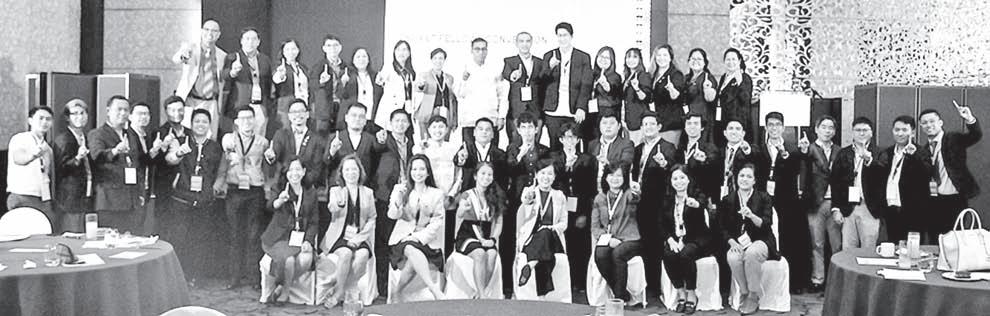
SCIENCE Secretary Renato U. Solidum Jr. (back row, eighth from left) and Undersecretary for R&D Leah J. Buendia (back row, seventh from left) lead the S&T Fellows in showcasing their researches at the recent second S&T Fellows Convention. DOST PHOTO
development. Caryl Maria Minette I. Ulay/S&T Media Service
Washington University in St. Louis/The Conversation (CC) via AP
Children play with water at a fountain during a heat wave at Stavros Niarchos foundation Cultural Center in Athens on July 21. A new study finds these intense and deadly hot spells gripping much of the globe in the American Southwest and Southern Europe could not have occurred without climate change. AP/PETROS GIANNAKOURIS
1,500 Filipino pilgrims headed to WYD in Lisbon
ACATHOLIC official estimated not fewer than
1,500 Filipino pilgrims are projected to travel to Portugal for this year’s World Youth Day, the largest gathering of young Catholics from around the world.
Father Jade Licuanan, executive secretary of the bishops’ Episcopal Commission on Youth, said the ECY delegation alone reached nearly 300 participants.
The pilgrims number more than twice the amount of ECY delegates who went to the WYD in Panama in 2019, which was only 99.
“The reliable data is with the local organizing committee in Portugal but our estimate is between 1,500 and 2,000 pilgrims coming from the Philippines,” Licuanan said.
Filipino delegates have started arriving in the European nation this week for the “Days in the Dioceses,” a preparatory journey for the pilgrims and the host community to experience the days around WYD.
Throughout these days, from July 26 to 31, the pilgrims will become acquainted with the host region, as well as the local Church. WYD organizers said more
SAUDI ARABIA has changed its decadeslong rule that mandated single women be accompanied by a male relative when performing an Islamic pilgrimage, facilitating the participation of thousands of single Muslim women in the Hajj in 2023 (June 26 to July 1).
The new rules don’t apply just during the Hajj. Women can also perform the Umrah, known as the “lesser pilgrimage,” or other routine pilgrimages, such as ziyarat that can be undertaken any time of the year to Islamic holy sites, without a “mahram,” or male guardian.
The fact that women can now travel unaccompanied is part of a campaign by the political leadership of Saudi Arabia to improve the rights of women in the kingdom, which Western societies view as oppressive.
My research looks at issues of identity and “covenantal pluralism,” which refers to the mutual obligations that different faith communities have toward one another to support the pursuit of each one’s spiritual truth.

I focus on the geographical area that encompasses the Indian Ocean, and I argue that these changes need to be viewed within a larger historical context and as they relate to Muslim women’s engagement with the sacred sites of Islam.
Saudi Arabia and the West THERE is no Quranic injunction against women’s traveling alone. Nevertheless, in some patriarchal societies where sexual harassment is common, restrictions are put on women irrespective of religious affiliation.
Currently, Islamic medieval-era injunctions are applied in Talibancontrolled Afghanistan.
However, Saudi Arabia is an exception. Conservative Sunni Muslim countries often see the kingdom, the birthplace of Islam, as the bulwark against Western secularization.
Medieval Islamic laws, such as capital punishment for apostasy, are used to give an appearance of authoritative piety in present times.
Indeed, the cities of Mecca and Medina are visible manifestations of piety.
than 67,000 pilgrims from 126 countries will be welcomed in 17 dioceses of mainland Portugal in the week leading to WYD in Lisbon from August 1 to 6.
The young people, divided into more than 950 groups, will stay in host family houses, parishes, public facilities and schools.
A bulk of the Philippine delegation will be coming from different dioceses, religious congregation, and lay church organizations.
The Archdiocese of Manila sent 34 delegates, while the Cebu archdiocese has 45 pilgrims. The Couples for Christ also has around 30 delegates.
Around 20 participants came from Pasig, which is sending an official delegation to WYD for the first time as a diocese.
In previous WYD celebrations, pilgrims from Pasig were always part of the delegation of the Manila archdiocese and the Diocese of Cubao.
Established by Pope John Paul II in 1985, the weeklong WYD celebrations usually attract hundreds of thousands of young people from across the globe. WYD takes place every three years and offers a deeper encounter
with Jesus Christ through liturgical celebrations, networking, faith sharing, catechetical sessions and prayer with the pope.
The triennial event was originally supposed to take place in 2022 but the Covid-19 pandemic forced organizers to postpone the event until 2023.
IP delegates
FOUR representatives from different Indigenous groups in the country are among the delegates attending the WYD in Portugal’s
capital of Lisbon next week.
The delegation arrived in Lisbon on Tuesday, led by Bishop Severo Caermare of Dipolog, vice chairman of the Episcopal Commission on Indigenous Peoples (ECIP) of the Catholic Bishops’ Conference of the Philippines.
Caermare presided over a Mass with the “IP youth representatives” at the San Lorenzo Catholic Student Center in Manila last Sunday.
In his homily, the bishop emphasized how the IP delegation
For example, the first wife of the Prophet Khatija was an independent businesswoman who initially hired the Prophet as an employee for her trading caravans.
What is also important to consider is that whereas the Hajj is the preeminent Muslim pilgrimage, additional sacred sites exist for Shiite pilgrimage in countries, such as Iran, Iraq and Syria.
In these countries there is no mahram rule, though the threat of violence in Iraq and Syria means that both male and female pilgrims who visit from abroad come in groups.
Community and camaraderie ISLAMIC pilgrimages are global gatherings of Muslims organized into groups, communities, and families in which the individual’s identity is a dynamic one.
The ultimate truth in Islam is the unity of God, and a Muslim pilgrimage is a manifestation of that unity through integration and service to the community.
In this integration, the individual ego is subsumed through a communal religious experience, which can be ecstatic.
Additionally, Islam is a religion of right action in which individuals find realization by integrating into the community.
peoples.”
“We will not waste this opportunity to showcase the culture of the Aeta tribe to the people,” Jugatan said. “As the culture bearer of our group, I am looking forward to having our identity recognized.”
Jugatan, who has long been a partner of the ECIP, is the chieftain of one of the Aeta communities in Zambales province.
An advocate for the preservation of their traditional clothing, Jugatan said he will be wearing his loincloth, or “bahag,” throughout the WYD gathering and during their visits to Portugal’s neighboring countries.
To enter the holy cities is to be transported into a ritual space of
sacred time based on the Muslim call to prayer, in which pilgrims from around the world unite in the idealized Prophetic vision of a nation of faith.
It is not a world of punctual appointments set by a work schedule. Rather, worshippers serve God through devotion in prayer in accordance with the ancient Islamic prayer timings set by the rhythm of the Sun and Moon.
Colonization created a dichotomy within the world where Islam was often seen to be the opposite of the values of the West.
Keeping women segregated from male worshippers, and viewing that separation as an expression of piety, is part of the rejection of Western norms while legitimizing the Islamic credentials of the Saudis both domestically and internationally.
Insider perspectives GENERALLY in mosques around
the world, women and men worship separately. To some, it may appear to violate the norms of Western egalitarianism, but it’s an ancient practice meant to encourage a spiritual intimacy and fellowship.
Until now, single women who did not have a male relative to escort them to the Two Holy Mosques—Al Masjid Al Haram in Mecca and the Prophet’s Mosque in Medina—would join an organized tour group of women.
Their accommodations, meals, sermons and prayers would be organized together.
Interestingly, the holiest site in Islam—the mosque in Mecca—is circular, and historically men and women have worshipped openly together with few, if any, barriers.
These barriers, erected for women in Saudi Arabia in the 20th century, are being removed in accordance with the older prophetic tradition of women’s independence.
The communal model of pilgrimage helps them go through a physically demanding schedule of ritual observance and creates camaraderie, that continues beyond the pilgrimage.
The changes to the mahram rule allowed single Muslim women to join the Hajj pilgrimage in 2023. Over 4,000 women from India performed the Hajj without a male guardian.
Nonetheless, community participation remains important, and most women do not actually travel alone. A majority of women join groups that share the same language, rituals, and cuisine to facilitate navigation of the foreign world of Muslim religious tourism.
The reshaping, reinterpretation, and reconstruction of Islamic pilgrimages has been going on for centuries; this time, women are leading it.
Iq bal Akhtar, Florida International University/The Conversation (CC) via AP
can share their “sense of trust in God and their sense of respect for nature” with other WYD pilgrims.”
“To the Indigenous people’s delegates, I wish you all the best on this particular pilgrimage,” Caermare said, “as you try to be as you are, as indigenous. We, at the same time, are all one as we journey together in the fullness of the Father’s love.”
Aeta leader Tubag Jugatan said that their invitation to the WYD “strengthens the ties between the Church and the Indigenous
CATHOLIC tradition offers occasional examples of holy men and women whose bodies, exhumed some years after death, remained completely or partially untouched by the natural process of decay.
Sometimes, witnesses have also reported the scent of flowers instead of the odor of decay from the open coffin; others have described seeing a bright light illuminating the grave itself.
These are examples of a rare phenomenon referred to as incorruptibility.
Clergy and laypeople sometimes argue these are special signs from God that the person should be venerated as a saint.
Officially, however, incorruptibility is no longer considered a miracle, a requirement for proclaiming someone a saint.
As a specialist in Catholic liturgy and ritual, I know that these occurrences have a long and complicated history.
Past evidence
TECHNIQUES for anointing and embalming the bodies of the dead were well known in the ancient Near East and were used occasionally in Greek and Roman antiquity.
However, in early medieval Europe, these techniques were rarely used until they were rediscovered in the later Middle Ages (from 476 A.D. that spanned about 1,000 years, ending between 1400 and 1450) and practiced well into the Renaissance (after the Middle Ages to modernity covering the 15th and 16th centuries).
As medical knowledge expanded, these procedures became more sophisticated. Since the 18th century, church officials seriously considered other factors that could have rendered a body more immune from decay, like attempts at embalming or burial conditions supporting natural mummification.
Nonetheless, for many Catholics, incorruptibility was a sign of sanctity. There were also instances of partial incorruptibility, when only a part of the body would remain untouched by decay.
These would also be preserved in a church or shrine and venerated by pilgrims.
Thousands of Catholics turned up to view the right arm of the 16th-century Jesuit missionary St. Francis Xavier, which was taken on a pilgrimage tour of Canada in 2017 and 2018.
This saint, who became famous for baptizing thousands of people in Asia, was buried on an island off China upon his death.
His body, considered incorrupt, was later returned to Goa in India, where the right arm was cut off and sent to the Jesuits in Rome.
Over time, other parts of the body were also removed for veneration in other locations.
Today, the incorrupt body of a saint is no longer considered a miracle in support of a canonization, although a report can still prompt Catholics to travel to venerate it.
In April 2023, for example, thousands of pilgrims traveled to Missouri to view the body
As a first-time WYD participant, Jonalyn Camanso, a member of the Bukegnon-Magahat tribe in Negros Occidental, is looking forward to the experiences that await her in Lisbon.
“Back then, we found ourselves only reserved to the mountains. But now, we are happy to be able to join these kinds of gatherings,” she said.
Also joining the IP delegation are Jose Paje of the Higaonon tribe from Misamis Oriental in Mindanao and Arci Bandas of the Kankanaey tribe from Benguet. CBCP News
of the founder of the Benedictine sisters of Gower, an independent monastic community of women following precepts set by sixthcentury Italian monk Saint Benedict of Nursia. Sister Wilhelmina Lancaster died in 2019, but her body and religious clothing were found to be virtually intact when her coffin was opened in 2023.
Why it matters today
CONTEMPORARY Catholic teaching situates the phenomenon of incorruptibility in the context of Christ’s resurrection from the dead and ascension into heaven.
Elsewhere in the New Testament, Saint Paul stresses this, and, like most Christian churches, the Catholic Church emphasizes that the resurrection of the faithful from the dead at the end of time will be like “Christ’s own resurrection.”
The incorrupt bodies of some saints are understood to be a sign of that promise.
Usually, the incorrupt body is taken to a nearby church soon after its discovery and displayed to the faithful, often in a glass tomb. Since these remains frequently decay naturally after exhumation, the face and other parts may be covered with wax or silicone.
Catholics have always viewed saints as intercessors and partners in prayer, whether in gathering by their graves or venerating their relics, which could include pieces of bone, hair, ashes or clothing they have left behind. Even today, pilgrims travel miles to pray by the remains of these “incorruptibles.”
This is understood to be an exceptional expression of what Pope Francis has called the “mysterious solidarity in Christ” between the living and the dead in expectation of eternal life to come.
153 incorrupt saints, blessed and venerable persons
THE Roman Catholic Saints website listed 153 incorrupt saints, and blessed and venerable men and women.
In the Catholic Church, the title “Venerable” is bestowed on a deceased person in the first of three stages leading to beatification (with the title of “Blessed”) and canonization (with the title of “Saint”).
Among the the popular sain ts who are incorrupt are Teresa of Avila, Catherine of Genoa, Cecilia, Catherine of Siena, Claire of Assisi, Philip Neri, Francis de Sales, Francis Xavier, Jean-Marie-Baptiste Vianney, John Bosco, John of the Cross, Maria Goretti, Martin de Porres, Padre Pio of Pietrelcina, Rose of Lima, and Vincent de Paul.
Also includ ed on the list are Saints Agatha, Agnes of Montepulciano, Albert the Great, Alphege of Canterbury, Andrew Bobola, Angela Merici, Annibale Maria di Francia, Anthony Maria Zaccaria, Antoninus, Benedict the Moor, Benezet, Bernadette Soubirous, and Bernardine of Siena. Joanne M. Pierce, College of the Holy Cross/The Conversation (CC) via AP and Roman Catholic Saints website
Faith Sunday A6 Sunday, July 30, 2023 Editor: Lyn Resurreccion • www.businessmirror.com.ph
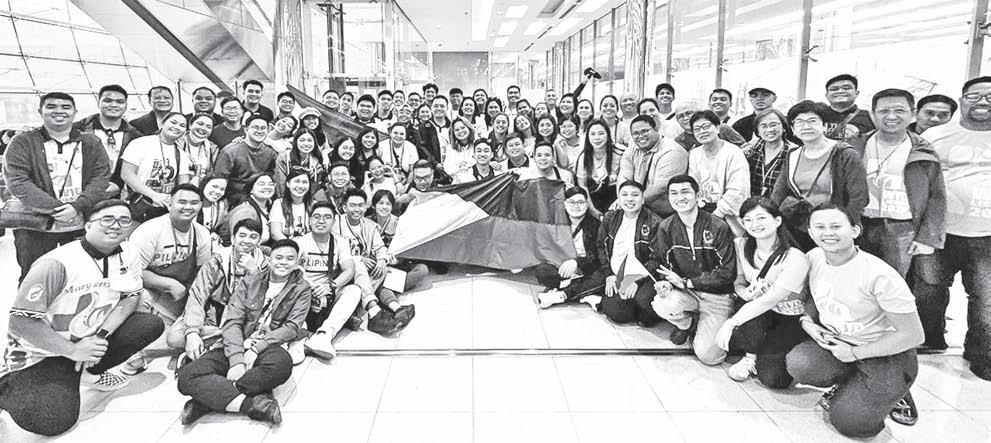
WORLD Youth Day pilgrims from the Archdiocese of Cebu and the dioceses of Antipolo and Pasig arrive in Lisbon, Portugal on July 25. DIOCESE OF PASIG
Why some saints’ bodies are incorrupt
In Saudi, women can now go on Islamic pilgrimages with no male guardian
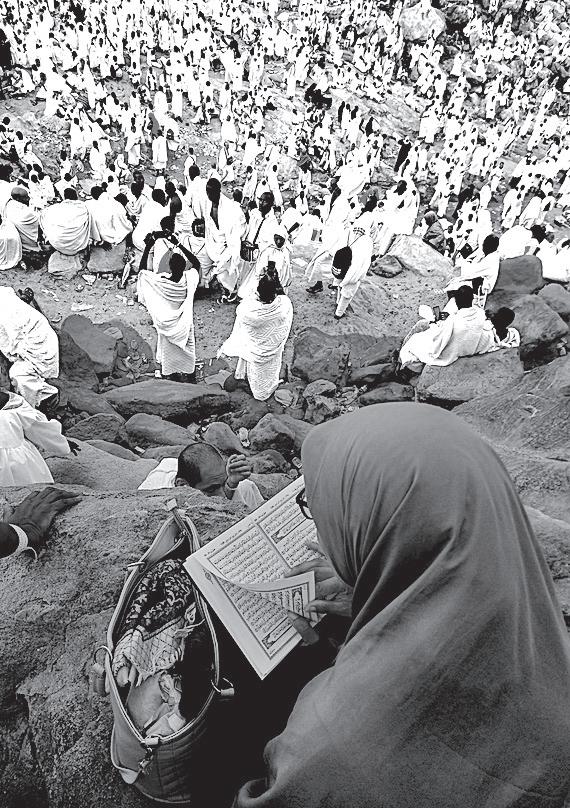
A WOMAN pilgrim (foreground) with other pilgrims supplicating on Mount Arafat during hajj.
According to Islamic tradition, the hill is the place where the Prophet Muhammad stood and delivered the Farewell Sermon. FAHAD FAISAL/WIKIPEDIA CC BY-SA 4.0
A8 SundAy, July 30, 2023
mirror_sports@yahoo.com.ph
Editor: Jun Lomibao
SAUDI POURING BILLIONS INTO ESPORTS INDUSTRY
sabre event during the International Fencing Federation grand prix in Seoul, South Korea, April 29, 2023. AP
Ukraine eases boycott policy over athletes hoping to make Paris Olympics
KYIV, UKRAINE—Ukraine has signaled it will no longer bar its athletes from competing against Russians who are taking part in sporting events as “neutral athletes,” a significant easing of its boycott policy a year before the Paris Olympics.
A decree dated Wednesday says Ukrainian athletes and teams will only be required to boycott if competitors from Russia or Belarus are competing under their national flags or other symbols, or have signaled allegiance to either of those countries in another way.
T he change in policy could smooth the way for Ukrainians to compete at next year’s Paris Olympics. Ukrainian athletes previously boycotted events which allowed Russians and Belarusians as “individual neutral athletes,” the preferred term of the International Olympic Committee (IOC). It wasn’t immediately clear how the decree would be implemented in practice, but at least one leading Ukrainian athlete competed against a “neutral” Russian competitor on Thursday.
Olympic champion Olga Kharlan competed against officially-neutral Russian opponent Anna Sminorva at the world fencing championships— an Olympic qualifier—on Thursday in Milan, Italy, winning their bout 15-7. However, Sminorva refused to leave after the bout in an apparent protest because Kharlan refused to shake hands at the end.

The IOC favors allowing Russians and Belarusians to compete as “neutral athletes” without national symbols in Olympic qualifying events. The governing bodies of most Olympic sports have either adopted the IOC policy already or are working on plans to do so.
T he IOC still recommends barring Russia and Belarus from team sports and excluding athletes who are contracted to the military or security forces. AP
DUBAI, United Arab Emirates—Saudi Arabia, the new home of some of soccer’s biggest stars and a co-owner of professional golf, is proving to be no less ambitious when it comes to another global pastime—the $180 billion-a-year video game industry.
L ast September, the Saudi sovereign wealth fund earmarked nearly $40 billion for a new conglomerate aimed at transforming the kingdom into the “ultimate global hub” for games and esports by 2030.
I n February, the Saudi fund became the biggest outside investor in nintendo, and just this month the kingdom hosted a major gaming tournament with a record $45-million prize pool.
Th at’s made Saudi Arabia an increasingly important player in the industry and contributed to its breakneck transformation from an insular kingdom best known for oil and ultraconservative Islam into an emerging sports and entertainment powerhouse.
The move into gaming has sparked the same kind of backlash seen in soccer and golf, where critics accuse the Saudis of “sportswashing” human rights abuses, including the 2018 killing of Washington post columnist Jamal Khashoggi, a Saudi dissident.
W ith gaming, a kingdom that sentences people to decades in prison over a few tweets is joining a worldwide community dominated by the young and very online.
“ It’s the romans and the colosseum all over again, and you have countries at the top layer using sports as a theater to display their wealth and their power,” said Joost Van Dreunen, a professor at New York university who has written a book
THE Philippines clinched a women’s bronze medal for a breakthrough finish in the recent world fairplay soccer championship in Proca, Germany.

A Payatas-based squad defeated Mongolia via penalty, 3-2, for the Philippines’ best finish in the competition.
The Payatas girls wound up with 10 wins, two draws and two losses in the unique 3×3 tournament played three minutes per game in a doubleround robin system that determines which teams advance deeper into the competition.
The team beat USA in the quarterfinals but yielded to eventual champion Latvia to settle for the battle for third place with group
Coke backs PFF Women’s League
COCA-COLA Philippines announced recently its partnership with the Philippine Football Federation (PFF) as a major sponsor of the PFF Women’s League 2023.
Coca-Cola will support top local women’s football clubs and promote gender equity in sports while inspiring the next generation of athletes.
The partnership was announced during the free viewing party of the FIFA Women’s World Cup 2023 match between the Filipinas and New Zealand , which Coca-Cola Philippines co-presented. E xcited football fans flocked
about the business of video games.
You have to ask the question: who is the architect behind this, and what are the intentions of these architects?,” he said.
Saudi Arabia’s 37-year-old crown prince Mohammed bin Salman, reportedly an avid gamer himself, sees the foray into gaming as part of vision 2030, his ambitious plan to overhaul the kingdom’s economy, reduce its reliance on oil and provide jobs and entertainment for its youthful population.
“ We are harnessing the untapped potential across the esports and games sector to diversify our economy,” he said last September, when he announced the establishment of the savvy games group.
O wned by Saudi Arabia’s $700-billion public investment fund and led by CEO Brian Ward, an industry veteran, savvy aims to invest $39 billion in the gaming industry. It hopes to establish 250 local companies and create 39,000 jobs in the next seven years.
E arlier this month, it completed the $4.9-billion purchase of Scopely, the creator of “Monopoly Go,” “star trek fleet command” and “marvel strike force.”
Gaming is a massive and fastgrowing industry. Market research firm Newzoo says an estimated 3.2 billion people play games on pcs, consoles, mobile devices or cloud gaming services, with the industry generating $184.4 billion in revenues in 2022.
Gaming brings in more money than the combined earnings of the global box office, music streaming and album sales, and the top five wealthiest sports leagues, according to a 2021 report by the Boston consulting group
The kingdom is also breaking into
the world of esports, competitions pitting the world’s top players against one another in games ranging from battle royales and first-person shooters to “FIFA” soccer and “madden NFL.”
To the uninitiated, the prospect of watching other people play video games may seem unappealing, but it’s a huge business with millions of fans, celebrity players and corporate sponsors. A 2021 esports tournament in Singapore drew 5.4 million concurrent viewers.
When you invest in esports you are getting prime advertising opportunities, and of course, you are promoting the brand of your country as a cool, forward-thinking, interesting place to go on holiday,” said Christopher Davidson, a gulf expert at the European center for international affairs, a Brussels-based think tank.
“[esports] is far younger and more global than any other sport,” he added. “English soccer is popular everywhere in the west, but not really in an average-sized Chinese city. But these esports are.”
L ast summer, Saudi Arabia hosted gamers8, a week-long tournament with a $15-million prize pool. The event returned this month with a prize pool three times as large.

Saudi Arabia’s wealthy gulf neighbors are also looking to get in on the action. Dubai, in the United Arab Emirates, hosted a five-day esports festival last month. The Qatar investment authority recently purchased a minority stake in monument sports & entertainment, which owns the Washington wizards and capitals, as well as esport holdings. The growing involvement of autocratic gulf states has sparked debate within the gaming community.
Payatas girls 3rd in Fairplay soccer
R iot games, the developer of the popular “League of Legends,” a multiplayer battle game, and danish tournament organizer blast premier both canceled partnerships with Saudi Arabia in 2020 following an outcry from fans. Blast went on to hold its world finals in Abu Dhabi, the capital of the UAE, where it faced similar criticism
Team liquid, an esports organization that represents 60 champion players across 14 games, announced in December that it would donate half its winnings from recent competitions in Saudi Arabia and the UAE to an organization that helps LGBTQ+ individuals escape violence and persecution.
Homosexuality is considered taboo in most of the Middle East and is criminalized in Saudi Arabia and the UAE, though prosecutions are rare. Both countries also outlaw any form of LGBTQ+ advocacy.
The team liquid statement acknowledged the financial and ethical trade-offs of accepting sponsorship from such countries.
“ These events present real opportunities for our players, many of whom may have short careers with few guarantees,” it said. “An outright boycott might not only end careers, it could end our involvement in some esports entirely.”
Stanis Elsborg, a senior analyst at play the game, an international initiative that aims to promote ethics in sports, and who has written extensively on the intersection of esports and the gulf’s ambitions, says it’s a dilemma that is likely to recur.
“ Money talks,” he said. “I think the esports scene will be following the same trajectory as we have seen in other sports, forming significant partnerships.” AP
stage leader Mongolia—which bowed to Italy in the other semifinal.
The men’s team could only reach the quarterfinals but five of the eight players on both boys and girls teams are expected to earn varsity football scholarships in different schools.
O ne of the other players in the boys’ team is an incoming college senior, while another has enrolled in the alternative learning system.
Fairplay works to the level the playing field, creating opportunities for kids community to break the cycle of poverty through holistic mentoring.
Payatas sports center caters to some 200 kids who play every week. The youth center has 63 fairplay scholars and the fairplay cafe caters 500 meals every week.
Transgender swimmers to be included in trial of open category events
FUKUOKA , Japan— Swimming will set up an “open category” that will include transgender competitors, the governing body of the sport said Tuesday.
World aquatics president Husain Al-Musallam said the event would take place in the future among other races but gave no details. Reports suggest it could be this year.
This is a very complex topic,”AlMusallam said at the World Aquatics Congress in the southwestern Japanese city of Fukuoka. “But I am delighted to tell you today that we are now making plans for the first trial of an open category, and we hope to be able to confirm all the details soon.
Our sport must be open to everybody,” he said.
World Aquatics had previously banned transgender competitors from major events like the Olympics and World championships. The topic has been divisive and many governing bodies in major sports have avoided it. And there will be many questions to answer as the first trial event unfolds under the eyes of lawyers and scientists.
“
It was very important that we protected fair competition for our female athletes,” Al-Musallam said. “But you have heard me say many times there should be no discrimination. Nobody should be excluded from our competitions.”
to the Up Town Center on Wednesday to show their unwavering support for the Filipinas and were delighted to witness the country’s historic win, 1-0, in the global tournament.
We congratulate Filipinas for bringing honor to the country. We are proud to have brought sports fans together to witness the country’s first-ever goal and first-ever win in the World Cup,” said Coca-Cola Philippines President Tony del Rosario.

“Coca-Cola has been a proud supporter of the Women’s World Cup since the inaugural tournament in 1991, and through our ‘believing is magic’ cam-
paign, we are happy to create excitement and moments of real magic for people in the Philippines and around the world as we refresh the shared experience of the tournament,” he added.
We are delighted that CocaCola Philippines has partnered with PFF to support women’s football by agreeing to be a major sponsor of the PFF women’s League,” PFF President Mariano Araneta said. “It is great to have a brand like Coca-Cola support women’s football, especially with the Filipinas creating history in their maiden participation in the FIFA women’s World Cup 2023.”
We hope that this partnership can foster the development of upand-coming women’s players.”
I n March 2022, American swimmer Lia Thomas won the women’s 500-yard freestyle at the NCAA championships in Atlanta, becoming the first transgender woman to claim a national title in swimming.

T homas became a leading symbol of transgender athletes— stirring both opposition and support—when she joined the University of Pennsylvania women’s swim team after competing for three years on the men’s squad at the Ivy League School.
The state board of education, meanwhile, delayed Wednesday action on a proposal that would bar transgender girls from participating on high school girls’ athletic teams in Alaska, with several board members saying they wanted more time to consider the issue.
Sports BusinessMirror
GAMING fans dressed in cosplay outfits attend the Dubai esports and games festival while others take souvenir photos in Dubai, United Arab Emirates, recently. AP
UKRAINE’S Olga Kharlan reacts after defeating France’s Cyrielle Rioux in a women’s
AP
THOMAS
MEMBERS of the Fairplay team from Payatas are proud of their third place finish in Germany.
FANS cheer the Filipinas during a free viewing party.
Biodiversity Sunday
Editor: Lyn Resurreccion

Corals starting to bleach as global ocean temperatures hit record highs
THE water off South Florida is 32 degrees Celsius (32°C) in mid-July, and scientists are already seeing signs of coral bleaching off Central and South America.
Particularly concerning is how early in the summer we are seeing these high ocean temperatures. If the extreme heat persists, it could have dire consequences for coral reefs.
Just like humans, corals can handle some degree of stress, but the longer it lasts, the more harm it can do.
Corals can’t move to cooler areas when water temperatures rise to dangerous levels. They are stuck in it. For those that are particularly sensitive to temperature stress, that can be devastating.
I lead the Coral Program at the National Oceanic and Atmospheric Administration’s (NOAA) Atlantic Oceanographic and Meteorological Lab in Miami, Florida. Healthy coral reef ecosystems are important for humans in numerous ways. Unfortunately, marine heat waves are becoming more common and more extreme, with potentially devastating consequences for reefs around the world that are already in a fragile state.
Maynilad dredges 7.2 hectares of Laguna Lake to reduce turbidity
WEST Zone concessionaire Maynilad Water Services, Inc. completed the dredging of the Laguna Lake portion near its water treatment facility in Putatan, Muntinlupa, to help reduce siltation and, thus, manage the impact of high raw water turbidity on its operations, Maynilad said in a news release.
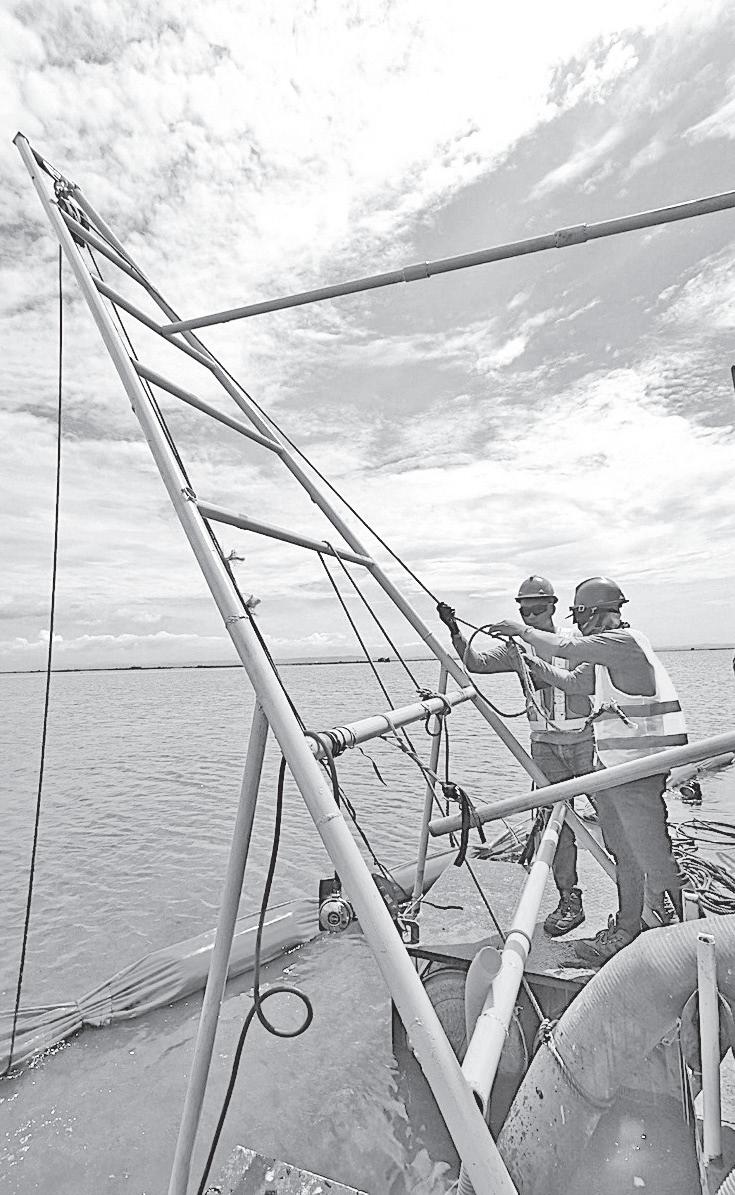
Maynilad workers scoured almost 7.2 hectares of the lake’s surface area, removing more than 50,000 cubic meters of silt from the lake bottom.
The lake dredging near its treatment plant is a short-term solution to problems of high raw water turbidity in Laguna Lake, which the
government can reinforce with its own effort of cleaning and dredging the entire lake.
Besides dredging, Maynilad is also pursuing other long-term solutions to address the raw water quality issues in Laguna Lake and ensure sustained water service availability for customers in the south.
Among these are the installation of ultrasonic algae control equipment and silt curtain around its treatment facilities, more frequent replacement of filters, and regular clean-up of tributaries that drain out to Laguna Lake to protect its water quality and ensure its sustainability as a source for drinking water.
Why coral reefs matter to everyone CORAL reefs are hot spots of biodiversity. They are often referred to as the rainforests of the sea because they are home to the highest concentrations of species in the ocean.
Healthy reefs are vibrant ecosystems that support fish and fisheries, which in turn support economies and food for millions of people.
Additionally, they provide billions of dollars in economic activity every year through tourism, particularly in places like the Florida Keys, where people go to scuba dive, snorkel, fish and experience the natural beauty of coral reefs.
If that isn’t enough, reefs also protect shorelines, beaches and billions of dollars in coastal infrastructure by buffering wave energy, particularly during storms
and hurricanes.
But corals are quite sensitive to warming water. They host a microscopic symbiotic algae called zooxanthella that photosynthesizes just like plants, providing food to the coral.
When the surrounding waters get too warm for too long, the zooxanthellae leave the coral, and the coral can turn pale or white—a process known as bleaching.
If corals stay bleached, they can become energetically compromised and ultimately die.
When corals die or their growth slows, these beautiful, complex reef habitats start disappearing and can eventually erode to sand.
A recent paper by John Morris, a scientist in my lab in Florida, shows that around 70 percent of reefs are now net erosional in the Florida Keys—meaning they are losing more habitat than they build.
Unfortunately, these critical coral reef habitats are in decline around the world because of extreme bleaching events, disease and numerous other humancaused stressors.
In the Florida Keys, coral cover has decline by about 90 percent over the past several decades.
Coral bleaching in 2023
IN the Port of Miami, where we have found particularly resilient coral communities, doctoral candidate Allyson DeMerlis documented the first
coral bleaching of her experimentally outplanted corals on July 11.

Other scientists we work with have reported coral bleaching off of Colombia, El Salvador, Costa Rica and Mexico in the eastern Pacific, as well as along the Caribbean coasts of Panama, Mexico and Belize.
We have yet to see widespread coral death associated with this particular marine heat wave, so it is possible the corals could recover if sea surface temperatures cool down soon.
However, global sea surface temperatures are at record highs, and large parts of the Atlantic and eastern Pacific are under bleaching alerts.
At this point, the evidence points to the potential for a very negative outcome.
El Niño is contributing to the problem this year, but the longerterm trends of rising ocean heat are driven by global warming fueled by human activities.
To put that into context, a paper by NOAA scientist Derek Manzello showed that in the Florida Keys, the number of days per year in which water temperatures were higher than 32 C had increased by more than 2,500 percent in the two decades following the mid-1990s relative to the prior 20 years.
That is a remarkable increase in the number of days that corals are
experiencing particularly stressful warm water.
What can we do to protect corals?
FIRST, we cannot give up on corals.
Alice Webb, a coral reef scientist working with our group, recently published a study based on years of our research in the Florida Keys. She modeled reef habitat persistence under climate, restoration and adaptation scenarios and found that protecting reefs is going to take everything—active restoration of reefs, helping corals acclimate or adapt to changing temperatures and, importantly, human curbing of greenhouse gas emissions.
Major restoration efforts are underway in the Florida Keys as part of the NOAA-led Mission Iconic Reefs.
We are also assessing how different coral individuals perform under stress, hoping to identify those that are particularly stress-tolerant by combing through the massive amounts of data from restoration projects and coral nurseries.
We are also evaluating stresshardening techniques. For example, in tide pools, corals are exposed to large swings in temperature over short periods, making them more resilient to subsequent thermal stress events.
We are exploring whether it’s possible to replicate that natural process in the lab, before corals are planted onto reefs, to better prepare them for stressful summers in the wild.
Coral bleaching on a large scale has really been documented only since the early 1980s. When I talk to people who have been fishing and diving in the Florida Keys since before I was born, they have amazing stories of how vibrant the reefs used to be. They know firsthand how bad things have become because they have lived it. There isn’t currently a single silver-bullet solution, but ignoring the harm being done is not an option. There is simply too much at stake. Ian Enochs, NOAA/The Conversation (CC) via AP
Eco group promotes refill system, urges ban on single-use plastics
Story & photo by Reine Juvierre S. Alberto
IN the past, until around the 1970s, Filipinos could buy items in palengke (markets) and nearby sari-sari (variety) stores by bringing their own containers for cooking oil, soy sauce and other condiments, while wet products like fish and meat were wrapped in used paper or banana leaves, and carried in native bags.
Afterwards, everything has started to be packed in plastic, or the smaller sachets, because of the convenience it offers. It has changed the consumer’s behavior and discipline.
Single-use plastics (SUPs) are cheap and convenient, yet, it worsens the already severe Philippine plastic crisis.
In support of “Plastic-free July,” pollution watchdog EcoWaste Coalition urged for “Tama na ang plastikan” (Total ban of single-use plastics) through a refill caravan in Balintawak, Quezon City on July 22.
The one-day caravan was participated in by local businesses offering to refill empty containers brought by customers with essentials, such as personal care products, pantry staples and clothing.
“Refill is an alternative delivery system without plastic packaging.
You just have to bring your own container, like in the ‘tingi’ [retail] system,” said Aileen Lucero, national coordinator of EcoWaste Coalition.
Plastic reuse advocate Sabon Express distributed liquid detergent, fabric conditioner, dishwashing liquid and hand soaps through refills at a much lower price, while alternative grocery
Back to Basics Ecostore sold spices, condiments and snacks.
Shampoos, soaps and feminine wash are packaged into bars to promote zero waste, while reusable sanitary pads and cotton pads are sold as well to reduce waste.
Also up for grabs were recycled fabrics, such as katsa (flour sacks) sewn into polo shirts, shorts, bucket hats and tote bags, while pieces of denim are turned into stuffed toys.
Refill equals zero waste
THE concept of refill, Lucero explained, is going toward zero waste since it contributes to the goal of not generating any waste caused by disposable plastic packaging.
On a daily basis, Filipinos use more than 163 million plastic sachet packets, 48 million sando
bags, and 45 million labo (translucent) plastic bags, according to the waste assessment and brand audit by the Global Alliance for Incinerator Alternatives.
The top five most problematic types of plastic products and packaging, according to “Break Free From Plastic’s” report, are sachets, polyethylene terephthalate bottles, low-density polyethylene found in plastic labo, polyvinyl chloride and Tetra Pak.
Only 2 percent of the collected plastic waste in the Philippines can be recycled, leaving 98 percent of
single-use plastics collected unrecyclable, and having no economic value, cited in the same report.
Lucero said that instead of throwing out the food containers, consumers could just reuse those along with the jars and bottles they already have to get refills of what they need, such as basic condiments or household products, which are accessible and can be alternatives to single-use plastics.
National ban on SUPs TWENTY years after the enactment of the Republic Act 9003, or
the Ecological Solid Waste Management Act of 2000, the complete list of non-environmentally accepted products (NEAP) is still not released, with only plastic straws and coffee stirrers banned.
The list of NEAP, Lucero said, will supposedly be the guide for manufacturers and the packaging industry to know how their products should be packaged and what materials are accepted and environment-friendly.
Although several local government units in Metro Manila have banned single-use plastics, it still proliferates, and with their adjacent cities having no restrictions, it will have no effect, Lucero noted, since those cities share the same water stream.
Also connected to behavioral change, Lucero illustrated that people from the provinces to live in Manila were used to be using bayong (native palm shopping bag) but now use plastic bags because there is no nationwide ban of SUPs.
“We’re calling for the national banning of single-use plastics because there are alternatives and existing best practices. We just have to intensify the promotion, make it mainstream to the public and the youth,” Lucero urged, calling
on the assistance of manufacturers in creating plans and programs to eliminate plastic packaging in their products.
Starting the advocacy through micro-, small, and medium-sized enterprises, which make up 99 percent of business establishments in the Philippines, Lucero said they have a wider reach in promoting refills and change in lifestyle, while also generating employment and supporting locally-sourced products.

Lucero said the Philippines is not ready for the Extended Producer Responsibility Act, obliging companies to have “proper and effective recovery, treatment, recycling or disposal of their products after they have been sold and used by consumers” because there’s no system and infrastructure, and single-use plastics cannot be recycled.

Instead, companies should redesign their products and packaging while setting up their system and infrastructure, Lucero added.
“At the end of the day, the consumer will always rely on what the manufacturers have to offer. If the manufacturers cannot bring their products via refill, consumers will always rely on sachets and singleuse plastics,” Lucero pointed out.
A7
Sunday, July 30, 2023
BusinessMirror Asean Champions of Biodiversity Media Category 2014
IN this NOAA image, a fish swims near corals showing signs of bleaching at Cheeca Rocks off the coast of Islamorada, Florida, on July 23. Scientists have seen devastating effects from prolonged hot water surrounding Florida—coral bleaching and some death. ANDREW IBARRA/NOAA VIA AP
MAYNILAD workers are shown in the photo operating the dredging equipment, scouring almost 7.2 hectares of the lake and removing more than 50,000 cubic meters of silt from the lake bottom.
THE plastic-free caravan sells liquid detergent, fabric conditioner, dishwashing liquid and hand soaps through refills at a much lower price, while shampoos, soaps and feminine wash are packaged into bars.
X? Answering the burning questions on elon Musk’s twitter pivot


BusinessMirror July 30, 2023
LOUDER THAN WORDS | ‘tick, tick…BOOM!’ takes centerstage again this August
By Reine Juvierre S. Alberto
Interviews by Edwin P. Sallan
WE’VE all been there—internally hearing the ticking of the clock as we see how the paths lay right before us.
Ti ck...friends getting married and having kids. Tick...friends traveling in different countries. The pressure sets in. Tick...friends opening new businesses left and right... Tick BOOM!
You question yourself, “Am I being left behind?”
No, you are not alone in the anxiety-driven war of figuring out what to do with your life as you get older day by day. There will always be a book, song, or movie that will resonate with how you feel. But here is something timeless—a musical written decades ago, but will always remain relevant because of its truthfulness.
It’s tick, tick...BOOM!, a musical about a group of twenty-somethings trying to find their way in New York during the 90s. Created in the 90s by Jonathan Larson, he drew inspiration from his own personal struggles as a young adult trying to make a name for himself in theater in the 80s.
Like most millennials and Generation Zs, Jon, the protagonist in the musical, also hears the constant ticking—a reminder that he is getting older, turning 30,
Publisher :
Editor-In-Chief :
Concept :
Y2Z Editor :

SoundStrip Editor :
Group Creative Director :
Graphic Designers :
Contributing Writers :
T. Anthony C. Cabangon
Lourdes M. Fernandez
Aldwin M. Tolosa
Jt Nisay
Edwin P. Sallan
Eduardo A. Davad
Niggel Figueroa
Anabelle O. Flores
Tony M. Maghirang, Rick Olivares, Patrick Miguel
Jill Tan Radovan
Reine Juvierre Alberto
Photographers :
Bernard P. Testa
Nonie Reyes
with little to show. He is also driven by pressure when his girlfriend, Susan, hounds him about leaving New York to start a family and seek a more stable profession, while his best friend, Michael, an actor-turned-marketing executive, convinces him to join the industry and have a comfortable life.
“ Years are getting shorter, lines on your face are getting longer. Feel like you’re treading water, but the riptide’s getting stronger.”–30/90 from tick, tick...BOOM!
T his musical is also a must-watch for struggling artists and creatives because, at some point, they chose or are still choosing between these two equally important things: passion or money.
I n this 9 Works Theatrical (9WT) restaging of Larson’s critically-acclaimed musical on August 2023 at the RCBC Plaza in Makati City, the sound of “tick... tick...tick...” might stop for a while for those under pressure, creatives, theater and film enthusiast, or anyone really.
tick, tick...BOOM! is starred by multi-awarded actor and musical composer Jef Flores, who will be reprising his role as Jon. Alternating with him is GMA actor and 2 cool 2 be 4gotten star Khalil Ramos in his musical theater debut.

Making a mark without giving up spark
HAVING won a “Best Actor Award” for the same role back in 2016, Jef Flores told the BusinessMirror, “We’re finding a lot of new things this time. It’s going to be a bigger, more fun, and more exciting show.”
When asked if there is a change in approach towards his role this time, he said, it is taking the amount of stress his character is going through.
Si milar to Jon, Flores is also a composer and admitted that he is an “aging artist,” but unlike his role, who questioned if his career is going to feed and sustain him, Flores said, “We’re going to keep on living our art, keep on making music, and keep on making shows to make art.”
“ This show deals with turning a page in your life and considering giving up your passions. I am lucky to be doing this show because I get to continue living my passions,” he said.
G iven that he had no professional experience in theater, Khalil admitted there was fear, and was intimidated by the medium since he said, “The stage doesn’t have take twos.” But despite being a new experience for him, he said theater also felt familiar.
“ My experience would really come from being an actor in TV and film and
as a singer,” he told BusinessMirror. Khalil started his singing career in 2011 and began acting in 2012.
Regarding the pressures from audiences, he said, “It is normal to feel that,” but, “I’m coming from the expectation of an Academy Award-nominated performance... but as an actor, it shouldn’t be the number one thing that you’re worried about.”
“I’m taking it now as an actor, just to really strive to bring out the truth as much as I can in my own way,” he said, and not like the other acclaimed actors who played Jon like Andrew Garfield, Raul Esparza, or Lin-Manuel Miranda. He said emulating one of them would be him portraying Garfield as Jon; “I have to play Jon,” he said.
Tanya Manalang will also reprise her role as Susan while alternating with her is Kayla Rivera. The role of Michael will be portrayed by Vien King, and alternating with him is Reb Atadero. In this three-person musical, the actors will be mixed and matched in each show.
The musical is directed by Robbie Guevarra, with Daniel Bartolome as musical director, and JM Cabling as choreographer.
tick, tick…BOOM! will be showing all weekends of August 2023 at 3:00 pm and 7:30 pm on Saturdays and Sundays, at the CPR Auditorium, RCBC Plaza in Makati. Tickets are now available via ticket2me.net.
BusinessMirror YOUR MUSIC 2
& SOUNDSTRIP are published and distributed free every Sunday by the Philippine Business Daily Mirror Publishing Inc. as a project of the The Philippine Business Mirror Publishing, Inc., with offices on the 3rd Floor of Dominga Building III 2113 Chino Roces Avenue corner Dela Rosa Street, Makati City, Philippines. Tel. Nos. (Editorial) 817-9467; 813-0725. Fax line: 813-7025
Y2Z
893-1662; 814-0134 to 36. www.businessmirror.com.ph
Advertising Sales: 893-2019; 817-1351,817-2807. Circulation:
JULY 30, 2023
KHALIL RAMOS JEF FLORES
CAST of Tick Tick Boom
GROWING, CHANGING
Tiggi Hawke celebrates new biographical album ‘Ascension’
 By Patrick V. Miguel
TWO years ago, if someone had told Tiggi Hawke that she would release an album, her answer would be “No,” expressing pure disbelief. She wrote songs, however, and as she described it, everything fell into place that made her newest album Ascension whole.
T iggi said Ascension is about her journey, changing and growing into the person that she is right now.
“Ascension is about the kind of journey that I’ve had in the last couple of years and how those couple of years have changed me,” she said.
The London-based singer added, “The songs were written through that time, so they tell a story of how I’ve changed, and how I feel like I’ve grown into who I am now versus who I was in the beginning.”
“ I still have so much growing to do… but I did feel like the album helped me do that,” she reflected.
T his explains when she said Ascension is autobiographical in a way. The songs were mostly about her and her journey, after all.
“ I tend to write my music from personal experience because I feel like I can relate to it more and I don’t need to make up a story because I can feel what I was feeling at the time and I can describe it better in my lyrics,” she explained.
H er new album, as Tiggi described, is a “biographical account of her life” in the past two years. But it was never her full intention to make it like that, it just happened to fall into a cohesive story that pinpoints a specific part of her life.


“ It’s quite weird looking back on it, actually,” the 28-year old singer reflected.
L ike all artists, Tiggi also had some down while making the whole album. She described the process as having “ups and downs.”
“ There were moments where I was feeling overwhelmed, worried about what was going on, feeling like my songs aren’t good enough,” Tiggi shared.
S he confirmed she was going through a lot of self-doubt while making the album. But despite the self-doubt, Tiggi kept going on, believing in herself in the end that she would make it.
T here were also times when Tiggi would feel like she is “on top of the world” while making the album.
“ I feel very lucky, very fortunate, to be able to make an album,” she said.
She said that if she was told back then that she would release an album in 2023, she would be in disbelief.
“
But here we are, we have an album,” she said, her voice full of excitement and pride.
Tiggi Hawke’s ‘Ascension’ is now available on all music-streaming platforms
soundstrip.businessmirror@gmail.com | JULY 30, 2023 3 BUSINESS MUSIC
X? Answering the burning questions on Elon Musk’s Twitter pivot
By Cameron Shackell Queensland University of Technology
Despite the negative impressions, however, the move is likely doing exactly what he intended: generating enormous global interest, pushing Twitter closer to his other X brands (SpaceX, Tesla Model X, xAI), and clearing the way for a profitable merging of technologies.
What happened to the blue bird?
L A ST weekend, Musk began the (reversible) changes by renaming the Twitter platform X on its web site and replacing the iconic blue bird logo with a crowdsourced “interim” white “X” on a black background.
Later, Musk posted an image of the character projected on the firm’s San Francisco headquarters and tweeted (or is that “X’d?”) that x.com now redirects to twitter.com.
The X bears a strong resemblance to the Unicode character “mathematical doublestruck capital X,” derived from the way bold characters are usually written on blackboards in math lectures. The logo is still undergoing iterations, with a short-lived thickening of the lines going live on July 26, before Musk announced he didn’t like it and would revert.

Linda Yaccarino, Twitter’s CeO and potential scapegoat if the rebrand goes wrong, also confirmed the launch on Sunday, tweeting, “X is here! Let’s do this.”
Has a radical rebrand ever succeeded?
In 2021, Facebook rebranded its holding company to Meta. But it kept “Facebook,” gave us the metaverse, and didn’t deprive the world of a cute feathery icon and concept of
“tweeting.”
Branding experts around the globe have been quick to condemn the Twitter shakeup as too sudden and destructive of brand capital. That’s perhaps because even slight name changes are known to be risky. Kentucky Fried Chicken officially rebranded to KFC. Pepsi was once Pepsi-Cola. These successful adjustments took time and careful management.
Dramatic renaming of a household name has basically never worked. And there’s no doubt a black “X” replacing “Twitter” is dramatic. It smashes the metaphor of birds updating one another in an idyllic blue-sky ecosystem. Sentimental fans holding out for a return to the good old days have now got the memo: Twitter isn’t for you.
But perhaps that’s the point. To me, X—a symbol that can be a cattle marker or an illiterate signature—seems like a probe to perturb and test the market.

Musk isn’t renaming fast food or soft drinks. Twitter is in the hyper-dynamic business of information. Musk is agile and wellarmed. So maybe new branding rules are being forged. his progressive alienation of Twitter’s traditional users could be an attempt to refresh the platform’s demographic—to draw in those true to his other brands, while shaking off unprofitable sceptics. This would
certainly fit with the push X gives towards Musk’s other X brands.
Most commentators have latched onto the idea the change is sudden, irreversible, and complete in one day. But Musk’s past business endeavors suggest he is a strategist. The change will take time to play out and can likely be revised, reversed and adjusted as feedback is generated.
Doesn’t someone else own the “X” trademark?
Tr ADeM ArK Ing of “X” is probably not pivotal to the Twitter rebrand. But achieving limited ownership of the letter is not as preposterous as it sounds.
Trademarks are granted or refused based on their ability to identify the source of the associated goods or services. This means X can function as a trademark if it clearly identifies Twitter in the minds of the public (provided another Twitter-like service doesn’t currently hold the trademark). Famous brands have advantages: Musk has already garnered enough media attention to ensure X is now a globally recognized term for his company.

Is X a generic term and thus not trademarkable? My own research argues trademarks used by tech firms involved in consumer search and decision making (like Twitter)
are inherently generic. But under the 77-yearold Lanham Act that still governs trademarks in the United States, X would have to be a common generic name for all services like Twitter to be refused. It isn’t. It’s mostly just a generic term for the 24th letter of the alphabet.
Speculation about the legality of X as a trademark is one thing. My time writing about trademarks, has taught me the reality in courts and tribunals is another. Both Microsoft and Meta (and many others) have laid claims to X in the past for various goods and services.
Lawsuits over X may be filed, but final determinations could be years in the courts. And if things go badly, Musk has just shown his willingness to pivot.
What is Musk trying to achieve?
TeCh commentators are intrigued by the idea the X rebrand is part of Musk’s plan to create a WeChat-style “everything app” that would converge messaging, search, online shopping and mobile payment. Twitter CeO, Yaccarino, has said as much.
I find that analysis too simplistic, especially given the ongoing focus on antitrust. Musk is arguably in a position to survey (and reshape) the landscape of not just “town square” discourse but space travel, artificial intelligence (AI), transportation and even politics. he operates on a scale incompatible with endgames. I sense the X rebrand is more about a direction of travel. Or even a sacrifice for a greater goal.
The X rebrand could relate to AI (Musk had a role in a data drought this year by restricting Twitter data access). Or it could be testing the waters for a different pivot later in the year. Or it could be an attempt to distract from some other move. There’s no way to know.
even the phrase “time will tell” is no help. how can we know if an unknown plan succeeds or not? Does Musk care if Twitter disappears? Does he care if he is worth two hundred billion or three hundred billion?
Welcome to the inscrutable world of X. The Conversation
As Twitter fades to X, TikTok steps up with new text-based posts
The same day elon Musk abruptly dropped Twitter’s name and bird logo as part of its supposed transition to an “anything app” called X, TikTok impishly announced it will begin letting its users post—you guessed it—text-based messages.
The popular Chinese-owned app, best known for lip-synced dances, often farcical “challenges” and other short videos, didn’t offer much explanation for the new feature. It did note in a statement that the service is “expanding the boundaries of content creation” by showcasing the written creativity
users have previously had to share via comments and video captions.
TikTok announced the new feature late Monday.
It wasn’t clear to what extent users have embraced text posts in their first full day of availability. That’s partly because searching on variations of the term “text post” largely turned up examples of a popular video genre—those focused on text message phone conversations, typically selected for humorous effect. There were also a few brave users offering video explanations on how to make text posts. AP
BusinessMirror JULY 30, 2023 4
To non-moguls, Elon Musk’s (perhaps temporary) rebrand of Twitter to “X” may seem high risk, amateurish, or even capricious.
Cover photo by Akshar Dave on Unsplash
A workmAn removes a character from a sign on the Twitter headquarters building in San Francisco, monday, July 24, 2023. AP
A Pile of characters removed from a sign on the Twitter headquarters building are seen in San Francisco, monday, July 24, 2023. AP
Wine Dine&
Chef Jordy Navarra re-opens Toyo Eatery With New Eight-Course Tasting Menu
By Brian K. Ong @briankingong
HELMED by Jordy Navarra, Toyo Eatery has made its way back and placed 42nd on this year’s Asia’s Best 50 Restaurants, as well as winning the Flor de Caña Sustainable Restaurant Award, a remarkable feat for a restaurant that is at the forefront of progressive Filipino food in the Philippines.
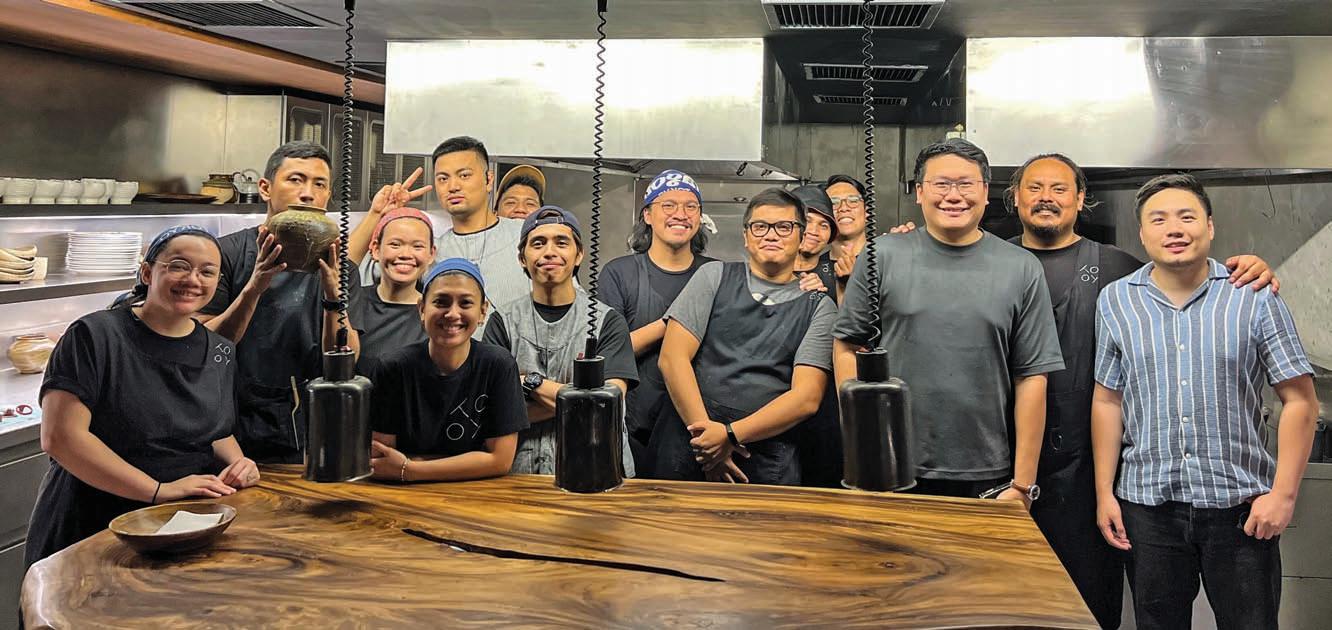
With their recent accolades, they are now back and are open with a new menu but still in their original spot at The Alley at Karrivin, Karrivin Plaza, along Chino Roces Avenue Extension in Makati City. It is my second time to dine in Toyo Eatery, and we were excited to be one of the first to try out their new eight-course menu (which really felt more like 10 courses).
The new menu “showcases what we as a team love to eat and have known from where we come from in different parts of the country,” Chef Jordy shared when asked what’s the inspiration for his new tasting menu at Toyo Eatery.
“From using local ingredients and highlighting the best produce through a restaurant experience has now become a discussion on how best to help small farmers and producers through our buying and selling practices,” says Chef Jordy.
Soup starter
THE meal started with Bahay Kubo, a 24-hour boiled mixed vegetable soup from more than 10 kinds of
vegetables such as eggplant, corn, tomato, squash, garlic, onion, and others. These vegetables were sourced from Botolan in Zambales and Pangasinan, and from their partner Good Food Community, which works with smallholder farmers and farmer families, delivering locally sourced, fairly traded, seasonal and organically grown produce. Together served with the soup was Grilled Sweet Potato from Negros with grated Guimaras Tultul, organic salt blocks that takes a few months to make by burning driftwood from the beach, soaking the ashes in seawater, then straining and cooking it down with coconut milk.
A fter that, we were served with several Kinilaw small plates. Kinilaw is a traditional culinary practice in the Philippines that centers around raw seafood as the main component and utilizes vinegar as the key marinade. It has earned the nickname “Philippine ceviche” due to its striking resemblance to ceviche, a well-known dish originating from Latin America. We got to try the Kinilaw na
Tanigue or Mackarel and Kinilaw na Tuna from Quezon province as well as the Kinilaw na Galunggung or Blue Mackerel Scad on with pomelo or grapefruit on gamet chip or a traditional dried edible seaweed from Cagayan. The fish were line-caught and followed certain weight standards making it more sustainable. Another must try is the Kinilaw na Spicy Talaba or Oysters from Aklan.
A fter the kinilaw dishes we got the taste the Halaan or clam with ginger foam, malunggay powder, and fried dahon ng sili. We were also served the pork broth with okra, alugbati or Malabar spinach, with burong pipino or pickled cucumber.
Dipping sauce
A FILIPINO meal is not complete without sawsawan or sauce, which is almost always customized to
the person’s delight. Toyo Eatery prepared our sawsawan using coconut cider vinegar, garlic and pepper. This paired well together with our next course, which is the Deep Fried Dilis or Anchovy with their homemade tomato garlic powder; and Pork Empanada, a traditional longganisa made from both fresh and fermented pork wrapped with pechay or cabbage and Panaderia Toyo’s sourdough starter.
Next was the Nilarang, a traditional Filipino fish stew with kamatis, kamias, santol or sampalok as a souring agent, originating from the Central Visayas. Toyo Eatery’s Nilarang is made from oyster mushrooms and soy bean curd. This was paired with Pork BBQ of kasim or shoulder, pigue or leg and liempo or belly.
Wrapped in banana leaves is the Buntaa, a northern Mindanao
specialty made with stuffed crab, coconut, gata or coconut milk, chilis, and taba ng talangka or crab fat, topped with crispy garlic, onions and peppers.
Finally for our main course, we had their interpretation of Silog, made from short grain rice with fish roe and Dorado or local mahimahi, Braised Pork Shoulder from Lipa Batangas, which used Indian Bay Leaf instead of the local dahol ng laurel (bay leaf) which gave off a lighter but a distinctly pleasant and marinated taste of the pork, and Deep Fried Bisugo or Threadfish
Bream from Bataan.
Sweet tooth
FOR dessert, we had four dishes, the first one was Mais Con Yelo, or a shaved ice dessert with sweet corn, macapuno or coconut sport, and topped with polvoron. Next was Leche Flan ice cream with grated Tibuok salt from Bohol, effectively making it taste like salted caramel ice cream.
A bamboo steamer came out shortly with steamed sweet potato inside, and was paired with crushed Balikutsa, a unique northern sweet candy-like invention made from cooked, molten and sticky sugarcane molasses stretched white and curled.
To end the whole experience were three small plates with Pastillas made from halayang gatas ng kalabaw or jellied carabao milk, Cassava cake grilled over charcoal, and Itlog na Maalat or Salted Egg local white chocolate bonbons.
After a stuffing three-hour full experience, you appreciate not just the whole meal, but also the conscious effort of Chef Jordy and his whole team at Toyo Eatery to offer a sustainable Filipino dining experience.

A ll the servers were pleasant and engaging as they explained to everyone each and every dish that
was served – from the ingredients, to where it came from, and to how it was cooked. Everything was tasty, exciting, and even to an extent enriching from all the knowledge I have gained about traditional Filipino cuisines and cooking from Luzon, Visayas and Mindanao.
Pabaon
TO CAP it all off, “a Filipino meal isn’t truly complete unless you bring some food home with you.”
So, in keeping with tradition, Toyo Eatery handed us our “little pabaon” or take-home treat from Panaderya Toyo, their own bakery beside the restaurant.
W hat can the public expect from Toyo Eatery moving forward?

Chef Jordy explains that “we take it day by day, as we try to improve our craft. We are at this stage where we want to explore and push out more dishes, it’s still the same from Day 1.”
I feel we’re getting simpler through the years, and our process is mostly exploring new flavor profiles. The challenge now is finding local producers and kitchen products that we can use,” he adds.
Besides the Tasting Menu (P4,900/person), Toyo Eatery also offers a fun new dining format which encourages diners to roll up their sleeves and get their fingers dirty with a casual kamayan setup.


Kamayan (P2,900/person) features a menu that consists of seafood (including shellfish), pork, chicken, rice, and dessert. Food will be served family-style at the center of the table, and guests are encouraged to use their hands to eat in true kamayan style.
K amayan starts at 6 pm, while the Tasting Menu may be enjoyed starting 08:30pm and lasts around 3 hours. Toyo Eatery is open Tuesdays through Saturdays from 6 pm to 10 pm.
Sunday, July 30, 2023 www.businessmirror.com.ph C1
Editor: Anne Ruth Dela Cruz |
BusinessMirror
CHEF JORDY NAVARRA and the team at
this writer.
SILOG DEEP FRIED BISUGO
Toyo Eatery together with
MAIS CON YELO
PASTILLAS made from halayang gatas ng kalabaw, cassava cake grilled over charcoal and itlog na maalat local white chocolate bonbons
HALAAN or clam with ginger foam, malunggay powder and fried dahon ng sili
KINILAW na Tanigue and Kinilaw na Tuna together with Kinilaw na Galungung with pomelo on gamet chip. NILARANG with pork barbecue
Wine Dine&
Elevating Antipolo’s dining scene at the 2023 Food and Wine Fest
By Joyce Ann L. Rocamora, PNA
On top of the homey restaurants, underground and overlooking cafés, the city is home to some of the country’s most celebrated chefs. Th is is what the 2023 Manila Food and Wine Festival sought
to showcase in the successful run of the “Antipolo Evolution” that gathered six chefs and took casual fine dining enthusiasts on a sevencourse degustation of Filipino cuisine – all with a touch of what Antipolo as a culinary destination has

to offer and with a twist.
The three-hour meal featured
Chef Florence Hassig of Vieux Chalet Swiss Restaurant’s “Alay Lakap” Chicken Sotanghon Soup with Atsuete, Tahanan Bistro’s bone marrow croquettes, and Burrow Café’s mechado bruschetta perfectly matched with a refreshing mangomint cooler.

Its unique “Putobumbong” salad was also an ode to the Filipino purple rice cake traditionally served during Christmastime but is available in Antipolo allyear round.
The three delectable entrées started with Chef Dan Puga of Burrow’s Sinaing na Isda followed

by Chef Editha Singian’s chicken wings relleno with salsa monja, also an homage to the hilly city’s nuns, and Chefs Kevin Tuason and Nikki Macaraig’s “Neck to Tail of Rabbit,” a plateful of kuyog and lemongrassmarinated rabbit tenderloin, rabbit thigh inasal paired with a side of rabbit dinakdakan, and coconut sticky rice.
Ending the courses on a sweet note was Chef Monique Tancongco’s signature guava cake and a creative ensemble of dessert bites by Hassig, Puga, Tuason, and Macaraig.
The inaugural Manila Food and Wine Festival, scheduled from July 14 to 27, is in partnership with the
Whip Up These Deliciously Healthy Recipes by actor politician Richard Gomez
among the Doña Elena variants, with a higher heat tolerance than extra virgin olive oil, making it perfect for everyday cooking.
Shrimp Okoy with Doña Elena
Pomace Olive Oil
Pasta Puttanesca with Doña Elena Extra Virgin Olive Oil
Department of Tourism.
“ We’re planning to do another run (of the Antipolo Evolution), same chefs but different menu because one way to elevate the dining scene here is to collaborate,” Manila and Food and Wine Festival organizer Anton Diaz said in an interview with the Philippine News Agency (PNA).
“Not a lot of people know there are a lot of restaurants in the Philippines. The (Tahanan Bistro) is only one of the beautiful restaurants here in Antipolo and it is very hard to get reservations here. It opens on weekends and usually only for 30 slots,” he added.
A fter the Antipolo leg held on
July 18, the food festival is bringing another set of chefs for a culinary collaboration in Cavite. Diaz also hopes to stage the event every July in the coming years. The idea is each city will have its own food and wine festivals one weekend to promote the city in terms of food tourism. There are really a lot of travelers after pandemic who traveled for food, culture, and meeting the local chef,” he said. “ This will be about the food culture in the Philippines. Somebody can do adobo in other places, in the United States, but they cannot replicate the Filipino home or experience here in Manila.”
HOT AND CRISPY FARE FROM THE CHICKEN UNIVERSITY
HEALTHY eating is no longer a fad, it has become a way of life. And what better way to live healthily than by incorporating premium quality olive oils into your cooking, such as Doña Elena Olive Oils?
Renowned for their excellent quality, Doña Elena Olive Oils take center stage in these five savory dishes that you can indulge in without feeling guilty.
Numerous studies have shown that consuming olive oil can reduce the risk of cardiovascular disease, cancer, neurodegenerative disease, and lung disease. Olive oil is rich in monounsaturated fatty acids that help lower bad cholesterol, making it a wise choice for a heart-healthy lifestyle.
To get you started on cooking and eating healthily, celebrity home cook Richard Gomez shares his five recipes using different kinds of Doña Elena olive oils.
Beef Broccoli with Doña Elena Pure Olive Oil
This dish offers a perfect balance of protein and greens, making it ideal for afternoons or fancy dinners. To make it, marinate beef tenderloin in a mixture of oyster sauce, soy sauce, cooking wine, chili flakes, pepper, and cornstarch. Sauté garlic, ginger, and onion in Doña Elena Pure Olive Oil, then add the beef and blanched broccoli. Drizzle with sesame oil, mix well, and add water for more sauce. Doña Elena Pure Olive Oil is the most versatile
A hearty shrimp okoy generously stuffed with squash, bean sprouts, and shrimp, this dish is perfect for those looking for comfort food with a crunch. Make the batter by adding flour, cornstarch, egg, garlic powder, pepper, salt, paprika or atsuete, and water. Layer the squash, sprouts, and shrimps, then drop the mixture into hot Doña Elena Pomace Olive Oil. Make a simple dipping sauce with vinegar, soy sauce, ground pepper, and sliced red chilis, and drizzle with Doña Elena Extra Virgin Olive Oil for added flavor. Doña Elena Pomace Olive Oil has a high heat tolerance, making it ideal for roasting and deep-frying dishes like the shrimp okoy.
Overstuffed Deli Sandwich with Doña Elena Extra Virgin Olive Oil
For a filling snack, try this overstuffed deli sandwich with aioli dressing made with Doña Elena Extra Virgin Olive Oil. Mix egg yolk, crushed garlic, salt, and gradually pour in extra virgin olive oil, then add freshly ground black pepper. Slice the baguette, add deli ham, salami, coppa ham, cheese, and alfalfa sprouts, then top with aioli dressing. Doña Elena Extra Virgin Olive Oil is mechanically pressed and processed without heat or chemicals, making it higher in antioxidants and antiinflammatory properties.
This classic Italian pasta dish is full of flavor and easy to make. Sauté garlic and red pepper flakes in Doña Elena Extra Virgin Olive Oil, then add anchovies, olives, capers, and canned tomatoes. Simmer for 1015 minutes, then add cooked spaghetti, toss well, and top with parsley and grated Parmesan cheese.
Shakshuka (Eggs In Tomato Sauce) with Doña Elena Extra Virgin Olive Oil
This Middle Eastern dish is perfect for breakfast, brunch, or dinner. Sauté onion, bell pepper, and garlic in Doña Elena Extra Virgin Olive Oil, then add canned tomatoes, paprika, cumin, and red pepper flakes. Make wells in the tomato sauce and crack eggs into them. Cover and simmer until the eggs are set, then top with chopped parsley and ground black pepper. Serve with crusty bread.
By using Doña Elena Olive Oils in these recipes, you can eat healthily while enjoying delicious food. For more culinary inspiration, be sure to follow the Doña Elena Cusinera Club on Facebook, Instagram, YouTube, and TikTok.
W hether you’re a seasoned chef or a kitchen rookie, there’s a bottle of Dona Elena Olive Oil to suit your cooking needs. Doña Elena’s Pure, Extra Virgin, and Pomace are conveniently available in 250 ml, 500 ml, 1 Liter, and 5 Liter PET bottle sizes. Doña Elena Olive Oil is available in all groceries and supermarkets nationwide. Buy online at Fly Ace Corporation
Website.
By Ardee P. de los Angeles
THAT trip to Seoul can wait. Their popu-
lar South Korean chicken chain is here in the Philippines.
The food chain that made Filipinos salivate while watching popular K-dramas, bb.q Chicken, opened their second restaurant in Robinsons Magnolia in Quezon City and many are already planning a quick trip to this location.
bb.q” stands for “Best of the Best Quality,” a result of both longstanding Korean tradition and modern research and development from their very own Chicken University. The team at bb.q established Chicken University in Seoul back in 1995 to stay at the cutting edge of quality and flavor.

Businessman Luis “Chavit” Singson and his LCS group together with his daugh-
ter Richelle Singson-Michael, partnered with Genesis BBQ Group to bring the crispy chicken treat to Manila. There is no doubt that the Philippines will be bb.q Chicken’s hub in Southeast Asia. With over 3,500 branches worldwide, more branches are coming in the south of the metro.
Filipinos who have tried the famous chicken abroad say that the taste and quality is the same. Personally speaking, the chicken and even the salads, the Seafood Ddeok-Bokki and the drinks are heaven for the palate. Our favorites are the Gangnamstyle and the Cheesling chicken. Now, instead of thinking about the taste while you watch TV, you’ll find it out for yourself while you enjoy the comfortable surroundings at bb.q Chicken. Come with family and friends. Taste and enjoy it here, in the Philippines.
Sunday, July 30, 2023 www.businessmirror.com.ph C2
BusinessMirror
MORE than the panoramic view of the scenic Metro Manila skyline, Antipolo City in Rizal province has a lot more to offer.
(PNA)
Chef Florence’s Alay Lakap (PNA photo by Joyce Rocamora)
The Putobumbong salad served during the “Antipolo Evolution” of the 2023 Manila Food and Wine Festival at Tahanan Bistro. After the Antipolo leg, the food festival is bringing another set of chefs for a culinary collaboration in Cavite. (PNA PHOTO BY JESS ESCAROS JR.)
Chefs Tuason and Macaraig’s “Neck to tail of Rabbit” (PHOTO COURTESY OF MANILA FOOD AND WINE FESTIVAL)
Lazada Store
Fly Ace Corporation Official Shopee Store
at Ace Market
Official
,
or
Wine Dine&
Conrad Manila’s Legendary Chef series presents an Italian Gastronomic Affair by Chef Valerio Pierantonelli
ONRAD Manila is proud to present a remarkable culinary event offering an authentic Italian dining experience.and Sage Sauce with Grana Padano and Toasted Hazelnuts.
From August 7 to 15, 2023, Brasserie on 3 will host the Legendary Chefs Series – La Dolce Vita, featuring Chef Valerio Pierantonelli from Conrad Singapore Orchard's esteemed Italian Restaurant, Basilico.
Hailing from Rome, Chef Valerio brings his extensive expertise and passion for Italian cuisine to the forefront as the head chef of Basilico. With over two decades of experience in prestigious establishments worldwide, his culinary philosophy centers on using the finest and freshest ingredients to create dishes that pay homage to the true essence of Italian cooking. Now, this dedication to his craft is showcased in Brasserie on 3's week-long gastronomic affair.
The Legendary Chefs Series –La Dolce Vita menu will highlight a delightful selection of dishes, including the Mediterranean Octopus Salad with Yellow Potato and Fresh Basil Pesto, the Carnaroli Risotto with Saffron and Asparagus Sauce, and the indulgent Traditional Italian Tiramisu with Marsala and Mascarpone Sabayon. Additionally, a live station will cater to pasta enthusiasts with Tortelli Pasta stuffed with Pork, tossed in a Brown Butter
"Conrad Manila is thrilled to welcome Chef Valerio Pierantonelli to our Legendary Chefs Series. This Italian food festival promises to be a celebration of the rich traditions and flavors of my home country, Italy, as expertly curated by Chef Valerio himself," said Fabio Berto, General Manager of Conrad Manila. “We are ecstatic to share the delightful flavors of hearty food that we grew up with in our homeland.”
The festival will run during lunch and dinner, with prices as follows:
Monday to Thursday Lunch: P1,799 nett
Monday to Thursday Dinner: P2,299 nett
Friday to Sunday Lunch: P3,000 nett
Friday to Sunday Dinner: P3,500 nett
Join Conrad Manila as they celebrate the art of Italian cuisine, showcasing Chef Valerio Pierantonelli's culinary expertise and his dedication to preserving the traditions of Italian cooking. Don't miss this exceptional opportunity to indulge in an unparalleled dining experience straight from the heart of Italy.
For reservations and inquiries, please contact Conrad Manila's dining reservations today at +632 8833 9999 (landline), +63 917 650 3591 (mobile) or email MNLMB. FB@conradhotels.com
YOUR NOT SO ORDINARY BAKESHOP NOW OFFERS BOTTLED COFFEE TO GO
I
O verdoughs, a not so ordinary bakeshop because their branches are run mostly by deaf individuals because of their strong belief in doing good through good food, now offers The Good Coffee.
The Good Coffee offers you an extra dose of caffeine, extra savings and extra energy to keep you alive and kicking.
Enjoy a bottle of The Good Coffee for only P89 in four flavors: Caramel

N addition to offering their own versions of donuts or doughnuts, mouthwatering chunky cookies or Chonky Cookies, brownies or brookies, pizza and fries, Overdoughs now also offers coffee that you can enjoy on the go.Macchiato, Spanish Latte, Hazelnut and Mocha.

There are a lot of coffee products out there that are quite expensive and we wanted to offer a product that is not so expensive and that is The Good Coffee. It’s a cold press coffee made of barako but we just added our signature blend. It’s less acidic but with more caffeine,” related Francis Carl Reyes, CEO and Founder of the Caravan Food Inc., the company behind Overdoughs and Elait. “ You will really feel the kick and that will keep you going all throughout the day,” he added.
The Good Coffee is available at all of its Overdoughs outlets for now.
Reyes said there are plans to partner with cinemas, schools, offices and similar establishments so that The Good Coffee will be made available to more people. For now, Reyes said they are busy preparing to bring back products that were on their original menu. These products will initially be made available in the Greenhills Promenade outlet. We are still looking as to how we can have them made available in the other outliets. This we hope will happen some time in August,” Reyes said. For more information about Overdoughts, you can visit www.overdoughs.ph and @overdoughsph on Facebook, Instagramm and TikTok.
Dining deals to score at the City of Dreams Manila
favorites including ramen, yakitori, and sushi; while Asian bistro, bar and café Red Ginger indulges diners with authentic Southeast Asian cuisine. Jing Ting specializes in fresh hand-pulled noodle dishes characterizing the rich and bold flavors of Northern Chinese cuisine, and Rossi Pizza offers Roman-style pizza, known for their light crispy crust (scrocchiarella), contemporary pasta dishes, salads, and gelato. At Wave, a contemporary poolside deck restaurant and bar, all-time favorite light meals, refreshing beverages and tropical cocktails are offered.
signature dishes, the Roasted Farm Duck can be enjoyed at 20 percent off with the “I Love COD” promotion.

Café Society’s freshly baked breads, pastries and confectionery, artisanal chocolates, quick gourmet sandwiches, and hot and cold brews are available at 15 percent discount, valid also for takeaways.
Dine-in Deals Diners have only until July 31 to
of the “Dine-in Deals” promotion at five of the resort’s restaurants, to score free items or discounts when dining at Hidemasa, Red Ginger, Jing Ting, Rossi Pizza, and Wave. The discounts and freebies apply on the next visit, valid within 60 days after the end of the promo period.

Every 2,000 spend makes guests eligible to spin the wheel to
get a chance to win signature dishes, select specialties, and beverages.

Diners can also win and enjoy up to 50 percent discount on a maximum F&B consumption of P10,000 on their succeeding visit.
The dine-and-spin promotion adds to the excitement of diners in these outlets: Hidemasa by Hide Yamamoto is a relaxed, casual dining space that offers all-time Japanese
Terms and conditions apply, with DTI Fair Trade Permit Numbers FTEB-168724 and FTEB171056 Series of 2023, for both promotions.
For inquiries and reservations call 8800-8080 or e-mail guestservices@cod-manila.com. For more information, visit www.cityofdreamsmanila.com.
Sunday, July 30, 2023 www.businessmirror.com.ph C3
BusinessMirror FOOD aficionados are in for real treats this month and until August at City of Dreams Manila in participating restaurants, from discounts, freebies and fun games offered in two promotions. I Love COD By simply stating or presenting the “I LOVE COD” promotion code found in City of Dreams Manila’s website— www.cityofdreamsmanila. com—diners can enjoy discounts in three specialty outlets when they dine in until August 31. Through the promotion, Crystal Dragon’s refined service and premium Cantonese and regional Chinese specialties can be experienced at a 20 percent discount. Classic Filipino dishes heartily reimagined with subtle innovations by modern Filipino restaurant
can also be savored at
off.
Haliya
20 percent
avail
Among Crystal Dragon’s
Explore more of City of Dreams Manila’s promotional offers, rewards, or instantly check Melco Club points with the new Melco Club App, available for free download on iOS and Android. in
Tomorrow
is the last day to participate in City of Dreams Manila’s “Dine-in Deals” promotion and discover irresistible offerings
five restaurants, including Rossi Pizza.
win freebies and discounts
Dine-in-Deals:
Hidemasa entices foodies with all-time Japanese favorites and a chance to
until tomorrow, July 31.
C
Wine Dine&
A DOUBLE DINING EXPERIENCE AT ANYA RESORT IN TAGAYTAY CITY
 By Benjamin Layug
ON the third week of June, Santiago “Santi” Elizalde, President of Anya Hospitality Group (AHG), and Mikel Ariett, General Manager of Anya Resort, a quiet wellness sanctuary in Tagaytay City, invited members of print and digital media to experience two bold and distinctive dining experiences at its fine dining restaurant, now rebranded as Samira, which means “wind” in Sanskrit by multi-awarded chef Jose Luis “Chele” Gonzalez.
The first was to be a six-course tasting menu for dinner, with wine pairing, on our first day and a sixcourse Grill Experience for lunch the next day, with an overnight stay at their luxurious suites in be -

tween, with others also experiencing a Niyama Signature Massage.
Of course, the star of the show was Chele Gonzalez who added another reason to visit this wellness resort. This year, he was honored as
the Chef of the Year by Tatler Dining. Born and raised in Torrelavega in the north of Spain, Chele has been based in the Philippines since 2013 and has now started a family with his wife, the former Terri Echiverri with the birth of their daughter Ainara Teresa. When he arrived at Anya, he created a menu that was not limited to Spanish or modern Filipino
fare, but which also drew inspiration from other cuisines around the world. Mikel, himself a chef, met Chef Chele in San Sebastian in Spain and thought of bringing their shared culinary vision and experience to Anya Resort Tagaytay.



Six-course lunch, dinner
A SIX-COURSE lunch or dinner menu was a great way to experience Chef Chele’s creativity and magic in the kitchen and as well as his penchant for great flavor. The experience was enhanced by the wonderful and perfectly curated wine pairing selections by Sommelier Selection, a leading importer and distributor of authentic artisan wines, red wines, white wines, champagne and sparkling wines, from France, Italy and Spain since 2002, which elevated the flavors of each course. We took our time with each of the six courses. The bite section alone was an express trip – from Brioche and Beef Tartar, Egg Yolk Emulsion and Ikura, Gallagher Premium Oyster with Compressed Pear, Black Squid Arancini with Parmesan Mousse, and Bulalo Ta-
cos, a pull from Tagaytay’s classic soup. From light, we moved on to heavy meals as we moved our palate from subtle to bold and even potent tastes. Each time, Chele introduced each course, explaining every step in the making of the dish.
The elegant Tasmanian Ocean Trout Tartare with dill, fried capers, apple, red radish slice, and served with crème fraiche split with dill oil was nutritious. The fish is high on Omega 3s and delicious, with a creamy and velvety texture and a great mouth fill. This fish dish was paired with Gaba Do Xil Godello, a beautiful, pale lemon colored wine from Telmo Rodriguez, Galicia (Spain). It is also good to pair this wine with soft cheese.
Grilled Octopus
THE Charred Grilled Octopus, with paprika parmentier, black ink bread crumbs and homemade alioli, tasted like a mild version of squid and lobster as it absorbed the flavors of the alioli and paprika while still maintaining its subtle, mild, sweet and salty flavor. This was paired with Le Ronsay Beaujolais, a red wine from Le Ronsay, a single vineyard in Beaujolais (France) planted with 20-yearold Gamay grape vines.
The Pan-Seared Dorado Charred Romaine with Sun-kissed Tomato and Hazelnut Salsa, made of puree of sweat peas flavored with mint, was juicy, moist and extremely flavorful. The sweet tasting white meat of the dorado, also called mahi-mahi, was prepared and seasoned correctly, surprising everyone, including me, who tasted it for the first time. This was paired with a Pinot Blanc, from the Domaine Mittnacht winery/estate, a white wine from Alsace (France).
The creamy Secreto Iberico Rice with mushrooms, finished with parmesan, butter and truffle oil, topped with sous-vide and seared Secreto Iberico and pan-fried asparagus spears, was exquisite and had an incomparable texture and flavor. The juicy Grilled Bolzico Beef Tenderloin, Argentinian grass-fed tenderloin with roasted confit potato, burnt eggplant puree, arugula, poached shallot served with beef jus, literally tickled our taste buds
with the meat having a nice smokiness. Both were washed down with a glass of Tempranillos Sang de Drac, meaning “blood of the dragon,” a red wine from Cataluna (Spain).
For dessert, we had the Cream Cheese Ice Cream, Grilled Strawberries with forest berry coulis, lime meringue chips and pickled mint leaves which went well with Brunori Spumanti, an excellent sparkling wine based in Verdicchio. Our evening didn’t end with dinner as Chele regaled us with a different kind of mixing, this time as a DJ. He became a professional DJ in 1997, playing in clubs in the US and north of Spain, opening his own electronic club in 2001.
Grill experience
THE Grill Experience the next day was equally spectacular. For starters, we had the surprising and savory sweet Foie Gras and Mango Waffle paired with Chorizo Pintxos and Bacalao Bunuelos. We soon progressed to our first official course – the Country Style Duck Pate Terrine with Pistachio, duck terrine pate infused with vermouth, homemade orange jam, pickled vegetables, which was delicious on char-grilled 48-hour fermented sour dough bread. The Grilled Tiger Prawns, cooked in salt and squeezed lemon, was juicy.
Th is was followed by the healthy Local Goat Cheese and Tomato Salad made up of Tagaytay tomatoes and goat cheese from Beata Farms, organic lettuce, candied cashew and extra virgin olive oil. The Basque country-style grilled rib-eye, served with confit bell pepper, herb roasted marble potatoes and side salad, wasn’t exactly meltin-your-mouth tender but its taste was fantastic, with an intense beef flavor. Finally, the rich, sweet meat of Charcoal Grilled Maine Lobster, on rustic roasted potatoes in butter and rosemary with lobster rice, lemon butter sauce and Tagaytay salad, had a smoky barbecue flavor that only an open flame can deliver. We capped our final meal with the Tagaytay Pineapple Expressions, grilled Tagaytay pineapples, brioche and pineapple sorbet.
Sunday, July 30, 2023 www.businessmirror.com.ph C4
BusinessMirror
Black Squid Arancini with Parmesan Mousse
Grilled Tiger Prawns
Local Goat Cheese and Tomato Salad
Chef Jose Luis “Chele” Gonzalez
Samira by Chef Chele Gonzalez at Anya Resort Tagaytay
Cream Cheese Ice Cream, Grilled Strawberries
Charcoal Grilled Maine Lobster
Tasmanian Ocean Trout Tartare

 SUNDAY, JULY 30, 2023 |
COVER STORY
EDITED BY JOSE F. LACABA
Mario Dumaual’s
By Pablo A. Tariman
I liked Mario’s pleasant profile, congenial at every turn. He was a natural when showing deep concern for people he cared about.
“Wala ka na sa CCP [Cultural Center of the Philippines]?” he asked me once when we met at the Manila Metropolitan Theater (the Met), where I was holding office as an impresario and do -
ing a bit of Met publicity in the late 1980s in the company of Boy Abunda and Floy Quintos. Mario was covering a Vilma Santos show at the Met, and I was presenting a season of classical music in the same venue in close coordination with Tita Conching (Conchita Chuidian Sunico).
At the time, Mario must have realized I was wearing two hats— one for performing arts and the other for the movies.
KINDNESS, FAIRNESS
AS for Mario, he was still in perfectly good health at that time, reporting into his early 60s.
During movie presscons, the questions coming from Mario and me would be the most awaited.
Quipped the late Isah Red: “Pablo [Tariman] never runs out of profound questions. But I pre -
fer the down-to-earth questions of Mario [Dumaual].”
Indeed, I was into high art and Mario was into the unpredictable world of showbiz.
Showbiz is not exactly a place where you find good people. It is a place where friendships hardly last. It is a dog-eat-dog world where movie stars work their ass off wrapping up film commitments, and where movie reporters beat deadlines 24-7. At times, it is a virtual school for scandal, which is the stuff of the showbiz talk shows of Cristy Fermin and Boy Abunda.
Observing Mario Dumaual in the last 41 years of his showbiz reporting life was like finding a heart of gold in a sea of infamy. He exuded kindness in every showbiz reportage he did. Still, he made sure he observed the basics of reporting—truth, fact-checking, and most of all, fairness, balance, and responsibility.
To be sure, he had modest career beginnings.
MALAYA, ABS-CBN
BORN on July 31, 1958, Mario finished Communication Arts at

the University of the Philippines Los Baños (UPLB) in 1979. In college, he did assorted writing, from sports to agricultural reportage, in the university paper—The UPLB Perspective.
His first job after college was with the Ministry of Agriculture, where he did some agriculturerelated writing. What followed were short stints with a financing company and a shipping line.
He was working with the daily newspaper Malaya when Angelique Lazo hired him for the “TV Patrol” segment of ABS-CBN’s first groundbreaking newscast. “What’s the title of the newscast? Or should this be: hired him for a segment of TV Patrol, ABS-CBN’s first groundbreaking newscast.?”
There was no turning back on showbiz reporting after the newscast’s initial telecast.
Isagani de Castro, Jr., was editor of ABS-CBN News online when Mario Dumaual worked for him as a stringer for showbiz news, apart from his regular reporting segment for TV Patrol. De Castro can only remember Dumaual’s professionalism. De Castro recalls that
Dumaual would write one or two showbiz stories daily until his (de Castro’s) retirement in 2022.
While highly visible on TV, Dumaual also wrote showbiz stories for other online publications. Like, for BusinessMirror , he covered Nora Aunor’s 70th year.

After 41 years in showbiz reporting, Dumaual wrote thirty last July 5, <2023,?> a month after he had a heart attack on June 5. The family revealed that the reporter died from septic shock and from severe fungal infection after his recovery from a heart attack at the Heart Center.

He is survived by his wife Cherie and children Luigi, Miguel, Maxine, William, and Thessa.
UNBLEMISHED WORK ETHIC
FRIENDS and colleagues have varying recollections of some chapters in Mario Dumaual’s 64 years of life.
Cherry Cornell, Mario’s longtime desk editor at ABS-CBN, recalled that Mario was always on time with deadlines. “His stories needed very little editing, as he took time to fine-tune and double-check his stories.”
BusinessMirror 2 Sunday, July 30, 2023
MARIO DUMAUAL with grandsons Skye and Alonzo, and granddaughter Tali WILLIAM DUMAUAL
WRITER and entertainment reporter Mario Velasquez Dumaual July 31, 1958–July 5, 2023 WILLIAM DUMAUAL
IHAVE good memories of Mario Dumaual. In 1982, we both wrote for the Times Journal. I covered the arts and he was into entertainment. But as I was also into film reviewing, our paths crossed during premiere nights and movie presscons.
“Lightness of Being”
CITATIONS, AWARDS
MARIO was not wanting in citations and awards.
The German Moreno Walk of Fame Foundation honored him earlier this year with a five-point brass star in the Eastwood City Walk of Fame.
Last year, the Society of Philippine Entertainment Editors conferred on him the Joe Quirino Memorial Award.
He was also given the Joe Quirino Memorial Award at the 5th EDDYS (Entertainment Editors’ Choice) awards night.
Before his body was interred at the Loyola Memorial Park in Marikina on July 9, Mario received a resounding standing ovation from his friends and colleagues.
Mario’s former cameraman, Ariel Fulgado, said he was witness to the late reporter’s unblemished work ethic: “He was such a professional that he was held in high esteem by the entertainment press. For me, he was irreplaceable.”
TV Patrol anchor Henry Omaga Diaz was a friend of Dumaual for almost 30 years. Their conversations were mostly about work, but then of late, before Dumaual’s death, the subjects had turned to their respective families, most especially about their grandchildren.


SELFLESS MENTOR
ABS-CBN News Chief of Reporters Jeff Canoy recalled how Dumaual prepared for the digital age in news reporting: “In our last conversation, he consulted me on how to do YouTube. I think he was contemplating doing his own vlog.”
Former ABS-CBN News head of newsgathering and online operations Charie Villa recalled Dumaual’s selflessness in the office. He would often knock on their door asking for
help for colleagues in need. He never showed up looking like a big boss. “For us, he will always be the mentor who constantly guides and is concerned about others before himself.”
Four other reporters benefitted from the mentoring of Dumaual—namely, Marie Lozano, Gretchen Fullido, Ginger Conejero, and the last, Ganiel Krishnan.
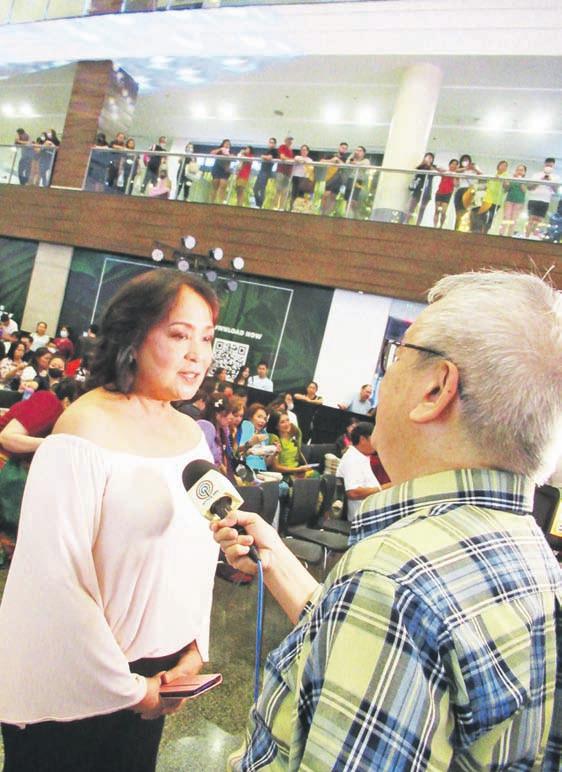
Cherry Cornell said Dumaual has an eye for promising news reporters: “He guides them every step of the way to be useful to the needs of the industry.”
ABS-CBN News chief Francis Toral paid tribute to the family for the precious time Dumaual spent with the ABS-CBN news staff for almost four decades.
FAMILY MAN
ALTHOUGH he was first and foremost a professional, Mario Dumaual was a family man of the first order. He said that, more than the accolades and the awards he got in the showbiz beat, he valued the love and support he got from his family.
The Mario Dumaual son who took after his father as news reporter was Miguel Dumaual, who is also editor of the ABS-CBN News Digital.
Said Miguel in response to the tribute to his father: “We are still at a loss for words. He was the pillar of strength for the family. We all felt safe when he was around. We didn’t
worry about the future with him around. Now we don’t quite know how to start coping.”
Miguel Dumaual added: “But with your support, coupled with love and respect for my father, we will learn how to value the high esteem that he got from his colleagues and friends. He taught us how to value our job and how to make the best of it.”
Commented Gary Valenciano: “Mario Dumaual was part of our careers. And he never put out anything that made us look bad. He always wanted to bring out the best in all of us. Even if the artist was going through controversy and all, he would try to focus on ‘Yeah, but it can’t be all bad. There’s a reason why that artist ay naging artista— dahil gusto siya ng tao.’” Gary added: “My prayer is ‘Lord, he’s in your hands.’ That’s the safest place to be.”
Said Sharon Cuneta: “He was a showbiz reporter with a difference. He was decent, fair, and widely loved.”
My dear Mario would have been 65 on July 31.
BusinessMirror 3 Sunday, July 30, 2023
MARIO with wife Cherie PHOTO BY NICE PRINT PHOTOGRAPHY
MARIO DUMAUAL interviewing actress and beauty queen Gloria Diaz at the Salo-Salo Sa Sanlo Grand Santacruzan of San Lorenzo, Makati City at Glorietta complex WIKICOMMONS
SCREENSHOT of ABS-CBN interview of Mario Dumaual with actress Vanessa Hudgens uploaded on Youtube


Before becoming a TV darling, Mario Dumaual was a ‘Mosquito’
By Lourdes M. Fernandez
MUCH is known and has been written about Mario V. Dumaual’s near-legendary coverage of entertainment news for ABS-CBN, where he served for three decades as, one report put it, “the face” of the network’s entertainment, elevating it to a dignified genre, away from the stereotypical “tabloidish” fare of screaming headlines on scandals.

But years before he became the hugely popular TV journalist—as many accounts, including BusinessMirror’s Edwin Sallan, describe the “fan-girl” and “fanboy” effect he had on others as if he himself were a celebrity—Mario was writing for Joe Burgos’s Malaya, in the twilight years of the Marcos First administration.
Those were interesting times, and Mario was as crucial to the overall reportage as those who worked the political beats because many of the artists and entertainers of that pre-1986 era were outspoken figures and a presence in many protest actions.
But if you thought Mario was a fire-and-brimstone kind of writer for what was then the biggest paper—and a trailblazer—in the so-called Mosquito Press, nothing is farther from the truth. He was perpetually happy and smiling, but always insightful in his analysis of things. And it was perhaps this congeniality that was his secret, serving him in good stead then and years later, at ABS CBN, when he had to track down celebrities.
In short, Mario was Mr. Chill personified. No macho-style posturing, no self-righteous airs, or the slightest inclination to give people the impression that he was doing something “important” or “patriotic” even though the situation of journalists then, at least
those in non-crony media, often bordered on high-risk or perilous to life-and-death circumstances.
He would drop by Malaya’s offices in Quezon City with his trademark smile, his boyish mien, and calm demeanor. One day, we were chatting beneath a tree on Malaya’s driveway and he suddenly looked conspiratorial. Then, he lowered his voice and said, “do you know that I live just next to our printing press?”—a question that floored me because we all knew the location of the plant was kept a secret as much as possible to shield from harassment our brave printer.
Then, in his uniquely “Marites” way, he volunteered further: The printing press, he said, has no security guards, but lots of HUGE dogs—all canines obviously intended to deter any intruder from the “ajax” type. “Ajax” was the term used in those days to describe government spies routinely deployed to entities deemed threats to the state or the rulers. That precaution was understandable, because Malaya’s predecessor in Joe Burgos’s stable of newspapers, the WE Forum, was raided by the military in December 1982. Its editorial offices and printing plant on Quezon Avenue were padlocked while a sedition case was lodged against Burgos and several officers and columnists of the paper. Weeks before that raid, which the Su -
preme Court struck down two years later for being illegal, and void, the WE Forum premises was crawling with “spies” of all sorts. Street vendors, walk-in volunteers, parking attendants, etc.
Back to Mario Dumaual. He seemed to derive some pleasure in being among the few who knew the Malaya printer’s location and security protocols, but he never once conveyed any sense of anxiety about writing for a paper that he knew was under perpetual watch by authorities.
Instead, he had the same unflappable disposition, congeniality and consistent professional behavior that endeared him later to coworkers in his TV network, and earned him the respect and friendship even of his “rival” in GMA, Lhar Santiago, who called him like a brother. Lhar, by the way, also started his professional career by graduating from the campus press to Joe Burgos’s WE Forum
It is understandable why Mario’s death, at 64, has shocked and saddened so many people. Anyone who knew or had worked with him has the same recollection of the guy. It’s interesting how uniformly loving is the tone in which people, especially from media who are only now piecing together bits and pieces of Mario’s
career, all share their memories of him. Thelma Sioson-San Juan, who was with Times Journal and later the Manila Chronicle , Inquirer, and ABS-CBN was one of them. Another Times Journal alumna, Berroth Medenilla, was credited with giving him an early break in the news media. She had been approached by Mario who wanted to write in newspapers because, said one report, he was “bored” with his day job.
Berroth, who subsequently also worked with us in Malaya, confirmed this in a recent conversation. She recalled him as a “perpetually curious” person, really suited for entertainment reporting. But he was dignified in his demeanor, she stressed, never stooping down to the level of someone gleefully purveying accounts of scandals.
And of course, he would eventually write as well for Malaya , joining the ranks of the paper’s entertainment and culture reporting stalwarts—Mario Hernando (now also deceased) and Ester Dipasupil.
There, he would also get to work with Joel Saracho, the writer-actor. Here’s how Joel remembers Mario: “While Mario started out in the Journal publications, it was in Malaya where he honed his entertainment writing with
a more critical lens. His stories about movie stars and the ongoings in showbiz were viewed in a subtle political frame. He refused to be trapped in the usual chismis stories prevalent in entertainment journalism. This frame he brought with him even when he shifted to broadcast news.”
Another coworker of Mario in the Burgos-era Malaya, Joe’s widow Edith, said Mario “will always be remembered [as] a gentle presence in the Malaya newsroom.” Her first encounter with him was a window, Edith recalls, to his personality. She noticed that he looked very cleancut and presumed he might come from an upper middle class family, so she asked him twice, “are you not scared of working for a paper where you could be arrested?” He quickly replied, sans any macho posturing, “no, mam.” Then she asked, “do your parents know you’ll be working for us?” and he just assured her, “I’ll tell them, mam.”
Indeed, that was the essential Mario. Eager to chase the stories that mattered, but always knowing in his heart they are never about him. So, I don’t know how this gentle, self-effacing man would react to being written about these days. Blushing, I’m sure.
BusinessMirror 6 Sunday, July 30, 2023