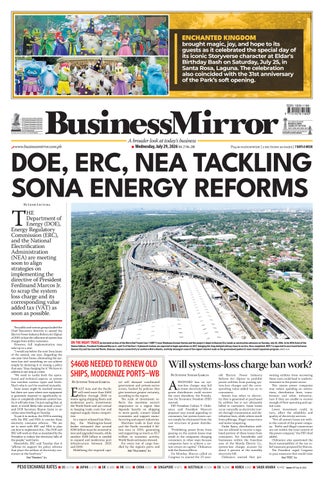
ENCHANTED KINGDOM brought magic, joy, and hope to its guests as it celebrated the special day of its iconic Storyverse character at Eldar's Birthday Bash on Saturday, July 25, in Santa Rosa, Laguna. The celebration also coincided with the 31st anniversary of the Park’s soft opening.
By Lenie Lectura
THEDepartment of Energy (DOE), Energy Regulatory Commission (ERC), and the National Electrification Administration (NEA) are meeting soon to align strategies on implementing the directive of President Ferdinand Marcos Jr. to scrap the system loss charge and its corresponding value added tax (VAT) as soon as possible.
The public and various groups lauded the Chief Executive’s directive to amend the Electric Power Industry Reform Act (Epira) of 2001 to ban the collection of system loss charges from utility customers.
However, full implementation may take up to a year.
“I would say before the next Sona [state of the nation], one year…Regarding the one-year time frame, eliminating the systems loss isn’t something we can achieve simply by declaring it or issuing a policy that says, ‘Stop charging for it.’ We have to address it one step at a time.
“We need to tackle both the operational and technical aspects, as system loss involves various types and levels.
That’s why it can’t be resolved instantly. Some issues might be resolved sooner, but there are cases where new equipment is genuinely required to significantly reduce or completely eliminate system loss. So, it will take time. I’m just saying that, at most, it would likely take around a year,” said DOE Secretary Sharon Garin in an online news briefing on Tuesday. To put it in motion, the DOE is meeting with the ERC and NEA to execute these electricity consumer reforms. “We are set to meet with ERC and NEA to plan out how to implement this....The DOE and ERC will work on that as mandated by the President to reduce the electricity bills of the people,” said Garin. Meanwhile, ERC said Tuesday that it “affirms its support for policy reforms that place the welfare of electricity consumers at the forefront.”
By Justine Xyrah Garcia
around $280 billion must be invested in new and upgraded vessels, while another $180 billion is needed to expand and modernize port infrastructure between 2025 and 2040.
Mobilizing the required capi-
tal will demand coordinated government and private-sector action, backed by policies that give investors greater certainty, according to the report.
The scale of investment reflects the maritime sector’s importance to a region that depends heavily on shipping to move goods, connect island economies and support manufacturing and export industries.
Maritime trade in East Asia and the Pacific exceeded 6 billion tons in 2025, generating and supporting as much as $3.7 trillion in economic activity, World Bank estimates showed.
For every ton of cargo handled by the region’s ports and
By Justine Xyrah Garcia
APROPOSED ban on system-loss charges may fail to lower electricity bills as power distributors could recover the costs elsewhere, the Foundation for Economic Freedom (FEF) warned.
FEF President Calixto V. Chikiamco said President Marcos’s proposal may sound appealing to consumers, but system losses cannot simply be eliminated from the cost structure of power distributors.
“Prohibiting power firms from passing on the system losses may result in the companies charging consumers in other ways because companies have to achieve a certain return on capital,” Chikiamco told the BusinessMirror
On Monday, Marcos called on Congress to amend the 25-year-
old Electric Power Industry Reform Act (Epira) to prohibit power utilities from passing system-loss charges and the corresponding value-added tax on to consumers. System loss refers to electricity that is generated or purchased by utilities but is not ultimately billed to customers. Some losses occur naturally as electricity travels through transmission and distribution lines, while others result from pilferage, illegal connections and meter tampering.
Under Epira, distribution utilities are allowed to recover a regulated portion of these losses from consumers. For households and businesses within the franchise area of the Manila Electric Co., system-loss charges account for about 5 percent of the monthly electricity bill.
Chikiamco warned that pre -
venting utilities from recovering these costs could lead to underinvestment in the power sector.
This means power companies may reduce spending on substations, distribution lines, transformers and other infrastructure if they are unable to recover enough of their operating and capital costs.
Lower investment could, in turn, affect the reliability and quality of electricity services.
“Not all system losses are within the control of the power company. Thefts and illegal connections are not within the total control of the power company,” the FEF chief added.
Chikiamco also questioned the fiscal sustainability of the tax relief measures proposed by Marcos. The President urged Congress to pass measures that would raise
the personal income tax exemption, remove corporate income taxes for qualified small businesses, and grant an amnesty covering several types of unpaid national taxes and their corresponding penalties.
“Those tax relief measures are nice but will not address the faltering consumption growth, which is caused mainly by inflation, massive corruption, and geopolitical uncertainty,” Chikiamco said.
He emphasized that the Philippine economy is already moving toward a slower growth path, with gross domestic product expanding by only 2.8 percent in the first quarter, the weakest performance in five years.
Slower economic growth generally translates into weaker tax collections as household spending, corporate earnings and business activity soften.
Chikiamco warned that the government may eventually struggle to absorb the revenue losses resulting from the proposed tax cuts and exemptions.
“It may have to resort to more borrowings to finance a growing fiscal gap,” he added.
For the FEF, the President’s fifth state of the nation address should have also included a call to amend the Constitution and hold elections for a Constitutional Convention in 2028.
“Only a structural transformation of the country’s economics and politics can solve the country’s ills in governance and the economy,” Chikiamco said.
IT ecozone ban in Metro Manila ends after 6 years
By Bless Aubrey Ogerio
THEOffice of the President has approved lifting the moratorium on the establishment and expansion of information technology (IT) economic zones in Metro Manila, ending a six-year restriction that had halted the creation of new Philippine Economic Zone Authority (Peza)-accredited IT parks and centers in the National Capital Region (NCR).
The Department of Trade and Industry (DTI) announced on Tuesday that the Palace had approved a new administrative order superseding Administrative Order (AO) 18, allowing the processing of applications for new IT economic zones and expansion projects in Metro Manila.
The move reverses a policy adopted in June 2019, when the Duterte administration issued AO 18, titled “Accelerating Rural Progress Through Robust Development of Special Economic Zones in the Countryside,”
which suspended new ecozone applications in Metro Manila to encourage investments in the regions.
While the policy supported the geographic dispersal of investments, it also tightened the supply of Peza-accredited office space in the country’s largest business districts.
Data from Colliers showed that available Peza-accredited office inventory in Metro Manila declined to about 1.46 million square meters in the first quarter of 2026 from 1.59 million square meters a year earlier.
Available space in major business districts such as the Makati Central Business District, Bonifacio Global City and Ortigas Center also continued to shrink.
The moratorium also left several newly completed office developments unable to secure Peza accreditation because applications for new IT parks and centers in the NCR could not be processed.
According to the DTI, lifting the restriction is expected to address long-standing investor demand by reopening Metro Manila to new IT ecozones and complementing the government’s continued push to expand IT hubs in the regions.
The department said the policy would enable more office developments in the capital to qualify for Peza registration, supporting the continued growth of the country’s
information technology-business process management (IT-BPM) industry.
The policy change follows years of appeals from industry stakeholders, who argued that AO 18 had become a constraint on investment as demand for Peza-accredited office space in Metro Manila continued to outpace supply.
In his fifth State of the Nation
Address on Monday, President Ferdinand Marcos Jr. highlighted the role of economic zones in attracting investments and developing strategic industries.
He noted that the government continues to expand ecozones beyond Metro Manila, citing newly proclaimed investment areas in Dumaguete and Misamis Oriental, while Palawan and the halal industry are also being positioned for future development.
The ERC said it is willing to work with Congress, the DOE, industry stakeholders, and other government agencies to work on the legal and regulatory measures needed for this reform.
System loss accounts for electricity lost due to technical and non-technical factors. Non-technical losses represent power lost due to electricity theft, illegal tapping, and jumper wires. Technical losses, on the other hand, refer to energy turned into heat as electricity flows through long wires and transformers.
“The President demanded amendments to the Epira. The President’s directive reflects a clear principle. Consumers should not continue to bear the burden of avoidable system losses that can be reduced through better infrastructure, stronger operational discipline, and more effective regulation. As utilities become more efficient, Filipino households should see those gains reflected in their electricity bills,” added Garin.
However, it is not yet clear as to who will shoulder the cost associated with the system losses if and when they are totally scrapped. “I can just tell you that pilferage should be shouldered by the electric co-op.... I think every co-op has their own pilferage level. It’s not just one percent, maybe, in some places. I don’t know with Meralco [Manila Electric Company], but the level of pilferage vary per electric co-op,” Garin said.
Kit and Arman pointed out that the BSP has historically been “vigilant” toward wage-price spirals, and the current episode which they deemed an “unusually large” wage adjustment following an “unusually large inflation shock”—is “precisely the dynamic that will keep the Monetary Board on high alert.”
In an earlier interview with reporters, BSP Governor Remolona Jr. said the inflationary pressure of the recent wage hike may be significant.
He, however, emphasized that the “sensitivities” of the recent wage adjustment may have to be further looked into.
“It [wage hike] is significant but I don’t know the sensitivities. We still have to see. We’ll have to do the numbers. This is unusual,” the central bank chief told reporters
in an interview on July 3. The central bank earlier told this newspaper that the approved wage hike will be considered at the Monetary Board’s upcoming rate-setting meeting in August, together with other incoming economic data.
The BSP’s annual minimum wage increase assumption for 2026 was way below the actual minimum wage hike or the P85 approved by the NCR wage board for this year.
“The assumed annual minimum wage increase is 6.7 percent for 2026, in line with the previous year’s wage adjustment in the National Capital Region,” BSP said in its Monetary Policy Report.
The P85 approved by the NCR wage board is equivalent to a 12.23-percent increase.
Meralco executive vice president and chief operating officer Ronnie Aperocho said the utility firm has consistently invested in system loss management initiatives, network modernization, and operational efficiencies—which enable it to maintain system loss well below the 6.5 percent cap set by the ERC.
Nonetheless, Meralco is committed that it will actively participate in the discussions as the proposed amendments to the Epira are deliberated.
“We believe it is important to recognize that system loss is not unique to any distribution utility but is a common operational aspect of the delivery of electricity—which affects the entire power industry.
While distribution utilities like Meralco continue to invest in modernizing and upgrading facilities and deploying technologies that reduce system losses, a certain level of technical losses remains inherent in operating an electric distribution system,” said Aperocho. Meralco’s system loss in the first quarter of the year dropped 5.72 percent from 5.85 percent year on year. This metric accounts for 5 percent of a consumer’s total electricity bill.
shipping networks, around $155 in direct economic output is generated. When the impact on manufacturing, trade and household income is included, the economic value rises to between $310 and $620 per ton.
“Maritime supply chains are the circulatory system of regional economies,” World Bank Vice President for East Asia and Pacific Carlos Felipe Jaramillo said during the report’s launch.
“When they function well, businesses become more competitive, markets become more accessible, and communities prosper,” he added.
The sector directly employs up to 9 million workers and supports as many as 18 million livelihoods across the region, according to the report.
The World Bank warned that insufficient investment in ports, ves-
sels and fuel infrastructure could weaken supply-chain reliability, raise transport costs, and limit the ability of remote and island communities to access markets.
It said maritime policies should treat ports, ships and fuels as parts of a single system, with investment decisions centered on efficiency, worker safety, and environmental sustainability.
Modernizing the sector will also require spending on alternative fuels, cleaner technologies and the infrastructure needed to support them.
“This report is a call to protect workers, strengthen maritime safety and seize the opportunities presented by a more efficient and sustainable maritime future,” Jaramillo said.
Apart from physical infrastructure, the lender said governments and shipping companies must invest in training workers for a sector increasingly shaped by automation, digitalization and alternative fuels.
Improving working conditions and career prospects at sea and onshore will also be necessary to attract and retain the maritime workforce needed to carry out the industry’s long-term transition, it added.
“We look forward to productive discussions which we hope will carefully consider the impact of reforms on the operations and sustainability of distribution utilities. To ensure real benefits to consumers, these reforms should also support the ability of distribution utilities and electric cooperatives to efficiently operate, invest in infrastructure and system resilience, and deliver safe and stable electricity service,” added the Meralco official.
According to DOE Undersecretary Mario Marasigan, the savings in electricity bills once system losses are completely taken out “may result in about 5 to 10 percent because we have distribution utilities whose system losses can go as high as 16 percent. We can save on 5, but it can go as high as 10 percent per kilowatt hour cost.”
Meanwhile, the Philippine Resilient Electric Cooperatives and Consumers Alliance (PhilRECA) said it fully supports the proposals to eliminate VAT on system loss charges, as consumers should never be taxed on unutilized energy that never reached their homes.
“However, we can support the complete elimination of system loss charges from electricity billing if and only if the national government directly shoulders these costs through a dedicated subsidy mechanism,” it said.
Garin said her office has already submitted initial comments on amending the Epira, adding that public consultations were also conducted in the past. “Over the years, during this administration, we have done consultations with the stakeholders as well as including ERC and the other agencies that we have. We have suggestions from the House of Representatives and the Senate, but ultimately it’s a discretion or decision of Congress.”
Asia’s Golden Icon Awards
Asia’s Golden Icon Awards 2026 honors excellence, launches ‘Creating Future Icons’ program
Representing various sectors, the awardees exemplify excellence, integrity, and transformative leadership.
THE country’s most distinguished leaders, diplomats, and other changemakers gathered in a remarkable evening that celebrated excellence, leadership, and nation-building.
On July 7, Asia’s Golden Icon Awards 2026 successfully concluded at the Grand Ballroom of Okada Manila, honoring outstanding individuals whose dedication and contributions continue to shape industries, strengthen communities, and inspire future generations.
Among the distinguished honorees were:
His Excellency Ahmed Saad N.A. Al-Homidi, Ambassador of the State of Qatar to the Republic of the Philippines; Sec. Gilberto “Gibo” Teodoro Jr., Secretary, Department of National Defense ; Engr. Jose Ramon “Ping” P. Aliling, Secretary, Department of Human Settlements and Urban Development (DHSUD); and Hon. George Erwin M. Garcia, Chairperson, Commission on Elections (COMELEC)
Also bestowed with honors were Ariel F. Nepomuceno, Commissioner, Bureau of Customs (BOC); Rico Hizon, broadcast journalist; Michael Alexander Ang, Director and Board Member, The Manila Times Group; Joseph Marco, Filipino actor; and Sheryn Regis, Filipino singer and songwriter.
Equally honored were Dr. Carmina Janna M. Monzon-Lim. Executive Vice President, Colegio de
Santo Cristo de Burgos; Mohamed Taki Mustafa Jaffer, Chairman, Jaffer Family Foundation; Raul C. Pagdanganan, President and Chief Executive Officer, Cardinal Santos Medical Center; and Atty. Evaristo O. Gana, Managing Partner, Gana Atienza Avisado Law Offices.
The prestigious award-giving body likewise presented the distinction to Romulo I. Delos Reyes, President and General Manager, Stronghold Insurance Company Inc.; Estella Tuason-Occeña, Executive Vice President, Chief Financial Officer, Chief Risk Officer, and Treasurer, Bloomberry Resorts Corporation; Jerry M. Navarrete, President, MGS Construction and Fine Properties, Inc. ; and to Patricia May T. Siy, President and CEO, Philippine Bank of Communications (PBCOM)
Other notable recipients of the award were Hon. Marquez “Mark” O. Go, entrepreneur, educator, and former congressman of Baguio City; Margot Torres, Managing Director, McDonald’s Philippines (Golden Arches Development Corporation); Rolando R. Avante, Vice Chairman, President and Chief Executive Officer, Philippine Business Bank; and Hon. Rodolfo G. Valencia, Founder and Chairman, RGV Group of Companies Representing various sectors, the awardees exemplify excellence, integrity, and transformative leadership.
One of the evening’s defining moments was the official launch of “Creating Future Icons,” the flagship scholarship advocacy of Golden Icons Cares. Expanding beyond its long-standing humanitarian efforts in disaster response and community outreach, the organization formally introduced a long-term commitment to education by investing in deserving students from underserved communities.
The inaugural batch of scholars from Bukidnon, Davao, Agusan del Norte, and Agusan del Sur was officially presented during the ceremony.
These young scholars, recognized for their resilience, determination, and academic potential, will receive comprehensive educational assistance, including
boarding or rental support, transportation assistance, school uniforms, food allowance, and other educational needs.
To enable them to witness this milestone, the organization also provided their round-trip airfare, accommodation, and local transportation to Manila.
The event also marked another significant milestone with the formal Oath-Taking Ceremony of the Asia’s Golden Icon Awards Council and the International Advisory Council.
Newly inducted to the Awards Council was Michael Alexander Ang, Director and Board Member of The Manila Times Group, whose extensive experience in media and communications further strengthens the organization’s commitment
to excellence and credibility. Joining him was Mohamed Taki Mustafa Jaffer, Chairman of the Jaffer Family Foundation, who officially took his oath as a member of the International Advisory Council, reinforcing the organization’s growing international collaboration and philanthropic vision.
Their appointments reflect Asia’s Golden Icon Awards’ continuing commitment to building a distinguished network of respected leaders who will help advance its mission of recognizing excellence while promoting education, humanitarian service, and nation-building.
In his address, Dr. Ronnel P. Ybañez, Founder and Chairman of Asia’s Golden Icon Awards, emphasized that the organization is com-
mitted not only to recognizing today’s achievers but also to investing in tomorrow’s leaders.
“This evening represents more than recognition—it represents responsibility. While we celebrate the remarkable accomplishments of today’s Icons, we also embrace our responsibility to create opportunities for young people whose dreams deserve to become reality. Through Creating Future Icons, we are building a legacy that will continue to transform lives for generations to come.”
Dr. Ybañez likewise expressed his heartfelt appreciation to the Executive Board, Awards Council, partners, sponsors, volunteers, and supporters whose collective efforts made the event and the scholarship initiative possible.
“This milestone would not have been possible without the unwavering support of our Executive Board, Awards Council, partners, sponsors, and everyone who believed in our mission. Together, we have demonstrated that recognition becomes even more meaningful when it creates opportunities that uplift communities and empower future generations.”
As the curtains closed on another successful edition of the Asia’s Golden Icon Awards, the organization reaffirmed its commitment to championing excellence while creating lasting social impact through education, leadership development, humanitarian service, and nation-building.
The Asia’s Golden Icon Awards 2026 concluded not only as a celebration of remarkable achievements but as the beginning of a greater movement—one that transforms recognition into opportunity and honors excellence by investing in the leaders of tomorrow.
While today’s Golden Icons inspire the present, the Future Icons will shape tomorrow.
Asia’s Icon for Transformational Impact in Healthcare Leadership
RAUL. C. PAGDANGANAN President and CEO, Cardinal Santos Medical Center (CSMC)
SINCE 2013, Raul C. Pagdanganan has sustained a proven track record of turning around the fiscal standing and overall culture of a number of hospitals under the Metro Pacific Health (MPH) banner. After stints as the top executive at De Los Santos Medical Center (DLSMC) and Dr. Jesus C. Delgado Memorial Hospital (JDMH), he took the reins as President and CEO of Cardinal Santos Medical Center in September 2020.
During such time, each institution attained a level of financial foothold that was unprecedented prior to his arrival—an upward trend that continues to this day at Cardinal Santos, which achieved its highest revenue growth in the over half-century history of the institution during his tenure. Pagdanganan, named one of the 100 notable Certified Public Accountants (CPAs) in the last 100 years of the Accounting Profession in the Philippines back in 2023, has leveraged CSMC’s sustained growth in revenue and profit margins to purposefully invest in healthcare innovations and technologies that impact the hospital’s capabilities and elevate its level of care to accommodate its diverse, multicultural patient base.
Under his stewardship, CSMC experienced a post-pandemic renaissance in several aspects. In a concerted effort to future-proof the San Juan City-based hospital, Pagdanganan spearheaded the establishment, renovation, and expansion of a number of the hospital’s facilities. These included a Traditional Chinese Medicine (TCM) Unit, Eye Center, ENT Center, Sleep Laboratory, Digestive Diseases and Gastrointestinal Endoscopy Center, Thoracic and Critical Care Center, Comprehensive Women’s Care Unit, Breast Clinic, Lactation and Human Milk Bank, Urology and Stone Center, Hemodialysis Center, Physical Medicine and Rehabilitation Center, Lifestyle and Wellness Center, Outpatient Care Clinic, and Brain and Spine Clinical Cadaveric Training Center. New equipment and apparatus were likewise procured such as a CT scan machine, an MRI machine, a heart-lung machine, a FibroScan machine, an arthroscopy tower, and an endoscopy tower, among many others
over a nearly six year span.
In the first half of 2026, Pagdanganan quarterbacked the landmark acquisition of CSMC’s new Robotic Surgical System—an investment that is anchored on the ideal that leading edge, life-saving technology should be readily accessible to fellow Filipinos.
He also launched the hospital’s new Refractive Surgery Unit – which provides laser, lens placement, and lens replacement procedures – to underscore its patient-centered approach to vision correction and eye care that hinges on optionality to available treatments and technological advancements.
Through the opening of CSMC’s new Research Center, he ushered a culture of research and clinical excellence by empowering Filipino physicians with research grants and technical assistance from them to pursue research that is relevant to the prevailing needs of their countrymen.
Buoyed by these investments and initiatives, the Pagdanganan-led institution has since been able to propel its standing amongst its patient base, its stakeholders, its partners, and within the medical community.
Within CSMC’s internal ecosystem, he has perpetuated an intensive and powerful synergy between the medical and administrative areas of the hospital, cultivated a culture of compliance and continuous process improvement, and championed for improved patient experience and greater transparency and accountability at all levels of the organization.
His visionary leadership and change management approach has brought about a legacy of precision, innovation, clinical excellence, and compassionate care that extends beyond the hospitals that he has shepherded, and across the Philippine healthcare industry.
“In healthcare, true leadership lies in how we deliver medical expertise—with precision, dignity, and compassionate care that our patients deserve. We remain grounded in our mission to heal, and save lives… one patient at a time.” - Raul C. Pagdanganan
Toast to excellence Dr. Ronnel P. Ybañez, Founder and Chairman of Asia’s Golden Icon Awards and Events Inc. (in photo, eighth from left) with the Executive Board and Awards Council during the Asia’s
Workers, small business to benefit from tax system changes–solons
By Jovee Marie N. dela Cruz @joveemarie
WORKERS whose salary increases have been eroded by inflation, along with small enterprises seeking more resources for expansion and job creation, will be among the main beneficiaries of proposed changes to the country’s tax system, lawmakers said on Tuesday.
The assurance came after President Marcos, in his fifth State of the Nation Address, urged Congress to pass several tax measures.
In response, the House of Representatives is preparing to advance reforms aimed at allowing workers to retain more of their earnings while enabling small businesses to reinvest in growth and create more jobs.
At the center of the proposed reforms is an increase in the annual personal income tax exemption threshold to P350,000 from the current P250,000 under Republic Act 10963, or the Tax Reform for Acceleration and Inclusion Act.
The President’s proposed reforms also include exempting
small businesses from the minimum corporate income tax and granting amnesty for unpaid income tax, estate tax, donor’s tax, value-added tax (VAT), and related penalties.
The adjustment could raise the disposable income of qualified workers and help households cope with the cumulative effects of inflation, according to the House Committee on Ways and Means chairman, Marikina Rep. Romero Federico Quimbo.
“The effects of inflation over the past years have significantly reduced the purchasing power of Filipino workers. Adjusting the income tax exemption threshold recognizes these realities and ensures that hardworking taxpayers
DA allots ₧35 million to curb spread of RSSI
Tare not unfairly penalized simply because prices have increased,” Quimbo said.
He added that the proposed adjustment would address “bracket creep,” which occurs when salary increases push workers into higher tax brackets even though inflation prevents any meaningful improvement in their real purchasing power.
He said increasing the threshold could support consumer spending, a key driver of the Philippine economy, as workers would have more take-home pay for food, transportation, utilities, and other household expenses.
The President also proposed exempting micro and small enterprises from the minimum corporate income tax, or MCIT. The levy generally applies when the MCIT is higher than the regular corporate income tax due.
Quimbo said removing the MCIT burden from smaller businesses would free up resources for business expansion, employment, and productivity improvements.
“Our micro and small enterprises are among the biggest generators of employment in the country. Reducing unnecessary tax burdens on them allows these businesses to grow, compete, and create more opportunities for Filipino workers,” he said.
The House is also considering a comprehensive tax amnesty
covering unpaid income tax, estate tax, donor’s tax, value-added tax, and the corresponding surcharges, interest, and penalties.
The proposed amnesty is expected to encourage delinquent taxpayers to settle their obligations, widen the government’s tax base, and generate additional revenue without immediately imposing new taxes.
Speaker Faustino G. Dy III said the chamber would carefully assess the fiscal and economic effects of the proposals before translating them into legislation.
“We will carefully study these proposals and work to pass measures that will allow Filipino workers to keep more of what they earn, help small businesses grow, and give qualified taxpayers a fresh start through a fair and responsible tax amnesty,” Dy said.
He said the reforms should deliver clear and measurable benefits to Filipino households while maintaining responsible fiscal management.
“These are practical reforms that respond to the everyday concerns of Filipino families. The House is committed to working closely with the executive to turn these priorities into laws that will ease the cost of living, strengthen our economy, and improve the quality of life of every Filipino,” Dy said.
Quimbo said the Ways and
Means Committee would coordinate with the Department of Finance, Bureau of Internal Revenue, business organizations, tax practitioners, and other stakeholders in reviewing the proposals.
The consultations are expected to examine how the government can provide tax relief without weakening revenue collections needed to finance public services and infrastructure.
“We fully support the President’s vision of a tax system that is fair, responsive, and growthoriented,” Quimbo said. “These reforms are not simply about reducing taxes; they are about modernizing our tax system so it better reflects today’s economic realities, rewards compliance, encourages investment, and ultimately improves the lives of Filipino families.”
Camarines Sur Reps. Miguel Luis Villafuerte and Vincenzo Luigi Villafuerte also backed the proposed tax reforms.
Lawmakers expressed support for the President’s proposal to broaden tax relief by exempting Filipinos earning up to P350,000 annually from income tax and small businesses from corporate income taxes.
They also said the proposals would expand tax relief to lowand middle-income Filipinos while reducing the burden on small enterprises.
Marcos’ proposal to amend Epira gains solon’s support
DSWD asks for ₧270-B budget for 2027
THE Department of Social Welfare and Development (DSWD) is seeking a proposed budget of some P270 billion for 2027, with the largest allocations intended for the Pantawid Pamilyang Pilipino Program (4Ps) and the Assistance to Individuals in Crisis Situations (AICS).
The proposed funding will enable the department to further strengthen the country’s social protection programs in line with the priorities outlined by President Marcos in his fifth State of the Nation Address, Social Welfare Secretary Rex Gatchalian said in a radio interview.
Gatchalian said approximately P100 billion of the proposed budget would be allocated to 4Ps. The allocation reflects the government’s sustained investment in education, health, and nutrition to help Filipino families achieve self-sufficiency.
“I saw the preliminary draft, and we are pleased because it reflects what we requested. Of the DSWD’s P260 billion to P270 billion budget, around P100 billion is immediately allocated to 4Ps. This is an important investment in human capital that helps lift our fellow Filipinos out of poverty. To date, 1.6 million families have graduated from 4Ps. That represents the number of families we have helped move out of poverty,” Gatchalian said.
Another significant portion of the proposed budget, estimated at P30 billion to P60 billion, will support AICS.
“The next largest allocation normally ranges from P30 billion to P60 billion, depending on subsequent amendments. This amount supports AICS, which provides financial assistance to people in crisis,” Gatchalian explained.
He emphasized that AICS is available not only to low-income families but also to Filipinos from other economic groups who may suddenly require government assistance.
By Ada Pelonia @adapelonia
HE Department of Agriculture (DA) has earmarked P35 million to fund interventions to curb the spread of the pest infestation ravaging sugarcane plantations in Negros Island and Western Visayas.
Agriculture Secretary Francisco
Tiu Laurel Jr. said the allotted P35 million would bankroll chemical spraying and drone operations, with an initial target covering 25,000 hectares.
This could expand to more than 45,000 hectares should the redstriped soft scale insect (RSSI) infestation worsen.
Universal Leaf Philippines lent drones for aerial spraying, while the Air Force (PAF) would provide a C-130 “Hercules” aircraft to transport chemicals once supplies are ready. The coverage in Negros Island could reach around 300 hectares daily.
In addition, Tiu Laurel said the DA and the Department of Social Welfare and Development (DSWD)
would distribute P10,000 in cash assistance to each validated affected farmer as immediate relief.
More than 12,300 farmers have already been validated, with the agency seeking additional funding to expand assistance to up to 20,000 beneficiaries.
“This is about protecting an industry that supports thousands of farmers, workers, and their families,” said Tiu Laurel.
“Every hectare we save means protecting livelihoods, preserving sugar production, and keeping one of the country’s most important agricultural industries strong. We intend to act quickly, decisively, and in close partnership with local governments.”
RSSI has been reported to cause severe damage to sugarcane, stunting plant growth and reducing both cane yield and sugar content.
Of the 421,606 hectares planted to sugarcane this crop year, the agency said 93,898 hectares have been affected by RSSI.
See “DA,” A6
SBy Butch Fernandez @butchfBM
EN. Francis Pangilinan on Tuesday expressed full support for President Marcos’ proposal to amend the Electric Power Industry Reform Act (Epira), particularly the measure to prohibit the passing of systems loss charges and the corresponding value-added tax (VAT) on these charges to electricity consumers.
The senator is also the author of Senate Bill No. 2124, or the VAT Exemption on Systems Loss Act for Residential Household Consumers, to reduce the burden on households who continue to pay for system losses they neither consume, cause, nor control.
“This is a long time coming. Matagal nang dapat hindi pinagpapaguran ng mga consumers ang pagbabayad sa systems loss. Kesa ibayad nila sa system losses at sa VAT nito, mas dapat nila gastusin ang kanilang kinitang pera
sa pagkain, sa edukasyon, sa kalusugan [Consumers should long ago have been spared from paying for systems loss. Instead of paying for systems loss and its VAT, they should have been able to spend their money on food, education and health],” he said.
The senator said he is prepared to work with the administration, fellow lawmakers, the Department of Energy, and other stakeholders to ensure that the necessary amendments to Epira are passed without delay.
“I welcome the President’s proposal, and I am ready to help move it forward in the Senate. If we are serious about lowering the cost of living, we must pursue reforms that make electricity more affordable, transparent, and fair for every Filipino,” he added.
At his State of the Nation Address (Sona) on Monday, Marcos, urged Congress to immediately amend Epira to bring down the price of
electricity in the country, pointing out that consumers should not be made to pay for systems loss and the VAT imposed on it.
The Epira allows distribution utilities to automatically recover pass-through costs from consumers, including systems loss charges.
Pangilinan expressed hope that the proposed amendments would also serve as an opportunity to review other provisions of the Epira, with the goal of strengthening consumer protection, enhancing transparency in the power sector, and ensuring that the country’s energy policies remain responsive to the needs and welfare of ordinary Filipinos.
“Our goal should always be a power sector that is centered on the welfare of consumers. It is our duty in government to set up an energy system that can deliver affordable and reliable electricity in all corners of the Philippines,” he said.
Türkiye puts PHL FTA on trade agenda
By Bless Aubrey Ogerio
APOSSIBLE free trade agreement (FTA) between the Philippines and Türkiye will be among the issues up for discussion when the two countries convene their Joint Economic Commission next year, Turkish Ambassador Niyazi Evren Akyol said.
Speaking on the sidelines of a business forum in Taguig City, Akyol said the Joint Economic Commission will bring together government officials from both
countries to identify new areas of economic cooperation, including the possible launch of FTA discussions.
“It will be one of the topics to discuss,” Akyol told reporters when asked whether an FTA would be considered. “There is no official launching of any FTA presently.”
He clarified that neither government has formally started negotiations, noting that any trade deal would require extensive consultations to determine which sectors would benefit both economies.
“We have to look carefully at the potential areas that can be included in such an FTA. Some sectors in both countries might not be suitable, some very suitable. So there needs to be some consultation prior to launching any such process,” he said.
Akyol cited the Philippines’ ongoing free trade negotiations with the European Union as an example of how such agreements typically take years to negotiate and finalize.
See “Türkiye,” A6
The remaining portion of the proposed budget will fund other DSWD social protection initiatives, including the Walang Gutom Program, Pag-abot Program, Project Aruga, and child protection services.
Beyond financial assistance, the DSWD chief said the remaining portion of the proposed budget will support the department’s other social protection programs, including the Walang Gutom Program (WGP), Pag-abot Program, Project Aruga, and child protection initiatives.
“The balance will support our other programs, such as the Walang Gutom food stamp initiative, the Pag-abot Program for people living on the streets, and Project Aruga for families caring for children with special needs. It will also help strengthen families and protect children through financial assistance and psychosocial and emotional interventions,” Gatchalian said.
The DSWD is also intensifying its efforts to help Filipino families address emerging challenges associated with the digital age. These efforts include the Parent Effectiveness Service under the Department’s protective services programs and the Family Development Sessions under 4Ps.
“As the world and technology continue to evolve, our children are increasingly exposed to sexualized and violent content online, as the president mentioned. The DSWD is, therefore, expanding the implementation of Parent Effectiveness Sessions, which help parents better understand and perform their responsibilities at home. After all, parents are their children’s first teachers,” the secretary said.
Gatchalian also announced that the department plans to establish five additional regional residential facilities to improve rehabilitation services for children in conflict with the law.”
NBI, Paocc confirm use of radioactive materials in raided Pampanga steel mill
THE National Bureau of Investigation and the Presidential Anti-Organized Crime Commission (PAOCC) on Wednesday announced that they have uncovered a major industrial and public safety threat involving a steel manufacturing company in Magalang, Pampanga.
In a statement, the NBI said it has recommended the prosecution of 12 officers, incorporators and stockholders of Chuangxing Steel Incorporated, (CSI) for alleged unlawful possession and use of radioactive-bearing industrial materials and the manufacture and nationwide distribution of structurally substandard steel products valued at P3 billion.
The suspects are specifically facing charges for violations of Republic Act 12305 (Philippine National Nuclear Energy Safety Act), Republic Act 6969 (Toxic Substances and Hazardous and Nuclear Wastes Control Act), Presidential Decree 1586 (Philippine Environment Impact Statement System), Republic Act 8749 (Philippine Clean Air Act), Republic Act 7394 (Consumer Act of the Philippines), and other applicable laws.
“These products could have been incorporated into homes, schools, hospitals, bridges, evacuation centers, airports, seaports, government buildings, military installations, power facilities, and other critical infrastructure,” the NBI said.
NBI Director Melvin Matibag said investigators are now tracking the distribution of CSI’s products to determine whether they were used in flood control projects.
“It is possible and we are finding that out,” Matibag said at a press briefing.
The case stemmed from the implementation of a court-issued search warrant on July 18, 2026 covering CSI’s plant in Magalang, Pampanga, conducted by intelligence and law enforcement operatives of the NBI-Chemical, Biological, Radiological, Nuclear, and Explosives and Foreign Malign Influence Unit (CFMIU), Office of the Director, and PAOCC.
Representatives from the Armed Forces (AFP), Philippine Nuclear Research Institute (PNRI), Air Force (PAF), Coast Guard-Chemical, Biological Radiological and Nuclear Force (PCG-CBRN) units; Departments of Environment and Natural Resources (DENR), of Labor and Employment (Dole), and of Health (DOH), as well as the local government of Magalang, were also present during the operation.
The NBI said radioactivebearing and structurally substandard finished steel products, contaminated production equipment, and other radioactive industrial materials belonging to CSI were seized during the operation.
Wages. . .
Continued from B8
The survey showed that concern over graft and corruption rose 6 percentage point—from 26 percent in March to 32 percent in July—making it the country’s third most urgent national issue. OCTA noted that the increase reflects heightened public attention to transparency, accountability, and integrity in government.
Ombudsman gives Romualdez 15 days to answer charges
TLaw enforcers seize ₧122.5 billion in illegal drugs, arrest 206K in 4 years of Marcos
ABy Joel R. San Juan @jrsanjuan1573
HE Office of the Ombudsman has given former Speaker Martin Romualdez 15 days to answer the plunder, graft, bribery and money laundering charges filed against him and several others for allegedly manipulating and pocketing funds intended for flood control projects of the government from 2022 to 20225 amounting to at least P56 billion.
“I can confirm that an order to file counter-affidavit has been issued by the preliminary investigation team to former Speaker of the House, Martin Romualdez, as well as the rest of the respondents,” Assistant Ombudsman Jose Dominic Clavano IV said. Clavano said Romualdez and his co-respondents were given 15 days upon receipt of the order to file their respective counter-affidavits.
Charged as co-respondents in the case were Romualdez were his aide Jocelyn Sereño, lawyer Jose Raulito Paras, former partylist congressman Elizaldy Co and several others.
“When all the parties have submitted [their counter-affidavits], the case will be submitted for resolution,” Clavano said.
Romualdez has been identified by the Ombudsman as “the central figure in a scheme built on the diversion of public funds meant for flood control projects.”
The former Speaker, as well as Senate President Francis Escudero, have been tagged by the Ombudsman as “master plunderers” for their alleged role in the flood control scandal.
Escudero is also being investigated by the Ombudsman for plunder, graft, and indirect bribery for allegedly receiving kickbacks of P306 million and P280 million from various flood control projects.
The fact-finding team of the Ombudsman recommended the conduct of preliminary investigation against Romualdez based on
the sworn statements executed by eight of the 18 former soldiers who formerly served as Co’s security personnel linking Romualdez in the flood control mess.
The Ombudsman said the former soldiers gave firsthand accounts about the amounts delivered from Co to Romualdez believed to be kickbacks from flood control projects.
The witnesses, according to the Ombudsman, were present, moved with Co, and witnessed the exchange of money firsthand. Clavano noted that the affidavits of the former soldiers are corroborated by an independent evidentiary trail—from money exchange companies to bank transfers to shell companies—all using personalities tied to Romualdez.
Meanwhile, in a separate statement, the Ombudsman welcomed President Marcos’s statement in his State of the Nation Address on Monday giving it a free hand to carry out its mandate to investigate and prosecute government officials, including the President’s allies and relatives, who may be involved in irregularities.
“We are likewise grateful that this Office has been left free to carry out its constitutional mandate and to follow the evidence wherever it leads, including to those closest to the President himself,” the Ombudsman said.
“This is how accountability is meant to function: no favor asked, none given,” the Ombudsman said.
Lacson submits to Ombudsman evidence on ‘anomalous’ infra projects in Taguig
ABy Butch Fernandez @butchfBM
S he had threatened to do so last week, Sen. Panfilo M. Lacson and his team on Tuesday turned over to the Office of the Ombudsman the evidence they gathered on allegedly anomalous infrastructure projects in Taguig City, the political bailiwick of former Senate President Alan Peter Cayetano.
The evidence, Lacson said, may provide basis for filing charges of plunder, malversation, and violations of the Anti-Graft and Corrupt Practices Act against the responsible parties.
“This morning, we turned over to the Office of the Ombudsman for their further evaluation and ‘motu proprio’ investigation all the documentary and testimonial evidence, i.e. official records culled from government websites, while others were supplied by reliable sources, that we have gathered so far,” he said in a post on X.
“We are looking at cases of plun-
Meanwhile, concern over reducing poverty declined sharply to 12 percent, the lowest level recorded in the survey series, suggesting that Filipinos are placing greater emphasis on more immediate challenges such as prices, wages, and governance rather than broader long-term issues.
The survey also revealed regional differences in the concerns of working Filipinos. Wage increases were cited most frequently in the Visayas, where 43
der, malversation, violations of the Anti Graft and Corrupt Practices Act [RA 3019], etc.,” he added.
Lacson said the anomalies in Taguig City are “something else” compared to the questionable flood control projects he and his team earlier documented in Bulacan.
He said the anomalies involving infrastructure projects in Taguig City employed a mix of “old and new tricks.”
These include “passing off an illegal reclamation project as slope protection structures with several ghost projects, cases of double appropriations, recycled photos belonging to past and already completed contracts to bill and collect for new ones—all controlled by one person, dating as far back as 2019.”
“For the period 2020-2025 alone, Taguig has accumulated P14.4B worth of infra projects and still counting,” he noted.
Lacson said they will continue to submit to the Ombudsman “whatever pieces of evidence we can still secure to help them achieve our shared crusade against graft and corruption.”
percent identified better salaries as an urgent national concern, followed by Balance Luzon at 36 percent. Access to affordable food was particularly pressing among lower-income households, with 42 percent of Class E respondents identifying it as a priority.
According to OCTA, the findings indicate that while inflationrelated anxiety has softened from its March peak, the underlying costof-living pressures confronting Filipino workers have not disappeared.
UTHORITIES have seized a total of P122.53 billion worth of illegal drugs all over the country that resulted in the arrest of 206,000 individuals and more than 30,186 barangays declared drug-cleared under President Marcos’ administration over the past four years, the Philippine Drug Enforcement Agency (Pdea) said on Tuesday.
In a statement the Pdea chief, Undersecretary Isagani Nerez, emphasized that the anti-drug campaign under the administration of Marcos remains firmly anchored on protecting lives, strengthening communities and enforcing the law with professionalism, accountability and full respect for human rights.
“Our fight against illegal drugs over the past four years is anchored on justice, accountability, and compassion. We remain relentless in dismantling drug syndicates that threaten our communities while ensuring that every operation is conducted within the bounds of the law and with full respect for human rights,” he said.
The Pdea chief, likewise, attributed the campaign’s accomplishments to stronger inter-agency coordination, enhanced intelligence sharing and sustained cooperation with international law enforcement partners.
“The success of our anti-drug campaign is the result of unity of effort among government agencies, local government units, and our international partners. We will continue to intensify intelligence-driven operations against high-value targets and transnational drug trafficking organizations while supporting prevention, treatment, rehabilitation, and reintegration programs that address the drug problem in a comprehensive and sustainable manner,” he added.
“We hope the excellent research and investigative work that my staff did in this regard won’t be wasted and will contribute to the Ombudsman’s efforts to expedite their investigation,” he said.
Lacson earlier said he prioritized investigating the projects in Taguig after Cayetano attacked his integrity. The senator bristled when Cayetano—who was ousted after 18 days as Senate President by the new team of Senate President Sherwin Gatchalian—wondered aloud at the spike in Lacson’s net worth during three years he was out of public service. Lacson stressed he had declared everything he earned, from mostly real estate-related business, in the years he was out of government.
He added the investigation into Taguig’s projects stemmed not from personal friendships but from the need to exact accountability.
“We assure the Office of the Ombudsman, we won’t relax. We will “kalkal” pa more [scour for more proof]!” Lacson said.
Instead, concerns over wages, food affordability, and financial security continue to dominate household priorities, while governance issues have become increasingly prominent in shaping the public’s national outlook.
The Q2 2026 Tugon ng Masa survey was conducted from July 4 to 11 through face-to-face interviews with 1,200 Filipino adults nationwide. It has a ±3 percentage-point margin of error at the 95percent confidence level.
Law enforcement authorities likewise dismantled 13 clandestine drug laboratories and 1,917 drug dens, significantly disrupting the production and distribution networks of illegal drugs. The operations led to the seizure of more than 16 metric tons of methamphetamine hydrochloride or shabu, 336.05 kilograms of cocaine, 161,786 ecstasy tablets, and 12,216.08 kilograms of dried marijuana leaves and bricks, with a combined estimated street value of P122.53 billion.
Under the Barangay Drug Clearing Program, a total of 4,809 villages, 194 towns and seven cities were officially declared drug-cleared during the four-year period. In these communities, 91,740 persons who use drugs (PWUDs) received community-based treatment and intervention services, while 2,399 qualified drug pushers successfully completed the Balay Silangan Reformation Program. The program provides temporary shelter and intervention for voluntary surrenderers and plea bargainers, helping transform them into productive, self-sufficient and law-abiding members of society. During the same period, Pdea conducted 55,272 drug awareness and prevention lectures nationwide. As of June 30, 2026, 1,398 PWUDs were assisted through referral services, resulting in 549 successful admissions to drug rehabilitation facilities.
As the Marcos Administration enters the final two years of its term, the government remains steadfast in its commitment to dismantle organized drug networks, reduce both the supply of and demand for illegal drugs, and build safer, healthier, and more drugresistant communities in pursuit of the Bagong Pilipinas vision. Rex Anthony Naval with PNA
From July 2022 to June 30, 2026, Pdea, in collaboration with the National Police (PNP), National Bureau of Investigation (NBI), Bureau of Customs, Armed Forces (AFP) and other law enforcement agencies, as well as international counterparts, conducted 155,542 anti-illegal drug operations nationwide resulted in the arrest of 206,516 drug personalities, including 12,927 high-value targets involved in large-scale drug trafficking and organized criminal activities.
Nartatez orders probe on DOJ explosion, IED recovery near Senate
THE National Police (PNP) Chief, Gen. Jose Melencio Nartatez Jr., on Tuesday called for a complete investigation on the explosion that took place near the Department of Justice (DOJ) in Manila and the recovery of a homemade bomg or improvised explosive device (IED) outside the Senate in Pasay City on Monday.
Nartatez in a statement said the goal of the investigation is to determine whether these incidents are related and connected to attempts to disrupt the fifth State-of-theNation Address (Sona) of President Marcos on July 27.
“They tried but failed to disrupt Sona. Now, it’s our turn to unmask all the people behind these two incidents. And we are committed to hold them responsible,” Nartatez said.
The explosion near the DOJ main building on Padre Faura Street, Ermita, Manila, occured around midnight while the IED was recovered on Diokno Boulevard near the Senate in Pasay City.
Nartatez said investigators are now backtracking all available information that could lead to the identification of the persons who put the IEDs in the two areas, among them are CCTVs and witnesses accounts.
Nartatez said the intensified security measures since the weekend for the Sona – including deployment of a sufficient number of policemen at the Batasan Pambansa and other
vital establishments—prevented those responsible for a more serious attempt to disrupt the activity.
Earlier, he said Marcos’ fifth Sona ended without any untoward incidents He said the well-coordinated security preparation of the police, Armed Forces (AFP), Metropolitan Manila Development Authority (MMDA), Coast Guard (PCG), Bureau of Fire Protection (BFP) and the Quezon City local government unit resulted in the peaceful orderly holding of the Sona.
“Our sacrifices from planning to the implementation of security measures up to the last hours paid off and this would have not happened without the dedication and hard work not only of our personnel but also of our partners from other agencies,” Nartatez said. The PNP deployed more than 20,000 police officers across Metro Manila to implement its security plan for this year’s Sona.
“Let me express my gratitude and commendation to all police units and personnel who took part in ensuring that this year’s SONA is conducted peacefully and orderly,” Nartatez said.
He also commended the groups that held rallies and other activities for their cooperation and for complying with the rules and regulations enforced by law enforcement personnel and local officials. Rex Anthony Naval
A6 Wednesday, July 29, 2026
Editor: Angel R. Calso
Mediators see progress in efforts to halt Iran war as drone attacks rattle region
By Samy Magdy & Elena Becatoros The Associated Press
CAIRO—Mediators have achieved progress in getting the United States and Iran back to negotiations, regional officials said Monday, after both sides paused attacks following a period of rapidly escalating tensions. But scattered attacks by armed groups across the region underscored the lingering tensions.
Saudi Arabia said it had shot down drones fired by Iran-backed militias in Iraq that had targeted its petroleum facilities. Iran-backed Houthi rebels in Yemen meanwhile claimed to have attacked Saudi oil facilities as part of a separate but related conflict. It was unclear if they referred to the same attack.
Neither the US nor Iran reported carrying out any attacks for three days—a respite after about two weeks of sustained bombardments that led to increasing fears of a return to all-out war.
US President Donald Trump said Iran had asked for more discussions, reaching out directly “because we’ve been hitting them very hard.” Iran has said there are no direct talks underway.
Türkiye. . .
Continued from A4
The planned Joint Economic Commission follows discussions in May between Philippine Trade Undersecretary and Board of Investments
Managing Head Ceferino Rodolfo and Turkish Trade Minister Ömer Bolat.
Both sides agreed to broaden economic cooperation, with Turkish officials proposing reviving the Philippines-Türkiye Joint Committee on Economic and Technical Cooperation to support collaboration across multiple industries.
During those talks, the Philippine government identified manufacturing, agri-food, infrastructure, transportation, construction and halal industries as priority areas for cooperation.
Türkiye, meanwhile, highlighted opportunities in defense, construction, agriculture and culture, citing the country’s capabilities in infrastructure development and defense manufacturing.
Despite growing engagement, bilateral trade between the Philippines and Türkiye remained relatively modest at about $365 million in fiscal year 2025, with the trade balance favoring the Philippines.
“We’re having good talks, so we’ll see what happens,” Trump told reporters Monday on Air Force One. “I think there’s a good chance that something could happen. And if it does, good. if it doesn’t, we go back to doing what we were doing two days ago.”
The two regional officials, who spoke on condition of anonymity to discuss the closed-door talks, said mediators led by Qatar and Pakistan were working to bridge the gap between Washington and Tehran to return to an interim ceasefire deal that had collapsed after exchanges of fire.
No strikes over the weekend
IN addition to the attack on Saudi Arabia, two drone attacks were reported against a Kurdish Iranian dissident
group in Iraq on Monday, and Jordan said it had shot down two drones, without saying where they originated. There were no reports of casualties or damage.
Iran and Ukraine, meanwhile, have been publicly feuding since Ukraine fired on at least one Iranian vessel in the Caspian Sea over the weekend. Iran, which said a sailor had been killed in the attack, is an important ally of Russia in its war against Ukraine and helped Moscow build up its drone expertise.
The US paused attacks after targeting Iranian coastal areas and infrastructure in a nearly two-week escalation sparked by Iran’s firing at ships trying to transit the Strait of Hormuz, a crucial waterway for global oil shipments. Iran had responded to the strikes with missile and drone attacks on countries hosting US troops, killing at least three service members at a base in Jordan and one in Iraq.
Iran halted its attacks following the American pause, Tehran’s army spokesperson told Iranian state TV on Sunday.
Questions about US munitions stockpile
THE Iran war has drawn down the US stockpile of key weapons systems like missiles and interceptors, analysts say.
Asked if the US munitions stockpile was running low, Trump said both that it was “in very good shape,” and “I’d like to have more, to be honest.” Experts have questioned how long
Apart from trade, Akyol said Türkiye is also looking to expand its participation in the country’s infrastructure projects, including opportunities that may arise under the Luzon Economic Corridor (LEC).
He noted that Turkish construction firm Gülermak is already involved in the North-South Commuter Railway through a consortium with South Korean and Philippine partners.
The ambassador said Türkiye will continue monitoring projects under the LEC and encourage more Turkish companies to participate as investment opportunities emerge.
Beyond infrastructure, he said Türkiye also aims to expand exports of industrial products to the Philippine market, although regulatory requirements become more complex for highervalue manufactured goods.
For now, he said both governments and businesses are focusing on sectors with the strongest commercial potential before broadening bilateral trade.
Türkiye has also renewed its bid to deepen economic ties with Southeast Asia, reiterating in May the interest of Ankara in becoming a full dialogue partner of the Association of Southeast Asian Nations (ASEAN) during the Philippines’ ASEAN chairmanship this year.
both the US and Iran can afford to keep up attacks.
Gen. Dan Caine, chairman of the Joint Chiefs of Staff, has told Trump that the state of the country’s stockpile could have an impact on military operations in Iran, a US official said.
The official, who spoke on condition of anonymity to discuss sensitive conversations, said this message was delivered as part of Caine’s regular duties of providing military advice and options to Trump.
Caine told lawmakers at a hearing last week that “airpower has its limits” in achieving military objectives. The US military has employed airstrikes almost exclusively against Iran.
Regional officials cite progress in talks
ONE of the regional officials who spoke to AP on Monday described the progress made in mediation efforts as “significant.” He said mediators were working with Iran and Oman on a mechanism for managing vessels’ transit through the Strait of Hormuz, the flashpoint for the latest strikes and counterstrikes.
Iran’s Foreign Ministry spokesperson, Esmail Baghaei, said during a news conference in Tehran on Monday that “mediators may convey messages to us from the American side” but that there were no direct negotiations.
He said Iran and Oman, which lies on the other side of the Strait of Hormuz, talked Friday and Saturday on how to manage ship traffic through the waterway.
Their aim is to “develop mecha -
Continued from A4
It added that 92,295 hectares are situated in the Visayas, particularly Negros Island and Western Visayas. More than 12,700 farmers have already been identified as affected.
Beyond emergency response, the DA and the Sugar Regulatory Administration (SRA) have readied memorandum of agreement templates as part
Continued from A5
Authorities were able to arrest four CSI officers, and rescued 347 Filipino and 37 Chinese workers from hazardous industrial conditions.
of efforts to reduce red tape and ease the provision of aid to planters.
This would allow funds to be downloaded directly to local government units (LGUs) and qualified cooperatives, enabling them to procure chemicals and supplies without lengthy bidding procedures.
The SRA will provide geotagged infestation data, technical assistance, and validated area estimates to guide local interventions.
Government inspections also revealed extensive labor and occupational safety violations, including wagerelated violations, failure to provide mandatory employee benefits, the absence of required Occupational Safety and Health programs and qualified safety personnel, inadequate personal protective equipment, and unsafe industrial equipment and operations.
nisms to ensure safe navigation through the Strait of Hormuz while respecting the sovereign rights and sovereignty of both coastal states, as well as Iran’s security and national interests” Baghaei said. He stressed that the waterway remains closed.
Tehran has asserted that the interim deal with the US allows it to manage shipping on the waterway and potentially charge fees, and it has objected to US efforts to support an alternative route that passes close to Oman. The strait was open to all without fees before the war.
The US military on Monday said its recently reimposed naval blockade against Iran continued, with 17 commercial ships redirected, two disabled and two boarded.
The 60-day period established by the interim deal in mid-June is now well into its second half, and major issues that were meant to be negotiated—notably Iran’s nuclear program at the heart of tensions—have been set aside as mediators try to keep both sides talking.
Shipping traffic on the strait is at a 3-week low CONCERNS have grown about shipping through another crucial waterway in the region, the Bab al-Mandeb strait to the Red Sea. The Houthis last week threatened a blockade of Saudi shipping there, and fired on at least one Saudi tanker.
Global energy supplies and the economy remain in the balance as gasoline prices have risen again.
Commercial shipping traffic in the
Furthermore, the agencies urged municipalities, state universities, sugar mills, and farmers’ cooperatives to establish laboratories capable of producing biological control agents, making this standard practice in sugarcane production.
The SRA will provide laboratory designs, technical training, and mother cultures, enabling local facilities to build stockpiles in anticipation of future outbreaks.
The NBI also noted that of the 323 workers accounted for, 10 were identified as having suspected occupational radiological exposure after PNRI detected alpha- and gammaemitting radioactive materials at the facility.
Strait of Hormuz was at a three-week low, a maritime body overseen by the US Navy said Sunday, adding that no new attacks had been confirmed in the past 72 hours. It said traffic remained steady through Bab el-Mandeb.
Netanyahu says he ‘fully’ backs Trump’s efforts MEANWHILE , Israeli Prime Minister Benjamin Netanyahu said he plans to meet with Trump in Washington on Tuesday. They last met in Washington in February, weeks before they launched the war that killed Iran’s senior leaders, including Supreme Leader Ayatollah Ali Khamenei.
The Iranian-backed Hezbollah militant group in Lebanon fired at Israel two days after the war began, and Israel responded with airstrikes and a ground invasion.
The US State Department said Monday that the next round of talks between Israel and Lebanon will take place next week in Rome with a focus on expanding “pilot zones” in which Israeli forces will withdraw and turn over security to the Lebanese Armed Forces.
Talks between the two countries have been going on for months in an effort to eliminate the Hezbollah movement as a force in Lebanon.
Becatoros reported from Athens, Greece. Associated Press reporters Matthew Lee, Konstantin Toropin, Darlene Superville and Ben Finley in Washington; Jill Lawless and Emma Burrows in London; and Christopher Weber in Los Angeles contributed to this report.
SRA Administrator Pablo Luis Azcona said containing the infestation right away is crucial to protecting both farmers and consumers.
“Our objective is to minimize crop losses, stabilize sugar production, and prevent unnecessary disruptions in supply,” Azcona said.
“The faster we do this, the better we can protect farmers’ incomes, sustain milling operations, and help keep sugar prices stable for consumers.”
The DOH which conducted health assessments, recommended continued radiological evaluation and longterm medical surveillance.
At the same time, the DENR ordered the immediate cessation of operations after determining that the facility posed an imminent, grave, and potentially irreversible danger to worker safety, public health, and environmental integrity.
Joel R. San Juan
Tax relief plan to cost ₧50B; Solons propose vape, soda, and plastic levies to compensate
By Jovee Marie N. Dela Cruz @joveemarie
LAWMAKERS are considering higher taxes on vaping products, sugary drinks, and single-use plastics, as well as the implementation of a global minimum tax on qualified multinational companies, to offset the nearly ₧50 billion in government revenue that could be lost under President Ferdinand Marcos Jr.’s proposed tax relief package.
House Committee on Ways and Means Chairperson and Marikina City Rep. Romero Quimbo said the House of Representatives aims to approve the tax relief package and its corresponding revenue measures by August. This would keep the proposed January 1, 2027 implementation on schedule.
The proposed tax package aims to raise the annual income tax exemption threshold from P250,000 to P350,000 and increase the tax-free limit for 13th-month pay and other
Estrada urges swift implementation of disaster resilient valuation hubs after SONA mention
BY all means, the law creating disasterresilient evacuation hubs should be implemented ASAP, after its inclusion in the President’s fifth State of the Nation Address (SONA), according to Sen. Jinggoy Ejercito Estrada.
Estrada expressed satisfaction that President Ferdinand Marcos Jr. cited Republic Act No. 12076, or the Ligtas Pinoy Centers Act that he had championed, in his Sona on Monday. Marcos inclusion of the evacuation hubs affirms the urgent need to fully implement the landmark measure that mandates the establishment of safe, permanent, and disaster-resilient evacuation centers across the country, Estrada said.
Estrada, who sponsored and shepherded the measure’s approval in the Senate in September 2024, said the law was enacted to ensure that families displaced by disasters and public health emergencies have access to safe and dignified temporary shelters.
“We cannot stop storms, earthquakes and other natural calamities from happening, but we can ensure that our people have a sanctuary to run to when these happen. This is the purpose of this law: make reliable, strong and completely provided for evacuation centers
See “SONA,” A8
benefits from P90,000 to P120,000. These changes would allow workers to keep more of their earnings. It also proposes exempting micro and small enterprises from the minimum corporate income tax (MCIT).
The President called for tax relief for individuals and small businesses during his recent State of the Nation Address. However, the proposed reductions would cost the government close to P50 billion in foregone revenue.
Among the measures being con-
sidered are higher excise taxes on vape liquids and heated-tobacco products, as well as taxes on vaping devices. Lawmakers are also studying the expansion of the sugar-sweetened beverage tax to cover products that are currently exempt.
“Based on our informal discussions with Speaker Bojie Dy and Majority Leader Sandro Marcos, we estimate that the House will complete the tax relief package and the corresponding compensating taxes in August. These taxes will be imposed or adjusted to recover the revenue that the government is expected to lose,” Quimbo said during a press briefing on Tuesday.
“If your total taxable income does not exceed P350,000, you will be fully exempt from income tax,” Quimbo explained.
Quimbo said the income tax changes could not take effect earlier than January 1, 2027, because government revenues and expenditures for 2026 were already programmed using the existing tax structure.
“The effectivity date will be Jan. 1, 2027. It cannot be implemented earlier because it would be extremely difficult to reverse the current arrangements. The Bureau of Internal Revenue’s computations and the national budget depend on tax collections calculated
annually,” he explained.
Recovery measures
QUIMBO said lawmakers intend to recover the losses primarily through measures that would also address public health and environmental concerns.
“Our revenue recovery will come from health-related measures,” he said.
Among the proposals being considered is an increase in the excise tax on vape liquids, currently set at P6 per milliliter—reportedly the lowest rate worldwide. Lawmakers are also reviewing the taxes imposed on heated-tobacco products and related devices.
Taxes on sugar-sweetened beverages could likewise be increased or expanded to include products that are currently excluded from the levy.
Aside from generating revenue, the proposed adjustments are intended to discourage the consumption of products associated with smoking, vaping, and excessive sugar intake.
Congress is also studying taxes on single-use plastics and sachets. Quimbo said these materials add to the volume of waste that clogs waterways and drainage systems, contributing to flooding.
Other revenue-recovery proposals include stronger tax adminis -
tration and compliance programs by the Bureau of Internal Revenue, as well as the implementation of a global minimum tax on qualified multinational companies.
“The global minimum tax is included,” Quimbo said.
He explained that the measure would cover qualified multinational companies that meet the required revenue threshold and ensure that they pay taxes in jurisdictions where they earn profits, including the Philippines.
Lawmakers are also considering a broader amnesty covering unpaid income tax, estate tax, donor’s tax, value-added tax, and corresponding penalties.
Quimbo said the proposed amnesty would allow qualified taxpayers to settle their outstanding liabilities and obtain a clean slate. It would also help the government collect revenues that might otherwise remain unpaid.
“We want to approve it as soon as possible. Hopefully, we can pass it before Congress begins its October break because taxpayers have been waiting for the estate tax amnesty, the VAT amnesty, and the settlement of other unpaid taxes,” Quimbo said.
He added that the program would allow taxpayers to return
to the formal economy, settle their obligations, and begin again with a clean record.
Lawmakers are also studying proposals to reduce the value-added tax burden on electricity. Instead of imposing or collecting VAT at several stages of the power supply chain, Quimbo said Congress is considering whether the tax could be applied only at the generation stage to reduce the costs passed on to consumers.
He said the proposed compensating measures are intended to make the tax relief package revenue-neutral and protect funding for education, healthcare, infrastructure, and other public services.
“Just to clarify, we will consider the proposals as one comprehensive package. The increase in the income tax exemption threshold to P350,000 will not be taken up separately. It will be included in a single bill together with the proposed reforms involving value-added tax, electricity, and other measures,” he said.
“As with any tax reform, we want the entire package to be revenueneutral. This means that if we provide tax relief to ordinary workers, we must recover the resulting revenue loss from other sources,” he added.
Marcos urges barangays to lobby Congress for higher LGSF budget ‘27
By Samuel P. Medenilla @sam_medenilla
WITH the budget season in Congress set to start in the coming weeks, President Ferdinand Marcos Jr. urged beneficiaries of the Local Government Support Fund (LGSF) to ask Congress to raise the budget allocation next year for the said initiative, which has benefitted hundreds of barangays.
The chief executive made the proposal during the launch of the Bawat Bayan Makikinabang program at the Capitol Grounds of the Provincial Capitol of Davao De Oro last Tuesday.
“When it comes to its budget, let’s approach our congressmen, and tell them ‘This is a good program; please increase the funding for it,” Marcos said in Filipino in his speech during the event.
“So, if you have grievances or concerns, or if you see something good that you think should be done, please let us know. Tell your local officials, or tell the officials from government agencies—whether national or local,”
he added.
The LGSF is being used for the implementation of the Bagong Pilipinas Rice Program, where each beneficiary receives 10 kilos of rice every two months. It is part of the Bawat Bayan Makikinabang program.
The Presidential Communica -
tions Office said it has covered 1,276 barangays as of 20 July 2026.
Congress has allocated P57.87 billion for the LGSF this year the highest since its implementation. The Department of Budget and Management (DBM) reported that as of June, around P46.53 billion of the LGSF this year was
released to its recipients. Marcos earlier said he will push for further raising the budget for LGSF next year. While in the Davao region, Marcos also led in the distribution of P133 million worth of agricultural machinery, farm inputs, and fisheries assistance from the Department of Agriculture and the Bureau of Fisheries and Aquatic Resources. During the event, P113 million in Socio-Civic Projects Fund (SCPF) assistance were distributed to 565 barangays in Davao de Oro, Davao del Norte, and Davao Occidental.
DOLE backs ₧350K tax-free income proposal; labor groups say SONA lacks wage, job security agenda
By Mary Jade Jadormio
THE Department of Labor and Employment (DOLE) backed
President Ferdinand R. Marcos Jr.’s proposal to exempt workers earning up to P350,000 annually from paying income tax, saying the measure would allow more employees to keep a bigger share of their salaries.
Marcos announced the proposal during his fifth State of the Nation Address (SONA) as part of the administration’s planned tax reforms aimed at providing additional relief to the middle class.
If enacted, the measure would expand the current income tax exemption and cover workers earning P350,000 or less a year.
Labor Secretary Francis N. Tolentino said the proposal would benefit not only minimum wage earners but also employees whose pay is slightly above the minimum wage.
“If it is set at P350,000 and below, definitely more workers
will benefit—not only minimum wage earners but also those earning somewhat above the minimum wage,” Tolentino said. He said the proposal would require Congress to amend the National Internal Revenue Code before it can take effect.
“Amending the National Internal Revenue Code should be done as soon as possible. That requires legislation, so if it becomes a priority measure, it can move quickly,” he said.
Tolentino expressed confidence lawmakers could act on the proposal before the end of the year if it is certified as a priority measure.
‘Power capacity ready for Pax Silica regardless of demand’
By Lenie Lectura @llectura
THE Department of Energy (DOE)
will craft a policy to establish a framework governing the supply of electricity for the proposed Pax Silica hub in New Clark City, in Tarlac.
“Right now, we are drafting a circular to outline the guidelines for powering data centers and tech hubs. We have several options available. I want to emphasize that whether the requirement is 50, 100, or even 5,000 megawatts, we can supply it.
However, we must ensure that powering these facilities does not disadvantage the rest of the country, as safeguarding our consumers remains a priority,” said DOE secretary Sharon Garin during an online news conference.
DOE undersecretary Rowena Guevara said the first step is to prioritize embedded generation to expedite power supply by constructing dedicated power plants directly onsite, eliminating the need for long-distance transmission.
“One immediate solution—provided we
have contractors willing to locate at the hub and identify their required capacity—is to utilize embedded generation. Because the allocated project area is vast, this is the easiest approach; it eliminates the need to transmit power from distant locations. This is our first step,” she said. Second, once the timeline for annual capacity additions is set, Guevara said the needed transmission, distribution and generation investments catering to the hub’s expected power requirements should be integrated into the Transmission Development Plan and the Philippine Energy Plan. Ultimately, the bottom line is securing long-term commitments from these locators in Pax Silica because it takes 20 years for power producers to recover their investments.
“At the end of the day, we need to be able to secure the commitment of these locators.. So, if we can have those locators promise that they will be there for 20 years, we are sure that we can find the generators who will also supply the electricity to Pax Silica,” said the DOE official.
Marcos said raising the tax-exempt income threshold is intended to help sustain the purchasing power of the middle class while supporting economic growth and promoting a fairer tax system.
Meanwhile, labor groups pressed the President to match his proposed tax relief measures with long-awaited labor reforms, saying his speech left out commitments to higher wages, job security and an end to contractualization.
The Trade Union Congress of the Philippines (TUCP) welcomed the proposed tax reforms but urged the administration and Congress to go further by approving a legislated P200 daily wage hike, abolishing the 12-percent value-added tax (VAT) on electricity, and exempting middle-income earners from paying income tax.
“For far too long, the Filipino middle class has been squeezed dry by a tax system that asks more from those who work hardest while giving them the least protection from inflation,” TUCP Party-list Rep. and Deputy Speaker Raymond Democrito C. Mendoza said.
Mendoza also argued that tax relief should benefit both workers and employers, but said businesses receiving lower taxes should translate those savings into better
Lawmaker
wages, quality jobs and improved labor standards instead of merely increasing profits.
He added that the administration’s tax agenda should remove any remaining justification for delaying the proposed P200 legislated wage increase pending in Congress.
The country’s largest labor center, likewise, welcomed the President’s proposal to eliminate charges related to system losses but said the government should also abolish the 12-percent VAT on electricity to bring down power costs for both households and businesses.
Despite those positive measures, TUCP expressed disappointment that the President made no commitment to raise the minimum wage of workers outside Metro Manila, where most minimum wage earners continue to cope with rising living costs.
Meanwhile, Sentro ng mga Nagkakaisa at Progresibong Manggagawa (SENTRO), took a far more critical stance, saying the President’s speech relied heavily on assistance programs while offering little in terms of long-term economic reforms.
“The silence was deafening on the issues that matter most to
workers. The President said nothing about ending contractualization, legislating a meaningful nationwide wage increase, establishing a robust public employment program, or pursuing a genuine industrial policy that can generate quality jobs and rebuild domestic industries,” SENTRO Secretary General Josua Mata said.
Mata said job fairs and emergency employment programs such as TUPAD may provide temporary relief but cannot replace stable, secure and productive employment.
He also welcomed the proposed expansion of income tax exemptions and broader PhilHealth coverage but said these measures should be accompanied by progressive tax reforms, adequate public financing for universal health care, and stronger investments in domestic industries and renewable energy.
“Ultimately, the President’s speech offered relief but not transformation,” Mata said. “Filipinos deserve more than temporary ayuda. They deserve living wages, secure employment, a modern industrial economy, a progressive tax system, a fully funded universal health care system, and an energy future that is democratic, sustainable, and sovereign.
urges DOTr to verify titles before accepting land donations projects
ALAWMAKER on Tuesday called on the Department of Transportation (DOTr) to establish stricter legal, technical, and transparency safeguards before accepting donated properties for government infrastructure projects.
Las Piñas Lone District Rep. Mark Anthony Santos said the issue goes beyond the remaining sections of the Light Rail Transit Line 1 (LRT-1) Cavite Extension and raises a broader national concern involving right-of-way acquisition, public accountability, and the timely completion of major transportation projects.
“The DOTr must exercise due diligence. Before accepting any donated property, it should first determine whether the title is clean and free from any legal or financial encumbrances that could create additional problems for the government,” Santos said.
He stressed that the government should not rely solely on public pronouncements but must require complete documentary proof to protect taxpayers and ensure the timely completion of the P64.915-billion LRT-1 Cavite Extension Project.
He urged DOTr to require the publication or disclosure of essential documents, including proof of ownership, title verification, property boundaries, valuation records, and the terms of any deed of donation or transfer agreement.
According to Santos, accepting a property without first resolving legal and technical issues could expose the government to litigation, additional expenses, and construction delays.
He said agencies must strengthen coordination with national government agencies, local governments, and other concerned offices before accepting private property.
He also called for a centralized monitoring system that would allow the public to track the status of right-of-way requirements for major infrastructure projects, including pending donations, acquisitions, legal disputes, and target completion dates.
For the LRT-1 Cavite Extension Project, Santos said the DOTr must verify the legal status of the land and disclose whether all requirements for its transfer have been completed.
He emphasized that the government
must base its decisions on official documents rather than public statements or informal commitments.
According to Santos, properties along the Alabang–Zapote Road/C-5 Extension corridor, where the proposed Las Piñas LRT-1 Station will be located, are among the most valuable in the city, with prevailing commercial market prices ranging from P80,000 to more thanP150,000 per square meter, depending on the exact location and characteristics of the property.
Phase 1 of the LRT-1 Cavite Extension, which connects Baclaran Station in Pasay City to Dr. Santos Station in Parañaque City, is already operational through five stations: Redemptorist-ASEANA, MIA Road, PITX, Ninoy Aquino Avenue, and Dr. Santos.
The remaining phases cover the proposed Las Piñas, Zapote, and Niog stations. Rightof-way issues have been cited among the obstacles affecting their construction.
The Light Rail Transit Authority previously targeted the completion of the entire extension before the end of the Marcos administration’s term in 2028. Jovee Marie N. Dela Cruz
DepEd vows full implementation of SONA orders: From teacher promotions to classroom construction
By Claudeth Mocon-Ciriaco
@claudethmc3
FOLLOWING the 5th State of the Nation Address of President Ferdinand R. Marcos Jr., the Department of Education (DepEd) has reassured the public that it is fully aligned with the administration’s executive directives. The agency is prioritizing four critical areas: teacher welfare, school infrastructure, learner protection, and the employability of Senior High School graduates. As Marcos outlined his key priorities for DepEd during his SONA, Education Secretary Juan Edgardo Angara assured the public that the agency is working systematically and decisively to translate the Chief Executive’s policy vision into tangible improvements across basic education institutions nationwide.
Seryoso nating tinutupad ang marching orders niPangulongBongbongMarcosparasa sektorngedukasyon....BawatbilinngPangulosa kanyangSONA—mulasapangangalagasamga gurohanggangsapagpapalakasngkahandaan satrabahongatingSeniorHighSchoolgraduates—ay direktang tinutugunan ng DepEd sa pamamagitan ng mga konkretong reporma at programa,” he said.
In response to executive mandates prioritizing teacher welfare and administrative unburdening, DepEd confirmed that around 82,000 teachers and school heads have been promoted under the Expanded Career Progression (ECP) System since 2025.
To further expand promotions, DepEd is working closely with the Department of Budget and Management (DBM) to secure a proposed P12 billion allocation for the continuous implementation of ECP for Fiscal Year 2027—doubling the allocation provided in the previous two fiscal years.
Simultaneously, the department is filling 32,916 new teaching positions and 32,268 various non-teaching positions for FY 2026 to strengthen school staffing and enable teachers to focus more on instruction.
The new non-teaching positions include 10,000 School Counselor Associate I positions to provide psychosocial support and learner well-being services, 11,268 Administrative Officer II positions to assume administrative functions previously performed by teachers, 5,000 Project Development Officer I positions to support the implementation of school programs and initiatives, and 6,000 School Principal I posi -
tions to strengthen instructional leadership and school management. These are part of the initiatives of the ongoing development of School Organizational Structure and Staffing Standards (SOSSS) which shall rationalize school operations.
Complementing these staffing initiatives is the digitization of 10 School Forms, undertaken in partnership with UNICEF, to streamline documentation, reporting, and school data management. Together, these interventions help reduce teachers’ administrative workload, enabling them to devote more time to teaching and learning.
These efforts are further supported by initiatives that promote the welfare and well-being of education personnel, including the expanded P10,000 Teaching Allowance, the P7,000 Medical Allowance, the provision of laptops and lapel microphones, and the grant of a five-day Wellness Leave for all personnel.
Addressing classroom backlogs, as directed by the Chief Executive, DepEd has completed 21,441 classrooms through the Basic Educational Facilities Fund (BEFF)—including 411 classrooms in Last Mile Schools—while coordinating with the Department of Public Works and Highways (DPWH) and local government units
(LGUs) for over 12,000 additional units. Furthermore, private sector partners are constructing an initial batch of over 16,000 classrooms in Luzon via Public-Private Partnerships (PPP), with upcoming expansions set for the Visayas and Mindanao.
In response to the President’s directive to strengthen the Senior High School curriculum and expand employment pathways, DepEd welcomed the Chief Executive’s sustained support for workforce readiness.
Apart from key milestones cited in the SONA—including over 1,500 SHS graduates hired on the spot during Bagong Pilipinas Serbisyo Fairs and new qualification standards opening first-level government positions to SHS graduates—DepEd is implementing the nationwide rollout of the Strengthened Senior High School (SSHS) Program for SY 2026–2027.
By streamlining the curriculum and strengthening both Academic and Technical-Professional (TechPro) pathways, DepEd is enhancing work immersion, industry exposure, and career guidance and is aligning the SHS program with the goals of the National Education and Workforce Development Plan.
Working in close coordination with the
TTechnical Education and Skills Development Authority (TESDA), Commission on Higher Education (CHED), industry partners, and other stakeholders, the department is ensuring that SHS graduates are equipped with industry-aligned skills to confidently pursue higher education, employment, middle-level skills development, or entrepreneurship.
DepEd also reiterated its commitment to the President’s call for stronger child protection, implementing DepEd Order No. 6, s. 2026 or the Guidelines on Ensuring a Safe and Motivating Learning Environment (ESMLE Policy) alongside its Child Protection, Anti-Bullying, Mental Health and Psychosocial Support, and Digital Citizenship policies.
Partnering with LGUs, barangays, the Philippine National Police (PNP), parents, and other stakeholders, DepEd is creating safe learning spaces against physical harm and online hazards like fake news and social media violence. This is reinforced by the presence of School Counselor Associates in schools for mental health support and expanded feeding programs serving 4.6 million learners, including all Kindergarten and Grade 1 learners as well as undernourished Grade 2 to Grade 6 learners.
HE Department of Justice (DOJ) has recommended the filing of multiple information against the 18 former soldiers and their legal counsel, lawyer Levito Baligod in connection with their statements linking several lawmakers and government officials in the multi-billion illegal cash delivery scheme.
In a statement, the DOJ said the filing of information for six counts of cyber libel under Section 4(c)(4) of Republic Act No. 10175, otherwise known as the Cybercrime Prevention Act of 2012, and four counts of perjury was approved by the Office of the Prosecutor General.
Baligod, on the other hand, will be charged as a co-accused of the 18 ex-soldiers in three of the six informations aside from one count of cyber libel in his individual capacity. The cases stemmed from complaints filed by Mamamayang Liberal (ML) Party-List Representative Leila de Lima, former Senator Antonio Trillanes IV, Bureau of Corrections Director-General Gregorio Catapang, former National Security Adviser Eduardo Año. A similar complaint was filed by Fr. Flaviano “Flavie” Villanueva against the former soldiers and Baligod but was dismissed by the DOJ. The DOJ said the cases will be filed before the appropriate courts.
“The findings were reached after an evaluation of the evidence submitted by the parties during preliminary investigation,” the DOJ said.
“The approval of the recommendations constitutes a determination, for purposes of preliminary investigation, that prima facie evidence with reasonable certainty of conviction exists,” it added.
The 18 ex-Marines claimed in their joint sworn statement submitted to the Office of the Ombudsman that they previously worked as personal assistants or security consultants of resigned Ako Bicol Party List Rep. Zaldy Co, one of the alleged masterminds of the multi-billion corruption scandal involving the government’s flood control projects. They added that part of their duties were to escort Co’s executive assistants in delivering numerous luggage, paper bags, envelopes full of cash to several political figures, including President Marcos Jr. and former House Speaker Martin Romualdez.
They also named former senator De Lima, Villanueva, former Trillanes , Catapang, and Año as among those who benefitted from the illegal cash delivery scheme.
The said individuals denied the allegations and filed cyber libel charges against the former soldiers and Baligod before the DOJ in connection with the execution and dissemination of the soldiers’ joint sworn statement, related press conferences and interviews, social media posts, and other online publications. Joel R. San Juan
SONA. . .
Continued from A7
DOJ files multiple counts of cyber libel, perjury vs 18 former soldiers and their lawyer as the norm across the land,” Estrada said in Filipino. The senator recalled that the measure was among the priority legislative initiatives identified under the Philippine Development Plan (PDP) 2023–2028, recognizing the country’s vulnerability to natural hazards and the need to strengthen disaster preparedness and response.
“In light of the human toll and devastation brought about by more frequent and more intense natural calamities caused by our rapidly changing climate, it is imperative that we have permanent evacuation centers which will not only offer sanctuary to affected families during disasters but also provide them shelter while they rebuild their homes,” Estrada said. Under Republic Act No. 12076, permanent evacuation centers must be built in safe and accessible locations and designed to withstand super typhoons with wind speeds of up to 300kilometers per hour, and earthquakes of at least magnitude 8.0. Law, likewise, prescribes minimum standards for humane living conditions, including adequate sleeping quarters, sanitary facilities, kitchens and food preparation areas, health stations, women and child-friendly spaces, standby power supply, and communication facilities. Butch Fernandez
2nd Front Page
BusinessMirror
HEAVY RAINS SLASH WORK HOURS OF FILIPINOS–STUDY
By Mary Jade Jadormio
DAYS of heavy rain are not only flood-
ing roads and suspending work—
they are also quietly shortening the workweek of millions of Filipinos, according to a new study released by the Philippine Institute for Development Studies (PIDS).
Coming amid weeks of monsoon rains and successive tropical cyclones that have disrupted work and transportation across the country, the study found that even routine rainfall can reduce the number of hours people spend on the job.
Researchers John Joseph Ocbina and John Paolo Rivera said weather-related work losses are no longer confined to powerful typhoons, warning that frequent rains are gradually weighing on labor productivity and workers’ incomes.
Their discussion paper, “When Rain Falls, Work Slows: Rainfall Variability and Working Hours in the Philippine Labor Market,” found a statistically significant link between higher rainfall and shorter working hours across the labor force.
While the impact on a single worker may appear minimal, repeated rainy days throughout the year could add up to sizable losses in labor input, particularly for workers who rely on daily wages.
“At the aggregate level, rainfall exerts a statistically significant but modest negative association with weekly hours worked,” the researchers said.
They said even small reductions in work hours, when multiplied across millions of workers and recurring weather disturbances, could translate into lower produc-
tivity and earnings at both the sectoral and regional levels.
Data cited in the study showed that bad weather more often shortens workweeks instead of stopping work altogether.
Nearly one in three affected workers logged only 21 to 30 hours during the reference week, while another 31 percent worked just 11 to 20 hours.
About 17 percent managed to work no more than 10 hours, suggesting that many workers remain employed during rainy periods but lose a substantial portion of their income because they are unable to complete regular shifts.
Losses were most pronounced among workers in casual and short-term jobs, whose earnings depend largely on the number of hours they render each week.
Agriculture, fisheries, construction and transport were identified as among the sectors most exposed to weather-related work interruptions, while the Cordillera Administrative Region, Bicol, Eastern Visayas and Caraga were found to be especially vulnerable because of their reliance on climatesensitive industries.
“Rainfall affects labor supply not only through direct exposure but also via disruptions to mobility, production processes, and supply chains,” the study said. Instead of treating heavy rainfall solely as a disaster risk, the researchers said policymakers should also recognize it as a labor market issue and respond through stronger social protection, climate-resilient infrastructure and workplace policies that can help workers cope with increasingly frequent weather disruptions.
‘BSP should have a seat at wage board deliberations’
By Andrea E. San Juan
THEcentral bank should have a seat at the table of wage boards as a technical adviser in order to ensure that wage policy and monetary policy move in the same direction as wage increases can influence inflation and consumer spending, among others.
In an interview with reporters on Tuesday, Bangko Sentral ng Pilipinas (BSP) Governor Eli M. Remolona Jr. said the central bank was not consulted when the wage boards decided to raise the daily minimum wage of workers in Metro Manila by P85—the highest increase on record.
Hindi kami na-consult. Mayroon parang tripartite group na pinaguusapan. Hindi kami kasali doon. [We were not consulted. There’s some sort of a tripartie group, but we are not incouded there],” Remolona told reporters on the sidelines of the BSP-Philippine Economic Society
Knowledge Sharing Event on Tuesday in Manila.
The central bank chief explained further: “In principle, we can offer what is called technocratic advice on the side, but for this purpose we were not asked.”
Analysts weigh in FOR his part, Jonathan L. Ravelas, senior adviser at Reyes Tacandong & Co. told the BusinessMirror : “I believe the BSP should have a seat at the table as a technical adviser, not as a decision-maker.”
“Wage increases can influence inflation, consumer spending, busi-
Agri groups: Sona windfall unsustainable
By Ada Pelonia
DESPITE being extensive, Presi-
dent Ferdinand Marcos Jr.’s fifth State of the Nation Address (Sona) stoked concerns among agriculture groups, who doubted the sustainability of subsidized programs amid a widening fiscal deficit and mounting national debt.
This, after Marcos highlighted the administration’s raft of interventions to support the agriculture sector and Filipino consumers, including the subsidized P20 per kilo rice program and distribution of farmlands to qualified beneficiaries.
While the Sona was “quite comprehensive and impressive,” Philippine Chamber of Agriculture and Food Inc. (Pcafi) President Danilo Fausto expressed concern over the program’s sustainability.
“It is worrisome to think how the government will fund and sustain the highly subsidized different programs due to increased fiscal deficit and national debt, especially with the corresponding removal of some revenue
measures to fund the government programs,” Fausto told the BusinessMirror For Philippine Institute for Development Studies (PIDS) senior research fellow Roehlano Briones, the Sona failed to address “other worthy topics,” including preparing for El Niño, mobilizing agribusiness investments, bolstering technology adoption, and reforming agricultural extension.
Briones, however, was pleased to hear “prominent space given to completion of land titling and removal of debt encumbrance under CARP [Comprehensive Agrarian Reform Program].”
“Perhaps it is unrealistic to expect all topics can be adequately addressed even in a long speech,” he told this newspaper.
Qualified thumbs-up from Sinag
SINAG Executive Director Jayson Cainglet commended the government’s efforts to improve food access and advance agrarian reform through the highlighted initiatives. On the ground, however, he noted that assistance through the Presidential Assistance
to Farmers, Fisherfolk and Families (PAFFF) remains “inadequate and, in many areas, delayed.”
“While the program has offered relief to affected producers, the scale of support has not matched the magnitude of the challenges confronting Philippine agriculture,” Cainglet said.
He said this presents further risks as pump prices are poised to again breach the P100-perliter level, which could jack up production costs.
Cainglet also called for transparency in the ongoing negotiations on free trade agreements (FTAs) with the European Union, Canada, and Chile, particularly concerning farm goods.
“We would like to understand the specific proposals under discussion, particularly those involving further reductions in tariffs on agricultural commodities,” he said.
He stressed that further tariff reductions under ongoing FTA talks, without sufficient safeguards for domestic producers, risk inflicting “greater damage” on Philippine agriculture.
“Any agreement must ensure a level playing field, preserve policy space to support local pro -
ducers, and strengthen—rather than weaken—our capacity to feed our own people,” Cainglet said.
Meanwhile, Agriculture Secretary Francisco
Tiu Laurel Jr. said the Sona affirmed that the farm sector remains central to the administration’s agenda to bolster food security while raising the incomes of farmers and fisherfolks
He noted that many of the administration’s flagship agricultural projects are already under construction and are expected to become “game changers” once completed.
This includes mega cold storage facilities, food hubs, hatcheries, food terminals, rice processing systems, dryers, irrigation systems, and farm-to-market roads (FMRs).
“The President made it clear that agriculture is not just about producing food—it is about creating opportunities for our farmers and fisherfolk to earn more and live better,” Tiu Laurel said.
“The foundation for a modern, competitive, and resilient agriculture sector is now being built, and our goal is to transform farmers and fisherfolk into successful agripreneurs.”
ness costs, and ultimately the interest rate environment, so it is helpful for wage boards to benefit from the BSP’s economic analysis and inflation outlook,” he also told this newspaper.
Ravelas said while BSP consultation “may not be legally required, closer coordination can help ensure that wage policy and monetary policy move in the same direction and support sustainable economic growth.”
Ruben Carlo O. Asuncion, chief economist at Union Bank of the Philippines (UBP), explained to the BusinessMirror that the BSP does not necessarily need a “formal role” in wage board decisions, as wagesetting is “ultimately a tripartite process that balances workers’ welfare, business viability, and broader socioeconomic considerations.”
However, Asuncion said there is “value” in consulting the central bank for technical inputs, particularly on inflation, inflation expectations, and potential second-round effects.
Dante B. Canlas, the country’s former Socioeconomic Planning Secretary, told the BusinessMirror : “I like a two-way independence.
That is BSP is independent of the regional wage boards and vice versa.”
However, Canlas pointed out that the wage boards (WBs) which must be conscious about cost of living in the region, “must familiarize” themselves about inflation trends in their jurisdictions.
“The BSP has a comparative advantage as far as pointing out regional inflation trends. In view of this advantage of the BSP, the WBss must not ignore the BSP studies. But the latter must be non-binding to maintain the 2-way independence,” added the country’s former chief economist.
In early July, some bank economists said they expect the BSP to stay on a hiking path due to the upside surprise in wage hikes—despite inflation being below expectations over the past two months.
“The July minimum wage hike and associated wage-price spiral risk, deferred electricity and food price pass-throughs, and persistent peso weakness all point to upside inflation risk that will likely be hard for the BSP to ignore,” Citi economists Wei Zheng Kit and Helmi Arman said in a commentary.
See “Wage board,” A2
Foreign investments in PHL hotels, restos continue to decline
By Ma. Stella F. Arnaldo Special to the BusinessMirror
OVERSEAS businesses have been slowing their investments in Philippine hotels and restaurants, as they shift to management contracts and franchising operations from their previous business model of directly owning these establishments.
Data from the Bangko Sentral ng Pilipinas (BSP) showed that net foreign direct investments (FDI) in the accommodation and food service industry have been decreasing since 2023, when these reached a peak of $21.11 million (net equity other than reinvestment of earnings). Since then, net FDI in the sector have gradually slipped to $18.86 million in 2024, then $12.78 million in 2025.
As this developed, Tourism Secretary Ma. Bernadita Angara-Mathay appealed last week to foreign investors to help expand the Philippine hospitality industry by developing the next generation of tourism assets, including branded luxury and upscale hotels, integrated tourism developments, wellness and longevity destinations, convention and exhibition facilities, sustainable resorts, and tourism enterprise zones that can anchor regional growth.
“We invite you to invest in a future where tourism becomes a stronger engine of growth,” she urged investors and decision makers in an event organized by the Singapore-based Ikhlas Capital. The company is a private equity fund which aims to develop the Association of Southeast Asian Nations (Asean) by partnering and growing private companies in the region.
Transforming Tieza
A KEY to encouraging more investments in the sector, she said, is to strengthen the Tourism Infrastructure and Enterprise Zone Authority (Tieza) as a major channel for capital.
“We want Tieza to become to tourism what Peza [Philippine Economic Zone Authority] and the BOI [Board of Investments] have become to industry: a trusted investment promotion and facilitation partner that helps bring projects from concept to reality,” she underscored.
The DOT is organizing a high-level
ing group to transform Tieza’s operations, said Angara-Mathay, who
The good news on hunger, and hard truth about healthy food
THE latest joint report of the United Nations agencies on the state of the world’s food security and nutrition revealed positive developments for many countries, including the Philippines. Released on July 21, the 2026 edition of The State of Food Security and Nutrition in the World 2026 (SOFI 2026), estimated that 7.8 percent of the global population faced hunger in 2025, down from 8.1 percent in 2024 and 8.6 percent in 2022. This means that around 645 million people were affected by hunger in 2025, representing a reduction of nearly 14 million compared to 2024 and 43 million compared to 2022.
In Southeast Asia, the Philippines is one of the countries that has shown substantial progress in its fight against hunger, according to SOFI 2026. Data from the UN report indicated that the number of undernourished Filipinos nosedived to an average of 3.9 million in the years 2023 to 2025, from 15.2 million in 2004 to 2006. Also, the number of stunted Filipino children slid to 2.5 million in 2024, from 3.9 million in 2012.
However, the report bared figures that showed the difficulties of the state in making healthy and affordable food more accessible to Filipinos. While it was not able to provide comparative figures, SOFI 2026 revealed that the Philippines had 37.8 million of moderately or severely food-insecure people or more than a third of the country’s population as of 2025. The Food and Agriculture Organization defined severely food insecure people as those that have run out of food and gone a day or more without eating, while moderately food insecure people are those that are unable to eat healthy, balanced diets.
This may be due to the increasing cost of a healthy diet in the Philippines, based on the UN report. In 2025, SOFI estimated that each Filipino had to shell out an average of $4.48 per day. Based on this average, a family of five in the Philippines would have to set aside $22.40 a day, equivalent to P1,276 at an exchange rate of P57—the average recorded in 2025.
Eight years ago, the cost of a healthy diet in the Philippines was only at $3.26 per day. This rose to more than $4 in 2023, when the Philippines had to grapple with the ill effects of Russia’s attack on Ukraine on commodity prices (“Wheat hits five-month high after Russia attacks Ukraine port,” in the BusinessMirror , July 27, 2023). The impact of the conflict in Eastern Europe on food commodities may have eased in the next two years, but the Philippines continued to struggle in expanding its domestic food supply due to animal diseases like African swine fever. These figures illustrate the daunting task of improving the access of Filipinos to affordable and healthy food. There are bright spots in the agrifood sector, but the Philippines needs more than that if it is to substantially reduce the number of undernourished people. Making healthy food affordable and within easy reach of Filipinos requires consistent effort from policymakers as well as sustained investments in farm infrastructure and research and development, and the judicious use of public funds.
Dealing with El Niño
ETHE BUILDER
l Niño is one weather phenomenon we should not take for granted. It can do more damage to the economy and the population than higher oil prices—and its adverse effects can be more lasting.
Water supply and food security are the most vulnerable from this freak of nature. Water elevation at Angat Dam in Bulacan, for one, already dipped to an alarming record low of 152.12 meters in the middle of last week.
The dam’s water level is 28.43 meters below its 180-meter minimum operating level and well below its 212-meter normal high water level.
The Philippine Atmospheric, Geophysical and Astronomical Services Administration, or Pagasa, earlier said the water level could hit 150 meters by the end of July.
The agency warned the water level at the dam may even drop to 149 meters, especially with the El Niño episode expected to persist in the coming months.
The receding water level directly impacts on our agricultural farmers. Less irrigation from dams could mean reduced farm output and lower farmers’ income. I can already imag-
Ambassador Antonio L. Cabangon Chua Founder
T. Anthony C. Cabangon
Lourdes M. Fernandez Jennifer A. Ng Vittorio V. Vitug
Lorenzo M. Lomibao Jr., Gerard S. Ramos
Lyn B. Resurreccion, Dennis D. Estopace
Angel R. Calso, Dionisio L. Pelayo
Ruben M. Cruz Jr.
Eduardo A. Davad Nonilon G. Reyes
D. Edgard A. Cabangon Benjamin V. Ramos Aldwin Maralit Tolosa
Rolando M. Manangan
BusinessMirror is published daily by the Philippine Business Daily Mirror Publishing, Inc., with offices on the 3rd floor of Dominga Building III 2113 Chino Roces Avenue corner De La Rosa Street, Makati City, Philippines. Tel. Nos. (Editorial) 817-9467; 813-0725. Fax line: 813-7025. (Advertising Sales) 893-2019; 817-1351, 817-2807. (Circulation) 893-1662; 814-0134 to 36. E-mail: news.businessmirror@gmail.com www.businessmirror.com.ph
ine the anxiety of our farmers.
The water elevation of San Roque Dam in Pangasinan last week plunged from 277.44 meters to 227.41 meters; Pantabangan Dam in Nueva Ecija from 176.82 meters to 176.64 meters; and Caliraya Dam in Laguna from 287.05 meters to 287.00 meters. These dams primarily supply water to the Cagayan Valley region and Central Luzon, or the Rice Granary of the Philippines.
House Speaker Faustino G. Dy III, who hails from Isabela, is naturally alarmed over the creeping El Niño. Speaking at the House Committee on Agriculture and Food’s El Niño briefing, Mr. Dy stressed that the country has already experienced the severe consequences of prolonged drought on agriculture, food supply and the economy.
The country’s rice output in recent years has declined and El Niño couldn’t come at a better time. Philippine rice production contracted from
2023 to 2024 by 12 percent to 15 percent, leading to higher rice prices and affecting millions of Filipinos.
I commiserate with Mr. Dy’s home province. Prolonged dry conditions are damaging farmlands, straining irrigation systems and contributing to fish kills in the Magat Reservoir.
As in any impending disaster, it is best for authorities to plan ahead and minimize the damage of El Niño, or any weather disturbance for that matter.
The monitoring of Magat Dam’s water levels and coordination with irrigation managers to plan water releases and predict available water supply are critical before conditions worsen.
Assistance to farmers and fisher folk, including fuel subsidies, will likewise soften the blow on the rural economy while advancing longer-term investments in irrigation systems are equally urgent. It is time for authorities to invest more on water-efficient technologies, climate-resilient agriculture and additional water-harvesting and multipurpose dam projects to counter El Niño.
As I have been saying in this column, the government must invest more on irrigation canals to insulate our farmers from hot weather conditions.
The United Nations’ World Meteorological Organization (WMO) has warned that more blistering heatwaves and other weather extremes are becoming increasingly
The soundtrack of Filipino identity
By Bryan Jayson T. Borja
EVERY last week of July, the nation observes Original Pilipino Music (OPM) Week—a fitting occasion to celebrate one of the most enduring expressions of Filipino identity.
Music is important because it gives voice to what words alone cannot fully express. It verbalizes our thoughts, captures our emotions, and preserves our memories. A song can transport us to a particular moment in time, remind us of people we love, and unite individuals from different backgrounds through a shared experience. More remarkably, music transcends generations. What moved our grandparents can still move today’s youth, proving that melodies often outlive the eras that produced them.
Among all forms of culture, music may be one of the few things we can almost universally agree on. Regardless of age, status, language, or belief, music is something we all love. For Filipinos, this connection to music is non-negotiable. Singing is woven into our social fabric - from family gatherings and fiestas to celebrations, commemorations, and even
moments of grief. Music is how we tell our stories. And what stories OPM has told.
For decades, Filipino artists have brought honor to the country through their extraordinary talent. From the pioneering elegance of Pilita Corrales and the golden musicality of National Artist Nora Aunor, to the unmatched brilliance of Regine Velasquez, whose voice has become synonymous with Filipino excellence, OPM has consistently demonstrated the world-class caliber of Filipino performers. Regine’s influence extends beyond commercial success. She has inspired generations of singers, elevated the standards of vocal performance, and untouchable as the most recognizable cultural icons of contemporary Philippine music. Bands and groups such as The Company and the Eraserheads captured the sentiments of entire generations. The music of National
Artist Ryan Cayabyab became the soundtrack of our lives, accompanying us through milestones both personal and national. Traditional artists such as Bayang Barrios continue to prove that folk traditions can thrive in modern spaces, while the Philippine Madrigal Singers have captivated audiences across the globe, showcasing the depth and sophistication of Filipino musical artistry. Behind these celebrated names stand countless composers, arrangers, producers, instrumentalists, technicians, and cultural workers who continue the tradition of excellence that defines OPM, in and outside the country.
Yet amid these giants, allow me to shine a spotlight on a name that many Filipinos may no longer recognize, but whose contributions helped shape the foundations of our entertainment industry: the “Nightingale of Zarzuela” Maria Evangelista Carpena (1886-1915).
Discovered by Severino Reyes in Biñan Church as a choir tiple, Carpena is widely regarded as the country’s first recording artist, and among the earliest superstars of Philippine en-
likely across the world now and in the coming months.
According to WHO’s monthly Global Seasonal Climate Update, strong El Niño conditions are expected to develop rapidly from July to September, with “high confidence” in this outlook.
It is based on multi-model forecasting from WMO partners, which indicates a “consistent and significant warming of ocean temperatures” across the central and eastern equatorial Pacific, with seasonalaverage sea-surface temperature anomalies expected to exceed 2°C in monitored regions.
Drier weather patterns are also forecast in parts of Indonesia and Southeast Asia during the monsoon season.
El Niño events typically occur every two to seven years and usually last between nine and 12 months. They often begin developing between March and June, reach peak intensity between November and February, and exert their strongest influence on global temperatures in the year following their onset.
The Philippines lies on the western side of the Pacific Ocean, where extreme weather conditions usually develop. El Niño and La Nina should always prepare us for any eventuality to minimize disaster risks, and protect our population and livelihoods.
For feedback e-mail to senatormarkvillar@ gmail.com or visit our web site: https://markvillar. com.ph
tertainment. At a time when mass media was still in its infancy, her voice reached audiences across the country and introduced Filipinos to the possibilities of recorded music. She became the definitive star of the landmark sarsuwela Walang Sugat (1902), enchanting audiences with her talent and stage presence at the historic Teatro Zorilla. Long before celebrity culture became commonplace, Carpena demonstrated the power of Filipino talent to capture the imagination of a nation. Her success helped bridge the worlds of theater, music, and emerging recording technologies, laying the groundwork for generations of artists who would follow such as National Artist Atang Dela Rama. In many ways, she showed that Filipino artistry deserved not only local admiration but national recognition. Her story reminds us that OPM did not emerge overnight. It was built through the dedication, sacrifice, and creativity of artists across generations.
Today, as global music becomes increasingly accessible, the importance of supporting OPM becomes See “Soundtrack,”
Mark Villar
Why the Philippines must fight for global tax justice at the UN
By Lidy Nacpil & Luke Espiritu
THE Philippine government took a noteworthy step recently as the Department of Finance (DOF) and Bureau of Internal Revenue (BIR) officially began drafting the legislative and administrative framework to implement the Global Minimum Tax (GMT). Presumably, this move aims to protect local revenues from being shifted overseas by requiring multinational enterprises with annual global revenues of at least €750 million to pay a minimum 15 percent effective tax rate, a standard set under the OECD/G20 international tax agenda.
Relying on schemes cooked up by the OECD to fix global tax abuse is like putting a band-aid on a gushing wound. The 15 percent tax rate falls way below current average global rates, which in some countries exceed 30 percent. Slashing rates means further depleting national revenues. For years, the OECD minimum global corporate tax has received heavy criticism from many developing countries, tax experts, and civil society as a “tax deal of the rich.”
The OECD framework was built by and for wealthy economies, the very nations that host the world’s biggest corporate conglomerates. Under their rules, developing nations like the Philippines are stuck playing passive rule-takers, left to settle for crumbs while wealth continually drains outward.
If Finance Secretary Frederick Go and his team want to genuinely protect the country’s coffers, the real battleground isn’t in Paris or Washington. It’s in New York.
From August 3 to 13, delegates will gather at the United Nations Headquarters for a high-stakes round of negotiations on the UN Framework Convention on International Tax Cooperation. This isn’t just another dry diplomatic summit. It represents a once-in-a-generation shot at dismantling an unfair architecture and replacing it with a system where every country, regardless of GDP, actually gets an equal say.
Right now, more than US $1 billion is drained globally every single day through corporate tax dodging and offshore tax evasion by multinationals and the ultra-wealthy.
These losses hit hard for the Philippines, a nation grappling with ballooning public debt, underfunded public schools, overwhelmed hospitals, and the escalating costs of climate disasters. Every peso siphoned into a distant tax haven is a rural health clinic left without supplies, a growing backlog of unbuilt classrooms, or subsidy denied to families reeling from the oil and gas crisis. Global tax policy has been dictated for decades by exclusive clubs like the G7 and the OECD. Unsurprisingly, their rules prioritize corporate headquarters in the Global North over “source countries” in the Global South where the actual labor happens, the natural resources are extracted, and the consumer markets exist.
even more urgent. There is nothing wrong with appreciating foreign artists and international music. But if we can support voices from abroad, surely we can also champion our own. For OPM is more than entertainment. It is the sound of our aspirations, our struggles, our triumphs, and our collective memory. It carries our languages, our stories, and our identity. Every time we choose to listen to Filipino music, we help ensure that future generations will continue to hear their own stories reflected in song. While technology has always transformed the way we create and consume music, I remain cautious about the growing reliance on artificial intelligence in music-making. Music is more than a product—it is a deeply human expression born from lived experiences, emotions, struggles, and dreams. When we allow algorithms to replace artists, we risk leaving behind the very talents that give music its soul. Creativity
Leadership tested by hard times: The strength of the President’s fifth SONA
PIn November 2023, the Philippines stood alongside 124 other nations in a historic vote to create a democratic tax convention under the UN. Since then, Member States have laid out a clear roadmap to rewrite international tax rules.
Unlike OECD-led talks where power stays concentrated among economic heavyweights, the UN framework operates on a simple, fair principle: one country, one vote.
As Secretary Go and our negotiating team head to New York this August, our delegation must stand shoulder-to-shoulder with the Group of 77 (G77) and the Africa Group. Together, we must champion three critical priorities. One, multinationals must pay their fair share where economic activity actually takes place. The Philippines needs full sovereign authority to tax profits generated within our borders, particularly in fast-growing sectors like digital services and resource extraction. Two, wealth inequality is skyrocketing both at home and abroad. We need global transparency measures to track hidden offshore assets and ensure the super-rich or high net worth individuals contribute proportionally. And three, global tax policy cannot be decoupled from environmental reality. Linking tax rules to the Polluter Pays principle will ensure major corporate polluters help fund climate resilience and a just energy transition for vulnerable nations like ours.
Article VI, Section 28 of the Philippine Constitution calls for a progressive system of taxation. Fulfilling that domestic promise requires fixing the rigged international rules that constantly undercut it.
Drafting domestic minimum tax laws might buy us short-term protection, but real revenue sovereignty requires fixing the system at its root. By taking a firm, principled stand at the UN negotiations this August, the Philippines can help build a global tax regime that is transparent, democratic, and truly fair.
The chance to rewrite the rules is on the table. It’s time for the Philippines to step up, lead alongside the Global South, and fight for a tax system that puts our people first.
Lidy Nacpil is the coordinator of Asian Peoples’ Movement on Debt and Development. Luke Espiritu is a labor lawyer and the president of Bukluran ng Manggagawang Pilipino.
thrives through imagination, discipline, and human connection; it diminishes when convenience becomes our primary measure of value. The same conversation can be had about physical media. Streaming has made music more accessible than ever, but something irreplaceable is lost when we move away from holding an album in our hands, reading liner notes, studying lyrics, admiring the artwork, and recognizing the writers, arrangers, musicians, producers, and technicians behind every recording. Convenience always comes with a price. The question is whether we are willing to pay that price at the expense of artistry, craftsmanship, and the human spirit that makes music meaningful in the first place. As we celebrate OPM Week, let us remember that music is not merely something we consume. It is culture. It is heritage. It is nationhood expressed through melody. And in every Filipino song that continues to be sung, from the legacy of Maria Carpena to the enduring hits of today’s artists, the voice of the Filipino people lives on.
MAKE SENSE
RESIDENT Ferdinand Marcos Jr.’s fifth State of the Nation Address was a timely, forward-looking, and deeply constructive reminder of what leadership should look like: clear-eyed about challenges, committed to solutions, and unwavering in its intention to uplift the lives of Filipinos. In an environment where many people feel the pressure of daily costs and the uncertainty brought by recurring disasters, his speech offered direction rather than excuses— measured confidence rather than empty promises—and it reflected a sincere effort to address what is most important: people’s welfare.
One of the most significant strengths of the address was its grounding in realism. Inflation has been a major concern for households across the country. Prices of basic goods and services can rise quickly when the cost of energy rises, and fuel costs affect nearly everything—from transportation and food production to delivery and manufacturing. In that context, it is important to recognize that inflation is not always driven by choices made within our borders alone. When global tensions escalate—especially wars that disrupt energy supplies and push oil prices upward—the ripple effects are felt by countries like the Philippines far away from the immediate battlefield. The Iran war’s impact on oil prices is a clear example of this kind of external pressure. Because oil is a backbone input for modern economies, higher global oil prices naturally translate into higher transportation and production costs. That reality means we should not automatically blame the President for rising inflation that is largely driven by international events beyond local control.
The President’s push for tax relief in this SONA reflects a clear effort to protect the middle class and small businesses from ongoing economic pressures tied to the Middle East crisis—while still signaling fiscal discipline through a revenue-andequity “balance.” By pairing higher personal income-tax exemptions with corporate tax relief for qualified small enterprises, and adding a tax amnesty to reduce legacy liabilities, the proposal aims to stimulate
Egrowth and improve fairness without simply shelving deficit concerns.
In the address, the President came across as someone who understands that good governance sometimes means explaining the “why” behind hardships, not just announcing policies. The message suggested that the government is trying to navigate a difficult global situation while keeping its focus on domestic recovery and stability. This approach matters. When leaders communicate responsibly—acknowledging constraints and showing how the government plans to respond—it builds trust and helps citizens understand that solutions require both time and coordinated action.
Beyond economic concerns, the speech also resonated in its emphasis on resilience. The Philippines regularly faces natural calamities, and these events can undo years of progress in a matter of days. Yet even in the wake of storms, floods, earthquakes, and other disasters, Filipinos rebuild—often with remarkable courage and community spirit. The President’s address highlighted that this rebuilding must be supported systematically, not merely with temporary relief. His focus on preparedness, recovery, and strengthening systems meant that his administration is not just reacting to emergencies; it is striving to reduce vulnerability and help communities bounce back faster and safer.
It is easy to criticize the government during hard times, especially when people are tired, stressed, and burdened by rising costs. But
leadership is tested not only by the absence of problems—it is tested by how leaders respond when problems come. President Marcos’s fifth SONA reflected the kind of determination that leadership requires: the willingness to move forward even under difficult circumstances, to advocate for continued support for disasteraffected areas, and to pursue reforms that aim to improve daily life. In that sense, the President appears committed to making life better for Filipinos amid natural calamities—not as a slogan, but as a continuing responsibility of governance.
Moreover, the address carried a spirit of unity. It made clear that building a better nation is not the job of government alone. A leader is only as strong as the support he gets from the citizens. That means Filipinos are not merely observers of national progress; we are participants in nation-building. We contribute through our willingness to cooperate with public programs, follow safety guidance during emergencies, pay taxes responsibly, support local industries, and stay engaged in civic life. We also contribute by choosing constructive involvement over destructive cynicism. Support does not mean blind agreement. True citizen support includes holding leaders accountable, asking questions, and demanding results. But it also means recognizing the reality that governance is a collective effort. When citizens respond with patience and cooperation—especially during periods when external shocks affect the economy and disasters strain resources—leaders gain the stability and legitimacy needed to push reforms forward. Without that foundation of trust and cooperation, every initiative becomes harder, and progress can stall.
The President’s fifth SONA therefore deserves a positive review not because challenges magically disappear, but because the speech demonstrated seriousness, direction, and a commitment to confronting the nation’s real problems. It acknowledged that inflation pressures are influenced by global forces like rising oil prices tied to ongoing conflicts, including the Iran war, and it pointed to the need for practical responses rather than scapegoating.
For example, instead of focusing
By Jorgelina do Rosario
IGHT years, three deals and $57 billion since the last IMF leader came to Argentina, Kristalina Georgieva arrives Monday in Buenos Aires to see President Javier Milei’s economic revival for herself.
Times have changed for the better between the International Monetary Fund and its largest debtor. Yet the real test—repayment—is about to begin. That’s raising questions about whether the IMF can ever get out of Argentina, or vice versa, and if Georgieva can turn a debacle into a crowning achievement.
She’s visiting Milei at somewhat of a goldilocks moment for his government, and her first trip there as IMF managing director is a fact of that. Argentina’s bonds are up, inflation is down and the central bank is rebuilding its stockpile of cash needed to repay the IMF. The economy is growing, albeit unevenly, and Georgieva will see firsthand Argentina’s big success story: an oil boom in Patagonia attracting billions of investment.
“The government has made tremendous progress,” said Martin Mühleisen, a former Fund official and senior fellow at The Atlantic Council. “Now there’s at least a prospect that Argentina can eventually repay its huge exposure to the IMF.”
Georgieva will host a press conference with Economy Minister Luis Caputo at 1 p.m. Buenos Aires time and then meet Milei at the presidential
palace, according to the government.
Her arrival would’ve been hard to envision just three years ago when IMF staffers saw a “full-blown crisis” in the run up to Argentina’s presidential election with inflation over 100 percent and a deep recession underway. After 23 programs in almost 70 years, the IMF is still reviled in Argentina and seen by many citizens as a scapegoat for the country’s crises where the institution was involved.
Georgieva inherited Argentina’s IMF debts upon taking the post in 2019 after her predecessor, Christine Lagarde, failed to rescue a previous administration with a record bailout the year prior and then went to lead the European Central Bank. A sequel agreement in 2022 tailored to refinance the previous program arguably went worse as the crisis deepened.
Milei secured his deal in April 2025.
In September, Argentina will start repaying principal, bringing payments along with interest up to $3 billion for the remaining of 2026. That figure more than doubles next year and the next administration will owe at least $9.5 billion a year from 2028 to 2031, according to the IMF. Payments are scheduled until 2042
on complaints, we at the Federation of Philippine Industries (FPI) are doing our best to support the government. We are partnering with relevant agencies on anti-smuggling enforcement, helping drive economic and industrial policy rollouts, and working together to protect consumer welfare.
During my term as FPI Chairman (I am now Chairman Emeritus and concurrent Chairman of the AntiSmuggling and Anti-Illicit Trade Committee), I led national antismuggling efforts by spearheading private-public enforcement partnerships. I also led the FIGHT Illicit Trade (FIGHT IT) movement, and advocated for stronger laws to curb illegal trade, including strict measures against economic sabotage.
FPI coordinates directly with the Bureau of Customs (BOC) to support intelligence and enforcement operations. This includes targeting illegal importations, counterfeit goods, and agricultural smuggling. We also work with the Department of Trade and Industry’s Bureau of Product Standards to ensure building materials such as steel, glass and cement meet strict national safety and quality standards.
FPI also engages in policy collaboration and crisis response to protect local markets and consumers—especially during periods when fuel and energy costs spike. In addition, we advocate for implementing national roadmaps such as the Buy Pinoy, Buy Local campaign to strengthen local manufacturing competitiveness and create more jobs.
In the end, what Filipinos should take from this State of the Nation Address is both hope and responsibility. Hope, because the President’s message reflects efforts to reduce hardship and strengthen the nation’s capacity to withstand crises. Responsibility, because we are called to support the direction of leadership with our own actions. Let us remember that national progress is built when citizens and government move in the same direction. If we want a stronger economy, safer communities, and a more stable future, we must do our part too.
Dr. Jesus Lim Arranza is the Chairman Emeritus of the Federation of Philippine Industries and concurrent Chairman of the Anti-Smuggling and AntiIllicit Trade Committee.
for now, and the government says it doesn’t intend to refinance its debts at least next year when Milei’s current term ends.
Former IMF officials say just about everything needs to go right for Milei if he intends to end Argentina’s reliance on the IMF at some point.
“If Argentina can come up with the dollars it needs to pay back the IMF and bondholders and other creditors, and if Milei emerges victorious in next year’s elections, the cycle will be broken,” said Douglas Rediker, a former US representative at the IMF. “If any of those doesn’t line up, the country will either need more forbearance from the IMF—including a new program to help pay for the last ones, default on other creditors or resort to the kind of financial engineering solutions that Milei came into office promising to unwind.”
The missing ingredient is Argentina’s return to international markets, a next step Georgieva wants and Milei doesn’t for now. A market return would help ensure the IMF gets its money back and replace a piecemeal debt strategy dependent on Argentina’s local markets that’s worked so far but lacks longevity in the face of soaring payments in the coming years. Milei has avoided Wall Street as he’s expressed frustration that Argentina’s bond premiums reflect more the fear of another pendulum swing in next year’s elections than his economic achievements. Investors’ skepticism of continuity in Argentina holds water. Over three IMF deals since 2018, Argentina has churned through three presidents, six economy ministers and five central bankers. The economy has spent most of this time in recession and inflation, now 34 percent, nearly hit 300 percent shortly after Milei took office. While Milei and Georgieva publicly support each other, it hasn’t always gone smooth. Milei heavily criticized senior IMF official Rodrigo Valdes—a Georgieva appointee—until he stepped away from negotiations. Georgieva also walked back comments last year ahead of midterm elections when she emphasized to voters “it’s very important that they don’t derail the will for change,” which was criticized in Buenos Aires as election meddling. This time, she’s avoiding Argentine politics by coming more than a year ahead of the 2027 presidential vote. The IMF has become less of a punching bag too since Milei brandished a chainsaw to celebrate his austerity campaign, reversing a long held perception that the IMF was forcing reluctant Argentine governments to cut spending. For all his accomplishments so far, it’s still unclear whether Milei’s IMF program will be Argentina’s last. “The country may be beginning to exit the cycle,” says Kezia McKeague, managing director at McLarty Associates, a consulting firm in Washington. “But it has not yet graduated from it.” Bloomberg
Dr. Jesus Lim Arranza
BusinessMirror
Tits up-and-coming athletes in the 2026 Asian Taekwondo Indonesia Open Championships from August 1 to 5 in Jakarta.
PTA Grandmaster Sung-Chon Hong is convinced that the members of the Smart/MVPSF PH taekwondo team have what it takes to fulfill their mission in the event that drew 30 countries including Korea, Iran, Jordan, Chinese Taipei, China, Cambodia and Iraq. Hong is still on cloud nine after his wards’ impressive showing in the recent 7th Kimunyong Cup in Seoul that saw them collect nine medals, including four golds.
Backed by the Philippine Sports Commission, Philippine Olympic Committee and Milo, the Nationals will be spearheaded by Ethan Jervey Dayne Chavez (-58kg), Kurt Mykel Curata (-58kg), Felicity Jana Castel (-49kg), Rhiyanne Agatha Shay Cadilena (-57kg) and Jeus Gabriel Derick Yape in poomsae. Other members of the men’s Kyorugi squad that will have former icon Roberto Cruz and Christian Al De la Cruz as coaches are VonGabriel Polo Barbosa (-54kg) Tor Timothy Castillo (-63kg), Sturdy Jay Gilbuena (-68kg.), Cyvir Junio (-74kg) and Marcus Neil Delos Santos(-80kg).
Comprising the women’s team are Caitlin Julia Carlos (-46kg), Sharifa Vianca Dela Cruz (-53kg), Jizyl Javier (-67), Mary Heart Capulong (-73kg) and Ashley Rose Reniedo (over 73kg.)
Also expected to deliver for the vaunted men’s squad are John Daniel Navarro, Jay-R Casas, Jesseray Lucas Frantilla, Nathanael Managbanag, Liam Jethro Jimenez, Dane Shaun Enjealo Subaste, Carl Johnsen Ong, Paul Anthony Rodriguez and Kemp Prochina.
DNO RAMOS, EDU IN ASIAD On
Committee, Milo and the country’s 24/7 sports app ArenaPlus.
The SBP, Dy added, already submitted a short list—culled from a long list of 30 players—to the Philippine Olympic Committee for the Asian Games and it would be up to head coach Tim Cone to pick his final 12.
“There’s a short list but it’s not yet the final because just like in the Southeast Asian Games, there can still be changes in the end,” she said.
A similar short list for the women’s team under new coach BT Toews had already been submitted to the Asiad Organizing Committee through the POC.
WIGHT RAMOS and AJ Edu won’t be joining the national team that will defend the men’s 5x5 basketball crown at the Aichi-Nagoya 20th Asian Games in September.
“It’s safe to say that Dwight [Ramos] and AJ [Edu] won’t be available because they’re playing in the B. League Manila Games,” Samahang Basketbol ng Pilipinas (SBP) executive director Erika Dy told Tuesday’s Philippine Sportswriters Association Forum at the Philippine Sports Commission (PSC) Media Center. The basketball competitions in Nagoya starts on September 10 ahead of the opening ceremony on September 19 and the B.League Manila Games are scheduled on September 9 and 10 at the SM Mall of Asia Arena. Ramos is contracted to play for the Levanga Hokkaido and Edu with the Gumma Crane Thunders. “It runs in conflict with the Asian Games,” added Dy in the forum presented by San Miguel Corp., PSC, Philippine Olympic
The men’s national team will play Jordan and Iraq in the fourth window of the FIBA 2027 World Cup Asia Qualifiers ahead of the Asian Games in late August.
Gilas U23 3x3 team gears up THE Gilas Pilipinas U23 team is expanding its pool in preparation for two major 3x3 tournaments in September.
SBP 3x3 program director Ryan Gregorio said he added more players to the pool for the FIBA 3x3 U23 World Cup in Wuhan, China, from September 15 to 19 and the Asian Games in Nagoya.
Gregorio said Asiad 3x3 basketball is limited to U23 players and that they need to expand the pool because some prospects are playing in the University Athletic Association of the Philippines and the National Collegiate Athletic Association whose seasons peak in September.
“We’re preparing for two tournaments so it’s impossible for us to have
Koji Buenaflor of University of Santo Tomas, Jhun Dela Rama of San Beda and Cabs Cabonilas and Jedric Daa of Far Eastern University Medina, Buenaflor, Dela Rama and coach JJ Espanola joined Gregorio and Erika Dy in the
SAN MIGUEL Beer (SMB) has found its match in NLEX.
It was ugly, to say the least. NLEX routed SMB, reducing their encounter into practically a battle between a Philippine Basketball Association (PBA) champion team (NLEX) and a cellar-dweller (SMB) from a barangay inter-color tournament. It was an abomination, to be honest. What could be more atrocious than seeing the Beermen miss at least 15 free
forum. According to Gregorio, the SBP is looking at 12 to 15 players in the expanded pool.
just one team, “ said Gregorion in the same forum. “So we’re expanding our pool and checking on the players who are available.” The
Editor: Jennifer A. Ng
B1 Wednesday, July 29, 2026
SMC, Semirara keen on 15-yr power supply deal–Meralco
By Lenie Lectura @llectura
THE upcoming competitive auction for 600 megawatts (MW) of baseload supply requirement has attracted nine prospective bidders, mostly from the power arm of conglomerate San Miguel Corp. (SMC).
The nine bidders mentioned during the Tuesday’s pre-bid conference are Energy Development Corp. (EDC), Sual Power Inc. (SPI), GN Power Mariveles Energy Center (GMEC), Limay Power Inc. (LPI), Mariveles Power Generation Corp. (MPGC), Masinloc Power Partners Co. Ltd. (MPPCL), Panay Energy Development Corp. (PEDC), Therma Luzon Inc., and Southwest Luzon Power Generation Corp. (SLGPC). SPI, LPI, MPGC, and MPPCL are owned and operated by subsidiaries of SMC Global Power Holdings, Corp.,
the power arm of conglomerate SMC. EDC is the geothermal unit of Lopez-led First Gen Corp. while SLGPC is owned by Semirara Mining and Power Corp. of the Consunji Group. PEDC is owned by Meralco PowerGen Corp. (MGen) through its subsidiary, Global Business Power Corp. GMEC, meanwhile, is a limited partnership consisting of Aboitiz Power Corp., ACE Mariveles Power Ltd. Co., and Power Partners Ltd. Co. They are vying for a 15-year power supply agreement (PSA) with Meralco. Their respective bid
capacities were not disclosed. However, the terms of reference stated that the minimum offer contract capacity should be at least 100 MW per bidder.
Winning bidders must deliver the first 300 MW by March 2028 followed by another 300 MW by March 2029. Meralco’s 600-MW baseload supply requirement was recently cleared by the Department of Energy (DOE) for the conduct of a competitive selection process (CSP).
Maynilad to join benchmark PSEi
By VG Cabuag @villygc
EST zone concession -
Waire Maynilad Water Services Inc. will enter the benchmark Philippine Stock Exchange index (PSEi) effective August 3, replacing Converge Information and Communications Technology Solutions Inc.
Maynilad passed the eligibility requirements for early inclusion, the PSE said.
The PSEi is composed of 30 of the country’s most traded and highly capitalized listed firms.
“Maynilad is only the third company to qualify for early PSEi inclusion since we introduced this rule in 2021. Maynilad stellar post-IPO share price growth and the demand for its stock allowed the company to easily meet the market cap and liquidity criteria for index membership,” PSE President and CEO Ramon S. Monzon said.
Converge, meanwhile, will slide into the PSE MidCap index, which will also see the entry of Philex Mining Corp.and the removal of Asia United Bank.
Aboitiz Equity Ventures Inc. will be included in the PSE Dividend Yield index to complete its 20-member composition.
Robinsons Retail Holdings Inc. (RRHI) was removed from the PSE MidCap and PSE DivY indices effective July 16, after a trading suspension was imposed on its shares following the completion of its tender offer.
This has reduced RRHI’s public float below the minimum public ownership requirement of the PSE.
Among the sector indices, the Industrial index will have the most changes, which will have three new members—Basic Energy Corp., Maynilad and Top Line Business Development Corp. The firms will take the place of Concepcion Industrial Corp., Pryce Corp. and Vitarich Corp. The Financials index will see the inclusion of Bank of Commerce and National Reinsurance Corp. of the Philippines. Lopez Holdings Corp. will become part of the Holding Firms index while The Philodrill Corp. will be a new addition to the Mining and Oil index.
Villar-led firms Vista Land and
Lifescapes Inc. and VistaREIT Inc. will be dropped from the Property index, while AllDay Marts Inc. and AllHome Corp. will exit the Services index.
“This July 2025 to June 2026 review still followed PSE’s existing
index policy. The selection process for the next review of indices, which covers the January to December 2026 period, will utilize our revised index criteria that puts premium on the liquidity of a stock,” Monzon said.
The competitive auction is meant to secure long-term power supply agreements (PSAs), aiming to find the lowest-cost power sources to meet its customers’ needs. It is designed to ensure transparency and fairness in the selection of power suppliers.
Baseload power facilities provide a continuous, reliable supply of electricity, such as those fueled by coal, nuclear, and geothermal plants. They run 24 hours a day.
ARTHALAND FINED FOR CASH FLOW REPORTING ERRORS
ARTHALAND Corp., the property development firm led by the Po family, on Tuesday said it was fined by the Securities and Exchange Commission (SEC) some P746,616 for violation of the Revised Securities Regulation Code (SRC).
The company said it was penalized for violation of Rule 68 of the SRC, having found errors in its cash flow reporting in the consolidated audited financial statements of the corporation in 2024.
“While the corporation restated the 2024 statement of cash flows in its 2025 consolidated audited financial statements to reflect the appropriate presentation, per the SEC, ‘the correction of such errors through restatement or re-issuance of the financial statements does not exonerate (it) from the penalty due to material misstatements in the original financial statements’,” the company said in its disclosure.
Arthaland said it paid the fine on Tuesday. For the first quarter of the
year, the company reported that its net income rose by 21 percent to P236.06 million from the previous year’s P200.35 million. Revenues for the period fell 2 percent to P1.12 billion from the previous year’s P1.14 billion, on higher operating expenses. The bulk of its revenues came from real estate sales, which for the period reached P953.53 million, leasing revenues amounted to P156.87 million, while property management services reached P216.15 million. Most of the real estate sales came from Una Apartments at P349.53 million, Eluria at P326.63
BUSINESSMIRROR FILE PHOTO
www.businessmirror.com.ph
Entrepreneur
Vittorio V. Vitug • Wednesday, July 29, 2026 B3
Sarao Motors revives the icon: Next-gen electric jeepney blends tradition with modern technology
By Rizal Raoul S. Reyes @brownindio
Brewed, frappe, or iced?
YESTERDAY, I had a fascinating conversation with a business owner about one of today’s most pressing leadership challenges: How do you get younger team members to make a significant contribution to organizational performance?
It wasn’t the first time I had been asked that question. In fact, conversations about multigenerational teams have become increasingly common as organizations continue to struggle with differing expectations, work styles, and definitions of success.
Rather than launching into a lengthy discussion, I simply asked a question. “How do you like your coffee—brewed, frappe, or iced?” Everyone smiled, and almost everyone immediately had an answer.
Some preferred the traditional cup of hot brewed coffee—simple, strong, and dependable. Others naturally gravitated toward frappes or iced coffee—more refreshing, expressive, and adventurous. On the surface, these are merely personal preferences. But the moment you use coffee as a metaphor for the workplace, something much deeper begins to emerge.
Many of us unconsciously associate certain preferences with certain generations. We begin to divide people into categories, assuming that one group is more disciplined, while another is more creative; that one values loyalty, while another values flexibility. Before long, harmless preferences evolve into subtle prejudices.
The problem is not the preference itself. The problem begins when preference becomes bias.
Bias quietly influences how we communicate, how we coach, whom we trust, and even whom we believe has greater potential. It shows in our tone of voice, our body language, our expectations, and the opportunities we provide. Without realizing it, we begin leading people based on assumptions instead of understanding.
Yet there is something interesting about coffee. Not everyone fits the stereotype. You’ll find younger professionals who genuinely enjoy traditional brewed coffee, just as you’ll find seasoned executives ordering iced lattes without hesitation. They cross over. Suddenly, the invisible line separating one generation from another disappears. They are no longer representatives of different age groups. They are simply people enjoying good coffee and even better conversations.
Leadership works the same way. The best leaders intentionally cross over. They become curious before becoming judgmental. They seek first to understand instead of assuming they already do. They invest time in learning what motivates people rather than relying on generational stereotypes.
Eventually, the conversation is no longer about “us” and “them.” It simply becomes about “we.”
This is why I believe leaders should replace generational bias with what I call a strengths bias. Every generation possesses something valuable. Some bring wisdom earned through experience. Others contribute fresh ideas, technological confidence, and new ways of solving problems. Some naturally create stability, while others accelerate innovation. Leadership is not about deciding which generation is superior. Leadership is about combining these strengths so that each complements the other.
High-performing organizations are never built on similarity. They are built on complementary strengths. This is precisely why I have always believed that performance is less about age and more about behavioral alignment.
Generations do not determine performance. Behavior does.
Through ARCH Styles™, we help leaders understand four fundamental behavioral styles: the Advocate, who naturally builds relationships; the Results-Oriented, who drives execution; the Creative, who thrives on innovation; and the Hedge-Keeper, who values structure, precision, and consistency. These behavioral styles exist across every generation. A twenty-five-year-old and a fifty-fiveyear-old can share exactly the same behavioral profile, while two people born in the same decade may approach work in completely different ways.
That realization changes everything. When leaders stop asking, “Which generation are you from?” and begin asking, “How are you naturally wired to contribute?” collaboration improves, communication becomes easier, and performance accelerates.
Perhaps that’s the real lesson behind a simple cup of coffee. Whether you prefer it brewed, frappe, or iced is far less important than the conversations it creates.
The same is true in leadership. Great leaders don’t build organizations around generations. They build organizations around understanding. Because when behavioral alignment replaces generational bias, diversity stops being a challenge
Alexey “Coach Lex” Rola Cajilig is the President and CEO of ARCWAY Consultancy Inc., a recognized Sales Leadership Coach, Strategic Sales Operations Consultant, Christian Motivational Speaker, and Human Ecologist. As the author of The Effective Seller and Solving the Sales Puzzle, Coach Lex empowers leaders and sales professionals to turn knowledge into action, and action into measurable results. He is also the creator of ARCH Styles, a cutting-edge behavioral discovery framework that helps individuals and teams unlock their true potential and perform at their peak. Connect and collaborate with Coach Lex at arcway.ph.
THE iconic Sarao Motors Inc. is preparing to commercialize a new generation of electric jeepneys that combines modern technology with the iconic design of the country’s traditional public utility vehicle, as the company positions itself for opportunities in the government’s transport modernization program.
Leonard John Sarao, operations supervisor of Sarao Motors, said the company expects to complete development and costing of its latest electric jeepney prototype by the third or fourth quarter of the year, paving the way for commercial production. He added the new platform aims to offer transport operators a cleaner, safer and more passenger-friendly alternative while preserving the distinct identity of the Filipino jeepney.
“Our vision is to integrate modern technology while keeping the spirit of the traditional jeepney alive,” Sarao said in an interview. “We want people to immediately recognize it as a jeepney—not just another minibus,” Sarao, a grandnephew of founder Leonardo Sarao, told reporters on the sidelines of the recently concluded Department of Science and Technology-Philippine Nonwoven Textile Innovations exhibit in Quezon City.
Sarao said the company’s shift toward electrification began after the Department of Transportation tapped Sarao Motors to develop a prototype for the Public Transport Modernization Program. Its first fully electric model, developed with QEV Philippines, was introduced during the early stages of the modernization initiative but saw limited adoption.
Drawing from that experience, the company redesigned the vehicle from the ground up, incorporating modern engineering while retaining signature features such as the traditional face-to-face seating arrangement and the familiar styling that has made the Sarao jeepney a cultural icon.
Sarao said the latest prototype complies with Philippine National Standards for public utility vehicles and is equipped with air-conditioning, Wi-Fi connectivity, CCTV cameras, accessibility features for persons with disabilities, side ingress and improved passenger comfort.
He revealed that Sarao Motors partnered with Australian firm Tembo e-LV to supply the vehicle’s electric powertrain. The fully electric model is powered by an 88-kilowatt-hour battery capable of traveling about 400 kilometers on a single charge. It supports both AC and DC fast charging, allowing a full recharge in around eight hours using a standard charger or approximately 45 minutes through DC fast charging.
The vehicle can accommodate around 25 passengers, including standing commuters.
Sarao said one of the industry’s biggest challenges remains the country’s dependence on imported electric powertrain components.
“We’re capable of designing and building the vehicle itself, but we’re still dependent on imported electric powertrains,” he said. “Hopefully, with continued support for the local automotive industry, that will eventually change.”
To strengthen local content, Sarao Motors is also working with the Philippine Textile Research Institute to incorporate natural fibers, such as coconut and banana into seat cushioning, insulation and soundproofing, reducing dependence on synthetic materials while promoting Philippine-developed technologies.
Beyond introducing electric mo -
bility, the company said preserving the jeepney’s cultural identity remains central to its modernization strategy.
“If all we see on the streets are plain white vehicles, we lose a part of our culture,” Sarao said. “We’re trying to pay tribute to the traditional jeepney by incorporating its design, vibrant character and craftsmanship into our modern vehicles.”
He said Sarao Motors continues to produce traditional jeepneys, although demand from public transport operators has slowed considerably since the rollout of the modernization program. Most current orders come from private buyers, businesses and collectors.
To widen its market, the company plans to offer several variants of the platform, including fully electric and Euro 4 diesel-powered models. Hybrid technology is also being studied but is considered less attractive because of its higher complexity and maintenance requirements. Affordability, according to Sarao, remains another challenge. Sarao estimates that the electric jeepney will initially retail for between P3 million and P3.5 million, largely due to imported batteries and powertrain components.
He said government incentives, including tax breaks for local manufacturers and financing support for transport operators, would help make locally produced electric jeepneys more competitive against imported alternatives.
“Filipinos are excellent designers and craftsmen,” Sarao said.
“With the right support, local manufacturers can compete and build modern jeepneys that are proudly Filipino.”
According to Sarao, public interest in the company’s electric jeepney has been encouraging, generating enough inquiries for the company to launch a dedicated social media page for its electric vehicle program. Founded in Las Piñas, Sarao Motors remains one of the country’s most recognizable automotive manufacturers. As it prepares to bring its next-generation jeepney to market, the company hopes to prove that modernization and cultural heritage can move forward together.
“Our goal is simple,” Sarao said. “As technology advances—with electric powertrains, ABS, traction control and other safety features— we want future generations to enjoy safer, cleaner public transport without losing the identity of the Filipino jeepney.”
The company traces its roots back to 1953, when Leonardo S. Sarao—a former kalesa driver turned mechanic from Imus, Cavite—opened a small repair shop in Las Piñas with just P700 in borrowed capital. Following World War II, surplus U.S. military jeeps flooded the Philippines.
Recognizing a dire need for affordable public transit, Sarao modified the vehicles by extending their frames, expanding seating capacity, and adding vibrant, custom decorations. His pioneering design effectively transformed military surplus into the iconic modern Philippine jeepney.
A decade of delivering: Growsari marks 10 years of empowering sari-sari stores
WHILE headlines are often dominated by stories of broken systems, institutional distrust, and compromised integrity, the neighborhood street corners of the Philippines tell a completely different story. It is a story of quiet, unyielding honest hard work.
This year, Growsari, the country’s leading B2B tech platform for sari-sari stores, celebrates its 10th anniversary. It marks a decade-long journey that began in 2016 as a small team operation catering to just three cities in Rizal.
Today, it has scaled into a critical nationwide ecosystem that spans all regions of the Philippines, bridging a notoriously fragmented supply chain across the archipelago to empower over hundred thousands of sari-sari stores.
While micro, small, and medium enterprises (MSMEs) are often viewed as the most vulnerable when times get tough, the neighborhood sari-sari store has uniquely defied the odds.
“With everything happening around us right now, the high prices, the hardships, all the un -
certainty, things can feel incredibly heavy,” says ER Rollan, Growsari’s Co-Founder and CEO. “But if you walk down any street in the Philippines, a sari-sari store is still open. Years ago, people told us these stores would die out because of big supermarkets and modern convenience chains. They completely misjudged the Filipino tindera. An honest, grassroots business does something beautiful. It doesn’t just build and sustain a family; it actually shapes the character of the whole community. It’s built entirely on trust. When times get really hard, the tindera is the one extending credit, helping neighbors out, and
holding the community together.”
Growsari has stayed true to its vision to support small store owners as they grow from a simple, small neighborhood store into a comprehensive one-stop shop for their community.
“For the past ten years, our job at Growsari hasn’t been to change that. It’s simply been to give them the tools and the digital armor they deserve so they can keep fighting and keep standing,”
By giving store owners access to affordable inventory at great prices, free delivery straight to their doorstep, and the ability to offer their customers services like mobile load, bills payment, and cash-in, and access
to credit, Growsari makes sure no sari-sari store is left behind.
Beyond its homegrown roots, Growsari has become a source of immense pride for the Philippine startup ecosystem. The platform’s ability to stabilize and elevate grassroots retail has attracted the long-term confidence of global institutional investors like KKR, IFC, and RRHI, who have backed Growsari not simply as a business opportunity, but as an essential, Filipino-built pillar of national MSME infrastructure.
As it marks this milestone, Growsari says its next chapter will be defined by the same mission that started it all: standing by the country’s smallest entrepreneurs, wherever they are.
“To our tinderas, please continue to be our biggest critics. Keep holding us accountable to the path that leads to a better, more secure future for all of us,” Rollan added. “The next ten years will bring new economic realities and hardships. But if the last decade has proven anything, it’s that when you invest in the character of the community, you build something that cannot be broken.”
WB economist: Customs key to offset US tariff’s impact
By Justine Xyrah Garcia
DIGITALIZING customs proce-
dures could more than offset the impact of the 12.5-percent tariff Washington imposed on goods from the country, according to the World Bank’s lead economist for the Philippines.
The tariff highlights the need for the Marcos administration to accelerate domestic reforms that are within its control as the country faces greater uncertainty in global trade, Gonzalo J. Varela said last Tuesday.
“If you digitalize customs processes, if you set up that single window, then you can compensate or more than offset that 12-percent tariff,” Varela said during the post-state of the nation address briefing organized by the European Chamber of Commerce of the Philippines.
On July 23, the Office of the US Trade Representative (USTR) announced the imposition of a 10-per-
cent or 12.5-percent tariff on 60 trading partners, which includes the Philippines following the USTR’s “Section 301 Investigations into the Acts, Policies, and Practices of Various Economies Related to the Failure to Impose and Effectively Enforce a Prohibition on the Importation of Goods Produced with Forced Labor.” (See https://ustr.gov/about/ policy-offices/press-office/factsheets/2026/july/fact-sheet-ustr-section-301-action-responsefailure-60-economies-ban-imports-produced-forced-labor)
Around 34.28 percent of Philippine exports to the US, valued at
approximately $6.25 billion, could be covered by the new tariff, according to the Department of Trade and Industry (DTI) citing a preliminary assessment based on 2025 trade data.
Varela said that although the Philippines has little control over geopolitical conflicts, trade tension, and other external shocks, it can improve its ability to withstand them by pursuing reforms in logistics, energy and human capital.
“The global uncertainty is there. There’s very little the Philippines can do about it,” he said. “What the Philippines can do is process important reforms now so that you can be better prepared to deal with that uncertainty.”
Varela said these three areas, which President Ferdinand R. Marcos Jr. highlighted in his State of the Nation Address on July 27, were the right priorities for strengthening the economy’s resilience.
However, he said the country’s main challenge remains the implementation of existing policies.
“The Philippines tends to write better rules than it delivers on them,” Varela added.
According to him, the country performs relatively well in the quality of its regulatory framework, ranking
close to Singapore and above Vietnam, Indonesia and Malaysia. Its performance weakens when measured against the quality of public services and the operational efficiency of implementing these regulations, Varela said.
He noted that the government must reduce the difficulties firms encounter in registering, securing location permits, operating, investing, expanding, and complying with tax requirements.
Varela also said free trade agreements (FTAs) could serve as a platform for productivity growth by giving firms access to better inputs, technology and export markets. He added that the Philippines could have trade agreements covering about half of the world’s economy and population by the end of the year if the deals currently under negotiation are signed.
Signing these agreements alone would not guarantee stronger trade or productivity, Varela emphasized. Small and medium enterprises must also be equipped to meet international standards, connect with foreign suppliers and buyers, and take advantage of the market access provided by the agreements, he added.
Pensive investors prompt bond yields’ sideways swing
‘Slim chance’ for raising rates seen by BSP chief
By Andrea San Juan
THERE’s a “slim chance” for the central bank to aggressively raise the key interest rate at its upcoming monetary policy meeting in August amid new upward pressures to inflation.
That’s what Bangko Sentral ng Pilipinas Governor Eli M. Remolona Jr. told reporters when asked on the possibility of a 50-basis points hike after the Monetary Board of the BSP convenes in its August 27 policy meeting. May chance naman Pero baka maliit na chance,” Remolona said. “Malaking volatility ’yung last week. Maraming nangyari last week, lumakas ’yung dollar ng husto last week.”
The central bank chief also told reporters that the BSP remains pensive given the recent economic developments. The latter includes the historic wage hike for workers in the National Capital Region (NCR) and the 12.5-percent tariffs slapped by the United States on Philippine exports, among others.
“Lahat ’yun sinasaksak namin sa mga model namin. We’re still refining because the models don’t necessarily take account of the uncertainty so we’re still calibrating that. But the usual price of rice goes up, the price of oil goes up—those things in themselves you can just stick them into models,” Remolona added.
However, what the central bank still has to integrate into its models are: the “associated uncertainty and associated effect on confidence.”
the BSP’s latest monetary policy report showed.
“The assumed annual minimum wage increase is 6.7 percent for 2026, in line with the previous year’s wage adjustment in the National Capital Region,” the BSP said in its “Monetary Policy Report.” The wage hike approved by the NCR wage board is equivalent to a 12.23-percent expansion of worker’s pockets.
Minimal intervention MEANWHILE, Remolona also revealed that the BSP minimally intervened in the foreign exchange market last week when the peso continued to weaken against the dollar. He emphasized, however, that the central bank usually limits its interventions, especially amid a strong greenback.
“May konti-konti lang,” Remolona said when asked if the central bank intervened in the market last week. Last week, the Philippine peso slumped anew to P61.75 against the dollar on the back of a re-escalation of tensions between the United States and Iran which led to elevated crude oil prices.
Just two days later, the Office of the United States Trade Representative (USTR) announced that failure to impose and effectively enforce a prohibition on the importation of goods produced with forced labor would warrant a 10-percent or 12.5-percent tariff on 60 trading partners, subject to “certain product exemptions.”
By Reine Juvierre Alberto @reine_alberto
TREASURY bond (T-bond) yields moved sideways on Tuesday, as investors selectively snapped up 3-year and 20-year bonds, weighing in the implications of elevated oil prices on inflation and interest rates.
Total demand for long-term debt papers reached P125.206 billion, or 3.1 times the initial P40 billion offering, which was upsized to P50 billion. Investors are betting that the Monetary Board of the Bangko Sentral ng Pilipinas (BSP) will raise key policy rates in its next meeting on August 27, taking into account the recent increase in oil prices.
Last Tuesday, BSP Governor Eli M. Remolona Jr. said there may be a “small chance” for an aggressive rate cut amid
GCASH operator G-Xchange
fresh inflation risks. “The auction reflected expectations that policy rates will remain higher for longer, largely due to the recent spike in oil prices,” Michael Gerard D. Enriquez, president of Sun Life Investment Management and Trust Corp., told the BusinessMirror.
Average yield on the 3-year T-bonds climbed by 63.7 basis points to 7.217 percent from 6.580 percent in the previous auction last June 30. The Treasury awarded yields ranged from a low of 7 percent to a high of 7.240 percent.
Tenders for the 3-year tenor were 2.6 times oversubscribed, as bids reached P80.238 billion, enabling the Treasury to award the full P30 billion it offered.
The 20-year debt papers fetched an average yield of 7.684 percent, slightly down by 2.1 basis points from 7.705 percent in the previous auction last May 5.
Inc. is sweetening the incentive for riders to shift away from cash and stored-value cards by offering a cashback to users of the “GCash Commute QR” until August 20. Under the promo, all riders of the Light Rail Transit Line 2 (LRT 2) who tap the QR code at the turnstiles will get 20-percent cashback on their fare. New users of the facility on the Metro Rail Transit Line 3 (MRT 3), meanwhile, will get 30 percent back on their first three rides. The rebates will be credited directly to the user’s GCash wallet based on scheduled payout dates. Only fully
THE Bangko Sentral ng Pilipinas
(BSP) is reminding concerned Philippine entities to submit their respective foreign borrowings plan for the fourth quarter of 2026 and full-year 2027 on or before September 30 this year. The central bank said submission is required for resident entities planning to obtain medium-term and long-term foreign loans or borrowings from nonresidents, including through offshore debt issuances, as well as those planning to issue onshore debt instruments payable in foreign currency.
The BSP considers resident entities include an individual citizen of the Philippines residing within the country’s borders, an individual who is not a citizen of the Philippines but is permanently residing therein; or a corporation or other juridical person organized under the laws of the Philippines.
The central bank said a branch, subsidiary, affiliate, extension office or any other unit of corporations or juridical
persons which are organized under the laws of any country and operating in the Philippines are also considered “resident entities.”
The BSP explained that the requirement, which is provided under the amended Manual of Regulations on Foreign Exchange Transactions (FX Manual), enables the BSP to determine the economy’s foreign funding requirements for the coming year. The central bank noted the information obtained from said foreign borrowing plans may also be used to determine how this may affect the country’s external debt sustainability, according to the BSP’ frequently asked questions on private sector foreign borrowings. “This is in line with the central bank’s mandate to regulate foreign borrowings or foreign currency loans so that these can be serviced in an orderly manner and aligned to the economy’s debt servicing capacity,” the BSP said in a statement it issued last Tuesday. Andrea E. San Juan
Accepted yields ranged from 7.6 percent to 7.798 percent.
Bids for the 20-year notes hit P44.968 billion, or 4.4 times oversubscribed to the P10 billion offering, which was fully awarded.
Seeing strong demand, the Treasury opened its tap facility window after the auction to raise an additional P10 billion.
“Current yields for the local bond market appear sufficiently attractive to sustain institutional demand,” Jean Olivia De Castro, Head of Fixed Income at Manulife Investment Management and Trust Corp., told the BusinessMirror.
De Castro said demand remains highly selective and concentrated in specific tenors of the curve rather than representing a broad-based “risk-on” duration extension.
The robust demand for the 3-year bonds suggests investors still prefer
verified and active accounts qualify.
For a P30 end-to-end trip on the LRT 2, that translates to about P6 returned to the rider; a new MRT 3 user making three rides at the same fare level would recoup roughly P27.
According to G-Xchange VicePresident Leonardo Ferdinand Byron Perez, the offer is meant to pull more
THE Philippine Deposit Insurance Corp. (PDIC) announced last week it is set to offer for sale 59 properties based in the Visayas and Mindanao regions through electronic public bidding on August 26 to 27, 2026.
The submission of bids begins at 9:00 am on August 26 and closes at 1:00 pm on August 27, with the opening of bids set at 2:00 pm on the same day.
A statement issued by the PDIC read that three of these properties are prime commercial assets located in the municipalities of Lugait and Naawan, Misamis Oriental.
Lugait is strategically situated in an industrial corridor, with major manufacturing and processing facilities present to boost support services. Naawan, meanwhile, is an emerging, high-potential destination in coastal Misamis Oriental that
shorter maturities amid uncertainty. Meanwhile, interest in 20-year bonds is driven by limited supply, as there are fewer long-dated securities scheduled for auction in the third quarter, De Castro said.
“There is still a lot of uncertainty being priced in to keep asset managers cautious,” she added.
The government’s gross borrowings soared by 119.54 percent to P579.569 billion in June from P263.991 billion in the same month last year. Total borrowings reached P1.821 trillion in the first semester of the year.
The government plans to raise a total of P2.682 trillion this year, following a 70:30 borrowing mix.
Outstanding debt held by the national government climbed to a fresh record high of P18.546 trillion as of end-May, as it continued raising funds to support its budget needs amid the Middle East crisis.
riders into digital fare payments.
“This cashback promo is a way to help invite more commuters to experience the ease of using digital fare payments and brings added value on their everyday journeys,” Perez said. He added that the company is trying to strip out friction in daily transactions. Lorenz S. Marasigan
Remolona noted that the central bank is still running its estimates on the size of the impact on inflation of the recently-announced P85 daily minimum wage hike in NCR. He earlier told reporters that the recent wage adjustment may have “significant” impact on inflation but the “sensitivities” of this adjustment may have to be further analysed.
“We’ll have to do the numbers. Unusual ito, eh,” Remolona told reporters in an interview on July 3.
During that interview, however, he said the recent wage adjustment “will probably not” lead to a jumbo or 50-basis-points hike.
The central bank’s annual minimum wage increase assumption for 2026 was way below the actual minimum wage hike or the P85 approved by the NCR wage board for this year,
“In terms of the game theory, we might say the universe is so constituted as to maximize play. The best games are not those in which all goes smoothly and steadily toward a certain conclusion, but those in which the outcome is always in doubt. Similarly, the geometry of life is designed to keep us at the point of maximum tension between certainty and uncertainty, order and chaos. Every important call is a close one. We survive and evolve by the skin of our teeth. We really wouldn’t want it any other way.”
Moffers expansion opportunities for businesses and investments.
The e-bidding will also offer 56 other assets, comprising 23 vacant agricultural lots, one agricultural property with improvements, 20 vacant residential lots, nine residential properties with improvements, two agricultural/residential vacant lots, and one agricultural/residential property with improvements, areas of which range from 92 square meters to 12.4 hectares, offering options for individual buyers, developers, agribusiness investors, and commercial enterprises alike. Properties in the Visayas are located in Aklan, Antique, Bohol, Capiz, Cebu, Iloilo, Leyte, Negros Occidental, and Negros Oriental. Meanwhile, the Mindanao-based assets are located in Agusan del Norte, Davao del Sur, Misamis Occidental, Misamis Oriental, Sultan Kudarat, and Zamboanga Sibugay.
—George Leonard
UCH have been said and written about the pockets of wars, viral infections, corruption, hunger, floods, earthquakes, impeachment trial, and more. We live in chaotic and uncertain times. In the realm of the business world, there is that very primary program of emergency, crisis and business continuity management; in simple terms, risk management.
On a personal level, what is the counterpart?
Social media, access to information (both legitimate and fake), the speed of communication and robust technological advancement facilitate informing/mis-informing the populace. How does one overcome the “overload” of information that impacts on one’s mental health? How does one “survive” chaos and uncertainty?
Resilience comes to mind. It is the modality to adopt in times of disruptions and uncertainty. Basically, it is the capacity to take on the challenges and recover, and the ability to bounce back.
Washington’s announcement, thus, added another layer to global economic uncertainties—fueling the demand for safe-haven dollar assets and dragging the Philippine peso to a new record low of P61.847 against the greenback last Friday. “When it’s a strong dollar, we limit intervention to just maintain orderly markets,” Remolona explained. “Because if we intervene against a strong dollar, we’re just helping the rest of the world get their dollars. Binibigyan natin sila ng dollars. Wala tayong laban sa ganoon. Uubusin lang natin ang dollars natin.” Data from the Bankers Association of the Philippines (BAP) showed that the Philippine peso closed at P61.614 against the dollar last Tuesday, 6.1 centavos stronger than its previous finish of P61.675 on Monday.
On a layman’s level, what can one consider to adopt in uncertain and challenging/chaotic times? May I suggest the following: n Control social media intake.
n Do not readily believe everything thereon. n Focus only on things one can change or influence. n Stay positive within one’s limitations. and n Stay calm during high stress. Some reminders, too: n One cannot control or change the world by oneself; and n One does not have the monopoly over what is right and good, and how to manage. Some parting words: Pray, work, eat, and rest; then, repeat. Conchita
Conchita L. Manabat
Honoring gratitude without guilt
THERE is a feeling many grow up with long before anyone gives it a name. A parent paid for your schooling, an aunt covered a hospital bill during a hard year, an older sibling gave up their own plans so you could finish college first. Filipinos often call this utang na loob, a debt of gratitude that lives inside you rather than on any paper, and it shapes decisions in ways you may not fully notice until you are asked to repay it in a form you never expected. These payments come in the form of a career choice, a marriage timeline, or a monthly contribution to the household budget that stretches far beyond what you can comfortably give.
The weight of this debt is different from an ordinary favor. When a friend lends you money, you know the amount and the deadline. Utang na loob has no such boundaries. It grows quietly over years of sacrifice, and because it was never spoken as a transaction, it can feel wrong to even ask what repayment looks like. You might find yourself saying yes to a family request that drains your savings or your energy, simply because refusing feels like denying everything that was given to you when you needed it most, even if the request itself feels unreasonable in the moment.
Understanding where this pressure comes from can soften its grip without erasing your appreciation for what your family has done. Many households in the Philippines, and in similar cultures around the world, view support as a shared pool rather than a private gift. Helping a younger relative through school is not seen as charity but as an investment the whole family expects. Once you see the pattern this way, the pressure you feel makes more sense, and you can begin separating genuine gratitude from an unspoken contract that nobody actually asked you to sign, even though everyone somehow agreed to honor it.
Setting boundaries within this dynamic does not require rejecting your culture or your family. It means learning to distinguish between honoring what was given to you and agreeing to every demand that follows. If a parent expects you to send a fixed amount home each month regardless of your own financial situation, you are allowed to have an honest conversation about what you can realistically give, rather than quietly stretching yourself thin and resenting the arrangement later. A simple explanation, such as telling them your current expenses and proposing a smaller but sustainable amount, often preserves the relationship far better than silent overextension ever could. It also teaches younger relatives that boundaries and love are not opposites.
It also helps to separate the debt from the person who gave it. Your gratitude toward a parent who
sacrificed for your education does not obligate you to accept every opinion they hold about your career or your partner. You can express genuine thanks for what they provided while still making choices they might not have wanted for you. This distinction is not disrespect. It is the difference between honoring the past and allowing it to influence every decision you make moving forward, including the ones that affect your own happiness, your own household, and your own sense of stability as an adult.
Talking openly with family members about expectations, even briefly, tends to relieve far more pressure than most people expect. A cousin who assumes you owe them a favor because their parents once helped yours may simply be repeating a pattern nobody has questioned before. Gently naming what you can offer, and what you cannot, gives everyone clearer footing. Over time, families that communicate this way tend to build trust that feels sturdier than the old unspoken rules, because everyone finally knows where they stand with one another instead of guessing at silent expectations year after year. Even a single honest conversation at a family gathering can
quietly reset expectations that have gone unspoken for years. It is also worth remembering that the people who helped you likely did so without keeping a private ledger in their heads. A grandfather who paid your tuition was probably thinking of your future rather than planning a future claim on your income.
The pressure to repay endlessly often comes less from the original giver and more from surrounding relatives who have their own assumptions about what family loyalty should look like. Recognizing this can free you from guilt that was never truly asked of you in the first place, only assumed by everyone standing nearby.
None of this means gratitude should disappear from how you treat the people who raised and supported you. It means gratitude and obligation are not the same thing, and you get to decide how each shows up in your life. Carrying appreciation forward while releasing the silent ledger allows you to give from a place of genuine care rather than quiet pressure. And that shift changes how connected you feel to the very people you are trying to honor for everything they once gave.
REYTECH Construction and Development Corp. has been selected by PAREF Southridge to construct the school’s PAREF Southridge Sports Complex, designed as a state-of-the-art facility that will provide the infrastructure to support the holistic development of its 1,200 students.
Known for producing some of the top athletes in the country, the Alabang-based private school for boys considers this as one of its most ambitious projects. The high-caliber facility is designed to support various sports events.
Reytech (reytech.ph) began construction earlier this year. The sports complex has a total floor area of 6,072 sqm and includes key features such as a team sports area convertible to an air-conditioned auditorium, two indoor batting cages, a golf simulation area, a four-lane 25-meter swimming pool, an individual sports area, and a cafeteria building.
The project strongly aligns with Reytech’s commitment to helping build better Filipino communities. According to Commercial Director Jay Pantangco, “Reytech is excited about this project because we understand how it will enhance and further support the development and training of PAREF Southridge athletes and students overall.”
He continues, “While Reytech has previously delivered a larger-scale coliseum project, this sports complex demonstrates our versatility across varying project scales and requirements. Aside from being able to leverage our expertise, it is important for Reytech to create high quality facilities that contribute to the enrichment of communities—in this case, the PAREF Southridge student population.”
The PAREF Southridge Sports Complex is targeted to reach substantial completion by February 2027. Contributions will help shape spaces that enhance every student’s experience and nurture their development.
To learn more about the project and how you can support, more information can be found at www. southridgesportscomplex.com.
The art of belonging: Arts administrator Nicole Bitanga on education and Filipino identity
By Karinna Laura Engracia
NEW YORK, New York—In 2014, Nicole Bitanga walked into Kalayaan Elementary School in Manila with a bag of art supplies and an enthusiasm for teaching. She spent her weekends teaching children from grades one to five the basics of visual art, from drawing to painting. She founded ArtReach, a community service project in partnership with the Sunshine Club, to give the students at Kalayaan Elementary School every child deserved: a creative outlet.
“Art unlocks creative thinking and teaches us how to process certain emotions,” says Bitanga. “I did not realize it until my graduate studies, but a visual arts curriculum is especially important in the developmental ages of a child.”
Bitanga has obtained degrees at two prestigious universities in New York, New York University (BA ‘23) and Columbia University (MA ‘26). Her expertise in Art History and Arts Administration provides a valuable perspective to the creative field and to the Filipino community.
“Filipinos are in the world,” she says. “Our country’s forte is our creativity.”
She hopes to turn her community service project into a long term initiative to develop visual arts education in the Philippines. During her graduate studies, Bitanga deepened her understanding of the
“Philippine culture has long been shaped by and cultural exchanges,” she says. “The Filipino diaspora is a melting pot. Our museums have a responsibility to preserve and educate the public on what is inherently ours.” That responsibility, she argues, begins with how we think about art history itself. When most people picture a masterpiece, they think of Leonardo da . Few, even within the Philippines, think of Juan Luna’s Spoliarium. And yet which won the gold medal at the 1884 Fine Arts, is one of the most celebrated works ever produced by a Filipino artist. Bitanga: even in that instance, a celebrated Filipino painter was depicting a Eurocentric narrative, Romans dragging the bodies of fallen gladiators across the floor of the Colosseum. The reason most Filipinos know the Mona Lisa and is not because one is greater than the other. It is because one dominates art history textbooks and social media feeds, and the other remains largely unknown outside a small circle of people who went looking for it. Art history is not objective. It is a curriculum. And curricula are choices. What we teach children about art shapes what they grow up believing art can look like, who it belongs to, and whose stories it tells. If Filipino children are never shown that a Filipino painter won the highest honor at an international exposition in 1884, they will spend their lives looking outward for validation that was
always available to them at home.
That is why arts education is not separate from cultural preservation. It is the foundation of it.
“Filipinos are some of the most creatively gifted people in the world. The question is how we leverage that talent, how we channel it through our own cultural preservation and our own institutions, so that the next generation does not have to look outward to find themselves reflected in art history,” says Bitanga.
Building her career in the international art world and as a writer, she sees the potential of Philippine diasporic arts growing on a global stage and aims to use her platform to highlight Filipino voices.
For Bitanga, all of it circles back to Kalayaan Elementary School. The global conversation about Filipino art, the preservation of Philippine cultural identity, the question of who gets to be part of art history. ArtReach was never about producing the next generation of Filipino artists. It was about giving children the tools to think creatively, to express themselves, and to appreciate the culture they were born into. “You do not have to pursue a career in the arts to benefit from an arts education,” she says. “Creative thinking unlocks something in all of us. And for Filipino children, it can also be the first time someone shows them that their own culture is worth celebrating.”
We are not just teaching them to draw. We are teaching them to see themselves.
FROM left: Jay Pantangco, commercial director, Reytech Construction; Corie Cabansag, project engineer, ELS Consultancy; Clifford Cordova, project manager, ELS Consultancy; Emifelia L. Salanguit, president, ELS Consultancy; Paul Cheng, executive director, PAREF Southridge; Francis Reyes, president, Reytech Construction; Jaime Daez, member, board of trustees, PAREF Southridge; Ivan dela Fuente, associate director for resource management, PAREF Southridge; Armand Guanio, facilities and property manager, PAREF Southridge.
NICOLE BITANGA Columbia Graduation, 2026. COURTESY OF YANNA YANG.
PHOTO BY MARCOS PAULO PRADO ON UNSPLASH
Aboitiz Economic Estates, Batangas State University induct industry leaders into Industry Advisory Council
Aboitiz Economic Estates and Batangas State University, The National Engineering University, formally inducted industry leaders into the Industry Advisory Council (IAC) through an Induction and Onboarding Program held last July 2026 at the Talent Edge Hub at LIMA Estate in Lipa-Malvar, Batangas, reinforcing collaboration between industry and academia to strengthen workforce readiness and align education with evolving industry needs in.
The Industry Advisory Council serves as a strategic partner to Batangas State University in aligning academic programs with industry needs. It assists the university in developing graduates with the competencies, skills, and professional attributes required by the workforce while ensuring that academic programs remain responsive to industry standards, professional requirements, and emerging societal and technological developments.
Through regular engagement with the university, council members will provide insights on workforce trends, emerging skills requirements, evolving technologies, and workplace practices that can inform curriculum development, academic program enhancement, and workforce preparation initiatives. The council also institutionalizes industry participation in student learning and workforce development by helping integrate industry-relevant competencies into academic programs and learning outcomes.
Beyond its advisory role, members will support initiatives such as industry mentorships, guest lectures, experiential learning opportunities, and workplace exposure programs that connect students to real industry practice and professional environments.
“Preparing talent for the future requires stronger connections between education and industry. Through the
CRYSTAL Bridges Holdings Corp.,
a holding firm owned by the family of retailer Lucio Co, has earmarked more than P6.7 billion for the initial phase of its rehabilitation and expansion program for Primewater Infrastructure Corp., following the completion of its acquisition of the water utility in May 2026.
The investment will fund infrastructure upgrades and service improvements across the company’s network as its new owner begins implementing its turnaround strategy.
“Crystal Bridges is dedicating significant resources toward the revitalization of our water systems. Access to clean water remains one of the country’s most fundamental needs. Under our management, we aim to strengthen our capacity to provide reliable
Industry Advisory Council, companies can contribute directly to shaping learning experiences, developing relevant skills, and providing students with greater exposure to real-world industry environments,” shared
Rafael P. Fernandez de Mesa, President and CEO of Aboitiz Economic Estates and Aboitiz Land. “By bringing industry closer to education, we strengthen workforce readiness while helping build the talent pipeline needed to support long-term economic growth.”
The Industry Advisory Council brings together representatives from academia, estate development, and industry to help align education with evolving workforce needs. Its industry members include senior leaders from companies spanning automotive manufacturing, consumer goods, food production, packaging, logistics, semiconductors, and industrial manufacturing, including representatives from some of LIMA Estate’s leading locators such as Yamaha, Furukawa, JTEKT, Proterial (formerly Hitachi Metals), Japan Tobacco International, Littelfuse, and Aice.
During the onboarding program, council members formally committed to active participation in council meetings, consultations, and collaborative activities that will help guide the continuing development of the Industry-Based Learning Model and strengthen engagement between the University and industry partners.
“The Industry Advisory Council creates a structured mechanism for industry to participate in the continuous enhancement of our academic programs,” shared Dr. Tirso A. Ronquillo, President of Batangas State University. “By bringing together leaders from key sectors, we gain valuable insights that help ensure our graduates develop the competencies, technical expertise, and professional attributes required by today’s workforce. These perspectives also help us keep our programs responsive to emerging industry developments and future skills requirements.”
The council forms part of Talent Edge, Aboitiz Economic Estates’ workforce sustainability platform, which seeks to
water services to communities across the Philippines,” said Jose Paulino “JP” Santamarina, director of Crystal Bridges.
The company said the initial capital outlay will finance projects covering the entire water supply chain, from the development of new water sources to the rehabilitation and modernization of existing distribution systems.
Planned projects include the construction and rehabilitation of water treatment plants, pumping stations, and septage treatment facilities, as well as the installation and replacement of transmission and distribution pipelines. Crystal Bridges also plans to build new reservoirs and booster pumping systems to improve water pressure, expand network coverage, and enhance service reliability. The
Greenfield marks 65th Anniversary with groundbreaking of Green Gateway Road in Biñan
strengthen talent pipelines by connecting education, industry, and employment opportunities across its economic estates.
“Building a future-ready workforce requires industry to play an active role in education. Through the Industry Advisory Council, we can help align learning with realworld workforce requirements while giving students greater exposure to the realities of modern manufacturing,” shared Arnel Recolizado, Chief Green Officer for Yamaha Motor Philippines.
“This collaboration benefits both industry and society by helping develop skilled talent, expanding opportunities for young people, and strengthening the long-term competitiveness of the Philippine economy.”
The initiative supports the development of the Batangas State University – LIMA Campus, which is designed to advance a model of industry-based learning by bringing education and industry into closer collaboration. Located within LIMA Estate, the campus provides students with direct access to operating industries, modern technologies, and professional environments that can enrich learning and strengthen workforce preparation.
This vision begins to take shape in August 2026 when the Batangas State University – LIMA Campus welcomes its pioneering batch of 800 freshman engineering and engineering technology students. The interim facility represents the first phase of a planned 10-hectare campus that will further expand opportunities for collaboration among students, educators, and industry partners.
As the Industry Advisory Council begins its work and the Batangas State University – LIMA Campus welcomes its first students, the partnership advances a model where education, employment, and industry development are more closely connected. Through Talent Edge and the BatStateU LIMA Campus, LIMA Estate continues to evolve as a working learning ecosystem where students, educators, and industry leaders can engage more closely, creating stronger pathways from education to employment and supporting the long-term competitiveness of Philippine industry.
projects will be implemented across its water districts nationwide.
The company said the program is expected to benefit millions of customers by improving water availability, service reliability, and system capacity.
“We understand the urgency of providing communities with access to clean and reliable water,” said Santamarina. “We are working at full capacity to address existing issues as quickly and efficiently as possible.”
The company said the P6.7-billion allocation represents only the first phase of its investment program. Additional capital expenditures are expected to be rolled out through 2027 as Crystal Bridges completes a broader assessment of the utility’s assets and operational requirements.
GREENFIELD Development Corporation (GDC) celebrates its 65th anniversary with another milestone, breaking ground on the Biñan Spine Road at Greenfield City.
This latest project is part of Greenfield’s ongoing work on the Greenfield City Biñan township, which Greenfield sees as a key driver of economic growth and urban development in South Luzon. Greenfield City Biñan will be accessible via the South Luzon Expressway’s Greenfield-Unilab (Mamplasan) Exit and the South Luzon terminus of the Cavite-Laguna Expressway (CALAX), putting it at the heart of dynamic activity in the region.
The gateway township aims to facilitate wellness and community through an integrated network of roads, parks, and green spaces. The Gateway Spine Road will connect Greenfield City Biñan’s developments to neighboring cities, improving mobility in South Luzon and serving as a vital link between Cavite and Laguna to Metro Manila.
During the groundbreaking ceremony, Greenfield President Atty. Duane A.X. Santos highlighted that the Biñan Spine Road will be a vital artery connecting people and spaces to each other.
“Every great city has a defining boulevard. This gateway road would make everyone slow down and appreciate their surroundings,” Atty. Santos shared. “It’s not all about the destination, it’s really about the whole journey.”
The kilometer-long avenue is a curving roadway that
‘Music
ORCHESTRA of the Filipino Youth (OFY) proudly announces its major fundraising concert, “Music for a Regenerative Future.”
The special performance will take place on August 16, 2026, at The Proscenium Theater at Rockwell. More than an evening of exceptional music, the concert is a celebration of nature, sustainability, and our shared responsibility to protect and regenerate the world we live in.
Under the baton of Maestro Gerard Salonga, the concert pays tribute to the environment and our shared connection with nature. Audiences will be treated to a masterfully curated repertoire of orchestral music inspired by the natural world, breathtaking landscapes, and the urgent call for ecological harmony.
The concert opens with Antonino Buenaventura’s By the Hillside, a nostalgic portrait of the Philippine countryside, followed by Takashi Yoshimatsu’s And Birds Are Still..., a contemplative work inspired by birdsong and the resilience of nature.
Featured soloist Daniel Asis, a 16-year-old Filipino pianist, will perform George Gershwin’s Rhapsody in Blue, bringing youthful brilliance to one of the most celebrated works in the piano repertoire.
The evening culminates in Ludwig van Beethoven’s Symphony No. 6 in F Major, “Pastoral,” a timeless tribute to the beauty, serenity, and restorative power of the countryside.
You may purchase tickets through: https://www. ticket2me.net/event/23008
Orchestra Center - P2,000
Orchestra Sides - P1,000
BAIC Philippines brings ‘Drive Big’ to life at UAAGI On the Move 2026
BAIC Philippines joined the activation as part of UAAGI’s 20th Anniversary celebration, with the brand’s presence building steady momentum over the tour’s first two days, backed by genuine engagement from the people representing it on the ground.
Representing BAIC at the event are two of its most talked-about models, the B30e Dune 4x4 and the B40e Trailmaster rEV, giving Filipino consumers a side-by-side look at how the brand is approaching two different corners of the new-energy vehicle market.
The event opened with a visit from BAIC Ambassadors Edric Mendoza and Joy Mendoza, who spent time at the booth engaging directly with visitors. They fielded questions, walked guests through the vehicles on display, and spoke to what has made BAIC’s lineup resonate with Filipino drivers so far.
The Day 2 brought a different kind of moment,
was a candid, firsthand account rather than a scripted appearance, adding a layer of authenticity to the event. Together, the two days reflect the same message from different angles: real people, sharing real experiences with the brand, fitting for a celebration built around two decades of trust between UAAGI and Filipino motorists.
Dress Circle - P500
Since its founding in 2012 by Ang Misyon, Inc. (AMI), the Orchestra of the Filipino Youth (OFY)
Orchestra of the Filipino Youth
Crystal Bridges earmarks P6.7B for initial Primewater rehabilitation program
Editor: Tet Andolong
Leechiu sees challenging years ahead for property sector amid rising prices, stagnant wages
By Rizal Raoul S. Reyes @brownindio
THE Philippine property market is expected to face an even tougher environment in 2027 as slowing economic growth, persistent inflation, high interest rates and rising home prices continue to outpace wage growth, according to Leechiu Property Consultants (LPC).
In its recent midyear property briefing, LPC Director for Investment Sales Tam Angel said the country’s real estate sector remains fundamentally resilient but is entering what he described as a “very rough roadside” after weathering multiple crises over the past six years.
“Last briefing, we said we were running out of gas but the engine was sound. Today we’re here to confirm that the engine is still sound, but we are bracing for a very, very rough roadside,” Angel said.
He stressed that while the Philippines' recent elevation to upper middle-income economy status by the World Bank reflects the country's long-term progress, many Filipinos have yet to feel its benefits because of the difficult economic conditions this year. “The reason people don't feel it is because they're experiencing 2026,” he said.
Angel pointed to weakening macroeconomic indicators that are expected to weigh heavily on the real estate market. Economic growth has slowed sharply, inflation remains elevated above the government's target range,
while interest rates have risen anew after only a brief period of easing.
“This trifecta of slower growth, higher inflation and elevated policy rates already points to a weaker and slower real estate sector,” he said.
According to Angel, slower GDP growth will limit income gains, while inflation will continue pushing up construction and property prices. At the same time, higher borrowing costs will make mortgages more expensive, discouraging homebuyers.
The continued depreciation of the peso against the US dollar further complicates the outlook. Although overseas Filipino workers and the tourism sector may benefit from a weaker peso, Angel said the broader impact is negative because the Philippines remains heavily dependent on imported fuel, food and construction materials. “The net effect for the average Filipino is higher prices. The structural cost of building real estate will continue to rise,” he said.
ture is already being reflected in the market. Angel said developers have reported rising reservation cancellations between the first and second quarters, while the Philippine Stock Exchange Property Index has fallen by more than half since 2019.
“We can’t even show evidence today that 2027 will be a better year,” Angel said. “At this point, we can only hope for more favorable market conditions.”
Long-term fundamentals remain intact
tions, with a median age of 26.6 years, supporting decades of household formation. Remittances from overseas Filipinos remain robust, while the business process outsourcing industry continues to expand.
“The engine is still sound. We don’t see a crash,” Angel said.
Opportunities amid the slowdown ANGEL said the softer market also presents buying opportunities.
Around 82,900 residential units remain unsold, prompting developers to offer longer payment terms and discounts to attract buyers. Banks, meanwhile, still have room to expand real estate lending despite higher interest rates.
LPC investment sales analyst Mary Darwish pointed out that the government's decision to increase the maximum Pag-IBIG Fund housing loan to P10 million as one of the few bright spots that could help support demand, particularly in the mid-market housing segment.
She added a higher loan ceiling allows more buyers to finance homes that were previously beyond PagIBIG's lending limits, potentially easing some affordability pressures despite the challenging market environment.
Using Metro Manila data indexed from 2019 to 2025, he noted that household incomes have risen by only about 20 percent during the period, while home prices have surged 62 percent.
Homes becoming less affordable ANGEL said one of the clearest signs of the growing challenge is the widening gap between incomes and housing prices.
He said the disconnect explains why many Filipinos feel “richer on paper but priced out in practice” despite the country’s improved income classification.
The deteriorating affordability pic -
“There’s already a 42-point gap between wage growth and house prices,” he said. “And with slower income growth and continuing inflation, that affordability gap is only expected to get wider.”
Batangas State University–LIMA Campus to welcome nearly 1,000 engineering students this August
The opening of the interim campus marks the first operational milestone of Batangas State University’s industry-based learning model within LIMA Estate, developed in partnership with Aboitiz Economic Estates.
LIPA-MALVAR, Batangas—Beginning August 2026, 993 firstyear engineering students will commence their studies at the interim Batangas State University–LIMA Campus, marking a significant milestone in strengthening the talent pipeline for one of the country’s key economic regions.
The interim campus represents the first phase of the planned 10-hectare Batangas State University–LIMA Campus, envisioned as the Philippines’ first learning hub for industry-based learning. Located within LIMA Estate, the campus places students in close proximity to companies in manufacturing, technology, logistics, and business services, allowing academic instruction to be informed by real-world industry environments and evolving workforce requirements.
Developed around an industryaligned academic framework, the Batangas State University–LIMA Campus enables students to complement classroom learning with direct exposure to business and industrial settings. This approach provides early insight into workplace expectations, emerging skills requirements, and potential career pathways, while allowing industry partners to engage future talent earlier in their development.
For Aboitiz Economic Estates, the campus supports Talent Edge, its workforce sustainability platform designed to strengthen talent pipelines, connect
jobseekers to estate-based opportunities, support upskilling, and help locators build long-term workforce resilience.
“The long-term competitiveness of our industrial regions will depend on whether education, employment and investment can grow together,” shared Rafael P. Fernandez de Mesa, President and CEO of Aboitiz Economic Estates and Aboitiz Land. “Through our partnership with Batangas State University, LIMA Estate is helping build a more responsive talent pipeline that can support the continued growth of industry in Batangas and Southern Luzon.”
Home to more than 200 locator companies and approximately 75,000 employees, LIMA Estate provides a unique environment where education and industry can interact more closely.The arrival of the inaugural batch of students will mark the first operational milestone in embedding Batangas State University’s industrybased learning model within the estate ecosystem.
The opening of the interim campus moves the partnership from planning into implementation. By placing engineering education within an active industrial estate, Batangas State University and Aboitiz Economic Estates are establishing a practical platform through which education and industry can respond together to the region’s evolving talent requirements.
DESPITE the near-term challenges, Angel maintained that the Philippine property sector is unlikely to experience a severe downturn because of its strong structural fundamentals.
He noted that about 95 percent of property buyers are local, helping provide stability to the market.
The country also continues to benefit from one of Asia's youngest popula-
The P10 million loan will have a monthly amortization of P58,357,29. Monthly gross income is P166, 735.10. Nonetheless, Tam emphasized that financing alone cannot solve the affordability problem.
“The road ahead will be rough,” he said. “But these periods of market dislocation are also where opportunities emerge. The public and private sectors need to work together to help the market navigate through these conditions.”
Century Properties maintains 20% cash dividend payout for 2026
Declares P554.9 million dividend representing an estimated dividend yield of 6.8%
CENTURY Properties Group Inc. (CPG) has declared its annual cash dividend for 2026, reflecting the company’s continued commitment to delivering long-term value to shareholders. At a special meeting held on July 17, 2026, the CPG’s Board of Directors approved the declaration of a regular cash dividend equivalent to 20 percent of its consolidated net income for the preceding fiscal year, consistent with the company’s enhanced dividend policy, which increased its minimum dividend payout ratio from 10 percent in 2024 to 20 percent beginning in 2025.
For 2026, CPG will distribute a total cash dividend of P554,894,991.20, equivalent to 20 percent of its FY2025 consolidated net income, or P0.047837 per share. Based on CPG’s recent closing share price as of July 17, 2026, this represents an estimated dividend yield of approximately 6.8 percent. The cash dividend has a record date of August 28, 2026, and a payment date of September 23, 2026.
“We are pleased to continue our enhanced dividend policy, reinforcing our commitment to providing stable and sustainable returns for our shareholders,” said Marco R. Antonio, President and CEO of Century Properties Group. “Maintaining our 20 percent dividend payout despite geopolitical uncertainties and a challenging business environment reflects the resilience of our business, our disciplined financial management, and our confidence in the company’s long-term growth strategy.” CPG delivered another year of solid financial performance in 2025, posting a 13.6 percent increase in net income to P2.77 billion from P2.44 billion in 2024. Growth was driven by sustained demand across its residential developments and the continued execution of its strategic priorities.
LPC investment sales analyst Mary Abou Darwish
A TYPICAL Pag-IBIG accredited townhouse subdivision. ONEPROPERTEE
LPC Director for Investment Sales Tam Angel
DILG issues guidelines for barangay support fund
THE Department of the Interior and Local Government (DILG) has laid the groundwork for the nationwide rollout of a program that will strengthen grassroots governance, support deserving college students, and help address priority development needs in more than 42,000 barangays across the country.
Through DILG Memorandum Circular 2026-038 or the implementing guidelines for President Marcos’ Bawat Barangay Makikinabang Program (BBMP), the agency has outlined the program’s implementation.
Under BBMP, each barangay nationwide will receive P200,000 from the Office of the President through the Socio-Civic Projects Funds (SCPF) Project.
The BBMP seeks to empower local governments (LGUs), reinforce effective barangay governance, and expand opportunities for young Filipinos to complete their education while enabling communities to respond to their immediate development priorities.
Of the P200,000 allocation, P100,000 shall be dedicated to the Bagong Pilipinas Barangay Scholars Program, through which each barangay will select five incoming fourth-year college students for School Year 2026–2027 to receive a O20,000 “Finisher Fund” to help cover essential academic expenses and complete their college education.
The guidelines provide that beneficiaries must students who are at risk of dropping out of school owing to lack of resources and should be
bona fide residents of the concerned barangay. Preference shall be given to students whose families have no member who has completed tertiary education.
Barangays may also prescribe additional eligibility criteria, provided these are properly documented and implemented in a just, fair, and transparent manner.
Meanwhile, the remaining P100,000 shall be allocated for the Assistance for the Barangay component, which will support development priorities identified by barangays based on their immediate operational and community needs.
Eligible interventions include the procurement of public service equipment, administrative and office equipment, streetlighting facilities, and disaster risk reduction and management equipment, among others.
Barangays may augment the allocation using their own local funds to complete identified development priorities. However, the guidelines provide that the assistance shall not be used for infrastructure projects, honoraria, salaries, wages, or other similar personnel-related expenditures.
The DILG said the issuance of the guidelines ensures the transparent, accountable, and efficient implementation of the BBMP, allowing barangays to invest in both human capital and community development while advancing the Bagong Pilipinas vision of bringing meaningful government assistance closer to every Filipino. Jonathan L. Mayuga
FMJr urged to follow through on move to reduce power cost
AFORMER lawmaker on Tuesday urged the Marcos administration to follow up on the President’s State of the Nation Address (Sona) on reducing electricity costs, specifically the review of system loss charges that are passed on to Filipino consumers.
“Yesterday’s Sona rightly promised the removal of system loss charges in the electricity bill of ordinary Filipinos, but this promise must be matched by a clear pathway so that consumers will not end up paying more elsewhere,” Nathan Oducado, speaking for the consumer watchdog and think tank CONSUMA PH, a consumerfocused digital advocacy guide and social media community in the Philippines.
System loss refers to electricity that is lost before reaching homes and businesses due to technical losses in transmission and distribution facilities and non-technical losses caused by illegal connections, meter tampering, and power theft, with distribution utilities currently allowed to recover system loss from consumers up to the limits set by the Energy Regulatory Commission.
“Consumers understand that some electricity is naturally lost while traveling through power lines, but they should not be made to pay for inefficiency or electricity theft that can and should be prevented,” Oducado, the nominee of the party-list group 1Tahanan to the House of Representatives, added. He added that any proposal to remove system loss charges should be accompanied by broader reforms because simply eliminating the charge without changing the system could lead utilities to seek increases in other regulated fees or reduce investments that ensure
DENR eyes MPAs at WPS
By Jonathan L. Mayuga @jonlmayuga
THE Department of Environment and Natural Resources (DENR) is planning to expand its network of marine protected areas (MPA) and is eyeing to secure ecologically important areas in the Kalayaan Island Group (KIG) and other areas within the West Philippine Sea (WPS).
The KIG is administratively governed by the Municipality of Kalayaan in Palawan province, with Pagasa Island serving as its official seat of government.
Backed by almost a decade of Filipino-led marine scientific research, the effort underscores the importance of protecting the country’s waters and the communities that depend on the ocean’s bounty.
The call was raised during the symposium “Science-to-Stewardship-to- Sovereignty: A Decade of Marine Scientific Research in the West Philippine Sea” organized by the DENR’s Biodiversity Management Bureau (BMB) and Ocean Environments Task Force, held in commemoration of the 10th anniversary of the landmark 2016 South China Sea Arbitral Award.
species previously unrecorded in the Kalayaan Island Group, including eagle rays and endangered wrasses. The project also recorded rare corals and confirmed the first seagrass beds in Rizal Reef, increasing to two the number of Kalayaan Island Group sites with verified seagrass ecosystems.
Cuna elaborated on another study led by Hazel Arceo and her team, which found that the offshore ecosystems of the Kalayaan Island Group could potentially sustain an annual fisheries yield of 1,000 to 2,000 metric tons, underscoring the area’s importance to the country’s long-term food security.
High survey rating makes PNP chief vow to work harder
By Rex Anthony Naval
THE National Police (PNP) Chief, Gen. Jose Melencio Nartatez Jr., on Tuesday expressed gratitude after being recognized as among the country’s most trusted heads of government agencies in the latest Boses ng Bayan survey. The survey placed Nartatez among the top-tiers with an Index of Governance rating of 85.4 percent.
reliable electricity service.
“The objective is not to shift charges from one line of the bill to another but to eliminate unnecessary costs through better regulation, stronger enforcement, and a more efficient power sector,” he said.
“Tatanggalin nga sa bill ang system loss, pero baka magdagdag lang naman ng panibagong buwis para i-subsidize ito. O ipapatong sa generation charge o sa ibang linya ng bill.”
Oducado called on Congress, the Department of Energy, and the Energy Regulatory Commission to make power affordability a priority following the Sona by reviewing system loss policies, strengthening anti-electricity theft measures, and ensuring that consumers pay only for electricity that is efficiently delivered to their homes.
“Any policy accounting for system loss should be clear about how much electricity is lost and at what stage,” said Oducado. “This is so we know who must foot the bill, whether it’s the power plants, the grid, or the distribution utilities [DU].”
Oducado stressed that while the administration highlighted economic gains and infrastructure development, millions of households continue to struggle with some of the highest electricity prices in Southeast Asia, with system loss charges remaining one of the many costs passed on to consumers under the current regulatory framework.
“What is clear is that it should not be passed on to the consumer,” said Oducado.
“Not only does it raise our bill, it also removes the incentive of the power sector to reduce losses by improving the system or going after electricity thieves.”
Jonathan L. Mayuga
“Years of marine scientific research and expeditions have identified key ecosystems in the West Philippine Sea that are vital to Philippine biodiversity. Further, despite climate threats, these habitats are still able to deliver significant ecosystem services for Filipinos all over the country, from fisheries to genetic resources that support the entire West Philippine Sea,” Environment Secretary Juan Miguel Cuna said.
Establishing MPAs in the area will help safeguard the biodiversity through scientific monitoring and enforcement of sustainable use guidelines, that help ensure these ecosystems remain healthy and continue to support the rich
biodiversity found therein.
Cuna said the DENR-BMB and its partners conducted sufficient marine scientific research to support actionable conservation strategies for the delicate yet biodiverse ecosystems in the West Philippine Sea, and continues to monitor the ecosystems there.
From 2017 to 2025, the DENR conducted biodiversity expeditions under the Coastal Assessment for Rehabilitation Enhancement: Capability Development and Resiliency of EcoSystems (Care-CaDRES) and Predicting Responses between Ocean Transport and Ecological Connectivity of Threatened Ecosystems in the West Philippines Sea (ProtectWPS) projects. The studies examined the coastal and marine ecosystems of the West Philippine Sea and provided the scientific basis for the proposed protected areas.
The research was carried out in partnership with the University of the Philippines Marine Science Institute, the Bureau of Fisheries and Aquatic Resources, the Navy (PN), the Coast Guard (PCG), the National Coast Watch Council, and other government and academic institutions.
Subsequent studies further expanded scientific understanding of the West Philippine Sea. Under the Integrated Research for Biodiversity Conservation and Carbon Sequestration in the West Philippine Sea (BioConSeq-WPS) project, researchers documented 49 fish
Marine scientific research also highlighted growing environmental threats. A study by the UP Marine Science Institute found that Pag-asa Island has been the fastest-eroding island among those assessed, losing around 1,500 square meters of land annually over the past two decades. Researchers linked the erosion to “solid-based man-made structures jutting out of the coastline.”
“As we commemorate the 2016 Arbitral Award, we also celebrate the rigorous science that led to its victory,” Secretary Cuna said. “True sovereignty is built on active stewardship. It is our duty to stand on the frontlines and mobilize our citizenry to conserve and manage our marine resources for present and future generations.”
To strengthen long-term marine research, Cuna also announced that the DENR is moving to operationalize nine Marine Scientific Research Stations, including one on Pag-asa Island. The stations will enhance biodiversity monitoring, support evidencebased policymaking, and improve the management of the country’s coastal and marine ecosystems.
The DENR said it will continue supporting regular marine scientific research, monitoring, and reassessments in the West Philippine Sea to establish updated environmental baselines, track emerging threats, and guide science-based policies for the protection and sustainable management of the country’s marine resources.
Concerns of working class: High prices, stagnant wages
By Rizal Raoul Reyes @brownindio
RISING prices, stagnant wages, and the struggle to achieve financial security remain the biggest challenges confronting working-class Filipinos, despite signs that inflation concerns have eased from earlier highs, according to the latest Tugon ng Masa nationwide survey conducted by OCTA Research.
The OCTA survey revealed that controlling the increase in the prices of basic goods and services remains the country’s most urgent national concern, cited by 37 percent of respondents. Although this represents an 8-percentagepoint decline from 45 percent in March, inflation continues to top the public agenda, underscoring that the cost of living remains a pressing issue for many Filipino households.
Closely following inflation is the demand for higher wages and salaries, cited by 34 percent of respondents, virtually unchanged from the previous quarter. The findings suggest
that many workers continue to feel that their incomes are failing to keep pace with the rising cost of everyday necessities.
For ordinary workers, the survey depicts the daily struggle of households to balance basic needs with long-term financial stability.
Meanwhile, economic think tank IBON stressed that a wage increase, particularly towards a living wage, is more urgent than ever. Filipino workers’ already meager wages are failing to keep up with rising prices—now further worsened by the ongoing Middle East conflict—hitting many families hard and pushing more into poverty.
Furthermore, IBON pointed out that the global oil price shock triggered by the US attack on Iran in February has driven faster inflation in the Philippines, raising the cost of fuel as well as basic goods, services and utilities. Inflation not only reached a three-year high but also posted its sharpest twomonth spike since the 1990s— surging by 4.8 percentage points from 2.4 percent in February to
7.2 percent in April 2026.
On the personal front, staying healthy remains Filipinos’ top priority, cited by 65 percent of respondents. This is followed by having enough food every day (47 percent), building savings (41 percent), and securing a stable and well-paying job (41 percent). The findings underscore the continued pressure on Filipino families to meet daily needs while strengthening their financial security amid ongoing economic uncertainty.
Notably, the percentage of Filipinos prioritizing savings remained at its highest level in the survey series, suggesting that households continue to value financial preparedness even as inflation moderates.
Meanwhile, concern over having enough food edged up slightly, indicating that food security remains a persistent concern despite easing inflation.
Beyond economic issues, governance has emerged as a growing concern among Filipinos.
“I express my sincerest gratitude to the Filipino people for their trust and confidence. The result of this survey brings us the peace and mind that our policies and strategies to serve and protect the people are doing well and are on the right track, and likewise inspire and motivate us to do more on our goal of making every street and community a safe place for everybody,” Nartatez said in a statement.
However, Nartatez said the public appreciation of police’s best practices and peace and order initiatives played a key role for the recognition in the latest Boses ng Bayan survey. He then attributed the recognition to the sacrifices, dedication and hard work of every police operative on the ground through visibility and strategic operations, as well as those behind the policies and security adjustments for anticrime and law enforcement efforts.
In the past months since he assumed the top PNP post, Nartatez has initiated key strategic reforms, especially in the strategic deployment and management of personnel through the Enhanced Managing Police Operations (Empo).
He has been at the forefront of regular updates to check and identify which policies are working or not to immediately adjust to maximize the desired results in terms of peace and order. This resulted in the consistent decline of crime volume, especially on focus crimes data across the country.
The survey result, he said, reflected the public’s confidence in his leadership and the efforts of the PNP in maintaining peace and order and ensuring public safety. This is in line with the directive of President Marcos, through the guidance of Interior Secretary Juanito Victor Remulla, to strengthen public trust in law enforcement by delivering professional, accountable, and responsive police service while ensuring peace and order in communities.
Nartatez said the survey result inspires him to continue the reforms and programs that the PNP has undertaken and strengthens his resolve to work harder so that the public will continue to feel safe under the protection of the police.
“While being extremely honored for this recognition, I treat this as an inspiration to work even harder for all our kababayan so that they can be assured that their safety will always be prioritized by the police,” he added. With PNA