

BSP’s worry: De-anchored inflation expectations
By Andrea E. San Juan
ONE of the things that keeps the Philippines’s central bank governor awake at night is the possibility that inflation expectations will de-anchor.
“Our legacy of high inflation still affects the way we behave today, which means that when inflation is going up, you have to worry about expectations because people still remember those days,” Bangko Sentral ng Pilipinas (BSP) Governor Eli M. Remolona Jr. said in a televised interview over the weekend as he traced back to the time

when the Philippines faced severe inflation spikes in the 1980s. Remolona emphasized that the central bank does not only move the policy rate to reduce inflation. He pointed out: “You also move the policy rate to influence expectations.”
“And it’s one of the things that keeps me awake at night—is that the possibility that our inflation expectations will de-anchor, which is what happened in the past, and then it becomes much harder to manage inflation,” added Remolona.
Bank of the Philippine Islands (BPI) Emilio S. Neri Jr. earlier
explained to this newspaper that inflation expectations become unanchored when businesses, consumers and investors no longer believe the central bank can or will return inflation to its target.
“This loss of credibility transforms inflation from a temporary headache into a self-fulfilling cycle,” Neri explained further to the BusinessMirror Results from the June 2026 BSP Survey of External Forecasters (BSEF) showed that analysts’ inflation forecasts shifted upward, reflecting the impact of the oil price shock on domestic inflation, according to the central bank’s lat-
est Monetary Policy Report. Forecasts provided by 23 analysts indicated that inflation is projected at 6 percent over the next 12 months, easing to 4.1 percent over the next 24 months, and remaining slightly above the target but within the tolerance range at 3.4 percent over the next 36 months. According to analysts, the spillover effects of the conflict in the Middle East and elevated global oil prices on food prices, transport fares, and core inflation are the likely sources of inflation pressures in the near term.


‘PROGRESS BILL’ OF TAX REFORMS, PBBM LEGACY
THEMarcos Jr. administration is crafting a new tax reform package that seeks to recalibrate personal income taxes and provide relief measures to micro enterprises, targeted for passage before President Ferdinand R. Marcos Jr. leaves office in 2028.
Finance Secretary Frederick D. Go confirmed to the BusinessMirror on Sunday that the tax package, dubbed the “Progress Bill,” will include adjustments to personal income tax and provide tax breaks for micro, small and medium enterprises (MSMEs).
The Finance chief withheld further details of the package, saying these would be disclosed after the annual State of the Nation Address on Monday, July 27, where Marcos is expected to outline his administration’s legislative and economic priorities for the final two years of his term. “The ‘Progress Bill’ is a combination of tax breaks, revenue-reducing measures and revenue-enhancing measures,” Go said in an earlier press chat. The measure is intended to benefit lower-income earners and MSMEs, while the revenue-generating component


By Malou Talosig-Bartolome
Fnow carries an extra 12.5-percent duty at the border. The trigger, according to a USTR report and investigation record, is what the Philippines has been letting in rather than what it sends out. US trade officials point to a pattern of the country freely importing goods flagged as tainted by forced labor—solar panel components and cotton sourced from China, and rice brought in from Myanmar—without any law on the books to stop them. The reason has nothing to do with dumping, currency manipulation, or the usual trade grievances. It comes down to a single, narrower complaint—Manila never passed a law banning the import of goods made with forced labor.



That gap in Philippine policy is now costing the country’s exporters real money, and it’s worth unpacking how allowing those tainted imports through an open door turned into a blanket tariff on everything the Philippines sells to the US. The legal hook: Section 301 THE US Trade Representative built its case on Section 301 of the Trade Act of 1974, a decades-old statute that lets Washington punish trading partners whose policies are



By Samuel P. Medenilla
ON the eve of his fifth State of the Nation Address (Sona), President Ferdinand Marcos Jr. was still making minor tweaks in his latest report to Congress and other Filipinos on his administration’s new accomplishments and goals since last year, according to Malacañang.
In a radio interview on Sunday, Palace Press Officer Claire Castro said the chief executive was already 90 percent complete with his speech.
She noted the President had dedicated the weekend to finishing his Sona.
“There are no more Cabinet meetings now; the [President’s] focus is entirely on the Sona. He is really finalizing the speech he is set to deliver tomorrow,” Castro said in Filipino.
“The President tends to make last-minute changes; sometimes
he even alters the wording [of his Sona],” she added.
Marcos is set to deliver his fifth SONA on 27 July 2026 in the Batasang Pambansa Complex in Quezon City. It will be the second to the last SONA he will deliver before he ends his term in 2028.
Castro said security preparations by the House of Representatives, which will host the upcoming Sona, are already completed.
The Presidential Communications Office (PCO) undersecretary also said the Radio Television Malacañang (RTVM), which will direct the Sona this year, has also concluded its technical preparations.
All that is left uncertain, she said, was the weather.
Based on the forecast of the Philippine Atmospheric Geophysical and Astronomical Services Administration (Pagasa), there is a 40 percent chance it will rain in Metro Manila
on Monday.
“Let’s also pray for good weather [on Monday],” Castro said.
Last Friday, Marcos said in his next Sona, he will highlight government efforts to cushion the effects of the Middle East crisis and its other accomplishments.
The President issued Executive Order No. 110 in March, where he declared a State of National Energy Emergency in response to the conflict, which broke out in the Middle East after the United States and Israel attacked Iran on February 28.
The war, which is still ongoing, disrupted global supply chains and resulted in higher pump prices.
EO 110 implemented the Unified Package for Livelihoods, Industry, Food, and Transport (UPLIFT), which includes providing fuel subsidies, cash aid, and service contracting to sectors, which are vulnerable to the effects of the said conflict.
“Our response has been good, and we have had to make adjustments, but those adjustments have been effective and have served their purpose. And I know that it has helped people weather this storm and continue to weather this storm until things hopefully normalize,” Marcos said in Filipino in an interview with reporters last week.
In his fourth Sona, Marcos highlighted the P20 per kilo rice program of the Department of Agriculture, the distribution of land titles to more farmers, as well as the expansion of lifeline electricity rates to low income families and zero-balance billing of the Department of Health. At that time, he also announced his administration will go after those behind the numerous flood control project anomalies, sparking a year-long flurry of controversies that have roiled both Congress and the Executive.
By Jovee Marie N. Dela Cruz & Reine Juvierre S. Alberto
₧430 a kilo of pork on retail to trigger MAV plus imports
TBy Ada Pelonia
HE government will only trigger pork imports subject to lower tariffs under the additional minimum access volume
(MAV) allocation when retail prices breach around P430 per kilo for a month.
Agriculture Secretary Francisco
Tiu Laurel Jr. said the MAV Plus for pork, which hiked the allocation of pork shipments entering the country at lower duties, would be subject to a trigger point system.
Executive Order (EO) 116, issued by President Marcos Jr., raised the MAV for pork to 204,210 metric tons (MT) for 2026 from the current 54,210 MT.
Of the additional volume, 30,000 MT should be given to processors
Tariffs…
Continued from A9
what remains one of their largest overseas markets, placing local MSMEs and thousands of jobs across the supply chain at risk.
The chamber also warned that higher US trade barriers against Chinese goods could redirect
while 120,000 MT was earmarked for the Food Terminal Inc. (FTI) or the Kadiwa program.
For meat processors and the FTI, Tiu Laurel said the DA is looking at a trigger price of P430 or P450 per kilo to set off the quota distribution, pending further consultations.
“It will be triggered when prices breach that level, so we can import to tame retail costs. But this won’t be continuous,” he told reporters on the sidelines of a recent food security forum organized by the Economic Journalists Association of the Philippines (Ejap).
Under the MAV Plus for pork’s implementing rules and regulations (IRR), which the DA is yet to release, Tiu Laurel noted that the government allocation would be given to the FTI.
surplus products into domestic markets such as Cebu, intensifying competition and potentially undercutting local manufacturers. It added that changing trade patterns could place additional pressure on Cebu’s ports, logistics providers, and industrial zones, further squeezing the margins of exporters already dealing with higher operating costs. To cushion the impact, MCCI called for targeted government assistance, including power subsi-
“The FTI will only be the MAV holder, but it can pass the allocation to private importers who would like to join the program to help the government in lowering inflation,” he said.
He explained that the DA developed a program, which they tested last year, wherein they distributed a certain portion of the MAV to whoever wanted to join.
“They can import the product but they have to sell at a certain price at identified retail outlets.”
Should the MAV Plus be triggered, Tiu Laurel said pork imported under the government allocation will be sold in outlets where price spikes of the protein source were recorded, not necessarily in Kadiwa.
Earlier, Marcos said the DA has to take the lead in drafting the IRR EO 116.
dies, more efficient port operations, and stronger diplomatic efforts to secure alternative export markets for Philippine products.
Despite the looming challenge, Philexport Cebu expressed confidence that prompt government action and close collaboration with the private sector could help safeguard the country’s export industry, protect jobs, and maintain the Philippines’s reputation as a reliable trading partner.

Tiu Laurel said the DA will consult hog raisers, meat processors, and lawmakers in crafting the guidelines.
“The IRR will seek a careful balance between protecting consumers from high prices, safeguarding the viability of local hog producers, and honoring the country’s international trade commitments,” he said.
“The objective is to stabilize supply and prices without weakening the long-term competitiveness of the domestic swine industry.”
Latest government monitoring showed that retail prices of pork ham range from P255 to P380 per kilo, while prices of pork belly stood between P300 and P460 per kilo.
Discounts…
Continued from A9
percent of which are small restaurant operators with one to five branches.
According to the Philippine Statistics Authority’s Annual Business Survey of Philippine Business and Industry released in 2023, there were close to 30,000 registered restaurants/ mobile food services and beverages service outlets in the country, which accounted for almost 89 percent of the accommodation and food service activities. Independent research put the number of restaurants at closer to 50,000.
Imports…
Continued from A1
judged “unreasonable or discriminatory” toward American commerce.
It’s the same law the US has reached for in past disputes over intellectual property and industrial subsidies—but this time, the target isn’t a specific unfair practice. It’s an absence.
USTR’s position is straightforward, if blunt: a country that does not legally prohibit the importation of forced-labor goods is, by that omission alone, running an “unreasonable” trade policy.
The agency doesn’t have to prove that a particular container of Philippine-made goods was tainted by forced labor. It only has to show that the Philippines never built the legal wall to keep such goods out in the first place.
That determination followed a review of 60 trading partners, in which the USTR found that 54 of them—the Philippines included—had no such ban on the books.
Three tiers, and the Philippines landed in the worst one Washington didn’t treat every country the same way. It sorted them into tiers based on how far they’d gone to close the loophole:
n 10-percent tier: 17 economies that already ban forced-labor imports, have a partial regime in place, or formally agreed to adopt one through a bilateral Agreement on Reciprocal Trade.
n MFN-cap tier: The European Union and Taiwan capped at 10 percent, and Japan, South Korea and Switzerland capped at 12.5 percent—with the new tariff waived entirely if their existing Most-Favored-Nation duty already exceeds that cap.
n 12.5-percent tier: The default, punitive rate applied to the Philippines along with 37 other economies—Vietnam, Thailand and Singapore among them—that neither banned forced-labor imports nor signed a reciprocal commitment. What stings is how avoidable this looked in hindsight.
After USTR floated the tariff plan in June 2026, several governments moved fast: Cambodia, Guatemala, Honduras, India, Sri Lanka and Trinidad and Tobago all enacted import bans within the window, while Jordan locked in a formal commitment through an ART.
could take the form of “sin,” health or environmental taxes.
This comes after Marikina Second District Rep. Miro Quimbo, chairman of the House Committee on Ways and Means, said the panel would review the personal income tax system to determine whether current exemption thresholds and tax brackets still reflect prevailing economic conditions.
Quimbo said the committee will conduct a comprehensive review of personal income tax brackets, including raising the tax-exempt threshold and reassessing the treatment of bonuses, allowances, and other mandatory deductions. “The current personal income tax brackets took effect in 2018. Since then, inflation has significantly eroded purchasing power.”
“There are many bills filed already. But this will be pushed by the President himself. We are united in pushing for tax reform that will ease the terrible effects of inflation on the salaried middle class,” Quimbo said in a separate text message to the BusinessMirror
“These brackets have not been adjusted since 2018. The law contemplated a regular adjustment every five years. This is timely,” he told this newspaper. According to Quimbo, workers earning between P30,000 and P80,000 monthly have been particularly affected because increases in their nominal salaries have often failed to keep pace with the rising cost of food, housing, transportation, electricity, and other necessities.
“For a salaried worker earning between P30,000 and P80,000 a month—the core of our urban middle class—this has meant that nominal income increases are often eaten up by higher living costs,” he added.
“The forthcoming hearings on personal income taxation will focus on the middle-income segment. They are compliant taxpayers but do not benefit from exemptions nor receive ‘ayuda’ while bearing a dis -
All of them dropped into the lower 10-percent bracket. The Philippines made no comparable legislative move in that stretch, and defaulted to the harsher rate.
Why “blanket” really means blanket WHAT makes this tariff unusual is its reach. Section 301 allows the USTR to hit any goods or sector from an offending country “without regard to whether or not such goods or economic sector were involved” in forced labor.
In plain terms: it doesn’t matter if a shipment of Philippine bananas, furniture or coffee beans had nothing to do with forced labor anywhere in its supply chain. The tariff applies simply because the goods are Philippine in origin.
There are exemptions, but they’re narrow and mostly technical—goods already under Section 232 tariffs like steel and aluminum, civil aircraft, passenger vehicles, certain semiconductor products, and humanitarian shipments.
After industry pushback, USTR also excluded a short list of raw materials the US can’t source domestically at scale, including unflavored instant coffee, select agricultural seeds, animal feed inputs, vanadium oxides and specific pharmaceutical ingredients.
Beyond that narrow list, the 12.5 percent applies across the board.
The real target: what flows through the Philippines, not what’s made there
Strip away the tariff mechanics and the underlying US complaint is about supply-chain laundering.
Forced labor, by suppressing or eliminating wages, functions as a hidden subsidy—it lets producers undercut competitors who pay their workers properly.
The US already screens its own imports for this through the Uyghur Forced Labor Prevention Act and Section 307 of the Tariff Act.
USTR’s argument is that countries without their own import bans become the workaround: raw materials with a forced-labor taint enter, get processed or assembled locally, and exit as “Philippinemade” exports headed for American shelves.
USTR’s own trade-data appendices point to two supply chains in particular.
· Cotton and apparel. The bulk of China’s cotton comes from Xinjiang, a region the US legally presumes to be tied to state-imposed forced labor.
That cotton flows into the Philippines, where it’s spun, cut and sewn into semi-finished materials or finished garments before heading to American buyers—by which point its origin is effectively scrubbed clean.
US Customs and Border Protection has already been denying entry to Philippine apparel ship-
proportionate share of withholding taxes,” he said.
The lawmaker said the proposed tax package seeks to ensure that the country’s tax system remains responsive to economic conditions while maintaining the government’s fiscal capacity.
Quimbo stressed that the proposed reforms must balance tax relief with the government’s need to maintain sufficient revenues for education, health care, infrastructure, and social protection programs.
“Our task in the next year and a half is to recalibrate the system as a whole—grounded in fairness, efficiency, and credibility,” Quimbo said.
Several bills seeking to amend the country’s income tax system have been filed in Congress. Among them are proposals to increase the annual tax-exempt threshold, revise the graduated tax brackets, and raise the ceiling for tax-exempt 13th-month pay and other employee benefits.
One proposal seeks to increase the exemption threshold from P250,000 to P480,000 annually, while another House measure proposes raising it to P600,000. Other proposals call for relief from taxes imposed on petroleum products, electricity, water, toll fees, and selected basic commodities.
Quimbo said the objective is to provide meaningful relief to taxpayers without undermining the government’s fiscal position.
Earlier, Congressional Policy and Budget Research Department Executive Director Novel Bangsal said the Tax Reform for Acceleration and Inclusion Law had contributed significantly to government revenue performance.
“Our monitoring shows that TRAIN has significantly contributed to overall revenue performance,” Bangsal said. The TRAIN Law, or Republic Act 10963, took effect on January 1, 2018. It exempted individuals with annual taxable income of P250,000 or below and reduced personal income tax rates for many wage earners. To offset the resulting revenue reduction, the law increased or introduced taxes on petroleum products, automobiles, sweetened beverages, and other goods.
ments over exactly this concern. · Solar modules and cells. China supplies roughly 95 percent of the world’s polysilicon, the raw material behind nearly all solar panels, and that production is concentrated in Xinjiang.
During USTR hearings, industry witness Robert Gardner—testifying for the Solar Energy Manufacturers for America Coalition—described a pattern of Chinese-owned producers “country-hopping” to dodge US antidumping duties and UFLPA enforcement.
Polysilicon and wafer production, he said, is shifting toward the Middle East, while final module and cell assembly is increasingly relocating to the Philippines and Ethiopia—allowing the finished panels to leave with a Philippine label while the high-risk material at their core stays Chinese.
In both cases, the argument is the same: because Manila has no law stopping these inputs at the border, it becomes the last stop where a forcedlabor product can be repackaged as something else before reaching American consumers.
Manila pushes back THE Department of Foreign Affairs disputed the premise, insisting the country’s own export base isn’t the problem.
“The Philippines has long demonstrated that its locally produced goods, including those exported to the US., do not rely on forced labor. The Philippines already has existing laws prohibiting forced labor and continues to strengthen its legal and institutional framework....We will continue to engage with US counterparts on this matter,” Analyn Ratonel, DFA spokesperson said. That statement draws a distinction USTR’s tariff doesn’t: laws against forced labor happening on Philippine soil are not the same as a law banning the import of forced-labor goods from elsewhere. The Philippines has the former. It’s the latter that USTR says is missing—and that gap is what the tariff is built around.
Where this leaves exporters FOR now, the 12.5-percent tariff functions less as a punishment for what the Philippines produces and more as pressure on what it legislates.
Washington’s stated goal is to push Manila toward passing and enforcing its own import ban on forced-labor goods—the same move that pulled Cambodia, Guatemala and five other economies into the lower tariff bracket within weeks of the June announcement.
Until that legislation exists, Philippine exporters—regardless of whether their own supply chains are clean—will keep paying the premium at US ports.

‘Fresh evidence of double billing in ghost infrastructure projects in Taguig found’

SBy Butch Fernandez @butchfBM
EN. Panfilo M. Lacson on Sunday revealed fresh evidence pointing to double billing and collection involving infrastructure projects in Taguig City, the political bailiwick of Senate Minority Leader Alan Peter Cayetano, with whom he has had a raging word war.
Lacson said one case involved two supposedly different projects that shared the same photo for billing purposes, while another involved a single slope protection project that received two separate budget appropriations.
In a post on X, referring to the first case, he said:
“TAGUIG GHOST INFRA PROJECTS UPDATE #4: Two different projects, two distinct appropriations, two different technical descriptions and locations, two different contractors, but sharing the same photo for billing purposes. Status: both billed and collected.”
“[The second case involves] One slope protection project, one location, one technical description, two separate budget appropriations. Status: both billed and collected,” he added. He then asked aloud, “Are these not criminal acts?” Lacson said the latest findings add to the growing body of evidence he and his team gathered on allegedly anomalous infrastructure projects in Taguig City. “The full details and pieces of evidence will be turned over to the Ombudsman or presented during the Blue-Ribbon committee hearings when called,” Lacson said.
Earlier in the weekend, he said the anomalous infrastructure projects investigation will have a “logical conclusion,” referring toi the slope protection and drainage projects in Taguig City that they are looking into.
Lacson said they continue to exert efforts to uncover the truth, as they seek to bring the investigation to its “logical conclusion” and hold those responsible accountable.
Their efforts, he stressed, are driven not by personal motives but by the need to exact accountability.
In a post on X, Lacson, a veteran investigator before becoming National Police chief and later senator, said: “WORKING ON A WEEKEND: today, a Saturday, we haven’t slowed down in following up the leads to maintain the momentum gained since we started investigating the anomalous slope protection and drainage projects in Taguig. Our goal is to reach its logical conclusion.”
On Friday, Lacson said that with the plot thickening and the case strengthening, the investigation has reached the point where it can be described as “SHOOT SA KALDERO.” It was a reference to the recent move
to revive investigation into alleged fund anomalies in the 2019 Philippines’ hosting of the 2019 Southeast Asian Games, topped by a controversial construction of a cauldron-shaped tower where the Games’ light was lodged.
In a radio interview on Friday evening, Lacson said plunder— a non-bailable offense—may be among the charges that could be filed against those found responsible.
“If it’s a series of acts and then P50 million [is involved], the only way it could go is plunder there’s no other way to go but to file plunder charges,” he said in a radio interview, speaking partly in Filipino.
Lacson also reiterated that the investigation is not about personal conflicts, but about accountability.
“This is not about friendship or personal fights, this is about accountability. If there is no accountability, why would I push through with the investigation)” he said, partly in Filipino.
No ‘ghosts’ in Taguig
IN a livestream on Facebook, Cayetano addressed the allegations of ghost infrastructure projects in Taguig.
“The allegations are general,”
he said. “I continue to wait kung ano ang specific allegation, and haharapin ko iyon .”
Earlier, Lacson posted “Update No. 3” claiming that his team had found “damning evidence” on alleged “ghost infra projects” in Taguig, although the X post itself did not identify the particular project or evidence involved.
Cayetano maintained that preliminary checks by barangay and city officials, as well as inspections by national government personnel, found no ghost projects in Taguig, especially any involving him.
“In our preliminary investigations, we did not see any ghost projects. The ones we earlier found problematic, we reported it earlier. No less than the top DPWH [Department of Public Works and Highways] officials from the regional to the national level have inspected some of the projects with problems and we were never amiss in pointing them out to them,” he said.
He reiterated his openness to an investigation but called for an examination of infrastructure projects nationwide instead of singling out Taguig in his usual “spread the blame” tactic.
AFP told: Expand officer’s Direct Commission Program
By Rex Anthony Naval
EFENSE Secretary Gilberto Teodoro Jr. over the weekend directed the Armed Forces (AFP) to expand the Direct Commission Program (Dicom) in order to attract highly qualified professionals to bolster its ranks.
This is part of ongoing efforts to turn the AFP into a more agile, technologically capable, and multidisciplinary military force.
“The directive seeks to enhance the recruitment and commissioning of qualified Advance Reserve Officers’ Training Corps graduates, deserving enlisted personnel, and highly skilled professionals in critical fields such as cyber
PHL’s partner in devt, security
Australia reaffirms commitment as
By Rizal Raoul Reyes @brownindio
AUSTRALIA reaffirmed its commitment to stand alongside the Philippines and Southeast Asia as a reliable partner in security, trade, energy and development, with Australian Foreign Minister Penny Wong stressing that a rules-based regional order and stronger Association of Southeast Asian Nations (Asean) cooperation are essential in navigating growing geopolitical uncertainty.
Speaking at a foreign policy forum hosted by the Australian Embassy, De La Salle University, the Yuchengco Center and the Foreign Service Institute Philippines late last week, Wong said the relationship between Australia and the Philippines has reached “a historic high point,” built on eight decades of diplomatic ties and strengthened by shared values, common interests and deep people-to-people connections.
She said Australia sees its future as inseparable from that of Southeast Asia, emphasizing that cooperation with Asean is not merely a strategic choice but a necessity.
“Our future depends on the countries of Asean. And the countries of Asean can depend on Australia,” Wong said.
Food, energy, trade WONG underscored Australia’s role as a dependable supplier of food and energy to the Philippines, illustrating how economic ties have become part of everyday Filipino life.
She noted that Australia supplies around one-third of the Philippines’ liquefied natural gas requirements, half of its wheat imports, and nearly one-fifth of its beef imports.
“So when you have a plate of bistek Tagalog or kaldereta, there’s a good chance it has its origins in an Australian cattle station,” she said.
Beyond food security, Wong said growing trade between Australia and Asean is helping build a shared future founded not only on commerce but also on the international rules governing maritime trade and navigation.
She emphasized that middle powers such as Australia and the Philippines benefit from a stable international system where countries, regardless of size, can make sovereign decisions without coercion. “We don’t want any single power to set the terms of our future. What we seek is a balance of
power, where no country dominates and no country is dominated,” Wong said.
International law
IN her speech, Wong underscored defending the rules-based international order, particularly the United Nations Convention on the Law of the Sea (Unclos), which she described as fundamental to regional peace and prosperity.
She said international law provides countries with greater confidence, agency and freedom to pursue their national interests peacefully.
Marking the 10th anniversary of the landmark 2016 South China Sea arbitral ruling, Wong reiterated Australia’s consistent support for the decision.
She emphasized that the award remains a clear, unanimous and binding legal ruling and urged both the Philippines and China to abide by it.
Wong stressed that respect for Unclos has become even more critical as strategic competition intensifies across the IndoPacific. “We certainly do not want to see any actions or arrangements that undermine Unclos or any state’s rights under Unclos,” she said.
She also assailed the destabilizing actions in the South China Sea, including dangerous conduct against Philippine, Vietnamese, Malaysian and Indonesian vessels. Wong, likewise, expressed concern over China’s recent test of a nuclearcapable submarine-launched ballistic missile, saying the lack of transparency surrounding the launch heightened the risks of misunderstanding and escalation in the region.
Australia, she said, will continue advocating for disputes to be managed peacefully and in accordance with international law.
Security cooperation
TO reinforce regional stability, Wong announced expanded Australian investments in maritime security cooperation across Southeast Asia.
Australia will provide AU$160 million (approximately P6.8 billion) over the next decade to strengthen maritime cooperation with Southeast Asian partners, including the Philippines.
The funding will support maritime
House set to pass remaining half of FM Jr’s priority bills
By Jovee Marie N. dela Cruz @joveemarie
AS Congress opens the Second Regular Session of the 20th Congress, the House of Representatives is ramping up efforts to pass the remaining half of the administration’s priority bills—measures intended to support the programs of President Marcos in the final two years of his term and “help our people as well.”
House Majority Leader Ferdinand Alexander Marcos said the chamber will focus on passing the remaining 26 out of the 52 priority measures endorsed by the Legislative-Executive Development Advisory Council (Ledac) after approving half during the First Regular Session.
“We have so far passed 26 measures, or half of our target, during the First Regular Session of the 20th Congress. We will work on approving the rest in the course of our second regular session,” he said.
The legislative push comes as the House, under Speaker Faustino Dy III, aligns its
TBy Rex Anthony Naval
HE Armed Forces (AFP) on Sunday announced the completion of the 17th maritime cooperative activity (MCA) at the West Philippine Sea with units from the US Indo-Pacific Command (USPacom) and the Japan Maritime Self-Defense Force (JMSDF).
In a statement, AFP said the 17th MCA took place from July 21 to 25 in the West Philippine Sea (WPS).
Participating Philippine assets included the Navy’s (PN) guided-missile frigate, BRP Antonio Luna (FFG-15), an AW-109 “Power” helicopter, Air Force (PAF) FA-50 “Fighting Eagle” jets, TC-90 “King Air” reconnaisance platform, an A-29B “Super Tucano” and a C208B Cessna Caravan utility aircraft, along with a PZL W-3 Sokół search-and-rescue helicopter. Likewise, the Coast Guard (PCG) deployed BRP Melchora Aquino (MRRV-9702) and BRP Malabrigo (MRRV-4002) in support of the activity.
priorities with the development agenda of the administration, with measures aimed at delivering structural reforms and improving public services.
Marcos stressed that the pending bills are designed not only to support the administration’s programs but also to directly benefit Filipinos.
“We will ensure that these proposed laws will help our President and, more importantly, ease the lives of our people,” he said.
Among the key measures still in the pipeline are amendments to the Universal Health Care Act, which seek to expand access to healthcare services, as well as reforms targeting specific sectors such as coconut farmers and micro, small, and medium enterprises (MSMEs).
The House is also advancing proposals aimed at strengthening transparency and governance, including amendments to the Bank Secrecy Law and the Anti-Money Laundering Act.
“People should feel and experience the benefits provided under our laws,” Marcos added.
The USPacom deployed the USS Santa Barbara (LCS-32) with MH60S “Seahawk” helicopters and P-8A “Poseidon” maritime surveillance aircraft. Meanwhile, JMSDF participated with the destroyer JS Yuudachi (DD-103).
“Throughout the five-day activity, participating forces carried out a series of advanced maritime interoperability exercises, including communication exercises, replenishment at sea, division tactics, officer of the watch maneuvers, rotary wing deck landing qualifications, photo exercise, vertical replenishment-cross-deck landing, and fly-by operations.
“The conduct of the 17th MMCA for 2026 underscores the enduring partnership among the partner nations in promoting peace, stability, and security in the Indo-Pacific region. It likewise reflects the AFP’s continuing commitment in ensuring freedom of navigation and overflight while deterring illegal, coercive, aggressive, and deceptive activities in the WPS,” the AFP concluded.
Status report
A STATUS report from the House Committee on Rules shows that legislative work on the remaining priority bills is already at various stages.
Of the 26 pending measures, one—the proposed Cybersecurity Act—is already scheduled for plenary action, while another is awaiting a committee report. Nine bills are currently under review by the Committee on Appropriations, and the remaining 15 are still being tackled at the technical working group or committee level.
The bicameral conference committee report on the amendments to the Universal Access to Quality Tertiary Education Act has already been ratified.
Three measures are under conference committee deliberations: the National Center for Geriatric Health, amendments to the Government Assistance to Students and Teachers in Private Education Act, and the Assistance to Individuals in Crisis Situations (AICS) Act.
TMeanwhile, lawmakers are looking to President Marcos’ fifth State of the Nation Address (Sona) for concrete plans to defend the West Philippine Sea, ease the cost of living, sustain education reforms, create quality jobs, and strengthen accountability in government.
Party-list Rep. Dadah Kiram Ismula of Akbayan said the President should clearly explain any proposed “reset” in the Philippines’ relations with China, particularly following the recent attack on Filipino personnel at Ayungin Shoal.
While recognizin g the importance of reducing regional tensions, Ismula maintained that improved relations should begin with China respecting the 2016 Arbitral Ruling and taking responsibility for its actions in Philippine waters.
“Before we talk about resetting, let’s establish respect first,” Ismula said, adding that restitution should precede any attempt
By Joel R. San Juan @jrsanjuan1573
HE National Bureau of Investigation’s Task Force Cash Cow is set to start on Monday its probe on the alleged irregularities over the use of P6.7 billion in government funds for the construction of sports facilities for the holding of the 2019 Southeast Asian Games (Seag).
NBI Director Melvin Matibag said at least seven individuals have been subpoenaed to appear either on Monday or Tuesday before the task force to shed light on the issue.
“Right now, we issued subpoenas to about seven individuals. Some of them will appear on Monday, the others will appear on Tuesday,” Matibag said.
The investigation will focus on the propriety of the transfer of P6.7 billion funds from the Department of Budget and Management (DBM), Philippine Olympic Committee (POC) and Philippine Sports Commission (PSC) to the Philippine Southeast Asian Games Organizing Committee (Phisgoc), a private organization, for the hosting of the Seag.
The NBI has also sought the assistance of the Commission on Audit (COA) and the Bureau of Internal Revenue (BIR) in determining where and how the funds to check its records to determine where and how the funds were utilized.
The investigation will also cover other funds that were allegedly received by Phisgoc from the private sector. Matibag said the amount subject of the investigation may reach up to at least P10 billion.
Among those subpoenaed by the
Economic concerns main focus in Marcos’ Sona
By Jovee Marie N. dela Cruz @joveemarie
ECONOMIC concerns dominate Filipinos’ expectations for President Ferdinand Marcos Jr.’s fifth State of the Nation Address (Sona) on Monday, with more than nine in 10 survey respondents calling for action on at least one bread-and-butter issue.
The Pre-Sona Survey 2026, conducted by EON The Stakeholder Relations Group and research firm Tangere, found that 92.6 percent of respondents selected at least one economic concern—economy
Cayetano
and inflation, jobs and wages, cost of living, or poverty reduction— among the issues they wanted Marcos to discuss.
Economy and inflation topped the list at 67.1 percent, followed
seeks national commission to tackle high power costs, outages
By Butch Fernandez @butchfBM
SENATE Minority Leader Alan Peter Cayetano has proposed the formation of a national commission that brings together lawmakers, energy agencies, regulators, experts, academe, and key industry players to urgently address high electricity rates and recurring power outages.
Cayetano said the body could adopt the intensive and multisector approach of the Congressional Commission on Education (Edcom) which studies problems across the education sector and recommends concrete reforms.
The proposed commission, he said in a Facebook livestream, would go beyond the existing congressional power commission, which is composed of lawmakers, by involving the Energy Regulatory Commission, the Department of Energy, the private sector, and other stakeholders directly involved in the power industry.
“It is not sustainable to have certain areas that are constantly suffering brownouts; and there are also areas that till now enjoy no electricity,” he said.
He also floated the idea of an ad hoc body that will regularly meet for the next six months as a way to bring all concerned sectors together and immediately work on solutions.
Coming just a few days before the President’s State of the Nation Address, Cayetano’s call comes amid continued high electricity costs and pressure on the country’s power grids.
Meralco raised its residential rate by P0.3428 per kilowatt-hour in July, bringing the household rate to P14.8261 per kWh. For a typical household consuming 200 kWh, this added about P69 to the monthly bill. The rate is about 17 percent higher than in July 2025.
The Visayas grid was also placed under red alert for six hours on July 8 after transmission and power plant outages left available supply below projected demand. In May, the Luzon grid went on red alert for three consecutive days, with rotational outages affecting 1.9 million Meralco customers on May 13 alone.
“There are many people who get shocked that their electricity bill that is usually P2,000 suddenly shoots up to P2,800; P22,000, becomes P30,000,” Cayetano said.
While acknowledging the efforts of the the Department of Energy and the Unified Package for Livelihoods, Industry, Food, and Transport (Uplift) Committee, Cayetano said lowering electricity costs and the overall cost of living should rank among the country’s top priorities.
He stressed that the scale of the electricity problem requires a “whole-of-government and whole-of-community approach.”
Cebu girds for East Asia tourism conference
CEBU CITY—Cebu is stepping up preparations for the 19th General Assembly of the East Asia InterRegional Tourism Federation (Eatof) this September, with provincial officials saying the event will reinforce the province’s ties with East Asian partners and create new opportunities for tourism, investment, and regional collaboration.
In a statement, the Cebu Capitol Public Information Office (PIO), said the international gathering will be held from September 1 to 5 and is expected to bring together governors and tourism officials from Eatof’s 12 member provinces.
Provincial Tourism Officer Rowena Montecillo said the provincial government, under Gov. Pamela Baricuatro, has been making extensive preparations for the biennial assembly, which is expected to attract more than 120 delegates.
“This is going to be discussion on tourism. It will be an opportunity for the Governor, who is new, to really see the other governors of the other member provinces and to be able to relay to them what she wants to happen in Cebu when it comes to tourism,” Montecillo said.
She added that the province is still awaiting final confirmation of attendees, but governors from the federation’s member provinces are expected to participate in the assembly.
The gathering will focus on reviewing and approving initiatives previously discussed during the 23rd Eatof Standing Committee Meeting, which Cebu hosted last year. Those proposals will be elevated to the governors for deliberation and approval during the general assembly.
“The substantive side of it is that, whatever
by jobs and wages at 56.2 percent. Agriculture and food security were cited by 47.3 percent, while 43.3 percent identified the cost of living as a priority.
The results place household economic pressures—including rising prices, employment opportunities, income, and food availability—at the center of public expectations for the President’s address.
Beyond identifying these concerns, Filipinos want the administration to explain how it intends to address them. Nearly half, or 48.3 percent, wanted Marcos to present concrete solutions to current national problems—more than twice the 22 percent who wanted to hear reports about the administration’s accomplishments.
A specific plan to lower prices
was sought by 32.8 percent of respondents, while 27.2 percent wanted an honest discussion of the country’s problems. Only 23.5 percent prioritized hearing about the administration’s plans and programs for the coming year.
Other priority issues were education at 53.2 percent, health at 44.7 percent, crime and public safety at 42.4 percent, and corruption at 42.2 percent.
Nearly half, or 49.4 percent, said they distrusted the government’s capacity to address the country’s problems. Only 28.7 percent expressed trust, while 21.9 percent were undecided.
Fifty-five percent said they did not believe the government listens to ordinary Filipinos, while 53.8 percent said it does not understand the problems citizens face.
Another 40.8 percent doubted the government’s ability to implement the commitments expected to be announced during the Sona.
Past performance also appeared to shape expectations. Forty-six percent believed commitments made in previous Sonas had not been fulfilled, while only 30.8 percent believed the administration could implement the commitments expected in this year’s address.
Only 20.9 percent clearly remembered an important message, promise, or issue from the previous Sona.
“The survey suggests that Filipinos are looking not only for plans and priorities in this year’s Sona, but also for updates on how previous commitments have been carried out,” said Malyn Molina,
president and chief operating officer of EON The Stakeholder Relations Group.
“Our broader research on trust also shows that consistency between commitments and delivery remains an important factor in strengthening public trust in institutions,” she added. The non-commissioned EONTangere survey was conducted from July 7 to 10, 2026, among 1,200 Filipino adults aged 18 and above through Tangere’s mobile application.
Respondents represented socioeconomic classes ABC, D, and E across Metro Manila, Northern Luzon, Southern Luzon, the Visayas, and Mindanao. The survey had a margin of error of ±2.96 percentage points at a 95 percent confidence level.
Clark hosts CL’s first regional pediatric specialty hospital
By Ashley J. Manabat
LARK FREEPORT—Families
Cin Central Luzon whose children need specialized medical care will soon have an option closer to home as the Jose B. Lingad (JBL) Children’s Medical Center in this free port begins accepting patients on August 1.
The 120-bed hospital, inaugurated on Friday by President Marcos, is the first facility to open under the Clark Multi-Specialty Medical Center project.
Designed to serve patients from Regions I, II and III, as well as nearby provinces, the center forms part of the government’s effort to expand specialized healthcare beyond Metro Manila.
The Department of Health (DOH) said the hospital is equipped with pediatric intensive care and neonatal intensive care units, operating rooms, outpatient clinics, laboratory and radiology services, and artificial intelligence-assisted diagnostic
technology intended to support the evaluation of complex pediatric conditions.
DOH will oversee hospital operations.
“In 2020, only half of Filipinos could access primary healthcare within 30 minutes,” Marcos said during the inauguration.
The President said the government is establishing regional specialty hospitals to address longstanding gaps in healthcare access.
Marcos said the hospital will continue implementing the government’s Zero Balance Billing program for eligible patients and is scheduled to begin operations next week.
The JBL Children’s Medical Center is the first regional specialty hospital established under Republic Act 11959, or the Regional Specialty Centers Act, which seeks to expand access to specialized healthcare through regional medical centers across the country.
Clark Development Corporation President and Chief Executive Officer Agnes Devanadera said the children’s hospital is the first com -
ponent of the larger Clark Multi-Specialty Medical Center, which is planned to include specialty facilities for cardiovascular, cancer and other advanced medical services.
“Today we are not just inaugurating a project, we are inaugurating a legacy project. It is a generational legacy project because this was part of then-President Ferdinand Marcos Sr.’ plan,” Devanadera said.
CDC donated the nearly five-hectare property where the medical complex now stands and plans to build a medical arts building to support the campus, she said.
The project was financed through a partnership between the government and private sector.
Bloomberry Cultural Foundation Incorporated provided P1 billion in seed funding for construction and another P50 million for a generator set, while the Philippine Amusement and Gaming Corporation (Pagcor) allocated P360 million for the project.
Bloomberry Resorts Corporation Chairman and Chief Executive Office Enrique Razon
Jr. said the company viewed the hospital as a public investment rather than a commercial undertaking.
“This is not a business venture; it is a contribution to a nation’s development and, more importantly, a worthwhile investment in the future,” Razon said. The children’s hospital is expected to become the first completed facility within what government officials envision as a broader healthcare campus in Clark, intended to expand access to specialty care in Central Luzon and reduce the need for some patients to seek treatment in Metro Manila.
Separately, the Pampanga provincial government distributed financial assistance to 63 children undergoing chemotherapy and liver transplant treatment during Friday’s event. Each child received P25,000 in assistance which includes P15,000 from the provincial government and P10,000 from the Department of Social Welfare and Development.
BARMM allots ₧1.23-B for scholarship, social protection
By Manuel T. Cayon @awimailbox
DAVAO CITY–The Bangsamoro government allotted P1.23 billion to boost scholarship assistance and social welfare services, taken from a pooled fund with the national government.
was discussed last year in the Standing Committee meetings will be presented to the governors this year for their approval,” Montecillo said.
Aside from official meetings, delegates will be introduced to Cebu’s tourism offerings through organized tours, including a technical tour designed specifically for the visiting governors.
The assembly is also expected to provide a venue for bilateral meetings among provincial leaders, allowing discussions to extend beyond tourism and into areas such as investments and youth development.
“On the sidelines, Governor Pam can talk not only of tourism but investments as well as the youth. The governors can exchange ideas and partnerships,” Montecillo said.
The Capitol PIO said hosting the assembly underscores Cebu’s continuing role in regional tourism cooperation while providing the province an opportunity to showcase its destinations and strengthen partnerships with neighboring East Asian governments.
Founded in 2000, Eatof is an international organization composed of provincial governments across East Asia that promotes tourism development, policy exchanges, and sustainable regional growth.
The federation currently has 12 members, including Cebu Province, Gangwon State in South Korea, Tottori Prefecture in Japan, Jilin Province in China, Sarawak State in Malaysia, Chiang Mai Province in Thailand, Yogyakarta Special Region in Indonesia, Töv Province in Mongolia, Primorsky Krai in Russia, Quang Ninh Province in Vietnam, Luang Prabang Province in Laos, and Siem Reap Province in Cambodia. Carmel Pedroza
The Bangsamoro Information Office disclosed that the autonomous government expanded its investments in education and social protection on July 22 “by rolling out more than P1.23 billion in scholarship assistance and welfare programs during the National Government–Bangsamoro Government Convergence Program.”
The assistance will be delivered by the Ministry of Social Services and Development (MSSD) and the Ministry of Science and Technology (MOST).
Social Services Minister Raissa Jajurie said her ministry allocated P1.22 billion for three of its flagship social protection programs: P560 million for the Bangsamoro Critical Assistance in Response to Emergency Situations (B-CARES), P540 million for the Kalinga sa May Kapansanan Program, and P122.64 million for the Kupkop Program.
The Kalinga sa May Kapansanan Program currently provides a monthly P1,000 subsidy to around 45,000 indigent persons with disabilities across BARMM, while the Kupkop Program extends P5,000 monthly assistance to 2,040 orphaned children. Since 2023, the B-CARES Program has assisted more than 184,855 individuals facing medical emergencies, disasters, armed conflict, and other crises.
The MOST, meanwhile, awarded P14.5 million in scholarship assistance to quali -
fied beneficiaries under its Mujahideen Assistance for Science Education (Mase) and Professional Assistance for Science Education (Pase) programs.
The ministry released P10 million for MASE scholars and P4.5 million for Pase grantees pursuing postgraduate studies in science and technology-related fields.
The grants will cover tuition, learning materials, and other academic expenses.
The MOST said the increased assistance to science education will strengthening the region’s pool of science and technology professionals.
By Lorenz S. Marasigan @lorenzmarasigan
THE Land Transportation Franchising and Regulatory Board (LTFRB) said over the weekend it is considering “expanding and increasing” the P10 per liter fuel discount for public utility vehicles (PUVs) as an alternative to raising fares, as fresh tensions in the Middle East drive a series of oil price hikes.
LTFRB Chairman Vigor D. Mendoza II said the proposal is being taken up alongside the review and recomputation of pending fare increase petitions ordered by Department of Transportation (DOTr) Secretary Giovanni Z. Lopez, with the agency now in talks with other government offices and transport stakeholders on what form of support to extend to the sector.
“We are factoring everything in the conduct of review and recomputation and this includes the fact that it is difficult to do so because the situation in the Middle East remains unpredictable and unstable,” Mendoza said.
The fuel discount currently covers passenger jeepneys and UV Express units, the modes that carry the bulk of daily commuters. More than 87,000 PUVs have availed themselves of the subsidy so far, while the number of units registered in the system has climbed past 143,000 – a gap that points to how much wider the program’s cost could run if enrollment catches up with eligibility.
“Increasing and expanding the fuel discount is the most logical and practical measure in the middle of the uncertainty on the situation in the Middle East. This
will be factored in the ongoing discussions,” Mendoza said.
He acknowledged that expanding coverage and raising the per-liter rate would carry a substantial budget requirement.
“We are looking into this proposal as the last option because the discussions on the matter are ongoing, and these discussions include public consultations with stakeholders nationwide,” Mendoza said.
Mendoza earlier committed to issue a final resolution on pending fare increase petitions “in the soonest possible time.” These include petitions from Piston, which lodged its plea about three months ago, is seeking a P10 increase in the minimum fare, and Manibela’s more recent petition of a P2 hike.
The assistance was a chunk of the more than P3.4 billion total worth of projects, services, and development interventions jointly implemented by the National government and the Bangsamoro autonomous government. During the convergence programs this week, the MSSD also operated a service booth for B-CARES consultations, orientations on the Ligtas Pamilya Project, and the distribution of emergency go-bags for psychosocial workers and medical requisition slips for essential medicines.
“Building an inclusive and a Matatag na Bangsamoro is a shared task. MSSD stands side-by-side with the Bangsamoro and National Governments, welcoming the President’s initiatives to drive meaningful progress across our communities,” Jajurie said.
The P1.23 billion assistance was announced during the convergence of assistance and services programs held simultaneously at the headquarters of the Army’s (PA) Sixth Infantry “Kampilan” Division, in Awang, Datu Odin Sinsuat, Maguindanao del Norte, and the Bangsamoro Government Center in Cotabato City.
from A4 The DND chief also instructed the AFP to es-
‘Inventory still high despite lower sugar output’
TBy Ada Pelonia @adapelonia
HE country’s raw sugar production slipped back into contraction territory in the current crop year, which will end on September 30, as bad weather and the spread of a pest in major production areas slashed cane yields.
The latest data from the Sugar Regulatory Administration (SRA) showed that as of July 5, the volume of raw sugar from mills fell by 11.11 percent to 1.847 million metric tons (MMT), from the 2.078 MMT recorded in the same period last year.
Unless the only mill that remains open for this season posts a significant increase in output, the Philippines will likely end the current crop year with 1.85 MMT of raw sugar, as projected by the SRA. Philippine Sugar Millers Association (PSMA) Executive Director Jesus Barrera told the
BusinessMirror that lower sugarcane harvest delivered to the mills this crop year choked off raw sugar production.
Total cane milled dropped by 11.02 percent to 23.073 MMT during the period, from 25.931 MMT in the previous year, based on SRA data.
Despite this, sugar content remained relatively stable at 1.62 LKGTC (50-kilo bag per ton of cane) year-on-year.
“The lower cane supply reflects a combination of factors, including weather-related effects experienced during the crop cycle and pest pressures such as the continued spread of red-striped soft scale insect [RSSI] in affected areas,” Barrera told this newspaper.
Given the lackluster demand and ample domestic stockpile, he said the industry would not recommend any sugar imports at the moment despite the drop in output.
“With weak demand and high inventories, there is no need to make any recommendations (for importation) at this time,” Barrera said.
SRA data showed that domestic demand is down by 4.25 percent for raw sugar and 4.96 percent for the refined variant. The country’s physical inventory of raw and refined sugar is at 421,826 metric tons (MT) and 454,309 MT, respectively.
With crop year 2026-2027 set to begin on October 1, Barrera said the sugar industry may be hard-pressed to repeat its positive performance in crop year 20242025 as threats posed by El Niño and the spread of RSSI could dent production.
“Excessive rainfall during the previous crop cycle affected field operations and crop development in some areas, while prolonged dry conditions associated with El Niño
Local biodiesel plants may support B7 blend–report
THE country’s biodiesel output could expand to 370 million liters this year as the spike in demand spurred the entry of new players into the industry, an international agency said.
In its latest report, the United States Department of Agriculture (USDA) said it expects the Philippines to produce 370 million liters of biodiesel in 2026, up 6 percent from its revised output of 348 million liters last year.
“This growth is supported by rising consumption under the current B3 mandate, and the increase in the number of biodiesel producers from 13 in 2025 to 15 this year.”
The agency noted that current biodiesel plants could support up to a 7-percent coco-methyl ester (CME) biodiesel blend or B7, which means the country could accommodate the implementation of the B5 blend.
“Industry contacts also note that while the bulk of coconut oil continues to flow to traditional export markets, the local biodiesel industry offers coconut farmers
a more predictable market,” the USDA said. This advantage would become more pronounced with the implementation of higher blend mandates, it added.
As of April, the USDA said 15 accredited biodiesel producers operate in the Philippines with combined installed capacity of 907 million liters per year (MLPY).
One facility has been nonoperational since 2025 due to expired accreditation, reducing
total capacity to 883 MLPY, it added.
Three facilities, however, have received accreditation for construction, with a combined potential capacity of 201 MLPY.
The latest overcapacity relative to the B3 mandate reflects industry expansion undertaken in anticipation of a shift to B5, as guided by the Philippine Energy Plan (PEP), the USDA said.
“Raising the biodiesel blend mandate would require sustained development of domestic feed -

stock sources to ensure adequate supply.”
Currently, the blend remains at B3 following a Department of Energy (DOE) advisory issued last year that suspended the scheduled hikes in biodiesel mandates to B4 (October 2025) and B5 (October 2026).
This was after international quotations for coconut oil skyrocketed last year due to a global supply crunch, which could put pressure on pump prices.
Last month, the Department of Agriculture (DA) endorsed a resolution seeking the implementation of the B5 blend, with the proposal forwarded to the Senate and DOE for consideration.
The move follows a resolution, approved by the Philippine Council for Agriculture and Fisheries’s (PCAF) National Sectoral Committee on Coconut, which called for the higher use of CME in diesel fuel.
Under the Biofuels Act of 2006 or Republic Act 9367, all liquid fuels for motors and engines sold in the country should be blended with biofuels. Ada Pelonia
Agri leaders push long-term fixes over crisis response
KEEPING food affordable and available requires more than stronger farm production—it demands coordinated action across government, business and the entire food value chain as climate change, geopolitical conflicts and rising costs reshape the country’s food system.
That was the key message from the Economic Journalists Association of the Philippines’ (EJAP) maiden Food Security Forum last July 23, where Agriculture
Secretary Francisco Tiu Laurel Jr., Philippine Chamber of Agriculture and Food Inc.
President Danilo Fausto and Philippine Chamber of Food Manufacturers Inc. Board
Member Caitlin Punzalan outlined the reforms they believe are needed to strengthen the country’s longterm food security.
The Department of Agriculture (DA) chief said the government is shifting its focus from responding to crises toward strengthening the foundations of the Philippine agriculture sector through investments in productivity, disease
prevention, technology and infrastructure.
“Our crop insurance remains a priority,” he said, adding that the government is pushing to institutionalize agricultural extension workers to put more “boots on the ground” and improve support for farmers.
He also highlighted the Animal Industry Development and Competitiveness Act, which provides P200 million annually to help rebuild the livestock sector, particularly the hog industry hit by African swine fever, supporting repopulation and strengthening animal health, husbandry and production practices.
“The Vaccine Development Center at Central Luzon State University that we are building reflects a simple truth: preventing disease is far cheaper than cleaning up after an outbreak.”
The DA chief noted that agriculture and fisheries grew by 2.6 percent in 2025, the sector’s fastest expansion in eight years despite erratic weather and lingering animal diseases, while crop production grew by 3.1 percent.
He said consumers also benefited from easing rice prices and slower food inflation through calibrated rice importation, expanded Kadiwa stores, stronger National Food Authority buffer stocks, sustained production support and the rollout of the P20-per-kilo rice program before renewed conflict in the Middle East pushed global oil prices higher.
The government is also investing in infrastructure projects to modernize the agriculture sector, including mechanical dryers, modern rice mills, cold chain facilities, mobile soil laboratories, irrigation systems, greenhouses, stock farms, food terminals, agri-ports and mega hatcheries.
Technology, he added, will become an increasingly important tool for improving agricultural productivity and policymaking.
“Artificial intelligence is no longer science fiction. It can forecast pest infestations, identify shortages, optimize logistics and sharpen policymaking,” said, adding that the agency is working with the Philippine Statistics
could further reduce cane yields if forecasts materialize,” he said.
“Unless these challenges are effectively mitigated through coordinated interventions by government and industry stakeholders, the prevailing industry outlook is that raw sugar production next crop year may remain under pressure.”
Exports
MEANWHILE , the Philippines has exported 98,578 MT of raw sugar to the United States as of July 5, based on SRA data.
The latest figure is the highest level recorded since the country again exported raw sugar to the US in crop year 2023-2024.
It skipped outbound shipments of the commodity to the US for the previous two crop years due to shortfalls in domestic production.
The shipments were authorized
under Sugar Order (SO) 3 for the current crop year, which allowed the export of 100,000 MT of raw sugar to the US under the tariffrate quota (TRQ) system. The Philippines recently secured a sugar allocation of 145,235 metric tons raw value (MTRV) for fiscal year 2027, the fourth straight year it has received the same quota under Washington’s import program.
The US Trade Representative (USTR) announced the in-quota allocations under the TRQ on imported raw cane sugar for FY 2027, which will begin on October 1. Under the TRQ system, countries are allowed to export specified quantities of a product to the US at a relatively low tariff.
The Philippines received the second-largest allocation after the Dominican Republic’s 189,343 MTRV, with Brazil trailing behind at 100,000 MTRV.
Sterile flies vs screwworm: USDA wants to take pest fight viral
IT’S the US Department of Agriculture’s (USDA) main event: the Hero, a buff sterile fly, versus the Enemy, a menacing screwworm.
That’s the idea behind the agency’s boxingstyle social media post that seeks to raise public awareness of the deadly parasite threatening US cattle herds. The image, which was inspired by President Donald Trump’s Ultimate Fighting Championship event on the White House lawn last month, helped “introduce the New World screwworm issue to audiences who otherwise may have never encountered it,” according to Michael Abboud, deputy chief of staff for public affairs at the USDA.
The creative post is just one piece of the USDA’s media campaign against the pest. In addition to social media, the government’s communications approach has included outreach through local media, press releases and its screwworm.gov website. Agriculture
Secretary Brooke Rollins has staged numerous press conferences to highlight the agency’s strategies. The goal is to reach as wide an audience as possible, from farmers and ranchers to pet owners.
“Public awareness is one of the most important tools we have to prevent the spread of New World screwworm,” Abboud said in an emailed statement.
Authority and the Philippine Space Agency to turn data into better decisions.
For Fausto, strengthening food security requires looking beyond the farm sector.
“Food security is no longer an agricultural concern. It is an economic, environmental and national security priority.”
Fausto said the country must strengthen agricultural resilience, improve the resilience of food supply chains, recognize the importance of international trade and make innovation
“a central pillar” of its food security strategy.
Punzalan, meanwhile, said food manufacturers are navigating a more volatile operating environment marked by climate change, geopolitical conflicts, rising ingredient and logistics costs, and evolving regulations.
She warned that disruptions throughout the supply chain quickly ripple across the food system, making preparedness more important than emergency response.
“Building resilience before a crisis occurs is much more effective than reacting after the fact.”
There is a lot at stake. Screwworm is a fly that lays hundreds of eggs in the open wounds of warm-blooded animals. If left untreated, the parasite’s larvae begin feeding on living flesh, leading to injuries that can be fatal. That poses a threat to the meat industry at a time when the US cattle herd is already at its lowest level in generations, pushing beef prices to record highs.
Screwworm was first detected in Zavala County, Texas, early last month after a recent outbreak in Mexico spread across the border. Confirmed cases in the US have climbed to more than 40. The USDA is also set to allow live cattle shipments from Mexico again after a halt that had been largely in place since late 2024, the agency said Friday, highlighting the need for even more due diligence amid greater livestock movement.
As the social media post suggests, the USDA is currently combating screwworm with sterile flies to halt reproduction, but the agency will not be able to produce enough flies to eradicate the pest until November 2027. And so information campaigns have taken on increasingly prominent roles in combating the resurgence of the parasite. Some of the USDA’s media content is self-promotional, highlighting the agency’s efforts on sterile flies. But a key element of the strategy is the spread of information, aimed at helping ranchers, veterinarians and wildlife professionals to prevent, identify and treat screwworm.
The material includes infographics and webinars on what screwworms look like, a description of the pest’s typical life cycle, what the USDA’s sterile fly technique entails and how to reduce the risk of screwworm in animals. As the last American screwworm outbreak was extinguished decades ago, Abboud said that many people who work with livestock and wildlife have little firsthand understanding
of the parasite.
“That lack of familiarity makes accurate, timely communication even more important,” Abboud said.
Other organizations have also been raising the alarm about screwworm, including to alert pet owners. While most cases have been reported in cattle, screwworm can infect any live animal, and the parasite has already been found in dogs. Pet adoption center Barks and Brews, located near the US-Mexico border in Mission, Texas, posted information on the center’s social media platforms.
Owner Esmer Garcia said she was prompted to post about the outbreak due to recent screwworm-related challenges that she and others in the pet rescue industry are facing.
“It’s making it a little more difficult for us in the rescue community because so many of us do send our animals out of Texas,” Garcia said. “Now the receiving states are requiring more testing or quarantine, or actually some states are just not accepting cats and dogs from Texas.” Garcia said some owners had expressed concerns to her about how to best protect their pets. She advises pet owners to consider FDA-approved screwworm preventatives for their animals and to routinely observe their pets for open wounds.
“An animal owner or caretaker who recognizes the warning signs ... and calls their veterinarian immediately can make the difference between a treatable case and one that results in death,” Michael Bailey, president of the American Veterinary Association, said in an emailed statement.
During the US’s previous screwworm outbreak in the 1970s and 1980s, information campaigns also played a large role in alerting the public about the parasite. Of course, that was before the internet and social media, making it more difficult to reach the public. The old-school campaign—conducted by the USDA in conjunction with the Mexican Department of Agriculture, state services, rancher organizations and other agricultural association—featured brochures, cartoon posters, films, pins and stickers. In 1977, the USDA and its Animal and Plant Health Inspection Service division created a sub campaign: “Mission ’77: Stamp Out Screwworms.”
“The success of the Mission ’77 campaign can be attributed in large part to the public information campaign ... eradication efforts became much more visible throughout the Southwest and northern Mexico,” the USDA’s National Agriculture Library says on its website. As screwworm cases in the US declined in the late ’70s and early ’80s, the US turned its attention to eradicating screwworm in Mexico and Central America. A US-Mexico commission was established, and its campaign included the release of a set of posters featuring cartoon cowboy-esque sterile flies lassoing screwworms.
Today, the US and Mexican agriculture agencies have again created a joint public information commission about screwworm, this time including posters, videos from veterinarians and audio files on screwworm prevention. Bloomberg News
PHOTO FROM WWW.DOST.GOV.PH
Editor: Angel R. Calso
US, Iran hit pause on fighting as diplomatic efforts intensify
By Ben Finley, Samy Magdy & Darlene Superville The Associated Press
ASHINGTON—
WThe US military has paused its airstrikes on Iran after nearly two weeks of intensifying bombing, while diplomatic efforts have pushed forward to try to avert a return to all-out war.
But it remains to be seen whether the US and Iran are at an inflection point in a mercurial conflict that will reach the five-month point Tuesday. President Donald Trump both has threatened more strikes and said talks are pressing on, all while brushing off concerns that rising gas prices tied to the fighting could hurt Republicans in November’s midterm elections.
Adding to the uncertainty is the impact of Israeli Prime Minister Benjamin Netanyahu’s planned visit with Trump next week in Washington. Israel, which launched the war alongside the US on Feb. 28, has been notably absent from the renewed American attacks over Iran’s effective closure of the Strait of Hormuz, a vital shipping corridor through which 20% of the world’s oil normally flows.
“The Iranians understand that perhaps it could get worse because Israel could come into the conflict,” said Michael Singh, managing director at the Washington Institute for Near East Policy. On the other hand, Israel’s lack of involvement so far “may signal to the Iranians that we’re looking to limit the conflict.”
Singh, who was senior Middle East director on the National Security Council during the George W. Bush administration, said he was hesitant to read too much into the lull in fighting.
“If it turns into a multiday pause, that’ll be something significant,” he said. “But it’s hard to know. Is it an operational pause? Is it a pause to allow for some kind of behind-the-scenes diplomacy?”
UN human

UMediators keep pressing their diplomatic efforts
A REGIONAL official involved in the mediation efforts said that concerted diplomacy was underway and that a pause in US strikes and Iranian counterstrikes on neighboring countries hosting American forces was a “positive signal that helps their efforts to de-escalate.”
The official said that both the US and Iran want to return to the interim ceasefire deal and that a compromise, which is being negotiated now, centers around having Iran run vessel transit through the Strait of Hormuz with fewer restrictions on ships. The official was not authorized to discuss the matter and spoke on condition of anonymity.
On Sunday, Iran’s Foreign Ministry spokesperson, Esmail Baghaei, confirmed that Iran and Oman had held several rounds of technical talks about the strait in Iran over the weekend. He said that while the Omani delegation left Tehran on Saturday afternoon, talks had made progress and were continuing.
Iran put a chokehold on the narrow Persian Gulf waterway when the war began by firing on tankers and freighters. In turn, oil prices have soared
rights chief
wins
By Edith M. Lederer
The Associated Press
NITED NATIONS—U.N. human rights chief Volker Türk won a second term Friday despite opposition from the United States, Russia and Israel to keep him in one of the most controversial United Nations posts for four more years.
U.N. member nations rejected a US proposal to delay the vote until the end of next week as well as a Russian proposal to extend Türk’s term just until the end of the year. The vote in the 193-member General Assembly to reappoint Türk was 144-10, with 13 abstentions.
While he got strong support, the votes and speeches also reflected concern that Secretary-General António Guterres quietly nominated the Austrian lawyer this month after private consultations, with no public discussion, as the U.N. chief nears the end of his own 10-year tenure.
Türk’s job as the U.N. rights chief, by its nature, is tricky: It requires speaking out against rights violations by the governments of the countries that make up the membership of the world body. For instance, Türk has sharply criticized Russia’s 2022 invasion of Ukraine.
Türk got wide support but loud pushback from the US and Israel
TÜRK whose term was supposed to expire on Oct. 11, has faced opposition from critics and some countries for his criticism of Israel’s attacks in Gaza and his approach to China’s crackdown on its Uyghur minority. None of Türk’s predecessors have served two full terms since the job was created in 1993. US deputy ambassador Jeff Bartos warned before the vote that reappointing
during the conflict, which has been unpopular with many Americans, and could leave some Republican lawmakers vulnerable in November.
Following the signing of an interim ceasefire deal in June, a battle for control over the strait has erupted. Iran demanded that ships use a route near its coastline and said it can potentially charge fees. Ships were increasingly navigating a southern route along the coast of Oman under a US overwatch operation when Iran attacked some vessels.
The US renewed attacks on Iran’s coastal defenses, aiming to blunt Tehran’s ability to strike ships in the strait. The Trump administration then expanded its targets, hitting bridges and infrastructure in the south and striking deeper into the center of Iran.
Singh said the strikes appear to be an attempt to push Iran back to the negotiating table. Now, he said, “the question would be: What kind of messages, if any, is the Iranian regime sending through diplomatic channels? Have those messages changed? Do they seem more eager to return to talks?”
Among the challenges the US faces is the fractured leadership in Iran, with different factions vying for control, Singh said, something that Trump administration officials have also pointed to. The people in charge in Iran may worry that compromising with the US will be seen as weakness and could loosen their grip on power.
Whatever the case, both the US and Iran need the strait to reopen for their own economic reasons.
“But they have very different conceptions of under what conditions, under whose control,” Singh said. “So, we have to get to some kind of stable equilibrium on those questions before you’re going to see a longer period of quiet. I think this effort to negotiate with words and also to negotiate with force is going to continue until we reach that equilibrium.”
Trump issues threats but also talks up diplomacy DESPITE the lull in fighting, tensions are high in the region.
Yemen’s Houthi rebels said Saturday that they fired missiles and drones at Saudi Arabia in response to Saudi airstrikes on the strategic Red Sea city of Hodeida. The Iran-backed rebels say they have closed the Bab el-Mandeb Strait, which has become even more vital for Saudi oil exports since the disruption of the Strait of Hormuz.
The US military also is enforcing its naval blockade of Iranian ports, saying it disabled a Mozambique-flagged ship in the Gulf of Oman on Friday after the vessel tried to violate the blockade and ignored warnings.
Trump also has kept up the threats against Iran even as he spotlighted diplomacy. Asked about his exit strategy Friday, Trump said there are two ways.
“You can just keep doing exactly what we’re doing and take them apart piece by piece. We could do it in a more rapid fashion, which we might do,” he told reporters in the Oval Office. “Or we can negotiate with them, which we’re also doing right now.”
While Trump said he doesn’t think Iran is “ready yet” to make a deal, he also asserted that “I think they’re getting more and more serious as the days go by, for maybe the obvious reason.”
Trump met Friday with top national security aides to discuss the situation with Iran and whether the administration should maintain the current course or escalate military attacks, according to a US official who spoke on condition of anonymity to discuss internal deliberations. No US strikes occurred overnight in Iran after 13 consecutive nights.
Trump insisted Friday that he was “not in a hurry” to wrap things up because of the approaching elections, in which voters, angry about high food and gasoline prices, could vote his Republican Party out of control of Congress.
“Despite what everyone says about the election, I’m not in a hurry,” he said. “We have to do it right. Elections take care of themselves.”
Magdy reported from Cairo. Associated Press writer Matthew Lee contributed to this report.
second term despite opposition from US, Israel, Russia

Türk would prove that the General Assembly “is dysfunctional” and that the vote “was quietly shoved onto the agenda at the last minute to bypass meaningful review.”
“Make no mistake, if this assembly tolerates procedural overreach, backroom deals and the misuse of U.N. posts, there will be consequences,” he warned. “The United States will immediately reassess our engagement, participation and funding.”
The Trump administration already owes nearly $4 billion to the U.N. for its regular dues and for the separate budget for U.N. peacekeeping operations.
Russia’s deputy ambassador, Dmitry Chumakov, said Guterres had sown discord among U.N. members and accused Türk of “political bias” and promoting “Western geopolitical interests under the pretext of concern for human rights.”
Speaking for the European Union, Ireland’s U.N. Ambassador Fergal Mythen reaffirmed the 27-nation bloc’s “wholehearted support” for Türk.
“The European Union believes that Mr. Türk has demonstrably fulfilled responsibilities entrusted to him effectively and with integrity in an objective and non-selective manner over the past four years,” Mythen said. He takes on another term when “the multiplication of obstacles and challenges and rights violations is relentless, and the promotion and protection of all human rights becomes ever more contested.”
Guterres, whose own second five-year term ends Dec. 31, sent letters to regional groups at the United Nations this month informing them of his intention to reappoint Türk. The African group had no objection, but the Latin American countries had several, including Nicaragua, Argentina and Paraguay.
Before the vote, Israel’s Foreign Ministry called Guterres’ action to get a second term for Türk the U.N. secretary-general’s “latest moral failure,” saying on social media that the choice should be left to his successor.
“After years of bias against Israel, the answer is accountability—not rewriting the rules,” the ministry said.
Guterres is ‘following the rules’ on the reappointment, UN says U.N. spokesman Stephane Dujarric says Guterres was following the 1993 resolution that established a U.N. high commissioner for human rights and allows for a second term.
“The secretary-general is doing things in a very transparent manner, following the rules and his authority,” Dujarric told reporters Friday. “Consultations were had with member states prior to this and with regional groups.”
As human rights chief, the longtime U.N. functionary who worked for Guterres at United Nations headquarters in New York, Türk

Israel’s military detains over 70 suspects following deadly violence in West Bank
NABLUS, West Bank—Israel’s military said it detained over 70 suspects across the occupied West Bank overnight and on Saturday, a day after troops deployed across the territory following violence that left two Israeli soldiers and four Palestinian villagers dead.
Soldiers remained in the village of Tell, in the northern West Bank, where Friday’s clashes were centered.
Palestinians described searches that included raids of a hospital in the city of Nablus, one of the territory’s most violent areas.
Palestinians in the West Bank have faced violence as Israel’s hardline government, dominated by settler leaders and supporters, has overseen a surge in settlement construction over the past four years. The international community overwhelmingly considers the Israeli settlement construction illegal and an obstacle to peace.
Soldiers make arrest during raid at West Bank hospital
“MORE than 50 armed soldiers and officers stormed the hospital, terrifying the patients,” Ghassan Barkat, director of Nablus Specialty Hospital, told journalists. He said soldiers on Friday detained, bound and insulted staff and patients, raided hospital departments and arrested a seriously injured man, Ali Hussein Ali Ramadan.
has expressed concerns on issues in China as diverse as the fate of detained individuals—like artist Gao Zhen, lawyer Yu Wensheng and media mogul Jimmy Lai—and counterterrorism and assimilation practices that affect ethnic minorities including the Uyghurs in the regions of Xinjiang, Inner Mongolia and Tibet.
Critics insist he could have done more to publicly follow up on a report issued by his predecessor, former Chilean President Michelle Bachelet, that said China’s discriminatory detention of Uyghurs and other mostly Muslim ethnic groups in Xinjiang may amount to crimes against humanity.
Türk also has stopped short of joining independent U.N. rights experts who have accused Israel of genocide against Palestinians during its war against Hamas in Gaza. Israel vehemently denies those claims.
Former head of Human Rights Watch Ken Roth said: “The biggest stain on Türk’s reputation is his utter abandonment of the Uyghurs.”
Türk has used both private engagement with Beijing and public advocacy to support human rights in China, his office said. Roth called that “an admission that he is doing nothing, that he’s putting the plight of the Uyghurs on the deep back burner, and is just pretending to care.”
The Chinese government denies the Uyghurs have been or are being persecuted. It maintains its policies in Xinjiang rooted out terrorism and religious extremism after sporadic bouts of violence rocked the region in previous decades.
Associated Press writers Jamey Keaten in Geneva, Farnoush Amiri in New York and Matthew Lee in Washington contributed to this report.
“This should not happen in a healthcare institution,” said Barkat, adding that women and children were present.
An Israeli military statement did not mention the hospital, but it said over 300 locations were searched and what it described as affiliates of the Hamas militant group, arms traffickers, “terrorists” and others were detained.
The circumstances of Friday’s events remained unclear, but Israeli media reports and interviews with local Palestinian officials suggested a group of settlers entered Tell and were confronted by residents fearful of an attack. The village is off-limits to Israelis as part of Area B under the 1993 Oslo Accords.
The Palestinian Health Ministry said Israeli soldiers shot and killed four Palestinians in Tell, while the military reported the deaths of two soldiers, one of them a settler in a local defense squad. Two other Israelis and four more Palestinians were wounded, health officials said.
The Israeli military on Saturday said it detained 11 suspects in Tell.
Over 80 Palestinians were arrested across the territory, said Amin Shuman, president of the Palestinian higher commission for the affairs of prisoners, calling them “an attempt to impose collective punitive measures and retaliatory policies” against Palestinian citizens after Friday’s events.
On Saturday, Israel’s military said Israeli civilians and Palestinians threw rocks in a confrontation in the West Bank village of Susya, and the weapon
of a soldier on leave was stolen but retrieved.
More than 700,000 Israelis live in the occupied West Bank and east Jerusalem, territories captured by Israel in 1967 and sought by the Palestinians for an independent state along with the Gaza Strip.
Israeli strikes kill at least 4 in Gaza ISRAELI strikes on Saturday killed at least four Palestinians and wounded at least 15 others across Gaza, according to Palestinian health officials. In the southern city of Khan Younis, an airstrike killed a man and a woman, whose bodies were taken to Nasser Hospital, the hospital said. In northern Gaza, a strike on a vehicle in the Jabaliya area killed one person and wounded two others, according to officials at Shifa Hospital, where the casualties were taken.
A strike on a motorbike in Gaza City’s Sheikh Radwan neighborhood killed the director of the area’s police force, according to the Interior Ministry and Shifa Hospital.
A strike in the central Gaza refugee camp of Nuseirat wounded three people, according to the Belgian field hospital, which received the casualties. And Israeli drones struck the vicinity of Al-Aqsa Martyrs Hospital in the central city of Deir al-Balah, wounding 10 people, the hospital said. Chaotic scenes unfolded as severely wounded men covered in blood were rushed into the hospital by bystanders.
Israel’s military said it struck a member of Hamas’ military wing near Al-Aqsa hospital, and that it struck members of the Hamas and Palestinian Islamic Jihad military wings in the strikes on Nuseirat and Jabaliya. The military did not immediately respond to a request for comment on the other strikes. Militants have carried out shooting attacks on troops, and Israel says its strikes are in response to that and other violations.
While the heaviest fighting has subsided since a fragile ceasefire took hold in October following two years of war between Israel and Hamas, Israeli forces have carried out repeated airstrikes, killing at least 1,191 Palestinians, according to Gaza’s Health Ministry.
The ministry, part of the Hamasled government, maintains detailed casualty records that are seen as generally reliable by U.N. agencies and independent experts. It does not give a breakdown of civilians and militants but says women and children make up most of the dead.
Five Israeli soldiers have been killed since the ceasefire.
The Oct. 7, 2023 attack by Hamasled militants on Israel killed some 1,200 people and saw 251 taken hostage, sparking the war. Israel’s retaliatory offensive in Gaza has killed more than 73,317 Palestinians, including those killed since the ceasefire, Gaza’s Health Ministry said. AP
PRESIDENT Donald Trump speaks in the Oval Office of the White House, Friday, July 24, 2026, in Washington. AP PHOTO/ROD LAMKEY, JR.
PALESTINIANS evacuate an injured man following an Israeli military strike, in Deir al-Balah,
central Gaza Strip, Saturday, July 25, 2026. AP PHOTO/ABDEL KAREEM HANA
U.N. High Commissioner for Human Rights Volker Turk speaks to the media during a press conference in Seoul, South Korea, May 13, 2026. AP PHOTO/LEE JIN-MAN
Cheaper, open, intelligent: Chinese AI models gain ground, as they make inroads in the US
By Chan Ho-Him & Matt O’brien
The Associated Press
HONG KONG—China has a hot new product in the United States: artificial intelligence.
San Francisco-based Raffi Krikorian, the chief technology officer at Mozilla, which runs the Firefox browser, switched to Chinese AI startup Moonshot’s Kimi K3 for many of his day-to-day activities within days of the new, powerful model’s launch more than a week ago.
“It just seems snappier,” he said of K3, comparing it to the acclaimed and more expensive Claude Fable chatbot from San Francisco company Anthropic. Earlier, he had been using another high-performing Chinese model, Z.ai’s GLM-5.2, for routine tasks such as managing his calendar, documents and email.
Krikorian is one of a growing number of Americans adopting Chinese AI systems, which are gaining ground around the world because they are more affordable and increasingly efficient. US companies like cryptocurrency exchange Coinbase said they’re switching to Chinese AI models to help trim costs.
Their popularity has frustrated some US tech giants, but short of an outright ban, they’re likely to continue to appeal to independent software developers in the US and elsewhere.
American-led restrictions block China from accessing some of the world’s most advanced technologies including cutting-edge AI chips and US Treasury Secretary Scott Bessent has warned more sanctions could be coming to protect American intellectual property.
US President Donald Trump’s administration on Wednesday accused Moonshot of using “covert” but not necessarily illegal methods to build K3 off the back of Anthropic’s Fable. Some US politicians and AI companies including Anthropic have accused Chinese startups of illicit “distillation” of their models to extract their technologies, a claim that Beijing rejects as “groundless.”
China’s AI models are cheaper and ‘good enough’
THE rapid rise of cutting-edge Chinese AI models this year shows the
Continued from A4
domain awareness, governance reforms, marine environmental protection and regional resilience.
For the Philippines specifically, Australia is doubling its bilateral maritime assistance through a new AU$18 million (about P770 million) four-year package.
An additional AU$10 million (around P427 million) will fund advanced drone technology and operator training for the Coast Guard (PCG).
Wong, also senator for South Australia since 2002, said the same principles governing freedom of navigation should also apply in cyberspace and emerging technologies.
She noted Australia’s recently announced national artificial intelligence framework and expressed interest in working with Asean to ensure AI contributes to regional development while minimizing risks.
Asean at the center
WONG highlighted Asean’s central role in maintaining regional peace, particularly as the Philippines assumes the Asean chairmanship this year while the region commemorates the 50th anniversary of the Treaty of Amity and Cooperation (TAC).
She described the treaty as one of Southeast Asia’s defining diplomatic achieve -
China-US race in AI has moved on from early last year, when Chinese startup DeepSeek shook up the US technology industry and put China on the map with an AI model that performed on par with those in the US but much more cheaply.
The latest AI models launched by startups Z.ai, or Zhipu, in June, and Moonshot in July are nearly as intelligent as the frontier models from OpenAI and Anthropic, experts say. Also in July, China’s Alibaba previewed its Qwen3.8 Max AI model. In April, DeepSeek rolled out previews of its latest V4 model, challenging OpenAI’s GPT and Google’s Gemini.
Those constant advances are bearing fruit. Curt Meinhold, a Greensboro, North Carolina-based technology executive, said he increasingly prefers to use DeepSeek for tasks such as finding business leads or ways to generate sales.
“At the end of the day, most of us, the vast majority of us, 90 plus percent, don’t need (Anthropic’s) Mythos or Fable,” said Meinhold, who founded digital legacy platform LilyList. “Like, we just don’t need it, we need something good enough.”
Chinese AI models are reaching a “critical stage” for wide adoption, US investment bank Goldman Sachs wrote in a July research report, especially when a surge of global “agentic” AI usage, which requires the AI models to autonomously conduct multistep, complex tasks, is driving higher demand for cost effective AI models.
AI prices are calculated per million tokens for both input and output, so the use of AI “agents” is dramatically compounding cost differences, according to analysts including Alex Colville of the Australian Strategic Policy Institute.
“The Chinese models, you know, I find them to be pretty close on code and research,” said Meinhold. “If I can pay a handful of cents per million output tokens versus 30 bucks or 40 bucks or 50 bucks, then it’s good enough.”
ments, emphasizing that it demonstrated how dialogue, restraint and mutual respect can prevail over rivalry.
“The TAC is architecture for living peacefully with difference,” she said. Australia, ASEAN’s first dialogue partner and now a Comprehensive Strategic Partner, remains firmly committed to ASEAN-led regional mechanisms, Wong added.
She announced a new AU$11 million (about P470 million) Asean-Australia Political Security Partnership over the next five years to strengthen cooperation on conflict prevention, regional security and policy dialogue.
The initiative includes efforts to develop early warning mechanisms aimed at preventing disputes from escalating into armed conflict.
Investing in shared prosperity BEYOND security, Wong outlined Australia’s long-term economic engagement with Southeast Asia.
She noted that two-way AustraliaAsean trade has reached nearly AU$200 billion, while investments have approached AU$300 billion.
Australia is implementing its Southeast Asia Economic Strategy to 2040, which has already generated more than AUD4 billion in new Australian investments across the region.
Among the projects supported are renewable energy initiatives, including battery and solar storage developments
Moonshot’s Kimi K3 leads, but Chinese AI models have limits BASED on data over the past month, the top five most popular models on OpenRouter, a platform that tracks data across AI models, were Chinese.
Estimates from Sensor Tower, a market intelligence firm, showed Kimi had more than 930,000 downloads during the week after K3’s July release, an increase of 200% from the week before. In the US it was downloaded around 86,000 times, a 387% jump.
K3 proved so popular that Moonshot had to temporarily suspend new subscriptions after overwhelming demand pushed its capacity close to its limits.
Still, while Chinese models are becoming serious competitors to the US, they lag American AI leaders across their overall, full-range capabilities, said Anastasios Angelopoulos, cofounder and CEO of Arena, a platform for evaluating AI systems.
And US AI firms are also looking for more options to reduce pricing, such as with cheaper alternatives of competitive models, added Yasir Atalan, with the Center for Strategic and International Studies.
US policy could boost Chinese AI models MOST Chinese AI models are opensource—meaning anyone can examine and build on them—at a time when frontier models from US companies like Anthropic and OpenAI are closed-source.
Chinese model vendors are expected to leverage open-source software to promote their global usage and adoption, said Lian Jye Su, of the technology research and advisory group Omdia.
As Chinese open-source models are increasingly almost as good as closed systems made by leading US companies, said Mozilla’s Krikorian, “the open frontier is becoming increasingly Chinese-built.” While the US weighs restricting Chinese AI models, a group of American tech firms including Microsoft, Meta and Nvidia signed an open letter published Friday backing “open” AI models.
Other US tech policies also at times give China an upper hand, some experts say. China’s Z.ai released its GLM-5.2 model in midJune, not long after the Trump administration put export controls on Anthropic’s Fable and Mythos
in the Philippines and hydropower projects in Indonesia.
Australia is also supporting negotiations for Asean’s Digital Economy Framework Agreement, which Wong said could unlock a digital economy worth AU$2 trillion while promoting responsible technological development.
She stressed that economic resilience, clean energy and digital transformation have become integral components of regional security.
Bayanihan REFLECTING on the long history between the two countries, Wong said ties between Australians and Filipinos stretch back centuries—from Filipino pearl divers who worked in northern Australia during the late 19th century to the shared sacrifices made during World War II.
Today, she said, those historical links continue through migration, education, business, faith communities and cultural exchanges.
She highlighted Australia’s long-running Australia Awards Scholarship program, which has enabled generations of Filipinos to pursue higher education in Australia, while noting that Filipino Australians now comprise one of Australia’s largest and most vibrant migrant communities.
Quoting President Marcos, Wong described the bilateral relationship as one defined by both “bayanihan and mateship”—a partnership built through
models, keeping them offline for more than two weeks.
“Restricting an American model can immediately create an opening for a Chinese competitor,” said Arena’s Angelopoulos.
Chinese AI models look to expand globally IN China, people and businesses have rapidly embraced AI technologies that have prospered with state support. Chinese tech companies like Huawei and Tencent are also embedding AI in devices such as smartphones, AI glasses and humanoid robots.
Now China is increasingly looking to dominate AI abroad, too. At a flagship technology summit in Shanghai, Chinese President Xi Jinping championed open-source AI models and the importance of promoting greater global equity, while pledging Chinese involvement in raising AI capabilities especially in developing nations.
As is true for many other industries in China, intense competition at home is driving companies to expand globally. Leading Chinese AI startups are now raising more funding to support that effort, including through public share offerings.
Both China and the US will want to “encourage widespread adoption of their AI ecosystems, while safeguarding technologies that could materially strengthen strategic rivals,” said Chelsey Tam, with investment research firm Morningstar.
“The competition is no longer simply the United States against China; the Chinese labs are also putting a lot of pressure on one another,” Angelopoulos said.
But as is the case in the US, huge investments in AI have also raised concerns over sustainability of these Chinese startups. Z.ai, for example, reported its revenue surged 132% to 724 million yuan ($107 million) last year, but net loss jumped 60% to 4.7 billion yuan ($694 million).
For now, Chinese AI models will likely continue to march ahead including in the US. “I would highly recommend anyone doing any serious AI load to at least evaluate it,” said Krikorian.
O’Brien reported from Providence, Rhode Island. AP Business Writer Kelvin Chan in Toronto contributed to this report.
shared responsibility, sacrifice and mutual trust.
She said the Comprehensive Strategic Partnership established by President Marcos and Australian Prime Minister Anthony Albanese has significantly expanded cooperation in defense, maritime security, cybersecurity, counterterrorism, trade, investment and development.
As conflicts in the Middle East, strategic competition in the Indo-Pacific and rapid technological change reshape the international landscape, Wong urged countries not to retreat inward but to strengthen partnerships before crises worsen.
She argued that Australia’s development assistance, disaster response, infrastructure investments and support for regional peacebuilding demonstrate its commitment to remaining a dependable partner.
In conclusion, Wong returned to the Filipino concept of bayanihan, describing it as a fitting symbol for Australia’s vision of regional cooperation.
“No one person, no single country can build what we need alone,” she said.
“So this is the spirit with which Australia comes to Manila—ready to lift more and to carry our share.”
Looking ahead, Wong said the next chapter of Australia-Philippines relations will be guided by the same principles that have sustained the partnership for the past 80 years: friendship, shared sacrifice, mutual respect and a common commitment to peace, prosperity and a stable Indo-Pacific.
Continued from B8
For Atty. Sam Inocencio, IJM Philippines National Director, one of the greatest honors in her 23 years of working on this mission has been to witness the courage of survivors.
“Their courage, young women and men who have endured so much, and who now stand not just as witnesses, but as leaders, as partners, to help transform the very systems that once failed them. Survivor voices play an essential role in transforming behaviors and shifting social norms in our communities,” said Inocencio.
Per casework reports from the Philippine Government and the Department of Social Welfare Development (DSWD), with IJM support, a total of 1,689 survivors had been rescued from 2011 to July 3, 2026, with 568 of them fully recovered from their trauma and living independent lives. A total of 465 suspects have been arrested, with
WPS.
Continued from A4
to restore relations. She also called on China to acknowledge the damage allegedly inflicted on Filipino personnel and the country’s marine environment.
Deputy Speaker Jefferson Khonghun similarly expressed hope that Marcos would deliver a firm message on the West Philippine Sea. He said a clear declaration from the president would boost national morale and reassure Filipinos that the government remains committed to protecting the country’s sovereignty.
Beyond territorial concerns, Khonghun, who represents the province of Zambales that faces the WPS, said Filipinos expect the administration to explain how it intends to strengthen the economy, generate employment, and make daily life more manageable during the remainder of Marcos’ term.
Education is also expected to figure prominently in the address. Tingog Partylist Rep. Jude Acidre, chairperson of the House Committee on Higher and Technical Education, called for the sustained implementation of reforms aimed at improving learning outcomes.
Bills.
Continued from A4
Twenty-one bills have been approved on third and final reading: Right to Information, Electric Power Industry Reform Act (Epira) Amendments: Energy Regulatory Commission Strengthening, Waste-to-Energy (Waste Treatment Technology and Regulatory Framework) bill, amendments to the National Building Code, Blue Economy Act, National Reintegration Bill, amendments to the Teachers Professionalization Act, Presidential Merit Scholarship Program, extension of Estate Tax Amnesty Period, Department of Water Resources Bill, amendments to the Bank Deposits Secrecy Law, Travel Tax Abolition, Digital Payments Act, amendments to the Biofuels Act, and National Land Use Act.
Approved
THESE measures have already been approved on third reading: amendments to the Pantawid Pamilyang Pilipino Program (4Ps) Act to strengthen and expand its coverage; the Anti-Political Dynasty bill; the measure strengthening the Bases Conversion and Development Authority; the proposed Anti-Online Sexual Abuse or Exploitation of Children (OSAEC) and Anti-Child Sexual Abuse or Exploitation Materials (CSAEM) Act; the Anti-Fake News and Disinformation Act; and amendments to the Masustansyang Pagkain Para sa Batang Pilipino Act. Of the 26 pending priority measures, one—the Cybersecurity Act— is now in the calendar of business, while another (Disqualifying Relatives of Officials [up to 4th Degree] in Government Contracts) is for the filing of a committee report.
Nine bills are for comments on or transmittal to the Committee on Appropriations: Modernizing the Bureau of Immigration, amendments to the Magna Carta for MSMEs, Classroom-Building Acceleration Program, Reprogramming of Seal of Good Local Governance, Modernizing the Civil Registration System, Citizen Access and Disclosure of Expenditures for National Accountability Act, Disaster Risk Financing Insurance, Magna Carta for Barangay, and Master Plan for Infrastructure and National Development.
296 perpetrators convicted. The campaign aligns with the broader national vision of Bayang Walang Bahid
Acidre said the country must maintain investments in classroom construction, school feeding, learning-recovery initiatives, and assistance for learners with disabilities, Indigenous communities, and those living in geographically isolated areas.
He also urged the government to shift its focus in higher education from merely providing access to helping students complete their degrees and successfully transition into employment. According to Acidre, transportation, food, housing, connectivity, books, and internship expenses continue to force many students to leave school.
Meanwhile, Party-list Rep. Jose Manuel Diokno of Akbayan said the Sona should go beyond general promises and present actionable responses to corruption, inflation, expensive fuel and electricity, rising prices of basic necessities, and the shortage of quality jobs.
Diokno challenged the administration to prosecute individuals responsible for misusing public funds, regardless of their political affiliations. He also called for reforms to strengthen the representation of marginalized sectors under the party-list system and for the passage of a Right to Information Act. With Jovee Marie N. dela Cruz
The remaining 15 are under technical working group or committee deliberation: Amendments to the Universal Health Care Act, Excise Tax on Single-Use Plastics, Amendments to the Rice Tariffication Law, Creating the Independent People’s Commission, Amendments to the Fisheries Code, Amendments to the Local Government Code (Special Education Fund), and Law on Online Gambling. The following bills are also under consideration: Amendments to the Coconut Farmers and Industry Trust Fund Act, General Tax Amnesty, Progressive Budgeting for Better and Modernized Governance Act, Fair Use of Social Media, AI, and Internet Technology in Elections, Amendments to the Downstream Oil Industry Deregulation Law, Requiring Civil Servants to Waive Bank Secrecy, Amendments to the Anti-Money Laundering Act, and Party-List System Reform Act.
Momentum
THE House is set to resume sessions on Monday, with at least two measures—including cooperative reforms and the proposed National Thanksgiving Day—ready for plenary voting once proceedings reopen.
Marcos said the chamber deliberately prepared its legislative pipeline ahead of the break to ensure faster action when sessions resume.
“President Marcos gave Congress a focused development agenda, and Speaker Faustino G. Dy III organized the House to move that agenda from committee work to plenary action with discipline and urgency. We are resuming session with measures already prepared for decision because legislative time must produce concrete results for the Filipino people,” Marcos said. The second regular session will open on the morning of July 27, alongside the President’s State of the Nation Address (Sona) scheduled at 4:00 p.m. The leadership aims to accelerate the passage of the remaining Ledac priorities before the end of the year, reinforcing its commitment to translate the administration’s agenda into enacted laws.
“President Marcos expects the legislative and executive branches to keep pace with the needs of the country. These three bills are part of a larger production line that includes Ledac priorities, urgent national reforms, and measures already moving toward bicameral deliberation or Senate action,” Marcos said.
2nd Front Page
BusinessMirror
CEBU EXPORTERS SEND ‘SOS’ TO GOVT OVER 12.5% TARIFFS
By Carmel Pedroza
EBU CITY—Small and medium en-
Cterprises (MSMEs) in Cebu that rely on the United States as a key export market could face significant setbacks if Washington proceeds with a proposed 12.5-percent tariff on Philippine goods, prompting exporters and business leaders to call for immediate government intervention.
The Philippine Exporters Confederation (Philexport) Cebu Chapter warned that the additional tariff, proposed under a Section 301 investigation by the United States, could weaken the competitiveness of Philippine-made products in the American market, particularly for smaller exporters already burdened by rising production costs, expensive logistics, and stiff global competition.
Philexport Cebu Executive Director Federico Escalona Jr. said the proposed duty would disproportionately affect small and medium-sized exporters that have limited capacity to absorb additional costs or quickly pivot to new markets.
“The proposed tariff could reduce the competitiveness of Philippine products in the US market at a time when exporters are already coping with high production costs, expensive logistics, and intensive global competition,” Escalona said in a statement released to Cebu media on Friday, July 24. Escalona stressed that Philippine exporters have consistently upheld responsible labor practices and ethical supply chains, with many businesses already complying with strict international labor standards and undergoing regular audits by overseas buyers.
While acknowledging the shared objec-
tive of eliminating forced labor in global trade, he said policy measures should not unfairly penalize companies that have demonstrated compliance with international requirements.
Instead of imposing trade restrictions that could threaten legitimate businesses and Filipino jobs, Escalona said stronger cooperation between governments and enhanced compliance systems would provide a more effective solution.
Philexport Cebu appealed to the Departments of Trade and Industry, Foreign Affairs, Labor and Employment, and the Bureau of Customs to immediately engage with the Office of the United States Trade Representative to discuss the proposed measure.
The exporters’ group also recommended strengthening labor compliance and supply chain traceability, establishing a publicprivate task force to help exporters meet evolving international standards, and expanding government assistance programs to support compliance initiatives while helping businesses diversify beyond the US market.
The Mandaue Chamber of Commerce and Industry (MCCI) echoed the concerns, saying the proposed tariff comes at a time when Philippine exporters are already struggling with high electricity rates, costly logistics, increasing wages, and recurring natural disasters that have weighed on business operations and economic growth.
According to MCCI, Cebu’s major export industries—including furniture, fashion accessories, processed food products, and electronics—stand to lose price competitiveness in
See “Tariffs,” A2
Covered PHL exports worth $6.25B face new US tariff
By Bless Aubrey Ogerio
PHILIPPINE exports worth about $6.25 billion could face higher costs in the United States after Washington’s new 12.5-percent tariff took effect, although government estimates show most of the country’s shipments remain exempt from the additional duty.
The Department of Trade and Industry (DTI) said a preliminary assessment based on 2025 trade data showed that around 34.28 percent of Philippine exports to the US, valued at approximately $6.25 billion, may be covered by the new tariff.
Meanwhile, exports worth about $11.98 billion, or nearly two-thirds of the country’s total shipments to the US, are exempt under the measure.
Among the products excluded from the tariff are major Philippine export items such as semiconductors, integrated circuits, automatic data processing machines, printers, headphones and projectors, as well as automotive parts, aircraft components, coconut products, processed and fresh fruits, cocoa, frozen cassava, taro, pastries and biscuits.
Mineral exports, including copper, nickel and cobalt ores and concentrates, are likewise exempt.
However, the DTI said several la-
bor-intensive export industries remain subject to the additional duty, including leather and travel goods, apparel, footwear, and toys.
On Friday, the US imposed the new tariff after concluding that the Philippines had not adequately prohibited the entry of goods produced through forced labor.
The additional duties took effect at 12:01 p.m. Philippine time on July 24. Products already loaded onto vessels before the deadline and entered for US consumption before 12:01 p.m. Philippine time on July 28 are exempt.
In its submission to the Office of the US Trade Representative (USTR) earlier this month, the trade department argued that forced labor is not a systemic issue in the country’s export sector.
The agency said shipments denied entry into the US over forced labor concerns reached a total of only about $2.71 million, equivalent to roughly 0.01 percent of the $48.25 billion worth of Philippine goods imported by the US from 2023 through the first two months of 2026.
The US remained the Philippines’s largest export market in 2025, accounting for $13.46 billion, or 15.9 percent, of the country’s total exports, based on Philippine


DOE’s GEA-7 includes solar, hydro
By Lenie Lectura
THE Department of Energy
Statistics Authority data.
New interagency body A DAY before Washington announced its tariff decision, the Departments of Trade and Industry, Labor and Employment (DOLE), and Finance (DOF) signed a Joint Administrative Order (JAO) creating an interagency system to investigate and prohibit the importation of goods produced wholly or partly through forced labor.
Trade Undersecretary Ceferino Rodolfo said the measure has already attracted support from international development partners.
“The good thing is that we have received offers from multilateral institutions as well as bilateral partners…they want to help us implement this JAO,” Rodolfo said in a mix of English and Filipino during a virtual press briefing on Friday.
He said several partners have expressed willingness to provide technical assistance and grants to help implement the new policy, noting that they viewed the JAO as strengthening the country’s commitment to promoting decent work and safeguarding supply chains.
Rodolfo added that the interagency committee created under the JAO is already in effect, while
implementing rules and regulations are being drafted.
Under the order, the Inter-Agency Committee for the Investigation of Imports Produced by Forced Labor will receive complaints, evaluate evidence and investigate allegations involving imported goods suspected of being produced through forced labor.
The committee is chaired by the DTI, with the DOLE serving as vice chair. Members include the DOF, Bureau of Customs (BOC), Board of Investments and Philippine Economic Zone Authority. Investigations may be initiated by the committee, referred by government agencies or filed by private individuals, civil society organizations or international groups, provided supporting evidence is submitted.
Importers under investigation will be given 15 days to respond after receiving notice. If substantial evidence is found that goods were produced wholly or partly through forced labor, the committee may recommend that the BOC stop their importation.
The order applies to imported goods before their release from customs custody, with detailed implementing guidelines scheduled for issuance within 90 days.
Restaurants urge govt: Restore tax credit for seniors, PWD discounts
By Ma. Stella F. Arnaldo Special to the BusinessMirror
“
GENEROSITY is easy when someone else pays the bill.”
This was the comment of Restaurant Owners of the Philippines (RestoPH) President David P. Sison in a post on his Facebook page over the weekend, in reaction to government benefits granted to senior citizens, persons with disabilities (PWD), and lately, laborers. As of press time, the post has garnered over 2,200 likes from Facebook users, and was shared by 3,000 individuals, a number of them fellow restaurateurs and chefs.
He said the restaurant industry, for instance, supports the recently announced P85 wage increase in the National Capital Region. “Our people deserve it, and they know how much we value them. But when the announcement was made, no support came with it. Just the mandate. The applause goes to the government. The payroll comes from us.”
“The 20-percent senior citizen discount? In 1992, Republic Act 7432 promised [that] the State would shoulder it. Businesses could claim every peso back as a tax credit,” said Sison. “In 2004, Republic Act 9257 quietly changed that. The credit became a mere deduction. Today, for every P100 of discount we [restaurants] grant, we recover only P20. The other 80 comes from the business.”
The discounts granted to PWDs under RA 9994 in 2010 and RA 10754 follow the similar provisions under RA 9257.
Sison, who is also general manager of local food chain, Mama Lou’s Italian Kitchen, complained that, “Every time the government announces a new benefit, people celebrate. And they should. Seniors get their discount. PWDs get theirs. Workers get a raise. Beautiful announcements. Press conferences. Applause. But do you know who pays for it? Not the government. We do.”
(DOE) will offer 2,020 megawatts (MW) of solar rooftop, ground-mounted solar and 120 MW of run-of-river hydro technologies under the seventh round of the green energy auction (GEA-7) program. Under the draft terms of reference (TOR) released over the weekend, the agency will offer these renewable energy (RE) capacities for Mindanao, a move meant to stimulate investments in the region, address growing energy demand, and promote a more balanced and resilient power system across the country.
This integration is expected to improve dispatch ability and address the intermittency of solar energy, supporting a more secure and flexible power system.
The DOE is proposing to set a target of 500MW of installed capacity for ground-mounted solar + battery energy storage system (BESS) for each year starting 2027 to 2030.
For solar rooftop, the target installation capacity is five MW per year during the same period.
For hydro, a total of 120MW of capacity is targeted for delivery between 2028 to 2030.
The DOE wants these RE facili-
“However, confidence improved at the 36-month horizon, suggesting that longer-term inflation expectations remain anchored and that respondents continue to expect inflation to converge toward the target over time, albeit
ties to be RPS (renewable portfolio standards)-eligible. RPS is a marketbased policy that mandates electricity suppliers to source an agreed portion of their energy supply from eligbile RE sources.
The draft TOR provides prospective developers with the necessary guidelines to participate in the auction.
“The DOE is requesting all interested parties to submit comments and recommendations to the draft TOR for the seventh round of GEA. In line with this, a focused group discussion will be held on July 27, 2026,” the DOE notice stated.
In a report last week, former BSP Deputy Governor Diwa Guinigundo emphasized that the two simultaneous inflation shocks hounding the Philippines—the larger-thanexpected wage hike and renewed external pressures from volatile
Of the total wage increase, the first tranche of P60 per day was made effective on July 25, 2026, while the second tranche, at P25 per day, will be rolled out on January 20, 2027. The wage increase supposedly covers over 1.1 million minimum wage earners in Metro Manila.
The Foundation for Economic Freedom (FEF) recently called for the suspension of Wage Order No. 27, which contained the wage increase, as it will likely trigger a “compounding wage-spiral,” leading to the higher prices of consumer goods and services, and the erosion of the purchasing power of the poor.
FEF, a group of former Finance Secretaries, economists previously with the government, along with those in the academe and banking industry, also said micro, small, and medium enterprises (MSMEs), will suffer the greatest from the new mandated wage increase. Government estimates that MSMEs account for 99 percent of the country’s total industry. Meanwhile, Sison also stressed:
The RestoPH official underscored that the industry is not opposed to such benefits. “Give them. Our lolos and lolas [and PWDs] deserve them. Our workers deserve them. But why is it that every promise the government makes, [it’s] business [that] pays for [these]? Generosity, is easy when someone else pays the bill,” he concluded.
The stakeholders group urged for the return to the rules under RA 7432, where government allowed businesses to claim senior discounts as tax credit, with the same applied to other similar government-mandated discounts.
Earlier, RestoPH sounded the alarm on the major struggles currently being faced the restaurant industry including the high cost of LPG along with rising rent and utilities, which have frozen the hiring of new staff, and reduced the operating hours of many establishments.
(See, “Rising fuel costs drain PHL restos, hurt sales,” in the BusinessMirror, April 22, 2026.) There are 230 RestoPH members across Metro Manila, 49
etary policy report of the BSP
A PLACE OF PILGRIMAGE The Ephesus House, a full-scale replica of the House of the Virgin Mary in Ephesus, Turkey, stands in Alfonso, Cavite, offering Filipino Catholics a local pilgrimage site inspired by the place where Christian tradition holds that Mary, the mother of Jesus, spent her final years under the care of the Apostle John. Inset: A statue of the Blessed Virgin Mary modeled after the one in Turkey stands beside a relic believed to be from her veil inside the shrine, which opened in 2024 and has since drawn devotees seeking prayer, reflection and spiritual solace. AP/AARON FAVILA
Temporary reprieve, but no real solution
THE government’s willingness to once again suspend excise taxes on liquefied petroleum gas (LPG) and kerosene offers immediate relief to millions of struggling households—and reveals just how precarious their economic security truly is. (Read the BusinessMirror story: PHL mulls over halting tax on cooking gas, kerosene, July 25, 2026).
Finance Secretary Frederick D. Go’s announcement that another tax suspension is “possible” if Dubai crude remains above $80 per barrel for 30 days is the right short-term response to an untenable situation. With kerosene prices already jumping by nearly P12 per liter last week alone, and further increases of P3 to P7 per liter expected across all fuel types, poor families can no longer afford to tighten their belts. For millions of households that rely on LPG and kerosene for basic daily needs, the P2.5 billion in foregone government revenue is a small price to pay for keeping the lights on and stoves burning.
But let us be clear about what this represents: triage, not treatment. The country finds itself at the mercy of geopolitical forces it cannot control. The escalating conflict in the Middle East—now expanding from the Strait of Hormuz to the Red Sea with Houthi attacks on commercial shipping—has injected a volatile risk premium into global oil markets. When President Donald Trump threatens “major military punishment” and contemplates “massive attacks” on Iran, Filipino families thousands of miles away brace for higher jeepney fares, and more expensive goods, including LPG and kerosene.
This is not sustainable energy policy. It is crisis management masquerading as governance.
Executive Order No. 114, which provides the mechanism for these tax suspensions, was designed precisely because policymakers recognized this vulnerability. But the fact that we are already contemplating a second suspension within months—after the first three-month reprieve ended on July 8—should alarm us. The “when” of these suspensions has become not a matter of if, but how often.
The fundamental problem remains unchanged: the Philippines remains heavily dependent on imported fossil fuels, with domestic prices tethered to the violent fluctuations of global markets and the petrodollar machinations of distant powers. Every Middle East flare-up becomes a tax on Filipino kitchens. Every Strait of Hormuz skirmish translates to higher prices at the sari-sari store.
What is needed is not merely a suspension of taxes when prices spike, but a serious reckoning with energy security. Renewable energy investments, strategic petroleum reserves, mass transit infrastructure that reduces fuel dependence, and targeted subsidies that reach the truly needy without bankrupting the treasury—these are the conversations that should dominate policy discussions, not just emergency meetings when Dubai crude breaches arbitrary thresholds.
For now, the DBCC should absolutely recommend suspension. The alternative—allowing poor households to absorb the full brunt of an P87 per barrel oil price while regional tensions escalate—is unconscionable. But when the immediate crisis passes and prices inevitably retreat, as they always do, the government must resist the temptation to declare mission accomplished.
The next suspension, whenever it comes, should be the last. Not because oil prices will never rise again—they will—but because by then, we should have built something more resilient than a tax code that changes with the headlines from the Persian Gulf. Filipino families deserve energy security, not energy charity.
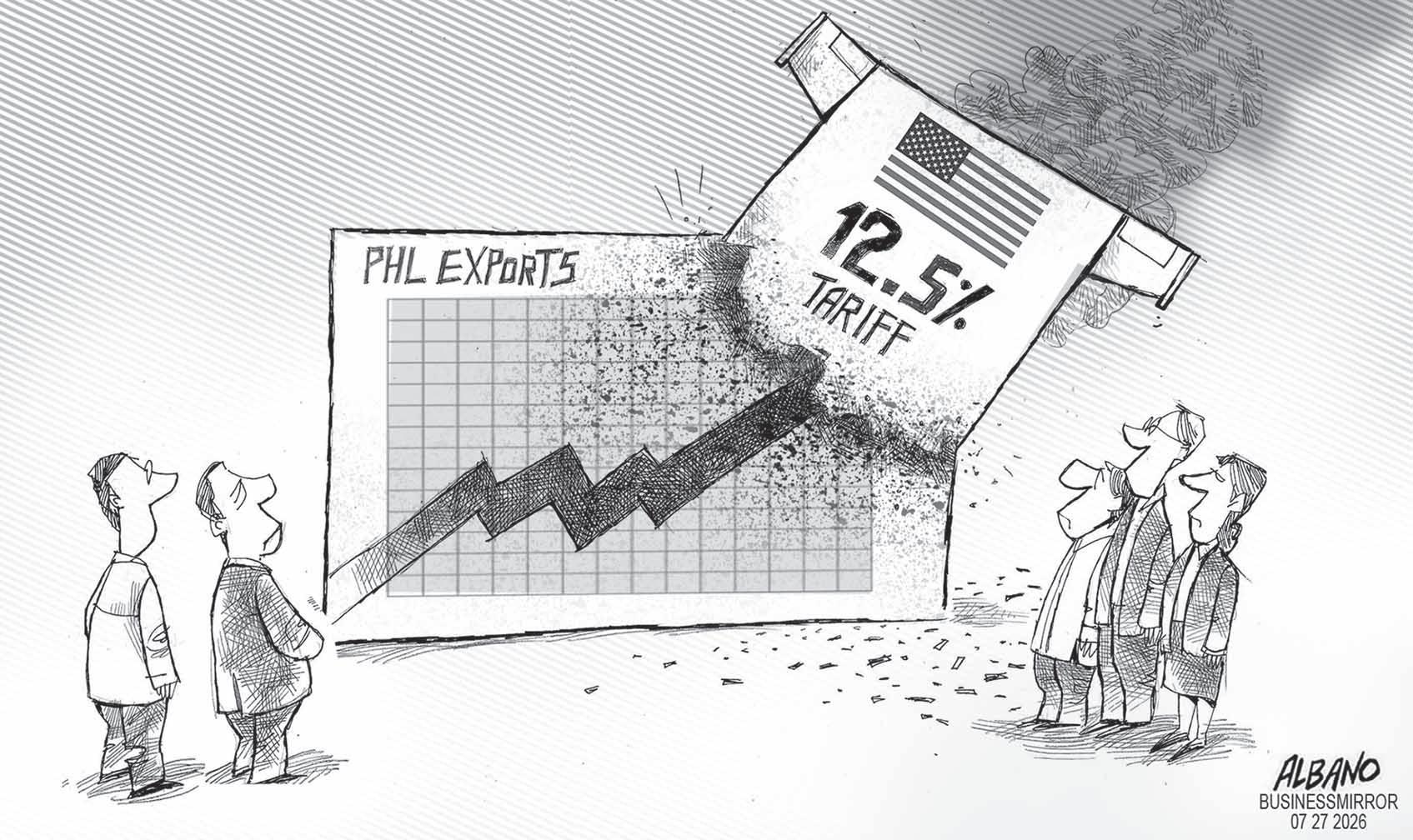
Five things that can’t wait two more years

TRISING SUN
ODAY, July 27, President Marcos delivers his penultimate SONA—his fifth, with only two more years and one more address left in his term. Five issues deserve more than a passing mention. These are, of course, not the only problems the nation is grappling with. Traffic remains crippling, the West Philippine Sea dispute simmers, inflation still bites, and the flood-control corruption scandal continues to unravel.
But artificial intelligence, creative professionals’ welfare, education, healthcare, and disaster preparedness should also be prioritized. These determine how well Filipinos learn, earn, heal, and survive whatever the next crisis brings.
One, artificial intelligence. The world is racing ahead, and we are barely walking. The 20th Congress is sitting on roughly 40 House bills and seven Senate bills seeking to regulate AI, yet the Philippines still has no central AI law; only a National
AI Strategy approved last year and a patchwork of proposals for a Philippine Council on Artificial Intelligence. A proposed DOLE job-displacement program for workers automated out of their jobs exists only on paper. We are adopting AI faster than we are learning to govern it.
Two, creative professionals and freelance workers. The Philippines is one of, if not the fastest-growing freelance market in the world, with millions of Filipinos earning a living without contracts, benefits, or a
safety net. These are our virtual assistants, writers, designers, riders, and so on. House Bill 1988, the freelance workers’ protection measure, and the POWERR bill for riders and online workers have been filed, re-filed, and endorsed by the ILO’s own Decent Work in the Platform Economy Convention. But it’s still pending. Our creative and digital workforce deserves so much more than this.
Three, education. This is the most damning number of all: only 70.8 percent of Filipinos aged 10 to 64 are functionally literate, according to the PSA’s 2024 FLEMMS survey. That means nearly one in three of us can read words without truly understanding them. The World Bank estimates 91 percent of our 10-yearolds cannot read and comprehend a simple story. EDCOM 2 found learning proficiency collapsing from 30.5 percent in Grade 3 to a mere 0.47 percent by Grade 12. Eighteen million high school graduates are functionally illiterate.
Four, healthcare. Advocates and lawmakers have been pleading, again, ahead of this SONA: raise the excise taxes on sweetened beverages and alcohol, pass HB 5003 and the
Alcohol Tax Reform Bill, and use the revenue to properly fund PhilHealth and the Universal Health Care Act instead of leaving public hospitals and barangay health workers underfunded. Filipinos are getting sicker from what they eat and drink while the reforms that could fund their care sit in committee. Five, disaster and climate readiness. The Philippines topped the WorldRiskIndex again as the world’s most disaster-prone nation, and ranks seventh in Germanwatch’s Climate Risk Index, with 371 extreme weather events and 27,500 deaths between 1995 and 2024 alone. A 7.8-magnitude earthquake off Mindanao killed dozens just weeks before this SONA. And billions meant for flood control were instead lost to the corruption scandal the President himself exposed last year. So many months and so much money have gone into bickering in the Senate and the Lower House, into debates on matters that should never have taken priority, into politicking and the protection of personal agendas. Perhaps it is time, in these final years, for a legacy worth being proud of.
Building the future instead of waiting for it: The true promise of Pax Silica

T. Anthony C.
THE most important announcement about Pax Silica, an economic initiative from the United States that selected our country together with Singapore in building secure, resilient supply chains for critical minerals, semiconductors and AI infrastructure, may not have been the billions of dollars in investments it promises or the million quality jobs it hopes to generate. It may have been a simple change in the way the government speaks about time.
During an interview on Bilyonaryo Spokes, Presidential Communications Office Secretary Dave Gomez described a subtle but profound shift in the administration’s communications narrative. Instead of looking at the government through the weary refrain, “ dalawang taon na lang,” he urged Filipinos to begin thinking in terms of “dalawang taon pa.”
The difference appears linguistic. In reality, it is economic.
“Dalawang taon na lang” is the language of endings. It shortens horizons. It encourages investors to postpone decisions, agencies to become cautious and citizens to think that the country’s major opportunities are already behind it.
“Dalawang taon pa” is the language of construction.


It says there is still sufficient runway to build, to invest, to innovate and to execute. That seemingly modest change
in perspective may well become one of the administration’s most valuable economic assets because modern economies are built not merely on capital but on confidence.
Investment decisions are made years before factories rise from the ground, semiconductor plants begin production or artificial intelligence campuses employ their first engineers. Expectations often arrive before prosperity does. Seen through that lens, Pax Silica becomes far more than another investment promotion program.
It becomes the first large-scale test of a longer national horizon. Born from the strategic realignment of global supply chains following geopolitical disruptions, Pax Silica places the Philippines among only two trusted Southeast Asian partners of the United States, alongside Singapore, in developing a new generation
of semiconductor, advanced manufacturing and artificial intelligence capabilities. Its ambitions are staggering. Foreign direct investments are projected to reach between $40 billion and $70 billion, with an initial $10 billion devoted to strategic infrastructure. The initiative envisions transforming the Philippines from an exporter of raw minerals into a center for value-added processing, semiconductor manufacturing and AI infrastructure.
If fully realized, it could support as many as one million quality jobs, generate exports approaching $200 billion annually, produce yearly tax revenues that could eventually reach P180 billion and, perhaps most importantly, reverse the decades-long exodus of Filipino engineers, scientists and technology professionals by creating opportunities worthy of their talents at home.
The proposed 1,620-hectare AI industrial hub in New Clark City—the initiative’s first “Golden Node”—is therefore more than an industrial estate. It represents a new economic architecture that seeks to move the Philippines higher along the global technology value chain. Yet projects of this scale do not succeed because the government announces impressive numbers. They succeed because an entire nation begins to believe that the future is still under construction. This is where the communications shift matters. The phrase “ dalawang taon pa” quietly invites Filipinos to become participants rather than spectators in economic transformation. It asks businesses to invest instead of waiting, universities to prepare graduates for industries that are only beginning to emerge, local govern-
ments to build ecosystems rather than merely attract ribbon-cutting ceremonies, and young Filipinos to imagine careers they no longer have to pursue overseas. Participation, after all, is the invisible capital behind every successful economy. Factories cannot flourish without skilled workers. Innovation cannot thrive without researchers. Supply chains cannot expand without entrepreneurs willing to take risks. Even foreign investments ultimately depend on the confidence that citizens themselves have in the country’s direction. In that sense, Pax Silica is not simply about silicon, semiconductors or artificial intelligence. It is about extending the nation’s economic imagination. The real paradigm shift is not only from “ dalawang taon na lang ” to “dalawang taon pa.” It is from measuring the remaining time of an administration to measuring the remaining possibilities of a nation. And perhaps that is the deeper lesson. A country’s greatest infrastructure is not always found in ports, airports or industrial parks. Sometimes it begins with a new way of thinking about tomorrow. If Filipinos embrace that longer horizon—and participate in building it—Pax Silica may ultimately be remembered not merely as a technology initiative but as the moment the Philippines decided to build its future instead of merely waiting for it. In a sense, resilience is what keeps the country standing, participation invites citizens to help build, Pax Silica provides the economic platform on which that participation can create lasting prosperity.
Atty. Jose Ferdinand M. Rojas II
Time to come out of the closet

ASiegfred Bueno Mison, Esq.
THE PATRIOT
MID the chaotic and often argumentative proceedings in the impeachment trial, much has been said about how lawyers from all sides have conducted themselves. Prosecutors, defense counsel, and even senator-judges have expressed opinions and positions that are frequently distorted by social media influencers. In turn, these influencers respond with equal intensity, attacking perceived opponents and fueling further division.
The ultimate victim in this war of words is the Filipino people, whose demand for accountability is repeatedly undermined by legal maneuvering from both sides. Some now call for the immediate termination of the impeachment trial without fully presenting the remaining evidence, arguing that the constitutional threshold for conviction is impossible to reach unless a miracle occurs. Yet each Senate session costs millions of pesos, much of which is consumed by technical objections, legal grandstanding, and perceived filibustering.
On the other hand, some suggest allowing the trial to drag on until public fatigue sets in and the nation simply stops caring about the outcome. This, however, comes at a time when the country faces far more urgent concerns. I am skeptical whether the Marcos administration has sufficiently addressed the issues of poverty, inflation, rising national debt, and ongoing tensions in the West Philippine Sea, among others. One thing has become clear: political lines are now sharply drawn. Nearly every commentator, influencer, and opinion writer appears to have chosen a side, making truly objective analysis increasingly rare. In this environment, even legitimate positions are quickly reduced
Modi punctured as awakened India students force swift retreat
By Sudhi Ranjan Sen, Ruchi Bhatia & Akriti Sharma
FOR much of Narendra Modi’s 12 years ruling India, he’s looked nearly unbeatable at the polls. This weekend he swiftly yielded to a group that didn’t exist a few months ago, energizing opponents who have struggled to rattle one of the nation’s most powerful leaders ever.
Education Minister Dharmendra Pradhan resigned on Saturday to take accountability for a series of exam scandals in the face of a student protest movement that mobilized thousands of young people in New Delhi and started to spread around India. The Cockroach Janta Party, which formed two months ago as a social media joke, declared victory and called off its demonstrations while vowing more action “to solve all the problems in this country.”
It was the first time since Modi took power in 2014 that one of his cabinet ministers had resigned under public pressure, a sign of the threat posed to the prime minister and the prospects of his ruling Bharatiya Janata Party. He soon faces a key election in Uttar Pradesh, India’s most populous state, where jobs for young people are a major concern for many voters.
“It is a very big defeat for Mr. Modi,” said Nilanjan Mukhopadhyay, author of the biography Narendra Modi: The Man, The Times. “For the Modi brand, for this image that’s been built of him as a nononsense, populist strongman leader.” The protests, which began about a month ago, quickly escalated after police used tear gas and batons to prevent students from marching to the parliament on July 20. Visuals of the violence quickly spread online and in the media, drawing widespread public sympathy, including from Bollywood stars, and backlash against the police action. Opposition lawmakers threw their support behind the students, disrupting proceedings in the parliament as they called for the minister to resign. By the end of the week, protests had spread to other major cities, including Mumbai and Kolkata, drawing thousands of young people onto the streets.
On Saturday, students erupted in joy as news of the education minister’s resignation filtered through the crowd at the designated protest site in New Delhi. Saurav Das, a spokesman for the Cockroach Janta Party, said the country’s youth were now “awakened” and would push for more change.
“As a party, as a movement, this is obviously not the end,” he said. “Now we will go across the country, listen to the youth, bring the best policies for them and continue to demand accountability from everyone. This is just the beginning.”
It’s not the first time that Modi’s gov-
to political labels, and intelligent discourse is often lost in the noise of polarization.
One notable exception, in my view, is UP Professor Guido David. A mathematician by training, his insights are grounded in data and statistics. I appreciate how he begins with numbers before drawing conclusions. After all, numbers do not lie, even if interpretations may vary.
Unfortunately, in today’s climate, convictions are often equated with political allegiance. Supporting the continuation of the impeachment trial is quickly labeled as being anti-Vice President Sara Duterte and therefore pro-Marcos. Such simplistic labeling reflects how deeply polarized our political culture has become, where ideas are no longer evaluated on merit but on perceived political alignment. I, too, have been labeled by some colleagues in the military and legal profession as “yellow” or “pink.” This is perhaps understandable. My late father Salvador and I both served during an Aquino administration. He and I actively supported former Vice President Leni Robredo in the 2022 presidential elections. What many do not know is that I also supported and voted for Rodrigo Duterte in 2016, as did my late father. We were both seeking a disciplined leader who could restore order. Over
time, however, we saw how he and some around him abused the authority entrusted to them, leading to controversies involving individuals I thought to be incorruptible.
People are free to assign whatever political color they wish. These labels matter little if they represent good governance, transparency, accountability, and opposition to political dynasties. More importantly, I would rather be associated with leadership that fears God and seeks His wisdom above political convenience. It may sound like a pipe dream but there’s one great example that needs to be reiterated.
In biblical history, Jesus followers were simply too few. Persecuted by those around them, the initial church leaders nonetheless publicly preached out in the open. Harassed and imprisoned and eventually martyred, these handful of believers, who were fully convinced of Jesus’ teachings, managed to reach out to many to the point of becoming the most dominant faith-driven congregation in the world. The Bible tells us: “The harvest is plentiful, but the workers are few. Ask the Lord of the harvest, therefore, to send out workers into his harvest field.” (Luke 10:2). More Filipinos are needed to spread the message of selfless leadership personified in Jesus Christ.
Perhaps this is where many of us need to “come out of the closet.” I have heard of many “closet Christians” in government who sincerely worship God but hesitate to express their faith publicly for fear of criticism. This is especially true in the uniformed services, where open devotion to Jesus Christ is sometimes seen as incompatible with the image of a warrior. Others remain in the closet due to a poor comprehension of the separation of Church and State. Worse, others remain apathetic as they look at their service to the country more as an income-generating activity rather than as an opportunity to serve others.
In my leadership talks with members of the AFP and PNP, I often remind them that the 1987 Constitution itself begins with an acknowledgment of the “Almighty God” in its Preamble. If our fundamental law invokes God’s aid, then every Filipino, regardless of faith, is called to recognize the importance of His guidance. This is even more evident in the oath of public office, which ends with the words, “So help me God.” These words are not mere formal requirements but serve to remind that every public servant divine wisdom is desired in the fulfillment of duties.
As my mentor Pastor Albert often
says, calling on God is not merely religion; it is about a personal relationship with Him. As our nation continues to wrestle with political division especially during this impeachment trial, what we need is not louder voices or sharper arguments, but humility to acknowledge our dependence on God. Whether one supports or opposes the impeachment of a very popular Vice President, all leaders ultimately need divine wisdom. I therefore urge all Filipinos, believers or not, to come out of the closet and openly affirm that our nation needs the help from our Almighty God. Only then can we rise above political colors and personalities and anchor our hopes for this country on good and Goddriven governance!
Siegfred has a diversified set of education and experiences which has made him a game changer and a servant leader in organizations. His professional degrees came from the United States Military Academy at West Point in New York, Ateneo Law School, and University of Southern California, Los Angeles, USA. His corporate experiences include stints as general counsel for the country’s flag carrier, a food exporter with manufacturing plants in Davao and in Laguna, and a sports distributor company. Siegfred is a former soldier and a lawyer by profession, a teacher and inspirational speaker by passion, and a book author and a writer with a mission.
122 years of nation-building: Celebrating the BIR’s journey of reform

Oernment has bowed to public pressure. In 2021, his administration agreed to repeal controversial farm laws after tens of thousands of farmers across northern India protested for months. This time, demonstrators forced Modi’s hands within days, surprising many observers.
“Modi was left with little choice given the groundswell of students participating in the protests,” said Amit Ranjan, a research fellow at the Institute of South Asian Studies at the National University of Singapore. “Over the past several years, Modi has worked to cultivate support among young voters. His response to the protest suggests he recognizes the political importance of this constituency and the risk of losing its support.”
The prime minister in recent days made direct appeals to students in a bid to calm the anger, posting late night selfie videos on Instagram two days in a row. He pledged strict action against those behind the exam paper leaks, including fast-track courts to tackle the issue.
The quick response allows Modi to contain the political fallout after more established opposition groups sought to capitalize on the student protests.
“Modi is adept at reading the tea leaves,” said Harsh Pant, vice president at the Observer Research Foundation, a New Delhi-based policy research group.
“He was quick to repeal the farm laws because the farmers’ protest lasted much longer and represented a more powerful constituency. Similarly, this movement shows the prime minister’s flexibility.”
Rahul Gandhi, the leader of the opposition in the parliament, called on other groups disillusioned with Modi’s party to also make their voices heard.
The youth-led protests are a “signal to other parts of the society—farmers, laborers, poor people, anybody whom this regime is attacking and repressing— there is wisdom, courage in standing up,” Gandhi said in a video posted on X. “Don’t be scared. Let’s get rid of this regime.”
It’s uncertain whether opposition groups, particularly Gandhi’s Congress party, can convert the street anger into electoral victories, according to political scientist Ramu Manivannan. Modi’s landslide wins in recent state elections, notably in West Bengal, show his ruling BJP remains in a dominant position over the opposition even if it retreated in this case, he said. With assistance from Shruti Srivastava and Swati Pandey /Bloomberg
DEBIT CREDIT
N July 31, 2026, the Bureau of Internal Revenue will commemorate its 122nd anniversary with the theme “Husay at Dangal: Lingkod-Bayan ng BIR.”
The BIR was formally organized and made operational on August 1, 1904, following the enactment of Reorganization Act No. 1189 on July 2, 1904. It began with only 69 officials and employees, headed by the first Collector of Internal Revenue. From that modest organization emerged the government institution that now carries the principal responsibility for financing public services and national development.
I am pleased to have been invited to join this year’s anniversary celebration on July 31 at the BIR National Office compound in Diliman, Quezon City. This year’s gathering will be more low-key than the elaborate celebrations of some previous years—a fitting opportunity for reflection rather than spectacle.
The anniversary provides an occasion to look back at the reforms that transformed the BIR from a predominantly manual organization into an increasingly digital and data-driven, service-oriented tax administration. I have discussed the administrative reform undertaken by the BIR over the past decades. For my article next week, I will dwell on the major laws that were passed over the more than a century of existence of the BIR.
One of the earliest foundations of modern tax administration was the establishment of a unified system for identifying taxpayers. The old Tax Account Number, or TAN, was first utilized in 1976. I still retain the light yellow colored TAN card issued to me in 1980 when I started working.
The TAN was eventually replaced by the Taxpayer Identification Number, or TIN, in 1991. The TIN became the permanent identifier linking taxpayers to their registration, return filing, payment, and audit records.
The next great milestone was the Tax Computerization Project (TCP), which started in the 1990s. This produced the Integrated Tax System, or ITS, supported by Revenue Data Centers, computerized registration, returns processing, collection accounting, and taxpayer-account databases. Computerization began replacing ledgers, index cards, and
physical folders that previously made the verification of taxpayer information slow and difficult. I am proud to have been part of the TCP, having been appointed one of the Project leaders at the time.
One major milestone in the BIR history was the creation of the Large Taxpayers Service (LTS) in 2000. This brought the country’s biggest corporate taxpayers under specialized monitoring and account management. The LTS model recognized that a relatively small number of taxpayers accounted for a substantial share of government revenues.
The Large Taxpayers Service (LTS) has consistently contributed about 55 percent to 60 percent of the Bureau of Internal Revenue’s total tax collections over the past two decades
The launching of the Electronic Filing and Payment System, or eFPS, in 2001, was another historic milestone. It enabled taxpayers to file returns and pay electronically, reducing dependence on paper returns and over-the-counter transactions. What started with large taxpayers was subsequently expanded to other mandatory users. Incidentally, the eFPS celebrates its 25th year of existence this year. About 85 percent of BIR tax collections are now received through the eFPS.
The Reconciliation of Listings for Enforcement, better known as RELIEF, introduced data matching into tax enforcement. Through taxpayers’ schedules of sales and purchases, the BIR could compare a seller’s declared sales with the buyer’s reported purchases. Discrepancies became potential indicators of under-declaration, unreported income or unsupported claims.
RELIEF was revolutionary for its time. It demonstrated that tax enforcement need not depend solely on an examiner manually inspecting books. Information already submitted by taxpayers could be matched and analyzed to identify compliance risks.
Another important development was the publication of the BIR Monitor, a weekly newsletter which started as a printed copy with pic-
tures of activities conducted by BIR employees. It continues to be issued to this day, trumpeting the achievement of revenue, but now in digital form already. I was then the BIR Commissioner who conceptualized and created the BIR Monitor in 2009. Enforcement programs also became more visible. The Run After Tax Evaders, or RATE, program institutionalized the filing of criminal tax-evasion complaints. Oplan
Kandado authorized the temporary closure of businesses for serious violations, including substantial understatement of sales and failure to issue invoices. Industry benchmarking, lifestyle checks, third-party information matching and interagency data exchanges further expanded the BIR’s enforcement tools.
During my term as Commissioner from 2009 to 2010, we pursued the reinvigoration of RATE, Project R.I.P. or “Rest in Peace” for the estates of deceased taxpayers with unsettled obligations, taxpayer lifestyle checks, the development of industry champions and audit of large-ticket items. We also strengthened linkages with other government agencies to provide the BIR with information useful for registration, assessment and collection.
The BIR’s historical account records these initiatives as part of its institutional development.
I will discuss in a future column the tax collections and strategy of the BIR in raising revenues by means of administrative tax amnesties. There were several of these measures instituted by the BIR that resulted in billions of taxes collected. These, with the legislative tax amnesties, will be a topic of discussion in a future article.
The subsequent introduction of eBIRForms in 2012 gave taxpayers outside eFPS an electronic facility for preparing and filing returns. The newer Electronic Tax Information System, or eTIS, was intended to replace and improve upon the aging ITS platform.
More recent reforms include the Online Registration and Update System, or ORUS, that was launched in 2022. Through ORUS, taxpayers can conveniently apply for registration and update certain information online. The BIR now also provides electronic facilities involving tax clearance, certificates authorizing registration, appointments, payments and other transactions. Its Citizens’ Charter confirms that several registration services, including applications for TINs, are now available through ORUS.
The Electronic Invoicing System represents the next major frontier.
Instead of waiting for periodic returns and summary lists, electronic invoicing can eventually provide the BIR with more timely transaction-level information. Properly implemented, it can strengthen VAT verification, detect fictitious transactions, improve audit selection and support near-real-time compliance monitoring.
The BIR is now entering the age of compliance-risk management, advanced analytics and artificial intelligence. The central challenge is no longer simply to collect more information. It is to integrate registration, invoicing, customs, property, corporate and financial information and convert these into fair and defensible compliance actions. Technology, however, is not reform by itself. Digital transformation must produce faster taxpayer service, fewer unnecessary audits, risk-based selection, transparent case monitoring, and greater accountability among revenue officers. It should make compliance easier for honest taxpayers while making evasion more difficult.
As the BIR celebrates 122 years, its history should remind us that every generation of revenue officers inherited reforms from those who came before them. TAN led to TIN. Manual records led to computerization. Computerization led to electronic filing. Electronic filing and RELIEF led to data matching. These, in turn, are leading toward e-invoicing, tax analytics, and artificial intelligence.
The anniversary is therefore not merely a celebration of longevity. It is a celebration of public service and a reminder of unfinished work.
To Commissioner Charlito “Charlie” Mendoza, the officials and employees of the Bureau, former revenuers, taxpayers, and the BIR’s institutional partners: congratulations on the 122nd anniversary of the Bureau of Internal Revenue. May the next chapter of its history be defined by integrity, innovation, taxpayer trust and the continuing mission of bringing in revenues for nation-building.
To be continued
Joel L. Tan-Torres was
Joel L. Tan-Torres

Eala gets shot at tormentor Zheng in DC
APOGACAR: 5TH TOUR CROWN IN THE BAG
LPE D’HUEZ, France—
ATadej Pogacar moved to within touching distance of a recordequaling fifth Tour de France title after finishing safely in the penultimate stage on Saturday.

The Slovenian star heads into Sunday’s showcase finish in Paris with a lead of six-and-a-half minutes over Belgian rider Remco Evenepoel. Barring mishap, Pogacar will join Belgian Eddy Merckx, Spaniard Miguel Indurain and Frenchmen Jacques Anquetil and Bernard Hinault as the only men to win five Tours.
“I have done a really good Tour. Some of our competitors had bad luck,” said Pogacar, whose main rival Jonas Vingegaard crashed out of the race. “We made it through with the team and now there is just one last show left.”
The 20th stage was won by Richard Carapaz for his second victory at this year’s race and third overall.
The Ecuadorian rider overtook Sepp Kuss near the end as the American almost crashed out and also surged past Kuss near the line to take second place.
Na to breah reach the top 5 in women’s singles and Australian Open runner-up in 2024, the 23-year-old didn’t get past the first round of both the French Open and Wimbledon this year.
Eala’s highly-anticipated partnership with Venus Williams, on the other hand, won’t happen at Flushing Meadows after the seven-time grand slam champion as reported to be pairing with no longer happening as the 21-year-old Filipino is out for the women’s doubles without going to details while Williams is partnered with Russian Diana Shnaider instead. Josef Ramos
North vs South Finals unwraps in CdO Pueblo
DEFENDING champion Team North heads into the 2026 International Container Terminal Services Inc. Elite Junior Philippine Golf Tour (JPGT) Finals expects a far tougher challenge from a South squad playing on its home course when the Ryder Cup-style championship unfolds August 17 to 20 at Pueblo Golf and Country Club in Cagayan de Oro City. The event, organized by Pilipinas Golf Tournaments Inc. and which serves as a World Amateur Golf Ranking (WAGR) counting tournament, brings together the top 48 junior golfers from the six-leg Luzon (North) and Visayas-Mindanao (South) series in a battle for regional supremacy. North claimed a convincing 26 1/2-21 1/2 victory in last year’s inaugural edition at The Country Club in Canlubang after dominating the opening two team formats before

“There was a moment when I couldn’t believe what was happening,” Carapaz said. “This Tour de France has been incredible, with all the spectators and all the support




I’ve received from Ecuador, where they’ll be jumping for joy.”
Pogacar chose not to launch one of his attacks like on Friday’s 19th stage. Stage 20 was a mammoth 171-kilometer alpine trek featuring three hors catégorie climbs—the hardest category—and one Category 1 climb.

After three weeks in the saddle, weary riders tackled hors catégorie ascents of Col de la Croix de Fer, Col du Galibier and Col de Sarenne, and the one Cat 1 climb of Col du Télégraphe, making for 66 kilometers of hard climbing in total before a hilly finish to Alpe d’Huez.
Carapaz rode from the front in order to secure the polka-dot jersey awarded to the Tour’s best climber.
Pogacar’s yellow jersey group was hanging back when Carapaz, Kuss, Spaniard Juan Ayuso and Australian Jai Hindley went over the Galibier together.
Pogacar’s priority was ensuring his UAE Team Emirates teammate Isaac Del Toro finished third in the rankings and the Mexican rider is now more than two minutes clear of Frenchman Paul Seixas in fourth.
“It’s been an honor to ride for Isaac today,” said Pogacar, who gifted Del Toro victory on Stage 2. “Crossing the finish line together with him has been memorable.”
Ayuso was dropped as the former Spanish Vuelta winner Kuss, Hindley and Carapaz—both former Giro d’Italia winners—battled for supremacy in the Sarenne pass.
“It was really, really tough,” Carapaz said. “Sepp, in particular, was a very tough nut to crack.”
An exhausted-looking Kuss lost control of his bike going downhill

Boracay lure highlights open water competition
ORACAY’S fame as the country’s premier island beach resort will lure more entries and visitors for the Fourth Southeast Asian Open Water Championships presented by the Philippine Sports Commission from August 21 to 23 off the Boracay Newcoast in Malay, Aklan.
“Indonesia had its Bali, Thailand had its Pattaya and now the Philippines has Boracay to be proud of so we fan anticipate even more swimmers and tourists



Cry for Argentina
IT was supposed to be the best World Cup ever. Well, maybe it still is. One thing is for sure—the 2026 FIFA World Cup will go down as also one of the most controversial. I have not seen a pair of countries quickly become the villains of the tournament.
year’s result and make the title race considerably tighter. The youngest competitors are expected to ignite the tournament as North’s Winter Serapio, Jaicee Cervantes, Andrea Dee and Jehanne Mendoza square off against South’s Soleil Molde, Ana Marie
Yes, there were questionable and controversial calls already, but the moment Donald Trump interfered and called up FIFA President Gianni Infantino to look into reversing the red card assessed to US star Faloran Balogun that cleared the way to his taking part of the US-Belgium knockout match, the event became one bloody mess. The rest of the world sided with Belgium and if Trump had not already made the US a pariah of sorts, this interference in the World Cup certainly did. And as much as I wanted the US to advance, it was just right that Belgium ousted them convincingly, 4-1. That is where it got more interesting as calls for Argentina and England turned the tide for those
to watch the open water swimming meet,” stressed Philippine Aquatics Inc. (PAI) secretary general Eric Buhain at the recent Philippine Sportswriters Association forum. PAI executive director Anthony Reyes, who was present at the program, disclosed that at least eight of the 11 member countries from the Southeast Asian Swimming Federation, which is sanctioning the three-day championships, will be fielding teams.
“They are Indonesia, Laos, Malaysia, Singapore, Thailand, Timor Leste, Vietnam and of course, host Philippines,” said Reyes of the country’s inaugural hosting of the open water swimming showcase overlooking the beautiful 150-hectare tourism estate being developed by real estate giant Megaworld.
“This sporting event not only advances the growth of open water swimming in Southeast Asia, but also shines a spotlight on Boracay island as a true gem of the region, while reflecting the warmth and hospitality of the Filipino people,” PAI president Michael Vargas noted in a statement.
two squads. However, none more so than Argentina who I deemed to be lucky in the group stages. Let me clarify that. They were good but not sharp. Luckily for the Albiceleste, they faced competition that they should beat even with their eyes closed. The knockout stages saw Argentina kick up its level of play especially in the final 10 minutes of the match. But the calls went their way against Algeria, Egypt and Spain. It was deemed that FIFA was favoring Argentina to give Lionel Messi a proper send off as the sport’s Greatest of All Time and because the ratings and ticket sales were tops when they took to the pitch. However, Spain, like Belgium before them, saw the world rooting for them while jeering Argentina (and FIFA). And the way La Furia Roja won and dispatched Argentina with surgical precision, the latter were served a stinging lesson playing football the right way, with no help from FIFA or the game officials, and teamwork. Incredibly, Argentina’s shocking heel turn did not end there. There was a fight post-match and during the trophy ceremony, they turned their back to the victorious Spanish side. That was the first time we have seen that in a match of this gigantic proportions and really tarnished Argentina’s image. Man, all the more they were castigated and pilloried on television, online, social media and traditional media as a disgrace to the sport and their country. Talk about a fall from grace! Not only did Argentina lose in its title defense, but its reputation is shot. And you have to go all the way back to Diego Maradona’s “Hand of God” to know they have benefitted from egregious calls.

uphill dash through the Montmartre district in Paris and finishing on the Champs-Élysées. The stage was shortened from 133 kilometers and its starting point in Thoiry, west of the capital, was changed to Paris so as to reduce pressure on emergency services combatting wildfires in the southwest. Security forces initially mobilized for Paris have been redeployed to help response efforts elsewhere. AP
sporting event,” Gregorio stressed.
VIRTUAL champion Tadej Pogacar (left) makes sure his Mexican teammate Isaac Del Toro at UAE Team Emirates-XRG will be on the podium on Sunday (Monday in Manila). AP
GREGORIO BUHAIN
ALEX EALA warms up for US Open.
Editor: Jennifer A. Ng
DOE: Auction of Semirara coal deal faces slight delay

By Lenie Lectura @llectura
THE planned auction for the Semirara coal mine will be moved to either August or September this year to update bidding terms in response to policy changes in Indonesia.
Indonesia has moved to improve regulations on coal exports, according to the Department of Energy (DOE). Energy Secretary Sharon S. Garin said this development in Indonesia may have an impact on the planned coal auction.
“The Semirara auction will be impacted. It’s delayed a bit because now we have to rethink about these changes in Indonesia. Semirara actually exports the majority of it coal. There are things that we can put in the terms of reference so we maximize our utilization of indigenous coal. I think we still need a few more
weeks to finalize. We want this finished as soon as possible,” she said.
The bidding process for coal development and production areas, including the controversial blocks on Semirara Island, is expected to resume soon. Consunji-led Semirara Mining and Power Corp. (SMPC) currently holds coal operating contract (COC) No. 5, which is among the coal blocks on Semirara Island that will be tendered. The COC is valid until July 14, 2027.
“If the schedule is July (or) August then probably it will be moved to August (or) September. Maybe a one-month delay…There are things
that we can put in terms of reference so we maximize our utilization of indigenous coal,” Garin added.
The DOE chief recently led a Philippine delegation in a series of highlevel meetings in Jakarta, Indonesia to secure assurances on coal supply, strengthen bilateral energy cooperation, and seek “greater clarity” on Indonesia’s new export governance framework for coal and other strategic natural resource commodities.
The delegation included officials from the DOE, and the Philippine Embassy in Jakarta. Separate meetings were held with Indonesia’s Coordinating Ministry for Economic Affairs (CMEA), led by Coordinating Minister Airlangga Hartarto; the Ministry of Energy and Mineral Resources (MEMR), with Vice Minister Yuliot Tanjung in attendance; and PT Danantara Sumberdaya Indonesia (PT DSI).
During the meetings with MEMR and CMEA, the Philippine delegation underscored Indonesia’s role as a strategic energy partner and the Philippines’s principal source of imported coal. The delegation emphasized coal’s continuing role in
SEC adopts new financial reporting rules
THE Securities and Exchange Commission (SEC) said it has adopted the latest financial reporting pronouncements to keep the country’s financial reporting framework aligned with evolving accounting and sustainability reporting requirements.
In a memorandum circular, the SEC said it will observe the new and amended Philippine Financial Reporting Standards (PFRS) and Philippine Interpretations Committee Questions and Answers (PIC Q&As), as part of the agency’s rules and regulation on financial reporting.
SEC said the PFRS is the “authoritative accounting standard” in the Philippines that prescribes the recognition, measurement, presentation and disclosure requirements for financial statements, while the PIC Q&As provide implementation guidance and interpretative clarifications on the application of the PFRS. The said new rules were initially issued by the Philippine Financial and Sustainability Reporting Standards Council, and approved by the Board of Accountancy and the Professional Regulation Commission. The new rules include accounting for experience refund or noclaims bonus, adoption of IFRS S1 on the general requirements for the disclosure of sustainability-related
LAST WEEK
financial information and IFRS S2 on climate-related disclosures as endorsed by the Philippine Sustainability Reporting Committee.
The SEC said it will also adopt the new rules on the presentation and disclosures of financial statements, the 2024 edition of financial reporting guidance, allocation of transaction price for bundled contracts under PFRS 15, amendments to the classification and measurement of financial Instruments, the timing of recognition for the cost of plastic packaging diversion activities under the Extended Producer Responsibility Act of 2022, among others. VG Cabuag
SHARE prices fell as the Middle East situation worsened against the backdrop of the slowing growth of the Philippine economy and elevated consumer prices. The benchmark Philippine Stock Exchange index slid 123.10 points to close at 6,281.01 points.
“The war between the US and Iran is escalating further with the Houthis from Yemen joining. This is causing global oil prices to surge again with Brent crude hitting $100 per barrel.
If the direction is sustained, it would cause inflationary pressures again, a headwind for the economy and the market,” Japhet Louis O. Tantiangco, senior research analyst at Philstocks Financials Inc., said.
Average volume of trade reached P5.89 billion. Foreign investors, who cornered 53 percent of the trades, were net sellers at P451.85 million. Most of the sub-indices ended in the red, led by the All Shares index that shed 21.59 points to close at 3,422.48 points, the Financials index declined 34.12 to 1,907.56, the Industrial index rose 67.30 to 8,447.60, the Holding Firms index fell 62.96 to 4,426.42, the Property index retreated 42.23 to 1,913.58, the Services index plunged 96.56 to 3,396.28 and the Mining and Oil index rose 1,215.65 to 15,827.88.
For the week, losers edged gainers 116 to 98 and 33 shares were unchanged.
Top gainers were Atlas Consolidated Mining and Development Corp., Lopez Holdings Corp., Anglo Philippine Holdings Corp., Integrated Micro-Electronics Inc., Cirtek Holdings Philippines Corp., LBC Express Holdings Inc. and Lodestar Investment Holdings Corp.
Top losers, meanwhile, were Lodestar Investment Holdings Corp., Makati Finance Corp., Manila Broadcasting Co., Island Information and Technology Inc.,Waterfront Philippines Inc., Rockwell Land Corp. and Supercity Realty Development Corp.
THIS WEEK
SHARE prices may continue to decline this week as the market remains wary of the situation both here and abroad.
Tantiangco said the market is expected to watch out for President Ferdinand Marcos Jr.’s State of the Nation Address on Monday, hoping for new catalysts including policies that would address the country’s main macroeconomic concerns namely slowing growth and rising inflation. The United States Federal Reserve will also be making its policy decision this week.
“Signs of progress were seen in the US inflation print for June. However, the US average inflation rate for the first half of the year at 3.3 percent remains above the 2- percent target. Hence, the possibility of policy tightening remains,” he said. He said raising of the US Fed’s policy rate or signals that it would be done so in the near-term may weigh on the local bourse. Meanwhile, broker 2TradeAsia said focus this week is seen on high-conviction dividend plays, energy and infra shares, with strong passthrough advantage.
“Select financial stocks might also benefit from sustaining NIMs [net interest margin] in a higher-for-longer rate regime,” it said.
“We do not foresee a 2008-style financial crash, but markets have to digest the reality that energy-driven inflation will stay, and ultimately, delay Fed easing.” Support for the main index is seen at 6,150 points, and resistance at 6,400 points.
STOCK PICKS
supporting the country’s power sector and sought regulatory clarity on Indonesia’s export framework to help safeguard power supply stability, affordability, and existing commercial arrangements.
Coordinating Minister Hartarto and Vice Minister Tanjung confirmed the Indonesian government’s initiative in improving regulation on coal exports which is intended to enhance transparency and improve traceability. PT DSI is currently at the forefront of this initiative and hopes to have the draft regulation released soonest.
Nonetheless, both officials recognized the importance of ensuring stable supply of coal to its partner economies who rely heavily on coal for power generation and other industrial uses and emphasized that the recent development does not intend to disrupt supply but improve transparency in coal transactions.
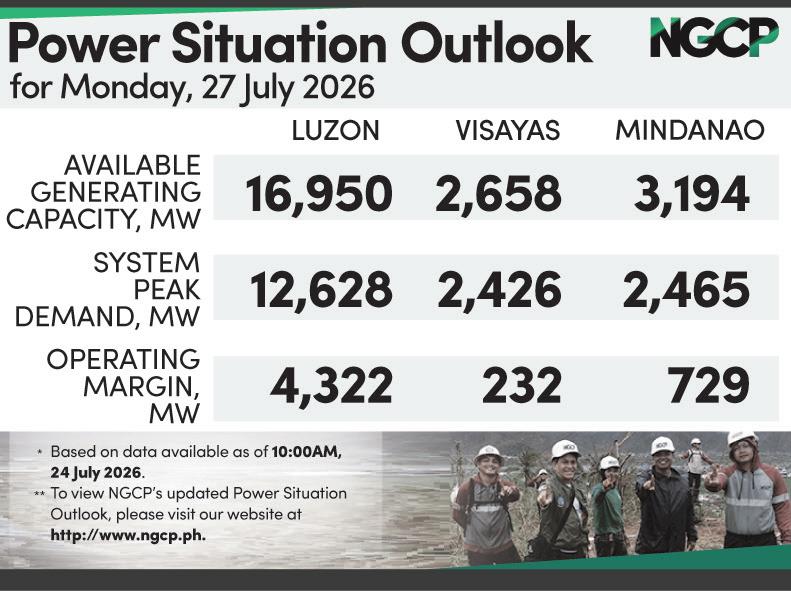
By Lorenz S. Marasigan @lorenzmarasigan
THE Bohol-Panglao International Airport (BPIA) will have a permanent on-site jet fuel depot by the third quarter of 2027, ending its reliance on trucked-in supply and giving BPIA at least five days of fuel cover, after its operator awarded the project to Petron Corp.
Aboitiz InfraCapital Bohol Airport Corp. (ABAC) has signed an agreement with the oil firm for the design, construction, and operation of a new Jet A-1 fuel farm at the airport, backed by a projected capital expenditure of P340 million.
Petron emerged as the topranked bidder following an evaluation under a Request for Proposals (RFP), which grants the winner exclusive rights to design, build, operate, and maintain the on-airport depot.
The facility will consist of three tanks with a storage capacity of
477 kiloliters (KL) each, or 1,431 KL in total. Commissioning will be carried out in accordance with the latest Joint Inspection Group (JIG) standards, the global benchmark for aviation fuel handling.
BPIA currently burns through 102 KL of jet fuel a day: 43 KL for international operations and 59 KL for domestic flights. The airport has no permanent bulk storage on site. “This milestone agreement underscores our commitment to modernizing the Bohol-Panglao International Airport,” ABAC General Manager Aldwin Uy said. “By partnering with an industry leader like Petron, we are securing a resilient, world-class fuel infrastructure that will ensure operational efficiency, and safely accommodate the growing aviation demands of the Bohol.” The agreement stipulates that applicable facility rates will be regulated by ABAC rather than set by the fuel supplier.
Continued on B2
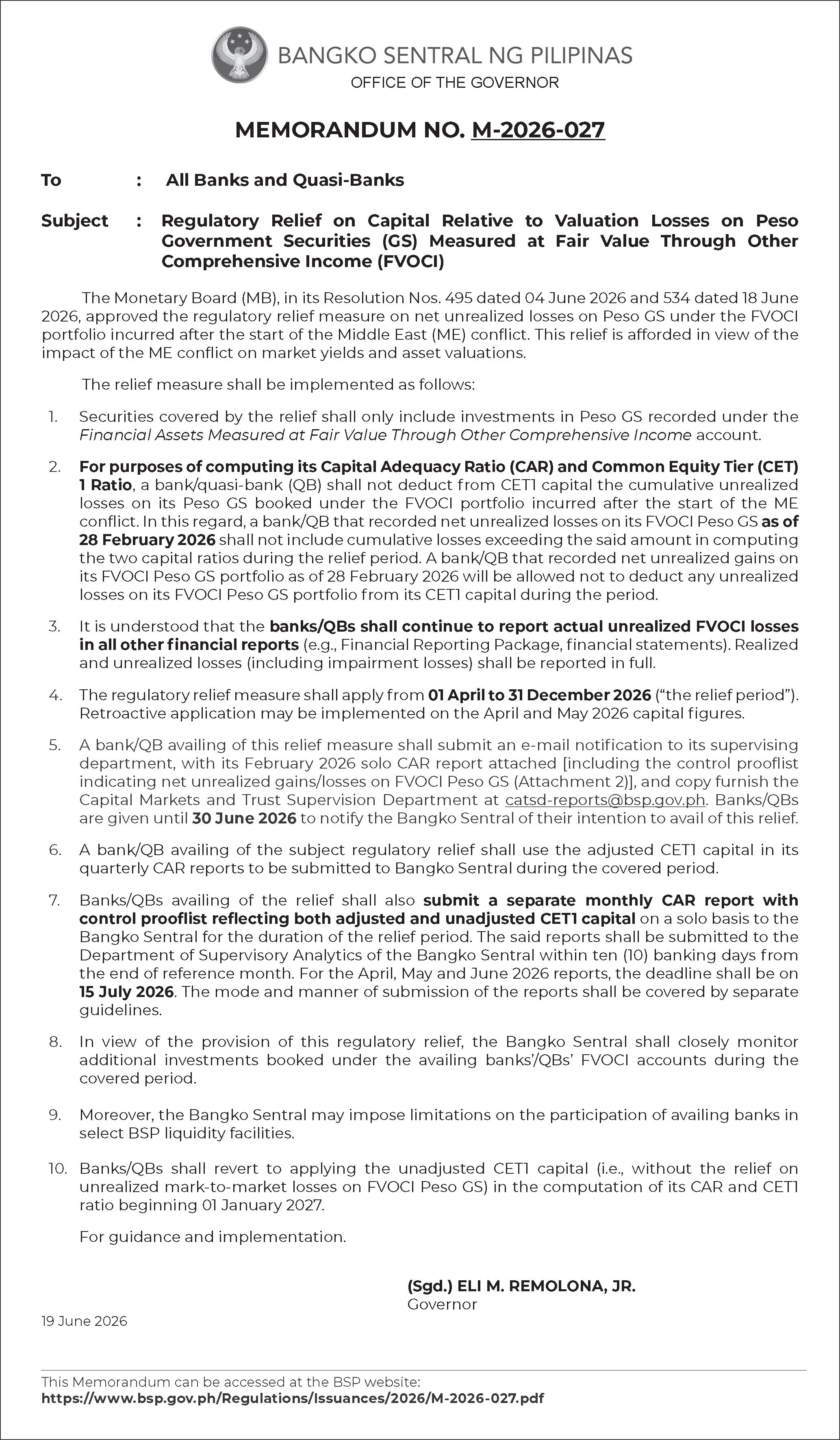
The value of what we can’t replace: A new perspective on nature conservation
EVERY generation inherits a different version of nature, shaped by the choices of those who came before. Progress drives development, but its environmental impacts often emerge gradually: trees disappear, paved spaces grow hotter, floods linger longer, and green areas give way to concrete. Individually, these changes may seem insignificant. Taken together, however, they reveal a profound shift in the relationship between people and the natural world.
Nature has never demanded recognition for the role it plays in our lives. It has simply been there, cooling our cities, filtering the water we drink, protecting coastlines, enriching soils, supporting food production, and sustaining livelihoods. Because these benefits are woven so seamlessly into daily life, they are easy to take for granted. We often view nature and progress as separate pursuits, when in reality, nature has always been one of the foundations upon which human progress depends.
This is why World Nature Conservation Day, observed every 28 July, remains relevant. More than an annual observance, it serves as a reminder that the health of our economies, businesses, and communities is inseparable from the health of the natural systems that sustain them. Nature is not merely an environment to protect. It is a vital asset that supports resilience, prosperity, and long-term growth. As nature has quietly supported generations of progress, the question is no longer whether it matters, but whether we are doing enough today to ensure it can continue doing so for generations to come.
Perhaps one of the greatest misconceptions about nature is that its value begins and ends with the environment. In reality, nature is also a critical foundation of economic activity. Scientists refer to its many contributions as ecosystem services; the benefits that healthy ecosystems provide to people and society, including clean water, fertile soils, pollination, climate regulation, and natural protection from floods and storms. These services rarely appear on financial statements or balance sheets, yet they underpin decisions made by households, communities, governments, and businesses every day. Without them, economies would be less productive, less resilient, and far more vulnerable to disruption. For generations, nature has quietly sustained communities and enabled economic growth. This is perhaps nature’s greatest paradox: the more reliably it supports us, the easier it becomes to overlook its value. For much of history, this value was understood through experience rather than measurement. We knew forests protected watersheds because rivers continued to flow, and fertile soils mattered because they sustained harvests and livelihoods. Today, however, as the relationship between business and the natural world continues to evolve, that intuitive understanding is increasingly being reinforced by data. Governments, investors, and scientists are developing ways to quantify nature’s contributions, revealing in economic terms what communities have long understood through lived experience: that nature is not merely an environmental asset, but a fundamental driver of prosperity, resilience, and long-term value creation.
That changing perspective is written clearly in economic data. Globally, the World Economic Forum (WEF) estimates that over half of the world’s gross domestic product (GDP) amounting to $44 trillion relies heavily on nature. Locally, a 2024 United Nations Development Programme Biodiversity Finance Initiative brief revealed that 56 percent of Philippine GDP comes from sectors directly linked to the environment. These numbers strip away the illusion that businesses exist independently of the biosphere, reinforcing that protecting nature is an absolute economic imperative. This realization is reshaping how government and businesses
Banking&Finance Marcos admin’s borrowings more than doubled in June

prepare for the future. As the WEF’s “Global Risks Report 2026” highlights, biodiversity loss and ecosystem collapse remain among the world’s most severe longterm threats. Despite shifting geopolitical and economic priorities, the underlying message is consistent: the resilience of our businesses and communities depends entirely on the health of the natural systems that support them.
Recognizing nature’s value is only the beginning. The greater challenge is ensuring that our decisions and investments reflect what we already know. Despite growing awareness of nature’s importance, the United Nations Environment Programme “State of Finance for Nature 2026” reports that for every US dollar invested in protecting or restoring nature, approximately $30 continues to finance activities that degrade it. This gap highlights a growing reality: understanding nature’s value is no longer enough. Organizations are increasingly expected to translate that understanding into meaningful action through the way they govern, invest, manage risk, and create longterm value.
Closing that gap will require more than increased investment. It will also require organizations to better understand how nature influences the way they create long-term value. This shift is already taking shape.
As of November 2025, more than 733 organizations across 56 countries had committed to reporting in line with the recommendations of the Taskforce on Nature-related Financial Disclosures (TNFD).
Building on this momentum, the International Sustainability Standards Board agreed in April to move forward with developing naturerelated disclosure requirements informed by the TNFD framework. These developments demonstrate that understanding nature-related dependencies, impacts, risks, and opportunities is becoming an increasingly important part of how organizations build resilience and create long-term value.
As the relationship between business and nature evolves, organizations must move beyond compliance and recognize nature as a strategic business consideration by understanding their dependencies, impacts, risks, and opportunities. At R.G. Manabat & Co., our Nature and Biodiversity Solutions support organizations through capacity building, baselining, impact and dependency assessments, nature-related reporting, risk assessment, transition planning, natural capital valuation, and assurance. Through these services, we help integrate nature into strategy and decision-making, strengthen transparency, and build long-term resilience.
The decisions made today will shape the natural systems inherited by future generations, which is why World Nature Conservation Day remains an important reminder to protect what has quietly sustained life, livelihoods, and progress before it becomes irreplaceable. Recognizing nature’s value is only the beginning; acting on that understanding is what will help preserve it for generations to come.
© 2026 R.G. Manabat & Co., a Philippine partnership and a member firm of the KPMG global organization of independent member firms affiliated with KPMG International Ltd., a private English company limited by guarantee. All rights reserved. This article is for general information purposes only and should not be considered as professional advice to a specific issue or entity. The views and opinions expressed herein are those of the author and do not necessarily represent KPMG International, R.G. Manabat & Co. or the BusinessMirror . For more information, you may reach out through ph-kpmgmla@kpmg.com, social media or visit www.home.kpmg/ph.

BBy Reine Juvierre Alberto @reine_alberto
ORROWINGS by the Marcos
Jr. administration more than doubled in June from a year earlier in the state’s scramble to meet government financing needs despite rising interest rates.
The government’s gross borrowings surged by 119.54 percent to P579.569 billion in June from P263.991 billion in the same month last year, latest data from the Bureau of the Treasury (BTr) revealed.
The government ramped up its domestic borrowings as it doubled year-on-year to P342.979 billion from P167.579 billion.
Domestic debt issuances for the month consisted of P182.540 billion in net Treasury bills and P160.439 billion in fixed-rate Treasury bonds. Meanwhile, offshore borrowings jumped by 145.39 percent
to P236.590 billion in June from P96.412 billion a year ago.
The Philippines issued its second US dollar bond offering last June, shortly after the interim deal between Washington and Tehran to end the war, and raised a total of $2.5 billion from the triple-tranche global bonds.
About P22.221 billion in project loans and P61.284 billion in program loans were also secured by the government during the month.
Those brought the total gross borrowings for the first half of the year to P1.821 trillion, 14.45 percent

Nonperforming loans ratio eases amid low fuel prices
SBy Andrea E. San Juan
TRONGER repayment capacity was seen among Filipino borrowers in June, owing to the drop in the prices of fuel following the announcement of the interim peace deal between the United States and Iran, according to an analyst.
Michael L. Ricafort, chief economist at Rizal Commercial Banking Corp, (RCBC), shared his views after preliminary data from the Bangko Sentral ng Pilipinas (BSP) showed that the gross non-performing loans (NPLs) ratio eased to 3.29 percent in June—the lowest in six months or since December 2025.
Data from the central bank showed the peso value of bad loans also fell to P584.94 billion, 2.76 percent lower than the P601.41 billion as of end-May.
However, the amount of bad loans as of the first half of the year is 10.31 percent higher than the P530.39 billion as of end-June 2025.
NPLs, also known as “bad” or “soured” loans, are credit accommodations that have not been paid for 90 days or more after the due date. The NPL ratio measures the proportion of bad loans to total loans.
Total loan portfolio amounted to P17.78 trillion as of end-June, according to data from the BSP.
Ricafort partly attributed the improvement in banks’ non-performing loans (NPL) ratio to “decline in global crude oil prices in June 2026 amid the interim U.S.Iran peace deal.”
Apart from this, he said the latest easing in banks’ NPL ratio could be due to “measures to better manage credit risks based on global best practices.”
Ricafort pointed out that these measures were rolled out given the external risk factors especially amid the war in Middle East since February 28 “that led to higher inflation and borrowing
costs, as well as slower global and local economic growth that could reduce the ability to pay by some borrowers, in terms of tighter credit standards.”
The NPL ratio of universal and commercial bank group eased to 3.01 percent with the peso value of bad loans amounting to P493.68 billion, as of end-June. The figure is lower than the 3.14 percent in May and the 3.05 percent in June last year.
For thrift or savings banks, the NPL ratio improved to 6.33 percent, or P67.71 billion, as of end-June from 6.82 percent in May, and remained above the 6.27 percent level in June 2025.
For rural and cooperative banks, the bad loans ratio eased to 7.79 percent in June, or P18.46 billion, as of end-June 2026. The figure is lower than the 7.97 percent as of end-March 2026 and the 9.35 percent as of end-June 2025.
The asset quality of digital banks also improved with their NPL ratio, easing to 6.16 percent, or P5.08 billion, as of end-June 2026 from 6.28-percent at end-May 2026. This was also lower compared to the 10.99 percent NPL ratio in June last year.
Meanwhile, past due loans reached P753.40 billion as of end-June, down 1.11 percent from P761.87 billion a month ago; but higher by 12.36 percent than the P670.50 billion at end-June 2025.
The past due loans ratio settled at 4.24 percent of banks’ total loan portfolio in June 2026, lower than the 4.36 percent in May 2026 but higher than the 4.22 percent in June 2025. Meanwhile, data from the central bank also indicated that the NPL Coverage ratio, which measures the banks’ capacity to absorb losses from bad loans, jumped to 92.53 percent, from the 88.92 percent in May 2026.
The banks’ 92.53 percent NPL coverage ratio in June 2026, however, was lower than the 95.40 percent in June 2025.
higher than the P1.591 trillion in the same period a year ago.
Peso-denominated borrowings grew by 7.31 percent to P1.276 trillion in the six-month period from P1.189 trillion a year earlier.
On the other hand, financing from foreign sources amounted to P544.802 billion as of end-June, up by 35.40 percent from P402.351 billion in the prior-year period.
Government bond yields have climbed as investors took into account geopolitical risk premium since the escalation of the Middle War conflict, with the 10-year yield rising by a cumulative 110 basis points and the 5-year by 104.5 basis points after the Bangko Sentral ng Pilipinas resumed tightening last April.
“Markets continue to reprice for higher oil-driven inflation and another BSP hike,” UnionBank said in a note. “Our measure of cumulative yield increases since the BSP’s April tightening pivot indicates the adjustment process is rather advanced, even at the front end.”
Borrowing mix ACCORDING to National Treasury
Sharon P. Almanza, the government has revised its borrowing mix in response to market conditions and the Middle East conflict.
“Given the current scenario and also we’ve been monitoring the liquidity, [and] how the rates have changed, we’ve slightly shifted our financing,” Almanza said in a televised news program last week.
From the original 75:25 financing mix, the government will now source 70 percent of its borrowings from domestic sources, while 30 percent will be borrowed externally, Almanza said.
“Raising funds for the government is not an easy task,” she said. “We don’t want to put more pressure on the rates.” Almanza added that interest rates remain her primary concern as Treasury seeks to fund government operations while keeping the budget deficit on a fiscal consolidation path. The government plans to raise a total of P2.682 trillion this year, higher by 3.15 percent than last year’s P2.6-trillion financing target.
Govt infrastructure spending stayed in deep rut thru May
THE government’s infrastructure spending remained in a deep slump through May amid stricter spending controls over public funds, according to the Department of Budget and Management (DBM).
Latest DBM figures bared that spending on infrastructure and other capital outlays contracted by 42.9 percent to P268.4 billion from January to May 2026 from P471.5 billion in the same period a year ago.
“The year-on-year moderation largely reflects the implementation of enhanced governance measures and stricter review and validation procedures for infrastructure projects, following the government’s intensified efforts to strengthen accountability and ensure the prudent use of public funds,” read the DBM’s report on the government’s disbursement performance.
“These measures have affected the timing of some DPWH infrastructure disbursements while reinforcing safeguards for public spending,” it added.
Total infrastructure disbursements, which include infrastructure components of subsidy and equity to state-run corporations and transfers to local government units (LGUs), also declined by 28.1 percent to P401.3 billion as of end-May from P557.8 billion in last year’s comparable period.
The disbursement accounts for the quarter, or 25.75 percent, of this year’s infrastructure program of P1.558 trillion, which is 5.1 percent of the gross domestic product.
In May alone, infrastructure and capital outlays spending fell to P80.1 billion, down by 35.3 percent year-on-year from P123.8 billion.
More stringent review, audit and validation processes for infrastructure payment claims and documentary compliance requirements for contractors caused the year-on-year drop, the DBM explained.
However, it noted that the decline was offset by higher disbursements for the revised AFP Modernization program, major railway projects of the Depart-
ment of Transportation and the Department of Education’s school-building projects.
After the flood control corruption scandal erupted last year, authorities have implemented stricter oversight on infrastructure projects, which resulted in the decline of infrastructure spending since the second half of 2025.
Overall government spending in the first five months of the year rose by 4.8 percent to P2.596 trillion from P2.477 trillion in the same period last year.
The bulk of government spending during the period was for personnel services at P668.7 billion. This went up by 7.5 percent from P622.2 billion a year ago.
Maintenance and other operating expenses likewise grew by 8.4 percent year-on-year to P523.5 billion, while allotment to LGUs jumped by 20.2 percent to P449.7 billion.
The government also disbursed P421.3 billion for interest payments, up by 17.9 percent from a year earlier, as well as P155.3 billion in capital transfers to LGUs, higher by 52.9 percent than last year’s.
The DBM said spending performance will accelerate in the remainder of the year, supported by the implementation of priority programs and the release of major allotments across key sectors.
The Unified Package for Livelihood, Industry, Food, and Transport (Uplift) will also spur additional spending for the government as it mitigates the economic impact of the Middle East conflict, the DBM said.
“The Uplift Pivot focuses on more strategic and targeted interventions that seek to provide assistance to the sectors of population that are directly and more significantly affected by the adverse impacts of the crisis, minimize economic disruptions, help keep prices of goods stable, and ensure business and consumer confidence,” it added.
Government
PARTNERSHIP This undated photo courtesy of Skyro Lending Inc. shows (lef to right) Skyro Payments Product Manager Daniil Murzabaev and President Anthony Co with Netbank (A Rural Bank) Inc. CEO Iann D. Sicat and Head of Cash Lenders Amiel de Sotto after the executives signed an agreement binding the two companies. The agreement integrates Netbank’s payment solutions with Skyro’s platform. CREDIT: SKYRO LENDING INC.
COLLATERAL COMMERCE
Ukraine brings the war to Russia’s online economy
Drone strikes on Wildberries aim to disrupt logistics, pressure Russia’s economy, and make ordinary Russians feel the costs of the war.

By Dasha Litvinova The Associated Press
THE Ukrainian attacks on the sprawling Russian warehouses produced stark images, with massive pillars of black smoke rising above fires that raged at facilities of Wildberries, the country’s biggest online retailer and its equivalent of Amazon.
Kyiv’s drones first hit the sites over the weekend, and then struck five more Wildberries warehouses during the week, including one in Crimea, which Russia illegally annexed from Ukraine in 2014. In all, nine people were killed, and scores more injured.
The strikes are part of Kyiv’s aerial campaign aimed at undermining Russia’s war effort, hurting its economy and making people feel the consequences of the Kremlin’s all-out invasion of Ukraine.
A look at Wildberries and how it became a wartime target: A retailer that has grown since 2004
WILDBERRIES was launched in 2004 by Tatyana Kim, a teacher and a young mother at the time, focusing at first on selling clothes.
Since then, the platform with its distinct purple logo has become an industry leader and household name, allowing big and small businesses alike to sell their goods to customers across the country by storing, shipping and delivering their inventory. In April, Forbes Russia estimated Kim’s fortune at $8.1 billion.
The marketplace features all sorts of goods—clothes, books, cosmetics, toys, appliances, household items, sports gear and much more. There’s an “E-Pharmacy” page and a travel section where users can book plane tickets or hotels.
In 2021, Kim acquired a small bank and turned it into what now is Wildberries Bank, but that institution has since come under sanctions by the UK and the European Union.
Kim has said that last year, the company had more than 200 logistics facilities totaling over 5.2 million square meters (55 million square feet), with plans to expand in 2026, including planned warehouses in Belarus and Kazakhstan, where Wildberries operates as well. It also operates in Russian-held Crimea.
Some 500,000 to 800,000 sellers are involved with Wildberries, estimated Sergei Semko, a leading analyst with Data Insight, a Moscow-based company that analyzes online retail in Russia.
Wildberries currently accounts for 52% of all online orders in Russia, Semko told The Associated Press.
Shoppers interviewed Thursday by AP in Moscow praised the convenience of Wildberries. One said she would continue to use it, even if it will cost more because of the attacks.
“Well, if they raise the prices, I don’t mind. It still saves me time, and time is even more valuable,” said Irina Potapova.
Kyiv says the stricken facilities supplied Russia’s military WHILE Ukrainian President Volodymyr Zelenskyy did not name Wildberries directly, he has said the facilities his country attacked were involved in supplying gear and various technical components to the Russian military.
Kremlin spokesman Dmitry Peskov said Tuesday that “it is not the case” and accused Kyiv of continuing to “strike civilian targets.”
An AP search of the Wildberries website showed goods that

increased taxes, a fuel crisis and additional regulatory hurdles faced by many small Russian businesses this year, he said.
“It is almost a perfect storm,” Semko added.
The strikes also undermine Russian morale
RUSSIA’S online retail sector has grown rapidly since 2022, said Chris Weafer, CEO of Macro-Advisory Ltd. Consultancy. It accounts for about 20% of all retail sales, and “that comes from about much less than half of that five years ago,” he told AP.
A WOMAN pushes a baby stroller past a shopping area featuring an outlet of Russia’s major online retailer Wildberries in Moscow, July 22, 2026. AP/ALEXANDER ZEMLIANICHENKO
could be used for both civilian and military purposes, such as body armor, helmets, radios and other electronics. Some of those were even marked as “tested in the SVO” or “SVO fighters’ choice”—a Russian acronym for “special military operation,” the term used by the Kremlin for the war in Ukraine.
Wildberries did not respond to a request for comment.
Russia regularly attacks Ukrainian logistics and retail facilities, including several that were hit last week.
The attacks are a blow to Russia’s small businesses UKRAINIAN drones hit sites in Elektrostal, just east of Moscow, and in the Tambov region over the weekend. Two more Wildberries warehouses—in the southern Krasnodar and Stavropol regions—were attacked and set ablaze early Wednesday. On Friday, Kim reported strikes on facilities in St. Petersburg, the adjacent Leningrad region and Simferopol in Russian-held Crimea.
The attacks have dealt a massive blow to many small businesses in Russia, Semko said.
Online retailers like Wildberries and its competitors Ozon and Yandex Market have enabled local craftsmen and entrepreneurs to sell their goods across Russia’s vast territory, he said.
Since Saturday, people have taken to social media to say that inventory for their businesses that was being stored by Wildberries in the attacked facilities had been destroyed, tearfully recounting their losses.
The extent of the damage is hard to gauge.
According to Wildberries’ online statements, it took three days to put out the fire at the facility in Elektrostal, a key distribution hub for Moscow, but the site in Kotovsk, in the Tambov region, resumed operations Thursday.
In the Stavropol region, authorities reported the fire was extinguished on Thursday evening—more than 24 hours after the attack.
Speaking about attacked facilities in St. Petersburg, the Leningrad region and illegally annexed Crimea, Kim said that “some of the spaces and goods were salvaged,” but didn’t elaborate.
In order to support the sell-
ers, Wildberries offered discounts on storage fees, the free transfer of goods to other facilities, discounted loans at the Wildberries Bank and other measures.
Many wondered whether they would be compensated for their losses. Earlier this month, the company changed its seller policy and is now exempt from liability for stock damaged because of a “force majeure,” which includes drone attacks.
Late Wednesday, Kim said the company began payments to sellers whose inventory was damaged at the Elektrostal site. “First and foremost, we want to support the smallest and most vulnerable entrepreneurs—there are more than 88,000 of them. The funds will appear on sellers’ balances within 24 hours,” she said.
Semko cautioned that there is not enough data to make an assessment, but he estimated the stricken facilities in the Moscow, Tambov, Krasnodar and Stavropol regions accounted for about 12% of Wildberries’ total warehouse space. He said that the losses of the goods stored in those places could be as high as about $3 billion. Those losses come on top of
After multiple Western brands withdrew their business from Russia over its war in Ukraine, Wildberries and Ozon sourced similar products from Asia, the United Arab Emirates or Turkey, leading to the rapid growth in online business, Weafer said.
He estimated Russia’s e-commerce sector to be worth around $150 billion, and online retail around $80 billion-$90 billion of that. The warehouse attacks added to the pain of small businesses, which in recent years have been “struggling very badly,” Weafer said, while probably causing only “relatively slight” damage to the industry and the economy in general, which he described as effectively stagnant, but stable.
Rather, he said, it’s about “undermining public morale, and getting people to talk much more” about the war and question the Kremlin’s actions.
For years after Russia’s fullscale invasion of Ukraine in 2022, people largely appeared complacent about the fighting.
“It was something that was happening a long way off,” Weafer said. But that has changed this year, with regular strikes on oil refineries in parts of Russia leading to the massive fires, and now Wildberries, he added.
“There is now much more awareness, but there’s also much more discussion, and more people are questioning what’s going on and why is it happening and the conflict lasting so long,” he said. “It brings it home.”
SMOKE billows into the sky following Ukrainian drone strikes on warehouses of Russia’s online retailer Wildberries, in St. Petersburg, Russia, Friday, July 24, 2026, with St. Isaac’s Cathedral seen in foreground. UGC VIA AP
‘Threads of Dreams’: Fashion as metaphor for Philippine-Japan Friendship

BENCH, the Filipino lifestyle brand, celebrated the 70th anniversary of the normalization of diplomatic relations between Japan and the Philippines before known Japanese labels Uniqlo, Muji and Mitsukoshi.
At Bench Fashion Week Spring/Summer 2026 in April, the brand held a gala night in Space at One Ayala called “Threads of Dreams,” in partnership with the Embassy of Japan in the Philippines and Japan Foundation Manila to demonstrate the power of collaboration in promoting cultural exchange and mutual understanding.
“This project began simply over a meal.
Ambassador Endo Kazuya and his wife Akiko welcomed us to their home here in Manila. It was an afternoon of easy conversation, stories of life in the Philippines, memories of our travels in Japan,” shared Ben Chan, the head honcho of Bench. “What stayed with me was not just what we talked about, but how we spoke to each other with warmth, with openness, and a sense of affinity for both cultures.”
When the ambassador invited Chan to conceive a project marking 70 years of relations between the Philippines and Japan, he returned to that moment. He thought of something shaped not by formality but by friendship, something grounded in a shared appreciation of each other’s culture.
At the gala, that idea took form through the creations of the influential and refined Rhett Eala, the groundbreaking avant-garde Jaggy Glarino, and the sublime and surgical Joey Samson. Some of the headpieces and accessories of their collections were made by Herbert Custodio and Ricky Vicencio. The show was styled by Noel Manapat and directed by Robby Carmona.
“For us, fashion is never only about clothing. It is about identity, national and personal. It holds history but also continues interpretation. Our advocacy of the Philippine Terno through education, competition, exhibition, and publication has always been guided by this belief,” said Chan.
And through it, we have seen how culture deepens when it is shared, and how tradition becomes more meaningful when it is dialogued with others. The gala was part of that dialogue because cultural exchange does more than bring us together.
“It allows us to see one another more clearly, not as distant counterparts but as participants in a shared story. It gives form to respect and deep connection,” continued Chan. “And perhaps this is why we celebrate friendship. For the same reason we share it, it is our own lives because it allows us to grow, to understand, to be shaped by one another, and to move forward with greater meaning.”
THE DREAMY DESIGNERS
RHETT EALA: “[My collection] is called ‘Inherited Stories.’ It’s about the memories of my Mom when she used to visit Japan when she was a single woman and she told me about it, how it was.
“It’s also about the things that she collected throughout her travels in Japan. It also represented a culture that she was fascinated about, and the beauty of Japan. I didn’t travel much to Japan but later on, years after she passed away, I traveled and after that I
THESE days, it would take a lot to get me excited about new beauty releases. I have, after all, been writing about beauty for decades and some of the new releases are just repackaged or rehashed versions of old favorites.
But Givenchy Prisme Libre Skin & Color Serum Primer, a hybrid formula that pairs instant correction with skincare, is something that’s very intriguing and I am not even a primer enthusiast. Do you mean the primer has color correcting properties?
Remember that in 1989, Givenchy launched Le Prisme, its very first 4-color powder and the foundation of its chromatic expertise. I never tried the foundation but loved the powder’s old formula. Givenchy Prisme Libre Skin & Color Serum Primer comes in Pink (enhances radiance for a healthy, luminous glow), Purple (helps refine the appearance of pores for a smoother-looking finish), and Green (neutralizes

got hooked on it, and I realized what she saw in Japan. I remember one summer she went to the Osaka Expo for a month with all her friends. I saw her pictures. I saw how modern it was at that time.
“She collected a lot of pottery, and pottery is part of the inspiration for this collection. Some of the shapes are based on pottery. The cage dresses, we did something that’s more Japanese-centric. Also, the use of red. We’re trying to integrate also Filipino and we’re trying to mix both cultures and I’ve always wanted to do a [collection] based on origami. I’m presenting something new and something that they can relate to.”
Jaggy Glarino: “The collection title is ‘Imin.’ The literal translation is immigrant. The idea behind the collection comes from the notion of cross-cultural pollination, specifically between Filipino and Japanese identities. Centered on takumi and hiraya, I found that the contrast is really compelling. Takumi as mastery and precision, and hiraya as imagination and aspiration.
“This idea of a cross-cultural dialogue, especially between Japanese settlers and local tribes in Mindanao, really resonated with me. So that led me to Davao, where Japanese farmers migrated in the early 20th century and eventually formed communities. What stayed with me was how some of them married into local tribes like the Bagobo.

“It felt very human and very lived. So. it’s about the tension, the overlaps and in-between, and how that translates into something beautiful through fashion. I think there’s nothing more personal than talking about home and about the people of my place, which is Mindanao.”
Joey Samson: “This time, I presented sharply tailored works that imagine intersections between Filipino and Japanese aesthetics. My work has been presented in Kuala Lumpur, Paris, Tokyo, and Singapore, reflecting an international practice grounded in craftsmanship, discipline, and contemporary Asian design perspectives.
“In ‘Imagined Dialogues: Una Bulaqueña & O Sei-San,’ I imagined a dialogue between two women: Una Bulaqueña, the subject of painter Juan Luna’s 1895 portrait of a Filipina in a Maria Clara dress and the subject of our National Hero Jose Rizal’s admiration, and the Japanese lady O Sei San, who he met in Yokohama in 1888.”
WEAVING THE FUTURE
HIS Excellency Endo Kazuya, the ambassador of Japan to the Philippines, was delighted to join this special event, as the milestone is not only a testament to seven decades of friendship but also a moment to look forward with hope and shared purpose. Here are excerpts from his inspiring speech:
“The theme of this year’s celebration, ‘Weaving the Future Together, Peace, Prosperity, Possibilities,’ resonates deeply with the spirit of today’s event. Just as fashion weaves threads into beautiful designs, our two nations have woven a strong bond of trust, cooperation, and mutual respect.
“This fashion show becomes a metaphor for the relationship between Japan and the Philippines, where diverse threads come together to form a vibrant and harmonious tapestry.”
8,000 RUNNERS JOIN ANGAT BUHAY’S FLAGSHIP FUN RUN IN AYALA, MAKATI CAR-FREE Sunday at Ayala Triangle Gardens looked a little different. Instead of the usual joggers and cyclists having the road to themselves, Makati woke up to roughly 8,000 runners lacing up for the Angat Bayanihan Run, the organization’s flagship fun run, and this year, the official kickoff to the year-long countdown to its fifth anniversary. According to the organizers, the run aims to raise funds for Angat Buhay’s community-driven programs while promoting volunteerism. Angat Buhay has never really been about the finish line. Since it started in 2022, the organization founded by former Vice President Leni Robredo has built its name on bayanihan—the idea that if you’re going to help, help well. This run is the physical version of that idea: every 1K, 3K, 5K, and 10K stride doubling as support for the organization’s community programs across the country.
Naga City Mayor Leni Robredo, who also chairs Angat Buhay, was there in person to thank the participants and organizer. When she went up onstage, the crowd broke into applause. She extended her apologies for not being able to run that morning herself. “Ang Angat Bayanihan ay parte ng Angat Buhay [Foundation]—ito yung volunteer groups that we launched after Angat Buhay. Almost all provinces in the country meron po tayong Angat Bayanihan chapters lalong lalo na po pag sakuna,” said Mayor Robredo. She also announced the upcoming runs slated to happen for Naga, Iloilo, and General Santos in the latter part of this year, so Ayala Makati was really just the starting point for a bigger, nationwide year.
Adding to the festivities, Drag Race Philippines stars Brigiding, Precious Paula Nicole, and Viñas DeLuxe, collectively called the Divine Divas, brought a full drag performance to the activity area after the race.
A FIRST FOR PHILIPPINE FUN RUNS SOMEWHERE between the water stations, runners hit something Philippine fun runs had not done before: an SPF reapplication station. Right alongside the familiar Pocari-sponsored hydration stop, Hello Glow set up shop with its mattifying sunscreen spray, letting runners top up their sun protection mid-route the same way they’d top up on electrolytes.
This run was built entirely on the premise of showing up for your community, and giving runners one more reason to take care of themselves through an SPF retouch station along the way felt right at home. Hello Glow also sent runners off with caps and shades to keep the sun off their faces long after the race ended—all in the name of UV protection, and in the same spirit of volunteerism the run itself was built on.
At the finish line, each runner received an intricately designed Angat Bayanihan finishers medal. At the exhibitors’ area, Ever Bilena prepared congratulatory cards paired with a tinted lip balm for every finisher, serving as a small, sweet reward for crossing the finish line! And tucked into every Angat Bayanihan tote bag was a small survival kit for the day and beyond—a c-lium husk sachet sampler, an Ever Bilena Daily Dose Dewy Balm with SPF 50 PA+++, and a Hello Glow Sun Care Stick SPF 50+.
“We’re delighted to be part of the meaningful fun run organized by the Angat Buhay Foundation. We hope the Ever Bilena and Hello Glow products we gifted to participants added to the excitement and gave them an extra boost as they crossed the finish line,” shared Denice Sy, chief sales and marketing officer of Ever Bilena Cosmetics Inc.

Cebu and Davao.
Brigada Eskwela 2026: Bayanihan spirit Helps schools get ready for learners
Thousands of students returned to cleaner, safer and more welcoming schools as communities across the country came together in the spirit of bayanihan for Brigada Eskwela 2026.
Ahead of the opening of classes, teachers, parents, community members and volunteers worked side by side to prepare public schools for the new school year. Together, they cleaned classrooms, repainted walls and furniture, planted vegetable seedlings in school gardens, and carried out minor repairs and maintenance work to help create learning spaces where students can learn and thrive.
Among those who joined the nationwide effort were more than 600 BDO employee volunteers, who participated through the BDO Employee Volunteer Program. To support the activities, BDO also donated more than 500 gallons of paint, over 1,400 painting materials, more than 400 cleaning materials, and 80 trays of vegetable seedlings.
The volunteer activities were conducted in six partner schools:
• Gregoria De Jesus Elementary School, Caloocan City, Metro Manila
• Daanghari Elementary School, Navotas City, Metro Manila
• Navotas I Elementary School, Navotas City, Metro Manila
• Ilagan South Central School, Ilagan City, Isabela
• Dansolihon Elementary School, Cagayan De Oro City, Misamis Oriental
• Hermenegilda F. Gloria Memorial Elementary School, Dumaguete City,

BDO employee volunteers roll up their sleeves for a day as they clean, repaint and repair classrooms, and plant seedlings in partner public schools in preparation for the opening of classes.
Negros Oriental
The improvements were made possible through the combined efforts of volunteers and members of the school communities, reflecting the essence of Brigada Eskwela, a shared commitment to help schools provide better learning environments for Filipino children.
Education officials welcomed the initiative and underscored the value of community partnerships in supporting schools.
“By showing up today, pinatutunayan niyo po na buhay na buhay pa ang espiritu ng bayanihan sa Pilipinas,” said Dr. Rita E. Riddle, CESO V, assistant regional director of the Department of Education National Capital Region. [“By showing up today, you have proven that the spirit of bayanihan in the Philippines is truly alive.”]
Dr. Cecille G. Carandang, CESO V, schools division superintendent of the DepEd Schools Division Office of Caloocan, highlighted the deeper meaning behind the volunteers’ contributions.
“Hindi lamang kayo nagdala ng mga pintura, basahan o walis. Ang tunay niyo pong dinala ay pag-asa,” she said. [“You just didn’t bring gallons of paint, rags or brooms. What you really brought was hope.”]
Representing the Office of the President of BDO Unibank, Chief of Staff Jerome C. Guevarra, thanked the volunteers and school
communities for working together to support the education and well-being of Filipino learners.
“It is my distinct privilege to present to you the employee volunteers of BDO and thank you for giving us a chance to participate in your advocacy of supporting and ensuring the education and well-being of our youth,” he said.
For BDO Foundation President Mario A. Deriquito, even simple acts of service can make a meaningful difference in a child’s education journey.
“We are here to express and show our solidarity with all the people who work very hard every day to ensure that our children will have a bright future,” he said.
Addressing the BDO volunteers, he said, “We will clean the assigned classrooms. We will repaint them. We will repaint some of the furniture. We may also do some minor repairs. These may seem small, but all of these things taken together is an investment in every child’s education journey.”
For more than a decade, BDO has supported schools through Brigada Eskwela and other education initiatives. Through employee volunteerism and partnerships with local communities, the organization continues to help create learning environments where students can thrive and pursue their dreams.
Defense by day, repair by night: Cetaphil ushers in the new era of serums
TODAY’S consumers are increasingly aware of how daily stressors impact their skin. From UV exposure and pollution to diet, lifestyle habits, lack of sleep, and even personal stress. These internal and external factors manifest visibly as dryness, dehydration, and roughness. Skin is no longer simply reactive; it is constantly under pressure.
As a globally trusted, dermatologist-recommended skincare brand, Cetaphil continues to lead with sciencebacked solutions for sensitive skin. Recognizing this shift in consumer needs, Cetaphil ushers in a new era of derma-grade serums, one that goes beyond correction and embraces continuous protection and recovery.
Designed for modern, stressed, and sensitive skin, Cetaphil’s Daily Defense Serum and Advanced Repair and Renew Serum work as a dual-defense system that supports skin around the clock. By day, the Daily Defense Serum helps defend against environmental aggressors, strengthening the skin barrier against the visible effects of daily exposure. By night, the Advanced Repair and Renew Serum focuses on repair and recovery, restoring skin from accumulated stress and helping it regain balance and resilience.
To bring this innovation to life, Cetaphil transformed the realities of modern skin stress into an immersive product launch experience, attended by guests seeking to strengthen their skin against everyday stressors.
Fronting the event was long-time Cetaphil brand ambassador, Catriona Gray, who also serves as one of the international faces of the launch. “Now, as the woman that I am, in my 30s, I feel like my skin is the best it’s ever been. It’s really all about finding a skincare routine that helps support

my daytime and night time, and I found that with the Cetaphil’s Daily Defense Serum and Advanced Repair and Renew Serum.”
As of the event, Catriona mentioned she is now in the fifth bottle of her serums. “I travel everywhere with it,” she added.
Reinforcing Cetaphil’s authority in sensitive skincare, leading dermatologists Drs. Gaile Robredo-Vitas, Vanika Viardo-Enriquez, and Bea Chan were present to share expert insights on the importance of 24-hour protective and renewing skincare—further underscoring the brand’s commitment to clinically guided solutions.
Dr. Gaile Robredo-Vitas shared that while skin stressors are an unavoidable condition to modern life, the goal is to make sure they don’t accumulate in number. “As dermatologists, because we see patients every day, we see these effects all the time. Sometimes a patient will come in sharing that they do have sensitive skin, but they had never before experienced redness. Or they notice that their skin has become dehydrated.”
She noted the positives: “Our skin is incredibly resilient.
It will adjust. It simply needs the right support, given at the right time.”
And that’s where the complimenting duo of Daily Defense Serum and Advanced Repair and Renew Serum comes in.
Guests watched with anticipation as the product display opened with great fanfare—marking the arrival of a new generation of serums: targeted, effective, and gentle enough for everyday use, especially for sensitive skin.
At the heart of the event was the Daily Stressor Wall, an interactive installation that invited guests to reflect on the pressures their skin faces every day. Participants connected a string to the environmental or lifestyle stressor they encounter most—visually mapping out the shared burden of modern living.
This collective expression not only highlighted how widespread these stressors are, but also reinforced the need for a skincare approach that works continuously. It set the stage for Cetaphil’s Daily Defense Serum and Advanced Repair and Renew Serum—designed to defend by day and repair by night—delivering round-the-clock resilience for healthier-looking skin.
“At the end of the day, that’s how we create our products: simple yet potent for everyone,” said Head of Marketing at Galderma, Abe Mationg.
In this new era, skincare is no longer a single step; it’s a cycle. And with Cetaphil, it becomes a dermatologist-recommended system built for the realities of everyday life.
Cetaphil’s NEW Cetaphil’s Daily Defense Serum and Advanced Repair and Renew Serum is available in all Watsons Stores. It is also available in Shopee, Lazada and TikTok Shop. For more information, please visit the Cetaphil PH Instagram and Facebook pages.
SM Hotels opens the gateway to Philippine gastronomy
FOOD has always been one of the strongest ways to experience a destination. Beyond satisfying the palate, it tells the story of a place, including its history, people, traditions, and way of life.
Recognizing this, SM Hotels and Conventions Corporation (SMHCC) brings together the distinct flavors and stories of the country’s regions through “Gateway to Gastronomy,” a group-wide campaign that transforms every stay into an authentic culinary journey.
Championed by SMHCC, the campaign supports the Department of Tourism’s Food and Gastronomy Tourism Roadmap 2024–2029, which seeks to position the Philippines as a leading gastronomic destination in Southeast Asia by promoting regional cuisines, strengthening partnerships with the hospitality sector, championing locally sourced ingredients, and creating immersive culinary experiences for travelers.
“Gateway to Gastronomy” positions SMHCC’s hotels as immersive spaces where guests can explore the culture, history, communities, and traditions that have shaped every Filipino dish. Across its portfolio, each property interprets its culinary heritage through the lens of its destination, inviting guests to discover not only what Filipinos eat, but why these flavors matter.
“Every destination has a story to tell, and food is one of its most powerful storytellers,” said SM Hotels and Conventions Corporation Vice President for Quality and Sustainability Leah Magallanes.
“Through Gateway to Gastronomy, we celebrate the richness of our local culinary traditions while supporting the Department of Tourism’s vision of making Philippine gastronomy a compelling reason to travel. Beyond offering memorable dining experiences, this campaign strengthens our partnerships with local farmers, fisherfolk, artisans, and food producers, helping preserve regional food traditions while creating opportunities for the communities that keep these culinary legacies alive.”
At Taal Vista Hotel, “Mga Bayan ng mga Bayani: A Culinary Heritage Journey” brings Philippine history to the table through Pansit Canton, Lechon Manok sa Saha, and Tinola ni Tandang Sora, inspired by Filipino heroes and complemented by regional specialties from Laguna, Batangas, Tarlac, and Pampanga. Every dish connects guests to the people, places, and stories that shaped the nation’s culinary heritage, transforming each meal into a meaningful journey through Philippine history.
Meanwhile, Pico Sands Hotel’s “Lasang Lokal, Proudly Pico” follows the journey of local ingredients from source to plate. Through stories like “From Coast to Cove,” guests discover fresh catches such as lapu-lapu and pusit, transformed into elevated coastal dishes while celebrating Batangas’ fishing communities, local producers, and sustainable sourcing. By highlighting the people behind every ingredient, the initiative deepens guests’ appreciation for the connection between responsible sourcing, local livelihoods, and exceptional dining.
In Central Luzon, Park Inn by Radisson Clark’s “Pamangan Kapampangan” showcases Pampanga’s culinary legacy through beloved dishes such as Sisig, Bringhe, and Lelut Balatong, while highlighting the artisans, home cooks, and communities preserving generations of Kapampangan culinary traditions. The experience encourages guests to discover why Pampanga continues to be recognized as the country’s culinary capital.
For Park Inn by Radisson North EDSA, “The QC Table” celebrates Quezon City’s vibrant food culture by bringing


together the iconic
nga Manok, celebrating the province’s agricultural legacy and enduring Spanish influences. The menu reflects the richness of Negrense cuisine while honoring the traditions that have shaped the region’s distinct culinary identity.
Further south, Park Inn by Radisson Davao’s “Duwaw Davao: Eat & Sip” highlights Mindanao’s multicultural flavors through Tiyula Itum, Chicken Pastil, and the nostalgic Knicker Bocker, inviting guests to experience the region’s rich culinary diversity through dishes deeply rooted in local tradition. Together, these specialties showcase the cultural influences that have long defined Mindanao’s vibrant food heritage. Complementing these destination-led initiatives, Lanson Place Mall of Asia reimagines Filipino classics through refined craftsmanship, featuring dishes such as Ukoy with Mixed Vegetables and Sikwate & Puto Maya. By marrying familiar flavors with contemporary culinary techniques, the property demonstrates how modern hospitality can showcase Filipino cuisine in ways that resonate with both local diners and international travelers.
Collectively, these initiatives demonstrate how SMHCC advances Philippine gastronomy tourism by preserving culinary traditions, supporting local producers, and creating authentic destination-driven dining experiences. More importantly, they reinforce the role of hotels as partners in promoting local culture, strengthening regional tourism, and generating opportunities for the communities whose stories are reflected in every dish. Through “Gateway to Gastronomy,” SMHCC continues to position each of its properties not only as a place to stay, but also a destination where every flavor reflects a heritage, every table celebrates a culture, and every meal tells a story that creates a lasting memory.
and dealer engagements to community activations and event logistics was carefully coordinated to ensure a seamless and impactful journey.
More than a regional caravan, Lakbay Gumande reflects the brand’s continued commitment to strengthening dealer partnerships, engaging the local riding community, and expanding its presence through meaningful, on-the-ground experiences. Each stop will feature dealer product orientation and technical training, community bike nights, ambassador meet-and-greet

Plate for the Planet from Taal Vista Hotel
Not your usual internship


WHEN it comes to preparing students for the workplace, to say that “times have changed” is an understatement. Over the past decade, technology has not only evolved but transformed, disrupting ways of working in ways unimaginable a mere few years ago. The Covid-19 pandemic, a watershed moment in human history, also brought numerous changes, many of them irreversible, to workplace practices.
This is probably why the Gen Z workforce’s views about and attitudes toward work, and life in general, is seen as very different from previous generations. According to Deloitte Global’s 2026 Gen Z and Millennial Survey, Gen Zs, while considered digital natives, are also conscious about sharpening nontechnical skills like public speaking, leadership, communication, and creativity.
They see “continuous learning and adaptability as a career strategy,” and are willing to slow their climb up the corporate ladder to maintain their physical and mental well-being. Among the Gen Zs that Deloitte surveyed, 44 percent said they seek steady progress at work, vs. 25 percent who said they seek fast-paced growth in terms of promotions, titles, and salary.
Gen Zs also prefer working in organizations and roles that fulfill their sense of purpose. A whopping 96 percent of the Gen Z respondents said having a sense of purpose at work is important to their job satisfaction and well-being.
“Purpose is not an abstract ideal; it directly shapes career choices. In each year from 2023 to 2026, roughly 40 percent of Gen Zs and millennials reported having rejected an assignment, project, or a potential employer based on their personal ethics or beliefs,” the Deloitte study said.
“Many are actively in roles that allow them to find purpose: 54 percent of Gen Zs and 58 percent of millennials say that their current job is mostly or completely aligned with their personal values and beliefs, and 68 percent of Gen Zs and 72 percent of millennials say that their current job enables them to make a meaningful contribution to society,” it further stated.
Before entering the workforce THESE insights can guide organizations in further evolving and improving workplace practices, employee engagement tactics, and employer branding strategies.


The work starts even before your target employees graduate from university. This is why we see companies participating in school-organized job fairs; why corporate entities sponsor events and activities of student organizations; and why companies offer internship opportunities to university juniors and seniors.
I remember my own internship days at the Philippine Daily Inquirer, which eventually became my first employer. The on-the-job training (OJT) was part of the package for my scholarship.
It was a no-frills kind of internship, with us interns partnered with reporters to cover our assigned beats and produce stories every day—and we got our own bylines, too. We also had a short stint with the research department, where we scoured the newspaper archives for backgrounders on current stories, vetted facts and figures mentioned in articles, and learned the value of thorough research even with the pressure of a daily story deadline.
That was an enriching experience for me. It helped me prepare for an eventual 11-year career in journalism, and also laid the foundations for my post-media career in public relations, customer experience, and learning and development.
I later learned that I lucked out with my internship. Some friends actually experienced what we thought were OJT urban legends: photocopying hundreds of pages of documents, going on coffee runs for their bosses, and not being given “serious” work.
This made me more conscious of the way I handled interns. I wanted


them to really learn from the experience, and not just clock in the required hours.
Above and beyond
IT was a breath of fresh air when I encountered the internship program of the Manila Electric Co. (Meralco) group of companies, dubbed One Meralco, as I saw the effort and the intent to not just accommodate students with required OJT hours to fulfill, but really hone them to be the future of the Philippine power industry.
Called PowerCamp and run by Meralco Power Academy (MPA), the training arm of the One Meralco group, the program was designed for holistic development, with elements of leadership training and specialized learning, on-the-job immersion, project management, and ideation and innovation.
I served as a trainor on presentation and communication skills for the 2025 and 2026 cohorts, while my husband and Ikigai Philippines Head Coach Alexis Torres led the Ikigai
and work preparedness workshop for both years’ batches as well. PowerCamp also had sessions on emotional intelligence, ABCs of personal branding, and business casing—topics that are not usually part of the usual internship program.
This design was deliberate, according to MPA Executive Director Ian Colorina: “PowerCamp was built on MPA’s mission of being an industry thought leader and investing in the next generation of energy talents. As the power industry continues to evolve, PowerCamp goes beyond internship by developing technically competent, adaptable, and purpose-driven future leaders who will help shape a brighter, more sustainable energy future.”
For the One Meralco group, PowerCamp was not just a means to get some of the best graduates for their companies; it was a platform to discover and train the brightest talents for the industry.
“PowerCamp is more than a talent pipeline for One Meralco—it’s a launchpad. We see every PowerCam -

per as a future game-changer who will drive innovation and lead the country’s energy transition,” Colorina said.
The program also provided opportunities for engineering students outside Metro Manila to get job immersion and training in some of the country’s leading energy companies. Of the 28 PowerCampers this year, two are from Luzon (outside Metro Manila), four from the Visayas, and four from Mindanao. Of last year’s 28 PowerCampers, two were from Luzon, two from the Visayas, and four from Mindanao.
“Our vision for PowerCamp is simple: bring the program to every region across the Philippines. But more than that, we want to build a lasting community for our graduates—a place where they can share ideas, inspire one another, and truly help shape the future of energy for our country,” said MPA President and Meralco Chief Operating Officer Ronnie Aperocho, himself a proud graduate of Mindanao State University.
In preparing our workplaces for the future, we also need to help prepare our future workmates for the work grind. In less than a decade, we will be seeing the first batch of Gen Alphas—a fully technology-immersed generation that grew up with all things digital and social—enter the workplace. It would be nice to see more programs like the PowerCamp that not only provides on-the-job immersion, but also includes leadership and personal development in the training and preparation of students for the workforce.
PR Matters is a roundtable column by members of the local chapter of the United Kingdom-based International Public Relations Association (Ipra), the world’s premier organization for PR professionals around the world. Abigail L. Ho-Torres is the Chief Marketing Officer of Ikigai Philippines and an independent consultant and trainer, with more than two decades of experience in media, public relations, marketing, and customer experience.
We are devoting a special column each month to answer our readers’ questions about public relations. Please send your questions or comments to askipraphil@gmail.com.
graduation
THE live case presentation is the last step for PowerCampers toward graduation
HARD at work at the Ikigai and work preparedness workshop for PowerCamp 2026
POWERCAMPERS meet their mentor from the One Meralco group
MPA President and Meralco COO Ronnie Aperocho shares stories of encouragement and inspiration to the 2026 PowerCampers
2026 PowerCampers visit the Meralco Power Lab, where appliances are tested for consumption and rated for efficiency
Survivors lead ‘Hope U Protect’ drive vs Osaec
By Erwin M. Mascariñas
AN organization of adult survivors of child sexual exploitation in the Philippines has stepped up its advocacy to fight the growing threat of online sexual abuse and exploitation of children (Osaec) by launching the “Hope U Protect” campaign.
Supported by the International Justice Mission (IJM) Philippines, the campaign—spearheaded by members of the Philippine Survivor Network (PSN)—is a survivor-led national advocacy and peer-support organization that aims to teach children how to recognize safe and unsafe situations and where to seek help; support parents and communities in guiding and protecting children; and partner with selected local governments to pass and implement anti-Osaec ordinances.
“Today, I stand before you not just as a survivor, but as someone who has experienced what it means to be broken and what it means to slowly become whole again,” said Patricia, a survivor of Osaec and a member of PSN, at the campaign’s recent unveiling at a prayer gathering attended by faith leaders, government representatives, child protection advocates, and
community partners at the Greenhills Christian Fellowship Center in Ortigas, Pasig City on July 1, 2026, as part of IJM Philippines’ effort marking its 25 years of combating child sexual exploitation.
The campaign hopes to shift the conversation from awareness alone to action, placing survivors at the forefront of efforts to prevent online sexual abuse and exploitation of children through education, community engagement with local government units and stronger child protection systems.
Patricia said the campaign was created in the belief that protecting children is a shared responsibility.
“We invite you to become part of the solution, to stand with survivors, to speak up for children, and to help create safer communities,” said Patricia.
“Osaec is not just an issue happening somewhere far away. It can happen inside homes, through phones, through the internet or digital spaces where children spend their time. It is a hidden crime that wounds children deeply,” she said.
Surviving the abuse
ANOTHER survivor leader, Aira, shared how she was exploited online at the age of 10 by someone she trusted, an experience that left her in fear, confusion and shame for years. Learning later that her younger sister had also been abused revealed how children can be harmed even in places where they should feel safest.
“Every child must be protected. Every survivor must be believed. And every community must take action,” Aira said.
She credited counseling, faith and the support of trusted people for helping her rebuild her life and eventually find purpose in advocacy. Joining the PSN in 2022 transformed her understanding of what it means to survive.
“I found a space where survivors are not seen as victims to be pitied, but as leaders, people with wisdom, courage and lived experience that can help shape a stronger system of protection,” said Aira.
Now a licensed professional teacher and content moderator working to make digital platforms safer, Aira said meaningful change requires commitment from every sector of society.
“If we truly desire to see change
in our nation, we are all responsible,” she said, calling on government agencies to strengthen survivorcentered laws and services, the private sector to invest in safer online platforms and reporting systems, and faith leaders and communities to create environments where children feel safe to seek help.
“Protecting Filipino children cannot be the responsibility of one sector alone. It requires all of us,” she said.
The scale of the crisis ACCORDING to IJM data, Osaec is a crime that often takes place inside homes, facilitated by trusted adults such as parents, relatives, or neighbors acting as traffickers. One of its most devastating forms is the livestreaming of child sexual abuse, where a local trafficker abuses a child in real time in exchange for money from a foreign sex offender abroad.
The Scale of Harm study by IJM and Nottingham Rights Lab revealed that in 2023, nearly half a million Filipino children, or one in every 100, were trafficked to produce child sexual exploitation material. The study also found that a quarter of a million Filipino adults were involved in this form of trafficking.
IMJ stated that despite the passage of the Anti-Osaec and Anti-Child Sexual Abuse or Exploitation Materials (CSAEM) Act (RA 11930) in 2022, harmful cultural norms continue to perpetuate the abuse.
Teodoro hails EU maritime security package to PHL
By Rex Anthony Naval
DEFENSE Secretary Gilberto Teodoro Jr. has lauded the European Union’s (EU) announcement that it will provide a maritime security assistance package to the Philippines under its European Peace Facility (EPF) EU made the announcement in the wake of Teodoro’s meeting with Kaja Kallas, EU’s High Representative for Foreign Affairs and Security Policy and Vice-President of the European Commission (HRVP), later last week at the sidelines of the commemorative events marking the 50th anniversary of the Treaty of Amity and Cooperation in Southeast Asia.
This assistance, the DND said in a statement, is the EPF’s first-ever assistance in the Indo-Pacific region.
“This initiative reflects the growing strategic partnership between the Philippines and the EU, and underscores the shared commitment to a peaceful, stable, and rules-based maritime order founded on international law,” it added.
The non-lethal maritime surveillance and monitoring equipment, together with capacity-building and specialized training that the EU will provide to the Armed Forces (AFP) will help enhance the country’s maritime domain awareness and enable the AFP to better monitor activities across the Philippines’ maritime zones, improve interoperability with like-minded partners,
and support the protection of our national security interests and sovereign rights.
“The Department, likewise, appreciates the EU’s continued support for the rulesbased international order, including the principles of freedom of navigation and overflight in accordance with international law,” the statement also said.
The Philippines welcomes the EU’s reaffirmation—expressed unanimously by its 27 Member States—of the legal significance of the 2016 Arbitral Award, as well as its steadfast support for the peaceful resolution of maritime issues through dialogue, adherence to international law, and respect for established legal processes.
To fully realize the portrayal of the Philippines as an Archipelagic Sentinel: Guardian of the Freedom of the Seas that was first introduced during the 23rd Shangri-La Dialogue, the DND said it remains committed to the strengthening of the country’s maritime defense capabilities through strategic partnerships, capability development, and adherence to international law.
“As the Philippines continues to deepen defense cooperation with partners who share our commitment to peace and security, the DND remains steadfast in pursuing constructive engagement that enhances our capability to safeguard our maritime interests while contributing to regional peace, stability, and prosperity,” the DND also said.
Longevity expert Dr. Rolando Balburias: Focusing on healthspan
By Francine M. Marquez
Growing older no longer has to mean becoming frail or living with chronic disease. As advances in medicine continue to reshape healthcare, experts are shifting the conversation from simply living longer to living healthier for longer.
In the latest episode of Freshly Brewed, BusinessMirror’s weekly podcast, Dr. Rolando “Oyie” Balburias, medical director of Rhodium Regenerative Institute, joined host and BusinessMirror Health and Fitness Editor Anne Ruth Dela Cruz to discuss longevity medicine, also known as healthspan or age management medicine, and how it is helping redefine what it means to age well.
“What’s the point of living longer if the quality of life is very much compromised?”
Dr. Balburias said.
“Longevity medicine is about extending your healthspan—living longer while maintaining your quality of life.”
For decades, healthcare focused primarily on increasing lifespan. Today, longevity medicine emphasizes healthspan, or the number of years a person remains healthy, active and free from disease.
“Aging is inevitable,” Dr. Balburias explained. “Chronological age is simply the number of years you’ve been alive. But healthspan is about the years you live

without disease, when you’re still active and highly functional because your biological age is different from your chronological age.”
While technologies that estimate biological age continue to evolve, Dr. Balburias cautioned against relying solely on machines.
“The body’s biological system is very complex. These machines can serve as useful guides by measuring factors like muscle mass and body fat, but they cannot fully determine a person’s health.”
The Filipino healthspan gap
ONE of the more concerning realities, he noted, is that Filipinos spend a significant portion of their later years living with disease.
“Our lifespan is now around 72 years old, but our average healthspan is only about 62 years old,” he said. “That’s a huge gap.” With retirement commonly beginning at age 60, many Filipinos spend what should be their most enjoyable years managing chronic illnesses instead of remaining active and independent.

is as essential as one’s lifespan

Although aging cannot be stopped, Dr. Balburias stressed that the rate at which the body ages can be influenced.
“We now understand the hallmarks of aging. The goal is to identify biological changes early and determine whether your body is aging faster than your chronological age.”
He believes one of the biggest misconceptions about aging is the assumption that illness is simply part of getting older.
“When we age, we’re expected to get sick. That’s not true at all. Many chronic diseases develop long before they are detected.”
Rather than waiting for symptoms to appear, longevity medicine encourages people to become proactive in managing their health.
“Aging is not a single disease. It’s the result of interconnected biological systems gradually losing balance. We need to shift from reactive healthcare to proactive healthcare.”
Understanding the hallmarks of aging SCIENTISTS have identified 12 biological processes, known as the hallmarks of aging, that contribute to the body’s gradual decline.
Many of these processes, Dr. Balburias said, are influenced by everyday habits.
“The food we eat, the quality and duration of our sleep, our stress levels, physical activity, relationships and even our environmental exposures all affect how quickly our biological systems age.”
Researchers monitor these processes through biological markers or “biological clocks,” which help assess how the body’s systems are functioning.
“Our biological systems are influenced by what we call our exposome—everything we’re exposed to, from nutrition and exercise to environmental toxins and even toxic relationships,” he explained.
Poor sleep, for instance, weakens immune resilience and affects the body’s ability to fight infections, highlighting how interconnected the body’s systems are.
Small habits, big impact
BECAUSE aging is cumulative, Dr. Balburias emphasized that daily habits create a compound effect on long-term health.
Nutrition, he said, serves as preventive medicine by helping maintain metabolic health, preserving muscle mass and protecting cognitive function.
One intervention that has gained
attention in recent years is fasting.
According to Dr. Balburias, fasting activates a natural cellular process called autophagy, which allows the body to remove damaged components and recycle healthy ones.
“When we’re not constantly feeding our bodies, autophagy is activated. It’s the body’s natural clean-up mechanism.”
Autophagy also helps reduce the accumulation of senescent or “zombie” cells—cells that no longer function properly but remain in the body and release inflammatory substances that accelerate aging. “When you activate autophagy, your body clears many of these senescent cells that contribute to biological aging.”
He also highlighted the importance of maintaining nutritional balance rather than following restrictive diets. “When it comes to macronutrients, fats, proteins and carbohydrates all have important roles. The goal is balance.”
Certain foods also contain bioactive compounds that influence hormone signaling, helping maintain metabolic efficiency as hormone production naturally declines with age.
Separating
science from marketing AS longevity medicine gains popularity, more clinics are offering anti-aging treatments and regenerative therapies. Dr. Balburias encouraged consumers to be discerning.
“It’s important to measure your own biological system first because every individual is unique,” he said. “Don’t simply rely on influencers promoting certain interventions.”
He stressed that any treatment plan should begin with a comprehensive medical evaluation conducted by physicians trained in age management medicine.
“The goal is first to identify which physiological systems are out of balance before deciding which interventions are appropriate.”
Living longer—and better DESPITE advances in longevity science, Dr. Balburias believes the foundation of healthy aging remains surprisingly simple.
He encourages people to eat colorful, nutrient-dense meals, prioritize uninterrupted sleep, ideally between 11 pm and 6 am, exercise regularly, build healthy relationships and manage stress.
Ultimately, he said, food remains one of the most powerful tools for protecting longterm health.
“Food is fundamental and foundational because it’s where we get everything our body needs to function,” he said. “If we don’t provide our body with the nutrients it needs, it compensates. Eventually, that ability becomes limited, and dysfunction develops. Diseases begin long before they are detected.”
Healthy aging, Dr. Balburias concluded, is not simply about adding years to life but ensuring those years are lived with vitality, independence, and purpose.
See “Osaec,” A8
Dr. Rolando "Oyie" Balburias, Medical Director of Rhodium Regenerative Institute. Anne Ruth Dela Cruz, Health and Fitness Editor of BusinessMirror.
Dr. Rolando "Oyie" Balburias, Medical Director of Rhodium Regenerative Institute, talks about ageing healthily and the difference between healthspan and lifespan with Anne Ruth Dela Cruz, Health and Fitness Editor of BusinessMirror.
www.businessmirror.com.ph
Build Better More Program: Scaling back expectations
With two years left in the Marcos administration, the focus is increasingly shifting from how many projects are in the pipeline to whether the government’s infrastructure push can deliver tangible economic gains.
By Justine Xyrah Garcia
TData from the Department of Economy, Planning and Development (DepDev) showed that the government is now targeting the completion of 26 additional Infrastructure Flagship Projects (IFPs) worth P427.16 billion by June 2028, on top of the eight projects worth P82.24 billion completed during the first half of the administration.
IFPs that the agency said in September 2025 could be completed by the end of President Ferdinand R. Marcos Jr.’s term.
For Ateneo de Manila University (ADMU) economist Ser K. Peña-Reyes, the lower target reflects a more realistic assessment of the government’s capacity to deliver large-scale infrastructure projects.

J. Capuno, several longstanding implementation issues continue to weigh on the delivery of major infrastructure projects.
HE Build Better More Program was envisioned as the Marcos administration’s answer to the country’s infrastructure deficit. But as the program enters its final stretch, the government is scaling back expectations— reflecting the persistent challenges that continue to hamper the delivery of major public works projects. Continued on C2
“For ongoing projects, the usual concerns are right-of-way, procurement, permits, funding releases, utility relocation, and contractor performance,” he told the BusinessMirror in an earlier interview. Among the projects completed so far are the Panguil Bay Bridge; Central Luzon Link Expressway (CLLEX); Samar Pacific Coastal Road Project; Arterial Road Bypass Project Phase 3; Pasig-Marikina River Channel Improvement Project Phase 5; Integrated Disaster Risk Reduction and Climate Change Adaptation Measures in Low-Lying
The revised pipeline is down from an earlier projection of 52
“From a governance perspective, the reduction highlights a

President Marcos inaugurates irrigation project in Bohol to benefit 717 farmers on June 22, 2026. PHOTO COURTESY OF PCO.
SONA
A BusinessMirror
Build Better More Program: Scaling back expectations
roads, bridges, ports and other transport facilities designed to improve the movement of goods and people.
Water resource projects comprise the second-largest segment, with five projects worth P58.58 billion focused on water supply, sanitation, flood control and irrigation. The agriculture sector accounts for three projects valued at P36.08 billion.
The remaining projects cover power and energy, health, tourism, housing and other infrastructure sectors valued at P143.85 billion.
Under great scrutiny
The government’s infrastructure push is also unfolding amid efforts to restore public confidence in public works spending following last year’s controversy involving alleged irregularities in flood control projects.
The controversy coincided with one of the weakest years for project delivery under the Build Better More program. Despite Depev’s earlier projection that seven flagship projects would be completed in 2025, only one project reached completion during the year.
Former Socioeconomic Planning Secretary Dante B. Canlas said the controversy contributed to tighter budget conditions for infrastructure spending.
“The tightening worsened with the profound slowing down of real [gross domestic product] growth, which has been accompanied by a decline in [government] revenues,” he told the BusinessMirror.
Signs of the slowdown have also directly emerged in public construction activity. National accounts data showed public construction growth decelerated from

7.1 percent in the first quarter of 2025 to 0.9 percent in the second quarter, before contracting by 0.2 percent in the third quarter and 9.2 percent in the fourth quarter.
The sector remained in negative territory in the first quarter of 2026, posting a 4.5 percent contraction. Peña-Reyes said the controversy is unlikely to derail the government’s flagship infrastructure agenda but may lead to tighter oversight and a more cautious approval process.
“The key question is whether the government can demonstrate that lessons from the flood-control controversy are being addressed through stronger accountability and project monitoring,” he added.
Added risks
Beyond domestic governance issues, Canlas said external risks could also influence the pace of infrastructure spending.
He noted that a sustained easing of tensions in the Middle East could support global economic recovery and help improve government revenues, giving the Philippines more fiscal space to pursue infrastructure projects.
However, he warned that renewed disruptions to oil and gas shipments through the Strait of Hormuz could prolong pressures on public spending and weigh on the government’s infrastructure program.
“Failing this, the funk in infrastructure-[development] spending

by the [Philippine government] will persist,” he emphasized.
On June 17, the United States and Iran signed a memorandum of understanding (MOU) extending their ceasefire and paving the way for the reopening of the Strait of Hormuz, a critical maritime chokepoint that handles roughly a fifth of global oil shipments.
However, the agreement quickly came under strain after Iran accused the U.S. of violating its terms and announced on June 20 that it was again closing the strait.
The infrastructure test
With two years left in the Marcos administration, the focus is increasingly shifting from how
many projects are in the pipeline to whether the government’s infrastructure push can deliver tangible economic gains despite domestic and global headwinds.
For Peña-Reyes, the success of Build Better More should not be measured solely by the number of projects completed before 2028.
“Infrastructure programs succeed when they improve economic productivity and people’s daily lives,” he said.
As of the first quarter of 2026, the government’s infrastructure flagship pipeline consisted of 201 projects with a combined indicative cost of P10.28 trillion.
Of the total, 83 projects worth P4.57 trillion were under implementation as of end-March.
Another 28 projects valued at P1.23 trillion had secured approval and were preparing for execution, while three projects worth P47.28 billion were awaiting government approval.
The remaining 27 are still in the pre-project preparation stage, with a total value of P1.07 trillion.
Beyond completion rates, he said the government’s infrastructure program should ultimately be assessed based on whether it reduces travel time and logistics costs, expands access to essential services, supports economic growth, promotes inclusion and poverty reduction, and strengthens the country’s resilience to future shocks.
The great job shift: Weak employment creation or structural changes in the market?
Many Filipinos continue to end up in self-employment, unpaid family work, and other informal occupations because the economy is not generating enough regular private-sector jobs.
By Mary Jade Jadormio
LOW unemployment has remained one of the government’s strongest labor market indicators, but a key government target suggests the bigger challenge is no longer creating jobs—it is creating more formal ones.
President Ferdinand R. Marcos Jr. has repeatedly vowed to deliver “more and better jobs” by attracting investments, expanding economic opportunities and strengthening worker protection as part of his administration’s broader development agenda.
Four years into his term, however, one of the government’s own measures of job quality is moving farther from its target.
The Philippine Development Plan (PDP) aims to increase the share of wage and salaried workers in private establishments to between 53 percent and 55 percent by 2028.
Workers in this category generally enjoy more stable incomes, stronger labor protections and better access to social security benefits than those in informal employment.
Recent Philippine Statistics Authority (PSA) data showed the share slipped to 50 percent in 2025 from 50.1 percent a year earlier.
The decline came despite relatively favorable headline employment figures, suggesting that much of the labor market’s expansion has yet to translate into more formal private-sector jobs.
Sentro ng mga Nagkakaisa at Progresibong Manggagawa Secretary General Josua Mata said the figures point to a deeper structural problem.

“This is a clear indication that the economy is failing to generate enough stable, formal and decent jobs,” Mata told the BusinessMirror.
He said employment should not be measured solely by the number of people working, but also by whether those jobs provide security, adequate income and labor rights.
Mata added that the country has continued to rely on a lowwage development model instead of building industries capable of creating quality employment on a larger scale.
Why formal jobs matter Labor economist Rene E. Ofreneo said the latest figures reflect the continuing “informalization” of the Philippine economy.
He said the formal sector is gradually being hollowed out as fewer registered medium and large enterprises expand regular
employment. Instead, many employers have become increasingly dependent on outsourced and contractual workers.
Ofreneo said the trend also reflects the absence of a coherent industrial policy despite many countries adopting more active strategies to strengthen domestic industries.
The shift has become more visible as more Filipinos enter self-employment, platform work and other non-standard work arrangements.
Trade Union Congress of the Philippines spokesperson Carlos Oñate said many of these workers continue to receive lower incomes and weaker social protection than regular employees.
“Economic growth has not translated into quality jobs and better incomes for ordinary workers,” Oñate told the BusinessMirror
He said many Filipinos continue to end up in self-employment,
unpaid family work, and other informal occupations because the economy is not generating enough regular private-sector jobs.
Oñate added that stronger investment reforms, lower power costs and a clearer industrialization strategy are needed to attract industries capable of producing permanent and productive employment.
Meanwhile, University of the Philippines School of Labor and Industrial Relations Assistant Professor Benjamin Velasco said the administration’s employment strategy has largely followed the same private sector-led approach adopted by previous governments.
“There is nothing innovative about the employment program of the Marcos Jr. administration as it relies on the private sector to take the lead in generating jobs,” Velasco told the BusinessMirror He said employers naturally
gravitate toward more flexible labor arrangements unless government policies actively encourage regular employment. Velasco said a stronger public employment program and a strategic industrial policy could help revive domestic manufacturing and agriculture while expanding formal jobs.
Government response
The Department of Labor and Employment (DOLE), however, said the figures reflect structural changes in the labor market rather than weak job creation.
“The Department of Labor and Employment attributes the projected shortfall in private wage and salaried employment to complex structural shifts rather than a lack of overall job generation,” Labor
Undersecretary Carmelita IlustreTorres told this newspaper.
She said recent employment growth has been concentrated in project-based and seasonal industries, including construction, administrative services, and accommodation and food activities.
At the same time, wholesale and retail trade and agriculture have posted year-on-year declines in employment.
Ilustre-Torres also pointed to the rapid expansion of the gig economy. “DOLE views the rapid expansion of informal, contractual, and gig work as both a vital economic lifeline and a significant structural challenge to achieving its formal wage-employment targets,” she said.
She said many platform workers fall outside traditional employer-employee arrangements and often lack mandatory social protec-
tion and stable career pathways. The department said it is addressing these gaps through the Philippine Labor and Employment Plan, the Trabaho Para sa Bayan Plan, expanded reskilling programs, improved job matching through Public Employment Service Offices and the eTrabaho platform, and ongoing efforts to strengthen protections for platform workers.
The next two years
The differing assessments underscore the challenge confronting the Marcos administration as it enters the final two years of its term. Government officials point to sustained employment gains, while labor groups argue that those gains will remain incomplete if more Filipinos continue to rely on informal and insecure work.
The debate ultimately goes beyond unemployment. It centers on whether economic growth is producing the kind of jobs that provide stability, higher incomes and meaningful social protection. For labor groups, reversing the decline in formal employment will require more than stronger labor market programs.
It will also depend on whether the government can expand domestic industries capable of creating regular and productive work. With less than two years left before President Marcos steps down, the success of his employment agenda may ultimately be measured not by how many Filipinos have jobs, but by how many have jobs secure enough to build a better future.
President Ferdinand Marcos Jr. inspects the new Benoni Port Facility in Camiguin on July 13, 2026. PHOTO COURTESY OF PCO.
The president. officiates the opening of the Antique Airport Development Projects in San Jose de Buenavista, Antique in January. PHOTO COURTESY OF PCO.
SONA2026
BusinessMirror Special Feature
The Multipolar Pivot: Four Years of the Marcos Foreign Policy and the ASEAN
Catalyst
The balancing act is magnified by the Philippines’ 2026 ASEAN Chairmanship. Under the theme “Navigating Our Future, Together,” Manila is leveraging ASEAN to rebuild clout lost at the UN, driving integration while managing flashpoints.

By Malou Talosig-Bartolome
FOUR years into his administration, President Ferdinand R. Marcos Jr. has engineered a profound, often turbulent realignment of Philippine foreign policy. From an early tilt toward alliance-building and deterrence, Manila has recalibrated by mid-2026— softening hardline stances to navigate an increasingly fragmented multipolar order.
This evolution marks a sharp departure from early expectations.
Geopolitical experts note the administration’s dramatic course correction, recognizing that survival requires both robust security partnerships and diversified economic lifelines. International studies analyst Renato Cruz De Castro describes the doctrine as an effort to “seek the elusive balance in managing its relations with the United States, China and Japan.” Phase One: Alliance Building and the Reality Check
The first half of the Marcos presidency (2022–2024) was defined by revitalization of the PhilippineUS alliance. Expanding the Enhanced Defense Cooperation Agreement (EDCA) and internationalizing the South China Sea dispute, Marcos reestablished deterrence against Beijing.
Julio S. Amador III, founder of FACTS Asia, notes this required a shift from “overmilitarization” of domestic issues toward a broader outlook where the Philippines “must step up to play its part and articulate its key interests better” globally. But hyperalignment carried costs. In June 2026, the Philippines lost its bid for a nonpermanent UN Security Council seat, falling to Kyrgyzstan. For observers, the defeat underscored eroding trust. Critics saw the vote as a
quiet rebuke from the Global South, proof that reliance on Western “minilateralism” cannot substitute for consensusdriven legitimacy.
“A maritime democracy that litigated against the largest greyzone campaign in the IndoPacific… was rejected by the body whose charter was vindicated by that ruling,” senior foreign policy analysts James Corera and Justin Bassi from the Australian Strategic Policy Institute. “The honest interpretation is that some governments withheld their votes not on the merits, but from a calculation about the cost of crossing China.”
Extreme Vulnerability:
Hormuz and Russian Oil
The UN setback coincided with acute economic vulnerabilities. The crisis surrounding the Strait of Hormuz exposed Manila’s dependence on global supply chains. With the strait carrying a fifth of the world’s oil, disruption imperiled the Philippines’ importdependent energy grid and endangered Filipino seafarers.
The Department of Migrant Workers issued targeted advisories to protect mariners, while Foreign Affairs Secretary Maria Theresa Lazaro sought assurances from Tehran for safe passage. At home, the energy shock forced Manila into a controversial but necessary decision: importing supplies directly from Russia. By
bypassing Western sanctions, the administration signaled a crack in absolute alignment with Washington—prioritizing survival over orthodoxy.
Softening the Stance: Multipolar Détente Grounded in Law
By 2026, Manila’s posture shifted. Earlier, the Philippines had aligned firmly with the West on Ukraine, voting for UN resolutions condemning Russia’s war. Yet recognizing limits of Western alliances in securing commodities, Marcos pursued economic diplomacy outside the bloc.
At the ASEANRussia Commemorative Summit in Kazan, he met President Vladimir Putin to secure agricultural, fertilizer, and energy supply chains. Declaring the Philippines is “shedding” its Cold War mentality, Marcos said Manila “no longer subscribes to a bipolar world where you have to choose one side over the other.”
Crucially, he anchored this engagement on law. As ASEAN Chair, Marcos cochaired adoption of the Kazan Declaration 2026, extracting Russia’s written commitment to uphold maritime frameworks, including UNCLOS. By securing this acknowledgment, Manila ensured its pragmatic pivot did not compromise sovereign legal victories against Beijing.
The recalibration also signaled détente with China. By stressing defense pacts with Washington are purely defensive, Marcos sought to assure Beijing Manila is not pursuing containment.
ASEAN Chairmanship as Catalyst
The balancing act is magnified by the Philippines’ 2026 ASEAN Chairmanship. Under the theme “Navigating Our Future, Together,” Manila is leveraging ASEAN to rebuild clout lost at the UN, driving integration while managing flashpoints.
Rather than isolated bilateral battles over the South China Sea, Marcos has used ASEAN to multilateralize the issue, sustaining momentum on negotiations for a binding Code
without forcing zerosum choices. At the Cebu summit, Manila also championed the ASEAN Digital Economy Framework Agreement and regional energy resilience—positioning itself not just as a security outpost but as a driver of economic survival for developing economies.
Conclusion: Active Agency in a Fractured World As Marcos enters his final two years, his doctrine has evolved from rigid proWestern pivot to adaptive multipolar pragmatism. By wielding the ASEAN chairmanship to champion collective economic security, while softening stances to secure supply chains from Russia and China, the Philippines is striving to reclaim geopolitical weight. The test ahead lies in sustaining equilibrium: maintaining hard power to defend sovereignty, while rebuilding trust to thrive in a fractured world.

of Conduct. As De Castro notes, this reflects “ASEAN’s ageold and proven statecraft in dealing with the significant powers”
Shifting focus. As President Marcos enters his final two years, his doctrine has evolved from rigid pro Western pivot to adaptive multipolar pragmatism. In photo, President Marcos addresses the international media after the 48th ASEAN Summit and Related Meetings in Cebu City on May 2026. PHOTO COURTESY OF PCO.
Keeping up with the Upper Middle Income Class status
“Economic growth is good, but the more important thing is economic development—how income is distributed to the population and felt by the people,” said economist Maria Ella C. Oplas.
By Justine Xyrah Garcia
THE Philippines has finally climbed into the World Bank’s upper middle-income club. But for millions of Filipinos still grappling with high prices and the search for better-paying jobs, one question remains: What’s actually different?
After nearly four decades, the country crossed the World Bank’s income threshold after posting a gross national income (GNI) per capita of $4,850 in 2025, surpassing the lender’s benchmark for upper middle-income economies.
The upgrade ends the Philippines’ 39-year stay as a lower middle-income country and places it alongside neighbors such as Indonesia, Thailand, and Vietnam in the World Bank’s income classification.
For now, not much. The country’s new status does not automatically raise incomes or ease the cost of living.
Rather, it recognizes that the Philippine economy has reached a higher stage of development—and that the government’s challenge has become even bigger: creating better jobs, making growth more inclusive, and sustaining reforms needed to remain in the category.
Socioeconomic Planning Secretary Arsenio M. Balisacan said Filipinos should treat the World Bank’s decision as “a milestone” rather than the country’s destination.
“It is a milestone,” Balisacan said in a recent interview. “The intention is to sustain the momentum, get growth going, recovering the higher growth path that existed even before the Covid.”

Getting there, however, will require addressing longstanding constraints—from governance and policy reforms to infrastructure, energy security, and climate resilience—while ensuring more Filipinos benefit from economic growth.
Growth that people can feel For many Filipinos, the country’s new income classification appears difficult to reconcile with everyday realities.
An Octa Research survey found that about 35 percent, or an estimated 9.2 million households, considered themselves poor in the first quarter of 2026. The findings come as the Philippine economy slowed to 2.8 percent in the first quarter, while inflation remained elevated at 6.4 percent in June, squeezing household budgets despite the country’s upgraded status.
Balisacan said the disconnect
stems from how the World Bank measures income.
“The growth and the level of income that we are talking about is an average. It doesn’t tell you how that economic pie is distributed across members of society,” he explained.
He noted that while the Philippines has made progress in reducing poverty, unemployment, and inequality over the past 15 years, those gains have not erased the
need to create more productive and better-paying jobs.
“The big challenge for us really is improving the quality of jobs that are available so that our earnings will be much higher and our people will not have to migrate outside the country to have a decent job,” he said.
Ultimately, he said, Filipinos should judge the country’s progress not by its World Bank classification but by whether they experience better healthcare, education, transport, connectivity, and other opportunities that improve their quality of life.
Economists largely share that view. Ateneo de Manila University (ADMU) conomist Leonardo A. Lanzona said the country’s new classification does not immediately translate into higher purchasing power.
“Nothing changes in their wallets today,” he said.
Instead, he said, the designation signals stronger macroeconomic performance and could improve investor confidence if accompanied by reforms that generate quality employment.
Economist Maria Ella C. Oplas of De La Salle University (DLSU) likewise said the country’s success should not be measured solely by faster economic growth but by whether development becomes more inclusive.
“Economic growth is good, but the more important thing is economic development—how income is distributed to the population and felt by the people,” she said.
Higher stakes If the new classification brings prestige, it also raises expectations.
Graduating into the UMIC category means the Philippines will gradually rely less on concessional financing from multilateral institutions and more on commercial borrowing, private investments, and domestic sources of funding.
Former Socioeconomic Planning Secretary Dante B. Canlas said that shift places greater importance on maintaining sound fiscal management.
Private lenders, he said, will continue to evaluate the country’s
budget deficit and debt position regardless of its new income classification.
“The National Government must endeavor to strengthen its fiscal position, starting with a responsible deficit-reduction program,” Canlas said.
Oplas also cautioned against viewing broader financing options as an excuse to accumulate more debt.
“If accompanied by weak governance and poor fiscal discipline, this could indeed increase debt risks,” she said.
Latest data from the Bureau of the Treasury (BTr) showed the national government’s outstanding debt climbed to a record P18.55 trillion as of end-May.
Domestic borrowings accounted for 67.37 percent of the total debt stock, while external obligations made up the remaining 32.63 percent.
Better governance needed
Former Bangko Sentral ng Pilipinas Deputy Governor Diwa C. Guinigundo said preserving the country’s new status ultimately depends on maintaining investor confidence through sound institutions, credible policies, and continued fiscal reforms.
“Unless we do that, it is very difficult to restore public and business confidence in our capacity to grow and our capacity to sustain this reclassification,” he said.
Balisacan echoed that assessment. Asked what could derail the country’s progress, he pointed not to external shocks but to domestic weaknesses.
“The threat to us, if there is any, that could slow down our progression is more internal to the country. It’s the institutions and the governance not quickly adjusting to the challenges of the times,” he said.
He argued that strengthening accountability and improving policy implementation are essential if the Philippines hopes to sustain growth and eventually move toward high-income status.
“We need to continue the momentum and even be more ambitious and speed up,” he said.
Housing agenda: Making homeownership more attainable for Filipino families
By Justine Xyrah Garcia
THE Marcos administration has expanded housing production and financing since taking office, but economists said the government will need to significantly accelerate housing delivery over the next two years if it hopes to make a meaningful dent in the country’s housing shortage.
Data obtained by the BusinessMirror from the Department of Human Settlements and Urban Development (DHSUD) showed the government had produced or financed 575,693 housing units from July 2022 to June 2026. The figure represents almost 51 percent of the administration’s recalibrated target of 1.13 million housing units by the end of President Ferdinand R. Marcos Jr.’s term.
Of the total, 81,295 units were delivered through direct housing provision, 368,731 were assisted through government financing programs, while 125,667 units were produced under the Expanded Pambansang Pabahay para sa Pilipino (4PH) Program.
While the government’s accomplishments point to measurable progress in expanding housing supply and financing, Ateneo de Manila University economist Ser K. Peña-Reyes said the pace remains insufficient to substantially reduce the country’s housing shortage.
“The housing gap remains very large, and significantly higher annual production, together with faster project completion and stronger private-sector participation, will be needed if the government hopes to substantially reduce the backlog within the next several years,” PeñaReyes told this newspaper.
Earlier this year, the Philippine Statistics Authority (PSA) revised the country’s estimated
housing need for 2023 to 2028 to 3.7 million housing units, down from the previous estimate of 6.5 million, following the adoption of a new methodology.
Unlike the earlier estimate, the revised methodology distinguishes the country’s housing backlog from its broader housing need. Aside from the existing shortage of homes, the estimate also accounts for projected household formation, housing damaged by disasters, and homes requiring repairs.
Peña-Reyes said the revised estimate should not be interpreted as evidence that the country’s housing problem has dramatically improved.
“The housing backlog of 3.7 million units through 2028 is an estimate of unmet housing need after accounting for new household formation and other demographic factors, making it a moving target rather than a fixed stock,” he said. Based on the government’s reported accomplishments, Peña-Reyes estimated that housing production and financing have averaged roughly 140,000 to 145,000 units annually since July 2022.
While this represents steady progress, he said substantially higher annual output would be needed if the administration hopes to significantly narrow the country’s housing shortage before the end of its term.
Beyond building homes
Even as the government continues to increase housing supply, newly appointed Congress liaison and economist Jose Ma. Clemente “Joey” Salceda said the next phase of the administration’s housing agenda should focus on making homeownership more attainable for Filipino families. In an online commentary, Salceda said
the government has already laid much of the groundwork through the expanded 4PH Program, which now covers not only vertical housing projects but also horizontal developments, lot-only projects, community mortgage arrangements, and rental housing.
“The first phase of the housing agenda was about producing houses. The next phase should be about producing homebuyers,” he said.
Salceda said expanding homeownership would allow more Filipino families to build assets and strengthen their long-term financial security.
Salceda proposed simplifying access to housing finance through a unified application system that will cover Pag-IBIG Fund, the Social Security System (SSS), the Government Service Insurance System (GSIS), government financial institutions, and accredited private lenders.
He also proposed allowing lenders to consider broader sources of household income, including earnings from spouses, overseas workers, small businesses, and digital work when evaluating borrowers’ repayment capacity.
Other recommendations include allowing qualified first-time homebuyers to temporarily use their Personal Equity and Retirement Account (PERA)

For many Filipinos, the country's new income classification appears difficult to reconcile with everyday realities. In photo, a mother juggles the demands of modern life, helping her child with homework while completing a transaction on her e-mobile wallet. PHOTO BY BERNARD TESTA/BUSINESSMIRROR.