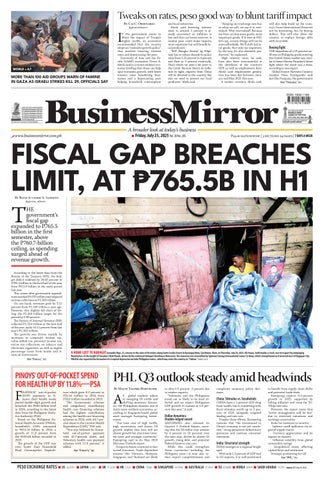
IF the government wants to blunt the impact of Trump’s higher tariffs, an economist recommended that the country adopt an “inclusive growth policy” that involves lowering interest rates and depreciating the peso. University of Asia and the Pacific (UA&P) economist Victor A. Abola said in a recent midyear economic briefing that these can help spur economic growth, with lower interest rates benefitting businesses and a depreciating peso helping household consumption
and local industries.
Abola said lowering interest rates to around 3 percent is already warranted as inflation is low and this can boost reserves. A weaker peso could make imports more expensive but will benefit local producers.
“BSP [Bangko Sentral ng Pilipinas] has to reduce sharply its policy rates from 5.25 percent to 4 percent and then to 3 percent eventually. That’s where we were a bit prior to the Covid. Because there’s no inflation in sight, imports from China will be diverted to the country, but also we need to protect our local producers,” Abola said.
“Keeping our exchange rate low, or what we call, we say it is overvalued. Why overvalued? Because my Peso can buy more goods, more important goods. If it were at P65, let’s say, certain things will not be more affordable. We’ll shift [to] local goods. Not only our exporters, by the way, it’s also domestic production,” he explained.
High interest rates, he said, have also been instrumental in the slowdown of the country’s GDP as well as employment data. Abola said employment generation has been flat between January and May 2025 this year.
A weaker currency, Abola said,
will also help build up the country’s Gross International Reserves not by borrowing, but by buying dollars. This will also allow the country to replace foreign debt with local debt.
Boxing fight
THE imposition of a 19-percent tariff rate on Philippine goods entering the United States market was similar to boxer Manny Pacquiao’s latest fight where the result was a draw, according to one expert. Global Source Partners Country Analyst Diwa Guinigundo said just like Pacquaio, the government
According to the latest data from the Bureau of the Treasury (BTr), the budget deficit widened by 24.69 percent to P765.5 billion in the first half of the year from P613.9 billion in the same period last year. This comes after government expenditures reached P3.025 trillion and outpaced revenue collections at P2.260 trillion. On one hand, revenues grew by 5.15 percent from P2.149 trillion a year ago. However, this slightly fell short of hitting the P2.260-trillion
ture which grew 8.2 percent to P20.14 trillion in 2024 from P18.6 trillion recorded in 2023.
“The Government schemes and compulsory contributory health care financing schemes had the highest contribution among the health care financing schemes in 2024, with 44.7 percent share to the Current Health Expenditure [CHE],” PSA said.
2024, a growth of 11.8 percent from the P550.08 billion recorded in 2023. The growth of the OOP was even faster than Household Final Consumption Expendi-
“This was followed by Household out-of-pocket payment with 42.7-percent share, and Voluntary health care payment schemes with 12.6 percent,” it added.
By Malou Talosig-Bartolome
AS global markets adjust to sweeping US tariffs and shifting monetary dynamics, the Philippines remains one of Asia’s more resilient economies, according to Singapore-based global asset manager Eastspring Investments.
“Our base case of high tariffs, high uncertainty, and slower US growth implies that Asia will see slower growth but also lower interest rates and stronger currencies,” Eastspring said in its May 2025 Mid-year Outlook report.
It expects Asean countries to face varied outcomes. Trade-dependent nations like Vietnam, Malaysia, Singapore, and Thailand are likely
to slow 0.5 percent –2 percent due to weaker exports.
“Indonesia and the Philippines stand out as likely to be least affected and we expect Philippines GDP growth to sustain at 5.6 percent this year,” it said.
Dollar dynamics: Double-edged sword
EASTSPRING also released its Quarter 3 Outlook Report, warning that the US dollar may weaken by 4 percent to 10 percemt over the next year, driven by slower US growth, rising debt, and potential Federal Reserve rate cuts.
While this could strengthen Asian currencies—including the Philippine peso—it may also reduce export competitiveness and
complicate monetary policy decisions.
China: Stimulus vs. headwinds CHINA faces a 1-percent GDP drag from tariffs, but is countering with fiscal stimulus worth up to 2 percent of GDP, alongside targeted lending and rate cuts.
Despite these efforts, Eastspring cautions that “the turnaround in China’s economy is not yet conclusive,” citing persistent deflationary pressures and cautious consumer sentiment.
India: Structural strength INDIA emerges as a regional bright spot. With only 2.2 percent of GDP tied to US exports, it is well-positioned
to benefit from supply chain shifts and potential trade deals. Eastspring expects 6.3-percent growth in 2025, supported by falling inflation and room for 5075bps rate cuts. However, the report notes that “active management will be key” due to stretched valuations and earnings uncertainty.
Risks for investors to monitor · Indirect tariff spillovers via regional supply chains
· Currency appreciation and its impact on exports
· Inflation volatility from global commodity swings
· Geopolitical stress affecting capital flows and sentiment Strategic positioning for Q3
By Reine Juvierre S. Alberto @reine_alberto
through job creation and enterprise formation. According to Solidum, DOST-supported technologies have helped generate nearly 30,000 jobs between 2022 and mid-2024.
“And these are not manual labor jobs,” he said. “These are roles that require science and technology skills.”
Beyond job numbers, DOST also looks at productivity gains in sectors such as agriculture and manufacturing.
The Philippine Statistics Authority (PSA) recently reported that the Services sector remained the top employer in May 2025, accounting for 61.8 percent of total employed persons, followed by Agriculture at 21.1 percent and Industry at 17.1 percent.
In a separate report, the statistics agency indicated a 4.9-percent growth in manufacturing output in May, slightly faster than the 4.3 percent recorded in April.
PHL Q3 outlook steady amid headwinds
· Focus on domestic-facing sectors like consumer goods, banking, and infrastructure
· Monitor central bank signals for rate adjustments
· Diversify regionally to hedge against trade and currency risks
Crising, Habagat damage to farms now ₧454M: DA
By Bless Aubrey Ogerio @blessogerio
FLOODING and heavy rains triggered by Tropical Cyclone Crising and the habagat (southwest monsoon) have inflicted nearly half a billion pesos in agricultural damage, hitting rice fields and high-value crops the hardest, according to the Department of Agriculture (DA).
In its latest bulletin on Thursday, the DA pegged total damage at P454.1 million, covering 20,413 hectares of farmland and affecting 20,959 farmers and fisherfolk.
Tweaks…
Continued from A1
thought it can claim victory after it secured the 1-percentage-point reduction in tariffs on local goods. Guinigundo, a former BSP Deputy
Rice growers bore the brunt of the losses, with 16,937 farmers affected and losses concentrated across 18,490 hectares—3,504 hectares of which were declared totally damaged. This
Governor, said there was nothing fair about a 19-percent tariff imposed on all Philippine goods entering the US and zero tariffs imposed on American goods shipped to the country.
“Growing its trade importance could very well reinforce Manila’s ability to negotiate trade concessions. Otherwise, it will only continue to
translates to 8,256 metric tons in lost rice production, valued at around P275 million.
Occidental Mindoro, Cagayan Valley, Palawan, Tarlac and Nueva Ecija were the most affected provinces.
Moreover, damage to high-value crops was estimated at P117.2 million, accounting for 3,540 metric tons lost. Meanwhile, corn farms suffered an additional P38.9 million in losses.
In response, the agriculture agency has started distributing P596.5 million worth of agricultural and fishery inputs, including rice, corn and vegetable seeds; seedlings; pesticides; forage seeds; free-range chickens; and fingerlings, to the hardest-hit areas.
Additionally, the National Food
serve the US and other bigger powers’ military and political ends,” Guinigundo warned.
“Trade may just become a side issue. And that is even more tragic when the government, like Pacquiao, might be claiming it thought it was ahead but actually, it was not,” he added.
Guinigundo reiterated that the country’s $3.3-billion surplus with the United States is nothing compared to the $123.5-billion surplus of Vietnam or Indonesia’s $17.9 billion surplus.
He added that Japan’s surplus with the US of $70 billion also dwarfed that of the Philippines.
Recently, international media reported that Japan negotiated the lowering of US tariffs to 15 percent from the initial 25 percent initially imposed by the Trump administration.
“The reciprocal tariff could have been brought down to Singapore’s 10 percent. US exports to the Philippines could have slapped half of the usual tariff rates, rather than nothing at all,” Guinigundo said.
“This is a case of a small lowmiddle income country granting open market to the biggest economy in the world. Will the World Trade Organization’s [WTO] trading rules be violated unless the Philippines also grants the same privilege to its trading partners?,” he asked.
Earlier, Department of Economy, Planning, and Development (DepDev) Secretary Arsenio M. Balisacan said gone were the days when individual countries could run to the WTO to air their grievances.
Given the current trade landscape, Balisacan said countries are now more focused on getting the best deals through regional and bilateral trade agreements.
While countries can still rely on the WTO for some support in terms of pushing free and fair trade forward, Balisacan said countries would rather protect their own interests these days.
HSBC ASEAN Economist Aris Dacanay also shared concern on the negative implications of higher tariffs imposed on local goods entering the US market.
Authority (NFA) has delivered 2,100 bags of rice to local government units in Palawan and Polangui, as well as to the Provincial Social Welfare and Development Office of Albay.
The department said it will activate its Quick Response Fund to fast-track rehabilitation. The Agricultural Credit Policy Council has also earmarked P400 million in interest-free loans under the Survival and Recovery (SURE) program to support affected farmers.
The Philippine Crop Insurance Corp. has also been directed to expedite indemnity payments to affected farmers and fisherfolk.
Agriculture Secretary Francisco Tiu Laurel Jr. said that he has already informed President Ferdinand Marcos Jr. of the situation.
Dacanay said this will make it harder for the country to attract Foreign Direct Investments (FDIs), something it has already struggled to do without a higher tariff.
The country, he said, had a “minimal competitive advantage compared to its Asean peers” in terms of exports to the US since the end of 2017. Even this advantage could now be lost.
“A reciprocal tariff rate of 19 percent would erase this advantage and risks putting Philippine exports at a disadvantage in the US market,” Dacanay said.
Despite this, Dacanay said HSBC kept its growth forecast of 5.4 percent and 5.8 percent for 2025 and 2026, respectively.
This, while flagging the increasing downside risk of a deeper easing cycle by the Philippine central bank. Their baseline scenario is for the Bangko Sentral ng Pilipinas to end its easing cycle at 5 percent by the last quarter of 2025.
Limited impact?
HOWEVER , international economists were more optimistic, saying the impact would not be that significant for the Philippines.
Per Capital Economics, given that the 19-percent tariff rate is close to other countries in the region, this will not lead to a loss of competitive edge compared to its peers.
The think tank, however, alluded to certain portions of the deal that have not yet been announced. Capital Economics said this includes the lack of mention on the Philippines being “required to clamp down on rerouting from China.”
Capital Economics suspects this will be inserted into the final agreement. The Marcos administration on Thursday also confirmed that final negotiations will still be conducted on this latest trade deal with the US.
Meanwhile, CreditSights, a Fitch Solutions company, said the impact will be limited because the Philippines has lower exports to the US and the country’s exports have a minimal contribution to GDP.
The US tariffs will also have limited impact on the Philippine corporate dollar bond issuers, given their limited exposure to the US, CreditSights also said.
gap breaches limit, at ₧765.5B …
from A1
Still, this was lower by 1.52 percent from the P1.578-trillion program for the agency during the period. In June alone, the BIR saw its collections increase by 16.24 percent year-on-year to P200.5 billion from P172.5 billion.
Meanwhile, the Bureau of Customs (BOC) raked in P458.8 billion in tax revenues in the first semester, a subdued growth of 0.71 percent from P455.5 billion last year.
The BOC’s collection went up by 3.23 percent to P77 billion in June from last year’s P74.6 billion.
Nontax revenues DESPITE tax revenues missing the target by 1.30 percent or P26.7 billion during the period, nontax revenues exceeded the goal by 2.87 percent, driven by the BTr’s better-than-expected income performance.
The shortfall in tax revenues despite a modest overperformance in nontax revenues signals potential collection inefficiencies or slowerthan-expected economic activity in key sectors, according to John Paulo Rivera, senior research fellow at the Philippine Institute for Development Studies (PIDS).
Still, nontax revenues dropped by 27.53 percent year-on-year to P227.7 billion from P314.2 billion. In June, this declined by 43.25 percent to P26.8 billion because of the high base effect of one-off remittances in 2024.
Income generated by the Treasury also reached P145.3 billion, 54.81 percent higher than the P93.8 billion full-year target, on the back of dividend collections, interest income on government deposits, and the government’s share from the Manila International Airport Authority’s (Miaa) profit.
Spending in first half ON the other hand, the government ramped up its spending by 9.49 percent to P3.025 trillion in the first semester from P2.763 trillion last year. This is 0.51 percent lower than the government’s target of P3.041 trillion for the period.
In June, expenditures also rose by 8.49 percent year-on-year to P548.5 billion from P505.6 billion a year ago.
Interest payments jumped by 9.97 percent to P414.8 billion in the first half of the year from last year’s P377.2 billion. In June, this grew by 3.19 percent to P57.4 billion.
“Moving forward, fiscal space will be tight. The national government needs to strike a careful balance between stimulating the economy and keeping debt and deficit within sustainable bounds, especially in light of external risks and domestic obligations,” Rivera said.
Although the revenue target shortfall by 1.3 percent seems small, Rivera said this is “significant” when matched against aggressive government spending.
“This makes fiscal consolidation more difficult and puts pressure on borrowing,” Rivera said.
“It also underscores the urgency of improving tax administration, expanding the tax base, and accelerating growth-friendly reforms to lift revenues without overburdening taxpayers,” Rivera added.
Finance Secretary Ralph G. Recto conceded in a recent press chat that fiscal consolidation will not be as steep as the government wanted it to be, due to all the uncertainty happening around the world.
outlook noted, PPMA announced plans to increase local manufacturers’ share in government procurement from less than 5 percent to 50 percent by 2030, with the establishment of the Philip -
pine Pharmaceutical Procurement system to centralize procurement and create larger batch sizes for local manufacturers to make them more competitive.
Andrea E. San Juan
The government would have to spend more to ensure that it meets its growth targets in light of all the global uncertainties.
The deficit is seen to settle at P1.561 trillion in 2025, and will eventually lower to P1.551 trillion in 2028.
www.businessmirror.com.ph
PSA: Internet costs down, but access still a challenge
SBy Bless Aubrey Ogerio
TAYING connected has become slightly more affordable for Filipino households, with the average monthly spending on internet services declining by more than P200 in the past five years, data from the Philippine Statistics Authority (PSA) showed.
Results from the 2024 National Information and Communications Technology Household Survey (NICTHS) indicated that the average household in the country spent P1,069 monthly on internet connection, which is about P211 less than
the P1,281 reported in 2019. Yet, among households without internet access at home, 58.3 percent cited high subscription costs as the main reason, while 37.5 percent pointed to the cost of equipment.
A similar pattern appeared among individuals aged 10 and above who reported not using the internet at all, with 41.7 percent attributing their disconnection to expensive subscriptions, followed by 33.2 percent who said devices were too costly. Still, internet access has expanded
See “PSA,” A9
House to keep food prices low
By Jovee Marie dela Cruz @joveemarie
ASENIOR lawmaker on Thursday vowed to lead key legislative efforts in the 20th Congress to sustain and expand the progress reflected in the 2024 Statistical Indicators on Philippine Development.
Leyte Rep. Ferdinand Martin G. Romualdez made the statement after the Philippine Statistics Authority (PSA) reported that food inflation declined significantly to 4.5 percent in 2024 from 8.0 percent in 2023—a drop of 3.5 percentage points—signaling the stabilization of the prices of essential food items.
PHL gets $21-B investment pledges from US
PRESIDENT Marcos secured more than US$21 billion worth of investment pledges from the private and government sector during his latest trip to the US.
This was announced by the Chief Executive in a video message posted in the social media page of the Presidential Communications Office after his return to Manila on Wednesday evening.
Marcos also said that during his meetings with US government officials, they pledged an additional US$15 million for private sector development under the Luzon Economic Corridor Initiative, and
an additional US$48 million in foreign-assisted projects.
“We will continue to work with the State Department, as well as with the U.S. Congress, for the implementation of these programs,” Marcos said.
He met with US President Donald Trump and other key US government officials, including Secretary of State and National Security Advisor Marco Rubio and Secretary of Defense Pete Hegseth to discuss economic and security matters. Their discussions included the reciprocal tariff, upholding the law in the South China Sea, as
well as cooperation on cybersecurity, energy supply, resilience, and critical infrastructure.
“I conveyed to President Trump that we remain positive about the future of PhilippineUS trade, including investment relations, especially in the context of economic security, and a fair, balanced reciprocal trade,” Marcos said.
On the sidelines of his official trip to the US from July 20 to 22, 2025, Marcos also met with business leaders and top executives of global investment, healthcare, infrastructure, and semiconductor
firms, where he was able to secure additional investment pledges.
“We return to the Philippines with over US$21 billion in investment pledges that have the potential to create thousands of direct and indirect jobs for Filipinos within our country,” Marcos said. He said he hopes President Trump will attend the 2026 Association of Southeast Asian Nations (Asean) Summit to be hosted by the Philippines. The event will coincide with the celebration of the 80th anniversary of Philippine-US diplomatic relations and 75 years of the Mutual Defense Treaty. Samuel P. Medenilla
GBy Butch Fernandez @butchfBM
“These numbers clearly manifest the firm commitment of President Marcos to uplift the lives of our people. While we are pleased with these positive developments, a lot of work remains to be done to accelerate the pace toward achieving our President’s vision for a Bagong Pilipinas—where no one is left behind,” Romualdez said. He acknowledged the positive trends but also highlighted that many Filipino families, especially in rural and low-income areas,
Romualdez, the presumptive Speaker in the the 20th Congress, vowed to push for additional reforms in the 20th Congress focused on controlling inflation, reducing poverty, and accelerating inclusive economic growth, in full support of the Marcos administration’s economic vision.
See “House,” A9
OVERNMENT procurement policies should be revised to allow farmers to sell rice directly to national agencies and local government units, Sen. Francis Pangilinan said on Thursday.
In calling for urgent reforms in government procurement policies, Pangilinan said the current system “favors traders over producers” and deprives farmers of fair income.
“It’s time we ask the hard question: Why can’t our government buy rice straight from our farmers?” Pangilinan asked. “Why are we forcing them [farmers] to go through layers of bureaucracy
that benefit middlemen but leave our food producers in poverty?”
Pangilinan, principal sponsor of the Sagip Saka Act (Republic Act 11321), emphasized that the law already allows direct procurement from accredited farmers’ cooperatives and associations. However, implementation has been slow owing to restrictive interpretations of procurement rules set by the Government Procurement Policy Board (GPPB).
“These rules are supposed to prevent corruption, but what they’re preventing is progress. They’re keeping government money from going straight to the people who grow our food,” he said. “Instead of empowering farmers, the current system empowers traders.”
Under existing GPPB guidelines, farmers must comply with stringent documentation, accreditation, and bidding requirements—barriers that most small-scale producers cannot meet. As a result, government procurement of rice for feeding programs, calamity response, and other needs often ends up in the hands of large private suppliers.
Pangilinan urged the GPPB to review and revise its policies to hew to the intent of the Sagip Saka Act—to enable government agencies to directly source food from farmers and fisherfolk without public bidding, under specific conditions.
“Gutom ang isinusugal dito. Sa bawat araw na hindi natin binibili direkta sa mga magsasaka, talo ang mga pamilyang
umaasa sa palay at talo rin ang pamilyang umaasa sa murang bigas,” he warned.
[Hunger is at stake here. For every day we don’t buy directly from farmers, the families relying on this palay sale, and the families needing access to cheap rice, are both at the losing end].
“Hunger has no color. If we are to truly serve, we must give aid directly to those who plant, not those who trade,” he added, partly in Filipino.
“The law is already there. The will of Congress is clear. What we need now is action from implementing agencies. If we truly want food security and rural development, then we must make it easier—not harder—for government to buy from our own farmers,” Pangilinan added.
PRESIDENT Marcos is eyeing longterm adaptation measures to minimize the impact of more frequent extreme weather caused by climate change.
After attending the situation briefing at the National Disaster Risk Reduction and Management Council (NDRRMC) in Camp Aguinaldo, Quezon City on Thursday, Marcos told reporters: “In the longer term, we need to think about adaptation. What do we have to do when it comes again because it will come again.”
“That is the fact of climate change and we are now having to think more, of course mitigation, what can be done to help those who have become victims,” Marcos said partly in Filipino.
During the situation briefing, the President was informed about the number of affected and damage caused by the said weather disturbances.
Room for improvement
MARCOS said while government emergency response including the prompt deployment of food packs and search and rescue teams in calamity-hit areas, the
government still has room to improve on the said activities.
He mentioned his observations when he visited two evacuation sites in Rizal on Thursday, which he said were too congested.
He also expressed concern on how the numerous class suspensions are affecting the learning of students.
The government has implemented a four-day class suspension since Monday in Metro Manila and several provinces owing to bad weather.
“They are losing too much [when it comes to learning] if they are forced not to go to school. So, we’re finding alternative ways, teaching modes for what, for our children, for our students,” Marcos said.
Palace Press Officer Claire Castro said the Chief Executive also ordered the Department of Public Works and Highways (DPWH) and the Metropolitan Manila Development Authority (MMDA) to update their Flood Control and Drainage Master Plans.
NDRRMC said it was able to register 895 flooding incidents nationwide this week. Samuel P. Medenilla
AFP, US forces intensify rescue, relief efforts
THE Office of Civil Defense (OCD) on Thursday confirmed intensified coordination between the Armed Forces (AFP) and the United States IndoPacific Command (US Indopacom) as part of ongoing disaster response operations in the country.
This development follows directives from President Marcos and high-level discussions between Philippine and US defense officials.
In line with this, Secretary of National Defense Gilberto Teodoro Jr. announced the immediate deployment of the US Indopacom Crisis Action Team to the Philippines, which will work in tandem with the AFP to support rescue and relief efforts.
Teodoro, who is concurrently the chairman of the National Disaster Risk Reduction and Management Council, added that logistical capabilities of both nations are now in full operation.
“Edca [Enhanced Defense Cooperation Agreement] sites are now activated for relief goods and all air assets from the AFP and the US Indopacom will be utilized for its immediate delivery,” Teodoro said in Filipino.
Given the rainy season and the possibility of further impacts, the defense chief said the Philippines and the United States, along with allied nations, are maintaining close coordination to ensure continued assistance to affected communities.
Teodoro also relayed that the US Indopacom commander, Adm. Samuel
ATOTAL of 291 lawmakers, including Pampanga Rep. Gloria Arroyo, have pledged support for Leyte Rep. Ferdinand Martin Romualdez’s reelection as Speaker of the House of Representatives in the 20th Congress, a senior lawmaker revealed on Thursday.
Paparo, has canceled his other engagements and is flying back to Hawaii to oversee the mobilization of assets and operations on their end.
Meanwhile, the OCD assured the public that all necessary resources and capabilities are being mobilized in coordination with partner nations and local government units. It also added that it remains on full alert to address immediate needs and will continue to provide updates as developments unfold.
The OCD also stressed that it had reinforced its joint disaster response operations with the AFP as the country faces overlapping threats from Tropical Depressions Dante and Emong, alongside intensified rains from the southwest monsoon and aftermath of Tropical Cyclone Crising.
The AFP spokesperson, Col. Francel Margareth Padilla, announced the deployment of 33 disaster response task units (DRTUs) and search, rescue, and retrieval (SRR) teams composed of 316 personnel to the hardest-hit areas in Northern Luzon and the Visayas.
In total, the AFP has 1,027 land assets, 48 flyable air assets, and 25 sea vessels on standby across major islands.
“These efforts are being implemented in accordance with the whole-of-government and whole-of-society approach championed by President Ferdinand R. Marcos Jr., where civilian and uniformed responders act as one in crisis response,” the OCD said. Rex Anthony Naval
Iloilo Rep. Janette Garin, in an online news conference, said the number of signatories to the manifesto of support for Romualdez have increased from 283 to 291 in recent days. Garin added that among the signatories are Arroyo, Davao Occidental Rep. Claude Bautista, a known ally of Vice President Sara Duterte, and Negros Occidental Rep. Javier Benitez, son of Bacolod City Rep. Albee Benitez, who was earlier rumored to be eyeing the speakership. Romualdez gets pledges from 291 congressmen
HE death toll from habagat or southwest monsoon rains induced by weather disturbances in the past several days continues to increase, with incident reports from the regions coming amid the onslaught of heavy downpours in Luzon and parts of the Visayas.
In its July 24 Situational Report, the National Disaster Risk Reduction and Management Council (NDRRMC) said 12 persons were killed, eight were injured, and eight others are missing.
Heavy rains that started on July 17 flooded many areas in Luzon, including Metro Manila, compelling the pre-emptive evacuation of thousands of affected families.
Flooding and rain-induced landslides have affected 765,869 families or 2,733,646 persons in a total of 3,712 barangay in 484 cities and towns were affected, the state disaster response agency said.
The NDRRMC said that a total of 5,888 persons in the Ilocos, Cagayan Valley, Central Luzon, Calabarzon (Cavite, Laguna, Batangas, Rizal and Quezon), Mimaropa (Mindoro, Marinduque, Romblon and Palawan), Western Visayas, Caraga and the Cordilleras were pre-emptively evacuated during the onslaught of heavy rains brought by Typhoons Crising, Dante and Emong the past few days.
A total of 245,479 persons were displaced by floods and landslides
and were taken to evacuation centers.
A total of 1,117 evacuation centers have been put up in different parts of Luzon.
Marcos leads aid distribution ON Thursday, President Marcos led the distribution of government aid to over 1,000 people affected by the heavy rains from the southwest monsoon in the province of Rizal.
Members of the Cabinet joined Marcos in the effort to assist evacuees at the Maly Elementary School and the Sta. Ana Covered Court in San Mateo town hours after he arrived from the United States.
Among the items given to the evacuees were food packs from the Department of Social Welfare and Development (DSWD).
Each food pack contains readyto-eat items, including three sachets of chocolate porridge (champorado); two sachets of chicken rice porridge
(chicken arroz caldo); another sachet of complementary food; five tins of tuna paella; one tin of chicken pastil; one tin of chicken giniling; and two high protein bars.
The evacuees were also provided with water filtration systems, hygiene kits, and other essential items.
During the visit, Marcos was accompanied by Social Welfare Secretary Rexlon T. Gatchalian, Health Secretary Teodoro J. Herbosa, Agriculture Secretary Francisco P. Tiu Laurel Jr., Public Works Secretary Manuel M. Bonoan, and Rizal Gov. Rebecca Ynares.
A total of 21,526 people were evacuated in San Mateo, Cainta, and Taytay towns in Rizal.
Gatchalian said that since the heavy rains caused by the southwest monsoon earlier this week, DSWD was already able to release over 200,000 food packs, which were distributed to the affected local government units. Mail trucks deliver DSWD
goods THE Philippine Postal Corp. (PHLPost) sent mail trucks to deliver DSWD humanitarian assistance in line with the President’s call to help in disaster recovery efforts following the onslaught of
Austere Sona urged due to disaster
LBy Jovee Marie N. dela Cruz @joveemarie
AWMAKERS are inclined to have a more austere and solemn conduct of this year’s State of the Nation Address (Sona), foregoing red carpet fanfare, fashion coverage, and elaborate ceremonial staging in light of the widespread devastation brought by recent typhoons and monsoon rains.
Leyte Rep. Ferdinand Martin G. Romualdez, Speaker of the 19th Congress, urged the simplification of the opening ceremonies for the 20th Congress and Sona, citing the need to be sensitive to the plight of thousands of Filipinos still reeling from Typhoons Crising, Dante, and Emong.
He said he has requested the Office of the Secretary-General to retain essential formalities but do away with red carpet fanfare, fashion coverage, and ceremonial staging.
“In the past weeks, Typhoons Crising, Dante, and Emong have displaced families, destroyed livelihoods, and left many of our kababayan struggling to get back on their feet. It would be out of touch to maintain a show of pageantry while our people are still in recovery,” added
Romualdez.
“We will still observe decorum and tradition, but without the spectacle. The red carpet will be used for its functional purpose, not as a platform for display,” he said.
No restriction on media coverage
HE clarified that members of Congress remain free to speak with media on their way in, as is customary.
“This is not about restricting access or silencing anyone. It’s about setting the tone: focused, grounded, and responsive,” Romualdez stressed.
“The opening of Congress is not a fashion event; it is a working session. Let’s begin it with the seriousness and humility our times demand,” he said.
The 20th Congress will convene on July 28, followed by SONA.
Meanwhile, Akbayan Partylist echoed the same sentiment, urging both chambers of Congress and the President to tone down this year’s SONA out of respect for communities affected by Typhoon Crising and the intensified southwest monsoon.
Akbayan Rep. Perci Cendaña said extravagant preparations for the Sona
would be out of touch with the reality faced by many Filipinos.
Not time for pomp
“THIS is not the time for pomp. This is the time for empathy, humility, and decisive action. I urge my fellow lawmakers to voluntarily make this year’s Sona simple and reflective of the people’s struggles,” he said.
“It is the height of insensitivity if we roll out the red carpet for Sona when our constituents and their families don’t even have roofs over their heads,” Cendaña emphasized.
He added that the Sona, as mandated by the Constitution, is meant to be a report of the president to Congress and the Filipino people—not a fashion showcase.
“The President must use the Sona to address the public’s urgent concerns—chief among them, the immediate aid for typhoon victims and the worsening flood problem despite the billions spent annually on flood control projects,” Cendaña added.
Simplicity, compassion
IMMIGRATION Commissioner
Joel Anthony Viado has warned the public against individuals using his name to solicit money for alleged typhoon victims.
Viado issued the warning following reports that a scammer claiming to be connected with him has been asking for donations from some individuals.
One such incident was reported by a private contractor
in Zamboanga, who received persistent messages from an individual falsely claiming that the solicitation was sanctioned by the Viado.
Further investigation revealed that the same mobile number—0997 108 8490—was also used in similar schemes targeting other government agencies, including the Department of Information and Communications Technology (DICT), Department of Budget
Garin said the House leadership has scaled back on ceremonial elements, scrapping red carpet fanfare, elaborate floral arrangements, and lavish catering. No major procurements were made specifically for the event.
“There will be no additional spending just because there’s a Sona,” she stressed.
“Whatever is used—like LED screens and some flowers—are items we already use for our daily sessions.” She added that Romualdez instructed House officials to evaluate every expenditure based on necessity and public benefit. In line with the President’s own request to forgo grand displays, food arrangements have also been kept minimal.
“There will be light snacks available since guests will be staying the whole day, but we want to set an example—there’s no need to go overboard or pressure others to do the same,” Garin added. All items used for the Sona, such as tables and chairs, will be reused for regular congressional sessions.
“What’s purchased for the Sona should serve daily functions in Congress afterward,” she explained.
ILOILO Rep. Janette L. Garin on Thursday confirmed that this year’s SONA will reflect a spirit of simplicity and compassion in light of widespread flooding and other climaterelated calamities.
Scammer uses Viado’s name to raise money
and Management (DBM), and Department of Public Works and Highways (DPWH).
Viado strongly condemned the misuse of his name and emphasized that he is not, and has never been, involved in any form of solicitation for donations.
He stressed that the said mobile number is not in any way connected to him or the agency.
“This is a blatant and shameless attempt to exploit the goodwill of our people in the name of public service. We warn the public not to entertain any messages or requests coming from this number or any individual claiming to be connected to me or the Bureau. Report such incidents immediately,” Viado warned. Viado said he has already sought the assistance of the National Bureau of Investigation (NBI) go deeper into the matter. Joel R. San Juan
WORKERS load a mail truck with relief goods to be delivered to disaster-hit communities in Central Luzon.
5,832 evacuees, ₧1.69-B damages as ‘habagat’ drenches Zambales
By Henry Empeño
ASINLOC , Zambales—More
MZambales residents evacuated their homes in coastal communities and low-lying areas on Wednesday and Thursday, as protective dikes gave way due to severe flooding and storm surges brewed by heavy rains from the “Habagat” or the southwest monsoon.
The Zambales Provincial Disaster Risk Reduction and Management Office (PDRRMO) reported that as of 8:00 a.m. on Thursday, July 24, a total of 3,690 families composed of 11,774 individuals in the province have already been affected by incessant rains and the resulting floods.
Of these, a total of 1,996 families or 5,832 individuals have evacuated mostly to schools and barangay halls, or sought shelter with relatives.
The biggest number of evacuees were recorded in Santa Cruz town, where floodwaters reached 4 feet in some areas early Thursday, said PDRRMO head Rolex Estella. Estella said the office of Gov. Hermogenes Ebdane Jr. has been providing packs of essential foodstuffs to affected residents since Sunday when heavy rains from typhoon “Dante” started flooding in low-lying areas and the provincial government began pre-emptive evacuation.
On the other hand, the Zambales Provincial Health Office (PHO) has been monitoring evacuation centers to assess the availability of potable water supply and functional sanitation facilities.
PHO head Dr. Noel C. Bueno said provincial health teams have distributed Aquatabs water purification tablets to ensure safe drinking for evacuees, and were placed on alert for potential disease outbreaks in evacuation centers. Meanwhile, more than P1.69 billion worth of slope protection infrastructure in
the province were totally damaged, according to reports complied by the Department of Public Works and Highways (DPWH) district offices here.
Most of these are river flood control structures that were breached by strong currents in lahar-filled waterways in the southern towns of San Antonio, San Felipe, and San Narciso.
River dikes in Santa Cruz, Candelaria, Masinloc, and Cabangan up north also gave way due to swollen rivers and creeks, the DPWH said.
The biggest infrastructure damage was placed at P1 billion in San Felipe town where surging waves battered the seawall along the coastal road at Sitio Tektek in Barangay Sindol.
Zambales Provincial Engineer Domingo Mariano said provincial engineering teams and local government units are closely monitoring the situation at lahar-silted waterways like Maloma River and Pamatawan River, as further dike damages might bring about severe flooding in the towns of San Felipe, San Narciso and San Antonio. Meanwhile, the agriculture and fisheries sector here recorded more than P2.34 million in damages to rice crops, fishponds and fishing vessels.
This, as heavy rainfall inundated some 251.6 hectares of rice fields in the towns of Santa Cruz and San Antonio, as well as five tilapia aquafarms in San Marcelino. Two fishing boats worth a total of P100,000 were also destroyed in San Antonio.
The PDRRMO issued early Thursday “Orange” heavy rainfall warning over eight towns in the central and southern parts of Zambales, and “Yellow” alert over the five northern municipalities, as “Emong” intensified into a severe tropical storm and was expected to enhance the effects of “habagat” or southwest monsoon over Zambales.
Go calls for intensified public awareness campaign on PhilHealth benefits amid ongoing health threats from storms and floods
SENATOR Christopher “Bong” Go has called on Filipinos, especially those affected by the recent typhoon and widespread flooding, not to hesitate in seeking medical care when needed. He emphasized the importance of strengthening public awareness on Philippine Health Insurance Corporation (PhilHealth) benefits, particularly in light of increasing health risks during the rainy season.
Go raised concerns over the surge of waterborne and vector-borne diseases that commonly follow prolonged flooding—such as leptospirosis, dengue, and acute gastrointestinal infections. These threats, he noted, tend to strike hardest in communities already overwhelmed by natural disasters and poverty.
“‘Wagpokayongmatakotmagpa-ospital kung kinakailangan. Mas lalong dapat natingbantayanangkalusugansapanahonng kalamidad,” the senator reminded, adding that fear of hospital bills should not prevent people from getting proper treatment.
The recent typhoons, which caused extensive flooding across several regions, has compounded public health vulnerabilities typically associated with poor sanitation and stagnant water.
Go reiterated that the Universal Health Care (UHC) Act, or Republic Act No. 11223, mandates PhilHealth to proactively expand its benefits and services to protect vulnerable populations.
“May batas na po tayong sinusunod, at malinaw ang nakasaad sa Universal Health Care Act—obligasyon ng PhilHealth na siguraduhinangsapatnaserbisyongmedikal para sa lahat, lalo na sa mga nasalanta,” Go asserted.
To reinforce awareness and recognition of health insurance coverage, Go filed SBN 170 or the proposed PhilHealth Card Act at the start of the 20th Congress. The proposed legislation seeks to mandate the issuance of PhilHealth cards to all Filipinos, strengthening public understanding of their rights and entitlements under the National Health Insurance Program (NHIP), if passed. He also cited PhilHealth’s vital role in implementing benefit packages for common post-flood illnesses and emphasized that such initiatives must be accompanied by comprehensive public information efforts.
“ Dapat mas agresibo ang information drive ng PhilHealth para alam ng tao
DBM says funds are available for disaster relief, urges agencies to expedite aid
By Reine Juvierre S. Alberto @reine_alberto
THE Department of Budget and Management (DBM) urged all government agencies to guarantee that every fund it releases— down to the last centavo—will reach the rightful beneficiaries without delay.
In a statement on Thursday, Budget Secretary Amenah F. Pangandaman assured that the government has enough funds to respond to the needs of people in areas affected by floods, as well as by the succeeding typhoons that may impact the country. But then Pangandaman called on agencies to make sure that all the funds it disburses will reach the beneficiaries.
“President Bongbong Marcos has directed us to ensure that the immediate and necessary support is provided to our fellow Filipinos in areas devastated by typhoons,” Pangandaman said.
The national budget includes allocations for disaster response through the National Disaster
Risk Reduction and Management Fund (NDRRMF), Pangandaman explained.
The NDRRMF, also known as the calamity fund, is a lump sum fund allocated under the General Appropriations Act (GAA) to cover aid, relief and rehabilitation services to communities or areas affected by man-made and natural calamities.
The fund can also be used to repair and reconstruct permanent structures, such as capital expenditures for pre-disaster operations, rehabilitation and other related activities.
Data from the DBM showed there is still a balance of P16.406 billion under the NDRRMF, which agencies can still tap until the end of the year.
“Each frontline agency also has a standby fund that can be used for relief and recovery efforts. So, we appeal to them to closely coordi-
nate with us so that we can provide them with what they need, including replenishment of their Quick Response Funds [QRF],” Pangandaman added.
First response agencies are provided with QRFs to immediately assist areas stricken by catastrophes and crises. These agencies may request replenishment to the DBM, to be approved by the Office of the President, if their QRFs reach 50 percent or lower.
“Our people should not worry because the government has sufficient funds. As for the DBM, as long as the need is justified and complete documentation is provided, we will immediately process the release of funds,” Pangandaman said. Last year, the DBM released a total of P22.598 billion from the NDRRM Fund to finance relief and rehabilitation services as a result of various disasters
‘Dante’ and ‘Emong’ maintain strength as habagat continues to dump rain over Luzon
By Jonathan L. Mayuga @jonlmayuga
AS heavy rains brought by habagat continue to dump rain over Luzon, storms “Dante” and “Emong” continue to affect the country’s weather system, the state weather bureau reported.
In its 11 a.m. weather advisory, the state weather bureau said heavy rains or 200 mm of rain are expected Thursday, July 24, until Friday, on Ilocos Sur, La Union, Pangasinan, Zambales, and Benguet due to Emong.
kung anong benepisyo ang puwede nilang makuha. Marami pa ring kababayan ang hindi pamilyar sa mga packages at libreng serbisyonamaaaringi-claim,” Go explained.
In response to the senator’s persistent calls, PhilHealth has made significant strides in implementing reforms to make healthcare more affordable and accessible—especially for the poor and marginalized. Among these, the agency has lifted the 45-day annual hospitalization limit for members and their dependents, ensuring continued coverage for those with chronic or life-threatening conditions.
Under Go’s prodding, PhilHealth has also pledged to widen its benefit offerings to include dental services, mental health care, outpatient drug coverage, diagnostic procedures such as MRIs and CT scans, and medical transportation. Coverage will likewise extend to assistive devices like wheelchairs and crutches, chemotherapy for cancer patients, treatment for severe cardiac conditions, and a broad range of rehabilitation services.
PhilHealth has also committed to improving benefit packages for the country’s leading causes of death, including cardiovascular diseases, diabetes, and chronic respiratory conditions. These, among others, form part of the agency’s long-term plan to deliver equitable health services across all sectors of society.
To complement these reforms, PhilHealth is working to expand its network of accredited healthcare providers and simplify the accreditation process for government-run primary care facilities. It is also ensuring the presence of PhilHealth representatives in Malasakit Centers nationwide, allowing patients to receive direct assistance and guidance.
Go also welcomed PhilHealth’s decision to repeal what he calls as anti-poor Single Period of Confinement (SPC) policy and its outdated 24-hour confinement rule, which previously denied benefits to patients unless confined for at least a day. This enabled coverage of emergency outpatient services, addressing long-standing gaps in the system.
PhilHealth has also begun increasing case rates across the board to reduce outof-pocket costs for patients. Additionally, it has adjusted benefit packages for specific illnesses, including urinary tract infections, influenza, and acute gastroenteritis.
In this weather condition, widespread incidents of severe flooding and landslides are expected, the Philippine Atmospheric, Geophysical and Astronomical Services Administration (PAGASA) said.
Also because of El Niño-induced rains, Ilocos Norte, Tarlac, Abra, Mountain province, and Ifugao will experience moderate to heavy rains or rains between 100 to 200 mm.
Numerous flooding events are likely under this weather condition, especially in areas that are urbanized, low-lying lying or near rivers. Landslides are likely in moderate to highly susceptible areas, the state weather bureau warned.
Tropical Storm Dante maintains its strength as it slowly moves out of the country toward Ryukyu Island, while Emong intensified into a typhoon as it moves slowly over the Philippine Sea.
Meanwhile, because of the Southwest monsoon and Dante, Metro Manila, Pampanga, Bulacan, Cavite, Batangas, Laguna, and Rizal will experience moderate to heavy rain today until noon on Friday.
Tropical Cyclone Wind Signal (TCWS) No. 3 is up at the northern portion of Pangasinan, namely Anda, Bolinao, and Bani, and the western portion of La Union,Luna, Balaoan, Bacnotan, San Juan, City of San Fernando, Bauang, Caba, PAGASA said. Meanwhile. TCWS No. 2 is up in Ilocos Norte, Ilocos Sur, the rest of La Union, the western portion of Apayao (Conner, Kabugao, Calanasan), Abra, Kalinga, Mountain Province, Ifugao, Benguet, the central portion of Pangasinan (Agno, Burgos, Mabini, City of Alaminos, Sual, Labrador, Bugallon, Infanta, Dasol, Lingayen, Binmaley, Dagupan City, Calasiao, Santa Barbara, Mangaldan, Mapandan, Manaoag, Laoac, Binalonan, San Manuel, San Nicolas, Pozorrubio, Sison, San Fabian, (San Jacinto),
and the western portion of Nueva Vizcaya (Kayapa, Santa Fe). Other areas in Luzon were placed under TCWS No. 1.
At 11 a.m. on Thursday, Emong was spotted 220 km west-southwest of Bacnotan, La Union or 210 km West of Dagupan City, Pangasinan. It is slowly moving south,
southeastward, packing maximum sustained winds of 120 km/h near the center and gustiness of up to 150 km/h.
By 8 a.m. on Friday, July 25, Emong is expected to be in the vicinity of Lagayan, Agra, and some 47b km Northeast of Itbayat, Batanes on Saturday morning.
Emong is expected to leave the PAR by 8 a.m. on Sunday. Meanwhile, Dante was spotted 735 km east-northeast of Itbayat, Batanes, moving northnorthwestward at 30 km/h. Dante is packing maximum sustained winds of 75 km/h near the center and gustiness of up to 90 km/h.
A6 Friday, July 25, 2025
BusinessMirror News
ANFREL: Vote-buying, ASR remain high in May 12 polls
By Justine Xyrah Garcia
VOTE-BUYING and the abuse of state resources (ASR) remained widespread during the May 12 national and local elections, the Asian Network for Free Elections (ANFREL) said on Thursday.
In its 130-page assessment of the recently concluded polls, ANFREL said 69 percent of areas observed reported direct experience or first-hand accounts of vote-buying.
The practice ranged from direct cash handouts during campaign sorties to digital transfers via e-wallets, which observers said made enforcement more difficult.
“Observers also noted that voters expected vote-buying as part of the campaign season, particularly in economically vulnerable communities. This sentiment was especially prevalent among youth and low-income voters, who often felt alienated from the formal political process,” ANFREL said.
The report cited documented incidents
NBI rescues OSAEC victim in Davao Oriental
THE National Bureau of Investigation (NBI) has rescued a child victim of online sexual abuse and exploitation (OSAEC) in an operation conducted in Banaybanay, Davao Oriental on Thursday.
T he victim’s rescue was an offshoot of the arrest of Jacky Lou Geraban Parohinog, alias “Jacky” for violation of Republic Act 11930 or the Anti-Online Sexual Abuse or Exploitation of Children and Anti-Child Sexual Abuse or Exploitation Materials (CSAEM) Act in Luon, Davao Oriental last June 3, 2025. Following Parohinog’s arrest, the NBIHuman Trafficking Division (HTRAD) and NBI-South Eastern Mindanao conducted a post-investigation on the case to identify his cohorts and possible victims.
Investigation showed an account with an alias of “Ate BibIan” was seen supplying CSAEMs to Parohinog.
T his led to the identification of his supposed victim and the discovery of her whereabouts.
See “NBI,” A9
such as offers of up to P5,000 per vote in Bacolod City, alleged “opponent busting” in which rival candidates were reportedly paid to withdraw, and organized distribution of campaign materials and cash in Cebu City, where recipients were asked to sign forms reportedly used to track voting commitments.
Aside from direct vote inducements, the report found that 40 percent of observed areas reported the misuse of public resources, including government vehicles, facilities, and personnel for campaign activities.
In 30 percent of cities, voters were offered government assistance—such as food packs or promises of employment—during the campaign period, while 15 percent said they were threatened with the loss of services or benefits if they refused to support a candidate or party.
The report also underscored the growing role of digital platforms in shaping voter behavior.
In partnership with The Carter Center, ANFREL analyzed 60,934 social media posts from official campaign accounts on Facebook, Instagram, TikTok, X, and YouTube.
From a randomized 10-percent sample (6,430 posts), the team found that 71.2 percent promoted democratic content such as campaign-related updates, voter education, or expressions of political participation; 1.9 percent were classified as harmful or attacking the electoral process; and 0.3 percent contained potential misinformation or disinformation that could have confused voters.
However, ANFREL noted that the sample excluded content from unofficial sources such as influencers, anonymous partisan pages, and supporter networks, which are often responsible for spreading misleading or coordinated content.
“These actors typically operate outside the direct scope of [the Commission on Elections’] regulations, which focus primarily on official campaign entities,” the group explained. “As
such, the low percentage of undemocratic content might not necessarily reflect the broader health of the digital information ecosystem but rather highlight a gap in regulatory reach.”
ANFREL added that this regulatory gap is compounded by the fact that the poll body has no jurisdiction before the official campaign period begins.
The group recommended that Congress pass legislation to extend Comelec’s authority to the pre-campaign period, strengthen campaign finance oversight, and operationalize the constitutional ban on political dynasties.
ANFREL also urged the creation of voluntary registration or reporting systems for third party pages or accounts involved in coordinated election messaging.
“Without meaningful reform...abuse will remain the norm. The real cost is borne by voters, particularly the young and poor, whose faith in the electoral process continues to be eroded,” ANFREL added.
Micro-firms in Davao del Sur get labor law refresh under DOLE TAV
MICRO-ESTABLISHMENT owners and representatives in Davao del Sur participate in a series of Technical and Advisory Visit orientations organized by the labor department as part of its developmental and proactive approach to encourage voluntary compliance with labor laws.
Owners and representatives of microenterprises across Davao del Sur received a refresher course on labor laws, occupational safety, productivity, and responsible business practices as they participated in a series of Technical and Advisory Visit (TAV) orientations recently organized by the Department of Labor and Employment (DOLE).
T he initiative is part of DOLE’s developmental and proactive approach to ensuring labor rights protection for all.
Aligned with President Ferdinand R. Marcos’ commitment to upholding workers’ rights and promoting their welfare, the DOLE Regional Office XI, through its Davao del Sur and Davao City Field Offices, conducted the orientations to reinforce the department’s advocacy for ethical labor
practices and safe workplaces.
Participants were oriented on general labor standards and occupational safety and health (OSH) regulations. Key topics included mandatory employee benefits such as the minimum wage, overtime and night shift differentials, 13th-month pay, parental leaves, and provisions under the Magna Carta of Women. Discussions also tackled common workplace hazards, safety protocols, and legal requirements under the OSH Law.
DOLE Davao Regional Director Atty. Randolf C. Pensoy emphasized that the orientations are aimed at fostering greater compliance and inspiring micro-enterprises to become champions of labor rights and workplace safety in the province.
A total of 150 owners and representatives joined the orientations conducted by the Davao del Sur Field Office.
To promote respectful and inclusive work environments, participants also viewed a video presentation on International Labour Organization (ILO) Convention No. 190, which addresses violence and harassment in the workplace. The session
underscored every worker’s right to a workplace free from abuse and the shared responsibility of employers and employees in realizing this standard.
In a separate session held in Davao City, 48 owners and representatives from micro-establishments, primarily in the food service, laundry, diagnostics, and pet care sectors, attended similar orientations. Participants raised various concerns, including non-compliance with minimum wage laws, the absence of designated safety officers, and the lack of basic safety provisions such as first aid kits.
With guidance from the resource speakers, participants developed their respective action plans to address these issues. Some expressed intent to apply for a Barangay Micro Business Enterprise certificate through the Department of Trade and Industry. Others committed to adjusting their wage structures in compliance with the new minimum wage order, while a few considered formalizing employment contracts that include nonmonetary benefits such as free meals and lodging.
Davao City set to launch new bus system in Sept to replace delayed jeepney services
DAVAO CITY–City Hall announced that the new buses it bought from a local contractor are expected to be turned over and fielded by August or September in a move to offset the much delayed funding for the experimental bus transport system, replacing the jeepney system.
Dwight Tristan Domingo, manager of the Davao City Bus Project, said he was updated by the contracting company AutoKID Truck Solutions that the buses will be delivered to them by August, which the company will also turn it over to the city by September.
He said that by that time, “our NC3 Bus Driving Tesda-certified drivers will be able to familiarize themselves with the new buses.”
The buses will offer free rides to Dabawenyos and especially during peak hours to complement the commercial buses fielded by City Hall during peak hours.
In April, the city government entered into contract with a city-based truck distributor AutoKID Truck Solutions for 10 Yutong ZK6126HG buses. The buses are 12-meter low floor units “designed for convenient passenger use, with modern amenities, offering seating for approximately 40 passengers along with provisions for standing commuters.”
The city, along Cebu City, was the country’s experimental areas for a bus system mass transit to replace the jeepney system the bus transport system under the Davao Public Transport Modernization Project (DPTMP) was originally called High Priority Bus System (HPBS), which is part of the Public
Utility Vehicle Modernization Program of the Department of Transportation (DOTr) that was hatched in 2015.
The DOTr tapped the Asian Development Bank for the program that identified Davao and Cebu as pilot areas. Funding and implementation delays hounded the program several times, even before and immediately after the Covid-19 pandemic. An interim implementation was tested for three routes here, the Catalunan Grande area, Toril and Cabantian areas. Last year, the city and national governments signed contracts for civil works of the project which includes bus stops, bus lanes, depots, and terminals of the projects but the DOTr said the project had to be postponed due to right of way issues with 32 landowners. The city government believed the postponement was also due to the current political bickerings between the administration and the Dutertes.
The city has already imposed a one-year franchise term for jeepneys since after the pandemic, expecting an uninterrupted implementation of the bus system. This left a vacuum of 1,000 jeepneys since then, forcing a big number of commuters to be stranded every day.
On Wednesday, Transportation Secretary Vince Dizon inspected the city’s transport routes here and announced that Malacañang will support the bus transport system, assuring that the pilot operation will happen in 2027 saying this was the directive of President Ferdinand Marcos. Manuel T. Cayon
Solon: AKAP program provides urgent assistance to 42 districts hit by floods
FORTY —two congressional districts in Metro Manila and Rizal will receive urgent assistance to flood-affected families under the Ayuda para sa Kapos ang Kita Program (AKAP), a lawmaker said on Thursday.
Iloilo Rep. Janette Garin said that the aid rollout was made possible through the swift mobilization of the Department of Social Welfare and Development (DSWD), with members of the House of Representatives actively working to ensure their constituents received timely support.
She clarified that while lawmakers help facilitate the program, they do not have control over the selection of beneficiaries.
She warned against the politicization of AKAP, saying lawmakers act only as facilitators and watchdogs—raising concerns when deserving constituents are excluded due to local politics.
“That was taken yesterday [Wednesday],” Garin said, referring to a coordination photo of lawmakers. “Given the overwhelming need, we mounted relief operations
immediately. Feeding programs, visits to evacuation centers—around 42 members of the 20th Congress were empowered to use AKAP to respond.”
“Legislators don’t have discretion over the list. The DSWD handles distribution. Our role is to monitor and ensure that implementation is free of political bias,” Garin added. Garin emphasized the importance of the initiative in cushioning the blow of three consecutive typhoons that hit the country. “A series of meetings and coordination led to the rapid deployment of support to ensure that those who were flooded and unable to work wouldn’t be left to suffer in silence,” she said.
Local government units, she noted, also play a crucial role in logistical support, such as providing secure venues and personnel for the distribution of aid.
Responding to critics who question the AKAP program, Garin strongly defended its value, particularly in times of disaster.
See “Solon,” A9
More than 100 aid groups warn of famine in Gaza as Israeli strikes kill 29, officials say
By Wafaa Shurafa & Tia Goldenberg
The Associated Press
EIR AL-BALAH, Gaza Strip—
DMore than 100 charity and human rights groups said Wednesday that Israel’s blockade and ongoing military offensive are pushing Palestinians in the Gaza Strip toward starvation, as Israeli strikes killed another 29 people overnight, according to local health officials.
Meanwhile, the Trump administration’s Mideast envoy, Steve Witkoff, was set to meet with a senior Israeli official about ceasefire talks, a sign that lower-level negotiations that have dragged on for weeks could be approaching a breakthrough.
Experts say Gaza is at risk of famine because of Israel’s blockade and the offensive launched in response to Hamas’ October 7, 2023, attack. The head of the World Health Organization said Gaza is “witnessing a deadly surge” in malnutrition and related diseases, and that a “large proportion” of its roughly 2 million people are starving.
Israel says it allows enough aid into the territory and faults delivery efforts by UN agencies, which say they are hindered by Israeli restrictions and the breakdown of security.
Hamas has said it will only release the remaining 50 hostages it holds, around 20 of them believed to be alive, in exchange for a lasting ceasefire and an Israeli withdrawal. Israel has vowed to recover all the captives and continue the war until Hamas has been defeated or disarmed.
‘Chaos, starvation and death’
IN an open letter, 115 organizations, including major international aid groups such as Doctors Without Borders, Mercy Corps and Save the Children, said they were watching their own colleagues, as well as the Palestinians they serve, “waste away.”
The letter blamed Israeli restrictions and “massacres” at aid-distribution points. Witnesses, health officials
and the UN human rights office say Israeli forces have repeatedly fired on crowds seeking aid, killing more than 1,000 people. Israel says its forces have only fired warning shots and that the death toll is exaggerated.
The Israeli government’s “restrictions, delays, and fragmentation under its total siege have created chaos, starvation, and death,” the letter said.
WHO Director Tedros Adhanom Ghebreyesus echoed that criticism, telling reporters that acute malnutrition centers in Gaza are full of patients and lack adequate supplies. He said rates of acute malnutrition exceed 10% and that among pregnant and breastfeeding women, more than 20% are malnourished, often severely.
The U.N. health agency’s representative in the occupied Palestinian territories, Dr. Rik Peeperkorn, said there were more than 30,000 children under 5 with acute malnutrition in Gaza and that the WHO had reports that at least 21 children under 5 have died so far this year.
Israel says critics are ‘echoing Hamas’ propaganda’ THE Israeli Foreign Ministry rejected the criticism in the open letter and accused the groups of “echoing Hamas’ propaganda.” It said it has allowed
around 4,500 aid trucks into Gaza since lifting a complete blockade in May, and that more than 700 trucks are waiting to be picked up and distributed by the UN.
That’s an average of around 70 trucks a day, the lowest rate of the war and far below the 500 to 600 trucks a day the UN says are needed, and which entered during a six-week ceasefire earlier this year.
The UN says it has struggled to deliver aid inside Gaza because of Israeli military restrictions, ongoing fighting and a breakdown of law and order. An alternative system established by Israel and an American contractor has been marred by violence and controversy.
Top adviser to Netanyahu will meet US envoy in Rome WHITE House press secretary Karoline Leavitt said Witkoff was headed to Europe to meet with key leaders from the Middle East to discuss the latest ceasefire proposal and release of hostages.
“We want this ceasefire to happen as soon as possible, and we want these hostages to be released,” Leavitt said.
An official familiar with the negotiations said Ron Dermer, a top adviser to Israeli Prime Minister Benjamin
Netanyahu, was traveling to Rome to meet Witkoff on Thursday. The official spoke on condition of anonymity because they were not authorized to discuss the sensitive negotiations.
The evolving deal is expected to include a 60-day ceasefire in which Hamas would release 10 living hostages and the remains of 18 others in phases in exchange for Palestinians imprisoned by Israel. Aid supplies would be ramped up, and the two sides would hold negotiations on a lasting truce.
Overnight strikes kill at least 29 ISRAEL has continued to carry out waves of daily airstrikes against what it says are militant targets but which often kill women and children. Israel blames civilian deaths on Hamas because the militants operate in densely populated areas.
One of the overnight strikes hit a house in Gaza City, killing at least 12 people, according to Shifa Hospital, which received the casualties. The dead included six children and two women, according to Gaza’s Health Ministry. The Israeli military said it struck an Islamic Jihad militant, and that the incident was under review because of reports of civilian casualties.
Shifa said another strike late Tuesday in Gaza City killed three children.
A strike on an apartment in northern Gaza killed at least six people. Among the dead were three children and two women, including one who was pregnant, the ministry said. The military said it struck a Hamas operative.
In central Gaza, a strike in a densely populated part of the builtup Nuseirat refugee camp killed eight people and wounded 57, according to Awda Hospital, which received the casualties.
Hamas-led militants abducted 251 people in the October 7 attack and killed around 1,200 people, mostly civilians.
Goldenberg reported from Tel Aviv, Israel. Associated Press Writer Michelle Price in Washington contributed to this report.
Ukraine’s Zelenskyy promises safeguards after street protests over new anti-corruption law
By Illia Novikov The Associated Press
KYIV, Ukraine—Opponents
of a new law they say strips Ukraine’s anti-corruption watchdogs of their independence called for a third straight day of street protests across the country Thursday, despite President Volodymyr Zelenskyy’s attempts to defuse the tension with promises of legislative safeguards. After meeting with the heads of Ukraine’s key anti-corruption and security agencies, Zelenskyy promised to act on their recommendations by presenting a bill to Parliament that strengthens the rule of law.
“And very importantly: all the
norms for the independence of anticorruption institutions will be in place,” Zelenskyy said in his nightly video address late Wednesday.
Zelenskyy acknowledged the controversy triggered by the new corruption law, which also drew rebukes from European Union officials and international rights groups.
“It’s not falling on deaf ears,” Zelenskyy said of the complaints. “We’ve analyzed all the concerns, all the aspects of what needs to be changed and what needs to be stepped up.”
However, he didn’t promise to revoke the law that he approved.
The legislation that was adopted this week, despite pleas for Zelenskyy to veto it, tightened government oversight of two key anti-corruption
agencies. Critics said the step could significantly weaken the independence of those agencies and give Zelenskyy’s circle greater influence over investigations.
The protests haven’t called for Zelenskyy’s ouster. But the first major anti-government demonstrations since the war began come at a tough time for Ukraine in its three-year battle to thwart Russia’s invasion.
Russia’s bigger army is accelerating its efforts to pierce Ukraine’s front-line defenses and is escalating its bombardment of Ukrainian cities. Ukraine is also facing a question mark over whether the United States will provide more military aid and whether European commitments can take up the slack, with no end to the
war in sight.
Delegations from Russia and Ukraine met in Istanbul for a third round of talks in as many months Wednesday. But once again the talks were brief and delivered no major breakthrough.
Zelenskyy had insisted earlier Wednesday that the new legal framework was needed to crack down harder on corruption. Fighting entrenched corruption is crucial for Ukraine’s aspirations to join the EU and maintain access to billions of dollars in Western aid in the war.
“Criminal cases should not drag on for years without verdicts, and those working against Ukraine must not feel comfortable or immune from punishment,” he said.
Thailand and
Cambodia downgrade
diplomatic
relations; envoys recalled as border dispute flares
By Jintamas Saksornchai
The Associated Press
BANGKOK—Thailand closed northeastern border crossings with Cambodia and said Wednesday it was withdrawing its ambassador and expelling the Cambodian ambassador to protest a land mine blast in which a Thai soldier lost a leg.
Cambodia responded Thursday that it was downgrading diplomatic relations with Thailand to their lowest level and recalling all Cambodian staff from its embassy in Bangkok.
Relations between the Southeast Asian neighbors have deteriorated sharply since May when a Cambodian soldier was killed in an armed confrontation in one of several small patches of land both countries claim as their own territory.
Nationalist passions on both sides have further inflamed the situation, and Thailand’s prime minister was suspended from office on July 1 to be investigated for possible ethics violations over her handling of the border dispute.
The Thai army said the land mine that wounded five soldiers Wednesday had been placed in Thailand’s Ubon Ratchathani province. Cambodia said the blast happened in its Preah Vihear province. A week earlier, a land mine in a different contested area exploded and wounded three Thai soldiers when one of them stepped on it and lost a foot.
Thai authorities have alleged the mines were newly laid along paths that by mutual agreement were supposed to be safe. They said the mines were Russian-made and not of a type employed by Thailand’s military.
The army statement called on Cambodia “to take responsibility for this incident, which constitutes a serious threat to peace and stability in the border region between
the two countries.” After last week’s blast, Thailand accused Cambodia of violating the Ottawa Treaty, an international pact that bans the production and use of anti-personnel land mines.
Cambodia rejected Thailand’s account as “baseless accusations.”
Defense Ministry spokesperson Lt. Gen. Maly Socheata said the land mine explosion took place on Cambodian territory and alleged Thailand had violated a 2000 agreement “regarding the use of agreed paths for patrols.” Cambodia has denied that it laid new mines along the border, pointing out that many unexploded mines and other ordnance are a legacy of 20th century wars and unrest.
Thailand’s acting Prime Minister Phumtham Wechayachai said the Foreign Ministry would make an official protest to Cambodia, and further measures would be considered. Cambodia’s Foreign Ministry said in a statement Thursday that it demanded all Thai diplomatic staff leave Cambodia and was recalling Cambodia staffers at the embassy in Bangkok.
Many border checkpoints had already been closed by one side or the other or operated with restrictions after relations between the neighbors deteriorated following an armed confrontation on May 28 in which one Cambodian soldier was killed in one of the contested areas.
Cambodia has banned Thai movies and TV shows, stopped the import of Thai fruits and vegetables and boycotted some of its neighbor’s international internet links and power supply. It also stopped importing fuel from Thailand.
Associated Press writer Sopheng Cheang in Phnom Penh, Cambodia contributed to this report.
INJURED Palestinians are transferred to an ambulance after being wounded while waiting for aid arriving from the northern Gaza Strip, in Gaza City, Tuesday, July 22, 2025. A P PHOTO/JEHAD ALSHRAFI
THIS photo released by the Royal Thai Army shows an injured Thai soldier who stepped on a land mine being airlifted to a hospital in Ubon Ratchathani province, Thailand, Wednesday, July 23, 2025. THE ROYAL THAI ARMY VIA AP
UN’s top court opens door to compensation from countries responsible for climate crisis
By Molly Quell & Mike Corder
The Associated Press
HE HAGUE, Netherlands—
TThe United Nations’ top court in a landmark advisory opinion Wednesday said countries could be in violation of international law if they fail to take measures to protect the planet from climate change, and nations harmed by its effects could be entitled to reparations.
Advocates immediately cheered the International Court of Justice opinion on nations’ obligations to tackle climate change and the consequences they may face if they don’t.
“Failure of a state to take appropriate action to protect the climate system ... may constitute an internationally wrongful act,” court President Yuji Iwasawa said during the hearing. He called the climate crisis “an existential problem of planetary proportions that imperils all forms of life and the very health of our planet.”
The non-binding opinion, backed unanimously by the court’s 15 judges, was hailed as a turning point in international climate law. Notably, the court said a “clean, healthy and sustainable environment” is a human right. That paves the way for other legal actions, including states returning to the ICJ to hold each other to account as well as domestic lawsuits, along with legal instruments like investment agreements.
‘Today, the tables have turned’ THE case was led by the Pacific island nation of Vanuatu and backed by more than 130 countries.
All UN member states including major greenhouse gas emitters like the United States and China are parties to the court.
UN Secretary-General Antonio Guterres welcomed the “historic” advisory opinion.
“This is a victory for our planet, for climate justice, and for the power of young people to make a difference,” he said in a statement. “Young Pacific islanders initiated this call for humanity to the world. And the world must respond.”
Climate activists had gathered outside the crowded court with a banner that read: “Courts have spoken. The law is clear. States must ACT NOW.” They watched the ruling on a giant screen, clapping and cheering at times during the two-hour hearing.
“Today, the tables have turned. The world’s highest court provided us with a powerful new tool to protect people from the devastating impacts of the climate crisis—and to deliver justice for the harm their emissions have already caused,” former UN human rights chief Mary Robinson said in a statement.
“The ICJ’s decision brings us closer to a world where governments can no longer turn a blind eye to their legal responsibilities. It affirms a simple truth of climate justice: Those who did the least to fuel this crisis deserve protection, reparations, and a
future,” said Vishal Prasad, director of Pacific Islands Students Fighting Climate Change.
Vulnerable island nations led the lobbying AFTER years of lobbying by vulnerable island nations who fear they could disappear under rising sea waters, the UN General Assembly asked the ICJ in 2023 for an advisory opinion, an important basis for international obligations.
Its panel was tasked with answering two questions: What are countries obliged to do under international law to protect the climate and environment from human-caused greenhouse gas emissions? Second, what are the legal consequences for governments when their acts, or lack of action, have significantly harmed the climate and environment?
“The stakes could not be higher. The survival of my people and so many others is on the line,” Arnold Kiel Loughman, attorney general of the island nation of Vanuatu, told the court during a week of hearings in December.
In the decade up to 2023, sea levels rose by a global average of around 4.3 centimeters (1.7 inches), with parts of the Pacific rising higher still. The world has also warmed 1.3 degrees Celsius (2.3 Fahrenheit) since preindustrial times because of the burning of fossil fuels.
Ralph Regenvanu, Vanuatu’s minister for climate change, called the ruling a “very important course correc -
tion in this critically important time. For the first time in history, the ICJ has spoken directly about the biggest threat facing humanity.”
He said the ruling exceeded his expectations. “I didn’t expect it to be good. It’s good. And it did go above and beyond,” he told reporters in The Hague.
Ruling could be leverage at next UN climate conference ACTIVISTS could bring lawsuits against their own countries for failing to comply with the decision, which ran to over 130 pages.
The senior attorney at the Center for International Environmental Law, Erika Lennon, said the ruling also can be used as leverage at the next UN climate conference later this year in the Brazilian city of Belém.
“States must take this ICJ ruling and use it to advance ambitious outcomes at COP30 and beyond. People and the planet deserve it,” she said.
The United States and Russia, both of whom are major petroleum-producing states, are staunchly opposed to the court mandating emissions reductions. The Trump administration has again withdrawn the US from the 2015 Paris Climate Agreement and has made it harder to find scientific assessments of how climate change endangers the US and its people.
Associated Press writers Annika Hammerschlag in Vanuatu and Matthew Daly in Washington contributed to this report.
Outdoor work in Southern Europe’s tourist hot spots becoming hellish
By Joseph Wilson, Derek Gatopoulos & Trisha Thomas The Associated Press
CRUEL heat is baking southern Europe as the continent slips deeper into summer.
In homes and offices, air conditioning is sweet relief. But under the scorching sun, outdoor labor can be grueling, brutal, occasionally even deadly.
A street sweeper died in Barcelona during a heat wave last month and, according to a labor union, 12 other city cleaners have suffered heatstroke since. Some of Europe’s powerful unions are pushing for tougher regulations to protect the aging workforce from climate change on the world’s fastestwarming continent.
Cleaning the hot streets
HUNDREDS of street cleaners and concerned citizens marched through downtown Barcelona last week to protest the death of Montse Aguilar, a 51-year-old street cleaner who worked even as the city’s temperatures hit a June record.
Fellow street sweeper Antonia Rodríguez said at the protest that blistering summers have made her work “unbearable.”
“I have been doing this job for 23 years and each year the heat is worse,” said Rodríguez, 56. “Something has to be done.”
Extreme heat has fueled more than 1,000 excess deaths in Spain so far in June and July, according to the Carlos III Health Institute.
“Climate change is, above all, playing a role in extreme weather events like the heat waves we are experiencing, and is having a big impact in our country,” said Diana Gómez, who heads the institute’s daily mortality observatory.
Even before the march, Barcelona’s City Hall issued new rules requiring the four companies contracted to clean its streets to give workers uniforms made of breathable material, a hat and sun cream. When temperatures reach 34 C (93 F), street cleaners now must have hourly water breaks and routes that allow time in the shade. Cleaning work will be suspended when temperatures hit 40 C (104 F).
Protesters said none of the clothing changes have been put into effect and workers are punished for allegedly slacking in the heat. They said supervisors would sanction workers when they took breaks or slowed down.
Workers marched behind a banner reading “Extreme Heat Is Also Workplace Violence!” and demanded better summer clothing and more breaks during the sweltering summers. They complained that they have to buy their own water.
FCC Medio Ambiente, the company that employed the deceased worker, declined to comment on the protesters’ complaints. In a previous statement, it offered its condolences to Aguilar’s family and said that it trains its staff to work in hot weather.
Emergency measures and a Greek cook
IN Greece, regulations for outdoor labor such as construction work and food delivery include mandatory breaks. Employers are also advised—but not mandated—to adjust shifts to keep workers out of the midday sun.
Greece requires heat-safety inspections during hotter months but the country’s largest labor union, the GSEE, is calling for year-round monitoring.
European labor unions and the United Nations’ International Labor Organization are also pushing for a more coordinated international approach to handling the impact of rising temperatures on workers.
“Heat stress is an invisible killer,” the ILO said in a report last year on how heat hurts workers.
It called for countries to increase worker heat protections, saying Europe and Central Asia have experienced the largest spike in excessive worker heat exposure this century. In Athens, grill cook Thomas Siamandas shaves meat from a spit in the threshold of the famed Bairaktaris Restaurant. He is out of the sun, but the 38 C (100.4 F) temperature recorded on July 16 was even tougher to endure while standing in front of souvlaki burners.
Grill cooks step into air-conditioned rooms when possible and always keep water within reach. Working with a fan pointed at his feet, the 32-year-old said staying cool means knowing when to take a break, before the heat overwhelms you.
“It’s tough, but we take precautions: We sit down when we can, take frequent breaks and stay hydrated. We drink plenty of water—really a lot,” said Siamandas, who has worked at the restaurant for eight years. “You have to find a way to adjust to the conditions.”
The blazing sun in Rome MASSIMO DE FILIPPIS spends hours in the blazing sun each day sharing the history of vestal virgins, dueling gladiators and powerful emperors as tourists shuffle through Rome’s Colosseum and Forum.
“Honestly, it is tough. I am not going to lie,” the 45-year-old De Filippis said as he wiped sweat from his face. “Many times it is actually dangerous to go into the Roman Forum between noon and 3:30 p.m.” At midday on July 22, he led his group down the Forum’s Via Sacra, the central road in ancient Rome. They paused at a fountain to rinse their faces and fill their bottles. Dehydrated tourists often pass out here in the summer heat, said Francesca Duimich, who represents 300 Roman tour guides in Italy’s national federation, Federagit.
“The Forum is a pit; There is no shade, there is no wind,” Duimich said. “Being there at 1 p.m. or 2 p.m. in the summer heat means you will feel unwell.”
This year, guides have bombarded her with complaints about the heat. In recent weeks, Federagit requested that the state’s Colosseum Archaeological Park, which oversees the Forum, open an hour earlier so tours can get a jump-start before the heat becomes punishing. The request has been to no avail, so far.
The park’s press office said that administrators are working to move the opening up by 30 minutes and will soon schedule visits after sunset.
Wilson reported from Barcelona, Spain, Gatopoulos from Athens and Thomas from Rome.
Continued from A3
significantly since 2019, with the PSA recording nearly 13.56 million households, or 48.8 percent, that use it at home in 2024. This marks a 31.1 percentage point increase from 17.7 percent in 2019.
The National Capital Region (NCR) led in home connectivity, with 68.7 percent of households reporting access, while Central Luzon followed at 61.3 percent.
At the other end of the scale, Zamboanga Peninsula (21.2 percent) and Bangsamoro Autonomous Region in Muslim Mindanao or BARMM (27.7 percent) had the lowest levels of household internet access.
PSA defines a household with internet access as one where internet is “generally available for use by all members of the household at any time, regardless of whether it is actually used.”
Among individuals aged 10 and above, 67.3 percent, or about 61.46 million, reported using the internet from any location in 2024.
Metro Manila once again topped the survey with 79.3 percent of its residents aged 10 and up going online, followed by Cagayan Valley (74.9 percent) and Ilocos Region (74.3 percent). BARMM registered the lowest percentage of internet users at
House. . .
Continued from A3
still face daily challenges due to the high cost of basic goods.
“Food prices may have eased, but for many Filipino families, food remains the biggest expense. That’s why the 20th Congress must prioritize laws that will further reduce prices and ensure affordable, sufficient food for all,” he stressed.
Romualdez said he is ready to support legislation that strengthens support for local farmers and food producers, expands the country’s cold storage and logistics infrastructure, and boosts the capacity of local government units in managing food supply chains.
He also underscored the need to modernize key national food agencies and clarify their mandates, especially in responding to supply disruptions that drive price surges.
Romualdez, likewise, welcomed the PSA’s report that the national unemployment rate dropped to 3.8 percent in 2024 from 4.4 percent in 2023—an encouraging sign of labor market recovery. However, he stressed the need to focus not just on employment numbers, but on the quality and sustainability of jobs being created.
He emphasized that beyond increasing employment, Congress must also focus on raising job quality and addressing underemployment.
H e said this can be done by expanding
Continued from A1
The data showed government schemes and compulsory contributory health care financing schemes reached P643.12 billion while voluntary health care payment schemes amounted to P181.12 billion. Government schemes and compulsory contributory health care financing schemes grew 29.5 percent while voluntary health care payment schemes rose 8.9 percent in 2024. The country’s Total Health Expenditure (THE), at current prices, amounted to P1.56 trillion in 2024, an increase of 17.1 percent from the P1.33 trillion expenditure in 2023. THE recorded a 5.9-percent share to the Gross Domestic Product in 2024. The PSA said the CHE contributed 92.2 percent to THE, while the Health Capital Formation Expenditure (HK) shared 7.8 percent in 2024. Both CHE and HK recorded increases of 18.7 percent and 1.7 percent, respectively.
40 percent.
Most users went online at home, with 73.1 percent citing it as their primary location of access. Meanwhile, others said they connected to the internet in another person’s home (36.9 percent), in commercial establishments (30.2 percent) or in public access venues such as libraries or telecenters (11.5 percent).
Users spent an average of 4.6 hours online daily.
AMONG households with internet access, fixed wired broadband remained the most available type of connection at 58.8 percent. This was followed by mobile broadband at 39.3 percent and fixed wireless broadband at 11.6 percent.
Satellite broadband was the least common, with only 2.2 percent of connected households reporting it as their access type.
Regarding usage frequency, more than three-fourths (76.9 percent) of individual users said they accessed the internet daily. Others reported using it weekly (16.4 percent), only when needed (5.8 percent) or monthly (1 percent).
The statistics agency conducted the NICTHS in partnership with the Department of Information and Communications Technology (DICT) to gather householdand individual-level data that help track the broader impact of ICT in the country.
access to technical-vocational education and digital upskilling programs, while also providing incentives to companies that create stable, long-term jobs in provinces outside Metro Manila.
To broaden the impact of national growth, Romualdez said Congress must enact laws that encourage publicprivate partnerships, streamline business regulations, and improve access to financing for micro, small, and medium enterprises (MSMEs). Local communities, he stressed, should feel the benefits of national progress.
“We need to legislate development that spreads, not concentrates,” he said. “The goal is not just national growth but local opportunity.”
Romualdez also emphasized the value of evidence-based lawmaking, saying the PSA’s indicators provide a critical reference point in assessing the success of government programs. He said lawmakers have the responsibility to align their work with the measurable objectives set out in the PDP.
“Our job is to turn plans into laws—and laws into better lives,” he said. “The PSA tells us where we are. Congress must act to get us to where we need to be.”
The PSA monitors the 2024 Statistical Indicators on Philippine Development, a statistical instrument that tracks the progress and likelihood of achieving the economic and social development goals and priorities of the Philippine government as outlined in the Philippine Development Plan (PDP) 2023-2028.
Economy
Villafuerte to intl investors: CamSur is now open for business
CAMARINES Sur is now open for business following its amazing rise from being among the poorest provinces to one of the economic powerhouses in the Philippines, Gov. Luis Raymund Villafuerte told a top-level international forum in England.
In a speech before policy makers, business leaders, academics and diplomats in London earlier this month, Villafuerte pointed to the opportunities for investors to set up shop in the Philippines through the public-private partnership (PPP) route, and especially in booming sectors like the development of renewable energy sources and other green ventures.
“CamSur is at the heart of such superb investment prospects, given its
US-PHL. . .
Continued from A12
tariff for soy, wheat, medicine, and automobile as part of their concessions to the US so it would lower its 20- percent tariff on Philippine goods by one percentage point, since those goods are not produced locally.
The zero-tariff regime, he said, will be beneficial for consumers, since they will have access to cheaper medicine, bread, and animal feeds.
Meanwhile, the removal of tariff for US-produced cars, he said, will also have a negligible impact on the local market.
“We know that we don’t make cars, we don’t make automobiles in the Philippines. So, by opening the automotive or car sector to the US, we didn’t hurt anyone here,” he said.
While the country is not producing cars from scratch, it has international firms engaged in the local assembly of vehicles that are enrolled in its Comprehensive Automobile Resurgence Strategy (CARS) program, which aims to encourage domestic assembly of automobile through tax incentives, which can face more competition from the cheaper US cars.
The Marcos administration is also aspiring to encourage the local production of electric vehicles (EV) through the Department of Energy’s implementation of its EV development plan.
Continued from A6
Unlike traditional subsidy programs, AKAP requires proof of employment and income deficiency, ensuring it targets workers who truly need support.
“You must be employed, your income must fall short. That’s the design. Why stop a program that encourages productivity?” she asked.
Romualdez. . .
rise as the country’s renewable energy (RE) capital and its status as a trailblazer of the PPP mode for joint partnerships between local governments and the private sector,” said Villafuerte.
As a three-term legislator from 2016 to 2025 prior to his comeback as CamSur governor in last summer’s midterm elections, Villafuerte had championed in the the House of Representatives the country’s switch to digital technology, as well as the shift from fossil fuel to renewable energy (RE) sources to reduce the country’s carbon footprint.
The event also featured remarks from Philippine Ambassador to the UK Teodoro Locsin Jr.
“We are currently building CamSur Uptown—a smart, green, modern district—in our capital town of Pili; we are
Ongoing negotiations
GO said their negotiations for the implementation of the 19-percent US tariff on Philippine goods, expected to take effect next month, are still ongoing.
“This is like a contract, there are still many details that we need to work out. And of course, we are also fighting for our other sectors here in the Philippines that are exporting to America. Of course, we will ask that he grant favors to our export industries,” he said partly in Filipino.
He said the 19-percent tariff, the second lowest rate among Association of Southeast Asian Nations (Asean) member-countries next to Singapore’s 10 percent, will help the country attract more foreign investors.
He described the 19-percent tariff as a tax to be paid by American consumers for Philippine-produced goods.
“If our tariffs are not low, these foreign direct investors will build factories or their businesses in various countries in Southeast Asia. So, it is important that we have the second to the lowest [tariff] here in Southeast Asia so that they can build their businesses here,” Go said.
Go made the remark after Senators Panfilo “Ping” M. Lacson, Senator Imee R. Marcos said the outcome of the tariff negotiations this week in Washington D.C. was disadvantageous to the Philippines.
Some economists also expressed concern that the zero-tariff for some US goods can
Garin argued that criticism often drowned out the truth about AKAP’s usefulness.
G arin stressed that AKAP benefits not just underpaid workers, but also their employers and taxpayers whose money is channeled to those making an effort to earn a living. With storms disrupting the livelihoods of jeepney drivers, public school teachers, daycare workers, and household staff, Garin said AKAP has provided critical relief.
Jovee Marie N. Dela Cruz
point,” said Garin.
upgrading the Naga Airport to international standards to attract more tourists and business traffic; and we are supporting major expressways, and investing in roads, power, and ports,” he said.
Villafuerte traced the Philippines’ evolving business climate that is now more conducive to investments to several key reforms, including several laws that he had authored or co-authored in the Congress.
Continued from A4
The WHO said this includes user charges or co-payments for covered services and direct payments for noncovered services. However, WHO said this excludes prepayment in the form of taxes, contributions or insurance premiums and any reimbursement by a third party such as the government, a health insurance fund or a private insurance company.
In 2022, ADB Southeast Asia Principal Health Specialist Eduardo P. Banzon said many financing opportunities could finance the country’s Universal Health Coverage (UHC), and these will help reduce OOP. These include sin tax collections from the sale and consumption of tobacco, alcoholic beverages, and sweetened beverages and the national government share in the revenues of the Philippine Amusement and Gaming Corporation.
Banzon noted that the government also receives a 40-percent share from the Philippine Charity Sweepstakes Office (PCSO), which is also being used to improve the Philippine Health Insurance Corporation.
(See: https://businessmirror.com. ph/2022/09/21/government-healthspend-must-rise-to-cut-oop-share/) Cai U. Ordinario
“On a per capita basis, health spending went up to P12,751 in 2024, an increase of 17.6 percent from the P10,840 expense in 2023,” PSA said. The World Health Organization defined OOP as “formal and informal payments made at the time of using any health care good or service provided by any type of provider.”
She also confirmed the inclusion of the newly elected Party-list Rep. Girlie Veloso of Malasakit, who represents the political network of Sen. Bong Go, who has expressed intention to sign the manifesto. Garin clarified that Veloso will be the 292nd lawmaker supporting Romualdez.
“This [291] is such a huge number given that we are only around 300 members in the House of Representatives. That number is kind of overwhelming at this
Romualdez, who serves as president of the Lakas-Christian Muslim Democrats (Lakas-CMD), is expected to retain his post when the speakership vote takes place on Monday, July 28, ahead of President Marcos’s State of the Nation Address (Sona).
“I saw the list and saw the name of former President Arroyo, as well as Congressman Claude Bautista, who is a good friend and served as one of the campaign managers of Vice President Sara Duterte,” Garin said.
Romualdez previously served as one of the campaign managers for Vice President
make the country a dumping ground for US goods, and overwhelm local manufacturers with cheap imports.
FPI cites ‘clear stand’
THE Federation of Philippine Industries (FPI) in a statement on Thursday said it “appreciates” the “clear stand” of Go and Roque which is to exclude local agricultural and manufacturing sectors from the tariff concessions.
“They’ve also made it clear that the imports getting zero-tariff treatment are mostly critical materials we don’t make here, like inputs for healthcare,” FPI said.
If handled right, the industry group noted that this could help certain sectors lower costs without putting local producers at risk.
To help mitigate potential “adverse” impacts, FPI sought the conduct of structured consultations with industry stakeholders, coupled with transparent disclosure of products covered by the agreement.
“These measures may also support the timely activation of appropriate safeguard mechanisms for sectors at risk,” the industry group noted.
FPI said it will work with DTI and relevant agencies to ensure that “economic openness does not compromise national industrial resilience.”
FPI also announced that Elizabeth H. Lee, former president of the Chamber of Automotive Manufacturers of the Philippines,
Continued from A6
Thus, NBI HTRAD and NBI SEMRO hatched a rescue operation for the victim . After coordination with the Lupon City Municipal Social Welfare Development Office (MSWDO), DSWD Region XI, and Philippine National Police—Banaybanay, the victim was then rescued and turned over to social workers for their supervision and care.
Duterte in the 2022 elections, alongside Bautista. However, the two political allies reportedly had a falling out over political issues since then. The House impeached the Vice President last February.
Garin emphasized that the broad range of lawmakers supporting Romualdez—from a former President to first-termers—underscores his capacity to unite diverse blocs and maintain order within the chamber.
Prior to this new reputation as a lead player in the region in the global clean water industry, CamSur has emerged as the country’s center for wind energy development, following plans for at least 16 facilities in the province harnessing this RE source for a combined potential capacity of 7,668 megawatts (MW).
Earlier, Villafuerte said the Philippines should leverage its spectacular rise among the world’s emerging markets as a hotspot for RE investors in securing much larger overseas financing for wind farms and other power projects harnessing renewables in the country.
Among these Villafuerte-sponsored reforms are the Amended Public Service Act, allowing 100 percent foreign ownership in key sectors; the Corporate Recovery and Tax Incentives for Enterprises Act (Create) Law, offering lower taxes and fiscal incentives for strategic investors; the Ease of Doing Business (EODB) Act, streamlining permits and processes; and the CamSur PPP Ordinance of 2010, the first of its kind among local governments in the Philippines.
Inc. (Campi), is the new FPI chairman, the first woman to hold this position in the organization.
John Reinier Dizon is the new President of FPI.
In a separate statement on Thursday, the Philippine Exporters Confederation Inc. (Philexport) said it agrees that the sectors that were opened to the US “are not likely to harm us because we are not producers of such products.”
In fact, the umbrella organization of Philippine exporters said “This is even a good move for consumers and businesses importing US technology and other inputs.” It underscored that the P3-billion US aid for Philippine energy, maritime, and economic growth, the first US foreign assistance to any country in this term, “also came as a critical intervention which we can use to help lessen the possible negative impacts that the 19-percent tariff will bring to the affected sectors.”
“Philexport and many exporters are relieved and appreciative that President Marcos took on the responsibility and accountability of serving as the chief negotiator in the meeting with US President Trump. While the results may not be as much as we want to in terms of tariff reduction, it is a good, reassuring and comforting signal of his concern for the export industry and economy,” the trade group said in a statement.
An in-depth interview was made with the victim where she positively identified the facilitators involved in the said commission of the crime.
W ith this disclosure, the NBI HTD and NBI-SEMRO will file criminal charges against those identified facilitators, NBI Director Jaime Santiago said.
“ The NBI will not stop from its relentless pursuit of providing justice to OSAEC victims and giving them a safer environment,” he added. Joel R. San Juan
“So if you look at the profile of those who signed and manifested their support for Congressman Romualdez...You can see representation from all sectors and affiliations,” she said.
“This simply shows Congressman Martin’s being a consensus-builder, a leader who listens. The 20th Congress will have a leader who not only builds consensus but also puts his words into action,” she added. Jovee Marie N. dela Cruz
DOF defends CMEPA implementation: Setting the record straight on tax standardization
IN recent days, the Department of Finance (DOF) has found itself at the center of a storm of criticism, particularly on social media, regarding the implementation of the Capital Markets Efficiency Promotion Act (CMEPA). Much of this backlash has been aimed at Finance Secretary Ralph Recto, who has been unfairly vilified for simply executing a law passed by Congress in 2023.
At the heart of the controversy lies a misunderstanding about the nature of the tax changes introduced by CMEPA. The DOF has clarified that a flat 20 percent tax on interest income from bank deposits is not a new burden but a standardization of an existing system. Previously, interest income from short-term deposits was already taxed at this rate, while longer-term deposits enjoyed preferential rates. In an effort to create a more equitable tax environment, CMEPA has streamlined these rates, ensuring that all depositors are treated equally, regardless of how long they choose to keep their money in the bank. (Read the BusinessMirror story: “What exactly is CMEPA taxing at 20 percent? It’s interest income on bank deposits, not savings, DOF clarifies,” July 17, 2025).
This move aims to correct an outdated system that disproportionately favored the wealthy—those who could afford to lock their funds away for extended periods. By implementing a uniform tax rate, the DOF is not only simplifying compliance but also leveling the playing field for ordinary depositors who often face liquidity challenges. It is crucial to remember that in a democratic system, laws are crafted by Congress, not the Executive Branch. Secretary Recto is fulfilling his constitutional duty by implementing a law that was democratically passed. To direct anger at him for doing his job is not only misguided but undermines the very principles of accountability and governance.
Critics would do well to focus their frustrations on the legislative process rather than the individuals tasked with enforcing these laws. If citizens are dissatisfied with CMEPA, the appropriate course of action is to engage with their congressional representatives and advocate for amendments or changes.
Beyond the implementation of CMEPA, Secretary Recto and the DOF have played vital roles in maintaining fiscal discipline, reducing national debt, and enhancing investor confidence. These efforts contribute significantly to the country’s overall economic stability. Instead of condemning public officials for executing their responsibilities, we should acknowledge their contributions to fiscal health and growth.
Public discourse is essential in a democracy, but it must be rooted in an understanding of the complexities of governance. Misplaced outrage only serves to distract from the real issues at hand. It is time to move past unfounded blame and focus on constructive dialogue that can lead to meaningful change. Credit should be given where it is due, and public officials should not be condemned for simply doing their jobs.
BusinessMirror
T. Anthony C. Cabangon
Lourdes M. Fernandez
Jennifer A. Ng Vittorio
Surge of UP Latin honor graduates due to ‘pandemic effect’
TKuwentong Peyups
HE recent increase in Latin honor graduates at the University of the Philippines is partly attributed to the so-called “Pandemic Effect,” as UP implemented grading adjustments and academic leniency during the Covid-19 pandemic.
Among the 3,876 bachelor’s degrees holders for Batch 2025 in Diliman alone, 2,369 (or 61 percent) finished with Latin honors, wherein 241 are summa cum laude (SCL), 1,143 are magna cum laude (MCL), and 985 are cum laude (CL). The “Latin honor” system usually has three levels of honor (listed in order of increasing merit): wherein SCL is the university’s highest academic distinction for graduates with a weighted average grade of 1.20 or higher, followed by MCL (1.21-1.45) then CL (1.46-1.75). In UP, the highest grade is 1.0, the lowest passing grade is 3.0, and the failing grade is 5.0. For the past seven years (including
pre-pandemic 2019 to 2020), there are 54 in 2019 there are 28 SCL in 2020; 29 in 2021; 150 in 2022; 305 in 2023; 286 in 2024; then 241 in 2025. The highest number of SCLs were in 2023 with 305.
For MCL, there are 437 in 2019; 302 in 2020; 199 in 2021; 661 in 2022; 1,196 in 2023; 1,109 in 2024; then 985 in 2025.
For CL, there are 1,173 in 2019; 683 in 2020; 456 in 2021; 644 in 2022; 742 in 2023; 788 in 2024; then 985 in 2025.
Aside from 241 SCLs in UP Diliman this year, other UP units had 2 in UP Cebu, 2 in UP Visayas, 2 in UP Baguio, 2 in UP Mindanao, and 27 in UP Los Baños.
The increase in Latin honors graduates raises concerns about the perceived value and exclusivity of these distinctions. Some question whether the current system reflects genuine academic excellence or is merely a result of inflated grades.
The increase in Latin honors graduates raises concerns about the perceived value and exclusivity of these distinctions. Some question whether the current system reflects genuine academic excellence or is merely a result of inflated grades. Grade inflation is typically understood as the overall rise of grades students receive for the same level or quality of effort.
In a statement, Vice President for Academic Affairs Dr. Leo Cubillan said that it is important to consider that most students from this year’s graduating batch started their first year in UP during the pandemic in AY 2021-2022.
In May 2020, the UP OVPAA issued a series of memoranda wherein UP adjusted its mode of course delivery, academic rules and grading system during remote learning, guided
by three imperatives: “Protect the UP community from the pandemic; Sustain the continuity of instruction and learning; and Consider equity concerns in policy decisions”. Under one of the earlier policies, no grades of 4.0 or 5.0 were given, and students with failing standing or whose class performance was unsatisfactory were assigned a DRP (Dropped) grade annotated with “due to Covid-19 pandemic.”
“At the same time, however, we cannot discount the fact that these graduates are the products of the K-12 system and are two years older than previous UP students: they may be more prepared because of K-12 and are more mature,” Cubillan said. The K–12 educational system— one year of Kindergarten, six years of elementary education, four years of junior high school education, and two years of senior high school education—became effective on April 24, 2012; the K–12 also included a new curriculum for all schools nationwide.
Cubillan added that the recent implementation of more student support services and efforts may have also played a part in this increase of
Reallocating from unconditional transfer to unemployment benefit
AG. Reyes
D. Edgard A. Cabangon Benjamin V. Ramos
Maralit
M. Manangan
EAGLE WATCH
S of May 2025, the unemployment rate was 3.9 percent. This is not surprising because this is within the range the past few months. For example, the highest unemployment rate in 2025 was 4.1 percent in January, and the lowest was 3.8 percent in February. However, many from the Organization for Economic Co-operation and Development countries find this surprising and are often in disbelief that the Philippine unemployment rate was lower than theirs. For example, the latest unemployment rates were 4.9 percent in the entire OECD, 4.1 in the US, and 6.3 percent in the Euro area.
In one of our Eagle Watch economic briefings, a Canadian guest expressed doubt regarding the unemployment rate in light of what he saw in the common streets of Metro Manila. Part of the explanation is that one should participate in the labor market before one is classified as either employed or unemployed.
Following International Labor Organization’s and standard global practice, if one is not looking for a job, then one cannot be classified as either employed or unemployed.
Hence, many street dwellers (colloquially called istambay) in the common streets of the Philippines are not part of the labor market and are not classified as unemployed. From a statistical standpoint, switching from being unemployed to exiting the labor market skews down the unemployment rate.
How can one reduce the skew without deviating from global practice and still improve the labor market? One way is to reallocate resources from unconditional transfer
From a statistical standpoint, introducing unemployment benefit can potentially raise the unemployment rate. Without unemployment benefit, counting unemployed people falls upon the government to find people who are looking for jobs but are failing to get ones.
to unemployment benefit. Recent works, for example, of Lechthaler and Ring in the Journal of Economic Behavior and Organization (2021), Farber and Valetta in the Journal of Human Resources (2013), and Rothstein in the Brookings Papers on Economic Activity (2012) find that unemployment benefits motivate people to participate and help keep workers in the labor market.
If government offers unconditional transfer, there is no unemployment status needed to be a recipient, and, therefore, no incentive to join the labor market. If government reallocates resources to unemployment benefits, it requires one to be unemployed to be a recipient, and this gives people the incentive to join the labor market. In other words, it incentivizes both those who lose jobs and those who are initially not
part of the labor market to join the labor market.
Others have argued that unemployment benefits incentivize those initially employed to be unemployed and those unemployed to be more selective. Both disadvantage employers. If this argument holds true, then unconditional transfers have the same effect. The only difference is that the first requires unemployment status and the second requires none. In the first, the benefit requires one to look for a job and submit proof of effort to get a job and can require proof of job training. Consequently, unemployment benefit increases and improves the pool of applicants from whom firms can choose. In the second, there is no requirement and results in no increase and no improvement in the pool of applicants. From a statistical standpoint, introducing unemployment benefit can potentially raise the unemployment rate. Without unemployment benefit, counting unemployed people falls upon the government to find people who are looking for jobs but are failing to get ones. Understandably, government leaders are unexcited to count and report high unemployment. However, with unemployment benefit as they have See “Eagle Watch,”
Dr. Luis F. Dumlao
Dennis Gorecho
EU readies €100 billion no-deal plan to match US 30% tariff
By Arne Delfs, Alberto Nardelli & Jorge Valero
THE European Union plans to quickly hit the US with 30 percent tariffs on some €100 billion ($117 billion) worth of goods in the event of no deal and if US President Donald Trump carries through with his threat to impose that rate on most of the bloc’s exports after August 1.
As a part of a first wave of countermeasures, the EU would combine an already approved list of tariffs on €21 billion of US goods and a previously proposed list on an additional €72 billion of American products into one package, a European Commission spokesman said on Wednesday.
The US exports, which include industrial goods such as Boeing Co. aircraft, US-made cars and bourbon whiskey, would face a levy that matches Trump’s 30 percent threat, according to people familiar with the matter.
The threatened retaliation from Brussels would hit about one-third of American exports to the EU, based on the €335 billion worth of US goods shipped to the bloc last year. The tariffs would be prepared to come into force next month but only if there is no deal and the US implements its levies after the August deadline, said the people who spoke on condition of anonymity to discuss private deliberations.
The euro extended a fall after the report, down 0.3 percent at $1.1723, leading losses among major currencies. German bonds trimmed an earlier decline.
The plans come as EU member states, including Germany, have hardened their positions in response to the US stiffening its negotiating stance.
Berlin would be willing to even support the activation of the EU’s anti-coercion instrument, or ACI, in a no-deal scenario, a government official said on condition of anonymity. This tool would come into play only if a deal fails to materialize.
Trump announced two tariff deals on Tuesday—one with the Philippines and another with Japan, and both featured across-the-board duties on their imports that were lower than initially threatened. Also noteworthy was the 15 percent US levy on Japanese autos that was lower than the current 25 percent rate on major car exporters including the EU. European leaders are in Tokyo and Beijing this week for talks with some of the bloc’s biggest trading partners in Asia.
US Treasury Secretary Scott Bessent, speaking with Bloomberg Television on Wednesday, said the EU hasn’t yet brought anything as innovative as the Japanese offer. “Talks are going better than they had been,” he said in the interview.
“I think that we are making good progress with the EU, but as I’ve said before, the EU has a collective action problem with 27 countries.”
The EU’s most potent trade tool is the ACI, and a growing number of member states is pushing for its use if a deal isn’t reached. The instrument is primarily designed as a deterrent and is currently not on the table, with its activation requiring a qualified majority of member states to support the move. The ACI would enable the EU to launch a broad range of retaliatory actions, including new taxes on US tech giants, targeted curbs on US investments, and limiting access to the EU market.
“We are now approaching the decisive phase in the tariff dispute with the USA—we need a fair, reliable agreement with low tariffs,” German Chancellor Friedrich Merz told reporters in Berlin on Tuesday after a meeting with his Czech counterpart Petr Fiala. “Without such an agreement, we risk economic uncertainty at a time when we actually need exactly the opposite.”
The Commission, the EU’s executive arm, is discussing the in-
The cost of Candice Miller’s image
The US exports, which include industrial goods such as Boeing Co. aircraft, US-made cars and bourbon whiskey, would face a levy that matches Trump’s 30 percent threat, according to people familiar with the matter. The threatened retaliation from Brussels would hit about one-third of American exports to the EU, based on the €335 billion worth of US goods shipped to the bloc last year.
strument with member states, the people said. While some capitals having been pushing to use the tool, most want to wait to see how the situation develops beyond August 1 before progressing discussions further to try to achieve the required majority, they added.
The overwhelming preference is to keep negotiations with Washington on track in a bid for an outcome to the impasse ahead of next month’s deadline. EU and US negotiators are scheduled to continue talks on Wednesday.
The US is now seen to want a nearuniversal tariff on EU goods higher than 10 percent, with increasingly fewer exemptions limited to aviation, some medical devices and generic medicines, several spirits, and a specific set of manufacturing equipment that the US needs, Bloomberg previously reported.
The two sides have also discussed a potential ceiling for some sectors, as well as quotas for steel and aluminum and a way to ring-fence supply chains from sources that oversupply the metals. Any agreement would need Trump’s sign off—and his position isn’t clear.
The US president wrote to the EU earlier in the month, warning of a 30 percent tariff on most of its exports from August 1.
Alongside a universal levy, Trump has hit cars and auto parts with a 25 percent customs tax, and steel and aluminum with double that. He’s also threatened to target pharmaceuticals and semiconductors with new duties as early as next month, and recently announced a 50 percent duty on copper.
Hoped-for extension
BEFORE Trump’s letter, the EU had been hopeful it was edging toward an initial framework that would allow detailed discussions to continue on the basis of a universal rate of 10 percent on many of the bloc’s exports.
While most capitals and officials accept that any agreement would be asymmetrical in favor of the US and see the EU facing higher than 10 percent rates, the bloc has been seeking wider exemptions than the US is offering, as well as looking to shield the bloc from future sectoral tariffs.
The EU’s €100 billion list would cover its response to Trump’s universal duties as well as his tariffs on metals and cars.
The level of pain that member states are prepared to accept varies, and some are open to landing on a higher 15 percent levy if enough exemptions are secured and the scope of the duty was clear, the people said.
In addition to the tariffs on goods, the bloc’s executive arm is also working on measures that could see export controls as well as restrictions on some services and public procurement contracts introduced in future, they said. With assistance from Greg Ritchie and Annmarie Hordern/Bloomberg
THE way people treat us is often determined by the image we project. In both business and social settings, a curated image can open doors, create opportunities, and result in “acceptance.” For this reason, many consider the image as sacrosanct and non-negotiable. Image is pliable—it can be made, managed, maintained, and even changed if you want to reinvent yourself.
Maintaining a certain image comes with costs, though these are not always financial. For example, someone known for being efficient and hardworking may need to put in long hours at the office, sacrificing personal time at home to deliver results. In this case, the cost of the image lies in personal sacrifices. We all project an image—whether consciously or not—to those around us. This image becomes associated with our name and reputation. In today’s age of social media, an image can influence everything: bagging business deals, receiving social invitations, or acceptance in social circles. It’s sad, but it’s also a sobering truth.
For some, maintaining an image of wealth has become unrestricted— almost a blood sport in the era of influencers. Social media feeds are often filled with snapshots of lavish vacations, luxury handbags that cost more than four years’ worth of minimum wage in the Philippines, or a single steak dinner that could feed a modest family for a month. It’s laughable—if it weren’t so tone-deaf. For the extremely wealthy, this lifestyle is sustainable. However, for others, maintaining appearances can be deadly, which brings us to the story of the Millers.
In July last year, Brandon Miller—a real estate mogul—died by
Maintaining a certain image comes with costs, though these are not always financial. For example, someone known for being efficient and hardworking may need to put in long hours at the office, sacrificing personal time at home to deliver results. In this case, the cost of the image lies in personal sacrifices.
suicide via carbon monoxide poisoning at his home in the Hamptons, the well-known summer destination of America’s elite. He left behind his wife, Candice, and their two daughters—along with nearly US$33 million in debt. Reports indicate that at the time of his death, Miller had just $8,000 in his bank account, despite the family living in a $15 million mansion, owning a private yacht, and maintaining a penthouse in Tribeca.
Reason for suicide? Massive financial problems—failed business ventures, mounting debts, and pressure from creditors and friends to whom he owed money.
Candice, an influencer and founder of the lifestyle blog Mama + Tata, was supposed to be clueless about their financial situation. While she was busy uploading snapshots of their supposed dreamy life on Instagram, Brandon was struggling with depression and drowning in massive debts to support their “unsupportable” lifestyle.
Her IG was a grid of luxury— fashion, high-society friends, ex-
clusive parties, and a lifestyle many of her followers would kill for. To ordinary mortals, the Millers were beautiful people living the beautiful life—wealthy, successful, and happy. Nothing could be further from the truth.
Brandon was financing this fake way of life by borrowing money from friends and business associates to support and fulfill the lifestyle Candice uploaded online. Rather than downsizing—selling their mansion, relocating, or reducing expenses— he saw no way out. As is often the case with severe depression, which I suspect Brandon had, his thinking became impaired, and suicide seemed like the only viable solution to his woes.
His death didn’t solve the family’s financial troubles; it only worsened them. But it probably stopped one thing: the mental torture that they could be living less than what his wife portrayed online. Isn’t that tragic? Some might argue that Candice wasn’t to blame because she was clueless about their financial situation. The question remains: how could someone so close to him not recognize the signs of desperation? Friends reported that Brandon had seemed despondent in the weeks leading up to his death. If you share a home—and a life—with someone, how do you miss those signals of despair?
The story of the Millers serves as a grim reminder: an obsessive devotion to image, especially one that you can’t afford, can be deadly.
China’s key US energy imports near zero before vital trade talks
CHINA’S imports of three major energy products from the US hit almost zero in June—a potentially sensitive shift as Beijing and Washington resume talks to resolve their differences on trade.
Deliveries of American crude oil, liquefied natural gas, and coal have been subject to Chinese tariffs of 10 percent to 15 percent since February. The levies were imposed in one of the opening salvos of the trade war launched by the Trump administration, and flows from the US to China have steadily dwindled as purchases have become less economically viable.
That came to a head last month, when China didn’t import any crude oil from the US for the first time in almost three years, according to the latest Chinese customs data. Crude is the most heavily traded commodity in the world and China the biggest buyer. In June last year, its purchases from the US were worth nearly $800 million.
Last month’s deliveries of gas, increasingly a prime US export, were zero for a fourth consecutive month, a collapse that’s partly due to Chinese firms reselling American shipments to more profitable markets in Europe and Asia. Coal purchases, which in June last year were worth over $90 million, shrank to just a few hundred dollars for a second straight month.
continued from A10
Latin honor graduates.
Cubillan noted that they are nevertheless already seeing a trend of some course grades across the constituent units of the UP System bouncing back from this trend since two academic years ago.
In response to concerns regarding the recent surge, Cubillan said that a proposal was introduced to refine the criteria for Latin honors by incorporating percentile-based thresholds—similar to the approach taken by other universities.
A percentile-based grading system in college compares a student’s performance to the rest of the class, rather than using a fixed percentage or point scale. It essentially “curves” grades, meaning a certain percentage of students will fall into each grade category, regardless of the overall class average
A Technical Working Group
In the deal reached to end Trump’s first trade war in 2020, China pledged to buy more US energy and farm goods to help shrink its trade surplus. However, Beijing failed to meet its obligations after the pandemic struck and the imbalance worsened, setting up the present round of conflict once Trump had reclaimed the presidency.
In the interim, China has been busy diversifying its commodities imports. Most of its crude comes from Saudi Arabia and Russia, with the US just about making the top-10 in the monthly reports from customs. Moscow has also become an important source of cheap gas for China since its invasion of Ukraine.
The halt to US crude purchases reflects China’s strategic shift to other suppliers and the cost of transport over such a long distance, said Lin Ye, a vice president for commodity markets covering oil at consultancy Rystad Energy AS.
But it “also functions as a measured response to sustained US tariffs, sanctions targeting Chinese
(TWG) was established to study the potential impact of this approach. The TWG deferred its decision on this proposal and instead suggested awaiting data from AYs 2025-2026 and 2026-2027.
Most of the students who will g raduate in these academic years commenced their studies in AY 20222023 without pandemic-related grading adjustments and are products of the K-12 system. Their dataset can provide valuable and more accurate insights into the impact of this proposal.
“UP continues to affirm its deep commitment to its mandate of providing Filipinos with quality education that embodies not only the highest standards of honor and excellence, but also genuine service to the people,” Cubillan said.
Peyups is the moniker of University of the Philippines. Atty. Dennis R. Gorecho heads the seafarers’ division of the Sapalo Velez Bundang Bulilan law offices. For comments, e-mail info@sapalovelez. com, or call 09175025808.
Last month’s deliveries of gas, increasingly a prime US export, were zero for a fourth consecutive month, a collapse that’s partly due to Chinese firms reselling American shipments to more profitable markets in Europe and Asia. Coal purchases, which in June last year were worth over $90 million, shrank to just a few hundred dollars for a second straight month.
entities, and broader strategic tensions,” Ye said. “It signals Beijing’s resolve against unilateral pressure.”
Important component
US-China trade headlines in recent months have been dominated by other issues, from fentanyl to computer chips and rare earths, and it’s unclear whether China’s purchases of American commodities hold the same sway over Trump as they did during his first administration. But they would likely be an important component of any effort to close the trade gap between the two countries.
Treasury Secretary Scott Bessent said he will meet his Chinese counterparts in Stockholm next week for their third round of trade talks aimed at extending a tariff truce beyond
Eagle Watch.
. . continued from A10
in OECDs, counting unemployed people falls upon those unemployed themselves who need to report their status to become recipients. Consequently, this increases the LFPR. For example, an increase in the labor force participation rate (LFPR) of just one percent from 65.8 percent to 66.8 percent raises the unemployment rate from 3.9 percent to 5.3 percent.
Adding nuance to the issue, policy makers should recognize that there are “unconditional” transfers that are conditional. The government under the Unconditional Cash Transfer Program (UCTP) classifies the likes of Pantawid Pamilyang Pilipino Program or 4Ps and Social Pension Program (SPP) as “unconditional.”
The classification is an unfortunate misnomer.
To be a recipient of 4Ps, the program conditionally requires that
Aug. 12. Discussions are expected to widen to include Beijing’s continued purchases of sanctioned oil from Russia and Iran, he said. The US has threatened massive tariffs on countries that buy Russian energy, a clear risk to China and a potential lure to take more American supply.
China’s imports of US farm products like corn have also waned in recent months. However, that’s partly a seasonal shift as buyers tend to gravitate toward South America after the local harvest. The test will come later in the year when US growers collect fresh crops of their own. So far, China’s forward purchases of American soybeans and corn for the 202526 season stand at zero, according to figures from the US Department of Agriculture.
China’s total crop imports have also fallen as economic growth has faltered. That creates an additional hurdle for US suppliers as they vie against other origins for a share of a smaller market.
A similar dynamic has played out in the country’s markets for fossil fuels, where factors such as domestic oversupply, weak demand and encroachment from clean energy have made seaborne imports less attractive generally. With assistance from Megan Durisin, Sing Yee Ong, Kathy Chen, Stephen Stapczynski and Jenni Marsh/Bloomberg
specific children in the household attend school and update vaccination. Therefore, 4Ps is conditional, is necessary to build human capital, and is consistent with the nation’s commitment to achieve Sustainable Development Goal for Quality Education (SDG-4).
To be a recipient of the SPP, the program conditionally requires recipients to be senior citizens and financially challenged. Therefore, SPP is conditional and consistent with the nation’s commitment to achieve SDG-1 for No Poverty and SDG-10 for Reduced Inequality. More importantly, policy makers must recognize that many transfers that appear conditional are unconditional. For example, governmentfunded rice and specific fuel subsidies, Christmas gifts, and donation to the bereaved are unconditional transfers.
Dr. Luis F. Dumlao teaches economics at Ateneo de Manila University and is Senior Research Fellow of Ateneo
‘US-PHL tariff deal mostly good for farms, factories’
By Andrea E. San Juan and Samuel P. Medenilla
THEtwo senior Cabinet members at the forefront of tariff negotiations with the United States on Thursday allayed fears of a hard impact on the outcome of talks between President Ferdinand Marcos Jr. and US President Donald Trump in Washington DC.
For one, the expected influx of imports from the US following negotiations in Washington D.C. earlier this week will be beneficial for consumers and have minimal impact on local manufacturers, they said.
After their meeting, the two presidents had announced that the US has lowered by 1 percentage point the tariff on Philippine exports, while certain US exports enjoy zero tariff.
As the Philippine negotiating team is still ironing out the terms
for the trade deal, Trade and Industry Secretary Cristina A. Roque reassured the public on Thursday that domestic agricultural and manufacturing industries will not be compromised.
Roque said in a statement that both parties still have to negotiate the details of the deal as these are “not yet final.”
“The Philippines and the United States will still have to negotiate the details of the agreement including products that are covered by market access commitments on both sides,”
Roque said in a joint statement she issued alongside Special Assistant to the President for Investment and Economic Affairs (SAPIEA) Frederick D. Go.
The statement noted that the Philippine government will work closely with relevant stakeholders to finalize the remaining details of the agreement.
“We are mindful of the sensitivities of our domestic stakeholders and the same will be duly considered in the negotiations,” the joint statement issued by Roque and Go read.
‘Strategic’ concessions GO, as the president’s economic czar, underscored that the concessions that the Philippine side will extend are “strategic” to the country.
“These are products that we do not locally produce and are critical inputs to reducing the cost of healthcare, for example,” he also noted.
Malacañang said the expected influx of imports from the US following President Marcos’s tariff negotiations in Washington D.C. earlier
this week will be beneficial for consumers and have minimal impact on local manufacturers.
In a press briefing on Thursday, Secretary Go shrugged off concerns raised by some lawmakers and groups on the possible negative impact on the local economy of the outcome of the talks.
He said he and the DTI conducted a comprehensive study on the sectors to be offered as concessions to the US during the tariff negotiations, to make sure it will not harm major local industries.
“I can guarantee you, we really studied all of our big industries in the Philippines where we are a significant market producer, we didn’t include it in what [concessions which] was given to America,” Go said, partly in Filipino.
Among the sectors excluded from the list of concessions were agricultural products such as sugar, corn, rice, poultry, pork, and seafoods, which are locally produced in significant volumes.
Zero-tariff regime GO said they opted to remove the
By Bless Aubrey Ogerio @blessogerio
ONLY about 10 to 20 percent of governmentfunded research and development (R&D) projects have made it to commercialization, according to the Department of Science and Technology (DOST).
At a press briefing during the 8th National Research and Development Conference in Manila City on Tuesday, DOST Undersecretary Leah Buendia said the journey from research to market remains a long and complex process.
“Maybe 10 percent of all the total R&D projects that have been implemented—with technology—have already been commercialized. Or 20 percent. That’s a rough estimate,” Buendia said in a mix of English and Filipino, in response to a question from BusinessMirror Most DOST councils, she noted, have their own precommercialization initiatives to help bridge the gap between lab work and market demand. These include partnerships with trade groups and business chambers that help identify opportunities for export or scaling.
“Commercialization is a long journey. It doesn’t happen right
away,” Buendia added. Data from the Technology Application and Promotion Institute (TAPI) showed that in 2022, only 24 out of 89 DOST-affiliated institutions successfully brought their innovations to market. Of the 484 technologies developed that year, only 146 (around 30 percent) were commercialized.
Solidum: Where challenge lies DOST Secretary Renato Solidum Jr. said part of the challenge lies in connecting research with real-world demand. He added that academic institutions still account for 40 to 50 percent of DOST’s R&D funding, but the department is looking to broaden its reach into more innovation-driven sectors.
“We want to diversify further into Industry 4.0 technologies,” Solidum said, citing artificial intelligence, data analytics, automation and agriculture as key areas of focus in the years ahead. Also, according to the science chief, DOST receives an average of 2,000 R&D proposals annually, often involving large research teams. “One proposal can have many researchers—sometimes as many as 100,” he said. One way the agency evaluates return on investment (ROI) is
THE Philippines will benefit from the zero tariff imposed on medicines imported from the US as this could grant Filipinos access to “specially patented” medicines for cancer, HIV, and cardio metabolic ailments, according to the president of the Philippine Pharmaceutical Manufacturers Association (PPMA).
“Yes because zero tariff imposed on medicines imported from the US by the Philippines would mean no additional cost to importer, therefore will not be passed on to consumers,” PPMA President Higinio Porte Jr. told the BusinessMirror in a Viber message on Thursday.
“This will not compete with local manufacturers because these are specially patented medicines for cancer, HIV and cardio metabolic ailments,” he explained.
Asked which medicines are being produced in the Philippines, Porte said these are generic solid, liquid dosages (tables, syrups, capsules, eye/ear drops, injectables).
Porte also explained that the local medicine makers do not compete with US-made generic prod-
ucts “because they are relatively high priced.”
In terms of generic products, he said the Philippines competes with “India, China, Pakistan, and Bangladesh, which are low cost.”
Moreover, Porte said the local pharmaceutical manufacturers don’t export either to the US.
“Most of the products coming from the US are vaccines, injectables and patented solid and liquid dosages which we cannot produce locally,” the chief of the pharmaceutical manufacturers group also told this newspaper.
As for vaccine production, Porte explained that the Philippines does not have “economies of scale” yet, adding that it is costly to produce vaccines locally “unless guaranteed by the government to get from local manufacturers similar to Indonesia, Thailand, and Vietnam.”
In a story in the BusinessMirror in September 2024, the group of Philippine drug manufacturers said it would stand to benefit from the relocation of business operations of US multinational pharmaceutical firms as Southeast Asia is positioned to capture
this growth opportunity. Porte said this would help boost the capability of local manufacturers.
“We are also looking into partnering with multinational pharma companies to scale up Philippine operations and build facilities in the planned Pharma Zone,” Porte told the BusinessMirror in a Viber message last year. In its economic outlook in September 2024, BMI, a Fitch Solutions company, noted that geopolitical tensions are increasing pressure for decoupling, encouraging US multinational drug makers to seek alternative locations for their operations.
“As a result, SEA is well-placed to capitalize on this shift,” the research firm noted, citing the region’s growing labor force, improving infrastructure and supportive governmental policies as the “favorable conditions” which make Southeast Asia an “attractive” destination for
Editor: Jennifer A. Ng
BlackRock’s GIP invests in infra subsidiary of Aboitiz
By VG Cabuag @villygc
GLOBAL Infrastructure Partners (GIP), a part of BlackRock and one of the world’s leading infrastructure investors, is set to acquire some 40 percent of Aboitiz InfraCapital (AIC), the infrastructure arm of listed Aboitiz Equity Ventures Inc. (AEV).
The said deal is expected to be one of the most significant foreign equity investments in Philippine infrastructure in recent years.
“This collaboration underscores growing global investor confidence in the Philippine market and reinforces the country’s standing as a prime investment destination in Asia,” the company said.
Tepid
CAEV President and CEO Sabin M. Aboitiz is among the Philippine delegation of the President’s official visit to the United States. There, they met with Bayo Ogunlesi, GIP chairman and CEO.
AIC holds a diversified portfolio of infrastructure assets, including significant investments in the aviation sector such as the Mactan-Cebu
International Airport, Laguindingan International Airport and BoholPanglao International Airport.
Beyond airports, AIC also has investments in bulk-water supply, economic estates and telecommunication towers.
“We are honored to explore this opportunity with Global Infrastructure Partners. Our shared vision of modern, world-class infrastructure aligns with the country’s ambitions for progress,” Aboitiz said. “Together, we aim to deliver projects that improve lives and empower communities.”
GIP specializes in investing in, owning and operating some of the largest and most complex assets across the energy, transport, digital infrastructure and water and waste management sectors.
Its scaled platform has over $183 billion in assets under management. Their focus on real infrastructure assets, combined with GIP’s deep
proprietary origination network and comprehensive operational expertise, enables them to be responsible stewards of their clients’ capital and to create positive economic impact for communities.
“We are pleased to have the opportunity to become a strategic partner of the Aboitiz Group,” Ogunlesi said.
“The Philippines has compelling growth prospects, which can be further enhanced by developing world-class infrastructure. We look forward to working with our partners at Aboitiz Group to leverage our combined capabilities to deliver best-in-class infrastructure services to the people of the Philippines.”
The finalization of the partnership is subject to entering into definitive documentation and the satisfaction of customary conditions, including confirmatory due diligence and relevant approvals.
sales fail to dent CIC H1 income
ONCEPCION Industrial
Corp. (CIC), a manufacturer of air conditioners and refrigerators, said its attributable income rose 29 percent to P534.29 million in the first half from the previous year’s P412.27 million, despite posting lower sales in the second quarter.
Net sales in January to June grew a slim 2 percent to P10.07 billion from the P9.81 billion recorded a year ago. Consumer business still makes up the bulk of its revenues at P7.15 billion, down by 3 percent from the previous year’s P7.42 billion, while the commercial business for the first half was at P2.89 billion, up by 22 percent from last year’s P2.36 billion.
“Our first-half results underscore the strength of our multi-segment platform. As we navigate evolving market dynamics, we continue to sharpen our execution, invest in innovation, and build long-term value
for our customers and shareholders,” Ariel Fermin, the company’s CEO, said. For the second quarter alone, sales dropped by 13 percent to P4.95 billion from the previous year’s P5.69 billion.
Net income for the period also fell 8 percent of P498.1 million from the previous year’s P541 million, on weaker retail aircon demand, margin compression and factory-related cost challenges.
These were partially mitigated by higher equity earnings from associates, lower operating expenses, favorable foreign exchange movements, and nonrecurring tax adjustments in the second quarter of 2024, the company said.
Net sales from the consumer segment reached P3.7 billion, a 20-percent decline year-on-year. This was primarily due to weaker demand for air conditioning equipment
caused by a shorter and less intense hot season, as well as a shift in consumer preference for lower-priced alternatives.
Refrigeration product sales grew by 16 percent, driven by strong performance in no-frost and light commercial refrigerators.
“The appliance category also performed well, delivering 28 percent growth, supported by solid demand for laundry, kitchen, and small household appliances,” it said.
In contrast, the commercial segment posted P1.5 billion in net sales, reflecting an 11 percent growth year-on-year.
This was driven by sustained momentum in air conditioning equipment sales through contractor networks and direct sales in commercial projects.
However, gains were partially offset by a decline in elevator equipment sales and lower aftermarket service revenues, the company said. VG Cabuag
MVP Group mobilizes relief across Luzon
THE MVP (Manuel V. Pangilinan) Group of Companies said Thursday it has mobilized its business units and foundations to support affected Filipinos amid flooding crisis.
“I’m proud of how quickly our people sprang into action,” said Pangilinan, chairman and CEO of the MVP Group, in a statement. “They all have a deep understanding of our Group’s purpose, which is to make sure that Filipinos have access to essential services—particularly communication, power, transportation, and clean water—especially during times like these.” PLDT Inc. and its wireless unit Smart Communications, Inc. provided one day of free calls, texts, and 250MB of data in the most impacted areas. Crisis connectivity centers were also set up, offering Libreng Tawag, Libreng WiFi, and Libreng Charging stations at various areas in the country. The Smart Cares Crisis Hotline (+63288457799) remains available to assist customers in reconnecting with family or accessing emergency help. Meanwhile, the Manila Electric Co. (Meralco) has deployed rescue and restoration teams to the ground, including three motorized fiberglass boats and two high-bed trucks to
support both emergency response and power restoration. Crews and personnel worked round-the-clock and restored power to nearly all affected customers, mostly in flood-stricken areas, by July 23. Relief efforts are also underway through One Meralco Foundation, which has so far delivered relief packs to communities in Marikina City, Quezon City, Bulacan and Cavite.
Maynilad Water Services Inc. has mobilized to provide clean and potable water to communities in need.
The company has delivered 3,550 four-liter water packs and 2,760 bottled water packs (350ml) to evacuation centers and local government units. Teams remain on standby to scale up deployment as access and needs evolve.
The Metro Pacific Tollways Corp. (MPTC) has activated an integrated crisis response through its north and south networks. On NLEX, pumping stations were deployed to reduce flood levels in key sections. Patrol teams and traffic marshals continue to operate 24/7 to assist motorists and mobilize roadside emergency assistance to respond to stranded motorists.
To improve traffic management, several U-turn slots were opened to redirect vehicles away from flooded and impassable areas. MPTC teams also distributed snacks and bottled water to stranded passengers. The Tollway group’s official social media accounts have also shared updates on real-time traffic situations and safety reminders to motorists
The Alagang Kapatid Foundation Inc. (AKFI)—together with the Foundations of the MVP Group—is likewise distributing thousands of relief packs and hot meals to displaced families. AKFI and Maya Philippines are also working together on a digital fund drive that encourages customers, partners, and the public to scan a Maya QR Code and help raise funds for food, clothing, shelter, and other assistance to affected Filipinos. Lenie Lectura
LBy Lenie Lectura @llectura
ISTED Basic Energy Corp.
(BEC) is gearing up for the development of more renewable energy (RE) projects, setting aside an initial investment of P300 million for the pre-development of solar and wind projects.
“In the next years, for the ongoing projects, plus maybe predevelopment on the others, we’re looking at around P300 million in the next two to three years,” said BEC President and Chief Executive Officer Oscar de Venecia Jr. after the company’s annual meeting.
In the pipeline are three solar power projects and two nearshore wind power projects.
The Department of Energy (DOE) awarded BEC in 2023 two wind service contracts. For solar, BEC is actively negotiating and pursuing solar project sites.
“We actually were able to secure last 2023 two service contracts with the DOE . It’s in Ilocos and Batangas. We call nearshore. It’s still offshore, but not that far away that why it’s considered nearshore,” said de Venecia.
“Right now, we’re negotiating, we’re investigating due dili -
gence on the solar sites that we’re looking at. Those are three solar projects adding to the portfolio. If you combine all three, around 150 megawatts in total.”
Further financing may be tapped from suitable technical and financial partners. Also, the company may consider private placements and entertain potential investors.
The power firm has set a target of 1 gigawatt (GW) of renewables by 2030. It is currently developing a 50-MW wind power project in Mabini, Batangas, through the joint venture company RDG Wind Energy Corp. BEC is also currently in advanced discussions with a leading EV charging company to deploy electric vehicle charging stations at select service stations. Basic, through its subsidiary, Basic Energy Renewables Corporation, will be entering into an exclusivity agreement with an affiliate company to install EV charging facilities in their stations. These chargers will support both private EV users and public EV vehicle fleets, particularly those being developed by an affiliate company, Ecology Builders Development Corp.
CONTRIBUTED PHOTO
Banking&Finance
THE Bureau of Internal Rev -
enue (BIR) has extended the deadline for tax payments, filing of tax returns and submission of documents due to the inclement weather.
Internal Revenue Commissioner
Romeo D. Lumagui Jr. said the BIR will soon issue a Revenue Memorandum Circular (RMC) to provide an extension until July 31 to the statutory deadlines on certain dues.
“We are doing this to give the affected taxpayers and BIR personnel enough time to comply with our tax obligations,” Lumagui said in a televised news program last Thursday.
As such, the submission of quarterly information on overseas contract workers or overseas Filipino workers remittances exempt from documentary stamp tax furnished by local banks and non-bank money transfer agents, as well as the quarterly report of printer for the quarter ending June 30, 2025, will be extended.
Also adjusted is the e-filing/filing and e-payment/payment of BIR Form 16 WP (Remittance Return of Percentage Tax on Winnings and Prizes Withheld by Race Track Operators) for the month of June.
The BIR also extended the submission of the quarterly summary list of sales/purchases/importations, particularly for VAT-registered taxpayers who are non-eFPS filers for the quarter ending June 30, 2025.
The submission of sworn statement of manufacturers or importers
All-out effort
IHEARD the phrase “all-out effort” many times before: from my parents when I was studying, from my basketball coach during a competitive game, and from my banker boss when implementing a project loan.
The phrase means making a maximum, full-scale, or wholehearted attempt to achieve something, often with complete commitment and energy. It implies putting forth every possible resource, energy, or focus to accomplish a goal without holding back, emphasizing determination and intensity in pursuing a task or overcoming a challenge.
In the dynamic world of associations where diverse stakeholders, limited resources, and ever-evolving challenges converge, “all-out effort” holds immense significance. More than just a phrase, it encapsulates the commitment, collaboration, and determination to achieve ambitious goals and navigate complex landscapes.
An “all-out effort” within an association refers to the collective and wholehearted dedication of its members, leadership, and staff to achieve a shared objective. It is not about isolated actions or half-hearted attempts; rather, it demands leveraging all available resources, talents, and partnerships to address critical issues or seize transformative opportunities. Here are the key components of an all-out effort for associations:
1. S trategic focus. Aligning efforts around a clear and compelling goal ensures that energy is not dissipated across too many initiatives.
2. Collaboration and unity. An all-out effort requires breaking down silos, fostering open communication, and ensuring all stakeholders are aligned and engaged.
3. I nnovation and creativity. Associations must think outside the box, adopting new technologies and fresh approaches to overcome obstacles and deliver value.
4. R esilience and persistence. Challenges are inevitable, but an all-out effort involves persevering through setbacks with unwavering commitment.
Some examples in action are:
n Advocacy campaigns. When an association faces legislative or regulatory threats, an all-out effort
of volume of sales of each particular brand of alcohol products, tobacco products and sweetened beverage products for the period ending June 30, 2025, will also be given more time.
In addition, the extension covers the e-filing/filing and e-payment/ payment of BIR Form 2550Q (Quarterly Value-Added Tax Return), BIR Form 2551Q (Quarterly Percentage Tax Return) and BIR Form 2550DS (Value-Added Tax Return for NonResident Digital Provider), all for the quarter ending June 30, 2025.
The Revenue District Offices (RDOs) covered by the deadline extension are those in Revenue Region Nos. 1, 2, 3 (except RDOs 15 and 16), 4 (excluding RDO 22), 5, 6, 7A, 7B, 8A, 8B, 9A, 9B, 10, 11, 12 (except RDO 79) and Large Taxpayers Service, including affected Authorized Agent Banks.
Lumagui said the BIR’s move is in line with Memorandum Circulars No. 88, 89, 90 and 91 of July 21, 22 and 23, 2025, issued by the Office of the President, suspending work in the government due to the bad weather.
The BIR seeks to raise P3.219 trillion in revenues for the government this year. This was reduced from the initial goal of P3.232 trillion due to expectations of slower economic growth.
So far, the BIR has raked in P1.554 trillion, surpassing its P1.549-trillion target for the first half of the year. Reine Juvierre S. Alberto
might include mobilizing grassroots support, leveraging media, and engaging policymakers to influence outcomes.
n Crisis response. During a crisis, such as a global pandemic, associations often rally their resources to provide members with timely information, support, and solutions. n Member engagement initiatives. To address declining membership, associations may launch an allout effort that includes personalized outreach, revamped benefits, and enhanced communication strategies.
Leadership plays a pivotal role in driving an all-out effort. Association leaders must:
n Inspire and motivate. Articulate a clear vision and rally members around a shared purpose.
n Empower teams. Provide the tools, resources, and autonomy needed to succeed.
n Lead by example. Demonstrate the commitment and energy expected from others. While an all-out effort demands significant energy and resources, the potential rewards are transformative. Associations can: (a) achieve measurable impact and meaningful progress toward their missions; (b) strengthen relationships with members and stakeholders; and, (c) enhance their reputation as effective and reliable organizations.
An all-out effort is more than just an expression: it’s a call to action. It underscores the importance of determination, collaboration, and strategic focus in addressing challenges and capitalizing on opportunities. By embracing an all-out effort, associations not only achieve their goals but also reinforce their value to members and society as a whole.
Octavio Peralta is founder and volunteer CEO of the Philippine Council of Associations and Association Executives, the “association of associations.” The PCAAE will hold its 13th Annual Associations Summit on November 6, 2025 at the Clark Freeport Zone. The views he expressed herein do not necessarily reflect those of the BusinessMirror E-mail: bobby@pcaae.org.
BSP, BTr ink deal to link pay system, registry of securities
By Reine Juvierre Alberto @reine_alberto
THE central bank and the Treasury signed a memorandum of understanding to link the Peso Real-Time Gross Settlement System and the National Registry of Scripless Securities (NROS).
In a signing ceremony broadcast-
ed live from the social media account of the Bangko Sentral ng Pilipinas, BSP Deputy Governor for the Payments and Currency Management Sector Mamerto E. Tangonan said the agreement will help make the securities market safer and more efficient.
Tangonan said the signing of the non-legally binding deal also aims to align operational practices with international standards and can contribute to efforts to “manage risk, secure transactions, and build market confidence.”
“Today’s signing of the (MOU) between [the] BSP and the BTR [Bureau of the Treasury] represents a crucial step in reinforcing the foundations of our government securities market,” said the central bank official.
“By linking two vital infrastructures operated by the BSP and the BTR, namely the [Peso RTGS] sys -
H1
Ttem and the NROS, we are creating a safer and more efficient securities market that enables the government to raise funds more effectively, supporting vital public investments in education, infrastructure, healthcare, and more,” Tangonan explained.
For her part, National Treasurer Sharon P. Almanza said the agreement will help address critical challenges in the operation and maintenance of the NROS and the BSP’s Peso RTGS. This will ensure that both systems are “strategically aligned, adequately secured, and operationally sound.”
“We also commit to work together on whole-of-market initiatives and third-party assessments to maintain our alignment with international standards and best practices,” Almanza said.
“The signing of this MOU signals strength and partnership, one
integrated
HE gross gaming revenues (GGR) of integrated resort (IR) casinos reached P93.36 billion in the first six months of the year, propping up the recovery of tourism and hospitality sectors in the country, according to the Philippine Amusement and Gaming Corp. (Pagcor).
However, the amount slipped by 5.85 percent from the P99.16 billion in GGR posted in the same period a year ago, read the statement issued by the Pagcor last Thursday. This could be due to electronic games now becoming the top revenue driver in the country’s gaming industry, as reflected in the first quarter’s GGR.
Still, Pagcor Chairman and CEO Alejandro H. Tengco said that the GGR of IR casinos makes up nearly half of the local gaming industry’s overall GGR for the period.
GOVERNMENT agencies are offering deferred payments on amortization and emergency loans in areas affected by Severe Tropical Storm Crising and continuous habagat rains.
The Department of Human Settlements and Urban Development (DHSUD) announced last Thursday it is imposing a one-month moratorium on amortization payments for housing beneficiaries.
The moratorium applies to housing loans managed by key shelter agencies, including the Social Housing Finance Corp. (SHFC), the National Housing Authority (NHA) and the National Home Mortgage Finance Corp. (NHMFC), in areas declared under a state of calamity.
The Home Development Mutual (Pag-Ibig) Fund also activated its calamity loan program, which allows qualified members in affected areas to borrow up to 90 percent of their total savings. This comprises monthly contributions, employer counterparts and dividends.
Current borrowers may also file
In his welcome address at the Philippine Hotel Connect 2025, Tengco said GGG of the local gaming industry amounted to P215 billion from January to June this year, without disclosing further information.
IR casinos paid P16 billion of the P93.36-billion GGR to Pagcor as license fees, which will finance social services of the government and drive economic growth, Tengco said.
Aside from contributing to government revenues, the Pagcor chief added that IR casinos position the country as a “competitive tourism destination.”
“We have seen time and again how a thriving hospitality sector can drive employment, fuel trade, revive local enterprises, and bridge communities,” Tengco said. “And nowhere is this more evident than in the huge tourism contributions from our licensed integrated resort casinos
insurance claims for storm-damaged properties.
Crising exited the Philippine Area of Responsibility on Saturday morning, according to the Philippine Atmospheric, Geophysical and Astronomical Services Administration (PAGASA). It is the third named storm to hit the country this year.
In its 11:00 a.m. bulletin on Thursday, the state weather bureau reported that Tropical Storm Dante remains steady as it moves west-northwest toward the Ryukyu Islands, while another system—in the form of Emong—has intensified into a typhoon and is slowly moving over the West Philippine Sea.
“The moratorium will help ease worries, while the calamity loan will provide some relief for our fellow Filipinos affected by the disaster,” DHSUD secretary Jose Ramon Aliling said in Filipino.
The housing czar added that DHSUD is also working closely with local government units to deliver aid under its “Integrated Disaster Shelter Assistance” program.
that reinforces our shared vision of a resilient, future-ready, and globally competitive financial market infrastructure for the country,” she added.
BSP Governor Eli M. Remolona Jr. shared an anecdote on a 1990s case where a government securities dealer named Marilen Nite sold the same security over and over until she “ran away with the equivalent today of P6 billion.”
Remolona said this happened because, back then, it took 45 days for the system to deliver government securities to investors.
This case can already be buried in the past given the presence of NROS, the central bank governor said. He explained that the NROs allow money transferred from one bank account to another within the BSP at the same time.
“I think this MOA is not just a document. It’s to tell us that we have work to do, and we have to work together to do that work,” Remolona said.
Moving forward, he said the BSP and BTr can also work on warding off systemic risks and efforts to deepen the capital markets.
Remolona said that one of the primary concerns of the BSP is for systemic risks to affect large banks, cause them to fail, and prompt the central bank to lend liquidity to those banks.”
“It would be nice if in lending that liquidity, all we had to do was look
within and outside Metro Manila.”
“Their contributions are concrete examples of how tourism, hospitality, and gaming—when aligned and responsibly managed—become a catalyst for national resilience and progress,” he added.
Moreover, Tengco sought continued collaboration between the government and the private sector to maintain the momentum of tourism recovery and long-term economic gains.
“The success of Philippine tourism is a shared journey between regulators and investors, between public ambition and private innovation,” he said. “Pagcor will continue to walk side by side with our partners in building a globally competitive yet distinctly Filipino tourism and gaming industries.”
But as the gaming industry expands, Tengco said so do Pacgor’s
Emergency loans
MEANWHILE, the Government Service Insurance System (GSIS) offered state workers and pensioners in four calamity-declared areas of emergency loans.
In a statement last Thursday, the GSIS said eligible members and pensioners in Quezon City, Cavite, Umingan (Pangasinan), and Calumpit (Bulacan) may borrow up to P40,000 if they have existing emergency loans, or up to P20,000 for first-time borrowers.
The loan carries a 6-percent annual interest rate and is payable over three years, with no processing fee.
GSIS members in Umingan, Pangasinan and Calumpit, Bulacan may avail of the loan until August 23, 2025, and until October 23, 2025, for Cavite and Quezon City.
The loan seeks to provide immediate financial relief to members and pensioners affected by Crising and the enhanced southwest monsoon (habagat), according to the GSIS. Active members must be resid-
at NROS, and we know exactly what banks the banks held, and we know exactly how much collateral the bank would have, and then we can lend without worrying too much about the lawyers. So that’s one thing I think that could be part of the result of the Memorandum of Agreement,” the BSP governor said.
Apart from this, Remolona and Almanza noted the latest initiative to launch GBonds which are Retail Treasury Bonds (RTBs) that can be accessed via the GCash app.
In May, Almanza said investing in RTBs can soon be done through GBonds, a feature in the e-wallet giant allowing users to invest in fixedincome securities from their mobile devices. (See: https://businessmirror.com.ph/2025/05/14/rtbs-tobe-sold-via-gbonds-in-h1-btr/)
The Treasury is looking to launch the RTBs in the second half of the year to raise money and allocate the proceeds to the country’s emergency, recovery and resiliency funds. These usually bankroll infrastructure projects, repay debts and support key national expenditures, such as in healthcare, education and agriculture. RTBs are medium- to long-term debt securities, designed to make government securities available to retail investors, that pay a fixed interest rate per annum over a specified period of time, with a promise to return the principal at the end of the term.
safeguards. “We have taken a firm stance against the proliferation of illegal and unregulated gaming operations that offer no safety nets or protection to players and, more importantly, no remittance or any form of revenue to the government,” he added.
Pagcor recently ordered the removal of gambling advertisements from areas frequented by minors and signed a memorandum of understanding with the Ad Standards Council to implement stricter gaming advertising guidelines. Earlier, Tengco said that Pagcor is in favor of strictly regulating online gambling instead of a total ban due to its contribution of revenues to the government.
Last year, Pagcor’s total revenues hit P112 billion, with online gaming contributing nearly half at P48.79 billion. Reine Juvierre S. Alberto
ing or working in the declared calamity area, be in active service and not on unpaid leave, have no pending administrative or legal cases and have paid at least six monthly premiums to qualify for the emergency loan. They must also maintain a net take-home pay of at least P5,000.
Old-age and disability pensioners may also apply, as long as their net monthly pension after loan amortization is at least 25 percent of their gross pension.
“This emergency loan is one way we can quickly respond to the needs of our members and pensioners affected by the recent calamities,” GSIS Officer-in-Charge Juliet M. Bautista said. The GSIS said it expects more areas to be added in the coming days as more local government units submit their official declarations of state of calamity.
“This will help ensure that more members and pensioners in similarly affected locations can access emergency financial assistance,” it added. Reine Juvierre S. Alberto and Bless Aubrey Ogerio
Octavio Peralta
A ssociation World
workdays. That’s one of the upsides of being in my job, I suppose. Unless there’s an important early morning press conference, I’d probably still be in bed. But that was then.
Nowadays, no matter what time I go to sleep, I can only tuck in just five hours of sleep in total, because I would wake up at least two times at night to go pee, and sometimes I’m unable to go to sleep immediately after that.
In a recent talk during Unilab’s Wellness Day for the Economic Journalists Association of the Philippines—the group of business journalists to which I belong—Pumonologist and Sleep specialist Dr. Eden M. Castro says that adults between the ages of 18 and 60 need to sleep for “seven hours or more per night.” Seriously?!
And yet, the Philippines is “the most sleepdeprived country in Southeast Asia,” she notes, with 56 percent of Filipinos having reported sleeping less than seven hours a day. A study by Milieu Insight in 2023, attributes our sleep-deprivation due to our long work hours and daily commute, excessive screen time before bed, stress and mental health issues, irregular work schedules due to graveyard shift assignments, and generally poor sleep habits or lack of awareness on the need of having a good night’s sleep.
Among the most common sleep disorders are insomnia, parasomnia, excessive daytime sleepiness, and snoring. Insomnia happens, Doc Eden explains, “when you have trouble falling asleep or staying asleep even though you had the opportunity to get a full night of sleep.” It also means waking up too early in the morning.
As one ages, the amount of melatonin produced by the body decreases, she adds, such that by the time one reaches 50 years in age, 20 percent will have insomnia, and by 65 years old, 25 percent will have the disorder. Melatonin is a hormone produced by the pineal gland—a small, pinecone-shaped gland located deep within the mid-center of the brain.
And unfortunately, the impact of having decreased melatonin is greater on women, especially when we hit the perimenopausal/menopausal/postmenopausal period, as it is accompanied with a similar drop in estrogen. Whether young or old, however, insomnia affects the sleep-deprived sufferer with almost the same symptoms:
■ Fatigue
■ Problems with attention, concentration or
memory
■ Poor performance at school or work
■ Moodiness or irritability
■ Daytime sleepiness
■ Rash actions or aggression
■ Lack of energy or motivation
■ Errors or accidents
■ Concern or frustration about your sleep
Now, I could blame my irritability and occasional aggression on my being sleep-deprived, but my friends will just laugh at this excuse and say I’ve long been irritable, annoyed, and an all-around b*tch as far as they can remember. (But they’re mostly old and forgetful anyway, so it’s easy to discount their claim as false memories or mere figments of their imagination!)
Meanwhile, another sleep disorder Doc Eden mentions is “Parasomnia,” which she descibes as the “undesirable physical or behavioral phenomena that occur predominantly during sleep.” Among these behaviors are night terrors, sleepwalking, recurring sleep paralysis, nightmares, sleep-related hallucinations, and also bedwetting. Citing a study on parasomnias, the Cleveland Clinic writes, “Since there are variety of types, it’s estimated that 4 percent to 67 percent of adults around the world experienced parasomnia in their lifetime.”
Another sleep disorder, “Excessive Daytime Sleepiness,” is persistent “drowsiness that interferes with daytime activities, unavoidable napping, or both.” This can result in the sufferer as falling asleep while driving or at other particularly inappropriate or dangerous times.”
Doc Eden says this sleep disorder can be a symptom of Obstructive Sleep Apnea (OSA), which is a “sleep-related breathing disorder associatedwith an obstruction in the upper airway that results in an increased breathing effort and inadequate ventilation.” This means the sufferer’s breathing can stop and start with some difficulty, for at least 10 seconds.
Aside from suffering from excessive daytime sleepiness, those afflicted with OSA will also probably choke, gasp for air, wheeze, or suffer from chest pains while while sleeping.
Someone who suffers from Sleep Apnea,
unfortunately, will also see an increased risk in heart disease, Type 2 diabetes, high blood pressure, and excessive weight gain.
So Doc Eden advises that people suffering from sleep disorders to consult a specialist to see if the latter will recommend undergoing a sleep study (polysomnography). This will evaluate our body’s behavior during sleep and “involves an overnight stay at a sleep center, hospital or even a special hotel room where sensors are attached and record, as you sleep, [our] brainwaves, heart rate, oxygen levels, chin muscle activity, breathing, and leg movements.”
The results will help the specialist determine the actual sleep disorder from which we may suffer, and advise a proper course of treatment. For instance, those suffering from OSA will often be prescribed to use a CPAP (continuous positive airway pressure) machine.
In my case, due to my age, Doc Eden says it’s alright to supplement my diminished melatonin levels with melatonin tablets, often sold over-the-counter. A research paper I read that for women in my stage of life, the proper melatonin dose should be not more than 5 mg a night. ( Sleep, melatonin, and the menopausal transition: What are the links?” tinyurl. com/2wdbscku)
Doc Eden finished her very helpful talk by providing tips to get a good night’s sleep:
■ Stay away from caffeine; your last cup should be in the day time;
■ Relax and clear your mind in the evening;
■ Stick to a regular bedtime and wake up time;
■ Avoid light exposure at least two hours before your regular bedtime (And this means staying away from your phone, tablet, or TV because the blue light emanating from these gadgets will keep one awake.); and
■ Reach to achieve seven to nine hours of sleep per night.
A good night’s sleep improves our total wellbeing by keeping us healthy, both physically and mentally. Needless to say, this goes hand in hand with having an active lifestyle by getting enough exercise, and having a sensible diet.
Dr. Eden M. Castro may be contacted through the Philippine Heart Center at (632) 8925-2401.
road to victory. Seize the moment; use your energy to excel. ★★★ LIBRA (Sept. 23-Oct. 22): Speak up; sharing your thoughts and feelings will attract interesting people and conversations that will contribute to your personal growth and life journey. Take what you receive and turn it into a perfect fit. Live each day in wonder and with gratitude for who you are and what you have. ★★★★
SCORPIO (Oct. 23-Nov. 21): You’ll want to interfere in something that can put you in harm’s way. Rethink your steps, consider what will bring the highest return and head in that direction instead. Broadening your awareness and taking better care of yourself and your finances will be worthwhile and give you a reason to be grateful. ★★
SAGITTARIUS (Nov. 22-Dec. 21): Refuse to waste time. Align yourself with people who are upbeat and offer insight that you can incorporate into your daily routine. Knowledge and personal growth will lead to better relationships and commitment. Romance is favored. ★★★★★
CAPRICORN (Dec. 22-Jan. 19): Give yourself plenty of time to develop and nourish what you want to grow. It’s how you go about getting what you want that makes the difference. Consider what’s necessary and what isn’t, and go through the process of elimination. Declutter your home, resolve any pressing issues and relax with the outcome. Take control and enjoy the benefits. ★★★
AQUARIUS (Jan. 20-Feb. 18): You’re on the right track, so what are you waiting for? Speak up, share your intentions and act to ensure everything runs smoothly. Change is brewing, and the outcome will make you feel at home with your choices and how your life unfolds. ★★★
PISCES (Feb. 19-March 20): You won’t get ahead if you don’t act. Be aware of what others are doing or saying, but don’t follow suit. It’s essential to map your path and follow it to its destination. Attend an event that offers food for thought and embraces the possibilities that can lead to a richer life. ★★★
BIRTHDAY BABY: You are colorful, creative and organized. You are curious and assertive.
Which comes first, faith or fashion?
HERE is a caveat: this is not about fashion nor is this about religion. What this essay is about is an attempt to look at how societies evolve in their sense of taste—call it aesthetics. And while we are looking at a culture many oceans and mountains removed from us, perhaps we can learn to look at our own naivete, selfconsciousness, and hypocrisy in the process.
This column borrows the title of an article by Sarah Maisey, which appeared on the National, stating how a fashion show by the famed Dolce & Gabbana called “Alta Sartoria” offered a “dazzling blend of fashion and faith.”
There was truth to that title as the spectacle began with men, dressed in the incarnadine red of bishops, moved with such grace and stateliness to the middle of what is known as Ponte d’ Angelo, a bridge that stretched across the Tiber. In some accounts, it was known as St. Peter’s bridge because it was from this direction that pilgrims traveling to the Basilica made their approach. The bridge as well as the Castel de Sant’ Angelo to which it is attached are significant structures. Contend with the fact that a fashion event was held in the place and one was bound to be in awe—be dazzled.
My mind is still fresh with the excitement of knowing the place—Castel Sant’ Angelo. Built originally as a tomb for Emperor Hadrian, the structure was later turned into the residence of the Pope in the 4th century. In Dan Brown’s Angels and Demons, I followed the description of places where the murder of top Vatican personas was taking place. Always I prayed the assassin would be discovered, although deep within I cheered gloating as cardinals did not escape the wit and wickedness of the Illuminati.
Recall the sleuthing of Robert Langdon and Victoria as they followed the clues embedded in cryptic symbols and signs all pointing to the primal elements like earth, air, fire, etc. A cardinal, for example, was found in the Pantheon, his head half-buried in the ground. Earth! At one point, the “Air” seemed to direct them to the place where the next death was to take place. Where would this “Air” be? The Angel! The site turned out to be the Castel Sant’ Angelo where the statue of Archangel Michael towered above the roof of the rotunda.
Lost in the mist of myths is how there was the story of the mighty Archangel appearing on top of this structure during a plague. And yet there is always the history of a sculptor carving first a marble figure, later supplanted by a bronze statue of the same prominent angel.
The castle had undergone radical evolution—from a glorious tomb of an emperor to a palace and then a refuge of a pope during the dark days of Rome. It was also converted into a prison, with Benvenuto Cellini as one of the more prominent personas incarcerated. The sculptor’s crime, among many others, murder and sodomy.
The Castel’s thick history includes an inspired reference in Giacomo Puccini’s opera Tosca. It was in Castel Sant’ Angelo and its parapets from where Tosca jumped to her death. In librettos, it was written how Puccini was so enamored by the site of the castle that he traveled to the place to measure the
sound of the bells during the morning prayers in churches surrounding the ramparts. In succeeding performances of the piece, the said echo did not matter much but for the composer this sound was of great import.
And presently it is 2025. And Dolce & Gabbana is presenting this Alta Sartoria.
Then the procession of the men in red robes began, and my questions were triggered. Were they real bishops? As a lapsed Filipino Catholic, I was surprised with my conservative reaction. Did it matter?
Supposing they were ordinary civilians dressed up only as cardinals and bishops? Still, that was subversive. It was a commentary of so many things: How the institutional Catholic Church is swathed in luxury and very much at ease in the wealth and grandeur of fashion houses.
Immediately, I made a perfunctory online research: are these men of cloth the real thing? The
response to me came quick: they were real Vatican bishops.
Did the Church approve of them being part of this splendor? One by one, they all filed up and soon were standing on respective dais, with the massive Angels on the two sides of the bridge looking over them. The procession was followed by male models in various permutations of papal capes and chasubles. Cassocks and surplices could be seen but they came in beaded reincarnations; stoles were draped around massive torsos and necks, with medallions glittering from afar. As the night draped on, the more the costumes of the models shone like all shapes of sins of omission and commission. Sinners and saints were all forgiven by the unspeakable vanity of artistry and design. But why was I embarrassed? Am I forgetting the history of the arts? The Church was behind the development of designs. Through history, it used its
wealth, some of it stolen from people, much of the capital pilfered from empires. Nothing has changed. The bishops, the Pope included, celebrate their power visibly through their own power and palaces, in SUVS and with precious rings to announce their enviable positions. They eat well and travel well. They sin fully and partake of the greater hypocrisy of societies that worship them.
This show was once more a celebration, a contradiction. There in that wondrous architecture was both a throne, a home, and a tomb to dead religion. Hadrian, the emperor, in whose stead followed popes, had a tumultuous relationship with the Jews. Histories would remind us that Hadrian had policies that aimed at Romanizing Judea. It is documented how he built a Roman temple on the ruins of Jerusalem.
Weeks after this Alta Sartoria, the Catholic Church in Gaza was bombed, with three people killed.
WICKERMOSS TEAMS UP WITH NETH OF SALA FOR FIRST-EVER DUET SINGLE ‘SA WALA’
WICKERMOSS breaks new ground with their latest single, “Sa Wala,” a collaboration with Neth Macam of fellow OPM band SALA.
Produced by Kedy Sanchez and Wickermoss under AltG Records, a sublabel of GMA Music, the track officially drops on all digital streaming platforms this July 25. Composed by Neth, vocalist and keyboardist of SALA, “Sa Wala” was born from his college experiences. “May ka-MU [mutual understanding] ako na hindi kami matuluy-tuloy kasi parehas kaming may pangit na experiences. Tapos dinamay ko sila [Wickermoss] para malungkot din sila,” Neth shares with a laugh. What started as a deeply personal story soon turned into a special collaboration. When Wickermoss guitarist Rigil Borromeo first heard the song, he immediately pictured
sa kanta—‘yung kwento, ‘yung pagka arrange nung song, verse ni Neth, tapos sasagot si Allen.” This track marks several exciting firsts for Wickermoss: it’s their first true pop song, their first duet, and a standout moment of creative partnership with Neth. The band also experimented with altered guitar tunings throughout the song, giving it a fresh texture that sets it
single was arranged by Wickermoss, mixed by Russell delos Santos, with music and lyrics by Neth himself. Meanwhile, Wickermoss bassist Roger Alcantara believes the song’s strength lies in its universality. “Kahit hindi mo pinagdaanan exactly ‘yung kay Neth, in some form napagdaanan mo ‘yan eh.” Guitarist Reiman Gesmundo adds that it captures that fear of
wasting time on something that might never work out.
Listeners may find themselves clinging to certain lines. For Neth, it’s “Ang puso’y pag-iisipin,” a lyric he fought hard to keep. “Nilaban ko ‘yun kasi favorite ko siya, kaya hindi ko hinayaang mabago. Meanwhile, Wickermoss’ Allen Lucas points to Kung para lang to sa wala, hindi na kita hihintayin,” which distills the song’s quiet ache. More than just telling the story of a love that never quite blossomed, “Sa Wala” offers a gentle reminder. As Neth puts it, “Kahit anong masasama n’yong experience, bibigyan ninyo ‘yung mga sarili ninyo ng chance na magmahal at mahalin ulit.
“Sa Wala” by Wickermoss and Neth of SALA is streaming beginning July 25 on all digital streaming platforms. More updates can be found at www.gmanetwork.com
Doctor pleads guilty to selling Matthew Perry ketamine in the weeks before the actor’s death
LOS ANGELES—A doctor who was a primary target in the sweeping investigation of actor Matthew Perry’s overdose death pleaded guilty on Wednesday to supplying the Friends star with ketamine despite knowing he was a struggling addict.
Dr. Salvador Plasencia became the fourth of the five people charged in connection with Perry’s death to plead guilty. He and a woman prosecutors say was a major ketamine dealer faced the most serious charges after Perry was found dead in the hot tub of his Los Angeles home on October 28, 2023.
Plasencia stood next to his lawyer and said “guilty” four times for four different counts before Judge Sherilyn Peace Garnett in federal court in Los Angeles.
Plasencia, 43, was to have gone on trial in August until the doctor agreed last month to plead guilty to four counts of distribution of ketamine, according to the signed document filed in federal court in Los Angeles. The charges can carry up to 40 years in prison. He is likely to be sentenced to much less, but there is no guarantee in his agreement.
He spoke only to answer the judge’s questions.
When asked if his lawyers had considered all the possibilities of pleas and sentencing in the case, Plasencia replied, “They’ve considered everything.”
“Plasencia is profoundly remorseful for the treatment decisions he made while providing ketamine to Matthew Perry,” the doctor’s attorney, Debra White, said in an emailed statement after the hearing. “He is fully accepting responsibility by pleading guilty to drug distribution. Dr. Plasencia intends to voluntarily surrender his medical license, acknowledging his failure to protect Mr. Perry, a patient who was especially vulnerable due to addiction.”
In exchange for the guilty pleas, prosecutors have agreed to drop three additional counts of distribution of ketamine and two counts of falsifying records.
Prosecutors outlined the charges in court before the plea, and said that he did not sell Perry the dose that killed the actor.
They described, and Plasencia admitted, that Perry froze up and his blood pressure spiked when the doctor gave him one injection, but Plasencia still left more ketamine for Perry’s assistant to inject.
Defense lawyer Karen Goldstein assured the judge
that he is not a flight risk, saying he was born and raised in the area and is one of the primary caretakers for his son, who is about 2 years old.
Plasencia has already turned over his license to prescribe controlled substances. He has been allowed to practice medicine in the past year, but he must inform patients of the charges before treating them. Goldstein told the judge he’ll now surrender his medical license too.
Plasencia left the courthouse with his lawyers without speaking to reporters gathered outside.
The only remaining defendant who has not reached an agreement with the US Attorney’s Office is Jasveen Sangha, who prosecutors allege is a drug dealer known as the “Ketamine Queen” and sold Perry the lethal dose. Her trial is scheduled to begin next month. She has pleaded not guilty.
According to prosecutors and co-defendants who reached their own deals, Plasencia illegally supplied Perry with a large amount of ketamine starting about a month before his death on October 28, 2023.
According to a co-defendant, Plasencia in a text message called the actor a “moron” who could be exploited for money.
Perry’s personal assistant, his friend, and another doctor all agreed to plead guilty last year in exchange for their cooperation as the government sought to make their case against larger targets, Plasencia and Sangha. None have been sentenced yet.
Plasencia admitted in his plea agreement that another patient connected him with Perry, and that starting about a month before Perry’s death, he illegally supplied the actor with 20 vials of ketamine totaling 100 mg of the drug, along with ketamine lozenges and syringes.
He admitted to enlisting another doctor, Mark Chavez, to supply the drug for him, according to the court filings.
“I wonder how much this moron will pay,” Plasencia texted Chavez, according to Chavez’s plea agreement.
Perry struggled with addiction for years, dating back to his time on Friends, when he became one of the biggest stars of his generation as Chandler Bing.
He starred alongside Jennifer Aniston, Courteney Cox, Lisa Kudrow, Matt LeBlanc and David Schwimmer for 10 seasons from 1994 to 2004 on NBC’s megahit. AP
DOLCE & Gabbana unveil their Alta Sartoria collection at Rome’s Castel Sant’Angelo, transforming the historic fortress into a twilight stage of timeless elegance—where each look walked like a whispered ode to Italian heritage, craftsmanship, and grandeur. AP
PNB Financial Center, Makati Center brilliant examples of 2 architectural titans
In any discussion about iconic office spaces in the country, no conversation would be complete without the PNB Financial Center in Pasay and the PNB Makati Center along Ayala Avenue. Behind these properties are Gabriel Formoso and Carlos Arguelles, two of the most legendary names in Philippine architecture.
The PNB Financial Center in Pasay and the PNB Makati Center, both owned by PNB Holdings Corporation (PHC), are more than just buildings but are proof of the creative genius of these titans of architecture and are lasting testaments to the artistry of the Filipino mind. These landmark properties reflect how great architecture transcends time, continuing to serve modern business needs while carrying the spirit of Filipino innovation.
Gabriel Formoso and Carlos Arguelles helped define the architectural identity of Metropolitan Manila, shaping the metropolis not only through design but through a vision that made architecture serve three key ideas: people, purpose, and progress.
Formoso was one of the Philippines’ pioneering architects, who believed in design that was not only aesthetically pleasing but also socially responsive. His approach was all about simplicity and timeless elegance, two principles that shaped some of the country’s most recognizable commercial landmarks.
Meanwhile, Arguelles was integral in ushering in the International Style in the country. He was known for bringing together global modernist principles adapted to the country’s culture and climate, producing designs that were both practical and forward-looking.
“Their philosophies were different in nuance but shared a common objective— creating structures that not only are functional but also dignified and ambitious,” said Joselito R. Consunji, PHC Chief Operating Officer.
The PNB Financial Center is
Potato
POTATO Corner is serving up something new and flavorful with the launch of Crunchy Chicken Pops and Loopys, the latest additions to its snack lineup available in select stores. Designed for snack lovers who crave more than just fries, this dynamic duo brings bold flavors and serious crunch in every bite. The Crunchy Chicken Pops are made with 100% real chicken, coated to crispy perfection, and best enjoyed with Potato Corner’s signature flavored fries. On the other hand, Loopys are flavored curly fries with a fun twist—perfect for sharing, or enjoying solo. The new snack sizes are great for mixing and matching, whether you’re craving something savory, satisfying, or shareable. It’s a snack combo built for flavor chasers and foodies who love exploring exciting new eats.
Crunchy Chicken Pops and Loopys are available in select Potato Corner stores nationwide.
HOTEL Okura Manila, in partnership with Newport World Resorts, hosted an intimate gathering of distinguished guests for Kaien, the official opening of Philippines–Japan Friendship Month on July 11, 2025. The event was graced by Japanese Ambassador Endo Kazuya alongside Ivannovich Dmitriv Agote, OIC – Assistant Regional Director, Department of Tourism, NCR. In his remarks, Endo warmly shared that, “you can enjoy Japanese elegance and Filipino hospitality right here, without ever needing to take a flight,” adding that Hotel Okura Manila was the perfect venue to celebrate the lasting friendship between Japan and the Philippines. The event was very intimate, wherein only
exemplifies his design philosophy, merging clean lines, symmetry, and scale with grace. The building was envisioned as a commanding presence befitting a major financial institution, designed to convey strength and trust.
The PNB Financial Center’s spacious interiors and awe-inspiring facade offer both aesthetic presence and functional adaptability. It continues to house key offices and is a sought-after venue for large-scale events, with facilities that support both efficiency and comfort. For instance, its Grand Atrium has been reimagined as a versatile event space, blending heritage-inspired ambiance with modern utility.
The PNB Makati Center, on the other hand, is credited to Arguelles, whose work embraced functionality and clarity. True to his style, the building employs sleek geometry and thoughtful proportions, offering a modern and lasting presence in the metro’s most important commercial artery.
The PNB Makati Center’s strength lies in its efficient layout, accessibility, and flexibility, making it an asset for businesses seeking a prime location with a history of excellence. It
remains a relevant player in Makati’s competitive real estate landscape, offering quality space for corporate offices while supporting the lifestyle and convenience needs of its tenants.
Arguelles’ vision for the Makati Center anticipated the need for longterm functionality. It is a building that has gracefully adapted to the times, proving that good design stands the test of time.
In today’s commercial real estate market, where companies seek more than just a place to work, these buildings also offer identity and prestige. They serve as dynamic business environments, home to forward-thinking tenants who value a balance between legacy and modernity.
“In a time when new developments compete for attention, the PNB Financial Center and PNB Makati Center continue to stand apart,” Consunji said. “They’re not relics of the past, these are foundations for the future, built to adapt while staying true to the enduring principles and values of the company that inspired them.”
To learn more about PNB Financial Center and PNB Makati Center, visit www.pnbholdings.com.ph.
50 guests were invited, and amongst them were leaders and senior representatives from esteemed Japanese institutions across the corporate, media, and diplomatic sectors. Show Suzuki, a well-known Filipino-Japanese media personality and host, also attended the event together with his mother and manager. The afternoon opened with a stirring Taiko drum performance by Manila Groove Talents, setting a vibrant tone for the celebration. Key representatives from Newport World Resorts and Hotel Okura Manila shared messages of friendship, followed by a ceremonial sake toast, where VIPs raised traditional masu wooden cups on stage in a symbolic gesture of unity.
LET’S face it. When the rain hits in the Philippines, it doesn’t just arrive quietly; it barges in. One minute you’re enjoying the sun, the next you’re scrambling to seek shelter from the rain. But here’s the thing: handa beats basa any day. And that’s where the art of stocking up on rainy day essentials comes in. This season, the country’s fastest-growing and leading home improvement retailer,
MaArte at The Pen Returns with Purpose, Passion
MORE than just a shopping event, MaArte at The Pen has become a celebration of Filipino soul—where heritage meets innovation, and where craftsmanship becomes a means of preserving and strengthening our cultural identity.
From August 7 to 10, 2025, the halls of The Peninsula Manila will once again come alive with the vibrancy and ingenuity of Filipino work at its finest. Now in its 15th year, MaArte is the signature fundraising event of the Museum Foundation of the Philippines, and this year’s fair takes on deeper meaning as the foundation reflects its goal of “Cultivating Partnerships, Strengthening Legacy.”
This theme speaks to more than just the fair’s growing roster of artisans and patrons—it reflects the Foundation’s enduring commitment to supporting Philippine museums and cultural institutions nationwide. With every item purchased and every partnership forged, MaArte helps sustain programs that protect, celebrate, and pass on the richness of Filipino history and creativity.
At the heart of this year’s MaArte Fair is a tribute to the artistic journey: Kaalaman, the mastery of a craft, its techniques, and the materials used for it. Kultura, the deep, lived context of our heritage that influences aesthetics, and serves as the root of inspiration; and Kaartehan, the flair, that innate imagination and creativity that make every creation distinct.
With over 160 exhibitors, including 40 first-time participants, this year’s fair continues to grow—not just in size, but in diversity and vision. For the first time, MaArte introduces a food and beverage category, highlighting culinary artisans whose offerings are as thoughtful and crafted as any piece of jewelry or textile.
MaArte 2025 brings together some of the country’s most exciting creative entrepreneur-cultural advocates: Happy Andrada– Inventive takes on Filipiniana, showcasing modern silhouettes and hand-embroidered artistry.
Art Joy - Creating one-of-a-kind jewelry inspired by natural and man-made wonders of the Philippines
Oscar Mejia – Crafting scents that connect Filipinos to home, memory, and identity. Neil Felippe – Internationally acclaimed for bags and accessories that combine fantasy elements and meticulous intricately detailed brass work.
La Mesa Mead (CoffeeXmead) – Makers of the country’s first commercially available Filipino mead, blending heritage and fermentation science.
Yssa Studio - Filipiniana fabrics done in traditional style,
but with modern design, elements, lines and versatility. Raquel’s Piña Cloth– A celebration of the timeless beauty of our native textiles.
Construction Layers (new) – Retro future apparel with an early 20th century aesthetic, infused with unconventional elements, and atypical fabric choices.
Alexie Nethercott – Hand crafted shoes and fashion accessories that are unique, intricately detailed, and unmistakably Filipino.
Angkan – Custom pieces hand drawn and hand crafted by Carol de
The program concluded with a moving performance from the University of the Philippines Concert Chorus (UPCC), whose powerful rendition of Salamat Sa Musika, complete with choreography, left the audience captivated. Following the program, guests enjoyed a specially curated Kisetsu buffet that highlighted the vibrant flavors of both Filipino and Japanese cuisine, bringing the celebration of friendship to the table.
In celebration of Philippines–Japan Friendship Month, Hotel Okura Manila is also offering seasonal experiences and culinary offers inspired by the occasion, showcasing the refined flavors and cultural elegance of Japan throughout July.
PNB Financial Center, Macapagal Blvd., Pasay City considered Formoso’s magnum opus. It
Hotel Okura Manila, Newport World Resorts Celebrate PHL–Japan Friendship Month with Kaien
Corner Launches New Crunchy Chicken Pops, Loopys Combos
Editor: Jennifer A. Ng
Roche may sell drugs directly in US to bypass middlemen
ROCHE Holding AG is weighing direct-to-patient drug sales in the United States, bypassing the middleman for its pricey medicines for multiple sclerosis, eye disease and cancer.
The Swiss drugmaker has discussed direct-to-patient sales with the US government, Chief Executive Officer Thomas Schinecker said on Thursday as the company reported earnings. The move would bring down costs “quite quickly,” he said.
A push into direct selling would echo recent moves by Pfizer Inc., Eli Lilly & Co. and Novo Nordisk A/S, which have all begun selling medicines via telehealth.
“Something has to be done here to take out these people that are just trying to make money,”
Schinecker said. He cited the example of multiple sclerosis drug Ocrevus, which he said had been hit with surcharges even after Roche had priced it below competing therapies. Direct sales circumvent players like pharmacy benefit managers that drugmakers say reduce their revenue and hurt patient access. Roche shares rose as much as 2.9 percent in Zurich trading after Schinecker’s comments and the company’s better-thanexpected profit report. The US has a complex system in which PBMs are the interme -
diary between companies, insurers and pharmacies, resulting in drug prices that are some of the highest in the world. President Donald Trump earlier this year signed an executive order calling on the industry to cut costs to the lowest level paid by similar countries. Part of the proposal instructed the US Department of Health and Human Services to help Americans directly buy their medicine at those lower prices.
“As a pharmaceutical company you have to take a lot of risk if you want to develop a new medicine, and I think it’s just not OK that so called middlemen take 50% of the profit,” Schinecker told Bloomberg TV. “So if the United States wants to reduce prices, let us go direct, and we can cut out 50 percent off prices. And we can do that across the portfolio.”
Roche has proposed demonstration projects to the US government that would show how a direct-to-consumer model could work, Schinecker said in an in -
terview. He declined to identify which drugs would be included in such a demo, citing the ongoing talks.
Roche’s earnings excluding some items climbed 8 percent to 11.08 Swiss francs ($13.98) a share in the first half, beating estimates, powered by Ocrevus as well as medicines for asthma and eye disease.
Roche has promised a series of drug trial readouts from its experimental pipeline this year that will shape its competitiveness into the future. Results so far have been mixed, with one large study in smokers’ cough failing this week.
The drugmaker on Thursday didn’t raise its forecast for the year, in part due to the geopolitical uncertainty, according to the CEO. Earnings per share excluding some items will likely grow in the high single-digit range at constant currencies, it said, with sales rising in the mid single-digit range. Bloomberg News
Microsoft hack hits S. Africa companies
SEVERAL entities in South Africa have been compromised by hackers who exploited a security vulnerability in Microsoft Corp.’s SharePoint servers, according to Eye Security, the cybersecurity company that identified an early wave of attacks last week.
Hackers breached about 400 government agencies, corporations and other groups around the world, although the number could be a lot higher, the Dutch company said. Most of the victims are in the US, followed by Mauritius, Jordan, South Africa and the Netherlands, it added.
“We never name individual victims, but can share that in
BACK in April, Intel Corp.’s newly appointed Chief Executive Officer Lip-Bu Tan told investors on his inaugural earnings call that turning around the troubled chipmaker would take time. That was three months ago — and they’re already losing patience.
Sure, Intel shares are up about 19 percent since Tan’s appointment was announced in March, but that’s nothing compared to rivals like Nvidia Corp., which has seen its stock price soar almost 50 percent over the same period, and Advanced Micro Devices Inc., which has jumped 64 percent. So when Intel reports earnings on Thursday, its CEO will need to win over skeptics by laying out a clear path to profitability and revenue growth that will translate into significant stock-price gains.
South Africa we’ve seen an organization in the car-manufacturing industry, a university, several local-government entities and a federal government entity,” Eye Security co-owner Vaisha Bernard said by text message. Two more unidentified organizations have also been hit, and details of the attack have been shared with the nation’s Computer Security Incident Response team, he said. South Africa’s National Treasury on Wednesday said it’s seeking help from Microsoft after identifying malware on its network. The bug was detected on its Infrastructure Reporting Model website, according to a statement.
“Despite these events, NT’s
systems and websites continue to operate normally without any disruption,” it said.
A spokeswoman for the South African Reserve Bank, responding to a Bloomberg question, separately said that there has been no breach of any of the SARB’s systems.
SharePoint is popular with South African institutions and companies, who use it to store and collaborate on documents, as well as hosting the software on-premises to provide them with control of the systems and greater security.
Microsoft has said that attackers are specifically targeting clients running SharePoint servers
from their own on-premise networks, as opposed to being hosted and managed by the tech firm. Microsoft did not immediately respond to request for comment.
Elsewhere in the region, the Indian island nation of Mauritius also suffered a breach of a number of Sharepoint servers related to government organizations, according to Eye Security’s Bernard.
In response, the Computer Emergency Response Team of Mauritius has issued an alert to warn users and offer guidance on how to minimise the damage if their systems are compromised, it said in response to a Bloomberg inquiry. Bloomberg News
Shares of STMicro fall on surprise loss
STMicroelectronics NV shares plunged the most in a year after the chipmaker posted a surprise loss from restructuring charges and a gave a weaker-than-expected forecast for this quarter.
The Franco-Italian company had an adjusted operating loss of $133 million in the second quarter, it said in a statement on Thursday. That compared to an average analyst estimate for operating income of $54 million according to data compiled by Bloomberg. Gross margins in the third quarter will be flat from the previous period at 33.5 percent, missing analyst estimates for 35.4 percent.
STMicro gets much of its revenue from the automotive industry, which is facing rising pressures from the global trade war as tariffs disrupt the car market. Elon Musk warned Tesla Inc. investors this week that a few “rough quarters” are ahead as incentives like a tax credit for electric vehicles in the US lapse. Tesla is one of STMicro’s largest customers, accounting for around 6 percent of the company’s revenue, according to data compiled by Bloomberg.
STMicro’s revenue fell 14 percent to $2.77 billion in the second quarter. That compared to an average analyst estimate of $2.74 billion, according to data compiled by Bloomberg. Net revenue in the third quarter will rise to about $3.17 billion, the company said, roughly in line with average estimates.
Shares fell 11 percent to €24.11 at 11:11 a.m. in Paris trading after earlier dropping as much as 13 percent to €23.39, the biggest intraday decline since July 25, 2024. Its shares have fallen 35 percent in the last year.
Chief Executive Officer Jean-Marc Chery said that the third-quarter outlook was impacted by a single customer,
Equity Strategy analyst KC Rajkumar wrote in a research note. “But it takes more than mere cost-cutting. Revenue needs to grow as well.”
The key for Intel is cashing in on the build out of artificial intelligence infrastructure, perhaps the biggest bonanza the semiconductor industry has ever seen. But that market is dominated by Nvidia, and making inroads will be challenging. Investors also want to know that big customers are signing up to use Intel’s factories, and that its internally designed chips are back to winning market share.
VODAFONE Group Plc is starting to reverse a steady decline in Germany, its largest market, after heavy competition and a regulatory change cost the company millions of customers.
Organic service revenue in Germany fell 3.2 percent to €2.7 billion ($3.2 billion) in the first quarter, the telecommunications operator said in a statement on Thursday. Analysts expected a drop of 4.6 percent, according to estimates compiled by Bloomberg.
which is expected to be a temporary setback, and that growth is expected in the fourth quarter.
Car chip sales were slightly below the company’s expectations in the second quarter, balanced by higher revenues in its personal electronics and industrial divisions, it said.
Last week, Renault SA cut its guidance for this year’s operating margins, while Stellantis NV on Monday reported a surprise net loss in the first half. The levies have upended global supply chains and triggered uncertainties over customer orders. Some carmakers stocked up on chips to preempt tariffs, which threaten to decrease demand down the road.
STMicro announced a cost-cutting program in October and later committed to reducing its workforce by about 6 percent due to an extended industry slump. Its second-quarter loss included $190 million in impairment and restructuring charges. The company’s recent performance has fueled criticism of management by the Italian government, which together with the French state owns more than a quarter of the business.
STMicro’s results are similar to those of US peers Texas Instruments Inc. and NXP Semiconductors NV, “with signs of cyclical recovery offset by tariff related uncertainty and, in particular, automotive weakness,” Citi analysts including Andrew Gardiner said in a note. Competitor Texas Instruments saw its share price tumble this week on concern that tariffs and trade disputes will hurt a nascent auto chip sales resurgence. Dutch chipmaker NXP’s CEO Kurt Sievers tried to reassure his shareholders on Monday, saying an end is in sight to a two-year long inventory glut in automotive chips that has been throttling the business. Bloomberg News
quarter, with a margin slightly above analyst expectations.
piled by Bloomberg. And the Santa Clara, California-based company isn’t expected to turn a profit or generate revenue growth until the middle of next year.
“I’m hoping this report provides some answers,” said Joe Tigay, a fund manager at the Rational Equity Armor Fund. “There’s still a great opportunity in Intel, but while we still own some, we’ve cut our position to move into other chip stocks.” Investors were excited when Intel named Tan to replace former CEO Pat Gelsinger. But that has cooled, as Tan has cut costs but is yet to plot a new direction for the chipmaker, which has suffered from market share losses and spending on costly new plants. Wall Street expects Intel to re
Tan has promised to slash operating expenses and to reduce capital spending by about $2 billion this year. But so far, the company has told about 4,000 of its workers — just 4 percent of its total headcount — that their positions are going away. Wall Street says much more is needed.
“The upcoming earnings event is all about a believable path to break-even profitability,” Lynx
The market isn’t optimistic about the company’s prospects. Of the 52 analysts tracked by Bloomberg that cover Intel, only four have buy ratings on the stock, while 42 are at hold and six say sell. The average 12-month price target of $21.93 suggests a decline of almost 7 percent from Intel’s Wednesday closing price of $23.49.
Bernstein analyst Stacy Rasgon, who has a neutral-equivalent rating on the stock, summed up the gravity of the questions facing Intel in a research note to clients on July 21.
“Do Intel numbers even matter at this point?” Rasgon said. “Can new products turn the share situation around or is it too late?” Bloomberg News
That helped the company report total organic service revenue growth of 5.5 percent in the quarter, above estimates of 4.9 percent. Vodafone said it is maintaining its guidance for profit and adjusted free cash flow of between €2.4 billion and €2.6 billion for the year. Shares rose more than 3 percent on Thursday morning after the financial results. Vodafone shares are up around 26 percent for the year.
Chief Executive Officer Margherita Della Valle has been working on a major strategic turnaround, selling off units in Spain and Italy and completing a £15 billion ($20.4 billion) merger with CK Hutchison’s Three in the UK. The CEO has also been trying to bolster the company’s customer service, which lagged behind competitors when she took over in 2023.
Her efforts have led to better profits for the operator. Adjusted earnings before interest, taxes, depreciation and amortization rose to €2.7 billion in the
Investors have primarily focused on the performance in the German market, where the operator gets about a third of its revenue. The company was hit by a new law banning bundling that cost it more than half of its TV customers in housing complexes in the country. Vodafone’s performance in Germany has b een a drag on its revenues for several quarters. On Thursday, Vodafone said its first quarter revenues in Germany were “broadly stable” excluding the impact of the TV bundling law. The company’s mobile services business in Germany saw revenue gains during the quarter compared to last year. Still, analysts pointed to underlying trends in the market, like a decline in broadband and mobile customers, that risk “clouding the German recovery story,” Karen Egan, an analyst with Enders Analysis, wrote in a note. Della Valle told reporters on Thursday that she is pleased with the number of broadband customers, arguing that the company has reduced its churn. She stood by Vodafone’s decision to increase prices for its cable and fiber business in the country, and said customer service has improved.
The CEO shrugged off concerns about increased competition for mobile customers. “Our focus is on value versus volume,” she said. Bloomberg News
SMB-TNT Game 6:
By Josef Ramos
HEAD coach Chot Reyes is now talking about making the best out of the remainder of the week after TNT Tropang 5G fanned its grand slam aspirations and stalled San Miguel Beer’s celebration with a victory in Game 5 two nights ago.
“It has been an exceedingly long season for us and we’re down to the final week, so I told my players to make this the best week and let’s see what will happen,” said Reyes, whose Tropang 5G lived another day with their 86-68 Game 5 victory on a stormy Wednesday night at the SM Mall of Asia Arena. As long as we show up and we don’t give up, we give ourselves a chance,” he added.
Game 6 is set 7:30 p.m., though at a smaller venue at the PhilSports Arena in Pasig City. A momentum shift, however, is not guaranteed for two of the league’s titans clashing for the most prestigious trophy of the season.
We’ll try again. Game 5 is done and we are now focusing on the next,” said eight-time Most Valuable Player June Mar Fajardo. “We must play our 100 percent.” Fajardo had 13 points, 13 rebounds, two steals and two blocks in Game 5 with Jericho Cruz and Marcio Lassiter adding 20 and 15 points, respectively.
B ut missing was CJ Perez’s bigtime numbers—after scoring 16 points in Game 4, the slasher out of Bautista in Pangasinan was limited to a measly five points on 1 of 9 shooting on Wednesday night. He vowed a fightback. There’s still another game to bounce back. They are a champion team, but we will bounce back and get our rhythm back,” said Perez, who averaged 20.7 points ahead of the Finals but fell to 12.7 points in five games in the best-of-seven series. TN T won Game 1, 99-96; lost Game 2, 92-98, Game 3, 88-108 and Game 4, 91-105; before halting San Miguel Beer behind an enormous effort by Brandon Ganuelas-Rosser.
Ganuelas-Rosser hopes to sustain the same aggression that cuffed Fajardo and company—especially that TNT continues to limp with Poy Erram still nursing knee and hamstring injuries.
“ We must give our all out there, limiting their points in the paint, which
is what we are trying to do,” said the 6-foot-6 Ganuelas-Rosser, who piled up 18 points, five rebounds, three steals and five blocks in Game 5. Veteran big man, Kelly Williams, the second oldest player in the league at 43 after he 47-year-old Raffy Reavis, had 14 points and seven rebounds in Game 5 to ably support Calvin Oftana, Roger Pogoy and Jordan Heading’s combined 37 points. Reyes is also hoping that Almond Vosotros would pop off the bench—he had 11 points the previous game—to fill up for the injured Jayson Castro, Rey Nambatac and Simon Enciso.
“Next man up after losing Jayson, Rey, and Simon. That’s why we signed him [Vosotros] up,” Reyes said. San Miguel Beer is after its 11th all-Filipino crown and 30th overall while TNT, besides eyeing to become only the sixth team to accomplish a grand slam, is eyeing its seventh Philippine Cup trophy and 12th PBA championship.
‘Pretty Boy’ Ancajas, finally, gets to fight in August vs Uruguayan
DO we expect a more lethal Jerwin “The Pretty Boy” Ancajas on August 2?
JERWIN “THRE PRETTY BOY” ANCAJAS finally returns to the ring on August 2 against Uruguay’s Ruben Dario Casero in an eight-round non-title super bantamweight clash at the Thunder Studios in Long Beach, California.
Ancajas (36-4-2 win-loss-draw record with 24 knockouts) was supposed to fight in the undercard of the Manny Pacquiao-Mario Barrios fight in Las Vegas last week, but the former International Boxing Federation super flyweight champion’s camp couldn’t secure a worthy opponent.
Several fighters were picked to face Ancajas but all were thumbed down by the
Commission.
[Ancajas] being able to move into another world title opportunity and this will be his first at 122 pounds,” said MP Promotions president Sean Gibbons. “But he must win this fight, it’s very crucial fight [for his world title aspirations.” This will be Ancajas’s third fight in the super bantamweight division.
“This is another stepping stone for him to fight for a world title,” Gibbons said. “He spent his time here in the US training alongside Manny Pacquiao, Eumir Marcial and Mark Magsayo. We cannot wait anymore to see him fight.”
A ncajas arrived in the US Manila last February after he knocked out fellow Filipino Richie Mepranum in the second round of a non-title fight in Iligan City in January.
“They already informed me of that fight prior to the fight week between Manny Pacquiao and Mario Barrios,” the 33-year-old boxer from Panabo City said. “All’s good so far as my training and conditioning are concerned.”
Ancajas and head trainer and coach Joven Jimenez assisted in training twotime Olympian Eumir Felix Marcial, who beat American Bernard Joseph via a thirdround technical knockout win last Sunday. At 122 pounds, Ancajas beat Thailand’s Sukpasried Ponphitak via disqualification and Richie Mepranum via a second-round knockout victory.
Casero, 32, is coming off an impressive sixth-round technical knockout win over Federico Andres Penarrieta of Argentina last May to improve to 13-4 with five knockouts. Josef Ramos
Italian sprint specialist Milan tops Stage 17; Pogačar maintains lead
HILIPPINE Sports Commission (PSC) chairman Patrick “Pato” Gregorio announced on Thursday that all national athletes and coaches will start receiving the across-theboard P5,000 increase in their monthly allowances beginning August.
The PSC board approved the increase, which total P10 million a month, last July 8—only a week after he took his oath as 13th chairman of the agency. Gregorio and the PSC, meanwhile, distributed packed meals to athletes and coaches based at the Rizal Memorial Sports Complex on Wednesday. We distributed food for the athletes who can’t leave the complex due to flooding,” said Gregorio, who was joined by his commissioner Edward Hayco in checking on the athletes, ensuring that they are safe and dry during the typhoon.
Among the athletes they visited were those from baseball, softball, wushu, wrestling and hockey.
During the visit, the PSC officials found time to listen to the athletes’ “kwentong buhay” and their dreams of pursuing higher education.
Gregorio said the “kumustahan” with the athletes only strengthened the
VALENCE, France—Sprint specialist Jonathan Milan pounced at the finish to win the 17th stage of the Tour de France after a crash in the last kilometer derailed rivals’ hopes on Wednesday.
Italian rider Milan, the green jersey holder, consolidated his lead in the points classification with an explosive finish to get his wheel just over the line ahead of Jordi Meeus, Tobias Lund Andresen, Arnaud De Lie, Davide Ballerini and others in a rain-soaked sprint finale.
It’s Milan’s second stage win of the Tour after his victory in similar fashion in Laval on Saturday.
But it was arguably more dramatic with rival sprinter Tim Merlier and others involved in a crash under the “flamme rouge”—the triangular red banner over the road signaling the final kilometer.
“The last 25 kilometers were really, really, fast,” said Merlier, who finished 25th, more than a minute behind.
“I think I did a mistake. I took one roundabout on the wrong side and I lost a lot of positions. And then I knew I needed to move up. The moment I wanted to move up, I crashed.”
Milan was in trouble earlier in the stage when the peloton split into two
groups, finding himself in the second one. He had Lidl-Trek teammates Quinn Simmons and Jasper Stuyven to thank for dropping back to help.
“I didn’t survive alone, I survived with the help of my teammates and I have to appreciate this. Without them, I would still be on one of the climbs, I wouldn’t be here,” said Milan, who clocked 71.1 km/h and is the first Italian to win two stages in the same Tour since Vincenzo Nibali in 2014.
There was no change atop the
overall standings with three-time Tour champion Tadej Pogačar maintaining his lead of 4 minutes, 15 seconds over main rival Jonas Vingegaard.
M ilan stretched his lead in the points standings to 312, with Pogačar next on 240. There were attacks from the start Wednesday with Jonas Abrahamsen, Wout van Aert and others all agitating to get away on the largely flat 160.4-kilometer route from Bollène. AP
PSC’s commitment to plot academic sponsorships for national athletes through the Philippine Sports Institute. As long as they share their stories, the PSC is here to listen,” Gregorio said.
“Then we will find ways to help make their dreams come true. Here’s to not just celebrating wins but creating winning moments for our athletes.”
OIC executive director Atty. Guillermo Iroy also said that members of the national are no longer required to sign and submit a daily time record together with a comprehensive activity report.
“In place of these documents, the NSAs are now required to submit the newly adopted monthly training attendance certification,” Iroy said. “This certification must be duly signed by the NSA president or secretary-general and notarized and shall serve as the official basis for qualified members of the national training pool to receive their allowance for the particular month.”
The move “aims to enhance efficiency, streamline administrative requirements, while maintaining accountability in the disbursement of government support.”
“It’s a blessing considering the rising cost of living,” Henry Lopez, a member of the Philippine Para chess team, said.
PHILIPPINE Sports Commission chairman Patrick “Pato” Gregorio and commissioner Eduardo Hayco (standing, eighth and 10th from left) and operations head Juilia Llanto make sure national athletes are safe and sound during the typhoon and flood. PSC IMAGES
Editor: Tet Andolong
Motoring
SUZUKI PHILIPPINES CELEBRATES 50 YEARS
Peregrino
SUZUKI Philippines Incorporated (SPH) recently commemorated its 50th Anniversary with a series of milestone events that brought together its network of dealers, loyal customers, employees, and partners. Apart from the exclusive One Suzuki Dealer Convention, the vibrant Suzuki Matsuri 2025, and the massive One Suzuki Big Ride, which celebrated five decades of commitment to Filipino mobility, marking a new era with the global brand promise: “By Your Side.”
A historic beginning FROM its humble beginnings in 1975 as a motorcycle manufacturer through a joint venture with Rufino Antonio and Associates, Suzuki Philippines has grown to become the only integrated automotive brand in the country. The company currently offers motorcycles, automobiles, and marine engines under one unified identity. Today, SPH has expanded its presence with over 5,000 motorcycle outlets (including 105 exclusive 3S shops), 80 automobile dealerships, and 22 marine branches, serving Filipinos from Luzon to Mindanao.
As Suzuki commemorates its 50th year in the Philippines, it also honors the people who made this journey possible—dealers,
employees, leaders, and loyal customers who shaped its story and fueled its growth.
Norminio Mojica, Managing Director and top Filipino executive of Suzuki Philippines, shared, “Together, these individuals form the wheel of Suzuki Philippines’ 50year journey, a journey powered by shared visions, shared efforts, and a shared belief that we can achieve greatness. It is this unity that brings us to this day, and it is this unity that will carry us forward.”
Suzuki Matsuri 2025 ON June 14 and 15, the celebration extended to the public with Suzuki Matsuri 2025, held at the SM Mall of Asia Activity Center. The spectacle represented a cultural and brand showcase for the Filipino
public. Inspired by the Japanese tradition of “Matsuri” or festival, the event also welcomed thousands of visitors into an immersive Suzuki Village, showcasing the company’s legacy, products, and innovations in a vibrant, family-friendly atmosphere.
Opening the event, SPH president Koichiro Hirao welcomed guests with pride and deep appreciation. “Fifty years ago, Suzuki began with a dream to serve the Filipino people. Today, Suzuki stands proudly by the side of every Filipino—on motorcycles, in cars, and even at sea.”
“This festival celebrates not just our Japanese heritage, but our Filipino heart. Our success isn’t just ours—it belongs to our customers, employees, dealer partners, and
YEAR in and year out, Metro Manila gets badly flooded during the rainy season. At times, the flooding is not even caused by typhoons but by thunderstorms triggered mostly by the so-called habagat (Southwest monsoon). People suffer much, especially our poor who usually live by the river banks, if not esteros.
This week alone, beginning on Monday, June 21, practically the
entire metropolis was submerged in rainwaters, forcing authorities to cancel both classes and work in government offices. Whatever happened to the billions earmarked to mitigate flooding?
What has the government done all these years?
Sad, but practically none. Nada. Zero. Nil. Zilch. Flooding causes costly car maintenance, too. Sometimes, it triggers fire on some brands, including electric vehicles (EVs).
Wasn’t only some time ago when EVs drenched in floods caught fire in Florida, USA?
Let’s not wait for that to happen here.
Lynk & Co
EA Torres writes to say that Lynk
& Co 02 has achieved the highest Euro safety rating in compact SUV segment. Here:
“The Lynk & Co 02 E-SUV is in a class of its own, having recently received a 5-star rating from the Euro New Car Assessment Programme (NCAP)—a worldrenowned, independent safety organization that crash tests new vehicles and provides ratings based on their safety performance.
“This 5-star rating is the highest score for a compact SUV in the Euro NCAP’s current evaluation cycle, confirming the 02 E-SUV as the safest vehicle in its class tested in 2025.
“With outstanding results across all assessment categories— including the highest ever recorded rating of 89% for
the communities we serve. We are honored to be part of your lives,” Hirao added.
The Suzuki Matsuri exhibit was organized into three lifestylethemed zones that showcased the brand’s diverse mobility solutions. Among the showcased models were the Adventure Zone’s thrillready offerings, including the V-STROM 1050DE, V-STROM 800DE, V-STROM 250SX, Raider J Crossover, a Jimny 5-Door, a Polyboat with Marine’s DF2.5 engine, and two Stealth 250s.
The Sport Zone featured the Hayabusa, GSX-S1000GT, GSX-8R, Gixxer SF155, Raider R150 FI, the Jimny 3-Door, XL7 Hybrid, and 2 DF350 HP marine engines. For the Urban Zone, Suzuki offered the Avenis, Skydrive Sport, Burgman 400 ABS, Burgman Street EX, and the Dzire Hybrid.
Suzuki Fronx preview
AT the heart of the Matsuri Village was the public preview of the Suzuki Fronx, the latest upcoming addition to Suzuki’s automotive lineup. The Fronx is a subcompact crossover positioned to compete in the highly competitive vehicle segment. On display was the Hybrid variant, equipped with the K15C+12V Hybrid engine setup, mated to a six-speed automatic transmission. On paper, the power output is 99 hp and 134 N-m of torque. The belt-driven electric motor (Integrated Starter Generator) generates 2.2kw.
One Suzuki big ride A HIGHLIGHT of the second day was the One Suzuki Big Ride, which saw over 1,300 Suzuki riders from diverse backgrounds take to the streets in a grand motorcade. The ride kicked off at 10th Avenue in Caloocan and stretched through the length of EDSA, culminating at the SM Mall of Asia. This massive gathering was more than a show of Suzuki’s strong rider community— it was also a clear statement of the brand’s commitment to safe and responsible riding. Clad in proper safety gear and riding in formation, participants demonstrated the discipline and camaraderie that Suzuki promotes on the road.
By Your Side, Then and Now THE three-day Suzuki 50th
Anniversary celebration stood as a testament to the brand’s steadfast mission: to be a trusted life companion for Filipinos— whether they’re commuting to work, navigating city streets, exploring the outdoors, or setting sail. From honoring dealers who helped build the foundation, to unveiling the future with new models like the Suzuki Fronx, Suzuki Philippines reaffirmed its position not just as a vehicle provider—but as a brand “By Your Side” at every turn, on every road, and through every wave of life. As Suzuki embarks on the next 50 years, its commitment remains stronger than ever—to continue empowering mobility, enhancing lifestyles, and driving progress, side by side with every Filipino.
Safety Assistance—the 02 sets a new safety benchmark in its segment whilst continuing Lynk & Co’s commitment to combining innovative design, real-world sustainability and advanced technology.
“The 02 E-SUV now joins its stablemate, the 01 PHEV, as a new energy Lynk & Co ride with full marks for safety, as assessed and confirmed by the Euro NCAP.
Safety test
“THE 02 E-SUV’s near-perfect rating was based on safety test performance across four categories: Adult Occupant, Child Occupant, Vulnerable Road Users and Safety Assist. It achieved outstanding results in every area: 90% for Adult Occupant Protection, 87% for
Child Occupant Protection, 83% for Vulnerable Road User Protection, and a standout 89% for Safety Assist, the highest ever recorded by Euro NCAP in its current evaluation.
“For Lynk & Co, this recognition affirms the value of creating cars with integrity and putting real experiences at the heart of road safety. Whether navigating busy city streets or out on the open road, the 02 is designed and engineered to keep you and those around you as safe as possible.
“For a closer experience of the 02 E-SUV’s
Story & photos by Randy S.
(FROM left) SPH Automobile Director and General Manager Norihide Takei, SMC Managing Officer, Executive General Manager for Automobile Marketing-Asia, Latin America and Oceania, Masafumi Harano, SPH Managing Director Norminio Mojica, SPH President Koichiro Hirao, SMC Managing Officer, Executive General Manager for Motorcycle Operations Takashi Ise, Managing Officer, Executive General Manager for Marine Operations, Shuichi Mishima. SPH
INSIDE the Fronx is a premium-looking cabin
THE upcoming Suzuki Fronx subcompact SUV
PH AUTOMOTIVE INDUSTRY MOVES TOWARDS GROWTH AND EVOLUTION
by Vincent Peter Rivera
THE Philippine automotive industry stands today as an everevolving force, shaped by the synergy of global innovations and the distinct demands of its local market.
From the bustling avenues of Metro Manila to the serene provincial landscapes, this dynamic sector continually adapts its offerings to meet the specific needs of every demographic and region, ensuring its enduring presence and sustained demand across the archipelago.
A joint report by the Chamber of Automotive Manufacturers of the Philippines, Inc. (CAMPI) and the Truck Manufacturers Association (TMA) revealed total vehicle sales reaching 384,310 units by October 2024, an impressive 8.9% increase over the 352,971 units sold during the same period in 2023—reflect-
ing a positive performance in the industry.
This growth, CAMPI President Rommel Gutierrez noted, can be attributed to “good sales and good stock availability, neutralizing the effect of the typhoon Kristine on the operations of dealers nationwide last month.”
The same report also reflected that the Commercial Vehicles (CVs) continue to be the primary driver, accounting for 283,501 units (74% of total sales), while passenger cars registered 100,809 units (26%).
Sustaining its positive performance from 2024, the Philippine
automotive industry welcomed 2025 with continued growth. Data from CAMPI and TMA, reported by the Philippine News Agency, shows a 6.8% increase in sales during the first quarter of 2025, reaching 117,074 units compared to 109,606 units in Q1 2024.
Commercial vehicle sales particularly surged by 13.9% to 92,742 units,
MOTORS PHILIPPINES
MITSUBISHI Motors Philippines Corporation (MMPC) is proud to announce the launch of its firstever Prepaid Maintenance Parts Package (PMP Package), for hasslefree car care today and for a worryfree drive tomorrow. The program is
maintenance and other aftersales needs in advance at a discounted price. This initiative further proves MMPC’s dedication to delivering high-quality and thoughtful aftersales solutions, while supporting customers in effectively managing their maintenance expenses. Customers who will buy new vehicles starting July 1, 2025 may also avail of the PMP Package during the point of sale. Alternately, customers may also purchase the PMP Package during their vehicle’s first periodic maintenance service up
to the next 10,000 Km PMS. Beyond the discount, customers get to also enjoy the following benefits:
n Price Protect Advantage Shields customers from future increases in parts prices and service costs.
n Uphold Resale Value —Ensures a complete maintenance record of the vehicle contributing to better resale value over time.
With customer convenience in mind, the PMP Package together with the Mitsubishi Motors 360 Connect App, offers hassle-free maintenance since parts are prepared and made ready in advance for every scheduled servicing. It ensures access to Mitsubishi Motors Genuine Parts , guaranteeing original, high-quality parts for the vehicle’s optimal performance and safety. Customers may conveniently claim their
PMP Packages in any authorized Mitsubishi Motors service centers nationwide.
There are three (3) types of PMP Package Plans. Customers may choose whichever suits their preference and budget.
“The Prepaid Maintenance Parts Package is an easy and practical way for vehicle owners to save on maintenance costs and keep their car in top condition. By offering this package nationwide, we are reaffirming our commitment to customer satisfaction and to delivering a worry-free ownership experience.” said MMPC EVP for Aftersales Toko Imai.
Discover personalized plan details and pricing options by connecting with your trusted Mitsubishi dealership—tailored perfectly to fit your needs.
To know more about the program, visit www.mitsubishi-motors.com.ph or contact your nearest dealership.
while passenger car sales saw a 13.7% decline to 24,332 units, tempering the overall growth.
March 2025 alone saw a 7.6% year-on-year increase in vehicle sales, reaching 40,306 units. Notably, CAMPI also reported that electric vehicle (EV) sales for the first three months of 2025 reached 5,311 units, comprising 5.73% of the total industry sales, predominantly hybrid EVs. Securing the continuity of the Philippine auto sector
As the Philippine automotive industry steadily gains momentum toward a positive future, leading brands are spearheading ongoing initiatives to sustain and enhance its trajectory. Among these, Mitsubishi Motors Philippines Corporation (MMPC) holds a significant position, securing the second-largest market share at 19.09% in the same joint report from CAMPI and TMA.
MMPC recently reinforced its commitment to the Philippine economy during a strategic meeting with the Philippine Board of Investments (BOI) in June 2025, underscoring the MMPC’s intent to maintain its position as a leading company in the country’s rapidly expanding automotive sector.
With over PhP11.6 billion invest-
FBy Michelle Chapman AP Business Writer
ORD is recalling more than 694,000 Bronco Sport and Escape vehicles because the fuel injector may crack and leak, which may cause a fire.
If fuel leaks inside the engine compartment and there's a hot engine or exhaust components, it could increase the risk of a fire.
The recall impacts certain 20212024 Bronco Sport and 2020-2022 Escape vehicles equipped with 1.5L engines.
Ford has been looking into the fuel injector issue since 2022, according to the National Highway Traffic Safety Administration. The company's field review committee approved recalls in November 2022, March 2024 and March 2025, during which it performed software updates.
Ford has continued to investigate the issue. As part of the ongoing process, the automaker looked at corrosion as a contributing factor to fuel injector cracks between April and May 2025.
Ford identified injector cracking on eight vehicles that experienced underhood fires.
ed in local production and operations over the past decade, MMPC is set to inject an additional PhP7 billion over the next five years, demonstrating strong confidence in the country’s economic resilience.
This commitment was first acknowledged by Department of Trade and Industry (DTI) Secretary Fred Pascual during MMPC’s President and CEO Turnover Ceremony on April 22, 2024 where Secretary Pascual recognized Mitsubishi as a key driver of the national economy, praising its role in showcasing the exceptional skills of the Filipino workforce.
“For over six decades, MMPC has created employment opportunities for Filipinos, significantly aiding our nation’s progress,” said Pascual.
Established in 1963 and distinguished as the longest-operating automotive company in the country, MMPC’s active involvement in initiatives like the Motor Vehicle Development Program and the Comprehensive Automotive Resurgence Strategy has significantly bolstered local production and employment opportunities.
The company expresses confidence in government-led initiatives to drive industry growth, highlighting its crucial role in Mitsubishi
Motors’ ASEAN performance and global presence. MMPC has also profoundly contributed to the country’s industrial development through iconic models like the L300, Lancer, and Montero, which have long supported various Filipino enterprises’ logistics. In line with its unwavering commitment to the Philippine market, Mitsubishi Motors has recently bolstered its local offerings and outlined future plans. The Mitsubishi XForce subcompact crossover, a stylish and well-equipped option, officially launched in July 2024. Starting from PHP 1,367,000, this model features a modern interior with a 12.3-inch touchscreen and a Yamaha Premium sound system, catering to contemporary demands.
Looking ahead, the All-New Destinator, a seven-seat midsize Sport Utility Vehicle (SUV), is confirmed for release in the Philippines, following its global debut in Indonesia in July 2025. This vehicle, previously previewed as the “DST Concept” at the 2024 Philippine International Motor Show, is designed with a spacious, premium interior. Furthermore, Mitsubishi is actively developing next-generation versions of its highly popular Montero Sport and Xpander, with the new Montero Sport anticipated around September 2025. These upcoming models collectively underscore Mitsubishi’s strategic focus on strengthening its presence in crucial segments within the Philippine automotive landscape.
As the Philippine automotive industry continues its continuous growth trajectory, driven by strong market demand and strategic investments from key players like Mitsubishi Motors, the sector remains a vibrant and essential contributor to the nation’s economic progress, positioned to further provide innovation and expansion in the years to come.
Tesla debuts in India, but its cars likely cost too much for most Indians
By Rajesh Roy The Associated
EW DELHI—Tesla Inc.
Nopened its first showroom in India on Tuesday, marking the electric vehicle maker’s long-anticipated debut in the world’s third-biggest automotive market.
Located in the Bandra-Kurla
Complex, an upscale business center in the financial capital Mumbai, the showroom will serve as Tesla’s flagship retail and experience outlet as the company introduces its EV lineup to Indian customers.
Tesla’s entry to India comes after years of delays and policy friction, marking a pivotal expansion in a fast-growing consumer base while global sales are plunging and the company faces challenges in its two core markets, China and the U.S.
Sales of Tesla electric cars fell sharply from April to June as boycotts over Elon Musk’s political views continued keeping buyers away.
For India, Tesla’s entry signals
rising investor confidence and strengthens its move towards clean mobility, although Tesla’s higher pricing is likely to make its cars unaffordable for most Indians.
The country’s nascent electric vehicle market made up a little more than 2% of total car sales last year. But the government wants to change that and increase the electric vehicle share to 30% by 2030.
Tesla will begin by importing and selling its popular Y model cars in India. The base price would be 6.78 million rupees ($79,089) for the long-range, rear-wheel drive vehicle, according to a presentation by the company during the showroom launch Tuesday. Delivery is expected to start from the third quarter, Tesla officials said. By comparison, the price tag is around $44,990 in the U.S without a federal tax credit.
Tesla will compete mostly with German luxury carmakers such as BMW and Mercedes Benz Group AG, and not budget Indian players like Tata Motors Ltd. and Mahindra & Mahindra Ltd. The luxury car market makes up just about 1% of
total vehicle sales
The debut by American EV giant, however, would bring in world class technology to the country, auto analyst Gaurav Vangaal said.
“With deeper local investments, Tesla can accelerate India’s EV ecosystem, drive innovation and support the government’s goal of higher EV penetration,” said Van -
gaal, an associate director with S&P Global Mobility.
Prime Minister Narendra Modi’s government has wooed Tesla for years for its global brand value and to boost the country’s clean energy endeavors.
CEO Elon Musk invited Indians in April 2016 to preorder the upcoming Tesla Model 3. Several
customers placed an order but the cars never arrived and the booking amount had to be refunded.
Despite his earlier enthusiasm, in 2019 Musk expressed concern in a post on his social media platform X that import taxes could double prices of Tesla cars, making them “unaffordable.”
Tesla pressed Indian authorities to cut import taxes on EVs, which were up to 100%, to be able to test the local market. New Delhi, however, wanted Tesla to set up manufacturing facilities so a comprehensive policy could benefit all the players in the sector.
The dynamics changed after Modi and Musk met in the U.S. in February during a state visit by Modi.
Barely a month later, India rolled out a new policy to woo the likes of Tesla, reducing import taxes to 15% from 70% to 100% for EVs priced cheaper than $35,000 as long the automaker committed to building a factory in the country within three years.
Soon after, Musk announced he would visit India in April to meet
Modi. It was widely expected he would unveil Tesla’s plans to set up manufacturing facilities and commit billions of dollars in investments. But Musk cancelled the visit, citing “very heavy Tesla obligations,” and travelled to China instead.
Since then, Tesla has conveyed it does not have an immediate interest in manufacturing in India.
U.S. President Donald Trump has said it would be “unfair” to the U.S. if Tesla builds a factory in India to circumvent that country’s tariffs. India and the U.S. are currently negotiating a bilateral trade agreement for greater market access and reducing tariffs on most goods, including automobiles. Besides bringing Tesla to India, Musk’s India ambition has been to launch Starlink’s commercial internet services. The plan got a boost recently after the company secured regulatory clearances. Starlink now needs to secure telecommunications airwaves from the government, which may take at least a couple of months, before the services are formally launched.
POLICEMEN stand guard as a three-wheeler auto-rickshaw drives past India's first Tesla showroom to be inaugurated in Mumbai, India, Tuesday, July 15, 2025. (AP/RAFIQ MAQBOOL)
AMID A HARVEST OF AWARDS, YOUR SUPPORT COUNTS MOST
THE pandemic tested the media industry, forcing newsrooms around the world to overhaul the way they do their job while following strict health protocols in order to survive a deadly infection.
The BusinessMirror, the country’s premier national business daily, was tested like everyone else, and survived, even continuing to live up to its promise to provide a broader look at today’s business.
In November 2021, the business broadsheet was recognized as the “Business News Source of the Year” for 2020 by the Economic Journalists Association of the Philippines (Ejap), the country’s premier organization of business reporters, editors and wire agencies. It was a 4-peat for BM, having gotten the same honors for the years 2017, 2018 and 2019.
And, as in the past Ejap awards, it also swept half of the individual categories, with its seasoned reporters adjudged as best in their respective coverages.
Earlier in 2021, the BusinessMirror was given the Pro Patria Award by the Rotary Club of Manila, for “its commitment of valuable resources for the protection of free expression and its resilience in disseminating fair and truthful information resulting in an informed and enlightened citizenry.”
It was just the latest recognition from the prestigious Rotary Club, which named it “Business Newspaper of the Year” for 2018-2019, and again in 2020. In all, it has received six top
Rotary journalism awards in its short 16-year existence.
The BusinessMirror has also consistently reaped top awards in the Brightleaf Journalism Awards for Agriculture and the Philippine Agricultural Journalists-San Miguel Corp. (PAJ-SMC) Binhi Awards, also for the best in agriculture journalism.
The BusinessMirror was also repeatedly adjudged the leading daily in biotechnology journalism, a recognition bestowed by the Jose G. Burgos Jr. Biotechnology Journalism Awards.
T he “broader look” mantra also drew recognition from the Philippine Statistics Authority (PSA) which named the BusinessMirror, at its first awards rites in 2018, as the inaugural “Data Champion.”
In the first “Bantog Science for the People” awards for media from the Department of Science and Technology, the BusinessMirror got the top award for the Institution category for Print; and the grand prize in the individual category for science journalist Stephanie Tumampos.
In 2018, Environment Reporter
Jonathan Mayuga received the Luntiang Aligato award from the Climate Reality Project, a nonprofit organization founded by Nobel Laureate and former US Vice President Al Gore.
T he Broader Look at biodiversity was also recognized. It was named among the Asean Champions of
Biodiversity, for the Media Category, by the Asean Centre for Biodiversity. T he Broader Look also extended to the paper’s corporate social responsibility. It organized and staged the first-ever recognition rites for the best of the Philippines’s friends in the world, with the “MISSION PHILIPPINES: The BusinessMirror Envoys & Expats Awards.” The initiative won a Gold Anvil in 2019. Distinguished institutions in government have also repeatedly recognized the BusinessMirror’s role in spreading the word about the work they do—information that shines a light on good governance and committed public service to uplift people’s hopes. Most notably, these are the Social Security System and Pag-IBIG Fund. Sixteen years, two of them in a pandemic, have tested the promise of a Broader Look. But they are also a measure of the unstinting support of friends—advertisers and news sources alike—and readers who continue to believe in that promise.
THANK YOU, EVERYONE. YOUR LOVE AND SUPPORT IS OUR MOST IMPORTANT TROPHY.