THE country’s record-high P6.793-trillion national budget proposal for 2026 was approved by President Ferdinand R. Marcos Jr. on Tuesday. Next year’s proposed budget is higher by 7.4 percent from the current P6.326-trillion national budget. This is equivalent to 22 percent of the country’s gross domestic product.
“The President himself sat down with the different agencies to ensure that all our priorities are aligned towards our common goal of achieving our vision of a Bagong Pilipinas,” Budget Secretary Amenah F. Pangandaman said. “So we are very grateful to the President for his leadership and active role in the crafting of this budget.”
Sustaining the country’s economic growth and enhancing the standards of living of Filipinos
prompted President Ferdinand Marcos to approve the proposed 2026 budget, according to Malacañang. “With the aim of improving the quality of education in the Philippines and improving the living standards of Filipinos, President Ferdinand R. Marcos Jr. approved the P6.793 trillion proposed budget for next year,” Undersecretary Claire Castro, Palace press officer, said in Filipino in a press briefing. She said Marcos gave assuranc-
es that the budget will be used not only to boost the economy, but uplift the quality of life of Filipinos. The P6.793-trillion 2026 National Expenditure Program (NEP) is higher compared to the P6.352-trillion 2025 NEP and the P6.326-trillion General Appropriations Act (GAA). The bulk of the proposed budget, or P2.639 trillion, will be allocated for maintenance and other operating expenses to fund government
By Cai U. Ordinario @caiordinario
THE Philippines needs to employ diversification in order to maximize remittances from Filipinos abroad, according to local experts.
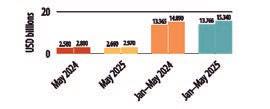
On Tuesday, the Bangko Sentral ng Pilipinas (BSP) said cash remittances grew 2.9 percent to $2.66 billion in May 2025 from $2.58 billion recorded in May 2024.
This brought total remittances in the first five months of the year to $13.766 billion in 2025, a 3-percent growth from 13.365 billion in 2024.
“...Global demand for Filipino labor remains but needs to pivot to other areas like EU and Asean states, and Peso depreciation boosting foreign exchange gains as well as increased adoption of digital wallets and fintech solutions makes sending much accessible. However, if we don’t transition, it could slow to 2.7 percent,” Jonathan Ravelas, senior adviser at professional services firm Reyes Tacandong & Co. told reporters.
Institute for Migration and Development Issues (IMDI) Executive Director Jeremaiah M. Opiniano agreed that diversification will help but thinks the focus should be on helping Overseas Filipino Workers (OFWs) and their families diversify the spending of their remittances.
Opiniano told BusinessMirror in an email that these remittances must also be used for savings, entrepreneurship,
DIGITAL CENTRICITY OF RURAL, THRIFT, CO-OP BANKS IN FOCUS
By Reine Juvierre S. Alberto @reine_alberto
THE Bangko Sentral ng Pilipinas (BSP) wants to level the playing field between digital banks and conventional banks by creating guidelines to determine the level of digital centricity of the latter.
During the Chamber of Thrift Banks’ national convention on Tuesday, BSP Deputy Governor Chuchi G. Fonacier said the central bank is crafting guidelines on the assessment of the level of digital centricity of thrift banks, rural banks and cooperative banks.
The guidelines will put in place indicators that will be considered in evaluating the level of digital centricity of the said banks to “ensure proportionate application of prudential requirements,” accord-
ing to Fonacier. “We need to level the playing field, that’s why we also would require some more, let’s say, capital from those doing the work. So the guidelines will also be issued for that,” Fonacier told reporters when asked for more information.
Digital banks are required to have a minimum capital of P1 billion, while the amount varies for thrift banks, from P750 million to P2 billion; and cooperative banks with P50 million to P200 million, depending on the number of branches in Metro Manila.
Rural banks’ minimum capitalization also depends on the number of branches, from P50 million to P200 million.
Fonacier said the guidelines will be subject to a phased implementation of higher regulatory
IF the economy can grow by 6.8 percent annually for the next 25 years, the Philippines may have a prayer to finally end its extended stay as a middle income country, according to the World Bank.
In its latest report, the Bank said enhancing investments in infrastructure and human capital; improving regulations and governance; and mobilizing private capital will provide a 1.4 percentage point boost to GDP growth to 6.8 percent annually from the current 5.4 percent.
Raising productivity through investments in infrastructure and human capital would add 0.78 percentage points to annual GDP growth. while efforts to deepen capital markets would add another 0.45-percentage points to growth; and those that would increase labor force participation would lead to a 0.18-percentage boost to GDP.
“You need the reforms to be fully implemented. And we estimate that 1.4 percentage point kick in growth. Half of that comes from more productivity and more human capital. And you bring the economy to a growth rate of 6.8 until 2050. That’s the horizon we look at. It’s 2050, next 25 years,” Gonzalo Varela, World Bank Lead Economist, said in a briefing on Tuesday.
“From our simulations that we present in the report, that brings the economy to the verge of that high-income threshold as defined today. The thresholds change over time based on a number of factors. But as that threshold is defined today, if we think in real terms, how much we expect the economy to grow, if these reforms are implemented, we’re thinking that within 25 years, you’re close to that threshold of high income again,” he explained. Based on the World Bank’s Atlas Method, the Philippines is considered a Low Income country, a position it has held since 1987 or 38 years. In the latest estimate, the Philippines still lacked $26 to become an Upper Middle Income Country. Earlier this month, the World Bank reported that the country’s gross national income (GNI) per capita rose to $4,470 in
a 5.67-percent increase from
NEXT STOP: PAY RAISE Commuters crowd the MRT-3 Taft Avenue Station in Pasay City during the Tuesday morning rush—reflecting the daily grind of Metro Manila’s working class. As the cost of living continues to climb, Labor Secretary Bienvenido
Laguesma announced that five Regional Tripartite Wages and Productivity Boards (RTWPBs) are conducting public hearings on proposed wage
standards or requirements applicable to a digital bank, as determined by the BSP.
“This approach promotes a level playing field and ensures consistent application of regulatory requirements and expectations between digital banks and digital-centric banks,” Fonacier added.
In addition, Fonacier said the BSP is formulating guidance on the ethical use of artificial intelligence in the financial sector.
This will include ethical AI deployment, improving AI’s accuracy in financial decision-making and management of algorithmic bias.
Meanwhile, bank management remains responsible for decisions based on information provided by AI tools, Fonacier made clear.
“While AI is being embedded in the financial system, financial institutions should be alert when it comes to upholding data privacy, and confidentiality of data control,” the BSP official said.
Part of the central bank’s strategic priorities, Fonacier said, is promoting the capacity of BSP-supervised financial institutions to remain adaptable, responsive and vigilant of key risks arising from technological developments and unforeseen events.
“The BSP continues its strong commitment towards a balanced regulatory approach that enables responsible innovation while at the same time safeguarding the stability and resilience of the financial system,” Fonacier said.
Will online gambling ban push operators underground?
By Samuel P. Medenilla @sam_medenilla
ASIDE from the potential economic impact of online gambling, the government will also determine if banning the activity will just force its operators and clients to “go underground,” according to Malacañang.
In a press briefing last Tuesday, Palace Press Officer Claire Castro said this will be among the considerations of President Ferdinand Marcos Jr. before he decides on the proposal to pro -
A1
$4,230 in 2023. The upper middle income country GNI per capita starts at $4,486.
The Philippines remains within the lower-middle-income bracket—de -
hibit online gambling.
“Decisions like this are really being studied to see if they will affect the economy, affect the people, and we cannot be hasty in this because
fined by the World Bank as economies with a GNI per capita between $1,136 and $4,495. (https://businessmirror.com.ph/2025/07/03/inequality-politics-culprit-for-phls-slowgni-climb/).
Middle income includes lower and upper income classifications. “We also have some general report to a middle class society where we refer to sort of
sometimes, when you ban legal and licensed online gaming sites, the number of illegal online gaming sites increases and that affects the economy more. So, the President is studying that,” she explained in Filipino.
Last week, the Palace said Marcos is already looking into the matter amid the growing number of lawmakers, who are calling for more regulations or the outright prohibition of online gambling.
Castro made the remark when asked if Marcos will include online gambling in his fourth State of the Nation Address (Sona) on July 28. In a related development, Castro said the President has started his preparations for the issues, which he will discuss in his Sona.
a well-developed, maybe not so high income, but a well-developed economy and people have much higher per capita income,” said Zafer Mustafaoğlu, World Bank Division Director for the Philippines, Malaysia, and Brunei. Varela, meanwhile, explained that the analysis on the impact of reforms on the economy’s performance is drawn from the country’s historical growth since 1990. The team divided the country’s development in the past 35 years into three periods.
The first period, 1990 to 1998, marked an annual average growth of 2.8 percent. It can be noted that 1997 and 1998 marked the Asian Financial Crisis which began as a housing bubble in Thailand and affected many countries in the region, including the Philippines.
The second period, Varela said, was 1999 to 2009 when the economy posted an annual average growth of 4.4 percent. He said 2008 and 2009 were the years of the Global Financial Crisis, which began as the United States Subprime crisis and affected millions globally.
Varela said the last period is 2010 onward which marked an annual average growth of 5.2 percent. It may be noted that the World Bank, in its Country Partnership Strategy (CPS), estimated that the country’s GDP growth will be below 6 percent until 2030.
She said the Palace will discuss more details about the Sona once it becomes available.
As of Tuesday, Malacañang announced award-winning tenor Sofronio Vasquez has been chosen to lead the singing of the Philippine national anthem during the upcoming Sona.
Vasquez made it to the headlines after he became the first male Asian winner of American talent competition, The Voice.
“Selecting Vasquez, a multi-awarded singer known for his powerful renditions of patriotic and classical pieces, reflects the administration’s intent to blend tradition and excellence in this year’s Sona ceremony,” the Presidential Communications Office (PCO) said in a statement.
The World Bank said GDP growth may average 5.3 percent in 2025; 5.4 in 2026; 5.5 percent in 2027; 5.7 percent in 2028; 5.8 percent in 2029 and 2030; and 5.9 percent in 2031. (See: https://businessmirror.com. ph/2025/06/05/world-banktempers-expectations-of-phlgrowth-cites-jitters/).
“The history shows that [moving up income classes] requires sustained high growth for foreseeable decades to actually achieve that. If the growth is not sustained and is not high enough, then it will take a very long period to achieve that. That’s the point,” Mustafaoğlu said.
“When we look at countries that managed to move to high-income countries like Korea, Poland, and others, actually we see that they managed to grow fast, above 7 percent most of the time, and for sustained decades,” he added.
If the Philippines fails to implement reforms, the World Bank estimates that a business-as-usual scenario will place the country’s average annual GDP growth at 5.1 percent and peg its per capita GDP at 4 percent by 2050.
The report noted that this baseline scenario is below the government’s targets of 5.4 percent on aggregate and 4.1 percent per capita by 2040. See “PHL,” A5
national agencies.
Subsidies, as well as net lending assistance to state-run corporations, will amount to P188.3 billion next year.
programs and projects.
This is followed by personnel services expenditures worth P1.908 trillion, or 28.1 percent of the total proposed budget and reflecting a 16.8 percent year-onyear growth, to fund the salaries and other benefits of government workers, as well as to create and fill job positions.
Meanwhile, capital outlays will be allotted P1.296 trillion to bankroll priority infrastructure projects, while financial expenses will be given P950 billion.
National government agencies will obtain P4.305 trillion, or 63.4 percent, while local government units will receive P1.350 trillion, excluding locally implemented projects funded through
The DBM said it received a total of P10.101 trillion in budget proposals from various government agencies, but had to trim down requests due to limited fiscal space and the fiscal consolidation strategy.
Alignment with the Philippine Development Plan 2023-2028, shovel-readiness, absorptive capacity, prioritization of government programs that deliver the highest value and impact, implementation of sustainable practices in government operations and fiscal space were considered by the DBM. The NEP is anchored on the PDP’s three key pillars, such as developing and protecting the capabilities of individuals and families; transforming production sectors to generate more quality jobs and competitive products; and fostering an enabling environment.
investments, insurance, and pensions apart from daily needs or the schooling of children.
“What should be diversified are the ways in which cash remittances are used by remittance-receiving households productively,” Opiniano told this newspaper.
“We have learned harrowing lessons from Covid-19 and overseas Filipinos directly felt those lessons. These lessons should never be repeated in today’s post-pandemic world,” he said.
While Trump’s new tariffs have yet to be implemented, Opiniano said uncertainty remains on how these will affect remittances. It is possible that the impact will be felt in the second half of the year. Nonetheless, Opiniano said, the country can still rely on the countercyclicality of remittances. This means that when there are economic downturns, remittances increase at the expense of reduced savings or living expenses of OFWs abroad.
“Income remittances tend to be stable come hell or high water. But don’t expect a surge any time soon given the uncertainty from the IranIsrael conflict,” former Socioeconomic Planning Secretary Dante B. Canlas told BusinessMirror Of the total cash remittances, land-based Overseas Filipinos (OFs) accounted for the much bigger share of $2.12 billion or a growth of 2.8 percent from $2.06 billion in May 2024.
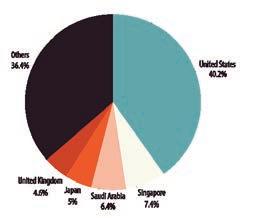
BSP data also showed that seabased OFs accounted for the smaller share of $536 million or a growth of 3.1 percent, compared to the $520 million posted in May 2024. BSP said the United States remained the top source of remittances to the Philippines, accounting for 40.2 percent of the inflows during the January-May 2025 period. This was followed by Singapore which accounted for 7.4 percent of the total inflows in May 2025; Saudi Arabia, 6.4 percent; Japan, 5 percent; and the United Kingdom, 4.6 percent.
“There are some limitations on the remittance data by source. A common practice of remittance centers in various cities abroad is to course remittances through correspondent banks, most of which are located in the US,” BSP explained.
“Remittances coursed through money couriers cannot be disaggregated by actual country source and are lodged under the country where the main offices are located, which, in many cases, is in the US,” it added. Given this, BSP said the US would appear to be the main source of OF remittances because banks attribute the origin of funds to the most immediate source.
Personal remittances
MEANWHILE , the increase in cash remittances drove an increase in personal remittances as well. Personal remittances include cash sent through banks and informal channels as well as remittances in kind. Personal remittances reached $2.97 billion in May 2025, up by 3 percent from $2.88 billion in May 2024. Cumulative personal remittances reached $15.34 billion in JanuaryMay 2025, marking a 3 percent increase from the $14.89 billion recorded in January-May 2024.
The President will submit the NEP to Congress within 30 days after the opening of the regular session.
With a report by Samuel P. Medenilla
“Unfortunately, I don’t want the stakeholders to think that there’s a major overhaul of the energy industry. We will continue with the policies that are effective. We will do away with policies that are not helpful to the country.
“As far as the DOE is concerned, we want to maintain continuity and we want to assure our stakeholders and possible investors that there will be no major changes in the DOE,” Garin said.
Legislator resurrects Cha-cha in 20th Congress
By Jovee Marie N. dela Cruz @joveemarie
CHATER change is set to be a hot issue in the 20th Congress following the filing of Resolution of Both Houses 1, a landmark proposal seeking to amend specific economic and territorial provisions of the 1987 Constitution.
victory and opening the door for economic growth while keeping sovereignty and national interest intact.”
The resolution introduces key features aimed at amending specific economic and territorial provisions of the 1987 Constitution.
One significant change is the explicit inclusion of the Exclusive Economic Zone (EEZ), Continental Shelf, and the West Philippine Sea as part of the national territory.
the transfer and conveyance of private lands; the operation of public utilities; and the ownership of educational institutions—except those operated by religious groups and mission boards.
The resolution also calls for a review of the constitutional requirement for 100-percent Filipino ownership in mass media and the 70-percent ownership threshold in the advertising industry.
perts, economic planners, and foreign policy analysts for its targeted scope and respectful approach to constitutional reform.
Economic amendments
THE proposed changes to the 1987 Constitution aim to make economic and ownership rules more flexible by adding the phrase “Unless Otherwise Provided by Law” in several important sections.
concerning areas of investment, will also be amended to permit Congress to allow foreign participation beyond the current 60-percent ownership cap.
“This is a constitutional refinement, not a rewrite,” said Garbin.
“We are aligning our national territory with our hard-won arbitral
Party-list Rep. Alfredo A. Garbin Jr. of Ako Bicol, former chairman of the House Committee on Constitutional Amendments, said the resolution specifically targets Articles I, XII, XIV, and XVI. The measure aims to clarify the definition of the national territory and ease restrictive economic provisions— without altering political term limits or governance structures. Garbin, who previously led key constitutional reform initiatives, described the measure as a “credible and focused reform effort” aligned with international law and the country’s development agenda.
Whistleblower still one of accused in
sabungeros case
TAdditionally, the phrase “Unless Otherwise Provided by Law” is incorporated into vital economic provisions, granting Congress the flexibility to enact economic reforms without the need for further constitutional amendments.
60 percent
THE proposed amendments would affect the current 60-percent Filipino citizenship requirement for activities such as the exploration, development, and utilization of natural resources;
Garbin underscored that the proposed Charter change would be undertaken through the legislative route, requiring a threefourths vote of all members of Congress, ensuring transparency and democratic accountability.
“We need reforms that work within the system, not around it,” Garbin stressed. “This resolution provides a clear and credible path forward, without the baggage of political agenda.”
The resolution has already gained attention from legal ex -
In Article XII, Section 2, on National Economy and Patrimony, the provision is to be split into two paragraphs, with the new paragraph allowing the state to directly undertake or enter into agreements for resource development, inserting the flexibility clause after stipulating the 60-percent Filipino ownership requirement.
Article XII, Section 3, which pertains to Lands of the Public Domain, would include the same phrase after the clause limiting alienable lands to 1,000 hectares.
Section 10 of the same article,
Article XII, Section 11, which governs public utilities, will feature multiple insertions of “Unless Otherwise Provided by Law,” enabling more inclusive foreign investment terms. Article XIV, Section 4(2), will be revised to allow non-Filipinos to potentially own and administer educational institutions, again subject to future legislation.
Lastly, in Article XVI, Section 11 on mass media and advertising, the amendments aim to ease the restrictions on foreign ownership and participation, provided that enabling laws are passed. Collectively, these changes aim to modernize the economic landscape by granting Congress more authority to adjust foreign equity rules in response to evolving national interests.
Teodoro unfazed by Maltese passport issue
SBy Joel R. San Juan @jrsanjuan1573
HE Department of Jus -
tice’s (DOJ) chief of prosecutors on Tuesday said whistleblower Julie “Totoy” Patidongan remains as an accused in the case of the 34 missing sabungeros or cockfighting aficionados.
In an interview, Prosecutor General Richard Anthony Fadullon noted that Patidongan has yet to officially execute a sworn affidavit detailing his full knowledge about the disappearance of the cockfighting enthusiasts four years ago.
“Well, at this point, much as we would want to, we cannot make any disclosures because all these revelations which are being made have to be formally presented or submitted to us in the form of affidavits and we have yet to see it and if and when we do see it, we still have to evaluate,” Fadullon said when asked how his revelations would affect the kidnapping and illegal detention filed against him.
“Although he is or he may be considered a whistleblower as of this time, all the things that have been disclosed are still being subject of validation and evaluation by the law enforcement authorities,” Fadullon added.
It can be recalled that Patidongan linked gaming tycoon Charlie “Atong” Ang, who operates the e-sabong firm Pitsmasters, as the one who orchestrated the disappearance of the cockfighting enthusiasts after they were caught cheating.
Ang, however, denied Patidongan’s claims and filed charges against the latter for trying to extort P300 million from him in exchange of not dragging his name in the missing sabungeros case.
Patidongan also led authorities to scour Taal Lake where he claimed the bodies of the missing sabungeros where dumped.
He has also filed a complaint before the National
Police Commission (Napolcom) against 18 active and former policemen whom he identified as involved in the abduction of the sabungeros.
Manila Arena kidnapping PATIDONGAN is among six security guards previously charged with six counts of kidnapping and serious illegal detention related to the alleged abduction of six individuals on January 22, 2022, near Manila Arena.
They were initially granted bail by the Regional Trial Court in Manila but this was set aside by the Court of Appeals (CA) in a ruling in January.
The trial court has yet to recall Patidongan’s bail and his co-accused pending the resolution of their appeal before the Supreme Court (SC).
Divers from the Coast Guard (PCG) have so far recovered several sacks of alleged human bones from the Taal Lake, which are now being examined if these are part of the remains of the missing sabungeros.
18 cops named EIGHTEEN policemen allegedly involved in the case of missing sabungeros were included in the complaint-affidavit filed by Patidongan, the National Police Commission (Napolcom) said on Tuesday.
The 18 policemen, who were also included in the complaint filed the families of the missing sabungeros, will required to explain their side, the commission said.
“So we are sending orderssummons to all of these respondents na sana sagutin nila ang kasong i -finile ni alias Totoy,” said Napolcom vice chairman and executive officer Rafael Vicente Calinisan, in a television interview. Calinisan said that although they are still reviewing the affidavit, he said, it seems that 13 of those mentioned are still in active service while some of them have already been dismissed.
With Claudeth Mocon-Ciriaco
ECRETARY of National Defense Gilberto Teodoro Jr. on Tuesday dismissed a newspaper report on his old Maltese passport, calling it is a “smear campaign” as the reporter did not try to get his side for the article.
“Ito’y hindi lang fake news kundi smear campaign, kasi hindi hiningi ang side ko na puwede ko namang ipaliwanag Basta na lang nilabas. At alam nila na pupulutin ito [This is not only fake news but also a smear campaign, because they did not try to get my side, which I could have given. They just came out with the report. And they knew that it would be picked up quickly],” he said in a radio interview.
Had the media entity decided to get his side, Teodoro said he could have explained and presented proof that he had already surrendered and renounced his Maltese passport well before the 2022 elections when he ran for senator.
Teodoro noted that failure to do so would have meant his disqualification from the 2022 senatorial race.
Compliance with process “GINAWA ko ’yung proseso na maaga , knowing it takes time. Ni-renounce ko iyon dito sa BI [Bureau of Immigration] at ipina -revoke
doon mismo sa bansa na ’iyon. So noong bago pa ako mag -file, nandiyan na ’yan, ni- renounce ko na [I did the process early knowing it takes time. I renounced it at the BI and had it revoked also in that country. Before I filed, it is already done, I have renounced it already],” he said.
Assistant Secretary Arsenio Andolong, DND spokesman, earlier said Teodoro surrendered and renounced his Maltese passport in 2021 before he filed his certificate of candidacy for the 2022 elections.
Teodoro was reacting to a newspaper report that said he was issued a Maltese passport on December 22, 2016 that was valid for 10 years.
Under Philippine laws and the Constitution, dual citizenship is prohibited for public officials especially those occupying Cabinetlevel positions.
In the same interview, Teodoro said as early as last week, someone had already tipped him that somebody will be raising the passport issue against him. He, however, said this individual did not tell him when and where the report would come out.
“ Sabi ko, wala naman akong pakialam. Hindi naman totoo na dual citizen ako [I said I don’t care because it’s not true that I
have dual citizenship],” he said. Despite getting this initial information, Teodoro said he still has no idea on who is behind the smear campaign.
“Hindi ko masabi kung ano or sino o ano ang puno’t dulo nito [I can›t tell yet who is the person or group behind this for now],” he said, adding that “white papers” targeting him for the past few months seemed to be connected to the passport issue.
Asked on the possibility that pro-China groups are behind this move, Teodoro, a vocal critic of Chinese aggression in the West Philippine Sea, said he will not comment on it for now.
Teodoro explained that he availed of a Maltese passport in 2016 because he was looking for jobs and opportunities in Europe. He noted that he was a private citizen at the time, and renewing visas was time consuming and a difficult process.
Teodoro was appointed as SND by President Marcos in June 2023. He held the same post from August 2007 to November 2009 under then-President Gloria Macapagal-Arroy
Resign calls
DESPITE his explanation however, there are calls for his resignation in social media platforms.
One of those who called for his resignation was retired Brig. Gen. Orlando E. De Leon, a member of Philippine Military Academy Class of 1982. He said Teodoro was unfit for to head a sensitive post.
A political analyst, Anna Malindog-Uy, on the other hand said “Surrendering a passport is not the same as renouncing citizenship.”
She added, “Trust in public officials—especially in national defense—relies not just on legal compliance, but on moral clarity and transparency. The delayed disclosure reeks of damage control, not accountability.” In his Facebook post, former Presidential spokesperson, Herminio Roque, commented on Teodoro’s surrender of Maltese passport: “A passport is just a travel document that may prove citizenship. Citizenship is acquired through oath of allegiance. Surrendering a passport is not renunciation.” The passport of Roque, who is facing human-trafficking charges in Angeles City due to his involvement in the now-banned Philippine Offshore Gaming Operation, was revoked by the Department of Foreign Affairs following the issuance of a warrant of arrest against him. Rex Anthony Naval with PNA
AS part of his administration’s efforts to streamline government operations, President Marcos abolished the Office of the Presidential Adviser on Military and Police Affairs (Opampa).
In the two-page Executive Order 89, series of 2025, the Chief Executive said the functions of the Opampa will be transferred to the Office of the Executive Secretary, Department of National Defense, National Security Council, National Police (PNP), National Police Commission (Napolcom) and other agencies.
Opampa properties and resources were ordered to be turned over to the Office of the Deputy Secretary for Support Services and Auxiliaries.
The defunct Office was created in 2022 under the administration of the Office of the Special Assistant to the President by EO 1.
It succeeded the Office of the Presidential Adviser on Police Affairs (Opapa) and the Office of the Presidential Adviser on Military Affairs
(Opama).
Opapa handles matters, including staff assistance, related to the police, while the Opama facilitates policy formulation and decision making related to national security and military affairs.
Marcos decided to abolish the Office through EO 89 dated July 11, 2025, which was signed by Executive Secretary Lucas P. Bersamin, as his administration continued its streamlining and rightsizing initiatives.
Survey shows spike in House trust rating
PUBLIC trust in the House of Representatives has surged to a record high, signaling strong public approval of the chamber’s performance under the recently concluded 19th Congress. The latest Social Weather Stations (SWS) national survey indicate that the House’s trust rating climbed sharply in just three months—from 34 percent in April 2025 to 49 percent in May and further to 57 percent in June. The consistent rise highlights growing public confidence in the legislative body amid complex national challenges.
Former Speaker Ferdinand Martin Romualdez’s personal trust rating mirrored the upward trend, increasing from 23 percent in
April to 26 percent in May and then to 34 percent in June—a notable 8 percentage points jump in just one month. This reflects public recognition of his firm and steady leadership during politically sensitive times, including the impeachment proceedings against Vice President Sara Duterte. House Spokesperson Princess Abante attributed the improved ratings to the productive and unified efforts of the Romualdez-led chamber. “Speaker Romualdez has rallied over 300 lawmakers behind a shared mission: to support the President in realizing the vision of Bagong Pilipinas. The Filipino people saw results—they saw a Congress that delivered on both legislation and oversight,” she said.
She noted that under Romualdez’s leadership, the House passed 61 out of 64 priority measures identified by the LegislativeExecutive Development Advisory Council (Ledac), including 27 out of 28 during the 3rd Regular Session. In total, over 280 new laws were enacted and more than 13,800 bills and resolutions were filed—making the 19th Congress one of the most active in Philippine legislative history. Despite the political tensions surrounding the Vice President’s impeachment, the House remained focused on its core legislative work. Key laws passed during the period included the Anti-Agricultural Economic Sabotage Act, the expanded Rice Competitiveness Enhancement Fund, wage board reforms, the Tatak Pinoy Act, and the Trabaho Para sa Bayan Act—all aimed at addressing food security, job creation, and economic growth. In response to urgent needs in education and health, Congress also enacted laws expanding PhilHealth outpatient benefits, supporting the construction of specialty hospitals, enhancing mental health programs, improving classroom infrastructure, and modernizing teacher training. On matters of sovereignty and national defense, lawmakers passed the Philippine Maritime Zones Act to reinforce
Last month, Malacañang announced the President accepted the courtesy resignation of Presidential Adviser on Military and Police Affairs Roman A. Felix. Felix is a member of Philippine Military Academy Class of 1983 and retired in August 2015 as a police brigadier general commanding police forces in the Ilocos Region.
Wednesday, July 16, 2025
House vows funding for DSWD programs
By Jovee Marie N. dela Cruz @joveemarie
THE House of Representatives on Tuesday vowed to provide adequate funding in the 2026 national budget for the Department of Social Welfare and Development’s (DSWD) flagship anti-hunger initiative, the “Walang Gutom” Program, as the agency aims to expand its coverage to 600,000 households by the end of 2025 and reach 750,000 families before President Marcos’ term concludes in 2028.
Leyte Rep. Ferdinand Martin G. Romualdez made the statement after the DSWD revealed plans to scale up the program from 300,000 to 750,000 food-poor households by 2026. Through an electronic benefit transfer (EBT) card, enrolled families receive P3,000 in monthly food credits, redeemable at DSWD-accredited merchants for nutritious food items.
Romualdez, who is touted to continue as Speaker of the 20thCongress, assured that Congress will work to ensure the program’s sustainability and expansion, saying that no Filipino should go hungry in a country
brimming with potential.
He also highlighted the complementary “Benteng Bigas, Meron Na!” initiative, which enables Walang Gutom beneficiaries to buy rice at P20 per kilo through Kadiwa stores and partner retailers, thanks to coordination between the DSWD and Department of Agriculture (DA).
“While this price isn’t yet available everywhere, it makes a huge difference for our most vulnerable families,” he explained.
Romualdez stressed that fighting hunger requires a whole-of-nation approach—one
that addresses the full value chain, from farmer support to nutrition education.
He urged fellow lawmakers to rally behind the 2026 General Appropriations Bill (GAB) to ensure sufficient resources for both the DSWD and DA to meet the program’s growing scope.
“This is what makes Walang Gutom a game-changer. It merges compassion with innovation, urgency with sustainability, and short-term aid with long-term empowerment,” he said. “This is how we build a Bagong Pilipinas—by making sure that government reaches those who need it
Private developers hail ‘simple process’ for joining expanded 4PH
MORE private developers are stepping in to support the government’s flagship housing initiative, citing streamlined procedures and a clearer framework under the recalibrated Pambansang Pabahay para sa Pilipino (4PH) Program, the Department of Human Settlements and Urban Development (DHSUD) said on Monday.
Housing Secretary Jose Ramon Aliling attributed the rising interest among private stakeholders to the program’s “improved design and coordination,” which followed a directive from President Ferdinand Marcos Jr. to expand and accelerate implementation.
Survey. . .
Continued from A3
“With the approved exclusive 4PH programs by the Pag-Ibig Fund, we can expect more active private sector participation and simplified processes for our beneficiaries. Hence, a more inclusive and sustainable program,” Aliling said on Monday.
“We can consider it done, the expanded 4PH will now move faster,” he added in Filipino. “All we need to do is monitor and support those developers who already committed. Slowly, we’re seeing private sector developers begin to take part in the program.”
As of last week, a total of 42 developers had pledged to build over 250,000 houses
the country’s position in the West Philippine Sea and approved the Magna Carta for Filipino Seafarers to ensure better protection of overseas workers. The revitalized Barangay Development Program also brought essential services to conflict-affected communities.
Abante emphasized that this strong finish has heightened public expectations for the 20th Congress. “The people responded with rising trust because they saw performance. That trust now comes with a call to maintain the same level of discipline, integrity, and productivity,” she said. “Respect is earned—and Speaker Romualdez earned it through performance. That is the legacy of the 19th Congress.”
Meanwhile, the Tingog party-list group welcomed the renewed public trust, crediting the House’s “consistent and effective leadership.”
“These results affirm the people’s trust in a House that has chosen to focus on legislation that uplifts lives and protects our future,” said Tingog Rep. Jude Acidre.
“We are proud to serve under Speaker Romualdez, whose steady hand guided the chamber through turbulent times while delivering meaningful reform.” Jovee Marie N. dela Cruz
under the 4PH banner.
The commitment was formalized in a letter dated July 7 and signed by four major industry associations: the Chamber of Real Estate and Builders’ Associations Inc., National Real Estate Association, Organization of Socialized and Economic Housing Developers of the Philippines and the Subdivision and Housing Developers Association Inc.
The department also confirmed that other modalities, such as rental housing and incremental shelter development, are being studied for inclusion under the expanded 4PH framework.
Since assuming his post in June, Aliling
has introduced an eight-point agenda that outlines his strategic direction for the department.
The agenda focuses on “strengthening the 4PH program, simplifying regulatory processes, promoting digitalization of housing services, improving inter-agency collaboration, protecting homebuyers and upholding transparency and accountability across the sector.”
The 4PH Program, which aims to build one million houses units annually until 2028, remains the centerpiece of the Marcos administration’s push for urban development and housing.
Bless Aubrey Ogerio
DA: Suspension of fish imports temporary
THE Department of Agriculture (DA) issued another order to clarify that the suspension of imports for certain mackerel and torpedo scad species is only temporary.
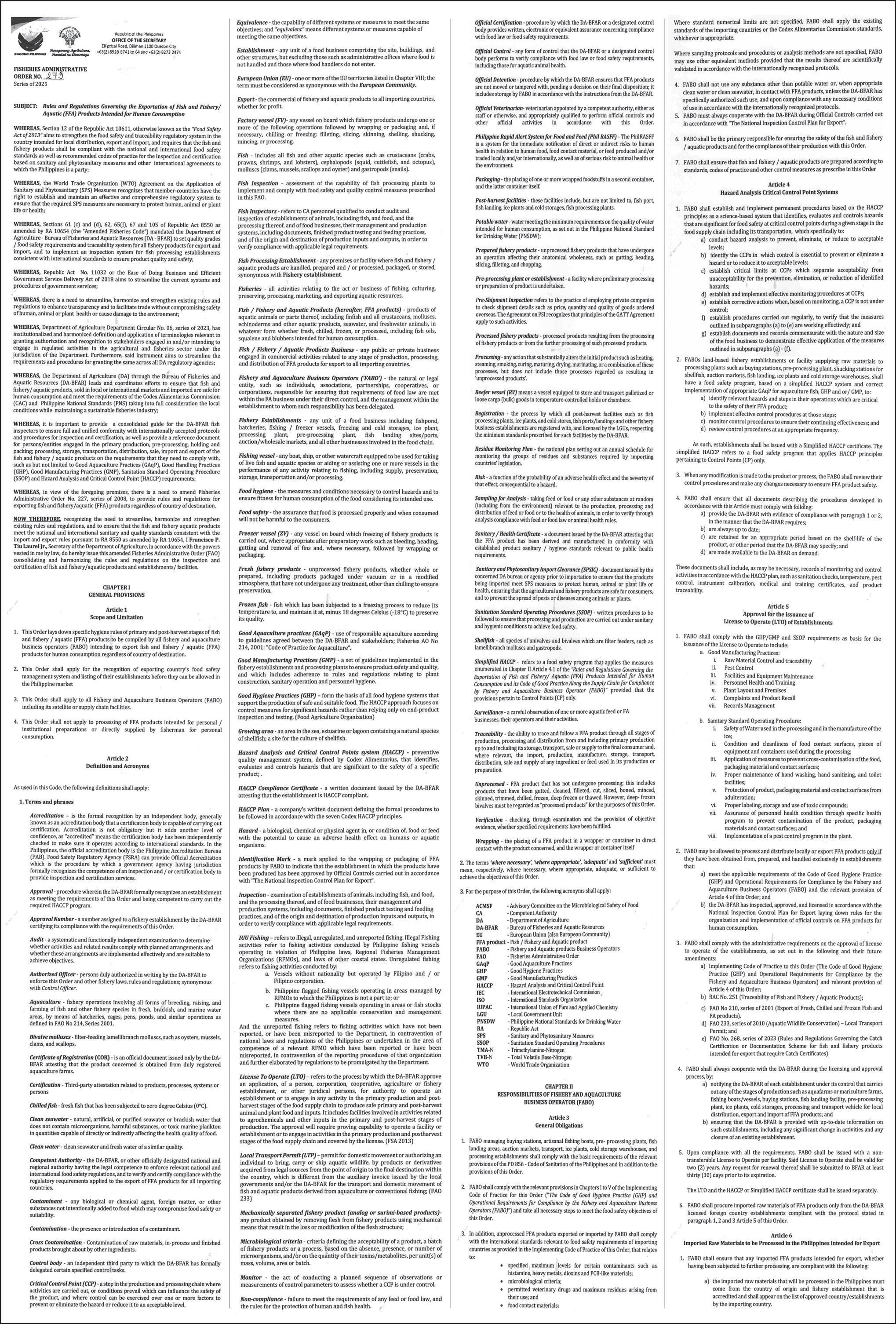
Agriculture Secretary Francisco Tiu Laurel Jr. signed Memorandum Order (MO) 38, in relation to MO 37, which ordered the immediate suspension of sanitary and phytosanitary import clearance (SPSIC) issuance for shipments of mackerel (Indian Mackerel, Wahoo), horse mackerel (Atlantic Horse Mackerel, Japanese Horse Mackerel), and torpedo or hardtail scad.
The DA said it decided to issue the measure following allegations that some importers misdeclared or diverted shipments of fishery products.
The agency noted that such a move undermines the DA’s objectives of stabilizing supply and keeping fish prices affordable, while also disrupting legitimate trade channels.
Laurel said the importation of these commodities should be transparent and fair, as this would safeguard consumer access and protect the livelihoods of local fishers and traders from the adverse effects of illicit trade.
However, he noted that the order is not an import ban, but a temporary measure to ensure full compliance with regulations and alignment with national interest.
The order will be lifted
based on the result of a thorough investigation and review of current importation protocols to ensure integrity and accountability across the fish supply chain, the DA added.
Known locally as alumahan (mackerel) and galunggong (scad), the agency said these fish varieties are household staples for many Filipino families due to their affordability and versatility in local cuisine.
The DA said its decision reinforces the government’s commitment to ensure food safety, market fairness, and sustainable livelihoods in the fishery and aquaculture sectors. It also aims to insulate domestic producers from disruptive activities that distort market dynamics.
Earlier this year, the DA approved the importation of 25,000 metric tons (MT) of various fish and seafood that are not locally available.
The deadline for the importation program has been extended until the end of July, which marks the second time the program has been extended from the initial deadline of end-May and the previous extension until the end of June.
The DA chief had extended the importation program amid the trickle of arrivals caused by tight timelines and sourcing constraints.
“It’s more of a systemic issue than low demand,” Laurel said in a previous statement.
“The timeframes we set were too short, and many of the approved products were out of season in their countries of origin. It was also challenging for some importers to meet requirements tied to larger volume allocations.”
most, with real solutions that work.”
Better food choices
SOCIAL Welfare Assistant Secretary Irene Dumlao explained that the Nutrition Education Sessions (NES)—a core feature of the Walang Gutom Program (WGP)—help teach families how to make better food choices.
NES activities include identifying food items by “Go, Grow, and Glow” categories and preparing affordable, balanced menus for the whole family.
Dumlao emphasized that NES plays a
key role in achieving long-term behavioral change among beneficiaries.
The DSWD targets to expand WGP’s reach to 600,000 households by the end of 2025, with a goal of 750,000 families before the end of President Marcos’ term in 2028.
Launched in 2023 and institutionalized in 2024 through Executive Order No. 44, the Walang Gutom Program stands as the government’s flagship initiative against hunger, directly aligned with President Marcos’ vision for a food-secure Philippines.
PHL investment climate, PPP progress take center stage in London forum
AFORMER congressman took center stage at a high-level international forum in London, where he showcased landmark legislation that has enhanced the Philippines’ investment climate, along with the country’s pioneering strides in publicprivate partnerships (PPP)—highlighting in particular its collaboration with Italian water technology company Veragon.
The forum, titled “A Public-Private Partnership for Water Security: The CamSur–Veragon Case Study,” was coorganized by the University College London (UCL) Center for Sustainable Business and the Philippine Embassy in London, bringing together global policymakers, academics, diplomats, and investors.
Camarines Sur Gov. and former lawmaker Luis Raymund Villafuerte detailed how Camarines Sur rose from being the 39th poorest province in 2004 to now ranking third richest in assets and second in revenue generation among all provinces in the Philippines, based on the latest data from the Bureau of Local Government Finance (BLGF).
“This transformation was driven by good governance, strong and consistent leadership, business-friendly policies, and continuity,” Villafuerte, the president of the National Unity Party (NUP), emphasized.
“These are also the exact conditions that make CamSur one of the most attractive places for PPPs to thrive.”
At the heart of the forum was the province’s landmark partnership with Veragon, which introduced Atmospheric Water Generation (AWG) technology to provide clean and sustainable drinking water. The project not only improved water access but also generated jobs and accelerated industrial growth—all under a low-risk, high-impact PPP framework.
Now the subject of an academic case study by UCL, the CamSur-Veragon partnership is being positioned as a replicable model for PPPs in the Philippines and the broader Association of Southease Asian Nations (Asean) region. Villafuerte also pointed to recent national reforms that have improved the investment climate in the Philippines, including the amended Public Service Act, which allows full foreign ownership in select industries; the CREATE Law, providing tax cuts and incentives for strategic investors; the Ease of Doing Business (EODB) Act, which streamlines permitting processes; and the 2010 Camarines Sur PPP Ordinance, the first of its kind among local governments in the country.
Looking to the future, Villafuerte outlined CamSur’s bold development agenda, including the creation of CamSur Uptown, a smart city district; upgrades to Naga Airport and expansion of tourism infrastructure; positioning the province as the renewable energy capital of the Philippines, now home to the country’s largest offshore wind project led by Denmark-based Copenhagen Infrastructure Partners (CIP); and a suite of digital transformation initiatives aimed at building a Smarter, Greener, Healthier, and AI-ready CamSur.
“Camarines Sur is no longer just an agricultural province—it’s a launchpad for innovation and sustainable growth,” Villafuerte declared. “From CamSur, a spark can light the whole nation—and the world.” The event featured remarks from Philippine Ambassador to the UK Teodoro L. Locsin Jr., Trade and Industry Secretary Christina Aldequer Roque, UCL Prof. Paolo Taticchi, and Veragon Chief Executive Officer Alessio Lucattelli. Jovee Marie N. dela Cruz
Solon calls for ‘independent’ appropriations panel at House
ALAWMAKER is calling for an “independent” House Committee on Appropriations—one that is free from political influence and focused solely on serving the interests of the Filipino people.
Navotas Rep. Toby Tiangco expressed his
willingness to take on the role of Committee on Appropriations chairman in the 20th Congress, but only if his colleagues support reforms aimed at ensuring transparency in crafting the 2026 national budget and preventing a repeat of past irregularities.
“It depends. I am ready to accept the
position of Appropriations committee chairman if my fellow lawmakers are committed to address and prevent the issues that marred the 2025 budget,” Tiangco said in a press statement.
The 2025 national budget had faced criticism from various sectors over alleged manipulation and insertions. President Marcos even vetoed several items in the current budget.
Tiangco emphasized that he would only accept the chairmanship if granted
full independence to carry out his responsibilities, adding that he will not accept a position that requires blind obedience to the House leadership.
“I will decline the chairmanship if I am expected to simply follow the dictates of House leaders in crafting the 2026 General Appropriations Act,” he added.
Meanwhile, Quezon Rep. David Suarez is reportedly being considered for the chairmanship of the committee.
Jovee Marie N. dela Cruz
DMW assures families of support as search for missing crew of MV Eternity C continues
THE government continues to look for 13 other missing Filipino crew of MV Eternity C, according to the Department of Migrant Workers (DMW).
The agency made the assurance amid reports that the shipowner already stopped looking for the missing sailors of MV Eternity C after it sank in the Red Sea last week after being attacked by Houthi rebels.
“The DMW, in coordination with the DFA, are working on accounting for the 13 other seafarers onboard the MV Eternity C,” DMW said in a statement last Tuesday.
“The DMW affirms its steadfast commitment to protect Filipino seafarers —especially those caught in crisis situations—and ensuring their safe return home,” it added.
The officials of the agency visited the homes of the families of the
DOJ-DSWD
13 seafarers to assure them they get support from the government.
Of the 22 crew members of the Greek-owned MV Eternity C, 21 were Filipinos.
Eight of the said Filipino sailors were rescued in the previous week and were safely transported to the Jizan Port in the Kingdom of Saudi Arabia (KSA) were they able to talk with DMW Secretary Hans J. Cacdac via video call.
DMW is now working to repatriate the said seafarers as soon possible and provide them with aid including medical evaluations, psychosocial counseling, and the reissuance of their travel documents.
As of press time, DMW has yet confirm or deny news reports that some of the MV Eternity C sailors have died or were taken as hostage by Houthi rebels. Samuel P. Medenilla
inks MOA to
simplify processing, delivery of compensation to child victims of violent crimes
THE Department of Justice (DOJ) and the Department of Social Welfare and Development (DSWD) have signed a memorandum that would establish a referral system to simplify the processing and delivery of compensation to child victims of violent crimes.
Among those covered by the memorandum are children under 18 years old who are currently under the custody or care of a DSWD managed residential care facility.
The partnership is in line with Republic Act No. 7309, the law which created the DOJ-Board of Claims (BOC), which mandates to compensate victims of unjust imprisonment, wrongful conviction, violent crimes, among others.
Violent crimes include rape and offenses committed with malice which resulted in death or serious physical and/or psychological injuries, permanent incapacity or disability, insanity, abortion, serious trauma, or committed with torture, cruelty or barbarity; torture under Republic Act No. 7945; enforced and involuntary disappearance under R.A. 10353; trafficking in person under R.A. 9208; and online sexual abuse or exploitation under R.A. 11930.
Under the MOA, the DOJBOC will evaluate and process the requests for claims referred by the DSWD where qualified beneficiaries will be granted a certain amount of monetary
Continued from A2
The World Bank also said that with the average population growth projected at 1.1 percent annually, the government’s targets could imply a growth of GDP per capita in the range of 5.3 to 6.8 percent. The study also noted that baseline projections estimate average GDP growth of 5.1 percent annually or 4 percent per capita for the 2025–2050 period. This assumes Total Factor Productivity (TFP) growth of 1.3 percent; an investment-to-GDP ratio of 22 percent; and slower labor force expansion due to demographic trends.
If the government achieves its upper aggregate GDP growth target of 8 percent and a 6.8-percent growth in per capita terms, this will increase the country’s gross national income (GNI) per capita to $25,710 by 2050, using 2025 prices. This will place the Philippines 37
DepEd commits to future-ready education: Embracing digital transformation, reforms
By Claudeth Mocon-Ciriaco @claudethmc3
THE Department of Education (DepEd) has reaffirmed its commitment to building a future-ready education system through stakeholder-driven reforms and digital transformation in the wake of the Philippines’ latest global ranking in education readiness.
The country recently placed 74th out of 177 countries in the Global Education Futures Readiness Index (GEFRI), earning a score of 56.32 out of 100. This places the Philippines in the category of “emerging and partial readiness,” signaling ongoing structural challenges in governance, innovation, infrastructure, and access to quality education.
In response, DepEd, under the leadership of Secretary Juan Edgardo “Sonny” Angara, is accelerating long-term reforms designed to cater future demands, in line with President Ferdinand R. Marcos’ national development agenda.
compensation to recompense to a certain extent their suffering caused by various forms of injustices and aid them in their recovery and restitution.
Undersecretary-in-Charge for the Board of Claims Deo L. Marco, BOC Chairperson Senior Deputy State Prosecutor Miguel F. Gudio, Jr., DSWD Undersecretaries Adonis P. Sulit and Monina Josefina H. Romualdez, led the signing of the MOA held at the DOJ Justice Hall.
“We are fully aware that financial assistance can never compensate for lost time and trauma. But, we hope that through this mechanism we can help further victims of violent crimes see the face tomorrow with a brighter life,” Marco said.
“This advances our shared objective of delivering holistic justice that does not end in the prosecution of offenders but extends to the healing and rehabilitation of victims,” Marco added.
Romualdez, on the other hand, stressed that officials of the two departments have the responsibility to ensure that child victims will receive the necessary interventions that they need toward “healing, recovery, and integration.”
“One crucial step is to give them compensation…By providing compensation that will enable to help the victims address their medical, psychological, educational and social needs, among others…,” she added. Joel R. San Juan
percent higher than the threshold for High Income Countries (HICs) and comparable to Poland’s current living standards.
However, given the World Bank’s baseline scenario, the country’s GNI per capita is estimated at $12,200 or 33 percent below the threshold for HICs and similar to Brazil’s today. “These projections emphasize the critical nature of reforms if the Philippines is to converge to highincome status,” the report stated.
Tariffs, reforms APART from moving up income classes, these reforms are also crucial in countering the impact of higher tariffs. Varela noted that while these negotiations are still ongoing, it is safe to say that efforts to improve doing business will go a long way in helping local entrepreneurs.
Varela said streamlining regulations, specifically, can offer significant improvement in the way
“PHL,” A11
makabago, at mas kapaki-pakinabang sa mga guro, magulang, at bata. Hindi ito madali, pero kailangang simulan at sabay-sabay nating gawin,” he said.
To prepare for future challenges and opportunities, DepEd has established the Education Center for Artificial Intelligence Research (ECAIR), a first-of-its-kind initiative in the Philippine education sector, to apply AI and data science in solving persistent issues in teaching, planning, and school management.
Among these are SIGLA, a mobile app for automating growth monitoring of learners; TALINO, a geospatial mapping tool to support private sector engagement through the Adopta-School Program; and DUNONG, a dashboard that processes school leadership exam data to support succession planning.
“Pinapaganda natin ang sistema para maging mas maayos, mas
A chatbot system called SALIKSeek is also being refined to speed up access to internal data for DepEd decision-makers. Other tools like SABAY, which aims to support early cognitive risk screening, and LIGTAS, a geohazard tracking system for schools, are undergoing
prototyping and controlled data development.
With the AI tools in various stages of development, DepEd emphasized that the projects are governed by an AI Governance Framework rooted in international standards, ensuring responsible, ethical, and transparent use of emerging technologies.
In basic education governance, DepEd is launching Project Bukas, an open data initiative.
These cover school-level enrollment, resource inventory, and learning outcomes, empowering communities to monitor and support education services more effectively.
To align learning with the demands of the workforce, DepEd has also restructured the Senior High School (SHS) curriculum in coordination with Technical Education and Skills Development Authority, Commission on Higher Education, and Department of Labor and Employment.
Technical-Vocational Education and Training (TVET) qualifications are now being embedded into SHS programs.
SWS poll: Majority of Filipinos want VP Sara to face impeachment; many see Senate delay
SIXTY-six percent of Filipinos believe that Vice President Sara Duterte should confront the corruption allegations against her through the formal impeachment process, according to the Social Weather Stations (SWS) commissioned by the Stratbase Group.
Meanwhile, an separate, non-commissioned survey of the SWS, also conducted from June 25 to 29, 2025, 44 percent of respondents expressed belief that the Senate is deliberately delaying the start of the impeachment trial, suggesting rising demand for institutional accountability and prompt action.
The survey commissioned by Stratbase Group, among 1,200 adult respondents nationwide, has a ±3 percent margin of error for national figures and ±6 percent for National Capital Region (NCR), Balance Luzon, the Visayas, and Mindanao.
According to the survey, Mindanao has notably brought down the approval numbers due to the mere 55 percent agreeing that Duterte must address the charges.
“This public sentiment is reinforced by
results from a separate, non-commissioned SWS survey also conducted from June 25 to 29, 2025, which showed that 59 percent of adult Filipinos were already aware of the impeachment case even before being interviewed.”
The nationwide survey involved faceto-face interviews with 1,200 adult respondents equally divided across NCR, Balance Luzon, the Visayas, and Mindanao (300 respondents per area), with a ±3 percent margin of error for national figures and ±6 percent for each region.
Awareness levels were highest in Metro Manila at 68 percent, followed by the Visayas with 64 percent, Balance Luzon with 57 percent, and Mindanao (52 percent).
The same survey revealed regional variations in public sentiment regarding the impeachment.
Metro Manila showed the strongest support, with 44 percent agreeing, followed by Balance Luzon at 40 percent agreeing.
Meanwhile, opposition was strongest in Mindanao, with only 13 percent agreeing, and the Visayas at 28 percent agreeing.
Stratbase Group President Prof. Victor Andres “Dindo” Manhit emphasized the significance of these findings in the context of public expectations around transparency and democratic governance.
“This level of awareness reflects a more engaged and vigilant public. Filipinos are watching closely and expect the country’s democratic institutions, particularly the Senate, to act decisively and impartially,” he said.
He added, “When half the population is already informed about an ongoing impeachment case, it shows that citizens are not just passive observers. They are actively following developments, asking questions, and expecting accountability from public officials.”
Manhit stressed the need for the process to proceed without political interference or unnecessary delay.
“Transparency, accountability, and due process are the foundations of a functioning democracy. Any perception of delay or inaction risks undermining public trust: not just in individuals, but in the system itself,” he shared. Claudeth Mocon-Ciriaco
DOH wants TB incidence cut by half in new program
DAVAO CITY—The Department of Health (DOH) is targeting to cut morbidity to tuberculosis by half and to reduce deaths by more than three folds as it launched last week the Mindanao-wide implementation of a national program that addresses this infectious disease
“every tier of the health system.”
Health Undersecretary Abdullah B. Dumama Jr., cluster head of the National Universal Health Care Health Services Cluster (UHC-HSC) for Mindanao, said the new program plan aims to lower TB mortality rate from 18 to 5 per 100,000 and cut incidence from 643 to 300 per 100,000 by year 2030.
Dumama, also concurrent head of Area IV (Mindanao) said the program is called Philippine Strategic Tuberculosis (TB) Elimination Plan Phase 2: 2025-2030 (PhilSTEP2).
To reach these targets, the DOH will implement measures such as both community and facilitybased screening, healthcare workers testing, adoption of patientcentered treatment approaches, enhanced clinical monitoring, robust referral systems, and intensified contact tracing, among others.
In a forum on July 9 at the Apo View Hotel, he told health officials and stakeholders that nationwide, the DOH aims to screen a total of 79.5 million Filipinos nationwide using CXR (Chest X-ray) in six years, or 10.8 million in 2025, 12.7 million in 2026, 13.4 million in 2027, 13.1 million in 2028, around 14 million in 2029, and 15.2 million in 2030.
He said the program took off from the successes and insights of PhilSTEP1 (2020–2023), which provided the strategic framework to guide the planning, execution, and evaluation of tuberculosisrelated initiatives across every tier of the health system and among all relevant stakeholders.
He said the PhilSTEP2 is aligned with the World Health Organization’s End TB Strategy to improve case detection through community-and facility-based chest X-ray screening “and ensure TB cases are diagnosed and treated; provide TB preventive treatment of eligible contacts, reduce catastrophic costs for TBaffected households to zero; and strengthen emergency preparedness and health promotion.”
“The PhilSTEP 2 is the key to
At the same time, reforms in government hiring policies now recognize SHS graduates as eligible for first-level civil service positions, expanding employment pathways for youth.
“Sa ilalim ng pamumuno ni Pangulong Marcos, pinapatibay natin ang pundasyon ng edukasyon hindi lang para makaabot sa global standards kundi para makalikha ng mas makatao, makabago, at makatarungang kinabukasan para sa bawat batang Pilipino,” Angara said. DepEd is also investing heavily in digital infrastructure. This includes PSIP Connect, a major initiative to deliver devices, solar energy, and satellite internet to underserved schools, and the Bayanihan SIM Program, which supports teachers and learners in connectivity-challenged areas.
The Department’s ongoing initiatives reflect a growing recognition that education transformation requires a whole-of-society approach, where parents, teachers, communities, the private sector, and development partners work hand in hand to prepare the Filipino learner for the fast-changing world.
Senator Mark Villar urges stronger rabies prevention through public veterinary clinics
WEEKS after the passage of the Animal Welfare Act, Senator Mark Villar is advocating for a more robust and community-based approach to curb the spread of the deadly rabies, noting the alarming rise of cases—and deaths—involving the disease. Villar’s push is timely, given that the strengthened law for animal welfare, championed by his mother former senator Cynthia Villar, had also focused on the rising number of stray and untended animals, deemed a key factor in the uncontrolled spread of rabies.
Citing recent reports of fatalities from rabies, Villar said the current system is failing to detect and treat infections early enough. In many cases, victims seek help only after symptoms have appeared—at which point the virus is already fatal.
“This is a preventable disease, yet so many lives are still being lost,” Villar said. “We need proactive, comprehensive solutions that address the issue at its root.”
a bolder, more integrated, and person-centered response,” he added, and said the program’s strategic pillars are the following: effective and responsive service delivery; resilience to emergencies and disasters; advocacy for early health-seeking and positive health behaviors; and creation of enabling health systems to support TB elimination.
He said the succession of counter TB programs was due to the disease’s critical public health issue in the Philippines, “which still ranks among the countries with the highest TB burden worldwide.”
Citing the Philippine Statistics Authority report for year 2023, he said there were 20,472 confirmed deaths due to tuberculosis. In Davao Region, DOH data show that TB cases rose from 17,522 in 2023 to 22,105 in 2024.
“Whether you are a regional director, community volunteer, a policymaker, or a barangay health worker, your role is vital. The road of TB elimination demands partnership, persistence, and political will. Together, we can end TB. Like I often say, if you wish to finish stronger we need to work together,” Dumama said. Manuel T. Cayon
To this end, Villar has filed a bill in the 20th Congress that seeks to establish one public veterinary clinic in every city and municipality. The proposed clinics will provide affordable and accessible veterinary care, including vaccinations and medications, particularly for pets and stray animals. The initiative is a response to widespread issues such as lack of access to anti-rabies vaccines, poor animal vaccination coverage, and the absence of structured programs for stray animal management.
Villar pointed to the trap-vaccinaterelease (TVR) method as a cost-efficient strategy that can significantly reduce rabies transmission, particularly among stray animal populations. “We’ve seen this method work in many communities. It’s time we adopt it on a national scale,” he said.
Under the proposed legislation, the Department of Agriculture’s Bureau of Animal Industry, in coordination with local government units, will be tasked with setting up and maintaining the veterinary clinics.
“Veterinary care should not be a luxury— it’s a basic service that impacts both animal and public health,” Villar said. “We want to make it more accessible for all Filipinos, especially in underserved areas.”
Beyond improving veterinary access, Villar’s bill also aims to empower local governments to take more active roles in disease prevention through community programs and education campaigns.
“Rabies is not just a health issue for people—it’s a problem that starts with animals,” he emphasized. “That’s why we need long-term, integrated solutions that tackle the problem at its source.”
The proposed measure is currently under deliberation and, if passed, is expected to be a significant step toward the national goal of eliminating rabies. Butch Fernandez
PHL.
Editor: Angel R. Calso
Trump threatens Russia with tariffs and boosts US weapons for Ukraine
By Chris Megerian & Illia Novikov The Associated Press
WASHINGTON—President
Donald Trump on Monday threatened Russia with steep tariffs and announced a rejuvenated pipeline for American weapons to reach Ukraine, hardening his stance toward Moscow after months of frustration about unsuccessful negotiations for ending the war.
The latest steps reflect an evolving approach from the Republican president, who promised to swiftly resolve the war started by Russian President Vladimir Putin when he invaded Ukraine three years ago. Trump once focused his criticism on Ukrainian President Volodymyr Zelenskyy, whom he described as unwilling to compromise, but more recently has expressed growing irritation toward Putin.
“My conversations with him are very pleasant, and then the missiles go off at night,” Trump said. He complained that “it just keeps going on and on and on.” Trump said he would implement “severe tariffs” unless a peace deal is reached within 50 days. He provided few details on how they would be implemented, but he described them as secondary tariffs, meaning they would target Russia’s trading partners in an effort to isolate Moscow in the global economy.
In addition, Trump said European allies would buy “billions and billions” of dollars of US military equipment to be transferred to Ukraine, replenishing the besieged country’s supplies of weapons. He made the announcement in the Oval Office alongside NATO Secretary-General Mark Rutte.
Included in the plan are Patriot air defense systems, a top priority for Ukraine as it fends off Russian drones and missiles.
Doubts were recently raised about Trump’s commitment to supply Ukraine when the Pentagon paused shipments over concerns that US stockpiles were running low.
Rutte said Germany, Finland, Canada, Norway, Sweden, the United Kingdom and Denmark would be among the buyers to supply Ukraine. He said “speed is of the essence here,” and he suggested that some weapons would be rushed to Ukraine and later replaced with purchases from the US.
Later Monday, Zelenskyy posted about having spoken with Trump by phone and said he “discussed the necessary means and solutions with the President to provide better protection for people from Russian attacks and to strengthen our positions.”
Zelenskyy added that Trump had “agreed to catch up more often by phone and coordinate our steps in the future.”
Trump exasperated with Putin TRUMP has long boasted of his friendly relationship with Putin, and he repeatedly asserted that Russia was more willing than Ukraine to reach a peace deal. He also accused Zelenskyy of prolonging the war and called him a “dictator without elections.”
But Russia’s relentless onslaught against civilian areas of
Ukraine wore down Trump’s patience. In April, Trump urged Putin to “STOP!” launching deadly barrages on Kyiv, and the following month said in a social media post that the Russian leader “has gone absolutely CRAZY!”.
While Rutte was in Washington, Trump’s special envoy to Ukraine and Russia, retired Lt. Gen. Keith Kellogg, met with Zelenskyy in Kyiv.
Zelenskyy said he had “a productive conversation” with Kellogg about strengthening Ukrainian air defenses, joint arms production and purchasing US weapons in conjunction with European countries, as well as the possibility of tighter international sanctions on the Kremlin.
“We hope for the leadership of the United States, because it is clear that Moscow will not stop unless its...ambitions are stopped by force,” Zelenskyy said on Telegram.
Talks on sending Patriot missiles
RUSSIA has pounded Ukrainian cities, including the capital, Kyiv, with hundreds of drones and cruise and ballistic missiles that Ukraine’s air defenses are struggling to counter. June brought the highest monthly civilian casualties of the past three years, with 232 people killed and 1,343 wounded, the U.N. human rights mission in Ukraine said.
At the same time, Russia’s bigger army is making a new effort to drive back Ukrainian defenders on parts of the 1,000-kilometer (620-mile) front line.
Trump confirmed the US is sending Ukraine more badly needed Patriot air defense missiles and that the European Union will pay the US for the “various pieces of very sophisticated” weaponry.
A senior Russian lawmaker, Konstantin Kosachev, said Trump’s plan had “only one beneficiary—the US militaryindustrial complex.”
Germany has offered to finance two Patriot systems, government spokesperson Stefan Kornelius said Monday in Berlin. The country has already given three of its own Patriot systems to Ukraine.
German Defense Minister Boris Pistorius was traveling to Washington on Monday to meet with Defense Secretary Pete Hegseth.
“We are determined to assume greater responsibility for Europe’s deterrence and defense, while recognizing that the contribution of the United States of America remains indispensable to our collective security,” Pistorius told reporters.
‘Weapons flowing at a record level’
A TOP ally of Trump, Republican Sen. Lindsey Graham of South
Carolina, said Sunday that the conflict is nearing an inflection point as Trump shows growing interest in helping Ukraine fight back against Russia’s full-scale invasion.
Although Trump had previously dismissed the effort as a waste of US taxpayer money, Graham told CBS’ “Face the Nation” that “you’ll see weapons flowing at a record level.”
“One of the biggest miscalculations Putin has made is to play Trump,” he said. “And you just watch, in the coming days and weeks, there’s going to be a massive effort to get Putin to the table.”
Kirill Dmitriev, Putin’s envoy for international investment who took part in talks with US officials in Saudi Arabia in February, dismissed what he said were efforts to drive a wedge between Moscow and Washington.
“Constructive dialogue between Russia and the United States is more effective than doomed-to-fail attempts at pressure,” Dmitriev said in a post on Telegram. “This dialogue will continue, despite titanic efforts to disrupt it by all possible means.”
Economic pressure
ALTHOUGH Trump proposed targeting Russia with new tariffs, he expressed doubts about bipartisan legislation to punish the country even further.
“I’m not sure we need it,” he said. “It could be very useful. We’ll have to see.”
The legislation increases sanctions and places 500% tariffs on products imported from countries that buy Russian oil, gas and other exports. Trump on Monday proposed unilaterally implementing 100% tariffs.
“I use trade for a lot of things,” he said. “But it’s great for settling wars.”
Since December 5, 2022, when the European Union banned Russian oil, China has bought 47% of Russia’s crude oil exports, followed by India at 38%. Turkey and the EU have each accounted for 6%, according to the Centre for Research and Clean Air, a Finnish nonprofit that tracks the energy industry.
Zongyuan Zoe Liu, a senior fellow in China studies at the Council on Foreign Relations, doubted that tariffs would change the course of the war.
“Oil is fungible, and Russia has developed a nimble shadow fleet,” he said. “So enforcement would be a challenge.’’
However, the tariffs could still have a dramatic effect, depending on how they’re implemented.
Adding a 100% tariff on China, on top of import taxes already in place, would essentially halt trade between the United States and China, the world’s two largest economies.
In a joint statement, the cosponsors of the sanctions package working its way through Congress, Graham and Democratic Connecticut Sen. Richard Blumenthal, praised Trump for having “made a powerful move.” They also defended their legislation, noting, “The benefit of our approach is that it blends congressional authorization of tariffs and sanctions with flexibility for presidential implementation, making it rock solid legally and politically.”
The Associated Press writers Lorne Cook in Brussels, Geir Moulson in Berlin, Paul Wiseman and David Klepper in Washington and Katie Marie Davies in Manchester, England, contributed to this report.
Israeli ultra-Orthodox party quits Netanyahu’s coalition over draft exemptions, threatening government stability
By Tia Goldenberg The Associated Press
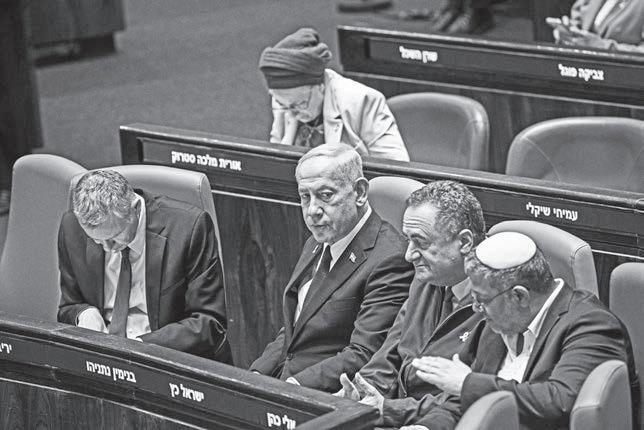
TEL AVIV, Israel—An Israeli ultra-Orthodox party that has been a key governing partner of Prime Minister Benjamin Netanyahu said early Tuesday it was leaving the coalition government, threatening to destabilize the Israeli leader’s rule at a pivotal time in the war in Gaza.
United Torah Judaism’s two factions said they were bolting the government over disagreements surrounding a bill that would codify broad military draft exemptions for their constituents, many of whom study Jewish texts instead of enlisting to the military. The issue has long divided
Jewish Israelis, most of whom are required to enlist, a rift that has only widened since the war in Gaza began and demands on military manpower grew.
“After the government repeatedly violated its commitments to ensure the status of Jewish seminary students,” the Degel HaTo -
rah faction said in a statement, its lawmakers announced “their resignation from the coalition and the government.”
The departure of a party that has long served as a kingmaker in Israeli politics doesn’t immediately threaten Netanyahu’s rule. But, once it comes into effect within 48 hours, it will leave the Israeli leader with a slim majority in a government that could now more heavily rely on the whims of two far-right parties. Those parties oppose concessions in ceasefire negotiations with Hamas and have themselves quit or threatened to quit the government over moves to end or even pause the war in Gaza.
The political shake-up comes as Israel and Hamas are discussing the terms of a truce for the 21-month war in Gaza. Despite heavy pressure by the US, Israel’s top ally, and mediators Egypt and Qatar, there is no breakthrough
yet in the talks. A recurring sticking point has been whether the war ends as part of any truce and Netanyahu’s far-right coalition allies oppose ending the war while Hamas remains intact.
United Torah Judaism’s departure has a window of 48
hours before becoming official, meaning Netanyahu can still find ways to satisfy the party and bring it back into the coalition. But Shuki Friedman, vice president of the Jewish People Policy Institute, said the gaps between the draft law currently
on the table and the demands of the party are still wide, making a compromise unlikely during that time.
Friedman said the party’s departure doesn’t immediately put Netanyahu’s rule at risk. A vote to dissolve parliament that would bring down the government and trigger new elections can’t be brought by the opposition until the end of the year because of procedural reasons. And a summer recess for Parliament, beginning later this month and stretching until October, gives Netanyahu another attempt to bridge the gaps and bring the party back into the coalition.
Cabinet Minister Miki Zohar, from Netanyahu’s Likud party, said he was hopeful the party could be coaxed back to the coalition. “God willing, everything will be fine,” he said.
A Likud spokesman did not immediately respond to a request for comment.
Israel strikes military tanks in Syria, where government forces clash with Druze militias
By Omar Sanadiki, Ghaith Alsayed & Abby Sewell
The Associated Press
BUSRA AL-HARIR, Syria—Israel’s army
said Monday it struck military tanks in southern Syria, where government forces and Bedouin tribes clashed with Druze militias in the latest escalation in the Middle East country struggling for stability after a 13-year civil war.
Dozens of people have been killed in the fighting between local militias and clans in Syria ‘s Sweida province. Government security forces that were sent to restore order Monday also clashed with local
armed groups.
Syria’s Interior Ministry has said more than 30 people have died and nearly 100 others have been injured. The Syrian Observatory for Human Rights, a U.K.-based war monitor, reported at least 99 dead, including two children, two women and 14 members of the security forces.
The clashes in Syria initially broke out between armed groups from the Druze and Sunni Bedouin clans, the observatory said, with some members of the government security forces “actively participating” in support of the Bedouins.
Syrian Interior Ministry spokesperson Noureddine al-Baba said government forces entered Sweida in the early morning to
restore order.
“Some clashes occurred with outlawed armed groups, but our forces are doing their best to prevent any civilian casualties,” he told the state-run Al-Ikhbariya TV.
Clashes fundamentally ‘not sectarian’ in nature
AL-BABA told The Associated Press that the “clashes are fundamentally not sectarian in nature.”
“The real conflict is between the state and bandits and criminals, not between the state and any Syrian community,” he said. “On the contrary, the state views the Druze community in Sweida as a partner in advancing the national unity project.”
Rami Abdurrahman, who heads the observatory, said the conflict started with the kidnapping and robbery of a Druze vegetable seller by members of a Bedouin tribe who set up a checkpoint, leading to tit-for-tat attacks and kidnappings.
The Interior Ministry described the situation as a dangerous escalation that “comes in the absence of the relevant official institutions, which has led to an exacerbation of the state of chaos, the deterioration of the security situation, and the inability of the local community to contain the situation.”
UN Deputy Special Envoy for Syria Najat Rochdi expressed “deep concern” over the violence and urged the government and
local groups to “take immediate steps to protect civilians, restore calm, and prevent incitement.”
She said in a statement the clashes underscored the “urgent need for genuine inclusion, trust-building, and meaningful dialogue to advance a credible and inclusive political transition in Syria.”
Israel sees Druze as a loyal minority
ISRAELI Defense Minister Israel Katz said in a statement that the Israeli military “attacked targets in Syria as a message and a clear warning to the Syrian regime—we will not allow harm to the Druze in Syria.”
In Israel, the Druze are seen as a loyal
minority and often serve in the armed forces.
While many Druze in Syria have said they do not want Israel to intervene on their behalf, factions from the Druze minority have also been suspicious of the new authorities in Damascus after former President Bashar Assad fled the country in December during a rebel offensive led by Sunni Islamist insurgent groups. On several occasions, Druze groups have clashed with security forces from the new government or allied factions.
In May, Israeli forces struck a site near the presidential palace in Damascus, in what was seen as a warning to Syrian
See “Israel,” A9
ISRAEL’S Prime Minister Benjamin Netanyahu, surrounded by ministers from the government, attends a session of the Knesset, Israel’s parliament, in Jerusalem, Monday, July 14, 2025. AP/OHAD ZWIGENBERG
Bangladesh struggles to contain the fallout of uprising that toppled its leader last year
By Julhas Alam
The Associated Press
DHAKA, Bangladesh—Bangladesh
was on the cusp of charting a new beginning last year after its former Prime Minister Sheikh Hasina was removed from power in a student-led uprising, ending her 15-year rule and forcing her to flee to India.
As the head of a new interim government, Nobel Peace Prize laureate Muhammad Yunus promised to hold a credible election to return to democracy, initiate electoral and constitutional reforms and restore peace on the streets after hundreds were killed in weeks of violence that began on July 15, 2024.
A year later, the Yunus-led administration has struggled to contain the fallout of the uprising. Bangladesh finds itself mired in a growing political uncertainty, religious polarization and a challenging law-andorder situation. Here’s what to know about Bangladesh a year after the protests that toppled Hasina.
Chaotic political landscape
UNCERTAINTY about the future of democracy looms large in Bangladesh.
The student protesters who toppled Hasina formed a new political party, promising to break the overwhelming influence of two major dynastic political parties—the Bangladesh Nationalists Party, or BNP, and Hasina’s Awami League.
But the party’s opponents have accused it of being close to the Yunus-led administration and creating chaos for political mileage by using state institutions.
Meanwhile, Bangladesh’s political landscape has further fragmented after
Israel. . .
Continued from A8
interim President Ahmad al-Sharaa. The strike came after dozens were killed in fighting between pro-government gunmen and Druze fighters in the town of Sahnaya and the Druze-majority Damascus suburb of Jaramana.
Over half of the roughly 1 million Druze worldwide live in Syria. Most other Druze live in Lebanon and Israel, including in the Golan Heights, which Israel captured from Syria in the 1967 Mideast War and annexed in 1981.
A group led by Sheikh Hikmat AlHijri, a Druze spiritual leader who has been opposed to the new government in Damascus, on Monday issued a statement calling for “international protection” and accused government forces and General Security agency of “supporting takfiri gangs”—using a term for extremist Sunni militants.
Syria’s Foreign Ministry called for “all countries and organizations to respect the authority of the Syrian Arab Republic and refrain from supporting any separatist rebel movements.” In a statement, it called for Syrians to “cease acts of violence, surrender illegal weapons and thwart those seeking to dismantle the Syrian social fabric and sow discord and division.”
‘Like unwrapping an onion’ THE Druze religious sect is a minority group
the country’s largest Islamist party, the Jamaat-e-Islami, returned to politics more than a decade after it was suppressed by Hasina’s government.
Aligned with the student-led party, it’s trying to fill the vacuum left by the Awami League, which was banned in May. Its leader, Hasina, is facing trial for crimes against humanity. The strength of Jamaate-Islami, which opposed Bangladesh’s independence from Pakistan in 1971, is unknown.
Both BNP and the Jamaat-e-Islami party are now at loggerheads over establishing supremacy within the administration and judiciary, and even university campuses.
They are also differing over the timing of a new parliamentary election. Yunus has announced that the polls would be held in April next year, but poor law and order situation and a lack of clear-cut political consensus over it have created confusion.
The chief of Bangladesh’s military also wanted an election in December this year—a stance Yunus didn’t like.
“Post-revolution honeymoons often don’t last long, and Bangladesh is no exception,” says Michael Kugelman, a Washington-based South Asia analyst and senior fellow of Asia Pacific Foundation.
“The interim government faced massive expectations to restore democracy and prosperity. But this is especially difficult to do as an unelected government without a public mandate.”
Yunus wants reforms before election YUNUS has delayed an election because he wants reforms—from changes to the
See “Bangladesh,” A10
that began as a 10th-century offshoot of Ismailism, a branch of Shiite Islam. In Syria, they largely live in the southern Sweida province and some suburbs of Damascus, mainly in Jaramana and Ashrafiyat Sahnaya to the south.
The Druze developed their own militias during the country’s nearly 14-year civil war, during which they sometimes faced attacks by the Islamic State group and other militant groups.
Israel has taken an aggressive stance toward Syria’s new leaders since Assad’s fall, saying it does not want Islamic militants near its borders. Israeli forces earlier seized a UN-patrolled buffer zone on Syrian territory along the border with the Golan Heights and have launched hundreds of airstrikes on military sites in Syria.
The Trump administration has been pushing for the new Syrian government to move toward normalization with Israel. Syrian officials have acknowledged holding indirect talks with Israel to attempt to defuse tensions, but have not responded to reports that the two sides have also held direct talks.
US envoy to Syria Tom Barrack told The Associated Press last week that he believes normalizing ties will happen “like unwrapping an onion, slowly.”
Sewell reported from Beirut. Associated Press writer Kareem Chehayeb in Beirut contributed to this report.
Syria defense minister announces ceasefire after sectarian violence
By Ghaith Alsayed The Associated Press
BUSRA AL-HARIR, Syria—Syria’s
defense minister announced a ceasefire shortly after government forces entered a key city in Sweida province on Tuesday.
The announcement came a day after sectarian clashes that killed dozens, and after a staterun news agency report that Israel had launched a strike in the area.
Defense Minister Murhaf Abu Qasra said in a statement that after an “agreement with the city’s notables and dignitaries, we will respond only to the sources of fire and deal with any targeting by outlaw groups.”
The clashes began with a series of tit-for-tat kidnappings and attacks between members of local Sunni Bedouin tribes and Druze armed factions in the southern province, a center of the Druze community.
Government security forces that were sent in on Monday to restore order also clashed with Druze armed groups. During the day, Israel struck Syrian government military tank and said it was acting to protect the Druze religious minority. In Israel, the Druze are seen as a loyal minority and often serve in
the armed forces.
State-run news agency SANA did not give any details about Tuesday’s strike. However, the Britain-based war monitor the Syrian Observatory for Human Rights said Israel struck a tank belonging to the Syrian military as forces began to move in deeper into Sweida city. There was no immediate statement from the Israeli military.
Earlier Tuesday, religious leaders of the Druze community in Syria called for armed factions that have been clashing with government forces to surrender their weapons and cooperate with authorities as they entered the provincial capital of Sweida. One of the main religious authorities later released a video statement retracting the call.
The initial statement called for armed factions in Sweida to “cooperate with the forces of the Ministry of Interior, not to resist their entry, and to hand over their weapons to the Ministry of Inte -
rior.” The statement also called for “opening a dialogue with the Syrian government to address the repercussions of the events.”
The commander of Internal Security in Sweida Governorate, Brig. Gen. Ahmad al-Dalati, welcomed the statement and called for “all religious authorities and social activists to adopt a unified national stance that supports the Ministry of Interior’s measures to extend state authority and achieve security throughout the province.”
Sheikh Hikmat Al-Hijri, a Druze spiritual leader who has been opposed to the government in Damascus, said in a video message that the previous statement by Druze leaders had been issued after an agreement with the authorities in Damascus but “they broke the promise and continued the indiscriminate shelling of unarmed civilians.”
“We are being subjected to a total war of annihilation,” he said. Some videos on social media had showed armed fighters with Druze captives, inciting sectarian slogans and beating them.
The Druze religious sect is a minority group that began as a 10thcentury offshoot of Ismailism, a branch of Shiite Islam. More than half the roughly 1 million Druze worldwide live in Syria. Most of the other Druze live in Lebanon and Israel, including in the Golan Heights, which Israel captured from Syria in the 1967 Mideast War and annexed in 1981.
Clashes have on several occasions broken out between forces loyal to the government and Druze fighters since the fall of President Bashar Assad in early December in a lightning rebel offensive led by Sunni Islamist insurgent groups.
The latest round of fighting has raised fears of another spiral of sectarian violence. In March, an ambush on government security forces by fighters loyal to Assad triggered days of sectarian and revenge attacks. Hundreds of civilians were killed, most of them members of the minority Alawite sect that Assad belongs to. A commission was formed to investigate the attacks but has not made its findings public. The conflict has also raised concerns about escalating Israeli intervention.
Israeli Defense Minister Israel Katz said Monday that the Israeli military “attacked targets in Syria as a message and a clear warning to the Syrian regime— we will not allow harm to the Druze in Syria.”
While many Druze in Syria have said they do not want Israel to intervene on their behalf, factions from the Druze minority have also been suspicious of the new authorities in Damascus, particularly after the attacks on Alawites and other minority groups.
The Associated Press writers Abby Sewell and Kareem Chehayeb in Beirut contributed to this report.
A10
July 16, 2025
US inflation may have worsened last month as Trump’s tariffs start to bite
By Christopher Rugaber AP Economics Writer
WASHINGTON—Inflation
likely accelerated in June as sweeping tariffs on nearly all imports may have pushed up prices for electronics, appliances, and other goods, economists forecast.
Consumer prices probably rose
2.6% last month from a year ago, up from an annual increase of 2.4% in May, according to data provider FactSet. The Labor Department will issue its inflation report at 8:30 a.m. eastern. On a monthly basis, prices likely rose 0.3% from May to June, the largest increase since January, economists project.
So far, the tariffs haven’t noticeably pushed up inflation, which has been mild for the past four months. Core inflation has fallen from 3.3% in January to 2.8% in May, though that is still above the Fed’s 2% target. If inflation in June is much weaker than economists forecast, Trump will likely renew his demands that Federal Reserve Chair Jerome Powell immediately reduce borrowing costs.
are now slated to cost $2.5 billion, roughly one-third more than originally budgeted. While Trump legally can’t fire Powell just because he disagrees with his interest rate decisions, the Supreme Court has signaled, he may be able to do so “for cause,” such as misconduct or mismanagement.
Immigration agents demand tenant information from landlords, stirring questions
By R.J. Rico
The Associated Press
ATLANTA—Immigration authorities are demanding that landlords turn over leases, rental applications, forwarding addresses, identification cards and other information on their tenants, a sign that the Trump administration is targeting them to assist in its drive for mass deportations.
and confusion
subpoenas against landlords without confirming if they are being issued.
“We are not going to comment on law enforcement’s tactics surrounding ongoing investigations,” McLaughlin said. “However, it is false to say that subpoenas from ICE can simply be ignored. ICE is authorized to obtain records or testimony through specific administrative subpoena authorities. Failure to comply with an ICEissued administrative subpoena may result in serious legal penalties. The media needs to stop spreading these lies.”
Excluding the volatile food and energy categories, inflation is forecast to have risen 3% in June from a year earlier, up from a 2.8% rise in May. On a monthly basis, it is also expected to have picked up 0.3% from May to June, according to FactSet. Economists closely watch core prices because they typically provide a better sense of where inflation is headed.
Trump has imposed sweeping duties of 10% on all imports, plus 50% levies on steel and aluminum, 30% on goods from China, and 25% on imported cars. Just last week the president threatened to hit the European Union with a new 30% tariff starting August 1.
Worsening inflation could pose a political challenge for President Donald Trump, who promised during last year’s presidential campaign to immediately lower costs. The sharp inflation spike of 2022-2023 was the worst in four decades and soured most Americans on former president Joe Biden’s handling of the economy. Faster price increases would also likely underscore the Federal Reserve’s reluctance to cut its short-term interest rate, as Trump is loudly demanding.
Bangladesh. . .
Continued from A9 constitution and elections to the judiciary and police. Discussions with political parties, except Hasina’s Awami League, are ongoing. Some of the reforms include putting a limit on how many times a person can become the prime minister, introduction of a two-tier parliament, and appointment of a chief justice.
There appears to be little consensus over some basic reforms. While both the BNP and the Jamaat-e-Islami parties have agreed to some of them with conditions, other proposals for basic constitutional reforms have become a sticking point.
The Jamaat-e-Islami also wants to give the
interim government more time to complete reforms before heading into polls, while BNP has been calling for an early election. The student-led party mostly follows the pattern of the Jamaat-e-Islami party.
Kugelman says the issue of reforms was meant to unite the country, but has instead become a flashpoint.
“There’s a divide between those that want to see through reforms and give them more time, and those that feel it’s time to wrap things up and focus on elections,” he says.
Human rights and the rise of Islamists
HUMAN rights in Bangladesh have remained a serious concern under Yunus.
Minority groups, especially Hindus, have
Powell and other Fed officials have emphasized that they want to see how the economy evolves as the tariffs take effect before cutting their key short-term rate. The Fed chair has said that the duties could both push up prices and slow the economy, a tricky combination for the central bank since higher costs would typically lead the Fed to hike rates while a weaker economy often spurs it to reduce them.
Trump on Monday said that Powell has been “terrible” and “doesn’t know what the hell he’s doing.” The president added that the economy was doing well despite Powell’s refusal to reduce rates, but it would be “nice” if there were rate cuts “because people would be able to buy housing a lot easier.”
Last week, White House officials also attacked Powell for cost overruns on the years-long renovation of two Fed buildings, which
blamed his administration for failing to protect them adequately. The Bangladesh Hindu Buddhist Christian Unity Council says minority Hindus and others have been targeted in hundreds of attacks over the last year. Hasina’s party has also blamed the interim government for arresting tens of thousands of its supporters.
The Yunus-led administration denies these allegations.
Meenakshi Ganguly, deputy Asia director for Human Rights Watch, says while the interim government has stopped enforced disappearances and extrajudicial executions that had occurred under the Hasina government, “there has been little progress on lasting security sector reforms or to deliver on the pledge to create robust, independent institutions.”
Meanwhile, Islamist factions—some of whom have proposed changes to women’s rights and demanded introduction of Sharia law—are vying for power. Many of them are planning to build alliances with bigger parties like the BNP or the Jamaat-e-Islami. Such factions have historically struggled
While inflation was mild in May, there were already signs in last month’s report that tariffs were starting to have some impact. The cost of furniture, appliances, toys, and tools rose, though those increases were offset by falling prices for airfares, hotels, and muted rises in rental costs.
Some companies have said they have or plan to raise prices as a result of the tariffs, including Walmart, the world’s largest retailer. Automaker Mitsubishi said last month that it was lifting prices by an average of 2.1% in response to the duties, and Nike has said it would implement “surgical” price hikes to offset tariff costs.
But many companies have been able to postpone or avoid price increases, after building up their stockpiles of goods this spring to get ahead of the duties. Other companies may have refrained from lifting prices while they wait to see whether the US is able to reach trade deals with other countries that lower the duties.
to gain significant electoral support despite Bangladesh being a Muslim majority, and their rise is expected to further fragment the country’s political landscape.
Diplomatic pivot and balancing with global powers
DURING Hasina’s 15-year rule, Bangladesh was India’s closest partner in South Asia. After her ouster, the Yunus-led administration has moved closer to China, which is India’s main rival in the region.
Yunus’ first state visit was to China in March, a trip that saw him secure investments, loans and grants. On the other hand, India is angered by the ousting of its old ally Hasina and hasn’t responded to Dhaka’s requests to extradite her. India stopped issuing visas to Bangladeshis following Hasina’s fall.
Globally, Yunus seems to have strong backing from the West and the United Nations, and it appears Bangladesh will continue its foreign policy, which has long tried to find a balance between multiple foreign powers.
Eric Teusink, an Atlanta-area real estate attorney, said several clients recently received subpoenas asking for entire files on tenants. A rental application can include work history, marital status and family relationships.
The two-page “information enforcement subpoena,” which Teusink shared exclusively with The Associated Press, also asks for information on other people who lived with the tenant. One, dated May 1, is signed by an officer for U.S. Citizenship and Immigration Services ‘ anti-fraud unit. However, it is not signed by a judge.
It is unclear how widely the subpoenas were issued, but they could signal a new front in the administration’s efforts to locate people who are in the country illegally, many of whom were required to give authorities their US addresses as a condition for initially entering the country without a visa. President Donald Trump largely ended temporary status for people who were allowed in the country under his predecessor, Joe Biden.
Experts question whether landlords need to comply SOME legal experts and property managers say the demands pose serious legal questions because they are not signed by a judge and that, if landlords comply, they might risk violating the Fair Housing Act, which prohibits discrimination on the basis of race, color or national origin.
Critics also say landlords are likely to feel intimidated into complying with something that a judge hasn’t ordered, all while the person whose information is being requested may never know that their private records are in the hands of immigration authorities.
“The danger here is overcompliance,” said Stacy Seicshnaydre, a Tulane University law professor who studies housing law. “Just because a landlord gets a subpoena, doesn’t mean it’s a legitimate request.”
ICE officers have long used subpoenas signed by an agency supervisor to try to enter homes. Advocacy groups have mounted “Know Your Rights” campaign urging people to refuse entry if they are not signed by a judge.
The subpoena reviewed by the AP is from USCIS’ fraud detection and national security directorate, which, like ICE, is part of The Department of Homeland Security. Although it isn’t signed by a judge, it threatens that a judge may hold a landlord in contempt of court for failure to comply.
Tricia McLaughlin, a Homeland Security spokeswoman, defended the use of
These requests are new to many landlords
TEUSINK said many of his clients oversee multifamily properties and are used to getting subpoenas for other reasons, such as requests to hand over surveillance footage or give local police access to a property as part of an investigation. But, he said, those requests are signed by a judge.
Teusink said his clients were confused by the latest subpoenas. After consulting with immigration attorneys, he concluded that compliance is optional. Unless signed by a judge, the letters are essentially just an officer making a request.
“It seemed like they were on a fishing expedition,” Teusink said.
Boston real estate attorney Jordana Roubicek Greenman said a landlord client of his received a vague voicemail from an ICE official last month requesting information about a tenant. Other local attorneys told her that their clients had received similar messages. She told her client not to call back.
Anthony Luna, the CEO of Coastline Equity, a commercial and multifamily property management company that oversees about 1,000 units in the Los Angeles area, said property managers started contacting him a few weeks ago about concerns from tenants who heard rumors about the ICE subpoenas. Most do not plan to comply if they receive them.
“If they’re going after criminals, why aren’t they going through court documents?” Luna said. “Why do they need housing provider files?” ICE subpoenas preceded Trump’s first term in office, though they saw a significant uptick under him, according to Lindsay Nash, a law professor at Yeshiva University’s Cardozo School of Law in New York who has spent years tracking them. Landlords rarely got them, though. State and local police were the most common recipients.
ICE can enforce the subpoenas, but it would first have to file a lawsuit in federal court and get a judge to sign off on its enforcement—a step that would allow the subpoena’s recipient to push back, Nash said. She said recipients often comply without telling the person whose records are being divulged.
“Many people see these subpoenas, think that they look official, think that some of the language in them sounds threatening, and therefore respond, even when, from what I can tell, it looks like some of these subpoenas have been overbroad,” she said.
From ‘Signalgate’ to UN: Mike Waltz faces Senate confirmation hearing
By Farnoush Amiri The Associated Press
UNITED NATIONS—Mike Waltz, President Donald Trump’s nominee for US ambassador to the United Nations, will face questioning from lawmakers Tuesday for the first time since he was ousted as national security adviser in the weeks after he mistakenly added a journalist to a private Signal chat used to discuss sensitive military plans.
The former Republican congressman is set to appear before the Senate Foreign Relations Committee for his confirmation hearing, with Trump looking to fill his remaining Cabinet position after months of delay, including the withdrawal of the previous nominee.
The hearing will provide senators with the first opportunity to grill Waltz over revelations in March that he added The Atlantic editor-inchief Jeffrey Goldberg to a private text chain on an unclassified messaging app that was used to discuss planning for strikes on Houthi militants in Yemen.
Waltz took responsibility even as criticism mounted against Defense Secretary Pete Hegseth, who shared the sensitive plans in the chat that included several other high-level national security officials. Hegseth shared the same information in another Signal chat that included family, but Trump has made clear Hegseth has his support.
Waltz was removed as national security adviser in May—replaced by Secretary of State Marco Rubio—and nominated for the UN role.
Trump praised Waltz in the announcement, saying, “From his time in uniform on the battlefield, in Congress and, as my National Security Advisor, Mike Waltz has worked hard to put our Nation’s Interests first.”
The United Nations is facing major changes IF confirmed, Waltz would be coming to the UN at a moment of great change. The world body is reeling from Trump’s decision to slash foreign assistance—affecting its humanitarian aid agencies—and it anticipates US funding cuts to the UN annual budget.
Under an “America First” foreign policy realignment, the White House has asserted that “some of the UN’s agencies and bodies have drifted” from their founding mission and “act contrary to the interests of the United States while attacking our allies and propagating anti-Semitism.”
With America being the largest United Nations donor, cutting US funding to the UN budget would greatly impair operations.
PHL. . .
Continued from A5
businesses operate in the Philippines. He noted that currently, it takes 106 days for a foreign firm to set up shop in the country, significantly higher than the 15 days it takes these investors to start a business in Singapore.
“Domestic reforms (such as) reducing investment costs, reducing trade costs in the Philippines can (help) compensate for barriers that you (investors) may face in international markets. There is ample space for domestic reforms that reduce investment costs,” Varela said.
Apart from this, Varela said, efforts to remove investment restrictions will help usher in new types of investments in the country, such as those operating domestic shipping lines.
Varela said reforms similar to the amendment of the Public Service Act such as the Konektadong Pinoy Act will also be transformative for the Philippine economy.
“These are transformational reforms that open up markets, reduce costs of doing business for firms, and...are yet to be fully implemented. Doubling down on reforms and doubling down particularly on implementation of reforms is something that is going to help position the Philippines in global markets if the global markets get more protections,” Varela said.
To address these challenges,
Facing financial instability, the UN has spent months shedding jobs and consolidating projects while beginning to tackle long-delayed reforms. The UN is also facing growing frustration over what critics describe as a lack of efficiency and power in delivering on its mandate to end conflict and prevent wars.
John Bolton, a former US ambassador to the UN who was also national security adviser during Trump’s first term, was critical of the current state of the UN
“It’s probably in the worst shape it’s been in since it was founded,” Bolton, now an outspoken Trump critic, recently told The Associated Press.
Waltz has been meeting with senators WALTZ spent the last several weeks meeting with Democrats and Republicans on the Foreign Affairs committee.
Democratic Sen. Tammy Duckworth said Monday that she and Waltz discussed a wide range of issues, including whether the Trump administration would use the UN to strengthen alliances and combat Chinese influence.
“I asked him questions about ‘Signalgate,’ but I also talked to him about how we are going to sway other nations within the United Nations to our side, in light of how much influence the PRC is having on other nations,” the Illinois senator said, using an acronym for the People’s Republic of China.
Even with Democratic opposition, Waltz only needs a majority in the 53-47 Senate, which Republicans control.
“He’ll be fine. Mike won’t have any issues,” said Sen. Markwayne Mullin, R-Okla.
“I mean, the Democrats are gonna do their thing. Whatever. Mike’s used to taking incoming fire.”
It is unclear how Waltz would approach the job. Trump’s first nominee, Rep. Elise Stefanik, had built a track record in Congress of criticizing the UN She vowed during her confirmation hearing in January to combat what she called antisemitism at the world body and lead a review of US funding.
She was expected to be confirmed, but Trump abruptly withdrew her nomination in March, citing risks to the GOP’s historically slim House majority.
At the time, the loss of a mere handful of seats could have swung the House majority to Democrats and derailed their recently successful efforts to enact Trump’s sweeping agenda.
The Associated Press writers Seung Min Kim and Matt Brown in Washington contributed to this report.
the World Bank said reforms under physical and digital infrastructure and human capital include sustaining public investment, particularly on connectivity infrastructure.
This also includes supporting private climate adaptation by removing bottlenecks and prioritizing resilience and boosting human capital by fast-tracking implementation of the Enterprise Based Education and Training (EBET) Act, and scaling up STEM and digital skills to better address the AI challenge.
Under better regulations and governance, the World Bank said reforms include ensuring that regulations catch up with infrastructure progress to maximize investment impact, as well as removing de facto barriers to market entry to make openness reforms work.
The government should also facilitate land consolidation to enable productivity-enhancing reallocation in agriculture; adopt a proportional contribution system for part-time work to boost female labor force participation (FLFP) and correct talent misallocation; and negotiate and implement deep trade agreements that drive domestic reform and global integration.
The World Bank also said the government must implement competition-enhancing reforms in energy, logistics, and telecoms to cut costs for tradable sectors, as well as strengthen local service delivery by building LGU capacity and aligning incentives.
14 million children did not receive a single vaccine in 2024, UN says
LONDON—More than 14 million children did not receive a single vaccine last year—about the same number as the year before—according to UN health officials. Nine countries accounted for more than half of those unprotected children.
In their annual estimate of global vaccine coverage, released Tuesday, the World Health Organization and UNICEF said about 89% of children under 1 year old got a first dose of the diphtheria, tetanus and whooping cough vaccine in 2024, the same as in 2023. About 85% completed the threedose series, up from 84% in 2023.
Officials acknowledged, however, that the collapse of international aid this year will make it more difficult to reduce the number of unprotected children. In January, U.S. President Trump withdrew the country from the WHO, froze nearly all humanitarian aid and later moved to close the US AID Agency. And last month, Health Secretary Robert F. Kennedy Jr. said it was pulling the billions of dollars the US had previously pledged to the vaccines alliance Gavi, saying the group had “ignored the science.”
Kennedy, a longtime vaccine skeptic, has previously raised questions the diphtheria, tetanus and whooping cough vaccine— which has proven to be safe and effective after years of study and real-world use. Vaccines prevent 3.5 million to 5 million deaths a year, according to U.N. estimates.
“Drastic cuts in aid, coupled with misinformation about the safety of vaccines, threaten to unwind decades of progress,” said WHO Director-General Tedros Ad -
Under private capital mobilization, the report said the Philippines should introduce supplier development programs to link SMEs with MNCs and large firms, and close the productivity spillover gap, as well as focus on innovation support where conditions are ripe, consolidate programs for scale, and create room for deeper venture capital (VC) markets.
The report emphasizes that technology adoption among firms is critical for productivity, innovation, growth, and quality job creation.
“Technology adoption is no longer optional”, said Jaime Frias, Senior Economist. “It is essential for firms to grow, compete, and create better jobs. The Philippines must invest in digital skills and foster an innovation ecosystem that empowers businesses to harness the full potential of emerging technologies.”
The report titled “Running Uphill: Growth, Jobs, and the Quest for Productivity, the Philippines Country Growth and Jobs Report,” released by the World Bank argues that the Philippines needs a new playbook.
This playbook should focus on creating more and better-paying jobs—an increasingly urgent concern—as the country confronts a new global context characterized by global uncertainty; rapidly evolving technologies with significant implications for jobs, such as artificial intelligence; and recurrent climate shocks. Cai U. Ordinario
hanom Ghebreyesus.
UN experts said that access to vaccines remained “deeply unequal” and that conflict and humanitarian crises quickly unraveled progress; Sudan had the lowest reported coverage against diphtheria, tetanus and whooping cough. The data showed that nine countries accounted for 52% of all children who missed out on immunizations entirely: Nigeria, India, Sudan, Congo, Ethiopia, Indonesia, Yemen, Afghanistan and Angola.
WHO and UNICEF said coverage against measles rose slightly, with 76% of children worldwide receiving both vaccine doses. But experts say measles vaccine rates
need to reach 95% to prevent outbreaks of the extremely contagious disease. WHO noted that 60 countries reported big measles outbreaks last year.
The US is now having its worst measles outbreak in more than three decades, while the disease has also surged across Europe, with 125,000 cases in 2024—twice as many as the previous year, according to WHO.
Last week, British authorities reported a child died of measles in a Liverpool hospital. Health
officials said that despite years of efforts to raise awareness, only about 84% of children in the UK are protected.
“It is hugely concerning, but not at all surprising, that we are continuing to see outbreaks of measles,” said Helen Bradford, a professor of children’s health at University College London. “The only way to stop measles spreading is with vaccination,” she said in a statement. “It is never too late to be vaccinated—even as an adult.”
A HEALTHCARE worker prepares a shot of the Pfizer Covid-19 vaccine in La Paz, Bolivia, January 7, 2025. AP/JUAN KARITA
Struggling to compete: PHL’s agricultural trade deficit and the impact of higher US tariffs
THE country’s agricultural import bill has been consistently larger than its earnings from farm exports. Last year, data from the Philippine Statistics Authority (PSA) showed that the Philippines’ total balance of trade in agricultural goods recorded a wider deficit at $11.71 billion. The figure is 1.9 percent larger than the $11.48 billion recorded in 2023.
Among all of the Philippines’ top trading partners, it recorded a surplus only with Japan, according to PSA data. The country’s trade surplus with Japan reached $953.69 million last year, wider than the $808.76 million recorded in 2023. In contrast, the Philippines recorded agricultural trade deficits with the United States in 2023 and 2024, at $2.36 billion and $1.95 billion, respectively.
This means that the country’s food purchases from its major trading partners, except Japan, exceeded the sales of Philippine food products, a situation that is beneficial to foreign producers. The agricultural trade deficit recorded last year was more than double the budget allocated by the national government to the farm sector. And despite recent efforts to expand shipments of food products to other countries, initiatives to further open up markets for Philippine farm goods have been slow to yield the results desired by local traders.
The 20 percent tariff on all local goods entering the United States, considered a shocker by analysts, could further impede efforts of the government to transform the Philippines into an export powerhouse by 2028. Agricultural products, like coconut oil, would become more expensive for American consumers with the additional tariffs. (See, “Tariffs could hit PHL coco exports to US, a top buyer,” in the BusinessMirror , July 14, 2025). The Philippines is largely dependent on the US for coco oil revenues.
While the tariff rate slapped on the Philippines is lower than Indonesia’s 32 percent and other Asian countries like India, which will have to pay a 26-percent tariff, the additional duty would hike the production cost of local exporters, who continue to contend with high power prices and red tape. The uncertainty created by Washington’s tariff policy, which could be taken as a volte-face on free trade, would disrupt the global value chain. Major exporters of certain products would surely not wait for their competitors to overtake them before making the necessary adjustments.
We hope that negotiations to reduce the tariff would yield positive results. As it is, the Philippines is already having difficulties increasing its agricultural exports, under the current global trade regime. Additional costs like higher tariffs would make it onerous for traders to sell their products to other countries like the US.
Apart from talks on lowering tariff rates, the government should institute the necessary steps to reduce the cost of doing business in the Philippines. For years, businesses have been calling on policymakers to address the high cost of electricity in the Philippines as well as the difficult process of securing the necessary licenses and permits. Eliminating inefficiencies should be the government’s paramount concern if it intends to improve the global competitiveness of local food products.
Education infra
SAntonio L. Cabangon Chua
T. Anthony C. Cabangon
Lourdes M. Fernandez Jennifer A. Ng Vittorio
Mark Villar
THE BUILDER
TUDENTS , along with workers, are our major assets. They are our future leaders and workers who will drive the economy soon.
T hey are our future engineers, soldiers, scientists, lawmakers, doctors who will tend to the sick, and professionals who will keep our factories humming with their purchasing power.
Classes for school year 2025-2026 officially opened last month, with 27.6 million students trooping to learning centers nationwide. That’s roughly 24 percent of our current population of nearly 117 million.
The government and the private sectors, thus, must give their allout support to the education of our youth. The government is trying its best to keep our educational standards high and competitive with our Asian neighbors.
A big and highly-educated population is a sure formula for economic success. But before we count this blessing, we must make sure that our students are well-provided for in their educational journey.
I am referring to the most basic needs of our students—classrooms. Education Secretary Sonny Angara hast just cited a nationwide shortage of 165,000 classrooms as a major challenge. He warned that
FG. Reyes
D. Edgard A. Cabangon Benjamin V. Ramos
Aldwin Maralit Tolosa
Rolando M. Manangan BusinessMirror is published daily by the Philippine Business Daily Mirror Publishing, Inc., with offices on the 3rd floor of Dominga Building III 2113 Chino Roces Avenue corner De La Rosa Street, Makati City, Philippines. Tel. Nos. (Editorial) 817-9467; 813-0725. Fax line: 813-7025. (Advertising Sales) 893-2019; 817-1351, 817-2807. (Circulation) 893-1662; 814-0134 to 36. E-mail: news.businessmirror@gmail.com www.businessmirror.com.ph
at the current pace of construction, it could take over 50 years for the Philippines to eliminate the backlog.
The deficit in classrooms is, indeed, daunting. The Department of Education (DepEd) completed just 192 of its 6,379-classroom target last year, per the report of the Commission on Audit (COA).
Building classrooms is not different from establishing infrastructure facilities. The construction of classrooms, like roads, bridges, airports and seaports, generate jobs. Workers and professionals in the construction sector, for one, will come from students and graduates who will turn into architects and engineers.
The construction of additional classrooms to meet the rising population of students in itself will spur the need for more infrastructure facilities, especially roads and bridges, in far-flung and remote areas of our archipelago.
Mr. Angara said the DepEd has already drawn up a proposal for the construction of 105,000 classrooms in three years under a Public-Private Partnership (PPP). The DepEd aims
By David Pan & Sidhartha Shukla
OR months, Bitcoin sat still. The ‘number only goes up’ prophecy did not deliver. The faithful waited.
Now though the liturgy returns, after the world’s largest cryptocurrency surged past $123,000 for the first time on Monday.
Thank the convergence of government-friendly policy momentum and big-money positioning. House Republicans declared “Crypto Week” in Washington as stablecoin legislation inches closer to passage. In the latest easing of the regulatory stance, US officials on Monday issued fresh guidelines for how banks can offer custody services tied to the digital asset class.
The losers: Non-believers who were caught in a short squeeze that wiped out billions of dollars of bets against the digital currency—helping to turbocharge the roughly 15 percent rally over the past week.
It’s a reversal of sorts. Bitcoin has been bound to a narrow range for months as investors grappled with
trade tensions and one-time whales sold out. But the Bitcoin evangelists held on, while crypto exchange-traded funds boomed anew and Treasury companies, led by Michael Saylor’s Strategy, which have pledged to buy billions of dollars in the original virtual currency.
“I don’t think it was anticipated that there would be this level of upward movement so quickly,” said Eric Jackson, president and founder of EMJ Capital. “A lot of the smart investors that I talk to think we can see a quick shot to $150,000 and even $250,000 by the end of this year.”
ETFs and institutions are still gobbling up supply, while a cohort of long-term holders and miners simply aren’t selling.
to reach this objective to educate a greater number of young Filipino students.
President Ferdinand Marcos Jr. is already aware of the DepEd proposal after Mr. Angara presented the plan to President Marcos and after the agency signed a P58.8million technical assistance partnership with the PPP Center to build 15,000 classrooms under the PPP School Infrastructure Project (PSIP 3).
The partnership with the private sector seeks to finish the initial classroom construction by 2027. The DepEd plans to scale up construction to 30,000 and 60,000 classrooms through the PSIP 4 and 5, respectively.
The PSIP 3, meanwhile, is expected to benefit over 600,000 students nationwide and generate at least 18,000 jobs.
I fully support the partnership with the private sector through the PPP. I am also pleased to learn that efforts are being exerted to equip public schools with power and digital tools to improve the learning journey of our youths.
The DepEd, for instance, is spearheading the rollout by mid-2026 of a plan for digitalization and solarization of schools that include providing electricity supply to un-energized schools.
Electricity is a basic service that students need in their quest for more knowledge.
The government is also tapping Low Earth Orbit (LEO) satellite Internet connectivity for unconnected schools, and tablets for learners and laptops for teachers.
“We’ve seen record low exchange outflows and tight order books. There’s just no sellers to absorb demand,” said Adam Guren, founder and CIO at Hunting Hill Global Capital. “BTC breaking above $120K is less ‘sprint’ and more ‘squeeze.’”
A swarm of liquidations in bearish bets against crypto assets has accelerated the rally—some $574 million over the past 24 hours—as short sellers buy the tokens to close out positions. More than $1 billion in short positions was wiped out when Bitcoin first topped its previous all-time high on July 9, one of the largest liquidations in a single day this year, according to data compiled by Coinglass. The US-listed Bitcoin ETFs attracted more than $2.7 billion in inflows last week, the fifth-largest weekly tally since their launch in January 2024. BlackRock’s iShares Bitcoin Trust (IBIT) now has a market capitalization of more than $85 billion. Bloomberg Intelligence projects assets in the BlackRock ETF could
Connectivity is critical in greatly boosting the effectiveness of teachers, while offering Filipino children a wealth of learning resources previously out of their reach. Students, teachers and the rest of the educational system deserve every support from the government. For our train commuting students, last week’s generosity from the government is most welcome.
The Metro Rail Translit-3 and Light Rail Transit-2 rail lines decided to open dedicated student lanes at each station to provide smoother processing for students eligible for a fare discount.
The initiative comes on the heels of President Marcos’ directive to the MRT-3, LRT-1, and LRT-2 lines to eliminate long queues and enhance passenger convenience.
The Department of Transportation (DOTr), on the orders of the Chief Executive, also instructed the three major rail lines on June 20, 2025 to increase student discounts from 20 percent to 50 percent, effective until 2028.
The government assistance to the students may be miniscule to others. But for the students on a tight budget, the convenience in riding the train and further fare discounts are significant.
Our Filipino students need state support in the form of additional classrooms, digital connectivity and fare discounts. They are one of the backbones of our economy and our future.
For feedback e-mail to senatormarkvillar@ gmail.com or visit our web site: https://markvillar. com.ph
climb to $100 billion soon. Meanwhile, open interest in Bitcoin futures reached a record $86.3 billion, according to data compiled by Coinglass. The total market value of all tokens is now brushing up against the $4 trillion threshold, according to data compiled by CoinGecko. While investors pile into ETFs, a new wave of treasury companies are fresh participants in the current bull market run.
Firms from SoftBank Group Corp.-backed Twenty One Capital and Justin Sun’s Tron Inc.
Fringe party vows to put ‘Japan first’ to erode LDP power
By Maho Nambu, Reina Sasaki & Erica Yokoyama
JAPAN’S
Liberal Democratic Party has dominated the country for the last 70 years, losing control of the government only twice.
A five-year-old party cobbled together on social media during the pandemic is trying to weaken that grip on power by tapping into voter frustrations and anti-foreigner sentiment.
The party, Sanseito, is gaining traction in the polls and is focused on peeling away current LDP voters in the upper house election on July 20. Led by Sohei Kamiya, a former high school teacher, it advocates for restrictions on immigration as well as laws against foreigners buying Japanese companies or land. Sanseito promises to cut taxes, protect rice farmers, boost the country’s birth rate and curb the use of pesticides. With the election slogan of “Japanese First” and promises to make people rich, the party’s stance echoes that of Donald Trump. Sanseito is capitalizing on voter dissatisfaction driven by the surging cost of food and rent. It is also explicitly appealing to conservative voters who have been alienated by Prime Minister Shigeru Ishiba cooperating with centrist parties after the LDP lost its majority in the lower house.
“The support base consists of people who feel they have been sidelined since the Covid-19 pandemic and inflation,” said Toru Yoshida, a professor of political science at Doshisha University. “This includes the bedrock conservative voters who became disillusioned as the society shifted toward liberalism, those who became distrustful of established political parties and stopped voting, and vulnerable young male demographics.”
The LDP and its coalition partner Komeito have a majority of 141 of the chamber’s 248 seats. Only 66 of those seats will be contested, meaning the coalition can afford to lose as many as 16 seats and still retain control. A compilation of recent polls gives Sanseito a chance of winning between 8 and 17 seats.
Compared to polls from earlier in the campaign period, the ruling coalition has lost steam and could miss its target of winning 50 seats in the election, according to multiple polls conducted by local media. Polls by the Asahi newspaper said the LDP looked likely to win some 34 seats, while Komeito looked likely to secure about 9. Kyodo also said that the LDP could struggle to win 40 seats.
The largest opposition force, the Constitutional Democratic Party, is seen winning between 22 and 32 seats. The Democratic Party for the People could pick up between 11 and 19 seats, the Japan Innovation Party could take between 5 and 7 seats, while the Japanese Communist Party is forecast to get between 3 and 6 seats, according to a compilation of polls.
The LDP and Komeito will almost certainly remain as the largest bloc in the upper house under all polling scenarios. The less powerful upper house doesn’t have the ability to choose the prime minister, so even if the ruling coalition loses its majority, the most likely scenario is that the ruling coalition will continue to run the country, provided a lower house election isn’t called.
Still, the coalition would be further weakened and in need of support from one or more of the opposition parties to make progress on policy. Sanseito is unlikely to be its first choice. So for now at least, even if Sanseito does better than expected, its success would likely pose more of a threat to Ishiba’s role as prime minister than the LDP as a whole. Its agenda could nevertheless sway the government’s agenda— Ishiba’s administration has established a center of operations for promoting orderly co-existence with foreign nationals.
“There are numerous issues we should address from more appropriate handling of immigration, preventing cases where social insurance premiums are unpaid by foreigners and ensuring appropriate land management including when foreigners purchase land,” Ishiba told reporters
in Tokyo after the initial launch of the center of operations.
Kamiya, who founded the party out of an online DIY political movement, has pointed to similarities on themes such as immigration between Sanseito and the Republicans in the US, Germany’s AfD and France’s National Rally.
Campaigning in the town of Kawaguchi on the outskirts of Tokyo, Sanseito deputy party leader Yuichiro Kawa backed local candidate Tsutomu Otsu who promised to “do something about the foreigner problem.” About 7.3 percent of the town’s population are non-Japanese, including a sizable Kurdish community. The message resonated with supporters.
“I’ve consulted about noise issues caused by the foreign community with various political parties and even the police, but nobody has changed the situation,” said Akihiro Nakada, 37, a longtime resident in the town. “But I believe Sanseito may be able to actually take real action,” he said after Otsu’s speech.
The party says it is not promoting discrimination against foreigners but rather is opposing “excessive acceptance of foreigners.”
Kamiya, the 47-year-old founder of the party, began his political career as a local LDP council member in Osaka. After getting elected to Japan’s upper house on the Sanseito ticket, he gained attention in 2022 by challenging the safety of Covid vaccines and opposing mask mandates.
The party’s YouTube channel has roughly 400,000 subscribers, compared with with around 140,000 for the LDP’s channel and 45,000 for the Constitutional Democratic Party. In some recent polls, the party ranked among the top choices for voters who rely heavily on social media.
The party also promises to cut taxes and give parents 100,000 yen ($680) a month per child until they turn 15. Japan’s population has declined for the last 14 years, falling by 550,000 in 2024 with the percentage of children hitting a record low. The decline was partially offset by an increase in the number of foreignborn residents.
The lower taxes and increased social spending promised by Sanseito would likely increase upward pressure on the country’s debt burden, already the highest among developed economies, with total debt projected to reach 235 percent of GDP this year. Yields on Japanese government bonds have been rising amid concern about the country’s ability to finance its debt.
At rallies, supporters dress in the party’s signature orange to pay homage to the country’s sun goddess who is also the progenitor of the Imperial family in Japanese mythology.
While the party’s rhetoric has resonated with some voters feeling left behind by Japan’s more established parties, it’s also brought a backlash. Sanseito says some of its candidates have received death threats. Protesters at a Sanseito rally in Tokyo held signs reading: “There is no such thing as first- and secondclass humans.”
The party is also trying to win over rural voters, traditionally one of the most loyal voting blocs for the LDP. It wants to make Japan completely self-sufficient in food by 2050. Currently, the country imports about 50 percent of its food. At the same time, it wants to promote organic farming and limit the use of chemical fertilizers.
“They present a bizarre mix of policies,” said Doshisha University’s Yoshida. “There’s no clear connection among these policies, and it’s hard to place them ideologically, but each one resonates with some part of their support base.” With assistance from Akemi Terukina and Haruka Iwai/Bloomberg
Trump’s new wave of tariffs: A risky gamble for US and the world
By Jianxi Liu
US President Donald Trump’s recent announcement of a sweeping new wave of tariffs, set to take effect on August 1, 2025, marks a dramatic escalation in Washington’s ongoing trade battles. With tariff imposed on countries including major trading partners such as Japan, South Korea, and Brazil, this move has reignited fierce debate about the wisdom and consequences of protectionist economic policies in today’s interconnected global economy.
Trump’s tariffs are more than just a negotiating tactic; they represent a fundamental shift in America’s approach to international commerce. The implications of this shift will be felt not only across the US economy but also among its allies and the global trading system at large.
The US administration defends these tariffs on two main grounds— the principle of reciprocity and the national security argument. While these justifications may resonate with some Americans, the broader economic and diplomatic consequences are far more complex and concerning.
The economic fallout from these tariffs is already becoming apparent. Copper prices have surged, with US consumers facing premiums of up to 50 percent over global rates. Financial markets have reacted with volatility, and analysts warn of rising costs for manufacturers and consumers alike.
The Penn-Wharton Budget Model’s April report predicted that these tariffs could reduce US GDP by about 6 percent in the long run and lower average wages by 5 percent. For a typical middle-income household, this could translate into a lifetime loss of roughly $22,000, according to the Penn-Wharton. Tariffs act as a tax on imports, raising the cost of a wide range of goods—from electronics to automobiles—ultimately hitting American families and businesses in their wallets.
Moreover, trading partners have already announced or threatened retaliatory tariffs, targeting hundreds of billions of dollars in US exports. This retaliation threatens American farmers, manufacturers, and workers whose livelihoods depend on access to foreign markets. The tariffs also risk fueling inflationary pressures as input costs rise, complicat-
ing the Federal Reserve’s efforts to maintain economic stability.
Although the administration touts increased federal revenue from tariffs—estimated at $156 billion in 2025 alone—these gains are dwarfed by the broader economic losses. In effect, tariffs function as a regressive tax, disproportionately impacting lower- and middle-income Americans.
Beyond economics, Trump’s tariff blitz risks alienating key allies and undermining the international rules-based trading system. Countries like Japan and South Korea –longstanding US partners in both trade and security—have been blindsided by sudden, sweeping tariff hikes. The European Union, though spared in this round, is deeply concerned and scrambling to negotiate a reprieve before the August deadline.
The administration’s approach— issuing tariff “ultimatums” through public letters rather than traditional diplomatic channels—has sown confusion abroad. Many nations view these tariffs as arbitrary and punitive, rather than legitimate attempts to address trade imbalances.
This also risks eroding trust in the United States as a reliable trading partner. Allies may seek closer ties with other economic blocs, such as the European Union or China, to hedge against American unpredictability. The proliferation of tariffs and counter-tariffs threatens to fragment global supply chains, raising costs and reducing efficiency worldwide. It also weakens multilateral institutions like the World Trade Organization, which are designed to resolve trade disputes peacefully and predictably.
Trump’s tariffs are as much about domestic politics as economics. By casting himself as a champion of
American industry and a defender against foreign “cheating,” he appeals to voters in key manufacturing states. Yet history shows that protectionism is a double-edged sword: while it may provide temporary relief to some sectors, it often inflicts broader harm on the economy and invites retaliation that can devastate other industries.
The timing of the tariffs—just months before the 2026 midterm elections—suggests a calculated effort to energize Trump’s political base. But the risks of economic pain and diplomatic isolation are real and could ultimately backfire.
Trump’s new wave of tariffs represents a bold, and deeply risky, gamble. While the rhetoric of reciprocity and national security may be politically potent, the economic and diplomatic costs are likely to be severe. American
consumers, workers, and businesses will bear the brunt of higher prices and lost export opportunities. Allies will question the reliability of the United States, and the global trading system will be further strained. In an interconnected world, prosperity depends on cooperation, not confrontation. If the US continues down this path of escalating tariffs, it risks not only its own economic health but also its standing in the global community. The time has come for a more measured, collaborative approach, one that recognizes the due responsibilities of America as a major power in the world economy.
What the tariffs mean for the Philippines
By Wes Cabangon
THE Philippines has not been spared in the latest round of US tariffs. Beginning August 1, 2025, our exports to the US will face a 20 percent tariff—an increase from the previous 17 percent. While this remains one of the lowest in Asean, it is nonetheless a blow to key industries, particularly electronics and semiconductors, which make up the bulk of our exports to the American market.
In a region where countries like Vietnam and Thailand now face tariffs as high as 46 percent and 36 percent respectively, some may view the Philippines’ rate as relatively “competitive.” But this framing risks missing the larger point: the Philippines should not be caught in the middle of power struggles between larger economies. We must act in the interest of our own long-term stability and sovereignty, not merely react to external policy shifts.
The increase in tariffs highlights the vulnerability of our economy to the decisions of foreign governments. It should serve as a wake-up call to diversify our trade relationships—not only by deepening ties within Asean, but also by strengthening South-South cooperation and exploring opportunities with emerging markets in Africa, Latin America, and the Middle East.
At the same time, the Philippines must build resilience at home: upgrade its logistics, foster innovation in manufacturing, and invest in its human capital. In doing so, we can reduce dependency on any single market and enhance our role as a credible, sovereign player within the Asean region and the global economy.
This moment is not just about tariffs. It is about asserting an economic direction that puts Filipinos first—rooted in strategic partnerships, regional solidarity, and long-term self-reliance.
Mexico’s peso becomes unlikely winner in Trump’s trade war
By Kelsey Butler & Maria Elena Vizcaino
BETTING on Mexico’s currency has paid off for investors even amid Donald Trump’s trade war.
The peso is up more than 11 percent this year, beating all regional peers, even as it dipped Monday following the latest tariff news—a threat of a 30 percent levy announced over the weekend. It is also one of the best performing in emerging markets.
Mexico’s high interest rates and President Claudia Sheinbaum’s tempered approach toward Trump have helped lure in cash from investors reallocating money away from the US. And after months of repeated delays on the implementation of tariffs, money managers have grown more complacent, with reactions to fresh announcements largely contained as they look past Trump’s threats to focus on the medium-term outlook.
“Markets know the drill,” said Marco Oviedo, a senior strategist at XP Investimentos in Sao Paulo. “The only risk that I see is if the Mexican government fails to deliver something that Trump wants on drug control that might leave tariffs high
“The latest bull run has less meme stock frenzy compared to previous cycles,” said Gabe Selby, the head of research at CF Benchmarks. “The institutional adoption is deafening with new and more mainstream investors.”
Bitcoin-aligned equities—miners, brokerages, exchanges—are climbing in sync. Ethereum has joined the
for longer or negotiations in limbo.”
Mexico’s strong economic ties to the US have also worked in the peso’s favor. The US doesn’t intend to apply the 30 percent rate to USMCA-compliant goods, a White House official said on Saturday. The administration has previously said it will keep the exemption for Canada.
Although Mexican officials were taken aback by Trump’s latest tariff threat, US Ambassador to Mexico Ronald Johnson said Saturday in Mexico City that Sheinbaum and Trump have a “wonderful relationship” and no partnership should be easier than between their two countries.
Sheinbaum said Monday during
broad crypto rally, climbing to a fivemonth high above $3,000. Still, the market setup is far from bullet-proof. The rally has been buoyed by a broader risk-on sentiment on Wall Street, with stocks near records and AI-driven stocks rallying. An escalation in trade tensions could break the spell, with prominent voices like JPMorgan’s Jamie Dimon warning Wall Street is underpricing a renewed protectionist turn from President Donald Trump.
her daily press conference that her government expects to reach a tariff deal with the US before an Aug. 1 deadline and has a plan if talks fail. She’s expected to meet later today with a Mexican trade negotiating team that was in Washington on Friday discussing the issue. The country’s rate differentials are another factor helping prop up the currency. The central bank has been cautious when lowering interest rates, keeping the peso on the radar of carry traders who borrow in lower-yielding currencies to buy those that offer higher yields. One-week implied volatility in the peso, which spiked amid US elections last year and again in April amid tariff threats, has remained largely subdued.
After delivering a half-point cut that left the key rate at 8 percent last month, Governor Victoria Rodriguez embraced the likelihood of smaller reductions going forward in a July 9 speech. That helped the peso inch higher last week, outperforming as developing-world currencies slipped amid the latest barrage of tariff announcements.
Regardless, Bitcoin advocates have clung to the various narratives that the cryptocurrency is an alternate means of exchange, an inflation hedge and a store of value during double-digit market downturns over the past decade. They remain stalwart.
“There is a core demographic of investors who are very pro-Bitcoin obviously, and then there’s been an explosion of new treasury stocks, which is different than past cycles,” said Jackson of EMJ. “But you don’t
The rally in Mexico has gone beyond the currency. Local bonds and stocks have also gained in the wake of Trump’s so-called Liberation Day on April 2 amid a positive backdrop for emerging markets as the dollar slips.
“The peso is trading incredibly well in the face of this,” said Eric Fine, portfolio manager for emerging markets debt at Van Eck Associates. “This reaction has many explanations, but EMFX and interest rates have had a great year despite tariff-dominated news flow.”
“The proposal lacks clarity, particularly whether it replaces or supplements the existing 25 percent fentanyl-related levy, and does not address the treatment of USMCA-compliant goods. This omission is notable given that, as of May, approximately 83 percent of US imports from Mexico were exempt from tariffs due to USMCA provisions. The high amount of exemptions provides a large buffer to the potential fallout from Trump’s trade letter,” said Bloomberg FX strategist Brendan Fagan. Bloomberg
have the dinner conversations about Bitcoin the way that you did in those past market peaks. So I still think there is considerable more time to go in this current rally.” Bitcoin futures suggest there’s no let-up in the bullish momentum. In the world of perpetual contracts—a popular way for traders to ride the crypto market with leverage—demand for long positions exceeds that for bearish bets on the token. With assistance from Kirk Ogunrinde/Bloomberg
Wednesday, July 16, 2025
‘China ships limit bid to get investors for WPS projects’
By Samuel P. Medenilla @sam_medenilla
DESPITEthe country’s businessfriendly environment, it continues to struggle to secure much-needed foreign investments on its energy-related projects in the West Philippine Sea (WPS) due to the presence of Chinese ships in the area, according to the energy chief.
In a press briefing in Malacañang on Tuesday, DOE Secretary Sharon S. Garin noted the presence of Chinese forces in potential oil and gas reserves in the WPS has discouraged the said investments.
“Because no investor will risk millions or billions of pesos when they are not sure if they are secure [in the said location],” Garin said.
“If you are there in the disputed area or near it, the legitimate investors will shy away from that,”
she added. She said they encountered a similar issue even when the government tried securing investments for the Malampaya gas field, which is within the country’s territory.
DOE reported there are currently three contracts for the drilling of new gas wells—Camago-3, Malampaya East-1, and Bagong Pag-asa-1—to extend the life of the nearly depleted supply of Malampaya.
Most MSMEs start with deeply personal, not transactional goals—study
By Andrea E. San Juan @andreasanjuan
MAJORITY of Filipino merchants start a business because they aim to achieve financial independence for their family, a study by Boston Consulting Group revealed.
Based on the report of BCG presented at the MSME Bayanihan Caravan 2025 in Pasay City on Tuesday, “Across all business types, geographies, and sizes, one aspiration stood out above the rest: 64 percent of MSMEs said they started a business to achieve financial independence for their family.”
Other motivations of Filipino MSMEs are: passion for their product or service (41 percent); wanted to afford their children’s education (38 percent); sought personal financial independence (33 percent) and saw a market opportunity they wanted to capture (32 percent). The study underscored that these are not “corporate ambitions.” It said these are “deeply personal goals.”
“For many MSMEs, business is not the dream—it is the vehicle to achieve the dream,” the BCG report said. While motivations are personal, the report pointed out that the goals of small merchants in the Philippines are “sharply pragmatic.”
When MSMEs were asked what they hoped to achieve in the next 12 months, BCG said the small merchants gave them the “day-to-day levers” of survival and scale.
The report of the global management consulting firm showed 60 percent of MSMEs aim to prioritize increasing revenue within the next 12 months.
This was followed by the goal to expand customer base, with 53 percent; improve product or service quality (48 percent); and with 40 percent saying their priority is to secure additional financing.
Other growth priorities are: streamline marketing strategy (30 percent); launch a new product or service (22 percent); reduce cost to operate (19 percent); enhance online presence (15 percent); and hire additional staff (13 percent).
The BCG study underscored: “What’s most striking is that these ambitions persist despite constraint.”
“Most MSMEs are small in scale; 43 percent serve only their barangay or city. And yet, their dreams stretch far beyond that. Many have weathered slow recovery with ambitions of a better year ahead,” the study also pointed out.
In fact, the report said 43 percent of MSMEs say their business performed better in 2024 compared to 2023. Moreover, 73 percent expect “even stronger results” in 2025.
The study conducted by BCG explained that for many MSMEs, optimism isn’t just a mindset—it’s the only choice.
“MSMEs are not just entrepreneurs; they are parents, providers, and builders of opportunities. Their dreams are both deeply personal and economically powerful,” the BCG study noted.
“They dream persistently of a future that’s not only better for themselves, but for the communities they serve,” the report added. Moving forward, while growth is the top priority of the small merchants in the country, the report highlighted that “being able to grow consistently and predictably” rests on not just their own effort and ambitions but also the environment and resources available to them.
As the consulting firm gauged MSMEs’ sentiments across five dimensions to better understand what it would take to unlock their growth, the report revealed that access to capital is “the most common and consistent barrier.”
The study highlighted that formal financial institutions remain “distant, intimidating, and above all, underutilized.”
The consulting firm’s study further explained that fear of costly loans holds MSMEs back from borrowing—though actual rates are often “modest.”
The survey showed that 42 percent of MSMEs have not applied for loans due to fear of debt while 34 percent have not done so because of high interest rates.
Other culprits behind not securing loans include: not necessary (21 percent); complex application process (16 percent); lack of collateral (13 percent); lack of awareness on options (12 percent); and lack of credit history (11 percent).
Explaining the results of the survey, the BGC study said “This points to a deeper issue: accessibility is not the same as availability. MSMEs need financing solutions that feel safe, understandable, and tailored to their context, not just technically open to them.”
As a result, BCG said many or 44 percent fall back on personal savings while 34 percent say they plan to lean more on government programs in the future.
“However, for financing to truly unlock MSME growth, fear and friction must be addressed as seriously as interest rates and application forms,” the study also noted.
It also has eight other pending energy-related service contracts, including two which cover hydrogen to ensure the country’s energy security.
Arbitral ruling anniversary
CHINA continues to claim parts of the WPS by citing historical claims even after it was invalidated by the 2016 Arbitral ruling, which marked its ninth anniversary last Saturday.
Beijing claimed that the ruling was a “waste of paper,” which it will not recognize.
Castro joined the Department of Foreign Affairs (DFA) and the Department of National Defense (DND) in rebuffing such remark by stressing that the ruling was in line with the provisions of the United Nations Convention on the Law of the Seas (Unclos).
“It is a victory for you to let the whole world know what we are fighting for and what [territories] are for the Philippines and the people. Once again, the President will not surrender the sovereignty, the rights of the country and the people to anyone,” she said in Filipino.
Energy alternatives
GARIN said they are optimistic more natural gas will be secured from two new wells in Malampaya based on initial geologic surveys conducted in the area. She said they hope to get confirmation on the results of the drilling operations in these wells before the end of the year.
The natural gas from Malampaya is used to provide for 20 percent of the electricity supply in Luzon.
The DOE chief, however, said they are prepared in case there will be no or minimal gas reserves, found in the said wells.
Among their options, she said, is to import natural gas and process it through two local regasification facilities. The other alternative is for the country to increase the contribution of renewables to the country’s energy mix, which also still includes fossil fuels like coal.
“There is so much interest in the Philippines on renewable energy and as you know, already 85 percent of the foreign direct investment is in renewable energy,” Garin said. She said more firms have expressed interest in investing in the country’s energy sector due to the country’s “right policies and leadership.”
ERC CHIEF HAS NO REGRETS IN RESIGNING, BUT MUM ON WHY
By Lenie Lectura @llectura
OUTGOING chairperson of the Energy Regulatory Commission (ERC) has no regrets in giving up her post four years earlier than the end of her seven-year term.
“None. I’m glad I’m leaving at a point when I know I have done all I could for the reforms needed at ERC and I have not done anything I would regret,” she said via Viber on Tuesday.
Monalisa Dimalanta maintained that the members of the Commission, having terms fixed under Epira, are not covered by the courtesy resignation.
But In order to give the appointing authority to put into motion its desired changes, Dimalanta said this: “For months, we stood firm on this position and, contrary to some reports, I did not require the other members of the Commission to file a courtesy resignation with me. So, what I filed instead was an irrevocable resignation recognizing the reality of the situation,” she said in an interview.
Her decision, she stressed, is also meant to protect the integrity of the ERC.
“Legally, there is a difference because an irrevocable resignation does not put the appoint-
ing authority in a possibly legally tenuous position and, at the same time, we protect the agency by not setting any precedent on courtesy resignations or Cabinet reshuffling affecting an independent institution like the ERC,” Dimalanta said. Malacanang confirmed last Monday that Dimalanta submitted her irrevocable resignation. Her replacement has yet to be named.
The former chairperson of the National Renewable Energy Board (NREB) could not wait to pursue a fulfilling private life once her resignation is accepted. “First in the agenda is to go back to teaching and then explore other opportunities here or in the region,” she said.
Newly-appointed energy secretary Sharon Garin urged Malacañang to immediately appoint a new ERC chairperson and replacements for two commissioners—Catherine P. Maceda and Alexis M. Lumbatan—who ended their seven-year term last July 9.
“ERC is not under DOE, it’s our regulator. It’s under the OP. There will be complications now that she’s gone because the number of commissioners will now only be two, no quorum. I think the OP will act swiftly to address that.
By Samuel P. Medenilla @sam_medenilla
THE two former Monetary Board (MB) members who were involved in the controversial ghost employee scandal, are still not off the hook yet, according to Malacañang.
In a press briefing in Malacañang last Tuesday, Palace Press Officer Claire Castro said President Ferdinand Marcos may consider
supporting the filing of criminal charges against former MB members Bruce J. Tolentino and Anita Linda R. Aquino.
“That will be studied because as of now they were already removed [from their positions] and that is what the President wanted,” Castro said in Filipino.
“What the President wants is his administration to be clean and
according to the Bangko Sentral ng Pilipinas (BSP). Castro said the resignation of Tolentino and Aquino
and benefits despite not going to work. Both MB members have resigned from their position after they were involved in the issue. They currently have no pending charges,
Editor: Jennifer A. Ng
B1 Wednesday, July 16, 2025
MPTC affiliate to implement Vietnam road project–exec
By Lorenz S. Marasigan @lorenzmarasigan
HO CHI MINH, Vietnam—CII
Bridges and Roads Investments Joint Stock Co., where Pangilinan-led Metro Pacific Tollways Corp. (MPTC) holds a 45-percent stake, expects to break ground this September for the expansion of the Ho Chi Minh City-Trung LuongMy Thuan Expressway.
In an interview with reporters, CII Director of Capital Management Le Trung Hieu said the company is being tapped to directly implement the $1.53-billion project, following a special directive from the Vietnamese government to fast-track the project.
“By law, these new projects should be auctioned. However, at the moment, the government wanted to push out the progress of the project…so we expect that CII will be appointed directly as the investor of this project,” he said. The expansion will cover ap -
proximately 96 kilometers of expressway. It will span three main segments: the 40-kilometer stretch from Ho Chi Minh City to Trung Luong, the 51-kilometer Trung Luong-My Thuan segment, and a 4.3-kilometer extension toward the My Thuan 2 Bridge.
This builds on Phase 1 of the expressway, which has significantly cut travel time and improved cargo movement between the Mekong Delta and the southern industrial belt.
According to Le, the majority of the project’s capital expenditure (capex) will be disbursed across 2026 to 2028, while this year’s allocation will primarily fund site preparation and initial works.
“We don’t need a lot of capex this year—just enough to kickstart the project,” Hieu said.
The expansion project, categorized as a Group A special-level road transport facility, includes an estimated 23.5 trillion Viet -
namese Dong in construction and equipment costs, 4.4 trillion Vietnamese Dong for land clearance, and 4.8 trillion Vietnamese Dong in loan interest during construction.
CII is financing the project through a capital structure composed of 15 percent equity and 85 percent loans, with an average loan interest rate of 10.75 percent per year.
Full-scale construction is expected to ramp up next year.
Toll road operator Metro Pacific Tollways Corp. saw its net income decline to P1.5 billion as the prior year benefited from the reversal of contingent considerations related to the Jakarta-Cikampek Elevated toll road acquisition.
Toll revenues rose 16 percent to P8.7 billion due to a combination of toll rate increases in all markets and traffic growth in the Philippines.
‘CA affirms ruling on SMC power units’
By Lenie Lectura
@llectura
SAN Miguel Global Power Holdings Corp. (San Miguel Global Power), the power arm of conglomerate San Miguel Corp. (SMC), said Tuesday it has received the decision of the Court of Appeals (CA) which affirmed an earlier ruling favorable to its power units.
“It received last Friday…a copy of the resolution promulgated by the Special Former 13th Division of the Court of Appeals, dated June 27, 2025, which partially granted the motions of SPPC [South Premiere Power Corp.] and Sual Power Inc. [SPI]. With the issuance of the resolu-
tion, the previous orders of the Energy Regulatory Commission [ERC], dated September 29, 2022, were annulled by the CA for having been issued with grave abuse of discretion,” San Miguel Global Power said in a filing.
The motions of SPPC and SPI to direct the ERC to issue a Writ of Execution was partially granted by the CA. As such, the CA directed the ERC to immediately implement the CA’s earlier decision in June 2023 “without further delay” and “make the necessary computation and breakdown of the appropriate amount for payments” to SPPC and SPI, pursuant to their joint motions for price adjustments with the Manila Electric Co. (Meralco).
San Miguel Global Power said its units need to recover approximately P34 billion in incremental fuel costs incurred from terminated PSAs with Meralco.
In addition, the CA directed the ERC to submit proof of its compliance within 30 days from notice.
The case originated from joint motions filed in 2022 by SPPC and SPI with Meralco related to their 2019 power supply agreements (PSAs). They were seeking to recover higher fuel costs citing “change in circumstances.”
The ERC initially denied the petitions but SPPC and SPI elevated the matter to the CA, which reversed the ERC’s ruling on June 27, 2023, citing “grave abuse of discretion.”
Asian Security marks 44 years of trusted service
ASIAN Security and Investigation Agency, Inc. proudly marks 44 years of trusted service. Founded on July 16, 1981, by Ambassador Antonio L. Cabangon Chua, the company began with just 65 guards and three clients. Today, it stands strong with over 600 security personnel, protecting communities and businesses across Metro Manila and beyond.
Built on trust, integrity, and its vision of being a “Better Protector,” Asian Security has grown into a reliable provider of complete security solutions—from guard services to advanced security surveys, investigations, and specialized training.
With a team of skilled professionals and modern tools, the company continues to uphold its legacy of excellence. Over the years, it has earned several honors, including multiple Most Outstanding Security Agency awards and a Hall of Fame Award from the Consumers Union of the Philippines.
More than just a uniform, Asian Security represents dedication, reliability, and a commitment to serve.
The heart of Asian Security
AS Asian Security celebrates its 44th year, it also honors the people who helped build its legacy. Loyal and dedicated employees like Erma Romero Dimalanta and
Arnel R. Cabaltiera are the backbone of the company.
Erma, Treasury Supervisor, marks 35 years with the agency.
“Ang Asian para sa’kin ay tinuring kong second home,” she says. Her advice: “Be honest in all aspects and respect your workmates. Treat them as your second family—this is how we built a strong and stable company.”
Arnel, Post In-Charge for 33 years, shares how Asian Security changed his life: “Nakapagtapos po yung unang anak ko bilang Accountant, yung pangalawa matatapos na rin maging Civil Engineer. Natapos ko na rin yung bahay ko sa Cavite.”
Strength in partnership
ASIAN Security and Investigation Agency, Inc. values the importance of working together to achieve long-term success. One of its trusted partners is Soliman
Security Services Inc., a long-time ally that has helped train and guide Asian Security’s personnel through various seminars and programs. Some of these include the Gun Safety Seminar, Marksmanship, and the Enhancement Training for Security Guards. These efforts have strengthened the team’s skills and helped the company stay true to its commitment to excellent service.
Executive Vice President and General Manager Arlene C. Durante shares, “We are grateful for the support and help of Soliman Security Services Inc., led by its President and General Manager, Ms. Teresita Soliman, for being a dependable partner in helping us grow and improve — especially by providing trainings and seminars to our team from time to time. Your support means a lot to us. Continued on B2
New platform aims to identify ‘high-impact’ solar zones in PHL
CLIMATE and energy policy group Institute for Climate and Sustainable Cities (ICSC) on Tuesday launched a rooftop solar mapping platform to aid the development of solar energy projects as the country races to meet its renewable energy (RE) targets.
The Solar Power Estimation of Capacities and Tracking Using Machine (SPECTRUM) is designed to support more effective planning and coordination across government and energy sectors by enhancing visibility into existing and potential solar PV installations.
The platform aims to assist local governments, solar developers, distribution utilities, and civil society organizations in identifying opportunities to expand rooftop solar programs, and promote net metering adoption.
“Today, we proudly launch SPECTRUM, a proprietary model and web platform that maps solar rooftop potential across the Philippines. Developed by ICSC with trusted partners, Spectrum identifies high-impact solar zones and supports government efforts to craft people-centered energy policies,” said Angelo Kairos dela Cruz, ICSC executive director.
ICSC Chief Data Scientist Jephraim
Manansala said project funding, at the moment, was sourced from “philanthropic organizations” but he declined to identify them. “We are also trying to get more grants from other organizations to ensure the sustainability of the project.”
“I think we are fully covered for the next years. But scaling this up, we’re going to need more help to scale up to other countries as well. We are covered for now,” he added.
In the years to come, ICSC said it will expand the coverage of SPECTRUM to include more cities. Out of 1,600 cities and municipalities, SPECTRUM has identified high-impact solar zones ranging from large-scale installations to household and community projects.
“We covered 174 but we plan to scale this up to 300 to 400 cities in the next month or so. Our focus is now on urbanized high density areas. Those are the areas with most solar rooftop penetrations. We’re trying to continuously expand this platform, and let’s see in the future, how this will evolve,” added Manansala.
The platform has solar rooftop mapping in Metro Manila, Metro Iloilo, Metro Cebu, and Metro Davao, along with select areas in Luzon, Visayas, and Mindanao, ICSC said. Lenie Lectura
Tala’s ₧1,500 loan transforms life of Misamis
Oriental housewife into thriving entrepreneur
By Rizal Raoul S. Reyes @brownindio
Evolve with the shifting landscape
LET’S face it. The current business landscape has shifted rapidly after Covid-19. Nowadays, the way people use and navigate social media have since accelerated especially with the advancement of AI. And if you’re a sales leader accustomed to pre-pandemic sales strategies, chances are that you’re currently finding it difficult to carve a niche in this fast-evolving marketplace. In fact, it’s likely that you sense a somewhat “diminishing relevance” as your efficiency and effectiveness in closing new deals have declined significantly. So unless you either stubbornly stand your ground by choosing to ignore the technological changes around you or plan for an early retirement, I suggest that you adapt to the shifting market and societal trends that majority of consumers now embrace. Here are five tips to get you started.
Accept that technology has rapidly evolved and will continue to do so
THE first step in adapting a new strategy is to accept that there is an urgent need for it. In one form or another, we’re all into technology and social media. However, the level by which we utilize it may differ significantly—others simply use it to communicate with customers by replacing physical marketing brochures with static online materials, with the intentions of gaining a wider market reach by potentially engaging with interested prospects; but there are also those who successfully connect with their market by utilizing effective social media strategies incorporating authenticity, visual appeal, and relevance in highly engaging and interactive contents. If your goal is to thrive in today’s marketplace, embrace the right social media strategy that incorporates the required appropriate technology.
Build a strong social media presence
THE world is now tuned in on social media. And for most people, the whole world is actually now within the palm of their hands. At present, we are able to access a greater amount of information (and distraction) through our cellphones than ever before. Hence if you want to attract your intended market, you need to build a strong social media presence. Be strategic and leverage on it by developing a personal brand that consistently connects with your intended market, thereby building relationships, generating leads and driving sales growth. However, you may feel that this transition is quite overwhelming. You don’t need to do this overnight nor by yourself. Collaborate with others and work closely with a team that can help you develop your contents and establish your brand presence.
Leverage on storytelling
THE “modern” consumers prefer engaging and memorable personalized experiences that they can connect with their individual needs and preferences. Go ahead
and share your authentic stories and draw valuable lessons from it. However, be concise and mindful of your audience’s shorter attention spans. Likewise, incorporate visual transitions that will help boost their imagination and interest towards your product or service. In addition, you may also use captions and hashtags to make your stories more engaging and discoverable. According to Rob Moore, a British entrepreneur and author, “People don’t buy products; they buy stories. They don’t buy features; they buy benefits. And they don’t buy solutions; they buy transformations.” So always remember that a good storytelling approach in the right social media platform can get you places. So better leverage on it!
Highlight your strengths
WHILE following the latest fads on social media may help you get initial traction, it may not be sustainable if it does not suit your style nor your brand. In order to avoid such awkwardness, I strongly suggest that you highlight your strengths. What are you really good at? And how can you use this to effectively relate and engage with your customers and prospects, in the context of your products and services? Make sure to establish your brand and expertise. This will help build your credibility and trust. You see, people tend to relate more with those who share their passions, skills and expertise. And that’s why you need to showcase what you can do and develop contents that will help establish your brand as a thought leader and subject matter expert. Doing so will further enhance your image. However, please be mindful of balance so that you don’t come across as overly promotional and arrogant. Humility is a good policy.
Keep yourself informed LASTLY, stay informed so that you can adapt to industry trends on a timely manner. Always be on the lookout for up-to-date news, trends and best practices. Being abreast with current business and societal landscapes will allow you to become more agile in adapting to shifting market conditions, thereby increasing the ability to anticipate customer needs, optimize strategies and stay ahead of competition. As Benjamin Franklin once said, “An investment in knowledge pays the best interest.” So learn at every turn! It is not too late. Just endeavor to evolve with the times, and soon you will reap the benefits. God bless!
Alexey Rola Cajilig is the Founder, President & CEO of ARCWAY Consultancy Inc., and Senior Vice President & COO of EM-CORE DOTNET Inc. He is a Sales Leadership Coach, Strategic Sales Operations Consultant, Christian Motivational Speaker, Human Ecologist and Author of Life is a Classroom, The Effective Seller, Solving the Sales Puzzle and Practical Market Intelligence. He is also the creator of ARCH Styles, a behavioral and personality assessment & discovery tool. If you have questions and suggestions, you may connect with him at https://www.facebook.com/coachlexey and at https://www.linkedin.com/in/alexey-rolacajilig.
AILYN, a student and housewife from Hinguog, Misamis Oriental was living a normal life studying a caregiving course until her husband who was working in Cebu gave a shocking announcement to the family he was diagnosed with a cyst.
As a result, he was forced to quit his job.
Faced with a no-income scenario, Ailyn had to find an alternative source of income to tide over the daily expenses of the family. “I surfed the Internet to seek opportunities abroad,” she said.
While surfing the Web, Ailyn chanced upon Tala and was impressed by the program of a financial technology (fintech) company helping people who want to go into micro entrpreneurship. She immediately took the chance and registered.
She was offered an initial loan of P1,500. I felt that I can do it and trusted Tala can help the family in our challenging situation, she said.
Ailyn said she was interested in selling. She started the cooking business outside their home selling affordable meals during lunch time and snacks, such as fishballs and “quek quek” in the afternoon.
Gradually, Ailyn’s business grew and requested Tala for a P5,000 loan to expand her menu. Tala granted her request for a P5,000 loan.
Last year, she moved to Cagayan de Oro to take care of her ailing mother who has been battling stage 3 breast cancer. Again, Tala came to her rescue to build her variety store. She started selling rice followed by poultry feeds, pellets, and hog feeds.
“I never expected Tala to be reli-
able. I spend my money wisely and take care of rolling the capital to grow it,” she said.
“Tala is my sunshine,” she added. Empowering the micro entrepreneurs
MORITZ GASTL, general manager, Tala Philippines said micro-entrepreneurs, like Ailyn who started a food business or Keniel who established a fruit stand, who were cold coffee brew business were able to grow their ventures and improve their livelihoods thanks to Tala’s loans.
Gastl described Tala’s digital lending model as breaking down barriers to financial access for micro-entrepreneurs, providing them with the quick, flexible, and accessible capital they need to start, sustain, and grow their small businesses, ultimately contributing to economic empowerment and financial inclusion.
as the need to visit physical bank branches, making loans accessible to entrepreneurs in remote areas where traditional banking infrastructure is limited.
Gastl said Tala’s mobile application allows users to apply for loans within minutes, receive instant decisions, and get funds disbursed quickly through various channels. The speed is crucial for micro-entrepreneurs who often need capital for urgent business needs or to seize immediate opportunities.
As far as dealing with inflation is concerned, Tala Philippines customers plan to join the gig economy or get a permanent job to supplement their current income. “Three out of four customers in our customer barometer report said that costs of food and groceries increased the most,”
extensive paperwork, collateral, or even a traditional bank account.
Tala provides flexible repayment terms. This includes options to choose their repayment date (up to 61 days or two months) and even a “pay-per-use” option that allows them to only pay for the days they use the loan, for as low as P5 per day for a P1,000 loan. This flexibility helps entrepreneurs manage their cash flow and align loan payments with their business earnings.
In essence, Tala removes barriers to credit, offers adaptable repayment solutions, and fosters financial literacy, all of which are vital for microentrepreneurs in the Philippines to start, sustain, and grow their businesses, ultimately improving their financial well-being. As of now, Tala has 3.6 million customers in the Philippines. This number represents a significant portion of the population, with Tala having disbursed over 24 million loans totaling P113.6 billion. The company aims to grow its customer base to 5 million by the end of 2026.
To democratize the lending process, Tala leverages alternative data from smartphone usage to assess creditworthiness, allowing individuals who are “unbanked” or “underestimated” by traditional financial institutions to access loans.
Furthermore, digital platforms eliminate the inconveniences such
Gastl said in a recent press briefing held in Makati City. Tala Philippines empowers microentrepreneurs primarily by providing accessible and flexible financial services, addressing the significant challenge of limited access to traditional banking for many small business owners.
Gastl said Tala uses a mobile app thus enabling borrowers to receive funds quickly without the need for
Tala Philippines is proving that through digital technology Filipino micro entrepreneurs can be empowered through digital loans.
In the recent Customer Barometer Report and Global Impact Report in the Philippines, Gastl said 52 percent of the respondents wanted to generate additional income while 38 percent said that they’re also cutting back on existing expenses.
“However, we found that this obviously gets very, very tricky if your existing expenses are basic expenses such as utilities, such as food and groceries,” he said. Gastl said the local market has responded positively to Tala as 42 percent of customers said that they were able to pay all bills on time. Nevertheless, he said Tala also needs to be flexible as close to 60 are not able to pay their bills on time.
DOLE supports Davao livelihoods, inspects poultry project and aids ice cream vendor
By Manuel T. Cayon @awimailbox Mindanao Bureau Chief
DAVAO CITY—A neighborhood ice cream vender got a lifeline to his vending while a government-funded poultry was inspected recently as the Department of Labor and Employment (DOLE) made the rounds of its beneficiaries’ projects to ensure their economic viability and their compliance to public health safety standard.
The regional DOLE office here disclosed that among its funded livelihood was that of Herbert V. Navarez of Barangay Cogon in the resort island of Samal, which the DOLE approved a grant of P30,000 to his small-scale Navarez Ice Cream. Navarez got the livelihood grant under DOLE XI’s Kabuhayan Program last week to improve the chance of his ice cream business saddled with limited tools and capital.
The DOLE said Navarez’s daily operations “were a test of endurance and determination with only basic equipment and limited resources to produce his homemade ice cream by hand and sell it by roaming around nearby barangays under the sun’s heat.”
Navarez said despite his hard work, he often found it difficult to keep up with the rising costs of ingredients and materials. He said there were times he almost gave up due to the lack of capital and support.
“Now, DOLE helped me continue my business,” he said. The P30,000 grant will be used to purchase quality ingredients, utensils, containers, and ice cream cones, he said, “to increase production, ensure product safety, and expand his reach to more customers across the Igacos [Island Garden City of Samal].”The amount is estimated to be good for a two-month supply of ingredients and essential materials for ice cream production. Navarez said he may now earn as much as P2,000 daily, depending
on the volume of customers and weather conditions. This will also help him stabilize his operations, enhance the quality of his products and reach more areas within the city. His next goal was to invest in a freezer, a durable cart, and improved packaging to make Navarez Ice Cream more accessible and attractive to customers. The DOLE said his brand, Navarez Ice Cream, has already earned recognition in his community for its rich, affordable, and homemade taste.
In Davao de Oro province, meantime, the DOLE– Davao de Oro Field Office visited last month the chicken egg production project of the North Skilled Workers Multi-Purpose Cooperative (NSWMPC). The DOLE said it conducted a technical inspection of the project to assess the facility’s compliance with poultry production standards which the agency said was crucial in ensuring the welfare and productivity of the layer chicken. It said the assessment was meant to reaffirm its strong support to community-based enterprise development as it said it brought along a group of accredited project suppliers to help the cooperative. DOLE Livelihood Development Specialists John Mark N. Milallos and Melvin C. Cocamas said the technical inspection “meticulously evaluated critical aspects such as ventilation, lighting, drainage, and structural stability of the housing facility” as they emphasized “the importance of an efficient watering system and the installation of proper cages, both essential to maintaining optimal animal health and achieving consistent egg production.” The DOLE said the cooperative’s facility was found to be substantially compliant with the required specifications, indicating strong readiness for the rollout of the livelihood project.
AILYN had to find an alternative source of income to tide over the daily expenses of the family.
HERBERT V. NAVAREZ of Barangay Cogon in the resort island of Samal, DOLE approved a grant of P30,000 to his small-scale Navarez Ice Cream.
Editor: Dennis D. Estopace
SBCorp banks on new mobile app to fast-track lending to merchants
By Andrea San Juan
THE Small Business Corp. (SBCorp) believes its new mobile app will fast-track the processing of loans for small merchants in the country.
Launched last Tuesday, the “SB Corp Money” app replaces the previous web-based loan application and evaluation system of the financing arm of the Department of Trade and Industry (DTI) with a “more secure and seamless platform.”
SBCorp President and CEO Rob -
ert C. Bastillo said during the “MSME Bayanihan Caravan 2025” held on July 15 in Pasay City that the platform “has been the realization of a long dream of ours to draw in as many applicants, especially from among the micro sectors.” According to Bastillo, SBCorp is
transitioning to a mobile application because “it was still difficult for those who applied during the pandemic because our application was web-based.”
“We have to type in our web address or portal address. So it can take a long time. And when they [loan applicants] upload their IDs, the verification takes a long time,” he added.
Meanwhile, the SBCorp President said this new app version promotes “real-time” application for borrowers.
“So with this new version, the app version, this is in our mobile phones. We just click, download the app, and, there you are. And then our feedback will also be coursed through the mobile phones to the borrowers. So wherever they may be, in real time,
T-bond yields fall on safe assets’
IBy Reine Juvierre Alberto @reine_alberto
NCREASED demand for safer assets caused the average yield of 10-year Treasury bonds (Tbonds) to decline amid inflation risks driven by tariff wars.
According to Reinielle Matt M. Erece, economist at Oikonomia Advisory & Research Inc., investors are seeking safer assets amid inflation risks.
“Rate cuts and global factors may be a driving force toward higher demand in these long-term bonds,” Erece said.
During Tuesday’s public auction, the T-bonds—with a remaining life of nine years and eight months— fetched an average annual yield of 6.285 percent.
This dropped by 14.3 basis points from the 6.428 percent average rate recorded during the previous auction for the same tenor on June 17.
However, the average yield of the 10-year T-bonds is higher by 3.3 basis points than the Philippine Bloom-
berg Valuation (PHP BVAL) Service Reference Rate for the same tenor at 6.253 percent. It was also up by 1.4 basis points from the BVAL rate for the security itself at 6.271 percent.
The 10-year T-bond yields ranged from a low of 6.264 percent to as high as 6.295 percent.
Still, the auction committee managed to raise P25 billion as investors displayed strong demand for the long-term government securities.
The auction was 2.5-times oversubscribed as tenders reached P63.546 billion. The demand was also higher by 14.41 percent from the P55.542 billion tendered during the previous 10-year T-bond auction.
Meanwhile, Rizal Commercial Banking Corporation (RCBC) Chief Economist Michael L. Ricafort said the tariffs imposed by President Donald J. Trump could slow down the US economy, which could also impact the Philippines.
“[This is] amid still benign inflation environment despite the recent tensions between Israel and Iran amid global risk factors that could
Abolish minimum wage
WE have always assumed that the minimum wage is there to protect our work force from abusive employers that cannot be entrusted with the welfare of their work force. However, it is about time we ask ourselves if this is really true.
According to the Philippine Statistics Authority, as of April 2005, our national unemployment rate is at 4.07 percent and the underemployment rate is at 14.57 percent! This means close to 19 percent of our labor force do not benefit from the minimum wage at all and is probably adversely affected by a high minimum wage. Why would a high minimum wage adversely affect employment opportunities for the labor force? The simple answer is that employers need to make money or benefit from the work done by their employees. This becomes more difficult when such employees have limited experience, education, training and other qualifications. Thus, the lowest segment of the population is left more vulnerable to further marginalization due to lack of employment opportunities. Many labor leaders and politicians would argue that the Philippines does not have a high minimum wage and are actually clamoring for a dramatic increase in our minimum wage. The latter, in turn, would lead into a vicious cycle of higher unemployment and underemployment rates leading into the further marginalization of the least educated segment of our society.
With readily available information, it is quite easy to expose the truth. It is only logical to assume that
more progressive or wealthier countries should have a higher minimum wage due to their better standards of living.
You may be surprised to find out that the minimum wage in the Philippines this year is already more than countries with a higher GDP-per-capita than us! We have a higher minimum wage than China, Thailand, Indonesia and Vietnam! How could we possibly attract more businesses into our country with such a high cost of labor and other inputs such as electricity? It is also distressing to see that the ratio of the annual gross income at minimum wage over the GDP-per-capita for the Philippines is so glaring that it seems that our minimum wage is used like a magic wand to improve the quality of life for Filipinos; but is having the opposite effect!
In the Philippines, the annual gross income at minimum wage is at $3,405 while the GDP-per-capita is at $3,805 which gives us a fantasy ratio of 89.5 percent. When this ratio hits 100 percent, this means EVERYONE is on minimum wage. The higher this percentage is, the closer your minimum wage is to the gross domestic product (GDP)! Also, the more you are dreaming that the minimum wage is actually protecting the work force, which is a fantasy!
they can apply,” Bastillo said. He added that SBCorp entered into a partnership with Department of Information and Communications Technology (DICT) to “improve access by greater and better connectivity.”
According to Bastillo, SBCorp. also partnered with around 1,407 postal centers all over the country as the government financier “hopes to facilitate assistance for whoever that needs face-to-face assistance.”
SBCorp noted that the app integrates a PhilSys-enabled electronic know-your-customer (EKYC) process that is “made possible” through its partnership with the Philippine Statistics Authority (PSA).
The shift to the PhilSys-enabled EKYC “simplifies” the onboarding
lure
slow down global economic growth that could indirectly slow down local economic growth,” Ricafort said. Ricafort said this will support further accommodative monetary policy, with the Monetary Board reducing the key policy rate by 50 basis points for the rest of the year.
Bangko Sentral ng Pilipinas Governor Eli M. Remolona Jr. recently said two more rate cuts could possibly be delivered this year.
“There’s room because inflation is low and growth is a bit lower also, except that, the cuts cannot really compensate entirely for the slowdown in growth,” Remolona said.
Inflation quickened to 1.4 percent in June from 1.3 percent in May. This brings the average inflation rate from January to June 2025 to 1.8 percent.
In July, the Bureau of the Treasury targets to raise P125 billion by issuing every Tuesday T-bonds with maturities ranging from three years to 25 years.
For what many Filipinos would consider as a top-tier country to work in or migrate to, the United States of America is at 18.2 percent, Hong Kong is at 21.2 percent and China is at 20.9 percent. Other Asian countries that have a higher GDP-percapita than the Philippines are Taiwan at 34.8 percent, Vietnam at 37.1 percent, Malaysia at 38.2 percent, Thailand at 52 percent and Indonesia at 50.2 percent. Laos which has a lower GDP than the Philippines has a fantasy ratio that came close to us at 83.8 percent.
You may be wondering what is the ratio of our Asean superstar Singapore? Well, it is 0.0 percent since they do not have a minimum wage! Perhaps they know something we don’t. There is nothing wrong with aspiring to have a high wage or income, as long a you are able to justify it and earn it. Don’t you think it is about time we abolish the minimum wage and let those that are providing the jobs be able to hire who they want, at a salary that they can justify? After all, workers can choose who they want to work for, assuming they get a job offer.
The views and comments of Dr. George S. Chua are his own and not of the BusinessMirror or the Financial Executives Institute of the Philippines (Finex). The au-thor was 2016 Finex President and life member, 2010 to 2020 Federation of Philippine Industries President, an active entrepreneur in fintech, broadcast, media, telecommunications, and properties. Dr. Chua is a Fellow at Institute of Corporate Directors, a Professorial Lecturer 2 at the University of the Philippines Diliman and BGC Campus and the Vice Chairman of the Market Governance Board of the Philippine Dealing and Exchange Corp. Comments may be sent to georgechuaph@yahoo. com or gschua@up.edu.ph
process for MSME clients and enhances security by verifying identities using national ID data.
Bastillo said SBCorp inked a deal with the PSA so that it can have access to the database of registrants in the Philippine ID registration system.
“So we can now eliminate fraudulent applications based on identity theft and misrepresentation of identities,” he added.
The roll out of SBCorp’s lending app comes at a time when financial support extended by Philippine banks to mid-level businesses increased 9.54 percent in the first quarter of the year. (See https://businessmirror.com.ph/2025/07/14/ bank-lending-for-msmes-increased-to-%E2%82%B111-82tin-q1/)
Bancnet elects directors, names officers for ’25-’26
THE shareholders of electronic banking consortium BancNet Inc. elected the company’s Board of Directors during their annual stockholders’ meeting held June 19, 2025. Elected for the term 2025-2026 include: Bank of Commerce President and CEO Michelangelo C. Aguilar; Philippine National Bank (PNB) First Vice-President (FVP) and Operations Head Reynaldo C. Burgos; Rizal Commercial Banking Corp. (RCBC) President and CEO Reginaldo B. Cariaso; Land Bank of the Philippines FVP Grace Lovely V. Dayo; and, Development Bank of the Philippines (DBP) President and CEO Michael O. De Jesus. Also elected were: Metropolitan Bank & Trust Co. (Metrobank) President and CEO Fabian S. Dee; Union Bank of the Philippines President and CEO Ana Maria A. Delgado; Standard Chartered Bank Director Kathleen Charmaine H. Hernandez; Philippine Bank of Communications (PBCom) COO John Howard D. Medina; and, Security Bank Corp. Executive Vice-President John Cary L. Ong. Other executives elected were: Asia United Bank Corp. Senior Vice-President (SVP) and IT Head Albert T. Reyes; Bank of the Philippine Islands SVP and Chief Digital Officer Alexander G. Seminiano; China Banking Corp. SVP and Chief Digital Officer Manuel C. Tagaza; BDO Unibank Inc. President and CEO Nestor V. Tan; and, Equicom Savings Bank Inc. SVP and Officer-in-Charge Ajay Verma. At the Board’s organizational meeting that followed, Tan and Dee were reelected chairman of the Board and president, respectively, while Cariaso was elected treasurer.
Dee told the stockholders that BancNet once again demonstrated resilience, growth, operational improvements, and strategic progress across its business in 2024. “We made significant strides in bolstering our digital resilience through enhancements to infrastructure, security, and disaster preparedness. A core element of enhancing resilience was modernizing our primary data center for increased capacity and availability,” he said. Other significant strategic upgrades were undertaken to seamlessly handle the increasing transaction volume BancNet processes, ensuring uninterrupted operations and high service levels.
Dee also reported that BancNet strengthened its financial foundation considerably, with notable increases in
both total assets and equity. Total assets grew by 10 percent to P1.88 billion, and total equity increased by 6 percent to P1.24 billion, funded by net income which
In the same meeting, the Board also appointed the members of the Operations Committee and other company officers. The committee is responsible for translating Board-defined policies into detailed operating standards and procedures. Appointed were Melanie Marie D. Aguirre of BPI, Reynaldo C. Burgos of PNB, Manish Chawla of Unionbank, Geronimo Alfred S. Crisologo of DBP, Janet D. Gamboa of Landbank, Expedito Garcia, Jr. of PBCom, Rainelda I. Graves of Equicom Savings Bank, Tomas Victor A. Mendoza of BDO, Wilfredo Rodriguez, Jr. of AUB, Manuel C. Tagaza of Chinabank, Dennis Tangonan of Security Bank, Juan Gabriel R. Tomas of RCBC, Jay S. Velasco of BanCom, Angela D. Vagilidad of Standard Chartered Bank, and Ramon Jaime L. Vivencio Del Rosario of Metrobank.
Aside from Dee and Cariaso, the company officers appointed were Elmarie S. Reyes, CEO; Agnes H. Maranan, Corporate Secretary; Jennie F. Lansang, Chief Information Officer; Arnel G. Lim, Chief Audit Executive; Mabelyn M. Tagasa, Deputy Chief Information Officer; Roel Dennis S. Tan, Chief Risk and Compliance Officer; Roseanne T. Tan, Head of Business and Relationship Management; Maricelle P. Austria, Head of Human Resources and Administration; Myra A. Privado, Head of Program and Quality Management; and, Jonalyn V. Villasin, Financial Controller.
➔ AUB re-appoints Medalla as director FORMER Bangko Sentral ng Pilipinas (BSP) Governor Felipe M. Medalla was re-appointed as independent director by the Asia United Bank (AUB) board of directors. In a statement, AUB said Medalla will reassume his position on the AUB board and replace lawyer Romero Federico “Miro” S. Quimbo who was elected Congressman of the second district of Marikina in the May polls. As former Governor, Medalla served as the Chairman of the BSP’s Monetary Board between July 1, 2022 and July 2, 2023. He served the remaining term of former BSP Governor Benjamin E. Diokno. Prior to becoming BSP Governor, Medalla served as a member of the Monetary Board for 11 years or between 2011 and 2022. Cai U. Ordinario
Experts warn vs Barmm’s deflation
By Manuel T. Cayon @awimailbox Mindanao Bureau Chief
DAVAO CITY—While the trend in price fluctuation in the Bangsamoro region is within the level of deflation brings extended relief to families, experts warn that prolonged negative inflation may ultimately hurt the regional economy.
The region’s inflation rate—the lowest in the country—is credited to the regional government’s success in stabilizing prices, thereby safeguarding the purchasing power of Bangsamoro consumers, according to Camella De Vera Dacanay, chief of the Macro-Economic Planning Division of the Bangsamoro Planning and Development Authority (BPDA). According to Dacanay, continuous negative inflation “greatly affects production” as she advised reexamining the development priorities of Bangsamoro ministries, offices and agencies (BMOAs) to support local businesses.
She added that the government could fund more infrastructure projects that would generate more jobs, enabling an increased workforce, to reduce the effects of deflation.
However, Dr. Gregorio E. Baccay III, the Bangko Sentral ng Pilipinas (BSP) Cotabato acting area director, warned that while deflation increases consumers’ purchasing power as prices fall, extended periods of deflation severely impact producers.
“Deflation becomes detrimental if sustained. Businesses, expecting weaker future demand and lower prices, postponed investments and delayed hiring and expansion plans, increasing the likelihood of layoffs or production cuts,” Baccay said. The region’s Philippine Statistics Authority (PSA) said the inflation rate last month of the Bangsamoro Autonomous Region in Muslim Mindanao (Barmm) is at -0.9 percent. The Barmm, nonetheless, posted an uptick in prices in June as May inflation hit -1.6 percent and April at -1.4 percent.
The succession of negative inflation comes much lower to the headline inflation rate of 1.4 percent in the whole Philippines this month, which is a slight rise from 1.3 percent in May.
Akan G. Tula, the regional director of PSA-Barmm, attributed the slight acceleration in the region’s inflation rate to two major contributors: food and alcoholic beverages and housing, water, electricity, gas, and other fuels.
The top five commodities that contributed to June’s rate were rice, gasoline, cassava, cane sugar, and the combined group of spices, culinary herbs, and seeds.
Tawi-Tawi recorded the highest deflation rate at -3.2 percent, followed by Basilan at -2.1 percent, Maguindanao at -1.5 percent, and Lanao Del Sur at 0.5 percent. The PSA-Barmm report also mentioned that Cotabato City’s inflation rate is at -1.3 percent in June 2025, from -2.0 percent in May 2025.
➔ BDO shortens bond offer period BDO Unibank Inc. announced it has shortened
FABIAN S. DEE CREDIT: BANCNET INC.
I am this and that
HAVE you ever felt like a walking contradiction? You love being around people, but you often crave solitude. You are ambitious and driven, yet sometimes you want to drop everything and live a slow, quiet life. You care deeply about others, but also fiercely protect your own space. If you have ever found yourself confused by these internal opposites, take a deep breath because you are not confused—you are human.
In a world that often urges us to be consistent, it can feel uncomfortable to admit we are a mix of seemingly opposing qualities. Society likes tidy categories like introvert or extrovert, strong or sensitive, and leader or follower. But human beings are not spreadsheets. We are complex, layered, and often full of contradictions that resist easy labels, which is not a flaw but a sign of growth, depth and authenticity.
Think about someone who is both confident and selfdoubting. Confidence gets us to try, but self-doubt keeps us humble and open to learning. Or, someone who enjoys spontaneity but also loves a good plan. These are not mutually exclusive. In fact, they can balance each other out. What looks like contradiction is often a dynamic tension that keeps us evolving.
So, why do contradictions within ourselves bother us so much? The answer lies in the pressure to present a consistent identity. From job interviews to social media profiles, we are told to know who we are and to stick to it. But that expectation does not leave room for change, context, or complexity. In reality, we shift with experience, environment and time. Instead of fighting your contradictions, what if you embraced them as natural and even necessary? How can you do that?
The first step is self-awareness, which is to observe yourself but suspend judgment. When you catch yourself thinking, “This does not make sense and I shouldn’t feel this way,” you need to pause and replace judgment with curiosity. Ask yourself: “What part of me is speaking right now?” You might realize that both parts are valid and they just represent different needs or values at play.
After becoming self-aware, hold space to think of yourself under both terms. We are often taught to think in “either-or” terms. But many aspects of life are more accurately described as “both-and”. You can be strong and vulnerable. You can feel grateful and still want more. You can love someone deeply and still need boundaries. This type of thinking allows for a fuller, more compassionate understanding of yourself.
Then, reflect on the benefits of your contradictions. Write down two qualities you think are in conflict within you. Then list how each one benefits you. For example, being assertive may help you speak up at work, while being empathetic helps you connect with others. Seen together, they make you a better team player and leader. What once seemed like a contradiction is actually a strength. You can also confirm what you discover with people you trust. You are not the only one with inner contradictions.
winding path with twists, turns, and sometimes detours. After examining all these, redefine what the word “authentic” means. Being authentic does not mean being the same person in every situation. It means being honest with yourself and others about what feels real for you in that moment. That can look different depending on your role, your mood, or your goals. Flexibility does not make you a fake. It makes you adaptable.
Let us take a look at a familiar example. Imagine a parent who is deeply loving but also sometimes overwhelmed and in need of space. That does not mean they love their children any less but simply means they are human, with personal needs that coexist alongside their care for others. Or consider an artist who wants to be original but also wants approval. That duality does not make them a sellout but makes them as someone balancing the complexities of self-expression and
known for strength but also speak openly about their fears. Or athletes who dominate their sport but advocate for mental health awareness. These individuals are not being inconsistent because they are just trying to look at themselves holistically. The truth is, we contain multitudes. The sooner we stop trying to fix our contradictions and start understanding them, the more integrated and at peace we can feel about ourselves. Life is not about narrowing yourself down into one version of you. It is about expanding your self-awareness and making space for the different versions of what you need to be.
Embracing your contradictions does not mean abandoning self-reflection or personal growth. It means accepting that growth sometimes looks like tension, and wholeness can include being messy. It means letting go of the idea that you have to be either this or that and realizing you can be this and that, all at once. After all, the most interesting
Quick service restaurant chain Popeyes offering lucrative venture for investors
BELOVED global chicken brand Popeyes is now accepting franchising partnerships with local investors in the Philippines. With the brand’s steadily growing popularity, interest in the business has also gone up.
According to Dustin Ngo, Marketing Director for Popeyes Philippines, “The franchising program was the next logical step. It’s a good investment opportunity and aligns with Popeyes growth trajectory in the next three years.”
The franchise’s significant market potential is further underlined by Restaurant Brands International (RBI), the multinational fast-food holding company that owns Popeyes, reporting that the Philippines is the world’s leading Popeyes market in terms of transactions.
This indicates a strong presence and a wider business opportunity for investors amid a global footprint of 5,000 restaurants in 47 countries including recent openings in Asia Pacific. “We’ve hit our 60th branch milestone with SM Dasmariñas, which is also the first
Popeyes restaurant in Cavite,” says Ngo. “It quickly became one of the Top 5 branches in sales, reaffirming our growth strategy to expand beyond Metro Manila.”
Popeyes’ Franchising Program officially launched in Q1 of 2025 led by the company’s Philippine executive leadership, the event showcased the brand’s global and local appeal, streamlined franchising processes, and promising return on investment.
A Popeyes Franchise has the required investment of P45-50 million. Group Chief Financial Officer Francis Reyes states that “this has been optimized to give investors better ROI, which we project at around 3 years. It’s also competitive in comparison to other franchising options that are available.”
The investment would cover a 1,000-square-meter free-standing store with drive thru. Reyes clarifies that the package already includes construction; furniture, fixtures, and equipment; personnel training; as well as the one-time franchise agreement fee that’s valid for 10 years. There’s a separate 8% royalty fee and 5%
systemwide ad fee, as these are based on store sales performance.
Popeyes emphasizes that necessary end-to-end operational and management resources and support from RBI and the local team will be provided to franchisees. Easily accessible through the RBI’s online system, resources cover guest experience, restaurant maintenance and safety, production and inventory, finances, and team management. The restaurant also offers technologically adaptive solutions such as selforder kiosks.
“We want our partners to operate their Popeyes franchise with ease, essentially in just a turn of a
Anko’s cozy corner gives more than just warm hugs
By Patrick Villanueva
IF someone asks how many pillows a person needs at home, the only correct answer is as many as needed. And that remains true whether your home is a 500-sqm mansion or an 18-sqm condominium.
So, during the opening of Anko’s largest store yet in the Philippines, it is only natural to go straight to the cozy corner section where they are usually displayed. The number and variety of pillows definitely excite those who enjoy a comfortable and warm living space. Most of the available pillows are perfect for every living room, especially with their creative designs.
But, of course, the most important part of the pillows is how snuggly they can be. And Anko’s pillows give a warm hug, whether you put them in the living room or the bedroom.
However, the biggest steal of the day for me was not just the pillows, but also Anko’s Square Storage Ottoman for how convenient and good-looking it is in our living room. When I bought two pillows, I knew that I had to store them somewhere to avoid cluttering our home. So I got the idea of also getting an ottoman for storage—and boy, was it the right decision.
The one I got has enough space for my pillows and more, looks great in our living room because of its minimalistic design, and is very convenient to move around because it is collapsible.
Another fine
PHOTO
doors for franchising opportunities is Popeyes’ next big step in bolstering the brand’s growth in the country. Pictured are members of the PH team: Operations director Minda Dimarucut, celebrity endorser Kyle Echarri, marketing director Dustin Ngo and CFO Ed Kintanar.
Sun Life unveils affordable new protection, savings product
Filipino employees and professionals today have diverse financial goals depending on the generation they come from.
According to a study conducted by Sun Life, Gen Zs and younger millennials aspire to build multiple sources of income that can help them achieve their life goals. Meanwhile, older millennials and Gen Xers are focused on saving up for their retirement while also funding their children’s education. But while they are open to availing themselves of insurance products that could help them fulfill their goals, affordability is usually an issue, since there is little room to move in their budget.
To help bridge the gap, Sun Life Philippines has unveiled Sun Life Save and Protect, a simple and affordable life insurance protection plan.
Sun Life Save and Protect allows one to secure the future of loved ones with the life insurance benefit, which offers up to 20 times maximum amount of coverage based on the annual premium. If the life insurance benefit remains unused during the coverage period, the insured will receive at least 100 percent of the total annual premiums paid after 20 years. This benefit is activated upon the plan’s maturity.
“With Sun Life Save and Protect, we envision more Filipinos achieving their financial goals because they can afford to do so,” Sun Life Philippines Chief Client Experience and Marketing Officer Carla Gonzalez-Chong said. “It offers a smart way to secure the future while also being prepared for uncertainties in the present.”
Depending on the chosen variant, Sun Life Save and Protect plans start for as low as P2,500 per month and offer manageable
payment options. It also offers access to the guaranteed cash value via a policy loan in case of emergencies. Moreover, a portion of the face amount may also be claimed in advance, in case the insured gets diagnosed with a terminal illness.
“We’re proud of how this product truly considers the realities of Filipino employees and professionals, especially those who are still building their financial portfolio. While
they grow their careers and work hard for the future, Sun Life Save and Protect will be here to help them chase their dreams,” GonzalezChong added.
Those interested in availing of a Sun Life Save and Protect plan may get in touch with their Sun Life advisor or connect with one via www.sunlife.co/Talk-To-An-Advisor. For more information, visit www.sunlife.co/ SaveandProtect.
Johnny’s is making waves for food lovers looking to enjoy premium cuts without the formality or the price tag of typical fine dining establishments. From U.S. Prime Ribeye and U.S. Choice Beef Tenderloin to Australian Lamb
and other expertly prepared specialties, the restaurant’s
BYD Cars Philippines, ACMobility Power Mindanao’s Move to Electrified Future
BYD Cars Philippines, a subsidiary of ACMobility, successfully concluded its first Tech Tour in Mindanao, held in Cagayan de Oro City from June 27 to June 29, 2025. The event marked a significant milestone in introducing technologically advanced electric vehicles and infrastructure to the region. Kagay-anons had the opportunity to experience BYD’s latest innovations through interactive displays and test drives, all aimed at supporting the region’s shift toward more sustainable and future-ready mobility.
“We remain true to our commitment in bringing innovation through BYD and to build the charging infrastructure needed to make electric mobility more accessible and affordable to the Filipinos,” says Bob Palanca, Managing Director of BYD Cars Philippines. BYD reinforces its presence in the Mindanao region through the BYD Tech Tour, underscoring the brand’s commitment to making EV technology more accessible to consumers across the Philippines. This commitment builds on last year’s milestone when ACMobility inaugurated the first BYD dealership in Mindanao at Davao City, laying the groundwork for wider EV adoption in the region.
The BYD Tech Tour in Cagayan de Oro offered interactive exhibits, immersive technology showcases, and hands-on experiences with BYD’s growing range of electric vehicles — including the Seal 5 DM-i, Sealion 6 DM-i, eMax 7, Shark 6 DMO, and newly-launched subcompact SUV, Sealion 5 DM-i.
“The BYD Tech Tour provides an important touchpoint for customers to learn more about the advantages and benefits of electric mobility, and also experience the impressive line-up of BYD, the Global No.1 New Energy Vehicle brand,” says Adam Hu, BYD Philippines Country Head. “By continuously doing this, we are closer towards our goal in making the future of mobility more accessible to more Filipinos.”
Supporting this shift to electric mobility is ACMobility’s expanding EV charging network, with the
Philippine EV Spine initiative serving as a key component of its nationwide rollout. ACMobility has now activated 9 EV charging locations in Mindanao. By year-end, more EV charging points will go live on the island, including one in Pagadian City, Zamboanga del Sur.
ACMobility has laid out plans for continued expansion throughout the country to ensure dependable and convenient access for EV owners, from urban centers to regional hubs.
As of June 2025, ACMobility is active in more than 100 locations with over 230 charge points nationwide, making it well on track to achieve its goal of activating more than 700 charge points across the country by the end of the year. Through its partnership with Evro, ACMobility offers EV users a convenient way to locate charging stations, monitor charging, and make cashless payments all in one app.
“We are committed to building a reliable, inclusive EV charging network that supports the growing adoption of electric vehicles in Mindanao and throughout the Philippines,” said Carla Buencamino, Head of Mobility Infrastructure at ACMobility. “Through our Philippine EV Spine program, we’re laying the groundwork for a future where every Filipino can drive electric with convenience and confidence.”
The CDO BYD Tech Tour marked the Mindanao debut of the highly anticipated BYD Sealion 5 DM-i. The new electrified subcompact crossover combines efficiency, power, smart features, and a commanding presence on the road, making it perfect for young Filipinos who want to drive more, free from range anxiety.
The BYD Sealion 5 DM-i delivers exceptional value by combining advanced technology, everyday functionality, and a compact size that’s perfect for Cagayan de Oro’s vibrant way of life,” added Palanca. “Whether it’s navigating city streets or exploring beyond, the Sealion 5 DM-i is designed for practical, cost-conscious drivers seeking a reliable, long-range, and sustainable mobility partner.”
from across the metro.
“Our guests are looking for more than just a stay. They want memorable experiences,” shares B Hotel QC’s Executive Chef, Chef Vince Odejar. “Johnny’s Steak & Grill offers that perfect complement to our boutique hospitality. A quiet dinner over expertly cooked steak, followed by a restful night in a full-circle experience.” Earlier months, Johnny’s Steak & Grill caught the attention of food lovers with its limited-time Beef Wellington set menu, which quickly became a talking point on social media and food blogs. While the promo wraps up this June, it speaks to the kind of creative, seasonal concepts the restaurant is building into its evolving identity.
Whether you’re celebrating an occasion, planning a laid-back city staycation, or simply craving a perfectly seared ribeye, B Hotel Quezon City and Johnny’s Steak & Grill are proving that the north holds its own when it comes to premium hospitality and exceptional dining.
As more locals seek elevated experiences close to home, this boutique hotelsteakhouse pairing is emerging as one of the metro’s most rewarding secrets and perhaps one of its most delicious.
Discover the convenience and indulgence of Johnny’s Steak and Grill & Bar at B Hotel Quezon City. Open every Tuesday to Sunday from 5PM to 10PM. For reservations and inquiries, contact Johnny’s Steak and Grill & Bar at 0917 636 4720, (+632) 8990 5000 or visit www.bhotelqc.com and official social media pages at B Hotel Quezon City.
GTCC Winner Triumphs, GameZone Donates P1M to Typhoon Survivors
62-year-old player named Benigno De Guzman Casayuran from Quezon Province dropped to his knees in tears after successfully snatching the historic GameZone Tablegame Champions Cup (GTCC): Summer Showdown championship title and the grand prize of P5 million during the five-day online-to-onground Tongits tournament held from June 12 to 15, 2025 in Makati GameZone, the country’s newest digital Tongits provider, in partnership with BingoPlus Foundation, also extended support to the community by officially donating P1 million to Gems Heart Outreach Dev’t., Inc. to help the urgent needs of the Buso-Buso community in South Luzon that was devastated by the recent Super Typhoon Kristine. The event was also made even more exciting by the performances from local artists and treats installed in the studio, all dedicated to the players. With a prize pool of P10 million, 93 elite Tongits players from across the country battled for the season title and a chance to win P5 million.
Rafael Jasper Vicencio, President of Gamemaster Integrated Inc., shared in his opening remarks how the tournament became a momentous event for the Filipino Tongits game scene.
“Just last year, we launched the Tongits Champion Cup.
This was a pioneering moment, the very first esports-style tournament for the traditional card game of Tongits in the Philippines. It marked a significant milestone, bringing a new level of competition and excitement to the traditional Filipino card game. Now, in 2025, we have expanded and rebranded, and we proudly present GTCC. This is more than just a tournament,” he said.
The tournament began by qualifying in-app players through the Tongits Free Multi-Table Tournament, available on the GameZone app, which ran from April 25 to May 16. The five-day tournament kicked off with players randomly grouped into three brackets. Participants were ranked based on total points accumulated after three 20-round games. The top players advanced to the promotional round on Day 2, facing off in upper and lower bracket groups.
On Day 3, qualified players were randomly reassigned into new groups. The top performers from the previous round proceeded to the upper bracket, while the remaining players joined the lower bracket. Players in both brackets competed for top positions, with only five from the upper bracket and four from the lower bracket advancing to the semi-finals. The competition intensified as the nine semi-finalists battled it out in the group stage during a 60-round game on Day 4.
On the final day, the season’s top three players - Ryan Dacalos from Batangas, Cesha Myed Tupas from Rizal, and Benigno De Guzman Casayuran from Quezon Province - faced off in a 100-round championship match. With a
Park Inn by Radisson Iloilo has new general manager
SM Hotels and Conventions Corporation (SMHCC) is pleased to announce the appointment of Rouel P. Guanzon as the new General Manager of Park Inn by Radisson Iloilo.
Guanzon is a highly accomplished and results-driven Hotel Management Executive with extensive experience in orchestrating comprehensive management and administrative programs, pioneering market analysis, and spearheading brand development and sales strategies to achieve robust business operations and objectives. His pragmatic approach and people-oriented leadership have consistently delivered substantial improvements in productivity, profitability, and market share throughout his distinguished career.
As a seasoned hotel executive, he held the prestigious position of General Manager for a diverse portfolio of esteemed organizations, including The Farm at San Benito (Medical Spa Resort), Waterfront Insular Hotel, Hotel Kimberly, Solano Hotel, Resort and Residences, and Azumi Boutique Hotel. In these roles, he was responsible for spearheading overall administration, ground operations, and ensuring business conduct aligned with brand standardization, service delivery excellence, and optimal resource allocation and control.
Prior to his General Manager roles, he demonstrated exceptional prowess as Director of Sales and Marketing (DOSM) and Director of Operations (DOO) for renowned entities such as The Quail Lodge and Golf Club in California, USA, The Peninsula Manila, New World and Renaissance Hotel (managed by Marriott International), and Lake Island Resort. His strategic acumen in developing and implementing sales and revenue management strategies led to noteworthy improvements in sales productivity and staff efficiency, largely through the effective application of sales transformation strategies. These efforts propelled properties to be number one in occupancy and number two in Revenue per Available Room (RevPAR) in their markets.
Beyond his extensive corporate leadership, he is a well-regarded college academic and university professor, currently shaping the next generation of hospitality and business leaders. Imparting his profound knowledge
and personal experience by teaching a wide and diverse range of correlated subjects in Hospitality, Tourism, Marketing, Strategic Management, Entrepreneurship, Professional Development, and Business Ethics at wellregarded institutions such as Enderun Colleges and SISFU (Southville International Schools and Colleges)
Guanzon’s academic background includes a Master’s in Hospitality Management from Cornell University, USA, and a B.S. in Marketing Management from De La Salle University, Philippines. This academic rigor, combined with his inherent drive, has forged his expertise in hospitality operations and strategic development, alongside a reputation for outstanding leadership and a dedication to cultivating positive work environments. “We are delighted to welcome Rouel Guanzon to the SMHCC family as the new General Manager of Park Inn by Radisson Iloilo,” remarked Peggy Angeles, Executive Vice President of SM Hotels and Conventions Corp. “His extensive experience and proven leadership in the hospitality industry will be invaluable in upholding our commitment to delivering exceptional guest experiences and driving continued success for the hotel.”
In the photo are, from left, Pernell Feliciano, Director of Operations, BYD CDO; Yeshua Marion David, Sales Manager, BYD CDO; Adam Hu, Country Head, BYD Philippines; Bob Palanca, Managing Director, BYD Cars Philippines; Jolo Aranas, Sales Director, BYD Cars Philippines
B Hotel Quezon City, Johnny’s Steak & Grill Offer the Ultimate Staycation for Food Lovers
Rouel P. Guanzon is the new General Manager of Park Inn by Radisson Iloilo.
Editor: Tet Andolong
PHLa major research hub in bamboo technology; a solution to the mass housing problem
By Rizal Raoul S. Reyes @brownindio
THE Philippines is currently playing a huge role in the development of bamboo technology, according to the Base Bahay Foundation, Inc. (BASE).
BASE General Manager Luiz Felipe Lopez told reporters in a recent interview that t he country must seize the opportunity to prove to the world it is currently developing world-class bamboo technology. “We w ant to show the Philippines that this is not a local movement. This is a global movement,” said Lopez in an interview on the sidelines of the Bamboost IV forum, “Breaking Barriers: Bamboo in Building Sustainable and Resilient Structures” held at De La Salle University in Manila. He urged the Philippines to act with a sense of urgency and capitalize on the momentum as the Philippines is known right now as the research hub of bamboo development in the world. “If we don't push all this together, we'll be left behind. We need to take the leadership and be the first in the research field. And the problem will emerge if these rich countries develop technologies that later they are going to sell us.,” Lopez emphasized.
Right now, Lopez revealed BASE has been receiving requests from universities around the world to work in the laboratory for bamboo research and development. As of the moment, BASE is host to several
foreign students from the Netherlands, Cameroon, Austria, and France.
Despite the huge housing backlog in the country, bamboo is not going to play a major part in solving the problem because the government is more focused on constructing vertical housing units focused on t he urban areas. According to the KPS Foundation, the country’s current housing is estimated at 6.5 million units. It added that the backlog is projected to increase to 22 million by 2040 if not addressed. The situation is particularly challenging for low-income families and those in rural areas where affordable housing options a re limited.
Nevertheless, Lopez said some local government units in the Visayas expressed interest to use bamboo in their socialized housing program. Furthermore, bamboo is increasingly used in sustainable and affordable housing projects, particularly through the Cement Bamboo Frame Tech -
ULI: Metro Manila, Davao housing out of reach for most
By Bless Aubrey Ogerio
IN two of the Philippines’ largest urban centers, homeownership remains far from reach for the average Filipino, according to the global research group Urban L and Institute (ULI).
ULI’s latest report showed that condominium units in Metro Manila are priced a t nearly 20 times more than the average yearly income—specifically, 19.8 times— despite a slight improvement from 2023, when the ratio stood at 23.6. Townhouses, on the other hand, have prices averaging 33.4 times the median income.
This makes the capital one of the least affordable cities in Asia, the group said. Davao, meanwhile, offers slightly better odds. Yet, homes still cost about 14 t imes what a typical resident earns in a year. Regarding apartment rentals, Metro Manila takes up 141 percent of the average monthly income. This means that the r ent alone could cost more than what most people earn in a month. Meanwhile, in Davao, it takes up 94 percent of a typical monthly salary.
“However, the picture is skewed by limited market-wide data, a target for improvement in future reports,” it said.
T he report also indicated that many people in Metro Manila who work in business d istricts are choosing to buy houses farther outside the city, where land and homes are more affordable.
“This option is likely to become more attractive because of infrastructure programmes designed to improve transit times i nto the capital,” the group said.
“For example, MRT 7, which will link the neighbouring city of Bulacan with Metro Manila, is expected to cut journey times from two to three hours to under one hour,” it added.
On oversupply
DESPITE the demand for more affordable housing, Metro Manila is now facing an oversupply of condominiums. Many of these were launched between 2019 and 2023 and targeted toward middle-class buyers, who often prefer houses on the city’s outskirts over smaller urban units.
This glut was fueled by demand from the now-defunct Philippine Offshore Gaming Operators (POGOs), which had boosted t he city condo market until the government banned them in 2024, citing risks of money laundering and social instability.
Still, developers seem to be cautiously returning to the market. Real estate firm Leechiu reported that new condo launches in Metro Manila rose by 31 percent this quarter, reaching 1,761 units.
On one hand, real estate firm KMC Savills stated that the oversupply is most visible in the more affordable condo category—those priced between P3 million and P7 million.
Monthly loan payments for these units typically range from P20,000 to P40,000, which is a steep cost for families earning about P50,000 to P60,000 per month.
For that same amount, a buyer could afford a larger house outside Metro Manila, t he report pointed out.
While developers have offered discounts, high land and construction costs l imit how much prices can drop. As a result, some experts believe developers may turn unsold condos into rental properties or shared living spaces to avoid losses.
“Developers have been discounting unsold apartments; however, previous land price and construction cost inflation means they are limited in how far they can discount without incurring a loss,” ULI said.
“ Some observers believe this will lead more to explore alternatives such as coliving or multifamily rental use for unsold projects,” it said.
nology (CBFT) developed by Base Bahay Foundation. The technology, which utilizes bamboo as the primary structural element, is designed to be disaster-resilient and cost-effective, offering an alternative to traditional construction methods.
Still, Lopez remains optimistic that the national government some day will realize that bamboo is going to help a lot in a ddressing the shortage in the country’s affordable housing market. “Our intention with bamboo is also to bring international experts to show the local Filipinos what is happening around the world,” L opez said.
University of Bristol Research Associate Dr. Dominika Malkowska discussed in her presentation the potentials of using bamboo in building vertical structures. The Polish native said she is currently conducting more research on the use of bamboo in con structing buildings to achieve higher sustainability.
Bamboo is the future
LOPEZ said he was surprised why Malkowsa is conducting research on bamboo which is non-existent in the United K ingdom.
“Bamboo is the future. Most of the construction in the world will happen in the tropics. Europe, the United States and Japan will be doing few building construction,” Lopez said. It would be a different scenario for the Philippines, Colombia and other developing economies where a huge number of t heir populations are in need of socialized housing units.
Lopez said continuous education on the use of bamboo for housing needs is needed to spread awareness to the people including the government that the Philippines has a great resource to address the dearth in housing among the majority of Filipinos. He cited the case of Bali in Indonesia wherein its inhabitants were reluctant to
MANILA , Philippines—RLC Residences has once again solidified its position as one of the leading names in the residential condo market, topping both Top-of-Mind Awareness and Purchase Intent in a recent study conducted by Kantar. The residential division of Robinsons Land outperformed key competitors, particularly in the mid-tier condominium segment, showcasing strong conversion rates and brand affinity.
The study, which surveyed 1,035 property seekers from socio-economic class ABC1 households within NCR+ (NCR, Cavite, Rizal, Pampanga) and Cebu (Metro Cebu, Mandaue, Punta Engaño, and Busay), specifically males and females aged 25 to 60 years old who are purchase decision-makers of residential condominium property to buy, actively looking for a residential condo to buy from a developer, and intend to purchase in the next 2-3 years, revealed RLC Residences as the most recognized and preferred developer among local residential condo purchase intenders.
“The recognition affirms our commitment to being a brand that listens, understands, and delivers on what today’s Filipino home seekers truly value,” said John Richard Sotelo, Senior Vice President and General Manager of RLC Residences and Chief Marketing Officer of Robinsons Land. “It reflects our mission to make each homebuying journey feel personal and supported—true to our purpose of serving and delighting every homeowner, every step of the way, as we welcome them to their forever home.”
This milestone reflects RLC Residences’ journey since its relaunch in 2021, which unified Robinsons Luxuria, Robinsons Residences, and Robinsons Communities under one brand identity. By 2022, RLC Residences reached 3rd in Top-of-Mind Awareness within its first year of commercial launch, and now in 2025, it proudly holds the No. 1 spot—driven by a clear vision, consistent innovation, and a deep understanding of what Filipino home seekers truly value.
use bamboo in the construction of their homes. Now, we have thousands of bamboo buildings of bamboo in Bali.” L opez hopes Filipinos will realize the importance of bamboo especially in lowincome housing. He said there are success stories in the Philippines and Nepal t o prove bamboo is the right material for such a project.
The forum was a crucial platform for dialogue and knowledge exchange in creating e nvironmentally friendly and structurally sound buildings and advancing the adoption of bamboo into the National Structural C ode of the Philippines.
The day-long event attracted architects, civil engineers, researchers, developers, bamboo advocates, local government u nits, national government agencies, civil society organizations, and treatment facility partners, all eager to engage with the l atest advancements and best practices in bamboo construction.
footprint with a portfolio of thoughtfully designed developments that cater to the needs and aspirations of modern homeowners. These include Le Pont Residences, a premium high-rise condo located within Bridgetowne Destination Estate; Mantawi Residences, a landmark development in Mandaue City designed to elevate urban living in Cebu; Sierra Valley Gardens, the smart suburban community in Cainta, Rizal; and Woodsville Crest, a serene, nature-inspired enclave in Parañaque offering a refreshing city-living experience. Also part of the brand’s growing portfolio are SYNC, a dynamic residential hub near C5 ideal for young professionals, and MIRA, a pre-selling development in Quezon City thoughtfully designed for starting and growing families.
Strengthening its connection with Filipino home seekers, the brand recently hosted RLC Residences Expo 2025: Hello, Home, Forever—a three-day event that brought to life its vision of helping more Filipinos find a home they can grow with. The expo offered an immersive experience where guests explored the brand’s portfolio, connected with experts, and made informed decisions—reinforcing RLC Residences’ role as a trusted partner in every homebuyer’s journey. RLC Residences also leads Raising Little Champions, an initiative designed to support young athletes so they can thrive with the support of a caring community. In partnership with IRONKIDS Philippines, the program empowers children to develop values like discipline, confidence, and resilience, while uniting families around shared goals. This family-focused effort underscores the brand’s commitment to building homes and communities that support every stage of a family’s growth.
Among those who interacted with brokers, RLC Residences generated strong associations with: being highly recommended by friends and family, value for money, friendly and knowledgeable property agents, flexible payment terms, being known for property value increases, providing various payment channel options, providing digital condo services, and being customercentric (immediately attends to client’s concerns).
“This is a big milestone for us. When we relaunched the brand, we had a 10-year goal to reach the top. To get here in just four years is something we’re incredibly proud of,” said Karen Cesario, Marketing Head and Chief Integration Officer of RLC Residences.
“We owe this to our clients and partners who continue to trust us with one of the most important decisions of their lives—finding a home,” added Sotelo. “Their belief in RLC Residences inspires us to keep improving, innovating, and building spaces that respond to their needs today and for the years to come.” With its strong brand recognition, trusted customer experience, and purpose-driven initiatives, RLC Residences continues to redefine what it means to come home. Learn more by visiting rlcresidences.com or follow their official Facebook, Instagram, and TikTok pages. RLC RESIDENCES GARNERS HIGHEST PURCHASE INTENT IN THE NEXT 2 TO 3 YEARS AMONG
“It shows that when you stay true to your purpose and focus on what homebuyers really need, people will respond.” Today, RLC Residences continues to expand its
RLC Residences recently held its 3-day developer curated Expo Hello, Home, Forever at Bridgetowne.
COMFORTABLE , affordable, disaster-resilient, and ecologically friendly homes.
BAMBOO is integrated in the construction of affordable housing units in the provinces.
Pacquiao talks recovery, cramps ahead of big fight
By Josef Ramos
was with his entourage that included wife Jinkee and youngest son Israel and immediately gorged on beef broth (nilagang baka) for dinner at the 29th floor SkyLoft Villa of the iconic hotel. Then he talked about body recovery as he addressed close to a dozen Filipino scribes who recently flew in from Manila to cover his historic fight against reigning World Boxing Council welterweight champion Mario Barrios also at MGM this Saturday (Sunday in Manila). So careful about my body recovery, I must be wiser now,” said Pacquiao, who’s 46 years old. “The mind is okay as you, go, go… but I must give myself some time to rest.”
Pacquiao said he’s more cautious about his body now than in August 2021 when he admitted to getting burned out in his loss to Cuba’s Yordenis Ugas also here in Las Vegas.
His other issue is leg cramps which bothered him in his 2004 fight against Mexican legend
Juan Manuel Marquez.
“No more too many massages from morning to evening. It just mauled the muscles in my legs and calves, that’s why I got cramped,” said Pacquiao, who has fought 78 times as a pro and won 68 of them, lost eight and drew two while knocking out 39 opponents. “So had a massage just once a week and my reflexes become faster and my movement become more comfortable than ever.”
After an unsuccessful bid to return to the Philippine Senate, Pacquiao immediately flew to Los Angeles for a seven-week training camp—resting only on Sundays.
“What’s important is I’m still able to spar 30 to 33 rounds if I push myself to heavy training,” he said. “It’s the same as hitting the punching bag, heavy bag and the mitts.”
“But like I said, I must be careful about my body recovery especially now that the fight is getting closer,” he added.
Pacquiao is expected to do a light jog at the University of Nevada Las Vegas track on Tuesday morning (Wednesday in Manila).
Pacquiao and the 30-year-old
Barrios will attend the press conference at MGM’s Studio Ballroom and Media
Phoenix cracks SMB, Converge wins in Batang PBA
‘BBeer’s undefeated three-game record in the 2025 Batang Philippine Basketball Association (PBA) 15U Division at the CCF Gym in Pasig City on Tuesday. In the 13U Division, Converge copped the title via a 79-61 win over the Ginebra Gin Kings.
The Batang Fuel Masters held steady and led for most of the game and repeatedly broke ties to pull away from Batang San Miguel Beermen’s rallies especially in the last quarter. Enzo Stephen Guevarra had 30 points—12 he made in the fourth quarter—to power the Fiel Masters who also got strong support from Mihangel Philrick Morre with 15 points.
SAN MIGUEL Beer (SMB) has moved on from that controversial goal-tending call two nights ago and TNT Tropang 5G has prepared for an intense fightback by their opponents in Game 2 of the Philippine Basketball Association Philippine Cup Finals on Wednesday at the Smart Araneta Coliseum. “It’s no longer our control so
Dunk
Workout on Wednesday and the official weigh in on Friday.
Barrios has a 29-2-1 record with 18 knockouts) and besides being much younger, the six-footer from San Antonio in Texas is taller by seven inches and a 71-inch reach that’s four inches longer than Pacquiao’s.
Marquez picks Pacquiao over Barrios JUAN MANUEL MARQUEZ picked Manny Pacquiao the winner of this weekend’s title fight which he described as “dangerous” for both protagonists.
“The fight is dangerous for both fighters. Manny Pacquiao is 46, but he is a professional and trains hard everyday,” he told reporters. “But let me tell you something—I think Manny Pacquiao is the new world champion. I think so.”
Marquez, 51 and known as “El Dinamita” for his explosive style, and Pacquiao fought four times in their young careers—in 2004 that ended in a draw, in 2008 and 2011 which Pacquiao via split and unanimous decisions, respectively, and in 2012 when Marquez won by knockout in the sixth round.
Yash Sebastian logged 22 points and CJ Calma had 21 points to lead the Batang Beermen’s gallant stand. In the 13U division, Dwane Matthew Asistido and Ethan Francesco Gregorio made 18 points each to lead the Batang FiberXers.
The Batang PBA awarding ceremonies will be a highlight at the halftime break in Wednesday’s Philippine Cup Finals Game 2 between TNT Tropang 5G and San Miguel Beer at the Smart-Araneta Coliseum.
let’s focus and move forward,” head coach Leo Austria said as his Beermen go for an equalizer in the best-of-seven series at 7:30 p.m.
“L et’s be motivated by the incident,” added Austria, shoes wards ourscored TNT, 30-14, in the final period only to end up frustrated when a delayed call by the referees nullified Mo Tautuaa’s go ahead slam dunk.
We showed that we can compete with TNT and we can be better in Game 2,” he added.
By Aldrin Quinto
THE 2025 FIVB Men’s Volleyball World Championship is on track for an extensive campaign from east to west as the Local Organizing Committee on Tuesday launched a partnership with the Light Rail Transit Authority (LRTA). A train for the LRT-2 route from Recto Station in Manila to Santolan Station in Pasig City has been vinylwrapped with material promoting the FIVB Men’s Volleyball World Championship.
The carriages, which also have advertising material on the inside, had on board top Filipino players led by FIVB MWCH Ambassadors and Alas Pilipinas Men top gunners Bryan Bagunas and
IT isn’t just a dunk. It’s a dunk that was supposed to spark a win for San Miguel Beer (SMB).
Uh-oh. Not quite.
Instead, it triggered TNT Tropang 5G’s 99-96 victory over SMB in Sunday’s opener of their best-of-seven Finals for the Philippine Basketball Association (PBA) Philippine Cup.
The dunk in question was from Mo Tautuaa, which gave San Miguel a 98-97 lead with 56.1-seconds left after a stunning rally from 24 points down.
TN T coach Chot Reyes? He knows it will be a tougher San Miguel Beer defense that they have to prepare for.
“Fightback? We expect that,” he said.
“No illusions that they would just roll down, roll and lie down.”
“ We just cannot give them an inch of opportunity, they’re going to pounce on it.” said Reyes, who’s eyeing his 12th PBA title.
Reyes said they must maintain their composure all the time particularly their backcourt. Josef Ramos
Marck Espejo and members of the Alas Pilipinas beach volleyball team led by Sisi Rondina during the promotional trip from the busy Recto Station to the LRT2’s depot in Santolan in Pasig City.
The train was unveiled 59 days before the championship set September 12 to 28 at Smart Araneta Coliseum and SM MOA Arena.
“People using Line 2 will see promotional materials for the FIVB MWCH inside and outside of the trains,” LRTA Administrator Hernando Cabrera said in a brief program graced by Philippine Sports Commission chairman Patrick Gregorio and Philippine National
PBA Commissioner Willie Marcial will be awarding medals to the players of the four teams.
Mihangel Philrick Morre added 15 points, Jam Carlos Fernandez and Cace Lazaro had 11 apiece while Driff Ozzie Umali made 10 for Phoenix.
JAMIE BARNES proved he’s the player to beat in his division as he shrugged off pressure and bucked early miscues to fire a 70 and capture a fourth straight title in the boys’ 7-10 category of the International Container Terminal Services Inc. (ICTSI) Apo Golf Junior Philippine Golf Tour (JPGT) Championship in Davao City on Tuesday. Tied with local ace Lucas Revilleza after 18 holes of the 36-hole tournament, the Cagayan de Oro wunderkind birdied the opening hole of the final round and despite a double bogey on No. 2, Barnes showed composure and maturity beyond his years with clutch recoveries that rattled would rattle most young challengers. Barnes bogeyed
Volleyball Federation and Asian Volleyball Confederation president Ramon “Tats” Suzara.
We have specifically designed one train, we did a train wrap and when you go inside the train, you’ll see promotional materials,” Cabrera said. “It’s one of a kind for a very, very special occasion.” Tickets to the 32-nation world championship which the country is solo hosting are available at the event’s official website https://www. philippineswch2025.com/. Also taking part in the promotional train ride were members of the Philippine fans club of the popular
K-Pop group, BOYNEXTDOOR, which will perform right after the Alas Pilipinas-Tunisia match on opening day, September 12, at SM MOA Arena.
“I w ould like to take this opportunity to thank this partnership with the LRTA which will effectively and intensively promote this major global event,” said Suzara.
The PNVF and its partners go full steam ahead with the kickoff celebration dubbed “Set Na Natin ‘To!
An Electrifying Launch” this Friday (July 18)—a 10 a.m. to 10 p.m. affair with the official program at 6 p.m.—at the SM Mall of Asia Music Hall.
been caused to enter the
W hich official does the rule say? The referee or the technical staff?
You tell me.
Vague as it may seem, still, isn’t it safe to say that the official being referred to in the rule is the referee?
For, reason dictates that referees are supposed to be in control of any game from beginning to end? The rest in the arena are mere spectators, including league officials?
But to get back to the dunk. Sad, but it has now become a dunk that is shaking the very foundations of the league.
The dunk is not just a tremor, but a quake so devastating it can cause cracks huge enough to erode public acceptance of the league.
It can be an endless clubhouse talk, a kilometric barbershop fare even, easily capable of lingering longer than the shelf life of Manuka honey. Certainly, it is one dunk whose impact threatens not just the integrity of the ongoing Finals but, more dangerously, it can court fan hatred never before seen in the league’s 50-year existence. L ook, all three referees didn’t flag Tautuaa’s dunk down, right? That
JAMIE BARNES gets a congratulatory hug from his dad Niall and so does Soleil Molde from dad Jay and mom Glory Maie after the youngsters pulled off victories in Davao.
machine
Miguel Beer from 24 points
LIGHT Rail Transit Authority Administrator Atty. Hernando Cabrera (right) presents the specially-designed LRT-2 train to Philippine National Volleyball Federation and Asian Volleyball Confederation president Ramon “Tats” Suzara (left) and Philippine Sports Commission chairman Patrick Gregorio. NONIE REYES
MANNY PACQUIAO keeps his tradition
meal of beef broth. MIKAEL ONA
AS VEGAS—Hall of Famer Manny Pacquiao looked spent from a seven-hour land travel from Los Angeles upon arriving at SAN MIGUEL Beer’s